EP1790660B1 - Heterologous expression of neisserial proteins - Google Patents
Heterologous expression of neisserial proteins Download PDFInfo
- Publication number
- EP1790660B1 EP1790660B1 EP06076718A EP06076718A EP1790660B1 EP 1790660 B1 EP1790660 B1 EP 1790660B1 EP 06076718 A EP06076718 A EP 06076718A EP 06076718 A EP06076718 A EP 06076718A EP 1790660 B1 EP1790660 B1 EP 1790660B1
- Authority
- EP
- European Patent Office
- Prior art keywords
- fwd
- protein
- xhoi
- rev
- sequence
- Prior art date
- Legal status (The legal status is an assumption and is not a legal conclusion. Google has not performed a legal analysis and makes no representation as to the accuracy of the status listed.)
- Expired - Lifetime
Links
- 108090000623 proteins and genes Proteins 0.000 title claims abstract description 278
- 102000004169 proteins and genes Human genes 0.000 title claims abstract description 259
- 241001212279 Neisseriales Species 0.000 title description 9
- 108010076504 Protein Sorting Signals Proteins 0.000 claims description 88
- 241000588724 Escherichia coli Species 0.000 claims description 47
- 230000004927 fusion Effects 0.000 claims description 40
- 238000000034 method Methods 0.000 claims description 36
- 150000001413 amino acids Chemical class 0.000 claims description 29
- 230000002163 immunogen Effects 0.000 claims description 6
- 241000588650 Neisseria meningitidis Species 0.000 abstract description 18
- 238000000746 purification Methods 0.000 abstract description 17
- 238000013459 approach Methods 0.000 abstract description 14
- 230000001900 immune effect Effects 0.000 abstract description 6
- 241000588652 Neisseria gonorrhoeae Species 0.000 abstract description 5
- 230000030570 cellular localization Effects 0.000 abstract description 2
- 235000018102 proteins Nutrition 0.000 description 235
- 210000004027 cell Anatomy 0.000 description 48
- 239000000872 buffer Substances 0.000 description 40
- FAPWRFPIFSIZLT-UHFFFAOYSA-M Sodium chloride Chemical compound [Na+].[Cl-] FAPWRFPIFSIZLT-UHFFFAOYSA-M 0.000 description 37
- 239000012528 membrane Substances 0.000 description 36
- PEDCQBHIVMGVHV-UHFFFAOYSA-N Glycerine Chemical compound OCC(O)CO PEDCQBHIVMGVHV-UHFFFAOYSA-N 0.000 description 33
- 241000894006 Bacteria Species 0.000 description 31
- 235000001014 amino acid Nutrition 0.000 description 29
- 230000000844 anti-bacterial effect Effects 0.000 description 29
- 239000006228 supernatant Substances 0.000 description 26
- 230000000694 effects Effects 0.000 description 25
- 238000012217 deletion Methods 0.000 description 24
- 230000037430 deletion Effects 0.000 description 24
- 238000003556 assay Methods 0.000 description 23
- 108020004707 nucleic acids Proteins 0.000 description 22
- 102000039446 nucleic acids Human genes 0.000 description 22
- 150000007523 nucleic acids Chemical class 0.000 description 22
- 239000000203 mixture Substances 0.000 description 20
- 239000013598 vector Substances 0.000 description 20
- 238000002965 ELISA Methods 0.000 description 18
- 210000004899 c-terminal region Anatomy 0.000 description 18
- BPHPUYQFMNQIOC-NXRLNHOXSA-N isopropyl beta-D-thiogalactopyranoside Chemical compound CC(C)S[C@@H]1O[C@H](CO)[C@H](O)[C@H](O)[C@H]1O BPHPUYQFMNQIOC-NXRLNHOXSA-N 0.000 description 18
- 239000011780 sodium chloride Substances 0.000 description 18
- QKNYBSVHEMOAJP-UHFFFAOYSA-N 2-amino-2-(hydroxymethyl)propane-1,3-diol;hydron;chloride Chemical compound Cl.OCC(N)(CO)CO QKNYBSVHEMOAJP-UHFFFAOYSA-N 0.000 description 17
- 238000005119 centrifugation Methods 0.000 description 17
- 238000010367 cloning Methods 0.000 description 17
- 239000012634 fragment Substances 0.000 description 17
- 108020004414 DNA Proteins 0.000 description 16
- 238000002415 sodium dodecyl sulfate polyacrylamide gel electrophoresis Methods 0.000 description 16
- 108020004705 Codon Proteins 0.000 description 15
- DHMQDGOQFOQNFH-UHFFFAOYSA-N Glycine Chemical compound NCC(O)=O DHMQDGOQFOQNFH-UHFFFAOYSA-N 0.000 description 15
- 101000626900 Trieres chinensis Uncharacterized 5.5 kDa protein in ccsA-rps6 intergenic region Proteins 0.000 description 15
- 239000008188 pellet Substances 0.000 description 15
- 239000013612 plasmid Substances 0.000 description 15
- 230000001580 bacterial effect Effects 0.000 description 13
- 239000013604 expression vector Substances 0.000 description 13
- 102100031725 Cortactin-binding protein 2 Human genes 0.000 description 12
- LFQSCWFLJHTTHZ-UHFFFAOYSA-N Ethanol Chemical compound CCO LFQSCWFLJHTTHZ-UHFFFAOYSA-N 0.000 description 12
- 108010008281 Recombinant Fusion Proteins Proteins 0.000 description 12
- 102000007056 Recombinant Fusion Proteins Human genes 0.000 description 12
- 238000006243 chemical reaction Methods 0.000 description 12
- 239000000047 product Substances 0.000 description 12
- 108091034117 Oligonucleotide Proteins 0.000 description 11
- 230000003197 catalytic effect Effects 0.000 description 11
- 238000011534 incubation Methods 0.000 description 11
- 108010094020 polyglycine Proteins 0.000 description 11
- 210000002966 serum Anatomy 0.000 description 11
- 102000004190 Enzymes Human genes 0.000 description 10
- 108090000790 Enzymes Proteins 0.000 description 10
- 108010062010 N-Acetylmuramoyl-L-alanine Amidase Proteins 0.000 description 10
- 101710197985 Probable protein Rev Proteins 0.000 description 10
- XSQUKJJJFZCRTK-UHFFFAOYSA-N Urea Chemical compound NC(N)=O XSQUKJJJFZCRTK-UHFFFAOYSA-N 0.000 description 10
- 229940088598 enzyme Drugs 0.000 description 10
- 239000008363 phosphate buffer Substances 0.000 description 10
- 101000833492 Homo sapiens Jouberin Proteins 0.000 description 9
- 101000651236 Homo sapiens NCK-interacting protein with SH3 domain Proteins 0.000 description 9
- 102100024407 Jouberin Human genes 0.000 description 9
- 241000699670 Mus sp. Species 0.000 description 9
- RAXXELZNTBOGNW-UHFFFAOYSA-N imidazole Natural products C1=CNC=N1 RAXXELZNTBOGNW-UHFFFAOYSA-N 0.000 description 9
- 230000003834 intracellular effect Effects 0.000 description 9
- 239000002773 nucleotide Substances 0.000 description 9
- 125000003729 nucleotide group Chemical group 0.000 description 9
- 238000002360 preparation method Methods 0.000 description 9
- 229920001817 Agar Polymers 0.000 description 8
- 108091006054 His-tagged proteins Proteins 0.000 description 8
- 108090001030 Lipoproteins Proteins 0.000 description 8
- 102000004895 Lipoproteins Human genes 0.000 description 8
- TWRXJAOTZQYOKJ-UHFFFAOYSA-L Magnesium chloride Chemical compound [Mg+2].[Cl-].[Cl-] TWRXJAOTZQYOKJ-UHFFFAOYSA-L 0.000 description 8
- 108010013639 Peptidoglycan Proteins 0.000 description 8
- 239000008272 agar Substances 0.000 description 8
- 230000003321 amplification Effects 0.000 description 8
- 239000000427 antigen Substances 0.000 description 8
- 108091007433 antigens Proteins 0.000 description 8
- 102000036639 antigens Human genes 0.000 description 8
- 239000002609 medium Substances 0.000 description 8
- 238000003199 nucleic acid amplification method Methods 0.000 description 8
- 239000000243 solution Substances 0.000 description 8
- 238000001262 western blot Methods 0.000 description 8
- KCXVZYZYPLLWCC-UHFFFAOYSA-N EDTA Chemical compound OC(=O)CN(CC(O)=O)CCN(CC(O)=O)CC(O)=O KCXVZYZYPLLWCC-UHFFFAOYSA-N 0.000 description 7
- 102100038576 F-box/WD repeat-containing protein 1A Human genes 0.000 description 7
- 102100028146 F-box/WD repeat-containing protein 2 Human genes 0.000 description 7
- 101001030691 Homo sapiens F-box/WD repeat-containing protein 1A Proteins 0.000 description 7
- 101001060245 Homo sapiens F-box/WD repeat-containing protein 2 Proteins 0.000 description 7
- 101710202138 Soluble lytic murein transglycosylase Proteins 0.000 description 7
- 239000007983 Tris buffer Substances 0.000 description 7
- 229920004890 Triton X-100 Polymers 0.000 description 7
- 238000004458 analytical method Methods 0.000 description 7
- 239000000137 peptide hydrolase inhibitor Substances 0.000 description 7
- 108091008146 restriction endonucleases Proteins 0.000 description 7
- 230000002441 reversible effect Effects 0.000 description 7
- 238000006467 substitution reaction Methods 0.000 description 7
- LENZDBCJOHFCAS-UHFFFAOYSA-N tris Chemical compound OCC(N)(CO)CO LENZDBCJOHFCAS-UHFFFAOYSA-N 0.000 description 7
- WHUUTDBJXJRKMK-UHFFFAOYSA-N Glutamic acid Natural products OC(=O)C(N)CCC(O)=O WHUUTDBJXJRKMK-UHFFFAOYSA-N 0.000 description 6
- WHUUTDBJXJRKMK-VKHMYHEASA-N L-glutamic acid Chemical compound OC(=O)[C@@H](N)CCC(O)=O WHUUTDBJXJRKMK-VKHMYHEASA-N 0.000 description 6
- 108010079246 OMPA outer membrane proteins Proteins 0.000 description 6
- 241000040340 Oat mosaic virus Species 0.000 description 6
- 229940124158 Protease/peptidase inhibitor Drugs 0.000 description 6
- JLCPHMBAVCMARE-UHFFFAOYSA-N [3-[[3-[[3-[[3-[[3-[[3-[[3-[[3-[[3-[[3-[[3-[[5-(2-amino-6-oxo-1H-purin-9-yl)-3-[[3-[[3-[[3-[[3-[[3-[[5-(2-amino-6-oxo-1H-purin-9-yl)-3-[[5-(2-amino-6-oxo-1H-purin-9-yl)-3-hydroxyoxolan-2-yl]methoxy-hydroxyphosphoryl]oxyoxolan-2-yl]methoxy-hydroxyphosphoryl]oxy-5-(5-methyl-2,4-dioxopyrimidin-1-yl)oxolan-2-yl]methoxy-hydroxyphosphoryl]oxy-5-(6-aminopurin-9-yl)oxolan-2-yl]methoxy-hydroxyphosphoryl]oxy-5-(6-aminopurin-9-yl)oxolan-2-yl]methoxy-hydroxyphosphoryl]oxy-5-(6-aminopurin-9-yl)oxolan-2-yl]methoxy-hydroxyphosphoryl]oxy-5-(6-aminopurin-9-yl)oxolan-2-yl]methoxy-hydroxyphosphoryl]oxyoxolan-2-yl]methoxy-hydroxyphosphoryl]oxy-5-(5-methyl-2,4-dioxopyrimidin-1-yl)oxolan-2-yl]methoxy-hydroxyphosphoryl]oxy-5-(4-amino-2-oxopyrimidin-1-yl)oxolan-2-yl]methoxy-hydroxyphosphoryl]oxy-5-(5-methyl-2,4-dioxopyrimidin-1-yl)oxolan-2-yl]methoxy-hydroxyphosphoryl]oxy-5-(5-methyl-2,4-dioxopyrimidin-1-yl)oxolan-2-yl]methoxy-hydroxyphosphoryl]oxy-5-(6-aminopurin-9-yl)oxolan-2-yl]methoxy-hydroxyphosphoryl]oxy-5-(6-aminopurin-9-yl)oxolan-2-yl]methoxy-hydroxyphosphoryl]oxy-5-(4-amino-2-oxopyrimidin-1-yl)oxolan-2-yl]methoxy-hydroxyphosphoryl]oxy-5-(4-amino-2-oxopyrimidin-1-yl)oxolan-2-yl]methoxy-hydroxyphosphoryl]oxy-5-(4-amino-2-oxopyrimidin-1-yl)oxolan-2-yl]methoxy-hydroxyphosphoryl]oxy-5-(6-aminopurin-9-yl)oxolan-2-yl]methoxy-hydroxyphosphoryl]oxy-5-(4-amino-2-oxopyrimidin-1-yl)oxolan-2-yl]methyl [5-(6-aminopurin-9-yl)-2-(hydroxymethyl)oxolan-3-yl] hydrogen phosphate Polymers Cc1cn(C2CC(OP(O)(=O)OCC3OC(CC3OP(O)(=O)OCC3OC(CC3O)n3cnc4c3nc(N)[nH]c4=O)n3cnc4c3nc(N)[nH]c4=O)C(COP(O)(=O)OC3CC(OC3COP(O)(=O)OC3CC(OC3COP(O)(=O)OC3CC(OC3COP(O)(=O)OC3CC(OC3COP(O)(=O)OC3CC(OC3COP(O)(=O)OC3CC(OC3COP(O)(=O)OC3CC(OC3COP(O)(=O)OC3CC(OC3COP(O)(=O)OC3CC(OC3COP(O)(=O)OC3CC(OC3COP(O)(=O)OC3CC(OC3COP(O)(=O)OC3CC(OC3COP(O)(=O)OC3CC(OC3COP(O)(=O)OC3CC(OC3COP(O)(=O)OC3CC(OC3COP(O)(=O)OC3CC(OC3COP(O)(=O)OC3CC(OC3CO)n3cnc4c(N)ncnc34)n3ccc(N)nc3=O)n3cnc4c(N)ncnc34)n3ccc(N)nc3=O)n3ccc(N)nc3=O)n3ccc(N)nc3=O)n3cnc4c(N)ncnc34)n3cnc4c(N)ncnc34)n3cc(C)c(=O)[nH]c3=O)n3cc(C)c(=O)[nH]c3=O)n3ccc(N)nc3=O)n3cc(C)c(=O)[nH]c3=O)n3cnc4c3nc(N)[nH]c4=O)n3cnc4c(N)ncnc34)n3cnc4c(N)ncnc34)n3cnc4c(N)ncnc34)n3cnc4c(N)ncnc34)O2)c(=O)[nH]c1=O JLCPHMBAVCMARE-UHFFFAOYSA-N 0.000 description 6
- 230000000295 complement effect Effects 0.000 description 6
- 238000010790 dilution Methods 0.000 description 6
- 239000012895 dilution Substances 0.000 description 6
- 230000006698 induction Effects 0.000 description 6
- 239000003456 ion exchange resin Substances 0.000 description 6
- 229920003303 ion-exchange polymer Polymers 0.000 description 6
- 230000004807 localization Effects 0.000 description 6
- 210000001322 periplasm Anatomy 0.000 description 6
- 239000011347 resin Substances 0.000 description 6
- 229920005989 resin Polymers 0.000 description 6
- 239000000523 sample Substances 0.000 description 6
- NWUYHJFMYQTDRP-UHFFFAOYSA-N 1,2-bis(ethenyl)benzene;1-ethenyl-2-ethylbenzene;styrene Chemical compound C=CC1=CC=CC=C1.CCC1=CC=CC=C1C=C.C=CC1=CC=CC=C1C=C NWUYHJFMYQTDRP-UHFFFAOYSA-N 0.000 description 5
- 239000004257 Anoxomer Substances 0.000 description 5
- 238000009010 Bradford assay Methods 0.000 description 5
- FSVCELGFZIQNCK-UHFFFAOYSA-N N,N-bis(2-hydroxyethyl)glycine Chemical compound OCCN(CCO)CC(O)=O FSVCELGFZIQNCK-UHFFFAOYSA-N 0.000 description 5
- 239000007998 bicine buffer Substances 0.000 description 5
- 230000000903 blocking effect Effects 0.000 description 5
- 239000004202 carbamide Substances 0.000 description 5
- 210000002919 epithelial cell Anatomy 0.000 description 5
- 239000012737 fresh medium Substances 0.000 description 5
- 238000002523 gelfiltration Methods 0.000 description 5
- 235000013922 glutamic acid Nutrition 0.000 description 5
- 239000004220 glutamic acid Substances 0.000 description 5
- 238000003780 insertion Methods 0.000 description 5
- 230000037431 insertion Effects 0.000 description 5
- 230000010354 integration Effects 0.000 description 5
- 238000009630 liquid culture Methods 0.000 description 5
- 230000002101 lytic effect Effects 0.000 description 5
- 230000035772 mutation Effects 0.000 description 5
- 239000000758 substrate Substances 0.000 description 5
- 239000007989 BIS-Tris Propane buffer Substances 0.000 description 4
- 108091026890 Coding region Proteins 0.000 description 4
- 239000006137 Luria-Bertani broth Substances 0.000 description 4
- 241000588653 Neisseria Species 0.000 description 4
- 101150075249 ORF40 gene Proteins 0.000 description 4
- 108700026244 Open Reading Frames Proteins 0.000 description 4
- 239000007977 PBT buffer Substances 0.000 description 4
- 101100156835 Paenarthrobacter nicotinovorans xdh gene Proteins 0.000 description 4
- PXIPVTKHYLBLMZ-UHFFFAOYSA-N Sodium azide Chemical compound [Na+].[N-]=[N+]=[N-] PXIPVTKHYLBLMZ-UHFFFAOYSA-N 0.000 description 4
- 101100038645 Streptomyces griseus rppA gene Proteins 0.000 description 4
- 239000013504 Triton X-100 Substances 0.000 description 4
- 239000002671 adjuvant Substances 0.000 description 4
- 229960000723 ampicillin Drugs 0.000 description 4
- AVKUERGKIZMTKX-NJBDSQKTSA-N ampicillin Chemical compound C1([C@@H](N)C(=O)N[C@H]2[C@H]3SC([C@@H](N3C2=O)C(O)=O)(C)C)=CC=CC=C1 AVKUERGKIZMTKX-NJBDSQKTSA-N 0.000 description 4
- 125000003118 aryl group Chemical group 0.000 description 4
- HHKZCCWKTZRCCL-UHFFFAOYSA-N bis-tris propane Chemical compound OCC(CO)(CO)NCCCNC(CO)(CO)CO HHKZCCWKTZRCCL-UHFFFAOYSA-N 0.000 description 4
- 125000003178 carboxy group Chemical group [H]OC(*)=O 0.000 description 4
- 230000001413 cellular effect Effects 0.000 description 4
- 239000003153 chemical reaction reagent Substances 0.000 description 4
- 230000009089 cytolysis Effects 0.000 description 4
- 230000002255 enzymatic effect Effects 0.000 description 4
- 239000000284 extract Substances 0.000 description 4
- 238000000605 extraction Methods 0.000 description 4
- 238000001943 fluorescence-activated cell sorting Methods 0.000 description 4
- 239000000499 gel Substances 0.000 description 4
- 150000002333 glycines Chemical class 0.000 description 4
- 239000007788 liquid Substances 0.000 description 4
- 229910001629 magnesium chloride Inorganic materials 0.000 description 4
- 108090000765 processed proteins & peptides Proteins 0.000 description 4
- 230000006798 recombination Effects 0.000 description 4
- 238000005215 recombination Methods 0.000 description 4
- 238000012163 sequencing technique Methods 0.000 description 4
- 238000000527 sonication Methods 0.000 description 4
- 239000000725 suspension Substances 0.000 description 4
- 231100000331 toxic Toxicity 0.000 description 4
- 230000002588 toxic effect Effects 0.000 description 4
- XLYOFNOQVPJJNP-UHFFFAOYSA-N water Substances O XLYOFNOQVPJJNP-UHFFFAOYSA-N 0.000 description 4
- UMCMPZBLKLEWAF-BCTGSCMUSA-N 3-[(3-cholamidopropyl)dimethylammonio]propane-1-sulfonate Chemical compound C([C@H]1C[C@H]2O)[C@H](O)CC[C@]1(C)[C@@H]1[C@@H]2[C@@H]2CC[C@H]([C@@H](CCC(=O)NCCC[N+](C)(C)CCCS([O-])(=O)=O)C)[C@@]2(C)[C@@H](O)C1 UMCMPZBLKLEWAF-BCTGSCMUSA-N 0.000 description 3
- QTBSBXVTEAMEQO-UHFFFAOYSA-N Acetic acid Chemical compound CC(O)=O QTBSBXVTEAMEQO-UHFFFAOYSA-N 0.000 description 3
- CSCPPACGZOOCGX-UHFFFAOYSA-N Acetone Chemical compound CC(C)=O CSCPPACGZOOCGX-UHFFFAOYSA-N 0.000 description 3
- WSFSSNUMVMOOMR-UHFFFAOYSA-N Formaldehyde Chemical compound O=C WSFSSNUMVMOOMR-UHFFFAOYSA-N 0.000 description 3
- WQZGKKKJIJFFOK-GASJEMHNSA-N Glucose Natural products OC[C@H]1OC(O)[C@H](O)[C@@H](O)[C@@H]1O WQZGKKKJIJFFOK-GASJEMHNSA-N 0.000 description 3
- 239000004471 Glycine Substances 0.000 description 3
- 108010015268 Integration Host Factors Proteins 0.000 description 3
- ZDXPYRJPNDTMRX-VKHMYHEASA-N L-glutamine Chemical compound OC(=O)[C@@H](N)CCC(N)=O ZDXPYRJPNDTMRX-VKHMYHEASA-N 0.000 description 3
- OKKJLVBELUTLKV-UHFFFAOYSA-N Methanol Chemical compound OC OKKJLVBELUTLKV-UHFFFAOYSA-N 0.000 description 3
- 241000283973 Oryctolagus cuniculus Species 0.000 description 3
- 108010090127 Periplasmic Proteins Proteins 0.000 description 3
- 239000011543 agarose gel Substances 0.000 description 3
- BFNBIHQBYMNNAN-UHFFFAOYSA-N ammonium sulfate Chemical compound N.N.OS(O)(=O)=O BFNBIHQBYMNNAN-UHFFFAOYSA-N 0.000 description 3
- 229910052921 ammonium sulfate Inorganic materials 0.000 description 3
- 230000000922 anti-bactericidal effect Effects 0.000 description 3
- 230000015556 catabolic process Effects 0.000 description 3
- 230000008859 change Effects 0.000 description 3
- 229960005091 chloramphenicol Drugs 0.000 description 3
- WIIZWVCIJKGZOK-RKDXNWHRSA-N chloramphenicol Chemical compound ClC(Cl)C(=O)N[C@H](CO)[C@H](O)C1=CC=C([N+]([O-])=O)C=C1 WIIZWVCIJKGZOK-RKDXNWHRSA-N 0.000 description 3
- 239000007330 chocolate agar Substances 0.000 description 3
- 235000018417 cysteine Nutrition 0.000 description 3
- XUJNEKJLAYXESH-UHFFFAOYSA-N cysteine Natural products SCC(N)C(O)=O XUJNEKJLAYXESH-UHFFFAOYSA-N 0.000 description 3
- 239000008103 glucose Substances 0.000 description 3
- 150000004676 glycans Chemical class 0.000 description 3
- 125000003630 glycyl group Chemical group [H]N([H])C([H])([H])C(*)=O 0.000 description 3
- 108010037896 heparin-binding hemagglutinin Proteins 0.000 description 3
- IPCSVZSSVZVIGE-UHFFFAOYSA-M hexadecanoate Chemical compound CCCCCCCCCCCCCCCC([O-])=O IPCSVZSSVZVIGE-UHFFFAOYSA-M 0.000 description 3
- 210000003000 inclusion body Anatomy 0.000 description 3
- 238000010348 incorporation Methods 0.000 description 3
- 238000005342 ion exchange Methods 0.000 description 3
- 230000029226 lipidation Effects 0.000 description 3
- 231100000350 mutagenesis Toxicity 0.000 description 3
- 239000002244 precipitate Substances 0.000 description 3
- 230000009467 reduction Effects 0.000 description 3
- 238000004153 renaturation Methods 0.000 description 3
- 229940016590 sarkosyl Drugs 0.000 description 3
- 239000013049 sediment Substances 0.000 description 3
- 101150101515 tbpl2 gene Proteins 0.000 description 3
- 238000012360 testing method Methods 0.000 description 3
- 231100000419 toxicity Toxicity 0.000 description 3
- 230000001988 toxicity Effects 0.000 description 3
- POSZUTFLHGNLHX-KSBRXOFISA-N tris maleate Chemical compound OCC(N)(CO)CO.OCC(N)(CO)CO.OC(=O)\C=C/C(O)=O POSZUTFLHGNLHX-KSBRXOFISA-N 0.000 description 3
- 239000011534 wash buffer Substances 0.000 description 3
- 108091032973 (ribonucleotides)n+m Proteins 0.000 description 2
- SGPKEYSZPHMVNI-UHFFFAOYSA-N 2-bromo-1-(2-hydroxyphenyl)ethanone Chemical compound OC1=CC=CC=C1C(=O)CBr SGPKEYSZPHMVNI-UHFFFAOYSA-N 0.000 description 2
- 101710115267 ATP synthase protein MI25 Proteins 0.000 description 2
- 239000004475 Arginine Substances 0.000 description 2
- 231100000699 Bacterial toxin Toxicity 0.000 description 2
- 241000588832 Bordetella pertussis Species 0.000 description 2
- HEDRZPFGACZZDS-UHFFFAOYSA-N Chloroform Chemical compound ClC(Cl)Cl HEDRZPFGACZZDS-UHFFFAOYSA-N 0.000 description 2
- 238000011537 Coomassie blue staining Methods 0.000 description 2
- 101150026402 DBP gene Proteins 0.000 description 2
- 101000952186 Escherichia coli (strain K12) Membrane-bound lytic murein transglycosylase B Proteins 0.000 description 2
- 108010024636 Glutathione Proteins 0.000 description 2
- 101000941045 Homo sapiens Cortactin-binding protein 2 Proteins 0.000 description 2
- 101100100297 Human herpesvirus 8 type P (isolate GK18) TRM3 gene Proteins 0.000 description 2
- 108010002231 IgA-specific serine endopeptidase Proteins 0.000 description 2
- 108091028043 Nucleic acid sequence Proteins 0.000 description 2
- 101150101223 ORF29 gene Proteins 0.000 description 2
- 101100096140 Orgyia pseudotsugata multicapsid polyhedrosis virus SOD gene Proteins 0.000 description 2
- 108091093037 Peptide nucleic acid Proteins 0.000 description 2
- ISWSIDIOOBJBQZ-UHFFFAOYSA-N Phenol Chemical compound OC1=CC=CC=C1 ISWSIDIOOBJBQZ-UHFFFAOYSA-N 0.000 description 2
- NBIIXXVUZAFLBC-UHFFFAOYSA-N Phosphoric acid Chemical compound OP(O)(O)=O NBIIXXVUZAFLBC-UHFFFAOYSA-N 0.000 description 2
- 229920001213 Polysorbate 20 Polymers 0.000 description 2
- 241000589517 Pseudomonas aeruginosa Species 0.000 description 2
- 108700008625 Reporter Genes Proteins 0.000 description 2
- 238000012300 Sequence Analysis Methods 0.000 description 2
- MTCFGRXMJLQNBG-UHFFFAOYSA-N Serine Natural products OCC(N)C(O)=O MTCFGRXMJLQNBG-UHFFFAOYSA-N 0.000 description 2
- UIIMBOGNXHQVGW-UHFFFAOYSA-M Sodium bicarbonate Chemical compound [Na+].OC([O-])=O UIIMBOGNXHQVGW-UHFFFAOYSA-M 0.000 description 2
- 102000010912 Transferrin-Binding Proteins Human genes 0.000 description 2
- 108010062476 Transferrin-Binding Proteins Proteins 0.000 description 2
- 101710134973 Uncharacterized 9.7 kDa protein in cox-rep intergenic region Proteins 0.000 description 2
- 241000204362 Xylella fastidiosa Species 0.000 description 2
- 241000606834 [Haemophilus] ducreyi Species 0.000 description 2
- ODKSFYDXXFIFQN-UHFFFAOYSA-N arginine Natural products OC(=O)C(N)CCCNC(N)=N ODKSFYDXXFIFQN-UHFFFAOYSA-N 0.000 description 2
- -1 aromatic amino acid Chemical class 0.000 description 2
- 239000012131 assay buffer Substances 0.000 description 2
- 239000000688 bacterial toxin Substances 0.000 description 2
- 230000015572 biosynthetic process Effects 0.000 description 2
- 238000009835 boiling Methods 0.000 description 2
- 239000007853 buffer solution Substances 0.000 description 2
- 239000007795 chemical reaction product Substances 0.000 description 2
- 239000013611 chromosomal DNA Substances 0.000 description 2
- 210000000805 cytoplasm Anatomy 0.000 description 2
- 230000001086 cytosolic effect Effects 0.000 description 2
- 238000006731 degradation reaction Methods 0.000 description 2
- 238000004925 denaturation Methods 0.000 description 2
- 230000036425 denaturation Effects 0.000 description 2
- 238000000502 dialysis Methods 0.000 description 2
- ZBCBWPMODOFKDW-UHFFFAOYSA-N diethanolamine Chemical compound OCCNCCO ZBCBWPMODOFKDW-UHFFFAOYSA-N 0.000 description 2
- 230000029087 digestion Effects 0.000 description 2
- 239000013024 dilution buffer Substances 0.000 description 2
- 239000003814 drug Substances 0.000 description 2
- 239000012149 elution buffer Substances 0.000 description 2
- MHMNJMPURVTYEJ-UHFFFAOYSA-N fluorescein-5-isothiocyanate Chemical compound O1C(=O)C2=CC(N=C=S)=CC=C2C21C1=CC=C(O)C=C1OC1=CC(O)=CC=C21 MHMNJMPURVTYEJ-UHFFFAOYSA-N 0.000 description 2
- 102000037865 fusion proteins Human genes 0.000 description 2
- 108020001507 fusion proteins Proteins 0.000 description 2
- RWSXRVCMGQZWBV-WDSKDSINSA-N glutathione Chemical compound OC(=O)[C@@H](N)CCC(=O)N[C@@H](CS)C(=O)NCC(O)=O RWSXRVCMGQZWBV-WDSKDSINSA-N 0.000 description 2
- YPZRWBKMTBYPTK-BJDJZHNGSA-N glutathione disulfide Chemical compound OC(=O)[C@@H](N)CCC(=O)N[C@H](C(=O)NCC(O)=O)CSSC[C@@H](C(=O)NCC(O)=O)NC(=O)CC[C@H](N)C(O)=O YPZRWBKMTBYPTK-BJDJZHNGSA-N 0.000 description 2
- 238000009396 hybridization Methods 0.000 description 2
- 230000002209 hydrophobic effect Effects 0.000 description 2
- 238000002649 immunization Methods 0.000 description 2
- 230000002779 inactivation Effects 0.000 description 2
- 150000002500 ions Chemical class 0.000 description 2
- PHTQWCKDNZKARW-UHFFFAOYSA-N isoamylol Chemical compound CC(C)CCO PHTQWCKDNZKARW-UHFFFAOYSA-N 0.000 description 2
- 229960000318 kanamycin Drugs 0.000 description 2
- 229930027917 kanamycin Natural products 0.000 description 2
- SBUJHOSQTJFQJX-NOAMYHISSA-N kanamycin Chemical compound O[C@@H]1[C@@H](O)[C@H](O)[C@@H](CN)O[C@@H]1O[C@H]1[C@H](O)[C@@H](O[C@@H]2[C@@H]([C@@H](N)[C@H](O)[C@@H](CO)O2)O)[C@H](N)C[C@@H]1N SBUJHOSQTJFQJX-NOAMYHISSA-N 0.000 description 2
- 229930182823 kanamycin A Natural products 0.000 description 2
- 239000006166 lysate Substances 0.000 description 2
- 238000004519 manufacturing process Methods 0.000 description 2
- 238000002844 melting Methods 0.000 description 2
- 230000008018 melting Effects 0.000 description 2
- 108010002832 murein transglycosylase Proteins 0.000 description 2
- 238000002703 mutagenesis Methods 0.000 description 2
- 239000013642 negative control Substances 0.000 description 2
- 230000036961 partial effect Effects 0.000 description 2
- WLJVNTCWHIRURA-UHFFFAOYSA-N pimelic acid Chemical compound OC(=O)CCCCCC(O)=O WLJVNTCWHIRURA-UHFFFAOYSA-N 0.000 description 2
- 239000000256 polyoxyethylene sorbitan monolaurate Substances 0.000 description 2
- 235000010486 polyoxyethylene sorbitan monolaurate Nutrition 0.000 description 2
- 239000013641 positive control Substances 0.000 description 2
- 239000002243 precursor Substances 0.000 description 2
- 102000004196 processed proteins & peptides Human genes 0.000 description 2
- 238000002731 protein assay Methods 0.000 description 2
- 101150079601 recA gene Proteins 0.000 description 2
- 230000004044 response Effects 0.000 description 2
- 238000004007 reversed phase HPLC Methods 0.000 description 2
- 108700004121 sarkosyl Proteins 0.000 description 2
- 238000012216 screening Methods 0.000 description 2
- 235000020183 skimmed milk Nutrition 0.000 description 2
- KSAVQLQVUXSOCR-UHFFFAOYSA-M sodium lauroyl sarcosinate Chemical compound [Na+].CCCCCCCCCCCC(=O)N(C)CC([O-])=O KSAVQLQVUXSOCR-UHFFFAOYSA-M 0.000 description 2
- 241000894007 species Species 0.000 description 2
- 238000012546 transfer Methods 0.000 description 2
- 238000011144 upstream manufacturing Methods 0.000 description 2
- 229960005486 vaccine Drugs 0.000 description 2
- PXFBZOLANLWPMH-UHFFFAOYSA-N 16-Epiaffinine Natural products C1C(C2=CC=CC=C2N2)=C2C(=O)CC2C(=CC)CN(C)C1C2CO PXFBZOLANLWPMH-UHFFFAOYSA-N 0.000 description 1
- JKMHFZQWWAIEOD-UHFFFAOYSA-N 2-[4-(2-hydroxyethyl)piperazin-1-yl]ethanesulfonic acid Chemical compound OCC[NH+]1CCN(CCS([O-])(=O)=O)CC1 JKMHFZQWWAIEOD-UHFFFAOYSA-N 0.000 description 1
- MSWZFWKMSRAUBD-IVMDWMLBSA-N 2-amino-2-deoxy-D-glucopyranose Chemical compound N[C@H]1C(O)O[C@H](CO)[C@@H](O)[C@@H]1O MSWZFWKMSRAUBD-IVMDWMLBSA-N 0.000 description 1
- XZKIHKMTEMTJQX-UHFFFAOYSA-N 4-Nitrophenyl Phosphate Chemical compound OP(O)(=O)OC1=CC=C([N+]([O-])=O)C=C1 XZKIHKMTEMTJQX-UHFFFAOYSA-N 0.000 description 1
- IPWKGIFRRBGCJO-IMJSIDKUSA-N Ala-Ser Chemical compound C[C@H]([NH3+])C(=O)N[C@@H](CO)C([O-])=O IPWKGIFRRBGCJO-IMJSIDKUSA-N 0.000 description 1
- 102100027211 Albumin Human genes 0.000 description 1
- 108010088751 Albumins Proteins 0.000 description 1
- VHUUQVKOLVNVRT-UHFFFAOYSA-N Ammonium hydroxide Chemical compound [NH4+].[OH-] VHUUQVKOLVNVRT-UHFFFAOYSA-N 0.000 description 1
- 101100389816 Amycolatopsis orientalis evaA gene Proteins 0.000 description 1
- 101000666833 Autographa californica nuclear polyhedrosis virus Uncharacterized 20.8 kDa protein in FGF-VUBI intergenic region Proteins 0.000 description 1
- 101000977027 Azospirillum brasilense Uncharacterized protein in nodG 5'region Proteins 0.000 description 1
- 244000063299 Bacillus subtilis Species 0.000 description 1
- 235000014469 Bacillus subtilis Nutrition 0.000 description 1
- 101000962005 Bacillus thuringiensis Uncharacterized 23.6 kDa protein Proteins 0.000 description 1
- 108010077805 Bacterial Proteins Proteins 0.000 description 1
- UXVMQQNJUSDDNG-UHFFFAOYSA-L Calcium chloride Chemical compound [Cl-].[Cl-].[Ca+2] UXVMQQNJUSDDNG-UHFFFAOYSA-L 0.000 description 1
- 241000283707 Capra Species 0.000 description 1
- 150000008574 D-amino acids Chemical class 0.000 description 1
- 102000012410 DNA Ligases Human genes 0.000 description 1
- 108010061982 DNA Ligases Proteins 0.000 description 1
- 108010014303 DNA-directed DNA polymerase Proteins 0.000 description 1
- 102000016928 DNA-directed DNA polymerase Human genes 0.000 description 1
- 229920002307 Dextran Polymers 0.000 description 1
- 241000588700 Dickeya chrysanthemi Species 0.000 description 1
- 101000785191 Drosophila melanogaster Uncharacterized 50 kDa protein in type I retrotransposable element R1DM Proteins 0.000 description 1
- 239000006144 Dulbecco’s modified Eagle's medium Substances 0.000 description 1
- 108010067770 Endopeptidase K Proteins 0.000 description 1
- 101000747704 Enterobacteria phage N4 Uncharacterized protein Gp1 Proteins 0.000 description 1
- 101000861206 Enterococcus faecalis (strain ATCC 700802 / V583) Uncharacterized protein EF_A0048 Proteins 0.000 description 1
- 241001198387 Escherichia coli BL21(DE3) Species 0.000 description 1
- 101000769180 Escherichia coli Uncharacterized 11.1 kDa protein Proteins 0.000 description 1
- 101710154643 Filamentous hemagglutinin Proteins 0.000 description 1
- 101710154606 Hemagglutinin Proteins 0.000 description 1
- 108010001336 Horseradish Peroxidase Proteins 0.000 description 1
- 102100034343 Integrase Human genes 0.000 description 1
- 108010061833 Integrases Proteins 0.000 description 1
- 229930182816 L-glutamine Natural products 0.000 description 1
- FFEARJCKVFRZRR-BYPYZUCNSA-N L-methionine Chemical compound CSCC[C@H](N)C(O)=O FFEARJCKVFRZRR-BYPYZUCNSA-N 0.000 description 1
- 101000976301 Leptospira interrogans Uncharacterized 35 kDa protein in sph 3'region Proteins 0.000 description 1
- 239000006142 Luria-Bertani Agar Substances 0.000 description 1
- 101150022636 MAFB gene Proteins 0.000 description 1
- 108010052285 Membrane Proteins Proteins 0.000 description 1
- 241000588772 Morganella morganii Species 0.000 description 1
- 101710159910 Movement protein Proteins 0.000 description 1
- 102000016943 Muramidase Human genes 0.000 description 1
- 108010014251 Muramidase Proteins 0.000 description 1
- MSFSPUZXLOGKHJ-UHFFFAOYSA-N Muraminsaeure Natural products OC(=O)C(C)OC1C(N)C(O)OC(CO)C1O MSFSPUZXLOGKHJ-UHFFFAOYSA-N 0.000 description 1
- 125000001429 N-terminal alpha-amino-acid group Chemical group 0.000 description 1
- 241000588654 Neisseria cinerea Species 0.000 description 1
- 241000588649 Neisseria lactamica Species 0.000 description 1
- 241000588677 Neisseria meningitidis serogroup B Species 0.000 description 1
- 101100226860 Neisseria meningitidis serogroup B (strain MC58) fbpA gene Proteins 0.000 description 1
- 101100459189 Neisseria meningitidis serogroup B (strain MC58) mutS gene Proteins 0.000 description 1
- 101000658690 Neisseria meningitidis serogroup B Transposase for insertion sequence element IS1106 Proteins 0.000 description 1
- 239000000020 Nitrocellulose Substances 0.000 description 1
- 206010067482 No adverse event Diseases 0.000 description 1
- 101150068419 ORF 1 gene Proteins 0.000 description 1
- 101000783443 Orgyia pseudotsugata multicapsid polyhedrosis virus Uncharacterized 19.4 kDa protein Proteins 0.000 description 1
- 101710093908 Outer capsid protein VP4 Proteins 0.000 description 1
- 101710135467 Outer capsid protein sigma-1 Proteins 0.000 description 1
- 108010058846 Ovalbumin Proteins 0.000 description 1
- 238000012408 PCR amplification Methods 0.000 description 1
- 108020002230 Pancreatic Ribonuclease Proteins 0.000 description 1
- 102000005891 Pancreatic ribonuclease Human genes 0.000 description 1
- 241000606860 Pasteurella Species 0.000 description 1
- 241000588701 Pectobacterium carotovorum Species 0.000 description 1
- 101710202686 Penicillin-sensitive transpeptidase Proteins 0.000 description 1
- 108010093965 Polymyxin B Proteins 0.000 description 1
- 101710176177 Protein A56 Proteins 0.000 description 1
- 241000588770 Proteus mirabilis Species 0.000 description 1
- 101000748660 Pseudomonas savastanoi Uncharacterized 21 kDa protein in iaaL 5'region Proteins 0.000 description 1
- 238000012181 QIAquick gel extraction kit Methods 0.000 description 1
- 101000584469 Rice tungro bacilliform virus (isolate Philippines) Protein P1 Proteins 0.000 description 1
- 240000004808 Saccharomyces cerevisiae Species 0.000 description 1
- 241000293871 Salmonella enterica subsp. enterica serovar Typhi Species 0.000 description 1
- 229920002684 Sepharose Polymers 0.000 description 1
- VMHLLURERBWHNL-UHFFFAOYSA-M Sodium acetate Chemical compound [Na+].CC([O-])=O VMHLLURERBWHNL-UHFFFAOYSA-M 0.000 description 1
- 101000818096 Spirochaeta aurantia Uncharacterized 15.5 kDa protein in trpE 3'region Proteins 0.000 description 1
- 101000870438 Streptococcus gordonii UDP-N-acetylglucosamine-peptide N-acetylglucosaminyltransferase stabilizing protein GtfB Proteins 0.000 description 1
- 101000766081 Streptomyces ambofaciens Uncharacterized HTH-type transcriptional regulator in unstable DNA locus Proteins 0.000 description 1
- 229930006000 Sucrose Natural products 0.000 description 1
- CZMRCDWAGMRECN-UGDNZRGBSA-N Sucrose Chemical compound O[C@H]1[C@H](O)[C@@H](CO)O[C@@]1(CO)O[C@@H]1[C@H](O)[C@@H](O)[C@H](O)[C@@H](CO)O1 CZMRCDWAGMRECN-UGDNZRGBSA-N 0.000 description 1
- QAOWNCQODCNURD-UHFFFAOYSA-N Sulfuric acid Chemical compound OS(O)(=O)=O QAOWNCQODCNURD-UHFFFAOYSA-N 0.000 description 1
- 239000012505 Superdex™ Substances 0.000 description 1
- 101000804403 Synechococcus elongatus (strain PCC 7942 / FACHB-805) Uncharacterized HIT-like protein Synpcc7942_1390 Proteins 0.000 description 1
- 101000750910 Synechococcus elongatus (strain PCC 7942 / FACHB-805) Uncharacterized HTH-type transcriptional regulator Synpcc7942_2319 Proteins 0.000 description 1
- 101000644897 Synechococcus sp. (strain ATCC 27264 / PCC 7002 / PR-6) Uncharacterized protein SYNPCC7002_B0001 Proteins 0.000 description 1
- 101710137500 T7 RNA polymerase Proteins 0.000 description 1
- 108090000190 Thrombin Proteins 0.000 description 1
- 239000007984 Tris EDTA buffer Substances 0.000 description 1
- 101000645119 Vibrio campbellii (strain ATCC BAA-1116 / BB120) Nucleotide-binding protein VIBHAR_03667 Proteins 0.000 description 1
- 241000607626 Vibrio cholerae Species 0.000 description 1
- 101000916336 Xenopus laevis Transposon TX1 uncharacterized 82 kDa protein Proteins 0.000 description 1
- 241000607734 Yersinia <bacteria> Species 0.000 description 1
- 101001000760 Zea mays Putative Pol polyprotein from transposon element Bs1 Proteins 0.000 description 1
- 101000678262 Zymomonas mobilis subsp. mobilis (strain ATCC 10988 / DSM 424 / LMG 404 / NCIMB 8938 / NRRL B-806 / ZM1) 65 kDa protein Proteins 0.000 description 1
- MIVSDYNOAUEJHI-UHFFFAOYSA-N acetyl(trimethyl)azanium Chemical compound CC(=O)[N+](C)(C)C MIVSDYNOAUEJHI-UHFFFAOYSA-N 0.000 description 1
- 239000002253 acid Substances 0.000 description 1
- 230000001464 adherent effect Effects 0.000 description 1
- 238000013019 agitation Methods 0.000 description 1
- 108010027597 alpha-chymotrypsin Proteins 0.000 description 1
- 229940037003 alum Drugs 0.000 description 1
- 229910000147 aluminium phosphate Inorganic materials 0.000 description 1
- 238000003277 amino acid sequence analysis Methods 0.000 description 1
- 239000003242 anti bacterial agent Substances 0.000 description 1
- 230000000692 anti-sense effect Effects 0.000 description 1
- 229940088710 antibiotic agent Drugs 0.000 description 1
- 230000005875 antibody response Effects 0.000 description 1
- 235000003704 aspartic acid Nutrition 0.000 description 1
- CKLJMWTZIZZHCS-REOHCLBHSA-N aspartic acid group Chemical group N[C@@H](CC(=O)O)C(=O)O CKLJMWTZIZZHCS-REOHCLBHSA-N 0.000 description 1
- MSWZFWKMSRAUBD-UHFFFAOYSA-N beta-D-galactosamine Natural products NC1C(O)OC(CO)C(O)C1O MSWZFWKMSRAUBD-UHFFFAOYSA-N 0.000 description 1
- OWMVSZAMULFTJU-UHFFFAOYSA-N bis-tris Chemical compound OCCN(CCO)C(CO)(CO)CO OWMVSZAMULFTJU-UHFFFAOYSA-N 0.000 description 1
- 239000001110 calcium chloride Substances 0.000 description 1
- 229910001628 calcium chloride Inorganic materials 0.000 description 1
- 238000011088 calibration curve Methods 0.000 description 1
- 108020001778 catalytic domains Proteins 0.000 description 1
- 238000004587 chromatography analysis Methods 0.000 description 1
- 239000007979 citrate buffer Substances 0.000 description 1
- 238000003776 cleavage reaction Methods 0.000 description 1
- 238000010961 commercial manufacture process Methods 0.000 description 1
- 239000002299 complementary DNA Substances 0.000 description 1
- 210000000795 conjunctiva Anatomy 0.000 description 1
- 239000000470 constituent Substances 0.000 description 1
- 239000013078 crystal Substances 0.000 description 1
- 239000012228 culture supernatant Substances 0.000 description 1
- 125000000151 cysteine group Chemical group N[C@@H](CS)C(=O)* 0.000 description 1
- 238000013461 design Methods 0.000 description 1
- 239000000539 dimer Substances 0.000 description 1
- 229940042399 direct acting antivirals protease inhibitors Drugs 0.000 description 1
- 230000002900 effect on cell Effects 0.000 description 1
- 230000001516 effect on protein Effects 0.000 description 1
- 238000001962 electrophoresis Methods 0.000 description 1
- 238000010828 elution Methods 0.000 description 1
- 238000005516 engineering process Methods 0.000 description 1
- 108010055246 excisionase Proteins 0.000 description 1
- 230000002068 genetic effect Effects 0.000 description 1
- 229960002442 glucosamine Drugs 0.000 description 1
- 229930195712 glutamate Natural products 0.000 description 1
- 125000000291 glutamic acid group Chemical group N[C@@H](CCC(O)=O)C(=O)* 0.000 description 1
- 150000002307 glutamic acids Chemical group 0.000 description 1
- ZDXPYRJPNDTMRX-UHFFFAOYSA-N glutamine Natural products OC(=O)C(N)CCC(N)=O ZDXPYRJPNDTMRX-UHFFFAOYSA-N 0.000 description 1
- PCHJSUWPFVWCPO-UHFFFAOYSA-N gold Chemical compound [Au] PCHJSUWPFVWCPO-UHFFFAOYSA-N 0.000 description 1
- 239000010931 gold Substances 0.000 description 1
- 229910052737 gold Inorganic materials 0.000 description 1
- 239000001963 growth medium Substances 0.000 description 1
- 229960000789 guanidine hydrochloride Drugs 0.000 description 1
- PJJJBBJSCAKJQF-UHFFFAOYSA-N guanidinium chloride Chemical compound [Cl-].NC(N)=[NH2+] PJJJBBJSCAKJQF-UHFFFAOYSA-N 0.000 description 1
- 210000003128 head Anatomy 0.000 description 1
- 238000010438 heat treatment Methods 0.000 description 1
- 239000000185 hemagglutinin Substances 0.000 description 1
- 238000004128 high performance liquid chromatography Methods 0.000 description 1
- 230000007062 hydrolysis Effects 0.000 description 1
- 238000006460 hydrolysis reaction Methods 0.000 description 1
- 210000004201 immune sera Anatomy 0.000 description 1
- 229940042743 immune sera Drugs 0.000 description 1
- 230000003053 immunization Effects 0.000 description 1
- 208000015181 infectious disease Diseases 0.000 description 1
- 238000002955 isolation Methods 0.000 description 1
- 239000002655 kraft paper Substances 0.000 description 1
- 238000007169 ligase reaction Methods 0.000 description 1
- 238000005567 liquid scintillation counting Methods 0.000 description 1
- 238000011068 loading method Methods 0.000 description 1
- 235000010335 lysozyme Nutrition 0.000 description 1
- 239000003550 marker Substances 0.000 description 1
- 239000000463 material Substances 0.000 description 1
- 230000001404 mediated effect Effects 0.000 description 1
- MYWUZJCMWCOHBA-VIFPVBQESA-N methamphetamine Chemical compound CN[C@@H](C)CC1=CC=CC=C1 MYWUZJCMWCOHBA-VIFPVBQESA-N 0.000 description 1
- WSFSSNUMVMOOMR-NJFSPNSNSA-N methanone Chemical compound O=[14CH2] WSFSSNUMVMOOMR-NJFSPNSNSA-N 0.000 description 1
- 229930182817 methionine Natural products 0.000 description 1
- DWCZIOOZPIDHAB-UHFFFAOYSA-L methyl green Chemical compound [Cl-].[Cl-].C1=CC(N(C)C)=CC=C1C(C=1C=CC(=CC=1)[N+](C)(C)C)=C1C=CC(=[N+](C)C)C=C1 DWCZIOOZPIDHAB-UHFFFAOYSA-L 0.000 description 1
- 230000004048 modification Effects 0.000 description 1
- 238000012986 modification Methods 0.000 description 1
- 239000000178 monomer Substances 0.000 description 1
- 229940076266 morganella morganii Drugs 0.000 description 1
- 229940051921 muramidase Drugs 0.000 description 1
- 210000004897 n-terminal region Anatomy 0.000 description 1
- 229920001220 nitrocellulos Polymers 0.000 description 1
- 231100000252 nontoxic Toxicity 0.000 description 1
- 229920001542 oligosaccharide Polymers 0.000 description 1
- 150000002482 oligosaccharides Chemical class 0.000 description 1
- 230000003204 osmotic effect Effects 0.000 description 1
- 229940092253 ovalbumin Drugs 0.000 description 1
- 230000001935 permeabilising effect Effects 0.000 description 1
- 108700010839 phage proteins Proteins 0.000 description 1
- 239000013600 plasmid vector Substances 0.000 description 1
- 229920003023 plastic Polymers 0.000 description 1
- 229920002401 polyacrylamide Polymers 0.000 description 1
- 229920000024 polymyxin B Polymers 0.000 description 1
- 229960005266 polymyxin b Drugs 0.000 description 1
- 229920001184 polypeptide Polymers 0.000 description 1
- 239000001267 polyvinylpyrrolidone Substances 0.000 description 1
- 229920000036 polyvinylpyrrolidone Polymers 0.000 description 1
- 235000013855 polyvinylpyrrolidone Nutrition 0.000 description 1
- 230000000750 progressive effect Effects 0.000 description 1
- 238000000159 protein binding assay Methods 0.000 description 1
- 238000001742 protein purification Methods 0.000 description 1
- 238000004445 quantitative analysis Methods 0.000 description 1
- 239000011541 reaction mixture Substances 0.000 description 1
- QEVHRUUCFGRFIF-MDEJGZGSSA-N reserpine Chemical compound O([C@H]1[C@@H]([C@H]([C@H]2C[C@@H]3C4=C(C5=CC=C(OC)C=C5N4)CCN3C[C@H]2C1)C(=O)OC)OC)C(=O)C1=CC(OC)=C(OC)C(OC)=C1 QEVHRUUCFGRFIF-MDEJGZGSSA-N 0.000 description 1
- 230000000717 retained effect Effects 0.000 description 1
- 150000003839 salts Chemical class 0.000 description 1
- 239000012723 sample buffer Substances 0.000 description 1
- 229920006395 saturated elastomer Polymers 0.000 description 1
- 230000007017 scission Effects 0.000 description 1
- 238000010845 search algorithm Methods 0.000 description 1
- 230000035945 sensitivity Effects 0.000 description 1
- 238000002864 sequence alignment Methods 0.000 description 1
- 230000035939 shock Effects 0.000 description 1
- 239000001632 sodium acetate Substances 0.000 description 1
- 235000017281 sodium acetate Nutrition 0.000 description 1
- 229910000030 sodium bicarbonate Inorganic materials 0.000 description 1
- 238000010561 standard procedure Methods 0.000 description 1
- 238000003756 stirring Methods 0.000 description 1
- 239000005720 sucrose Substances 0.000 description 1
- 239000012134 supernatant fraction Substances 0.000 description 1
- 238000003786 synthesis reaction Methods 0.000 description 1
- 229960004072 thrombin Drugs 0.000 description 1
- 230000001131 transforming effect Effects 0.000 description 1
- 108091085754 transglycosylase family Proteins 0.000 description 1
- 230000005945 translocation Effects 0.000 description 1
- 201000008827 tuberculosis Diseases 0.000 description 1
- 230000035899 viability Effects 0.000 description 1
- 229940118696 vibrio cholerae Drugs 0.000 description 1
Images


Classifications
-
- A—HUMAN NECESSITIES
- A61—MEDICAL OR VETERINARY SCIENCE; HYGIENE
- A61K—PREPARATIONS FOR MEDICAL, DENTAL OR TOILETRY PURPOSES
- A61K39/00—Medicinal preparations containing antigens or antibodies
- A61K39/02—Bacterial antigens
- A61K39/095—Neisseria
-
- A—HUMAN NECESSITIES
- A61—MEDICAL OR VETERINARY SCIENCE; HYGIENE
- A61P—SPECIFIC THERAPEUTIC ACTIVITY OF CHEMICAL COMPOUNDS OR MEDICINAL PREPARATIONS
- A61P31/00—Antiinfectives, i.e. antibiotics, antiseptics, chemotherapeutics
- A61P31/04—Antibacterial agents
-
- A—HUMAN NECESSITIES
- A61—MEDICAL OR VETERINARY SCIENCE; HYGIENE
- A61P—SPECIFIC THERAPEUTIC ACTIVITY OF CHEMICAL COMPOUNDS OR MEDICINAL PREPARATIONS
- A61P37/00—Drugs for immunological or allergic disorders
- A61P37/02—Immunomodulators
- A61P37/04—Immunostimulants
-
- C—CHEMISTRY; METALLURGY
- C07—ORGANIC CHEMISTRY
- C07K—PEPTIDES
- C07K14/00—Peptides having more than 20 amino acids; Gastrins; Somatostatins; Melanotropins; Derivatives thereof
- C07K14/195—Peptides having more than 20 amino acids; Gastrins; Somatostatins; Melanotropins; Derivatives thereof from bacteria
- C07K14/22—Peptides having more than 20 amino acids; Gastrins; Somatostatins; Melanotropins; Derivatives thereof from bacteria from Neisseriaceae (F)
-
- C—CHEMISTRY; METALLURGY
- C12—BIOCHEMISTRY; BEER; SPIRITS; WINE; VINEGAR; MICROBIOLOGY; ENZYMOLOGY; MUTATION OR GENETIC ENGINEERING
- C12P—FERMENTATION OR ENZYME-USING PROCESSES TO SYNTHESISE A DESIRED CHEMICAL COMPOUND OR COMPOSITION OR TO SEPARATE OPTICAL ISOMERS FROM A RACEMIC MIXTURE
- C12P21/00—Preparation of peptides or proteins
-
- C—CHEMISTRY; METALLURGY
- C12—BIOCHEMISTRY; BEER; SPIRITS; WINE; VINEGAR; MICROBIOLOGY; ENZYMOLOGY; MUTATION OR GENETIC ENGINEERING
- C12P—FERMENTATION OR ENZYME-USING PROCESSES TO SYNTHESISE A DESIRED CHEMICAL COMPOUND OR COMPOSITION OR TO SEPARATE OPTICAL ISOMERS FROM A RACEMIC MIXTURE
- C12P21/00—Preparation of peptides or proteins
- C12P21/02—Preparation of peptides or proteins having a known sequence of two or more amino acids, e.g. glutathione
-
- C—CHEMISTRY; METALLURGY
- C12—BIOCHEMISTRY; BEER; SPIRITS; WINE; VINEGAR; MICROBIOLOGY; ENZYMOLOGY; MUTATION OR GENETIC ENGINEERING
- C12Q—MEASURING OR TESTING PROCESSES INVOLVING ENZYMES, NUCLEIC ACIDS OR MICROORGANISMS; COMPOSITIONS OR TEST PAPERS THEREFOR; PROCESSES OF PREPARING SUCH COMPOSITIONS; CONDITION-RESPONSIVE CONTROL IN MICROBIOLOGICAL OR ENZYMOLOGICAL PROCESSES
- C12Q1/00—Measuring or testing processes involving enzymes, nucleic acids or microorganisms; Compositions therefor; Processes of preparing such compositions
- C12Q1/68—Measuring or testing processes involving enzymes, nucleic acids or microorganisms; Compositions therefor; Processes of preparing such compositions involving nucleic acids
- C12Q1/6876—Nucleic acid products used in the analysis of nucleic acids, e.g. primers or probes
- C12Q1/6888—Nucleic acid products used in the analysis of nucleic acids, e.g. primers or probes for detection or identification of organisms
- C12Q1/689—Nucleic acid products used in the analysis of nucleic acids, e.g. primers or probes for detection or identification of organisms for bacteria
-
- A—HUMAN NECESSITIES
- A61—MEDICAL OR VETERINARY SCIENCE; HYGIENE
- A61K—PREPARATIONS FOR MEDICAL, DENTAL OR TOILETRY PURPOSES
- A61K39/00—Medicinal preparations containing antigens or antibodies
- A61K2039/545—Medicinal preparations containing antigens or antibodies characterised by the dose, timing or administration schedule
-
- A—HUMAN NECESSITIES
- A61—MEDICAL OR VETERINARY SCIENCE; HYGIENE
- A61K—PREPARATIONS FOR MEDICAL, DENTAL OR TOILETRY PURPOSES
- A61K39/00—Medicinal preparations containing antigens or antibodies
- A61K2039/555—Medicinal preparations containing antigens or antibodies characterised by a specific combination antigen/adjuvant
- A61K2039/55505—Inorganic adjuvants
-
- A—HUMAN NECESSITIES
- A61—MEDICAL OR VETERINARY SCIENCE; HYGIENE
- A61K—PREPARATIONS FOR MEDICAL, DENTAL OR TOILETRY PURPOSES
- A61K39/00—Medicinal preparations containing antigens or antibodies
- A61K2039/57—Medicinal preparations containing antigens or antibodies characterised by the type of response, e.g. Th1, Th2
- A61K2039/572—Medicinal preparations containing antigens or antibodies characterised by the type of response, e.g. Th1, Th2 cytotoxic response
-
- A—HUMAN NECESSITIES
- A61—MEDICAL OR VETERINARY SCIENCE; HYGIENE
- A61K—PREPARATIONS FOR MEDICAL, DENTAL OR TOILETRY PURPOSES
- A61K39/00—Medicinal preparations containing antigens or antibodies
- A61K2039/57—Medicinal preparations containing antigens or antibodies characterised by the type of response, e.g. Th1, Th2
- A61K2039/575—Medicinal preparations containing antigens or antibodies characterised by the type of response, e.g. Th1, Th2 humoral response
-
- A—HUMAN NECESSITIES
- A61—MEDICAL OR VETERINARY SCIENCE; HYGIENE
- A61K—PREPARATIONS FOR MEDICAL, DENTAL OR TOILETRY PURPOSES
- A61K38/00—Medicinal preparations containing peptides
-
- C—CHEMISTRY; METALLURGY
- C07—ORGANIC CHEMISTRY
- C07K—PEPTIDES
- C07K2319/00—Fusion polypeptide
-
- C—CHEMISTRY; METALLURGY
- C12—BIOCHEMISTRY; BEER; SPIRITS; WINE; VINEGAR; MICROBIOLOGY; ENZYMOLOGY; MUTATION OR GENETIC ENGINEERING
- C12Q—MEASURING OR TESTING PROCESSES INVOLVING ENZYMES, NUCLEIC ACIDS OR MICROORGANISMS; COMPOSITIONS OR TEST PAPERS THEREFOR; PROCESSES OF PREPARING SUCH COMPOSITIONS; CONDITION-RESPONSIVE CONTROL IN MICROBIOLOGICAL OR ENZYMOLOGICAL PROCESSES
- C12Q2600/00—Oligonucleotides characterized by their use
- C12Q2600/156—Polymorphic or mutational markers
Definitions
- This invention is in the field of protein expression.
- it relates to the heterologous expression of proteins from Neisseria (e.g. N.gonorrhoeae or, preferably, N.meningitidis).
- Neisseria e.g. N.gonorrhoeae or, preferably, N.meningitidis.
- the 2166 protein sequences disclosed in WO99/24578 , WO99/36544 and WO99/57280 are referred to herein by the following SEQ# numbers: Application Protein sequences SEQ# herein WO99/24578 Even SEQ IDs 2-892 SEQ#s 1-446 WO99/36544 Even SEQ IDs 2-90 SEQ#s 447-491 WO99/57280 Even SEQ IDs 2-3020 SEQ#s 492-2001 Even SEQ IDs 3040-3114 SEQ#s 2002-2039 SEQ IDs 3115-3241 SEQ#s 2040-2166
- protein of the invention' as used herein refers to an immunogenic protein comprising:
- the 'fragment' referred to in (a) should comprise at least n consecutive amino acids from one of SEQ#s 1-4326 and, depending on the particular sequence, n is 90 or more (eg. 90, 100 or more).
- n is 90 or more (eg. 90, 100 or more).
- the fragment comprises an epitope from one of SEQ#s 1-4326.
- Preferred fragments are those disclosed in WO00/71574 and WO01/04316 .
- Preferred proteins of the invention are found in N.meningitidis serogroup B.
- Preferred proteins for use according to the invention are those of serogroup B N.meningitidis strain 2996 or strain 394/98 (a New Zealand strain). Unless otherwise stated, proteins mentioned herein are from N.meningitidis strain 2996. It will be appreciated, however, that the invention is not in general limited by strain. References to a particular protein (e.g . '287', '919' etc.) may be taken to include that protein from any strain.
- the native leader peptide of a protein of the invention is deleted.
- the invention provides a method for the heterologous expression of a protein of the invention, in which (a) the protein's leader peptide is deleted and, optionally, (b) no fusion partner is used.
- the invention provides a method for the heterologous expression of an immunogenic protein comprising
- the method will typically involve the steps of: obtaining nucleic acid encoding a protein of the invention; manipulating said nucleic acid to remove nucleotides that encode the protein's leader peptide.
- the resulting nucleic acid may be inserted into an expression vector, or may already be part of an expression vector.
- the first amino acid of the expressed protein will be that of the mature native protein.
- This method can increase the levels of expression.
- expression levels in E.coli are much higher when the leader peptide is deleted. Increased expression may be due to altered localisation in the absence of the leader peptide.
- the method is used for the expression of 287.
- the protein is expressed as domains. This may be used in association with fusion systems (e.g . GST or His-tag fusions).
- the invention provides a method for the heterologous expression of a protein of the invention, in which (a) at least one domain in the protein is deleted and, optionally, (b) no fusion partner is used.
- the method will typically involve the steps of: obtaining nucleic acid encoding a protein of the invention; manipulating said nucleic acid to remove at least one domain from within the protein.
- the resulting nucleic acid may be inserted into an expression vector, or may already be part of an expression vector. Where no fusion partners are used, the first amino acid of the expressed protein will be that of a domain of the protein.
- a protein is typically divided into notional domains by aligning it with known sequences in databases and then determining regions of the protein which show different alignment patterns from each other.
- the method is preferably used for the expression of protein 287.
- This protein can be notionally split into three domains, referred to as A B & C (see Figure 5 ).
- Domain B aligns strongly with IgA proteases
- domain C aligns strongly with transferrin-binding proteins
- domain A shows no strong alignment with database sequences.
- An alignment of polymorphic forms of 287 is disclosed in WO00/66741 .
- a protein Once a protein has been divided into domains, these can be (a) expressed singly (b) deleted from with the protein e.g. protein ABC ⁇ ABD, ACD, BCD etc. or (c) rearranged e.g. protein ABC ⁇ ACB, CAB etc.
- These three strategies can be combined with fusion partners is desired.
- ORF46 has also been notionally split into two domains - a first domain (amino acids 1-433) which is well-conserved between species and serogroups, and a second domain (amino acids 433-608) which is not well-conserved. The second domain is preferably deleted.
- An alignment of polymorphic forms of ORF46 is disclosed in WO00/66741 .
- Protein 564 has also been split into domains ( Figure 8 ), as have protein 961 ( Figure 12 ) and protein 502 (amino acids 28-167 of the MC58 protein).
- two or more proteins of the invention are expressed as a single hybrid protein. It is preferred that no non-Neisserial fusion partner (e.g . GST or poly-His) is used.
- no non-Neisserial fusion partner e.g . GST or poly-His
- the invention provides a method for the simultaneous heterologous expression of two or more proteins of the invention, in which said two or more proteins of the invention are fused ( i.e . they are translated as a single polypeptide chain).
- the method will typically involve the steps of: obtaining a first nucleic acid encoding a first protein of the invention; obtaining a second nucleic acid encoding a second protein of the invention; ligating the first and second nucleic acids.
- the resulting nucleic acid may be inserted into an expression vector, or may already be part of an expression vector.
- the constituent proteins in a hybrid protein according to the invention will be from the same strain.
- the fused proteins may lack native leader peptides or may include the leader peptide sequence of the N-terminal fusion partner.
- the method is well suited to the expression of proteins orf1, orf4, orf25, orf40, Orf46/46.1, orf83, 233, 287, 292L, 564, 687, 741, 907, 919, 953, 961 and 983.
- Preferred proteins to be expressed as hybrids are thus ORF46.1, 287, 741, 919, 953, 961 and 983. These may be used in their essentially full-length form, or poly-glycine deletions ( ⁇ G) forms may be used (e.g . ⁇ G-287, ⁇ GTbp2, ⁇ G741, ⁇ G983 etc.), or truncated forms may be used ( e.g . ⁇ 1-287, ⁇ 2-287 etc .), or domain-deleted versions may be used ( e.g . 287B, 287C, 287BC, ORF46 1-433 , ORF46 433-608 , ORF46, 961c etc.).
- a hybrid protein comprising 919 and 287 is particularly preferred; (a) a hybrid protein comprising 919 and 287; (b) a hybrid protein comprising 953 and 287; (c) a hybrid protein comprising 287 and ORF46.1; (d) a hybrid protein comprising ORF1 and ORF46.1; (e) a hybrid protein comprising 919 and ORF46.1; (f) a hybrid protein comprising ORF46.1 and 919; (g) a hybrid protein comprising ORF46.1, 287 and 919; (h) a hybrid protein comprising 919 and 519; and (i) a hybrid protein comprising ORF97 and 225. Further embodiments are shown in Figure 14 .
- 287 is used, it is preferably at the C-terminal end of a hybrid; if it is to be used at the N-terminus, if is preferred to use a ⁇ G form of 287 is used (e.g . as the N-terminus of a hybrid with ORF46.1, 919, 953 or 961).
- this is preferably from strain 2996 or from strain 394/98.
- 961 this is preferably at the N-terminus. Domain forms of 961 may be used.
- pSM214 may also be used with: ⁇ G287, ⁇ 2-287, ⁇ 3-287, ⁇ 4-287, Orf46.1, 961L, 961, 961(MC58), 96 1 c, 96 1 c-L, 919, 953 and ⁇ G287-Orf46.1.
- pET-24b Novagen; uses kanamycin resistance
- pET-24b is preferred for use with: ⁇ G287K, ⁇ 2-287K, ⁇ 3-287K, ⁇ 4-287K, Orf46.1-K, Orf46A-K, 961-K (MC58), 961a-K, 961b-K, 961c-K, 961c-L-K, 961d-K, ⁇ G287-919-K, ⁇ G287-Orf46.1-K and ⁇ G287-961-K.
- a protein of the invention may be expressed or purified such that it adopts a particular multimeric form.
- Proteins 287 and 919 may be purified in dimeric forms.
- a protein of the invention may be expressed as a lipidated protein.
- the invention provides a method for the heterologous expression of a protein of the invention, in which the protein is expressed as a lipidated protein.
- poly-glycine stretches in wild-type sequences may be mutated. This enhances protein expression.
- the poly-glycine stretch has the sequence (Gly) n , where n ⁇ 4 ( e.g . 5, 6, 7, 8, 9 or more).
- This stretch is mutated to disrupt or remove the (Gly) n .
- This may be by deletion (e.g . CGGGGS ⁇ CGGGS, CGGS, CGS or CS), by substitution (e.g . CGGGGS ⁇ CGXGGS, CGXXGS, CGXGXS etc.), and/or by insertion ( e.g. CGGGGS ⁇ CGGXGGS, CGXGGGS, etc.).
- Neisserial proteins may be used for any protein (particularly bacterial proteins) to enhance heterologous expression.
- Neisserial proteins it is particularly suitable for expressing 287, 741, 983 and Tbp2.
- An alignment of polymorphic forms of 287 is disclosed in WO00/66741 .
- the method will typically involve the steps of: obtaining nucleic acid encoding a protein of the invention; and manipulating said nucleic acid to mutate nucleotides that encode a poly-glycine stretch within the protein sequence.
- the resulting nucleic acid may be inserted into an expression vector, or may already be part of an expression vector.
- heterologous host Whilst expression of the proteins of the invention may take place in the native host (i.e. the organism in which the protein is expressed in nature), the present invention utilises a heterologous host.
- the heterologous host may be prokaryotic or eukaryotic. It is preferably E.coli, but other suitable hosts include Bacillus subtilis, Vibrio cholerae, Salmonella typhi, Salmonenna typhimurium, Neisseria meningitidis, Neisseria gonorrhoeae, Neisseria lactamica, Neisseria cinerea, Mycobateria (e.g. Tuberculosis), yeast etc.
- the invention provides (a) nucleic acid and vectors useful in these methods (b) host cells containing said vectors (c) proteins expressed or expressable by the methods (d) compositions comprising these proteins, which may be suitable as vaccines, for instance, or as diagnostic reagents, or as immunogenic compositions (e) these compositions for use as medicaments ( e.g .
- compositions for treating or preventing infection due to Neisserial bacteria
- diagnostic reagent for detecting the presence of Neisserial bacteria or of antibodies raised against Neisserial bacteria
- a reagent which can raise antibodies against Neisserial bacteria for detecting the presence of Neisserial bacteria or of antibodies raised against Neisserial bacteria
- a method of treating a patient comprising administering to the patient a therapeutically effective amount of these compositions.
- the invention also provides a protein or a nucleic acid having any of the sequences set out in the following examples. It also provides proteins and nucleic acid having sequence identity to these. As described above, the degree of 'sequence identity' is preferably greater than 50% (eg. 60%, 70%, 80%, 90%, 95%, 99% or more).
- nucleic acid which can hybridise to the nucleic acid disclosed in the examples, preferably under "high stringency” conditions (eg. 65°C in a 0.1xSSC, 0.5% SDS solution).
- the invention also provides nucleic acid encoding proteins according to the invention.
- nucleic acid comprising sequences complementary to those described above (eg. for antisense or probing purposes).
- Nucleic acid according to the invention can, of course, be prepared in many ways (eg. by chemical synthesis, from genomic or cDNA libraries, from the organism itself etc.) and can take various forms ( eg. single stranded, double stranded, vectors, probes etc. ).
- nucleic acid includes DNA and RNA, and also their analogues, such as those containing modified backbones, and also peptide nucleic acids (PNA) etc.
- Protein 919 from N. meningitidis (serogroup B, strain 2996) has the following sequence:
- the leader peptide is underlined.
- Example 2 of WO99/57280 discloses the expression of protein 919 as a His-fusion in E.coli.
- the protein is a good surface-exposed immunogen.
- 919LOrf4 could be purified more easily than 919L. It was purified and used to immunise mice. The resulting sera gave excellent results in FACS and ELISA tests, and also in the bactericidal assay. The lipoprotein was shown to be localised in the outer membrane.
- proteins 907, 919 and 922 are murein hydrolases, and more particularly lytic transglycosylases.
- Murein hydrolases are located on the outer membrane and participate in the degradation of peptidoglycan.
- the purified proteins 919 untagged , 919Lorf4, 919-His (i.e. with a C-terminus His-tag) and 922-His were thus tested for murein hydrolase activity [ Ursinus & Holtje (1994) J.Bact. 176:338-343 ]. Two different assays were used, one determining the degradation of insoluble murein sacculus into soluble muropeptides and the other measuring breakdown of poly(MurNAc-GlcNAc) n>30 glycan strands.
- the first assay uses murein sacculi radiolabelled with meso-2,6-diamino-3,4,5-[ 3 H]pimelic acid as substrate.
- Enzyme (3-10 ⁇ g total) was incubated for 45 minutes at 37°C in a total volume of 100 ⁇ l comprising 10mM Tris-maleate (pH 5.5), 10mM MgCl 2 , 0.2% v/v Triton X-100 and [ 3 H]A 2 pm labelled murein sacculi (about 10000cpm).
- the assay mixture was placed on ice for 15 minutes with 100 ⁇ l of 1% w/v N-acetyl-N,N,N-trimethylammonium for 15 minutes and precipitated material pelleted by centrifugation at 10000g for 15 minutes. The radioactivity in the supernatant was measured by liquid scintillation counting.
- E.coli soluble lytic transglycosylase Slt70 was used as a positive control for the assay; the negative control comprised the above assay solution without enzyme.
- the second assay monitors the hydrolysis of poly(MurNAc-GlcNAc)glycan strands.
- Purified strands, poly(MurNAc-GlcNAc) n>30 labelled with N-acetyl-D-1-[ 3 H]glucosamine were incubated with 3 ⁇ g of 919L in 10 mM Tris-maleate (pH 5.5), 10 mM MgCl 2 and 0.2% v/v Triton X-100 for 30 min at 37°C.
- the reaction was stopped by boiling for 5 minutes and the pH of the sample adjusted to about 3.5 by addition of 10 ⁇ l of 20% v/v phosphoric acid.
- Protein 919Lorf4 was chosen for kinetic analyses. The activity of 919Lorf4 was enhanced 3.7-fold by the addition of 0.2% v/v Triton X-100 in the assay buffer. The presence of Triton X-100 had no effect on the activity of 919 untagged .
- the effect of pH on enzyme activity was determined in Tris-Maleate buffer over a range of 5.0 to 8.0. The optimal pH for the reaction was determined to be 5.5. Over the temperature range 18°C to 42°C, maximum activity was observed at 37°C. The effect of various ions on murein hydrolase activity was determined by performing the reaction in the presence of a variety of ions at a final concentration of 10mM.
- This activity may help to explain the toxic effects of 919 when expressed in E.coli.
- 907-2 also shares homology with E.coli MLTD (P23931) and Slt70 (P03810), a soluble lytic transglycosylase that is located in the periplasmic space. No significant sequence homology can be detected among 919, 922 and 907-2, and the same is true among the corresponding MLTA, MLTB and MLTC proteins.
- Crystal structures are available for Slt70 [1QTEA; 1QTEB; Thunnissen et al. (1995) Biochemistry 34:12729-12737 ] and for Slt35 [1LTM; 1QUS; 1QUT; van Asselt et al. (1999) Structure Fold Des 7:1167-80 ] which is a soluble form of the 40kDa MLTB.
- the catalytic residue (a glutamic acid) has been identified for both Slt70 and MLTB.
- PCR was performed using 20ng of the pET 919-LOrf4 DNA as template, and the following primer pairs:
- the second round of PCR was performed using the product of PCR 1-2, 3-4 or 5-6 as template, and as forward and reverse primers the "Orf4L for" and "919L rev” respectively.
- PCR have been performed using 200ng of chromosomal DNA of the 2996 strain as template and the following primer pairs:
- the second round of PCR was performed using the products of PCR 7 and 8 as templates and the oligos "907L for" and "907L rev” as primers.
- PCR fragments containing each mutation were processed following the standard procedure, digested with Nde I and XhoI restriction enzymes and cloned into pET-21b+ vector. The presence of each mutation was confirmed by sequence analysis.
- Mutation of Glu117 to Gly in 907 is carried out similarly, as is mutation of residues Glu164, Ser213 and Asn348 in 922.
- the E255G mutant of 919 shows a 50% reduction in activity; the E323G mutant shows a 70% reduction in activity; the E362G mutant shows no reduction in activity.
- 287-GST, 919 untagged and 953-His were subjected to gel filtration for analysis of quaternary structure or preparative purposes.
- the molecular weight of the native proteins was estimated using either FPLC Superose 12 (H/R 10/30) or Superdex 75 gel filtration columns (Pharmacia).
- the buffers used for chromatography for 287, 919 and 953 were 50 mM Tris-HCl (pH 8.0), 20 mM Bicine (pH 8.5) and 50 mM Bicine (pH 8.0), respectively.
- each buffer contained 150-200 mM NaCl and 10% v/v glycerol. Proteins were dialysed against the appropriate buffer and applied in a volume of 200 ⁇ l. Gel filtration was performed with a flow rate of 0.5 - 2.0 ml/min and the eluate monitored at 280nm. Fractions were collected and analysed by SDS-PAGE. Blue dextran 2000 and the molecular weight standards ribonuclease A, chymotrypsin A ovalbumin, albumin (Pharmacia) were used to calibrate the column. The molecular weight of the sample was estimated from a calibration curve of K av vs. log M r of the standards. Before gel filtration, 287-GST was digested with thrombin to cleave the GST moiety.
- 953 protein with its native leader peptide and no fusion partners was expressed from the pET vector and also from pSM214 [ Velati Bellini et al. (1991) J. Biotechnol. 18, 177-192 ].
- the 953 sequence was cloned as a full-length gene into pSM214 using the E . coli MM294-1 strain as a host. To do this, the entire DNA sequence of the 953 gene (from ATG to the STOP codon) was amplified by PCR using the following primers: which contain Eco RI and Hind III restriction sites, respectively. The amplified fragment was digested with Eco RI and Hind III and ligated with the pSM214 vector digested with the same two enzymes. The ligated plasmid was transformed into E.coli MM294-1 cells (by incubation in ice for 65 minutes at 37° C) and bacterial cells plated on LB agar containing 20 ⁇ g/ml of chloramphenicol.
- Recombinant colonies were grown over-night at 37°C in 4 ml of LB broth containing 20 ⁇ g/ml of chloramphenicol; bacterial cells were centrifuged and plasmid DNA extracted as and analysed by restriction with Eco RI and Hind III. To analyse the ability of the recombinant colonies to express the protein, they were inoculated in LB broth containing 20 ⁇ g/ml of chloramphenicol and let to grown for 16 hours at 37°C. Bacterial cells were centrifuged and resuspended in PBS. Expression of the protein was analysed by SDS-PAGE and Coomassie Blue staining.
- Oligos used to clone sequences into pSM-214 vectors were as follows: ⁇ G287 (pSM-214) Fwd CCG GAATTC TTATG-TCGCCCGATGTTAAATCGGCGGA EcoRI Rev GCCC AAGCTT - TCA ATCCTGCTCTTTTTTGCCG HindIII ⁇ 2 287 (pSM-214) Fwd CCG GAATTC TTATG-AGCCAAGATATGGCGGCAGT EcoRI Rev GCCC AAGCTT - TCA ATCCTGCTCT'ITI'1TGCCG HindIII ⁇ 3 287 (pSM-214) Fwd CCG GAATTC TTATG-TCCGCCGAATCCGCAAATCA EcoRI Rev GCCC AAGCTT - TCAA TCCTGCTCTTTTTTGCCG HindIII ⁇ 4287 (pSM-214) Fwd CCG GAATTC TTATG-GGAAGGGTTGATTTGGCTAATG EcoRI Rev GCCC AAGCTT - TCA ATC
- pET24 vector sequences were cloned and the proteins expressed in pET-24 as described below for pET21.
- pET2 has the same sequence as pET-21, but with the kanamycin resistance cassette instead of ampicillin cassette.
- Oligonucleotides used to clone sequences into pET-24b vector were: ⁇ G 287 K Fwd CGCGGATCC GCTAGC -CCCGATGTTAAATCGGC ⁇ NheI Rev CCCG CTCGAG - TCA ATCCTGCTCTITITTGCC * XhoI ⁇ 2 287 K Fwd CGCGGATCC GCTAGC -CAAGATATGGCGGCAGT ⁇ Nhel ⁇ 3 287 K Fwd CGCGGATCC GCTAGC -GCCGAATCCGCAAATCA ⁇ NheI ⁇ 4 287 K Fwd CGC GCTAGC -GGAAGGGTTGATTTGGCTAATGG ⁇ NheI Orf46.1 K Fwd GGGAATTC CATATG -GGCATTTCCCGCAAAATATC NdeI Rev CCCG CTCGAG - TTA CGTATCATATITCACGTGC XhoI Orf46A K Fwd GGGAATTC CATA
- ORF1 from N.meningitidis (serogroup B, strain MC58) is predicted to be an outer membrane or secreted protein. It has the following sequence:
- the leader peptide is underlined.
- ORF1 A polymorphic form of ORF1 is disclosed in WO99/55873 .
- the His-tagged protein could be purified and was confirmed as surface exposed, and possibly secreted (see Figure 3 ).
- the protein was used to immunise mice, and the resulting sera gave excellent results in the bactericidal assay.
- ORF1LOmpA was purified as total membranes, and was localised in both the inner and outer membranes. Unexpectedly, sera raised against ORF1LOmpA show even better ELISA and anti-bactericidal properties than those raised against the His-tagged protein.
- ORF1L was purified as outer membranes, where it is localised.
- Protein 911 from N.meningitidis (serogroup B, strain MC58) has the following sequence:
- the leader peptide is underlined.
- the complete ORF46 protein from N.meningitidis (serogroup B, strain 2996) has the following sequence:
- the leader peptide is underlined.
- a STOP codon was included in the 3'-end primer sequences.
- ORF46-2L is expressed at a very low level to E.coli. Removal of its leader peptide (ORF46-2) does not solve this problem.
- the truncated ORF46.1L form (first 433 amino acids, which are well conserved between serogroups and species), however, is well-expressed and gives excellent results in ELISA test and in the bactericidal assay.
- ORF46.1 has also been used as the basis of hybrid proteins. It has been fused with 287, 919, and ORF1. The hybrid proteins were generally insoluble, but gave some good ELISA and bactericidal results (against the homologous 2996 strain): Protein ELISA Bactericidal Ab Orf1-Orf46.1-His 850 256 919-Orf46.1-His 12900 512 919-287-Orf46-His n.d. n.d. Orf46.1-287His 150 8192 Orf46.1-919His 2800 2048 Orf46.1-287-919His 3200 16384
- FCA was used as adjuvant: 2996 BZ232 MC58 NGH38 F6124 BZ133 Mixture 8192 256 512 1024 >2048 >2048 ORF46.1-287-919his 16384 256 4096 8192 8192 8192 ⁇ G287-919-ORF46.1his 8192 64 4096 8192 8192 16384 ⁇ G287-ORF46.1-919his 4096 128 256 8192 512 1024
- Hybrids of two proteins were compared to the individual proteins against various heterologous strains: 1000 MC58 F6124 (MenA) ORF46.1-His ⁇ 4 4096 ⁇ 4 ORF1-His 8 256 128 ORF1-ORF46.1-His 1024 512 1024 Again, the hybrid shows equivalent or superior immunological activity.
- the complete 961 protein from N.meningitidis (serogroup B, strain MC58) has the following sequence:
- the leader peptide is underlined.
- the GST-fusion protein could be purified and antibodies against it confirmed that 961 is surface exposed ( Figure 4 ).
- the protein was used to immunise mice, and the resulting sera gave excellent results in the bactericidal assay. 961L could also be purified and gave very high ELISA titres.
- Protein 961 appears to be phase variable. Furthermore, it is not found in all strains of N. meningitidis.
- Protein 287 from N.meningitidis (serogroup B, strain 2996) has the following sequence:
- the leader peptide is shown underlined.
- Example 9 of WO99/57280 discloses the expression of 287 as a GST-fusion in E.coli.
- '287LOrf4' was constructed by digesting 919LOrf4 with Nhe I and Xho I.
- the entire ORF4 leader peptide was restored by the addition of a DNA sequence coding for the missing amino acids, as a tail, in the 5'-end primer (287LOrf4 for), fused to 287 coding sequence.
- the 287 gene coding for the mature protein was amplified using the oligonucleotides 287LOrf4 For and Rev (including the Nhe I and Xho I sites, respectively), digested with Nhe I and Xho I and ligated to the purified pETOrf4 fragment.
- His-tagged protein 760 was expressed with and without its leader peptide.
- the deletion of the signal peptide greatly increased expression levels.
- the protein could be purified most easily using 2M urea for solubilisation.
- His-tagged protein 264 was well-expressed using its own signal peptide, and the 30kDa protein gave positive Western blot results.
- ORF40L in the outer membrane, and 008 and 519-1L in the inner membrane was confirmed.
- Protein 206 was found not to be a lipoprotein.
- the forms of ORF25 and ORF40 expressed without fusion partners and using their own leader peptides i.e . 'ORF25L' and 'ORF40L') give better results in the bactericidal assay than the fusion proteins.
- Proteins 920L and 953L were subjected to N-terminal sequencing, giving HRVWVETAH and ATYKVDEYHANARFAF, respectively. This sequencing confirms that the predicted leader peptides were cleaved and, when combined with the periplasmic location, confirms that the proteins are correctly processed and localised by E.coli when expressed from their native leader peptides.
- the N-terminal sequence of protein 519.1L localised in the inner membrane was MEFFIILLA, indicating that the leader sequence is not cleaved. It may therefore function as both an uncleaved leader sequence and a transmembrane anchor in a manner similar to the leader peptide of PBP1 from N.gonorrhoeae [ Ropp & Nicholas (1997) J. Bact. 179:2783-2787 .]. Indeed the N-terminal region exhibits strong hydrophobic character and is predicted by the Tmpred. program to be transmembrane.
- Bacteria were harvested by centrifugation in a bench top centrifuge at 2700g for 15 min and washed twice with 1.0 ml cold PBS. Cells were resuspended in 120 ⁇ l of 20 mM Tris-HCl (pH 8.0), 1 mM EDTA, 1.0% w/v SDS and lysed by boiling for 10 min. After centrifugation at 13000g for 10 min the supernatant was collected and proteins precipitated by the addition of 1.2 ml cold acetone and left for 1 hour at -20 °C.
- Protein was pelleted by centrifugation at 13000g for 10 min and resuspended in 20-50 ⁇ l (calculated to standardise loading with respect to the final O.D of the culture) of 1.0% w/v SDS. An aliquot of 15 ⁇ l was boiled with 5 ⁇ l of SDS-PAGE sample buffer and analysed by SDS-PAGE. After electrophoresis gels were fixed for 1 hour in 10% v/v acetic acid and soaked for 30 minutes in Amplify solution (Amersham). The gel was vacuum-dried under heat and exposed to Hyperfilm (Kodak) overnight -80 °C.
- Each of the three 'domains' shows a different degree of sequence conservation between N.meningitidis strains - domain C is 98% identical, domain A is 83% identical, whilst domain B is only 71% identical.
- protein 287 in strain MC58 is 61 amino acids longer than that of strain 2996.
- An alignment of the two sequences is shown in Figure 7 , and alignments for various strains are disclosed in WO00/66741 (see Figures 5 and 15 therein).
- the three domains were expressed individually as C-terminal His-tagged proteins. This was done for the MC58 and 2996 strains, using the following constructs:
- the stop codon sequence was omitted in the 3'-end primer sequence.
- the 5' primers included the Nhe I restriction site, and the 3' primers included a Xho I as a tail, in order to direct the cloning of each amplified fragment into the expression vector pET21b+ using Nde I -Xho I, Nhe I- Xho I or Nde I -Hind III restriction sites.
- Immunological data were also obtained using the various domains from strain 2996, against the homologous and heterologous MenB strains, as well as MenA (F6124 strain) and MenC (BZ133 strain): 2996 BZ232 MC58 NGH38 394/98 MenA MenC 287-His 32000 16 4096 4096 512 8000 16000 287(B)-His 256 - - - - 16 - 287(C)-His 256 - 32 512 32 2048 >2048 287(B-C)-His 64000 128 4096 64000 1024 64000 32000
- 287 was also expressed (as a C-terminal His-tagged protein) by making progressive deletions within the first domain.
- the ' ⁇ 4' protein was also made for strain MC58 (' ⁇ 4 287MC58-His'; aa 203-488).
- Immunological data were also obtained using the deletion mutants, against the homologous (2996) and heterologous MenB strains, as well as MenA (F6124 strain) and MenC (BZ133 strain): 2996 BZ232 MC58 MGH 38 394/98 MenA MenC 287-his 32000 16 4096 4096 512 8000 16000 ⁇ 1 287-His 16000 128 4096 4096 1024 8000 16000 ⁇ 2 287-His 16000 128 4096 >2048 512 16000 >8000 ⁇ 3 287-His 16000 128 4096 >2048 512 16000 >8000 ⁇ 4 287-His 64000 128 4096 64000 1024 64000 32000
- the mutants are immunologically equivalent or superior.
- the ' ⁇ 1 287-His' construct of the previous example differs from 287-His and from '287 untagged ' only by a short N-terminal deletion (GGGGGGS).
- GGGGGGS short N-terminal deletion
- the protein lacking the N-terminal amino acids up to GGGGGG is called ' ⁇ G 287'.
- strain MC58 its sequence (leader peptide underlined) is:
- ⁇ G287, with or without His-tag are expressed at very good levels in comparison with the '287-His' or '287 untagged '.
- variants of ⁇ G287-His were expressed in E.coli from a number of MenB strains, in particular from strains 2996, MC58, 1000, and BZ232. The results were also good.
- Tbp2 and 741 genes were from strain MC58; 983 and 287 genes were from strain 2996. These were cloned in pET vector and expressed in E.coli without the sequence coding for their leader peptides or as " ⁇ G forms", both fused to a C-terminal His-tag. In each case, the same effect was seen - expression was good in the clones carrying the deletion of the poly-glycine stretch, and poor or absent if the glycines were present in the expressed protein: ORF Express. Purification Bact.
- ⁇ G287 proteins were made and purified for strains MC58, 1000 and BZ232. Each of these gave high ELISA titres and also serum bactericidal titres of >8192.
- ⁇ G287K expressed from pET-24b, gave excellent titres in ELISA and the serum bactericidal assay.
- ⁇ G287-ORF46.1K may also be expressed in pET-24b.
- ⁇ G287 was also fused directly in-frame upstream of 919, 953, 961 (sequences shown below) and ORF46.1: ELISA Bactericidal ⁇ G287-953-His 3834 65536 ⁇ G287-961-His 108627 65536
- the bactericidal efficacy (homologous strain) of antibodies raised against the hybrid proteins was compared with antibodies raised against simple mixtures of the component antigens (using 287-GST) for 919 and ORF46.1: Mixture with 287 Hybrid with ⁇ G287 919 32000 128000 ORF46.1 128 16000
- hybrid proteins with ⁇ G287 at the N-terminus are therefore immunologically superior to simple mixtures, with ⁇ G287-ORF46.1 being particularly effective, even against heterologous strains.
- ⁇ G287-ORF46.1K may be expressed in pET-24b.
- ⁇ G983 was also expressed as a hybrid, with ORF46.1, 741, 961 or 961c at its C-terminus:
- the ⁇ G741-induced anti-bactericidal titre is particularly high against heterologous strain MC58.
- ⁇ G741 was also fused directly in-frame upstream of proteins 961, 961c, 983 and OR46.1:
- hybrids of two proteins A & B may be either NH 2 -A-B-COOH or NH 2 -B-A-COOH.
- the effect of this difference was investigated using protein 287 either C-terminal (in '287-His' form) or N-terminal (in ⁇ G287 form - sequences shown above) to 919, 953 and ORF46.1.
- a panel of strains was used, including homologous strain 2996.
- FCA was used as adjuvant: 287 & 919 287 & 953 287 & ORF46.1 Strain ⁇ G287-919 919-287 ⁇ G287-953 953-287 ⁇ G287-46.1 46.1-287 2996 128000 16000 65536 8192 16384 8192 BZ232 256 128 128 ⁇ 4 ⁇ 4 ⁇ 4 1000 2048 ⁇ 4 ⁇ 4 ⁇ 4 ⁇ 4 ⁇ 4 MC58 8192 1024 16384 1024 512 128 NGH38 32000 2048 >2048 4096 16384 4096 394/98 4096 32 256 128 128 16 MenA (F6124) 32000 2048 >2048 32 8192 1024 MenC (BZ133) 64000 >8192 >8192 ⁇ 16 8192 2048
- Protein 287 as full-length with a C-terminal His-tag, or without its leader peptide but with a C-terminal His-tag, gives fairly low expression levels. Better expression is achieved using a N-terminal GST-fusion.
- the leader peptides of the two proteins were omitted by designing the forward primer downstream from the leader of each sequence; the stop codon sequence was omitted in the 953 reverse primer but included in the 287 reverse primer.
- the 5' and the 3' primers used for amplification included a Nde I and a Bam HI restriction sites respectively, whereas for the amplification of the 287 gene the 5' and the 3' primers included a Bam HI and a Xho I restriction sites respectively.
- the 919-287 hybrid was obtained by cloning the sequence coding for the mature portion of 287 into the Xho I site at the 3'-end of the 919-His clone in pET21b+.
- the primers used for amplification of the 287 gene were designed for introducing a Sal I restriction site at the 5'-and a Xho I site at the 3'- of the PCR fragment. Since the cohesive ends produced by the Sal I and XhoI restriction enzymes are compatible, the 287 PCR product digested with Sal I- Xho I could be inserted in the pET21b-919 clone cleaved with Xho I.
- the ORF46.1-287 hybrid was obtained similarly.
- the bactericidal efficacy (homologous strain) of antibodies raised against the hybrid proteins was compared with antibodies raised against simple mixtures of the component antigens: Mixture with 287 Hybrid with 287 919 32000 16000 953 8192 8192 ORF46.1 128 8192
- Hybrids 919-519His, ORF97-225His and 225-ORF97His were also tested. These gave moderate ELISA fitres and bactericidal antibody responses.
- the leader peptide of ORF4 can be fused to the mature sequence of other proteins (e.g. proteins 287 and 919). It is able to direct lipidation in E.coli.
- the protein '564' is very large (2073aa), and it is difficult to clone and express it in complete form. To facilitate expression, the protein has been divided into four domains, as shown in figure 8 (according to the MC58 sequence): Domain A B C D Amino Acids 79-360 361-731 732-2044 2045-2073
- the b domain showed moderate intracellular expression when expressed as a his-tagged product (no purification), and good expression as a GST-fusion.
- the c domain showed good intracellular expression as a GST-fusion, but was insoluble.
- the d domain showed moderate intracellular expression as a his-tagged product (no purification).
- the cd protein domain-pair showed moderate intracellular expression (no purification) as a GST-fusion.
- the level of expression of PhoC from this plasmid is >200-fold lower than that found for the same construct but containing the native PhoC signal peptide.
- the same result was obtained even after substitution of the T7 promoter with the E.coli Plac promoter. This means that the influence of the 919 leader sequence on expression does not depend on the promoter used.
- mutants were performed by transforming E. coli BL21(DE3) cells with DNA prepared from a mixture of L1 and S1 mutated clones. Single transformants were screened for high PhoC activity by streaking them onto LB plates containing 100 ⁇ g/ml ampicillin, 50 ⁇ g/ml methyl green, 1 mg/ml PDP (phenolphthaleindiphosphate). On this medium PhoC-producing cells become green ( Figure 10 ).
- mutant 9L1a can secrete PhoC in the culture medium. This is noteworthy since the signal peptide sequence of this mutant is only 9 amino acids long. This is the shortest signal peptide described to date.
- MafB-related proteins include 730, ORF46 and ORF29.
- the 730 protein from MC58 has the following sequence:
- the leader peptide is underlined.
- Form A consists of the N-terminal hydrophilic region of the mature protein (aa. 28-226). This was purified as a soluble His-tagged product, having a higher-than-expected MW.
- Form B extends to the end of the region conserved between serogroups (aa. 28-340). This was purified as an insoluble His-tagged product.
- C1 and C2 were obtained after screening for clones expressing high levels of 730-His clones in strain HMS174(DE3). Briefly, the pET21b plasmid containing the His-tagged sequence coding for the full-length mature 730 protein was used to transform the recA strain HMS 174(DE3). Transformants were obtained at low frequency which showed two phenotypes: large colonies and very small colonies. Several large and small colonies were analysed for expression of the 730-His clone. Only cells from large colonies over-expressed a protein recognised by anti-730A antibodies. However the protein over-expressed in different clones showed differences in molecular mass.
- intracellular expression of the 730-C1 form gives very high level of protein and has no toxic effect on the host cells, whereas the presence of the native C-terminus is toxic.
- the GST-fusion of 961 was the best-expressed in E.coli. To improve expression, the protein was divided into domains ( figure 12 ).
- the domains of 961 were designed on the basis of YadA (an adhesin produced by Yersinia which has been demonstrated to be an adhesin localized on the bacterial surface that forms oligomers that generate surface projection [ Hoiczyk et al. (2000) EMBO J 19:5989-99 ]) and are: leader peptide, head domain, coiled-coil region (stalk), and membrane anchor domain.
- E.coli clones expressing different domains of 961 were analyzed by SDS-PAGE and western blot for the production and localization of the expressed protein, from over-night (o/n) culture or after 3 hours induction with IPTG.
- E.coli clones expressing different forms of 961 (961, 961-L, 961 ⁇ 1 -L and 961c-L) were used to investigate if the 961 is an adhesin (c.f. YadA).
- An adhesion assay was performed using (a) the human epithelial cells and (b) E.coli clones after either over-night culture or three hours IPTG induction.
- 961-L grown over-night (961 ⁇ 1 -L) and IPTG-induced 961c-L (the clones expressing protein on surface) adhere to human epithelial cells.
- 961c was also used in hybrid proteins (see above). As 961 and its domain variants direct efficient expression, they are ideally suited as the N-terminal portion of a hybrid protein.
- Buffer solutions included 20-120 mM NaCl, 5.0 mg/ml CHAPS and 10% v/v glycerol.
- the dialysate was centrifuged at 13000g for 20 min and applied to either a mono Q or mono S FPLC ion-exchange resin.
- Buffer and ion exchange resins were chosen according to the pI of the protein of interest and the recommendations of the FPLC protocol manual [Pharmacia: FPLC Ion Exchange and Chromatofocussing; Principles and Methods. Pharmacia Publication]. Proteins were eluted using a step-wise NaCl gradient. Purification was analysed by SDS-PAGE and protein concentration determined by the Bradford method.
- Genes coding for antigens of interest were amplified by PCR, using oligonucleotides designed on the basis of the genomic sequence of N. meningitidis B MC58. Genomic DNA from strain 2996 was always used as a template in PCR reactions, unless otherwise specified, and the amplified fragments were cloned in the expression vector pET21 b+ (Novagen) to express the protein as C-terminal His-tagged product, or in pET-24b+(Novagen) to express the protein in 'untagged' form ( e.g . ⁇ G 287K).
- the leader peptide was omitted by designing the 5'-end amplification primer downstream from the predicted leader sequence.
- the melting temperatures of the selected oligonucleotides were usually 65-70°C for the whole oligo and 50-60°C for the hybridising region alone.
- Oligonucleotides were synthesised using a Perkin Elmer 394 DNA/RNA Synthesizer, eluted from the columns in 2.0ml NH 4 OH, and deprotected by 5 hours incubation at 56°C. The oligos were precipitated by addition of 0.3M Na-Acetate and 2 volumes ethanol. The samples were centrifuged and the pellets resuspended in water.
- N.meningitidis strains 2996, MC58, 394.98, 1000 and BZ232 were grown to exponential phase in 100ml of GC medium, harvested by centrifugation, and resuspended in 5ml buffer (20% w/v sucrose, 50mM Tris-HCl, 50mM EDTA, pH8). After 10 minutes incubation on ice, the bacteria were lysed by adding 10ml of lysis solution (50mM NaCl, 1% Na-Sarkosyl, 50 ⁇ g/ml Proteinase K), and the suspension incubated at 37°C for 2 hours.
- lysis solution 50mM NaCl, 1% Na-Sarkosyl, 50 ⁇ g/ml Proteinase K
- the standard PCR protocol was as follows: 200ng of genomic DNA from 2996, MC581000, or BZ232 strains or 10ng of plasmid DNA preparation of recombinant clones were used as template in the presence of 40 ⁇ M of each oligonucletide primer, 400-800 ⁇ M dNTPs solution, 1x PCR buffer (including 1.5M MgCl 2 ), 2.5 units TaqI DNA polymerase (using Perkin-Elmer AmpliTaQ, Boerhingher Mannheim Expand TM Long Template).
- each sample underwent a two-step amplification: the first 5 cycles were performed using the hybridisation temperature that excluded the restriction enzyme tail of the primer (T m1 ). This was followed by 30 cycles according to the hybridisation temperature calculated for the whole length oligos (T m2 ). Elongation times, performed at 68°C or 72°C, varied according to the length of the Orf to be amplified. In the case of Orf1 the elongation time, starting from 3 minutes, was increased by 15 seconds each cycle. The cycles were completed with a 10 minute extension step at 72°C.
- the amplified DNA was either loaded directly on a 1% agarose gel.
- the DNA fragment corresponding to the band of correct size was purified from the gel using the Qiagen Ge1 Extraction Kit, following the manufacturer's protocol.
- the purified DNA corresponding to the amplified fragment was digested with the appropriate restriction enzymes for cloning into pET-21 b+, pET22b+ or pET-24b+.
- Digested fragments were purified using the QIAquick PCR purification kit (following the manufacturer's instructions) and eluted with either H 2 O or 10mM Tris, pH 8.5.
- Plasmid vectors were digested with the appropriate restriction enzymes, loaded onto a 1.0% agarose gel and the band corresponding to the digested vector purified using the Qiagen QIAquick Gel Extraction Kit.
- Recombinant plasmid was transformed into competent E.coli DH5 or HB101 by incubating the ligase reaction solution and bacteria for 40 minutes on ice, then at 37°C for 3 minutes. This was followed by the addition of 800 ⁇ l LB broth and incubation at 37°C for 20 minutes. The cells were centrifuged at maximum speed in an Eppendorf microfuge, resuspended in approximately 200 ⁇ l of the supernatant and plated onto LB ampicillin (100mg/ml ) agar.
- Screening for recombinant clones was performed by growing randomly selected colonies overnight at 37°C in 4.0ml of LB broth + 100 ⁇ g/ml ampicillin. Cells were pelleted and plasmid DNA extracted using the Qiagen QIAprep Spin Miniprep Kit, following the manufacturer's instructions. Approximately 1 ⁇ g of each individual miniprep was digested with the appropriate restriction enzymes and the digest loaded onto a 1-1.5% agarose gel (depending on the expected insert size), in parallel with the molecular weight marker (1kb DNA Ladder, GIBCO). Positive clones were selected on the basis of the size of insert.
- recombinant plasmids were transformed into E.coli strains suitable for expression of the recombinant protein. 1 ⁇ l of each construct was used to transform E.coli. BL21-DE3 as described above. Single recombinant colonies were inoculated into 2ml LB+Amp (100 ⁇ g/ml), incubated at 37°C overnight, then diluted 1:30 in 20ml of LB+Amp (100 ⁇ g/ml) in 100ml flasks, to give an OD 600 between 0.1 and 0.2.
- OD 600 indicated exponential growth suitable for induction of expression (0.4-0.8 OD). Protein expression was induced by addition of 1.0mM IPTG. After 3 hours incubation at 30°C or 37°C the OD 600 was measured and expression examined. 1.0ml of each sample was centrifuged in a microfuge, the pellet resuspended in PBS and analysed by SDS-PAGE and Coomassie Blue staining.
- Recombinational cloning is based on the recombination reactions that mediate the integration and excision of phage into and from the E.coli genome, respectively.
- the integration involves recombination of the attP site of the phage DNA within the attB site located in the bacterial genome (BP reaction) and generates an integrated phage genome flanked by attL and attR sites.
- the excision recombines attL and attR sites back to attP and attB sites (LR reaction).
- the integration reaction requires two enzymes [the phage protein Integrase (Int) and the bacterial protein integration host factor (IHF)] (BP clonase).
- the excision reaction requires Int, IHF, and an additional phage enzyme, Excisionase (Xis) (LR clonase).
- Artificial derivatives of the 25-bp bacterial attB recombination site, referred to as B1 and B2 were added to the 5' end of the primers used in PCR reactions to amplify Neisserial ORFs.
- the resulting products were BP cloned into a "Donor vector” containing complementary derivatives of the phage attP recombination site (P1 and P2) using BP clonase.
- the resulting "Entry clones” contain ORFs flanked by derivatives of the attL site (L1 and L2) and were subcloned into expression "destination vectors" which contain derivatives of the attL- compatible attR sites (R1 and R2) using LR clonase. This resulted in "expression clones” in which ORFs are flanked by B1 and B2 and fused in frame to the GST or His N terminal tags.
- the E. coli strain used for GATEWAY expression is BL21-SI. Cells of this strain are induced for expression of the T7 RNA polymerase by growth in medium containing salt (0.3 M NaCl).
- Bacteria were diluted 1:30 in 1.0 L of fresh medium and grown at either 30°C or 37°C until the OD 550 reached 0.6-0.8. Expression of recombinant protein was induced with IPTG at a final concentration of 1.0 mM. After incubation for 3 hours, bacteria were harvested by centrifugation at 8000g for 15 minutes at 4°C and resuspended in 20 ml of 20 mM Tris-HCl (pH 7.5) and complete protease inhibitors (Boehringer-Mannheim). All subsequent procedures were performed at 4°C or on ice.
- the pellet was resuspended in 20mM Tris-HCl (pH 7.5), 2.0% (v/v) Sarkosyl, complete protease inhibitor (1.0 mM EDTA, final concentration) and incubated for 20 minutes to dissolve inner membrane.
- Cellular debris was pelleted by centrifugation at 5000g for 10 min and the supernatant centrifuged at 75000g for 75 minutes (Beckman Ti50, 33000rpm). Proteins 008L and 519L were found in the supernatant suggesting inner membrane localisation. For these proteins both inner and total membrane fractions (washed with NaCl as above) were used to immunise mice.
- the overnight culture was diluted 1:30 into 1.0 L LB/Amp (100 ⁇ g/ml) liquid medium and allowed to grow at the optimal temperature (30 or 37°C) until the OD 550 reached 0.6-0.8.
- Expression of recombinant protein was induced by addition of IPTG (final concentration 1.0mM) and the culture incubated for a further 3 hours.
- Bacteria were harvested by centrifugation at 8000g for 15 min at 4°C.
- the bacterial pellet was resuspended in 7.5 ml of either (i) cold buffer A (300 mM NaCl, 50 mM phosphate buffer, 10 mM imidazole, pH 8.0) for soluble proteins or (ii) buffer B (10mM Tris-HCl, 100 mM phosphate buffer, pH 8.8 and, optionally, 8M urea) for insoluble proteins.
- buffer A 300 mM NaCl, 50 mM phosphate buffer, 10 mM imidazole, pH 8.0
- buffer B 10mM Tris-HCl, 100 mM phosphate buffer, pH 8.8 and, optionally, 8M urea
- Proteins purified in a soluble form included 287-His, ⁇ 1, ⁇ 2, ⁇ 3 and ⁇ 4287-His, ⁇ 4287MC58-His, 287c-His and 287cMC58-His. Protein 287bMC58-His was insoluble and purified accordingly.
- the resin continued to be washed with either (i) buffer A at 4°C or (ii) buffer B at room temperature, until the OD 280 of the flow-through reached 0.02-0.01.
- the resin was further washed with either (i) cold buffer C (300mM NaCl, 50mM phosphate buffer, 20mM imidazole, pH 8.0) or (ii) buffer D (10mM Tris-HCl, 100mM phosphate buffer, pH 6.3 and, optionally, 8M urea) until OD 280 of the flow-through reached 0.02-0.01.
- the His-fusion protein was eluted by addition of 700 ⁇ l of either (i) cold elution buffer A (300 mM NaCl, 50mM phosphate buffer, 250 mM imidazole, pH 8.0) or (ii) elution buffer B (10 mM Tris-HCl, 100 mM phosphate buffer, pH 4.5 and, optionally, 8M urea) and fractions collected until the OD 280 indicated all the recombinant protein was obtained. 20 ⁇ l aliquots of each elution fraction were analysed by SDS-PAGE. Protein concentrations were estimated using the Bradford assay.
- Denaturation was required to solubilize 287bMC8, so a renaturation step was employed prior to immunisation.
- Glycerol was added to the denatured fractions obtained above to give a final concentration of 10% v/v.
- the proteins were diluted to 200 ⁇ g/ml using dialysis buffer I (10% v/v glycerol, 0.5M arginine, 50 mM phosphate buffer, 5.0 mM reduced glutathione, 0.5 mM oxidised glutathione, 2.0M urea, pH 8.8) and dialysed against the same buffer for 12-14 hours at 4°C.
- Balb/C mice were immunized with antigens on days 0, 21 and 35 and sera analyzed at day 49.
- the acapsulated MenB M7 and the capsulated strains were plated on chocolate agar plates and incubated overnight at 37°C with 5% CO 2 .
- Bacterial colonies were collected from the agar plates using a sterile dracon swab and inoculated into Mueller-Hinton Broth (Difco) containing 0.25% glucose. Bacterial growth was monitored every 30 minutes by following OD 620 . The bacteria were let to grow until the OD reached the value of 0.4-0.5. The culture was centrifuged for 10 minutes at 4000rpm.
- the acapsulated MenB M7 strain was plated on chocolate agar plates and incubated overnight at 37°C with 5% CO 2 .
- Bacterial colonies were collected from the agar plates using a sterile dracon swab and inoculated into 4 tubes containing 8ml each Mueller-Hinton Broth (Difco) containing 0.25% glucose. Bacterial growth was monitored every 30 minutes by following OD 620 . The bacteria were let to grow until the OD reached the value of 0.35-0.5. The culture was centrifuged for 10 minutes at 4000rpm.
- the supernatant was discarded and the pellet was resuspended in blocking buffer (1% BSA in PBS, 0.4% NaN 3 ) and centrifuged for 5 minutes at 4000rpm. Cells were resuspended in blocking buffer to reach OD 620 of 0.05. 100 ⁇ l bacterial cells were added to each well of a Costar 96 well plate. 100 ⁇ l of diluted (1:100, 1:200, 1:400) sera (in blocking buffer) were added to each well and plates incubated for 2 hours at 4°C. Cells were centrifuged for 5 minutes at 4000rpm, the supernatant aspirated and cells washed by addition of 200 ⁇ l/well of blocking buffer in each well.
- blocking buffer 1% BSA in PBS, 0.4% NaN 3
- N. meningitidis strain 2996 was grown overnight at 37°C on chocolate agar plates (starting from a frozen stock) with 5% CO 2 . Colonies were collected and used to inoculate 7ml Mueller-Hinton broth, containing 0.25% glucose to reach an OD 620 of 0.05-0.08. The culture was incubated for approximately 1.5 hours at 37 degrees with shacking until the OD 620 reached the value of 0.23-0.24. Bacteria were diluted in 50mM Phosphate buffer pH 7.2 containing 10mM MgCl 2 , 10mM CaCl 2 and 0.5% (w/v) BSA (assay buffer) at the working dilution of 10 5 CFU/ml. The total volume of the final reaction mixture was 50 ⁇ l with 25 ⁇ l of serial two fold dilution of test serum, 12.5 ⁇ l of bacteria at the working dilution, 12.5 ⁇ l of baby rabbit complement (final concentration 25% ).
- Controls included bacteria incubated with complement serum, immune sera incubated with bacteria and with complement inactivated by heating at 56°C for 30'.
- 10 ⁇ l of the controls were plated on Mueller-Hinton agar plates using the tilt method (time 0).
- the 96-wells plate was incubated for 1 hour at 37°C with rotation.
- 7 ⁇ l of each sample were plated on Mueller-Hinton agar plates as spots, whereas 10 ⁇ l of the controls were plated on Mueller-Hinton agar plates using the tilt method (time 1).
- Agar plates were incubated for 18 hours at 37 degrees and the colonies corresponding to time 0 and time 1 were counted.
- the membrane was washed twice with washing buffer (3% skimmed milk, 0.1% Triton X100 in PBS) and incubated for 2 hours at 37°C with mice sera diluted 1:200 in washing buffer. The membrane was washed twice and incubated for 90 minutes with a 1:2000 dilution of horseradish peroxidase labelled anti-mouse Ig. The membrane was washed twice with 0.1% Triton X100 in PBS and developed with the Opti-4CN Substrate Kit (Bio-Rad). The reaction was stopped by adding water.
- the OMVs were prepared as follows: N. meningitidis strain 2996 was grown overnight at 37 degrees with 5% CO 2 on 5 GC plates, harvested with a loop and resuspended in 10 ml of 20mM Tris-HCl pH 7.5, 2 mM EDTA. Heat inactivation was performed at 56°C for 45 minutes and the bacteria disrupted by sonication for 5 minutes on ice (50% duty cycle, 50% output, Branson sonifier 3 mm microtip). Unbroken cells were removed by centrifugation at 5000g for 10 minutes, the supernatant containing the total cell envelope fraction recovered and further centrifuged overnight at 50000g at the temperature of 4°C.
- the pellet containing the membranes was resuspended in 2% sarkosyl, 20mM Tris-HCl pH 7.5, 2 mM EDTA and incubated at room temperature for 20 minutes to solubilise the inner membranes.
- the suspension was centrifuged at 10000g for 10 minutes to remove aggregates, the supernatant was further centrifuged at 50000g for 3 hours.
- the pellet, containing the outer membranes was washed in PBS and resuspended in the same buffer. Protein concentration was measured by the D.C. Bio-Rad Protein assay (Modified Lowry method), using BSA as a standard.
- Total cell extracts were prepared as follows: N. meningitidis strain 2996 was grown overnight on a GC plate, harvested with a loop and resuspended in 1ml of 20mM Tris-HCl. Heat inactivation was performed at 56°C for 30 minutes.
- lysate, periplasm, supernatant and OMV of E.coli clones expressing different domains of 961 were prepared using bacteria from over-night cultures or after 3 hours induction with IPTG. Briefly, the periplasm were obtained suspending bacteria in saccarose 25% and Tris 50mM (pH 8) with polimixine 100 ⁇ g/ml. After 1hr at room temperature bacteria were centrifuged at 13000rpm for 15 min and the supernatant were collected. The culture supernatant were filtered with 0.2 ⁇ m and precipitated with TCA 50% in ice for two hours. After centrifugation (30 min at 13000 rp) pellets were rinsed twice with ethanol 70% and suspended in PBS. The OMV preparation was performed as previously described. Each cellular fraction were analyzed in SDS-PAGE or in Western Blot using the polyclonal anti-serum raised against GST-961.
- Chang epithelial cells (Wong-Kilbourne derivative, clone 1-5c-4, human conjunctiva) were maintained in DMEM (Gibco) supplemented with 10% heat-inactivated FCS, 15mM L-glutamine and antibiotics.
Landscapes
- Chemical & Material Sciences (AREA)
- Health & Medical Sciences (AREA)
- Life Sciences & Earth Sciences (AREA)
- Organic Chemistry (AREA)
- Engineering & Computer Science (AREA)
- General Health & Medical Sciences (AREA)
- Proteomics, Peptides & Aminoacids (AREA)
- Zoology (AREA)
- Wood Science & Technology (AREA)
- Molecular Biology (AREA)
- Biochemistry (AREA)
- Genetics & Genomics (AREA)
- Immunology (AREA)
- Analytical Chemistry (AREA)
- Microbiology (AREA)
- Bioinformatics & Cheminformatics (AREA)
- Medicinal Chemistry (AREA)
- General Engineering & Computer Science (AREA)
- Biotechnology (AREA)
- General Chemical & Material Sciences (AREA)
- Chemical Kinetics & Catalysis (AREA)
- Biophysics (AREA)
- Public Health (AREA)
- Animal Behavior & Ethology (AREA)
- Veterinary Medicine (AREA)
- Pharmacology & Pharmacy (AREA)
- Gastroenterology & Hepatology (AREA)
- Physics & Mathematics (AREA)
- Nuclear Medicine, Radiotherapy & Molecular Imaging (AREA)
- Epidemiology (AREA)
- Mycology (AREA)
- Oncology (AREA)
- Communicable Diseases (AREA)
- Peptides Or Proteins (AREA)
- Preparation Of Compounds By Using Micro-Organisms (AREA)
- Medicines Containing Antibodies Or Antigens For Use As Internal Diagnostic Agents (AREA)
- Measuring Or Testing Involving Enzymes Or Micro-Organisms (AREA)
- Micro-Organisms Or Cultivation Processes Thereof (AREA)
Abstract
Description
- This invention is in the field of protein expression. In particular, it relates to the heterologous expression of proteins from Neisseria (e.g. N.gonorrhoeae or, preferably, N.meningitidis).
- International patent applications
WO99/24578 WO99/36544 WO99/57280 WO00/22430 - It is an object of the present invention to provide alternative and improved approaches for the heterologous expression of these proteins. These approaches will typically affect the level of expression, the ease of purification, the cellular localisation of expression, and/or the immunological properties of the expressed protein.
- The 2166 protein sequences disclosed in
WO99/24578 WO99/36544 WO99/57280 Application Protein sequences SEQ# herein WO99/24578 Even SEQ IDs 2-892 SEQ#s 1-446 WO99/36544 Even SEQ IDs 2-90 SEQ#s 447-491 WO99/57280 Even SEQ IDs 2-3020 SEQ#s 492-2001 Even SEQ IDs 3040-3114 SEQ#s 2002-2039 SEQ IDs 3115-3241 SEQ#s 2040-2166 - In addition to this SEQ# numbering, the naming conventions used in
WO99/24578 WO99/36544 WO99/57280 WO99/24578 WO99/36544 WO99/57280 - The 2160 proteins NMB0001 to NMB2160 from Tettelin et al. [Science (2000) 287:1809-1815] are referred to herein as SEQ#s 2167-4326 [see also
WO00/66791 - The term 'protein of the invention' as used herein refers to an immunogenic protein comprising:
- a) at least 90 consecutive amino acids of the sequence

- b) a full length sequence with at least 70% identity to the sequence
and wherein the protein's leader peptide is deleted.

- The degree of 'sequence identity' referred to in (b) is preferably greater than 50% (eg. 60%, 70%, 80%, 90%, 95%, 99% or more). This includes mutants and allelic variants [e.g. see
WO00/66741 - The 'fragment' referred to in (a) should comprise at least n consecutive amino acids from one of SEQ#s 1-4326 and, depending on the particular sequence, n is 90 or more (eg. 90, 100 or more). Preferably the fragment comprises an epitope from one of SEQ#s 1-4326. Preferred fragments are those disclosed in
WO00/71574 WO01/04316 - Preferred proteins of the invention are found in N.meningitidis serogroup B.
- Preferred proteins for use according to the invention are those of serogroup B N.meningitidis
strain 2996 or strain 394/98 (a New Zealand strain). Unless otherwise stated, proteins mentioned herein are from N.meningitidisstrain 2996. It will be appreciated, however, that the invention is not in general limited by strain. References to a particular protein (e.g. '287', '919' etc.) may be taken to include that protein from any strain. - In one approach to heterologous expression, the native leader peptide of a protein of the invention is deleted. In addition, it is preferred that no fusion partner is used.
- Thus the invention provides a method for the heterologous expression of a protein of the invention, in which (a) the protein's leader peptide is deleted and, optionally, (b) no fusion partner is used.
- The invention provides a method for the heterologous expression of an immunogenic protein comprising
- a) at least 90 consecutive amino acids of the sequence

- b) a full length sequence with at least 70% identity to the sequence
and wherein the protein's leader peptide is deleted.

- The method will typically involve the steps of: obtaining nucleic acid encoding a protein of the invention; manipulating said nucleic acid to remove nucleotides that encode the protein's leader peptide. The resulting nucleic acid may be inserted into an expression vector, or may already be part of an expression vector. The first amino acid of the expressed protein will be that of the mature native protein.
- This method can increase the levels of expression. For
protein 919, for example, expression levels in E.coli are much higher when the leader peptide is deleted. Increased expression may be due to altered localisation in the absence of the leader peptide. - The method is used for the expression of 287.
- In a fourth approach to heterologous expression, the protein is expressed as domains. This may be used in association with fusion systems (e.g. GST or His-tag fusions).
- Thus the invention provides a method for the heterologous expression of a protein of the invention, in which (a) at least one domain in the protein is deleted and, optionally, (b) no fusion partner is used.
- The method will typically involve the steps of: obtaining nucleic acid encoding a protein of the invention; manipulating said nucleic acid to remove at least one domain from within the protein. The resulting nucleic acid may be inserted into an expression vector, or may already be part of an expression vector. Where no fusion partners are used, the first amino acid of the expressed protein will be that of a domain of the protein.
- A protein is typically divided into notional domains by aligning it with known sequences in databases and then determining regions of the protein which show different alignment patterns from each other.
- The method is preferably used for the expression of
protein 287. This protein can be notionally split into three domains, referred to as A B & C (seeFigure 5 ). Domain B aligns strongly with IgA proteases, domain C aligns strongly with transferrin-binding proteins, and domain A shows no strong alignment with database sequences. An alignment of polymorphic forms of 287 is disclosed inWO00/66741 - Once a protein has been divided into domains, these can be (a) expressed singly (b) deleted from with the protein e.g. protein ABC → ABD, ACD, BCD etc. or (c) rearranged e.g. protein ABC → ACB, CAB etc. These three strategies can be combined with fusion partners is desired.
- ORF46 has also been notionally split into two domains - a first domain (amino acids 1-433) which is well-conserved between species and serogroups, and a second domain (amino acids 433-608) which is not well-conserved. The second domain is preferably deleted. An alignment of polymorphic forms of ORF46 is disclosed in
WO00/66741 -
Protein 564 has also been split into domains (Figure 8 ), as have protein 961 (Figure 12 ) and protein 502 (amino acids 28-167 of the MC58 protein). - In a fifth approach to heterologous expression, two or more (e.g. 3, 4, 5, 6 or more) proteins of the invention are expressed as a single hybrid protein. It is preferred that no non-Neisserial fusion partner (e.g. GST or poly-His) is used.
- This offers two advantages. Firstly, a protein that may be unstable or poorly expressed on its own can be assisted by adding a suitable hybrid partner that overcomes the problem. Secondly, commercial manufacture is simplified - only one expression and purification need be employed in order to produce two separately-useful proteins.
- Thus the invention provides a method for the simultaneous heterologous expression of two or more proteins of the invention, in which said two or more proteins of the invention are fused (i.e. they are translated as a single polypeptide chain).
- The method will typically involve the steps of: obtaining a first nucleic acid encoding a first protein of the invention; obtaining a second nucleic acid encoding a second protein of the invention; ligating the first and second nucleic acids. The resulting nucleic acid may be inserted into an expression vector, or may already be part of an expression vector.
- Preferably, the constituent proteins in a hybrid protein according to the invention will be from the same strain.
- The fused proteins in the hybrid may be joined directly, or may be joined via a linker peptide e.g. via a poly-glycine linker (i.e. G n where n = 3, 4, 5, 6, 7, 8, 9, 10 or more) or via a short peptide sequence which facilitates cloning. It is evidently preferred not to join a ΔG protein to the C-terminus of a poly-glycine linker.
- The fused proteins may lack native leader peptides or may include the leader peptide sequence of the N-terminal fusion partner.
- The method is well suited to the expression of proteins orf1, orf4, orf25, orf40, Orf46/46.1, orf83, 233, 287, 292L, 564, 687, 741, 907, 919, 953, 961 and 983.
- The 42 hybrids indicated by 'X' in the following table of form NH2-A-B-COOH are preferred:
↓A B→ ORF46.1 287 741 919 953 961 983 ORF46.1 X X X X X X 287 X X X X X X 741 X X X X X X 919 X X X X X X 953 X X X X X X 961 X X X X X X 983 X X X X X X - Preferred proteins to be expressed as hybrids are thus ORF46.1, 287, 741, 919, 953, 961 and 983. These may be used in their essentially full-length form, or poly-glycine deletions (ΔG) forms may be used (e.g. ΔG-287, ΔGTbp2, ΔG741, ΔG983 etc.), or truncated forms may be used (e.g. Δ1-287, Δ2-287 etc.), or domain-deleted versions may be used (e.g. 287B, 287C, 287BC, ORF461-433, ORF46433-608, ORF46, 961c etc.).
- Particularly preferred are: (a) a hybrid protein comprising 919 and 287; (b) a hybrid protein comprising 953 and 287; (c) a hybrid protein comprising 287 and ORF46.1; (d) a hybrid protein comprising ORF1 and ORF46.1; (e) a hybrid protein comprising 919 and ORF46.1; (f) a hybrid protein comprising ORF46.1 and 919; (g) a hybrid protein comprising ORF46.1, 287 and 919; (h) a hybrid protein comprising 919 and 519; and (i) a hybrid protein comprising ORF97 and 225. Further embodiments are shown in
Figure 14 . - Where 287 is used, it is preferably at the C-terminal end of a hybrid; if it is to be used at the N-terminus, if is preferred to use a ΔG form of 287 is used (e.g. as the N-terminus of a hybrid with ORF46.1, 919, 953 or 961).
- Where 287 is used, this is preferably from
strain 2996 or from strain 394/98. - Where 961 is used, this is preferably at the N-terminus. Domain forms of 961 may be used.
- Alignments of polymorphic forms of ORF46, 287, 919 and 953 are disclosed in
WO00/66741 - pSM214 may also be used with: ΔG287, Δ2-287, Δ3-287, Δ4-287, Orf46.1, 961L, 961, 961(MC58), 96 1 c, 96 1 c-L, 919, 953 and ΔG287-Orf46.1.
- Another suitable vector is pET-24b (Novagen; uses kanamycin resistance), again using no fusion partners. pET-24b is preferred for use with: ΔG287K, Δ2-287K, Δ3-287K, Δ4-287K, Orf46.1-K, Orf46A-K, 961-K (MC58), 961a-K, 961b-K, 961c-K, 961c-L-K, 961d-K, ΔG287-919-K, ΔG287-Orf46.1-K and ΔG287-961-K.
- A protein of the invention may be expressed or purified such that it adopts a particular multimeric form.
-
Proteins - A protein of the invention may be expressed as a lipidated protein.
- Thus the invention provides a method for the heterologous expression of a protein of the invention, in which the protein is expressed as a lipidated protein.
- This is particularly useful for the expression of 287, Polymorphic forms of 287 are disclosed in
WO00/66741 - As disclosed herein, poly-glycine stretches in wild-type sequences may be mutated. This enhances protein expression.
- The poly-glycine stretch has the sequence (Gly)n, where n≥4 (e.g. 5, 6, 7, 8, 9 or more). This stretch is mutated to disrupt or remove the (Gly)n. This may be by deletion (e.g. CGGGGS→ CGGGS, CGGS, CGS or CS), by substitution (e.g. CGGGGS→ CGXGGS, CGXXGS, CGXGXS etc.), and/or by insertion (e.g. CGGGGS→ CGGXGGS, CGXGGGS, etc.).
- This approach is not restricted to Neisserial proteins - it may be used for any protein (particularly bacterial proteins) to enhance heterologous expression. For Neisserial proteins, however, it is particularly suitable for expressing 287, 741, 983 and Tbp2. An alignment of polymorphic forms of 287 is disclosed in
WO00/66741 - Herein described is a method for the heterologous expression of a protein, in which (a) a poly-glycine stretch within the protein is mutated.
- The method will typically involve the steps of: obtaining nucleic acid encoding a protein of the invention; and manipulating said nucleic acid to mutate nucleotides that encode a poly-glycine stretch within the protein sequence. The resulting nucleic acid may be inserted into an expression vector, or may already be part of an expression vector.
- Conversely, the opposite approach (i.e. introduction of poly-glycine stretches) can be used to suppress or diminish expression of a given heterologous protein.
- Whilst expression of the proteins of the invention may take place in the native host (i.e. the organism in which the protein is expressed in nature), the present invention utilises a heterologous host. The heterologous host may be prokaryotic or eukaryotic. It is preferably E.coli, but other suitable hosts include Bacillus subtilis, Vibrio cholerae, Salmonella typhi, Salmonenna typhimurium, Neisseria meningitidis, Neisseria gonorrhoeae, Neisseria lactamica, Neisseria cinerea, Mycobateria (e.g. Tuberculosis), yeast etc.
- As well as the methods described above, the invention provides (a) nucleic acid and vectors useful in these methods (b) host cells containing said vectors (c) proteins expressed or expressable by the methods (d) compositions comprising these proteins, which may be suitable as vaccines, for instance, or as diagnostic reagents, or as immunogenic compositions (e) these compositions for use as medicaments (e.g. as vaccines) or as diagnostic reagents (f) the use of these compositions in the manufacture of (1) a medicament for treating or preventing infection due to Neisserial bacteria (2) a diagnostic reagent for detecting the presence of Neisserial bacteria or of antibodies raised against Neisserial bacteria, and/or (3) a reagent which can raise antibodies against Neisserial bacteria and (g) a method of treating a patient, comprising administering to the patient a therapeutically effective amount of these compositions.
- The invention also provides a protein or a nucleic acid having any of the sequences set out in the following examples. It also provides proteins and nucleic acid having sequence identity to these. As described above, the degree of 'sequence identity' is preferably greater than 50% (eg. 60%, 70%, 80%, 90%, 95%, 99% or more).
- Furthermore, the invention provides nucleic acid which can hybridise to the nucleic acid disclosed in the examples, preferably under "high stringency" conditions (eg. 65°C in a 0.1xSSC, 0.5% SDS solution).
- The invention also provides nucleic acid encoding proteins according to the invention.
- It should also be appreciated that the invention provides nucleic acid comprising sequences complementary to those described above (eg. for antisense or probing purposes).
- Nucleic acid according to the invention can, of course, be prepared in many ways (eg. by chemical synthesis, from genomic or cDNA libraries, from the organism itself etc.) and can take various forms (eg. single stranded, double stranded, vectors, probes etc.).
- In addition, the term "nucleic acid" includes DNA and RNA, and also their analogues, such as those containing modified backbones, and also peptide nucleic acids (PNA) etc.
-
-
Figures 1 and 2 show constructs used to express proteins using heterologous leader peptides. -
Figure 3 shows expression data for ORF1, andFigure 4 shows similar data forprotein 961. -
Figure 5 shows domains ofprotein 287, andFigures 6 &7 show deletions within domain A. -
Figure 8 shows domains ofprotein 564. -
Figure 9 shows the PhoC reporter gene driven by the 919 leader peptide, andFigure 10 shows the results obtained using mutants of the leader peptide. -
Figure 11 shows insertion mutants of protein 730 (A: 730-C1; B: 730-C2). -
Figure 12 shows domains ofprotein 961. -
Figure 13 shows SDS-PAGE of ΔG proteins. Dots show the main recombinant product. -
Figure 14 shows 26 hybrid proteins according to the invention. -
Protein 919 from N. meningitidis (serogroup B, strain 2996) has the following sequence:
- The leader peptide is underlined.
- The sequences of 919 from other strains can be found in
Figures 7 and 18 ofWO00/66741 - Example 2 of
WO99/57280 protein 919 as a His-fusion in E.coli. The protein is a good surface-exposed immunogen. - Three alternative expression strategies were used for 919:
- 1) 919 without its leader peptide (and without the mature N-terminal cysteine) and without any fusion partner ('919untagged,):
The leader peptide and cysteine were omitted by designing the 5'-end amplification primer downstream from the predicted leader sequence.
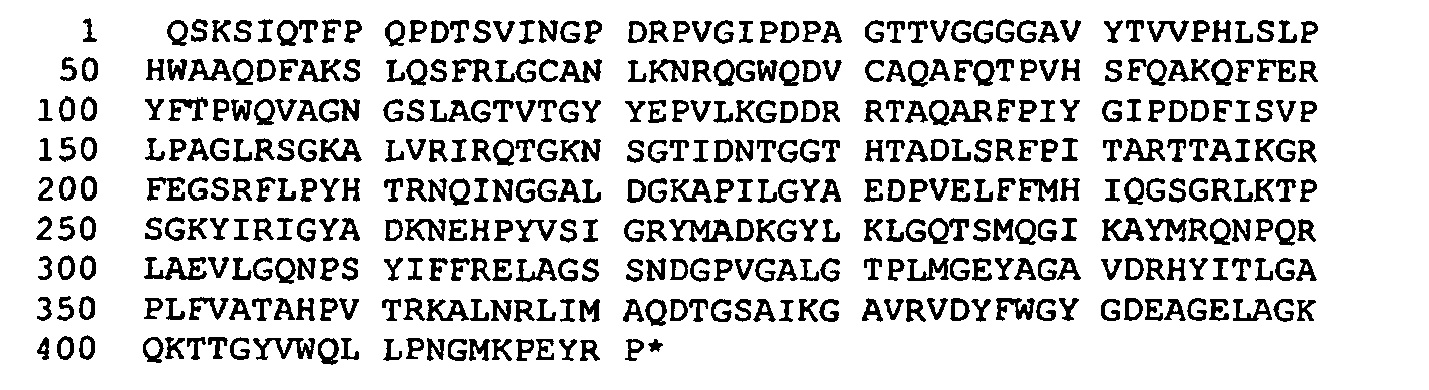
- 2) 919 with its own leader peptide but without any fusion partner ('919L'); and
- 3) 919 with the leader peptide (MKTFFKTLSAAALALILAA) from ORF4 ('919LOrf4').
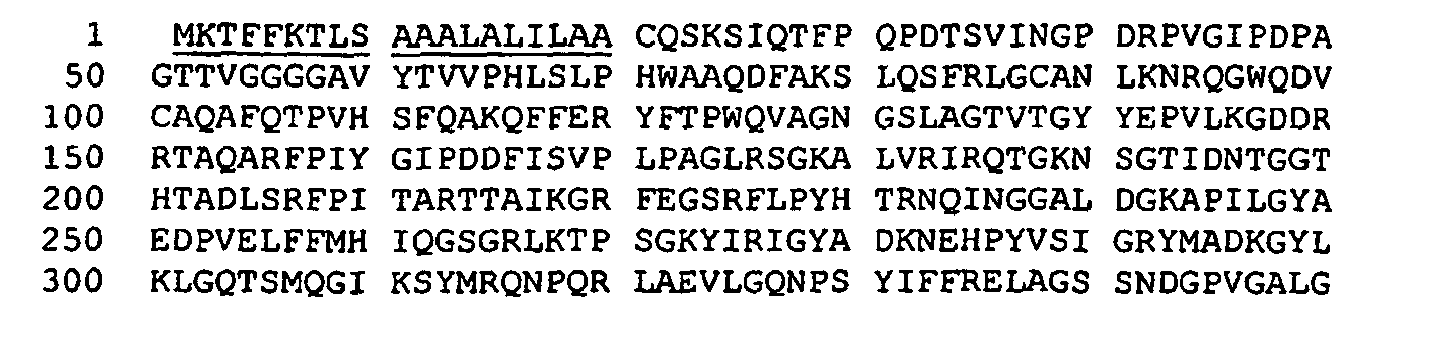

- All three forms of the protein were expressed and could be purified.
- The '919L' and '919LOrf4' expression products were both lipidated, as shown by the incorporation of [3H]-palmitate label. 919untagged did not incorporate the 3H label and was located intracellularly.
- 919LOrf4 could be purified more easily than 919L. It was purified and used to immunise mice. The resulting sera gave excellent results in FACS and ELISA tests, and also in the bactericidal assay. The lipoprotein was shown to be localised in the outer membrane.
- 919untagged gave excellent ELISA titres and high serum bactericidal activity. FACS confirmed its cell surface location.
- Growth of E.coli expressing the 919LOrf4 protein at 37°C resulted in lysis of the bacteria. In order to overcome this problem, the recombinant bacteria were grown at 30°C. Lysis was prevented without preventing expression.
- It was hypothesised that
proteins 907, 919 and 922 are murein hydrolases, and more particularly lytic transglycosylases. Murein hydrolases are located on the outer membrane and participate in the degradation of peptidoglycan. - The purified
proteins 919untagged, 919Lorf4, 919-His (i.e. with a C-terminus His-tag) and 922-His were thus tested for murein hydrolase activity [Ursinus & Holtje (1994) J.Bact. 176:338-343]. Two different assays were used, one determining the degradation of insoluble murein sacculus into soluble muropeptides and the other measuring breakdown of poly(MurNAc-GlcNAc)n>30 glycan strands. - The first assay uses murein sacculi radiolabelled with meso-2,6-diamino-3,4,5-[3H]pimelic acid as substrate. Enzyme (3-10 µg total) was incubated for 45 minutes at 37°C in a total volume of 100µl comprising 10mM Tris-maleate (pH 5.5), 10mM MgCl2, 0.2% v/v Triton X-100 and [3H]A2pm labelled murein sacculi (about 10000cpm). The assay mixture was placed on ice for 15 minutes with 100 µl of 1% w/v N-acetyl-N,N,N-trimethylammonium for 15 minutes and precipitated material pelleted by centrifugation at 10000g for 15 minutes. The radioactivity in the supernatant was measured by liquid scintillation counting. E.coli soluble lytic transglycosylase Slt70 was used as a positive control for the assay; the negative control comprised the above assay solution without enzyme.
- All proteins except 919-His gave positive results in the first assay.
- The second assay monitors the hydrolysis of poly(MurNAc-GlcNAc)glycan strands. Purified strands, poly(MurNAc-GlcNAc)n>30 labelled with N-acetyl-D-1-[3H]glucosamine were incubated with 3µg of 919L in 10 mM Tris-maleate (pH 5.5), 10 mM MgCl2 and 0.2% v/v Triton X-100 for 30 min at 37°C. The reaction was stopped by boiling for 5 minutes and the pH of the sample adjusted to about 3.5 by addition of 10µl of 20% v/v phosphoric acid. Substrate and product were separated by reversed phase HPLC on a Nucleosil 300 C18 column as described by Harz et. al. [Anal. Biochem. (1990) 190:120-128]. The E.coli lytic transglycosylase Mlt A was used as a positive control in the assay. The negative control was performed in the absence of enzyme.
- By this assay, the ability of 919LOrf4 to hydrolyse isolated glycan strands was demonstrated when anhydrodisaccharide subunits were separated from the oligosaccharide by HPLC.
- Protein 919Lorf4 was chosen for kinetic analyses. The activity of 919Lorf4 was enhanced 3.7-fold by the addition of 0.2% v/v Triton X-100 in the assay buffer. The presence of Triton X-100 had no effect on the activity of 919untagged. The effect of pH on enzyme activity was determined in Tris-Maleate buffer over a range of 5.0 to 8.0. The optimal pH for the reaction was determined to be 5.5. Over the temperature range 18°C to 42°C, maximum activity was observed at 37°C. The effect of various ions on murein hydrolase activity was determined by performing the reaction in the presence of a variety of ions at a final concentration of 10mM. Maximum activity was found with Mg2+, which stimulated activity 2.1-fold. Mn2+ and Ca2+ also stimulated enzyme activity to a similar extent while the addition Ni2+ and EDTA had no significant effect. In contrast, both Fe2+and Zn2+ significantly inhibited enzyme activity. The structures of the reaction products resulting from the digestion of unlabelled E.coli murein sacculus were analysed by reversed-phase HPLC as described by Glauner [Anal. Biochem. (1988) 172:451-464]. Murein sacculi digested with the muramidase Cellosyl were used to calibrate and standardise the Hypersil ODS column. The major reaction products were 1,6 anhydrodisaccharide tetra and tri peptides, demonstrating the formation of 1,6 anhydromuraminic acid intramolecular bond.
- These results demonstrate experimentally that 919 is a murein hydrolase and in particular a member of the lytic transglycosylase family of enzymes. Furthermore the ability of 922-His to hydrolyse murein sacculi suggests this protein is also a lytic transglycosylase.
- This activity may help to explain the toxic effects of 919 when expressed in E.coli.
- In order to eliminate the enzymatic activity, rational mutagenesis was used. 907, 919 and 922 show fairly low homology to three membrane-bound lipidated murein lytic transglycosylases from E.coli:
- 919 (441aa) is 27.3% identical over 440aa overlap to E.coli MLTA (P46885);
- 922 (369aa) is 38.7% identical over 310aa overlap to E.coli MLTB (P41052); and
- 907-2 (207aa) is 26.8% identical over 149aa overlap to E.coli MLTC (P52066).
- 907-2 also shares homology with E.coli MLTD (P23931) and Slt70 (P03810), a soluble lytic transglycosylase that is located in the periplasmic space. No significant sequence homology can be detected among 919, 922 and 907-2, and the same is true among the corresponding MLTA, MLTB and MLTC proteins.
- Crystal structures are available for Slt70 [1QTEA; 1QTEB; Thunnissen et al. (1995) Biochemistry 34:12729-12737] and for Slt35 [1LTM; 1QUS; 1QUT; van Asselt et al. (1999) Structure Fold Des 7:1167-80] which is a soluble form of the 40kDa MLTB.
- The catalytic residue (a glutamic acid) has been identified for both Slt70 and MLTB.
- In the case of Slt70, mutagenesis studies have demonstrated that even a conservative substitution of the catalytic Glu505 with a glutamine (Gln) causes the complete loss of enzymatic activity. Although Slt35 has no obvious sequence similarity to Slt70, their catalytic domains shows a surprising similarity. The corresponding catalytic residue in MLTB is Glu162.
- Another residue which is believed to play an important role in the correct folding of the enzymatic cleft is a well-conserved glycine (Gly) downstream of the glutamic acid. Recently, Terrak et al. [Mol.Microbiol. (1999) 34:350-64] have suggested the presence of another important residue which is an aromatic amino acid located around 70-75 residues downstream of the catalytic glutamic acid.
- Sequence alignment of Slt70 with 907-2 and of MLTB with 922 were performed in order to identify the corresponding catalytic residues in the MenB antigens.
- The two alignments in the region of the catalytic domain are reported below:


- From these alignments, it results that the corresponding catalytic glutamate in 907-2 is Glu117, whereas in 922 is Glu164. Both antigens also share downstream glycines that could have a structural role in the folding of the enzymatic cleft (in bold), and 922 has a conserved aromatic residue around 70aa downstream (in bold).
- In the case of
protein 919, no 3D structure is available for its E.coli homologue MLTA, and nothing is known about a possible catalytic residue. Nevertheless, three amino acids in 919 are predicted as catalytic residues by alignment with MLTA:

- The three possible catalytic residues are shown by the symbol ▼:
- 1) Glu255 (Asp in MLTA), followed by three conserved glycines (Gly263, Gly265 and Gly272) and three conserved aromatic residues located approximately 75-77 residues downstream. These downstream residues are shown by □.
- 2) Glu323 (conserved in MLTA), followed by 2 conserved glycines (Gly347 and Gly355) and two conserved aromatic residues located 84-85 residues downstream (Tyr406 or Phe407). These downstream residues are shown by ◇.
- 3) Asp362 (instead of the expected Glu), followed by one glycine (Gly 369) and a conserved aromatic residue (Trp428). These downstream residues are shown by ○.
- Alignments of polymorphic forms of 919 are disclosed in
WO00/66741 - Based on the prediction of catalytic residues, three mutants of the 919 and one mutant of 907, containing each a single amino acid substitution, have been generated. The glutamic acids in position 255 and 323 and the aspartic acids in position 362 of the 919 protein and the glutamic acid in position 117 of the 907 protein, were replaced with glycine residues using PCR-based SDM. To do this, internal primers containing a codon change from Glu or Asp to Gly were designed:
Primers Sequences Codon change 919-E255 for 
GAA → Ggt 919-E255 rev 919-E323 for 
GAA → Ggt 919-E323 rev 919-D362 for 
GAC → Ggt 919-D362 rev 907-E117 for 
GAA → Ggt 907-E117 rev - To generate the 919-E255, 919-E323 and 919-E362 mutants, PCR was performed using 20ng of the pET 919-LOrf4 DNA as template, and the following primer pairs:
- 1) Orf4L for / 919-E255 rev
- 2) 919-E255 for / 919L rev
- 3) Orf4L for / 919-E323 rev
- 4) 919-E323 for / 919L rev
- 5) Orf4L for / 919-D362 rev
- 6) 919-D362 for / 919L rev
- The second round of PCR was performed using the product of PCR 1-2, 3-4 or 5-6 as template, and as forward and reverse primers the "Orf4L for" and "919L rev" respectively.
- For the mutant 907-E117, PCR have been performed using 200ng of chromosomal DNA of the 2996 strain as template and the following primer pairs:
- 7) 907L for / 907-E117 rev
- 8) 907-E 117 for / 907L rev
- The second round of PCR was performed using the products of
PCR 7 and 8 as templates and the oligos "907L for" and "907L rev" as primers. - The PCR fragments containing each mutation were processed following the standard procedure, digested with NdeI and XhoI restriction enzymes and cloned into pET-21b+ vector. The presence of each mutation was confirmed by sequence analysis.
- Mutation of Glu117 to Gly in 907 is carried out similarly, as is mutation of residues Glu164, Ser213 and Asn348 in 922.
- The E255G mutant of 919 shows a 50% reduction in activity; the E323G mutant shows a 70% reduction in activity; the E362G mutant shows no reduction in activity.
- 287-GST, 919untagged and 953-His were subjected to gel filtration for analysis of quaternary structure or preparative purposes. The molecular weight of the native proteins was estimated using either FPLC Superose 12 (H/
R 10/30) or Superdex 75 gel filtration columns (Pharmacia). The buffers used for chromatography for 287, 919 and 953 were 50 mM Tris-HCl (pH 8.0), 20 mM Bicine (pH 8.5) and 50 mM Bicine (pH 8.0), respectively. - Additionally each buffer contained 150-200 mM NaCl and 10% v/v glycerol. Proteins were dialysed against the appropriate buffer and applied in a volume of 200µl. Gel filtration was performed with a flow rate of 0.5 - 2.0 ml/min and the eluate monitored at 280nm. Fractions were collected and analysed by SDS-PAGE. Blue dextran 2000 and the molecular weight standards ribonuclease A, chymotrypsin A ovalbumin, albumin (Pharmacia) were used to calibrate the column. The molecular weight of the sample was estimated from a calibration curve of Kav vs. log Mr of the standards. Before gel filtration, 287-GST was digested with thrombin to cleave the GST moiety.
- The estimated molecular weights for 287, 919 and 953-His were 73 kDa, 47 kDa and 43 kDa respectively. These results suggest 919 is monomeric while both 287 and 953 are principally dimeric in their nature. In the case of 953-His, two peaks were observed during gel filtration. The major peak (80%) represented a dimeric conformation of 953 while the minor peak (20%) had the expected size of a monomer. The monomeric form of 953 was found to have greater bactericidal activity than the dimer.
- 953 protein with its native leader peptide and no fusion partners was expressed from the pET vector and also from pSM214 [Velati Bellini et al. (1991) J. Biotechnol. 18, 177-192].
- The 953 sequence was cloned as a full-length gene into pSM214 using the E. coli MM294-1 strain as a host. To do this, the entire DNA sequence of the 953 gene (from ATG to the STOP codon) was amplified by PCR using the following primers:which contain EcoRI and HindIII restriction sites, respectively. The amplified fragment was digested with EcoRI and HindIII and ligated with the pSM214 vector digested with the same two enzymes. The ligated plasmid was transformed into E.coli MM294-1 cells (by incubation in ice for 65 minutes at 37° C) and bacterial cells plated on LB agar containing 20µg/ml of chloramphenicol.

- Recombinant colonies were grown over-night at 37°C in 4 ml of LB broth containing 20 µg/ml of chloramphenicol; bacterial cells were centrifuged and plasmid DNA extracted as and analysed by restriction with EcoRI and HindIII. To analyse the ability of the recombinant colonies to express the protein, they were inoculated in LB broth containing 20µg/ml of chloramphenicol and let to grown for 16 hours at 37°C. Bacterial cells were centrifuged and resuspended in PBS. Expression of the protein was analysed by SDS-PAGE and Coomassie Blue staining.
- Expression levels were unexpectedly high from the pSM214 plasmid.
- Oligos used to clone sequences into pSM-214 vectors were as follows:
ΔG287 (pSM-214) Fwd CCGGAATTCTTATG-TCGCCCGATGTTAAATCGGCGGA EcoRI Rev GCCCAAGCTT-TCAATCCTGCTCTTTTTTGCCG HindIII Δ2 287 (pSM-214) Fwd CCGGAATTCTTATG-AGCCAAGATATGGCGGCAGT EcoRI Rev GCCCAAGCTT-TCAATCCTGCTCT'ITI'1TGCCG HindIII Δ3 287 (pSM-214) Fwd CCGGAATTCTTATG-TCCGCCGAATCCGCAAATCA EcoRI Rev GCCCAAGCTT-TCAATCCTGCTCTTTTTTGCCG HindIII Δ4287 (pSM-214) Fwd CCGGAATTCTTATG-GGAAGGGTTGATTTGGCTAATG EcoRI Rev GCCCAAGCTT-TCAATCCTGCTCTTTTTTGCCG HindIII Orf46.1 (pSM-214) Fwd CCGGAATTCTTATG-TCAGATTTGGCAAACGATTCTT EcoRI Rev GCCCAAGCTT-TTACGTATCATATTTCACGTGCTTC HindIII ΔG287- Orf46.1 (pSM-214) Fwd CCGGAATTCTTATG-TCGCCCGATGTTAAATCGGCGGA EcoRI Rev GCCCAAGCTT-TTACGTATCATATTTCACGTGCTTC HindIII 919 (pSM-214) Fwd CCGGAATTCTTATG-CAAAGCAAGAGCATCCAAACCT EcoRI Rev GCCCAAGCTT-TTACGGGCGGTATTCGGGCT HindIII 961L (pSM-214) Fwd CCGGAATTC ATATG-AAACACTTTCCATCC . EcoRI Rev GCCCAAGCTT-TTACCACTCGTAATTGAC HindIII 961 (pSM-214) Fwd CCGGAATTCATATG-GCCACAAGCGACGAC EcoRI Rev GCCCAAGCTT- TTA CCACTCGTAATTGAC HindIII 961c L pSM-214 Fwd CCGGAATTCTTATG-AAACACTTTCCATCC EcoRI Rev GCCCAAGCTT- TCA ACCCACGTTGTAAGGTTG HindIII 961c pSM-214 Fwd CCGGAATTCTTATG-GCCACAAACGACGACG EcoRI Rev GCCCAAGCTT-TCAACCCACGTTGTAAGGTTG HindIII 953 (pSM-214) Fwd CCGGAATTCTTATG-GCCACCTACAAAGTGGACGA EcoRI Rev GCCCAAGCTT-TTATTGTTTGGCTGCCTCGATT HindIII - These sequences were manipulated, cloned and expressed as described for 953L.
- For the pET-24 vector, sequences were cloned and the proteins expressed in pET-24 as described below for pET21. pET2 has the same sequence as pET-21, but with the kanamycin resistance cassette instead of ampicillin cassette.
- Oligonucleotides used to clone sequences into pET-24b vector were:
ΔG 287 K Fwd CGCGGATCCGCTAGC-CCCGATGTTAAATCGGC § NheI Rev CCCGCTCGAG-TCAATCCTGCTCTITITTGCC * XhoI Δ2 287 K Fwd CGCGGATCCGCTAGC-CAAGATATGGCGGCAGT § Nhel Δ3 287 K Fwd CGCGGATCCGCTAGC-GCCGAATCCGCAAATCA § NheI Δ4 287 K Fwd CGCGCTAGC-GGAAGGGTTGATTTGGCTAATGG § NheI Orf46.1 K Fwd GGGAATTCCATATG-GGCATTTCCCGCAAAATATC NdeI Rev CCCGCTCGAG-TTACGTATCATATITCACGTGC XhoI Orf46A K Fwd GGGAATTCCATATG-GGCATTTCCCGCAAAATATC NdeI Rev CCCGCTCGAG-TTATTCTATGCCTTGTGCGGCAT Xhol 961 K (MC58) Fwd CGCGGATCCCATATG-GCCACAAGCGACGACGA Ndel Rev CCCGCTCGAG- TTA CCACTCGTAATTGAC XhoI 961a K Fwd CGCGGATCCCATATG-GCCACAAACGACG NdeI Rev CCCGCTCGAG- TCA TTTAGCAATATTATCTTTGTTC Xhol 961b K Fwd CGCGGATCCCATATG-AAAGCAAACAGTGCCGAC Ndel Rev CCCGCTCGAG- TTA CCACTCGTAATTGAC XhoI 961c K Fwd CGCGGATCCCATATG-GCCACAAACGACG NdeI Rev CCCGCTCGAG-TTAACCCACGTTGTAAGGT Xhol 961cL K Fwd CGCGGATCCCATATG-ATGAAACACTTTCCATCC Ndel Rev CCCGCTCGAG- TTA ACCCACGTTGTAAGGT Xhol 961d K Fwd CGCGGATCCCATATG-GCCACAAACGACG Ndel Rev CCCGCTCGAG-TCAGTCTGACACTGTTTTATCC XhoI ΔG 287- 919 K Fwd CGCGGATCCGCTAGC-CCCGATGTTAAATCGGC NheI Rev CCCGCTCGAG-TTACGGGCGGTATTCGG XhoI ΔG 287-Orf46.1 K Fwd CGCGGATCCGCTAGC-CCCGATGTTAAATCGGC NheI Rev CCCGCTCGAG-TTACGTATCATATTTCACGTGC Xhol ΔG 287- 961 K Fwd CGCGGATCCGCTAGC-CCCGATGTTAAATCGGC NheI Rev CCCGCTCGAG-TTACCACTCGTAATTGAC XhoI * This primer was used as a Reverse primer for all the 287 forms.
Forward primers used in combination with the ΔG278 K reverse primer. - ORF1 from N.meningitidis (serogroup B, strain MC58) is predicted to be an outer membrane or secreted protein. It has the following sequence:

- The leader peptide is underlined.
- A polymorphic form of ORF1 is disclosed in
WO99/55873 - Three expression strategies have been used for ORF 1:
- 1) ORF1 using a His tag, following
WO99/24578 - 2) ORF1 with its own leader peptide but without any fusion partner ('ORF1L'); and
- 3) ORF1 with the leader peptide (MKKTAIAIAVALAGFATVAQA) from E.coli OmpA ('Orf1LOmpA'):

- All three forms of the protein were expressed. The His-tagged protein could be purified and was confirmed as surface exposed, and possibly secreted (see
Figure 3 ). The protein was used to immunise mice, and the resulting sera gave excellent results in the bactericidal assay. - ORF1LOmpA was purified as total membranes, and was localised in both the inner and outer membranes. Unexpectedly, sera raised against ORF1LOmpA show even better ELISA and anti-bactericidal properties than those raised against the His-tagged protein.
- ORF1L was purified as outer membranes, where it is localised.
- Protein 911 from N.meningitidis (serogroup B, strain MC58) has the following sequence:

- The leader peptide is underlined.
- Three expression strategies have been used for 911:
- 1) 911 with its own leader peptide but without any fusion partner ('911L');
- 2) 911 with the leader peptide from E.coli OmpA ('911LOmpA').
To make this construct, the entire sequence encoding the OmpA leader peptide was included in the 5'- primer as a tail (primer 911LOmpA Forward). A NheI restriction site was inserted between the sequence coding for the OmpA leader peptide and the 911 gene encoding the predicted mature protein (insertion of one amino acid, a serine), to allow the use of this construct to clone different genes downstream the OmpA leader peptide sequence. - 3) 911 with the leader peptide (MKYLLPTAAAGLLLAAQPAMA) from Erwinia carotovora PelB ('911LpelB').
- All three forms of the protein were expressed. ELISA titres were highest using 911 L, with 919LOmpA also giving good results.
- The complete ORF46 protein from N.meningitidis (serogroup B, strain 2996) has the following sequence:
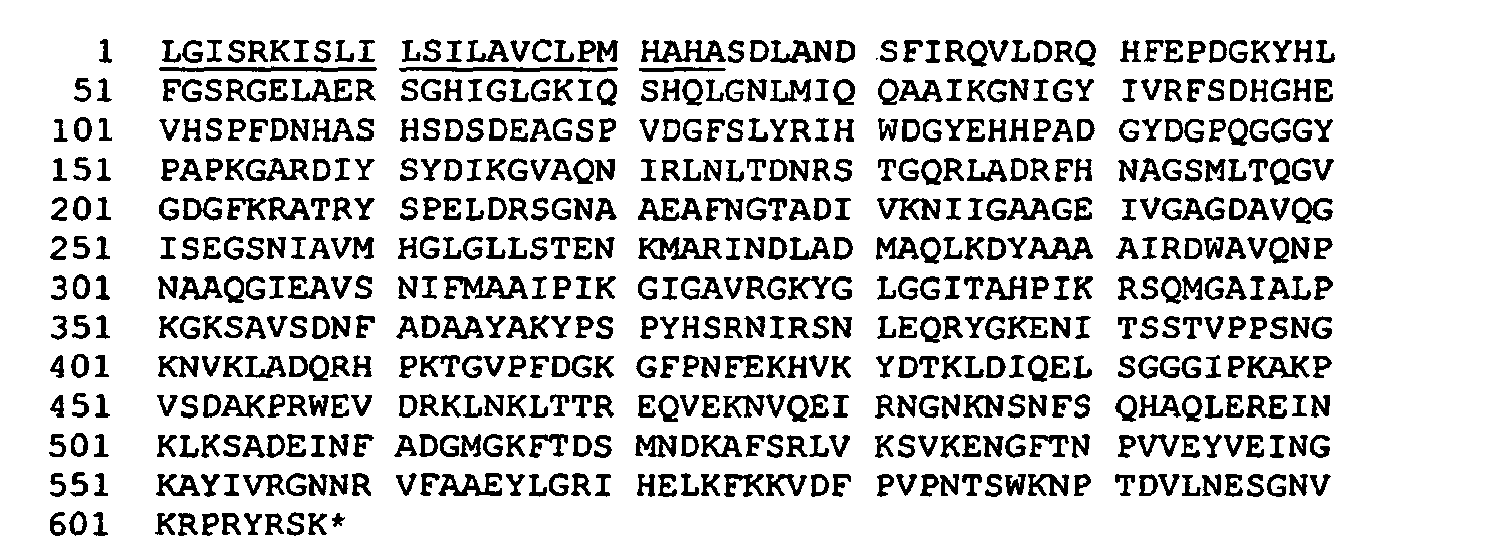
- The leader peptide is underlined.
- The sequences of ORF46 from other strains can be found in
WO00/66741 - Three expression strategies have been used for ORF46:
- 1) ORF46 with its own leader peptide but without any fusion partner ('ORF46-2L');
- 2) ORF46 without its leader peptide and without any fusion partner ('ORF46-2'), with the leader peptide omitted by designing the 5'-end amplification primer downstream from the predicted leader sequence:

- 3) ORF46 as a truncated protein, consisting of the first 433 amino acids ('ORF46.1L'), constructed by designing PCR primers to amplify a partial sequence corresponding to aa 1-433.
- A STOP codon was included in the 3'-end primer sequences.
- ORF46-2L is expressed at a very low level to E.coli. Removal of its leader peptide (ORF46-2) does not solve this problem. The truncated ORF46.1L form (first 433 amino acids, which are well conserved between serogroups and species), however, is well-expressed and gives excellent results in ELISA test and in the bactericidal assay.
- ORF46.1 has also been used as the basis of hybrid proteins. It has been fused with 287, 919, and ORF1. The hybrid proteins were generally insoluble, but gave some good ELISA and bactericidal results (against the homologous 2996 strain):
Protein ELISA Bactericidal Ab Orf1-Orf46.1-His 850 256 919-Orf46.1-His 12900 512 919-287-Orf46-His n.d. n.d. Orf46.1-287His 150 8192 Orf46.1-919His 2800 2048 Orf46.1-287-919His 3200 16384 - For comparison, 'triple' hybrids of ORF46.1, 287 (either as a GST fusion, or in ΔG287 form) and 919 were constructed and tested against various strains (including the homologous 2996 strain) versus a simple mixture of the three antigens. FCA was used as adjuvant:
2996 BZ232 MC58 NGH38 F6124 BZ133 Mixture 8192 256 512 1024 >2048 >2048 ORF46.1-287-919his 16384 256 4096 8192 8192 8192 ΔG287-919-ORF46.1his 8192 64 4096 8192 8192 16384 ΔG287-ORF46.1-919his 4096 128 256 8192 512 1024 - Again, the hybrids show equivalent or superior immunological activity.
- Hybrids of two proteins (strain 2996) were compared to the individual proteins against various heterologous strains:
1000 MC58 F6124 (MenA) ORF46.1-His <4 4096 <4 ORF1-His 8 256 128 ORF1-ORF46.1-His 1024 512 1024 - The complete 961 protein from N.meningitidis (serogroup B, strain MC58) has the following sequence:
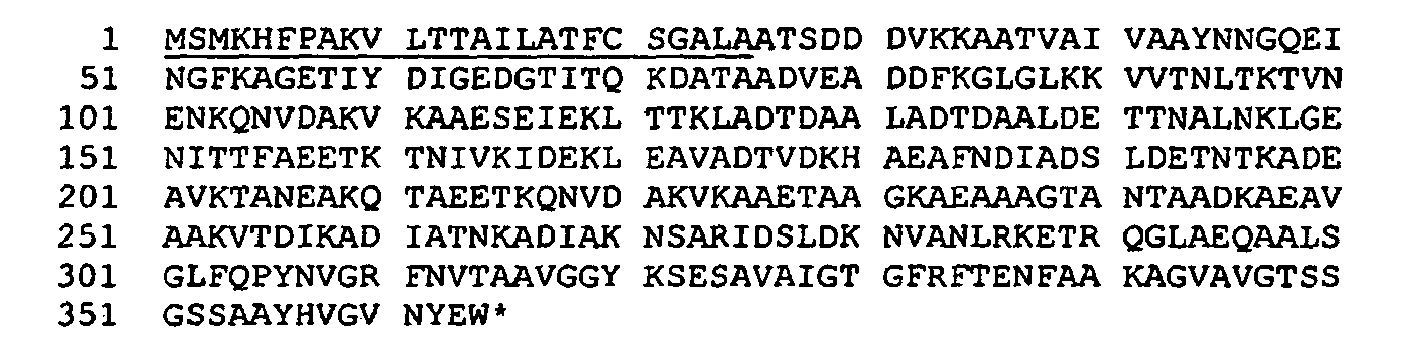
- The leader peptide is underlined.
- Three approaches to 961 expression were used:
- 1) 961 using a GST fusion, following
WO99/57280 - 2) 961 with its own leader peptide but without any fusion partner ('961L'); and
- 3) 961 without its leader peptide and without any fusion partner ('961untagged,), with the leader peptide omitted by designing the 5'-end PCR primer downstream from the predicted leader sequence.
- All three forms of the protein were expressed. The GST-fusion protein could be purified and antibodies against it confirmed that 961 is surface exposed (
Figure 4 ). The protein was used to immunise mice, and the resulting sera gave excellent results in the bactericidal assay. 961L could also be purified and gave very high ELISA titres. -
Protein 961 appears to be phase variable. Furthermore, it is not found in all strains of N. meningitidis. -
Protein 287 from N.meningitidis (serogroup B, strain 2996) has the following sequence:

- The leader peptide is shown underlined.
- The sequences of 287 from other strains can be found in
Figures 5 and 15 ofWO00/66741 - Example 9 of
WO99/57280 - A number of further approaches to expressing 287 in E.coli have been used, including:
- 1) 287 as a His-tagged fusion ('287-His');
- 2) 287 with its own leader peptide but without any fusion partner ('287L');
- 3) 287 with the ORF4 leader peptide and without any fusion partner ('287LOrf4'); and
- 4) 287 without its leader peptide and without any fusion partner ('287untagged,):

- All these proteins could be expressed and purified.
- '287L' and '287LOrf4' were confirmed as lipoproteins.
- As shown in
Figure 2 , '287LOrf4' was constructed by digesting 919LOrf4 with NheI and XhoI. The entire ORF4 leader peptide was restored by the addition of a DNA sequence coding for the missing amino acids, as a tail, in the 5'-end primer (287LOrf4 for), fused to 287 coding sequence. The 287 gene coding for the mature protein was amplified using the oligonucleotides 287LOrf4 For and Rev (including the NheI and XhoI sites, respectively), digested with NheI and XhoI and ligated to the purified pETOrf4 fragment. - A similar approach was adopted for E.coli expression of further proteins from
WO99/24578 WO99/36544 WO99/57280 - The following were expressed without a fusion partner: 008, 105, 117-1, 121-1, 122-1, 128-1, 148, 216, 243, 308, 593, 652, 726, 982, and Orf143-1. Protein 117-1 was confirmed as surface-exposed by FACS and gave high ELISA titres.
- The following were expressed with the native leader peptide but without a fusion partner: 111, 149, 206, 225-1, 235, 247-1, 274, 283, 286, 292, 401, 406, 502-1, 503, 519-1, 525-1, 552, 556, 557, 570, 576-1, 580, 583, 664, 759, 907, 913, 920-1, 926, 936-1, 953, 961, 983, 989, Orf4, Orf7-1, Orf9-1, Orf23, Orf25, Orf37, Orf38, Orf40, Orf40.1, Orf40.2, Orf72-1, Orf76-1, Orf85-2, Orf91, Orf97-1, Orf119, Orf143.1. These proteins are given the suffix 'L'.
- His-tagged protein 760 was expressed with and without its leader peptide. The deletion of the signal peptide greatly increased expression levels. The protein could be purified most easily using 2M urea for solubilisation.
- His-tagged protein 264 was well-expressed using its own signal peptide, and the 30kDa protein gave positive Western blot results.
- All proteins were successfully expressed.
- The localisation of 593, 121-1, 128-1, 593, 726, and 982 in the cytoplasm was confirmed.
- The localisation of 920-1L, 953L, ORF9-1L, ORF85-2L, ORF97-1L, 570L, 580L and 664L in the periplasm was confirmed.
- The localisation of ORF40L in the outer membrane, and 008 and 519-1L in the inner membrane was confirmed. ORF25L, ORF4L, 406L, 576-1L were all confirmed as being localised in the membrane.
- Protein 206 was found not to be a lipoprotein.
- ORF25 and ORF40 expressed with their native leader peptides but without fusion partners, and protein 593 expressed without its native leader peptide and without a fusion partner, raised good anti-bactericidal sera. Surprisingly, the forms of ORF25 and ORF40 expressed without fusion partners and using their own leader peptides (i.e. 'ORF25L' and 'ORF40L') give better results in the bactericidal assay than the fusion proteins.
- Proteins 920L and 953L were subjected to N-terminal sequencing, giving HRVWVETAH and ATYKVDEYHANARFAF, respectively. This sequencing confirms that the predicted leader peptides were cleaved and, when combined with the periplasmic location, confirms that the proteins are correctly processed and localised by E.coli when expressed from their native leader peptides.
- The N-terminal sequence of protein 519.1L localised in the inner membrane was MEFFIILLA, indicating that the leader sequence is not cleaved. It may therefore function as both an uncleaved leader sequence and a transmembrane anchor in a manner similar to the leader peptide of PBP1 from N.gonorrhoeae [Ropp & Nicholas (1997) J. Bact. 179:2783-2787.]. Indeed the N-terminal region exhibits strong hydrophobic character and is predicted by the Tmpred. program to be transmembrane.
- The incorporation of palmitate in recombinant lipoproteins was demonstrated by the method of Kraft et. al. [J. Bact. (1998) 180:3441-3447.]. Single colonies harbouring the plasmid of interest were grown overnight at 37°C in 20 ml of LB/Amp (100µg/ml) liquid culture. The culture was diluted to an OD550 of 0.1 in 5.0 ml of fresh medium LB/Amp medium containing 5 µC/ml [3H] palmitate (Amersham). When the OD550 of the culture reached 0.4-0.8, recombinant lipoprotein was induced for 1 hour with IPTG (final concentration 1.0 mM). Bacteria were harvested by centrifugation in a bench top centrifuge at 2700g for 15 min and washed twice with 1.0 ml cold PBS. Cells were resuspended in 120µl of 20 mM Tris-HCl (pH 8.0), 1 mM EDTA, 1.0% w/v SDS and lysed by boiling for 10 min. After centrifugation at 13000g for 10 min the supernatant was collected and proteins precipitated by the addition of 1.2 ml cold acetone and left for 1 hour at -20 °C. Protein was pelleted by centrifugation at 13000g for 10 min and resuspended in 20-50µl (calculated to standardise loading with respect to the final O.D of the culture) of 1.0% w/v SDS. An aliquot of 15 µl was boiled with 5µl of SDS-PAGE sample buffer and analysed by SDS-PAGE. After electrophoresis gels were fixed for 1 hour in 10% v/v acetic acid and soaked for 30 minutes in Amplify solution (Amersham). The gel was vacuum-dried under heat and exposed to Hyperfilm (Kodak) overnight -80 °C.
- Incorporation of the [3H] palmitate label, confirming lipidation, was found for the following proteins: Orf4L, Orf25L, 287L, 287LOrf4, 406.L, 576L, 926L, 919L and 919LOrf4.
- Based on homology of different regions of 287 to proteins that belong to different functional classes, it was split into three 'domains', as shown in
Figure 5 . The second domain shows homology to IgA proteases, and the third domain shows homology to transferrin-binding proteins. - Each of the three 'domains' shows a different degree of sequence conservation between N.meningitidis strains - domain C is 98% identical, domain A is 83% identical, whilst domain B is only 71% identical. Note that
protein 287 in strain MC58 is 61 amino acids longer than that ofstrain 2996. An alignment of the two sequences is shown inFigure 7 , and alignments for various strains are disclosed inWO00/66741 Figures 5 and 15 therein). - The three domains were expressed individually as C-terminal His-tagged proteins. This was done for the MC58 and 2996 strains, using the following constructs:
- 287a-MC58 (aa 1-202), 287b-MC58 (aa 203-288), 287c-MC58 (aa 311-488).
- 287a-2996 (aa 1-139), 287b-2996 (aa 140-225), 287c-2996 (aa 250-427).
- To make these constructs, the stop codon sequence was omitted in the 3'-end primer sequence. The 5' primers included the NheI restriction site, and the 3' primers included a XhoI as a tail, in order to direct the cloning of each amplified fragment into the expression vector pET21b+ using NdeI-XhoI, NheI-XhoI or NdeI-HindIII restriction sites.
- All six constructs could be expressed, but 287b-MC8 required denaturation and refolding for solubilisation.
- Deletion of domain A is described below ('Δ4 287-His').
- Immunological data (serum bactericidal assay) were also obtained using the various domains from
strain 2996, against the homologous and heterologous MenB strains, as well as MenA (F6124 strain) and MenC (BZ133 strain):2996 BZ232 MC58 NGH38 394/98 MenA MenC 287-His 32000 16 4096 4096 512 8000 16000 287(B)-His 256 - - - - 16 - 287(C)-His 256 - 32 512 32 2048 >2048 287(B-C)-His 64000 128 4096 64000 1024 64000 32000 - Using the domains of strain MC58, the following results were obtained:
MC58 2996 BZ232 NGH38 394/98 MenA MenC 287-His 4096 32000 16 4096 512 8000 16000 287(B)-His 128 128 - - - - 128 287(C)-His - 16 - 1024 - 512 - 287(B-C)-His 16000 64000 128 64000 512 64000 >8000 - As well as expressing individual domains, 287 was also expressed (as a C-terminal His-tagged protein) by making progressive deletions within the first domain. These
- Four deletion mutants of
protein 287 fromstrain 2996 were used (Figure 6 ): - 1) '287-His', consisting of amino acids 18-427 (i.e. leader peptide deleted);
- 2) 'Δ1 287-His', consisting of amino acids 26-427;
- 3) 'Δ2 287-His', consisting of amino acids 70-427;
- 4) 'Δ3 287-His', consisting of amino acids 107-427; and
- 5) 'Δ4 287-His', consisting of amino acids 140-427 (=287-bc).
- The 'Δ4' protein was also made for strain MC58 ('Δ4 287MC58-His'; aa 203-488).
- The constructs were made in the same way as 287a/b/c, as described above.
- All six constructs could be expressed and protein could be purified. Expression of 287-His was, however, quite poor.
- Expression was also high when the C-terminal His-tags were omitted.
- Immunological data (serum bactericidal assay) were also obtained using the deletion mutants, against the homologous (2996) and heterologous MenB strains, as well as MenA (F6124 strain) and MenC (BZ133 strain):
2996 BZ232 MC58 MGH38 394/98 MenA MenC 287-his 32000 16 4096 4096 512 8000 16000 Δ1 287-His 16000 128 4096 4096 1024 8000 16000 Δ2 287-His 16000 128 4096 >2048 512 16000 >8000 Δ3 287-His 16000 128 4096 >2048 512 16000 >8000 Δ4 287-His 64000 128 4096 64000 1024 64000 32000 - The same high activity for the Δ4 deletion was seen using the sequence from strain MC58.
- As well as showing superior expression characteristics, therefore, the mutants are immunologically equivalent or superior.
- The 'Δ1 287-His' construct of the previous example differs from 287-His and from '287untagged' only by a short N-terminal deletion (GGGGGGS). Using an expression vector which replaces the deleted serine with a codon present in the Nhe cloning site, however, this amounts to a deletion only of (Gly)6. Thus, the deletion of this (Gly)6 sequence has been shown to have a dramatic effect on protein expression.
- The protein lacking the N-terminal amino acids up to GGGGGG is called 'ΔG 287'. In strain MC58, its sequence (leader peptide underlined) is:

- ΔG287, with or without His-tag ('ΔG287-His' and 'ΔG287K', respectively), are expressed at very good levels in comparison with the '287-His' or '287 untagged'.
- On the basis of gene variability data, variants of ΔG287-His were expressed in E.coli from a number of MenB strains, in particular from
strains 2996, MC58, 1000, and BZ232. The results were also good. - It was hypothesised that poly-Gly deletion might be a general strategy to improve expression. Other MenB lipoproteins containing similar (Gly)n motifs (near the N-terminus, downstream of a cysteine) were therefore identified, namely Tbp2 (NMB0460), 741 (NMB 1870) and 983 (NMB 1969):
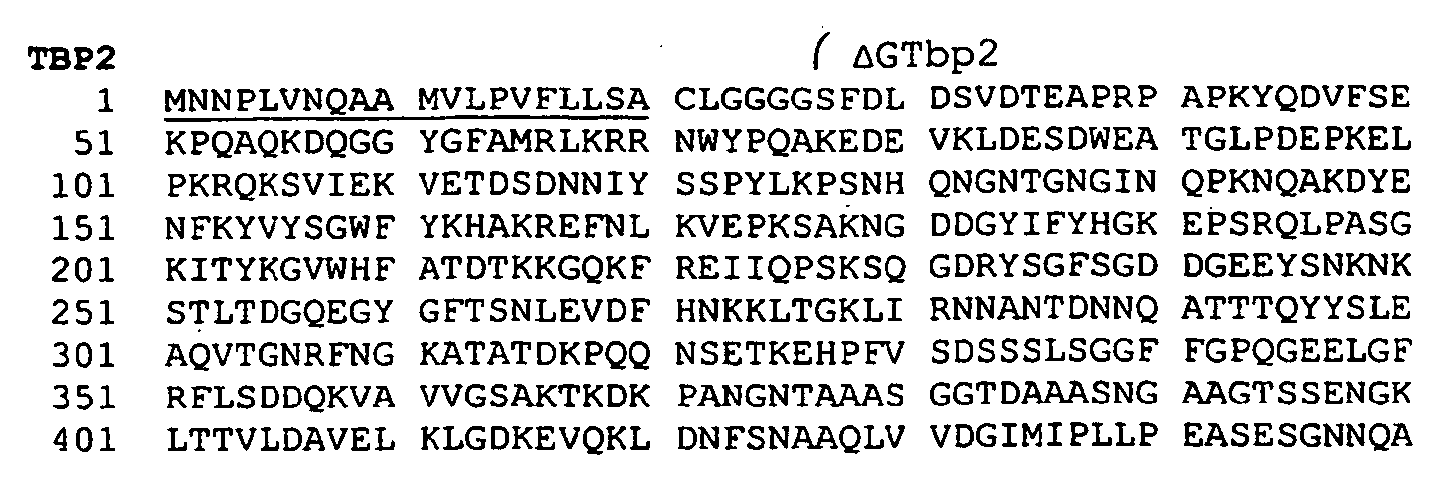

- Tbp2 and 741 genes were from strain MC58; 983 and 287 genes were from
strain 2996. These were cloned in pET vector and expressed in E.coli without the sequence coding for their leader peptides or as "ΔG forms", both fused to a C-terminal His-tag. In each case, the same effect was seen - expression was good in the clones carrying the deletion of the poly-glycine stretch, and poor or absent if the glycines were present in the expressed protein:ORF Express. Purification Bact. Activity 287-His(2996) +/- + + '287untagged'(2996) +/- nd nd ΔG287-His(2996) + + + ΔG287K(2996) + + + ΔG287-His(MC58) + + + ΔG287-His(1000) + + + ΔG287-His(BZ232) + + + Tbp2-His(MC58) +/- nd nd ΔGTbp2-His(MC58) + + 741-His(MC58) +/- nd nd ΔG741-His(MC58) + + 983-His (2996) ΔG983-His (2996) + + - ΔG287 proteins were made and purified for strains MC58, 1000 and BZ232. Each of these gave high ELISA titres and also serum bactericidal titres of >8192. ΔG287K, expressed from pET-24b, gave excellent titres in ELISA and the serum bactericidal assay. ΔG287-ORF46.1K may also be expressed in pET-24b.
- ΔG287 was also fused directly in-frame upstream of 919, 953, 961 (sequences shown below) and ORF46.1:
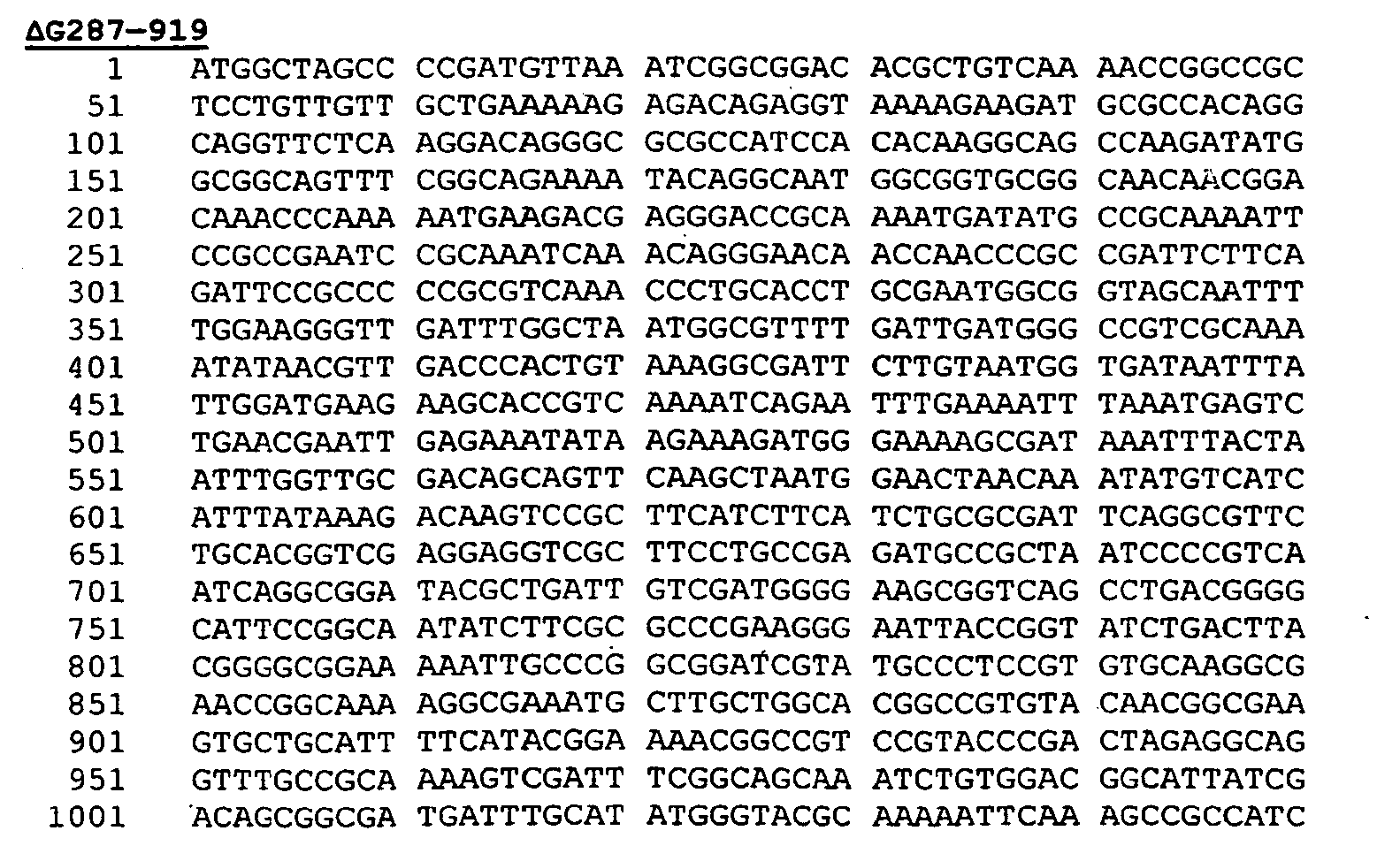
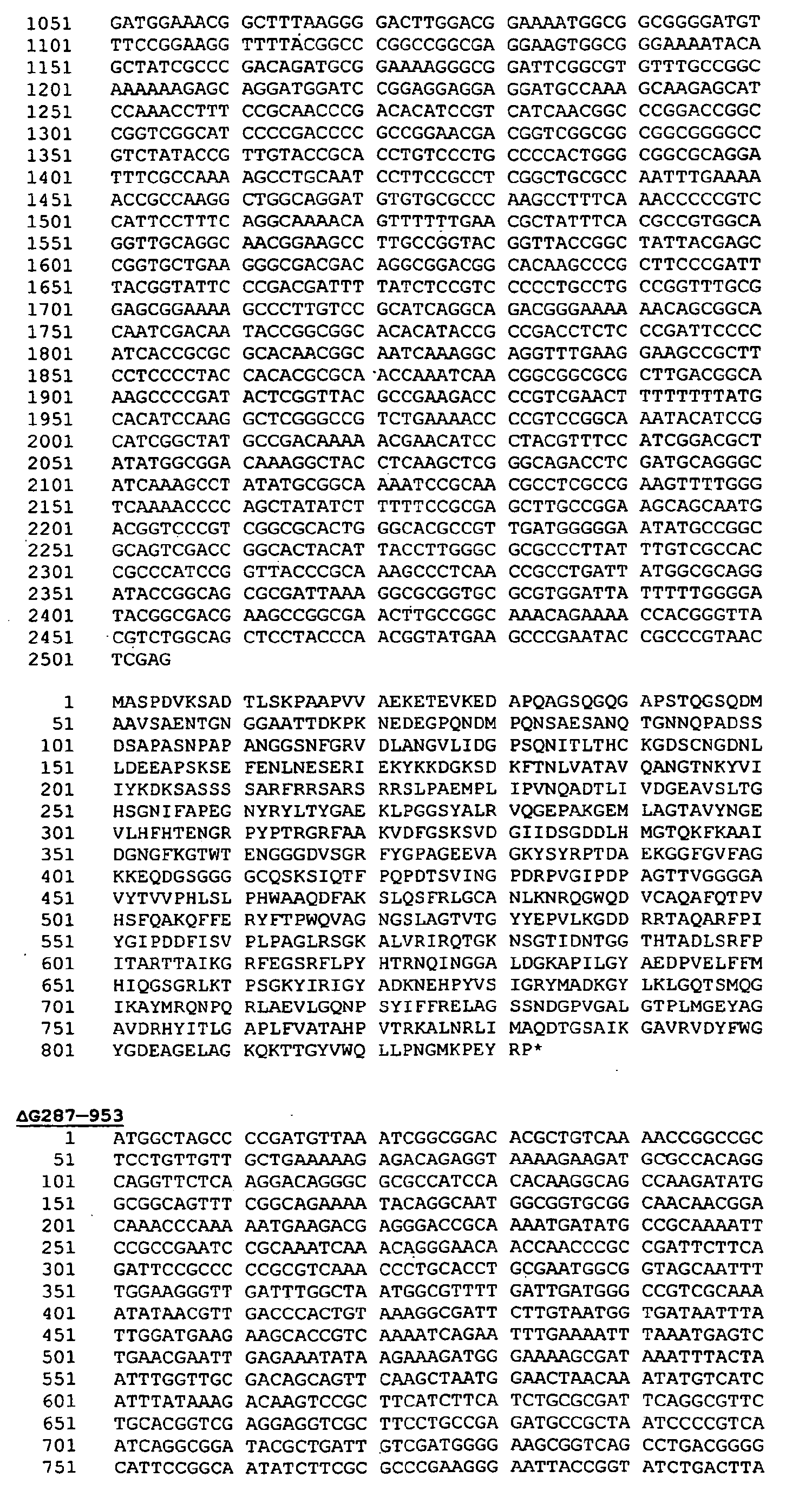
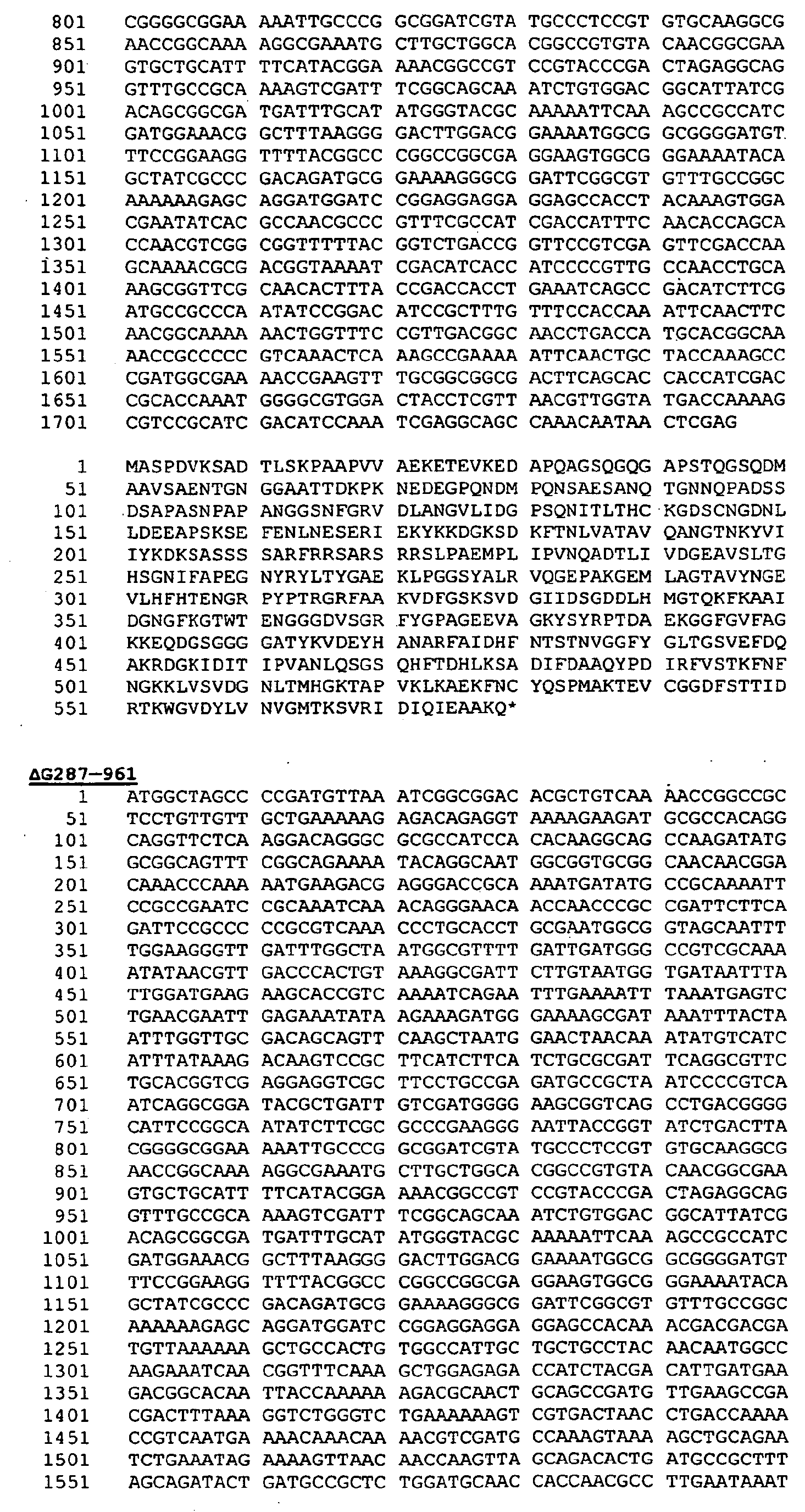

ELISA Bactericidal ΔG287-953-His 3834 65536 ΔG287-961-His 108627 65536 - The bactericidal efficacy (homologous strain) of antibodies raised against the hybrid proteins was compared with antibodies raised against simple mixtures of the component antigens (using 287-GST) for 919 and ORF46.1:
Mixture with 287 Hybrid with ΔG287 919 32000 128000 ORF46.1 128 16000 - Data for bactericidal activity against heterologous MenB strains and against serotypes A and C were also obtained:
919 ORF46.1 Strain Mixture Hybrid Mixture Hybrid NGH38 1024 32000 - 16384 MC58 512 8192 - 512 BZ232 512 512 - - MenA (F6124) 512 32000 - 8192 MenC (C11) >2048 >2048 - - MenC (BZ133) >4096 64000 - 8192 - The hybrid proteins with ΔG287 at the N-terminus are therefore immunologically superior to simple mixtures, with ΔG287-ORF46.1 being particularly effective, even against heterologous strains. ΔG287-ORF46.1K may be expressed in pET-24b.
- The same hybrid proteins were made using New Zealand strain 394/98 rather than 2996:
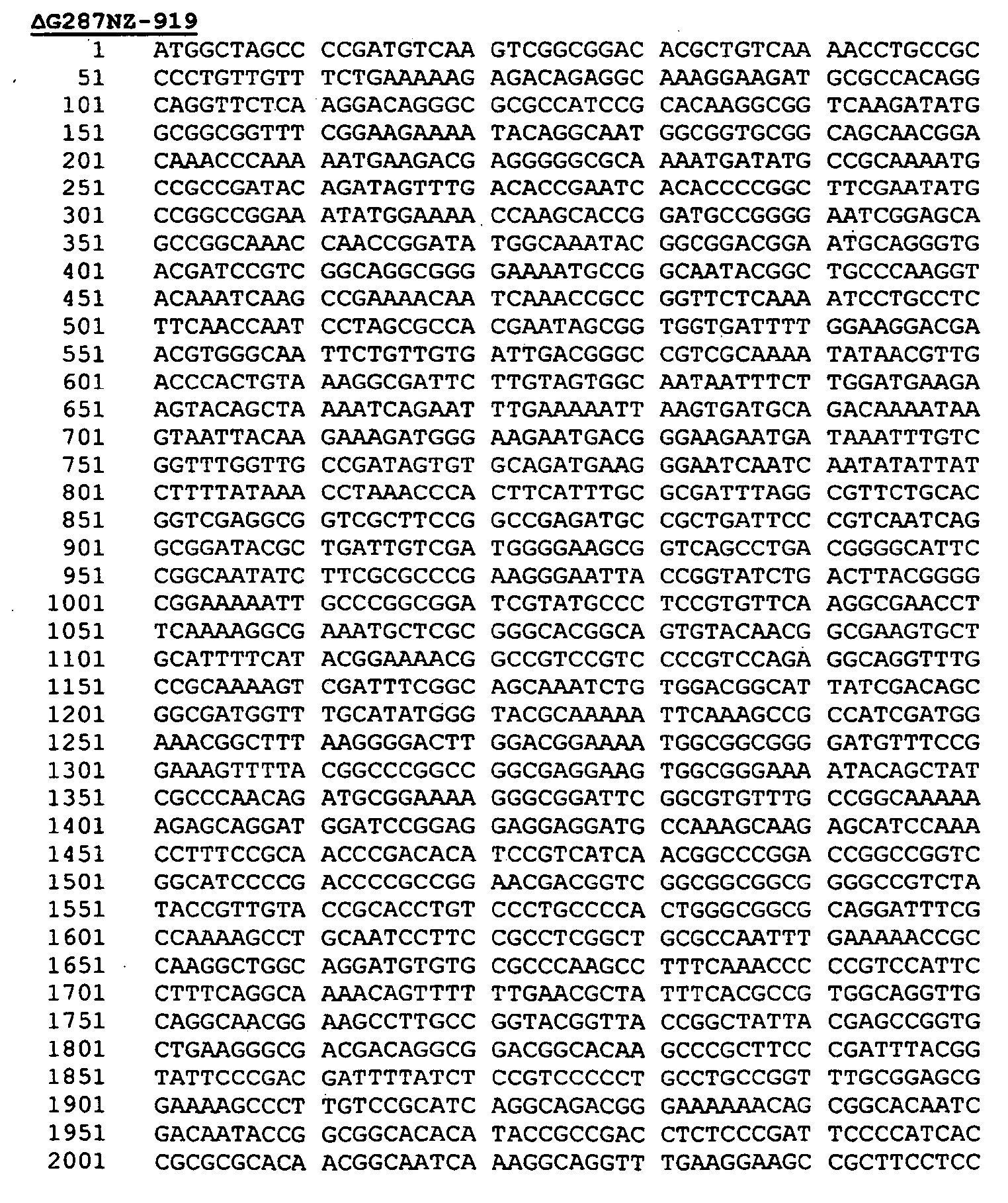

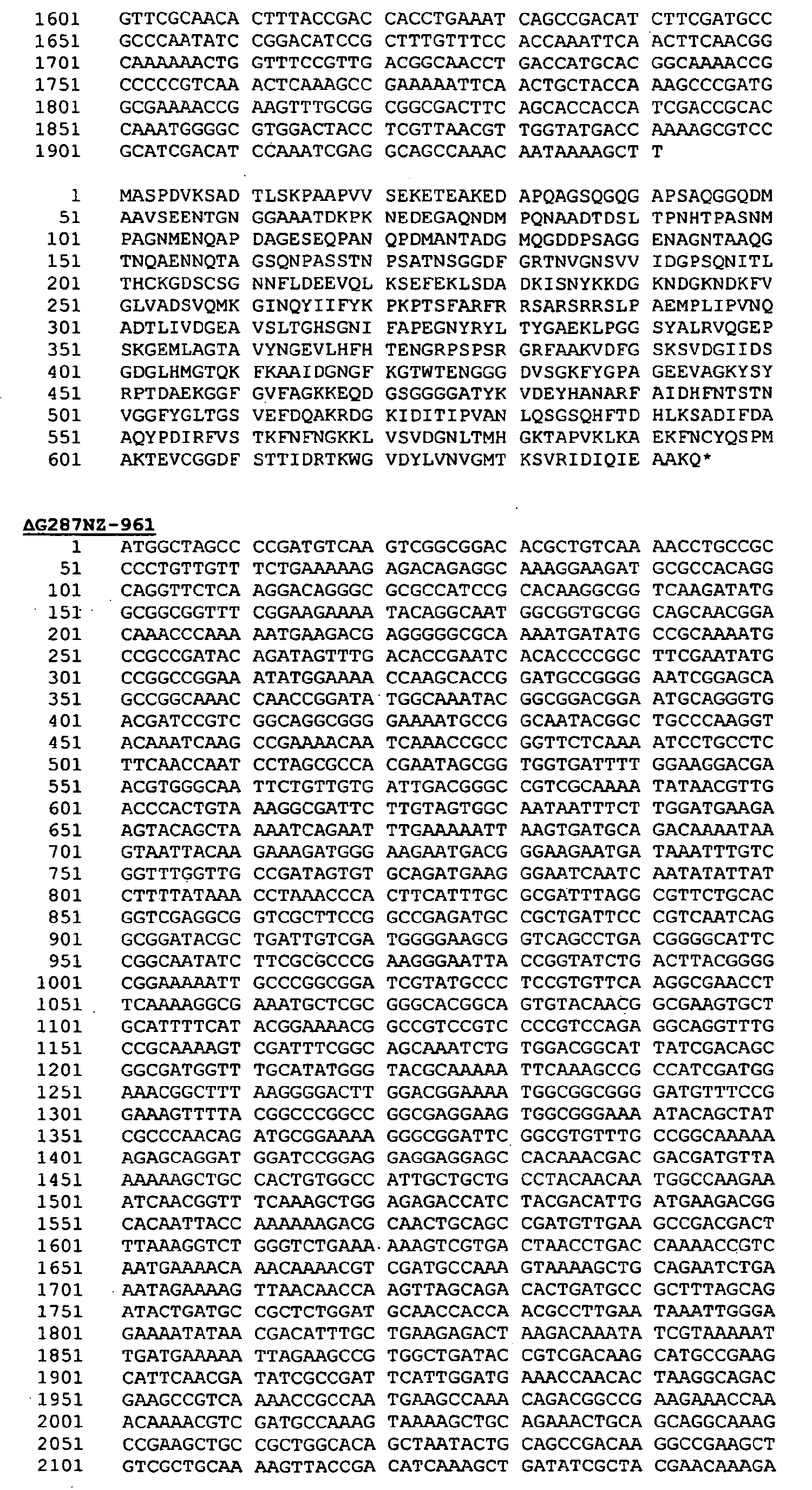
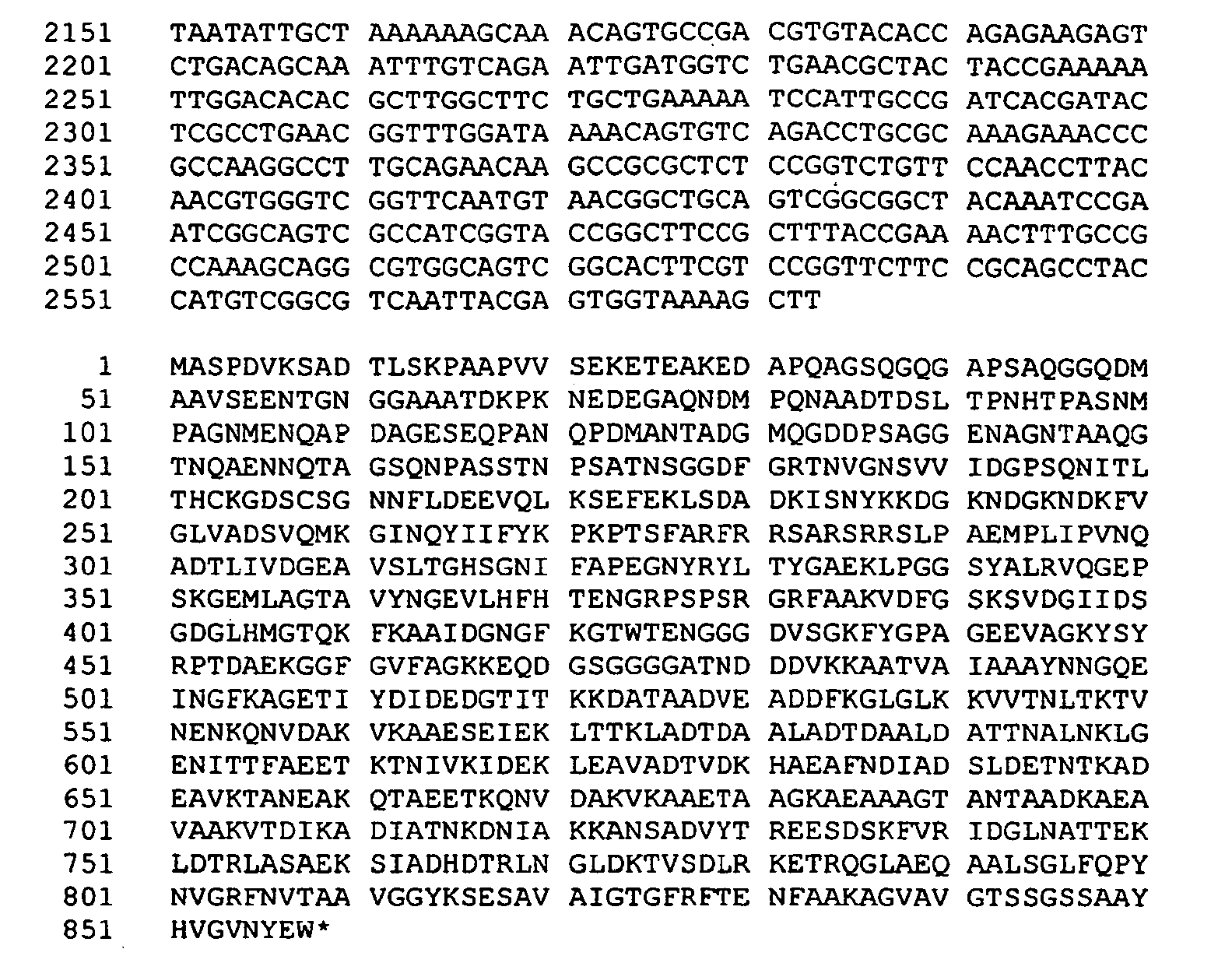
- Bactericidal titres generated in response to ΔG983 (His-fusion) were measured against various strains, including the homologous 2996 strain:
2996 NGH38 BZ133 ΔG983 512 128 128 - ΔG983 was also expressed as a hybrid, with ORF46.1, 741, 961 or 961c at its C-terminus:


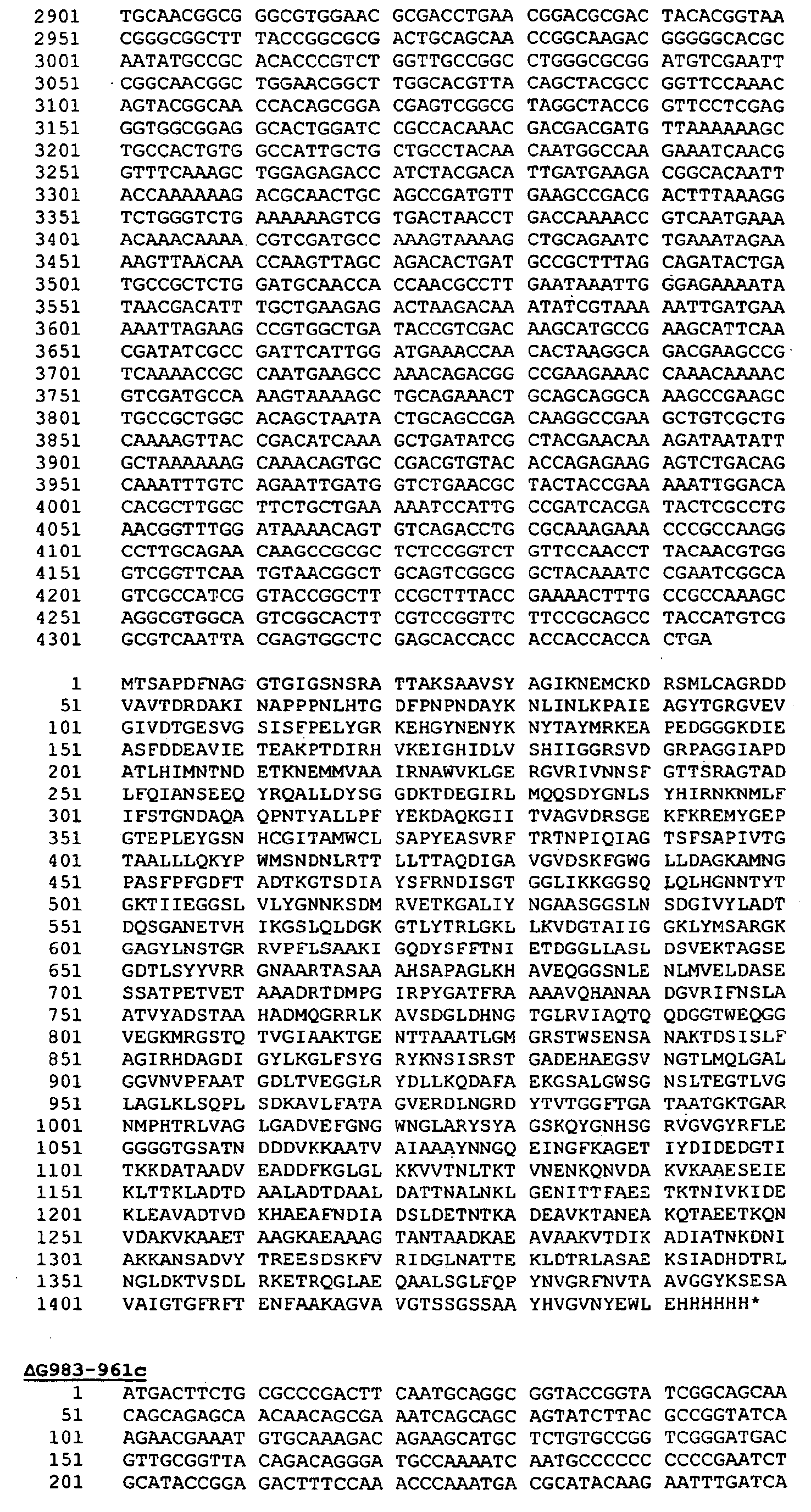
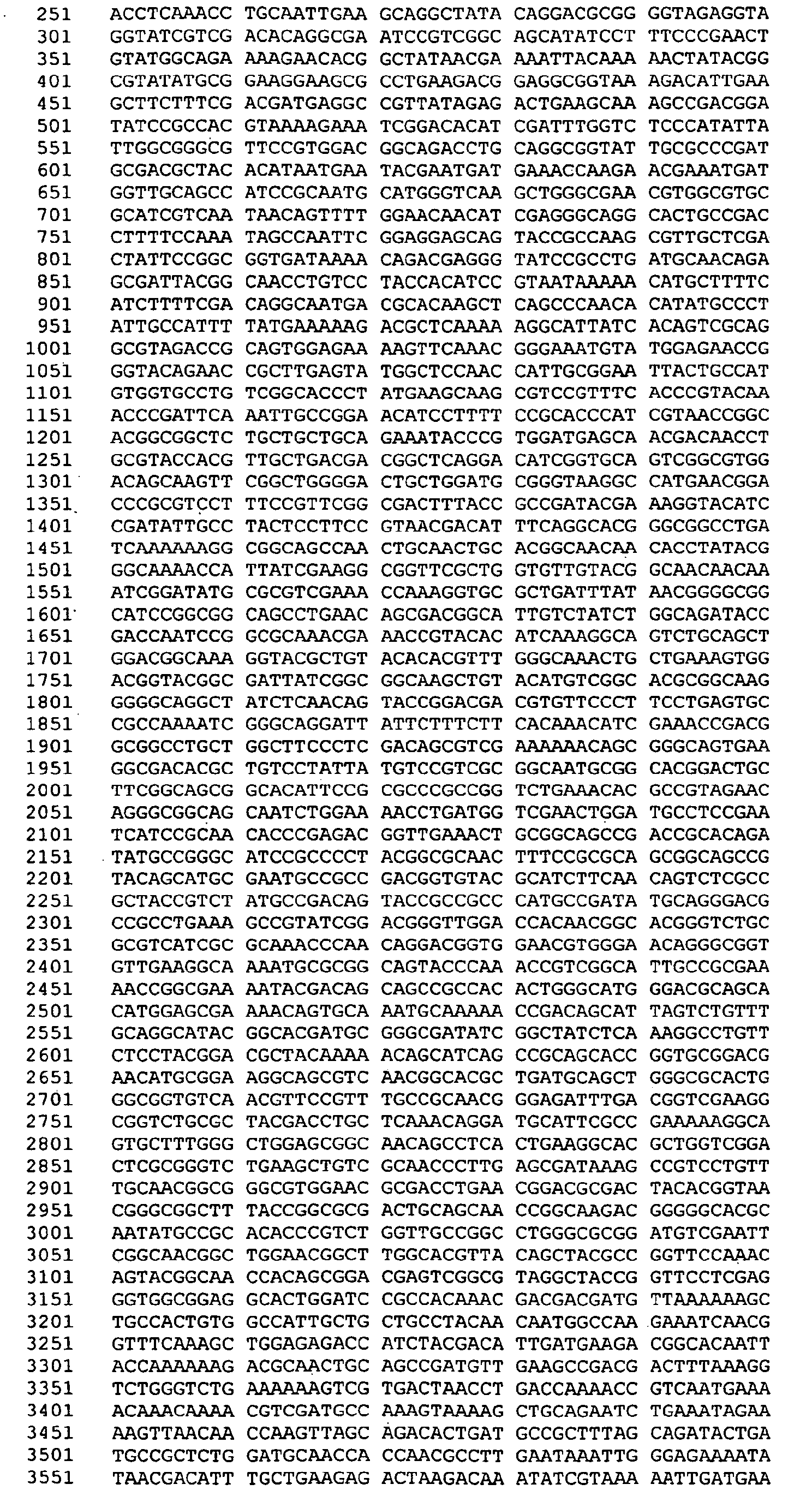

- Bactericidal titres generated in response to ΔG741 (His-fusion) were measured against various strains, including the homologous 2996 strain:
2996 MC58 NGH38 F6124 BZ133 ΔG741 512 131072 >2048 16384 >2048 - As can be seen, the ΔG741-induced anti-bactericidal titre is particularly high against heterologous strain MC58.
- ΔG741 was also fused directly in-frame upstream of
proteins 


- According to the invention, hybrids of two proteins A & B may be either NH2-A-B-COOH or NH2-B-A-COOH. The effect of this difference was investigated using
protein 287 either C-terminal (in '287-His' form) or N-terminal (in ΔG287 form - sequences shown above) to 919, 953 and ORF46.1. A panel of strains was used, includinghomologous strain 2996. FCA was used as adjuvant:287 & 919 287 & 953 287 & ORF46.1 Strain ΔG287-919 919-287 ΔG287-953 953-287 ΔG287-46.1 46.1-287 2996 128000 16000 65536 8192 16384 8192 BZ232 256 128 128 <4 <4 <4 1000 2048 <4 <4 <4 <4 <4 MC58 8192 1024 16384 1024 512 128 NGH38 32000 2048 >2048 4096 16384 4096 394/98 4096 32 256 128 128 16 MenA (F6124) 32000 2048 >2048 32 8192 1024 MenC (BZ133) 64000 >8192 >8192 <16 8192 2048 - Better bactericidal titres are generally seen with 287 at the N-terminus (in the ΔG form)
- When fused to protein 961 [NH2-ΔG287-961-COOH - sequence shown above], the resulting protein is insoluble and must be denatured and renatured for purification. Following renaturation, around 50% of the protein was found to remain insoluble. The soluble and insoluble proteins were compared, and much better bactericidal titres were obtained with the soluble protein (FCA as adjuvant):
2996 BZ232 MC58 NGH38 F6124 BZ133 Soluble 65536 128 4096 >2048 >2048 4096 Insoluble 8192 <4 <4 16 n.d. n.d. - Titres with the insoluble form were, however, improved by using alum adjuvant instead:
Insoluble 32768 128 4096 >2048 >2048 2048 - Expression of
protein 287 as full-length with a C-terminal His-tag, or without its leader peptide but with a C-terminal His-tag, gives fairly low expression levels. Better expression is achieved using a N-terminal GST-fusion. - As an alternative to using GST as an N-terminal fusion partner, 287 was placed at the C-terminus of protein 919 ('919-287'), of protein 953 ('953-287'), and of proteins ORF46.1 ('ORF46.1-287'). In both cases, the leader peptides were deleted, and the hybrids were direct in-frame fusions.
- To generate the 953-287 hybrid, the leader peptides of the two proteins were omitted by designing the forward primer downstream from the leader of each sequence; the stop codon sequence was omitted in the 953 reverse primer but included in the 287 reverse primer. For the 953 gene, the 5' and the 3' primers used for amplification included a NdeI and a BamHI restriction sites respectively, whereas for the amplification of the 287 gene the 5' and the 3' primers included a BamHI and a XhoI restriction sites respectively. In this way a sequential directional cloning of the two genes in pET21 b+, using NdeI-BamHI (to clone the first gene) and subsequently BamHI-XhoI (to clone the second gene) could be achieved.
- The 919-287 hybrid was obtained by cloning the sequence coding for the mature portion of 287 into the XhoI site at the 3'-end of the 919-His clone in pET21b+. The primers used for amplification of the 287 gene were designed for introducing a SalI restriction site at the 5'-and a XhoI site at the 3'- of the PCR fragment. Since the cohesive ends produced by the SalI and XhoI restriction enzymes are compatible, the 287 PCR product digested with SalI-XhoI could be inserted in the pET21b-919 clone cleaved with XhoI.
- The ORF46.1-287 hybrid was obtained similarly.
- The bactericidal efficacy (homologous strain) of antibodies raised against the hybrid proteins was compared with antibodies raised against simple mixtures of the component antigens:
Mixture with 287 Hybrid with 287 919 32000 16000 953 8192 8192 ORF46.1 128 8192 - Data for bactericidal activity against heterologous MenB strains and against serotypes A and C were also obtained for 919-287 and 953-287:
919 953 ORF46.1 Strain Mixture Hybrid Mixture Hybrid Mixture Hybrid MC58 512 1024 512 1024 - 1024 NGH38 1024 2048 2048 4096 - 4096 BZ232 512 128 1024 16 - - MenA (F6124) 512 2048 2048 32 - 1024 MenC (C11) >2048 n.d. >2048 n.d. - n.d. MenC (BZ133) >4096 >8192 >4096 <16 - 2048 - Hybrids of ORF46.1 and 919 were also constructed. Best results (four-fold higher titre) were achieved with 919 at the N-terminus.
- Hybrids 919-519His, ORF97-225His and 225-ORF97His were also tested. These gave moderate ELISA fitres and bactericidal antibody responses.
- As shown above, the leader peptide of ORF4 can be fused to the mature sequence of other proteins (
e.g. proteins 287 and 919). It is able to direct lipidation in E.coli. - The protein '564' is very large (2073aa), and it is difficult to clone and express it in complete form. To facilitate expression, the protein has been divided into four domains, as shown in
figure 8 (according to the MC58 sequence):Domain A B C D Amino Acids 79-360 361-731 732-2044 2045-2073 - These domains show the following homologies:
- Domain A shows homology to other bacterial toxins:
- gb|AAG03431.1|AE004443_9probable hemagglutinin [Pseudomonas aeruginosa] (38%)
- gb|AAC31981.1|(139897) HecA [Pectobacterium chrysanthemi] (45%)
- emb|CAA36409.1|(X52156) filamentous hemagglutinin [Bordetella pertussis] (31%)
- gb|AAC79757.1|(AF057695)large supernatant protein1 [Haemophilus ducreyi] (26%)
- gb|AAA25657.1|(M30186) HpmA precursor [Proteus mirabilis] (29%)
- Domain B shows no homology, and is specific to 564.
- Domain C shows homology to:
- gb|AAF84995.1|AE004032 HA-like secreted protein [Xylella fastidiosa] (33%)
- gb|AAG05850.1|AE004673 hypothetical protein [Pseudomonas aeruginosa] (27%)
- gb|AAF68414.1AF237928 putative FHA [Pasteurella multocisida] (23%)
- gb|AAC79757.1| (AF057695) large supernatant protein1 [Haemophilus ducreyi] (23%)
- pir∥S21010 FHA B precursor [Bordetella pertussis] (20%)
- Domain D shows homology to other bacterial toxins:
- gb|AAFB4995.1|AE004032_14 HA-like secreted protein [Xylella fastidiosa] (29%)
- Using the MC58 strain sequence, good intracellular expression of 564ab was obtained in the form of GST-fusions (no purification) and his-tagged protein; this domain-pair was also expressed as a lipoprotein, which showed moderate expression in the outer membrane/supernatant fraction.
- The b domain showed moderate intracellular expression when expressed as a his-tagged product (no purification), and good expression as a GST-fusion.
- The c domain showed good intracellular expression as a GST-fusion, but was insoluble. The d domain showed moderate intracellular expression as a his-tagged product (no purification). The cd protein domain-pair showed moderate intracellular expression (no purification) as a GST-fusion.
- Good bactericidal assay titres were observed using the c domain and the bc pair.
- The 20mer leader peptide from 919 is discussed in example 1 above:
- MKKYLFRAAL YGIAAAILAA
- As shown in example 1, deletion of this leader improves heterologous expression, as does substitution with the ORF4 leader peptide. The influence of the 919 leader on expression was investigated by fusing the coding sequence to the PhoC reporter gene from Morganella morganii [Thaller et al. (1994) Microbiology 140:1341-1350]. The construct was cloned in the pET21-b plasmid between the NdeI and XhoI sites (
Figure 9 ):
- The level of expression of PhoC from this plasmid is >200-fold lower than that found for the same construct but containing the native PhoC signal peptide. The same result was obtained even after substitution of the T7 promoter with the E.coli Plac promoter. This means that the influence of the 919 leader sequence on expression does not depend on the promoter used.
- In order to investigate if the results observed were due to some peculiarity of the 919 signal peptide nucleotide sequence (secondary structure formation, sensitivity to RNAases, etc.) or to protein instability induced by the presence of this signal peptide, a number of mutants were generated. The approach used was a substitution of nucleotides of the 919 signal peptide sequence by cloning synthetic linkers containing degenerate codons. In this way, mutants were obtained with nucleotide and/or amino acid substitutions.
- Two different linkers were used, designed to produce mutations in two different regions of the 919 signal peptide sequence, in the first 19 base pairs (L1) and between bases 20-36 (S1).


- The alignment of some of the mutants obtained is given below.

- As shown in the sequences alignments, most of the mutants analysed contain in-frame deletions which were unexpectedly produced by the host cells.
- Selection of the mutants was performed by transforming E. coli BL21(DE3) cells with DNA prepared from a mixture of L1 and S1 mutated clones. Single transformants were screened for high PhoC activity by streaking them onto LB plates containing 100 µg/ml ampicillin, 50µg/ml methyl green, 1 mg/ml PDP (phenolphthaleindiphosphate). On this medium PhoC-producing cells become green (
Figure 10 ). - A quantitative analysis of PhoC produced by these mutants was carried out in liquid medium using pNPP as a substrate for PhoC activity. The specific activities measured in cell extracts and supernatants of mutants grown in liquid medium for 0, 30, 90, 180 min. were:
-
0 30 90 180 control 0,00 0,00 0,00 0,00 9phoC 1,11 1,11 3,33 4,44 9S1e 102,12 111,00 149,85 172,05 9L1a 206,46 111,00 94,35 83,25 9L1d 5,11 4,77 4,00 3,11 9L1f 27,75 94,35 82,14 36,63 9S1b 156,51 111,00 72,15 28,86 9S1c 72,15 33,30 21,09 14,43 9S1i 156,51 83,25 55,50 26,64 phoCwt 194,25 180,93 149,85 142,08 -
0 30 90 180 control 0,00 0,00 0,00 0,00 9phoC 0,33 0,00 0,00 0,00 9S1e 0,11 0,22 0,44 0,89 9L1a 4,88 5,99 5,99 7,22 9L1d 0,11 0,11 0,11 0,11 9L1f 0,11 0,22 0,11 0,11 9S1b 1,44 1,44 1,44 1,67 9S1c 0,44 0,78 0,56 0,67 9S1i 0,22 0,44 0,22 0,78 phoCwt 34,41 43,29 87,69 177,60 - Some of the mutants produce high amounts of PhoC and in particular, mutant 9L1a can secrete PhoC in the culture medium. This is noteworthy since the signal peptide sequence of this mutant is only 9 amino acids long. This is the shortest signal peptide described to date.
- MafB-related proteins include 730, ORF46 and ORF29.
- The 730 protein from MC58 has the following sequence:
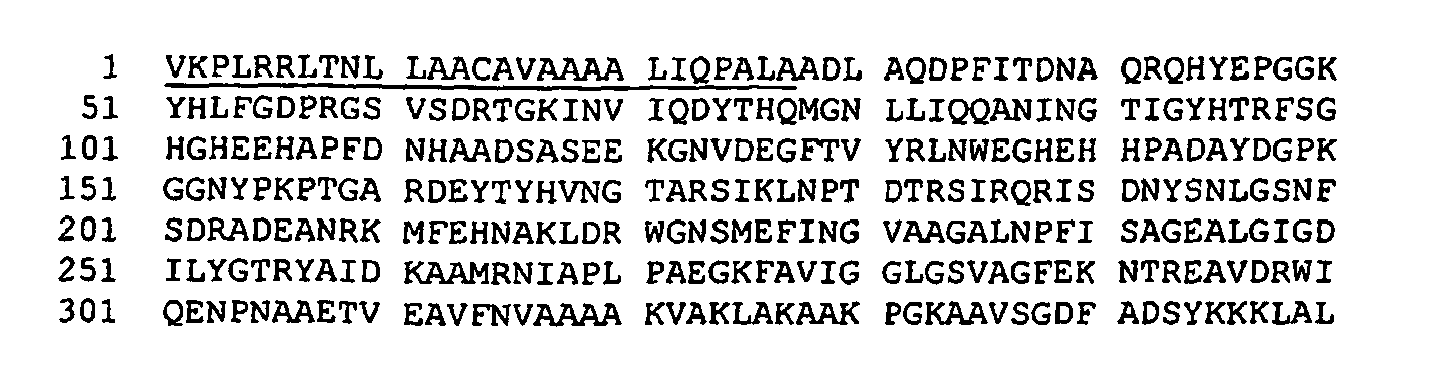

- The leader peptide is underlined.
- 730 shows similar features to ORF46 (see example 8 above):
- as for Orf46, the conservation of the 730 sequence among MenB, MenA and gonococcus is high (>80%) only for the N-terminal portion. The C-terminus, from ∼340, is highly divergent.
- its predicted secondary structure contains a hydrophobic segment spanning the central region of the molecule (aa. 227-247).
- expression of the full-length gene in E. coli gives very low yields of protein. Expression from tagged or untagged constructs where the signal peptide sequence has been omitted has a toxic effect on the host cells. In other words, the presence of the full-length mature protein in the cytoplasm is highly toxic for the host cell while its translocation to the periplasm (mediated by the signal peptide) has no detectable effect on cell viability. This "intracellular toxicity" of 730 is particularly high since clones for expression of the leaderless 730 can only be obtained at very low frequency using a recA genetic background (E. coli strains: HB101 for cloning; HMS 174(DE3) for expression).
- To overcome this toxicity, a similar approach was used for 730 as described in example 8 for ORF46. Four C-terminal truncated forms were obtained, each of which is well expressed. All were obtained from intracellular expression of His-tagged
leaderless 730. - Form A consists of the N-terminal hydrophilic region of the mature protein (aa. 28-226). This was purified as a soluble His-tagged product, having a higher-than-expected MW.
- Form B extends to the end of the region conserved between serogroups (aa. 28-340). This was purified as an insoluble His-tagged product.
- The C-terminal truncated forms named C1 and C2 were obtained after screening for clones expressing high levels of 730-His clones in strain HMS174(DE3). Briefly, the pET21b plasmid containing the His-tagged sequence coding for the full-length mature 730 protein was used to transform the recA strain HMS 174(DE3). Transformants were obtained at low frequency which showed two phenotypes: large colonies and very small colonies. Several large and small colonies were analysed for expression of the 730-His clone. Only cells from large colonies over-expressed a protein recognised by anti-730A antibodies. However the protein over-expressed in different clones showed differences in molecular mass. Sequencing of two of the clones revealed that in both cases integration of an E. coli IS sequence had occurred within the sequence coding for the C terminal region of 730. The two integration events have produced in-frame fusion with 1 additional codon in the case of C1, and 12 additional codons in the case of C2 (
Figure 11 ). The resulting "mutant" forms of 730 have the following sequences: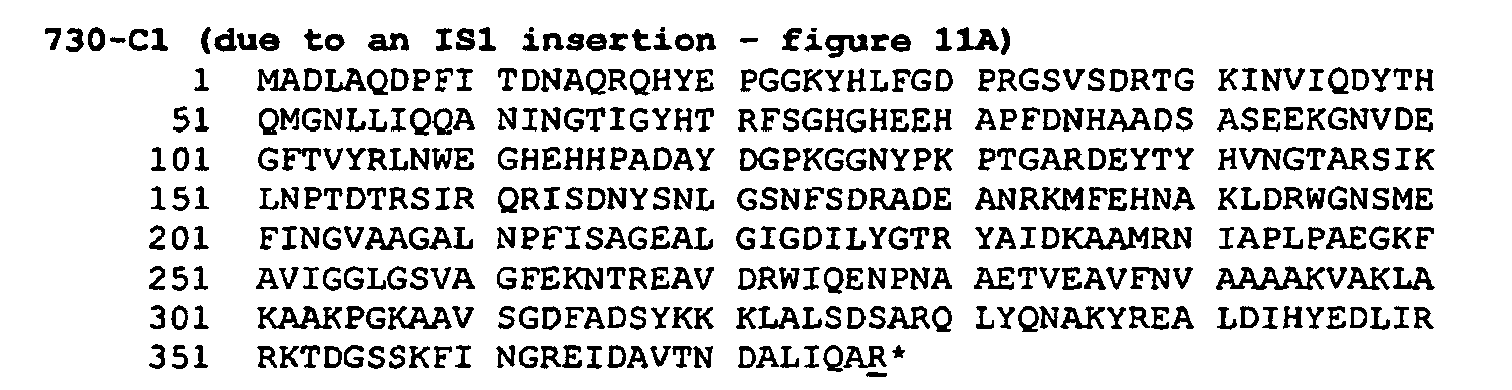
- The additional amino acid produced by the insertion is underlined.

- The additional amino acids produced by the insertion are underlined.
- In conclusion, intracellular expression of the 730-C1 form gives very high level of protein and has no toxic effect on the host cells, whereas the presence of the native C-terminus is toxic. These data suggest that the "intracellular toxicity" of 730 is associated with the C-terminal 65 amino acids of the protein.
- Equivalent truncation of ORF29 to the first 231 or 368 amino acids has been performed, using expression with or without the leader peptide (amino acids 1-26; deletion gives cytoplasmic expression) and with or without a His-tag.
- As described in example 9 above, the GST-fusion of 961 was the best-expressed in E.coli. To improve expression, the protein was divided into domains (
figure 12 ). - The domains of 961 were designed on the basis of YadA (an adhesin produced by Yersinia which has been demonstrated to be an adhesin localized on the bacterial surface that forms oligomers that generate surface projection [Hoiczyk et al. (2000) EMBO J 19:5989-99]) and are: leader peptide, head domain, coiled-coil region (stalk), and membrane anchor domain.
- These domains were expressed with or without the leader peptide, and optionally fused either to C-terminal His-tag or to N-terminal GST. E.coli clones expressing different domains of 961 were analyzed by SDS-PAGE and western blot for the production and localization of the expressed protein, from over-night (o/n) culture or after 3 hours induction with IPTG. The results were:
Total lysate (Western Blot) Periplasm (Western Blot) Supernatant (Western Blot) OMV SDS-PAGE 961 (o/n) - - - 961 (IPTG) +/- - - 961-L (o/n) + - - + 961-L (IPTG) + - - + 961 c-L (o/n) - - - 961c-L (IPTG) + + + 961Δ1-L (o/n) - - - 961Δ1-L (IPTG) + - - + - The results show that in E.coli:
- ■ 961-L is highly expressed and localized on the outer membrane. By western blot analysis two specific bands have been detected: one at ∼45kDa (the predicted molecular weight) and one at ∼180kDa, indicating that 961-L can form oligomers. Additionally, these aggregates are more expressed in the over-night culture (without IPTG induction). OMV preparations of this clone were used to immunize mice and serum was obtained. Using overnight culture (predominantly by oligomeric form) the serum was bactericidal; the IPTG-induced culture (predominantly monomeric) was not bactericidal.
- ■ 961Δ1-L (with a partial deletion in the anchor region) is highly expressed and localized on the outer membrane, but does not form oligomers;
- ■ the 961c-L (without the anchor region) is produced in soluble form and exported in the supernatant.
- Titres in ELISA and in the serum bactericidal assay using His-fusions were as follows:
ELISA Bactericidal 961a (aa 24-268) 24397 4096 961b (aa 269-405) 7763 64 961c-L 29770 8192 961c(2996) 30774 >65536 961c (MC58) 33437 16384 961d 26069 >65536 - E.coli clones expressing different forms of 961 (961, 961-L, 961Δ1-L and 961c-L) were used to investigate if the 961 is an adhesin (c.f. YadA). An adhesion assay was performed using (a) the human epithelial cells and (b) E.coli clones after either over-night culture or three hours IPTG induction. 961-L grown over-night (961Δ1-L) and IPTG-induced 961c-L (the clones expressing protein on surface) adhere to human epithelial cells.
- 961c was also used in hybrid proteins (see above). As 961 and its domain variants direct efficient expression, they are ideally suited as the N-terminal portion of a hybrid protein.
- Further hybrid proteins of the invention are shown below (see also
Figure 14 ). These are advantageous when compared to the individual proteins:
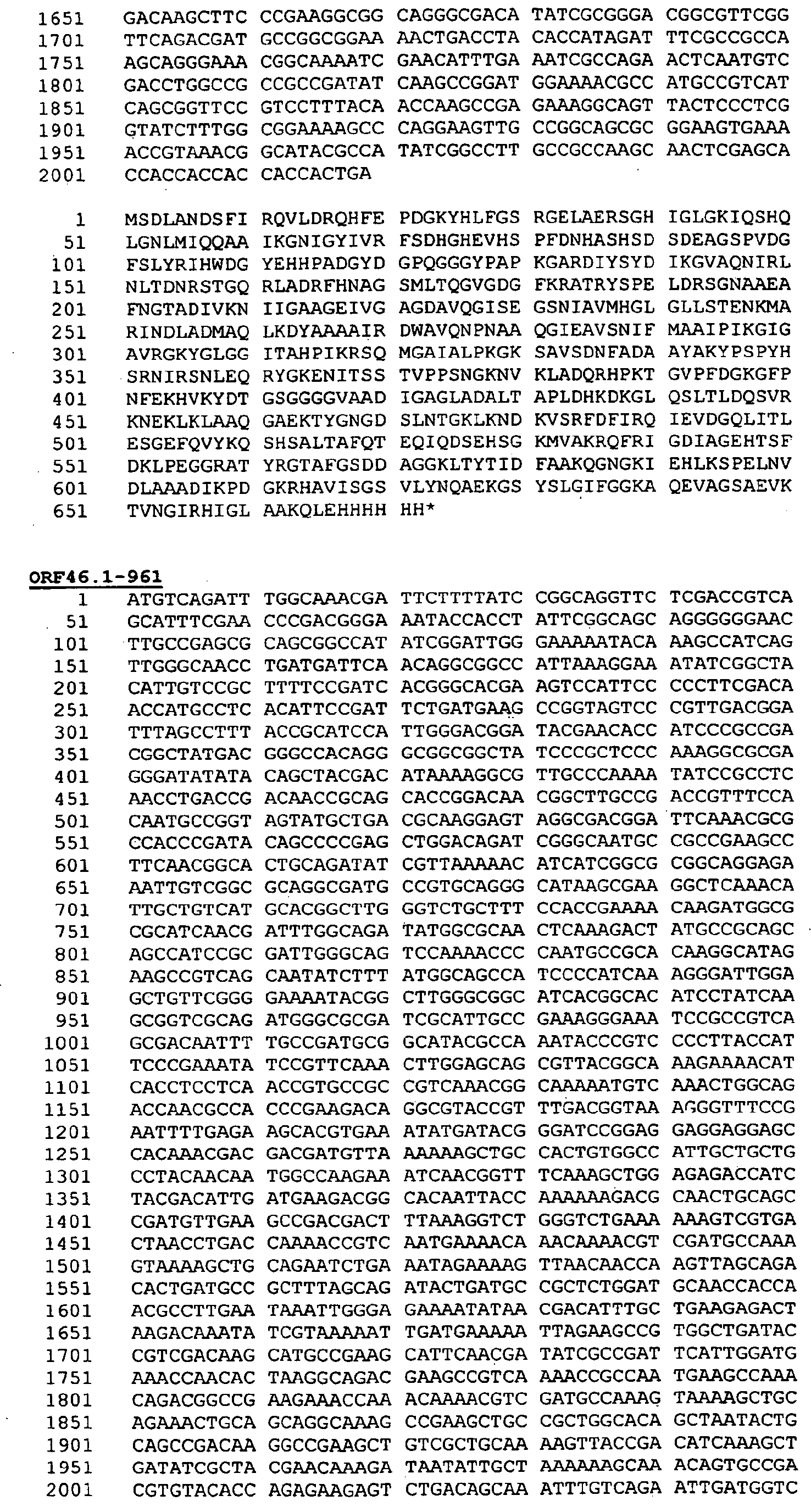


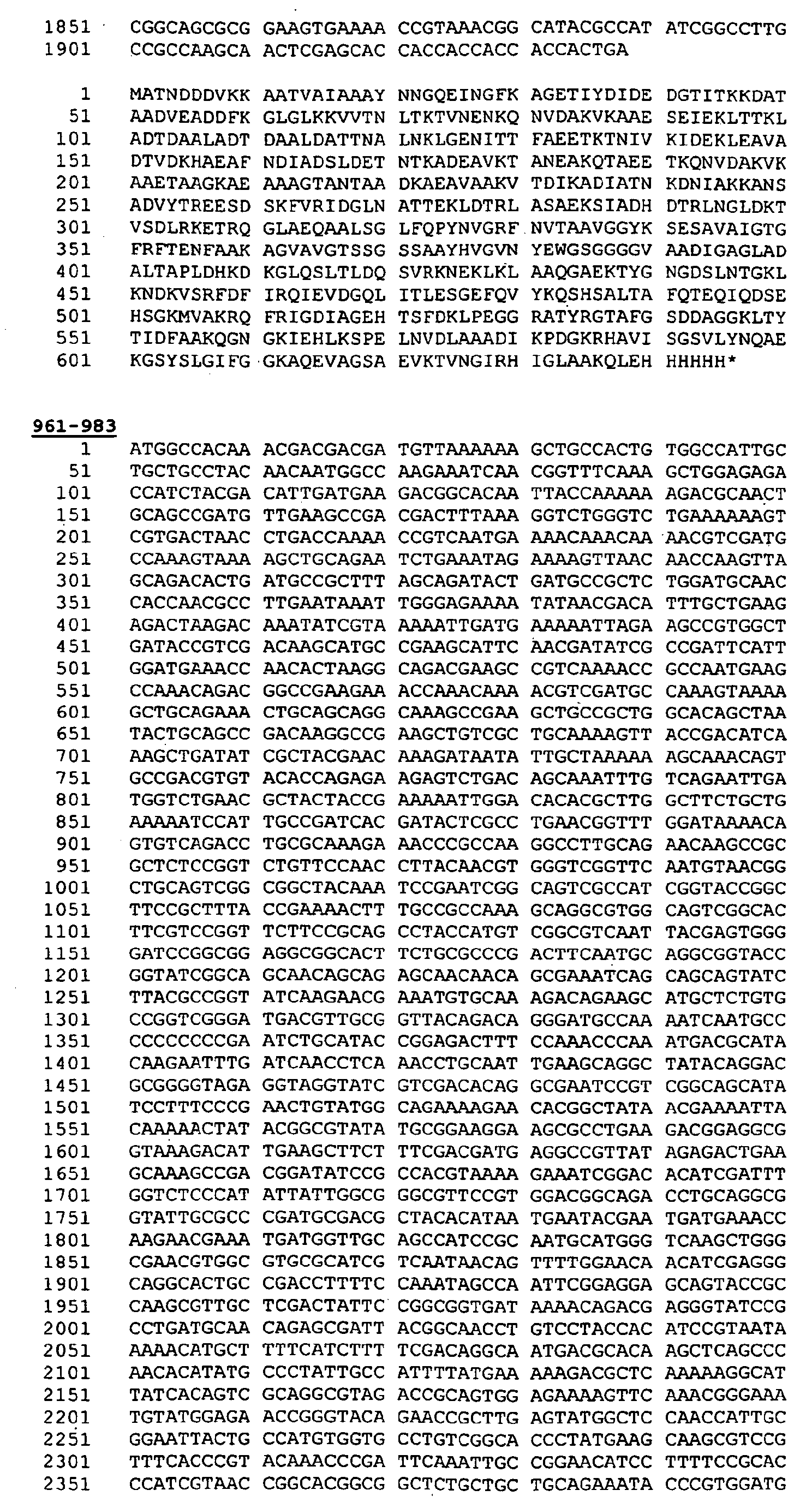


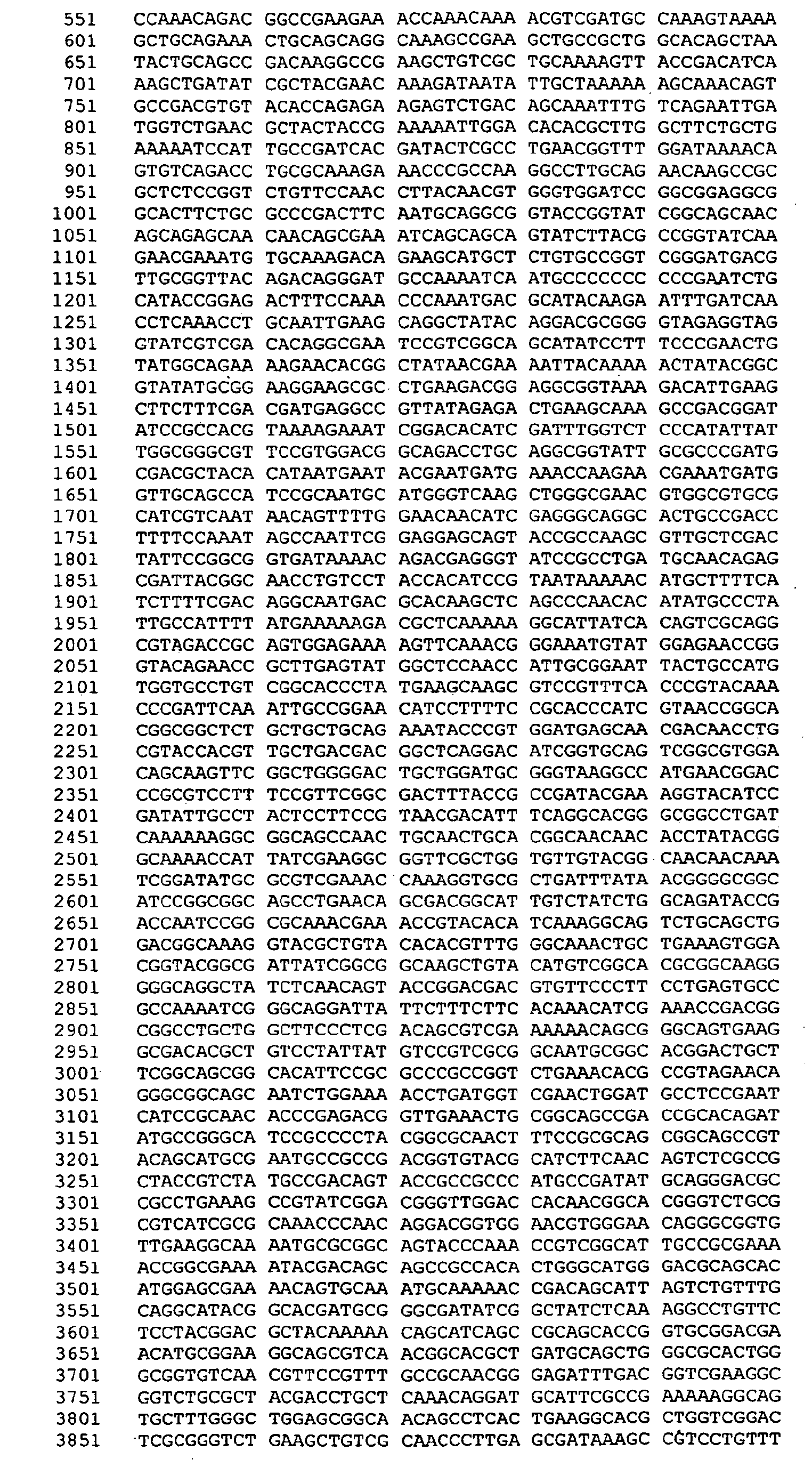


- It will be understood that the invention has been described by way of example only and modifications may be made whilst remaining within the scope and spirit of the invention. For instance, the use of proteins from other strains is envisaged [e.g. see
WO00/66741 - The following table summarises the FPLC protein purification that was used:
Protein PI Column Buffer pH Protocol 121.1untagged 6.23 Mono Q Tris 8.0 A 128.1untagged 5.04 Mono Q Bis-Tris propane 6.5 A 406.1L 7.75 Mono Q Diethanolamine 9.0 B 576.1L 5.63 Mono Q Tris 7.5 B 593untagged 8.79 Mono S Hepes 7.4 A 726untagged 4.95 Hi-trap S Bis-Tris 6.0 A 919untagged 10.5(-leader) Mono S Bicine 8.5 C 919Lorf4 10.4(-leader) Mono S Tris 8.0 B 920L 6.92(-leader) Mono Q Diethanolamine 8.5 A 953L 7.56(-leader) Mono S MES 6.6 D 982untagged 4.73 Mono Q Bis-Tris propane 6.5 A 919-287 6.58 Hi-trap Q Tris 8.0 A 953-287 4.92 Mono Q Bis-Tris propane 6.2 A - Buffer solutions included 20-120 mM NaCl, 5.0 mg/ml CHAPS and 10% v/v glycerol. The dialysate was centrifuged at 13000g for 20 min and applied to either a mono Q or mono S FPLC ion-exchange resin. Buffer and ion exchange resins were chosen according to the pI of the protein of interest and the recommendations of the FPLC protocol manual [Pharmacia: FPLC Ion Exchange and Chromatofocussing; Principles and Methods. Pharmacia Publication]. Proteins were eluted using a step-wise NaCl gradient. Purification was analysed by SDS-PAGE and protein concentration determined by the Bradford method.
- The letter in the 'protocol' column refers to the following:
- FPLC-A: Clones 121.1, 128.1, 593, 726, 982, periplasmic protein 920L and hybrid proteins 919-287, 953-287 were purified from the soluble fraction of E.coli obtained after disruption of the cells. Single colonies harbouring the plasmid of interest were grown overnight at 37°C in 20 ml of LB/Amp (100 µg/ml) liquid culture. Bacteria were diluted 1:30 in 1.0 L of fresh medium and grown at either 30°C or 37°C until the OD550 reached 0.6-08. Expression of recombinant protein was induced with IPTG at a final concentration of 1.0 mM. After incubation for 3 hours, bacteria were harvested by centrifugation at 8000g for 15 minutes at 4°C. When necessary cells were stored at -20°C. All subsequent procedures were performed on ice or at 4°C. For cytosolic proteins (121.1, 128.1, 593, 726 and 982) and periplasmic protein 920L, bacteria were resuspended in 25 ml of PBS containing complete protease inhibitor (Boehringer-Mannheim). Cells were lysed by by sonication using a Branson Sonifier 450. Disrupted cells were centrifuged at 8000g for 30 min to sediment unbroken cells and inclusion bodies and the supernatant taken to 35% v/v saturation by the addition of 3.9 M (NH4)2SO4. The precipitate was sedimented at 8000g for 30 minutes. The supernatant was taken to 70% v/v saturation by the addition of 3.9 M (NH4)2SO4 and the precipitate collected as above. Pellets containing the protein of interest were identified by SDS-PAGE and dialysed against the appropriate ion-exchange buffer (see below) for 6 hours or overnight. The periplasmic fraction from E.coli expressing 953L was prepared according to the protocol of Evans et. al. [Infect.Immun. (1974), 10:1010-1017] and dialysed against the appropriate ion-exchange buffer. Buffer and ion exchange resin were chosen according to the pI of the protein of interest and the recommendations of the FPLC protocol manual (Pharmacia). Buffer solutions included 20 mM NaCl, and 10% (v/v) glycerol. The dialysate was centrifuged at 13000g for 20 min and applied to either a mono Q or mono S FPLC ion-exchange resin. Buffer and ion exchange resin were chosen according to the pI of the protein of interest and the recommendations of the FPLC protocol manual (Pharmacia). Proteins were eluted from the ion-exchange resin using either step-wise or continuous NaCl gradients. Purification was analysed by SDS-PAGE and protein concentration determined by Bradford method. Cleavage of the leader peptide of periplasmic proteins was demonstrated by sequencing the NH2-terminus (see below).
- FPLC-B: These proteins were purified from the membrane fraction of E.coli. Single colonies harbouring the plasmid of interest were grown overnight at 37°C in 20 ml of LB/Amp (100 µg/ml) liquid culture. Bacteria were diluted 1:30 in 1.0 L of fresh medium. Clones 406.1 L and 919LOrf4 were grown at 30°C and Orf25L and 576.1L at 37°C until the OD550 reached 0.6-0.8. In the case of 919LOrf4, growth at 30°C was essential since expression of recombinant protein at 37°C resulted in lysis of the cells. Expression of recombinant protein was induced with IPTG at a final concentration of 1.0 mM. After incubation for 3 hours, bacteria were harvested by centrifugation at 8000g for 15 minutes at 4°C. When necessary cells were stored at -20 °C. All subsequent procedures were performed at 4°C. Bacteria were resuspended in 25 ml of PBS containing complete protease inhibitor (Boehringer-Mannheim) and lysed by osmotic shock with 2-3 passages through a French Press. Unbroken cells were removed by centrifugation at 5000g for 15 min and membranes precipitated by centrifugation at 100000g (Beckman Ti50, 38000rpm) for 45 minutes. A Dounce homogenizer was used to re-suspend the membrane pellet in 7.5 ml of 20 mM Tris-HCl (pH 8.0), 1.0 M NaCl and complete protease inhibitor. The suspension was mixed for 2-4 hours, centrifuged at 100000g for 45 min and the pellet resuspended in 7.5 ml of 20mM Tris-HCl (pH 8.0), 1.0M NaCl, 5.0mg/ml CHAPS, 10% (v/v) glycerol and complete protease inhibitor. The solution was mixed overnight, centrifuged at 100000g for 45 minutes and the supernatant dialysed for 6 hours against an appropriately selected buffer. In the case of Orf25.L, the pellet obtained after CHAPS extraction was found to contain the recombinant protein. This fraction, without further purification, was used to immunise mice.
- FPLC-C: Identical to FPLC-A, but purification was from the soluble fraction obtained after permeabilising E.coli with polymyxin B, rather than after cell disruption.
- FPLC-D: A single colony harbouring the plasmid of interest was grown overnight at 37°C in 20 ml of LB/Amp (100 µg/ml) liquid culture. Bacteria were diluted 1:30 in 1.0 L of fresh medium and grown at 30°C until the OD550 reached 0.6-0.8. Expression of recombinant protein was induced with IPTG at a final concentration of 1.0mM. After incubation for 3 hours, bacteria were harvested by centrifugation at 8000g for 15 minutes at 4°C. When necessary cells were stored at -20 °C. All subsequent procedures were performed on ice or at 4°C. Cells were resuspended in 20mM Bicine (pH 8.5), 20mM NaCl, 10% (v/v) glycerol, complete protease inhibitor (Boehringer-Mannheim) and disrupted using a Branson Sonifier 450. The sonicate was centrifuged at 8000g for 30 min to sediment unbroken cells and inclusion bodies. The recombinant protein was precipitated from solution between 35% v/v and 70% v/v saturation by the addition of 3.9M (NH4)2SO4. The precipitate was sedimented at 8000g for 30 minutes, resuspended in 20 mM Bicine (pH 8.5), 20 mM NaCl, 10% (v/v) glycerol and dialysed against this buffer for 6 hours or overnight. The dialysate was centrifuged at 13000g for 20 min and applied to the FPLC resin. The protein was eluted from the column using a step-wise NaCl gradients. Purification was analysed by SDS-PAGE and protein concentration determined by Bradford method.
- Genes coding for antigens of interest were amplified by PCR, using oligonucleotides designed on the basis of the genomic sequence of N. meningitidis B MC58. Genomic DNA from
strain 2996 was always used as a template in PCR reactions, unless otherwise specified, and the amplified fragments were cloned in the expression vector pET21 b+ (Novagen) to express the protein as C-terminal His-tagged product, or in pET-24b+(Novagen) to express the protein in 'untagged' form (e.g. ΔG 287K). - Where a protein was expressed without a fusion partner and with its own leader peptide (if present), amplification of the open reading frame (ATG to STOP codons) was performed.
- Where a protein was expressed in 'untagged' form, the leader peptide was omitted by designing the 5'-end amplification primer downstream from the predicted leader sequence.
- The melting temperature of the primers used in PCR depended on the number and type of hybridising nucleotides in the whole primer, and was determined using the formulae:


- The melting temperatures of the selected oligonucleotides were usually 65-70°C for the whole oligo and 50-60°C for the hybridising region alone.
- Oligonucleotides were synthesised using a Perkin Elmer 394 DNA/RNA Synthesizer, eluted from the columns in 2.0ml NH4OH, and deprotected by 5 hours incubation at 56°C. The oligos were precipitated by addition of 0.3M Na-Acetate and 2 volumes ethanol. The samples were centrifuged and the pellets resuspended in water.
Sequences Restriction site Orf1L Fwd CGCGGATCCGCTAGC-AAAACAACCGACAAACGG NheI Rev CCCGCTCGAG-TTACCAGCGGTAGCCTA XhoI Orf1 Fwd CTAGCTAGC-GGACACACTTATTTCGGCATC NheI Rev CCCGCTCGAG- TTACCAGCGGTAGCCTAATTTG XhoI Orf1LOmpA Fwd NdeI-(NheI) Rev CCCGCTCGAG- XhoI Orf4L Fwd CGCGGATCCCATATG-AAAACCTTCTTCAAAACC NdeI Rev CCCGCTCGAG-TTATTTGGCTGCGCCTTC XhoI Orf7-1L Fwd GCGGCATTAAT-ATGTTGAGAAAATTGTTGAAATGG AseI Rev GCGGCCTCGAG-TTATTTTTTCAAAATATATTTGC XhoI Orf9-1L Fwd GCGGCCATATG-TTACCTAACCGTTTCAAAATGT NdeI Rev GCGGCCTCGAG-TTATTTCCGAGGTTITCGGG XhoI Orf23L Fwd CGCGGATCCCATATG-ACACGCTTCAAATATTC NdeI Rev CCCGCTCGAG-TTATTTAAACCGATAGGTAAA XhoI Orf25-1 His Fwd CGCGGATCCCATATG-GGCAGGGAAGAACCGC NdeI Rev GCCCAAGCTT-ATCGATGGAATAGCCGCG HindIII Orf29-1 b-His (MC58) Fwd CGCGGATCCGCTAGC-AACGGTTTGGATGCCCG NheI Rev 
XhoI Orf29-1 b-L (MC58) Fwd CGCGGATCCGCTAGC-ATGAATTTGCCTATTCAAAAAT NheI Rev CCCGCTCGAG-TTAATTCCCACCTGCCATC XhoI Orf29-1 c-His (MC58) Fwd CGCGGATCCGCTAGC-ATGAATTTGCCTATTCAAAAAT NheI Rev CCCGCTCGAG-TTGGACGATGCCCGCGA XhoI Orf29-1 c-L (MC58) Fwd CGCGGATCCGCTAGC-ATGAATTTGCCTATTCAAAAAT NheI Rev CCCGCTCGAG-TTATTGGACGATGCCCGC XhoI Orf25L Fwd CGCGGATCCCATATG-TATCGCAAACTGATTGC NdeI Rev CCCGCTCGAG-CTAATCGATGGAATAGCC XhoI Orf37L Fwd CGCGGATCCCATATG-AAACAGACAGTCAAATG NdeI Rev CCCGCTCGAG-TCAATAACCCGCCTTCAG XhoI Orf38L Fwd 
NdeI Rev 
XhoI Orf40L Fwd CGCGGATCCCATATG-AACAAAATATACCGCAT NdeI Rev CCCGCTCGAG-TTACCACTGATAACCGAC XhoI Orf40.2-His Fwd CGCGGATCCCATATG-ACCGATGACGACGATTTAT NdeI Rev GCCCAAGCTT-CCACTGATAACCGACAGA HindIII Orf40.2L Fwd CGCGGATCCCATATG-AACAAAATATACCGCAT NdeI Rev GCCCAAGCTT-TTACCACTGATAACCGAC HindIII Orf46-2L Fwd GGGAATTCCATATG-GGCATTTCCCGCAAAATATC NdeI Rev CCCGCTCGAG-TTATTTACTCCTATAACGAGGTCTCTTAAC XhoI Orf46-2 Fwd GGGAATTCCATATG-TCAGATTTGGCAAACGATTCTT NdeI Rev CCCGCTCGAG-TTATTTACTCCTATAACGAGGTCTCTTAAC XhoI Orf46.1L Fwd GGGAATTCCATATG-GGCATTTCCCGCAAAATATC NdeI Rev CCCGCTCGAG-TTACGTATCATATTTCACGTGC XhoI orf46. (His-GST) Fwd GGGAATTCCATATGCACGTGAAATATGATACGAAG BamHI-NdeI Rev CCCGCTCGAGTTTACTCCTATAACGAGGTCTCTTAAC XhoI orf46.1-His Fwd GGGAATTCCATATGTCAGATTTGGCAAACGATTCTT NdeI Rev CCCGCTCGAGCGTATCATATTTCACGTGC XhoI orf46.2-His Fwd GGGAATTCCATATGTCAGATTTGGCAAACGATTCTT NdeI Rev CCCGCTCGAGTTTACTCCTATAACGAGGTCTCTTAAC XhoI Orf65-1-(His/GST) (MC58) Fwd CGCGGATCCCATATG-CAAAATGCGTTCAAAATCCC BamHI-NdeI Rev 
XhoI Orf72-1L Fwd GCGGCCATATG-GTCATAAAATATACAAATTTGAA NdeI Rev GCGGCCTCGAG-TTAGCCTGAGACCTTTGCAAATT XhoI Orf76-1L Fwd GCGGCCATATG-AAACAGAAAAAAACCGCTG NdeI Rev GCGGCCTCGAG-TTACGGTTTGACACCGTTTTC XhoI Orf83.1L Fwd CGCGGATCCCATATG-AAAACCCTGCTCCTC NdeI Rev CCCGCTCGAG-TTATCCTCCTTTGCGGC XhoI Orf85-2L Fwd GCGGCCATATG-GCAAAAATGATGAAATGGG NdeI Rev GCGGCCTCGAG-TTATCGGCGCGGCGGGCC XhoI Orf91L (MC58) Fwd GCGGCCATATGAAAAAATCCTCCCTCATCA NdeI Rev GCGGCCTCGAGTTATTTGCCGCCGTTTTTGGC XhoI Orf91-His(MC58) Fwd GCGGCCATATGGCCCCTGCCGACGCGGTAAG NdeI Rev GCGGCCTCGAGTTTGCCGCCGTTTTTGGCTTTC XhoI Orf97-1L Fwd GCGGCCATATG-AAACACATACTCCCCCTGA NdeI Rev GCGGCCTCGAG-TTATTCGCCTACGGTTTTTTG XhoI Orf119L (MC58) Fwd GCGGCCATATGATTTACATCGTACTGTTTC NdeI Rev GCGGCCTCGAGTTAGGAGAACAGGCGCAATGC XhoI Orf119-His(MC58) Fwd GCGGCCATATGTACAACATGTATCAGGAAAAC NdeI Rev GCGGCCTCGAGGGAGAACAGGCGCAATGCGG XhoI Orf137.1(His-GST) (MC58) Fwd CGCGGATCCGCTAGCTGCGGCACGGCGGG BamHI-NheI Rec CCCGCTCGAGATAACGGTATGCCGCCAG XhoI Orf143-1L Fwd CGCGGATCCCATATG-GAATCAACACTTTCAC NdeI Rev CCCGCTCGAG-TTACACGCGGTTGCTGT XhoI 008 Fwd CGCGGATCCCATATG-AACAACAGACATTTTG NdeI Rev CCCGCTCGAG-TTACCTGTCCGGTAAAAG XhoI 050-1(48) Fwd CGCGGATCCGCTAGC-ACCGTCATCAAACAGGAA NheI Rev CCCGCTCGAG-TCAAGATTCGACGGGGA XhoI 105 Fwd CGCGGATCCCATATG-TCCGCAAACGAATACG NdeI Rev CCCGCTCGAG-TCAGTGTTCTGCCAGTTT XhoI 111L Fwd CGCGGATCCCATATG-CCGTCTGAAACACG NdeI Rev CCCGCTCGAG-TTAGCGGAGCAGTTTTTC XhoI 117-1 Fwd CGCGGATCCCATATG-ACCGCCATCAGCC NdeI Rev CCCGCTCGAG-TTAAAGCCGGGTAACGC XhoI 121-1 Fwd GCGGCCATATG-GAAACACAGCTTTACATCGG NdeI Rev GCGGCCTCGAG-TCAATAATAATATCCCGCG XhoI 122- Fwd GCGGCCATATG-ATTAAAATCCGCAATATCC NdeI Rev GCGGCCTCGAG-TTAAATCTTGGTAGATTGGATTTGG XhoI 128-1 Fwd GCGGCCATATG-ACTGACAACGCACTGCTCC NdeI Rev GCGGCCTCGAG-TCAGACCGCGTTGTCGAAAC XhoI 148 Fwd CGCGGATCCCATATG-GCGTTAAAAACATCAAA NdeI Rev CCCGCTCGAG-TCAGCCCTTCATACAGC XhoI 149.1L(MC58) Fwd GCGGCATTAATGGCACAAACTACACTCAAACC AseI Rev GCGGCCTCGAGTTAAAACTTCACGTTCACGCCG XhoI 149.1-His(MC58) Fwd GCGGCATTAATGCATGAAACTGAGCAATCGGTGG AseI Rev GCGGCCTCGAGAAACTTCACGTTCACGCCGCCGGTAAA XhoI 205 (His-GST) (MC58) Fwd CGCGGATCCCATATGGGCAAATCCGAAAATACG BamHI-NdeI Rev CCCGCTCGAGATAATGGCGGCGGCGG XhoI 206L Fwd CGCGGATCCCATATG-TTTCCCCCCGACAA NdeI Rev CCCGCTCGAG-TCATTCTGTAAAAAAAGTATG XhoI 214 (His-GST) (MC58) Fwd CGCGGATCCCATATGCTTCAAAGCGACAGCAG BamHI-NdeI Rev CCCGCTCGAGTTCGGATTTTTGCGTACTC XhoI 216 Fwd CGCGGATCCCATATG-GCAATGGCAGAAAACG NdeI Rev CCCGCTCGAG-CTATACAATCCGTGCCG XhoI 225-1L Fwd CGCGGATCCCATATG-GATTCTTTTTTCAAACC NdeI Rev CCCGCTCGAG-TCAGTTCAGAAAGCGGG XhoI 235L Fwd CGCGGATCCCATATG-AAACCTTTGATTTTAGG NdeI Rev CCCGCTCGAG-TTATTTGGGCTGCTCTTC XhoI 243 Fwd CGCGGATCCCATATG-GTAATCGTCTGGTTG NdeI Rev CCCGCTCGAG-CTACGACTTGGTTACCG XhoI 247-1L Fwd GCGGCCATATG-AGACGTAAAATGCTAAAGCTAC NdeI Rev GCGGCCTCGAG-TCAAAGTGTTCTGTTTGCGC XhoI 264-His Fwd GCCGCCATATG-TTGACTTTAACCCGAAAAA NdeI Rev GCCGCCTCGAG-GCCGGCGGTCAATACCGCCCGAA XhoI 270 (His-GST) (MC58) Fwd CGCGGATCCCATATGGCGCAATGCGATTTGAC BamHI-NdeI Rev CCCGCTCGAGTTCGGCGGTAAATGCCG XhoI 274L Fwd GCGGCCATATG-GCGGGGCCGATTTTTGT NdeI Rev GCGGCCTCGAG-TTATTTGCTTTCAGTATTATTG XhoI 283L Fwd GCGGCCATATG-AACTTTGCTTTATCCGTCA NdeI Rev GCGGCCTCGAG-TTAACGGCAGTATTTGTTTAC XhoI 285-His Fwd CGCGGATCCCATATGGGTTTGCGCTTCGGGC BamHI Rev GCCCAAGCTTTTTTCCTTTGCCGTTTCCG HindIII 286-His (MC58) Fwd CGCGGATCCCATATG-GCCGACCTTTCCGAAAA NdeI Rev CCCGCTCGAG-GAAGCGCGTTCCCAAGC XhoI 286L (MC58) Fwd CGCGGATCCCATATG-CACGACACCCGTAC NdeI Rev CCCGCTCGAG-TTAGAAGCGCGTTCCCAA XhoI 287L Fwd CTAGCTAGC-TTTAAACGCAGCGTAATCGCAATGG NheI Rev CCCGCTCGAG-TCAATCCTGCTCTTTTTTGCC XhoI 287 Fwd CTAGCTAGC-GGGGGCGGCGGTGGCG NheI Rev CCCGCTCGAG-TCAATCCTGCTCTTTTTTGCC XhoI 287LOrf4 Fwd 
NheI Rev CCCGCTCGAG-TCAATCCTGCTCTTTTTTGCC XhoI 287-fu Fwd CGGGGATCC-GGGGGCGGCGGTGGCG BamHI Rev CCCGCTCGAG-TCAATCCTGCTCTTTTTTGCC XhoI 287-His Fwd CTAGCTAGC-GGGGGCGGCGGTGGCG NheI Rev CCCGCTCGAG-ATCCTGCTCTTTTTTGCC * XhoI 287-His(2996) Fwd CTAGCTAGC-TGCGGGGGCGGCGGTGGCG NheI Rev CCCGCTCGAG-ATCCTGCTCTTTTTTGCC XhoI Δ1 287-His Fwd CGCGGATCCGCTAGC-CCCGATGTTAAATCGGC§ NheI Δ2 287-His Fwd CGCGGATCCGCTAGC-CAAGATATGGCGGCAGT§ NheI Δ3 287-His Fwd CGCGGATCCGCTAGC-GCCGAATCCGCAAATCA§ NheI Δ4 287-His Fwd CGCGCTAGC-GGAAGGGTTGATTTGGCTAATGG§ NheI Δ4 287MC58-His Fwd CGCGCTAGC-GGAAGGGTTGATTTGGCTAATGG§ Nhel 287a-His Fwd CGCCATATG-TTTAAACGCAGCGTAATCGC NdeI Rev CCCGCTCGAG-AAAATTGCTACCGCCATTCGCAGG XhoI 287b-His Fwd CGCCATATG-GGAAGGGTTGATTTGGCTAATGG NdeI 287b-2996-His Rev CCCGCTCGAG-CTTGTCTTTATAAATGATGACATATTTG XhoI 287b-MC58-His Rev CCCGCTCGAG-TTTATAAAAGATAATATATTGATTGATTCC XhoI 287c-2996-His Fwd CGCGCTAGC-ATGCCGCTGATTCCCGTCAATC§ NheI '287untogged,(2996) Fwd CTAGCTAGC-GGGGGCGGCGGTGGCG Nhel Rev CCCGCTCGAG-TCAATCCTGCTCTTTTTTGCC XhoI ΔG287-His * Fwd CGCGGATCCGCTAGC-CCCGATGTTAAATCGGC NheI Rev CCCGCTCGAG-ATCCTGCTCTTTTTTGCC XhoI ΔG287K(2996) Fwd CGCGGATCCGCTAGC-CCCGATGTTAAATCGGC NheI Rev CCCGCTCGAG-TCAATCCTGCTCTTTTTTGCC XhoI ΔG 287-L Fwd 
NheI Rev CCCGCTCGAG-TCAATCCTGCTCTTTTTTGCC XhoI ΔG 287-Orf4L Fwd 
NheI Rev CCCGCTCGAG-TCAATCCTGCTCTTTTTTGCC XhoI 292L Fwd CGCGGATCCCATATG-AAAACCAAGTTAATCAAA NdeI Rev CCCGCTCGAG-TTATTGATTTTTGCGGATGA XhoI 308-1 Fwd CGCGGATCCCATATG-TTAAATCGGGTATTTTATC NdeI Rev CCCGCTCGAG-TTAATCCGCCATTCCCTG XhoI 401L Fwd GCGGCCATATG-AAATTACAACAATTGGCTG NdeI Rev GCGGCCTCGAG-TTACCTTACGTTTTTCAAAG XhoI 406L Fwd CGCGGATCCCATATG-CAAGCACGGCTGCT NdeI Rev CCCGCTCGAG-TCAAGGTTGTCCTTGTCTA XhoI 502-1L Fwd CGCGGATCCCATATG-ATGAAACCGCACAAC NdeI Rev CCCGCTCGAG-TCAGTTGCTCAACACGTC XhoI 502-A (His-GST) Fwd CGCGGATCCCATATGGTAGACGCGCTTAAGCA BamHI-NdeI Rev CCCGCTCGAGAGCTGCATGGCGGCG XhoI 503-1L Fwd CGCGGATCCCATATG-GCACGGTCGTTATAC NdeI Rev CCCGCTCGAG-CTACCGCGCATTCCTG XhoI 519-1L Fwd GCGGCCATATG-GAATTTTTCATTATCTTGTT NdeI Rev GCGGCCTCGAG-TTATTTGGCGGTTTTGCTGC XhoI 525-1L Fwd GCGGCCATATG-AAGTATGTCCGGTTATTTTTC NdeI Rev GCGGCCTCGAG-TTATCGGCTTGTGCAACGG XhoI 529-(His/GST) (MC58) Fwd CGCGGATCCGCTAGC-TCCGGCAGCAAAACCGA Bam HI-NheI Rev GCCCAAGCTT-ACGCAGTTCGGAATGGAG HindIII 552L Fwd GCCGCCATATGTTGAATATTAAACTGAAAACCTTG NdeI Rev GCCGCCTCGAGTTATTTCTGATGCCTTTTCCC XhoI 556L Fwd GCCGCCATATGGACAATAAGACCAAACTG NdeI Rev GCCGCCTCGAGTTAACGGTGCGGACGTTTC XhoI 557L Fwd CGCGGATCCCATATG-AACAAACTGTTTCTTAC NdeI Rev CCCGCTCGAG-TCATTCCGCCTTCAGAAA XhoI 564ab-(His/GST) (MC58) Fwd 
BamHI-NdeI Rev 
XhoI 564abL (MC58) Fwd 
NdeI Rev 
XhoI 564b-(His/GST)(MC58) Fwd 
BamHI-NdeI Rev 
XhoI 564c-(His/GST)(MC58) Fwd 
BamHI-NdeI Rev 
XhoI 564bc-(His/GST)(MC58) Fwd 
BamHI-NdeI Rev 
XhoI 564d-(His/GST)(MC58) Fwd 
BamHI-NdeI Rev 
XhoI 564cd-(His/GST)(MC58) Fwd 
BamHI-NdeI Rev 
XhoI 570L Fwd GCGGCCATATG-ACCCGTTTGACCCGCG NdeI Rev GCGGCCTCGAG-TCAGCGGGCGTTCATTTCTT XhoI 576-1 L Fwd CGCGGATCCCATATG-AACACCATTTTCAAAATC NdeI Rev CCCGCTCGAG-TTAATTTACTTTTTTGATGTCG XhoI 580L Fwd GCGGCCATATG-GATTCGCCCAAGGTCGG NdeI Rev GCGGCCTCGAG-CTACACTTCCCCCGAAGTGG XhoI 583L Fwd CGCGGATCCCATATG-ATAGTTGACCAAAGCC NdeI Rev CCCGCTCGAG-TTATTTTTCCGATTTTTCGG XhoI 593 Fwd GCGGCCATATG-CTTGAACTGAACGGACT NdeI Rev GCGGCCTCGAG-TCAGCGGAAGCGGACGATT XhoI 650 (His-GST) (MC58) Fwd CGCGGATCCCATATGTCCAAACTCAAAACCATCG BamHI-NdeI Rev CCCGCTCGAGGCTTCCAATCAGTTTGACC XhoI 652 Fwd GCGGCCATATG-AGCGCAATCGTTGATATTTTC NdeI Rev GCGGCCTCGAG-TTATTTGCCCAGTTGGTAGAATG XhoI 664L Fwd GCGGCCATATG-GTGATACATCCGCACTACTTC NdeI Rev GCGGCCTCGAG-TCAAAATCGAGTTTTACACCA XhoI 726 Fwd GCGGCCATATG-ACCATCTATTTCAAAAACGG NdeI Rev GCGGCCTCGAG-TCAGCCGATGTTTAGCGTCCATT XhoI 741-His(MC58) Fwd CGCGGATCCCATATG-AGCAGCGGAGGGGGTG NdeI Rev CCCGCTCGAG-TTGCTTGGCGGCAAGGC XhoI ΔG741-His(MC58) Fwd CGCGGATCCCATATG-GTCGCCGCCGACATCG NdeI Rev CCCGCTCGAG-TTGCTTGGCGGCAAGGC XhoI 686-2-(His/GST) (MC58) Fwd CGCGGATCCCATATG-GGCGGTTCGGAAGGCG BamHI-NdeI Rev CCCGCTCGAG-TTGAACACTGATGTCTTTTCCGA XhoI 719-(His/GST) (MC58) Fwd CGCGGATCCGCTAGC-AAACTGTCGTTGGTGTTAAC BamHI-NheI Rev CCCGCTCGAG-TTGACCCGCTCCACGG XhoI 730-His (MC58) Fwd GCCGCCATATGGCGGACTTGGCGCAAGACCC NdeI Rev GCCGCCTCGAGATCTCCTAAACCTGTTTTAACAATGCCG XhoI 730A-His (MC58) Fwd GCCGCCATATGGCGGACTTGGCGCAAGACCC Ndel Rev GCGGCCTCGAGCTCCATGCTGTTGCCCCAGC XhoI 730B-His (MC58) Fwd GCCGCCATATGGCGGACTTGGCGCAAGACCC Ndel Rev GCGGCCTCGAGAAAATCCCCGCTAACCGCAG XhoI 741-His (MC58) Fwd CGCGGATCCCATATG-AGCAGCGGAGGGGGTG NdeI Rev CCCGCTCGAG-TTGCTTGGCGGCAAGGC XhoI ΔG741-His (MC58) Fwd CGCGGATCCCATATG-GTCGCCGCCGACATCG NdeI Rev CCCGCTCGAG-TTGCTTGGCGGCAAGGC XhoI 743 (His-GST) Fwd CGCGGATCCCATATGGACGGTGTTGTGCCTGTT BamHI-NdeI Rev CCCGCTCGAGCTTACGGATCAAATTGACG XhoI 757 (His-GST) (MC58) Fwd CGCGGATCCCATATGGGCAGCCAATCTGAAGAA BamHI-NdeI Rev CCCGCTCGAGCTCAGCTTTTGCCGTCAA XhoI 759-His/GST (MC58) Fwd CGCGGATCCGCTAGC-TACTCATCCATTGTCCGC BamHI-NheI Rev CCCGCTCGAG-CCAGTTGTAGCCTATTTTG XhoI 759L (MC58) Fwd CGCGGATCCGCTAGC-ATGCGCTTCACACACAC NheI Rev CCCGCTCGAG-TTACCAGTTGTAGCCTATTT XhoI 760-His Fwd GCCGCCATATGGCACAAACGGAAGGTTTGGAA NdeI Rev GCCGCCTCGAGAAAACTGTAACGCAGGTTTGCCGTC XhoI 769-His (MC58) Fwd GCGGCCATATGGAAGAAACACCGCGCGAACCG NdeI Rev GCGGCCTCGAGGAACGTTTTATTAAACTCGAC XhoI 907L Fwd GCGGCCATATG-AGAAAACCGACCGATACCCTA NdeI Rev GCGGCCTCGAG-TCAACGCCACTGCCAGCGGTTG XhoI 911L Fwd CGCGGATCCCATATG-AAGAAGAACATATTGGAATTTTGGGTCGGACTG NdeI Rev CCCGCTCGAG-TTATTCGGCGGCTTTTTCCGCATTGCCG XhoI 911 LOmpA Fwd 
NdeI-(NheI) Rev CCCGCTCGAG-TTATTCGGCGGCTTTTTCCGCATTGCCG XhoI 911 LPelB Fwd CATGCCATGG-CTTTCCGCGTGGCCGGCGGTGC NcoI Rev CCCGCTCGAG-TTATTCGGCGGCTTTTTCCGCATTGCCG XhoI 913-His/GST (MC58) Fwd CGCGGATCCCATATG-TTTGCCGAAACCCGCC BamHI-NdeI Rev CCCGCTCGAG-AGGTTGTGTTCCAGGTTG XhoI 913L (MC58) Fwd CGCGGATCCCATATG-AAAAAAACCGCCTATG NdeI Rev CCCGCTCGAG-TTAAGGTTGTGTTCCAGG XhoI 919L Fwd CGCGGATCCCATATG-AAAAAATACCTATTCCGC NdeI Rev CCCGCTCGAG-TTACGGGCGGTATTCGG XhoI 919 Fwd CGCGGATCCCATATG-CAAAGCAAGAGCATCCAAA NdeI Rev CCCGCTCGAG-TTACGGGCGGTATTCGG XhoI 919L Orf4 Fwd 
NdeI-(NheI) Rev CCCGCTCGAG-TTACGGGCGGTATTCGGGCTTCATACCG XhoI (919)-287fusion Fwd CGCGGATCCGTCGAC-TGTGGGGGCGGCGGTGGC SalI Rev CCCGCTCGAG-TCAATCCTGCTCTTTTTTGCC XhoI 920-1L Fwd GCGGCCATATG-AAGAAAACATTGACACTGC NdeI Rev GCGGCCTCGAG-TTAATGGTGCGAATGACCGAT XhoI 925-His/GST (MC58)GATE Fwd ggggacaagtttgtacaaaaaagcaggctTGCGGCAAGGATGCCGG attB1 Rev ggggaccactttgtacaagaaagctgggtCTAAAGCAACAATGCCGG attB2 926L Fwd CGCGGATCCCATATG-AAACACACCGTATCC NdeI Rev CCCGCTCGAG-TTATCTCGTGCGCGCC XhoI 927-2-(His/GST) (MC58) Fwd CGCGGATCCCATATG-AGCCCCGCGCCGATT BamHI-NdeI Rev CCCGCTCGAG-TTTTTGTGCGGTCAGGCG XhoI 932-His/GST (MC58) GATE Fwd 
attB1 935 (His-GST) (MC58) For CGCGGATCCCATATGGCGGATGCGCCCGCG BamHI-NdeI Rev CCCGCTCGAGAAACCGCCAATCCGCC XhoI 936-1L Rev 
attB2 Fwd CGCGGATCCCATATG-AAACCCAAACCGCAC NdeI Rev CCCGCTCGAG-TCAGCGTTGGACGTAGT XhoI 953L Fwd GGGAATTCCATATG-AAAAAAATCATCTTCGCCG NdeI Rev CCCGCTCGAG-TTATTGTTTGGCTGCCTCGAT XhoI 953-fu Fwd GGGAATTCCATATG-GCCACCTACAAAGTGGACG NdeI Rev CGGGGATCC-TTGTTTGGCTGCCTCGATTTG BamHI 954 (His-GST) (MC58) Fwd CGCGGATCCCATATGCAAGAACAATCGCAGAAAG BamHI-NdeI Rev CCCGCTCGAGTTTTTTCGGCAAATTGGCTT XhoI 958-His/GST (MC58) GATE Fwd ggggacaagtttgtacaaaaaagcaggciGCCGATGCCGTTGCGG anB1 961 L Rev ggggaccactttgtacaagaaagctgggtTCAGGGTCGTTTGTTGCG attB2 Fwd CGCGGATCCCATATG-AAACACTTTCCATCC NdeI Rev CCCGCTCGAG-TTACCACTCGTAATTGAC XhoI 961 Fwd CGCGGATCCCATATG-GCCACAAGCGACGAC NdeI Rev CCCGCTCGAG-TTACCACTCGTAATTGAC XhoI 961 c (His/GST) Fwd CGCGGATCCCATATG-GCCACAAACGACG BamHI-NdeI Rev CCCGCTCGAG-ACCCACGTTGTAAGGTTG XhoI 961 c-(His/GST) (MC58) Fwd CGCGGATCCCATATG-GCCACAAGCGACGACGA BamHI-NdeI Rev CCCGCTCGAG-ACCCACGTTGTAAGGTTG XhoI 961 c-L Fwd CGCGGATCCCATATG-ATGAAACACTTTCCATCC NdeI Rev CCCGCTCGAG-TTAACCCACGTTGTAAGGT XhoI 961 c-L (MC58) Fwd CGCGGATCCCATATG-ATGAAACACTTTCCATCC NdeI Rev CCCGCTCGAG-TTAACCCACGTTGTAAGGT XhoI 961 d (His/GST) Fwd CGCGGATCCCATATG-GCCACAAACGACG BamHI-NdeI Rev CCCGCTCGAG-GTCTGACACTGTTTTATCC XhoI 961 Δ1-L Fwd CGCGGATCCCATATG-ATGAAACACTTTCCATCC NdeI Rev CCCGCTCGAG-TTATGCTTTGGCGGCAAAG XhoI fu 961-... Fwd CGCGGATCCCATATG- GCCACAAACGACGAC NdeI Rev CGCGGATCC-CCACTCGTAATTGACGCC BamHI fu 961-... (MC58) Fwd CGCGGATCCCATATG-GCCACAAGCGACGAC NdeI Rev CGCGGATCC- CCACTCGTAATTGACGCC BamHI fu 961 c -... Fwd CGCGGATCCCATATG-GCCACAAACGACGAC NdeI Rev CGCGGATCC- ACCCACGTTGTAAGGTTG BamHI fu 961 c-L-... Fwd CGCGGATCCCATATG-ATGAAACACTTTCCATCC NdeI Rev CGCGGATCC-ACCCACGTTGTAAGGTTG BamHI fu (961)-741(MC58)-His Fwd CGCGGATCC-GGAGGGGGTGGTGTCG BamHI Rev CCCGCTCGAG-TTGCTTGGCGGCAAGGC XhoI fu (961)-983-His Fwd CGCGGATCC - GGCGGAGGCGGCACTT BamHI Rev CCCGCTCGAG-GAACCGGTAGCCTACG XhoI fu (961)- Orf46.1-His Fwd 
BamHl Rev CCCGCTCGAG-CGTATCATATTTCACGTGC XhoI fu (961 c-L)-741(MC58) Fwd CGCGGATCC-GGAGGGGGTGGTGTCG BamHI Rev CCCGCTCGAG-TTATTGCTTGGCGGCAAG XhoI fu (961c-L )-983 Fwd CGCGGATCC - GGCGGAGGCGGCACTT BamHI Rev CCCGCTCGAG-TCAGAACCGGTAGCCTAC XhoI fu (961c-L)-Orf46.1 Fwd 
BamHI Rev CCCGCTCGAG-TTACGTATCATATTTCACGTGC XhoI 961-(His/GST) Fwd CGCGGATCCCATATG-GCCACAAGCGACGACG BamHI-NdeI (MC58) Rev CCCGCTCGAG-CCACTCGTAATTGACGCC XhoI 961 Δ1-His Fwd CGCGGATCCCATATG-GCCACAAACGACGAC NdeI Rev CCCGCTCGAG-TGCTTTGGCGGCAAAGTT XhoI 961a-(His/GST) Fwd CGCGGATCCCATATG-GCCACAAACGACGAC BamHI-NdeI Rev CCCGCTCGAG-TTTAGCAATATTATCTTTGTTCGTAGC XhoI 961b-(His/GST) Fwd CGCGGATCCCATATG-AAAGCAAACCGTGCCGA BamHI-NdeI Rev CCCGCTCGAG-CCACTCGTAATTGACGCC XhoI 961-His/GST GATE Fwd 
attBI Rev 
attB2 982 Fwd GCGGCCATATG-GCAGCAAAAGACGTACAGTT NdeI Rev GCGGCCTCGAG-TTACATCATGCCGCCCATACCA XhoI 983-His (2996) Fwd CGCGGATCCGCTAGC-TTAGGCGGCGGCGGAG NheI Rev CCCGCTCGAG-GAACCGGTAGCCTACG XhoI ΔG983-His (2996) Fwd CCCCTAGCTAGC-ACTTCTGCGCCCGACTT NheI Rev CCCGCTCGAG-GAACCGGTAGCCTACG XhoI 983-His Fwd CGCGGATCCGCTAGC-TTAGGCGGCGGCGGAG NheI Rev CCCGCTCGAG-GAACCGGTAGCCTACG XhoI ΔG983-His Fwd CGCGGATCCGCTAGC-ACTTCTGCGCCCGACTT NheI Rev CCCGCTCGAG-GAACCGGTAGCCTACG XhoI 983L Fwd 
NheI Rev CCCGCTCGAG-TCAGAACCGACGTGCCAAGCCGTTC XhoI 987-His (MC58) Fwd GCCGCCATATGCCCCCACTGGAAGAACGGACG NdeI Rev GCCGCCTCGAGTAATAAACCTTCTATGGGCAGCAG Xhol 989-(His/GST) (MC58) Fwd CGCGGATCCCATATG-TCCGTCCACGCATCCG BamHI-NdeI Rev CCCGCTCGAG-TTTGAATTTGTAGGTGTATTG XhoI 989L (MC58) Fwd CGCGGATCCCATATG-ACCCCTTCCGCACT NdeI Rev CCCGCTCGAG-TTATTTGAATTTGTAGGTGTAT XhoI CrgA-His (MC58) Fwd CGCGGATCCCATATG-AAAACCAATTCAGAAGAA NdeI Rev CCCGCTCGAG-TCCACAGAGATTGTTTCC XhoI PilC1-ES (MC58) Fwd GATGCCCGAAGGGCGGG Rev GCCCAAGCTT-TCAGAAGAAGACTTCACGC PilC1-His (MC58) Fwd CGCGGATCCCATATG-CAAACCCATAAATACGCTATT NdeI Rev GCCCAAGCTT-GAAGAAGACTTCACGCCAG HindIII Δ1PilC1-His (MC58) Fwd CGCGGATCCCATATG-GTCTTTTTCGACAATACCGA Ndel Rev GCCCAAGCTT- HindIII PiIC1L (MC58) Fwd CGCGGATCCCATATG-AATAAAACTTTAAAAAGGCGG NdeI Rev GCCCAAGCTT-TCAGAAGAAGACTTCACGC HindIII ΔGTbp2-His (MC58) Fwd CGCGAATCCCATATG-TTCGATCTTGATTCTGTCGA NdeI Rev CCCGCTCGAG-TCGCACAGGCTGTTGGCG XhoI Tbp2-His (MC58) Fwd CGCGAATCCCATATG-TTGGGCGGAGGCGGCAG NdeI Rev CCCGCTCGAG-TCGCACAGGCTGTTGGCG XhoI Tbp2-His(MC58) Fwd CGCGAATCCCATATG-TTGGGCGGAGGCGGCAG NdeI Rev CCCGCTCGAG-TCGCACAGGCTGTTGGCG XhoI NMB0109- (His/GST) (MC58) Fwd CGCGGATCCCATATG-GCAAATTTGGAGGTGCGC BamHI-NdeI Rev CCCGCTCGAG-TTCGGAGCGGTTGAAGC XhoI NMB0109L (MC58) Fwd CGCGGATCCCATATG-CAACGTCGTATTATAACCC NdeI Rev CCCGCTCGAG-TTATTCGGAGCGGTTGAAG XhoI NMB0207- (His/GST) (MC58) Fwd 
BamHI-NdeI Rev CCCGCTCGAG-TTTGAGCGGGCGCACTTCAAGTCCG XhoI NMB0462-(His/GST) (MC58) Fwd CGCGGATCCCATATG-GGCGGCAGCGAAAAAAAC BamHI-NdeI Rev CCCGCTCGAG-GTTGGTGCCGACTTTGAT XhoI NMB0623-(His/GST) (MC58) Fwd CGCGGATCCCATATG-GGCGGCGGAAGCGATA BamHI-NdeI Rev CCCGCTCGAG-TTTGCCCGCTTTGAGCC XhoI NMB0625 (His-GST)(MC58) Fwd CGCGGATCCCATATGGGCAAATCCGAAAATACG BamHI-NdeI Rev CCCGCTCGAGCATCCCGTACTGTTTCG XhoI NMB0634 (His/GST)(MC58) Fwd 
attB1 Rev 
attB2 NMB0776-His/GST (MC58) GATE Fwd 
attb1 Rev 
attB2 NMB1115- His/GST (MC58)GATE Fwd ggggacaagtttgtacaaaaaagcaggctATGCACCCCATCGAAACC attB1 Rev ggggaccactttgtacaagaaagctgggtCTAGTCTTGCAGTGCCTC attB2 NMB1343- (His/GST) (MC58) Fwd 
BamHI-NdeI Rev 
Xhol NMB1369 (His- GST (MC58) Fwd CGCGGATCCCATATGGCCTGCCAAGACGACA BamHI-NdeI Rev CCCGCTCGAGCCGCCTCCTGCCGAAA XhoI NMB1551 (His- GST)(MC58) Fwd CGCGGATCCCATATGGCAGAGATCTGTTTGATAA BamHI-NdeI Rev CCCGCTCGAGCGGTTTTCCGCCCAATG XhoI NMB1899 (His- GST) (MC58) Fwd CGCGGATCCCATATGCAGCCGGATACGGTC BamHI-NdeI Rev CCCGCTCGAGAATCACTTCCAACACAAAAT XhoI NMB2050- (His/GST) (MC58) Fwd CGCGGATCCCATATG-TGGTTGCTGATGAAGGGC BamHI-NdeI Rev CCCGCTCGAG-GACTGCTTCATCTTCTGC XhoI NMB2050L (MC58) Fwd CGCGGATCCCATATG-GAACTGATGACTGTTTTGC Ndel Rev CCCGCTCGAG-TCAGACTGCTTCATCTTCT Xhol NMB2159- (His/GST) (MC58) Fwd 
BamHI-NdeI Rev 
XhoI fu-ΔG287...-His Fwd CGCGGATCCGCTAGC-CCCGATGTTAAATCGGC NheI Rev CGGGGATCC-ATCCTGCTCTTTTTTGCCGG BamHI u-(ΔG287)-919- His Fwd 
BamHI Rev CCCAAGCTT-TTCGGGCGGTATTCGGGCTTC HindIII fu-(ΔG287)-953- His Fwd 
BamHI Rev GCCCAAGCTT-TTGTTTGGCTGCCTCGAT HindIII fu-(ΔG287)-961- His Fwd CGCGGATCCGGTGGTGGTGGT-ACAAGCGACGACG BamHI Rev GCCCAAGCTT-CCACTCGTAATTGACGCC HindIII fu-(ΔG287)- Orf46.1-His Fwd 
BamHI Rev CCCAAGCTT-CGTATCATATTTCACGTGC HindIII fu-(ΔG287-919)- Orf46.1-His Fwd 
HindIII Rev CCCGCTCGAG-CGTATCATATTTCACGTGC XhoI fu-(ΔG287- Orf46.1)-919-His Fwd 
HindIII Rev CCCGCTCGAG-CGGGCGGTATTCGGGCTT Xhol fu ΔG287(394.98)- Fwd CGCGGATCCGCTAGC-CCCGATGTTAAATCGGC Nhel Rev CGGGGATCC-ATCCTGCTCTTTTTTGCCGG BamHI fu Orf1-(Orf46.1)- His Fwd CGCGGATCCGCTAGC-GGACACACTTATTTCGGCATC NheI Rev CGCGGATCC-CCAGCGGTAGCCTAATTTGAT fu (Orf1)-Orf46.1- His Fwd 
BamHI Rev CCCAAGCTT-CGTATCATATTTCACGTGC HindIII fu (919)-Orf46.1- His Fwd1 GCGGCGTCGACGGTGGCGGAGGCACTGGATCCTCAG SalI Fwd2 GGAGGCACTGGATCCTCAGATTTGGCAAACGATTC Rev CCCGCTCGAG-CGTATCATATTTCACGTGC XhoI Fu orf46-.... Fwd GGAATTCCATATGTCAGATTTGGCAAACGATTC NdeI Rev CGCGGATCCCGTATCATATTTCACGTGC BamHI Fu (orf46)-287-His Fwd CGGGGATCCGGGGGCGGCGGTGGCG BamHI Rev CCCAAGCTTATCCTGCTCTTTTTTGCCGGC HindIII Fu (orf46)-919-His Fwd 
BamHI Rev CCCAAGCTTCGGGCGGTATTCGGGCTTC HindIII Fu (orf46-919)- 287-His Fwd CCCCAAGCTTGGGGGCGGCGGTGGCG HindIII Rev CCCGCTCGAGATCCTGCTCTTTTTTGCCGGC XhoI Fu (orf46-287)- 919-His Fwd 
HindIII Rev CCCGCTCGAGCGGGCGGTATTCGGGCTT XhoI (G741)-961c-His Fwd1 GGAGGCACTGGATCCGCAGCCACAAACGACGACGA XhoI Fwd2 GCGGCCTCGAG-GGTGGCGGAGGCACTGGATCCGCAG Rev CCCGCTCGAG-ACCCAGCTTGTAAGGTTG XhoI (ΔG741 )-961-His Fwd1 GGAGGCACTGGATCCGCAGCCACAAACGACGACGA XhoI Fwd2 GCGGCCTCGAG-GGTGGCGGAGGCACTGGATCCGCAG Rev CCCGCTCGAG-CCACTCGTAATTGACGCC XhoI (ΔG741)-983-His Fwd 
XhoI Rev CCCGCTCGAG-GAACCGGTAGCCTACG XhoI (ΔG741)-orf46.1- His Fwd1 GGAGGCACTGGATCCTCAGATTTGGCAAACGATTC SalI Fwd2 GCGGCGTCGACGGTGGCGGAGGCACTGGATCCTCAGA Rev CCCGCTCGAG-CGTATCATATTTCACGTGC XhoI (ΔG983)- 741 (MC58) -His Fwd GCGGCCTCGAG-GGATCCGGAGGGGGTGGTGTCGCC XhoI Rev CCCGCTCGAG-TTGCTTGGCGGCAAG XhoI (ΔG983)-961c-His Fwd1 GGAGGCACTGGATCCGCAGCCACAAACGACGACGA XhoI Fwd2 GCGGCCTCGAG-GGTGGCGGAGGCACTGGATCCGCAG Rev CCCGCTCGAG-ACCCAGCTTGTAAGGTTG XhoI (ΔG983)-961-His Fwd1 GGAGGCACTGGATCCGCAGCCACAAACGACGACGA XhoI Fwd2 GCGGCCTCGAG-GGTGGCGGAGGCACTGGATCCGCAG Rev CCCGCTCGAG-CCACTCGTAATTGACGCC XhoI (ΔG983)- Orf46.1- His Fwd1 GGAGGCACTGGATCCTCAGATTTGGCAAACGATTC SalI Fwd2 GCGGCGTCGACGGTGGCGGAGGCACTGGATCCTCAGA Rev CCCGCTCGAG-CGTATCATATTTCACGTGC XhoI * This primer was used as a Reverse primer for all the C terminal fusions of 287 to the His-tag
§ Forward primers used in combination with the 287-His Reverse primer. - NB - All PCR reactions use
strain 2996 unless otherwise specified (e.g. strain MC58) In all constructs starting with an ATG not followed by a unique NheI site, the ATG codon is part of the NdeI site used for cloning. The constructs made using NheI as a cloning site at the 5' end (e.g. all those containing 287 at the N-terminus) have two additional codons (GCT AGC) fused to the coding sequence of the antigen. - N.meningitidis strains 2996, MC58, 394.98, 1000 and BZ232 (and others) were grown to exponential phase in 100ml of GC medium, harvested by centrifugation, and resuspended in 5ml buffer (20% w/v sucrose, 50mM Tris-HCl, 50mM EDTA, pH8). After 10 minutes incubation on ice, the bacteria were lysed by adding 10ml of lysis solution (50mM NaCl, 1% Na-Sarkosyl, 50µg/ml Proteinase K), and the suspension incubated at 37°C for 2 hours. Two phenol extractions (equilibrated to pH 8) and one CHCl3/isoamylalcohol (24:1) extraction were performed. DNA was precipitated by addition of 0.3M sodium acetate and 2 volumes of ethanol, and collected by centrifugation. The pellet was washed once with 70%(v/v) ethanol and redissolved in 4.0ml TE buffer (10mM Tris-HCl, 1mM EDTA, pH 8.0). The DNA concentration was measured by reading OD260.
- The standard PCR protocol was as follows: 200ng of genomic DNA from 2996, MC581000, or BZ232 strains or 10ng of plasmid DNA preparation of recombinant clones were used as template in the presence of 40µM of each oligonucletide primer, 400-800 µM dNTPs solution, 1x PCR buffer (including 1.5M MgCl2), 2.5 units TaqI DNA polymerase (using Perkin-Elmer AmpliTaQ, Boerhingher Mannheim Expand™ Long Template).
- After a preliminary 3 minute incubation of the whole mix at 95°C, each sample underwent a two-step amplification: the first 5 cycles were performed using the hybridisation temperature that excluded the restriction enzyme tail of the primer (Tm1). This was followed by 30 cycles according to the hybridisation temperature calculated for the whole length oligos (Tm2). Elongation times, performed at 68°C or 72°C, varied according to the length of the Orf to be amplified. In the case of Orf1 the elongation time, starting from 3 minutes, was increased by 15 seconds each cycle. The cycles were completed with a 10 minute extension step at 72°C.
- The amplified DNA was either loaded directly on a 1% agarose gel. The DNA fragment corresponding to the band of correct size was purified from the gel using the Qiagen Ge1 Extraction Kit, following the manufacturer's protocol.
- The purified DNA corresponding to the amplified fragment was digested with the appropriate restriction enzymes for cloning into pET-21 b+, pET22b+ or pET-24b+. Digested fragments were purified using the QIAquick PCR purification kit (following the manufacturer's instructions) and eluted with either H2O or 10mM Tris, pH 8.5. Plasmid vectors were digested with the appropriate restriction enzymes, loaded onto a 1.0% agarose gel and the band corresponding to the digested vector purified using the Qiagen QIAquick Gel Extraction Kit.
- The fragments corresponding to each gene, previously digested and purified, were ligated into pET21b+, pET22b+ or pET-24b+. A molar ratio of 3:1 fragment/vector was used with T4 DNA ligase in the ligation buffer supplied by the manufacturer.
- Recombinant plasmid was transformed into competent E.coli DH5 or HB101 by incubating the ligase reaction solution and bacteria for 40 minutes on ice, then at 37°C for 3 minutes. This was followed by the addition of 800µl LB broth and incubation at 37°C for 20 minutes. The cells were centrifuged at maximum speed in an Eppendorf microfuge, resuspended in approximately 200µl of the supernatant and plated onto LB ampicillin (100mg/ml ) agar.
- Screening for recombinant clones was performed by growing randomly selected colonies overnight at 37°C in 4.0ml of LB broth + 100µg/ml ampicillin. Cells were pelleted and plasmid DNA extracted using the Qiagen QIAprep Spin Miniprep Kit, following the manufacturer's instructions. Approximately 1µg of each individual miniprep was digested with the appropriate restriction enzymes and the digest loaded onto a 1-1.5% agarose gel (depending on the expected insert size), in parallel with the molecular weight marker (1kb DNA Ladder, GIBCO). Positive clones were selected on the basis of the size of insert.
- After cloning each gene into the expression vector, recombinant plasmids were transformed into E.coli strains suitable for expression of the recombinant protein. 1µl of each construct was used to transform E.coli. BL21-DE3 as described above. Single recombinant colonies were inoculated into 2ml LB+Amp (100µg/ml), incubated at 37°C overnight, then diluted 1:30 in 20ml of LB+Amp (100µg/ml) in 100ml flasks, to give an OD600 between 0.1 and 0.2. The flasks were incubated at 30°C or at 37°C in a gyratory water bath shaker until OD600 indicated exponential growth suitable for induction of expression (0.4-0.8 OD). Protein expression was induced by addition of 1.0mM IPTG. After 3 hours incubation at 30°C or 37°C the OD600 was measured and expression examined. 1.0ml of each sample was centrifuged in a microfuge, the pellet resuspended in PBS and analysed by SDS-PAGE and Coomassie Blue staining.
- Sequences labelled GATE were cloned and expressed using the GATEWAY Cloning Technology (GIBCO-BRL). Recombinational cloning (RC) is based on the recombination reactions that mediate the integration and excision of phage into and from the E.coli genome, respectively. The integration involves recombination of the attP site of the phage DNA within the attB site located in the bacterial genome (BP reaction) and generates an integrated phage genome flanked by attL and attR sites. The excision recombines attL and attR sites back to attP and attB sites (LR reaction). The integration reaction requires two enzymes [the phage protein Integrase (Int) and the bacterial protein integration host factor (IHF)] (BP clonase). The excision reaction requires Int, IHF, and an additional phage enzyme, Excisionase (Xis) (LR clonase). Artificial derivatives of the 25-bp bacterial attB recombination site, referred to as B1 and B2, were added to the 5' end of the primers used in PCR reactions to amplify Neisserial ORFs. The resulting products were BP cloned into a "Donor vector" containing complementary derivatives of the phage attP recombination site (P1 and P2) using BP clonase. The resulting "Entry clones" contain ORFs flanked by derivatives of the attL site (L1 and L2) and were subcloned into expression "destination vectors" which contain derivatives of the attL-compatible attR sites (R1 and R2) using LR clonase. This resulted in "expression clones" in which ORFs are flanked by B1 and B2 and fused in frame to the GST or His N terminal tags.
- The E. coli strain used for GATEWAY expression is BL21-SI. Cells of this strain are induced for expression of the T7 RNA polymerase by growth in medium containing salt (0.3 M NaCl).
- Note that this system gives N-terminus His tags.
- Fractions composed principally of either inner, outer or total membrane were isolated in order to obtain recombinant proteins expressed with membrane-localisation leader sequences. The method for preparation of membrane fractions, enriched for recombinant proteins, was adapted from Filip et. al. [J.Bact. (1973) 115:717-722] and Davies et. al. [J.Immunol.Meth. (1990) 143:215-225]. Single colonies harbouring the plasmid of interest were grown overnight at 37°C in 20 ml of LB/Amp (100 µg/ml) liquid culture. Bacteria were diluted 1:30 in 1.0 L of fresh medium and grown at either 30°C or 37°C until the OD550 reached 0.6-0.8. Expression of recombinant protein was induced with IPTG at a final concentration of 1.0 mM. After incubation for 3 hours, bacteria were harvested by centrifugation at 8000g for 15 minutes at 4°C and resuspended in 20 ml of 20 mM Tris-HCl (pH 7.5) and complete protease inhibitors (Boehringer-Mannheim). All subsequent procedures were performed at 4°C or on ice.
- Cells were disrupted by sonication using a Branson Sonifier 450 and centrifuged at 5000g for 20 min to sediment unbroken cells and inclusion bodies. The supernatant, containing membranes and cellular debris, was centrifuged at 50000g (Beckman Ti50, 29000rpm) for 75 min, washed with 20 mM Bis-tris propane (pH 6.5), 1.0 M NaCl, 10% (v/v) glycerol and sedimented again at 50000g for 75 minutes. The pellet was resuspended in 20mM Tris-HCl (pH 7.5), 2.0% (v/v) Sarkosyl, complete protease inhibitor (1.0 mM EDTA, final concentration) and incubated for 20 minutes to dissolve inner membrane. Cellular debris was pelleted by centrifugation at 5000g for 10 min and the supernatant centrifuged at 75000g for 75 minutes (Beckman Ti50, 33000rpm). Proteins 008L and 519L were found in the supernatant suggesting inner membrane localisation. For these proteins both inner and total membrane fractions (washed with NaCl as above) were used to immunise mice. Outer membrane vesicles obtained from the 75000g pellet were washed with 20 mM Tris-HCl (pH 7.5) and centrifuged at 75000g for 75 minutes or overnight. The OMV was finally resuspended in 500 µl of 20 mM Tris-HCl (pH 7.5), 10% v/v glycerol. OrflL and Orf40L were both localised and enriched in the outer membrane fraction which was used to immunise mice. Protein concentration was estimated by standard Bradford Assay (Bio-Rad), while protein concentration of inner membrane fraction was determined with the DC protein assay (Bio-Rad). Various fractions from the isolation procedure were assayed by SDS-PAGE.
- Various forms of 287 were cloned from
strains 2996 and MC58. They were constructed with a C-terminus His-tagged fusion and included a mature form (aa 18-427), constructs with deletions (Δ1, Δ2, Δ3 and Δ4) and clones composed of either B or C domains. For each clone purified as a His-fusion, a single colony was streaked and grown overnight at 37°C on a LB/Amp (100 µg/ml) agar plate. An isolated colony from this plate was inoculated into 20ml of LB/Amp (100 µg/ml) liquid medium and grown overnight at 37°C with shaking. The overnight culture was diluted 1:30 into 1.0 L LB/Amp (100 µg/ml) liquid medium and allowed to grow at the optimal temperature (30 or 37°C) until the OD550 reached 0.6-0.8. Expression of recombinant protein was induced by addition of IPTG (final concentration 1.0mM) and the culture incubated for a further 3 hours. Bacteria were harvested by centrifugation at 8000g for 15 min at 4°C. The bacterial pellet was resuspended in 7.5 ml of either (i) cold buffer A (300 mM NaCl, 50 mM phosphate buffer, 10 mM imidazole, pH 8.0) for soluble proteins or (ii) buffer B (10mM Tris-HCl, 100 mM phosphate buffer, pH 8.8 and, optionally, 8M urea) for insoluble proteins. Proteins purified in a soluble form included 287-His, Δ1, Δ2, Δ3 and Δ4287-His, Δ4287MC58-His, 287c-His and 287cMC58-His. Protein 287bMC58-His was insoluble and purified accordingly. Cells were disrupted by sonication on ice four times for 30 sec at 40W using a Branson sonifier 450 and centrifuged at 13000xg for 30 min at 4°C. For insoluble proteins, pellets were resuspended in 2.0 ml buffer C (6 M guanidine hydrochloride, 100 mM phosphate buffer, 10 mM Tris- HCl, pH 7.5 and treated with 10 passes of a Dounce homogenizer. The homogenate was centrifuged at 13000g for 30 min and the supernatant retained. Supernatants for both soluble and insoluble preparations were mixed with 150µl Ni2+-resin (previously equilibrated with either buffer A or buffer B, as appropriate) and incubated at room temperature with gentle agitation for 30 min. The resin was Chelating Sepharose Fast Flow (Pharmacia), prepared according to the manufacturer's protocol. The batch-wise preparation was centrifuged at 700g for 5 min at 4°C and the supernatant discarded. The resin was washed twice (batch-wise) with 10ml buffer A or B for 10 min, resuspended in 1.0 ml buffer A or B and loaded onto a disposable column. The resin continued to be washed with either (i) buffer A at 4°C or (ii) buffer B at room temperature, until the OD280 of the flow-through reached 0.02-0.01. The resin was further washed with either (i) cold buffer C (300mM NaCl, 50mM phosphate buffer, 20mM imidazole, pH 8.0) or (ii) buffer D (10mM Tris-HCl, 100mM phosphate buffer, pH 6.3 and, optionally, 8M urea) until OD280 of the flow-through reached 0.02-0.01. The His-fusion protein was eluted by addition of 700µl of either (i) cold elution buffer A (300 mM NaCl, 50mM phosphate buffer, 250 mM imidazole, pH 8.0) or (ii) elution buffer B (10 mM Tris-HCl, 100 mM phosphate buffer, pH 4.5 and, optionally, 8M urea) and fractions collected until the OD280 indicated all the recombinant protein was obtained. 20µl aliquots of each elution fraction were analysed by SDS-PAGE. Protein concentrations were estimated using the Bradford assay. - Denaturation was required to solubilize 287bMC8, so a renaturation step was employed prior to immunisation. Glycerol was added to the denatured fractions obtained above to give a final concentration of 10% v/v. The proteins were diluted to 200 µg/ml using dialysis buffer I (10% v/v glycerol, 0.5M arginine, 50 mM phosphate buffer, 5.0 mM reduced glutathione, 0.5 mM oxidised glutathione, 2.0M urea, pH 8.8) and dialysed against the same buffer for 12-14 hours at 4°C. Further dialysis was performed with buffer II (10% v/v glycerol, 0.5M arginine, 50mM phosphate buffer, 5.0mM reduced glutathione, 0.5mM oxidised glutathione, pH 8.8) for 12-14 hours at 4°C. Protein concentration was estimated using the formula:

- Automated sequence analysis of the NH2-terminus of proteins was performed on a Beckman sequencer (LF 3000) equipped with an on-line phenylthiohydantoin-amino acid analyser (System Gold) according to the manufacturer's recommendations.
- Balb/C mice were immunized with antigens on
days 0, 21 and 35 and sera analyzed at day 49. - The acapsulated MenB M7 and the capsulated strains were plated on chocolate agar plates and incubated overnight at 37°C with 5% CO2. Bacterial colonies were collected from the agar plates using a sterile dracon swab and inoculated into Mueller-Hinton Broth (Difco) containing 0.25% glucose. Bacterial growth was monitored every 30 minutes by following OD620. The bacteria were let to grow until the OD reached the value of 0.4-0.5. The culture was centrifuged for 10 minutes at 4000rpm. The supernatant was discarded and bacteria were washed twice with PBS, resuspended in PBS containing 0.025% formaldehyde, and incubated for 1 hour at 37°C and then overnight at 4°C with stirring. 100µl bacterial cells were added to each well of a 96 well Greiner plate and incubated overnight at 4°C. The wells were then washed three times with PBT washing buffer (0.1% Tween-20 in PBS). 200µl of saturation buffer (2.7
% polyvinylpyrrolidone 10 in water) was added to each well and the plates incubated for 2 hours at 37°C. Wells were washed three times with PBT. 200µl of diluted sera (Dilution buffer: 1% BSA, 0.1 % Tween-20, 0.1 % NaN3 in PBS) were added to each well and the plates incubated for 2 hours at 37°C. Wells were washed three times with PBT. 100µl of HRP-conjugated rabbit anti-mouse (Dako) serum diluted 1:2000 in dilution buffer were added to each well and the plates were incubated for 90 minutes at 37°C. Wells were washed three times with PBT buffer. 100µl of substrate buffer for HRP (25ml of citrate buffer pH5, 10mg of O-phenildiamine and 10µl of H2O2) were added to each well and the plates were left at room temperature for 20 minutes. 100µl 12.5% H2SO4 was added to each well and OD490 was followed. The ELISA titers were calculated abitrarely as the dilution of sera which gave an OD490 value of 0.4 above the level of preimmune sera. The ELISA was considered positive when the dilution of sera with OD490 of 0.4 was higher than 1:400. - The acapsulated MenB M7 strain was plated on chocolate agar plates and incubated overnight at 37°C with 5% CO2. Bacterial colonies were collected from the agar plates using a sterile dracon swab and inoculated into 4 tubes containing 8ml each Mueller-Hinton Broth (Difco) containing 0.25% glucose. Bacterial growth was monitored every 30 minutes by following OD620. The bacteria were let to grow until the OD reached the value of 0.35-0.5. The culture was centrifuged for 10 minutes at 4000rpm. The supernatant was discarded and the pellet was resuspended in blocking buffer (1% BSA in PBS, 0.4% NaN3) and centrifuged for 5 minutes at 4000rpm. Cells were resuspended in blocking buffer to reach OD620 of 0.05. 100µl bacterial cells were added to each well of a Costar 96 well plate. 100µl of diluted (1:100, 1:200, 1:400) sera (in blocking buffer) were added to each well and plates incubated for 2 hours at 4°C. Cells were centrifuged for 5 minutes at 4000rpm, the supernatant aspirated and cells washed by addition of 200µl/well of blocking buffer in each well. 100µl of R-Phicoerytrin conjugated F(ab)2 goat anti-mouse, diluted 1:100, was added to each well and plates incubated for 1 hour at 4°C. Cells were spun down by centrifugation at 4000rpm for 5 minutes and washed by addition of 200µl/well of blocking buffer. The supernatant was aspirated and cells resuspended in 200µl/well of PBS, 0.25% formaldehyde. Samples were transferred to FACScan tubes and read. The condition for FACScan (Laser Power 15mW) setting were: FL2 on; FSC-H threshold:92; FSC PMT Voltage: E 01; SSC PMT: 474; Amp. Gains 6.1; FL-2 PMT: 586; compensation values: 0.
-
N. meningitidis strain 2996 was grown overnight at 37°C on chocolate agar plates (starting from a frozen stock) with 5% CO2. Colonies were collected and used to inoculate 7ml Mueller-Hinton broth, containing 0.25% glucose to reach an OD620 of 0.05-0.08. The culture was incubated for approximately 1.5 hours at 37 degrees with shacking until the OD620 reached the value of 0.23-0.24. Bacteria were diluted in 50mM Phosphate buffer pH 7.2 containing 10mM MgCl2, 10mM CaCl2 and 0.5% (w/v) BSA (assay buffer) at the working dilution of 105 CFU/ml. The total volume of the final reaction mixture was 50 µl with 25 µl of serial two fold dilution of test serum, 12.5 µl of bacteria at the working dilution, 12.5 µl of baby rabbit complement (final concentration 25% ). - Controls included bacteria incubated with complement serum, immune sera incubated with bacteria and with complement inactivated by heating at 56°C for 30'. Immediately after the addition of the baby rabbit complement, 10µl of the controls were plated on Mueller-Hinton agar plates using the tilt method (time 0). The 96-wells plate was incubated for 1 hour at 37°C with rotation. 7µl of each sample were plated on Mueller-Hinton agar plates as spots, whereas 10µl of the controls were plated on Mueller-Hinton agar plates using the tilt method (time 1). Agar plates were incubated for 18 hours at 37 degrees and the colonies corresponding to
time 0 andtime 1 were counted. - Purified proteins (500ng/lane), outer membrane vesicles (5µg) and total cell extracts (25µg) derived from
MenB strain 2996 were loaded onto a 12% SDS-polyacrylamide gel and transferred to a nitrocellulose membrane. The transfer was performed for 2 hours at 150mA at 4°C, using transfer buffer (0.3% Tris base, 1.44% glycine, 20% (v/v) methanol). The membrane was saturated by overnight incubation at 4°C in saturation buffer (10% skimmed milk, 0.1% Triton X100 in PBS). The membrane was washed twice with washing buffer (3% skimmed milk, 0.1% Triton X100 in PBS) and incubated for 2 hours at 37°C with mice sera diluted 1:200 in washing buffer. The membrane was washed twice and incubated for 90 minutes with a 1:2000 dilution of horseradish peroxidase labelled anti-mouse Ig. The membrane was washed twice with 0.1% Triton X100 in PBS and developed with the Opti-4CN Substrate Kit (Bio-Rad). The reaction was stopped by adding water. - The OMVs were prepared as follows:
N. meningitidis strain 2996 was grown overnight at 37 degrees with 5% CO2 on 5 GC plates, harvested with a loop and resuspended in 10 ml of 20mM Tris-HCl pH 7.5, 2 mM EDTA. Heat inactivation was performed at 56°C for 45 minutes and the bacteria disrupted by sonication for 5 minutes on ice (50% duty cycle, 50% output, Branson sonifier 3 mm microtip). Unbroken cells were removed by centrifugation at 5000g for 10 minutes, the supernatant containing the total cell envelope fraction recovered and further centrifuged overnight at 50000g at the temperature of 4°C. The pellet containing the membranes was resuspended in 2% sarkosyl, 20mM Tris-HCl pH 7.5, 2 mM EDTA and incubated at room temperature for 20 minutes to solubilise the inner membranes. The suspension was centrifuged at 10000g for 10 minutes to remove aggregates, the supernatant was further centrifuged at 50000g for 3 hours. The pellet, containing the outer membranes was washed in PBS and resuspended in the same buffer. Protein concentration was measured by the D.C. Bio-Rad Protein assay (Modified Lowry method), using BSA as a standard. - Total cell extracts were prepared as follows:
N. meningitidis strain 2996 was grown overnight on a GC plate, harvested with a loop and resuspended in 1ml of 20mM Tris-HCl. Heat inactivation was performed at 56°C for 30 minutes. - Cellular fractions preparation Total lysate, periplasm, supernatant and OMV of E.coli clones expressing different domains of 961 were prepared using bacteria from over-night cultures or after 3 hours induction with IPTG. Briefly, the periplasm were obtained suspending bacteria in saccarose 25% and Tris 50mM (pH 8) with polimixine 100µg/ml. After 1hr at room temperature bacteria were centrifuged at 13000rpm for 15 min and the supernatant were collected. The culture supernatant were filtered with 0.2µm and precipitated with
TCA 50% in ice for two hours. After centrifugation (30 min at 13000 rp) pellets were rinsed twice withethanol 70% and suspended in PBS. The OMV preparation was performed as previously described. Each cellular fraction were analyzed in SDS-PAGE or in Western Blot using the polyclonal anti-serum raised against GST-961. - Adhesion assay Chang epithelial cells (Wong-Kilbourne derivative, clone 1-5c-4, human conjunctiva) were maintained in DMEM (Gibco) supplemented with 10% heat-inactivated FCS, 15mM L-glutamine and antibiotics.
- For the adherence assay, sub-confluent culture of Chang epithelial cells were rinsed with PBS and treated with trypsin-EDTA (Gibco), to release them from the plastic support. The cells were then suspended in PBS, counted and dilute in PBS to 5x10⁵ cells/ml.
- Bacteria from over-night cultures or after induction with IPTG, were pelleted and washed twice with PBS by centrifuging at 13000 for 5 min. Approximately 2-3x10⁸ (cfu) were incubated with 0.5 mg/ml FITC (Sigma) in 1ml buffer containing 50mM NaHCO3 and
100mM NaCl pH 8, for 30 min at room temperature in the dark. FITC-labeled bacteria were wash 2-3 times and suspended in PBS at 1-1.5x10⁹/ml. 200µl of this suspension (2-3x10⁸) were incubated with 200µl (1x10⁵) epithelial cells for 30min a 37°C. Cells were than centrifuged at 2000rpm for 5 min to remove non-adherent bacteria, suspended in 200µl of PBS, transferred to FACScan tubes and read
Claims (9)
- A method for the heterologous expression of an immunogenic protein comprisinga) at least 90 consecutive amino acids of the sequence
 b) a full length sequence with at least 70% identity to the sequenceand wherein the protein's leader peptide is deleted.
- The method of claim 1, wherein the protein comprises a full length sequence with at least 80% sequence identity to the sequence recited in claim 1 a).
- The method of claim 1, wherein the protein comprises a full length sequence with at least 90% sequence identity to the sequence recited in claim 1 a).
- The method of claim 1, wherein the protein comprises a full length sequence with at least 95% sequence identity to the sequence recited in claim 1 a).
- The method of claim 1, wherein the protein comprises a full length sequence with at least 99% sequence identity to the sequence recited in claim 1 a).
- The method of any one of claims 1-5, wherein no fusion partner is used.
- The method of any one of claims 1-6, wherein said protein is expressed in E.coli.
- The method of claim 1 wherein the protein consists of the sequence

- An immunogenic protein consisting of the sequence


Priority Applications (5)
| Application Number | Priority Date | Filing Date | Title |
|---|---|---|---|
| EP10178655A EP2270031A3 (en) | 2000-02-28 | 2001-02-28 | Heterologous expression of neisserial proteins |
| DK10178586.3T DK2270030T3 (en) | 2000-02-28 | 2001-02-28 | Heterologous expression of Neisseria proteins |
| EP10178586A EP2270030B1 (en) | 2000-02-28 | 2001-02-28 | Heterologous expression of Neisserial proteins |
| CY20121100861T CY1113477T1 (en) | 2000-02-28 | 2012-09-19 | NEISSERIA PROTEIN EXPRESSION EXPRESSION |
| NL300605C NL300605I2 (en) | 2000-02-28 | 2013-07-15 |
Applications Claiming Priority (3)
| Application Number | Priority Date | Filing Date | Title |
|---|---|---|---|
| GB0004695A GB0004695D0 (en) | 2000-02-28 | 2000-02-28 | Protein expression |
| GB0027675A GB0027675D0 (en) | 2000-11-13 | 2000-11-13 | Protein Expression |
| EP01914109A EP1259627B1 (en) | 2000-02-28 | 2001-02-28 | Heterologous expression of neisserial proteins |
Related Parent Applications (2)
| Application Number | Title | Priority Date | Filing Date |
|---|---|---|---|
| EP01914109A Division EP1259627B1 (en) | 2000-02-28 | 2001-02-28 | Heterologous expression of neisserial proteins |
| EP01914109.2 Division | 2001-02-28 |
Related Child Applications (2)
| Application Number | Title | Priority Date | Filing Date |
|---|---|---|---|
| EP10178655.6 Division-Into | 2010-09-23 | ||
| EP10178586.3 Division-Into | 2010-09-23 |
Publications (3)
| Publication Number | Publication Date |
|---|---|
| EP1790660A2 EP1790660A2 (en) | 2007-05-30 |
| EP1790660A3 EP1790660A3 (en) | 2007-10-31 |
| EP1790660B1 true EP1790660B1 (en) | 2012-06-20 |
Family
ID=26243750
Family Applications (6)
| Application Number | Title | Priority Date | Filing Date |
|---|---|---|---|
| EP06076718A Expired - Lifetime EP1790660B1 (en) | 2000-02-28 | 2001-02-28 | Heterologous expression of neisserial proteins |
| EP08075111A Expired - Lifetime EP1947187B9 (en) | 2000-02-28 | 2001-02-28 | Hybrid expression of neisserial proteins |
| EP10178655A Ceased EP2270031A3 (en) | 2000-02-28 | 2001-02-28 | Heterologous expression of neisserial proteins |
| EP01914109A Expired - Lifetime EP1259627B1 (en) | 2000-02-28 | 2001-02-28 | Heterologous expression of neisserial proteins |
| EP01914098A Expired - Lifetime EP1261723B1 (en) | 2000-02-28 | 2001-02-28 | Hybrid expression of neisserial proteins |
| EP10178586A Expired - Lifetime EP2270030B1 (en) | 2000-02-28 | 2001-02-28 | Heterologous expression of Neisserial proteins |
Family Applications After (5)
| Application Number | Title | Priority Date | Filing Date |
|---|---|---|---|
| EP08075111A Expired - Lifetime EP1947187B9 (en) | 2000-02-28 | 2001-02-28 | Hybrid expression of neisserial proteins |
| EP10178655A Ceased EP2270031A3 (en) | 2000-02-28 | 2001-02-28 | Heterologous expression of neisserial proteins |
| EP01914109A Expired - Lifetime EP1259627B1 (en) | 2000-02-28 | 2001-02-28 | Heterologous expression of neisserial proteins |
| EP01914098A Expired - Lifetime EP1261723B1 (en) | 2000-02-28 | 2001-02-28 | Hybrid expression of neisserial proteins |
| EP10178586A Expired - Lifetime EP2270030B1 (en) | 2000-02-28 | 2001-02-28 | Heterologous expression of Neisserial proteins |
Country Status (19)
| Country | Link |
|---|---|
| US (9) | US7803387B2 (en) |
| EP (6) | EP1790660B1 (en) |
| JP (8) | JP4846160B2 (en) |
| CN (7) | CN1800385B (en) |
| AT (3) | ATE503837T1 (en) |
| AU (4) | AU3947801A (en) |
| BR (2) | BR0108713A (en) |
| CA (5) | CA2875231A1 (en) |
| CY (6) | CY1106532T1 (en) |
| DE (3) | DE60132978T2 (en) |
| DK (4) | DK1790660T3 (en) |
| ES (5) | ES2299476T3 (en) |
| LU (1) | LU92240I2 (en) |
| MX (2) | MXPA02008313A (en) |
| NL (1) | NL300605I2 (en) |
| NZ (2) | NZ521396A (en) |
| PT (4) | PT1261723E (en) |
| RU (2) | RU2299906C2 (en) |
| WO (2) | WO2001064920A2 (en) |
Cited By (6)
| Publication number | Priority date | Publication date | Assignee | Title |
|---|---|---|---|---|
| US9636393B2 (en) | 1999-11-29 | 2017-05-02 | Glaxosmithkline Biologicals Sa | Compositions comprising Neisseria meningitidis antigens from serogroups B and C |
| US10000545B2 (en) | 2012-07-27 | 2018-06-19 | Institut National De La Sante Et De La Recherche Medicale | CD147 as receptor for pilus-mediated adhesion of Meningococci to vascular endothelia |
| US10179167B2 (en) | 2010-09-10 | 2019-01-15 | Glaxosmithkline Biologicals S.A. | Developments in meningococcal outer membrane vesicles |
| US10245311B2 (en) | 2009-03-24 | 2019-04-02 | Glaxosmithkline Biologicals Sa | Adjuvanting meningococcal factor H binding protein |
| US10328142B2 (en) | 2002-11-22 | 2019-06-25 | Glaxosmithkline Biologicals Sa | Multiple variants of meningococcal protein NMB1870 |
| US10376573B2 (en) | 2012-06-14 | 2019-08-13 | Glaxosmithkline Biologicals Sa | Vaccines for serogroup X meningococcus |
Families Citing this family (84)
| Publication number | Priority date | Publication date | Assignee | Title |
|---|---|---|---|---|
| CA2266656A1 (en) | 1996-09-17 | 1998-03-26 | Chiron Corporation | Compositions and methods for treating intracellular diseases |
| CA2317815A1 (en) * | 1998-01-14 | 1999-07-22 | Chiron S.P.A. | Neisseria meningitidis antigens |
| PT1944371E (en) | 1998-05-01 | 2015-07-13 | Novartis Ag | Neisseria meningitidis antigens and compositions |
| WO2001031019A2 (en) * | 1999-10-29 | 2001-05-03 | Chiron Spa | Neisserial antigenic peptides |
| US20070026021A1 (en) * | 1998-05-01 | 2007-02-01 | Chiron S.R.I. | Neisseria meningitidis antigens and compositions |
| ATE279943T1 (en) * | 1999-02-26 | 2004-11-15 | Chiron Srl | IMPROVEMENT OF BACTERICIDAL ACTIVITY OF NEISSERIA ANTIGENS WITH OLIGONUCLEOTIDES CONTAINING CG |
| EP2290083B1 (en) * | 1999-04-30 | 2014-08-20 | Novartis Vaccines and Diagnostics S.r.l. | Conserved neisserial antigens |
| EP1860191A3 (en) | 1999-05-19 | 2008-02-13 | Novartis Vaccines and Diagnostics S.r.l. | Combination neisserial compositions |
| GB9911683D0 (en) * | 1999-05-19 | 1999-07-21 | Chiron Spa | Antigenic peptides |
| JP2003520248A (en) * | 2000-01-17 | 2003-07-02 | カイロン エセ.ピー.アー. | N. Outer Membrane Vesicle (OMV) Vaccine Comprising MENINGITIDIS Serotype B Outer Membrane Protein |
| EP1790660B1 (en) * | 2000-02-28 | 2012-06-20 | Novartis Vaccines and Diagnostics S.r.l. | Heterologous expression of neisserial proteins |
| CN1306956C (en) * | 2001-04-17 | 2007-03-28 | 希龙公司 | Molecular mimics of meningococcal B epitopes that induce functionally active antibodies |
| GB0115176D0 (en) | 2001-06-20 | 2001-08-15 | Chiron Spa | Capular polysaccharide solubilisation and combination vaccines |
| US6928463B1 (en) * | 2001-07-06 | 2005-08-09 | Nortel Networks Limited | Broadband content delivery via personal content tunnel |
| GB0118249D0 (en) | 2001-07-26 | 2001-09-19 | Chiron Spa | Histidine vaccines |
| GB0121591D0 (en) | 2001-09-06 | 2001-10-24 | Chiron Spa | Hybrid and tandem expression of neisserial proteins |
| WO2003010194A2 (en) * | 2001-07-27 | 2003-02-06 | Chiron Srl. | Meningococcus adhesins nada, app and orf 40 |
| AU2014201962B2 (en) * | 2001-09-06 | 2016-06-09 | Glaxosmithkline Vaccines S.R.L. | Hybrid and tandem expression of Neisserial proteins |
| AR045702A1 (en) | 2001-10-03 | 2005-11-09 | Chiron Corp | COMPOSITIONS OF ASSISTANTS. |
| AU2002334844B2 (en) * | 2001-10-03 | 2007-08-02 | Novartis Vaccines And Diagnostics, Inc. | Adjuvanted meningococcus compositions |
| US7838015B2 (en) | 2001-10-03 | 2010-11-23 | Novartis Vaccines And Diagnostics, Inc. | Adjuvanted meningococcus compositions |
| MX339524B (en) * | 2001-10-11 | 2016-05-30 | Wyeth Corp | NEW IMMUNOGENIC COMPOSITIONS FOR THE PREVENTION AND TREATMENT OF MENINGOCOCICAL DISEASE. |
| CA2493977A1 (en) | 2002-08-02 | 2004-02-19 | Glaxosmithkline Biologicals Sa | Vaccine composition comprising lipooligosaccharide with reduced phase variability |
| US7785608B2 (en) | 2002-08-30 | 2010-08-31 | Wyeth Holdings Corporation | Immunogenic compositions for the prevention and treatment of meningococcal disease |
| EP2351579B1 (en) * | 2002-10-11 | 2016-09-21 | Novartis Vaccines and Diagnostics S.r.l. | Polypeptide vaccines for broad protection against hypervirulent meningococcal lineages |
| AU2003278166B2 (en) | 2002-11-01 | 2009-01-29 | Glaxosmithkline Biologicals S.A. | Immunogenic composition |
| US20070059329A1 (en) | 2002-11-15 | 2007-03-15 | Nathalie Norais | Unexpected surface proteins in meningococcus |
| CN101926988B (en) * | 2003-01-30 | 2014-06-04 | 诺华疫苗和诊断有限公司 | Injectable vaccines against multiple meningococcal serogroups |
| JP4522997B2 (en) | 2003-08-13 | 2010-08-11 | ノバルティス バクシンズ アンド ダイアグノスティックス,インコーポレーテッド | Improved method for purifying TFPI and TFPI analogs |
| GB0323103D0 (en) | 2003-10-02 | 2003-11-05 | Chiron Srl | De-acetylated saccharides |
| JP4738339B2 (en) | 2003-10-02 | 2011-08-03 | ノバルティス ヴァクシンズ アンド ダイアグノスティクス エスアールエル | Liquid vaccine for multiple meningococcal serogroups |
| GB0408977D0 (en) * | 2004-04-22 | 2004-05-26 | Chiron Srl | Immunising against meningococcal serogroup Y using proteins |
| GB0409748D0 (en) | 2004-04-30 | 2004-06-09 | Chiron Srl | Lactoferrin cleavage |
| GB0419408D0 (en) * | 2004-09-01 | 2004-10-06 | Chiron Srl | 741 chimeric polypeptides |
| GB0424092D0 (en) | 2004-10-29 | 2004-12-01 | Chiron Srl | Immunogenic bacterial vesicles with outer membrane proteins |
| DK2351772T3 (en) | 2005-02-18 | 2016-09-05 | Glaxosmithkline Biologicals Sa | Proteins and nucleic acids from meningitis / sepsis-associated Escherichia coli |
| SG164344A1 (en) | 2005-02-18 | 2010-09-29 | Novartis Vaccines & Diagnostics Srl | Immunogens from uropathogenic escherichia coli |
| CN100475965C (en) * | 2005-07-22 | 2009-04-08 | 上海高科联合生物技术研发有限公司 | A method for efficient exocrine expression of lysostaphin in Escherichia coli |
| GB0524066D0 (en) | 2005-11-25 | 2006-01-04 | Chiron Srl | 741 ii |
| EP1962902A2 (en) * | 2005-12-06 | 2008-09-03 | Universita Degli Studi di Padova | Methods and compositions relating to adhesins as adjuvants |
| US20100166788A1 (en) | 2006-08-16 | 2010-07-01 | Novartis Vaccines And Diagnostics | Immunogens from uropathogenic escherichia coli |
| AR064642A1 (en) | 2006-12-22 | 2009-04-15 | Wyeth Corp | POLINUCLEOTIDE VECTOR THAT INCLUDES IT RECOMBINATING CELL THAT UNDERSTANDS THE VECTOR POLYPEPTIDE, ANTIBODY, COMPOSITION THAT UNDERSTANDS THE POLINUCLEOTIDE, VECTOR, RECOMBINATING CELL POLYPEPTIDE OR ANTIBODY, USE OF THE COMPOSITION AND A COMPOSITION AND A METHOD |
| GB0700562D0 (en) | 2007-01-11 | 2007-02-21 | Novartis Vaccines & Diagnostic | Modified Saccharides |
| GB0713880D0 (en) | 2007-07-17 | 2007-08-29 | Novartis Ag | Conjugate purification |
| ATE553774T1 (en) | 2007-10-19 | 2012-05-15 | Novartis Ag | MENINGOCOCCAL VACCINE FORMULATIONS |
| WO2009104097A2 (en) | 2008-02-21 | 2009-08-27 | Novartis Ag | Meningococcal fhbp polypeptides |
| HRP20150892T1 (en) | 2008-03-03 | 2015-09-25 | Novartis Ag | COMPOUNDS AND COMPOSITIONS AS MODULATORS OF TLR ACTIVITY |
| RU2360926C9 (en) * | 2008-03-17 | 2009-09-10 | Всеволод Иванович Киселев | HYBRID PROTEIN CFP10-ESAT6, INDUCING REACTION OF HYPERSENSITIVITY OF DELAYED TYPE WITH RESPECT TO M.Tuberculosis, CODING IT CHIMERIC NUCLEIC ACID AND RECOMBINANT PLASMID EXPRESSION VECTOR, CONTAINING IT, METHOD OF OBTAINING HYBRID PROTEIN AND BASED ON IT DOSED MEDICINAL FORM FOR INTRACUTANEOUS INJECTION |
| EP2294085A1 (en) * | 2008-06-09 | 2011-03-16 | Novartis AG | Antibodies against neisserial factor h binding protein |
| JP5487463B2 (en) | 2008-08-08 | 2014-05-07 | 独立行政法人産業技術総合研究所 | Non-diffusing plant virus vector |
| WO2010144734A1 (en) | 2009-06-10 | 2010-12-16 | Novartis Ag | Benzonaphthyridine-containing vaccines |
| WO2011008400A2 (en) | 2009-06-16 | 2011-01-20 | Novartis Ag | High-throughput complement-mediated antibody-dependent and opsonic bactericidal assays |
| EP2470204B1 (en) | 2009-08-27 | 2015-12-16 | GlaxoSmithKline Biologicals SA | Hybrid polypeptides including meningococcal fhbp sequences |
| US9950062B2 (en) | 2009-09-02 | 2018-04-24 | Glaxosmithkline Biologicals Sa | Compounds and compositions as TLR activity modulators |
| JO3257B1 (en) | 2009-09-02 | 2018-09-16 | Novartis Ag | Vehicles and installations as TLR |
| AU2010302344A1 (en) | 2009-09-30 | 2012-04-26 | Novartis Ag | Expression of meningococcal fhbp polypeptides |
| CN102917730A (en) | 2009-10-27 | 2013-02-06 | 诺华有限公司 | Modified meningococcal fHBP polypeptides |
| WO2011057148A1 (en) | 2009-11-05 | 2011-05-12 | Irm Llc | Compounds and compositions as tlr-7 activity modulators |
| SG10201501980SA (en) | 2009-12-15 | 2015-05-28 | Novartis Ag | Homogeneous suspension of immunopotentiating compounds and uses thereof |
| KR101853513B1 (en) | 2010-03-23 | 2018-04-30 | 노파르티스 아게 | Compounds (cystein based lipopeptides) and compositions as tlr2 agonists used for treating infections, inflammations, respiratory diseases etc. |
| US10478483B2 (en) | 2010-06-25 | 2019-11-19 | Glaxosmithkline Biologicals Sa | Combinations of meningococcal factor H binding proteins |
| MX350142B (en) | 2010-08-23 | 2017-08-28 | Wyeth Llc * | STABLE FORMULATIONS OF NEISSERIA MENINGITIDIS rLP2086 ANTIGENS. |
| SG187912A1 (en) | 2010-09-10 | 2013-04-30 | Wyeth Llc | Non-lipidated variants of neisseria meningitidis orf2086 antigens |
| GB201102090D0 (en) * | 2011-02-08 | 2011-03-23 | Univ Sheffield | Antigenic polypeptide |
| JP2014529407A (en) | 2011-08-31 | 2014-11-13 | チルドレンズホスピタル アンド リサーチ センター オークランド | Engineered sequences and methods of use for promoting antigen expression in Neisseria |
| SA115360586B1 (en) | 2012-03-09 | 2017-04-12 | فايزر انك | Neisseria meningitidis compositions and methods thereof |
| KR101763625B1 (en) | 2012-03-09 | 2017-08-01 | 화이자 인코포레이티드 | Neisseria meningitidis compositions and methods thereof |
| WO2014084432A1 (en) * | 2012-11-30 | 2014-06-05 | 경상대학교 산학협력단 | Helicobacter pylori expression vector |
| WO2014136064A2 (en) | 2013-03-08 | 2014-09-12 | Pfizer Inc. | Immunogenic fusion polypeptides |
| CA2923129C (en) | 2013-09-08 | 2020-06-09 | Pfizer Inc. | Neisseria meningitidis compositions and methods thereof |
| MX373277B (en) | 2014-02-28 | 2020-05-20 | Glaxosmithkline Biologicals Sa | MODIFIED MENINGOCOCCAL FHBP POLYPEPTIDES. |
| CN106715464B (en) | 2014-07-23 | 2021-03-16 | 奥克兰儿童医院及研究中心 | Factor H binding protein variants and methods of use |
| CN107249626A (en) | 2015-02-19 | 2017-10-13 | 辉瑞大药厂 | Neisseria meningitidis compositions and methods thereof |
| GB201522153D0 (en) | 2015-12-15 | 2016-01-27 | Univ Southampton | Meningococcal infection and modified neisseria lactamica |
| WO2018042015A1 (en) | 2016-09-02 | 2018-03-08 | Glaxosmithkline Biologicals Sa | Vaccines for neisseria gonorrhoeae |
| EP3312192B1 (en) * | 2016-10-24 | 2023-02-22 | BiOMVis Srl | Immunogenic compositions containing bacterial outer membrane vesicles |
| PE20191107A1 (en) | 2017-01-31 | 2019-08-26 | Pfizer | COMPOSITIONS OF NEISSERIA MENINGITIDIS AND RESPECTIVE METHODS |
| CN110516550B (en) * | 2019-07-26 | 2022-07-05 | 电子科技大学 | FPGA-based lane line real-time detection method |
| CA3155669A1 (en) | 2019-09-27 | 2021-04-01 | Pfizer Inc. | Neisseria meningitidis compositions and methods thereof |
| EP4065595A4 (en) * | 2019-11-25 | 2023-12-20 | Griffith University | Immunogenic protein against gonococcal infection |
| WO2022178196A1 (en) | 2021-02-19 | 2022-08-25 | Sanofi Pasteur Inc. | Meningococcal b recombinant vaccine |
| GB202208089D0 (en) | 2022-06-01 | 2022-07-13 | Glaxosmithkline Biologicals Sa | Immunogenic composition |
| GB202208093D0 (en) | 2022-06-01 | 2022-07-13 | Glaxosmithkline Biologicals Sa | Immunogenic composition |
| TW202423477A (en) | 2022-08-03 | 2024-06-16 | 美商賽諾菲巴斯德公司 | Adjuvanted immunogenic composition against neisseria meningitidis b |
Citations (2)
| Publication number | Priority date | Publication date | Assignee | Title |
|---|---|---|---|---|
| US5965424A (en) * | 1991-01-11 | 1999-10-12 | Boehringer Mannheim Gmbh | Methods for making neisseria or hemophilus IgA protease and DNA encoding the proteases |
| WO1999057280A2 (en) * | 1998-05-01 | 1999-11-11 | Chiron Corporation | Neisseria meningitidis antigens and compositions |
Family Cites Families (129)
| Publication number | Priority date | Publication date | Assignee | Title |
|---|---|---|---|---|
| US4239749A (en) | 1979-09-27 | 1980-12-16 | United States Of America | Neisseria gonorrhoeae vaccine |
| US5288641A (en) | 1984-06-04 | 1994-02-22 | Arch Development Corporation | Herpes Simplex virus as a vector |
| CA1282721C (en) | 1984-06-04 | 1991-04-09 | Bernard Roizman | Herpes simplex virus as a vector |
| EP0273116A3 (en) | 1986-10-09 | 1990-05-02 | Max-Planck-Gesellschaft zur Förderung der Wissenschaften e.V. | Gonococcal and meningococcal polypeptides, vaccines and diagnostics |
| GB8702816D0 (en) | 1987-02-07 | 1987-03-11 | Al Sumidaie A M K | Obtaining retrovirus-containing fraction |
| US5270176A (en) * | 1987-11-20 | 1993-12-14 | Hoechst Aktiengesellschaft | Method for the selective cleavage of fusion proteins with lysostaphin |
| CA1340506C (en) * | 1987-11-24 | 1999-04-20 | Nicholas H. Carbonetti | Production of gonorrheal pi proteins and vaccines |
| US5591624A (en) | 1988-03-21 | 1997-01-07 | Chiron Viagene, Inc. | Retroviral packaging cell lines |
| CN1038306A (en) | 1988-03-21 | 1989-12-27 | 维吉恩公司 | Recombinant retroviruses |
| US5422120A (en) | 1988-05-30 | 1995-06-06 | Depotech Corporation | Heterovesicular liposomes |
| AP129A (en) | 1988-06-03 | 1991-04-17 | Smithkline Biologicals S A | Expression of retrovirus gag protein eukaryotic cells |
| EP0449958B9 (en) | 1988-12-19 | 2003-05-28 | American Cyanamid Company | Meningococcal class 1 outer-membrane protein vaccine |
| NL8803111A (en) | 1988-12-19 | 1990-07-16 | Nederlanden Staat | Meningococcus class 1 outer-membrane protein vaccine - useful to immunise against meningococcal disease |
| US5703055A (en) | 1989-03-21 | 1997-12-30 | Wisconsin Alumni Research Foundation | Generation of antibodies through lipid mediated DNA delivery |
| EP1026253B2 (en) | 1989-03-21 | 2012-12-19 | Vical Incorporated | Expression of exogenous polynucleotide sequences in a vertebrate |
| GB8919607D0 (en) | 1989-08-30 | 1989-10-11 | Wellcome Found | Novel entities for cancer therapy |
| CU22302A1 (en) * | 1990-09-07 | 1995-01-31 | Cigb | Codifying nucleotidic sequence for a protein of the external membrane of neisseria meningitidis and the use of that protein in preparing vaccines. |
| IE912559A1 (en) | 1990-07-19 | 1992-01-29 | Merck & Co Inc | The class ii protein of the outer membrane of neisseria¹meningitidis, and vaccines containing same |
| EP1285967A3 (en) | 1990-09-21 | 2005-03-02 | Chiron Corporation | Human retroviral packaging cell line |
| ATE174625T1 (en) * | 1991-03-14 | 1999-01-15 | Imclone Systems Inc | RECOMBINANT HYBRID PORINEPITOPES |
| FR2681786A1 (en) | 1991-09-27 | 1993-04-02 | Centre Nat Rech Scient | RECOMBINANT VECTORS OF VIRAL ORIGIN, PROCESS FOR OBTAINING SAME AND THEIR USE FOR THE EXPRESSION OF POLYPEPTIDES IN MUSCLE CELLS. |
| IL103059A0 (en) | 1991-09-30 | 1993-02-21 | Boehringer Ingelheim Int | Conjugates for introducing nucleic acid into higher eucaryotic cells |
| NZ244306A (en) | 1991-09-30 | 1995-07-26 | Boehringer Ingelheim Int | Composition for introducing nucleic acid complexes into eucaryotic cells, complex containing nucleic acid and endosomolytic agent, peptide with endosomolytic domain and nucleic acid binding domain and preparation |
| US6100380A (en) | 1991-10-28 | 2000-08-08 | Cytran, Inc. | Immunomodulating peptides and methods of use |
| WO1993014778A1 (en) | 1992-01-23 | 1993-08-05 | Vical, Inc. | Ex vivo gene transfer |
| FR2692592B1 (en) * | 1992-06-19 | 1995-03-31 | Pasteur Merieux Serums Vacc | DNA fragments encoding the Neisseria meningitidis transferrin receptor subunits and methods of expressing them. |
| EP1329518B1 (en) | 1992-07-07 | 2006-11-22 | Fuso Pharmaceutical Industries Ltd. | Probe for diagnosing infectious disease arising from Staphylococcus aureus |
| US6592873B1 (en) | 1992-10-30 | 2003-07-15 | Iowa State University Research Foundation, Inc. | Polynucleic acids isolated from a porcine reproductive and respiratory syndrome virus (PRRSV) and proteins encoded by the polynucleic acids |
| DK0647655T3 (en) | 1993-01-23 | 1999-08-23 | Inmunologia & Genetica Aplic | Synthetic peptides and vaccines against parvovirus |
| US5439808A (en) | 1993-07-23 | 1995-08-08 | North American Vaccine, Inc. | Method for the high level expression, purification and refolding of the outer membrane group B porin proteins from Neisseria meningitidis |
| EP0717774A1 (en) * | 1993-07-30 | 1996-06-26 | University Of North Carolina At Chapel Hill | Production of gonorrheal pi proteins and vaccines in e. coli and salmonella |
| US5914254A (en) * | 1993-08-02 | 1999-06-22 | Celtrix Pharmaceuticals, Inc. | Expression of fusion polypeptides transported out of the cytoplasm without leader sequences |
| US5510264A (en) | 1993-09-28 | 1996-04-23 | Insight Biotech Inc. | Antibodies which bind meningitis related homologous antigenic sequences |
| RO116341B1 (en) | 1993-11-16 | 2001-01-30 | Depotech Corp La Jolia | Multivesicle liposome and process for producing the same |
| AU2585395A (en) | 1994-05-09 | 1995-11-29 | Chiron Corporation | Retroviral vectors having a reduced recombination rate |
| FR2720408B1 (en) * | 1994-05-31 | 1996-08-14 | Pasteur Merieux Serums Vacc | Fragments Tbp2 of Neisseria meningitidis. |
| US6245337B1 (en) | 1994-08-25 | 2001-06-12 | Washington University | Haemophilus adherence and penetration proteins |
| IL117483A (en) | 1995-03-17 | 2008-03-20 | Bernard Brodeur | Proteinase k resistant surface protein of neisseria meningitidis |
| US5646259A (en) | 1995-03-24 | 1997-07-08 | St. Louis University | DNA encoding haemophilus adhesion proteins |
| US6265567B1 (en) | 1995-04-07 | 2001-07-24 | University Of North Carolina At Chapel Hill | Isolated FrpB nucleic acid molecule |
| IL118578A (en) * | 1995-06-07 | 2006-12-31 | Connaught Lab | Hybrid nucleic acid molecule for expression of lipoproteins |
| ES2217325T5 (en) | 1995-09-18 | 2009-04-01 | United States Army Medical Research Materiel Command (Usamrmc) | IMPROVED METHODS FOR THE PRODUCTION OF VACCINES FROM MULTIVALENT SUBUNITIES OF NON-COVALENTLY COMPUTER PROTEOSOMES. |
| DE19534579C2 (en) | 1995-09-18 | 2000-06-08 | Max Planck Gesellschaft | Nucleic acid molecules encoding proteins that mediate the adhesion of Neisseria cells to human cells |
| FR2739624B1 (en) * | 1995-10-10 | 1997-12-05 | Pasteur Merieux Serums Vacc | NEW NEISSERIA MENINGITIDIS TBP2 SUBUNIT |
| ZA9610456B (en) * | 1995-12-20 | 1997-06-20 | Novo Nordisk As | N-terminally extended proteins expressed in yeast |
| JP2001508758A (en) | 1996-02-01 | 2001-07-03 | ノース・アメリカン・バクシーン・インコーポレイテッド | Group B Expression of Neisseria meningitidis outer membrane (MB3) protein from yeast and vaccine |
| US6083499A (en) | 1996-04-19 | 2000-07-04 | Mycogen Corporation | Pesticidal toxins |
| AU5426098A (en) | 1996-10-24 | 1998-05-15 | Emory University | Invasion associated genes from (neisseria meningitidis) serogroup |
| US5980898A (en) | 1996-11-14 | 1999-11-09 | The United States Of America As Represented By The U.S. Army Medical Research & Material Command | Adjuvant for transcutaneous immunization |
| DE69740108D1 (en) | 1996-12-20 | 2011-03-10 | Univ Texas | MORAXELLA CATARRHALIS ANTIGENE USPA1 AND USPA2 |
| US6017531A (en) | 1997-06-02 | 2000-01-25 | W. R. Grace & Co. | Hydrophilic composition containing protease produced by Vibrio |
| US6583275B1 (en) | 1997-07-02 | 2003-06-24 | Genome Therapeutics Corporation | Nucleic acid sequences and expression system relating to Enterococcus faecium for diagnostics and therapeutics |
| AU9363798A (en) * | 1997-11-06 | 1999-05-31 | Chiron S.P.A. | Neisserial antigens |
| US6914131B1 (en) * | 1998-10-09 | 2005-07-05 | Chiron S.R.L. | Neisserial antigens |
| GB9726398D0 (en) | 1997-12-12 | 1998-02-11 | Isis Innovation | Polypeptide and coding sequences |
| CA2317815A1 (en) * | 1998-01-14 | 1999-07-22 | Chiron S.P.A. | Neisseria meningitidis antigens |
| WO1999040200A1 (en) * | 1998-02-03 | 1999-08-12 | Center For Disease Control And Prevention | RECOMBINANT LIPIDATED PsaA PROTEIN, METHODS OF PREPARATION AND USE |
| JP2002503648A (en) * | 1998-02-11 | 2002-02-05 | イーライ・リリー・アンド・カンパニー | Methods and intermediates useful for producing antifolates |
| GB9808734D0 (en) | 1998-04-23 | 1998-06-24 | Smithkline Beecham Biolog | Novel compounds |
| GB9808866D0 (en) | 1998-04-24 | 1998-06-24 | Smithkline Beecham Biolog | Novel compounds |
| US6150502A (en) | 1998-04-29 | 2000-11-21 | Genesis Research & Development Corporation Limited | Polypeptides expressed in skin cells |
| US6615024B1 (en) * | 1998-05-01 | 2003-09-02 | Arraycomm, Inc. | Method and apparatus for determining signatures for calibrating a communication station having an antenna array |
| WO2001031019A2 (en) * | 1999-10-29 | 2001-05-03 | Chiron Spa | Neisserial antigenic peptides |
| US20070026021A1 (en) | 1998-05-01 | 2007-02-01 | Chiron S.R.I. | Neisseria meningitidis antigens and compositions |
| US5990085A (en) * | 1998-05-04 | 1999-11-23 | Michigan State University | Inhibin-HBc fusion protein |
| GB9810276D0 (en) | 1998-05-13 | 1998-07-15 | Smithkline Beecham Biolog | Novel compounds |
| US6248329B1 (en) * | 1998-06-01 | 2001-06-19 | Ramaswamy Chandrashekar | Parasitic helminth cuticlin nucleic acid molecules and uses thereof |
| CA2346713A1 (en) * | 1998-10-09 | 2000-04-20 | Chiron Corporation | Neisseria genomic sequences and methods of their use |
| EP1144645A1 (en) | 1999-01-15 | 2001-10-17 | SMITHKLINE BEECHAM BIOLOGICALS s.a. | Neisseria meningitidis polypeptide basb052 |
| CA2360658A1 (en) | 1999-01-22 | 2000-07-27 | Smithkline Beecham Biologicals S.A. | Neisseria meningitidis antigenic polypeptides, corresponding polynucleotides and protective antibodies |
| GB9902084D0 (en) | 1999-01-29 | 1999-03-24 | Smithkline Beecham Biolog | Novel compounds |
| ATE279943T1 (en) * | 1999-02-26 | 2004-11-15 | Chiron Srl | IMPROVEMENT OF BACTERICIDAL ACTIVITY OF NEISSERIA ANTIGENS WITH OLIGONUCLEOTIDES CONTAINING CG |
| CA2371032A1 (en) | 1999-04-30 | 2000-11-09 | Chiron Corporation | Neisseria genomic sequences and methods of their use |
| EP2290083B1 (en) * | 1999-04-30 | 2014-08-20 | Novartis Vaccines and Diagnostics S.r.l. | Conserved neisserial antigens |
| GB9911683D0 (en) | 1999-05-19 | 1999-07-21 | Chiron Spa | Antigenic peptides |
| EP1860191A3 (en) | 1999-05-19 | 2008-02-13 | Novartis Vaccines and Diagnostics S.r.l. | Combination neisserial compositions |
| GB9916529D0 (en) | 1999-07-14 | 1999-09-15 | Chiron Spa | Antigenic peptides |
| AU1875301A (en) * | 1999-11-29 | 2001-06-04 | Chiron S.P.A. | 85kda neisserial antigen |
| GB9928676D0 (en) | 1999-12-03 | 2000-02-02 | Provalis Uk Ltd | Pseudomonas aeruginosa antigens |
| US20010031268A1 (en) * | 1999-12-17 | 2001-10-18 | Baldwin Thomas John | Antigen preparations |
| JP2003520248A (en) * | 2000-01-17 | 2003-07-02 | カイロン エセ.ピー.アー. | N. Outer Membrane Vesicle (OMV) Vaccine Comprising MENINGITIDIS Serotype B Outer Membrane Protein |
| BR0107857A (en) | 2000-01-25 | 2002-10-29 | Univ Queensland | Proteins comprising conserved regions of neisseria meningitidis surface antigen |
| EP1790660B1 (en) * | 2000-02-28 | 2012-06-20 | Novartis Vaccines and Diagnostics S.r.l. | Heterologous expression of neisserial proteins |
| JP2004520803A (en) | 2000-04-21 | 2004-07-15 | コリクサ コーポレイション | Compositions and methods for the treatment and diagnosis of acne vulgaris |
| WO2002002606A2 (en) | 2000-07-03 | 2002-01-10 | Chiron S.P.A. | Immunisation against chlamydia pneumoniae |
| GB0017149D0 (en) | 2000-07-12 | 2000-08-30 | Chiron Spa | Helicobacter pylori mutants |
| GB0103170D0 (en) | 2001-02-08 | 2001-03-28 | Smithkline Beecham Biolog | Vaccine composition |
| US20040073294A1 (en) * | 2002-09-20 | 2004-04-15 | Conor Medsystems, Inc. | Method and apparatus for loading a beneficial agent into an expandable medical device |
| GB0103424D0 (en) * | 2001-02-12 | 2001-03-28 | Chiron Spa | Gonococcus proteins |
| WO2003009869A1 (en) | 2001-07-26 | 2003-02-06 | Chiron Srl. | Vaccines comprising aluminium adjuvants and histidine |
| GB0118249D0 (en) | 2001-07-26 | 2001-09-19 | Chiron Spa | Histidine vaccines |
| GB0121591D0 (en) * | 2001-09-06 | 2001-10-24 | Chiron Spa | Hybrid and tandem expression of neisserial proteins |
| WO2003010194A2 (en) | 2001-07-27 | 2003-02-06 | Chiron Srl. | Meningococcus adhesins nada, app and orf 40 |
| MX339524B (en) | 2001-10-11 | 2016-05-30 | Wyeth Corp | NEW IMMUNOGENIC COMPOSITIONS FOR THE PREVENTION AND TREATMENT OF MENINGOCOCICAL DISEASE. |
| GB0129007D0 (en) * | 2001-12-04 | 2002-01-23 | Chiron Spa | Adjuvanted antigenic meningococcal compositions |
| CA2493977A1 (en) | 2002-08-02 | 2004-02-19 | Glaxosmithkline Biologicals Sa | Vaccine composition comprising lipooligosaccharide with reduced phase variability |
| US7785608B2 (en) | 2002-08-30 | 2010-08-31 | Wyeth Holdings Corporation | Immunogenic compositions for the prevention and treatment of meningococcal disease |
| EP2351579B1 (en) * | 2002-10-11 | 2016-09-21 | Novartis Vaccines and Diagnostics S.r.l. | Polypeptide vaccines for broad protection against hypervirulent meningococcal lineages |
| GB0227346D0 (en) * | 2002-11-22 | 2002-12-31 | Chiron Spa | 741 |
| WO2004065603A2 (en) | 2003-01-15 | 2004-08-05 | Wyeth Holdings Corporation | Methods for increasing neisseria protein expression |
| CN101926988B (en) * | 2003-01-30 | 2014-06-04 | 诺华疫苗和诊断有限公司 | Injectable vaccines against multiple meningococcal serogroups |
| CA2522751A1 (en) | 2003-04-16 | 2004-11-04 | Wyeth Holdings Corporation | Novel immunogenic compositions for the prevention and treatment of meningococcal disease |
| GB0315021D0 (en) * | 2003-06-26 | 2003-07-30 | Chiron Srl | Immunogenic gonococcal compositions |
| GB0323103D0 (en) * | 2003-10-02 | 2003-11-05 | Chiron Srl | De-acetylated saccharides |
| JP4738339B2 (en) * | 2003-10-02 | 2011-08-03 | ノバルティス ヴァクシンズ アンド ダイアグノスティクス エスアールエル | Liquid vaccine for multiple meningococcal serogroups |
| GB0408977D0 (en) * | 2004-04-22 | 2004-05-26 | Chiron Srl | Immunising against meningococcal serogroup Y using proteins |
| GB0409748D0 (en) * | 2004-04-30 | 2004-06-09 | Chiron Srl | Lactoferrin cleavage |
| GB0410866D0 (en) * | 2004-05-14 | 2004-06-16 | Chiron Srl | Haemophilius influenzae |
| GB0419408D0 (en) * | 2004-09-01 | 2004-10-06 | Chiron Srl | 741 chimeric polypeptides |
| CN101107007B (en) | 2005-01-27 | 2011-08-17 | 奥克兰儿童医院及研究中心 | GNA1870-based vesicle vaccines for broad spectrum protection against diseases caused by neisseria meningitidis |
| GB0524066D0 (en) | 2005-11-25 | 2006-01-04 | Chiron Srl | 741 ii |
| DK2004225T3 (en) | 2006-03-22 | 2012-08-06 | Novartis Ag | Programs for vaccination with meningococcal conjugates |
| TW200806315A (en) | 2006-04-26 | 2008-02-01 | Wyeth Corp | Novel formulations which stabilize and inhibit precipitation of immunogenic compositions |
| MX2008016280A (en) * | 2006-06-29 | 2009-03-26 | Novartis Ag | Polypeptides from neisseria meningitidis. |
| AR064642A1 (en) * | 2006-12-22 | 2009-04-15 | Wyeth Corp | POLINUCLEOTIDE VECTOR THAT INCLUDES IT RECOMBINATING CELL THAT UNDERSTANDS THE VECTOR POLYPEPTIDE, ANTIBODY, COMPOSITION THAT UNDERSTANDS THE POLINUCLEOTIDE, VECTOR, RECOMBINATING CELL POLYPEPTIDE OR ANTIBODY, USE OF THE COMPOSITION AND A COMPOSITION AND A METHOD |
| US20100150912A1 (en) | 2007-04-11 | 2010-06-17 | Novartis Ag | Blocking interaction between pathogen factors and factor h to inhibit hemorrhagic syndromes |
| JP5637848B2 (en) | 2007-06-04 | 2014-12-10 | ノバルティス アーゲー | Formulation of meningitis vaccine |
| WO2009104097A2 (en) | 2008-02-21 | 2009-08-27 | Novartis Ag | Meningococcal fhbp polypeptides |
| HRP20150892T1 (en) * | 2008-03-03 | 2015-09-25 | Novartis Ag | COMPOUNDS AND COMPOSITIONS AS MODULATORS OF TLR ACTIVITY |
| AU2009223613B2 (en) | 2008-03-10 | 2014-09-25 | Children's Hospital & Research Center At Oakland | Chimeric factor H binding proteins (fHBP) containing a heterologous B domain and methods of use |
| CA2733943A1 (en) | 2008-09-03 | 2010-03-11 | Children's Hospital & Research Center At Oakland | Peptides presenting an epitope of an a domain of factor h binding protein and methods of use |
| IT1394288B1 (en) | 2008-09-12 | 2012-06-06 | Novartis Vaccines & Diagnostic | PROTEIN IMMUNOGENES THAT LINK THE FACTOR H. |
| GB0819633D0 (en) | 2008-10-25 | 2008-12-03 | Isis Innovation | Composition |
| NZ595234A (en) | 2009-03-24 | 2013-12-20 | Novartis Ag | Adjuvanting meningococcal factor h binding protein |
| CN103313725B (en) * | 2010-09-01 | 2016-06-29 | 诺华有限公司 | Immunopotentiator Adsorbs Insoluble Metal Ions |
| WO2012031271A1 (en) * | 2010-09-04 | 2012-03-08 | Novartis Ag | Bactericidal antibody assays to assess immunogenicity and potency of meningococcal capsular saccharide vaccines |
| US9259462B2 (en) * | 2010-09-10 | 2016-02-16 | Glaxosmithkline Biologicals Sa | Developments in meningococcal outer membrane vesicles |
| EP2706991B1 (en) * | 2011-05-11 | 2021-03-24 | Children's Medical Center Corporation | Multiple antigen presenting immunogenic composition, and methods and uses thereof |
| US9184727B2 (en) * | 2012-06-11 | 2015-11-10 | Phonon Corporation | SAW device and method for post-seal frequency trimming |
-
2001
- 2001-02-28 EP EP06076718A patent/EP1790660B1/en not_active Expired - Lifetime
- 2001-02-28 AT AT08075111T patent/ATE503837T1/en active
- 2001-02-28 CA CA2875231A patent/CA2875231A1/en not_active Abandoned
- 2001-02-28 AU AU3947801A patent/AU3947801A/en active Pending
- 2001-02-28 US US10/220,481 patent/US7803387B2/en not_active Expired - Fee Related
- 2001-02-28 EP EP08075111A patent/EP1947187B9/en not_active Expired - Lifetime
- 2001-02-28 PT PT01914098T patent/PT1261723E/en unknown
- 2001-02-28 PT PT06076718T patent/PT1790660E/en unknown
- 2001-02-28 WO PCT/IB2001/000420 patent/WO2001064920A2/en not_active Ceased
- 2001-02-28 RU RU2002125882/13A patent/RU2299906C2/en not_active IP Right Cessation
- 2001-02-28 WO PCT/IB2001/000452 patent/WO2001064922A2/en not_active Ceased
- 2001-02-28 BR BR0108713-4A patent/BR0108713A/en not_active IP Right Cessation
- 2001-02-28 CN CN200510116305XA patent/CN1800385B/en not_active Expired - Fee Related
- 2001-02-28 CA CA2400570A patent/CA2400570C/en not_active Expired - Fee Related
- 2001-02-28 US US10/220,480 patent/US20040092711A1/en not_active Abandoned
- 2001-02-28 RU RU2002125880/13A patent/RU2304617C2/en not_active IP Right Cessation
- 2001-02-28 CN CNB018087507A patent/CN1201011C/en not_active Expired - Fee Related
- 2001-02-28 NZ NZ521396A patent/NZ521396A/en not_active IP Right Cessation
- 2001-02-28 EP EP10178655A patent/EP2270031A3/en not_active Ceased
- 2001-02-28 ES ES01914098T patent/ES2299476T3/en not_active Expired - Lifetime
- 2001-02-28 ES ES08075111T patent/ES2360746T3/en not_active Expired - Lifetime
- 2001-02-28 MX MXPA02008313A patent/MXPA02008313A/en active IP Right Grant
- 2001-02-28 ES ES06076718T patent/ES2391153T3/en not_active Expired - Lifetime
- 2001-02-28 CA CA2689666A patent/CA2689666C/en not_active Expired - Fee Related
- 2001-02-28 JP JP2001563609A patent/JP4846160B2/en not_active Expired - Fee Related
- 2001-02-28 AT AT01914109T patent/ATE352631T1/en active
- 2001-02-28 DE DE60132978T patent/DE60132978T2/en not_active Expired - Lifetime
- 2001-02-28 EP EP01914109A patent/EP1259627B1/en not_active Expired - Lifetime
- 2001-02-28 DE DE60126249T patent/DE60126249T2/en not_active Expired - Lifetime
- 2001-02-28 MX MXPA02008314A patent/MXPA02008314A/en active IP Right Grant
- 2001-02-28 AU AU2001239478A patent/AU2001239478B2/en not_active Ceased
- 2001-02-28 CN CN2010101656630A patent/CN101906413A/en active Pending
- 2001-02-28 BR BR0108711-8A patent/BR0108711A/en not_active Application Discontinuation
- 2001-02-28 AU AU3948801A patent/AU3948801A/en active Pending
- 2001-02-28 DK DK06076718.3T patent/DK1790660T3/en active
- 2001-02-28 CN CNB018087388A patent/CN100339482C/en not_active Expired - Fee Related
- 2001-02-28 CN CNB2003101028453A patent/CN100473663C/en not_active Expired - Fee Related
- 2001-02-28 EP EP01914098A patent/EP1261723B1/en not_active Expired - Lifetime
- 2001-02-28 ES ES10178586T patent/ES2386534T3/en not_active Expired - Lifetime
- 2001-02-28 CA CA2400562A patent/CA2400562C/en not_active Expired - Fee Related
- 2001-02-28 AT AT01914098T patent/ATE387502T1/en active
- 2001-02-28 ES ES01914109T patent/ES2281409T3/en not_active Expired - Lifetime
- 2001-02-28 NZ NZ521531A patent/NZ521531A/en not_active IP Right Cessation
- 2001-02-28 CN CN2007101391568A patent/CN101139590B/en not_active Expired - Fee Related
- 2001-02-28 CA CA2744921A patent/CA2744921C/en not_active Expired - Fee Related
- 2001-02-28 CN CNB2003101036036A patent/CN100334214C/en not_active Expired - Fee Related
- 2001-02-28 AU AU2001239488A patent/AU2001239488B2/en not_active Ceased
- 2001-02-28 DK DK10178586.3T patent/DK2270030T3/en active
- 2001-02-28 JP JP2001563611A patent/JP4763210B2/en not_active Expired - Fee Related
- 2001-02-28 DE DE60144353T patent/DE60144353D1/en not_active Expired - Lifetime
- 2001-02-28 EP EP10178586A patent/EP2270030B1/en not_active Expired - Lifetime
- 2001-02-28 PT PT08075111T patent/PT1947187E/en unknown
- 2001-02-28 PT PT10178586T patent/PT2270030E/en unknown
- 2001-02-28 DK DK01914098T patent/DK1261723T3/en active
- 2001-02-28 DK DK08075111.8T patent/DK1947187T5/en active
-
2005
- 2005-02-25 US US11/067,260 patent/US9267163B2/en not_active Expired - Fee Related
-
2007
- 2007-04-19 CY CY20071100540T patent/CY1106532T1/en unknown
-
2008
- 2008-04-30 CY CY20081100464T patent/CY1107447T1/en unknown
-
2010
- 2010-06-28 US US12/825,210 patent/US8114960B2/en not_active Expired - Fee Related
- 2010-12-24 JP JP2010288968A patent/JP5346004B2/en not_active Expired - Fee Related
-
2011
- 2011-01-12 JP JP2011004414A patent/JP2011101657A/en active Pending
- 2011-06-27 CY CY20111100604T patent/CY1111591T1/en unknown
- 2011-12-29 US US13/340,549 patent/US8703914B2/en not_active Expired - Fee Related
-
2012
- 2012-08-13 CY CY20121100728T patent/CY1113032T1/en unknown
- 2012-09-19 CY CY20121100861T patent/CY1113477T1/en unknown
- 2012-09-27 JP JP2012214120A patent/JP2013005816A/en not_active Withdrawn
-
2013
- 2013-07-03 CY CY2013025C patent/CY2013025I1/en unknown
- 2013-07-04 LU LU92240C patent/LU92240I2/en unknown
- 2013-07-15 NL NL300605C patent/NL300605I2/nl unknown
- 2013-09-18 JP JP2013192617A patent/JP5941027B2/en not_active Expired - Fee Related
-
2014
- 2014-03-18 JP JP2014054817A patent/JP2014121333A/en active Pending
- 2014-04-03 US US14/244,806 patent/US20140294885A1/en not_active Abandoned
- 2014-07-31 US US14/448,792 patent/US9150898B2/en not_active Expired - Fee Related
-
2016
- 2016-04-11 JP JP2016078708A patent/JP2016128520A/en active Pending
- 2016-12-02 US US15/368,429 patent/US20170080076A1/en not_active Abandoned
- 2016-12-02 US US15/368,435 patent/US20170080077A1/en not_active Abandoned
Patent Citations (2)
| Publication number | Priority date | Publication date | Assignee | Title |
|---|---|---|---|---|
| US5965424A (en) * | 1991-01-11 | 1999-10-12 | Boehringer Mannheim Gmbh | Methods for making neisseria or hemophilus IgA protease and DNA encoding the proteases |
| WO1999057280A2 (en) * | 1998-05-01 | 1999-11-11 | Chiron Corporation | Neisseria meningitidis antigens and compositions |
Cited By (7)
| Publication number | Priority date | Publication date | Assignee | Title |
|---|---|---|---|---|
| US9636393B2 (en) | 1999-11-29 | 2017-05-02 | Glaxosmithkline Biologicals Sa | Compositions comprising Neisseria meningitidis antigens from serogroups B and C |
| US10328142B2 (en) | 2002-11-22 | 2019-06-25 | Glaxosmithkline Biologicals Sa | Multiple variants of meningococcal protein NMB1870 |
| US10245311B2 (en) | 2009-03-24 | 2019-04-02 | Glaxosmithkline Biologicals Sa | Adjuvanting meningococcal factor H binding protein |
| US10568953B2 (en) | 2009-03-24 | 2020-02-25 | Glaxosmithkline Biologicals Sa | Adjuvanting meningococcal factor H binding protein |
| US10179167B2 (en) | 2010-09-10 | 2019-01-15 | Glaxosmithkline Biologicals S.A. | Developments in meningococcal outer membrane vesicles |
| US10376573B2 (en) | 2012-06-14 | 2019-08-13 | Glaxosmithkline Biologicals Sa | Vaccines for serogroup X meningococcus |
| US10000545B2 (en) | 2012-07-27 | 2018-06-19 | Institut National De La Sante Et De La Recherche Medicale | CD147 as receptor for pilus-mediated adhesion of Meningococci to vascular endothelia |
Also Published As
Similar Documents
| Publication | Publication Date | Title |
|---|---|---|
| EP1790660B1 (en) | Heterologous expression of neisserial proteins | |
| JP4902678B2 (en) | Neisseria meningitidis attachment factor | |
| AU2001239478A1 (en) | Hybrid expression of neisserial proteins | |
| HK1064120B (en) | Hybrid expression of neisserial proteins |
Legal Events
| Date | Code | Title | Description |
|---|---|---|---|
| PUAI | Public reference made under article 153(3) epc to a published international application that has entered the european phase |
Free format text: ORIGINAL CODE: 0009012 |
|
| AC | Divisional application: reference to earlier application |
Ref document number: 1259627 Country of ref document: EP Kind code of ref document: P |
|
| AK | Designated contracting states |
Kind code of ref document: A2 Designated state(s): AT BE CH CY DE DK ES FI FR GB GR IE IT LI LU MC NL PT SE TR |
|
| RIC1 | Information provided on ipc code assigned before grant |
Ipc: C07K 14/22 20060101ALI20070727BHEP Ipc: C12N 15/70 20060101AFI20070727BHEP Ipc: C07K 19/00 20060101ALI20070727BHEP |
|
| PUAL | Search report despatched |
Free format text: ORIGINAL CODE: 0009013 |
|
| AK | Designated contracting states |
Kind code of ref document: A3 Designated state(s): AT BE CH CY DE DK ES FI FR GB GR IE IT LI LU MC NL PT SE TR |
|
| 17P | Request for examination filed |
Effective date: 20080404 |
|
| 17Q | First examination report despatched |
Effective date: 20080523 |
|
| AKX | Designation fees paid |
Designated state(s): AT BE CH CY DE DK ES FI FR GB GR IE IT LI LU MC NL PT SE TR |
|
| GRAP | Despatch of communication of intention to grant a patent |
Free format text: ORIGINAL CODE: EPIDOSNIGR1 |
|
| GRAS | Grant fee paid |
Free format text: ORIGINAL CODE: EPIDOSNIGR3 |
|
| GRAA | (expected) grant |
Free format text: ORIGINAL CODE: 0009210 |
|
| AC | Divisional application: reference to earlier application |
Ref document number: 1259627 Country of ref document: EP Kind code of ref document: P |
|
| AK | Designated contracting states |
Kind code of ref document: B1 Designated state(s): AT BE CH CY DE DK ES FI FR GB GR IE IT LI LU MC NL PT SE TR |
|
| REG | Reference to a national code |
Ref country code: GB Ref legal event code: FG4D |
|
| REG | Reference to a national code |
Ref country code: DE Ref legal event code: R081 Ref document number: 60146759 Country of ref document: DE Owner name: GLAXOSMITHKLINE BIOLOGICALS S.A., BE Free format text: FORMER OWNER: NOVARTIS VACCINES AND DIAGNOSTICS S.R.L., SIENA, IT |
|
| REG | Reference to a national code |
Ref country code: CH Ref legal event code: EP |
|
| REG | Reference to a national code |
Ref country code: AT Ref legal event code: REF Ref document number: 563107 Country of ref document: AT Kind code of ref document: T Effective date: 20120715 |
|
| REG | Reference to a national code |
Ref country code: IE Ref legal event code: FG4D |
|
| REG | Reference to a national code |
Ref country code: DE Ref legal event code: R096 Ref document number: 60146759 Country of ref document: DE Effective date: 20120823 |
|
| REG | Reference to a national code |
Ref country code: CH Ref legal event code: NV Representative=s name: E. BLUM & CO. AG PATENT- UND MARKENANWAELTE VSP |
|
| REG | Reference to a national code |
Ref country code: DK Ref legal event code: T3 Ref country code: PT Ref legal event code: SC4A Free format text: AVAILABILITY OF NATIONAL TRANSLATION Effective date: 20120910 |
|
| REG | Reference to a national code |
Ref country code: SE Ref legal event code: TRGR |
|
| REG | Reference to a national code |
Ref country code: NL Ref legal event code: T3 |
|
| REG | Reference to a national code |
Ref country code: GR Ref legal event code: EP Ref document number: 20120402022 Country of ref document: GR Effective date: 20120915 |
|
| REG | Reference to a national code |
Ref country code: ES Ref legal event code: FG2A Ref document number: 2391153 Country of ref document: ES Kind code of ref document: T3 Effective date: 20121122 |
|
| PG25 | Lapsed in a contracting state [announced via postgrant information from national office to epo] |
Ref country code: CY Free format text: LAPSE BECAUSE OF FAILURE TO SUBMIT A TRANSLATION OF THE DESCRIPTION OR TO PAY THE FEE WITHIN THE PRESCRIBED TIME-LIMIT Effective date: 20120620 |
|
| PLBE | No opposition filed within time limit |
Free format text: ORIGINAL CODE: 0009261 |
|
| STAA | Information on the status of an ep patent application or granted ep patent |
Free format text: STATUS: NO OPPOSITION FILED WITHIN TIME LIMIT |
|
| PGFP | Annual fee paid to national office [announced via postgrant information from national office to epo] |
Ref country code: MC Payment date: 20130109 Year of fee payment: 13 |
|
| 26N | No opposition filed |
Effective date: 20130321 |
|
| REG | Reference to a national code |
Ref country code: DE Ref legal event code: R097 Ref document number: 60146759 Country of ref document: DE Effective date: 20130321 |
|
| PG25 | Lapsed in a contracting state [announced via postgrant information from national office to epo] |
Ref country code: MC Free format text: LAPSE BECAUSE OF NON-PAYMENT OF DUE FEES Effective date: 20140228 |
|
| REG | Reference to a national code |
Ref country code: FR Ref legal event code: PLFP Year of fee payment: 16 |
|
| PG25 | Lapsed in a contracting state [announced via postgrant information from national office to epo] |
Ref country code: CY Free format text: THE PATENT HAS BEEN ANNULLED BY A DECISION OF A NATIONAL AUTHORITY Effective date: 20120620 |
|
| REG | Reference to a national code |
Ref country code: FR Ref legal event code: PLFP Year of fee payment: 17 |
|
| PGFP | Annual fee paid to national office [announced via postgrant information from national office to epo] |
Ref country code: GR Payment date: 20170125 Year of fee payment: 17 Ref country code: SE Payment date: 20170207 Year of fee payment: 17 Ref country code: CH Payment date: 20170124 Year of fee payment: 17 Ref country code: DE Payment date: 20170227 Year of fee payment: 17 Ref country code: FI Payment date: 20170125 Year of fee payment: 17 Ref country code: FR Payment date: 20170118 Year of fee payment: 17 |
|
| PGFP | Annual fee paid to national office [announced via postgrant information from national office to epo] |
Ref country code: GB Payment date: 20170126 Year of fee payment: 17 Ref country code: CY Payment date: 20170201 Year of fee payment: 17 Ref country code: AT Payment date: 20170125 Year of fee payment: 17 Ref country code: PT Payment date: 20170126 Year of fee payment: 17 Ref country code: BE Payment date: 20170216 Year of fee payment: 17 Ref country code: DK Payment date: 20170125 Year of fee payment: 17 Ref country code: LU Payment date: 20170210 Year of fee payment: 17 Ref country code: IE Payment date: 20170125 Year of fee payment: 17 Ref country code: NL Payment date: 20170209 Year of fee payment: 17 |
|
| PGFP | Annual fee paid to national office [announced via postgrant information from national office to epo] |
Ref country code: IT Payment date: 20170214 Year of fee payment: 17 Ref country code: ES Payment date: 20170216 Year of fee payment: 17 Ref country code: TR Payment date: 20170210 Year of fee payment: 17 |
|
| REG | Reference to a national code |
Ref country code: NL Ref legal event code: PD Owner name: GLAXOSMITHKLINE BIOLOGICALS S.A.; BE Free format text: DETAILS ASSIGNMENT: CHANGE OF OWNER(S), ASSIGNMENT; FORMER OWNER NAME: NOVARTIS VACCINES AND DIAGNOSTICS S.R.L. Effective date: 20170503 |
|
| REG | Reference to a national code |
Ref country code: DE Ref legal event code: R082 Ref document number: 60146759 Country of ref document: DE Representative=s name: BOEHMERT & BOEHMERT ANWALTSPARTNERSCHAFT MBB -, DE Ref country code: DE Ref legal event code: R081 Ref document number: 60146759 Country of ref document: DE Owner name: GLAXOSMITHKLINE BIOLOGICALS S.A., BE Free format text: FORMER OWNER: NOVARTIS VACCINES AND DIAGNOSTICS S.R.L., SIENA, IT |
|
| REG | Reference to a national code |
Ref country code: GB Ref legal event code: 732E Free format text: REGISTERED BETWEEN 20170921 AND 20170927 |
|
| REG | Reference to a national code |
Ref country code: ES Ref legal event code: PC2A Owner name: GLAXOSMITHKLINE BIOLOGICALS S.A. Effective date: 20171205 |
|
| REG | Reference to a national code |
Ref country code: LU Ref legal event code: PD Owner name: GLAXOSMITHKLINE BIOLOGICALS SA; BE Free format text: FORMER OWNER: NOVARTIS VACCINES AND DIAGNOSTICS S.R.L. Effective date: 20180309 |
|
| REG | Reference to a national code |
Ref country code: DE Ref legal event code: R119 Ref document number: 60146759 Country of ref document: DE |
|
| REG | Reference to a national code |
Ref country code: CH Ref legal event code: PL |
|
| REG | Reference to a national code |
Ref country code: DK Ref legal event code: EBP Effective date: 20180228 |
|
| REG | Reference to a national code |
Ref country code: NL Ref legal event code: MM Effective date: 20180301 |
|
| REG | Reference to a national code |
Ref country code: AT Ref legal event code: MM01 Ref document number: 563107 Country of ref document: AT Kind code of ref document: T Effective date: 20180228 Ref country code: AT Ref legal event code: PC Ref document number: 563107 Country of ref document: AT Kind code of ref document: T Owner name: GLAXOSMITHKLINE BIOLOGICALS S.A., BE Effective date: 20180913 |
|
| GBPC | Gb: european patent ceased through non-payment of renewal fee |
Effective date: 20180228 |
|
| PG25 | Lapsed in a contracting state [announced via postgrant information from national office to epo] |
Ref country code: PT Free format text: LAPSE BECAUSE OF NON-PAYMENT OF DUE FEES Effective date: 20180831 Ref country code: CY Free format text: THE PATENT HAS BEEN ANNULLED BY A DECISION OF A NATIONAL AUTHORITY Effective date: 20180228 Ref country code: FI Free format text: LAPSE BECAUSE OF NON-PAYMENT OF DUE FEES Effective date: 20180228 Ref country code: SE Free format text: LAPSE BECAUSE OF NON-PAYMENT OF DUE FEES Effective date: 20180301 |
|
| REG | Reference to a national code |
Ref country code: IE Ref legal event code: MM4A |
|
| REG | Reference to a national code |
Ref country code: BE Ref legal event code: MM Effective date: 20180228 |
|
| PG25 | Lapsed in a contracting state [announced via postgrant information from national office to epo] |
Ref country code: LI Free format text: LAPSE BECAUSE OF NON-PAYMENT OF DUE FEES Effective date: 20180228 Ref country code: AT Free format text: LAPSE BECAUSE OF NON-PAYMENT OF DUE FEES Effective date: 20180228 Ref country code: LU Free format text: LAPSE BECAUSE OF NON-PAYMENT OF DUE FEES Effective date: 20180228 Ref country code: GR Free format text: LAPSE BECAUSE OF NON-PAYMENT OF DUE FEES Effective date: 20180904 Ref country code: CH Free format text: LAPSE BECAUSE OF NON-PAYMENT OF DUE FEES Effective date: 20180228 |
|
| REG | Reference to a national code |
Ref country code: FR Ref legal event code: ST Effective date: 20181031 |
|
| PG25 | Lapsed in a contracting state [announced via postgrant information from national office to epo] |
Ref country code: NL Free format text: LAPSE BECAUSE OF NON-PAYMENT OF DUE FEES Effective date: 20180301 |
|
| PG25 | Lapsed in a contracting state [announced via postgrant information from national office to epo] |
Ref country code: DK Free format text: LAPSE BECAUSE OF NON-PAYMENT OF DUE FEES Effective date: 20180228 Ref country code: DE Free format text: LAPSE BECAUSE OF NON-PAYMENT OF DUE FEES Effective date: 20180901 Ref country code: IE Free format text: LAPSE BECAUSE OF NON-PAYMENT OF DUE FEES Effective date: 20180228 |
|
| PG25 | Lapsed in a contracting state [announced via postgrant information from national office to epo] |
Ref country code: GB Free format text: LAPSE BECAUSE OF NON-PAYMENT OF DUE FEES Effective date: 20180228 Ref country code: IT Free format text: LAPSE BECAUSE OF NON-PAYMENT OF DUE FEES Effective date: 20180228 Ref country code: BE Free format text: LAPSE BECAUSE OF NON-PAYMENT OF DUE FEES Effective date: 20180228 Ref country code: FR Free format text: LAPSE BECAUSE OF NON-PAYMENT OF DUE FEES Effective date: 20180228 |
|
| REG | Reference to a national code |
Ref country code: ES Ref legal event code: FD2A Effective date: 20190801 |
|
| PG25 | Lapsed in a contracting state [announced via postgrant information from national office to epo] |
Ref country code: ES Free format text: LAPSE BECAUSE OF NON-PAYMENT OF DUE FEES Effective date: 20180301 |
|
| PG25 | Lapsed in a contracting state [announced via postgrant information from national office to epo] |
Ref country code: TR Free format text: LAPSE BECAUSE OF NON-PAYMENT OF DUE FEES Effective date: 20180228 |