US20090131400A1 - Immunosuppressant compounds and compositions - Google Patents
Immunosuppressant compounds and compositions Download PDFInfo
- Publication number
- US20090131400A1 US20090131400A1 US12/180,479 US18047908A US2009131400A1 US 20090131400 A1 US20090131400 A1 US 20090131400A1 US 18047908 A US18047908 A US 18047908A US 2009131400 A1 US2009131400 A1 US 2009131400A1
- Authority
- US
- United States
- Prior art keywords
- ylmethyl
- trifluoromethyl
- amino
- propionic acid
- benzooxazol
- Prior art date
- Legal status (The legal status is an assumption and is not a legal conclusion. Google has not performed a legal analysis and makes no representation as to the accuracy of the status listed.)
- Granted
Links
- 0 *C([7*])([8*])C([5*])([6*])N([4*])C([2*])([3*])[Y]C[1*] Chemical compound *C([7*])([8*])C([5*])([6*])N([4*])C([2*])([3*])[Y]C[1*] 0.000 description 15
- JKTQPWKYEBDQCT-UHFFFAOYSA-N CC(C)(C)C1=CC=C(C2=NC3=CC=C(CNCCC(=O)O)C=C3O2)C=C1 Chemical compound CC(C)(C)C1=CC=C(C2=NC3=CC=C(CNCCC(=O)O)C=C3O2)C=C1 JKTQPWKYEBDQCT-UHFFFAOYSA-N 0.000 description 2
- OBLJJVMVZYHMMT-UHFFFAOYSA-N CCC1=C(C2CCCCC2)C=CC(OCC2=CC3=CC(CNCCC(=O)O)=CC=C3S2)=C1 Chemical compound CCC1=C(C2CCCCC2)C=CC(OCC2=CC3=CC(CNCCC(=O)O)=CC=C3S2)=C1 OBLJJVMVZYHMMT-UHFFFAOYSA-N 0.000 description 2
- UACQQEFZWKRPIJ-UHFFFAOYSA-N CN(CCC(=O)O)CC1=CC=C2OC(C3=CC=C(C4=C(F)C=C(F)C=C4)C(C(F)(F)F)=C3)=NC2=C1 Chemical compound CN(CCC(=O)O)CC1=CC=C2OC(C3=CC=C(C4=C(F)C=C(F)C=C4)C(C(F)(F)F)=C3)=NC2=C1 UACQQEFZWKRPIJ-UHFFFAOYSA-N 0.000 description 2
- YXFVVABEGXRONW-UHFFFAOYSA-N Cc1ccccc1 Chemical compound Cc1ccccc1 YXFVVABEGXRONW-UHFFFAOYSA-N 0.000 description 2
- VSMSZIKHYFGXBQ-UHFFFAOYSA-N O=C(O)C1CN(C/C2=C/C3=C(C=CC(C4=CC=C(C5=CC=CC=C5)C(C(F)(F)F)=C4)=C3)S2)C1 Chemical compound O=C(O)C1CN(C/C2=C/C3=C(C=CC(C4=CC=C(C5=CC=CC=C5)C(C(F)(F)F)=C4)=C3)S2)C1 VSMSZIKHYFGXBQ-UHFFFAOYSA-N 0.000 description 2
- WRUMBTHIDNGANS-UHFFFAOYSA-N O=C(O)C1CN(CC2=CC=C3SC(C4=CC=CC(C(F)(F)F)=C4)=CC3=C2)C1 Chemical compound O=C(O)C1CN(CC2=CC=C3SC(C4=CC=CC(C(F)(F)F)=C4)=CC3=C2)C1 WRUMBTHIDNGANS-UHFFFAOYSA-N 0.000 description 2
- CQOJBBPHAHJUSE-UHFFFAOYSA-N O=C(O)CCNCC1=CC=C2N=C(C3=CC=C(C4CCCCC4)C(C(F)(F)F)=C3)OC2=C1 Chemical compound O=C(O)CCNCC1=CC=C2N=C(C3=CC=C(C4CCCCC4)C(C(F)(F)F)=C3)OC2=C1 CQOJBBPHAHJUSE-UHFFFAOYSA-N 0.000 description 2
- OHPYLNBQJLQQDV-UHFFFAOYSA-N O=C(O)CCNCC1=CC=C2OC(C3=CC=C(C4=CC(F)=CC(F)=C4)C(C(F)(F)F)=C3)=NC2=C1 Chemical compound O=C(O)CCNCC1=CC=C2OC(C3=CC=C(C4=CC(F)=CC(F)=C4)C(C(F)(F)F)=C3)=NC2=C1 OHPYLNBQJLQQDV-UHFFFAOYSA-N 0.000 description 2
- GUKYOGXASOJIEL-UHFFFAOYSA-N O=C(O)CCNCC1=CC=C2OC(C3=CC=C(C4CCCCC4)C(C(F)(F)F)=C3)=CC2=C1 Chemical compound O=C(O)CCNCC1=CC=C2OC(C3=CC=C(C4CCCCC4)C(C(F)(F)F)=C3)=CC2=C1 GUKYOGXASOJIEL-UHFFFAOYSA-N 0.000 description 2
- GZSQHRYTSMNCJG-UHFFFAOYSA-N O=C(O)CCNCC1=CC=C2SC(C3=CC=C(C4=CC=CC=C4)C(C(F)(F)F)=C3)=CC2=C1Cl Chemical compound O=C(O)CCNCC1=CC=C2SC(C3=CC=C(C4=CC=CC=C4)C(C(F)(F)F)=C3)=CC2=C1Cl GZSQHRYTSMNCJG-UHFFFAOYSA-N 0.000 description 2
- VWMVQOHRUMSIIH-UHFFFAOYSA-N O=C(O)CCNCC1=CC=C2SC(C3=CC=C(C4CCOCC4)C(C(F)(F)F)=C3)=CC2=C1 Chemical compound O=C(O)CCNCC1=CC=C2SC(C3=CC=C(C4CCOCC4)C(C(F)(F)F)=C3)=CC2=C1 VWMVQOHRUMSIIH-UHFFFAOYSA-N 0.000 description 2
- ZSSHEIFFULGCPP-UHFFFAOYSA-N O=C(O)CCNCC1=CC=C2SC(C3=CC=CC(C(F)(F)F)=C3F)=CC2=C1 Chemical compound O=C(O)CCNCC1=CC=C2SC(C3=CC=CC(C(F)(F)F)=C3F)=CC2=C1 ZSSHEIFFULGCPP-UHFFFAOYSA-N 0.000 description 2
- MAXPRZBVLGYIHD-DPNNOFEESA-N C/C(=N\OCC1=CC=C(C2CCCCC2)C(C(F)(F)F)=C1)C1=CC2=CC(CNCCC(=O)O)=CC=C2S1 Chemical compound C/C(=N\OCC1=CC=C(C2CCCCC2)C(C(F)(F)F)=C1)C1=CC2=CC(CNCCC(=O)O)=CC=C2S1 MAXPRZBVLGYIHD-DPNNOFEESA-N 0.000 description 1
- XEJUNPLECCFETQ-UHFFFAOYSA-N CC(C)(C)C1=CC=C(C2=CC=C(C3=NC4=CC(CNCCC(=O)O)=CC=C4O3)C=C2C(F)(F)F)C=C1 Chemical compound CC(C)(C)C1=CC=C(C2=CC=C(C3=NC4=CC(CNCCC(=O)O)=CC=C4O3)C=C2C(F)(F)F)C=C1 XEJUNPLECCFETQ-UHFFFAOYSA-N 0.000 description 1
- YFYCOIGAUSVXIS-UHFFFAOYSA-N CC(C)(C)CC1=CC=C(C2=NC3=CC=C(CN4CC(C(=O)O)C4)C=C3O2)C=C1C(F)(F)F Chemical compound CC(C)(C)CC1=CC=C(C2=NC3=CC=C(CN4CC(C(=O)O)C4)C=C3O2)C=C1C(F)(F)F YFYCOIGAUSVXIS-UHFFFAOYSA-N 0.000 description 1
- DBIYLNNGLNSUNL-UHFFFAOYSA-N CC(C)CC1=CC=C(C2=CC3=CC(CNCCC(=O)O)=CC=C3S2)C=C1C(F)(F)F Chemical compound CC(C)CC1=CC=C(C2=CC3=CC(CNCCC(=O)O)=CC=C3S2)C=C1C(F)(F)F DBIYLNNGLNSUNL-UHFFFAOYSA-N 0.000 description 1
- ZSFRERUJJHPKDZ-UHFFFAOYSA-N CC(C)CC1=CC=C(C2=NC3=CC(CNCCC(=O)O)=CC=C3O2)C=C1C(F)(F)F Chemical compound CC(C)CC1=CC=C(C2=NC3=CC(CNCCC(=O)O)=CC=C3O2)C=C1C(F)(F)F ZSFRERUJJHPKDZ-UHFFFAOYSA-N 0.000 description 1
- BVPKAWABSDAJEM-UHFFFAOYSA-N CC(C)CC1=CC=C(C2=NC3=CC=C(CN4CC(C(=O)O)C4)C=C3O2)C=C1C(F)(F)F Chemical compound CC(C)CC1=CC=C(C2=NC3=CC=C(CN4CC(C(=O)O)C4)C=C3O2)C=C1C(F)(F)F BVPKAWABSDAJEM-UHFFFAOYSA-N 0.000 description 1
- QNNDLIALKJOVMY-UHFFFAOYSA-N CC(C)CC1=CC=C(C2=NC3=CC=C(CNCCC(=O)O)C=C3O2)C=C1C(F)(F)F Chemical compound CC(C)CC1=CC=C(C2=NC3=CC=C(CNCCC(=O)O)C=C3O2)C=C1C(F)(F)F QNNDLIALKJOVMY-UHFFFAOYSA-N 0.000 description 1
- XTCPKJQZAZNYSS-UHFFFAOYSA-N CC(C1=CC=CC=C1)C1=CC=C(C2=NC3=CC=C(CNCCC(=O)O)C=C3O2)C=C1C(F)(F)F Chemical compound CC(C1=CC=CC=C1)C1=CC=C(C2=NC3=CC=C(CNCCC(=O)O)C=C3O2)C=C1C(F)(F)F XTCPKJQZAZNYSS-UHFFFAOYSA-N 0.000 description 1
- PKTAIKUCTOPHOX-UHFFFAOYSA-N CC1=C(C2=CC3=CC(CNCCC(=O)O)=CC=C3S2)C=C(C(F)(F)F)C=C1 Chemical compound CC1=C(C2=CC3=CC(CNCCC(=O)O)=CC=C3S2)C=C(C(F)(F)F)C=C1 PKTAIKUCTOPHOX-UHFFFAOYSA-N 0.000 description 1
- VCLAJYIBZLUMQE-UHFFFAOYSA-N CC1=C(C2=CC=C(C3=CC=CC=C3)C(C(F)(F)F)=C2)SC2=CC=C(CNCCC(=O)O)C=C21 Chemical compound CC1=C(C2=CC=C(C3=CC=CC=C3)C(C(F)(F)F)=C2)SC2=CC=C(CNCCC(=O)O)C=C21 VCLAJYIBZLUMQE-UHFFFAOYSA-N 0.000 description 1
- ISNQIVCXMNTPFK-UHFFFAOYSA-N CC1=C(C2=CC=C(C3=NC4=CC=C(CNCCC(=O)O)C=C4O3)C=C2C(F)(F)F)C=C(F)C=C1 Chemical compound CC1=C(C2=CC=C(C3=NC4=CC=C(CNCCC(=O)O)C=C4O3)C=C2C(F)(F)F)C=C(F)C=C1 ISNQIVCXMNTPFK-UHFFFAOYSA-N 0.000 description 1
- AUDGRUALYQZBDJ-UHFFFAOYSA-N CC1=C(C2=CC=CC=C2)N=C(C2=CC3=CC(CNCCC(=O)O)=CC=C3S2)S1 Chemical compound CC1=C(C2=CC=CC=C2)N=C(C2=CC3=CC(CNCCC(=O)O)=CC=C3S2)S1 AUDGRUALYQZBDJ-UHFFFAOYSA-N 0.000 description 1
- WGAYKCISQRFEMO-UHFFFAOYSA-N CC1=CC=C(C2=CC3=CC(CNCCC(=O)O)=CC=C3S2)C=C1C(F)(F)F Chemical compound CC1=CC=C(C2=CC3=CC(CNCCC(=O)O)=CC=C3S2)C=C1C(F)(F)F WGAYKCISQRFEMO-UHFFFAOYSA-N 0.000 description 1
- NHSZGHSDMWNFOQ-UHFFFAOYSA-N CCC(C)C1=CC=C(C2=CC3=CC(CNCCC(=O)O)=CC=C3S2)C=C1C(F)(F)F Chemical compound CCC(C)C1=CC=C(C2=CC3=CC(CNCCC(=O)O)=CC=C3S2)C=C1C(F)(F)F NHSZGHSDMWNFOQ-UHFFFAOYSA-N 0.000 description 1
- WCVIYRVWIMAZGJ-UHFFFAOYSA-N CCC(C)C1=CC=C(C2=NC3=CC=C(CNCCC(=O)O)C=C3O2)C=C1C(F)(F)F Chemical compound CCC(C)C1=CC=C(C2=NC3=CC=C(CNCCC(=O)O)C=C3O2)C=C1C(F)(F)F WCVIYRVWIMAZGJ-UHFFFAOYSA-N 0.000 description 1
- LMUOLYWYYDATSM-UHFFFAOYSA-N CCC(C)OC1=CC=C(C2=CC3=CC(CNCCC(=O)O)=CC=C3S2)C=C1C(F)(F)F Chemical compound CCC(C)OC1=CC=C(C2=CC3=CC(CNCCC(=O)O)=CC=C3S2)C=C1C(F)(F)F LMUOLYWYYDATSM-UHFFFAOYSA-N 0.000 description 1
- JPCFXCADRPUANR-UHFFFAOYSA-N CCC1=C(C2CCCCC2)C=CC(OCC2=CC3=CC(CN4CC(C(=O)O)C4)=CC=C3S2)=C1 Chemical compound CCC1=C(C2CCCCC2)C=CC(OCC2=CC3=CC(CN4CC(C(=O)O)C4)=CC=C3S2)=C1 JPCFXCADRPUANR-UHFFFAOYSA-N 0.000 description 1
- QUUNPQYGUANTTF-UHFFFAOYSA-N CCC1=C(CNCCC(=O)O)C=C2OC(C3=CC=C(C4=CC=CC=C4)C(C(F)(F)F)=C3)=NC2=C1 Chemical compound CCC1=C(CNCCC(=O)O)C=C2OC(C3=CC=C(C4=CC=CC=C4)C(C(F)(F)F)=C3)=NC2=C1 QUUNPQYGUANTTF-UHFFFAOYSA-N 0.000 description 1
- IJTFJCXRFSCIHO-UHFFFAOYSA-N CCC1=CC(C2=CC3=CC(CNCCC(=O)O)=CC=C3O2)=CC=C1C1CCCCC1 Chemical compound CCC1=CC(C2=CC3=CC(CNCCC(=O)O)=CC=C3O2)=CC=C1C1CCCCC1 IJTFJCXRFSCIHO-UHFFFAOYSA-N 0.000 description 1
- CFTLKYLEQGYPER-QNKGDIEWSA-N CCC1=CC(CO/N=C(\C)C2=CC3=CC(CN4CC(C(=O)O)C4)=C(CC)C=C3S2)=CC=C1C1CCCCC1 Chemical compound CCC1=CC(CO/N=C(\C)C2=CC3=CC(CN4CC(C(=O)O)C4)=C(CC)C=C3S2)=CC=C1C1CCCCC1 CFTLKYLEQGYPER-QNKGDIEWSA-N 0.000 description 1
- XBGRVPIKXRZWNM-AJBULDERSA-N CCC1=CC(CO/N=C(\C)C2=CC3=CC(CNCCC(=O)O)=CC=C3S2)=CC=C1C1CCCCC1 Chemical compound CCC1=CC(CO/N=C(\C)C2=CC3=CC(CNCCC(=O)O)=CC=C3S2)=CC=C1C1CCCCC1 XBGRVPIKXRZWNM-AJBULDERSA-N 0.000 description 1
- HRMMBXDWIGWIOI-UHFFFAOYSA-N CCCCC1=CC=C(C2=NC3=CC=C(CNCCC(=O)O)C=C3O2)C=C1C(F)(F)F Chemical compound CCCCC1=CC=C(C2=NC3=CC=C(CNCCC(=O)O)C=C3O2)C=C1C(F)(F)F HRMMBXDWIGWIOI-UHFFFAOYSA-N 0.000 description 1
- KEDNFPXGGWAKAP-UHFFFAOYSA-N CN(C1=CC(C(F)(F)F)=C(C2=CC=CC=C2)C=C1)C1=NC2=CC(CNCCC(=O)O)=CC=C2O1 Chemical compound CN(C1=CC(C(F)(F)F)=C(C2=CC=CC=C2)C=C1)C1=NC2=CC(CNCCC(=O)O)=CC=C2O1 KEDNFPXGGWAKAP-UHFFFAOYSA-N 0.000 description 1
- HOKODTKVXADNHW-UHFFFAOYSA-N CN1C2=CC(CNCCC(=O)O)=CC=C2N=C1C1=CC=C(C2=CC=CC=C2)C(C(F)(F)F)=C1 Chemical compound CN1C2=CC(CNCCC(=O)O)=CC=C2N=C1C1=CC=C(C2=CC=CC=C2)C(C(F)(F)F)=C1 HOKODTKVXADNHW-UHFFFAOYSA-N 0.000 description 1
- IYHXZTUXVJMJQY-UHFFFAOYSA-N CN1C2=CC=C(CNCCC(=O)O)C=C2N=C1C1=CC=C(C2=CC=CC=C2)C(C(F)(F)F)=C1 Chemical compound CN1C2=CC=C(CNCCC(=O)O)C=C2N=C1C1=CC=C(C2=CC=CC=C2)C(C(F)(F)F)=C1 IYHXZTUXVJMJQY-UHFFFAOYSA-N 0.000 description 1
- JVMWGNXMAPXPQM-UHFFFAOYSA-N COC1=C(C2=CC3=CC(CNCCC(=O)O)=CC=C3S2)C=C(C(F)(F)F)C=C1 Chemical compound COC1=C(C2=CC3=CC(CNCCC(=O)O)=CC=C3S2)C=C(C(F)(F)F)C=C1 JVMWGNXMAPXPQM-UHFFFAOYSA-N 0.000 description 1
- PMDVMGKGYLDOCK-UHFFFAOYSA-N COC1=C(C2=CC=C(C3=NC4=CC=C(CN(C)CCC(=O)O)C=C4O3)C=C2C(F)(F)F)C=C(F)C=C1 Chemical compound COC1=C(C2=CC=C(C3=NC4=CC=C(CN(C)CCC(=O)O)C=C4O3)C=C2C(F)(F)F)C=C(F)C=C1 PMDVMGKGYLDOCK-UHFFFAOYSA-N 0.000 description 1
- XNANJUQTCGHREQ-UHFFFAOYSA-N COC1=C(C2=CC=C(C3=NC4=CC=C(CNCCC(=O)O)C=C4O3)C=C2C(F)(F)F)C=C(F)C=C1 Chemical compound COC1=C(C2=CC=C(C3=NC4=CC=C(CNCCC(=O)O)C=C4O3)C=C2C(F)(F)F)C=C(F)C=C1 XNANJUQTCGHREQ-UHFFFAOYSA-N 0.000 description 1
- FTFIZUGUJBLZNW-UHFFFAOYSA-N COC1=C(CNCCC(=O)O)C=C2C=C(C3=CC=C(C4=CC=CC=C4)C(C(F)(F)F)=C3)SC2=C1 Chemical compound COC1=C(CNCCC(=O)O)C=C2C=C(C3=CC=C(C4=CC=CC=C4)C(C(F)(F)F)=C3)SC2=C1 FTFIZUGUJBLZNW-UHFFFAOYSA-N 0.000 description 1
- ZLYOYGRRULQQTJ-UHFFFAOYSA-N COC1=CC=C(C2=CC3=CC(CNCCC(=O)O)=CC=C3S2)C=C1C(F)(F)F Chemical compound COC1=CC=C(C2=CC3=CC(CNCCC(=O)O)=CC=C3S2)C=C1C(F)(F)F ZLYOYGRRULQQTJ-UHFFFAOYSA-N 0.000 description 1
- STBLXGYWDOCSDF-UHFFFAOYSA-N N#CC1=C(C2=CC=C(C3=CC=CC=C3)C(C(F)(F)F)=C2)SC2=CC=C(CNCCC(=O)O)C=C21 Chemical compound N#CC1=C(C2=CC=C(C3=CC=CC=C3)C(C(F)(F)F)=C2)SC2=CC=C(CNCCC(=O)O)C=C21 STBLXGYWDOCSDF-UHFFFAOYSA-N 0.000 description 1
- HDOYHTWLHZHECA-UHFFFAOYSA-N O=C(O)C(F)CNCC1=CC=C2N=C(C3=CC=C(C4=C(F)C=CC=C4)C(C(F)(F)F)=C3)OC2=C1 Chemical compound O=C(O)C(F)CNCC1=CC=C2N=C(C3=CC=C(C4=C(F)C=CC=C4)C(C(F)(F)F)=C3)OC2=C1 HDOYHTWLHZHECA-UHFFFAOYSA-N 0.000 description 1
- RPHZLICUYNTTBB-UHFFFAOYSA-N O=C(O)C(F)CNCC1=CC=C2SC(C3=CC=CC(C(F)(F)F)=C3)=CC2=C1 Chemical compound O=C(O)C(F)CNCC1=CC=C2SC(C3=CC=CC(C(F)(F)F)=C3)=CC2=C1 RPHZLICUYNTTBB-UHFFFAOYSA-N 0.000 description 1
- APYFNNMMXSCGQG-UHFFFAOYSA-N O=C(O)C1CCN(CC2=CC=C3SC(C4=CC=CC(C(F)(F)F)=C4)=CC3=C2)C1 Chemical compound O=C(O)C1CCN(CC2=CC=C3SC(C4=CC=CC(C(F)(F)F)=C4)=CC3=C2)C1 APYFNNMMXSCGQG-UHFFFAOYSA-N 0.000 description 1
- HHPDKSMFWMNZQR-UHFFFAOYSA-N O=C(O)C1CN(CC2=C3C=C(C4=CC=C(C5=CC=CC=C5)C(C(F)(F)F)=C4)SC3=CC=C2)C1 Chemical compound O=C(O)C1CN(CC2=C3C=C(C4=CC=C(C5=CC=CC=C5)C(C(F)(F)F)=C4)SC3=CC=C2)C1 HHPDKSMFWMNZQR-UHFFFAOYSA-N 0.000 description 1
- IHVHENPRGWBJQL-UHFFFAOYSA-N O=C(O)C1CN(CC2=CC3=NN(C4=C(F)C=C(C5=CC=CC=C5)C(C(F)(F)F)=C4)C=C3C=C2)C1 Chemical compound O=C(O)C1CN(CC2=CC3=NN(C4=C(F)C=C(C5=CC=CC=C5)C(C(F)(F)F)=C4)C=C3C=C2)C1 IHVHENPRGWBJQL-UHFFFAOYSA-N 0.000 description 1
- DPWYCHXEFJBOBV-UHFFFAOYSA-N O=C(O)C1CN(CC2=CC=C3C=C(C4=CC=C(C5=CC=CC=C5)C(C(F)(F)F)=C4)SC3=C2)C1 Chemical compound O=C(O)C1CN(CC2=CC=C3C=C(C4=CC=C(C5=CC=CC=C5)C(C(F)(F)F)=C4)SC3=C2)C1 DPWYCHXEFJBOBV-UHFFFAOYSA-N 0.000 description 1
- JLJSREIRBRXSGF-UHFFFAOYSA-N O=C(O)C1CN(CC2=CC=C3N=C(C4=C(F)C=CC(C(F)(F)F)=C4)OC3=C2)C1 Chemical compound O=C(O)C1CN(CC2=CC=C3N=C(C4=C(F)C=CC(C(F)(F)F)=C4)OC3=C2)C1 JLJSREIRBRXSGF-UHFFFAOYSA-N 0.000 description 1
- YCBVRSFOYVAOLW-UHFFFAOYSA-N O=C(O)C1CN(CC2=CC=C3NC(C4=CC=C(C5=CC=CC=C5)C(C(F)(F)F)=C4)=NC3=C2)C1 Chemical compound O=C(O)C1CN(CC2=CC=C3NC(C4=CC=C(C5=CC=CC=C5)C(C(F)(F)F)=C4)=NC3=C2)C1 YCBVRSFOYVAOLW-UHFFFAOYSA-N 0.000 description 1
- YXTKRONSJCABHA-UHFFFAOYSA-N O=C(O)C1CN(CC2=CC=C3OC(C4=C(F)C=CC(C(F)(F)F)=C4)=CC3=C2)C1 Chemical compound O=C(O)C1CN(CC2=CC=C3OC(C4=C(F)C=CC(C(F)(F)F)=C4)=CC3=C2)C1 YXTKRONSJCABHA-UHFFFAOYSA-N 0.000 description 1
- UCJYKYMITFTJPX-UHFFFAOYSA-N O=C(O)C1CN(CC2=CC=C3OC(C4=C(F)C=CC(C(F)(F)F)=C4)=NC3=C2)C1 Chemical compound O=C(O)C1CN(CC2=CC=C3OC(C4=C(F)C=CC(C(F)(F)F)=C4)=NC3=C2)C1 UCJYKYMITFTJPX-UHFFFAOYSA-N 0.000 description 1
- DSSZNQREBAAELY-UHFFFAOYSA-N O=C(O)C1CN(CC2=CC=C3SC(C4=C(F)C=CC(C(F)(F)F)=C4)=CC3=C2)C1 Chemical compound O=C(O)C1CN(CC2=CC=C3SC(C4=C(F)C=CC(C(F)(F)F)=C4)=CC3=C2)C1 DSSZNQREBAAELY-UHFFFAOYSA-N 0.000 description 1
- LMRIVBLUBARESH-UHFFFAOYSA-N O=C(O)C1CN(CC2=CC=C3SC(C4=CC=C(C5=CC=CC=C5)C(C(F)(F)F)=C4)=CC3=C2)C1 Chemical compound O=C(O)C1CN(CC2=CC=C3SC(C4=CC=C(C5=CC=CC=C5)C(C(F)(F)F)=C4)=CC3=C2)C1 LMRIVBLUBARESH-UHFFFAOYSA-N 0.000 description 1
- PVIGOYAOCZERCI-UHFFFAOYSA-N O=C(O)C1CN(CC2=CC=C3SC(C4=CC=C(C5CCCCC5)C(C(F)(F)F)=C4)=CC3=C2)C1 Chemical compound O=C(O)C1CN(CC2=CC=C3SC(C4=CC=C(C5CCCCC5)C(C(F)(F)F)=C4)=CC3=C2)C1 PVIGOYAOCZERCI-UHFFFAOYSA-N 0.000 description 1
- NBLKRTBPPFBDEB-UHFFFAOYSA-N O=C(O)CCNCC1=C(Br)C2=C(C=CC(C3=CC=C(C4=CC=CC=C4)C(C(F)(F)F)=C3)=C2)S1 Chemical compound O=C(O)CCNCC1=C(Br)C2=C(C=CC(C3=CC=C(C4=CC=CC=C4)C(C(F)(F)F)=C3)=C2)S1 NBLKRTBPPFBDEB-UHFFFAOYSA-N 0.000 description 1
- RULZSVDCETVXKX-UHFFFAOYSA-N O=C(O)CCNCC1=C(Br)C=C2N=C(C3=CC=C(C4=CC=CC=C4)C(C(F)(F)F)=C3)OC2=C1 Chemical compound O=C(O)CCNCC1=C(Br)C=C2N=C(C3=CC=C(C4=CC=CC=C4)C(C(F)(F)F)=C3)OC2=C1 RULZSVDCETVXKX-UHFFFAOYSA-N 0.000 description 1
- OYSZGYYWZNXTSC-UHFFFAOYSA-N O=C(O)CCNCC1=C(Cl)C2=C(C=CC(C3=CC=C(C4=CC=CC=C4)C(C(F)(F)F)=C3)=C2)S1 Chemical compound O=C(O)CCNCC1=C(Cl)C2=C(C=CC(C3=CC=C(C4=CC=CC=C4)C(C(F)(F)F)=C3)=C2)S1 OYSZGYYWZNXTSC-UHFFFAOYSA-N 0.000 description 1
- ZUXTXKFQUGHDEF-UHFFFAOYSA-N O=C(O)CCNCC1=C(Cl)C=C2N=C(C3=CC=C(C4=CC=CC=C4)C(C(F)(F)F)=C3)OC2=C1 Chemical compound O=C(O)CCNCC1=C(Cl)C=C2N=C(C3=CC=C(C4=CC=CC=C4)C(C(F)(F)F)=C3)OC2=C1 ZUXTXKFQUGHDEF-UHFFFAOYSA-N 0.000 description 1
- KDMFTTWCXIJYCN-UHFFFAOYSA-N O=C(O)CCNCC1=C(Cl)C=C2N=C(C3=CC=C(C4=CC=CC=C4)C(C(F)(F)F)=C3)OC2=C1Cl Chemical compound O=C(O)CCNCC1=C(Cl)C=C2N=C(C3=CC=C(C4=CC=CC=C4)C(C(F)(F)F)=C3)OC2=C1Cl KDMFTTWCXIJYCN-UHFFFAOYSA-N 0.000 description 1
- BMXLLGWZQZQTJL-UHFFFAOYSA-N O=C(O)CCNCC1=C(Cl)C=C2N=C(C3=CC=CC(C(F)(F)F)=C3)OC2=C1 Chemical compound O=C(O)CCNCC1=C(Cl)C=C2N=C(C3=CC=CC(C(F)(F)F)=C3)OC2=C1 BMXLLGWZQZQTJL-UHFFFAOYSA-N 0.000 description 1
- WGHANYHMUXFGLH-UHFFFAOYSA-N O=C(O)CCNCC1=C(Cl)C=C2SC(C3=CC=C(C4=CC=CC=C4)C(C(F)(F)F)=C3)=CC2=C1 Chemical compound O=C(O)CCNCC1=C(Cl)C=C2SC(C3=CC=C(C4=CC=CC=C4)C(C(F)(F)F)=C3)=CC2=C1 WGHANYHMUXFGLH-UHFFFAOYSA-N 0.000 description 1
- JRELUVURXQULNX-UHFFFAOYSA-N O=C(O)CCNCC1=C/C=C2\OC(C3=CC=C(OC4=CC=CC=C4)C(C(F)(F)F)=C3)=N\C2=C\1 Chemical compound O=C(O)CCNCC1=C/C=C2\OC(C3=CC=C(OC4=CC=CC=C4)C(C(F)(F)F)=C3)=N\C2=C\1 JRELUVURXQULNX-UHFFFAOYSA-N 0.000 description 1
- YFLSCLLVVOMMJF-UHFFFAOYSA-N O=C(O)CCNCC1=C2C=C(C3=CC=C(C4=CC=CC=C4)C(C(F)(F)F)=C3)SC2=CC=C1 Chemical compound O=C(O)CCNCC1=C2C=C(C3=CC=C(C4=CC=CC=C4)C(C(F)(F)F)=C3)SC2=CC=C1 YFLSCLLVVOMMJF-UHFFFAOYSA-N 0.000 description 1
- WOFRSCIUNQLKIR-UHFFFAOYSA-N O=C(O)CCNCC1=C2SC(C3=CC=C(C4=CC=CC=C4)C(C(F)(F)F)=C3)=NC2=CC=C1 Chemical compound O=C(O)CCNCC1=C2SC(C3=CC=C(C4=CC=CC=C4)C(C(F)(F)F)=C3)=NC2=CC=C1 WOFRSCIUNQLKIR-UHFFFAOYSA-N 0.000 description 1
- AEVHNIFDDFACMS-UHFFFAOYSA-N O=C(O)CCNCC1=C2SC(C3=CC=CC(C(F)(F)F)=C3)=NC2=CC=C1 Chemical compound O=C(O)CCNCC1=C2SC(C3=CC=CC(C(F)(F)F)=C3)=NC2=CC=C1 AEVHNIFDDFACMS-UHFFFAOYSA-N 0.000 description 1
- VRHHAOPLHSNTDI-UHFFFAOYSA-N O=C(O)CCNCC1=CC2=C(C=C1)C=C(C1=CC=C(C3=CC=CC=C3)C(C(F)(F)F)=C1)S2 Chemical compound O=C(O)CCNCC1=CC2=C(C=C1)C=C(C1=CC=C(C3=CC=CC=C3)C(C(F)(F)F)=C1)S2 VRHHAOPLHSNTDI-UHFFFAOYSA-N 0.000 description 1
- HUDDWBJAYRKOFW-UHFFFAOYSA-N O=C(O)CCNCC1=CC2=C(C=C1)CN(C1=CC=C(C3=CC=CC=C3)C(C(F)(F)F)=C1)C2 Chemical compound O=C(O)CCNCC1=CC2=C(C=C1)CN(C1=CC=C(C3=CC=CC=C3)C(C(F)(F)F)=C1)C2 HUDDWBJAYRKOFW-UHFFFAOYSA-N 0.000 description 1
- CAFBMMIKDNPLNR-UHFFFAOYSA-N O=C(O)CCNCC1=CC2=C(C=C1)SC(C1=CC(C(F)(F)F)=C(C3=CC=CC=C3)C=C1)=C2Cl Chemical compound O=C(O)CCNCC1=CC2=C(C=C1)SC(C1=CC(C(F)(F)F)=C(C3=CC=CC=C3)C=C1)=C2Cl CAFBMMIKDNPLNR-UHFFFAOYSA-N 0.000 description 1
- RXWZHQQBJCAMQL-UHFFFAOYSA-N O=C(O)CCNCC1=CC2=C(C=CC(C3=CC=C(C4=CC=CC=C4)C(C(F)(F)F)=C3)=C2)S1 Chemical compound O=C(O)CCNCC1=CC2=C(C=CC(C3=CC=C(C4=CC=CC=C4)C(C(F)(F)F)=C3)=C2)S1 RXWZHQQBJCAMQL-UHFFFAOYSA-N 0.000 description 1
- TZILJWBLHIUADY-UHFFFAOYSA-N O=C(O)CCNCC1=CC2=C(C=CC(C3=CC=C(C4CCCCC4)C(C(F)(F)F)=C3)=C2)S1 Chemical compound O=C(O)CCNCC1=CC2=C(C=CC(C3=CC=C(C4CCCCC4)C(C(F)(F)F)=C3)=C2)S1 TZILJWBLHIUADY-UHFFFAOYSA-N 0.000 description 1
- LKVWGBGJADOEMD-UHFFFAOYSA-N O=C(O)CCNCC1=CC2=CC(C3=CC=C(C4CCCCC4)C(C(F)(F)F)=C3)=CN2C=C1 Chemical compound O=C(O)CCNCC1=CC2=CC(C3=CC=C(C4CCCCC4)C(C(F)(F)F)=C3)=CN2C=C1 LKVWGBGJADOEMD-UHFFFAOYSA-N 0.000 description 1
- OWQUZGKHWPTVBI-UHFFFAOYSA-N O=C(O)CCNCC1=CC2=CN(C3=CC=C(C4CCCCC4)C(C(F)(F)F)=C3)C=C2C=C1 Chemical compound O=C(O)CCNCC1=CC2=CN(C3=CC=C(C4CCCCC4)C(C(F)(F)F)=C3)C=C2C=C1 OWQUZGKHWPTVBI-UHFFFAOYSA-N 0.000 description 1
- XBQXKNCFOFPSDT-UHFFFAOYSA-N O=C(O)CCNCC1=CC2=NN(C3=C(F)C=C(C4=CC=CC=C4)C(C(F)(F)F)=C3)C=C2C=C1 Chemical compound O=C(O)CCNCC1=CC2=NN(C3=C(F)C=C(C4=CC=CC=C4)C(C(F)(F)F)=C3)C=C2C=C1 XBQXKNCFOFPSDT-UHFFFAOYSA-N 0.000 description 1
- IBARZNMSEDPRAM-UHFFFAOYSA-N O=C(O)CCNCC1=CC2=NN(C3=CC=C(C4=CC=CC=C4)C(C(F)(F)F)=C3)C=C2C=C1 Chemical compound O=C(O)CCNCC1=CC2=NN(C3=CC=C(C4=CC=CC=C4)C(C(F)(F)F)=C3)C=C2C=C1 IBARZNMSEDPRAM-UHFFFAOYSA-N 0.000 description 1
- GJURBOGOTRHGCO-UHFFFAOYSA-N O=C(O)CCNCC1=CC=C2C(=C1)ON=C2C1=CC(C(F)(F)F)=C(C2=CC=CC=C2)C=C1 Chemical compound O=C(O)CCNCC1=CC=C2C(=C1)ON=C2C1=CC(C(F)(F)F)=C(C2=CC=CC=C2)C=C1 GJURBOGOTRHGCO-UHFFFAOYSA-N 0.000 description 1
- JDJSRYACSNCOQL-UHFFFAOYSA-N O=C(O)CCNCC1=CC=C2C(=O)/C=C(/C3=CC=C(C4=CC=CC=C4)C(C(F)(F)F)=C3)OC2=C1 Chemical compound O=C(O)CCNCC1=CC=C2C(=O)/C=C(/C3=CC=C(C4=CC=CC=C4)C(C(F)(F)F)=C3)OC2=C1 JDJSRYACSNCOQL-UHFFFAOYSA-N 0.000 description 1
- IEHQIRKZDXNDNY-UHFFFAOYSA-N O=C(O)CCNCC1=CC=C2C=C(C3=C(F)C=C(C4=CC=CC=C4)C(C(F)(F)F)=C3)SC2=C1 Chemical compound O=C(O)CCNCC1=CC=C2C=C(C3=C(F)C=C(C4=CC=CC=C4)C(C(F)(F)F)=C3)SC2=C1 IEHQIRKZDXNDNY-UHFFFAOYSA-N 0.000 description 1
- ARMLNBYYAIFJMD-UHFFFAOYSA-N O=C(O)CCNCC1=CC=C2CN(C3=CC=C(C4CCCCC4)C(C(F)(F)F)=C3)CC2=C1 Chemical compound O=C(O)CCNCC1=CC=C2CN(C3=CC=C(C4CCCCC4)C(C(F)(F)F)=C3)CC2=C1 ARMLNBYYAIFJMD-UHFFFAOYSA-N 0.000 description 1
- OSRZJZIKNJASKT-UHFFFAOYSA-N O=C(O)CCNCC1=CC=C2CN(CC3=CC(C(F)(F)F)=C(C4=CC=CC=C4)C=C3)CC2=C1 Chemical compound O=C(O)CCNCC1=CC=C2CN(CC3=CC(C(F)(F)F)=C(C4=CC=CC=C4)C=C3)CC2=C1 OSRZJZIKNJASKT-UHFFFAOYSA-N 0.000 description 1
- XBKNWWBDKFJWKL-UHFFFAOYSA-N O=C(O)CCNCC1=CC=C2N=C(C3=CC(C(F)(F)F)=C(C4=CC=CC=C4)C=C3)SC2=C1 Chemical compound O=C(O)CCNCC1=CC=C2N=C(C3=CC(C(F)(F)F)=C(C4=CC=CC=C4)C=C3)SC2=C1 XBKNWWBDKFJWKL-UHFFFAOYSA-N 0.000 description 1
- MBUIVXNJVRKSAK-SOFGYWHQSA-N O=C(O)CCNCC1=CC=C2N=C(C3=CC=C(/C=C/C4=CC=CC=C4)C(C(F)(F)F)=C3)OC2=C1 Chemical compound O=C(O)CCNCC1=CC=C2N=C(C3=CC=C(/C=C/C4=CC=CC=C4)C(C(F)(F)F)=C3)OC2=C1 MBUIVXNJVRKSAK-SOFGYWHQSA-N 0.000 description 1
- CEANRKIEGLIRTK-UHFFFAOYSA-N O=C(O)CCNCC1=CC=C2N=C(C3=CC=C(C4=C(F)C=CC=C4)C(C(F)(F)F)=C3)OC2=C1 Chemical compound O=C(O)CCNCC1=CC=C2N=C(C3=CC=C(C4=C(F)C=CC=C4)C(C(F)(F)F)=C3)OC2=C1 CEANRKIEGLIRTK-UHFFFAOYSA-N 0.000 description 1
- NNJKSLMVCQGNKZ-UHFFFAOYSA-N O=C(O)CCNCC1=CC=C2N=C(C3=CC=C(C4=CC5=C(C=CC=C5)O4)C(C(F)(F)F)=C3)OC2=C1 Chemical compound O=C(O)CCNCC1=CC=C2N=C(C3=CC=C(C4=CC5=C(C=CC=C5)O4)C(C(F)(F)F)=C3)OC2=C1 NNJKSLMVCQGNKZ-UHFFFAOYSA-N 0.000 description 1
- URBKRJGPFZNMBT-UHFFFAOYSA-N O=C(O)CCNCC1=CC=C2N=C(C3=CC=C(C4=CC=C(F)C(Cl)=C4)C(C(F)(F)F)=C3)OC2=C1 Chemical compound O=C(O)CCNCC1=CC=C2N=C(C3=CC=C(C4=CC=C(F)C(Cl)=C4)C(C(F)(F)F)=C3)OC2=C1 URBKRJGPFZNMBT-UHFFFAOYSA-N 0.000 description 1
- ZHJKVFXIJUIIGJ-UHFFFAOYSA-N O=C(O)CCNCC1=CC=C2N=C(C3=CC=C(C4=CC=C5C=CC=CC5=C4)C(C(F)(F)F)=C3)OC2=C1 Chemical compound O=C(O)CCNCC1=CC=C2N=C(C3=CC=C(C4=CC=C5C=CC=CC5=C4)C(C(F)(F)F)=C3)OC2=C1 ZHJKVFXIJUIIGJ-UHFFFAOYSA-N 0.000 description 1
- HHCYUJJGBJJTNG-UHFFFAOYSA-N O=C(O)CCNCC1=CC=C2N=C(C3=CC=C(C4=CC=C5OCOC5=C4)C(C(F)(F)F)=C3)OC2=C1 Chemical compound O=C(O)CCNCC1=CC=C2N=C(C3=CC=C(C4=CC=C5OCOC5=C4)C(C(F)(F)F)=C3)OC2=C1 HHCYUJJGBJJTNG-UHFFFAOYSA-N 0.000 description 1
- OMHLJMLYIGDORU-UHFFFAOYSA-N O=C(O)CCNCC1=CC=C2N=C(C3=CC=C(C4=CC=CC(Cl)=C4)C(C(F)(F)F)=C3)OC2=C1 Chemical compound O=C(O)CCNCC1=CC=C2N=C(C3=CC=C(C4=CC=CC(Cl)=C4)C(C(F)(F)F)=C3)OC2=C1 OMHLJMLYIGDORU-UHFFFAOYSA-N 0.000 description 1
- UUQWZQAOJKTAAD-UHFFFAOYSA-N O=C(O)CCNCC1=CC=C2N=C(C3=CC=C(C4=CC=CC=C4)C(C(F)(F)F)=C3)OC2=C1 Chemical compound O=C(O)CCNCC1=CC=C2N=C(C3=CC=C(C4=CC=CC=C4)C(C(F)(F)F)=C3)OC2=C1 UUQWZQAOJKTAAD-UHFFFAOYSA-N 0.000 description 1
- ALUZSNBLGMDNPA-UHFFFAOYSA-N O=C(O)CCNCC1=CC=C2N=C(C3=CC=C(C4=CC=CC=C4)C(F)=C3)OC2=C1 Chemical compound O=C(O)CCNCC1=CC=C2N=C(C3=CC=C(C4=CC=CC=C4)C(F)=C3)OC2=C1 ALUZSNBLGMDNPA-UHFFFAOYSA-N 0.000 description 1
- IBKQPGDJHPIEAG-UHFFFAOYSA-N O=C(O)CCNCC1=CC=C2N=C(C3=CC=C(C4CC4)C(C(F)(F)F)=C3)OC2=C1 Chemical compound O=C(O)CCNCC1=CC=C2N=C(C3=CC=C(C4CC4)C(C(F)(F)F)=C3)OC2=C1 IBKQPGDJHPIEAG-UHFFFAOYSA-N 0.000 description 1
- SADAOSXINXSAHI-UHFFFAOYSA-N O=C(O)CCNCC1=CC=C2N=C(C3=CC=C(C4CCCCC4)C(F)=C3)OC2=C1 Chemical compound O=C(O)CCNCC1=CC=C2N=C(C3=CC=C(C4CCCCC4)C(F)=C3)OC2=C1 SADAOSXINXSAHI-UHFFFAOYSA-N 0.000 description 1
- UXRPHBWTRWENBR-UHFFFAOYSA-N O=C(O)CCNCC1=CC=C2N=C(C3=CC=C(CC4=C(F)C=CC=C4F)C(C(F)(F)F)=C3)OC2=C1 Chemical compound O=C(O)CCNCC1=CC=C2N=C(C3=CC=C(CC4=C(F)C=CC=C4F)C(C(F)(F)F)=C3)OC2=C1 UXRPHBWTRWENBR-UHFFFAOYSA-N 0.000 description 1
- PKBITSHZCDITFP-UHFFFAOYSA-N O=C(O)CCNCC1=CC=C2N=C(C3=CC=C(CCC4=CC=CC=C4)C(C(F)(F)F)=C3)OC2=C1 Chemical compound O=C(O)CCNCC1=CC=C2N=C(C3=CC=C(CCC4=CC=CC=C4)C(C(F)(F)F)=C3)OC2=C1 PKBITSHZCDITFP-UHFFFAOYSA-N 0.000 description 1
- KYCARMMSPZVIQT-UHFFFAOYSA-N O=C(O)CCNCC1=CC=C2N=C(C3=CC=C(Cl)C(C(F)(F)F)=C3)OC2=C1 Chemical compound O=C(O)CCNCC1=CC=C2N=C(C3=CC=C(Cl)C(C(F)(F)F)=C3)OC2=C1 KYCARMMSPZVIQT-UHFFFAOYSA-N 0.000 description 1
- CCPNNKHTPPBOLM-UHFFFAOYSA-N O=C(O)CCNCC1=CC=C2N=C(C3=CC=C(F)C=C3)OC2=C1 Chemical compound O=C(O)CCNCC1=CC=C2N=C(C3=CC=C(F)C=C3)OC2=C1 CCPNNKHTPPBOLM-UHFFFAOYSA-N 0.000 description 1
- WINPNKSSAOZBPJ-UHFFFAOYSA-N O=C(O)CCNCC1=CC=C2N=C(C3=CC=CC(C(F)(F)F)=C3)OC2=C1 Chemical compound O=C(O)CCNCC1=CC=C2N=C(C3=CC=CC(C(F)(F)F)=C3)OC2=C1 WINPNKSSAOZBPJ-UHFFFAOYSA-N 0.000 description 1
- CBESMYHMHPXWFI-UHFFFAOYSA-N O=C(O)CCNCC1=CC=C2N=C(C3=CC=CC(F)=C3)OC2=C1 Chemical compound O=C(O)CCNCC1=CC=C2N=C(C3=CC=CC(F)=C3)OC2=C1 CBESMYHMHPXWFI-UHFFFAOYSA-N 0.000 description 1
- SEMCUTJRJUGYQA-UHFFFAOYSA-N O=C(O)CCNCC1=CC=C2N=C(C3=CC=CC=C3F)OC2=C1 Chemical compound O=C(O)CCNCC1=CC=C2N=C(C3=CC=CC=C3F)OC2=C1 SEMCUTJRJUGYQA-UHFFFAOYSA-N 0.000 description 1
- QBWCXCGLYUWAAN-UHFFFAOYSA-N O=C(O)CCNCC1=CC=C2O/C(C3=CC=C(C4=CC=CC=C4)C(C(F)(F)F)=C3)=C\C(=O)C2=C1 Chemical compound O=C(O)CCNCC1=CC=C2O/C(C3=CC=C(C4=CC=CC=C4)C(C(F)(F)F)=C3)=C\C(=O)C2=C1 QBWCXCGLYUWAAN-UHFFFAOYSA-N 0.000 description 1
- KOHXGZAQKLWJBQ-UHFFFAOYSA-N O=C(O)CCNCC1=CC=C2OC(C3=CC=C(C4=C(Cl)C=CC=C4)C(C(F)(F)F)=C3)=NC2=C1 Chemical compound O=C(O)CCNCC1=CC=C2OC(C3=CC=C(C4=C(Cl)C=CC=C4)C(C(F)(F)F)=C3)=NC2=C1 KOHXGZAQKLWJBQ-UHFFFAOYSA-N 0.000 description 1
- GCONWLIJFKMOAK-UHFFFAOYSA-N O=C(O)CCNCC1=CC=C2OC(C3=CC=C(C4=C(F)C(F)=CC=C4)C(C(F)(F)F)=C3)=NC2=C1 Chemical compound O=C(O)CCNCC1=CC=C2OC(C3=CC=C(C4=C(F)C(F)=CC=C4)C(C(F)(F)F)=C3)=NC2=C1 GCONWLIJFKMOAK-UHFFFAOYSA-N 0.000 description 1
- AIJRYXNNMVTUNM-UHFFFAOYSA-N O=C(O)CCNCC1=CC=C2OC(C3=CC=C(C4=C(F)C=C(F)C=C4)C(C(F)(F)F)=C3)=NC2=C1 Chemical compound O=C(O)CCNCC1=CC=C2OC(C3=CC=C(C4=C(F)C=C(F)C=C4)C(C(F)(F)F)=C3)=NC2=C1 AIJRYXNNMVTUNM-UHFFFAOYSA-N 0.000 description 1
- SCHZSKWMIZHWPG-UHFFFAOYSA-N O=C(O)CCNCC1=CC=C2OC(C3=CC=C(C4=C(F)C=CC(F)=C4)C(C(F)(F)F)=C3)=NC2=C1 Chemical compound O=C(O)CCNCC1=CC=C2OC(C3=CC=C(C4=C(F)C=CC(F)=C4)C(C(F)(F)F)=C3)=NC2=C1 SCHZSKWMIZHWPG-UHFFFAOYSA-N 0.000 description 1
- QAPDNIRMIYIKDJ-UHFFFAOYSA-N O=C(O)CCNCC1=CC=C2OC(C3=CC=C(C4=C(F)C=CC=C4)C(C(F)(F)F)=C3)=NC2=C1 Chemical compound O=C(O)CCNCC1=CC=C2OC(C3=CC=C(C4=C(F)C=CC=C4)C(C(F)(F)F)=C3)=NC2=C1 QAPDNIRMIYIKDJ-UHFFFAOYSA-N 0.000 description 1
- AVSIJOVYTUILLP-UHFFFAOYSA-N O=C(O)CCNCC1=CC=C2OC(C3=CC=C(C4=CC=C(F)C(F)=C4)C(C(F)(F)F)=C3)=NC2=C1 Chemical compound O=C(O)CCNCC1=CC=C2OC(C3=CC=C(C4=CC=C(F)C(F)=C4)C(C(F)(F)F)=C3)=NC2=C1 AVSIJOVYTUILLP-UHFFFAOYSA-N 0.000 description 1
- LXNWKDOBGZRBMK-UHFFFAOYSA-N O=C(O)CCNCC1=CC=C2OC(C3=CC=C(C4=CC=CC(Cl)=C4)C(C(F)(F)F)=C3)=NC2=C1 Chemical compound O=C(O)CCNCC1=CC=C2OC(C3=CC=C(C4=CC=CC(Cl)=C4)C(C(F)(F)F)=C3)=NC2=C1 LXNWKDOBGZRBMK-UHFFFAOYSA-N 0.000 description 1
- YOXVHMUSNUGFBF-UHFFFAOYSA-N O=C(O)CCNCC1=CC=C2OC(C3=CC=C(C4=CC=CC(F)=C4)C(C(F)(F)F)=C3)=NC2=C1 Chemical compound O=C(O)CCNCC1=CC=C2OC(C3=CC=C(C4=CC=CC(F)=C4)C(C(F)(F)F)=C3)=NC2=C1 YOXVHMUSNUGFBF-UHFFFAOYSA-N 0.000 description 1
- NGLZGLPBEMTJKN-UHFFFAOYSA-N O=C(O)CCNCC1=CC=C2OC(C3=CC=C(C4=CC=CC=C4)C(C(F)(F)F)=C3)=CC2=C1 Chemical compound O=C(O)CCNCC1=CC=C2OC(C3=CC=C(C4=CC=CC=C4)C(C(F)(F)F)=C3)=CC2=C1 NGLZGLPBEMTJKN-UHFFFAOYSA-N 0.000 description 1
- XHZPGGYJOXKSPG-UHFFFAOYSA-N O=C(O)CCNCC1=CC=C2OC(C3=CC=C(C4=CC=CC=C4)C(C(F)(F)F)=C3)=NC2=C1 Chemical compound O=C(O)CCNCC1=CC=C2OC(C3=CC=C(C4=CC=CC=C4)C(C(F)(F)F)=C3)=NC2=C1 XHZPGGYJOXKSPG-UHFFFAOYSA-N 0.000 description 1
- GWIHSRYECZGAAX-UHFFFAOYSA-N O=C(O)CCNCC1=CC=C2OC(C3=CC=C(C4CCCCC4)C(C(F)(F)F)=C3)=NC2=C1 Chemical compound O=C(O)CCNCC1=CC=C2OC(C3=CC=C(C4CCCCC4)C(C(F)(F)F)=C3)=NC2=C1 GWIHSRYECZGAAX-UHFFFAOYSA-N 0.000 description 1
- ZTOVOLZMRGMGPI-UHFFFAOYSA-N O=C(O)CCNCC1=CC=C2OC(NC3=CC(C(F)(F)F)=C(C4=CC=CC=C4)C=C3)=NC2=C1 Chemical compound O=C(O)CCNCC1=CC=C2OC(NC3=CC(C(F)(F)F)=C(C4=CC=CC=C4)C=C3)=NC2=C1 ZTOVOLZMRGMGPI-UHFFFAOYSA-N 0.000 description 1
- VMRPPHFBHULPJC-UHFFFAOYSA-N O=C(O)CCNCC1=CC=C2SC(C3=C(C(F)(F)F)C=CC(C(F)(F)F)=C3)=CC2=C1 Chemical compound O=C(O)CCNCC1=CC=C2SC(C3=C(C(F)(F)F)C=CC(C(F)(F)F)=C3)=CC2=C1 VMRPPHFBHULPJC-UHFFFAOYSA-N 0.000 description 1
- YNUZTRCQYYAHSU-UHFFFAOYSA-N O=C(O)CCNCC1=CC=C2SC(C3=C(Cl)C=CC(C(F)(F)F)=C3)=CC2=C1 Chemical compound O=C(O)CCNCC1=CC=C2SC(C3=C(Cl)C=CC(C(F)(F)F)=C3)=CC2=C1 YNUZTRCQYYAHSU-UHFFFAOYSA-N 0.000 description 1
- NNPAUESUMQZBOO-UHFFFAOYSA-N O=C(O)CCNCC1=CC=C2SC(C3=C(F)C=CC(C(F)(F)F)=C3)=CC2=C1 Chemical compound O=C(O)CCNCC1=CC=C2SC(C3=C(F)C=CC(C(F)(F)F)=C3)=CC2=C1 NNPAUESUMQZBOO-UHFFFAOYSA-N 0.000 description 1
- XSKRHMQBKGSCMK-UHFFFAOYSA-N O=C(O)CCNCC1=CC=C2SC(C3=CC(C(F)(F)F)=CC(C(F)(F)F)=C3)=CC2=C1 Chemical compound O=C(O)CCNCC1=CC=C2SC(C3=CC(C(F)(F)F)=CC(C(F)(F)F)=C3)=CC2=C1 XSKRHMQBKGSCMK-UHFFFAOYSA-N 0.000 description 1
- VLCIHEXAYREDID-UHFFFAOYSA-N O=C(O)CCNCC1=CC=C2SC(C3=CC(F)=CC(C(F)(F)F)=C3)=CC2=C1 Chemical compound O=C(O)CCNCC1=CC=C2SC(C3=CC(F)=CC(C(F)(F)F)=C3)=CC2=C1 VLCIHEXAYREDID-UHFFFAOYSA-N 0.000 description 1
- FJPLKBZZVAQECV-UHFFFAOYSA-N O=C(O)CCNCC1=CC=C2SC(C3=CC=C(C(F)(F)F)C=C3)=CC2=C1 Chemical compound O=C(O)CCNCC1=CC=C2SC(C3=CC=C(C(F)(F)F)C=C3)=CC2=C1 FJPLKBZZVAQECV-UHFFFAOYSA-N 0.000 description 1
- UUKABKYXWJAUTH-UHFFFAOYSA-N O=C(O)CCNCC1=CC=C2SC(C3=CC=C(C4=C(F)C=CC=C4)C(C(F)(F)F)=C3)=CC2=C1 Chemical compound O=C(O)CCNCC1=CC=C2SC(C3=CC=C(C4=C(F)C=CC=C4)C(C(F)(F)F)=C3)=CC2=C1 UUKABKYXWJAUTH-UHFFFAOYSA-N 0.000 description 1
- JHTWLICKFJETGR-UHFFFAOYSA-N O=C(O)CCNCC1=CC=C2SC(C3=CC=C(C4=CC(F)=CC(F)=C4)C(C(F)(F)F)=C3)=CC2=C1 Chemical compound O=C(O)CCNCC1=CC=C2SC(C3=CC=C(C4=CC(F)=CC(F)=C4)C(C(F)(F)F)=C3)=CC2=C1 JHTWLICKFJETGR-UHFFFAOYSA-N 0.000 description 1
- BKSLWMHZHPYXTN-UHFFFAOYSA-N O=C(O)CCNCC1=CC=C2SC(C3=CC=C(C4=CC=CC=C4)C(C(F)(F)F)=C3)=C(Br)C2=C1 Chemical compound O=C(O)CCNCC1=CC=C2SC(C3=CC=C(C4=CC=CC=C4)C(C(F)(F)F)=C3)=C(Br)C2=C1 BKSLWMHZHPYXTN-UHFFFAOYSA-N 0.000 description 1
- KRKUVDADOIKPMW-UHFFFAOYSA-N O=C(O)CCNCC1=CC=C2SC(C3=CC=C(C4=CC=CC=C4)C(C(F)(F)F)=C3)=C(F)C2=C1 Chemical compound O=C(O)CCNCC1=CC=C2SC(C3=CC=C(C4=CC=CC=C4)C(C(F)(F)F)=C3)=C(F)C2=C1 KRKUVDADOIKPMW-UHFFFAOYSA-N 0.000 description 1
- SKYYWSWIUKISCX-UHFFFAOYSA-N O=C(O)CCNCC1=CC=C2SC(C3=CC=C(C4=CC=CC=C4)C(C(F)(F)F)=C3)=CC2=C1 Chemical compound O=C(O)CCNCC1=CC=C2SC(C3=CC=C(C4=CC=CC=C4)C(C(F)(F)F)=C3)=CC2=C1 SKYYWSWIUKISCX-UHFFFAOYSA-N 0.000 description 1
- PFLHNXVUTWDFDF-UHFFFAOYSA-N O=C(O)CCNCC1=CC=C2SC(C3=CC=C(C4=CC=CC=C4)C(C(F)(F)F)=C3)=NC2=C1 Chemical compound O=C(O)CCNCC1=CC=C2SC(C3=CC=C(C4=CC=CC=C4)C(C(F)(F)F)=C3)=NC2=C1 PFLHNXVUTWDFDF-UHFFFAOYSA-N 0.000 description 1
- CXKCAVIQSMQULK-UHFFFAOYSA-N O=C(O)CCNCC1=CC=C2SC(C3=CC=C(C4CCCCC4)C(C(F)(F)F)=C3)=CC2=C1 Chemical compound O=C(O)CCNCC1=CC=C2SC(C3=CC=C(C4CCCCC4)C(C(F)(F)F)=C3)=CC2=C1 CXKCAVIQSMQULK-UHFFFAOYSA-N 0.000 description 1
- VZPHTPMFIACLMZ-UHFFFAOYSA-N O=C(O)CCNCC1=CC=C2SC(C3=CC=C(C4CCCCC4)C(C(F)(F)F)=C3)=CN2C1=O Chemical compound O=C(O)CCNCC1=CC=C2SC(C3=CC=C(C4CCCCC4)C(C(F)(F)F)=C3)=CN2C1=O VZPHTPMFIACLMZ-UHFFFAOYSA-N 0.000 description 1
- IXSFQJFSPOANAC-UHFFFAOYSA-N O=C(O)CCNCC1=CC=C2SC(C3=CC=C(Cl)C(C(F)(F)F)=C3)=CC2=C1 Chemical compound O=C(O)CCNCC1=CC=C2SC(C3=CC=C(Cl)C(C(F)(F)F)=C3)=CC2=C1 IXSFQJFSPOANAC-UHFFFAOYSA-N 0.000 description 1
- FSHWYHKXADZIMD-UHFFFAOYSA-N O=C(O)CCNCC1=CC=C2SC(C3=CC=C(F)C(C(F)(F)F)=C3)=CC2=C1 Chemical compound O=C(O)CCNCC1=CC=C2SC(C3=CC=C(F)C(C(F)(F)F)=C3)=CC2=C1 FSHWYHKXADZIMD-UHFFFAOYSA-N 0.000 description 1
- VLANCWIBXSVINX-UHFFFAOYSA-N O=C(O)CCNCC1=CC=C2SC(C3=CC=C(N4CCCCC4)C(C(F)(F)F)=C3)=CC2=C1 Chemical compound O=C(O)CCNCC1=CC=C2SC(C3=CC=C(N4CCCCC4)C(C(F)(F)F)=C3)=CC2=C1 VLANCWIBXSVINX-UHFFFAOYSA-N 0.000 description 1
- QCHVVXLXKRUPHM-UHFFFAOYSA-N O=C(O)CCNCC1=CC=C2SC(C3=CC=C(OC(F)(F)F)C=C3)=CC2=C1 Chemical compound O=C(O)CCNCC1=CC=C2SC(C3=CC=C(OC(F)(F)F)C=C3)=CC2=C1 QCHVVXLXKRUPHM-UHFFFAOYSA-N 0.000 description 1
- QHMBOSQKBPFYBB-UHFFFAOYSA-N O=C(O)CCNCC1=CC=C2SC(C3=CC=C(OC4CCCC4)C(C(F)(F)F)=C3)=CC2=C1 Chemical compound O=C(O)CCNCC1=CC=C2SC(C3=CC=C(OC4CCCC4)C(C(F)(F)F)=C3)=CC2=C1 QHMBOSQKBPFYBB-UHFFFAOYSA-N 0.000 description 1
- ZMLZCZGYBIRVDK-UHFFFAOYSA-N O=C(O)CCNCC1=CC=C2SC(C3=CC=C(OC4CCCCC4)C(C(F)(F)F)=C3)=CC2=C1 Chemical compound O=C(O)CCNCC1=CC=C2SC(C3=CC=C(OC4CCCCC4)C(C(F)(F)F)=C3)=CC2=C1 ZMLZCZGYBIRVDK-UHFFFAOYSA-N 0.000 description 1
- GDGRGWJQJNVFHF-UHFFFAOYSA-N O=C(O)CCNCC1=CC=C2SC(C3=CC=CC(C(F)(F)F)=C3)=CC2=C1 Chemical compound O=C(O)CCNCC1=CC=C2SC(C3=CC=CC(C(F)(F)F)=C3)=CC2=C1 GDGRGWJQJNVFHF-UHFFFAOYSA-N 0.000 description 1
- QYCSVJTXRXCWCG-UHFFFAOYSA-N O=C(O)CCNCC1=CC=C2SC(C3=CC=CC=C3)=CC2=C1 Chemical compound O=C(O)CCNCC1=CC=C2SC(C3=CC=CC=C3)=CC2=C1 QYCSVJTXRXCWCG-UHFFFAOYSA-N 0.000 description 1
- ZWPBLLGXVWJZGR-UHFFFAOYSA-N O=C(O)CCNCC1=CC=C2SC(C3=CC=CC=C3C(F)(F)F)=CC2=C1 Chemical compound O=C(O)CCNCC1=CC=C2SC(C3=CC=CC=C3C(F)(F)F)=CC2=C1 ZWPBLLGXVWJZGR-UHFFFAOYSA-N 0.000 description 1
- IGZOJJZOXWWFCR-UHFFFAOYSA-N O=C(O)CCNCC1=CC=C2SC(COC3=CC(C(F)(F)F)=C(C4CCCCC4)C=C3)=CC2=C1 Chemical compound O=C(O)CCNCC1=CC=C2SC(COC3=CC(C(F)(F)F)=C(C4CCCCC4)C=C3)=CC2=C1 IGZOJJZOXWWFCR-UHFFFAOYSA-N 0.000 description 1
- QYBWRXXOFOCRBA-UHFFFAOYSA-N O=C(O)CCNCC1=CC=C2SC=C(C3=CC(C(F)(F)F)=C(C4=CC=CC=C4)C=C3)C2=C1 Chemical compound O=C(O)CCNCC1=CC=C2SC=C(C3=CC(C(F)(F)F)=C(C4=CC=CC=C4)C=C3)C2=C1 QYBWRXXOFOCRBA-UHFFFAOYSA-N 0.000 description 1
- PYGCTNISISXWJC-UHFFFAOYSA-N O=C(O)CCNCC1=CN=C2SC(C3=CC=C(C4=CC=CC=C4)C(C(F)(F)F)=C3)=CC2=C1 Chemical compound O=C(O)CCNCC1=CN=C2SC(C3=CC=C(C4=CC=CC=C4)C(C(F)(F)F)=C3)=CC2=C1 PYGCTNISISXWJC-UHFFFAOYSA-N 0.000 description 1
- DQUOQKVCHMBAGI-UHFFFAOYSA-N O=C(O)CCNCC1=NC=C2N=C(C3=CC=C(C4CCCCC4)C(C(F)(F)F)=C3)NC2=N1 Chemical compound O=C(O)CCNCC1=NC=C2N=C(C3=CC=C(C4CCCCC4)C(C(F)(F)F)=C3)NC2=N1 DQUOQKVCHMBAGI-UHFFFAOYSA-N 0.000 description 1
- HTFFORLAFRVFHQ-UHFFFAOYSA-N O=C1/C=C(/C2=CC=C(C3=CC=CC=C3)C(C(F)(F)F)=C2)OC2=CC=C(CN3CC(C(=O)O)C3)C=C12 Chemical compound O=C1/C=C(/C2=CC=C(C3=CC=CC=C3)C(C(F)(F)F)=C2)OC2=CC=C(CN3CC(C(=O)O)C3)C=C12 HTFFORLAFRVFHQ-UHFFFAOYSA-N 0.000 description 1
Classifications
-
- C—CHEMISTRY; METALLURGY
- C07—ORGANIC CHEMISTRY
- C07D—HETEROCYCLIC COMPOUNDS
- C07D333/00—Heterocyclic compounds containing five-membered rings having one sulfur atom as the only ring hetero atom
- C07D333/50—Heterocyclic compounds containing five-membered rings having one sulfur atom as the only ring hetero atom condensed with carbocyclic rings or ring systems
- C07D333/52—Benzo[b]thiophenes; Hydrogenated benzo[b]thiophenes
- C07D333/54—Benzo[b]thiophenes; Hydrogenated benzo[b]thiophenes with only hydrogen atoms, hydrocarbon or substituted hydrocarbon radicals, directly attached to carbon atoms of the hetero ring
- C07D333/58—Radicals substituted by nitrogen atoms
-
- A—HUMAN NECESSITIES
- A61—MEDICAL OR VETERINARY SCIENCE; HYGIENE
- A61P—SPECIFIC THERAPEUTIC ACTIVITY OF CHEMICAL COMPOUNDS OR MEDICINAL PREPARATIONS
- A61P1/00—Drugs for disorders of the alimentary tract or the digestive system
- A61P1/04—Drugs for disorders of the alimentary tract or the digestive system for ulcers, gastritis or reflux esophagitis, e.g. antacids, inhibitors of acid secretion, mucosal protectants
-
- A—HUMAN NECESSITIES
- A61—MEDICAL OR VETERINARY SCIENCE; HYGIENE
- A61P—SPECIFIC THERAPEUTIC ACTIVITY OF CHEMICAL COMPOUNDS OR MEDICINAL PREPARATIONS
- A61P1/00—Drugs for disorders of the alimentary tract or the digestive system
- A61P1/16—Drugs for disorders of the alimentary tract or the digestive system for liver or gallbladder disorders, e.g. hepatoprotective agents, cholagogues, litholytics
-
- A—HUMAN NECESSITIES
- A61—MEDICAL OR VETERINARY SCIENCE; HYGIENE
- A61P—SPECIFIC THERAPEUTIC ACTIVITY OF CHEMICAL COMPOUNDS OR MEDICINAL PREPARATIONS
- A61P11/00—Drugs for disorders of the respiratory system
-
- A—HUMAN NECESSITIES
- A61—MEDICAL OR VETERINARY SCIENCE; HYGIENE
- A61P—SPECIFIC THERAPEUTIC ACTIVITY OF CHEMICAL COMPOUNDS OR MEDICINAL PREPARATIONS
- A61P11/00—Drugs for disorders of the respiratory system
- A61P11/02—Nasal agents, e.g. decongestants
-
- A—HUMAN NECESSITIES
- A61—MEDICAL OR VETERINARY SCIENCE; HYGIENE
- A61P—SPECIFIC THERAPEUTIC ACTIVITY OF CHEMICAL COMPOUNDS OR MEDICINAL PREPARATIONS
- A61P11/00—Drugs for disorders of the respiratory system
- A61P11/06—Antiasthmatics
-
- A—HUMAN NECESSITIES
- A61—MEDICAL OR VETERINARY SCIENCE; HYGIENE
- A61P—SPECIFIC THERAPEUTIC ACTIVITY OF CHEMICAL COMPOUNDS OR MEDICINAL PREPARATIONS
- A61P13/00—Drugs for disorders of the urinary system
- A61P13/12—Drugs for disorders of the urinary system of the kidneys
-
- A—HUMAN NECESSITIES
- A61—MEDICAL OR VETERINARY SCIENCE; HYGIENE
- A61P—SPECIFIC THERAPEUTIC ACTIVITY OF CHEMICAL COMPOUNDS OR MEDICINAL PREPARATIONS
- A61P17/00—Drugs for dermatological disorders
-
- A—HUMAN NECESSITIES
- A61—MEDICAL OR VETERINARY SCIENCE; HYGIENE
- A61P—SPECIFIC THERAPEUTIC ACTIVITY OF CHEMICAL COMPOUNDS OR MEDICINAL PREPARATIONS
- A61P17/00—Drugs for dermatological disorders
- A61P17/04—Antipruritics
-
- A—HUMAN NECESSITIES
- A61—MEDICAL OR VETERINARY SCIENCE; HYGIENE
- A61P—SPECIFIC THERAPEUTIC ACTIVITY OF CHEMICAL COMPOUNDS OR MEDICINAL PREPARATIONS
- A61P17/00—Drugs for dermatological disorders
- A61P17/06—Antipsoriatics
-
- A—HUMAN NECESSITIES
- A61—MEDICAL OR VETERINARY SCIENCE; HYGIENE
- A61P—SPECIFIC THERAPEUTIC ACTIVITY OF CHEMICAL COMPOUNDS OR MEDICINAL PREPARATIONS
- A61P17/00—Drugs for dermatological disorders
- A61P17/08—Antiseborrheics
-
- A—HUMAN NECESSITIES
- A61—MEDICAL OR VETERINARY SCIENCE; HYGIENE
- A61P—SPECIFIC THERAPEUTIC ACTIVITY OF CHEMICAL COMPOUNDS OR MEDICINAL PREPARATIONS
- A61P17/00—Drugs for dermatological disorders
- A61P17/14—Drugs for dermatological disorders for baldness or alopecia
-
- A—HUMAN NECESSITIES
- A61—MEDICAL OR VETERINARY SCIENCE; HYGIENE
- A61P—SPECIFIC THERAPEUTIC ACTIVITY OF CHEMICAL COMPOUNDS OR MEDICINAL PREPARATIONS
- A61P19/00—Drugs for skeletal disorders
- A61P19/02—Drugs for skeletal disorders for joint disorders, e.g. arthritis, arthrosis
-
- A—HUMAN NECESSITIES
- A61—MEDICAL OR VETERINARY SCIENCE; HYGIENE
- A61P—SPECIFIC THERAPEUTIC ACTIVITY OF CHEMICAL COMPOUNDS OR MEDICINAL PREPARATIONS
- A61P21/00—Drugs for disorders of the muscular or neuromuscular system
- A61P21/04—Drugs for disorders of the muscular or neuromuscular system for myasthenia gravis
-
- A—HUMAN NECESSITIES
- A61—MEDICAL OR VETERINARY SCIENCE; HYGIENE
- A61P—SPECIFIC THERAPEUTIC ACTIVITY OF CHEMICAL COMPOUNDS OR MEDICINAL PREPARATIONS
- A61P25/00—Drugs for disorders of the nervous system
-
- A—HUMAN NECESSITIES
- A61—MEDICAL OR VETERINARY SCIENCE; HYGIENE
- A61P—SPECIFIC THERAPEUTIC ACTIVITY OF CHEMICAL COMPOUNDS OR MEDICINAL PREPARATIONS
- A61P25/00—Drugs for disorders of the nervous system
- A61P25/28—Drugs for disorders of the nervous system for treating neurodegenerative disorders of the central nervous system, e.g. nootropic agents, cognition enhancers, drugs for treating Alzheimer's disease or other forms of dementia
-
- A—HUMAN NECESSITIES
- A61—MEDICAL OR VETERINARY SCIENCE; HYGIENE
- A61P—SPECIFIC THERAPEUTIC ACTIVITY OF CHEMICAL COMPOUNDS OR MEDICINAL PREPARATIONS
- A61P27/00—Drugs for disorders of the senses
- A61P27/02—Ophthalmic agents
-
- A—HUMAN NECESSITIES
- A61—MEDICAL OR VETERINARY SCIENCE; HYGIENE
- A61P—SPECIFIC THERAPEUTIC ACTIVITY OF CHEMICAL COMPOUNDS OR MEDICINAL PREPARATIONS
- A61P27/00—Drugs for disorders of the senses
- A61P27/02—Ophthalmic agents
- A61P27/14—Decongestants or antiallergics
-
- A—HUMAN NECESSITIES
- A61—MEDICAL OR VETERINARY SCIENCE; HYGIENE
- A61P—SPECIFIC THERAPEUTIC ACTIVITY OF CHEMICAL COMPOUNDS OR MEDICINAL PREPARATIONS
- A61P27/00—Drugs for disorders of the senses
- A61P27/16—Otologicals
-
- A—HUMAN NECESSITIES
- A61—MEDICAL OR VETERINARY SCIENCE; HYGIENE
- A61P—SPECIFIC THERAPEUTIC ACTIVITY OF CHEMICAL COMPOUNDS OR MEDICINAL PREPARATIONS
- A61P29/00—Non-central analgesic, antipyretic or antiinflammatory agents, e.g. antirheumatic agents; Non-steroidal antiinflammatory drugs [NSAID]
-
- A—HUMAN NECESSITIES
- A61—MEDICAL OR VETERINARY SCIENCE; HYGIENE
- A61P—SPECIFIC THERAPEUTIC ACTIVITY OF CHEMICAL COMPOUNDS OR MEDICINAL PREPARATIONS
- A61P3/00—Drugs for disorders of the metabolism
- A61P3/08—Drugs for disorders of the metabolism for glucose homeostasis
- A61P3/10—Drugs for disorders of the metabolism for glucose homeostasis for hyperglycaemia, e.g. antidiabetics
-
- A—HUMAN NECESSITIES
- A61—MEDICAL OR VETERINARY SCIENCE; HYGIENE
- A61P—SPECIFIC THERAPEUTIC ACTIVITY OF CHEMICAL COMPOUNDS OR MEDICINAL PREPARATIONS
- A61P31/00—Antiinfectives, i.e. antibiotics, antiseptics, chemotherapeutics
-
- A—HUMAN NECESSITIES
- A61—MEDICAL OR VETERINARY SCIENCE; HYGIENE
- A61P—SPECIFIC THERAPEUTIC ACTIVITY OF CHEMICAL COMPOUNDS OR MEDICINAL PREPARATIONS
- A61P31/00—Antiinfectives, i.e. antibiotics, antiseptics, chemotherapeutics
- A61P31/04—Antibacterial agents
-
- A—HUMAN NECESSITIES
- A61—MEDICAL OR VETERINARY SCIENCE; HYGIENE
- A61P—SPECIFIC THERAPEUTIC ACTIVITY OF CHEMICAL COMPOUNDS OR MEDICINAL PREPARATIONS
- A61P31/00—Antiinfectives, i.e. antibiotics, antiseptics, chemotherapeutics
- A61P31/12—Antivirals
-
- A—HUMAN NECESSITIES
- A61—MEDICAL OR VETERINARY SCIENCE; HYGIENE
- A61P—SPECIFIC THERAPEUTIC ACTIVITY OF CHEMICAL COMPOUNDS OR MEDICINAL PREPARATIONS
- A61P31/00—Antiinfectives, i.e. antibiotics, antiseptics, chemotherapeutics
- A61P31/12—Antivirals
- A61P31/14—Antivirals for RNA viruses
- A61P31/18—Antivirals for RNA viruses for HIV
-
- A—HUMAN NECESSITIES
- A61—MEDICAL OR VETERINARY SCIENCE; HYGIENE
- A61P—SPECIFIC THERAPEUTIC ACTIVITY OF CHEMICAL COMPOUNDS OR MEDICINAL PREPARATIONS
- A61P35/00—Antineoplastic agents
-
- A—HUMAN NECESSITIES
- A61—MEDICAL OR VETERINARY SCIENCE; HYGIENE
- A61P—SPECIFIC THERAPEUTIC ACTIVITY OF CHEMICAL COMPOUNDS OR MEDICINAL PREPARATIONS
- A61P35/00—Antineoplastic agents
- A61P35/02—Antineoplastic agents specific for leukemia
-
- A—HUMAN NECESSITIES
- A61—MEDICAL OR VETERINARY SCIENCE; HYGIENE
- A61P—SPECIFIC THERAPEUTIC ACTIVITY OF CHEMICAL COMPOUNDS OR MEDICINAL PREPARATIONS
- A61P37/00—Drugs for immunological or allergic disorders
- A61P37/02—Immunomodulators
-
- A—HUMAN NECESSITIES
- A61—MEDICAL OR VETERINARY SCIENCE; HYGIENE
- A61P—SPECIFIC THERAPEUTIC ACTIVITY OF CHEMICAL COMPOUNDS OR MEDICINAL PREPARATIONS
- A61P37/00—Drugs for immunological or allergic disorders
- A61P37/02—Immunomodulators
- A61P37/06—Immunosuppressants, e.g. drugs for graft rejection
-
- A—HUMAN NECESSITIES
- A61—MEDICAL OR VETERINARY SCIENCE; HYGIENE
- A61P—SPECIFIC THERAPEUTIC ACTIVITY OF CHEMICAL COMPOUNDS OR MEDICINAL PREPARATIONS
- A61P37/00—Drugs for immunological or allergic disorders
- A61P37/08—Antiallergic agents
-
- A—HUMAN NECESSITIES
- A61—MEDICAL OR VETERINARY SCIENCE; HYGIENE
- A61P—SPECIFIC THERAPEUTIC ACTIVITY OF CHEMICAL COMPOUNDS OR MEDICINAL PREPARATIONS
- A61P39/00—General protective or antinoxious agents
- A61P39/02—Antidotes
-
- A—HUMAN NECESSITIES
- A61—MEDICAL OR VETERINARY SCIENCE; HYGIENE
- A61P—SPECIFIC THERAPEUTIC ACTIVITY OF CHEMICAL COMPOUNDS OR MEDICINAL PREPARATIONS
- A61P43/00—Drugs for specific purposes, not provided for in groups A61P1/00-A61P41/00
-
- A—HUMAN NECESSITIES
- A61—MEDICAL OR VETERINARY SCIENCE; HYGIENE
- A61P—SPECIFIC THERAPEUTIC ACTIVITY OF CHEMICAL COMPOUNDS OR MEDICINAL PREPARATIONS
- A61P5/00—Drugs for disorders of the endocrine system
- A61P5/14—Drugs for disorders of the endocrine system of the thyroid hormones, e.g. T3, T4
-
- A—HUMAN NECESSITIES
- A61—MEDICAL OR VETERINARY SCIENCE; HYGIENE
- A61P—SPECIFIC THERAPEUTIC ACTIVITY OF CHEMICAL COMPOUNDS OR MEDICINAL PREPARATIONS
- A61P7/00—Drugs for disorders of the blood or the extracellular fluid
- A61P7/04—Antihaemorrhagics; Procoagulants; Haemostatic agents; Antifibrinolytic agents
-
- A—HUMAN NECESSITIES
- A61—MEDICAL OR VETERINARY SCIENCE; HYGIENE
- A61P—SPECIFIC THERAPEUTIC ACTIVITY OF CHEMICAL COMPOUNDS OR MEDICINAL PREPARATIONS
- A61P7/00—Drugs for disorders of the blood or the extracellular fluid
- A61P7/06—Antianaemics
-
- A—HUMAN NECESSITIES
- A61—MEDICAL OR VETERINARY SCIENCE; HYGIENE
- A61P—SPECIFIC THERAPEUTIC ACTIVITY OF CHEMICAL COMPOUNDS OR MEDICINAL PREPARATIONS
- A61P9/00—Drugs for disorders of the cardiovascular system
-
- A—HUMAN NECESSITIES
- A61—MEDICAL OR VETERINARY SCIENCE; HYGIENE
- A61P—SPECIFIC THERAPEUTIC ACTIVITY OF CHEMICAL COMPOUNDS OR MEDICINAL PREPARATIONS
- A61P9/00—Drugs for disorders of the cardiovascular system
- A61P9/04—Inotropic agents, i.e. stimulants of cardiac contraction; Drugs for heart failure
-
- A—HUMAN NECESSITIES
- A61—MEDICAL OR VETERINARY SCIENCE; HYGIENE
- A61P—SPECIFIC THERAPEUTIC ACTIVITY OF CHEMICAL COMPOUNDS OR MEDICINAL PREPARATIONS
- A61P9/00—Drugs for disorders of the cardiovascular system
- A61P9/10—Drugs for disorders of the cardiovascular system for treating ischaemic or atherosclerotic diseases, e.g. antianginal drugs, coronary vasodilators, drugs for myocardial infarction, retinopathy, cerebrovascula insufficiency, renal arteriosclerosis
-
- C—CHEMISTRY; METALLURGY
- C07—ORGANIC CHEMISTRY
- C07D—HETEROCYCLIC COMPOUNDS
- C07D261/00—Heterocyclic compounds containing 1,2-oxazole or hydrogenated 1,2-oxazole rings
- C07D261/20—Heterocyclic compounds containing 1,2-oxazole or hydrogenated 1,2-oxazole rings condensed with carbocyclic rings or ring systems
-
- C—CHEMISTRY; METALLURGY
- C07—ORGANIC CHEMISTRY
- C07D—HETEROCYCLIC COMPOUNDS
- C07D409/00—Heterocyclic compounds containing two or more hetero rings, at least one ring having sulfur atoms as the only ring hetero atoms
- C07D409/02—Heterocyclic compounds containing two or more hetero rings, at least one ring having sulfur atoms as the only ring hetero atoms containing two hetero rings
- C07D409/06—Heterocyclic compounds containing two or more hetero rings, at least one ring having sulfur atoms as the only ring hetero atoms containing two hetero rings linked by a carbon chain containing only aliphatic carbon atoms
-
- C—CHEMISTRY; METALLURGY
- C07—ORGANIC CHEMISTRY
- C07D—HETEROCYCLIC COMPOUNDS
- C07D471/00—Heterocyclic compounds containing nitrogen atoms as the only ring hetero atoms in the condensed system, at least one ring being a six-membered ring with one nitrogen atom, not provided for by groups C07D451/00 - C07D463/00
- C07D471/02—Heterocyclic compounds containing nitrogen atoms as the only ring hetero atoms in the condensed system, at least one ring being a six-membered ring with one nitrogen atom, not provided for by groups C07D451/00 - C07D463/00 in which the condensed system contains two hetero rings
- C07D471/04—Ortho-condensed systems
-
- C—CHEMISTRY; METALLURGY
- C07—ORGANIC CHEMISTRY
- C07D—HETEROCYCLIC COMPOUNDS
- C07D473/00—Heterocyclic compounds containing purine ring systems
-
- C—CHEMISTRY; METALLURGY
- C07—ORGANIC CHEMISTRY
- C07D—HETEROCYCLIC COMPOUNDS
- C07D513/00—Heterocyclic compounds containing in the condensed system at least one hetero ring having nitrogen and sulfur atoms as the only ring hetero atoms, not provided for in groups C07D463/00, C07D477/00 or C07D499/00 - C07D507/00
- C07D513/02—Heterocyclic compounds containing in the condensed system at least one hetero ring having nitrogen and sulfur atoms as the only ring hetero atoms, not provided for in groups C07D463/00, C07D477/00 or C07D499/00 - C07D507/00 in which the condensed system contains two hetero rings
- C07D513/04—Ortho-condensed systems
Definitions
- the invention provides a novel class of immunosuppressant compounds useful in the treatment or prevention of diseases or disorders mediated by lymphocyte interactions, particularly diseases associated with EDG receptor mediated signal transduction.
- EDG receptors belong to a family of closely related, lipid activated G-protein coupled receptors.
- EDG-1, EDG-3, EDG-5, EDG-6, and EDG-8 are identified as receptors specific for sphingosine-1-phosphate (SIP).
- EDG2, EDG4, and EDG7 are receptors specific for lysophosphatidic (LPA).
- EDG-1, EDG-3 and EDG-5 are widely expressed in various tissues, whereas the expression of EDG-6 is confined largely to lymphoid tissues and platelets, and that of EDG-8 to the central nervous system.
- EDG receptors are responsible for signal transduction and are thought to play an important role in cell processes involving cell development, proliferation, maintenance, migration, differentiation, plasticity and apoptosis.
- Certain EDG receptors are associated with diseases mediated by lymphocyte interactions, for example, in transplantation rejection, autoimmune diseases, inflammatory diseases, infectious diseases and cancer.
- An alteration in EDG receptor activity contributes to the pathology and/or symptomology of these diseases. Accordingly, molecules that themselves alter the activity of EDG receptors are useful as therapeutic agents in the treatment of such diseases.
- This invention relates to compounds of Formula I:
- n 1 or 2;
- A is chosen from —C(O)OR 9 , —OP(O)(OR 9 ) 2 , —P(O)(OR 9 ) 2 , —S(O) 2 OR 9 , —P(O)(R 9 )OR 9 and 1H-tetrazol-5-yl; and R 9 is chosen from hydrogen and C 1-6 alkyl;
- X is a bond or is chosen from C 1-4 alkylene, —X 1 OX 2 —, —X 1 NR 10 X 2 —, —X 1 C(O)NR 10 X 2 —, —X 1 NR 10 C(O)X 2 —, —X 1 S(O)X 2 —, —X 1 S(O) 2 X 2 —, —X 1 SX 2 — and C 2-9 heteroarylene; wherein X 1 and X 2 are independently chosen from a bond and C 1-3 alkylene; R 10 is chosen from hydrogen and C 1-6 alkyl; and any heteroarylene of X is optionally substituted by a member of the group chosen from halo and C 1-6 alkyl;
- Y is a fused 5, 6 or 6,6 hetero bicyclic ring system consisting of at least one aromatic ring, wherein said fused bicyclic ring system of Y can be optionally substituted with 1 to 3 radicals chosen from halo, hydroxy, cyano, nitro, C 1-6 alkyl, C 1-6 alkoxy, halo-substituted C 1-6 alkyl and halo-substituted C 1-6 alkoxy;
- R 1 is chosen from C 6-10 aryl and C 2-9 heteroaryl; wherein any aryl or heteroaryl of R 1 is optionally substituted by a radical chosen from C 6-10 arylC 0-4 alkyl, C 2-9 heteroarylC 0-4 alkyl, C 3-8 cycloalkylC 0-4 alkyl, C 3-8 heterocycloalkylC 0-4 alkyl or C 1-6 alkyl; wherein any aryl, heteroaryl, cycloalkyl or heterocycloalkyl group of R 1 can be optionally substituted by 1 to 3 radicals chosen from halo, C 1-6 alkyl, C 1-6 alkoxy, halo-substituted-C 1-6 alkyl and halo-substituted-C 1-6 alkoxy; and any alkyl group of R 1 can optionally have a methylene replaced by an atom or group chosen from —S—, —S(O)—, —S(O) 2
- R 2 , R 3 , R 5 , R 6 , R 7 and R 8 are independently chosen from hydrogen, C 1-6 alkyl, halo, hydroxy, C 1-6 alkoxy, halo-substituted C 1-6 alkyl and halo-substituted C 1-6 alkoxy;
- R 4 is chosen from hydrogen and C 1-6 alkyl; or R 7 and either R 2 , R 4 or R 5 together with the atoms to which R 2 , R 4 , R 5 and R 7 are attached forms a 4 to 7 member ring; wherein said 4 to 7 member ring is saturated or partially unsaturated; and the N-oxide derivatives, prodrug derivatives, protected derivatives, individual isomers and mixtures of isomers thereof; and the pharmaceutically acceptable salts and solvates (e.g. hydrates) of such compounds.
- a second aspect of the invention is a pharmaceutical composition which contains a compound of Formula I or an N-oxide derivative, individual isomer or mixture of isomers thereof, or a pharmaceutically acceptable salt thereof, in admixture with one or more suitable excipients.
- a third aspect of the invention is a method for treating a disease in an animal in which alteration of EDG receptor mediated signal transduction can prevent, inhibit or ameliorate the pathology and/or symptomology of the disease, which method comprises administering to the animal a therapeutically effective amount of a compound of Formula I or a N-oxide derivative, individual isomer or mixture of isomers thereof; or a pharmaceutically acceptable salt thereof.
- a fourth aspect of the invention is the use of a compound of Formula I in the manufacture of a medicament for treating a disease in an animal in which alteration of EDG receptor mediated signal transduction contributes to the pathology and/or symptomology of the disease.
- a fifth aspect of the invention is a process for preparing compounds of Formula I and the N-oxide derivatives, prodrug derivatives, protected derivatives, individual isomers and mixtures of isomers thereof; and the pharmaceutically acceptable salts thereof.
- the invention provides compounds that are useful in the treatment and/or prevention of diseases or disorders mediated by lymphocyte interactions. Also provided are methods for treating such diseases or disorders.
- Alkyl as a group and as a structural element of other groups, for example halo-substituted-alkyl, alkoxy, acyl, alkylthio, alkylsulfonyl and alkylsulfinyl, can be either straight-chained or branched.
- Alkenyl as a group and as a structural element of other groups contains one or more carbon-carbon double bonds, and can be either straight-chain, or branched. Any double bonds can be in the cis- or trans-configuration.
- Alkynyl as a group and as structural element of other groups and compounds contains at least one C ⁇ C triple bond and can also contain one or more C ⁇ C double bonds, and can, so far as possible, be either straight-chain or branched. Any cycloalkyl group, alone or as a structural element of other groups can contain from 3 to 8 carbon atoms, preferably from 3 to 6 carbon atoms.
- Alkylene and alkenylene are divalent radicals derived from “alkyl” and “alkenyl” groups, respectively.
- any alkyl group of R 1 can be optionally interrupted by a member of the group selected from —S—, —S(O)—, —S(O) 2 —, —NR 20 — and —O— (wherein R 20 is hydrogen or C 1-6 alkyl).
- R 20 is hydrogen or C 1-6 alkyl.
- These groups include —CH 2 —O—CH 2 —, —CH 2 —S(O) 2 —CH 2 —, —(CH 2 ) 2 —NR 20 —CH 2 —, —CH 2 —O—(CH 2 ) 2 —, and the like.
- Aryl means a monocyclic or fused bicyclic aromatic ring assembly containing six to ten ring carbon atoms.
- C 6-12 aryl can be phenyl, biphenyl or naphthyl, preferably phenyl.
- a fused bicyclic ring can be partially saturated, for example, 1,2,3,4-tetrahydro-naphthalene, and the like.
- “Arylene” means a divalent radical derived from an aryl group.
- arylene as used in this application can be phenylene, biphenylene, naphthylene and the like.
- Halo or “halogen” means F, Cl, Br or I, preferably F or Cl.
- Halo-substituted alkyl groups and compounds can be partially halogenated or perhalogenated, whereby in the case of multiple halogenation, the halogen substituents can be identical or different.
- a preferred perhalogenated alkyl group is for example trifluoromethyl or trifluoromethoxy.
- Heteroaryl means aryl, as defined in this application, with the addition of at least one heteroatom moiety selected from N, O or S, and each ring is comprised of 5 to 6 ring atoms, unless otherwise stated.
- C 2 heteroaryl includes oxadiazole, triazole, and the like.
- C 9 heteroaryl includes quinoline, 1,2,3,4-tetrahydro-quinoline, and the like.
- C 2-9 heteroaryl as used in this application includes thienyl, pyridinyl, furanyl, isoxazolyl, benzoxazolyl or benzo[1,3]dioxolyl, preferably thienyl, furanyl or pyridinyl.
- Heteroarylene means heteroaryl, as defined in this application, provided that the ring assembly comprises a divalent radical.
- a fused bicyclic heteroaryl ring system can be partially saturated, for example, 2,3-dihydro-1H-isoindole, 1,2,3,4-tetrahydro-quinoline, and the like.
- an EDG-1 selective compound has a specificity that is selective for EDG-1 over EDG-3 and over one or more of EDG-5, EDG-6, and EDG-8.
- selectivity for one EDG receptor means that the compound has a much higher potency in inducing activities mediated by the selective EDG receptor (e.g., EDG-1) than that for the non-selective SIP-specific EDG receptor.
- an EDG-1 selective compound typically has an EC50 (effective concentration that causes 50% of the maximum response) for a selective receptor (EDG-1) that is at least 5, 10, 25, 50, 100, 500, or 1000 fold lower than its EC50 for a non-selective receptor (e.g., one or more of EDG-3, EDG-5, EDG-6, and EDG-8).
- EDG-1 selective receptor
- R 1 is phenyl, naphthyl, furanyl or thienyl optionally substituted by C 6-10 arylC 0-4 alkyl, C 2-9 heteroarylC 0-4 alkyl, C 3-8 cycloalkylC 0-4 alkyl, C 3-8 heterocycloalkylC 0-4 alkyl or C 1-6 alkyl; wherein any aryl, heteroaryl, cycloalkyl or heterocycloalkyl group of R 1 can be optionally substituted by one to five radicals chosen from halo, C 1-6 alkyl, C 1-6 alkoxy, halo-substituted-C 1-6 alkyl and halo-substituted-C 1-6 alkoxy; and any alkyl group of R 1 can optionally have a methylene replaced by an atom or group chosen from —S
- Y is chosen from:
- R 11 is hydrogen or C 1-6 alkyl
- the left and right asterisks of Y indicate the point of attachment between either —C(R 2 )(R 3 )— and X of Formula I or between X and —C(R 2 )(R 3 )— of Formula I, respectively; and Y can be optionally substituted with 1 to 3 radicals chosen from halo, hydroxy, cyano, nitro, C 1-6 alkyl, C 1-6 alkoxy, halo-substituted C 1-6 alkyl and halo-substituted C 1-6 alkoxy.
- R 1 is chosen from:
- R 12 is hydrogen, C 6-10 arylC 0-4 alkyl, C 2-9 heteroarylC 0-4 alkyl, C 3-8 cycloalkylC 0-4 alkyl, C 3-8 heterocycloalkylC 0-4 alkyl or C 1-6 alkyl; wherein any aryl, heteroaryl, cycloalkyl or heterocycloalkyl group of R 12 can be optionally substituted by one to three radicals chosen from halo, C 1-6 alkyl, C 1-6 alkoxy, halo-substituted-C 1-6 alkyl and halo-substituted-C 1-6 alkoxy; and any alkyl group of R 12 can optionally have a methylene replaced by an atom or group chosen from —S—, —S(O)—, —S(O) 2 —, —NR 10 — and —O
- A is —C(O)OH; R 2 , R 3 , R 5 , R 6 and R 8 are hydrogen; R 7 is chosen from hydrogen and fluoro; R 4 is chosen from hydrogen and C 1-6 alkyl; or R 7 and R 4 together with the atoms to which R 7 and R 4 are attached forms azetidine.
- Y is chosen from:
- R 11 is hydrogen or C 1-6 alkyl
- the left and right asterisks of Y indicate the point of attachment between either —C(R 2 )(R 3 )— and X of Formula I or between X and —C(R 2 )(R 3 )— of Formula I, respectively; and Y can be optionally substituted with 1 to 3 radicals chosen from chloro, fluoro, methyl, ethyl, cyano and bromo.
- X is chosen from a bond, —NH— and —N(CH 3 )—; and R 1 is chosen from:
- R 12 is hydrogen, phenyl, piperidinyl, 2-methyl-butyl, 3-methyl-butyl, cyclohexyl, cyclohexyl-oxy, cyclopentyl-oxy, sec-butoxy, tetrahydropyranyl, phenoxy, benzo[1,3]dioxolyl, naphthyl, 2,2-dimethyl-pentyl, butyl, benzo[b]furanyl, benzyl, phenethyl, phenyl-ethenyl, 1-phenyl-ethyl and cyclopropyl; wherein any aryl, heteroaryl, cycloalkyl or heterocycloalkyl group of R 12 can be optionally substituted by one to three radicals chosen from fluoro, isobutyl, 2-methyl-butyl, trifluoromethyl, chloro, methyl, trifluoromethoxy and methoxy; and R
- Preferred compounds of the invention are chosen from 3- ⁇ [2-(2-trifluoromethyl-biphenyl-4-yl)-benzo[b]thiophen-5-ylmethyl]-amino ⁇ -propionic acid, 3- ⁇ [2-(4-piperidin-1-yl-3-trifluoromethyl-phenyl)-benzo[b]thiophen-5-ylmethyl]-amino ⁇ -propionic acid, 3- ⁇ [2-(2-Trifluoromethyl-biphenyl-4-yl)-thieno[2,3-b]pyridin-5-ylmethyl]-amino ⁇ -propionic acid, 3- ⁇ [2-(2-Trifluoromethyl-biphenyl-4-yl)-benzo[b]thiophen-6-ylmethyl]-amino ⁇ -propionic acid, 3- ⁇ [2-(2-Trifluoromethyl-biphenyl-4-yl)-2,3-dihydro-1H-isoindol-5-ylmethyl]
- the invention provides forms of the compound that have the hydroxyl or amine group present in a protected form; these function as prodrugs.
- Prodrugs are compounds that are converted into an active drug form after administration, through one or more chemical or biochemical transformations. Forms of the compounds of the present invention that are readily converted into the claimed compound under physiological conditions are prodrugs of the claimed compounds and are within the scope of the present invention. Examples of prodrugs include forms where a hydroxyl group is acylated to form a relatively labile ester such as an acetate ester, and forms where an amine group is acylated with the carboxylate group of glycine or an L-amino acid such as serine, forming an amide bond that is particularly susceptible to hydrolysis by common metabolic enzymes.
- Compounds of Formula I can exist in free form or in salt form, e.g. addition salts with inorganic or organic acids. Where hydroxyl groups are present, these groups can also be present in salt form, e.g. an ammonium salt or salts with metals such as lithium, sodium, potassium, calcium, zinc or magnesium, or a mixture thereof. Compounds of Formula I and their salts in hydrate or solvate form are also part of the invention.
- the compounds of Formula I When the compounds of Formula I have asymmetric centers in the molecule, various optical isomers are obtained.
- the present invention also encompasses enantiomers, racemates, diastereoisomers and mixtures thereof.
- the compounds of Formula I include geometric isomers, the present invention embraces cis-compounds, trans-compounds and mixtures thereof. Similar considerations apply in relation to starting materials exhibiting asymmetric carbon atoms or unsaturated bonds as mentioned above.
- the compounds of Formula I in free form or in pharmaceutically acceptable salt form exhibit valuable pharmacological properties, e.g. lymphocyte recirculation modulating properties, for example, as indicated by the in vitro and in vivo tests of Example 6 and are therefore indicated for therapy.
- Compounds of Formula I preferably show an EC 50 in the range of 1 ⁇ 10 ⁇ 11 to 1 ⁇ 10 ⁇ 5 M, preferably less than 50 nM.
- the compounds exhibit selectivity for one or more EDG/SIP receptors, preferably EDG-1/S1P-1.
- EDG-1/S1P-1 selective modulators of the present invention can be identified by assaying a compound's binding to EDG-1/S1P-1 and one or more of the other EDG/SIP receptors (e.g., EDG-3/S1P-3, EDG-5/S1P-2, EDG-6/S1P-4, and EDG-8/S1P-5).
- An EDG-1/S1P-1 selective modulator usually has an EC50 for the EDG-1/S1P-1 receptor in the range of 1 ⁇ 10 10 to 1 ⁇ 10 ⁇ 5 M, preferably less than 50 nM, more preferably less than 5 nM.
- EDG-1/S1P-1 it also has an EC50 for one or more of the other EDG/SIP receptors that is at least 5, 10, 25, 50, 100, 500, or 1000 fold higher than its EC50 for EDG-1/S1P-1.
- some of the EDG-1/S1P-1 modulatory compounds will have an EC50 for EDG-1/S1P-1 that is less than 5 nM while their EC50 for one or more of the other EDG/SIP receptors are at least 100 nM or higher.
- EDG-1/S1P-1 selective agents can also be identified by examining a test agent's ability to modify a cellular process or activity mediated by an EDG/S1P receptor.
- the compounds of formula I are, therefore, useful in the treatment and/or prevention of diseases or disorders mediated by lymphocytes interactions, for example in transplantation, such as acute or chronic rejection of cell, tissue or organ allo- or xenografts or delayed graft function, graft versus host disease, autoimmune diseases, e.g.
- rheumatoid arthritis systemic lupus erythematosus, hashimoto's thyroidis, multiple sclerosis, myasthenia gravis, diabetes type I or II and the disorders associated therewith, vasculitis, pernicious anemia, Sjoegren syndrome, uveitis, psoriasis, Graves opthalmopathy, alopecia greata and others, allergic diseases, e.g. allergic asthma, atopic dermatitis, allergic rhinitis/conjunctivitis, allergic contact dermatitis, inflammatory diseases optionally with underlying aberrant reactions, e.g.
- inflammatory bowel disease Crohn's disease or ulcerative colitis
- intrinsic asthma inflammatory lung injury, inflammatory liver injury, inflammatory glomerular injury, atherosclerosis, osteoarthritis, irritant contact dermatitis and further eczematous dermatitises, seborrhoeic dermatitis, cutaneous manifestations of immunologically-mediated disorders, inflammatory eye disease, keratoconjunctivitis, myocarditis or hepatitis, ischemia/reperfusion injury, e.g. myocardial infarction, stroke, gut ischemia, renal failure or hemorrhage shock, traumatic shock, T cell lymphomas or T cell leukemias, infectious diseases, e.g. toxic shock (e.g.
- septic shock adult respiratory distress syndrome or viral infections, e.g. AIDS, viral hepatitis, chronic bacterial infection, or senile dementia.
- viral infections e.g. AIDS, viral hepatitis, chronic bacterial infection, or senile dementia.
- cell, tissue or solid organ transplants include e.g. pancreatic islets, stem cells, bone marrow, corneal tissue, neuronal tissue, heart, lung, combined heart-lung, kidney, liver, bowel, pancreas, trachea or oesophagus.
- pancreatic islets e.g. pancreatic islets, stem cells, bone marrow, corneal tissue, neuronal tissue, heart, lung, combined heart-lung, kidney, liver, bowel, pancreas, trachea or oesophagus.
- the required dosage will of course vary depending on the mode of administration, the particular condition to be treated and the effect desired.
- the compounds of formula I are useful in cancer chemotherapy, particularly for cancer chemotherapy of solid tumors, e.g. breast cancer, or as an anti-angiogenic agent.
- the required dosage will of course vary depending on the mode of administration, the particular condition to be treated and the effect desired. In general, satisfactory results are indicated to be obtained systemically at daily dosages of from about 0.03 to 2.5 mg/kg per body weight.
- An indicated daily dosage in the larger mammal, e.g. humans, is in the range from about 0.5 mg to about 100 mg, conveniently administered, for example, in divided doses up to four times a day or in retard form.
- Suitable unit dosage forms for oral administration comprise from ca. 1 to 50 mg active ingredient.
- the compounds of Formula I can be administered by any conventional route, in particular enterally, for example, orally, e.g. in the form of tablets or capsules, or parenterally, for example, in the form of injectable solutions or suspensions, topically, e.g. in the form of lotions, gels, ointments or creams, or in a nasal or a suppository form.
- Pharmaceutical compositions comprising a compound of Formula I in free form or in pharmaceutically acceptable salt form in association with at least one pharmaceutical acceptable carrier or diluent can be manufactured in conventional manner by mixing with a pharmaceutically acceptable carrier or diluent.
- the compounds of Formula I can be administered in free form or in pharmaceutically acceptable salt form, for example, as indicated above.
- Such salts can be prepared in a conventional manner and exhibit the same order of activity as the free compounds.
- the present invention further provides:
- a method for preventing or treating disorders or diseases mediated by lymphocytes, e.g. such as indicated above, in a subject in need of such treatment comprises administering to said subject an effective amount of a compound of formula I or a pharmaceutically acceptable salt thereof;
- a method for preventing or treating acute or chronic transplant rejection or T-cell mediated inflammatory or autoimmune diseases, e.g. as indicated above, in a subject in need of such treatment comprises administering to said subject an effective amount of a compound of formula I or a pharmaceutically acceptable salt thereof;
- a method for inhibiting or controlling deregulated angiogenesis e.g. sphingosine-1-phosphate (S1P) mediated angiogenesis, in a subject in need thereof, comprising administering to said subject a therapeutically effective amount of a compound of formula I or a pharmaceutically acceptable salt thereof.
- deregulated angiogenesis e.g. sphingosine-1-phosphate (S1P) mediated angiogenesis
- a compound of formula I in free form or in a pharmaceutically acceptable salt form for use as a pharmaceutical, e.g. in any of the methods as indicated under 1.1 to 1.4 above.
- a pharmaceutical composition e.g. for use in any of the methods as in 1.1 to 1.4 above comprising a compound of formula I in free form or pharmaceutically acceptable salt form in association with a pharmaceutically acceptable diluent or carrier therefor.
- a compound of formula I or a pharmaceutically acceptable salt thereof for use in the preparation of a pharmaceutical composition for use in any of the method as in 1.1 to 1.4 above.
- the compounds of formula I may be administered as the sole active ingredient or in conjunction with, e.g. as an adjuvant to, other drugs e.g. immunosuppressive or immunomodulating agents or other anti-inflammatory agents, e.g. for the treatment or prevention of allo- or xenograft acute or chronic rejection or inflammatory or autoimmune disorders, or a chemotherapeutic agent, e.g. a malignant cell anti-proliferative agent.
- drugs e.g. immunosuppressive or immunomodulating agents or other anti-inflammatory agents, e.g. for the treatment or prevention of allo- or xenograft acute or chronic rejection or inflammatory or autoimmune disorders, or a chemotherapeutic agent, e.g. a malignant cell anti-proliferative agent.
- a calcineurin inhibitor e.g. cyclosporin A or FK 506
- a mTOR inhibitor e.g.
- rapamycin 40-O-(2-hydroxyethyl)-rapamycin, CCI779, ABT578 or AP23573; an ascomycin having immunosuppressive properties, e.g. ABT-281, ASM981, etc.; corticosteroids; cyclophosphamide; azathioprene; methotrexate; leflunomide; mizoribine; mycophenolic acid; mycophenolate mofetil; 15-deoxyspergualine or an immunosuppressive homologue, analogue or derivative thereof; immunosuppressive monoclonal antibodies, e.g. monoclonal antibodies to leukocyte receptors, e.g.
- immunomodulatory compounds e.g. a recombinant binding molecule having at least a portion of the extracellular domain of CTLA4 or a mutant thereof, e.g. an at least extracellular portion of CTLA4 or a mutant thereof joined to a non-CTLA4 protein sequence, e.g. CTLA4Ig (for ex. designated ATCC 68629) or a mutant thereof, e.g. LEA29Y; adhesion molecule inhibitors, e.g. LFA-1 antagonists, ICAM-1 or -3 antagonists, VCAM-4 antagonists or VLA-4 antagonists; or a chemotherapeutic agent.
- CTLA4Ig for ex. designated ATCC 68629
- adhesion molecule inhibitors e.g. LFA-1 antagonists, ICAM-1 or -3 antagonists, VCAM-4 antagonists or VLA-4 antagonists
- chemotherapeutic agent e.g. LFA-1 antagonists, ICAM-1 or -3 antagonists, VCAM-4 antagonists or VLA-4 antagonist
- chemotherapeutic agent any chemotherapeutic agent and it includes but is not limited to,
- an anti-estrogen ii. an anti-estrogen, an anti-androgen (especially in the case of prostate cancer) or a gonadorelin agonist
- microtubule active agent iv. a microtubule active agent, an alkylating agent, an antineoplastic antimetabolite or a platin compound
- a compound targeting/decreasing a protein or lipid kinase activity or a protein or lipid phosphatase activity, a further anti-angiogenic compound or a compound which induces cell differentiation processes v. a compound targeting/decreasing a protein or lipid kinase activity or a protein or lipid phosphatase activity, a further anti-angiogenic compound or a compound which induces cell differentiation processes
- bradykinin 1 receptor or an angiotensin II antagonist a bradykinin 1 receptor or an angiotensin II antagonist
- a cyclooxygenase inhibitor a bisphosphonate, a histone deacetylase inhibitor, a heparanase inhibitor (prevents heparan sulphate degradation), e.g. PI-88, a biological response modifier, preferably a lymphokine or interferons, e.g. interferon ⁇ , an ubiquitination inhibitor, or an inhibitor which blocks anti-apoptotic pathways,
- an inhibitor of Ras oncogenic isoforms e.g. H-Ras, K-Ras or N-Ras, or a farnesyl transferase inhibitor, e.g. L-744,832 or DK8G557,
- telomere inhibitor e.g. telomestatin
- a protease inhibitor a matrix metalloproteinase inhibitor, a methionine aminopeptidase inhibitor, e.g. bengamide or a derivative thereof, or a proteosome inhibitor, e.g. PS-341, and/or
- aromatase inhibitor as used herein relates to a compound which inhibits the estrogen production, i.e. the conversion of the substrates androstenedione and testosterone to estrone and estradiol, respectively.
- the term includes, but is not limited to steroids, especially atamestane, exemestane and formestane and, in particular, non-steroids, especially aminoglutethimide, roglethimide, pyridoglutethimide, trilostane, testolactone, ketokonazole, vorozole, fadrozole, anastrozole and letrozole.
- a combination of the invention comprising a chemotherapeutic agent which is an aromatase inhibitor is particularly useful for the treatment of hormone receptor positive tumors, e.g. breast tumors.
- anti-estrogen as used herein relates to a compound which antagonizes the effect of estrogens at the estrogen receptor level.
- the term includes, but is not limited to tamoxifen, fulvestrant, raloxifene and raloxifene hydrochloride.
- a combination of the invention comprising a chemotherapeutic agent which is an anti-estrogen is particularly useful for the treatment of estrogen receptor positive tumors, e.g. breast tumors.
- anti-androgen as used herein relates to any substance which is capable of inhibiting the biological effects of androgenic hormones and includes, but is not limited to, bicalutamide.
- gonadorelin agonist as used herein includes, but is not limited to abarelix, goserelin and goserelin acetate.
- topoisomerase I inhibitor includes, but is not limited to topotecan, irinotecan, 9-nitrocamptothecin and the macromolecular camptothecin conjugate PNU-166148 (compound A1 in WO99/17804).
- topoisomerase II inhibitor includes, but is not limited to the anthracyclines such as doxorubicin, daunorubicin, epirubicin, idarubicin and nemorubicin, the anthraquinones mitoxantrone and losoxantrone, and the podophillotoxines etoposide and teniposide.
- anthracyclines such as doxorubicin, daunorubicin, epirubicin, idarubicin and nemorubicin, the anthraquinones mitoxantrone and losoxantrone, and the podophillotoxines etoposide and teniposide.
- microtubule active agent relates to microtubule stabilizing and microtubule destabilizing agents including, but not limited to taxanes, e.g. paclitaxel and docetaxel, vinca alkaloids, e.g., vinblastine, especially vinblastine sulfate, vincristine especially vincristine sulfate, and vinorelbine, discodermolides and epothilones and derivatives thereof, e.g. epothilone B or a derivative thereof.
- taxanes e.g. paclitaxel and docetaxel
- vinca alkaloids e.g., vinblastine, especially vinblastine sulfate, vincristine especially vincristine sulfate, and vinorelbine
- discodermolides and epothilones and derivatives thereof e.g. epothilone B or a derivative thereof.
- alkylating agent includes, but is not limited to busulfan, chlorambucil, cyclophosphamide, ifosfamide, melphalan or nitrosourea (BCNU or GliadelTM).
- antimetabolite includes, but is not limited to 5-fluorouracil, capecitabine, gemcitabine, cytarabine, fludarabine, thioguanine, methotrexate and edatrexate.
- platinum compound as used herein includes, but is not limited to carboplatin, cis-platin and oxaliplatin.
- compounds targeting/decreasing a protein or lipid kinase activity or further anti-angiogenic compounds includes, but is not limited to protein tyrosine kinase and/or serine and/or threonine kinase inhibitors or lipid kinase inhibitors, e.g.
- the compounds targeting, decreasing or inhibiting the activity of the epidermal growth factor family of receptor tyrosine kinases EGFR, ErbB2, ErbB3, ErbB4 as homo- or heterodimers
- the vascular endothelial growth factor family of receptor tyrosine kinases VEGFR
- the platelet-derived growth factor-receptors PDGFR
- the fibroblast growth factor-receptors FGFR
- IGF-1R insulin-like growth factor receptor 1
- Trk receptor tyrosine kinase family the Axl receptor tyrosine kinase family
- the Ret receptor tyrosine kinase the Kit/SCFR receptor tyrosine kinase
- members of the c-Abl family and their gene-fusion products e.g.
- BCR-Abl members of the protein kinase C (PKC) and Raf family of serine/threonine kinases, members of the MEK, SRC, JAK, FAK, PDK or PI(3) kinase family, or of the PI(3)-kinase-related kinase family, and/or members of the cyclin-dependent kinase family (CDK) and anti-angiogenic compounds having another mechanism for their activity, e.g. unrelated to protein or lipid kinase inhibition.
- PKC protein kinase C
- Raf of serine/threonine kinases
- MEK members of the MEK, SRC, JAK, FAK, PDK or PI(3) kinase family
- CDK cyclin-dependent kinase family
- Compounds which target, decrease or inhibit the activity of VEGFR are especially compounds, proteins or antibodies which inhibit the VEGF receptor tyrosine kinase, inhibit a VEGF receptor or bind to VEGF, and are in particular those compounds, proteins or monoclonal antibodies generically and specifically disclosed in WO 98/35958, e.g. 1-(4-chloroanilino)-4-(4-pyridylmethyl)phthalazine or a pharmaceutically acceptable salt thereof, e.g. the succinate, in WO 00/27820, e.g. a N-aryl(thio) anthranilic acid amide derivative e.g.
- antibody By antibody is meant intact monoclonal antibodies, polyclonal antibodies, multispecific antibodies formed from at least 2 intact antibodies, and antibody fragments so long as they exhibit the desired biological activity.
- Compounds which target, decrease or inhibit the activity of the epidermal growth factor receptor family are especially compounds, proteins or antibodies which inhibit members of the EGF receptor tyrosine kinase family, e.g. EGF receptor, ErbB2, ErbB3 and ErbB4 or bind to EGF or EGF related ligands, or which have a dual inhibiting effect on the ErbB and VEGF receptor kinase and are in particular those compounds, proteins or monoclonal antibodies generically and specifically disclosed in WO 97/02266, e.g. the compound of ex.
- trastuzumab (HerpetinR), cetuximab, Iressa, OSI-774, CI-1033, EKB-569, GW-2016, E1.1, E2.4, E2.5, E6.2, E6.4, E2.11, E6.3 or E7.6.3.
- Compounds which target, decrease or inhibit the activity of PDGFR are especially compounds which inhibit the PDGF receptor, e.g. a N-phenyl-2-pyrimidine-amine derivative, e.g. imatinib.
- Compounds which target, decrease or inhibit the activity of c-AbI family members and their gene fusion products are, e.g. a N-phenyl-2-pyrimidine-amine derivative, e.g. imatinib; PD180970; AG957; or NSC 680410.
- Compounds which target, decrease or inhibit the activity of protein kinase C, Raf, MEK, SRC, JAK, FAK and PDK family members, or PI(3) kinase or PI(3) kinase-related family members, and/or members of the cyclin-dependent kinase family (CDK) are especially those staurosporine derivatives disclosed in EP 0 296 110, e.g. midostaurin; examples of further compounds include e.g.
- UCN-01 safingol, BAY 43-9006, Bryostatin 1, Perifosine; Ilmofosine; RO 318220 and RO 320432; GO 6976; Isis 3521; or LY333531/LY379196.
- anti-angiogenic compounds are e.g. thalidomide (THALOMID) and TNP-470.
- Compounds which target, decrease or inhibit the activity of a protein or lipid phosphatase are, e.g. inhibitors of phosphatase 1, phosphatase 2A, PTEN or CDC25, e.g. okadaic acid or a derivative thereof.
- Compounds which induce cell differentiation processes are, e.g. retinoic acid, ⁇ -, ⁇ - or ⁇ -tocopherol or ⁇ -, ⁇ - or ⁇ -tocotrienol.
- cyclooxygenase inhibitor as used herein includes, but is not limited to, e.g. celecoxib (Celebrex®), rofecoxib (Vioxx®), etoricoxib, valdecoxib or a 5-alkyl-2-arylaminophenylacetic acid, e.g. 5-methyl-2-(2′-chloro-6′-fluoroanilino)phenyl acetic acid.
- histone deacetylase inhibitor includes, but is not limited to MS-27-275, SAHA, pyroxamide, FR-901228 or valproic acid.
- bisphosphonates as used herein includes, but is not limited to, etridonic, clodronic, tiludronic, pamidronic, alendronic, ibandronic, risedronic and zoledronic acid.
- matrix metalloproteinase inhibitor includes, but is not limited to collagen peptidomimetic and non-petidomimetic inhibitors, tetracycline derivatives, e.g. hydroxamate peptidomimetic inhibitor batimastat and its orally bioavailable analogue marimastat, prinomastat, BMS-279251, BAY 12-9566, TAA211 or AAJ996.
- mTOR inhibitor includes, but is not limited to rapamycin (sirolimus) or a derivative thereof, e.g. 32-deoxorapamycin, 16-pent-2-ynyloxy-32-deoxorapamycin, 16-pent-2-ynyloxy-32(S)-dihydro-rapamycin, 16-pent-2-ynyloxy-32(S)-dihydro-40-O-(2-hydroxyethyl)-rapamycin and, more preferably, 40-0-(2-hydroxy-ethyl)-rapamycin.
- rapamycin derivatives include e.g.
- dosages of the co-administered immunosuppressant, immunomodulatory, anti-inflammatory or chemotherapeutic compound will of course vary depending on the type of co-drug employed, e.g. whether it is a steroid or a calcineurin inhibitor, on the specific drug employed, on the condition being treated and so forth.
- a method as defined above comprising co-administration, e.g. concomitantly or in sequence, of a therapeutically effective non-toxic amount of a compound of formula I and at least a second drug substance, e.g. an immunosuppressant, immunomodulatory, anti-inflammatory or chemotherapeutic drug, e.g. as indicated above.
- a second drug substance e.g. an immunosuppressant, immunomodulatory, anti-inflammatory or chemotherapeutic drug, e.g. as indicated above.
- a pharmaceutical combination e.g. a kit, comprising a) a first agent which is a compound of formula I as disclosed herein, in free form or in pharmaceutically acceptable salt form, and b) at least one co-agent, e.g. an immunosuppressant, immunomodulatory, anti-inflammatory or chemotherapeutic drug, e.g. as disclosed above.
- the kit may comprise instructions for its administration.
- co-administration or “combined administration” or the like as utilized herein are meant to encompass administration of the selected therapeutic agents to a single patient, and are intended to include treatment regimens in which the agents are not necessarily administered by the same route of administration or at the same time.
- pharmaceutical combination means a product that results from the mixing or combining of more than one active ingredient and includes both fixed and non-fixed combinations of the active ingredients.
- fixed combination means that the active ingredients, e.g. a compound of formula I and a co-agent, are both administered to a patient simultaneously in the form of a single entity or dosage.
- non-fixed combination means that the active ingredients, e.g. a compound of formula I and a co-agent, are both administered to a patient as separate entities either simultaneously, concurrently or sequentially with no specific time limits, wherein such administration provides therapeutically effective levels of the 2 compounds in the body of the patient.
- cocktail therapy e.g. the administration of 3 or more active ingredients.
- the present invention also includes processes for the preparation of immunomodulatory compounds of the invention.
- reactive functional groups for example hydroxy, amino, imino, thio or carboxy groups, where these are desired in the final product, to avoid their unwanted participation in the reactions.
- Conventional protecting groups can be used in accordance with standard practice, for example, see T. W. Greene and P. G. M. Wuts in “Protective Groups in Organic Chemistry”, John Wiley and Sons, 1991.
- n, R 4 , R 9 , R 12 and R 13 are as defined in the Summary of the Invention and W is a halogen, trifluoromethanesulfonate, or the like.
- the reaction initially proceeds in the presence of a catalyst (e.g., palladium acetate, palladium chloride, palladium bromide, palladium cyanide, palladium acetylacetonate, palladium bis(benzonitrile) dichloride, tris(dibenzylideneacetone)-dipalladium, and the like) and a ligand (e.g., phosphorous ligands, such as triphenyl phosphine, tri-t-butyl phosphine, 2-(di-t-butylphosphino)biphenyl, dicyclohexylphosphinobiphenyl, and the like) in a solvent (e.g., tetrahydrofuran, 1,4-d
- the bromination reaction is carried out in the presence of a brominating agent (e.g., N-bromosuccinimide, bromine, and the like) and a radical initiator (e.g., 2,2′-azobisisobutyronitrile, benzoyl peroxide, and the like).
- a brominating agent e.g., N-bromosuccinimide, bromine, and the like
- a radical initiator e.g., 2,2′-azobisisobutyronitrile, benzoyl peroxide, and the like.
- the amination with amino carboxylic esters proceeds in the presence of a base (e.g., sodium hydride, triethylamine, diisopropylethylamine, potassium carbonate, sodium carbonate, and the like).
- the subsequent hydrolysis of esters proceeds in the presence of an acid (e.g. trifluoroacetic acid, hydrochloric acid, and the like) or a base (e.g
- n, R 4 , R 9 , R 12 and R 13 are as defined in the Summary of the Invention and W is a halogen, trifluoromethanesulfonate, or the like.
- the benzoxazole core is formed by the condensation reaction between an appropriate amino phenol and an aldehyde followed by an oxidative cyclization.
- the coupling reaction proceeds in the presence of a catalyst (e.g., palladium acetate, palladium chloride, palladium bromide, palladium cyanide, palladium acetylacetonate, palladium bis(benzonitrile) dichloride, tris(dibenzylideneacetone)-dipalladium, and the like) and a ligand (e.g., phosphorous ligands, such as triphenyl phosphine, tri-t-butyl phosphine, 2-(di-t-butylphosphino)biphenyl, dicyclohexylphosphinobiphenyl, and the like) in a solvent (e.g., tetrahydrofuran, 1,4-dioxane, benzene, toluene, xylene, N,N-dimethylformide, N-methylpyroridinone, and the like) at a temperature of about 20 to
- n, R 4 , R 9 , R 12 and R 13 are as defined in the Summary of the Invention.
- a compound of the invention can be prepared as a pharmaceutically acceptable acid addition salt by reacting the free base form of the compound with a pharmaceutically acceptable inorganic or organic acid.
- a pharmaceutically acceptable base addition salt of a compound of the invention can be prepared by reacting the free acid form of the compound with a pharmaceutically acceptable inorganic or organic base.
- the salt forms of the compounds of the invention can be prepared using salts of the starting materials or intermediates.
- the free acid or free base forms of the compounds of the invention can be prepared from the corresponding base addition salt or acid addition salt from, respectively.
- a compound of the invention in an acid addition salt form can be converted to the corresponding free base by treating with a suitable base (e.g., ammonium hydroxide solution, sodium hydroxide, and the like).
- a suitable base e.g., ammonium hydroxide solution, sodium hydroxide, and the like.
- a compound of the invention in a base addition salt form can be converted to the corresponding free acid by treating with a suitable acid (e.g., hydrochloric acid, etc.).
- Compounds of the invention in unoxidized form can be prepared from N-oxides of compounds of the invention by treating with a reducing agent (e.g., sulfur, sulfur dioxide, triphenyl phosphine, lithium borohydride, sodium borohydride, phosphorus trichloride, tribromide, or the like) in a suitable inert organic solvent (e.g. acetonitrile, ethanol, aqueous dioxane, or the like) at 0 to 80° C.
- a reducing agent e.g., sulfur, sulfur dioxide, triphenyl phosphine, lithium borohydride, sodium borohydride, phosphorus trichloride, tribromide, or the like
- a suitable inert organic solvent e.g. acetonitrile, ethanol, aqueous dioxane, or the like
- Prodrug derivatives of the compounds of the invention can be prepared by methods known to those of ordinary skill in the art (e.g., for further details see Saulnier et al., (1994), Bioorganic and Medicinal Chemistry Letters, Vol. 4, p. 1985).
- appropriate prodrugs can be prepared by reacting a non-derivatized compound of the invention with a suitable carbamylating agent (e.g., 1,1-acyloxyalkylcarbanochloridate, para-nitrophenyl carbonate, or the like).
- Protected derivatives of the compounds of the invention can be made by means known to those of ordinary skill in the art. A detailed description of techniques applicable to the creation of protecting groups and their removal can be found in T W. Greene, “Protecting Groups in Organic Chemistry”, 3 rd edition, John Wiley and Sons, Inc., 1999.
- Hydrates of compounds of the present invention can be conveniently prepared, or formed during the process of the invention, as solvates (e.g., hydrates). Hydrates of compounds of the present invention can be conveniently prepared by recrystallization from an aqueous/organic solvent mixture, using organic solvents such as dioxin, tetrahydrofuran or methanol.
- Compounds of the invention can be prepared as their individual stereoisomers by reacting a racemic mixture of the compound with an optically active resolving agent to form a pair of diastereoisomeric compounds, separating the diastereomers and recovering the optically pure enantiomers. While resolution of enantiomers can be carried out using covalent diastereomeric derivatives of the compounds of the invention, dissociable complexes are preferred (e.g., crystalline diastereomeric salts). Diastereomers have distinct physical properties (e.g., melting points, boiling points, solubilities, reactivity, etc.) and can be readily separated by taking advantage of these dissimilarities.
- the diastereomers can be separated by chromatography, or preferable, by separation/resolution techniques based upon differences in solubility.
- the optically pure enantiomer is then recovered, along with the resolving agent, by any practical means that would not result in racemization.
- a more detailed description of the techniques applicable to the resolution of stereoisomers of compounds from the their racemic mixture can be found in Jean Jacques, Andre Collet, Samuel H. Wilen, “Enantiomers, Racemates and Resolutions”, John Wiley And Sons, Inc., 1981.
- the compounds of Formula I can be made by a process, which involves:
- the mixture is irradiated in a microwave at 100° C. for 1 hour.
- the reaction is quenched with water and the mixture is concentrated in vacuo.
- the residue is dissolved in THF and aqueous 2N NaOH (4 mL, 1:1 v/v), and stirred at 60° C. for 3 hours.
- Bromoacetaldehyde dimethyl acetal (1.6 mL, 0.01 mol) is added dropwise to a mixture of m-methylbenzenethiol (1.5 mL, 0.01 mol) and K 2 CO 3 (1.66 mg, 0.01 mol) in 20 mL acetone at room temperature.
- the reaction mixture is stirred for 16 hours and then filtered.
- the solid is washed with acetone, and the combined filtrate and washes are concentrated in vacuo.
- the residue is diluted with water and extracted with ether.
- the ether layer is washed with 0.5 M KOH, water, and brine, dried, filtered and concentrated in vacuo to give 2 g yellow oil.
- a microwave vial is charged with 2-(4-chloro-3-trifluoromethyl-phenyl)-6-methylbenzothiazole (170 mg, 0.519 mmol), phenylboronic acid (95 mg, 1.5 eq.), KF (90 mg, 3 eq.), Pd(OAc) 2 (6 mg, 5 mol %), (dicyclohexylphosphino)biphenyl (18 mg, 10 mol %) and THF (0.5 mL). The mixture is heated to 120° C. for 30 minutes using microwave irradiation. The mixture is then filtered through celite and washed with EtOAc.
- EDG-1 (S1P 1 ) GTP [ ⁇ - 35 S] binding assay Homogenized membranes are prepared from CHO cell clones stably expressing a human EDG-1 N-terminal c-myc tag. Cells are grown in suspension in two 850 cm roller bottles for three or fours days before harvesting. The cells are centrifuged down, washed once with cold PBS, and resuspended in ⁇ 20 ml of Buffer A (20 mM HEPES, pH 7.4, 10 mM EDTA, EDTA-free complete protease inhibitor cocktail [1 tablet/25 ml]).
- Buffer A (20 mM HEPES, pH 7.4, 10 mM EDTA, EDTA-free complete protease inhibitor cocktail [1 tablet/25 ml]).
- the cell suspension is homogenized on ice, using a Polytron homogenizer at 30000 rpm at three intervals of 15 seconds each.
- the homogenate is first centrifuged at 2000 rpm on a tabletop low speed centrifuge for 10 minutes.
- the supernatant after passing through a cell strainer, is then re-centrifuged at 50,000 ⁇ g for 25 minutes at 4° C.
- the pellet is resuspended into buffer B (15% glycerol, 20 mM HEPES, pH 7.4, 0.1 mM EDTA, EDTA-free complete protease inhibitor cocktail [1 tablet/10 ml]).
- Protein concentration of the prep is determined using the BCA Protein Assay kit (Pierce) using BSA as standard.
- the membranes are aliquoted and kept frozen at ⁇ 80° C.
- test compounds ranging from 10 mM to 0.01 nM are prepared in DMSO. S1P is diluted in 4% BSA solution as positive controls. The desired amount of membrane prep is diluted with ice-cold assay buffer (20 mM HEPES, pH 7.4, 100 mM NaCl, 10 mM MgCl 2 , 0.1% Fatty acid-free BSA, 5 ⁇ M GDP) and vortexed well. 2 ⁇ l or less of compound is distributed into each well of a round-bottom 96-well polystyrene assay plate, followed by addition of 100 ⁇ l of diluted membranes (3-10 ⁇ g/well) and kept on ice until the addition of hot GTP ⁇ S.
- ice-cold assay buffer (20 mM HEPES, pH 7.4, 100 mM NaCl, 10 mM MgCl 2 , 0.1% Fatty acid-free BSA, 5 ⁇ M GDP
- [ 35 S]-GTP ⁇ S is diluted 1:1000 (v/v) with cold assay buffer and 100 ⁇ l is added into each well. The reaction is carried out at room temperature for 90 minutes before the membranes are harvested onto Perkin-Elmer Unifilter® GF/B-96 filter plate using a Packard Filtermate Harvester. After several washes with wash buffer (20 mM HEPES, pH 7.4, 100 mM NaCl, 10 mM MgCl 2 ), and a rinse with 95% ethanol, the filter is dried in a 37° C. oven for 30 minutes. MicroScint-20 is added and the plate sealed for scintillation counting on TopCount. EC50 values are obtained by fitting the GTP [ ⁇ - 35 S] binding curves (raw data) with the dose response curve-fitting tool of GraphPad Prism. Six or twelve different concentrations are used to generate a concentration response curve (using three data points per concentration).
- EDG-3, -5, -6 and -8 GTP [ ⁇ - 35 S] binding assays are carried out in a comparable manner to the EDG-1 GTP [ ⁇ - 35 S] binding assay using membranes from CHO cells stably expressing c-terminal c-myc tagged or untagged receptors. For each membrane preparation, titration experiments are first run with S1P control to determine the optimal amount of membranes to be added per assay well. Compounds of the invention were tested according to the above assay and were observed to exhibit selectivity for the EDG-1 receptor.
- 3- ⁇ [2-(2-trifluoromethyl-biphenyl-4-yl)-benzo[b]thiophen-5-ylmethyl]-amino ⁇ -propionic acid (example 1) has an EC 50 of 0.6 nM in the above assay and is at least 1000 fold selective for EDG-1 compared to one or more of the other receptors including EDG-3, EDG-5, EDG-6 and EDG-8.
- CHO cells expressing an EDG receptor are maintained in F-12K medium (ATCC), containing 5% FBS, with 500 ug/ml of G418. Prior to the assay, the cells are plated in 384 black clear bottom plates at the density of 10,000 cells/well/25 ⁇ l in the medium of F-12K containing 1% FBS. The second day, the cells are washed three times (25 ⁇ l/each) with washing buffer. About 25 ⁇ l of dye are added to each well and incubated for 1 hour at 37° C. and 5% CO 2 .
- the cells are then washed four times with washing buffer (25 ⁇ l/each).
- the calcium flux is assayed after adding 25 ⁇ l of SEQ2871 solution to each well of cells.
- the same assay is performed with cells expressing each of the different EDG receptors. Titration in the FLIPR calcium flux assay is recorded over a 3-minute interval, and quantitated as maximal peak height percentage response relative to EDG-1 activation.
- Measurement of circulating lymphocytes Compounds are dissolved in DMSO and diluted to obtain a final concentration of 4% DMSO (v/v, final concentration) and then further diluted in a constant volume of Tween80 25%/H2O, v/v. Tween80 25%/H2O (200 ⁇ l), 4% DMSO, and FTY720 (10 ⁇ g) are included as negative and positive controls, respectively.
- Mice C57b1/6 male, 6-10 week-old) are administered 250-300 ⁇ L of compound solution orally by gavages under short isoflurane anesthesia.
- Blood is collected from the retro-orbital sinus 6 and 24 hours after drug administration under short isoflurane anesthesia. Whole blood samples are subjected to hematology analysis. Peripheral lymphocyte counts are determined using an automated analyzer. Subpopulations of peripheral blood lymphocytes are stained by fluorochrome-conjugated specific antibodies and analyzed using a fluorescent activating cell sorter (Facscalibur). Two mice are used to assess the lymphocyte depletion activity of each compound screened. The result is an ED 50 , which is defined as the effective dose required displaying 50% of blood lymphocyte depletion.
- Porous chambers containing (i) sphingosine-1-phosphate (5 ⁇ M/chamber) or (ii) human VEGF (1 ⁇ g/chamber) in 0.5 ml of 0.8% w/v agar (containing heparin, 20 U/ml) are implanted subcutaneously in the flank of mice.
- S1P or VEGF induces the growth of vascularized tissue around the chamber. This response is dose-dependent and can be quantified by measuring the weight and blood content of the tissue.
- Mice are treated once a day orally or intravenously with a compound of formula I starting 4-6 hours before implantation of the chambers and continuing for 4 days. The animals are sacrificed for measurement of the vascularized tissues 24 hours after the last dose.
- the weight and blood content of the vascularized tissues around the chamber is determined. Animals treated with a compound of formula I show reduced weight and/or blood content of the vascularized tissues compared to animals treated with vehicle alone. Compounds of Formula I are anti-angiogenic when administered at a dose of about 0.3 to about 3 mg/kg.
- a mouse breast cancer cell line originally isolated from mammary carcinomas is used, e.g. JygMC(A).
- the cell number is adjusted to 5 ⁇ 10 5 for plating in fresh medium before the procedure.
- Cells are incubated with fresh medium containing 2.5 mM of thymidine without FCS for 12 hours and then washed twice with PBS, followed by addition of fresh medium with 10% FCS and additionally incubated for another 12 hours. Thereafter the cells are incubated with fresh medium containing 2.5 mM of thymidine without FCS for 12 hours. To release the cells from the block, the cells are washed twice with PBS and replated in fresh medium with 10% FCS.
- the cells are incubated with or without various concentrations of a compound of formula I for 3, 6, 9, 12, 18 or 24 hours.
- the cells are harvested after treatment with 0.2% EDTA, fixed with ice-cold 70% ethanol solution, hydrolyzed with 250 ⁇ g/ml of RNaseA (type 1-A: Sigma Chem. Co.) at 37° C. for 30 minutes and stained with propidium iodide at 10 mg/ml for 20 minutes. After the incubation period, the number of cells is determined both by counting cells in a Coulter counter and by the SRB colorimetric assay. Under these conditions compounds of formula I inhibit the proliferation of the tumor cells at concentrations ranging from 10 ⁇ 12 to 10 ⁇ 6 M.
Landscapes
- Health & Medical Sciences (AREA)
- Chemical & Material Sciences (AREA)
- Organic Chemistry (AREA)
- Life Sciences & Earth Sciences (AREA)
- General Health & Medical Sciences (AREA)
- Public Health (AREA)
- Chemical Kinetics & Catalysis (AREA)
- General Chemical & Material Sciences (AREA)
- Medicinal Chemistry (AREA)
- Nuclear Medicine, Radiotherapy & Molecular Imaging (AREA)
- Veterinary Medicine (AREA)
- Pharmacology & Pharmacy (AREA)
- Animal Behavior & Ethology (AREA)
- Bioinformatics & Cheminformatics (AREA)
- Engineering & Computer Science (AREA)
- Immunology (AREA)
- Diabetes (AREA)
- Dermatology (AREA)
- Oncology (AREA)
- Pulmonology (AREA)
- Hematology (AREA)
- Neurology (AREA)
- Cardiology (AREA)
- Communicable Diseases (AREA)
- Neurosurgery (AREA)
- Biomedical Technology (AREA)
- Heart & Thoracic Surgery (AREA)
- Virology (AREA)
- Ophthalmology & Optometry (AREA)
- Endocrinology (AREA)
- Physical Education & Sports Medicine (AREA)
- Orthopedic Medicine & Surgery (AREA)
- Hospice & Palliative Care (AREA)
- Urology & Nephrology (AREA)
- Rheumatology (AREA)
- Otolaryngology (AREA)
- Transplantation (AREA)
- Emergency Medicine (AREA)
- Vascular Medicine (AREA)
- Obesity (AREA)
Abstract
Description
- The present application claims the benefit of priority to U.S. Nonprovisional application Ser. No. 10/849,458, filed May 19, 2004, U.S. Provisional Patent Application No. 60/471,931, filed May 19, 2003, and U.S. Provisional Patent Application No. 60/562,183, filed Apr. 14, 2004. The full disclosure of these applications is incorporated herein by reference in its entirety and for all purposes.
- The invention provides a novel class of immunosuppressant compounds useful in the treatment or prevention of diseases or disorders mediated by lymphocyte interactions, particularly diseases associated with EDG receptor mediated signal transduction.
- EDG receptors belong to a family of closely related, lipid activated G-protein coupled receptors. EDG-1, EDG-3, EDG-5, EDG-6, and EDG-8 (also respectively termed SIP1, S1P3, S1P2, S1P4, and SIP5) are identified as receptors specific for sphingosine-1-phosphate (SIP). EDG2, EDG4, and EDG7 (also termed LPA1, LPA2, and LPA3, respectively) are receptors specific for lysophosphatidic (LPA). Among the SIP receptor isotypes, EDG-1, EDG-3 and EDG-5 are widely expressed in various tissues, whereas the expression of EDG-6 is confined largely to lymphoid tissues and platelets, and that of EDG-8 to the central nervous system. EDG receptors are responsible for signal transduction and are thought to play an important role in cell processes involving cell development, proliferation, maintenance, migration, differentiation, plasticity and apoptosis. Certain EDG receptors are associated with diseases mediated by lymphocyte interactions, for example, in transplantation rejection, autoimmune diseases, inflammatory diseases, infectious diseases and cancer. An alteration in EDG receptor activity contributes to the pathology and/or symptomology of these diseases. Accordingly, molecules that themselves alter the activity of EDG receptors are useful as therapeutic agents in the treatment of such diseases.
- This invention relates to compounds of Formula I:
-

- in which.
- n is 1 or 2;
- A is chosen from —C(O)OR9, —OP(O)(OR9)2, —P(O)(OR9)2, —S(O)2OR9, —P(O)(R9)OR9 and 1H-tetrazol-5-yl; and R9 is chosen from hydrogen and C1-6alkyl;
- X is a bond or is chosen from C1-4alkylene, —X1OX2—, —X1NR10X2—, —X1C(O)NR10X2—, —X1NR10C(O)X2—, —X1S(O)X2—, —X1S(O)2X2—, —X1SX2— and C2-9heteroarylene; wherein X1 and X2 are independently chosen from a bond and C1-3alkylene; R10 is chosen from hydrogen and C1-6alkyl; and any heteroarylene of X is optionally substituted by a member of the group chosen from halo and C1-6alkyl;
- Y is a fused 5, 6 or 6,6 hetero bicyclic ring system consisting of at least one aromatic ring, wherein said fused bicyclic ring system of Y can be optionally substituted with 1 to 3 radicals chosen from halo, hydroxy, cyano, nitro, C1-6alkyl, C1-6alkoxy, halo-substituted C1-6alkyl and halo-substituted C1-6alkoxy;
- R1 is chosen from C6-10aryl and C2-9heteroaryl; wherein any aryl or heteroaryl of R1 is optionally substituted by a radical chosen from C6-10arylC0-4alkyl, C2-9heteroarylC0-4alkyl, C3-8cycloalkylC0-4alkyl, C3-8heterocycloalkylC0-4alkyl or C1-6alkyl; wherein any aryl, heteroaryl, cycloalkyl or heterocycloalkyl group of R1 can be optionally substituted by 1 to 3 radicals chosen from halo, C1-6alkyl, C1-6alkoxy, halo-substituted-C1-6alkyl and halo-substituted-C1-6alkoxy; and any alkyl group of R1 can optionally have a methylene replaced by an atom or group chosen from —S—, —S(O)—, —S(O)2—, —NR10— and —O—; wherein R10 is chosen from hydrogen or C1-6alkyl;
- R2, R3, R5, R6, R7 and R8 are independently chosen from hydrogen, C1-6alkyl, halo, hydroxy, C1-6alkoxy, halo-substituted C1-6alkyl and halo-substituted C1-6alkoxy;
- R4 is chosen from hydrogen and C1-6alkyl; or R7 and either R2, R4 or R5 together with the atoms to which R2, R4, R5 and R7 are attached forms a 4 to 7 member ring; wherein said 4 to 7 member ring is saturated or partially unsaturated; and the N-oxide derivatives, prodrug derivatives, protected derivatives, individual isomers and mixtures of isomers thereof; and the pharmaceutically acceptable salts and solvates (e.g. hydrates) of such compounds.
- A second aspect of the invention is a pharmaceutical composition which contains a compound of Formula I or an N-oxide derivative, individual isomer or mixture of isomers thereof, or a pharmaceutically acceptable salt thereof, in admixture with one or more suitable excipients.
- A third aspect of the invention is a method for treating a disease in an animal in which alteration of EDG receptor mediated signal transduction can prevent, inhibit or ameliorate the pathology and/or symptomology of the disease, which method comprises administering to the animal a therapeutically effective amount of a compound of Formula I or a N-oxide derivative, individual isomer or mixture of isomers thereof; or a pharmaceutically acceptable salt thereof.
- A fourth aspect of the invention is the use of a compound of Formula I in the manufacture of a medicament for treating a disease in an animal in which alteration of EDG receptor mediated signal transduction contributes to the pathology and/or symptomology of the disease.
- A fifth aspect of the invention is a process for preparing compounds of Formula I and the N-oxide derivatives, prodrug derivatives, protected derivatives, individual isomers and mixtures of isomers thereof; and the pharmaceutically acceptable salts thereof.
- The invention provides compounds that are useful in the treatment and/or prevention of diseases or disorders mediated by lymphocyte interactions. Also provided are methods for treating such diseases or disorders.
- In this specification, unless otherwise defined:
- “Alkyl” as a group and as a structural element of other groups, for example halo-substituted-alkyl, alkoxy, acyl, alkylthio, alkylsulfonyl and alkylsulfinyl, can be either straight-chained or branched. “Alkenyl” as a group and as a structural element of other groups contains one or more carbon-carbon double bonds, and can be either straight-chain, or branched. Any double bonds can be in the cis- or trans-configuration. “Alkynyl” as a group and as structural element of other groups and compounds contains at least one C≡C triple bond and can also contain one or more C═C double bonds, and can, so far as possible, be either straight-chain or branched. Any cycloalkyl group, alone or as a structural element of other groups can contain from 3 to 8 carbon atoms, preferably from 3 to 6 carbon atoms. “Alkylene” and “alkenylene” are divalent radicals derived from “alkyl” and “alkenyl” groups, respectively. In this application, any alkyl group of R1 can be optionally interrupted by a member of the group selected from —S—, —S(O)—, —S(O)2—, —NR20— and —O— (wherein R20 is hydrogen or C1-6alkyl). These groups include —CH2—O—CH2—, —CH2—S(O)2—CH2—, —(CH2)2—NR20—CH2—, —CH2—O—(CH2)2—, and the like.
- “Aryl” means a monocyclic or fused bicyclic aromatic ring assembly containing six to ten ring carbon atoms. For example, C6-12aryl can be phenyl, biphenyl or naphthyl, preferably phenyl. A fused bicyclic ring can be partially saturated, for example, 1,2,3,4-tetrahydro-naphthalene, and the like. “Arylene” means a divalent radical derived from an aryl group. For example, arylene as used in this application can be phenylene, biphenylene, naphthylene and the like.
- “Halo” or “halogen” means F, Cl, Br or I, preferably F or Cl. Halo-substituted alkyl groups and compounds can be partially halogenated or perhalogenated, whereby in the case of multiple halogenation, the halogen substituents can be identical or different. A preferred perhalogenated alkyl group is for example trifluoromethyl or trifluoromethoxy.
- “Heteroaryl” means aryl, as defined in this application, with the addition of at least one heteroatom moiety selected from N, O or S, and each ring is comprised of 5 to 6 ring atoms, unless otherwise stated. For example, C2heteroaryl includes oxadiazole, triazole, and the like. C9heteroaryl includes quinoline, 1,2,3,4-tetrahydro-quinoline, and the like. C2-9heteroaryl as used in this application includes thienyl, pyridinyl, furanyl, isoxazolyl, benzoxazolyl or benzo[1,3]dioxolyl, preferably thienyl, furanyl or pyridinyl. “Heteroarylene” means heteroaryl, as defined in this application, provided that the ring assembly comprises a divalent radical. A fused bicyclic heteroaryl ring system can be partially saturated, for example, 2,3-dihydro-1H-isoindole, 1,2,3,4-tetrahydro-quinoline, and the like.
- As used in the present invention, an EDG-1 selective compound (agent or modulator) has a specificity that is selective for EDG-1 over EDG-3 and over one or more of EDG-5, EDG-6, and EDG-8. As used herein, selectivity for one EDG receptor (a “selective receptor”) over another EDG receptor (a “non-selective receptor”) means that the compound has a much higher potency in inducing activities mediated by the selective EDG receptor (e.g., EDG-1) than that for the non-selective SIP-specific EDG receptor. If measured in a GTP-γS binding assay (as described in the Example below), an EDG-1 selective compound typically has an EC50 (effective concentration that causes 50% of the maximum response) for a selective receptor (EDG-1) that is at least 5, 10, 25, 50, 100, 500, or 1000 fold lower than its EC50 for a non-selective receptor (e.g., one or more of EDG-3, EDG-5, EDG-6, and EDG-8).
- The invention provides compounds that are useful for treating or preventing diseases or disorders that are mediated by lymphocyte interactions. In one embodiment, for compounds of Formula I, R1 is phenyl, naphthyl, furanyl or thienyl optionally substituted by C6-10arylC0-4alkyl, C2-9heteroarylC0-4alkyl, C3-8cycloalkylC0-4alkyl, C3-8heterocycloalkylC0-4alkyl or C1-6alkyl; wherein any aryl, heteroaryl, cycloalkyl or heterocycloalkyl group of R1 can be optionally substituted by one to five radicals chosen from halo, C1-6alkyl, C1-6alkoxy, halo-substituted-C1-6alkyl and halo-substituted-C1-6alkoxy; and any alkyl group of R1 can optionally have a methylene replaced by an atom or group chosen from —S—, —S(O)—, —S(O)2—, —NR10— and —O—; wherein R10 is hydrogen or C1-6alkyl.
- In another embodiment, Y is chosen from:
-

- wherein R11 is hydrogen or C1-6alkyl; and the left and right asterisks of Y indicate the point of attachment between either —C(R2)(R3)— and X of Formula I or between X and —C(R2)(R3)— of Formula I, respectively; and Y can be optionally substituted with 1 to 3 radicals chosen from halo, hydroxy, cyano, nitro, C1-6alkyl, C1-6alkoxy, halo-substituted C1-6alkyl and halo-substituted C1-6alkoxy.
- In a further embodiment, R1 is chosen from:
-

- wherein the asterisk is the point of attachment of R1 with X; m is chosen from 1 and 2; R12 is hydrogen, C6-10arylC0-4alkyl, C2-9heteroarylC0-4alkyl, C3-8cycloalkylC0-4alkyl, C3-8heterocycloalkylC0-4alkyl or C1-6alkyl; wherein any aryl, heteroaryl, cycloalkyl or heterocycloalkyl group of R12 can be optionally substituted by one to three radicals chosen from halo, C1-6alkyl, C1-6alkoxy, halo-substituted-C1-6alkyl and halo-substituted-C1-6alkoxy; and any alkyl group of R12 can optionally have a methylene replaced by an atom or group chosen from —S—, —S(O)—, —S(O)2—, —NR10— and —O—; wherein R10 is hydrogen or C1-6alkyl; and R13 is chosen from halo, C1-6alkyl, C1-6alkoxy, halo-substituted-C1-6alkyl and halo-substituted-C1-6alkoxy.
- In another embodiment, A is —C(O)OH; R2, R3, R5, R6 and R8 are hydrogen; R7 is chosen from hydrogen and fluoro; R4 is chosen from hydrogen and C1-6alkyl; or R7 and R4 together with the atoms to which R7 and R4 are attached forms azetidine.
- In a further embodiment, Y is chosen from:
-

- wherein R11 is hydrogen or C1-6alkyl; and the left and right asterisks of Y indicate the point of attachment between either —C(R2)(R3)— and X of Formula I or between X and —C(R2)(R3)— of Formula I, respectively; and Y can be optionally substituted with 1 to 3 radicals chosen from chloro, fluoro, methyl, ethyl, cyano and bromo.
- In another embodiment, X is chosen from a bond, —NH— and —N(CH3)—; and R1 is chosen from:
-

- wherein m is chosen from 1 and 2; R12 is hydrogen, phenyl, piperidinyl, 2-methyl-butyl, 3-methyl-butyl, cyclohexyl, cyclohexyl-oxy, cyclopentyl-oxy, sec-butoxy, tetrahydropyranyl, phenoxy, benzo[1,3]dioxolyl, naphthyl, 2,2-dimethyl-pentyl, butyl, benzo[b]furanyl, benzyl, phenethyl, phenyl-ethenyl, 1-phenyl-ethyl and cyclopropyl; wherein any aryl, heteroaryl, cycloalkyl or heterocycloalkyl group of R12 can be optionally substituted by one to three radicals chosen from fluoro, isobutyl, 2-methyl-butyl, trifluoromethyl, chloro, methyl, trifluoromethoxy and methoxy; and R13 is chosen from trifluoromethyl, trifluoromethoxy, methyl, fluoro, chloro and methoxy.
- Preferred compounds of the invention are chosen from 3-{[2-(2-trifluoromethyl-biphenyl-4-yl)-benzo[b]thiophen-5-ylmethyl]-amino}-propionic acid, 3-{[2-(4-piperidin-1-yl-3-trifluoromethyl-phenyl)-benzo[b]thiophen-5-ylmethyl]-amino}-propionic acid, 3-{[2-(2-Trifluoromethyl-biphenyl-4-yl)-thieno[2,3-b]pyridin-5-ylmethyl]-amino}-propionic acid, 3-{[2-(2-Trifluoromethyl-biphenyl-4-yl)-benzo[b]thiophen-6-ylmethyl]-amino}-propionic acid, 3-{[2-(2-Trifluoromethyl-biphenyl-4-yl)-2,3-dihydro-1H-isoindol-5-ylmethyl]-amino}-propionic acid, 3-{[2-(2-Trifluoromethyl-biphenyl-4-yl)-benzooxazol-5-ylmethyl]-amino}-propionic acid, 1-[2-(4-Isobutyl-3-trifluoromethyl-phenyl)-benzooxazol-6-ylmethyl]-azetidine-3-carboxylic acid, 3-{[2-(2-Trifluoromethyl-biphenyl-4-yl)-benzofuran-5-ylmethyl]-amino}-propionic acid, 3-{[2-(2-Trifluoromethyl-biphenyl-4-yl)-benzothiazol-6-ylmethyl]-amino}-propionic acid, 3-{[3-Chloro-2-(2-trifluoromethyl-biphenyl-4-yl)-benzo[b]thiophen-5-ylmethyl]-amino}-propionic acid, 1-[2-(2-Trifluoromethyl-biphenyl-4-yl)-benzo[b]thiophen-5-ylmethyl]-azetidine-3-carboxylic acid, 3-{[2-(2′-Fluoro-2-trifluoromethyl-biphenyl-4-yl)-benzo[b]thiophen-5-ylmethyl]-amino}-propionic acid, 3-{[2-(5-Fluoro-2-trifluoromethyl-biphenyl-4-yl)-benzo[b]thiophen-6-ylmethyl]-amino}-propionic acid, 3-{[3-Fluoro-2-(2-trifluoromethyl-biphenyl-4-yl)-benzo[b]thiophen-5-ylmethyl]-amino}-propionic acid, 3-{[2-(4-Cyclohexyl-3-trifluoromethyl-phenyl)-benzo[b]thiophen-5-ylmethyl]-amino}-propionic acid, 3-{[4-Chloro-2-(2-trifluoromethyl-biphenyl-4-yl)-benzo[b]thiophen-5-ylmethyl]-amino}-propionic acid, 1-[2-(4-Cyclohexyl-3-trifluoromethyl-phenyl)-benzo[b]thiophen-5-ylmethyl]-azetidine-3-carboxylic acid, 3-{[6-Methoxy-2-(2-trifluoromethyl-biphenyl-4-yl)-benzo[b]thiophen-5-ylmethyl]-amino}-propionic acid, 3-{[6-Chloro-2-(2-trifluoromethyl-biphenyl-4-yl)-benzo[b]thiophen-5-ylmethyl]-amino}-propionic acid, 3-{[2-(4-Cyclopentyloxy-3-trifluoromethyl-phenyl)-benzo[b]thiophen-5-ylmethyl]-amino}-propionic acid, 3-{[2-(4-sec-Butoxy-3-trifluoromethyl-phenyl)-benzo[b]thiophen-5-ylmethyl]-amino}-propionic acid, 3-{[2-(4-sec-Butyl-3-trifluoromethyl-phenyl)-benzo[b]thiophen-5-ylmethyl]-amino}-propionic acid, 3-{[2-(4-Isobutyl-3-trifluoromethyl-phenyl)-benzo[b]thiophen-5-ylmethyl]-amino}-propionic acid, 3-{[2-(4-Cyclohexyloxy-3-trifluoromethyl-phenyl)-benzo[b]thiophen-5-ylmethyl]-amino}-propionic acid, 3-({2-[4-(Tetrahydro-pyran-4-yl)-3-trifluoromethyl-phenyl]-benzo[b]thiophen-5-ylmethyl}-amino)-propionic acid, 3-{[3-Methyl-2-(2-trifluoromethyl-biphenyl-4-yl)-benzo[b]thiophen-5-ylmethyl]-amino}-propionic acid, 3-{[3-Cyano-2-(2-trifluoromethyl-biphenyl-4-yl)-benzo[b]thiophen-5-ylmethyl]-amino}-propionic acid, 3-{[3-Bromo-2-(2-trifluoromethyl-biphenyl-4-yl)-benzo[b]thiophen-5-ylmethyl]-amino}-propionic acid, 3-{[2-(3-Fluoro-5-trifluoromethyl-phenyl)-benzo[b]thiophen-5-ylmethyl]-amino}-propionic acid, 3-{[2-(2-Fluoro-3-trifluoromethyl-phenyl)-benzo[b]thiophen-5-ylmethyl]-amino}-propionic acid, 3-{[2-(2-Trifluoromethyl-phenyl)-benzo[b]thiophen-5-ylmethyl]-amino}-propionic acid, 1-[2-(2-Trifluoromethyl-biphenyl-4-yl)-benzo[b]thiophen-4-ylmethyl]-azetidine-3-carboxylic acid, 3-{[2-(4-Chloro-3-trifluoromethyl-phenyl)-benzo[b]thiophen-5-ylmethyl]-amino}-propionic acid, 3-{[2-(2-Trifluoromethyl-biphenyl-4-yl)-benzo[b]thiophen-4-ylmethyl]-amino}-propionic acid, 3-{[2-(2,5-Bis-trifluoromethyl-phenyl)-benzo[b]thiophen-5-ylmethyl]-amino}-propionic acid, 3-{[2-(2-Methyl-5-trifluoromethyl-phenyl)-benzo[b]thiophen-5-ylmethyl]-amino}-propionic acid, 3-[(2-Phenyl-benzo[b]thiophen-5-ylmethyl)-amino]-propionic acid, 3-{[2-(4-Methyl-3-trifluoromethyl-phenyl)-benzo[b]thiophen-5-ylmethyl]-amino}-propionic acid, 1-[2-(3-Trifluoromethyl-phenyl)-benzo[b]thiophen-5-ylmethyl]-azetidine-3-carboxylic acid, 3-{[2-(4-Fluoro-3-trifluoromethyl-phenyl)-benzo[b]thiophen-5-ylmethyl]-amino}-propionic acid, 2-Fluoro-3-{[2-(3-trifluoromethyl-phenyl)-benzo[b]thiophen-5-ylmethyl]-amino}-propionic acid, 3-{[2-(3,5-Bis-trifluoromethyl-phenyl)-benzo[b]thiophen-5-ylmethyl]-amino}-propionic acid, 3-{[2-(4-Trifluoromethoxy-phenyl)-benzo[b]thiophen-5-ylmethyl]-amino}-propionic acid, 1-[2-(2-Fluoro-5-trifluoromethyl-phenyl)-benzo[b]thiophen-5-ylmethyl]-azetidine-3-carboxylic acid, 3-{[2-(2-Chloro-5-trifluoromethyl-phenyl)-benzo[b]thiophen-5-ylmethyl]-amino}-propionic acid, 3-{[2-(3-Trifluoromethyl-phenyl)-benzo[b]thiophen-5-ylmethyl]-amino}-propionic acid, 1-[2-(3-Trifluoromethyl-phenyl)-benzo[b]thiophen-5-ylmethyl]-pyrrolidine-3-carboxylic acid, 3-{[2-(2-Fluoro-5-trifluoromethyl-phenyl)-benzo[b]thiophen-5-ylmethyl]-amino}-propionic acid, 3-{[2-(4-Trifluoromethyl-phenyl)-benzo[b]thiophen-5-ylmethyl]-amino}-propionic acid, 3-{[2-(4-Methoxy-3-trifluoromethyl-phenyl)-benzo[b]thiophen-5-ylmethyl]-amino}-propionic acid, 3-{[2-(2-Methoxy-5-trifluoromethyl-phenyl)-benzo[b]thiophen-5-ylmethyl]-amino}-propionic acid, 3-{[3-(2-Trifluoromethyl-biphenyl-4-yl)-benzo[b]thiophen-5-ylmethyl]-amino}-propionic acid, 3-{[5-(2-Trifluoromethyl-biphenyl-4-yl)-benzo[b]thiophen-2-ylmethyl]-amino}-propionic acid, 3-{[5-(4-Cyclohexyl-3-trifluoromethyl-phenyl)-benzo[b]thiophen-2-ylmethyl]-amino}-propionic acid, 3-{[3-Chloro-5-(2-trifluoromethyl-biphenyl-4-yl)-benzo[b]thiophen-2-ylmethyl]-amino}-propionic acid, 1-[5-(2-Trifluoromethyl-biphenyl-4-yl)-benzo[b]thiophen-2-ylmethyl]-azetidine-3-carboxylic acid, 3-{[3-Bromo-5-(2-trifluoromethyl-biphenyl-4-yl)-benzo[b]thiophen-2-ylmethyl]-amino}-propionic acid, 3-{[2-(2′-Fluoro-2-trifluoromethyl-biphenyl-4-yl)-benzooxazol-5-ylmethyl]-amino}-propionic acid, 3-{[2-(3′-Fluoro-2-trifluoromethyl-biphenyl-4-yl)-benzooxazol-5-ylmethyl]-amino}-propionic acid, 3-{[2-(2′-Chloro-2-trifluoromethyl-biphenyl-4-yl)-benzooxazol-5-ylmethyl]-amino}-propionic acid, 3-{[2-(4-Phenoxy-3-trifluoromethyl-phenyl)-benzooxazol-5-ylmethyl]-amino}-propionic acid, 3-{[2-(2′-Fluoro-2-trifluoromethyl-biphenyl-4-yl)-benzooxazol-6-ylmethyl]-amino}-propionic acid, 3-{[2-(4-Cyclohexyl-3-trifluoromethyl-phenyl)-benzooxazol-6-ylmethyl]-amino}-propionic acid, 3-{[2-(2-Trifluoromethyl-biphenyl-4-yl)-benzooxazol-6-ylmethyl]-amino}-propionic acid, 3-{[2-(5′-Fluoro-2′-methyl-2-trifluoromethyl-biphenyl-4-yl)-benzooxazol-6-ylmethyl]-amino}-propionic acid, 2-Fluoro-3-{[2-(2′-fluoro-2-trifluoromethyl-biphenyl-4-yl)-benzooxazol-6-ylmethyl]-amino}-propionic acid, 3-{[5,7-Dichloro-2-(2-trifluoromethyl-biphenyl-4-yl)-benzooxazol-6-ylmethyl]-amino}-propionic acid, 3-{[2-(3′-Chloro-2-trifluoromethyl-biphenyl-4-yl)-benzooxazol-6-ylmethyl]-amino}-propionic acid, 3-{[5-Chloro-2-(2-trifluoromethyl-biphenyl-4-yl)-benzooxazol-6-ylmethyl]-amino}-propionic acid, 3-{[5-Bromo-2-(2-trifluoromethyl-biphenyl-4-yl)-benzooxazol-6-ylmethyl]-amino}-propionic acid, 3-{[2-(4-Isobutyl-3-trifluoromethyl-phenyl)-benzooxazol-6-ylmethyl]-amino}-propionic acid, 3-{[2-(4-Benzo[1,3]dioxol-5-yl-3-trifluoromethyl-phenyl)-benzooxazol-6-ylmethyl]-amino}-propionic acid, 3-{[2-(4-Cyclohexyl-3-fluoro-phenyl)-benzooxazol-6-ylmethyl]-amino}-propionic acid, 3-{[2-(2-Fluoro-biphenyl-4-yl)-benzooxazol-6-ylmethyl]-amino}-propionic acid, 3-[2-(3′-Chloro-4′-fluoro-2-trifluoromethyl-biphenyl-4-yl)-benzooxazol-6-ylmethyl]-amino}-propionic acid, 3-{[2-(4-sec-Butyl-3-trifluoromethyl-phenyl)-benzooxazol-6-ylmethyl]-amino}-propionic acid, 3-{[5-Ethyl-2-(2-trifluoromethyl-biphenyl-4-yl)-benzooxazol-6-ylmethyl]-amino}-propionic acid, 3-{[2-(4-Naphthalen-2-yl-3-trifluoromethyl-phenyl)-benzooxazol-6-ylmethyl]-amino}-propionic acid, 1-{2-[4-(2,2-Dimethyl-propyl)-3-trifluoromethyl-phenyl]-benzooxazol-6-ylmethyl}-azetidine-3-carboxylic acid, 3-{[2-(4-Butyl-3-trifluoromethyl-phenyl)-benzooxazol-6-ylmethyl]-amino}-propionic acid, 3-{[2-(4-Benzofuran-2-yl-3-trifluoromethyl-phenyl)-benzooxazol-6-ylmethyl]-amino}-propionic acid, 3-({2-[4-(2,6-Difluoro-benzyl)-3-trifluoromethyl-phenyl]-benzooxazol-6-ylmethyl}-amino)-propionic acid, 3-{[2-(4-Phenethyl-3-trifluoromethyl-phenyl)-benzooxazol-6-ylmethyl]-amino}-propionic acid, 3-{[2-(4-Styryl-3-trifluoromethyl-phenyl)-benzooxazol-6-ylmethyl]-amino}-propionic acid, 3-({2-[4-(1-Phenyl-ethyl)-3-trifluoromethyl-phenyl]-benzooxazol-6-ylmethyl}-amino)-propionic acid, 3-{[2-(5′-Fluoro-2′-methoxy-2-trifluoromethyl-biphenyl-4-yl)-benzooxazol-6-ylmethyl]-methyl-amino}-propionic acid, 3-{[2-(5′-Fluoro-2′-methoxy-2-trifluoromethyl-biphenyl-4-yl)-benzooxazol-6-ylmethyl]-amino}-propionic acid, 3-{[2-(3-Trifluoromethyl-phenyl)-benzooxazol-6-ylmethyl]-amino}-propionic acid, 3-{[2-(4-tert-Butyl-phenyl)-benzooxazol-6-ylmethyl]-amino}-propionic acid, 1-[2-(2-Fluoro-5-trifluoromethyl-phenyl)-benzooxazol-6-ylmethyl]-azetidine-3-carboxylic acid, 3-{[5-Chloro-2-(3-trifluoromethyl-phenyl)-benzooxazol-6-ylmethyl]-amino}-propionic acid, 1-[2-(2-Fluoro-5-trifluoromethyl-phenyl)-benzooxazol-5-ylmethyl]-azetidine-3-carboxylic acid, 1-[2-(2-Fluoro-5-trifluoromethyl-phenyl)-benzofuran-5-ylmethyl]-azetidine-3-carboxylic acid, 3-{[2-(4-Chloro-3-trifluoromethyl-phenyl)-benzooxazol-6-ylmethyl]-amino}-propionic acid, 3-{[2-(4-Cyclopropyl-3-trifluoromethyl-phenyl)-benzooxazol-6-ylmethyl]-amino}-propionic acid, 3-{[2-(4-Fluoro-phenyl)-benzooxazol-6-ylmethyl]-amino}-propionic acid, 3-{[2-(3-Fluoro-phenyl)-benzooxazol-6-ylmethyl]-amino}-propionic acid, 3-{[2-(2-Fluoro-phenyl)-benzooxazol-6-ylmethyl]-amino}-propionic acid, 3-{[2-(4-Cyclohexyl-3-trifluoromethyl-phenyl)-benzofuran-5-ylmethyl]-amino}-propionic acid, 3-{[2-(4-Cyclohexyl-3-trifluoromethyl-phenyl)-2,3-dihydro-1H-isoindol-5-ylmethyl]-amino}-propionic acid, 3-{[2-(4-Cyclohexyl-3-trifluoromethyl-phenyl)-2H-isoindol-5-ylmethyl]-amino}-propionic acid, 3-{[2-(2-Trifluoromethyl-biphenyl-4-yl)-benzothiazol-5-ylmethyl]-amino}-propionic acid, 3-{[2-(2-Trifluoromethyl-biphenyl-4-yl)-benzothiazol-7-ylmethyl]-amino}-propionic acid, 3-{[2-(3-Trifluoromethyl-phenyl)-benzothiazol-7-ylmethyl]-amino}-propionic acid, 3-{[2-(2-Trifluoromethyl-biphenyl-4-yl)-2H-indazol-6-ylmethyl]-amino}-propionic acid, 3-{[2-(5-Fluoro-2-trifluoromethyl-biphenyl-4-yl)-2H-indazol-6-ylmethyl]-amino}-propionic acid, 1-[2-(5-Fluoro-2-trifluoromethyl-biphenyl-4-yl)-2H-indazol-6-ylmethyl]-azetidine-3-carboxylic acid, 1-[2-(2-Trifluoromethyl-biphenyl-4-yl)-1H-benzoimidazol-5-ylmethyl]-azetidine-3-carboxylic acid, 3-{[3-Methyl-2-(2-trifluoromethyl-biphenyl-4-yl)-3H-benzoimidazol-5-ylmethyl]-amino}-propionic acid, 3-{[1-Methyl-2-(2-trifluoromethyl-biphenyl-4-yl)-1H-benzoimidazol-5-ylmethyl]-amino}-propionic acid, 3-{[2-(2-Trifluoromethyl-biphenyl-4-ylmethyl)-2,3-dihydro-1H-isoindol-5-ylmethyl]-amino}-propionic acid, 3-{[2-(2-Trifluoromethyl-biphenyl-4-ylamino)-benzooxazol-5-ylmethyl]-amino}-propionic acid, 3-({2-[Methyl-(2-trifluoromethyl-biphenyl-4-yl)-amino]-benzooxazol-5-ylmethyl}-amino)-propionic acid, 3-{[4-Oxo-2-(2-trifluoromethyl-biphenyl-4-yl)-4H-chromen-7-ylmethyl]-amino}-propionic acid, 3-{[4-Oxo-2-(2-trifluoromethyl-biphenyl-4-yl)-4H-chromen-6-ylmethyl]-amino}-propionic acid and 1-[4-Oxo-2-(2-trifluoromethyl-biphenyl-4-yl)-4H-chromen-6-ylmethyl]-azetidine-3-carboxylic acid. Further preferred compounds are also shown in the examples and table 1, infra.
- The invention provides forms of the compound that have the hydroxyl or amine group present in a protected form; these function as prodrugs. Prodrugs are compounds that are converted into an active drug form after administration, through one or more chemical or biochemical transformations. Forms of the compounds of the present invention that are readily converted into the claimed compound under physiological conditions are prodrugs of the claimed compounds and are within the scope of the present invention. Examples of prodrugs include forms where a hydroxyl group is acylated to form a relatively labile ester such as an acetate ester, and forms where an amine group is acylated with the carboxylate group of glycine or an L-amino acid such as serine, forming an amide bond that is particularly susceptible to hydrolysis by common metabolic enzymes.
- Compounds of Formula I can exist in free form or in salt form, e.g. addition salts with inorganic or organic acids. Where hydroxyl groups are present, these groups can also be present in salt form, e.g. an ammonium salt or salts with metals such as lithium, sodium, potassium, calcium, zinc or magnesium, or a mixture thereof. Compounds of Formula I and their salts in hydrate or solvate form are also part of the invention.
- When the compounds of Formula I have asymmetric centers in the molecule, various optical isomers are obtained. The present invention also encompasses enantiomers, racemates, diastereoisomers and mixtures thereof. Moreover, when the compounds of Formula I include geometric isomers, the present invention embraces cis-compounds, trans-compounds and mixtures thereof. Similar considerations apply in relation to starting materials exhibiting asymmetric carbon atoms or unsaturated bonds as mentioned above.
- Methods and Pharmaceutical Compositions for Treating Immunomodulatory Conditions
- The compounds of Formula I in free form or in pharmaceutically acceptable salt form, exhibit valuable pharmacological properties, e.g. lymphocyte recirculation modulating properties, for example, as indicated by the in vitro and in vivo tests of Example 6 and are therefore indicated for therapy. Compounds of Formula I preferably show an EC50 in the range of 1×10⁻¹¹ to 1×10⁻⁵ M, preferably less than 50 nM. The compounds exhibit selectivity for one or more EDG/SIP receptors, preferably EDG-1/S1P-1. EDG-1/S1P-1 selective modulators of the present invention can be identified by assaying a compound's binding to EDG-1/S1P-1 and one or more of the other EDG/SIP receptors (e.g., EDG-3/S1P-3, EDG-5/S1P-2, EDG-6/S1P-4, and EDG-8/S1P-5). An EDG-1/S1P-1 selective modulator usually has an EC50 for the EDG-1/S1P-1 receptor in the range of 1×10¹⁰ to 1×10⁻⁵ M, preferably less than 50 nM, more preferably less than 5 nM. It also has an EC50 for one or more of the other EDG/SIP receptors that is at least 5, 10, 25, 50, 100, 500, or 1000 fold higher than its EC50 for EDG-1/S1P-1. Thus, some of the EDG-1/S1P-1 modulatory compounds will have an EC50 for EDG-1/S1P-1 that is less than 5 nM while their EC50 for one or more of the other EDG/SIP receptors are at least 100 nM or higher. Other than assaying binding activity to the EDG/SIP receptors, EDG-1/S1P-1 selective agents can also be identified by examining a test agent's ability to modify a cellular process or activity mediated by an EDG/S1P receptor.
- The compounds of formula I are, therefore, useful in the treatment and/or prevention of diseases or disorders mediated by lymphocytes interactions, for example in transplantation, such as acute or chronic rejection of cell, tissue or organ allo- or xenografts or delayed graft function, graft versus host disease, autoimmune diseases, e.g. rheumatoid arthritis, systemic lupus erythematosus, hashimoto's thyroidis, multiple sclerosis, myasthenia gravis, diabetes type I or II and the disorders associated therewith, vasculitis, pernicious anemia, Sjoegren syndrome, uveitis, psoriasis, Graves opthalmopathy, alopecia greata and others, allergic diseases, e.g. allergic asthma, atopic dermatitis, allergic rhinitis/conjunctivitis, allergic contact dermatitis, inflammatory diseases optionally with underlying aberrant reactions, e.g. inflammatory bowel disease, Crohn's disease or ulcerative colitis, intrinsic asthma, inflammatory lung injury, inflammatory liver injury, inflammatory glomerular injury, atherosclerosis, osteoarthritis, irritant contact dermatitis and further eczematous dermatitises, seborrhoeic dermatitis, cutaneous manifestations of immunologically-mediated disorders, inflammatory eye disease, keratoconjunctivitis, myocarditis or hepatitis, ischemia/reperfusion injury, e.g. myocardial infarction, stroke, gut ischemia, renal failure or hemorrhage shock, traumatic shock, T cell lymphomas or T cell leukemias, infectious diseases, e.g. toxic shock (e.g. superantigen induced), septic shock, adult respiratory distress syndrome or viral infections, e.g. AIDS, viral hepatitis, chronic bacterial infection, or senile dementia. Examples of cell, tissue or solid organ transplants include e.g. pancreatic islets, stem cells, bone marrow, corneal tissue, neuronal tissue, heart, lung, combined heart-lung, kidney, liver, bowel, pancreas, trachea or oesophagus. For the above uses the required dosage will of course vary depending on the mode of administration, the particular condition to be treated and the effect desired.
- Furthermore, the compounds of formula I are useful in cancer chemotherapy, particularly for cancer chemotherapy of solid tumors, e.g. breast cancer, or as an anti-angiogenic agent.
- The required dosage will of course vary depending on the mode of administration, the particular condition to be treated and the effect desired. In general, satisfactory results are indicated to be obtained systemically at daily dosages of from about 0.03 to 2.5 mg/kg per body weight. An indicated daily dosage in the larger mammal, e.g. humans, is in the range from about 0.5 mg to about 100 mg, conveniently administered, for example, in divided doses up to four times a day or in retard form. Suitable unit dosage forms for oral administration comprise from ca. 1 to 50 mg active ingredient.
- The compounds of Formula I can be administered by any conventional route, in particular enterally, for example, orally, e.g. in the form of tablets or capsules, or parenterally, for example, in the form of injectable solutions or suspensions, topically, e.g. in the form of lotions, gels, ointments or creams, or in a nasal or a suppository form. Pharmaceutical compositions comprising a compound of Formula I in free form or in pharmaceutically acceptable salt form in association with at least one pharmaceutical acceptable carrier or diluent can be manufactured in conventional manner by mixing with a pharmaceutically acceptable carrier or diluent.
- The compounds of Formula I can be administered in free form or in pharmaceutically acceptable salt form, for example, as indicated above. Such salts can be prepared in a conventional manner and exhibit the same order of activity as the free compounds.
- In accordance with the foregoing the present invention further provides:
- 1.1 A method for preventing or treating disorders or diseases mediated by lymphocytes, e.g. such as indicated above, in a subject in need of such treatment, which method comprises administering to said subject an effective amount of a compound of formula I or a pharmaceutically acceptable salt thereof;
- 1.2 A method for preventing or treating acute or chronic transplant rejection or T-cell mediated inflammatory or autoimmune diseases, e.g. as indicated above, in a subject in need of such treatment, which method comprises administering to said subject an effective amount of a compound of formula I or a pharmaceutically acceptable salt thereof;
- 1.3 A method for inhibiting or controlling deregulated angiogenesis, e.g. sphingosine-1-phosphate (S1P) mediated angiogenesis, in a subject in need thereof, comprising administering to said subject a therapeutically effective amount of a compound of formula I or a pharmaceutically acceptable salt thereof.
- 1.4 A method for preventing or treating diseases mediated by a neo-angiogenesis process or associated with deregulated angiogenesis in a subject in need thereof, comprising administering to said subject a therapeutically effective amount of a compound of formula I or a pharmaceutically acceptable salt thereof.
- 2. A compound of formula I, in free form or in a pharmaceutically acceptable salt form for use as a pharmaceutical, e.g. in any of the methods as indicated under 1.1 to 1.4 above.
- 3. A pharmaceutical composition, e.g. for use in any of the methods as in 1.1 to 1.4 above comprising a compound of formula I in free form or pharmaceutically acceptable salt form in association with a pharmaceutically acceptable diluent or carrier therefor.
- 4. A compound of formula I or a pharmaceutically acceptable salt thereof for use in the preparation of a pharmaceutical composition for use in any of the method as in 1.1 to 1.4 above.
- The compounds of formula I may be administered as the sole active ingredient or in conjunction with, e.g. as an adjuvant to, other drugs e.g. immunosuppressive or immunomodulating agents or other anti-inflammatory agents, e.g. for the treatment or prevention of allo- or xenograft acute or chronic rejection or inflammatory or autoimmune disorders, or a chemotherapeutic agent, e.g. a malignant cell anti-proliferative agent. For example the compounds of formula I may be used in combination with a calcineurin inhibitor, e.g. cyclosporin A or FK 506; a mTOR inhibitor, e.g. rapamycin, 40-O-(2-hydroxyethyl)-rapamycin, CCI779, ABT578 or AP23573; an ascomycin having immunosuppressive properties, e.g. ABT-281, ASM981, etc.; corticosteroids; cyclophosphamide; azathioprene; methotrexate; leflunomide; mizoribine; mycophenolic acid; mycophenolate mofetil; 15-deoxyspergualine or an immunosuppressive homologue, analogue or derivative thereof; immunosuppressive monoclonal antibodies, e.g. monoclonal antibodies to leukocyte receptors, e.g. MHC, CD2, CD3, CD4, CD7, CD8, CD25, CD28, CD40. CD45, CD58, CD80, CD86 or their ligands; other immunomodulatory compounds, e.g. a recombinant binding molecule having at least a portion of the extracellular domain of CTLA4 or a mutant thereof, e.g. an at least extracellular portion of CTLA4 or a mutant thereof joined to a non-CTLA4 protein sequence, e.g. CTLA4Ig (for ex. designated ATCC 68629) or a mutant thereof, e.g. LEA29Y; adhesion molecule inhibitors, e.g. LFA-1 antagonists, ICAM-1 or -3 antagonists, VCAM-4 antagonists or VLA-4 antagonists; or a chemotherapeutic agent.
- By the term “chemotherapeutic agent” is meant any chemotherapeutic agent and it includes but is not limited to,
- i. an aromatase inhibitor,
- ii. an anti-estrogen, an anti-androgen (especially in the case of prostate cancer) or a gonadorelin agonist,
- iii. a topoisomerase I inhibitor or a topoisomerase II inhibitor,
- iv. a microtubule active agent, an alkylating agent, an antineoplastic antimetabolite or a platin compound,
- v. a compound targeting/decreasing a protein or lipid kinase activity or a protein or lipid phosphatase activity, a further anti-angiogenic compound or a compound which induces cell differentiation processes,
- vi. a bradykinin 1 receptor or an angiotensin II antagonist,
- vii. a cyclooxygenase inhibitor, a bisphosphonate, a histone deacetylase inhibitor, a heparanase inhibitor (prevents heparan sulphate degradation), e.g. PI-88, a biological response modifier, preferably a lymphokine or interferons, e.g. interferon □, an ubiquitination inhibitor, or an inhibitor which blocks anti-apoptotic pathways,
- viii. an inhibitor of Ras oncogenic isoforms, e.g. H-Ras, K-Ras or N-Ras, or a farnesyl transferase inhibitor, e.g. L-744,832 or DK8G557,
- ix. a telomerase inhibitor, e.g. telomestatin,
- x. a protease inhibitor, a matrix metalloproteinase inhibitor, a methionine aminopeptidase inhibitor, e.g. bengamide or a derivative thereof, or a proteosome inhibitor, e.g. PS-341, and/or
- xi. a mTOR inhibitor.
- The term “aromatase inhibitor” as used herein relates to a compound which inhibits the estrogen production, i.e. the conversion of the substrates androstenedione and testosterone to estrone and estradiol, respectively. The term includes, but is not limited to steroids, especially atamestane, exemestane and formestane and, in particular, non-steroids, especially aminoglutethimide, roglethimide, pyridoglutethimide, trilostane, testolactone, ketokonazole, vorozole, fadrozole, anastrozole and letrozole. A combination of the invention comprising a chemotherapeutic agent which is an aromatase inhibitor is particularly useful for the treatment of hormone receptor positive tumors, e.g. breast tumors.
- The term “anti-estrogen” as used herein relates to a compound which antagonizes the effect of estrogens at the estrogen receptor level. The term includes, but is not limited to tamoxifen, fulvestrant, raloxifene and raloxifene hydrochloride. A combination of the invention comprising a chemotherapeutic agent which is an anti-estrogen is particularly useful for the treatment of estrogen receptor positive tumors, e.g. breast tumors.
- The term “anti-androgen” as used herein relates to any substance which is capable of inhibiting the biological effects of androgenic hormones and includes, but is not limited to, bicalutamide.
- The term “gonadorelin agonist” as used herein includes, but is not limited to abarelix, goserelin and goserelin acetate.
- The term “topoisomerase I inhibitor” as used herein includes, but is not limited to topotecan, irinotecan, 9-nitrocamptothecin and the macromolecular camptothecin conjugate PNU-166148 (compound A1 in WO99/17804).
- The term “topoisomerase II inhibitor” as used herein includes, but is not limited to the anthracyclines such as doxorubicin, daunorubicin, epirubicin, idarubicin and nemorubicin, the anthraquinones mitoxantrone and losoxantrone, and the podophillotoxines etoposide and teniposide.
- The term “microtubule active agent” relates to microtubule stabilizing and microtubule destabilizing agents including, but not limited to taxanes, e.g. paclitaxel and docetaxel, vinca alkaloids, e.g., vinblastine, especially vinblastine sulfate, vincristine especially vincristine sulfate, and vinorelbine, discodermolides and epothilones and derivatives thereof, e.g. epothilone B or a derivative thereof.
- The term “alkylating agent” as used herein includes, but is not limited to busulfan, chlorambucil, cyclophosphamide, ifosfamide, melphalan or nitrosourea (BCNU or Gliadel™).
- The term “antineoplastic antimetabolite” includes, but is not limited to 5-fluorouracil, capecitabine, gemcitabine, cytarabine, fludarabine, thioguanine, methotrexate and edatrexate.
- The term “platin compound” as used herein includes, but is not limited to carboplatin, cis-platin and oxaliplatin.
- The term “compounds targeting/decreasing a protein or lipid kinase activity or further anti-angiogenic compounds” as used herein includes, but is not limited to protein tyrosine kinase and/or serine and/or threonine kinase inhibitors or lipid kinase inhibitors, e.g. compounds targeting, decreasing or inhibiting the activity of the epidermal growth factor family of receptor tyrosine kinases (EGFR, ErbB2, ErbB3, ErbB4 as homo- or heterodimers), the vascular endothelial growth factor family of receptor tyrosine kinases (VEGFR), the platelet-derived growth factor-receptors (PDGFR), the fibroblast growth factor-receptors (FGFR), the insulin-like growth factor receptor 1 (IGF-1R), the Trk receptor tyrosine kinase family, the Axl receptor tyrosine kinase family, the Ret receptor tyrosine kinase, the Kit/SCFR receptor tyrosine kinase, members of the c-Abl family and their gene-fusion products (e.g. BCR-Abl), members of the protein kinase C (PKC) and Raf family of serine/threonine kinases, members of the MEK, SRC, JAK, FAK, PDK or PI(3) kinase family, or of the PI(3)-kinase-related kinase family, and/or members of the cyclin-dependent kinase family (CDK) and anti-angiogenic compounds having another mechanism for their activity, e.g. unrelated to protein or lipid kinase inhibition.
- Compounds which target, decrease or inhibit the activity of VEGFR are especially compounds, proteins or antibodies which inhibit the VEGF receptor tyrosine kinase, inhibit a VEGF receptor or bind to VEGF, and are in particular those compounds, proteins or monoclonal antibodies generically and specifically disclosed in WO 98/35958, e.g. 1-(4-chloroanilino)-4-(4-pyridylmethyl)phthalazine or a pharmaceutically acceptable salt thereof, e.g. the succinate, in WO 00/27820, e.g. a N-aryl(thio) anthranilic acid amide derivative e.g. 2-[(4-pyridyl)methyl]amino-N-[3-methoxy-5-(trifluoromethyl)phenyl]benzamide or 2-[(1-oxido-4-pyridyl)methyl]amino-N-[3-trifluoromethylphenyl]benzamide, or in WO 00/09495, WO 00/59509, WO 98/11223, WO 00/27819 and EP 0 769 947; those as described by M. Prewett et al in Cancer Research 59 (1999) 5209-5218, by F. Yuan et al in Proc. Natl. Acad. Sci. USA, vol. 93, pp. 14765-14770, December 1996, by Z. Zhu et al in Cancer Res. 58, 1998, 3209-3214, and by J. Mordenti et al in Toxicologic Pathology, Vol. 27, no. 1, pp 14-21, 1999; in WO 00/37502 and WO 94/10202; Angiostatin™, described by M. S. O'Reilly et al, Cell 79, 1994, 315-328; Endostatin™, described by M. S. O'Reilly et al, Cell 88, 1997, 277-285; anthranilic acid amides; ZD4190; ZD6474; SU5416; SU6668; or anti-VEGF antibodies or anti-VEGF receptor antibodies, e.g. RhuMab.
- By antibody is meant intact monoclonal antibodies, polyclonal antibodies, multispecific antibodies formed from at least 2 intact antibodies, and antibody fragments so long as they exhibit the desired biological activity.
- Compounds which target, decrease or inhibit the activity of the epidermal growth factor receptor family are especially compounds, proteins or antibodies which inhibit members of the EGF receptor tyrosine kinase family, e.g. EGF receptor, ErbB2, ErbB3 and ErbB4 or bind to EGF or EGF related ligands, or which have a dual inhibiting effect on the ErbB and VEGF receptor kinase and are in particular those compounds, proteins or monoclonal antibodies generically and specifically disclosed in WO 97/02266, e.g. the compound of ex. 39, or in EP 0 564 409, WO 99/03854, EP 0520722, EP 0 566 226, EP 0 787 722, EP 0 837 063, U.S. Pat. No. 5,747,498, WO 98/10767, WO 97/30034, WO 97/49688, WO 97/38983 and, especially, WO 96/30347 (e.g. compound known as CP 358774), WO (e.g. compound ZD 1839) and WO 95/03283 (e.g. compound ZM105180) or PCT/EP02/08780; e.g. trastuzumab (HerpetinR), cetuximab, Iressa, OSI-774, CI-1033, EKB-569, GW-2016, E1.1, E2.4, E2.5, E6.2, E6.4, E2.11, E6.3 or E7.6.3.
- Compounds which target, decrease or inhibit the activity of PDGFR are especially compounds which inhibit the PDGF receptor, e.g. a N-phenyl-2-pyrimidine-amine derivative, e.g. imatinib.
- Compounds which target, decrease or inhibit the activity of c-AbI family members and their gene fusion products are, e.g. a N-phenyl-2-pyrimidine-amine derivative, e.g. imatinib; PD180970; AG957; or NSC 680410.
- Compounds which target, decrease or inhibit the activity of protein kinase C, Raf, MEK, SRC, JAK, FAK and PDK family members, or PI(3) kinase or PI(3) kinase-related family members, and/or members of the cyclin-dependent kinase family (CDK) are especially those staurosporine derivatives disclosed in EP 0 296 110, e.g. midostaurin; examples of further compounds include e.g. UCN-01, safingol, BAY 43-9006, Bryostatin 1, Perifosine; Ilmofosine; RO 318220 and RO 320432; GO 6976; Isis 3521; or LY333531/LY379196.
- Further anti-angiogenic compounds are e.g. thalidomide (THALOMID) and TNP-470.
- Compounds which target, decrease or inhibit the activity of a protein or lipid phosphatase are, e.g. inhibitors of phosphatase 1, phosphatase 2A, PTEN or CDC25, e.g. okadaic acid or a derivative thereof.
- Compounds which induce cell differentiation processes are, e.g. retinoic acid, α-, γ- or δ-tocopherol or α-, γ- or δ-tocotrienol.
- The term cyclooxygenase inhibitor as used herein includes, but is not limited to, e.g. celecoxib (Celebrex®), rofecoxib (Vioxx®), etoricoxib, valdecoxib or a 5-alkyl-2-arylaminophenylacetic acid, e.g. 5-methyl-2-(2′-chloro-6′-fluoroanilino)phenyl acetic acid.
- The term “histone deacetylase inhibitor” as used herein includes, but is not limited to MS-27-275, SAHA, pyroxamide, FR-901228 or valproic acid.
- The term “bisphosphonates” as used herein includes, but is not limited to, etridonic, clodronic, tiludronic, pamidronic, alendronic, ibandronic, risedronic and zoledronic acid.
- The term “matrix metalloproteinase inhibitor” as used herein includes, but is not limited to collagen peptidomimetic and non-petidomimetic inhibitors, tetracycline derivatives, e.g. hydroxamate peptidomimetic inhibitor batimastat and its orally bioavailable analogue marimastat, prinomastat, BMS-279251, BAY 12-9566, TAA211 or AAJ996.
- The term “mTOR inhibitor” as used herein includes, but is not limited to rapamycin (sirolimus) or a derivative thereof, e.g. 32-deoxorapamycin, 16-pent-2-ynyloxy-32-deoxorapamycin, 16-pent-2-ynyloxy-32(S)-dihydro-rapamycin, 16-pent-2-ynyloxy-32(S)-dihydro-40-O-(2-hydroxyethyl)-rapamycin and, more preferably, 40-0-(2-hydroxy-ethyl)-rapamycin. Further examples of rapamycin derivatives include e.g. CCI779 or 40-[3-hydroxy-2-(hydroxymethyl)-2-methylpropanoate]-rapamycin or a pharmaceutically acceptable salt thereof, as disclosed in U.S. Pat. No. 5,362,718, ABT578 or 40-(tetrazolyl)-rapamycin, particularly 40-epi-(tetrazolyl)-rapamycin, e.g. as disclosed in WO 99/15530, or rapalogs as disclosed e.g. in WO 98/02441 and WO01/14387, e.g. AP23573.
- Where the compounds of formula I are administered in conjunction with other immunosuppressive/immunomodulatory, anti-inflammatory or chemotherapeutic therapy, dosages of the co-administered immunosuppressant, immunomodulatory, anti-inflammatory or chemotherapeutic compound will of course vary depending on the type of co-drug employed, e.g. whether it is a steroid or a calcineurin inhibitor, on the specific drug employed, on the condition being treated and so forth.
- In accordance with the foregoing the present invention provides in a yet further aspect:
- 5. A method as defined above comprising co-administration, e.g. concomitantly or in sequence, of a therapeutically effective non-toxic amount of a compound of formula I and at least a second drug substance, e.g. an immunosuppressant, immunomodulatory, anti-inflammatory or chemotherapeutic drug, e.g. as indicated above.
- 6. A pharmaceutical combination, e.g. a kit, comprising a) a first agent which is a compound of formula I as disclosed herein, in free form or in pharmaceutically acceptable salt form, and b) at least one co-agent, e.g. an immunosuppressant, immunomodulatory, anti-inflammatory or chemotherapeutic drug, e.g. as disclosed above. The kit may comprise instructions for its administration.
- The terms “co-administration” or “combined administration” or the like as utilized herein are meant to encompass administration of the selected therapeutic agents to a single patient, and are intended to include treatment regimens in which the agents are not necessarily administered by the same route of administration or at the same time.
- The term “pharmaceutical combination” as used herein means a product that results from the mixing or combining of more than one active ingredient and includes both fixed and non-fixed combinations of the active ingredients. The term “fixed combination” means that the active ingredients, e.g. a compound of formula I and a co-agent, are both administered to a patient simultaneously in the form of a single entity or dosage. The term “non-fixed combination” means that the active ingredients, e.g. a compound of formula I and a co-agent, are both administered to a patient as separate entities either simultaneously, concurrently or sequentially with no specific time limits, wherein such administration provides therapeutically effective levels of the 2 compounds in the body of the patient. The latter also applies to cocktail therapy, e.g. the administration of 3 or more active ingredients.
- Methods for Preparing Compounds of the Invention
- The present invention also includes processes for the preparation of immunomodulatory compounds of the invention. In the reactions described, it can be necessary to protect reactive functional groups, for example hydroxy, amino, imino, thio or carboxy groups, where these are desired in the final product, to avoid their unwanted participation in the reactions. Conventional protecting groups can be used in accordance with standard practice, for example, see T. W. Greene and P. G. M. Wuts in “Protective Groups in Organic Chemistry”, John Wiley and Sons, 1991.
- Compounds of Formula I can be prepared by proceeding as in the following reaction schemes:
-
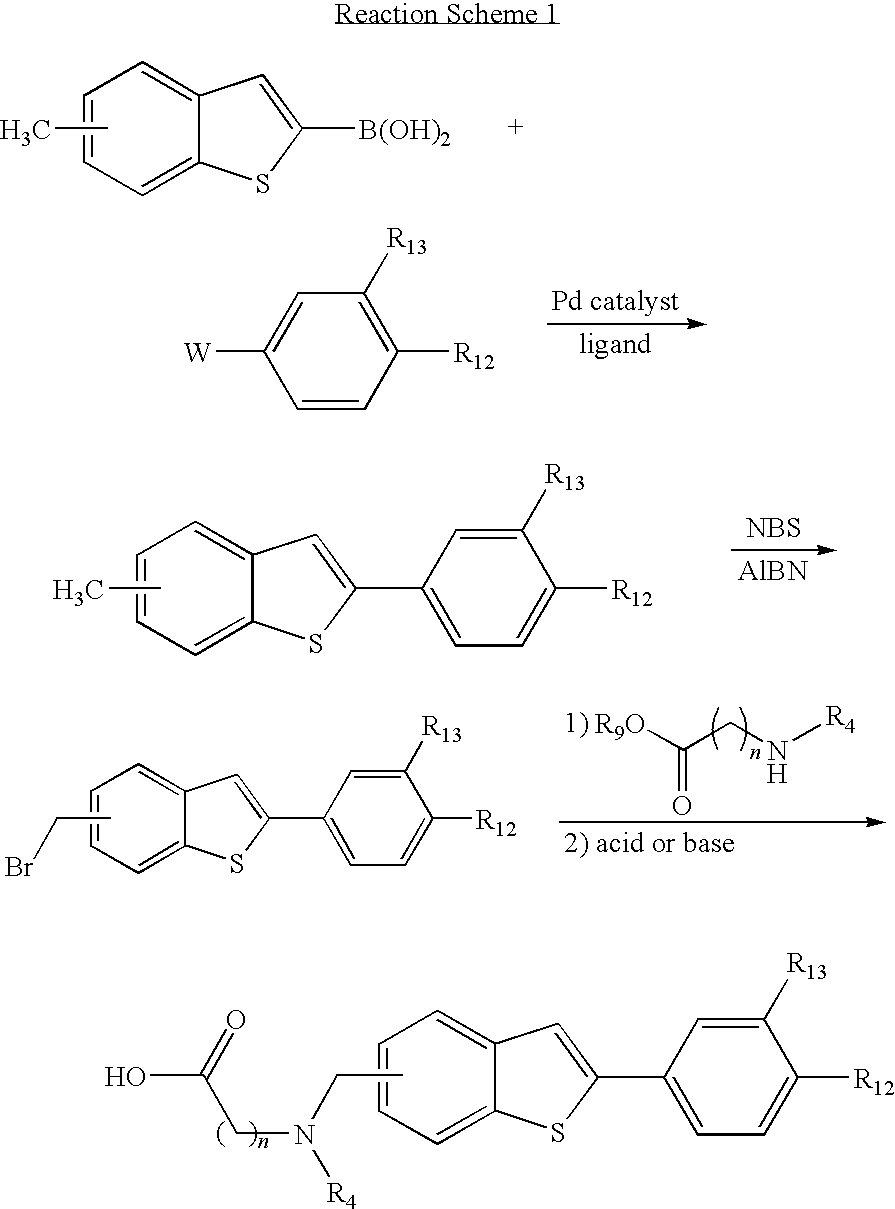
- wherein n, R4, R9, R12 and R13 are as defined in the Summary of the Invention and W is a halogen, trifluoromethanesulfonate, or the like. The reaction initially proceeds in the presence of a catalyst (e.g., palladium acetate, palladium chloride, palladium bromide, palladium cyanide, palladium acetylacetonate, palladium bis(benzonitrile) dichloride, tris(dibenzylideneacetone)-dipalladium, and the like) and a ligand (e.g., phosphorous ligands, such as triphenyl phosphine, tri-t-butyl phosphine, 2-(di-t-butylphosphino)biphenyl, dicyclohexylphosphinobiphenyl, and the like) in a solvent (e.g., tetrahydrofuran, 1,4-dioxane, benzene, toluene, xylene, N,N-dimethylformide, N-methyl-pyrrolidinone, and the like) at a temperature of about 20 to about 140° C. and can take up to about 48 hours to complete. The bromination reaction is carried out in the presence of a brominating agent (e.g., N-bromosuccinimide, bromine, and the like) and a radical initiator (e.g., 2,2′-azobisisobutyronitrile, benzoyl peroxide, and the like). The amination with amino carboxylic esters proceeds in the presence of a base (e.g., sodium hydride, triethylamine, diisopropylethylamine, potassium carbonate, sodium carbonate, and the like). The subsequent hydrolysis of esters proceeds in the presence of an acid (e.g. trifluoroacetic acid, hydrochloric acid, and the like) or a base (e.g., lithium hydroxide, sodium hydroxide, potassium hydroxide, sodium carbonate, and the like).
-
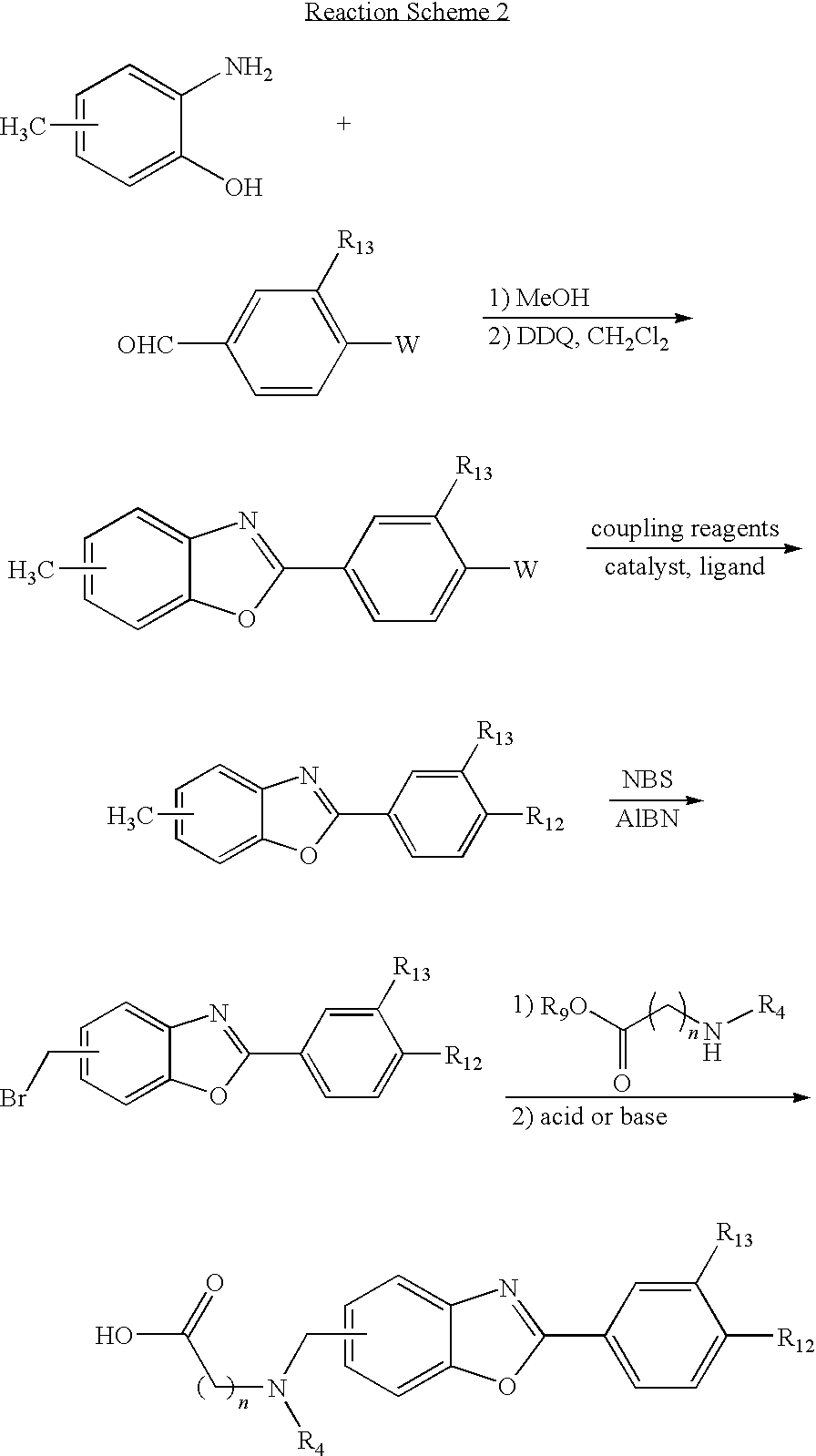
- wherein n, R4, R9, R12 and R13 are as defined in the Summary of the Invention and W is a halogen, trifluoromethanesulfonate, or the like. The benzoxazole core is formed by the condensation reaction between an appropriate amino phenol and an aldehyde followed by an oxidative cyclization. The coupling reaction proceeds in the presence of a catalyst (e.g., palladium acetate, palladium chloride, palladium bromide, palladium cyanide, palladium acetylacetonate, palladium bis(benzonitrile) dichloride, tris(dibenzylideneacetone)-dipalladium, and the like) and a ligand (e.g., phosphorous ligands, such as triphenyl phosphine, tri-t-butyl phosphine, 2-(di-t-butylphosphino)biphenyl, dicyclohexylphosphinobiphenyl, and the like) in a solvent (e.g., tetrahydrofuran, 1,4-dioxane, benzene, toluene, xylene, N,N-dimethylformide, N-methylpyroridinone, and the like) at a temperature of about 20 to about 140° C. and can take up to about 48 hours to complete.
- Similar transformations as in Reaction Scheme 1 give final compounds of Formula I.
- Some compounds of the invention can be prepared by proceeding as in the following reaction schemes:
-

-

-

-

- wherein n, R4, R9, R12 and R13 are as defined in the Summary of the Invention.
- Additional Processes for Preparing Compounds of the Invention:
- A compound of the invention can be prepared as a pharmaceutically acceptable acid addition salt by reacting the free base form of the compound with a pharmaceutically acceptable inorganic or organic acid. Alternatively, a pharmaceutically acceptable base addition salt of a compound of the invention can be prepared by reacting the free acid form of the compound with a pharmaceutically acceptable inorganic or organic base. Alternatively, the salt forms of the compounds of the invention can be prepared using salts of the starting materials or intermediates.
- The free acid or free base forms of the compounds of the invention can be prepared from the corresponding base addition salt or acid addition salt from, respectively. For example a compound of the invention in an acid addition salt form can be converted to the corresponding free base by treating with a suitable base (e.g., ammonium hydroxide solution, sodium hydroxide, and the like). A compound of the invention in a base addition salt form can be converted to the corresponding free acid by treating with a suitable acid (e.g., hydrochloric acid, etc.).
- Compounds of the invention in unoxidized form can be prepared from N-oxides of compounds of the invention by treating with a reducing agent (e.g., sulfur, sulfur dioxide, triphenyl phosphine, lithium borohydride, sodium borohydride, phosphorus trichloride, tribromide, or the like) in a suitable inert organic solvent (e.g. acetonitrile, ethanol, aqueous dioxane, or the like) at 0 to 80° C.
- Prodrug derivatives of the compounds of the invention can be prepared by methods known to those of ordinary skill in the art (e.g., for further details see Saulnier et al., (1994), Bioorganic and Medicinal Chemistry Letters, Vol. 4, p. 1985). For example, appropriate prodrugs can be prepared by reacting a non-derivatized compound of the invention with a suitable carbamylating agent (e.g., 1,1-acyloxyalkylcarbanochloridate, para-nitrophenyl carbonate, or the like).
- Protected derivatives of the compounds of the invention can be made by means known to those of ordinary skill in the art. A detailed description of techniques applicable to the creation of protecting groups and their removal can be found in T W. Greene, “Protecting Groups in Organic Chemistry”, 3rd edition, John Wiley and Sons, Inc., 1999.
- Compounds of the present invention can be conveniently prepared, or formed during the process of the invention, as solvates (e.g., hydrates). Hydrates of compounds of the present invention can be conveniently prepared by recrystallization from an aqueous/organic solvent mixture, using organic solvents such as dioxin, tetrahydrofuran or methanol.
- Compounds of the invention can be prepared as their individual stereoisomers by reacting a racemic mixture of the compound with an optically active resolving agent to form a pair of diastereoisomeric compounds, separating the diastereomers and recovering the optically pure enantiomers. While resolution of enantiomers can be carried out using covalent diastereomeric derivatives of the compounds of the invention, dissociable complexes are preferred (e.g., crystalline diastereomeric salts). Diastereomers have distinct physical properties (e.g., melting points, boiling points, solubilities, reactivity, etc.) and can be readily separated by taking advantage of these dissimilarities. The diastereomers can be separated by chromatography, or preferable, by separation/resolution techniques based upon differences in solubility. The optically pure enantiomer is then recovered, along with the resolving agent, by any practical means that would not result in racemization. A more detailed description of the techniques applicable to the resolution of stereoisomers of compounds from the their racemic mixture can be found in Jean Jacques, Andre Collet, Samuel H. Wilen, “Enantiomers, Racemates and Resolutions”, John Wiley And Sons, Inc., 1981.
- In summary, the compounds of Formula I can be made by a process, which involves:
- (a) reaction schemes 1, 2, 3, 4, 5 or 6; and
- (b) optionally converting a compound of the invention into a pharmaceutically acceptable salt;
- (c) optionally converting a salt form of a compound of the invention to a non-salt form;
- (d) optionally converting an unoxidized form of a compound of the invention into a pharmaceutically acceptable N-oxide;
- (e) optionally converting an N-oxide form of a compound of the invention to its unoxidized form;
- (f) optionally resolving an individual isomer of a compound of the invention from a mixture of isomers;
- (g) optionally converting a non-derivatized compound of the invention into a pharmaceutically acceptable prodrug derivative; and
- (h) optionally converting a prodrug derivative of a compound of the invention to its non-derivatized form.
- Insofar as the production of the starting materials is not particularly described, the compounds are known or can be prepared analogously to methods known in the art or as disclosed in the Examples hereinafter.
- One of skill in the art will appreciate that the above transformations are only representative of methods for preparation of the compounds of the present invention, and that other well known methods can similarly be used.
- The following examples provide detailed descriptions of the preparation of representative compounds and are offered to illustrate, but not to limit the present invention.
-

- To a solution of 5-methylbenzo[b]thiophene (1.0 g, 6.75 mmol) in anhydrous ether (17 mL) at −78° C. is added n-BuLi (5.1 mL of a 1.52 M solution in hexanes, 7.75 mmol). The reaction flask is then moved to a 0° C. bath and stirred for 2.5 hours. The mixture is cooled back to −78° C., and trimethyl borate (1.51 mL, 13.5 mmol) is added neat. The mixture is allowed to warm up to room temperature overnight, and then treated with 2 N HCl (10 mL). After 2 hours, the mixture is extracted with ether (5×), and the combined organic solution is dried (MgSO4) and concentrated. The crude product, 5-methylbenzo[b]-thiophenylboric acid, is used without further purification.
- To a solution of 5-methylbenzo[b]thiophenylboric acid (0.84 g, 4.4 mmol) in ethanol (2 mL) and toluene (8 mL) is added 2-chloro-5-bromobenzenetrifluoride (1.14 g, 4.4 mmol) and tetrakis(triphenylphosphine)palladium(0) (0.254 g, 0.22 mmol), followed by the addition of a solution of sodium carbonate (1.86 g, 17.6 mmol) in water (8 mL). The mixture is stirred vigorously at 80° C. for 4 hours, and then filtered through a pad of Celite, which is rinsed with hexanes. The filtrate is concentrated and purified by column chromatography (100% hexanes) to give 1.15 g (80%) of 2-(4-chloro-3-trifluoromethylphenyl)-5-methylbenzo[b]thiophene as a white solid.
- To a solution of 2-(4-chloro-3-trifluoromethylphenyl)-5-methylbenzo[b]-thiophene (0.746 g, 2.28 mmol) in carbon tetrachloride (23 mL) is added N-bromosuccinimide (0.447 g, 2.51 mmol) and 2,2′-azobisisobuyronitrile (AIBN, 0.075 g, 0.46 mmol). The mixture is stirred at 90° C. overnight, and then concentrated. The residue is passed through a pad of silica gel, which is further rinsed with hexanes. The combined organic solution is concentrated in vacuo. The resulting crude product, 5-bromomethyl-2-(4-chloro-3-trifluoromethylphenyl)benzo[b]thiophene, is dissolved in DMF (2 mL) and added to a pre-stirred suspension of β-alanine t-butyl ester hydrochloride (0.828 g, 4.56 mmol) and sodium hydride (0.365 g, 60% dispersion in mineral oil, 9.12 mmol) in DMF (4 mL). The mixture is stirred at room temperature for 4 hours, quenched with water (1 mL) and concentrated in vacuo. The resulting residue is purified by column chromatography (50% to 70% EtOAc/hexanes) to afford 0.79 g (73%) of 3-{[2-(4-chloro-3-trifluoromethylphenyl)benzo[b]thiophene-5-ylmethyl]amino}propionic acid t-butyl ester as a yellow solid.
- To a solution of the above chloride (0.79 g, 1.68 mmol) in THF (20 mL) is added phenyl boric acid (0.41 g, 3.36 mmol), potassium fluoride (0.39 g, 6.72 mmol), 2-(dicyclohexylphosphino)biphenyl (59 mg, 0.17 mmol) and palladium (II) acetate (19 mg, 0.084 mmol). The mixture is stirred at 60° C. under argon for 24 hours. After concentration, the residue is purified by column chromatography (50% to 70% EtOAc/hexanes) to afford 3-{[2-(2-trifluoromethyl-biphenyl-4-yl)benzo[b]thiophen-5-ylmethyl]amino}propionic acid t-butyl ester. The ester is hydrolyzed in TFA-CH2Cl2 (1:2 v %, 20 mL). The crude product is purified by the preparative LCMS to afford 0.55 g (67%) of 3-{[2-(2-trifluoromethyl-biphenyl-4-yl)benzo[b]thiophen-5-ylmethyl]amino}propionic acid, which is converted to the corresponding HCl salt: 1H NMR (400 MHz, CD3OD) δ 8.03 (d, 1H), 7.94 (dd, 2H), 7.92 (s, 1H), 7.42-7.30 (m, 5H), 7.29-7.21 (m, 2H), 4.29 (s, 2H), 3.25 (t, 2H), 2.70 (t, 2H); MS (ES) 456.1 (M+H+).
-

- Piperidine (30 μL, 2.0 mmol), Pd2 dba3 (2.7 mg, 0.003 mmol), potassium t-butoxide (59 mg, 0.53 mmol) and 1,3-bis-(2,6-diisopropylphenyl)-4,5-dihydroimidazol-2-ylidene HCl salt (2.6 mg, 0.006 mmol) are added sequentially to a solution of 3-{[2-(4-chloro-3-trifluoromethyl-phenyl)-benzo[b]thiophen-5-ylmethyl]-amino}-propionic acid tert-butyl ester (72 mg, 0.15 mmol) in 1,4-dioxane (0.8 mL). The mixture is irradiated in a microwave at 100° C. for 1 hour. The reaction is quenched with water and the mixture is concentrated in vacuo. The residue is dissolved in THF and aqueous 2N NaOH (4 mL, 1:1 v/v), and stirred at 60° C. for 3 hours. It is concentrated and purified with preparative LCMS to afford 20 mg of 3-{[2-(4-piperidin-1-yl-3-trifluoromethyl-phenyl)-benzo[b]thiophen-5-ylmethyl]-amino}-propionic acid, which is converted to HCl salt: 1H NMR (400 MHz, CD3OD) δ 8.15-8.00 (m, 4H), 7.87 (s, 1H), 7.63 (d, 1H), 7.57 (d, 1H), 4.48 (s, 2H), 3.44 (t, 2H), 3.03 (t, 4H), 2.89 (t, 2H), 1.90-1.80 (m, 4H), 1.75-1.65 (m, 2H); MS (ES) 463.4 (M+H+).
-

- To a solution of 2-(2-trifluoromethyl-biphenyl-4-yl)-thieno[2,3-b]pyridine-5-carbaldehyde (32 mg, 0.083 mmol) in MeOH (2 mL) is added β-alanine HCl salt (37 mg, 0.42 mmol) and triethylamine (23 uL, 0.16 mmol). The mixture is stirred at 50° C. for 20 minutes. Sodium borohydride (30 mg, 0.8 mmol) is added at room temperature and it is stirred for 10 minutes. The mixture is purified with preparative LCMS to give 22 mg of 3-{[2-(2-trifluoromethyl-biphenyl-4-yl)-thieno[2,3-b]pyridin-5-ylmethyl]-amino}-propionic acid, which is converted to HCl salt: 1H NMR (400 MHz, CD3OD) δ 8.56 (d, 1H), 8.30 (d, 1H), 8.08 (d, 1H), 7.98 (dd, 1H), 7.84 (s, 1H), 7.42 (d, 1H), 7.40-7.34 (m, 3H), 7.30-7.24 (m, 2H); MS (ES) 457.1 (M+H+).
-

- Bromoacetaldehyde dimethyl acetal (1.6 mL, 0.01 mol) is added dropwise to a mixture of m-methylbenzenethiol (1.5 mL, 0.01 mol) and K2CO3 (1.66 mg, 0.01 mol) in 20 mL acetone at room temperature. The reaction mixture is stirred for 16 hours and then filtered. The solid is washed with acetone, and the combined filtrate and washes are concentrated in vacuo. The residue is diluted with water and extracted with ether. The ether layer is washed with 0.5 M KOH, water, and brine, dried, filtered and concentrated in vacuo to give 2 g yellow oil.
- A solution of above yellow oil in CH2Cl2 (20 mL) is added dropwise to a solution of BF3 in ether (0.7 mL, 0.005 mol) in CH2Cl2 (100 mL) at room temperature. The reaction mixture is stirred for 3 hours, treated with aqueous NaHCO3 solution and stirred until both phase are clear. The CH2Cl2 layer is separated, dried, filtered and concentrated in vacuo to give 0.45 g of an approximately 1:3 mixture of 4- and 6-methyl-benzo[b]thiophene as a dark brown oil. Major isomer: 1H NMR (DMSO-d6): δ 7.78 (d, 1H), 7.76 (d, 1H), 7.64 (d, 1H), 7.39 (m, 1H), 7.17 (m, 1H), 2.43 (s, 3H).
- To a solution of 6-methyl-benzo[b]thiophene (0.16 g, 0.001 mol) in 10 mL of anhydrous THF at −60° C. is added n-BuLi (0.8 mL, 0.0012 mol) dropwise via syringe. After stirring for 30 minutes triisopropyl borate (0.3 mL, 0.0012 mol) is added dropwise. The reaction mixture is allowed to warm to 0° C. and then partitioned between 1.0N HCl and EtOAc. The organic layer is separated, dried, filtered and concentrated to produce a white solid that is triturated from ether/hexane. Filtration provides 0.17 g of 6-Methyl-benzo[b]thiophene-2-boronic acid as white solid. MS m/z 193 [M+1]+.
- To a slurry of 6-methyl-benzo[b]thiophene-2-boronic acid (0.19 g, 0.001 mol) in 10 mL of benzene is added 4-bromo-2-trifluoromethyl-biphenyl (0.3 g, 0.001 mol). The reaction flask is then covered with aluminum foil to keep out light. To this is added 58 mg of tetrakis(triphenylphosphine-palladium(0), followed by 1 mL of 2.0N sodium carbonate solution. The biphasic mixture is heated at 85° C. for 3 hours with vigorous stirring. The mixture is cooled to room temperature and 10 mL of brine solution is added. The organic layer is separated, dried and concentrated under vacuo to afford 0.2 g of 6-methyl-2-(2-trifluoromethyl-biphenyl-4-yl)-benzo[b]thiophene.
- The above product (0.2 g, 0.54 mmol) is dissolved in 10 mL of CCl4, followed by adding NBS (86 mg, 0.54 mmol) and benzoyl peroxide (24 mg, 0.1 mmol). The reaction mixture is heated to reflux for 5 hours. After cooling down and removing solvent, the residue is put in column (hexane:EtOAc 95:5). After column, 180 mg of 6-bromomethyl-2-(2-trifluoromethyl-biphenyl-4-yl)-benzo[b]thiophene is obtained.
- To a solution of 6-bromomethyl-2-(2-trifluoromethyl-biphenyl-4-yl)-benzo[b]thiophene (180 mg, 0.4 mmol) in 5 mL DMSO, Ag2CO3(330 mg, 1.2 mmol) is added. The suspension is heated to 100° C. for 3 hours. After work up, the organic layer is dried and concentrated. The residue is applied in column (hexane:EtOAc 9:1) to afford 100 mg of 2-(2-trifluoromethyl-biphenyl-4-yl)-benzo[b]thiophene-6-carbaldehyde as a off white solid. MS m/z 383[M+1]+.
- To a solution of 2-(2-trifluoromethyl-biphenyl-4-yl)-benzo[b]thiophene-6-carbaldehyde (23 mg, 0.05 mmol) in 3 mL MeOH, β-alanine (8.7 mg, 0.1 mmol) and catalytic amount Et3N are added. The suspension is heated to 50° C. for 0.5 hours, followed by the addition of 2 mg of NaBH4. After Pre-LC-MS, 10 mg of 3-{[2-(2-trifluoromethyl-biphenyl-4-yl)-benzo[b]thiophen-6-ylmethyl]-amino}-propionic acid is obtained as a white solid. MS m/z 456[M+1]+. 1H NMR (MeOD-d4): δ 8.22 (d, 1H), 7.93 (m, 2H), 7.86 (d, 1H), 7.81 (s, 1H), 7.40 (m, 1H), 7.34 (d, 1H), 7.28 (m, 3H), 7.24 (m, 2H), 4.26 (s, 2H), 3.15 (t, 2H), 2.52 (t, 2H).
-

- 3,4-Bis-bromomethyl-benzoic acid methyl ester (0.32 g, 0.001 mol) and 4-bromo-3-trifluoromethyl-phenylamine (0.72 mL, 0.003 mol) are dissolved in anhydrous 30 mL of EtOH. The reaction mixture is heated to reflux for 3 hours, then cooled down to room temperature. After filtering, a white solid product is obtained. MS m/z 400 [M+1]+.
- 2-(4-Bromo-3-trifluoromethyl-phenyl)-2,3-dihydro-1H-isoindole-5-carboxylic acid methyl ester (0.2 g, 0.0005 mol) is dissolved in 20 mL of anhydrous toluene, followed by adding 40 mg of tetrakis(triphenylphosphine-palladium(0). After bubbling N2 through the solution for 3 minutes, tributyl-phenyl-stannane (0.22 g, 0.0006 mol) is added to the solution. The reaction mixture is heated to reflux for 16 hours. After column (9:1 Hexane:EtOAc), a white solid product (0.18 g) is obtained. MS m/z 398 [M+1]+.
- 2-(2-Trifluoromethyl-biphenyl-4-yl)-2,3-dihydro-1H-isoindole-5-carboxylic acid methyl ester (0.18 g, 0.0005 mol) is dissolved in 10 mL of anhydrous THF, followed by 1.5 mL of LAH (0.0015 mol). The reaction mixture is stirred at room temperature for 5 minutes and quenched with 5% NaOH solution. After workup, organic layer is dried under vacuo and the residue is dissolved in 50 mL of CHCl3, followed by adding 500 mg of MnO2. The suspension is stirred at room temperature for 3 hours and followed by filtering. The organic solution is dried and applied to column (4:1 Hexane:EtOAc). After column, a white solid product (40 mg) is obtained. MS m/z 368 [M+1]+.
- To a solution of 2-(2-trifluoromethyl-biphenyl-4-yl)-2,3-dihydro-1H-isoindole-5-carbaldehyde (19 mg, 0.05 mmol) in 3 mL MeOH, β-alanine (8.7 mg, 0.1 mmol) and catalytic amount Et3N are added. The suspension is heated to 50° C. for 0.5 hours, followed by adding 2 mg of NaBH4. After pre-LC-MS, 8 mg of 3-{[2-(2-trifluoromethyl-biphenyl-4-yl)-2,3-dihydro-1H-isoindol-5-ylmethyl]-amino}-propionic acid is obtained as a white solid. MS m/z 441[M+1]+. 1H NMR (DMSO-d6): δ 7.08-7.26 (m, 9H), 6.80 (brs, 2H), 4.53 (s, 4H), 3.68 (s, 2H), 2.62 (t, 2H), 2.16 (t, 2H).
-

- A solution of 2-amino-4-methylphenol (1 eq) and 4-chloro-3-trifluoromethyl-benzaldehyde (1 eq) in methanol (0.1 M) is heated at 50° C. for 30 minutes. After concentration, the residue is dissolved in CH2Cl2 (0.1 M) and treated with DDQ (1.05 eq). The resulting mixture is stirred at room temperature for 10 minutes. It is then diluted with CH2Cl2 and washed with NaHCO3 and brine. The organic layer is dried over Na2SO4. After concentration, the desired product is purified by column chromatography (5% EtOAc/hexane) to give a white solid. MS: (ES+): 312.0 (M+1)+.
- A mixture of 2-(4-chloro-3-trifluoromethyl-phenyl)-5-methyl-benzooxazole (1 eq), phenyl boronic acid (1.5 eq), Pd(OAc)2 (0.03 eq), phosphine ligand (0.06 eq) and KF (3 eq) in dry THF (0.5 M) is heated at 100° C. in microwave for 30 minutes. The resulting mixture is diluted with EtOAc and washed with brine. The organic layer is dried over Na2SO4. After concentration, the residue is purified by column chromatography (5% EtOAc in hexane) to give the desired product as a white solid. MS: (ES+): 354.1 (M+1)+.
- A mixture of 5-methyl-2-(2-trifluoromethyl-biphenyl-4-yl)-benzooxazole (1 eq), NBS (1 eq) and AIBN (0.1 eq) in CCl4 (0.1 M) is refluxed for 5 hours. After concentration, the desired product is purified by column chromatography (10% EtOAc/hexane). MS: (ES+): 432.0 (M+1)+.
- To a solution of β-alanine methyl ester hydrochloride salt (2 eq) in dry DMF (0.5 M) is added NaH (3.5 eq). After stirring at room temperature for 10 minutes, a solution of 5-bromomethyl-2-(2-trifluoromethyl-biphenyl-4-yl)-benzooxazole (1 eq) in dry DMF (1 M) is added. The resulting mixture is stirred at room temperature for 2 hours. It is diluted with H2O and extracted with EtOAc. The organic solution is washed with brine and dried over Na2SO4. After concentration, the residue is dissolve in MeOH (0.2 M) and treated with 2N LiOH solution (3 eq) for 10 hours. The final compound is purified by preparative LCMS to give 3-{[2-(2-trifluoromethyl-biphenyl-4-yl)-benzooxazol-5-ylmethyl]-amino}-propionic acid; 1H NMR (400 MHz, CD3OD) δ 2.74 (t, J=6.7 Hz, 2H), 3.30 (t, J=6.8 Hz, 2H), 4.39 (s, 2H), 7.34 (m, 2H), 7.43 (m, 3H), 7.57 (m, 2H), 7.78 (d, J=8.3 Hz, 1H), 7.94 (s, 1H), 8.43 (d, J=8.0 Hz, 1H), 8.59 (s, 1H). MS: (ES+): 441.3 (M+1)+.
-

- A mixture of [2-(4-chloro-3-trifluoromethyl-phenyl)-benzooxazol-6-yl]-methanol (1 eq) and Pd(PBut 3)2 (0.05 eq) is treated with isobutyl zinc bromide in THF (0.5 M, 3 eq). The resulting mixture is heated at 100° C. in microwave for 30 minutes. The reaction mixture is diluted with aqueous HCl (5%) and extracted with EtOAc. The organic solution is washed with brine and dried over Na2SO4. After concentration, the residue is purified by flash column chromatography (30% EtOAc in hexane) to give the desired intermediate [2-(4-isobutyl-3-trifluoromethyl-phenyl)-benzooxazol-6-yl]-methanol. MS: (ES+): 350.1 (M+1)+.
- To a solution of [2-(4-isobutyl-3-trifluoromethyl-phenyl)-benzooxazol-6-yl]-methanol (1 eq) in dioxane (0.2 M) is treated with MnO2 (10 eq). The resulting mixture is refluxed for 20 minutes and filtered through celite. After concentration, the residue is redissolved in MeOH (0.2 M) and is added azetidine-3-carboxylic acid (2 eq) and Et3N (1.8 eq). The resulting mixture is heated at 50° C. for 1 hour. After cooling to room temperature, NaBH3CN (3 eq) is added in portions. The final compound is purified by preparative LCMS. 1H NMR (400 MHz, CD3OD) δ 8.49 (s, 1H), 8.38 (d, J=8.4 Hz, 1H), 7.88 (s, 1H), 7.84 (d, J=8.4 Hz, 1H), 7.66 (d, J=8.4 Hz, 1H), 7.52 (d, J=8.4 Hz, 1H), 4.57 (s, 2H), 4.34 (m, 4H), 3.70 (m, 1H), 2.76 (d, J=6.8 Hz, 2H), 2.03 (m, 1H), 0.95 (d, J=7.2 Hz, 6H). MS: (ES+): 433.2 (M+1)+.
-

- To a solution of 4-hydroxy-3-iodobenzaldehyde (1 eq) and 1-chloro-4-ethynyl-2-trifluoromethylbenzene (1 eq) in DMF (0.2 M) is added copper(I) iodide (0.1 eq), dichlorobis(triphenylphosphine)palladium(II) (0.1 eq) and diisopropylethylamine (3 eq). The mixture is irradiated with microwave at 80° C. for 10 minutes. The product, 2-(4-chloro-3-trifluoromethyl-phenyl)-benzofuran-5-carbaldehyde, is purified with column chromatography.
- To a solution of 2-(4-chloro-3-trifluoromethyl-phenyl)-benzofuran-5-carbaldehyde (1 eq) in CH3OH (0.2 M) is added β-alanine t-butyl ester (2.5 eq) and triethylamine (2 eq). The mixture is stirred at 50° C. for 30 minutes. Sodium borohydride (5 eq) is then added at room temperature and the mixture is stirred for 10 minutes. The product, 3-{[2-(4-chloro-3-trifluoromethyl-phenyl)-benzofuran-5-ylmethyl]-amino}-propionic acid tert-butyl ester, is purified with column chromatography.
- To a solution of 3-{[2-(4-chloro-3-trifluoromethyl-phenyl)-benzofuran-5-ylmethyl]-amino}-propionic acid tert-butyl ester (1 eq) and phenyl boric acid (1.5 eq) in THF (0.5 M) is added palladium(II) acetate (0.1 eq), 2-(dicyclohexylphosphino)biphenyl (0.2 eq) and potassium fluoride (4.0 eq). The mixture is irradiated with microwave at 120° C. for 45 minutes. The product, 3-{[2-(2-trifluoromethyl-biphenyl-4-yl)-benzofuran-5-ylmethyl]-amino}-propionic acid tert-butyl ester, is purified with column chromatography. The ester is hydrolyzed with TFA in CH2Cl2 (1:2, v/v) at room temperature. It is purified with preparative LCMS to afford 3-{[2-(2-trifluoromethyl-biphenyl-4-yl)-benzofuran-5-ylmethyl]-amino}-propionic acid, which is converted to HCl salt: 1H NMR (400 MHz, CD3OD) δ 8.29 (d, 1H), 8.18 (dd, 1H), 7.82 (d, 1H), 7.71 (d, 1H), 7.55-7.30 (m, 8H), 4.36 (s, 2H), 3.32 (t, 2H), 2.77 (t, 2H); MS (ES) 440.2 (M+H+).
-

- To a solution of p-toluidine (0.44 g, 4.1 mmol) in 10 ml of CH2Cl2 (pre-cooled to 0° C.) are added Et3N (1.14 ml, 2 eq.) and 4-chloro-3-trifluoromethyl-benzoyl chloride (1 g, 4.1 mmol) in 5 ml of CH2Cl2. The mixture is slowly warmed to room temperature and continued to stir at room temperature for an hour. The mixture is diluted with 50 ml of CH2Cl2, washed with 1N HCl solution, and brine. The organic layer is separated, dried over MgSO4, filtered, and concentrated. The residue is purified by column chromatography (EtOAc/Hexanes, 2:3) to give 1.25 g (97%) of 4-chloro-N-p-tolyl-3-trifluoromethyl-benzamide.
- 4-chloro-N-p-tolyl-3-trifluoromethyl-benzamide (1.0 g, 3.19 mmol), Lawesson's reagent (774 mg, 0.6 eq.) and toluene (2.5 mL) is mixed in a microwave vial. The mixture is heated to 120° C. for 1000 seconds using microwave irradiation. The mixture turned into clear solution. Ether (50 ml) is added to dilute the reaction mixture. The solution is then washed with brine, dried over MgSO4, filtered and concentrated. The mixture is purified by column chromatography (EtOAc/Hexanes=5/95) to afford 970 mg (92%) of 4-chloro-N-p-tolyl-3-trifluoromethyl-thiobenzamide as a yellow solid.
- To 2M aqueous solution K3Fe(CN)6 (4 mL, 8 mmol) (pre-heated to 90° C.) is added dropwise to a suspension of 4-chloro-N-p-tolyl-3-trifluoromethyl-thiobenzamide (660 mg, 2 mmol) in 2M NaOH (9 ml) and EtOH (3 ml). The mixture is heated at 90° C. overnight. The mixture is cooled to room temperature and extracted with EtOAc (50 ml×2). The combined organic layers are washed with brine, dried over MgSO4, filtered and concentrated. The mixture is purified by ISCO system (EtOAc/Hexanes: 20 minutes run 0 to 100% of EtOAc). 2-(4-Chloro-3-trifluoromethyl-phenyl)-6-methylbenzothiazole is isolated (170 mg, 26%), as well as 380 mg of the starting material.
- A microwave vial is charged with 2-(4-chloro-3-trifluoromethyl-phenyl)-6-methylbenzothiazole (170 mg, 0.519 mmol), phenylboronic acid (95 mg, 1.5 eq.), KF (90 mg, 3 eq.), Pd(OAc)2 (6 mg, 5 mol %), (dicyclohexylphosphino)biphenyl (18 mg, 10 mol %) and THF (0.5 mL). The mixture is heated to 120° C. for 30 minutes using microwave irradiation. The mixture is then filtered through celite and washed with EtOAc. The filtrate is concentrated and purified by column chromatography (EtOAc/Hexane, 5/95) to give 120 mg (63%) of 6-methyl-2-(2-trifluoromethyl-biphenyl-4-yl)benzothiazole.
- To a solution of 6-methyl-2-(2-trifluoromethyl-biphenyl-4-yl)benzothiazole (120 mg, 0.325 mmol) in CCl4 (3.5 ml) is added NBS (64 mg, 1.1 eq.). The mixture is heated to reflux for 15 minutes before AIBN (5 mg, 0.1 eq.) is added. The reaction is refluxed overnight, filtered through celite and washed with CCl4. The filtrate is concentrated and purified by column chromatography (EtOAc/Hexane=9/95). 6-Bromomethyl-2-(2-trifluoromethyl-biphenyl-4-yl)benzothiazole (105 mg, 72%) is isolated.
- To a solution of β-alanine tert-butyl ester hydrochloride (47 mg, 1.1 eq.) in DMF (2 ml) is added NaH (60% in mineral oil) (28 mg, 3 eq.) at room temperature. The mixture is stirred at room temperature for 15 minutes before a solution of 6-bromomethyl-2-(2-trifluoromethyl-biphenyl-4-yl)benzothiazole (105 mg, 0.234 mmol) in DMF (1 ml) is added. The mixture is stirred at room temperature overnight, diluted with EtOAc, washed with 10% Na2S2O3, brine, dried over MgSO4, filtered and concentrated. Column chromatography (CH2Cl2/CH3OH, 95/5) gave 31 mg (26%) of 3-{[2-(2-trifluoromethyl-biphenyl-4-yl)-benzothiazol-6-ylmethyl]-amino}-propionic acid tert-butyl ester.
- 3-{[2-(2-Trifluoromethyl-biphenyl-4-yl)-benzothiazol-6-ylmethyl]-amino}-propionic acid tert-butyl ester (31 mg, 0.0605 mmol) is dissolved in TFA/CH2Cl2 (1/1) (1 mL). The solution is stirred at room temperature for an hour. The mixture is concentrated and purified by reversed phase preparative LC/MS to give 10 mg of 3-{[2-(2-trifluoromethyl-biphenyl-4-yl)-benzothiazol-6-ylmethyl]-amino}-propionic acid: 1H NMR (CD3OD, 400 MHz) δ 8.54 (s, 1H), 8.35 (d, 1H), 8.22 (s, 1H), 8.18 (d, 2H), 7.68 (d, 1H), 7.45 (m, 3H), 7.37 (m, 2H), 4.44 (s, 2H), 3.36 (m, 2H), 2.80 (m, 2H); MS (ES+) 457.0 (M+H+).
-

- To a solution of 5-methyl-2-(2-trifluoromethyl-biphenyl-4-yl)-benzo[b]thiophene (184 mg, 0.5 mmol) in CHCl3 (2.5 mL) is added SO2Cl2 (44 μL, 1.1 eq.). The mixture is heated to reflux overnight (about 14 hours). All the solvent is removed under reduced pressure. The residue is extracted with CH2Cl2 (50 mL), washed with saturated aqueous NaHCO3, brine, dried over MgSO4, filtered, and concentrated to give an oil. The mixture is purified by column chromatography (EtOAc/Hexane, gradient) to give 112 mg of 3-chloro-5-methyl-2-(2-trifluoromethyl-biphenyl-4-yl)-benzo[b]thiophene in 56% yield.
- To a solution of 3-chloro-5-methyl-2-(2-trifluoromethyl-biphenyl-4-yl)-benzo[b]thiophene (110 mg, 0.273 mmol) in CCl4 (3 ml) is added NBS (49 mg, 1 eq.). The mixture is heated at reflux for 15 minutes before AIBN (4.5 mg, 0.1 eq.) is added. The reaction is further heated at reflux overnight. The mixture is filtered through Celite and washed with CCl4. The filtrate is concentrated and purified by column chromatography (EtOAc/Hexane, gradient) to give 50 mg of 5-bromomethyl-3-chloro-2-(2-trifluoromethyl-biphenyl-4-yl)-benzo[b]thiophene in 38% yield.
- To a solution of 5-bromomethyl-3-chloro-2-(2-trifluoromethyl-biphenyl-4-yl)-benzo[b]thiophene (50 mg, 0.104 mmol) in DMF (1 mL) are added β-alanine tert-butyl ester hydrochloride (19 mg, 1 eq.) and K2CO3 (68 mg, 5 eq.). The mixture is stirred at 50° C. overnight. The mixture is diluted with EtOAc (40 mL), washed with 10% aqueous Na2S2O3, brine, dried over MgSO4, filtered, and concentrated. The mixture is purified by column chromatography (EtOAc/Hexane, gradient) to give 43 mg of 3-{[3-chloro-2-(2-trifluoromethyl-biphenyl-4-yl)-benzo[b]thiophen-5-ylmethyl]-amino}-propionic acid tert-butyl ester in 76% yield.
- 3-{[3-Chloro-2-(2-trifluoromethyl-biphenyl-4-yl)-benzo[b]thiophen-5-ylmethyl]-amino}-propionic acid tert-butyl ester (43 mg, 0.079 mmol) is dissolved in TFA/CH2Cl2 (1/1) (1 mL). The solution is stirred at room temperature for an hour. The mixture is concentrated and purified by reversed phase preparative LC/MS to give 23 mg of 3-[3-chloro-2-(2-trifluoromethyl-biphenyl-4-yl)-benzo[b]thiophen-5-ylmethyl]-amino}-propionic acid: 1H NMR (CD3OD, 400 MHz) δ 8.10 (s, 1H), 7.96-8.02 (m, 3H), 7.54 (d, 1H), 7.46 (d, 1H), 7.35-7.37 (m, 3H), 7.28-7.29 (m, 2H), 4.37 (s, 2H), 3.26 (m, 2H), 2.71 (m, 2H), MS (ES+) 490.3 (M+H+).
- By repeating the procedure described in the above examples, using appropriate starting materials, the following compounds of Formula I are obtained as identified in Table 1.
-
TABLE 1 Physical Data MS ES Compound Structure (M + 1) 1 
468.2 2 
492.1 3 
468.1 4 
474.1 5 
474.1 6 
474.1 7 
462.2 8 
490.1 9 
474.2 10 
486.1 11 
490.1 12 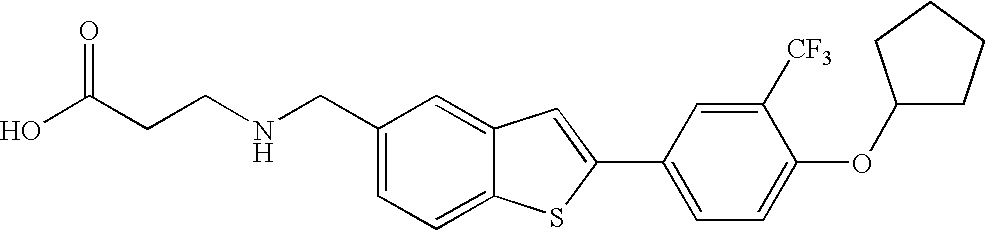
464.1 13 
452.1 14 
436.2 15 
436.2 16 
478.2 17 
464.1 18 
470.1 19 
481.1 20 
534.0 21 
398.1 22 
398.1 23 
380.1 24 
468.1 25 
414.1 26 
456.1 27 
448.1 28 
393.1 29 
312.1 30 
394.1 31 
392.1 32 
398.1 33 
398.1 34 
448.1 35 
396.1 36 
410.1 37 
414.1 38 
380.1 39 
406.1 40 
398.1 41 
380.1 42 
410.1 43 
410.1 44 
456.1 45 
456.1 46 
462.2 47 
490.1 48 
468.1 49 
534.0 50 
477.2 51 
459.1 52 
477.1 53 
477.1 54 
459.1 55 
475.1 56 
477.1 57 
477.1 58 
447.2 59 
475.1 60 
491.1 61 
497.2 62 
421.2 63 
457.1 64 
459.1 65 
447.2 66 
441.1 67 
473.1 68 
477.1 69 
509.1 70 
475.1 71 
475.1 72 
519.1 73 
421.2 74 
485.1 75 
397.2 76 
391.1 77 
493.1 78 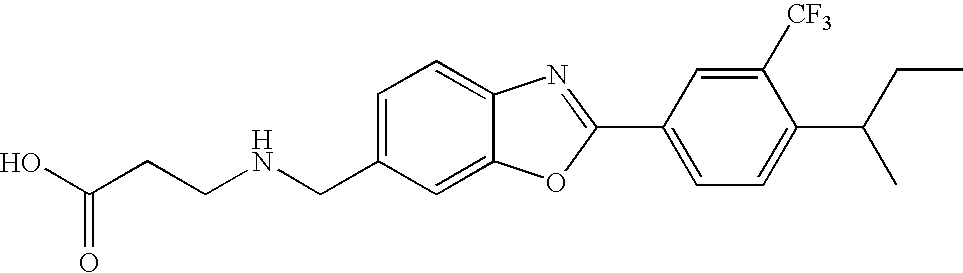
421.2 79 
469.2 80 
491.2 81 
447.2 82 
421.2 83 
481.1 84 
491.1 85 
469.2 86 
467.2 87 
469.2 88 
503.2 89 
489.1 90 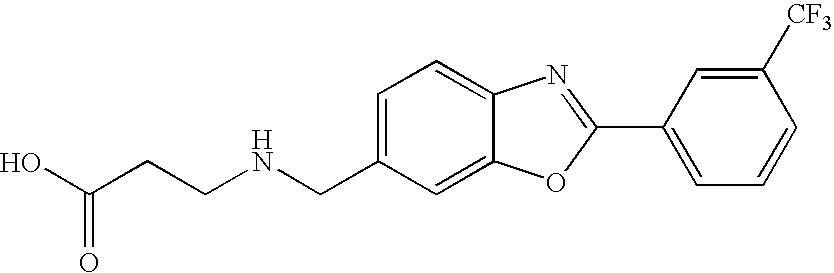
365.1 91 
353.2 92 
395.1 93 
399.1 94 
395.1 95 
394.1 96 
399.1 97 
405.1 98 
315.1 99 
315.1 100 
315.1 101 
446.2 102 
447.2 103 
445.2 104 
457.1 105 
457.1 106 
381.1 107 
440.2 108 
458.1 109 
470.1 110 
452.2 111 
454.2 112 
454.2 113 
455.2 114 
456.2 115 
470.2 116 
468.1 117 
468.1 118 
480.1 119 
492.2 120 
452.2 121 
464.2 122 
123 
124 
125 
126 
127 
128 
129 
130 
- A. In vitro: GPCR Activation Assay Measuring GTP [γ-35S] Binding to Membranes Prepared from CHO Cells Expressing Human EDG Receptors
- EDG-1 (S1P1) GTP [γ-35S] binding assay: Homogenized membranes are prepared from CHO cell clones stably expressing a human EDG-1 N-terminal c-myc tag. Cells are grown in suspension in two 850 cm roller bottles for three or fours days before harvesting. The cells are centrifuged down, washed once with cold PBS, and resuspended in ≦20 ml of Buffer A (20 mM HEPES, pH 7.4, 10 mM EDTA, EDTA-free complete protease inhibitor cocktail [1 tablet/25 ml]). The cell suspension is homogenized on ice, using a Polytron homogenizer at 30000 rpm at three intervals of 15 seconds each. The homogenate is first centrifuged at 2000 rpm on a tabletop low speed centrifuge for 10 minutes. The supernatant, after passing through a cell strainer, is then re-centrifuged at 50,000×g for 25 minutes at 4° C. The pellet is resuspended into buffer B (15% glycerol, 20 mM HEPES, pH 7.4, 0.1 mM EDTA, EDTA-free complete protease inhibitor cocktail [1 tablet/10 ml]). Protein concentration of the prep is determined using the BCA Protein Assay kit (Pierce) using BSA as standard. The membranes are aliquoted and kept frozen at −80° C.
- Solutions of test compounds ranging from 10 mM to 0.01 nM are prepared in DMSO. S1P is diluted in 4% BSA solution as positive controls. The desired amount of membrane prep is diluted with ice-cold assay buffer (20 mM HEPES, pH 7.4, 100 mM NaCl, 10 mM MgCl2, 0.1% Fatty acid-free BSA, 5 μM GDP) and vortexed well. 2 μl or less of compound is distributed into each well of a round-bottom 96-well polystyrene assay plate, followed by addition of 100 μl of diluted membranes (3-10 μg/well) and kept on ice until the addition of hot GTPγS. [35S]-GTPγS is diluted 1:1000 (v/v) with cold assay buffer and 100 μl is added into each well. The reaction is carried out at room temperature for 90 minutes before the membranes are harvested onto Perkin-Elmer Unifilter® GF/B-96 filter plate using a Packard Filtermate Harvester. After several washes with wash buffer (20 mM HEPES, pH 7.4, 100 mM NaCl, 10 mM MgCl2), and a rinse with 95% ethanol, the filter is dried in a 37° C. oven for 30 minutes. MicroScint-20 is added and the plate sealed for scintillation counting on TopCount. EC50 values are obtained by fitting the GTP [γ-35S] binding curves (raw data) with the dose response curve-fitting tool of GraphPad Prism. Six or twelve different concentrations are used to generate a concentration response curve (using three data points per concentration).
- EDG-3, -5, -6 and -8 GTP [γ-35S] binding assays are carried out in a comparable manner to the EDG-1 GTP [γ-35S] binding assay using membranes from CHO cells stably expressing c-terminal c-myc tagged or untagged receptors. For each membrane preparation, titration experiments are first run with S1P control to determine the optimal amount of membranes to be added per assay well. Compounds of the invention were tested according to the above assay and were observed to exhibit selectivity for the EDG-1 receptor. For example, 3-{[2-(2-trifluoromethyl-biphenyl-4-yl)-benzo[b]thiophen-5-ylmethyl]-amino}-propionic acid (example 1) has an EC50 of 0.6 nM in the above assay and is at least 1000 fold selective for EDG-1 compared to one or more of the other receptors including EDG-3, EDG-5, EDG-6 and EDG-8.
- Compounds of the invention are tested for agonist activity on EDG-1, EDG-3, EDG-5, and EDG-6 with a FLIPR calcium flux assay. Briefly, CHO cells expressing an EDG receptor are maintained in F-12K medium (ATCC), containing 5% FBS, with 500 ug/ml of G418. Prior to the assay, the cells are plated in 384 black clear bottom plates at the density of 10,000 cells/well/25 μl in the medium of F-12K containing 1% FBS. The second day, the cells are washed three times (25 μl/each) with washing buffer. About 25 μl of dye are added to each well and incubated for 1 hour at 37° C. and 5% CO2. The cells are then washed four times with washing buffer (25 μl/each). The calcium flux is assayed after adding 25 μl of SEQ2871 solution to each well of cells. The same assay is performed with cells expressing each of the different EDG receptors. Titration in the FLIPR calcium flux assay is recorded over a 3-minute interval, and quantitated as maximal peak height percentage response relative to EDG-1 activation.
- Measurement of circulating lymphocytes: Compounds are dissolved in DMSO and diluted to obtain a final concentration of 4% DMSO (v/v, final concentration) and then further diluted in a constant volume of Tween80 25%/H2O, v/v. Tween80 25%/H2O (200 μl), 4% DMSO, and FTY720 (10 μg) are included as negative and positive controls, respectively. Mice (C57b1/6 male, 6-10 week-old) are administered 250-300 μL of compound solution orally by gavages under short isoflurane anesthesia.
- Blood is collected from the retro-orbital sinus 6 and 24 hours after drug administration under short isoflurane anesthesia. Whole blood samples are subjected to hematology analysis. Peripheral lymphocyte counts are determined using an automated analyzer. Subpopulations of peripheral blood lymphocytes are stained by fluorochrome-conjugated specific antibodies and analyzed using a fluorescent activating cell sorter (Facscalibur). Two mice are used to assess the lymphocyte depletion activity of each compound screened. The result is an ED50, which is defined as the effective dose required displaying 50% of blood lymphocyte depletion. Compounds of the invention were tested according to the above assay and were preferably found to exhibit an ED50 of less than 1 mg/kg, more preferably an ED50 of less than 0.5 mg/kg. For example, 3-{[2-(2-trifluoromethyl-biphenyl-4-yl)-benzo[b]thiophen-5-ylmethyl]-amino}-propionic acid (example 1) exhibits an ED50 of 0.2 mg/kg.
- Assessment of Heart Effect: The effects of compounds on cardiac function are monitored using the AnonyMOUSE ECG screening system. Electrocardiograms are recorded in conscious mice (C57b1/6 male, 6-10 week-old) before and after compound administration. ECG signals are then processed and analyzed using the e-MOUSE software. 90 μg of compound further diluted in 200 μl water, 15% DMSO are injected IP. Four mice are used to assess the heart effect of each compound.
- Porous chambers containing (i) sphingosine-1-phosphate (5 μM/chamber) or (ii) human VEGF (1 μg/chamber) in 0.5 ml of 0.8% w/v agar (containing heparin, 20 U/ml) are implanted subcutaneously in the flank of mice. S1P or VEGF induces the growth of vascularized tissue around the chamber. This response is dose-dependent and can be quantified by measuring the weight and blood content of the tissue. Mice are treated once a day orally or intravenously with a compound of formula I starting 4-6 hours before implantation of the chambers and continuing for 4 days. The animals are sacrificed for measurement of the vascularized tissues 24 hours after the last dose. The weight and blood content of the vascularized tissues around the chamber is determined. Animals treated with a compound of formula I show reduced weight and/or blood content of the vascularized tissues compared to animals treated with vehicle alone. Compounds of Formula I are anti-angiogenic when administered at a dose of about 0.3 to about 3 mg/kg.
- A mouse breast cancer cell line originally isolated from mammary carcinomas is used, e.g. JygMC(A). The cell number is adjusted to 5×10⁵ for plating in fresh medium before the procedure. Cells are incubated with fresh medium containing 2.5 mM of thymidine without FCS for 12 hours and then washed twice with PBS, followed by addition of fresh medium with 10% FCS and additionally incubated for another 12 hours. Thereafter the cells are incubated with fresh medium containing 2.5 mM of thymidine without FCS for 12 hours. To release the cells from the block, the cells are washed twice with PBS and replated in fresh medium with 10% FCS. After synchronization, the cells are incubated with or without various concentrations of a compound of formula I for 3, 6, 9, 12, 18 or 24 hours. The cells are harvested after treatment with 0.2% EDTA, fixed with ice-cold 70% ethanol solution, hydrolyzed with 250 μg/ml of RNaseA (type 1-A: Sigma Chem. Co.) at 37° C. for 30 minutes and stained with propidium iodide at 10 mg/ml for 20 minutes. After the incubation period, the number of cells is determined both by counting cells in a Coulter counter and by the SRB colorimetric assay. Under these conditions compounds of formula I inhibit the proliferation of the tumor cells at concentrations ranging from 10−12 to 10−6 M.
- It is understood that the examples and embodiments described herein are for illustrative purposes only and that various modifications or changes in light thereof will be suggested to persons skilled in the art and are to be included within the spirit and understanding of this application and scope of the appended claims. All publications, patents, and patent applications cited herein are hereby incorporated by reference for all purposes.
Claims (8)


Priority Applications (1)
| Application Number | Priority Date | Filing Date | Title |
|---|---|---|---|
| US12/180,479 US7750021B2 (en) | 2003-05-19 | 2008-07-25 | Immunosuppressant compounds and compositions |
Applications Claiming Priority (4)
| Application Number | Priority Date | Filing Date | Title |
|---|---|---|---|
| US47193103P | 2003-05-19 | 2003-05-19 | |
| US56218304P | 2004-04-14 | 2004-04-14 | |
| US10/849,458 US7417065B2 (en) | 2003-05-19 | 2004-05-19 | Immunosuppressant compounds and compositions |
| US12/180,479 US7750021B2 (en) | 2003-05-19 | 2008-07-25 | Immunosuppressant compounds and compositions |
Related Parent Applications (1)
| Application Number | Title | Priority Date | Filing Date |
|---|---|---|---|
| US10/849,458 Continuation US7417065B2 (en) | 2003-05-19 | 2004-05-19 | Immunosuppressant compounds and compositions |
Publications (2)
| Publication Number | Publication Date |
|---|---|
| US20090131400A1 true US20090131400A1 (en) | 2009-05-21 |
| US7750021B2 US7750021B2 (en) | 2010-07-06 |
Family
ID=33555317
Family Applications (2)
| Application Number | Title | Priority Date | Filing Date |
|---|---|---|---|
| US10/849,458 Expired - Fee Related US7417065B2 (en) | 2003-05-19 | 2004-05-19 | Immunosuppressant compounds and compositions |
| US12/180,479 Expired - Fee Related US7750021B2 (en) | 2003-05-19 | 2008-07-25 | Immunosuppressant compounds and compositions |
Family Applications Before (1)
| Application Number | Title | Priority Date | Filing Date |
|---|---|---|---|
| US10/849,458 Expired - Fee Related US7417065B2 (en) | 2003-05-19 | 2004-05-19 | Immunosuppressant compounds and compositions |
Country Status (13)
| Country | Link |
|---|---|
| US (2) | US7417065B2 (en) |
| EP (2) | EP1628967B1 (en) |
| JP (1) | JP4944613B2 (en) |
| AR (1) | AR044402A1 (en) |
| AU (2) | AU2004251146A1 (en) |
| BR (1) | BRPI0410439A (en) |
| CA (1) | CA2524048C (en) |
| CL (1) | CL2004001120A1 (en) |
| ES (1) | ES2467160T3 (en) |
| MX (1) | MXPA05012461A (en) |
| PE (1) | PE20050158A1 (en) |
| TW (1) | TW200505442A (en) |
| WO (1) | WO2005000833A1 (en) |
Cited By (5)
| Publication number | Priority date | Publication date | Assignee | Title |
|---|---|---|---|---|
| US20100152235A1 (en) * | 2007-12-21 | 2010-06-17 | Jag Paul Heer | Oxadiazole derivatives active on sphingosine-1-phosphate (s1p) |
| WO2011017561A1 (en) * | 2009-08-05 | 2011-02-10 | Biogen Idec Ma Inc. | Bicyclic aryl sphingosine 1-phosphate analogs |
| US20110039889A1 (en) * | 2008-04-30 | 2011-02-17 | Colin David Eldred | Compounds |
| US9340527B2 (en) | 2011-02-07 | 2016-05-17 | Biogen Ma Inc. | S1P modulating agents |
| US12479836B2 (en) | 2019-12-03 | 2025-11-25 | Lg Chem, Ltd. | Sphingosine-1-phosphate receptor agonist, preparation method therefor, and pharmaceutical composition containing same as active ingredient |
Families Citing this family (113)
| Publication number | Priority date | Publication date | Assignee | Title |
|---|---|---|---|---|
| MY150088A (en) * | 2003-05-19 | 2013-11-29 | Irm Llc | Immunosuppressant compounds and compositions |
| KR101186386B1 (en) * | 2003-08-29 | 2012-09-26 | 오노 야꾸힝 고교 가부시키가이샤 | Compound capable of binding s1p receptor and pharmaceutical use thereof |
| GB0500020D0 (en) | 2005-01-04 | 2005-02-09 | Novartis Ag | Organic compounds |
| TW200538433A (en) | 2004-02-24 | 2005-12-01 | Irm Llc | Immunosuppressant compounds and compositiions |
| MX2007001661A (en) | 2004-08-13 | 2007-04-23 | Praecis Pharm Inc | Methods and compositions for modulating sphingosine-1-phosphate (s1p) receptor activity. |
| ES2495690T3 (en) | 2004-11-29 | 2014-09-17 | Novartis Ag | Dosing regimen of an S1P receptor agonist |
| RU2007133561A (en) * | 2005-02-08 | 2009-04-20 | Новартис АГ (CH) | ANTI-Lymphocyte Antibody Induction by Combination of an Agonist / S1P Receptor Modulator and Immunosuppressive Drugs |
| GB0504544D0 (en) | 2005-03-04 | 2005-04-13 | Novartis Ag | Organic compounds |
| US8106033B2 (en) * | 2005-03-11 | 2012-01-31 | Temple University - Of The Commonwealth System Of Higher Education | Composition and methods for the treatment of proliferative diseases |
| NZ563522A (en) * | 2005-04-22 | 2010-01-29 | Daiichi Sankyo Co Ltd | Heterocyclic compound with immunosuppressive activity |
| CA2627722A1 (en) * | 2005-10-31 | 2007-06-21 | Merck & Co., Inc. | Cetp inhibitors |
| US7855193B2 (en) * | 2005-11-23 | 2010-12-21 | Epix Pharmaceuticals, Inc. | S1P receptor modulating compounds and use thereof |
| US7919519B2 (en) * | 2005-11-23 | 2011-04-05 | Epix Pharmaceuticals Inc. | S1P receptor modulating compounds and use thereof |
| US7790707B2 (en) * | 2006-03-21 | 2010-09-07 | Epix Pharmaceuticals Inc. | S1P receptor modulating compounds and use thereof |
| JPWO2007129745A1 (en) | 2006-05-09 | 2009-09-17 | 第一三共株式会社 | Heteroarylamide lower carboxylic acid derivatives |
| WO2007129473A1 (en) * | 2006-05-09 | 2007-11-15 | Daiichi Sankyo Company, Limited | Bicyclic aryl derivative |
| GB0612721D0 (en) | 2006-06-27 | 2006-08-09 | Novartis Ag | Organic compounds |
| JP2009269819A (en) * | 2006-08-25 | 2009-11-19 | Asahi Kasei Pharma Kk | Amine compound |
| JP5191497B2 (en) * | 2007-03-21 | 2013-05-08 | エピックス ファーマシューティカルズ,インコーポレイテッド | S1P receptor modulating compounds and uses thereof |
| US8080542B2 (en) * | 2007-09-20 | 2011-12-20 | Amgen, Inc. | S1P receptor modulating compounds and use thereof |
| EP2465492B1 (en) | 2007-10-12 | 2015-07-01 | Novartis AG | Compositions comprising sphingosine I phosphate (sip) receptor modulators |
| TW201000099A (en) * | 2008-06-20 | 2010-01-01 | Amgen Inc | S1P1 receptor agonists and use thereof |
| KR20110042286A (en) * | 2008-07-15 | 2011-04-26 | 사노피-아벤티스 | Oxazolopyrimidine as an edg-1 receptor agonist |
| KR20190004843A (en) | 2008-07-23 | 2019-01-14 | 아레나 파마슈티칼스, 인크. | SUBSTITUTED 1,2,3,4- TETRAHYDROCYCLOPENTA[b]INDOL-3-YL) ACETIC ACID DERIVATIVES USEFUL IN THE TREATMENT OF AUTOIMMUNE AND INFLAMMATORY DISORDERS |
| MX2011000881A (en) | 2008-07-23 | 2011-03-02 | Novartis Ag | Sphingosine 1 phosphate receptor modulators and their use to treat muscle inflammation. |
| AU2013209344B2 (en) * | 2008-07-23 | 2015-12-24 | Novartis Ag | Sphingosine 1 phosphate receptor modulators and their use to treat muscle inflammation |
| AU2009288738B9 (en) | 2008-08-27 | 2015-04-16 | Arena Pharmaceuticals, Inc. | Substituted tricyclic acid derivatives as S1P1 receptor agonists useful in the treatment of autoimmune and inflammatory disorders |
| ES2570155T3 (en) | 2008-12-05 | 2016-05-17 | Astellas Pharma Inc | 2H-chromene derivatives as sphingosine 1-phosphate receptor stimulants |
| AR074825A1 (en) | 2008-12-22 | 2011-02-16 | Novartis Ag | DOSAGE REGIME OF AN S1P RECEIVER AGONIST, TREATMENT METHOD AND KIT |
| JP2012515789A (en) | 2009-01-23 | 2012-07-12 | ブリストル−マイヤーズ スクイブ カンパニー | Pyrazole-1,2,4-oxadiazole derivatives as sphingosine-1-phosphate agonists |
| WO2010085581A1 (en) | 2009-01-23 | 2010-07-29 | Bristol-Myers Squibb Company | Substituted oxadiazole derivatives as s1p agonists in the treatment of autoimmune and inflammatory diseases |
| US8404672B2 (en) | 2009-01-23 | 2013-03-26 | Bristol-Meyers Squibb Company | Substituted heterocyclic compounds |
| US8399451B2 (en) | 2009-08-07 | 2013-03-19 | Bristol-Myers Squibb Company | Heterocyclic compounds |
| KR20130036171A (en) | 2009-10-29 | 2013-04-11 | 브리스톨-마이어스 스큅 컴퍼니 | Tricyclic heterocyclic compounds |
| UY33177A (en) * | 2010-01-13 | 2011-08-31 | Sanofi Aventis | CARBOXYLIC ACID DERIVATIVES UNDERSTANDING AN OXAZOLOPIRIMIDINE RING 2, 5, 7-REPLACED |
| UY33176A (en) * | 2010-01-13 | 2011-08-31 | Sanofi Aventis | DERIVATIVES OF OXAZOLOPIRIMIDINE REPLACED IN 2, 5, 7. |
| TWI517851B (en) * | 2010-01-13 | 2016-01-21 | 賽諾菲阿凡提斯公司 | Heterocyclic carboxylic acid derivatives comprising a 2,5,7-substituted oxazolopyrimidine ring |
| CA2784560C (en) * | 2010-01-14 | 2017-12-05 | Sanofi | Carboxylic acid derivatives having a 2,5-substituted oxazolopyrimidine ring |
| CN102834399B (en) * | 2010-01-14 | 2015-04-22 | 赛诺菲 | Heterocyclic carboxylic acid derivatives having a 2,5-substituted oxazolopyrimidine ring |
| CN102834400B (en) | 2010-01-14 | 2015-06-10 | 赛诺菲 | 2,5-substituted oxazolopyrimidine derivatives |
| SG10201500639TA (en) | 2010-01-27 | 2015-03-30 | Arena Pharm Inc | Processes for the preparation of (r)-2-(7-(4-cyclopentyl-3-(trifluoromethyl)benzyloxy)-1,2,3,4-tetrahydrocyclopenta[b]indol-3-yl)acetic acid and salts thereof |
| US8791100B2 (en) | 2010-02-02 | 2014-07-29 | Novartis Ag | Aryl benzylamine compounds |
| SG183416A1 (en) | 2010-03-03 | 2012-09-27 | Arena Pharm Inc | Processes for the preparation of s1p1 receptor modulators and crystalline forms thereof |
| EP2560969B1 (en) | 2010-04-23 | 2015-08-12 | Bristol-Myers Squibb Company | 4-(5-isoxazolyl or 5-pyrrazolyl-1,2,4-oxadiazol-3-yl)-mandelic acid amides as sphingosin-1-phosphate 1 receptor agonists |
| ES2539256T3 (en) | 2010-07-20 | 2015-06-29 | Bristol-Myers Squibb Company | Substituted 3-phenyl-1,2,4-oxadiazole compounds |
| JP5869579B2 (en) | 2010-09-24 | 2016-02-24 | ブリストル−マイヤーズ スクイブ カンパニーBristol−Myers Squibb Company | Substituted oxadiazole compounds and their use as S1P1 agonists |
| ES2525298T3 (en) | 2010-11-03 | 2014-12-19 | Bristol-Myers Squibb Company | Heterocyclic compounds as S1P1 agonists for the treatment of autoimmune and vascular diseases |
| JP5617799B2 (en) * | 2010-12-07 | 2014-11-05 | 信越化学工業株式会社 | Chemically amplified resist material and pattern forming method |
| MA34897B1 (en) | 2011-01-07 | 2014-02-01 | Novartis Ag | FORMATIONS OF IMMUNOSUPPRESSORS |
| KR20140048874A (en) | 2011-04-14 | 2014-04-24 | 알러간, 인코포레이티드 | Phenyl bicyclic methyl amine derivatives as sphingosine-1 phosphate receptors modulators |
| US8513418B2 (en) * | 2011-04-18 | 2013-08-20 | Allergan, Inc. | Substituted bicyclic methyl amine derivatives as sphingosine-1 phosphate receptors modulators |
| US8907093B2 (en) * | 2011-07-07 | 2014-12-09 | Sanofi | Carboxylic acid derivatives having an oxazolo[4,5-c]pyridine ring |
| KR20140058543A (en) | 2011-07-08 | 2014-05-14 | 노파르티스 아게 | Novel pyrrolo pyrimidine derivatives |
| JP2014530835A (en) | 2011-10-21 | 2014-11-20 | ノバルティスアーゲー | Dosage regimen for S1P receptor modulators or S1P receptor agonists |
| US9850206B2 (en) | 2012-11-20 | 2017-12-26 | Biogen Ma Inc. | S1P and/or ATX modulating agents |
| ES2749467T3 (en) | 2012-11-20 | 2020-03-20 | Biogen Ma Inc | S1p and / or ATX modulating agents |
| UY35338A (en) | 2013-02-21 | 2014-08-29 | Bristol Myers Squibb Company Una Corporación Del Estado De Delaware | BICYCLIC COMPOUNDS MODULATING THE ACTIVITY OF S1P1 AND PHARMACEUTICAL COMPOSITIONS CONTAINING THEM |
| US9512084B2 (en) | 2013-11-29 | 2016-12-06 | Novartis Ag | Amino pyrimidine derivatives |
| JP6466461B2 (en) | 2014-02-03 | 2019-02-06 | ヴァイティー ファーマシューティカルズ,インコーポレイテッド | Dihydropyrrolopyridine inhibitors of ROR gamma |
| KR101987107B1 (en) | 2014-03-31 | 2019-06-10 | 동우 화인켐 주식회사 | Colored photosensitive resin composition and color filter manufactured by the same |
| AR101591A1 (en) | 2014-08-20 | 2016-12-28 | Bristol Myers Squibb Co | REPLACED BICYCLIC COMPOUNDS |
| EP3207043B3 (en) | 2014-10-14 | 2019-10-02 | Vitae Pharmaceuticals, LLC | Dihydropyrrolopyridine inhibitors of ror-gamma |
| US9845308B2 (en) | 2014-11-05 | 2017-12-19 | Vitae Pharmaceuticals, Inc. | Isoindoline inhibitors of ROR-gamma |
| US9663515B2 (en) | 2014-11-05 | 2017-05-30 | Vitae Pharmaceuticals, Inc. | Dihydropyrrolopyridine inhibitors of ROR-gamma |
| PL3242666T3 (en) | 2015-01-06 | 2025-02-17 | Arena Pharmaceuticals, Inc. | Compound for use in treating conditions related to the s1p1 receptor |
| WO2016135644A1 (en) | 2015-02-26 | 2016-09-01 | Novartis Ag | Treatment of autoimmune disease in a patient receiving additionally a beta-blocker |
| KR20160115303A (en) | 2015-03-26 | 2016-10-06 | 동우 화인켐 주식회사 | Colored photosensitive resin composition and color filter manufactured by the same |
| KR101987108B1 (en) | 2015-03-26 | 2019-06-10 | 동우 화인켐 주식회사 | Colored photosensitive resin composition and color filter manufactured by the same |
| KR20160115560A (en) | 2015-03-27 | 2016-10-06 | 동우 화인켐 주식회사 | Colored photosensitive resin composition and color filter manufactured by the same |
| KR102233483B1 (en) | 2015-03-27 | 2021-03-26 | 동우 화인켐 주식회사 | Colored photosensitive resin composition and color filter manufactured by the same |
| KR20160116805A (en) | 2015-03-31 | 2016-10-10 | 동우 화인켐 주식회사 | Colored photosensitive resin composition and color filter manufactured by the same |
| JP6838744B2 (en) | 2015-06-22 | 2021-03-03 | アリーナ ファーマシューティカルズ, インコーポレイテッド | (R) -2- (7- (4-cyclopentyl-3- (trifluoromethyl) benzyloxy) -1,2,3,4-tetrahydrocyclopenta [b] indole-for use in S1P1 receptor-related disorders Crystalline L-arginine salt of 3-yl) acetic acid (Compound 1) |
| EP3331876B1 (en) | 2015-08-05 | 2020-10-07 | Vitae Pharmaceuticals, LLC | Modulators of ror-gamma |
| TW201718581A (en) | 2015-10-19 | 2017-06-01 | 英塞特公司 | Heterocyclic compounds as immunomodulators |
| SMT202200369T1 (en) | 2015-11-19 | 2022-11-18 | Incyte Corp | Heterocyclic compounds as immunomodulators |
| JP6914257B2 (en) | 2015-11-20 | 2021-08-04 | ヴァイティー ファーマシューティカルズ,エルエルシー | ROR-gamma modulator |
| MA44075A (en) | 2015-12-17 | 2021-05-19 | Incyte Corp | N-PHENYL-PYRIDINE-2-CARBOXAMIDE DERIVATIVES AND THEIR USE AS MODULATORS OF PROTEIN / PROTEIN PD-1 / PD-L1 INTERACTIONS |
| SG10202005790VA (en) | 2015-12-22 | 2020-07-29 | Incyte Corp | Heterocyclic compounds as immunomodulators |
| KR102335628B1 (en) | 2015-12-28 | 2021-12-03 | 동우 화인켐 주식회사 | Colored photosensitive resin composition, color filter and image display device produced using the same |
| TW202220968A (en) | 2016-01-29 | 2022-06-01 | 美商維它藥物有限責任公司 | Modulators of ror-gamma |
| ES2906460T3 (en) | 2016-05-06 | 2022-04-18 | Incyte Corp | Heterocyclic compounds as immunomodulators |
| TW201808902A (en) | 2016-05-26 | 2018-03-16 | 美商英塞特公司 | Heterocyclic compounds as immunomodulators |
| US9481674B1 (en) | 2016-06-10 | 2016-11-01 | Vitae Pharmaceuticals, Inc. | Dihydropyrrolopyridine inhibitors of ROR-gamma |
| SG11201811414TA (en) | 2016-06-20 | 2019-01-30 | Incyte Corp | Heterocyclic compounds as immunomodulators |
| MA45669A (en) | 2016-07-14 | 2019-05-22 | Incyte Corp | HETEROCYCLIC COMPOUNDS USED AS IMMUNOMODULATORS |
| MA46045A (en) | 2016-08-29 | 2021-04-28 | Incyte Corp | HETEROCYCLIC COMPOUNDS USED AS IMMUNOMODULATORS |
| ES2859478T3 (en) | 2016-09-02 | 2021-10-04 | Bristol Myers Squibb Co | Substituted tricyclic heterocyclic compounds |
| WO2018119236A1 (en) | 2016-12-22 | 2018-06-28 | Incyte Corporation | Triazolo[1,5-a]pyridine derivatives as immunomodulators |
| MA47099A (en) | 2016-12-22 | 2021-05-12 | Incyte Corp | BICYCLIC HETEROAROMATIC COMPOUNDS USED AS IMMUNOMODULATORS |
| US20180179179A1 (en) | 2016-12-22 | 2018-06-28 | Incyte Corporation | Heterocyclic compounds as immunomodulators |
| PL3558990T3 (en) | 2016-12-22 | 2022-12-19 | Incyte Corporation | Tetrahydro imidazo[4,5-c]pyridine derivatives as pd-l1 internalization inducers |
| MX391981B (en) | 2016-12-22 | 2025-03-21 | Incyte Corp | BENZOOXAZOLE DERIVATIVES AS IMMUNOMODULATORS. |
| AU2018220521A1 (en) | 2017-02-16 | 2019-09-05 | Arena Pharmaceuticals, Inc. | Compounds and methods for treatment of primary biliary cholangitis |
| CA3053416A1 (en) | 2017-02-16 | 2018-08-23 | Arena Pharmaceuticals, Inc. | Compounds and methods for treatment of inflammatory bowel disease with extra-intestinal manifestations |
| US11434200B2 (en) | 2017-03-09 | 2022-09-06 | Novartis Ag | Solid forms comprising an oxime ether compound and a coformer, compositions and methods of use thereof |
| US11629124B2 (en) | 2017-03-09 | 2023-04-18 | Novartis Ag | Solid forms comprising an oxime ether compound, compositions and methods of use thereof |
| WO2019023207A1 (en) | 2017-07-24 | 2019-01-31 | Vitae Pharmaceuticals, Inc. | INHIBITORS OF RORƳ |
| WO2019018975A1 (en) | 2017-07-24 | 2019-01-31 | Vitae Pharmaceuticals, Inc. | Inhibitors of ror gamma |
| WO2019032631A1 (en) | 2017-08-09 | 2019-02-14 | Bristol-Myers Squibb Company | OXIME ETHER COMPOUNDS |
| WO2019032632A1 (en) | 2017-08-09 | 2019-02-14 | Bristol-Myers Squibb Company | Alkylphenyl compounds |
| AU2018354418B2 (en) * | 2017-10-27 | 2025-09-11 | Immunebridge Inc. | Compositions and methods of making expanded hematopoietic stem cells using derivatives of fluorene |
| UA128453C2 (en) | 2018-03-30 | 2024-07-17 | Інсайт Корпорейшн | HETEROCYCLIC COMPOUNDS AS IMMUNOMODULATORS |
| PL3790877T3 (en) | 2018-05-11 | 2023-06-12 | Incyte Corporation | Tetrahydro-imidazo[4,5-c]pyridine derivatives as pd-l1 immunomodulators |
| KR102859841B1 (en) | 2018-06-06 | 2025-09-12 | 아레나 파마슈티칼스, 인크. | Treatment of conditions associated with the S1P1 receptor |
| CN119751336A (en) | 2018-09-06 | 2025-04-04 | 艾尼纳制药公司 | Compounds useful for treating autoimmune and inflammatory disorders |
| MX2021014157A (en) | 2019-05-23 | 2022-01-04 | Novartis Ag | Crystalline forms of a btk inhibitor. |
| WO2021030162A1 (en) | 2019-08-09 | 2021-02-18 | Incyte Corporation | Salts of a pd-1/pd-l1 inhibitor |
| CN115175734B (en) | 2019-09-30 | 2024-04-19 | 因赛特公司 | Pyrido[3,2-D]pyrimidine compounds as immunomodulators |
| CA3160131A1 (en) | 2019-11-11 | 2021-05-20 | Incyte Corporation | Salts and crystalline forms of a pd-1/pd-l1 inhibitor |
| WO2022099018A1 (en) | 2020-11-06 | 2022-05-12 | Incyte Corporation | Process of preparing a pd-1/pd-l1 inhibitor |
| US11760756B2 (en) | 2020-11-06 | 2023-09-19 | Incyte Corporation | Crystalline form of a PD-1/PD-L1 inhibitor |
| MX2023005362A (en) | 2020-11-06 | 2023-06-22 | Incyte Corp | Process for making a pd-1/pd-l1 inhibitor and salts and crystalline forms thereof. |
| WO2025083549A1 (en) | 2023-10-16 | 2025-04-24 | Sun Pharma Advanced Research Company Limited | Methods and combinations of inhibitors of il-23 pathway and modulators of s1p signaling pathway for the treatment of autoimmune disorders |
Family Cites Families (43)
| Publication number | Priority date | Publication date | Assignee | Title |
|---|---|---|---|---|
| FR901228A (en) | 1943-01-16 | 1945-07-20 | Deutsche Edelstahlwerke Ag | Ring gap magnet system |
| CH540247A (en) | 1967-04-21 | 1973-09-28 | Ciba Geigy Ag | Process for the preparation of heterocyclic compounds containing asthylene double bonds |
| US4526896A (en) * | 1978-12-26 | 1985-07-02 | Riker Laboratories, Inc. | Tetrazol-5-yl 2-nitro-3-phenylbenzofurans and antimicrobial use thereof |
| IL86632A0 (en) | 1987-06-15 | 1988-11-30 | Ciba Geigy Ag | Derivatives substituted at methyl-amino nitrogen |
| NZ243082A (en) | 1991-06-28 | 1995-02-24 | Ici Plc | 4-anilino-quinazoline derivatives; pharmaceutical compositions, preparatory processes, and use thereof |
| ES2101824T3 (en) * | 1991-08-15 | 1997-07-16 | Ciba Geigy Ag | N-ACIL-N-HETEROCICLIL-ONAFTALENIL-ALQUIL-AMINOACIDOS AS ANTAGONISTS OF ANGIOTENSIN II. |
| AU661533B2 (en) | 1992-01-20 | 1995-07-27 | Astrazeneca Ab | Quinazoline derivatives |
| TW225528B (en) | 1992-04-03 | 1994-06-21 | Ciba Geigy Ag | |
| DE69233803D1 (en) | 1992-10-28 | 2011-03-31 | Genentech Inc | Use of vascular endothelial growth factor antagonists |
| GB9314893D0 (en) | 1993-07-19 | 1993-09-01 | Zeneca Ltd | Quinazoline derivatives |
| US5362718A (en) | 1994-04-18 | 1994-11-08 | American Home Products Corporation | Rapamycin hydroxyesters |
| EP2163546B1 (en) | 1995-03-30 | 2016-06-01 | Pfizer Products Inc. | Quinazoline derivatives |
| GB9508538D0 (en) | 1995-04-27 | 1995-06-14 | Zeneca Ltd | Quinazoline derivatives |
| US5747498A (en) | 1996-05-28 | 1998-05-05 | Pfizer Inc. | Alkynyl and azido-substituted 4-anilinoquinazolines |
| US5880141A (en) | 1995-06-07 | 1999-03-09 | Sugen, Inc. | Benzylidene-Z-indoline compounds for the treatment of disease |
| TR199800012T1 (en) | 1995-07-06 | 1998-04-21 | Novartis Ag | Pyrolopyrimidines and applications for preparation. |
| US5760041A (en) | 1996-02-05 | 1998-06-02 | American Cyanamid Company | 4-aminoquinazoline EGFR Inhibitors |
| GB9603095D0 (en) | 1996-02-14 | 1996-04-10 | Zeneca Ltd | Quinazoline derivatives |
| DE69710712T3 (en) | 1996-04-12 | 2010-12-23 | Warner-Lambert Co. Llc | REVERSIBLE INHIBITORS OF TYROSINE KINASEN |
| CA2258548C (en) | 1996-06-24 | 2005-07-26 | Pfizer Inc. | Phenylamino-substituted tricyclic derivatives for treatment of hyperproliferative diseases |
| EP0937082A2 (en) | 1996-07-12 | 1999-08-25 | Ariad Pharmaceuticals, Inc. | Materials and method for treating or preventing pathogenic fungal infection |
| DE19638745C2 (en) | 1996-09-11 | 2001-05-10 | Schering Ag | Monoclonal antibodies against the extracellular domain of the human VEGF receptor protein (KDR) |
| AU4342997A (en) | 1996-09-13 | 1998-04-02 | Sugen, Inc. | Use of quinazoline derivatives for the manufacture of a medicament in the reatment of hyperproliferative skin disorders |
| EP0837063A1 (en) | 1996-10-17 | 1998-04-22 | Pfizer Inc. | 4-Aminoquinazoline derivatives |
| CO4950519A1 (en) | 1997-02-13 | 2000-09-01 | Novartis Ag | PHTHALAZINES, PHARMACEUTICAL PREPARATIONS THAT UNDERSTAND THEM AND THE PROCESS FOR THEIR PREPARATION |
| CO4940418A1 (en) | 1997-07-18 | 2000-07-24 | Novartis Ag | MODIFICATION OF A CRYSTAL OF A DERIVATIVE OF N-PHENYL-2-PIRIMIDINAMINE, PROCESSES FOR ITS MANUFACTURE AND USE |
| TW557297B (en) | 1997-09-26 | 2003-10-11 | Abbott Lab | Rapamycin analogs having immunomodulatory activity, and pharmaceutical compositions containing same |
| GB9721069D0 (en) | 1997-10-03 | 1997-12-03 | Pharmacia & Upjohn Spa | Polymeric derivatives of camptothecin |
| ES2342240T3 (en) | 1998-08-11 | 2010-07-02 | Novartis Ag | ISOQUINOLINE DERIVATIVES WITH ACTIVITY INHIBITED BY ANGIOGENIA. |
| GB9824579D0 (en) | 1998-11-10 | 1999-01-06 | Novartis Ag | Organic compounds |
| UA71587C2 (en) | 1998-11-10 | 2004-12-15 | Шерінг Акцієнгезелльшафт | Anthranilic acid amides and use thereof as medicaments |
| EP1140173B2 (en) | 1998-12-22 | 2013-04-03 | Genentech, Inc. | Vascular endothelial cell growth factor antagonists and uses thereof |
| DE60028740T2 (en) | 1999-03-30 | 2007-05-24 | Novartis Ag | PHTHALAZINE DERIVATIVES FOR THE TREATMENT OF INFLAMMATORY DISEASES |
| CA2383451A1 (en) | 1999-08-24 | 2001-03-01 | Ariad Gene Therapeutics, Inc. | 28-epirapalogs |
| JP2001151771A (en) * | 1999-09-10 | 2001-06-05 | Kyowa Hakko Kogyo Co Ltd | Nitrogen-containing aromatic heterocyclic derivatives |
| CA2387840A1 (en) * | 1999-10-19 | 2001-04-26 | Scott R. Hambaugh | Tyrosine kinase inhibitors |
| DE60017179T2 (en) * | 1999-10-19 | 2006-01-05 | Merck & Co., Inc. | TYROSINE KINASEINHIBITORS |
| CA2437358A1 (en) * | 2001-01-30 | 2002-08-22 | University Of Virginia Patent Foundation | Agonists and antagonists of sphingosine-1-phosphate receptors |
| EP1391199B1 (en) * | 2001-05-10 | 2008-12-10 | Ono Pharmaceutical Co., Ltd. | Carboxylic acid derivatives and drugs containing the same as the active ingredient |
| US7030150B2 (en) * | 2001-05-11 | 2006-04-18 | Trimeris, Inc. | Benzimidazole compounds and antiviral uses thereof |
| AU2002323406A1 (en) * | 2001-08-30 | 2003-03-18 | Merck And Co., Inc. | Tyrosine kinase inhibitors |
| DE60329073D1 (en) | 2002-01-18 | 2009-10-15 | Merck & Co Inc | EDG RECEPTOR AGONISTS |
| US20050070506A1 (en) | 2002-01-18 | 2005-03-31 | Doherty George A. | Selective s1p1/edg1 receptor agonists |
-
2004
- 2004-05-19 AR ARP040101735A patent/AR044402A1/en unknown
- 2004-05-19 EP EP04752679.3A patent/EP1628967B1/en not_active Expired - Lifetime
- 2004-05-19 US US10/849,458 patent/US7417065B2/en not_active Expired - Fee Related
- 2004-05-19 TW TW093114152A patent/TW200505442A/en unknown
- 2004-05-19 WO PCT/US2004/015702 patent/WO2005000833A1/en not_active Ceased
- 2004-05-19 JP JP2006533220A patent/JP4944613B2/en not_active Expired - Fee Related
- 2004-05-19 PE PE2004000514A patent/PE20050158A1/en not_active Application Discontinuation
- 2004-05-19 MX MXPA05012461A patent/MXPA05012461A/en active IP Right Grant
- 2004-05-19 CL CL200401120A patent/CL2004001120A1/en unknown
- 2004-05-19 ES ES04752679.3T patent/ES2467160T3/en not_active Expired - Lifetime
- 2004-05-19 CA CA2524048A patent/CA2524048C/en not_active Expired - Fee Related
- 2004-05-19 EP EP13173514.4A patent/EP2644195A1/en not_active Withdrawn
- 2004-05-19 BR BRPI0410439-0A patent/BRPI0410439A/en not_active IP Right Cessation
- 2004-05-19 AU AU2004251146A patent/AU2004251146A1/en not_active Abandoned
-
2008
- 2008-07-25 US US12/180,479 patent/US7750021B2/en not_active Expired - Fee Related
-
2009
- 2009-01-30 AU AU2009200338A patent/AU2009200338B2/en not_active Ceased
Cited By (17)
| Publication number | Priority date | Publication date | Assignee | Title |
|---|---|---|---|---|
| US20100152235A1 (en) * | 2007-12-21 | 2010-06-17 | Jag Paul Heer | Oxadiazole derivatives active on sphingosine-1-phosphate (s1p) |
| US8329730B2 (en) | 2008-04-30 | 2012-12-11 | Glaxo Group Limited | Compounds |
| US20110039889A1 (en) * | 2008-04-30 | 2011-02-17 | Colin David Eldred | Compounds |
| EA024435B1 (en) * | 2009-08-05 | 2016-09-30 | Байоджен Айдек Ма Инк. | Bicyclic aryl sphingosine 1-phosphate analogs |
| US9827258B2 (en) | 2009-08-05 | 2017-11-28 | Biogen Ma Inc. | Bicyclic aryl sphingosine 1-phosphate analogs |
| AU2010279337B2 (en) * | 2009-08-05 | 2014-09-11 | Biogen Ma Inc. | Bicyclic aryl sphingosine 1-phosphate analogs |
| US9186367B2 (en) | 2009-08-05 | 2015-11-17 | Boigen Ma Inc. | Bicyclic aryl sphingosine 1-phosphate analogs |
| US8802659B2 (en) | 2009-08-05 | 2014-08-12 | Biogen Idec Ma Inc. | Bicyclic aryl sphingosine 1-phosphate analogs |
| WO2011017561A1 (en) * | 2009-08-05 | 2011-02-10 | Biogen Idec Ma Inc. | Bicyclic aryl sphingosine 1-phosphate analogs |
| US9572824B2 (en) | 2009-08-05 | 2017-02-21 | Biogen Ma Inc. | Bicyclic aryl sphingosine 1-phosphate analogs |
| US10166250B2 (en) | 2009-08-05 | 2019-01-01 | Biogen Ma Inc. | Bicyclic aryl sphingosine 1-phosphate analogs |
| US9340527B2 (en) | 2011-02-07 | 2016-05-17 | Biogen Ma Inc. | S1P modulating agents |
| US10034869B2 (en) | 2011-02-07 | 2018-07-31 | Biogen Ma Inc. | S1P modulating agents |
| US9808449B2 (en) | 2011-02-07 | 2017-11-07 | Biogen Ma Inc. | S1P modulating agents |
| US10406144B2 (en) | 2011-02-07 | 2019-09-10 | Biogen Ma Inc. | SIP modulating agents |
| US10894040B2 (en) | 2011-02-07 | 2021-01-19 | Biogen Ma Inc. | S1P modulating agents |
| US12479836B2 (en) | 2019-12-03 | 2025-11-25 | Lg Chem, Ltd. | Sphingosine-1-phosphate receptor agonist, preparation method therefor, and pharmaceutical composition containing same as active ingredient |
Also Published As
| Publication number | Publication date |
|---|---|
| CA2524048C (en) | 2013-06-25 |
| MXPA05012461A (en) | 2006-02-22 |
| EP2644195A1 (en) | 2013-10-02 |
| AU2009200338A1 (en) | 2009-02-19 |
| CL2004001120A1 (en) | 2005-04-15 |
| US7417065B2 (en) | 2008-08-26 |
| US7750021B2 (en) | 2010-07-06 |
| HK1090639A1 (en) | 2006-12-29 |
| AU2009200338B2 (en) | 2011-11-17 |
| ES2467160T3 (en) | 2014-06-12 |
| CA2524048A1 (en) | 2005-01-06 |
| TW200505442A (en) | 2005-02-16 |
| WO2005000833A1 (en) | 2005-01-06 |
| EP1628967A4 (en) | 2011-04-27 |
| EP1628967A1 (en) | 2006-03-01 |
| AU2004251146A1 (en) | 2005-01-06 |
| JP4944613B2 (en) | 2012-06-06 |
| BRPI0410439A (en) | 2006-06-06 |
| JP2006528698A (en) | 2006-12-21 |
| US20050014725A1 (en) | 2005-01-20 |
| AR044402A1 (en) | 2005-09-14 |
| EP1628967B1 (en) | 2014-04-09 |
| PE20050158A1 (en) | 2005-05-12 |
Similar Documents
| Publication | Publication Date | Title |
|---|---|---|
| US7750021B2 (en) | Immunosuppressant compounds and compositions | |
| US7462629B2 (en) | Immunosuppressant compounds and compositions | |
| EP1644367B1 (en) | Immunosuppressant compounds and compositions | |
| US7572811B2 (en) | Immunosuppressant compounds and compositions | |
| US7939519B2 (en) | Immunosuppresant compounds and compositions | |
| US20090221547A1 (en) | Immunosuppressant Compounds and Compositions | |
| WO2005082841A1 (en) | Immunosuppressant compounds and compositions | |
| HK1231862A1 (en) | Immunosuppressant compounds and compositions | |
| HK1090639B (en) | Immunosuppressant compounds and compositions |
Legal Events
| Date | Code | Title | Description |
|---|---|---|---|
| AS | Assignment |
Owner name: IRM LLC, BERMUDA Free format text: ASSIGNMENT OF ASSIGNORS INTEREST;ASSIGNORS:MI, YUAN;PAN, SHIFENG;GRAY, NATHANAEL S.;AND OTHERS;SIGNING DATES FROM 20040827 TO 20040917;REEL/FRAME:024300/0336 |
|
| STCF | Information on status: patent grant |
Free format text: PATENTED CASE |
|
| FEPP | Fee payment procedure |
Free format text: PAYOR NUMBER ASSIGNED (ORIGINAL EVENT CODE: ASPN); ENTITY STATUS OF PATENT OWNER: LARGE ENTITY |
|
| FPAY | Fee payment |
Year of fee payment: 4 |
|
| AS | Assignment |
Owner name: NOVARTIS AG, SWITZERLAND Free format text: ASSIGNMENT OF ASSIGNORS INTEREST;ASSIGNOR:NOVARTIS INTERNATIONAL PHARMACEUTICAL LTD.;REEL/FRAME:035635/0829 Effective date: 20150513 |
|
| AS | Assignment |
Owner name: NOVARTIS INTERNATIONAL PHARMACEUTICAL LTD., BERMUD Free format text: MERGER AND CHANGE OF NAME;ASSIGNORS:IRM LLC;NOVARTIS INTERNATIONAL PHARMACEUTICAL LTD.;NOVARTIS INTERNATIONAL PHARMACEUTICAL LTD.;REEL/FRAME:037599/0484 Effective date: 20150105 |
|
| MAFP | Maintenance fee payment |
Free format text: PAYMENT OF MAINTENANCE FEE, 8TH YEAR, LARGE ENTITY (ORIGINAL EVENT CODE: M1552) Year of fee payment: 8 |
|
| FEPP | Fee payment procedure |
Free format text: MAINTENANCE FEE REMINDER MAILED (ORIGINAL EVENT CODE: REM.); ENTITY STATUS OF PATENT OWNER: LARGE ENTITY |
|
| LAPS | Lapse for failure to pay maintenance fees |
Free format text: PATENT EXPIRED FOR FAILURE TO PAY MAINTENANCE FEES (ORIGINAL EVENT CODE: EXP.); ENTITY STATUS OF PATENT OWNER: LARGE ENTITY |
|
| STCH | Information on status: patent discontinuation |
Free format text: PATENT EXPIRED DUE TO NONPAYMENT OF MAINTENANCE FEES UNDER 37 CFR 1.362 |
|
| FP | Lapsed due to failure to pay maintenance fee |
Effective date: 20220706 |