DE60017179T2 - TYROSINE KINASEINHIBITORS - Google Patents
TYROSINE KINASEINHIBITORS Download PDFInfo
- Publication number
- DE60017179T2 DE60017179T2 DE60017179T DE60017179T DE60017179T2 DE 60017179 T2 DE60017179 T2 DE 60017179T2 DE 60017179 T DE60017179 T DE 60017179T DE 60017179 T DE60017179 T DE 60017179T DE 60017179 T2 DE60017179 T2 DE 60017179T2
- Authority
- DE
- Germany
- Prior art keywords
- alkyl
- indol
- heterocyclyl
- aryl
- alkynyl
- Prior art date
- Legal status (The legal status is an assumption and is not a legal conclusion. Google has not performed a legal analysis and makes no representation as to the accuracy of the status listed.)
- Expired - Lifetime
Links
- 0 CC=CC(C=C1C)=C(*=C)N(*)C1=O Chemical compound CC=CC(C=C1C)=C(*=C)N(*)C1=O 0.000 description 2
Classifications
-
- C—CHEMISTRY; METALLURGY
- C07—ORGANIC CHEMISTRY
- C07D—HETEROCYCLIC COMPOUNDS
- C07D413/00—Heterocyclic compounds containing two or more hetero rings, at least one ring having nitrogen and oxygen atoms as the only ring hetero atoms
- C07D413/14—Heterocyclic compounds containing two or more hetero rings, at least one ring having nitrogen and oxygen atoms as the only ring hetero atoms containing three or more hetero rings
-
- A—HUMAN NECESSITIES
- A61—MEDICAL OR VETERINARY SCIENCE; HYGIENE
- A61K—PREPARATIONS FOR MEDICAL, DENTAL OR TOILETRY PURPOSES
- A61K31/00—Medicinal preparations containing organic active ingredients
- A61K31/33—Heterocyclic compounds
- A61K31/395—Heterocyclic compounds having nitrogen as a ring hetero atom, e.g. guanethidine or rifamycins
- A61K31/495—Heterocyclic compounds having nitrogen as a ring hetero atom, e.g. guanethidine or rifamycins having six-membered rings with two or more nitrogen atoms as the only ring heteroatoms, e.g. piperazine or tetrazines
-
- A—HUMAN NECESSITIES
- A61—MEDICAL OR VETERINARY SCIENCE; HYGIENE
- A61K—PREPARATIONS FOR MEDICAL, DENTAL OR TOILETRY PURPOSES
- A61K45/00—Medicinal preparations containing active ingredients not provided for in groups A61K31/00 - A61K41/00
- A61K45/06—Mixtures of active ingredients without chemical characterisation, e.g. antiphlogistics and cardiaca
-
- A—HUMAN NECESSITIES
- A61—MEDICAL OR VETERINARY SCIENCE; HYGIENE
- A61P—SPECIFIC THERAPEUTIC ACTIVITY OF CHEMICAL COMPOUNDS OR MEDICINAL PREPARATIONS
- A61P17/00—Drugs for dermatological disorders
-
- A—HUMAN NECESSITIES
- A61—MEDICAL OR VETERINARY SCIENCE; HYGIENE
- A61P—SPECIFIC THERAPEUTIC ACTIVITY OF CHEMICAL COMPOUNDS OR MEDICINAL PREPARATIONS
- A61P17/00—Drugs for dermatological disorders
- A61P17/02—Drugs for dermatological disorders for treating wounds, ulcers, burns, scars, keloids, or the like
-
- A—HUMAN NECESSITIES
- A61—MEDICAL OR VETERINARY SCIENCE; HYGIENE
- A61P—SPECIFIC THERAPEUTIC ACTIVITY OF CHEMICAL COMPOUNDS OR MEDICINAL PREPARATIONS
- A61P17/00—Drugs for dermatological disorders
- A61P17/06—Antipsoriatics
-
- A—HUMAN NECESSITIES
- A61—MEDICAL OR VETERINARY SCIENCE; HYGIENE
- A61P—SPECIFIC THERAPEUTIC ACTIVITY OF CHEMICAL COMPOUNDS OR MEDICINAL PREPARATIONS
- A61P19/00—Drugs for skeletal disorders
-
- A—HUMAN NECESSITIES
- A61—MEDICAL OR VETERINARY SCIENCE; HYGIENE
- A61P—SPECIFIC THERAPEUTIC ACTIVITY OF CHEMICAL COMPOUNDS OR MEDICINAL PREPARATIONS
- A61P19/00—Drugs for skeletal disorders
- A61P19/02—Drugs for skeletal disorders for joint disorders, e.g. arthritis, arthrosis
-
- A—HUMAN NECESSITIES
- A61—MEDICAL OR VETERINARY SCIENCE; HYGIENE
- A61P—SPECIFIC THERAPEUTIC ACTIVITY OF CHEMICAL COMPOUNDS OR MEDICINAL PREPARATIONS
- A61P19/00—Drugs for skeletal disorders
- A61P19/08—Drugs for skeletal disorders for bone diseases, e.g. rachitism, Paget's disease
-
- A—HUMAN NECESSITIES
- A61—MEDICAL OR VETERINARY SCIENCE; HYGIENE
- A61P—SPECIFIC THERAPEUTIC ACTIVITY OF CHEMICAL COMPOUNDS OR MEDICINAL PREPARATIONS
- A61P19/00—Drugs for skeletal disorders
- A61P19/08—Drugs for skeletal disorders for bone diseases, e.g. rachitism, Paget's disease
- A61P19/10—Drugs for skeletal disorders for bone diseases, e.g. rachitism, Paget's disease for osteoporosis
-
- A—HUMAN NECESSITIES
- A61—MEDICAL OR VETERINARY SCIENCE; HYGIENE
- A61P—SPECIFIC THERAPEUTIC ACTIVITY OF CHEMICAL COMPOUNDS OR MEDICINAL PREPARATIONS
- A61P25/00—Drugs for disorders of the nervous system
-
- A—HUMAN NECESSITIES
- A61—MEDICAL OR VETERINARY SCIENCE; HYGIENE
- A61P—SPECIFIC THERAPEUTIC ACTIVITY OF CHEMICAL COMPOUNDS OR MEDICINAL PREPARATIONS
- A61P25/00—Drugs for disorders of the nervous system
- A61P25/14—Drugs for disorders of the nervous system for treating abnormal movements, e.g. chorea, dyskinesia
- A61P25/16—Anti-Parkinson drugs
-
- A—HUMAN NECESSITIES
- A61—MEDICAL OR VETERINARY SCIENCE; HYGIENE
- A61P—SPECIFIC THERAPEUTIC ACTIVITY OF CHEMICAL COMPOUNDS OR MEDICINAL PREPARATIONS
- A61P25/00—Drugs for disorders of the nervous system
- A61P25/28—Drugs for disorders of the nervous system for treating neurodegenerative disorders of the central nervous system, e.g. nootropic agents, cognition enhancers, drugs for treating Alzheimer's disease or other forms of dementia
-
- A—HUMAN NECESSITIES
- A61—MEDICAL OR VETERINARY SCIENCE; HYGIENE
- A61P—SPECIFIC THERAPEUTIC ACTIVITY OF CHEMICAL COMPOUNDS OR MEDICINAL PREPARATIONS
- A61P27/00—Drugs for disorders of the senses
-
- A—HUMAN NECESSITIES
- A61—MEDICAL OR VETERINARY SCIENCE; HYGIENE
- A61P—SPECIFIC THERAPEUTIC ACTIVITY OF CHEMICAL COMPOUNDS OR MEDICINAL PREPARATIONS
- A61P27/00—Drugs for disorders of the senses
- A61P27/02—Ophthalmic agents
-
- A—HUMAN NECESSITIES
- A61—MEDICAL OR VETERINARY SCIENCE; HYGIENE
- A61P—SPECIFIC THERAPEUTIC ACTIVITY OF CHEMICAL COMPOUNDS OR MEDICINAL PREPARATIONS
- A61P29/00—Non-central analgesic, antipyretic or antiinflammatory agents, e.g. antirheumatic agents; Non-steroidal antiinflammatory drugs [NSAID]
-
- A—HUMAN NECESSITIES
- A61—MEDICAL OR VETERINARY SCIENCE; HYGIENE
- A61P—SPECIFIC THERAPEUTIC ACTIVITY OF CHEMICAL COMPOUNDS OR MEDICINAL PREPARATIONS
- A61P3/00—Drugs for disorders of the metabolism
- A61P3/08—Drugs for disorders of the metabolism for glucose homeostasis
- A61P3/10—Drugs for disorders of the metabolism for glucose homeostasis for hyperglycaemia, e.g. antidiabetics
-
- A—HUMAN NECESSITIES
- A61—MEDICAL OR VETERINARY SCIENCE; HYGIENE
- A61P—SPECIFIC THERAPEUTIC ACTIVITY OF CHEMICAL COMPOUNDS OR MEDICINAL PREPARATIONS
- A61P31/00—Antiinfectives, i.e. antibiotics, antiseptics, chemotherapeutics
-
- A—HUMAN NECESSITIES
- A61—MEDICAL OR VETERINARY SCIENCE; HYGIENE
- A61P—SPECIFIC THERAPEUTIC ACTIVITY OF CHEMICAL COMPOUNDS OR MEDICINAL PREPARATIONS
- A61P35/00—Antineoplastic agents
-
- A—HUMAN NECESSITIES
- A61—MEDICAL OR VETERINARY SCIENCE; HYGIENE
- A61P—SPECIFIC THERAPEUTIC ACTIVITY OF CHEMICAL COMPOUNDS OR MEDICINAL PREPARATIONS
- A61P37/00—Drugs for immunological or allergic disorders
-
- A—HUMAN NECESSITIES
- A61—MEDICAL OR VETERINARY SCIENCE; HYGIENE
- A61P—SPECIFIC THERAPEUTIC ACTIVITY OF CHEMICAL COMPOUNDS OR MEDICINAL PREPARATIONS
- A61P43/00—Drugs for specific purposes, not provided for in groups A61P1/00-A61P41/00
-
- A—HUMAN NECESSITIES
- A61—MEDICAL OR VETERINARY SCIENCE; HYGIENE
- A61P—SPECIFIC THERAPEUTIC ACTIVITY OF CHEMICAL COMPOUNDS OR MEDICINAL PREPARATIONS
- A61P7/00—Drugs for disorders of the blood or the extracellular fluid
- A61P7/12—Antidiuretics, e.g. drugs for diabetes insipidus
-
- A—HUMAN NECESSITIES
- A61—MEDICAL OR VETERINARY SCIENCE; HYGIENE
- A61P—SPECIFIC THERAPEUTIC ACTIVITY OF CHEMICAL COMPOUNDS OR MEDICINAL PREPARATIONS
- A61P9/00—Drugs for disorders of the cardiovascular system
-
- A—HUMAN NECESSITIES
- A61—MEDICAL OR VETERINARY SCIENCE; HYGIENE
- A61P—SPECIFIC THERAPEUTIC ACTIVITY OF CHEMICAL COMPOUNDS OR MEDICINAL PREPARATIONS
- A61P9/00—Drugs for disorders of the cardiovascular system
- A61P9/10—Drugs for disorders of the cardiovascular system for treating ischaemic or atherosclerotic diseases, e.g. antianginal drugs, coronary vasodilators, drugs for myocardial infarction, retinopathy, cerebrovascula insufficiency, renal arteriosclerosis
-
- C—CHEMISTRY; METALLURGY
- C07—ORGANIC CHEMISTRY
- C07D—HETEROCYCLIC COMPOUNDS
- C07D401/00—Heterocyclic compounds containing two or more hetero rings, having nitrogen atoms as the only ring hetero atoms, at least one ring being a six-membered ring with only one nitrogen atom
- C07D401/02—Heterocyclic compounds containing two or more hetero rings, having nitrogen atoms as the only ring hetero atoms, at least one ring being a six-membered ring with only one nitrogen atom containing two hetero rings
- C07D401/04—Heterocyclic compounds containing two or more hetero rings, having nitrogen atoms as the only ring hetero atoms, at least one ring being a six-membered ring with only one nitrogen atom containing two hetero rings directly linked by a ring-member-to-ring-member bond
-
- C—CHEMISTRY; METALLURGY
- C07—ORGANIC CHEMISTRY
- C07D—HETEROCYCLIC COMPOUNDS
- C07D401/00—Heterocyclic compounds containing two or more hetero rings, having nitrogen atoms as the only ring hetero atoms, at least one ring being a six-membered ring with only one nitrogen atom
- C07D401/02—Heterocyclic compounds containing two or more hetero rings, having nitrogen atoms as the only ring hetero atoms, at least one ring being a six-membered ring with only one nitrogen atom containing two hetero rings
- C07D401/06—Heterocyclic compounds containing two or more hetero rings, having nitrogen atoms as the only ring hetero atoms, at least one ring being a six-membered ring with only one nitrogen atom containing two hetero rings linked by a carbon chain containing only aliphatic carbon atoms
-
- C—CHEMISTRY; METALLURGY
- C07—ORGANIC CHEMISTRY
- C07D—HETEROCYCLIC COMPOUNDS
- C07D401/00—Heterocyclic compounds containing two or more hetero rings, having nitrogen atoms as the only ring hetero atoms, at least one ring being a six-membered ring with only one nitrogen atom
- C07D401/14—Heterocyclic compounds containing two or more hetero rings, having nitrogen atoms as the only ring hetero atoms, at least one ring being a six-membered ring with only one nitrogen atom containing three or more hetero rings
-
- C—CHEMISTRY; METALLURGY
- C07—ORGANIC CHEMISTRY
- C07D—HETEROCYCLIC COMPOUNDS
- C07D405/00—Heterocyclic compounds containing both one or more hetero rings having oxygen atoms as the only ring hetero atoms, and one or more rings having nitrogen as the only ring hetero atom
- C07D405/14—Heterocyclic compounds containing both one or more hetero rings having oxygen atoms as the only ring hetero atoms, and one or more rings having nitrogen as the only ring hetero atom containing three or more hetero rings
-
- C—CHEMISTRY; METALLURGY
- C07—ORGANIC CHEMISTRY
- C07D—HETEROCYCLIC COMPOUNDS
- C07D409/00—Heterocyclic compounds containing two or more hetero rings, at least one ring having sulfur atoms as the only ring hetero atoms
- C07D409/14—Heterocyclic compounds containing two or more hetero rings, at least one ring having sulfur atoms as the only ring hetero atoms containing three or more hetero rings
-
- C—CHEMISTRY; METALLURGY
- C07—ORGANIC CHEMISTRY
- C07D—HETEROCYCLIC COMPOUNDS
- C07D417/00—Heterocyclic compounds containing two or more hetero rings, at least one ring having nitrogen and sulfur atoms as the only ring hetero atoms, not provided for by group C07D415/00
- C07D417/14—Heterocyclic compounds containing two or more hetero rings, at least one ring having nitrogen and sulfur atoms as the only ring hetero atoms, not provided for by group C07D415/00 containing three or more hetero rings
Landscapes
- Health & Medical Sciences (AREA)
- Chemical & Material Sciences (AREA)
- Organic Chemistry (AREA)
- General Health & Medical Sciences (AREA)
- Medicinal Chemistry (AREA)
- Pharmacology & Pharmacy (AREA)
- Life Sciences & Earth Sciences (AREA)
- Animal Behavior & Ethology (AREA)
- Public Health (AREA)
- Veterinary Medicine (AREA)
- Chemical Kinetics & Catalysis (AREA)
- General Chemical & Material Sciences (AREA)
- Nuclear Medicine, Radiotherapy & Molecular Imaging (AREA)
- Bioinformatics & Cheminformatics (AREA)
- Engineering & Computer Science (AREA)
- Physical Education & Sports Medicine (AREA)
- Rheumatology (AREA)
- Diabetes (AREA)
- Neurosurgery (AREA)
- Neurology (AREA)
- Biomedical Technology (AREA)
- Epidemiology (AREA)
- Orthopedic Medicine & Surgery (AREA)
- Dermatology (AREA)
- Immunology (AREA)
- Heart & Thoracic Surgery (AREA)
- Hematology (AREA)
- Cardiology (AREA)
- Psychiatry (AREA)
- Urology & Nephrology (AREA)
- Communicable Diseases (AREA)
- Oncology (AREA)
- Pain & Pain Management (AREA)
- Psychology (AREA)
- Hospice & Palliative Care (AREA)
- Vascular Medicine (AREA)
- Obesity (AREA)
- Ophthalmology & Optometry (AREA)
- Endocrinology (AREA)
- Emergency Medicine (AREA)
Description
HINTERGRUND DER ERFINDUNGBACKGROUND OF THE INVENTION
Die vorliegende Erfindung betrifft Verbindungen, welche die Tyrosinkinase-Signaltransduktion inhibieren, steuern und/oder modulieren, Zusammensetzungen, welche diese Verbindungen enthalten, und Verfahren für deren Verwendung zur Behandlung tyrosinkinase-abhängiger Erkrankungen und Zustände, wie z.B. Angiogenese, Krebs, Tumorwachstum, Atherosklerose, altersbezogene Makuladegeneration, diabetische Retinopathie, Entzündungserkrankungen und dergleichen, bei Säugetieren.The The present invention relates to compounds which inhibit tyrosine kinase signal transduction inhibit, control and / or modulate compositions which containing these compounds, and methods for their use for treatment tyrosine kinase-dependent Diseases and conditions, such as. Angiogenesis, cancer, tumor growth, atherosclerosis, age-related Macular degeneration, diabetic retinopathy, inflammatory diseases and the like, in mammals.
Die Tyrosinkinasen sind eine Klasse von Enzymen, welche die Übertragung des endständigen Phosphats von Adenosintriphosphat auf Tyrosinreste in Proteinsubstraten katalysieren. Man nimmt an, daß Tyrosinkinasen durch Substratphosphorylierung wichtige Rollen bei der Signaltransduktion für eine Reihe von Zellfunktionen spielen. Obwohl die genauen Mechanismen der Signaltransduktion noch immer unklar sind, wurde gezeigt, daß Tyrosinkinasen bedeutende entscheidende Faktoren bei der Zellproliferation, der Karzinogenese und der Zelldifferenzierung sind.The Tyrosine kinases are a class of enzymes that affect transmission of the terminal Phosphates of adenosine triphosphate on tyrosine residues in protein substrates catalyze. It is believed that tyrosine kinases by substrate phosphorylation important roles in signal transduction for one Play a series of cell functions. Although the exact mechanisms signal transduction is still unclear, it has been shown that tyrosine kinases important factors in cell proliferation, the Carcinogenesis and cell differentiation are.
Tyrosinkinasen können als Rezeptor-Typ- oder als Nicht-Rezeptor-Typ-Tyrosinkinasen eingestuft werden. Rezeptor-Typ-Tyrosinkinasen besitzen einen extrazellulären, einen Transmembran- und einen intrazellulären Teil, während Nicht-Rezeptor-Typ-Tyrosinkinasen vollständig intrazellulär sind.tyrosine kinases can classified as receptor type or non-receptor type tyrosine kinases become. Receptor-type tyrosine kinases have an extracellular, one Transmembrane and an intracellular portion, while non-receptor type tyrosine kinases Completely intracellularly are.
Die Rezeptor-Typ-Tyrosinkinasen enthalten eine große Anzahl von Transmembranrezeptoren mit verschiedenartiger biologischer Wirkung. Tatsächlich wurden etwa zwanzig verschiedene Unterfamilien von Rezeptor-Typ-Tyrosinkinasen identifiziert. Eine Tyrosinkinase-Unterfamilie, welche als HER-Unterfamilie bezeichnet wird, enthält EGFR, HER2, HER3 und HER4. Liganden dieser Unterfamilie von Rezeptoren sind u.a. Epithel-Wachstumsfaktor, TGF-α, Amphiregulin, HB-EGF, Betacellulin und Heregulin. Eine weitere Unterfamilie dieser Rezeptor-Typ-Tyrosinkinasen ist die Insulin-Unterfamilie, die INS-R, IGF-IR und IR-R umfaßt. Die PDGF-Unterfamilie umfaßt die PDGF-α- und -β-Rezeptoren, CSFIR, c-kit und FLK-II. Dann gibt es die FLK-Familie, die den Kinase-Insert-Domain-Rezeptor (KDR), die Fetal-Liver-Kinase-1 (FLK-1 ), die Fetal-Liver-Kinase-4 (FLK-4) und die fms-artige Tyrosinkinase-1 (flt-1) umfaßt. Die PDGF- und FLK-Familien werden aufgrund der Ähnlichkeit der zwei Gruppen üblicherweise zusammen betrachtet. Für eine detaillierte Diskussion der Rezeptor-Typ-Tyrosinkinasen siehe Plowman et al., DN&P 7(6):334–339, 1994, die hiermit durch Bezugnahme aufgenommen ist.The Receptor-type tyrosine kinases contain a large number of transmembrane receptors with different biological effects. In fact about twenty different subfamilies of receptor type tyrosine kinases identified. A tyrosine kinase subfamily called HER subfamily is designated contains EGFR, HER2, HER3 and HER4. Ligands of this subfamily of receptors are u.a. Epithelial growth factor, TGF-α, amphiregulin, HB-EGF, betacellulin and heregulin. Another subfamily of these receptor-type tyrosine kinases is the insulin subfamily that includes INS-R, IGF-IR, and IR-R. The PDGF subfamily comprises the PDGF-α and -β receptors, CSFIR, c-kit and FLK-II. Then there is the FLK family, which has the kinase insert domain receptor (KDR), the fetal liver kinase-1 (FLK-1), the fetal liver kinase-4 (FLK-4) and the fms-type tyrosine kinase-1 (flt-1). The PDGF and FLK families usually become due to the similarity of the two groups considered together. For for a detailed discussion of the receptor type tyrosine kinases see Plowman et al., DN & P 7 (6): 334-339, 1994, which is hereby incorporated by reference.
Der Nicht-Rezeptor-Typ der Tyrosinkinasen enthält ebenfalls zahlreiche Unterfamilien, einschließlich Src, Frk, Btk, Csk, Abl, Zap70, Fes/Fps, Fak, Jak, Ack und LIMK. Jede dieser Unterfamilien ist weiter in verschiedene Rezeptoren unterteilt. Zum Beispiel ist die Src-Unterfamilie eine der größten und umfaßt Src, Yes, Fyn, Lyn, Lck, Blk, Hck, Fgr und Yrk. Die Src-Enzym-Unterfamilie wurde mit Onkogenese in Verbindung gebracht. Für eine detailliertere Diskussion des Nicht-Rezeptor-Typs der Tyrosinkinasen siehe Bolen Oncogene, 8:2025–2031 (1993), die hiermit durch Bezugnahme aufgenommen ist.Of the Non-receptor type of tyrosine kinases also contains numerous subfamilies, including Src, Frk, Btk, Csk, Abl, Zap70, Fes / Fps, Fak, Jak, Ack and LIMK. each This subfamily is further subdivided into different receptors. For example, the Src subfamily is one of the largest and comprises Src, Yes, Fyn, Lyn, Lck, Blk, Hck, Fgr and Yrk. The Src enzyme subfamily was associated with oncogenesis. For a more detailed discussion of the non-receptor type of tyrosine kinases, see Bolen Oncogene, 8: 2025-2031 (1993), which is hereby incorporated by reference.
Sowohl die Rezeptor-Typ- als auch die Nicht-Rezeptor-Typ-Tyrosinkinasen werden in Zusammenhang gebracht mit zellulären Signalübertragungswegen, die zu zahlreichen pathogenen Zuständen führen, einschließlich Krebs, Psoriasis und Hyperimmunreaktionen.Either the receptor type as well as the non-receptor type tyrosine kinases are associated with cellular signal transduction pathways leading to numerous pathogenic conditions to lead, including Cancer, psoriasis and hyperimmune reactions.
Es wird behauptet, daß mehrere Rezeptor-Typ-Tyrosinkinasen und die Wachstumsfaktoren, die sich daran binden, eine Rolle bei der Angiogenese spielen, obwohl einige indirekt die Angiogenese fördern können (Mustonen und Alitalo, J. Cell Biol. 129:895–898, 1995). Eine solche Rezeptor-Typ-Tyrosinkinase ist die Fetal-Liver-Kinase 1 oder FLK-1. Das menschliche Analogon von FLK-1 ist der Kinase-insert-domain-containing-Rezeptor KDR, der auch als Gefäß-Endothelzellen-Wachstumsfaktor-Rezeptor 2 oder VEGFR-2 bekannt ist, da er VEGF mit hoher Affinität bindet. Schließlich wurde die murine Version dieses Rezeptors auch NYK genannt (Oelrichs et al., Oncogene 8(1):11–15, 1993). VEGF und KDR sind ein Ligand-Rezeptor-Paar, das eine wichtige Rolle bei der Proliferation von Gefäß-Endothelzellen und bei der Bildung und dem Wachstum von Blutgefäßen, Vaskulogenese bzw. Angiogenese genannt, spielt.It it is claimed that several Receptor-type tyrosine kinases and the growth factors that are involved bind, play a role in angiogenesis, although some indirectly promote angiogenesis can (mustons and Alitalo, J. Cell Biol. 129: 895-898, 1995). Such a receptor-type tyrosine kinase is the fetal liver kinase 1 or FLK-1. The human analog FLK-1 is the kinase insert domain-containing receptor KDR, also called vascular endothelial cell growth factor receptor 2 or VEGFR-2 is known because it binds VEGF with high affinity. After all The murine version of this receptor was also called NYK (Oelrichs et al., Oncogene 8 (1): 11-15, 1993). VEGF and KDR are a ligand-receptor pair that is an important Role in the proliferation of vascular endothelial cells and in the Formation and growth of blood vessels, vasculogenesis or angiogenesis called, plays.
Die Angiogenese ist durch übermäßige Aktivität des Gefäß-Endothel-Wachstumsfaktors (VEGF) gekennzeichnet. VEGF besteht tatsächlich aus einer Familie von Liganden (Klagsburn und D'Amore, Cytokine & Growth Factor Reviews 7:259–270, 1996). VEGF bindet den hoch affinitiven membranumspannenden Tyrosinkinase-Rezeptor KDR und die verwandte fms-artige Tyrosinkinase-1, auch bekannt als Flt-1 oder Gefäß-Endothelzellen-Wachstumsfaktor-Rezeptor 1 (VEGFR-1). Zellkultur- und Gen-Knockout-Versuche zeigen, daß jeder Rezeptor zu verschiedenen Aspekten der Angiogenese beiträgt. KDR vermittelt die mitogene Funktion von VEGF, während Flt-1 offenbart nicht-mitogene Funktionen moduliert, wie z.B. diejenigen, die mit zellulärer Adhäsion verbunden sind. Die KDR-Inhibierung moduliert daher den Grad der mitogenen VEGF-Aktivität. Tatsächlich wurde gezeigt, daß das Tumorwachstum auf die antiangiogenen Wirkungen von VEGF-Rezeptorantagonisten reagiert. (Kim et al., Nature 362, S. 841–844, 1993).Angiogenesis is characterized by excessive activity of the vascular endothelial growth factor (VEGF). In fact, VEGF consists of a family of ligands (Klagsburn and D'Amore, Cytokine & Growth Factor Reviews 7: 259-270, 1996). VEGF binds the high affinity membrane-spanning tyrosine kinase receptor KDR and the related fms-type tyrosine kinase-1, also known as Flt-1 or vascular endothelial cell growth factor receptor 1 (VEGFR-1). Cell culture and gene knockout experiments show that Each receptor contributes to various aspects of angiogenesis. KDR mediates the mitogenic function of VEGF, while Flt-1 discloses modulating non-mitogenic functions, such as those associated with cellular adhesion. KDR inhibition therefore modulates the level of mitogenic VEGF activity. In fact, tumor growth has been shown to respond to the antiangiogenic effects of VEGF receptor antagonists. (Kim, et al., Nature 362: 841-844, 1993).
Feste Tumore können daher durch Tyrosinkinase-Inhibitoren behandelt werden, da diese Tumore von der Angiogenese zur Bildung der zur Aufrechterhaltung ihres Wachstums notwendigen Blutgefäße abhängen. Diese festen Tumore sind u.a. histiozytisches Lymphom, Karzinome des Gehirns, der Harn- und Geschlechtsorgane, des Lymphsystems, des Magens, des Kehlkopfes und der Lunge, einschließlich Lungenadenokarzinom und kleinzelliger Lungenkrebs. Zusätzliche Beispiele sind u.a. Karzinome, bei denen die Überexpression oder Aktivierung von Raf-aktivierenden Onkogenen (z.B. K-ras, erb-B) beobachtet wird. Solche Karzinome sind u.a. Bauchspeicheldrüsen- und Brustkrebs. Demgemäß eignen sich Inhibitoren dieser Tyrosinkinasen zur Prävention und Behandlung proliferativer Erkrankungen, die von diesen Enzymen abhängen.firm Tumors can therefore be treated by tyrosine kinase inhibitors, as these Tumors from angiogenesis to the formation of the maintenance depend on their growth necessary blood vessels. These solid tumors are et al histiocytic lymphoma, carcinomas of the brain, urinary and Genitals, the lymphatic system, the stomach, the larynx and the lungs, including Lung adenocarcinoma and small cell lung cancer. additional Examples are u.a. Carcinomas in which overexpression or activation of Raf activating oncogenes (e.g., K-ras, erb-B). Such cancers are i.a. Pancreatic and breast cancer. Accordingly suitable inhibitors of these tyrosine kinases for the prevention and treatment of proliferative Diseases that depend on these enzymes.
Die angiogene Wirkung von VEGF ist nicht auf Tumore beschränkt. VEGF ist verantwortlich für den Großteil der angiogenen Aktivität, die in oder nahe der Retina bei der diabetischen Retinopathie erzeugt wird. Dieses Gefäßwachstum in der Retina führt zur Sehbeeinträchtigung, die in Blindheit gipfeln kann. Okulares VEGF mRNA und Protein werden durch Zustände wie Netzhautvenenverstopfung bei Primaten und verringerte pO2-Spiegel bei Mäusen, die zur Neovaskularisie rung führen, erhöht. Intraokulare Injektionen von monoklonalen Anti-VEGF-Antikörpern oder VEGF-Rezeptor-Immunofusionen inhibieren die okulare Neovaskularisierung sowohl bei Primaten- als auch bei Nager-Modellen. Die Inhibierung von okularem VEGF eignen sich zur Behandlung der Erkrankung, ungeachtet der Ursache der Induktion von VEGF bei der humanen diabetischen Retinopathie.The angiogenic effect of VEGF is not limited to tumors. VEGF is responsible for most of the angiogenic activity that is produced in or near the retina in diabetic retinopathy. This vascular growth in the retina leads to visual impairment, which can culminate in blindness. Ocular VEGF mRNA and protein are increased by conditions such as retinal vein obstruction in primates and decreased pO 2 levels in mice that lead to neovascularization. Intraocular injections of monoclonal anti-VEGF antibodies or VEGF receptor immunofusions inhibit ocular neovascularization in both primate and rodent models. The inhibition of ocular VEGF is useful in the treatment of the disease regardless of the cause of the induction of VEGF in human diabetic retinopathy.
Die Expression von VEGF wird auch in hypoxischen Bereichen von Tier- und Menschen-Tumoren neben den Nekrose-Bereichen deutlich erhöht. VEGF wird auch durch die Expression der Onkogene ras, raf, src und Mutant p53 (die alle für die gezielte Krebstherapie relevant sind) hochreguliert. Monoklonale Anti-VEGF-Antikörper inhibieren das Wachstum von menschlichen Tumoren in Nacktmäusen. Obwohl diese gleichen Tumorzellen weiterhin VEGF in Kultur exprimieren, verringern die Antikörper deren mitotische Geschwindigkeit nicht. Somit wirkt tumorabgeleitetes VEGF nicht als autokriner mitogener Faktor. Deshalb trägt VEGF durch Förderung der Angiogenese durch seine chemotaktischen und mitogenen paragrinen Gefäß-Endothelzellen-Aktivitäten zum Tumorwachstum in vivo bei. Diese monoklonalen Antikörper inhibieren auch das Wachstum von typischerweise weniger gut vaskularisierten menschlichen Kolonkarzinomen in athymischen Mäusen und verringern die Anzahl von Tumoren, die aus beimpften Zellen hervorgehen.The Expression of VEGF is also found in hypoxic areas of animal and human tumors significantly increased next to the necrosis areas. VEGF will also be through the Expression of the oncogenes ras, raf, src and mutant p53 (all targeted for Upregulation are relevant). Inhibit monoclonal anti-VEGF antibodies the growth of human tumors in nude mice. Although these same Tumor cells continue to express VEGF in culture, reducing the antibody their mitotic speed is not. Thus, tumor-derived VEGF not as an autocrine mitogenic factor. That's why VEGF carries through advancement angiogenesis through its chemotactic and mitogenic paragrines Vascular endothelial cell activities for Tumor growth in vivo at. These monoclonal antibodies inhibit also the growth of typically less well vascularized human colon carcinoma in athymic mice and reduce the number of tumors arising from inoculated cells.
Die virale Expression eines VEGF-bindenden Konstrukts aus Flk-1, Flt-1, dem Mäuse-KDR-Rezeptor-Homologen, gekürzt, um die zytoplasmischen Tyrosinkinase-Domänen zu beseitigen, jedoch einen Membran-Anker beizubehalten, beseitigt nahezu das Wachstum eines transplantierbaren Glioblastoms bei Mäusen, vermutlich durch den dominanten negativen Mechanismus der Heterodimerbildung mit membranumspannenden Endothelzellen-VEGF-Rezeptoren. Embryonische Stammzellen, die normalerweise als feste Tumore in Nacktmäusen wachsen, erzeugen keine nachweisbaren Tumore, wenn beide VEGF-Allele ausgeschaltet werden. Zusammengefaßt zeigen diese Daten die Rolle von VEGF beim Wachstum fester Tumore. Die Inhibierung von KDR oder Flt-1 ist bei der pathologischen Angiogenese impliziert, und diese Rezeptoren eignen sich bei der Behandlung von Erkrankungen, bei denen Angiogenese ein Teil der Gesamt-Pathologie ist, z.B. Entzündung, diabetische Netzhautvaskularisierung sowie verschiedene Formen von Krebs, da das Tumorwachstum bekanntermaßen von der Angiogenese abhängt. (Weidner et al., N. Engl. J. Med., 324, S. 1–8, 1991).The viral expression of a VEGF-binding construct from Flk-1, Flt-1, the mouse KDR receptor homolog, shortened to eliminate the cytoplasmic tyrosine kinase domains, but one Maintaining membrane anchor virtually eliminates the growth of a transplantable glioblastoma in mice, presumably by the dominant negative mechanism of heterodimer formation with membrane spanning Endothelial cell VEGF receptors. Embryonic stem cells that are normally called solid tumors in nude mice grow, do not produce detectable tumors when both VEGF alleles turned off. In summary, these data show the role of VEGF in the growth of solid tumors. The inhibition of KDR or Flt-1 is implicated in pathological angiogenesis, and these Receptors are useful in the treatment of disease angiogenesis is a part of the overall pathology, e.g. Inflammation, diabetic Retinal vascularization as well as various forms of cancer since tumor growth is known depends on angiogenesis. (Weidner et al., N. Engl. J. Med., 324, pp. 1-8, 1991).
Demgemäß ist die Identifizierung von kleinen Verbindungen, welche die Signaltransduktion von Tyrosinkinasen speziell inhibieren, steuern und/oder modulieren, wünschenswert und ein Ziel dieser Erfindung.Accordingly, the Identification of small compounds affecting signal transduction specifically inhibit, direct and / or modulate tyrosine kinases, desirable and an object of this invention.
ZUSAMMENFASSUNG DER ERFINDUNGSUMMARY OF THE INVENTION
Die vorliegende Erfindung betrifft Verbindungen, die in der Lage sind, die Signaltransduktion sowohl von Rezeptor-Typ- als auch von Nicht-Rezeptor-Typ-Tyrosinkinasen zu inhibieren, modulieren und/oder steuern. Eine Ausführungsform der vorliegenden Erfindung wird durch eine Verbindung der Formel I und die pharmazeutisch annehmbaren Salze und Stereoisomere davon dargestellt: The The present invention relates to compounds which are capable of signal transduction of both receptor-type and non-receptor-type tyrosine kinases to inhibit, modulate and / or control. An embodiment The present invention is characterized by a compound of formula I and the pharmaceutically acceptable salts and stereoisomers thereof shown:
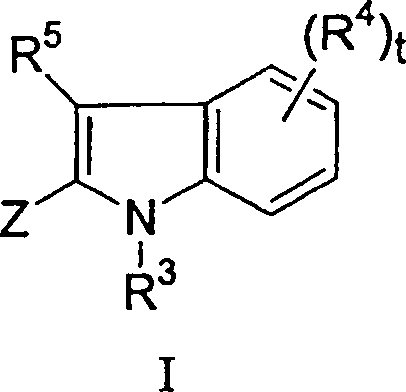
DETAILLIERTE BESCHREIBUNG DER ERFINDUNGDETAILED DESCRIPTION THE INVENTION
Die
Verbindungen dieser Erfindung eignen sich zur Inhibierung von Kinasen
und sind durch eine Verbindung der Formel I: 

b 0
oder 1 ist,
m 0, 1 oder 2 ist,
s 1 oder 2 ist,
t
1, 2 oder 3 ist,
R1 und R5 unabhängig ausgewählt sind
aus:
1) H,
2) (C=O)aObC1-C10 Alkyl,
3)
(C=O)aOb-Aryl,
4)
(C=O)aObC2-C10-Alkenyl,
5)
(C=O)aObC2-C10-Alkinyl,
6)
CO2H,
7) Halogen,
8) OH,
9)
ObC1-C6-Perfluoralkyl,
10)
(C=O)aNR7R8
11) CN,
12) (C=O)aObC3-C8-Cycloalkyl
und
13) (C=O)aOb-Heterocyclyl,
wobei
das Alkyl, Aryl, Alkenyl, Alkinyl, Cycloalkyl und Heterocyclyl gegebenenfalls
substituiert sind mit einem oder mehreren Substituenten, ausgewählt aus
R6,
R2 und
R3 unabhängig
ausgewählt
sind aus:
1) H,
2) (C=O)OaC1-C6-Alkyl,
3)
(C=O)Oa-Aryl
4) C1-C6-Alkyl,
5) SO2Ra und
6) Aryl,
R4 ausgewählt ist
aus:
1) (C=O)aObC1-C10-Alkyl
2)
(C=O)aOb-Aryl,
3)
(C=O)aObC2-C10-Alkenyl,
4)
(C=O)aObC2-C10-Alkinyl,
5)
CO2H,
6) Halogen,
7) OH,
8)
ObC1-C6-Perfluoralkyl,
9)
(C=O)8NR7R8,
10) CN,
11) (C=O)aObC3-C8-Cycloalkyl
und
12) (C=O)aOb-Heterocyclyl,
wobei
das Alkyl, Aryl, Alkenyl, Alkinyl, Cycloalkyl und Heterocyclyl gegebenenfalls
substituiert sind mit einem oder mehreren Substituenten, ausgewählt aus
R6,
R6 ist:
1)
(C=O)aObC1-C10-Alkyl,
2)
(C=O)aOb-Aryl,
3)
C2-C10-Alkenyl,
4)
C2-C10-Alkinyl,
5)
(C=O)aOb-Heterocyclyl,
6)
CO2H,
7) Halogen,
8) CN,
9)
OH,
10) ObC1-C6-Perfluoralkyl,
12) Oxo,
13) CHO,
14)
(N=O)R7R8 oder
15)
(C=O)aObC3-C8-Cycloalkyl,
wobei
das Alkyl, Aryl, Alkenyl, Alkinyl, Heterocyclyl und Cycloalkyl gegebenenfalls
substituiert sind mit einem oder mehreren Substituenten, ausgewählt aus
R6a,
R6a ausgewählt ist
aus:
1) (C=O)rOs(C1-C10)Alkyl, wobei
r und s unabhängig
0 oder 1 sind,
2) Or(C1-C3)Perfluoralkyl, wobei r 0 oder 1 ist,
3)
(C0-C6)Alkylen-S(O)mRa, wobei m 0, 1
oder 2 ist,
4) Oxo,
5) OH,
6) Halogen,
7) CN,
8)
(C2-C10)Alkenyl,
9)
(C2-C10)Alkinyl,
10)
(C3-C6)Cycloalkyl,
11)
(C0-C6)Alkylenaryl,
12)
(C0-C6)Alkylenheterocyclyl,
13)
(C0-C6)Alkylen-N(Rb)2,
14) C(O)Ra,
15) (C0-C6)Alkylen-CO2Ra,
16) C(O)H und
17) (C0-C6)Alkylen-CO2H,
wobei das Alkyl, Alkenyl, Alkinyl,
Cycloalkyl, Aryl und Heterocyclyl gegebenenfalls substituiert sind
mit bis zu drei Substituenten, ausgewählt aus Rb,
OH, (C1-C6)Alkoxy,
Halogen, CO2H, CN, O(C=O)C1-C6 Alkyl, Oxo und N(Rb)2,
R7 und R8 unabhängig
ausgewählt
sind aus:
1) H,
2) (C=O)ObC1-C10-Alkyl,
3)
(C=O)ObC3-C8-Cycloalkyl,
4) (C=O)Ob-Aryl,
5)
(C=O)Ob-Heterocyclyl,
6) C1-C10-Alkyl,
7) Aryl,
8) C2-C10-Alkenyl,
9)
C2-C10-Alkinyl,
10)
Heterocyclyl,
11) C3-C8-Cycloalkyl,
12)
SO2Ra und
13)
(C=O)NRb 2,
wobei
das Alkyl, Cycloalkyl, Aryl, Heterocyclyl, Alkenyl und Alkinyl gegebenenfalls
substituiert sind mit einem oder mehreren Substituenten, ausgewählt aus
R6a,
R7 und
R8 mit dem Stickstoff, an den sie gebunden
sind, zusammengefaßt
sein können,
um einen monocyclischen oder bicyclischen Heterocyclus mit 5–7 Elementen
in jedem Ring und gegebenenfalls mit einem oder zwei zusätzlichen
Heteroatomen, ausgewählt
aus N, O und S, zusätzlich
zum Stickstoff, zu bilden, wobei der monocyclische oder bicyclische
Heterocyclus gegebenenfalls substituiert ist mit einem oder mehreren
Substituenten, ausgewählt
aus R6a,
Ra (C1-C6)Alkyl, (C3-C6)Cycloalkyl,
Aryl oder Heterocyclyl ist und
Rb H,
(C1-C6)Alkyl, Aryl,
Heterocyclyl, (C3-C6)Cycloalkyl,
(C=O)OC1-C6-Alkyl,
(C=O)C1-C6-Alkyl
oder S(O)2Ra ist.The compounds of this invention are useful for inhibiting kinases and are characterized by a compound of Formula I:
b is 0 or 1,
m is 0, 1 or 2,
s is 1 or 2,
t is 1, 2 or 3,
R 1 and R 5 are independently selected from:
1) H,
2) (C = O) a O b C 1 -C 10 alkyl,
3) (C = O) a O b aryl,
4) (C =O) a O b C 2 -C 10 alkenyl,
5) (C =O) a O b C 2 -C 10 alkynyl,
6) CO 2 H,
7) halogen,
8) OH,
9) O b C 1 -C 6 perfluoroalkyl,
10) (C = O) a NR 7 R 8
11) CN,
12) (C = O) a O b C 3 -C 8 cycloalkyl and
13) (C = O) a O b heterocyclyl,
wherein the alkyl, aryl, alkenyl, alkynyl, cycloalkyl and heterocyclyl are optionally substituted by one or more substituents selected from R 6 ,
R 2 and R 3 are independently selected from:
1) H,
2) (C = O) O a C 1 -C 6 -alkyl,
3) (C = O) O a -aryl
4) C 1 -C 6 -alkyl,
5) SO 2 R a and
6) aryl,
R 4 is selected from:
1) (C =O) a O b C 1 -C 10 -alkyl
2) (C = O) a O b aryl,
3) (C =O) a O b C 2 -C 10 alkenyl,
4) (C =O) a O b C 2 -C 10 alkynyl,
5) CO 2 H,
6) halogen,
7) OH,
8) O b C 1 -C 6 perfluoroalkyl,
9) (C = O) 8 NR 7 R 8 ,
10) CN,
11) (C =O) a O b C 3 -C 8 cycloalkyl and
12) (C = O) a O b heterocyclyl,
wherein the alkyl, aryl, alkenyl, alkynyl, cycloalkyl and heterocyclyl are optionally substituted by one or more substituents selected from R 6 ,
R 6 is:
1) (C =O) a O b C 1 -C 10 -alkyl,
2) (C = O) a O b aryl,
3) C 2 -C 10 alkenyl,
4) C 2 -C 10 alkynyl,
5) (C = O) a O b heterocyclyl,
6) CO 2 H,
7) halogen,
8) CN,
9) OH,
10) O b C 1 -C 6 perfluoroalkyl,
12) oxo,
13) CHO,
14) (N = O) R 7 R 8 or
15) (C =O) a O b C 3 -C 8 -cycloalkyl,
wherein the alkyl, aryl, alkenyl, alkynyl, heterocyclyl and cycloalkyl are optionally substituted by one or more substituents selected from R 6a ,
R 6a is selected from:
1) (C = O) r O s (C 1 -C 10 ) alkyl, where r and s are independently 0 or 1,
2) O r (C 1 -C 3 ) perfluoroalkyl, where r is 0 or 1,
3) (C 0 -C 6 ) alkylene-S (O) m R a , where m is 0, 1 or 2,
4) oxo,
5) OH,
6) halogen,
7) CN,
8) (C 2 -C 10 ) alkenyl,
9) (C 2 -C 10 ) alkynyl,
10) (C 3 -C 6 ) cycloalkyl,
11) (C 0 -C 6 ) alkylenearyl,
12) (C 0 -C 6 ) alkylene heterocyclyl,
13) (C 0 -C 6 ) alkylene-N (R b ) 2 ,
14) C (O) R a ,
15) (C 0 -C 6 ) alkylene CO 2 R a ,
16) C (O) H and
17) (C 0 -C 6 ) alkylene-CO 2 H,
wherein said alkyl, alkenyl, alkynyl, cycloalkyl, aryl and heterocyclyl are optionally substituted with up to three substituents selected b from R, OH, (C 1 -C 6) alkoxy, halogen, CO 2 H, CN, O (C = O) C 1 -C 6 alkyl, oxo and N (R b ) 2 ,
R 7 and R 8 are independently selected from:
1) H,
2) (C =O) O b C 1 -C 10 -alkyl,
3) (C =O) O b C 3 -C 8 -cycloalkyl,
4) (C = O) O b aryl,
5) (C = O) O b heterocyclyl,
6) C 1 -C 10 -alkyl,
7) aryl,
8) C 2 -C 10 alkenyl,
9) C 2 -C 10 alkynyl,
10) heterocyclyl,
11) C 3 -C 8 cycloalkyl,
12) SO 2 R a and
13) (C = O) NR b 2 ,
wherein the alkyl, cycloalkyl, aryl, heterocyclyl, alkenyl and alkynyl are optionally substituted by one or more substituents selected from R 6a ,
R 7 and R 8 may be taken together with the nitrogen to which they are attached to form a monocyclic or bicyclic heterocycle having 5-7 elements in each ring and optionally one or two additional heteroatoms selected from N, O and S, in addition to the nitrogen, wherein the monocyclic or bicyclic heterocycle is optionally substituted with one or more substituents selected from R 6a ,
R a is (C 1 -C 6 ) alkyl, (C 3 -C 6 ) cycloalkyl, aryl or heterocyclyl and
R b is H, (C 1 -C 6 ) alkyl, aryl, heterocyclyl, (C 3 -C 6 ) cycloalkyl, (C =O) OC 1 -C 6 -alkyl, (C =O) C 1 -C 6 - Alkyl or S (O) 2 R a .
Eine
weitere Ausführungsform
der vorliegenden Erfindung wird durch eine Verbindung der Formel
I dargestellt, wobei Z wie oben definiert ist und wobei
s 1
ist,
t 1 oder 2 ist,
R7 und R5 unabhängig
ausgewählt
sind aus:
1) H,
2) (C=O)aObC1-C6-Alkyl,
3)
(C=O)aOb-Aryl
4)
(C=O)aObC2-C6-Alkenyl,
5)
(C=O)aObC2C6-Alkinyl,
6)
CO2H,
7) Halogen,
8) OH,
9)
ObC1-C3-Perfluoralkyl,
10)
(C=O)aNR7R8,
11) CN,
12) (C=O)aObC3-C6-Cycloalkyl
und
13) (C=O)aOb-Heterocyclyl,
wobei
das Alkyl, Aryl, Alkenyl, Alkinyl, Cycloalkyl und Heterocyclyl gegebenenfalls
substituiert sind mit einem oder mehreren Substituenten, ausgewählt aus
R6,
R4 ausgewählt ist
aus:
1) (C=O)aObC1-C6-Alkyl,
2)
(C=O)aOb-Aryl,
3)
(C=O)aObC2-C6-Alkenyl,
4)
(C=O)aObC2-C6-Alkinyl,
5)
CO2H,
6) Halogen,
7) OH,
8)
ObC1-C3-Perfluoralkyl,
9)
(C=O)aNR7R8,
10) CN,
11) (C=O)aObC3-C6-Cycloalkyl
und
12) (C=O)aOb-Heterocyclyl,
wobei
das Alkyl, Aryl, Alkenyl, Alkinyl, Cycloalkyl und Heterocyclyl gegebenenfalls
substituiert sind mit einem oder mehreren Substituenten, ausgewählt aus
R6,
R6 ist:
1)
(C=O)aObC1-C6-Alkyl,
2)
(C=O)aOb-Aryl,
3)
C2-C6-Alkenyl,
4)
C2-C6-Alkinyl,
5)
(C=O)aOb-Heterocyclyl,
6)
CO2H,
7) Halogen,
8) CN,
9)
OH,
10) ObC1-C3-Perfluoralkyl,
11) Oa(C=O)bNR7R8,
12)
Oxo,
13) CHO,
14) (N=O)R7R8 oder
15) (C=O)aObC3-C6-Cycloalkyl,
wobei
das Alkyl, Aryl, Alkenyl, Alkinyl, Heterocyclyl und Cycloalkyl gegebenenfalls
substituiert sind mit einem oder mehreren Substituenten, ausgewählt aus
R6a,
R6a ausgewählt ist
aus:
1) (C=O)rOs(C1-C6)Alkyl, wobei
r und s unabhängig
0 oder 1 sind,
2) Or(C1-C3)Perfluoralkyl, wobei r 0 oder 1 ist,
3)
(C0-C6)Alkylen-S(O)mRa, wobei m 0, 1
oder 2 ist,
4) Oxo,
5) OH,
6) Halogen,
7) CN,
8)
(C2-C6)Alkenyl,
9)
(C2-C6)Alkinyl,
10)
(C3-C6)Cycloalkyl,
11)
(C0-C6)Alkylenaryl,
12)
(C0-C6)Alkylenheterocyclyl,
13)
(C0-C6)Alkylen-N(Rb)2,
14) C(O)Ra,
15) (C0-C6)Alkylen-CO2Ra,
16) C(O)H und
17) (C0-C6)Alkylen-CO2H,
wobei das Alkyl, Alkenyl, Alkinyl,
Cycloalkyl, Aryl und Heterocyclyl gegebenenfalls substituiert sind mit
bis zu drei Substituenten, ausgewählt aus Rb,
OH, (C1-C6)Alkoxy,
Halogen, CO2H, CN, O(C=O)C1-C6-Alkyl, Oxo und N(Rb)2, und
R7 und
R8 unabhängig
ausgewählt
sind aus:
1) H,
2) (C=O)ObC1-C6-Alkyl,
3)
(C=O)ObC3-C6-Cycloalkyl,
4) (C=O)Ob-Aryl,
5)
(C=O)Ob-Heterocyclyl,
6) C1-C6-Alkyl,
7) Aryl,
8) C2-C6-Alkenyl,
9) C2-C6-Alkinyl,
10) Heterocyclyl,
11)
C3-C8-Cycloalkyl,
12)
SO2Ra und
13)
(C=O)NRb 2,
wobei
das Alkyl, Cycloalkyl, Aryl, Heterocyclyl, Alkenyl und Alkinyl gegebenenfalls
substituiert sind mit einem oder mehreren Substituenten, ausgewählt aus
R6a, oder
R7 und
R8 mit dem Stickstoff, an den sie gebunden
sind, zusammengefaßt
sein können,
um einen monocyclischen oder bicyclischen Heterocyclus mit 5–7 Elementen
in jedem Ring und gegebenenfalls mit einem oder zwei zusätzlichen
Heteroatomen, ausgewählt
aus N, O und S, zusätzlich
zum Stickstoff, zu bilden, wobei der monocyclische oder bicyclische
Heterocyclus gegebenenfalls substituiert ist mit einem oder mehreren
Substituenten, ausgewählt
aus R6a.Another embodiment of the present invention is represented by a compound of formula I wherein Z is as defined above and wherein
s is 1,
t is 1 or 2,
R 7 and R 5 are independently selected from:
1) H,
2) (C =O) a O b C 1 -C 6 -alkyl,
3) (C = O) a O b -aryl
4) (C =O) a O b C 2 -C 6 alkenyl,
5) (C =O) a O b C 2 C 6 alkynyl,
6) CO 2 H,
7) halogen,
8) OH,
9) O b C 1 -C 3 perfluoroalkyl,
10) (C = O) a NR 7 R 8 ,
11) CN,
12) (C = O) a O b C 3 -C 6 cycloalkyl and
13) (C = O) a O b heterocyclyl,
wherein the alkyl, aryl, alkenyl, alkynyl, cycloalkyl and heterocyclyl are optionally substituted by one or more substituents selected from R 6 ,
R 4 is selected from:
1) (C =O) a O b C 1 -C 6 -alkyl,
2) (C = O) a O b aryl,
3) (C =O) a O b C 2 -C 6 alkenyl,
4) (C =O) a O b C 2 -C 6 alkynyl,
5) CO 2 H,
6) halogen,
7) OH,
8) O b C 1 -C 3 perfluoroalkyl,
9) (C = O) a NR 7 R 8 ,
10) CN,
11) (C =O) a O b C 3 -C 6 cycloalkyl and
12) (C = O) a O b heterocyclyl,
wherein the alkyl, aryl, alkenyl, alkynyl, cycloalkyl and heterocyclyl are optionally substituted by one or more substituents selected from R 6 ,
R 6 is:
1) (C =O) a O b C 1 -C 6 -alkyl,
2) (C = O) a O b aryl,
3) C 2 -C 6 alkenyl,
4) C 2 -C 6 alkynyl,
5) (C = O) a O b heterocyclyl,
6) CO 2 H,
7) halogen,
8) CN,
9) OH,
10) O b C 1 -C 3 perfluoroalkyl,
11) O a (C = O) b NR 7 R 8 ,
12) oxo,
13) CHO,
14) (N = O) R 7 R 8 or
15) (C =O) a O b C 3 -C 6 -cycloalkyl,
wherein the alkyl, aryl, alkenyl, alkynyl, heterocyclyl and cycloalkyl are optionally substituted by one or more substituents selected from R 6a ,
R 6a is selected from:
1) (C = O) r O s (C 1 -C 6 ) alkyl, where r and s are independently 0 or 1,
2) O r (C 1 -C 3 ) perfluoroalkyl, where r is 0 or 1,
3) (C 0 -C 6 ) alkylene-S (O) m R a , where m is 0, 1 or 2,
4) oxo,
5) OH,
6) halogen,
7) CN,
8) (C 2 -C 6 ) alkenyl,
9) (C 2 -C 6 ) alkynyl,
10) (C 3 -C 6 ) cycloalkyl,
11) (C 0 -C 6 ) alkylenearyl,
12) (C 0 -C 6 ) alkylene heterocyclyl,
13) (C 0 -C 6 ) alkylene-N (R b ) 2 ,
14) C (O) R a ,
15) (C 0 -C 6 ) alkylene CO 2 R a ,
16) C (O) H and
17) (C 0 -C 6 ) alkylene-CO 2 H,
wherein said alkyl, alkenyl, alkynyl, cycloalkyl, aryl and heterocyclyl are optionally substituted with up to three substituents selected b from R, OH, (C 1 -C 6) alkoxy, halogen, CO 2 H, CN, O (C = O) C 1 -C 6 alkyl, oxo and N (R b ) 2 , and
R 7 and R 8 are independently selected from:
1) H,
2) (C =O) O b C 1 -C 6 -alkyl,
3) (C =O) O b C 3 -C 6 -cycloalkyl,
4) (C = O) O b aryl,
5) (C = O) O b heterocyclyl,
6) C 1 -C 6 -alkyl,
7) aryl,
8) C 2 -C 6 alkenyl,
9) C 2 -C 6 -alkynyl,
10) heterocyclyl,
11) C 3 -C 8 cycloalkyl,
12) SO 2 R a and
13) (C = O) NR b 2 ,
wherein the alkyl, cycloalkyl, aryl, heterocyclyl, alkenyl and alkynyl are optionally substituted with one or more substituents selected from R 6a , or
R 7 and R 8 may be taken together with the nitrogen to which they are attached to form a monocyclic or bicyclic heterocycle having 5-7 elements in each ring and optionally one or two additional heteroatoms selected from N, O and S, in addition to the nitrogen, wherein the monocyclic or bicyclic heterocycle is optionally substituted with one or more substituents selected from R 6a .
Eine weitere Ausführungsform ist die unmittelbar zuvor beschriebene Verbindung, bei der R2, R3 und R5 ferner als H definiert sind.Another embodiment is the compound described immediately above, wherein R 2 , R 3 and R 5 are further defined as H.
Und noch eine weitere Ausführungsform ist die, bei der t weiter definiert ist als 1, s 1 ist und R1 H ist.And yet another embodiment is that wherein t is defined further than 1, s is 1 and R 1 is H.
Ebenfalls
von der vorliegenden Erfindung umfaßt ist die Verbindung der Formel
I, wie sie ferner unmittelbar zuvor definiert wurde und bei der
R4 ausgewählt ist aus:
1) OC1-C6-AlkylenNR7R8,
2) (C=O)aC0-C6-Alkylen-Q,
wobei Q H, OH, CO2H oder OC1-C6 Alkyl ist,
3) OC0-C6-Alkylenheterocyclyl, gegebenenfalls substituiert
mit ein bis drei Substituenten, ausgewählt aus R6a,
4)
C0-C6-Alkylen-NR7R8,
5) (C=O)NR7R8 und
6) OC1-C3-Alkylen(C=O)NR7R8.Also included within the scope of the present invention is the compound of formula I as further defined hereinbefore and wherein R 4 is selected from:
1) OC 1 -C 6 -alkylene NR 7 R 8 ,
2) (C = O) a C 0 -C 6 -alkylene-Q, where Q is H, OH, CO 2 H or OC 1 -C 6 alkyl,
3) OC 0 -C 6 -alkylene heterocyclyl, optionally substituted by one to three substituents selected from R 6a ,
4) C 0 -C 6 -alkylene NR 7 R 8 ,
5) (C = O) NR 7 R 8 and
6) OC 1 -C 3 -alkylene (C = O) NR 7 R 8 .
Eine
bevorzugte Ausführungsform
ist eine Verbindung, ausgewählt
aus
3-{5-[3-(4-Methylpiperazin-1-yl)propoxy]-1H-indol-2-yl}-1H-chinolin-2-on,
3-(5-{2-[(2-Methoxyethyl)amino]ethoxy}-1H-indol-2-yl)-2(1H)-chinolinon,
3-[5-(2-{(Methoxyethyl)[(2-methoxy-5-pyrimidinyl)methyl]amino}ethoxy)-1H-indol-2-yl]-2(1H)- chinolinon,
3-(5-{[(2S,4R)-4-Methoxypyrrolidinyl]methoxy}-1H-indol-2-yl)-2(1H)-chinolinon,
3-[5-({(2S,4R)-4-Methoxy-1-[(2-methyl-5-pyrimidinyl)methyl]pyrrolidinyl}methoxy)-1H-indol-2-yl]-2(1H)-chinolinon,
1-(2-{[2-(2-Oxo-1,2-dihydro-3-chinolinyl)-1H-indol-5-yl]oxy}ethyl)-4-piperidincarbonsäureethylester,
1-(2-{[2-(2-Oxo-1,2-dihydro-3-chinolinyl)-1H-indol-5-yl]oxy}ethyl)-4-piperidincarbonsäure,
3-[(2S,4R)-4-Methoxy-2-({[2-(2-oxo-1,2-dihydro-3-chinolinyl)-1H-indol-5-yl]oxy}methyl)pyrrolidinyl]propansäure,
3-[5-(4-Methansulfonylpiperazin-1-ylmethyl)-1H-indol-2-yl]-1H-chinolin-2-on,
3-[5-(4-Methansulfonyl-1-oxypiperazin-1-ylmethyl)-1H-indol-2-yl]-1H-chinolin-2-on,
3-[5-(4-Acetylpiperazin-1-ylmethyl)-1H-indol-2-yl]-1H-chinolin-2-on,
N-Cyclopropyl-N-[2-(2-oxo-1,2-dihydrochinolin-3-yl)-1H-indol-5-ylmethyl]methansulfonamid,
3-[5-(1-Piperazinylcarbonyl)-1H-indol-2-yl]-2(1H)-chinolinon,
3-{5-[(4-Methyl-1-piperazinyl)carbonyl]-1H-indol-2-yl}-2(1H)-chinolinon,
1-{[2-(2-Oxo-1,2-dihydro-3-chinolinyl)-1H-indol-5-yl]carbonyl}-4-piperidinaminiumtrifluoracetat,
1-({[2-(2-Oxo-1,2-dihydro-3-chinolinyl)-1H-indol-5-yl]oxy}acetyl)piperazin-4-iumtrifluoracetat,
3-{5-[2-(1,1-Dioxido-4-thiomorpholinyl)-2-oxoethoxy]-1H-indol-2-yl}-2(1H)-chinolinon,
N-{[2-(2-Oxo-1,2-dihydro-3-chinolinyl)-1H-indol-5-yl]methyl}-4-piperidincarboxamid,
3-{5-[1-(4-Morpholinyl)ethyl]-1H-indol-2-yl}-2(1H)-chinolinon,
3-{5-[1-(1-Pyrrolidinyl)ethyl]-1H-indol-2-yl}-2(1H)-chinolinon,
3-{5-[1-(4-Acetyl-1-piperazinyl)ethyl]-1H-indol-2-yl}-2(1H)-chinolinon,
3-(5-{1-[4-(Methylsulfonyl)-1-piperazinyl]ethyl}-1H-indol-2-yl)-2(1H)-chinolinon,
4-Amino-N-[2-(2-oxo-1,2-dihydro-3-chinolinyl)-1H-indol-5-yl]-1-piperidincarboxamid
und
4-Amino-N-{[2-(2-oxo-1,2-dihydro-3-chinolinyl)-1H-indol-5-yl]methyl}-1-piperidincarboxamid,
oder ein pharmazeutisch annehmbares Salz oder Stereoisomer davon.A preferred embodiment is a compound selected from
3- {5- [3- (4-methylpiperazin-1-yl) propoxy] -1H-indol-2-yl} -1H-quinolin-2-one,
3- (5- {2 - [(2-methoxyethyl) amino] ethoxy} -1H-indol-2-yl) -2 (1H) -quinolinone,
3- [5- (2 - {(methoxyethyl) [(2-methoxy-5-pyrimidinyl) methyl] amino} ethoxy) -1H-indol-2-yl] -2 (1H) -quinolinone,
3- (5 - {[(2S, 4R) -4-Methoxypyrrolidinyl] methoxy} -1H-indol-2-yl) -2 (1H) -quinolinone,
3- [5- - ({(2S, 4R) -4-methoxy-1 - [(2-methyl-5-pyrimidinyl) methyl] pyrrolidinyl} methoxy) -1H-indol-2-yl] -2 (1H) - -quinolinone
1- (2 - {[2- (2-oxo-1,2-dihydro-3-quinolinyl) -1H-indol-5-yl] oxy} ethyl) -4-piperidinecarboxylate;
1- (2 - {[2- (2-oxo-1,2-dihydro-3-quinolinyl) -1H-indol-5-yl] oxy} ethyl) -4-piperidinecarboxylic acid,
3 - [(2S, 4R) -4-methoxy-2 - ({[2- (2-oxo-1,2-dihydro-3-quinolinyl) -1H-indol-5-yl] oxy} methyl) pyrrolidinyl] propanoic acid,
3- [5- (4-methanesulfonyl-piperazin-1-ylmethyl) -1H-indol-2-yl] -1H-quinolin-2-one,
3- [5- (4-Methanesulfonyl-1-oxypiperazin-1-ylmethyl) -1H-indol-2-yl] -1H-quinolin-2-one,
3- [5- (4-Acetyl-piperazin-1-ylmethyl) -1H-indol-2-yl] -1H-quinolin-2-one,
N-cyclopropyl-N- [2- (2-oxo-1,2-dihydroquinoline-3-yl) -1H-indol-5-ylmethyl] methanesulfonamide,
3- [5- (1-piperazinylcarbonyl) -1H-indol-2-yl] -2 (1H) -quinolinone,
3- {5 - [(4-methyl-1-piperazinyl) carbonyl] -1H-indol-2-yl} -2 (1H) -quinolinone,
1 - {[2- (2-oxo-1,2-dihydro-3-quinolinyl) -1H-indol-5-yl] carbonyl} -4-piperidinaminiumtrifluoracetat,
1 - ({[2- (2-oxo-1,2-dihydro-3-quinolinyl) -1H-indol-5-yl] oxy} acetyl) piperazin-4-iumtrifluoracetat,
3- {5- [2- (1,1-dioxido-4-thiomorpholinyl) -2-oxoethoxy] -1H-indol-2-yl} -2 (1H) -quinolinone,
N - {[2- (2-oxo-1,2-dihydro-3-quinolinyl) -1H-indol-5-yl] methyl} -4-piperidinecarboxamide,
3- {5- [1- (4-morpholinyl) ethyl] -1H-indol-2-yl} -2 (1H) -quinolinone,
3- {5- [1- (1-pyrrolidinyl) ethyl] -1H-indol-2-yl} -2 (1H) -quinolinone,
3- {5- [1- (4-acetyl-1-piperazinyl) ethyl] -1H-indol-2-yl} -2 (1H) -quinolinone,
3- (5- {1- [4- (methylsulfonyl) -1-piperazinyl] ethyl} -1H-indol-2-yl) -2 (1H) -quinolinone,
4-amino-N- [2- (2-oxo-1,2-dihydro-3-quinolinyl) -1H-indol-5-yl] -1-piperidinecarboxamide and
4-amino-N - {[2- (2-oxo-1,2-dihydro-3-quinolinyl) -1H-indol-5-yl] methyl} -1-piperidinecarboxamide, or a pharmaceutically acceptable salt or stereoisomer thereof.
Ebenfalls vom Umfang der vorliegenden Erfindung umfaßt ist eine pharmazeutische Zusammensetzung, die eine Verbindung der Formel I, wie sie oben beschrieben ist, und einen pharmazeutisch annehmbaren Träger enthält. Die vorliegende Erfindung umfaßt auch ein Verfahren zur Behandlung oder Prävention von Krebs bei einem Säugetier, das eine solche Behandlung benötigt, umfassend die Verabreichung einer therapeutisch wirksamen Menge einer Verbindung der Formel I an das Säugetier. Bevorzugte Karzinome zur Behandlung sind ausgewählt aus Karzinomen des Gehirns, der Harn- und Geschlechtsorgane, des Lymphsystems, des Magens, des Kehlkopfes und der Lunge. Eine weitere Gruppe von bevorzugten Krebsformen sind histiozytäres Lymphom, Lungenadenokarzinom, kleinzellige Lungenkrebse, Bauchspeicheldrüsenkrebs, Gioblastome und Brustkarzinom.Also Included within the scope of the present invention is a pharmaceutical Composition comprising a compound of formula I, as described above and containing a pharmaceutically acceptable carrier. The present invention also a method of treating or preventing cancer in one Mammal, that needs such treatment comprising the administration of a therapeutically effective amount a compound of formula I to the mammal. Preferred carcinomas for treatment are selected from carcinomas of the brain, urinary and genital organs, of the Lymphatic system, stomach, larynx and lungs. Another Group of preferred forms of cancer are histiocytic lymphoma, Lung adenocarcinoma, small cell lung cancers, pancreatic cancer, Gioblastomas and breast carcinoma.
Ebenfalls umfaßt ist ein Verfahren zur Behandlung oder Prävention von Erkrankungen, bei denen Angiogenese impliziert ist, umfassend die Verabreichung einer therapeutisch wirksamen Menge einer Verbindung der Formel I an ein Säugetier, das eine solche Behandlung benötigt. Eine solche Erkrankung, bei der Angiogenese impliziert ist, sind Augenerkrankungen, wie z.B. Netzhautvaskularisierung, diabetische Retinopathie, altersbezogene Makuladegeneration und dergleichen.Also comprises is a method of treatment or prevention of disease, in which involves angiogenesis, comprising the administration of a therapeutically effective amount of a compound of formula I to a Mammal, that needs such a treatment. One such condition in which angiogenesis is implicated is Eye diseases, such as Retinal vascularization, diabetic Retinopathy, age-related macular degeneration and the like.
Ebenfalls vom Umgang der vorliegenden Erfindung umfaßt ist ein Verfahren zur Behandlung oder Prävention von Entzündungserkrankungen, das die Verabreichung einer therapeutisch wirksamen Menge einer Verbindung der Formel 1 an ein Säugetier, das eine solche Behandlung benötigt, umfaßt. Beispiele für solche Entzündungserkrankungen sind rheumatoide Arthritis, Psoriasis, Kontaktdermatitis, verzögerte Überempfindlichkeitsreaktionen und dergleichen.Also Included in the practice of the present invention is a method of treatment or prevention of inflammatory diseases, the administration of a therapeutically effective amount of a compound of Formula 1 to a mammal, that needs such treatment includes. examples for such inflammatory diseases are rheumatoid arthritis, psoriasis, contact dermatitis, delayed hypersensitivity reactions and the same.
Ebenfalls umfaßt ist ein Verfahren zur Behandlung oder Prävention einer tyrosinkinase-abhängigen Erkrankung oder eines tyrosinkinase-abhängigen Zustandes bei einem Säugetier, umfassend die Verabreichung einer therapeutisch wirksamen Menge einer Verbindung der Formel I an ein Säugetier, das eine solche Behandlung benötigt. Die therapeutische Menge variiert gemäß der spezifischen Erkrankung und ist dem erfahrenen Wissenschaftler ohne übermäßiges Experimentieren bekannt.Also included is a method of treating or preventing a tyrosine kinase-dependent disease or a tyrosine kinase-dependent condition in a mammal comprising said administration tion of a therapeutically effective amount of a compound of formula I to a mammal in need of such treatment. The therapeutic amount will vary according to the specific disease and is known to the skilled scientist without undue experimentation.
Ein Verfahren zur Behandlung oder Prävention von Netzhautvaskularisierung, das die Verabreichung einer therapeutisch wirksamen Menge einer Verbindung der Formel 1 an ein Säugetier, das eine solche Behandlung benötigt, ist ebenfalls von der vorliegenden Erfindung umfaßt. Verfahren zur Behandlung oder Prävention von Augenerkrankungen, wie z.B. diabetischer Retinopathie und altersbezogener Makuladegeneration, sind ebenfalls Teil der Erfindung. Ebenfalls vom Umfang der vorliegenden Erfindung umfaßt ist ein Verfahren zur Behandlung oder Prävention von Entzündungserkrankungen, wie z.B. rheumatoider Arthritis, Psoriasis, Kontaktdermatitis und verzögerten Überempfindlichkeitsreaktionen, sowie zur Behandlung oder Prävention von mit den Knochen verbundenen Pathologien, ausgewählt aus Osteosarkom, Osteoarthritis und Rachitis.One Method of treatment or prevention of retinal vascularization, which is the administration of a therapeutic effective amount of a compound of formula 1 to a mammal, that needs such treatment is also included in the present invention. method for treatment or prevention of eye diseases, e.g. diabetic retinopathy and age-related Macular degeneration are also part of the invention. Also Included within the scope of the present invention is a method of treatment or prevention of inflammatory diseases, such as. rheumatoid arthritis, psoriasis, contact dermatitis and delayed hypersensitivity reactions, as well as for the treatment or prevention of bone-related pathologies selected from osteosarcoma, osteoarthritis and rickets.
Die Erfindung umfaßt auch die Verwendung der augenblicklich beanspruchten Verbindungen in Kombination mit einer zweiten Verbindung, ausgewählt aus:
- 1) einem Östrogenrezeptormodulator,
- 2) einem Androgenrezeptormodulator,
- 3) einem Retinoidrezeptormodulator,
- 4) einem zytotoxischen Mittel,
- 5) einem antiproliferativen Mittel,
- 6) einem Prenylproteintransferaseinhibitor,
- 7) einem HMG-CoA-Reduktaseinhibitor,
- 8) einem HIV-Proteaseinhibitor,
- 9) einem Reversetranskriptaseinhibitor und
- 10) einem weiteren Angiogeneseinhibitor.
- 1) an estrogen receptor modulator,
- 2) an androgen receptor modulator,
- 3) a retinoid receptor modulator,
- 4) a cytotoxic agent,
- 5) an antiproliferative agent,
- 6) a prenyl protein transferase inhibitor,
- 7) an HMG-CoA reductase inhibitor,
- 8) an HIV protease inhibitor,
- 9) a reverse transcriptase inhibitor and
- 10) another angiogenesis inhibitor.
Bevorzugte Angiogeneseinhibitoren sind ausgewählt aus der Gruppe, bestehend aus einem Tyrosinkinaseinhibitor, einem Inhibitor des epidermalen Wachstumsfaktors, einem Inhibitor des Fibroblasten-Wachstumsfaktors, einem Inhibitor des Thrombozyten-Wachstumsfaktors, einem MMP(Matrixmetalloprotease)-Inhibitor, einem Integrin-Blocker, Interferon-α, Interleukin-12, Pentosanpolysulfat, einem Cyclooxygenaseinhibitor, Carboxyamidotriazol, Combretastatin A-4, Squalamin, 6-O-Chloracetylcarbonyl)fumagillol, Thalidomid, Angiostatin, Troponin-1 und einem VEGF-Antikörper. Bevorzugte Östrogenrezeptormodulatoren sind Tamoxifen und Raloxifen.preferred Angiogenesis inhibitors are selected from the group consisting from a tyrosine kinase inhibitor, an epidermal inhibitor Growth factor, an inhibitor of fibroblast growth factor, an inhibitor of platelet growth factor, an MMP (matrix metalloprotease) inhibitor, an integrin blocker, interferon-α, interleukin-12, pentosan polysulphate, a cyclooxygenase inhibitor, carboxyamidotriazole, combretastatin A-4, squalamine, 6-O-chloroacetylcarbonyl) fumagillol, thalidomide, Angiostatin, troponin-1 and a VEGF antibody. Preferred estrogen receptor modulators are tamoxifen and raloxifen.
Ebenfalls vom Umfang der Ansprüche umfaßt ist ein Verfahren zur Behandlung von Krebs, das die Verabreichung einer therapeutisch wirksamen Menge einer Verbindung der Formel 1 in Kombination mit einer Strahlungstherapie und/oder in Kombination mit einer Verbindung, ausgewählt aus:
- 1) einem Östrogenrezeptormodulator,
- 2) einem Androgenrezeptormodulator,
- 3) einem Retinoidrezeptormodulator,
- 4) einem zytotoxischen Mittel,
- 5) einem antiproliferativen Mittel,
- 6) einem Prenylproteintransferaseinhibitor,
- 7) einem HMG-CoA-Reduktaseinhibitor,
- 8) einem HIV-Proteaseinhibitor,
- 9) einem Reversetranskriptaseinhibitor und
- 10) einem weiteren Angiogeneseinhibitor, umfaßt.
- 1) an estrogen receptor modulator,
- 2) an androgen receptor modulator,
- 3) a retinoid receptor modulator,
- 4) a cytotoxic agent,
- 5) an antiproliferative agent,
- 6) a prenyl protein transferase inhibitor,
- 7) an HMG-CoA reductase inhibitor,
- 8) an HIV protease inhibitor,
- 9) a reverse transcriptase inhibitor and
- 10) another angiogenesis inhibitor.
Und noch eine weitere Ausführungsform der Erfindung ist ein Verfahren zur Behandlung von Krebs, das die Verabreichung einer therapeutisch wirksamen Menge einer Verbindung der Formel 1 in Kombination mit Paclitaxel oder Trastuzumab umfaßt.And yet another embodiment The invention relates to a method for the treatment of cancer that the Administration of a therapeutically effective amount of a compound Formula 1 in combination with paclitaxel or trastuzumab.
Ebenfalls vom Umfang der Erfindung umfaßt ist ein Verfahren zur Verringerung oder Prävention einer Gewebeschädigung nach einem zerebralen ischämischen Ereignis, das die Verabreichung einer therapeutisch wirksamen Menge einer Verbindung der Formel I umfaßt.Also from the scope of the invention is a method of reducing or preventing tissue damage a cerebral ischemic Event involving the administration of a therapeutically effective amount a compound of the formula I.
Diese und andere Aspekte der Erfindung werden aus den hierin enthaltenen Lehren offensichtlich werden.These and other aspects of the invention will be apparent from those contained herein Teachings become obvious.
"Tyrosinkinase-abhängige Erkrankungen oder Zustände" bedeutet die pathologischen Zustände, die von der Wirkung von einer oder mehrerer Tyrosinkinasen abhängen. Tyrosinkinasen beteiligen sich entweder direkt oder indirekt an den Signaltransduktionswegen bei einer Reihe von Zellaktivitäten, einschließlich der Proliferation, Adhäsion und Migration und der Differentiation. Mit Tyrosinkinasewirkungen verbundene Erkrankungen sind u.a. die Proliferation von Tumorzellen, die pathologische Neovaskularisierung, welche das Wachstum von festem Tumor fördert, die okulare Neovaskularisierung (diabetische Retinopathie, altersbezogene Makuladegeneration und dergleichen) und Entzündung (Psoriasis, rheumatoide Arthritis und dergleichen)."Tyrosine kinase-dependent diseases or conditions" means the pathological conditions that depend on the action of one or more tyrosine kinases. Tyrosine kinases participate, either directly or indirectly, in the signal transduction pathways in a variety of cellular activities, including proliferation, adhesion and migration, and differentiation. Diseases associated with tyrosine kinase effects include proliferation of tumor cells, pathological neovascularization that promotes solid tumor growth, ocular neovascularization (diabetic retinopathy, age-related macular degeneration, and the like), and inflammation (psoriasis, rheumatoid arthritis, and the like).
Die Verbindungen der vorliegenden Erfindung können asymmetrische Zentren, chirale Achsen und chirale Ebenen besitzen (wie beschrieben in: E. L. Eliel und S. H. Wilen, Stereochemistry of Carbon Compounds, John Wiley & Sons, New York, 1994, Seiten 1119–1190) und als Racemate, racemische Mischungen und als einzelne Diastereomere auftreten, wobei alle möglichen Isomere und Mischungen davon, einschließlich optischer Isomere, von der vorliegenden Erfindung umfaßt sind. Darüber hinaus können die hierin offenbarten Verbindungen als Tautomere existieren, und beide tautomeren Formen sollen vom Umfang der Erfindung umfaßt sein, selbst wenn nur eine tautomere Struktur gezeigt ist. Zum Beispiel soll jeder die nachstehende Verbindung A betreffende Anspruch die tautomere Struktur B sowie Mischungen davon umfassen und umgekehrt.The Compounds of the present invention may be asymmetric centers, have chiral axes and chiral planes (as described in: E.L. Eliel and S.H. Wilen, Stereochemistry of Carbon Compounds, John Wiley & Sons, New York, 1994, pages 1119-1190) and as racemates, racemic mixtures and as individual diastereomers occur, with all possible Isomers and mixtures thereof, including optical isomers, of of the present invention are. About that can out the compounds disclosed herein exist as tautomers, and both tautomeric forms are intended to be within the scope of the invention, even if only a tautomeric structure is shown. For example Anyone claiming the following compound A should: tautomeric structure B and mixtures thereof and vice versa.

Wenn irgendeine Variable (z.B. R4, R6, R6a usw.) mehr als einmal in irgendeinem Bestandteil auftritt, ist ihre Definition bei jedem Auftreten unabhängig von jedem weiteren Auftreten. Ebenso sind Kombinationen von Substituenten und Variablen nur zulässig, wenn solche Kombinationen zu stabilen Verbindungen führen. Von den Substituenten in die Ringsysteme gezogene Linien zeigen an, daß die angegebene Bindung an irgendeines der substituierbaren Ringatome geknüpft sein kann. Wenn das Ringsystem polycyclisch ist, soll die Bindung nur an irgendeines der geeigneten Kohlenstoffatome am nächstliegenden Ring geknüpft sein.If any variable (eg, R 4 , R 6 , R 6a , etc.) occurs more than once in any constituent, its definition at each occurrence is independent of any further occurrences. Likewise, combinations of substituents and variables are permissible only if such combinations result in stable compounds. Lines drawn from the substituents in the ring systems indicate that the indicated bond may be attached to any of the substitutable ring atoms. When the ring system is polycyclic, the bond should only be attached to any of the appropriate carbon atoms on the nearest ring.
Es ist zu verstehen, daß Substituenten und Substitutionsmuster an den Verbindungen der vorliegenden Erfindung von einem Durchschnittsfachmann ausgewählt werden können, um Verbindungen zu ergeben, die chemisch stabil sind und die leicht durch im Stand der Technik bekannte Verfahren sowie durch die nachstehend beschriebenen Verfahren aus leicht erhältlichen Ausgangsmaterialien synthetisiert werden können. Wenn ein Substituent seinerseits mit mehr als einer Gruppe substituiert ist, ist es zu verstehen, daß sich diese mehreren Gruppen am selben Kohlenstoffatom oder an verschiedenen Kohlenstoffatomen befinden können, solange sich daraus eine stabile Struktur ergibt. Der Ausdruck "gegebenenfalls substituiert mit ein oder mehreren Substituenten" soll das gleiche bedeuten wie "gegebenenfalls substituiert mit wenigstens einem Substituenten", und in solchen Fällen wird die bevorzugte Ausführungsform null bis drei Substituenten besitzen.It is to be understood that substituents and substitution patterns on the compounds of the present invention can be selected by a person of ordinary skill in the art To give compounds that are chemically stable and easy by methods known in the art and by the following described methods from readily available starting materials can be synthesized. If a substituent in turn substituted with more than one group is, it is understood that itself these multiple groups on the same carbon atom or on different Carbon atoms can be located, as long as This results in a stable structure. The term "optionally substituted with one or more substituents "is intended to mean the same as" optionally substituted with at least one substituent ", and in such cases becomes the preferred embodiment have zero to three substituents.
So wie hier verwendet, soll "Alkyl" sowohl verzweigte als auch geradkettige gesättigte aliphatische Kohlenwasserstoffgruppen mit der angegebenen Zahl von Kohlenstoffatomen umfassen. Zum Beispiel ist C1-C10, wie in "C1-C10-Alkyl", so definiert, daß es Gruppen mit 1, 2, 3, 4, 5, 6, 7, 8, 9 oder 10 Kohlenstoffen in einer linearen oder verzweigten Anordnung umfaßt. Zum Beispiel umfaßt "C1-C10-Alkyl" speziell Methyl, Ethyl, n-Propyl, i-Propyl, n-Butyl, t-Butyl, i-Butyl, Pentyl, Hexyl, Heptyl, Octyl, Nonyl, Decyl usw. Die Bezeichnung "Cycloalkyl" bedeutet eine monocyclische gesättigte aliphatische Kohlenwasserstoffgruppe mit der angegebenen Zahl von Kohlenstoffatomen. Zum Beispiel umfaßt "Cycloalkyl" Cyclopropyl, Methylcyclopropyl, 2,2-Dimethylcyclobutyl, 2-Ethylcyclopentyl, Cyclohexyl usw.As used herein, "alkyl" is intended to include both branched and straight chain saturated aliphatic hydrocarbon groups having the indicated number of carbon atoms. For example, C 1 -C 10 , as in "C 1 -C 10 alkyl", is defined to include groups of 1, 2, 3, 4, 5, 6, 7, 8, 9 or 10 carbons in one includes linear or branched arrangement. For example, "C 1 -C 10 alkyl" specifically includes methyl, ethyl, n -propyl, i -propyl, n -butyl, t -butyl, i -butyl, pentyl, hexyl, heptyl, octyl, nonyl, decyl, etc. The term "cycloalkyl" means a monocyclic saturated aliphatic hydrocarbon group having the indicated number of carbon atoms. For example, "cycloalkyl" includes cyclopropyl, methylcyclopropyl, 2,2-dimethylcyclobutyl, 2-ethylcyclopentyl, cyclohexyl, etc.
"Alkoxy" bedeutet entweder eine cyclische oder nichtcyclische Alkylgruppe mit der angegebenen Zahl von Kohlenstoffatomen, verknüpft durch eine Sauerstoffbrücke. "Alkoxy" umfaßt daher die Definitionen der obigen Begriffe Alkyl und Cycloalkyl."Alkoxy" means either a cyclic or noncyclic alkyl group with the indicated Number of carbon atoms linked by an oxygen bridge. Therefore, "alkoxy" includes the definitions of the above terms alkyl and cycloalkyl.
Wenn keine Zahl für die Kohlenstoffatome angegeben ist, bedeutet der Ausdruck "Alkenyl" einen nichtaromatischen geraden, verzweigten oder cyclischen Kohlenwasserstoffrest, der 2 bis 10 Kohlenstoffatome und wenigstens eine Kohlenstoff-Kohlenstoff-Doppelbindung enthält. Vorzugsweise liegt eine Kohlenstoff-Kohlenstoff-Doppelbindung vor, und bis zu vier nichtaromatische Kohlenstoff-Kohlenstoff-Doppelbindungen können vorliegen. Daher bedeutet "C2-C6-Alkenyl" einen Alkenylrest mit 2 bis 6 Kohlenstoffatomen. Alkenylgruppen sind u.a. Ethenyl, Propenyl, Butenyl, 2-Methylbutenyl und Cyclohexenyl. Der gerade, verzweigte oder cyclische Teil der Alkenylgruppe kann Doppelbindungen enthalten und kann substituiert sein, wenn eine substituierte Alkenylgruppe angegeben ist.When no number is given for the carbon atoms, the term "alkenyl" means a non-aromatic straight, branched or cyclic hydrocarbon radical containing from 2 to 10 carbon atoms and at least one carbon-carbon double bond. Preferably, there is a coal carbon-carbon double bond, and up to four non-aromatic carbon-carbon double bonds may be present. Therefore, "C 2 -C 6 alkenyl" means an alkenyl group having 2 to 6 carbon atoms. Alkenyl groups include ethenyl, propenyl, butenyl, 2-methylbutenyl and cyclohexenyl. The straight, branched or cyclic portion of the alkenyl group may contain double bonds and may be substituted when a substituted alkenyl group is indicated.
Die Bezeichnung "Alkinyl" bedeutet einen geraden, verzweigten oder cyclischen Kohlenwasserstoffrest mit 2 bis 10 Kohlenstoffatomen und wenigstens einer Kohlenstoff-Kohlenstoff-Dreifachbindung. Bis zu drei Kohlenstoff-Kohlenstoff-Dreifachbindungen können vorliegen. Daher bedeutet "C2-C6-Alkinyl" einen Alkinylrest mit 2 bis 6 Kohlenstoffatomen. Alkinylgruppen sind u.a. Ethinyl, Propinyl, Butinyl, 3-Methylbutinyl usw. Der gerade, verzweigte oder cyclische Teil der Alkinylgruppe kann Dreifachbindungen enthalten und kann substituiert sein, wenn eine substituierte Alkinylgruppe angegeben ist.The term "alkynyl" means a straight, branched or cyclic hydrocarbon radical having 2 to 10 carbon atoms and at least one carbon-carbon triple bond. Up to three carbon-carbon triple bonds may be present. Therefore, "C 2 -C 6 alkynyl" means an alkynyl radical having 2 to 6 carbon atoms. Alkynyl groups include ethynyl, propynyl, butynyl, 3-methylbutynyl, etc. The straight, branched or cyclic portion of the alkynyl group may contain triple bonds and may be substituted when a substituted alkynyl group is indicated.
In bestimmten Fällen können die Substituenten mit einem Bereich von Kohlenstoffen definiert sein, der null umfaßt, wie zum Beispiel (C0-C6)-Alkylenaryl. Wenn Aryl Phenyl sein soll, würde diese Definition Phenyl selbst sowie -CH2Ph, -CH2CH2Ph, CH(CH3)CH2CH(CH3)Ph usw. umfassen.In certain instances, the substituents may be defined with a range of carbons comprising zero, such as (C 0 -C 6 ) alkylene aryl. If aryl is to be phenyl, this definition would include phenyl itself as well as -CH 2 Ph, -CH 2 CH 2 Ph, CH (CH 3 ) CH 2 CH (CH 3 ) Ph, etc.
So wie hier verwendet, soll "Aryl" einen beliebigen stabilen monocyclischen oder bicyclischen Kohlenstoffring mit bis zu 7 Atomen in jedem Ring bedeuten, wobei wenigstens ein Ring aromatisch ist. Beispiele für solche Arylelemente sind u.a. Phenyl, Naphthyl, Tetrahydronaphthyl, Indanyl, Biphenyl, Phenanthryl, Anthryl oder Acenaphthyl. In Fällen, bei denen der Arylsubstituent bicyclische ist und ein Ring nichtaromatisch ist, erfolgt diese Bindung selbstverständlich über den aromatischen Ring.So as used here, "aryl" is an arbitrary stable monocyclic or bicyclic carbon ring with up to to 7 atoms in each ring, with at least one ring aromatic is. Examples of such Aryl elements are u.a. Phenyl, naphthyl, tetrahydronaphthyl, indanyl, Biphenyl, phenanthryl, anthryl or acenaphthyl. In cases, at the aryl substituent is bicyclic and a ring non-aromatic Of course, this bond is done via the aromatic ring.
Die Bezeichnung Heteroaryl, so wie hier verwendet, bedeutet einen stabilen monocyclischen oder bicyclischen Ring mit bis zu 7 Atomen in jedem Ring, wobei wenigstens ein Ring aromatisch ist und 1 bis 4 Heteroatome, ausgewählt aus der Gruppe, bestehend aus O, N und S, enthält. Heteroarylgruppen innerhalb des Umfangs dieser Definition sind u.a., ohne jedoch darauf beschränkt zu sein: Acridinyl, Carbazolyl, Cinnolinyl, Chinoxylinyl, Pyrrazolyl, Indolyl, Benzotriazolyl, Furanyl, Thienyl, Benzothienyl, Benzofuranyl, Chinolinyl, Isochinolinyl, Oxazolyl, Isoxazolyl, Indolyl, Pyrazinyl, Pyridazinyl, Pyridinyl, Pyrimidinyl, Pyrrolyl, Tetrahydrochinolin. Wie bei der nachstehenden Definition von Heterocyclus, soll "Heteroaryl" auch das N-Oxid-Derivat eines beliebigen stickstoffhaltigen Heteroaryls umfassen. In Fällen, bei denen der Heteroarylsubstituent bicyclisch ist und ein Ring nichtaromatisch ist oder keine Heteroatome enthält, erfolgt diese Bindung selbstverständlich über den aromatischen Ring bzw. über den das Heteroatom enthaltenden Ring.The Designation Heteroaryl as used herein means a stable one monocyclic or bicyclic ring containing up to 7 atoms in each Ring, wherein at least one ring is aromatic and 1 to 4 heteroatoms, selected from the group consisting of O, N and S. Heteroaryl groups within The scope of this definition includes but is not limited to: Acridinyl, carbazolyl, cinnolinyl, quinoxylinyl, pyrrazolyl, indolyl, Benzotriazolyl, furanyl, thienyl, benzothienyl, benzofuranyl, quinolinyl, Isoquinolinyl, oxazolyl, isoxazolyl, indolyl, pyrazinyl, pyridazinyl, Pyridinyl, pyrimidinyl, pyrrolyl, tetrahydroquinoline. As with the below definition of heterocycle, "heteroaryl" is also the N-oxide derivative of any nitrogen-containing heteroaryls. In cases where the heteroaryl substituent is bicyclic and a ring is non-aromatic or no heteroatoms contains Of course, this bond takes place via the aromatic ring or over the the heteroatom-containing ring.
Wie die Fachleute wissen, sollen "Halo" oder "Halogen", wie es hier verwendet wird, Chlor, Fluor, Brom und Iod bedeuten. Die Bezeichnung "Heterocyclus" oder "Heterocyclyl", so wie sie hier verwendet wird, soll einen 5- bis 10gliedrigen aromatischen oder nichtaromatischen Heterocyclus bedeuten, der 1 bis 4 Heteroatome, ausgewählt aus der Gruppe, bestehend aus O, N und S, enthält, und umfaßt bicyclische Gruppen. "Heterocyclyl" umfaßt daher die oben genannten Heteroaryle sowie Dihydro- und Tetrahydro-Analoga davon. Weitere Beispiele für "Heterocyclyl" sind u.a., ohne jedoch darauf beschränkt zu sein, die folgenden: Benzoimidazolyl, Benzofuranyl, Benzofurazanyl, Benzopyrazolyl, Benzotriazolyl, Benzothiophenyl, Benzoxazolyl, Carbazolyl, Carbolinyl, Cinnolinyl, Furanyl, Imidazolyl, Indolinyl, Indolyl, Indolazinyl, Indazolyl, Isobenzofuranyl, Isoindolyl, Isochinolyl, Isothiazolyl, Isoxazolyl, Naphthpyridinyl, Oxadiazolyl, Oxazolyl, Oxazolin, Isoxazolin, Oxetanyl, Pyranyl, Pyrazinyl, Pyrazolyl, Pyridazinyl, Pyridopyridinyl, Pyridazinyl, Pyridyl, Pyrimidyl, Pyrrolyl, Chinazolinyl, Chinolyl, Chinoxalinyl, Tetrahydropyranyl, Tetrazolyl, Tetrazolpyridyl, Thiadiazolyl, Thiazolyl, Thienyl, Triazolyl, Azetidinyl, 1,4-Dioxanyl, Hexahydroazepinyl, Piperazinyl, Piperidinyl, Pyrrolidinyl, Morpholinyl, Thiomorpholinyl, Dihydrobenzoimidazolyl, Dihydrobenzofuranyl, Dihydrobenzothiophenyl, Dihydrobenzoxazolyl, Dihydrofuranyl, Dihydroimidazolyl, Dihydroindolyl, Dihydroisooxazolyl, Dihydroisothiazolyl, Dihydrooxadiazolyl, Dihydroxazolyl, Dihydropyrazinyl, Dihydropyrazolyl, Dihydropyridinyl, Dihydropyrimidinyl, Dihydropyrrolyl, Dihydrochinolinyl, Dihydrotetrazolyl, Dihydrothiadiazolyl, Dihydrothiazolyl, Dihydrothienyl, Dihydrotriazolyl, Dihydroazetidinyl, Methylendioxybenzoyl, Tetrahydrofuranyl und Tetrahydrothienyl und N-Oxide davon. Die Bindung eines Heterocyclyl-Substituenten kann über ein Kohlenstoffatom oder über ein Heteroatom erfolgen.As The experts know, should "halo" or "halogen", as used here will mean chlorine, fluorine, bromine and iodine. The term "heterocycle" or "heterocyclyl", as they are here is intended to be a 5- to 10-membered aromatic or mean nonaromatic heterocycle containing 1 to 4 heteroatoms, selected from the group consisting of O, N and S, and includes bicyclic Groups. "Heterocyclyl" therefore includes the above heteroaryls as well as dihydro and tetrahydro analogs from that. Other examples of "heterocyclyl" include, without limitation but limited thereto the following: benzoimidazolyl, benzofuranyl, benzofurazanyl, Benzopyrazolyl, benzotriazolyl, benzothiophenyl, benzoxazolyl, carbazolyl, Carbolinyl, cinnolinyl, furanyl, imidazolyl, indolinyl, indolyl, Indolazinyl, indazolyl, isobenzofuranyl, isoindolyl, isoquinolyl, Isothiazolyl, isoxazolyl, naphthypyridinyl, oxadiazolyl, oxazolyl, Oxazoline, isoxazoline, oxetanyl, pyranyl, pyrazinyl, pyrazolyl, pyridazinyl, Pyridopyridinyl, pyridazinyl, pyridyl, pyrimidyl, pyrrolyl, quinazolinyl, Quinolyl, quinoxalinyl, tetrahydropyranyl, tetrazolyl, tetrazolopyridyl, Thiadiazolyl, thiazolyl, thienyl, triazolyl, azetidinyl, 1,4-dioxanyl, Hexahydroazepinyl, piperazinyl, piperidinyl, pyrrolidinyl, morpholinyl, Thiomorpholinyl, dihydrobenzoimidazolyl, dihydrobenzofuranyl, dihydrobenzothiophenyl, Dihydrobenzoxazolyl, dihydrofuranyl, dihydroimidazolyl, dihydroindolyl, Dihydroisooxazolyl, dihydroisothiazolyl, dihydrooxadiazolyl, dihydroxazolyl, Dihydropyrazinyl, dihydropyrazolyl, dihydropyridinyl, dihydropyrimidinyl, Dihydropyrrolyl, dihydroquinolinyl, dihydrotetrazolyl, dihydrothiadiazolyl, Dihydrothiazolyl, dihydrothienyl, dihydrotriazolyl, dihydroazetidinyl, Methylenedioxybenzoyl, tetrahydrofuranyl and tetrahydrothienyl and N-oxides thereof. The bonding of a heterocyclyl substituent may be via a carbon atom or via a Heteroatom done.
Die Alkyl-, Alkenyl-, Alkinyl-, Cycloalkyl-, Aryl-, Heteroaryl- und Heterocyclyl-Substituenten können substituiert oder unsubstituiert sein, sofern nicht speziell anders definiert. Zum Beispiel kann ein (C1-C6)-Alkyl mit einem, zwei oder drei Substituenten, ausgewählt aus OH, Oxo, Halogen, Alkoxy, Dialkylamino oder Heterocyclyl, wie z.B. Morpholinyl, Piperidinyl usw., substituiert sein. In diesem Fall sind, wenn ein Substituent Oxo ist und der andere OH ist, die Folgenden von der Definition umfaßt: -(C=O)CH2CH(OH)CH3, -(C=O)OH, -CH2(OH)CH2CH(O) usw.The alkyl, alkenyl, alkynyl, cycloalkyl, aryl, heteroaryl and heterocyclyl substituents may be substituted or unsubstituted, unless specifically defined otherwise. For example, a (C 1 -C 6 ) alkyl may be substituted with one, two or three substituents selected from OH, oxo, halo, alkoxy, dialkylamino or heterocyclyl such as morpholinyl, piperidinyl, etc. In this case, when one substituent is oxo and the other is OH, the following includes the definition: - (C = O) CH 2 CH (OH) CH 3 , - (C = O) OH, -CH 2 ( OH) CH 2 CH (O) etc.
Die pharmazeutisch annehmbaren Salze der Verbindungen dieser Erfindung sind u.a. die herkömmlichen nichttoxischen Salze der Verbindungen dieser Erfindung, die aus anorganischen oder organischen Säuren gebildet werden. Zum Beispiel sind herkömmliche nichttoxische Salze u.a. diejenigen, die aus anorganischen Säuren erhalten werden, wie z.B. Salz-, Bromwasserstoff-, Schwefel-, Sulfamin-, Phosphor-, Salpetersäure und dergleichen, und die Salze, die aus organischen Säuren erhalten werden, wie z.B. Essig-, Propion-, Succin-, Glycol-, Stearin-, Milch-, Äpfel-, Wein-, Citronen-, Ascorbin-, Pamoa-, Malein-, Hydroxymalein-, Phenylessig-, Glutamin-, Benzoe-, Salicyl-, Sulfanil-, 2-Acetoxybenzoe-, Fumar-, Toluolsulfon-, Methansulfon-, Ethandisulfon-, Oxal-, Isoethion-, Trifluoressigsäure und dergleichen.The pharmaceutically acceptable salts of the compounds of this invention are u.a. the conventional ones non-toxic salts of the compounds of this invention which are inorganic or organic acids be formed. For example, conventional non-toxic salts et al those obtained from inorganic acids, e.g. Hydrochloric, hydrobromic, sulfuric, sulfamic, phosphoric, nitric and the like, and the salts obtained from organic acids be such. Vinegar, propion, succin, glycol, stearin, milk, apples, wine, Citric, ascorbic, pamoal, maleic, hydroxymaleic, phenylacetic, Glutamine, benzoic, salicylic, sulfanilic, 2-acetoxybenzoic, fumaric, Toluenesulfonic, methanesulfonic, ethanedisulfonic, oxalic, isoethionic, trifluoroacetic and the same.
In
bestimmten Fällen
sind R7 und R8 so
definiert, daß sie
mit dem Stickstoff, an den sie gebunden sind, verbunden sein können, um
einen monocyclischen oder bicyclischen Heterocyclus mit 5–7 Elementen
in jedem Ring zu bilden, der gegebenenfalls, zusätzlich zum Stickstoff, ein
oder zwei zusätzliche
Heteroatome, ausgewählt
aus N, O und S, enthält,
wobei der Heterocyclus gegebenenfalls mit einem oder mehreren Substituenten, ausgewählt aus
R6a, substituiert ist. Beispiele für die Heterocyclen,
die dabei gebildet werden können,
sind u.a., ohne jedoch darauf beschränkt zu sein, die folgenden,
wobei beachtet werden soll, daß der
Heterocyclus gegebenenfalls mit einem oder mehreren Substituenten,
ausgewählt
aus R6a, substituiert ist: 

Vorzugsweise ist R4 definiert als OC1-C6-Alkylen-NR7R8, (C=O)aC0-C6-Alkylen-Q, wobei Q H, OH, CO2H oder OC1-C6 Alkyl ist, OC0-C6-Alkylenheterocyclyl, gegebenenfalls substituiert mit ein bis drei Substituenten, ausgewählt aus R6a, C0-C6-Alkylen-NR7R8, (C=O)NR7R8 oder OC1-C3-Alkylen-(C=O)NR7R8. Besonders bevorzugt ist R4 C1-C3-Alkylen-NR7R8. Vorzugsweise sind R7 und R8 so definiert, daß sie mit dem Stickstoff, an den sie gebunden sind, verbunden sind, um einen monocyclischen 5–7gliedrigen Heterocyclus zu bilden, der gegebenenfalls, zusätzlich zum Stickstoff, ein oder zwei zusätzliche Heteroatome, ausgewählt aus N, O und S, enthält, und wobei der Heterocyclus gegebenenfalls mit einem oder mehreren Substituenten, ausgewählt aus R6a substituiert ist.Preferably, R 4 is defined as OC 1 -C 6 -alkylene-NR 7 R 8 , (C = O) a C 0 -C 6 -alkylene-Q, where QH, OH, CO 2 H or OC 1 -C 6 alkyl, OC 0 -C 6 alkylene heterocyclyl optionally substituted with one to three substituents selected from R 6 a , C 0 -C 6 alkylene-NR 7 R 8 , (C = O ) NR 7 R 8 or OC 1 -C 3 alkylene- (C = O) NR 7 R 8 . R 4 is particularly preferably C 1 -C 3 -alkylene-NR 7 R 8 . Preferably, R 7 and R 8 are defined as being joined to the nitrogen to which they are attached to form a monocyclic 5-7 membered heterocycle which optionally, in addition to nitrogen, has one or two additional heteroatoms selected from N, O and S, and wherein the heterocycle is optionally substituted with one or more substituents selected from R 6a .
Die pharmazeutisch annehmbaren Salze der Verbindungen dieser Erfindung können aus den Verbindungen dieser Erfindung, welche einen basischen oder sauren Rest enthalten, durch herkömmliche chemische Verfahren synthetisiert werden. Im allgemeinen werden die Salze der basischen Verbindungen entweder durch Ionenaustauschchromatographie oder durch Umsetzung der freien Base mit stöchiometrischen Mengen oder mit einem Überschuß an der erwünschten salzbildenden anorganischen oder organischen Säure in einem geeigneten Lösungsmittel oder verschiedenen Lösungsmittelkombinationen hergestellt. Ähnlich werden die Salze der sauren Verbindungen durch Reaktionen mit der passenden anorganischen oder organischen Base gebildet.The pharmaceutically acceptable salts of the compounds of this invention can from the compounds of this invention containing a basic or contain acidic residue, by conventional chemical methods be synthesized. In general, the salts of the basic Compounds either by ion exchange chromatography or by Reaction of the free base with stoichiometric Quantities or with an excess of the desired salt-forming inorganic or organic acid in a suitable solvent or different solvent combinations produced. Similar the salts of the acidic compounds by reactions with the formed suitable inorganic or organic base.
Die Verbindungen dieser Erfindung können durch Anwendung von Reaktionen, wie sie in den folgenden Schemata gezeigt sind, zusätzlich zu anderen Standardverfahren, die in der Literatur bekannt sind oder in den Experimentalverfahren veranschaulicht sind, hergestellt werden. Diese Schemata sind daher nicht durch die aufgeführten Verbindungen oder durch irgendwelche speziellen Substituenten, die für Veranschaulichungszwecke eingesetzt werden, limitiert. Die Substituentennumerierung, wie sie in den Schemata gezeigt ist, entspricht nicht notwendigerweise der in den Ansprüchen verwendeten Numerierung.The Compounds of this invention can by applying reactions, as shown in the following schemes shown in addition to other standard methods known in the literature or in the experimental procedures become. These schemes are therefore not by the listed compounds or by any specific substituents that are for illustration purposes be used, limited. The substituent numbering, such as it is shown in the schematics does not necessarily correspond in the claims used numbering.
SCHEMATASCHEMES
Wie in Schema A gezeigt, kann das Chinolin-Reagenz A-2 durch die von Marsais, F; Godard, A.; Queguiner, G., J. Heterocyclic Chem. 1989, 26, 1589–1594) gelehrten allgemeinen Verfahren synthetisiert werden. Derivate mit unterschiedlicher Substitution können durch Modifizierung dieses Verfahrens und durch Verwendung von im Stand der Technik bekannten Standard-Synthesevorschriften hergestellt werden. Ebenfalls in Schema 1 gezeigt ist die Herstellung des Indol-Zwischenprodukts A-6.As shown in Scheme A, the quinoline reagent A-2 can be replaced by those of Marsais, F; Godard, A .; Queguiner, G., J. Heterocyclic Chem. 1989, 26, 1589-1594) scholarly general procedure. Derivatives with different substitution can by modifying this process and by using im State of the art known standard synthesis rules become. Also shown in Scheme 1 is the preparation of the indole intermediate A-6.
Schema B veranschaulicht eine mögliche Vorschrift zur Kupplung der Indol- und der Chinolon-Zwischenprodukte, um die erwünschten Verbindungen zu erzeugen. Schema C veranschaulicht einen möglichen Syntheseweg zur Synthese einer repräsentativen Verbindung der vorliegenden Erfindung, 3-(5-Methoxy-1H-pyrrolo[2,3-c]pyridin-2-yl)-1H-chinolin-2-on, C-6.scheme B illustrates one possible Regulation for the coupling of indole and quinolone intermediates, to the desired ones Create connections. Scheme C illustrates a possible synthetic route for the synthesis of a representative Compound of the present invention, 3- (5-methoxy-1H-pyrrolo [2,3-c] pyridin-2-yl) -1H-quinolin-2-one, C-6.
Schema D zeigt die Synthese der Iodnaphthyridine und Iodpyridopyridine. Die resultierenden Jodverbindungen können mit einer geeigneten Indolboronsäure wie in den anderen Schemata gelehrt gekuppelt werden, um zu dem erwünschten Produkt zu gelangen. Die Ausgangs-Chlorverbindungen können gemäß dem von D. J. Pokorny und W. W. Paudler in J. Org. Chem. 1972, 37, 3101, gelehrten Verfahren hergestellt werden.scheme D shows the synthesis of iodine naphthyridines and iodopyridopyridines. The resulting iodine compounds can be treated with a suitable indolboronic acid such as In the other schemes taught to be coupled to the desired Product to arrive. The starting chlorine compounds can be prepared according to the method described by D. J. Pokorny and W.W. Paudler in J. Org. Chem. 1972, 37, 3101, taught method getting produced.
SCHEMA
A 
SCHEMA
B 
SCHEMA
C 
SCHEMA
D 
SCHEMA
E 
SCHEMA
E (Forts.) 
NUTZENUSE
Die vorliegenden Verbindungen eignen sich als Pharmazeutika für Säugetiere, insbesondere für Menschen, bei der Behandlung von tyrosinkinaseabhängigen Erkrankungen. Solche Erkrankungen sind u.a. die Proliferation von Tumorzellen, die pathologische Neovaskularisierung (oder Angiogenese), die das Wachstum von festem Tumor fördert, die okuläre Neovaskularisierung (diabetische Retinopathie, altersbezogene Makuladegeneration und dergleichen) und Entzündung (Psoriasis, rheumatoide Arthritis und dergleichen).The present compounds are useful as pharmaceuticals for mammals, especially for People in the treatment of tyrosine kinase-dependent diseases. Such diseases are i.a. the proliferation of tumor cells, the pathological neovascularization (or angiogenesis) that the Promote growth of solid tumor, the ocular Neovascularization (diabetic retinopathy, age-related macular degeneration and the like) and inflammation (Psoriasis, rheumatoid arthritis and the like).
Die Verbindungen der vorliegenden Erfindung können an Patienten zur Verwendung bei der Behandlung von Krebs verabreicht werden. Die vorliegenden Verbindungen inhibieren die Tumorangiogenese und beeinflussen dadurch das Tumorwachstum (J. Rak et al., Cancer Research, 55:4575–4580, 1995). Die Anti-Angiogenese-Eigenschaften der vorliegenden Verbindungen eignen sich auch zur Behandlung bestimmter Formen von Blindheit, die mit Netzhaut-Vaskularisierung in Verbindung steht.The Compounds of the present invention may be used on patients be administered in the treatment of cancer. The present Compounds inhibit tumor angiogenesis and thereby influence tumor growth (Rak, J., et al., Cancer Research, 55: 4575-4580, 1995). The antiangiogenesis properties of the present compounds are also suitable for treating certain forms of blindness, which is related to retinal vascularization.
Die offenbarten Verbindungen eignen sich auch bei der Behandlung von bestimmten mit den Knochen verbundenen Pathologien, wie z.B. Osteosarkom, Osteoarthritis und Rachitis, auch bekannt als onkogene Osteomalazie. (Hasegawa et al., Skeletal Radiol, 28, S. 41–45, 1999; Gerber et al., Nature Medicine, Band 5, Nr. 6, S. 623–628, Juni 1999). Und da VEGF direkt die osteoblastische Knochenresorption durch in ausgereiften Osteoklasten exprimiertes KDR/Flk-1 fördert (FEBS Let. 473:161–164 (2000); Endocrinology, 141:1667(2000)), eignen sich die vorliegenden Verbindungen auch zur Behandlung und Prävention von Zuständen, die mit Knochenresorption in Verbindung stehen, wie z.B. Osteoporose und Paget-Krankheit.The Compounds disclosed are also useful in the treatment of certain bone related pathologies, e.g. osteosarcoma, Osteoarthritis and rickets, also known as oncogenic osteomalacia. (Hasegawa et al., Skeletal Radiol, 28, pp. 41-45, 1999; Gerber et al., Nature Medicine, Vol. 5, No. 6, pp. 623-628, June 1999). And there VEGF directly the osteoblastic bone resorption promotes KDR / Flk-1 expressed in mature osteoclasts (FEBS Let. 473: 161-164 (2000); Endocrinology, 141: 1667 (2000)), the present ones are suitable Compounds also for the treatment and prevention of conditions that associated with bone resorption, e.g. osteoporosis and Paget's disease.
Die beanspruchten Verbindungen können auch verwendet werden zur Verringerung oder Verhinderung einer Gewebeschädigung, die nach zerebralen ischämischen Ereignissen, wie z.B. Apoplexie, auftritt, indem ein Hirnödem, eine Gewebeschädigung und eine Reperfusionsverletzung nach der Ischämie verringert werden. (Drug News Perspect 11:265–270 (1998); J. Clin. Invest. 104:1613–1620 (1999)).The claimed compounds can also be used to reduce or prevent tissue damage, the after cerebral ischemic Events, such as Apoplexy, occurs by a cerebral edema, a tissue damage and a reperfusion injury after ischemia are reduced. (Drug News Perspect 11: 265-270 (1998); J. Clin. Invest. 104: 1613-1620 (1999)).
Die Verbindungen dieser Erfindung können an Säugetiere, vorzugsweise Menschen, entweder alleine oder vorzugsweise in Kombination mit pharmazeutisch annehmbaren Trägern oder Verdünnungsmitteln gegebenenfalls mit bekannten Hilfsstoffen, wie z.B. Alaun, in einer pharmazeutischen Zusammensetzung gemäß pharmazeutischer Standard-Praxis verabreicht werden. Die Verbindungen können oral oder parenteral verabreicht werden, einschließlich intravenöser, intraperitonealer, subkutaner, rektaler und topischer Verabreichungswege.The compounds of this invention may be administered to mammals, preferably humans, either alone or preferably in combination with pharmaceutically acceptable carriers or diluents, optionally with known excipients such as alum, in a pharmaceutical composition according to standard pharmaceutical practice. The compounds may be administered orally or parenterally including intravenous, intraperitoneal, subcutaneous, rectal and topical routes of administration.
Zur oralen Verwendung einer chemotherapeutischen Verbindung gemäß dieser Erfindung kann die Verbindung zum Beispiel in Form von Tabletten oder Kapseln oder als eine wäßrige Lösung oder Suspension verabreicht werden. Im Falle von Tabletten zur oralen Verwendung sind Träger, die üblicherweise verwendet werden, Lactose und Maisstärke, und üblicherweise werden Gleitmittel, wie z.B. Magnesiumstearat, zugegeben. Zur oralen Verabreichung in Kapselform sind geeignete Verdünnungsmittel u.a. Lactose und getrocknete Maisstärke. Wenn wäßrige Suspensionen zur oralen Verwendung benötigt werden, wird der Wirkstoff mit Emulgatoren und Suspensionsmittel kombiniert. Falls erwünscht, können bestimmte Süß- und/oder Aromastoffe zugegeben werden. Zur intramuskulären, intraperitonealen, subkutanen und intravenösen Verwendung werden üblicherweise sterile Lösungen des Wirkstoffs hergestellt, und der pH-Wert der Lösungen sollte geeignet eingestellt und gepuffert werden. Zur intravenösen Verabreichung sollte die Gesamtkonzentration der gelösten Stoffe kontrolliert werden, um das Präparat isotonisch zu machen.to oral use of a chemotherapeutic compound according to this Invention may be the compound for example in the form of tablets or capsules or as an aqueous solution or Suspension administered. In the case of tablets for oral Use are carriers, the usual lactose and corn starch, and usually lubricants, such as. Magnesium stearate, added. For oral administration in Capsule form are suitable diluents et al Lactose and dried corn starch. When aqueous suspensions for oral Use needed Be the active ingredient with emulsifiers and suspending agent combined. If desired, can certain sweet and / or Flavorings are added. For intramuscular, intraperitoneal, subcutaneous and intravenous Usage will be common sterile solutions of the active ingredient, and the pH of the solutions should be be suitably adjusted and buffered. For intravenous administration should the total concentration of solutes be controlled, around the drug to make isotonic.
Die Verbindungen der vorliegenden Erfindung können auch zusammen mit anderen gut bekannten therapeutischen Mitteln, die aufgrund ihrer speziellen Eignung gegen den behandelten Zustand ausgewählt werden, verabreicht werden. Zum Beispiel sind im Falle von knochenbezogenen Störungen Kombinationen, die geeignet wären, diejenigen mit antiresorptiven Bisphosphonaten, wie z.B. Alendronat und Risedronat; Integrinblockern (weiter unten definiert), wie z.B. αvβ3-Antagonisten; konjugierten Östrogenen, die bei der Hormonersatztherapie verwendet werden, wie z.B. PREMPRO®, PREMARIN® und ENDOMETRION®; selektiven Östrogenrezeptormodulatoren (SERMs), wie z.B. Raloxifen, Droloxifen, CP-336 156 (Pfizer) und Lasofoxifen; Cathespin-K-Inhibitoren und ATP-Protonenpumpeninhibitoren.The compounds of the present invention may also be administered together with other well-known therapeutic agents selected for their specific suitability to the condition being treated. For example, in the case of bone related disorders, combinations that would be suitable are those with antiresorptive bisphosphonates such as alendronate and risedronate; Integrin blockers (defined below) such as α v β 3 antagonists; conjugated estrogens used in hormone replacement therapy, such as PREMPRO ®, PREMARIN ® and ENDOMETRION ®; selective estrogen receptor modulators (SERMs), such as raloxifene, droloxifene, CP-336 156 (Pfizer) and lasofoxifene; Cathespin K inhibitors and ATP proton pump inhibitors.
Die vorliegenden Verbindungen eignen sich auch in Kombination mit bekannten Mitteln gegen Krebs. Solche bekannte Mittel gegen Krebs sind u.a. die folgenden: Östrogenrezeptormodulatoren, Androgenrezeptormodulatoren, Retinoidrezeptormodulatoren, zytotoxische Mittel, antiproliferative Mittel, Prenylproteintransferaseinhibitoren, HMG-CoA-Reduktaseinhibitoren, HIV-Proteaseinhibitoren, Reverse-Transkriptase-Inhibitoren und andere Angiogeneseinhibitoren.The Present compounds are also suitable in combination with known Remedies for cancer. Such known anti-cancer agents are i.a. the following: estrogen receptor modulators, Androgen receptor modulators, retinoid receptor modulators, cytotoxic Antiproliferative agents, prenyl protein transferase inhibitors, HMG-CoA reductase inhibitors, HIV protease inhibitors, reverse transcriptase inhibitors and other angiogenesis inhibitors.
"Östrogenrezeptormodulatoren" bedeutet Verbindungen, welche die Bindung von Östrogen an den Rezeptor behindern oder inhibieren, ungeachtet des Mechanismus. Beispiele für Östrogenrezeptormodulatoren sind u.a., ohne jedoch darauf beschränkt zu sein, Tamoxifen, Raloxifen, Idoxifen, LY353381, LY117081, Toremifen, Fulvestrant, 4-[7-(2,2-Dimethyl-1-oxopropoxy-4-methyl-2-[4-[2-(1-piperidinyl)ethoxy]phenyl]-2H-1-benzopyran-3-yl]phenyl-2,2-dimethylpropanoat, 4,4'-Dihydroxybenzophenon-2,4-dinitrophenylhydrazon und SH646."Estrogen receptor modulators" means compounds, which the binding of estrogen hinder or inhibit the receptor, regardless of the mechanism. Examples of estrogen receptor modulators include, but are not limited to, tamoxifen, raloxifene, Idoxifen, LY353381, LY117081, toremifene, fulvestrant, 4- [7- (2,2-dimethyl-1-oxopropoxy-4-methyl-2- [4- [2- (1-piperidinyl) ethoxy] phenyl] -2H- 1-benzopyran-3-yl] -phenyl-2,2-dimethylpropanoate, 4,4'-dihydroxybenzophenone-2,4-dinitrophenyl hydrazone and SH646.
"Androgenrezeptormodulatoren" bedeutet Verbindungen, welche die Bindung von Androgene an den Rezeptor behindern oder inhibieren, ungeachtet des Mechanismus. Beispiele für Androgenrezeptormodulatoren sind u.a. Finasterid und andere 5α-Reduktaseinhibitoren, Nilutamid, Flutamid, Bicalutamid, Liarozol und Abirateronacetat."Androgen receptor modulators" means compounds, which hinder the binding of androgens to the receptor or regardless of the mechanism. Examples of androgen receptor modulators are u.a. Finasteride and other 5α-reductase inhibitors, Nilutamide, flutamide, bicalutamide, liarozole and abiraterone acetate.
"Retinoidrezeptormodulatoren" bedeutet Verbindungen, welche die Bindung von Retinoiden an den Rezeptor behindern oder inhibieren, ungeachtet des Mechanismus. Beispiele für solche Retinoidrezeptormodulatoren sind u.a. Bexaroten, Tretinoin, 13-cis-Retinsäure, 9-cis-Retinsäure, α-Difluormethylornithin, ILX23-7553, trans-N-(4'-Hydroxyphenyl)retinamid, N-4-Carboxyphenylretinamid."Retinoid receptor modulators" means compounds, which hinder the binding of retinoids to the receptor or regardless of the mechanism. Examples of such Retinoid receptor modulators are i.a. Bexarotene, tretinoin, 13-cis-retinoic acid, 9-cis-retinoic acid, α-difluoromethylornithine, ILX23-7553, trans-N- (4'-hydroxyphenyl) retinamide, N-4-carboxyphenyl.
"Zytotoxische Mittel" bedeutet Verbindungen, die einen Zelltod herbeiführen, hauptsächlich durch direkten Eingriff in die Zellfunktion, oder die die Zellmyosis inhibieren oder behindern, einschließlich Alkylierungsmittel, Tumornekrosefaktoren, Interkalatoren, Mikrotubulininhibitoren und Topoisomeraseinhibitoren."Cytotoxic agents" means compounds, that cause cell death, mainly by direct intervention in cell function, or cell myosis inhibit or hinder, including alkylating agents, tumor necrosis factors, Intercalators, microtubule inhibitors and topoisomerase inhibitors.
Beispiele für zytotoxische Mittel sind u.a., ohne jedoch darauf beschränkt zu sein, Tirapazimin, Sertenef, Cachectin, Ifosfamid, Tasonermin, Lonidamin, Carboplatin, Altretamin, Prednimustin, Dibromdulcitol, Ranimustin, Fotemustin, Nedaplatin, Oxaliplatin, Temozolomid, Heptaplatin, Östramustin, Improsulfantosilat, Trofosfamid, Nimustin, Dibrospidiumchlorid, Pumitepa, Lobaplatin, Satraplatin, Profiromycin, Cisplatin, Irofulven, Dexifosfamid, cis-Amindichlor(2-methylpyridin)platin, Benzylguanin, Glufosfamid, GPX100, (trans,trans,trans)-Bis-mu-(hexan-1,6-diamin)-mu-[diaminplatin(II)]bis[diamin(chlor)platin(II)]tetrachlorid, Diarizidinylspermin, Arsentrioxid, 1-(11-Dodecylamino-10-hydroxyundecyl)-3,7-dimethylxanthin, Zorubicin, Idarubicin, Bisantren, Mitoxantron, Pirarubicin, Pinafid, Valrubicin, Amrubicin, Antineoplaston, 3'-Desamino-3'-morpholino-13-desoxo-10-hydroxycarminomycin, Annamycin, Galarubicin, Elinafid, MEN10755 und 4-Desmethoxy-3-desamino-3-aziridinyl-4-methylsulfonyldaunorubicin.Examples of cytotoxic agents include, but are not limited to, Tirapazimine, Sertenef, Cachectin, Ifosfamide, Tasonermine, Lonidamine, Carboplatin, Altretamine, Prednimustine, Dibromodulcitol, Ranimustin, Fotemustine, Nedaplatin, Oxaliplatin, Temozolomide, Heptaplatin, Ostramustine, Improvosulfantosilate, Trofosfamide, Nimustin, Dibrospidium chloride, Pumitepa, Lobaplatin, Satraplatin, Profiromycin, Cisplatin, Irofulvene, Dexifosfamide, cis-Amine dichloro (2-methylpyridine) platinum, Benzylguanine, Glufosfamide, GPX100, (trans, trans, trans) -Bis-mu- (hexane -1,6-diamine) -mu- [diaminoplatinum (II)] bis [diamine (chloro) platinum (II)] tetrachloride, diarizidinylspermine, arsenic trioxide, 1- (11-dodecylamino-10-hydroxyundecyl) -3,7-dimethylxanthine , Zorubicin, idarubicin, bisantrene, mitoxantrone, pirarubicin, pinafid, valrubicin, amrubicin, antineoplaston, 3'-desamino-3'-morpholino-13-desoxo-10-hydroxycarminomycin, annamycin, galarubicin, elinafide, MEN10755 and 4-desmetho xy-3-deamino-3-aziridinyl-4-methylsulphonyl.
Beispiele für Mikrotubulininhibitoren sind u.a. Paclitaxel, Vindesinsulfat, 3',4'-Didehydro-4'-desoxy-8'-norvincaleukoblastin, Docetaxol, Rhizoxin, Dolastatin, Mivobulinisethionat, Auristatin, Cemadotin, RPR109881, BMS184476, Vinflunin, Cryptophycin, 2,3,4,5,6-Pentafluor-N-(3-fluor-4-methoxyphenyl)benzolsulfonamid, Anhydrovinblastin, N,N-Dimethyl-L-valyl-L-valyl-N-methyl-L-valyl-L-prolyl-L-prolin-t-butylamid, TDXX258 und BMS188797.Examples for microtubule inhibitors are u.a. Paclitaxel, vindesine sulfate, 3 ', 4'-didehydro-4'-deoxy-8'-norvincaleukoblastin, docetaxol, rhizoxin, Dolastatin, Mivobulinisethionate, Auristatin, Cemadotin, RPR109881, BMS184476, vinflunine, cryptophycin, 2,3,4,5,6-pentafluoro-N- (3-fluoro-4-methoxyphenyl) benzenesulfonamide, Anhydrovinblastine, N, N-dimethyl-L-valyl-L-valyl-N-methyl-L-valyl-L-prolyl-L-proline t-butylamide, TDXX258 and BMS188797.
Einige Beispiele für Topoisomeraseinhibitoren sind Topotecan, Hycaptamin, Irinotecan, Rubitecan, 6-Ethoxypropionyl-3',4'-O-exobenzylidenchartreusin, 9-Methoxy-N,N-dimethyl-5-nitropyrazol[3,4,5-k]acridin-2-(6H)propanamin, 1-Amino-9-ethyl-5-fluor-2,3-dihydro-9-hydroxy-4-methyl-1H,12H-benzo[de]pyrano[3',4':b,7]indolizino[1,2b]chinolin-10,13(9H,15H)dion, Lurtotecan, 7-[2-(N-Isopropylamino)ethyl]-(20S)camothecin, BNP1350, BNPI1100, BN80915, BN80942, Etoposidphosphat, Teniposid, Sobuzoxan, 2'-Dimethylamino-2'-desoxyetoposid, GL331, N-[2- (Dimethylamino)ethyl]-9-hydroxy-5,6-dimethyl-6H-pyrido[4,3-b]carbazol-1-carboxamid, Asulacrin, (5a,5aB,8aa,9b)-9-[2-[N-[2-(Dimethylamino)ethyl]-N-methylamino]ethyl]-5-[4-hydroxy-3,5-dimethoxyphenyl]-5,5a,6,8,8a,9-hexohydrofuro(3',4':6,7)naphtho(2,3-d)-1,3-dioxol-6-on, 2,3-(Methylendioxy)-5-methyl-7-hydroxy-8-methoxybenzo[c]-phenanthridinium, 6,9-Bis[(2-aminoethyl)amino]benzo[g]isoguinolin-5,10-dion, 5-(3-Aminopropylamino)-7,10-dihydroxy-2-(2-hydroxyethylaminomethyl)-6H-pyrazol[4,5,1-de]acridin-6-on, N-[1-[2(Diethylamino)ethylamino]-7-methoxy-9-oxo-9H-thioxanthen-4-ylmethyl]formamid, N-(2-(Dimethylamino)ethyl)acridin-4-carboxamid, 6-[[2-(Dimethylamino)ethyl]amino]-3-hydroxy-7H-indeno[2,1-c]chinolin-7-on und Dimesna.Some examples for Topoisomerase inhibitors are topotecan, hycaptamine, irinotecan, Rubitane, 6-ethoxypropionyl-3 ', 4'-O-exobenzylidene chorreusine, 9-Methoxy-N, N-dimethyl-5-nitropyrazolo [3,4,5-k] acridine-2- (6H) propanamine, 1-amino-9-ethyl-5-fluoro-2,3-dihydro-9 -hydroxy-4-methyl-1H, 12H-benzo [de] pyrano [3 ', 4': b, 7] indolizino [1,2b] quinoline-10,13 (9H, 15H) dione, Lurtotecan, 7- [2- (N-isopropylamino) ethyl] - (20S) camothecine, BNP1350, BNPI1100, BN80915, BN80942, etoposide phosphate, teniposide, Sobuzoxan, 2'-dimethylamino-2'-deoxyetoposide, GL331, N- [2- (dimethylamino) ethyl] -9-hydroxy-5,6-dimethyl-6H-pyrido [4,3-b] carbazole-1-carboxamide, Asulacrine, (5a, 5aB, 8aa, 9b) -9- [2- [N- [2- (dimethylamino) ethyl] -N-methylamino] ethyl] -5- [4-hydroxy-3,5-dimethoxyphenyl] - 5,5a, 6,8,8a, 9-hexohydrofuro (3 ', 4': 6,7) naphtho (2,3-d) -1,3-dioxol-6-one, 2,3- (methylenedioxy) -5-methyl-7-hydroxy-8-methoxybenzo [c] -phenanthridinium, 6,9-bis [(2-aminoethyl) amino] benzo [g] isoguinoline-5,10-dione, 5- (3-aminopropylamino) -7,10-dihydroxy-2- (2-hydroxyethylaminomethyl) -6H-pyrazole [4,5,1-de] acridin-6-one, N- [1- [2 (diethylamino) ethylamino] -7-methoxy-9-oxo-9H-thioxanthen-4-ylmethyl] formamide, N- (2- (dimethylamino) ethyl) acridine-4-carboxamide, 6 - [[2- (dimethylamino) ethyl] amino] -3-hydroxy-7H-indeno [2,1-c] quinolin-7-one and Dimesna.
"Antiproliferative Mittel" sind u.a. Antisens-RNA- und -DNA-Oligonukleotide, wie z.B. G3139, ODN698, RVASKRAS, GEM231 und INX3001, und Antimetabolite, wie z.B. Enocitabin, Carmofur, Tegafur, Pentostatin, Doxifluridin, Trimetrexat, Fludarabin, Capecitabin, Galocitabin, Cytarabinocfosfat, Fosteabinnatriumhydrat, Raltitrexed, Paltitrexid, Emitefur, Tiazofurin, Decitabin, Nolatrexed, Pemetrexed, Nelzarabin, 2'-Desoxy-2'-methylidencytidin, 2'-Fluormethylen-2'-desoxycytidin, N-[5-(2,3-dihydrobenzofuryl)sulfonyl]-N'-(3,4-dichlorphenyl)harnstoff, N6-[4-Desoxy-4-[N2-[2(E),4(E)-tetradecadienoyl]glycylamino]-L-glycero-B-L-mannoheptopyranosyl]adenin, Aplidin, Ecteinascidin, Troxacitabin, 4-[2-Amino-4-oxo-4,6,7,8-tetrahydro-3H-pyrimidino[5,4-b][1,4]thiazin-6-yl-(S)-ethyl]-2,5-thienoyl-L-glutaminsäure, Aminopterin, 5-Flurouracil, Alanosin, 11-Acetyl-8-(carbamoyloxymethyl)-4-formyl-6-methoxy-14-oxa-1,11-diazatetracyclo[7.4.1.0.0)-tetradeca-2,4,6-trien-9-ylessigsäureester, Swainsonin, Lometrexol, Dexrazoxan, Methioninase, 2'-Cyano-2'-desoxy-N4-palmitoyl-1-B-D-arabinofuranosylcytosin und 3-Aminopyridin-2-carboxaldehydthiosemicarbazon. "Antiproliferative Mittel" umfaßt auch monoklonale Antikörper für Wachstumsfaktoren, anders als diejenigen, die unter "Angiogeneseinhibitoren" aufgeführt sind, wie z.B. Trastuzumab und Tumorsuppressorgene, wie z.B. p53, die durch einen rekombinanten virusvermittelten Gentransfer zugeführt werden können (siehe zum Beispiel US-Patent Nr. 6 069 134)."Antiproliferative Means "are u.a. Antisense RNA and DNA oligonucleotides, e.g. G3139, ODN698, RVASKRAS, GEM231 and INX3001, and antimetabolites, e.g. Enocitabine, Carmofur, Tegafur, pentostatin, doxifluridine, trimetrexate, fludarabine, capecitabine, Galocitabine, Cytarabinocfosfate, Fostin Sodium Hydrate, Raltitrexed, Paltitrexide, Emitefur, Tiazofurin, Decitabine, Nolatrexed, Pemetrexed, Nelzarabin, 2'-deoxy-2'-methylidenecytidine, 2'-fluoromethylene-2'-deoxycytidine, N- [5- (2,3-dihydrobenzofuryl) sulfonyl] -N '- (3,4-dichlorophenyl) urea, N6- [4-deoxy-4- [N2- [2 (E), 4 (E) -tetradecadienoyl] glycylamino] -L-glycero-B-L-mannoheptopyranosyl] adenine, Aplidine, ecteinascidin, troxacitabine, 4- [2-amino-4-oxo-4,6,7,8-tetrahydro-3H-pyrimidino [5,4-b] [1,4] thiazine-6-yl (S. ) ethyl] -2,5-thienoyl-L-glutamic acid, aminopterin, 5-fluorouracil, alanosine, 11-acetyl-8- (carbamoyloxymethyl) -4-formyl-6-methoxy-14-oxa-1,11-diazatetracyclo [7.4.1.0.0] -tetradeca-2,4,6-triene -9-ylessigsäureester, Swainsonine, lometrexol, dexrazoxane, methioninase, 2'-cyano-2'-deoxy-N4-palmitoyl-1-B-D-arabinofuranosylcytosine and 3-aminopyridine-2-carboxaldehyde thiosemicarbazone. "Antiproliferative Means "also includes monoclonal antibodies for growth factors, unlike those listed under "angiogenesis inhibitors", such as. Trastuzumab and tumor suppressor genes, e.g. p53 through a recombinant virus-mediated gene transfer are supplied can (See, for example, U.S. Patent No. 6,069,134).
"HMG-CoA-Reduktaseinhibitoren" bedeutet Inhibitoren von 3-Hydroxy-3-methylglutaryl-CoA-Reduktase. Verbindungen mit Inhibitorwirkung für HMG-CoA-Reduktase können leicht durch Anwendung im Stand der Technik gut bekannter Assays identifiziert werden. Siehe zum Beispiel die in US-Patent 4 231 938 in Spalte 6 und in der WO 84/02131 auf den Seiten 30–33 beschriebenen Assays. Die Bezeichnungen "HMG-CoA-Reduktaseinhibitor" und "Inhibitor von HMG-CoA-Reduktase" haben dieselbe Bedeutung, wenn sie hier verwendet werden."HMG-CoA reductase inhibitors" means inhibitors of 3-hydroxy-3-methylglutaryl-CoA reductase. Compounds with inhibitory action for HMG-CoA reductase may be easily identified by use in the art well-known assays become. See, for example, those in U.S. Patent 4,231,938 at column 6 and in WO 84/02131 on pages 30-33 described assays. The "HMG-CoA reductase inhibitor" and "HMG CoA reductase inhibitor" have the same meaning, if they are used here.
Beispiele für HMG-CoA-Reduktaseinhibitoren, die verwendet werden können, sind u.a., ohne jedoch darauf beschränkt zu sein, Lovastatin (MEVACOR®, siehe US-Patent Nr. 4 231 938, 4 294 926, 4 319 039), Simvastatin (ZOCOR®, siehe US-Patent Nr. 4 444 784, 4 820 850, 4 916 239), Pravastatin (PRAVACHOL®, siehe US-Patente Nr. 4 346 227, 4 537 859, 4 410 629, 5 030 447 und 5 180 589), Fluvastatin (LESCOL®, siehe US-Patente Nr. 5 354 772, 4 911 165, 4 929 437, 5 189 164, 5 118 853, 5 290 946, 5 356 896), Atorvastatin (LIPITOR®, siehe US-Patente Nr. 5 273 995, 4 681 893, 5 489 691, 5 342 952) und Cerivastatin (auch bekannt als Rivastatin und BAYCHOL®, siehe US-Patent Nr. 5 177 080). Die Strukturformeln dieser und weiterer HMG-CoA-Reduktaseinhibitoren, die bei den vorliegenden Verfahren verwendet werden können, sind auf Seite 87 von M. Yalpani, "Cholesterol Lowering Drugs", Chemistry & Industry, S. 85–89 (5. Februar 1996) und in den US-Patenten Nr. 4 782 084 und 4 885 314 beschrieben. Die Bezeichnung HMG-CoA-Reduktaseinhibitor, sowie sie hier verwendet wird, umfaßt alle pharmazeutisch annehmbaren Lacton- und offene Säureformen (d.h., bei denen der Lactonring geöffnet wird, um die freie Säure zu bilden) sowie Salz- und Esterformen von Verbindungen, die eine HMG-CoA-Reduktase-Inhibitorwirkung besitzen, und daher ist die Verwendung solcher Salze, Ester, offenen Säure- und Lactonformen vom Umfang dieser Erfindung umfaßt. Eine Darstellung des Lactonteils und dessen offener Säureform ist nachstehend als Strukturen I und II gezeigt.Examples of HMG-CoA reductase inhibitors that may be used include, but are not limited to, lovastatin (MEVACOR ®; see US Pat. No. 4,231,938, 4,294,926, 4,319,039), simvastatin (ZOCOR ®; see U.S. Pat. No. 4,444,784, 4,820,850, 4,916,239), pravastatin (PRAVACHOL ®; see U.S. Patent Nos. 4,346,227, 4,537,859, 4,410,629, 5,030,447 and 5,180 589), fluvastatin (LESCOL ®, see U.S. patent Nos. 5,354,772, 4,911,165, 4,929,437, 5,189,164, 5,118,853, 5,290,946, 5,356,896), atorvastatin (LIPITOR ®; see U.S. patents no. 5,273,995, 4,681,893, 5,489,691, 5,342,952) and cerivastatin (also known as rivastatin and BAYCHOL ®; see U.S. Pat. No. 5,177,080). The structural formulas of these and other HMG-CoA reductase inhibitors which may be used in the present methods are set forth on page 87 of M. Yalpani, "Cholesterol Lowering Drugs", Chemistry & Industry, pp. 85-89 (February 5, 1996). and in U.S. Patent Nos. 4,782,084 and 4,885,314. The term HMG-CoA reductase inhibitor, as used herein, includes all pharmaceutically acceptable lactone and open acid forms (ie, in which the lactone ring is opened to form the free acid) as well as salt and ester forms of compounds containing a Have HMG-CoA reductase inhibitory activity, and therefore the use of such salts, esters, open acid and lactone forms is included in the scope of this invention. A representation of the Lactone portion and its open acid form is shown below as structures I and II.

Bei HMG-CoA-Reduktaseinhibitoren, bei denen eine offene Säureform existieren kann, können Salz- und Esterformen vorzugsweise aus der offenen Säure gebildet werden, und alle diese Formen sind von der Bedeutung der Bezeichnung "HMG-CoA-Reduktaseinhibitor", so wie sie hier verwendet wird, umfaßt. Vorzugsweise ist der HMG-CoA-Reduktaseinhibitor ausgewählt aus Lovastatin und Simvastatin und besonders bevorzugt aus Simvastatin. Die Bezeichnung "pharmazeutisch annehmbare Salze" soll hier, in bezug auf den HMG-CoA-Reduktaseinhibitor, nichttoxische Salze der bei dieser Erfindung eingesetzten Verbindungen bedeuten, die im allgemeinen durch Umsetzung der freien Säure mit einer geeigneten organischen oder anorganischen Base hergestellt werden, insbesondere diejenigen, die aus Kationen, wie z.B. Natrium, Kalium, Aluminium, Calcium, Lithium, Magnesium, Zink und Tetramethylammonium, gebildet werden, sowie diejenigen Salze, die aus Aminen, wie z.B. Ammoniak, Ethylendiamin, N-Methylglucamin, Lysin, Arginin, Ornithin, Cholin, N,N'-Dibenzylethylendiamin, Chlorprocain, Diethanolamin, Procain, N-Benzylphenethylamin, 1-p-Chlorbenzyl-2-pyrrolidin-1'-ylmethylbenzimidazol, Diethylamin, Piperazin und Tris(hydroxymethyl)aminomethan, gebildet werden. Weitere Beispiele für Salzformen von HMG-CoA-Reduktaseinhibitoren können u.a. sein, ohne jedoch darauf beschränkt zu sein, Acetat, Benzolsulfonat, Benzoat, Bicarbonat, Bisulfat, Bitartrat, Borat, Bromid, Calciumedetat, Camsylat, Carbonat, Chlorid, Clavulanat, Citrat, Dihydrochlorid, Edetat, Edisylat, Estolat, Esylat, Fumarat, Gluceptat, Gluconat, Glutamat, Glycollylarsanilat, Hexylresorcinat, Hydrabamin, Hydrobromid, Hydrochlorid, Hydroxynaphthoat, Iodid, Isothionat, Lactat, Lactobionat, Laurat, Malat, Maleat, Mandelat, Mesylat, Methylsulfat, Mucat, Napsylat, Nitrat, Oleat, Oxalat, Pamoat, Palmitat, Panthothenat, Phosphat/Diphosphat, Polygalacturonat, Salicylat, Stearat, Subacetat, Succinat, Tannat, Tartrat, Teoclat, Tosylat, Triethiodid und Valerat.at HMG-CoA reductase inhibitors in which an open acid form can exist Salt and ester forms preferably formed from the open acid and all of these forms have the meaning of the term "HMG CoA reductase inhibitor" as used herein is used. Preferably, the HMG-CoA reductase inhibitor is selected from Lovastatin and simvastatin, and more preferably simvastatin. The term "pharmaceutical acceptable salts " here, with respect to the HMG-CoA reductase inhibitor, non-toxic Salts of the compounds used in this invention, generally by reaction of the free acid with a suitable organic or inorganic base, especially those those made from cations, e.g. Sodium, potassium, aluminum, calcium, Lithium, magnesium, zinc and tetramethylammonium, and those salts derived from amines, e.g. Ammonia, ethylenediamine, N-methylglucamine, lysine, arginine, ornithine, choline, N, N'-dibenzylethylenediamine, Chloroprocaine, diethanolamine, procaine, N-benzylphenethylamine, 1-p-chlorobenzyl-2-pyrrolidin-1'-ylmethylbenzimidazole, Diethylamine, piperazine and tris (hydroxymethyl) aminomethane become. Further examples of Salt forms of HMG-CoA reductase inhibitors may i.a. be without, however limited to this acetate, benzenesulfonate, benzoate, bicarbonate, bisulfate, Bitartrate, borate, bromide, calcium edetate, camsylate, carbonate, chloride, Clavulanate, citrate, dihydrochloride, edetate, edisylate, estolate, esylate, Fumarate, gluceptate, gluconate, glutamate, glycolylarananilate, hexylresorcinate, Hydrabamine, hydrobromide, hydrochloride, hydroxynaphthoate, iodide, Isothionate, lactate, lactobionate, laurate, malate, maleate, mandelate, mesylate, Methyl sulfate, mucate, napsylate, nitrate, oleate, oxalate, pamoate, palmitate, Pantothenate, phosphate / diphosphate, polygalacturonate, salicylate, Stearate, subacetate, succinate, tannate, tartrate, teoclate, tosylate, Triethiodide and valerate.
Esterderivat der beschriebenen HMG-CoA-Reduktaseinhibitorverbindungen können als Prodrugs fungieren, die, wenn sie im Blutstrom eines warmblütigen Tiers absorbiert sind, sich in einer Weise spalten können, welche die Freisetzung der Arzneistoffform ermöglicht und dem Arzneistoff eine verbesserte therapeutische Wirksamkeit verleihen.Esterderivat The described HMG-CoA reductase inhibitor compounds can be described as Prodrugs act as if they are in the bloodstream of a warm-blooded animal are absorbed, can cleave in a way that releases them allows the drug form and the drug has improved therapeutic efficacy to lend.
"Prenylproteintransferaseinhibitor" bedeutet eine Verbindung, die irgendein Prenylproteintransferaseenzym oder eine beliebige Kombination aus den Prenylproteintransferaseenzymen inhibiert, einschließlich Farnesylproteintransferase (FPTase), Geranylgeranylproteintransferase Typ I (GGPTase-1) und Geranylgeranylproteintransferase Typ II (GGPTase-II, auch Rab GGPTase genannt). Beispiele für Prenylproteintransferaseinhibitorverbindungen sind u.a. (±)-6-[Amino(4-chlorphenyl)(1-methyl-1H-imidazol-5-ylmethyl]-4-(3-chlorphenyl)-1-methyl-2(1H)-chinolinon, (–)-6-[Amino(4-chlorphenyl)(1-methyl-1H-imidazol-5-yl)methyl]-4-(3-chlorphenyl)-1-methyl-2(1H)-chinolinon, (+)-6-[Amino(4-chlorphenyl)(1-methyl-1H-imidazol-5-ylmethyl]-4-(3-chlorphenyl)-1-methyl-2(1)-chinolinon, 5(S)-n-Butyl-1-(2,3-dimethylphenyl)-4-[1-(4-cyanobenzyl)-5-imidazolylmethyl]-2-piperazinon, (S)-1-(3-Chlorphenyl)-4-[1-(4-cyanobenzyl)-5-imidazolylmethyl]-5-[2-(ethansulfonyl)methyl)-2-piperazinon, 5(S)-n-Butyl-1-(2-methylphenyl)-4-[1-(4-cyanobenzyl)-5-imidazolylmethyl]-2-piperazinon, 1-(3-chlorphenyl)-4-[1-(4-cyanobenzyl)-2-methyl-5-imidazolylmethyl]-2-piperazinon, 1-(2,2-Diphenylethyl)-3-[N-(1-(4-cyanobenryl)-1H-imidazol-5-ylethyl)carbamoyl]-piperidin, 4-{5-[4-Hydroxymethyl-4-(4-chlorpyridin-2-ylmethyl)piperidin-1-ylmethyl]-2-methylimidazol-1-ylmethyl}benzonitril, 4-{5-[4-Hydroxymethyl-4-(3-chlorbenzyl)piperidin-1-ylmethyl]-2-methylimidazol-1-ylmethyl}benzonitril, 4-{3-[4-(2-Oxo-2H-pyridin-1-yl)benzyl]-3H-imidazol-4-ylmethyl}benzonitril, 4-{3-[4-(5-Chlor-2-oxo-2H-[1,2']bipyridin-5'-ylmethyl]-3H-imidazol-4-ylmethyl}benzonitril, 4-{3-[4-(2-Oxo-2H-[1,2']bipyridin-5'-ylmethyl]-3H-imidazol-4-ylmethyl}benzonitril, 4-[3-(2-Oxo-1-phenyl-1,2-dihydropyridin-4-ylmethyl)-3H-imidazol-4-ylmethyl}benzonitril, 18,19-Dihydro-19-oxo-5H,17H-6,10:12,16-dimetheno-1H-imidazo[4,3-c][1,11,4]dioxaazocyclononadecin-9-carbonitril, (±)19,20-Dihydro-19-oxo-5H-18,21-ethano-12,14-etheno-6,10-metheno-22H-benzo[d]imidazo[4,3-k]-[1,6,9,12]oxatriazacyclooctadecin-9-carbonitril, 19,20-Dihydro-19-oxo-5H,17H-18,21-ethano-6,10:12,16-dimetheno-22H-imidazo[3,4-h][1,8,11,14]oxatriazacycloeicosin-9-carbonitril und (±)-19,20-Dihydro-3-methyl-19-oxo-5H-18,21-ethano-12,14-etheno-6,10-metheno-22H-benzo[d]imidazo[4,3-k][1,6,9,12]oxatriazacyclooctadecin-9-carbonitril."Prenyl protein transferase inhibitor" means a compound that inhibits any prenyl protein transferase enzyme or any combination of the prenyl protein transferase enzymes, including farnesyl protein transferase (FPTase), geranylgeranyl protein transferase type I (GGPTase-1) and geranylgeranyl protein transferase type II (GGPTase-II, also called Rab GGPTase). Examples of prenyl protein transferase inhibitor compounds include (±) -6- [amino (4-chlorophenyl) (1-methyl-1 H -imidazol-5-ylmethyl] -4- (3-chlorophenyl) -1-methyl-2 (1H) -quinolinone , (-) - 6- [Amino (4-chlorophenyl) (1-methyl-1 H -imidazol-5-yl) methyl] -4- (3-chlorophenyl) -1-methyl-2 (1H) -quinolinone, ( +) - 6- [Amino (4-chlorophenyl) (1-methyl-1 H -imidazol-5-ylmethyl] -4- (3-chlorophenyl) -1-methyl-2 (1) -quinolinone, 5 (S) - n-Butyl-1- (2,3-dimethylphenyl) -4- [1- (4-cyanobenzyl) -5-imidazolylmethyl] -2-piperazinone, (S) -1- (3-chlorophenyl) -4- [1 - (4-cyanobenzyl) -5-imidazolylmethyl] -5- [2- (ethanesulfonyl) methyl] -2-piperazinone, 5 (S) -n-butyl-1- (2-methylphenyl) -4- [1- ( 4-cyano-benzyl) -5-imidazolylmethyl] -2-piperazinone, 1- (3-chlorophenyl) -4- [1- (4-cyanobenzyl) -2-methyl-5-imidazolylmethyl] -2-piperazinone, 1- (2 , 2-diphenylethyl) -3- [N- (1- (4-cyanobenzyl) -1H-imidazol-5-ylethyl) carbamoyl] piperidine, 4- {5- [4-hydroxymethyl-4- (4-chloropyridine) 2-ylmethyl) piperidin-1-ylmethyl] -2-methylimidazol-1-ylmethyl} benzonitrile, 4- {5- [4-hydroxymethyl-4- (3-chlorobenzyl l) piperidin-1-ylmethyl] -2-methylimidazol-1-ylmethyl} benzonitrile, 4- {3- [4- (2-oxo-2H-pyridin-1-yl) benzyl] -3H-imidazol-4-ylmethyl } benzonitrile, 4- {3- [4- (5-chloro-2-oxo-2H- [1,2 '] bipyridin-5'-ylmethyl] -3H-imidazol-4-ylmethyl} benzonitrile, 4- {3 - [4- (2-oxo-2H- [1,2 '] bipyridin-5'-ylmethyl] -3H-imidazol-4-ylmethyl} benzonitrile, 4- [3- (2-oxo-1-phenyl-1 , 2-dihydropyridin-4-ylmethyl) -3H-imidazol-4-ylmethyl} benzonitrile, 18,19-dihydro-19-oxo-5H, 17H-6,10: 12,16-dimetheno-1H-imidazo [4, 3-c] [1,11,4] dioxaazocyclononadecine-9-carbonitrile, (±) 19,20-dihydro-19-oxo-5H-18,21-ethano-12,14-etheno-6,10-metheno 22H-benzo [d] imidazo [4,3-k] - [1,6,9,12] oxatriazacyclooctadecine-9-carbonitrile, 19,20-dihydro-19-oxo-5H, 17H-18,21-ethano- 6.10: 12.16-dimethe no-22H-imidazo [3,4-h] [1,8,11,14] oxatriazacycloeicosine-9-carbonitrile and (±) -19,20-dihydro-3-methyl-19-oxo-5H-18,21 -ethano-12,14-etheno-6,10-metheno-22H-benzo [d] imidazo [4,3-k] [1,6,9,12] oxatriazacyclooctadecin-9-carbonitrile.
Andere Beispiele für Prenylproteintransferaseinhibitoren sind in den folgenden Publikationen und Patenten zu finden: WO 96/30343, WO 97/18813, WO 97/21701, WO 97/23478, WO 97/38665, WO 98/28980, WO 98/29119, WO 95/32987, US-Pat. Nr. 5 420 245, US-Pat. Nr. 5 523 430, US-Pat. Nr. 5 532 359, US-Pat. Nr. 5 510 510, US-Pat. Nr. 5 589 485, US-Pat. Nr. 5 602 098, Europäische Pat. Veröffentl. 0 618 221, Europäische Pat. Veröffentl. 0 675 112, Europäische Pat. Veröffentl. 0 604 181, Europäische Pat. Veröffentl. 0 696 593, WO 94/19357, WO 95/08542, WO 95/11917, WO 95/12612, WO 95/12572, WO 95/10514, US-Pat. Nr. 5 661 152, WO 95/10515, WO 95/10516, WO 95/24612, WO 95/34535, WO 95/25086, WO 96/05529, WO 96/06138, WO 96/06193, WO 96/16443, WO 96/21701, WO 96/21456, WO 96/22278, WO 96/24611, WO 96/24612, WO 96/05168, WO 96/05169, WO 96/00736, US-Pat. Nr. 5 571 792, WO 96/17861, WO 96/33159, WO 96/34850, WO 96/34851, WO 96/30017, WO 96/30018, WO 96/30362, WO 96/30363, WO 96/31111, WO 96/31477, WO 96/31478, WO 96/31501, WO 97/00252, WO 97/03047, WO 97/03050, WO 97/04785, WO 97/02920, WO 97/17070, WO 97/23478, WO 97/26246, WO 97/30053, WO 97/44350, WO 98/02436, and US-Pat. Nr. 5 532 359. Für ein Beispiel für die Rolle eines Prenylproteintransferaseinhibitors bei der Angiogenese siehe das European J. of Cancer, Band 35, Nr. 9, S.1394–1401 (1999).Other examples for Prenyl protein transferase inhibitors are described in the following publications and patents: WO 96/30343, WO 97/18813, WO 97/21701, WO 97/23478, WO 97/38665, WO 98/28980, WO 98/29119, WO 95/32987, US Pat. No. 5,420,245, U.S. Pat. No. 5,523,430, U.S. Pat. No. 5,532,359, U.S. Pat. No. 5,510,510, U.S. Pat. No. 5,589,485, U.S. Pat. No. 5 602 098, European Pat. Pub. 0 618 221, European Pat. Publ. 0 675 112, European Pat. Publ. 0 604 181, European Pat. Publ. 0 696 593, WO 94/19357, WO 95/08542, WO 95/11917, WO 95/12612, WO 95/12572, WO 95/10514, U.S. Pat. No. 5,661,152, WO 95/10515, WO 95/10516, WO 95/24612, WO 95/34535, WO 95/25086, WO 96/05529, WO 96/06138, WO 96/06193, WO 96/16443, WO 96/21701, WO 96/21456, WO 96/22278, WO 96/24611, WO 96/24612, WO 96/05168, WO 96/05169, WO 96/00736, US Pat. No. 5,571,792, WO 96/17861, WO 96/33159, WO 96/34850, WO 96/34851, WO 96/30017, WO 96/30018, WO 96/30362, WO 96/30363, WO 96/31111, WO 96/31477, WO 96/31478, WO 96/31501, WO 97/00252, WO 97/03047, WO 97/03050, WO 97/04785, WO 97/02920, WO 97/17070, WO 97/23478, WO 97/26246, WO 97/30053, WO 97/44350, WO 98/02436, and US Pat. No. 5 532 359. For an example for the role of a prenyl protein transferase inhibitor in angiogenesis See European J. of Cancer, Vol. 35, No. 9, pp. 13994-1401 (1999).
Beispiele für HIV-Proteaseinhibitoren sind u.a. Amprenavir, Abacavir, CGP-73547, CGP-61755, DMP-450, Indinavir, Nelfinavir, Tipranavir, Ritonavir, Saquinavir, ABT-378, AG 1776 und BMS-232 632. Beispiele für Reverse-Transkriptase-Inhibitoren sind u.a. Delaviridin, Efavirenz, GS-840, HB Y097, Lamivudin, Nevirapin, AZT, 3TC, ddC und ddl.Examples for HIV protease inhibitors are u.a. Amprenavir, abacavir, CGP-73547, CGP-61755, DMP-450, indinavir, nelfinavir, Tipranavir, ritonavir, saquinavir, ABT-378, AG 1776 and BMS-232 632. Examples of Reverse transcriptase inhibitors include i.a. Delaviridine, efavirenz, GS-840, HB Y097, Lamivudine, nevirapine, AZT, 3TC, ddC and ddl.
"Angiogeneseinhibitoren" bedeutet Verbindungen, welche die Bildung von neuen Blutgefäßen inhibieren, ungeachtet des Mechanismus. Beispiele für Angiogeneseinhibitoren sind u.a., ohne jedoch darauf beschränkt zu sein, Tyrosinkinaseinhibitoren, wie z.B. Inhibitoren des Tyrosinkinaserezeptors Flt-1 (VEGFR1) und Flk-1/KDR (VEGFR20), Inhibitoren von epidermalen, Fibroblasten- oder Thrombozyten-Wachstumsfaktoren, MMP(Matrixmetalloprotease)-Inhibitoren, Integrin-Blocker, Interferon-α, Interleukin-12, Pentosanpolysulfat, Cyclooxygenaseinhibitoren, einschließlich nichtsteroidale Antiphlogistika (NSAIDs) wie Aspirin und Ibuprofen sowie selektive Cyclooxygenase-2-Inhibitoren wie Celcoxib und Rofecoxib (PNAS, Band 89, S. 7384 (1992); JNCI, Band 69, S. 475 (1982); Arch. Opthalmol., Band 108, S. 573 (1990); Anat. Rec., Band 238, S. 68 (1994); FEBS Letters, Band 372, S. 83 (1995); Clin, Orthop. Band 313, S. 76 (1995); J. Mol. Endocrinol., Band 16, S. 107 (1996); Jpn. J. Pharmacol., Band 75, S. 105 (1997); Cancer Res., Band 57, S. 1625 (1997); Cell, Band 93, S. 705 (1998); Intl. J. Mol. Med., Band 2, S. 715 (1998); J. Biol. Chem., Band 274, S. 9116 (1999), Carboxyamidotriazol, Combretastatin A-4, Squalamin, 6-O-Chloracetylcarbonyl)-fumagillol, Thalidomid, Angiostatin, Troponin-1, Angiotensin-II-Agonisten (siehe Fernandez et al., J. Lab. Clin. Med. 105:141–145 (1985)) und VEGF-Antikörper (siehe Nature Biotechnology, Band 17, S. 963–968 (Oktober 1999); Kim et al., Nature, 362, 841–844 (1993))."Angiogenesis inhibitors" means compounds, which inhibit the formation of new blood vessels, regardless of the mechanism. examples for Angiogenesis inhibitors include but are not limited to, among others: Tyrosine kinase inhibitors, e.g. Inhibitors of the tyrosine kinase receptor Flt-1 (VEGFR1) and Flk-1 / KDR (VEGFR20), inhibitors of epidermal, Fibroblasts or Platelet growth factors, MMP (matrix metalloprotease) inhibitors, Integrin blockers, Interferon-α, Interleukin-12, pentosan polysulfate, cyclooxygenase inhibitors, including non-steroidal Antiphlogistics (NSAIDs) such as aspirin and ibuprofen, as well as selective Cyclooxygenase-2 inhibitors such as celcoxib and rofecoxib (PNAS, Vol. 89, p. 7384 (1992); JNCI, Vol. 69, p. 475 (1982); Arch. Opthalmol., Vol. 108, p. 573 (1990); Anat. Rec., Vol. 238, p. 68 (1994); FEBS Letters, Vol. 372, p. 83 (1995); Clin, Orthop. Vol. 313, p. 76 (1995); J. Mol. Endocrinol., Vol 16, p. 107 (1996); Jpn. J. Pharmacol., Vol. 75, p. 105 (1997); Cancer Res., Vol. 57, p. 1625 (1997); Cell, Vol. 93, p. 705 (1998); Intl. J. Mol. Med., Vol. 2, p. 715 (1998); J. Biol. Chem., Vol. 274, p. 9116 (1999), carboxyamidotriazole, combretastatin A-4, squalamine, O-chloroacetyl-6-) fumagillol, Thalidomide, angiostatin, troponin-1, angiotensin II agonists (see Fernandez et al., J. Lab. Clin. Med. 105: 141-145 (1985)) and VEGF antibodies (see Nature Biotechnology, Vol. 17, p. 963-968 (October 1999); Kim et al., Nature, 362, 841-844 (1993)).
Andere Beispiele für Angiogeneseinhibitoren sind u.a., ohne jedoch darauf beschränkt zu sein, Endostation, Ukrain, Ranpirnase, IM862, 5-Methoxy-4-[2-methyl-3-(3-methyl-2-butenyl)-oxiranyl]-1-oxaspiro[2,5-]oct-6-yl(chloracetyl)carbamat, Acetyldinanalin, 5-Amino-1-[[3,5-dichlor-4-(4-chlorbenzoyl)phenyl]methyl]-1H-1,2,3-triazol-4-carboxamid, CM101, Squalamin, Combretastatin, RPI4610, NX31838, sulfatiertes Mannopentaosephosphat, 7,7-(Carbonyl-bis[imino-N-methyl-4,2-pyrrolocarbonylimino[N-methyl-4,2-pyrrol]carbonylimino]-bis-(1,3-naphthalindisulfonat) und 3-[(2,4-Dimethylpyrrol-5-yl)methylen]-2-indolinon (SU5416).Other examples for Angiogenesis inhibitors include but are not limited to, among others: Endostation, Ukrain, ranibinase, IM862, 5-methoxy-4- [2-methyl-3- (3-methyl-2-butenyl) -oxiranyl] -1-oxaspiro [2,5-] oct-6-yl (chloroacetyl ) carbamate, Acetyldinanaline, 5-amino-1 - [[3,5-dichloro-4- (4-chlorobenzoyl) phenyl] methyl] -1H-1,2,3-triazole-4-carboxamide, CM101, squalamine, combretastatin, RPI4610, NX31838, sulfated mannopentaose phosphate, 7,7- (carbonyl-bis [imino-N-methyl-4,2-pyrrolocarbonylimino [N-methyl-4,2-pyrrole] -carbonylimino] -bis- (1,3-naphthalene disulfonate) and 3 - [(2,4-dimethylpyrrol-5-yl) methylene] -2-indolinone (SU5416).
Die Bezeichnung "Integrin-Blocker", wie sie oben verwendet wird, bedeutet Verbindungen, welche die Bindung eines physiologischen Liganden an das αvβ3-Integrin selektiv antagonisieren, inhibieren oder dieser Bindung entgegenwirken, Verbindungen, welche die Bindung eines physiologischen Liganden an das αvβ5-Integrin selektiv antagonisieren, inhibieren oder dieser Bindung entgegenwirken, Verbindungen, welche die Bindung eines physiologischen Liganden sowohl an das αvβ3-Integrin als auch an das αvβ5-Integrin antagonisieren, inhibieren oder dieser Bindung entgegenwirken, und Verbindungen, welche die Wirkung des/der auf Kapillarendothelzellen exprimierten speziellen Integrins/Integrine antagonisieren, inhibieren oder dieser Wirkung entgegenwirken. Die Bezeichnung bedeutet auch Antagonisten der αvβ6-, αvβ8-, α1β1-, α2β1-, α5β1-α6β1- und α6β4-Integrine. Die Bezeichnung bedeutet auch Antagonisten einer beliebigen Kombination aus αvβ3-, αvβ5-, αvβ6-, αvβ8-, α1β1-, α2β1-, α5β1-, α6β1- und α6β4-Integrinen.The term "integrin blocker" as used above means compounds which selectively antagonize, inhibit or counteract the binding of a physiological ligand to the α v β 3 integrin, compounds which inhibit the binding of a physiological ligand to the α v β 5 integrin selectively antagonize, inhibit or counteract this binding, inhibit or counteract the binding of a physiological ligand to both the α v β 3 integrin and the α v β 5 integrin, and compounds which antagonize, inhibit or counteract the effect of the particular integrin / integrin expressed on capillary endothelial cells. The term also means antagonists of α v β 6 -, α v β 8 -, α 1 β 1 -, α 2 β 1 -, α 5 β 1 -α 6 β 1 - and α 6 β 4 integrins. The term also denotes antagonists of any combination of α v β 3 -, α v β 5 -, α v β 6 -, α v β 8 -, α 1 β 1 -, α 2 β 1 -, α 5 β 1 - , α 6 β 1 and α 6 β 4 integrins.
Einige spezielle Beispiele für Tyrosinkinaseinhibitoren sind u.a. N-(Trifluormethylphenyl)-5-methylisoxazol-4-carboxamid, 3-[(2,4-Dimethylpyrrol-5-yl)methylidenyl)indolin-2-on, 17-(Allylamino)-17-desmethoxygeldanamycin, 4-(3-Chlor-4-fluorphenylamino)-7-methoxy-6-[3-(4-morpholinyl)-propoxy]chinazolin, N-(3-Ethinylphenyl)-6,7-bis(2-methoxyethoxy)-4-chinazolinamin, BIBX1382, 2,3,9,10,11,12-Hexahydro-10-(hydroxymethyl)-10-hydroxy-9-methyl-9,12-epoxy-1H-diindolo[1,2,3-fg:3',2',1'-kl]pyrrolo[3,4-i][1,6]benzodiazocin-1-on, SH268, Genistein, STI571, CEP2563, 4-(3-Chlorphenylamino)-5,6-dimethyl-7H-pyrrolo[2,3-d]pyrimidinmethansulfonat, 4-(3-Brom-4-hydroxyphenyl)-amino-6,7-dimethoxychinazolin, 4-(4'-Hydroxyphenyl)amino-6,7-dimethoxychinazolin, SU6668, STI571A, N-4-Chlorphenyl-4-(4-pyridylmethyl)-1-phthalazinamin und EMD121974.Some specific examples of tyrosine kinase inhibitors include N- (trifluoromethylphenyl) -5-methyliso xazole-4-carboxamide, 3 - [(2,4-dimethylpyrrol-5-yl) methylidenyl) indolin-2-one, 17- (allylamino) -17-desmethoxygeldanamycin, 4- (3-chloro-4-fluorophenylamino) - 7-methoxy-6- [3- (4-morpholinyl) -propoxy] quinazoline, N- (3-ethynylphenyl) -6,7-bis (2-methoxyethoxy) -4-quinazolinamine, BIBX1382, 2,3,9, 10,11,12-hexahydro-10- (hydroxymethyl) -10-hydroxy-9-methyl-9,12-epoxy-1 H -diindolo [1,2,3-fg: 3 ', 2', 1'-kl ] pyrrolo [3,4-i] [1,6] benzodiazocin-1-one, SH268, genistein, STI571, CEP2563, 4- (3-chlorophenylamino) -5,6-dimethyl-7H-pyrrolo [2,3- d] pyrimidine methanesulfonate, 4- (3-bromo-4-hydroxyphenyl) amino-6,7-dimethoxyquinazoline, 4- (4'-hydroxyphenyl) amino-6,7-dimethoxyquinazoline, SU6668, STI571A, N-4-chlorophenyl 4- (4-pyridylmethyl) -1-phthalazineamine and EMD121974.
Die vorliegenden Verbindungen eignen sich auch alleine oder in Kombination mit Blutplättchenfibrinogenrezeptor(GP IIb/IIIa)-Antagonisten, wie z.B. Tirofiban, zur Inhibierung der Metastase von kanzerösen Zellen. Tumorzellen können Blutplättchen größtenteils durch Thrombinerzeugung aktivieren. Diese Aktivierung ist mit der Freisetzung von VEGF verbunden. Die VEGF-Freisetzung fördert die Metastase durch Erhöhung des Extravasats an den Punkten der Adhäsion an das vaskuläre Endothel (Amirkhosravi, Platelets 10, 285–292, 1999). Daher können die vorliegenden Verbindungen dazu dienen, die Metastase alleine oder in Kombination mit GP IIb/IIIa-Antagonisten zu inhibieren. Beispiele für andere Fibrinogenrezeptorantagonisten sind u.a. abciximab, Eptifibatid, Sibrafiban, Lamifiban, Lotrafiban, Cromofiban und CT50352.The Present compounds are also suitable alone or in combination with platelet fibrinogen receptor (GP IIb / IIIa) antagonists, e.g. Tirofiban, for the inhibition of Metastasis of cancerous Cells. Tumor cells can platelets Mostly activate by thrombin generation. This activation is with the Release of VEGF. VEGF release promotes the Metastasis by increase extravasation at the points of adhesion to the vascular endothelium (Amirkhosravi, Platelets 10, 285-292, 1999). Therefore, the present compounds serve the metastasis alone or in combination with GP IIb / IIIa antagonists. Examples for others Fibrinogen receptor antagonists are i.a. abciximab, eptifibatide, Sibrafiban, Lamifiban, Lotrafiban, Cromofiban and CT50352.
Wenn sie als eine festgelegte Dosis formuliert sind, setzen solche Kombinationsprodukte die Verbindungen dieser Erfindung innerhalb des nachstehend beschriebenen Dosisbereichs und das/die andere(n) pharmazeutisch wirksame(n) Mittel innerhalb seines/ihres bewährten Dosisbereichs ein. Die Verbindungen der vorliegenden Erfindung können alternativ der Reihe nach mit (einem) bekannten pharmazeutisch annehmbaren Hilfsstoffen) verwendet werden, wenn eine Kombinationsformulierung ungeeignet ist.If they are formulated as a fixed dose, put such combination products the compounds of this invention are described below Dose range and the other (s) pharmaceutically active agent (s) within his / her / its proven Dose range. The compounds of the present invention may alternatively in turn with (a) known pharmaceutically acceptable Excipients) are used when a combination formulation is unsuitable.
Die Bezeichnung "Verabreichung" und Varianten davon (z.B. "Verabreichen" einer Verbindung) in bezug auf eine Verbindung der Erfindung bedeutet das Einbringen der Verbindung oder eines Prodrugs der Verbindung in das System des Tiers, das eine Behandlung benötigt. Wenn eine Verbindung der Erfindung oder ein Prodrug davon in Kombination mit einem oder mehreren anderen Wirkstoffen (z.B. einem zytotoxischen Mittel usw.) zur Verfügung gestellt wird, umfassen der Ausdruck "Verabreichung" und seine Varianten jeweils das gleichzeitige und das sequentielle Einbringen der Verbindung oder des Prodrugs davon und anderer Mittel.The Name "Administration" and variants thereof (e.g., "administering" a compound) with respect to a compound of the invention, the introduction means the compound or prodrug of the compound in the system of the animal that needs a treatment. When a connection the invention or a prodrug thereof in combination with one or several other agents (e.g., a cytotoxic agent, etc.) to disposal The term "administration" and its variants each include the simultaneous one and sequentially introducing the compound or prodrug of it and other means.
So wie hier verwendet, soll die Bezeichnung "Zusammensetzung" ein Produkt umfassen, das die angegebenen Bestandteile in den angegebenen Mengen sowie ein beliebiges Produkt, das direkt oder indirekt aus einer Kombination der angegebenen Bestandteile in den angegebenen Mengen herrührt, enthält.So As used herein, the term "composition" is intended to encompass a product having the specified Constituents in the specified quantities as well as any product, directly or indirectly from a combination of the specified ingredients in the quantities indicated, contains.
Die Bezeichnung "therapeutisch wirksame Menge", sowie sie hier verwendet wird, bedeutet die Menge des Wirkstoffs oder des pharmazeutischen Mittels, welche die biologische oder medizinische Wirkung in einem Gewebe, System, Tier oder Menschen hervorruft, die von einem Forscher, Tiermediziner, Mediziner oder anderen Kliniker gewünscht wird.The Term "therapeutic effective amount ", as used herein means the amount of the active ingredient or the pharmaceutical agent containing the biological or medical Effect in a tissue, system, animal or human, that of a researcher, veterinarian, physician or other clinician required becomes.
Die Bezeichnung "Behandlung von Krebs" oder "Behandeln von Krebs" bedeutet die Verabreichung an ein an einem kanzerösen Zustand erkranktes Säugetier und bedeutet eine Wirkung, welche den kanzerösen Zustand durch Abtöten der kanzerösen Zellen abschwächt, sie bedeutet jedoch auch eine Wirkung, die zur Inhibierung des Wachstums und/oder der Metastase des Krebses führt.The Name "Treatment of cancer "or" treating cancer "means administration to one at a cancerous one Condition sick mammal and means an effect which reduces the cancerous state by killing the cancerous state cancerous Weakens cells, however, it also means an effect of inhibiting growth and / or the metastasis of the cancer.
Die vorliegende Erfindung umfaßt auch eine pharmazeutische Zusammensetzung, die zur Behandlung von Krebs geeignet ist, umfassend die Verabreichung einer therapeutisch wirksamen Menge der Verbindungen dieser Erfindung mit oder ohne pharmazeutisch annehmbaren Trägern oder Verdünnungsmitteln. Geeignete Zusammensetzungen dieser Erfindung enthalten wäßrige Lösungen, welche Verbindungen dieser Erfindung enthalten, und pharmazeutisch annehmbare Träger, z.B. Kochsalzlösung, bei einem pH-Wert von z.B. 7,4. Die Lösungen können in die Blutbahn eines Patienten durch lokale Bolus-Injektion eingebracht werden.The present invention also a pharmaceutical composition used to treat Cancer is suitable, comprising the administration of a therapeutic effective amount of the compounds of this invention with or without pharmaceutically acceptable carriers or diluents. Suitable compositions of this invention contain aqueous solutions, which compounds of this invention contain, and pharmaceutically acceptable carriers, e.g. Saline, at a pH of e.g. 7.4. The solutions can enter the bloodstream of a Patients are introduced by local bolus injection.
Wenn eine Verbindung gemäß dieser Erfindung an ein menschliches Subjekt verabreicht wird, wird die Tagesdosis normalerweise vom verschreibenden Arzt ermittelt, wobei die Dosis im allgemeinen gemäß dem Alter, dem Gewicht und dem Ansprechverhalten des einzelnen Patienten sowie von der Schwere der Symptome des Patienten variieren wird.If a connection according to this Invention is administered to a human subject, the daily dose Normally determined by the prescribing doctor, taking the dose generally according to the age, the weight and the response of the individual patient as well will vary depending on the severity of the patient's symptoms.
Bei einer beispielhaften Anwendung wird eine geeignete Menge der Verbindung an ein Säugetier verabreicht, das sich einer Krebsbehandlung unterzieht. Die Verabreichung erfolgt in einer Menge zwischen etwa 0,1 mg/kg Körpergewicht bis etwa 60 mg/kg Körpergewicht pro Tag, vorzugsweise zwischen 0,5 mg/kg Körpergewicht bis etwa 40 mg/kg Körpergewicht pro Tag.In an exemplary application, an appropriate amount of the compound is administered to a mammal undergoing cancer treatment. The administration is carried out in an amount between about 0.1 mg / kg body weight to about 60 mg / kg body weight per day, preferably between 0.5 mg / kg Kör per weight up to about 40 mg / kg body weight per day.
ASSAYSASSAYS
Die in den Beispielen beschriebenen Verbindungen der vorliegenden Erfindung wurden durch die nachstehend beschriebenen Assays getestet, und es wurde gefunden, daß sie eine Kinaseinhibitorwirkung besitzen. Andere Assays sind in der Literatur bekannt und könnten leicht von den Fachleuten durchgeführt werden (siehe zum Beispiel Dhanabal et al., Cancer Res. 59:189-197; Xin et al., J. Biol. Chem. 274:9116–9121; Sheu et al., Anticancer Res. 18:4435–4441; Ausprunk et al., Dev. Biol. 38:237–248; Gimbrone et al., J. Natl. Cancer Inst. 52:413–427; Nicosia et al., In Vitro 18:538–549).The Compounds of the present invention described in the Examples were tested by the assays described below, and it was found that she have a kinase inhibitory effect. Other assays are in the Literature known and could be easily done by the professionals (see for example Dhanabal et al., Cancer Res. 59: 189-197; Xin et al., J. Biol. Chem. 274: 9116-9121; Sheu et al., Anticancer Res. 18: 4435-4441; Ausprunk et al., Dev. Biol. 38: 237-248; Gimbrone et al., J. Natl. Cancer Inst. 52: 413-427; Nicosia et al., In Vitro 18: 538-549).
I. VEGF-REZEPTORKINASE-ASSAYI. VEGF RECEPTOR KINASE ASSAY
Die VEGF-Rezeptorkinase-Wirkung wird durch Einbau von radiomarkiertem Phosphat in 4:1-Polyglutaminsäure-Tyrosin-Substrat (pEY-Substrat) gemessen. Das phosphorylierte pEY-Produkt wird auf einer Filtermembran aufgefangen und der Einbau von radiomarkiertem Phosphat durch Szintillationszählung quantifiziert.The VEGF receptor kinase activity is enhanced by incorporation of radiolabeled Phosphate in 4: 1 polyglutamic acid tyrosine substrate (pEY substrate). The phosphorylated pEY product is placed on a filter membrane and the incorporation of radiolabeled phosphate was quantified by scintillation counting.
MATERIALIENMATERIALS
VEGF-RezeptorkinaseVEGF receptor kinase
Die intrazellulären Tyrosinkinasedomänen von menschlichem KDR (Terman, B.I. et al. Oncogene (1991), Band 6, S. 1677–1683) und Flt-1 (Shibuya, M. et al. Oncogene (1990), Band 5, S. 519–524) wurden als Glutathion-S-Transferase(GST)-Genfusionsproteine geklont. Dies wurde durch Klonen der zytoplasmischen Domäne der KDR-Kinase als eine In-Frame-Fusion am Carboxyende des GST-Gens erreicht. Lösliche rekombinante GST-Kinasedomänenfusionsproteine wurden in Spodoptera-frugiperda(Sf21)-Insektenzellen (Invitrogen) exprimiert, wobei ein Baculovirus-Expressionsvektor (pAcG2T, Pharmingen) verwendet wurde.The intracellular tyrosine kinase of human KDR (Terman, B.I. et al., Oncogene (1991), Vol 6, pp. 1677-1683) and Flt-1 (Shibuya, M. et al., Oncogene (1990), Vol 5, pp. 519-524) were reported as Cloned glutathione-S-transferase (GST) gene fusion proteins. That was by cloning the cytoplasmic domain of KDR kinase as one In-frame fusion at the carboxy terminus of the GST gene is achieved. Soluble recombinant GST-kinase domain fusion proteins were detected in Spodoptera frugiperda (Sf21) insect cells (Invitrogen) expressing a baculovirus expression vector (pAcG2T, Pharmingen) has been used.
Die
anderen verwendeten Materialien und ihre Zusammensetzungen waren
wie folgt:
Lesepuffer: 50 mM Tris pH 7,4, 0,5 M NaCl, 5 mM
DTT, 1 mM EDTA, 0,5% Triton X-100, 10% Glycerin, 10 mg/ml jeweils
von Leupeptin, Pepstatin und Aprotinin und 1 mM Phenylmethylsulfonylfluorid
(alle von Sigma).
Waschpuffer: 50 mM Tris pH 7,4, 0,5 M NaCl,
5 mM DTT, 1 mM EDTA, 0,05% Triton X-100, 10% Glycerin, 10 mg/ml
jeweils von Leupeptin, Pepstatin und Aprotinin und 1 mM Phenylmethylsulfonylfluorid.
Dialysepuffer:
50 mM Tris pH 7,4, 0,5 M NaCl, 5 mM DTT, 1 mM EDTA, 0,05% Triton
X-100, 50% Glycerin, 10 mg/ml jeweils von Leupeptin, Pepstatin und
Aprotinin und 1 mM Phenylmethylsulfonylfluorid.
10X-Reaktionspuffer:
200 mM Tris, pH 7,4, 1,0 M NaCl, 50 mM MnCl2,
10 mM DTT und 5 mg/ml bovines Serumalbumin (Sigma).
Enzymverdünnungspuffer:
50 mM Tris, pH 7,4, 0,1 M NaCl, 1 mM DTT, 10% Glycerin, 100 mg/ml
BSA.
10X-Substrat: 750 μg/ml
Poly(glutaminsäure,
Tyrosin; 4:1) (Sigma).
Stopplösung: 30% Trichloressigsäure, 0,2
M Natriumpyrophosphat (beide von Fisher).
Waschlösung: 15%ige
Trichloressigsäure,
0,2 M Natriumpyrophosphat.
Filterplatten: Millipore #MAFC NOB,
GF/C-Glasfaser-Platte mit 96 Vertiefungen.The other materials used and their compositions were as follows:
Reading buffer: 50mM Tris pH 7.4, 0.5M NaCl, 5mM DTT, 1mM EDTA, 0.5% Triton X-100, 10% glycerol, 10mg / ml each of leupeptin, pepstatin and aprotinin, and 1 mM phenylmethylsulfonyl fluoride (all from Sigma).
Wash buffer: 50mM Tris pH 7.4, 0.5M NaCl, 5mM DTT, 1mM EDTA, 0.05% Triton X-100, 10% glycerol, 10mg / ml each of leupeptin, pepstatin and aprotinin, and 1 mM phenylmethylsulfonyl fluoride.
Dialysis buffer: 50mM Tris pH 7.4, 0.5M NaCl, 5mM DTT, 1mM EDTA, 0.05% Triton X-100, 50% glycerol, 10mg / ml each of leupeptin, pepstatin and aprotinin, and 1 mM phenylmethylsulfonyl fluoride.
10X reaction buffer: 200mM Tris, pH 7.4, 1.0M NaCl, 50mM MnCl 2 , 10mM DTT and 5mg / ml bovine serum albumin (Sigma).
Enzyme dilution buffer: 50mM Tris, pH 7.4, 0.1M NaCl, 1mM DTT, 10% glycerol, 100mg / ml BSA.
10X substrate: 750 μg / ml poly (glutamic acid, tyrosine; 4: 1) (Sigma).
Stop Solution: 30% trichloroacetic acid, 0.2 M sodium pyrophosphate (both from Fisher).
Washing solution: 15% trichloroacetic acid, 0.2 M sodium pyrophosphate.
Filter plates: Millipore #MAFC NOB, 96-well GF / C glass fiber plate.
VERFAHRENMETHOD
A. ProteinreinigungA. Protein purification
- 1. Sf21-Zellen wurden mit rekombinantem Virus bei einer Infektionsmultiplizität von 5 Virusteilchen/Zelle infiziert und bei 27°C 48 Stunden lang kultiviert.1. Sf21 cells were treated with recombinant virus at a multiplicity of infections of 5 virus particles / cell and cultured at 27 ° C for 48 hours.
- 2. Alle Schritte wurden bei 4°C durchgeführt. Die infizierten Zellen wurden durch Zentrifugation bei 1000 X g geerntet und bei 4°C 30 Minuten lang mit 1/10 Volumen Lysepuffer lysiert, gefolgt von der 1stündigen Zentrifugation bei 100 000 X g. Der Überstand wurde anschließend über eine Glutathion-Sepharose-Säule (Pharmacia), die in Lysepuffer äquilibriert worden war, geleitet und mit 5 Volumen des gleichen Puffers gewaschen, gefolgt von 5 Volumen Waschpuffer. Rekombinantes GST KDR-Protein wurde mit Waschpuffer/10 mM reduziertem Glutathion (Sigma) eluiert und gegen Dialysepuffer dialysiert.2. All steps were at 4 ° C carried out. The infected cells were centrifuged at 1000 X g harvested and at 4 ° C Lysed with 1/10 volume of lysis buffer for 30 minutes, followed by the 1st hour Centrifugation at 100,000 X g. The supernatant was then passed over a Glutathione-Sepharose column (Pharmacia), which is equilibrated in lysis buffer passed and washed with 5 volumes of the same buffer, followed by 5 volumes of wash buffer. Recombinant GST KDR protein was eluted with wash buffer / 10 mM reduced glutathione (Sigma) and dialyzed against dialysis buffer.
B. VEGF-RezeptorkinaseassayB. VEGF receptor kinase assay
- 1. Gib 5 μl Inhibitor oder Kontrolle zum Assay in 50%igem DMSO zu.1. Give 5 μl Inhibitor or control for assay in 50% DMSO.
- 2. Gib 35 μl Reaktionsmischung, die 5 μl 10X-Reaktionspuffer, 5 μl 25 mM ATP/10 μCi [33P]ATP (Amersham) und 5 μl 10X-Substrat enthält, zu.2. Add 35 μl reaction mixture containing 5 μl 10X reaction buffer, 5 μl 25 mM ATP / 10 μCi [ 33 P] ATP (Amersham). and 5 μl of 10X substrate.
- 3. Starte die Reaktion durch Zugabe von 10 μl KDR (25 nM) in Enzymverdünnungspuffer.3. Start the reaction by adding 10 μl of KDR (25 nM) in enzyme dilution buffer.
- 4. Vermische und inkubiere 15 Minuten lang bei Raumtemperatur.4. Mix and incubate for 15 minutes at room temperature.
- 5. Stoppe durch Zugabe von 50 μl Stopplösung.5. Stop by adding 50 μl stop solution.
- 6. Inkubiere 15 Minuten lang bei 4°C.6. Incubate for 15 minutes at 4 ° C.
- 7. Überführe ein 90-μl-Aliquot an die Filterplatte.7. Transfer 90 microliter aliquot to the filter plate.
- 8. Aspiriere und wasche 3mal mit Waschlösung.8. Aspirate and wash 3 times with washing solution.
- 9. Gib 30 μl Szintillationscocktail zu, versiegle die Platte und zähle in einem Wallac-Microbeta-Szintillationszähler.9. Give 30 μl Scintillation cocktail, seal the plate and count in one Wallac Microbeta scintillation counter.
II. ASSAY ZUR MITOGENESE EINER MENSCHLICHEN NABELVENENENDOTHELZELLEII. ASSAY TO MITOGENESIS A HUMAN NADVENENENDOTHELCELL
Menschliche Nabelvenenendothelzellen (HUVECs) in Kultur wuchern als Reaktion auf eine VEGF-Behandlung und können als Assaysystem zur Quantifizierung der Auswirkungen von KDR-Kinaseinhibitoren auf eine VEGF-Stimulierung verwendet werden. Bei dem beschriebenen Assay werden ruhige HUVEC-Monoschichten mit Vehikel oder Testverbindung 2 Stunden vor der Zugabe von VEGF oder basischem Fibroblastenwachstumsfaktor (bFGF) behandelt. Die mitogene Reaktion auf VEGF oder bFGF wird durch Messung des Einbaus von [3H]Thymidin in zelluläre DNA ermittelt.Human umbilical vein endothelial cells (HUVECs) in culture proliferate in response to VEGF treatment and can be used as an assay system to quantify the effects of KDR kinase inhibitors on VEGF stimulation. In the described assay, HUVEC silent monolayers are treated with vehicle or test compound 2 hours before the addition of VEGF or basic fibroblast growth factor (bFGF). The mitogenic response to VEGF or bFGF is determined by measuring the incorporation of [ 3 H] thymidine into cellular DNA.
MATERIALIENMATERIALS
- HUVECs: Gefrorene HUVECs als Primärkulturisolate werden von Clonetics Corp. bezogen. Die Zellen werden in Endothelial Growth Medium (EGM; Clonetics) gehalten und für die in den nachstehenden Abschnitten 3–7 beschriebenen Assays verwendet.HUVECs: Frozen HUVECs as primary culture isolates are manufactured by Clonetics Corp. based. The cells are grown in Endothelial Growth Medium (EGM; Clonetics) and held for used the assays described in sections 3-7 below.
- Kulturplatten: NUNCLON-Polystryol-Gewebekulturplatten mit 96-Vertiefungen (NUNC #167008).Culture plates: NUNCLON polystyrene 96-well tissue culture plates (NUNC # 167008).
- Assay-Medium: Dulbeccos Modifikation von Eagle-Medium, die 1 g/ml Glucose (Low-Glucose-DMEM; Mediatech) plus 10% (Vol./Vol.) fötales Rinderserum (Clonetics) enthält.Assay medium: Dulbecco's modification of Eagle's medium, the 1 g / ml glucose (low-glucose DMEM; Mediatech) plus 10% (v / v) fetal bovine serum (clonetics) contains.
- Testverbindungen: Arbeits-Stammlösungen der Testverbindungen werden in 100%igem Dimethylsulfoxid (DMSO) 400fach größer als in den erwünschten Endkonzentrationen reihenverdünnt. Die Endverdünnungen auf 1X-Konzentration werden direkt in Assay-Medium unmittelbar vor der Zugabe zu den Zellen durchgeführt.Test compounds: working stocks of the test compounds become 100 times greater in 100% dimethyl sulfoxide (DMSO) in the desired The final concentrations are serially diluted. The final dilutions at 1X concentration are directly preceding in assay medium the addition to the cells.
- 10X-Wachstumsfaktoren: Lösungen von menschlichem VEGF165 (500 ng/ml; R&D Systems) und bFGF (10 ng/ml; R&D Systems) werden in Assay-Medium hergestellt.10X Growth Factors: Solutions of human VEGF 165 (500 ng / ml, R & D Systems) and bFGF (10 ng / ml, R & D Systems) are prepared in assay medium.
- 10X [3H]Thymidin: [Methyl-3H]thymidin (20 Ci/mmol; Dupont-NEN) wird auf 80 μCi/ml in Low-Glucose-DMEM verdünnt.10X [ 3 H] thymidine: [Methyl- 3 H] thymidine (20 Ci / mmol, Dupont-NEN) is diluted to 80 μCi / ml in low-glucose DMEM.
- Zellwaschmedium: Gepufferte Salzlösung nach Hank (Mediatech), die 1 mg/ml bovines Serumalbumin (Boehringer-Mannheim) enthält.Cell-washing medium: buffered saline solution according to Hank (Mediatech), containing 1 mg / ml bovine serum albumin (Boehringer-Mannheim).
- Zell-Lyse-Lösung: 1N NaOH, 2% (Gew./Vol.) Na2CO3.Cell lysis solution: 1N NaOH, 2% (w / v) Na 2 CO 3 .
VERFAHRENMETHOD
- 1. HUVEC-Monoschichten, die in EGM gehalten werden, werden durch Trypsinierung geerntet und bei einer Dichte von 4000 Zellen pro 100 μl Assay-Medium pro Vertiefung in Platten mit 96 Vertiefungen ausplattiert. Das Wachstum der Zellen wird 24 Stunden lang bei 37°C in einer befeuchteten Atmosphäre, die 5% CO2 enthält, angehalten.1. HUVEC monolayers maintained in EGM are harvested by trypsinization and plated at a density of 4000 cells per 100 μl of assay medium per well in 96-well plates. The growth of the cells is stopped for 24 hours at 37 ° C in a humidified atmosphere containing 5% CO 2 .
- 2. Das Medium zum Anhalten des Wachstums wird durch 100 μl Assay-Medium, das entweder Vehikel (0,25% [Vol./Vol.] DMSO) oder die erwünschte Endkonzentration an Testverbindung enthält, ersetzt. Alle Bestimmungen werden in dreifacher Ausführung durchgeführt. Die Zellen werden dann 2 Stunden lang bei 37°C mit 5% CO2 inkubiert, damit die Testverbindungen in die Zellen eindringen können.2. The growth maintenance medium is replaced with 100 μl of assay medium containing either vehicle (0.25% [v / v] DMSO) or the desired final concentration of test compound. All determinations are carried out in triplicate. The cells are then incubated for 2 hours at 37 ° C with 5% CO 2 , so that the test compounds can penetrate into the cells.
- 3. Nach der Vorbehandlungszeit von 2 Stunden werden die Zellen durch Zugabe von 10 μl/Vertiefung entweder Assay-Medium, 10X-VEGF-Lösung oder 10X-bFGF-Lösung stimuliert. Anschließend werden die Zellen bei 37°C und 5% CO2 inkubiert.3. After the pretreatment time of 2 hours, cells are stimulated by adding 10 μl / well of either assay medium, 10X-VEGF solution or 10X-bFGF solution. Subsequently, the cells are incubated at 37 ° C and 5% CO 2 .
- 4. Nach 24 Stunden in Gegenwart von Wachstumsfaktoren wird 10X [3H]Thymidin (10 μl/Vertiefung) zugegeben.4. After 24 hours in the presence of growth factors, 10X [ 3 H] thymidine (10 μl / well) is added.
- 5. Drei Tage nach der [3H]Thymidin-Zugabe wird das Medium durch Aspiration entfernt, und die Zellen werden zweimal mit Zellwaschmedium (400 μl/Vertiefung, gefolgt von 200 μl/Vertiefung) gewaschen. Die gewaschenen haftenden Zellen werden dann durch Zugabe von Zell-Lyse-Lösung (100 μl/Vertiefung) löslich gemacht und 30 Minuten lang auf 37°C erwärmt. Zell-Lysate werden in 7-ml-Glas-Szintillationsröhrchen, die 150 μl Wasser enthalten, überführt. Szintillationscocktail (5 ml/Röhrchen) wird zugegeben und die mit den Zellen verbundene Radioaktivität durch Flüssigszintillationsspektroskopie ermittelt.5. Three days after [ 3 H] thymidine addition, the medium is removed by aspiration and the cells are washed twice with cell wash medium (400 μl / well, followed by 200 μl / well). The washed adherent cells are then solubilized by addition of cell lysis solution (100 μl / well) and heated to 37 ° C for 30 minutes. Cell lysates are transferred to 7 ml glass scintillation vials containing 150 μl of water. Scintillation cocktail (5 ml / tube) is added and the radioactivity associated with the cells is determined by liquid scintillation spectroscopy.
Beruhend auf den obigen Assays, sind die Verbindungen der Formel I VEGF-Inhibitoren und sind daher zur Inhibierung von Angiogenese geeignet, wie z.B. bei der Behandlung von Augenerkrankung, z.B. diabetischer Retinopathie, und zur Behandlung von Karzinomen, wie z.B. festen Tumoren. Die vorliegenden Verbindungen inhibieren die VEGF-stimulierte Mitogenese von menschlichen vaskulären Endothelzellen in Kultur mit IC50-Werten zwischen 0,001 und 5,0 μM. Diese Verbindungen weisen auch eine Selektivität gegenüber verwandten Tyrosinkinasen auf (z.B. FGFR1 und die Src-Familie; für eine Beziehung zwischen Src-Kinasen und VEGFR-Kinasen siehe Eliceiri et al., Molecular Cell, Band 4, S. 915–924, Dezember 1999).Based on the above assays, the compounds of formula I are VEGF inhibitors and are therefore useful for inhibiting angiogenesis, such as in the treatment of ocular disease, eg diabetic retinopathy, and for the treatment of carcinomas, such as solid tumors. The present compounds inhibit VEGF-stimulated mitogenesis of human vascular endothelial cells in culture with IC 50 values between 0.001 and 5.0 μM. These compounds also exhibit selectivity to related tyrosine kinases (eg, FGFR1 and the Src family; for a relationship between Src kinases and VEGFR kinases, see Eliceiri et al., Molecular Cell, Vol. 4, pp. 915-924, December 1999) ).
BEISPIELEEXAMPLES
Die angegebenen Beispiele sollen beim weiteren Verständnis der Erfindung behilflich sein. Spezielle eingesetzte Materialien, Spezies und Zustände sollen die Erfindung veranschaulichen und nicht ihren angemessenen Umfang einschränken.The Examples given are intended to aid in the further understanding of the invention be. Special materials, species and conditions should be used illustrate the invention and not their reasonable scope limit.

SCHEMA 1SCHEMA 1
2-Chlor-3-iodchinolin (1-2)2-chloro-3-iodoquinoline (1-2)
Eine Suspension von 3-(2-Chlor)chinolinboronsäure (1–1, 5,05 g, 24,3 mmol, 1 Äquiv., hergestellt durch das Verfahren von Marsais, F; Godard, A.; Queguiner, G. J. Heterocyclic Chem. 1989, 26, 1589–1594) und N-Iodsuccinimid (5,48 g, 24,4 mmol, 1,00 Äquiv.) in Acetonitril (300 ml) wurde im Dunkeln 20 Stunden lang bei 23°C gerührt. Die Reaktionsmischung wurde zur Trockene eingeengt und der resultierende gelbe Feststoff zwischen gesättigter wäßriger Natriumhydrogencarbonatlösung und Dichlormethan aufgetrennt. Die organische Schicht wurde mit Wasser gewaschen, dann über Magnesiumsulfat getrocknet und eingeengt, um 2-Chlor-3-iodchinolin als einen blaßgelben Feststoff zu ergeben. 1H-NMR (400 MHz, CDCl3)δ 8,67 (s, 1H), 7,99 (br. d, 1H, J = 8,4 Hz), 7,75 (br. t, 1H, J = 7,7 Hz), 7,72 (br. d, 1H, J = 7,8 Hz), 7,57 (br. t, 1H, J = 7,6 Hz).A suspension of 3- (2-chloro) quinolinboronic acid (1-1, 5.05 g, 24.3 mmol, 1 equiv., Prepared by the method of Marsais, F. Godard, A. Queguiner, GJ Heterocyclic Chem. 1989, 26, 1589-1594) and N-iodosuccinimide (5.48 g, 24.4 mmol, 1.00 equiv.) In acetonitrile (300 ml) was stirred in the dark at 23 ° C for 20 hours. The reaction mixture was concentrated to dryness and the resulting yellow solid partitioned between saturated aqueous sodium bicarbonate solution and dichloromethane. The organic layer was washed with water, then dried over magnesium sulfate and concentrated to give 2-chloro-3-iodoquinoline as a pale yellow solid. 1 H-NMR (400 MHz, CDCl3) δ 8.67 (s, 1H), 7.99 (br d., 1H, J = 8.4 Hz), 7.75 (br. T, 1H, J = 7.7 Hz), 7.72 (br d, 1H, J = 7.8 Hz), 7.57 (br t, 1H, J = 7.6 Hz).
5-(tert.-Butyldimethylsilanyloxy)-1H-indol (1-4)5- (tert-butyldimethylsilanyloxy) -1H-indole (1-4)
Eine Lösung von 5-Hydroxyindol 1–3 (5,50 g, 41,3 mmol, 1 Äquiv.), tert.-Butyldimethylsilylchlorid (7,47 g, 49,6 mmol, 1,20 Äquiv.) und Imidazol (7,03 g, 103 mmol, 2,50 Äquiv.) in N,N-Dimethylformamid (20 ml) wurde bei 23°C 20 Stunden lang gerührt. Die Reaktionsmischung wurde eingeengt und der Rückstand zwischen Ethylacetat und Wasser aufgetrennt. Die organische Schicht wurde mit Wasser (3mal) gewaschen, dann über Magnesiumsulfat getrocknet und eingeengt. Der Rückstand wurde durch Flash-Säulenchromatographie (40% Dichlormethan in Hexanen, dann 60% Dichlormethan in Hexanen) gereinigt, um 5-(tert.-Butyldimethylsilanyloxy)-1H-indol als ein farbloses Öl zu ergeben, das sich beim Stehen verfestigte. 1H-NMR (400 MHz, CDCl3) δ 8,00 (br. s, 1H), 7,22 (d, 1H, J = 8,7 Hz), 7,17 (t, 1H, J = 2,8 Hz), 7,06 (d, 1H, J = 2,3 Hz), 6,76 (dd, 1H, J = 8,6, 2,3 Hz), 6,44 (m, 1H), 1,00 (s, 9H), 0,19 (s, 6H).A solution of 5-hydroxyindole 1-3 (5.50 g, 41.3 mmol, 1 equiv.), Tert -butyldimethylsilyl chloride (7.47 g, 49.6 mmol, 1.20 equiv.) And imidazole (7 , 03 g, 103 mmol, 2.50 equiv.) In N, N-dimethylformamide (20 ml) was stirred at 23 ° C for 20 hours. The reaction mixture was concentrated and the residue was between Ethyl acetate and water separated. The organic layer was washed with water (3 times), then dried over magnesium sulfate and concentrated. The residue was purified by flash column chromatography (40% dichloromethane in hexanes, then 60% dichloromethane in hexanes) to give 5- (tert-butyldimethylsilanyloxy) -1H-indole as a colorless oil which solidified on standing. 1 H-NMR (400 MHz, CDCl3) δ 8.00 (br. S, 1H), 7.22 (d, 1H, J = 8.7 Hz), 7.17 (t, 1H, J = 2 , 8 Hz), 7.06 (d, 1H, J = 2.3 Hz), 6.76 (dd, 1H, J = 8.6, 2.3 Hz), 6.44 (m, 1H), 1.00 (s, 9H), 0.19 (s, 6H).
5-(tert.-Butyldimethylsilanyloxy)indol-1-carbonsäure-tert.-butylester (1-5)5- (tert-butyldimethylsilanyloxy) indole-1-carboxylic acid tert-butyl ester (1-5)
Eine Lösung von 5-(tert.-Butyldimethylsilanyloxy)-1H-indol 1–4 (10,2 g, 41,3 mmol, 1 Äquiv.), Di-tert.-butyldicarbonat (14,4 g, 66,0 Äquiv., 1,60 Äquiv.) und 4-Dimethylaminopyridin (1,01 g, 8,25 mmol, 0,200 Äquiv.) in Dichlormethan (100 ml) wurde 20 Stunden lang bei 23°C gerührt. Die Reaktionsmischung wurde eingeengt und der Rückstand durch Flash-Säulenchromatographie (40% Dichlormethan in Hexanen) gereinigt, um 5-(tert.-Butyldimethylsilanyloxy)indol-1-carbonsäure-tert.-butylester (1–5) als ein farbloses Öl zu ergeben. 1H-NMR (400 MHz, CDCl3)δ 7,96 (br. d, 1H, J = 7,5 Hz), 7,54 (br. d, 1H, J = 3,1 Hz), 6,98 (d, 1H, J = 2,4 Hz), 6,83 (dd, 1H, J = 9,0, 2,4 Hz), 6,45 (d, 1H, J = 3,7 Hz), 1,66 (s, 9H), 1,00 (s, 9H), 0,20 (s, 6H).A solution of 5- (tert -butyldimethylsilanyloxy) -1H-indole 1-4 (10.2 g, 41.3 mmol, 1 equiv.), Di-t-butyl dicarbonate (14.4 g, 66.0 equiv , 1.60 equiv) and 4-dimethylaminopyridine (1.01 g, 8.25 mmol, 0.200 equiv.) In dichloromethane (100 ml) was stirred at 23 ° C for 20 hours. The reaction mixture was concentrated and the residue was purified by flash column chromatography (40% dichloromethane in hexanes) to give 5- (tert -butyldimethylsilanyloxy) indole-1-carboxylic acid tert -butyl ester (1-5) as a colorless oil , 1 H-NMR (400 MHz, CDCl3) δ 7.96 (br d., 1H, J = 7.5 Hz), 7.54 (br. D, 1H, J = 3.1 Hz), 6, 98 (d, 1H, J = 2.4 Hz), 6.83 (dd, 1H, J = 9.0, 2.4 Hz), 6.45 (d, 1H, J = 3.7 Hz), 1.66 (s, 9H), 1.00 (s, 9H), 0.20 (s, 6H).
1-(tert.-Butoxycarbonyl)-5-{[tert.-butyl(dimethyl)silyl]oxy}-1H-indol-2-ylboronsäure (1-6)1- (tert-Butoxycarbonyl) -5 - {[tert-butyl (dimethyl) silyl] oxy} -1H-indol-2-ylboronic acid (1-6)
Eine Lösung von tert.-Butyllithium in Pentan (1,7M, 20,7 ml, 35,2 mmol, 1,20 Äquiv.) wurde zu einer Lösung von 5-(tert.-Butyldimethylsilanyloxy)indol-1-carbonsäure-tert.-butylester (1–5, 10,2 g, 29,3 mmol, 1 Äquiv.) in Tetrahydrofuran (100 ml) bei –78°C zugegeben. Die resultierende hellbraune Lösung wurde 30 Minuten lang bei –78°C gerührt, dann mit Trimethylborat (6,67 ml, 58,7 mmol, 2,00 Äquiv.) versetzt. Die resultierende Mischung wurde auf 0°C erwärmt, dann mit gesättigter wäßriger Ammoniumchloridlösung (100 ml) und Ethylether (200 ml) verdünnt. Die wäßrige Schicht wurde mit wäßriger 10%iger Kaliumhydrogencarbonatlösung sauer gemacht. Die organische Schicht wurde abgetrennt, dann mit Salzlösung gewaschen, über Magnesiumsulfat getrocknet und eingeengt. Der verbliebene gelbe Feststoff wurde mit Hexanen verrieben, um 1-(tert.-Butoxycarbonyl)-5-{[tert.-butyl(dimethyl)silyl]oxy}-1H-indol-2-ylboronsäure (1–6) als einen nicht ganz weißen Feststoff zu ergeben. 1H-NMR (400 MHz, CDCl3)δ 7,84 (d, 1H, J = 8,9 Hz), 7,37 (s, 1H), 7,01 (d, 1H, J = 2,4 Hz), 6,97 (br. s, 2H), 6,88 (dd, 1H, J = 9,0, 2,4 Hz), 1,73 (s, 9H), 1,00 (s, 9H), 0,20 (6H).A solution of tert-butyllithium in pentane (1.7M, 20.7 mL, 35.2 mmol, 1.20 equiv.) Was added to a solution of 5- (tert -butyldimethylsilanyloxy) indole-1-carboxylic acid tert . butyl ester (1-5, 10.2 g, 29.3 mmol, 1 equiv.) in tetrahydrofuran (100 ml) at -78 ° C. The resulting light brown solution was stirred at -78 ° C for 30 minutes, then trimethyl borate (6.67 mL, 58.7 mmol, 2.00 equiv.) Was added. The resulting mixture was warmed to 0 ° C, then diluted with saturated aqueous ammonium chloride solution (100 ml) and ethyl ether (200 ml). The aqueous layer was made acidic with aqueous 10% potassium bicarbonate solution. The organic layer was separated, then washed with brine, dried over magnesium sulfate and concentrated. The residual yellow solid was triturated with hexanes to give 1- (tert-butoxycarbonyl) -5 - {[tert-butyl (dimethyl) silyl] oxy} -1H-indol-2-ylboronic acid (1-6) as one to give very white solid. 1 H-NMR (400 MHz, CDCl3) δ 7.84 (d, 1H, J = 8.9 Hz), 7.37 (s, 1H), 7.01 (d, 1H, J = 2.4 Hz), 6.97 (br, s, 2H), 6.88 (dd, 1H, J = 9.0, 2.4 Hz), 1.73 (s, 9H), 1.00 (s, 9H ), 0.20 (6H).
tert.-Butyl-5-{[tert.-butyl(dimethyl)silyl]oxy}-2-(2-chlor-3-chinolinyl)-1H-indol-1-carboxylat (1–7) Eine desoxygenierte Mischung aus 1-(tert.-Butoxycarbonyl)-5-{[tert.-butyl(dimethyl)silyl]oxy}-1H-indol-2-ylboronsäure 1–6 (4,10 g, 10,5 mmol, 1 Äquiv.), 2-Chlor-3-iodchinolin (1–2, 3,64 g, 12,6 mmol, 1,20 Äquiv.), Kaliumphosphat (6,67 g, 31,4 mmol, 3,00 Äquiv.) und Tetrakis(triphenylphosphin)palladium (0,605 g, 0,524 mmol, 0,050 Äquiv.) in Dioxan (100 ml) wurde 20 Stunden lang auf 90°C erwärmt. Die Reaktionsmischung wurde abgekühlt, dann zwischen einer Mischung aus Wasser und Ethylacetat aufgetrennt. Die organische Schicht wurde abgetrennt, mit Salzlösung gewaschen, über Magnesiumsulfat getrocknet und eingeengt. Der Rückstand wurde durch Flash-Säulenchromatographie (20% Dichlormethan in Hexanen, aufsteigend bis 90% Dichlormethan in Hexanen) gereinigt, um tert.-Butyl-5-{[tert.-butyl(dimethyl)silyl]oxy}-2-(2-chlor-3-chinolinyl)-1H-indol-1-carboxylat (1–7) als einen gelbbraun gefärbten Schaum zu ergeben. 1H-NMR (400 MHz, CDCl3)δ 8,16 (s, 1H), 8,15 (d, 1H, J = 9,0 Hz), 8,07 (d, 1H, J = 8,2 Hz), 7,86 (d, 1H, J = 7,8 Hz), 7,77 (br. t, 1H, J = 8,4 Hz), 7,60 (br. t, 1H, J = 8,1 Hz), 7,03 (d, 1H, J = 2,4 Hz), 6,92 (dd, 1H, J = 9,0, 2,4 Hz), 6,55 (s, 1H), 1,26 (s, 9H), 1,02 (s, 9H), 0,23 (s, 6H).tert -Butyl 5 - {[tert -butyl (dimethyl) silyl] oxy} -2- (2-chloro-3-quinolinyl) -1H-indole-1-carboxylate (1-7) A deoxygenated mixture of 1 (tert -butoxycarbonyl) -5 - {[tert -butyl (dimethyl) silyl] oxy} -1H-indol-2-ylboronic acid 1-6 (4.10 g, 10.5 mmol, 1 equiv.), 2-chloro-3-iodoquinoline (1-2, 3.64 g, 12.6 mmol, 1.20 equiv.), Potassium phosphate (6.67 g, 31.4 mmol, 3.00 equiv.) And tetrakis ( triphenylphosphine) palladium (0.605 g, 0.524 mmol, 0.050 equiv.) in dioxane (100 ml) was heated at 90 ° C for 20 hours. The reaction mixture was cooled, then partitioned between a mixture of water and ethyl acetate. The organic layer was separated, washed with brine, dried over magnesium sulfate and concentrated. The residue was purified by flash column chromatography (20% dichloromethane in hexanes, increasing to 90% dichloromethane in hexanes) to give tert -butyl 5 - {[tert -butyl (dimethyl) silyl] oxy} -2- (2 -chloro-3-quinolinyl) -1H-indole-1-carboxylate (1-7) as a tan colored foam. 1 H-NMR (400 MHz, CDCl3) δ 8.16 (s, 1H), 8.15 (d, 1H, J = 9.0 Hz), 8.07 (d, 1H, J = 8.2 Hz), 7.86 (d, 1H, J = 7.8 Hz), 7.77 (br t, 1H, J = 8.4 Hz), 7.60 (br t, 1H, J = 8 , 1 Hz), 7.03 (d, 1H, J = 2.4 Hz), 6.92 (dd, 1H, J = 9.0, 2.4 Hz), 6.55 (s, 1H), 1.26 (s, 9H), 1.02 (s, 9H), 0.23 (s, 6H).
tert.-Butyl-2-(2-chlor-3-chinolinyl)-5-hydroxy-1H-indol-1-carboxylat (1-8)tert-butyl-2- (2-chloro-3-quinolinyl) -5-hydroxy-1H-indole-1-carboxylate (1-8)
Eine Lösung von tert.-Butyl-5-{[tert.-butyl(dimethyl)silyl]oxy}-2-(2-chlor-3-chinolinyl)-1H-indol-1-carboxylat 1–7 (2,50 g, 4,91 mmol, 1 Äquiv.) und Triethylamintrihydrofluorid (3,60 ml, 22,1 mmol, 4,50 Äquiv.) in Acetonitril (100 ml) wurde 20 Stunden lang bei 23°C gerührt. Die Reaktionsmischung wurde eingeengt und der Rückstand zwischen gesättigter wäßriger Natriumhydrogencarbonatlösung und Ethylacetat aufgetrennt. Die organische Schicht wurde mit Salzlösung gewaschen, über Magnesiumsulfat getrocknet und eingeengt, um tert.-Butyl-2-(2-chlor-3-chinolinyl)-5-hydroxy-1H-indol-1-carboxylat (1–8) als einen gelbbraun gefärbten Schaum zu ergeben. 1H-NMR (400 MHz, CDCl3)δ 8,18 (d, 1H, J = 9,0 Hz), 8,17 (s, 1H), 8,07 (d, 1H, J = 8,4 Hz), 7,86 (d, 1H, J = 8,1 Hz), 7,77 (br. t, 1H, J = 8,4 Hz), 7,61 (br. t, 1H, J = 8,1 Hz), 7,03 (d, 1H, J = 2,6 Hz), 6,93 (dd, 1H, J = 8,8, 2,6 Hz), 6,55 (s, 1H), 1,26 (s, 9H).A solution of tert -butyl 5 - {[tert -butyl (dimethyl) silyl] oxy} -2- (2-chloro-3-quinolinyl) -1H-indole-1-carboxylate 1-7 (2.50 g, 4.91 mmol, 1 equiv.) and triethylamine trihydrofluoride (3.60 ml, 22.1 mmol, 4.50 equiv.) in acetonitrile (100 ml) was stirred at 23 ° C for 20 hours. The reaction mixture was concentrated and the residue was partitioned between saturated aqueous sodium bicarbonate solution and ethyl acetate. The organic layer was washed with brine, dried over magnesium sulfate, and concentrated to give tert-butyl 2- (2-chloro-3-quinolinyl) -5-hydroxy-1H-indole-1-carboxylate (1-8) as a to give yellow-brown colored foam. 1 H-NMR (400 MHz, CDCl3) δ 8.18 (d, 1H, J = 9.0 Hz), 8.17 (s, 1H), 8.07 (d, 1H, J = 8.4 Hz), 7.86 (d, 1H, J = 8.1 Hz), 7.77 (br t, 1H, J = 8.4 Hz), 7.61 (br t, 1H, J = 8 , 1 Hz), 7.03 (d, 1H, J = 2.6 Hz), 6.93 (dd, 1H, J = 8.8, 2.6 Hz), 6.55 (s, 1H), 1.26 (s, 9H).
3-[5-(2-Piperidin-1-ylethoxy)-1H-indol-2-yl]-1H-chinolin-2-on (1-9)3- [5- (2 piperidin-1-yl-ethoxy) -1H-indol-2yl] -1 H-quinoline-2-one (1-9)
Eine Mischung aus tert.-Butyl-2-(2-chlor-3-chinolinyl)-5-hydroxy-1H-indol-1-carboxylat 1–8 (395 mg, 1,00 mmol, 1 Äquiv.), 1-(2-Chlorethyl)piperidin-Hydrochlorid (276 mg, 1,50 mmol, 1,50 Äquiv.) und Cäsiumcarbonat (978 mg, 3,00 mmol, 3,00 Äquiv.) in N,N-Dimethylformamid (5 ml) wurde 2 Stunden lang auf 50°C erwärmt. Die Reaktionsmischung wurde eingeengt und der Rückstand zwischen Wasser und Ethylacetat aufgetrennt. Die organische Schicht wurde mit Wasser, dann Salzlösung gewaschen, über Magnesiumsulfat getrocknet und eingeengt, um einen blaßgelben Schaum zu ergeben. Der Schaum wurde in einer 1:1-Mischung aus Wasser und Essigsäure (60 ml) gelöst und die resultierende Lösung 12 Stunden lang auf 110°C erhitzt. Die Reaktionsmischung wurde eingeengt und der Rückstand in wäßriger gesättigter Natriumhydrogencarbonatlösung gerührt, was einen gelbbraunen Feststoff ergab. Der gelbbraune Feststoff wurde abfiltriert, dann in warmem Ethanol (2 × 20 ml) suspendiert und filtriert, um 3-[5-(2-Piperidin-1-ylethoxy)-1H-indol-2-yl]-1H-chinolin-2-on (1–9) als einen gelben Feststoff zu ergeben. Das ethanolische Filtrat wurde eingeengt und der Rückstand durch Flash-Säulenchromatographie (5% Ethanol, gesättigt mit Ammoniak in Ethylacetat) gereinigt, um zusätzliches 1–9 zu ergeben. 1H-NMR (400 MHz, (CD3)2SO) δ 12,14 (s, 1H), 11,41 (s, 1H), 8,50 (s, 1H), 7,73 (br. d, 1H, J = 7,9 Hz), 7,51 (br. t, 1H, J = 7,6 Hz), 7,41 (d, 1H, J = 8,6 Hz), 7,37 (br. d, 1H, J = 8,2 Hz), 7,24 (br. t, 1H, J = 7,7 Hz), 7,21 (br. s, 1H), 7,06 (br. s, 1H), 6,76 (dd, 1H, J = 8,6, 2,2 Hz), 4,06 (t, 2H, J = 5,9 Hz), 2,67 (t, 3H, J = 5,5 Hz), 2,45 (br. m, 4H), 1,51 (br. m, 4H), 1,39 (br. m, 2H).A mixture of tert -butyl 2- (2-chloro-3-quinolinyl) -5-hydroxy-1H-indole-1-carboxylate 1-8 (395 mg, 1.00 mmol, 1 equiv.), 1- (2-chloroethyl) piperidine hydrochloride (276 mg, 1.50 mmol, 1.50 equiv.) And cesium carbonate (978 mg, 3.00 mmol, 3.00 equiv .) in N, N-dimethylformamide (5 ml) was heated to 50 ° C for 2 hours. The reaction mixture was concentrated and the residue was partitioned between water and ethyl acetate. The organic layer was washed with water, then brine, dried over magnesium sulfate and concentrated to give a pale yellow foam. The foam was dissolved in a 1: 1 mixture of water and acetic acid (60 ml) and the resulting solution heated to 110 ° C for 12 hours. The reaction mixture was concentrated and the residue was stirred in aqueous saturated sodium bicarbonate solution to give a tan solid. The tan solid was filtered off, then suspended in warm ethanol (2 x 20 ml) and filtered to give 3- [5- (2-piperidin-1-ylethoxy) -1H-indol-2-yl] -1H-quinoline-2 -on (1-9) as a yellow solid. The ethanolic filtrate was concentrated and the residue was purified by flash column chromatography (5% ethanol, saturated with ammonia in ethyl acetate) to give additional 1-9. 1 H-NMR (400 MHz, (CD 3 ) 2 SO) δ 12.14 (s, 1H), 11.41 (s, 1H), 8.50 (s, 1H), 7.73 (br , 1H, J = 7.9 Hz), 7.51 (br t, 1H, J = 7.6 Hz), 7.41 (d, 1H, J = 8.6 Hz), 7.37 (br d, 1H, J = 8.2 Hz), 7.24 (br t, 1H, J = 7.7 Hz), 7.21 (br s, 1H), 7.06 (br s, 1H), 6.76 (dd, 1H, J = 8.6, 2.2Hz), 4.06 (t, 2H, J = 5.9Hz), 2.67 (t, 3H, J = 5 , 5 Hz), 2.45 (br, m, 4H), 1.51 (br, m, 4H), 1.39 (br, m, 2H).
Die
nachstehenden Verbindungen 1–10
bis 1–19
und die Verbindungen 1–20
bis 1–55
in der nachstehenden Tabelle 1 wurden durch einfache Modifizierungen
der oben beschriebenen Vorschriften hergestellt. Die in den folgenden
Beispielen verwendeten Alkylhalogenide waren entweder im Handel
erhältlich
oder wurden durch Alkylierung des entsprechenden Amins entweder
mit 1-Brom-2-chlorethan in Gegenwart von Kaliumcarbonat in Aceton
durch das Verfahren von Miyahara, M.; Sueyoshi, S.; Kamiya, S. Chem.
Pharm. Bull. 1985, 33, 5557–5561,
oder mit 1-Brom-3-chlorpropan
in Benzol gemäß dem Verfahren
von Adams und Whitmore J. Am. Chem. Soc. 1945, 67, 735, hergestellt.
In einigen Fällen
wurden die Mesylate von im Handel erhältlichen oder leicht erhältlichen
Alkoholen hergestellt (MsCl, Et3N) und anstelle
der entsprechenden Alkylchloride verwendet. 3-[5-(2-Pyrrolidin-1-ylethoxy)-1H-indol-2-yl]-1H-chinolin-2-on
(1-10) 


TABELLE
1 


SCHEMA
2 
3-(5-{2-[(2-Methoxyethyl)amino]ethoxy}-1H-indol-2-yl)-2(1H)-chinolinon (2-1)3- (5- {2 - [(2-methoxyethyl) amino] ethoxy} -1H-indol-2-yl) -2 (1H) -quinolinone (2-1)
10% Pd/C (840 mg) wurde zu einer Lösung (150 ml) von 3-(5-{2-[Benzyl-(2-methoxyethyl)amino]- ethoxy}-1H-indol-2-yl)-2(1H)-chinolinon, Verbindung 1–27, (840 mg, 1,8 mmol) in EtOAc (150 ml) zugegeben und die resultierende Mischung unter einem Wasserstoffballon 18 Stunden lang gerührt. Der Katalysator wurde durch Filtration entfernt und das Filtrat zu einem gelben Feststoff eingeengt, der durch Chromatographie auf einer Kieselgelsäule gereinigt wurde. Die Elution mit EtOAc bis 25% NH3-EtOH/EtOAc ergab 3-(5-{2-[(2-Methoxyethyl)amino]ethoxy}-1H-indol-2-yl)-2(1H)-chinolinon (2–1) als einen gelben Feststoff. 1H-NMR (300 MHz, CDCl3) δ 11,05 (s, 1H), 9,65 (br. s, 1H), 8,32 (s, 1H), 7,67 (d, 1H, J = 8 Hz), 7,51 (t, 1H, J = 8 Hz), 7,34 (d, 1H, J = 8 Hz), 7,29 (t, 1 H, J = 8 Hz), 7,24 (d, 1H, J = 8 Hz), 7,09 (s, 1H), 6,96 (s, 1H), 6,90 (dd, 1H, J = 8, 2 Hz), 4,15 (t, 2H, J = 5 Hz), 3,55 (t, 2H, J = 5 Hz), 3,38 (s, 3H), 3,07 (t, 2H, J = 5 Hz), 2,91 (t, 2H, J = 5 Hz).10% Pd / C (840 mg) was added to a solution (150 ml) of 3- (5- {2- [benzyl- (2-methoxyethyl) amino] ethoxy} -1H-indol-2-yl) -2 (1H) -quinolinone, compound 1-27, (840 mg, 1.8 mmol) in EtOAc (150 mL) and the resulting mixture stirred under a hydrogen balloon for 18 h. The catalyst was removed by filtration and the filtrate concentrated to a yellow solid which was purified by chromatography on a silica gel column. Elution with EtOAc to 25% NH 3 -ETOH / EtOAc gave 3- (5- {2 - [(2-methoxyethyl) amino] ethoxy} -1H-indol-2-yl) -2 (1H) -quinolinone (2%). 1) as a yellow solid. 1 H NMR (300 MHz, CDCl 3) δ 11.05 (s, 1H), 9.65 (br. S, 1H), 8.32 (s, 1H), 7.67 (d, 1H, J = 8 Hz), 7.51 (t, 1H, J = 8Hz), 7.34 (d, 1H, J = 8Hz), 7.29 (t, 1H, J = 8Hz), 7.24 (d, 1H, J = 8 Hz), 7.09 (s, 1H), 6.96 (s, 1H), 6.90 (dd, 1H, J = 8, 2 Hz), 4.15 (t, 2H, J = 5 Hz ), 3.55 (t, 2H, J = 5Hz), 3.38 (s, 3H), 3.07 (t, 2H, J = 5Hz), 2.91 (t, 2H, J = 5 Hz).
3-[5-(2-{(2-Methoxyethyl)[(2-methoxy-5-pyrimidinyl)methyl]amino}ethoxy)-1H-indol-2-yl]-2(1H)-chinolinon (2-2)3- [5- (2 - {(2-Methoxyethyl) [(2-methoxy-5-pyrimidinyl) methyl] amino} ethoxy) -1H-indol-2-yl] -2 (1H) -quinolinone (2-2 )
Eine
Lösung
von 3-(5-{2-[(2-Methoxyethyl)amino]ethoxy}-1H-indol-2-yl)-2(1H)-chinolinon
2–1 (150 mg,
0,4 mmol), 2-Methoxypyrimidin-5-carboxaldehyd (110 mg, 0,8 mmol)
und Natriumtriacetoxyborhydrid (168 mg, 0,8 mmol) in DCE (25 ml)
wurde unter Umgebungsbedingungen 18 Stunden lang gerührt. Die
Reaktionsmischung wurde eingeengt und der Rückstand zwischen EtOAc und
gesättigter
NaHCO3-Lösung
aufgetrennt. Die organische Schicht wurde mit Salzlösung gewaschen, über MgSO4 getrocknet und eingeengt. Der Rückstand
wurde in Ethylether mit Hilfe von Ultraschall suspendiert, dann
filtriert und luftgetrocknet, um 3-[5-(2-{[2-Methoxyethyl)[(2-methoxy-5-pyrimidinyl)methyl]amino}ethoxy)-1H-indol-2-yl]-2(1H)-chinolinon (2–2) als
einen gelben Feststoff zu ergeben.
1H-NMR
(300 MHz, CDCl3) δ 11,05 (s, 1H), 9,60 (s, 1H),
8,53 (s, 2H), 8,33 (s, 1H), 7,68 (d, 1H, J = 8 Hz), 7,52 (t, 1H,
J = 8 Hz), 7,34 (d, 1H, J = 8 Hz), 7,27 (t, 1H, J = 8 Hz), 7,22
(d, 1H, J = 8 Hz), 7,05 (s, 1H), 6,96 (s, 1H), 6,86 (dd, 1H, J =
8, 2 Hz), 4,13 (t, 2H, J = 6 Hz), 4,01 (s, 3H), 3,80 (s, 2H), 3,53
(t, 2H, J = 6 Hz), 3,34 (s, 3H), 3,01 (t, 2H, J = 6 Hz), 2,84 (t,
2H, J = 6 Hz).A solution of 3- (5- {2 - [(2-methoxyethyl) amino] ethoxy} -1H-indol-2-yl) -2 (1H) -quinolinone 2-1 (150 mg, 0.4 mmol), 2-Methoxypyrimidine-5-carboxaldehyde (110 mg, 0.8 mmol) and sodium triacetoxyborohydride (168 mg, 0.8 mmol) in DCE (25 mL) were stirred under ambient conditions for 18 hours. The reaction mixture was concentrated and the residue was partitioned between EtOAc and saturated NaHCO 3 solution. The organic layer was washed with brine, dried over MgSO 4 and concentrated. The residue was suspended in ethyl ether with the aid of ultrasound, then filtered and air dried to give 3- [5- (2 - {[2-methoxyethyl) [(2-methoxy-5-pyrimidinyl) methyl] amino} ethoxy) -1H- indol-2-yl] -2 (1H) -quinolinone (2-2) as a yellow solid.
1 H-NMR (300 MHz, CDCl3) δ 11.05 (s, 1H), 9.60 (s, 1H), 8.53 (s, 2H), 8.33 (s, 1H), 7, 68 (d, 1H, J = 8 Hz), 7.52 (t, 1H, J = 8 Hz), 7.34 (d, 1H, J = 8 Hz), 7.27 (t, 1H, J = 8 Hz), 7.22 (d, 1H, J = 8 Hz), 7.05 (s, 1H), 6.96 (s, 1H), 6.86 (dd, 1H, J = 8, 2 Hz ), 4.13 (t, 2H, J = 6 Hz), 4.01 (s, 3H), 3.80 (s, 2H), 3.53 (t, 2H, J = 6 Hz), 3, 34 (s, 3H), 3.01 (t, 2H, J = 6 Hz), 2.84 (t, 2H, J = 6 Hz).
Die Verbindungen 2–3 bis 2–12 in Tabelle 2 wurden durch einfache Modifikationen der oben beschriebenen Vorschriften hergestellt. Ausgewählte NMR-Spektren für 2–3 und 2–4 sind wie folgt: 2–3, 1H-NMR (400 MHz, CDCl3) δ 11,05 (s, 1H), 9,65 (s, 1H), 8,54 (dd, 1H, J = 4, 1 Hz), 8,33 (s, 1H), 7,68 (d, 1H, J = 7 Hz), 7,52 (t, 1H, J = 8 Hz), 7,33 (m, 3H), 7,28 (t, 1H, J = 7 Hz), 7,24 (d, 1H, J = 8 Hz), 7,03 (d, 1H, J = 2 Hz), 6,96 (d, 1H, J = 2 Hz), 6,85 (dd, 1H, J = 8, 2 Hz), 4,13 (t, 2H, J = 6 Hz), 3,85 (s, 2H), 3,53 (t, 2H, J = 6 Hz), 3,33 (s, 3H), 3,03 (t, 2H, J = 6 Hz), 2,86 (t, 2H, J = 6 Hz). 2–4, 1H-NMR (400 MHz, CDCl3) δ 11,05 (s, 1H), 9,40 (br. s, 1H), 8,53 (d, 1H, J = 5 Hz), 8,32 (s, 1H), 7,68 (d, 1H, J = 8 Hz), 7,64 (t, 1H, J = 7 Hz), 7,56 (d, 1H, J = 5 Hz), 7,51 (t, 1H, J = 8 Hz), 7,34–7,21 (m, 3H), 7,14 (t, 1H, J = 7 Hz), 7,05 (s, 1H), 6,95 (s, 1H), 6,85 (d, 1H, J = 8 Hz), 4,14 (t, 2H, J = 6 Hz), 3,99 (s, 2H), 3,55 (t, 2H, J = 6 Hz), 3,33 (s, 3H), 3,09 (t, 2H, J = 6 Hz), 2,93 (t, 2H, J = 6 Hz).Compounds 2-3 to 2-12 in Table 2 were prepared by simple modifications of the specifications described above. Selected NMR spectra for 2-3 and 2-4 are as follows: 2-3, 1 H-NMR (400 MHz, CDCl 3 ) δ 11.05 (s, 1H), 9.65 (s, 1H), 8.54 (dd, 1H, J = 4, 1Hz), 8.33 (s, 1H), 7.68 (d, 1H, J = 7Hz), 7.52 (t, 1H, J = 8 Hz), 7.33 (m, 3H), 7.28 (t, 1H, J = 7 Hz), 7.24 (d, 1H, J = 8 Hz), 7.03 (d, 1H, J = 2 Hz), 6.96 (d, 1H, J = 2 Hz), 6.85 (dd, 1H, J = 8, 2 Hz), 4.13 (t, 2H, J = 6 Hz), 3, 85 (s, 2H), 3.53 (t, 2H, J = 6 Hz), 3.33 (s, 3H), 3.03 (t, 2H, J = 6 Hz), 2.86 (t, 2H, J = 6 Hz). 2-4, 1 H NMR (400 MHz, CDCl3) δ 11.05 (s, 1H), 9.40 (br. S, 1H), 8.53 (d, 1H, J = 5 Hz), 8.32 (s, 1H), 7.68 (d, 1H, J = 8Hz), 7.64 (t, 1H, J = 7Hz), 7.56 (d, 1H, J = 5Hz) , 7.51 (t, 1H, J = 8 Hz), 7.34-7.21 (m, 3H), 7.14 (t, 1H, J = 7 Hz), 7.05 (s, 1H) , 6.95 (s, 1H), 6.85 (d, 1H, J = 8Hz), 4.14 (t, 2H, J = 6Hz), 3.99 (s, 2H), 3.55 (t, 2H, J = 6Hz), 3.33 (s, 3H), 3.09 (t, 2H, J = 6Hz), 2.93 (t, 2H, J = 6Hz).
TABELLE
2 


SCHEMA
3 
(2S,4R)-1-[(Benzyloxy)carbonyl]-4-methoxy-2-pyrrolidincarbonsäure (3-2)(2S, 4R) -1 - [(Benzyloxy) carbonyl] -4-methoxy-2-pyrrolidinecarboxylic acid (3-2)
Natriumhydrid (543 mg, 22,6 mmol, 2,00 Äquiv.) wurde langsam zu einer Lösung von (2S,4R)-1-[(Benzyloxy)carbonyl]-4-hydroxy-2-pyrrolidincarbonsäure (3–1, 3,00 g, 11,3 mmol, 1 Äquiv.) in THF (100 ml) bei 0°C zugegeben und die resultierende Mischung 20 Minuten lang gerührt. Iodmethan (2,11 ml, 33,9 mmol, 3,00 Äquiv.) wurden zugegeben und die Mischung auf 23°C erwärmt und 20 Stunden lang gerührt. Die Reaktionsmischung wurde anschließend mit gesättigter Natriumhydrogencarbonatlösung verdünnt, mit Ethylacetat (2 × 100 ml) gewaschen (2 × 100 ml). Dann wurde die wäßrige Schicht mit 1N HCl-Lösung auf pH 3 angesäuert und mit Ethylacetat (100 ml) extrahiert. Diese organische Schicht wurde anschließend über Natriumsulfat getrocknet und eingeengt, um (2S,4R)-1-[(Benryloxy)carbonyl]-4-methoxy-2-pyrrolidincarbonsäure (3–2) als ein hellgelbes Öl zu ergeben. 1H-NMR (400 MHz, CDCl3) Haupt-Rotamer: δ 7,40–7,25 (br. m, 5H), 5,20 (s, 2H), 4,52 (t, 1H, J = 7,4 Hz), 4,00 (m, 1H), 3,67 (dd, 1H, J = 11,4, 2,8 Hz), 3,57 (dd, 1H, J = 11,4, 4,6 Hz), 3,32 (s, 3H), 2,34 (m, 2H).Sodium hydride (543 mg, 22.6 mmol, 2.00 equiv.) Was added slowly to a solution of (2S, 4R) -1 - [(benzyloxy) carbonyl] -4-hydroxy-2-pyrrolidinecarboxylic acid (3-1, 3 , 00 g, 11.3 mmol, 1 equiv.) In THF (100 ml) at 0 ° C and the resulting mixture stirred for 20 minutes. Iodomethane (2.11 mL, 33.9 mmol, 3.00 equiv) was added and the mixture warmed to 23 ° C and stirred for 20 h. The reaction The mixture was then diluted with saturated sodium bicarbonate solution, washed with ethyl acetate (2 × 100 ml) (2 × 100 ml). Then, the aqueous layer was acidified to pH 3 with 1N HCl solution and extracted with ethyl acetate (100 ml). This organic layer was then dried over sodium sulfate and concentrated to give (2S, 4R) -1 - [(benzyloxy) carbonyl] -4-methoxy-2-pyrrolidinecarboxylic acid (3-2) as a light yellow oil. 1 H-NMR (400 MHz, CDCl 3 ) major rotamer: δ 7.40-7.25 (br, m, 5H), 5.20 (s, 2H), 4.52 (t, 1H, J = 7.4 Hz), 4.00 (m, 1H), 3.67 (dd, 1H, J = 11.4, 2.8 Hz), 3.57 (dd, 1H, J = 11.4, 4 , 6 Hz), 3.32 (s, 3H), 2.34 (m, 2H).
Benzyl-(2S,4R)-2-(hydroxymethyl)-4-methoxy-1-pyrrolidincarboxylat (3-3)Benzyl- (2S, 4R) -2- (hydroxymethyl) -4-methoxy-1-pyrrolidinecarboxylate (3-3)
Eine Lösung von Boran-Tetrahydrofuran-Komplex in THF (1M, 53,0 ml, 53,0 mmol, 3,50 Äquiv.) wurde zu einer Lösung von (2S,4R)-1-[(Benzyloxy)carbonyl]-4-methoxy-2-pyrrolidincarbonsäure (3-2, 4,23 g, 15,1 mmol, 1 Äquiv.) in THF (200 ml) bei 0°C zugegeben. Die resultierende Mischung wurde auf 23°C erwärmt und 1 Stunde lang gerührt. Überschüssiges Boran wurde vorsichtig mit Wasser gequencht. Die Mischung wurde anschließend zwischen einer 1:1-Mischung aus gesättigter Natriumcarbonatlösung und Salzlösung (300 ml) und Ethylacetat (300 ml) aufgetrennt. Die organische Schicht wurde über Natriumsulfat getrocknet und eingeengt. Der Rückstand wurde durch Flash-Säulenchromatographie (anfänglich 100% Hexan, allmählich übergehend auf 100% EtOAc) gereinigt, um Benzyl-(2S,4R)-2-(hydroxymethyl)-4-methoxy-1-pyrrolidincarboxylat (3–3) als ein farbloses Öl zu ergeben. 1H-NMR (300 MHz, CDCl3) Hauptrotamer: δ 7,37–7,25 (br. m, 5H), 5,18 (d, 1H, J = 12,4 Hz), 5,13 (d, 1H, J = 12,2 Hz), 4,51 (dd, 1H, J = 8,3, 2,2 Hz), 3,86 (m, 1H), 3,78 (dd, 1H, J = 11,7, 2,2 Hz), 3,72 (br. d, 1H, J = 11,7 Hz), 3,61 (ddd, 1H, J = 9,8, 7,4, 2,2 Hz), 3,44 (dd, 1H, J = 12,2, 4,4 Hz), 3,30 (s, 3H), 2,18 (m, 1H), 1,64 (m, 1H).A solution of borane-tetrahydrofuran complex in THF (1M, 53.0 mL, 53.0 mmol, 3.50 equiv.) Became a solution of (2S, 4R) -1 - [(benzyloxy) carbonyl] -4 -methoxy-2-pyrrolidinecarboxylic acid (3-2, 4.23 g, 15.1 mmol, 1 equiv.) in THF (200 mL) at 0 ° C. The resulting mixture was warmed to 23 ° C and stirred for 1 hour. Excess borane was cautiously quenched with water. The mixture was then partitioned between a 1: 1 mixture of saturated sodium carbonate solution and brine (300 ml) and ethyl acetate (300 ml). The organic layer was dried over sodium sulfate and concentrated. The residue was purified by flash column chromatography (initially 100% hexanes gradually changing to 100% EtOAc) to give benzyl (2S, 4R) -2- (hydroxymethyl) -4-methoxy-1-pyrrolidinecarboxylate (3-3) to give a colorless oil. 1 H-NMR (300 MHz, CDCl 3 ) Main rotamer: δ 7.37-7.25 (br, m, 5H), 5.18 (d, 1H, J = 12.4 Hz), 5.13 (i.e. , 1H, J = 12.2 Hz), 4.51 (dd, 1H, J = 8.3, 2.2 Hz), 3.86 (m, 1H), 3.78 (dd, 1H, J = 11.7, 2.2 Hz), 3.72 (br d, 1H, J = 11.7 Hz), 3.61 (ddd, 1H, J = 9.8, 7.4, 2.2 Hz ), 3.44 (dd, 1H, J = 12.2, 4.4 Hz), 3.30 (s, 3H), 2.18 (m, 1H), 1.64 (m, 1H).
Benzyl-(2S,4R)-4-methoxy-2-{[(methylsulfonyl)oxylmethyl)-1-pyrrolidincarboxylat (3-4)Benzyl- (2S, 4R) -4-methoxy-2 - {[(methylsulfonyl) oxylmethyl) -1-pyrrolidinecarboxylate (3-4)
Methansulfonylchlorid (0,175 ml, 2,26 mmol, 1,2 Äquiv.) wurde zu einer Lösung von (2S,4R)-2-(Hydroxymethyl)-4-methoxy-1-pyrrolidincarboxylat (3–3, 0,500 g, 1,88 mmol, 1 Äquiv.) und Triethylamin (0,394 ml, 2,83 mmol, 1,50 Äquiv.) in Dichlormethan (30 ml) bei 0°C zugegeben. Die resultierende Mischung wurde auf 23°C erwärmt und 1 Stunde lang gerührt. Die Reaktionsmischung wurde zwischen gesättigter Natriumhydrogencarbonatlösung und Dichlormethan (2 × 40 ml) aufgetrennt. Die vereinten organischen Schichten wurden über Natriumsulfat getrocknet und eingeengt. Der Rückstand wurde durch Flash-Säulenchromatographie (anfänglich 100% Hexan, allmählich übergehend auf 100% EtOAc) gereinigt, um Benzyl (2S,4R)-4-Methoxy-2-{[(methylsulfonyl)oxy]methyl}-1-pyrrolidincarboxylat (3–4) als ein hellgelbes Öl zu ergeben. 1H-NMR (300 MHz, CDCl3) Hauptrotamer: δ 7,37–7,25 (br. m, 5H), 5,17 (d, 1H, J = 11,8 Hz), 5,10 (d, 1H, J = 11,8 Hz), 4,65 (dd, 1H, J = 8,3, 3,8 Hz), 4,24 (br. m, 2H), 3,95 (m, 1H), 3,68 (br. d, 1H, J = 12,0 Hz), 3,45 (dd, 1H, J = 12,0, 4,4 Hz), 3,30 (s, 3H), 2,88 (s, 3H), 2,39 (m, 1H), 2,12 (m, 1H).Methanesulfonyl chloride (0.175 mL, 2.26 mmol, 1.2 equiv.) Was added to a solution of (2S, 4R) -2- (hydroxymethyl) -4-methoxy-1-pyrrolidinecarboxylate (3-3, 0.500 g, 1, 88 mmol, 1 equiv.) And triethylamine (0.394 mL, 2.83 mmol, 1.50 equiv.) In dichloromethane (30 mL) at 0 ° C. The resulting mixture was warmed to 23 ° C and stirred for 1 hour. The reaction mixture was partitioned between saturated sodium bicarbonate solution and dichloromethane (2 x 40 ml). The combined organic layers were dried over sodium sulfate and concentrated. The residue was purified by flash column chromatography (initially 100% hexane, gradually changing to 100% EtOAc) to give benzyl (2S, 4R) -4-methoxy-2 - {[(methylsulfonyl) oxy] methyl} -1-pyrrolidinecarboxylate ( 3-4) as a light yellow oil. 1 H-NMR (300 MHz, CDCl 3 ) Main rotamer: δ 7.37-7.25 (br, m, 5H), 5.17 (d, 1H, J = 11.8 Hz), 5.10 (d , 1H, J = 11.8 Hz), 4.65 (dd, 1H, J = 8.3, 3.8 Hz), 4.24 (br, m, 2H), 3.95 (m, 1H) , 3.68 (br d, 1H, J = 12.0 Hz), 3.45 (dd, 1H, J = 12.0, 4.4 Hz), 3.30 (s, 3H), 2, 88 (s, 3H), 2.39 (m, 1H), 2.12 (m, 1H).
tert.-Butyl-5-({(2S,4R)-1-[(benzyloxy)carbonyl]-4-methoxygyrrolidinyl}methoxy)-2-(2-chlor-3-chinolinyl)-1H-indol-1-carboxylat (3-5)tert-butyl 5 - ({(2S, 4R) -1 - [(benzyloxy) carbonyl] -4-methoxygyrrolidinyl} methoxy) -2- (2-chloro-3-quinolinyl) -1H-indole-1-carboxylate (3-5)
Eine Mischung aus Benzyl-(2S,4R)-4-methoxy-2-{[(methylsulfonyl)oxy]methyl}-1-pyrrolidincarboxylat (3–4, 380 mg, 1,11 mmol, 1 Äquiv.), 2-B (437 mg, 1,11 mmol, 1,00 Äquiv.) und Cäsiumcarbonat (433 mg, 1,33 mmol, 1,20 Äquiv.) in DMF (5,0 ml) wurde 3 Stunden lang auf 70°C erwärmt. Die Reaktionsmischung wurde zwischen Wasser und Ethylacetat (2 × 50 ml) aufgetrennt. Die vereinten organischen Schichten wurden über Natriumsulfat getrocknet und eingeengt. Der Rückstand wurde durch Flash-Säulenchromatographie (100% Hexan, allmählich übergehend auf 40% EtOAc in Hexan) gereinigt, um tert.-Butyl-5-({(2S,4R)-1-[(Benzyloxy)carbonyl]-4-methoxypyrrolidinyl}-methoxy)-2-(2-chlor-3-chinolinyl)-1H-indol-1-carboxylat (3–5) zu ergeben. 1H-NMR (400 MHz, CDCl3) Hauptrotamer: δ 8,17 (m, 2H), 8,08 (d, 1H, J = 8,5 Hz), 7,87 (br. d, 1H, J = 8,6 Hz), 7,78 (t, 1H, J = 8,4 Hz), 7,61 (t, 1H, J = 8,4 Hz), 7,38–7,22 (br. m, 5H), 7,10 (br. s, 1H), 6,94 (br. m, 1H), 6,56 (s, 1H), 5,17 (br. s, 2H), 4,35 (br. m, 2H), 4,16 (br. m, 2H), 3,60 (br. m, 2H), 3,34 (s, 3H), 2,88 (s, 3H), 2,32 (m, 1H), 2,23 (m, 1H).A mixture of benzyl (2S, 4R) -4-methoxy-2 - {[(methylsulfonyl) oxy] methyl} -1-pyrrolidinecarboxylate (3-4, 380 mg, 1.11 mmol, 1 equiv), 2- B (437 mg, 1.11 mmol, 1.00 equiv.) And cesium carbonate (433 mg, 1.33 mmol, 1.20 equiv.) In DMF (5.0 mL) were heated at 70 ° C for 3 hours , The reaction mixture was partitioned between water and ethyl acetate (2 x 50 ml). The combined organic layers were dried over sodium sulfate and concentrated. The residue was purified by flash column chromatography (100% hexanes, gradually changing to 40% EtOAc in hexanes) to give tert -butyl 5 - ({(2S, 4R) -1 - [(benzyloxy) carbonyl] -4- methoxypyrrolidinyl} -methoxy) -2- (2-chloro-3-quinolinyl) -1H-indole-1-carboxylate (3-5). 1 H NMR (400 MHz, CDCl 3 ) Main rotamer: δ 8.17 (m, 2H), 8.08 (d, 1H, J = 8.5 Hz), 7.87 (br d, 1H, J = 8.6 Hz), 7.78 (t, 1H, J = 8.4 Hz), 7.61 (t, 1H, J = 8.4 Hz), 7.38-7.22 (br. M , 5H), 7.10 (br, s, 1H), 6.94 (br, m, 1H), 6.56 (s, 1H), 5.17 (br, s, 2H), 4.35 ( m, 2H), 4.16 (br, m, 2H), 3.60 (br, m, 2H), 3.34 (s, 3H), 2.88 (s, 3H), 2.32 (m, 1H), 2.23 (m, 1H).
tert.-Butyl-2-(2-chlor-3-chinolinyl)-5-{[(2S,4R)-4-methoxypyrrolidinyl]methoxy}-1H-indol-1-carboxylat 3-6tert-Butyl-2- (2-chloro-3-quinolinyl) -5 - {[(2S, 4R) -4-methoxypyrrolidinyl] methoxy} -1H-indole-1-carboxylate 3-6
Eine Mischung aus tert.-Butyl-5-({(2S,4R)-1-[(benzyloxy)carbonyl]-4-methoxypyrrolidinyl}methoxy)-2-(2-chlor-3-chinolinyl)-1H-indol-1-carboxylat (3–5, 295 mg, 0,459 mmol, 1 Äquiv.) und 10% Palladium auf Kohle (200 mg, 0,188 mmol, 0,410 Äquiv.) in Ethanol (10 ml) wurde unter einem Wasserstoffballon 1,5 Stunden lang gerührt. Der Katalysator wurde auf ein Celitekissen filtriert und mit Ethanol (20 ml) gewaschen. Das Filtrat wurde eingeengt und der Rückstand durch Umkehrphasen-Flüssigchromatographie (H2O/CH3CN-Gradient mit 0,1% TFA) gereinigt, um tert.-Butyl-2-(2-chlor-3-chinolinyl)-5-{[(2S,4R)-4-methoxypyrrolidinyl]methoxy}-1H-indol-1-carboxylat (3–6) zu ergeben. 1H-NMR (300 MHz, CD3OD) δ 8,41 (s, 1H), 8,23 (d, 1H, J = 9,3 Hz), 8,02 (br. t, 2H, J = 7,1 Hz), 7,86 (br. t, 1H, J = 7,9 Hz), 7,70 (br. t, 1H, J = 8,1 Hz), 7,25 (d, 1H, J = 2,4 Hz), 7,09 (dd, 1H, J = 9,0, 2,7), 6,73 (s, 1H), 4,45 (m, 1H), 4,23 (br. m, 3H), 3,51 (br. d, 1H, J = 12,7 Hz), 3,41 (dd, 1H, J = 12,7, 3,4 Hz), 3,40 (s, 3H), 2,47 (m, 1H), 2,06 (m, 1H).A mixture of tert -butyl-5 - ({(2S, 4R) -1 - [(benzyloxy) carbonyl] -4-methoxypyrrolidinyl} methoxy) -2- (2-chloro-3-quinolinyl) -1H-indole 1-Carboxylate (3-5, 295 mg, 0.459 mmol, 1 equiv.) And 10% palladium on carbon (200 mg, 0.188 mmol, 0.410 equiv.) In ethanol (10 mL) under hydrogen balloon for 1.5 h touched. The catalyst was filtered on a celite pad and washed with ethanol (20 ml). The filtrate was concentrated and the residue was purified by reverse phase liquid chromatography (H 2 O / CH 3 CN gradient with 0.1% TFA) to give tert-butyl 2- (2-chloro-3-quinolinyl) -5- {[(2S, 4R) -4-methoxypyrrolidinyl] methoxy} -1H-in to give dol-1-carboxylate (3-6). 1 H NMR (300 MHz, CD 3 OD) δ 8.41 (s, 1H), 8.23 (d, 1H, J = 9.3 Hz), 8.02 (br t, 2H, J = 7.1 Hz), 7.86 (br t, 1H, J = 7.9 Hz), 7.70 (br t, 1H, J = 8.1 Hz), 7.25 (d, 1H, J = 2.4 Hz), 7.09 (dd, 1H, J = 9.0, 2.7), 6.73 (s, 1H), 4.45 (m, 1H), 4.23 (br m, 3H), 3.51 (br d, 1H, J = 12.7 Hz), 3.41 (dd, 1H, J = 12.7, 3.4 Hz), 3.40 (s, 3H), 2.47 (m, 1H), 2.06 (m, 1H).
3-(5-{[(2S,4R)-4-Methoxypyrrolidinyllmethoxy)-1H-indol-2-yl)-2(1H)-chinolinon (3-7)3- (5 - {[(2S, 4R) -4-Methoxypyrrolidinyllmethoxy) -1H-indol-2-yl) -2 (1H) -quinolinone (3-7)
Eine Lösung von tert.-Butyl-2-(2-chlor-3-chinolinyl)-5-{[(2S,4R)-4-methoxypyrrolidinyl]methoxy}-1H-indol-1-carboxylat (6–6, 29 mg, 0,057 mmol) wurde in einer 8:1-Mischung aus Essigsäure und Wasser (5 ml) 1,5 Stunden lang auf 90°C 1,5 Stunden erwärmt. Die Reaktionsmischung wurde abgekühlt und eingeengt, und der Rückstand wurde durch Umkehrphasen-Flüssigchromatographie (H2O/CH3CN-Gradient mit 0,1% TFA) gereinigt, um 3-(5-{[(2S,4R)-4-Methoxypyrrolidinyl]methoxy}-1H-indol-2-yl)-2(1H)-chinolinon (3–7) als einen gelben Feststoff zu ergeben. 1H-NMR (400 MHz, CD3OD) δ 8,45 (s, 1H), 7,75 (d, 1H, J = 7,8 Hz), 7,53 (br. t, 1H, J = 7,8 Hz), 7,38 (d, 1H, J = 8,9 Hz), 7,38 (d, 1H, J = 8,1 Hz), 7,29 (br. t, 1H, J = 7,3 Hz), 7,19 (s, 1H), 7,17 (d, 1H, J = 2,4 Hz), 6,89 (dd, 1H, J = 8,8, 2,4 Hz), 4,39 (dd, 1H, J = 10,2, 2,8 Hz), 4,25 (m, 1H), 4,20 (m, 1H), 4,14 (m, 1H), 3,49 (dd, 1H, J = 13,9, 6,9 Hz), 3,41 (dd, 1H, J = 12,6, 3,6 Hz), 3,39 (s, 3H), 2,45 (br. dd, 1H, J = 13,9, 6,5 Hz), 2,05 (m, 1H).A solution of tert -butyl 2- (2-chloro-3-quinolinyl) -5 - {[(2S, 4R) -4-methoxypyrrolidinyl] methoxy} -1H-indole-1-carboxylate (6-6, 29 mg, 0.057 mmol) was heated in an 8: 1 mixture of acetic acid and water (5 ml) for 1.5 hours at 90 ° C for 1.5 hours. The reaction mixture was cooled and concentrated, and the residue was purified by reverse phase liquid chromatography (H 2 O / CH 3 CN gradient with 0.1% TFA) to give 3- (5 - {[(2S, 4R) -4-]. Methoxypyrrolidinyl] methoxy} -1H-indol-2-yl) -2 (1H) -quinolinone (3-7) as a yellow solid. 1 H NMR (400 MHz, CD 3 OD) δ 8.45 (s, 1H), 7.75 (d, 1H, J = 7.8 Hz), 7.53 (br t, 1H, J = 7.8 Hz), 7.38 (d, 1H, J = 8.9 Hz), 7.38 (d, 1H, J = 8.1 Hz), 7.29 (br t, 1H, J = 7.3 Hz), 7.19 (s, 1H), 7.17 (d, 1H, J = 2.4 Hz), 6.89 (dd, 1H, J = 8.8, 2.4 Hz) , 4.39 (dd, 1H, J = 10.2, 2.8 Hz), 4.25 (m, 1H), 4.20 (m, 1H), 4.14 (m, 1H), 3, 49 (dd, 1H, J = 13.9, 6.9 Hz), 3.41 (dd, 1H, J = 12.6, 3.6 Hz), 3.39 (s, 3H), 2.45 (brd dd, 1H, J = 13.9, 6.5 Hz), 2.05 (m, 1H).
Die
Verbindungen 3–8
bis 3–21
in der nachstehenden Tabelle 3 wurden durch einfache Modifizierungen
der oben beschriebenen Vorschriften hergestellt. Für die Beispiele
3–13 bis
3–15 wurde
(2R,4R)-1-[(Benryloxy)carbonyl]-4-hydroxy-2-pyrrolidincarbonsäure als
Ausgangsmaterial verwendet. Für
die Beispiele 3–17 bis
3–19 wurde
TBSCI anstelle von Iodmethan im ersten Schritt der in Schema 3 beschriebenen
Sequenz verwendet. Für
die Beispiele 3–20
und 3–21
wurde 1-(tert.-Butoxycarbonyl)-4-piperidincarbonsäure bzw. 1-(tert.-Butoxycarbonyl)-3-piperidincarbonsäure als
Ausgangsmaterial verwendet. Ausgewählte NMR-Spektren für 3–8 und 3–9 sind
wie folgt: 3–8,
1H-NMR (400 MHz, CDCl3) δ 11,1 (s,
1H), 9,27 (br. s, 1H), 8,62 (s, 2H), 8,32 (s, 1H), 7,68 (d, 1H,
J = 8 Hz), 7,51 (t, 1H, J = 8 Hz), 7,34 (d, 1H, J = 8 Hz), 7,29
(t, 1H, J = 7 Hz), 7,19 (d, 1H, J = 8 Hz), 7,07 (d, 1H, J = 2 Hz),
6,96 (br. s, 1H), 6,87 (dd, 1H, J = 8, 2 Hz), 4,25 (d, 1H, J = 14
Hz), 4,05 (m, 2H), 3,94 (m, 1H), 3,58 (d, 1H, J = 14 Hz), 3,36–3,22 (m,
2H), 3,30 (s, 3H), 2,71 (s, 3H), 2,38 (m, 1H), 2,12 (m, 1H), 1,96
(m, 1H). 3–9, 1H-NMR (400 MHz, DMSO-d6) δ 12,2 (s,
1H), 11,4 (s, 1H), 8,51 (s, 1H), 8,13 (d, 2H, J = 7 Hz), 7,72 (d,
1H, J = 7 Hz), 7,51 (t, 1H, J = 8 Hz), 7,42–7,32 (m, 4H), 7,24 (t, 1H,
J = 8 Hz), 7,20 (s, 1H), 7,05 (s, 1H), 6,74 (dd, 1H, J = 8, 2 Hz),
4,13 (d, 1H, J = 14 Hz), 4,04 (m, 1H), 3,91 (m, 2H), 3,54 (d, 1H,
J = 14 Hz), 3,20 (s, 3H), 3,20–3,13
(m, 2H), 2,31 (m, 1H), 2,01 (m, 1H), 1,86 (m, 1H).Compounds 3-8 to 3-21 in Table 3 below were prepared by simple modifications of the specifications described above. For Examples 3-13 to 3-15, (2R, 4R) -1 - [(benzyloxy) carbonyl] -4-hydroxy-2-pyrrolidinecarboxylic acid was used as the starting material. For Examples 3-17 to 3-19, TBSCI was used in place of iodomethane in the first step of the sequence described in Scheme 3. For Examples 3-20 and 3-21, 1- (tert-butoxycarbonyl) -4-piperidinecarboxylic acid and 1- (tert-butoxycarbonyl) -3-piperidinecarboxylic acid, respectively, were used as the starting material. Selected NMR spectra for 3-8 and 3-9 are as follows: 3-8,
1 H-NMR (400 MHz, CDCl 3) δ 11.1 (s, 1H), 9.27 (br. S, 1H), 8.62 (s, 2H), 8.32 (s, 1H), 7.68 (d, 1H, J = 8 Hz), 7.51 (t, 1H, J = 8 Hz), 7.34 (d, 1H, J = 8 Hz), 7.29 (t, 1H, J = 7 Hz), 7.19 (d, 1H, J = 8 Hz), 7.07 (d, 1H, J = 2 Hz), 6.96 (br, s, 1H), 6.87 (dd , 1H, J = 8, 2 Hz), 4.25 (d, 1H, J = 14 Hz), 4.05 (m, 2H), 3.94 (m, 1H), 3.58 (d, 1H , J = 14 Hz), 3.36-3.22 (m, 2H), 3.30 (s, 3H), 2.71 (s, 3H), 2.38 (m, 1H), 2.12 (m, 1H), 1.96 (m, 1H). 3-9, 1 H-NMR (400 MHz, DMSO-d 6 ) δ 12.2 (s, 1H), 11.4 (s, 1H), 8.51 (s, 1H), 8.13 (i.e. , 2H, J = 7 Hz), 7.72 (d, 1H, J = 7 Hz), 7.51 (t, 1H, J = 8 Hz), 7.42-7.32 (m, 4H), 7.24 (t, 1H, J = 8 Hz), 7.20 (s, 1H), 7.05 (s, 1H), 6.74 (dd, 1H, J = 8, 2 Hz), 4, 13 (d, 1H, J = 14 Hz), 4.04 (m, 1H), 3.91 (m, 2H), 3.54 (d, 1H, J = 14 Hz), 3.20 (s, 3H), 3.20-3.13 (m, 2H), 2.31 (m, 1H), 2.01 (m, 1H), 1.86 (m, 1H).
TABELLE
3 


SCHEMA
4 
1-(2-{[2-(2-Oxo-1,2-dihydro-3-chinolinyl)-1H-indol-5-yl]oxy}ethyl)-4-piperidincarbonsäureethylester 4-11- (2 - {[2- (2-oxo-1,2-dihydro-3-quinolinyl) -1H-indol-5-yl] oxy} ethyl) -4-piperidinecarboxylic acid ethyl ester 4-1
Die Verbindung 4–1 wurde durch die in dem obigen Schema 1 beschriebene Vorschrift synthetisiert.The Connection 4-1 was synthesized by the procedure described in Scheme 1 above.
1-(2-{[2-(2-Oxo-1,2-dihydro-3-chinolinyl)-1H-indol-5-yl]oxy}ethyl)-4-piperidincarbonsäure (4–2) 1-(2-[[2-(2-Oxo-1,2-dihydro-3-chinolinyl)-1H-indol-5-yl]oxy}ethyl)-4-piperidincarbonsäureethylester (4–1, 138 mg, 0,30 mmol, 1 Äquiv.) wurde in MeOH (20 ml) gelöst. 1N NaOH (6 ml, 20 Äquiv.) wurde zugegeben und die Lösung 5 Stunden lang auf 50°C erwärmt. Die Reaktion wurde eingeengt und der Rückstand in 4 ml Wasser suspendiert. Diese Suspension wurde mit 1N HCl neutralisiert, um 1-(2-{[2-(2-Oxo-1,2-dihydro-3-chinolinyl)-1H-indol-5-yl]oxy}ethyl)-4-piperidincarbonsäure (4–2) als einen gelben Feststoff zu ergeben. 1H-NMR (400 MHz, CD3OD) δ 8,45 (s, 1H), 7,74 (d, 1H, J = 8 Hz), 7,53 (t, 1H, J = 8 Hz), 7,38 (m, 2H), 7,28 (t, 1H, J = 8 Hz), 7,19 (s, 1H), 7,16 (s, 1H), 6,88 (dd, 1H, J = 9, 2 Hz), 4,34 (t, 2H, J = 5 Hz), 3,53 (m, 2H), 3,47 (m, 2H), 3,07 (m, 2H), 2,42 (m, 1H), 2,11 (m, 2H), 1,95 (m, 2H).1- (2 - {[2- (2-Oxo-1,2-dihydro-3-quinolinyl) -1H-indol-5-yl] oxy} ethyl) -4-piperidinecarboxylic acid (4-2) 1- (2 Ethyl 2- [2- (2-oxo-1,2-dihydro-3-quinolinyl) -1H-indol-5-yl] oxy} ethyl) -4-piperidinecarboxylate (4-1, 138 mg, 0.30 mmol, 1 equiv.) Was dissolved in MeOH (20 ml). 1 N NaOH (6 mL, 20 equiv.) Was added and the solution was warmed to 50 ° C for 5 hours. The reaction was concentrated and the residue was suspended in 4 ml of water. This suspension was neutralized with 1N HCl to give 1- (2 - {[2- (2-oxo-1,2-dihydro-3-quinolinyl) -1H-indol-5-yl] oxy} ethyl) -4-piperidinecarboxylic acid (4-2) as a yellow solid. 1 H-NMR (400 MHz, CD 3 OD) δ 8.45 (s, 1H), 7.74 (d, 1H, J = 8 Hz), 7.53 (t, 1H, J = 8 Hz), 7.38 (m, 2H), 7.28 (t, 1H, J = 8Hz), 7.19 (s, 1H), 7.16 (s, 1H), 6.88 (dd, 1H, J = 9, 2Hz) , 4.34 (t, 2H, J = 5 Hz), 3.53 (m, 2H), 3.47 (m, 2H), 3.07 (m, 2H), 2.42 (m, 1H) , 2.11 (m, 2H), 1.95 (m, 2H).
Die Verbindungen 4–3 bis 4–16 in der nachstehenden Tabelle 4 wurden durch einfache Modifizierungen der oben beschriebenen Hydrolysebedingungen hergestellt. Die entsprechenden Ester-Vorläuferwurden durch Alkylierungschemie analog der in den Schemata 1 und 3 beschriebenen Verfahren hergestellt. Ausgewählte NMR-Spektren für 4–3 und 4–4 sind wie folgt: 4–3, 1H-NMR (400 MHz, CD3OD) δ 8,44 (s, 1H), 7,74 (d, 1H, J = 8 Hz), 7,52 (t, 1H, J = 7 Hz), 7,34 (d, 1H, J = 8 Hz), 7,28 (t, 1H, J = 7 Hz), 7,18 (br. s, 1H), 6,92 (d, 1H, J = 8 Hz), 4,36 (t, 2H, J = 5 Hz), 3,74 (t, 2H, J = 5 Hz), 3,62 (t, 2H, J = 5 Hz), 3,45 (m, 4H), 3,36 (s, 3H), 2,61 (t, 2H, J = 5 Hz). 4–4, 1H-NMR (400 MHz, DMSO-d6) δ 12,1 (s, 1H), 11,5 (s, 1H), 8,50 (s, 1H), 7,73 (d, 1H, J = 8 Hz), 7,51 (t, 1H, J = 8 Hz), 7,42 (d, 1H, J = 8 Hz), 7,37 (d, 1H, J = 8 Hz), 7,25 (t, 1H, J = 8 Hz), 7,21 (s, 1H), 7,05 (s, 1H), 6,76 (dd, 1H, J = 8, 2 Hz), 4,02 (m, 2H), 3,15–2,75 (m, 4H), 2,4–1,5 (m, 9H).Compounds 4-3 to 4-16 in Table 4 below were prepared by simple modifications of the hydrolysis conditions described above. The corresponding ester precursors were prepared by alkylation chemistry analogously to the procedures described in Schemes 1 and 3. Selected NMR spectra for 4-3 and 4-4 are as follows: 4-3, 1 H-NMR (400 MHz, CD 3 OD) δ 8.44 (s, 1H), 7.74 (d, 1H, J = 8 Hz), 7.52 (t, 1H, J = 7 Hz), 7.34 (d, 1H, J = 8 Hz), 7.28 (t, 1H, J = 7 Hz), 7, 18 (br s, 1H), 6.92 (d, 1H, J = 8 Hz), 4.36 (t, 2H, J = 5 Hz), 3.74 (t, 2H, J = 5 Hz) , 3.62 (t, 2H, J = 5 Hz), 3.45 (m, 4H), 3.36 (s, 3H), 2.61 (t, 2H, J = 5 Hz). 4-4, 1 H NMR (400 MHz, DMSO-d 6) δ 12.1 (s, 1H), 11.5 (s, 1H), 8.50 (s, 1H), 7.73 (d , 1H, J = 8 Hz), 7.51 (t, 1H, J = 8 Hz), 7.42 (d, 1H, J = 8 Hz), 7.37 (d, 1H, J = 8 Hz) , 7.25 (t, 1H, J = 8 Hz), 7.21 (s, 1H), 7.05 (s, 1H), 6.76 (dd, 1H, J = 8, 2 Hz), 4 , 02 (m, 2H), 3.15-2.75 (m, 4H), 2.4-1.5 (m, 9H).
TABELLE
4 


SCHEMA
5 
SCHEMA
5 (Forts.) 
(1H-Indol-5-yl)methanol (5-2)(1H-Indol-5-yl) methanol (5-2)
Zu einer mechanisch gerührten Lösung von 1H-Indol-5-carbonsäure (5–1, 20,01 g, 124 mmol) in THF (500 ml) wurde bei Umgebungstemperatur langsam eine Lösung von 1M LAH in Toluol (186 ml, 186 mmol, 1,5 Äquiv.) zugegeben. Die Reaktionsmischung wurde 1 Stunde lang zum Rückfluß erhitzt, mit Eis gequencht, zwischen Ethylacetat und gesättigtem wäßrigem NaHCO3 aufgetrennt. Die organische Schicht wurde mit Salzlösung gewaschen, abgetrennt, getrocknet (MgSO4) und im Vakuum eingeengt. Das Rohprodukt verfestigte sich beim Stehen unter dem verminderten Druck. Der rohe Feststoff wurde in Hexanen (200 ml) und Ethylacetat (10 ml) suspendiert, über Nacht gerührt, durch Filtration gesammelt und an Luft getrocknet, um das erwünschte Produkt als einen hellbraunen Feststoff zu ergeben. 1H-NMR (400 MHz, CDCl3) δ 8,24 (br. s, 1H), 7,62 (s, 1H), 7,36 (d, 1H, J = 8,4 Hz), 7,23 (d, 1H, J = 8,4 Hz), 7,20 (s, 1H), 6,54 (s, 1H), 4,75 (s, 2H), 1,68 (s, 1H).To a mechanically stirred solution of 1H-indole-5-carboxylic acid (5-1, 20.01 g, 124 mmol) in THF (500 mL) was slowly added, at ambient temperature, a solution of 1M LAH in toluene (186 mL, 186 mmol). 1.5 equiv.). The reaction mixture was heated at reflux for 1 hour, quenched with ice, partitioned between ethyl acetate and saturated aqueous NaHCO 3 . The organic layer was washed with brine, separated, dried (MgSO 4 ) and concentrated in vacuo. The crude product solidified on standing under the reduced pressure. The crude solid was suspended in hexanes (200 mL) and ethyl acetate (10 mL), stirred overnight, collected by filtration and dried in air to give the desired product as a tan solid. 1 H-NMR (400 MHz, CDCl3) δ 8.24 (br. S, 1H), 7.62 (s, 1H), 7.36 (d, 1H, J = 8.4 Hz), 7, 23 (d, 1H, J = 8.4 Hz), 7.20 (s, 1H), 6.54 (s, 1H), 4.75 (s, 2H), 1.68 (s, 1H).
5-(tert.-Butyldimethylsilanyloxymethyl)indol-1-carbonsäure-tert.-butylester (5-3)5- (tert-silanyloxymethyl) -indole-1-carboxylic acid tert-butyl ester (5-3)
Eine gerührte Lösung von (1H-Indol-5-yl)-methanol (5–2, 16,5 g, 112,1 mmol) in Dichlormethan (300 ml) wurde der Reihe nach bei Umgebungstemperatur mit Diisopropylethylamin (39 ml, 224,2 mmol, 2 Äquiv.), tert.-Butyldimethylsilylchlorid (18,6 g, 123,3 mmol, 1,1 Äquiv.) und 4-(N,N-Dimethylamino)pyridin (1,37 g, 11,2 mmol, 0,1 Äquiv.) behandelt. Die Reaktionsmischung wurde 30 Minuten lang bei RT gerührt, im Vakuum eingeengt, zwischen Ethylacetat und 0,5N HCl aufgetrennt. Die organische Schicht wurde mit Salzlösung gewaschen, abgetrennt, getrocknet (MgSO4), im Vakuum eingeengt, um den rohen Silylether als einen hellbraunen Feststoff zu ergeben. Das Rohprodukt und Di-tert.-butyldicarbonat (26,9, 123,3 mmol) wurden in Dichlormethan (300 ml) gelöst und bei Umgebungstemperatur in Gegenwart von 4-(N,N-Dimethylamino)pyridin (1,37 g, 11,2 mmol) 2 Stunden lang gerührt. Die Reaktionsmischung wurde im Vakuum eingeengt, zwischen Ethylacetat und 0,5N HCl aufgetrennt. Die organische Schicht wurde mit Salzlösung gewaschen, abgetrennt, getrocknet (MgSO4) und im Vakuum eingeengt, um das rohe Öl zu ergeben. Die Chromatographie (SiO2, 10% Ethylacetat in Hexanen) ergab 5-(tert.-Butyldimethylsilanyloxymethyl)indol-1-carbonsäure-tert.-butylester (5–3) als einen weißen Feststoff; 1H-NMR (400 MHz, CDCl3) δ 7,97 (d, 1H, J = 8,0 Hz), 7,47 (d, 1H, J = 3,2 Hz), 7,41 (s, 1H), 7,15 (d, 1H, J = 7,7 Hz), 6,44 (d, 1H, J = 3,6 Hz), 4,72 (s, 2H), 1,56 (s, 9H), 0,84 (s, 9H), 0,00 (s, 6H).A stirred solution of (1H-indol-5-yl) -methanol (5-2, 16.5 g, 112.1 mmol) in dichloromethane (300 ml) was added sequentially at ambient temperature with diisopropylethylamine (39 ml, 224, 2 mmol, 2 equiv.), Tert-butyldimethylsilyl chloride (18.6 g, 123.3 mmol, 1.1 equiv.) And 4- (N, N-dimethylamino) pyridine (1.37 g, 11.2 mmol , 0.1 equiv.). The reaction mixture was stirred at RT for 30 minutes, concentrated in vacuo, partitioned between ethyl acetate and 0.5N HCl. The organic layer was washed with brine, separated, dried (MgSO 4 ), concentrated in vacuo to give the crude silyl ether as a tan solid. The crude product and di-tert-butyl dicarbonate (26.9, 123.3 mmol) were dissolved in dichloromethane (300 ml) and stored at ambient temperature in the presence of 4- (N, N-dimethylamino) pyridine (1.37 g, 11 , 2 mmol) for 2 hours. The reaction mixture was concentrated in vacuo, partitioned between ethyl acetate and 0.5N HCl. The organic layer was washed with brine, separated, dried (MgSO 4 ) and concentrated in vacuo to give the crude oil. Chromatography (SiO 2 , 10% ethyl acetate in hexanes) gave 5- (tert -butyldimethylsilanyloxymethyl) indole-1-carboxylic acid tert -butyl ester (5-3) as a white solid; 1 H-NMR (400 MHz, CDCl3) δ 7.97 (d, 1H, J = 8.0 Hz), 7.47 (d, 1H, J = 3.2 Hz), 7.41 (s, 1H), 7.15 (d, 1H, J = 7.7 Hz), 6.44 (d, 1H, J = 3.6 Hz), 4.72 (s, 2H), 1.56 (s, 9H), 0.84 (s, 9H), 0.00 (s, 6H).
5-(tert.-Butyldimethylsilanyloxymethyl)indol-1-tert.-butyloxycarbonylindol-2-boronsäure (5-4)5- (tert -butyldimethylsilanyloxymethyl) indole-1-tert-butyloxycarbonylindole-2-boronic acid (5-4)
Zu einer gerührten Lösung von 5-(tert.-Butyldimethylsilanyloxymethyl)indol-1-carbonsäure-tert.-butylester (5–3, 38,6 g, 106,7 mmol) in Tetrahydrofuran (400 ml) wurde langsam bei –78°C eine Lösung von Lithiumdiisopropylamid in Tetrahydrofuran (2M, 80,1 ml, 160,1 mmol, 1,5 Äquiv.) zugegeben. Die Reaktionsmischung wurde bei derselben Temperatur 1 Stunde lang gerührt, mit Trimethylborat behandelt, auf Umgebungstemperatur erwärmt und zwischen Ethylacetat und 0,5N HCl aufgetrennt. Die organische Schicht wurde mit Salzlösung gewaschen, abgetrennt, getrocknet (MgSO4) und im Vakuum eingeengt, um den rohen Feststoff zu ergeben. Das Verreiben des Rohprodukts mit Hexanen, gefolgt von der Filtration und der Lufttrocknung, ergab die erwünschte Boronsäure (5–4) als ein weißes Pulver. 1H-NMR (400 MHz, CDCl3) δ 7,96 (d, 1H, J = 6,8 Hz), 7,54 (s, 1H), 7,47 (s, 1H), 7,32 (d, 1H, J = 6,8 Hz), 7,10 (s, 1H), 4,82 (s, 2H), 1,74 (s, 9H), 0,95 (s, 9H), 0,11 (s, 6H).To a stirred solution of 5- (tert -butyldimethylsilanyloxymethyl) indole-1-carboxylic acid tert -butyl ester (5-3, 38.6 g, 106.7 mmol) in tetrahydrofuran (400 mL) became slowly at -78 ° C, a solution of lithium diisopropylamide in tetrahydrofuran (2M, 80.1 mL, 160.1 mmol, 1.5 equiv.) Was added. The reaction mixture was stirred at the same temperature for 1 hour, treated with trimethylborate, warmed to ambient temperature and partitioned between ethyl acetate and 0.5N HCl. The organic layer was washed with Washed brine, separated, dried (MgSO 4 ) and concentrated in vacuo to give the crude solid. Trituration of the crude product with hexanes followed by filtration and air drying gave the desired boronic acid (5-4) as a white powder. 1 H-NMR (400 MHz, CDCl3) δ 7.96 (d, 1H, J = 6.8 Hz), 7.54 (s, 1H), 7.47 (s, 1H), 7.32 ( d, 1H, J = 6.8 Hz), 7.10 (s, 1H), 4.82 (s, 2H), 1.74 (s, 9H), 0.95 (s, 9H), 0, 11 (s, 6H).
3-Iod-1H-chinolin-2-on (5-5)3-iodo-1H-quinolin-2-one (5-5)
Das 2-Chlor-3-iodchinolin (1–2, 30,0 g) wurde in einen 250 ml Kolben eingewogen und in 50%iger wäßriger Essigsäure (125 ml) suspendiert. Die Mischung wurde auf 100°C erhitzt, und man ließ sie 16 Stunden lang refluxieren, bis die rohe Reaktionsmischung gemäß DC-Analyse fertig war. Man ließ die Mischung auf Umgebungstemperatur abkühlen, gefolgt von der Verdünnung mit 200 ml Wasser. Die resultierende Suspension des erwünschten Produkts wurde durch Vakuumfiltration isoliert, gefolgt von Waschen mit Wasser (50 ml). Das Wasser und Spuren von Essigsäure wurden unter Vakuum 5 Stunden lang entfernt, um das erwünschte Chinolinon als ein gelbbraunes Pulver (5–5) zu ergeben; 1H-NMR (500 MHz, CDCl3) δ 12,13 (br. s, 1H), 8,71 (s, 1H), 7,65 (d, 1H, J = 7,5 Hz), 7,54 (m, 1H), 7,31 (d, 1H, J = 8,0 Hz), 7,20 (m, 1H).The 2-chloro-3-iodoquinoline (1-2, 30.0 g) was weighed into a 250 ml flask and suspended in 50% aqueous acetic acid (125 ml). The mixture was heated to 100 ° C and allowed to reflux for 16 hours until the crude reaction mixture was complete by TLC analysis. The mixture was allowed to cool to ambient temperature, followed by dilution with 200 ml of water. The resulting suspension of the desired product was isolated by vacuum filtration, followed by washing with water (50 ml). The water and traces of acetic acid were removed under vacuum for 5 hours to give the desired quinolinone as a tan powder (5-5); 1 H-NMR (500 MHz, CDCl3) δ 12.13 (br. S, 1H), 8.71 (s, 1H), 7.65 (d, 1H, J = 7.5 Hz), 7, 54 (m, 1H), 7.31 (d, 1H, J = 8.0 Hz), 7.20 (m, 1H).
5-Hydroxymethyl-2-(2-oxo-1,2-dihydrochinolin-3-yl)indol-1-carbonsäure-terf.-butylester (5-7)5-hydroxymethyl-2- (2-oxo-1,2-dihydroquinoline-3-yl) -indole-1-carboxylic acid-terf.-butyl ester (5-7)
Eine gerührte Mischung aus dem Iodchinolinon (5–5, 10 g, 36,9 mmol, 1 Äquiv.), der Boronsäure (5-4, 7,5 g, 18,45 mmol, 0,5 Äquiv.), Tetrakis(triphenylphosphin)palladium (1,71 g, 1,48 mmol, 0,04 Äquiv.) und Lithiumchlorid (4,69 g, 110,7 mmol, 3 Äquiv.) in Dioxan/2M wäßrigem Na2CO3 wurde entgast und auf 80°C erwärmt, bis die Boronsäure nicht mehr durch Dünnschichtchromatographie nachgewiesen werden kann. Zusätzliche Boronsäure (jeweils 0,2 Äquiv.) wurde zu der Reaktionsmischung hinzugegeben, bis das gesamte Iodchinolinon (5–5) vollständig verbraucht war (insgesamt wurden 1,5 Äquivalente der Boronsäure 5–4 benötigt). Die Reaktionsmischung wurde zwischen Ethylacetat und gesättigtem wäßrigem NaHCO3 aufgetrennt. Die organische Schicht wurde mit Salzlösung gewaschen, abgetrennt, getrocknet (MgSO4) und im Vakuum eingeengt. Das rohe Öl (5–6) wurde in Tetrahydrofuran (100 ml) gelöst, in die PEG-Flasche überführt, bei 0°C mit HF-Pyridin (15 ml) behandelt und 1 Stunde lang bei Umgebungstemperatur gerührt. Die Reaktionsmischung wurde zwischen Ethylacetat und gesättigtem wäßrigem NaHCO3 aufgetrennt. Die organische Schicht wurde mit Wasser gewaschen, abgetrennt, getrocknet (MgSO4) und im Vakuum eingeengt. Der rohe Feststoff wurde mit Ethylacetat und Hexanen verrieben, durch Filtration gesammelt und luftgetrocknet, um das erwünschte Produkt (5–7) als einen hellgelben Feststoff zu ergeben; 1H-NMR (500 MHz, DMSO-d6) δ 12,1 (s, 1H), 8,07 (s, 1H), 8,03 (d, 1H, J = 8,5 Hz), 7,74 (d, 1H, J = 7,5 Hz), 7,55 (s, 1H), 7,52 (t, 1H, J = 7,5 Hz), 7,35 (d, 1H, J = 8,5 Hz), 7,30 (d, 1H, J = 7,5 Hz), 7,22 (t, 1H, J = 7,5 Hz), 6,77 (s, 1H), 5,21 (t, 1H, J = 5,5 Hz), 4,60 (d, 2H, J = 5,5 Hz), 1,35 (s, 9H).A stirred mixture of the iodoquinolinone (5-5, 10 g, 36.9 mmol, 1 equiv), the boronic acid (5-4, 7.5 g, 18.45 mmol, 0.5 equiv.), Tetrakis ( triphenylphosphine) palladium (1.71 g, 1.48 mmol, 0.04 equiv.) and lithium chloride (4.69 g, 110.7 mmol, 3 equiv.) in dioxane / 2M aqueous Na 2 CO 3 was degassed and allowed to rise Heated to 80 ° C until the boronic acid can no longer be detected by thin layer chromatography. Additional boronic acid (0.2 equiv. Each) was added to the reaction mixture until all of the iodochinolinone (5-5) was completely consumed (a total of 1.5 equivalents of boronic acid 5-4 was needed). The reaction mixture was partitioned between ethyl acetate and saturated aqueous NaHCO 3 . The organic layer was washed with brine, separated, dried (MgSO 4 ) and concentrated in vacuo. The crude oil (5-6) was dissolved in tetrahydrofuran (100 mL), transferred to the PEG bottle, treated with HF-pyridine (15 mL) at 0 ° C and stirred for 1 h at ambient temperature. The reaction mixture was partitioned between ethyl acetate and saturated aqueous NaHCO 3 . The organic layer was washed with water, separated, dried (MgSO 4 ) and concentrated in vacuo. The crude solid was triturated with ethyl acetate and hexanes, collected by filtration and air dried to give the desired product (5-7) as a light yellow solid; 1 H-NMR (500 MHz, DMSO-d 6 ) δ 12.1 (s, 1H), 8.07 (s, 1H), 8.03 (d, 1H, J = 8.5 Hz), 7, 74 (d, 1H, J = 7.5 Hz), 7.55 (s, 1H), 7.52 (t, 1H, J = 7.5 Hz), 7.35 (d, 1H, J = 8 , 5 Hz), 7.30 (d, 1H, J = 7.5 Hz), 7.22 (t, 1H, J = 7.5 Hz), 6.77 (s, 1H), 5.21 ( t, 1H, J = 5.5 Hz), 4.60 (d, 2H, J = 5.5 Hz), 1.35 (s, 9H).
5-Formyl-2-(2-oxo-1,2-dihydrochinolin-3-yl)indol-1-carbonsäure-tert.-butylester (5-8)5-formyl-2- (2-oxo-1,2-dihydroquinoline-3-yl) -indole-1-carboxylic acid tert-butyl ester (5-8)
Das voraktivierte MnO2 (34,5 g, 15 Äquiv.) und der Alkohol (5–7, 10,32 g, 1,0 Äquiv.) wurden in einen 1-Liter-Kolben eingewogen und in trockenem Dichlormethan (500 ml) suspendiert. Die Reaktionsmischung wurde auf 45°C erwärmt und war nach 1 Stunde gemäß Dünnschichtchromatographie fertig. Man ließ die Mischung auf Umgebungstemperatur abkühlen und entfernte das/die Manganoxid(e) durch Vakuumfiltration. Das resultierende Kissen aus Oxiden auf dem Filter wurde mit heißem THF verrieben und das Lösungsmittel unter Vakuum durchfiltriert, um jegliches Produkt von den Oxiden zu entfernen. Das resultierende Filtrat wurde im Vakuum eingeengt, um den rohen Aldehyd als einen gelben Feststoff zu ergeben. Der Feststoff wurde mit Methanol (10 ml) und Ethylacetat (15 ml) verrieben, gefolgt von Vakuumfiltration, um das Rohprodukt zu isolieren. Der hellgelbe Aldehyd wurde unter Vakuum getrocknet (5–8); 1H-NMR (500 MHz, DMSO-d6) δ 12,15 (s, 1H), 10,08 (s, 1H), 8,26 (d, 1H, J = 1,5 Hz), 8,24 (d, 1H, J = 8,5 Hz), 8,15 (s, 1 H), 7,90 (dd, 1H, J = 8,5, 1,5 Hz), 7,77 (d, 1H, J = 7,5 Hz), 7,55 (m, 1H), 7,37 (d, 1H, J = 8,5 Hz), 7,24 (m, 1H), 7,01 (s, 1H).The pre-activated MnO 2 (34.5 g, 15 equiv.) And the alcohol (5-7, 10.32 g, 1.0 equiv.) Were weighed into a 1 liter flask and poured into dry dichloromethane (500 ml). suspended. The reaction mixture was warmed to 45 ° C and was finished after 1 hour by thin layer chromatography. The mixture was allowed to cool to ambient temperature and the manganese oxide (s) removed by vacuum filtration. The resulting pad of oxides on the filter was triturated with hot THF and the solvent filtered through under vacuum to remove any product from the oxides. The resulting filtrate was concentrated in vacuo to give the crude aldehyde as a yellow solid. The solid was triturated with methanol (10 ml) and ethyl acetate (15 ml), followed by vacuum filtration to isolate the crude product. The pale yellow aldehyde was dried under vacuum (5-8); 1 H-NMR (500 MHz, DMSO-d 6 ) δ 12.15 (s, 1H), 10.08 (s, 1H), 8.26 (d, 1H, J = 1.5 Hz), 8, 24 (d, 1H, J = 8.5 Hz), 8.15 (s, 1H), 7.90 (dd, 1H, J = 8.5, 1.5 Hz), 7.77 (d, 1H, J = 7.5 Hz), 7.55 (m, 1H), 7.37 (d, 1H, J = 8.5 Hz), 7.24 (m, 1H), 7.01 (s, 1H).
5-(4-Methansulfonylpiperazin-1-ylmethyl)-2-(2-oxo-1,2-dihydrochinolin-3-yl)indol-1-carbonsäure-tert.-butylester (5-9)5- (4-methanesulfonyl-piperazin-1-ylmethyl) -2- (2-oxo-1,2-dihydroquinoline-3-yl) -indole-1-carboxylic acid tert-butyl ester (5-9)
Zu einer gerührten Lösung des Aldehyds (5–8, 2,01 g, 5,15 mmol, 1 Äquivl) und N-Methansulfonylpiperazinessigsäuresalz (4,62 g, 20,60 mmol, 4 Äquiv.) in Dichlorethan (400 ml) wurde bei Umgebungstemperatur Essigsäure (1,2 ml) hinzugegeben. Die Reaktionsmischung wurde mit Natriumtriacetoxyborhydrid behandelt und 3 Stunden lang gerührt. Die Reaktion wurde bei 76% Umwandlung gestoppt und mit MgSO4 und weiteren 1 g des Hydrids behandelt. Nach weiterem 1stündigem Rühren war die Reaktion beendet. Die Reaktionsmischung wurde zwischen Ethylacetat und gesättigtem wäßrigem NaHCO3 aufgetrennt. Die organische Schicht wurde erneut mit gesättigtem wäßrigem NaHCO3 und anschließend mit Salzlösung gewaschen, abgetrennt, mit Na2SO4 getrocknet und im Vakuum eingeengt. Der rohe Feststoff wurde in Dimethylformamid gelöst und mit der Aktivkohle behandelt. Die Filtratlösung (Celite) wurde zu einem Sirup eingeengt, der rasch mit Methanol (100 ml) verrieben wurde. Der resultierende Feststoff wurde durch Filtration gesammelt, erneut in Dimethylformamid gelöst, zu einem Sirup eingeengt, mit Methanol (100 ml) verrieben, durch Filtration gesammelt und im Vakuum getrocknet, um 5-(4-Methansulfonylpiperazin-1-ylmethyl)-2-(2-oxo-1,2-dihydrochinolin-3-yl)indol-1-carbonsäure-tert.-butylester (5–9) als ein weißes Pulver zu ergeben; 1H-NMR (500 MHz, DMSO-d6)δ 12,06 (s, 1H), 8,06 (s, 1H), 8,04 (d, 1H, J = 8,5 Hz), 7,74 (d, 1H, J = 8,0 Hz), 7,55 (s, 1H), 7,53 (dt, 1H, J = 8,0, 1,5 Hz), 7,35 (d, 1H, J = 8,5 Hz), 7,30 (dd, 1H, J = 8,5, 1,5 Hz), 7,22 (t, 1H, J = 7,5 Hz), 6,76 (s, 1H), 3,62 (s, 2H), 3,16 (m, 4H), 2,87 (s, 3H), 2,48 (m, 4H), 1,35 (s, 9H).To a stirred solution of the aldehyde (5-8, 2.01 g, 5.15 mmol, 1 equiv.) And N-methanesulfonylpiperacetic acid salt (4.62 g, 20.60 mmol, 4 equiv.) In dichloroethane (400 mL) at ambient temperature acetic acid (1.2 ml) was added. The reaction mixture was treated with sodium triacetoxyborohydride and stirred for 3 hours. The reaction was stopped at 76% conversion and treated with MgSO 4 and another 1 g of the hydride. After further stirring for 1 hour, the reaction was complete. The reaction mixture was partitioned between ethyl acetate and saturated aqueous NaHCO 3 . The organic Layer was washed again with saturated aqueous NaHCO 3 and then with brine, separated, dried with Na 2 SO 4 and concentrated in vacuo. The crude solid was dissolved in dimethylformamide and treated with the charcoal. The filtrate solution (Celite) was concentrated to a syrup which was triturated rapidly with methanol (100 ml). The resulting solid was collected by filtration, redissolved in dimethylformamide, concentrated to a syrup, triturated with methanol (100 mL), collected by filtration and dried in vacuo to give 5- (4-methanesulfonylpiperazin-1-ylmethyl) -2- ( 2-oxo-1,2-dihydro-quinolin-3-yl) -indole-1-carboxylic acid tert -butyl ester (5-9) as a white powder; 1 H-NMR (500 MHz, DMSO-d 6 ) δ 12.06 (s, 1H), 8.06 (s, 1H), 8.04 (d, 1H, J = 8.5 Hz), 7, 74 (d, 1H, J = 8.0 Hz), 7.55 (s, 1H), 7.53 (dt, 1H, J = 8.0, 1.5 Hz), 7.35 (d, 1H , J = 8.5 Hz), 7.30 (dd, 1H, J = 8.5, 1.5 Hz), 7.22 (t, 1H, J = 7.5 Hz), 6.76 (s , 1H), 3.62 (s, 2H), 3.16 (m, 4H), 2.87 (s, 3H), 2.48 (m, 4H), 1.35 (s, 9H).
3-[5-(4-Methansulfonylpiperazin-1-ylmethyl)-1H-indol-2-yl]-1H-chinolin-2-on (5-10)3- [5- (4-methanesulfonyl-piperazin-1-ylmethyl) -1H-indol-2-yl] -1H-quinolin-2-one (5-10)
Eine Mischung aus 5-(4-Methansulfonylpiperazin-1-ylmethyl)-2-(2-oxo-1,2-dihydrochinolin-3-yl)indol-1-carbonsäure-tert.-butylester (5–9, 1,02 g, 1,863 mmol), Dimethylsulfid (1,2 ml), Wasser (0,6 ml) und TFA (40 ml) in Dichlormethan (40 ml) wurde 1,5 Stunden lang gerührt. Die Reaktionsmischung wurde im Vakuum eingeengt, zwischen Ethylacetat und gesättigtem wäßrigem NaHCO3 aufgetrennt. Die organische Schicht wurde mit Salzlösung gewaschen, abgetrennt, getrocknet (Na2SO4) und im Vakuum eingeengt. Der resultierende rohe Feststoff wurde durch Umkehrphasen-Flüssigchromatographie (H2O/CH3CN-Gradient mit 0,1%TFA) gereinigt, um das Trifluoressigsäuresalz von 5–10 zu ergeben. Alle Fraktionen, die das erwünschte Produkt enthielten, wurden zwischen Ethylacetat und gesättigtem wäßrigem NaHCO3 aufgetrennt. Die organische Schicht wurde mit Salzlösung gewaschen, abgetrennt, getrocknet (Na2SO4) und im Vakuum eingeengt, um 3-[5-(4-Methansulfonylpiperazin-1-ylmethyl)-1H-indol-2-yl]-1H-chinolin-2-on (5–10) als einen hellgelben Feststoff zu ergeben; 1H-NMR (500 MHz, DMSO-d6) δ 12,07 (s, 1H), 11,54 (s, 1H), 8,53 (s, 1H), 7,73 (d, 1H, J = 7,5 Hz), 7,52 (t, 1H, J = 7,5 Hz), 7,47–7,46 (m, 2H), 7,38 (d, 1H, J = 8,5 Hz), 7,29 (br. s, 1H), 7,25 (t, 1H, J = 7,5 Hz), 7,08 (d, 1H, J = 9,0 Hz), 3,57 (s, 2H), 3,11 (m, 4H), 2,87 (s, 3H), 2,48 (m, 4H).A mixture of 5- (4-methanesulfonyl-piperazin-1-ylmethyl) -2- (2-oxo-1,2-dihydro-quinolin-3-yl) -indole-1-carboxylic acid tert-butyl ester (5-9, 1.02 g, 1.863 mmol), dimethyl sulfide (1.2 ml), water (0.6 ml) and TFA (40 ml) in dichloromethane (40 ml) was stirred for 1.5 hours. The reaction mixture was concentrated in vacuo, partitioned between ethyl acetate and saturated aqueous NaHCO 3 . The organic layer was washed with brine, separated, dried (Na 2 SO 4 ) and concentrated in vacuo. The resulting crude solid was purified by reverse phase liquid chromatography (H 2 O / CH 3 CN gradient with 0.1% TFA) to give the trifluoroacetic acid salt of 5-10. All fractions containing the desired product were partitioned between ethyl acetate and saturated aqueous NaHCO 3 . The organic layer was washed with brine, separated, dried (Na 2 SO 4 ) and concentrated in vacuo to give 3- [5- (4-methanesulfonyl-piperazin-1-ylmethyl) -1H-indol-2-yl] -1H-quinoline To give -2-one (5-10) as a light yellow solid; 1 H-NMR (500 MHz, DMSO-d 6 ) δ 12.07 (s, 1H), 11.54 (s, 1H), 8.53 (s, 1H), 7.73 (d, 1H, J = 7.5 Hz), 7.52 (t, 1H, J = 7.5 Hz), 7.47-7.46 (m, 2H), 7.38 (d, 1H, J = 8.5 Hz ), 7.29 (br s, 1H), 7.25 (t, 1H, J = 7.5 Hz), 7.08 (d, 1H, J = 9.0 Hz), 3.57 (s , 2H), 3.11 (m, 4H), 2.87 (s, 3H), 2.48 (m, 4H).
3-[5-(4-Methansulfonyl-1-oxypiperazin-1-ylmethyl)-1H-indol-2-yl]-1H-chinolin-2-on (5-11)3- [5- (4-Methanesulfonyl-1-oxypiperazin-1-ylmethyl) -1H-indol-2-yl] -1H-quinolin-2-one (5-11)
Eine Lösung von 5–10 (50 g, 0,11 mmol, 1 Äquiv.) in CH2Cl2 (125 ml) wurde bei Umgebungstemperatur mit mCPBA (70%, 35 mg, 0,143 mmol) behandelt. Die Reaktionsmischung wurde 1 Stunde lang gerührt, im Vakuum eingeengt. Der resultierende rohe Feststoff wurde durch Umkehrphasen-Flüssigchromatographie (H2O/CH3CN-Gradient mit 0,1 %TFA) gereinigt, um das Trifluoressigsäuresalz von 5–11 zu ergeben; 1H-NMR (500 MHz, DMSO-d6): δ 12,57 (s, 1H), 12,22 (s, 1H), 11,86 (s, 1H), 8,60 (s, 1H), 7,79 (br. s, 1H), 7,74 (d, 1H, J = 7,6 Hz), 7,64 (d, 1H, J = 8,3 Hz), 7,54 (m, 1H), 7,40 (m, 2H), 7,28 (m, 2H), 4,97 (s, 2H), 3,85 (t, 2H, J = 11,7 Hz), 3,73 (d, 2H, J = 13,2 Hz), 3,61 (d, 2H, J = 12,5 Hz), 3,34 (t, 2H, J = 11,9 Hz), 3,04 (s, 3H).A solution of 5-10 (50 g, 0.11 mmol, 1 equiv.) In CH 2 Cl 2 (125 mL) was treated at ambient temperature with mCPBA (70%, 35 mg, 0.143 mmol). The reaction mixture was stirred for 1 hour, concentrated in vacuo. The resulting crude solid was purified by reverse phase liquid chromatography (H 2 O / CH 3 CN gradient with 0.1% TFA) to give the trifluoroacetic acid salt of 5-11; 1 H-NMR (500 MHz, DMSO-d 6 ): δ 12.57 (s, 1H), 12.22 (s, 1H), 11.86 (s, 1H), 8.60 (s, 1H) , 7.79 (br s, 1H), 7.74 (d, 1H, J = 7.6 Hz), 7.64 (d, 1H, J = 8.3 Hz), 7.54 (m, 1H), 7.40 (m, 2H), 7.28 (m, 2H), 4.97 (s, 2H), 3.85 (t, 2H, J = 11.7 Hz), 3.73 ( d, 2H, J = 13.2 Hz), 3.61 (d, 2H, J = 12.5 Hz), 3.34 (t, 2H, J = 11.9 Hz), 3.04 (s, 3H).
Die Verbindungen 5–12 bis 5–65 in der nachstehenden Tabelle 5 (außer 5–15, 5–16, 5–18, 5–29, 5–30 und 5–31) wurden durch einfache Modifizierungen der oben beschriebenen Vorschriften hergestellt. Ausgewählte Spektren sind wie folgt: 5–14, 1H-NMR (400 MHz, DMSO-d6) δ 12,18 (s, 1H), 11,52 (s, 1H), 8,52 (s, 1H), 7,73 (d, 1H, J = 7,5 Hz), 7,52 (dt, 1H, J = 8,5, 1,0 Hz), 7,46 (d, 1H, J = 9,0 Hz), 7,45 (s, 1H), 7,38 (d, 1H, J = 8,0 Hz), 7,29 (s, 1H), 7,25 (t, 1H, J = 7,5 Hz), 7,08 (dd, 1H, J = 8,0, 1,0 Hz), 3,55 (s, 2H), 3,42 (m, 4H), 2,38 (m, 2H), 2,32 (m, 2H), 1,97 (s, 3H); 5–20, 1H-NMR (400 MHz, DMSO-d6) δ 12,16 (s, 1H), 11,53 (s, 1H), 8,52 (s, 1H), 7,73 (d, 1H, J = 7,5 Hz), 7,52 (dt, 1H, J = 8,5, 1,0 Hz), 7,46 (d, 1H, J = 9,0 Hz), 7,45 (s, 1H), 7,38 (d, 1H, J = 8,0 Hz), 7,29 (s, 1H), 7,25 (t, 1H, J = 7,5 Hz), 7,08 (dd, 1H, J = 8,0, 1,0 Hz), 3,61 (s, 2H), 3,42 (m, 2H), 2,83 (s, 3H), 2,54–2,50 (m, 6H); 5–23, 1H-NMR (400 MHz, DMSO-d6) δ 12,15 (br. s, 1H), 11,51 (s, 1H), 8,53 (s, 1H), 7,73 (d, 1H, J = 7,5 Hz), 7,52 (dt, 1H, J = 8,5, 1,0 Hz), 7,45 (d, 1H, J = 9,0 Hz), 7,44 (s, 1H), 7,38 (d, 1H, J = 8,0 Hz), 7,29 (s, 1H), 7,25 (t, 1H, J = 7,5 Hz), 7,08 (dd, 1H, J = 8,0, 1,0 Hz), 3,48 (s, 2H), 2,68 (m, 4H), 2,52 (s, 1H), 2,30 (m, 4H); 5–37, 1H-NMR (500 MHz, DMSO-d6) δ 12,16 (br, s, 1H), 11,53 (s, 1H), 8,52 (s, 1H), 7,73 (d, 1H, J = 7,5 Hz), 7,52 (dt, 1H, J = 8,5, 1,0 Hz), 7,47 (d, 1H, J = 9,0 Hz), 7,46 (s, 1H), 7,38 (d, 1H, J = 8,0 Hz), 7,29 (d, 1H, J = 1,0 Hz), 7,25 (t, 1H, J = 7,5 Hz), 7,08 (dd, 1H, J = 8,0, 1,0 Hz), 4,51 (t, 1H, J = 5,5 Hz), 4,06 (d, 1H, J = 5,5 Hz) 3,55 (s, 2H), 3,46 (m, 2H), 3,32 (m, 2H), 2,36 (m, 4H).Compounds 5-12 to 5-65 in Table 5 below (except for 5-15, 5-16, 5-18, 5-29, 5-30, and 5-31) were prepared by simple modifications of the procedures described above. Selected spectra are as follows: 5-14, 1 H-NMR (400 MHz, DMSO-d 6 ) δ 12.18 (s, 1H), 11.52 (s, 1H), 8.52 (s, 1H) , 7.73 (d, 1H, J = 7.5 Hz), 7.52 (dt, 1H, J = 8.5, 1.0 Hz), 7.46 (d, 1H, J = 9.0 Hz), 7.45 (s, 1H), 7.38 (d, 1H, J = 8.0 Hz), 7.29 (s, 1H), 7.25 (t, 1H, J = 7.5 Hz), 7.08 (dd, 1H, J = 8.0, 1.0 Hz), 3.55 (s, 2H), 3.42 (m, 4H), 2.38 (m, 2H), 2.32 (m, 2H), 1.97 (s, 3H); 5-20, 1 H-NMR (400 MHz, DMSO-d 6 ) δ 12.16 (s, 1H), 11.53 (s, 1H), 8.52 (s, 1H), 7.73 (i.e. , 1H, J = 7.5 Hz), 7.52 (dt, 1H, J = 8.5, 1.0 Hz), 7.46 (d, 1H, J = 9.0 Hz), 7.45 (s, 1H), 7.38 (d, 1H, J = 8.0 Hz), 7.29 (s, 1H), 7.25 (t, 1H, J = 7.5 Hz), 7.08 (dd, 1H, J = 8.0, 1.0 Hz), 3.61 (s, 2H), 3.42 (m, 2H), 2.83 (s, 3H), 2.54-2, 50 (m, 6H); 5-23, 1 H NMR (400 MHz, DMSO-d 6) δ 12.15 (br. S, 1H), 11.51 (s, 1H), 8.53 (s, 1H), 7.73 (d, 1H, J = 7.5 Hz), 7.52 (dt, 1H, J = 8.5, 1.0 Hz), 7.45 (d, 1H, J = 9.0 Hz), 7 , 44 (s, 1H), 7.38 (d, 1H, J = 8.0 Hz), 7.29 (s, 1H), 7.25 (t, 1H, J = 7.5 Hz), 7 , 08 (dd, 1H, J = 8.0, 1.0 Hz), 3.48 (s, 2H), 2.68 (m, 4H), 2.52 (s, 1H), 2.30 ( m, 4H); 5-37, 1 H NMR (500 MHz, DMSO-d 6) δ 12.16 (br, s, 1H), 11.53 (s, 1H), 8.52 (s, 1H), 7.73 (d, 1H, J = 7.5 Hz), 7.52 (dt, 1H, J = 8.5, 1.0 Hz), 7.47 (d, 1H, J = 9.0 Hz), 7 , 46 (s, 1H), 7.38 (d, 1H, J = 8.0 Hz), 7.29 (d, 1H, J = 1.0 Hz), 7.25 (t, 1H, J = 7.5 Hz), 7.08 (dd, 1H, J = 8.0, 1.0 Hz), 4.51 (t, 1H, J = 5.5 Hz), 4.06 (d, 1H, J = 5.5 Hz) 3.55 (s, 2H), 3.46 (m, 2H), 3.32 (m, 2H), 2.36 (m, 4H).
Die Sulfonamide (5–15 und 5–16) wurden aus den entsprechenden sekundären Aminen hergestellt (durch Behandeln von 5–12 bzw. 5–13 mit Methansulfonylchlorid und Diisopropylethylamin in Dichlormethan bei Umgebungstemperatur).The Sulfonamides (5-15 and 5-16) were prepared from the corresponding secondary amines (by Treat 5-12 or 5-13 with methanesulfonyl chloride and diisopropylethylamine in dichloromethane Ambient temperature).
Die Carbonsäuren (5–18, 5–29, 5–30 und 5–31) wurden aus den Stamm-Estern (5–17, 5–26, 5–27 bzw. 28) durch Hydrolyse (NaOH/EtOH bei 90°C) synthetisiert. Der Ausgangs-Ester (5–28, 57 mg, 0,124 mmol) wurde in EtOH (1 ml) und 1N NaOH (1 ml) gelöst. Die Mischung wurde auf 90°C erwärmt. Die Reaktion wurde durch LC/MS verfolgt. Das Ausgangsmaterial war nach 7stündigem Rühren vollständig in Produkt umgewandelt worden. Die Reaktionsmischung wurde eingeengt und der Rückstand in Trifluoressigsäure gelöst. Die überschüssige Trifluoressigsäure wurde am Rotationsverdampfer entfernt. Der Rückstand wurde in Wasser aufgenommen und das Material zentrifugiert. Das Wasser wurde abdekantiert und der Feststoff durch HPLC auf Reinheit geprüft. Das Produkt (5–31) wurde als ein gelber Feststoff isoliert; 1H-NMR (500 MHz, DMSO-d6): δ 12,06 (s, 1H), 11,77 (s, 1H), 8,58 (s, 1H), 7,74 (d, 1H), 7,60–7,52 (m, 3H), 4,3 (br. s, 1H), 2,24 (m, 4H), 2,15 (m, 4H), 1,12 (br. s, 3H).The carboxylic acids (5-18, 5-29, 5-30 and 5-31) were prepared from the parent esters (5-17, 5-26, 5-27 and 28, respectively) by hydrolysis (NaOH / EtOH at 90 ° C) synthesized. The starting ester (5-28, 57 mg, 0.124 mmol) was dissolved in EtOH (1 mL) and 1N NaOH (1 mL). The mixture was heated to 90 ° C. The reaction was followed by LC / MS. The starting material was completely converted to product after stirring for 7 hours. The reaction mixture was concentrated and the residue was dissolved in trifluoroacetic acid. The excess trifluoroacetic acid was removed on a rotary evaporator. The residue was taken up in water and the material centrifuged. The water was decanted off and the solid was checked for purity by HPLC. The product (5-31) was isolated as a yellow solid; 1 H-NMR (500 MHz, DMSO-d 6 ): δ 12.06 (s, 1H), 11.77 (s, 1H), 8.58 (s, 1H), 7.74 (d, 1H) , 7.60-7.52 (m, 3H), 4.3 (br, s, 1H), 2.24 (m, 4H), 2.15 (m, 4H), 1.12 (br , 3H).
TABELLE
5 


SCHEMA
6 
2-(2-Oxo-1,2-dihydro-3-chinolinyl)-1H-indol-5-carbonsäure (6-1)2- (2-Oxo-1,2-dihydro-3-quinolinyl) -1H-indole-5-carboxylic acid (6-1)
Eine Lösung von 2-(2-Oxo-1,2-dihydro-3-chinolinyl)-1H-indol-5-carbaldehyd (5–8, 500 mg, 1,29 mmol, 1 Äquiv.) in einer 4:1-Mischung aus THF und t-BuOH wurde mit 2-Methylbuten (8 ml), einer wäßrigen Lösung von Mononatriumphosphat (0,14M, 355,2 mg, 2,57 mmol, 2,00 Äquiv.) und Natriumchlorit (232,8 mg, 2,57 mmol, 2,00 Äquiv.) behandelt. Zusätzliches festes Mononatriumphosphat (380 mg, 2,76 mmol, 2,14 Äquiv.) und Natriumchlorit (300 mg, 3,32 mmol, 2,57 Äquiv.) wurden in 2 gleichen Teilen innerhalb von 2,5 Stunden zugegeben. Die Reaktionsmischung wurde eingeengt und der Rückstand in EtOAc (60 ml) gelöst, dann zweimal mit einer 25:1-Mischung aus wäßriger 10%iger Natriumhydrogensulfatlösung und 10%iger Kaliumhydrogensulfatlösung (2 × 50 ml) gewaschen. Die organische Schicht wurde über Natriumsulfat getrocknet, eingeengt und mit einem Niederschlag in der wäßrigen Schicht vereint, dies wurde filtriert und getrocknet, um 2-(2-Oxo-1,2-dihydro-3-chinolinyl)-1H-indol-5-carbonsäure (6–1) als einen nicht ganz weißen Feststoff zu ergeben. 1H-NMR (500 MHz, DMSO) δ 12,13 (s, 1H), 8,27 (s, 1H), 8,14 (m, 3H), 7,95 (d, 1H, J = 7,8 Hz), 7,76 (d, 1H, J = 7,8 Hz), 7,54 (t, 1H, J = 7,8), 7,36 (d, 1H, J = 7,8), 7,24 (t, 1H, J = 7,8), 1,36 (s, 9H).A solution of 2- (2-oxo-1,2-dihydro-3-quinolinyl) -1H-indole-5-carbaldehyde (5-8, 500 mg, 1.29 mmol, 1 equiv) in a 4: 1 Mixture of THF and t-BuOH was treated with 2-methylbutene (8 ml), an aqueous solution of monosodium phosphate (0.14M, 355.2 mg, 2.57 mmol, 2.00 equiv.) And sodium chlorite (232.8 mg, 2.57 mmol, 2.00 equiv.). Additional solid monosodium phosphate (380 mg, 2.76 mmol, 2.14 equiv.) And sodium chlorite (300 mg, 3.32 mmol, 2.57 equiv.) Were added in 2 equal parts over 2.5 hours. The reaction mixture was concentrated and the residue was dissolved in EtOAc (60 mL), then washed twice with a 25: 1 mixture of aqueous 10% sodium bisulfate solution and 10% potassium bisulfate solution (2 x 50 mL). The organic layer was dried over sodium sulfate, concentrated and combined with a precipitate in the aqueous layer, which was filtered and dried to give 2- (2-oxo-1,2-dihydro-3-quinolinyl) -1H-indole-5- carboxylic acid (6-1) as an off-white solid. 1 H-NMR (500 MHz, DMSO) δ 12.13 (s, 1H), 8.27 (s, 1H), 8.14 (m, 3H), 7.95 (d, 1H, J = 7, 8 Hz), 7.76 (d, 1H, J = 7.8 Hz), 7.54 (t, 1H, J = 7.8), 7.36 (d, 1H, J = 7.8), 7.24 (t, 1H, J = 7.8), 1.36 (s, 9H).
tert.-Butyl-5-{[4-tert.-butoxycarbonyl)-1-giperazinyl]carbonyl}-2-(2-oxo-1,2-dihydro-3-chinolinyl)-1 H-indol-1-carboxylat (6-2)tert-butyl 5 - {[4-tert-butoxycarbonyl) -1-giperazinyl] carbonyl} -2- (2-oxo-1,2-dihydro-3-quinolinyl) -1 H-indole-1-carboxylate (6-2)
Eine Lösung von 2-(2-Oxo-1,2-dihydro-3-chinolinyl)-1H-indol-5-carbonsäure (6–1, 130 mg, 0,321 mmol, 1 Äquiv.), tert.-Butyl-1-piperazincarboxylat (71,8 mg, 0,39 mmol, 1,20 Äquiv.), 1-(3-Dimethylaminopropyl)-3-ethylcarbodiimid-Hydrochlorid (73 mg, 0,39 mmol, 1,20 Äquiv.), 1-Hydroxy-7-azabenzotriazol (52,5 mg, 0,39 mmol, 1,20 Äquiv.) und Triethylamin (112 μl, 0,80 mmol, 2,50 Äquiv.) in DMF (5 ml) wurde 20 Stunden lang gerührt. Die Lösung wurde zwischen EtOAc (3 × 100 ml) und Wasser (120 ml) aufgetrennt. Die vereinten organischen Schichten wurden mit Salzlösung (200 ml) gewaschen, über Natriumsulfat getrocknet, dann eingeengt, um das tert.-Butyl-5-{[4-(tert.-butoxycarbonyl)-1-piperazinyl]carbonyl}-2-(2-oxo-1,2-dihydro-3-chinolinyl)-1H-indol-1-carboxylat (6-2) zu ergeben. 1H-NMR (500 MHz, CDCl3) δ 8,30 (d, 1H, J = 8,6 Hz), 7,95 (s, 1H), 7,69 (s, 1H), 7,62 (d, 1H, J = 7,6 Hz), 7,51 (t, 1H, J = 7,1 Hz), 7,41 (d, 1H, J = 6,6 Hz), 7,40 (d, 1H, J = 8,3 Hz), 7,25 (t, 1H, J = 7,2 Hz), 6,73 (s, 1H), 3,55–3,35 (br. m, 8H), 1,48 (s, 9H), 1,39 (s, 9H).A solution of 2- (2-oxo-1,2-dihydro-3-quinolinyl) -1H-indole-5-carboxylic acid (6-1, 130 mg, 0.321 mmol, 1 equiv.), Tert -butyl-1 -piperazinecarboxylate (71.8 mg, 0.39 mmol, 1.20 equiv.), 1- (3-dimethylaminopropyl) -3-ethylcarbodiimide hydrochloride (73 mg, 0.39 mmol, 1.20 equiv.), 1 -Hydroxy-7-azabenzotriazole (52.5 mg, 0.39 mmol, 1.20 equiv.) And triethylamine (112 μL, 0.80 mmol, 2.50 equiv.) In DMF (5 mL) for 20 hours touched. The solution was partitioned between EtOAc (3 x 100 mL) and water (120 mL). The combined organic layers were washed with brine (200 mL), dried over sodium sulfate, then concentrated to give the tert -butyl 5 - {[4- (tert-butoxycarbonyl) -1-piperazinyl] carbonyl} -2- ( 2-oxo-1,2-dihydro-3-quinolinyl) -1H-indole-1-carboxylate (6-2). 1 H-NMR (500 MHz, CDCl3) δ 8.30 (d, 1H, J = 8.6 Hz), 7.95 (s, 1H), 7.69 (s, 1H), 7.62 ( d, 1H, J = 7.6 Hz), 7.51 (t, 1H, J = 7.1 Hz), 7.41 (d, 1H, J = 6.6 Hz), 7.40 (d, 1H, J = 8.3Hz), 7.25 (t, 1H, J = 7.2Hz), 6.73 (s, 1H), 3.55-3.35 (br, m, 8H), 1.48 (s, 9H), 1.39 (s, 9H).
3-[5-(1-Pigerazinylcarbonyl)-1H-indol-2-yl]-2(1H)-chinolinon (6-3)3- [5- (1-Pigerazinylcarbonyl) -1H-indol-2-yl] -2 (1H) -quinolinone (6-3)
Eine Lösung von tert.-Butyl-5-{[4-(tert.-butoxycarbonyl)-1-piperazinyl]carbonyl}-2-(2-oxo-1,2-dihydro-3-chinolinyl)-1H-indol-1-carboxylat (6–2, 213 mg, 0,373 mmol, 1 Äquiv.) in einer 1:1-Mischung aus CH2Cl2 und Trifluoressigsäure (40 ml) wurde mit 3 Tropfen DMSO und H2O behandelt. Und die resultierende Mischung 45 Minuten lang zum Rückfluß erhitzt. Die Lösung wurde eingeengt und der Rückstand durch azeotrope Entfernung von Wasser unter Verwendung einer 90:10-Mischung aus Toluol und Methanol (100 ml) getrocknet. Anschließend wurde sie durch Umkehrphasenchromatographie (H2O/CH3CN-Gradient mit 0,1%TFA) gereinigt, um 3-[5-(1-Piperazinylcarbonyl)-1H-indol-2-yl]-2(1H)-chinolinon (6–3) als ein TFA-Salz (brauner Feststoff) zu ergeben. 1H-NMR (500 MHz, DMSO) δ 12,21 (s, 1H), 11,83 (s, 1H), 8,59 (s, 1H), 7,75 (d, 1H, J = 7,9 Hz), 7,74 (s, 1H), 7,59 (d, 1H, J = 8,3 Hz), 7,54 (t, 1H, J = 7,6 Hz), 7,42 (s, 1H), 7,39 (d, 1H, J = 8,3 Hz), 7,25 (m, 2H), 3,86-3,15 (br. m, 8H).A solution of tert -butyl 5 - {[4- (tert-butoxycarbonyl) -1-piperazinyl] carbonyl} -2- (2-oxo-1,2-dihydro-3-quinolinyl) -1H-indole 1-Carboxylate (6-2, 213 mg, 0.373 mmol, 1 equiv) in a 1: 1 mixture of CH 2 Cl 2 and trifluoroacetic acid (40 ml) was treated with 3 drops of DMSO and H 2 O. And the resulting mixture heated to reflux for 45 minutes. The solution was concentrated and the residue was removed by azeotropic Ent Water was removed using a 90:10 mixture of toluene and methanol (100 ml). It was then purified by reverse phase chromatography (H 2 O / CH 3 CN gradient with 0.1% TFA) to give 3- [5- (1-piperazinylcarbonyl) -1H-indol-2-yl] -2 (1H) - quinolinone (6-3) as a TFA salt (brown solid). 1 H-NMR (500 MHz, DMSO) δ 12.21 (s, 1H), 11.83 (s, 1H), 8.59 (s, 1H), 7.75 (d, 1H, J = 7, 9 Hz), 7.74 (s, 1H), 7.59 (d, 1H, J = 8.3 Hz), 7.54 (t, 1H, J = 7.6 Hz), 7.42 (s , 1H), 7.39 (d, 1H, J = 8.3 Hz), 7.25 (m, 2H), 3.86-3.15 (br, m, 8H).
Die Verbindungen 6–4 bis 6–22 in der nachstehenden Tabelle 6 wurden durch einfache Modifizierung der oben beschriebenen Vorschriften hergestellt. Ausgewählte Spektren sind wie folgt: 6–4, 1H-NMR (500 MHz, DMSO-d6) δ 12,21 (s, 1H), 11,77 (s, 1H), 8,58 (s, 1H), 7,75 (d, 1H, J = 8,0 Hz), 7,63 (s, 1H), 7,55 (m, 2H), 7,39 (s, 1H), 7,38 (d, 1H, J = 8,8 Hz), 7,60 (t, 1H, J = 7,6 Hz), 7,15 (d, 1H, J = 8,3 Hz), 3,53 (br. m, 4H), 2,33 (br. m, 4H), 2,21 (s, 3H). 6–5, 1H-NMR (500 MHz, DMSO-d6) δ 11,79 (s, 1H), 8,58 (s, 1H), 8,36 (br. t, 1H, J = 6 Hz), 8,13 (s, 1H), 7,75 (d, 1H, J = 8,1 Hz), 7,65 (d, 1H, J = 8,8 Hz), 7,55 (d, 1H, 8,8 Hz), 7,53 (t, 1H, J = 8,3 Hz), 7,40 (s, 1H), 7,38 (d, 1H, J = 8,3 Hz), 3,17 (br. t, 2H, J = 5,7 Hz), 3,07 (br. d, 2H, J = 12,9 Hz), 2,59 (m, 2H), 1,71 (br. m, 3H), 1,17 (m, 2H).Compounds 6-4 to 6-22 in Table 6 below were prepared by simple modification of the procedures described above. Selected spectra are as follows: 6-4, 1 H-NMR (500 MHz, DMSO-d 6 ) δ 12.21 (s, 1H), 11.77 (s, 1H), 8.58 (s, 1H) , 7.75 (d, 1H, J = 8.0 Hz), 7.63 (s, 1H), 7.55 (m, 2H), 7.39 (s, 1H), 7.38 (d, 1H, J = 8.8 Hz), 7.60 (t, 1H, J = 7.6 Hz), 7.15 (d, 1H, J = 8.3 Hz), 3.53 (br. M, 4H), 2.33 (br, m, 4H), 2.21 (s, 3H). 6-5, 1 H NMR (500 MHz, DMSO-d 6 ) δ 11.79 (s, 1H), 8.58 (s, 1H), 8.36 (br t, 1H, J = 6 Hz ), 8.13 (s, 1H), 7.75 (d, 1H, J = 8.1 Hz), 7.65 (d, 1H, J = 8.8 Hz), 7.55 (d, 1H , 8.8 Hz), 7.53 (t, 1H, J = 8.3 Hz), 7.40 (s, 1H), 7.38 (d, 1H, J = 8.3 Hz), 3, 17 (br t, 2H, J = 5.7 Hz), 3.07 (br d, 2H, J = 12.9 Hz), 2.59 (m, 2H), 1.71 (br , 3H), 1.17 (m, 2H).
TABELLE
6 


SCHEMA7 
tert.-Butyl-5-(([tert.-butyl(dimethyl)silylloxy}methyl)-2-(2-chlor-3-chinolinyl)-1H-indol-1-carboxylat 7-1tert-butyl-5 - (([tert-butyl (dimethyl) silylloxy} methyl) -2- (2-chloro-3-quinolinyl) -1H-indole-1-carboxylate 7-1
1-(tert.-Butoxycarbonyl)-5-({[tert.-Butyl(dimethyl)silyl]oxy}methyl)-1H-indol-2-ylboronsäure (5–4, 5,60 g, 13,8 mmol, 2,00 Äquiv.) wurde in 4 gleichen Teilen innerhalb von 8 Stunden zu einer desoxygenierten Lösung von 2-Chlor-3-iodchinolin (1–2, 2,00 g, 6,91 mmol, 1 Äquiv.), Lithiumchlorid (0,878 g, 20,7 mmol, 3,00 Äquiv.), Tetrakis(triphenylphosphin)palladium (0,400 g, 0,346 mmol, 0,0500 Äquiv.) und wäßriger Natriumcarbonatlösung (2M, 10,4 ml, 20,7 mmol, 3,00 Äquiv.) in Dioxan (50 ml) bei 80°C zugegeben, und die resultierende Mischung wurde weitere 12 Stunden lang erwärmt. Die Reaktionsmischung wurde abgekühlt, dann zwischen Salzlösung und Ethylacetat (2 x 200 ml) abgekühlt. Die vereinten organischen Schichten wurden über Natriumsulfat getrocknet und eingeengt. Der Rückstand wurde durch Flashsäulenchromatographie (anfänglich 100% Hexan, allmählich übergehend auf 50% EtOAc in Hexan) gereinigt, um tert.-Butyl-5-({[tert.-butyl(dimethyl)silyl]oxy}methyl-2-(2-chlor-3-chinolinyl)-1H-indol-1-carboxylat (7–1) als ein farbloses Öl zu ergeben. 1H-NMR (500 MHz, CDCl3) δ 8,25 (d, 1H, J = 8,0 Hz), 8,18 (s, 1H), 8,07 (d, 1H, J = 8,2 Hz), 7,87 (d, 1H, J = 8,0 Hz), 7,77 (br. t, 1H, J = 8,0 Hz), 7,61 (br. t, 1H, J = 8,0 Hz), 7,58 (s, 1H), 7,45 (d, 1H, J = 8,0 Hz), 6,65 (s, 1H), 4,87 (s, 2H), 1,27 (s, 9H), 0,97 (s, 9H), 0,13 (s, 6H).1- (tert -butoxycarbonyl) -5 - ({[tert-butyl (dimethyl) silyl] oxy} methyl) -1H-indol-2-ylboronic acid (5-4, 5.60 g, 13.8 mmol, 2.00 equiv.) Was added in 4 equal parts over 8 hours to a deoxygenated solution of 2-chloro-3-iodoquinoline (1-2, 2.00 g, 6.91 mmol, 1 equiv.), Lithium chloride (0.878 g, 20.7 mmol, 3.00 equiv.), tetrakis (triphenylphosphine) palladium (0.400 g, 0.346 mmol, 0.0500 equiv.) and aqueous sodium carbonate solution (2M, 10.4 ml, 20.7 mmol, 3, 00 equiv.) In dioxane (50 ml) at 80 ° C, and the resulting mixture was heated for an additional 12 hours. The reaction mixture was cooled, then cooled between brine and ethyl acetate (2 x 200 ml). The combined organic layers were dried over sodium sulfate and concentrated. The residue was purified by flash column chromatography (initially 100% hexane, gradually changing to 50% EtOAc in hexanes) to give tert -butyl 5 - ({[tert-butyl (dimethyl) silyl] oxy} methyl-2- (2 chloro-3-quinolinyl) -1H-indole-1-carboxylate (7-1) as a colorless oil. 1 H-NMR (500 MHz, CDCl3) δ 8.25 (d, 1H, J = 8 , 0 Hz), 8.18 (s, 1H), 8.07 (d, 1H, J = 8.2 Hz), 7.87 (d, 1H, J = 8.0 Hz), 7.77 ( t, 1H, J = 8.0 Hz), 7.61 (br t, 1H, J = 8.0 Hz), 7.58 (s, 1H), 7.45 (d, 1H, J = 8.0 Hz), 6.65 (s, 1H), 4.87 (s, 2H), 1.27 (s, 9H), 0.97 (s, 9H), 0.13 (s, 6H).
tert.-Butyl-2-(2-chlor-3-chinolinyl)-5-(hydroxymethyl)-1H-indol-1-carboxylat (7-2)tert-butyl-2- (2-chloro-3-quinolinyl) -5- (hydroxymethyl) -1H-indole-1-carboxylate (7-2)
Eine Lösung von tert.-Butyl-5-({[tert.-butyl(dimethyl)silyl]oxy}methyl)-2-(2-chlor-3-chinolinyl)-1H-indol-1-carboxylat (7–1, 2,50 g, 4,78 mmol, 1 Äquiv.) und Triethylamintrihydrofluorid (3,89 ml, 23,9 mmol, 5,00 Äquiv.) in Acetonitril (100 ml) wurde 3 Stunden lang auf 50°C erwärmt. Die Reaktionsmischung wurde vorsichtig zwischen gesättigter Natriumhydrogencarbonatlösung und Ethylacetat (2 × 100 ml) aufgetrennt. Die vereinten organischen Schichten wurden über Natriumsulfat getrocknet und eingeengt, um tert.-Butyl-2-(2-chlor-3-chinolinyl)-5-(hydroxymethyl)-1H-indol-1-carboxylat (7–2) als einen gelbbraunen Schaum zu ergeben. 1H-NMR (500 MHz, CDCl3) δ 8,31 (d, 1H, J = 8,5 Hz), 8,19 (s, 1H), 8,08 (d, 1H, J = 8,5 Hz), 7,87 (d, 1H, J = 8,1 Hz), 7,78 (br. t, 1H, J = 8,0 Hz), 7,63 (s, 1H), 7,62 (br. t, 1H, J = 8,0 Hz), 7,41 (d, 1H, J = 8,5 Hz), 6,66 (s, 1H), 4,82 (d, 2H, J = 4,9 Hz), 1,81 (br. s, 1H), 1,27 (s, 9H).A solution of tert -butyl-5 - ({[tert-butyl (dimethyl) silyl] oxy} methyl) -2- (2-chloro-3-quinolinyl) -1H-indole-1-carboxylate (7-1 , 2.50 g, 4.78 mmol, 1 equiv.) And triethylamine trihydrofluoride (3.89 mL, 23.9 mmol, 5.00 equiv.) In acetonitrile (100 mL) was heated at 50 ° C for 3 hours. The reaction mixture was carefully separated between saturated sodium bicarbonate solution and ethyl acetate (2 x 100 ml). The combined organic layers were dried over sodium sulfate and concentrated to give t-butyl 2- (2-chloro-3-quinolinyl) -5- (hydroxymethyl) -1H-indole-1-carboxylate (7-2) as a tan To give foam. 1 H-NMR (500 MHz, CDCl3) δ 8.31 (d, 1H, J = 8.5 Hz), 8.19 (s, 1H), 8.08 (d, 1H, J = 8.5 Hz), 7.87 (d, 1H, J = 8.1 Hz), 7.78 (br t, 1H, J = 8.0 Hz), 7.63 (s, 1H), 7.62 ( t, 1H, J = 8.0 Hz), 7.41 (d, 1H, J = 8.5 Hz), 6.66 (s, 1H), 4.82 (d, 2H, J = 4 , 9 Hz), 1.81 (br, s, 1H), 1.27 (s, 9H).
tert.-Butyl-5-(azidomethyl)-2-(2-chlor-3-chinolinyl)-1H-indol-1-carboxylat (7-3)tert-butyl 5- (azidomethyl) -2- (2-chloro-3-quinolinyl) -1H-indole-1-carboxylate (7-3)
1,8-Diazabicyclo[5.4.0]undec-7-en (0,400 ml, 2,69 mmol, 1,10 Äquiv.) wurde tropfenweise innerhalb von 2 Minuten zu einer Lösung von tert.-Butyl-2-(2-chlor-3-chinolinyl)-5-(hydroxymethyl)-1H-indol-1-carboxylat (7–2, 1,00 g, 2,45 mmol, 1 Äquiv.) und Diphenylphosphorylazid (0,580 ml, 2,69 mmol, 1,10 Äquiv.) in THF (20 ml) bei 0°C zugegeben. Die resultierende Mischung wurde auf 23°C erwärmt und 20 Stunden lang gerührt. Die Reaktionsmischung wurde zwischen gesättigter Natriumhydrogencarbonatlösung und Ethylacetat (2 × 75 ml) aufgetrennt. Die vereinten organischen Schichten wurden über Natriumsulfat getrocknet und eingeengt. Der Rückstande durch Flash-Säulenchromatographie (100% Hexan, allmählich übergehend auf 50% EtOH in Hexan) gereinigt, um tert.-Butyl-5-(azidomethyl)-2-(2-chlor-3-chinolinyl)-1H-indol-1-carboxylat (7–3) als ein farbloses Öl zu ergeben. 1H-NMR (500 MHz, CDCl3) δ 8,34 (d, 1H, J = 8,5 Hz), 8,19 (s, 1H), 8,08 (d, 1H, J = 8,3 Hz), 7,88 (d, 1H, J = 7,8 Hz), 7,79 (br. t, 1H, J = 8,1 Hz), 7,62 (br. t, 1H, J = 8,0 Hz), 7,58 (s, 1H), 7,36 (dd, 1H, J = 8,6, 1,5 Hz), 6,68 (s, 1H), 4,46 (s, 2H), 1,27 (s, 9H).1,8-Diazabicyclo [5.4.0] undec-7-ene (0.400 mL, 2.69 mmol, 1.10 equiv.) Was added dropwise over 2 minutes to a solution of t-butyl-2- (2- chloro-3-quinolinyl) -5- (hydroxymethyl) -1H-indole-1-carboxylate (7-2, 1.00 g, 2.45 mmol, 1 equiv.) and diphenylphosphoryl azide (0.580 mL, 2.69 mmol, 1.10 equiv.) In THF (20 ml) at 0 ° C. The resulting mixture was warmed to 23 ° C and stirred for 20 hours. The reaction mixture was partitioned between saturated sodium bicarbonate solution and ethyl acetate (2 x 75 mL). The combined organic layers were dried over sodium sulfate and concentrated. Purify the residue by flash column chromatography (100% hexanes gradually changing to 50% EtOH in hexanes) to give tert -butyl-5- (azidomethyl) -2- (2-chloro-3-quinolinyl) -1H-indole. To give 1-carboxylate (7-3) as a colorless oil. 1 H-NMR (500 MHz, CDCl3) δ 8.34 (d, 1H, J = 8.5 Hz), 8.19 (s, 1H), 8.08 (d, 1H, J = 8.3 Hz), 7.88 (d, 1H, J = 7.8 Hz), 7.79 (br t, 1H, J = 8.1 Hz), 7.62 (br t, 1H, J = 8 , 0 Hz), 7.58 (s, 1H), 7.36 (dd, 1H, J = 8.6, 1.5 Hz), 6.68 (s, 1H), 4.46 (s, 2H ), 1.27 (s, 9H).
tert.-Butyl-5-(aminomethyl)-2-(2-chlor-3-chinolinyl)-1H-indol-1-carboxylat (7-4)tert-butyl-5- (aminomethyl) -2- (2-chloro-3-quinolinyl) -1H-indole-1-carboxylate (7-4)
Eine Mischung aus tert.-Butyl-5-(azidomethyl)-2-(2-chlor-3-chinolinyl)-1H-indol-1-carboxylat (7–3, 730 mg, 1,68 mmol) in EtOAc (50 ml) und 10% Pd/C (146 mg) wurde unter einem Wasserstoffballon bei 23°C 2 Stunden lang gerührt. Der Katalysator wurde abfiltriert und mit EtOAc (50 ml) gewaschen. Das vereinte Filtrat wurde eingeengt, um tert.-Butyl-5-(aminomethyl)-2-(2-chlor-3-chinolinyl)-1H-indol-1-carboxylat (7–4) als einen weißen Schaum zu ergeben. 1H-NMR 400 MHz, CDCl3) δ 8,27 (d, 1H, J = 8 Hz), 8,18 (s, 1H), 8,07 (d, 1H, J = 8 Hz), 7,86 (d, 1H, J = 8 Hz), 7,78 (t, 1H, J = 8 Hz), 7,61 (t, 1H, J = 8 Hz), 7,56 (s, 1H), 7,35 (dd, 1H, J = 8, 2 Hz), 6,64 (s, 1H), 4,00 (s, 2H), 1,27 (s, 9H).A mixture of tert -butyl-5- (azidomethyl) -2- (2-chloro-3-quinolinyl) -1H-indole-1-carboxylate (7-3, 730 mg, 1.68 mmol) in EtOAc (50 ml) and 10% Pd / C (146 mg) was stirred under a hydrogen balloon at 23 ° C for 2 hours. The catalyst was filtered off and washed with EtOAc (50 ml). The combined filtrate was concentrated to give tert-butyl 5- (aminomethyl) -2- (2-chloro-3-quinolinyl) -1H-indole-1-carboxylate (7-4) as a white foam. 1 H-NMR 400 MHz, CDCl 3) δ 8.27 (d, 1H, J = 8 Hz), 8.18 (s, 1H), 8.07 (d, 1H, J = 8 Hz), 7, 86 (d, 1H, J = 8 Hz), 7.78 (t, 1H, J = 8 Hz), 7.61 (t, 1H, J = 8 Hz), 7.56 (s, 1H), 7 , 35 (dd, 1H, J = 8, 2 Hz), 6.64 (s, 1H), 4.00 (s, 2H), 1.27 (s, 9H).
tert.-Butyl-5-[({[1-(tert.-butoxycarbonyl)-4-piperidinyl]carbonyl}amino)methyl]-2-(2-chlor-3-chinolinyl)-1H-indol-1-carboxylat (7-5)tert-butyl-5 - [({[1- (tert-butoxycarbonyl) -4-piperidinyl] carbonyl} amino) methyl] -2- (2-chloro-3-quinolinyl) -1H-indole-1-carboxylate (7-5)
Eine Lösung von tert.-Butyl-5-(aminomethyl)-2-(2-chlor-3-chinolinyl)-1H-indol-1-carboxylat (7–4, 204 mg, 0,5 mmol, 1 Äquiv.), HOAT (68 mg, 0,5 mmol, 1 Äquiv.), Triethylamin (101 mg, 1,0 mmol, 2 Äquiv.), EDC (144 mg, 0,75 mmol, 1,5 Äquiv.) und 1-BOC-Piperidin-4-carbonsäure (126 mg, 0,55 mmol, 1,1 Äquiv.) in DMF (5 ml) wurde unter Umgebungsbedingungen 18 Stunden lang gerührt. Die Reaktion wurde eingeengt und der Rückstand zwischen Ethylacetat und gesättigter wäßriger NaHCO3 Lösung aufgetrennt. Die organische Schicht wurde mit Salzlösung gewaschen, über Magnesiumsulfat getrocknet und eingeengt, um tert.-Butyl-5-[({[1-tert.-butoxycarbonyl)-4-piperidinyl]carbonyl}amino)methyl]-2-(2-chlor-3-chinolinyl)-1H-indol-1-carboxylat (7–5) als einen weißen Schaum zu ergeben. 1H-NMR (400 MHz, CDCl3) δ 8,25 (d, 1H, J = 8 Hz), 8,16 (s, 1H), 8,05 (d, 1H, J = 8 Hz), 7,85 (d, 1H, J = 8 Hz), 7,76 (t, 1H, J = 8 Hz), 7,59 (t, 1H, J = 8 Hz), 7,49 (s, 1H), 7,28 (dd, 1H, J = 8, 2 Hz), 6,61 (s, 1H), 4,48 (d, 2H, J = 5 Hz), 4,12 (m, 2H), 2,72 (m, 2H), 2,26 (m, 1H), 1,84 (m, 2H), 1,65 (m, 2H), 1,42 (s, 9H), 1,25 (s, 9H).A solution of tert -butyl-5- (aminomethyl) -2- (2-chloro-3-quinolinyl) -1H-indole-1-carboxylate (7-4, 204 mg, 0.5 mmol, 1 equiv) , HOAT (68 mg, 0.5 mmol, 1 equiv.), Triethylamine (101 mg, 1.0 mmol, 2 equiv.), EDC (144 mg, 0.75 mmol, 1.5 equiv.), And 1- BOC-piperidine-4-carboxylic acid (126 mg, 0.55 mmol, 1.1 equiv.) In DMF (5 mL) was stirred under ambient conditions for 18 h. The reaction was concentrated and the residue was partitioned between ethyl acetate and saturated aqueous NaHCO 3 solution. The organic layer was washed with brine, dried over magnesium sulfate, and concentrated to give tert -butyl 5 - [({[1- tert -butoxycarbonyl) -4-piperidinyl] carbonyl} amino) methyl] -2- (2-). chloro-3-quinolinyl) -1H-indole-1-carboxylate (7-5) as a white foam. 1 H-NMR (400 MHz, CDCl3) δ 8.25 (d, 1H, J = 8 Hz), 8.16 (s, 1H), 8.05 (d, 1H, J = 8 Hz), 7 , 85 (d, 1H, J = 8 Hz), 7.76 (t, 1H, J = 8 Hz), 7.59 (t, 1H, J = 8 Hz), 7.49 (s, 1H), 7.28 (dd, 1H, J = 8, 2 Hz), 6.61 (s, 1H), 4.48 (d, 2H, J = 5 Hz), 4.12 (m, 2H), 2, 72 (m, 2H), 2.26 (m, 1H), 1.84 (m, 2H), 1.65 (m, 2H), 1.42 (s, 9H), 1.25 (s, 9H ).
N-{[2-(2-Oxo-1,2-dihydro-3-chinolinyl)-1H-indol-5-yl]methyl}-4-piperidincarboxamid (7-6)N - {[2- (2-oxo-1,2-dihydro-3-quinolinyl) -1H-indol-5-yl] methyl} -4-piperidinecarboxamide (7-6)
Eine
Lösung
von tert.-Butyl-5-[({[1-(tert.-butoxycarbonyl)-4-piperidinyl]carbonyl}amino)methyl]-2-(2-chlor-3-chinolinyl)-1H-indol-1-carboxylat
(7–5,
310 mg, 0,5 mmol) in 50%iger wäßriger Essigsäure (20
ml) wurde 18 Stunden lang auf 100°C
erwärmt.
Die Reaktion wurde eingeengt und der Rückstand in einer 1:1-Mischung
aus Methanol und wäßriger 1N
NaOH-Lösung
gelöst.
Diese Lösung
wurde 2 Stunden lang unter Umgebungsbedingungen gerührt. Die
Reaktionsmischung wurde eingeengt und der Rückstand durch Umkehrphasen-Flüssigchromatographie
(H2O/CH3CN-Gradient mit 0,1
% TFA) gereinigt, um das Trifluoressigsäuresalz von N-{[2-(2-Oxo-1,2-dihydro-3-chinolinyl)-1H-indol-5-yl]methyl}-4-piperidincarboxamid
(7–6)
als einen gelben Feststoff zu ergeben.
1H-NMR
(400 MHz, DMSO-d6) δ 12,20 (s, 1H), 11,58 (s, 1H),
8,53 (br. s, 2H), 8,41 (t, 1H, J = 5 Hz), 7,72 (d, 1H, J = 8 Hz),
7,52 (t, 1H, J = 8 Hz), 7,46 (d, 1H, J = 8 Hz), 7,42 (s, 1H), 7,38
(d, 1H, J = 8 Hz), 7,29 (s, 1H), 7,25 (t, 1H, J = 8 Hz), 7,01 (dd,
1H, J = 8, 2 Hz), 4,33 (d, 2H, J = 5 Hz), 3,32 (m, 2H), 2,90 (m,
2H), 2,48 (m, 1H), 1,89 (m, 2H), 1,78 (m, 2H).A solution of tert -butyl 5 - [({[1- (tert-butoxycarbonyl) -4-piperidinyl] carbonyl} amino) methyl] -2- (2-chloro-3-quinolinyl) -1H-indole 1-Carboxylate (7-5, 310 mg, 0.5 mmol) in 50% aqueous acetic acid (20 ml) was heated to 100 ° C for 18 hours. The reaction was concentrated and the residue was dissolved in a 1: 1 mixture of methanol and aqueous 1N NaOH solution. This solution was stirred for 2 hours under ambient conditions. The reaction mixture was concentrated and the residue was purified by inversion phase liquid chromatography (H 2 O / CH 3 CN gradient with 0.1% TFA) to give the trifluoroacetic acid salt of N - {[2- (2-oxo-1,2-dihydro-3-quinolinyl) -1H] indol-5-yl] methyl} -4-piperidinecarboxamide (7-6) as a yellow solid.
1 H-NMR (400 MHz, DMSO-d 6 ) δ 12.20 (s, 1H), 11.58 (s, 1H), 8.53 (br, s, 2H), 8.41 (t, 1H , J = 5 Hz), 7.72 (d, 1H, J = 8 Hz), 7.52 (t, 1H, J = 8 Hz), 7.46 (d, 1H, J = 8 Hz), 7 , 42 (s, 1H), 7.38 (d, 1H, J = 8Hz), 7.29 (s, 1H), 7.25 (t, 1H, J = 8Hz), 7.01 (dd , 1H, J = 8, 2 Hz), 4.33 (d, 2H, J = 5 Hz), 3.32 (m, 2H), 2.90 (m, 2H), 2.48 (m, 1H ), 1.89 (m, 2H), 1.78 (m, 2H).
Die Verbindungen 7–7 und 7–8 in der nachstehenden Tabelle 7 wurden durch einfache Modifizierung der oben beschriebenen Vorschriften hergestellt.The Connections 7-7 and 7-8 in Table 7 below, by simply modifying the prepared above.
TABELLE
7 
SCHEMA
8 
tert.-Butyl-2-(2-chlor-3-chinolinyl)-5-formyl-1H-indol-1-carboxylat (8-1)tert-butyl-2- (2-chloro-3-quinolinyl) -5-formyl-1H-indole-1-carboxylate (8-1)
Eine Mischung aus tert.-Butyl-2-(2-chlor-3-chinolinyl)-5-(hydroxymethyl)-1H-indol-1-carboxylat (7-2, 800 mg, 1,96 mmol, 1 Äquiv.) und MnO2 (850 mg, 9,8 mmol, 5,00 Äquiv.) in Dichlormethan (100 ml) wurde 1,5 Stunden lang zum Rückfluß erhitzt. Zusätzliches MnO2 (700 mg, 8,05 mmol, 4,10 Äquiv.) wurde zugegeben und das Erhitzen 1 Stunde lang fortgesetzt. Der Katalysator wurde abfiltriert und mit Dichlormethan (100 ml) gewaschen. Das vereinte Filtrat wurde eingeengt, um tert.-Butyl-2-(2-chlor-3-chinolinyl)-5-formyl-1H-indol-1-carboxylat (8–1) als einen weißen Schaum zu ergeben. 1H-NMR (500 MHz, CDCl3) δ 10,11 (s, 1H), 8,47 (d, 1H, J = 8,8 Hz), 8,22 (s, 1H), 8,16 (d, 1H, J = 1,0 Hz), 8,09 (d, 1H, J = 8,6 Hz), 7,95 (dd, 1H, J = 8,8, 1,7 Hz), 7,89 (d, 1H, J = 8,1 Hz), 7,81 (br. t, 1H, J = 7,6 Hz), 7,64 (br. t, 1H, J = 7,5 Hz), 6,80 (s, 1H), 1,27 (s, 9H).A mixture of tert -butyl 2- (2-chloro-3-quinolinyl) -5- (hydroxymethyl) -1H-indole-1-carboxylate (7-2, 800 mg, 1.96 mmol, 1 equiv.) and MnO 2 (850 mg, 9.8 mmol, 5.00 equiv.) in dichloromethane (100 ml) was heated at reflux for 1.5 hours. Additional MnO 2 (700 mg, 8.05 mmol, 4.10 equiv.) Was added and heating continued for 1 h. The catalyst was filtered off and washed with dichloromethane (100 ml). The combined filtrate was concentrated to give tert-butyl 2- (2-chloro-3-quinolinyl) -5-formyl-1H-indole-1-carboxylate (8-1) as a white foam. 1 H-NMR (500 MHz, CDCl3) δ 10.11 (s, 1H), 8.47 (d, 1H, J = 8.8 Hz), 8.22 (s, 1H), 8.16 ( d, 1H, J = 1.0 Hz), 8.09 (d, 1H, J = 8.6 Hz), 7.95 (dd, 1H, J = 8.8, 1.7 Hz), 7, 89 (d, 1H, J = 8.1 Hz), 7.81 (br t, 1H, J = 7.6 Hz), 7.64 (br t, 1H, J = 7.5 Hz), 6.80 (s, 1H), 1.27 (s, 9H).
tert.-Butyl-2-(2-chlor-3-chinolinyl)-5-(1-hydroxyethyl)-1H-indol-1-carboxylat (8-2)tert-butyl-2- (2-chloro-3-quinolinyl) -5- (1-hydroxyethyl) -1H-indole-1-carboxylate (8-2)
Eine Lösung von Methylmagnesiumbromid in THF (3M, 0,85 ml, 2,56 mmol, 1,3 Äquiv.) wurde zu einer Lösung von 2-(2-Chlor-3-chinolinyl)-5-formyl-1H-indol-1-carboxylat (8–1, 800 mg, 2,0 mmol, 1 Äquiv.) in THF (25 ml) bei 0°C zugegeben und die resultierende Mischung 30 Minuten lang gerührt. Die Reaktionsmischung wurde zwischen pH-7-Phosphatpufferlösung und Ethylacetat (2 × 100 ml) aufgetrennt. Die vereinten organischen Schichten wurden über Natriumsulfat getrocknet und eingeengt. Der Rückstand wurde durch Flash-Säulenchromatographie (100% Hexan, allmählich übergehend auf 70% EtOAc in Hexan) gereinigt, um tert.-Butyl-2-(2-chlor-3-chinolinyl)-5-(1-hydroxyethyl)-1H-indol-1-carboxylat (8–2) als einen weißen Schaum zu ergeben. 1H-NMR (500 MHz, CDCl3) δ 8,29 (d, 1H, J = 8,8 Hz), 8,18 (s, 1H), 8,08 (d, 1H, J = 8,5 Hz), 7,87 (d, 1H, J = 7,8 Hz), 7,78 (br. t, 1H, J = 7,1 Hz), 7,64 (s, 1H), 7,61 (br. t, 1H, J = 7,1 Hz), 7,42 (dd, 1H, J = 8,6, 1,5 Hz), 6,66 (s, 1H), 5,05 (m, 1H), 1,58 (d, 3H, J = 6,6 Hz), 1,27 (s, 9H).A solution of methylmagnesium bromide in THF (3M, 0.85 mL, 2.56 mmol, 1.3 equiv.) Was added to a solution of 2- (2-chloro-3-quinolinyl) -5-formyl-1H-indole. 1-carboxylate (8-1, 800 mg, 2.0 mmol, 1 equiv.) In THF (25 mL) at 0 ° C and the resulting mixture stirred for 30 minutes. The reaction mixture was partitioned between pH 7 phosphate buffer solution and ethyl acetate (2 x 100 ml). The combined organic layers were dried over sodium sulfate and concentrated. The residue was purified by flash column chromatography (100% hexanes gradually changing to 70% EtOAc in hexanes) to give tert-butyl 2- (2-chloro-3-quinolinyl) -5- (1-hydroxyethyl) -1H to give indole-1-carboxylate (8-2) as a white foam. 1 H-NMR (500 MHz, CDCl3) δ 8.29 (d, 1H, J = 8.8 Hz), 8.18 (s, 1H), 8.08 (d, 1H, J = 8.5 Hz), 7.87 (d, 1H, J = 7.8 Hz), 7.78 (br t, 1H, J = 7.1 Hz), 7.64 (s, 1H), 7.61 ( t, 1H, J = 7.1 Hz), 7.42 (dd, 1H, J = 8.6, 1.5 Hz), 6.66 (s, 1H), 5.05 (m, 1H ), 1.58 (d, 3H, J = 6.6 Hz), 1.27 (s, 9H).
tert.-Butyl-5-acetyl-2-(2-chlor-3-chinolinyl)-1H-indol-1-carboxylat (8-3)tert-butyl 5-acetyl-2- (2-chloro-3-quinolinyl) -1H-indole-1-carboxylate (8-3)
Eine Mischung aus 2-(2-Chlor-3-chinolinyl)-5-(1-hydroxyethyl)-1H-indol-1-carboxylat (8–2, 840 mg, 1,99 mmol, 1 Äquiv.) und MnO2 (863 mg, 9,93 mmol, 5,00 Äquiv.) in Dichlormethan (30 ml) wurde 1 Stunde lang zum Rückfluß erhitzt. Zusätzliches MnO2 (500 mg, 5,75 mmol, 2,89 Äquiv.) wurde zugegeben und das Erhitzen 1 Stunde lang fortgesetzt. Der Katalysator wurde filtriert und mit Dichlormethan (100 ml) gewaschen. Das vereinte Filtrat wurde eingeengt, um tert.-Butyl-5-acetyl-2-(2-chlor-3-chinolinyl)-1H-indol-1-carboxylat (8–3) als einen weißen Schaum zu ergeben. 1H-NMR (500 MHz, CDCl3) δ 8,38 (d, 1H, J = 8,0 Hz), 8,27 (d, 1H, J = 0,7 Hz), 8,21 (s, 1H), 8,09 (d, 1H, J = 8,3 Hz), 8,04 (dd, 1H, J = 8,8, 1,2 Hz), 7,89 (d, 1H, J = 8,1 Hz), 7,80 (br. t, 1H, J = 7,6 Hz), 7,63 (br. t, 1H, J = 7,5 Hz), 6,76 (s, 1H), 2,70 (s, 3H), 1,27 (s, 9H).A mixture of 2- (2-chloro-3-quinolinyl) -5- (1-hydroxyethyl) -1H-indole-1-carboxylate (8-2, 840 mg, 1.99 mmol, 1 equiv.) And MnO 2 (863mg, 9.93mmol, 5.00 equiv.) In dichloromethane (30ml) was heated at reflux for 1 hour. Additional MnO 2 (500 mg, 5.75 mmol, 2.89 equiv.) Was added and heating continued for 1 h. The catalyst was filtered and washed with dichloromethane (100 ml). The combined filtrate was concentrated to give tert-butyl 5-acetyl-2- (2-chloro-3-quinolinyl) -1H-indole-1-carboxylate (8-3) as a white foam. 1 H-NMR (500 MHz, CDCl3) δ 8.38 (d, 1H, J = 8.0 Hz), 8.27 (d, 1H, J = 0.7 Hz), 8.21 (s, 1H), 8.09 (d, 1H, J = 8.3 Hz), 8.04 (dd, 1H, J = 8.8, 1.2 Hz), 7.89 (d, 1H, J = 8 , 1 Hz), 7.80 (br t, 1H, J = 7.6 Hz), 7.63 (br t, 1H, J = 7.5 Hz), 6.76 (s, 1H), 2.70 (s, 3H), 1.27 (s, 9H).
3-(5-Acetyl-1H-indol-2-yl)-2(1H)-chinolinon (8-4)3- (5-acetyl-1H-indol-2-yl) -2 (1H) -quinolinone (8-4)
Eine Lösung von tert.-Butyl-5-acetyl-2-(2-chlor-3-chinolinyl)-1H-indol-1-carboxylat (8–3, 400 mg, 0,95 mmol) wurde in einer 3:1-Mischung aus Essigsäure und Wasser 20 Stunden lang zum Rückfluß erhitzt. Die Reaktionsmischung wurde abgekühlt, dann zur Trockene eingeengt. Der Rückstand wurde in Ethylether (50 ml) mit Hilfe von Ultraschall suspendiert, dann filtriert und luftgetrocknet, um 3-(5-Acetyl-1H-indol-2-yl)-2(1H)-chinolinon (8–4) als einen gelben Feststoff zu ergeben. 1H-NMR (400 MHz, DMSO) δ 12,22 (s, 1H), 11,94 (s, 1H), 8,59 (s, 1H), 8,31 (s, 1H), 7,76 (d, 2H, J = 7,9 Hz), 7,60 (d, 1H, J = 8,6 Hz), 7,55 (t, 1H, J = 7,5 Hz), 7,49 (s, 1H), 7,39 (d, 1H, J = 7,9 Hz), 7,26 (t, 1H, J = 7,5 Hz), 2,62 (s, 3H).A solution of tert -butyl-5-acetyl-2- (2-chloro-3-quinolinyl) -1H-indole-1-carboxylate (8-3, 400 mg, 0.95 mmol) was added in a 3: 1 Mixture of acetic acid and water for 20 hours to reflux. The reaction mixture was cooled, then concentrated to dryness. The residue was suspended in ethyl ether (50 ml) with the aid of ultrasound, then filtered and air dried to give 3- (5-acetyl-1H-indol-2-yl) -2 (1H) -quinolinone (8-4) as a to give yellow solid. 1 H-NMR (400 MHz, DMSO) δ 12.22 (s, 1H), 11.94 (s, 1H), 8.59 (s, 1H), 8.31 (s, 1H), 7.76 (d, 2H, J = 7.9 Hz), 7.60 (d, 1H, J = 8.6 Hz), 7.55 (t, 1H, J = 7.5 Hz), 7.49 (s , 1H), 7.39 (d, 1H, J = 7.9 Hz), 7.26 (t, 1H, J = 7.5 Hz), 2.62 (s, 3H).
3-{5-[1-(4-Morpholinyl)ethyl]-1H-indol-2-yl}-2(1H)-chinolinon (8-5)3- {5- [1- (4-morpholinyl) ethyl] -1H-indol-2-yl} -2 (1H) -quinolinone (8-5)
Eine Mischung aus 3-(5-Acetyl-1H-indol-2-yl)-2(1H)-chinolinon (8–4, 50,0 mg, 0,165 mmol, 1 Äquiv.), Morpholin (0,070 ml, 0,83 mmol, 5,0 Äquiv.), Essigsäure (0,050 ml, 0,83 mmol, 5,0 Äquiv.), Natriumcyanoborhydrid (52 mg, 0,83 mmol, 5,0 Äquiv.) und aktivierten pulverförmigen 3-Angström-Molekularsieben in wasserfreiem 20%igem Dioxan in Methanol (15 ml) wurde 8 Stunden lang auf 50°C erhitzt. Zusätzliches Morpholin (0,070 ml, 0,83 mmol, 5,0 Äquiv.), Essigsäure (0,050 ml, 0,83 mmol, 5,0 Äquiv.) und Natriumcyanoborhydrid (52 mg, 0,83 mmol, 5,0 Äquiv.) wurde zugegeben und dies wurde alle 8–12 Stunden im Verlauf von zwei Tagen wiederholt (3mal). Die Reaktionsmischung wurde zwischen einer 1:1-Mischung aus gesättigter Natriumcarbonatlösung und Salzlösung und Ethylacetat (100 ml) aufgetrennt. Die organische Schicht wurde über Natriumsulfat getrocknet und eingeengt. Der Rückstand wurde durch Umkehrphasen-Flüssigchromatographie (H2O/CH3CN-Gradient mit 0,1 % TFA) gereinigt, um 3-{5-[1-(4-Morpholinyl)ethyl]-1H-indol-2-yl}-2(1H)-chinolinon (8–5) als einen gelben Feststoff zu ergeben. 1H-NMR (500 MHz, CDCl3) δ 11,15 (s, 1H), 9,28 (br. s, 1H), 8,37 (s, 1H), 7,72 (d, 1H, J = 8,0 Hz), 7,57 (s, 1H), 7,54 (br. t, 1H, J = 7,6 Hz), 7,43 (d, 1H, J = 8,0 Hz), 7,32 (t, 1H, J = 7,6 Hz), 7,27 (d, 1H, J = 7,8 Hz), 7,22 (d, 1H, J = 7,9 Hz), 7,04 (s, 1H), 3,72 (m, 4H), 3,41 (q, 1H, J = 6,6 Hz), 2,56 (m, 2H), 2,43 (m, 2H), 1,46 (d, 3H, J = 6,6 Hz).A mixture of 3- (5-acetyl-1H-indol-2-yl) -2 (1H) -quinolinone (8-4, 50.0 mg, 0.165 mmol, 1 equiv), morpholine (0.070 ml, 0, 83 mmol, 5.0 equiv.), Acetic acid (0.050 ml, 0.83 mmol, 5.0 equiv.), Sodium cyanoborohydride (52 mg, 0.83 mmol, 5.0 equiv.), And activated powdered 3-angstrom. Molecular sieves in anhydrous 20% dioxane in methanol (15 ml) were heated to 50 ° C for 8 hours. Additional morpholine (0.070 mL, 0.83 mmol, 5.0 equiv.), Acetic acid (0.050 mL, 0.83 mmol, 5.0 equiv.) And sodium cyanoborohydride (52 mg, 0.83 mmol, 5.0 equiv. ) was added and this was repeated every 8-12 hours over two days (3 times). The reaction mixture was partitioned between a 1: 1 mixture of saturated sodium carbonate solution and brine and ethyl acetate (100 ml). The organic layer was dried over sodium sulfate and concentrated. The residue was purified by reverse phase liquid chromatography (H 2 O / CH 3 CN gradient with 0.1% TFA) to give 3- {5- [1- (4-morpholinyl) ethyl] -1H-indol-2-yl } -2 (1H) -quinolinone (8-5) as a yellow solid. 1 H-NMR (500 MHz, CDCl3) δ 11.15 (s, 1H), 9.28 (br. S, 1H), 8.37 (s, 1H), 7.72 (d, 1H, J = 8.0 Hz), 7.57 (s, 1H), 7.54 (br t, 1H, J = 7.6 Hz), 7.43 (d, 1H, J = 8.0 Hz), 7.32 (t, 1H, J = 7.6 Hz), 7.27 (d, 1H, J = 7.8 Hz), 7.22 (d, 1H, J = 7.9 Hz), 7, 04 (s, 1H), 3.72 (m, 4H), 3.41 (q, 1H, J = 6.6 Hz), 2.56 (m, 2H), 2.43 (m, 2H), 1.46 (d, 3H, J = 6.6 Hz).
Die
Verbindungen 8–6
bis 8–9
in der nachstehenden Tabelle 8 wurden durch geringe Modifizierungen der
in Schema 8 gezeigten Vorschriften hergestellt. Ausgewählte Spektren
sind wie folgt: 8–6,
1H-NMR (500 MHz, CDCl3) δ 11,13 (s,
1H), 9,76 (br. s, 1H), 8,37 (s, 1H), 7,69 (d, 1H, J = 7,1 Hz), 7,60
(s, 1H), 7,52 (t, 1H, J = 7,6 Hz), 7,42 (d, 1H, J = 8,3 Hz), 7,30
(t, 1H, J = 7,6 Hz), 7,25 (d, 1H, J = 8,3 Hz), 7,24 (d, 1H, J =
8,5 Hz), 7,02 (d, 1H, J = 1,2 Hz), 3,34 (br. m, 1H), 2,64 (br. m,
2H), 2,45 (br. m, 2H), 1,79 (br. m, 3H), 1,50 (d, 3H, J = 6,6 Hz).
8–8, 1H-NMR (500 MHz, CDCl3) δ 11,17 (s,
1H), 9,74 (br. s, 1H), 8,36 (s, 1H), 7,69 (d, 1H, J = 7,1 Hz), 7,53
(s, 1H), 7,52 (t, 1H, J = 7,6 Hz), 7,43 (d, 1H, J = 8,3 Hz), 7,30
(t, 1H, J = 7,6 Hz), 7,25 (d, 1H, J = 8,3 Hz), 7,19 (dd, 1H, J =
8,5, 1,5 Hz), 7,02 (d, 1H, J = 1,2 Hz), 3,66 (m, 1H), 3,56 (m, 1H),
3,49 (q, 1H, J = 6,6 Hz), 3,43 (m, 2H), 2,55 (m, 1H), 2,46 (m, 2H),
2,40 (m, 1H), 2,05 (s, 3H), 1,46 (d, 3H, J = 6,6 Hz).Compounds 8-6 to 8-9 in Table 8 below were prepared by minor modifications of the regimes shown in Scheme 8. Selected spectra are as follows: 8-6,
1 H-NMR (500 MHz, CDCl3) δ 11.13 (s, 1H), 9.76 (br. S, 1H), 8.37 (s, 1H), 7.69 (d, 1H, J = 7.1 Hz), 7.60 (s, 1H), 7.52 (t, 1H, J = 7.6 Hz), 7.42 (d, 1H, J = 8.3 Hz), 7, 30 (t, 1H, J = 7.6Hz), 7.25 (d, 1H, J = 8.3Hz), 7.24 (d, 1H, J = 8.5Hz), 7.02 ( d, 1H, J = 1.2 Hz), 3.34 (br, m, 1H), 2.64 (br, m, 2H), 2.45 (br, m, 2H), 1.79 (br m, 3H), 1.50 (d, 3H, J = 6.6 Hz). 8-8, 1 H NMR (500 MHz, CDCl3) δ 11.17 (s, 1H), 9.74 (br. S, 1H), 8.36 (s, 1H), 7.69 (d , 1H, J = 7.1 Hz), 7.53 (s, 1H), 7.52 (t, 1H, J = 7.6 Hz), 7.43 (d, 1H, J = 8.3 Hz ), 7.30 (t, 1H, J = 7.6 Hz), 7.25 (d, 1H, J = 8.3 Hz), 7.19 (dd, 1H, J = 8.5, 1, 5 Hz), 7.02 (d, 1H, J = 1.2 Hz), 3.66 (m, 1H), 3.56 (m, 1H), 3.49 (q, 1H, J = 6, 6 Hz), 3.43 (m, 2H), 2.55 (m, 1H), 2.46 (m, 2H), 2.40 (m, 1H), 2.05 (s, 3H), 1 , 46 (d, 3H, J = 6.6 Hz).
TABELLE
8 

SCHEMA
9 
tert.-Butyl-5-{[(tert.-butoxycarbonyl)aminolcarbonyl}-2-(oxo-1,2-dihydrochinolin-3-yl)-1H-indol-1-carboxylat (9-1)tert -Butyl 5 - {[(tert-butoxycarbonyl) aminolcarbonyl} -2- (oxo-1,2-dihydroquinolin-3-yl) -1H-indole-1-carboxylate (9-1)
Eine Lösung von 1-(tert.-Butoxycarbonyl)-2-(2-oxo-1,2-dihydro-3-chinolinyl)-1H-indol-5-carbonsäure (6–1, 0,200 mg, 0,49 mmol, 1 Äquiv.), Diphenylphosphorylazid (128 μl, 0,59 mmol, 1,2 Äquiv.) und Triethylamin (89 μl, 0,64 mmol, 1,3 Äquiv.) in t-BuOH (30 ml) wurde 2 Stunden lang auf 100°C erhitzt. Kupfer(I)chlorid (4,9 mg, 0,05 mmol, 0,1 Äquiv.) wurde zugegeben und die resultierende Mischung 24 Stunden lang auf 100°C erhitzt. Die Lösung wurde eingeengt und der Rückstand zwischen gesättigter wäßriger NaHCO3-Lösung (75 ml) und EtOAc (3 × 60 ml) aufgetrennt. Die vereinten organischen Schichten wurden einmal mit Wasser (150 ml), dann mit Salzlösung (150 ml) gewaschen und über Natriumsulfat getrocknet und eingeengt. Der Rückstand wurde durch Umkehrphasen-Flüssigchromatographie (H2O/CH3CN-Gradient mit 0,1% TFA) gereinigt, um tert.-Butyl-5-[(tert.-butoxycarbonyl)amino]-2-(2-oxo-1,2-dihydro-3-chinolinyl)-1H-indol-1-carboxylat (9–1) zu ergeben. 1H-NMR (500 MHz, DMSO-d6) δ 12,06 (s, 1H), 9,37 (br. s, 1H), 8,05 (s, 1H), 7,92 (d, 1H, J = 7,8 Hz), 7,82 (s, 1H), 7,52 (m, 2H), 7,35 (m, 2H), 7,21 (m, 2H), 6,72 (s, 1H), 1,50 (s, 9H), 1,34 (s, 9H).A solution of 1- (tert-butoxycarbonyl) -2- (2-oxo-1,2-dihydro-3-quinolinyl) -1H-indole-5-carboxylic acid (6-1, 0.200 mg, 0.49 mmol, 1 equiv.), Diphenylphosphoryl azide (128 μL, 0.59 mmol, 1.2 equiv.) And triethylamine (89 μL, 0.64 mmol, 1.3 equiv.) In t-BuOH (30 mL) for 2 hours heated to 100 ° C. Copper (I) chloride (4.9 mg, 0.05 mmol, 0.1 equiv.) Was added and the resulting mixture heated at 100 ° C for 24 hours. The solution was concentrated and the residue was partitioned between saturated aqueous NaHCO 3 solution (75 ml) and EtOAc (3 × 60 ml). The combined organic layers were washed once with water (150 ml), then with brine (150 ml) and dried over sodium sulfate and concentrated. The residue was purified by reverse phase liquid chromatography (H 2 O / CH 3 CN gradient with 0.1% TFA) to give tert-butyl 5 - [(t-butoxycarbonyl) amino] -2- (2-oxo -1,2-dihydro-3-quinolinyl) -1H-indole-1-carboxylate (9-1). 1 H-NMR (500 MHz, DMSO-d 6 ) δ 12.06 (s, 1H), 9.37 (br, s, 1H), 8.05 (s, 1H), 7.92 (d, 1H , J = 7.8 Hz), 7.82 (s, 1H), 7.52 (m, 2H), 7.35 (m, 2H), 7.21 (m, 2H), 6.72 (s , 1H), 1.50 (s, 9H), 1.34 (s, 9H).
3-(5-Amino-1H-indol-2-yl)-2(1H)-chinolinon 9-2)3- (5-amino-1H-indol-2-yl) -2 (1H) -quinolinone 9-2)
Eine Lösung von tert.-Butyl-5-{[(tert.-butoxycarbonyl)amino]carbonyl}-2-(2-oxo-1,2-dihydrochinolin-3-yl)-1H-indol-1-carboxylat (9–1, 340 mg) in einer 1:1-Mischung aus CH2Cl2 und TFA (30 ml) wurde mit jeweils 3 Tropfen von DMSO und H2O behandelt und die resultierende Mischung 45 Minuten lang zum Rückfluß erhitzt. Die Lösung wurde eingeengt und der Rückstand durch Umkehrphasen-Flüssigchromatographie (H2O/CH3CN-Gradient mit 0,1% TFA) gereinigt, um 3-(5-Amino-1H-indol-2-yl)-2(1H)-chinolinon (9–2) als einen gelben Feststoff zu ergeben. 1H-NMR (500 MHz, CD3OD) δ 8,42 (s, 1H), 7,74 (d, 1H, J = 7,8 Hz), 7,51 (t, 1H, J = 7,8 Hz), 7,36 (d, 1H, J = 8,3 Hz), 7,28 (d, 1H, J = 8,3 Hz), 7,25 (d, 1H, J = 8,3 Hz), 7,05 (s, 1H), 6,98 (d, 1H, J = 1,5 Hz), 6,74 (d, 1H, J = 2,0 Hz), 6,72 (d, 1H, J = 2,0 Hz).A solution of tert -butyl 5 - {[(tert-butoxycarbonyl) amino] carbonyl} -2- (2-oxo-1,2-dihydro-quinolin-3-yl) -1H-indole-1-carboxylate (9 -1, 340 mg) in a 1: 1 mixture of CH 2 Cl 2 and TFA (30 ml) was treated with 3 drops each of DMSO and H 2 O and the resulting mixture was refluxed for 45 minutes heated. The solution was concentrated and the residue was purified by reverse phase liquid chromatography (H 2 O / CH 3 CN gradient with 0.1% TFA) to give 3- (5-amino-1H-indol-2-yl) -2 (1H ) -quinolinone (9-2) as a yellow solid. 1 H-NMR (500 MHz, CD 3 OD) δ 8.42 (s, 1H), 7.74 (d, 1H, J = 7.8 Hz), 7.51 (t, 1H, J = 7, 8 Hz), 7.36 (d, 1H, J = 8.3 Hz), 7.28 (d, 1H, J = 8.3 Hz), 7.25 (d, 1H, J = 8.3 Hz ), 7.05 (s, 1H), 6.98 (d, 1H, J = 1.5 Hz), 6.74 (d, 1H, J = 2.0 Hz), 6.72 (d, 1H , J = 2.0 Hz).
4-Amino-N-[2-(2-oxo-1,2-dihydro-3-chinolinyl)-1H-indol-5-yl]-1-piperidincarboxamid (9-3)4-amino-N- [2- (2-oxo-1,2-dihydro-3-quinolinyl) -1H-indol-5-yl] -1-piperidinecarboxamide (9-3)
4-Nitrophenylchlorformiat (70 mg, 0,35 mmol, 1,5 Äquiv.) und Pyridin (0,030 ml, 0,35 mmol, 1,5 Äquiv.) wurden der Reihe nach zu einer Lösung von 3-(5-Amino-1H-indol-2-yl)-2(1H)-chinolinon (9–2, 64 mg, 0,23 mmol, 1 Äquiv.) in Dioxan (20 ml) zugegeben und die resultierende Mischung 1 Stunde lang auf 60°C erwärmt. tert.-Butyl-4-piperidinylcarbamat (100 mg, 0,50 mmol, 2,2 Äquiv.) wurde zugegeben und die resultierende Mischung 1 Stunde lang auf 60°C erwärmt. Die Reaktionsmischung wurde zwischen gesättigter wäßriger Natriumhydrogencarbonatlösung und EThylacetat (100 ml) aufgetrennt. Die organische Schicht wurde über Natriumsulfat getrocknet und eingeengt. Eine Lösung des Rückstandes in einer 1:1-Mischung aus CH2Cl2 und TFA (15 ml) wurde mit 2 Tropfen DMSO und 2 Tropfen H2O behandelt. Die resultierende Mischung wurde 45 Minuten lang zum Rückfluß erhitzt, dann eingeengt. Der Rückstand wurde durch Umkehrphasenchromatographie (H2O/CH3CN-Gradient mit 0,1% TFA) gereinigt, um 4-Amino-N-[2-(2-oxo-1,2-dihydro-3-chinolinyl)-1H-indol-5-yl]-1-piperidincarboxamid (9:3) als ein TFA-Salz zu ergeben. 1H-NMR (500 MHz, CD3OD) δ 8,45 (s, 1H), 7,75 (d, 1H, J = 8,1 Hz), 7,54 (t, 1H, J = 7,1 Hz), 7,53 (m, 1H), 7,38 (m, 2H), 7,28 (t, 1H, J = 7,1 Hz), 7,20 (s, 1H), 7,08 (dd, 1H, J = 2,0, 1,9 Hz), 4,29 (d, 2H, J = 6,9 Hz), 3,37 (m, 1H), 2,99 (t, 2H, J = 5,98 Hz), 2,05 (d, 2H, J = 6,1 Hz), 1,60 (qd, 2H, J = 4,4, 1,5 Hz).4-Nitrophenyl chloroformate (70 mg, 0.35 mmol, 1.5 equiv.) And pyridine (0.030 ml, 0.35 mmol, 1.5 equiv.) Were added sequentially to a solution of 3- (5-amino) 1H-indol-2-yl) -2 (1H) -quinolinone (9-2, 64mg, 0.23mmol, 1equiv.) In dioxane (20mL) and the resulting mixture at 60 ° C for 1h heated. tert-Butyl 4-piperidinyl carbamate (100mg, 0.50mmol, 2.2 equiv.) was added and the resulting mixture heated to 60 ° C for 1 hour. The reaction mixture was partitioned between saturated aqueous sodium bicarbonate solution and ethyl acetate (100 ml). The organic layer was dried over sodium sulfate and concentrated. A solution of the residue in a 1: 1 mixture of CH 2 Cl 2 and TFA (15 ml) was treated with 2 drops of DMSO and 2 drops of H 2 O. The resulting mixture was heated to reflux for 45 minutes, then concentrated. The residue was purified by reverse phase chromatography (H 2 O / CH 3 CN gradient with 0.1% TFA) to give 4-amino-N- [2- (2-oxo-1,2-dihydro-3-quinolinyl) - 1H-indol-5-yl] -1-piperidinecarboxamide (9: 3) as a TFA salt. 1 H-NMR (500 MHz, CD 3 OD) δ 8.45 (s, 1H), 7.75 (d, 1H, J = 8.1 Hz), 7.54 (t, 1H, J = 7, 1 Hz), 7.53 (m, 1H), 7.38 (m, 2H), 7.28 (t, 1H, J = 7.1 Hz), 7.20 (s, 1H), 7.08 (dd, 1H, J = 2.0, 1.9Hz), 4.29 (d, 2H, J = 6.9Hz), 3.37 (m, 1H), 2.99 (t, 2H, J = 5.98 Hz), 2.05 (d, 2H, J = 6.1 Hz), 1.60 (qd, 2H, J = 4.4, 1.5 Hz).
4-Amino-N-{[2-(2-oxo-1,2-dihydro-3-chinolinyl)-1H-indol-5-yl]methyl}-1-piperidincarboxamid (9–4) wurde hergestellt, ausgehend von Verbindung 7–4, wobei die oben beschriebene Vorschrift angewandt wurde.4-Amino-N - {[2- (2-oxo-1,2-dihydro-3-quinolinyl) -1H-indol-5-yl] methyl} -1-piperidinecarboxamide (9-4) was prepared starting from compound 7-4, the above described Regulation was applied.

9-4, 1H-NMR (400 MHz, DMSO-d6) δ 12,1 (s, 1H), 11,5 (s, 1H), 8,52 (s, 1H), 7,79 (br. s, 2H), 7,72 (d, 1H, J = 8 Hz), 7,52 (t, 1H, J = 8 Hz), 7,43 (m, 2H), 7,37 (d, 1H, J = 8 Hz), 7,29 (s, 1H), 7,25 (t, 1H, J = 8 Hz), 7,06 (m, 2H), 4,31 (d, 2H, J = 5 Hz), 4,04 (d, 2H, J = 13 Hz), 3,20 (br. s, 1H), 2,76 (t, 2H, J = 12 Hz), 1,83 (d, 2H, J = 13 Hz), 1,36 (m, 2H).9-4, 1 H NMR (400 MHz, DMSO-d 6) δ 12.1 (s, 1H), 11.5 (s, 1H), 8.52 (s, 1H), 7.79 (br s, 2H), 7.72 (d, 1H, J = 8Hz), 7.52 (t, 1H, J = 8Hz), 7.43 (m, 2H), 7.37 (d, 1H , J = 8 Hz), 7.29 (s, 1H), 7.25 (t, 1H, J = 8 Hz), 7.06 (m, 2H), 4.31 (d, 2H, J = 5 Hz), 4.04 (d, 2H, J = 13 Hz), 3.20 (brs s, 1H), 2.76 (t, 2H, J = 12 Hz), 1.83 (d, 2H, J = 13 Hz), 1.36 (m, 2H).
Die Verbindungen 9-5 und 9-6 in der nachstehenden Tabelle 9 wurden durch einfache Modifizierung der oben für Verbindung 9-3 beschriebenen Vorschriften hergestellt.The Compounds 9-5 and 9-6 in Table 9 below were used simple modification of those described above for compound 9-3 Prescriptions made.
TABELLE
9 
Claims (30)


Applications Claiming Priority (3)
| Application Number | Priority Date | Filing Date | Title |
|---|---|---|---|
| US16035699P | 1999-10-19 | 1999-10-19 | |
| US160356P | 1999-10-19 | ||
| PCT/US2000/028625 WO2001029025A2 (en) | 1999-10-19 | 2000-10-16 | Tyrosine kinase inhibitors |
Publications (2)
| Publication Number | Publication Date |
|---|---|
| DE60017179D1 DE60017179D1 (en) | 2005-02-03 |
| DE60017179T2 true DE60017179T2 (en) | 2006-01-05 |
Family
ID=22576544
Family Applications (1)
| Application Number | Title | Priority Date | Filing Date |
|---|---|---|---|
| DE60017179T Expired - Lifetime DE60017179T2 (en) | 1999-10-19 | 2000-10-16 | TYROSINE KINASEINHIBITORS |
Country Status (39)
| Country | Link |
|---|---|
| US (1) | US6306874B1 (en) |
| EP (1) | EP1226136B1 (en) |
| JP (2) | JP3822494B2 (en) |
| KR (1) | KR100681724B1 (en) |
| CN (1) | CN1213045C (en) |
| AR (1) | AR035626A1 (en) |
| AT (1) | ATE286045T1 (en) |
| AU (1) | AU778588B2 (en) |
| BG (1) | BG65585B1 (en) |
| BR (1) | BR0014843A (en) |
| CA (1) | CA2387351C (en) |
| CO (1) | CO5261601A1 (en) |
| CZ (1) | CZ20021390A3 (en) |
| DE (1) | DE60017179T2 (en) |
| DZ (1) | DZ3223A1 (en) |
| EA (1) | EA005812B1 (en) |
| EE (1) | EE05107B1 (en) |
| EG (1) | EG24381A (en) |
| ES (1) | ES2234698T3 (en) |
| GE (1) | GEP20053530B (en) |
| HR (1) | HRP20020349A2 (en) |
| HU (1) | HUP0203323A3 (en) |
| IL (2) | IL148891A0 (en) |
| IS (1) | IS2165B (en) |
| MX (1) | MXPA02003887A (en) |
| MY (1) | MY137656A (en) |
| NO (1) | NO325696B1 (en) |
| NZ (1) | NZ518001A (en) |
| PE (1) | PE20010749A1 (en) |
| PL (1) | PL202842B1 (en) |
| PT (1) | PT1226136E (en) |
| RS (1) | RS50380B (en) |
| SA (2) | SA06270148B1 (en) |
| SK (1) | SK286628B6 (en) |
| TR (1) | TR200201051T2 (en) |
| TW (1) | TWI239957B (en) |
| UA (1) | UA74560C2 (en) |
| WO (1) | WO2001029025A2 (en) |
| ZA (1) | ZA200202985B (en) |
Families Citing this family (180)
| Publication number | Priority date | Publication date | Assignee | Title |
|---|---|---|---|---|
| US6846799B1 (en) * | 1998-08-18 | 2005-01-25 | The Regents Of The University Of California | Preventing airway mucus production by administration of EGF-R antagonists |
| US7354894B2 (en) * | 1998-08-18 | 2008-04-08 | The Regents Of The University Of California | Preventing airway mucus production by administration of EGF-R antagonists |
| HRP20010119B1 (en) * | 1998-08-18 | 2008-05-31 | The Regents Of The University Of California | PREVENTION OF SLAUGHTERS IN THE AIRWAYS USED BY EGF-R ANTAGONISTS |
| MXPA01008182A (en) | 1999-02-10 | 2003-08-20 | Astrazeneca Ab | Quinazoline derivatives as angiogenesis inhibitors. |
| DE60017179T2 (en) * | 1999-10-19 | 2006-01-05 | Merck & Co., Inc. | TYROSINE KINASEINHIBITORS |
| US6403581B1 (en) * | 2000-01-19 | 2002-06-11 | American Cyanamid Company | Method of inhibition of farnesyl-protein transferase using substituted benz (cd) indol-2-imine and-amine derivatives |
| US6420382B2 (en) * | 2000-02-25 | 2002-07-16 | Merck & Co., Inc. | Tyrosine kinase inhibitors |
| EP1289952A1 (en) | 2000-05-31 | 2003-03-12 | AstraZeneca AB | Indole derivatives with vascular damaging activity |
| US20020041880A1 (en) * | 2000-07-05 | 2002-04-11 | Defeo-Jones Deborah | Method of treating cancer |
| AR030357A1 (en) | 2000-08-18 | 2003-08-20 | Lundbeck & Co As H | DERIVATIVES 4 -, 5 -, 6 - AND 7-INDOL |
| ATE448226T1 (en) * | 2000-09-01 | 2009-11-15 | Novartis Vaccines & Diagnostic | AZA HETEROCYCLIC DERIVATIVES AND THEIR THERAPEUTIC USE |
| US20030028018A1 (en) * | 2000-09-11 | 2003-02-06 | Chiron Coporation | Quinolinone derivatives |
| AP1666A (en) | 2000-09-11 | 2006-09-29 | Chiron Corp | Quinolinone derivatives as tyrosine kinase inhibitors. |
| DE60113286T2 (en) * | 2000-10-17 | 2006-06-22 | Merck & Co., Inc. | ORAL ACTIVE SALTS WITH TYROSINE KINASE ACTIVITY |
| US20020198252A1 (en) * | 2001-05-24 | 2002-12-26 | Joseph Payack | Process for the preparation of alkylamine substituted indoles |
| US7102026B2 (en) * | 2001-06-13 | 2006-09-05 | Teva Gyógyszergyár Zártkörüen Müködö Részvénytársaság | Process for preparing and isolating rac-bicalutamide and its intermediates |
| US6737550B2 (en) * | 2001-06-13 | 2004-05-18 | Biogal Gryogyszergyar Rt. | Process for preparing rac-bicalutamide and its intermediates |
| US7642278B2 (en) | 2001-07-03 | 2010-01-05 | Novartis Vaccines And Diagnostics, Inc. | Indazole benzimidazole compounds |
| DE10134196B4 (en) * | 2001-07-13 | 2005-08-18 | Forschungszentrum Karlsruhe Gmbh Technik Und Umwelt | A pharmaceutical composition for inhibiting the uncontrolled proliferation and / or induction of cell apoptosis |
| US6872715B2 (en) * | 2001-08-06 | 2005-03-29 | Kosan Biosciences, Inc. | Benzoquinone ansamycins |
| WO2003020276A1 (en) * | 2001-08-30 | 2003-03-13 | Merck & Co., Inc. | Tyrosine kinase inhibitors |
| AU2002323406A1 (en) * | 2001-08-30 | 2003-03-18 | Merck And Co., Inc. | Tyrosine kinase inhibitors |
| US7101884B2 (en) * | 2001-09-14 | 2006-09-05 | Merck & Co., Inc. | Tyrosine kinase inhibitors |
| WO2003037252A2 (en) * | 2001-10-30 | 2003-05-08 | Merck & Co., Inc. | Tyrosine kinase inhibitors |
| HRP20040529A2 (en) * | 2001-12-12 | 2004-10-31 | Pfizer Prod Inc | Quinazoline derivatives for the treatment of abnormal cell growth |
| US7268230B2 (en) | 2002-02-01 | 2007-09-11 | Astrazeneca Ab | Quinazoline compounds |
| US6822097B1 (en) | 2002-02-07 | 2004-11-23 | Amgen, Inc. | Compounds and methods of uses |
| EP1487452B1 (en) * | 2002-02-22 | 2006-05-24 | The Government of the United States of America, as represented by The Department of Veterans Affairs | Use of 4-(4-methylpiperazin-1-ylmethyl)-n 4-methyl-3-(4-pyridin-3-yl) pyrimidin-2-ylamino) phenyl -benzamide for treating seminomas |
| WO2003080061A1 (en) * | 2002-03-21 | 2003-10-02 | Dana-Farber Cancer Institute, Inc. | Inhibition of cell death responses induced by oxidative stress |
| GB0207362D0 (en) * | 2002-03-28 | 2002-05-08 | Univ Liverpool | Chemotherapy |
| EP1515716A2 (en) | 2002-04-03 | 2005-03-23 | Astrazeneca AB | Indole derivatives having anti-angiogenetic activity |
| JP2005528400A (en) * | 2002-04-16 | 2005-09-22 | メルク エンド カムパニー インコーポレーテッド | Solid form of salt with tyrosine kinase activity |
| US6770660B2 (en) * | 2002-05-06 | 2004-08-03 | Artery Llc | Method for inhibiting platelet aggregation |
| AU2003261354A1 (en) * | 2002-08-02 | 2004-02-23 | The Regents Of The University Of California | New uses for inhibitors of inosine monophosphate dehydrogenase |
| US20050256157A1 (en) * | 2002-08-23 | 2005-11-17 | Chiron Corporation | Combination therapy with CHK1 inhibitors |
| CA2496164C (en) | 2002-08-23 | 2010-11-09 | Chiron Corporation | Benzimidazole quinolinones and uses thereof |
| US7825132B2 (en) * | 2002-08-23 | 2010-11-02 | Novartis Vaccines And Diagnostics, Inc. | Inhibition of FGFR3 and treatment of multiple myeloma |
| MXPA05004754A (en) * | 2002-11-13 | 2005-08-02 | Chiron Corp | Methods of treating cancer and related methods. |
| AU2003284572A1 (en) * | 2002-11-22 | 2004-06-18 | Yamanouchi Pharmaceutical Co., Ltd. | 2-oxoindoline derivatives |
| JP2006521360A (en) * | 2003-03-27 | 2006-09-21 | メルク エンド カムパニー インコーポレーテッド | Formulations for tyrosine kinase inhibitors |
| WO2004089930A1 (en) * | 2003-04-02 | 2004-10-21 | Imclone Systems Incorporated | 4-fluoroquinolone derivatives and their use as kinase inhibitors |
| US20050043233A1 (en) * | 2003-04-29 | 2005-02-24 | Boehringer Ingelheim International Gmbh | Combinations for the treatment of diseases involving cell proliferation, migration or apoptosis of myeloma cells or angiogenesis |
| AR044402A1 (en) * | 2003-05-19 | 2005-09-14 | Irm Llc | HETEROCICLICAL COMPOUNDS AND ITS USE AS IMMUNODEPRESSORS. PHARMACEUTICAL COMPOSITIONS THAT CONTAIN THEM. |
| US7691838B2 (en) * | 2003-05-30 | 2010-04-06 | Kosan Biosciences Incorporated | Method for treating diseases using HSP90-inhibiting agents in combination with antimitotics |
| US20050054589A1 (en) * | 2003-05-30 | 2005-03-10 | Kosan Biosciences, Inc. | Method for treating diseases using HSP90-inhibiting agents in combination with antibiotics |
| US20050026893A1 (en) * | 2003-05-30 | 2005-02-03 | Kosan Biosciences, Inc. | Method for treating diseases using HSP90-inhibiting agents in combination with immunosuppressants |
| US20050020534A1 (en) * | 2003-05-30 | 2005-01-27 | Kosan Biosciences, Inc. | Method for treating diseases using HSP90-inhibiting agents in combination with antimetabolites |
| US20050020557A1 (en) * | 2003-05-30 | 2005-01-27 | Kosan Biosciences, Inc. | Method for treating diseases using HSP90-inhibiting agents in combination with enzyme inhibitors |
| US20050020556A1 (en) * | 2003-05-30 | 2005-01-27 | Kosan Biosciences, Inc. | Method for treating diseases using HSP90-inhibiting agents in combination with platinum coordination complexes |
| US20050054625A1 (en) * | 2003-05-30 | 2005-03-10 | Kosan Biosciences, Inc. | Method for treating diseases using HSP90-inhibiting agents in combination with nuclear export inhibitors |
| CN1798726A (en) * | 2003-06-05 | 2006-07-05 | 麦克公司 | Substituted indoles and a process for preparing substituted indoles |
| EP2287326A1 (en) | 2003-08-08 | 2011-02-23 | Arriva Pharmaceuticals, Inc. | Methods of protein production in yeast |
| EP1682529A4 (en) * | 2003-11-07 | 2010-06-30 | Novartis Vaccines & Diagnostic | METHODS FOR SYNTHESIS OF QUINOLINONE COMPOUNDS |
| WO2005054183A2 (en) * | 2003-12-01 | 2005-06-16 | The Scripps Research Institute | Quinolinone based protein kinase inhibitors |
| GB0330002D0 (en) | 2003-12-24 | 2004-01-28 | Astrazeneca Ab | Quinazoline derivatives |
| WO2005072766A2 (en) * | 2004-01-27 | 2005-08-11 | Boys Town National Research Hospital | Peptides that bind to hsp90 proteins |
| CN1960731B (en) * | 2004-02-20 | 2011-12-07 | 诺华疫苗和诊断公司 | Method for regulating inflammatory and metastatic processes |
| CA2559062A1 (en) | 2004-03-09 | 2005-09-22 | Arriva Pharmaceuticals, Inc. | Treatment of chronic obstructive pulmonary disease by low dose inhalation of protease inhibitor |
| US20100009929A1 (en) | 2004-03-29 | 2010-01-14 | Cheng Jin Q | Compositions including triciribine and bortezomib and derivatives thereof and methods of use thereof |
| US20100028339A1 (en) | 2004-03-29 | 2010-02-04 | Cheng Jin Q | Compositions including triciribine and trastuzumab and methods of use thereof |
| CA2561513C (en) | 2004-03-29 | 2019-02-26 | University Of South Florida | Effective treatment of tumors and cancer with triciribine and related compounds |
| US20110008327A1 (en) | 2004-03-29 | 2011-01-13 | Cheng Jin Q | Compositions including triciribine and epidermal growth factor receptor inhibitor compounds or salts thereof and methods of use thereof |
| US20100009928A1 (en) | 2004-03-29 | 2010-01-14 | Cheng Jin Q | Compositions including triciribine and taxanes and methods of use thereof |
| US20100173864A1 (en) | 2004-03-29 | 2010-07-08 | Cheng Jin Q | Compositions including triciribine and one or more platinum compounds and methods of use thereof |
| US20110223154A1 (en) * | 2008-05-12 | 2011-09-15 | University Of South Florida | Compositions including triciribine and methods of use thereof |
| EP1598348A1 (en) | 2004-05-18 | 2005-11-23 | Aventis Pharma Deutschland GmbH | Novel pyridazinone derivatives as inhibitors of CDK2 |
| GB0420722D0 (en) | 2004-09-17 | 2004-10-20 | Addex Pharmaceuticals Sa | Novel allosteric modulators |
| WO2006039252A2 (en) * | 2004-10-01 | 2006-04-13 | Merck & Co., Inc. | Compositions and methods for treating ophthalmic diseases |
| ES2525670T3 (en) | 2005-01-27 | 2014-12-29 | Novartis Ag | Treatment of metastatic tumors |
| AU2006324144A1 (en) * | 2005-01-28 | 2007-08-02 | Merck Sharp & Dohme Corp. | Inhibitors of checkpoint kinases |
| EP1883403A4 (en) * | 2005-04-29 | 2011-02-16 | Univ Ohio State Res Found | SPECIFIC INHIBITORS AGAINST TYROSINE OF KERATINOCYTE GROWTH FACTOR RECEPTOR USEFUL IN PREVENTING CANCER METASTASES |
| EP1885187B1 (en) | 2005-05-13 | 2013-09-25 | Novartis AG | Methods for treating drug resistant cancer |
| EP1888556B1 (en) | 2005-05-17 | 2011-10-26 | Novartis AG | Methods for synthesizing heterocyclic compounds |
| EP1904480A2 (en) | 2005-05-23 | 2008-04-02 | Novartis Pharma AG | Crystalline and other forms of 4-amino-5-fluoro-3-[6-(4-methylpiperazin-1-yl)-1h-benzimidazol-2-yl]-1h-quinolin-2-one lactic acid salts |
| KR20070052207A (en) * | 2005-11-16 | 2007-05-21 | 주식회사 엘지생명과학 | Novel WDR Inhibitors |
| US8658633B2 (en) * | 2006-02-16 | 2014-02-25 | Massachusetts Eye And Ear Infirmary | Methods and compositions for treating conditions of the eye |
| AR059898A1 (en) | 2006-03-15 | 2008-05-07 | Janssen Pharmaceutica Nv | DERIVATIVES OF 3-CIANO-PIRIDONA 1,4-DISUSTITUTED AND ITS USE AS ALLOSTERIC MODULATORS OF MGLUR2 RECEIVERS |
| TW200812615A (en) * | 2006-03-22 | 2008-03-16 | Hoffmann La Roche | Tumor therapy with an antibody for vascular endothelial growth factor and an antibody for human epithelial growth factor receptor type 2 |
| EP2032989B2 (en) | 2006-06-30 | 2015-10-28 | Merck Sharp & Dohme Corp. | Igfbp2 biomarker |
| US8246966B2 (en) * | 2006-08-07 | 2012-08-21 | University Of Georgia Research Foundation, Inc. | Trypanosome microsome system and uses thereof |
| EP2088863A2 (en) | 2006-11-22 | 2009-08-19 | University Of Georgia Research Foundation, Inc. | Tyrosine kinase inhibitors as anti-kinetolastid and anti-apicomplexan agents |
| KR100799821B1 (en) * | 2007-02-05 | 2008-01-31 | 동화약품공업주식회사 | Novel Imatinib Camsylate and Method for Making the Same |
| TW200845978A (en) | 2007-03-07 | 2008-12-01 | Janssen Pharmaceutica Nv | 3-cyano-4-(4-tetrahydropyran-phenyl)-pyridin-2-one derivatives |
| TW200900065A (en) | 2007-03-07 | 2009-01-01 | Janssen Pharmaceutica Nv | 3-cyano-4-(4-pyridinyloxy-phenyl)-pyridin-2-one derivatives |
| KR20100065191A (en) | 2007-09-14 | 2010-06-15 | 오르토-맥닐-얀센 파마슈티칼스 인코포레이티드 | 1,3-disubstituted 4-(aryl-x-phenyl)-1h-pyridin-2-ones |
| DE602008004794D1 (en) | 2007-09-14 | 2011-03-10 | Addex Pharmaceuticals Sa | 1 ', 3'-DISUBSTITUTED 4-PHENYL-3,4,5,6-TETRAHYDRO-2H, 1'H-Ä1,4'-UPBIPYRIDINYL-2'-ONE |
| US8216571B2 (en) | 2007-10-22 | 2012-07-10 | Schering Corporation | Fully human anti-VEGF antibodies and methods of using |
| EP2300055A1 (en) * | 2008-05-12 | 2011-03-30 | University Of South Florida | Anticancer combination therapy including triciribine |
| CA2728016C (en) * | 2008-06-24 | 2017-02-28 | F. Hoffmann-La Roche Ag | Novel substituted pyridin-2-ones and pyridazin-3-ones |
| EP2344470B1 (en) | 2008-09-02 | 2013-11-06 | Janssen Pharmaceuticals, Inc. | 3-azabicyclo[3.1.0]hexyl derivatives as modulators of metabotropic glutamate receptors |
| CN102232074B (en) | 2008-11-28 | 2014-12-03 | 奥梅-杨森制药有限公司 | Indole and benzoxazine derivatives as modulators of metabotropic glutamate receptors |
| TW201100398A (en) | 2009-03-31 | 2011-01-01 | Arqule Inc | Substituted indolo-pyridinone compounds |
| US8492374B2 (en) | 2009-04-29 | 2013-07-23 | Industrial Technology Research Institute | Azaazulene compounds |
| MY153913A (en) | 2009-05-12 | 2015-04-15 | Janssen Pharmaceuticals Inc | 7-aryl-1,2,4-triazolo[4,3-a]pyridine derivatives and their use as positive allosteric modulators of mglur2 receptors |
| WO2010130422A1 (en) | 2009-05-12 | 2010-11-18 | Ortho-Mcneil-Janssen Pharmaceuticals, Inc | 1,2,4-triazolo[4,3-a]pyridine derivatives and their use as positive allosteric modulators of mglur2 receptors |
| AR076861A1 (en) | 2009-05-12 | 2011-07-13 | Addex Pharma Sa | DERIVATIVES OF 1,2,4-TRIAZOLO (4,3-A) PIRIDINE AND ITS USE AS POSITIVE ALOSTERIC MODULATORS OF MGLUR2 RECEIVERS |
| SMT201700293T1 (en) | 2009-07-20 | 2017-07-18 | Bristol Myers Squibb Co | Combination of an anti-ctla4 antibody with etoposide for the synergistic treatment of proliferative diseases |
| DK2491385T3 (en) | 2009-10-20 | 2017-08-28 | Diatech Holdings Inc | PROXIMITY-MEDIED ASSAYS FOR DETECTING ONCOGEN FUSION PROTEINS |
| KR100953511B1 (en) * | 2009-12-28 | 2010-04-21 | (주)지노믹트리 | Psoriasis Diagnostic Kits and Chips |
| WO2011133687A2 (en) * | 2010-04-20 | 2011-10-27 | President And Fellows Of Harvard College | Methods and compositions for inhibition of beta2-adrenergic receptor degradation |
| ES2552455T3 (en) | 2010-11-08 | 2015-11-30 | Janssen Pharmaceuticals, Inc. | 1,2,4-Triazolo [4,3-a] pyridine derivatives and their use as positive allosteric modulators of mGluR2 receptors |
| CA2814998C (en) | 2010-11-08 | 2019-10-29 | Janssen Pharmaceuticals, Inc. | 1,2,4-triazolo[4,3-a]pyridine derivatives and their use as positive allosteric modulators of mglur2 receptors |
| US8993591B2 (en) | 2010-11-08 | 2015-03-31 | Janssen Pharmaceuticals, Inc. | 1,2,4-triazolo[4,3-a] pyridine derivatives and their use as positive allosteric modulators of MGLUR2 receptors |
| BR112013020992A2 (en) | 2011-02-17 | 2016-10-11 | Nestec Sa | apparatus and method for the isolation of leukocytes and tumor cells by filtration |
| KR102125658B1 (en) | 2012-05-04 | 2020-06-22 | 화이자 인코포레이티드 | Prostate-associated antigens and vaccine-based immunotherapy regimens |
| EP2875020B1 (en) | 2012-07-19 | 2017-09-06 | Boehringer Ingelheim International GmbH | Process for the preparation of a fumaric acid salt of 9-[4-(3-chloro-2-fluoro-phenylamino)-7-methoxy- chinazolin-6-yloxy]-1,4-diaza-spiro[5.5]undecan-5-one |
| AU2014205483B2 (en) | 2013-01-10 | 2017-11-30 | Gilead Sciences, Inc. | Non-selective kinase inhibitors |
| JO3368B1 (en) | 2013-06-04 | 2019-03-13 | Janssen Pharmaceutica Nv | 6, 7- dihydropyrazolu [5,1-a] pyrazine-4 (5 hands) -on compounds and their use as negative excretory regulators of Miglore 2 receptors. |
| BR112016002008B1 (en) | 2013-08-02 | 2021-06-22 | Pfizer Inc. | ANTI-CXCR4 ANTIBODIES, THEIR USE, ANTIBODY-DRUG CONJUGATE AND PHARMACEUTICAL COMPOSITION |
| JO3367B1 (en) | 2013-09-06 | 2019-03-13 | Janssen Pharmaceutica Nv | 1,2,4-TRIAZOLO[4,3-a]PYRIDINE COMPOUNDS AND THEIR USE AS POSITIVE ALLOSTERIC MODULATORS OF MGLUR2 RECEPTORS |
| JP6483714B2 (en) | 2013-10-11 | 2019-03-13 | ローレンス エス. ジスマン, | Spray-dried formulation |
| SMT201900545T1 (en) | 2014-01-21 | 2019-11-13 | Janssen Pharmaceutica Nv | Combinations comprising positive allosteric modulators or orthosteric agonists of metabotropic glutamatergic receptor subtype 2 and their use |
| PH12019500127B1 (en) | 2014-01-21 | 2022-05-04 | Janssen Pharmaceutica Nv | Combinations comprising positive allosteric modulators or orthosteric agonists of metabotropic glutamatergic receptor subtype 2 and their use |
| US9388239B2 (en) | 2014-05-01 | 2016-07-12 | Consejo Nacional De Investigation Cientifica | Anti-human VEGF antibodies with unusually strong binding affinity to human VEGF-A and cross reactivity to human VEGF-B |
| US10704104B2 (en) | 2014-10-20 | 2020-07-07 | Inserm (Institut National De La Sante Et De La Recherche Medicale) | Methods for screening a subject for a cancer |
| US10398774B2 (en) | 2014-12-09 | 2019-09-03 | INSERM (Institut National de la Santé et de la Recherche Médicale) | Human monoclonal antibodies against AXL |
| WO2016135041A1 (en) | 2015-02-26 | 2016-09-01 | INSERM (Institut National de la Santé et de la Recherche Médicale) | Fusion proteins and antibodies comprising thereof for promoting apoptosis |
| WO2017005847A1 (en) | 2015-07-07 | 2017-01-12 | INSERM (Institut National de la Santé et de la Recherche Médicale) | Antibodies having specificity to myosin 18a and uses thereof |
| EP3341732B1 (en) | 2015-08-27 | 2023-07-12 | INSERM - Institut National de la Santé et de la Recherche Médicale | Methods for predicting the survival time of patients suffering from a lung cancer |
| WO2017055322A1 (en) | 2015-09-29 | 2017-04-06 | INSERM (Institut National de la Santé et de la Recherche Médicale) | Methods for quantifying the population of neutrophils in a tissue sample |
| WO2017055327A1 (en) | 2015-09-29 | 2017-04-06 | INSERM (Institut National de la Santé et de la Recherche Médicale) | Methods for quantifying the population of endothelial cells in a tissue sample |
| WO2017055326A1 (en) | 2015-09-29 | 2017-04-06 | INSERM (Institut National de la Santé et de la Recherche Médicale) | Methods for quantifying the population of myeloid dendritic cells in a tissue sample |
| WO2017055324A1 (en) | 2015-09-29 | 2017-04-06 | INSERM (Institut National de la Santé et de la Recherche Médicale) | Methods for quantifying the population of cells of monocytic origin in a tissue sample |
| CA3013333A1 (en) | 2016-02-26 | 2017-08-31 | Inserm (Institut National De La Sante Et De La Recherche Medicale) | Antibodies having specificity for btla and uses thereof |
| IL305882B2 (en) | 2016-05-25 | 2025-11-01 | Inst Nat Sante Rech Med | Method for creating populations of non-activated pluripotent cells |
| WO2018011166A2 (en) | 2016-07-12 | 2018-01-18 | INSERM (Institut National de la Santé et de la Recherche Médicale) | Methods for quantifying the population of myeloid dendritic cells in a tissue sample |
| CN109661406A (en) | 2016-07-29 | 2019-04-19 | 国家医疗保健研究所 | Antibodies targeting tumor-associated macrophages and their uses |
| CA3039348C (en) | 2016-10-21 | 2023-09-05 | Inserm (Institut National De La Sante Et De La Recherche Medicale) | Methods for promoting t cells response |
| WO2018081567A1 (en) | 2016-10-27 | 2018-05-03 | Pulmokine, Inc. | Combination therapy for treating pulmonary hypertension |
| WO2018087391A1 (en) | 2016-11-14 | 2018-05-17 | INSERM (Institut National de la Santé et de la Recherche Médicale) | Methods and pharmaceutical compositions for modulating stem cells proliferation or differentiation |
| EP3589654A1 (en) | 2017-03-02 | 2020-01-08 | INSERM (Institut National de la Santé et de la Recherche Médicale) | Antibodies having specificity to nectin-4 and uses thereof |
| WO2018185516A1 (en) | 2017-04-05 | 2018-10-11 | INSERM (Institut National de la Santé et de la Recherche Médicale) | Methods and pharmaceutical compositions for treating cardiovascular toxicity induced by anti-cancer therapy |
| WO2018189403A1 (en) | 2017-04-14 | 2018-10-18 | INSERM (Institut National de la Santé et de la Recherche Médicale) | Methods and pharmaceutical compositions for the treatment of cancer |
| EP3624798A1 (en) | 2017-05-18 | 2020-03-25 | Institut National de la Sante et de la Recherche Medicale (INSERM) | Methods and pharmaceutical compositions for the treatment of mast cell diseases |
| WO2019072888A1 (en) | 2017-10-11 | 2019-04-18 | INSERM (Institut National de la Santé et de la Recherche Médicale) | Methods for predicting hepatocellular carcinoma treatment response |
| WO2019072885A1 (en) | 2017-10-11 | 2019-04-18 | INSERM (Institut National de la Santé et de la Recherche Médicale) | Magnetic nanoparticles for the treatment of cancer |
| US20210253593A1 (en) | 2017-11-14 | 2021-08-19 | Bristol-Myers Squibb Company | Substituted indole compounds |
| CA3083158A1 (en) | 2017-11-24 | 2019-05-31 | Institut National De La Sante Et De La Recherche Medicale (Inserm) | Methods and compositions for treating cancers |
| US11814686B2 (en) | 2017-12-07 | 2023-11-14 | Institut National de la Santéde la Recherche Médicale | Method for screening and treating a subject for a cancer |
| MX2020006093A (en) | 2017-12-15 | 2020-08-24 | Bristol Myers Squibb Co | Substituted indole ether compounds. |
| ES2922174T3 (en) * | 2017-12-19 | 2022-09-09 | Bristol Myers Squibb Co | Amide Substituted Indole Compounds Useful as TLR Inhibitors |
| BR112020011788A2 (en) | 2017-12-19 | 2020-11-24 | Bristol-Myers Squibb Company | 6-azaindole compounds |
| CN111491930B (en) * | 2017-12-19 | 2023-09-26 | 百时美施贵宝公司 | Substituted Indole Compounds Useful as TLR Inhibitors |
| KR102714788B1 (en) | 2017-12-20 | 2024-10-08 | 브리스톨-마이어스 스큅 컴퍼니 | Amino indole compounds useful as TLR inhibitors |
| US11299501B2 (en) | 2017-12-20 | 2022-04-12 | Bristol-Myers Squibb Company | Diazaindole compounds |
| JP7291707B2 (en) | 2017-12-20 | 2023-06-15 | ブリストル-マイヤーズ スクイブ カンパニー | Aryl- and heteroaryl-substituted indole compounds |
| US20210047696A1 (en) | 2018-03-28 | 2021-02-18 | INSERM (Institut National de la Santé et de la Recherche Médicale) | Methods and pharmaceutical compositions for treating cancer |
| US20210164984A1 (en) | 2018-04-13 | 2021-06-03 | INSERM (Institut National de la Santé et de la Recherche Médicale) | Methods for predicting outcome and treatment of patients suffering from prostate cancer or breast cancer |
| WO2019211369A1 (en) | 2018-05-03 | 2019-11-07 | INSERM (Institut National de la Santé et de la Recherche Médicale) | Methods and pharmaceutical compositions for treating cancer |
| WO2019211370A1 (en) | 2018-05-03 | 2019-11-07 | INSERM (Institut National de la Santé et de la Recherche Médicale) | Methods and pharmaceutical compositions for treating cancer |
| CA3101694A1 (en) | 2018-05-30 | 2019-12-05 | David MACHOVER | Methods and pharmaceutical compositions for treating cancer |
| WO2019234221A1 (en) | 2018-06-08 | 2019-12-12 | INSERM (Institut National de la Santé et de la Recherche Médicale) | Methods for stratification and treatment of a patient suffering from chronic lymphocytic leukemia |
| WO2020030634A1 (en) | 2018-08-06 | 2020-02-13 | INSERM (Institut National de la Santé et de la Recherche Médicale) | Methods and compositions for treating cancers |
| EP3849602A1 (en) | 2018-09-10 | 2021-07-21 | INSERM (Institut National de la Santé et de la Recherche Médicale) | Combination of her2/neu antibody with heme for treating cancer |
| SI3860998T1 (en) | 2018-10-05 | 2024-06-28 | Annapurna Bio Inc. | Compounds and compositions for treating conditions associated with apj receptor activity |
| KR102839382B1 (en) | 2018-10-24 | 2025-07-25 | 브리스톨-마이어스 스큅 컴퍼니 | Substituted indole and indazole compounds |
| EP3870589B1 (en) | 2018-10-24 | 2023-09-06 | Bristol-Myers Squibb Company | Substituted indole dimer compounds |
| US20220098674A1 (en) | 2019-02-13 | 2022-03-31 | Inserm (Institut National De La Santé Et Dr La Recherch Médicale) | Methods and compositions for selecting a cancer treatment in a subject suffering from cancer |
| EP3935193A1 (en) | 2019-03-06 | 2022-01-12 | INSERM (Institut National de la Santé et de la Recherche Médicale) | Method to diagnose a cmmrd |
| EP3965888B1 (en) | 2019-05-09 | 2024-08-21 | Bristol-Myers Squibb Company | Substituted benzimidazolone compounds |
| US20220251232A1 (en) | 2019-05-20 | 2022-08-11 | INSERM (Institut National de la Santé et de la Recherche Médicale) | Novel anti-cd25 antibodies |
| KR20220038696A (en) | 2019-07-19 | 2022-03-29 | 아나제네시스 바이오테크놀로지스 에스.에이.에스. | Polyaromatic urea derivatives and their use in the treatment of muscle diseases |
| WO2021023650A1 (en) | 2019-08-02 | 2021-02-11 | INSERM (Institut National de la Santé et de la Recherche Médicale) | Method for screening a subject for a cancer |
| WO2021067326A1 (en) | 2019-10-01 | 2021-04-08 | Bristol-Myers Squibb Company | Substituted bicyclic heteroaryl compounds |
| EP3800201A1 (en) | 2019-10-01 | 2021-04-07 | INSERM (Institut National de la Santé et de la Recherche Médicale) | Cd28h stimulation enhances nk cell killing activities |
| ES2965164T3 (en) | 2019-10-04 | 2024-04-11 | Bristol Myers Squibb Co | Substituted carbazole compounds |
| EP4072682A1 (en) | 2019-12-09 | 2022-10-19 | Institut National de la Santé et de la Recherche Médicale (INSERM) | Antibodies having specificity to her4 and uses thereof |
| CN115551553A (en) | 2020-05-12 | 2022-12-30 | Inserm(法国国家健康医学研究院) | Novel method for treating cutaneous T cell lymphoma and lymphoma of TFH origin |
| WO2022101463A1 (en) | 2020-11-16 | 2022-05-19 | INSERM (Institut National de la Santé et de la Recherche Médicale) | Use of the last c-terminal residues m31/41 of zikv m ectodomain for triggering apoptotic cell death |
| EP4029501A1 (en) | 2021-01-19 | 2022-07-20 | Anagenesis Biotechnologies | Combination of polyaromatic urea derivatives and glucocorticoid or hdac inhibitor for the treatment of diseases or conditions associated with muscle cells and/or satellite cells |
| EP4284420A1 (en) | 2021-01-29 | 2023-12-06 | INSERM (Institut National de la Santé et de la Recherche Médicale) | Method to diagnose msi cancer |
| US20220389104A1 (en) | 2021-05-28 | 2022-12-08 | Ose Immunotherapeutics | Method for Treating CD127-Positive Cancers by Administering an Anti-CD127 Agent |
| WO2024052503A1 (en) | 2022-09-08 | 2024-03-14 | Institut National de la Santé et de la Recherche Médicale | Antibodies having specificity to ltbp2 and uses thereof |
| WO2024061930A1 (en) | 2022-09-22 | 2024-03-28 | Institut National de la Santé et de la Recherche Médicale | New method to treat and diagnose peripheral t-cell lymphoma (ptcl) |
| WO2024127053A1 (en) | 2022-12-14 | 2024-06-20 | INSERM (Institut National de la Santé et de la Recherche Médicale) | Method to predict a response to immune checkpoint inhibitors in patient with msi cancer |
| WO2024161015A1 (en) | 2023-02-03 | 2024-08-08 | Institut National de la Santé et de la Recherche Médicale | Method to treat age-related diseases |
| WO2025012417A1 (en) | 2023-07-13 | 2025-01-16 | Institut National de la Santé et de la Recherche Médicale | Anti-neurotensin long fragment and anti-neuromedin n long fragment antibodies and uses thereof |
| WO2025073890A1 (en) | 2023-10-06 | 2025-04-10 | Institut National de la Santé et de la Recherche Médicale | Method to capture circulating tumor extracellular vesicles |
| WO2025114411A1 (en) | 2023-11-29 | 2025-06-05 | Institut National de la Santé et de la Recherche Médicale | New method to treat brain or neurologic disorders |
| WO2025224297A1 (en) | 2024-04-26 | 2025-10-30 | Institut National de la Santé et de la Recherche Médicale | Antibodies having specificity to tgfbi and uses thereof |
Family Cites Families (7)
| Publication number | Priority date | Publication date | Assignee | Title |
|---|---|---|---|---|
| SG64322A1 (en) | 1991-05-10 | 1999-04-27 | Rhone Poulenc Rorer Int | Bis mono and bicyclic aryl and heteroaryl compounds which inhibit egf and/or pdgf receptor tyrosine kinase |
| US5578609A (en) * | 1994-03-25 | 1996-11-26 | The Dupont Merck Pharmaceutical Company | 2-carbocyclic and 2-heterocyclic quinoline-4-carboxylic acids and salts thereof useful as immunosuppressive agents |
| GB9524104D0 (en) | 1995-11-24 | 1996-01-24 | Smithkline Beecham Spa | Novel compounds |
| AU3071397A (en) | 1996-05-20 | 1997-12-09 | Merck & Co., Inc. | Antagonists of gonadotropin releasing hormone |
| CA2272705C (en) | 1996-11-27 | 2003-03-18 | Pfizer Inc. | Fused bicyclic pyrimidine derivatives |
| ES2342240T3 (en) | 1998-08-11 | 2010-07-02 | Novartis Ag | ISOQUINOLINE DERIVATIVES WITH ACTIVITY INHIBITED BY ANGIOGENIA. |
| DE60017179T2 (en) * | 1999-10-19 | 2006-01-05 | Merck & Co., Inc. | TYROSINE KINASEINHIBITORS |
-
2000
- 2000-10-16 DE DE60017179T patent/DE60017179T2/en not_active Expired - Lifetime
- 2000-10-16 TR TR2002/01051T patent/TR200201051T2/en unknown
- 2000-10-16 UA UA2002054058A patent/UA74560C2/en unknown
- 2000-10-16 NZ NZ518001A patent/NZ518001A/en unknown
- 2000-10-16 PT PT00978230T patent/PT1226136E/en unknown
- 2000-10-16 JP JP2001531825A patent/JP3822494B2/en not_active Expired - Fee Related
- 2000-10-16 SK SK691-2002A patent/SK286628B6/en not_active IP Right Cessation
- 2000-10-16 HR HR20020349A patent/HRP20020349A2/en not_active Application Discontinuation
- 2000-10-16 EE EEP200200201A patent/EE05107B1/en not_active IP Right Cessation
- 2000-10-16 DZ DZ003223A patent/DZ3223A1/en active
- 2000-10-16 PL PL354292A patent/PL202842B1/en not_active IP Right Cessation
- 2000-10-16 MX MXPA02003887A patent/MXPA02003887A/en active IP Right Grant
- 2000-10-16 CZ CZ20021390A patent/CZ20021390A3/en unknown
- 2000-10-16 RS YUP-286/02A patent/RS50380B/en unknown
- 2000-10-16 BR BR0014843-1A patent/BR0014843A/en not_active Application Discontinuation
- 2000-10-16 GE GE4784A patent/GEP20053530B/en unknown
- 2000-10-16 IL IL14889100A patent/IL148891A0/en unknown
- 2000-10-16 HU HU0203323A patent/HUP0203323A3/en unknown
- 2000-10-16 CA CA002387351A patent/CA2387351C/en not_active Expired - Fee Related
- 2000-10-16 EA EA200200473A patent/EA005812B1/en not_active IP Right Cessation
- 2000-10-16 AU AU15710/01A patent/AU778588B2/en not_active Ceased
- 2000-10-16 ES ES00978230T patent/ES2234698T3/en not_active Expired - Lifetime
- 2000-10-16 AT AT00978230T patent/ATE286045T1/en active
- 2000-10-16 CN CNB008170193A patent/CN1213045C/en not_active Expired - Fee Related
- 2000-10-16 WO PCT/US2000/028625 patent/WO2001029025A2/en not_active Ceased
- 2000-10-16 EP EP00978230A patent/EP1226136B1/en not_active Expired - Lifetime
- 2000-10-16 KR KR1020027004985A patent/KR100681724B1/en not_active Expired - Fee Related
- 2000-10-17 MY MYPI20004873A patent/MY137656A/en unknown
- 2000-10-17 US US09/690,598 patent/US6306874B1/en not_active Expired - Fee Related
- 2000-10-18 CO CO00079309A patent/CO5261601A1/en not_active Application Discontinuation
- 2000-10-18 AR ARP000105472A patent/AR035626A1/en unknown
- 2000-10-19 TW TW089121943A patent/TWI239957B/en not_active IP Right Cessation
- 2000-10-19 PE PE2000001118A patent/PE20010749A1/en not_active Application Discontinuation
- 2000-10-21 EG EG20001342A patent/EG24381A/en active
-
2001
- 2001-04-11 SA SA06270148A patent/SA06270148B1/en unknown
- 2001-04-11 SA SA01220048A patent/SA01220048B1/en unknown
-
2002
- 2002-03-26 IL IL148891A patent/IL148891A/en not_active IP Right Cessation
- 2002-03-27 IS IS6326A patent/IS2165B/en unknown
- 2002-04-16 ZA ZA200202985A patent/ZA200202985B/en unknown
- 2002-04-18 NO NO20021820A patent/NO325696B1/en not_active IP Right Cessation
- 2002-05-16 BG BG106710A patent/BG65585B1/en unknown
-
2006
- 2006-05-01 JP JP2006127244A patent/JP2006206609A/en active Pending
Also Published As
Similar Documents
| Publication | Publication Date | Title |
|---|---|---|
| DE60017179T2 (en) | TYROSINE KINASEINHIBITORS | |
| DE60018782T2 (en) | TYROSINE KINASE INHIBITORS | |
| DE60129672T2 (en) | TYROSINE KINASE INHIBITORS | |
| US6794393B1 (en) | Tyrosine kinase inhibitors | |
| DE60023926T2 (en) | TYROSINE KINASE INHIBITORS | |
| DE60113286T2 (en) | ORAL ACTIVE SALTS WITH TYROSINE KINASE ACTIVITY | |
| DE60208792T2 (en) | TYROSINE KINASE INHIBITORS | |
| US6544988B1 (en) | Tyrosine kinase inhibitors | |
| US7109204B2 (en) | Tyrosine kinase inhibitors | |
| US20010047007A1 (en) | Tyrosine kinase inhibitors | |
| US20040235826A1 (en) | Tyrosine kinase ihnibitors |
Legal Events
| Date | Code | Title | Description |
|---|---|---|---|
| 8364 | No opposition during term of opposition | ||
| 8327 | Change in the person/name/address of the patent owner |
Owner name: MERCK & CO., INC., RAHWAY, N.J., US |
|
| 8327 | Change in the person/name/address of the patent owner |
Owner name: MERCK SHARP & DOHME CORP., NEW JERSEY, N.J., US |