US10844135B2 - Method of targeting specific cell populations using cell-binding agent maytansinoid conjugates linked via a non-cleavable linker, said conjugates and methods of making said - Google Patents
Method of targeting specific cell populations using cell-binding agent maytansinoid conjugates linked via a non-cleavable linker, said conjugates and methods of making said Download PDFInfo
- Publication number
- US10844135B2 US10844135B2 US15/413,153 US201715413153A US10844135B2 US 10844135 B2 US10844135 B2 US 10844135B2 US 201715413153 A US201715413153 A US 201715413153A US 10844135 B2 US10844135 B2 US 10844135B2
- Authority
- US
- United States
- Prior art keywords
- cell
- binding agent
- maytansinoid
- antibody
- conjugate
- Prior art date
- Legal status (The legal status is an assumption and is not a legal conclusion. Google has not performed a legal analysis and makes no representation as to the accuracy of the status listed.)
- Active, expires
Links
- YEUWIGRSYQAJHT-QHLDXHJOSA-N C.[2HH].[H]C(C)(C(=O)OC)N(C)C(C)=O.[H][C@@](C)(C(=O)OC)N(C)C(C)=O.[H][C@](C)(C(=O)OC)N(C)C(C)=O Chemical compound C.[2HH].[H]C(C)(C(=O)OC)N(C)C(C)=O.[H][C@@](C)(C(=O)OC)N(C)C(C)=O.[H][C@](C)(C(=O)OC)N(C)C(C)=O YEUWIGRSYQAJHT-QHLDXHJOSA-N 0.000 description 2
- QYPNVUJNKFWJQC-HBELOCCNSA-N CC(=O)N(C)[C@@H](C)C(=O)OC1CC(=O)N(C)C2=C(Cl)C(C)=CC(=C2)C/C(C)=C/C=C/C(C)C2(O)CC(OC(=O)N2)C(C)C2OC12C Chemical compound CC(=O)N(C)[C@@H](C)C(=O)OC1CC(=O)N(C)C2=C(Cl)C(C)=CC(=C2)C/C(C)=C/C=C/C(C)C2(O)CC(OC(=O)N2)C(C)C2OC12C QYPNVUJNKFWJQC-HBELOCCNSA-N 0.000 description 2
- LEQSJIXDLJCPDC-IFIRNDRHSA-N CC1=CC2=CC(=C1Cl)N(C)C(=O)CC(OC(=O)[C@H](C)N(C)C(=O)[Y])C1(C)OC1C(C)C1CC(O)(NC(=O)O1)C(C)/C=C/C=C(\C)C2 Chemical compound CC1=CC2=CC(=C1Cl)N(C)C(=O)CC(OC(=O)[C@H](C)N(C)C(=O)[Y])C1(C)OC1C(C)C1CC(O)(NC(=O)O1)C(C)/C=C/C=C(\C)C2 LEQSJIXDLJCPDC-IFIRNDRHSA-N 0.000 description 2
- 0 C[C@@](C(OC(CC(N(C)c(cc(CC(C)=CC=CC(C(C1)(N2)O)OC)cc3OC)c3Cl)=O)C(C)(C3)OC3(C)C1OC2=O)=O)N(C)C(*)=O Chemical compound C[C@@](C(OC(CC(N(C)c(cc(CC(C)=CC=CC(C(C1)(N2)O)OC)cc3OC)c3Cl)=O)C(C)(C3)OC3(C)C1OC2=O)=O)N(C)C(*)=O 0.000 description 2
- KSYNOKRARIMXIP-HUNBAHSPSA-N C.[2HH].[H]C(C)(C(=O)OC)N(C)C(=O)[Y].[H][C@@](C)(C(=O)OC)N(C)C(=O)[Y].[H][C@](C)(C(=O)OC)N(C)C(=O)[Y] Chemical compound C.[2HH].[H]C(C)(C(=O)OC)N(C)C(=O)[Y].[H][C@@](C)(C(=O)OC)N(C)C(=O)[Y].[H][C@](C)(C(=O)OC)N(C)C(=O)[Y] KSYNOKRARIMXIP-HUNBAHSPSA-N 0.000 description 1
- NZMIOCDJLQUQDN-IAOUOQHASA-N C.[2HH].[H]C(C)(C(=O)OC)N(C)C(C)=O.[H][C@@](C)(C(=O)OC)N(C)C(=O)[Y].[H][C@](C)(C(=O)OC)N(C)C(=O)[Y] Chemical compound C.[2HH].[H]C(C)(C(=O)OC)N(C)C(C)=O.[H][C@@](C)(C(=O)OC)N(C)C(=O)[Y].[H][C@](C)(C(=O)OC)N(C)C(=O)[Y] NZMIOCDJLQUQDN-IAOUOQHASA-N 0.000 description 1
- HUNKUBVOSSCHIT-LZEPXRPOSA-N CC(=O)CC(=O)N(C)[C@@H](C)C(=O)O[C@H]1CC(=O)N(C)C2=C(Cl)C(C)=CC(=C2)C/C(C)=C/C=C/[C@@H](C)[C@@]2(O)CC(OC(=O)N2)[C@@H](C)[C@@H]2O[C@@]12C Chemical compound CC(=O)CC(=O)N(C)[C@@H](C)C(=O)O[C@H]1CC(=O)N(C)C2=C(Cl)C(C)=CC(=C2)C/C(C)=C/C=C/[C@@H](C)[C@@]2(O)CC(OC(=O)N2)[C@@H](C)[C@@H]2O[C@@]12C HUNKUBVOSSCHIT-LZEPXRPOSA-N 0.000 description 1
- UOFGGMIELWAQSH-AJFBZRAHSA-N CC(=O)CCCC(=O)N(C)[C@@H](C)C(=O)O[C@H]1CC(=O)N(C)C2=C(Cl)C(C)=CC(=C2)C/C(C)=C/C=C/[C@@H](C)[C@@]2(O)CC(OC(=O)N2)[C@@H](C)[C@@H]2O[C@@]12C Chemical compound CC(=O)CCCC(=O)N(C)[C@@H](C)C(=O)O[C@H]1CC(=O)N(C)C2=C(Cl)C(C)=CC(=C2)C/C(C)=C/C=C/[C@@H](C)[C@@]2(O)CC(OC(=O)N2)[C@@H](C)[C@@H]2O[C@@]12C UOFGGMIELWAQSH-AJFBZRAHSA-N 0.000 description 1
- HSRMLRXMKWRTGL-DWSUYRLKSA-N CC1=CC2=CC(=C1Cl)N(C)C(=O)CC(OC(=O)C(C)N(C)C(=O)CCC(C)(C)S)C1(C)OC1C(C)C1CC(O)(NC(=O)O1)C(C)/C=C/C=C(\C)C2.CC1=CC2=CC(=C1Cl)N(C)C(=O)CC(OC(=O)C(C)N(C)C(=O)CCC(C)S)C1(C)OC1C(C)C1CC(O)(NC(=O)O1)C(C)/C=C/C=C(\C)C2.[2H]C.[2H]C Chemical compound CC1=CC2=CC(=C1Cl)N(C)C(=O)CC(OC(=O)C(C)N(C)C(=O)CCC(C)(C)S)C1(C)OC1C(C)C1CC(O)(NC(=O)O1)C(C)/C=C/C=C(\C)C2.CC1=CC2=CC(=C1Cl)N(C)C(=O)CC(OC(=O)C(C)N(C)C(=O)CCC(C)S)C1(C)OC1C(C)C1CC(O)(NC(=O)O1)C(C)/C=C/C=C(\C)C2.[2H]C.[2H]C HSRMLRXMKWRTGL-DWSUYRLKSA-N 0.000 description 1
- FTVFREFOTMIZPC-HKTSMDISSA-N CNC(=O)C1CCC(CN2C(=O)CC(SCCC(=O)N(C)[C@@H](C)C(=O)O[C@H]3CC(=O)N(C)C4=C(Cl)C(C)=CC(=C4)C/C(C)=C/C=C/[C@@H](C)[C@@]4(O)CC(OC(=O)N4)C(C)[C@@H]4O[C@@]34C)C2=O)CC1 Chemical compound CNC(=O)C1CCC(CN2C(=O)CC(SCCC(=O)N(C)[C@@H](C)C(=O)O[C@H]3CC(=O)N(C)C4=C(Cl)C(C)=CC(=C4)C/C(C)=C/C=C/[C@@H](C)[C@@]4(O)CC(OC(=O)N4)C(C)[C@@H]4O[C@@]34C)C2=O)CC1 FTVFREFOTMIZPC-HKTSMDISSA-N 0.000 description 1
- DMUIMYSBIJGUGO-IEFKYBQPSA-N [2H]C.[H][C@@]12C[C@@](O)(NC(=O)O1)[C@H](C)/C=C/C=C(\C)CC1=CC(=C(Cl)C(C)=C1)N(C)C(=O)C[C@H](OC(=O)C(C)N(C)C(=O)CCS)[C@]1(C)O[C@H]1[C@@H]2C Chemical compound [2H]C.[H][C@@]12C[C@@](O)(NC(=O)O1)[C@H](C)/C=C/C=C(\C)CC1=CC(=C(Cl)C(C)=C1)N(C)C(=O)C[C@H](OC(=O)C(C)N(C)C(=O)CCS)[C@]1(C)O[C@H]1[C@@H]2C DMUIMYSBIJGUGO-IEFKYBQPSA-N 0.000 description 1
Images


Classifications
-
- A—HUMAN NECESSITIES
- A61—MEDICAL OR VETERINARY SCIENCE; HYGIENE
- A61K—PREPARATIONS FOR MEDICAL, DENTAL OR TOILETRY PURPOSES
- A61K31/00—Medicinal preparations containing organic active ingredients
- A61K31/33—Heterocyclic compounds
- A61K31/395—Heterocyclic compounds having nitrogen as a ring hetero atom, e.g. guanethidine or rifamycins
- A61K31/535—Heterocyclic compounds having nitrogen as a ring hetero atom, e.g. guanethidine or rifamycins having six-membered rings with at least one nitrogen and one oxygen as the ring hetero atoms, e.g. 1,2-oxazines
- A61K31/5365—Heterocyclic compounds having nitrogen as a ring hetero atom, e.g. guanethidine or rifamycins having six-membered rings with at least one nitrogen and one oxygen as the ring hetero atoms, e.g. 1,2-oxazines ortho- or peri-condensed with heterocyclic ring systems
-
- C—CHEMISTRY; METALLURGY
- C12—BIOCHEMISTRY; BEER; SPIRITS; WINE; VINEGAR; MICROBIOLOGY; ENZYMOLOGY; MUTATION OR GENETIC ENGINEERING
- C12N—MICROORGANISMS OR ENZYMES; COMPOSITIONS THEREOF; PROPAGATING, PRESERVING, OR MAINTAINING MICROORGANISMS; MUTATION OR GENETIC ENGINEERING; CULTURE MEDIA
- C12N1/00—Microorganisms, e.g. protozoa; Compositions thereof; Processes of propagating, maintaining or preserving microorganisms or compositions thereof; Processes of preparing or isolating a composition containing a microorganism; Culture media therefor
-
- C—CHEMISTRY; METALLURGY
- C07—ORGANIC CHEMISTRY
- C07K—PEPTIDES
- C07K16/00—Immunoglobulins [IGs], e.g. monoclonal or polyclonal antibodies
- C07K16/18—Immunoglobulins [IGs], e.g. monoclonal or polyclonal antibodies against material from animals or humans
- C07K16/32—Immunoglobulins [IGs], e.g. monoclonal or polyclonal antibodies against material from animals or humans against translation products of oncogenes
-
- A—HUMAN NECESSITIES
- A61—MEDICAL OR VETERINARY SCIENCE; HYGIENE
- A61K—PREPARATIONS FOR MEDICAL, DENTAL OR TOILETRY PURPOSES
- A61K47/00—Medicinal preparations characterised by the non-active ingredients used, e.g. carriers or inert additives; Targeting or modifying agents chemically bound to the active ingredient
- A61K47/50—Medicinal preparations characterised by the non-active ingredients used, e.g. carriers or inert additives; Targeting or modifying agents chemically bound to the active ingredient the non-active ingredient being chemically bound to the active ingredient, e.g. polymer-drug conjugates
- A61K47/51—Medicinal preparations characterised by the non-active ingredients used, e.g. carriers or inert additives; Targeting or modifying agents chemically bound to the active ingredient the non-active ingredient being chemically bound to the active ingredient, e.g. polymer-drug conjugates the non-active ingredient being a modifying agent
- A61K47/68—Medicinal preparations characterised by the non-active ingredients used, e.g. carriers or inert additives; Targeting or modifying agents chemically bound to the active ingredient the non-active ingredient being chemically bound to the active ingredient, e.g. polymer-drug conjugates the non-active ingredient being a modifying agent the modifying agent being an antibody, an immunoglobulin or a fragment thereof, e.g. an Fc-fragment
- A61K47/6801—Drug-antibody or immunoglobulin conjugates defined by the pharmacologically or therapeutically active agent
- A61K47/6803—Drugs conjugated to an antibody or immunoglobulin, e.g. cisplatin-antibody conjugates
-
- A—HUMAN NECESSITIES
- A61—MEDICAL OR VETERINARY SCIENCE; HYGIENE
- A61K—PREPARATIONS FOR MEDICAL, DENTAL OR TOILETRY PURPOSES
- A61K47/00—Medicinal preparations characterised by the non-active ingredients used, e.g. carriers or inert additives; Targeting or modifying agents chemically bound to the active ingredient
- A61K47/50—Medicinal preparations characterised by the non-active ingredients used, e.g. carriers or inert additives; Targeting or modifying agents chemically bound to the active ingredient the non-active ingredient being chemically bound to the active ingredient, e.g. polymer-drug conjugates
- A61K47/51—Medicinal preparations characterised by the non-active ingredients used, e.g. carriers or inert additives; Targeting or modifying agents chemically bound to the active ingredient the non-active ingredient being chemically bound to the active ingredient, e.g. polymer-drug conjugates the non-active ingredient being a modifying agent
- A61K47/68—Medicinal preparations characterised by the non-active ingredients used, e.g. carriers or inert additives; Targeting or modifying agents chemically bound to the active ingredient the non-active ingredient being chemically bound to the active ingredient, e.g. polymer-drug conjugates the non-active ingredient being a modifying agent the modifying agent being an antibody, an immunoglobulin or a fragment thereof, e.g. an Fc-fragment
- A61K47/6801—Drug-antibody or immunoglobulin conjugates defined by the pharmacologically or therapeutically active agent
- A61K47/6803—Drugs conjugated to an antibody or immunoglobulin, e.g. cisplatin-antibody conjugates
- A61K47/68033—Drugs conjugated to an antibody or immunoglobulin, e.g. cisplatin-antibody conjugates the drug being a maytansine
-
- A—HUMAN NECESSITIES
- A61—MEDICAL OR VETERINARY SCIENCE; HYGIENE
- A61K—PREPARATIONS FOR MEDICAL, DENTAL OR TOILETRY PURPOSES
- A61K47/00—Medicinal preparations characterised by the non-active ingredients used, e.g. carriers or inert additives; Targeting or modifying agents chemically bound to the active ingredient
- A61K47/50—Medicinal preparations characterised by the non-active ingredients used, e.g. carriers or inert additives; Targeting or modifying agents chemically bound to the active ingredient the non-active ingredient being chemically bound to the active ingredient, e.g. polymer-drug conjugates
- A61K47/51—Medicinal preparations characterised by the non-active ingredients used, e.g. carriers or inert additives; Targeting or modifying agents chemically bound to the active ingredient the non-active ingredient being chemically bound to the active ingredient, e.g. polymer-drug conjugates the non-active ingredient being a modifying agent
- A61K47/68—Medicinal preparations characterised by the non-active ingredients used, e.g. carriers or inert additives; Targeting or modifying agents chemically bound to the active ingredient the non-active ingredient being chemically bound to the active ingredient, e.g. polymer-drug conjugates the non-active ingredient being a modifying agent the modifying agent being an antibody, an immunoglobulin or a fragment thereof, e.g. an Fc-fragment
- A61K47/6835—Medicinal preparations characterised by the non-active ingredients used, e.g. carriers or inert additives; Targeting or modifying agents chemically bound to the active ingredient the non-active ingredient being chemically bound to the active ingredient, e.g. polymer-drug conjugates the non-active ingredient being a modifying agent the modifying agent being an antibody, an immunoglobulin or a fragment thereof, e.g. an Fc-fragment the modifying agent being an antibody or an immunoglobulin bearing at least one antigen-binding site
- A61K47/6851—Medicinal preparations characterised by the non-active ingredients used, e.g. carriers or inert additives; Targeting or modifying agents chemically bound to the active ingredient the non-active ingredient being chemically bound to the active ingredient, e.g. polymer-drug conjugates the non-active ingredient being a modifying agent the modifying agent being an antibody, an immunoglobulin or a fragment thereof, e.g. an Fc-fragment the modifying agent being an antibody or an immunoglobulin bearing at least one antigen-binding site the antibody targeting a determinant of a tumour cell
-
- A—HUMAN NECESSITIES
- A61—MEDICAL OR VETERINARY SCIENCE; HYGIENE
- A61K—PREPARATIONS FOR MEDICAL, DENTAL OR TOILETRY PURPOSES
- A61K47/00—Medicinal preparations characterised by the non-active ingredients used, e.g. carriers or inert additives; Targeting or modifying agents chemically bound to the active ingredient
- A61K47/50—Medicinal preparations characterised by the non-active ingredients used, e.g. carriers or inert additives; Targeting or modifying agents chemically bound to the active ingredient the non-active ingredient being chemically bound to the active ingredient, e.g. polymer-drug conjugates
- A61K47/51—Medicinal preparations characterised by the non-active ingredients used, e.g. carriers or inert additives; Targeting or modifying agents chemically bound to the active ingredient the non-active ingredient being chemically bound to the active ingredient, e.g. polymer-drug conjugates the non-active ingredient being a modifying agent
- A61K47/68—Medicinal preparations characterised by the non-active ingredients used, e.g. carriers or inert additives; Targeting or modifying agents chemically bound to the active ingredient the non-active ingredient being chemically bound to the active ingredient, e.g. polymer-drug conjugates the non-active ingredient being a modifying agent the modifying agent being an antibody, an immunoglobulin or a fragment thereof, e.g. an Fc-fragment
- A61K47/6835—Medicinal preparations characterised by the non-active ingredients used, e.g. carriers or inert additives; Targeting or modifying agents chemically bound to the active ingredient the non-active ingredient being chemically bound to the active ingredient, e.g. polymer-drug conjugates the non-active ingredient being a modifying agent the modifying agent being an antibody, an immunoglobulin or a fragment thereof, e.g. an Fc-fragment the modifying agent being an antibody or an immunoglobulin bearing at least one antigen-binding site
- A61K47/6851—Medicinal preparations characterised by the non-active ingredients used, e.g. carriers or inert additives; Targeting or modifying agents chemically bound to the active ingredient the non-active ingredient being chemically bound to the active ingredient, e.g. polymer-drug conjugates the non-active ingredient being a modifying agent the modifying agent being an antibody, an immunoglobulin or a fragment thereof, e.g. an Fc-fragment the modifying agent being an antibody or an immunoglobulin bearing at least one antigen-binding site the antibody targeting a determinant of a tumour cell
- A61K47/6855—Medicinal preparations characterised by the non-active ingredients used, e.g. carriers or inert additives; Targeting or modifying agents chemically bound to the active ingredient the non-active ingredient being chemically bound to the active ingredient, e.g. polymer-drug conjugates the non-active ingredient being a modifying agent the modifying agent being an antibody, an immunoglobulin or a fragment thereof, e.g. an Fc-fragment the modifying agent being an antibody or an immunoglobulin bearing at least one antigen-binding site the antibody targeting a determinant of a tumour cell the tumour determinant being from breast cancer cell
-
- A—HUMAN NECESSITIES
- A61—MEDICAL OR VETERINARY SCIENCE; HYGIENE
- A61K—PREPARATIONS FOR MEDICAL, DENTAL OR TOILETRY PURPOSES
- A61K47/00—Medicinal preparations characterised by the non-active ingredients used, e.g. carriers or inert additives; Targeting or modifying agents chemically bound to the active ingredient
- A61K47/50—Medicinal preparations characterised by the non-active ingredients used, e.g. carriers or inert additives; Targeting or modifying agents chemically bound to the active ingredient the non-active ingredient being chemically bound to the active ingredient, e.g. polymer-drug conjugates
- A61K47/51—Medicinal preparations characterised by the non-active ingredients used, e.g. carriers or inert additives; Targeting or modifying agents chemically bound to the active ingredient the non-active ingredient being chemically bound to the active ingredient, e.g. polymer-drug conjugates the non-active ingredient being a modifying agent
- A61K47/68—Medicinal preparations characterised by the non-active ingredients used, e.g. carriers or inert additives; Targeting or modifying agents chemically bound to the active ingredient the non-active ingredient being chemically bound to the active ingredient, e.g. polymer-drug conjugates the non-active ingredient being a modifying agent the modifying agent being an antibody, an immunoglobulin or a fragment thereof, e.g. an Fc-fragment
- A61K47/6889—Conjugates wherein the antibody being the modifying agent and wherein the linker, binder or spacer confers particular properties to the conjugates, e.g. peptidic enzyme-labile linkers or acid-labile linkers, providing for an acid-labile immuno conjugate wherein the drug may be released from its antibody conjugated part in an acidic, e.g. tumoural or environment
-
- A—HUMAN NECESSITIES
- A61—MEDICAL OR VETERINARY SCIENCE; HYGIENE
- A61P—SPECIFIC THERAPEUTIC ACTIVITY OF CHEMICAL COMPOUNDS OR MEDICINAL PREPARATIONS
- A61P1/00—Drugs for disorders of the alimentary tract or the digestive system
- A61P1/04—Drugs for disorders of the alimentary tract or the digestive system for ulcers, gastritis or reflux esophagitis, e.g. antacids, inhibitors of acid secretion, mucosal protectants
-
- A—HUMAN NECESSITIES
- A61—MEDICAL OR VETERINARY SCIENCE; HYGIENE
- A61P—SPECIFIC THERAPEUTIC ACTIVITY OF CHEMICAL COMPOUNDS OR MEDICINAL PREPARATIONS
- A61P1/00—Drugs for disorders of the alimentary tract or the digestive system
- A61P1/18—Drugs for disorders of the alimentary tract or the digestive system for pancreatic disorders, e.g. pancreatic enzymes
-
- A—HUMAN NECESSITIES
- A61—MEDICAL OR VETERINARY SCIENCE; HYGIENE
- A61P—SPECIFIC THERAPEUTIC ACTIVITY OF CHEMICAL COMPOUNDS OR MEDICINAL PREPARATIONS
- A61P11/00—Drugs for disorders of the respiratory system
-
- A—HUMAN NECESSITIES
- A61—MEDICAL OR VETERINARY SCIENCE; HYGIENE
- A61P—SPECIFIC THERAPEUTIC ACTIVITY OF CHEMICAL COMPOUNDS OR MEDICINAL PREPARATIONS
- A61P13/00—Drugs for disorders of the urinary system
- A61P13/08—Drugs for disorders of the urinary system of the prostate
-
- A—HUMAN NECESSITIES
- A61—MEDICAL OR VETERINARY SCIENCE; HYGIENE
- A61P—SPECIFIC THERAPEUTIC ACTIVITY OF CHEMICAL COMPOUNDS OR MEDICINAL PREPARATIONS
- A61P13/00—Drugs for disorders of the urinary system
- A61P13/12—Drugs for disorders of the urinary system of the kidneys
-
- A—HUMAN NECESSITIES
- A61—MEDICAL OR VETERINARY SCIENCE; HYGIENE
- A61P—SPECIFIC THERAPEUTIC ACTIVITY OF CHEMICAL COMPOUNDS OR MEDICINAL PREPARATIONS
- A61P15/00—Drugs for genital or sexual disorders; Contraceptives
-
- A—HUMAN NECESSITIES
- A61—MEDICAL OR VETERINARY SCIENCE; HYGIENE
- A61P—SPECIFIC THERAPEUTIC ACTIVITY OF CHEMICAL COMPOUNDS OR MEDICINAL PREPARATIONS
- A61P15/00—Drugs for genital or sexual disorders; Contraceptives
- A61P15/04—Drugs for genital or sexual disorders; Contraceptives for inducing labour or abortion; Uterotonics
-
- A—HUMAN NECESSITIES
- A61—MEDICAL OR VETERINARY SCIENCE; HYGIENE
- A61P—SPECIFIC THERAPEUTIC ACTIVITY OF CHEMICAL COMPOUNDS OR MEDICINAL PREPARATIONS
- A61P17/00—Drugs for dermatological disorders
-
- A—HUMAN NECESSITIES
- A61—MEDICAL OR VETERINARY SCIENCE; HYGIENE
- A61P—SPECIFIC THERAPEUTIC ACTIVITY OF CHEMICAL COMPOUNDS OR MEDICINAL PREPARATIONS
- A61P17/00—Drugs for dermatological disorders
- A61P17/02—Drugs for dermatological disorders for treating wounds, ulcers, burns, scars, keloids, or the like
-
- A—HUMAN NECESSITIES
- A61—MEDICAL OR VETERINARY SCIENCE; HYGIENE
- A61P—SPECIFIC THERAPEUTIC ACTIVITY OF CHEMICAL COMPOUNDS OR MEDICINAL PREPARATIONS
- A61P19/00—Drugs for skeletal disorders
- A61P19/02—Drugs for skeletal disorders for joint disorders, e.g. arthritis, arthrosis
-
- A—HUMAN NECESSITIES
- A61—MEDICAL OR VETERINARY SCIENCE; HYGIENE
- A61P—SPECIFIC THERAPEUTIC ACTIVITY OF CHEMICAL COMPOUNDS OR MEDICINAL PREPARATIONS
- A61P25/00—Drugs for disorders of the nervous system
-
- A—HUMAN NECESSITIES
- A61—MEDICAL OR VETERINARY SCIENCE; HYGIENE
- A61P—SPECIFIC THERAPEUTIC ACTIVITY OF CHEMICAL COMPOUNDS OR MEDICINAL PREPARATIONS
- A61P29/00—Non-central analgesic, antipyretic or antiinflammatory agents, e.g. antirheumatic agents; Non-steroidal antiinflammatory drugs [NSAID]
-
- A—HUMAN NECESSITIES
- A61—MEDICAL OR VETERINARY SCIENCE; HYGIENE
- A61P—SPECIFIC THERAPEUTIC ACTIVITY OF CHEMICAL COMPOUNDS OR MEDICINAL PREPARATIONS
- A61P3/00—Drugs for disorders of the metabolism
- A61P3/08—Drugs for disorders of the metabolism for glucose homeostasis
- A61P3/10—Drugs for disorders of the metabolism for glucose homeostasis for hyperglycaemia, e.g. antidiabetics
-
- A—HUMAN NECESSITIES
- A61—MEDICAL OR VETERINARY SCIENCE; HYGIENE
- A61P—SPECIFIC THERAPEUTIC ACTIVITY OF CHEMICAL COMPOUNDS OR MEDICINAL PREPARATIONS
- A61P31/00—Antiinfectives, i.e. antibiotics, antiseptics, chemotherapeutics
-
- A—HUMAN NECESSITIES
- A61—MEDICAL OR VETERINARY SCIENCE; HYGIENE
- A61P—SPECIFIC THERAPEUTIC ACTIVITY OF CHEMICAL COMPOUNDS OR MEDICINAL PREPARATIONS
- A61P31/00—Antiinfectives, i.e. antibiotics, antiseptics, chemotherapeutics
- A61P31/04—Antibacterial agents
-
- A—HUMAN NECESSITIES
- A61—MEDICAL OR VETERINARY SCIENCE; HYGIENE
- A61P—SPECIFIC THERAPEUTIC ACTIVITY OF CHEMICAL COMPOUNDS OR MEDICINAL PREPARATIONS
- A61P31/00—Antiinfectives, i.e. antibiotics, antiseptics, chemotherapeutics
- A61P31/10—Antimycotics
-
- A—HUMAN NECESSITIES
- A61—MEDICAL OR VETERINARY SCIENCE; HYGIENE
- A61P—SPECIFIC THERAPEUTIC ACTIVITY OF CHEMICAL COMPOUNDS OR MEDICINAL PREPARATIONS
- A61P31/00—Antiinfectives, i.e. antibiotics, antiseptics, chemotherapeutics
- A61P31/12—Antivirals
-
- A—HUMAN NECESSITIES
- A61—MEDICAL OR VETERINARY SCIENCE; HYGIENE
- A61P—SPECIFIC THERAPEUTIC ACTIVITY OF CHEMICAL COMPOUNDS OR MEDICINAL PREPARATIONS
- A61P31/00—Antiinfectives, i.e. antibiotics, antiseptics, chemotherapeutics
- A61P31/12—Antivirals
- A61P31/14—Antivirals for RNA viruses
- A61P31/18—Antivirals for RNA viruses for HIV
-
- A—HUMAN NECESSITIES
- A61—MEDICAL OR VETERINARY SCIENCE; HYGIENE
- A61P—SPECIFIC THERAPEUTIC ACTIVITY OF CHEMICAL COMPOUNDS OR MEDICINAL PREPARATIONS
- A61P31/00—Antiinfectives, i.e. antibiotics, antiseptics, chemotherapeutics
- A61P31/12—Antivirals
- A61P31/20—Antivirals for DNA viruses
- A61P31/22—Antivirals for DNA viruses for herpes viruses
-
- A—HUMAN NECESSITIES
- A61—MEDICAL OR VETERINARY SCIENCE; HYGIENE
- A61P—SPECIFIC THERAPEUTIC ACTIVITY OF CHEMICAL COMPOUNDS OR MEDICINAL PREPARATIONS
- A61P33/00—Antiparasitic agents
-
- A—HUMAN NECESSITIES
- A61—MEDICAL OR VETERINARY SCIENCE; HYGIENE
- A61P—SPECIFIC THERAPEUTIC ACTIVITY OF CHEMICAL COMPOUNDS OR MEDICINAL PREPARATIONS
- A61P33/00—Antiparasitic agents
- A61P33/02—Antiprotozoals, e.g. for leishmaniasis, trichomoniasis, toxoplasmosis
- A61P33/04—Amoebicides
-
- A—HUMAN NECESSITIES
- A61—MEDICAL OR VETERINARY SCIENCE; HYGIENE
- A61P—SPECIFIC THERAPEUTIC ACTIVITY OF CHEMICAL COMPOUNDS OR MEDICINAL PREPARATIONS
- A61P33/00—Antiparasitic agents
- A61P33/10—Anthelmintics
- A61P33/12—Schistosomicides
-
- A—HUMAN NECESSITIES
- A61—MEDICAL OR VETERINARY SCIENCE; HYGIENE
- A61P—SPECIFIC THERAPEUTIC ACTIVITY OF CHEMICAL COMPOUNDS OR MEDICINAL PREPARATIONS
- A61P35/00—Antineoplastic agents
-
- A—HUMAN NECESSITIES
- A61—MEDICAL OR VETERINARY SCIENCE; HYGIENE
- A61P—SPECIFIC THERAPEUTIC ACTIVITY OF CHEMICAL COMPOUNDS OR MEDICINAL PREPARATIONS
- A61P35/00—Antineoplastic agents
- A61P35/02—Antineoplastic agents specific for leukemia
-
- A—HUMAN NECESSITIES
- A61—MEDICAL OR VETERINARY SCIENCE; HYGIENE
- A61P—SPECIFIC THERAPEUTIC ACTIVITY OF CHEMICAL COMPOUNDS OR MEDICINAL PREPARATIONS
- A61P37/00—Drugs for immunological or allergic disorders
-
- A—HUMAN NECESSITIES
- A61—MEDICAL OR VETERINARY SCIENCE; HYGIENE
- A61P—SPECIFIC THERAPEUTIC ACTIVITY OF CHEMICAL COMPOUNDS OR MEDICINAL PREPARATIONS
- A61P37/00—Drugs for immunological or allergic disorders
- A61P37/02—Immunomodulators
-
- A—HUMAN NECESSITIES
- A61—MEDICAL OR VETERINARY SCIENCE; HYGIENE
- A61P—SPECIFIC THERAPEUTIC ACTIVITY OF CHEMICAL COMPOUNDS OR MEDICINAL PREPARATIONS
- A61P37/00—Drugs for immunological or allergic disorders
- A61P37/02—Immunomodulators
- A61P37/06—Immunosuppressants, e.g. drugs for graft rejection
-
- A—HUMAN NECESSITIES
- A61—MEDICAL OR VETERINARY SCIENCE; HYGIENE
- A61P—SPECIFIC THERAPEUTIC ACTIVITY OF CHEMICAL COMPOUNDS OR MEDICINAL PREPARATIONS
- A61P43/00—Drugs for specific purposes, not provided for in groups A61P1/00-A61P41/00
-
- A—HUMAN NECESSITIES
- A61—MEDICAL OR VETERINARY SCIENCE; HYGIENE
- A61P—SPECIFIC THERAPEUTIC ACTIVITY OF CHEMICAL COMPOUNDS OR MEDICINAL PREPARATIONS
- A61P7/00—Drugs for disorders of the blood or the extracellular fluid
-
- C—CHEMISTRY; METALLURGY
- C07—ORGANIC CHEMISTRY
- C07K—PEPTIDES
- C07K16/00—Immunoglobulins [IGs], e.g. monoclonal or polyclonal antibodies
- C07K16/18—Immunoglobulins [IGs], e.g. monoclonal or polyclonal antibodies against material from animals or humans
-
- C—CHEMISTRY; METALLURGY
- C07—ORGANIC CHEMISTRY
- C07K—PEPTIDES
- C07K16/00—Immunoglobulins [IGs], e.g. monoclonal or polyclonal antibodies
- C07K16/18—Immunoglobulins [IGs], e.g. monoclonal or polyclonal antibodies against material from animals or humans
- C07K16/28—Immunoglobulins [IGs], e.g. monoclonal or polyclonal antibodies against material from animals or humans against receptors, cell surface antigens or cell surface determinants
- C07K16/30—Immunoglobulins [IGs], e.g. monoclonal or polyclonal antibodies against material from animals or humans against receptors, cell surface antigens or cell surface determinants from tumour cells
- C07K16/3076—Immunoglobulins [IGs], e.g. monoclonal or polyclonal antibodies against material from animals or humans against receptors, cell surface antigens or cell surface determinants from tumour cells against structure-related tumour-associated moieties
- C07K16/3092—Immunoglobulins [IGs], e.g. monoclonal or polyclonal antibodies against material from animals or humans against receptors, cell surface antigens or cell surface determinants from tumour cells against structure-related tumour-associated moieties against tumour-associated mucins
-
- A—HUMAN NECESSITIES
- A61—MEDICAL OR VETERINARY SCIENCE; HYGIENE
- A61K—PREPARATIONS FOR MEDICAL, DENTAL OR TOILETRY PURPOSES
- A61K39/00—Medicinal preparations containing antigens or antibodies
- A61K2039/505—Medicinal preparations containing antigens or antibodies comprising antibodies
-
- C—CHEMISTRY; METALLURGY
- C07—ORGANIC CHEMISTRY
- C07K—PEPTIDES
- C07K2317/00—Immunoglobulins specific features
- C07K2317/20—Immunoglobulins specific features characterized by taxonomic origin
- C07K2317/24—Immunoglobulins specific features characterized by taxonomic origin containing regions, domains or residues from different species, e.g. chimeric, humanized or veneered
-
- C—CHEMISTRY; METALLURGY
- C07—ORGANIC CHEMISTRY
- C07K—PEPTIDES
- C07K2317/00—Immunoglobulins specific features
- C07K2317/90—Immunoglobulins specific features characterized by (pharmaco)kinetic aspects or by stability of the immunoglobulin
- C07K2317/92—Affinity (KD), association rate (Ka), dissociation rate (Kd) or EC50 value
-
- Y—GENERAL TAGGING OF NEW TECHNOLOGICAL DEVELOPMENTS; GENERAL TAGGING OF CROSS-SECTIONAL TECHNOLOGIES SPANNING OVER SEVERAL SECTIONS OF THE IPC; TECHNICAL SUBJECTS COVERED BY FORMER USPC CROSS-REFERENCE ART COLLECTIONS [XRACs] AND DIGESTS
- Y02—TECHNOLOGIES OR APPLICATIONS FOR MITIGATION OR ADAPTATION AGAINST CLIMATE CHANGE
- Y02A—TECHNOLOGIES FOR ADAPTATION TO CLIMATE CHANGE
- Y02A50/00—TECHNOLOGIES FOR ADAPTATION TO CLIMATE CHANGE in human health protection, e.g. against extreme weather
- Y02A50/30—Against vector-borne diseases, e.g. mosquito-borne, fly-borne, tick-borne or waterborne diseases whose impact is exacerbated by climate change
-
- Y02A50/423—
-
- Y02A50/486—
-
- Y02A50/491—
Definitions
- a method consistent with the present invention relates to targeting specific cell populations using cell-binding agent maytansinoid conjugates linked via a non-cleavable linker. Another method consistent with the present invention is a method of making the conjugate.
- a composition consistent with the present invention relates to novel cell-binding agent maytansinoid conjugates where the maytansinoid is linked via a non-cleavable linker to the cell-binding agent.
- Another composition consistent with the present invention relates to novel maytansinoid esters.
- Maytansinoids are highly cytotoxic drugs. Maytansine was first isolated by Kupchan et al. from the east African shrub Maytenus serrata and shown to be 100- to 1000-fold more cytotoxic than conventional cancer chemotherapeutic agents like methotrexate, daunorubicin, and vincristine (U.S. Pat. No. 3,896,111). Subsequently, it was discovered that some microbes also produce maytansinoids, such as maytansinol and C-3 esters of maytansinol (U.S. Pat. No. 4,151,042). Synthetic C-3 esters of maytansinol and analogues of maytansinol have also been reported (Kupchan et al., 21 J.
- Examples of analogues of maytansinol from which C-3 esters have been prepared include maytansinol with modifications on the aromatic ring (e.g. dechloro) or at the C-9, C-14 (e.g. hydroxylated methyl group), C-15, C-18, C-20 and C-4,5.
- the naturally occurring and synthetic C-3 esters can be classified into two groups:
- Esters of group (b) were found to be much more cytotoxic than esters of group (a).
- Maytansine is a mitotic inhibitor.
- Treatment of L1210 cells in vivo with maytansine has been reported to result in 67% of the cells accumulating in mitosis.
- Untreated control cells were reported to demonstrate a mitotic index ranging from between 3.2 to 5.8% (Sieber at al., 43 Bibl. Haematol. 495-500 (1976)).
- Experiments with sea urchin eggs and clam eggs have suggested that maytansine inhibits mitosis by interfering with the formation of microtubules through the inhibition of the polymerization of the microtubule protein, tubulin (Remillard at al., 189 Science 1002-1005 (1975)).
- Maytansine has also been shown to be active in vivo. Tumor growth in the P388 lymphocytic leukemia system was shown to be inhibited over a 50- to 100-fold dosage range, which suggested a high therapeutic index; also significant inhibitory activity could be demonstrated with the L1210 mouse leukemia system, the human Lewis lung carcinoma system and the human B-16 melanocarcinoma system (Kupchan, 33 Ped. Proc 2288-2295 (1974)).
- the maytansinoids are highly cytotoxic, they were expected to be of use in the treatment of many diseases such as cancer. This expectation has yet to be realized. Clinical trials with maytansine were not favorable due to a number of side effects (Issel et al., 5 Cancer Treat. Rev. 199-207 (1978)). Adverse effects to the central nervous system and gastrointestinal symptoms were responsible for some patients refusing further therapy (Issel at 204), and it appeared that maytansine was associated with peripheral neuropathy that might be cumulative (Issel at 207).
- conjugates containing linkers with disulfide bridges between monoclonal antibodies and catalytically active protein toxins were shown to be more cytotoxic than conjugates containing other linkers.
- Lambert et al. 260 J. Biol. Chem. 12035-12041 (1985); Lambert et al., in Immunotoxins 175-209 (A. Frankel, ed. 1988), and Ghetie et al., 48 Cancer Res. 2610-2617 (1988). This was attributed to the high intracellular concentration of glutathione contributing to the efficient cleavage of the disulfide bond between an antibody molecule and a toxin.
- cytotoxic conjugates linked via disulfide-containing cleavable linkers have been sought.
- Shen et al. described the conversion of methotrexate into a mercaptoethylamide derivative followed by conjugation with poly-D-lysine via a disulfide bond (260 J. Biol. Chem. 10905-10908 (1985)).
- Preparation of a conjugate of the trisulfide-containing toxic drug calicheamycin with an antibody was also described (Menendez et al., Fourth International Conference on Monoclonal Antibody Immunoconjugates for Cancer, San Diego, Abstract 81 (1989)).
- cytotoxic conjugates comprising cell-binding agents linked to specific maytansinoid derivatives via cleavable linkers, such as linkers containing disulfide groups, linkers containing acid-labile groups, linkers containing photo-labile groups, linkers containing peptidase-labile groups, and linkers containing esterase-labile groups
- U.S. Pat. No. 6,333,410 B1 discloses a process for preparing and purifying thiol-containing maytansinoids for linking to cell-binding agents
- U.S. Pat. No. 6,441,163 B1 discloses a one-step method for preparing cytotoxic conjugates of maytansinoids and cell-binding agents, wherein the linker is a disulfide-containing cleavable linker.
- U.S. Pat. No. 5,208,020 teaches antibody-maytansinoid conjugates with non-cleavable linkers, wherein the linker comprises a maleimido group.
- the reference contains no experimental data demonstrating that such conjugates are effective to treat disease.
- Illustrative, non-limiting embodiments of the present invention described below overcome the above disadvantages and other disadvantages not described above. Also, the present invention is not required to overcome the disadvantages described above, and an illustrative, non-limiting embodiment of the present invention described below may not overcome any of the problems described above.
- One aspect of the present invention is a method for targeting a maytansinoid to a selected cell population comprising contacting a cell population or tissue suspected of containing cells from said selected cell population with a cell-binding agent maytansinoid conjugate, wherein one or more maytansinoids is linked to the cell-binding agent via a non-cleavable linker.
- Another aspect of the present invention is a method for treatment of tumors, autoimmune diseases, graft rejections, graft versus host disease, viral infections, parasite infections, and other diseases that can be treated by targeted therapy wherein the targeting agent is a cell-binding agent, said method comprising administering to a subject in need of treatment an effective amount of a cell-binding agent maytansinoid conjugate wherein one or more maytansinoids is linked to the cell-binding agent, or a pharmaceutically acceptable formulation or solvate of said conjugate.
- Another aspect of the present invention is a cell-binding agent maytansinoid conjugate, wherein one or more maytansinoids is linked to a cell-binding agent via a non-cleavable linker.
- Another aspect of the present invention is a composition comprising the above-described conjugate.
- Another aspect of the present invention is a method of making the above-described conjugate.
- Another aspect of the present invention is novel maytansinoid esters.
- FIG. 1 shows the structure of SMCC.
- FIG. 2 shows the structure of DM1.
- FIG. 3 shows graphically results of a FACS binding assay comparing huC242 antibody to the antibody-maytansinoid conjugate huC242-SMCC-DM1.
- FIG. 4 shows graphically the cytotoxicity of huC242-SMCC-DM1.
- FIG. 5 shows size exclusion chromatography for huC242-SMCC-DM1.
- FIGS. 6A-C and FIG. 7 show graphically the cytotoxicity of huC242-SMCC-DM1 compared to conjugates prepared with disulfide-containing linkers.
- FIGS. 8A-D show graphically the cytotoxicity of SMCC-DM1 conjugates linked to various cell-binding agents.
- FIG. 9 shows graphically the cytotoxicity of antibody-maytansinoid conjugate huC242-SIAB-DM1.
- FIG. 10A shows graphically the antitumor activity of huC242-SMCC-DM1 against COLO205 human colon cancer xenografts in SCID mice.
- FIG. 10B shows graphically the antitumor activity of huC242-SMCC-DM1 against SNU16 human gastric tumor xenografts in SCID mice.
- FIG. 10C shows graphically the anti-tumor efficacy of rastuzumab-SMCC-DM1 against human MCF7 tumor xenografts in SCID mice.
- FIG. 11 shows graphically plasma clearance rates of huC242-SMCC-DM1 compared to conjugates prepared with disulfide-containing linkers.
- FIGS. 12A-D show graphically results of acute toxicity studies of huC242-SMCC-DM1 compared to conjugates prepared with disulfide-containing linkers.
- FIG. 13 shows the durability of cell-cycle arrest and cell destroying activity demonstrated by huC242-SMCC-DM1 compared to conjugates prepared with disulfide-containing linkers.
- FIGS. 14A-C show the minimal bystander effect activity of huC242-SMCC-DM1 compared to conjugates prepared with disulfide-containing linkers.
- FIG. 15 shows representative structures of maleimido-based cross-linking agents.
- FIG. 16 shows representative structures of haloacetyl-based cross-linking agents.
- FIG. 17 shows the structure of antibody-SMCC-DM1 conjugates.
- FIG. 18 shows the structure of antibody-SIAB-DM1 conjugates.
- FIG. 19 shows the structure of antibody-SMCC-DM4 conjugates.
- FIG. 20 shows the structure of antibody-SIAB-DM4 conjugates.
- FIG. 21 shows the synthesis of a maytansinoid cell-binding agent conjugate linked via a non-S-containing non-cleavable linker.
- FIG. 22 shows graphically cytotoxicity of huC242-non-S-containing non-cleavable linker-DM1.
- FIG. 23 shows graphically results of a FACS binding assay of huC242-non-S-containing non-cleavable linker-DM1.
- FIG. 24 shows graphically results of a HER2 ECD plate-binding assay comparing trastuzumab antibody to the antibody-maytansinoid conjugate trastuzumab-SMCC-DM1.
- FIG. 25 shows graphically the cytotoxicity and specificity of trastuzumab-SMCC-DM1.
- FIG. 26 shows size exclusion chromatography for trastuzumab-SMCC-DM1.
- FIG. 27 shows graphically results of a HER2 ECD plate-binding assay comparing trastuzumab antibody to the antibody-maytansinoid conjugate trastuzumab-SIAB-DM1.
- FIG. 28 shows graphically the cytotoxicity and specificity of trastuzumab-SIAB-DM1.
- FIG. 29 shows size exclusion chromatography for trastuzumab-SIAB-DM1.
- the present inventors have unexpectedly discovered that maytansinoids linked to cell-binding agents via non-cleavable linkers are superior in several important respects to maytansinoids linked via cleavable linkers.
- conjugates with non-cleavable linkers show equivalent antitumor activity both in vitro and in vivo, but demonstrate a marked decrease in plasma clearance rate and in toxicity.
- this invention provides an improved method for targeting cells, especially cells that are to be destroyed, such as tumor cells (particularly solid tumor cells), virus infected cells, microorganism infected cells, parasite infected cells, autoimmune cells (cells that produce autoantibodies), activated cells (those involved in graft rejection or graft vs. host disease), or any other type of diseased or abnormal cells, while exhibiting a minimum of side effects.
- the conjugate used in the inventive method has one or more maytansinoids linked to a cell-binding agent via a non-cleavable linker.
- a cell-binding agent for example an antibody
- a cross-linking reagent such as SMCC
- a reactive maytansinoid having a thiol group such as DM1
- the maytansinoid can be modified with a cross-linking reagent before being reacted with a cell-binding agent. See, for example, U.S. Pat. No. 6,441,163 B1.
- Maytansinoids suitable for use in the present invention are well known in the art, and can be isolated from natural sources according to known methods, produced using genetic engineering techniques (see Yu et al., 99 PNAS 7968-7973 (2002)), or prepared synthetically according to known methods.
- Suitable maytansinoids include maytansinol and maytansinol analogues.
- suitable maytansinol analogues include those having a modified aromatic ring and those having modifications at other positions.
- Suitable maytansinol analogues having a modified aromatic ring include:
- C-9-SH (U.S. Pat. No. 4,424,219) (prepared by the reaction of maytansinol with H 2 S or P 2 S 5 );
- the linkage position is known to be useful as the linkage position, depending upon the type of link.
- the C-3 position having a hydroxyl group, the C-14 position modified with hydroxymethyl, the C-15 position modified with a hydroxyl group and the C-20 position having a hydroxyl group are all suitable.
- the C-3 position is preferred and the C-3 position of maytansinol is especially preferred.
- DM1 thiol-containing maytansinoid DM1, formally termed ‘-de’acetyl-N-(3-mercapto-1-oxopropyl)-maytansine.
- DM1 is represented by the following structural formula:
- the maytansinoid contains a sterically hindered thiol group and is represented by formula (II′-L), (II′-D), or (II′-D,L):
- Y 1 ′ represents (CR 7 R 8 ) l (CR 9 ⁇ CR 10 ) p (C ⁇ C) q A o (CR 5 R 6 ) m D u (CR 11 ⁇ CR 12 ) r (C ⁇ C) s B t (CR 3 R 4 ) n CR 1 R 2 SH.
- A, B, and D each independently is cyclic alkyl or cyclic alkenyl having 3 to 10 carbon atoms, simple or substituted aryl, or heterocyclic aromatic or heterocycloalkyl radical.
- R 1 to R 12 are each independently linear alkyl or alkenyl having 1 to 10 carbon atoms, branched or cyclic alkyl or alkenyl having 3 to 10 carbon atoms, phenyl, substituted phenyl or heterocyclic aromatic or heterocycloalkyl radical, and in addition, R 2 to R 12 can be H.
- l, m, n, o, p, q, r, s, t, and u are each independently 0 or an integer of from 1 to 5, provided that at least two of l, m, n, o, p, q, r, s, t and u are not both zero.
- Another maytansinoid useful in the invention is represented by formula (II-L), (II-D), or (II-D,L):
- Y 1 represents (CR 7 R 8 ) l (CR 5 R 6 ) m (CR 3 R 4 ) n CR 1 R 2 SH.
- R 1 to R 8 are each independently linear alkyl or alkenyl having 1 to 10 carbon atoms, branched or cyclic alkyl or alkenyl having 3 to 10 carbon atoms, phenyl, substituted phenyl, heterocyclic aromatic or heterocycloalkyl radical, and in addition R 2 to R 8 can be H.
- l, m and n are each independently an integer of from 1 to 5, and in addition n can be 0.
- R 1 is H and R 2 is methyl or R 1 and R 2 are methyl.
- R 1 is H
- R 2 is methyl
- R 5 , R 6 , R 7 and R are each H
- l and m are each 1, and n is 0
- R 1 and R 2 are methyl
- R 5 , R 6 , R 7 , R 8 are each H
- l and m are 1, and n is 0.
- L-aminoacyl stereoisomer is preferred.
- linear alkyls or alkenyls having 1 to 10 carbon atoms include, but are not limited to, methyl, ethyl, propyl, butyl, pentyl, hexyl, propenyl, butenyl and hexenyl.
- branched alkyls or alkenyls having 3 to 10 carbon atoms include, but are not limited to, isopropyl, isobutyl, sec.-butyl, tert-butyl, isopentyl, l-ethyl-propyl, isobutenyl and isopentenyl.
- cyclic alkyls or alkenyls having from 3 to 10 carbon atoms include, but are not limited to, cyclopropyl, cyclobutyl, cyclopentyl, cyclohexyl, cyclopentenyl, and cyclohexenyl.
- Simple aryls include aryls having 6 to 10 carbon atoms, and substituted aryls include aryls having 6 to 10 carbon atoms bearing at least one alkyl substituent containing from 1 to 4 carbon atoms, or alkoxy substituent such as methoxy, ethoxy, or a halogen substituent or a nitro substituent.
- Examples of simple aryl that contain 6 to 10 carbon atoms include, but are not limited to, phenyl and naphthyl.
- substituted aryl examples include, but are not limited to, nitrophenyl, dinitrophenyl.
- Heterocyclic aromatic radicals include groups that have a 3 to 10-membered ring containing one or two heteroatoms selected from N, O or S.
- heterocyclic aromatic radicals include, but are not limited to, pyridyl, nitro-pyridyl, pyrollyl, oxazolyl, thienyl, thiazolyl, and furyl.
- Heterocycloalkyl radicals include cyclic compounds, comprising 3 to 10-membered ring systems, containing one or two heteroatoms, selected form N, O or S.
- heterocycloalkyl radicals include, but are not limited to, dihydrofuryl, tetrahydrofuryl, pyrrolidinyl, piperidinyl, piperazinyl, and morpholino.
- Particularly preferred maytansinoids comprising a side chain that contains a sterically hindered thiol bond are maytansinoids N 2′ -deacetyl-N- 2′ (4-mercapto-1-oxopentyl)maytansine (termed DM3) and N 2′ -deacetyl-N 2′ -(4-methyl-4-mercapto-1-oxopentyl)-maytansine (termed DM4).
- DM3 and DM4 are represented by the following structural formulae:
- Cell-binding agents may be of any kind presently known, or that become known and include peptides and non-peptides. Generally, these can be antibodies (especially monoclonal antibodies), lymphokines, hormones, growth factors, vitamins, nutrient-transport molecules (such as transferrin), or any other cell-binding molecule or substance that specifically binds a target.
- cell-binding agents More specific examples of cell-binding agents that can be used include:
- polyclonal and monoclonal antibodies including fully human antibodies
- fragments of antibodies such as Fab, Fab′, F(ab′) 2 , and Fv (Parham, 131 J. Immunol. 2895-2902 (1983); Spring et al., 113 J. Immunol. 470-478 (1974); Nisonoff et al., 89 Arch. Biochem. Biophys. 230-244 (1960));
- dAbs domain antibodies
- camelid antibodies camelid antibodies
- shark antibodies called new antigen receptors (IgNAR) (Greenberg et al., 374 Nature, 168, 1995; Stanfield at al. 305 Science 1770-1773, 2004);
- interferons e.g. alpha, beta, gamma
- lymphokines such as IL-2, IL-3, IL-4, IL-6;
- hormones such as insulin, TRH (thyrotropin releasing hormone), MSH (melanocyte-stimulating hormone), steroid hormones, such as androgens and estrogens;
- EGF EGF
- TGF-alpha FGF
- FGF FGF
- VEGF vascular endothelial growth factor
- G-CSF G-CSF
- M-CSF M-CSF
- GM-CSF GM-CSF
- vitamins such as folate.
- Monoclonal antibody techniques allow for the production of extremely specific cell-binding agents in the form of specific monoclonal antibodies.
- Particularly well known in the art are techniques for creating monoclonal antibodies produced by immunizing mice, rats, hamsters or any other mammal with the antigen of interest such as the intact target cell, antigens isolated from the target cell, whole virus, attenuated whole virus, and viral proteins such as viral coat proteins.
- Sensitized human cells can also be used.
- Another method of creating monoclonal antibodies is the use of phage libraries of scFv (single chain variable region), specifically human scFv (see e.g., Griffiths et al., U.S. Pat. Nos.
- the monoclonal antibody J5 is a murine IgG2a antibody that is specific for Common Acute Lymphoblastic Leukemia Antigen (CALLA) (Ritz et al, 283 Nature 583-585 (1980)) and can be used if the target cells express CALLA such as in the disease of acute lymphoblastic leukemia.
- CALLA Common Acute Lymphoblastic Leukemia Antigen
- the monoclonal antibody MY9 is a murine IgG 1 antibody that binds specifically to the CD33 antigen (J. D. Griffin et al 8 Leukemia Res., 521 (1984)) and can be used if the target cells express CD33 as in the disease of acute myelogenous leukemia (AML).
- the monoclonal antibody anti-B4 interchangeably also called B4 is a murine IgG 1 that binds to the CD19 antigen on B cells (Nadler et al, 131 J. Immunol. 244-250 (1983)) and can be used if the target cells are B cells or diseased cells that express this antigen such as in non-Hodgkin's lymphoma or chronic lymphoblastic leukemia.
- the monoclonal antibody C242 that binds to the CanAg antigen can be used to treat CanAg expressing tumors, such as colorectal, pancreatic, non-small cell lung, and gastric cancers.
- HuC242 is a humanized form of the monoclonal antibody C242 that is described in U.S. Pat. No. 5,552,293 and for which the hybridoma is deposited with the ECACC identification Number 90012601.
- a humanized form can be prepared by either applying the CDR-grafting methodology (U.S. Pat. Nos. 5,585,089; 5,693,761; and 5,693,762) or the resurfacing methodology (U.S. Pat. No. 5,639,641).
- HuC242 can also be used to treat CanAg expressing tumors, such as colorectal, pancreatic, non-small cell lung, and gastric cancers.
- the antibody trastuzumab can be used to treat breast and other cancers, such as prostate and ovarian cancers that express the Her2 antigen.
- Anti-IGF-IR antibodies that bind to insulin growth factor receptor are also useful.
- Ovarian cancer and prostate cancer can be successfully targeted with, for example, an anti-MUC1 antibody, such as anti-HMFG-2 (Taylor-Papadimitriou et al., 28. Int. J. Cancer 17-21, 1981) or hCTM01 (56 Cancer Res. 5179-5185, 1996) and an anti-PSMA (prostate-specific membrane antigen), such as J591 (Liu et al. 57 Cancer Res. 3629-3634, 1997) respectively.
- an anti-MUC1 antibody such as anti-HMFG-2 (Taylor-Papadimitriou et al., 28. Int. J. Cancer 17-21, 1981) or hCTM01 (56 Cancer Res. 5179-5185, 1996)
- an anti-PSMA prostate-specific membrane antigen
- Non-antibody molecules can also be used to target specific cell populations.
- GM-CSF which binds to myeloid cells
- IL-2 which binds to activated T-cells
- MSH which binds to melanocytes
- Folic acid can be used to target the folate receptor expressed on ovarian and other tumors.
- Epidermal growth factor can be used to target squamous cancers such as lung and head and neck.
- Somatostatin can be used to target neuroblastomas and other tumor types.
- Cancers of the breast and testes can be successfully targeted with estrogen (or estrogen analogues) or androgen (or androgen analogues) respectively as cell-binding agents.
- the maytansinoid is linked to the cell-binding agent by means of a cross-linking reagent that, when reacted, forms a non-cleavable linker between the maytansinoid and the cell-binding agent.
- a “linker” is any chemical moiety that links a cell-binding agent covalently to a maytansinoid.
- part of the linker is provided by the maytansinoid.
- DM1 a thiol-containing maytansinoid ( FIG. 2 )
- the side chain at the C-3 hydroxyl group of maytansine ends in —CO—CH 3
- the side chain of DM1 ends in —CO—CH 2 —CH 2 —SH. Therefore the final linker is assembled from two pieces, the cross-linking reagent introduced into the cell-binding agent and the side chain from the DM1.
- Cleavable linkers are linkers that can be cleaved under mild conditions, i.e. conditions under which the activity of the maytansinoid drug is not affected. Many known linkers fall in this category and are described below.
- Disulfide containing linkers are linkers cleavable through disulfide exchange, which can occur under physiological conditions.
- Acid-labile linkers are linkers cleavable at acid pH.
- certain intracellular compartments such as endosomes and lysosomes, have an acidic pH (pH 4-5), and provide conditions suitable to cleave acid-labile linkers.
- Linkers that are photo-labile are useful at the body surface and in many body cavities that are accessible to light. Furthermore, infrared light can penetrate tissue.
- linkers can be cleaved by peptidases. Only certain peptides are readily cleaved inside or outside cells, see e.g. Trouet et al., 79 Proc. Natl. Acad. Sci. USA, 626-629 (1982) and Umemoto et al. 43 Int. J. Cancer, 677-684 (1989). Furthermore, peptides are composed of ⁇ -amino acids and peptidic bonds, which chemically are amide bonds between the carboxylate of one amino acid and the ⁇ -amino group of a second amino acid. Other amide bonds, such as the bond between a carboxylate and the s-amino group of lysine, are understood not to be peptidic bonds and are considered non-cleavable.
- Some linkers can be cleaved by esterases. Again only certain esters can be cleaved by esterases present inside or outside cells. Esters are formed by the condensation of a carboxylic acid and an alcohol. Simple esters are esters produced with simple alcohols, such as aliphatic alcohols, and small cyclic and small aromatic alcohols. For example, the present inventors found no esterase that cleaved the ester at C-3 of maytansine, since the alcohol component of the ester, maytansinol, is very large and complex.
- a non-cleavable linker is any chemical moiety that is capable of linking a maytansinoid to a cell-binding agent in a stable, covalent manner and does not fall under the categories listed above as cleavable linkers.
- non-cleavable linkers are substantially resistant to acid-induced cleavage, light-induced cleavage, peptidase-induced cleavage, esterase-induced cleavage, and disulfide bond cleavage.
- “Substantially resistant” to cleavage means that the chemical bond in the linker or adjoining the linker in at least 80%, preferably at least 85%, more preferably at least 90%, even more preferably at least 95%, and most preferably at least 99% of the cell-binding agent maytansinoid conjugate population remains non-cleavable by an acid, a photolabile-cleaving agent, a peptidase, an esterase, or a chemical or a physiological compound that cleaves the chemical bond (such as a disulfide bond) in a cleavable linker, for within a few hours to several days of treatment with any of the agents described above.
- non-cleavable refers to the ability of the chemical bond in the linker or adjoining to the linker to withstand cleavage induced by an acid, a photolabile-cleaving agent, a peptidase, an esterase, or a chemical or a physiological compound that cleaves a disulfide bond, at conditions under which the maytansinoid or the cell binding agent does not lose its activity.
- An example of an appropriate control for testing whether a linker is substantially resistant to cleavage is a linker with a chemical bond, such as a disulfide bond, that is susceptible to cleavage by any of the agents described above.
- a linker is substantially resistant to cleavage by measuring the stability of the conjugates by ELISA, HPLC, or other suitable means, over a period of time extending from between a few hours to several days, typically 4 hours to 5 days.
- ELISA assays can be used to measure the level of stable conjugate in the plasma concentration.
- Non-cleavable linkers are also characterized in that the in vivo half-life of conjugates comprising non-cleavable linkers is generally about 20% higher than that of conjugates comprising cleavable linkers. In mice, the in vivo half-life of IgG-maytansinoid conjugates linked via non-cleavable linkers is at least 4 days.
- Suitable cross-linking reagents that form non-cleavable linkers between the maytansinoid and the cell-binding agent are well known in the art, and can form non-cleavable linkers that comprise a sulfur atom (such as SMCC) or that are without a sulfur atom.
- Preferred cross-linking reagents that form non-cleavable linkers between the maytansinoid and the cell-binding agent comprise a maleimido- or haloacetyl-based moiety.
- such non-cleavable linkers are said to be derived from maleimido- or haloacetyl-based moiety.
- Cross-linking reagents comprising a maleimido-based moiety include N-succinimidyl 4-(maleimidomethyl)cyclohexanecarboxylate (SMCC), N-succinimidyl-4-(N-maleimidomethyl)-cyclohexane-1-carboxy-(6-amidocaproate), which is a “long chain” analog of SMCC (LC-SMCC), ⁇ -maleimidoundecanoic acid N-succinimidyl ester (KMUA), ⁇ -maleimidobutyric acid N-succinimidyl ester (GMBS), ⁇ -maleimidocaproic acid N-hydroxysuccinimide ester (EMCS), m-maleimidobenzoyl-N-hydroxysuccinimide ester (MBS), N-( ⁇ -maleimidoacetoxy)-succinimide ester [AMAS], succinimidyl-6-( ⁇ -maleimi
- Cross-linking reagents comprising a haloacetyl-based moiety include N-succinimidyl-4-(iodoacetyl)-aminobenzoate (SIAB), N-succinimidyl iodoacetate (SIA), N-succinimidyl bromoacetate (SBA) and N-succinimidyl 3-(bromoacetamido)propionate (SBAP) (see FIG. 16 for representative structures of haloacetyl-based cross-linking agents). These cross-linking reagents form non-cleavable linkers derived from haloacetyl-based moieties.
- active esters described in FIGS. 15 and 16 are comprised of N-succinimidyl and sulfosuccinimidyl esters
- other active esters such as N-hydroxy phthalimidyl esters, N-hydroxy sulfophthalimidyl esters, ortho-nitrophenyl esters, para-nitrophenyl esters, 2,4-dinitrophenyl esters, 3-sulfonyl-4-nitrophenyl esters, 3-carboxy-4-nitrophenyl esters, pentaflurophenyl esters, and sulfonyl tetrafluorophenyl esters can also be used.
- FIG. 21 shows a maytansinoid molecule derivatized with a cross-linking reagent that is derived from an ⁇ , ⁇ -dicarboxylic acid (an alkane or alkene dioic acid wherein the alkane or alkene has 3-24 carbon atoms).
- a cross-linking reagent that is derived from an ⁇ , ⁇ -dicarboxylic acid (an alkane or alkene dioic acid wherein the alkane or alkene has 3-24 carbon atoms).
- the maytansinoid molecule of FIG. 21 is made as follows. First a monoester of adipic acid (also known as hexanedioic acid or 1,6-hexanedicarboxylic acid) is prepared by treatment with one equivalent of 2-trimethysilylethanol in the presence of dicyclohexylcarbodiimide. Activation of the remaining carboxylic acid group with isobutyl chloroformate, followed by reaction with N-methyl-L-alanine, provides the acylated N-methyl-L-alanine.
- adipic acid also known as hexanedioic acid or 1,6-hexanedicarboxylic acid
- Non-cleavable linkers that do not contain a sulfur atom can also be derived from other dicarboxylic acid based moieties using the method described above.
- Other suitable dicarboxylic acid based moieties include but are not limited to ⁇ , ⁇ -dicarboxylic acids of general formula (IV): HOOC—X l —Y n —Z m —COOH (IV)
- X is a linear or branched alkyl, alkenyl or alkynyl group having 2 to 20 carbon atoms
- Y is a cycloalkyl or cycloalkenyl group bearing 3 to 10 carbon atoms
- Z is a substituted or unsubstituted aromatic group bearing 6 to 10 carbon atoms or a substituted or unsubstituted heterocyclic group wherein the hetero atom is selected from N, O or S, and wherein l, m and n are each 0 or 1, provided that they are all not 0 at the same time.
- Maytansinoids derivatized to contain an active ester that can be directly reacted with a cell-binding agent to form a conjugate having a non-S-containing non-cleavable linker can be represented by formula 5:
- X, Y, Z, l, m and n are all defined as for formula (IV) above, and wherein E together with the carbonyl group forms an active ester such as N-hydroxy succinimidyl and sulfosuccinimidyl esters, N-hydroxy phthalimidyl ester, N-hydroxy sulfophthalimidyl ester, ortho-nitrophenyl ester, para-nitrophenyl ester, 2,4-dinitrophenyl ester, 3-sulfonyl-4-nitrophenyl ester, 3-carboxy-4-nitrophenyl ester, pentaflurophenyl ester, and sulfonyl tetrafluorophenyl ester.
- active ester such as N-hydroxy succinimidyl and sulfosuccinimidyl esters, N-hydroxy phthalimidyl ester, N-hydroxy sulfophthalimidyl ester, ortho-nitrophenyl este
- n represents an integer from 3 to 24, and E has the same definition as for the maytansinoid of formula 5.
- a more preferred embodiment is the derivatized maytansinoid represented by formula 7:
- R is H or SO 3 ⁇ N + .
- linear alkyl, alkenyl, or alkynyl groups having 2 to 20 carbon atoms include, but are not limited to, ethyl, propyl, butyl, pentyl, hexyl, propenyl, butenyl, and hexenyl.
- Examples of branched alkyl, alkenyl, or alkynyl groups having 2 to 20 carbon atoms include, but are not limited to, isopropyl, isobutyl, sec.-butyl, tert.-butyl, isopentyl, 1-ethyl-propyl, isobutenyl, isopentenyl, ethynyl, propynyl (propargyl), 1-butynyl, 2-butynyl, and 1-hexynyl.
- cycloalkyl or cycloalkenyl groups having from 3 to 10 carbon atoms include, but are not limited to, cyclopropyl, cyclobutyl, cyclopentyl, cyclohexyl, cyclopentenyl, cyclohexenyl, and cycloheptadienyl.
- aromatic groups that contain 6 to 10 carbon atoms include, but are not limited to, phenyl and naphthyl.
- substituted aromatic groups include, but are not limited to, nitrophenyl and dinitrophenyl.
- Heterocyclic aromatic groups include, but are not limited to, groups that have a 3 to 10-membered ring containing one or two heteroatoms selected from N, O or S.
- substituted and unsubstituted heterocyclic aromatic groups include, but are not limited to, pyridyl, nitro-pyridyl, pyrollyl, oxazolyl, thienyl, thiazolyl, and furyl.
- Heterocycloalkyl radicals include, but are not limited to, cyclic compounds, comprising 3 to 10-membered ring systems, containing one or two heteroatoms, selected from N, O or S.
- heterocycloalkyl radicals include, but are not limited to, dihydrofuryl, tetrahydrofuryl, tetrahydropyrollyl, piperidinyl, piperazinyl, and morpholino.
- Examples of ⁇ , ⁇ -dicarboxylic acids of the general formula HOOC—X l Y n —Z m —COOH include, but are not limited to, adipic acid, glutaric acid, pimelic acid, hexene-1,6-dioc acid, pentene-1,5-dioc acid, cyclohexane-dioic acid, and cyclohexene-dioic acid
- Conjugates of cell-binding agents and maytansinoids can be formed using any techniques presently known or later developed.
- Methods of conjugation of cell-binding agents with maytansinoids generally involve two reaction steps.
- a cell-binding agent such as an antibody
- a cross-linking reagent to introduce one or more, usually 1-10, reactive groups.
- the modified cell-binding agent is then reacted with one or more thiol-containing maytansinoids to produce a conjugate.
- a thiol-containing maytansinoid can first be modified with a cross-linking reagent, followed by reaction of the modified maytansinoid with a cell-binding agent.
- the thiol-containing maytansinid can be reacted with the maleimido compounds described in FIG. 15 or with the haloacetyl compounds described in FIG. 16 , to give a maytansinoid thioether bearing an active succinimidyl or sulfosuccinimidyl ester.
- Reaction of these maytansinoids containing an activated linker moiety with a cell-binding agent provides another method of producing a non-cleavable cell-binding agent maytansinoid conjugate.
- a maytansinoid that does not contain a sulfur atom can first be derivatized by a dicarboxylic acid based cross-linking reagent, followed by reaction with the cell-binding agent, to form a conjugate in which the maytansinoid is linked to the cell-binding agent via a non-S-containing non-cleavable linker.
- the conjugate can be purified through a Sephadex G-25 column.
- Representational conjugates of the invention are antibody-maytansinoid derivatives, antibody fragment-maytansinoid derivatives, growth factor-maytansinoid conjugates, such as epidermal growth factor (EGF)-maytansinoid derivatives, hormone-maytansinoid conjugates, such as melanocyte stimulating hormone (MSH)-maytansinoid derivatives, thyroid stimulating hormone (TSH)-maytansinoid derivatives, estrogen-maytansinoid derivatives, estrogen analogue-maytansinoid derivatives, androgen-maytansinoid derivatives, androgen analogue-maytansinoid derivatives, androgen analogue-maytansinoid derivatives, and vitamin-maytansinoid conjugates, such as folate maytansinoid.
- EGF epidermal growth factor
- hormone-maytansinoid conjugates such as melanocyte stimulating hormone (MSH)-maytansinoid derivatives, thyroid stimulating hormone (
- Maytansinoid conjugates of antibodies, antibody fragments, protein hormones, protein growth factors and other proteins are made in the same way.
- peptides and antibodies can be modified with the non-cleavable cross-linking reagents mentioned above.
- a solution of an antibody in aqueous buffer may be incubated with a molar excess of an antibody-modifying cross-linking reagent such as succinimidyl 4-(N-maleimidomethyl)-cyclohexane-1-carboxylate (SMCC), sulfo-SMCC, -maleimidobenzoyl-N-hydroxysuccinimide ester (MBS), sulfo-MBS, succinimidyl-iodoacetate, or N-succinimidyl-4-(iodoacetyl)-aminobenzoate (SIAB N-succinimidyl-4-(N-maleimidomethyl)-cyclohexane-1-carboxy-
- the modified antibody is then treated with the thiol-containing maytansinoid (1.25 molar equivalent/maleimido or iodoacetyl group) to produce a conjugate.
- the mixtures are incubated overnight at about 4° C.
- the antibody-maytansinoid conjugates are purified by gel filtration through a Sephadex G-25 column.
- the number of maytansinoid molecules bound per antibody molecule can be determined by measuring spectrophotometrically the ratio of the absorbance at 252 nm and 280 nm. Typically, an average of 1-10 maytansinoids per antibody are linked.
- a preferred method is to modify antibodies with succinimidyl 4-(N-maleimidomethyl)-cyclohexane-1-carboxylate (SMCC) to introduce maleimido groups followed by reaction of the modified antibody with a thiol-containing maytansinoid to give a thioether-linked conjugate.
- SMCC succinimidyl 4-(N-maleimidomethyl)-cyclohexane-1-carboxylate
- estrogen and androgen cell-binding agents such as estradiol and androstenediol can be esterified at the C-17 hydroxy group by reaction with an appropriately protected thiol group-containing carboxylic acid chloride such as 3-S-acetylpropanoyl chloride.
- carboxylic acid chloride such as 3-S-acetylpropanoyl chloride.
- Other methods of esterification can also be employed as described in the literature (Haslam, 36 Tetrahedron 2400-2433 (1980)).
- the protected or free thiol-containing androgen or estrogen can then be reacted with a thiol-containing maytansinoid to produce conjugates.
- the conjugates can be purified by column chromatography on silica gel or by HPLC.
- Cell-binding agent maytansinoid conjugates of the invention can be evaluated for their ability to suppress proliferation of various cell lines in vitro.
- cell lines such as the human colon carcinoma line COLO205, the human melanoma cell line A375, the human myeloid leukemia cell line HL60, the human breast carcinoma line SKBR3, or the human epidermoid carcinoma cell line KB can be used for the assessment of cytotoxicity of these conjugates.
- Cells to be evaluated can be exposed to the compounds for 24 hours and the surviving fractions of cells measured in direct assays by known methods. (See, e.g. Goldmacher et al., 135 J. Immunol. 3648-3651 (1985), and Goldmacher et al., 102 J. Cell Biol. 1312-1319 (1986).) IC 50 values can then be calculated from the results of the assays.
- the huC242-SMCC-DM1 conjugate was of equal or greater potency when compared to conjugates prepared with disulfide-containing linkers in clonogenic ( FIG. 6A-C ) and in indirect cytotoxicity assays ( FIG. 7 ). These results were unexpected, based on previously published data demonstrating that an anti-Her2 antibody conjugated to maytansinoids via SMCC showed no specific activity (Chari et al., 52 Cancer Res. 127-133 (1992).
- SMCC non-cleavable linker Activity of conjugates prepared with SMCC non-cleavable linker is not restricted to huC242 conjugates. Specific activity in vitro was also observed with SMCC-DM1 conjugates of trastuzumab, an anti-Her2 antibody, My9-6, an anti-CD33 antibody; KS77, an anti-EGFR antibody; and N901, an anti-CD56 antibody ( FIGS. 8A-D and 25 ).
- conjugates with non-cleavable linkers that show specific activity in vitro are not restricted to the SMCC linker.
- a huC242 conjugate of DM1 synthesized with the non-cleavable linker SIAB showed potent and antigen-specific cytotoxicity in clonogenic assays in vitro ( FIG. 9 ).
- a trastuzumab conjugate of DM1 synthesized with SIAB was also cytotoxic in clonogenic assays ( FIG. 28 ).
- a huC242-non-S-containing non-cleavable linker-DM1 conjugate also demonstrated potent and antigen-specific cytotoxicity in clonogenic assays in vitro ( FIG. 22 ).
- Antibody conjugates with DM1 using the SMCC linker show anti-tumor efficacy against human tumor xenografts in mice ( FIG. 10A-C ).
- FIG. 10A marked inhibition of tumor growth was observed upon treatment of COLO 205 colon tumor xenografts with huC242-SMCC-DM1.
- huC242-SMCC-DM1 one group of five animals bearing established subcutaneous tumors was treated with huC242-SMCC-DM1 at a dose of 150 ⁇ g/kg of conjugated DM1. Tumor sizes were measured periodically and graphed vs. time after tumor inoculation.
- Plasma clearance of antibody-maytansinoid conjugate synthesized with the non-cleavable linker SMCC is very slow and comparable to the clearance of antibody alone. This is in sharp contrast to plasma clearance of conjugates prepared with relatively labile disulfide bonds such as huC242-SPP-DM1.
- the half-life for clearance of the SMCC conjugate is approximately 320 hours, while the half-life for the SPP conjugate is in the range of 40-50 hours ( FIG. 11 ).
- the clearance of the antibody component for each type of conjugate is identical, suggesting that the difference in measured conjugate clearance rate is due to the loss of maytansinoid from the antibody conjugate in the case of the SPP-DM1 conjugate.
- the non-cleavable SMCC linkage is therefore much more resistant to maytansinoid-linker cleavage activities present in vivo than the SPP-DM1 conjugate.
- the decreased clearance rate for the SMCC linked conjugates compared to SPP-DM1 conjugates, leads to a nearly 5-fold increase in overall maytansinoid exposure of the animal as measured by the area under the curve (AUC). This increased exposure could have substantial impact on drug efficacy in some cases.
- Maytansinoid conjugates prepared with non-cleavable linkers such as SMCC show an unexpected increased tolerability in mice compared with conjugates prepared with cleavable disulfide linkers.
- An acute toxicity test with a single intravenous dose was carried out in female CD-1 mice.
- a comparison of the tolerability of a huC242-SMCC-DM1 conjugate (non-cleavable) with huC242 conjugates prepared with linkers containing cleavable disulfide bonds was conducted by monitoring the death of mice ( FIGS. 12A and B) and signs of toxicity ( FIGS. 12C and D) over a series of four escalating doses of each conjugate.
- the maximum tolerated dose (MTD) for the SMCC-DM1 conjugate was greater than the highest dose tested (150 mg/kg) while the MTD for the disulfide-linked conjugate SPP-DM1 was in the range of 45-90 mg/kg.
- MTD maximum tolerated dose
- Maytansinoid conjugates are thought to impart their cell destroying activity through the inhibition of microtubule polymerization. This inhibition of microtubule polymerization leads to an arrest of the cell cycle principally at G2/M.
- the antigen-dependent arrest of cells at G2/M by antibody-maytansinoid conjugates can be monitored by flow cytometry analysis ( FIG. 13 ).
- Treatment of COLO205 cells with huC242-SPP-DM1 or huC242-SMCC-DM1 conjugate results in a complete G2/M arrest by 6-10 hours. By 30 hours post-treatment however, some of the cells arrested by treatment with the disulfide-linked huC242-SPP-DM1 conjugate escape from cell cycle arrest and reinitiate cell division.
- conjugates prepared with non-cleavable linkers compared to conjugates that have cleavable disulfide linkers is the absence of activity toward antigen-negative cells when in close proximity to antigen-positive cells, termed here the bystander effect. That is, the conjugates prepared with non-cleavable linkers have minimal bystander activity.
- Both the huC242-SPP-DM1 (cleavable) and huC242-SMCC (non-cleavable) conjugates show potent cell destroying activity toward the antigen-positive COLO 205 cell line and have no activity toward the antigen-negative cell line, Namalwa, when cultured separately ( FIG. 14A-C ).
- the above-described conjugates can be used in a method for targeting maytansinoids to a selected cell population, the method comprising contacting a cell population or tissue suspected of containing the selected cell population with a cell-binding agent maytansinoid conjugate, wherein one or more maytansinoids is covalently linked to the cell-binding agent via a non-cleavable linker and the cell-binding agent binds to cells of the selected cell population.
- the above-described conjugates can also be used in a method of destroying cells, the method comprising contacting the cells with a cell-binding agent maytansinoid conjugate, wherein one or more maytansinoids is covalently linked to the cell-binding agent via a non-cleavable linker and the cell-binding agent binds to the cells.
- conjugates can also be used in a method of treatment of afflictions including but not limited to malignant tumors, autoimmune diseases, graft rejections, graft versus host disease, viral infections, microorganism infections, and parasite infections, the method comprising administering to a subject in need of treatment an effective amount of a cell-binding agent maytansinoid conjugate, wherein one or more maytansinoids is covalently linked to the cell-binding agent via a non-cleavable linker and the cell-binding agent binds diseased or infected cells of the affliction.
- a cell-binding agent maytansinoid conjugate
- one or more maytansinoids is covalently linked to the cell-binding agent via a non-cleavable linker and the cell-binding agent binds diseased or infected cells of the affliction.
- Examples of medical conditions that can be treated according to the methods of the present invention include but are not limited to malignancy of any type including, for example, cancer of the lung, breast, colon, prostate, kidney, pancreas, ovary, and lymphatic organs; autoimmune diseases, such as systemic lupus, rheumatoid arthritis, and multiple sclerosis; graft rejections, such as renal transplant rejection, liver transplant rejection, lung transplant rejection, cardiac transplant rejection, and bone marrow transplant rejection; graft versus host disease; viral infections, such as CMV infection, HIV infection, AIDS, etc.; and parasite infections, such as giardiasis, amoebiasis, schistosomiasis, and others as determined by one of ordinary skill in the art.
- the methods can be practiced in vitro or in vivo.
- the above-described conjugates can be used in a method of in vitro use to treat, for example, autologous bone marrow cells prior to their transplant into the same patient in order to destroy diseased or malignant cells; bone marrow cells or other tissue prior to their transplantation in order to destroy T cells and other lymphoid cells and prevent graft-versus-host-disease (GVHD); cell cultures in order to destroy all cells except for desired variants that do not express the target antigen; or cell cultures in order to destroy variant cells that express undesired antigen; the method comprising treating the cells with an effective amount of a cell-binding agent maytansinoid conjugate, wherein one or more maytansinoids is covalently linked to the cell-binding agent via a non-cleavable linker and the cell-binding agent binds the cells that are to be destroyed.
- a cell-binding agent maytansinoid conjugate, wherein one or more maytansinoids is covalently linked to the cell-binding agent
- treatment can be carried out as follows. Bone marrow can be harvested from the patient or other individual and then incubated in medium containing serum to which is added the cytotoxic agent of the invention, concentrations range from about 10 pM to 1 nM, for about 30 minutes to about 48 hours at about 37° C. The exact conditions of concentration and time of incubation, i.e., the dose, can be readily determined by one of ordinary skill in the art. After incubation the bone marrow cells can be washed with medium containing serum and returned to the patient intravenously according to known methods.
- the treated marrow cells can be stored frozen in liquid nitrogen using standard medical equipment.
- the cytotoxic agent can be supplied as a solution or a lyophilized powder that is tested for sterility and for endotoxin levels.
- suitable protocols of conjugate administration are as follows. Conjugates can be given weekly for 4 weeks as an intravenous bolus each week. Bolus doses can be given in 50 to 500 ml of normal saline to which 5 to 10 ml of human serum albumin can be added. Dosages will be 10 mg to 2000 mg per administration, intravenously (range of 100 ng to 20 mg/kg per day). After four weeks of treatment, the patient can continue to receive treatment on a weekly basis.
- other active agents such as other anti-tumor agents, may be administered along with the conjugate.
- a cell-binding agent maytansinoid conjugate having at least one maytansinoid linked to a cell-binding agent via a non-cleavable linker, provided that the linker does not comprise a group derived from a cross-linking agent selected from the group consisting of: succinimidyl 4-(N-maleimidomethyl)-cyclohexane-1-carboxylate (SMCC), sulfo-SMCC, m-maleimidobenzoyl-N-hydroxysuccinimide ester (MBS), sulfo-MBS, and succinimidlyl-iodoacetate when the cell-binding agent is an antibody.
- SMCC succinimidyl 4-(N-maleimidomethyl)-cyclohexane-1-carboxylate
- MBS m-maleimidobenzoyl-N-hydroxysuccinimide ester
- succinimidlyl-iodoacetate when the cell-binding
- the new conjugates can be made and used as described above.
- composition comprises the cell-binding agent maytansinoid conjugate and a carrier.
- the carrier may be a pharmaceutically acceptable carrier, diluent or excipient.
- Suitable pharmaceutically acceptable carriers, diluents, and excipients are well known and can be determined by those of ordinary skill in the art as the clinical situation warrants.
- Suitable carriers, diluents and/or excipients include: (1) Dulbecco's phosphate buffered saline, pH about 7.4, containing or not containing about 1 mg/ml to 25 mg/ml human serum albumin, (2) 0.9% saline (0.9% w/v NaCl), and (3) 5% (w/v) dextrose; and may also contain an antioxidant such as tryptamine and a stabilizing agent such as Tween 20.
- One of the processes of making the cell-binding agent maytansinoid conjugate comprises:
- Another process of making the cell-binding agent maytansinoid conjugate comprises:
- An additional process of making the cell-binding agent maytansinoid conjugate comprises:
- the buffers used in the following experiments were: 50 mM potassium phosphate (KPi)/50 mM sodium chloride (NaCl)/2 mM ethylenediaminetetraacetic acid (EDTA), pH 6.5 (Buffer A); 1 ⁇ phosphate buffered saline (PBS), pH 6.5 (Buffer B); and 0.1 M KPi buffer/2 mM EDTA at pH 7.5 (Assay Buffer).
- SMCC Product No. 22360, M.W. 334.33 g/mole
- SIAB Product No. 22329, M.W. 402.15 g/mole
- the huC242 antibody is a humanized form of the monoclonal antibody C242, described in U.S. Pat. No. 5,552,293, for which the hybridoma is deposited with the ECACC Identification Number 90012601).
- Trastuzumab antibody was obtained from Genentech.
- DM1 free thiol form; M.W. 737.5 g/mole
- Solvents used in the following experiments were dimethylsulfoxide (DMSO), dimethylacetamide (DMA), ethanol (EtOH), and 100 mM Ellman's Reagent (DTNB, available from Cayman Chemical) in DMSO.
- DMSO dimethylsulfoxide
- DMA dimethylacetamide
- EtOH ethanol
- DTNB 100 mM Ellman's Reagent
- the concentration of antibody was measured using an extinction coefficient of 1.48 (mg/mL) ⁇ 1 at 280 nm and a molecular weight of 147,000 g/mole.
- SMCC dimethylsulfoxide
- a 10 mM solution of DM1 (free thiol form) was prepared in dimethylacetamide (DMA) (7.37 mg/mL) ( FIG. 2 ).
- DMA dimethylacetamide
- EtOH ethanol
- the concentration of stock DM1 was calculated by using an extinction coefficient of 5700 M ⁇ 1 at 280 nm.
- the concentration of free sulfhydryl or thiol groups (—SH) in the stock DM1 preparation was measured using Ellman's reagent (DTNB).
- the antibody was split into two samples; one was modified using a 7.5-fold molar excess of SMCC cross-linker, the other with a 8.5-fold molar excess of SMCC cross-linker. Samples were reacted at 8 mg/mL antibody. The reactions were carried out in Buffer A (95% v/v) with DMSO (5% v/v) for 2 hours at room temperature with stirring.
- the huC242-SMCC reaction mixtures were gel-filtered through 1.5 ⁇ 4.9 cm pre-packed columns of Sephadex G25 resin equilibrated in Buffer A. The load and elution volumes were according to manufacturer's instructions. The modified antibody elutions were assayed to determine the concentration of the antibody using the extinction co-efficient described above. The yield of modified antibody was 74.6% for the 7.5-fold molar excess SMCC reaction and 81.6% for the 8.5-fold molar excess SMCC reaction.
- the modified antibody samples were reacted with a 1.7-fold excess of DM1 over linker (assuming 5 linkers per antibody).
- the reactions were carried out at 2.5 mg/mL antibody concentration in Buffer A (97% v/v) with DMA (3% v/v). After addition of DM1, the reactions were incubated at room temperature for approximately 20 hours with stirring.
- the conjugation reaction mixtures were gel-filtered through 1.5 ⁇ 4.9 cm pre-packed columns of Sephadex G25 resin equilibrated in Buffer B.
- the load and elution volumes were according to manufacturer's instructions.
- the number of DM1 molecules linked per mole of huC242 was determined by measuring absorbance of the eluted material at both 252 nm and 280 nm.
- the DM1/antibody ratio for the 7.5-fold molar excess SMCC sample was found to be 3.54 and the ratio for the 8.5-fold molar excess SMCC sample was found to be 3.65.
- the conjugation step yields were 83.7% and 75.4%, respectively.
- Both conjugates were pooled together, sterile-filtered, and re-assayed for drug and antibody concentrations.
- the pooled sample was assigned Lot #1713-146C and analyzed for binding, cytotoxicity, specificity, extent of aggregation and free drug content.
- the binding affinities of huC242 antibody and huC242-SMCC-DM1 were compared using an indirect method on COLO 205 cells, where 5 ⁇ 10 3 cells per well were used, with three hour primary incubation on ice. The results are shown in FIG. 3 .
- conjugation with DM1 does not appear to alter the binding affinity of huC242.
- the conjugate was analyzed using a TSK3000 size exclusion column ( FIG. 5 ). Peak 4 represents the monomer fraction of the conjugate, while earlier peaks represent multimer and later peaks represent fragment. The area under each curve divided by the total peak areas represents the peak's contribution to the sample. The conjugate sample was found to be 96.0% monomer.
- the percent of free drug was measured by ELISA and was found to be 4.4%.
- Trastuzumab antibody was obtained from Genentech for conjugation to DM1 using the non-cleavable heterobifunctional cross-linking reagent SMCC.
- the antibody was buffer-exchanged from 50 mM potassium phosphate/2 mM EDTA, pH 6.0 into 50 mM potassium phosphate/50 mM sodium chloride/2 mM EDTA, pH 6.5 (Buffer A).
- the antibody was then reacted with 7.5-fold molar excess SMCC linker and purified by Sephadex G25 resin before it was conjugated with DM1.
- the final conjugate was again purified by Sephadex G25 resin.
- the resulting conjugate contained 3.1 moles of DM1 per mole of antibody.
- LAL Lymulus amoebocyte lysate
- a 20 mM solution of SMCC (6.69 mg/mL) was prepared in DMSO.
- the solution was diluted 1/40 in Assay Buffer and the absorbance of the samples was measured at 302 nm.
- the concentration of the stock solution was calculated using a molar extinction coefficient of 602 M ⁇ 1 cm ⁇ 1 .
- a 10 mM solution of DM1 (free thiol form) was prepared in DMA (7.37 mg/mL) ( FIG. 2 ).
- the absorbance of dilutions of the stock solution in EtOH was measured at 280 nm.
- the concentration of stock DM1 was calculated by using a molar extinction coefficient of 5700 M ⁇ 1 cm ⁇ 1 at 280 nm.
- the concentration of free —SH in the stock DM1 preparation was measured using Ellman's reagent (DTNB). Dilutions of the stock solution were prepared in Assay buffer made to 3% (v/v) DMA, and then 100 mM DTNB in DMSO ( 1/100 th volume) was added.
- the increase in absorbance at 412 nm was measured against a reagent blank and the concentration was calculated using an extinction coefficient of 14150 M ⁇ 1 cm ⁇ 1 .
- the concentration of —SH resulting from the Ellman's assay was used to represent the DM1 stock concentration in calculations for conjugation conditions.
- the antibody was modified using a 7.5-fold molar excess of SMCC at 20 mg/mL antibody.
- the reaction was carried out in Buffer A (95% v/v) with DMSO (5% v/v) for 2 hours at room temperature with stirring.
- the trastuzumab-SMCC reaction mixture was gel-filtered through a 1.5 ⁇ 4.9 cm pre-packed column of Sephadex G25 resin equilibrated in Buffer A.
- the load and elution volumes were according to manufacturer's instructions (Amersham Biosciences).
- the concentration of the modified antibody solution was assayed spectrophotometrically using the extinction co-efficient described above.
- the yield of modified antibody was 88% based on protein concentration.
- the modified antibody was reacted with a 1.7-fold excess of DM1 over linker (assuming 5 linkers per antibody).
- the reaction was carried out at 10 mg/mL antibody concentration in Buffer A (94% v/v) with DMA (6% v/v). After addition of DM1, the reaction was incubated at room temperature for 16.5 hours with stirring.
- the conjugation reaction mixture was gel-filtered through a 1.5 ⁇ 4.9 cm pre-packed column of Sephadex G25 resin equilibrated in Buffer B.
- the load and elution volumes were according to manufacturer's instructions (Amersham Biosciences).
- the number of DM1 molecules linked per mole of trastuzumab was determined by measuring absorbance at both 252 nm and 280 nm of the eluted material.
- the DM1/antibody ratio was found to be 3.13 and the conjugation step yield was 95.7%.
- the overall yield of conjugated trastuzumab was 84% based on the starting antibody.
- the resulting conjugate was analyzed for binding, cytotoxicity, specificity, extent of aggregation and free drug content.
- trastuzumab-SMCC-DM1 conjugate is both highly toxic (IC 50 3.6 ⁇ 10 ⁇ 12 M on antigen-positive cell line) and specific (IC 50 greater than 3.0 ⁇ 10 ⁇ 9 M on antigen-negative cell line).
- trastuzumab antibody and trastuzumab-SMCC-DM1 were compared using the HER2 ECD plate-binding assay provided by Genentech. The results are shown in FIG. 24 . Both the naked antibody and conjugated version bind with an apparent K D of 5.5 ⁇ 10 ⁇ 11 M. Thus, conjugation with DM1 does not alter the binding affinity of trastuzumab.
- trastuzumab-SMCC-DM1 conjugate were evaluated using a continuous exposure clonogenic assay. The results are shown in FIG. 25 .
- the conjugate was analyzed using a TSK3000 size exclusion column ( FIG. 26 ). Peak 1 represents multimer, peak 2 represents dimer, and peak 3 represents monomer. The area under each curve divided by total peak areas represents the peak's contribution to the sample. The conjugate sample was found to be 95.3% monomer.
- the percent free drug was measured by ELISA and found to be 3.4%.
- the conjugate was tested using a chromatographic LAL test and found to contain 0.03 EU/mg.
- Trastuzumab antibody was obtained from Genentech for conjugation to DM1 using the non-cleavable heterobifunctional crosslinker SIAB. The antibody was reacted with 7.0-fold molar excess SIAB linker at pH 6.5 and purified by Sephadex G25F resin. Antibody containing fractions were pooled and reacted with DM1 overnight at standard conjugation conditions of pH 6.5 and room temperature but in the dark. An aliquot was removed from the reaction vessel and analyzed to determine incorporation of DM1. The aliquot was measured after a NAP 5 filtration to have only 1.4 drugs/Ab.
- the concentration of antibody was measured using an extinction coefficient of 1.45 mL mg ⁇ 1 cm ⁇ 1 at 280 nm and a molecular weight of 145,423 g.
- the antibody was modified using a 7.0-fold molar excess of SIAB at 20 mg/mL antibody.
- the reaction was carried out in Buffer A (95% v/v) with DMSO (5% v/v) for 2 hours at room temperature with stirring in the dark.
- the Trastuzumab-SIAB reaction mixture was gel-filtered through HiPrep 26/10 Desalting Columns equilibrated in Buffer A. There appeared to be interference at 280 nm from the SLAB reagent, so the yield of modified antibody was assumed to be 100% and a modification of 5 linkers/antibody was assumed for determination of the amount of DM1 in the conjugation reaction.
- the modified antibody was reacted with a 1.7-fold excess of DM1 over linker assuming 100% yield and 5 cross-linkers/antibody as stated above.
- the concentration of antibody in the reaction was estimated to be 12.5 mg/mL and the reaction was carried out in Buffer A (97% v/v) with DMA (3% v/v). After addition of DM1, the reaction was incubated at room temperature in the dark for 16.5 hours with stirring.
- Protein containing fractions were pooled, filtered and measured by absorbance at 252 and 280 nm. Samples of the conjugate were tested for endotoxin level, binding, specific and non-specific cytotoxicity, % monomer and free drug level.
- trastuzumab-SIAB-DM1 conjugate is both highly toxic (IC 50 5 ⁇ 10 ⁇ 12 M on antigen-positive cell line SKBR3) and specific (IC 50 greater than 3.0 ⁇ 10 4 M on antigen-negative cell line, A375).
- trastuzumab antibody and trastuzumab-SIAB-DM1 were compared using the HER2 ECD plate binding assay provided by Genentech. The results are shown in FIG. 27 . Naked trastuzumab and trastuzumab-SIAB-DM1 had similar binding affinities (1.2 ⁇ 10 ⁇ 10 M for the antibody and 1.9 ⁇ 10 ⁇ 10 M apparent K D for the conjugate).
- trastuzumab-SIAB-DM1 conjugate is both highly toxic (IC 50 5 ⁇ 10 ⁇ 12 M on antigen-positive cell line, SKBR3) and specific (IC 50 greater than 3.0 ⁇ 10 ⁇ 9 M on antigen-negative cell line, A375). See FIG. 28 .
- the conjugate was analyzed using a TSK3000 size exclusion column ( FIG. 29 ). Peak 1 represents dimer and peak 2 represents monomer. The area under each curve divided by total peak areas represents the peak's contribution to the sample. The conjugate sample was found to be 96.4% monomer.
- the percent of free drug was measured by ELISA and was found to be 0.35%.
- the conjugate was tested using a chromatographic LAL test and found to contain ⁇ 0.04 EU/mg.
- the inventors carried out binding and cytotoxicity studies on the huC242-non-S-containing non-cleavable linker-DM1 conjugate.
- the hu242-non-S-containing non-cleavable linker-DM1 conjugate had about a two-fold higher apparent dissociation constant than free antibody (see FIG. 23 ).
Landscapes
- Health & Medical Sciences (AREA)
- Life Sciences & Earth Sciences (AREA)
- Chemical & Material Sciences (AREA)
- Engineering & Computer Science (AREA)
- General Health & Medical Sciences (AREA)
- Medicinal Chemistry (AREA)
- Bioinformatics & Cheminformatics (AREA)
- Veterinary Medicine (AREA)
- Pharmacology & Pharmacy (AREA)
- Animal Behavior & Ethology (AREA)
- Public Health (AREA)
- Organic Chemistry (AREA)
- Nuclear Medicine, Radiotherapy & Molecular Imaging (AREA)
- General Chemical & Material Sciences (AREA)
- Chemical Kinetics & Catalysis (AREA)
- Immunology (AREA)
- Epidemiology (AREA)
- Oncology (AREA)
- Cell Biology (AREA)
- Virology (AREA)
- Genetics & Genomics (AREA)
- Molecular Biology (AREA)
- Communicable Diseases (AREA)
- Biochemistry (AREA)
- Tropical Medicine & Parasitology (AREA)
- Biophysics (AREA)
- Proteomics, Peptides & Aminoacids (AREA)
- Diabetes (AREA)
- Endocrinology (AREA)
- Biotechnology (AREA)
- Hematology (AREA)
- Rheumatology (AREA)
- Biomedical Technology (AREA)
- Reproductive Health (AREA)
- Urology & Nephrology (AREA)
- Wood Science & Technology (AREA)
- Zoology (AREA)
- Dermatology (AREA)
- Pulmonology (AREA)
- Obesity (AREA)
Abstract
Description
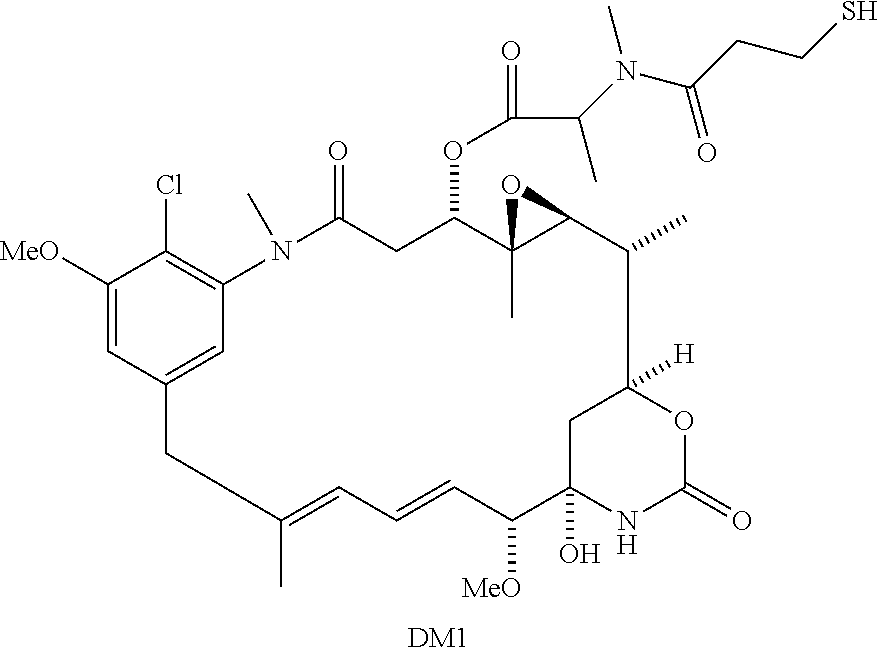
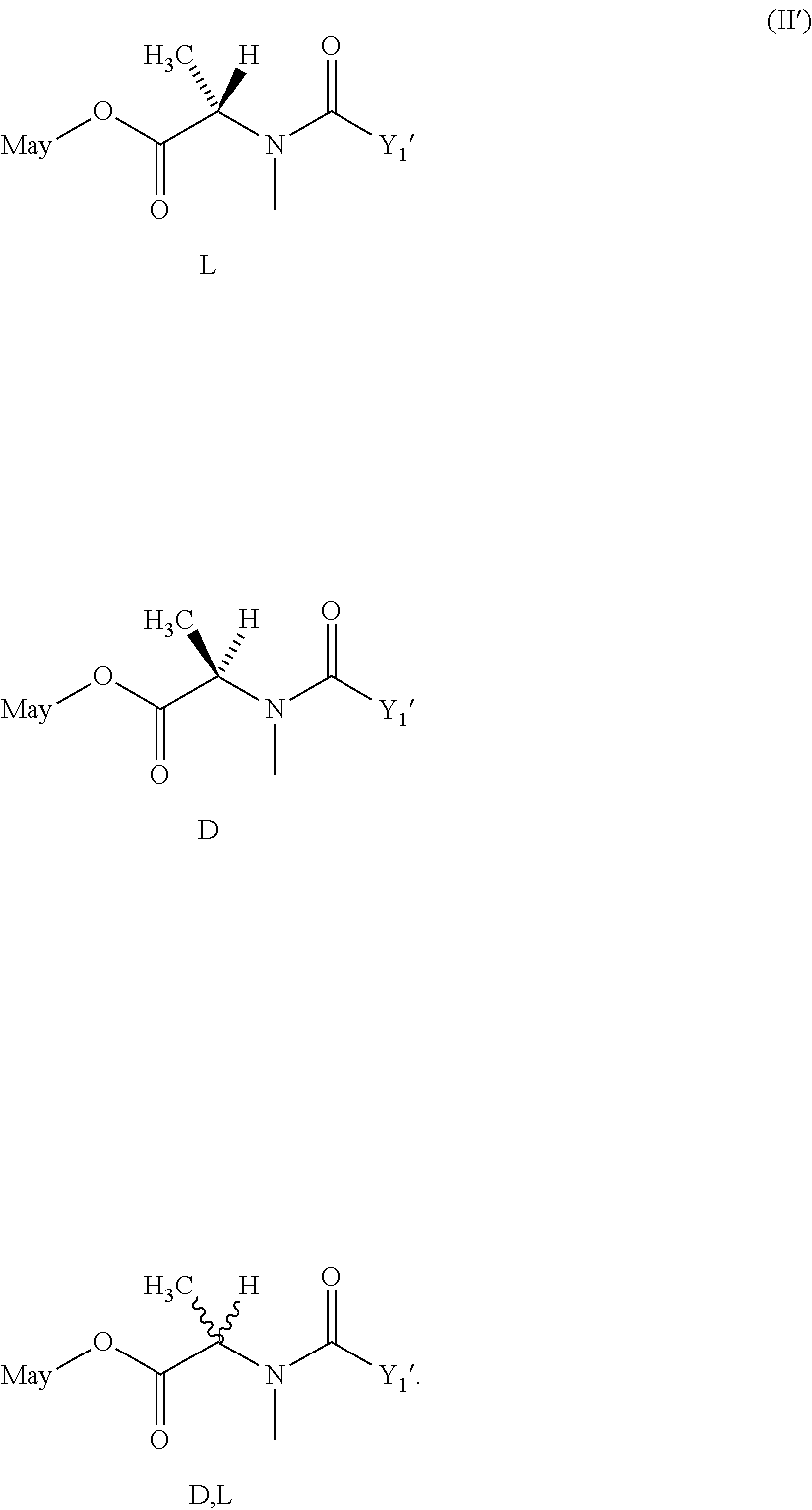
In the formula (I′),
Y1′ represents (CR7R8)l(CR9═CR10)p(C≡C)qAo(CR5R6)mDu(CR11═CR12)r(C≡C)sBt(CR3R4)nCR1R2SH.

In the formula (I),
Y1 represents (CR7R8)l(CR5R6)m(CR3R4)nCR1R2SH.
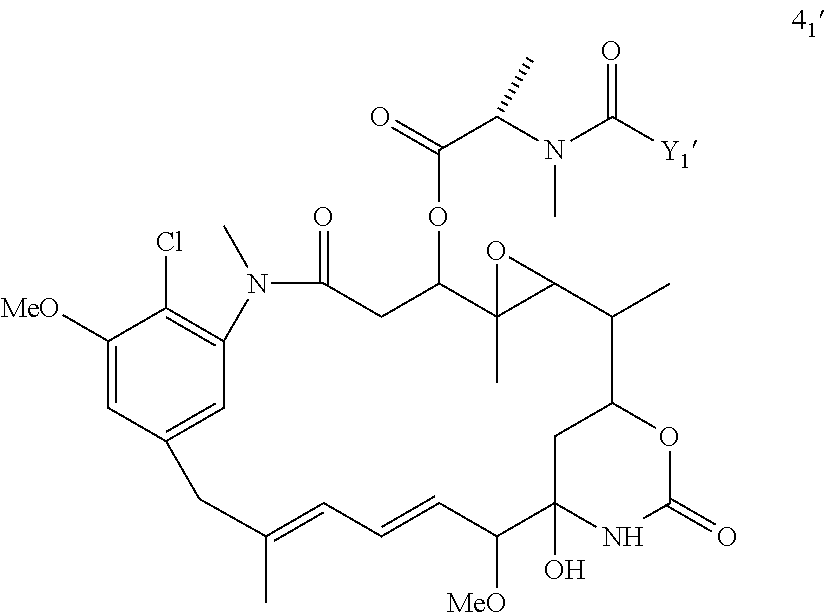
wherein the substituents are as defined for formula (II′) above.

wherein the substituents are as defined for formula (II) above.

Cell-Binding Agents
HOOC—Xl—Yn—Zm—COOH (IV)
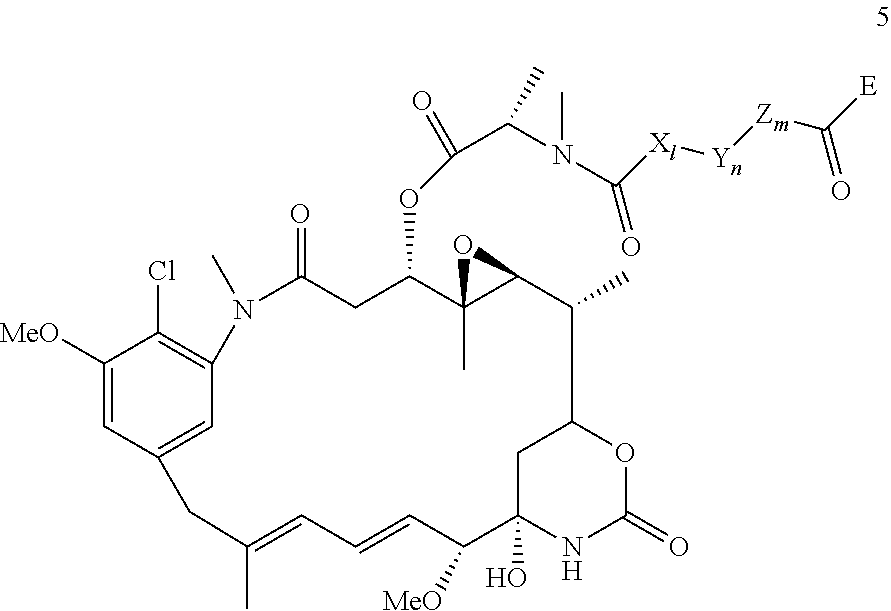
wherein X, Y, Z, l, m and n are all defined as for formula (IV) above, and wherein E together with the carbonyl group forms an active ester such as N-hydroxy succinimidyl and sulfosuccinimidyl esters, N-hydroxy phthalimidyl ester, N-hydroxy sulfophthalimidyl ester, ortho-nitrophenyl ester, para-nitrophenyl ester, 2,4-dinitrophenyl ester, 3-sulfonyl-4-nitrophenyl ester, 3-carboxy-4-nitrophenyl ester, pentaflurophenyl ester, and sulfonyl tetrafluorophenyl ester.

wherein n represents an integer from 3 to 24, and E has the same definition as for the maytansinoid of

wherein R is H or SO3 −N+.
| TABLE I |
| Characteristics of huC242-SMCC-DM1 |
| Final Protein | Final DM1 Conc. | ||
| Reference Number | Conc. (mg/ml) | (ug/ml) | DM1/Ab |
| 1713-146C | 1.77 | 26.96 | 3.05 |
| TABLE II |
| Characteristics of Trastuzumab-SMCC-DM1 |
| Final Protein | Final DM1 Conc. | ||
| Reference Number | Conc. (mg/ml) | (ug/ml) | DM1/Ab |
| 1762-14 | 6.71 | 106. | 3.13 |
| TABLE III |
| Characteristics of Trastuzumab-SIAB-DM1 |
| Final Protein | Final DM1 Conc. | ||
| Reference Number | Conc. (mg/ml) | (ug/ml) | DM1/Ab |
| 1806-32 | 5.62 | 97.3 | 3.42 |
Claims (35)

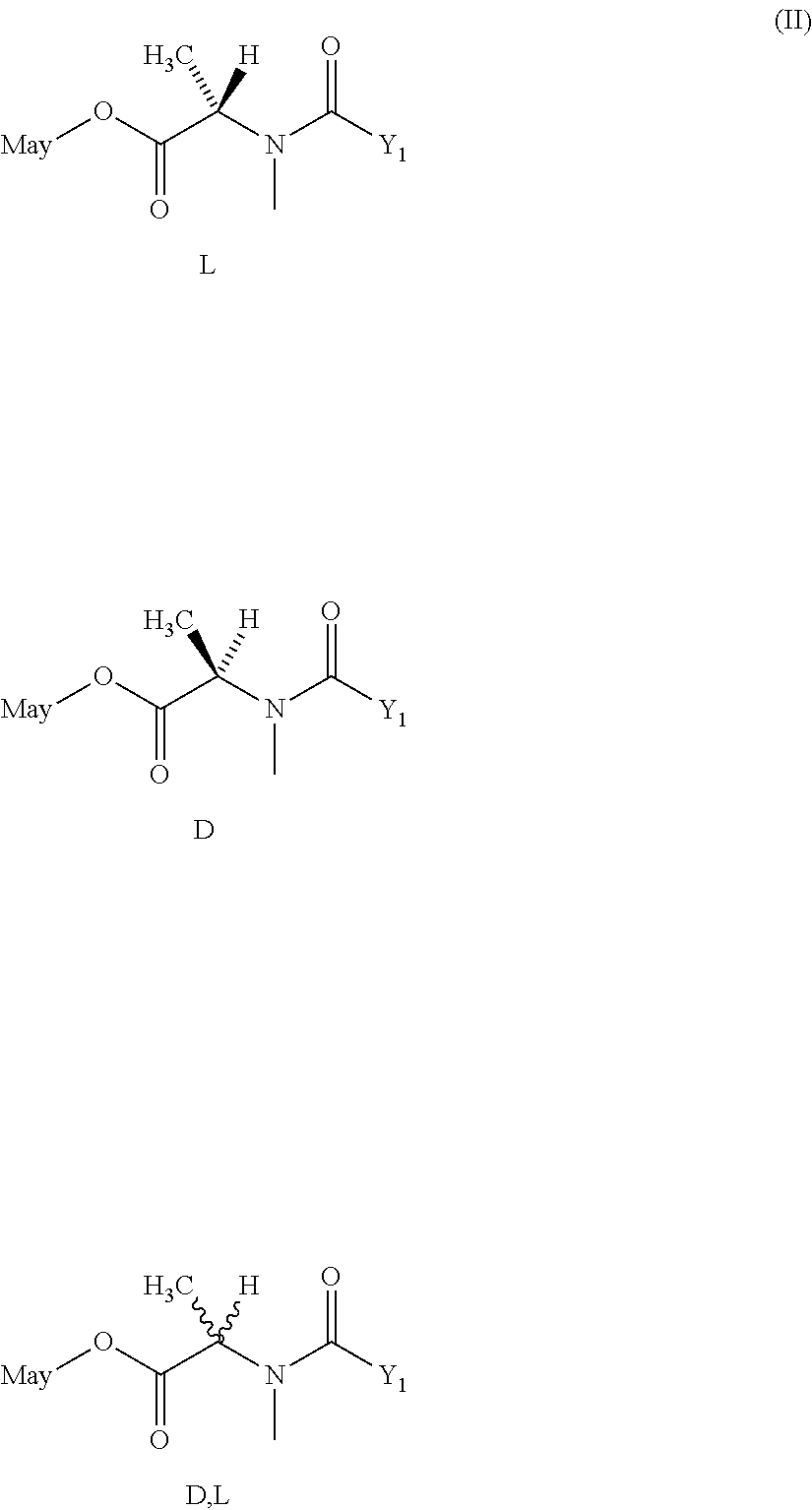
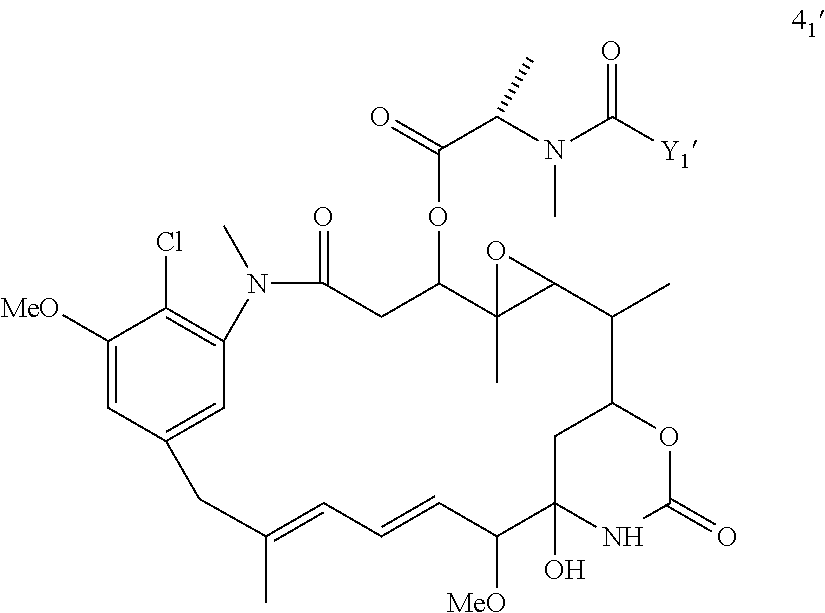

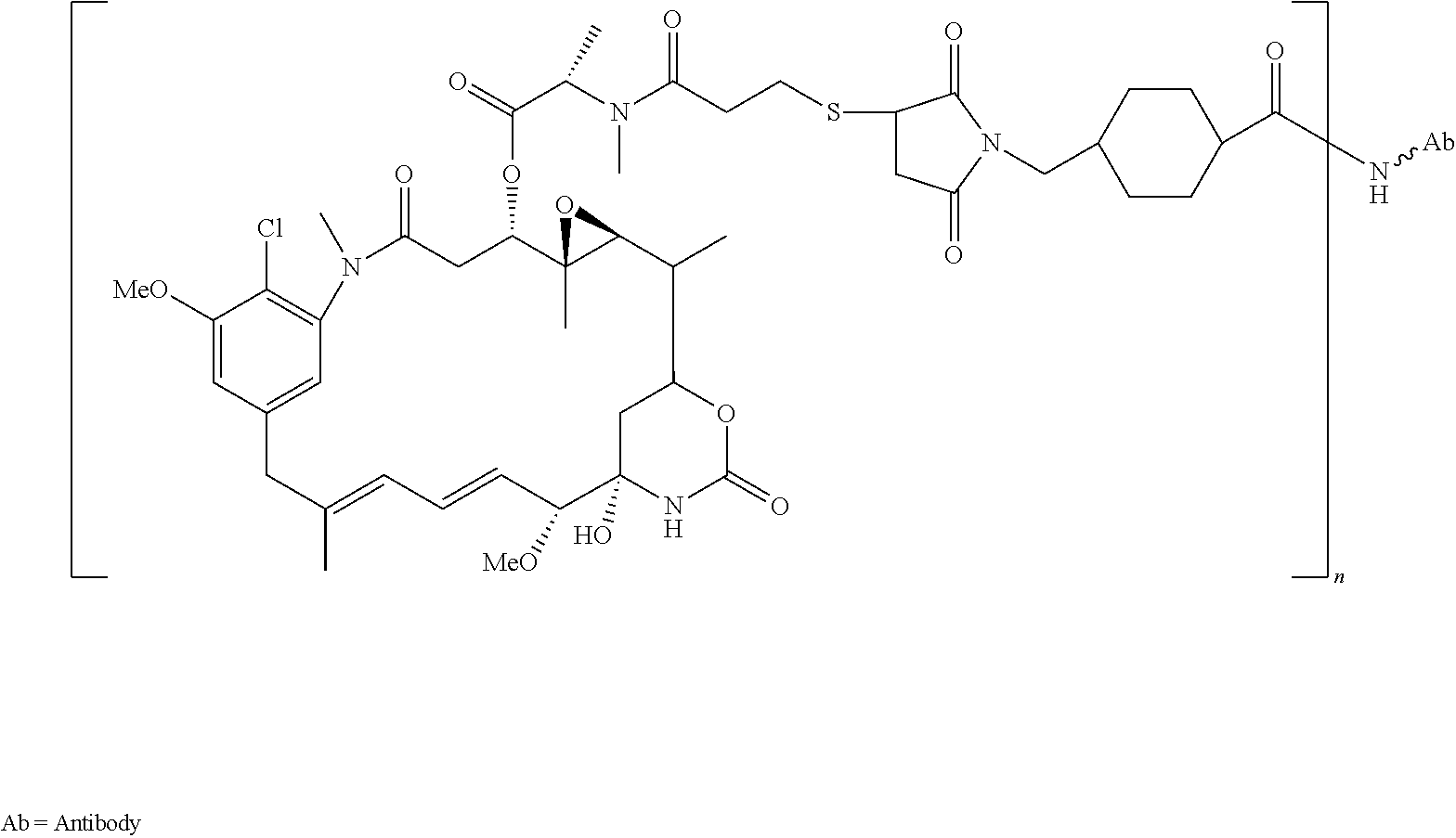
Priority Applications (2)
| Application Number | Priority Date | Filing Date | Title |
|---|---|---|---|
| US15/413,153 US10844135B2 (en) | 2003-10-10 | 2017-01-23 | Method of targeting specific cell populations using cell-binding agent maytansinoid conjugates linked via a non-cleavable linker, said conjugates and methods of making said |
| US17/064,981 US20210261683A1 (en) | 2003-10-10 | 2020-10-07 | Method of targeting specific cell populations using cell-binding agent maytansinoid conjugates linked via a non-cleavable linker, said conjugates and methods of making said conjugates |
Applications Claiming Priority (6)
| Application Number | Priority Date | Filing Date | Title |
|---|---|---|---|
| US50990103P | 2003-10-10 | 2003-10-10 | |
| US10/960,602 US8088387B2 (en) | 2003-10-10 | 2004-10-08 | Method of targeting specific cell populations using cell-binding agent maytansinoid conjugates linked via a non-cleavable linker, said conjugates, and methods of making said conjugates |
| US11/927,235 US8563509B2 (en) | 2003-10-10 | 2007-10-29 | Method of targeting specific cell populations using cell-binding agent maytansinoid conjugates linked via a non-cleavable linker, said conjugates and methods of making said conjugates |
| US13/178,728 US8685920B2 (en) | 2003-10-10 | 2011-07-08 | Method of targeting specific cell populations using cell-binding agent maytansinoid conjugates linked via a non-cleavable linker, said conjugates and methods of making said conjugates |
| US14/172,360 US20140154804A1 (en) | 2003-10-10 | 2014-02-04 | Method of targeting specific cell populations using cell-binding agent maytansinoid conjugates linked via a non-cleavable linker, said conjugates and methods of making said conjugates |
| US15/413,153 US10844135B2 (en) | 2003-10-10 | 2017-01-23 | Method of targeting specific cell populations using cell-binding agent maytansinoid conjugates linked via a non-cleavable linker, said conjugates and methods of making said |
Related Parent Applications (1)
| Application Number | Title | Priority Date | Filing Date |
|---|---|---|---|
| US14/172,360 Continuation US20140154804A1 (en) | 2003-10-10 | 2014-02-04 | Method of targeting specific cell populations using cell-binding agent maytansinoid conjugates linked via a non-cleavable linker, said conjugates and methods of making said conjugates |
Related Child Applications (1)
| Application Number | Title | Priority Date | Filing Date |
|---|---|---|---|
| US17/064,981 Continuation US20210261683A1 (en) | 2003-10-10 | 2020-10-07 | Method of targeting specific cell populations using cell-binding agent maytansinoid conjugates linked via a non-cleavable linker, said conjugates and methods of making said conjugates |
Publications (2)
| Publication Number | Publication Date |
|---|---|
| US20170226220A1 US20170226220A1 (en) | 2017-08-10 |
| US10844135B2 true US10844135B2 (en) | 2020-11-24 |
Family
ID=34467962
Family Applications (10)
| Application Number | Title | Priority Date | Filing Date |
|---|---|---|---|
| US10/960,602 Active 2028-07-02 US8088387B2 (en) | 2003-05-14 | 2004-10-08 | Method of targeting specific cell populations using cell-binding agent maytansinoid conjugates linked via a non-cleavable linker, said conjugates, and methods of making said conjugates |
| US11/927,217 Expired - Lifetime US8163888B2 (en) | 2003-10-10 | 2007-10-29 | Method of targeting specific cell populations using cell-binding agent maytansinoid conjugates linked via a non-cleavable linker, said conjugates and methods of making said conjugates |
| US11/927,235 Active 2026-06-18 US8563509B2 (en) | 2003-10-10 | 2007-10-29 | Method of targeting specific cell populations using cell-binding agent maytansinoid conjugates linked via a non-cleavable linker, said conjugates and methods of making said conjugates |
| US11/927,314 Expired - Lifetime US8198417B2 (en) | 2003-10-10 | 2007-10-29 | Method of targeting specific cell populations using cell-binding agent maytansinoid conjugates linked via a non-cleavable linker, said conjugates and methods of making said conjugates |
| US11/927,251 Expired - Lifetime US7989598B2 (en) | 2003-10-10 | 2007-10-29 | Method of targeting specific cell populations using cell-binding agent maytansinoid conjugates linked via a non-cleavable linker, said conjugates and methods of making said conjugates |
| US13/178,728 Expired - Lifetime US8685920B2 (en) | 2003-10-10 | 2011-07-08 | Method of targeting specific cell populations using cell-binding agent maytansinoid conjugates linked via a non-cleavable linker, said conjugates and methods of making said conjugates |
| US13/469,550 Abandoned US20120226025A1 (en) | 2003-10-10 | 2012-05-11 | Method of targeting specific cell populations using cell-binding agent maytansinoid conjugates linked via a non-cleavable linker, said conjugates and methods of making said conjugates |
| US14/172,360 Abandoned US20140154804A1 (en) | 2003-10-10 | 2014-02-04 | Method of targeting specific cell populations using cell-binding agent maytansinoid conjugates linked via a non-cleavable linker, said conjugates and methods of making said conjugates |
| US15/413,153 Active 2026-06-26 US10844135B2 (en) | 2003-10-10 | 2017-01-23 | Method of targeting specific cell populations using cell-binding agent maytansinoid conjugates linked via a non-cleavable linker, said conjugates and methods of making said |
| US17/064,981 Abandoned US20210261683A1 (en) | 2003-10-10 | 2020-10-07 | Method of targeting specific cell populations using cell-binding agent maytansinoid conjugates linked via a non-cleavable linker, said conjugates and methods of making said conjugates |
Family Applications Before (8)
| Application Number | Title | Priority Date | Filing Date |
|---|---|---|---|
| US10/960,602 Active 2028-07-02 US8088387B2 (en) | 2003-05-14 | 2004-10-08 | Method of targeting specific cell populations using cell-binding agent maytansinoid conjugates linked via a non-cleavable linker, said conjugates, and methods of making said conjugates |
| US11/927,217 Expired - Lifetime US8163888B2 (en) | 2003-10-10 | 2007-10-29 | Method of targeting specific cell populations using cell-binding agent maytansinoid conjugates linked via a non-cleavable linker, said conjugates and methods of making said conjugates |
| US11/927,235 Active 2026-06-18 US8563509B2 (en) | 2003-10-10 | 2007-10-29 | Method of targeting specific cell populations using cell-binding agent maytansinoid conjugates linked via a non-cleavable linker, said conjugates and methods of making said conjugates |
| US11/927,314 Expired - Lifetime US8198417B2 (en) | 2003-10-10 | 2007-10-29 | Method of targeting specific cell populations using cell-binding agent maytansinoid conjugates linked via a non-cleavable linker, said conjugates and methods of making said conjugates |
| US11/927,251 Expired - Lifetime US7989598B2 (en) | 2003-10-10 | 2007-10-29 | Method of targeting specific cell populations using cell-binding agent maytansinoid conjugates linked via a non-cleavable linker, said conjugates and methods of making said conjugates |
| US13/178,728 Expired - Lifetime US8685920B2 (en) | 2003-10-10 | 2011-07-08 | Method of targeting specific cell populations using cell-binding agent maytansinoid conjugates linked via a non-cleavable linker, said conjugates and methods of making said conjugates |
| US13/469,550 Abandoned US20120226025A1 (en) | 2003-10-10 | 2012-05-11 | Method of targeting specific cell populations using cell-binding agent maytansinoid conjugates linked via a non-cleavable linker, said conjugates and methods of making said conjugates |
| US14/172,360 Abandoned US20140154804A1 (en) | 2003-10-10 | 2014-02-04 | Method of targeting specific cell populations using cell-binding agent maytansinoid conjugates linked via a non-cleavable linker, said conjugates and methods of making said conjugates |
Family Applications After (1)
| Application Number | Title | Priority Date | Filing Date |
|---|---|---|---|
| US17/064,981 Abandoned US20210261683A1 (en) | 2003-10-10 | 2020-10-07 | Method of targeting specific cell populations using cell-binding agent maytansinoid conjugates linked via a non-cleavable linker, said conjugates and methods of making said conjugates |
Country Status (26)
| Country | Link |
|---|---|
| US (10) | US8088387B2 (en) |
| EP (4) | EP2596803A3 (en) |
| JP (10) | JP2007520450A (en) |
| KR (4) | KR20060130552A (en) |
| CN (3) | CN103223174A (en) |
| AU (2) | AU2004282491C1 (en) |
| BE (1) | BE2013C075I2 (en) |
| BR (1) | BRPI0415448A8 (en) |
| CA (3) | CA3237922A1 (en) |
| CY (2) | CY1113984T1 (en) |
| DK (1) | DK1689846T3 (en) |
| EA (1) | EA010508B1 (en) |
| EC (1) | ECSP066461A (en) |
| ES (1) | ES2404304T3 (en) |
| FR (1) | FR13C0068I2 (en) |
| HK (1) | HK1244452A1 (en) |
| HR (1) | HRP20130412T1 (en) |
| HU (1) | HUS1300075I1 (en) |
| IL (4) | IL173625A (en) |
| LU (1) | LU92336I2 (en) |
| NO (2) | NO337458B1 (en) |
| NZ (2) | NZ545195A (en) |
| PL (1) | PL1689846T3 (en) |
| PT (1) | PT1689846E (en) |
| SI (1) | SI1689846T1 (en) |
| WO (1) | WO2005037992A2 (en) |
Cited By (5)
| Publication number | Priority date | Publication date | Assignee | Title |
|---|---|---|---|---|
| US11208495B2 (en) | 2017-08-28 | 2021-12-28 | Angiex, Inc. | Anti-TM4SF1 antibodies and methods of using same |
| US11453711B2 (en) | 2019-12-31 | 2022-09-27 | Beijing Ql Biopharmaceutical Co., Ltd. | Fusion proteins of GLP-1 and GDF15 and conjugates thereof |
| US11555019B2 (en) | 2019-07-10 | 2023-01-17 | Cybrexa 3, Inc. | Peptide conjugates of microtubule-targeting agents as therapeutics |
| US11634508B2 (en) | 2019-07-10 | 2023-04-25 | Cybrexa 2, Inc. | Peptide conjugates of cytotoxins as therapeutics |
| US12428477B2 (en) | 2019-02-27 | 2025-09-30 | Angiex, Inc. | Antibody-drug conjugates comprising anti-TM4SF1 antibodies and methods of using the same |
Families Citing this family (327)
| Publication number | Priority date | Publication date | Assignee | Title |
|---|---|---|---|---|
| EP1229934B1 (en) | 1999-10-01 | 2014-03-05 | Immunogen, Inc. | Compositions and methods for treating cancer using immunoconjugates and chemotherapeutic agents |
| US7097840B2 (en) * | 2000-03-16 | 2006-08-29 | Genentech, Inc. | Methods of treatment using anti-ErbB antibody-maytansinoid conjugates |
| US20100056762A1 (en) | 2001-05-11 | 2010-03-04 | Old Lloyd J | Specific binding proteins and uses thereof |
| PT1392359E (en) | 2001-05-11 | 2010-01-27 | Ludwig Inst For Cancer Res Ltd | Specific binding proteins and uses thereof |
| US20110045005A1 (en) * | 2001-10-19 | 2011-02-24 | Craig Crowley | Compositions and methods for the treatment of tumor of hematopoietic origin |
| US20050276812A1 (en) * | 2004-06-01 | 2005-12-15 | Genentech, Inc. | Antibody-drug conjugates and methods |
| US20090068178A1 (en) * | 2002-05-08 | 2009-03-12 | Genentech, Inc. | Compositions and Methods for the Treatment of Tumor of Hematopoietic Origin |
| NZ554740A (en) * | 2002-05-24 | 2009-01-31 | Schering Corp | Neutralizing human anti-IGFR antibody |
| US8088387B2 (en) | 2003-10-10 | 2012-01-03 | Immunogen Inc. | Method of targeting specific cell populations using cell-binding agent maytansinoid conjugates linked via a non-cleavable linker, said conjugates, and methods of making said conjugates |
| US7276497B2 (en) * | 2003-05-20 | 2007-10-02 | Immunogen Inc. | Cytotoxic agents comprising new maytansinoids |
| CA2556752C (en) * | 2004-02-23 | 2016-02-02 | Genentech, Inc. | Heterocyclic self-immolative linkers and conjugates |
| US20060045877A1 (en) * | 2004-08-30 | 2006-03-02 | Goldmakher Viktor S | Immunoconjugates targeting syndecan-1 expressing cells and use thereof |
| NZ553500A (en) | 2004-09-23 | 2009-11-27 | Genentech Inc Genentech Inc | Cysteine engineered antibodies and conjugates withCysteine engineered antibodies and conjugates with a free cysteine amino acid in the heavy chain a free cysteine amino acid in the heavy chain |
| WO2006060533A2 (en) | 2004-12-01 | 2006-06-08 | Genentech, Inc. | Conjugates of 1, 8-bis-naphthalimides with an antibody |
| EP2468304A3 (en) | 2005-02-11 | 2012-09-26 | ImmunoGen, Inc. | Process for preparing stable drug conjugates |
| US20110166319A1 (en) * | 2005-02-11 | 2011-07-07 | Immunogen, Inc. | Process for preparing purified drug conjugates |
| US20060233810A1 (en) * | 2005-04-15 | 2006-10-19 | Yaolin Wang | Methods and compositions for treating or preventing cancer |
| JP2006316040A (en) | 2005-05-13 | 2006-11-24 | Genentech Inc | HERCEPTIN® adjuvant therapy |
| CA2893252C (en) * | 2005-08-24 | 2018-05-29 | Immunogen, Inc. | Process for preparing antibody maytansinoid conjugates |
| US8080534B2 (en) | 2005-10-14 | 2011-12-20 | Phigenix, Inc | Targeting PAX2 for the treatment of breast cancer |
| US20090226465A1 (en) * | 2005-10-31 | 2009-09-10 | Jackson David Y | Macrocyclic depsipeptide antibody-drug conjugates and methods |
| RU2451031C2 (en) | 2006-01-20 | 2012-05-20 | Дженентек, Инк. | Ephrine b2 antibodies and methods for using them |
| AR059851A1 (en) | 2006-03-16 | 2008-04-30 | Genentech Inc | ANTIBODIES OF EGFL7 AND METHODS OF USE |
| RS54163B1 (en) * | 2006-05-30 | 2015-12-31 | Genentech Inc. | ANTI-CD22 ANTIBODIES, THEIR IMMUNCONJUGATES AND THEIR USE |
| LT2845866T (en) | 2006-10-27 | 2017-07-10 | Genentech, Inc. | Antibodies and immunoconjugates and uses therefor |
| MX338185B (en) | 2007-01-25 | 2016-04-05 | Dana Farber Cancer Inst Inc | Use of anti-egfr antibodies in treatment of egfr mutant mediated disease. |
| AU2008227123B2 (en) | 2007-03-15 | 2014-03-27 | Ludwig Institute For Cancer Research Ltd. | Treatment method using EGFR antibodies and src inhibitors and related formulations |
| US7960139B2 (en) | 2007-03-23 | 2011-06-14 | Academia Sinica | Alkynyl sugar analogs for the labeling and visualization of glycoconjugates in cells |
| CA2680237C (en) | 2007-03-27 | 2018-11-06 | Sea Lane Biotechnologies, Llc | Constructs and libraries comprising antibody surrogate light chain sequences |
| US20090011060A1 (en) * | 2007-07-06 | 2009-01-08 | Peter Koepke | Campsiandra angustifolia extract and methods of extracting and using such extract |
| WO2009012256A1 (en) | 2007-07-16 | 2009-01-22 | Genentech, Inc. | Humanized anti-cd79b antibodies and immunoconjugates and methods of use |
| DK2176296T3 (en) | 2007-07-16 | 2012-05-21 | Genentech Inc | Anti-CD79B antibodies and immune conjugates and methods of use. |
| JP5532486B2 (en) | 2007-08-14 | 2014-06-25 | ルードヴィッヒ インスティテュート フォー キャンサー リサーチ | Monoclonal antibody 175 targeting EGF receptor and derivatives and uses thereof |
| EP3838298B1 (en) | 2007-08-17 | 2025-02-26 | Purdue Research Foundation | Psma binding ligand-linker conjugates and methods for using |
| US7879369B2 (en) | 2007-09-18 | 2011-02-01 | Selvamedica, Llc | Combretum laurifolium Mart. extract and methods of extracting and using such extract |
| DK2247620T3 (en) | 2008-01-31 | 2016-08-22 | Genentech Inc | ANTI-CD79b ANTIBODIES AND IMMUNOCONJUGATES AND METHODS OF USE |
| MY166446A (en) | 2008-03-18 | 2018-06-27 | Genentech Inc | Combinations of an anti-her2 antibody-drug conjugate and chemotherapeutic agents,and methods of use |
| CN104524590B (en) * | 2008-04-30 | 2019-06-21 | 伊缪诺金公司 | The purposes of crosslinking agent and they |
| WO2009134870A1 (en) * | 2008-04-30 | 2009-11-05 | Immunogen, Inc. | Potent cell-binding agent drug conjugates |
| EP2276506A4 (en) * | 2008-04-30 | 2014-05-07 | Immunogen Inc | Potent conjugates and hydrophilic linkers |
| US20100092495A1 (en) * | 2008-04-30 | 2010-04-15 | Immunogen Inc. | Potent cell-binding agent drug conjugates |
| DK2318832T3 (en) | 2008-07-15 | 2014-01-20 | Academia Sinica | Glycan arrays on PTFE-like aluminum coated slides and related methods |
| AU2010210646B2 (en) | 2009-02-05 | 2015-10-29 | Immunogen, Inc. | Novel benzodiazepine derivatives |
| DK3702371T5 (en) | 2009-03-25 | 2024-08-26 | Genentech Inc | Anti-FGFR3 antibodies and methods of using them |
| CN102471380B (en) | 2009-04-01 | 2015-01-14 | 霍夫曼-拉罗奇有限公司 | Anti-fcrh5 antibodies and immunoconjugates and methods of use |
| KR101431318B1 (en) | 2009-04-02 | 2014-08-20 | 로슈 글리카트 아게 | Multispecific antibodies comprising full length antibodies and single chain fab fragments |
| US8481694B2 (en) | 2009-04-29 | 2013-07-09 | Bio-Rad Laboratories, Inc. | Purification of immunoconjugates |
| CN102482345A (en) | 2009-05-13 | 2012-05-30 | 航道生物技术有限责任公司 | Neutralizing molecules to influenza viruses |
| KR102444399B1 (en) | 2009-06-03 | 2022-09-16 | 이뮤노젠 아이엔씨 | Manufacturing method of maytansinoids |
| EP2896404B1 (en) | 2009-06-04 | 2017-08-02 | Novartis AG | Methods for identification of sites for IgG conjugation |
| US9345661B2 (en) | 2009-07-31 | 2016-05-24 | Genentech, Inc. | Subcutaneous anti-HER2 antibody formulations and uses thereof |
| CA2809819A1 (en) * | 2009-09-09 | 2011-03-17 | Centrose, Llc | Extracellular targeted drug conjugates |
| AR078161A1 (en) | 2009-09-11 | 2011-10-19 | Hoffmann La Roche | VERY CONCENTRATED PHARMACEUTICAL FORMULATIONS OF AN ANTIBODY ANTI CD20. USE OF THE FORMULATION. TREATMENT METHOD |
| CA2781519A1 (en) | 2009-09-16 | 2011-03-24 | Genentech, Inc. | Coiled coil and/or tether containing protein complexes and uses thereof |
| EP2486023A4 (en) * | 2009-10-06 | 2014-05-07 | Immunogen Inc | Potent conjugates and hydrophilic linkers |
| CN104634955B (en) * | 2009-10-26 | 2016-09-14 | 雀巢产品技术援助有限公司 | Detection anti-TNF medicine and the test of autoantibody |
| US10087236B2 (en) | 2009-12-02 | 2018-10-02 | Academia Sinica | Methods for modifying human antibodies by glycan engineering |
| US11377485B2 (en) | 2009-12-02 | 2022-07-05 | Academia Sinica | Methods for modifying human antibodies by glycan engineering |
| TW201129380A (en) | 2009-12-04 | 2011-09-01 | Genentech Inc | Methods of treating metastatic breast cancer with trastuzumab-MCC-DM1 |
| EP3778917A3 (en) | 2009-12-04 | 2021-06-09 | F. Hoffmann-La Roche AG | Multispecific antibodies, antibody analogs, compositions, and methods |
| EP2516465B1 (en) | 2009-12-23 | 2016-05-18 | F.Hoffmann-La Roche Ag | Anti-bv8 antibodies and uses thereof |
| KR20130009760A (en) | 2010-02-10 | 2013-01-23 | 이뮤노젠 아이엔씨 | Cd20 antibodies and uses thereof |
| WO2011106297A2 (en) * | 2010-02-23 | 2011-09-01 | Genentech, Inc. | Compositions and methods for the diagnosis and treatment of tumor |
| CA3014767C (en) | 2010-02-24 | 2023-08-29 | Immunogen, Inc. | Folate receptor 1 antibodies and immunoconjugates and uses thereof |
| US9951324B2 (en) | 2010-02-25 | 2018-04-24 | Purdue Research Foundation | PSMA binding ligand-linker conjugates and methods for using |
| CN106046159B (en) | 2010-03-12 | 2020-06-16 | 德彪发姆国际有限公司 | CD37 binding molecules and immunoconjugates thereof |
| TW201138821A (en) | 2010-03-26 | 2011-11-16 | Roche Glycart Ag | Bispecific antibodies |
| WO2011130332A1 (en) | 2010-04-12 | 2011-10-20 | Academia Sinica | Glycan arrays for high throughput screening of viruses |
| TW201742925A (en) | 2010-04-23 | 2017-12-16 | 建南德克公司 | Production of heteromultimeric proteins |
| MX336109B (en) | 2010-06-03 | 2016-01-08 | Genentech Inc | FORMATION OF IMMUNE-TEP IMAGES OF ANTIBODIES AND IMMUNOCUSES AND USES OF THE SAME. |
| US9000130B2 (en) | 2010-06-08 | 2015-04-07 | Genentech, Inc. | Cysteine engineered antibodies and conjugates |
| WO2012019024A2 (en) | 2010-08-04 | 2012-02-09 | Immunogen, Inc. | Her3-binding molecules and immunoconjugates thereof |
| EP2609111B1 (en) | 2010-08-24 | 2017-11-01 | F. Hoffmann-La Roche AG | Bispecific antibodies comprising a disulfide stabilized-fv fragment |
| BR112013010544A2 (en) | 2010-10-29 | 2016-08-02 | Immunogen Inc | egfr and immunoconjugate binding molecules thereof |
| BR112013010569A2 (en) * | 2010-10-29 | 2017-07-04 | Immunogen Inc | non-antagonistic and immunoconjugated egfr binding molecules thereof |
| CN103313990B (en) | 2010-11-17 | 2016-07-20 | 基因泰克公司 | Alanyl maytansinol antibody coupling matter |
| JP5766296B2 (en) | 2010-12-23 | 2015-08-19 | エフ.ホフマン−ラ ロシュ アーゲーF. Hoffmann−La Roche Aktiengesellschaft | Polypeptide-polynucleotide complexes and their use in targeted delivery of effector components |
| AU2012211014A1 (en) | 2011-01-24 | 2013-05-02 | National Research Council Of Canada | Antibodies selective for cells presenting EGFR at high density |
| KR101913448B1 (en) | 2011-02-04 | 2018-10-30 | 제넨테크, 인크. | Fc VARIANTS AND METHODS FOR THEIR PRODUCTION |
| US10689447B2 (en) | 2011-02-04 | 2020-06-23 | Genentech, Inc. | Fc variants and methods for their production |
| MY183977A (en) | 2011-02-15 | 2021-03-17 | Immunogen Inc | Cytotoxic benzodiazepine derivatives |
| AU2012236403B2 (en) * | 2011-03-29 | 2016-08-04 | Immunogen, Inc. | Process for manufacturing conjugates of improved homogeneity |
| CN107537040A (en) | 2011-03-29 | 2018-01-05 | 伊缪诺金公司 | Class maytansine antibody conjugates are prepared by one-step method |
| SG193996A1 (en) | 2011-03-29 | 2013-11-29 | Immunogen Inc | Preparation of maytansinoid antibody conjugates by a one-step process |
| MX346555B (en) | 2011-04-01 | 2017-03-24 | Immunogen Inc | METHODS TO INCREASE THE EFFECTIVENESS OF THERAPY AGAINST CANCER WITH FOLATE RECEIVER 1 (FOLR1). |
| KR20140031883A (en) | 2011-04-01 | 2014-03-13 | 이뮤노젠 아이엔씨 | Cd37-binding molecules and immunoconjugates thereof |
| CN103648523A (en) | 2011-05-09 | 2014-03-19 | 弗吉尼亚大学专利基金会 | Compositions and methods for treating cancer |
| EP2714738B1 (en) | 2011-05-24 | 2018-10-10 | Zyngenia, Inc. | Multivalent and monovalent multispecific complexes and their uses |
| US8815226B2 (en) | 2011-06-10 | 2014-08-26 | Mersana Therapeutics, Inc. | Protein-polymer-drug conjugates |
| KR102087854B1 (en) | 2011-06-10 | 2020-03-12 | 메르사나 테라퓨틱스, 인코포레이티드 | Protein-Polymer-Drug Conjugates |
| EP2723389A2 (en) | 2011-06-21 | 2014-04-30 | Immunogen, Inc. | Novel maytansinoid derivatives with peptide linker and conjugates thereof |
| CA2842860A1 (en) | 2011-07-28 | 2013-01-31 | Sea Lane Biotechnologies, Llc | Sur-binding proteins |
| MY173865A (en) | 2011-09-22 | 2020-02-25 | Amgen Inc | Cd27l antigen binding proteins |
| US9364551B2 (en) | 2011-09-29 | 2016-06-14 | Virginia Commonwealth University | Light-enabled drug delivery |
| AU2012328980A1 (en) | 2011-10-28 | 2014-04-24 | Genentech, Inc. | Therapeutic combinations and methods of treating melanoma |
| EA201490974A1 (en) | 2011-11-16 | 2014-09-30 | Эмджен Инк. | METHODS OF TREATMENT OF DISORDERS ASSOCIATED WITH DELIVERY MUTANT VIII EPIDERMAL GROWTH FACTOR |
| BR112014012155A2 (en) | 2011-11-21 | 2017-05-30 | Immunogen Inc | method of treating tumors that are resistant to egfr therapies by egfr antibody cytotoxic agent conjugate |
| RU2632108C2 (en) | 2011-12-08 | 2017-10-02 | Биотест Аг | Applications of immunoconjugates, the target of which is cd138 |
| EP2793940B1 (en) | 2011-12-22 | 2018-11-14 | i2 Pharmaceuticals, Inc. | Surrogate binding proteins |
| WO2013092998A1 (en) * | 2011-12-23 | 2013-06-27 | Innate Pharma | Enzymatic conjugation of antibodies |
| JP2015505537A (en) | 2012-01-20 | 2015-02-23 | シー レーン バイオテクノロジーズ, エルエルシー | Binding molecule conjugate |
| EP2812357B1 (en) | 2012-02-10 | 2020-11-04 | F.Hoffmann-La Roche Ag | Single-chain antibodies and other heteromultimers |
| WO2013130093A1 (en) | 2012-03-02 | 2013-09-06 | Genentech, Inc. | Biomarkers for treatment with anti-tubulin chemotherapeutic compounds |
| AR090549A1 (en) | 2012-03-30 | 2014-11-19 | Genentech Inc | ANTI-LGR5 AND IMMUNOCATE PLAYERS |
| AU2012376421A1 (en) * | 2012-04-04 | 2014-11-13 | Perseus Proteomics Inc. | Drug conjugate comprising anti-cdh3 (p-cadherin) antibody |
| US10130714B2 (en) | 2012-04-14 | 2018-11-20 | Academia Sinica | Enhanced anti-influenza agents conjugated with anti-inflammatory activity |
| CN104540518A (en) | 2012-04-27 | 2015-04-22 | 西托姆克斯治疗公司 | Activatable antibodies that bind epidermal growth factor receptor and methods of use thereof |
| AU2013256596A1 (en) | 2012-05-01 | 2014-10-09 | Genentech, Inc. | Anti-PMEL17 antibodies and immunoconjugates |
| HK1207388A1 (en) | 2012-05-15 | 2016-01-29 | Seattle Genetics, Inc. | Self-stabilizing linker conjugates |
| CN104662000B (en) | 2012-05-15 | 2018-08-17 | 索伦托医疗有限公司 | Drug conjugates and its coupling method and purposes |
| US9504756B2 (en) | 2012-05-15 | 2016-11-29 | Seattle Genetics, Inc. | Self-stabilizing linker conjugates |
| NZ702195A (en) | 2012-05-21 | 2016-09-30 | Genentech Inc | Anti-ly6e antibodies and immunoconjugates and methods of use |
| KR20150030744A (en) | 2012-06-27 | 2015-03-20 | 에프. 호프만-라 로슈 아게 | Method for making antibody fc-region conjugates comprising at least one binding entity that specifically binds to a target and uses thereof |
| RU2639287C2 (en) | 2012-06-27 | 2017-12-20 | Ф. Хоффманн-Ля Рош Аг | Method for selection and obtaining of highly selective and multispecific targeting groups with specified properties, including at least two different binding groups, and their applications |
| US9464141B2 (en) | 2012-08-02 | 2016-10-11 | Genentech, Inc. | Anti-ETBR antibodies and immunoconjugates |
| AR093227A1 (en) | 2012-08-02 | 2015-05-27 | Genentech Inc | IMMUNOCONJUGADOS AND ANTIBODIES AGAINST THE ENDOTHELINE B RECEIVER (ANTI-ETBR) |
| JP6302909B2 (en) | 2012-08-18 | 2018-03-28 | アカデミア シニカAcademia Sinica | Cell-permeable probes for sialidase identification and imaging |
| US8883979B2 (en) | 2012-08-31 | 2014-11-11 | Bayer Healthcare Llc | Anti-prolactin receptor antibody formulations |
| PT3486248T (en) | 2012-09-26 | 2021-07-12 | Immunogen Inc | Improved methods for the acylation of maytansinol |
| SG11201502429YA (en) | 2012-10-04 | 2015-04-29 | Immunogen Inc | Use of a pvdf membrane to purify cell-binding agent cytotoxic agent conjugates |
| HK1211493A1 (en) | 2012-11-15 | 2016-05-27 | 恩多塞特公司 | Conjugates for treating diseases caused by psma expressing cells |
| JP6133431B2 (en) | 2012-11-24 | 2017-05-24 | ハンジョウ ディーエーシー バイオテック シーオー.,エルティディ.Hangzhou Dac Biotech Co.,Ltd. | Use of hydrophilic conjugates and conjugation reactions between drug molecules and cell binding molecules |
| US9353150B2 (en) | 2012-12-04 | 2016-05-31 | Massachusetts Institute Of Technology | Substituted pyrazino[1′,2′:1 ,5]pyrrolo[2,3-b]-indole-1,4-diones for cancer treatment |
| CN103333246B (en) * | 2012-12-21 | 2015-09-16 | 百奥泰生物科技(广州)有限公司 | Tumor growth inhibitors of a kind of anti-EGFR acceptor and its production and use |
| CN103333179B (en) * | 2012-12-21 | 2017-06-16 | 百奥泰生物科技(广州)有限公司 | Maytansinoid derivatives and their preparation and use |
| WO2014134486A2 (en) | 2013-02-28 | 2014-09-04 | Immunogen, Inc. | Conjugates comprising cell-binding agents and cytotoxic agents |
| WO2014134483A2 (en) | 2013-02-28 | 2014-09-04 | Immunogen, Inc. | Conjugates comprising cell-binding agents and cytotoxic agents |
| US9415118B2 (en) | 2013-03-13 | 2016-08-16 | Novartis Ag | Antibody drug conjugates |
| US9498532B2 (en) * | 2013-03-13 | 2016-11-22 | Novartis Ag | Antibody drug conjugates |
| EP3299391B1 (en) | 2013-03-14 | 2019-12-04 | Genentech, Inc. | Anti-b7-h4 antibodies and immunoconjugates |
| US9562099B2 (en) | 2013-03-14 | 2017-02-07 | Genentech, Inc. | Anti-B7-H4 antibodies and immunoconjugates |
| JP6333943B2 (en) | 2013-03-15 | 2018-05-30 | ノバルティス アーゲー | Antibody drug conjugate |
| EP2968593B1 (en) | 2013-03-15 | 2024-11-20 | Regeneron Pharmaceuticals, Inc. | Biologically active molecules, conjugates thereof, and therapeutic uses |
| US10611824B2 (en) | 2013-03-15 | 2020-04-07 | Innate Pharma | Solid phase TGase-mediated conjugation of antibodies |
| EP2976362B1 (en) | 2013-03-19 | 2019-10-23 | Beijing Shenogen Pharma Group Ltd. | Antibodies and methods for treating estrogen receptor-associated diseases |
| CA2910945A1 (en) | 2013-05-08 | 2014-11-13 | Zymeworks Inc. | Bispecific her2 and her3 antigen binding constructs |
| WO2014194030A2 (en) | 2013-05-31 | 2014-12-04 | Immunogen, Inc. | Conjugates comprising cell-binding agents and cytotoxic agents |
| GB201309807D0 (en) | 2013-05-31 | 2013-07-17 | Pharma Mar Sau | Antibody drug conjugates |
| US9517276B2 (en) * | 2013-06-04 | 2016-12-13 | Cytomx Therapeutics, Inc. | Compositions and methods for conjugating activatable antibodies |
| CA2916202C (en) | 2013-06-24 | 2019-07-02 | Hanwha Chemical Corporation | Antibody-drug conjugate having improved stability and use thereof |
| WO2014210397A1 (en) | 2013-06-26 | 2014-12-31 | Academia Sinica | Rm2 antigens and use thereof |
| EP3013347B1 (en) | 2013-06-27 | 2019-12-11 | Academia Sinica | Glycan conjugates and use thereof |
| CA2915897A1 (en) | 2013-07-05 | 2015-01-08 | Formation Biologics Inc. | Egfr antibody conjugates |
| US10208125B2 (en) | 2013-07-15 | 2019-02-19 | University of Pittsburgh—of the Commonwealth System of Higher Education | Anti-mucin 1 binding agents and uses thereof |
| RU2560699C2 (en) * | 2013-08-02 | 2015-08-20 | федеральное государственное автономное образовательное учреждение высшего профессионального образования "Национальный исследовательский ядерный университет МИФИ" (НИЯУ МИФИ) | Method of creating nanosized diagnostic label based on conjugates of nanoparticles and single domain antibodies |
| TWI641620B (en) | 2013-08-21 | 2018-11-21 | 再生元醫藥公司 | Anti-prlr antibodies and uses thereof |
| US9545451B2 (en) | 2013-08-21 | 2017-01-17 | Regeneron Pharmaceuticals, Inc. | Anti-PRLR antibodies and methods for killing PRLR-expressing cells |
| JP6608823B2 (en) | 2013-08-26 | 2019-11-20 | レゲネロン ファーマシューティカルス,インコーポレーテッド | Pharmaceutical compositions containing macrolide diastereomers, methods for their synthesis, and therapeutic uses |
| AU2014315104B2 (en) | 2013-09-05 | 2020-11-05 | The Jackson Laboratory | Compositions for RNA-chromatin interaction analysis and uses thereof |
| CA2923579C (en) | 2013-09-06 | 2023-09-05 | Academia Sinica | Human inkt cell activation using glycolipids with altered glycosyl groups |
| JP2016537399A (en) | 2013-09-17 | 2016-12-01 | ジェネンテック, インコーポレイテッド | Method using anti-LGR5 antibody |
| NZ757964A (en) | 2013-10-08 | 2022-07-01 | Immunogen Inc | Anti-folr1 immunoconjugate dosing regimens |
| KR102087850B1 (en) | 2013-10-11 | 2020-03-12 | 메르사나 테라퓨틱스, 인코포레이티드 | Protein-Polymer-Drug Conjugates |
| US10316080B2 (en) | 2013-10-11 | 2019-06-11 | Asana Biosciences, Llc | Protein-polymer-drug conjugates |
| US10836821B2 (en) | 2013-10-15 | 2020-11-17 | Sorrento Therapeutics, Inc. | Drug-conjugates with a targeting molecule and two different drugs |
| MX2021008464A (en) | 2013-10-15 | 2023-03-03 | Seattle Genetics Inc | Pegylated drug-linkers for improved ligand-drug conjugate pharmacokinetics. |
| EP3415489A1 (en) | 2013-10-18 | 2018-12-19 | Deutsches Krebsforschungszentrum | Labeled inhibitors of prostate specific membrane antigen (psma), their use as imaging agents and pharmaceutical agents for the treatment of prostate cancer |
| WO2015061209A1 (en) | 2013-10-21 | 2015-04-30 | Genentech, Inc. | ANTI-Ly6E ANTIBODIES AND METHODS OF USE |
| US9540440B2 (en) | 2013-10-30 | 2017-01-10 | Cytomx Therapeutics, Inc. | Activatable antibodies that bind epidermal growth factor receptor and methods of use thereof |
| US10273303B2 (en) | 2013-11-13 | 2019-04-30 | Zymeworks Inc. | Monovalent antigen binding constructs targeting EGFR and/or HER2 and uses thereof |
| SG10201803618RA (en) | 2013-11-14 | 2018-06-28 | Endocyte Inc | Compounds for positron emission tomography |
| WO2015077891A1 (en) | 2013-11-27 | 2015-06-04 | Zymeworks Inc. | Bispecific antigen-binding constructs targeting her2 |
| US9737623B2 (en) | 2013-12-11 | 2017-08-22 | Cytomx Therapeutics, Inc. | Antibodies that bind activatable antibodies and methods of use thereof |
| TWI541022B (en) | 2013-12-18 | 2016-07-11 | 應克隆公司 | Compound and treatment method for fibroblast growth factor receptor-3 (FGFR3) |
| HUE060643T2 (en) | 2013-12-19 | 2023-04-28 | Seagen Inc | Methylene carbamate linkers for use with targeted-drug conjugates |
| WO2015108203A1 (en) | 2014-01-15 | 2015-07-23 | 株式会社オーダーメードメディカルリサーチ | Therapeutic pharmaceutical composition employing anti-slc6a6 antibody |
| US9943606B2 (en) | 2014-01-15 | 2018-04-17 | Rutgers, The State University Of New Jersey | Dendritic polypeptide-based nanocarriers for the delivery of therapeutic agents |
| US10150818B2 (en) | 2014-01-16 | 2018-12-11 | Academia Sinica | Compositions and methods for treatment and detection of cancers |
| JP2017507118A (en) | 2014-01-16 | 2017-03-16 | アカデミア シニカAcademia Sinica | Compositions and methods for the treatment and detection of cancer |
| WO2015110935A1 (en) | 2014-01-27 | 2015-07-30 | Pfizer Inc. | Bifunctional cytotoxic agents |
| WO2015113476A1 (en) | 2014-01-29 | 2015-08-06 | 上海恒瑞医药有限公司 | Ligand-cytotoxicity drug conjugate, preparation method therefor, and uses thereof |
| CN106456725B9 (en) | 2014-02-11 | 2022-08-09 | 西雅图基因公司 | Selective reduction of proteins |
| US10464955B2 (en) | 2014-02-28 | 2019-11-05 | Hangzhou Dac Biotech Co., Ltd. | Charged linkers and their uses for conjugation |
| CN106415244B (en) | 2014-03-27 | 2020-04-24 | 中央研究院 | Reactive marker compounds and uses thereof |
| HRP20231139T1 (en) | 2014-05-06 | 2024-01-05 | F. Hoffmann - La Roche Ag | Production of heteromultimeric proteins using mammalian cells |
| KR20170003720A (en) | 2014-05-27 | 2017-01-09 | 아카데미아 시니카 | Anti-cd20 glycoantibodies and uses thereof |
| US10118969B2 (en) | 2014-05-27 | 2018-11-06 | Academia Sinica | Compositions and methods relating to universal glycoforms for enhanced antibody efficacy |
| WO2015184008A1 (en) | 2014-05-27 | 2015-12-03 | Academia Sinica | Fucosidase from bacteroides and methods using the same |
| CA2950440A1 (en) | 2014-05-27 | 2015-12-03 | Academia Sinica | Anti-her2 glycoantibodies and uses thereof |
| CN106714829A (en) | 2014-05-28 | 2017-05-24 | 中央研究院 | anti-TNF-alpha carbohydrate antibodies and uses thereof |
| CN106573077B (en) * | 2014-06-30 | 2019-07-30 | 塔弗达治疗有限公司 | Targeted conjugates and their particles and formulations |
| US20170151339A1 (en) * | 2014-06-30 | 2017-06-01 | Tarveda Therapeutics, Inc. | Targeted conjugates and particles and formulations thereof |
| AU2015282627B2 (en) | 2014-06-30 | 2020-04-02 | Glykos Finland Oy | Saccharide derivative of a toxic payload and antibody conjugates thereof |
| WO2016008112A1 (en) | 2014-07-16 | 2016-01-21 | Medshine Discovery Inc. | Linkers and application towards adc thereof |
| BR112017001588A2 (en) | 2014-08-12 | 2017-11-21 | Novartis Ag | cdh6 antibody / drug conjugates |
| CN109147874A (en) | 2014-09-02 | 2019-01-04 | 伊缪诺金公司 | Method for preparing antibody drug conjugate composition |
| TW201613930A (en) | 2014-09-03 | 2016-04-16 | Immunogen Inc | Cytotoxic benzodiazepine derivatives |
| SG11201701455SA (en) | 2014-09-03 | 2017-03-30 | Immunogen Inc | Cytotoxic benzodiazepine derivatives |
| EP3191500A4 (en) | 2014-09-08 | 2018-04-11 | Academia Sinica | HUMAN iNKT CELL ACTIVATION USING GLYCOLIPIDS |
| CA2959424C (en) | 2014-09-11 | 2023-10-31 | Seattle Genetics, Inc. | Targeted delivery of tertiary amine-containing drug substances |
| CN113698485A (en) | 2014-09-12 | 2021-11-26 | 基因泰克公司 | anti-B7-H4 antibodies and immunoconjugates |
| MX2017003123A (en) | 2014-09-12 | 2017-05-12 | Genentech Inc | Cysteine engineered antibodies and conjugates. |
| AU2015320678B2 (en) | 2014-09-23 | 2021-07-22 | Genentech, Inc. | Method of using anti-CD79b immunoconjugates |
| IL294043B2 (en) | 2014-09-28 | 2024-10-01 | Univ California | Modulation of stimulatory and non-stimulatory myeloid cells |
| EP3218009B1 (en) | 2014-10-14 | 2021-04-07 | Polytherics Limited | Process for the conjugation of a peptide or protein with a reagent comprising a leaving group including a portion of peg |
| AU2015347015B2 (en) | 2014-11-14 | 2019-02-14 | Novartis Ag | Antibody drug conjugates |
| WO2016082044A1 (en) | 2014-11-27 | 2016-06-02 | Zymeworks Inc. | Methods of using bispecific antigen-binding constructs targeting her2 |
| JP6721590B2 (en) | 2014-12-03 | 2020-07-15 | エフ.ホフマン−ラ ロシュ アーゲーF. Hoffmann−La Roche Aktiengesellschaft | Multispecific antibody |
| BR112017011773A2 (en) | 2014-12-04 | 2018-02-20 | Celgene Corporation | isolated compound, isolated conjugates, pharmaceutical compositions, and methods of treating a disorder in a mammal |
| US10188759B2 (en) | 2015-01-07 | 2019-01-29 | Endocyte, Inc. | Conjugates for imaging |
| US10495645B2 (en) | 2015-01-16 | 2019-12-03 | Academia Sinica | Cancer markers and methods of use thereof |
| US9975965B2 (en) | 2015-01-16 | 2018-05-22 | Academia Sinica | Compositions and methods for treatment and detection of cancers |
| EP3248005B1 (en) | 2015-01-24 | 2020-12-09 | Academia Sinica | Novel glycan conjugates and methods of use thereof |
| EP3250238B1 (en) | 2015-01-28 | 2022-06-01 | Sorrento Therapeutics, Inc. | Antibody drug conjugates |
| WO2016151432A1 (en) | 2015-03-20 | 2016-09-29 | Pfizer Inc. | Bifunctional cytotoxic agents containing the cti pharmacophore |
| EP3273998B1 (en) | 2015-03-27 | 2019-09-04 | Regeneron Pharmaceuticals, Inc. | Maytansinoid derivatives, conjugates thereof, and methods of use |
| JP6952605B2 (en) | 2015-04-24 | 2021-10-20 | ジェネンテック, インコーポレイテッド | Multispecific antigen binding protein |
| TW201711702A (en) | 2015-06-04 | 2017-04-01 | 應克隆公司 | Therapies utilizing compounds to fibroblast growth factor receptor-3 (FGFR3) |
| EA201792300A1 (en) | 2015-06-08 | 2018-09-28 | Дебиофарм Интернэшнл, С.А. | COMBINATIONS OF IMMUNOCONGAGED TO CD37 AND ANTIBODIES TO CD20 |
| US10449258B2 (en) | 2015-06-09 | 2019-10-22 | Xdcexplorer (Shanghai) Co., Ltd. | Antibody drug conjugate, intermediate, preparation method, pharmaceutical composition and uses thereof |
| US20190194315A1 (en) | 2015-06-17 | 2019-06-27 | Novartis Ag | Antibody drug conjugates |
| CA2988806C (en) | 2015-06-29 | 2024-09-10 | Immunogen, Inc. | Conjugates of cysteine engineered antibodies |
| EP3316863A4 (en) * | 2015-06-30 | 2019-02-13 | Tarveda Therapeutics, Inc. | TARGETED CONJUGATES, PARTICLES AND RELATED PREPARATIONS |
| EP3319936B1 (en) | 2015-07-12 | 2025-12-17 | Hangzhou Dac Biotech Co., Ltd. | Bridge linkers for conjugation of cell-binding molecules |
| US9839687B2 (en) | 2015-07-15 | 2017-12-12 | Suzhou M-Conj Biotech Co., Ltd. | Acetylenedicarboxyl linkers and their uses in specific conjugation of a cell-binding molecule |
| IL286788B2 (en) | 2015-07-21 | 2024-01-01 | Immunogen Inc | Methods for the preparation of cytotoxic benzodiazepine compounds |
| US10509035B2 (en) | 2015-08-07 | 2019-12-17 | Gamamabs Pharma Sa | Antibodies, antibody drug conjugates and methods of use |
| JP6890581B2 (en) | 2015-08-28 | 2021-06-18 | デビオファーム インターナショナル, エス. アー. | Antibodies and assays for the detection of CD37 |
| EP4400507A3 (en) * | 2015-09-08 | 2024-11-13 | Waters Technologies Corporation | Multidimensional chromatography method for analysis of antibody-drug conjugates |
| CN108601828B (en) | 2015-09-17 | 2023-04-28 | 伊缪诺金公司 | Therapeutic Combinations Comprising Anti-FOLR1 Immunoconjugates |
| EP4524161A3 (en) | 2015-10-08 | 2025-06-04 | Zymeworks BC Inc. | Antigen-binding polypeptide constructs comprising kappa and lambda light chains and uses thereof |
| CN108473538B (en) | 2015-10-28 | 2022-01-28 | 塔弗达治疗有限公司 | SSTR targeting conjugates and particles and formulations thereof |
| ES2970186T3 (en) | 2015-11-25 | 2024-05-27 | Immunogen Inc | Pharmaceutical formulations and methods of their use |
| ES2919323T3 (en) | 2015-12-04 | 2022-07-26 | Seagen Inc | Conjugates of quaternized tubulisin compounds |
| US11793880B2 (en) | 2015-12-04 | 2023-10-24 | Seagen Inc. | Conjugates of quaternized tubulysin compounds |
| WO2017132173A1 (en) | 2016-01-25 | 2017-08-03 | Regeneron Pharmaceuticals, Inc. | Maytansinoid derivatives, conjugates thereof, and methods of use |
| WO2017136558A1 (en) | 2016-02-04 | 2017-08-10 | Curis, Inc. | Mutant smoothened and methods of using the same |
| PH12018501638B1 (en) | 2016-02-04 | 2022-11-04 | Hangzhou Dac Biotech Co Ltd | Specific conjugation linkers, specific immunoconjugates thereof, methods of making and uses such conjugates thereof |
| KR20180112060A (en) | 2016-02-23 | 2018-10-11 | 타베다 세라퓨틱스, 인코포레이티드 | HSP90 targeted conjugates and their particles and formulations |
| CN109195996A (en) | 2016-03-08 | 2019-01-11 | 中央研究院 | Modular synthesis method of N-glycan and array thereof |
| CN109843919A (en) | 2016-03-25 | 2019-06-04 | 西雅图基因公司 | The method for being used to prepare the agent-linker and its intermediate of Pegylation |
| US10918627B2 (en) | 2016-05-11 | 2021-02-16 | Massachusetts Institute Of Technology | Convergent and enantioselective total synthesis of Communesin analogs |
| AU2017292934B9 (en) | 2016-07-07 | 2024-08-29 | Bolt Biotherapeutics, Inc. | Antibody adjuvant conjugates |
| TWI851531B (en) | 2016-08-09 | 2024-08-11 | 美商思進公司 | Drug conjugates with self-stabilizing linkers having improved physiochemical properties |
| US9950070B2 (en) * | 2016-08-16 | 2018-04-24 | Korea University Research And Business Foundation | HER2 aptamer-anticancer drug complex for cancer cell chemotherapy |
| CN109963868B (en) | 2016-08-22 | 2023-11-14 | 醣基生医股份有限公司 | Antibodies, binding fragments and methods of use |
| WO2018075600A1 (en) | 2016-10-18 | 2018-04-26 | Seattle Genetics, Inc. | Targeted delivery of nicotinamide adenine dinucleotide salvage pathway inhibitors |
| KR20240000650A (en) | 2016-10-19 | 2024-01-02 | 인벤라 인코포레이티드 | Antibody constructs |
| JP2020510608A (en) | 2016-11-02 | 2020-04-09 | デビオファーム インターナショナル, エス. アー. | Method for improving anti-CD37 immunoconjugate therapy |
| KR20220147721A (en) | 2016-11-14 | 2022-11-03 | 항저우 디에이씨 바이오테크 씨오, 엘티디 | Conjugation linkers, cell binding molecule-drug conjugates containing the likers, methods of making and uses such conjugates with the linkers |
| US10287256B2 (en) | 2016-11-23 | 2019-05-14 | Immunogen, Inc. | Selective sulfonation of benzodiazepine derivatives |
| KR20190091290A (en) | 2016-11-29 | 2019-08-05 | 리제너론 파아마슈티컬스, 인크. | How to Treat PrLr Positive Breast Cancer |
| JP7244987B2 (en) | 2016-12-14 | 2023-03-23 | シージェン インコーポレイテッド | Multidrug Antibody Drug Conjugates |
| MA50134A (en) | 2016-12-16 | 2020-07-29 | Bluefin Biomedicine Inc | ANTI-PROTEIN 1 ANTIBODY CONTAINING AN ANTI-CUB DOMAIN (CDCP1), ANTIBODY-DRUG CONJUGATES AND THEIR METHODS OF USE |
| CA3045857A1 (en) | 2016-12-22 | 2018-06-28 | Universita Degli Studi Magna Graecia Catanzaro | A monoclonal antibody targeting a unique sialoglycosilated cancer-associated epitope of cd43 |
| HRP20220550T1 (en) | 2016-12-23 | 2022-06-10 | Immunogen, Inc. | Immunoconjugates targeting adam9 and methods of use thereof |
| TW201825515A (en) | 2017-01-04 | 2018-07-16 | 美商伊繆諾金公司 | MET antibody and immunoconjugate and use thereof |
| JOP20190187A1 (en) | 2017-02-03 | 2019-08-01 | Novartis Ag | Anti-ccr7 antibody drug conjugates |
| KR20250171447A (en) | 2017-02-28 | 2025-12-08 | 이뮤노젠 아이엔씨 | Maytansinoid derivatives with self-immolative peptide linkers and conjugates thereof |
| CN110430901B (en) | 2017-03-24 | 2024-08-16 | 西雅图基因公司 | Method for preparing glucuronide drug-linker and intermediates thereof |
| WO2018185618A1 (en) | 2017-04-03 | 2018-10-11 | Novartis Ag | Anti-cdh6 antibody drug conjugates and anti-gitr antibody combinations and methods of treatment |
| TW201839001A (en) | 2017-04-20 | 2018-11-01 | 美商伊繆諾金公司 | Cytotoxic benzodiazepine derivatives and conjugates thereof |
| JOP20190254A1 (en) | 2017-04-27 | 2019-10-27 | Pharma Mar Sa | Antitumoral compounds |
| US20180311375A1 (en) * | 2017-04-27 | 2018-11-01 | Cadila Healthcare Limited | Process of preparing antibody-drug conjugate |
| US11931414B2 (en) | 2017-04-27 | 2024-03-19 | Seagen Inc. | Quaternized nicotinamide adenine dinucleotide salvage pathway inhibitor conjugates |
| US11932650B2 (en) | 2017-05-11 | 2024-03-19 | Massachusetts Institute Of Technology | Potent agelastatin derivatives as modulators for cancer invasion and metastasis |
| KR102611853B1 (en) | 2017-06-30 | 2023-12-08 | 자임워크스 비씨 인코포레이티드 | Stabilized chimeric FABS |
| KR20250029294A (en) | 2017-09-22 | 2025-03-04 | 우시 바이올로직스 아일랜드 리미티드 | Novel bispecific CD3/CD19 polypeptide complexes |
| US10640508B2 (en) | 2017-10-13 | 2020-05-05 | Massachusetts Institute Of Technology | Diazene directed modular synthesis of compounds with quaternary carbon centers |
| CA3082310A1 (en) | 2017-11-29 | 2019-06-06 | Magenta Therapeutics, Inc. | Compositions and methods for the depletion of cd5+ cells |
| TWI827575B (en) | 2017-12-28 | 2024-01-01 | 美商伊繆諾金公司 | Benzodiazepine derivatives |
| WO2019150985A1 (en) * | 2018-01-31 | 2019-08-08 | 国立大学法人東京大学 | Antibody-drug complex and pharmaceutical composition containing same |
| TWI841551B (en) | 2018-03-13 | 2024-05-11 | 瑞士商赫孚孟拉羅股份公司 | Combination therapy with targeted 4-1bb (cd137) agonists |
| CR20250325A (en) | 2018-04-13 | 2025-08-29 | Genentech Inc | STABLE ANTI-CD79B IMMUNOCONJUGATE FORMULATIONS (DIVISIONAL FILE 2020-0550) |
| EP3781215A4 (en) | 2018-04-17 | 2021-12-29 | Endocyte, Inc. | Methods of treating cancer |
| CN112218662A (en) | 2018-05-30 | 2021-01-12 | 德彪发姆国际有限公司 | anti-CD 37 immunoconjugate dosing regimen |
| JP7653260B2 (en) | 2018-06-05 | 2025-03-28 | キングス・カレッジ・ロンドン | BTNL3/8-Targeted Constructs for Payload Delivery to the Gastrointestinal System |
| TWI831797B (en) | 2018-06-26 | 2024-02-11 | 美商伊繆諾金公司 | Immunoconjugates targeting adam9 and methods of use thereof |
| WO2020014306A1 (en) | 2018-07-10 | 2020-01-16 | Immunogen, Inc. | Met antibodies and immunoconjugates and uses thereof |
| JP7598312B2 (en) | 2018-07-23 | 2024-12-11 | ハイデルベルク ファーマ リサーチ ゲーエムベーハー | Use of Anti-CD137 Antibody Drug Conjugates (ADCs) in Allogeneic Cell Therapy |
| JP2021532116A (en) | 2018-07-23 | 2021-11-25 | マジェンタ セラピューティクス インコーポレイテッドMagenta Therapeutics, Inc. | Use of anti-CD5 antibody drug conjugate (ADC) in allogeneic cell therapy |
| SG11202100653YA (en) | 2018-07-25 | 2021-02-25 | Daiichi Sankyo Co Ltd | Effective method for manufacturing antibody-drug conjugate |
| CN112512591B (en) | 2018-09-26 | 2024-08-16 | 江苏恒瑞医药股份有限公司 | Ligand-drug conjugate of irinotecan analogue, preparation method and application thereof |
| TWI897855B (en) | 2018-10-26 | 2025-09-21 | 美商免疫遺傳股份有限公司 | Epcam antibodies, activatable antibodies, and immunoconjugates, and uses thereof |
| AU2020241686A1 (en) | 2019-03-15 | 2021-11-04 | Bolt Biotherapeutics, Inc. | Immunoconjugates targeting HER2 |
| CN113795264A (en) | 2019-03-19 | 2021-12-14 | 瓦尔希伯伦私人肿瘤研究基金会 | Combination therapy for cancer with Omomyc and antibodies that bind PD-1 or CTLA-4 |
| WO2020191342A1 (en) | 2019-03-20 | 2020-09-24 | The Regents Of The University Of California | Claudin-6 antibodies and drug conjugates |
| JP7682797B2 (en) | 2019-03-20 | 2025-05-26 | ザ リージェンツ オブ ザ ユニバーシティ オブ カリフォルニア | Claudin 6 Bispecific Antibody |
| TW202102506A (en) | 2019-03-29 | 2021-01-16 | 美商伊繆諾金公司 | Benzodiazepine derivatives |
| BR112021021165A2 (en) | 2019-04-24 | 2022-01-04 | Heidelberg Pharma Res Gmbh | Amatoxin antibody-drug conjugates and their use |
| HRP20231619T1 (en) | 2019-04-26 | 2024-04-26 | Immunogen, Inc. | CAMPTOTHECIN DERIVATIVES |
| CN120097930A (en) | 2019-05-20 | 2025-06-06 | 因多塞特股份有限公司 | Method for preparing PSMA conjugates |
| US11535634B2 (en) | 2019-06-05 | 2022-12-27 | Massachusetts Institute Of Technology | Compounds, conjugates, and compositions of epipolythiodiketopiperazines and polythiodiketopiperazines and uses thereof |
| BR112022004913A2 (en) | 2019-09-18 | 2022-06-07 | Baili Bio Chengdu Pharmaceutical Co Ltd | Camptothecin derivative and conjugate thereof |
| US20220362397A1 (en) | 2019-09-26 | 2022-11-17 | Nof Corporation | Heterobifunctional monodispersed polyethylene glycol having peptide linker |
| US12435116B2 (en) | 2019-10-16 | 2025-10-07 | Clarence Hurt | Compounds, compositions, methods, and uses for treating insulin resistance, type 2 diabetes and metabolic syndrome |
| WO2021139744A1 (en) | 2020-01-11 | 2021-07-15 | Beijing Ql Biopharmaceutical Co., Ltd. | Conjugates of fusion proteins of glp-1 and fgf21 |
| KR20220130160A (en) | 2020-01-22 | 2022-09-26 | 상하이 센후이 메디슨 컴퍼니 리미티드 | Drug conjugates of eribulin derivatives, methods for preparing them, and uses thereof in the medical field |
| JP2023520605A (en) | 2020-02-25 | 2023-05-17 | メディボストン リミテッド | Camptothecin derivatives and their conjugates |
| CN111195353B (en) * | 2020-03-19 | 2023-06-23 | 烟台迈百瑞国际生物医药股份有限公司 | Maytansine antibody drug conjugate and application thereof |
| CN115103691B (en) | 2020-03-25 | 2025-01-24 | 苏州盛迪亚生物医药有限公司 | A pharmaceutical composition containing an antibody-drug conjugate and its use |
| KR20220157425A (en) | 2020-03-25 | 2022-11-29 | 지앙수 헨그루이 파마슈티컬스 컴퍼니 리미티드 | Methods for preparing antibody drug conjugates |
| BR112022020332A2 (en) | 2020-04-10 | 2022-12-13 | Seagen Inc | ANTIBODY-DRUG CONJUGATE COMPOUND, COMPOSITION, METHOD OF TREATMENT OF CANCER AND AN AUTOIMMUNE DISORDER |
| US20230181756A1 (en) | 2020-04-30 | 2023-06-15 | Novartis Ag | Ccr7 antibody drug conjugates for treating cancer |
| CN116390772A (en) | 2020-07-07 | 2023-07-04 | 博泰康医药公司 | Novel maytansine analogs as ADC payloads and their use in cancer treatment |
| WO2022182415A1 (en) | 2021-02-24 | 2022-09-01 | Massachusetts Institute Of Technology | Himastatin derivatives, and processes of preparation thereof, and uses thereof |
| US12521444B2 (en) | 2021-02-25 | 2026-01-13 | Fortvita Biologics Limited | Anti-HER2 antibody-drug conjugates and uses thereof |
| AU2022253902A1 (en) | 2021-04-10 | 2023-11-02 | Genmab A/S | Folr1 binding agents, conjugates thereof and methods of using the same |
| JP7742892B2 (en) | 2021-04-23 | 2025-09-22 | ジェンマブ エー/エス | Anti-CD70 antibodies, conjugates thereof and methods of using same |
| AU2021362997A1 (en) | 2021-11-03 | 2024-05-16 | Hangzhou Dac Biotech Co., Ltd. | Specific conjugation of an antibody |
| EP4433096A1 (en) | 2021-11-19 | 2024-09-25 | Ardeagen Corporation | Gpc3 binding agents, conjugates thereof and methods of using the same |
| WO2023157989A1 (en) | 2022-02-17 | 2023-08-24 | 주식회사 노벨티노빌리티 | Antibody-drug conjugate |
| CR20240415A (en) | 2022-03-09 | 2024-11-07 | Astrazeneca Ab | BINDING MOLECULES AGAINST FRa |
| AU2023229967A1 (en) | 2022-03-11 | 2024-08-08 | Astrazeneca Ab | A SCORING METHOD FOR AN ANTI-FRα ANTIBODY-DRUG CONJUGATE THERAPY |
| CN119894535A (en) | 2022-07-27 | 2025-04-25 | 祐方有限公司 | Oritastatin derivatives and conjugates thereof |
| KR20250089547A (en) | 2022-10-25 | 2025-06-18 | 펩토믹, 에스.엘. | Combination therapy for cancer treatment |
| WO2024121632A1 (en) | 2022-12-09 | 2024-06-13 | Crispr Therapeutics Ag | Use of anti-cd117 antibody drug conjugate (adc) |
| IL322569A (en) | 2023-02-09 | 2025-10-01 | Beone Medicines I Gmbh | Self-stabilizing linker conjugates |
| WO2024170660A1 (en) | 2023-02-16 | 2024-08-22 | Astrazeneca Ab | Combination therapies for treatment of cancer with therapeutic binding molecules |
| AR132196A1 (en) | 2023-03-23 | 2025-06-04 | Beigene Switzerland Gmbh | BIOACTIVE CONJUGATE, METHOD OF PREPARATION THEREOF AND USE THEREOF |
| WO2024246657A1 (en) * | 2023-05-29 | 2024-12-05 | Intas Pharmaceuticals Ltd. | Method for conjugation and purification of antibody drug conjugate |
| WO2024251854A1 (en) | 2023-06-07 | 2024-12-12 | Fundació Privada Institut D'investigació Oncològica De Vall Hebron | Combination therapy with braf inhibitors for the treatment of cancer |
| EP4473974A1 (en) | 2023-06-07 | 2024-12-11 | Peptomyc, S.L. | Omomyc and kras inhibitors combination therapy for the treatment of cancer |
| TW202513088A (en) | 2023-06-07 | 2025-04-01 | 瓦爾希伯倫私人腫瘤研究基金會 | Combination therapy with mek inhibitors for the treatment of cancer |
| CN121311508A (en) | 2023-06-09 | 2026-01-09 | 徕特康(苏州)生物制药有限公司 | Anti-HER 2 complementary bispecific antibody-drug conjugate and preparation method and application thereof |
| US12319747B2 (en) | 2023-07-03 | 2025-06-03 | Medicovestor, Inc. | Methods of using anti-SP17 immunotherapeutics |
| AU2024292473A1 (en) | 2023-07-19 | 2026-01-29 | Iovance Biotherapeutics, Inc. | Treatment of cancer patients with tumor infiltrating lymphocyte therapies in combination with trop-2 targeting adc |
| EP4509142A1 (en) | 2023-08-16 | 2025-02-19 | Ona Therapeutics S.L. | Fgfr4 as target in cancer treatment |
| AR133955A1 (en) | 2023-09-26 | 2025-11-19 | Profoundbio Us Co | PTK7 BINDING AGENTS, CONJUGATES THEREOF AND METHODS OF USE THEREOF |
| US12364777B2 (en) | 2023-10-20 | 2025-07-22 | Medicovestor, Inc. | Homodimeric antibodies for use in treating cancers and methods of use |
| WO2025094146A1 (en) | 2023-11-02 | 2025-05-08 | Immunogen Switzerland Gmbh | Vasconstrictors for reducing ocular toxicity of antibody-maytansinoid conjugates |
| US12116410B1 (en) | 2023-12-26 | 2024-10-15 | Medicovestor, Inc. | Methods of manufacturing dimeric antibodies |
| US12378314B1 (en) | 2024-02-02 | 2025-08-05 | Medicovestor, Inc. | Proteins that bind folate receptor alpha including fully-human antibodies |
| US12258396B1 (en) | 2024-02-02 | 2025-03-25 | Medicovestor, Inc. | Methods of using immunotherapeutics that bind folate receptor alpha |
| US12240900B1 (en) | 2024-02-02 | 2025-03-04 | Medicovestor, Inc. | Nucleic acids, vectors, and cells that encode antibodies and other proteins that bind folate receptor alpha |
| US20250381289A1 (en) | 2024-02-29 | 2025-12-18 | Genmab A/S | Egfr and c-met bispecific binding agents, conjugates thereof and methods of using the same |
| WO2025223455A1 (en) | 2024-04-24 | 2025-10-30 | Biocytogen Pharmaceuticals (Beijing) Co., Ltd. | Anti-ptk7/b7h3 antibodies and uses thereof |
Citations (141)
| Publication number | Priority date | Publication date | Assignee | Title |
|---|---|---|---|---|
| US3896111A (en) | 1973-02-20 | 1975-07-22 | Research Corp | Ansa macrolides |
| US4137230A (en) | 1977-11-14 | 1979-01-30 | Takeda Chemical Industries, Ltd. | Method for the production of maytansinoids |
| US4151042A (en) | 1977-03-31 | 1979-04-24 | Takeda Chemical Industries, Ltd. | Method for producing maytansinol and its derivatives |
| US4242219A (en) | 1977-07-20 | 1980-12-30 | Gist-Brocades N.V. | Novel enzyme particles and their preparation |
| US4248870A (en) | 1978-10-27 | 1981-02-03 | Takeda Chemical Industries, Ltd. | Maytansinoids and use |
| US4256746A (en) | 1978-11-14 | 1981-03-17 | Takeda Chemical Industries | Dechloromaytansinoids, their pharmaceutical compositions and method of use |
| US4260608A (en) | 1978-11-14 | 1981-04-07 | Takeda Chemical Industries, Ltd. | Maytansinoids, pharmaceutical compositions thereof and methods of use thereof |
| US4265814A (en) | 1978-03-24 | 1981-05-05 | Takeda Chemical Industries | Matansinol 3-n-hexadecanoate |
| US4294757A (en) | 1979-01-31 | 1981-10-13 | Takeda Chemical Industries, Ltd | 20-O-Acylmaytansinoids |
| US4307016A (en) | 1978-03-24 | 1981-12-22 | Takeda Chemical Industries, Ltd. | Demethyl maytansinoids |
| US4308269A (en) | 1979-06-11 | 1981-12-29 | Takeda Chemical Industries, Ltd. | Maytansinoids, pharmaceutical compositions thereof and method of use thereof |
| US4308268A (en) | 1979-06-11 | 1981-12-29 | Takeda Chemical Industries, Ltd. | Maytansinoids, pharmaceutical compositions thereof and method of use thereof |
| US4309428A (en) | 1979-07-30 | 1982-01-05 | Takeda Chemical Industries, Ltd. | Maytansinoids |
| US4313946A (en) | 1981-01-27 | 1982-02-02 | The United States Of America As Represented By The Secretary Of Agriculture | Chemotherapeutically active maytansinoids from Trewia nudiflora |
| US4315929A (en) | 1981-01-27 | 1982-02-16 | The United States Of America As Represented By The Secretary Of Agriculture | Method of controlling the European corn borer with trewiasine |
| US4317821A (en) | 1979-06-08 | 1982-03-02 | Takeda Chemical Industries, Ltd. | Maytansinoids, their use and pharmaceutical compositions thereof |
| US4322348A (en) | 1979-06-05 | 1982-03-30 | Takeda Chemical Industries, Ltd. | Maytansinoids |
| US4331598A (en) | 1979-09-19 | 1982-05-25 | Takeda Chemical Industries, Ltd. | Maytansinoids |
| US4362663A (en) | 1979-09-21 | 1982-12-07 | Takeda Chemical Industries, Ltd. | Maytansinoid compound |
| US4364866A (en) | 1979-09-21 | 1982-12-21 | Takeda Chemical Industries, Ltd. | Maytansinoids |
| US4371533A (en) | 1980-10-08 | 1983-02-01 | Takeda Chemical Industries, Ltd. | 4,5-Deoxymaytansinoids, their use and pharmaceutical compositions thereof |
| JPS58167592A (en) | 1982-03-26 | 1983-10-03 | Takeda Chem Ind Ltd | Novel maytansinoid |
| US4424219A (en) | 1981-05-20 | 1984-01-03 | Takeda Chemical Industries, Ltd. | 9-Thiomaytansinoids and their pharmaceutical compositions and use |
| US4450254A (en) | 1980-11-03 | 1984-05-22 | Standard Oil Company | Impact improvement of high nitrile resins |
| JPS62195387A (en) | 1985-12-16 | 1987-08-28 | オムニケム | Novel bonded body of vinblastine and derivative of same, manufacture and medicinal composition |
| WO1989006692A1 (en) | 1988-01-12 | 1989-07-27 | Genentech, Inc. | Method of treating tumor cells by inhibiting growth factor receptor function |
| US4867973A (en) | 1984-08-31 | 1989-09-19 | Cytogen Corporation | Antibody-therapeutic agent conjugates |
| US4968603A (en) | 1986-12-31 | 1990-11-06 | The Regents Of The University Of California | Determination of status in neoplastic disease |
| US4981979A (en) | 1987-09-10 | 1991-01-01 | Neorx Corporation | Immunoconjugates joined by thioether bonds having reduced toxicity and improved selectivity |
| EP0425235A2 (en) | 1989-10-25 | 1991-05-02 | Immunogen Inc | Cytotoxic agents comprising maytansinoids and their therapeutic use |
| US5154924A (en) | 1989-09-07 | 1992-10-13 | Alkermes, Inc. | Transferrin receptor specific antibody-neuropharmaceutical agent conjugates |
| US5183884A (en) | 1989-12-01 | 1993-02-02 | United States Of America | Dna segment encoding a gene for a receptor related to the epidermal growth factor receptor |
| WO1993006217A1 (en) | 1991-09-19 | 1993-04-01 | Genentech, Inc. | EXPRESSION IN E. COLI OF ANTIBODY FRAGMENTS HAVING AT LEAST A CYSTEINE PRESENT AS A FREE THIOL, USE FOR THE PRODUCTION OF BIFUNCTIONAL F(ab')2 ANTIBODIES |
| US5208020A (en) | 1989-10-25 | 1993-05-04 | Immunogen Inc. | Cytotoxic agents comprising maytansinoids and their therapeutic use |
| US5217713A (en) | 1988-12-27 | 1993-06-08 | Takeda Chemical Industries, Ltd. | Cytotoxic bispecific monoclonal antibody, its production and use |
| EP0563475A1 (en) | 1992-03-25 | 1993-10-06 | Immunogen Inc | Cell binding agent conjugates of derivatives of CC-1065 |
| WO1993021319A1 (en) | 1992-04-08 | 1993-10-28 | Cetus Oncology Corporation | HUMANIZED C-erbB-2 SPECIFIC ANTIBODIES |
| WO1994000136A1 (en) | 1992-06-30 | 1994-01-06 | Oncologix, Inc. | A COMBINATION OF ANTI-erbB-2 MONOCLONAL ANTIBODIES AND METHOD OF USING |
| WO1994022478A1 (en) | 1993-03-30 | 1994-10-13 | The Trustees Of The University Of Pennsylvania | PREVENTION OF TUMORS WITH MONOCLONAL ANTIBODIES AGAINST $i(NEU) |
| US5395924A (en) | 1986-03-20 | 1995-03-07 | Dana-Farber Cancer Institute, Inc. | Blocked lectins; methods and affinity support for making the same using affinity ligands; and method of killing selected cell populations having reduced non-selective cytotoxicity |
| US5436931A (en) | 1992-05-06 | 1995-07-25 | Nec Corporation | FSK receiver |
| US5514554A (en) | 1991-08-22 | 1996-05-07 | Becton Dickinson And Company | Methods and compositions for cancer therapy and for prognosticating responses to cancer therapy |
| WO1996016173A2 (en) | 1994-11-21 | 1996-05-30 | The University Of Leeds | Modified proteinase inhibitors |
| WO1997000271A1 (en) | 1995-06-14 | 1997-01-03 | The Regents Of The University Of California | Novel high affinity human antibodies to tumor antigens |
| WO1997002463A2 (en) | 1995-06-30 | 1997-01-23 | Tracor Aerospace, Inc. | Shaped-charge device |
| WO1997004801A1 (en) | 1995-07-27 | 1997-02-13 | Genentech, Inc. | Stabile isotonic lyophilized protein formulation |
| US5639641A (en) * | 1992-09-09 | 1997-06-17 | Immunogen Inc. | Resurfacing of rodent antibodies |
| US5679648A (en) | 1994-11-30 | 1997-10-21 | The University Hospital | Methods for the treatment and prevention of fungal infections by administration of 3'-deoxypurine nucleosides |
| US5705157A (en) | 1989-07-27 | 1998-01-06 | The Trustees Of The University Of Pennsylvania | Methods of treating cancerous cells with anti-receptor antibodies |
| WO1998002463A1 (en) | 1996-07-11 | 1998-01-22 | Medarex, Inc. | THERAPEUTIC MULTISPECIFIC COMPOUNDS COMPRISED OF ANTI-FCα RECEPTOR ANTIBODIES |
| WO1998008506A1 (en) | 1996-08-30 | 1998-03-05 | Eli Lilly And Company | Pharmaceutical compounds |
| US5725856A (en) | 1988-01-12 | 1998-03-10 | Genentech, Inc. | Monoclonal antibodies directed to the HER2 receptor |
| JPH1084959A (en) | 1996-09-06 | 1998-04-07 | Nobuyoshi Shimizu | Monoclonal antibody against cell surface receptor, conjugate and complex of its fragment, its production, and fitting into cell and use thereof |
| WO1998017797A1 (en) | 1996-10-18 | 1998-04-30 | Genentech, Inc. | ANTI-ErbB2 ANTIBODIES |
| US5747261A (en) | 1986-03-05 | 1998-05-05 | The United States Of America As Represented By The Department Of Health And Human Services | Protein related to but distinct from EGF receptor and antibodies reactive therewith |
| WO1998020020A2 (en) | 1996-11-06 | 1998-05-14 | Sequenom, Inc. | High density immobilization of nucleic acids |
| US5783186A (en) | 1995-12-05 | 1998-07-21 | Amgen Inc. | Antibody-induced apoptosis |
| US5821337A (en) | 1991-06-14 | 1998-10-13 | Genentech, Inc. | Immunoglobulin variants |
| US5824311A (en) | 1987-11-30 | 1998-10-20 | Trustees Of The University Of Pennsylvania | Treatment of tumors with monoclonal antibodies against oncogene antigens |
| US5837234A (en) | 1995-06-07 | 1998-11-17 | Cytotherapeutics, Inc. | Bioartificial organ containing cells encapsulated in a permselective polyether suflfone membrane |
| US5840525A (en) | 1991-05-24 | 1998-11-24 | Genentech, Inc. | Nucleic acids, vectors and host cells encoding heregulin |
| US5877305A (en) | 1992-02-06 | 1999-03-02 | Chiron Corporation | DNA encoding biosynthetic binding protein for cancer marker |
| US5885793A (en) | 1991-12-02 | 1999-03-23 | Medical Research Council | Production of anti-self antibodies from antibody segment repertoires and displayed on phage |
| CA2306183A1 (en) | 1997-10-29 | 1999-05-06 | Genentech, Inc. | Wnt-1 induced secreted polypeptides: wisp-1, -2 and -3 |
| WO1999031140A1 (en) | 1997-12-12 | 1999-06-24 | Genentech, Inc. | TREATMENT WITH ANTI-ErbB2 ANTIBODIES |
| US5919815A (en) | 1996-05-22 | 1999-07-06 | Neuromedica, Inc. | Taxane compounds and compositions |
| US5968517A (en) | 1996-05-23 | 1999-10-19 | Duncan; Kelvin Winston | Process for extraction of proanthocyanidins from botanical material |
| US6022541A (en) | 1991-10-18 | 2000-02-08 | Beth Israel Deaconess Medical Center | Immunological preparation for concurrent specific binding to spatially exposed regions of vascular permeability factor bound in-vivo to a tumor associated blood vessel |
| WO2000020579A1 (en) | 1998-10-02 | 2000-04-13 | Mcmaster University | Spliced form of erbb-2/neu oncogene |
| US6054297A (en) | 1991-06-14 | 2000-04-25 | Genentech, Inc. | Humanized antibodies and methods for making them |
| WO2000059473A1 (en) | 1999-04-01 | 2000-10-12 | Inex Pharmaceuticals Corp. | Compositions and methods for treating lymphoma |
| WO2000064946A2 (en) | 1999-04-28 | 2000-11-02 | Board Of Regents, The University Of Texas System | Compositions and methods for cancer treatment by selectively inhibiting vegf |
| WO2000069460A1 (en) | 1999-05-14 | 2000-11-23 | Genentech, Inc. | TREATMENT WITH ANTI-ErbB2 ANTIBODIES |
| WO2000069640A1 (en) | 1999-05-12 | 2000-11-23 | Array Ab | Image forming apparatus |
| WO2000076554A1 (en) | 1999-06-15 | 2000-12-21 | Isis Pharmaceuticals, Inc. | Ligand-conjugated oligomeric compounds |
| WO2001000594A1 (en) | 1999-06-29 | 2001-01-04 | Lion Bioscience Ag | Triazole compounds and combinatorial libraries thereof |
| WO2001000245A2 (en) | 1999-06-25 | 2001-01-04 | Genentech, Inc. | HUMANIZED ANTI-ErbB2 ANTIBODIES AND TREATMENT WITH ANTI-ErbB2 ANTIBODIES |
| WO2001000238A1 (en) | 1999-06-25 | 2001-01-04 | Genentech, Inc. | TREATING PROSTATE CANCER WITH ANTI-ErbB2 ANTIBODIES |
| WO2001000244A2 (en) | 1999-06-25 | 2001-01-04 | Genentech, Inc. | METHODS OF TREATMENT USING ANTI-ErbB ANTIBODY-MAYTANSINOID CONJUGATES |
| WO2001015730A1 (en) | 1999-08-27 | 2001-03-08 | Genentech, Inc. | DOSAGES FOR TREATMENT WITH ANTI-ErbB2 ANTIBODIES |
| WO2001024763A2 (en) | 1999-10-01 | 2001-04-12 | Immunogen, Inc. | Compositions and methods for treating cancer using immunoconjugates and chemotherapeutic agents |
| WO2001024673A1 (en) | 1999-10-07 | 2001-04-12 | Jean Marie Mathieu Hoeberigs | Cylindrical apparatus for heating of articles of food by means of hot air |
| US6217869B1 (en) | 1992-06-09 | 2001-04-17 | Neorx Corporation | Pretargeting methods and compounds |
| JP2001505951A (en) | 1996-12-12 | 2001-05-08 | イー・アイ・デュポン・ドウ・ヌムール・アンド・カンパニー | Improved package composition |
| US6333410B1 (en) | 2000-08-18 | 2001-12-25 | Immunogen, Inc. | Process for the preparation and purification of thiol-containing maytansinoids |
| US20020001587A1 (en) | 2000-03-16 | 2002-01-03 | Sharon Erickson | Methods of treatment using anti-ErbB antibody-maytansinoid conjugates |
| US20020004587A1 (en) | 2000-04-11 | 2002-01-10 | Genentech, Inc. | Multivalent antibodies and uses therefor |
| WO2002013843A2 (en) | 2000-08-17 | 2002-02-21 | University Of British Columbia | Chemotherapeutic agents conjugated to p97 and their methods of use in treating neurological tumours |
| WO2002016429A2 (en) | 2000-08-24 | 2002-02-28 | Genentech, Inc. | Compositions and methods for the diagnosis and treatment of tumor |
| WO2002016401A2 (en) | 2000-08-18 | 2002-02-28 | East Carolina University | Monoclonal antibody ds6, tumor-associated antigen ca6, and methods of use thereof |
| WO2002057316A1 (en) | 2000-12-28 | 2002-07-25 | Kirin Beer Kabushiki Kaisha | Novel monoclonal antibody |
| US6436931B1 (en) | 1999-11-24 | 2002-08-20 | Immunogen Inc. | Cytotoxic agents comprising taxanes and their therapeutic use |
| US6441163B1 (en) | 2001-05-31 | 2002-08-27 | Immunogen, Inc. | Methods for preparation of cytotoxic conjugates of maytansinoids and cell binding agents |
| WO2003000113A2 (en) | 2001-06-20 | 2003-01-03 | Genentech, Inc. | Compositions and methods for the diagnosis and treatment of tumor |
| US6531131B1 (en) | 1999-08-10 | 2003-03-11 | The United States Of America As Represented By The Department Of Health And Human Services | Conjugate vaccine for Neisseria meningitidis |
| WO2003024392A2 (en) | 2001-09-18 | 2003-03-27 | Genentech, Inc. | Compositions and methods for the diagnosis and treatment of tumor |
| US20030060612A1 (en) | 1997-10-28 | 2003-03-27 | Genentech, Inc. | Compositions and methods for the diagnosis and treatment of tumor |
| JP2003515330A (en) | 1999-10-29 | 2003-05-07 | ジェネンテック・インコーポレーテッド | Anti-prostate stem cell antigen (PSCA) antibody composition and method of use |
| US20030086924A1 (en) | 1999-06-25 | 2003-05-08 | Genentech, Inc. | Treatment with anti-ErbB2 antibodies |
| US20030109682A1 (en) | 2001-09-07 | 2003-06-12 | Daniel Santi | Maytansines and maytansine conjugates |
| WO2003057163A2 (en) | 2002-01-03 | 2003-07-17 | Smithkline Beecham Corporation | Methods for preparing immunoconjugates |
| WO2003068956A1 (en) | 2002-02-13 | 2003-08-21 | Xoma Technology Ltd. | Eukaryotic signal sequences for polypeptide expression and polypeptide display libraries |
| WO2003070234A1 (en) | 2002-02-19 | 2003-08-28 | Case Western Reserve University | Alkylating agent combinations in the treatment of cancer |
| WO2003074081A1 (en) | 2002-02-28 | 2003-09-12 | Mindset Biopharmaceuticals Usa Inc. | SPECIFIC ANTIBODIES TO AMYLOID β PEPTIDE, PHARMACEUTICAL COMPOSITIONS AND METHODS OF USE THEREOF |
| US6632979B2 (en) | 2000-03-16 | 2003-10-14 | Genentech, Inc. | Rodent HER2 tumor model |
| WO2004005470A2 (en) | 2002-07-03 | 2004-01-15 | Immunogen, Inc. | Antibodies to non-shed muc1 and muc16, and uses thereof |
| US20040013667A1 (en) | 1999-06-25 | 2004-01-22 | Genentech, Inc. | Treatment with anti-ErbB2 antibodies |
| WO2004016225A2 (en) | 2002-08-19 | 2004-02-26 | Genentech, Inc. | Compositions and methods for the diagnosis and treatment of tumor |
| US6747055B1 (en) | 1998-07-17 | 2004-06-08 | The United States Of America As Represented By The Department Of Health And Human Services | Water-soluble drugs and methods for their production |
| US20040235068A1 (en) | 2001-09-05 | 2004-11-25 | Levinson Arthur D. | Methods for the identification of polypeptide antigens associated with disorders involving aberrant cell proliferation and compositions useful for the treatment of such disorders |
| US6824780B1 (en) | 1999-10-29 | 2004-11-30 | Genentech, Inc. | Anti-tumor antibody compositions and methods of use |
| US20040241174A1 (en) | 2003-05-14 | 2004-12-02 | Immunogen, Inc. | Drug conjugate composition |
| WO2005009369A2 (en) | 2003-07-21 | 2005-02-03 | Immunogen, Inc. | A ca6 antigen-specific cytotoxic conjugate and methods of using the same |
| WO2005037992A2 (en) | 2003-10-10 | 2005-04-28 | Immunogen, Inc. | Method of targeting specific cell populations using cell-binding agent maytansinoid conjugates linked via a non-cleavable linker, said conjugates, and methods of making said conjugates |
| US20050133285A1 (en) | 2003-12-19 | 2005-06-23 | Nissan Motor Co., Ltd. | Vehicle drive control device |
| US6914130B2 (en) | 1998-06-17 | 2005-07-05 | Genentech, Inc. | Compositions and methods for the diagnosis and treatment of tumor |
| US6949245B1 (en) | 1999-06-25 | 2005-09-27 | Genentech, Inc. | Humanized anti-ErbB2 antibodies and treatment with anti-ErbB2 antibodies |
| US20050238650A1 (en) | 2002-04-17 | 2005-10-27 | Genentech, Inc. | Compositions and methods for the treatment of tumor of hematopoietic origin |
| US20050276812A1 (en) | 2004-06-01 | 2005-12-15 | Genentech, Inc. | Antibody-drug conjugates and methods |
| US7030231B1 (en) | 1999-09-30 | 2006-04-18 | Catalyst Biosciences, Inc. | Membrane type serine protease 1 (MT-SP1) and uses thereof |
| US7041292B1 (en) | 1999-06-25 | 2006-05-09 | Genentech, Inc. | Treating prostate cancer with anti-ErbB2 antibodies |
| US7122636B1 (en) | 1997-02-21 | 2006-10-17 | Genentech, Inc. | Antibody fragment-polymer conjugates and uses of same |
| US7195520B1 (en) | 2006-07-18 | 2007-03-27 | Chung-Chuan Huang | Connector for antenna |
| US20070092940A1 (en) | 2004-09-23 | 2007-04-26 | Genentech, Inc. | Cysteine engineered antibodies and conjugates |
| US20070104719A1 (en) | 2000-02-24 | 2007-05-10 | Genentech, Inc. | Caspase Activated Prodrugs Therapy |
| US7276497B2 (en) | 2003-05-20 | 2007-10-02 | Immunogen Inc. | Cytotoxic agents comprising new maytansinoids |
| US7288249B2 (en) | 1999-03-01 | 2007-10-30 | Genentech, Inc. | Antibodies for cancer therapy and diagnosis |
| US20070269446A1 (en) | 2003-11-17 | 2007-11-22 | Genentech, Inc. | Compositions and Methods for the Treatment of Tumor of Hematopoietic Origin |
| US7303749B1 (en) | 1999-10-01 | 2007-12-04 | Immunogen Inc. | Compositions and methods for treating cancer using immunoconjugates and chemotherapeutic agents |
| US20080085283A1 (en) | 2001-09-05 | 2008-04-10 | Levinson Arthur D | Methods for the identification of polypeptide antigens associated with disorders involving aberrant cell proliferation and compositions useful for the treatment of such disorders |
| US7375078B2 (en) | 2004-02-23 | 2008-05-20 | Genentech, Inc. | Heterocyclic self-immolative linkers and conjugates |
| US20080166294A1 (en) | 2003-11-17 | 2008-07-10 | Genentech, Inc. | Compositions and methods for the treatment of tumor of hematopoietic origin |
| EP2135881A1 (en) | 2005-06-20 | 2009-12-23 | Genentech, Inc. | Antibodies binding to the tumour associated antigen TAT10772 for the diagnosis and treatment of tumor |
| US20100003252A1 (en) | 1999-07-12 | 2010-01-07 | Genentech, Inc. | Blocking immune response to a graft |
| US7754211B2 (en) | 1992-04-10 | 2010-07-13 | Research Development Foundation | Immunotoxins directed against c-erbB-2(HER-2/neu) related surface antigens |
| US7820161B1 (en) | 1999-05-07 | 2010-10-26 | Biogen Idec, Inc. | Treatment of autoimmune diseases |
| US20110165155A1 (en) | 2009-12-04 | 2011-07-07 | Genentech, Inc. | Methods of treating metastatic breast cancer with trastuzumab-mcc-dm1 |
| US20120003217A1 (en) | 2005-05-13 | 2012-01-05 | Bryant John L | Herceptin® aduvant therapy |
| US20120107302A1 (en) | 2008-03-18 | 2012-05-03 | Leanne Berry | Combinations of an anti-her2 antibody-drug conjugate and chemotherapeutic agents, and methods of use |
| WO2012078771A1 (en) | 2010-12-09 | 2012-06-14 | Genentech, Inc. | Treatment of her2-positive cancer with paclitaxel and trastuzumab-mcc-dm1 |
| US8765917B2 (en) | 2010-03-12 | 2014-07-01 | Immunogen, Inc. | CD37-binding molecules and immunoconjugates thereof |
Family Cites Families (12)
| Publication number | Priority date | Publication date | Assignee | Title |
|---|---|---|---|---|
| JPS6484959A (en) | 1987-09-25 | 1989-03-30 | Nec Corp | System for connecting test line |
| US5530101A (en) | 1988-12-28 | 1996-06-25 | Protein Design Labs, Inc. | Humanized immunoglobulins |
| FR2656555B1 (en) * | 1989-12-29 | 1994-10-28 | Serimer | MECHANICAL SYSTEM FOR AUTOMATIC GUIDANCE OF ONE OR MORE TORCHES OF AN ARC WELDING UNIT. |
| GB9015198D0 (en) | 1990-07-10 | 1990-08-29 | Brien Caroline J O | Binding substance |
| SE9102074D0 (en) | 1991-07-03 | 1991-07-03 | Kabi Pharmacia Ab | TOMOUR ANTIGEN SPECIFIC ANTIBODY |
| KR100441907B1 (en) * | 1996-09-20 | 2004-07-27 | 메이지 세이까 가부시끼가이샤 | A crystalline substance of cefditoren pivoxyl and the production of the same |
| JP2002501721A (en) | 1997-08-01 | 2002-01-22 | モルフォシス・アクチェンゲゼルシャフト | Novel method and phage for identifying nucleic acid sequences encoding members of multimeric (poly) peptide complexes |
| CA2399640A1 (en) * | 2000-02-11 | 2001-08-16 | Eli Lilly And Company | Selective n-acylation of a82846 glycopeptide analogs |
| EP1432446B1 (en) * | 2001-09-05 | 2011-04-27 | Genentech, Inc. | Methods for the identification of polypeptide antigens associated with disorders involving aberrant cell proliferation |
| US6716821B2 (en) * | 2001-12-21 | 2004-04-06 | Immunogen Inc. | Cytotoxic agents bearing a reactive polyethylene glycol moiety, cytotoxic conjugates comprising polyethylene glycol linking groups, and methods of making and using the same |
| ATE499116T1 (en) * | 2002-08-16 | 2011-03-15 | Immunogen Inc | HIGH REACTIVITY AND SOLUBILITY CROSS-LINKERS AND THEIR USE IN THE PRODUCTION OF CONJUGATES FOR THE TARGETED DELIVERY OF SMALL MOLECULAR DRUGS |
| CN104524590B (en) * | 2008-04-30 | 2019-06-21 | 伊缪诺金公司 | The purposes of crosslinking agent and they |
-
2004
- 2004-10-08 US US10/960,602 patent/US8088387B2/en active Active
- 2004-10-12 JP JP2006533951A patent/JP2007520450A/en active Pending
- 2004-10-12 EP EP12196813.5A patent/EP2596803A3/en not_active Withdrawn
- 2004-10-12 SI SI200432024T patent/SI1689846T1/en unknown
- 2004-10-12 AU AU2004282491A patent/AU2004282491C1/en active Active
- 2004-10-12 CA CA3237922A patent/CA3237922A1/en active Pending
- 2004-10-12 EP EP12196827.5A patent/EP2596804A3/en not_active Withdrawn
- 2004-10-12 CN CN201310118580XA patent/CN103223174A/en active Pending
- 2004-10-12 ES ES04793896T patent/ES2404304T3/en not_active Expired - Lifetime
- 2004-10-12 NZ NZ545195A patent/NZ545195A/en not_active IP Right Cessation
- 2004-10-12 BR BRPI0415448A patent/BRPI0415448A8/en not_active Application Discontinuation
- 2004-10-12 CN CN201810464381.7A patent/CN108578710B/en not_active Expired - Lifetime
- 2004-10-12 EA EA200600752A patent/EA010508B1/en active Protection Beyond IP Right Term
- 2004-10-12 KR KR1020067006874A patent/KR20060130552A/en not_active Ceased
- 2004-10-12 WO PCT/US2004/030917 patent/WO2005037992A2/en not_active Ceased
- 2004-10-12 DK DK04793896.4T patent/DK1689846T3/en active
- 2004-10-12 CA CA2542128A patent/CA2542128C/en not_active Expired - Lifetime
- 2004-10-12 PT PT47938964T patent/PT1689846E/en unknown
- 2004-10-12 NZ NZ583844A patent/NZ583844A/en not_active IP Right Cessation
- 2004-10-12 KR KR1020137023561A patent/KR101573124B1/en not_active Expired - Lifetime
- 2004-10-12 CN CN201710333830.XA patent/CN107198778A/en not_active Withdrawn
- 2004-10-12 EP EP04793896A patent/EP1689846B1/en not_active Expired - Lifetime
- 2004-10-12 KR KR1020127004142A patent/KR101343676B1/en not_active Expired - Lifetime
- 2004-10-12 KR KR1020137020144A patent/KR101476082B1/en not_active Expired - Lifetime
- 2004-10-12 EP EP12196817.6A patent/EP2612682A3/en not_active Withdrawn
- 2004-10-12 CA CA3139478A patent/CA3139478A1/en active Pending
- 2004-10-12 PL PL04793896T patent/PL1689846T3/en unknown
- 2004-10-12 HR HRP20130412TT patent/HRP20130412T1/en unknown
-
2006
- 2006-02-09 IL IL173625A patent/IL173625A/en active IP Right Grant
- 2006-03-28 EC EC2006006461A patent/ECSP066461A/en unknown
- 2006-04-21 NO NO20061772A patent/NO337458B1/en active Protection Beyond IP Right Term
-
2007
- 2007-10-29 US US11/927,217 patent/US8163888B2/en not_active Expired - Lifetime
- 2007-10-29 US US11/927,235 patent/US8563509B2/en active Active
- 2007-10-29 US US11/927,314 patent/US8198417B2/en not_active Expired - Lifetime
- 2007-10-29 US US11/927,251 patent/US7989598B2/en not_active Expired - Lifetime
-
2008
- 2008-02-27 HK HK18104043.9A patent/HK1244452A1/en unknown
-
2010
- 2010-08-12 AU AU2010212291A patent/AU2010212291C1/en not_active Expired
-
2011
- 2011-07-04 JP JP2011148625A patent/JP5718745B2/en not_active Expired - Lifetime
- 2011-07-08 US US13/178,728 patent/US8685920B2/en not_active Expired - Lifetime
- 2011-08-22 IL IL214788A patent/IL214788A0/en active IP Right Grant
-
2012
- 2012-05-11 US US13/469,550 patent/US20120226025A1/en not_active Abandoned
-
2013
- 2013-05-08 CY CY20131100372T patent/CY1113984T1/en unknown
- 2013-12-12 FR FR13C0068C patent/FR13C0068I2/en active Active
- 2013-12-13 HU HUS1300075C patent/HUS1300075I1/en unknown
- 2013-12-16 LU LU92336C patent/LU92336I2/en unknown
- 2013-12-18 BE BE2013C075C patent/BE2013C075I2/fr unknown
-
2014
- 2014-01-16 CY CY2014002C patent/CY2014002I1/en unknown
- 2014-02-04 US US14/172,360 patent/US20140154804A1/en not_active Abandoned
- 2014-04-07 JP JP2014078553A patent/JP5926759B2/en not_active Expired - Lifetime
- 2014-10-21 IL IL235253A patent/IL235253B/en active IP Right Grant
-
2016
- 2016-01-26 NO NO2016001C patent/NO2016001I2/en not_active IP Right Cessation
- 2016-02-08 JP JP2016021695A patent/JP2016135786A/en active Pending
- 2016-07-05 IL IL246605A patent/IL246605A/en active IP Right Grant
-
2017
- 2017-01-23 US US15/413,153 patent/US10844135B2/en active Active
- 2017-06-12 JP JP2017114877A patent/JP2017200934A/en not_active Withdrawn
-
2018
- 2018-10-02 JP JP2018187555A patent/JP2019011363A/en active Pending
-
2019
- 2019-03-04 JP JP2019038151A patent/JP2019142864A/en active Pending
-
2020
- 2020-08-05 JP JP2020132965A patent/JP2020189854A/en not_active Withdrawn
- 2020-10-07 US US17/064,981 patent/US20210261683A1/en not_active Abandoned
-
2022
- 2022-02-18 JP JP2022023780A patent/JP2022068295A/en not_active Withdrawn
-
2024
- 2024-02-22 JP JP2024025206A patent/JP2024059792A/en active Pending
Patent Citations (216)
| Publication number | Priority date | Publication date | Assignee | Title |
|---|---|---|---|---|
| US3896111A (en) | 1973-02-20 | 1975-07-22 | Research Corp | Ansa macrolides |
| US4151042A (en) | 1977-03-31 | 1979-04-24 | Takeda Chemical Industries, Ltd. | Method for producing maytansinol and its derivatives |
| US4242219A (en) | 1977-07-20 | 1980-12-30 | Gist-Brocades N.V. | Novel enzyme particles and their preparation |
| US4137230A (en) | 1977-11-14 | 1979-01-30 | Takeda Chemical Industries, Ltd. | Method for the production of maytansinoids |
| US4307016A (en) | 1978-03-24 | 1981-12-22 | Takeda Chemical Industries, Ltd. | Demethyl maytansinoids |
| US4361650A (en) | 1978-03-24 | 1982-11-30 | Takeda Chemical Industries, Ltd. | Fermentation process of preparing demethyl maytansinoids |
| US4265814A (en) | 1978-03-24 | 1981-05-05 | Takeda Chemical Industries | Matansinol 3-n-hexadecanoate |
| US4248870A (en) | 1978-10-27 | 1981-02-03 | Takeda Chemical Industries, Ltd. | Maytansinoids and use |
| US4260608A (en) | 1978-11-14 | 1981-04-07 | Takeda Chemical Industries, Ltd. | Maytansinoids, pharmaceutical compositions thereof and methods of use thereof |
| US4256746A (en) | 1978-11-14 | 1981-03-17 | Takeda Chemical Industries | Dechloromaytansinoids, their pharmaceutical compositions and method of use |
| US4294757A (en) | 1979-01-31 | 1981-10-13 | Takeda Chemical Industries, Ltd | 20-O-Acylmaytansinoids |
| US4322348A (en) | 1979-06-05 | 1982-03-30 | Takeda Chemical Industries, Ltd. | Maytansinoids |
| US4317821A (en) | 1979-06-08 | 1982-03-02 | Takeda Chemical Industries, Ltd. | Maytansinoids, their use and pharmaceutical compositions thereof |
| US4308269A (en) | 1979-06-11 | 1981-12-29 | Takeda Chemical Industries, Ltd. | Maytansinoids, pharmaceutical compositions thereof and method of use thereof |
| US4308268A (en) | 1979-06-11 | 1981-12-29 | Takeda Chemical Industries, Ltd. | Maytansinoids, pharmaceutical compositions thereof and method of use thereof |
| US4309428A (en) | 1979-07-30 | 1982-01-05 | Takeda Chemical Industries, Ltd. | Maytansinoids |
| US4331598A (en) | 1979-09-19 | 1982-05-25 | Takeda Chemical Industries, Ltd. | Maytansinoids |
| US4362663A (en) | 1979-09-21 | 1982-12-07 | Takeda Chemical Industries, Ltd. | Maytansinoid compound |
| US4364866A (en) | 1979-09-21 | 1982-12-21 | Takeda Chemical Industries, Ltd. | Maytansinoids |
| US4371533A (en) | 1980-10-08 | 1983-02-01 | Takeda Chemical Industries, Ltd. | 4,5-Deoxymaytansinoids, their use and pharmaceutical compositions thereof |
| US4450254A (en) | 1980-11-03 | 1984-05-22 | Standard Oil Company | Impact improvement of high nitrile resins |
| US4315929A (en) | 1981-01-27 | 1982-02-16 | The United States Of America As Represented By The Secretary Of Agriculture | Method of controlling the European corn borer with trewiasine |
| US4313946A (en) | 1981-01-27 | 1982-02-02 | The United States Of America As Represented By The Secretary Of Agriculture | Chemotherapeutically active maytansinoids from Trewia nudiflora |
| US4424219A (en) | 1981-05-20 | 1984-01-03 | Takeda Chemical Industries, Ltd. | 9-Thiomaytansinoids and their pharmaceutical compositions and use |
| JPS58167592A (en) | 1982-03-26 | 1983-10-03 | Takeda Chem Ind Ltd | Novel maytansinoid |
| US4867973A (en) | 1984-08-31 | 1989-09-19 | Cytogen Corporation | Antibody-therapeutic agent conjugates |
| JPS62195387A (en) | 1985-12-16 | 1987-08-28 | オムニケム | Novel bonded body of vinblastine and derivative of same, manufacture and medicinal composition |
| US5747261A (en) | 1986-03-05 | 1998-05-05 | The United States Of America As Represented By The Department Of Health And Human Services | Protein related to but distinct from EGF receptor and antibodies reactive therewith |
| US5395924A (en) | 1986-03-20 | 1995-03-07 | Dana-Farber Cancer Institute, Inc. | Blocked lectins; methods and affinity support for making the same using affinity ligands; and method of killing selected cell populations having reduced non-selective cytotoxicity |
| US4968603A (en) | 1986-12-31 | 1990-11-06 | The Regents Of The University Of California | Determination of status in neoplastic disease |
| US4981979A (en) | 1987-09-10 | 1991-01-01 | Neorx Corporation | Immunoconjugates joined by thioether bonds having reduced toxicity and improved selectivity |
| US5824311A (en) | 1987-11-30 | 1998-10-20 | Trustees Of The University Of Pennsylvania | Treatment of tumors with monoclonal antibodies against oncogene antigens |
| US5677171A (en) | 1988-01-12 | 1997-10-14 | Genentech, Inc. | Monoclonal antibodies directed to the HER2 receptor |
| US5725856A (en) | 1988-01-12 | 1998-03-10 | Genentech, Inc. | Monoclonal antibodies directed to the HER2 receptor |
| WO1989006692A1 (en) | 1988-01-12 | 1989-07-27 | Genentech, Inc. | Method of treating tumor cells by inhibiting growth factor receptor function |
| US5772997A (en) | 1988-01-12 | 1998-06-30 | Genentech, Inc. | Monoclonal antibodies directed to the HER2 receptor |
| US5217713A (en) | 1988-12-27 | 1993-06-08 | Takeda Chemical Industries, Ltd. | Cytotoxic bispecific monoclonal antibody, its production and use |
| US5705157A (en) | 1989-07-27 | 1998-01-06 | The Trustees Of The University Of Pennsylvania | Methods of treating cancerous cells with anti-receptor antibodies |
| US5154924A (en) | 1989-09-07 | 1992-10-13 | Alkermes, Inc. | Transferrin receptor specific antibody-neuropharmaceutical agent conjugates |
| EP0425235A2 (en) | 1989-10-25 | 1991-05-02 | Immunogen Inc | Cytotoxic agents comprising maytansinoids and their therapeutic use |
| JP3155998B2 (en) | 1989-10-25 | 2001-04-16 | イムノージェン インコーポレイティッド | Cytotoxic agent containing maytansinoid and medicament containing the cytotoxic agent as active ingredient |
| US5416064A (en) | 1989-10-25 | 1995-05-16 | Immunogen, Inc. | Cytotoxic agents comprising maytansinoids and their therapeutic use |
| US5208020A (en) | 1989-10-25 | 1993-05-04 | Immunogen Inc. | Cytotoxic agents comprising maytansinoids and their therapeutic use |
| JPH03161490A (en) | 1989-10-25 | 1991-07-11 | Immunogen Inc | Cell interfering agent containing maitansinnoid and medicament containing said agent as effective component |
| US5480968A (en) | 1989-12-01 | 1996-01-02 | The United States Of America As Represented By The Department Of Health And Human Services | Isolated polypeptide erbB-3, related to the epidermal growth factor receptor and antibody thereto |
| US5183884A (en) | 1989-12-01 | 1993-02-02 | United States Of America | Dna segment encoding a gene for a receptor related to the epidermal growth factor receptor |
| US5840525A (en) | 1991-05-24 | 1998-11-24 | Genentech, Inc. | Nucleic acids, vectors and host cells encoding heregulin |
| US5821337A (en) | 1991-06-14 | 1998-10-13 | Genentech, Inc. | Immunoglobulin variants |
| US6054297A (en) | 1991-06-14 | 2000-04-25 | Genentech, Inc. | Humanized antibodies and methods for making them |
| US5514554A (en) | 1991-08-22 | 1996-05-07 | Becton Dickinson And Company | Methods and compositions for cancer therapy and for prognosticating responses to cancer therapy |
| US5648237A (en) | 1991-09-19 | 1997-07-15 | Genentech, Inc. | Expression of functional antibody fragments |
| WO1993006217A1 (en) | 1991-09-19 | 1993-04-01 | Genentech, Inc. | EXPRESSION IN E. COLI OF ANTIBODY FRAGMENTS HAVING AT LEAST A CYSTEINE PRESENT AS A FREE THIOL, USE FOR THE PRODUCTION OF BIFUNCTIONAL F(ab')2 ANTIBODIES |
| US6022541A (en) | 1991-10-18 | 2000-02-08 | Beth Israel Deaconess Medical Center | Immunological preparation for concurrent specific binding to spatially exposed regions of vascular permeability factor bound in-vivo to a tumor associated blood vessel |
| US5885793A (en) | 1991-12-02 | 1999-03-23 | Medical Research Council | Production of anti-self antibodies from antibody segment repertoires and displayed on phage |
| US5877305A (en) | 1992-02-06 | 1999-03-02 | Chiron Corporation | DNA encoding biosynthetic binding protein for cancer marker |
| EP0563475A1 (en) | 1992-03-25 | 1993-10-06 | Immunogen Inc | Cell binding agent conjugates of derivatives of CC-1065 |
| WO1993021319A1 (en) | 1992-04-08 | 1993-10-28 | Cetus Oncology Corporation | HUMANIZED C-erbB-2 SPECIFIC ANTIBODIES |
| US7754211B2 (en) | 1992-04-10 | 2010-07-13 | Research Development Foundation | Immunotoxins directed against c-erbB-2(HER-2/neu) related surface antigens |
| US5436931A (en) | 1992-05-06 | 1995-07-25 | Nec Corporation | FSK receiver |
| US6217869B1 (en) | 1992-06-09 | 2001-04-17 | Neorx Corporation | Pretargeting methods and compounds |
| WO1994000136A1 (en) | 1992-06-30 | 1994-01-06 | Oncologix, Inc. | A COMBINATION OF ANTI-erbB-2 MONOCLONAL ANTIBODIES AND METHOD OF USING |
| US5639641A (en) * | 1992-09-09 | 1997-06-17 | Immunogen Inc. | Resurfacing of rodent antibodies |
| WO1994022478A1 (en) | 1993-03-30 | 1994-10-13 | The Trustees Of The University Of Pennsylvania | PREVENTION OF TUMORS WITH MONOCLONAL ANTIBODIES AGAINST $i(NEU) |
| WO1996016173A2 (en) | 1994-11-21 | 1996-05-30 | The University Of Leeds | Modified proteinase inhibitors |
| US5679648A (en) | 1994-11-30 | 1997-10-21 | The University Hospital | Methods for the treatment and prevention of fungal infections by administration of 3'-deoxypurine nucleosides |
| US5837234A (en) | 1995-06-07 | 1998-11-17 | Cytotherapeutics, Inc. | Bioartificial organ containing cells encapsulated in a permselective polyether suflfone membrane |
| WO1997000271A1 (en) | 1995-06-14 | 1997-01-03 | The Regents Of The University Of California | Novel high affinity human antibodies to tumor antigens |
| WO1997002463A2 (en) | 1995-06-30 | 1997-01-23 | Tracor Aerospace, Inc. | Shaped-charge device |
| WO1997004801A1 (en) | 1995-07-27 | 1997-02-13 | Genentech, Inc. | Stabile isotonic lyophilized protein formulation |
| US5783186A (en) | 1995-12-05 | 1998-07-21 | Amgen Inc. | Antibody-induced apoptosis |
| US5919815A (en) | 1996-05-22 | 1999-07-06 | Neuromedica, Inc. | Taxane compounds and compositions |
| US5968517A (en) | 1996-05-23 | 1999-10-19 | Duncan; Kelvin Winston | Process for extraction of proanthocyanidins from botanical material |
| WO1998002463A1 (en) | 1996-07-11 | 1998-01-22 | Medarex, Inc. | THERAPEUTIC MULTISPECIFIC COMPOUNDS COMPRISED OF ANTI-FCα RECEPTOR ANTIBODIES |
| WO1998008506A1 (en) | 1996-08-30 | 1998-03-05 | Eli Lilly And Company | Pharmaceutical compounds |
| JPH1084959A (en) | 1996-09-06 | 1998-04-07 | Nobuyoshi Shimizu | Monoclonal antibody against cell surface receptor, conjugate and complex of its fragment, its production, and fitting into cell and use thereof |
| WO1998017797A1 (en) | 1996-10-18 | 1998-04-30 | Genentech, Inc. | ANTI-ErbB2 ANTIBODIES |
| WO1998020020A2 (en) | 1996-11-06 | 1998-05-14 | Sequenom, Inc. | High density immobilization of nucleic acids |
| JP2001503760A (en) | 1996-11-06 | 2001-03-21 | シークエノム・インコーポレーテツド | High-density immobilization of nucleic acids |
| JP2001505951A (en) | 1996-12-12 | 2001-05-08 | イー・アイ・デュポン・ドウ・ヌムール・アンド・カンパニー | Improved package composition |
| US7122636B1 (en) | 1997-02-21 | 2006-10-17 | Genentech, Inc. | Antibody fragment-polymer conjugates and uses of same |
| US20030060612A1 (en) | 1997-10-28 | 2003-03-27 | Genentech, Inc. | Compositions and methods for the diagnosis and treatment of tumor |
| CA2306183A1 (en) | 1997-10-29 | 1999-05-06 | Genentech, Inc. | Wnt-1 induced secreted polypeptides: wisp-1, -2 and -3 |
| WO1999031140A1 (en) | 1997-12-12 | 1999-06-24 | Genentech, Inc. | TREATMENT WITH ANTI-ErbB2 ANTIBODIES |
| US6914130B2 (en) | 1998-06-17 | 2005-07-05 | Genentech, Inc. | Compositions and methods for the diagnosis and treatment of tumor |
| US6747055B1 (en) | 1998-07-17 | 2004-06-08 | The United States Of America As Represented By The Department Of Health And Human Services | Water-soluble drugs and methods for their production |
| WO2000020579A1 (en) | 1998-10-02 | 2000-04-13 | Mcmaster University | Spliced form of erbb-2/neu oncogene |
| US7507405B2 (en) | 1999-01-21 | 2009-03-24 | Genentech, Inc. | Antibody fragment-polymer conjugates and uses of same |
| US8147830B2 (en) | 1999-01-21 | 2012-04-03 | Genentech, Inc. | Antibody fragment-polymer conjugates and uses of same |
| US7842789B2 (en) | 1999-01-21 | 2010-11-30 | Genentech, Inc. | Antibody fragment-polymer conjugates and uses of same |
| US7214776B2 (en) | 1999-01-21 | 2007-05-08 | Genentech, Inc. | Antibody fragment-polymer conjugates and uses of same |
| US7288249B2 (en) | 1999-03-01 | 2007-10-30 | Genentech, Inc. | Antibodies for cancer therapy and diagnosis |
| WO2000059473A1 (en) | 1999-04-01 | 2000-10-12 | Inex Pharmaceuticals Corp. | Compositions and methods for treating lymphoma |
| JP2002541088A (en) | 1999-04-01 | 2002-12-03 | イネックス ファーマシューティカルズ コーポレイション | Compositions and methods for the treatment of lymphoma |
| WO2000064946A2 (en) | 1999-04-28 | 2000-11-02 | Board Of Regents, The University Of Texas System | Compositions and methods for cancer treatment by selectively inhibiting vegf |
| JP2002543093A (en) | 1999-04-28 | 2002-12-17 | ボード オブ リージェンツ, ザ ユニバーシティ オブ テキサス システム | Compositions and methods for treating cancer by selective inhibition of VEGF |
| US20110008250A1 (en) | 1999-05-07 | 2011-01-13 | Genentech, Inc. | Treatment of Autoimmune Diseases |
| US20110008337A1 (en) | 1999-05-07 | 2011-01-13 | Genetech, Inc. | Treatment of Autoimmune Diseases |
| US7820161B1 (en) | 1999-05-07 | 2010-10-26 | Biogen Idec, Inc. | Treatment of autoimmune diseases |
| US20110008336A1 (en) | 1999-05-07 | 2011-01-13 | Genentech, Inc. | Treatment of Autoimmune Diseases |
| US20110008338A1 (en) | 1999-05-07 | 2011-01-13 | Genentech, Inc. | Treatment of Autoimmune Diseases |
| US20120201818A1 (en) | 1999-05-07 | 2012-08-09 | Curd John G | Treatment of multiple sclerosis |
| WO2000069640A1 (en) | 1999-05-12 | 2000-11-23 | Array Ab | Image forming apparatus |
| US20080050373A1 (en) | 1999-05-14 | 2008-02-28 | Genentech, Inc. | Treatment with anti-erbb2 antibodies |
| WO2000069460A1 (en) | 1999-05-14 | 2000-11-23 | Genentech, Inc. | TREATMENT WITH ANTI-ErbB2 ANTIBODIES |
| US20030170235A1 (en) | 1999-05-14 | 2003-09-11 | Genentech, Inc. | Treatment with anti-ErbB2 antibodies |
| US20040126807A1 (en) | 1999-06-02 | 2004-07-01 | Genentech, Inc. | Compositions and methods for the diagnosis and treatment of tumor |
| WO2000076554A1 (en) | 1999-06-15 | 2000-12-21 | Isis Pharmaceuticals, Inc. | Ligand-conjugated oligomeric compounds |
| JP2003501487A (en) | 1999-06-15 | 2003-01-14 | アイシス・ファーマシューティカルス・インコーポレーテッド | Ligand-conjugated oligomer compounds |
| US20110129464A1 (en) | 1999-06-25 | 2011-06-02 | Genentech, Inc. | Humanized anti-erbb2 antibodies and treatment with anti-erbb2 antibodies |
| US20070184055A1 (en) | 1999-06-25 | 2007-08-09 | Genentech, Inc. | Treatment with anti-erbb2 antibodies |
| US7498030B2 (en) | 1999-06-25 | 2009-03-03 | Genetech, Inc. | Treatment with anti-ErbB2 antibodies and anti-hormonal compounds |
| WO2001000245A2 (en) | 1999-06-25 | 2001-01-04 | Genentech, Inc. | HUMANIZED ANTI-ErbB2 ANTIBODIES AND TREATMENT WITH ANTI-ErbB2 ANTIBODIES |
| US7485302B2 (en) | 1999-06-25 | 2009-02-03 | Genentech, Inc. | Treatment with anti-ErbB2 antibodies and chemotherapeutic agents |
| US20030086924A1 (en) | 1999-06-25 | 2003-05-08 | Genentech, Inc. | Treatment with anti-ErbB2 antibodies |
| JP2003503365A (en) | 1999-06-25 | 2003-01-28 | ジェネンテック・インコーポレーテッド | Therapeutic method using anti-ErbB antibody-maytansinoid complex |
| US20070269429A1 (en) | 1999-06-25 | 2007-11-22 | Genentech, Inc. | Treatment with anti-erbb2 antibodies |
| WO2001000238A1 (en) | 1999-06-25 | 2001-01-04 | Genentech, Inc. | TREATING PROSTATE CANCER WITH ANTI-ErbB2 ANTIBODIES |
| US7501122B2 (en) | 1999-06-25 | 2009-03-10 | Genentech, Inc. | Treatment with anti-ErbB2 antibody combinations |
| WO2001000244A2 (en) | 1999-06-25 | 2001-01-04 | Genentech, Inc. | METHODS OF TREATMENT USING ANTI-ErbB ANTIBODY-MAYTANSINOID CONJUGATES |
| US7862817B2 (en) | 1999-06-25 | 2011-01-04 | Genentech, Inc. | Humanized anti-ErbB2 antibodies and treatment with anti-ErbB2 antibodies |
| US20090087432A1 (en) | 1999-06-25 | 2009-04-02 | Sliwkowski Mark X | TREATING PROSTATE CANCER WITH ANTI-ErbB2 ANTIBODIES |
| US20060216285A1 (en) | 1999-06-25 | 2006-09-28 | Genentech, Inc. | Humanized anti-ErbB2 antibodies and treatment with anti-ErbB2 antibodies |
| US7041292B1 (en) | 1999-06-25 | 2006-05-09 | Genentech, Inc. | Treating prostate cancer with anti-ErbB2 antibodies |
| US20060083739A1 (en) | 1999-06-25 | 2006-04-20 | Sliwkowski Mark X | Treating prostate cancer with anti-ErbB2 antibodies |
| US6949245B1 (en) | 1999-06-25 | 2005-09-27 | Genentech, Inc. | Humanized anti-ErbB2 antibodies and treatment with anti-ErbB2 antibodies |
| US20040013667A1 (en) | 1999-06-25 | 2004-01-22 | Genentech, Inc. | Treatment with anti-ErbB2 antibodies |
| US7537931B2 (en) | 1999-06-25 | 2009-05-26 | Genentech, Inc. | Humanized anti-ERBB2 antibodies and treatment with anti-ERBB2 antibodies |
| US7618631B2 (en) | 1999-06-25 | 2009-11-17 | Genentech, Inc. | Treatment with anti-ErbB2 antibodies and EGFR-targeted drugs |
| JP2003503395A (en) | 1999-06-29 | 2003-01-28 | ライオン バイオサイエンス アクチェンゲゼルシャフト | Triazole compounds and combinatorial libraries thereof |
| WO2001000594A1 (en) | 1999-06-29 | 2001-01-04 | Lion Bioscience Ag | Triazole compounds and combinatorial libraries thereof |
| US20100003252A1 (en) | 1999-07-12 | 2010-01-07 | Genentech, Inc. | Blocking immune response to a graft |
| US6531131B1 (en) | 1999-08-10 | 2003-03-11 | The United States Of America As Represented By The Department Of Health And Human Services | Conjugate vaccine for Neisseria meningitidis |
| WO2001015730A1 (en) | 1999-08-27 | 2001-03-08 | Genentech, Inc. | DOSAGES FOR TREATMENT WITH ANTI-ErbB2 ANTIBODIES |
| US6627196B1 (en) | 1999-08-27 | 2003-09-30 | Genentech, Inc. | Dosages for treatment with anti-ErbB2 antibodies |
| US7030231B1 (en) | 1999-09-30 | 2006-04-18 | Catalyst Biosciences, Inc. | Membrane type serine protease 1 (MT-SP1) and uses thereof |
| JP2003528034A (en) | 1999-10-01 | 2003-09-24 | イムノゲン インコーポレーティッド | Compositions and methods for treating cancer using immunoconjugates and chemotherapeutic agents |
| WO2001024763A2 (en) | 1999-10-01 | 2001-04-12 | Immunogen, Inc. | Compositions and methods for treating cancer using immunoconjugates and chemotherapeutic agents |
| US7303749B1 (en) | 1999-10-01 | 2007-12-04 | Immunogen Inc. | Compositions and methods for treating cancer using immunoconjugates and chemotherapeutic agents |
| WO2001024673A1 (en) | 1999-10-07 | 2001-04-12 | Jean Marie Mathieu Hoeberigs | Cylindrical apparatus for heating of articles of food by means of hot air |
| JP2003515330A (en) | 1999-10-29 | 2003-05-07 | ジェネンテック・インコーポレーテッド | Anti-prostate stem cell antigen (PSCA) antibody composition and method of use |
| US7435416B2 (en) | 1999-10-29 | 2008-10-14 | Genetech, Inc. | Anti-tumor antibody compositions and methods of use |
| US6824780B1 (en) | 1999-10-29 | 2004-11-30 | Genentech, Inc. | Anti-tumor antibody compositions and methods of use |
| US6436931B1 (en) | 1999-11-24 | 2002-08-20 | Immunogen Inc. | Cytotoxic agents comprising taxanes and their therapeutic use |
| US20070104719A1 (en) | 2000-02-24 | 2007-05-10 | Genentech, Inc. | Caspase Activated Prodrugs Therapy |
| US7575748B1 (en) | 2000-03-16 | 2009-08-18 | Genentech, Inc. | Methods of treatment using anti-ErbB antibody-maytansinoid conjugates |
| US20100136033A1 (en) | 2000-03-16 | 2010-06-03 | Immunogen, Inc. | METHODS OF TREATMENT USING ANTI-ErbB ANTIBODY-MAYTANSINOID CONJUGATES |
| US20020001587A1 (en) | 2000-03-16 | 2002-01-03 | Sharon Erickson | Methods of treatment using anti-ErbB antibody-maytansinoid conjugates |
| US6632979B2 (en) | 2000-03-16 | 2003-10-14 | Genentech, Inc. | Rodent HER2 tumor model |
| US7097840B2 (en) | 2000-03-16 | 2006-08-29 | Genentech, Inc. | Methods of treatment using anti-ErbB antibody-maytansinoid conjugates |
| US20080226659A1 (en) | 2000-03-16 | 2008-09-18 | Sharon Erickson | Methods of treatment using anti-erbb antibody-maytansinoid conjugates |
| US20060025576A1 (en) | 2000-04-11 | 2006-02-02 | Genentech, Inc. | Multivalent antibodies and uses therefor |
| US20020004587A1 (en) | 2000-04-11 | 2002-01-10 | Genentech, Inc. | Multivalent antibodies and uses therefor |
| US20080299120A1 (en) | 2000-04-11 | 2008-12-04 | Miller Kathy L | Multivalent antibodies and uses therefor |
| US20110110852A1 (en) | 2000-04-11 | 2011-05-12 | Genentech, Inc. | Multivalent Antibodies and Uses Therefor |
| WO2002013843A2 (en) | 2000-08-17 | 2002-02-21 | University Of British Columbia | Chemotherapeutic agents conjugated to p97 and their methods of use in treating neurological tumours |
| WO2002016401A2 (en) | 2000-08-18 | 2002-02-28 | East Carolina University | Monoclonal antibody ds6, tumor-associated antigen ca6, and methods of use thereof |
| US6333410B1 (en) | 2000-08-18 | 2001-12-25 | Immunogen, Inc. | Process for the preparation and purification of thiol-containing maytansinoids |
| WO2002016429A2 (en) | 2000-08-24 | 2002-02-28 | Genentech, Inc. | Compositions and methods for the diagnosis and treatment of tumor |
| EP1354896A1 (en) | 2000-12-28 | 2003-10-22 | Kirin Beer Kabushiki Kaisha | Novel monoclonal antibody |
| WO2002057316A1 (en) | 2000-12-28 | 2002-07-25 | Kirin Beer Kabushiki Kaisha | Novel monoclonal antibody |
| US7368565B2 (en) | 2001-05-31 | 2008-05-06 | Immunogen Inc. | Methods for preparation of cytotoxic conjugates of maytansinoids and cell binding agents |
| US6441163B1 (en) | 2001-05-31 | 2002-08-27 | Immunogen, Inc. | Methods for preparation of cytotoxic conjugates of maytansinoids and cell binding agents |
| WO2002098883A1 (en) | 2001-05-31 | 2002-12-12 | Immunogen, Inc. | Methods for preparation of cytotoxic conjugates of maytansinoids and cell binding agents |
| WO2003000113A2 (en) | 2001-06-20 | 2003-01-03 | Genentech, Inc. | Compositions and methods for the diagnosis and treatment of tumor |
| US20080085283A1 (en) | 2001-09-05 | 2008-04-10 | Levinson Arthur D | Methods for the identification of polypeptide antigens associated with disorders involving aberrant cell proliferation and compositions useful for the treatment of such disorders |
| US20040235068A1 (en) | 2001-09-05 | 2004-11-25 | Levinson Arthur D. | Methods for the identification of polypeptide antigens associated with disorders involving aberrant cell proliferation and compositions useful for the treatment of such disorders |
| US20030109682A1 (en) | 2001-09-07 | 2003-06-12 | Daniel Santi | Maytansines and maytansine conjugates |
| WO2003024392A2 (en) | 2001-09-18 | 2003-03-27 | Genentech, Inc. | Compositions and methods for the diagnosis and treatment of tumor |
| WO2003057163A2 (en) | 2002-01-03 | 2003-07-17 | Smithkline Beecham Corporation | Methods for preparing immunoconjugates |
| WO2003068956A1 (en) | 2002-02-13 | 2003-08-21 | Xoma Technology Ltd. | Eukaryotic signal sequences for polypeptide expression and polypeptide display libraries |
| WO2003070234A1 (en) | 2002-02-19 | 2003-08-28 | Case Western Reserve University | Alkylating agent combinations in the treatment of cancer |
| WO2003074081A1 (en) | 2002-02-28 | 2003-09-12 | Mindset Biopharmaceuticals Usa Inc. | SPECIFIC ANTIBODIES TO AMYLOID β PEPTIDE, PHARMACEUTICAL COMPOSITIONS AND METHODS OF USE THEREOF |
| US20050238650A1 (en) | 2002-04-17 | 2005-10-27 | Genentech, Inc. | Compositions and methods for the treatment of tumor of hematopoietic origin |
| WO2004005470A2 (en) | 2002-07-03 | 2004-01-15 | Immunogen, Inc. | Antibodies to non-shed muc1 and muc16, and uses thereof |
| AU2003247762A1 (en) | 2002-07-03 | 2004-01-23 | Immunogen, Inc. | Antibodies to non-shed muc1 and muc16, and uses thereof |
| AU2003259913A1 (en) | 2002-08-19 | 2004-03-03 | Genentech, Inc. | Compositions and methods for the diagnosis and treatment of tumor |
| WO2004016225A2 (en) | 2002-08-19 | 2004-02-26 | Genentech, Inc. | Compositions and methods for the diagnosis and treatment of tumor |
| US20040241174A1 (en) | 2003-05-14 | 2004-12-02 | Immunogen, Inc. | Drug conjugate composition |
| US7276497B2 (en) | 2003-05-20 | 2007-10-02 | Immunogen Inc. | Cytotoxic agents comprising new maytansinoids |
| WO2005009369A2 (en) | 2003-07-21 | 2005-02-03 | Immunogen, Inc. | A ca6 antigen-specific cytotoxic conjugate and methods of using the same |
| CR8207A (en) | 2003-07-21 | 2008-11-12 | Immunogen Inc | AN ANCIENT- SPECIFIC CA6 CYTOTOXIC CONJUGATE AND METHODS TO USE THE SAME |
| US8163888B2 (en) | 2003-10-10 | 2012-04-24 | Immunogen, Inc. | Method of targeting specific cell populations using cell-binding agent maytansinoid conjugates linked via a non-cleavable linker, said conjugates and methods of making said conjugates |
| US20080114153A1 (en) | 2003-10-10 | 2008-05-15 | Immunogen. Inc. | Method of targeting specific cell populations using cell-binding agent maytansinoid conjugates linked via a non-cleavable linker, said conjugates and methods of making said conjugates |
| US20140154804A1 (en) | 2003-10-10 | 2014-06-05 | Immunogen Inc | Method of targeting specific cell populations using cell-binding agent maytansinoid conjugates linked via a non-cleavable linker, said conjugates and methods of making said conjugates |
| US8685920B2 (en) | 2003-10-10 | 2014-04-01 | Immunogen Inc. | Method of targeting specific cell populations using cell-binding agent maytansinoid conjugates linked via a non-cleavable linker, said conjugates and methods of making said conjugates |
| US8563509B2 (en) | 2003-10-10 | 2013-10-22 | Immunogen Inc. | Method of targeting specific cell populations using cell-binding agent maytansinoid conjugates linked via a non-cleavable linker, said conjugates and methods of making said conjugates |
| US8198417B2 (en) | 2003-10-10 | 2012-06-12 | Immunogen Inc. | Method of targeting specific cell populations using cell-binding agent maytansinoid conjugates linked via a non-cleavable linker, said conjugates and methods of making said conjugates |
| US8088387B2 (en) | 2003-10-10 | 2012-01-03 | Immunogen Inc. | Method of targeting specific cell populations using cell-binding agent maytansinoid conjugates linked via a non-cleavable linker, said conjugates, and methods of making said conjugates |
| US7989598B2 (en) | 2003-10-10 | 2011-08-02 | Immunogen Inc. | Method of targeting specific cell populations using cell-binding agent maytansinoid conjugates linked via a non-cleavable linker, said conjugates and methods of making said conjugates |
| US20080145374A1 (en) | 2003-10-10 | 2008-06-19 | Immunogen, Inc. | Method of targeting specific cell populations using cell-binding agent maytansinoid conjugates linked via a non-cleavable linker, said conjugates and methods of making said conjugates |
| WO2005037992A2 (en) | 2003-10-10 | 2005-04-28 | Immunogen, Inc. | Method of targeting specific cell populations using cell-binding agent maytansinoid conjugates linked via a non-cleavable linker, said conjugates, and methods of making said conjugates |
| US20050169933A1 (en) | 2003-10-10 | 2005-08-04 | Immunogen, Inc. | Method of targeting specific cell populations using cell-binding agent maytansinoid conjugates linked via a non-cleavable linker, said conjugates, and methods of making said conjugates |
| US20080171865A1 (en) | 2003-10-10 | 2008-07-17 | Immunogen, Inc. | Method of targeting specific cell populations using cell-binding agent maytansinoid conjugates linked via a non-cleavable linker, said conjugates and methods of making said conjugates |
| US20080171856A1 (en) | 2003-10-10 | 2008-07-17 | Immunogen, Inc. | Method of targeting specific cell populations using cell-binding agent maytansinoid conjugates linked via a non-cleavable linker, said conjugates and methods of making said conjugates |
| US20070269446A1 (en) | 2003-11-17 | 2007-11-22 | Genentech, Inc. | Compositions and Methods for the Treatment of Tumor of Hematopoietic Origin |
| US7754441B2 (en) | 2003-11-17 | 2010-07-13 | Genentech, Inc. | Compositions and methods for the treatment of tumor of hematopoietic origin |
| US20080166294A1 (en) | 2003-11-17 | 2008-07-10 | Genentech, Inc. | Compositions and methods for the treatment of tumor of hematopoietic origin |
| US20050133285A1 (en) | 2003-12-19 | 2005-06-23 | Nissan Motor Co., Ltd. | Vehicle drive control device |
| US7529608B2 (en) | 2003-12-19 | 2009-05-05 | Nissan Motor Co., Ltd. | Vehicle drive control device |
| US7754681B2 (en) | 2004-02-23 | 2010-07-13 | Seattle Genetics, Inc. | Heterocyclic self-immolative linkers and conjugates |
| US7375078B2 (en) | 2004-02-23 | 2008-05-20 | Genentech, Inc. | Heterocyclic self-immolative linkers and conjugates |
| US20090041791A1 (en) | 2004-02-23 | 2009-02-12 | Bainian Feng | Heterocyclic self-immolative Linkers and Conjugates |
| US8142784B2 (en) | 2004-06-01 | 2012-03-27 | Genentech, Inc. | Antibody-drug conjugates and methods |
| US20050276812A1 (en) | 2004-06-01 | 2005-12-15 | Genentech, Inc. | Antibody-drug conjugates and methods |
| US20080171040A1 (en) | 2004-06-01 | 2008-07-17 | Genentech, Inc. | Antibody-drug conjugates and methods |
| US20090202536A1 (en) | 2004-06-01 | 2009-08-13 | Genentech, Inc. | Antibody-drug conjugates and methods |
| WO2005117986A2 (en) | 2004-06-01 | 2005-12-15 | Genentech, Inc. | Antibody drug conjugates and methods |
| US20070092940A1 (en) | 2004-09-23 | 2007-04-26 | Genentech, Inc. | Cysteine engineered antibodies and conjugates |
| US7521541B2 (en) | 2004-09-23 | 2009-04-21 | Genetech Inc. | Cysteine engineered antibodies and conjugates |
| US20120003217A1 (en) | 2005-05-13 | 2012-01-05 | Bryant John L | Herceptin® aduvant therapy |
| EP2135881A1 (en) | 2005-06-20 | 2009-12-23 | Genentech, Inc. | Antibodies binding to the tumour associated antigen TAT10772 for the diagnosis and treatment of tumor |
| US7195520B1 (en) | 2006-07-18 | 2007-03-27 | Chung-Chuan Huang | Connector for antenna |
| US20120107302A1 (en) | 2008-03-18 | 2012-05-03 | Leanne Berry | Combinations of an anti-her2 antibody-drug conjugate and chemotherapeutic agents, and methods of use |
| US20110165155A1 (en) | 2009-12-04 | 2011-07-07 | Genentech, Inc. | Methods of treating metastatic breast cancer with trastuzumab-mcc-dm1 |
| US8765917B2 (en) | 2010-03-12 | 2014-07-01 | Immunogen, Inc. | CD37-binding molecules and immunoconjugates thereof |
| WO2012078771A1 (en) | 2010-12-09 | 2012-06-14 | Genentech, Inc. | Treatment of her2-positive cancer with paclitaxel and trastuzumab-mcc-dm1 |
Non-Patent Citations (215)
| Title |
|---|
| Aasland, R.,et al., "Expression of Oncogenes in Thyroid Tumours: Coexpression of c-erbB2/neuand c-erbB," British Journal of Cancer 57(4):358-363, Nature Publishing Group, England (1988). |
| Adessi, C., et al., "Solid Phase DNA Amplification: Characterisation of Primer Attachment and Amplification Mechanisms," Nucleic Acids Research 28(20):E87, Oxford University Press, England (2000). |
| Ahmad, A, and Law, K., "Strategies for Designing Antibody-toxin Conjugates," Trends in Biotechnology 6(10):246-251, Elsevier Science Publishers Ltd, England (1988). |
| Aoe, K.,et al., "Synergistic Effect of Docetaxel (DCT) and Vinorelbine (VNB) against in Vitro Growth of a Human Small-Cell Lung Cancer Cell Line," Proceedings of the American Association for Cancer Research 37:375, Abstract No. 2560, American Association for Cancer Research, United States (1996). |
| Apelgren, L.D.,et al., "Antitumor Activity of the Monoclonal Antibody-VincaAlkaloid Immunoconjugate LY203725 (KS1/4-4-Desacetylvinblastine-3-carboxhydrazide) in a Nude Mouse Model of Human Ovarian Cancer," Cancer Research 50(12):3540-3544 American Association for Cancer Research, United States (1990). |
| Appeal Brief mailed Mar. 26, 2009, Appeal No. 2010-000944, U.S. Appl. No. 11/141,344, in U.S. Appl. No. 11/141,344, Ebens, A.J.,et al., filed May 31, 2005, 25 pages. |
| Arano, Y., et al., "A Newly Designed Radioimmunoconjugate Releasing a Hippurate-like Radiometal Chelate for Enhanced Target/non-target Radioactivity," Nuclear Medicine and Biology 2(1):63-69, Pergamon Press, Great Britain (1994). |
| Arteaga, C.L.,et al., "p185c-erbB-2 Signal Enhances Cisplatin-induced Cytotoxicity in Human Breast Carcinoma Cells: Association between an Oncogenic Receptor Tyrosine Kinase and Drug-induced DNA Repair," Cancer Research 54(14):3758-3765, American Association for Cancer Research, United States (1994). |
| Bacus, S.S.,et al., "Differentiation of Cultured Human Breast Cancer Cells (AU-565 and MCF-7) Associated with Loss of Cell SurfaceHER-2/neuAntigen," Molecular Carcinogenesis, 3(6):350-362, Wiley-Liss, United States (1990). |
| Bacus, S.S.,et al., "Tumor-inhibitory Monoclonal Antibodies to the HER-2/Neu Receptor Induce Differentiation of Human Breast Cancer Cells," Cancer Research 52(9):2580-2589, American Association for Cancer Research, United States (1992). |
| Bai, R.,et al., "Characterization of the Interaction of Cryptophycin 1 with Tubulin: Binding in the Vinca Domain, Competitive Inhibition of Dolastatin 10 Binding, and an Unusual Aggregation Reaction," Cancer Research 56:4398-4406, American Association for Cancer Research, United States (1996). |
| Baselga, J.,et al., "Phase II Study of Weekly Intravenous Recombinant Humanized Anti-p185HER2 Monoclonal Antibody in Patients with HER2/neuOverexpressing Metastatic Breast Cancer," Journal of Clinical Oncology 14(3):737-744, American Society of Clinical Oncology, United States (1996). |
| Baselga, J.,et al., "Recombinant humanized anti-HER2 antibody (Herceptin™) enhances the antitumor activity of paclitaxel and doxorubicin against HER2/neu overexpressing human breast cancer xenografts," Cancer Research 58(13):2825-2831, American Association for Cancer Research, United States (1998). |
| Bernatowicz, M.S. and Matsueda, G.R., "Preparation of Peptide-Protein Immunogens Using N-Succinimidyl Bromoacetate as a Heterobifunctional Crosslinking Reagent," 155(1):95-102, Academic Press, United States (1986). |
| Bhaskar, V., et al., "E-selectin Up-regulation Allows for Targeted Drug Delivery in Prostate Cancer," Cancer Research 63(19):6387-6394, American Association for Cancer Research, United States (2003). |
| Borst, M.P.,et al., "Oncogene Alterations in Endometrial Carcinoma", Gynecologic Oncology 38:364-366, Academic Press, United States (1990). |
| Brechbiel, M.W.,et al., "Synthesis and Evaluation of Antiproliferative Activity of a Geldanamycin-Herceptin Immunoconjugate," Abstracts of Papers, 220th ACS National Meeting, American Chemical Society, United States (2000). |
| Bridger, G.J., et al., "A Comparison of Cleavable and Noncleavable Hydrazinopyridine Linkers for the 99mTc Labeling of Fab' monoclonal Antibody Fragments," Bioconjugate Chemistry 7(2):255-264, American Chemical Society, United States (1996). |
| Burris, H.A. III., "Docetaxel (Taxotere) in HER-2-Positive Patients and in Combination with Trastuzumab (Herceptin)," Seminars in Oncology 27(2 Suppl.3):19-23, W.B. Saunders, United States (2000). |
| Carter, P., et al., "Humanization of an Anti-p185HER2 Antibody for Human Cancer Therapy," Proceedings of the National Academy of Sciences USA 89(10):4285-4289, National Academy of Sciences, United States (1992). |
| Chahinian, A.P.,et al., "Treatment of Invasive or Metastatic Thymoma: Report of Eleven Cases," Cancer 47(7):1752-1761, American Cancer Society, United States (1981). |
| Chan, D.,et al., "Synergistic effects of doxorubicin and modulators of multidrug resistance in small cell lung cancer (SCLC) cells naturally expressing MDR-1, MRP and LRP phenotypes," Proceedings of the American Association for Cancer Research 38:591-592, Abstract No. 3974, American Association for Cancer Research, United States (1997). |
| Chari, R.V., et al., "Enhancement of the Selectivity and Antitumor Efficacy of a CC-1065 Analogue through Immunoconjugate Formation," Cancer Research 55(18):4079-4084 , American Association for Cancer Research, United States (1995). |
| Chari, R.V., et al., "Immunoconjugates Containing Novel Maytansinoids: Promising Anticancer Drugs," Cancer research 52(1):127-131, American Association for Cancer Research, United States (1992). |
| Chari, R.V.J., "Targeted delivery of chemotherapeutics: tumor-activated prodrug therapy," Advanced Drug Delivery Review 31(1-2):89-104, Elsevier Science, United States (1998). |
| Chari, R.V.J.,et al., "Dose-Response of the Anti-tumor Effect of HUN901-DM1 against Human Small-Cell Lung Cancer Xenografts," Proceedings of the American Association for Cancer Research 41:693, Abstract No. 4405, American Association for Cancer Research, United States (2000). |
| Chen, Q.,et al., "Efficient One-Pot Synthesis of Doxorubicin Conjugates Through Its Amino Group to Melanotransferrin P97," Synthetic Communications 33(14):2401-2421, Marcel Dekker, Inc., United States (2003). |
| Chou, T-C.,et al., "Quantitative Analysis of Dose-Effect Relationships: The Combined Effects of Multiple Drugs or Enzyme Inhibitors," Advances in Enzyme Regulation 22:27-55, Pergamon Press, England (1984). |
| Christian, M.C. and Trimble, E.L., "Salvage chemotherapy for epithelial ovarian carcinoma," Gynecologic Oncology 55(3):5143-5150, Elsevier, United States (1994). |
| Cobleigh, M.A.,et al., "Multinational Study of the Efficacy and Safety of Humanized Anti-HER2 Monoclonal Antibody in Women Who Have HER2-Overexpressing Metastatic Breast Cancer That Has Progressed after Chemotherapy for Metastatic Disease," Journal of Clinical Oncology 17(9):2639-2648, American Society of Clinical Oncology, United States (1999). |
| Cohen, J.A.,et al., "Expression Pattern ofthe neu (NGL) Gene-Coded Growth Factor Receptor Protein (p185neu) in Normal and Transformed Epithelial Tissues ofthe Digestive Tract," Oncogene 4(2):81-88, Nature Publishing Group, England (1989). |
| Co-pending Application, U.S. Appl. No. 12/631,508 inventors Chari, R.V.J.,et al., filed Dec. 4, 2009 (Abandoned). |
| Corrected Petition for Inter Partes Review of U.S. Pat. No. 8,337,856, Phigenix, Inc. v. Immunogen, Inc., mailed on May 1, 2014, 68 pages. |
| Decision Denying Institution, Phigenix, Inc. v. Genentech, Inc. and Immunogen, Inc., Case IPR2014-00842, U.S. Pat. No. 7,575,748, Dec. 9, 2014, 22 pages. |
| Decision on Appeal mailed Nov. 30, 2010, Appeal No. 2010-000944, U.S. Appl. No. 11/141,344. |
| Declaration of Geoffrey A. Pietersz, Ph.D., Phigenix, Inc. v. Immunogen, Inc., Case IPR2014-00676, U.S. Pat. No. 8,337,856, Jan. 22, 2015, 118 pages. |
| Declaration of John C. Jarosz, Phigenix, Inc. v. Immunogen, Inc., Case IPR2014-00676, U.S. Pat. No. 8,337,856, Jan. 22, 2015, 75 pages. |
| Declaration of Joseph Morris, Phigenix, Inc. v. Immunogen, Inc., Case IPR2014-00676, U.S. Pat. No. 8,337,856, Jan. 22, 2015, 8 pages. |
| Declaration of Joyce O'Shaughnessy, M.D., Phigenix, Inc. v. Immunogen, Inc., Case IPR2014-00676, U.S. Pat. No. 8,337,856, Jan. 21, 2015, 26 pages. |
| Declaration of Linda T. Vandat, M.D., Phigenix, Inc. v. Immunogen, Inc., Case IPR2014-00676, U.S. Pat. No. 8,337,856, Jan. 21, 2015, 40 pages. |
| Declaration of Michael G. Rosenblum, Ph.D., Phigenix, Inc. v. Genentech Inc. and Immunogen, Inc., Case IPR2014-00842, U.S. Pat. No. 7,575,748, May 29, 2014, 30 pages. |
| Declaration of Michael G. Rosenblum, Ph.D., Phigenix, Inc. v. Immunogen, Inc., Case IPR2014- 00676, U.S. Pat. No. 8,337,856, Apr. 21, 2014, 36 pages. |
| Deposition of Geoffrey A. Pietersz, Ph.D., Phigenix, Inc. v. Immunogen, Inc., Case IPR2014-00676, U.S. Pat. No. 8,337,856, Washington, D.C., Mar. 12, 2015, 90 pages. |
| Deposition of Michael G. Rosenblum, Ph.D., Phigenix, Inc. v. Immunogen, Inc., Case IPR2014-00676, U.S. Pat. No. 8,337,856, Washington, D.C., Dec. 16, 2014, 134 pages. |
| Deposition of Michael G. Rosenblum, Ph.D., Phigenix, Inc. v. Immunogen, Inc., Case IPR2014-00676, U.S. Pat. No. 8,337,856, Washington, D.C., Dec. 17, 2014, 76 pages. |
| Desmet, J., et al., "Humanization by Resurfacing," 1(2):341-342, Springer-Verlag Berlin Heidelberg, Germany (2010). |
| Desmet, J., et al., "Humanization by Resurfacing," in Antibody Engineering, vol. 1, second editioon, Kontermann, R, and Dubel, S., eds., pp. 341-42, Springer-Verlag Berlin Heidelberg, Germany (2010). |
| Dieras, V.,et al., "A phase I and pharmacokinetics (PK) study of RPR 109881A given as 6-hour IV infusion in patients (pts) with advanced solid tumors," Annals of Oncology 9(2):100, Abstract No. 383, Kluwer Academic Publishers, the Netherlands (1998). |
| Doria, M.I.,et al., "Immunophenotype of small cell lung carcinoma: Expression of NKH-1 and transferrin receptor and absence of most myeloid antigens," Cancer 62(9):1939-1945, Wiley, United States (1988). |
| Drebin, J.A.,et al., "Down-Modulation of an Oncogene Protein Product and Reversion of the Transformed Phenotype by Monoclonal Antibodies," Cell 41(3):695-706, Cambridge Press, United States (1985). |
| Drebin, J.A.,et al., "Monoclonal Antibodies Reactive with Distinct Domains of the neu Oncogene-Encoded p185 Molecule Exert Synergistic Anti-tumor Effects in Vivo," Oncogene 2(3):273-277, Nature Publishing Group, England (1988). |
| D'Souza, B. and Taylor-Papadimitriou J., "Overexpression of ERBB2 in Human Mammary Epithelial Cells Signals Inhibition of Transcription of the E-cadherin Gene", Proceedings of the National Academy of Sciences USA 91(15):7202-7206, National Academy of Sciences, United States (1994). |
| Elkins, K., et al., "FcRL5 as a Target of Antibody-drug Conjugates for the Treatment of Multiple Myeloma," Molecular Cancer Therapeutics 11(10):2222-2232, American Association for Cancer Research, United States (2012). |
| Embleton, M.J.,et al., "Selective cytotoxicity against human tumour cells by a vindesine-monclonal antibody conjugate," British Journal of Cancer 47:43-49, Nature Publishing Group, England (1983). |
| English Translation of Notification of Reason for Revocation for JP U.S. Pat. No. 5718745, dated for drafting Jul. 14, 2016,Japenese Patent Office, Tokyo, japan, 24 pages. |
| Epstein, C.,et al., "Use of the Immunotoxin N901-Blocked Ricin in Patients with Small-Cell Lung Cancer," International Journal of Cancer, Supplement 8:57-59, Wiley-Liss, United States (1994). |
| Erickson, H., "Antibody-Maytansinoid Conjugates for Cancer Therapy," Presentation Slides, AAPS National Biotechnology Conference, San Francisco, CA, Immunogen, Inc., May 19, 2010, 28 pages. |
| Erickson, H.K., et al., "Tumor Delivery and in vivo Processing of Disulfide-linked and Thioether-linked Antibody-maytansinoid Conjugates," Bioconjugate Chemistry 21(1):84-92, American Chemical Society, United States (2010). |
| Erickson, H.K.,et al., "Antibody-Maytansinoid Conjugates are Activated in Targeted Cancer Cells by Lysosomal Degradation and Linker-Dependent Intracellular Processing," Cancer Research 66(8):4426-4433, American Association for Cancer Research, United States (2006). |
| European Office Action dated Nov. 24, 2010, for European Patent Application No. 00970516.1, filed Sep. 29, 2000. |
| Examiners Answer to Appeal Brief dated Jun. 4, 2009, Appeal No. 2010-000944, U.S. Appl. No. 11/141,344, filed May 31, 2005. |
| Extended European Search Report for EP Application No. EP 10010047.8, Munich, Germany, dated Dec. 28, 2011. |
| Extended European Search Report for EP Application No. EP 10177413.1, Munich, Germany, dated Dec. 27, 2011. |
| Extended European Search Report for European Application No. 10184672.3, European Patent Office, Netherlands, dated Mar. 17, 2011. |
| Extended European Search Report for European Application No. 10191429.9 dated Jul. 24, 2012. |
| Fedier, A.,et al., "Loss of atm sensitises p53-deficient cells to topoisomerase poisons and antimetabolites," Annals of Oncology 14(6):938-945, Oxford University Press, England (2003). |
| Fendly, B.M., et al., "Characterization of Murine Monoclonal Antibodies Reactive to Either the Human Epidermal Growth Factor Receptor or HER2/neu Gene Product," Cancer Research 50(5):1550-1558, American Association for Cancer Research, United States (1990). |
| Fiorentino, M.V. and Ghiotto, C., "Platinum, the Synergistic Drug: from Clinical Evidence to Laboratory Suggestions," Proceedings of the Fifth International Symposium on Platinum and other Metal Coordination Compounds in Cancer Chemotherapy, Kluwer Academic Publishing, United States (1988). |
| Fitzpatrick, F.A.,et al., "The immunopharmacology of paclitaxel (Taxol), docetaxel (Taxotere), and related agents," International Immunopharmacology 3(13-14):1699-1714, Elsevier Science, Netherlands (2003). |
| Fornier, M.,et al., "Update on the Management of Advanced Breast Cancer," Oncology 13(5):647-658, Dominus Pub. Co., United States (1999). |
| Fukushige, S-I.,et al., "Localization of a Novel V-erbB-Related Gene, C-erbB-2, on Human Chromosome 17 and Its Amplification in a Gastric Cancer Cell Line," Molecular and Cellular Biology 6(3):955-958, American Society for Microbiology, United States (1986). |
| Garnett, M.C., "Targeted Drug Conjugates: Principles and Progress," Advanced Drug Delivery Reviews 53(2):171-216, Elsevier Science Publishers, Netherlands (2001). |
| Ghaemmaghami, M., and Jett, J.J., "New Agents in the Treatment of Small Cell Lung Cancer," Chest 113(1Suppl):86S-91S, American College of Chest Physicians, United States (1998). |
| Gianni, L.,et al., "Putting Taxanes to Work in Operable Breast Cancer: A Search for Selective Indications from Empirical Studies," in Adjuvant Therapy of Primary Breast Cancer VI, Senn, H.J., et al. (Eds.), pp. 314-322, Springer Verlag, Germany (1998). |
| Glisson, B.S.,et al., "Cisplatin, Etoposide, and Paclitaxel in the Treatment of Patients with Extensive Small-Cell Lung Carcinoma," Journal of Clinical Oncology 17(8):2309-2315, American Society of Clinical Oncology, United States (1999). |
| Griffin, J.D.,et al., "Characterization of an Antigen Expressed by Human Natural Killer Cells," Journal of Immunology 130(6):2947-2951, American Association of Immunologists, United States (1983). |
| Gu, K.,et al., "Overexpression of Her-2/Neu in Human Prostate Cancer and Benign Hyperplasia," Cancer letters 99(2):185-189, Elsevier Science Ireland, Ireland (1996). |
| Gu, W.Z.,et al., "Synergistic Effect of Paclitaxel and 4-Hydroxytamoxifen on Estrogen Receptor-Negative Colon Cancer and Lung Cancer Cell Lines," Anti-Cancer Research 10(10):895-901, Wilkins, England (1999). |
| Guchelaar, H.J.,et al., "Clinical, Toxicological and Pharmaceutical aspects of the Antineoplastic Drug Taxol: A Review," Clinical Oncology 6(1):40-48, The Royal College of Radiologists, England (1994). |
| Guerin, M.,et al., "Overexpression of Either c-myc or c-erbB-2/neu Proto-Oncogenes in Human Breast Carcinomas: Correlation with Poor Prognosis," Oncogene Research 3(1):21-31, Harwood Academic, Switzerland (1988). |
| Gupta, R.S., "Cross-Resistance of Vinblastine and Taxol-Resistant Mutants of Chinese Hamster Ovary Cells to Other Anticancer Drugs," Cancer Treatment Reports 69(5):515-521, U.S. National Cancer Institute, United States (1985). |
| Hamann, P.R., "Monoclonal Antibody-Drug Conjugates," Expert Opinion on Therapeutic Patents 15(9):1087-1103, Ashley Publications Ltd, Great Britain 2005). |
| Hamblett, K.J., et al., "Effects of Drug Loading on the Antitumor Activity of a Monoclonal Antibody Drug Conjugate," Clinical Cancer Research 10(20):7063-7070, American Association for Cancer Research, United States (2004). |
| Hancock, M.C.,et al., "A Monoclonal Antibody against the c-erbB-2 Protein Enhances the Cytotoxicity of cis-Diamminedichloroplatinum against Human Breast and Ovarian Tumor Cell Lines," Cancer Research 51(17):4575-4580, American Association for Cancer Research, United States (1991). |
| Harwerth, I-M.,et al., Monoclonal Antibodies Against the Extracellular Domain of the erbB-2 Receptor Function as Partial Ligand Agonists., The Journal of Biological Chemistry 267(21):15160-15167, American Society for Biochemistry and Molecular Biology, United States (1992). |
| Herceptin® (Trastuzumab) Label, Sep. 1998, Genetech, Inc., 2 pages. |
| Hermentin, P. and Seiler, F.R., "Investigations with Monoclonal Antibody Drug (Anthracycline) Conjugates," Behring Institute Research Communications 82:197-215, Behringwerke Ag, Germany (1988). |
| Hong, E.E., et al., "Design of Coltuximab Ravtansine, a CD19-Targeting Antibody-Drug Conjugate (ADC) for the Treatment of B-Cell Malignancies: Structure-Activity Relationships and Preclinical Evaluation," Molecular Pharmaceutics 12(6):1703-1716, American Chemical Society, United States (2015). |
| Hortobagyi, G., "Docetaxel in Breast Cancer and a Rationale for Combination Therapy," Oncology 11(6 Suppl 6):11-15, CMP Healthcare Media, United States (1997). |
| Hortobagyi, G.N., "Recent Progress in the Clinical Development of Docetaxel (Taxotere)," Seminars in Oncology 26(3 Suppl 9):32-36, W.B. Saunders, United States (1999). |
| Hudziak, R.M.et al., p185HER2 Monoclonal Antibody Has Antiproliferative Effects In Vitro and Sensitizes Human Breast Tumor Cells to Tumor Necrosis Factor, Molecular and Cellular Biology 9(3):1165-1172, American Society for Microbiology, United States (1989). |
| ImmunoGen, Inc., "CEO Provides Background on Recent Corporate Achievements at BIO CEO & Investor Conference," Press Release, United States (Feb. 25, 1999). |
| Immunogen, Inc.'s Response, Phigenix, Inc. v, Immunogen, Inc., Case IPR2014-00676, U.S. Pat. No. 8,337,856, mailed on Jan. 22, 2015, 63 pages. |
| Institution Decision, Phigenix, Inc. v. Immunogen, Inc., Case IPR2014-00676, U.S. Pat. No. 8,337,856, Oct. 29, 2014, 25 pages. |
| Issell, B.F. and Crooke, S.T., "Maytansine," Cancer Treatment Reviews 5(4):199-207, Academic Press, England (1978). |
| Iwahashi, M.,et al., "CDR Substitutions of a Humanized Monoclonal Antibody (CC49): Contributions of Individual CDRs to Antigen Binding and Immunogenicity," Molecular Immunology 36(15-16):1079-1091, Pergamon Press, England (1999). |
| Iwasaki, S., "Natural Organic Compounds that Affect to Microtubule Functions," Yakugaku Zasshi. 118(4):111-126, Nihon Yakugakkai, Japan (1998). |
| Jordan, A.,et al., "Tubulin as a Target for Anticancer Drugs: Agents which Interact with the Mitotic Spindle.," Medicinal Research Reviews 18(4):259-296, Wiley, United States (1998). |
| Junghans, R.P., et al., "Pharmacokinetics and Bioactivity of 1,4,7,10-tetra-azacylododecane N, N', N″, N″'-tetraacetic Acid (DOTA)-bismuth-conjugated Anti-Tac Antibody for alpha-emitter (212Bi) Therapy," Cancer Research 53(23):5683-5689, American Association for Cancer Research, United States (1993). |
| Karsprzyk, P.G.,et al., "Therapy of an Animal Model of Human Gastric Cancer using a Combination of Anti-erbB-2 Monoclonal Antibodies," Cancer Research 52(10):2771-2776, American Association for Cancer Research, United States (1992). |
| Kato, Y.,et al., "Enhanced Antitumor Activity of Mitomycin C Conjugated with Anti-alpha-fetoprotein Antibody by a Novel Method of Conjugation," Journal of Applied Biochemistry 5(4-5):313-319, Academic Press, United States (1983). |
| Kaufmann, O.,et al., "Utility of 123C3 Monoclonal Antibody against CD56 (NCAM) for the Diagnosis of Small Cell Carcinomas on Paraffin Sections," Human Pathology 28(12):1373-1378, W.B. Saunders, United States (1997). |
| Kawai, A., et al., "Chemical Modification of Ansamitocins. III. Synthesis and Biological Effects of 3-acyl Esters of Maytansinol," Chemical and Pharmaceutical Bulletin 32(9):3341-3451, W B Saunders, United States (1984). |
| Kelly, R.K., et al., "An Antibody-cytotoxic Conjugate, B11B015, is a New Targeted Therapy for Cripto Positive Tumours," European Journal of Cancer 47(11):1736-1746, Elsevier Science Ltd., England (2011). |
| Kern, J.A.,et al., "p185neu Expression in Human Lung Adenocarcinomas Predicts Shortened Survival," Cancer Research 50(16):5184-5191, American Association for Cancer Research, United States (1990). |
| Kibbelaar, R.E.,et al., "Expression of the Embryonal Neural Cell Adhesion Molecule N-CAM in Lung Carcinoma. Diagnostic Usefulness of Monoclonal Antibody 735 for the Distinction Between Small Cell Lung Cancer and Non-Small Cell Lung Cancer," The Journal of Pathology 159(1):23-28, John Wiley and Sons, England (1989). |
| King, C.R.,et al., "Amplification of a Novel v-erbB-Related Gene in a Human Mammary Carcinoma," Science 229:974-976, American Association for the Advancement of Science, United States (1985). |
| Klapper, L.N.,et al., "A Subclass of Tumor-Inhibitory Monoclonal Antibodies to ErbB-2/HER2 Blocks Crosstalk with Growth Factor Receptors," Oncogene 14(17):2099-2109, Nature Publishing Group, England (1997). |
| Kovtun, Y.V., et al., "Antibody-drug Conjugates Designed to Eradicate Tumors with Homogeneous and Heterogeneous Expression of the Target Antigen," Cancer Research 66(6):3214-3221, American Association for Cancer Research, United States (2006). |
| Kraus, M.H.,et al., "Isolation and Characterization of ERBB3, a Third Member of the ERBB / Epidermal Growth Factor Receptor Family: Evidence for Overexpression in a Subset of Human Mammary Tumors," Proceedings of the National Academy of Sciences USA 86(23):9193-9197, National Academy of Sciences, United States (1989). |
| Krek, C.E.,et al., "Expression and Secretion of a Recombinant Ricin Immunotoxin from Murine Myeloma Cells.," Protein Engineering 8(5):481-489, Oxford University Press, England (1995). |
| Kumar, R.,et al., "Regulation of Phosphorylation of the c-erbB-2/HER2 Gene Product by a Monoclonal Antibody and Serum Growth Factor(s) in Human Mammary Carcinoma Cells," Molecular and Cellular Biology 11(2):979-986, American Society for Microbiology, United States (1991). |
| Laguzza, B.C.,et al., "New Antitumor Monoclonal Antibody-Vinca Conjugates LY203725 and Related Compounds: Design, Preparation, and Representative In Vivo Activity," Journal of Medicinal Chemistry 32(3):548-55, American Chemical Society, United States (1989). |
| Lam, L., et al., "Recent Advances in Drug-Antibody Immunoconjugates for the Treatment of Cancer," Drugs of the Future 28(9):905-910, Prous Science, United States(2003). |
| Lewis Phillips, G.D.,et al, "Targeting HER2-positive breast cancer with trastuzumab-DM1, an antibody-cytotoxic drug conjugate.," Cancer Research 68(22):9280-9290, American Association for Cancer Research, United States (2008). |
| Lewis, G.D.,et al., "Differential Responses of Human Tumor Cell Lines to Anti-p185HER2 Monoclonal Antibodies," Cancer Immunology and Immunotherapy 37(4):255-263, Springer Verlag, Germany (1993). |
| Lewis, G.D.,et al., "Growth Regulation of Human Breast and Ovarian Tumor Cells by Heregulin: Evidence for the Requirement of erbB2 as a Critical Component in Mediating Heregulin Responsiveness," Cancer Research 56(6):1457-1465, American Association for Cancer Research, United States (1996). |
| Lidor, Y.J.,et al., "Alkylating Agents and Immunotoxins Exert Synergistic Cytotoxic Activity against Ovarian Cancer Cells: Mechanism of Action," The Journal of Clinical Investigation 92(5):2440-2447, The American Society for Clinical Investigation, United States (1993). |
| Liu et al., "Cure of Large Human Colon Cancer Xenografts by a C242-Maystansinoid Conjugate," Proceedings of the American Association for Cancer Research 37(2):466-467, Abstract No. 3183, American Association for Cancer Research, United States (1996). |
| Liu, C. and Chari, R.V., "The Development of Antibody Delivery Systems to Target Cancer with Highly Potent Maytansinoids," Expert Opinion on Investigational Drugs 6(2):169-172, Ashley Publications Ltd, England (1997). |
| Liu, C., et al., "Cure of Human Small Cell Lung Cancer Xenografts in Scid Mice by a HN901-Maytansinoid Immunoconjugate," Proceedings of the Annual Meeting of the American Association for Cancer Research 38(190):29, Abstract No. 190, American Association for Cancer Research, United States(1997). |
| Liu, C., et al., "Eradication of Large Colon Tumor Xenografts by Targeted Delivery of Maytansinoids," Proceedings of the National Academy of Sciences of the United States of America 93(16):8618-8623, National Academy of Sciences, United States (1996). |
| Luduena, R.F. and Roach, M.C., "Contrasting Effects of Maytansine and Vinblastine on the Alkylation of Tubulin Sulfhydryls," Archives of Biochemistry and Biophysics 210(2):498-504, Academic Press, United States (1981). |
| Lynch, T.J., Jr.,et al., "Immunotoxin Therapy of Small-Cell lung Cancer: A Phase I Study of N901-Blocked Ricin," Journal of Clinical Oncology 15(2):723-734, American Society of Clinical Oncology, United States (1997). |
| Maier, L.A.,et al., "Requirements for the Internalization of a Murine Monoclonal Antibody Directed Against the HER-2/neu Gene Product c-erbB-2.," Cancer Research 51(19):5361-5369, American Association for Cancer Research, United States (1991). |
| Mandler, R.,et al., "Synthesis and Evaluation of Antiproliferative Activity of a Geldanamycin-Herceptin Immunoconjugate," Bioorgani and Medicinal Chemistry Letters 10(10):1025-1028, Elsevier Science Ltd, England (2000). |
| Mattes, M.J., et al., "Processing of Antibody-radioisotope Conjugates after Binding to the Surface of Tumor Cells," Cancer 73(3 Suppl):787-793, Wiley, United States (1994). |
| McCann, A.,et al., "c-erbB-2 Oncoprotein Expression in Primary Human Tumors," Cancer 65:88-92, Wiley, United States (1990). |
| McKenzie, S.J.,et al., "Generation and characterization of monoclonal antibodies specific for the human neu oncogene product, p185," Oncogene 4(5):543-548, Nature Publishing Group, England (1989). |
| Mendelsohn, J.,et al., "Epidermal Growth Factor Receptor Inhibition by a Monoclonal Antibody as Anticancer Therapy," Clinical Cancer Research 3(12):2703-2707, American Association for Cancer Research, United States (1997). |
| Milas, L.,et al., "Enhancement of Tumor Radioresponse of a Murine Mammary Carcinoma by Paclitaxel," Cancer Research 54(13):3506-3510, American Association for Cancer Research, United States (1994). |
| Morgan, A.C.,et al., "Immunotoxins of Pseudomonas Exotoxin A (PE): Effect of Linkage on Conjugate Yield, Potency, Selectivity and Toxicity," Molecular Immunology 27(3):273-282, Pergamon Press, England (1990). |
| Morikawa, T.,et al., "Pulmonary Malignant Fibrous Histiocytoma treated with Cisplatin Plus Etoposide Followed by Surgery," Nihon Kyobu Shikkan Gakkai Zasshi, Japanese Journal of Thoracic Diseases 33(9):993-998, Dō Gakkai, Japan (1995). |
| Morris, M.,et al., "Phase II Study of Vinorelbine in Advanced and Recurrent Squamous Cell Carcinoma of the Cervix," Journal of Clinical Oncology 16(3):1094-1098, American Society of Clinical Oncology, United States (1998). |
| Myers, J.N.,et al., "Biological Effects of Monoclonal Antireceptor Antibodies Reactive with Neu Oncogene Product, p185neu," Methods in Enzymology 198:277-290, Academic Press, United States (1991). |
| Nakajima, O.,et al., "Increase in the Chemically-Induced differentiation of human leukemia cell lines by tubulin disruptors," Biological and Pharmaceutical Bulletin 17(5):742-744, Pharmaceutical Society of Japan, Japan (1994). |
| Nguyen, D.M.,et al., "Synergistic Tumoricidal Effect of the Paclitaxel and 17 Allylamino Geldanamycin (17AAG) Combination in Non-Small Cell Lung Cancer: In Vitro and In Vivo Analysis," Proceedings of the American Association for Cancer Research 42:68-69, Abstract No. 366, American Association for Cancer Research, Inc., United States (2001). |
| Norton, L.,et al, "Overall Survival (OS) Advantage to Simultaneous Chemotherapy (CRx) Plus the Humanized Anti-HER2 Monoclonal Antibody Herceptin (H) in HER2-Overexpressing (HER2+) Metastatic Breast Cancer (MBC)," Proceedings of ASCO 18:127a, A483, American Society of Clinical Oncology, United States (1999). |
| Panda, D.,et al., "Antiproliferative mechanism of action of cryptophycin-52: kinetic stabilization of microtubule dynamics by high-affinity binding to microtubule ends," Proceedings of the National Academy of Sciences USA 95(16):9313-9318, National Academy of Sciences, United States (1998). |
| Park, J-B.,et al., "Amplification, Overexpression, and Rearrangement of the erbB-2 Protooncogene in Primary Human Stomach Carcinomas," Cancer Research 49(23):6605-6609, American Association for Cancer Research, United States (1989). |
| Partial European Search Report for European Application No. 10184672.3, European Patent Office, Netherlands, dated Nov. 30, 2010. |
| Patent Owner Preliminary Response, Phigenix, Inc. v. Immunogen, Inc., Case IPR2014-00676, U.S. Pat. No. 8,337,856, mailed on Jul. 30, 2014, 40 pages. |
| Patent Owners' Preliminary Response, Phigenix, Inc. v. Genentech, Inc. and Immunogen, Inc., Case No. IPR2014-00842, U.S. Pat. No. 7,575,748, Sep. 10, 2014, 28 pages. |
| Pegram, M.,et al., "Inhibitory effects of combinations of HER-2/neu antibody and chemotherapeutic agents used for treatment of human breast cancers," Oncogene 18(13):2241-2251, Nature Publishing Group, England (1999). |
| Perez, E.A., "Current Management of Metastatic Breast Cancer," Seminars in Oncology 26(4 Suppl 12):1-10, W.B. Saunders, United States (1999). |
| Perez, E.A., "Paclitaxel Plus Nonanthracycline Combinations in Metastatic Breast Cancer," Seminars in Oncology 26(1 Suppl 2):21-26, W.B. Saunders, United States (1999). |
| Petition for Inter Partes Review of U.S. Pat. No. 7,575,748, Phigenix, Inc. v. Genentech, Inc. and Immunogen, Inc., May 29, 2014, 66 pages. |
| Petition for Inter Partes Review of U.S. Pat. No. 8,337,856, Phigenix, Inc. v. Immunogen, Inc., mailed on Apr. 22, 2014, 68 pages. |
| Petitioner's Reply to Patent Owner's Response to the Petition, Phigenix, Inc. v. Immunogen, Inc., Case IPR2014-00676, U.S. Pat. No. 8,337,856, Apr. 23, 2015, 29 pages. |
| Pettit, G.R.,et al., "The Absolute Configuration and Synthesis of Natural(-)-Dolastatin 10," Journal of the American Chemical Society 111(14):5463-5465, American Chemical Society, United States (1989). |
| Pharmaceutical Chemistry Pandect, 1st Edition, Zongru Guo, ed., pp. 319-320, Chinese Medical Science and Technology Press, China (1994) with English Language Translation. |
| Pietras, R.J.,et al., "Antibody to HER-2/neu receptor blocks DNA repair after cisplatin in human breast and ovarian cancer cells," Oncogene 9(7):1829-1838, Nature Publishing Group, England (1994). |
| Pitot, H.C.,et al, "Phase I Trial of Dolastatin-10 (NSC 376128) in Patients with Advanced Solid Tumors," Clinical Cancer Research 5(3):525-531, American Association for Cancer Research, United States (1999). |
| Plowman, G.D.,et al., "Heregulin induces tyrosine phosphorylation of HER4/p180erbB4," Nature 366:473-475, Nature Publishing Group, England (1993). |
| Plowman, G.D.,et al., "Ligand-specific activation of HER4/p180erbB4, a fourth member of the epidermal growth factor receptor family," Proceedings of the National Academy of Sciences USA 90(5):1746-1750, National Academy of Sciences, United States (1993). |
| Polson, A.G., et al., "Antibody-drug Conjugates for the Treatment of Non-Hodgkin's Lymphoma: Target and Linker-drug Selection," Cancer Research 69(6):2358-2364, American Association for Cancer Research, United States (2009). |
| Provisional Application, U.S. Appl. No. 60/141,316 inventors Adams, C.W., et al., filed Jun. 25, 1999 (Provisional). |
| Provisional Application, U.S. Appl. No. 60/488,447 inventors Payne, G., filed Jul. 21, 2003 (Provisional). |
| Qin. Q-P.,et al., "Development of Highly Fluorescent Detection Reagents for the Construction of Ultrasensitive Immunoassays," Analytical Chemistry 73(7):1521-1529, American Chemical Society, United States (2001). |
| Queen, C., et al., "A Humanized Antibody That Binds to the interleukin 2 Receptor," Proceedings of the National Academy of Sciences USA 86(24):10029-10033, National Academy of Sciences, United States (1989). |
| Ranson, M. and Sliwkowski, M.X., "Perspectives on anti-HER monoclonal antibodies," Oncology 17-24, Karger., Switzerland (2002). |
| Request to Withdraw the Response to the Extended European Search Report for the EP Application No. 10191429.9, dated Jun. 24, 2013. |
| Response to the Extended European Search Report for the European Application 10191429.9, dated Jan. 16, 2013 (and Withdrawn Jun. 24, 2013). |
| Rogers, B.E., et al., "Identification of Metabolites of 111In-diethylenetriaminepentaacetic Acid-monoclonal Antibodies and Antibody Fragments in vivo," Cancer Research 55(23 Suppl):5714s-5720s, American Association for Cancer Research, United States (1995). |
| Roguska, M.A., et al., "A Comparison of Two Murine Monoclonal Antibodies Humanized by CDR-grafting and Variable Domain Resurfacing," Protein Engineering 9(10):895-904, Oxford University Press, England (1996). |
| Roguska, M.A., et al., "Humanization of Murine Monoclonal Antibodies Through Variable Domain Resurfacing," Proceedings of the National Academy of Sciences USA 91(3):969-973, National Academy of Sciences, United States (1994). |
| Rosenblum, M.G.,et al., "Cellular resistance to the antimelanoma immunotoxin ZME-gelonin and strategies to target resistant cells," Cancer Immunology and Immunotherapy 42(2):115-121, Springer Verlag, Germany (1996). |
| Rosenblum, M.G.,et al., "Recombinant Immunotoxins Directed Against the c-erb-2/HER2/neu Oncogene Product:In VitroCytotoxicity, Pharmacokinetics, andIn VivoEfficacy Studies in Xenograft Models," Clinical Cancer Research 5(4):865-874, American Association for Cancer Research, United States (1999). |
| Ross, J.S.,et al., "HER-2/neu Gene Amplification Status in Prostate Cancer by Fluorescence In Situ Hybridization," Human Pathology 28(7):827-833, W B Saunders, United States (1997). |
| Ross, J.S.,et al., "Prognostic significance of HER-2/neu gene amplification status by fluorescence in situ hybridization of prostate carcinoma," Cancer 79(11):2162-2170, Wiley, United States (1997). |
| Roy, D.C.,et al., "Elimination of neuroblastoma and small-cell lung cancer cells with an anti-neural cell adhesion molecule immunotoxin," Journal of the National Cancer Institute 88(16):1136-1145, Oxford University Press, United States (1996). |
| Rygaard, K.,et al., "Expression of cadherin and NCAM in human small cell lung cancer cell lines and xenografts.," British Journal of Cancer 65(4):573-577, Nature Publishing Group, England (1992). |
| Sadasivan, R.,et al., "Overexpression of Her-2/neu may be an indicator of poor prognosis in prostate cancer," The Journal of Urology 150(1):126-131, Elsevier, United States (1993). |
| Sarup, J.C.,et al., "Characterization of an anti-p185HER2 monoclonal antibody that stimulates receptor function and inhibits tumor cell growth," Growth Regulation 1(2):72-82, Churchill Livingstone, Scotland (1991). |
| Schaefer, G.,et al., "γ-Heregulin: a novel heregulin reform that is an autocrine growth factor for the human breast cancer cell line, MDA-MB-175," Oncogene 15(12):1385-1394, Nature Publishing Group, England (1997). |
| Schlom, J., "Monoclonal Antibodies: They're More and Less Than You Think," in: Molecular Foundations of Oncology, ed. S. Broder, pp. 95-134, Williams & Wilkins, United States (1991). |
| Schrappe, M.,et al, "Long-Term Growth Suppression of Human Glioma Xenografts by Chemoimmunoconjugates of 4-Desacetylvinblastine-3-Carboxyhydrazide and Monoclonal Antibody 9.2.27," Cancer Research 52(14):3838-3844, American Association for Cancer Research, United States (1992). |
| Scott, G.K.,et al., "p185HER2 Signal Transduction in Breast Cancer Cells," The Journal of Biological Chemistry 266(22):14300-14305, American Society for Biochemistry and Molecular Biology, United States (1991). |
| Shawver, L.K.,et al., "Ligand-like Effects Induced by Anti-c-erbB-2 Antibodies Do Not Correlate with and Are Not Required for Growth Inhibition of Human Carcinoma Cells," Cancer Research 54(5):1367-1373, American Association for Cancer Research, United States (1994). |
| Shepard, H.M.,et al., "Monoclonal Antibody Therapy of Human Cancer: Taking the HER2 Protoocogene to the Clinic," Journal of Clinical Immunology, 11(3):117-127, Plenum Publishing, United States (1991). |
| Siegall, C.B.,et al., "Maximizing the therapeutic window of the anti-carcinoma single-chain immunotoxin BR96 sFv-PE40," Proceedings of the 88th Annual Meeting 38:28, A185, American Association for Cancer Research, United States (1997). |
| Singh, P.,et al., "Controlled Coupling of Aminoglycoside Antibiotics to Proteins for Use in Homogeneous Enzyme Immunoassays," Canadian Journal of Chemistry 62(11): 2471-2477, NRC Research Press, Canada (1984). |
| Skrepnik, N.,et al., "Effects of Anti-erbB-2 (HER-2/neu) Recombinant Oncotoxin AR209 on Human Non-Small Cell Lung Carcinoma Grown Orthotopically in Athymic Nude Mice," Clinical Cancer Research 2(11): 1851-1857, American Association for Cancer Research, United States (1996). |
| Slamon, D.J.,et al., "Human Breast Cancer: Correlation of Relapse and Survival with Amplification of the HER-2/neu Oncogene," Science 235:177-182, American Association for the Advancement of Science, United States (1987). |
| Slamon, D.J.,et al., "Studies of the HER-2/neu Proto-oncogene in Human Breast and Ovarian Cancer," Science 244:707-712, American Association for the Advancement of Science, United States (1989). |
| Sliwkowski, M.X.,et al., "Coexpression of erbB2 and erbB3 Proteins Reconstitutes a high Affinity Receptor for Heregulin," The Journal of Biological Chemistry 269(20):14661-14665, American Society for Biochemistry and Molecular Biology, United States (1994). |
| Smith, C.D.,et al., "Cryptophycin: a New Antimicrotubule Agent Active Against Drug-Resistant Cells," Cancer Research 54(14):3779-3784, American Association for Cancer Research, United States (1994). |
| Smith, S., "Technology Evaluation: C242-DM1, ImmunoGen Inc.," Current Opinion in Molecular Therapeutics 3(2):198-203, PharmaPress Ltd., England (2001). |
| Souhami, R.L., "The antigens of lung cancer," Thorax 47(1):53-56, British Medical Association, England (1992). |
| Spector, N.L.,et al., "Study of the Biologic Effects of Lapatinib, a Reversible Inhibitor of ErbB1 and ErbB2 Tyrosine Kinases, on Tumor Growth and Survival Pathways in Patients with Advanced Malignancies," Journal of Clinical Oncology 23(11):2502-2512, American Society of Clinical Oncology, United States (2005). |
| Stancovski, I.,et al., "Mechanistic aspects of the opposing effects of monoclonal antibodies to the ERBB2 receptor on tumor growth," Proceedings of the National Academy of Sciences USA 88(19):8691-8695, National Academy of Sciences, United States (1991). |
| Supplementary European Search Report for European Application No. 04793896.4, European Patent Office, Netherlands, dated Jul. 1, 2010. |
| Supplementary Partial European Search Report for European Application No. 00970516.1, European Patent Office, Netherlands, dated Jul. 12, 2004. |
| Tagliabue, E.,et al., "Selection of monoclonal antibodies which induce internalization and phosphorylation of p185HER2 and growth inhibition of cells with HER2/NEU gene amplification," International Journal of Cancer 47(6):933-937, Wiley-Liss, Inc., United States (1991). |
| Today's Drug Therapy Nankodo Co., Ltd., Jun. 5, 1999, the second impression of the 21th edition, pp. 134 and 142-143 (1999 Edition). |
| Tolcher, A.W., et al., "Cantuzumab Mertansine, a Maytansinoid Immunoconjugate Directed to the Canag Antigen: a Phase I, Pharmacokinetic, and Biologic Correlative Study," Journal of Clinical Oncology 21 (2):211-222, American Society of Clinical Oncology, United States (2003). |
| Tolcher, A.W., et al., "Phase I Pharmacokinetic and Biologic Correlative Study of Mapatumumab, a Fully Human Monoclonal Antibody with Agonist Activity to Tumor Necrosis Factor-Related Apoptosis-Inducing Ligand Receptor-1," Journal of Clinical Oncology 25(11):1390-1395, American Society of Clinical Oncology, United States (2007). |
| Trail, P.A., et al., "Enhanced Antitumor Activity of Paclitaxel in Combination with the Anticarcinoma Immunoconjugate BR96-Doxorubicin," Clinical Cancer Research 5(11):3632-3638, American Association for Cancer Research, United States (1999). |
| Tsai, S.W., et al., "Metabolism and Renal Clearance of 111In-labeled DOTA-conjugated Antibody Fragments," Bioconjugate Chemistry 12(2):264-270, American Chemical Society, United States (2001). |
| Villalona-Calero, M.A.,et al., "Phase I and pharmacokinetic study of the water-soluble dolastatin 15 analog LU103793 in patients with advanced solid malignancies.," Journal of Clinical Oncology 16(8):2770-2779, American Society of Clinical Oncology, United States (1998). |
| Vitetta, E.S. and Uhr, J.W., "Monoclonal Antibodies as Agonists: An Expanded Role for Their Use in Cancer Therapy," Cancer Research 54(20):5301-5309, American Association for Cancer Research, United States (1994). |
| Vogel, C.L. and Nabholtz, J-M., "Monotherapy of Metastatic Breast Cancer: A Review of Newer Agents," The Oncologist 4(1):17-33, AlphaMed Press, United States (1999). |
| Watson, J.,et al., "Importance of microtubule stabilization in taxane induced cytotoxicity, apoptosis and growth factor gene induction in a human ovarian cancer cell line," Proceedings of the American Association for Cancer Research (87th Annual Meeting) 37:439, A2997, American Association for Cancer Research, Inc., United States (1996). |
| Weiner, D.B.,et al., "Expression of the neu Gene-encoded Protein (P185neu) in Human Non-Small Cell Carcinomas of the Lung," Cancer Research 50(2):421-425, American Association for Cancer Research, United States (1990). |
| Williams, T.M.,et al., "Expression of c-erbB-2 in Human Pancreatic Adenocarcinomas," Pathobiology 59(1):46-52, S. Karger, Switzerland (1991). |
| Wolff, B. and Gregoriadis, G., "The Use of Monoclonal Anti-Thy1 IgG1 for the Targeting of Liposomes to AKR-A cells In Vitro and In Vivo," Biochimica et Biophysica Acta 802(2):259- 273, Elsevier, Netherlands (1984). |
| Xu, F.,et al., "Antibody-Induced Growth Inhibition is Mediated Through Immunochemically and Functionally Distinct Epitopes on the Extracellular Domain of the c-erb-2 (HER-2/neu) Gene Product p185," International Journal of Cancer 53(3):401-408, Wiley-Liss, United States (1993). |
| Xu, FJ., et al., "Heregulin and agonistic anti-p185(c-erbB2) antibodies inhibit proliferation but increase invasiveness of breast cancer cells that overexpress p185(c-erbB2): increased invasiveness may contribute to poor prognosis.," Clinical cancer research : an official journal of the American Association for Cancer Research 3(9):1629-1634, The Association, United States (1997). |
| Yalowich, J.C., "Effects of Microtubule Inhibitors on Etoposide Accumulation and DNA Damage in Human K562 cellsin Vitro," Cancer Research 47(4):1010-1015, American Association for Cancer Research, United States (1987). |
| Yeh, Y.A. and Weber, G., "Growth Inhibitory Action of Brefeldin A with Taxol and Tiazofurin in Human Breast Carcinoma Cells," Cancer Biochemistry Biophysics 15(1):11-17, Gordon and Breach Science Publishers, England (1995). |
| Yokota, J.,et al., "Amplification of c-erbB-2 oncogene in human adenocarcinomas in vivo," The Lancet 1(8484):765-767, Lancet Publishing Group, England (1986). |
| Yonemura, Y .,et al., "Evaluation of Immunoreactivity for erbB-2 Protein as a Marker of Poor Short Term Prognosis in Gastric Cancer," Cancer Research 51(3):1034-1038, American Association for Cancer Research, United States (1991). |
| Yoshitake S., et al., "Conjugation of Glucose Oxidase from Aspergillus niger and Rabbit Antibodies using N-Hydroxysuccinimide ester of N-(4-Carboxycyclohexylmethyl)-Maleimide," European Journal of Biochemistry / FEBS 101(2):395-399, Blackwell Science Ltd., England (1979). |
| Zaitsu, K.,et al., "New Heterobifunctional Cross-Linking Reagents for Protein Conjugation, N-(Bromoacetamido-n-alkanoyloxy)succinimides," Chemical & Pharmaceutical Bulletin 35(5):1991-1997, Pharmaceutical Society of Japan, Japan (1987). |
| Zhau, H.E.,et al., "Amplification and Expression of the c-erb B-2/neu Proto-Oncogene in Human Bladder Cancer," Molecular Carcinogenesis 3(5):254-257, Wiley-Liss, United States (1990). |
Cited By (7)
| Publication number | Priority date | Publication date | Assignee | Title |
|---|---|---|---|---|
| US11208495B2 (en) | 2017-08-28 | 2021-12-28 | Angiex, Inc. | Anti-TM4SF1 antibodies and methods of using same |
| US12428477B2 (en) | 2019-02-27 | 2025-09-30 | Angiex, Inc. | Antibody-drug conjugates comprising anti-TM4SF1 antibodies and methods of using the same |
| US11555019B2 (en) | 2019-07-10 | 2023-01-17 | Cybrexa 3, Inc. | Peptide conjugates of microtubule-targeting agents as therapeutics |
| US11634508B2 (en) | 2019-07-10 | 2023-04-25 | Cybrexa 2, Inc. | Peptide conjugates of cytotoxins as therapeutics |
| US12234212B2 (en) | 2019-07-10 | 2025-02-25 | Cybrexa 3, Inc. | Peptide conjugates of microtubule-targeting agents as therapeutics |
| US12410262B2 (en) | 2019-07-10 | 2025-09-09 | Cybrexa 2, Inc. | Peptide conjugates of cytotoxins as therapeutics |
| US11453711B2 (en) | 2019-12-31 | 2022-09-27 | Beijing Ql Biopharmaceutical Co., Ltd. | Fusion proteins of GLP-1 and GDF15 and conjugates thereof |
Also Published As
Similar Documents
| Publication | Publication Date | Title |
|---|---|---|
| US10844135B2 (en) | Method of targeting specific cell populations using cell-binding agent maytansinoid conjugates linked via a non-cleavable linker, said conjugates and methods of making said | |
| ZA200601182B (en) | Method of targeting specific cell populations using cell-binding agent maytansinoid conjugates linked via a non-cleavable linker, said conjugates, and methods of making said conjugates | |
| HK1111363A (en) | Method of targeting specific cell populations using cell-binding agent maytansinoid conjugates linked via a non-cleavable linker, said conjugates, and methods of making said conjugates | |
| HK1260858B (en) | Cell-binding agent maytansinoid conjugates linked via a non-cleavable linker | |
| HK1260858A1 (en) | Cell-binding agent maytansinoid conjugates linked via a non-cleavable linker |
Legal Events
| Date | Code | Title | Description |
|---|---|---|---|
| STPP | Information on status: patent application and granting procedure in general |
Free format text: RESPONSE TO NON-FINAL OFFICE ACTION ENTERED AND FORWARDED TO EXAMINER |
|
| AS | Assignment |
Owner name: IMMUNOGEN, INC., MASSACHUSETTS Free format text: ASSIGNMENT OF ASSIGNORS INTEREST;ASSIGNORS:CHARI, RAVI V.J.;BLATTLER, WALTER A.;SIGNING DATES FROM 20181020 TO 20181022;REEL/FRAME:048193/0757 |
|
| STPP | Information on status: patent application and granting procedure in general |
Free format text: FINAL REJECTION MAILED |
|
| STPP | Information on status: patent application and granting procedure in general |
Free format text: RESPONSE AFTER FINAL ACTION FORWARDED TO EXAMINER |
|
| STPP | Information on status: patent application and granting procedure in general |
Free format text: PUBLICATIONS -- ISSUE FEE PAYMENT RECEIVED |
|
| STPP | Information on status: patent application and granting procedure in general |
Free format text: PUBLICATIONS -- ISSUE FEE PAYMENT VERIFIED |
|
| STCF | Information on status: patent grant |
Free format text: PATENTED CASE |
|
| AS | Assignment |
Owner name: BIOPHARMA CREDIT PLC, UNITED KINGDOM Free format text: PATENT SECURITY AGREEMENT;ASSIGNORS:IMMUNOGEN, INC.;IMMUNOGEN SWITZERLAND GMBH;REEL/FRAME:063282/0894 Effective date: 20230406 |
|
| AS | Assignment |
Owner name: IMMUNOGEN SWITZERLAND GMBH, SWITZERLAND Free format text: RELEASE BY SECURED PARTY;ASSIGNOR:BIOPHARMA CREDIT PLC;REEL/FRAME:066553/0109 Effective date: 20240212 Owner name: IMMUNOGEN, INC., MASSACHUSETTS Free format text: RELEASE BY SECURED PARTY;ASSIGNOR:BIOPHARMA CREDIT PLC;REEL/FRAME:066553/0109 Effective date: 20240212 Owner name: IMMUNOGEN, INC., MASSACHUSETTS Free format text: RELEASE OF SECURITY INTEREST;ASSIGNOR:BIOPHARMA CREDIT PLC;REEL/FRAME:066553/0109 Effective date: 20240212 Owner name: IMMUNOGEN SWITZERLAND GMBH, SWITZERLAND Free format text: RELEASE OF SECURITY INTEREST;ASSIGNOR:BIOPHARMA CREDIT PLC;REEL/FRAME:066553/0109 Effective date: 20240212 |
|
| MAFP | Maintenance fee payment |
Free format text: PAYMENT OF MAINTENANCE FEE, 4TH YEAR, LARGE ENTITY (ORIGINAL EVENT CODE: M1551); ENTITY STATUS OF PATENT OWNER: LARGE ENTITY Year of fee payment: 4 |