KR20240119156A - Local, concomitant administration of tolerogenic synthetic nanocarriers to reduce type i and type iv hypersensitivity - Google Patents
Local, concomitant administration of tolerogenic synthetic nanocarriers to reduce type i and type iv hypersensitivity Download PDFInfo
- Publication number
- KR20240119156A KR20240119156A KR1020247024664A KR20247024664A KR20240119156A KR 20240119156 A KR20240119156 A KR 20240119156A KR 1020247024664 A KR1020247024664 A KR 1020247024664A KR 20247024664 A KR20247024664 A KR 20247024664A KR 20240119156 A KR20240119156 A KR 20240119156A
- Authority
- KR
- South Korea
- Prior art keywords
- therapeutic
- nanocarrier
- synthetic
- acid
- immunosuppressant
- Prior art date
- Legal status (The legal status is an assumption and is not a legal conclusion. Google has not performed a legal analysis and makes no representation as to the accuracy of the status listed.)
- Ceased
Links
Images


Classifications
-
- A—HUMAN NECESSITIES
- A61—MEDICAL OR VETERINARY SCIENCE; HYGIENE
- A61K—PREPARATIONS FOR MEDICAL, DENTAL OR TOILETRY PURPOSES
- A61K31/00—Medicinal preparations containing organic active ingredients
- A61K31/185—Acids; Anhydrides, halides or salts thereof, e.g. sulfur acids, imidic, hydrazonic or hydroximic acids
- A61K31/19—Carboxylic acids, e.g. valproic acid
- A61K31/192—Carboxylic acids, e.g. valproic acid having aromatic groups, e.g. sulindac, 2-aryl-propionic acids, ethacrynic acid
-
- A—HUMAN NECESSITIES
- A61—MEDICAL OR VETERINARY SCIENCE; HYGIENE
- A61K—PREPARATIONS FOR MEDICAL, DENTAL OR TOILETRY PURPOSES
- A61K31/00—Medicinal preparations containing organic active ingredients
- A61K31/33—Heterocyclic compounds
- A61K31/395—Heterocyclic compounds having nitrogen as a ring hetero atom, e.g. guanethidine or rifamycins
- A61K31/435—Heterocyclic compounds having nitrogen as a ring hetero atom, e.g. guanethidine or rifamycins having six-membered rings with one nitrogen as the only ring hetero atom
- A61K31/4353—Heterocyclic compounds having nitrogen as a ring hetero atom, e.g. guanethidine or rifamycins having six-membered rings with one nitrogen as the only ring hetero atom ortho- or peri-condensed with heterocyclic ring systems
- A61K31/436—Heterocyclic compounds having nitrogen as a ring hetero atom, e.g. guanethidine or rifamycins having six-membered rings with one nitrogen as the only ring hetero atom ortho- or peri-condensed with heterocyclic ring systems the heterocyclic ring system containing a six-membered ring having oxygen as a ring hetero atom, e.g. rapamycin
-
- A—HUMAN NECESSITIES
- A61—MEDICAL OR VETERINARY SCIENCE; HYGIENE
- A61K—PREPARATIONS FOR MEDICAL, DENTAL OR TOILETRY PURPOSES
- A61K31/00—Medicinal preparations containing organic active ingredients
- A61K31/33—Heterocyclic compounds
- A61K31/395—Heterocyclic compounds having nitrogen as a ring hetero atom, e.g. guanethidine or rifamycins
- A61K31/435—Heterocyclic compounds having nitrogen as a ring hetero atom, e.g. guanethidine or rifamycins having six-membered rings with one nitrogen as the only ring hetero atom
- A61K31/47—Quinolines; Isoquinolines
- A61K31/4709—Non-condensed quinolines and containing further heterocyclic rings
-
- A—HUMAN NECESSITIES
- A61—MEDICAL OR VETERINARY SCIENCE; HYGIENE
- A61K—PREPARATIONS FOR MEDICAL, DENTAL OR TOILETRY PURPOSES
- A61K38/00—Medicinal preparations containing peptides
- A61K38/04—Peptides having up to 20 amino acids in a fully defined sequence; Derivatives thereof
- A61K38/12—Cyclic peptides, e.g. bacitracins; Polymyxins; Gramicidins S, C; Tyrocidins A, B or C
- A61K38/13—Cyclosporins
-
- A—HUMAN NECESSITIES
- A61—MEDICAL OR VETERINARY SCIENCE; HYGIENE
- A61K—PREPARATIONS FOR MEDICAL, DENTAL OR TOILETRY PURPOSES
- A61K38/00—Medicinal preparations containing peptides
- A61K38/16—Peptides having more than 20 amino acids; Gastrins; Somatostatins; Melanotropins; Derivatives thereof
- A61K38/17—Peptides having more than 20 amino acids; Gastrins; Somatostatins; Melanotropins; Derivatives thereof from animals; from humans
- A61K38/1703—Peptides having more than 20 amino acids; Gastrins; Somatostatins; Melanotropins; Derivatives thereof from animals; from humans from vertebrates
- A61K38/1709—Peptides having more than 20 amino acids; Gastrins; Somatostatins; Melanotropins; Derivatives thereof from animals; from humans from vertebrates from mammals
- A61K38/1761—Apoptosis related proteins, e.g. Apoptotic protease-activating factor-1 (APAF-1), Bax, Bax-inhibitory protein(s)(BI; bax-I), Myeloid cell leukemia associated protein (MCL-1), Inhibitor of apoptosis [IAP] or Bcl-2
-
- A—HUMAN NECESSITIES
- A61—MEDICAL OR VETERINARY SCIENCE; HYGIENE
- A61K—PREPARATIONS FOR MEDICAL, DENTAL OR TOILETRY PURPOSES
- A61K38/00—Medicinal preparations containing peptides
- A61K38/16—Peptides having more than 20 amino acids; Gastrins; Somatostatins; Melanotropins; Derivatives thereof
- A61K38/17—Peptides having more than 20 amino acids; Gastrins; Somatostatins; Melanotropins; Derivatives thereof from animals; from humans
- A61K38/1767—Peptides having more than 20 amino acids; Gastrins; Somatostatins; Melanotropins; Derivatives thereof from animals; from humans from invertebrates
-
- A—HUMAN NECESSITIES
- A61—MEDICAL OR VETERINARY SCIENCE; HYGIENE
- A61K—PREPARATIONS FOR MEDICAL, DENTAL OR TOILETRY PURPOSES
- A61K38/00—Medicinal preparations containing peptides
- A61K38/16—Peptides having more than 20 amino acids; Gastrins; Somatostatins; Melanotropins; Derivatives thereof
- A61K38/17—Peptides having more than 20 amino acids; Gastrins; Somatostatins; Melanotropins; Derivatives thereof from animals; from humans
- A61K38/18—Growth factors; Growth regulators
-
- A—HUMAN NECESSITIES
- A61—MEDICAL OR VETERINARY SCIENCE; HYGIENE
- A61K—PREPARATIONS FOR MEDICAL, DENTAL OR TOILETRY PURPOSES
- A61K38/00—Medicinal preparations containing peptides
- A61K38/16—Peptides having more than 20 amino acids; Gastrins; Somatostatins; Melanotropins; Derivatives thereof
- A61K38/17—Peptides having more than 20 amino acids; Gastrins; Somatostatins; Melanotropins; Derivatives thereof from animals; from humans
- A61K38/19—Cytokines; Lymphokines; Interferons
-
- A—HUMAN NECESSITIES
- A61—MEDICAL OR VETERINARY SCIENCE; HYGIENE
- A61K—PREPARATIONS FOR MEDICAL, DENTAL OR TOILETRY PURPOSES
- A61K38/00—Medicinal preparations containing peptides
- A61K38/16—Peptides having more than 20 amino acids; Gastrins; Somatostatins; Melanotropins; Derivatives thereof
- A61K38/17—Peptides having more than 20 amino acids; Gastrins; Somatostatins; Melanotropins; Derivatives thereof from animals; from humans
- A61K38/19—Cytokines; Lymphokines; Interferons
- A61K38/195—Chemokines, e.g. RANTES
-
- A—HUMAN NECESSITIES
- A61—MEDICAL OR VETERINARY SCIENCE; HYGIENE
- A61K—PREPARATIONS FOR MEDICAL, DENTAL OR TOILETRY PURPOSES
- A61K38/00—Medicinal preparations containing peptides
- A61K38/16—Peptides having more than 20 amino acids; Gastrins; Somatostatins; Melanotropins; Derivatives thereof
- A61K38/17—Peptides having more than 20 amino acids; Gastrins; Somatostatins; Melanotropins; Derivatives thereof from animals; from humans
- A61K38/19—Cytokines; Lymphokines; Interferons
- A61K38/20—Interleukins [IL]
-
- A—HUMAN NECESSITIES
- A61—MEDICAL OR VETERINARY SCIENCE; HYGIENE
- A61K—PREPARATIONS FOR MEDICAL, DENTAL OR TOILETRY PURPOSES
- A61K38/00—Medicinal preparations containing peptides
- A61K38/16—Peptides having more than 20 amino acids; Gastrins; Somatostatins; Melanotropins; Derivatives thereof
- A61K38/17—Peptides having more than 20 amino acids; Gastrins; Somatostatins; Melanotropins; Derivatives thereof from animals; from humans
- A61K38/19—Cytokines; Lymphokines; Interferons
- A61K38/21—Interferons [IFN]
-
- A—HUMAN NECESSITIES
- A61—MEDICAL OR VETERINARY SCIENCE; HYGIENE
- A61K—PREPARATIONS FOR MEDICAL, DENTAL OR TOILETRY PURPOSES
- A61K38/00—Medicinal preparations containing peptides
- A61K38/16—Peptides having more than 20 amino acids; Gastrins; Somatostatins; Melanotropins; Derivatives thereof
- A61K38/17—Peptides having more than 20 amino acids; Gastrins; Somatostatins; Melanotropins; Derivatives thereof from animals; from humans
- A61K38/22—Hormones
-
- A—HUMAN NECESSITIES
- A61—MEDICAL OR VETERINARY SCIENCE; HYGIENE
- A61K—PREPARATIONS FOR MEDICAL, DENTAL OR TOILETRY PURPOSES
- A61K38/00—Medicinal preparations containing peptides
- A61K38/16—Peptides having more than 20 amino acids; Gastrins; Somatostatins; Melanotropins; Derivatives thereof
- A61K38/17—Peptides having more than 20 amino acids; Gastrins; Somatostatins; Melanotropins; Derivatives thereof from animals; from humans
- A61K38/36—Blood coagulation or fibrinolysis factors
- A61K38/37—Factors VIII
-
- A—HUMAN NECESSITIES
- A61—MEDICAL OR VETERINARY SCIENCE; HYGIENE
- A61K—PREPARATIONS FOR MEDICAL, DENTAL OR TOILETRY PURPOSES
- A61K38/00—Medicinal preparations containing peptides
- A61K38/16—Peptides having more than 20 amino acids; Gastrins; Somatostatins; Melanotropins; Derivatives thereof
- A61K38/17—Peptides having more than 20 amino acids; Gastrins; Somatostatins; Melanotropins; Derivatives thereof from animals; from humans
- A61K38/38—Albumins
-
- A—HUMAN NECESSITIES
- A61—MEDICAL OR VETERINARY SCIENCE; HYGIENE
- A61K—PREPARATIONS FOR MEDICAL, DENTAL OR TOILETRY PURPOSES
- A61K38/00—Medicinal preparations containing peptides
- A61K38/16—Peptides having more than 20 amino acids; Gastrins; Somatostatins; Melanotropins; Derivatives thereof
- A61K38/43—Enzymes; Proenzymes; Derivatives thereof
-
- A—HUMAN NECESSITIES
- A61—MEDICAL OR VETERINARY SCIENCE; HYGIENE
- A61K—PREPARATIONS FOR MEDICAL, DENTAL OR TOILETRY PURPOSES
- A61K38/00—Medicinal preparations containing peptides
- A61K38/16—Peptides having more than 20 amino acids; Gastrins; Somatostatins; Melanotropins; Derivatives thereof
- A61K38/43—Enzymes; Proenzymes; Derivatives thereof
- A61K38/46—Hydrolases (3)
- A61K38/47—Hydrolases (3) acting on glycosyl compounds (3.2), e.g. cellulases, lactases
-
- A—HUMAN NECESSITIES
- A61—MEDICAL OR VETERINARY SCIENCE; HYGIENE
- A61K—PREPARATIONS FOR MEDICAL, DENTAL OR TOILETRY PURPOSES
- A61K38/00—Medicinal preparations containing peptides
- A61K38/16—Peptides having more than 20 amino acids; Gastrins; Somatostatins; Melanotropins; Derivatives thereof
- A61K38/43—Enzymes; Proenzymes; Derivatives thereof
- A61K38/46—Hydrolases (3)
- A61K38/48—Hydrolases (3) acting on peptide bonds (3.4)
- A61K38/482—Serine endopeptidases (3.4.21)
-
- A—HUMAN NECESSITIES
- A61—MEDICAL OR VETERINARY SCIENCE; HYGIENE
- A61K—PREPARATIONS FOR MEDICAL, DENTAL OR TOILETRY PURPOSES
- A61K38/00—Medicinal preparations containing peptides
- A61K38/16—Peptides having more than 20 amino acids; Gastrins; Somatostatins; Melanotropins; Derivatives thereof
- A61K38/43—Enzymes; Proenzymes; Derivatives thereof
- A61K38/46—Hydrolases (3)
- A61K38/50—Hydrolases (3) acting on carbon-nitrogen bonds, other than peptide bonds (3.5), e.g. asparaginase
-
- A—HUMAN NECESSITIES
- A61—MEDICAL OR VETERINARY SCIENCE; HYGIENE
- A61K—PREPARATIONS FOR MEDICAL, DENTAL OR TOILETRY PURPOSES
- A61K39/00—Medicinal preparations containing antigens or antibodies
- A61K39/0003—Invertebrate antigens
-
- A—HUMAN NECESSITIES
- A61—MEDICAL OR VETERINARY SCIENCE; HYGIENE
- A61K—PREPARATIONS FOR MEDICAL, DENTAL OR TOILETRY PURPOSES
- A61K39/00—Medicinal preparations containing antigens or antibodies
- A61K39/395—Antibodies; Immunoglobulins; Immune serum, e.g. antilymphocytic serum
- A61K39/39533—Antibodies; Immunoglobulins; Immune serum, e.g. antilymphocytic serum against materials from animals
-
- A—HUMAN NECESSITIES
- A61—MEDICAL OR VETERINARY SCIENCE; HYGIENE
- A61K—PREPARATIONS FOR MEDICAL, DENTAL OR TOILETRY PURPOSES
- A61K39/00—Medicinal preparations containing antigens or antibodies
- A61K39/395—Antibodies; Immunoglobulins; Immune serum, e.g. antilymphocytic serum
- A61K39/39533—Antibodies; Immunoglobulins; Immune serum, e.g. antilymphocytic serum against materials from animals
- A61K39/3955—Antibodies; Immunoglobulins; Immune serum, e.g. antilymphocytic serum against materials from animals against proteinaceous materials, e.g. enzymes, hormones, lymphokines
-
- A—HUMAN NECESSITIES
- A61—MEDICAL OR VETERINARY SCIENCE; HYGIENE
- A61K—PREPARATIONS FOR MEDICAL, DENTAL OR TOILETRY PURPOSES
- A61K45/00—Medicinal preparations containing active ingredients not provided for in groups A61K31/00 - A61K41/00
- A61K45/06—Mixtures of active ingredients without chemical characterisation, e.g. antiphlogistics and cardiaca
-
- A—HUMAN NECESSITIES
- A61—MEDICAL OR VETERINARY SCIENCE; HYGIENE
- A61K—PREPARATIONS FOR MEDICAL, DENTAL OR TOILETRY PURPOSES
- A61K47/00—Medicinal preparations characterised by the non-active ingredients used, e.g. carriers or inert additives; Targeting or modifying agents chemically bound to the active ingredient
- A61K47/30—Macromolecular organic or inorganic compounds, e.g. inorganic polyphosphates
- A61K47/34—Macromolecular compounds obtained otherwise than by reactions only involving carbon-to-carbon unsaturated bonds, e.g. polyesters, polyamino acids, polysiloxanes, polyphosphazines, copolymers of polyalkylene glycol or poloxamers
-
- A—HUMAN NECESSITIES
- A61—MEDICAL OR VETERINARY SCIENCE; HYGIENE
- A61K—PREPARATIONS FOR MEDICAL, DENTAL OR TOILETRY PURPOSES
- A61K47/00—Medicinal preparations characterised by the non-active ingredients used, e.g. carriers or inert additives; Targeting or modifying agents chemically bound to the active ingredient
- A61K47/50—Medicinal preparations characterised by the non-active ingredients used, e.g. carriers or inert additives; Targeting or modifying agents chemically bound to the active ingredient the non-active ingredient being chemically bound to the active ingredient, e.g. polymer-drug conjugates
- A61K47/51—Medicinal preparations characterised by the non-active ingredients used, e.g. carriers or inert additives; Targeting or modifying agents chemically bound to the active ingredient the non-active ingredient being chemically bound to the active ingredient, e.g. polymer-drug conjugates the non-active ingredient being a modifying agent
- A61K47/56—Medicinal preparations characterised by the non-active ingredients used, e.g. carriers or inert additives; Targeting or modifying agents chemically bound to the active ingredient the non-active ingredient being chemically bound to the active ingredient, e.g. polymer-drug conjugates the non-active ingredient being a modifying agent the modifying agent being an organic macromolecular compound, e.g. an oligomeric, polymeric or dendrimeric molecule
- A61K47/59—Medicinal preparations characterised by the non-active ingredients used, e.g. carriers or inert additives; Targeting or modifying agents chemically bound to the active ingredient the non-active ingredient being chemically bound to the active ingredient, e.g. polymer-drug conjugates the non-active ingredient being a modifying agent the modifying agent being an organic macromolecular compound, e.g. an oligomeric, polymeric or dendrimeric molecule obtained otherwise than by reactions only involving carbon-to-carbon unsaturated bonds, e.g. polyureas or polyurethanes
- A61K47/593—Polyesters, e.g. PLGA or polylactide-co-glycolide
-
- A—HUMAN NECESSITIES
- A61—MEDICAL OR VETERINARY SCIENCE; HYGIENE
- A61K—PREPARATIONS FOR MEDICAL, DENTAL OR TOILETRY PURPOSES
- A61K47/00—Medicinal preparations characterised by the non-active ingredients used, e.g. carriers or inert additives; Targeting or modifying agents chemically bound to the active ingredient
- A61K47/50—Medicinal preparations characterised by the non-active ingredients used, e.g. carriers or inert additives; Targeting or modifying agents chemically bound to the active ingredient the non-active ingredient being chemically bound to the active ingredient, e.g. polymer-drug conjugates
- A61K47/51—Medicinal preparations characterised by the non-active ingredients used, e.g. carriers or inert additives; Targeting or modifying agents chemically bound to the active ingredient the non-active ingredient being chemically bound to the active ingredient, e.g. polymer-drug conjugates the non-active ingredient being a modifying agent
- A61K47/56—Medicinal preparations characterised by the non-active ingredients used, e.g. carriers or inert additives; Targeting or modifying agents chemically bound to the active ingredient the non-active ingredient being chemically bound to the active ingredient, e.g. polymer-drug conjugates the non-active ingredient being a modifying agent the modifying agent being an organic macromolecular compound, e.g. an oligomeric, polymeric or dendrimeric molecule
- A61K47/59—Medicinal preparations characterised by the non-active ingredients used, e.g. carriers or inert additives; Targeting or modifying agents chemically bound to the active ingredient the non-active ingredient being chemically bound to the active ingredient, e.g. polymer-drug conjugates the non-active ingredient being a modifying agent the modifying agent being an organic macromolecular compound, e.g. an oligomeric, polymeric or dendrimeric molecule obtained otherwise than by reactions only involving carbon-to-carbon unsaturated bonds, e.g. polyureas or polyurethanes
- A61K47/60—Medicinal preparations characterised by the non-active ingredients used, e.g. carriers or inert additives; Targeting or modifying agents chemically bound to the active ingredient the non-active ingredient being chemically bound to the active ingredient, e.g. polymer-drug conjugates the non-active ingredient being a modifying agent the modifying agent being an organic macromolecular compound, e.g. an oligomeric, polymeric or dendrimeric molecule obtained otherwise than by reactions only involving carbon-to-carbon unsaturated bonds, e.g. polyureas or polyurethanes the organic macromolecular compound being a polyoxyalkylene oligomer, polymer or dendrimer, e.g. PEG, PPG, PEO or polyglycerol
-
- A—HUMAN NECESSITIES
- A61—MEDICAL OR VETERINARY SCIENCE; HYGIENE
- A61K—PREPARATIONS FOR MEDICAL, DENTAL OR TOILETRY PURPOSES
- A61K47/00—Medicinal preparations characterised by the non-active ingredients used, e.g. carriers or inert additives; Targeting or modifying agents chemically bound to the active ingredient
- A61K47/50—Medicinal preparations characterised by the non-active ingredients used, e.g. carriers or inert additives; Targeting or modifying agents chemically bound to the active ingredient the non-active ingredient being chemically bound to the active ingredient, e.g. polymer-drug conjugates
- A61K47/69—Medicinal preparations characterised by the non-active ingredients used, e.g. carriers or inert additives; Targeting or modifying agents chemically bound to the active ingredient the non-active ingredient being chemically bound to the active ingredient, e.g. polymer-drug conjugates the conjugate being characterised by physical or galenical forms, e.g. emulsion, particle, inclusion complex, stent or kit
- A61K47/6921—Medicinal preparations characterised by the non-active ingredients used, e.g. carriers or inert additives; Targeting or modifying agents chemically bound to the active ingredient the non-active ingredient being chemically bound to the active ingredient, e.g. polymer-drug conjugates the conjugate being characterised by physical or galenical forms, e.g. emulsion, particle, inclusion complex, stent or kit the form being a particulate, a powder, an adsorbate, a bead or a sphere
-
- A—HUMAN NECESSITIES
- A61—MEDICAL OR VETERINARY SCIENCE; HYGIENE
- A61K—PREPARATIONS FOR MEDICAL, DENTAL OR TOILETRY PURPOSES
- A61K47/00—Medicinal preparations characterised by the non-active ingredients used, e.g. carriers or inert additives; Targeting or modifying agents chemically bound to the active ingredient
- A61K47/50—Medicinal preparations characterised by the non-active ingredients used, e.g. carriers or inert additives; Targeting or modifying agents chemically bound to the active ingredient the non-active ingredient being chemically bound to the active ingredient, e.g. polymer-drug conjugates
- A61K47/69—Medicinal preparations characterised by the non-active ingredients used, e.g. carriers or inert additives; Targeting or modifying agents chemically bound to the active ingredient the non-active ingredient being chemically bound to the active ingredient, e.g. polymer-drug conjugates the conjugate being characterised by physical or galenical forms, e.g. emulsion, particle, inclusion complex, stent or kit
- A61K47/6921—Medicinal preparations characterised by the non-active ingredients used, e.g. carriers or inert additives; Targeting or modifying agents chemically bound to the active ingredient the non-active ingredient being chemically bound to the active ingredient, e.g. polymer-drug conjugates the conjugate being characterised by physical or galenical forms, e.g. emulsion, particle, inclusion complex, stent or kit the form being a particulate, a powder, an adsorbate, a bead or a sphere
- A61K47/6923—Medicinal preparations characterised by the non-active ingredients used, e.g. carriers or inert additives; Targeting or modifying agents chemically bound to the active ingredient the non-active ingredient being chemically bound to the active ingredient, e.g. polymer-drug conjugates the conjugate being characterised by physical or galenical forms, e.g. emulsion, particle, inclusion complex, stent or kit the form being a particulate, a powder, an adsorbate, a bead or a sphere the form being an inorganic particle, e.g. ceramic particles, silica particles, ferrite or synsorb
-
- A—HUMAN NECESSITIES
- A61—MEDICAL OR VETERINARY SCIENCE; HYGIENE
- A61K—PREPARATIONS FOR MEDICAL, DENTAL OR TOILETRY PURPOSES
- A61K47/00—Medicinal preparations characterised by the non-active ingredients used, e.g. carriers or inert additives; Targeting or modifying agents chemically bound to the active ingredient
- A61K47/50—Medicinal preparations characterised by the non-active ingredients used, e.g. carriers or inert additives; Targeting or modifying agents chemically bound to the active ingredient the non-active ingredient being chemically bound to the active ingredient, e.g. polymer-drug conjugates
- A61K47/69—Medicinal preparations characterised by the non-active ingredients used, e.g. carriers or inert additives; Targeting or modifying agents chemically bound to the active ingredient the non-active ingredient being chemically bound to the active ingredient, e.g. polymer-drug conjugates the conjugate being characterised by physical or galenical forms, e.g. emulsion, particle, inclusion complex, stent or kit
- A61K47/6921—Medicinal preparations characterised by the non-active ingredients used, e.g. carriers or inert additives; Targeting or modifying agents chemically bound to the active ingredient the non-active ingredient being chemically bound to the active ingredient, e.g. polymer-drug conjugates the conjugate being characterised by physical or galenical forms, e.g. emulsion, particle, inclusion complex, stent or kit the form being a particulate, a powder, an adsorbate, a bead or a sphere
- A61K47/6927—Medicinal preparations characterised by the non-active ingredients used, e.g. carriers or inert additives; Targeting or modifying agents chemically bound to the active ingredient the non-active ingredient being chemically bound to the active ingredient, e.g. polymer-drug conjugates the conjugate being characterised by physical or galenical forms, e.g. emulsion, particle, inclusion complex, stent or kit the form being a particulate, a powder, an adsorbate, a bead or a sphere the form being a solid microparticle having no hollow or gas-filled cores
- A61K47/6929—Medicinal preparations characterised by the non-active ingredients used, e.g. carriers or inert additives; Targeting or modifying agents chemically bound to the active ingredient the non-active ingredient being chemically bound to the active ingredient, e.g. polymer-drug conjugates the conjugate being characterised by physical or galenical forms, e.g. emulsion, particle, inclusion complex, stent or kit the form being a particulate, a powder, an adsorbate, a bead or a sphere the form being a solid microparticle having no hollow or gas-filled cores the form being a nanoparticle, e.g. an immuno-nanoparticle
-
- A—HUMAN NECESSITIES
- A61—MEDICAL OR VETERINARY SCIENCE; HYGIENE
- A61K—PREPARATIONS FOR MEDICAL, DENTAL OR TOILETRY PURPOSES
- A61K47/00—Medicinal preparations characterised by the non-active ingredients used, e.g. carriers or inert additives; Targeting or modifying agents chemically bound to the active ingredient
- A61K47/50—Medicinal preparations characterised by the non-active ingredients used, e.g. carriers or inert additives; Targeting or modifying agents chemically bound to the active ingredient the non-active ingredient being chemically bound to the active ingredient, e.g. polymer-drug conjugates
- A61K47/69—Medicinal preparations characterised by the non-active ingredients used, e.g. carriers or inert additives; Targeting or modifying agents chemically bound to the active ingredient the non-active ingredient being chemically bound to the active ingredient, e.g. polymer-drug conjugates the conjugate being characterised by physical or galenical forms, e.g. emulsion, particle, inclusion complex, stent or kit
- A61K47/6921—Medicinal preparations characterised by the non-active ingredients used, e.g. carriers or inert additives; Targeting or modifying agents chemically bound to the active ingredient the non-active ingredient being chemically bound to the active ingredient, e.g. polymer-drug conjugates the conjugate being characterised by physical or galenical forms, e.g. emulsion, particle, inclusion complex, stent or kit the form being a particulate, a powder, an adsorbate, a bead or a sphere
- A61K47/6927—Medicinal preparations characterised by the non-active ingredients used, e.g. carriers or inert additives; Targeting or modifying agents chemically bound to the active ingredient the non-active ingredient being chemically bound to the active ingredient, e.g. polymer-drug conjugates the conjugate being characterised by physical or galenical forms, e.g. emulsion, particle, inclusion complex, stent or kit the form being a particulate, a powder, an adsorbate, a bead or a sphere the form being a solid microparticle having no hollow or gas-filled cores
- A61K47/6929—Medicinal preparations characterised by the non-active ingredients used, e.g. carriers or inert additives; Targeting or modifying agents chemically bound to the active ingredient the non-active ingredient being chemically bound to the active ingredient, e.g. polymer-drug conjugates the conjugate being characterised by physical or galenical forms, e.g. emulsion, particle, inclusion complex, stent or kit the form being a particulate, a powder, an adsorbate, a bead or a sphere the form being a solid microparticle having no hollow or gas-filled cores the form being a nanoparticle, e.g. an immuno-nanoparticle
- A61K47/6931—Medicinal preparations characterised by the non-active ingredients used, e.g. carriers or inert additives; Targeting or modifying agents chemically bound to the active ingredient the non-active ingredient being chemically bound to the active ingredient, e.g. polymer-drug conjugates the conjugate being characterised by physical or galenical forms, e.g. emulsion, particle, inclusion complex, stent or kit the form being a particulate, a powder, an adsorbate, a bead or a sphere the form being a solid microparticle having no hollow or gas-filled cores the form being a nanoparticle, e.g. an immuno-nanoparticle the material constituting the nanoparticle being a polymer
- A61K47/6935—Medicinal preparations characterised by the non-active ingredients used, e.g. carriers or inert additives; Targeting or modifying agents chemically bound to the active ingredient the non-active ingredient being chemically bound to the active ingredient, e.g. polymer-drug conjugates the conjugate being characterised by physical or galenical forms, e.g. emulsion, particle, inclusion complex, stent or kit the form being a particulate, a powder, an adsorbate, a bead or a sphere the form being a solid microparticle having no hollow or gas-filled cores the form being a nanoparticle, e.g. an immuno-nanoparticle the material constituting the nanoparticle being a polymer the polymer being obtained otherwise than by reactions involving carbon to carbon unsaturated bonds, e.g. polyesters, polyamides or polyglycerol
-
- A—HUMAN NECESSITIES
- A61—MEDICAL OR VETERINARY SCIENCE; HYGIENE
- A61K—PREPARATIONS FOR MEDICAL, DENTAL OR TOILETRY PURPOSES
- A61K47/00—Medicinal preparations characterised by the non-active ingredients used, e.g. carriers or inert additives; Targeting or modifying agents chemically bound to the active ingredient
- A61K47/50—Medicinal preparations characterised by the non-active ingredients used, e.g. carriers or inert additives; Targeting or modifying agents chemically bound to the active ingredient the non-active ingredient being chemically bound to the active ingredient, e.g. polymer-drug conjugates
- A61K47/69—Medicinal preparations characterised by the non-active ingredients used, e.g. carriers or inert additives; Targeting or modifying agents chemically bound to the active ingredient the non-active ingredient being chemically bound to the active ingredient, e.g. polymer-drug conjugates the conjugate being characterised by physical or galenical forms, e.g. emulsion, particle, inclusion complex, stent or kit
- A61K47/6921—Medicinal preparations characterised by the non-active ingredients used, e.g. carriers or inert additives; Targeting or modifying agents chemically bound to the active ingredient the non-active ingredient being chemically bound to the active ingredient, e.g. polymer-drug conjugates the conjugate being characterised by physical or galenical forms, e.g. emulsion, particle, inclusion complex, stent or kit the form being a particulate, a powder, an adsorbate, a bead or a sphere
- A61K47/6927—Medicinal preparations characterised by the non-active ingredients used, e.g. carriers or inert additives; Targeting or modifying agents chemically bound to the active ingredient the non-active ingredient being chemically bound to the active ingredient, e.g. polymer-drug conjugates the conjugate being characterised by physical or galenical forms, e.g. emulsion, particle, inclusion complex, stent or kit the form being a particulate, a powder, an adsorbate, a bead or a sphere the form being a solid microparticle having no hollow or gas-filled cores
- A61K47/6929—Medicinal preparations characterised by the non-active ingredients used, e.g. carriers or inert additives; Targeting or modifying agents chemically bound to the active ingredient the non-active ingredient being chemically bound to the active ingredient, e.g. polymer-drug conjugates the conjugate being characterised by physical or galenical forms, e.g. emulsion, particle, inclusion complex, stent or kit the form being a particulate, a powder, an adsorbate, a bead or a sphere the form being a solid microparticle having no hollow or gas-filled cores the form being a nanoparticle, e.g. an immuno-nanoparticle
- A61K47/6931—Medicinal preparations characterised by the non-active ingredients used, e.g. carriers or inert additives; Targeting or modifying agents chemically bound to the active ingredient the non-active ingredient being chemically bound to the active ingredient, e.g. polymer-drug conjugates the conjugate being characterised by physical or galenical forms, e.g. emulsion, particle, inclusion complex, stent or kit the form being a particulate, a powder, an adsorbate, a bead or a sphere the form being a solid microparticle having no hollow or gas-filled cores the form being a nanoparticle, e.g. an immuno-nanoparticle the material constituting the nanoparticle being a polymer
- A61K47/6935—Medicinal preparations characterised by the non-active ingredients used, e.g. carriers or inert additives; Targeting or modifying agents chemically bound to the active ingredient the non-active ingredient being chemically bound to the active ingredient, e.g. polymer-drug conjugates the conjugate being characterised by physical or galenical forms, e.g. emulsion, particle, inclusion complex, stent or kit the form being a particulate, a powder, an adsorbate, a bead or a sphere the form being a solid microparticle having no hollow or gas-filled cores the form being a nanoparticle, e.g. an immuno-nanoparticle the material constituting the nanoparticle being a polymer the polymer being obtained otherwise than by reactions involving carbon to carbon unsaturated bonds, e.g. polyesters, polyamides or polyglycerol
- A61K47/6937—Medicinal preparations characterised by the non-active ingredients used, e.g. carriers or inert additives; Targeting or modifying agents chemically bound to the active ingredient the non-active ingredient being chemically bound to the active ingredient, e.g. polymer-drug conjugates the conjugate being characterised by physical or galenical forms, e.g. emulsion, particle, inclusion complex, stent or kit the form being a particulate, a powder, an adsorbate, a bead or a sphere the form being a solid microparticle having no hollow or gas-filled cores the form being a nanoparticle, e.g. an immuno-nanoparticle the material constituting the nanoparticle being a polymer the polymer being obtained otherwise than by reactions involving carbon to carbon unsaturated bonds, e.g. polyesters, polyamides or polyglycerol the polymer being PLGA, PLA or polyglycolic acid
-
- A—HUMAN NECESSITIES
- A61—MEDICAL OR VETERINARY SCIENCE; HYGIENE
- A61K—PREPARATIONS FOR MEDICAL, DENTAL OR TOILETRY PURPOSES
- A61K9/00—Medicinal preparations characterised by special physical form
- A61K9/0012—Galenical forms characterised by the site of application
- A61K9/0019—Injectable compositions; Intramuscular, intravenous, arterial, subcutaneous administration; Compositions to be administered through the skin in an invasive manner
-
- A—HUMAN NECESSITIES
- A61—MEDICAL OR VETERINARY SCIENCE; HYGIENE
- A61K—PREPARATIONS FOR MEDICAL, DENTAL OR TOILETRY PURPOSES
- A61K9/00—Medicinal preparations characterised by special physical form
- A61K9/10—Dispersions; Emulsions
- A61K9/127—Synthetic bilayered vehicles, e.g. liposomes or liposomes with cholesterol as the only non-phosphatidyl surfactant
-
- A—HUMAN NECESSITIES
- A61—MEDICAL OR VETERINARY SCIENCE; HYGIENE
- A61K—PREPARATIONS FOR MEDICAL, DENTAL OR TOILETRY PURPOSES
- A61K9/00—Medicinal preparations characterised by special physical form
- A61K9/48—Preparations in capsules, e.g. of gelatin, of chocolate
- A61K9/50—Microcapsules having a gas, liquid or semi-solid filling; Solid microparticles or pellets surrounded by a distinct coating layer, e.g. coated microspheres, coated drug crystals
- A61K9/51—Nanocapsules; Nanoparticles
-
- A—HUMAN NECESSITIES
- A61—MEDICAL OR VETERINARY SCIENCE; HYGIENE
- A61K—PREPARATIONS FOR MEDICAL, DENTAL OR TOILETRY PURPOSES
- A61K9/00—Medicinal preparations characterised by special physical form
- A61K9/48—Preparations in capsules, e.g. of gelatin, of chocolate
- A61K9/50—Microcapsules having a gas, liquid or semi-solid filling; Solid microparticles or pellets surrounded by a distinct coating layer, e.g. coated microspheres, coated drug crystals
- A61K9/51—Nanocapsules; Nanoparticles
- A61K9/5107—Excipients; Inactive ingredients
- A61K9/5115—Inorganic compounds
-
- A—HUMAN NECESSITIES
- A61—MEDICAL OR VETERINARY SCIENCE; HYGIENE
- A61K—PREPARATIONS FOR MEDICAL, DENTAL OR TOILETRY PURPOSES
- A61K9/00—Medicinal preparations characterised by special physical form
- A61K9/48—Preparations in capsules, e.g. of gelatin, of chocolate
- A61K9/50—Microcapsules having a gas, liquid or semi-solid filling; Solid microparticles or pellets surrounded by a distinct coating layer, e.g. coated microspheres, coated drug crystals
- A61K9/51—Nanocapsules; Nanoparticles
- A61K9/5107—Excipients; Inactive ingredients
- A61K9/513—Organic macromolecular compounds; Dendrimers
- A61K9/5146—Organic macromolecular compounds; Dendrimers obtained otherwise than by reactions only involving carbon-to-carbon unsaturated bonds, e.g. polyethylene glycol, polyamines, polyanhydrides
- A61K9/5153—Polyesters, e.g. poly(lactide-co-glycolide)
-
- A—HUMAN NECESSITIES
- A61—MEDICAL OR VETERINARY SCIENCE; HYGIENE
- A61K—PREPARATIONS FOR MEDICAL, DENTAL OR TOILETRY PURPOSES
- A61K9/00—Medicinal preparations characterised by special physical form
- A61K9/48—Preparations in capsules, e.g. of gelatin, of chocolate
- A61K9/50—Microcapsules having a gas, liquid or semi-solid filling; Solid microparticles or pellets surrounded by a distinct coating layer, e.g. coated microspheres, coated drug crystals
- A61K9/51—Nanocapsules; Nanoparticles
- A61K9/5192—Processes
-
- A—HUMAN NECESSITIES
- A61—MEDICAL OR VETERINARY SCIENCE; HYGIENE
- A61P—SPECIFIC THERAPEUTIC ACTIVITY OF CHEMICAL COMPOUNDS OR MEDICINAL PREPARATIONS
- A61P19/00—Drugs for skeletal disorders
- A61P19/02—Drugs for skeletal disorders for joint disorders, e.g. arthritis, arthrosis
-
- A—HUMAN NECESSITIES
- A61—MEDICAL OR VETERINARY SCIENCE; HYGIENE
- A61P—SPECIFIC THERAPEUTIC ACTIVITY OF CHEMICAL COMPOUNDS OR MEDICINAL PREPARATIONS
- A61P29/00—Non-central analgesic, antipyretic or antiinflammatory agents, e.g. antirheumatic agents; Non-steroidal antiinflammatory drugs [NSAID]
-
- A—HUMAN NECESSITIES
- A61—MEDICAL OR VETERINARY SCIENCE; HYGIENE
- A61P—SPECIFIC THERAPEUTIC ACTIVITY OF CHEMICAL COMPOUNDS OR MEDICINAL PREPARATIONS
- A61P3/00—Drugs for disorders of the metabolism
-
- A—HUMAN NECESSITIES
- A61—MEDICAL OR VETERINARY SCIENCE; HYGIENE
- A61P—SPECIFIC THERAPEUTIC ACTIVITY OF CHEMICAL COMPOUNDS OR MEDICINAL PREPARATIONS
- A61P35/00—Antineoplastic agents
-
- A—HUMAN NECESSITIES
- A61—MEDICAL OR VETERINARY SCIENCE; HYGIENE
- A61P—SPECIFIC THERAPEUTIC ACTIVITY OF CHEMICAL COMPOUNDS OR MEDICINAL PREPARATIONS
- A61P37/00—Drugs for immunological or allergic disorders
-
- A—HUMAN NECESSITIES
- A61—MEDICAL OR VETERINARY SCIENCE; HYGIENE
- A61P—SPECIFIC THERAPEUTIC ACTIVITY OF CHEMICAL COMPOUNDS OR MEDICINAL PREPARATIONS
- A61P37/00—Drugs for immunological or allergic disorders
- A61P37/02—Immunomodulators
- A61P37/06—Immunosuppressants, e.g. drugs for graft rejection
-
- A—HUMAN NECESSITIES
- A61—MEDICAL OR VETERINARY SCIENCE; HYGIENE
- A61P—SPECIFIC THERAPEUTIC ACTIVITY OF CHEMICAL COMPOUNDS OR MEDICINAL PREPARATIONS
- A61P37/00—Drugs for immunological or allergic disorders
- A61P37/08—Antiallergic agents
-
- A—HUMAN NECESSITIES
- A61—MEDICAL OR VETERINARY SCIENCE; HYGIENE
- A61P—SPECIFIC THERAPEUTIC ACTIVITY OF CHEMICAL COMPOUNDS OR MEDICINAL PREPARATIONS
- A61P43/00—Drugs for specific purposes, not provided for in groups A61P1/00-A61P41/00
-
- C—CHEMISTRY; METALLURGY
- C07—ORGANIC CHEMISTRY
- C07K—PEPTIDES
- C07K16/00—Immunoglobulins [IGs], e.g. monoclonal or polyclonal antibodies
- C07K16/18—Immunoglobulins [IGs], e.g. monoclonal or polyclonal antibodies against material from animals or humans
-
- C—CHEMISTRY; METALLURGY
- C07—ORGANIC CHEMISTRY
- C07K—PEPTIDES
- C07K16/00—Immunoglobulins [IGs], e.g. monoclonal or polyclonal antibodies
- C07K16/18—Immunoglobulins [IGs], e.g. monoclonal or polyclonal antibodies against material from animals or humans
- C07K16/24—Immunoglobulins [IGs], e.g. monoclonal or polyclonal antibodies against material from animals or humans against cytokines, lymphokines or interferons
- C07K16/241—Tumor Necrosis Factors
-
- C—CHEMISTRY; METALLURGY
- C07—ORGANIC CHEMISTRY
- C07K—PEPTIDES
- C07K16/00—Immunoglobulins [IGs], e.g. monoclonal or polyclonal antibodies
- C07K16/40—Immunoglobulins [IGs], e.g. monoclonal or polyclonal antibodies against enzymes
-
- A—HUMAN NECESSITIES
- A61—MEDICAL OR VETERINARY SCIENCE; HYGIENE
- A61K—PREPARATIONS FOR MEDICAL, DENTAL OR TOILETRY PURPOSES
- A61K39/00—Medicinal preparations containing antigens or antibodies
- A61K2039/505—Medicinal preparations containing antigens or antibodies comprising antibodies
-
- A—HUMAN NECESSITIES
- A61—MEDICAL OR VETERINARY SCIENCE; HYGIENE
- A61K—PREPARATIONS FOR MEDICAL, DENTAL OR TOILETRY PURPOSES
- A61K39/00—Medicinal preparations containing antigens or antibodies
- A61K2039/545—Medicinal preparations containing antigens or antibodies characterised by the dose, timing or administration schedule
-
- A—HUMAN NECESSITIES
- A61—MEDICAL OR VETERINARY SCIENCE; HYGIENE
- A61K—PREPARATIONS FOR MEDICAL, DENTAL OR TOILETRY PURPOSES
- A61K39/00—Medicinal preparations containing antigens or antibodies
- A61K2039/555—Medicinal preparations containing antigens or antibodies characterised by a specific combination antigen/adjuvant
- A61K2039/55511—Organic adjuvants
-
- A—HUMAN NECESSITIES
- A61—MEDICAL OR VETERINARY SCIENCE; HYGIENE
- A61K—PREPARATIONS FOR MEDICAL, DENTAL OR TOILETRY PURPOSES
- A61K39/00—Medicinal preparations containing antigens or antibodies
- A61K2039/57—Medicinal preparations containing antigens or antibodies characterised by the type of response, e.g. Th1, Th2
- A61K2039/575—Medicinal preparations containing antigens or antibodies characterised by the type of response, e.g. Th1, Th2 humoral response
-
- A—HUMAN NECESSITIES
- A61—MEDICAL OR VETERINARY SCIENCE; HYGIENE
- A61K—PREPARATIONS FOR MEDICAL, DENTAL OR TOILETRY PURPOSES
- A61K39/00—Medicinal preparations containing antigens or antibodies
- A61K2039/57—Medicinal preparations containing antigens or antibodies characterised by the type of response, e.g. Th1, Th2
- A61K2039/577—Medicinal preparations containing antigens or antibodies characterised by the type of response, e.g. Th1, Th2 tolerising response
-
- A—HUMAN NECESSITIES
- A61—MEDICAL OR VETERINARY SCIENCE; HYGIENE
- A61K—PREPARATIONS FOR MEDICAL, DENTAL OR TOILETRY PURPOSES
- A61K39/00—Medicinal preparations containing antigens or antibodies
- A61K2039/62—Medicinal preparations containing antigens or antibodies characterised by the link between antigen and carrier
- A61K2039/622—Medicinal preparations containing antigens or antibodies characterised by the link between antigen and carrier non-covalent binding
-
- A—HUMAN NECESSITIES
- A61—MEDICAL OR VETERINARY SCIENCE; HYGIENE
- A61K—PREPARATIONS FOR MEDICAL, DENTAL OR TOILETRY PURPOSES
- A61K2300/00—Mixtures or combinations of active ingredients, wherein at least one active ingredient is fully defined in groups A61K31/00 - A61K41/00
-
- C—CHEMISTRY; METALLURGY
- C12—BIOCHEMISTRY; BEER; SPIRITS; WINE; VINEGAR; MICROBIOLOGY; ENZYMOLOGY; MUTATION OR GENETIC ENGINEERING
- C12Y—ENZYMES
- C12Y305/00—Hydrolases acting on carbon-nitrogen bonds, other than peptide bonds (3.5)
- C12Y305/01—Hydrolases acting on carbon-nitrogen bonds, other than peptide bonds (3.5) in linear amides (3.5.1)
- C12Y305/01001—Asparaginase (3.5.1.1)
Landscapes
- Health & Medical Sciences (AREA)
- Chemical & Material Sciences (AREA)
- Life Sciences & Earth Sciences (AREA)
- Medicinal Chemistry (AREA)
- General Health & Medical Sciences (AREA)
- Engineering & Computer Science (AREA)
- Public Health (AREA)
- Animal Behavior & Ethology (AREA)
- Veterinary Medicine (AREA)
- Pharmacology & Pharmacy (AREA)
- Bioinformatics & Cheminformatics (AREA)
- Epidemiology (AREA)
- Immunology (AREA)
- Proteomics, Peptides & Aminoacids (AREA)
- Organic Chemistry (AREA)
- Gastroenterology & Hepatology (AREA)
- Nanotechnology (AREA)
- Zoology (AREA)
- General Chemical & Material Sciences (AREA)
- Chemical Kinetics & Catalysis (AREA)
- Nuclear Medicine, Radiotherapy & Molecular Imaging (AREA)
- Optics & Photonics (AREA)
- Biomedical Technology (AREA)
- Physics & Mathematics (AREA)
- Molecular Biology (AREA)
- Genetics & Genomics (AREA)
- Biochemistry (AREA)
- Inorganic Chemistry (AREA)
- Biophysics (AREA)
- Mycology (AREA)
- Microbiology (AREA)
- Hematology (AREA)
- Ceramic Engineering (AREA)
- Endocrinology (AREA)
- Dermatology (AREA)
- Dispersion Chemistry (AREA)
- Rheumatology (AREA)
- Transplantation (AREA)
- Physical Education & Sports Medicine (AREA)
- Obesity (AREA)
Abstract
제I형 및 제IV형 과민성을 감소시키기 위한 면역억제제 및 치료 거대분자의 용량을 병용, 국부 투여하는 방법 및 관련 조성물이 개시되어 있다.Methods and related compositions for combined and topical administration of doses of immunosuppressants and therapeutic macromolecules for reducing type I and type IV hypersensitivity are disclosed.

Description
관련 출원Related applications
본원은 35 U.S.C. §119 하에, 2013년 5월 3일에 출원된 미국 가출원 61/819517; 2013년 9월 24일에 출원된 61/881851; 2013년 9월 24일에 출원된 61/881913; 2013년 9월 24일에 출원된 61/881921; 2013년 11월 21일에 출원된 61/907177; 2014년 3월 5일에 출원된 61/948313; 및 2014년 3월 5일에 출원된 61/948384에 대한 이익을 주장하며, 이들 각각의 전체 내용은 본원에 참조로 포함된다. This office is subject to 35 U.S.C. U.S. Provisional Application No. 61/819517, filed May 3, 2013, under §119; 61/881851, filed September 24, 2013; 61/881913, filed September 24, 2013; 61/881921, filed September 24, 2013; 61/907177, filed November 21, 2013; 61/948313, filed March 5, 2014; and 61/948384, filed Mar. 5, 2014, the entire contents of each of which are incorporated herein by reference.
발명의 분야field of invention
본 발명은 면역억제제 및 치료 용량의 치료 거대분자를 투여하는 방법, 및 관련 조성물에 관한 것이다. 방법은 치료 거대분자 투여의 결과로서 제I형 및 제IV형 과민성을 감소시키는데 유용한 것으로 발견되었다. 제공된 조성물 및 방법은 치료 용량의 치료 거대분자에 대해 국부 염증 반응의 위험이 있는 대상체에서 관용유발 면역 반응을 생성하는데 사용될 수 있다.The present invention relates to methods of administering immunosuppressive agents and therapeutic doses of therapeutic macromolecules, and related compositions. The method has been found useful in reducing type I and type IV hypersensitivity as a result of administration of therapeutic macromolecules. Provided compositions and methods can be used to generate a tolerogenic immune response in subjects at risk of a local inflammatory response to therapeutic doses of therapeutic macromolecules.
치유적 치료, 예컨대 단백질 또는 효소 대체 요법은 종종 특정한 치료에 대해 바람직하지 않은 면역 반응, 예컨대 국부 염증을 야기한다. 이러한 바람직하지 않은 면역 반응은 면역억제제 약물의 사용을 통해 감소시킬 수 있다. 그러나 통상의 면역억제제 약물은 광범위하게 작용한다. 또한, 면역억제를 유지시키기 위해, 면역억제제 약물 요법은 일반적으로 일생의 과제이다. 불행하게도, 광범위하게 작용하는 면역억제제의 사용은 심각한 부작용, 예컨대 종양, 감염, 신독성 및 대사 장애의 위험과 연관된다. 따라서, 신규 항원-특이적 관용유발 요법이 유익할 것이다.Curative treatments, such as protein or enzyme replacement therapy, often result in undesirable immune responses to the particular treatment, such as local inflammation. This undesirable immune response can be reduced through the use of immunosuppressant drugs. However, conventional immunosuppressive drugs have a broad spectrum of action. Additionally, to maintain immunosuppression, immunosuppressant drug therapy is generally a lifelong task. Unfortunately, the use of broad-acting immunosuppressants is associated with the risk of serious side effects such as tumors, infections, nephrotoxicity and metabolic disorders. Therefore, novel antigen-specific tolerogenic therapies would be beneficial.
[배경기술이 개시된 선행기술문헌][Prior art literature disclosing background technology]
국제공개공보 WO 2013/058812 (공개일: 2013.4.25.)International Publication WO 2013/058812 (Publication date: 2013.4.25.)
국제공개공보 WO 2009/039502 (공개일: 2009.3.26.)International Publication WO 2009/039502 (Publication date: 2009.3.26.)
미국공개공보 US 2009/074828 (공개일: 2009.3.19.)US Publication No. US 2009/074828 (Published on March 19, 2009)
유럽공개공보 EP 2 073 848 (공개일: 2009.7.1.)European Public Gazette EP 2 073 848 (Publication date: 2009.7.1.)
미국공개공보 US 2010/233251 (공개일: 2010.9.16.)US Publication No. US 2010/233251 (Publication date: 2010.9.16.)
미국공개공보 US 2006/002852 (공개일: 2006.1.5.)US Publication No. US 2006/002852 (Published on January 5, 2006)
국제공개공보 WO 2010/042870 (공개일: 2010.4.15.)International Publication WO 2010/042870 (Publication date: 2010.4.15.)
미국공개공보 US 2013/028857 (공개일: 2013.1.31.)US Publication No. US 2013/028857 (Publication date: 2013.1.31.)
국제공개공보 WO 2010/138193 (공개일: 2010.12.2.)International Publication WO 2010/138193 (Publication date: 2010.12.2.)
국제공개공보 WO 2008/109163 (공개일: 2008.9.12.)International Publication WO 2008/109163 (Publication date: 2008.9.12.)
미국공개공보 US 2010/112077 (공개일: 2010.5.6.)US Publication No. US 2010/112077 (Publication date: 2010.5.6.)
국제공개공보 WO 2011/156119 (공개일: 2011.12.15.)International Publication WO 2011/156119 (Publication date: 2011.12.15.)
한 측면에서, 합성 나노담체에 부착되어 있지 않은 치료 용량의 치료 거대분자를 제공하는 것; 일부 실시양태에서 면역억제제에 부착되어 있는 합성 나노담체를 포함하는 조성물을 제공하는 것; 및 조성물 및 치료 용량의 치료 거대분자를 대상체에게 국부 병용 투여하는 것을 포함하며, 여기서 대상체는 치료 용량의 치료 거대분자의 투여로 인해 국부 염증 반응의 위험이 있고, 여기서 조성물 및 치료 용량의 치료 거대분자의 국부 병용 투여는 대상체에서 제1형 과민성 및 제IV형 과민성 둘 다를 감소시키는 것인 방법이 제공된다.In one aspect, providing a therapeutic dose of a therapeutic macromolecule that is not attached to a synthetic nanocarrier; In some embodiments, providing a composition comprising a synthetic nanocarrier attached to an immunosuppressant; and topical co-administration of the composition and a therapeutic dose of the therapeutic macromolecule to a subject, wherein the subject is at risk of a local inflammatory response due to administration of the therapeutic dose of the therapeutic macromolecule, and wherein the composition and the therapeutic dose of the therapeutic macromolecule. A method is provided wherein topical co-administration of reduces both type I hypersensitivity and type IV hypersensitivity in a subject.
본원에 제공된 방법 중 어느 하나의 한 실시양태에서, 대상체는 나이브 대상체이다.In one embodiment of any of the methods provided herein, the subject is a naive subject.
본원에 제공된 방법 중 어느 하나의 또 다른 실시양태에서, 조성물 및 치료 용량의 치료 거대분자는 동일한 위치에 투여된다. 본원에 제공된 방법 중 어느 하나의 또 다른 실시양태에서, 조성물 및 치료 용량의 치료 거대분자는 상이한 위치에 투여된다.In another embodiment of any of the methods provided herein, the composition and the therapeutic dose of the therapeutic macromolecule are administered at the same location. In another embodiment of any of the methods provided herein, the composition and therapeutic doses of the therapeutic macromolecule are administered at different locations.
본원에 제공된 방법 중 어느 하나의 또 다른 실시양태에서, 병용 국부 투여는 조성물의 병용 국부 투여의 부재 하의 치료 용량의 치료 거대분자의 국부 투여와 비교하여 조성물 및 치료 용량의 치료 거대분자로 제1형 과민성 및 제IV형 과민성 둘 다의 감소를 생성하는 것으로 입증된 프로토콜에 따른다.In another embodiment of any of the methods provided herein, the combined topical administration comprises the composition and a therapeutic dose of the therapeutic macromolecule as compared to topical administration of the therapeutic dose of the therapeutic macromolecule in the absence of the combined topical administration of the composition. Following a protocol proven to produce a reduction in both hypersensitivity and type IV hypersensitivity.
본원에 제공된 방법 중 어느 하나의 또 다른 실시양태에서, 방법은 프로토콜을 결정하는 것을 추가로 포함한다.In another embodiment of any of the methods provided herein, the method further comprises determining a protocol.
본원에 제공된 방법 중 어느 하나의 또 다른 실시양태에서, 방법은 투여 전 및/또는 후에 대상체에서 국부 염증 반응을 평가하는 것을 추가로 포함한다.In another embodiment of any of the methods provided herein, the method further comprises assessing a local inflammatory response in the subject before and/or after administration.
본원에 제공된 방법 중 어느 하나의 또 다른 실시양태에서, 방법은 투여 전 및/또는 후에 대상체에서 제1형 과민성 및 제IV형 과민성을 평가하는 것을 추가로 포함한다.In another embodiment of any of the methods provided herein, the method further comprises assessing type I hypersensitivity and type IV hypersensitivity in the subject before and/or after administration.
본원에 제공된 방법 중 어느 하나의 또 다른 실시양태에서, 투여는 피내, 근육내 또는 피하 투여에 의한 것이다.In another embodiment of any of the methods provided herein, administration is by intradermal, intramuscular, or subcutaneous administration.
본원에 제공된 방법 중 어느 하나의 또 다른 실시양태에서, 방법은 국부 염증 반응의 감소 또는 방지를 기록하는 것을 추가로 포함한다. 본원에 제공된 방법 중 어느 하나의 또 다른 실시양태에서, 방법은 제1형 과민성 및 제IV형 과민성 둘 다에서 감소를 기록하는 것을 추가로 포함한다.In another embodiment of any of the methods provided herein, the method further comprises documenting reduction or prevention of a local inflammatory response. In another embodiment of any of the methods provided herein, the method further comprises recording a reduction in both type I hypersensitivity and type IV hypersensitivity.
본원에 제공된 방법 중 어느 하나의 또 다른 실시양태에서, 면역억제제는 스타틴, mTOR 억제제, TGF-β 신호전달 작용제, 코르티코스테로이드, 미토콘드리아 기능 억제제, P38 억제제, NF-κB 억제제, 아데노신 수용체 효능제, 프로스타글란딘 E2 효능제, 포스포디에스테라제 4 억제제, HDAC 억제제 또는 프로테아솜 억제제를 포함한다. 본원에 제공된 방법 중 어느 하나의 또 다른 실시양태에서, mTOR 억제제는 라파마이신이다. In another embodiment of any of the methods provided herein, the immunosuppressive agent is a statin, mTOR inhibitor, TGF-β signaling agonist, corticosteroid, mitochondrial function inhibitor, P38 inhibitor, NF-κB inhibitor, adenosine receptor agonist, prostaglandin. E2 agonists, phosphodiesterase 4 inhibitors, HDAC inhibitors or proteasome inhibitors. In another embodiment of any of the methods provided herein, the mTOR inhibitor is rapamycin.
본원에 제공된 방법 중 어느 하나의 또 다른 실시양태에서, 치료 거대분자는 치료 단백질 또는 치료 폴리뉴클레오티드이다. 본원에 제공된 방법 중 어느 하나의 또 다른 실시양태에서, 치료 단백질은 단백질 대체 또는 단백질 보충 요법을 위한 것이다. 본원에 제공된 방법 중 어느 하나의 또 다른 실시양태에서, 치료 단백질은 주입가능하거나 주사가능한 치료 단백질, 효소, 효소 보조인자, 호르몬, 혈액 또는 혈액 응고 인자, 시토카인, 인터페론, 성장 인자, 모노클로날 항체, 폴리클로날 항체 또는 폼페병 연관 단백질을 포함한다. 본원에 제공된 방법 중 어느 하나의 또 다른 실시양태에서, 주입가능하거나 주사가능한 치료 단백질은 토실리주맙(Tocilizumab), 알파-1 항트립신, 헤마티드(Hematide), 알빈테르페론 알파-2b, 루신(Rhucin), 테사모렐린, 오크렐리주맙, 벨리무맙, 페글로티카제, 탈리글루세라제 알파, 아갈시다제 알파 또는 벨라글루세라제 알파를 포함한다. 본원에 제공된 방법 중 어느 하나의 또 다른 실시양태에서, 효소는 옥시도리덕타제, 트랜스퍼라제, 히드롤라제, 리아제, 이소머라제 또는 리가제를 포함한다. 본원에 제공된 방법 중 어느 하나의 또 다른 실시양태에서, 효소는 리소솜 축적 장애에 대한 효소 대체 요법용 효소를 포함한다. 본원에 제공된 방법 중 어느 하나의 또 다른 실시양태에서, 리소솜 축적 장애에 대한 대체 요법용 효소는 이미글루세라제, a-갈락토시다제 A (a-gal A), 아갈시다제 베타, 산 α-글루코시다제 (GAA), 알글루코시다제 알파, 루미자임(LUMIZYME), 미오자임(MYOZYME), 아릴술파타제 B, 라로니다제, 알두라자임(ALDURAZYME), 이두르술파제, 엘라프라제(ELAPRASE), 아릴술파타제 B, 페글로티카제, 페그시티카제 또는 나글라자임(NAGLAZYME)을 포함한다. 본원에 제공된 방법 중 어느 하나의 또 다른 실시양태에서, 시토카인은 림포카인, 인터류킨, 케모카인, 제1형 시토카인 또는 제2형 시토카인을 포함한다. 본원에 제공된 방법 중 어느 하나의 또 다른 실시양태에서, 혈액 또는 혈액 응고 인자는 인자 I, 인자 II, 조직 인자, 인자 V, 인자 VII, 인자 VIII, 인자 IX, 인자 X, 인자 Xa, 인자 XII, 인자 XIII, 폰 빌레브란트 인자, 프리칼리크레인, 고분자량 키니노겐, 피브로넥틴, 항트롬빈 III, 헤파린 보조인자 II, 단백질 C, 단백질 S, 단백질 Z, 단백질 Z-관련 프로테아제 억제제 (ZPI), 플라스미노겐, 알파 2-항플라스민, 조직 플라스미노겐 활성화제 (tPA), 우로키나제, 플라스미노겐 활성화제 억제제-1 (PAI1), 플라스미노겐 활성화제 억제제-2 (PAI2), 암 응고촉진제 또는 에포에틴 알파를 포함한다.In another embodiment of any of the methods provided herein, the therapeutic macromolecule is a therapeutic protein or therapeutic polynucleotide. In another embodiment of any of the methods provided herein, the therapeutic protein is for protein replacement or protein supplementation therapy. In another embodiment of any of the methods provided herein, the therapeutic protein is an injectable or injectable therapeutic protein, enzyme, enzyme cofactor, hormone, blood or blood clotting factor, cytokine, interferon, growth factor, monoclonal antibody. , polyclonal antibodies, or Pompe disease-related proteins. In another embodiment of any of the methods provided herein, the injectable or injectable therapeutic protein is Tocilizumab, alpha-1 antitrypsin, Hematide, Alvinterferon alpha-2b, Leucine ( Rhucin), tesamorelin, ocrelizumab, belimumab, pegloticase, taliglucerase alfa, agalsidase alfa or belaglucerase alfa. In another embodiment of any of the methods provided herein, the enzyme comprises an oxidoreductase, transferase, hydrolase, lyase, isomerase, or ligase. In another embodiment of any of the methods provided herein, the enzyme comprises an enzyme for enzyme replacement therapy for lysosomal storage disorders. In another embodiment of any of the methods provided herein, the enzyme for replacement therapy for lysosomal storage disorders is imiglucerase, a-galactosidase A (a-gal A), agalsidase beta, acid α-glucosidase (GAA), alglucosidase alpha, LUMIZYME, MYOZYME, arylsulfatase B, laronidase, ALDURAZYME, idursulfase, elapra Includes ELAPRASE, arylsulfatase B, pegloticase, pegcitase or NAGLAZYME. In another embodiment of any of the methods provided herein, the cytokine comprises a lymphokine, an interleukin, a chemokine, a
본원에 제공된 방법 중 어느 하나의 또 다른 실시양태에서, 합성 나노담체에 부착된 면역억제제의 로드는 합성 나노담체에 대해 평균 0.1% 내지 50%이다. 본원에 제공된 방법 중 어느 하나의 또 다른 실시양태에서, 로드는 0.1% 내지 20%이다.In another embodiment of any of the methods provided herein, the load of immunosuppressant attached to the synthetic nanocarrier averages 0.1% to 50% relative to the synthetic nanocarrier. In another embodiment of any of the methods provided herein, the load is 0.1% to 20%.
본원에 제공된 방법 중 어느 하나의 또 다른 실시양태에서, 합성 나노담체는 지질 나노입자, 중합체성 나노입자, 금속성 나노입자, 계면활성제-기반 에멀젼, 덴드리머, 버키볼, 나노와이어, 바이러스-유사 입자 또는 펩티드 또는 단백질 입자를 포함한다. 본원에 제공된 방법 중 어느 하나의 또 다른 실시양태에서, 합성 나노담체는 지질 나노담체를 포함한다. 본원에 제공된 방법 중 어느 하나의 또 다른 실시양태에서, 합성 나노담체는 리포솜을 포함한다. 본원에 제공된 방법 중 어느 하나의 또 다른 실시양태에서, 합성 나노담체는 금속성 나노입자를 포함한다. 본원에 제공된 방법 중 어느 하나의 또 다른 실시양태에서, 금속성 나노입자는 금 나노입자를 포함한다. 본원에 제공된 방법 중 어느 하나의 또 다른 실시양태에서, 합성 나노담체는 중합체성 나노입자를 포함한다. 본원에 제공된 방법 중 어느 하나의 또 다른 실시양태에서, 중합체성 나노입자는 비-메톡시-종결, 플루로닉 중합체인 중합체를 포함한다. 본원에 제공된 방법 중 어느 하나의 또 다른 실시양태에서, 중합체성 나노입자는 폴리에스테르, 폴리에테르에 부착된 폴리에스테르, 폴리아미노산, 폴리카르보네이트, 폴리아세탈, 폴리케탈, 폴리사카라이드, 폴리에틸옥사졸린 또는 폴리에틸렌이민을 포함한다. 본원에 제공된 방법 중 어느 하나의 또 다른 실시양태에서, 폴리에스테르는 폴리(락트산), 폴리(글리콜산), 폴리(락트산-코-글리콜산) 또는 폴리카프로락톤을 포함한다. 본원에 제공된 방법 중 어느 하나의 또 다른 실시양태에서, 중합체성 나노입자는 폴리에스테르 및 폴리에테르에 부착된 폴리에스테르를 포함한다. 본원에 제공된 방법 중 어느 하나의 또 다른 실시양태에서, 폴리에테르는 폴리에틸렌 글리콜 또는 폴리프로필렌 글리콜을 포함한다.In another embodiment of any of the methods provided herein, the synthetic nanocarrier is a lipid nanoparticle, polymeric nanoparticle, metallic nanoparticle, surfactant-based emulsion, dendrimer, buckyball, nanowire, virus-like particle, or peptide. or protein particles. In another embodiment of any of the methods provided herein, the synthetic nanocarrier comprises a lipid nanocarrier. In another embodiment of any of the methods provided herein, the synthetic nanocarrier comprises liposomes. In another embodiment of any of the methods provided herein, the synthetic nanocarrier comprises metallic nanoparticles. In another embodiment of any of the methods provided herein, the metallic nanoparticles comprise gold nanoparticles. In another embodiment of any of the methods provided herein, the synthetic nanocarrier comprises polymeric nanoparticles. In another embodiment of any of the methods provided herein, the polymeric nanoparticles comprise a polymer that is a non-methoxy-terminated, pluronic polymer. In another embodiment of any of the methods provided herein, the polymeric nanoparticles are polyesters, polyesters attached to polyethers, polyamino acids, polycarbonates, polyacetals, polyketals, polysaccharides, polyethyl Contains oxazoline or polyethyleneimine. In another embodiment of any of the methods provided herein, the polyester comprises poly(lactic acid), poly(glycolic acid), poly(lactic acid-co-glycolic acid), or polycaprolactone. In another embodiment of any of the methods provided herein, the polymeric nanoparticles include polyester and polyester attached to polyether. In another embodiment of any of the methods provided herein, the polyether comprises polyethylene glycol or polypropylene glycol.
본원에 제공된 방법 중 어느 하나의 또 다른 실시양태에서, 합성 나노담체의 동적 광 산란을 사용하여 수득된 입자 크기 분포의 평균은 100nm 초과의 직경이다. 본원에 제공된 방법 중 어느 하나의 또 다른 실시양태에서, 직경은 150nm 초과이다. 본원에 제공된 방법 중 어느 하나의 또 다른 실시양태에서, 직경은 200nm 초과이다. 본원에 제공된 방법 중 어느 하나의 또 다른 실시양태에서, 직경은 250nm 초과이다. 본원에 제공된 방법 중 어느 하나의 또 다른 실시양태에서, 직경은 300nm 초과이다.In another embodiment of any of the methods provided herein, the average particle size distribution obtained using dynamic light scattering of synthetic nanocarriers is greater than 100 nm in diameter. In another embodiment of any of the methods provided herein, the diameter is greater than 150 nm. In another embodiment of any of the methods provided herein, the diameter is greater than 200 nm. In another embodiment of any of the methods provided herein, the diameter is greater than 250 nm. In another embodiment of any of the methods provided herein, the diameter is greater than 300 nm.
본원에 제공된 방법 중 어느 하나의 또 다른 실시양태에서, 합성 나노담체의 종횡비는 1:1, 1:1.2, 1:1.5, 1:2, 1:3, 1:5, 1:7 또는 1:10 초과이다.In another embodiment of any of the methods provided herein, the aspect ratio of the synthetic nanocarriers is 1:1, 1:1.2, 1:1.5, 1:2, 1:3, 1:5, 1:7 or 1: It is more than 10.
또 다른 측면에서, 본원에 제공된 조성물 또는 키트 중 어느 하나를 제조하는 방법이 제공된다. 한 실시양태에서, 제조하는 방법은 치료 거대분자의 용량 또는 투여 형태를 생성하는 것 및 면역억제제의 용량 또는 투여 형태를 생성하는 것을 포함한다. 제공된 제조하는 방법 중 어느 하나의 한 실시양태에서, 면역억제제의 용량 또는 투여 형태를 생성하는 단계는 면역억제제를 합성 나노담체에 부착하는 것을 포함한다. 제공된 제조하는 방법 중 어느 하나의 또 다른 실시양태에서, 상기 방법은 면역억제제의 용량 또는 투여 형태 및 치료 거대분자의 용량 또는 투여 형태를 키트 내에서 조합하는 것을 추가로 포함한다.In another aspect, methods of making any of the compositions or kits provided herein are provided. In one embodiment, the method of manufacturing includes producing a dose or dosage form of a therapeutic macromolecule and producing a dose or dosage form of an immunosuppressant. In one embodiment of any of the provided methods of manufacturing, producing a dose or dosage form of an immunosuppressant comprises attaching the immunosuppressant to a synthetic nanocarrier. In another embodiment of any of the provided methods of manufacturing, the method further comprises combining within the kit a dose or dosage form of the immunosuppressant and a dosage or dosage form of the therapeutic macromolecule.
또 다른 측면에서, 대상체에서 제1형 과민성 및 제IV형 과민성 둘 다를 감소시키기 위한 의약의 제조를 위한, 본원에 제공된 임의의 조성물 또는 키트의 용도가 제공된다. 본원에 제공된 용도 중 어느 하나의 한 실시양태에서, 면역억제제는 합성 나노담체에 부착된다.In another aspect, provided is the use of any of the compositions or kits provided herein for the manufacture of a medicament for reducing both Type I hypersensitivity and Type IV hypersensitivity in a subject. In one embodiment of any of the uses provided herein, the immunosuppressive agent is attached to a synthetic nanocarrier.
또 다른 측면에서, 본원에 제공된 조성물 또는 키트 중 어느 하나는 본원에 제공된 방법 중 어느 하나에서 사용하기 위한 것일 수 있다. 한 실시양태에서, 의약은 면역억제제의 용량 또는 투여 형태 및 치료 거대분자의 용량 또는 투여 형태를 포함한다. 본원에 제공된 조성물 또는 키트 중 어느 하나의 또 다른 실시양태에서, 면역억제제는 합성 나노담체에 부착된다.In another aspect, any of the compositions or kits provided herein may be for use in any of the methods provided herein. In one embodiment, the medicament includes a dose or dosage form of an immunosuppressant and a dosage or dosage form of a therapeutic macromolecule. In another embodiment of any of the compositions or kits provided herein, the immunosuppressive agent is attached to a synthetic nanocarrier.
또 다른 측면에서, 제1형 과민성 및 제IV형 과민성 둘 다를 감소시키기 위해 의도되는 의약을 제조하는 방법이 제공된다. 한 실시양태에서, 의약은 면역억제제의 용량 또는 투여 형태 및 치료 거대분자의 용량 또는 투여 형태를 포함한다. 본원에 제공된 제조하는 방법 중 어느 하나의 또 다른 실시양태에서, 면역억제제는 합성 나노담체에 부착된다.In another aspect, a method of preparing a medicament intended to reduce both type I hypersensitivity and type IV hypersensitivity is provided. In one embodiment, the medicament includes a dose or dosage form of an immunosuppressant and a dosage or dosage form of a therapeutic macromolecule. In another embodiment of any of the methods of preparation provided herein, the immunosuppressive agent is attached to a synthetic nanocarrier.
도 1 및 2는 본 발명의 처리의 결과로서 IgG 역가 및 발바닥 종창의 감소를 제시한다.
도 3은 면역억제제에 부착된 나노담체를 KLH와 병용 제공받은 동물에서의 발바닥 종창의 감소 (좌측 패널) 및 항-KLH IgG 항체의 감소 (우측 패널)를 제시하며, 이는 면역억제제 조성물이 거대분자에 대한 과민성 반응을 감소시킬 수 있음을 나타낸다.
도 4는 항-OVA IgG 항체의 역가가 면역억제제에 부착된 나노담체를 OVA와 병용 제공받은 동물에서 감소되었음을 제시하며, 이는 면역억제제 조성물이 투여된 거대분자에 대해 특이적인 과민성 반응을 감소시킬 수 있음을 나타낸다.Figures 1 and 2 show reductions in IgG titers and footpad swelling as a result of treatment of the present invention.
Figure 3 shows a reduction in footpad swelling (left panel) and a decrease in anti-KLH IgG antibodies (right panel) in animals receiving nanocarriers attached to an immunosuppressant in combination with KLH, indicating that the immunosuppressant composition is a macromolecule. It indicates that hypersensitivity reactions to can be reduced.
Figure 4 shows that the titer of anti-OVA IgG antibodies was reduced in animals receiving a nanocarrier attached to an immunosuppressant in combination with OVA, which may reduce the specific hypersensitivity reaction to the macromolecule to which the immunosuppressant composition was administered. It indicates that there is.
본 발명을 상세하게 기재하기 전에, 본 발명이 특히 예시되는 물질 또는 공정 파라미터로 제한되는 것은 아니며, 그에 따라 당연히 달라질 수 있다는 것이 이해되어야 한다. 또한, 본원에 사용된 용어는 단지 본 발명의 특정한 실시양태를 기재하기 위한 것이고, 본 발명을 기재하는 대안적 용어의 사용을 제한하고자 하는 것은 아니라는 것이 이해되어야 한다.Before describing the present invention in detail, it should be understood that the present invention is not limited to the materials or process parameters specifically exemplified, and may of course vary accordingly. Additionally, it should be understood that the terminology used herein is solely for the purpose of describing particular embodiments of the invention and is not intended to limit the use of alternative terms to describe the invention.
상기 또는 하기에 관계 없이, 본원에 인용된 모든 간행물, 특허 및 특허 출원은 모든 목적상 그 전문이 본원에 참조로 포함된다.All publications, patents, and patent applications cited herein, whether supra or infra, are herein incorporated by reference in their entirety for all purposes.
본 명세서 및 첨부된 청구범위에서 사용된 단수 형태는 문맥상 분명하게 다르게 기술되지 않는 한, 복수 지시대상을 포함한다. 예를 들어, "중합체"에 대한 언급은 2종 이상의 이러한 분자의 혼합물 또는 상이한 분자량의 단일 중합체 종의 혼합물을 포함하고, "합성 나노담체"에 대한 언급은 2종 이상의 이러한 합성 나노담체 또는 다수의 이러한 합성 나노담체의 혼합물을 포함하고, "RNA 분자"에 대한 언급은 2종 이상의 이러한 RNA 분자 또는 다수의 이러한 RNA 분자의 혼합물을 포함하고, "면역억제제"에 대한 언급은 2종 이상의 이러한 물질 또는 다수의 이러한 면역억제제 분자의 혼합물을 포함하는 등이다.As used in this specification and the appended claims, the singular forms “a,” “an,” and “an” include plural referents unless the context clearly dictates otherwise. For example, a reference to a “polymer” includes a mixture of two or more such molecules or a mixture of a single polymer species of different molecular weight, and a reference to a “synthetic nanocarrier” includes a mixture of two or more such synthetic nanocarriers or a plurality of such molecules. Includes mixtures of such synthetic nanocarriers, references to “RNA molecules” include mixtures of two or more such RNA molecules or a plurality of such RNA molecules, and references to “immunosuppressants” include two or more such substances or and mixtures of a number of such immunosuppressant molecules.
본원에 사용된 용어 "포함하다" 또는 그의 변형, 예컨대 "포함한다" 또는 "포함하는"은 임의의 언급된 완전체 (예를 들어 양상, 요소, 특징, 특성, 방법/공정 단계 또는 제한) 또는 완전체의 군 (예를 들어 양상, 요소, 특징, 특성, 방법/공정 단계 또는 제한)을 포함하지만 임의의 다른 완전체 또는 완전체의 군을 배제하는 것은 아님을 나타내는 것으로 판독된다. 따라서, 본원에 사용된 용어 "포함하는"은 포괄적이고, 추가의 언급되지 않은 완전체 또는 방법/공정 단계를 배제하지 않는다.As used herein, the term “comprise” or variations thereof, such as “including” or “comprising,” refers to any stated entity (e.g., aspect, element, feature, characteristic, method/process step or limitation) or entity. It is to be read as indicating that it includes a group of (e.g., aspects, elements, features, characteristics, methods/process steps or limitations) but does not exclude any other entity or group of entities. Accordingly, the term “comprising” as used herein is inclusive and does not exclude additional unstated entities or method/process steps.
본원에 제공된 조성물 및 방법 중 어느 하나의 실시양태에서, "포함하는"은 "본질적으로 이루어진" 또는 "이루어진"으로 대체될 수 있다. 어구 "본질적으로 이루어진"은 명시된 완전체(들) 또는 단계 뿐만 아니라 특허청구 발명의 특색 또는 기능에 실질적으로 영향을 미치지 않는 것을 필요로 하는 것으로 본원에서 사용된다. 본원에 사용된 용어 "이루어진"은 언급된 완전체 (예를 들어 양상, 요소, 특징, 특성, 방법/공정 단계 또는 제한) 또는 완전체의 군 (예를 들어 양상, 요소, 특징, 특성, 방법/공정 단계 또는 제한)만의 존재를 나타내기 위해 사용된다.In embodiments of any of the compositions and methods provided herein, “comprising” may be replaced with “consisting essentially of” or “consisting of.” The phrase “consisting essentially of” is used herein to refer to the specified integral(s) or steps as well as not substantially affecting the nature or function of the claimed invention. As used herein, the term “consisting of” refers to a referenced entity (e.g., an aspect, element, feature, characteristic, method/process step, or limitation) or a group of entities (e.g., an aspect, element, feature, characteristic, method/process, etc.). It is used to indicate the existence of only a step or limit.
A. 서론A. Introduction
본원에 제공된 조성물 및 방법은 놀랍게도, 제I형 및 제IV형 과민성 둘 다를 감소시키는 것으로 발견되었다. 구체적으로, 바람직하게는 합성 나노담체에 부착되어 있는 면역억제제를 치료 용량의 치료 거대분자와 함께 국부, 병용 투여에 의해 전달하는 것이 과민성의 유형 둘 다를 감소시키는 것으로 발견되었다. 따라서, 본원에 제공된 방법 및 조성물은 달리 치료 거대분자가 면역억제제의 병용 국부 투여 없이 국부 투여되는 경우에 야기될 또는 야기될 것으로 예상되는 국부 염증 반응의 위험이 있는 대상체에서 유용하다. 흥미롭게도, 유익한 효과는 치료 거대분자를 더 낮은 용량보다 더 높은 용량으로 투여하는 경우에 보다 현저하다. 따라서 면역억제제의 치료 거대분자와의 국부, 병용 전달이 제공된다. 본원에 제공된 방법 및 조성물은 제I형 및 제IV형 과민성을 감소시키는데 사용될 수 있고, 치료 거대분자 요법을 필요로 하는 대상체를 위해, 예컨대 국부 투여를 위한 주사에 의해 사용될 수 있다.The compositions and methods provided herein have surprisingly been found to reduce both Type I and Type IV hypersensitivity. Specifically, it has been found that delivering an immunosuppressant, preferably attached to a synthetic nanocarrier, by topical, co-administration with a therapeutic dose of a therapeutic macromolecule reduces both types of hypersensitivity. Accordingly, the methods and compositions provided herein are useful in subjects who would otherwise be at risk of a local inflammatory response that would result or would be expected to result if the therapeutic macromolecule were administered topically without concomitant topical administration of an immunosuppressant. Interestingly, the beneficial effects are more pronounced when the therapeutic macromolecule is administered at higher rather than lower doses. Therefore, topical, combined delivery of immunosuppressive agents with therapeutic macromolecules is provided. The methods and compositions provided herein can be used to reduce type I and type IV hypersensitivity and can be used for subjects in need of therapeutic macromolecular therapy, such as by injection for topical administration.
본 발명자들은 예상외로 놀랍게도, 상기 언급된 문제점 및 한계가 본원에 개시된 본 발명을 실시하는 것에 의해 극복될 수 있음을 발견하였다. 본 발명은 하기 실시예에서 예시된다.The inventors have unexpectedly and surprisingly discovered that the above-mentioned problems and limitations can be overcome by practicing the invention disclosed herein. The invention is illustrated in the examples below.
이제 본 발명을 이하에서 보다 상세하게 기재할 것이다.The present invention will now be described in more detail below.
B. 정의 B. Definition
"투여하는 것" 또는 "투여" 또는 "투여하다"는 약리학상 유용한 방식으로 대상체에게 물질을 제공하는 것을 의미한다. 상기 용어는 일부 실시양태에서 "투여되도록 유발하는 것"을 포함하는 것으로 의도된다. "투여되도록 유발하는 것"은 제3의 또 다른 당사자가 직접적으로 또는 간접적으로 물질 투여를 유발하는 것, 압박하는 것, 권장하는 것, 보조하는 것, 유도하는 것 또는 지시하는 것을 의미한다.“Administering” or “administration” or “administering” means providing a substance to a subject in a pharmacologically useful manner. The term is intended to include “causing to be administered” in some embodiments. “Causing to be administered” means causing, pressuring, encouraging, assisting, guiding or directing, directly or indirectly, the administration of a substance by another third party.
대상체에게의 투여에 대한 조성물 또는 투여 형태의 문맥에서 "유효량"은 대상체에서 하나 이상의 목적하는 면역 반응의 생성, 예를 들어 관용유발 면역 반응 (예를 들어, 치료 거대분자에 대한 국부 염증 반응의 감소 또는 방지)이 생성되게 하는 조성물 또는 투여 형태의 양을 지칭한다. 따라서, 일부 실시양태에서, 유효량은 이들 목적하는 면역 반응 중 하나 이상을 생성하는 본원에 제공된 조성물의 양이다. 유효량은 시험관내 또는 생체내 목적을 위한 것일 수 있다. 생체내 목적상, 상기 양은 임상의가 치료 거대분자의 국부 투여의 결과로서 대상체에서 국부 염증 반응을 감소시키거나 방지하는 것을 필요로 하는 대상체를 위해 임상 이익을 가질 수 있는 것으로 생각할 양일 수 있다. 바람직하게는, 유효량은 제I형 및 제IV형 과민성을 감소시키는 양이다.An “effective amount” in the context of a composition or dosage form for administration to a subject is one that produces one or more desired immune responses in the subject, e.g., a tolerogenic immune response (e.g., a reduction of a local inflammatory response to a therapeutic macromolecule). or prevention) refers to the amount of a composition or dosage form that produces. Accordingly, in some embodiments, an effective amount is an amount of a composition provided herein that produces one or more of these desired immune responses. The effective amount may be for in vitro or in vivo purposes. For in vivo purposes, the amount may be an amount that the clinician believes may have clinical benefit for the subject in need of reducing or preventing a local inflammatory response in the subject as a result of topical administration of a therapeutic macromolecule. Preferably, the effective amount is an amount that reduces type I and type IV hypersensitivity.
유효량은, 일부 실시양태에서 바람직하지 않은 면역 반응을 전적으로 방지하는 것을 수반하기도 하지만, 바람직하지 않은 면역 반응 (예를 들어, 국부 염증 반응)의 수준을 감소시키는 것을 수반할 수 있다. 유효량은 또한 바람직하지 않은 면역 반응의 발생을 지연시키는 것을 수반할 수 있다. 유효한 양은 또한 목적하는 치료 종점 또는 목적하는 치료 결과를 생성하는 본원에 제공된 조성물의 양일 수 있다. 유효량은, 바람직하게는, 대상체에서 항원에 대한 관용유발 면역 반응을 생성한다. 임의의 상기의 달성은 상용 방법에 의해 모니터링할 수 있다.An effective amount may involve reducing the level of an undesirable immune response (e.g., a local inflammatory response), although in some embodiments it may involve preventing the undesirable immune response entirely. An effective amount may also delay the development of an undesirable immune response. An effective amount can also be an amount of a composition provided herein that produces a desired therapeutic endpoint or desired therapeutic outcome. The effective amount preferably produces a tolerogenic immune response against the antigen in the subject. Achievement of any of the above can be monitored by commercial methods.
제공된 조성물 및 방법 중 어느 하나의 일부 실시양태에서, 유효량은 목적하는 면역 반응을 대상체에서 적어도 1주, 적어도 2주 또는 적어도 1개월 동안 지속시키는 양이다. 제공된 임의의 조성물 및 방법의 다른 실시양태에서, 유효량은 측정가능한 목적하는 면역 반응, 예를 들어 측정가능한 (예를 들어, 특정 항원에 대한) 면역 반응에서의 감소를 적어도 1주, 적어도 2주 또는 적어도 1개월 동안 생성하는 양이다.In some embodiments of any of the provided compositions and methods, an effective amount is an amount that sustains the desired immune response in the subject for at least 1 week, at least 2 weeks, or at least 1 month. In other embodiments of any of the compositions and methods provided, the effective amount produces a measurable reduction in the desired immune response, e.g., a measurable decrease in the immune response (e.g., to a particular antigen) for at least 1 week, at least 2 weeks, or This is the amount produced for at least one month.
유효량은, 물론, 건강 진료의의 지식 및 전문성 내에서 치료할 특정한 대상체; 상태, 질환 또는 장애의 중증도; 연령, 신체 조건, 크기 및 체중을 비롯한 개별 환자 파라미터; 치료의 지속기간; 공동 요법 (존재하는 경우)의 속성; 구체적인 투여 경로 및 유사 인자에 의존할 것이다. 이들 인자는 통상의 기술자에게 널리 공지되어 있고, 상용을 넘지 않는 실험으로 다룰 수 있다. 일반적으로, 최대 용량, 즉 타당한 의학적 판단에 따른 최고의 안전한 용량을 사용하는 것이 바람직하다. 그러나, 통상의 기술자는, 의학적 이유, 심리적 이유 또는 실질적으로 임의의 다른 이유로 환자가 더 낮은 용량 또는 관용가능한 용량을 고집할 수 있다는 것을 이해할 것이다.The effective amount will, of course, depend on the specific subject being treated and within the knowledge and expertise of the health practitioner; The severity of the condition, disease or disorder; Individual patient parameters including age, physical condition, size and weight; duration of treatment; Properties of joint therapy (if present); It will depend on the specific route of administration and similar factors. These factors are well known to those skilled in the art and can be handled by experiments that do not exceed routine use. In general, it is advisable to use the maximum dose, i.e. the highest safe dose based on sound medical judgment. However, those skilled in the art will understand that a patient may insist on a lower or tolerable dose for medical reasons, psychological reasons, or virtually any other reason.
일반적으로, 본 발명의 조성물 중 면역억제제 및/또는 치료 거대분자의 용량은 면역억제제 및/또는 치료 거대분자의 양을 지칭한다. 대안적으로, 용량은 면역억제제 및/또는 항원의 목적하는 양을 제공하는 합성 나노담체의 수를 기초로 하여 투여될 수 있다.Generally, the dose of immunosuppressant and/or therapeutic macromolecule in the compositions of the invention refers to the amount of immunosuppressant and/or therapeutic macromolecule. Alternatively, doses can be administered based on the number of synthetic nanocarriers that provide the desired amount of immunosuppressant and/or antigen.
"항원-특이적"은 항원 또는 그의 부분의 존재로 인해 초래되거나, 또는 항원을 특이적으로 인식하고 그에 결합하는 분자를 생성하는 임의의 면역 반응을 지칭한다. 예를 들어, 면역 반응이 항원-특이적 항체 생산인 경우에, 항원에 특이적으로 결합하는 항체가 생산된다. 일부 실시양태에서, 항원이 치료 거대분자를 포함하는 경우에, 항원-특이적은 치료 거대분자-특이적을 의미할 수 있다. 실시양태에서, 이러한 반응은 치료 거대분자의 치료 효과를 상쇄시킨다.“Antigen-specific” refers to any immune response that results from the presence of an antigen or portion thereof, or produces molecules that specifically recognize and bind to the antigen. For example, when the immune response is antigen-specific antibody production, antibodies that specifically bind to the antigen are produced. In some embodiments, when the antigen comprises a therapeutic macromolecule, antigen-specific may mean therapeutic macromolecule-specific. In embodiments, this response counteracts the therapeutic effect of the therapeutic macromolecule.
"면역 반응을 평가하는 것"은 시험관내 또는 생체내 면역 반응의 수준, 존재 또는 부재, 감소, 증가 등의 임의의 측정 또는 결정을 지칭한다. 이러한 측정 또는 결정은 대상체로부터 수득된 하나 이상의 샘플에 대해 수행될 수 있다. 이러한 평가는 본원에 제공되거나 또는 달리 관련 기술분야에 공지되어 있는 임의의 방법에 의해 수행될 수 있다. 평가는 치료 거대분자에 대한 국부 염증 반응의 감소, 방지, 존재 또는 부재를 평가하는 것일 수 있다. 평가는 제I형 및 제IV형 과민성의 감소를 평가하는 것일 수 있다.“Assessing an immune response” refers to any measurement or determination of the level, presence or absence, decrease, increase, etc. of an immune response in vitro or in vivo. This measurement or determination may be performed on one or more samples obtained from the subject. This evaluation can be performed by any method provided herein or otherwise known in the art. The evaluation may be to evaluate the reduction, prevention, presence or absence of a local inflammatory response to the therapeutic macromolecule. The assessment may be to assess reduction in type I and type IV hypersensitivity.
"부착하다" 또는 "부착된" 또는 "커플링시키다" 또는 "커플링된" (등)은 하나의 개체 (예를 들어 모이어티)를 또 다른 것과 화학적으로 회합시키는 것을 의미한다. 일부 실시양태에서, 부착은 공유적이며, 이는 부착이 2개의 개체 사이에 공유 결합이 존재한다는 맥락에서 일어남을 의미한다. 비-공유적 실시양태에서, 비-공유적 부착은 전하 상호작용, 친화성 상호작용, 금속 배위, 물리적 흡착, 숙주-게스트 상호작용, 소수성 상호작용, TT 적층 상호작용, 수소 결합 상호작용, 반 데르 발스 상호작용, 자기적 상호작용, 정전기적 상호작용, 쌍극자-쌍극자 상호작용 및/또는 그의 조합을 포함하나 이에 제한되지는 않는 비-공유적 상호작용에 의해 매개된다. 실시양태에서, 캡슐화는 부착의 형태이다. 실시양태에서, 치료 거대분자 및 면역억제제는 서로 부착되지 않으며, 이는 치료 거대분자 및 면역억제제가 하나를 또 다른 것에 화학적으로 회합시키고자 특이적으로 의도되는 과정의 대상이 아님을 의미한다. 실시양태에서, 면역억제제는 합성 나노담체에 부착되지 않으며, 이는 면역억제제 및 합성 나노담체가 하나를 또 다른 것에 화학적으로 회합시키고자 특이적으로 의도되는 과정의 대상이 아님을 의미한다.“Attach” or “attached” or “couple” or “coupled” (etc.) means to chemically associate one entity (e.g., a moiety) with another. In some embodiments, the attachment is covalent, meaning that the attachment occurs in the context of the presence of a covalent bond between the two entities. In non-covalent embodiments, non-covalent attachment may include charge interactions, affinity interactions, metal coordination, physical adsorption, host-guest interactions, hydrophobic interactions, TT stacking interactions, hydrogen bonding interactions, mediated by non-covalent interactions, including but not limited to der Waals interactions, magnetic interactions, electrostatic interactions, dipole-dipole interactions, and/or combinations thereof. In embodiments, the encapsulation is a form of attachment. In embodiments, the therapeutic macromolecule and the immunosuppressant are not attached to each other, meaning that the therapeutic macromolecule and the immunosuppressant are not subject to processes specifically intended to chemically associate one with the other. In embodiments, the immunosuppressant is not attached to the synthetic nanocarrier, meaning that the immunosuppressant and the synthetic nanocarrier are not subject to processes specifically intended to chemically associate one with the other.
본원에 사용된 "평균"은 달리 나타내지 않는 한 산술 평균을 지칭한다.As used herein, “average” refers to the arithmetic mean, unless otherwise indicated.
2종 이상의 물질 및/또는 작용제 (본원에서 성분으로도 지칭됨)에 적용되는 바와 같은 "조합"은, 2종 이상의 물질/작용제가 회합된 물질을 정의하는 것으로 의도된다. 성분은, 예를 들어 제1 성분, 제2 성분, 제3 성분 등으로 개별적으로 확인될 수 있다. 따라서 이러한 문맥에서 용어 "조합된" 및 "조합하는"이 해석되게 된다.“Combination,” as applied to two or more substances and/or agents (also referred to herein as components), is intended to define a substance in which two or more substances/agents are associated. Components may be individually identified as, for example, a first component, a second component, a third component, etc. Accordingly, the terms “combined” and “combining” are to be interpreted in this context.
조합에서 2종 이상의 물질/작용제의 회합은 물리적 또는 비-물리적일 수 있다. 물리적으로 회합된 조합 물질/작용제의 예는 하기를 포함한다:The association of two or more substances/agents in combination may be physical or non-physical. Examples of physically associated combination substances/agents include:
2종 이상의 물질/작용제를 혼합물로 (예를 들어 동일한 단위 용량 내에) 포함하는 조성물 (예를 들어, 단일 제제); Compositions comprising two or more substances/agents in a mixture (e.g., within the same unit dose) (e.g., single agent);
2종 이상의 물질/작용제가 화학적/물리화학적으로 연결된 (예를 들어 가교, 분자 응집 또는 공통 비히클 모이어티에의 결합에 의함) 물질을 포함하는 조성물; Compositions comprising two or more substances/agents chemically/physicochemically linked (e.g. by cross-linking, molecular aggregation or bonding to a common vehicle moiety);
2종 이상의 물질/작용제가 화학적/물리화학적으로 공동-포장된 (예를 들어, 지질 소포, 입자 (예를 들어, 마이크로- 또는 나노입자) 또는 에멀젼 액적 상 또는 그 내에 배치된) 물질을 포함하는 조성물; comprising a substance in which two or more substances/agents are chemically/physicochemically co-packaged (e.g., disposed on or within a lipid vesicle, particle (e.g., micro- or nanoparticle) or emulsion droplet) composition;
2종 이상의 물질/작용제가 공동-포장되거나 공동-제공되는 (예를 들어, 단위 용량 어레이의 일부로서) 제약 키트, 제약 팩 또는 환자 팩. Pharmaceutical kits, pharmaceutical packs or patient packs in which two or more substances/agents are co-packaged or co-provided (e.g. as part of a unit dose array).
비-물리적으로 회합된 조합 물질/작용제의 예는 하기를 포함한다:Examples of non-physically associated combination substances/agents include:
2종 이상의 물질/작용제의 물리적 회합을 형성하기 위한 적어도 1종의 화합물/작용제의 즉석 회합에 대한 지침과 함께 2종 이상의 물질/작용제 중 적어도 1종을 포함하는 물질 (예를 들어, 비-단일 제제); Substances comprising at least one of two or more substances/agents with instructions for immediate association of at least one compound/agent to form a physical association of the two or more substances/agents (e.g., non-single formulation);
2종 이상의 물질/작용제와의 조합 요법에 대한 지침과 함께 2종 이상의 물질/작용제 중 적어도 1종을 포함하는 물질 (예를 들어, 비-단일 제제); Substances containing at least one of two or more substances/agents with indications for combination therapy with two or more substances/agents (e.g., non-single agent);
2종 이상의 물질/작용제 중 다른 것(들)이 투여된 (또는 투여되고 있는) 환자 집단에의 투여에 대한 지침과 함께 2종 이상의 물질/작용제 중 적어도 1종을 포함하는 물질; A substance comprising at least one of two or more substances/agents with instructions for administration to a patient population to which the other(s) of the two or more substances/agents have been (or are being administered);
2종 이상의 물질/작용제 중 적어도 1종을 2종 이상의 물질/작용제 중 다른 것(들)과의 조합 사용을 위해 특이적으로 적합화된 양 또는 형태로 포함하는 물질. A substance comprising at least one of two or more substances/agents in an amount or form specifically adapted for use in combination with the other(s) of the two or more substances/agents.
본원에 사용된 용어 "조합 요법"은 2종 이상의 물질/작용제의 조합 사용 (상기 정의된 바와 같음)을 포함하는 요법을 정의하는 것으로 의도된다. 따라서, 본원에서 "조합 요법", "조합" 및 물질/작용제"의 조합" 사용에 대한 언급은 동일한 전체 치료 요법의 일부로서 투여되는 물질/작용제를 지칭할 수 있다. 따라서, 2종 이상의 물질/작용제의 각각의 약량학은 상이할 수 있으며: 각각은 동시에 또는 상이한 시점에 투여될 수 있다. 따라서, 조합 물질/작용제는 동일한 제약 제제로 (즉, 함께) 또는 상이한 제약 제제로 (즉, 개별적으로) 순차적으로 (예를 들어, 전 또는 후에) 또는 동시에 투여될 수 있음이 인식될 것이다. 동일한 제제로 동시는 단일 제제로서인 반면에, 상이한 제약 제제로 동시는 비-단일이다. 조합 요법에서 2종 이상의 물질/작용제의 각각의 약량학은 또한 투여 경로와 관련하여 상이할 수 있다.As used herein, the term “combination therapy” is intended to define therapy involving the combined use of two or more substances/agents (as defined above). Accordingly, references herein to “combination therapy,” “combination,” and the use of “a combination of substances/agents” may refer to substances/agents administered as part of the same overall treatment regimen. Accordingly, the respective dosages of two or more substances/agents may be different: each may be administered simultaneously or at different times. Accordingly, it will be appreciated that the combined substances/agents may be administered sequentially (e.g. before or after) or simultaneously in the same pharmaceutical formulation (i.e. together) or in different pharmaceutical formulations (i.e. separately). Simultaneous use of the same preparation is as a single preparation, whereas simultaneous preparation of different pharmaceutical preparations is non-single preparation. The respective dosages of two or more substances/agents in a combination therapy may also differ with respect to the route of administration.
"병용"은 2종 이상의 물질/작용제를 시간상 관련된, 바람직하게는 생리학적 또는 면역학적 반응에서 조절을 제공하도록 충분히 시간상 관련된 방식으로 대상체에게 투여하는 것을 의미하고, 보다 바람직하게는 2종 이상의 물질/작용제는 조합되어 투여된다. 실시양태에서, 병용 투여는 2종 이상의 물질/작용제의 명시된 시간 내, 바람직하게는 1개월 내, 보다 바람직하게는 1주 내, 보다 더 바람직하게는 1일 내, 더욱 바람직하게는 1시간 내 투여를 포괄할 수 있다. 실시양태에서, 물질/작용제는 반복적으로 병용 투여될 수 있고; 이는 실시예에서 제공될 수 있는 바와 같이, 1회 초과의 병용 투여이다.“Combined use” means administering to a subject two or more substances/agents in a temporally related manner, preferably sufficiently temporally related to provide modulation in the physiological or immunological response, more preferably two or more substances/agents. Agents are administered in combination. In an embodiment, combined administration is administration of two or more substances/agents within a specified time, preferably within 1 month, more preferably within 1 week, even more preferably within 1 day, even more preferably within 1 hour. can encompass. In embodiments, the substances/agents may be co-administered repeatedly; This is more than one combined administration, as may be provided in the examples.
"결정하는 것" 또는 "결정하다"는 사실 관계를 확인하는 것을 의미한다. 결정은 실험을 수행하는 것 또는 예측하는 것을 포함하나 이에 제한되지는 않는 다수의 방식으로 이루어질 수 있다. 예를 들어, 면역억제제 또는 치료 거대분자의 용량은 시험 용량으로 출발하고 공지된 스케일링 기술 (예컨대 알로메트릭 또는 이소메트릭 스케일링)을 사용하여 투여를 위한 용량을 결정함으로써 결정될 수 있다. 이는 본원에 제공된 바와 같은 프로토콜을 결정하는데 또한 사용될 수 있다. 또 다른 실시양태에서, 용량은 대상체에서 다양한 용량을 시험하고, 즉 경험에 기초한 직접 실험을 통하고, 데이터를 유도함으로써 결정될 수 있다. 실시양태에서, "결정하는 것" 또는 "결정하다"는 "결정되도록 유발하는 것"을 포함한다. "결정되도록 유발하는 것"은 직접적으로 또는 간접적으로, 또는 분명하게 또는 함축적으로를 포함하여, 개체와 협력하여 개체가 사실 관계를 확인하는 것을 유발하는 것, 압박하는 것, 권장하는 것, 보조하는 것, 유도하는 것 또는 지시하는 것 또는 작용하는 것을 의미한다.“Determining” or “decide” means ascertaining facts. Decisions can be made in a number of ways, including but not limited to performing experiments or making predictions. For example, the dose of an immunosuppressant or therapeutic macromolecule can be determined by starting with a test dose and using known scaling techniques (such as allometric or isometric scaling) to determine the dose for administration. This can also be used to determine protocols as provided herein. In another embodiment, the dose may be determined by testing various doses in subjects, i.e., through direct experimentation based on experience, and deriving data. In embodiments, “determining” or “determining” includes “causing to be determined.” “Causing to be determined” means, directly or indirectly, including explicitly or implicitly, cooperating with an entity to cause, press, encourage or assist an entity in ascertaining a fact. It means to lead, to direct, or to act.
"투여 형태"는 대상체에 투여하는데 적합한 매체, 담체, 비히클, 또는 장치 내의 약리학적 및/또는 면역학적 활성 물질을 의미한다. 본원에 제공된 조성물 또는 용량 중 어느 하나는 투여 형태로 존재할 수 있다.“Dosage form” means a pharmacologically and/or immunologically active substance in a medium, carrier, vehicle, or device suitable for administration to a subject. Any of the compositions or dosages provided herein may be in dosage form.
"용량"은 주어진 시간 동안 대상체에게 투여하기 위한 약리학적 및/또는 면역학적 활성 물질의 특정 양을 지칭한다.“Dose” refers to a specific amount of pharmacologically and/or immunologically active substance for administration to a subject over a given period of time.
"캡슐화하다"는 물질의 적어도 한 부분을 합성 나노담체 내에 봉입하는 것을 의미한다. 일부 실시양태에서, 물질은 합성 나노담체 내에 완전히 봉입된다. 다른 실시양태에서, 캡슐화되는 물질의 대부분 또는 모두는 합성 나노담체 외부의 국부 환경에 노출되지 않는다. 다른 실시양태에서, 50%, 40%, 30%, 20%, 10% 또는 5% (중량/중량) 이하가 국부 환경에 노출된다. 캡슐화는, 물질의 대부분 또는 모두가 합성 나노담체의 표면 상에 놓이고 물질이 합성 나노담체 외부의 국부 환경에 노출된 채로 있게 되는 흡수와 구별된다.“Encapsulate” means enclosing at least one portion of a substance within a synthetic nanocarrier. In some embodiments, the material is fully encapsulated within a synthetic nanocarrier. In other embodiments, most or all of the encapsulated material is not exposed to the local environment outside of the synthetic nanocarrier. In other embodiments, no more than 50%, 40%, 30%, 20%, 10% or 5% (weight/weight) is exposed to the local environment. Encapsulation is distinct from absorption, in which most or all of the material is placed on the surface of the synthetic nanocarrier and the material remains exposed to the local environment outside the synthetic nanocarrier.
"생성하는 것"은 작용, 예컨대 생리학적 또는 면역학적 반응 (예를 들어, 관용유발 면역 반응)이 일어나도록 직접적으로 스스로 또는 간접적으로 유발하는 것을 의미한다.“Producing” means directly or indirectly causing an action, such as a physiological or immunological response (e.g., a tolerogenic immune response) to occur.
"대상체를 확인하는 것"은 임상의가 대상체를 본원에 제공된 방법, 조성물 또는 키트로부터 이익을 얻을 수 있는 것으로서 인식하도록 하는 임의의 작용 또는 일련의 작용이다. 바람직하게는, 확인된 대상체는 본원에 제공된 바와 같은 국부 염증 반응의 감소를 필요로 하는 것, 예컨대 치료 거대분자의 국부 투여로 인한 제I형 및 제IV형 과민성 둘 다의 감소를 필요로 하는 대상체이다. 작용 또는 일련의 작용은 직접적으로 스스로 또는 간접적으로 이루어질 수 있다. 본원에 제공된 방법 중 어느 하나의 한 실시양태에서, 방법은 본원에 제공된 바와 같은 방법, 조성물 또는 키트를 필요로 하는 대상체를 확인하는 것을 추가로 포함한다.“Identifying a subject” is any action or set of actions that causes a clinician to recognize a subject as capable of benefiting from a method, composition, or kit provided herein. Preferably, the identified subject is one in need of a reduction of a local inflammatory response as provided herein, such as a subject in need of a reduction of both type I and type IV hypersensitivity due to local administration of a therapeutic macromolecule. am. An action or series of actions can be accomplished directly on its own or indirectly. In one embodiment of any of the methods provided herein, the method further comprises identifying a subject in need of a method, composition, or kit as provided herein.
"면역억제제"는 APC가 면역억제 효과 (예를 들어, 관용유발 효과)를 갖도록, 또는 T 세포 또는 B 세포가 억제되도록 유발하는 화합물을 의미한다. 면역억제 효과는 일반적으로 바람직하지 않은 면역 반응을 감소, 억제 또는 방지하거나 또는 목적하는 면역 반응, 예컨대 조절 면역 반응을 촉진하는 APC에 의한 시토카인 또는 다른 인자의 생산 또는 발현을 지칭한다. APC가 이러한 APC에 의해 제시된 항원을 인식하는 면역 세포에 대해 (면역억제 효과 하에) 면역억제 기능을 획득한 경우에, 면역억제 효과는 제시된 항원에 대해 특이적인 것으로 언급된다. 어떠한 특정한 이론에 얽매이는 것은 아니지만, 면역억제 효과는 면역억제제가 APC에게, 바람직하게는 항원의 존재 하에 전달된 결과인 것으로 여겨진다. 한 실시양태에서, 면역억제제는 APC가 하나 이상의 면역 이펙터 세포에서 조절 표현형의 촉진을 유발하는 것이다. 예를 들어, 조절 표현형은 항원-특이적 CD4+ T 세포 또는 B 세포의 생산, 유도, 자극 또는 동원의 억제, 항원-특이적 항체의 생산의 억제, Treg 세포 (예를 들어, CD4+CD25highFoxP3+ Treg 세포)의 생산, 유도, 자극 또는 동원 등을 특징으로 할 수 있다. 이는 CD4+ T 세포 또는 B 세포의 조절 표현형으로의 전환의 결과일 수 있다. 이는 또한 다른 면역 세포, 예컨대 CD8+ T 세포, 대식세포 및 iNKT 세포에서의 FoxP3의 유도의 결과일 수 있다. 한 실시양태에서, 면역억제제는 항원을 프로세싱한 후 APC의 반응에 영향을 미치는 것이다. 또 다른 실시양태에서, 면역억제제는 항원의 프로세싱을 방해하는 것이 아니다. 추가 실시양태에서, 면역억제제는 아폽토시스-신호전달 분자가 아니다. 또 다른 실시양태에서, 면역억제제는 인지질이 아니다.“Immunosuppressant” means a compound that causes APC to have an immunosuppressive effect (e.g., tolerogenic effect) or to cause T cells or B cells to be suppressed. Immunosuppressive effects generally refer to the production or expression of cytokines or other factors by APCs that reduce, suppress, or prevent undesirable immune responses or promote desired immune responses, such as regulatory immune responses. When an APC acquires an immunosuppressive function (under an immunosuppressive effect) against immune cells that recognize the antigen presented by such APC, the immunosuppressive effect is said to be specific for the presented antigen. Without wishing to be bound by any particular theory, it is believed that the immunosuppressive effect is the result of delivery of the immunosuppressive agent to the APC, preferably in the presence of antigen. In one embodiment, the immunosuppressive agent is one in which APC causes promotion of a regulatory phenotype in one or more immune effector cells. For example, the regulatory phenotype may include inhibition of production, induction, stimulation or recruitment of antigen-specific CD4+ T cells or B cells, inhibition of production of antigen-specific antibodies, Treg cells (e.g., CD4+CD25highFoxP3+ Treg cells) ) can be characterized by the production, induction, stimulation, or mobilization of This may be the result of a switch to a regulatory phenotype of CD4+ T cells or B cells. This may also be the result of induction of FoxP3 in other immune cells such as CD8+ T cells, macrophages and iNKT cells. In one embodiment, the immunosuppressive agent is one that affects the response of the APC after processing the antigen. In another embodiment, the immunosuppressant does not interfere with the processing of antigen. In a further embodiment, the immunosuppressive agent is not an apoptosis-signaling molecule. In another embodiment, the immunosuppressant is not a phospholipid.
면역억제제는 스타틴; mTOR 억제제, 예컨대 라파마이신 또는 라파마이신 유사체; TGF-β 신호전달 작용제; TGF-β 수용체 효능제; 히스톤 데아세틸라제 억제제, 예컨대 트리코스타틴 A; 코르티코스테로이드; 미토콘드리아 기능 억제제, 예컨대 로테논; P38 억제제; NF-κβ 억제제, 예컨대 6Bio, 덱사메타손, TCPA-1, IKK VII; 아데노신 수용체 효능제; 프로스타글란딘 E2 효능제 (PGE2), 예컨대 미소프로스톨; 포스포디에스테라제 억제제, 예컨대 포스포디에스테라제 4 억제제 (PDE4), 예컨대 롤리프람; 프로테아솜 억제제; 키나제 억제제; G-단백질 커플링된 수용체 효능제; G-단백질 커플링된 수용체 길항제; 글루코코르티코이드; 레티노이드; 시토카인 억제제; 시토카인 수용체 억제제; 시토카인 수용체 활성화제; 퍼옥시솜 증식자-활성화 수용체 길항제; 퍼옥시솜 증식자-활성화 수용체 효능제; 히스톤 데아세틸라제 억제제; 칼시뉴린 억제제; 포스파타제 억제제; PI3KB 억제제, 예컨대 TGX-221; 자가포식 억제제, 예컨대 3-메틸아데닌; 아릴 탄화수소 수용체 억제제; 프로테아솜 억제제 I (PSI); 및 산화 ATP, 예컨대 P2X 수용체 차단제를 포함하나, 이에 제한되지는 않는다. 면역억제제는 또한 IDO, 비타민 D3, 시클로스포린, 예컨대 시클로스포린 A, 아릴 탄화수소 수용체 억제제, 레스베라트롤, 아자티오퓨린 (Aza), 6-메르캅토퓨린 (6-MP), 6-티오구아닌 (6-TG), FK506, 상글리페린 A, 살메테롤, 미코페놀레이트 모페틸 (MMF), 아스피린 및 다른 COX 억제제, 니플룸산, 에스트리올, 메토트렉세이트 및 트리프톨리드를 포함한다. 실시양태에서, 면역억제제는 본원에 제공된 임의의 작용제를 포함할 수 있다.Immunosuppressants include statins; mTOR inhibitors such as rapamycin or rapamycin analogs; TGF-β signaling agonist; TGF-β receptor agonist; histone deacetylase inhibitors such as trichostatin A; corticosteroids; Mitochondrial function inhibitors such as rotenone; P38 inhibitor; NF-κβ inhibitors such as 6Bio, dexamethasone, TCPA-1, IKK VII; adenosine receptor agonist; Prostaglandin E2 agonists (PGE2) such as misoprostol; Phosphodiesterase inhibitors such as phosphodiesterase 4 inhibitors (PDE4) such as rolipram; proteasome inhibitors; Kinase inhibitors; G-protein coupled receptor agonist; G-protein coupled receptor antagonist; glucocorticoids; retinoid; Cytokine inhibitors; Cytokine receptor inhibitors; Cytokine receptor activator; peroxisome proliferator-activated receptor antagonist; peroxisome proliferator-activated receptor agonist; histone deacetylase inhibitors; calcineurin inhibitor; phosphatase inhibitors; PI3KB inhibitors such as TGX-221; Autophagy inhibitors such as 3-methyladenine; Aryl hydrocarbon receptor inhibitor; Proteasome inhibitor I (PSI); and oxidized ATP, such as P2X receptor blockers. Immunosuppressants also include IDO, vitamin D3, cyclosporines such as cyclosporine A, aryl hydrocarbon receptor inhibitors, resveratrol, azathiopurine (Aza), 6-mercaptopurine (6-MP), 6-thioguanine (6-TG) ), FK506, sanglypherin A, salmeterol, mycophenolate mofetil (MMF), aspirin and other COX inhibitors, niflumic acid, estriol, methotrexate and triptolide. In embodiments, the immunosuppressive agent may include any agent provided herein.
면역억제제는 APC에 대해 면역억제 효과를 직접적으로 제공하는 화합물일 수 있거나, 또는 면역억제 효과를 간접적으로 (즉, 투여 후 일부 방식으로 프로세싱된 후에) 제공하는 화합물일 수 있다. 따라서 면역억제제는 본원에 제공된 임의의 화합물의 전구약물 형태를 포함한다.Immunosuppressants may be compounds that provide an immunosuppressive effect directly on APCs, or they may be compounds that provide an immunosuppressive effect indirectly (i.e., after they have been processed in some way after administration). Immunosuppressants therefore include prodrug forms of any of the compounds provided herein.
본원에 제공된 방법, 조성물 또는 키트 중 어느 하나의 실시양태에서, 본원에 제공된 면역억제제는 합성 나노담체에 부착된다. 바람직한 실시양태에서, 면역억제제는 합성 나노담체의 구조를 구성하는 물질에 부가된 요소이다. 예를 들어, 한 실시양태에서, 합성 나노담체가 하나 이상의 중합체로 구성된 경우에, 면역억제제는 하나 이상의 중합체에 부가되고 부착된 화합물이다. 또 다른 예로서, 한 실시양태에서, 합성 나노담체가 하나 이상의 지질로 구성된 경우에, 면역억제제는 또한 하나 이상의 지질에 부가되고 부착된다. 실시양태에서, 예컨대 합성 나노담체 물질이 또한 면역억제 효과를 생성하는 경우에, 면역억제제는 면역억제 효과를 생성하는 합성 나노담체 물질에 부가되어 존재하는 요소이다.In embodiments of any of the methods, compositions or kits provided herein, the immunosuppressant agent provided herein is attached to a synthetic nanocarrier. In a preferred embodiment, the immunosuppressant is an element added to the materials that make up the structure of the synthetic nanocarrier. For example, in one embodiment, when the synthetic nanocarrier consists of one or more polymers, the immunosuppressant is a compound added to and attached to the one or more polymers. As another example, in one embodiment, when the synthetic nanocarrier consists of one or more lipids, the immunosuppressive agent is also added and attached to one or more lipids. In embodiments, the immunosuppressant is an element present in addition to the synthetic nanocarrier material that produces an immunosuppressive effect, such as when the synthetic nanocarrier material also produces an immunosuppressive effect.
다른 예시적인 면역억제제는 소분자 약물, 천연 산물, 항체 (예를 들어, CD20, CD3, CD4에 대한 항체), 생물제제-기반 약물, 탄수화물-기반 약물, 나노입자, 리포솜, RNAi, 안티센스 핵산, 압타머, 메토트렉세이트, NSAID; 핑골리모드; 나탈리주맙; 알렘투주맙; 항-CD3; 타크롤리무스 (FK506); 시토카인 및 성장 인자, 예컨대 TGF-β 및 IL-10 등을 포함하나, 이에 제한되지는 않는다. 추가의 면역억제제가 통상의 기술자에게 공지되어 있고, 본 발명은 이러한 측면으로 제한되지 않는다.Other exemplary immunosuppressive agents include small molecule drugs, natural products, antibodies (e.g., antibodies against CD20, CD3, CD4), biologic-based drugs, carbohydrate-based drugs, nanoparticles, liposomes, RNAi, antisense nucleic acids, and antisense nucleic acids. tamers, methotrexate, NSAIDs; fingolimod; natalizumab; alemtuzumab; anti-CD3; Tacrolimus (FK506); Including, but not limited to, cytokines and growth factors such as TGF-β and IL-10. Additional immunosuppressive agents are known to those skilled in the art, and the invention is not limited in this respect.
본원에 제공된 방법, 조성물 또는 키트 중 어느 하나의 실시양태에서, 면역억제제는 나노결정질 형태와 같은 형태 내에 존재하고 그에 의해 면역억제제 그 자체의 형태는 입자이거나 입자-유사이다. 실시양태에서, 이러한 형태는 바이러스 또는 다른 외래 병원체를 모방한다. 많은 약물이 나노화되어 있고, 이러한 약물 형태를 생산하는 적절한 방법이 통상의 기술자에게 공지되어 있을 것이다. 약물 나노결정, 예컨대 나노결정질 라파마이신은 통상의 기술자에게 공지되어 있다 (Katteboinaa, et al. 2009, International Journal of PharmTech Resesarch; Vol. 1, No. 3; pp682-694). 본원에 사용된 "약물 나노결정"은 담체 또는 매트릭스 물질을 포함하지 않는 약물 (예를 들어, 면역억제제)의 형태를 지칭한다. 일부 실시양태에서, 약물 나노결정은 90%, 95%, 98%, 또는 99% 또는 그 초과의 약물을 포함한다. 약물 나노결정을 생산하는 방법은, 제한 없이, 밀링, 고압 균질화, 침전, 분무 건조, 초임계 용액의 급속 팽창 (RESS), 나노에지(Nanoedge)® 기술 (백스터 헬스케어(Baxter Healthcare)) 및 나노크리스탈 테크놀로지(Nanocrystal Technology)™ (엘란 코포레이션(Elan Corporation))을 포함한다. 일부 실시양태에서, 계면활성제 또는 안정화제는 약물 나노결정의 입체적 또는 정전기적 안정성을 위해 사용될 수 있다. 일부 실시양태에서 면역억제제의 나노결정 또는 나노결정질 형태는 면역억제제, 특히 불용성 또는 불안정성인 면역억제제의 용해도, 안정성 및/또는 생체이용률을 증가시키기 위해 사용될 수 있다. 일부 실시양태에서, 나노결정질 형태의 면역억제제와 함께 치료 용량의 치료 거대분자의 국부 투여는 면역억제제에 부착된 합성 나노담체를 포함하는 조성물과 함께 치료 용량의 치료 거대분자의 국부 투여에 의해 달성되는 것과 유사한 정도로 국부 염증을 감소시킨다.In embodiments of any of the methods, compositions or kits provided herein, the immunosuppressant is present in a form, such as a nanocrystalline form, such that the form of the immunosuppressant itself is particulate or particle-like. In embodiments, these forms mimic viruses or other foreign pathogens. Many drugs have been nanoscaled, and suitable methods for producing these drug forms will be known to those skilled in the art. Drug nanocrystals, such as nanocrystalline rapamycin, are known to those skilled in the art (Katteboinaa, et al. 2009, International Journal of PharmTech Resesarch; Vol. 1, No. 3; pp682-694). As used herein, “drug nanocrystal” refers to a form of a drug (e.g., an immunosuppressant) that does not include a carrier or matrix material. In some embodiments, the drug nanocrystals comprise 90%, 95%, 98%, or 99% or more drug. Methods for producing drug nanocrystals include, but are not limited to, milling, high-pressure homogenization, precipitation, spray drying, rapid expansion of supercritical solutions (RESS), Nanoedge® technology (Baxter Healthcare), and nanocrystals. Includes Nanocrystal Technology™ (Elan Corporation). In some embodiments, surfactants or stabilizers can be used for steric or electrostatic stability of drug nanocrystals. In some embodiments, nanocrystals or nanocrystalline forms of immunosuppressants may be used to increase the solubility, stability and/or bioavailability of immunosuppressants, especially immunosuppressants that are insoluble or unstable. In some embodiments, topical administration of a therapeutic dose of a therapeutic macromolecule with an immunosuppressant in nanocrystalline form is achieved by topical administration of a therapeutic dose of a therapeutic macromolecule with a composition comprising a synthetic nanocarrier attached to an immunosuppressant. Reduces local inflammation to a similar extent.
"국부 염증" 또는 "국부 염증 반응"은 부위에의 치료 거대분자의 투여의 결과로서 부위에서 발생한 임의의 염증 반응 또는 응답을 의미한다. 한 실시양태에서, 국부 염증은 치료 거대분자를 주사에 의해 투여한 경우에 주사 부위에서 발생한 염증 반응 또는 응답이다. 국부 염증은 제한 없이 임의의 하기 예시적인 방법, 염증성 증상, 예컨대 발적 또는 종창의 스코어링; 관절염성 증상, 예컨대 이동성, 통증, 또는 관절 파괴의 스코어링; 아나필락시스 증상, 예컨대 종창, 혈압, 숨가쁨의 스코어링; 조직학, 면역조직화학, 유동 세포측정법에 의한 세포 침윤의 검출 및/또는 정량화; ELISA에 의한 단백질 또는 염증-연관 시토카인, 예컨대 TNF, IL-1 농도의 측정, 전사 분석에 의한 유전자 또는 염증-연관 유전자의 발현의 평가; 염증-연관 시토카인의 활성의 측정 등에 의해 모니터링되거나 평가될 수 있다.“Local inflammation” or “local inflammatory response” means any inflammatory reaction or response that occurs at a site as a result of administration of a therapeutic macromolecule to the site. In one embodiment, local inflammation is an inflammatory reaction or response that occurs at the site of injection when a therapeutic macromolecule is administered by injection. Local inflammation may be assessed by any of the following exemplary methods, without limitation: scoring inflammatory symptoms such as redness or swelling; Scoring of arthritic symptoms such as mobility, pain, or joint destruction; Scoring of anaphylactic symptoms such as swelling, blood pressure, and shortness of breath; Detection and/or quantification of cellular infiltration by histology, immunohistochemistry, and flow cytometry; Measurement of protein or inflammation-related cytokines such as TNF, IL-1 concentration by ELISA, evaluation of expression of genes or inflammation-related genes by transcriptional analysis; It can be monitored or evaluated, such as by measuring the activity of inflammation-related cytokines.
"과민성"은, 예를 들어 치료 거대분자에 대한 바람직하지 않은 면역 반응을 지칭한다. 반응의 특징을 기초로 하여 분류된 5가지 유형의 과민성이 존재한다. "제I형 과민성"은 이소형 IgE 및 IgG4의 항원-특이적 항체에 의해 매개될 수 있다. "제IV형 과민성" 또는 "지연형 과민성"은 주로 T 세포에 의해 매개될 수 있다. 일부 실시양태에서, 본원에 제공된 방법 및 조성물은 대상체에서 치료 거대분자에 대한 제I형 과민성 및 제IV형 과민성 둘 다를 감소시킨다.“Hypersensitivity” refers to an undesirable immune response, eg to a therapeutic macromolecule. There are five types of hypersensitivity classified based on the nature of the reaction. “Type I hypersensitivity” can be mediated by antigen-specific antibodies of isotypes IgE and IgG4. “Type IV hypersensitivity” or “delayed type hypersensitivity” may be mediated primarily by T cells. In some embodiments, the methods and compositions provided herein reduce both Type I hypersensitivity and Type IV hypersensitivity to therapeutic macromolecules in a subject.
"국부 투여"는 전신 투여보다는 특정 부위에 대한 투여를 지칭한다. 제공된 방법 중 어느 하나의 일부 실시양태에서, 치료 용량의 치료 거대분자 및 면역억제제는 동일한 국부 투여 위치에 투여된다. 제공된 방법 중 어느 하나의 일부 실시양태에서, 치료 용량의 치료 거대분자 및 면역억제제는 상이한 국부 투여 위치에 투여된다.“Local administration” refers to administration to a specific area rather than systemic administration. In some embodiments of any of the provided methods, therapeutic doses of the therapeutic macromolecule and the immunosuppressive agent are administered at the same local administration site. In some embodiments of any of the provided methods, therapeutic doses of the therapeutic macromolecule and immunosuppressant are administered at different local administration sites.
"로드"는, 합성 나노담체에 부착된 경우에, 전체 합성 나노담체 내의 물질의 총 건조 레시피 중량을 기준으로 한 합성 나노담체에 부착된 면역억제제의 양 (중량/중량)이다. 일반적으로, 이러한 로드는 합성 나노담체 집단에 대한 평균으로 계산된다. 한 실시양태에서, 면역억제제의 로드는 합성 나노담체 집단에 대해 평균 0.0001% 내지 99%이다. 한 실시양태에서, 면역억제제의 로드는 합성 나노담체 집단에 대해 평균 0.1% 내지 50%이다. 또 다른 실시양태에서, 면역억제제의 로드는 0.01% 내지 20%이다. 추가 실시양태에서, 면역억제제의 로드는 0.1% 내지 10%이다. 추가 실시양태에서, 면역억제제의 로드는 1% 내지 10%이다. 추가 실시양태에서, 로드는 7% 내지 20%이다. 또 다른 실시양태에서, 면역억제제의 로드는 합성 나노담체 집단에 대해 평균 적어도 0.1%, 적어도 0.2%, 적어도 0.3%, 적어도 0.4%, 적어도 0.5%, 적어도 0.6%, 적어도 0.7%, 적어도 0.8%, 적어도 0.9%, 적어도 1%, 적어도 2%, 적어도 3%, 적어도 4%, 적어도 5%, 적어도 6%, 적어도 7%, 적어도 8%, 적어도 9%, 적어도 10%, 적어도 11%, 적어도 12%, 적어도 13%, 적어도 14%, 적어도 15%, 적어도 16%, 적어도 17%, 적어도 18%, 적어도 19%, 적어도 20%, 적어도 25%, 적어도 30%, 적어도 40%, 적어도 50%, 적어도 60%, 적어도 70%, 적어도 80%, 적어도 90%, 적어도 95%, 적어도 96%, 적어도 97%, 적어도 98% 또는 적어도 99%이다. 추가 실시양태에서, 면역억제제의 로드는 합성 나노담체 집단에 대해 평균 0.1%, 0.2%, 0.3%, 0.4%, 0.5%, 0.6%, 0.7%, 0.8%, 0.9%, 1%, 2%, 3%, 4%, 5%, 6%, 7%, 8%, 9%, 10%, 11%, 12%, 13%, 14%, 15%, 16%, 17%, 18%, 19% 또는 20%이다. 상기 실시양태의 일부 실시양태에서, 면역억제제의 로드는 합성 나노담체 집단에 대해 평균 25% 이하이다. 실시양태에서, 로드는 실시예에 기재될 수 있는 바와 같이 또는 관련 기술분야에 달리 공지되어 있는 바와 같이 계산된다.“Load”, when attached to a synthetic nanocarrier, is the amount (weight/weight) of immunosuppressant attached to a synthetic nanocarrier based on the total dry recipe weight of material in the entire synthetic nanocarrier. Typically, these loads are calculated as averages for a population of synthetic nanocarriers. In one embodiment, the load of immunosuppressive agent averages 0.0001% to 99% for the population of synthetic nanocarriers. In one embodiment, the load of immunosuppressive agent averages 0.1% to 50% for the population of synthetic nanocarriers. In another embodiment, the load of immunosuppressant is 0.01% to 20%. In a further embodiment, the load of immunosuppressant is 0.1% to 10%. In a further embodiment, the load of immunosuppressant is 1% to 10%. In a further embodiment, the load is 7% to 20%. In another embodiment, the load of immunosuppressant is on average at least 0.1%, at least 0.2%, at least 0.3%, at least 0.4%, at least 0.5%, at least 0.6%, at least 0.7%, at least 0.8%, for the population of synthetic nanocarriers. At least 0.9%, at least 1%, at least 2%, at least 3%, at least 4%, at least 5%, at least 6%, at least 7%, at least 8%, at least 9%, at least 10%, at least 11%, at least 12 %, at least 13%, at least 14%, at least 15%, at least 16%, at least 17%, at least 18%, at least 19%, at least 20%, at least 25%, at least 30%, at least 40%, at least 50%, at least 60%, at least 70%, at least 80%, at least 90%, at least 95%, at least 96%, at least 97%, at least 98% or at least 99%. In a further embodiment, the load of immunosuppressant is on average 0.1%, 0.2%, 0.3%, 0.4%, 0.5%, 0.6%, 0.7%, 0.8%, 0.9%, 1%, 2%, 3%, 4%, 5%, 6%, 7%, 8%, 9%, 10%, 11%, 12%, 13%, 14%, 15%, 16%, 17%, 18%, 19% Or 20%. In some embodiments of the above embodiments, the load of immunosuppressant is on average 25% or less relative to the population of synthetic nanocarriers. In embodiments, the load is calculated as may be described in the Examples or as otherwise known in the art.
일부 실시양태에서, 면역억제제의 형태가 그 자체로 입자 또는 입자-유사, 예컨대 나노결정질 면역억제제인 경우에, 면역억제제의 로드는 입자 등으로의 면역억제제의 양 (중량/중량)이다. 이러한 실시양태에서, 로드는 97%, 98%, 99% 또는 그 초과에 접근할 수 있다.In some embodiments, when the form of the immunosuppressant is itself a particle or particle-like, such as a nanocrystalline immunosuppressant, the load of immunosuppressant is the amount of immunosuppressant (weight/weight) into the particle or the like. In these embodiments, the load may approach 97%, 98%, 99% or higher.
"합성 나노담체의 최대 치수"는 합성 나노담체의 임의의 축을 따라 측정된 나노담체의 가장 큰 치수를 의미한다. "합성 나노담체의 최소 치수"는 합성 나노담체의 임의의 축을 따라 측정된 합성 나노담체의 가장 작은 치수를 의미한다. 예를 들어, 구형 합성 나노담체의 경우에, 합성 나노담체의 최대 및 최소 치수는 실질적으로 동일할 것이고, 그의 직경의 크기일 것이다. 유사하게, 입방형 합성 나노담체의 경우에, 합성 나노담체의 최소 치수는 그의 높이, 가로 또는 세로 중 가장 작은 것일 것이고, 합성 나노담체의 최대 치수는 그의 높이, 가로 또는 세로 중 가장 큰 것일 것이다. 한 실시양태에서, 샘플 중 합성 나노담체의 총 수를 기준으로 샘플 중 합성 나노담체의 적어도 75%, 바람직하게는 적어도 80%, 보다 바람직하게는 적어도 90%의 최소 치수는 100 nm 이상이다. 한 실시양태에서, 샘플 중 합성 나노담체의 총 수를 기준으로 샘플 중 합성 나노담체의 적어도 75%, 바람직하게는 적어도 80%, 보다 바람직하게는 적어도 90%의 최대 치수는 5 μm 이하이다. 바람직하게는, 샘플 중 합성 나노담체의 총 수를 기준으로 샘플 중 합성 나노담체의 적어도 75%, 바람직하게는 적어도 80%, 보다 바람직하게는 적어도 90%의 최소 치수는 110 nm 초과, 보다 바람직하게는 120 nm 초과, 보다 바람직하게는 130 nm 초과, 보다 더 바람직하게는 150 nm 초과이다. 합성 나노담체의 최대 및 최소 치수의 종횡비는 실시양태에 따라 달라질 수 있다. 예를 들어, 합성 나노담체의 최대 대 최소 치수의 종횡비는 1:1 내지 1,000,000:1, 바람직하게는 1:1 내지 100,000:1, 보다 바람직하게는 1:1 내지 10,000:1, 보다 바람직하게는 1:1 내지 1000:1, 보다 더 바람직하게는 1:1 내지 100:1, 더욱 바람직하게는 1:1 내지 10:1로 달라질 수 있다. 바람직하게는, 샘플 중 합성 나노담체의 총 수를 기준으로 샘플 중 합성 나노담체의 적어도 75%, 바람직하게는 적어도 80%, 보다 바람직하게는 적어도 90%의 최대 치수는 3 μm 이하, 보다 바람직하게는 2 μm 이하, 보다 바람직하게는 1 μm 이하, 보다 바람직하게는 800 nm 이하, 보다 바람직하게는 600 nm 이하, 보다 더 바람직하게는 500 nm 이하이다. 바람직한 실시양태에서, 샘플 중 합성 나노담체의 총 수를 기준으로 샘플 중 합성 나노담체의 적어도 75%, 바람직하게는 적어도 80%, 보다 바람직하게는 적어도 90%의 최소 치수는 100 nm 이상, 보다 바람직하게는 120 nm 이상, 보다 바람직하게는 130 nm 이상, 보다 바람직하게는 140 nm 이상, 보다 더 바람직하게는 150 nm 이상이다. 합성 나노담체 치수 (예를 들어, 유효 직경)의 측정치는, 일부 실시양태에서 합성 나노담체를 액체 (통상적으로 수성) 매질에 현탁시키고 동적 광 산란 (DLS)을 사용함으로써 (예를 들어, 브룩하벤 제타팔스(Brookhaven ZetaPALS) 기기를 사용함) 수득할 수 있다. 예를 들어, 합성 나노담체의 현탁액은 수성 완충제로부터 정제수로 희석되어 대략 0.01 내지 0.1 mg/mL의 최종 합성 나노담체 현탁액 농도가 달성될 수 있다. 희석된 현탁액은 내부에서 직접 제조될 수 있거나, 또는 DLS 분석에 적합한 큐벳으로 옮겨질 수 있다. 이어서 큐벳을 DLS 내에 놓고, 제어 온도와 평형이 되도록 한 다음, 충분한 시간 동안 스캐닝하여, 매질의 점도 및 샘플의 굴절률에 대한 적절한 입력을 기반으로 하여 안정하고 재생가능한 분포를 획득할 수 있다. 이어서 유효 직경 또는 분포의 평균을 보고한다. 높은 종횡비 또는 비-구형 합성 나노담체의 유효 크기를 결정하는 것은 보다 정확한 측정치를 수득하기 위해 확대 기술, 예컨대 전자 현미경검사를 필요로 할 수 있다. 합성 나노담체의 "치수" 또는 "크기" 또는 "직경"은 예를 들어 동적 광 산란을 사용하여 수득된 입자 크기 분포의 평균을 의미한다.“Maximum dimension of a synthetic nanocarrier” means the largest dimension of the nanocarrier measured along any axis of the synthetic nanocarrier. “Minimum dimension of a synthetic nanocarrier” means the smallest dimension of the synthetic nanocarrier measured along any axis of the synthetic nanocarrier. For example, in the case of a spherical synthetic nanocarrier, the largest and smallest dimensions of the synthetic nanocarrier will be substantially the same and the size of its diameter. Similarly, in the case of cubic synthetic nanocarriers, the minimum dimension of the synthetic nanocarrier will be the smallest of its height, width or length, and the maximum dimension of the synthetic nanocarrier will be the largest of its height, width or length. In one embodiment, the minimum dimension of at least 75%, preferably at least 80%, more preferably at least 90% of the synthetic nanocarriers in the sample, based on the total number of synthetic nanocarriers in the sample, is at least 100 nm. In one embodiment, the largest dimension of at least 75%, preferably at least 80%, more preferably at least 90% of the synthetic nanocarriers in the sample, based on the total number of synthetic nanocarriers in the sample, is 5 μm or less. Preferably, the minimum dimension of at least 75%, preferably at least 80%, more preferably at least 90% of the synthetic nanocarriers in the sample, based on the total number of synthetic nanocarriers in the sample, is greater than 110 nm, more preferably is greater than 120 nm, more preferably greater than 130 nm, and even more preferably greater than 150 nm. The aspect ratio of the maximum and minimum dimensions of the synthetic nanocarrier may vary depending on the embodiment. For example, the aspect ratio of the maximum to minimum dimensions of the synthetic nanocarrier can be from 1:1 to 1,000,000:1, preferably from 1:1 to 100,000:1, more preferably from 1:1 to 10,000:1, more preferably from 1:1 to 1,000,000:1. It may vary from 1:1 to 1000:1, more preferably from 1:1 to 100:1, and even more preferably from 1:1 to 10:1. Preferably, the largest dimension of at least 75%, preferably at least 80%, more preferably at least 90% of the synthetic nanocarriers in the sample, based on the total number of synthetic nanocarriers in the sample, is 3 μm or less, more preferably is 2 μm or less, more preferably 1 μm or less, more preferably 800 nm or less, more preferably 600 nm or less, and even more preferably 500 nm or less. In a preferred embodiment, the minimum dimension of at least 75%, preferably at least 80%, more preferably at least 90% of the synthetic nanocarriers in the sample, based on the total number of synthetic nanocarriers in the sample, is greater than or equal to 100 nm, more preferably Preferably it is 120 nm or more, more preferably 130 nm or more, more preferably 140 nm or more, and even more preferably 150 nm or more. Measurements of synthetic nanocarrier dimensions (e.g., effective diameter) can be determined in some embodiments by suspending the synthetic nanocarriers in a liquid (typically aqueous) medium and using dynamic light scattering (DLS) (e.g., Brookhaven (using the Brookhaven ZetaPALS device) can be obtained. For example, a suspension of synthetic nanocarriers can be diluted with purified water from an aqueous buffer to achieve a final synthetic nanocarrier suspension concentration of approximately 0.01 to 0.1 mg/mL. The diluted suspension can be prepared directly in-house or transferred to a cuvette suitable for DLS analysis. The cuvette can then be placed within the DLS, allowed to equilibrate to a controlled temperature, and then scanned for sufficient time to obtain a stable and reproducible distribution based on appropriate inputs for the viscosity of the medium and the refractive index of the sample. The effective diameter or mean of the distribution is then reported. Determining the effective size of high aspect ratio or non-spherical synthetic nanocarriers may require magnification techniques, such as electron microscopy, to obtain more accurate measurements. “Dimension” or “size” or “diameter” of a synthetic nanocarrier means the average of the particle size distribution obtained, for example, using dynamic light scattering.
"비-메톡시-종결 중합체"는 메톡시 이외의 모이어티로 종결된 적어도 하나의 말단을 갖는 중합체를 의미한다. 일부 실시양태에서, 중합체는 메톡시 이외의 모이어티로 종결된 적어도 2개의 말단을 갖는다. 다른 실시양태에서, 중합체는 메톡시로 종결된 어떠한 말단도 갖지 않는다. "비-메톡시-종결, 플루로닉 중합체"는 양쪽 말단에서 메톡시를 갖는 선형 플루로닉 중합체 이외의 중합체를 의미한다. 본원에 제공된 바와 같은 중합체성 나노입자는 비-메톡시-종결 중합체 또는 비-메톡시-종결, 플루로닉 중합체를 포함할 수 있다.“Non-methoxy-terminated polymer” means a polymer that has at least one terminus terminated with a moiety other than methoxy. In some embodiments, the polymer has at least two ends terminated with a moiety other than methoxy. In other embodiments, the polymer does not have any methoxy terminated ends. “Non-methoxy-terminated, pluronic polymer” means a polymer other than a linear pluronic polymer with methoxy at both ends. Polymeric nanoparticles as provided herein may comprise non-methoxy-terminated polymers or non-methoxy-terminated, pluronic polymers.
"제약상 허용되는 부형제" 또는 "제약상 허용되는 담체"는 조성물을 제제화하기 위해 약리학적 활성 물질과 함께 사용되는 약리학적 불활성 물질을 의미한다. 제약상 허용되는 부형제는 사카라이드 (예컨대 글루코스, 락토스 등), 보존제, 예컨대 항미생물제, 재구성 보조제, 착색제, 염수 (예컨대 포스페이트 완충 염수) 및 완충제를 포함하나 이에 제한되지는 않는 관련 기술분야에 공지되어 있는 다양한 물질을 포함한다.“Pharmaceutically acceptable excipient” or “pharmaceutically acceptable carrier” means a pharmacologically inactive substance used in combination with a pharmacologically active substance to formulate a composition. Pharmaceutically acceptable excipients are known in the art and include, but are not limited to, saccharides (e.g. glucose, lactose, etc.), preservatives such as antimicrobial agents, reconstitution aids, colorants, saline (e.g. phosphate buffered saline) and buffers. Contains a variety of substances.
"프로토콜"은 대상체에게 투여하는 패턴을 의미하고, 대상체에 대한 1종 이상의 물질의 임의의 투약 요법을 포함한다. 프로토콜은 요소 (또는 변수)로 구성되고; 따라서 프로토콜은 1종 이상의 요소를 포함한다. 이러한 프로토콜의 요소는 투약량, 투약 빈도, 투여 경로, 투약 지속기간, 투약률, 투약 사이의 간격, 임의의 상기의 조합 등을 포함한다. 일부 실시양태에서, 이러한 프로토콜은 하나 이상의 시험 대상체에게 본 발명의 1종 이상의 조성물을 투여하는데 사용될 수 있다. 이어서 이들 시험 대상체에서 면역 반응을 평가하여 프로토콜이 목적하는 또는 목적하는 수준의 면역 반응 또는 치료 효과를 생성하는데 효과적인지 여부를 결정할 수 있다. 임의의 치료 및/또는 면역 효과가 평가될 수 있다. 프로토콜의 1종 이상의 요소는 시험 대상체, 예컨대 비-인간 대상체에서 사전 입증된 다음 인간 프로토콜로 해석될 수 있다. 예를 들어, 비-인간 대상체에서 입증된 투약량을 확립된 기술, 예컨대 알로메트릭 스케일링 또는 다른 스케일링 방법을 사용하여 인간 프로토콜의 요소로 스케일링할 수 있다. 프로토콜이 목적하는 효과를 갖는지 여부는 본원에 제공되거나 달리 관련 기술분야에 공지되어 있는 임의의 방법을 사용하여 결정될 수 있다. 예를 들어, 특정 면역 세포, 시토카인, 항체 등이 감소, 생성, 활성화되는지 등의 여부를 결정하기 위해 본원에 제공된 조성물을 특정 프로토콜에 따라 투여한 대상체로부터 샘플을 수득할 수 있다. 바람직한 실시양태에서, 국부 염증의 감소, 방지, 존재 또는 부재가 결정된다. 보다 바람직한 실시양태에서, 제I형 및 제IV형 과민성의 감소, 방지, 존재 또는 부재가 결정된다. 면역 세포의 존재 및/또는 수를 검출하는데 유용한 방법은 유동 세포측정 방법 (예를 들어, FACS), 엘리스팟(ELISpot), 증식 반응, 시토카인 생산, 및 면역조직화학 방법을 포함하나, 이에 제한되지는 않는다. 면역 세포 마커의 특이적 염색을 위한 항체 및 다른 결합제는 상업적으로 입수가능하다. 이러한 키트는 전형적으로 FACS-기반 검출, 목적하는 세포 집단의 이종 세포 집단으로부터의 분리 및/또는 정량화를 가능하게 하는 항원에 대한 염색 시약을 포함한다. 실시양태에서, 본원에 제공된 바와 같은 다수의 조성물을 프로토콜을 구성하는 1종 이상 또는 모든 또는 실질적으로 모든 요소를 사용하여 또 다른 대상체에게 투여한다. 일부 실시양태에서, 프로토콜은 본원에 제공된 바와 같이 국부 및 병용 투여되는 경우에 조성물 및 치료 용량의 치료 거대분자로 국부 염증 반응의 감소 또는 방지가 생성되는 것으로 입증되었다.“Protocol” means a pattern of administration to a subject and includes any dosing regimen of one or more substances to a subject. A protocol consists of elements (or variables); Therefore, a protocol contains more than one type of element. Elements of this protocol include dosage, frequency of administration, route of administration, duration of administration, rate of administration, intervals between administrations, combinations of any of the above, etc. In some embodiments, this protocol can be used to administer one or more compositions of the invention to one or more test subjects. The immune response can then be assessed in these test subjects to determine whether the protocol is effective in producing the desired or desired level of immune response or therapeutic effect. Any therapeutic and/or immune effects can be assessed. One or more elements of the protocol may be pre-validated in test subjects, such as non-human subjects, and then translated into a human protocol. For example, dosages validated in non-human subjects can be scaled to elements of the human protocol using established techniques, such as allometric scaling or other scaling methods. Whether a protocol has the desired effect can be determined using any of the methods provided herein or otherwise known in the art. For example, samples can be obtained from subjects administered a composition provided herein according to a particular protocol to determine whether specific immune cells, cytokines, antibodies, etc. are reduced, produced, activated, etc. In a preferred embodiment, the reduction, prevention, presence or absence of local inflammation is determined. In a more preferred embodiment, the reduction, prevention, presence or absence of type I and type IV hypersensitivity is determined. Methods useful for detecting the presence and/or number of immune cells include, but are not limited to, flow cytometry methods (e.g., FACS), ELISpot, proliferative response, cytokine production, and immunohistochemical methods. does not Antibodies and other binding agents for specific staining of immune cell markers are commercially available. These kits typically include staining reagents for the antigen to enable FACS-based detection, separation and/or quantification of the desired cell population from heterogeneous cell populations. In embodiments, multiple compositions as provided herein are administered to another subject using one or more or all or substantially all of the elements comprising the protocol. In some embodiments, protocols have demonstrated that compositions and therapeutic doses of therapeutic macromolecules produce a reduction or prevention of local inflammatory responses when administered topically and in combination as provided herein.
"제공하는 것"은 본 발명의 실시를 위해 필요한 품목 또는 일련의 품목 또는 방법을 공급하는, 개체가 수행하는 작용 또는 일련의 작용을 의미한다. 작용 또는 일련의 작용은 직접적으로 스스로 또는 간접적으로 이루어질 수 있다.“Providing” means an action or series of actions performed by an entity that supplies the item or series of items or methods necessary for the practice of the present invention. An action or series of actions can be accomplished directly on its own or indirectly.
"대상체를 제공하는 것"은 임상의가 대상체와 접촉하게 하고 그에게 본원에 제공된 조성물을 투여하거나, 또는 그에 대해 본원에 제공된 방법을 수행하게 하는 임의의 작용 또는 일련의 작용이다. 바람직하게는, 대상체는 치료 거대분자에 대한 항원-특이적 관용 또는 국부 염증의 감소 또는 방지를 필요로 하는 것이다. 작용 또는 일련의 작용은 직접적으로 스스로 또는 간접적으로 이루어질 수 있다. 본원에 제공된 방법 중 어느 하나의 한 실시양태에서, 방법은 대상체를 제공하는 것을 추가로 포함한다.“Providing a subject” is any action or set of actions that causes a clinician to contact the subject and administer to the subject a composition provided herein or to perform a method provided herein on the subject. Preferably, the subject is in need of antigen-specific tolerance to the therapeutic macromolecule or reduction or prevention of local inflammation. An action or series of actions can be accomplished directly on its own or indirectly. In one embodiment of any of the methods provided herein, the method further comprises providing a subject.
"기록하는 것"은 본원에 제공된 방법 또는 조성물이 치료 거대분자에 대한 국부 염증의 감소 또는 방지를 달성하였음을 필기하는 것, 또는 이러한 필기가 임의의 문서적 또는 전자적 형태로 이루어질 것이라는 예상 하에 직접적으로 또는 간접적으로 활동하게 하는 것을 의미한다. 실시양태에서, 본원에 제공된 방법 중 어느 하나는 제I형 및 제IV형 과민성에서의 감소를 기록하는 단계를 포함한다. 일부 실시양태에서, 기록은 처리가 본원에 제공된 바와 같은 방법에 따라 대상체에게 투여된 때 또는 그 이후의 일부 시점에 일어난다. 본원에 사용된 "문서적 형태"는, 종이와 같은 매체 상의 임의의 기록을 지칭한다. 본원에 사용된 "전자적 형태"는, 전자적 매체 상의 임의의 기록을 지칭한다. 본원에 제공된 방법 중 어느 하나는 본원에 제공된 방법에 따라 처리를 제공받은 대상체에서 치료 및/또는 면역 반응을 기록하는 단계를 추가로 포함할 수 있다.“Writing” means noting that a method or composition provided herein has achieved reduction or prevention of local inflammation relative to the therapeutic macromolecule, or directly with the expectation that such writing will be made in any written or electronic form. Or it means making it active indirectly. In an embodiment, any of the methods provided herein comprises recording a decrease in type I and type IV hypersensitivity. In some embodiments, recording occurs at or at some point thereafter when the treatment is administered to the subject according to a method as provided herein. As used herein, “documentary form” refers to any record on a medium such as paper. As used herein, “electronic form” refers to any record on electronic media. Any of the methods provided herein may further include recording treatment and/or immune responses in a subject receiving treatment according to the methods provided herein.
"대상체"는 온혈 포유동물, 예컨대 인간 및 영장류; 조류; 가정용 또는 농장 동물, 예컨대 고양이, 개, 양, 염소, 소, 말 및 돼지; 실험 동물, 예컨대 마우스, 래트 및 기니 피그; 어류; 파충류; 동물원 및 야생 동물 등을 비롯한 동물을 의미한다. "나이브 대상체"는 본원에 기재된 바와 같은 치료 거대분자를 포함하는 조성물을 아직 제공받지 않은 대상체를 지칭한다.“Subject” refers to warm-blooded mammals, such as humans and primates; Birds; Domestic or farm animals such as cats, dogs, sheep, goats, cows, horses, and pigs; Laboratory animals such as mice, rats, and guinea pigs; Pisces; reptile; This refers to animals, including zoo and wild animals. “Naïve subject” refers to a subject that has not yet received a composition comprising a therapeutic macromolecule as described herein.
"합성 나노담체(들)"는 천연에서는 발견되지 않고, 크기가 5 마이크로미터 이하인 적어도 하나의 치수를 갖는 개별 물체를 의미한다. 알부민 나노입자가 일반적으로 합성 나노담체로서 포함되지만, 특정 실시양태에서 합성 나노담체는 알부민 나노입자를 포함하지 않는다. 실시양태에서, 합성 나노담체는 키토산을 포함하지 않는다. 다른 실시양태에서, 합성 나노담체는 지질-기반 나노입자가 아니다. 추가 실시양태에서, 합성 나노담체는 인지질을 포함하지 않는다.“Synthetic nanocarrier(s)” means a discrete object that is not found in nature and has at least one dimension that is 5 micrometers or less in size. Although albumin nanoparticles are generally included as synthetic nanocarriers, in certain embodiments the synthetic nanocarriers do not include albumin nanoparticles. In an embodiment, the synthetic nanocarrier does not include chitosan. In other embodiments, the synthetic nanocarrier is not a lipid-based nanoparticle. In a further embodiment, the synthetic nanocarrier does not include phospholipids.
합성 나노담체는 1개 또는 다수의 지질-기반 나노입자 (본원에서 지질 나노입자, 즉 그의 구조를 구성하는 대부분의 물질이 지질인 나노입자로도 지칭됨,), 중합체성 나노입자, 금속성 나노입자, 계면활성제-기반 에멀젼, 덴드리머, 버키볼, 나노와이어, 바이러스-유사 입자 (즉, 주로 바이러스 구조 단백질로 구성되지만 감염성이지 않거나 낮은 감염성을 갖는 입자), 펩티드 또는 단백질-기반 입자 (본원에서 단백질 입자, 즉 그의 구조를 구성하는 대부분의 물질이 펩티드 또는 단백질인 입자로도 지칭됨) (예컨대 알부민 나노입자) 및/또는 지질-중합체 나노입자와 같이 나노물질의 조합을 사용하여 개발된 나노입자일 수 있지만, 이에 제한되지는 않는다. 합성 나노담체는 구형, 입방형, 피라미드형, 장방형, 실린더형, 도넛형 등을 포함하나 이에 제한되지는 않는 다양한 상이한 형상일 수 있다. 본 발명에 따른 합성 나노담체는 하나 이상의 표면을 포함한다. 본 발명의 실시에 사용하기 위해 적합화될 수 있는 예시적인 합성 나노담체는 (1) 미국 특허 5,543,158 (Gref et al.)에 개시된 생분해성 나노입자, (2) 공개 미국 특허 출원 20060002852 (Saltzman et al.)의 중합체성 나노입자, (3) 공개 미국 특허 출원 20090028910 (DeSimone et al.)의 리소그래피로 구축된 나노입자, (4) WO 2009/051837 (von Andrian et al.)의 개시내용, (5) 공개 미국 특허 출원 2008/0145441 (Penades et al.)에 개시된 나노입자, (6) 공개 미국 특허 출원 20090226525 (de los Rios et al.)에 개시된 단백질 나노입자, (7) 공개 미국 특허 출원 20060222652 (Sebbel et al.)에 개시된 바이러스-유사 입자, (8) 공개 미국 특허 출원 20060251677 (Bachmann et al.)에 개시된 핵산 부착 바이러스-유사 입자, (9) WO2010047839A1 또는 WO2009106999A2에 개시된 바이러스-유사 입자, (10) 문헌 [P. Paolicelli et al., "Surface-modified PLGA-based Nanoparticles that can Efficiently Associate and Deliver Virus-like Particles" Nanomedicine. 5(6):843-853 (2010)]에 개시된 나노침전 나노입자, (11) 미국 공개 2002/0086049에 개시된 아폽토시스 세포, 아폽토시스체 또는 합성 또는 반합성 모방체, 또는 (12) 문헌 [Look et al., Nanogel-based delivery of mycophenolic acid ameliorates systemic lupus erythematosus in mice" J. Clinical Investigation 123(4):1741-1749(2013)]의 것을 포함한다. 실시양태에서, 합성 나노담체는 1:1, 1:1.2, 1:1.5, 1:2, 1:3, 1:5, 1:7 초과, 또는 1:10 초과의 종횡비를 가질 수 있다.Synthetic nanocarriers include one or multiple lipid-based nanoparticles (herein also referred to as lipid nanoparticles, i.e. nanoparticles whose structure is predominantly lipid), polymeric nanoparticles, metallic nanoparticles. , surfactant-based emulsions, dendrimers, buckyballs, nanowires, virus-like particles (i.e., particles composed primarily of viral structural proteins but not infectious or with low infectivity), peptides or protein-based particles (herein referred to as protein particles, In other words, it may be a nanoparticle developed using a combination of nanomaterials, such as (e.g., albumin nanoparticles) and/or lipid-polymer nanoparticles (also referred to as particles in which most of the substances that make up its structure are peptides or proteins). , but is not limited to this. Synthetic nanocarriers can be in a variety of different shapes, including but not limited to spherical, cubic, pyramidal, rectangular, cylindrical, donut-shaped, etc. The synthetic nanocarrier according to the present invention comprises one or more surfaces. Exemplary synthetic nanocarriers that may be adapted for use in the practice of the present invention include (1) biodegradable nanoparticles disclosed in U.S. Patent 5,543,158 to Gref et al., (2) published U.S. Patent Application 20060002852 to Saltzman et al. .) polymeric nanoparticles, (3) lithographically constructed nanoparticles in published US patent application 20090028910 (DeSimone et al.), (4) disclosure in WO 2009/051837 (von Andrian et al.), (5) ) Nanoparticles disclosed in published US patent application 2008/0145441 (Penades et al.), (6) protein nanoparticles disclosed in published US patent application 20090226525 (de los Rios et al.), (7) published US patent application 20060222652 ( Virus-like particles disclosed in Sebbel et al., (8) Nucleic acid attached virus-like particles disclosed in published US patent application 20060251677 (Bachmann et al.), (9) Virus-like particles disclosed in WO2010047839A1 or WO2009106999A2, (10) ) Literature [P. Paolicelli et al., “Surface-modified PLGA-based Nanoparticles that can Efficiently Associate and Deliver Virus-like Particles” Nanomedicine. 5(6):843-853 (2010), (11) apoptotic cells, apoptotic bodies or synthetic or semi-synthetic mimics disclosed in US Publication 2002/0086049, or (12) Look et al. ., Nanogel-based delivery of mycophenolic acid ameliorates systemic lupus erythematosus in mice" J. Clinical Investigation 123(4):1741-1749 (2013). In an embodiment, the synthetic nanocarrier is 1:1, 1 :1.2, 1:1.5, 1:2, 1:3, 1:5, greater than 1:7, or greater than 1:10.
약 100 nm 이하, 바람직하게는 100 nm 이하의 최소 치수를 갖는 본 발명에 따른 합성 나노담체는 보체를 활성화시키는 히드록실 기가 있는 표면을 포함하지 않거나, 또는 대안적으로 보체를 활성화시키는 히드록실 기가 아닌 모이어티로 본질적으로 이루어진 표면을 포함한다. 바람직한 실시양태에서, 약 100 nm 이하, 바람직하게는 100 nm 이하의 최소 치수를 갖는 본 발명에 따른 합성 나노담체는 보체를 실질적으로 활성화시키는 표면을 포함하지 않거나, 또는 대안적으로 보체를 실질적으로 활성화시키지 않는 모이어티로 본질적으로 이루어진 표면을 포함한다. 보다 바람직한 실시양태에서, 약 100 nm 이하, 바람직하게는 100 nm 이하의 최소 치수를 갖는 본 발명에 따른 합성 나노담체는 보체를 활성화시키는 표면을 포함하지 않거나, 또는 대안적으로 보체를 활성화시키지 않는 모이어티로 본질적으로 이루어진 표면을 포함한다. 실시양태에서, 합성 나노담체는 바이러스-유사 입자를 배제한다. 실시양태에서, 합성 나노담체는 1:1, 1:1.2, 1:1.5, 1:2, 1:3, 1:5, 1:7 초과, 또는 1:10 초과의 종횡비를 가질 수 있다.Synthetic nanocarriers according to the invention having minimum dimensions of about 100 nm or less, preferably 100 nm or less, do not comprise a surface with hydroxyl groups that activate complement, or alternatively, do not have hydroxyl groups that activate complement. It includes a surface consisting essentially of moieties. In a preferred embodiment, the synthetic nanocarrier according to the invention having a minimum dimension of about 100 nm or less, preferably 100 nm or less, does not comprise a surface that substantially activates complement, or alternatively does not substantially activate complement. Includes a surface consisting essentially of moieties that do not In a more preferred embodiment, the synthetic nanocarrier according to the invention having a minimum dimension of about 100 nm or less, preferably 100 nm or less, does not comprise a surface that activates complement, or alternatively, a moiety that does not activate complement. Includes a surface consisting essentially of tee. In embodiments, the synthetic nanocarrier excludes virus-like particles. In embodiments, the synthetic nanocarriers may have an aspect ratio greater than 1:1, 1:1.2, 1:1.5, 1:2, 1:3, 1:5, 1:7, or greater than 1:10.
"치료 용량"은 대상체에게 투여 시 목적하는 약리학적 효과를 달성하는 치료 거대분자의 용량을 지칭한다. 일반적으로, 치료 용량은 임상의에 의해 결정될 수 있다.“Therapeutic dose” refers to the dose of a therapeutic macromolecule that achieves the desired pharmacological effect when administered to a subject. In general, the therapeutic dose can be determined by the clinician.
"치료 거대분자"는 대상체에게 투여될 수 있고 치료 효과를 갖는 임의의 단백질, 탄수화물, 지질 또는 핵산을 지칭한다. 일부 실시양태에서, 대상체에게의 치료 거대분자의 투여는, 국부 투여되는 경우에 국부 염증을 비롯하여 바람직하지 않은 면역 반응을 생성할 수 있다. 일부 실시양태에서, 치료 거대분자의 면역억제제와의 병용 투여는 예컨대 치료 거대분자에 대한 바람직하지 않은 면역 반응을 감소시킴으로써 그의 치료 유효성을 증진시킬 수 있다. 일부 실시양태에서, 치료 거대분자는 치료 폴리뉴클레오티드 또는 치료 단백질일 수 있다.“Therapeutic macromolecule” refers to any protein, carbohydrate, lipid, or nucleic acid that can be administered to a subject and has a therapeutic effect. In some embodiments, administration of therapeutic macromolecules to a subject may produce undesirable immune responses, including local inflammation, when administered topically. In some embodiments, co-administration of a therapeutic macromolecule with an immunosuppressant may enhance its therapeutic effectiveness, such as by reducing undesirable immune responses to the therapeutic macromolecule. In some embodiments, the therapeutic macromolecule may be a therapeutic polynucleotide or a therapeutic protein.
"치료 폴리뉴클레오티드"는 대상체에게 투여될 수 있고 치료 효과를 갖는 임의의 폴리뉴클레오티드 또는 폴리뉴클레오티드-기반 요법을 의미한다. 이러한 요법은 유전자 침묵을 포함한다. 이러한 요법의 예는 관련 기술분야에 공지되어 있고, 네이키드 RNA (메신저 RNA, 변형된 메신저 RNA, 및 RNAi 형태 포함)를 포함하나 이에 제한되지는 않는다. 다른 치료 폴리뉴클레오티드의 예가 본원의 다른 곳에서 제공된다. 치료 폴리뉴클레오티드는 세포 내에서, 그 상에서 또는 그에 의해 생산될 수 있고, 또한 시험관내 방법으로부터 무세포 또는 완전 합성을 사용하여 수득될 수 있다. 따라서, 대상체는 임의의 상기의 것에 의한 치료를 필요로 하는 임의의 대상체를 포함한다. 이러한 대상체는 임의의 상기의 것을 제공받을 것을 포함한다.“Therapeutic polynucleotide” means any polynucleotide or polynucleotide-based therapy that can be administered to a subject and has a therapeutic effect. These therapies involve gene silencing. Examples of such therapies are known in the art and include, but are not limited to, naked RNA (including messenger RNA, modified messenger RNA, and RNAi forms). Examples of other therapeutic polynucleotides are provided elsewhere herein. Therapeutic polynucleotides can be produced in, on, or by cells, and can also be obtained cell-free or using complete synthesis from in vitro methods. Accordingly, subjects include any subject in need of treatment by any of the foregoing. Such subjects include those receiving any of the above.
"치료 단백질"은 대상체에게 투여될 수 있고 치료 효과를 갖는 임의의 단백질 또는 단백질-기반 요법을 지칭한다. 이러한 요법은 단백질 대체 및 단백질 보충 요법을 포함한다. 이러한 요법은 또한 외인성 또는 외래 단백질의 투여, 항체 요법, 및 세포 또는 세포-기반 요법을 포함한다. 치료 단백질은 효소, 효소 보조인자, 호르몬, 혈액 응고 인자, 시토카인, 성장 인자, 모노클로날 항체, 항체-약물 접합체 및 폴리클로날 항체를 포함하나, 이에 제한되지는 않는다. 다른 치료 단백질의 예가 본원의 다른 곳에서 제공된다. 치료 단백질은 세포 내에서, 그 상에서 또는 그에 의해 생산될 수 있고, 이러한 세포로부터 수득될 수 있거나 이러한 세포의 형태로 투여될 수 있다. 실시양태에서, 치료 단백질은 포유동물 세포, 곤충 세포, 효모 세포, 박테리아 세포, 식물 세포, 트랜스제닉 동물 세포, 트랜스제닉 식물 세포 등 내에서, 그 상에서 또는 그에 의해 생산된다. 치료 단백질은 이러한 세포에서 재조합적으로 생산될 수 있다. 치료 단백질은 바이러스 형질전환된 세포 내에서, 그 상에서 또는 그에 의해 생산될 수 있다. 따라서, 대상체는 임의의 상기의 것에 의한 치료를 필요로 하는 임의의 대상체를 포함한다. 이러한 대상체는 임의의 상기의 것을 제공받을 것을 포함한다.“Therapeutic protein” refers to any protein or protein-based therapy that can be administered to a subject and has a therapeutic effect. These therapies include protein replacement and protein supplementation therapies. Such therapies also include administration of exogenous or foreign proteins, antibody therapy, and cell or cell-based therapy. Therapeutic proteins include, but are not limited to, enzymes, enzyme cofactors, hormones, blood clotting factors, cytokines, growth factors, monoclonal antibodies, antibody-drug conjugates, and polyclonal antibodies. Examples of other therapeutic proteins are provided elsewhere herein. Therapeutic proteins may be produced in, on, or by cells, may be obtained from such cells, or may be administered in the form of such cells. In embodiments, the therapeutic protein is produced in, on, or by a mammalian cell, insect cell, yeast cell, bacterial cell, plant cell, transgenic animal cell, transgenic plant cell, etc. Therapeutic proteins can be produced recombinantly in these cells. Therapeutic proteins may be produced in, on, or by virally transformed cells. Accordingly, subjects include any subject in need of treatment by any of the foregoing. Such subjects include those receiving any of the above.
"바람직하지 않은 면역 반응"은 항원에 대한 노출로부터 생성되거나, 본원에 제공된 질환, 장애 또는 상태 (또는 그의 증상)를 촉진 또는 악화시키거나, 또는 본원에 제공된 질환, 장애 또는 상태의 증후인 임의의 바람직하지 않은 면역 반응을 지칭한다. 이러한 면역 반응은 일반적으로 대상체의 건강에 대해 부정적인 영향을 갖거나, 또는 대상체의 건강에 대한 부정적인 영향의 증후이다. 바람직하지 않은 면역 반응은 국부 염증 반응을 포함한다. 일부 실시양태에서, 바람직하지 않은 면역 반응은 제I형 및 제IV형 과민성을 포함한다.“Undesirable immune response” means any reaction that results from exposure to an antigen, promotes or worsens a disease, disorder or condition (or symptoms thereof) provided herein, or is a symptom of a disease, disorder or condition provided herein. Refers to an undesirable immune response. This immune response generally has a negative effect on the subject's health, or is a symptom of a negative effect on the subject's health. Undesirable immune responses include local inflammatory responses. In some embodiments, the undesirable immune response includes type I and type IV hypersensitivity.
C. 조성물C. Composition
면역억제제 및 치료 용량의 치료 거대분자를 포함하는 조성물, 및 관련 방법 및 키트가 본원에 제공된다. 이러한 조성물, 키트, 및 방법은 치료 거대분자에 특이적인 바람직하지 않은 면역 반응의 생성을 감소시키고 관용유발 면역 반응의 생성을 촉진하는데 유용하다. 조성물은 국부 염증 반응이 일어났거나 일어날 것으로 예상되는 대상체에게 국부로 병용 투여될 수 있다. 이러한 대상체는 치료 거대분자에 의한 치료를 필요로 하는 것을 포함한다.Provided herein are compositions comprising immunosuppressants and therapeutic doses of therapeutic macromolecules, and related methods and kits. These compositions, kits, and methods are useful for reducing the generation of undesirable immune responses specific for therapeutic macromolecules and promoting the generation of tolerogenic immune responses. The compositions can be co-administered topically to subjects who have experienced or are expected to develop a local inflammatory response. Such subjects include those in need of treatment with therapeutic macromolecules.
매우 다양한 합성 나노담체가 본 발명에 따라 사용될 수 있다. 일부 실시양태에서, 합성 나노담체는 구체 또는 구형이다. 일부 실시양태에서, 합성 나노담체는 평면 또는 판-형상이다. 일부 실시양태에서, 합성 나노담체는 입방체 또는 입방형이다. 일부 실시양태에서, 합성 나노담체는 타원체 또는 타원형이다. 일부 실시양태에서, 합성 나노담체는 실린더형, 원뿔형, 또는 피라미드형이다.A wide variety of synthetic nanocarriers can be used in accordance with the present invention. In some embodiments, the synthetic nanocarriers are spherical or spherical. In some embodiments, the synthetic nanocarriers are planar or plate-shaped. In some embodiments, the synthetic nanocarrier is cubic or cubic. In some embodiments, the synthetic nanocarrier is ellipsoidal or oval shaped. In some embodiments, the synthetic nanocarrier is cylindrical, conical, or pyramidal.
일부 실시양태에서, 각 합성 나노담체가 유사한 특성을 갖도록, 크기 또는 형상의 면에서 비교적 균일한 합성 나노담체 집단을 사용하는 것이 바람직하다. 예를 들어, 합성 나노담체의 총 수를 기준으로 합성 나노담체의 적어도 80%, 적어도 90%, 또는 적어도 95%는 합성 나노담체의 평균 직경 또는 평균 치수의 5%, 10% 또는 20% 내에 속하는 최소 치수 또는 최대 치수를 가질 수 있다.In some embodiments, it is desirable to use a population of synthetic nanocarriers that are relatively uniform in size or shape, such that each synthetic nanocarrier has similar properties. For example, based on the total number of synthetic nanocarriers, at least 80%, at least 90%, or at least 95% of the synthetic nanocarriers fall within 5%, 10%, or 20% of the average diameter or average dimension of the synthetic nanocarriers. It can have a minimum or maximum dimension.
합성 나노담체는 고체 또는 중공일 수 있고, 1개 이상의 층을 포함할 수 있다. 일부 실시양태에서, 각 층은 다른 층(들)과 비교하여 고유한 조성 및 고유한 특성을 갖는다. 하나의 예를 제시하자면, 합성 나노담체는 코어가 1개의 층 (예를 들어, 중합체성 코어)이고, 쉘이 제2 층 (예를 들어, 지질 이중층 또는 단일층)인 코어/쉘 구조를 가질 수 있다. 합성 나노담체는 다수의 상이한 층을 포함할 수 있다.Synthetic nanocarriers may be solid or hollow and may include one or more layers. In some embodiments, each layer has a unique composition and unique properties compared to the other layer(s). To give one example, synthetic nanocarriers may have a core/shell structure where the core is one layer (e.g., a polymeric core) and the shell is a second layer (e.g., a lipid bilayer or monolayer). You can. Synthetic nanocarriers can include multiple different layers.
일부 실시양태에서, 합성 나노담체는 임의로 하나 이상의 지질을 포함할 수 있다. 일부 실시양태에서, 합성 나노담체는 리포솜을 포함할 수 있다. 일부 실시양태에서, 합성 나노담체는 지질 이중층을 포함할 수 있다. 일부 실시양태에서, 합성 나노담체는 지질 단층을 포함할 수 있다. 일부 실시양태에서, 합성 나노담체는 미셀을 포함할 수 있다. 일부 실시양태에서, 합성 나노담체는 지질 층 (예를 들어, 지질 이중층, 지질 단층 등)에 의해 둘러싸인 중합체성 매트릭스를 포함하는 코어를 포함할 수 있다. 일부 실시양태에서, 합성 나노담체는 지질 층 (예를 들어, 지질 이중층, 지질 단층 등)에 의해 둘러싸인 비-중합체성 코어 (예를 들어, 금속 입자, 양자점, 세라믹 입자, 골 입자, 바이러스 입자, 단백질, 핵산, 탄수화물 등)를 포함할 수 있다.In some embodiments, synthetic nanocarriers may optionally include one or more lipids. In some embodiments, synthetic nanocarriers may comprise liposomes. In some embodiments, synthetic nanocarriers may comprise a lipid bilayer. In some embodiments, synthetic nanocarriers may comprise a lipid monolayer. In some embodiments, synthetic nanocarriers may comprise micelles. In some embodiments, synthetic nanocarriers may comprise a core comprising a polymeric matrix surrounded by a lipid layer (e.g., lipid bilayer, lipid monolayer, etc.). In some embodiments, synthetic nanocarriers have a non-polymeric core (e.g., metal particles, quantum dots, ceramic particles, bone particles, viral particles, etc.) surrounded by a lipid layer (e.g., lipid bilayer, lipid monolayer, etc.). may include proteins, nucleic acids, carbohydrates, etc.).
다른 실시양태에서, 합성 나노담체는 금속 입자, 양자점, 세라믹 입자 등을 포함할 수 있다. 일부 실시양태에서, 비-중합체성 합성 나노담체는 비-중합체성 성분의 응집체, 예컨대 금속 원자 (예를 들어, 금 원자)의 응집체이다.In other embodiments, synthetic nanocarriers may include metal particles, quantum dots, ceramic particles, etc. In some embodiments, non-polymeric synthetic nanocarriers are aggregates of non-polymeric components, such as aggregates of metal atoms (e.g., gold atoms).
일부 실시양태에서, 합성 나노담체는 임의로 1종 이상의 친양쪽성 개체를 포함할 수 있다. 일부 실시양태에서, 친양쪽성 개체는 증가된 안정성, 개선된 균일성, 또는 증가된 점도를 갖는 합성 나노담체의 생성을 촉진할 수 있다. 일부 실시양태에서, 친양쪽성 개체는 지질 막 (예를 들어, 지질 이중층, 지질 단층 등)의 내부 표면과 회합될 수 있다. 관련 기술분야에 공지되어 있는 많은 친양쪽성 개체가 본 발명에 따라 합성 나노담체를 제조하는데 사용하기에 적합하다. 이러한 친양쪽성 개체는 포스포글리세리드; 포스파티딜콜린; 디팔미토일 포스파티딜콜린 (DPPC); 디올레일포스파티딜 에탄올아민 (DOPE); 디올레일옥시프로필트리에틸암모늄 (DOTMA); 디올레오일포스파티딜콜린; 콜레스테롤; 콜레스테롤 에스테르; 디아실글리세롤; 디아실글리세롤숙시네이트; 디포스파티딜 글리세롤 (DPPG); 헥산데칸올; 지방 알콜, 예컨대 폴리에틸렌 글리콜 (PEG); 폴리옥시에틸렌-9-라우릴 에테르; 표면 활성 지방산, 예컨대 팔미트산 또는 올레산; 지방산; 지방산 모노글리세리드; 지방산 디글리세리드; 지방산 아미드; 소르비탄 트리올레에이트 (스팬(Span)®85) 글리코콜레이트; 소르비탄 모노라우레이트 (스팬®20); 폴리소르베이트 20 (트윈(Tween)®20); 폴리소르베이트 60 (트윈®60); 폴리소르베이트 65 (트윈®65); 폴리소르베이트 80 (트윈®80); 폴리소르베이트 85 (트윈®85); 폴리옥시에틸렌 모노스테아레이트; 서팩틴; 폴록사머; 소르비탄 지방산 에스테르, 예컨대 소르비탄 트리올레에이트; 레시틴; 리소레시틴; 포스파티딜세린; 포스파티딜이노시톨; 스핑고미엘린; 포스파티딜에탄올아민 (세팔린); 카르디올리핀; 포스파티드산; 세레브로시드; 디세틸포스페이트; 디팔미토일포스파티딜글리세롤; 스테아릴아민; 도데실아민; 헥사데실-아민; 아세틸 팔미테이트; 글리세롤 리시놀레에이트; 헥사데실 스테레이트; 이소프로필 미리스테이트; 틸록사폴; 폴리(에틸렌 글리콜)5000-포스파티딜에탄올아민; 폴리(에틸렌 글리콜)400-모노스테아레이트; 인지질; 높은 계면활성제 특성을 갖는 합성 및/또는 천연 세제; 데옥시콜레이트; 시클로덱스트린; 무질서 염; 이온 쌍형성 작용제; 및 그의 조합을 포함하나, 이에 제한되지는 않는다. 친양쪽성 개체 성분은 상이한 친양쪽성 개체의 혼합물일 수 있다. 통상의 기술자라면, 이것이 계면활성제 활성을 갖는 물질의 포괄적이 아닌 예시적인 목록이라는 것을 인식할 것이다. 임의의 친양쪽성 개체가 본 발명에 따라 사용될 합성 나노담체의 생산에 사용될 수 있다.In some embodiments, synthetic nanocarriers may optionally include one or more amphiphilic entities. In some embodiments, amphiphilic entities can facilitate the creation of synthetic nanocarriers with increased stability, improved uniformity, or increased viscosity. In some embodiments, the amphiphilic entity may associate with the interior surface of a lipid membrane (e.g., lipid bilayer, lipid monolayer, etc.). Many amphiphilic entities known in the art are suitable for use in preparing synthetic nanocarriers according to the present invention. These amphiphilic entities include phosphoglycerides; phosphatidylcholine; Dipalmitoyl phosphatidylcholine (DPPC); dioleylphosphatidyl ethanolamine (DOPE); dioleyloxypropyltriethylammonium (DOTMA); Dioleoylphosphatidylcholine; cholesterol; cholesterol ester; diacylglycerol; diacylglycerol succinate; Diphosphatidyl glycerol (DPPG); hexanedecanol; fatty alcohols such as polyethylene glycol (PEG); polyoxyethylene-9-lauryl ether; Surface active fatty acids such as palmitic acid or oleic acid; fatty acid; fatty acid monoglycerides; fatty acid diglycerides; fatty acid amides; Sorbitan trioleate (Span®85) glycocholate; Sorbitan monolaurate (Span®20); Polysorbate 20 (Tween®20); Polysorbate 60 (Tween®60); Polysorbate 65 (Tween®65); Polysorbate 80 (Tween®80); Polysorbate 85 (Tween®85); polyoxyethylene monostearate; surfactin; poloxamer; Sorbitan fatty acid esters such as sorbitan trioleate; lecithin; lysolecithin; phosphatidylserine; phosphatidylinositol; Sphingomyelin; phosphatidylethanolamine (cephalin); cardiolipin; phosphatidic acid; Cerebroside; dicetyl phosphate; Dipalmitoylphosphatidylglycerol; stearylamine; dodecylamine; hexadecyl-amine; Acetyl palmitate; glycerol ricinoleate; hexadecyl sterate; isopropyl myristate; tyloxapol; Poly(ethylene glycol)5000-phosphatidylethanolamine; poly(ethylene glycol)400-monostearate; phospholipids; Synthetic and/or natural detergents with high surfactant properties; deoxycholate; cyclodextrin; disordered salts; Ion pairing agent; and combinations thereof. The amphiphilic entity component may be a mixture of different amphiphilic entities. Those of skill in the art will recognize that this is an illustrative and not comprehensive list of materials with surfactant activity. Any amphiphilic entity can be used in the production of synthetic nanocarriers to be used in accordance with the present invention.
일부 실시양태에서, 합성 나노담체는 임의로 1종 이상의 탄수화물을 포함할 수 있다. 탄수화물은 천연 또는 합성일 수 있다. 탄수화물은 유도체화 천연 탄수화물일 수 있다. 특정 실시양태에서, 탄수화물은 글루코스, 프룩토스, 갈락토스, 리보스, 락토스, 수크로스, 말토스, 트레할로스, 셀로비오스, 만노스, 크실로스, 아라비노스, 글루코론산, 갈락토론산, 만누론산, 글루코사민, 갈락토사민, 및 뉴람산을 포함하나 이에 제한되지는 않는 모노사카라이드 또는 디사카라이드를 포함한다. 특정 실시양태에서, 탄수화물은 풀루란, 셀룰로스, 미세결정질 셀룰로스, 히드록시프로필 메틸셀룰로스 (HPMC), 히드록시셀룰로스 (HC), 메틸셀룰로스 (MC), 덱스트란, 시클로덱스트란, 글리코겐, 히드록시에틸전분, 카라기난, 글리콘, 아밀로스, 키토산, N,O-카르복실메틸키토산, 알긴 및 알긴산, 전분, 키틴, 이눌린, 곤약, 글루코만난, 푸스툴란, 헤파린, 히알루론산, 커들란 및 크산탄을 포함하나 이에 제한되지는 않는 폴리사카라이드이다. 실시양태에서, 합성 나노담체는 폴리사카라이드와 같은 탄수화물을 포함하지 않는다 (또는 구체적으로 배제한다). 특정 실시양태에서, 탄수화물은 만니톨, 소르비톨, 크실리톨, 에리트리톨, 말티톨 및 락티톨을 포함하나 이에 제한되지는 않는 당 알콜과 같은 탄수화물 유도체를 포함할 수 있다.In some embodiments, synthetic nanocarriers may optionally include one or more carbohydrates. Carbohydrates can be natural or synthetic. The carbohydrate may be a derivatized natural carbohydrate. In certain embodiments, the carbohydrate is glucose, fructose, galactose, ribose, lactose, sucrose, maltose, trehalose, cellobiose, mannose, xylose, arabinose, glucuronic acid, galactonic acid, mannuronic acid, glucosamine, galactose. Lactosamine, and monosaccharides or disaccharides, including but not limited to neuramic acid. In certain embodiments, the carbohydrate is pullulan, cellulose, microcrystalline cellulose, hydroxypropyl methylcellulose (HPMC), hydroxycellulose (HC), methylcellulose (MC), dextran, cyclodextran, glycogen, hydroxyethyl. Contains starch, carrageenan, glycol, amylose, chitosan, N,O-carboxylmethylchitosan, algin and alginic acid, starch, chitin, inulin, konjac, glucomannan, fustulan, heparin, hyaluronic acid, curdlan and xanthan. It is, but is not limited to, polysaccharide. In embodiments, the synthetic nanocarrier does not include (or specifically excludes) carbohydrates, such as polysaccharides. In certain embodiments, carbohydrates may include carbohydrate derivatives such as sugar alcohols, including but not limited to mannitol, sorbitol, xylitol, erythritol, maltitol, and lactitol.
일부 실시양태에서, 합성 나노담체는 1종 이상의 중합체를 포함할 수 있다. 일부 실시양태에서, 합성 나노담체는 비-메톡시-종결, 플루로닉 중합체인 1종 이상의 중합체를 포함한다. 일부 실시양태에서, 합성 나노담체를 구성하는 중합체 중 적어도 1%, 2%, 3%, 4%, 5%, 10%, 15%, 20%, 25%, 30%, 35%, 40%, 45%, 50%, 55%, 60%, 65%, 70%, 75%, 80%, 85%, 90%, 95%, 97%, 또는 99% (중량/중량)는 비-메톡시-종결, 플루로닉 중합체이다. 일부 실시양태에서, 합성 나노담체를 구성하는 중합체는 모두 비-메톡시-종결, 플루로닉 중합체이다. 일부 실시양태에서, 합성 나노담체는 비-메톡시-종결 중합체인 1종 이상의 중합체를 포함한다. 일부 실시양태에서, 합성 나노담체를 구성하는 중합체 중 적어도 1%, 2%, 3%, 4%, 5%, 10%, 15%, 20%, 25%, 30%, 35%, 40%, 45%, 50%, 55%, 60%, 65%, 70%, 75%, 80%, 85%, 90%, 95%, 97%, 또는 99% (중량/중량)는 비-메톡시-종결 중합체이다. 일부 실시양태에서, 합성 나노담체를 구성하는 중합체는 모두 비-메톡시-종결 중합체이다. 일부 실시양태에서, 합성 나노담체는 플루로닉 중합체를 포함하지 않는 1종 이상의 중합체를 포함한다. 일부 실시양태에서, 합성 나노담체를 구성하는 중합체 중 적어도 1%, 2%, 3%, 4%, 5%, 10%, 15%, 20%, 25%, 30%, 35%, 40%, 45%, 50%, 55%, 60%, 65%, 70%, 75%, 80%, 85%, 90%, 95%, 97%, 또는 99% (중량/중량)는 플루로닉 중합체를 포함하지 않는다. 일부 실시양태에서, 합성 나노담체를 구성하는 중합체는 모두 플루로닉 중합체를 포함하지 않는다. 일부 실시양태에서, 이러한 중합체는 코팅 층 (예를 들어, 리포솜, 지질 단층, 미셀 등)에 의해 둘러싸일 수 있다. 일부 실시양태에서는, 합성 나노담체의 다양한 요소는 중합체에 부착될 수 있다.In some embodiments, synthetic nanocarriers may include one or more polymers. In some embodiments, the synthetic nanocarrier comprises one or more polymers that are non-methoxy-terminated, pluronic polymers. In some embodiments, at least 1%, 2%, 3%, 4%, 5%, 10%, 15%, 20%, 25%, 30%, 35%, 40%, of the polymers that make up the synthetic nanocarrier. 45%, 50%, 55%, 60%, 65%, 70%, 75%, 80%, 85%, 90%, 95%, 97%, or 99% (w/w) of non-methoxy- Finally, it is a pluronic polymer. In some embodiments, the polymers that make up the synthetic nanocarriers are all non-methoxy-terminated, pluronic polymers. In some embodiments, the synthetic nanocarrier includes one or more polymers that are non-methoxy-terminated polymers. In some embodiments, at least 1%, 2%, 3%, 4%, 5%, 10%, 15%, 20%, 25%, 30%, 35%, 40%, of the polymers that make up the synthetic nanocarrier. 45%, 50%, 55%, 60%, 65%, 70%, 75%, 80%, 85%, 90%, 95%, 97%, or 99% (w/w) of non-methoxy- It is a terminal polymer. In some embodiments, the polymers that make up the synthetic nanocarriers are all non-methoxy-terminated polymers. In some embodiments, the synthetic nanocarrier includes one or more polymers that do not include pluronic polymers. In some embodiments, at least 1%, 2%, 3%, 4%, 5%, 10%, 15%, 20%, 25%, 30%, 35%, 40%, of the polymers that make up the synthetic nanocarrier. 45%, 50%, 55%, 60%, 65%, 70%, 75%, 80%, 85%, 90%, 95%, 97%, or 99% (w/w) of the pluronic polymer. do not include. In some embodiments, none of the polymers that make up the synthetic nanocarrier include pluronic polymers. In some embodiments, such polymers may be surrounded by a coating layer (e.g., liposomes, lipid monolayers, micelles, etc.). In some embodiments, various elements of the synthetic nanocarrier can be attached to the polymer.
면역억제제는 다수의 방법 중 임의의 것에 의해 합성 나노담체에 부착될 수 있다. 일반적으로, 부착은 면역억제제와 합성 나노담체 사이의 결합의 결과일 수 있다. 이러한 결합은 면역억제제가 합성 나노담체의 표면에 부착되게 하고/거나 합성 나노담체 내에 함유되게 (캡슐화되게) 할 수 있다. 그러나 일부 실시양태에서, 면역억제제는 합성 나노담체의 구조의 결과로서 합성 나노담체에 결합되는 것보다는 합성 나노담체에 의해 캡슐화된다. 바람직한 실시양태에서, 합성 나노담체는 본원에 제공된 바와 같은 중합체를 포함하고, 면역억제제는 중합체에 부착된다.Immunosuppressive agents can be attached to synthetic nanocarriers by any of a number of methods. In general, adhesion may be the result of binding between the immunosuppressant and the synthetic nanocarrier. Such binding may cause the immunosuppressant to be attached to the surface of the synthetic nanocarrier and/or contained (encapsulated) within the synthetic nanocarrier. However, in some embodiments, the immunosuppressive agent is encapsulated by the synthetic nanocarrier rather than bound to the synthetic nanocarrier as a result of the structure of the synthetic nanocarrier. In a preferred embodiment, the synthetic nanocarrier comprises a polymer as provided herein and the immunosuppressant is attached to the polymer.
부착이 면역억제제와 합성 나노담체 사이의 결합의 결과로서 일어나는 경우에, 부착은 커플링 모이어티를 통해 일어날 수 있다. 커플링 모이어티는 면역억제제를 합성 나노담체에 결합시키는 임의의 모이어티일 수 있다. 이러한 모이어티는 공유 결합, 예컨대 아미드 결합 또는 에스테르 결합, 뿐만 아니라 면역억제제를 합성 나노담체에 (공유적으로 또는 비-공유적으로) 결합시키는 개별 분자를 포함한다. 이러한 분자는 링커 또는 중합체 또는 그의 유닛을 포함한다. 예를 들어, 커플링 모이어티는 면역억제제를 정전기적으로 결합시키는 하전된 중합체를 포함할 수 있다. 또 다른 예로서, 커플링 모이어티는 공유적으로 결합시키는 중합체 또는 그의 유닛을 포함할 수 있다.If attachment occurs as a result of binding between the immunosuppressant and the synthetic nanocarrier, attachment may occur through a coupling moiety. The coupling moiety can be any moiety that binds the immunosuppressant to the synthetic nanocarrier. These moieties include covalent linkages, such as amide linkages or ester linkages, as well as individual molecules that bind (covalently or non-covalently) the immunosuppressant to the synthetic nanocarrier. These molecules include linkers or polymers or units thereof. For example, the coupling moiety may include a charged polymer that electrostatically binds the immunosuppressant. As another example, the coupling moiety may include a covalently binding polymer or unit thereof.
바람직한 실시양태에서, 합성 나노담체는 본원에 제공된 바와 같은 중합체를 포함한다. 이들 합성 나노담체는 완전히 중합체성일 수 있거나, 또는 중합체 및 다른 물질의 믹스일 수 있다.In a preferred embodiment, the synthetic nanocarrier comprises a polymer as provided herein. These synthetic nanocarriers may be entirely polymeric, or may be a mix of polymers and other materials.
일부 실시양태에서, 합성 나노담체의 중합체는 회합되어 중합체성 매트릭스를 형성한다. 이들 실시양태 중 일부에서, 성분, 예컨대 면역억제제는 중합체성 매트릭스의 하나 이상의 중합체와 공유적으로 회합될 수 있다. 일부 실시양태에서, 공유 회합은 링커에 의해 매개된다. 일부 실시양태에서, 성분은 중합체성 매트릭스의 하나 이상의 중합체와 비공유적으로 회합될 수 있다. 예를 들어, 일부 실시양태에서, 성분은 중합체성 매트릭스 내에 캡슐화되거고/거나, 그에 의해 둘러싸이고/거나, 그 전반에 분산될 수 있다. 대안적으로 또는 추가로, 성분은 소수성 상호작용, 전하 상호작용, 반 데르 발스 힘 등에 의해 중합체성 매트릭스의 하나 이상의 중합체와 회합될 수 있다. 매우 다양한 중합체 및 그로부터 중합체성 매트릭스를 형성하는 방법이 통상적으로 공지되어 있다.In some embodiments, the polymers of the synthetic nanocarrier associate to form a polymeric matrix. In some of these embodiments, the component, such as an immunosuppressant, may be covalently associated with one or more polymers of the polymeric matrix. In some embodiments, covalent association is mediated by a linker. In some embodiments, a component may be non-covalently associated with one or more polymers of the polymeric matrix. For example, in some embodiments, the ingredients may be encapsulated within, surrounded by, and/or dispersed throughout the polymeric matrix. Alternatively or additionally, the components may be associated with one or more polymers of the polymeric matrix by hydrophobic interactions, charge interactions, van der Waals forces, etc. A wide variety of polymers and methods for forming polymeric matrices therefrom are commonly known.
중합체는 천연 또는 비천연 (합성) 중합체일 수 있다. 중합체는 단독중합체, 또는 2종 이상의 단량체를 포함하는 공중합체일 수 있다. 순서의 관점에서, 공중합체는 무작위, 블록일 수 있거나, 또는 무작위 및 블록 순서의 조합을 포함할 수 있다. 전형적으로, 본 발명에 따른 중합체는 유기 중합체이다.Polymers may be natural or unnatural (synthetic) polymers. The polymer may be a homopolymer or a copolymer containing two or more monomers. In terms of order, the copolymer may be random, block, or include a combination of random and block order. Typically, the polymers according to the invention are organic polymers.
일부 실시양태에서, 중합체는 폴리에스테르, 폴리카르보네이트, 폴리아미드 또는 폴리에테르, 또는 그의 유닛을 포함한다. 다른 실시양태에서, 중합체는 폴리(에틸렌 글리콜) (PEG), 폴리프로필렌 글리콜, 폴리(락트산), 폴리(글리콜산), 폴리(락트산-코-글리콜산) 또는 폴리카프로락톤, 또는 그의 유닛을 포함한다. 일부 실시양태에서, 중합체는 생분해성인 것이 바람직하다. 따라서, 이들 실시양태에서, 중합체가 폴리에테르, 예컨대 폴리(에틸렌 글리콜) 또는 폴리프로필렌 글리콜 또는 그의 유닛을 포함하는 경우에, 중합체가 생분해성이도록 중합체는 폴리에테르와 생분해성 중합체의 블록-공-중합체를 포함하는 것이 바람직하다. 다른 실시양태에서, 중합체는 폴리에테르 또는 그의 유닛, 예컨대 폴리(에틸렌 글리콜) 또는 폴리프로필렌 글리콜 또는 그의 유닛만을 포함하지 않는다.In some embodiments, the polymer comprises a polyester, polycarbonate, polyamide, or polyether, or units thereof. In other embodiments, the polymer comprises poly(ethylene glycol) (PEG), polypropylene glycol, poly(lactic acid), poly(glycolic acid), poly(lactic acid-co-glycolic acid) or polycaprolactone, or units thereof. do. In some embodiments, it is desirable for the polymer to be biodegradable. Accordingly, in these embodiments, when the polymer comprises a polyether, such as poly(ethylene glycol) or polypropylene glycol or units thereof, the polymer is a block-co-polymer of a polyether and a biodegradable polymer such that the polymer is biodegradable. It is desirable to include. In other embodiments, the polymer does not contain only polyethers or units thereof, such as poly(ethylene glycol) or polypropylene glycol or units thereof.
본 발명에서 사용하기에 적합한 중합체의 다른 예는 폴리에틸렌, 폴리카르보네이트 (예를 들어, 폴리(1,3-디옥산-2온)), 폴리무수물 (예를 들어, 폴리(세바스산 무수물)), 폴리프로필푸마레이트, 폴리아미드 (예를 들어, 폴리카프로락탐), 폴리아세탈, 폴리에테르, 폴리에스테르 (예를 들어, 폴리락티드, 폴리글리콜리드, 폴리락티드-코-글리콜리드, 폴리카프로락톤, 폴리히드록시산 (예를 들어, 폴리(β-히드록시알카노에이트))), 폴리(오르토에스테르), 폴리시아노아크릴레이트, 폴리비닐 알콜, 폴리우레탄, 폴리포스파젠, 폴리아크릴레이트, 폴리메타크릴레이트, 폴리우레아, 폴리스티렌, 및 폴리아민, 폴리리신, 폴리리신-PEG 공중합체, 및 폴리(에틸렌이민), 폴리(에틸렌 이민)-PEG 공중합체를 포함하나, 이에 제한되지는 않는다.Other examples of polymers suitable for use in the present invention include polyethylene, polycarbonate (e.g., poly(1,3-dioxan-2one)), polyanhydride (e.g., poly(sebacic anhydride)) ), polypropyl fumarate, polyamide (e.g. polycaprolactam), polyacetal, polyether, polyester (e.g. polylactide, polyglycolide, polylactide-co-glycolide, poly Caprolactone, polyhydroxy acids (e.g., poly(β-hydroxyalkanoates)), poly(orthoesters), polycyanoacrylates, polyvinyl alcohol, polyurethanes, polyphosphazenes, polyacrylates. , polymethacrylates, polyureas, polystyrenes, and polyamines, polylysine, polylysine-PEG copolymers, and poly(ethyleneimine), poly(ethylene imine)-PEG copolymers.
일부 실시양태에서, 본 발명에 따른 중합체는 폴리에스테르 (예를 들어, 폴리락트산, 폴리(락트산-코-글리콜산), 폴리카프로락톤, 폴리발레로락톤, 폴리(1,3-디옥산-2온)); 폴리무수물 (예를 들어, 폴리(세바스산 무수물)); 폴리에테르 (예를 들어, 폴리에틸렌 글리콜); 폴리우레탄; 폴리메타크릴레이트; 폴리아크릴레이트; 및 폴리시아노아크릴레이트를 포함하나 이에 제한되지는 않는, 미국 식품 의약국 (FDA)에 의해 21 C.F.R. § 177.2600 하에 인간에서의 용도에 대해 승인받은 중합체를 포함한다.In some embodiments, polymers according to the invention are polyesters (e.g., polylactic acid, poly(lactic acid-co-glycolic acid), polycaprolactone, polyvalerolactone, poly(1,3-dioxane-2 on)); polyanhydrides (e.g., poly(sebacic anhydride)); polyethers (eg, polyethylene glycol); Polyurethane; polymethacrylate; polyacrylate; and polycyanoacrylates, as defined by the U.S. Food and Drug Administration (FDA) at 21 C.F.R. Includes polymers approved for use in humans under § 177.2600.
일부 실시양태에서, 중합체는 친수성일 수 있다. 예를 들어, 중합체는 음이온성 기 (예를 들어, 포스페이트 기, 술페이트 기, 카르복실레이트 기); 양이온성 기 (예를 들어, 4급 아민 기); 또는 극성 기 (예를 들어, 히드록실 기, 티올 기, 아민 기)를 포함할 수 있다. 일부 실시양태에서, 친수성 중합체성 매트릭스를 포함하는 합성 나노담체는 합성 나노담체 내에 친수성 환경을 생성한다. 일부 실시양태에서, 중합체는 소수성일 수 있다. 일부 실시양태에서, 소수성 중합체성 매트릭스를 포함하는 합성 나노담체는 합성 나노담체 내에 소수성 환경을 생성한다. 중합체의 친수성 또는 소수성의 선택은 합성 나노담체 내에 도입되는 (예를 들어, 부착되는) 물질의 속성에 영향을 미칠 수 있다.In some embodiments, the polymer may be hydrophilic. For example, the polymer may have anionic groups (e.g., phosphate groups, sulfate groups, carboxylate groups); cationic groups (eg, quaternary amine groups); or polar groups (eg, hydroxyl groups, thiol groups, amine groups). In some embodiments, a synthetic nanocarrier comprising a hydrophilic polymeric matrix creates a hydrophilic environment within the synthetic nanocarrier. In some embodiments, the polymer may be hydrophobic. In some embodiments, a synthetic nanocarrier comprising a hydrophobic polymeric matrix creates a hydrophobic environment within the synthetic nanocarrier. The choice of hydrophilicity or hydrophobicity of the polymer can affect the properties of the material incorporated (e.g., attached) within the synthetic nanocarrier.
일부 실시양태에서, 중합체는 1종 이상의 모이어티 및/또는 관능기에 의해 변형될 수 있다. 다양한 모이어티 또는 관능기가 본 발명에 따라 사용될 수 있다. 일부 실시양태에서, 중합체는 폴리에틸렌 글리콜 (PEG), 탄수화물, 및/또는 폴리사카라이드로부터 유래된 비-시클릭 폴리아세탈에 의해 변형될 수 있다 (Papisov, 2001, ACS Symposium Series, 786:301). 특정 실시양태는 미국 특허 번호 5543158 (Gref et al.) 또는 WO 공개 WO2009/051837 (Von Andrian et al.)의 일반적 교시를 사용하여 제조될 수 있다.In some embodiments, the polymer may be modified with one or more moieties and/or functional groups. A variety of moieties or functional groups may be used in accordance with the present invention. In some embodiments, the polymer may be modified with acyclic polyacetals derived from polyethylene glycol (PEG), carbohydrates, and/or polysaccharides (Papisov, 2001, ACS Symposium Series, 786:301). Certain embodiments can be prepared using the general teachings of US Patent No. 5543158 (Gref et al.) or WO Publication WO2009/051837 (Von Andrian et al.).
일부 실시양태에서, 중합체는 지질 또는 지방산 기에 의해 변형될 수 있다. 일부 실시양태에서, 지방산 기는 부티르산, 카프로산, 카프릴산, 카프르산, 라우르산, 미리스트산, 팔미트산, 스테아르산, 아라키드산, 베헨산 또는 리그노세르산 중 하나 이상일 수 있다. 일부 실시양태에서, 지방산 기는 팔미톨레산, 올레산, 바센산, 리놀레산, 알파-리놀레산, 감마-리놀레산, 아라키돈산, 가돌레산, 아라키돈산, 에이코사펜타엔산, 도코사헥사엔산 또는 에루스산 중 하나 이상일 수 있다.In some embodiments, the polymer may be modified with lipid or fatty acid groups. In some embodiments, the fatty acid group can be one or more of butyric acid, caproic acid, caprylic acid, capric acid, lauric acid, myristic acid, palmitic acid, stearic acid, arachidic acid, behenic acid, or lignoceric acid. there is. In some embodiments, the fatty acid group is palmitoleic acid, oleic acid, basenic acid, linoleic acid, alpha-linoleic acid, gamma-linoleic acid, arachidonic acid, gadoleic acid, arachidonic acid, eicosapentaenoic acid, docosahexaenoic acid, or erucic acid. It may be one or more of:
일부 실시양태에서, 중합체는 본원에서 "PLGA"로 총칭되는 락트산 및 글리콜산 유닛을 포함하는 공중합체, 예컨대 폴리(락트산-코-글리콜산) 및 폴리(락티드-코-글리콜리드); 및 본원에서 "PGA"로 지칭되는 글리콜산 유닛, 및 본원에서 "PLA"로 총칭되는 락트산 유닛, 예컨대 폴리-L-락트산, 폴리-D-락트산, 폴리-D,L-락트산, 폴리-L-락티드, 폴리-D-락티드 및 폴리-D,L-락티드를 포함하는 단독중합체를 비롯한 폴리에스테르일 수 있다. 일부 실시양태에서, 예시적인 폴리에스테르는, 예를 들어 폴리히드록시산; PEG 공중합체 및 락티드와 글리콜리드의 공중합체 (예를 들어, PLA-PEG 공중합체, PGA-PEG 공중합체, PLGA-PEG 공중합체, 및 그의 유도체)를 포함한다. 일부 실시양태에서, 폴리에스테르는, 예를 들어 폴리(카프로락톤), 폴리(카프로락톤)-PEG 공중합체, 폴리(L-락티드-코-L-리신), 폴리(세린 에스테르), 폴리(4-히드록시-L-프롤린 에스테르), 폴리[α-(4-아미노부틸)-L-글리콜산], 및 그의 유도체를 포함한다.In some embodiments, the polymer is a copolymer comprising lactic and glycolic acid units, collectively referred to herein as “PLGA”, such as poly(lactic-co-glycolic acid) and poly(lactide-co-glycolide); and glycolic acid units, referred to herein as “PGA”, and lactic acid units, collectively referred to herein as “PLA”, such as poly-L-lactic acid, poly-D-lactic acid, poly-D,L-lactic acid, poly-L- It may be a polyester, including homopolymers including lactide, poly-D-lactide and poly-D,L-lactide. In some embodiments, exemplary polyesters include, for example, polyhydroxy acids; PEG copolymers and copolymers of lactide and glycolide (e.g., PLA-PEG copolymer, PGA-PEG copolymer, PLGA-PEG copolymer, and derivatives thereof). In some embodiments, the polyester is, for example, poly(caprolactone), poly(caprolactone)-PEG copolymer, poly(L-lactide-co-L-lysine), poly(serine ester), poly( 4-hydroxy-L-proline ester), poly[α-(4-aminobutyl)-L-glycolic acid], and derivatives thereof.
일부 실시양태에서, 중합체는 PLGA일 수 있다. PLGA는 락트산과 글리콜산의 생체적합성 및 생분해성 공중합체이고, PLGA의 다양한 형태는 락트산:글리콜산의 비를 특징으로 한다. 락트산은 L-락트산, D-락트산 또는 D,L-락트산일 수 있다. PLGA의 분해 속도는 락트산:글리콜산 비를 변경시킴으로써 조정될 수 있다. 일부 실시양태에서, 본 발명에 따라 사용될 PLGA는 대략 85:15, 대략 75:25, 대략 60:40, 대략 50:50, 대략 40:60, 대략 25:75, 또는 대략 15:85의 락트산:글리콜산 비를 특징으로 한다.In some embodiments, the polymer can be PLGA. PLGA is a biocompatible and biodegradable copolymer of lactic acid and glycolic acid, and various forms of PLGA are characterized by a ratio of lactic acid:glycolic acid. The lactic acid may be L-lactic acid, D-lactic acid or D,L-lactic acid. The degradation rate of PLGA can be tuned by changing the lactic acid:glycolic acid ratio. In some embodiments, PLGA to be used in accordance with the present invention has about 85:15, about 75:25, about 60:40, about 50:50, about 40:60, about 25:75, or about 15:85 lactic acid: Characterized by glycolic acid ratio.
일부 실시양태에서, 중합체는 하나 이상의 아크릴 중합체일 수 있다. 특정 실시양태에서, 아크릴 중합체는, 예를 들어 아크릴산 및 메타크릴산 공중합체, 메틸 메타크릴레이트 공중합체, 에톡시에틸 메타크릴레이트, 시아노에틸 메타크릴레이트, 아미노알킬 메타크릴레이트 공중합체, 폴리(아크릴산), 폴리(메타크릴산), 메타크릴산 알킬아미드 공중합체, 폴리(메틸 메타크릴레이트), 폴리(메타크릴산 무수물), 메틸 메타크릴레이트, 폴리메타크릴레이트, 폴리(메틸 메타크릴레이트) 공중합체, 폴리아크릴아미드, 아미노알킬 메타크릴레이트 공중합체, 글리시딜 메타크릴레이트 공중합체, 폴리시아노아크릴레이트, 및 상기 중합체 중 1종 이상을 포함하는 조합을 포함한다. 아크릴 중합체는 낮은 함량의 4급 암모늄 기를 갖는, 아크릴산 및 메타크릴산 에스테르의 완전-중합 공중합체를 포함할 수 있다.In some embodiments, the polymer may be one or more acrylic polymers. In certain embodiments, acrylic polymers include, for example, acrylic acid and methacrylic acid copolymers, methyl methacrylate copolymers, ethoxyethyl methacrylate, cyanoethyl methacrylate, aminoalkyl methacrylate copolymers, poly (Acrylic acid), poly(methacrylic acid), methacrylic acid alkylamide copolymer, poly(methyl methacrylate), poly(methacrylic anhydride), methyl methacrylate, polymethacrylate, poly(methyl methacrylate) rate) copolymers, polyacrylamide, aminoalkyl methacrylate copolymer, glycidyl methacrylate copolymer, polycyanoacrylate, and combinations comprising one or more of the foregoing polymers. Acrylic polymers may include fully-polymerized copolymers of acrylic acid and methacrylic acid esters, with a low content of quaternary ammonium groups.
일부 실시양태에서, 중합체는 양이온성 중합체일 수 있다. 일반적으로, 양이온성 중합체는 핵산의 음으로 하전된 가닥을 축합시키고/거나 보호할 수 있고 (Zauner et al., 1998, Adv. Drug Del. Rev., 30:97; 및 Kabanov et al., 1995, Bioconjugate Chem., 6:7), 폴리(에틸렌 이민) (PEI; Boussif et al., 1995, Proc. Natl. Acad. Sci., USA, 1995, 92:7297), 및 폴리(아미도아민) 덴드리머 (Kukowska-Latallo et al., 1996, Proc. Natl. Acad. Sci., USA, 93:4897; Tang et al., 1996, Bioconjugate Chem., 7:703; 및 Haensler et al., 1993, Bioconjugate Chem., 4:372)는 생리학적 pH에서 양으로 하전되고, 핵산과 이온 쌍을 형성한다. 실시양태에서, 합성 나노담체는 양이온성 중합체를 포함하지 않을 수 있다 (또는 배제할 수 있다).In some embodiments, the polymer may be a cationic polymer. In general, cationic polymers can condense and/or protect negatively charged strands of nucleic acids (Zauner et al., 1998, Adv. Drug Del. Rev., 30:97; and Kabanov et al., 1995 , Bioconjugate Chem., 6:7), poly(ethylene imine) (PEI; Boussif et al., 1995, Proc. Natl. Acad. Sci., USA, 1995, 92:7297), and poly(amidoamine) Dendrimer (Kukowska-Latallo et al., 1996, Proc. Natl. Acad. Sci., USA, 93:4897; Tang et al., 1996, Bioconjugate Chem., 7:703; and Haensler et al., 1993, Bioconjugate Chem., 4:372) is positively charged at physiological pH and forms ion pairs with nucleic acids. In embodiments, synthetic nanocarriers may not include (or may exclude) cationic polymers.
일부 실시양태에서, 중합체는 양이온성 측쇄를 보유하는 분해성 폴리에스테르일 수 있다 (Putnam et al., 1999, Macromolecules, 32:3658; Barrera et al., 1993, J. Am. Chem. Soc., 115:11010; Kwon et al., 1989, Macromolecules, 22:3250; Lim et al., 1999, J. Am. Chem. Soc., 121:5633; 및 Zhou et al., 1990, Macromolecules, 23:3399). 이들 폴리에스테르의 예는 폴리(L-락티드-코-L-리신) (Barrera et al., 1993, J. Am. Chem. Soc., 115:11010), 폴리(세린 에스테르) (Zhou et al., 1990, Macromolecules, 23:3399), 폴리(4-히드록시-L-프롤린 에스테르) (Putnam et al., 1999, Macromolecules, 32:3658; 및 Lim et al., 1999, J. Am. Chem. Soc., 121:5633), 및 폴리(4-히드록시-L-프롤린 에스테르) (Putnam et al., 1999, Macromolecules, 32:3658; 및 Lim et al., 1999, J. Am. Chem. Soc., 121:5633)를 포함한다.In some embodiments, the polymer may be a degradable polyester bearing cationic side chains (Putnam et al., 1999, Macromolecules, 32:3658; Barrera et al., 1993, J. Am. Chem. Soc., 115 :11010; Kwon et al., 1989, Macromolecules, 22:3250; Lim et al., 1999, J. Am Soc., 121:5633; and Zhou et al., 1990, Macromolecules, 23:3399. . Examples of these polyesters are poly(L-lactide-co-L-lysine) (Barrera et al., 1993, J. Am. Chem. Soc., 115:11010), poly(serine ester) (Zhou et al. ., 1990, Macromolecules, 23:3399), poly(4-hydroxy-L-proline ester) (Putnam et al., 1999, Macromolecules, 32:3658; and Lim et al., 1999, J. Am. Chem. Soc., 121:5633), and poly(4-hydroxy-L-proline ester) (Putnam et al., 1999, Macromolecules, 32:3658; and Lim et al., 1999, J. Am. Chem. Soc., 121:5633).
이들 및 다른 중합체의 특성 및 그의 제조 방법은 관련 기술분야에 널리 공지되어 있다 (예를 들어, 미국 특허 6,123,727; 5,804,178; 5,770,417; 5,736,372; 5,716,404; 6,095,148; 5,837,752; 5,902,599; 5,696,175; 5,514,378; 5,512,600; 5,399,665; 5,019,379; 5,010,167; 4,806,621; 4,638,045; 및 4,946,929; 문헌 [Wang et al., 2001, J. Am. Chem. Soc., 123:9480; Lim et al., 2001, J. Am. Chem. Soc., 123:2460; Langer, 2000, Acc. Chem. Res., 33:94; Langer, 1999, J. Control. Release, 62:7; 및 Uhrich et al., 1999, Chem. Rev., 99:3181] 참조). 보다 일반적으로, 특정의 적합한 중합체를 합성하는 다양한 방법이 문헌 [Concise Encyclopedia of Polymer Science and Polymeric Amines and Ammonium Salts, Ed. by Goethals, Pergamon Press, 1980; Principles of Polymerization by Odian, John Wiley & Sons, Fourth Edition, 2004; Contemporary Polymer Chemistry by Allcock et al., Prentice-Hall, 1981; Deming et al., 1997, Nature, 390:386]; 및 미국 특허 6,506,577, 6,632,922, 6,686,446, 및 6,818,732에 기재되어 있다.The properties of these and other polymers and methods for their preparation are well known in the art (e.g., U.S. Pat. 175;5,514,378; 5,019,167; 4,638,929; Wang et al., 2001, J. Am Soc. 123 :2460; Langer, 1999, J. Control Release, 1999, Chem. ). More generally, various methods for synthesizing certain suitable polymers are described in Concise Encyclopedia of Polymer Science and Polymeric Amines and Ammonium Salts, Ed. by Goethals, Pergamon Press, 1980; Principles of Polymerization by Odian, John Wiley & Sons, Fourth Edition, 2004; Contemporary Polymer Chemistry by Allcock et al., Prentice-Hall, 1981; Deming et al., 1997, Nature, 390:386]; and US Patents 6,506,577, 6,632,922, 6,686,446, and 6,818,732.
일부 실시양태에서, 중합체는 선형 또는 분지형 중합체일 수 있다. 일부 실시양태에서, 중합체는 덴드리머일 수 있다. 일부 실시양태에서, 중합체는 실질적으로 서로 가교될 수 있다. 일부 실시양태에서, 중합체는 실질적으로 가교가 없을 수 있다. 일부 실시양태에서, 중합체는 가교 단계를 거치지 않고 본 발명에 따라 사용될 수 있다. 또한, 합성 나노담체는 블록 공중합체, 그라프트 공중합체, 블렌드, 혼합물, 및/또는 상기 중 임의의 것 및 다른 중합체의 부가물을 포함할 수 있는 것으로 이해되어야 한다. 통상의 기술자라면, 본원에 열거된 중합체가 본 발명에 따라 사용될 수 있는 중합체의 포괄적이 아닌 예시적인 목록을 나타낸다는 것을 인식할 것이다.In some embodiments, the polymer may be a linear or branched polymer. In some embodiments, the polymer may be a dendrimer. In some embodiments, the polymers can be substantially crosslinked to each other. In some embodiments, the polymer can be substantially free of crosslinks. In some embodiments, polymers may be used according to the invention without undergoing a crosslinking step. It should also be understood that synthetic nanocarriers may include block copolymers, graft copolymers, blends, mixtures, and/or adducts of any of the foregoing and other polymers. Those skilled in the art will recognize that the polymers listed herein represent an illustrative, not comprehensive, list of polymers that may be used in accordance with the present invention.
일부 실시양태에서, 합성 나노담체는 중합체성 성분을 포함하지 않는다. 일부 실시양태에서, 합성 나노담체는 금속 입자, 양자점, 세라믹 입자 등을 포함할 수 있다. 일부 실시양태에서, 비-중합체성 합성 나노담체는 비-중합체성 성분의 응집체, 예컨대 금속 원자 (예를 들어, 금 원자)의 응집체이다.In some embodiments, the synthetic nanocarrier does not include polymeric components. In some embodiments, synthetic nanocarriers may include metal particles, quantum dots, ceramic particles, etc. In some embodiments, non-polymeric synthetic nanocarriers are aggregates of non-polymeric components, such as aggregates of metal atoms (e.g., gold atoms).
본 발명에 따른 조성물은 요소, 예컨대 면역억제제를 제약상 허용되는 부형제, 예컨대 보존제, 완충제, 염수 또는 포스페이트 완충 염수와 조합하여 포함할 수 있다. 조성물은 유용한 투여 형태에 도달하기 위해 통상의 제약 제조 및 배합 기술을 사용하여 제조될 수 있다. 한 실시양태에서, 조성물, 예컨대 합성 나노담체를 포함하는 조성물은 보존제와 함께 주사용 멸균 염수 용액 중에 현탁된다.Compositions according to the invention may comprise elements such as immunosuppressants in combination with pharmaceutically acceptable excipients such as preservatives, buffers, saline or phosphate buffered saline. Compositions can be prepared using conventional pharmaceutical manufacturing and compounding techniques to arrive at useful dosage forms. In one embodiment, the composition, such as a composition comprising a synthetic nanocarrier, is suspended in a sterile saline solution for injection with a preservative.
실시양태에서, 합성 나노담체를 담체로서 제조하는 경우에, 성분을 합성 나노담체에 부착시키는 방법이 유용할 수 있다. 성분이 소분자인 경우에, 합성 나노담체의 어셈블리 전에 성분을 중합체에 부착시키는 것이 유익할 수 있다. 실시양태에서, 성분을 중합체에 부착시키는 것보다 표면 기를 사용한 다음 이러한 중합체 접합체를 합성 나노담체의 구축에 사용하는 것을 통하는, 성분을 합성 나노담체에 부착시키는데 사용되는 상기 표면 기를 갖는 합성 나노담체를 제조하는 것이 또한 유익할 수 있다.In embodiments, when preparing synthetic nanocarriers as carriers, methods for attaching components to the synthetic nanocarriers may be useful. If the component is a small molecule, it may be beneficial to attach the component to the polymer prior to assembly of the synthetic nanocarrier. In an embodiment, preparing a synthetic nanocarrier having surface groups used to attach a component to a synthetic nanocarrier via using the surface groups rather than attaching the component to the polymer and then using such polymer conjugate to construct the synthetic nanocarrier. It can also be beneficial to do so.
특정 실시양태에서, 부착은 공유 링커에 의할 수 있다. 실시양태에서, 본 발명에 따른 면역억제제는 나노담체의 표면 상의 아지도 기와 알킨 기를 함유하는 면역억제제의 1,3-쌍극자 고리화첨가 반응에 의해 또는 나노담체의 표면 상의 알킨과 아지도 기를 함유하는 면역억제제의 1,3-쌍극자 고리화첨가 반응에 의해 형성된 1,2,3-트리아졸 링커를 통해 외부 표면에 공유적으로 부착될 수 있다. 이러한 고리화첨가 반응은 바람직하게는 적합한 Cu(I)-리간드와 함께 Cu(I) 촉매 및 Cu(II) 화합물을 촉매 활성 Cu(I) 화합물로 환원시키기 위한 환원제의 존재 하에 수행된다. 이러한 Cu(I)-촉매된 아지드-알킨 고리화첨가 (CuAAC)는 또한 클릭 반응으로 지칭될 수 있다.In certain embodiments, attachment may be by a covalent linker. In an embodiment, the immunosuppressant according to the invention is prepared by 1,3-dipolar cycloaddition reaction of an immunosuppressant containing an azido group and an alkyne group on the surface of the nanocarrier or by a 1,3-dipole cycloaddition reaction of an immunosuppressant containing an alkyne group and an azido group on the surface of the nanocarrier. It can be covalently attached to the external surface via a 1,2,3-triazole linker formed by the 1,3-dipolar cycloaddition reaction of the immunosuppressant. This cycloaddition reaction is preferably carried out in the presence of a Cu(I) catalyst with a suitable Cu(I)-ligand and a reducing agent for reducing the Cu(II) compound to the catalytically active Cu(I) compound. This Cu(I)-catalyzed azide-alkyne cycloaddition (CuAAC) can also be referred to as a click reaction.
추가로, 공유 커플링은 아미드 링커, 디술피드 링커, 티오에테르 링커, 히드라존 링커, 히드라지드 링커, 이민 또는 옥심 링커, 우레아 또는 티오우레아 링커, 아미딘 링커, 아민 링커 및 술폰아미드 링커를 포함하는 공유 링커를 포함할 수 있다.Additionally, covalent couplings include amide linkers, disulfide linkers, thioether linkers, hydrazone linkers, hydrazide linkers, imine or oxime linkers, urea or thiourea linkers, amidine linkers, amine linkers, and sulfonamide linkers. May contain shared linkers.
아미드 링커는 한 성분, 예컨대 면역억제제 상의 아민과 제2 성분, 예컨대 나노담체의 카르복실산 기 사이의 아미드 결합을 통해 형성된다. 링커 내 아미드 결합은 적합하게 보호된 아미노산 및 활성화된 카르복실산, 예컨대 N-히드록시숙신이미드-활성화 에스테르에 의한 임의의 통상의 아미드 결합 형성 반응을 사용하여 만들어질 수 있다.Amide linkers are formed through an amide bond between an amine on one component, such as an immunosuppressant, and a carboxylic acid group on a second component, such as a nanocarrier. The amide bond in the linker can be made using any conventional amide bond formation reaction with a suitably protected amino acid and an activated carboxylic acid, such as an N-hydroxysuccinimide-activated ester.
디술피드 링커는 예를 들어 R1-S-S-R2 형태인, 2개 황 원자 사이의 디술피드 (S-S) 결합의 형성을 통해 만들어진다. 디술피드 결합은 티올/메르캅탄 기(-SH)를 함유하는 성분의, 중합체 또는 나노담체 상의 또 다른 활성화 티올 기에 의한 티올 교환, 또는 티올/메르캅탄 기를 함유하는 나노담체의, 활성화 티올 기를 함유하는 성분에 의한 티올 교환에 의해 형성될 수 있다.Disulfide linkers are made through the formation of a disulfide (S-S) bond between two sulfur atoms, for example in the form R1-S-S-R2. The disulfide bond can be formed by thiol exchange by another activated thiol group on the polymer or nanocarrier of the component containing thiol/mercaptan groups (-SH), or by thiol exchange with another activated thiol group on the nanocarrier containing thiol/mercaptan groups (-SH). It can be formed by thiol exchange by components.
트리아졸 링커, 구체적으로 R1 및 R2가 임의의 화학적 개체일 수 있는 형태 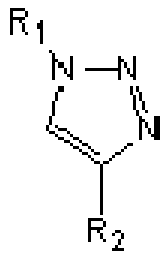
실시양태에서, 중합체 쇄에 대해 말단으로 아지드 또는 알킨 기를 함유하는 중합체가 제조된다. 이러한 중합체는 이어서 다수의 알킨 또는 아지드 기가 합성 나노담체의 표면 상에 배치되는 방식으로 그러한 나노담체를 제조하는데 사용된다. 대안적으로, 합성 나노담체는 또 다른 경로에 의해 제조될 수 있고, 그 후 알킨 또는 아지드 기에 의해 관능화될 수 있다. 성분은 알킨 (중합체가 아지드를 함유하는 경우) 또는 아지드 (중합체가 알킨을 함유하는 경우) 기의 존재 하에 제조된다. 이어서 성분은 1,4-이치환된 1,2,3-트리아졸 링커를 통해 성분을 입자에 공유적으로 부착시키는 촉매의 존재 또는 부재 하에 1,3-쌍극자 고리화첨가 반응을 통해 나노담체와 반응하게 된다.In an embodiment, polymers are prepared containing azide or alkyne groups terminal to the polymer chain. These polymers are then used to prepare such nanocarriers in such a way that multiple alkyne or azide groups are placed on the surface of the synthetic nanocarrier. Alternatively, synthetic nanocarriers can be prepared by another route and then functionalized with alkyne or azide groups. The component is prepared in the presence of an alkyne (if the polymer contains an azide) or azide (if the polymer contains an alkyne) group. The component then reacts with the nanocarrier through a 1,3-dipolar cycloaddition reaction in the presence or absence of a catalyst that covalently attaches the component to the particle through a 1,4-disubstituted 1,2,3-triazole linker. I do it.
티오에테르 링커는 황-탄소 (티오에테르) 결합의 형성에 의해 예를 들어 R1-S-R2의 형태로 만들어진다. 티오에테르는 한 성분 상의 티올/메르캅탄 (-SH) 기의, 제2 성분 상의 알킬화 기, 예컨대 할라이드 또는 에폭시드에 의한 알킬화에 의해 만들어질 수 있다. 티오에테르 링커는 또한 한 성분 상의 티올/메르캅탄 기의, 마이클 수용자로서 말레이미드 기 또는 비닐 술폰 기를 함유하는 제2 성분 상의 전자-결핍 알켄 기에 대한 마이클 첨가에 의해 형성될 수 있다. 또 다른 방식으로, 티오에테르 링커는 한 성분 상의 티올/메르캅탄 기의, 제2 성분 상의 알켄 기와의 라디칼 티올-엔 반응에 의해 제조될 수 있다.Thioether linkers are made by the formation of a sulfur-carbon (thioether) bond, for example in the form R1-S-R2. Thioethers can be made by alkylation of a thiol/mercaptan (-SH) group on one component with an alkylating group, such as a halide or epoxide, on a second component. Thioether linkers can also be formed by Michael addition of a thiol/mercaptan group on one component to an electron-deficient alkene group on a second component containing a maleimide group or vinyl sulfone group as a Michael acceptor. Alternatively, thioether linkers can be prepared by radical thiol-ene reaction of thiol/mercaptan groups on one component with alkene groups on a second component.
히드라존 링커는 한 성분 상의 히드라지드 기의, 제2 성분 상의 알데히드/케톤 기와의 반응에 의해 만들어진다.Hydrazone linkers are made by reaction of a hydrazide group on one component with an aldehyde/ketone group on a second component.
히드라지드 링커는 한 성분 상의 히드라진 기의, 제2 성분 상의 카르복실산 기와의 반응에 의해 형성된다. 이러한 반응은 일반적으로 활성화 시약을 사용하여 카르복실산을 활성화시키는 아미드 결합의 형성과 유사한 화학을 사용하여 수행된다.Hydrazide linkers are formed by the reaction of hydrazine groups on one component with carboxylic acid groups on a second component. These reactions are generally performed using chemistry similar to the formation of an amide bond, which activates a carboxylic acid using an activating reagent.
이민 또는 옥심 링커는 한 성분 상의 아민 또는 N-알콕시아민 (또는 아미노옥시) 기의, 제2 성분 상의 알데히드 또는 케톤 기와의 반응에 의해 형성된다.Imine or oxime linkers are formed by the reaction of an amine or N-alkoxyamine (or aminooxy) group on one component with an aldehyde or ketone group on a second component.
우레아 또는 티오우레아 링커는 한 성분 상의 아민 기의, 제2 성분 상의 이소시아네이트 또는 티오이소시아네이트 기와의 반응에 의해 제조된다.Urea or thiourea linkers are prepared by reaction of amine groups on one component with isocyanate or thioisocyanate groups on a second component.
아미딘 링커는 한 성분 상의 아민 기의, 제2 성분 상의 이미도에스테르 기와의 반응에 의해 제조된다.Amidine linkers are prepared by reaction of an amine group on one component with an imidoester group on a second component.
아민 링커는 한 성분 상의 아민 기의, 제2 성분 상의 알킬화 기, 예컨대 할라이드, 에폭시드 또는 술포네이트 에스테르 기에 의한 알킬화 반응에 의해 만들어진다. 대안적으로, 아민 링커는 또한 소듐 시아노보로히드리드 또는 소듐 트리아세톡시보로히드리드와 같은 적합한 환원 시약의 존재 하에, 한 성분 상의 아민 기의 제2 성분 상의 알데히드 또는 케톤 기에 의한 환원성 아미노화에 의해 만들어질 수 있다.Amine linkers are made by the alkylation reaction of an amine group on one component with an alkylating group, such as a halide, epoxide or sulfonate ester group, on a second component. Alternatively, the amine linker may also be subjected to reductive amination of an amine group on one component with an aldehyde or ketone group on a second component in the presence of a suitable reducing reagent, such as sodium cyanoborohydride or sodium triacetoxyborohydride. can be made by
술폰아미드 링커는 한 성분 상의 아민 기의 제2 성분 상의 술포닐 할라이드 (예컨대 술포닐 클로라이드) 기와의 반응에 의해 만들어진다.Sulfonamide linkers are made by reacting an amine group on one component with a sulfonyl halide (eg, sulfonyl chloride) group on a second component.
술폰 링커는 비닐 술폰에 대한 친핵체의 마이클 첨가에 의해 만들어진다. 비닐 술폰 또는 친핵체는 나노담체의 표면 상에 존재할 수 있거나 성분에 부착될 수 있다.Sulfone linkers are made by Michael addition of a nucleophile to vinyl sulfone. The vinyl sulfone or nucleophile may be present on the surface of the nanocarrier or may be attached to the component.
성분은 또한 비-공유 접합 방법을 통해 나노담체에 접합될 수 있다. 예를 들어, 음으로 하전된 면역억제제는 양으로 하전된 나노담체에 정전기적 흡착을 통해 접합될 수 있다. 금속 리간드를 함유하는 성분은 또한 금속 착물을 함유하는 나노담체에 금속-리간드 착물을 통해 접합될 수 있다.Components can also be conjugated to nanocarriers via non-covalent conjugation methods. For example, negatively charged immunosuppressants can be conjugated to positively charged nanocarriers through electrostatic adsorption. A component containing a metal ligand can also be conjugated via a metal-ligand complex to a nanocarrier containing the metal complex.
실시양태에서, 성분은 합성 나노담체의 어셈블리 전에 중합체, 예를 들어 폴리락트산-블록-폴리에틸렌 글리콜에 부착될 수 있거나, 또는 합성 나노담체는 그의 표면 상에 반응성 또는 활성화가능 기를 가진 상태로 형성될 수 있다. 후자의 경우에, 성분은 합성 나노담체의 표면에 의해 제공되는 부착 화학과 상용성인 기를 가진 상태로 제조될 수 있다. 다른 실시양태에서, 펩티드 성분은 적합한 링커를 사용하여 VLP 또는 리포솜에 부착될 수 있다. 링커는 2개의 분자를 함께 커플링시킬 수 있는 화합물 또는 시약이다. 한 실시양태에서, 링커는 문헌 [Hermanson 2008]에 기재된 바와 같은 동종이관능성 또는 이종이관능성 시약일 수 있다. 예를 들어, 표면 상에 카르복실 기를 함유하는 VLP 또는 리포솜 합성 나노담체는 EDC의 존재 하에 동종이관능성 링커, 아디프산 디히드라지드 (ADH)로 처리되어 ADH 링커를 갖는 상응하는 합성 나노담체를 형성할 수 있다. 생성된 ADH 연결된 합성 나노담체는 이어서 나노담체 상의 ADH 링커의 다른 말단을 통해 산 기를 함유하는 펩티드 성분과 접합되어 상응하는 VLP 또는 리포솜 펩티드 접합체를 생성한다.In embodiments, the components may be attached to a polymer, such as polylactic acid-block-polyethylene glycol, prior to assembly of the synthetic nanocarrier, or the synthetic nanocarrier may be formed with reactive or activatable groups on its surface. there is. In the latter case, the component can be prepared with groups that are compatible with the attachment chemistry provided by the surface of the synthetic nanocarrier. In other embodiments, the peptide component can be attached to the VLP or liposome using a suitable linker. A linker is a compound or reagent that can couple two molecules together. In one embodiment, the linker may be a homobifunctional or heterobifunctional reagent as described in Hermanson 2008. For example, VLP or liposomal synthetic nanocarriers containing carboxyl groups on the surface are treated with a homobifunctional linker, adipic acid dihydrazide (ADH) in the presence of EDC to yield the corresponding synthetic nanocarriers with ADH linkers. can be formed. The resulting ADH-linked synthetic nanocarrier is then conjugated with a peptide component containing an acid group via the other end of the ADH linker on the nanocarrier to generate the corresponding VLP or liposomal peptide conjugate.
이용가능한 접합 방법의 상세한 설명에 대해서는, 문헌 [Hermanson G T "Bioconjugate Techniques", 2nd Edition Published by Academic Press, Inc., 2008]을 참조한다. 공유 부착에 더하여, 성분은 사전-형성된 합성 나노담체에의 흡착에 의해 부착될 수 있거나, 또는 합성 나노담체의 형성 동안 캡슐화에 의해 부착될 수 있다.For a detailed description of available conjugation methods, see Hermanson G T "Bioconjugate Techniques", 2nd Edition Published by Academic Press, Inc., 2008. In addition to covalent attachment, components can be attached by adsorption to a pre-formed synthetic nanocarrier, or by encapsulation during formation of the synthetic nanocarrier.
본원에 제공된 바와 같은 임의의 면역억제제가 제공된 방법 또는 조성물에서 사용될 수 있고, 일부 실시양태에서 합성 나노담체에 부착될 수 있다. 면역억제제는 스타틴; mTOR 억제제, 예컨대 라파마이신 또는 라파마이신 유사체; TGF-β 신호전달 작용제; TGF-β 수용체 효능제; 히스톤 데아세틸라제 (HDAC) 억제제; 코르티코스테로이드; 미토콘드리아 기능 억제제, 예컨대 로테논; P38 억제제; NF-κβ 억제제; 아데노신 수용체 효능제; 프로스타글란딘 E2 효능제; 포스포디에스테라제 억제제, 예컨대 포스포디에스테라제 4 억제제; 프로테아솜 억제제; 키나제 억제제; G-단백질 커플링된 수용체 효능제; G-단백질 커플링된 수용체 길항제; 글루코코르티코이드; 레티노이드; 시토카인 억제제; 시토카인 수용체 억제제; 시토카인 수용체 활성화제; 퍼옥시솜 증식자-활성화 수용체 길항제; 퍼옥시솜 증식자-활성화 수용체 효능제; 히스톤 데아세틸라제 억제제; 칼시뉴린 억제제; 포스파타제 억제제 및 산화 ATP를 포함하나, 이에 제한되지는 않는다. 면역억제제는 또한 IDO, 비타민 D3, 시클로스포린 A, 아릴 탄화수소 수용체 억제제, 레스베라트롤, 아자티오퓨린, 6-메르캅토퓨린, 아스피린, 니플룸산, 에스트리올, 트리프롤리드, 인터류킨 (예를 들어, IL-1, IL-10), 시클로스포린 A, siRNA 표적화 시토카인 또는 시토카인 수용체 등을 포함한다.Any immunosuppressive agent as provided herein may be used in the methods or compositions provided, and in some embodiments may be attached to a synthetic nanocarrier. Immunosuppressants include statins; mTOR inhibitors such as rapamycin or rapamycin analogs; TGF-β signaling agonist; TGF-β receptor agonist; histone deacetylase (HDAC) inhibitors; corticosteroids; Mitochondrial function inhibitors such as rotenone; P38 inhibitor; NF-κβ inhibitor; adenosine receptor agonist; Prostaglandin E2 agonist; Phosphodiesterase inhibitors, such as phosphodiesterase 4 inhibitors; proteasome inhibitors; Kinase inhibitors; G-protein coupled receptor agonist; G-protein coupled receptor antagonist; glucocorticoids; retinoid; Cytokine inhibitors; Cytokine receptor inhibitors; Cytokine receptor activator; peroxisome proliferator-activated receptor antagonist; peroxisome proliferator-activated receptor agonist; histone deacetylase inhibitors; calcineurin inhibitor; Including, but not limited to, phosphatase inhibitors and oxidized ATP. Immunosuppressants also include IDO, vitamin D3, cyclosporine A, aryl hydrocarbon receptor inhibitors, resveratrol, azathiopurine, 6-mercaptopurine, aspirin, niphlumic acid, estriol, triprolide, interleukins (e.g., IL -1, IL-10), cyclosporin A, siRNA targeting cytokines or cytokine receptors, etc.
스타틴의 예는 아토르바스타틴 (리피토르(LIPITOR)®, 토르바스트(TORVAST)®), 세리바스타틴, 플루바스타틴 (레스콜(LESCOL)®, 레스콜® XL), 로바스타틴 (메바코르(MEVACOR)®, 알토코르(ALTOCOR)®, 알토프레브(ALTOPREV)®), 메바스타틴 (콤팩틴(COMPACTIN)®), 피타바스타틴 (리발로(LIVALO)®, 피아바(PIAVA)®), 로수바스타틴 (프라바콜(PRAVACHOL)®, 셀렉틴(SELEKTINE)®, 리포스타트(LIPOSTAT)®), 로수바스타틴 (크레스토르(CRESTOR)®) 및 심바스타틴 (조코르(ZOCOR)®, 리펙스(LIPEX)®)을 포함한다.Examples of statins include atorvastatin (LIPITOR®, TORVAST®), cerivastatin, fluvastatin (LESCOL®, LESCOL® XL), and lovastatin (MEVACOR®). , ALTOCOR®, ALTOPREV®), mevastatin (COMPACTIN®), pitavastatin (LIVALO®, PIAVA®), rosuvastatin (PRAVACHOL®, SELEKTINE®, LIPOSTAT®), Rosuvastatin (CRESTOR®) and Simvastatin (ZOCOR®, LIPEX®) Includes.
mTOR 억제제의 예는 라파마이신 및 그의 유사체 (예를 들어, CCL-779, RAD001, AP23573, C20-메트알릴라파마이신 (C20-Marap), C16-(S)-부틸술폰아미도라파마이신 (C16-BSrap), C16-(S)-3-메틸인돌라파마이신 (C16-iRap) (Bayle et al. Chemistry & Biology 2006, 13:99-107)), AZD8055, BEZ235 (NVP-BEZ235), 크리소판산 (크리소판올), 데포롤리무스 (MK-8669), 에베롤리무스 (RAD0001), KU-0063794, PI-103, PP242, 템시롤리무스, 및 WYE-354 (미국 텍사스주 휴스톤 소재 셀렉크(Selleck)에서 입수가능)를 포함한다.Examples of mTOR inhibitors include rapamycin and its analogs (e.g., CCL-779, RAD001, AP23573, C20-metallylrapamycin (C20-Marap), C16-(S)-butylsulfonamidorapamycin (C16- BSrap), C16-(S)-3-methylindolapamycin (C16-iRap) (Bayle et al. Chemistry & Biology 2006, 13:99-107)), AZD8055, BEZ235 (NVP-BEZ235), chrysophanic acid (chrysophanol), deporolimus (MK-8669), everolimus (RAD0001), KU-0063794, PI-103, PP242, temsirolimus, and WYE-354 (Selleck, Houston, TX, USA) ) available from ).
TGF-β 신호전달 작용제의 예는 TGF-β 리간드 (예를 들어, 액티빈 A, GDF1, GDF11, 골 형태발생 단백질, 노달, TGF-β) 및 그의 수용체 (예를 들어, ACVR1B, ACVR1C, ACVR2A, ACVR2B, BMPR2, BMPR1A, BMPR1B, TGFβRI, TGFβRII), R-SMADS/co-SMADS (예를 들어, SMAD1, SMAD2, SMAD3, SMAD4, SMAD5, SMAD8), 및 리간드 억제제 (예를 들어, 폴리스타틴, 노긴, 코르딘, DAN, 레프티, LTBP1, THBS1, 데코린)를 포함한다.Examples of TGF-β signaling agonists include TGF-β ligands (e.g., activin A, GDF1, GDF11, bone morphogenetic protein, nodal, TGF-β) and their receptors (e.g., ACVR1B, ACVR1C, ACVR2A, ACVR2B, BMPR2, BMPR1A, BMPR1B, TGFβRI, TGFβRII), R-SMADS/co-SMADS (e.g., SMAD1, SMAD2, SMAD3, SMAD4, SMAD5, SMAD8), and ligand inhibitors (e.g., follistatin, noggin, chordin, DAN, lefty, LTBP1, THBS1, decorin).
미토콘드리아 기능 억제제의 예는 아트락틸로시드 (이칼륨 염), 봉크렉산 (트리암모늄 염), 카르보닐 시아나이드 m-클로로페닐히드라존, 카르복시아트락틸로시드 (예를 들어, 아트락틸리스 구미페라(Atractylis gummifera)로부터), CGP-37157, (-)-데구엘린 (예를 들어, 문둘레아 세리세아(Mundulea sericea)로부터), F16, 헥소키나제 II VDAC 결합 도메인 펩티드, 올리고마이신, 로테논, Ru360, SFK1 및 발리노마이신 (예를 들어, 스트렙토미세스 풀비시무스(Streptomyces fulvissimus)로부터) (EMD4바이오사이언시스(EMD4Biosciences), 미국)을 포함한다.Examples of mitochondrial function inhibitors include atractyloside (dipotassium salt), boncrexane (triammonium salt), carbonyl cyanide m-chlorophenylhydrazone, carboxyatractyloside (e.g. Atractylis gummies) from Atractylis gummifera), CGP-37157, (-)-deguelin (e.g. from Mundulea sericea), F16, hexokinase II VDAC binding domain peptide, oligomycin, rotenone , Ru360, SFK1 and valinomycin (e.g. from Streptomyces fulvissimus) (EMD4Biosciences, USA).
P38 억제제의 예는 SB-203580 (4-(4-플루오로페닐)-2-(4-메틸술피닐페닐)-5-(4-피리딜)1H-이미다졸), SB-239063 (트랜스-1-(4히드록시시클로헥실)-4-(플루오로페닐)-5-(2-메톡시-피리미딘-4-일) 이미다졸), SB-220025 (5-(2아미노-4-피리미디닐)-4-(4-플루오로페닐)-1-(4-피페리디닐)이미다졸)), 및 ARRY-797을 포함한다.Examples of P38 inhibitors include SB-203580 (4-(4-fluorophenyl)-2-(4-methylsulfinylphenyl)-5-(4-pyridyl)1H-imidazole), SB-239063 (trans- 1-(4hydroxycyclohexyl)-4-(fluorophenyl)-5-(2-methoxy-pyrimidin-4-yl)imidazole), SB-220025 (5-(2amino-4-pyrimidine) midinyl)-4-(4-fluorophenyl)-1-(4-piperidinyl)imidazole)), and ARRY-797.
NF (예를 들어, NK-κβ) 억제제의 예는 IFRD1, 2-(1,8-나프티리딘-2-일)-페놀, 5-아미노살리실산, BAY 11-7082, BAY 11-7085, CAPE (카페인산 페네틸에스테르), 디에틸말레에이트, IKK-2 억제제 IV, IMD 0354, 락타시스틴, MG-132 [Z-Leu-Leu-Leu-CHO], NFκB 활성화 억제제 III, NF-κB 활성화 억제제 II, JSH-23, 파르테놀리드, 페닐아르신 옥시드 (PAO), PPM-18, 피롤리딘디티오카르밤산 암모늄 염, QNZ, RO 106-9920, 로카글라미드, 로카글라미드 AL, 로카글라미드 C, 로카글라미드 I, 로카글라미드 J, 로카글라올, (R)-MG-132, 살리실산나트륨, 트리프톨리드 (PG490), 및 웨델로락톤을 포함한다.Examples of NF (e.g. NK-κβ) inhibitors include IFRD1, 2-(1,8-naphthyridin-2-yl)-phenol, 5-aminosalicylic acid, BAY 11-7082, BAY 11-7085, CAPE ( caffeic acid phenethyl ester), diethyl maleate, IKK-2 inhibitor IV, IMD 0354, lactacystin, MG-132 [Z-Leu-Leu-Leu-CHO], NFκB activation inhibitor III, NF-κB activation inhibitor II , JSH-23, parthenolide, phenylarsine oxide (PAO), PPM-18, ammonium pyrrolidinedithiocarbamate salt, QNZ, RO 106-9920, Rocaglamid, Rocaglamid AL, Rocagla Mead C, Rocaglamid I, Rocaglamid J, Rocaglaol, (R)-MG-132, Sodium Salicylate, Triptolide (PG490), and Wedelolactone.
아데노신 수용체 효능제의 예는 CGS-21680 및 ATL-146e를 포함한다.Examples of adenosine receptor agonists include CGS-21680 and ATL-146e.
프로스타글란딘 E2 효능제의 예는 E-프로스타노이드 2 및 E-프로스타노이드 4를 포함한다.Examples of prostaglandin E2 agonists include E-prostanoid 2 and E-prostanoid 4.
포스포디에스테라제 억제제 (비-선택적 및 선택적 억제제)의 예는 카페인, 아미노필린, IBMX (3-이소부틸-1-메틸크산틴), 파라크산틴, 펜톡시필린, 테오브로민, 테오필린, 메틸화 크산틴, 빈포세틴, EHNA (에리트로-9-(2-히드록시-3-노닐)아데닌), 아나그렐리드, 에녹시몬 (페르판(PERFAN)™), 밀리논, 레보시멘단, 메셈브린, 이부딜라스트, 피클라밀라스트, 루테올린, 드로타베린, 로플루밀라스트 (닥사스(DAXAS)™, 달리레스프(DALIRESP)™), 실데나필 (레바티온(REVATION)®, 비아그라(VIAGRA)®), 타달라필 (애드서카(ADCIRCA)®, 시알리스(CIALIS)®), 바르데나필 (레비트라(LEVITRA)®, 스탁신(STAXYN)®), 우데나필, 아바나필, 이카리인, 4-메틸피페라진 및 피라졸로 피리미딘-7-1을 포함한다.Examples of phosphodiesterase inhibitors (non-selective and selective inhibitors) include caffeine, aminophylline, IBMX (3-isobutyl-1-methylxanthine), paraxanthine, pentoxifylline, theobromine, theophylline, methylated xanthine. , vinpocetine, EHNA (erythro-9-(2-hydroxy-3-nonyl)adenine), anagrelide, enoximone (PERFAN™), milrinone, levosimendan, mesembrine, ibu Dilast, piclamilast, luteolin, drotaverine, roflumilast (DAXAS™, DALIRESP™), sildenafil (REVATION®, VIAGRA®), Tadalafil (ADCIRCA®, CIALIS®), vardenafil (LEVITRA®, STAXYN®), udenafil, avanafil, icariin, 4-methylpipe Includes razine and pyrazolo pyrimidine-7-1.
프로테아솜 억제제의 예는 보르테조밉, 디술피람, 에피갈로카테킨-3-갈레이트 및 살리노스포라미드 A를 포함한다.Examples of proteasome inhibitors include bortezomib, disulfiram, epigallocatechin-3-gallate, and salinosporamide A.
키나제 억제제의 예는 베바시주맙, BIBW 2992, 세툭시맙 (에르비툭스(ERBITUX)®), 이마티닙 (글리벡(GLEEVEC)®), 트라스투주맙 (헤르셉틴(HERCEPTIN)®), 게피티닙 (이레사(IRESSA)®), 라니비주맙 (루센티스(LUCENTIS)®), 페갑타닙, 소라페닙, 다사티닙, 수니티닙, 에를로티닙, 닐로티닙, 라파티닙, 파니투무맙, 반데타닙, E7080, 파조파닙 및 무브리티닙을 포함한다.Examples of kinase inhibitors include bevacizumab, BIBW 2992, cetuximab (ERBITUX®), imatinib (GLEEVEC®), trastuzumab (HERCEPTIN®), gefitinib ( IRESSA®), ranibizumab (LUCENTIS®), pegaptanib, sorafenib, dasatinib, sunitinib, erlotinib, nilotinib, lapatinib, panitumumab, vandetanib, Includes E7080, pazopanib and mubritinib.
글루코코르티코이드의 예는 히드로코르티손 (코르티솔), 코르티손 아세테이트, 프레드니손, 프레드니솔론, 메틸프레드니솔론, 덱사메타손, 베타메타손, 트리암시놀론, 베클로메타손, 플루드로코르티손 아세테이트, 데옥시코르티코스테론 아세테이트 (DOCA) 및 알도스테론을 포함한다.Examples of glucocorticoids include hydrocortisone (cortisol), cortisone acetate, prednisone, prednisolone, methylprednisolone, dexamethasone, betamethasone, triamcinolone, beclomethasone, fludrocortisone acetate, deoxycorticosterone acetate (DOCA), and aldosterone. do.
레티노이드의 예는 레티놀, 레티날, 트레티노인 (레티노산, 레틴-A(RETIN-A)®), 이소트레티노인 (아큐탄(ACCUTANE)®, 암네스팀(AMNESTEEM)®, 클라라비스(CLARAVIS)®, 소트레트(SOTRET)®), 알리트레티노인 (판레틴(PANRETIN)®), 에트레티네이트 (테기손(TEGISON)™) 및 그의 대사물 아시트레틴 (소리아탄(SORIATANE)®), 타자로텐 (타조락(TAZORAC)®, 아바게(AVAGE)®, 조락(ZORAC)®), 벡사로텐 (탈그레틴(TARGRETIN)®) 및 아다팔렌 (디페린(DIFFERIN)®)을 포함한다.Examples of retinoids include retinol, retinal, tretinoin (retinoic acid, RETIN-A®), isotretinoin (ACCUTANE®, AMNESTEEM®, CLARAVIS®, SOTRET) (SOTRET)®), alitretinoin (PANRETIN®), etretinate (TEGISON™) and its metabolite acitretin (SORIATANE®), tazarotene (TAZORAC) )®, AVAGE®, ZORAC®), bexarotene (TARGRETIN®) and adapalene (DIFFERIN®).
시토카인 억제제의 예는 IL1ra, IL1 수용체 길항제, IGFBP, TNF-BF, 우로모듈린, 알파-2-마크로글로불린, 시클로스포린 A, 펜타미딘 및 펜톡시필린 (펜토팍(PENTOPAK)®, 펜톡실(PENTOXIL)®, 트렌탈(TRENTAL)®)을 포함한다.Examples of cytokine inhibitors include IL1ra, IL1 receptor antagonist, IGFBP, TNF-BF, uromodulin, alpha-2-macroglobulin, cyclosporine A, pentamidine, and pentoxifylline (PENTOPAK®, PENTOXIL )®, TRENTAL®).
퍼옥시솜 증식자-활성화 수용체 길항제의 예는 GW9662, PPARγ 길항제 III, G335 및 T0070907 (EMD4바이오사이언시스, 미국)을 포함한다.Examples of peroxisome proliferator-activated receptor antagonists include GW9662, PPARγ antagonist III, G335 and T0070907 (EMD4 Biosciences, USA).
퍼옥시솜 증식자-활성화 수용체 효능제의 예는 피오글리타존, 시글리타존, 클로피브레이트, GW1929, GW7647, L-165,041, LY 171883, PPARγ 활성화제, Fmoc-Leu, 트로글리타존 및 WY-14643 (EMD4바이오사시언시스, 미국)을 포함한다.Examples of peroxisome proliferator-activated receptor agonists include pioglitazone, ciglitazone, clofibrate, GW1929, GW7647, L-165,041, LY 171883, PPARγ activator, Fmoc-Leu, troglitazone, and WY-14643 (EMD4Bio). sassiansis, USA).
히스톤 데아세틸라제 억제제의 예는 히드록삼산 (또는 히드록사메이트), 예컨대 트리코스타틴 A, 시클릭 테트라펩티드 (예컨대 트라폭신 B) 및 뎁시펩티드, 벤즈아미드, 친전자성 케톤, 지방족 산 화합물, 예컨대 페닐부티레이트 및 발프로산, 히드록삼산, 예컨대 보리노스타트 (SAHA), 벨리노스타트 (PXD101), LAQ824 및 파노비노스타트 (LBH589), 벤즈아미드, 예컨대 엔티노스타트 (MS-275), CI994 및 모세티노스타트 (MGCD0103), 니코틴아미드, NAD 유도체, 디히드로쿠마린, 나프토피라논, 및 2-히드록시나프알데히드를 포함한다.Examples of histone deacetylase inhibitors include hydroxamic acids (or hydroxamates) such as trichostatin A, cyclic tetrapeptides (such as trapoxin B) and depsipeptides, benzamides, electrophilic ketones, aliphatic acid compounds such as Phenylbutyrate and valproic acid, hydroxamic acids such as vorinostat (SAHA), belinostat (PXD101), LAQ824 and panobinostat (LBH589), benzamides such as entinostat (MS-275), CI994 and Contains mosetinostat (MGCD0103), nicotinamide, NAD derivatives, dihydrocoumarin, naphthopyranone, and 2-hydroxynafaldehyde.
칼시뉴린 억제제의 예는 시클로스포린, 피메크롤리무스, 보클로스포린 및 타크롤리무스를 포함한다.Examples of calcineurin inhibitors include cyclosporine, pimecrolimus, voclosporin, and tacrolimus.
포스파타제 억제제의 예는 BN82002 히드로클로라이드, CP-91149, 칼리큘린 A, 칸타리드산, 칸타리딘, 시페르메트린, 에틸-3,4-데포스타틴, 포스트리에신 나트륨 염, MAZ51, 메틸-3,4-데포스타틴, NSC 95397, 노르칸타리딘, 프로로센트룸 콘카붐(prorocentrum concavum)으로부터의 오카다산 암모늄 염, 오카다산, 오카다산 칼륨 염, 오카다산 나트륨 염, 페닐아르신 옥시드, 다양한 포스파타제 억제제 칵테일, 단백질 포스파타제 1C, 단백질 포스파타제 2A 억제제 단백질, 단백질 포스파타제 2A1, 단백질 포스파타제 2A2 및 오르토바나듐산나트륨을 포함한다.Examples of phosphatase inhibitors include BN82002 hydrochloride, CP-91149, calyculin A, cantharidic acid, cantharidin, cypermethrin, ethyl-3,4-depostatin, postriecin sodium salt, MAZ51, methyl-3, 4-depostatin, NSC 95397, norcantharidin, ammonium okadaic acid salt from prorocentrum concavum, okadaic acid, potassium salt of okadaic acid, sodium salt of okadaic acid, phenylarsine oxide, various phosphatase inhibitors The cocktail contains protein phosphatase 1C, protein phosphatase 2A inhibitor protein, protein phosphatase 2A1, protein phosphatase 2A2, and sodium orthovanadate.
일부 실시양태에서, 치료 거대분자는 치료 거대분자 그 자체, 또는 그의 단편 또는 유도체의 형태로 전달될 수 있다. 치료 거대분자는 치료 단백질 또는 치료 폴리뉴클레오티드를 포함할 수 있다.In some embodiments, the therapeutic macromolecule may be delivered in the form of the therapeutic macromolecule itself, or a fragment or derivative thereof. Therapeutic macromolecules may include therapeutic proteins or therapeutic polynucleotides.
치료 단백질은 주입가능한 치료 단백질, 효소, 효소 보조인자, 호르몬, 혈액 응고 인자, 시토카인 및 인터페론, 성장 인자, 모노클로날 항체 및 폴리클로날 항체 (예를 들어, 대체 요법으로서 대상체에게 투여됨) 및 폼페병 연관 단백질 (예를 들어, 산 글루코시다제 알파, rhGAA (예를 들어, 미오자임 및 루미자임 (겐자임))를 포함하나, 이에 제한되지는 않는다. 치료 단백질은 또한 혈액 응고 캐스케이드에 수반되는 단백질을 포함한다. 치료 단백질은 인자 VIII, 인자 VII, 인자 IX, 인자 V, 폰 빌레브란트 인자, 폰 헬데브란트 인자, 조직 플라스미노겐 활성화제, 인슐린, 성장 호르몬, 에리트로포이에틴 알파, VEGF, 트롬보포이에틴, 리소자임, 항트롬빈 등을 포함하나, 이에 제한되지는 않는다. 치료 단백질은 또한 아디포킨, 예컨대 렙틴 및 아디포넥틴을 포함한다. 치료 단백질의 다른 예는 하기 및 본원의 다른 곳에 기재된 바와 같다.Therapeutic proteins include injectable therapeutic proteins, enzymes, enzyme cofactors, hormones, blood clotting factors, cytokines and interferons, growth factors, monoclonal antibodies and polyclonal antibodies (e.g., administered to a subject as replacement therapy), and Pompe disease associated proteins (e.g., acid glucosidase alpha, rhGAA (e.g., myozyme and luminzyme (genzyme))). Therapeutic proteins are also involved in the blood coagulation cascade. Therapeutic proteins include factor VIII, factor VII, factor IX, factor V, von Willebrand factor, von Heldebrand factor, tissue plasminogen activator, insulin, growth hormone, erythropoietin alpha, VEGF, Therapeutic proteins include, but are not limited to, thrombopoietin, lysozyme, antithrombin, and the like. Other examples of therapeutic proteins include adipokines, such as leptin and adiponectin, as described below and elsewhere herein. .
리소솜 축적 장애를 갖는 대상체의 효소 대체 요법에 사용되는 치료 단백질의 예는 고셔병의 치료를 위한 이미글루세라제 (예를 들어, 세레자임(CEREZYME)™), 파브리병의 치료를 위한 a-갈락토시다제 A (a-gal A) (예를 들어, 아갈시다제 베타, 파브리자임(FABRYZYME)™), 폼페병의 치료를 위한 산 α-글루코시다제 (GAA) (예를 들어, 산 글루코시다제 알파, 루미자임™, 미오자임™), 뮤코폴리사카라이드증의 치료를 위한 아릴술파타제 B (예를 들어, 라로니다제, 알두라자임™, 이두르술파제, 엘라프라제™, 아릴술파타제 B, 나글라자임™), 페글로티카제 (크리스텍사) 및 페그시티카제를 포함하나, 이에 제한되지는 않는다.Examples of therapeutic proteins used in enzyme replacement therapy in subjects with lysosomal storage disorders include imiglucerase (e.g., CEREZYME™) for the treatment of Gaucher disease, a-gal for the treatment of Fabry disease. Lactosidase A (a-gal A) (e.g., agalsidase beta, FABRYZYME™), acid α-glucosidase (GAA) (e.g., acid glucosidase (GAA) for the treatment of Pompe disease Sidase alpha, Lumizyme™, Myozyme™), arylsulfatase B for the treatment of mucopolysaccharidosis (e.g. Laronidase, Aldurazyme™, Idursulfase, Elaprase™, Includes, but is not limited to, arylsulfatase B, Naglazyme™), pegloticase (Crystexa), and pegcitase.
효소의 예는 옥시도리덕타제, 트랜스퍼라제, 히드롤라제, 리아제, 이소머라제, 아스파라기나제, 우리카제, 글리코시다제, 아스파라기나제, 우리카제, 프로테아제, 뉴클레아제, 콜라게나제, 히알루로니다제, 헤파리나제, 헤파라나제, 리신 및 리가제를 포함한다.Examples of enzymes include oxidoreductase, transferase, hydrolase, lyase, isomerase, asparaginase, uricase, glycosidase, asparaginase, uricase, protease, nuclease, collagenase, Includes hyaluronidase, heparinase, heparanase, ricin and ligase.
치료 단백질은 또한 임의의 효소, 독소, 또는 박테리아, 진균 또는 바이러스 공급원으로부터 단리되거나 유래된 다른 단백질 또는 펩티드를 포함할 수 있다.Therapeutic proteins may also include any enzymes, toxins, or other proteins or peptides isolated or derived from bacterial, fungal, or viral sources.
호르몬의 예는 멜라토닌 (N-아세틸-5-메톡시트립타민), 세로토닌, 티록신 (또는 테트라아이오도티로닌) (갑상선 호르몬), 트리아이오도티로닌 (갑상선 호르몬), 에피네프린 (또는 아드레날린), 노르에피네프린 (또는 노르아드레날린), 도파민 (또는 프로락틴 억제 호르몬), 항뮐러관 호르몬 (또는 뮐러 억제 인자 또는 호르몬), 아디포넥틴, 부신피질자극 호르몬 (또는 코르티코트로핀), 안지오텐시노겐 및 안지오텐신, 항이뇨 호르몬 (또는 바소프레신, 아르기닌 바소프레신), 심방-나트륨이뇨 펩티드 (또는 아트리오펩틴), 칼시토닌, 콜레시스토키닌, 코르티코트로핀-방출 호르몬, 에리트로포이에틴, 여포-자극 호르몬, 가스트린, 그렐린, 글루카곤, 글루카곤-유사 펩티드 (GLP-1), GIP, 고나도트로핀-방출 호르몬, 성장 호르몬-방출 호르몬, 인간 융모성 고나도트로핀, 인간 태반 락토겐, 성장 호르몬, 인히빈, 인슐린, 인슐린-유사 성장 인자 (또는 소마토메딘), 렙틴, 황체화 호르몬, 멜라닌세포 자극 호르몬, 오렉신, 옥시토신, 부갑상선 호르몬, 프로락틴, 렐락신, 세크레틴, 소마토스타틴, 트롬보포이에틴, 갑상선-자극 호르몬 (또는 티로트로핀), 티로트로핀-방출 호르몬, 코르티솔, 알도스테론, 테스토스테론, 데히드로에피안드로스테론, 안드로스텐디온, 디히드로테스토스테론, 에스트라디올, 에스트론, 에스트리올, 프로게스테론, 칼시트리올 (1,25-디히드록시비타민 D3), 칼시디올 (25-히드록시비타민 D3), 프로스타글란딘, 류코트리엔, 프로스타시클린, 트롬복산, 프로락틴 방출 호르몬, 리포트로핀, 뇌 나트륨이뇨 펩티드, 뉴로펩티드 Y, 히스타민, 엔도텔린, 췌장 폴리펩티드, 레닌 및 엔케팔린을 포함한다.Examples of hormones are melatonin (N-acetyl-5-methoxytryptamine), serotonin, thyroxine (or tetraiodothyronine) (thyroid hormone), triiodothyronine (thyroid hormone), epinephrine (or adrenaline), and norepinephrine. (or noradrenaline), dopamine (or prolactin-inhibiting hormone), anti-Müllerian hormone (or Müllerian inhibitory factor or hormone), adiponectin, adrenocorticotropic hormone (or corticotropin), angiotensinogen and angiotensin, antidiuretic hormone (or vasopressin, arginine vasopressin), atrial-natriuretic peptide (or atriopeptin), calcitonin, cholecystokinin, corticotropin-releasing hormone, erythropoietin, follicle-stimulating hormone, gastrin, ghrelin, glucagon, glucagon-like peptide. (GLP-1), GIP, gonadotropin-releasing hormone, growth hormone-releasing hormone, human chorionic gonadotropin, human placental lactogen, growth hormone, inhibin, insulin, insulin-like growth factor (or Somatomedin), leptin, luteinizing hormone, melanocyte-stimulating hormone, orexin, oxytocin, parathyroid hormone, prolactin, relaxin, secretin, somatostatin, thrombopoietin, thyroid-stimulating hormone (or thyrotropin), thyrotropin. Pin-releasing hormone, cortisol, aldosterone, testosterone, dehydroepiandrosterone, androstenedione, dihydrotestosterone, estradiol, estrone, estriol, progesterone, calcitriol (1,25-dihydroxyvitamin D3), calcitriol Diol (25-hydroxyvitamin D3), prostaglandins, leukotrienes, prostacyclin, thromboxane, prolactin-releasing hormone, lipotropin, brain natriuretic peptide, neuropeptide Y, histamine, endothelin, pancreatic polypeptide, renin and enkephalin. Includes.
혈액 또는 혈액 응고 인자의 예는 인자 I (피브리노겐), 인자 II (프로트롬빈), 조직 인자, 인자 V (프로악셀레린, 불안정성 인자), 인자 VII (안정 인자, 프로콘버틴), 인자 VIII (항혈우병 글로불린), 인자 IX (크리스마스 인자 또는 혈장 트롬보플라스틴 성분), 인자 X (스튜어트-프라워 인자), 인자 Xa, 인자 XI, 인자 XII (하게만 인자), 인자 XIII (피브린-안정화 인자), 폰 빌레브란트 인자, 프리칼리크레인 (플레처 인자), 고분자량 키니노겐 (HMWK) (피츠제랄드 인자), 피브로넥틴, 피브린, 트롬빈, 항트롬빈 III, 헤파린 보조인자 II, 단백질 C, 단백질 S, 단백질 Z, 단백질 Z-관련 프로테아제 억제제 (ZPI), 플라스미노겐, 알파 2-항플라스민, 조직 플라스미노겐 활성화제 (tPA), 우로키나제, 플라스미노겐 활성화제 억제제-1 (PAI1), 플라스미노겐 활성화제 억제제-2 (PAI2), 암 응고촉진제 및 에포에틴 알파 (에포젠(Epogen), 프로크리트(Procrit))를 포함한다.Examples of blood or blood clotting factors include factor I (fibrinogen), factor II (prothrombin), tissue factor, factor V (proaxellerin, unstable factor), factor VII (stable factor, proconvertin), and factor VIII (antihemophilia). globulin), factor IX (Christmas factor or plasma thromboplastin component), factor Von Willebrand factor, prekallikrein (Fletcher factor), high molecular weight kininogen (HMWK) (Fitzgerald factor), fibronectin, fibrin, thrombin, antithrombin III, heparin cofactor II, protein C, protein S, protein Z, Protein Z-related protease inhibitor (ZPI), plasminogen, alpha 2-antiplasmin, tissue plasminogen activator (tPA), urokinase, plasminogen activator inhibitor-1 (PAI1), plasminogen activation These include agent inhibitor-2 (PAI2), procoagulant, and epoetin alfa (Epogen, Procrit).
시토카인의 예는 림포카인, 인터류킨 및 케모카인, 제1형 시토카인, 예컨대 IFN-γ, TGF-β 및 제2형 시토카인, 예컨대 IL-4, IL-10 및 IL-13을 포함한다.Examples of cytokines include lymphokines, interleukins and chemokines,
성장 인자의 예는 아드레노메듈린 (AM), 안지오포이에틴 (Ang), 자가분비 운동성 인자, 골 형태발생 단백질 (BMP), 뇌-유래 신경영양 인자 (BDNF), 표피 성장 인자 (EGF), 에리트로포이에틴 (EPO), 섬유모세포 성장 인자 (FGF), 신경교 세포주-유래 신경영양 인자 (GDNF), 과립구 콜로니-자극 인자 (G-CSF), 과립구 대식세포 콜로니-자극 인자 (GM-CSF), 성장 분화 인자-9 (GDF9), 간세포 성장 인자 (HGF), 간세포암-유래 성장 인자 (HDGF), 인슐린-유사 성장 인자 (IGF), 이동-자극 인자, 미오스타틴 (GDF-8), 신경 성장 인자 (NGF) 및 다른 뉴로트로핀, 혈소판-유래 성장 인자 (PDGF), 트롬보포이에틴 (TPO), 형질전환 성장 인자 알파 (TGF-α), 형질전환 성장 인자 베타 (TGF-β), 암_괴사_인자-알파 (TNF-α), 혈관 내피 성장 인자 (VEGF), Wnt 신호전달 경로, 태반 성장 인자 (PlGF), (태아 소 소마토트로핀) (FBS), IL-1, IL-2, IL-3, IL-4, IL-5, IL-6 및 IL-7을 포함한다.Examples of growth factors include adrenomedullin (AM), angiopoietin (Ang), autocrine motility factor, bone morphogenetic protein (BMP), brain-derived neurotrophic factor (BDNF), and epidermal growth factor (EGF). , erythropoietin (EPO), fibroblast growth factor (FGF), glial cell line-derived neurotrophic factor (GDNF), granulocyte colony-stimulating factor (G-CSF), granulocyte macrophage colony-stimulating factor (GM-CSF) , growth differentiation factor-9 (GDF9), hepatocyte growth factor (HGF), hepatocellular carcinoma-derived growth factor (HDGF), insulin-like growth factor (IGF), migration-stimulating factor, myostatin (GDF-8), neural growth factor (NGF) and other neurotrophins, platelet-derived growth factor (PDGF), thrombopoietin (TPO), transforming growth factor alpha (TGF-α), transforming growth factor beta (TGF-β), Cancer_necrosis_factor-alpha (TNF-α), vascular endothelial growth factor (VEGF), Wnt signaling pathway, placental growth factor (PlGF), (fetal bovine somatotropin) (FBS), IL-1, IL -2, IL-3, IL-4, IL-5, IL-6 and IL-7.
모노클로날 항체의 예는 아바고보맙, 압식시맙, 아달리무맙, 아데카투무맙, 아펠리모맙, 아푸투주맙, 알라치주맙 페골, ALD, 알렘투주맙, 알투모맙 펜테테이트, 아나투모맙 메페나톡스, 안루킨주맙, 항-흉선세포 글로빈, 아폴리주맙, 아르시투모맙, 아셀리주맙, 아틀리주맙 (토실리주맙), 아토롤리무맙, 바피뉴주맙, 바실릭시맙, 바비툭시맙, 벡투모맙, 벨리무맙, 벤랄리주맙, 베르틸리무맙, 베실레소맙, 베바시주맙, 비시로맙, 비바투주맙 메르탄신, 블리나투모맙, 브렌툭시맙 베도틴, 브리아키누맙, 카나키누맙, 칸투주맙 메르탄신, 카프로맙 펜데티드, 카투막소맙, 세델리주맙, 세르톨리주맙 페골, 세툭시맙, 시타투주맙 보가톡스, 식수투무맙, 클레놀릭시맙, 클리바투주맙 테트락세탄, 코나투무맙, 다세투주맙, 다클리주맙, 다라투무맙, 데노수맙, 데투모맙, 도를리모맙 아리톡스, 도를릭시주맙, 에크로멕시맙, 에쿨리주맙, 에도바코맙, 에드레콜로맙, 에팔리주맙, 에펀구맙, 엘로투주맙, 엘실리모맙, 엔리모맙 페골, 에피투모맙 시툭세탄, 에프라투주맙, 에를리주맙, 에르투막소맙, 에타라시주맙, 엑스비비루맙, 파놀레소맙, 파랄리모맙, 파를레투주맙, 펠비주맙, 페자키누맙, 피기투무맙, 폰톨리주맙, 포라비루맙, 프레솔리무맙, 갈릭시맙, 간테네루맙, 가빌리모맙, 겜투주맙 오조가미신, GC1008, 기렌툭시맙, 글렘바투무맙 베도틴, 골리무맙, 고밀릭시맙, 이발리주맙, 이브리투모맙 티욱세탄, 이고보맙, 임시로맙, 인플릭시맙, 인테투무맙, 이놀리모맙, 이노투주맙 오조가미신, 이필리무맙, 이라투무맙, 켈릭시맙, 라베투주맙, 레브리키주맙, 레말레소맙, 레르델리무맙, 렉사투무맙, 리비비루맙, 린투주맙, 로르보투주맙 메르탄신, 루카투무맙, 루밀릭시맙, 마파투무맙, 마슬리모맙, 마투주맙, 메폴리주맙, 메텔리무맙, 밀라투주맙, 민레투모맙, 미투모맙, 모롤리무맙, 모타비주맙, 무로모납-CD3, 나콜로맙 타페나톡스, 나프투모맙 에스타페나톡스, 나탈리주맙, 네바쿠맙, 네시투무맙, 네렐리모맙, 니모투주맙, 노페투모맙 메르펜탄, 오크렐리주맙, 오둘리모맙, 오파투무맙, 올라라투맙, 오말리주맙, 오포르투주맙 모나톡스, 오레고보맙, 오텔릭시주맙, 파기박시맙, 팔리비주맙, 파니투무맙, 파노바쿠맙, 파스콜리주맙, 펨투모맙, 페르투주맙, 펙셀리주맙, 핀투모맙, 프릴릭시맙, 프리투무맙, 라피비루맙, 라무시루맙, 라니비주맙, 락시바쿠맙, 레가비루맙 레슬리주맙, 릴로투무맙, 리툭시맙, 로바투무맙, 론탈리주맙, 로벨리주맙, 루플리주맙, 사투모맙 펜데티드, 세비루맙, 시브로투주맙, 시팔리무맙, 실툭시맙, 시플리주맙, 솔라네주맙, 소넵시주맙, 손투주맙, 스타물루맙, 술레소맙, 타카투주맙 테트락세탄, 타도시주맙, 탈리주맙, 타네주맙, 타플리투모맙 팝톡스, 테피바주맙, 텔리모맙 아리톡스, 테나투모맙, 테넬릭시맙, 테플리주맙, 티실리무맙 (트레멜리무맙), 티가투주맙, 토실리주맙 (아틀리주맙), 토랄리주맙, 토시투모맙, 트라스투주맙, 트레멜리무맙, 투코투주맙 셀모류킨, 투비루맙, 우르톡사주맙, 우스테키누맙, 바팔릭시맙, 베돌리주맙, 벨투주맙, 베팔리모맙, 비실리주맙, 볼로식시맙, 보투무맙, 잘루투무맙, 자놀리무맙, 지랄리무맙, 및 졸리모맙 아리톡스를 포함한다. 모노클로날 항체는 추가로 항-TNF-α 항체를 포함한다.Examples of monoclonal antibodies include abagovomab, abciximab, adalimumab, adecatumumab, apelimomab, aputuzumab, alacizumab pegol, ALD, alemtuzumab, altumomab pentetate, anatumomab Fenatox, anleukinuzumab, anti-thymocyte globin, apolizumab, arsitumomab, acelizumab, atlizumab (tocilizumab), atorolimumab, bafinuzumab, basiliximab, bavituk Cimab, Bectumomab, Belimumab, Benralizumab, Bertilimumab, Becilesomab, Bevacizumab, Visiromab, Bibatuzumab Mertansine, Blinatumomab, Brentuximab Vedotin, Bria Kinumab, canakinumab, cantuzumab mertansine, capromab pendetide, catumaxomab, cedelizumab, certolizumab pegol, cetuximab, sitatuzumab botox, cistumumab, clenoliximab, cli Batuzumab Tetraxetan, Conatumumab, Dacetuzumab, Daclizumab, Daratumumab, Denosumab, Detumomab, Dorlimomab Aritox, Dorlixizumab, Ecromeximab, Eculi Zumab, edovacomab, edrecolomab, efalizumab, efungumab, elotuzumab, elsilimomab, enrimomab pegol, epitumomab situxetan, epratuzumab, erlizumab, ertumaxomab, eta Lacizumab, exbivirumab, panolesomab, paralimomab, parletuzumab, felbizumab, fezakinumab, pigitumumab, pontolizumab, poravirumab, fresolimumab, galiximab, ganteneru Mab, gabilimomab, gemtuzumab ozogamicin, GC1008, gilentuximab, glembatumumab vedotin, golimumab, gomiliximab, ibalizumab, ibritumomab tiuxetan, igobomab, temporarily Mab, infliximab, intetumumab, inolimomab, inotuzumab ozogamicin, ipilimumab, iratumumab, keliximab, labetuzumab, lebrikizumab, remalesomumab, lerdelimumab, Lexatumumab, Ribivirumab, Lintuzumab, Lorbotuzumab Mertansine, Rucatumumab, Lumiliximab, Mapatumumab, Maslimomab, Matuzumab, Mepolizumab, Metelimumab, Milatuzumab, Minre Tumomab, mitumomab, morolimumab, motavizumab, muromonab-CD3, nacolomab tafenatox, naftumomab estafenatox, natalizumab, nevacumab, necitumumab, nerelimomab, nemo Tuzumab, nofetumomab merpentan, ocrelizumab, odulimomab, ofatumumab, olaratumab, omalizumab, oportuzumab monatox, oregobumab, otelixizumab, pagibaxiumab, palivizumab, Panitumumab, panovacumab, pascolizumab, femtumomab, pertuzumab, fexelizumab, pintumomab, priliximab, pritumumab, rapivirumab, ramucirumab, ranibizumab, rakxivacu Mab, regavirumumab, reslizumab, rilotumumab, rituximab, lobatumumab, rontalizumab, lobelizumab, ruplizumab, satumomab pendetide, sevirumab, sibrotuzumab, sifalimumab, Siltuximab, ciplizumab, solanezumab, sonepcizumab, sontuzumab, stamulumab, sulesomab, tacatuzumab, tetraxetan, tadocizumab, talizumab, tanezumab, taplitumomab Poptox, Tepibazumab, Telimomab Aritox, Tenatumomab, Teneliximab, Teplizumab, Ticilimumab (Tremelimumab), Tigatuzumab, Tocilizumab (Atlizumab), Toralizumab, Tosi Tumomab, Trastuzumab, Tremelimumab, Tucotuzumab Selmoryukin, Tuvirumab, Urtoxazumab, Ustekinumab, Bafaliximab, Vedolizumab, Beltuzumab, Bepalimomab, Vicilizumab , volociximab, botumumab, zalutumumab, xanolimumab, giralimumab, and zolimomab Aritox. Monoclonal antibodies further include anti-TNF-α antibodies.
주입 요법 또는 주사가능한 치료 단백질의 예는 예를 들어 토실리주맙 (로슈(Roche)/악템라(Actemra)®), 알파-1 항트립신 (카마다(Kamada)/AAT), 헤마티드® (아피맥스(Affymax) 및 다케다(Takeda), 합성 펩티드), 알빈테르페론 알파-2b (노파르티스(Novartis)/잘빈(Zalbin)™), 루신(Rhucin)® (파밍 그룹(Pharming Group), C1 억제제 대체 요법), 테사모렐린 (테라테크놀로지스(Theratechnologies)/에그리프타(Egrifta), 합성 성장 호르몬-방출 인자), 오크렐리주맙 (제넨테크(Genentech), 로슈 및 비오겐(Biogen)), 벨리무맙 (글락소스미스클라인(GlaxoSmithKline)/벤리스타(Benlysta)®), 페글로티카제 (사비엔트 파마슈티칼스(Savient Pharmaceuticals)/크리스텍사™), 페그시티카제, 탈리글루세라제 알파 (프로탈릭스(Protalix)/유플리소(Uplyso)), 아갈시다제 알파 (샤이어(Shire)/레플라갈(Replagal)®), 벨라그루세라제 알파 (샤이어) 및 키홀 림펫 헤모시아닌 (KLH)을 포함한다.Examples of infusion therapy or injectable therapeutic proteins include, for example, tocilizumab (Roche/Actemra®), alpha-1 antitrypsin (Kamada/AAT), Hematide® (API) Affymax and Takeda, synthetic peptides), Alvinterferone alfa-2b (Novartis/Zalbin™), Rhucin® (Pharming Group, C1 inhibitor alternative therapies), tesamorelin (Theratechnologies/Egrifta, synthetic growth hormone-releasing factor), ocrelizumab (Genentech, Roche and Biogen), belimumab (GlaxoSmithKline/Benlysta®), Pegloticase (Savient Pharmaceuticals/Crystexa™), Pegcitase, Taliglucerase Alfa (Protalix) (Protalix/Uplyso), agalsidase alfa (Shire/Replagal®), bellaglucerase alfa (Shire) and keyhole limpet hemocyanin (KLH). do.
추가의 치료 단백질은, 예를 들어 조작된 단백질, 예컨대 Fc 융합 단백질, 이중특이적 항체, 다중-특이적 항체, 나노바디, 항원-결합 단백질, 항체 단편 및 단백질 접합체, 예컨대 항체 약물 접합체를 포함한다.Additional therapeutic proteins include, for example, engineered proteins, such as Fc fusion proteins, bispecific antibodies, multi-specific antibodies, nanobodies, antigen-binding proteins, antibody fragments and protein conjugates, such as antibody drug conjugates. .
치료 폴리뉴클레오티드는 핵산 압타머, 예컨대 페갑타닙(Pegaptanib) (마큐젠(Macugen), PEG화 항-VEGF 압타머), 안티센스 치료제, 예컨대 안티센스 폴리- 또는 올리고뉴클레오티드 (예를 들어, 항바이러스 약물 포미비르센, 또는 미포메르센, 콜레스테롤 수준을 감소시키기 위해 아포지단백질 B에 대한 메신저 RNA를 표적으로 하는 안티센스 치료); 소형 간섭 RNA (siRNA) (예를 들어, 고도의 효력을 갖는 RNAi를 매개하는 25-30 염기 쌍 비대칭 이중-가닥 RNA인 다이서 기질 siRNA 분자 (DsiRNA)); 또는 변형된 메신저 RNA (mmRNA), 예컨대 미국 특허 출원 2013/0115272 (de Fougerolles et al.) 및 공개 미국 특허 출원 2012/0251618 (Schrum et al.)에 개시된 것을 포함하나, 이에 제한되지는 않는다.Therapeutic polynucleotides include nucleic acid aptamers such as Pegaptanib (Macugen, PEGylated anti-VEGF aptamer), antisense therapeutics such as antisense poly- or oligonucleotides (e.g. the antiviral drug fomivir) sen, or mipomersen, an antisense treatment that targets messenger RNA for apolipoprotein B to reduce cholesterol levels); small interfering RNAs (siRNAs) (e.g., Dicer substrate siRNA molecules (DsiRNAs), which are 25-30 base pair asymmetric double-stranded RNAs that mediate highly potent RNAi); or modified messenger RNA (mmRNA), such as those disclosed in US Patent Application 2013/0115272 to de Fougerolles et al. and published US Patent Application 2012/0251618 to Schrum et al.
본 발명의 측면에 따라 유용한 추가의 치료 거대분자는 통상의 기술자에게 분명할 것이고, 본 발명은 이러한 측면으로 제한되지 않는다.Additional therapeutic macromolecules useful according to aspects of the invention will be apparent to those skilled in the art, and the invention is not limited to these aspects.
일부 실시양태에서, 성분, 예컨대 치료 거대분자 또는 면역억제제는 단리될 수 있다. 단리된은 요소가 그의 천연 환경으로부터 분리되고 그의 확인 또는 사용을 허용하는 충분한 양으로 제공되는 것을 지칭한다. 이는, 예를 들어 요소가 (i) 발현 클로닝에 의해 선택적으로 생산될 수 있거나 또는 (ii) 크로마토그래피 또는 전기영동에 의해 정제될 수 있음을 의미한다. 단리된 요소는, 실질적으로 순수할 수 있지만, 그러할 필요는 없다. 단리된 요소는 제약 제제 내에서 제약상 허용되는 부형제와 함께 혼합될 수 있기 때문에, 요소는 제제의 중량을 기준으로 단지 작은 백분율만을 포함할 수 있다. 그럼에도 불구하고 요소는 살아있는 시스템 내에서 회합되어 있을 수 있는 물질로부터 분리되었다는 점에서 단리, 즉 다른 지질 또는 단백질로부터 단리된다. 본원에 제공된 임의의 요소는 단리될 수 있고, 조성물 중에 포함되거나 또는 단리된 형태로 방법에서 사용될 수 있다.In some embodiments, components, such as therapeutic macromolecules or immunosuppressants, can be isolated. Isolated refers to an element being separated from its natural environment and provided in a sufficient amount to permit its identification or use. This means, for example, that the element can be (i) selectively produced by expression cloning or (ii) purified by chromatography or electrophoresis. The isolated element may, but need not be, substantially pure. Because the isolated element can be mixed with pharmaceutically acceptable excipients in the pharmaceutical formulation, the element may comprise only a small percentage by weight of the formulation. Nevertheless, the element is isolated in the sense that it has been separated from substances with which it may be associated within a living system, i.e., isolated from other lipids or proteins. Any element provided herein can be isolated, included in a composition, or used in a method in isolated form.
D. 조성물의 제조 및 사용 방법 및 관련 방법D. Methods of making and using compositions and related methods
본 발명의 측면은 본원에 제공된 바와 같은 병용 국부 투여 방법을 위한 프로토콜을 결정하는 것에 관한 것이다. 프로토콜은 치료 거대분자 및 면역억제제의 조성물의 투여 빈도, 투여량 및 다른 측면을 변경하고, 후속적으로 이러한 변경을 기반으로 하여 국부 염증 반응, 예컨대 제I형 및 제IV형 과민성을 평가함으로써 결정될 수 있다. 본 발명의 실시를 위한 바람직한 프로토콜은 국부 염증을 감소시키거나 방지한다.Aspects of the invention relate to determining protocols for combination topical administration methods as provided herein. Protocols can be determined by varying the frequency of administration, dosage and other aspects of the composition of therapeutic macromolecules and immunosuppressants, and subsequently assessing local inflammatory responses, such as type I and type IV hypersensitivity, based on these changes. there is. Preferred protocols for practicing the invention reduce or prevent local inflammation.
합성 나노담체는 관련 기술분야에 공지된 매우 다양한 방법을 사용하여 제조될 수 있다. 예를 들어, 합성 나노담체는 나노침전, 유체 채널을 사용한 유동 포커싱, 분무 건조, 단일 및 이중 에멀젼 용매 증발, 용매 추출, 상 분리, 밀링, 마이크로에멀젼 절차, 마이크로제작, 나노제작, 희생 층, 단순 및 복합 코아세르베이션, 및 통상의 기술자에게 널리 공지된 다른 방법과 같은 방법에 의해 형성될 수 있다. 대안적으로 또는 추가로, 단분산 반도체, 전도성, 자기성, 유기 및 다른 나노물질에 대한 수성 및 유기 용매 합성이 기재되어 있다 (Pellegrino et al., 2005, Small, 1:48; Murray et al., 2000, Ann. Rev. Mat. Sci., 30:545; 및 Trindade et al., 2001, Chem. Mat., 13:3843). 추가의 방법이 문헌에 기재되어 있다 (예를 들어, 문헌 [Doubrow, Ed., "Microcapsules and Nanoparticles in Medicine and Pharmacy," CRC Press, Boca Raton, 1992; Mathiowitz et al., 1987, J. Control. Release, 5:13; Mathiowitz et al., 1987, Reactive Polymers, 6:275; 및 Mathiowitz et al., 1988, J. Appl. Polymer Sci., 35:755]; 미국 특허 5578325 및 6007845; 문헌 [P. Paolicelli et al., "Surface-modified PLGA-based Nanoparticles that can Efficiently Associate and Deliver Virus-like Particles" Nanomedicine. 5(6):843-853 (2010)] 참조).Synthetic nanocarriers can be prepared using a wide variety of methods known in the art. For example, synthetic nanocarriers can be used in nanoprecipitation, flow focusing using fluidic channels, spray drying, single and double emulsion solvent evaporation, solvent extraction, phase separation, milling, microemulsion procedures, microfabrication, nanofabrication, sacrificial layers, simple and composite coacervation, and other methods well known to those skilled in the art. Alternatively or in addition, aqueous and organic solvent syntheses of monodisperse semiconductor, conductive, magnetic, organic and other nanomaterials have been described (Pellegrino et al., 2005, Small, 1:48; Murray et al. , 2000, Rev. Mat. Sci., 30:545; and Trindade et al., 2001, Mat., 13:3843. Additional methods are described in the literature (e.g., Doubrow, Ed., "Microcapsules and Nanoparticles in Medicine and Pharmacy," CRC Press, Boca Raton, 1992; Mathiowitz et al., 1987, J. Control. Release, 5:13; Mathiowitz et al., 1987, Reactive Polymers, 6:275; and Mathiowitz et al., 1988, J. Polymer Sci., 35:755; See Paolicelli et al., “Surface-modified PLGA-based Nanoparticles that Efficiently Associate and Deliver Virus-like Particles,” Nanomedicine 5(6):843-853 (2010).
문헌 [C. Astete et al., "Synthesis and characterization of PLGA nanoparticles" J. Biomater. Sci. Polymer Edn, Vol. 17, No. 3, pp. 247-289 (2006); K. Avgoustakis "Pegylated Poly(Lactide) and Poly(Lactide-Co-Glycolide) Nanoparticles: Preparation, Properties and Possible Applications in Drug Delivery" Current Drug Delivery 1:321-333 (2004); C. Reis et al., "Nanoencapsulation I. Methods for preparation of drug-loaded polymeric nanoparticles" Nanomedicine 2:8- 21 (2006); P. Paolicelli et al., "Surface-modified PLGA-based Nanoparticles that can Efficiently Associate and Deliver Virus-like Particles" Nanomedicine. 5(6):843-853 (2010)]을 포함하나 이에 제한되지는 않는 다양한 방법을 사용하여 바람직하게 다양한 물질을 합성 나노담체 내로 캡슐화할 수 있다. 제한 없이 2003년 10월 14일에 허여된 미국 특허 6,632,671 (Unger)에 개시된 방법을 비롯한, 물질을 합성 나노담체 내로 캡슐화하기에 적합한 다른 방법을 사용할 수 있다.Literature [C. Astete et al., “Synthesis and characterization of PLGA nanoparticles,” J. Biomater. Sci. Polymer Edn, Vol. 17, no. 3, pp. 247-289 (2006); K. Avgoustakis “Pegylated Poly(Lactide) and Poly(Lactide-Co-Glycolide) Nanoparticles: Preparation, Properties and Possible Applications in Drug Delivery” Current Drug Delivery 1:321-333 (2004); C. Reis et al., “Nanoencapsulation I. Methods for preparation of drug-loaded polymeric nanoparticles” Nanomedicine 2:8- 21 (2006); P. Paolicelli et al., “Surface-modified PLGA-based Nanoparticles that can Efficiently Associate and Deliver Virus-like Particles,” Nanomedicine. 5(6):843-853 (2010)], a variety of materials may be preferably encapsulated into synthetic nanocarriers using a variety of methods, including but not limited to: Other suitable methods for encapsulating materials into synthetic nanocarriers may be used, including without limitation those disclosed in U.S. Pat. No. 6,632,671 (Unger), issued October 14, 2003.
특정 실시양태에서, 합성 나노담체는 나노침전 과정 또는 분무 건조에 의해 제조된다. 합성 나노담체를 제조하는데 사용되는 조건은 목적하는 크기 또는 특성 (예를 들어, 소수성, 친수성, 외부 형태, "점착성", 형상 등)의 입자를 생성하기 위해 변경될 수 있다. 합성 나노담체를 제조하는 방법 및 사용되는 조건 (예를 들어, 용매, 온도, 농도, 공기 유량 등)은 합성 나노담체에 부착될 물질 및/또는 중합체 매트릭스의 조성에 의존할 수 있다. In certain embodiments, synthetic nanocarriers are prepared by nanoprecipitation processes or spray drying. Conditions used to prepare synthetic nanocarriers can be modified to produce particles of desired size or properties (e.g., hydrophobicity, hydrophilicity, external morphology, “stickiness,” shape, etc.). The method of preparing synthetic nanocarriers and the conditions used (e.g., solvent, temperature, concentration, air flow rate, etc.) may depend on the composition of the material and/or polymer matrix to which the synthetic nanocarrier will be attached.
임의의 상기 방법에 의해 제조된 합성 나노담체가 목적하는 범위 밖의 크기 범위를 갖는 경우에, 이러한 합성 나노담체는 예를 들어 체를 사용하여 사이징될 수 있다.If synthetic nanocarriers prepared by any of the above methods have a size range outside the desired range, such synthetic nanocarriers can be sized using, for example, a sieve.
합성 나노담체의 요소 (즉, 성분)는 예를 들어 1개 이상의 공유 결합에 의해 전체 합성 나노담체에 부착될 수 있거나, 또는 1개 이상의 링커에 의해 부착될 수 있다. 합성 나노담체를 관능화하는 추가의 방법은 공개 미국 특허 출원 2006/0002852 (Saltzman et al.), 공개 미국 특허 출원 2009/0028910 (DeSimone et al.), 또는 공개 국제 특허 출원 WO/2008/127532 A1 (Murthy et al.)로부터 적합화될 수 있다.Elements (i.e., components) of a synthetic nanocarrier may be attached to the overall synthetic nanocarrier by, for example, one or more covalent bonds, or may be attached by one or more linkers. Additional methods of functionalizing synthetic nanocarriers include published US patent application 2006/0002852 (Saltzman et al.), published US patent application 2009/0028910 (DeSimone et al.), or published international patent application WO/2008/127532 A1. (Murthy et al.).
대안적으로 또는 추가로, 합성 나노담체는 비-공유적 상호작용을 통해 성분에 직접적으로 또는 간접적으로 부착될 수 있다. 비-공유적 실시양태에서, 비-공유적 부착은 전하 상호작용, 친화도 상호작용, 금속 배위, 물리적 흡착, 숙주-게스트 상호작용, 소수성 상호작용, TT 적층 상호작용, 수소 결합 상호작용, 반 데르 발스 상호작용, 자기적 상호작용, 정전기적 상호작용, 쌍극자-쌍극자 상호작용 및/또는 그의 조합을 포함하나 이에 제한되지는 않는 비-공유적 상호작용에 의해 매개된다. 이러한 부착은 합성 나노담체의 외부 표면 또는 내부 표면 상에 배열될 수 있다. 실시양태에서, 캡슐화 및/또는 흡착이 부착 형태이다. 실시양태에서, 합성 나노담체는 동일한 비히클 또는 전달 시스템 내에서의 혼합에 의해 치료 거대분자와 조합될 수 있다.Alternatively or additionally, synthetic nanocarriers may be attached directly or indirectly to components through non-covalent interactions. In non-covalent embodiments, non-covalent attachment may include charge interactions, affinity interactions, metal coordination, physical adsorption, host-guest interactions, hydrophobic interactions, TT stacking interactions, hydrogen bonding interactions, mediated by non-covalent interactions, including but not limited to der Waals interactions, magnetic interactions, electrostatic interactions, dipole-dipole interactions, and/or combinations thereof. These attachments can be arranged on the outer or inner surfaces of the synthetic nanocarriers. In embodiments, encapsulation and/or adsorption is a form of attachment. In embodiments, synthetic nanocarriers can be combined with therapeutic macromolecules by mixing within the same vehicle or delivery system.
본원에 제공된 조성물은 무기 또는 유기 완충제 (예를 들어, 포스페이트, 카르보네이트, 아세테이트 또는 시트레이트의 나트륨 또는 칼륨 염) 및 pH 조정제 (예를 들어, 염산, 수산화나트륨 또는 수산화칼륨, 시트레이트 또는 아세테이트의 염, 아미노산 및 그의 염) 항산화제 (예를 들어, 아스코르브산, 알파-토코페롤), 계면활성제 (예를 들어, 폴리소르베이트 20, 폴리소르베이트 80, 폴리옥시에틸렌9-10 노닐 페놀, 소듐 데스옥시콜레이트), 용액 및/또는 동결/냉동 안정화제 (예를 들어, 수크로스, 락토스, 만니톨, 트레할로스), 삼투 조정제 (예를 들어, 염 또는 당), 항박테리아제 (예를 들어, 벤조산, 페놀, 겐타미신), 소포제 (예를 들어, 폴리디메틸실로존), 보존제 (예를 들어, 티메로살, 2-페녹시에탄올, EDTA), 중합체성 안정화제 및 점도-조정제 (예를 들어, 폴리비닐피롤리돈, 폴록사머 488, 카르복시메틸셀룰로스) 및 공-용매 (예를 들어, 글리세롤, 폴리에틸렌 글리콜, 에탄올)를 포함할 수 있다.Compositions provided herein may contain inorganic or organic buffering agents (e.g., sodium or potassium salts of phosphate, carbonate, acetate or citrate) and pH adjusting agents (e.g., hydrochloric acid, sodium or potassium hydroxide, citrate or acetate). salts, amino acids and salts thereof) antioxidants (e.g. ascorbic acid, alpha-tocopherol), surfactants (e.g. polysorbate 20,
본 발명에 따른 조성물은 제약상 허용되는 부형제를 포함할 수 있다. 조성물은 유용한 투여 형태에 도달하기 위해 통상의 제약 제조 및 배합 기술을 사용하여 제조될 수 있다. 본 발명을 실시하는데 사용하기에 적합한 기술은 문헌 [Handbook of Industrial Mixing: Science and Practice, Edited by Edward L. Paul, Victor A. Atiemo-Obeng, and Suzanne M. Kresta, 2004 John Wiley & Sons, Inc.; 및 Pharmaceutics: The Science of Dosage Form Design, 2nd Ed. Edited by M. E. Auten, 2001, Churchill Livingstone]에서 찾아볼 수 있다. 한 실시양태에서, 조성물은 보존제와 함께 주사용 멸균 염수 용액으로 존재한다.The composition according to the present invention may contain pharmaceutically acceptable excipients. Compositions can be prepared using conventional pharmaceutical manufacturing and compounding techniques to arrive at useful dosage forms. Techniques suitable for use in practicing the present invention are described in Handbook of Industrial Mixing: Science and Practice, Edited by Edward L. Paul, Victor A. Atiemo-Obeng, and Suzanne M. Kresta, 2004 John Wiley & Sons, Inc. ; and Pharmaceutics: The Science of Dosage Form Design, 2nd Ed. Edited by M. E. Auten, 2001, Churchill Livingstone]. In one embodiment, the composition is presented as a sterile saline solution for injection with a preservative.
본 발명의 조성물은 임의의 적합한 방식으로 제조될 수 있고, 본 발명은 어떠한 방식으로든 본원에 기재된 방법을 사용하여 생성될 수 있는 조성물로 제한되지 않음이 이해되어야 한다. 적절한 제조 방법의 선택은 회합할 특정한 모이어티의 특성에 대한 주의를 필요로 할 수 있다.It should be understood that the compositions of the present invention may be prepared in any suitable manner, and that the present invention is in no way limited to compositions that may be produced using the methods described herein. Selection of an appropriate manufacturing method may require attention to the nature of the particular moieties to be associated.
일부 실시양태에서, 조성물은 멸균 조건 하에 제조되거나 또는 최종적으로 멸균된다. 이는 생성되는 조성물이 멸균이고 비-감염성이며, 그에 따라 비-멸균 조성물과 비교하였을 때 안전성이 개선되는 것을 보장할 수 있다. 이는 특히 조성물을 제공받는 대상체가 면역 결핍을 갖고/거나, 감염을 앓고 있고/거나, 감염되기 쉬운 경우에 가치있는 안전 조치를 제공한다. 일부 실시양태에서, 조성물은 활성의 손실 없이 연장된 기간을 위해 제제 전략에 의존하여 동결건조되고 현탁액 중에서 또는 동결건조된 분말로서 보관될 수 있다.In some embodiments, the composition is prepared under sterile conditions or is terminally sterilized. This can ensure that the resulting composition is sterile and non-infectious, thereby improving safety when compared to non-sterile compositions. This provides a valuable safety measure, especially when the subject receiving the composition has an immune deficiency, is suffering from an infection, and/or is susceptible to infection. In some embodiments, the compositions can be lyophilized and stored in suspension or as a lyophilized powder, depending on the formulation strategy, for extended periods of time without loss of activity.
본 발명에 따른 투여는 피하, 근육내 및 피내 경로를 포함하나 이에 제한되지는 않는 다양한 경로에 의해 이루어질 수 있다. 본원에 언급된 조성물은 투여, 바람직하게는 병용 투여를 위해 통상의 방법을 사용하여 제작 및 제조될 수 있다.Administration according to the present invention can be accomplished by a variety of routes, including but not limited to subcutaneous, intramuscular and intradermal routes. The compositions mentioned herein can be manufactured and prepared using conventional methods for administration, preferably for combined administration.
본 발명의 조성물은 유효량, 예컨대 본원의 다른 곳에 기재되어 있는 유효량으로 투여될 수 있다. 투여 형태의 용량은 본 발명에 따라 다양한 양의 면역억제제 및/또는 치료 거대분자를 함유할 수 있다. 투여 형태 내에 제공된 면역억제제 및/또는 치료 거대분자의 양은 치료 거대분자 및/또는 면역억제제의 속성, 달성하고자 하는 치료 이익, 및 다른 이러한 파라미터에 따라 변경될 수 있다. 실시양태에서, 투여 형태 내에 제공될 면역억제제 및/또는 치료 거대분자의 최적의 치료 양을 확립하기 위해 용량 범위설정 연구가 수행될 수 있다. 실시양태에서, 면역억제제 및/또는 치료 거대분자는 대상체에게의 투여 시 치료 거대분자에 대한 관용유발 면역 반응을 생성하는데 유효한 양으로 투여 형태 내에 제공된다. 바람직한 실시양태에서, 면역억제제 및/또는 치료 거대분자는 대상체에게 국부 병용 투여되는 경우에 제I형 및 제IV형 과민성을 감소시키는데 유효한 양으로 투여 형태 내에 제공된다. 통상의 용량 범위설정 연구 및 기술을 사용하여 대상체에서 목적하는 면역 반응을 생성하는데 유효한 면역억제제 및/또는 치료 거대분자의 양을 결정하는 것이 가능할 수 있다. 본 발명의 투여 형태는 다양한 빈도로 투여될 수 있다. 바람직한 실시양태에서, 본원에 제공된 조성물의 적어도 1회의 투여가 목적하는 반응을 생성하는데 충분하다. 보다 바람직한 실시양태에서, 목적하는 반응을 보장하기 위해 1회 초과의 투여가 사용된다.Compositions of the present invention can be administered in effective amounts, such as those described elsewhere herein. Dosages of the dosage form may contain varying amounts of immunosuppressive agents and/or therapeutic macromolecules according to the invention. The amount of immunosuppressant and/or therapeutic macromolecule provided within the dosage form may vary depending on the nature of the therapeutic macromolecule and/or immunosuppressant, the therapeutic benefit to be achieved, and other such parameters. In embodiments, dose ranging studies may be performed to establish the optimal therapeutic amount of immunosuppressant and/or therapeutic macromolecule to be provided in the dosage form. In embodiments, the immunosuppressant and/or therapeutic macromolecule is provided in the dosage form in an amount effective to generate a tolerogenic immune response to the therapeutic macromolecule upon administration to a subject. In a preferred embodiment, the immunosuppressive agent and/or therapeutic macromolecule is provided in the dosage form in an amount effective to reduce type I and type IV hypersensitivity when administered in combination topically to a subject. Using routine dose ranging studies and techniques, it may be possible to determine the amount of immunosuppressant and/or therapeutic macromolecule that is effective in producing the desired immune response in a subject. The dosage forms of the invention may be administered at various frequencies. In preferred embodiments, at least one administration of a composition provided herein is sufficient to produce the desired response. In a more preferred embodiment, more than one administration is used to ensure the desired response.
일부 실시양태에서, 면역억제제, 예컨대 합성 나노담체에 부착된 면역억제제의 치료 거대분자와의 국부 투여는, 예를 들어 치료 거대분자의 후속 추가의 국부 투여 전에 수행된다. 예시적 실시양태에서, 면역억제제, 예컨대 합성 나노담체에 부착된 면역억제제는 치료 거대분자의 후속 추가의 국부 투여 전에 치료 거대분자의 병용 국부 투여와 함께 국부 투여된다.In some embodiments, topical administration of an immunosuppressant, such as an immunosuppressant, with a therapeutic macromolecule attached to a synthetic nanocarrier is performed, e.g., prior to subsequent additional topical administration of the therapeutic macromolecule. In an exemplary embodiment, an immunosuppressant, such as an immunosuppressant attached to a synthetic nanocarrier, is administered topically with concurrent topical administration of a therapeutic macromolecule prior to subsequent additional topical administration of the therapeutic macromolecule.
본 개시내용의 또 다른 측면은 키트에 관한 것이다. 일부 실시양태에서, 키트는 일부 실시양태에서 합성 나노담체에 부착되어 있는 면역억제제, 및 치료 용량의 치료 거대분자를 포함한다. 면역억제제 및 치료 용량의 치료 거대분자는 키트 내의 개별 용기 내에 또는 동일한 용기 내에 수용될 수 있다. 일부 실시양태에서, 용기는 바이알 또는 앰플이다. 일부 실시양태에서, 치료 용량의 치료 거대분자 및/또는 면역억제제는, 치료 용량의 치료 거대분자 및/또는 면역억제제가 후속 시점에 용기에 첨가될 수 있도록 용기와 분리된 용액 내에 수용된다. 일부 실시양태에서, 치료 용량의 치료 거대분자 및/또는 면역억제제는 이들이 후속 시점에 재구성될 수 있도록 각각 개별 용기 내에 또는 동일한 용기 내에 동결건조 형태로 존재한다. 일부 실시양태에서, 키트는 재구성, 혼합, 투여 등에 대한 지침을 추가로 포함한다. 일부 실시양태에서, 지침은 본원에 기재된 방법의 설명을 포함한다. 지침은 임의의 적합한 형태로, 예를 들어 인쇄 삽입물 또는 라벨로서 존재할 수 있다. 일부 실시양태에서, 키트는 1개 이상의 시린지 또는 조성물 및 치료 용량의 치료 거대분자의 국부 투여를 위한 다른 수단을 추가로 포함한다.Another aspect of the present disclosure relates to kits. In some embodiments, the kit includes an immunosuppressant, and a therapeutic dose of a therapeutic macromolecule, in some embodiments attached to a synthetic nanocarrier. The immunosuppressant and therapeutic doses of the therapeutic macromolecule may be contained in separate containers within the kit or within the same container. In some embodiments, the container is a vial or ampoule. In some embodiments, the therapeutic dose of the therapeutic macromolecule and/or immunosuppressant is contained in a solution separate from the container such that the therapeutic dose of the therapeutic macromolecule and/or immunosuppressant can be added to the container at a subsequent time. In some embodiments, the therapeutic dose of the therapeutic macromolecule and/or immunosuppressant is in lyophilized form, each in a separate container or within the same container so that they can be reconstituted at a subsequent time point. In some embodiments, the kit further includes instructions for reconstitution, mixing, administration, etc. In some embodiments, the instructions include descriptions of the methods described herein. The instructions may be presented in any suitable form, for example as a printed insert or label. In some embodiments, the kit further includes one or more syringes or other means for topical administration of the compositions and therapeutic doses of the therapeutic macromolecule.
실시예Example
실시예 1: 면역억제제를 포함하는 합성 나노담체에 의한 생체내 관용유발 면역 반응의 평가 (예측)Example 1: Evaluation (prediction) of in vivo tolerance-inducing immune response by synthetic nanocarrier containing immunosuppressant
라파마이신을 함유하는 합성 나노담체를 위한 방법Methods for synthetic nanocarriers containing rapamycin
1차 유중수 에멀젼을 먼저 제조하였다. W1/O1은 0.13 M 염산 용액 (0.2 mL), 용액 2 (0.75 mL), 용액 3 (0.25 mL), 및 용액 4 (0.2 mL)를 소형 압력 튜브 내에서 조합하고 브랜슨 디지털 소니파이어(Branson Digital Sonifier) 250을 사용하여 40초 동안 50% 진폭에서 초음파처리하여 제조하였다. 이어서, 2차 에멀젼 (W1/O1/W2)은 용액 5 (3.0 mL)를 1차 W1/O1 에멀젼과 조합하고, 10초 동안 볼텍싱하고, 브랜슨 디지털 소니파이어 250을 사용하여 60초 동안 30% 진폭에서 초음파처리하여 제조하였다.The primary water-in-oil emulsion was first prepared. W1/O1 was prepared by combining 0.13 M hydrochloric acid solution (0.2 mL), solution 2 (0.75 mL), solution 3 (0.25 mL), and solution 4 (0.2 mL) in a small pressure tube and using a Branson Digital Sonifier. ) was prepared by sonicating at 50% amplitude for 40 seconds using 250°C. The secondary emulsion (W1/O1/W2) was then prepared by combining solution 5 (3.0 mL) with the primary W1/O1 emulsion, vortexing for 10 seconds, and washing at 30% for 60 seconds using a Branson Digital Sonifier 250. It was prepared by ultrasonication at high amplitude.
W1/O1/W2 에멀젼을 70 mM pH 8 포스페이트 완충제 용액 (30 mL)을 함유하는 비커에 첨가하고, 실온에서 2시간 동안 교반하여, 메틸렌 클로라이드가 증발되게 하고 합성 나노담체가 형성되게 하였다. 합성 나노담체 현탁액을 원심분리 튜브로 옮겨 21,000xg 및 4℃에서 1시간 동안 원심분리하고, 상청액을 제거하고, 펠릿을 포스페이트 완충 염수 중에 재현탁시켜 합성 나노담체 부분을 세척하였다. 세척 절차를 반복하고, 약 10 mg/mL의 최종 합성 나노담체 현탁액을 위해 펠릿을 포스페이트 완충 염수 중에 재현탁시켰다.The W1/O1/W2 emulsion was added to a beaker containing 70 mM pH 8 phosphate buffer solution (30 mL) and stirred at room temperature for 2 hours to allow methylene chloride to evaporate and the synthetic nanocarrier to form. The synthetic nanocarrier suspension was transferred to a centrifuge tube and centrifuged at 21,000xg and 4°C for 1 hour, the supernatant was removed, and the pellet was resuspended in phosphate buffered saline to wash the synthetic nanocarrier portion. The washing procedure was repeated and the pellet was resuspended in phosphate buffered saline for a final synthetic nanocarrier suspension of approximately 10 mg/mL.
합성 나노담체 내의 라파마이신의 양은 HPLC 분석에 의해 결정하였다. 현탁액 mL당 총 건조-합성 나노담체 질량은 중량측정 방법에 의해 결정하였다.The amount of rapamycin in the synthesized nanocarriers was determined by HPLC analysis. The total dry-synthesized nanocarrier mass per mL of suspension was determined gravimetrically.
라파마이신 로드를 측정하는 방법How to Measure Rapamycin Load
대략 3 mg의 합성 나노담체를 수집하고 원심분리하여 상청액을 합성 나노담체 펠릿으로부터 분리시켰다. 아세토니트릴을 펠릿에 첨가하고, 샘플을 초음파처리하고, 원심분리하여 임의의 불용성 물질을 제거하였다. 상청액 및 펠릿을 RP-HPLC 상에 주입하고, 278nm에서 흡광도를 판독하였다. 펠릿에서 발견된 μg을 사용하여 % 포착 (로드)을 계산하고, 상청액 및 펠릿에서의 μg을 사용하여 회수된 총 μg을 계산하였다.Approximately 3 mg of synthetic nanocarriers were collected and centrifuged to separate the supernatant from the synthetic nanocarrier pellet. Acetonitrile was added to the pellet, and the sample was sonicated and centrifuged to remove any insoluble material. Supernatant and pellet were injected onto RP-HPLC and absorbance was read at 278 nm. The % capture (load) was calculated using the μg found in the pellet, and the total μg recovered was calculated using the μg in the supernatant and pellet.
IgG의 측정Measurement of IgG
IgG 항체의 수준을 측정하였다. PBS 중 차단제 카세인 (써모 피셔(Thermo Fisher), 카탈로그 #37528)을 희석제로서 사용하였다. 트윈-20 (시그마(Sigma), 카탈로그 #P9416-100mL) 10 ml를 2 리터의 10x PBS 원액 (PBS: 옴니푸르(OmniPur)® 10X PBS 액체 농축물, 4L, EMD 케미칼스(EMD Chemicals), 카탈로그 #6505) 및 18 리터의 탈이온수에 첨가함으로써 제조된 PBS 중 0.05% 트윈-20을 세척 완충제로서 사용하였다.The level of IgG antibodies was measured. Blocker casein in PBS (Thermo Fisher, catalog #37528) was used as diluent. 10 ml of Tween-20 (Sigma, catalog #P9416-100mL) 2 liters of 10x PBS stock solution (PBS: OmniPur® 10X PBS liquid concentrate, 4 L, EMD Chemicals, catalog #6505) and 0.05% Tween-20 in PBS prepared by adding to 18 liters of deionized water were used as wash buffer.
항-TNFα를 5 mg/ml의 원액 농도에서 코팅 물질로서 사용하였다. 5 μg/ml로의 1:1000 희석을 작업 농도로서 사용하였다. 검정 플레이트의 각각의 웰을 웰당 100 μl 희석된 OVA로 코팅하고, 플레이트를 밀봉 필름 (VWR 카탈로그 #60941-120)으로 밀봉하고, 4℃에서 밤새 인큐베이션하였다. 코스타(Costar) 9017 96-웰 편평 바닥 플레이트를 검정 플레이트로서 사용하였다 (코스타 9017).Anti-TNFα was used as coating material at a stock concentration of 5 mg/ml. A 1:1000 dilution to 5 μg/ml was used as the working concentration. Each well of the assay plate was coated with 100 μl diluted OVA per well, the plate was sealed with sealing film (VWR catalog #60941-120) and incubated overnight at 4°C. Costar 9017 96-well flat bottom plates were used as assay plates (Costar 9017).
저-결합 폴리프로필렌 96-웰 플레이트 또는 튜브를 셋-업 플레이트로 사용하여 여기서 샘플을 제조한 후, 이를 검정 플레이트로 옮겼다. 셋업 플레이트는 임의의 항원을 함유하지 않았고, 따라서 혈청 항체는 샘플 셋업 동안 플레이트에 결합되지 않았다. 셋업 플레이트를 샘플 제조에 사용하여, 항원-코팅된 플레이트를 샘플 제조에 사용할 경우에 샘플 제조 또는 피펫팅 동안 발생할 수 있는 결합을 최소화하였다. 셋업 플레이트에서 샘플을 제조하기 전에 웰을 희석제로 커버하여 임의의 비-특이적 결합을 차단하고, 플레이트를 밀봉하고, 4℃에서 밤새 인큐베이션하였다.Low-binding polypropylene 96-well plates or tubes were used as set-up plates in which samples were prepared and then transferred to the assay plates. The set-up plates did not contain any antigens, and thus serum antibodies did not bind to the plates during sample set-up. The set-up plates were used for sample preparation to minimize binding that could occur during sample preparation or pipetting when antigen-coated plates are used for sample preparation. Prior to preparing samples in the set-up plates, the wells were covered with diluent to block any non-specific binding, the plates were sealed, and incubated overnight at 4°C.
검정 플레이트를 세척 완충제로 3회 세척하고, 마지막 세척 후에 세척 완충제를 웰로부터 완전하게 흡인해내었다. 세척 후에, 300 μl 희석제를 검정 플레이트(들)의 각각의 웰에 첨가하여 비-특이적 결합을 차단하고, 플레이트를 실온에서 적어도 2시간 인큐베이션하였다. 혈청 샘플을 셋업 플레이트에서 적절한 출발 희석으로 제조하였다. 출발 희석은 때때로 또한 희석제를 사용하여 1.5 ml 튜브에서 제조된 다음, 셋-업 플레이트로 옮겨졌다. 적절한 출발 희석은 이용가능한 경우에 이전 데이터를 기반으로 하여 결정하였다. 어떠한 이전 데이터도 이용가능하지 않은 경우에, 가장 낮은 출발 희석은 1:40이었다. 희석되면, 혈청 샘플의 출발 희석 200 μl를 튜브로부터 셋업 플레이트의 적절한 웰로 옮겼다.The assay plate was washed three times with wash buffer, and wash buffer was completely aspirated from the wells after the last wash. After washing, 300 μl diluent was added to each well of the assay plate(s) to block non-specific binding, and the plates were incubated at room temperature for at least 2 hours. Serum samples were prepared at appropriate starting dilutions in setup plates. Starting dilutions were prepared in 1.5 ml tubes, sometimes also using diluent, and then transferred to set-up plates. Appropriate starting dilutions were determined based on previous data when available. In cases where no previous data was available, the lowest starting dilution was 1:40. Once diluted, 200 μl of the starting dilution of the serum sample was transferred from the tube to the appropriate well of the setup plate.
모든 샘플이 셋업 플레이트에서 제조되면, 플레이트를 밀봉하고, 검정 플레이트의 차단이 완료될 때까지 4℃에서 보관하였다. 검정 플레이트를 세척 완충제로 3회 세척하고, 마지막 세척 후에 세척 완충제를 완전하게 흡인해내었다. 세척 후에, 100 μL의 희석제를 검정 플레이트의 웰에 첨가하였다. 피펫을 사용하여 샘플을 셋업 플레이트로부터 검정 플레이트로 옮겼다. 옮기기 전에 희석된 혈청 150 μl를 상하로 3회 피펫팅하여 샘플을 혼합하였다. 혼합 후에, 150μl의 각각의 샘플을 셋업 플레이트로부터 옮기고, 각 검정 플레이트에 첨가하였다.Once all samples were prepared on the set-up plate, the plate was sealed and stored at 4°C until blocking of the assay plate was complete. The assay plate was washed three times with wash buffer, and the wash buffer was completely aspirated after the last wash. After washing, 100 μL of diluent was added to the wells of the assay plate. Samples were transferred from the setup plate to the assay plate using a pipette. Before transfer, the sample was mixed by pipetting 150 μl of diluted serum up and down three times. After mixing, 150 μl of each sample was transferred from the setup plate and added to each assay plate.
각각의 샘플의 출발 희석이 셋업 플레이트로부터 검정 플레이트로 옮겨지면, 연속 희석을 하기와 같이 검정 플레이트 상에 피펫팅하였다: 피펫을 사용하여 각각의 혈청 샘플 50 μl를 제거하고, 이전에 첨가된 희석제 100 μl와 혼합하였다. 이 단계를 전체 플레이트에 대해 반복하였다. 최종 행의 희석을 피펫팅한 후에, 최종 행 내 웰로부터 유체 50 μl를 제거하고 경사분리함으로써, 검정 플레이트의 모든 웰 내의 최종 부피가 100 μl가 되게 하였다. 샘플 희석이 검정 플레이트에서 제조되면, 플레이트를 실온에서 적어도 2시간 동안 인큐베이션하였다.Once the starting dilution of each sample was transferred from the setup plate to the assay plate, serial dilutions were pipetted onto the assay plate as follows: Using a pipette, 50 μl of each serum sample was removed and 100 μl of previously added diluent was added. mixed with μl. This step was repeated for the entire plate. After pipetting the final row of dilutions, 50 μl of fluid was removed and decanted from the wells in the final row, resulting in a final volume of 100 μl in all wells of the assay plate. Once sample dilutions were prepared in assay plates, the plates were incubated at room temperature for at least 2 hours.
인큐베이션 후에, 플레이트를 세척 완충제로 3회 세척하였다. 검출 항체 (염소 항-마우스 항-IgG, HRP 접합됨)를 희석제 중에서 1:1500 (0.33 μg/mL)으로 희석하고, 희석된 항체 100 μl를 각각의 웰에 첨가하였다. 플레이트를 실온에서 1시간 동안 인큐베이션한 다음, 세척 완충제로 3회 세척하였고, 각각의 세척 단계는 적어도 30초의 침지 시간을 포함하였다.After incubation, the plates were washed three times with wash buffer. Detection antibody (goat anti-mouse anti-IgG, HRP conjugated) was diluted 1:1500 (0.33 μg/mL) in diluent and 100 μl of diluted antibody was added to each well. Plates were incubated at room temperature for 1 hour and then washed three times with wash buffer, with each wash step including a soak time of at least 30 seconds.
세척 후에, 검출 기질을 웰에 첨가하였다. 동일 부의 기질 A 및 기질 B (BD 바이오사이언시스(BD Biosciences) TMB 기질 시약 세트, 카탈로그 #555214)를 검정 플레이트에 첨가하기 직전에 조합하고, 혼합된 기질 용액 100 μl를 각각의 웰에 첨가하고, 암실에서 10분 동안 인큐베이션하였다. 10분의 기간 후에 각각의 웰에 정지 용액 (2N H2SO4) 50 μl를 첨가하여 반응을 정지시켰다. 정지 용액을 첨가한 직후에 플레이트 판독기 상에서 450 nm에서 웰의 광학 밀도 (OD)를 평가하고, 570 nm에서 차감하였다. 데이터 분석은 몰레큘라 디바이스(Molecular Device)의 소프트웨어 SoftMax Pro v5.4를 사용하여 수행하였다. x-축 상 희석 (로그 스케일) 및 y-축 상 OD 값 (선형 스케일)으로 4-파라미터 로지스틱 곡선-피트 그래프를 제조하고, 각각의 샘플에 대한 반수 최대 값 (EC50)을 결정하였다. 레이아웃의 상단의 플레이트 템플릿은 각각의 샘플의 희석을 반영하도록 조정하였다 (칼럼당 1).After washing, detection substrate was added to the wells. Equal portions of Substrate A and Substrate B (BD Biosciences TMB Substrate Reagent Set, Catalog #555214) were combined immediately prior to addition to the assay plate, and 100 μl of the mixed substrate solution was added to each well; Incubation was performed in the dark for 10 minutes. After a period of 10 minutes, the reaction was stopped by adding 50 μl of stop solution (2N H2SO4) to each well. The optical density (OD) of the wells was assessed at 450 nm on a plate reader immediately after addition of the stop solution and subtracted at 570 nm. Data analysis was performed using software SoftMax Pro v5.4 from Molecular Device. A four-parameter logistic curve-fit graph was prepared with dilution on the x-axis (logarithmic scale) and OD value on the y-axis (linear scale), and the semimaximum value (EC50) was determined for each sample. The plate template at the top of the layout was adjusted to reflect the dilution of each sample (1 per column).
실시예 2: 중합체-라파마이신 접합체를 함유하는 중합체성 나노담체 (예측)Example 2: Polymeric Nanocarrier Containing Polymer-Rapamycin Conjugate (Prophetic)
PLGA-라파마이신 접합체의 제조:Preparation of PLGA-rapamycin conjugate:
산 말단 기를 갖는 PLGA 중합체 (7525 DLG1A, 산가 0.46 mmol/g, 레이크쇼어 바이오머티리얼스(Lakeshore Biomaterials); 5 g, 2.3 mmol, 1.0 eq)를 30 mL의 디클로로메탄 (DCM) 중에 용해하였다. N,N-디시클로헥실카르보디미이드 (1.2 eq, 2.8 mmol, 0.57 g)를 첨가한 다음, 라파마이신 (1.0 eq, 2.3 mmol, 2.1 g) 및 4-디메틸아미노피리딘 (DMAP) (2.0 eq, 4.6 mmol, 0.56 g)을 첨가하였다. 혼합물을 실온에서 2일 동안 교반하였다. 이어서 혼합물을 여과하여 불용성 디시클로헥실우레아를 제거하였다. 여과물을 약 10 mL의 부피로 농축시키고, 100 mL의 이소프로필 알콜 (IPA)에 첨가하여 PLGA-라파마이신 접합체를 침전시켰다. IPA 층을 제거한 다음, 중합체를 50 mL의 IPA 및 50 mL의 메틸 t-부틸 에테르 (MTBE)로 세척하였다. 이어서 중합체를 진공 하에 35℃에서 2일 동안 건조시켜 PLGA-라파마이신을 백색 고체 (약 6.5 g)로서 수득하였다.PLGA polymer with acid end groups (7525 DLG1A, acid number 0.46 mmol/g, Lakeshore Biomaterials; 5 g, 2.3 mmol, 1.0 eq) was dissolved in 30 mL of dichloromethane (DCM). N,N-dicyclohexylcarbodimide (1.2 eq, 2.8 mmol, 0.57 g) was added followed by rapamycin (1.0 eq, 2.3 mmol, 2.1 g) and 4-dimethylaminopyridine (DMAP) (2.0 eq). , 4.6 mmol, 0.56 g) was added. The mixture was stirred at room temperature for 2 days. The mixture was then filtered to remove insoluble dicyclohexylurea. The filtrate was concentrated to a volume of approximately 10 mL and added to 100 mL of isopropyl alcohol (IPA) to precipitate the PLGA-rapamycin conjugate. The IPA layer was removed and the polymer was washed with 50 mL of IPA and 50 mL of methyl t-butyl ether (MTBE). The polymer was then dried under vacuum at 35° C. for 2 days to yield PLGA-rapamycin as a white solid (about 6.5 g).
PLGA-라파마이신을 함유하는 나노담체는 실시예 1에 기재된 절차에 따라 하기와 같이 제조하였다:Nanocarriers containing PLGA-rapamycin were prepared following the procedure described in Example 1:
나노담체 형성을 위한 용액은 다음과 같이 제조하였다:Solutions for nanocarrier formation were prepared as follows:
용액 1: 메틸렌 클로라이드 중 100 mg/mL의 PLGA-라파마이신. 용액은 PLGA-라파마이신을 순수한 메틸렌 클로라이드 중에 용해시킴으로써 제조하였다. 용액 2: 메틸렌 클로라이드 중 100 mg/mL의 PLA-PEG. 용액은 PLA-PEG를 순수한 메틸렌 클로라이드 중에 용해시킴으로써 제조하였다. 용액 3: 100 mM pH 8 포스페이트 완충제 중 50 mg/mL의 폴리비닐 알콜.Solution 1: 100 mg/mL PLGA-rapamycin in methylene chloride. The solution was prepared by dissolving PLGA-rapamycin in pure methylene chloride. Solution 2: 100 mg/mL PLA-PEG in methylene chloride. The solution was prepared by dissolving PLA-PEG in pure methylene chloride. Solution 3: 50 mg/mL polyvinyl alcohol in 100 mM pH 8 phosphate buffer.
1차 유중수 에멀젼을 먼저 제조하였다. W1/O1은 용액 1 (0.75 mL) 및 용액 2 (0.25 mL)를 소형 압력 튜브 내에서 조합하고 브랜슨 디지털 소니파이어 250을 사용하여 40초 동안 50% 진폭에서 초음파처리하여 제조하였다. 이어서, 2차 에멀젼 (W1/O1/W2)은 용액 3 (3.0 mL)을 1차 W1/O1 에멀젼과 조합하고, 10초 동안 볼텍싱하고, 브랜슨 디지털 소니파이어 250을 사용하여 60초 동안 30% 진폭에서 초음파처리하여 제조하였다. W1/O1/W2 에멀젼을 70 mM pH 8 포스페이트 완충제 용액 (30 mL)을 함유하는 비커에 첨가하고, 실온에서 2시간 동안 교반하여, 메틸렌 클로라이드가 증발되게 하고 나노담체가 형성되게 하였다. 나노담체 현탁액을 원심분리 튜브로 옮겨 75,600xg 및 4℃에서 35분 동안 원심분리하고, 상청액을 제거하고, 펠릿을 포스페이트 완충 염수 중에 재현탁시켜 나노담체 부분을 세척하였다. 세척 절차를 반복하고, 약 10 mg/mL의 최종 나노담체 현탁액을 위해 펠릿을 포스페이트 완충 염수 중에 재현탁시켰다.The primary water-in-oil emulsion was first prepared. W1/O1 was prepared by combining Solution 1 (0.75 mL) and Solution 2 (0.25 mL) in a small pressure tube and sonicating at 50% amplitude for 40 seconds using a Branson Digital Sonifier 250. The secondary emulsion (W1/O1/W2) was then prepared by combining solution 3 (3.0 mL) with the primary W1/O1 emulsion, vortexing for 10 seconds, and washing at 30% for 60 seconds using a Branson Digital Sonifier 250. It was prepared by ultrasonication at high amplitude. The W1/O1/W2 emulsion was added to a beaker containing 70 mM pH 8 phosphate buffer solution (30 mL) and stirred at room temperature for 2 hours to allow methylene chloride to evaporate and nanocarriers to form. The nanocarrier suspension was transferred to a centrifuge tube and centrifuged at 75,600xg and 4°C for 35 minutes, the supernatant was removed, and the pellet was resuspended in phosphate buffered saline to wash the nanocarrier portion. The washing procedure was repeated and the pellet was resuspended in phosphate buffered saline for a final nanocarrier suspension of approximately 10 mg/mL.
실시예 3: 라파마이신을 함유하는 금 나노담체 (AuNC)의 제조 (예측)Example 3: Preparation of gold nanocarriers (AuNC) containing rapamycin (prediction)
HS-PEG-라파마이신의 제조:Preparation of HS-PEG-rapamycin:
건조 DMF 중 PEG 산 디술피드 (1.0 eq), 라파마이신 (2.0-2.5 eq), DCC (2.5 eq) 및 DMAP (3.0 eq) 용액을 실온에서 밤새 교반하였다. 불용성 디시클로헥실우레아를 여과에 의해 제거하고, 여과물을 이소프로필 알콜 (IPA)에 첨가하여 PEG-디술피드-디-라파마이신 에스테르를 침전시키고, IPA로 세척하고 건조시켰다. 이어서 중합체를 DMF 중 트리스(2-카르복시에틸)포스핀 히드로클로라이드로 처리하여 PEG 디술피드를 티올 PEG 라파마이신 에스테르 (HS-PEG-라파마이신)로 환원시켰다. 생성된 중합체를 IPA로부터 침전에 의해 회수하고, 상기 기재된 바와 같이 건조시키고, H NMR 및 GPC에 의해 분석하였다.A solution of PEG acid disulfide (1.0 eq), rapamycin (2.0-2.5 eq), DCC (2.5 eq) and DMAP (3.0 eq) in dry DMF was stirred at room temperature overnight. Insoluble dicyclohexylurea was removed by filtration and the filtrate was added to isopropyl alcohol (IPA) to precipitate the PEG-disulfide-di-rapamycin ester, washed with IPA and dried. The polymer was then treated with tris(2-carboxyethyl)phosphine hydrochloride in DMF to reduce the PEG disulfide to the thiol PEG rapamycin ester (HS-PEG-rapamycin). The resulting polymer was recovered by precipitation from IPA, dried as described above, and analyzed by H NMR and GPC.
금 NC (AuNC)의 형성:Formation of gold NCs (AuNCs):
1 mM HAuCl4의 500 mL 수용액을 응축기가 장착된 1 L 둥근-바닥 플라스크 내에서 격렬한 교반 하에 10분 동안 환류 가열하였다. 이어서 40 mM 시트르산삼나트륨의 50 mL 용액을 교반 용액에 신속하게 첨가하였다. 생성된 진한 와인 적색 용액을 25-30분 동안 환류 하에 유지시키고, 가열을 중단하고, 용액을 실온으로 냉각시켰다. 이어서 용액을 0.8 μm 막 필터를 통해 여과하여 AuNC 용액을 수득하였다. AuNC는 가시적 분광분석법 및 투과 전자 현미경검사를 사용하여 특성화하였다. AuNC는 520 nm에서 피크 흡수를 갖는, 시트레이트에 의해 캡핑된 약 20 nm 직경이었다.A 500 mL aqueous solution of 1 mM HAuCl4 was heated to reflux for 10 minutes under vigorous stirring in a 1 L round-bottom flask equipped with a condenser. Then 50 mL solution of 40 mM trisodium citrate was quickly added to the stirred solution. The resulting dark wine red solution was kept under reflux for 25-30 minutes, heating was stopped and the solution was allowed to cool to room temperature. The solution was then filtered through a 0.8 μm membrane filter to obtain the AuNC solution. AuNCs were characterized using visual spectroscopy and transmission electron microscopy. AuNCs were approximately 20 nm in diameter capped by citrate, with peak absorption at 520 nm.
HS-PEG-라파마이신과의 AuNC 접합체:AuNC conjugate with HS-PEG-rapamycin:
HS-PEG-라파마이신의 150 μl 용액 (10 mM pH 9.0 카르보네이트 완충제 중 10 μM)을 20 nm 직경의 시트레이트-캡핑된 금 나노담체 1 mL (1.16 nM)에 첨가하여 2500:1의 티올 대 금 몰비를 생성하였다. 혼합물을 아르곤 하에 실온에서 1시간 동안 교반하여 금 나노담체 상의 시트레이트에 의해 티올이 완전히 교환되게 하였다. 이어서 표면 상에 PEG-라파마이신을 갖는 AuNC를 12,000g에서 30분 동안 원심분리에 의해 정제하였다. 상청액을 경사분리한 다음, AuNC-S-PEG-라파마이신을 함유하는 펠릿을 1x PBS 완충제로 펠릿 세척하였다. 정제된 금-PEG-라파마이신 나노담체를 이어서 추가의 분석 및 생물검정을 위해 적합한 완충제 중에 재현탁시켰다.A 150 μl solution of HS-PEG-rapamycin (10 μM in 10 mM pH 9.0 carbonate buffer) was added to 1 mL (1.16 nM) of 20 nm diameter citrate-capped gold nanocarriers to obtain a thiol concentration of 2500:1. The molar ratio of gold to gold was generated. The mixture was stirred under argon at room temperature for 1 hour to ensure complete exchange of the thiol by citrate on the gold nanocarrier. AuNCs with PEG-rapamycin on the surface were then purified by centrifugation at 12,000 g for 30 min. The supernatant was decanted, and then the pellet containing AuNC-S-PEG-rapamycin was pellet washed with 1x PBS buffer. The purified gold-PEG-rapamycin nanocarriers were then resuspended in a suitable buffer for further analysis and bioassays.
실시예 4: 이부프로펜이 부착된 메조다공성 실리카 나노입자 (예측)Example 4: Mesoporous silica nanoparticles with attached ibuprofen (prediction)
메조다공성 SiO2 나노입자 코어는 졸-겔 과정을 통해 생성하였다. 헥사데실트리메틸-암모늄 브로마이드 (CTAB) (0.5 g)를 탈이온수 (500 mL) 중에 용해시킨 다음, 2 M 수성 NaOH 용액 (3.5 mL)을 CTAB 용액에 첨가하였다. 용액을 30분 동안 교반한 다음, 테트라에톡시실란 (TEOS) (2.5 mL)을 용액에 첨가하였다. 생성된 겔을 80℃의 온도에서 3시간 동안 교반하였다. 형성된 백색 침전물을 여과에 의해 포획한 다음, 탈이온수로 세척하고, 실온에서 건조시켰다. 이어서 남은 계면활성제는 밤새 HCl의 에탄올성 용액 중 현탁액에 의해 입자로부터 추출하였다. 입자를 에탄올로 세척하고, 원심분리하고, 초음파처리 하에 재분산시켰다. 이러한 세척 절차를 2회 추가로 반복하였다.Mesoporous SiO2 nanoparticle cores were created through a sol-gel process. Hexadecyltrimethyl-ammonium bromide (CTAB) (0.5 g) was dissolved in deionized water (500 mL) and then 2 M aqueous NaOH solution (3.5 mL) was added to the CTAB solution. The solution was stirred for 30 minutes, then tetraethoxysilane (TEOS) (2.5 mL) was added to the solution. The resulting gel was stirred at a temperature of 80°C for 3 hours. The white precipitate formed was captured by filtration, then washed with deionized water and dried at room temperature. The remaining surfactant was then extracted from the particles by suspension in an ethanolic solution of HCl overnight. Particles were washed with ethanol, centrifuged, and redispersed under sonication. This washing procedure was repeated two additional times.
이어서 SiO2 나노입자를 (3-아미노프로필)-트리에톡시실란 (APTMS)을 사용하여 아미노 기로 관능화하였다. 이를 위해, 입자를 (30 mL) 중에 현탁시키고, APTMS (50 μL)를 현탁액에 첨가하였다. 현탁액이 실온에서 2시간 동안 정치되도록 한 다음, 주기적으로 에탄올을 첨가하여 부피 상수를 유지시키면서 4시간 동안 비등시켰다. 남은 반응물은 5회 사이클의 원심분리에 의한 세척 및 순수한 에탄올 중 재분산에 의해 제거하였다.The SiO2 nanoparticles were then functionalized with amino groups using (3-aminopropyl)-triethoxysilane (APTMS). For this, the particles were suspended in (30 mL) and APTMS (50 μL) was added to the suspension. The suspension was allowed to stand at room temperature for 2 hours and then boiled for 4 hours while maintaining the volume constant by periodic addition of ethanol. The remaining reactant was removed by washing by five cycles of centrifugation and redispersion in pure ethanol.
개별 반응에서, 1-4 nm 직경의 금 시드를 생성하였다. 본 반응에 사용된 모든 물은 처음에는 탈이온수였고, 다음에는 유리로부터의 증류수였다. 물 (45.5 mL)을 100 mL 둥근-바닥 플라스크에 첨가하였다. 교반하면서, 0.2 M 수성 NaOH (1.5 mL)에 이어서 테트라키스(히드록시메틸)포스포늄 클로라이드 (THPC)의 1% 수용액 (1.0 mL)을 첨가하였다. THPC 용액의 첨가 2분 후에, 적어도 15분 숙성시킨 클로로금산의 10 mg/mL 수용액 (2 mL)을 첨가하였다. 금 시드를 물에 대한 투석을 통해 정제하였다.In individual reactions, gold seeds of 1-4 nm diameter were produced. All water used in this reaction was first deionized water and then distilled water from glass. Water (45.5 mL) was added to a 100 mL round-bottom flask. With stirring, 0.2 M aqueous NaOH (1.5 mL) was added followed by a 1% aqueous solution of tetrakis(hydroxymethyl)phosphonium chloride (THPC) (1.0 mL). Two minutes after the addition of the THPC solution, a 10 mg/mL aqueous solution of chlorauric acid (2 mL) aged for at least 15 minutes was added. The gold seeds were purified through dialysis against water.
코어-쉘 나노담체를 형성하기 위해, 상기 형성된 아미노-관능화 SiO2 나노입자를 먼저 금 시드와 실온에서 2시간 동안 혼합하였다. 금-장식된 SiO2 입자를 원심분리를 통해 수집하고, 클로로금산 및 중탄산칼륨의 수용액과 혼합하여 금 쉘을 형성하였다. 이어서 입자를 원심분리에 의해 세척하고, 물 중에 재분산시켰다. 이부프로펜은 입자를 소듐 이부프로펜 용액 (1 mg/L) 중에 72시간 동안 현탁시켜 로딩시켰다. 이어서 유리 이부프로펜을 원심분리에 의해 입자로부터 세척하고, 물 중에 재분산시켰다.To form core-shell nanocarriers, the formed amino-functionalized SiO2 nanoparticles were first mixed with gold seeds for 2 hours at room temperature. Gold-decorated SiO2 particles were collected through centrifugation and mixed with an aqueous solution of chlorauric acid and potassium bicarbonate to form a gold shell. The particles were then washed by centrifugation and redispersed in water. Ibuprofen was loaded by suspending the particles in sodium ibuprofen solution (1 mg/L) for 72 hours. Free ibuprofen was then washed from particles by centrifugation and redispersed in water.
실시예 5: 시클로스포린 A를 함유하는 리포솜 (예측)Example 5: Liposomes Containing Cyclosporine A (Prophetic)
리포솜을 박막 수화를 사용하여 형성하였다. 1,2-디팔미토일-sn-글리세로-3-포스포콜린 (DPPC) (32 μmol), 콜레스테롤 (32 μmol), 및 시클로스포린 A (6.4 μmol)를 순수한 클로로포름 (3 mL)에 용해시켰다. 이러한 지질 용액을 50 mL 둥근-바닥 플라스크에 첨가하고, 용매를 60℃의 온도에서 회전 증발기 상에서 증발시켰다. 이어서 플라스크를 질소 기체로 플러싱하여 남은 용매를 제거하였다. 포스페이트 완충 염수 (2 mL) 및 5개의 유리 비드를 플라스크에 첨가하고, 60℃에서 1시간 동안 진탕시킴으로써 지질 막을 수화시켜 현탁액을 형성하였다. 현탁액을 소형 압력 튜브로 옮기고, 30초 펄스 및 각각의 펄스 사이에 30초 지연의 4주기 동안 60℃에서 초음파처리하였다. 이어서 현탁액을 실온에서 2시간 동안 비교란 상태로 두어 완전히 수화되게 하였다. 리포솜을 원심분리에 의해 세척한 다음 새로운 포스페이트 완충 염수 중에 재현탁시켰다.Liposomes were formed using thin film hydration. 1,2-Dipalmitoyl-sn-glycero-3-phosphocholine (DPPC) (32 μmol), cholesterol (32 μmol), and cyclosporine A (6.4 μmol) were dissolved in pure chloroform (3 mL). . This lipid solution was added to a 50 mL round-bottom flask and the solvent was evaporated on a rotary evaporator at a temperature of 60°C. The flask was then flushed with nitrogen gas to remove remaining solvent. Phosphate buffered saline (2 mL) and 5 glass beads were added to the flask and the lipid membrane was hydrated to form a suspension by shaking at 60°C for 1 hour. The suspension was transferred to a small pressure tube and sonicated at 60°C for four cycles of 30 second pulses and a 30 second delay between each pulse. The suspension was then left undisturbed for 2 hours at room temperature to ensure complete hydration. Liposomes were washed by centrifugation and then resuspended in fresh phosphate buffered saline.
실시예 6: 라파마이신을 함유하는 합성 나노담체Example 6: Synthetic nanocarrier containing rapamycin
물질matter
라파마이신을 TSZ 켐(TSZ CHEM) (01702 매사추세츠주 프레이밍햄 윌슨 스트리트 185; 제품 카탈로그 # R1017)에서 구입하였다. 76% 락티드 및 24% 글리콜리드 함량 및 0.69 dL/g의 고유 점도를 갖는 PLGA는 서모딕스 파마슈티칼스(SurModics Pharmaceuticals) (35211 앨라배마주 버밍햄 톰 마틴 드라이브 756. 제품 코드 7525 DLG 7A)에서 구입하였다. 대략 5,000 Da의 PEG 블록 및 대략 40,000 Da의 PLA 블록을 함유하는 PLA-PEG 블록 공-중합체는 서모딕스 파마슈티칼스 (35211 앨라배마주 버밍햄 톰 마틴 드라이브 756; 제품 코드 100 DL mPEG 5000 5CE)에서 구입하였다. 폴리비닐 알콜 (85-89% 가수분해됨)은 EMD 케미칼스 (제품 번호 1.41350.1001)에서 구입하였다.Rapamycin was purchased from TSZ CHEM (185 Wilson Street, Framingham, MA 01702; Product Catalog #R1017). PLGA, with 76% lactide and 24% glycolide content and an intrinsic viscosity of 0.69 dL/g, was purchased from SurModics Pharmaceuticals (756 Tom Martin Drive, Birmingham, AL 35211, product code 7525 DLG 7A). . PLA-PEG block co-polymers containing PEG blocks of approximately 5,000 Da and PLA blocks of approximately 40,000 Da were purchased from Thermodix Pharmaceuticals (756 Tom Martin Drive, Birmingham, AL 35211; product code 100 DL mPEG 5000 5CE). . Polyvinyl alcohol (85-89% hydrolyzed) was purchased from EMD Chemicals (Product No. 1.41350.1001).
방법method
용액은 다음과 같이 제조하였다:The solution was prepared as follows:
용액 1: 메틸렌 클로라이드 중 75 mg/mL의 PLGA 및 25 mg/mL의 PLA-PEG. 용액은 PLGA 및 PLA-PEG를 순수한 메틸렌 클로라이드 중에 용해시킴으로써 제조하였다.Solution 1: 75 mg/mL PLGA and 25 mg/mL PLA-PEG in methylene chloride. Solutions were prepared by dissolving PLGA and PLA-PEG in pure methylene chloride.
용액 2: 메틸렌 클로라이드 중 100 mg/mL의 라파마이신. 용액은 라파마이신을 순수한 메틸렌 클로라이드 중에 용해시킴으로써 제조하였다.Solution 2: 100 mg/mL rapamycin in methylene chloride. The solution was prepared by dissolving rapamycin in pure methylene chloride.
용액 3: 100 mM pH 8 포스페이트 완충제 중 50 mg/mL의 폴리비닐 알콜.Solution 3: 50 mg/mL polyvinyl alcohol in 100 mM pH 8 phosphate buffer.
수중유 에멀젼을 나노담체를 제조하는데 사용하였다. O/W 에멀젼은 용액 1 (1 mL), 용액 2 (0.1 mL), 및 용액 3 (3 mL)을 소형 압력 튜브 내에서 조합하고 브랜슨 디지털 소니파이어 250을 사용하여 60초 동안 30% 진폭에서 초음파처리하여 제조하였다. O/W 에멀젼을 70 mM pH 8 포스페이트 완충제 용액 (30 mL)을 함유하는 비커에 첨가하고, 실온에서 2시간 동안 교반하여, 메틸렌 클로라이드가 증발되게 하고 나노담체가 형성되게 하였다. 나노담체 현탁액을 원심분리 튜브로 옮겨 75,000xg 및 4℃에서 35분 동안 원심분리하고, 상청액을 제거하고, 펠릿을 포스페이트 완충 염수 중에 재현탁시켜 나노담체 부분을 세척하였다. 세척 절차를 반복하고, 약 10 mg/mL의 최종 나노담체 현탁액을 위해 펠릿을 포스페이트 완충 염수 중에 재현탁시켰다.An oil-in-water emulsion was used to prepare nanocarriers. The O/W emulsion was prepared by combining solution 1 (1 mL), solution 2 (0.1 mL), and solution 3 (3 mL) in a small pressure tube and sonicating at 30% amplitude for 60 seconds using a Branson Digital Sonifier 250. It was manufactured by processing. The O/W emulsion was added to a beaker containing 70 mM pH 8 phosphate buffer solution (30 mL) and stirred at room temperature for 2 hours to allow methylene chloride to evaporate and nanocarriers to form. The nanocarrier suspension was transferred to a centrifuge tube and centrifuged at 75,000xg and 4°C for 35 minutes, the supernatant was removed, and the pellet was resuspended in phosphate buffered saline to wash the nanocarrier portion. The washing procedure was repeated and the pellet was resuspended in phosphate buffered saline for a final nanocarrier suspension of approximately 10 mg/mL.
나노담체 크기는 동적 광 산란에 의해 결정하였다. 나노담체 내의 라파마이신의 양은 HPLC 분석에 의해 결정하였다. 현탁액 mL당 총 건조-나노담체 질량은 중량측정 방법에 의해 결정하였다.Nanocarrier size was determined by dynamic light scattering. The amount of rapamycin in the nanocarrier was determined by HPLC analysis. The total dry-nanocarrier mass per mL of suspension was determined gravimetrically.

실시예 7: 면역억제제를 포함하는 합성 나노담체 및 치료 단백질의 병용 투여 후의 관용유발 면역 반응의 평가Example 7: Evaluation of tolerogenic immune response after combined administration of synthetic nanocarrier containing immunosuppressant and therapeutic protein
연령-매칭 (5주) C57BL/6 암컷 마우스에게 60μg, 20μg, 6μg 또는 0.2μg (용량 20 μg, 6 μg 및 0.2 μg은 치료 용량 미만이며, 한편 60 μg은 치료 용량임)의 항-TNFα 항체 휴미라(HUMIRA)를 뒷다리로 s.c. 주사하였다. 대조군은 비처리로 두고 (비처리), 한편 3개의 다른 군은 라파마이신을 포함하는 합성 나노담체로 처리하였다 (100μg의 라파마이신 함유). 1개의 군에서는 합성 나노담체를 동일한 주사와 혼합하였고 (d0), 또 다른 군에는 휴미라 주사 하루 전에 합성 나노담체를 동일한 부위에 제공한 한편 (d-1), 마지막 군에는 60μg 용량, 20μg, 또는 6μg 용량에 의한 챌린지 7일 전에 15ng의 휴미라와 혼합된 합성 나노담체의 주사를 제공하였다 (d-7). 이러한 1-회 처리 후에, 모든 동물에게 제7일, 제14일, 제22일 및 제29일에 또 다른 주사를 제공하였다. 제21일에 수집된 이들 동물로부터의 혈액에서 항체 역가를 평가하였다. 마지막 챌린지 시, 주사 40분 후에 캘리퍼를 사용하여 복측-배측 뒷다리 두께를 측정함으로써 휴미라에 대한 과민성에 의해 유발된 국부 염증을 모니터링하였다. 하나의 다리에는 휴미라를 주사하는 한편, 다른 다리에는 염수를 주사하였다. 결과는 2개의 뒷다리 사이의 두께에서의 차이로서 표현하였다. 흥미롭게도, 치료 용량과 적어도 동일한 용량에 의해 항체 역가에서의 최대 감소가 관찰되었고, 치료 용량 미만에서는 더 적은 감소가 관찰되었다 (도 1 및 2).Age-matched (5 weeks) C57BL/6 female mice were treated with anti-TNFα antibody at 60 μg, 20 μg, 6 μg, or 0.2 μg (doses of 20 μg, 6 μg, and 0.2 μg are subtherapeutic, while 60 μg is therapeutic). HUMIRA was administered s.c. to the hind limbs. Injected. The control group was left untreated (untreated), while three other groups were treated with synthetic nanocarriers containing rapamycin (containing 100 μg of rapamycin). In one group, synthetic nanocarriers were mixed with the same injection (d0), another group was given synthetic nanocarriers to the same site one day before Humira injection (d-1), while the last group received a dose of 60 μg, 20 μg, or An injection of synthetic nanocarrier mixed with 15 ng of Humira was given 7 days prior to challenge with a 6 μg dose (d-7). After this one-time treatment, all animals received another injection on
이들 결과는 본원에 제공된 조성물이 치료 거대분자와 병용 투여되는 경우에 대상체에서 제I형 과민성 또는 제1V형 과민성의 형성을 감소시킬 수 있음을 제시한다.These results suggest that the compositions provided herein can reduce the formation of type I hypersensitivity or type IV hypersensitivity in subjects when administered in combination with therapeutic macromolecules.
실시예 8: 관용유발 합성 나노담체에 의한 KLH 과민성의 감소Example 8: Reduction of KLH hypersensitivity by tolerogenic synthetic nanocarrier
물질matter
라파마이신은 TSZ 켐 (01702 매사추세츠주 프레이밍햄 윌슨 스트리트 185; 제품 코드 R1017)에서 구입하였다. 3:1의 락티드:글리콜리드 비 및 0.75 dL/g의 고유 점도를 갖는 PLGA는 서모딕스 파마슈티칼스 (35211 앨라배마주 버밍햄 톰 마틴 드라이브 756; 제품 코드 7525 DLG 7A)에서 구입하였다. 대략 5,000 Da의 메틸 에테르 종결 PEG 블록 및 0.5 DL/g의 전체 고유 점도를 갖는 PLA-PEG-OMe 블록 공-중합체는 레이크쇼어 바이오케미칼스(Lakeshore Biochemicals) (35211 앨라배마주 버밍햄 톰 마틴 드라이브 756; 제품 코드 100 DL mPEG 5000 5CE)에서 구입하였다. 엠프로브(EMPROVE)® 폴리비닐 알콜 4-88, USP (85-89% 가수분해됨, 점도 3.4-4.6 mPa·s)는 EMD 케미칼스 인크. (08027 뉴저지주 깁스타운 사우스 데모크라트 로드 480. 제품 코드 1.41350)에서 구입하였다.Rapamycin was purchased from TSZ Chem (185 Wilson Street, Framingham, MA 01702; product code R1017). PLGA with a lactide:glycolide ratio of 3:1 and an intrinsic viscosity of 0.75 dL/g was purchased from Thermodix Pharmaceuticals (756 Tom Martin Drive, Birmingham, AL 35211; product code 7525 DLG 7A). PLA-PEG-OMe block co-polymers with a methyl ether terminated PEG block of approximately 5,000 Da and an overall intrinsic viscosity of 0.5 DL/g are commercially available from Lakeshore Biochemicals (756 Tom Martin Drive, Birmingham, AL 35211; It was purchased from Code 100 DL mPEG 5000 5CE). EMPROVE® polyvinyl alcohol 4-88, USP (85-89% hydrolyzed, viscosity 3.4-4.6 mPa·s) is available from EMD Chemicals, Inc. (480 South Democrat Road, Gibbstown, NJ, 08027, product code 1.41350).
방법method
용액은 다음과 같이 제조하였다:The solution was prepared as follows:
용액 1: 메틸렌 클로라이드 중 75 mg/mL의 PLGA, 25 mg/mL의 PLA-PEG-OMe, 및 12.5 mg/mL의 라파마이신. 용액은 PLGA, PLA-PEG-OMe, 및 라파마이신을 순수한 메틸렌 클로라이드 중에 용해시킴으로써 제조하였다. 용액 2: 100 mM pH 8 포스페이트 완충제 중 50 mg/mL의 폴리비닐 알콜.Solution 1: 75 mg/mL PLGA, 25 mg/mL PLA-PEG-OMe, and 12.5 mg/mL rapamycin in methylene chloride. The solution was prepared by dissolving PLGA, PLA-PEG-OMe, and rapamycin in pure methylene chloride. Solution 2: 50 mg/mL polyvinyl alcohol in 100 mM pH 8 phosphate buffer.
수중유 에멀젼을 나노담체를 제조하는데 사용하였다. O/W 에멀젼은 용액 1 (1.0 mL) 및 용액 2 (3.0 mL)를 소형 압력 튜브 내에서 조합하고 브랜슨 디지털 소니파이어 250을 사용하여 60초 동안 30% 진폭에서 초음파처리하여 제조하였다. O/W 에멀젼을 70 mM pH 8 포스페이트 완충제 용액을 함유하는 비커에 첨가하고, 실온에서 2시간 동안 교반하여, 메틸렌 클로라이드가 증발되게 하고 나노담체가 형성되게 하였다. 나노담체 현탁액을 원심분리 튜브로 옮겨 75,600xg 및 4℃에서 50분 동안 원심분리하고, 상청액을 제거하고, 펠릿을 포스페이트 완충 염수 중에 재현탁시켜 나노담체 부분을 세척하였다. 세척 절차를 반복하고, 약 10 mg/mL의 최종 나노담체 현탁액을 위해 펠릿을 포스페이트 완충 염수 중에 재현탁시켰다.An oil-in-water emulsion was used to prepare nanocarriers. The O/W emulsion was prepared by combining Solution 1 (1.0 mL) and Solution 2 (3.0 mL) in a small pressure tube and sonicating at 30% amplitude for 60 seconds using a Branson Digital Sonifier 250. The O/W emulsion was added to a beaker containing 70 mM pH 8 phosphate buffer solution and stirred at room temperature for 2 hours to allow methylene chloride to evaporate and nanocarriers to form. The nanocarrier suspension was transferred to a centrifuge tube and centrifuged at 75,600xg and 4°C for 50 minutes, the supernatant was removed, and the pellet was resuspended in phosphate buffered saline to wash the nanocarrier portion. The washing procedure was repeated and the pellet was resuspended in phosphate buffered saline for a final nanocarrier suspension of approximately 10 mg/mL.
나노담체 크기는 동적 광 산란에 의해 결정하였다. 나노담체 내의 라파마이신의 양은 HPLC 분석에 의해 결정하였다. 현탁액 mL당 총 건조-나노담체 질량은 중량측정 방법에 의해 결정하였다.Nanocarrier size was determined by dynamic light scattering. The amount of rapamycin in the nanocarrier was determined by HPLC analysis. The total dry-nanocarrier mass per mL of suspension was determined gravimetrically.

대조군 C57BL/6 연령-매칭 (5-6주) 암컷에게 5μg의 KLH 및 20μg의 CpG ODN을 뒷다리로 s.c. 주사하였다. 또 다른 군에게 동일한 혼합물을 제공하되, 라파마이신을 함유하는 0.43mg의 관용유발 합성 나노담체 (tSIP, NP[Rapa])를 혼합하였다. 5일 후에, 모든 동물에게 하나의 뒷다리에는 KLH (50μg)로 챌린지를 제공하는 한편 다른 뒷다리에는 염수를 제공하여 국부 T 세포-매개 제IV형 과민성 반응을 시험하였다.Control C57BL/6 age-matched (5-6 weeks) females were administered 5 μg of KLH and 20 μg of CpG ODN s.c. into the hind limbs. Injected. Another group was given the same mixture, but mixed with 0.43 mg of a tolerogenic synthetic nanocarrier containing rapamycin (tSIP, NP[Rapa]). Five days later, all animals were tested for local T cell-mediated type IV hypersensitivity responses by challenging one hind limb with KLH (50 μg) while the other hind limb was given saline.
이를 위해, 주사 3, 24, 48 및 72시간 후에 캘리퍼의 보조 하에 뒷다리의 두께를 측정하였다. 2개의 다리 사이의 두께에서의 차이를 도 3에 플롯팅하였다 (좌측 패널). 비처리 대조군 동물은 KLH의 투여 3시간 후에 시작하여 48시간째에 정점에 이르는 고조되는 염증 반응을 경험하였다. 관용유발 합성 나노담체에 의한 처리는 챌린지 3시간 후에 더 높지만 일시적인 염증 반응으로 이어졌지만, 이는 다음날 신속하게 소멸되었다. 이들 결과는 제11일에 이들 동물의 혈액에서 발견된 항-KLH 항체 반응의 수준과 상호관련되었다 (도 3 우측 패널).For this purpose, the thickness of the hind limbs was measured under the assistance of calipers 3, 24, 48 and 72 hours after injection. The difference in thickness between the two legs is plotted in Figure 3 (left panel). Untreated control animals experienced a heightened inflammatory response beginning 3 hours after administration of KLH and peaking at 48 hours. Treatment with tolerogenic synthetic nanocarriers led to a higher but transient inflammatory response 3 hours after challenge, which rapidly dissipated the next day. These results correlated with the level of anti-KLH antibody response found in the blood of these animals on day 11 (Figure 3 right panel).
이들 결과는 본원에 제공된 조성물이 치료 거대분자와 병용 투여되는 경우에 유해한 부위 반응, 예컨대 제IV형 과민성 또는 제I형 과민성 반응을 발생시킬 수 있는 면역 반응의 형성을 감소시킬 수 있음을 제시한다.These results suggest that the compositions provided herein, when administered in combination with therapeutic macromolecules, can reduce the formation of immune responses that can lead to adverse site reactions, such as type IV hypersensitivity or type I hypersensitivity reactions.
실시예 9: 캡슐화된 라파마이신에 의한 닭 오브알부민에 대한 항원-특이적 관용유발 반응Example 9: Antigen-specific tolerogenic response to chicken ovalbumin by encapsulated rapamycin
NP[Rapa] 물질 및 방법NP[Rapa] materials and methods
물질matter
라파마이신은 TSZ 켐 (01702 매사추세츠주 프레이밍햄 윌슨 스트리트 185)에서, 제품 코드 R1017로 구입하였다. 1:1의 락티드:글리콜리드 비 및 0.24 dL/g의 고유 점도를 갖는 PLGA는 레이크쇼어 바이오머티리얼스 (35211 앨라배마주 버밍햄 톰 마틴 드라이브 756)에서, 제품 코드 5050 DLG 2.5A로 구입하였다. 대략 5,000 Da의 메틸 에테르 종결 PEG 블록 및 0.50 DL/g의 전체 고유 점도를 갖는 PLA-PEG-OMe 블록 공-중합체는 레이크쇼어 바이오머티어리얼스 (35211 앨라배마주 버밍햄 톰 마틴 드라이브 756)에서, 제품 코드 100 DL mPEG 5000 5CE로 구입하였다. 엠프로브® 폴리비닐 알콜 4-88, USP (85-89% 가수분해됨, 점도 3.4-4.6 mPa·s)는 EMD 케미칼스 인크. (08027 뉴저지주 깁스타운 사우스 데모크라트 로드 480)에서, 제품 코드 1.41350으로 구입하였다. 셀그로(Cellgro) 포스페이트 완충 염수 1X (PBS 1X)는 코닝(Corning) (20109 버지니아주 마나사스 디스커버리 불러바드 9345)에서, 제품 코드 21-040-CV로 구입하였다.Rapamycin was purchased from TSZ Chem (185 Wilson Street, Framingham, MA 01702), product code R1017. PLGA, with a lactide:glycolide ratio of 1:1 and an intrinsic viscosity of 0.24 dL/g, was purchased from Lakeshore Biomaterials (756 Tom Martin Drive, Birmingham, AL 35211), product code 5050 DLG 2.5A. PLA-PEG-OMe block co-polymers with a methyl ether terminated PEG block of approximately 5,000 Da and an overall intrinsic viscosity of 0.50 DL/g are available from Lakeshore Biomaterials (756 Tom Martin Drive, Birmingham, AL 35211). Purchased with code 100 DL mPEG 5000 5CE. Amprobe® polyvinyl alcohol 4-88, USP (85-89% hydrolyzed, viscosity 3.4-4.6 mPa·s) is available from EMD Chemicals Inc. (480 South Democrat Road, Gibbstown, NJ 08027), product code 1.41350. Cellgro Phosphate Buffered Saline 1X (PBS 1X) was purchased from Corning (9345 Discovery Blvd., Manassas, VA, 20109), product code 21-040-CV.
방법method
용액은 다음과 같이 제조하였다:The solution was prepared as follows:
용액 1: 중합체 및 라파마이신 혼합물은 1 mL당 75 mg의 PLGA, 1 mL당 25 mg의 PLA-PEG-Ome, 및 1 mL당 12.5 mg의 라파마이신을 디클로로메탄 중에 용해시킴으로써 제조하였다. 용액 2: 폴리비닐 알콜은 100 mM pH 8 포스페이트 완충제 중 50 mg/mL로 제조하였다.Solution 1: The polymer and rapamycin mixture was prepared by dissolving 75 mg of PLGA per mL, 25 mg of PLA-PEG-Ome per mL, and 12.5 mg of rapamycin per mL in dichloromethane. Solution 2: Polyvinyl alcohol was prepared at 50 mg/mL in 100 mM pH 8 phosphate buffer.
O/W 에멀젼은 용액 1 (1.0 mL) 및 용액 2 (3.0 mL)를 소형 유리 압력 튜브 내에서 조합하고 브랜슨 디지털 소니파이어 250을 사용하여 60초 동안 30% 진폭에서 초음파처리하여 제조하였다. O/W 에멀젼을 70 mM pH 8 포스페이트 완충제 용액 (60 mL)을 함유하는 개방 비커에 첨가하였다. 3개의 추가의, 동일한 O/W 에멀젼을 제조하고, 제1과 동일한 비커에 첨가하였다. 이어서 이를 실온에서 2시간 동안 교반하여, 디클로로메탄이 증발되게 하고 나노담체가 형성되게 하였다. 나노담체 현탁액을 원심분리 튜브로 옮겨 75,600xg 및 4℃에서 35분 동안 원심분리하고, 상청액을 제거하고, 펠릿을 PBS 1X 중에 재현탁시켜 나노담체 부분을 세척하였다. 세척 절차를 반복한 다음, 펠릿을 PBS 1X 중에 재현탁시켜 중합체 기준 10 mg/mL의 공칭 농도를 갖는 나노담체 현탁액을 달성하였다. 동일한 제제를 개별 비커에서 상기와 같이 제조하고, 세척 단계 후에 제1과 조합하였다. 이어서 혼합된 나노담체 용액을 폴(Pall) 파트 번호 4656으로부터의 1.2μm PES 막 시린지 필터를 사용하여 여과하고, -20℃에서 보관하였다.The O/W emulsion was prepared by combining Solution 1 (1.0 mL) and Solution 2 (3.0 mL) in a small glass pressure tube and sonicating at 30% amplitude for 60 seconds using a Branson Digital Sonifier 250. The O/W emulsion was added to an open beaker containing 70 mM pH 8 phosphate buffer solution (60 mL). Three additional, identical O/W emulsions were prepared and added to the same beaker as the first. This was then stirred at room temperature for 2 hours to allow dichloromethane to evaporate and nanocarriers to form. The nanocarrier suspension was transferred to a centrifuge tube and centrifuged at 75,600xg and 4°C for 35 minutes, the supernatant was removed, and the pellet was resuspended in PBS 1X to wash the nanocarrier portion. The washing procedure was repeated and the pellet was then resuspended in PBS 1X to achieve a nanocarrier suspension with a nominal concentration of 10 mg/mL based on polymer. The same preparation was prepared as above in a separate beaker and combined with the first after a washing step. The mixed nanocarrier solution was then filtered using a 1.2 μm PES membrane syringe filter from Pall part number 4656 and stored at -20°C.
나노담체 크기는 동적 광 산란에 의해 결정하였다. 나노담체 내의 라파마이신의 양은 HPLC 분석에 의해 결정하였다. 현탁액 mL당 총 건조-나노담체 질량은 중량측정 방법에 의해 결정하였다.Nanocarrier size was determined by dynamic light scattering. The amount of rapamycin in the nanocarrier was determined by HPLC analysis. The total dry-nanocarrier mass per mL of suspension was determined gravimetrically.

NP[OVA] 물질 및 방법NP[OVA] materials and methods
물질matter
오브알부민 단백질을 워딩톤 바이오케미칼 코포레이션(Worthington Biochemical Corporation) (08701 뉴저지주 레이크우드 바사르 애비뉴 730)에서, 제품 코드 LS003054로 구입하였다. 54% 락티드 및 46% 글리콜리드 함량 및 0.24 dL/g의 고유 점도를 갖는 PLGA는 레이크쇼어 바이오머티리얼스 (35211 앨라배마주 버밍햄 톰 마틴 드라이브 756)에서, 제품 코드 5050 DLG 2.5A로 구입하였다. 대략 5,000 Da의 메틸 에테르 종결 PEG 블록 및 28,000 Da의 Mw, 0.38 dL/g의 고유 점도를 갖는 PLA-PEG 블록 공-중합체는 레이크쇼어 바이오머티리얼스 (35211 앨라배마주 버밍햄 톰 마틴 드라이브 756)에서, 제품 코드 100 DL mPEG 5000 4CE로 구입하였다. 85-89% 가수분해된, 점도 3.4-4.6 mPa·s의 엠프로브® 폴리비닐 알콜 4-88, USP는 EMD 케미칼스 인크. (08027 뉴저지주 깁스타운 사우스 데모크라트 로드 480)에서, 제품 코드 1.41350.1001로 구입하였다. 셀그로 포스페이트 완충 염수 1X (PBS 1X)는 코닝 (20109 버지니아주 마나사스 디스커버리 불러바드 9345)에서, 제품 코드 21-040-CV로 구입하였다.Ovalbumin protein was purchased from Worthington Biochemical Corporation (730 Vassar Avenue, Lakewood, NJ 08701), product code LS003054. PLGA, with 54% lactide and 46% glycolide content and an intrinsic viscosity of 0.24 dL/g, was purchased from Lakeshore Biomaterials (756 Tom Martin Drive, Birmingham, AL 35211), product code 5050 DLG 2.5A. PLA-PEG block co-polymers with a methyl ether terminated PEG block of approximately 5,000 Da and a Mw of 28,000 Da and an intrinsic viscosity of 0.38 dL/g are available from Lakeshore Biomaterials (756 Tom Martin Drive, Birmingham, AL 35211). Purchased with code 100 DL mPEG 5000 4CE. Amprobe® polyvinyl alcohol 4-88, 85-89% hydrolyzed, viscosity 3.4-4.6 mPa·s, USP is sold by EMD Chemicals Inc. (480 South Democratic Road, Gibbstown, NJ 08027), product code 1.41350.1001. Cellgro Phosphate Buffered Saline 1X (PBS 1X) was purchased from Corning (9345 Discovery Blvd., Manassas, VA, 20109), product code 21-040-CV.
방법method
용액은 다음과 같이 제조하였다:The solution was prepared as follows:
용액 1: 50 mg/mL의 오브알부민 단백질은 10 중량% 수크로스를 함유하는 10mM 포스페이트 완충제 pH 8 중에서 제조하였다. 용액 2: PLGA는 화학 흄 후드 내에서 PLGA를 디클로로메탄 1 mL당 100 mg으로 용해시킴으로써 제조하였다. 용액 3: PLA-PEG-OMe는 화학 흄 후드 내에서 PLA-PEG-OMe를 디클로로메탄 1 mL당 100 mg으로 용해시킴으로써 제조하였다. 용액 4: 100mM 포스페이트 완충제, pH 8 중 65 mg/mL의 폴리비닐 알콜.Solution 1: Ovalbumin protein at 50 mg/mL was prepared in 10mM phosphate buffer pH 8 containing 10% sucrose by weight. Solution 2: PLGA was prepared by dissolving PLGA at 100 mg per mL of dichloromethane in a chemical fume hood. Solution 3: PLA-PEG-OMe was prepared by dissolving PLA-PEG-OMe at 100 mg per mL of dichloromethane in a chemical fume hood. Solution 4: 65 mg/mL polyvinyl alcohol in 100mM phosphate buffer, pH 8.
먼저 1차 (W1/O) 에멀젼은 용액 1 내지 3을 혼합하여 생성하였다. 용액 1 (0.2 mL), 용액 2 (0.75 mL), 및 용액 3 (0.25mL)을 빙수조 내에서 >4분 사전-냉각시킨 소형 유리 압력 튜브 내에서 조합하고, 브랜슨 디지털 소니파이어 250을 사용하여 빙조에 대해 40초 동안 50% 진폭에서 초음파처리하였다. 이어서 2차 (W1/O/W2) 에멀젼은 용액 4 (3 mL)를 1차 에멀젼에 첨가하고, 볼텍스 혼합하여 유백색 현탁액을 생성한 다음, 브랜슨 디지털 소니파이어 250을 사용하여 빙조에 대해 60초 동안 30% 진폭에서 초음파처리하여 형성하였다. 2차 에멀젼을 PBS 1X (30 mL)를 함유하는 개방 50 mL 비커에 첨가하였다. 제2 동일한 이중 에멀젼 제제를 상기 기재된 바와 같이 제조하고, 제1과 동일한 50 mL 비커에 첨가하였다. 2개의 제제를 실온에서 2시간 동안 교반하여, 디클로로메탄이 증발되게 하고 나노담체가 현탁액 중에 형성되게 하였다. 나노담체 현탁액을 원심분리 튜브로 옮겨 75,600 rcf에서 50분 동안 회전시키고, 상청액을 제거하고, 펠릿을 PBS 1X 중에 재현탁시켜 현탁된 나노담체 부분을 세척하였다. 이러한 세척 절차를 반복한 다음, 펠릿을 PBS 1X 중에 재현탁시켜 중합체 기준 10 mg/mL의 공칭 농도를 갖는 나노담체 현탁액을 달성하였다. 현탁액을 사용 시까지 -20℃에서 동결 보관하였다.First, the primary (W1/O) emulsion was created by mixing

NP[GSK1059615] 물질 및 방법NP[GSK1059615] Materials and Methods
물질matter
GSK1059615는 메드켐 익스프레스(MedChem Express) (08852 뉴저지주 스위트 102D 몬마우스 정션 디어 파크 드라이브 11)에서, 제품 코드 HY-12036으로 구입하였다. 1:1의 락티드:글리콜리드 비 및 0.24 dL/g의 고유 점도를 갖는 PLGA는 레이크쇼어 바이오머티리얼스 (35211 앨라배마주 버밍햄 톰 마틴 드라이브 756)에서, 제품 코드 5050 DLG 2.5A로 구입하였다. 대략 5,000 Da의 메틸 에테르 종결 PEG 블록 및 0.26 DL/g의 전체 고유 점도를 갖는 PLA-PEG-OMe 블록 공-중합체는 레이크쇼어 바이오머티어리얼스 (35211 앨라배마주 버밍햄 톰 마틴 드라이브 756; 제품 코드 100 DL mPEG 5000 5K-E)에서 구입하였다. 셀그로 포스페이트 완충 염수 1X pH 7.4 (PBS 1X)는 코닝 (20109 버지니아주 마나사스 디스커버리 불러바드 9345)에서, 제품 코드 21-040-CV로 구입하였다.GSK1059615 was purchased from MedChem Express (11 Deer Park Drive, Suite 102D Monmouth Junction, NJ 08852), product code HY-12036. PLGA, with a lactide:glycolide ratio of 1:1 and an intrinsic viscosity of 0.24 dL/g, was purchased from Lakeshore Biomaterials (756 Tom Martin Drive, Birmingham, AL 35211), product code 5050 DLG 2.5A. PLA-PEG-OMe block co-polymers with a methyl ether terminated PEG block of approximately 5,000 Da and an overall intrinsic viscosity of 0.26 DL/g are commercially available from Lakeshore Biomaterials (756 Tom Martin Drive, Birmingham, AL 35211; product code 100). It was purchased from DL mPEG 5000 5K-E). Cellgro Phosphate Buffered Saline 1X pH 7.4 (PBS 1X) was purchased from Corning (9345 Discovery Boulevard, Manassas, VA 20109), product code 21-040-CV.
방법method
용액은 다음과 같이 제조하였다:The solution was prepared as follows:
용액 1: PLGA (125 mg) 및 PLA-PEG-OMe (125 mg)를 아세톤 10 mL 중에 용해시켰다. 용액 2: GSK1059615는 N-메틸-2-피롤리디논 (NMP) 1 mL 중 10 mg으로 제조하였다.Solution 1: PLGA (125 mg) and PLA-PEG-OMe (125 mg) were dissolved in 10 mL of acetone. Solution 2: GSK1059615 was prepared at 10 mg in 1 mL of N-methyl-2-pyrrolidinone (NMP).
나노담체는 용액 1 (4 mL) 및 용액 2 (0.25 mL)를 소형 유리 압력 튜브 내에서 조합하고, 혼합물을 20 mL의 초-순수를 함유하는 250 mL 둥근 바닥 플라스크에 교반 하에 적가하여 제조하였다. 플라스크를 회전 증발 장치 상에 장착하고, 감압 하에 아세톤을 제거하였다. 나노담체 현탁액을 원심분리 튜브로 옮겨 75,600 rcf 및 4℃에서 50분 동안 원심분리하고, 상청액을 제거하고, 펠릿을 PBS 1X 중에 재현탁시켜 나노담체 부분을 세척하였다. 세척 절차를 반복하고, 펠릿을 PBS 1X 중에 재현탁시켜 중합체 기준 10 mg/mL의 공칭 농도를 갖는 나노담체 현탁액을 달성하였다. 이어서 세척된 나노담체 용액을 폴, 파트 번호 4656으로부터의 1.2μm PES 막 시린지 필터를 사용하여 여과하였다. 동일한 나노담체 용액을 상기와 같이 제조하고, 여과 단계 후에 제1과 풀링하였다. 균질한 현탁액을 -20℃에서 동결 보관하였다.Nanocarriers were prepared by combining Solution 1 (4 mL) and Solution 2 (0.25 mL) in a small glass pressure tube and adding the mixture dropwise under stirring to a 250 mL round bottom flask containing 20 mL of ultra-pure water. The flask was mounted on a rotary evaporator and the acetone was removed under reduced pressure. The nanocarrier suspension was transferred to a centrifuge tube and centrifuged at 75,600 rcf and 4°C for 50 minutes, the supernatant was removed, and the pellet was resuspended in PBS 1X to wash the nanocarrier portion. The washing procedure was repeated and the pellet was resuspended in PBS 1X to achieve a nanocarrier suspension with a nominal concentration of 10 mg/mL based on polymer. The washed nanocarrier solution was then filtered using a 1.2 μm PES membrane syringe filter from Paul, part number 4656. The same nanocarrier solution was prepared as above and pooled with the first after a filtration step. The homogeneous suspension was stored frozen at -20°C.
나노담체 크기는 동적 광 산란에 의해 결정하였다. 나노담체 내의 GSK1059615의 양은 351nm에서 UV 흡수에 의해 결정하였다. 현탁액 mL당 총 건조-나노담체 질량은 중량측정 방법에 의해 결정하였다.Nanocarrier size was determined by dynamic light scattering. The amount of GSK1059615 in the nanocarrier was determined by UV absorption at 351 nm. The total dry-nanocarrier mass per mL of suspension was determined gravimetrically.
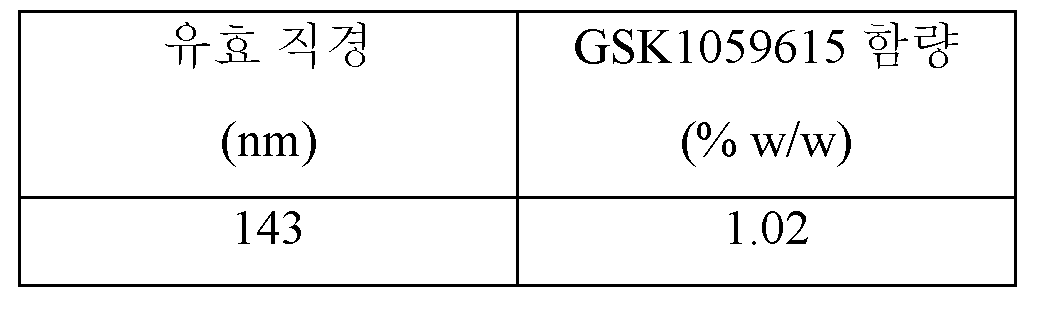
C57BL/6 연령-매칭 (5-6주) 암컷 마우스에게 제-21일 및 제-14일에 염수 (비처리), 1.2mg의 라파마이신-함유 나노담체 (NP[Rapa]) 또는 8mg의 GSK1059615-로딩된 나노담체 (NP[GSK1059615])와 조합된 1.1mg의 전체 오브알부민-로딩된 나노담체 (NP[OVA])를 꼬리 정맥으로 i.v. 주사하였다.C57BL/6 age-matched (5-6 weeks) female mice were administered saline (untreated), 1.2 mg of rapamycin-containing nanocarrier (NP[Rapa]), or 8 mg of GSK1059615 on days -21 and -14. 1.1 mg of total ovalbumin-loaded nanocarrier (NP[OVA]) in combination with -loaded nanocarrier (NP[GSK1059615]) was injected i.v. into the tail vein. Injected.
제0일에 모든 동물에게 뒷다리로 2μg의 CpG와 혼합된 25μg의 미립자 OVA (pOVA)를 s.c. 주사한 다음, 제7일 및 제14일에 25μg pOVA만을 주사하였다. 제21일에 항체 역가를 측정하였다. 임의의 처리의 부재 하에, 동물은 항-OVA IgG 항체 역가에 의해 측정될 수 있는 OVA에 대한 강건한 면역 반응을 발생시켰다. 도 4에 제시된 제21일의 항체 역가는 동일한 용액으로 캡슐화된 OVA와 병용 투여된 2회 용량의 합성 관용유발 나노담체 (NP[OVA]+NP[Rapa] 또는 NP[GSK1059615])가 OVA+CpG의 1회 주사 및 OVA 단독의 2회 주사 후에도 OVA에 대한 항체 형성을 감소시키는데 효과적임을 입증하였다. 이들 결과는 캡슐화된 면역억제제 (예컨대 라파마이신 및 GSK1059615)가 단백질과 병용 전달되는 경우에, 다중 챌린지 및 기간 동안 그 단백질에 대한 항체 형성을 방지할 수 있음을 제시한다.On day 0, all animals received 25 μg of particulate OVA (pOVA) mixed with 2 μg of CpG s.c. into the hind limbs. Following injection, only 25 μg pOVA was injected on
실시예 10: 치료 용량의 휴미라의 국부 투여 (예측)Example 10: Topical administration of therapeutic doses of Humira (prospective)
일련의 임상 시험을 위해 류마티스 관절염을 앓고 있는 3200명의 인간 대상체를 동원하였다. 파일럿 용량 범위설정 시험에서, 1200명의 대상체를 4개의 아암으로 나누었다 (위약 및 실시예 5에 따라 제조된 합성 나노담체의 3종의 상이한 용량). 각각의 4개의 아암의 각각의 대상체에게 s.c.로 위약 또는 합성 나노담체와 병용하여 2라운드의 휴미라 40 mg을 s.c.로 제공하였다. 아암에서 항-휴미라 항체의 평균 수준을 최대로 감소시키는 합성 나노담체 용량을 면역억제제 용량인 것으로 선언하였다.3200 human subjects suffering from rheumatoid arthritis were mobilized for a series of clinical trials. In a pilot dose ranging trial, 1200 subjects were divided into 4 arms (placebo and 3 different doses of synthetic nanocarrier prepared according to Example 5). Each subject in each of the four arms received two rounds of
또 다른 파일럿 시험에서, 동원된 인간 대상체를 각각 500명의 대상체의 4개의 시험 아암으로 나누었다. 위약, 휴미라, 및 합성 나노담체를 하기 표에 따라 병용 투여하였고 (시험 아암 1 제외), 합성 나노담체는 면역억제제 용량으로 투여되었다.In another pilot trial, mobilized human subjects were divided into four test arms of 500 subjects each. Placebo, Humira, and synthetic nanocarriers were administered in combination according to the table below (except for test arm 1), and synthetic nanocarriers were administered at immunosuppressant doses.

주사 부위에서의 국부 염증에 주목하고, 적용가능한 평가 척도를 사용하여 스코어링하였다. 각각의 아암에 대한 평균 국부 염증 스코어를 주목한다. 파일럿 시험 동안 확립된 정보의 적용에서, 휴미라의 치료 용량 중 하나 이상을 류마티스 관절염으로 진단되고 치료 용량의 휴미라로부터 국부 염증을 앓을 위험이 있는 대상체에게 합성 나노담체를 함유하는 면역억제제 용량과 병용 투여하였다.Local inflammation at the injection site was noted and scored using applicable rating scales. Note the average local inflammation score for each arm. In application of information established during the pilot trial, one or more therapeutic doses of Humira were administered in combination with a dose of an immunosuppressant containing a synthetic nanocarrier to subjects diagnosed with rheumatoid arthritis and at risk of suffering local inflammation from therapeutic doses of Humira. .
추가 실시양태에서, 파일럿 시험 동안 확립된 정보를 사용한 프로토콜을 제조하여, 류마티스 관절염으로 진단되고 치료 용량의 휴미라로부터 국부 염증을 앓을 위험이 있는 인간 대상체에 대한 휴미라 및 합성 나노담체의 병용 투약을 안내하였다. 이어서 이러한 프로토콜을 사용하여 인간 대상체에 대한 치료 용량의 휴미라, 및 합성 나노담체의 병용 투여를 안내하였다.In a further embodiment, a protocol using information established during the pilot trial was prepared to guide the combined dosing of Humira and synthetic nanocarriers to human subjects diagnosed with rheumatoid arthritis and at risk of suffering local inflammation from therapeutic doses of Humira. . This protocol was then used to guide the combined administration of therapeutic doses of Humira and synthetic nanocarriers to human subjects.
실시예 11: 치료 용량의 휴미라의 국부 투여 (예측)Example 11: Topical administration of therapeutic doses of Humira (prospective)
일련의 임상 시험을 위해 류마티스 관절염을 앓고 있는 3200명의 인간 대상체를 동원하였다. 파일럿 용량 범위설정 시험에서, 1200명의 대상체를 4개의 아암으로 나누었다 (위약 및 실시예 9의 합성 나노담체 NP[GSK1059615]의 3종의 상이한 용량). 각각의 4개의 아암의 각각의 대상체에게 s.c.로 위약 또는 합성 나노담체와 병용하여 2라운드의 휴미라 40 mg을 s.c.로 제공하였다. 아암에서 항-휴미라 항체의 평균 수준을 최대로 감소시키는 합성 나노담체 용량을 면역억제제 용량인 것으로 선언하였다.3200 human subjects suffering from rheumatoid arthritis were mobilized for a series of clinical trials. In a pilot dose ranging trial, 1200 subjects were divided into four arms (placebo and three different doses of the synthetic nanocarrier NP [GSK1059615] of Example 9). Each subject in each of the four arms received two rounds of
또 다른 파일럿 시험에서, 동원된 인간 대상체를 각각 500명의 대상체의 4개의 시험 아암으로 나누었다. 위약, 휴미라, 및 합성 나노담체를 하기 표에 따라 병용 투여하였고 (시험 아암 1 제외), 합성 나노담체는 면역억제제 용량으로 투여되었다.In another pilot trial, mobilized human subjects were divided into four test arms of 500 subjects each. Placebo, Humira, and synthetic nanocarriers were administered in combination according to the table below (except for test arm 1), and synthetic nanocarriers were administered at immunosuppressant doses.

주사 부위에서의 국부 염증에 주목하고, 적용가능한 평가 척도를 사용하여 스코어링하였다. 각각의 아암에 대한 평균 국부 염증 스코어를 주목한다. 파일럿 시험 동안 확립된 정보의 적용에서, 휴미라의 치료 용량 중 하나 이상을 류마티스 관절염으로 진단되고 치료 용량의 휴미라로부터 국부 염증을 앓을 위험이 있는 대상체에게 합성 나노담체를 함유하는 면역억제제 용량과 병용 투여하였다.Local inflammation at the injection site was noted and scored using applicable rating scales. Note the average local inflammation score for each arm. In application of information established during the pilot trial, one or more therapeutic doses of Humira were administered in combination with a dose of an immunosuppressant containing a synthetic nanocarrier to subjects diagnosed with rheumatoid arthritis and at risk of suffering local inflammation from therapeutic doses of Humira. .
추가 실시양태에서, 파일럿 시험 동안 확립된 정보를 사용한 프로토콜을 제조하여, 류마티스 관절염으로 진단되고 치료 용량의 휴미라로부터 국부 염증을 앓을 위험이 있는 인간 대상체에 대한 휴미라 및 합성 나노담체의 병용 투약을 안내하였다. 이어서 이러한 프로토콜을 사용하여 인간 대상체에 대한 치료 용량의 휴미라, 및 합성 나노담체의 병용 투여를 안내하였다.In a further embodiment, a protocol using information established during the pilot trial was prepared to guide the combined dosing of Humira and synthetic nanocarriers to human subjects diagnosed with rheumatoid arthritis and at risk of suffering local inflammation from therapeutic doses of Humira. . This protocol was then used to guide the combined administration of therapeutic doses of Humira and synthetic nanocarriers to human subjects.
실시예 12: 치료 용량의 치료 거대분자의 국부 투여 (예측)Example 12: Local administration of therapeutic doses of therapeutic macromolecules (prospective)
일련의 임상 시험을 위해 화학요법-관련 빈혈을 앓고 있는 3200명의 인간 대상체를 동원하였다. 파일럿 용량 범위설정 시험에서, 에리트로포이에틴을 코딩하는 변형된 mRNA를 미국 특허 출원 2013/0115272 (de Fougerolles et al.)에 따라 제조하였다 ("mmRNA"). 1200명의 대상체를 4개의 아암으로 나누었다 (위약 및 실시예 6의 합성 나노담체의 3종의 상이한 용량). 각각의 4개의 아암의 각각의 대상체에게 위약 또는 합성 나노담체와 병용하여 치료 용량의 mmRNA를 제공하였다. 아암에서 항-mmRNA 항체의 평균 수준을 최대로 감소시키는 합성 나노담체 용량을 면역억제제 용량인 것으로 선언하였다.3200 human subjects suffering from chemotherapy-related anemia were mobilized for a series of clinical trials. In a pilot dose ranging study, modified mRNA encoding erythropoietin (“mmRNA”) was prepared according to US Patent Application 2013/0115272 (de Fougerolles et al.). 1200 subjects were divided into 4 arms (placebo and 3 different doses of the synthetic nanocarrier of Example 6). Each subject in each of the four arms received a therapeutic dose of mmRNA in combination with placebo or a synthetic nanocarrier. The synthetic nanocarrier dose that maximally reduces the mean level of anti-mRNA antibodies in the arm was declared to be the immunosuppressant dose.
또 다른 파일럿 시험에서, 동원된 인간 대상체를 각각 500명의 대상체의 4개의 시험 아암으로 나누었다. 위약, mmRNA, 및 합성 나노담체를 하기 표에 따라 병용 투여하였고 (시험 아암 1 제외), 합성 나노담체는 면역억제제 용량으로 투여되었다.In another pilot trial, mobilized human subjects were divided into four test arms of 500 subjects each. Placebo, mmRNA, and synthetic nanocarriers were administered in combination according to the table below (except test arm 1), and synthetic nanocarriers were administered at immunosuppressive doses.
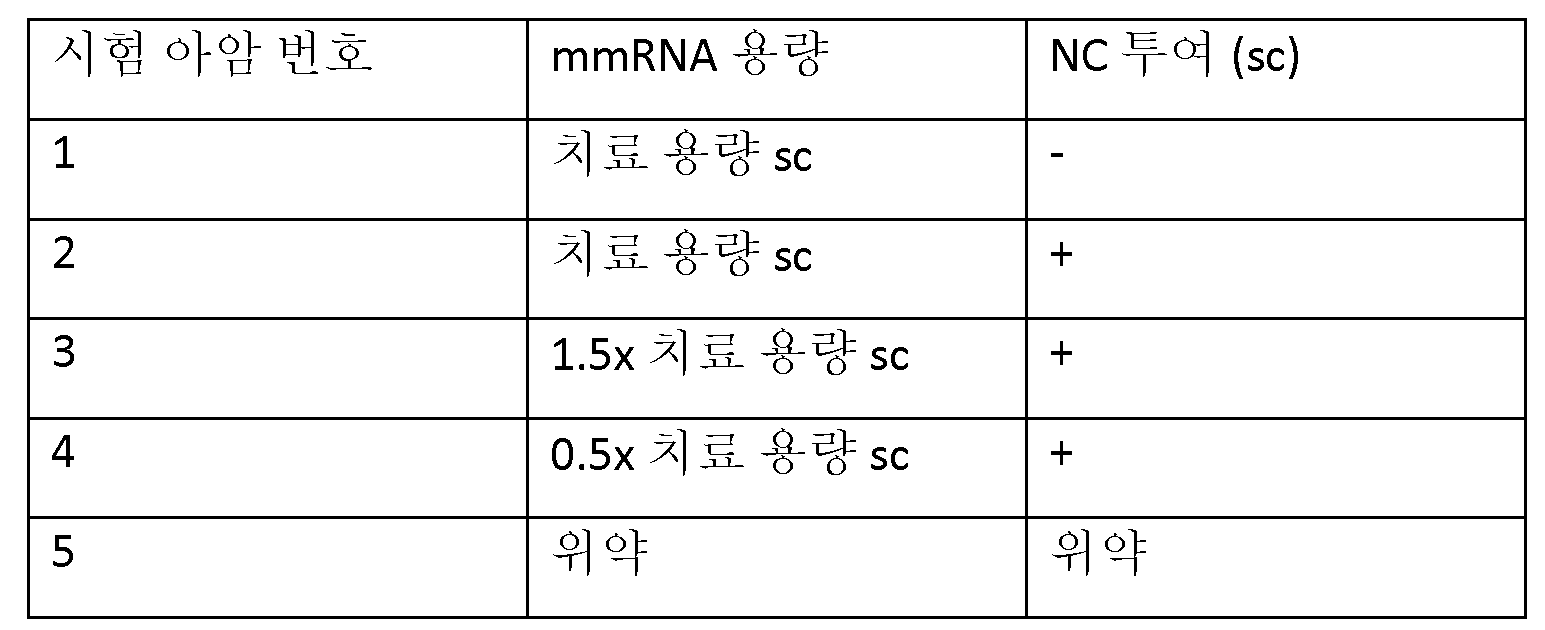
주사 부위에서의 국부 염증에 주목하고, 적용가능한 평가 척도를 사용하여 스코어링하였다. 각각의 아암에 대한 평균 국부 염증 스코어를 주목한다. 파일럿 시험 동안 확립된 정보의 적용에서, mmRNA의 치료 용량 중 하나 이상을 류마티스 관절염으로 진단되고 치료 용량의 mmRNA로부터 국부 염증을 앓을 위험이 있는 대상체에게 합성 나노담체를 함유하는 면역억제제 용량과 병용 투여하였다.Local inflammation at the injection site was noted and scored using applicable rating scales. Note the average local inflammation score for each arm. In application of information established during pilot trials, one or more therapeutic doses of mmRNA were administered in combination with an immunosuppressant dose containing synthetic nanocarriers to subjects diagnosed with rheumatoid arthritis and at risk of suffering local inflammation from therapeutic doses of mmRNA. .
추가 실시양태에서, 파일럿 시험 동안 확립된 정보를 사용한 프로토콜을 제조하여, 류마티스 관절염으로 진단되고 치료 용량의 mmRNA로부터 국부 염증을 앓을 위험이 있는 인간 대상체에 대한 mmRNA 및 합성 나노담체의 병용 투약을 안내하였다. 이어서 이러한 프로토콜을 사용하여 인간 대상체에 대한 치료 용량의 mmRNA, 및 합성 나노담체의 병용 투여를 안내하였다.In a further embodiment, a protocol using information established during the pilot trial was prepared to guide the combined dosing of mmRNA and synthetic nanocarriers to human subjects diagnosed with rheumatoid arthritis and at risk of suffering local inflammation from therapeutic doses of mmRNA. . This protocol was then used to guide the combined administration of therapeutic doses of mmRNA, and synthetic nanocarriers to human subjects.
실시예 13: 나노결정질 라파마이신에 의한 닭 오브알부민에 대한 항원-특이적 관용유발 반응 (예측)Example 13: Antigen-specific tolerogenic response to chicken ovalbumin by nanocrystalline rapamycin (prediction)
C57BL/6 연령-매칭 (5-6주) 암컷 마우스에게 제-21일 및 제-14일에 염수 (비처리) 또는 1.1mg의 전체 오브알부민 및 1.2mg의 나노결정질 라파마이신을 꼬리 정맥으로 i.v. 주사하였다. 제0일에 모든 동물에게 뒷다리로 2μg의 CpG와 혼합된 25μg의 미립자 OVA (pOVA)를 s.c. 주사한 다음, 제7일 및 제14일에 25μg pOVA만을 주사하였다. 제21일에 항체 역가를 측정하였다. 임의의 처리의 부재 하에, 동물은 항-OVA IgG 항체 역가에 의해 측정될 수 있는 OVA에 대한 강건한 면역 반응을 발생시켰다.C57BL/6 age-matched (5-6 weeks) female mice were administered i.v. saline (untreated) or 1.1 mg of total ovalbumin and 1.2 mg of nanocrystalline rapamycin via tail vein on days -21 and -14. Injected. On day 0, all animals received 25 μg of particulate OVA (pOVA) mixed with 2 μg of CpG s.c. into the hind limbs. Following injection, only 25 μg pOVA was injected on
OVA를 나노결정질 라파마이신과 조합되어 제공받은 동물에서 바람직하지 않은 면역 반응의 감소는 면역억제제의 나노결정-형태가 단백질과 병용 전달되는 경우에 그러한 단백질에 대한 바람직하지 않은 면역 반응을 방지할 수 있음을 나타낸다.Reduction of undesirable immune responses in animals receiving OVA in combination with nanocrystalline rapamycin may prevent undesirable immune responses against such proteins when the nanocrystal-form of the immunosuppressant is co-delivered with such proteins. represents.
Claims (1)
Applications Claiming Priority (16)
| Application Number | Priority Date | Filing Date | Title |
|---|---|---|---|
| US201361819517P | 2013-05-03 | 2013-05-03 | |
| US61/819,517 | 2013-05-03 | ||
| US201361881921P | 2013-09-24 | 2013-09-24 | |
| US201361881851P | 2013-09-24 | 2013-09-24 | |
| US201361881913P | 2013-09-24 | 2013-09-24 | |
| US61/881,921 | 2013-09-24 | ||
| US61/881,851 | 2013-09-24 | ||
| US61/881,913 | 2013-09-24 | ||
| US201361907177P | 2013-11-21 | 2013-11-21 | |
| US61/907,177 | 2013-11-21 | ||
| US201461948313P | 2014-03-05 | 2014-03-05 | |
| US201461948384P | 2014-03-05 | 2014-03-05 | |
| US61/948,384 | 2014-03-05 | ||
| US61/948,313 | 2014-03-05 | ||
| PCT/US2014/036696 WO2014179769A2 (en) | 2013-05-03 | 2014-05-02 | Local, concomitant administration of tolerogenic synthetic nanocarriers to reduce type i and type iv hypersensitivity |
| KR1020227004759A KR20220025908A (en) | 2013-05-03 | 2014-05-02 | Local, concomitant administration of tolerogenic synthetic nanocarriers to reduce type i and type iv hypersensitivity |
Related Parent Applications (1)
| Application Number | Title | Priority Date | Filing Date |
|---|---|---|---|
| KR1020227004759A Division KR20220025908A (en) | 2013-05-03 | 2014-05-02 | Local, concomitant administration of tolerogenic synthetic nanocarriers to reduce type i and type iv hypersensitivity |
Publications (1)
| Publication Number | Publication Date |
|---|---|
| KR20240119156A true KR20240119156A (en) | 2024-08-06 |
Family
ID=51841530
Family Applications (18)
| Application Number | Title | Priority Date | Filing Date |
|---|---|---|---|
| KR1020247024661A Ceased KR20240119155A (en) | 2013-05-03 | 2014-05-02 | Tolerogenic synthetic nanocarriers and therapeutic macromolecules for reduced or enhanced pharmacodynamic effects |
| KR1020247024763A Ceased KR20240119160A (en) | 2013-05-03 | 2014-05-02 | Dosing combinations for reducing undesired humoral immune responses |
| KR1020227004759A Ceased KR20220025908A (en) | 2013-05-03 | 2014-05-02 | Local, concomitant administration of tolerogenic synthetic nanocarriers to reduce type i and type iv hypersensitivity |
| KR1020157034133A Ceased KR20160003217A (en) | 2013-05-03 | 2014-05-02 | Tolerogenic synthetic nanocarriers to reduce or prevent anaphylaxis in response to a non-allergenic antigen |
| KR1020227004758A Ceased KR20220025907A (en) | 2013-05-03 | 2014-05-02 | Tolerogenic synthetic nanocarriers to reduce or prevent anaphylaxis in response to a non-allergenic antigen |
| KR1020247024665A Pending KR20240119157A (en) | 2013-05-03 | 2014-05-02 | Delivery of immunosuppressants having a specified pharmacodynamic effective-life and antigen for the inducation of immune tolerance |
| KR1020157034104A Ceased KR20160003830A (en) | 2013-05-03 | 2014-05-02 | Dosing combinations for reducing undesired humoral immune responses |
| KR1020157034121A Ceased KR20160003215A (en) | 2013-05-03 | 2014-05-02 | Methods and compositions for enhancing cd4+ regulatory t cells |
| KR1020227004760A Ceased KR20220025909A (en) | 2013-05-03 | 2014-05-02 | Delivery of immunosuppressants having a specified pharmacodynamic effective-life and antigen for the inducation of immune tolerance |
| KR1020227004761A Ceased KR20220025910A (en) | 2013-05-03 | 2014-05-02 | Dosing combinations for reducing undesired humoral immune responses |
| KR1020157034143A Ceased KR20160003219A (en) | 2013-05-03 | 2014-05-02 | Tolerogenic synthetic nanocarriers and therapeutic macromolecules for reduced or enhanced pharmacodynamic effects |
| KR1020157034120A Ceased KR20160003214A (en) | 2013-05-03 | 2014-05-02 | Local, concomitant administration of tolerogenic synthetic nanocarriers to reduce type i and type iv hypersensitivity |
| KR1020247024767A Pending KR20240116963A (en) | 2013-05-03 | 2014-05-02 | Methods and compositions for enhancing cd4+ regulatory t cells |
| KR1020227004756A Ceased KR20220025906A (en) | 2013-05-03 | 2014-05-02 | Tolerogenic synthetic nanocarriers and therapeutic macromolecules for reduced or enhanced pharmacodynamic effects |
| KR1020247024766A Pending KR20240119161A (en) | 2013-05-03 | 2014-05-02 | Tolerogenic synthetic nanocarriers to reduce or prevent anaphylaxis in response to a non-allergenic antigen |
| KR1020227004763A Ceased KR20220025911A (en) | 2013-05-03 | 2014-05-02 | Methods and compositions for enhancing cd4+ regulatory t cells |
| KR1020247024664A Ceased KR20240119156A (en) | 2013-05-03 | 2014-05-02 | Local, concomitant administration of tolerogenic synthetic nanocarriers to reduce type i and type iv hypersensitivity |
| KR1020157034102A Ceased KR20160003212A (en) | 2013-05-03 | 2014-05-02 | Delivery of immunosuppressants having a specified pharmacodynamic effective-life and antigen for the inducation of immune tolerance |
Family Applications Before (16)
| Application Number | Title | Priority Date | Filing Date |
|---|---|---|---|
| KR1020247024661A Ceased KR20240119155A (en) | 2013-05-03 | 2014-05-02 | Tolerogenic synthetic nanocarriers and therapeutic macromolecules for reduced or enhanced pharmacodynamic effects |
| KR1020247024763A Ceased KR20240119160A (en) | 2013-05-03 | 2014-05-02 | Dosing combinations for reducing undesired humoral immune responses |
| KR1020227004759A Ceased KR20220025908A (en) | 2013-05-03 | 2014-05-02 | Local, concomitant administration of tolerogenic synthetic nanocarriers to reduce type i and type iv hypersensitivity |
| KR1020157034133A Ceased KR20160003217A (en) | 2013-05-03 | 2014-05-02 | Tolerogenic synthetic nanocarriers to reduce or prevent anaphylaxis in response to a non-allergenic antigen |
| KR1020227004758A Ceased KR20220025907A (en) | 2013-05-03 | 2014-05-02 | Tolerogenic synthetic nanocarriers to reduce or prevent anaphylaxis in response to a non-allergenic antigen |
| KR1020247024665A Pending KR20240119157A (en) | 2013-05-03 | 2014-05-02 | Delivery of immunosuppressants having a specified pharmacodynamic effective-life and antigen for the inducation of immune tolerance |
| KR1020157034104A Ceased KR20160003830A (en) | 2013-05-03 | 2014-05-02 | Dosing combinations for reducing undesired humoral immune responses |
| KR1020157034121A Ceased KR20160003215A (en) | 2013-05-03 | 2014-05-02 | Methods and compositions for enhancing cd4+ regulatory t cells |
| KR1020227004760A Ceased KR20220025909A (en) | 2013-05-03 | 2014-05-02 | Delivery of immunosuppressants having a specified pharmacodynamic effective-life and antigen for the inducation of immune tolerance |
| KR1020227004761A Ceased KR20220025910A (en) | 2013-05-03 | 2014-05-02 | Dosing combinations for reducing undesired humoral immune responses |
| KR1020157034143A Ceased KR20160003219A (en) | 2013-05-03 | 2014-05-02 | Tolerogenic synthetic nanocarriers and therapeutic macromolecules for reduced or enhanced pharmacodynamic effects |
| KR1020157034120A Ceased KR20160003214A (en) | 2013-05-03 | 2014-05-02 | Local, concomitant administration of tolerogenic synthetic nanocarriers to reduce type i and type iv hypersensitivity |
| KR1020247024767A Pending KR20240116963A (en) | 2013-05-03 | 2014-05-02 | Methods and compositions for enhancing cd4+ regulatory t cells |
| KR1020227004756A Ceased KR20220025906A (en) | 2013-05-03 | 2014-05-02 | Tolerogenic synthetic nanocarriers and therapeutic macromolecules for reduced or enhanced pharmacodynamic effects |
| KR1020247024766A Pending KR20240119161A (en) | 2013-05-03 | 2014-05-02 | Tolerogenic synthetic nanocarriers to reduce or prevent anaphylaxis in response to a non-allergenic antigen |
| KR1020227004763A Ceased KR20220025911A (en) | 2013-05-03 | 2014-05-02 | Methods and compositions for enhancing cd4+ regulatory t cells |
Family Applications After (1)
| Application Number | Title | Priority Date | Filing Date |
|---|---|---|---|
| KR1020157034102A Ceased KR20160003212A (en) | 2013-05-03 | 2014-05-02 | Delivery of immunosuppressants having a specified pharmacodynamic effective-life and antigen for the inducation of immune tolerance |
Country Status (15)
| Country | Link |
|---|---|
| US (15) | US10357483B2 (en) |
| EP (7) | EP3763359A1 (en) |
| JP (19) | JP2016520051A (en) |
| KR (18) | KR20240119155A (en) |
| CN (18) | CN110841066A (en) |
| AU (16) | AU2014262165B2 (en) |
| BR (6) | BR112015027279A8 (en) |
| CA (5) | CA2910584A1 (en) |
| DK (1) | DK2991646T3 (en) |
| EA (6) | EA201592103A3 (en) |
| ES (1) | ES2842206T3 (en) |
| HU (1) | HUE052599T2 (en) |
| IL (14) | IL284732B2 (en) |
| MX (12) | MX382604B (en) |
| WO (5) | WO2014179772A2 (en) |
Families Citing this family (37)
| Publication number | Priority date | Publication date | Assignee | Title |
|---|---|---|---|---|
| MX357630B (en) | 2009-05-27 | 2018-07-17 | Selecta Biosciences Inc | Targeted synthetic nanocarriers with ph sensitive release of immunomodulatory agents. |
| EA030813B1 (en) | 2010-05-26 | 2018-10-31 | Селекта Байосайенсиз, Инк | Methods of generating an antibody immune response and enhancing local induction of immune cytokines when using synthetic nanocarriers coupled with adjuvants |
| US9994443B2 (en) | 2010-11-05 | 2018-06-12 | Selecta Biosciences, Inc. | Modified nicotinic compounds and related methods |
| MX2013012596A (en) | 2011-04-29 | 2014-08-21 | Selecta Biosciences Inc | SYNTHETIC TOLEROGENIC NANOPORTERS TO GENERATE CD8 + T REGULATORS LYMPHOCYTES. |
| WO2013019648A1 (en) | 2011-07-29 | 2013-02-07 | Selecta Biosciences, Inc. | Control of antibody responses to synthetic nanocarriers |
| BR112015027279A8 (en) | 2013-05-03 | 2018-01-30 | Selecta Biosciences Inc | methods and compositions for enhancing cd4 + regulatory t cells |
| US20160074532A1 (en) | 2014-09-07 | 2016-03-17 | Selecta Biosciences, Inc. | Methods and compositions for attenuating gene editing anti-viral transfer vector immune responses |
| WO2017025889A1 (en) * | 2015-08-13 | 2017-02-16 | Pfizer Inc. | Polymeric nanoparticles with dec-205 ligand and co-encapsulating an antigen subject to an autoimmune response and a glucocorticoid receptor agonist |
| US10744209B2 (en) | 2015-11-12 | 2020-08-18 | New York University | Biodegradable polymeric nanoparticle conjugates and use thereof |
| DK3426285T3 (en) * | 2016-03-11 | 2024-08-26 | Cartesian Therapeutics Inc | FORMULATIONS AND DOSES OF PEGYLATED URICASE |
| US11458106B2 (en) | 2016-05-09 | 2022-10-04 | Astrazeneca Ab | Lipid nanoparticles comprising lipophilic anti-inflammatory agents and methods of use thereof |
| EP3494208A1 (en) * | 2016-08-05 | 2019-06-12 | INSERM (Institut National de la Santé et de la Recherche Médicale) | Ex vivo generation of gamma delta foxp3+ regulatory t cells and therapeutic uses thereof |
| EP3494209A1 (en) * | 2016-08-05 | 2019-06-12 | INSERM (Institut National de la Santé et de la Recherche Médicale) | Ex vivo generation of mhcii restricted cd4+foxp3+ regulatory t cells and therapeutic uses thereof |
| JP2020506890A (en) * | 2017-01-07 | 2020-03-05 | セレクタ バイオサイエンシーズ インコーポレーテッドSelecta Biosciences,Inc. | Patterned administration of immunosuppressants coupled to synthetic nanocarriers |
| EP3592389B1 (en) | 2017-03-11 | 2025-05-07 | Cartesian Therapeutics, Inc. | Methods and compositions related to combined treatment with anti-inflammatories and synthetic nanocarriers comprising an immunosuppressant |
| KR20200086670A (en) * | 2017-10-13 | 2020-07-17 | 셀렉타 바이오사이언시즈, 인크. | Methods and compositions for attenuating antiviral delivery vector IgM responses |
| US20200400685A1 (en) * | 2017-12-27 | 2020-12-24 | Vito Nv | Biomarkers for Typing Allograft Recipients |
| CN108295303A (en) * | 2018-02-08 | 2018-07-20 | 中山大学附属第三医院(中山大学肝脏病医院) | A kind of titanium implantation material and its preparation method and application |
| WO2019184993A1 (en) * | 2018-03-29 | 2019-10-03 | 天津键凯科技有限公司 | Combination of polyethylene glycol and rapamycin and use thereof |
| CN109045304B (en) * | 2018-04-13 | 2022-04-05 | 中山大学 | Nucleolar targeting nano-carrier carrying Polymerase I inhibitor and preparation method and application thereof |
| WO2021016293A1 (en) * | 2019-07-22 | 2021-01-28 | University Of Louisville Research Foundation, Inc. | Immunomodulatory compositions and methods of using |
| WO2021096972A1 (en) * | 2019-11-11 | 2021-05-20 | The Regents Of The University Of California | Polymeric nanoparticles that target liver sinusoidal endothelial cells to induce antigen-specific immune tolerance |
| CN110747276B (en) * | 2019-11-22 | 2020-06-30 | 山东大学齐鲁医院 | Application of BACE2 as glioma prognosis/diagnosis/treatment marker |
| CA3173734A1 (en) * | 2020-02-26 | 2021-09-02 | Selecta Biosciences, Inc. | Methods and compositions using synthetic nanocarriers comprising immunosuppressant |
| EP4135693A1 (en) * | 2020-04-14 | 2023-02-22 | Selecta Biosciences, Inc. | Methods and compositions for inducing autophagy |
| CN113825832B (en) * | 2020-07-28 | 2024-12-13 | 浙江大学 | A method for inducing CD4+Foxp3+CD69+Treg expansion in vitro and its use |
| WO2022022599A1 (en) * | 2020-07-28 | 2022-02-03 | 浙江大学 | Method for amplifying in-vitro induced cd4 +foxp3 +cd69 +treg and use thereof |
| JP7544541B2 (en) | 2020-09-14 | 2024-09-03 | 聡 安斎 | Earth Drilling Equipment |
| CN112480244A (en) * | 2020-11-24 | 2021-03-12 | 华科同济干细胞基因工程有限公司 | Anti-allergic nano antibody composition, antibody determination method and spray |
| CN112961831B (en) * | 2021-02-26 | 2022-10-11 | 仲恺农业工程学院 | Preparation method of intestine-derived exosome |
| EP4323015A4 (en) | 2021-04-16 | 2025-10-22 | Askbio Inc | Rational polyploid AAV viruses that cross the blood-brain barrier and induce a reduced humoral response |
| WO2023086615A1 (en) * | 2021-11-14 | 2023-05-19 | Selecta Biosciences, Inc. | Multiple dosing with viral vectors |
| JP2025541237A (en) * | 2022-12-13 | 2025-12-18 | デイナ ファーバー キャンサー インスティチュート,インコーポレイテッド | Checkpoint modulators for enhancing immunotherapy |
| WO2024181580A1 (en) | 2023-03-02 | 2024-09-06 | 国立研究開発法人科学技術振興機構 | Lipid nanoparticles, pharmaceutical composition, and production method for lipid nanoparticles |
| WO2024190532A1 (en) | 2023-03-14 | 2024-09-19 | 株式会社フジミインコーポレーテッド | Polishing composition, concentrated liquid of polishing composition, and polishing method |
| WO2025256977A1 (en) | 2024-06-13 | 2025-12-18 | Bayer Aktiengesellschaft | Novel igm and igg cleaving enzymes |
| WO2025256978A1 (en) | 2024-06-13 | 2025-12-18 | Bayer Aktiengesellschaft | Variants of igm and igg cleaving enzymes |
Family Cites Families (294)
| Publication number | Priority date | Publication date | Assignee | Title |
|---|---|---|---|---|
| US1995A (en) | 1841-03-03 | Latch of door and other locks | ||
| US4946929A (en) | 1983-03-22 | 1990-08-07 | Massachusetts Institute Of Technology | Bioerodible articles useful as implants and prostheses having predictable degradation rates |
| US4638045A (en) | 1985-02-19 | 1987-01-20 | Massachusetts Institute Of Technology | Non-peptide polyamino acid bioerodible polymers |
| US4806621A (en) | 1986-01-21 | 1989-02-21 | Massachusetts Institute Of Technology | Biocompatible, bioerodible, hydrophobic, implantable polyimino carbonate article |
| CA1340581C (en) | 1986-11-20 | 1999-06-08 | Joseph P. Vacanti | Chimeric neomorphogenesis of organs by controlled cellular implantation using artificial matrices |
| US5736372A (en) | 1986-11-20 | 1998-04-07 | Massachusetts Institute Of Technology | Biodegradable synthetic polymeric fibrous matrix containing chondrocyte for in vivo production of a cartilaginous structure |
| US5804178A (en) | 1986-11-20 | 1998-09-08 | Massachusetts Institute Of Technology | Implantation of cell-matrix structure adjacent mesentery, omentum or peritoneum tissue |
| DE3875306T2 (en) * | 1987-02-24 | 1993-04-01 | Xoma Corp | IMMUNOSUPPRESSION IN THE TREATMENT OF PEOPLE BASED ON IMMUNOTOXIN. |
| US5912017A (en) | 1987-05-01 | 1999-06-15 | Massachusetts Institute Of Technology | Multiwall polymeric microspheres |
| US5019379A (en) | 1987-07-31 | 1991-05-28 | Massachusetts Institute Of Technology | Unsaturated polyanhydrides |
| JP2670680B2 (en) | 1988-02-24 | 1997-10-29 | 株式会社ビーエムジー | Polylactic acid microspheres containing physiologically active substance and method for producing the same |
| US5010167A (en) | 1989-03-31 | 1991-04-23 | Massachusetts Institute Of Technology | Poly(amide-and imide-co-anhydride) for biological application |
| US5268455A (en) | 1989-05-25 | 1993-12-07 | Genentech, Inc. | Process for making biologically active polypeptides based on transforming growth factor-βsequences |
| US5399665A (en) | 1992-11-05 | 1995-03-21 | Massachusetts Institute Of Technology | Biodegradable polymers for cell transplantation |
| US5843452A (en) | 1992-11-09 | 1998-12-01 | Pharmagenesis, Inc. | Immunotherapy composition and method |
| US5679347A (en) | 1992-12-10 | 1997-10-21 | Brigham And Women's Hospital | Methods of isolating CD1-presented antigens, vaccines comprising CD1-presented antigens, and cell lines for use in said methods |
| EP0678034B1 (en) | 1993-01-11 | 1999-05-26 | Dana Farber Cancer Institute | Inducing cytotoxic t lymphocyte responses |
| US5512600A (en) | 1993-01-15 | 1996-04-30 | Massachusetts Institute Of Technology | Preparation of bonded fiber structures for cell implantation |
| US5514378A (en) | 1993-02-01 | 1996-05-07 | Massachusetts Institute Of Technology | Biocompatible polymer membranes and methods of preparation of three dimensional membrane structures |
| US5543158A (en) | 1993-07-23 | 1996-08-06 | Massachusetts Institute Of Technology | Biodegradable injectable nanoparticles |
| WO1995003035A1 (en) | 1993-07-23 | 1995-02-02 | Massachusetts Institute Of Technology | Polymerized liposomes with enhanced stability for oral delivery |
| US5565215A (en) | 1993-07-23 | 1996-10-15 | Massachusettes Institute Of Technology | Biodegradable injectable particles for imaging |
| US5468729A (en) | 1993-10-26 | 1995-11-21 | Alpha 1 Biomedicals | Method for treatment of autoimmune hepatitis |
| DE69518838T2 (en) | 1994-05-18 | 2001-05-03 | The Protein Engineering Network Of Centres Of Excellence (Pence), Inc. | HETERODIME COMPOSITION OF IMMUNOGENIC POLYPEPTIDES AND METHOD FOR THE USE THEREOF |
| US6007845A (en) | 1994-07-22 | 1999-12-28 | Massachusetts Institute Of Technology | Nanoparticles and microparticles of non-linear hydrophilic-hydrophobic multiblock copolymers |
| US5814617A (en) * | 1994-10-07 | 1998-09-29 | The United States Of America As Represented By The Secretary Of The Navy | Protective 17 KDA malaria hepatic and erythrocytic stage immunogen and gene |
| CA2200869A1 (en) | 1994-10-19 | 1996-05-02 | Bruce C. Trapnell | Gene therapy involving concurrent and repeated administration of adenoviruses and immunosuppressive agents |
| US5716404A (en) | 1994-12-16 | 1998-02-10 | Massachusetts Institute Of Technology | Breast tissue engineering |
| DE69630514D1 (en) | 1995-01-05 | 2003-12-04 | Univ Michigan | SURFACE-MODIFIED NANOPARTICLES AND METHOD FOR THEIR PRODUCTION AND USE |
| US6251957B1 (en) | 1995-02-24 | 2001-06-26 | Trustees Of The University Of Pennsylvania | Method of reducing an immune response to a recombinant virus |
| US6123727A (en) | 1995-05-01 | 2000-09-26 | Massachusetts Institute Of Technology | Tissue engineered tendons and ligaments |
| JP3462313B2 (en) | 1995-08-24 | 2003-11-05 | キッコーマン株式会社 | Mutant uricase, mutant uricase gene, novel recombinant DNA, and method for producing mutant uricase |
| US6095148A (en) | 1995-11-03 | 2000-08-01 | Children's Medical Center Corporation | Neuronal stimulation using electrically conducting polymers |
| DE19545257A1 (en) | 1995-11-24 | 1997-06-19 | Schering Ag | Process for the production of morphologically uniform microcapsules and microcapsules produced by this process |
| US5902599A (en) | 1996-02-20 | 1999-05-11 | Massachusetts Institute Of Technology | Biodegradable polymer networks for use in orthopedic and dental applications |
| EP0937082A2 (en) | 1996-07-12 | 1999-08-25 | Ariad Pharmaceuticals, Inc. | Materials and method for treating or preventing pathogenic fungal infection |
| WO1998010056A1 (en) | 1996-09-03 | 1998-03-12 | Health Research Inc. | Treatment of antigen presenting cells to modulate antigen presenting cell function |
| US6060082A (en) | 1997-04-18 | 2000-05-09 | Massachusetts Institute Of Technology | Polymerized liposomes targeted to M cells and useful for oral or mucosal drug delivery |
| US5837752A (en) | 1997-07-17 | 1998-11-17 | Massachusetts Institute Of Technology | Semi-interpenetrating polymer networks |
| ATE423789T1 (en) | 1997-09-16 | 2009-03-15 | Univ Oregon Health & Science | RECOMBINANT MHC MOLECULES WHICH ARE USEFUL FOR THE MANIPULATION OF ANTIGEN-SPECIFIC T-CELLS |
| EP2042192A3 (en) | 1997-10-30 | 2009-05-27 | Laboratorios LETI, S.L. | Tolerogenic fragments of natural allergens |
| US6018817A (en) | 1997-12-03 | 2000-01-25 | International Business Machines Corporation | Error correcting code retrofit method and apparatus for multiple memory configurations |
| US6197229B1 (en) | 1997-12-12 | 2001-03-06 | Massachusetts Institute Of Technology | Method for high supercoiled DNA content microspheres |
| NZ505325A (en) | 1997-12-23 | 2003-07-25 | Crucell Holland B | Adeno-associated virus and adenovirus chimeric recombinant viruses useful for the integration of foreign genetic information into the chromosomal dna of target cells |
| WO1999034826A1 (en) | 1998-01-09 | 1999-07-15 | Circassia Limited | Methods and compositions for desensitisation |
| FR2775435B1 (en) | 1998-02-27 | 2000-05-26 | Bioalliance Pharma | NANOPARTICLES COMPRISING AT LEAST ONE POLYMER AND AT LEAST ONE COMPOUND CAPABLE OF COMPLEXING ONE OR MORE ACTIVE INGREDIENTS |
| US6632922B1 (en) | 1998-03-19 | 2003-10-14 | The Regents Of The University Of California | Methods and compositions for controlled polypeptide synthesis |
| US6506577B1 (en) | 1998-03-19 | 2003-01-14 | The Regents Of The University Of California | Synthesis and crosslinking of catechol containing copolypeptides |
| US6686446B2 (en) | 1998-03-19 | 2004-02-03 | The Regents Of The University Of California | Methods and compositions for controlled polypeptide synthesis |
| SE9801288D0 (en) | 1998-04-14 | 1998-04-14 | Astra Ab | Vaccine delivery system and method of production |
| US6436392B1 (en) | 1998-05-20 | 2002-08-20 | University Of Iowa Research Foundation | Adeno-associated virus vectors |
| PL202799B1 (en) | 1998-08-06 | 2009-07-31 | Mountain View Pharmaceuticals | Peg-urate oxidase conjugates and use thereof |
| ES2222728T3 (en) | 1998-10-05 | 2005-02-01 | Pharmexa A/S | THERAPEUTIC VACCINATION PROCEDURE. |
| US6306640B1 (en) | 1998-10-05 | 2001-10-23 | Genzyme Corporation | Melanoma antigenic peptides |
| DK2319928T3 (en) | 1998-10-23 | 2013-06-24 | Kirin Amgen Inc | Dimeric thrombopoietic peptidomimetics that bind to MPL receptor and have thrombopoietic activity |
| US6759237B1 (en) | 1998-11-05 | 2004-07-06 | The Trustees Of The University Of Pennsylvania | Adeno-associated virus serotype 1 nucleic acid sequences, vectors and host cells containing same |
| US20040009535A1 (en) | 1998-11-27 | 2004-01-15 | Celltech R&D, Inc. | Compositions and methods for increasing bone mineralization |
| ES2639020T3 (en) | 1998-11-27 | 2017-10-25 | Ucb Pharma S.A. | Compositions and methods to increase bone substance mineralization |
| US6153217A (en) * | 1999-01-22 | 2000-11-28 | Biodelivery Sciences, Inc. | Nanocochleate formulations, process of preparation and method of delivery of pharmaceutical agents |
| US6800296B1 (en) | 1999-05-19 | 2004-10-05 | Massachusetts Institute Of Technology | Modification of surfaces using biological recognition events |
| WO2000074688A1 (en) | 1999-06-08 | 2000-12-14 | The Children's Hospital Of Philadelphia | Methods for preventing formation of inhibitory antibodies in the setting of gene therapy |
| DE19951970A1 (en) | 1999-10-28 | 2001-05-03 | Bionetworks Gmbh | Medicines for tolerance induction |
| EP1267946A4 (en) | 2000-02-28 | 2008-07-02 | Genesegues Inc | Nanocapsule encapsulation system and method |
| AU2001249182A1 (en) | 2000-03-14 | 2001-09-24 | Genetics Institute Inc. | Use of rapamycin and agents that inhibit b7 activity in immunomodulation |
| WO2001085208A2 (en) | 2000-05-05 | 2001-11-15 | Cytos Biotechnology Ag | Molecular antigen arrays and vaccines |
| WO2001091802A1 (en) | 2000-05-30 | 2001-12-06 | Baylor College Of Medicine | Chimeric viral vectors for gene therapy |
| WO2001092551A2 (en) | 2000-06-01 | 2001-12-06 | University Of North Carolina At Chapel Hill | Duplexed parvovirus vectors |
| AU2001269923A1 (en) | 2000-06-19 | 2002-01-02 | Genzyme Corporation | Combination enzyme replacement, gene therapy and small molecule therapy for lysosomal storage diseases |
| US20040204379A1 (en) | 2000-06-19 | 2004-10-14 | Cheng Seng H. | Combination enzyme replacement, gene therapy and small molecule therapy for lysosomal storage diseases |
| US20020014242A1 (en) | 2000-07-31 | 2002-02-07 | Abraham Scaria | Use of rapamycin to inhibit immune response and induce tolerance to gene therapy vector and encoded transgene products |
| MY138883A (en) * | 2000-08-29 | 2009-08-28 | Government Of Malaysia As Represented By The Ministry Of Science Tehnology And Innovation Malaysia | Use of asiatic acid for treatment of cencer |
| CA2319928A1 (en) | 2000-09-18 | 2002-03-18 | Vasogen Ireland Limited | Apoptosis-mimicking synthetic entities and use thereof in medical treatments |
| GB0025414D0 (en) | 2000-10-16 | 2000-11-29 | Consejo Superior Investigacion | Nanoparticles |
| WO2002088304A2 (en) | 2001-04-11 | 2002-11-07 | Trustees Of The University Of Pennsylvania | Compositions and methods for suppressing immune responses |
| US6913915B2 (en) | 2001-08-02 | 2005-07-05 | Phoenix Pharmacologics, Inc. | PEG-modified uricase |
| US6818732B2 (en) | 2001-08-30 | 2004-11-16 | The Regents Of The University Of California | Transition metal initiators for controlled poly (beta-peptide) synthesis from beta-lactam monomers |
| CN1294268C (en) | 2001-09-03 | 2007-01-10 | 上海三维生物技术有限公司 | Recombinant adenovirus vector capable of being duplicated and spread specifcally inside tumor cell |
| ES2266564T3 (en) | 2001-10-19 | 2007-03-01 | Isotechnika Inc. | SYNTHESIS OF CYCLOPORINE ANALOGS. |
| WO2003052051A2 (en) | 2001-12-17 | 2003-06-26 | The Trustees Of The University Of Pennsylvania | Adeno-associated virus (aav) serotype 8 sequences |
| GB0207440D0 (en) | 2002-03-28 | 2002-05-08 | Ppl Therapeutics Scotland Ltd | Tolerogenic antigen-presenting cells |
| US20040038303A1 (en) | 2002-04-08 | 2004-02-26 | Unger Gretchen M. | Biologic modulations with nanoparticles |
| US7485314B2 (en) | 2002-05-06 | 2009-02-03 | Los Angeles Biomedical Research Institute At Harbor-Ucla Medical Center | Induction of antigen specific immunologic tolerance |
| AU2003228768B2 (en) | 2002-05-22 | 2009-02-05 | The Cleveland Clinic Foundation | Induction and maintenance of tolerance to composite tissue allografts |
| WO2003102162A2 (en) | 2002-06-04 | 2003-12-11 | University Of Pittsburgh Of The Commonwealth System Of Higher Education | Novel tolerogenic dendritic cells and therapeutic uses therefor |
| AU2003247880B2 (en) | 2002-07-03 | 2010-09-02 | Coley Pharmaceutical Group, Inc. | Nucleic acid compositions for stimulating immune responses |
| US9809654B2 (en) | 2002-09-27 | 2017-11-07 | Vaccinex, Inc. | Targeted CD1d molecules |
| EP1565183B1 (en) | 2002-11-29 | 2008-08-13 | Maria Grazia Roncarolo | Rapamycin and il-10 for the treatment of autoimmune diseases |
| US8575110B2 (en) | 2003-02-17 | 2013-11-05 | Alpha-O Peptides G | Peptidic nanoparticles as drug delivery and antigen display systems |
| WO2004075861A2 (en) | 2003-02-26 | 2004-09-10 | Children's Hospital, Inc. | Recombinant adeno-associated virus production |
| CN102040662A (en) | 2003-03-14 | 2011-05-04 | 惠氏有限责任公司 | Antibodies against human IL-21 receptor and uses therefor |
| AU2004224762B2 (en) | 2003-03-26 | 2009-12-24 | Kuros Us Llc | Packaging of immunostimulatory oligonucleotides into virus-like particles: method of preparation and use |
| US7186699B2 (en) | 2003-06-03 | 2007-03-06 | Cell Genesys, Inc. | Method for treating cancer by vector-mediated delivery of one or more anti-angiogenic or pro-apoptotic genes |
| US7727969B2 (en) | 2003-06-06 | 2010-06-01 | Massachusetts Institute Of Technology | Controlled release nanoparticle having bound oligonucleotide for targeted delivery |
| EP1486567A1 (en) | 2003-06-11 | 2004-12-15 | Deutsches Krebsforschungszentrum Stiftung des öffentlichen Rechts | Improved adeno-associated virus (AAV) vector for gene therapy |
| WO2005014650A2 (en) | 2003-06-16 | 2005-02-17 | Celltech R & D, Inc. | Antibodies specific for sclerostin and methods for increasing bone mineralization |
| US20060251711A1 (en) | 2003-08-28 | 2006-11-09 | Vgsk Technologies, Inc. | Sterically stabilized carrier for aerosol therapeutics, compositions and methods for treating diseases of the respiratory tract of a mammal |
| US20080160089A1 (en) | 2003-10-14 | 2008-07-03 | Medivas, Llc | Vaccine delivery compositions and methods of use |
| DE10347710B4 (en) | 2003-10-14 | 2006-03-30 | Johannes-Gutenberg-Universität Mainz | Recombinant vaccines and their use |
| JP2008504216A (en) | 2003-12-02 | 2008-02-14 | サイトイミューン サイエンシズ インコーポレイテッド | Methods and compositions for the production of monoclonal antibodies |
| KR101376715B1 (en) | 2003-12-19 | 2014-03-27 | 더 유니버시티 오브 노쓰 캐롤라이나 엣 채플 힐 | Methods for fabricating isolated micro- and nano- structures using soft or imprint lithography |
| CN1960726A (en) | 2004-04-08 | 2007-05-09 | 应用研究系统Ars股份公司 | Composition comprising a jnk inhibitor and cyclosporin |
| EP1756147A2 (en) | 2004-06-01 | 2007-02-28 | Innogenetics N.V. | Peptides for inducing a ctl and/or htl response to hepatitis c virus |
| JP2008512350A (en) * | 2004-07-01 | 2008-04-24 | イェール ユニバーシティ | Polymeric substances that are targeted and loaded with drugs at high density |
| US20080206270A1 (en) | 2004-07-08 | 2008-08-28 | Minev Boris R | Enhancing Class I Antigen Presentation With Synthetic Sequences |
| FR2874384B1 (en) | 2004-08-17 | 2010-07-30 | Genethon | ADENO-ASSOCIATED VIRAL VECTOR FOR PRODUCING EXON JUMP IN A GENE ENCODING A PROTEIN WITH DISPENSABLE DOMAINS |
| US20090017016A1 (en) | 2004-10-05 | 2009-01-15 | Tanox Inc. | Treatment and prevention of hypersensitivity and/or anaphylaxis with anti-ige antibodies in patients receiving replacement therapy |
| US9492400B2 (en) | 2004-11-04 | 2016-11-15 | Massachusetts Institute Of Technology | Coated controlled release polymer particles as efficient oral delivery vehicles for biopharmaceuticals |
| US20060159766A1 (en) | 2004-12-15 | 2006-07-20 | Elan Pharma International Limited | Nanoparticulate tacrolimus formulations |
| CA2593862C (en) | 2004-12-31 | 2014-10-21 | Iceutica Pty Ltd | Nanoparticle composition and methods for synthesis thereof |
| GB0504206D0 (en) | 2005-03-01 | 2005-04-06 | Glaxo Group Ltd | Combination therapy |
| CN101137365A (en) | 2005-03-08 | 2008-03-05 | 生命周期药物公司 | Pharmaceutical compositions comprising sirolimus and/or analogs thereof |
| MX2007011494A (en) * | 2005-03-17 | 2007-12-06 | Elan Pharma Int Ltd | Injectable compositions of nanoparticulate immunosuppressive compounds. |
| US7884109B2 (en) | 2005-04-05 | 2011-02-08 | Wyeth Llc | Purine and imidazopyridine derivatives for immunosuppression |
| EP1871343A2 (en) | 2005-04-12 | 2008-01-02 | Wisconsin Alumni Research Foundation | Micelle composition of polymer and passenger drug |
| WO2006122223A2 (en) | 2005-05-10 | 2006-11-16 | Emory University | Strategies for delivery of active agents using micelles and particles |
| TW200711649A (en) | 2005-06-17 | 2007-04-01 | Combinatorx Inc | Combination therapy for the treatment of immunoinflammatory disorders |
| CN102016814B (en) | 2005-06-17 | 2013-10-23 | 北卡罗来纳大学查珀尔希尔分校 | Nanoparticle fabrication methods, systems, and materials |
| EP1932538A4 (en) | 2005-08-25 | 2009-10-21 | Taiho Pharmaceutical Co Ltd | BIODEGRADABLE NANOTEHICLES WITH IMMOBILIZED OR CAPACITATED T-CELL-RECOGNIZABLE EPITOPEPEPID |
| CN1979166A (en) * | 2005-11-30 | 2007-06-13 | 北京有色金属研究总院 | A process for preparing nano colloidal gold for immunoassay and reaction device thereof |
| ATE552837T1 (en) | 2005-12-02 | 2012-04-15 | Univ Johns Hopkins | USE OF HIGH DOSE OXAZAPHOSPHORINE DRUGS TO TREAT IMMUNE DISORDERS |
| US20070128289A1 (en) * | 2005-12-07 | 2007-06-07 | Zhao Jonathon Z | Nano-and/or micro-particulate formulations for local injection-based treatment of vascular diseases |
| MX2008007287A (en) | 2005-12-08 | 2008-10-27 | Univ Louisville Res Found | Methods and compositions for expanding t regulatory cells. |
| US9267937B2 (en) | 2005-12-15 | 2016-02-23 | Massachusetts Institute Of Technology | System for screening particles |
| WO2007087341A2 (en) | 2006-01-25 | 2007-08-02 | The Board Of Trustees Of The University Of Illinois | Tolerogenic biodegradable artificial antigen presenting system |
| AU2007215328A1 (en) | 2006-02-13 | 2007-08-23 | Oncolytics Biotech Inc. | Use of local immune suppression to enhance oncolytic viral therapy |
| US8021689B2 (en) | 2006-02-21 | 2011-09-20 | Ecole Polytechnique Federale de Lausanne (“EPFL”) | Nanoparticles for immunotherapy |
| US8568487B2 (en) | 2006-02-27 | 2013-10-29 | Biomet Manufacturing, Llc | Patient-specific hip joint devices |
| EP2004666B1 (en) | 2006-03-27 | 2014-09-03 | Globeimmune, Inc. | Ras mutation and compositions and methods related thereto |
| US20070254897A1 (en) * | 2006-04-28 | 2007-11-01 | Resolvyx Pharmaceuticals, Inc. | Compositions and methods for the treatment of cardiovascular disease |
| US8367113B2 (en) | 2006-05-15 | 2013-02-05 | Massachusetts Institute Of Technology | Polymers for functional particles |
| US20110052697A1 (en) | 2006-05-17 | 2011-03-03 | Gwangju Institute Of Science & Technology | Aptamer-Directed Drug Delivery |
| EP1880729A1 (en) | 2006-07-20 | 2008-01-23 | INSERM (Institut National de la Santé et de la Recherche Médicale) | Use of soluble CD160 to suppress immunity |
| DK2051987T3 (en) * | 2006-08-18 | 2015-01-05 | Argos Therapeutics Inc | USE OF CD83 IN COMBINATION THERAPY |
| US20120269774A1 (en) | 2006-09-21 | 2012-10-25 | Medistem Laboratories, Inc | Allogeneic stem cell transplants in non-conditioned recipients |
| CN101583379B (en) * | 2006-10-05 | 2013-04-03 | 约翰斯霍普金斯大学 | Water-dispersible oral, parenteral and topical formulations of poorly water-soluble drugs using superior polymeric nanoparticles |
| CA2702340C (en) | 2006-10-12 | 2014-12-16 | The University Of Queensland | Compositions and methods for modulating immune responses |
| CN101646418B (en) | 2006-10-12 | 2013-07-17 | 昆士兰大学 | Compositions and methods for modulating immune responses |
| US20100112077A1 (en) * | 2006-11-06 | 2010-05-06 | Abraxis Bioscience, Llc | Nanoparticles of paclitaxel and albumin in combination with bevacizumab against cancer |
| US20100172994A1 (en) | 2006-11-22 | 2010-07-08 | University Of Florida Research Foundation, Inc. | Nanoparticles for Protection of Cells from Oxidative Stress |
| WO2008069942A2 (en) | 2006-12-05 | 2008-06-12 | Biogen Idec Ma Inc. | Novel methods of enhancing delivery of a gene therapy vector using steroids |
| PL2118309T3 (en) | 2006-12-29 | 2015-07-31 | Univ Colorado Regents | Diagnostic and therapeutic target for autoimmune diseases and uses thereof |
| CA2678618C (en) | 2007-02-21 | 2019-03-12 | Vaccinex, Inc. | Modulation of nkt cell activity with antigen-loaded cd1d molecules |
| KR20080078204A (en) | 2007-02-22 | 2008-08-27 | 크레아젠 주식회사 | Mesenchymal stem cell-mediated autologous dendrites with increased immunosuppressive capacity |
| SI2131821T1 (en) * | 2007-03-07 | 2018-11-30 | Abraxis Bioscience, Llc | Nanoparticle comprising rapamycin and albumin as anticancer agent |
| ES2525801T3 (en) | 2007-03-07 | 2014-12-30 | Uti Limited Partnership | Compositions and methods for the prevention and treatment of autoimmune diseases |
| CN101730526A (en) * | 2007-03-07 | 2010-06-09 | 阿布拉科斯生物科学有限公司 | Nanoparticles comprising rapamycin and albumin as anticancer agents |
| WO2008124639A2 (en) | 2007-04-04 | 2008-10-16 | Massachusetts Institute Of Technology | Poly (amino acid) targeting moieties |
| CA2683415C (en) | 2007-04-04 | 2020-12-08 | Sigmoid Pharma Limited | An oral pharmaceutical composition |
| US20090226525A1 (en) | 2007-04-09 | 2009-09-10 | Chimeros Inc. | Self-assembling nanoparticle drug delivery system |
| AU2008239795A1 (en) | 2007-04-12 | 2008-10-23 | Emory University | Novel strategies for delivery of active agents using micelles and particles |
| WO2008150868A1 (en) | 2007-05-29 | 2008-12-11 | The Board Of Trustees Of The University Of Illinois | Methods for inducing therapeutic t cells for immune diseases |
| US20080311140A1 (en) | 2007-05-29 | 2008-12-18 | Baylor College Of Medicine | Antigen specific immunosuppression by dendritic cell therapy |
| JP6035503B2 (en) | 2007-05-31 | 2016-11-30 | アカデミシュ ジーケンハウス ライデン ハー.オー.デー.エン. ルムク | HPV epitopes targeted by T cells infiltrating cervical malignancies for use in vaccines |
| WO2008148761A1 (en) | 2007-06-05 | 2008-12-11 | Novartis Ag | Induction of tolerogenic phenotype in mature dendritic cells |
| US20090004259A1 (en) | 2007-06-14 | 2009-01-01 | Consejo Nacional De Investigaciones Cientificas Y Tecnicas (Conicet) | Methods of preparing a therapeutic formulation comprising galectin-induced tolerogenic dendritic cells |
| US8138183B2 (en) | 2007-07-09 | 2012-03-20 | Astrazeneca Ab | Morpholino pyrimidine derivatives used in diseases linked to mTOR kinase and/or PI3K |
| GB0714963D0 (en) | 2007-08-01 | 2007-09-12 | Novartis Ag | Compositions comprising antigens |
| MX2010001779A (en) | 2007-08-15 | 2010-07-06 | Circassia Ltd | Peptides for desensibilization against allergens. |
| CA2700378A1 (en) | 2007-09-21 | 2009-03-29 | Cytimmune Sciences, Inc. | Nanotherapeutic colloidal metal compositions and methods |
| AU2008314647B2 (en) * | 2007-10-12 | 2013-03-21 | Massachusetts Institute Of Technology | Vaccine nanotechnology |
| WO2009062502A1 (en) | 2007-11-13 | 2009-05-22 | Dandrit Biotech A/S | Method for generating tolerogenic dendritic cells employing decreased temperature |
| US20090142318A1 (en) * | 2007-11-30 | 2009-06-04 | Therakos, Inc. | METHOD TO EXPAND nTREG CELLS USING p70 S6 KINASE ANTAGONIST |
| AU2008346801A1 (en) | 2007-12-31 | 2009-07-16 | Nanocor Therapeutics, Inc. | RNA interference for the treatment of heart failure |
| EP2249900A4 (en) | 2008-02-08 | 2013-11-06 | Terumo Corp | Device for local intraluminal transport of a biologically and physiologically active agent |
| EP2262489A2 (en) | 2008-02-28 | 2010-12-22 | Deutsches Krebsforschungszentrum, Stiftung des öffentlichen Rechts | Hollow nanoparticles and uses thereof |
| US9669057B2 (en) | 2008-04-25 | 2017-06-06 | Duke University | Regulatory B cells and their uses |
| EP2300102B1 (en) | 2008-05-15 | 2014-01-08 | Dynavax Technologies Corporation | Immunostimulatory sequences containing CpG for use in the treatment of allergic rhinitis |
| JP5549014B2 (en) | 2008-05-27 | 2014-07-16 | 国立大学法人名古屋大学 | Immunomodulators and uses thereof |
| US20090297621A1 (en) | 2008-06-03 | 2009-12-03 | Abbott Cardiovascular Systems Inc. | Microparticles For The Treatment Of Disease |
| US8613951B2 (en) | 2008-06-16 | 2013-12-24 | Bind Therapeutics, Inc. | Therapeutic polymeric nanoparticles with mTor inhibitors and methods of making and using same |
| ES2765240T3 (en) | 2008-06-16 | 2020-06-08 | Pfizer | Drug-loaded polymeric nanoparticles and manufacturing procedures and use thereof |
| US20120034156A1 (en) | 2010-08-03 | 2012-02-09 | Searete Llc, A Limited Liability Corporation Of The State Of Delaware | Artificial cells |
| WO2010018384A1 (en) | 2008-08-15 | 2010-02-18 | Circassia Limited | T-cell antigen peptide from allergen for stimulation of il-10 production |
| US8323696B2 (en) | 2008-08-29 | 2012-12-04 | Ecole Polytechnique Federale De Lausanne | Nanoparticles for immunotherapy |
| EP2341953B1 (en) | 2008-09-04 | 2018-11-21 | The General Hospital Corporation | Hydrogels for vocal cord and soft tissue augmentation and repair |
| CN101676291B (en) | 2008-09-18 | 2012-05-09 | 上海海和药物研究开发有限公司 | Rapamycin carbonate analog, pharmaceutical composition thereof, and preparation method and uses thereof |
| US8889124B2 (en) | 2008-09-25 | 2014-11-18 | The Board Of Trustees Of The Leland Stanford Junior University | Tolerogenic populations of dendritic cells |
| US10369204B2 (en) | 2008-10-02 | 2019-08-06 | Dako Denmark A/S | Molecular vaccines for infectious disease |
| US8277812B2 (en) | 2008-10-12 | 2012-10-02 | Massachusetts Institute Of Technology | Immunonanotherapeutics that provide IgG humoral response without T-cell antigen |
| US8343498B2 (en) * | 2008-10-12 | 2013-01-01 | Massachusetts Institute Of Technology | Adjuvant incorporation in immunonanotherapeutics |
| US8591905B2 (en) | 2008-10-12 | 2013-11-26 | The Brigham And Women's Hospital, Inc. | Nicotine immunonanotherapeutics |
| US8343497B2 (en) | 2008-10-12 | 2013-01-01 | The Brigham And Women's Hospital, Inc. | Targeting of antigen presenting cells with immunonanotherapeutics |
| JP5552630B2 (en) | 2008-10-24 | 2014-07-16 | 学校法人 聖マリアンナ医科大学 | Medicament for treating or preventing HTLV-I associated myelopathy, and method for testing the efficacy of antibody therapy for patients with HTLV-I associated myelopathy |
| WO2010047839A1 (en) | 2008-10-25 | 2010-04-29 | Aura Biosciences | Modified plant virus particles and uses therefor |
| WO2010056143A1 (en) | 2008-11-13 | 2010-05-20 | Instituto De Medicina Molecular | The use of adjuvant to facilitate the induction of immune tolerance |
| US20100216804A1 (en) | 2008-12-15 | 2010-08-26 | Zale Stephen E | Long Circulating Nanoparticles for Sustained Release of Therapeutic Agents |
| CA2750098A1 (en) | 2009-01-20 | 2010-07-29 | Myelin Repair Foundation, Inc. | Compositions and methods for induction of antigen-specific tolerance |
| EP2218784A1 (en) | 2009-02-04 | 2010-08-18 | Universität Leipzig | Vector(s) containing an inducible gene encoding a CDK4/CD6 inhibitor useful for treating neurodegenerative disorders |
| EP2891662A1 (en) | 2009-02-05 | 2015-07-08 | Circassia Limited | Grass peptides for vaccine |
| KR20100099849A (en) | 2009-03-04 | 2010-09-15 | 동국대학교 산학협력단 | Composition for treatment of atopic dermatitis comprising immunosuppressant and inhibitors of transglutaminase 2 |
| WO2010114948A2 (en) | 2009-04-02 | 2010-10-07 | University Of Florida Research Foundation, Inc. | An inducible system for highly efficient production of recombinant adeno-associated virus (raav) vectors |
| GB0906159D0 (en) | 2009-04-09 | 2009-05-20 | Summit Corp Plc | Drug combination for the treatment of proteostatic diseases |
| KR20120022984A (en) * | 2009-04-21 | 2012-03-12 | 셀렉타 바이오사이언시즈, 인크. | Immunonanotherapeutics providing a th1-biased response |
| WO2010123501A1 (en) | 2009-04-22 | 2010-10-28 | Massachusetts Institute Of Technology | Innate immune suppression enables repeated delivery of long rna molecules |
| JP5740390B2 (en) | 2009-04-27 | 2015-06-24 | イミューロン リミテッドImmuron Limited | Anti-LPS enhanced immunoglobulin preparation for use in the treatment and / or prevention of pathological disorders |
| MX357630B (en) | 2009-05-27 | 2018-07-17 | Selecta Biosciences Inc | Targeted synthetic nanocarriers with ph sensitive release of immunomodulatory agents. |
| PL398781A1 (en) | 2009-06-25 | 2012-11-19 | Savient Pharmaceuticals, Inc. | Methods and kits for predicting the risk of reaction to infusion and lack of antibody-mediated responses by monitoring serum uric acid during therapy with pegylated uricase |
| AU2010293059B2 (en) | 2009-08-26 | 2017-03-16 | Selecta Biosciences, Inc. | Compositions that induce T cell help |
| AR078161A1 (en) | 2009-09-11 | 2011-10-19 | Hoffmann La Roche | VERY CONCENTRATED PHARMACEUTICAL FORMULATIONS OF AN ANTIBODY ANTI CD20. USE OF THE FORMULATION. TREATMENT METHOD |
| EP2305277A1 (en) | 2009-09-18 | 2011-04-06 | Forskarpatent I Syd AB | Use of tolerogenic dendritic cells in treatment and prevention of atherosclerosis |
| CN101703781A (en) | 2009-10-28 | 2010-05-12 | 陕西北美基因股份有限公司 | Magnetic medicament loading method for immunosuppressant |
| KR101267813B1 (en) | 2009-12-30 | 2013-06-04 | 주식회사 삼양바이오팜 | An injectable composition comprising polymeric nanoparticles containing rapamycin with an improved water solubility and a method for preparing the same, and an anticancer composition comprising the same for a combination therapy with radiation |
| WO2011085231A2 (en) | 2010-01-08 | 2011-07-14 | Selecta Biosciences, Inc. | Synthetic virus-like particles conjugated to human papillomavirus capsid peptides for use as vaccines |
| US9228171B2 (en) | 2010-02-05 | 2016-01-05 | The United States Of America, As Represented By The Secretary, Department Of Health And Human Services | Regulatory B cells (tBREGS) and their use |
| WO2011109833A2 (en) | 2010-03-05 | 2011-09-09 | President And Fellows Of Harvard College | Induced dendritic cell compositions and uses thereof |
| US20110262491A1 (en) | 2010-04-12 | 2011-10-27 | Selecta Biosciences, Inc. | Emulsions and methods of making nanocarriers |
| US20110272836A1 (en) | 2010-04-12 | 2011-11-10 | Selecta Biosciences, Inc. | Eccentric vessels |
| US8927514B2 (en) | 2010-04-30 | 2015-01-06 | City Of Hope | Recombinant adeno-associated vectors for targeted treatment |
| PH12012502143A1 (en) | 2010-05-07 | 2019-07-03 | Xoma Us Llc | Methods for the treatment of il-1beta related conditions |
| EA030813B1 (en) | 2010-05-26 | 2018-10-31 | Селекта Байосайенсиз, Инк | Methods of generating an antibody immune response and enhancing local induction of immune cytokines when using synthetic nanocarriers coupled with adjuvants |
| PH12012502399A1 (en) | 2010-06-07 | 2013-02-11 | Abraxis Bioscience Llc | Combination therapy methods for treating proliferative diseases |
| WO2012019041A2 (en) | 2010-08-04 | 2012-02-09 | Duke University | Regulatory b cells and their uses |
| EP2603520A4 (en) | 2010-08-10 | 2014-02-19 | Ecole Polytech | THERAPEUTIC AGENTS BINDING TO ERYTHROCYTES |
| WO2012024629A1 (en) | 2010-08-20 | 2012-02-23 | Selecta Biosciences, Inc. | Synthetic nanocarrier vaccines comprising proteins obtained or derived from human influenza a virus hemagglutinin |
| AU2011293508A1 (en) * | 2010-08-23 | 2013-01-24 | Selecta Biosciences, Inc. | Targeted multi-epitope dosage forms for induction of an immune response to antigens |
| CA2810842C (en) | 2010-09-09 | 2018-06-26 | Micell Technologies, Inc. | Macrolide dosage forms |
| US10016371B2 (en) | 2010-10-22 | 2018-07-10 | University Of Florida Research Foundation | Antigen-specific, tolerance-inducing microparticles and uses thereof |
| US9994443B2 (en) | 2010-11-05 | 2018-06-12 | Selecta Biosciences, Inc. | Modified nicotinic compounds and related methods |
| US20120171229A1 (en) | 2010-12-30 | 2012-07-05 | Selecta Biosciences, Inc. | Synthetic nanocarriers with reactive groups that release biologically active agents |
| MX2013009191A (en) | 2011-02-08 | 2013-11-04 | Charlotte Mecklenburg Hospital | Antisense oligonucleotides. |
| WO2012112578A2 (en) | 2011-02-14 | 2012-08-23 | The Children's Hospital Of Philadelphia | Improved aav8 vector with enhanced functional activity and methods of use thereof |
| US8654487B2 (en) | 2011-03-11 | 2014-02-18 | Siemens Industry, Inc. | Methods, systems, and apparatus and for detecting parallel electrical arc faults |
| JP6320912B2 (en) | 2011-03-25 | 2018-05-09 | セレクタ バイオサイエンシーズ インコーポレーテッドSelecta Biosciences,Inc. | Osmotically mediated release synthetic nanocarrier |
| US8710200B2 (en) | 2011-03-31 | 2014-04-29 | Moderna Therapeutics, Inc. | Engineered nucleic acids encoding a modified erythropoietin and their expression |
| US20140155469A1 (en) | 2011-04-19 | 2014-06-05 | The Research Foundation Of State University Of New York | Adeno-associated-virus rep sequences, vectors and viruses |
| EP2699688A1 (en) | 2011-04-20 | 2014-02-26 | The Trustees Of The University Of Pennsylvania | Regimens and compositions for aav-mediated passive immunization of airborne pathogens |
| MX2013012596A (en) | 2011-04-29 | 2014-08-21 | Selecta Biosciences Inc | SYNTHETIC TOLEROGENIC NANOPORTERS TO GENERATE CD8 + T REGULATORS LYMPHOCYTES. |
| CN103648501A (en) | 2011-05-16 | 2014-03-19 | 建新公司 | Induction of immune tolerance with methotrexate |
| WO2013019648A1 (en) | 2011-07-29 | 2013-02-07 | Selecta Biosciences, Inc. | Control of antibody responses to synthetic nanocarriers |
| US20130058976A1 (en) | 2011-09-06 | 2013-03-07 | Selecta Biosciences, Inc. | Allergen-specific induced tolerogenic dendritic cells for allergy therapy |
| AU2012304313A1 (en) | 2011-09-08 | 2014-03-06 | University Of Florida Research Foundation, Inc. | Materials and methods for modulating immune responses |
| US8865487B2 (en) * | 2011-09-20 | 2014-10-21 | General Electric Company | Large area hermetic encapsulation of an optoelectronic device using vacuum lamination |
| BR112014007852B1 (en) | 2011-10-03 | 2021-11-03 | Moderna Therapeutics, Inc | MODIFIED ISOLATED POLYNUCLEOTIDE AND PHARMACEUTICAL COMPOSITION |
| WO2013058812A1 (en) | 2011-10-19 | 2013-04-25 | President And Fellows Of Harvard College | Targeted delivery to pancreatic islet endothelial cells |
| EP2591801A1 (en) | 2011-11-14 | 2013-05-15 | Universitätsklinikum Hamburg-Eppendorf | Nanoparticle compositions for generation of regulatory T cells and treatment of autoimmune diseases and other chronic inflammatory conditions |
| US10640785B2 (en) | 2011-11-22 | 2020-05-05 | The Children's Hospital Of Philadelphia | Virus vectors for highly efficient transgene delivery |
| US20150111955A1 (en) | 2012-02-17 | 2015-04-23 | The Children's Hospital Of Philadelphia | Aav vector compositions and methods for gene transfer to cells, organs and tissues |
| HUE054087T2 (en) | 2012-04-18 | 2021-09-28 | Childrens Hospital Philadelphia | Composition and methods for highly efficient gene transfer using aav capsid variants |
| CA2871786C (en) | 2012-04-24 | 2021-11-16 | Ohio State Innovation Foundation | Compositions and methods for treating and preventing porcine reproductive and respiratory syndrome |
| MX363147B (en) | 2012-09-17 | 2019-03-11 | Pfizer Inc Star | Therapeutic nanoparticles comprising a therapeutic agent and methods of making and using same. |
| CN102871966B (en) * | 2012-10-19 | 2013-11-20 | 东南大学 | Nano drug carrier particles for improving bioavailability of rapamycin and preparation method thereof |
| EP2968499A4 (en) | 2013-03-15 | 2016-11-30 | Haplomics Inc | COMPOSITIONS AND METHODS FOR INDUCING IMMUNE TOLERANCE IN FACTOR VIII REPLACEMENT THERAPIES IN PATIENTS WITH HEMOPHILIA A |
| US9944918B2 (en) | 2013-03-15 | 2018-04-17 | The United States Of America, As Represented By The Secretary, Dept. Of Health & Human Services | Synthetic methylmalonyl-CoA mutase transgene for the treatment of MUT class methylmalonic acidemia (MMA) |
| CA2909085C (en) | 2013-04-08 | 2023-08-29 | University Of Iowa Research Foundation | Chimeric adeno-associated virus/ bocavirus parvovirus vector |
| TWI679019B (en) | 2013-04-29 | 2019-12-11 | 法商賽諾菲公司 | Anti-il-4/anti-il-13 bispecific antibody formulations |
| BR112015027279A8 (en) | 2013-05-03 | 2018-01-30 | Selecta Biosciences Inc | methods and compositions for enhancing cd4 + regulatory t cells |
| AU2014262164B2 (en) | 2013-05-03 | 2020-02-27 | Selecta Biosciences, Inc. | Dosing combinations for reducing undesired humoral immune responses |
| AU2014274894A1 (en) | 2013-06-04 | 2015-11-26 | Selecta Biosciences, Inc. | Repeated administration of non-immunosupressive antigen specific immunotherapeutics |
| RU2687143C2 (en) | 2013-10-06 | 2019-05-07 | Дзе Юнайтед Стейтс Оф Америка, Эз Репрезентед Бай Дзе Секретари, Департмент Оф Хелс Энд Хьюман Сёрвисез | Modified exotoxin a pseudomonades |
| US9276815B2 (en) * | 2013-12-27 | 2016-03-01 | Dell Products L.P. | N-node virtual link trunking (VLT) systems management plane |
| EP2916319A1 (en) | 2014-03-07 | 2015-09-09 | Fraunhofer-Gesellschaft zur Förderung der angewandten Forschung e.V. | Concept for encoding of information |
| PL3116900T3 (en) | 2014-03-09 | 2021-03-08 | The Trustees Of The University Of Pennsylvania | Compositions useful in treatment of ornithine transcarbamylase (otc) deficiency |
| GB201407322D0 (en) | 2014-04-25 | 2014-06-11 | Ospedale San Raffaele | Gene therapy |
| US20150358333A1 (en) * | 2014-06-04 | 2015-12-10 | Grandios Technologies, Llc | Geo-location and biometric presence security |
| US20150359865A1 (en) | 2014-06-17 | 2015-12-17 | Selecta Biosciences, Inc. | Tolerogenic synthetic nanocarriers for t-cell-mediated autoimmune disease |
| US20160220501A1 (en) | 2015-02-03 | 2016-08-04 | Selecta Biosciences, Inc. | Tolerogenic synthetic nanocarriers to reduce immune responses to therapeutic proteins |
| WO2015200728A1 (en) | 2014-06-25 | 2015-12-30 | Selecta Biosciences, Inc. | Methods and compositions for treatment with synthetic nanocarriers and immune checkpoint inhibitors |
| US20160074532A1 (en) | 2014-09-07 | 2016-03-17 | Selecta Biosciences, Inc. | Methods and compositions for attenuating gene editing anti-viral transfer vector immune responses |
| WO2016055437A1 (en) | 2014-10-06 | 2016-04-14 | Arthrogen B.V. | Aav-based gene therapy |
| CN107072964A (en) | 2014-11-05 | 2017-08-18 | 西莱克塔生物科技公司 | Methods and compositions related to the use of low HLB surfactants in the production of synthetic nanoparticles comprising RAPALOG |
| TWI726897B (en) | 2015-07-15 | 2021-05-11 | 日商協和麒麟股份有限公司 | Antibodies that specifically bind to human CRTH2 |
| WO2017139212A1 (en) | 2016-02-08 | 2017-08-17 | Cyta Therapeutics, Inc. | Particle delivery of rapamycin to the liver |
| AU2016392719A1 (en) | 2016-02-10 | 2018-08-02 | Pfizer Inc. | Therapeutic nanoparticles having EGFR ligands and methods of making and using same |
| DK3426285T3 (en) | 2016-03-11 | 2024-08-26 | Cartesian Therapeutics Inc | FORMULATIONS AND DOSES OF PEGYLATED URICASE |
| GB201608323D0 (en) | 2016-05-12 | 2016-06-29 | Ucb Biopharma Sprl | Pharmaceutical compositions |
| US10545815B2 (en) | 2016-08-03 | 2020-01-28 | Futurewei Technologies, Inc. | System and method for data redistribution in a database |
| US20180071394A1 (en) | 2016-08-25 | 2018-03-15 | Selecta Biosciences, Inc. | Polyester polymer matrices for the delivery of allergens |
| WO2018064215A1 (en) | 2016-09-27 | 2018-04-05 | Selecta Biosciences, Inc. | Recombinant immunotoxins for use in the treatment of cancer |
| US11583504B2 (en) | 2016-11-08 | 2023-02-21 | Modernatx, Inc. | Stabilized formulations of lipid nanoparticles |
| WO2018093868A1 (en) | 2016-11-16 | 2018-05-24 | University Of Florida Research Foundation, Inc. | Immunoglobulin proteases, compositions, and uses thereof |
| US11104887B2 (en) | 2017-01-03 | 2021-08-31 | Ethris Gmbh | Ornithine transcarbamylase coding polyribonucleotides and formulations thereof |
| JP2020506890A (en) | 2017-01-07 | 2020-03-05 | セレクタ バイオサイエンシーズ インコーポレーテッドSelecta Biosciences,Inc. | Patterned administration of immunosuppressants coupled to synthetic nanocarriers |
| EP3592389B1 (en) | 2017-03-11 | 2025-05-07 | Cartesian Therapeutics, Inc. | Methods and compositions related to combined treatment with anti-inflammatories and synthetic nanocarriers comprising an immunosuppressant |
| KR20200086670A (en) | 2017-10-13 | 2020-07-17 | 셀렉타 바이오사이언시즈, 인크. | Methods and compositions for attenuating antiviral delivery vector IgM responses |
| US20210128534A1 (en) | 2018-02-26 | 2021-05-06 | Yissum Research Development Company Of The Hebrew University Of Jerusalem Ltd. | Drug delivery systems |
| CA3103661A1 (en) | 2018-05-09 | 2019-11-14 | Yale University | Particles for spatiotemporal release of agents |
| CN112771070A (en) | 2018-07-16 | 2021-05-07 | 西莱克塔生物科技公司 | Methods and compositions of OTC constructs and vectors |
| MX2021000638A (en) | 2018-07-16 | 2021-06-23 | Selecta Biosciences Inc | Methods and compositions of mma constructs and vectors. |
| JP2022531201A (en) | 2019-04-28 | 2022-07-06 | セレクタ バイオサイエンシーズ インコーポレーテッド | Methods for the treatment of subjects with existing immunity to the virus-introduced vector |
| CN114206396A (en) | 2019-05-28 | 2022-03-18 | 西莱克塔生物科技公司 | Methods and compositions for attenuating an immune response against an antiviral transfer vector |
| EP3980784A1 (en) | 2019-06-04 | 2022-04-13 | Selecta Biosciences, Inc. | Formulations and doses of pegylated uricase |
| EP4048269A1 (en) | 2019-10-21 | 2022-08-31 | Selecta Biosciences, Inc. | Methods and compositions for treating liver diseases and disorders |
| CN118384281A (en) | 2019-11-08 | 2024-07-26 | 西莱克塔生物科技公司 | Formulations and dosages of pegylated uricase |
| CA3173734A1 (en) | 2020-02-26 | 2021-09-02 | Selecta Biosciences, Inc. | Methods and compositions using synthetic nanocarriers comprising immunosuppressant |
| EP4117631A1 (en) | 2020-03-11 | 2023-01-18 | Selecta Biosciences, Inc. | Methods and compositions related to synthetic nanocarriers |
| WO2022057942A1 (en) | 2020-09-21 | 2022-03-24 | 上海宝济药业有限公司 | Pharmaceutical combination and use thereof |
| WO2022098901A1 (en) | 2020-11-04 | 2022-05-12 | Selecta Biosciences, Inc. | Compositions for reducing immune responses against immunoglobulin proteases |
| WO2022150335A1 (en) | 2021-01-05 | 2022-07-14 | Selecta Biosciences, Inc. | Viral vector dosing protocols |
| BR112023020597A2 (en) | 2021-04-09 | 2023-12-12 | Selecta Biosciences Inc | SYNTHETIC NANOCARRIERS COMPRISING AN IMMUNOSUPPRESSANT IN COMBINATION WITH HIGH AFFINITY IL-2 RECEPTOR AGONITS TO INCREASE IMMUNE TOLERANCE |
| EP4079848A1 (en) | 2021-04-22 | 2022-10-26 | Genovis Ab | Immunoglobulin cleaving enzyme |
| WO2023064350A1 (en) | 2021-10-12 | 2023-04-20 | Selecta Biosciences, Inc. | Viral vector dosing protocols |
| WO2023064367A1 (en) | 2021-10-12 | 2023-04-20 | Selecta Biosciences, Inc. | Methods and compositions for attenuating anti-viral transfer vector igm responses |
| US20230357437A1 (en) | 2022-03-09 | 2023-11-09 | Selecta Biosciences, Inc. | Immunosuppressants in combination with anti-igm agents and related dosing |
| CA3264659A1 (en) | 2022-08-11 | 2024-02-15 | Cartesian Therapeutics, Inc. | Compositions and methods related to immunoglobulin proteases and fusions thereof |
-
2014
- 2014-05-02 BR BR112015027279A patent/BR112015027279A8/en not_active Application Discontinuation
- 2014-05-02 WO PCT/US2014/036699 patent/WO2014179772A2/en not_active Ceased
- 2014-05-02 EP EP20167362.1A patent/EP3763359A1/en not_active Withdrawn
- 2014-05-02 US US14/269,056 patent/US10357483B2/en active Active
- 2014-05-02 CN CN201911069459.6A patent/CN110841066A/en active Pending
- 2014-05-02 KR KR1020247024661A patent/KR20240119155A/en not_active Ceased
- 2014-05-02 KR KR1020247024763A patent/KR20240119160A/en not_active Ceased
- 2014-05-02 KR KR1020227004759A patent/KR20220025908A/en not_active Ceased
- 2014-05-02 CN CN201480037123.0A patent/CN105339012A/en active Pending
- 2014-05-02 KR KR1020157034133A patent/KR20160003217A/en not_active Ceased
- 2014-05-02 CN CN201911069542.3A patent/CN110841067A/en active Pending
- 2014-05-02 CN CN201480032251.6A patent/CN105283175A/en active Pending
- 2014-05-02 KR KR1020227004758A patent/KR20220025907A/en not_active Ceased
- 2014-05-02 CN CN202010594335.6A patent/CN111760025A/en active Pending
- 2014-05-02 CN CN201480034670.3A patent/CN105338968A/en active Pending
- 2014-05-02 CN CN201911307714.6A patent/CN111053908A/en active Pending
- 2014-05-02 US US14/269,042 patent/US20140335186A1/en active Pending
- 2014-05-02 CN CN201910874364.5A patent/CN110694077A/en active Pending
- 2014-05-02 IL IL284732A patent/IL284732B2/en unknown
- 2014-05-02 CN CN201910552107.XA patent/CN110251676A/en active Pending
- 2014-05-02 CA CA2910584A patent/CA2910584A1/en active Pending
- 2014-05-02 CN CN201910552053.7A patent/CN110251675A/en active Pending
- 2014-05-02 AU AU2014262165A patent/AU2014262165B2/en active Active
- 2014-05-02 KR KR1020247024665A patent/KR20240119157A/en active Pending
- 2014-05-02 AU AU2014262162A patent/AU2014262162B2/en active Active
- 2014-05-02 KR KR1020157034104A patent/KR20160003830A/en not_active Ceased
- 2014-05-02 EP EP14791089.7A patent/EP2991628A4/en active Pending
- 2014-05-02 IL IL284924A patent/IL284924B2/en unknown
- 2014-05-02 BR BR122020023215-3A patent/BR122020023215B1/en active IP Right Grant
- 2014-05-02 JP JP2016512090A patent/JP2016520051A/en active Pending
- 2014-05-02 KR KR1020157034121A patent/KR20160003215A/en not_active Ceased
- 2014-05-02 JP JP2016512086A patent/JP2016517889A/en active Pending
- 2014-05-02 JP JP2016512091A patent/JP7028556B2/en active Active
- 2014-05-02 CN CN202010594054.0A patent/CN111686255A/en active Pending
- 2014-05-02 CN CN201911306104.4A patent/CN111068061A/en active Pending
- 2014-05-02 WO PCT/US2014/036700 patent/WO2014179773A2/en not_active Ceased
- 2014-05-02 BR BR112015027297-5A patent/BR112015027297B1/en active IP Right Grant
- 2014-05-02 CN CN201910874452.5A patent/CN110639024A/en active Pending
- 2014-05-02 IL IL292190A patent/IL292190A/en unknown
- 2014-05-02 EP EP14791119.2A patent/EP2991629A4/en active Pending
- 2014-05-02 AU AU2014262163A patent/AU2014262163A1/en not_active Abandoned
- 2014-05-02 KR KR1020227004760A patent/KR20220025909A/en not_active Ceased
- 2014-05-02 KR KR1020227004761A patent/KR20220025910A/en not_active Ceased
- 2014-05-02 US US14/269,058 patent/US10335395B2/en active Active
- 2014-05-02 KR KR1020157034143A patent/KR20160003219A/en not_active Ceased
- 2014-05-02 MX MX2015015225A patent/MX382604B/en unknown
- 2014-05-02 MX MX2015015231A patent/MX2015015231A/en unknown
- 2014-05-02 MX MX2021005697A patent/MX2021005697A/en unknown
- 2014-05-02 CN CN202410981673.3A patent/CN118987263A/en active Pending
- 2014-05-02 WO PCT/US2014/036697 patent/WO2014179770A1/en not_active Ceased
- 2014-05-02 JP JP2016512093A patent/JP6818549B2/en active Active
- 2014-05-02 AU AU2014262155A patent/AU2014262155A1/en not_active Abandoned
- 2014-05-02 CA CA2910583A patent/CA2910583C/en active Active
- 2014-05-02 EP EP14791567.2A patent/EP2991630A4/en active Pending
- 2014-05-02 KR KR1020157034120A patent/KR20160003214A/en not_active Ceased
- 2014-05-02 CA CA2910417A patent/CA2910417C/en active Active
- 2014-05-02 JP JP2016512094A patent/JP6580558B2/en active Active
- 2014-05-02 KR KR1020247024767A patent/KR20240116963A/en active Pending
- 2014-05-02 US US14/269,054 patent/US10357482B2/en active Active
- 2014-05-02 BR BR112015027291A patent/BR112015027291A8/en not_active Application Discontinuation
- 2014-05-02 KR KR1020227004756A patent/KR20220025906A/en not_active Ceased
- 2014-05-02 EP EP14791496.4A patent/EP2991646B1/en active Active
- 2014-05-02 WO PCT/US2014/036696 patent/WO2014179769A2/en not_active Ceased
- 2014-05-02 CN CN202410347642.2A patent/CN118370823A/en active Pending
- 2014-05-02 EA EA201592103A patent/EA201592103A3/en unknown
- 2014-05-02 EA EA201592104A patent/EA201592104A3/en unknown
- 2014-05-02 DK DK14791496.4T patent/DK2991646T3/en active
- 2014-05-02 WO PCT/US2014/036687 patent/WO2014179762A1/en not_active Ceased
- 2014-05-02 JP JP2016512092A patent/JP6760838B2/en active Active
- 2014-05-02 MX MX2015015230A patent/MX386917B/en unknown
- 2014-05-02 BR BR112015027281-9A patent/BR112015027281B1/en active IP Right Grant
- 2014-05-02 EP EP14791147.3A patent/EP2991685A4/en active Pending
- 2014-05-02 BR BR112015027288-6A patent/BR112015027288B1/en active IP Right Grant
- 2014-05-02 ES ES14791496T patent/ES2842206T3/en active Active
- 2014-05-02 CN CN201480032224.9A patent/CN105263478A/en active Pending
- 2014-05-02 CN CN201480031937.3A patent/CN105307641A/en active Pending
- 2014-05-02 CN CN201480037076.XA patent/CN105338979A/en active Pending
- 2014-05-02 US US14/269,047 patent/US10434088B2/en active Active
- 2014-05-02 KR KR1020247024766A patent/KR20240119161A/en active Pending
- 2014-05-02 CA CA2910578A patent/CA2910578C/en active Active
- 2014-05-02 AU AU2014262166A patent/AU2014262166B2/en active Active
- 2014-05-02 KR KR1020227004763A patent/KR20220025911A/en not_active Ceased
- 2014-05-02 KR KR1020247024664A patent/KR20240119156A/en not_active Ceased
- 2014-05-02 EA EA201592106A patent/EA201592106A3/en unknown
- 2014-05-02 EA EA201592105A patent/EA201592105A1/en unknown
- 2014-05-02 CA CA2910575A patent/CA2910575C/en active Active
- 2014-05-02 HU HUE14791496A patent/HUE052599T2/en unknown
- 2014-05-02 EA EA201592107A patent/EA201592107A1/en unknown
- 2014-05-02 EP EP14792080.5A patent/EP2991631A4/en active Pending
- 2014-05-02 MX MX2015015229A patent/MX2015015229A/en unknown
- 2014-05-02 KR KR1020157034102A patent/KR20160003212A/en not_active Ceased
- 2014-05-02 EA EA201592102A patent/EA201592102A1/en unknown
- 2014-05-02 MX MX2015015223A patent/MX380164B/en unknown
- 2014-05-02 MX MX2015015221A patent/MX394497B/en unknown
- 2014-05-02 US US14/269,048 patent/US10668053B2/en active Active
-
2015
- 2015-10-22 IL IL24221615A patent/IL242216B/en active IP Right Grant
- 2015-10-26 IL IL242272A patent/IL242272B/en active IP Right Grant
- 2015-10-26 IL IL242273A patent/IL242273B/en active IP Right Grant
- 2015-10-26 IL IL24227015A patent/IL242270B/en active IP Right Grant
- 2015-10-26 IL IL242271A patent/IL242271B/en active IP Right Grant
- 2015-10-30 MX MX2022009538A patent/MX2022009538A/en unknown
- 2015-10-30 MX MX2021001878A patent/MX2021001878A/en unknown
- 2015-10-30 MX MX2021001879A patent/MX2021001879A/en unknown
- 2015-10-30 MX MX2021001982A patent/MX2021001982A/en unknown
- 2015-10-30 MX MX2021012348A patent/MX2021012348A/en unknown
-
2018
- 2018-12-10 JP JP2018231206A patent/JP6983144B2/en active Active
-
2019
- 2019-01-15 JP JP2019004287A patent/JP7134885B2/en active Active
- 2019-05-13 US US16/410,876 patent/US20200069659A1/en not_active Abandoned
- 2019-06-06 US US16/433,622 patent/US20200069660A1/en not_active Abandoned
- 2019-06-11 US US16/438,147 patent/US11298342B2/en active Active
- 2019-08-26 US US16/550,725 patent/US20200113874A1/en not_active Abandoned
- 2019-08-28 JP JP2019155456A patent/JP2020015741A/en active Pending
- 2019-10-15 AU AU2019250117A patent/AU2019250117B2/en active Active
- 2019-10-24 IL IL270133A patent/IL270133B/en unknown
- 2019-10-24 IL IL270135A patent/IL270135B/en unknown
- 2019-10-28 JP JP2019195263A patent/JP7427419B2/en active Active
- 2019-12-02 JP JP2019217946A patent/JP2020073488A/en active Pending
-
2020
- 2020-01-04 AU AU2020200065A patent/AU2020200065B2/en active Active
- 2020-01-24 AU AU2020200565A patent/AU2020200565A1/en not_active Abandoned
- 2020-02-05 AU AU2020200824A patent/AU2020200824A1/en not_active Abandoned
- 2020-04-24 US US16/858,349 patent/US12508249B2/en active Active
- 2020-05-21 IL IL274852A patent/IL274852B/en unknown
- 2020-05-21 AU AU2020203308A patent/AU2020203308A1/en not_active Abandoned
- 2020-07-21 IL IL276205A patent/IL276205B/en active IP Right Grant
-
2021
- 2021-01-04 JP JP2021000191A patent/JP2021073198A/en active Pending
- 2021-03-24 US US17/211,459 patent/US20220071968A1/en not_active Abandoned
- 2021-04-04 IL IL282045A patent/IL282045B/en unknown
- 2021-09-30 JP JP2021162235A patent/JP7489362B2/en active Active
- 2021-11-29 JP JP2021193530A patent/JP2022043071A/en active Pending
-
2022
- 2022-01-12 AU AU2022200157A patent/AU2022200157A1/en not_active Abandoned
- 2022-03-09 US US17/690,437 patent/US12472167B2/en active Active
- 2022-03-09 AU AU2022201641A patent/AU2022201641B2/en active Active
- 2022-03-15 IL IL291394A patent/IL291394A/en unknown
- 2022-05-06 JP JP2022076787A patent/JP7440833B2/en active Active
- 2022-05-06 JP JP2022076702A patent/JP2022122871A/en active Pending
- 2022-05-11 AU AU2022203142A patent/AU2022203142B2/en active Active
- 2022-05-25 AU AU2022203540A patent/AU2022203540A1/en not_active Abandoned
- 2022-12-09 JP JP2022197386A patent/JP2023039981A/en active Pending
-
2023
- 2023-05-11 AU AU2023202955A patent/AU2023202955A1/en not_active Abandoned
- 2023-12-01 US US18/527,060 patent/US20240350462A1/en active Pending
-
2024
- 2024-05-13 JP JP2024077998A patent/JP2024116128A/en active Pending
- 2024-06-28 US US18/757,781 patent/US20250177360A1/en active Pending
- 2024-08-21 AU AU2024213104A patent/AU2024213104A1/en not_active Abandoned
- 2024-09-13 JP JP2024159048A patent/JP2025003994A/en not_active Withdrawn
Also Published As
Similar Documents
| Publication | Publication Date | Title |
|---|---|---|
| US12472167B2 (en) | Methods providing a therapeutic macromolecule and synthetic nanocarriers comprising immunosuppressant locally and concomitantly to reduce both Type 1 and Type IV hypersensitivity |
Legal Events
| Date | Code | Title | Description |
|---|---|---|---|
| A107 | Divisional application of patent | ||
| PA0104 | Divisional application for international application |
Comment text: Divisional Application for International Patent Patent event code: PA01041R01D Patent event date: 20240722 Application number text: 1020227004759 Filing date: 20220211 |
|
| PG1501 | Laying open of application | ||
| A201 | Request for examination | ||
| PA0201 | Request for examination |
Patent event code: PA02012R01D Patent event date: 20240821 Comment text: Request for Examination of Application |
|
| E601 | Decision to refuse application | ||
| PE0601 | Decision on rejection of patent |
Patent event date: 20250106 Comment text: Decision to Refuse Application Patent event code: PE06012S01D |