JP2022531201A - Methods for the treatment of subjects with existing immunity to the virus-introduced vector - Google Patents
Methods for the treatment of subjects with existing immunity to the virus-introduced vector Download PDFInfo
- Publication number
- JP2022531201A JP2022531201A JP2021564364A JP2021564364A JP2022531201A JP 2022531201 A JP2022531201 A JP 2022531201A JP 2021564364 A JP2021564364 A JP 2021564364A JP 2021564364 A JP2021564364 A JP 2021564364A JP 2022531201 A JP2022531201 A JP 2022531201A
- Authority
- JP
- Japan
- Prior art keywords
- viral vector
- subject
- synthetic nanocarriers
- vector
- viral
- Prior art date
- Legal status (The legal status is an assumption and is not a legal conclusion. Google has not performed a legal analysis and makes no representation as to the accuracy of the status listed.)
- Pending
Links
Images


Classifications
-
- A—HUMAN NECESSITIES
- A61—MEDICAL OR VETERINARY SCIENCE; HYGIENE
- A61K—PREPARATIONS FOR MEDICAL, DENTAL OR TOILETRY PURPOSES
- A61K35/00—Medicinal preparations containing materials or reaction products thereof with undetermined constitution
- A61K35/66—Microorganisms or materials therefrom
- A61K35/76—Viruses; Subviral particles; Bacteriophages
-
- A—HUMAN NECESSITIES
- A61—MEDICAL OR VETERINARY SCIENCE; HYGIENE
- A61K—PREPARATIONS FOR MEDICAL, DENTAL OR TOILETRY PURPOSES
- A61K48/00—Medicinal preparations containing genetic material which is inserted into cells of the living body to treat genetic diseases; Gene therapy
- A61K48/005—Medicinal preparations containing genetic material which is inserted into cells of the living body to treat genetic diseases; Gene therapy characterised by an aspect of the 'active' part of the composition delivered, i.e. the nucleic acid delivered
- A61K48/0058—Nucleic acids adapted for tissue specific expression, e.g. having tissue specific promoters as part of a contruct
-
- A—HUMAN NECESSITIES
- A61—MEDICAL OR VETERINARY SCIENCE; HYGIENE
- A61K—PREPARATIONS FOR MEDICAL, DENTAL OR TOILETRY PURPOSES
- A61K31/00—Medicinal preparations containing organic active ingredients
- A61K31/33—Heterocyclic compounds
- A61K31/395—Heterocyclic compounds having nitrogen as a ring hetero atom, e.g. guanethidine or rifamycins
- A61K31/435—Heterocyclic compounds having nitrogen as a ring hetero atom, e.g. guanethidine or rifamycins having six-membered rings with one nitrogen as the only ring hetero atom
- A61K31/4353—Heterocyclic compounds having nitrogen as a ring hetero atom, e.g. guanethidine or rifamycins having six-membered rings with one nitrogen as the only ring hetero atom ortho- or peri-condensed with heterocyclic ring systems
- A61K31/436—Heterocyclic compounds having nitrogen as a ring hetero atom, e.g. guanethidine or rifamycins having six-membered rings with one nitrogen as the only ring hetero atom ortho- or peri-condensed with heterocyclic ring systems the heterocyclic ring system containing a six-membered ring having oxygen as a ring hetero atom, e.g. rapamycin
-
- A—HUMAN NECESSITIES
- A61—MEDICAL OR VETERINARY SCIENCE; HYGIENE
- A61K—PREPARATIONS FOR MEDICAL, DENTAL OR TOILETRY PURPOSES
- A61K48/00—Medicinal preparations containing genetic material which is inserted into cells of the living body to treat genetic diseases; Gene therapy
- A61K48/0008—Medicinal preparations containing genetic material which is inserted into cells of the living body to treat genetic diseases; Gene therapy characterised by an aspect of the 'non-active' part of the composition delivered, e.g. wherein such 'non-active' part is not delivered simultaneously with the 'active' part of the composition
- A61K48/0025—Medicinal preparations containing genetic material which is inserted into cells of the living body to treat genetic diseases; Gene therapy characterised by an aspect of the 'non-active' part of the composition delivered, e.g. wherein such 'non-active' part is not delivered simultaneously with the 'active' part of the composition wherein the non-active part clearly interacts with the delivered nucleic acid
- A61K48/0041—Medicinal preparations containing genetic material which is inserted into cells of the living body to treat genetic diseases; Gene therapy characterised by an aspect of the 'non-active' part of the composition delivered, e.g. wherein such 'non-active' part is not delivered simultaneously with the 'active' part of the composition wherein the non-active part clearly interacts with the delivered nucleic acid the non-active part being polymeric
-
- A—HUMAN NECESSITIES
- A61—MEDICAL OR VETERINARY SCIENCE; HYGIENE
- A61K—PREPARATIONS FOR MEDICAL, DENTAL OR TOILETRY PURPOSES
- A61K48/00—Medicinal preparations containing genetic material which is inserted into cells of the living body to treat genetic diseases; Gene therapy
- A61K48/0083—Medicinal preparations containing genetic material which is inserted into cells of the living body to treat genetic diseases; Gene therapy characterised by an aspect of the administration regime
-
- A—HUMAN NECESSITIES
- A61—MEDICAL OR VETERINARY SCIENCE; HYGIENE
- A61K—PREPARATIONS FOR MEDICAL, DENTAL OR TOILETRY PURPOSES
- A61K9/00—Medicinal preparations characterised by special physical form
- A61K9/48—Preparations in capsules, e.g. of gelatin, of chocolate
- A61K9/50—Microcapsules having a gas, liquid or semi-solid filling; Solid microparticles or pellets surrounded by a distinct coating layer, e.g. coated microspheres, coated drug crystals
- A61K9/51—Nanocapsules; Nanoparticles
-
- A—HUMAN NECESSITIES
- A61—MEDICAL OR VETERINARY SCIENCE; HYGIENE
- A61K—PREPARATIONS FOR MEDICAL, DENTAL OR TOILETRY PURPOSES
- A61K9/00—Medicinal preparations characterised by special physical form
- A61K9/48—Preparations in capsules, e.g. of gelatin, of chocolate
- A61K9/50—Microcapsules having a gas, liquid or semi-solid filling; Solid microparticles or pellets surrounded by a distinct coating layer, e.g. coated microspheres, coated drug crystals
- A61K9/51—Nanocapsules; Nanoparticles
- A61K9/5107—Excipients; Inactive ingredients
- A61K9/513—Organic macromolecular compounds; Dendrimers
- A61K9/5146—Organic macromolecular compounds; Dendrimers obtained otherwise than by reactions only involving carbon-to-carbon unsaturated bonds, e.g. polyethylene glycol, polyamines, polyanhydrides
- A61K9/5153—Polyesters, e.g. poly(lactide-co-glycolide)
-
- A—HUMAN NECESSITIES
- A61—MEDICAL OR VETERINARY SCIENCE; HYGIENE
- A61P—SPECIFIC THERAPEUTIC ACTIVITY OF CHEMICAL COMPOUNDS OR MEDICINAL PREPARATIONS
- A61P37/00—Drugs for immunological or allergic disorders
- A61P37/02—Immunomodulators
- A61P37/06—Immunosuppressants, e.g. drugs for graft rejection
-
- A—HUMAN NECESSITIES
- A61—MEDICAL OR VETERINARY SCIENCE; HYGIENE
- A61P—SPECIFIC THERAPEUTIC ACTIVITY OF CHEMICAL COMPOUNDS OR MEDICINAL PREPARATIONS
- A61P43/00—Drugs for specific purposes, not provided for in groups A61P1/00-A61P41/00
-
- C—CHEMISTRY; METALLURGY
- C12—BIOCHEMISTRY; BEER; SPIRITS; WINE; VINEGAR; MICROBIOLOGY; ENZYMOLOGY; MUTATION OR GENETIC ENGINEERING
- C12N—MICROORGANISMS OR ENZYMES; COMPOSITIONS THEREOF; PROPAGATING, PRESERVING, OR MAINTAINING MICROORGANISMS; MUTATION OR GENETIC ENGINEERING; CULTURE MEDIA
- C12N15/00—Mutation or genetic engineering; DNA or RNA concerning genetic engineering, vectors, e.g. plasmids, or their isolation, preparation or purification; Use of hosts therefor
- C12N15/09—Recombinant DNA-technology
- C12N15/87—Introduction of foreign genetic material using processes not otherwise provided for, e.g. co-transformation
- C12N15/88—Introduction of foreign genetic material using processes not otherwise provided for, e.g. co-transformation using microencapsulation, e.g. using amphiphile liposome vesicle
-
- G—PHYSICS
- G01—MEASURING; TESTING
- G01N—INVESTIGATING OR ANALYSING MATERIALS BY DETERMINING THEIR CHEMICAL OR PHYSICAL PROPERTIES
- G01N33/00—Investigating or analysing materials by specific methods not covered by groups G01N1/00 - G01N31/00
- G01N33/48—Biological material, e.g. blood, urine; Haemocytometers
- G01N33/50—Chemical analysis of biological material, e.g. blood, urine; Testing involving biospecific ligand binding methods; Immunological testing
- G01N33/53—Immunoassay; Biospecific binding assay; Materials therefor
- G01N33/543—Immunoassay; Biospecific binding assay; Materials therefor with an insoluble carrier for immobilising immunochemicals
- G01N33/54313—Immunoassay; Biospecific binding assay; Materials therefor with an insoluble carrier for immobilising immunochemicals the carrier being characterised by its particulate form
- G01N33/54346—Nanoparticles
-
- A—HUMAN NECESSITIES
- A61—MEDICAL OR VETERINARY SCIENCE; HYGIENE
- A61K—PREPARATIONS FOR MEDICAL, DENTAL OR TOILETRY PURPOSES
- A61K2300/00—Mixtures or combinations of active ingredients, wherein at least one active ingredient is fully defined in groups A61K31/00 - A61K41/00
-
- C—CHEMISTRY; METALLURGY
- C12—BIOCHEMISTRY; BEER; SPIRITS; WINE; VINEGAR; MICROBIOLOGY; ENZYMOLOGY; MUTATION OR GENETIC ENGINEERING
- C12N—MICROORGANISMS OR ENZYMES; COMPOSITIONS THEREOF; PROPAGATING, PRESERVING, OR MAINTAINING MICROORGANISMS; MUTATION OR GENETIC ENGINEERING; CULTURE MEDIA
- C12N2750/00—MICROORGANISMS OR ENZYMES; COMPOSITIONS THEREOF; PROPAGATING, PRESERVING, OR MAINTAINING MICROORGANISMS; MUTATION OR GENETIC ENGINEERING; CULTURE MEDIA ssDNA viruses
- C12N2750/00011—Details
- C12N2750/14011—Parvoviridae
- C12N2750/14111—Dependovirus, e.g. adenoassociated viruses
- C12N2750/14141—Use of virus, viral particle or viral elements as a vector
- C12N2750/14143—Use of virus, viral particle or viral elements as a vector viral genome or elements thereof as genetic vector
-
- C—CHEMISTRY; METALLURGY
- C12—BIOCHEMISTRY; BEER; SPIRITS; WINE; VINEGAR; MICROBIOLOGY; ENZYMOLOGY; MUTATION OR GENETIC ENGINEERING
- C12N—MICROORGANISMS OR ENZYMES; COMPOSITIONS THEREOF; PROPAGATING, PRESERVING, OR MAINTAINING MICROORGANISMS; MUTATION OR GENETIC ENGINEERING; CULTURE MEDIA
- C12N2750/00—MICROORGANISMS OR ENZYMES; COMPOSITIONS THEREOF; PROPAGATING, PRESERVING, OR MAINTAINING MICROORGANISMS; MUTATION OR GENETIC ENGINEERING; CULTURE MEDIA ssDNA viruses
- C12N2750/00011—Details
- C12N2750/14011—Parvoviridae
- C12N2750/14111—Dependovirus, e.g. adenoassociated viruses
- C12N2750/14171—Demonstrated in vivo effect
Landscapes
- Health & Medical Sciences (AREA)
- Life Sciences & Earth Sciences (AREA)
- Chemical & Material Sciences (AREA)
- Engineering & Computer Science (AREA)
- General Health & Medical Sciences (AREA)
- Genetics & Genomics (AREA)
- Bioinformatics & Cheminformatics (AREA)
- Medicinal Chemistry (AREA)
- Animal Behavior & Ethology (AREA)
- Public Health (AREA)
- Pharmacology & Pharmacy (AREA)
- Veterinary Medicine (AREA)
- Biomedical Technology (AREA)
- Biotechnology (AREA)
- Epidemiology (AREA)
- Organic Chemistry (AREA)
- Molecular Biology (AREA)
- Immunology (AREA)
- Biochemistry (AREA)
- Physics & Mathematics (AREA)
- Wood Science & Technology (AREA)
- Zoology (AREA)
- General Engineering & Computer Science (AREA)
- Microbiology (AREA)
- General Chemical & Material Sciences (AREA)
- Nuclear Medicine, Radiotherapy & Molecular Imaging (AREA)
- Chemical Kinetics & Catalysis (AREA)
- Nanotechnology (AREA)
- Plant Pathology (AREA)
- Biophysics (AREA)
- Optics & Photonics (AREA)
- Mycology (AREA)
- Transplantation (AREA)
- Virology (AREA)
- Urology & Nephrology (AREA)
- Hematology (AREA)
- Food Science & Technology (AREA)
- Cell Biology (AREA)
- Analytical Chemistry (AREA)
- General Physics & Mathematics (AREA)
Abstract
対象に、免疫抑制剤を含む合成ナノキャリアを伴うウイルスベクターを投与するための方法、および関連する組成物が、本明細書に提供される。かかる対象は、ウイルスベクターのウイルス抗原に対する既存の免疫を伴う対象でもよい。Provided herein are methods and related compositions for administering to a subject a viral vector with a synthetic nanocarrier comprising an immunosuppressive agent. Such subjects may be those with pre-existing immunity to the viral antigens of the viral vector.
Description
関連出願
本出願は、2019年4月28日に出願の米国仮出願第62/839,771号、2019年10月21日に出願の米国仮出願第62/924,103号;および、2020年2月26日に出願の米国仮出願第62/981,555号の米国特許法§119(e)の下での優先権の利益を主張し;それぞれの全内容は、本明細書に参照によって組み込まれる。
Related Applications This application is a US provisional application No. 62 / 839,771 filed on April 28, 2019, a US provisional application No. 62 / 924,103 filed on October 21, 2019; and 2020. Claiming the benefit of priority under US Patent Act §119 (e) of US Provisional Application No. 62 / 981,555 filed on February 26; the entire contents of each are by reference herein. Be incorporated.
発明の分野
本発明は、少なくとも部分的には、免疫抑制剤を含む合成ナノキャリアと混合されたウイルスベクターを投与するための方法、および関連する組成物に関する。いくつかの態様において、本明細書に提供される方法および組成物は、ウイルスベクターに対する既存の免疫を伴う対象においてなどの、ウイルスベクターに対する下方制御された免疫応答などの、増加した導入遺伝子発現、および/または減少した免疫応答を、達成する。
INDUSTRIAL APPLICABILITY The present invention relates, at least in part, to a method for administering a viral vector mixed with a synthetic nanocarrier containing an immunosuppressant, and a related composition. In some embodiments, the methods and compositions provided herein have increased transgene expression, such as a down-regulated immune response to a viral vector, such as in a subject with existing immunity to the viral vector. And / or achieve a reduced immune response.
一側面において、対象に、ウイルスベクターと混合される免疫抑制剤を含む合成ナノキャリアを投与することを含む方法が、提供される。一態様において、対象は、ウイルスベクターのウイルス抗原に対して、既存の免疫を有する。 In one aspect, a method comprising administering to a subject a synthetic nanocarrier comprising an immunosuppressive agent mixed with a viral vector is provided. In one aspect, the subject has pre-existing immunity to the viral antigen of the viral vector.
本明細書に提供される方法のいずれか1つの一態様において、対象は、対象中のウイルスベクターに対する既存の免疫のレベルに起因して、さもなければウイルスベクターによる処置から除外されたであろうものである。本明細書に提供される方法のいずれか1つの一態様において、対象は、AAVベクター(例として、免疫抑制剤を含む合成ナノキャリアと混合されない)などの、ウイルスベクターによる処置のための適格性のための閾値レベルを超える、抗ウイルスベクター抗体などの、既存の免疫の力価またはレベルを伴うものである。閾値は、本明細書に提供される既存の免疫のレベルのいずれか1つであってもよく、さもなければ、臨床医などの、当業者によって理解されるであろうものであってもよい。 In one aspect of any one of the methods provided herein, a subject would otherwise be excluded from treatment with a viral vector due to the level of pre-existing immunity to the viral vector in the subject. It is a thing. In one aspect of any one of the methods provided herein, the subject is eligible for treatment with a viral vector, such as an AAV vector (eg, not mixed with synthetic nanocarriers containing immunosuppressive agents). With existing immune titers or levels, such as anti-viral vector antibodies, above the threshold level for. The threshold may be any one of the existing levels of immunity provided herein, or may be one that will be understood by one of ordinary skill in the art, such as a clinician. ..
本明細書において提供される方法のいずれか1つの一態様において、対象は、小児であるか青少年の対象である。本明細書に提供される方法のいずれか1つの一態様において、対象は、ウイルスベクターの1以上の抗原に対する母性移入抗体を伴う小児であるか青少年の対象である。本明細書において提供される方法のいずれか1つの一態様において、対象は、新生児である。本明細書に提供される方法のいずれか1つの一態様において、対象は、ウイルスベクターの1以上の抗原に対する母性移入抗体を伴う新生児である。 In one aspect of any one of the methods provided herein, the subject is a pediatric or adolescent subject. In one embodiment of any one of the methods provided herein, a subject is a pediatric or adolescent subject with a maternally transferred antibody against one or more antigens of a viral vector. In one embodiment of any one of the methods provided herein, the subject is a newborn. In one aspect of any one of the methods provided herein, the subject is a newborn with a maternally transferred antibody against one or more antigens of the viral vector.
本明細書に提供される方法のいずれか1つの一態様において、既存の免疫は、中和抗体などの、ウイルスベクターに対する既存の抗体を含む。本明細書に提供される方法のいずれか1つの一態様において、既存の免疫は、中和抗体および総抗AAVカプシド抗体の組み合わせなどの、ウイルスベクターに対する既存の抗体を含む。本明細書に提供される方法のいずれか1つの一態様において、既存の免疫は、中和抗体および抗AAVカプシドIgG抗体の組み合わせなどの、ウイルスベクターに対する既存の抗体を含む。本明細書に提供される方法のいずれか1つの一態様において、ウイルスベクターに対する既存の免疫は、中和抗体、抗AAV IgG、および抗AAVカプシドIgM抗体の組み合わせなどの、既存の抗体を含む。本明細書に提供される方法のいずれか1つの一態様において、既存の免疫は、ウイルスベクターのウイルスカプシドに対する既存の抗体を含む。 In one embodiment of any one of the methods provided herein, existing immunity comprises an existing antibody against a viral vector, such as a neutralizing antibody. In one embodiment of any one of the methods provided herein, existing immunity comprises an existing antibody against a viral vector, such as a combination of a neutralizing antibody and a total anti-AAV capsid antibody. In one embodiment of any one of the methods provided herein, existing immunity comprises an existing antibody against a viral vector, such as a combination of a neutralizing antibody and an anti-AAV capsid IgG antibody. In one embodiment of any one of the methods provided herein, existing immunity to a viral vector comprises an existing antibody, such as a combination of a neutralizing antibody, an anti-AAV IgG, and an anti-AAV capsid IgM antibody. In one embodiment of any one of the methods provided herein, existing immunity comprises an existing antibody against a viral capsid of a viral vector.
本明細書に提供される方法のいずれか1つの一態様において、方法は、ウイルスベクターの投与の前などに、対象中の既存の免疫レベルを決定することを、さらに含む。本明細書に提供される方法のいずれか1つの中で一態様において、対象は、ウイルスベクターのウイルス抗原に対する、既存の免疫の中程度のレベルを、有する。本明細書に提供される方法のいずれか1つの一態様において、方法は、ウイルスベクターの対象への投与より前に、対象において、既存の抗ウイルスベクター抗体のレベルを測定することを、さらに含む。一態様において、対象は、AAVベクター(例として、免疫抑制剤を含む合成ナノキャリアと混合せずに)などの、ウイルスベクターによる処置のための適格性のための閾値レベルを超える、抗ウイルスベクター抗体の力価またはレベルを伴うものである。閾値は、本明細書に提供される既存の免疫のレベルのいずれか1つであってもよく、さもなければ、臨床医などの当業者に公知であるものであってもよい。本明細書に提供される方法のいずれか1つの一態様において、方法は、閾値レベルにより決定される対象中の既存の免疫のレベルを比較することを、さらに含む。 In one aspect of any one of the methods provided herein, the method further comprises determining the pre-existing immune level in the subject, such as prior to administration of the viral vector. In one aspect of any one of the methods provided herein, the subject has a moderate level of pre-existing immunity to the viral antigen of the viral vector. In one aspect of any one of the methods provided herein, the method further comprises measuring the level of an existing anti-viral vector antibody in the subject prior to administration of the viral vector to the subject. .. In one embodiment, the subject is an anti-viral vector that exceeds a threshold level for eligibility for treatment with a viral vector, such as an AAV vector (eg, without mixing with synthetic nanocarriers containing immunosuppressive agents). It is associated with the titer or level of the antibody. The threshold may be any one of the existing levels of immunity provided herein, or may be one known to those of skill in the art, such as a clinician. In one aspect of any one of the methods provided herein, the method further comprises comparing the level of existing immunity in the subject as determined by the threshold level.
一側面において、対象に、ウイルスベクターと混合された免疫抑制剤を含む合成ナノキャリアを投与することを含む方法が提供され、ここで、ウイルスベクターの量は、免疫抑制剤を含む合成ナノキャリアとともに投与されない場合に、ウイルスベクターの導入遺伝子発現を増加させるウイルスベクターの量より少ない。一側面において、対象に、ウイルスベクターと混合された免疫抑制剤を含む合成ナノキャリアを投与することを含む方法が提供され、ここで、ウイルスベクターの量は、免疫抑制剤を含む合成ナノキャリアとともに随伴して投与されない場合に、ウイルスベクターの導入遺伝子発現を増加させるウイルスベクターの量より少ない。一側面において、対象に、ウイルスベクターと混合された免疫抑制剤を含む合成ナノキャリアを投与することを含む方法が提供され、ここで、ウイルスベクターの量は、免疫抑制剤を含む合成ナノキャリアとともに混合して投与されない場合に、ウイルスベクターの導入遺伝子発現を増加させるウイルスベクターの量より少ない。本明細書に提供される方法のいずれか1つの一態様において、投与のための対象である対象は、第1の対象であり、そして、もう1つの量との比較は、第2の対象へのもう1つの量の投与に基づく。 In one aspect, a method is provided that comprises administering to the subject a synthetic nanocarrier comprising an immunosuppressive agent mixed with a viral vector, wherein the amount of the viral vector, along with the synthetic nanocarrier comprising the immunosuppressive agent. Less than the amount of viral vector that increases the expression of the viral vector-introduced gene when not administered. In one aspect, a method is provided that comprises administering to the subject a synthetic nanocarrier comprising an immunosuppressive agent mixed with a viral vector, wherein the amount of the viral vector, along with the synthetic nanocarrier comprising the immunosuppressive agent. Less than the amount of viral vector that increases the expression of the viral vector transgene when not administered concomitantly. In one aspect, a method is provided that comprises administering to the subject a synthetic nanocarrier comprising an immunosuppressive agent mixed with a viral vector, wherein the amount of the viral vector, along with the synthetic nanocarrier comprising the immunosuppressive agent. Less than the amount of viral vector that increases the expression of the viral vector-introduced gene when not administered in combination. In one aspect of any one of the methods provided herein, the subject for administration is the first subject, and comparison with the other amount is to the second subject. Based on the administration of another amount of.
本明細書に提供される方法のいずれか1つの一態様において、第1の対象は、ウイルスベクターのウイルス抗原に対して既存の免疫を有し、そして、第2の対象も、ウイルスベクターのウイルス抗原に対して既存の免疫を有する。 In any one aspect of the methods provided herein, the first subject has pre-existing immunity to the viral antigen of the viral vector, and the second subject is also the virus of the viral vector. Has existing immunity to the antigen.
一側面において、対象に、ウイルスベクターと混合された免疫抑制剤を含む合成ナノキャリアを投与することを含む方法、ここで、免疫抑制剤を含む合成ナノキャリアの量は、ウイルスベクターのウイルス抗原に対する、既存の免疫を伴わない対象にウイルスベクターと共に投与された場合に、ウイルスベクターの導入遺伝子発現を増加させ、および/または免疫反応の減少に結果としてなる免疫抑制剤を含む合成ナノキャリアの量より、多い。本明細書に提供される方法のいずれか1つの一態様において、投与のための対象である対象は、第1の対象であり、そして、もう1つの量との比較は、第2の対象へのもう1つの量の投与に基づく。本明細書に提供される方法のいずれか1つの一態様において、第1の対象は、ウイルスベクターのウイルス抗原に対して既存の免疫を有し、そして、第2の対象は、ウイルスベクターのウイルス抗原に対して既存の免疫を有さない。 In one aspect, a method comprising administering to a subject a synthetic nanocarrier comprising an immunosuppressive agent mixed with a viral vector, wherein the amount of the synthetic nanocarrier containing the immunosuppressive agent is relative to the viral antigen of the viral vector. From the amount of synthetic nanocarriers containing immunosuppressive agents that increase the expression of the transgene of the viral vector and / or result in a decrease in the immune response when administered with the viral vector to existing non-immune subjects. ,many. In one aspect of any one of the methods provided herein, the subject for administration is the first subject, and comparison with the other amount is to the second subject. Based on the administration of another amount of. In any one aspect of the methods provided herein, the first subject has pre-existing immunity to the viral antigen of the viral vector, and the second subject is the virus of the viral vector. Has no existing immunity to the antigen.
本明細書に提供される方法のいずれか1つの一態様において、免疫抑制剤を含む合成ナノキャリアは、第1のおよび/または第2の対象にあらかじめ投与されず、または、免疫抑制剤およびウイルスのベクターを含む合成ナノキャリアは、第1のおよび/または第2の対象にあらかじめ随伴して投与されず、または、免疫抑制剤およびウイルスベクターを含む合成ナノキャリアは、第1のおよび/または第2の対象に混合されて、あらかじめ投与されない。 In one aspect of any one of the methods provided herein, the synthetic nanocarrier containing the immunosuppressant is not pre-administered to the first and / or second subject, or the immunosuppressant and virus. Synthetic nanocarriers containing the vector of are not pre-accompanied by the first and / or second subject, or synthetic nanocarriers containing immunosuppressive agents and viral vectors are the first and / or first. It is mixed with 2 subjects and is not administered in advance.
提供される方法のいずれか1つの一態様において、ウイルスベクターの用量は、さもなければ、同じか同様のレベルの導入遺伝子発現などの、同じかまたは同様のレベルの有効性の結果になるのに必要であると予想されるものより、低い用量である。提供される方法のいずれか1つの一態様において、ウイルスベクターの用量は、少なくとも1倍、2倍、3倍、4倍、5倍またはそれより多い。本明細書に提供される方法のいずれか1つの一態様において、前述の用量は、ウイルスベクターの投与の全部の、少なくとも1以上のための用量である。 In one aspect of any one of the methods provided, the dose of the viral vector would otherwise result in the same or similar level of efficacy, such as the same or similar level of transgene expression. The dose is lower than expected to be needed. In one embodiment of any one of the methods provided, the dose of viral vector is at least 1-fold, 2-fold, 3-fold, 4-fold, 5-fold or higher. In one embodiment of any one of the methods provided herein, the aforementioned dose is for at least one or more of all administrations of the viral vector.
提供される方法のいずれか1つの一態様において、免疫抑制剤を含む合成ナノキャリアの用量は、さもなければ、ウイルスのベクターに対する既存の免疫を伴わない対象に送達された場合と、同じかまたは同様のレベルの有効性の結果になるのに必要であると予想されるものより、多い用量である。提供される方法のいずれか1つの一態様において、免疫抑制剤を含む合成ナノキャリアの用量は、少なくとも2倍または3倍以上、より多い。本明細書に提供される方法のいずれか1つの一態様において、前述の用量は、免疫抑制剤を含む合成ナノキャリアの投与の全部の、少なくとも1以上のための用量である。 In one aspect of any one of the methods provided, the dose of synthetic nanocarriers containing the immunosuppressant is otherwise the same as or delivered to a subject without existing immunity to the viral vector. Higher doses than expected to be required to result in similar levels of efficacy. In one embodiment of any one of the provided methods, the dose of synthetic nanocarriers containing the immunosuppressive agent is at least 2-fold or 3-fold or more, more. In one embodiment of any one of the methods provided herein, the aforementioned dose is for at least one or more of all administrations of synthetic nanocarriers, including immunosuppressants.
本明細書に提供される方法のいずれか1つの一態様において、免疫抑制剤を含むウイルスベクターおよび合成ナノキャリアの少なくとも第1の投与が、または第1の投与のみが、ウイルスベクターおよび免疫抑制剤を含む合成ナノキャリアの混合された組成物である。本明細書に提供される方法のいずれか1つの一態様において、ウイルスベクターおよび免疫抑制剤を含む合成ナノキャリアのあらゆる投与は、ウイルスベクターおよび免疫抑制剤を含む合成ナノキャリアの混合された組成物である。
提供される方法のいずれか1つの一態様において、ウイルスベクターと免疫抑制剤を含む合成ナノキャリアとが、各々の随伴投与のために混合される。
In any one aspect of the methods provided herein, at least a first dose of a viral vector and synthetic nanocarrier containing an immunosuppressant, or only the first dose, is a viral vector and immunosuppressant. It is a mixed composition of synthetic nanocarriers containing. In any one aspect of the methods provided herein, any administration of synthetic nanocarriers, including viral vectors and immunosuppressive agents, is a mixed composition of synthetic nanocarriers, including viral vectors and immunosuppressive agents. Is.
In one aspect of any one of the provided methods, a viral vector and a synthetic nanocarrier containing an immunosuppressant are mixed for each concomitant administration.
本明細書に提供される方法のいずれか1つの一態様において、免疫抑制剤を含む合成ナノキャリアは、ウイルスベクターと混合され、そして、混合物は、対象に、少なくとも第1の同時投与として、投与される。 In one aspect of any one of the methods provided herein, synthetic nanocarriers comprising an immunosuppressant are mixed with a viral vector and the mixture is administered to the subject as at least the first co-administration. Will be done.
本明細書に提供される方法のいずれか1つの一態様において、免疫抑制剤を含む合成ナノキャリアは、ウイルスベクターと混合され、そして、混合物は、対象に、少なくとも第1および第2の同時投与として、投与される。 In one aspect of any one of the methods provided herein, synthetic nanocarriers containing immunosuppressants are mixed with a viral vector and the mixture is administered to the subject at least first and second co-administered. Is administered as.
本明細書に提供される方法のいずれか1つの一態様において、免疫抑制剤を含む合成ナノキャリアは、ウイルスベクターと混合され、そして、混合物は、対象に、少なくとも第1、第2および第3の同時投与として、投与される。 In one aspect of any one of the methods provided herein, synthetic nanocarriers containing immunosuppressants are mixed with a viral vector and the mixture is subject to at least the first, second and third. Is administered as a simultaneous administration of.
提供される方法のいずれか1つの一態様において、ウイルスベクターと混合された免疫抑制剤を含む合成ナノキャリア、および/または、少なくとも1つの反復用量の投与は、静脈内投与によるものである。 In one aspect of any one of the provided methods, administration of synthetic nanocarriers containing an immunosuppressive agent mixed with a viral vector and / or at least one repeated dose is by intravenous administration.
提供される方法のいずれか1つの中で一態様において、ウイルスベクターは、1以上の発現制御配列を含む。提供される方法のいずれか1つの中で一態様において、1以上の発現制御配列は、肝臓特異的プロモーターを、含む。提供される方法のいずれか1つの中で一態様において、1以上の発現制御配列は、構成的プロモーターを、含む。
提供される方法のいずれか1つの一態様において、方法は、肝臓における導入遺伝子発現のためである。
In one aspect of any one of the provided methods, the viral vector comprises one or more expression control sequences. In one embodiment of any one of the provided methods, one or more expression control sequences comprises a liver-specific promoter. In one embodiment of any one of the provided methods, one or more expression control sequences comprises a constitutive promoter.
In one aspect of any one of the provided methods, the method is for transgene expression in the liver.
提供される方法のいずれか1つの一態様において、方法は、1以上の時点での、対象におけるウイルスベクターに対する導入遺伝子発現、IgMおよび/またはIgG応答、および/または中和抗体応答を評価することを、さらに含む。提供される方法のいずれか1つの一態様において、IgMおよび/またはIgG応答および/または中和抗体を評価する時点の少なくとも1つは、同時投与の後である。 In one embodiment of any of the methods provided, the method assesses transgene expression, IgM and / or IgG response, and / or neutralizing antibody response to a viral vector in a subject at one or more time points. Is further included. In one embodiment of any one of the provided methods, at least one of the time points for assessing IgM and / or IgG response and / or neutralizing antibodies is after co-administration.
提供される方法のいずれか1つの一態様において、ウイルスベクターは、レトロウイルスベクター、アデノウイルスベクター、レンチウイルスベクター、またはアデノ随伴ウイルスベクターである。 In one aspect of any one of the provided methods, the viral vector is a retroviral vector, an adenoviral vector, a lentiviral vector, or an adeno-associated viral vector.
提供される方法のいずれか1つの中で一態様において、ウイルスベクターは、アデノ随伴ウイルスベクターである。提供される方法のいずれか1つの一態様において、アデノ随伴ウイルスベクターは、AAV1、AAV2、AAV5、AAV6、AAV6.2、AAV7、AAV8、AAV9、AAV10、またはAAV11アデノ随伴ウイルスベクターである。提供される方法または組成物のいずれか1つの一態様において、AAVベクターなどのウイルスベクターは、組み換えであるか、合成であるか、改変されたか、またはキメラのベクターである。 In one aspect of any one of the provided methods, the viral vector is an adeno-associated virus vector. In one embodiment of the provided method, the adeno-associated virus vector is an AAV1, AAV2, AAV5, AAV6, AAV6.2, AAV7, AAV8, AAV9, AAV10, or AAV11 adeno-associated virus vector. In any one aspect of the provided method or composition, a viral vector, such as an AAV vector, is a recombinant, synthetic, modified, or chimeric vector.
提供される方法のいずれか1つの一態様において、ウイルスのベクターと混合された免疫抑制剤を含む合成ナノキャリア、および/または、1以上のこれに続く随伴投与(単数または複数)、または1以上の反復用量(単数または複数)の免疫抑制剤は、NF-kb経路の阻害剤である。提供される方法のいずれか1つの中で一態様において、同時投与および/または反復用量の免疫抑制剤は、mTOR阻害剤である。提供される方法のいずれか1つの一態様において、mTOR阻害剤は、ラパマイシンまたはラパマイシン類似体である。
提供される方法のいずれか1つの中で一態様において、免疫抑制剤は、合成ナノキャリアに連結される。
In one embodiment of any one of the methods provided, a synthetic nanocarrier comprising an immunosuppressive agent mixed with a viral vector and / or one or more subsequent concomitant doses (s) or one or more. Repeated doses (s) of immunosuppressants are inhibitors of the NF-kb pathway. In one embodiment of any one of the provided methods, the co-administered and / or repeated dose immunosuppressive agent is an mTOR inhibitor. In one aspect of any one of the provided methods, the mTOR inhibitor is rapamycin or a rapamycin analog.
In one aspect of any one of the provided methods, the immunosuppressive agent is linked to synthetic nanocarriers.
提供される方法のいずれか1つの中で一態様において、免疫抑制剤は、合成ナノキャリア中に封入される。提供される方法のいずれか1つの一態様において、ウイルスベクターと混合された免疫抑制剤を含む合成ナノキャリア、および/または1以上のこれに続く随伴投与(単数または複数)、または、1以上の反復用量(単数または複数)の合成ナノキャリアは、脂質ナノ粒子、ポリマーナノ粒子、金属ナノ粒子、界面活性剤ベースのエマルション、デンドリマー、バッキーボール、ナノワイヤー、ウイルス様粒子、またはペプチドまたはタンパク質粒子を、含む。 In one aspect of any one of the provided methods, the immunosuppressive agent is encapsulated in synthetic nanocarriers. In one embodiment of any one of the methods provided, a synthetic nanocarrier comprising an immunosuppressant mixed with a viral vector and / or one or more subsequent concomitant doses (s) or one or more. Repeated doses (s) of synthetic nanoparticles include lipid nanoparticles, polymer nanoparticles, metal nanoparticles, surfactant-based emulsions, dendrimers, buckyballs, nanoparticles, virus-like particles, or peptide or protein particles. ,include.
提供される方法のいずれか1つの一態様において、合成ナノキャリアは、ポリマーナノ粒子を含む。提供される方法のいずれか1つの一態様において、ポリマーナノ粒子は、ポリエステル、ポリエーテルに接着したポリエステル、ポリアミノ酸、ポリカーボネート、ポリアセタール、ポリケタール、多糖、ポリエチルオキサゾリンまたはポリエチレンイミンを含む。提供される方法のいずれか1つの一態様において、ポリマーナノ粒子は、ポリエステル、またはポリエーテルに接着したポリエステルを含む。提供される方法のいずれか1つの一態様において、ポリエステルは、ポリ(乳酸)、ポリ(グリコール酸)、ポリ(乳酸-コ-グリコール酸)またはポリカプロラクトンを含む。提供される方法のいずれか1つの一態様において、ポリマーナノ粒子は、ポリエステル、およびポリエーテルに接着したポリエステルを含む。提供される方法のいずれか1つの一態様において、ポリエーテルは、ポリエチレングリコールまたはポリプロピレングリコールを含む。 In one aspect of any one of the provided methods, synthetic nanocarriers include polymer nanoparticles. In one aspect of any one of the methods provided, the polymer nanoparticles include polyester, polyester bonded to a polyether, polyamino acid, polycarbonate, polyacetal, polyketal, polysaccharide, polyethyloxazoline or polyethyleneimine. In one aspect of any one of the provided methods, the polymer nanoparticles comprises a polyester, or a polyester bonded to a polyether. In one aspect of any one of the provided methods, the polyester comprises poly (lactic acid), poly (glycolic acid), poly (lactic acid-co-glycolic acid) or polycaprolactone. In one aspect of any one of the methods provided, the polymer nanoparticles comprises a polyester and a polyester bonded to a polyether. In one aspect of any one of the provided methods, the polyether comprises polyethylene glycol or polypropylene glycol.
本明細書において提供される方法のいずれか1つの一態様において、合成ナノキャリアの集団の動的光散乱を使用して得られた粒子サイズ分布の平均は、110nmより大きい直径である。提供される方法のいずれか1つの一態様において、直径は、150nmより大きい。提供される方法のいずれか1つの一態様において、直径は、200nmより大きい。提供される方法のいずれか1つの一態様において、直径は、250nmより大きい。提供される方法のいずれか1つの一態様において、直径は、5μmより小さい。提供される方法のいずれか1つの一態様において、直径は、4μmより小さい。提供される方法のいずれか1つの一態様において、直径は、3μmより小さい。提供される方法のいずれか1つの一態様において、直径は、2μmより小さい。提供される方法のいずれか1つの一態様において、直径は、1μmより小さい。提供される方法のいずれか1つの一態様において、直径は、750nmより小さい。提供される方法のいずれか1つの一態様において、直径は、500nmより小さい。提供される方法のいずれか1つの一態様において、直径は、450nmより小さい。提供される方法のいずれか1つの一態様において、直径は、400nmより小さい。提供される方法のいずれか1つの一態様において、直径は、350nmより小さい。提供される方法のいずれか1つの一態様において、直径は、300nmより小さい。 In one embodiment of any one of the methods provided herein, the average particle size distribution obtained using dynamic light scattering of a population of synthetic nanocarriers is larger than 110 nm in diameter. In one aspect of any one of the provided methods, the diameter is greater than 150 nm. In one aspect of any one of the provided methods, the diameter is greater than 200 nm. In one aspect of any one of the provided methods, the diameter is greater than 250 nm. In one aspect of any one of the provided methods, the diameter is less than 5 μm. In one aspect of any one of the provided methods, the diameter is less than 4 μm. In one aspect of any one of the provided methods, the diameter is less than 3 μm. In one aspect of any one of the provided methods, the diameter is less than 2 μm. In one aspect of any one of the provided methods, the diameter is less than 1 μm. In one aspect of any one of the provided methods, the diameter is less than 750 nm. In one aspect of any one of the provided methods, the diameter is less than 500 nm. In one aspect of any one of the provided methods, the diameter is less than 450 nm. In one aspect of any one of the provided methods, the diameter is less than 400 nm. In one aspect of any one of the provided methods, the diameter is less than 350 nm. In one aspect of any one of the provided methods, the diameter is less than 300 nm.
提供される方法のいずれか1つの一態様において、合成ナノキャリア中に含まれる免疫抑制剤の負荷量(load)は、合成ナノキャリア全体の平均で、0.1%と50%(重量/重量)との間である。提供される方法のいずれか1つの一態様において、負荷量は、0.1%と40%との間である。提供される方法のいずれか1つの一態様において、負荷量は4%より大きいが、40%より小さい。提供される方法のいずれか1つの一態様において、負荷量は、2%と25%との間である。 In one embodiment of the methods provided, the load of immunosuppressive agents contained in the synthetic nanocarriers averages 0.1% and 50% (weight / weight) across the synthetic nanocarriers. ). In one aspect of any one of the methods provided, the loading is between 0.1% and 40%. In one aspect of any one of the methods provided, the loading is greater than 4% but less than 40%. In one aspect of any one of the methods provided, the loading is between 2% and 25%.
提供される方法のいずれか1つの一態様において、合成ナノキャリアの集団のアスペクト比は、1:1、1:1.2、1:1.5、1:2、1:3、1:5、1:7または1:10に等しいか、それよりも大きい。 In one aspect of any one of the methods provided, the aspect ratios of the population of synthetic nanocarriers are 1: 1, 1: 1.2, 1: 1.5, 1: 2, 1: 3, 1: 5. , 1: 7 or 1:10, or greater than that.
提供される方法のいずれか1つの一態様において、酵素などのタンパク質のいずれか1つをコードするウイルスベクターの導入遺伝子は、本明細書に提供される。
提供される方法のいずれか1つの一態様において、対象は、ウイルスベクターの導入遺伝子によってコードされるタンパク質の発現を必要とするものである。
提供される方法のいずれか1つの一態様において、対象は、メチルマロン酸血症またはOTC欠損を伴うものである。
In one embodiment of any one of the provided methods, a transgene of a viral vector encoding any one of a protein, such as an enzyme, is provided herein.
In one embodiment of any of the methods provided, the subject is one that requires expression of the protein encoded by the transgene of the viral vector.
In one embodiment of any of the methods provided, the subject is associated with methylmalonic acidemia or OTC deficiency.
発明の詳細な説明
本発明を詳細に記載する前に、本発明は特に例示された材料またはプロセスに限定されず、パラメーターのようなものは無論変化し得ることが理解されるべきである。また、本明細書において用いられる用語は、本発明の特定の態様のみを記載することを目的とし、本発明を記載する代替的用語の使用を限定することを意図しないことが理解されるべきである。
Detailed Description of the Invention Before describing the invention in detail, it should be understood that the invention is not particularly limited to the exemplified materials or processes and that things such as parameters can of course vary. It should also be understood that the terms used herein are intended to describe only certain aspects of the invention and are not intended to limit the use of alternative terms that describe the invention. be.
上記または下記のいずれであっても、本明細書において引用される全ての刊行物、特許および特許出願は、その全体において全ての目的のために本明細書により参考として援用される。かかる参考としての援用は、本明細書において引用される援用された刊行物、特許および特許出願のいずれかが先行技術を構成するという承認であることを意図しない。 All publications, patents and patent applications cited herein, either above or below, are incorporated herein by reference for all purposes in their entirety. Such reference reference is not intended to be an approval that any of the incorporated publications, patents and patent applications cited herein constitute prior art.
本明細書および添付の請求の範囲において用いられる場合、単数形「a」、「an」および「the」は、内容が明らかに他を支持しない限り、複数の参照対象を含む。例えば、「ポリマー(a polymer)」についての言及は、2以上のかかる分子の混和物または異なる分子量の単一のポリマー種の混和物を含み、「合成ナノキャリア(a synthetic nanocarrier)」についての参照は、2以上のかかる合成ナノキャリアの混和物または複数のかかる合成ナノキャリアを含み、「DNA分子(a DNA molecule)」についての参照は、2以上のかかるDNA分子の混合物または複数のかかるDNA分子を含み、「免疫抑制剤(an immunosuppresant)」についての言及は、2以上のかかる免疫抑制剤分子の混和物または複数のかかる免疫抑制剤分子などを含む。 As used herein and in the appended claims, the singular forms "a", "an" and "the" include a plurality of references unless the content clearly supports others. For example, references to "a polymer" include admixtures of two or more such molecules or admixtures of a single polymer species of different molecular weights, with reference to "a synthetic nanocarrier". Includes a mixture of two or more such synthetic nanocarriers or multiple such synthetic nanocarriers, and a reference for "a DNA polymer" is a mixture of two or more such synthetic nanocarriers or multiple such DNA molecules. And references to "animmunosuppressant" include admixtures of two or more such immunosuppressive molecule molecules or multiple such immunosuppressive agent molecules and the like.
本明細書において用いられる場合、用語「含む(comprise)」または「含む(comprises)」もしくは「含むこと(comprising)」などのそのバリエーションは、任意の列記される完全体(integer)(例えば、特色、要素、特徴、特性、方法/プロセスステップもしくは限定)または完全体の群(例えば特色、要素、特徴、特性、方法/プロセスステップもしくは限定)の包含を示すが、任意の他の完全体または完全体の群の除外を示すものではないと読まれるべきである。したがって、本明細書において用いられる場合、用語「含むこと(comprising)」は、包括的であり、さらなる列記されていない完全体または方法/プロセスステップを除外しない。 As used herein, its variations, such as the terms "comprise" or "comprises" or "comprising", are any listed integrals (eg, featured). , Element, feature, characteristic, method / process step or limitation) or inclusion of a group of perfect bodies (eg, feature, element, feature, characteristic, method / process step or limitation), but any other perfect or complete. It should be read as not indicating exclusion of body groups. Accordingly, as used herein, the term "comprising" is comprehensive and does not exclude further unlisted complete or method / process steps.
本明細書において提供される組成物および方法のいずれかの態様において、「含むこと(comprising)」は、「から本質的になる(consisting essentially of)」または「からなる(consisting of)」で置き換えることができる。 In any aspect of the compositions and methods provided herein, "comprising" is replaced with "consisting essentially of" or "consisting of". be able to.
句「から本質的になる」は、本明細書において、特定された完全体(単数または複数)またはステップ、ならびに請求される発明の特徴または機能に実質的には影響を及ぼさないものを要求するために用いられる。本明細書において用いられる場合、用語「からなる」は、列記される完全体(例えば特色、要素、特徴、特性、方法/プロセスステップもしくは限定)または完全体の群(例えば特色、要素、特徴、特性、方法/プロセスステップもしくは限定)単独での存在を示すために用いられる。 The phrase "becoming essentially from" requires, herein, to be the specified complete (s) or steps, as well as those that do not substantially affect the features or functions of the claimed invention. Used for. As used herein, the term "consisting of" is a complete group (eg, feature, element, feature, feature, characteristic, method / process step or limitation) or group of perfect fields (eg, feature, element, feature, etc.) listed. (Characteristics, method / process step or limitation) Used to indicate the existence alone.
A.序論
アデノ随伴ウイルス(AAV)に基づくものなどのウイルスベクターは、遺伝子治療などの治療の適用において大きな可能性を示した。しかしながら、遺伝子治療およびその他の応用におけるウイルスベクターの使用は、ウイルス抗原曝露の結果としての既存の免疫などにより、限定された。AAVに対する既存の抗体は、天然に存在する野生型AAV感染に応答して、またはAAV感作母体から彼女の新生児への、抗体の母性移送を介して、形成することができる。実際に、ウイルスベクターに対する既存の免疫は、例として、減少された導入遺伝子発現によって示されるとおり、ウイルスベクターのウイルスベクターに対する免疫応答、および減少された有効性に、結果としてなることができる。ウイルスベクターに対する細胞性および液性免疫応答の両方は、有効性を減弱させ、および/またはかかる治療法を使用する能力を減少させることができる。これらの免疫応答は、抗体、B細胞、およびT細胞応答を含み、そして、ウイルスカプシドまたはコートタンパク質またはそれらのペプチドなどの、ウイルスベクターのウイルス抗原に特異的であることができる。本発明者らは、驚くべきことに、免疫抑制剤を含む合成ナノキャリアが、ウイルスベクターのウイルス抗原(単数または複数)に対する既存の免疫を伴うものにおいてさえ、ウイルスベクターと組み合わされて使用されることができるということを、発見した。本明細書に提供されるとおりの免疫抑制剤を含む合成ナノキャリアは、ウイルスベクターを伴うかかる対象の処置可能にし得る。
A. Introduction Viral vectors, such as those based on adeno-associated virus (AAV), have shown great potential in the application of treatments such as gene therapy. However, the use of viral vectors in gene therapy and other applications has been limited due to pre-existing immunity as a result of viral antigen exposure and the like. Existing antibodies to AAV can be formed in response to naturally occurring wild-type AAV infections or via maternal transfer of the antibody from the AAV sensitized mother to her newborn. In fact, existing immunity to a viral vector can result, for example, in the immune response of the viral vector to the viral vector, and in reduced efficacy, as indicated by reduced transgene expression. Both cellular and humoral immune responses to viral vectors can diminish efficacy and / or reduce the ability to use such therapies. These immune responses include antibody, B cell, and T cell responses and can be specific for viral antigens of viral vectors, such as viral capsids or coat proteins or peptides thereof. Surprisingly, we use synthetic nanocarriers, including immunosuppressants, in combination with a viral vector, even with existing immunity to the viral antigen (s) of the viral vector. I discovered that I can do it. Synthetic nanocarriers, including immunosuppressive agents as provided herein, may enable treatment of such subjects with viral vectors.
本発明者らは、驚くべきことに、ウイルスベクターと混合された免疫抑制剤を含む合成ナノキャリアが、対象において、例として、ウイルスベクターに対する既存の免疫を伴う対象において、改善された導入遺伝子発現を達成することができるということも、発見した。投与が、ウイルスベクターの第1の投与である場合に、免疫応答減少および/または導入遺伝子発現のかかる改善は、著しい。 Surprisingly, we found that synthetic nanocarriers containing immunosuppressants mixed with viral vectors have improved introduction gene expression in subjects, eg, in subjects with existing immunity to viral vectors. I also discovered that it is possible to achieve. When the administration is the first administration of the viral vector, the reduced immune response and / or such improvement in transgene expression is significant.
加えて、驚くべきことに、免疫抑制剤を含む合成ナノキャリアおよびウイルスベクターのかかる混合された投与が、ウイルスベクターの第1の投与上の改善された導入遺伝子発現を達成する一方で、混合が、免疫抑制剤およびウイルスベクターを含む合成ナノキャリアの続く投与の有効性のために、必ずしも要求されるというわけではないことが、さらに分かった。 In addition, surprisingly, such mixed administration of synthetic nanocarriers containing immunosuppressants and viral vectors achieves improved transgene expression on the first dose of viral vector, while the mixture is It was further found that it is not always required for the efficacy of subsequent administration of synthetic nanocarriers, including immunosuppressants and viral vectors.
加えて、驚くべきことに、免疫抑制剤を含む合成ナノキャリアおよびウイルスベクターのかかる混合された投与が、導入遺伝子発現を減少させることなく、ウイルスベクターの減少された用量を達成するために、使用されることができるということが、発見された。ウイルスベクターの減少された用量を投与することは、ウイルスベクターの投与と関連する好ましくない効果を、緩和することができる。 In addition, surprisingly, such mixed administration of synthetic nanocarriers containing immunosuppressants and viral vectors was used to achieve reduced doses of viral vectors without reducing transgene expression. It was discovered that it could be done. Administering a reduced dose of the viral vector can alleviate the unfavorable effects associated with the administration of the viral vector.
さらに、驚くべきことに、免疫抑制剤を含む合成ナノキャリアのより高用量が、ウイルスベクターに対する既存の免疫を伴う対象におけるウイルスベクターの有効な投与を達成することにおいて、助けになることができることも、分かった。 Furthermore, surprisingly, higher doses of synthetic nanocarriers, including immunosuppressants, can help in achieving effective administration of the viral vector in subjects with existing immunity to the viral vector. ,Do you get it.
それゆえ、本発明者らは、驚くべきことに、かつ予想外のことに、上記の問題および制限は、本明細書において開示される発明を実施することにより克服することができることを、発見した。処置のためのウイルスベクターの効果的な使用に対する前述の障害に対する解決方法を提供する方法および組成物が提供される。合成ナノキャリアと混合されたなどの、本明細書に提供されるウイルスベクター構築物のいずれか1つを含むウイルスベクターで、対象を処置するための方法および組成物は、本明細書において提供される。提供される方法および関連された組成物は、ウイルスベクターのより幅広いおよび改善された使用を可能とし得、望ましくない免疫応答の減少に結果としてなり、および/または増加した導入遺伝子発現によってなどの、改善された有効性に結果としてなることができる。
本発明をここで、以下により詳細に記載する。
Therefore, we have surprisingly and unexpectedly found that the above problems and limitations can be overcome by practicing the inventions disclosed herein. .. Methods and compositions are provided that provide solutions to the aforementioned obstacles to the effective use of viral vectors for treatment. Methods and compositions for treating a subject with a viral vector comprising any one of the viral vector constructs provided herein, such as mixed with synthetic nanocarriers, are provided herein. .. The methods provided and the associated compositions may allow for broader and improved use of viral vectors, resulting in an undesired reduction in immune response, and / or by increased transgene expression. It can result in improved efficacy.
The present invention is now described in more detail below.
B.定義
「投与すること」または「投与」または「投与する」とは、材料を、薬理学的に有用である様式において、対象に与えるかまたは分配することを意味する。当該用語は、「投与させること(causing to be administered)」を含むことを意図される。「投与させること」とは、別の当事者が材料を投与することを、直接的または間接的に、引き起こすこと、駆り立てること、奨励すること、補助すること、誘導することまたは指示することを含む。投与の間の時間が言及される場合、該時間は、他に記載された場合を除いて、投与の開始の間の時間である。
B. Definitions "To administer" or "to administer" or "to administer" means to give or distribute a material to a subject in a pharmacologically useful manner. The term is intended to include "causing to be adhered". "To administer" includes directly or indirectly inducing, driving, encouraging, assisting, inducing or instructing another party to administer the material. When the time between dosing is mentioned, the time is the time between the start of dosing, unless otherwise stated.
本明細書に使用されるとき「混合する」は、2以上の構成要素が、一緒に組成物中に存在し、そして、組成物の投与が、対象に2以上の構成要素を提供するような、2以上の構成要素の混和を、指す。本明細書に提供される方法のいずれか1つの同時投与のいずれか1つは、混合物として投与されることができる。いくつかの態様において、2つの構成要素を混和することは、例として、ウイルス導入ベクターおよび免疫抑制剤を含む合成ナノキャリアなどの、2つの構成要素を溶解すること、分散させること、懸濁すること、組み合わせること、結合すること、またはブレンドすることを含む。混合の方法は、当業者に公知で、液体-液体混和、粉末-粉末混和、液体-粉末混和などの、標準医薬混和方法を含むが、これに限定されるものではない。いくつかの態様において、結果として生じる混和物は、均一な混和物であり;すなわち、ウイルスベクターは、免疫抑制剤を含む合成ナノキャリアと一様に混合されてもよい。他の態様において、結果として生じる混和物は、不均一な混和物であり;すなわち、ウイルスベクターは、免疫抑制剤を含む合成ナノキャリアと一様に混合されない。 As used herein, "mixing" is such that two or more components are present together in the composition and administration of the composition provides the subject with two or more components. Refers to the miscibility of two or more components. Any one of the co-administration of any one of the methods provided herein can be administered as a mixture. In some embodiments, mixing the two components dissolves, disperses, or suspends the two components, for example, a synthetic nanocarrier containing a virus-introducing vector and an immunosuppressant. Includes, combining, combining, or blending. Mixing methods are known to those of skill in the art and include, but are not limited to, standard pharmaceutical mixing methods such as liquid-liquid mixing, powder-powder mixing, liquid-powder mixing and the like. In some embodiments, the resulting admixture is a homogeneous admixture; that is, the viral vector may be uniformly mixed with synthetic nanocarriers containing immunosuppressive agents. In other embodiments, the resulting admixture is a heterogeneous admixture; that is, the viral vector is not uniformly mixed with synthetic nanocarriers containing immunosuppressive agents.
提供される方法のいずれか1つのいくつかの態様において、ウイルスベクターと混合された免疫抑制剤を含む合成ナノキャリアに、ウイルスベクターに随伴した免疫抑制剤を含む合成ナノキャリアの1以上の投与、および/または、ウイルスベクターと混合された免疫抑制剤を含む合成ナノキャリアの1以上のその後の投与が続く(それぞれ、その後の1以上の随伴投与(単数または複数)、または1以上の反復用量(単数または複数))。提供される方法のいずれか1つのいくつかの態様において、免疫抑制剤を含む合成ナノキャリアおよびウイルスベクターの、その後の随伴投与または反復用量は、ウイルスベクターと混合された免疫抑制剤を含む合成ナノキャリアの投与の1週、2週、3週、1ヵ月、2ヵ月、またはそれ以上後に投与される。 In some embodiments of any one of the provided methods, administration of one or more of the synthetic nanocarriers containing the immunosuppressive agent associated with the viral vector to the synthetic nanocarriers comprising the immunosuppressive agent mixed with the viral vector. And / or one or more subsequent doses of synthetic nanocarriers containing an immunosuppressive drug mixed with a viral vector (respectively one or more concomitant doses (s) or one or more repeated doses (respectively). Singular or plural)). In some embodiment of any one of the methods provided, subsequent concomitant or repeated doses of synthetic nanocarriers and viral vectors comprising an immunosuppressant are synthetic nanos comprising an immunosuppressive agent mixed with the viral vector. It is administered 1 week, 2 weeks, 3 weeks, 1 month, 2 months, or more after administration of the carrier.
本明細書に提供の、対象への投与のための組成物の文脈における「有効量」は、対象における1以上の所望された結果、例えば、ウイルスベクターに対する、IgMおよび/またはIgG免疫応答などの、免疫応答の減少または除去、および/または有効であるか増加した導入遺伝子発現を生成する組成物の量を、指す。有効量は、in vitroまたはin vivoでの目的のためのものであってよい。in vivoでの目的のために、量は、医師が、ウイルスベクターの投与の結果として望ましくない免疫応答を経験するであろう対象について臨床的利益を有するであろうと考えるものであることができる。本明細書において提供される方法のいずれか1つにおいて、投与される組成物(単数または複数)は、本明細書において提供されるような有効量のうちのいずれか1つにおけるものであってよい。 An "effective amount" in the context of a composition for administration to a subject, provided herein, is one or more desired results in the subject, such as an IgM and / or IgG immune response to a viral vector. , Decreased or eliminated immune response, and / or the amount of composition that produces effective or increased transgene expression. The effective amount may be for in vitro or in vivo purposes. For in vivo purposes, the amount can be one that the physician believes will have clinical benefit for subjects who will experience an undesired immune response as a result of administration of the viral vector. In any one of the methods provided herein, the composition (s) administered is in any one of the effective amounts as provided herein. good.
有効量は、望ましくない免疫応答のレベルを低下させることを含み得るが、いくつかの態様において、それは、望ましくない免疫応答を完全に予防することを含む。有効量はまた、望ましくない免疫応答の発生を遅延させることを含んでもよい。有効量は、所望される治療的エンドポイントまたは所望される治療効果をもたらす量であってもよい。提供される組成物および方法のいずれか1つのいくつかの態様において、有効量は、IgMおよび/またはIgG応答などの、ウイルスベクターに対する免疫応答の減少または除去、および/または有効であるか増大した導入遺伝子発現の発生などの、所望された免疫応答であるものである。前述のもののいずれかの達成は、慣用的な方法によりモニタリングすることができる。 Effective amounts may include reducing the level of an undesired immune response, but in some embodiments it comprises completely preventing an undesired immune response. Effective amounts may also include delaying the development of unwanted immune responses. The effective amount may be an amount that provides the desired therapeutic endpoint or desired therapeutic effect. In some aspects of any one of the compositions and methods provided, the effective amount was reduced or eliminated, and / or increased or effective, an immune response to the viral vector, such as IgM and / or IgG response. It is the desired immune response, such as the development of transgene expression. Achievements of any of the above can be monitored by conventional methods.
有効量は、無論、処置された特定の対象;状態、疾患または障害の重篤度;年齢、身体条件、サイズおよび体重を含む個々の患者のパラメーター;処置の期間;併用治療の性質(あれば);投与の特定の経路、ならびに保健実施者の知識および経験の範囲内の類似の要因に依存するであろう。これらの要因は、当業者に周知であり、慣用的な実験のみを用いて取り組むことができる。 The effective dose is, of course, the specific subject treated; the severity of the condition, disease or disorder; individual patient parameters including age, physical condition, size and weight; duration of treatment; nature of the combination treatment (if any). ); It will depend on the specific route of administration and similar factors within the knowledge and experience of the health care provider. These factors are well known to those of skill in the art and can only be addressed using routine experiments.
提供される方法または組成物のいずれか1つのいくつかの態様において、免疫抑制剤を含む合成ナノキャリアなしで投与されるウイルスベクターの有効量は、ウイルスベクターのウイルス抗原に対する既存の免疫を伴わない対象において、ウイルスベクターのウイルス抗原に対する既存の免疫を有する対象においてよりも少ない。提供される方法または組成物のいずれか1つのいくつかの態様において、免疫抑制剤を含む合成ナノキャリアと混合されて投与された場合のウイルスベクターの有効量は、ウイルスベクターのウイルス抗原に対する既存の免疫を有する対象などの、対象において、免疫抑制剤を含む合成ナノキャリアと随伴して投与されるが、混合されないなどの、混合されない、または免疫抑制剤を含む合成ナノキャリアなしの場合のウイルスベクターの有効量より、少ない。いくつかの態様において、対象は、免疫抑制剤を含む合成ナノキャリアおよび/またはウイルスベクターを、あらかじめ投与されていなかった。 In some embodiment of any one of the methods or compositions provided, an effective amount of a viral vector administered without a synthetic nanocarrier containing an immunosuppressive agent is not associated with existing immunity to the viral antigen of the viral vector. Less in the subject than in the subject having existing immunity to the viral antigen of the viral vector. In some embodiment of any one of the methods or compositions provided, the effective amount of the viral vector when administered in combination with a synthetic nanocarrier containing an immunosuppressant is an existing amount of the viral vector against the viral antigen. Viral vector in subjects, such as immunosuppressive subjects, when administered in association with a synthetic nanocarrier containing an immunosuppressive agent, but not mixed, unmixed, or without a synthetic nanocarrier containing an immunosuppressive agent. Less than the effective amount of. In some embodiments, the subject was not previously administered a synthetic nanocarrier and / or viral vector containing an immunosuppressant.
「免疫応答を評価すること」は、in vitroまたはin vivoでの免疫応答のレベル、存在または不在、減少、増加などの任意の測定または決定を指す。かかる測定または決定は、対象から得られた1以上の試料に対して行うことができる。かかる評価は、ELISAベースのアッセイを含む、本明細書において提供されるかまたは当該分野において公知の他の方法のいずれか1つにより行うことができる。評価は、対象からの試料においてなどの、ウイルスベクターに特異的なものなどの、IgMおよび/またはIgG抗体などの、抗体の数またはパーセンテージを評価していてもよい。評価はまた、免疫応答に関連する任意の効果を評価すること、例えばサイトカインの存在または不在、細胞表現型などを測定することであってもよい。本明細書において提供される方法のいずれか1つは、ウイルスベクターまたはその抗原に対する免疫応答を評価するステップを含んでもよく、またはこれをさらに含んでもよい。評価は、直接的に行われても間接的に行われてもよい。当該用語は、別の当事者が免疫応答を評価することを、引き起こすか、駆り立てるか、奨励するか、補助するか、誘導するかまたは指示する行為を含むことを意図する。
「平均」とは、本明細書において用いられる場合、他に記述されないかぎり、算術平均を指す。
"Evaluating an immune response" refers to any measurement or determination of the level, presence or absence, decrease, increase, etc. of an immune response in vitro or in vivo. Such measurements or decisions can be made on one or more samples obtained from the subject. Such an assessment can be performed by any one of the other methods provided herein or known in the art, including ELISA-based assays. The evaluation may evaluate the number or percentage of antibodies, such as IgM and / or IgG antibodies, such as those specific for viral vectors, such as in samples from the subject. The assessment may also be to assess any effect associated with an immune response, such as the presence or absence of cytokines, cell phenotype, and the like. Any one of the methods provided herein may include, or may further include, a step of assessing an immune response against a viral vector or its antigen. The evaluation may be done directly or indirectly. The term is intended to include the act of inducing, driving, encouraging, assisting, inducing or directing another party to assess an immune response.
"Average" as used herein refers to an arithmetic mean, unless otherwise stated.
「随伴して(concomintantly)」とは、対象に、時間的に相関する、好ましくは、免疫応答の調節を提供するために時間的に十分に相関する様式において、2以上の材料/剤を投与すること、およびさらにより好ましくは2以上の材料/剤が組み合わせて投与されることを意味する。態様において、随伴投与は、2以上の材料/剤の、特定された期間内、好ましくは1か月間以内、より好ましくは1週間以内、なおより好ましくは1日以内、さらにより好ましくは1時間以内の投与を包含してもよい。態様において、材料/剤は、繰り返し随伴投与してもよい;それは、例において提供されるような、1回より多くの機会における随伴投与である。 "Concommitantly" means that a subject is administered two or more materials / agents in a manner that is temporally correlated, preferably time-sufficiently correlated to provide regulation of an immune response. This means that, and even more preferably, two or more materials / agents are administered in combination. In embodiments, concomitant administration of two or more materials / agents within a specified period, preferably within one month, more preferably within one week, even more preferably within one day, even more preferably within one hour. May include administration of. In an embodiment, the material / agent may be repeatedly concomitantly administered; it is concomitant administration on more than one occasion, as provided in the example.
「カップリングする」または「カップリングされた」(など)は、1つの実体(例えば部分)を別のものに化学的に会合させることを意味する。提供される方法または組成物のいずれか1つのいくつかの態様において、カップリングは、共有結合的であり、付着が、2つの実体の間の共有結合の存在の文脈において出現することを意味する。非共有的態様において、非共有的カップリングは、限定されないが以下を含む非共有的相互作用により媒介される:電荷相互作用、アフィニティー相互作用、金属配位、物理的吸着、主客相互作用、疎水性相互作用、TTスタッキング相互作用、水素結合相互作用、ファンデルワース相互作用、磁性相互作用、静電相互作用、双極子-双極子相互作用、および/またはそれらの組み合わせを含む。提供される方法または組成物のいずれか1つの態様において、カプセル化は、カップリングの一形態である。 "Coupling" or "coupling" (etc.) means that one entity (eg, a portion) is chemically associated with another. In some aspect of any one of the methods or compositions provided, the coupling is covalent and means that attachment appears in the context of the presence of a covalent bond between the two entities. .. In non-shared embodiments, non-shared coupling is mediated by non-shared interactions, including but not limited to: charge interactions, affinity interactions, metal coordination, physical adsorption, main-customer interactions, hydrophobicity. Includes sex interactions, TT stacking interactions, hydrogen binding interactions, van der Worth interactions, magnetic interactions, electrostatic interactions, bipolar-dipolar interactions, and / or combinations thereof. In any one aspect of the provided method or composition, encapsulation is a form of coupling.
「用量」とは、所与の時間にわたる対象への投与のための特定の量の薬理学的および/または免疫学的に活性な材料を指す。一般に、キットを含む、本発明の方法および組成物における、免疫抑制剤を含む合成ナノキャリアおよび/またはウイルスベクターの用量は、合成ナノキャリア中に含まれる免疫抑制剤の量、および/または、別に定めがある場合を除いたウイルスベクターの量を、指す。あるいは、用量は、免疫抑制剤を含む合成ナノキャリアの用量を指す場合の例において、免疫抑制剤の所望の量を提供する合成ナノキャリアの数に基づいて、投与されることができる。用量が、反復投薬に関して用いられる場合、用量とは、反復用量の各々の量を指し、これらは同じであっても異なっていてもよい。 "Dose" refers to a particular amount of pharmacologically and / or immunologically active material for administration to a subject over a given period of time. In general, the doses of synthetic nanocarriers and / or viral vectors containing immunosuppressants in the methods and compositions of the invention, including kits, are the amount of immunosuppressive agent contained in the synthetic nanocarriers and / or separately. Refers to the amount of viral vector unless otherwise specified. Alternatively, the dose can be administered based on the number of synthetic nanocarriers that provide the desired amount of immunosuppressant, in the example when referring to the dose of synthetic nanocarriers comprising the immunosuppressant. When a dose is used for repeated dosing, the dose refers to each amount of the repeated dose, which may be the same or different.
「封入する」とは、合成ナノキャリア内の物質の少なくとも一部を囲い込むことを意味する。提供される方法または組成物のいずれか1つのいくつかの態様において、物質は、完全に合成ナノキャリアの中に封じ込まれる。提供される方法または組成物のいずれか1つの他の態様において、封入される物質のほとんどまたは全てが、合成ナノキャリアの外部の局所環境に、暴露されるというわけではない。提供される方法または組成物のいずれか1つの他の態様において、わずか50%、40%、30%、20%、10%、または5%(重量/重量)が、局所環境に暴露される。封入は、吸収とは別のものであり、吸収は、物質の殆どまたは全てを合成ナノキャリアの表面上に配置し、物質を合成ナノキャリアの外部の局所環境に暴露させる。 By "encapsulating" is meant enclosing at least a portion of the material within the synthetic nanocarrier. In some aspect of any one of the methods or compositions provided, the material is completely encapsulated within synthetic nanocarriers. In any one other aspect of the provided method or composition, almost or all of the encapsulated material is not exposed to the local environment outside the synthetic nanocarriers. In any one other aspect of the provided method or composition, only 50%, 40%, 30%, 20%, 10%, or 5% (weight / weight) is exposed to the local environment. Encapsulation is separate from absorption, where absorption places most or all of the material on the surface of the synthetic nanocarriers, exposing the material to the local environment outside the synthetic nanocarriers.
「発現制御配列」は、発現に影響を及ぼすことができ、かつプロモーター、エンハンサー、およびオペレーターを含むことができる、いずれかの配列である。ベクターの中の発現制御配列または制御要素は、適切な核酸転写、翻訳、ウイルスパッケージング等々を、促進することができる。一般に、制御要素は、シスにおいて作用するが、しかし、それらは、トランスにおいて働いてもよい。提供される方法または組成物のいずれか1つの一態様において、発現制御配列は、構成的プロモーターまたは組織特異的プロモーターなどの、プロモーターである。「構成的プロモーター」は、また、遍在するか無差別のプロモーターと呼ばれるが、一般に活性であり、そして特定の細胞に、独占的または優先的でないものである。「組織特異的プロモーター」は、特別な細胞タイプまたは組織において活性であるものであり、かかる活性は、特別な細胞タイプまたは組織に独占的でもよい。本明細書に提供される核酸またはウイルスベクターのいずれか1つにおいて、プロモーターは、本明細書に提供のプロモーターのいずれか1つでもよい。本明細書に提供される核酸またはウイルスベクターのいずれか1つにおいて、プロモーターは、肝臓特異的プロモーターでもよい。 An "expression control sequence" is any sequence that can affect expression and can include promoters, enhancers, and operators. The expression control sequence or control element in the vector can promote appropriate nucleic acid transcription, translation, viral packaging, etc. Generally, control elements act in the cis, but they may act in the transformer. In any one aspect of the provided method or composition, the expression control sequence is a promoter, such as a constitutive promoter or a tissue-specific promoter. "Constitutive promoters", also called ubiquitous or indiscriminate promoters, are generally active and non-exclusive or non-preferred to a particular cell. A "tissue-specific promoter" is one that is active in a particular cell type or tissue, and such activity may be exclusive to the particular cell type or tissue. In any one of the nucleic acids or viral vectors provided herein, the promoter may be any one of the promoters provided herein. In any one of the nucleic acids or viral vectors provided herein, the promoter may be a liver-specific promoter.
「ウイルスベクターに対する免疫応答」等は、抗体(例として、IgMまたはIgG)または細胞性応答などの、ウイルスベクターに対するいかなる望ましくない免疫応答も、指す。いくつかの態様において、望ましくない免疫応答は、ウイルスベクターまたはその抗原に対する抗原特異的免疫応答である。いくつかの態様において、免疫応答は、ウイルスベクターのウイルス抗原に対して特異的である。他の態様において、免疫応答は、ウイルスベクターの導入遺伝子によりコードされるタンパク質またはペプチドに対して特異的である。 "Immune response to a viral vector" and the like refers to any undesired immune response to a viral vector, such as an antibody (eg, IgM or IgG) or a cellular response. In some embodiments, the undesired immune response is an antigen-specific immune response against a viral vector or antigen thereof. In some embodiments, the immune response is specific to the viral antigen of the viral vector. In other embodiments, the immune response is specific for the protein or peptide encoded by the transgene of the viral vector.
いくつかの態様において、免疫応答は、ウイルスベクターのウイルス抗原に対して特異的であり、ウイルスベクターの導入遺伝子によりコードされるタンパク質またはペプチドに対しては特異的でない。 In some embodiments, the immune response is specific for the viral antigen of the viral vector and not for the protein or peptide encoded by the transgene of the viral vector.
いくつかの態様において、対象における減少された抗ウイルスベクター応答は、本明細書に提供の投与がないウイルスベクターのこの他の対象への投与に沿った、試験対象などの別の対象から得られた生体試料を使用して測定された抗ウイルス性ベクター免疫応答と比較した、本明細書に提供の投与に沿った、対象から得られた生体試料を使用して測定された抗ウイルス性ベクター免疫応答を、含む。いくつかの態様において、抗ウイルスベクター免疫応答は、本明細書に提供の投与がないウイルスベクターの他の対象への投与に沿った、試験対象などの別の対象から得られた生体試料の上に遂行されたウイルスベクターのin vitroでの抗原投与において検出された抗ウイルスベクター免疫応答と比較した、対象の生体試料の上に遂行された続くウイルスベクターのin vitroでの抗原投与における、本明細書に提供の投与に沿った、対象から得られた生体試料における、減少した抗ウイルスベクター免疫応答である。他の態様において、免疫応答は、試験対象からの試料中などの、別の対象において評価されることができ、ここで、他の対象に関する結果は、スケーリングすることの有無にかかわらず、何が、問題の対象において出現しているかまたは出現したかが、暗示されることが予想されるだろう。いくつかの態様において、対象における減少された抗ウイルスベクター応答は、例えば、本明細書に提供の投与に先立つ、本明細書に提供の投与を伴わない時においてなどの、種々の点での、対象から得られた生体試料を使用して測定された抗ウイルスベクター免疫応答と比較した、本明細書に提供の投与後の対象から得られた生体試料を使用して測定された、減少された抗ウイルスベクター免疫応答を含む。 In some embodiments, the reduced antiviral vector response in a subject is obtained from another subject, such as a test subject, along with administration of a viral vector to another subject not provided herein. Antiviral vector immunity measured using a biological sample obtained from a subject, in line with the administration provided herein, compared to an antiviral vector immune response measured using a biological sample. Includes response. In some embodiments, the antiviral vector immune response is on a biological sample obtained from another subject, such as a test subject, along with administration of the viral vector to another subject not provided herein. To the present specification, in the subsequent in vitro antigen administration of the viral vector carried out on the biological sample of interest, compared to the antiviral vector immune response detected in the in vitro antigen administration of the viral vector carried out in. A reduced antiviral vector immune response in a biological sample obtained from a subject, in line with the administration provided in the book. In other embodiments, the immune response can be assessed in another subject, such as in a sample from a test subject, where the results for the other subject are what, with or without scaling. , It would be expected to be implied whether it appeared or appeared in the subject of the problem. In some embodiments, the reduced antiviral vector response in the subject is, in various respects, eg, prior to the dosing provided herein, in the absence of the dosing provided herein. Reduced, measured using biological samples obtained from subjects after administration provided herein, compared to anti-viral vector immune responses measured using biological samples obtained from the subject. Includes anti-viral vector immune response.
「免疫抑制剤」は、好ましくはAPCに対する効果を通して、免疫寛容原性効果を引き起こすことができる化合物を意味する。免疫寛容原性効果は、一般に、APCまたは他の免疫細胞による、全身性および/または局所的な調節であって、耐久的な様式において抗原に対する望ましくない免疫応答を阻害または予防するものを指す。提供される方法または組成物のいずれか1つの一態様において、免疫抑制剤は、1以上の免疫エフェクター細胞における調節性表現型を推進するために、APCを引き起こすものである。例えば、調節性の表現型は、抗原特異的CD4+T細胞またはB細胞の産生、誘導、刺激または動員の阻害、抗原特異的抗体の産生の阻害、Treg細胞(例えば、CD4+CD25highFoxP3+Treg細胞)の産生、誘導、刺激または動員などにより特徴づけられ得る。このことは、CD4+T細胞またはB細胞の調節性の表現型への変換の結果であってもよい。このことはまた、CD8+T細胞、マクロファージおよびiNKT細胞などの他の免疫細胞におけるFoxP3の誘導の結果であってもよい。提供される方法または組成物のいずれか1つの一態様において、免疫抑制剤は、抗原を処理したあと、APCの応答に影響を及ぼすものである。提供される方法または組成物のいずれか1つの別の態様において、免疫抑制剤は、抗原を処理することを妨げるものではない。提供される方法または組成物のいずれか1つのさらなる態様において、免疫抑制剤は、アポトーシスシグナル伝達分子ではない。提供される方法または組成物のいずれか1つの別の態様において、免疫抑制剤は、ホスホリピドではない。 "Immunosuppressive agent" means a compound capable of inducing an immunotolerant effect, preferably through its effect on APC. Immune-tolerant effects generally refer to systemic and / or local regulation by APCs or other immune cells that inhibit or prevent an unwanted immune response to an antigen in a durable manner. In one embodiment of any one of the methods or compositions provided, the immunosuppressive agent induces APC to promote a regulatory phenotype in one or more immune effector cells. For example, regulatory phenotypes include inhibition of antigen-specific CD4 + T cell or B cell production, induction, stimulation or recruitment, inhibition of antigen-specific antibody production, production, induction of Treg cells (eg, CD4 + CD25highFoxP3 + Treg cells), It can be characterized by stimuli or mobilization, etc. This may be the result of the conversion of CD4 + T cells or B cells to a regulatory phenotype. This may also be the result of induction of FoxP3 in other immune cells such as CD8 + T cells, macrophages and iNKT cells. In any one aspect of the provided method or composition, the immunosuppressive agent is one that affects the response of the APC after processing the antigen. In any one other aspect of the provided method or composition, the immunosuppressive agent does not preclude processing of the antigen. In one further aspect of any one of the methods or compositions provided, the immunosuppressive agent is not an apoptotic signaling molecule. In another aspect of any one of the methods or compositions provided, the immunosuppressive agent is not phosphoripide.
免疫抑制剤として、これらに限定されないが、以下が挙げられる:スタチン;ラパマイシンまたはラパマイシンアナログ(すなわち、ラパログ(rapalog))などのmTOR阻害剤;TGF-βシグナル伝達剤;TGF-β受容体アゴニスト;トリコスタチンAなどのヒストンデアセチラーゼ阻害剤;副腎皮質ステロイド;ロテノンなどのミトコンドリアの機能の阻害剤;P38阻害剤;6Bio、デキサメタゾン、TCPA-1、IKK VIIなどのNF-κβ阻害剤;アデノシン受容体アゴニスト;ミソプロストールなどのプロスタグランジンE2アゴニスト(PGE2);ホスホジエステラーゼ阻害剤、ロリプラムなどのホスホジエステラーゼ4阻害剤(PDE4);プロテアソーム阻害剤;キナーゼ阻害剤;Gタンパク質共役受容体アゴニスト;Gタンパク質共役受容体アンタゴニスト;糖質コルチコイド;レチノイド;サイトカイン阻害剤;サイトカイン受容体阻害剤;サイトカイン受容体アクチベーター;ペルオキシソーム増殖因子活性化受容体アンタゴニスト;ペルオキシソーム増殖因子活性化受容体アゴニスト;ヒストンデアセチラーゼ阻害剤;カルシニューリン阻害剤;ホスファターゼ阻害剤;TGX-221などのPI3KB阻害剤;3-メチルアデニンなどのオートファジー阻害剤;アリール炭化水素受容体阻害剤;プロテアソーム阻害剤I(PSI);ならびにP2X受容体遮断薬などの酸化ATP。免疫抑制剤はまた、IDO、ビタミンD3、レチノイン酸、シクロスポリンAなどのシクロスポリン、アリール炭化水素受容体阻害剤、レスベラトロール、アザチオプリン(Aza)、6-メルカプトプリン(6-MP)、6-チオグアニン(6-TG)、FK506、サングリフェリンA、サルメテロール、ミコフェノール酸モフェチル(MMF)、アスピリンおよび他のCOX阻害剤、ニフルミン酸、エストリオールならびにトリプトライドを含む。他の例示的な免疫抑制剤として、限定されないが、低分子薬、天然生成物、抗体(例えば、CD20、CD3、CD4に対する抗体)、生物製剤ベースの薬物、炭水化物ベースの薬物、RNAi、アンチセンス核酸、アプタマー、メトトレキサート、NSAID;フィンゴリモド;ナタリズマブ;アレムツズマブ;抗CD3;タクロリムス(FK506)、アバタセプト、ベラタセプトなどが挙げられる。「ラパログ」は、本明細書に使用されているように、構造的にラパマイシン(シロリムス)の(類似体)に関する分子を、指す。ラパログの例として、限定することなく、テムシロリムス(CCI-779)、エベロリムス(RAD001)、リダフォロリムス(AP-23573)、およびゾタロリムス(ABT-578)が挙げられる。ラパログのさらなる例は、例えばWO公開WO1998/002441および米国特許第8,455,510号において見出すことができ、それらのラパログは、本明細書においてその全体において参考として援用される。さらなる免疫抑制剤は、当業者に公知であり、本発明は、この点において限定されない。提供される方法または組成物のいずれか1つの態様において、免疫抑制剤は、前述のいずれか1つなどの、本明細書に提供の剤のいずれか1つを含んでもよい。 Immunosuppressants include, but are not limited to: statins; mTOR inhibitors such as rapamycin or rapamycin analogs (ie, rapalog); TGF-β signaling agents; TGF-β receptor agonists; Histon deacetylase inhibitors such as tricostatin A; corticosteroids; inhibitors of mitochondrial function such as rotenone; P38 inhibitors; NF-κβ inhibitors such as 6Bio, dexamethasone, TCPA-1, IKK VII; adenosine receptor Body agonists; prostaglandin E2 agonists (PGE2) such as mysoprostol; phosphodiesterase 4 inhibitors (PDE4) such as phosphodiesterase inhibitors, loliplums; proteasome inhibitors; kinase inhibitors; G protein conjugated receptor agonists; G protein conjugated Receptor antagonists; glycocorticoids; retinoids; cytokine inhibitors; cytokine receptor inhibitors; cytokine receptor activators; peroxysome growth factor activated receptor antagonists; peroxysome growth factor activated receptor agonists; histon deacetylase inhibitors Calcinurin inhibitor; phosphatase inhibitor; PI3KB inhibitor such as TGX-221; autophagy inhibitor such as 3-methyladenine; aryl hydrocarbon receptor inhibitor; proteasome inhibitor I (PSI); and P2X receptor blockade Oxidized ATP such as drugs. Immunosuppressants are also cyclosporines such as IDO, vitamin D3, retinoic acid, cyclosporin A, aryl hydrocarbon receptor inhibitors, resveratrol, azathioprine (Aza), 6-mercaptopurine (6-MP), 6-thioguanine. Includes (6-TG), FK506, Sangliferin A, Salmeterol, Mycophenolate Mofetil (MMF), Aspirin and other COX inhibitors, Niflumicic acid, Estriol and Tryptolide. Other exemplary immunosuppressants include, but are not limited to, small molecule drugs, natural products, antibodies (eg, antibodies against CD20, CD3, CD4), biologic-based drugs, carbohydrate-based drugs, RNAi, antisense. Nucleic acid, aptamer, methotrexate, NSAID; fingerimodo; natalizumab; alemtuzumab; anti-CD3; tacrolimus (FK506), abatacept, veratacept and the like. "Rapalog" refers to a molecule structurally related to a (analog) of rapamycin (sirolimus), as used herein. Examples of rapalogs include, without limitation, temsirolimus (CCI-779), everolimus (RAD001), lidaphorolimus (AP-23573), and zotarolimus (ABT-578). Further examples of laparogs can be found, for example, in WO Publication WO 1998/002441 and US Pat. No. 8,455,510, which are incorporated herein by reference in their entirety. Further immunosuppressive agents are known to those of skill in the art and the invention is not limited in this regard. In any one aspect of the provided method or composition, the immunosuppressive agent may comprise any one of the agents provided herein, such as any one described above.
「導入遺伝子発現を増加させること」とは、対象におけるウイルスベクターの導入遺伝子発現のレベルを増加させることを指し、導入遺伝子は、ウイルスベクターにより送達される。いくつかの態様において、導入遺伝子発現のレベルは、対象における目的の多様な組織または系における導入遺伝子タンパク質濃度を測定することにより決定することができる。あるいは、導入遺伝子発現産物が核酸である場合、導入遺伝子発現のレベルは、導入遺伝子核酸産物により測定することができる。導入遺伝子発現を増加させることは、例えば、対象から得られた試料中の導入遺伝子発現の量を測定すること、およびそれを前の試料と比較することにより決定することができる。試料は、組織試料であってよい。いくつかの態様において、導入遺伝子発現は、フローサイトメトリーを用いて決定することができる。他の態様において、増加した導入遺伝子発現は、試験対象からの試料中などの、別の対象において評価されることができ、ここで、他の対象に関する結果は、スケーリングすることの有無にかかわらず、何が、問題の対象において出現しているかまたは出現したかが、暗示されることが予想されるだろう。本明細書に提供される方法のいずれか1つは、増加した導入遺伝子発現に結果としてなってもよい。 "Increasing transgene expression" refers to increasing the level of transgene expression of a viral vector in a subject, the transgene being delivered by the viral vector. In some embodiments, the level of transgene expression can be determined by measuring the transgene protein concentration in a variety of tissues or systems of interest in the subject. Alternatively, if the transgene expression product is a nucleic acid, the level of transgene expression can be measured by the transgene nucleic acid product. Increasing transgene expression can be determined, for example, by measuring the amount of transgene expression in a sample obtained from a subject and comparing it to a previous sample. The sample may be a tissue sample. In some embodiments, transgene expression can be determined using flow cytometry. In other embodiments, increased transgene expression can be assessed in another subject, such as in a sample from a test subject, where results for the other subject, with or without scaling. It would be expected to be implied, what appeared or appeared in the subject of the problem. Any one of the methods provided herein may result in increased transgene expression.
それらに連結される場合などの、免疫抑制剤が、合成ナノキャリアに含まれる場合に、「負荷量」は、全体の合成ナノキャリアにおける材料の全乾燥処方重量に基づく、合成ナノキャリアにおける免疫抑制剤の量である(重量/重量)。一般に、かかる負荷量は、合成ナノキャリアの集団全体の平均として計算される。提供される方法または組成物のいずれか1つの一態様において、合成ナノキャリア全体の平均上の負荷量は、0.1%と99%の間にある。提供される方法または組成物のいずれか1つの別の態様において、負荷量は、0.1%と50%の間にある。提供される方法または組成物のいずれか1つの別の態様において、負荷量は、0.1%と20%の間にある。提供される方法または組成物のいずれか1つのさらなる態様において、負荷量は、0.1%と10%の間にある。依然として提供される方法または組成物のいずれか1つのさらなる態様において、負荷量は、1%と10%の間にある。依然として提供される方法または組成物のいずれか1つのさらなる態様において、負荷量は、7%と20%の間にある。提供される方法または組成物のいずれか1つのさらに別の態様において、負荷量は、合成ナノキャリアの集団全体の平均で少なくとも0.1%、少なくとも0.2%、少なくとも0.3%、少なくとも0.4%、少なくとも0.5%、少なくとも0.6%、少なくとも0.7%、少なくとも0.8%、少なくとも0.9%、少なくとも1%、少なくとも2%、少なくとも3%、少なくとも4%、少なくとも5%、少なくとも6%、少なくとも少なくとも7%、少なくとも8%、少なくとも9%、少なくとも10%、少なくとも11%、少なくとも12%、少なくとも13%、少なくとも14%、少なくとも15%、少なくとも16%、少なくとも17%、少なくとも18%、少なくとも19%、少なくとも20%、少なくとも25%、少なくとも30%、少なくとも40%、少なくとも50%、少なくとも60%、少なくとも70%、少なくとも80%、少なくとも90%、少なくとも95%、少なくとも96%、少なくとも97%、少なくとも98%または少なくとも99%である。提供される方法または組成物のいずれか1つそのうえさらなる態様において、負荷量は、合成ナノキャリアの集団全体の平均で、0.1%、0.2%、0.3%、0.4%、0.5%、0.6%、0.7%、0.8%、0.9%、1%、2%、3%、4%、5%、6%、7%、8%、9%、10%、11%、12%、13%、14%、15%、16%、17%、18%、19%、または20%である。いくつかの上の態様のいずれか1つのいくつかの態様において、負荷量は、合成ナノキャリアの集団全体の平均で、25%以下である。提供される方法または組成物のいずれか1つの態様において、負荷量は、当該技術分野で周知のとおりに算出される。 When immunosuppressants are included in the synthetic nanocarriers, such as when linked to them, the "load" is immunosuppression in the synthetic nanocarriers based on the total dry formulation weight of the material in the overall synthetic nanocarriers. The amount of agent (weight / weight). Generally, the load is calculated as the average of the entire population of synthetic nanocarriers. In any one aspect of the provided method or composition, the average loading of the entire synthetic nanocarrier is between 0.1% and 99%. In any one other aspect of the provided method or composition, the loading is between 0.1% and 50%. In another aspect of any one of the methods or compositions provided, the loading is between 0.1% and 20%. In any one further aspect of the provided method or composition, the loading is between 0.1% and 10%. In any one further aspect of any one of the methods or compositions still provided, the loading is between 1% and 10%. In any one further aspect of any one of the methods or compositions still provided, the loading is between 7% and 20%. In yet another embodiment of any one of the methods or compositions provided, the loadings are at least 0.1%, at least 0.2%, at least 0.3%, at least on average across the population of synthetic nanocarriers. 0.4%, at least 0.5%, at least 0.6%, at least 0.7%, at least 0.8%, at least 0.9%, at least 1%, at least 2%, at least 3%, at least 4% At least 5%, at least 6%, at least 7%, at least 8%, at least 9%, at least 10%, at least 11%, at least 12%, at least 13%, at least 14%, at least 15%, at least 16%, At least 17%, at least 18%, at least 19%, at least 20%, at least 25%, at least 30%, at least 40%, at least 50%, at least 60%, at least 70%, at least 80%, at least 90%, at least 95 %, At least 96%, at least 97%, at least 98% or at least 99%. In any one of the methods or compositions provided, and further in further embodiments, the loadings are 0.1%, 0.2%, 0.3%, 0.4% on average for the entire population of synthetic nanocarriers. , 0.5%, 0.6%, 0.7%, 0.8%, 0.9%, 1%, 2%, 3%, 4%, 5%, 6%, 7%, 8%, 9%, 10%, 11%, 12%, 13%, 14%, 15%, 16%, 17%, 18%, 19%, or 20%. In some embodiments of any one of the above embodiments, the loading is 25% or less on average for the entire population of synthetic nanocarriers. In any one aspect of the provided method or composition, the loading is calculated as is well known in the art.
「合成ナノキャリアの最大寸法」とは、合成ナノキャリアの任意の軸に沿って測定されるナノキャリアの最大寸法を意味する。「合成ナノキャリアの最小寸法」とは、合成ナノキャリアの任意の軸に沿って測定される合成ナノキャリアの最小寸法を意味する。例えば、球体の合成ナノキャリアについて、合成ナノキャリアの最大および最小寸法は、実質的に同一であり、その直径のサイズである。同様に、立方状合成ナノキャリアについて、合成ナノキャリアの最小寸法は、その高さ、幅または長さのうちの最小のものであり、一方、合成ナノキャリアの最大寸法は、その高さ、幅または長さのうちの最大のものである。 "Maximum size of synthetic nanocarriers" means the maximum size of nanocarriers measured along any axis of the synthetic nanocarriers. "Minimum size of synthetic nanocarriers" means the minimum size of synthetic nanocarriers measured along any axis of the synthetic nanocarriers. For example, for synthetic nanocarriers on a sphere, the maximum and minimum dimensions of the synthetic nanocarriers are substantially the same, the size of their diameter. Similarly, for cubic synthetic nanocarriers, the minimum dimension of the synthetic nanocarrier is the smallest of its height, width or length, while the maximum dimension of the synthetic nanocarrier is its height, width. Or the largest of the lengths.
一態様において、試料中の合成ナノキャリアの合計数に基づいた、試料中の合成ナノキャリアの少なくとも75%、好ましくは少なくとも80%、より好ましくは少なくとも90%の最小寸法は、100nmと等しいか、またはこれより大きい。一態様において、試料中の合成ナノキャリアの合計数に基づいた、試料中の合成ナノキャリアの少なくとも75%、好ましくは少なくとも80%、より好ましくは少なくとも90%の最大寸法は、5μmと等しいか、またはこれより小さい。好ましくは、試料中の合成ナノキャリアの合計数に基づいた、試料中の合成ナノキャリアの少なくとも75%、好ましくは少なくとも80%、より好ましくは少なくとも90%の最小寸法は、110nmより大きく、より好ましくは120nmより大きく、より好ましくは130nmより大きく、より好ましくはなお、150nmより大きい。合成ナノキャリアの最大および最小寸法のアスペクト比は、態様に依存して変化し得る。例えば、合成ナノキャリアの最小寸法に対する最大寸法のアスペクト比は、1:1~1,000,000:1、好ましくは1:1~100,000:1、より好ましくは1:1~10,000:1、より好ましくは1:1~1000:1、なおより好ましくは1:1~100:1、およびさらにより好ましくは1:1~10:1の間で変化し得る。好ましくは、試料中の合成ナノキャリアの合計数に基づいた、試料中の合成ナノキャリアの少なくとも75%、好ましくは少なくとも80%、より好ましくは少なくとも90%の最大寸法は、3μmと等しいか、またはこれより小さく、より好ましくは2μmと等しいか、またはこれより小さく、より好ましくは1μmと等しいか、またはこれより小さく、より好ましくは800nmと等しいか、またはこれより小さく、より好ましくは600nmと等しいか、またはこれより小さく、およびより好ましくはなお、500nmと等しいか、またはこれより小さい。好ましい態様において、試料中の合成ナノキャリアの合計数に基づいた、試料中の合成ナノキャリアの少なくとも75%、好ましくは少なくとも80%、より好ましくは少なくとも90%の最小寸法は、100nmと等しいか、またはこれより大きく、より好ましくは120nmと等しいか、またはこれより大きく、より好ましくは130nmと等しいか、またはこれより大きく、より好ましくは140nmと等しいか、またはこれより大きく、およびより好ましくはなお、150nmと等しいか、またはこれより大きい。合成ナノキャリアの寸法(例えば有効直径)の測定は、いくつかの態様において、合成ナノキャリアを液体(通常は水性)媒体中に懸濁して、動的光散乱(DLS)を用いること(例えばBrookhaven ZetaPALS装置を用いること)により、得ることができる。例えば、合成ナノキャリアの懸濁液を、約0.01~0.1mg/mLの最終合成ナノキャリア懸濁液濃度を達成するために、水性バッファーから精製水中で希釈することができる。希釈された懸濁液は、DLS分析のために好適なキュベット中で直接調製しても、またはこれに移してもよい。キュベットを、次いで、DLS内に置き、制御された温度まで平衡化させて、次いで、媒体の粘度および試料の屈折率のための適切なインプットに基づいて、安定で再現性のある分布を得るために十分な時間にわたりスキャンすることができる。有効直径、または分布の平均を、次いで報告させる。高アスペクト比または非球形の合成ナノキャリアの有効サイズを決定することは、より正確な測定値を得るために、電子顕微鏡法などの増強技術を必要とする場合がある。合成ナノキャリアの「次元」または「寸法」または「直径」は、例えば動的光散乱を用いて得られる粒子サイズ分布の平均を意味する。 In one embodiment, the minimum dimension of at least 75%, preferably at least 80%, more preferably at least 90% of the synthetic nanocarriers in the sample, based on the total number of synthetic nanocarriers in the sample, is equal to or equal to 100 nm. Or larger than this. In one embodiment, the maximum dimension of at least 75%, preferably at least 80%, more preferably at least 90% of the synthetic nanocarriers in the sample, based on the total number of synthetic nanocarriers in the sample, is equal to or equal to 5 μm. Or smaller than this. Preferably, the minimum dimension of at least 75%, preferably at least 80%, more preferably at least 90% of the synthetic nanocarriers in the sample, based on the total number of synthetic nanocarriers in the sample, is greater than 110 nm, more preferably. Is greater than 120 nm, more preferably greater than 130 nm, and even more preferably greater than 150 nm. The aspect ratios of the maximum and minimum dimensions of synthetic nanocarriers can vary depending on the aspect. For example, the aspect ratio of the maximum dimension to the minimum dimension of the synthetic nanocarrier is 1: 1 to 1,000,000: 1, preferably 1: 1 to 100,000: 1, and more preferably 1: 1 to 10,000. It can vary between 1: 1, more preferably 1: 1 to 1000: 1, even more preferably 1: 1 to 100: 1, and even more preferably 1: 1 to 10: 1. Preferably, the maximum dimension of at least 75%, preferably at least 80%, more preferably at least 90% of the synthetic nanocarriers in the sample, based on the total number of synthetic nanocarriers in the sample, is equal to or equal to 3 μm. Less than this, more preferably equal to 2 μm, or less than this, more preferably equal to 1 μm, or less than this, more preferably equal to 800 nm, or smaller, more preferably equal to 600 nm. , Or less than this, and more preferably less than or equal to 500 nm. In a preferred embodiment, the minimum dimension of at least 75%, preferably at least 80%, more preferably at least 90% of the synthetic nanocarriers in the sample, based on the total number of synthetic nanocarriers in the sample, is equal to or equal to 100 nm. Or greater than this, more preferably equal to 120 nm, or greater than this, more preferably equal to 130 nm, or greater than this, more preferably equal to 140 nm, or greater than this, and even more preferably. Equal to or greater than 150 nm. Measurement of the dimensions of synthetic nanocarriers (eg, effective diameter) is in some embodiments by suspending the synthetic nanocarriers in a liquid (usually aqueous) medium and using dynamic light scattering (DLS) (eg, Brookhaven). It can be obtained by using a ZetaPALS device). For example, a suspension of synthetic nanocarriers can be diluted in purified water from an aqueous buffer to achieve a final synthetic nanocarrier suspension concentration of about 0.01-0.1 mg / mL. The diluted suspension may be prepared directly in a suitable cuvette for DLS analysis or transferred to it. The cuvette is then placed in DLS and equilibrated to a controlled temperature, then to obtain a stable and reproducible distribution based on the appropriate inputs for the viscosity of the medium and the index of refraction of the sample. Can be scanned for a sufficient amount of time. The effective diameter, or average of the distribution, is then reported. Determining the effective size of high aspect ratio or non-spherical synthetic nanocarriers may require augmentation techniques such as electron microscopy to obtain more accurate measurements. The "dimension" or "dimension" or "diameter" of a synthetic nanocarrier means the average of the particle size distributions obtained, for example, using dynamic light scattering.
「あらかじめ投与されない」は、対象にこれまでまったく投与されなかったか、処置のためにウイルスベクターを投与するための投与療法が、開始される場合の時間での薬力学的効果に結果としてなる時間枠の範囲内で投与されなかった組成物を、指す。 "Not pre-administered" is a time frame that has never been previously administered to the subject or results in a pharmacodynamic effect at the time when the dosing therapy to administer the viral vector for treatment is initiated. Refers to compositions that have not been administered within the range of.
「薬学的に許容し得る賦形剤」または「薬学的に許容し得るキャリア」とは、組成物を処方するために薬理学的に活性な材料と一緒に用いられる薬理学的に不活性な材料を意味する。薬学的に許容し得る賦形剤は、当該分野において公知の多様な材料を含み、これは、限定されないが、糖(例えばグルコース、ラクトースなど)、抗菌剤などの保存剤、再構成補助剤、色素、食塩水(例えばリン酸緩衝化食塩水)およびバッファーを含む。 A "pharmaceutically acceptable excipient" or "pharmaceutically acceptable carrier" is a pharmacologically inert material used with a pharmacologically active material to formulate a composition. Means material. Pharmaceutically acceptable excipients include a variety of materials known in the art, including, but not limited to, sugars (eg, glucose, lactose, etc.), preservatives such as antibacterial agents, reconstruction aids, Includes dye, saline solution (eg phosphate buffered saline solution) and buffer.
「反復用量」または「反復投与」等は、同じ材料のより初期の用量または投与に続いて、対象に投与される材料(単数または複数)または一組の材料の少なくとも1つの追加の用量または投与を、意味する。材料は同じであってよいが、一方で、反復用量または投与中の材料の量は、異なっていてもよい。 An "repeated dose" or "repeated dose", etc., may be an earlier dose or administration of the same material followed by at least one additional dose or administration of the material (s) or set of materials to be administered to the subject. Means. The materials may be the same, while the amount of material during repeated doses or administration may be different.
「ウイルスベクターに対する既存の免疫」とは、その細胞が、ウイルスベクターの抗原に対する、または交差反応性抗原(他のウイルスを含むがこれに限定されない)に対する以前の暴露により、以前にプライミングされている対象における、抗体、T細胞および/またはB細胞の存在を指す。本明細書に提供される方法のいずれか1つの一態様において、既存の免疫は、ウイルスベクターのウイルスカプシドに対する。用語は、ウイルスベクターのウイルス抗原に対する母性移入抗体を伴う対象を含むことを意味し、および、このように、本明細書に提供の対象は、ウイルスのベクターに対する母性移入抗体を伴う新生児を、含む。本明細書に提供される方法のいずれか1つの一態様において、既存の免疫は、中和抗体などの、ウイルスベクターに対する既存の抗体を含む。本明細書に提供される方法のいずれか1つの一態様において、既存の免疫は、中和抗体および総抗AAVカプシド抗体の組み合わせなどの、ウイルスベクターに対する既存の抗体を含む。本明細書に提供される方法のいずれか1つの一態様において、既存の免疫は、中和抗体および抗AAVカプシドIgG抗体の組み合わせなどの、ウイルスベクターに対する既存の抗体を含む。本明細書に提供される方法のいずれか1つの一態様において、ウイルスベクターに対する既存の免疫は、中和抗体、抗AAV IgG、および抗AAVカプシド免疫グロブリンM抗体の組み合わせなどの、既存の抗体を含む。本明細書に提供される方法のいずれか1つの一態様において、ウイルスベクターに対する母性移入抗体は、ウイルスベクターに対する中和抗体を含む。いくつかの態様において、この既存の免疫は、ウイルスベクターの有効性を損なう抗ウイルスベクター免疫応答(単数または複数)に結果としてなることが予測されるレベルである。いくつかの態様において、この既存の免疫は、さもなければ対象を、ウイルスベクターによる処置から除外するレベルである。 "Present immunity to a viral vector" means that the cell has been previously primed by previous exposure to an antigen of the viral vector, or to cross-reactive antigens, including but not limited to other viruses. Refers to the presence of antibodies, T cells and / or B cells in a subject. In one embodiment of any one of the methods provided herein, the existing immunity is against the viral capsid of the viral vector. The term is meant to include a subject with a maternally transferred antibody to a viral antigen of a viral vector, and thus the subject provided herein includes a neonate with a maternally transferred antibody to the viral vector. .. In one embodiment of any one of the methods provided herein, existing immunity comprises an existing antibody against a viral vector, such as a neutralizing antibody. In one embodiment of any one of the methods provided herein, existing immunity comprises an existing antibody against a viral vector, such as a combination of a neutralizing antibody and a total anti-AAV capsid antibody. In one embodiment of any one of the methods provided herein, existing immunity comprises an existing antibody against a viral vector, such as a combination of a neutralizing antibody and an anti-AAV capsid IgG antibody. In one aspect of any one of the methods provided herein, existing immunity to a viral vector is an existing antibody, such as a combination of a neutralizing antibody, an anti-AAV IgG, and an anti-AAV capsid immunoglobulin M antibody. include. In one embodiment of any one of the methods provided herein, the maternally transferred antibody against a viral vector comprises a neutralizing antibody against the viral vector. In some embodiments, this pre-existing immunity is at a level that is expected to result in an antiviral vector immune response (s) that undermines the efficacy of the viral vector. In some embodiments, this pre-existing immunity is at a level that would otherwise exclude the subject from treatment with a viral vector.
本明細書に提供される方法のいずれか1つの態様において、ウイルスベクターのウイルス抗原に対する既存の免疫のレベルは、1:5の力価でのAAVなどのウイルスベクター形質導入の25%、30%、40%、50%、60%、70%を中和するのに十分である。本明細書に提供される方法のいずれか1つの態様において、ウイルスベクターのウイルス抗原に対する既存の免疫のレベルは、1:10の力価でのAAVなどのウイルスベクター形質導入の25%、30%、40%、50%、60%、70%を中和するのに十分である。本明細書に提供される方法のいずれか1つの態様において、ウイルスベクターのウイルス抗原に対する既存の免疫のレベルは、1:20の力価でのAAVなどのウイルスベクター形質導入の25%、30%、40%、50%、60%、70%を中和するのに十分である。本明細書に提供される方法のいずれか1つの態様において、ウイルスベクターのウイルス抗原に対する既存の免疫のレベルは、1:100の力価でのAAVなどのウイルスベクター形質導入の25%、30%、40%、50%、60%、70%を中和するのに十分である。本明細書に提供される方法のいずれか1つの態様において、ウイルスベクターのウイルス抗原に対する既存の免疫のレベルは、1:5、1:10、1:20、1:50、1:100の力価で、50%を中和するのに十分である。本明細書に提供される方法のいずれか1つの態様において、対象は、前述の既存の免疫のレベルのいずれか1つを、有する。本明細書に提供される方法のいずれか1つの態様において、前述のいずれか1つは、閾値レベルである。 In any one aspect of the methods provided herein, the level of pre-existing immunity of a viral vector to a viral antigen is 25%, 30% of viral vector transduction, such as AAV, at a titer of 1: 5. , 40%, 50%, 60%, 70% is sufficient to neutralize. In any one aspect of the methods provided herein, the level of pre-existing immunity of a viral vector to a viral antigen is 25%, 30% of viral vector transduction, such as AAV, at a titer of 1:10. , 40%, 50%, 60%, 70% is sufficient to neutralize. In any one aspect of the methods provided herein, the level of pre-existing immunity of a viral vector to a viral antigen is 25%, 30% of viral vector transduction, such as AAV, at a titer of 1:20. , 40%, 50%, 60%, 70% is sufficient to neutralize. In any one aspect of the methods provided herein, the level of pre-existing immunity of a viral vector to a viral antigen is 25%, 30% of viral vector transduction, such as AAV, at a titer of 1: 100. , 40%, 50%, 60%, 70% is sufficient to neutralize. In any one aspect of the methods provided herein, the level of pre-existing immunity of a viral vector to a viral antigen is a force of 1: 5, 1:10, 1:20, 1:50, 1: 100. The valence is sufficient to neutralize 50%. In any one aspect of the methods provided herein, the subject has any one of the pre-existing levels of immunity described above. In any one aspect of the methods provided herein, any one of the aforementioned is a threshold level.
いくつかの態様において、この既存の免疫は、ウイルス導入ベクターに対するその後の暴露により、抗ウイルスベクター免疫応答(単数または複数)に結果としてなることが、予測されるレベルである。既存の免疫は、対象からの血液試料などの試料中に存在するウイルスベクターに対する中和抗体などの抗体のレベルを決定することにより、評価することができる。中和抗体などの抗体のレベルを評価するためのアッセイは、本明細書において少なくとも例において記載され、また、当業者には公知である。かかるアッセイは、細胞ベースのアッセイであることができる。IgMまたはIgMまたは中和抗体などの、抗体のレベルを評価するためのアッセイ。かかるアッセイは、ELISAアッセイであることができる。既存の免疫はまた、in vivoまたはin vitroで、APCにより提示されたウイルスベクター抗原またはMHCクラスIもしくはMHCクラスII分子上に提示されたウイルス抗原エピトープで刺激された、BまたはT細胞などの免疫細胞の抗原リコール応答を決定することにより、評価されることができる。抗原特異的リコール応答のためのアッセイとして、これらに限定されないが、ELISpot、細胞内サイトカイン染色、細胞増殖、およびサイトカイン産生アッセイが挙げられる。一般に、これらのおよび他のアッセイは、当業者に公知である。いくつかの態様において、ウイルスベクターのウイルス抗原に対する既存の免疫を示さない対象は、中和抗体、またはメモリーBもしくはT細胞などの抗ウイルスベクター抗体のレベルが陰性であると考えられるものである。他の態様において、ウイルスベクターのウイルス抗原に対する既存の免疫を示さない対象は、抗ウイルスベクター応答のレベルが、陰性対照の平均値+3×標準偏差以下であるものである。 In some embodiments, this pre-existing immunity is at a level that is expected to result in an antiviral vector immune response (s) by subsequent exposure to the viral introduction vector. Existing immunity can be assessed by determining the level of an antibody, such as a neutralizing antibody, against a viral vector present in a sample, such as a blood sample from a subject. Assays for assessing the level of antibodies, such as neutralizing antibodies, are described herein at least in examples and are known to those of skill in the art. Such an assay can be a cell-based assay. Assays for assessing antibody levels, such as IgM or IgM or neutralizing antibodies. Such an assay can be an ELISA assay. Existing immunity is also immunity, such as B or T cells, stimulated with a viral vector antigen presented by APC or a viral antigen epitope presented on an MHC class I or MHC class II molecule, in vivo or in vitro. It can be evaluated by determining the antigen recall response of the cell. Assays for antigen-specific recall responses include, but are not limited to, ELISpot, intracellular cytokine staining, cell proliferation, and cytokine production assays. Generally, these and other assays are known to those of skill in the art. In some embodiments, subjects who do not show existing immunity to viral antigens of viral vectors are considered to be negative in levels of neutralizing antibodies or anti-viral vector antibodies such as memory B or T cells. In another embodiment, a subject that does not show existing immunity to the viral antigen of the viral vector is one in which the level of antiviral vector response is less than or equal to the mean + 3 × standard deviation of the negative control.
「対象」とは、ヒトおよび霊長類などの温血哺乳動物;鳥類;ネコ、イヌ、ヒツジ、ヤギ、ウシ、ウマおよびブタなどの家庭内または家畜動物;マウス、ラットおよびモルモットなどの実験動物;魚類;爬虫類;動物園および野生の動物などを含む動物を意味する。本明細書において用いられる場合、対象は、本明細書において提供される方法または組成物のいずれか1つを必要としてもよい。本明細書に使用されるとき、対象は、母性移入抗体を伴う新生児、または、既存の免疫のレベルが、対象をウイルスベクターによる処置からさもなければ除外するものである。本明細書に提供される「第2の対象」または「別の対象」は、投与が提供されている対象とは異なる、別の対象を指す。この対象は、試験対象などの他のいかなる対象であることもでき、その対象は、同じであるか異なる種類でもよい。いくつかの態様において、この第2の対象は、ウイルスベクターに対する既存の免疫を伴うものである。いくつかの態様において、この第2の対象は、ウイルスベクターに対する既存の免疫を伴わないものである。他の態様において、この第2の対象は、免疫抑制剤を含む合成ナノキャリアを伴わない、または、同様にして投与された免疫抑制剤を含む合成ナノキャリアを伴わないウイルスベクターが(随伴したが、混合されなかったなどの異なる方法で)、投与されたものである。提供される方法または組成物のいずれか1つのいくつかの態様において、第2または他の対象が、異なる種類であるときに、その量は、投与を受けるために、その対象の種類のために適切な様に、スケーリングされることができ、そのスケーリングされた量は、本明細書に提供される総量として、使用されることができる。たとえば、相対成長率または他のスケーリング方法が、使用されることができる。第2の対象または他の対象における免疫応答ならび導入遺伝子発現が、当業者に公知の、さもなければ本明細書に提供の、ルーチンな方法を使用して、評価されることができる。本明細書に提供される方法のいずれか1つは、本明細書に記載の第2のまたは他の対象における、これらの総計の1以上を決定することを含んでもよいかまたはさらに含んでも、よい。 "Subjects" are warm-blooded mammals such as humans and primates; birds; domestic or domestic animals such as cats, dogs, sheep, goats, cows, horses and pigs; experimental animals such as mice, rats and guinea pigs; Fish; reptiles; means animals including zoos and wild animals. As used herein, the subject may require any one of the methods or compositions provided herein. As used herein, a subject is a neonate with a maternally transferred antibody, or an existing level of immunity that otherwise excludes the subject from treatment with a viral vector. The "second subject" or "another subject" provided herein refers to another subject that is different from the subject to which administration is provided. This subject can be any other subject, such as a test subject, which may be the same or different types. In some embodiments, this second subject is associated with existing immunity to the viral vector. In some embodiments, this second subject is not associated with existing immunity to the viral vector. In another embodiment, the second subject is (although accompanied by) a viral vector without a synthetic nanocarrier containing an immunosuppressive agent or with a synthetic nanocarrier containing an immunosuppressive agent similarly administered. , Not mixed, etc.), administered. In some embodiment of any one of the methods or compositions provided, when the second or other subject is of a different type, the amount is for that subject type to receive administration. It can be scaled as appropriate and the scaled amount can be used as the total amount provided herein. For example, relative growth rates or other scaling methods can be used. Immune responses as well as transgene expression in a second subject or other subject can be assessed using routine methods known to those of skill in the art, otherwise provided herein. Any one of the methods provided herein may include or further include determining one or more of these in the second or other subject described herein. good.
「合成ナノキャリア(単数または複数)」とは、天然では見出されない個別の物体であって、サイズが5マイクロメートルより小さいか、またはこれと等しい、少なくとも1つの寸法を有するものを意味する。アルブミンナノ粒子は、一般に合成ナノキャリアとして含まれるが、しかし、ある態様においては、合成ナノキャリアは、アルブミンナノ粒子を含まない。態様において、合成ナノキャリアは、キトサンを含まない。他の態様において、合成ナノキャリアは、脂質ベースのナノ粒子ではない。さらなる態様において、合成ナノキャリアは、リン脂質を含まない。 "Synthetic nanocarriers (s)" means individual objects not found in nature that have at least one dimension that is less than or equal to 5 micrometers in size. Albumin nanoparticles are generally included as synthetic nanocarriers, but in some embodiments, synthetic nanoparticles do not include albumin nanoparticles. In embodiments, the synthetic nanocarriers do not contain chitosan. In other embodiments, the synthetic nanocarriers are not lipid-based nanoparticles. In a further embodiment, the synthetic nanocarriers are phospholipid-free.
合成ナノキャリアは、これらに限定されないが、1つまたは複数の脂質ベースのナノ粒子(また本明細書において液体ナノ粒子、すなわち、それらの構造を構成する材料の大部分が脂質であるナノ粒子としても言及される)、ポリマーナノ粒子、金属ナノ粒子、界面活性剤ベースのエマルション、デンドリマー、バッキーボール、ナノワイヤー、ウイルス様粒子(すなわち、主にウイルスの構造タンパク質からなるが、感染性ではないか、低い感染性を有する粒子)、ペプチドまたはタンパク質ベースの粒子(また本明細書において、タンパク質粒子、すなわち、それらの構造を構成する材料の大部分がペプチドもしくはタンパク質である粒子としても言及される)(アルブミンナノ粒子など)および/または脂質-ポリマーナノ粒子などのナノ材料の組み合わせを用いて開発されるナノ粒子であってもよい。合成ナノキャリアは、多様な異なる形状であってよく、これは、限定されないが、球体、立方状、錐体、長方形、円柱状、ドーナツ型などを含む。本発明による合成ナノキャリアは、1以上の表面を含む。本発明の実施における使用のために適応させることができる例示的な合成ナノキャリアは、以下を含む:(1)Grefらに対する米国特許5,543,158において開示される生分解性ナノ粒子、(2)Saltzmanらに対する米国特許出願公開20060002852のポリマーナノ粒子、(3)DeSimoneらに対する米国特許出願公開20090028910のリソグラフィーにより構築されるナノ粒子、(4)von Andrianらに対するWO2009/051837の開示、(5)Penadesらに対する米国特許出願公開2008/0145441において開示されるナノ粒子、(6)de los Riosらに対する米国特許出願公開20090226525において開示されるタンパク質ナノ粒子、(7)Sebbelらに対する米国特許出願公開20060222652において開示されるウイルス様粒子、(8)Bachmannらに対する米国特許出願公開20060251677において開示される核酸結合ウイルス様粒子、(9)WO2010047839A1またはWO2009106999A2において開示されるウイルス様粒子、(10)P. Paolicelli et al., 「Surface-modified PLGA-based Nanoparticles that can Efficiently Associate and Deliver Virus-like Particles」Nanomedicine. 5(6): 843-853 (2010)において開示されるナノ沈殿させたナノ粒子、(11)米国公開2002/0086049において開示されるアポトーシス細胞、アポトーシス小体または合成もしくは半合成模倣物、あるいは(12)Look et al., Nanogel-based delivery of mycophenolic acid ameliorates systemic lupus erythematosus in mice」J. Clinical Investigation 123(4): 1741-1749 (2013)のもの。 Synthetic nanoparticles are not limited to these, but as one or more lipid-based nanoparticles (also liquid nanoparticles herein, ie, nanoparticles in which most of the materials constituting their structures are lipids. Also mentioned), polymer nanoparticles, metal nanoparticles, surfactant-based emulsions, dendrimers, buckyballs, nanoparticles, virus-like particles (ie, predominantly viral structural proteins, but not infectious? , Low infectivity particles), peptides or protein-based particles (also referred to herein as protein particles, i.e., particles in which most of the materials that make up their structure are peptides or proteins). It may be nanoparticles developed using a combination of nanoparticles (such as albumin nanoparticles) and / or nanoparticles of nanomaterials such as lipid-polymer nanoparticles. Synthetic nanocarriers may have a variety of different shapes, including, but not limited to, spheres, cubes, cones, rectangles, columns, donuts, and the like. Synthetic nanocarriers according to the invention include one or more surfaces. Exemplary synthetic nanoparticles that can be adapted for use in the practice of the present invention include: (1) biodegradable nanoparticles disclosed in US Pat. No. 5,543,158 to Gref et al., (1). 2) Polymer nanoparticles of US Patent Application Publication 2006002852 to Saltzman et al., (3) Nanoparticles constructed by lithography of US Patent Application Publication 20090028910 to DeSimone et al., (4) Disclosure of WO2009 / 051837 to von Andrian et al., (5). ) Nanoparticles disclosed in US Patent Application Publication 2008/0145441 to Penades et al., (6) Protein nanoparticles disclosed in US Patent Application Publication 20090226525 to de los Rios et al., (7) US Patent Application Publication 20060222652 to Sebbel et al. Virus-like particles disclosed in (8) nucleic acid-bound virus-like particles disclosed in US Patent Application Publication 20060251677 to Bachmann et al., (9) virus-like particles disclosed in WO201074839A1 or WO2009106999A2, (10) P. Paolicelli et. al., "Surface-modified PLGA-based Nanoparticles that can Efficiently Associate and Deliver Virus-like Particles" Nanomedicine. 5 (6): 843-853 (2010). J. Clinical Investigation 123, "Look et al., Nanogel-based delivery of mycophenolic acid ameliorates systemic lupus erythematosus in mice" (4): From 1741-1749 (2013).
いくつかの態様において、約100nmと等しいかこれより小さい、好ましくは100nmと等しいかこれより小さい最小寸法を有する、本発明に従う合成ナノキャリアは、補体を活性化するヒドロキシル基を伴う表面を含まないか、あるいは、補体を活性化するヒドロキシル基ではない部分から本質的になる表面を含む。好ましい態様において、約100nmと等しいかこれより小さい、好ましくは100nmと等しいかこれより小さい最小寸法を有する、本発明による合成ナノキャリアは、補体を実質的に活性化する表面を含まないか、あるいは、補体を実質的に活性化しない部分から本質的になる表面を含む。より好ましい態様において、約100nmと等しいかこれより小さい、好ましくは100nmと等しいかこれより小さい最小寸法を有する、本発明による合成ナノキャリアは、補体を活性化する表面を含まないか、あるいは、補体を活性化しない部分から本質的になる表面を含む。態様において、合成ナノキャリアは、ウイルス様粒子を除外する。態様において、合成ナノキャリアは、1:1、1:1.2、1:1.5、1:2、1:3、1:5、1:7より高いか等しい、または1:10より高いアスペクト比を有してもよい。 In some embodiments, synthetic nanocarriers according to the invention, having a minimum dimension equal to or less than about 100 nm, preferably equal to or less than 100 nm, comprise a surface with a hydroxyl group that activates complement. Includes a surface that is essentially absent or consists of non-hydroxyl groups that activate complement. In a preferred embodiment, the synthetic nanocarriers according to the invention having a minimum dimension equal to or less than about 100 nm, preferably equal to or less than 100 nm, do not contain a surface that substantially activates complement. Alternatively, it comprises a surface that essentially consists of a moiety that does not substantially activate complement. In a more preferred embodiment, the synthetic nanocarriers according to the invention having a minimum dimension equal to or less than about 100 nm, preferably equal to or less than 100 nm, do not contain or contain a surface that activates complement. Includes a surface that essentially consists of a portion that does not activate complement. In embodiments, synthetic nanocarriers exclude virus-like particles. In embodiments, the synthetic nanocarriers are greater than or equal to 1: 1, 1: 1.2, 1: 1.5, 1: 2, 1: 3, 1: 5, 1: 7, or greater than 1:10. It may have an aspect ratio.
「ウイルスベクターの導入遺伝子」または「導入遺伝子」等とは、細胞中に輸送するためにウイルスベクターが用いられる核酸材料であって、好ましくはいくつかの態様において、一旦細胞中に入ると、発現して、それぞれ、本明細書において記載の治療的適用のためなどの、タンパク質または核酸分子を産生するものを指す。「発現される」または「発現」または類似のものは、導入遺伝子が細胞中に形質導入されて、形質導入された細胞によりプロセッシングされた後の、機能的(すなわち、所望される目的のために生理学的に活性な)遺伝子産物の合成を指す。かかる遺伝子産物はまた、本明細書において「導入遺伝子発現産物」としても言及される。発現された産物は、したがって、導入遺伝子によりコードされた結果としてのタンパク質または核酸、例えばアンチセンスオリゴヌクレオチドまたは治療用RNAである。 A "viral vector transfer gene" or "introduced gene" or the like is a nucleic acid material in which a viral vector is used for transport into a cell, preferably expressed in some embodiments once it enters the cell. And, respectively, those that produce a protein or nucleic acid molecule, such as for the therapeutic applications described herein. "Expressed" or "expressed" or similar is functional (ie, for the desired purpose) after the transduced gene has been transduced into the cell and processed by the transduced cell. Refers to the synthesis of (physiologically active) gene products. Such gene products are also referred to herein as "transgene expression products." The expressed product is therefore the resulting protein or nucleic acid encoded by the transgene, such as an antisense oligonucleotide or therapeutic RNA.
「ウイルスベクター」は、細胞に、核酸(単数または複数)などのペイロードを送達することができるかまたは送達するウイルスベースのデリバリーシステムを、意味する。一般に、用語は、カプシドおよび/またはコートタンパク質などの、ウイルスの構成要素を伴うウイルスベクター構築物を指し、それは、ペイロードを含むこともできるかまたはペイロードもまた含む(そして、そのように適合されている)。いくつかの態様において、ペイロードは、導入遺伝子をコード化する。いくつかの態様において、導入遺伝子は、治療用タンパク質、DNA結合タンパク質またはエンドヌクレアーゼなどの本明細書において提供されるタンパク質を、コードするものである。他の態様において、導入遺伝子は、ガイドRNA、アンチセンス核酸、snRNA、RNAi分子(例として、dsRNAもしくはssRNA)、miRNA、または三重鎖形成オリゴヌクレオチド(TFO)等々をコードする。 "Viral vector" means a virus-based delivery system capable of or delivering a payload such as nucleic acid (s) to a cell. In general, the term refers to a viral vector construct with a viral component, such as a capsid and / or a coat protein, which can or also contains a payload (and is so adapted). ). In some embodiments, the payload encodes a transgene. In some embodiments, the transgene encodes a protein provided herein, such as a Therapeutic protein, DNA binding protein or endonuclease. In other embodiments, the transgene encodes a guide RNA, antisense nucleic acid, snRNA, RNAi molecule (eg, dsRNA or ssRNA), miRNA, or triple-strand-forming oligonucleotide (TFO), and the like.
他の態様において、ペイロードは、それ自体治療用の核酸(単数または複数)であり、そして、送達された核酸(単数または複数)の発現は、要求されない。たとえば、核酸(単数または複数)は、合成siRNAなどのsiRNAでもよい。いくつかの態様において、ペイロードは、逆方向末端反復(ITR)、マーカー等々などの他の構成要素をコード化してもよい。ペイロードは、発現制御配列を含んでもよい。発現制御DNA配列は、プロモーター、エンハンサーおよびオペレーターを含み、一般に、発現コンストラクトが利用されるべき発現系に基づいて選択される。いくつかの態様において、プロモーターおよびエンハンサー配列は、遺伝子発現を増大する能力のために選択され、一方、オペレーター配列は、遺伝子発現を調節する能力のために選択され得る。いくつかの態様において、ペイロードはまた、宿主細胞中での相同組み換えを容易にする、および好ましくは促進する、配列を含んでもよい。 In other embodiments, the payload is itself a therapeutic nucleic acid (s) and expression of the delivered nucleic acid (s) is not required. For example, the nucleic acid (s) may be siRNA such as synthetic siRNA. In some embodiments, the payload may encode other components such as reverse end repeats (ITRs), markers, and the like. The payload may include an expression control sequence. Expression control DNA sequences include promoters, enhancers and operators and are generally selected based on the expression system in which the expression construct should be utilized. In some embodiments, promoter and enhancer sequences may be selected for their ability to increase gene expression, while operator sequences may be selected for their ability to regulate gene expression. In some embodiments, the payload may also contain sequences that facilitate and preferably facilitate homologous recombination in the host cell.
例示的な発現制御配列は、プロモーター配列、例えば、サイトメガロウイルスプロモーター;ラウス肉腫ウイルスプロモーター;およびサルウイルス40プロモーター;ならびに本明細書において他の場所で開示されるか当該分野において他に公知の任意の他の型のプロモーターを含む。一般に、プロモーターは、所望される発現産物をコードする配列の上流(すなわち5’)で、作動的に連結される。ペイロードはまた、コード配列の下流(すなわち3’)で作動可能に連結された好適なポリアデニル化配列(例として、SV40またはヒト成長ホルモン遺伝子ポリアデニル化配列)を含んでもよい。
Exemplary expression control sequences are promoter sequences such as cytomegalovirus promoters; Laus sarcoma virus promoters; and
一般に、ウイルスベクターは、1以上の所望される核酸を細胞中に形質導入することができるように操作される。加えて、本明細書に提供の治療の適用のために、ウイルスベクターが、複製欠陥があることが好ましいことが、理解されるだろう。ウイルスベクターは、限定することなく、レトロウイルス(例えば、マウスレトロウイルス、トリレトロウイルス、モロニーマウス白血病ウイルス(MoMuLV)、ハーヴェイマウス肉腫ウイルス(HaMuSV)、マウス乳房腫瘍ウイルス(MuMTV)、テナガザル白血病ウイルス(GaLV)およびラウス肉腫ウイルス(RSV))、レンチウイルス、ヘルペスウイルス、アデノウイルス、アデノ随伴ウイルス、アルファウイルスなどに基づくものであってよい。他の例は、本明細書において他の場所において提供されるか、当該分野において公知である。ウイルスベクターは、ウイルスの天然のバリアント、株、または血清型、例えば本明細書において提供されるもののいずれか1つに基づくものであってよい。ウイルスベクターは、分子進化をとおして選択されるウイルスに、基づいてもよい(例として、J.T. Koerber et al, Mol. Ther. 17(12):2088-2095 and U.S. Pat. No. 6,09,548参照)。 Generally, viral vectors are engineered to allow one or more desired nucleic acids to be transduced into cells. In addition, it will be appreciated that for the application of the treatments provided herein, it is preferred that the viral vector has a replication defect. The virus vector is not limited to retroviruses (eg, mouse retrovirus, triretrovirus, Moloney mouse leukemia virus (MoMuLV), Harvey mouse sarcoma virus (HaMuSV), mouse breast tumor virus (MuMTV), tenagazal leukemia virus (eg, mouse retrovirus, triretrovirus), tenagazal leukemia virus (MuMTV). It may be based on GaLV) and Raus sarcoma virus (RSV)), lentivirus, herpesvirus, adenovirus, adeno-associated virus, alphavirus and the like. Other examples are provided elsewhere herein or are known in the art. The viral vector may be based on a natural variant, strain, or serotype of the virus, eg, any one provided herein. Viral vectors may be based on viruses selected through molecular evolution (see, eg, J.T. Koerber et al, Mol. Ther. 17 (12): 2088-2095 and U.S. Pat. No. 6, 09,548. ).
ウイルスベクターは、限定されるものではなく、AAV8またはAAV2などのアデノ随伴ウイルス(AAV)に基づくことができる。ウイルスベクターは、Anc80に基づくこともできる。よって、本明細書に提供されるAAVベクターまたはAnc80ベクターは、それぞれAAVまたはAnc80に基づくウイルスベクターであり、そして、カプシドおよび/またはコートタンパク質などの、ウイルス構成要素を有し、それらから、送達のために、核酸材料をパッケージすることができる。AAVベクターの他の例は、AAV1、AAV2、AAV3、AAV4、AAV5、AAV6、AAV7、AAV8、AAV9、AAV10、AAV11、Rh10、Rh74、またはAAV-2i8、またはそれらのバリアントに基づいたものを含むが、これらに限定されるものではない。ウイルスベクターはまた、操作されたベクター、組み換えベクター、変異体ベクター、またはハイブリッドベクターであってよい。かかるベクターを発生させる方法は、当業者に明らかである。いくつかの態様において、ウイルスベクターは、「キメラウイルスベクター」である。かかる態様において、このことは、ウイルスベクターが、1種より多くのウイルスまたはウイルスベクターに由来するウイルス成分からなることを意味する。例として、PCT公開WO01/091802およびWO14/168953、および米国特許第6,468,771号を参照。かかるウイルスベクターは、たとえば、AAV8/Anc80またはAAV2/Anc80ウイルスベクターでもよい。 Viral vectors can be, but are not limited to, based on adeno-associated virus (AAV) such as AAV8 or AAV2. The viral vector can also be based on Anc80. Thus, the AAV or Anc80 vectors provided herein are viral vectors based on AAV or Anc80, respectively, and have viral components, such as capsids and / or coat proteins, from which they are delivered. Therefore, nucleic acid materials can be packaged. Other examples of AAV vectors include those based on AAV1, AAV2, AAV3, AAV4, AAV5, AAV6, AAV7, AAV8, AAV9, AAV10, AAV11, Rh10, Rh74, or AAV-2i8, or variants thereof. , Not limited to these. The viral vector may also be an engineered vector, a recombinant vector, a variant vector, or a hybrid vector. Methods of generating such vectors will be apparent to those of skill in the art. In some embodiments, the viral vector is a "chimeric viral vector". In such an embodiment, this means that the viral vector consists of more than one virus or a viral component derived from the viral vector. See PCT Publications WO01 / 091802 and WO14 / 168953, and US Pat. No. 6,468,771 as examples. Such viral vectors may be, for example, AAV8 / Anc80 or AAV2 / Anc80 viral vectors.
追加のウイルスベクター要素は、シスまたはトランスにおいて、機能してもよい。いくつかの態様において、ウイルスベクターは、標的(ドナー)配列のその5’または3’末端に隣接する1以上の逆方向末端反復(ITR)配列も含むベクターゲノム、転写を推進する発現制御要素(例として、プロモーターまたはエンハンサー)、イントロン配列、スタッファー/フィラーポリヌクレオチド配列(一般に、不活性配列)、および/または標的(ドナー)の3’末端に位置するポリ(A)配列を、含む。 Additional viral vector elements may function in cis or trans. In some embodiments, the viral vector is a vector genome that also comprises one or more reverse terminal repeat (ITR) sequences flanking its 5'or 3'end of the target (donor) sequence, an expression regulator that promotes transcription. Examples include promoters or enhancers), intron sequences, stuffer / filler polynucleotide sequences (generally inactive sequences), and / or poly (A) sequences located at the 3'end of the target (donor).
C.本発明の方法における使用のための組成物
重要なことに、本明細書に提供される方法および組成物は、ウイルスベクターのウイルス抗原に対する既存の免疫を伴う対象への、ウイルスベクターの投与のために、および/または、ウイルスベクターの投与による改善された効果を、提供する。よって、本明細書に提供される方法および組成物は、母性移入抗体を伴う新生児、および、既存の免疫のレベルに起因して、さもなければウイルスベクターを有する処置から除外される対象を含む、ウイルスベクターによる対象の処置のために、有用である。かかるウイルスベクターは、遺伝子治療のため等々を含む、様々な目的のための核酸を送達するために、使用されることができる。上記のとおり、ウイルスベクターに対する既存の免疫は、その有効性に逆の影響を与えることができ、その再投与を妨げることもできる。重要なことに、本明細書に提供される方法および組成物が、導入遺伝子の改善された発現を達成し、および/またはウイルスベクターに対する免疫応答を減少させることによって、前述の障壁に打ち勝つことが、わかってきた。本発明者らは、驚くべきことに、ウイルスベクターと混合された免疫抑制剤を含む合成ナノキャリアが、ウイルスベクターが、対象にあらかじめ投与されなかった場合などの、対象において、例として、ウイルスベクターに対する既存の免疫を伴う対象において、改善された導入遺伝子発現を達成することができるということを、発見した。加えて、驚くべきことに、免疫抑制剤を含む合成ナノキャリアおよびウイルスベクターのかかる混合された投与が、ウイルスベクターの第1の投与上の改善された導入遺伝子発現を達成する一方で、混合が、免疫抑制剤を含む合成ナノキャリアおよびウイルスベクターの続く投与の有効性のために、必ずしも要求されるというわけではないことが、分かった。さらに、免疫抑制剤を含む合成ナノキャリアの高用量が、既存の免疫を伴う対象の処置も、可能にし得ることが、分かった。
C. Compositions for Use in Methods of the Invention Importantly, the methods and compositions provided herein are for administration of a viral vector to a subject with existing immunity to the viral antigen of the viral vector. And / or provide an improved effect by administration of the viral vector. Accordingly, the methods and compositions provided herein include neonates with maternally transferred antibodies and subjects who are otherwise excluded from treatment with viral vectors due to existing levels of immunity. It is useful for the treatment of subjects with viral vectors. Such viral vectors can be used to deliver nucleic acids for a variety of purposes, including for gene therapy and the like. As mentioned above, existing immunity to viral vectors can adversely affect its effectiveness and can also prevent its re-administration. Importantly, the methods and compositions provided herein can overcome the aforementioned barriers by achieving improved expression of the transgene and / or reducing the immune response to the viral vector. I understand. Surprisingly, we have developed a synthetic nanocarrier containing an immunosuppressive agent mixed with a viral vector, as an example in a subject, such as when the viral vector has not been previously administered to the subject. It has been discovered that improved transgene expression can be achieved in subjects with existing immunity to. In addition, surprisingly, such mixed administration of synthetic nanocarriers containing immunosuppressants and viral vectors achieves improved transgene expression on the first dose of viral vector, while mixing. It has been found that it is not always required for the efficacy of subsequent administration of synthetic nanocarriers containing immunosuppressants and viral vectors. Furthermore, it has been found that high doses of synthetic nanocarriers, including immunosuppressants, can also enable treatment of pre-existing immunocompromised subjects.
また上記の通り、免疫抑制剤を含む合成ナノキャリアおよびウイルスベクターの混合された投与が、導入遺伝子発現を減少させることなく、ウイルスベクターの減少された用量を達成するために、使用されることができるということが、発見された。 Also, as mentioned above, mixed administration of synthetic nanocarriers containing immunosuppressants and viral vectors may be used to achieve reduced doses of viral vectors without reducing transgene expression. It was discovered that it could be done.
導入遺伝子
ウイルスベクターのペイロードは、導入遺伝子でもよい。たとえば、導入遺伝子は、ポリペプチド、タンパク質、タンパク質混和物、DNA、相補DNA、機能性RNA分子(例として、RNAi、miRNA)、メッセンジャーRNA、RNAレプリコン、または他の関連する生成物などの所望の発現生成物を、コードしてもよい。
Transgene The payload of the viral vector may be a transgene. For example, the introduced gene may be a desired such as a polypeptide, protein, protein admixture, DNA, complementary DNA, functional RNA molecule (eg, RNAi, miRNA), messenger RNA, RNA replicon, or other related product. The expression product may be encoded.
たとえば、導入遺伝子の発現生成物は、疾患または障害を伴うものなどの対象に有益な、タンパク質またはそれらの部分でもよい。タンパク質は、細胞外、細胞内、または膜結合タンパク質であってよい。導入遺伝子は、たとえば、インターロイキンおよびインターフェロン、血液凝固剤、成長因子、神経伝達物質、腫瘍サプレッサー、アポリポタンパク質、抗原、および抗体などの、酵素、血液誘導体、ホルモン、リンフォカインを、コードしてもよい。対象は、疾患または障害を有するかまたはそれを疑われてもよく、それにより、タンパク質の患者の内在バージョンが、不完全であるか、または限定量において生成されるか、または全くない。提供される方法または組成物のいずれか1つの他の態様において、導入遺伝子の発現生成物は、対象に有益である、遺伝子またはそれらの部分でもよい。 For example, the expression product of a transgene may be a protein or a portion thereof that is beneficial to the subject, such as those with a disease or disorder. The protein may be extracellular, intracellular, or membrane-bound protein. The transgene may encode enzymes, blood derivatives, hormones, phosphokines such as, for example, interleukins and interferons, blood coagulants, growth factors, neurotransmitters, tumor suppressors, apolypoproteins, antigens, and antibodies. .. The subject may have or be suspected of having a disease or disorder, whereby the patient's endogenous version of the protein is incomplete, or produced in limited amounts, or not at all. In any one other aspect of the provided method or composition, the expression product of the transgene may be a gene or a portion thereof that is beneficial to the subject.
治療用タンパク質の例として、これらに限定されないが、注入可能なまたは注射可能な治療用タンパク質、酵素、酵素補因子、ホルモン、血液または血液凝固因子、サイトカインおよびインターフェロン、増殖因子、アディポカインなどが挙げられる。 Examples of therapeutic proteins include, but are not limited to, injectable or injectable therapeutic proteins, enzymes, enzyme cofactors, hormones, blood or blood coagulation factors, cytokines and interferons, growth factors, adipokine, and the like. ..
注入可能なまたは注射可能な治療用タンパク質の例として、例えば、トシリズマブ(Roche/Actemra(登録商標))、アルファ-1アンチトリプシン(Kamada/AAT)、Hematide(登録商標)(AffymaxおよびTakeda、合成ペプチド)、アルブインターフェロンアルファ-2b(Novartis/Zalbin(商標))、Rhucin(登録商標)(Pharming Group、C1阻害剤補充療法)、テサモレリン(Theratechnologies/Egrifta、合成成長ホルモン放出因子)、オクレリズマブ(Genentech、RocheおよびBiogen)、ベリムマブ(GlaxoSmithKline/Benlysta(登録商標))、ペグロチカーゼ(Savient Pharmaceuticals/Krystexxa(商標))、タリグルセラーゼアルファ(Protalix/Uplyso)、アガルシダーゼアルファ(Shire/Replagal(登録商標))、ならびにベラグルセラーゼアルファ(Shire)が挙げられる。 Examples of injectable or injectable therapeutic proteins include, for example, tocilizumab (Roche / Actemra®), alpha-1 antitrypsin (Kamada / AAT), Hematide® (Affymax and Takeda, synthetic peptides). ), Albuinterferon alpha-2b (Novartis / Zalbin ™), Rhucin® (Pharming Group, C1 inhibitor replacement therapy), Thesamorelin (Theratechnologies / Eglifta, Synthetic Growth Hormone Release Factor), Oclerismab (Genech) And Biogen), Belimumab (GlaxoSmithKline / Benlysta®), Pegloticase (Savian Pharmaceuticals / Krystexxa ™), Taliglucerase Alpha (Protalix / Uplyseo), Agalse (Registered) Also mentioned are velaglucerase alpha (Shire).
酵素の例として、リゾチーム、オキシドレダクターゼ、トランスフェラーゼ、ヒドロラーゼ、リアーゼ、イソメラーゼ、アスパラギナーゼ、ウリカーゼ、グリコシダーゼ、プロテアーゼ、ヌクレアーゼ、コラゲナーゼ、ヒアルロニダーゼ、ヘパリナーゼ、ヘパラナーゼ、キナーゼ、ホスファターゼ、溶解素およびリガーゼが挙げられる。 Examples of enzymes include lysozyme, oxidoreductase, transferase, hydrolase, lyase, isomerase, asparaginase, uricase, glycosidase, protease, nuclease, collagenase, hyaluronidase, heparinase, heparanase, kinase, phosphatase, lysate and ligase.
酵素の他の例は、酵素補充療法のために用いられるものを含み、これは、限定されないが、イミグルセラーゼ(例えば、CEREZYME(商標))、a-ガラクトシダーゼA(a-gal A)(例えば、アガルシダーゼベータ、FABRYZYME(商標))、酸a-グルコシダーゼ(GAA)(例えば、アルグルコシダーゼアルファ、LUMIZYME(商標)、MYOZYME(商標))、およびアリールスルファターゼB(例えば、ラロニダーゼ、ALDURAZYME(商標)、イデュルスルファーゼ、ELAPRASE(商標)、アリールスルファターゼB、NAGLAZYME(商標))を含む。ホルモン類の例は、メラトニン(Nアセチル-5-メトキシトリプタミン)、セロトニン、チロキシン(またはテトラヨードサイロニン)(甲状腺ホルモン)、トリヨードサイロニン(甲状腺ホルモン)、エピネフリン(またはアドレナリン)、ノルエピネフリン(またはノルアドレナリン)、ドーパミン(またはプロラクチン抑制ホルモン)、アンチミューラリアンホルモン(またはミュラー抑制因子またはホルモン)、アディポネクチン、副腎皮質刺激ホルモン(または副腎皮質刺激ホルモン)、アンギオテンシノーゲンおよびアンギオテンシン、抗利尿ホルモン(またはバゾプレシン、アルギニンバソプレシン)、心房性ナトリウム利尿ペプチド(またはアトリオペプチン)、カルシトニン、コレシストキニン、副腎皮質刺激ホルモン放出因子、エリスロポイエチン、卵胞刺激ホルモン、ガストリン、グレリン、グルカゴン、グルカゴン様のペプチド(GLP-1)、GIP、生殖腺刺激ホルモン、成長ホルモン放出ホルモン、ヒト柔毛膜性ゴナドトロピン、ヒト胎盤性ラクトゲン、成長ホルモン、インヒビン、インシュリン、インスリン様増殖因子(またはソマトメジン)、レプチン、黄体形成ホルモン、MSH、オレキシン、オキシトシン、副甲状腺ルモン、プロラクチン、リラキシン、セクレチン、ソマトスタチン、トロンボポイエチン、甲状腺刺激ホルモン(またはチロトロピン)、甲状腺刺激ホルモン放出ホルモン、コルチゾール、アルドステロン、テストステロン、デヒドロエピアンドロステロン、アンドロステンジオン、ジヒドロテストステロン、エストラジオール、エストロン、エストリオール、プロゲステロン、カルシトリオール(1、25-ジヒドロキシビタミンD3)、Calcidiol(25-ヒドロキシビタミンD3)、プロスタグランジン、ロイコトリエン、プロスタサイクリン、トロンボキサン、プロラクチンを放出しているホルモン、リポトロピン、脳性ナトリウム利尿ペプチド、ニューロペプチドY、ヒスタミン、エンドセリン、膵臓ポリペプチド、レニン、およびエンケファリンを含む。 Other examples of enzymes include those used for enzyme replacement therapy, including, but not limited to, imiglucerase (eg, CEREZYME ™), a-galactosidase A (a-gal A) (eg, agar). Cedarzebeta, FABRYZYME ™, acid a-glucosidase (GAA) (eg, alglucosidase alpha, LUMIZYME ™, MYOZYME ™), and arylsulfatase B (eg, laronidase, ALDURAZYME ™, Idu). Includes rusulfase, ELAPRASE ™, arylsulfatase B, NAGLAZYME ™. Examples of hormones include melatonin (N-acetyl-5-methoxytryptamine), serotonin, tyrosin (or tetraiodosyronin) (thyroid hormone), triiodosyronin (thyroid hormone), epinephrine (or adrenaline), norepinephrine (or). Noradrenaline), dopamine (or prolactin-suppressing hormone), anti-Mullarian hormone (or Muller-suppressing factor or hormone), adiponectin, corticostimulatory hormone (or corticostimulatory hormone), angiotensinogen and angiotensin, antidiuretic hormone (or bazopressin) , Arginine vasopresin), atrial sodium diuretic peptide (or atriopeptin), calcitonin, cholesistokinin, corticostimulatory hormone releasing factor, erythropoietin, follicular stimulating hormone, gastrin, grelin, glucagon, glucagon-like peptide (GLP) -1), GIP, gonad stimulating hormone, growth hormone-releasing hormone, human furrowous gonadotropin, human placental lactogen, growth hormone, inhibin, insulin, insulin-like growth factor (or somatomedin), leptin, luteinizing hormone, MSH , Olexin, oxytocin, parathyroid rumon, prolactin, liraxin, secretin, somatostatin, thrombopoietin, thyroid stimulating hormone (or tyrotropin), thyroid stimulating hormone releasing hormone, cortisol, aldosterone, testosterone, dehydroepiandrosterone, androstendione, Releases dihydrotestosterone, estradiol, estron, estriol, progesterone, calcitriol (1,25-dihydroxyvitamin D3), calcidiol (25-hydroxyvitamin D3), prostaglandin, leukotriene, prostacycline, thromboxane, prolactin. Includes hormones, lipotropin, brain sodium diuretic peptide, neuropeptide Y, histamine, endoserine, pancreatic polypeptide, renin, and enkephaline.
血液または血液凝固因子の例として、第I因子(フィブリノーゲン)、第II因子(プロトロンビン)、組織因子、第V因子(プロアクセレリン、不安定因子)、第VII因子(安定因子、プロコンバーチン)、第VIII因子(抗血友病性グロブリン)、第IX因子(クリスマス因子または血漿トロンボプラスチン成分)、第X因子(スチュアート・プロワー因子)、第Xa因子、第XI因子、第XII因子(ハーゲマン因子)、第XIII因子(フィブリン安定化因子)、フォン・ヴィルブランド因子、フォン・ヘルデブラント因子、プレカリクレイン(フレッチャー因子)、高分子キニノーゲン(HMWK)(フィッツジェラルド因子)、フィブロネクチン、フィブリン、トロンビン、アンチトロンビンIIIなどのアンチトロンビン、ヘパリンコファクターII、プロテインC、プロテインS、プロテインZ、プロテインZ関連プロテアーゼ阻害剤(ZPI)、プラスミノーゲン、アルファ2-アンチプラスミン、組織プラスミノーゲンアクチベーター(tPA)、ウロキナーゼ、プラスミノーゲンアクチベーター阻害剤-1(PAI1)、プラスミノーゲンアクチベーター阻害剤-2(PAI2)、癌凝血原(cancer procoagulant)、およびエポエチンアルファ(Epogen、Procrit)が挙げられる。 Examples of blood or blood coagulation factors are factor I (fibrinogen), factor II (prothrombin), tissue factor, factor V (proacceleline, unstable factor), factor VII (stabilizing factor, proconvertin). , Factor VIII (antihemopathic globulin), factor IX (Christmas factor or plasma thromboplastin component), factor X (Stuart-Prower factor), factor Xa, factor XI, factor XII (Hagemann factor) , Factor XIII (Fiblin Stabilizing Factor), von Wilbrand Factor, von Heldebrandt Factor, Precalicrane (Fletcher Factor), High Polymer Kininogen (HMWK) (Fitzgerald Factor), Fibronectin, Fibrin, Thrombin, Antithrombin III Antithrombin, Heparincofactor II, Protein C, Protein S, Protein Z, Protein Z-related protease inhibitor (ZPI), plasminogen, alpha2-antiplasmin, tissue plasminogen activator (tPA), urokinase, etc. , Plasminogen Activator Inhibitor-1 (PAI1), Plasminogen Activator Inhibitor-2 (PAI2), Cancer Procoagulant, and Epogen Alpha.
サイトカインの例として、リンフォカイン、インターロイキン、ならびにケモカイン、IFN-γ、TGF-βなどの1型サイトカイン、ならびにIL-4、IL-10およびIL-13などの2型サイトカインが挙げられる。
Examples of cytokines include phosphokines, interleukins, and
増殖因子の例として、アドレノメデュリン(AM)、アンギオポエチン(Ang)、自己分泌型細胞運動刺激因子、骨形成タンパク質(BMP)、脳由来神経栄養因子(BDNF)、上皮増殖因子(EGF)、エリスロポエチン(EPO)、線維芽細胞増殖因子(FGF)、グリア細胞由来神経栄養因子受容体(GDNF)、顆粒球コロニー刺激因子(G-CSF)、顆粒球マクロファージコロニー刺激因子(GM-CSF)、増殖分化因子-9(GDF9)、肝細胞増殖因子(HGF)、肝細胞腫由来増殖因子(HDGF)、インスリン様増殖因子(IGF)、遊走刺激因子、ミオスタチン(GDF-8)、神経増殖因子(NGF)および他のニューロトロフィン、血小板由来増殖因子(PDGF)、トロンボポエチン(TPO)、トランスフォーミング増殖因子アルファ(TGF-α)、トランスフォーミング増殖因子ベータ(TGF-β)、腫瘍壊死因子-アルファ(TNF-α)、血管内皮増殖因子(VEGF)、Wntシグナル伝達経路、胎盤増殖因子(PlGF)、[(ウシ胎仔ソマトトロフィン)](FBS)、IL-1、IL-2、IL-3、IL-4、IL-5、IL-6およびIL-7が挙げられる。
アディポカインの例として、レプチンおよびアディポネクチンが挙げられる。
Examples of growth factors are adrenomedulin (AM), angiopoetin (Ang), self-secreting cell motility stimulator, bone-forming protein (BMP), brain-derived neurotrophic factor (BDNF), epithelial growth factor (EGF), erythropoetin. (EPO), fibroblast growth factor (FGF), glia cell-derived neuronutrient factor receptor (GDNF), granulocyte colony stimulator (G-CSF), granulocyte macrophage colony stimulator (GM-CSF), proliferative differentiation Factor-9 (GDF9), Hepatocyte Growth Factor (HGF), Hepatic Cell Tumor Derived Growth Factor (HDGF), Insulin-like Growth Factor (IGF), Migration Stimulator, Myostatin (GDF-8), Neuroproliferative Factor (NGF) And other neurotrophins, platelet-derived growth factor (PDGF), thrombopoetin (TPO), transforming growth factor alpha (TGF-α), transforming growth factor beta (TGF-β), tumor necrosis factor-alpha (TNF-) α), vascular endothelial growth factor (VEGF), Wnt signaling pathway, placenta growth factor (PlGF), [(bovine fetal somatotrophin)] (FBS), IL-1, IL-2, IL-3, IL- 4, IL-5, IL-6 and IL-7.
Examples of adipokines include leptin and adiponectin.
治療用タンパク質のさらなる例として、これらに限定されないが、受容体、シグナル伝達タンパク質、細胞骨格タンパク質、足場タンパク質、転写因子、構造タンパク質、膜タンパク質、細胞質タンパク質、結合タンパク質、核タンパク質、分泌型タンパク質、ゴルジ体タンパク質、小胞体タンパク質、ミトコンドリアタンパク質、および小胞タンパク質などが挙げられる。 Further examples of therapeutic proteins include, but are not limited to, receptors, signaling proteins, cytoskeletal proteins, scaffold proteins, transcription factors, structural proteins, membrane proteins, cytoplasmic proteins, binding proteins, nuclear proteins, secretory proteins, etc. Goldi protein, follicular protein, mitochondrial protein, follicular protein and the like can be mentioned.
導入遺伝子は、代謝性肝臓疾患、例として、非アルコール性脂肪肝(NAFLD)および非アルコール性脂肪肝炎(NASH);または遺伝代謝異常、例として、アラジル症候群、アルファ-1抗トリプシン欠乏症、クリグラー-ナジャー症候群、ガラクトース血症、Gaucher病、ギルバート症候群、ヘモクロマトーシス、リゾリーマル酸リパーゼ欠損症(LAL-D)、有機酸血症、ライ症候群、I型グリコーゲン蓄積症、尿素周期障害、およびウィルソン病を処置するために、酵素をコードするものでもよい。 The introduced genes are metabolic liver disease, eg, non-alcoholic fatty liver (NAFLD) and non-alcoholic steatosis (NASH); or metabolic disorders, eg, Arazil syndrome, alpha-1 anti-trypsin deficiency, Krigler- Najar syndrome, galactosemia, Gaucher's disease, Gilbert's syndrome, hemochromatosis, lysolimal acid lipase deficiency (LAL-D), organic acidemia, Reye's syndrome, type I glycogen accumulation, urea cycle disorder, and Wilson's disease It may encode an enzyme for treatment.
本明細書に提供される方法のいずれか1つの一態様において、対象は、前述のいずれか1つを有するものである。たとえば、対象は、メチルマロン酸血症(MMA)などの有機酸血症、またはオルニチンカルバミラーゼ欠損症などの尿素周期障害を、伴うものでもよい。 In one aspect of any one of the methods provided herein, the subject is one having any one of the aforementioned. For example, the subject may be associated with organic acidemia such as methylmalonic acidemia (MMA) or urea cycle disorders such as ornithine carbamirase deficiency.
よって、いくつかの態様の導入遺伝子は、メチルマロノイル-コエンザイムAムターゼ(MUT)またはオルニチントランスカルバミラーゼ(OTC)を、コードする。 Thus, the transgene of some embodiments encodes methylmalonoyle-coenzyme A mutase (MUT) or ornithine transcarbamylase (OTC).
提供される方法または組成物のいずれか1つの一態様において、発現生成物は、標的遺伝子、または標的遺伝子の部分を、破壊、修正/修復、または置き換えるために、用いられてもよい。たとえば、Clustered Regularly Interspaced Short Palindromic Repeat/Cas(CRISPR/Cas)システムは、精密なゲノム編集のために、使用されることができる。該システムにおいて、単一CRISPR関連ヌクレアーゼ(Caヌクレアーゼ)は、特異的DNA標的を認識するように、ガイドRNA(短いRNA)によってプログラムされてもよく、それは、塩基配列の短い反復を含有するDNA遺伝子座を、含む。各CRISPR座は、スペーサーDNAの短いセグメントによって隣接され、それは、ウイルスのゲノム材料に、由来する。タイプII CRISPRシステム、最も一般的なシステム、において、スペーサーDNAは、トランス活性化型RNA(tracRNA)とハイブリダイズし、ここで、それは、CRISPR-RNA(crRNA)に処理されて、そしてその後、Casヌクレアーゼと会合し、RNAアーゼIII処理を開始する複合体を形成して、外来性DNAの分解に、結果としてなる。標的配列は、認識されるために、その3′末端上のプロトスペーサー隣接モチーフ(PAM)配列を好ましくは含有する。該システムは、多数の方法で修飾されることができ、たとえば、合成ガイドRNAは、CRISPRベクターに融合してもよく、そして、様々な種々のガイドRNA構造および要素が、可能である(ヘアピンおよび足場配列を含む)。 In any one aspect of the provided method or composition, the expression product may be used to disrupt, modify / repair, or replace the target gene, or portion of the target gene. For example, the Crusted Regularly Interspaced Short Palindromic Repeat / Cas (CRISPR / Cas) system can be used for precise genome editing. In the system, a single CRISPR-related nuclease (Canuclease) may be programmed by a guide RNA (short RNA) to recognize a specific DNA target, which is a DNA gene containing short repeats of the base sequence. Including the locus. Each CRISPR locus is flanked by a short segment of spacer DNA, which is derived from the genomic material of the virus. In the Type II CRISPR system, the most common system, the spacer DNA hybridizes with trans-activated RNA (tracRNA), where it is processed into CRISPR-RNA (crRNA) and then Cass. It associates with nucleases and forms a complex that initiates RNAase III treatment, resulting in degradation of exogenous DNA. The target sequence preferably contains a protospacer flanking motif (PAM) sequence on its 3'end to be recognized. The system can be modified in a number of ways, for example synthetic guide RNAs may be fused to CRISPR vectors, and a variety of different guide RNA structures and elements are possible (hairpins and Including scaffolding arrangement).
提供される方法または組成物のいずれか1つのいくつかの態様において、導入遺伝子配列は、レポーター配列などの、CRISPR/Caシステムのいかなる1以上の構成要素も、コードしてもよく、それは、発現されるときに、検出可能なシグナルを生成する。 In some embodiment of any one of the methods or compositions provided, the transgene sequence may encode any one or more components of the CRISPR / Ca system, such as a reporter sequence, which may be expressed. Generates a detectable signal when it is done.
かかるレポーター配列の例は、β-ラクタマーゼ、β-ガラクトシダーゼ(LacZ)、アルカリホスファターゼ、チミジンキナーゼ、緑色蛍光タンパク質(GFP)、クロラムフェニコールアセチルトランスフェラーゼ(CAT)、ルシフェラーゼ、膜結合タンパク質、たとえば、CD2、CD4、CD8、およびインフルエンザ血球凝集素タンパク質を含むが、これに限定されるものではない。他のレポーターは、当業者に公知である。 Examples of such reporter sequences are β-galactosidase, β-galactosidase (LacZ), alkaline phosphatase, thymidine kinase, green fluorescent protein (GFP), chloramphenicol acetyltransferase (CAT), luciferase, membrane binding protein, eg CD2. , CD4, CD8, and influenza hemagglutinin protein, but is not limited to. Other reporters are known to those of skill in the art.
提供される方法または組成物のいずれか1つの別の例において、導入遺伝子は、tRNA、dsRNA、リボソームRNA、触媒RNA、siRNA、RNAi、miRNA、小ヘアピンRNA(shRNA)、トランススプライシング、RNAおよびアンチセンスRNAなどの、RNA生成物を、コードしてもよい。たとえば、特異的RNA配列は、対象における標的核酸配列の発現を阻害するかまたは消すために、発生されることができる。
好適な標的配列は、たとえば、腫瘍標的およびウイルス疾患を含む。
In another example of any one of the methods or compositions provided, the transgenes are tRNA, dsRNA, ribosome RNA, catalytic RNA, siRNA, RNAi, miRNA, small hairpin RNA (shRNA), transsplicing, RNA and anti. RNA products, such as sense RNA, may be encoded. For example, a specific RNA sequence can be generated to inhibit or eliminate the expression of a target nucleic acid sequence in a subject.
Suitable target sequences include, for example, tumor targets and viral diseases.
提供される方法または組成物のいずれか1つのいくつかの態様において、導入遺伝子配列は、レポーター配列をコード化してもよく、それは、発現されるときに検出可能なシグナルを生成し、または、導入遺伝子配列は、疾患の動物モデルを作成するために使用されることができるタンパク質または機能性RNAを、コードしてもよい。提供される方法または組成物のいずれか1つの別の例において、導入遺伝子は、研究目的、例として、導入遺伝子を収容する体性トランスジェニック動物モデルを作成するために、例として、導入遺伝子生成物の機能を研究するために、使用されることが意図されるタンパク質または機能性RNAを、コードする提供される方法または組成物のいずれか1つの他の態様において、かかる発現産物の意図は、処置のためにある。導入遺伝子の他の使用は、当業者に明白である。 In some embodiment of any one of the methods or compositions provided, the transgene sequence may encode a reporter sequence, which produces or introduces a detectable signal when expressed. The gene sequence may encode a protein or functional RNA, which can be used to create an animal model of the disease. In another example of any one of the methods or compositions provided, the transgene is, by way of example, transgene generation for research purposes, eg, to create a somatic transgenic animal model containing the transgene. In any one other aspect of the provided method or composition encoding a protein or functional RNA intended to be used to study the function of a substance, the intent of such an expression product is. For treatment. Other uses of the transgene will be apparent to those of skill in the art.
導入遺伝子の配列はまた、発現制御配列を含んでもよい。発現制御配列は、プロモーター、エンハンサーおよびオペレーターを含み、一般に、発現コンストラクトが利用されるべき発現系に基づいて選択される。提供される方法または組成物のいずれか1つのいくつかの態様において、プロモーターおよびエンハンサー配列は、遺伝子発現を増加させる能力のために選択され、その一方で、オペレーター配列は、遺伝子発現を規制する能力のために選択されてもよい。典型的には、プロモーター配列は、所望された発現生成物をコードする核酸配列の上流(すなわち、5’)に位置され、そして、隣接する配列に作動可能に連結され、それによって、プロモーターなしで発現される量と比較して、発現される所望された生成物の量を、増加させる。エンハンサー配列、一般にプロモーター配列の上流に位置される、は、所望された生成物の発現を、さらに増加させることができる。提供される方法または組成物のいずれか1つのいくつかの態様において、エンハンサー配列(単数または複数)は、プロモーターの下流に、および/または導入遺伝子の範囲内に、位置されてもよい。導入遺伝子はまた、宿主細胞および/またはパッケージング中での相同組み換えを容易にする、および好ましくは促進する、配列を含んでもよい。導入遺伝子はまた、宿主細胞中での複製のために必要である配列を含んでもよい。 The sequence of the transgene may also include an expression control sequence. Expression control sequences include promoters, enhancers and operators and are generally selected based on the expression system in which the expression construct should be utilized. In some embodiment of any one of the methods or compositions provided, promoter and enhancer sequences are selected for their ability to increase gene expression, while operator sequences are capable of regulating gene expression. May be selected for. Typically, the promoter sequence is located upstream (ie, 5') of the nucleic acid sequence encoding the desired expression product and is operably linked to adjacent sequences, thereby without a promoter. The amount of desired product expressed is increased relative to the amount expressed. The enhancer sequence, generally located upstream of the promoter sequence, can further increase the expression of the desired product. In some embodiment of any one of the methods or compositions provided, the enhancer sequence (s) may be located downstream of the promoter and / or within the range of the transgene. The transgene may also contain sequences that facilitate and preferably facilitate homologous recombination in host cells and / or packaging. The transgene may also contain the sequences required for replication in the host cell.
例示の発現制御配列は、本明細書に提供されてもよいいずれか1つなどの、肝臓特異的プロモーター配列および構成的プロモーター配列を含む。他の組織特異的プロモーターは、数ある中で、眼球、網膜、中枢神経系、脊髄を、含む、。遍在するか雑多なプロモーターおよびエンハンサーの例は、サイトメガロウィルス(CMV)最初期プロモーター/エンハンサー配列、ニワトリ肉腫ウイルス(RSV)プロモーター/エンハンサー配列、および様々な哺乳類の細胞タイプまたは合成要素において活性な他のウイルスのプロモーター/エンハンサー、または天然に存在しない合成要素(例として、Boshart et al, Cell, 41 :521-530 (1985)参照)、SV40プロモーター、ジヒドロ葉酸還元酵素(DHFR)プロモーター、細胞質β-アクチンプロモーター、および燐酸グリセロールキナーゼ(PGK)プロモーターを含むが、これに限定されるものではない。 An exemplary expression control sequence comprises a liver-specific promoter sequence and a constitutive promoter sequence, such as any one which may be provided herein. Other tissue-specific promoters, among others, include the eyeball, retina, central nervous system, and spinal cord. Examples of ubiquitous or miscellaneous promoters and enhancers are active in cytomegalovirus (CMV) earliest promoter / enhancer sequences, chicken sarcoma virus (RSV) promoter / enhancer sequences, and various mammalian cell types or synthetic elements. Promoters / enhancers of other viruses, or non-naturally occurring synthetic elements (see, eg, Boshart et al, Cell, 41: 521-530 (1985)), SV40 promoter, dihydrofolate reductase (DHFR) promoter, cytoplasmic β -Includes, but is not limited to, the actin promoter and the phosphate glycerol kinase (PGK) promoter.
オペレーターまたは調節可能な要素は、シグナルまたは刺激に応答し、それは、作動可能に連結された核酸の発現を、増減することができる。誘導可能な要素は、シグナルまたは刺激、例えば、ホルモン誘導性プロモーターに応答して、作動可能に連結された核酸の発現を増加させるものである。抑制可能な要素は、シグナルまたは刺激に応答して、作動可能に連結された核酸の発現を減少させるものである。典型的には、抑制可能および誘導可能な要素は、シグナルまたは刺激の量に比例して応答する。提供される方法または組成物のいずれか1つにおいて、導入遺伝子は、かかる配列を含んでもよい。
導入遺伝子は、コード配列の下流(すなわち、3’)に作動可能に連結された、好適なポリアデニル化配列を、含んでもよい。
The operator or adjustable element responds to a signal or stimulus, which can increase or decrease the expression of operably linked nucleic acids. Inducible elements are those that increase the expression of operably linked nucleic acids in response to signals or stimuli, such as hormone-inducible promoters. Suppressible elements are those that reduce the expression of operably linked nucleic acids in response to signals or stimuli. Typically, suppressible and inducible elements respond in proportion to the amount of signal or stimulus. In any one of the provided methods or compositions, the transgene may comprise such a sequence.
The transgene may comprise a suitable polyadenylation sequence operably linked downstream of the coding sequence (ie, 3').
例えば、遺伝子治療のための、導入遺伝子を送達する方法は、当該技術分野において公知である(例として、Smith. Int. J. Med. Sci. 1(2): 76-91 (2004); Phillips. Methods in Enzymology: Gene Therapy Methods. Vol. 346. Academic Press (2002)参照)。本明細書に記載の導入遺伝子のいずれも、当該技術分野において公知である方法を使用して、本明細書に記載のウイルスベクターのいずれかの中に、組み込まれ、たとえば、米国特許第7,629,153号を参照。 For example, methods of delivering a transgene for gene therapy are known in the art (eg, Smith. Int. J. Med. Sci. 1 (2): 76-91 (2004); Phillips. . Methods in Enzymology: Gene Therapy Methods. Vol. 346. See Academic Press (2002)). Any of the transgenes described herein can be incorporated into any of the viral vectors described herein using methods known in the art, eg, US Pat. No. 7, See 629,153.
ウイルスベクター
ウイルスは、それらが感染する細胞内部で、それらのゲノムを運搬するために斬新で特殊な機構を有する;かかるウイルスに基づくウイルスベクターは、特殊な適用に細胞を変換するように手直しされることができる。本明細書において提供されるとおり用いることができるウイルスベクターの例は、当該分野において公知であるか、本明細書において記載される。好適なウイルスベクターとして、例えば、レトロウイルスベクター、レンチウイルスベクター、単純ヘルペスウイルス(HSV)に基づくベクター、アデノウイルスに基づくベクター、アデノ随伴ウイルス(AAV)に基づくベクター、およびAAV-アデノウイルスキメラベクターが挙げられる。
Viral Vectors Viruses have novel and specialized mechanisms to carry their genomes inside the cells they infect; viral vectors based on such viruses are modified to transform cells for special applications. be able to. Examples of viral vectors that can be used as provided herein are known in the art or described herein. Suitable virus vectors include, for example, retrovirus vectors, lentivirus vectors, simple herpesvirus (HSV) -based vectors, adenovirus-based vectors, adeno-associated virus (AAV) -based vectors, and AAV-adenovirus chimeric vectors. Can be mentioned.
本明細書において提供されるウイルスベクターは、レトロウイルスに基づくものであってもよい。レトロウイルスは、一本鎖陽方向鎖RNAウイルスである。レトロウイルスベクターは、ウイルス複製能力を失うように操作することができる。したがって、レトロウイルスベクターは、in vivoでの安定な遺伝子導入のために特に有用であると考えられる。レトロウイルスベクターの例は、例えば、米国公開番号20120009161、20090118212および20090017543において見出すことができ、そのウイルスベクターおよびそれらの作製の方法は、本明細書においてその全体において参考として援用される。 The viral vectors provided herein may be based on retroviruses. Retroviruses are single-stranded positive-strand RNA viruses. Retroviral vectors can be manipulated to lose their ability to replicate viruses. Therefore, retroviral vectors are considered to be particularly useful for stable gene transfer in vivo. Examples of retroviral vectors can be found, for example, in US Publication Nos. 20120009161, 20090118212 and 20090017543, the viral vectors and methods of their preparation are incorporated herein by reference in their entirety.
レンチウイルスベクターは、本明細書において提供されるウイルスベクターの作製のために用いることができるレトロウイルスベクターの例である。レンチウイルスの例として、HIV(ヒト)、サル免疫不全ウイルス(SIV)、ネコ免疫不全ウイルス(FIV)、ウマ伝染性貧血ウイルス(EIAV)およびビスナウイルス(ヒツジレンチウイルス)が挙げられる。レンチウイルスベクターの例は、例えば、米国公開番号20150224209、20150203870、20140335607、20140248306、20090148936および20080254008において見出すことができ、そのウイルスベクターおよびそれらの作製の方法は、本明細書においてその全体において参考として援用される。 The lentiviral vector is an example of a retroviral vector that can be used to make the viral vectors provided herein. Examples of lentiviruses include HIV (human), monkey immunodeficiency virus (SIV), feline immunodeficiency virus (FIV), horse infectious anemia virus (EIAV) and bisnavirus (sheep lentivirus). Examples of lentiviral vectors can be found, for example, in US Publication Nos. 20150224209, 20150203870, 20140335607, 20140248306, 20090148936 and 20080254008, the viral vectors and methods of their preparation incorporated herein by reference in their entirety. Will be done.
単純ヘルペスウイルス(HSV)に基づくウイルスベクターもまた、本明細書において提供される使用のために好適である。多くの複製欠損HSVベクターは、複製を防止するために、1以上の最初期(intermediate-early)遺伝子を取り除く欠失を含む。HSVに基づくベクターの記載については、例えば、米国特許第5,837,532号、同第5,846,782号、同第5,849,572号および同第5,804,413号、ならびに国際特許出願WO91/02788、WO96/04394、WO98/15637およびWO99/06583を参照;そのウイルスベクターおよびそれらの作製の方法の記載は、その全体において参考として援用される。 Viral vectors based on herpes simplex virus (HSV) are also suitable for use provided herein. Many replication-deficient HSV vectors contain deletions that remove one or more intermediate-early genes to prevent replication. Regarding the description of the vector based on HSV, for example, US Pat. Nos. 5,837,532, 5,846,782, 5,849,572 and 5,804,413, and International See patent applications WO91 / 02788, WO96 / 04394, WO98 / 15637 and WO99 / 06583; the description of the viral vector and the method of making them is incorporated herein by reference in its entirety.
ウイルスベクターは、アデノウイルスに基づいていてもよい。ウイルスベクターの基礎となるアデノウイルスは、任意の起源、任意のサブグループ、任意のサブタイプ、サブタイプの混合物、または任意の血清型からのものであってよい。例えば、アデノウイルスは、サブグループA(例えば、血清型12、18および31)、サブグループB(例えば、血清型3、7、11、14、16、21、34、35および50)、サブグループC(例えば、血清型1、2、5および6)、サブグループD(例えば、血清型8、9、10、13、15、17、19、20、22~30、32、33、36~39および42~48)、サブグループE(例えば、血清型4)、サブグループF(例えば、血清型40および41)、未分類の血清群(例えば、血清型49および51)、または任意の他のアデノウイルス血清型のものであってよい。アデノウイルス血清型1~51は、American Type Culture Collection(ATCC、Manassas, Va.)から入手可能である。非C群アデノウイルス、および非ヒトアデノウイルスですら、複製欠損アデノウイルスベクターを調製するために用いることができる。非C群アデノウイルスベクター、非C群アデノウイルスベクターを作製する方法、および非C群アデノウイルスベクターを用いる方法は、例えば、米国特許第5,801,030号、同第5,837,511号および同第5,849,561号、ならびに国際特許出願WO97/12986およびWO98/53087において開示される。任意のアデノウイルス、キメラアデノウイルスですら、アデノウイルスベクターのためのウイルスゲノムのソースとして用いることができる。例えば、ヒトアデノウイルスを、複製欠損アデノウイルスベクターのためのウイルスゲノムのソースとして用いることができる。アデノウイルスベクターのさらなる例は、米国公開番号20150093831、20140248305、20120283318、20100008889、20090175897および20090088398において見出すことができ、そのウイルスベクターおよびそれらの作製の方法の記載は、その全体において参考として援用される。 The viral vector may be based on adenovirus. The adenovirus underlying the viral vector may be from any origin, any subgroup, any subtype, a mixture of subtypes, or any serotype. For example, adenovirus is a subgroup A (eg, serotypes 12, 18 and 31), a subgroup B (eg, serotypes 3, 7, 11, 14, 16, 21, 34, 35 and 50), a subgroup. C (eg, serotypes 1, 2, 5 and 6), subgroup D (eg, serotypes 8, 9, 10, 13, 15, 17, 19, 20, 22-30, 32, 33, 36-39). And 42-48), subgroup E (eg, serotype 4), subgroup F (eg, serotypes 40 and 41), unclassified serogroups (eg, serotypes 49 and 51), or any other. It may be of the adenovirus serotype. Adenovirus serotypes 1-51 are available from the American Type Culture Collection (ATCC, Manassas, Va.). Non-C group adenovirus, and even non-human adenovirus, can be used to prepare replication-deficient adenovirus vectors. Methods for preparing a non-C group adenovirus vector, a non-C group adenovirus vector, and a method using a non-C group adenovirus vector are described in, for example, US Pat. Nos. 5,801,030 and 5,837,511. And the same Nos. 5,849,561 and international patent applications WO97 / 12986 and WO98 / 53087. Any adenovirus, even chimeric adenovirus, can be used as a source of viral genome for adenovirus vectors. For example, human adenovirus can be used as a source of viral genome for replication-deficient adenovirus vectors. Further examples of adenoviral vectors can be found in US Publication Nos. 2015093831, 20140248305, 20110283318, 20100088889, 20090175897 and 20090838398, the description of the viral vector and the method of making them is incorporated herein by reference in its entirety.
本明細書において提供されるウイルスベクターはまた、アデノ随伴ウイルス(AAV)に基づいていてもよい。AAVベクターは、本明細書において記載されるもののような治療的適用における使用のために、特に関心を集めて来た。AAVベースのベクターの記載のために、たとえば、米国特許番号8,679,837、8,637,255、8,409,842、7,803,622、および7,790,449、および米国公開No.20150065562、20140155469、20140037585、20130096182、20120100606、および20070036757を参照。AAVベクターは、組み換えAAVベクターであってよい。AAVベクターはまた、自己相補的(sc)AAVベクターであってよく、これは、例えば、米国特許公開2007/01110724および2004/0029106、ならびに米国特許第7,465,583号および同第7,186,699号において記載され、そのウイルスベクターおよび方法またはその作製は、その全体において本明細書に参照により組み込まれる。 The viral vectors provided herein may also be based on adeno-associated virus (AAV). AAV vectors have been of particular interest for use in therapeutic applications such as those described herein. For the description of AAV-based vectors, for example, US Patent Nos. 8,679,837,8,637,255,8,409,842,7,803,622, and 7,790,449, and US Publication No. .. See 20150065562, 20140155469, 20140037585, 2013096182, 201106066, and 20070036757. The AAV vector may be a recombinant AAV vector. The AAV vector may also be a self-complementary (sc) AAV vector, which may be, for example, US Patent Publications 2007/0111724 and 2004/0029106, and US Pat. Nos. 7,465,583 and 7,186. , 699, the viral vector and method thereof, or production thereof, are incorporated herein by reference in their entirety.
ウイルスベクターの基礎となるアデノ随伴ウイルスは、任意の血清型または血清型の混合物のものであってよい。AAV血清型は、AAV1、AAV2、AAV3、AAV4、AAV5、AAV6、AAV7、AAV8、AAV9、AAV10およびAAV11を含む。例えば、ウイルスベクターが血清型の混合物に基づく場合、ウイルスベクターは、AAV血清型の1つ(例えばAAV血清型1、2、3、4、5、6、7、8、9、10および11のいずれか1つから選択される)から取得されるカプシドシグナル配列、ならびに異なる血清型(例えばAAV血清型1、2、3、4、5、6、7、8、9、10および11のいずれか1つから選択される)からのパッケージング配列を含んでもよい。したがって、本明細書において提供される方法または組成物のいずれか1つのいくつかの態様において、AAVベクターは、AAV2/8ベースのベクターである。本明細書において提供される方法または組成物のいずれか1つの他の態様において、AAVベクターは、AAV2/5ベースのベクターである。
提供される方法または組成物のいずれか1つのいくつかの態様において、ウイルスベクターの基礎となるウイルスは、Anc80などの合成でもよい。
The adeno-associated virus underlying the viral vector may be of any serotype or a mixture of serotypes. AAV serotypes include AAV1, AAV2, AAV3, AAV4, AAV5, AAV6, AAV7, AAV8, AAV9, AAV10 and AAV11. For example, if the viral vector is based on a mixture of serotypes, the viral vector may be one of the AAV serotypes (eg, AAV serotypes 1, 2, 3, 4, 5, 6, 7, 8, 9, 10 and 11). Capsid signal sequences obtained from any one), as well as any of different serotypes (eg, AAV serotypes 1, 2, 3, 4, 5, 6, 7, 8, 9, 10 and 11). May include packaging sequences from (selected from one). Thus, in some aspect of any one of the methods or compositions provided herein, the AAV vector is an AAV2 / 8 based vector. In any one other aspect of the methods or compositions provided herein, the AAV vector is an AAV2 / 5 based vector.
In some embodiment of any one of the methods or compositions provided, the underlying virus of the viral vector may be a synthesis such as Anc80.
提供される方法または組成物のいずれか1つのいくつかの態様において、ウイルスベクターは、AAV8/Anc80ベクターまたはAAV2/Anc80ベクターなどの、AAV/Anc80ベクターである。 In some aspect of any one of the methods or compositions provided, the viral vector is an AAV / Anc80 vector, such as an AAV8 / Anc80 vector or an AAV2 / Anc80 vector.
ベクターの基礎となることができる他のウイルスは、AAV1、AAV3、AAV4、AAV5、AAV6、AAV7、AAV9、AAV10、AAV11、rhl0、rh74、またはAAV-2i8、およびそれらのバリアントを、含む。 Other viruses that can form the basis of the vector include AAV1, AAV3, AAV4, AAV5, AAV6, AAV7, AAV9, AAV10, AAV11, rhl0, rh74, or AAV-2i8, and variants thereof.
本明細書において提供されるウイルスベクターはまた、アルファウイルスに基づいていてもよい。アルファウイルスとして、シンドビス(およびVEEV)ウイルス、アウラ(Aura)ウイルス、ババンキ(Babanki)ウイルス、バーマフォレストウイルス、ベバル(Bebaru)ウイルス、カバソウ(Cabassou)ウイルス、チクングニアウイルス、東部ウマ脳炎ウイルス、エバーグレード(Everglades)ウイルス、フォートモーガン(Fort Morgan)ウイルス、ゲタウイルス、ハイランドJ(Highlands J)ウイルス、キジラガチ(Kyzylagach)ウイルス、マヤロウイルス、メトリ(Me Tri)ウイルス、ミデルバーグ(Middelburg)ウイルス、モッソダスペドラス(Mosso das Pedras)ウイルス、ムカンボウイルス、ヌドゥムウイルス、オニョンニョンウイルス、ピクスナウイルス、リオネグロウイルス、ロスリバーウイルス、サケ膵臓病ウイルス、セムリキ森林ウイルス、南部ゾウアザラシ(Southern elephant seal)ウイルス、トナテ(Tonate)ウイルス、トロカラ(Trocara)ウイルス、ウナウイルス、ベネズエラウマ脳炎ウイルス、西部ウマ脳炎ウイルス、およびワタロアウイルスが挙げられる。アルファウイルスベクターの例は、米国公開No.20150050243、20090305344、および20060177819において見いだされることができ;そのベクターおよびその作成方法は、その全体においてに、本明細書に参照によって組み込まれる。
本明細書に提供されるウイルスベクターのいずれか1つは、本明細書に提供される方法のいずれか1つにおける使用のためであってもよい。
The viral vectors provided herein may also be based on alpha virus. Alpha viruses include Sindbis (and VEEV) virus, Aura virus, Babanki virus, Bermaforest virus, Bebaru virus, Cabassou virus, Chikunnia virus, Eastern horse encephalitis virus, Evergrade ( Everglades virus, Fort Morgan virus, Getavirus, Highlands J virus, Kyzylagach virus, Mayarovirus, Me Tri virus, Middelburg virus, Moddelburg virus Mosso das Pedras virus, Mucambo virus, Nudum virus, Onyonnyon virus, Pixnavirus, Rionegrovirus, Ross River virus, Salmon pancreatic disease virus, Semuliki forest virus, Southern elephant seal virus , Tonate virus, Trokara virus, una virus, Venezuelan encephalitis encephalitis virus, western horse encephalitis virus, and Wataroa virus. An example of an alpha virus vector is No. 1 published in the United States. It can be found in 2015005243, 20090305344, and 20060177819; its vectors and methods of making them are incorporated herein by reference in their entirety.
Any one of the viral vectors provided herein may be for use in any one of the methods provided herein.
免疫抑制剤
免疫抑制剤は、スタチンを含むが、これに限定されるものではない;ラパマイシンまたはラパマイシンアナログなどのmTOR阻害剤;TGF-βシグナル伝達剤;TGF-β受容体アゴニスト;ヒストンデアセチラーゼ(HDAC)阻害剤;副腎皮質ステロイド;ロテノンなどのミトコンドリアの機能の阻害剤;P38阻害剤;NF-κβ阻害剤;アデノシン受容体アゴニスト;プロスタグランジンE2アゴニスト;ホスホジエステラーゼ4阻害剤などのホスホジエステラーゼ阻害剤;プロテアソーム阻害剤;キナーゼ阻害剤;Gタンパク質共役受容体アゴニスト;Gタンパク質共役受容体アンタゴニスト;糖質コルチコイド;レチノイド;サイトカイン阻害剤;サイトカイン受容体阻害剤;サイトカイン受容体アクチベーター;ペルオキシソーム増殖因子活性化受容体アンタゴニスト;ペルオキシソーム増殖因子活性化受容体アゴニスト;ヒストンデアセチラーゼ阻害剤;カルシニューリン阻害剤;ホスファターゼ阻害剤ならびに酸化ATP。免疫抑制剤はまた、IDO、ビタミンD3、シクロスポリンA、アリール炭化水素受容体阻害剤、レスベラトロール、アザチオプリン、6-メルカプトプリン、アスピリン、ニフルミン酸、エストリオール、トリポリド(tripolide)、インターロイキン(例えば、IL-1、IL-10)、シクロスポリンA、サイトカインまたはサイトカイン受容体などを標的とするsiRNAを含む。
Immunosuppressants Immunosuppressants include, but are not limited to, mTOR inhibitors such as rapamycin or rapamycin analogs; TGF-β signaling agents; TGF-β receptor agonists; histon deacetylases. (HDAC) inhibitor; corticosteroid; inhibitor of mitochondrial function such as rotenone; P38 inhibitor; NF-κβ inhibitor; adenosine receptor agonist; prostaglandin E2 agonist; phosphodiesterase inhibitor such as phosphodiesterase 4 inhibitor Proteasome inhibitor; kinase inhibitor; G protein-conjugated receptor agonist; G-protein conjugated receptor antagonist; glycocorticoid; retinoid; cytokine inhibitor; cytokine receptor inhibitor; cytokine receptor activator; peroxysome growth factor activation Receptor antagonists; peroxysome growth factor activated receptor agonists; histon deacetylase inhibitors; carcinulinin inhibitors; phosphatase inhibitors as well as oxidized ATP. Immunosuppressants are also IDO, Vitamin D3, Cyclosporine A, aryl hydrocarbon receptor inhibitors, resveratrol, azathioprine, 6-mercaptopurine, aspirin, niflumic acid, estriol, triporide, interleukins (eg). , IL-1, IL-10), cyclosporin A, cytokines or siRNAs targeting cytokine receptors and the like.
スタチンの例として、アトロバスチン(LIPITOR(登録商標)、TORVAST(登録商標))、セリバスタチン、フルバスタチン(LESCOL(登録商標)、LESCOL(登録商標)XL)、ロバスタチン(MEVACOR(登録商標)、ALTOCOR(登録商標)、ALTOPREV(登録商標))、メバスタチン(COMPACTIN(登録商標))、ピタバスタチン(LIVALO(登録商標)、PIAVA(登録商標))、ロスバスタチン(PRAVACHOL(登録商標)、SELEKTINE(登録商標)、LIPOSTAT(登録商標))、ロスバスタチン(CRESTOR(登録商標))、およびシンバスタチン(ZOCOR(登録商標)、LIPEX(登録商標))が挙げられる。 Examples of statins include atrovastin (LIPITOR®, TORVAST®), simvastatin, fluvastatin (LESCOL®, LESCOL® XL), lovastatin (MEVACOR®, ALTOCOR®). ALTOPREV (registered trademark)), mevastatin (COMPACTIN (registered trademark)), pitabastatin (LIVALO (registered trademark), PIAVA (registered trademark)), lovastatin (PRAVACHOL (registered trademark), SELEKTINE (registered trademark), LIPOSDAT (registered trademark) Registered Trademarks)), Lovastatin (CRESTOR®), and Simvastatin (ZOCOR®, LIPEX®).
mTOR阻害剤の例として、ラパマイシンおよびそのアナログ(例えば、CCL-779、RAD001、AP23573、C20-メタリルラパマイシン(C20-Marap)、C16-(S)-ブチルスルホンアミドラパマイシン(C16-BSrap)、C16-(S)-3-メチルインドールラパマイシン(C16-iRap)(Bayle et al. Chemistry & Biology 2006、13:99-107)、AZD8055、BEZ235(NVP-BEZ235)、クリソファン酸(クリソファノール)、デフォロリムス(MK-8669)、エベロリムス(RAD0001)、KU-0063794、PI-103、PP242、テムシロリムス、およびWYE-354(Selleck、Houston、TX、USAから入手可能)が挙げられる。 Examples of mTOR inhibitors are rapamycin and its analogs (eg, CCL-779, RAD001, AP23573, C20-metallyl rapamycin (C20-Marap), C16- (S) -butylsulfonamide rapamycin (C16-BSrap), C16. -(S) -3-Methylindole rapamycin (C16-iRap) (Bayle et al. Chemistry & Biology 2006, 13: 99-107), AZD8055, BEZ235 (NVP-BEZ235), chrysophanoic acid (crisofanol), Included are defololimus (MK-8669), everolimus (RAD0001), KU-0063794, PI-103, PP242, temsirolimus, and WYE-354 (available from Selleck, Houseton, TX, USA).
TGF-βシグナル伝達剤の例として、TGF-βリガンド(例えば、アクチビンA、GDF1、GDF11、骨形態形成タンパク質、nodal、TGF-β)およびそれらの受容体(例えば、ACVR1B、ACVR1C、ACVR2A、ACVR2B、BMPR2、BMPR1A、BMPR1B、TGFβRI、TGFβRII)、R-SMADS/co-SMADS(例えば、SMAD1、SMAD2、SMAD3、SMAD4、SMAD5、SMAD8)、ならびにリガンド阻害剤(例えば、フォリスタチン、ノギン、コーディン、DAN、レフティー、LTBP1、THBS1、デコリン)が挙げられる。 Examples of TGF-β signaling agents are TGF-β ligands (eg, actibin A, GDF1, GDF11, bone morphogenetic proteins, nodal, TGF-β) and their receptors (eg, ACVR1B, ACVR1C, ACVR2A, ACVR2B). , BMPR2, BMPR1A, BMPR1B, TGFβRI, TGFβRII), R-SMADS / co-SMADS (eg, SMAD1, SMAD2, SMAD3, SMAD4, SMAD5, SMAD8), and ligand inhibitors (eg, follistatin, nogin, cordin, DAN). , Lefty, LTBP1, THBS1, decorin).
ミトコンドリアの機能の阻害剤の例として、アトラクチロシド(二カリウム塩)、ボンクレキン酸(三アンモニウム塩)、カルボニルシアニドm-クロロフェニルヒドラゾン、カルボキシアトラクチロシド(例えばAtractylis gummifera由来のもの)、CGP-37157、(-)-デグエリン(例えばMundulea sericea由来のもの)、F16、ヘキソキナーゼII VDAC結合ドメインペプチド、オリゴマイシン、ロテノン、Ru360、SFK1、およびバリノマイシン(例えばStreptomyces fulvissimus由来のもの)(EMD4Biosciences、USA)が挙げられる。 Examples of agents that inhibit mitochondrial function are attractiloside (dipotassium salt), boncrecinic acid (triammonium salt), carbonyl cyanide m-chlorophenylhydrazone, carboxyatractyrosid (eg, derived from Atractylis gummifera), CGP- 37157, (-)-Deguelin (eg from Mundulea sericea), F16, Hexokinase II VDAC binding domain peptide, Oligomycin, Rotenone, Ru360, SFK1, and Valinomycin (eg from Streptomyces fulvissimus) (EMD4Bisc) Can be mentioned.
P38阻害剤の例として、SB-203580(4-(4-フルオロフェニル)-2-(4-メチルスルフィニルフェニル)-5-(4-ピリジル)1H-イミダゾール)、SB-239063(トランス-1-(4ヒドロキシシクロヘキシル)-4-(フルオロフェニル)-5-(2-メトキシ-ピリミジン-4-イル)イミダゾール)、SB-220025(5-(2アミノ-4-ピリミジニル)-4-(4-フルオロフェニル)-1-(4-ピペリジニル)イミダゾール))、およびARRY-797が挙げられる。 Examples of P38 inhibitors are SB-23580 (4- (4-fluorophenyl) -2- (4-methylsulfinylphenyl) -5- (4-pyridyl) 1H-imidazole), SB-239063 (trans-1- (4Hydroxycyclohexyl) -4- (fluorophenyl) -5- (2-methoxy-pyrimidine-4-yl) imidazole), SB-220025 (5- (2-amino-4-pyrimidinyl) -4- (4-fluoro) Phenyl) -1- (4-piperidinyl) imidazole)), and ARRY-797.
NF(例えば、NK-κβ)阻害剤の例として、IFRD1、2-(1,8-ナフチリジン-2-イル)-フェノール、5-アミノサリチル酸、BAY11-7082、BAY11-7085、CAPE(コーヒー酸フェニルエステル)、マレイン酸ジエチル、IKK-2阻害剤IV、IMD0354、ラクタシスチン、MG-132[Z-Leu-Leu-Leu-CHO]、NFκB活性化阻害剤III、NF-κB活性化阻害剤II、JSH-23、パルテノライド、フェニルアルシンオキシド(PAO)、PPM-18、ピロリジンジチオカルバミン酸アンモニウム塩、QNZ、RO106-9920、ロカグラミド、ロカグラミドAL、ロカグラミドC、ロカグラミドI、ロカグラミドJ、ロカグラオール、(R)-MG-132、サリチル酸ナトリウム、トリプトライド(PG490)、およびウェデロラクトンが挙げられる。
アデノシン受容体アゴニストの例として、CGS-21680およびATL-146eが挙げられる。
プロスタグランジンE2アゴニストの例として、E-プロスタノイド2およびE-プロスタノイド4が挙げられる。
Examples of NF (eg, NK-κβ) inhibitors are IFRD1, 2- (1,8-naphthylidine-2-yl) -phenol, 5-aminosalicylic acid, BAY11-7082, BAY11-7085, CAPE (phenyl coffee acid). Ester), diethyl maleate, IKK-2 inhibitor IV, IMD0354, lactacystin, MG-132 [Z-Leu-Leu-Leu-CHO], NFκB activation inhibitor III, NF-κB activation inhibitor II, JSH-23, parthenolide, phenylalcin oxide (PAO), PPM-18, pyrrolidinedithiocarbamate ammonium salt, QNZ, RO106-9920, locagrammid, locagrammid AL, locagrammid C, locagrammid I, locagramid J, locagramol, (R) -MG -132, sodium salicylate, tryptolide (PG490), and wederolactone.
Examples of adenosine receptor agonists include CGS-21680 and ATL-146e.
Examples of prostaglandin E2 agonists include E-prostanoid 2 and E-prostanoid 4.
ホスホジエステラーゼ阻害剤(非選択的および選択的阻害剤)の例として、カフェイン、アミノフィリン、IBMX(3-イソブチル-1-メチルキサンチン)、パラキサンチン、ペントキシフィリン、テオブロミン、テオフィリン、メチル化キサンチン、ビンポセチン、EHNA(エリスロ-9-(2-ヒドロキシ-3-ノニル)アデニン)、アナグレリド、エノキシモン(PERFAN(商標))、ミルリノン、レボシメンダン、メセンブリン、イブジラスト、ピクラミラスト、ルテオリン、ドロタベリン、ロフルミラスト(DAXAS(商標)、DALIRESP(商標))、シルデナフィル(REVATION(登録商標)、VIAGRA(登録商標))、タダラフィル(ADCIRCA(登録商標)、CIALIS(登録商標))、バルデナフィル(LEVITRA(登録商標)、STAXYN(登録商標))、ウデナフィル、アバナフィル、イカリイン、4-メチルピペラジンおよびピラゾロピリミジン-7-1が挙げられる。
プロテアソーム阻害剤の例として、ボルテゾミブ、ジスルフィラム、エピガロカテキン-3-ガラートおよびサリノスポラミドAが挙げられる。
Examples of phosphodiesterase inhibitors (non-selective and selective inhibitors) are caffeine, aminophyllin, IBMX (3-isobutyl-1-methylxanthin), paraxanthin, pentoxyfilin, theobromine, theophylline, methylated xanthin, binposetin. , EHNA (Erythro-9- (2-hydroxy-3-nonyl) adenin), anagrelide, enoximon (PERFAN ™), millinone, levosimendan, mesembrin, ibudilast, picramilast, luteolin, drotaberin, roflumilast (DAXAS ™), DALIRESP (trade)), sildenafil (REVATION (registered trademark), VIAGRA (registered trademark)), tadalafil (ADCIRCA (registered trademark), CIALIS (registered trademark)), vardenafil (LEVITRA (registered trademark), STAXYN (registered trademark)) , Udenafil, Avanafil, Icarine, 4-methylpiperazine and pyrazolopyrimidine-7-1.
Examples of proteasome inhibitors include bortezomib, disulfiram, epigallocatechin-3-gallate and salinosporamide A.
キナーゼ阻害剤の例として、ベバシズマブ、BIBW2992、セツキシマブ(ERBITUX(登録商標))、イマチニブ(GLEEVEC(登録商標))、トラスツズマブ(HERCEPTIN(登録商標))、ゲフィチニブ(IRESSA(登録商標))、ラニビズマブ(LUCENTIS(登録商標))、ペガプタニブ、ソラフェニブ、ダサチニブ、スニチニブ、エルロチニブ、ニロチニブ、ラパチニブ、パニツムマブ、バンデタニブ、E7080、パゾパニブおよびムブリチニブが挙げられる。 Examples of kinase inhibitors include bevasizumab, BIBW2992, cetuximab (ERBITUX®), imatinib (GLEVEC®), trastuzumab (HERCEPTIN®), gefitinib (IRESSA®), ranibizumab (registered trademark), ranibizumab. (Registered Trademarks)), pegaptanib, sorafenib, dasatinib, snitinib, ellotinib, nirotinib, ranibizumab, panitummab, bandetanib, E7080, pazopanib and mubritinib.
糖質コルチコイドの例として、ヒドロコルチゾン(コルチゾール)、酢酸コルチゾン、プレドニゾン、プレドニゾロン、メチルプレドニゾロン、デキサメタゾン、ベタメタゾン、トリアムシノロン、ベクロメタゾン、酢酸フルドロコルチゾン、酢酸デオキシコルチコステロン(DOCA)およびアルドステロンが挙げられる。 Examples of glucocorticoids include hydrocortisone (cortisol), cortisol acetate, prednisone, prednisolone, methylprednisolone, dexamethasone, betamethasone, triamcinolone, vecromethasone, fludrocortisone acetate, deoxycorticosterone acetate (DOCA) and aldosterone.
レチノイドの例として、レチノール、レチナール、トレチノイン(レチノイン酸、RETIN-A(登録商標))、イソトレチノイン(ACCUTANE(登録商標)、AMNESTEEM(登録商標)、CLARAVIS(登録商標)、SOTRET(登録商標))、アリトレチノイン(PANRETIN(登録商標))、エトレチナート(TEGISON(商標))およびその代謝物であるアシトレチン(SORIATANE(登録商標))、タザロテン(TAZORAC(登録商標)、AVAGE(登録商標)、ZORAC(登録商標))、ベキサロテン(TARGRETIN(登録商標))およびアダパレン(DIFFERIN(登録商標))が挙げられる。 Examples of retinoids include retinol, retinal, tretinoin (retinoic acid, RETIN-A®), isotretinoin (ACCUTANE®, AMNSTEEM®, CLARAVIS®, SOTRET®). , Aritretinoin (PANRETIN®), etretinate (TEGISON®) and its metabolites isotretinoin (SORIATANE®), Tazarotene (TAZORAC®, AVAGE®, ZORAC® Trademarks)), bexarotene (TARGRETIN®) and adaparene (DIFFERIN®).
サイトカイン阻害剤の例として、IL1ra、IL1受容体アンタゴニスト、IGFBP、TNF-BF、ウロモジュリン、アルファ-2-マクログロブリン、シクロスポリンA、ペンタミジンおよびペントキシフィリン(PENTOPAK(登録商標)、PENTOXIL(登録商標)、TRENTAL(登録商標))が挙げられる。 Examples of cytokine inhibitors include IL1ra, IL1 receptor antagonist, IGFBP, TNF-BF, uromodulin, alpha-2-macroglobulin, cyclosporine A, pentamidine and pentoxifylline (PENTOPAK®, PENTOXIL®, TRENTAL®).
ペルオキシソーム増殖因子活性化受容体アンタゴニストの例として、GW9662、PPARγアンタゴニストIII、G335およびT0070907(EMD4Biosciences、USA)が挙げられる。 Examples of peroxisome proliferator-activated receptor antagonists include GW9662, PPARγ antagonist III, G335 and T0070907 (EMD4Biosciences, USA).
ペルオキシソーム増殖因子活性化受容体アゴニストの例として、ピオグリタゾン、シグリタゾン、クロフィブラート、GW1929、GW7647、L-165,041、LY171883、PPARγアクチベーター、Fmoc-Leu、トログリタゾンおよびWY-14643(EMD4 Biosciences、USA)が挙げられる。 Examples of peroxisome proliferator-activated receptor agonists include pioglitazone, ciglitazone, clofibrate, GW1929, GW7647, L-165,041, LY171883, PPARγ activator, Fmoc-Leu, troglitazone and WY-14643 (EMD4 Biosciences, USA). Can be mentioned.
ヒストンデアセチラーゼ阻害剤の例として、トリコスタチンA、環状テトラペプチド(トラポキシンBなど)およびデプシペプチドなどのヒドロキサム酸(またはヒドロキサマート)、ベンズアミド、求電子性ケトン、酪酸フェニルおよびバルプロ酸などの脂肪族酸性化合物、ボリノスタット(SAHA)、ベリノスタット(PXD101)、LAQ824およびパノビノスタット(LBH589)などのヒドロキサム酸、エンチノスタット(MS-275)、CI994およびモセチノスタット(MGCD0103)などのベンズアミド、ニコチンアミド、NADの誘導体、ジヒドロクマリン、ナフトピラノン、ならびに2-ヒドロキシナフアルデヒドが挙げられる。
カルシニューリン阻害剤の例として、シクロスポリン、ピメクロリムス、ボクロスポリンおよびタクロリムスが挙げられる。
Examples of histone deacetylase inhibitors are hydroxamic acids (or hydroxamic acids) such as tricostatin A, cyclic tetrapeptides (such as trapoxin B) and depsipeptides, benzamides, electrophilic ketones, phenyl butyrate and aliphatics such as valproic acid. Derivatives of acidic compounds, hydroxamic acids such as bolinostat (SAHA), verinostat (PXD101), LAQ824 and panobinostat (LBH589), benzamides such as entinostat (MS-275), CI994 and mocetinostat (MGCD0103), nicotine amides, NADs. Examples include dihydrocoumarin, naphthopyranone, and 2-hydroxynaphthaldehyde.
Examples of calcineurin inhibitors include cyclosporine, pimecrolimus, voclosporin and tacrolimus.
ホスファターゼ阻害剤の例として、BN82002塩酸塩、CP-91149、カリクリンA、カンタリジン酸、カンタリジン、シペルメトリン、エチル-3,4-デホスタチン、フォストリエシンナトリウム塩、MAZ51、メチル-3,4-デホスタチン、NSC 95397、ノルカンタリジン(norcantharidin)、Prorocentrum concavum由来のオカダ酸アンモニウム塩、オカダ酸、オカダ酸カリウム塩、オカダ酸ナトリウム塩、フェニルアルシンオキシド、多様なホスファターゼ阻害剤カクテル、タンパク質ホスファターゼ1C、タンパク質ホスファターゼ2A阻害剤タンパク質、タンパク質ホスファターゼ2A1、タンパク質ホスファターゼ2A2、およびオルトバナジン酸ナトリウムが挙げられる。 Examples of phosphatase inhibitors include BN812002 hydrochloride, CP-19149, Caliclin A, cantalic acid, cantalidine, cipermethrin, ethyl-3,4-dehostatin, phosphatase sodium salt, MAZ51, methyl-3,4-dehostatin, NSC 95397, norcantharidin, protein phosphatase 2A inhibition, protein phosphatase 1C, protein phosphatase 1C, protein phosphatase 1C, protein phosphatase 1C, protein phosphatase 1C, protein phosphatase 1C, protein phosphatase 1C Included are agent proteins, protein phosphatase 2A1, protein phosphatase 2A2, and sodium orthovanadate.
合成ナノキャリア
本明細書に提供される方法は、免疫抑制剤を含む合成ナノキャリアの投与を、含む。一般に、免疫抑制剤は、合成ナノキャリアの構造を構成する材料に加える要素である。たとえば、提供される方法または組成物のいずれか1つの一態様において、合成ナノキャリアが、1以上のポリマーのから構成される所で、免疫抑制剤は、1以上のポリマーに付属した、追加の、提供される方法または組成物のいずれか1つのいくつかの態様における化合物である。合成ナノキャリアの材料も免疫寛容原性効果に結果としてなる実施態様において、免疫抑制剤は、免疫寛容原性効果に結果としてなる合成ナノキャリアの材料に加えて存在する要素である。
Synthetic NanoCarriers The methods provided herein include administration of synthetic nanocarriers, including immunosuppressants. In general, immunosuppressants are elements added to the materials that make up the structure of synthetic nanocarriers. For example, in one embodiment of any one of the methods or compositions provided, where the synthetic nanocarriers are composed of one or more polymers, the immunosuppressive agent is attached to the one or more polymers, additional. , A compound in some aspect of any one of the methods or compositions provided. In embodiments where the material of the synthetic nanocarrier also results in an immunotolerant effect, the immunosuppressant is an element present in addition to the material of the synthetic nanocarrier that results in the immunotolerant effect.
多種多様な合成ナノキャリアは、本発明に従って使用されることができる。いくつかの態様において、合成ナノキャリアは、球体または球状体である。いくつかの態様において、合成ナノキャリアは、扁平または平板状である。いくつかの態様において、合成ナノキャリアは、立方体または立方である。いくつかの態様において、合成ナノキャリアは、卵円または楕円である。いくつかの態様において、合成ナノキャリアは、円柱、円錐または錐体である。 A wide variety of synthetic nanocarriers can be used according to the present invention. In some embodiments, the synthetic nanocarriers are spheres or spheres. In some embodiments, the synthetic nanocarriers are flat or flat. In some embodiments, the synthetic nanocarriers are cubes or cubes. In some embodiments, the synthetic nanocarriers are oval or elliptical. In some embodiments, the synthetic nanocarriers are cylinders, cones or cones.
いくつかの態様において、各々の合成ナノキャリアが類似の特性を有するように、サイズまたは形状に関して比較的均一である合成ナノキャリアの集団の使用が望ましい。例えば、提供される組成物または方法のいずれか1つの合成ナノキャリアの、合成ナノキャリアの合計数に基づいて、少なくとも80%、少なくとも90%、または少なくとも95%は、合成ナノキャリアの平均直径または平均寸法の5%、10%、または20%以内に該当する最小寸法または最大寸法を有していてもよい。 In some embodiments, it is desirable to use a population of synthetic nanocarriers that are relatively uniform in size or shape so that each synthetic nanocarrier has similar properties. For example, based on the total number of synthetic nanocarriers of any one of the compositions or methods provided, at least 80%, at least 90%, or at least 95% is the average diameter of the synthetic nanocarriers or It may have a corresponding minimum or maximum dimension within 5%, 10%, or 20% of the average dimension.
合成ナノキャリアは、中実であっても中空であってもよく、1以上の層を含んでもよい。いくつかの態様において、各層は、他の層(単数または複数)と比較してユニークな組成およびユニークな特性を有する。一例のみを挙げると、合成ナノキャリアは、コア/シェル構造を有していてもよく、ここで、コアは1つの層であり(例えばポリマーのコア)、シェルは第2の層である(例えば脂質二重層または単層)。合成ナノキャリアは、複数の異なる層を含んでもよい。 Synthetic nanocarriers may be solid or hollow and may include one or more layers. In some embodiments, each layer has a unique composition and unique properties as compared to the other layers (s). To give only one example, synthetic nanocarriers may have a core / shell structure, where the core is one layer (eg, a polymer core) and the shell is a second layer (eg, a polymer core). Lipid bilayer or monolayer). Synthetic nanocarriers may include a plurality of different layers.
いくつかの態様において、合成ナノキャリアは、1以上の脂質を任意に含んでもよい。いくつかの態様において、合成ナノキャリアは、リポソームを含んでもよい。いくつかの態様において、合成ナノキャリアは、脂質二重層を含んでもよい。いくつかの態様において、合成ナノキャリアは、脂質単層を含んでもよい。いくつかの態様において、合成ナノキャリアは、ミセルを含んでもよい。いくつかの態様において、合成ナノキャリアは、脂質層(例えば、脂質二重層、脂質単層など)に囲まれたポリマーマトリックスを含むコアを含んでもよい。いくつかの態様において、合成ナノキャリアは、脂質層(例えば、脂質二重層、脂質単層など)に囲まれた非ポリマー性のコア(例えば、金属粒子、量子ドット、セラミック粒子、骨粒子、ウイルス粒子、タンパク質、核酸、炭水化物など)を含んでもよい。 In some embodiments, the synthetic nanocarriers may optionally contain one or more lipids. In some embodiments, the synthetic nanocarriers may comprise liposomes. In some embodiments, the synthetic nanocarriers may comprise a lipid bilayer. In some embodiments, the synthetic nanocarriers may comprise a lipid monolayer. In some embodiments, the synthetic nanocarriers may include micelles. In some embodiments, the synthetic nanocarrier may include a core comprising a polymer matrix surrounded by a lipid layer (eg, lipid bilayer, lipid monolayer, etc.). In some embodiments, the synthetic nanocarrier is a non-polymeric core (eg, metal particles, quantum dots, ceramic particles, bone particles, viruses, etc.) surrounded by a lipid layer (eg, lipid bilayer, lipid monolayer, etc.). It may contain particles, proteins, nucleic acids, carbohydrates, etc.).
他の態様において、合成ナノキャリアは、金属粒子、量子ドット、セラミック粒子などを含んでもよい。いくつかの態様において、非ポリマー性合成ナノキャリアは、金属原子(例えばとして金原子)の凝集物などの、非ポリマー性成分の凝集物である。 In other embodiments, the synthetic nanocarriers may include metal particles, quantum dots, ceramic particles, and the like. In some embodiments, the non-polymeric synthetic nanocarriers are aggregates of non-polymeric components, such as aggregates of metal atoms (eg, gold atoms).
いくつかの態様において、合成ナノキャリアは、1以上の両親媒体を任意に含んでもよい。いくつかの態様において、両親媒体は、増大した安定性、改善した均一性または増大した粘性により、合成ナノキャリアの製造を促進することができる。いくつかの態様において、両親媒体は、脂質膜(例えば、脂質二重層、脂質単層など)の内部表面に関連していてもよい。当該分野において公知の多くの両親媒体が、本発明による合成ナノキャリアを作製するために好適である。かかる両親媒性の実体は、ホスホグリセリドを含むが、これに限定されない;ホスファチジルコリン;ジパルミトイルホスファチジルコリン(DPPC);ジオレイルホスファチジルエタノールアミン(DOPE);ジオレイルオキシプロピルトリエチルアンモニウム(DOTMA);ジオレオイルホスファチジルコリン;コレステロール;コレステロールエステル;ジアシルグリセロール;コハク酸ジアシルグリセロール;ジホスファチジルグリセロール(DPPG);ヘキサンデカノール;ポリエチレングリコール(PEG)などの脂肪アルコール;ポリオキシエチレン-9-ラウリルエーテル;パルミチン酸またはオレイン酸などの界面活性脂肪酸;脂肪酸;脂肪酸モノグリセリド;脂肪酸ジグリセリド;脂肪酸アミド;ソルビタントリオレアート(Span(登録商標)85)グリココーレート;ソルビタンモノラウレート(Span(登録商標)20);ポリソルベート20(Tween(登録商標)20);ポリソルベート60(Tween(登録商標)60);ポリソルベート65(Tween(登録商標)65);ポリソルベート80(Tween(登録商標)80);ポリソルベート85(Tween(登録商標)85);ポリオキシエチレンモノステアレート;サーファクチン; In some embodiments, the synthetic nanocarriers may optionally include one or more parental media. In some embodiments, the parent medium can facilitate the production of synthetic nanocarriers with increased stability, improved homogeneity or increased viscosity. In some embodiments, the parent medium may be associated with the inner surface of a lipid membrane (eg, lipid bilayer, lipid monolayer, etc.). Many parental media known in the art are suitable for making synthetic nanocarriers according to the invention. Such parenteral entities include, but are not limited to, phosphoglycerides; phosphatidylcholine; dipalmitylphosphatidylcholine (DPPC); diorail phosphatidylethanolamine (DOPE); diorailoxypropyltriethylammonium (DOTMA); dioleoyl. Phosphatidylcholine; cholesterol; cholesterol ester; diacylglycerol; diacylglycerol succinate; diphosphatidylglycerol (DPPG); hexanedecanol; fatty alcohols such as polyethylene glycol (PEG); polyoxyethylene-9-lauryl ether; palmitic acid or oleic acid Surface active fatty acids such as; fatty acids; fatty acid monoglycerides; fatty acid diglycerides; fatty acid amides; sorbitan trioleate (Span® 85) glycocholates; sorbitan monolaurates (Span® 20); polysorbate 20 (Tween (registered trademark) 20); Polysorbate 60 (Tween® 60); Polysorbate 65 (Tween® 65); Polysorbate 80 (Tween® 80); Polysorbate 85 (Tween® 85); Polyoxyethylene monostearate; surfactin;
ポロキサマー;ソルビタントリオレアートなどのソルビタン脂肪酸エステル;レシチン;リゾレシチン;ホスファチジルセリン;ホスファチジルイノシトール;スフィンゴミエリン;ホスファチジルエタノールアミン(セファリン);カルジオリピン;ホスファチジン酸;セレブロシド;リン酸ジセチル;ジパルミトイルホスファチジルグリセロール;ステアリルアミン;ドデシルアミン;ヘキサデシルアミン;パルミチン酸アセチル;グリセロールリシノレート;ヘキサデシルステアレート;ミリスチン酸イソプロピル;チロキサポール;ポリ(エチレングリコール)5000-ホスファチジルエタノールアミン;ポリ(エチレングリコール)400-モノステアレート;リン脂質;高い界面活性剤特性を有する合成および/または天然の洗剤;デオキシコラート;シクロデキストリン;カオトロピックな塩;イオン対化剤(ion pairing agent);およびこれらの組み合わせ。両親媒体成分は、異なる両親媒体の混合物であってもよい。当業者は、これは例示的な界面活性剤効果を有する物質のリストであって、包括的なものではないことを理解するであろう。本発明により用いられるべき合成ナノキャリアの製造において、任意の両親媒体を用いることができる。 Poroxamer; sorbitan fatty acid esters such as sorbitan trioleate; lecithin; lysolecithin; phosphatidylserine; phosphatidylinositol; sphingomyelin; phosphatidylethanolamine (cephalin); cardiolipin; phosphatidic acid; Dodecylamine; Hexadecylamine; Acetyl palmitate; Gglycerol lysinolate; Hexadecyl stearate; Isopropyl myristate; Tyroxapol; Poly (ethylene glycol) 5000-phosphatidylethanolamine; Poly (ethylene glycol) 400-monostearate; Phospholipids Synthetic and / or natural detergents with high surfactant properties; Deoxycholates; Cyclodextrins; Chaotropic salts; ion pairing agents; and combinations thereof. The parental medium component may be a mixture of different parental media. Those skilled in the art will appreciate that this is a list of substances with exemplary surfactant effects and is not comprehensive. Any parent medium can be used in the production of synthetic nanocarriers to be used according to the present invention.
いくつかの態様において、合成ナノキャリアは、1以上の炭水化物を任意に含んでもよい。炭水化物は、天然であっても合成であってもよい。炭水化物は、誘導体化された天然の炭水化物であってもよい。ある態様において、炭水化物は、単糖または二糖を含み、これは、限定されないが、グルコース、フルクトース、ガラクトース、リボース、ラクトース、スクロース、マルトース、トレハロース、セロビオース、マンノース、キシロース、アラビノース、グルクロン酸、ガラクツロン酸、マンヌロン酸、グルコサミン、ガラクトサミンおよびノイラミン酸を含む。ある態様において、炭水化物は多糖であり、これは、限定されないが、プルラン、セルロース、微晶質セルロース、ヒドロキシプロピルメチルセルロース(HPMC)、ヒドロキシセルロース(HC)、メチルセルロース(MC)、デキストラン、シクロデキストラン、グリコーゲン、ヒドロキシエチルデンプン、カラギーナン、グリコン(glycon)、アミロース、キトサン、N,O-カルボキシルメチルキトサン、アルギン酸およびアルギニン酸、デンプン、キチン、イヌリン、コンニャク、グルコマンナン、プスツラン(pustulan)、ヘパリン、ヒアルロン酸、カードランおよびキサンタンを含む。 In some embodiments, the synthetic nanocarriers may optionally contain one or more carbohydrates. Carbohydrates may be natural or synthetic. The carbohydrate may be a derivatized natural carbohydrate. In some embodiments, the carbohydrate comprises a monosaccharide or a disaccharide, which includes, but is not limited to, glucose, fructose, galactose, ribose, lactose, sucrose, maltose, trehalose, cellobiose, mannose, xylose, arabinose, glucuronic acid, galacturonic acid. Includes acids, mannuronic acid, glucosamine, galactosamine and neuromic acid. In some embodiments, the carbohydrate is a polysaccharide, which is, but is not limited to, purulan, cellulose, microcrystalline cellulose, hydroxypropylmethylcellulose (HPMC), hydroxycellulose (HC), methylcellulose (MC), dextran, cyclodextran, glycogen. , Hydroxyethyl starch, carrageenan, glycon, amylose, chitosan, N, O-carboxymethyl chitosan, arginic acid and arginic acid, starch, chitin, inulin, konjak, glucomannan, pustulan, heparin, hyaluronic acid, Includes cardulose and xanthan.
態様において、合成ナノキャリアは、多糖などの炭水化物を含まない(または特に除外する)。ある態様において、炭水化物は、糖アルコールなどの炭水化物誘導体を含んでもよく、これは、限定されないが、マンニトール、ソルビトールキシリトール、エリスリトール、マルチトールおよびラクチトールを含む。 In embodiments, synthetic nanocarriers do not contain (or specifically exclude) carbohydrates such as polysaccharides. In some embodiments, carbohydrates may include carbohydrate derivatives such as sugar alcohols, including, but not limited to, mannitol, sorbitol xylitol, erythritol, maltitol and lactitol.
いくつかの態様において、合成ナノキャリアは、1以上のポリマーを含んでもよい。いくつかの態様において、合成ナノキャリアは、非メトキシ末端のプルロニックポリマーである1以上のポリマーを含む。いくつかの態様において、合成ナノキャリアを構成するポリマーの、少なくとも1%、2%、3%、4%、5%、10%、15%、20%、25%、30%、35%、40%、45%、50%、55%、60%、65%、70%、75%、80%、85%、90%、95%、97%または99%(重量/重量)は、非メトキシ末端のプルロニックポリマーである。いくつかの態様において、合成ナノキャリアを構成するポリマーの全てが、非メトキシ末端のプルロニックポリマーである。いくつかの態様において、合成ナノキャリアは、非メトキシ末端のポリマーである1以上のポリマーを含む。いくつかの態様において、合成ナノキャリアを構成するポリマーの、少なくとも1%、2%、3%、4%、5%、10%、15%、20%、25%、30%、35%、40%、45%、50%、55%、60%、65%、70%、75%、80%、85%、90%、95%、97%または99%(重量/重量)は、非メトキシ末端のポリマーである。いくつかの態様において、合成ナノキャリアを構成するポリマーの全ては、非メトキシ末端のポリマーである。いくつかの態様において、合成ナノキャリアは、プルロニックポリマーを含まない1以上のポリマーを含む。いくつかの態様において、合成ナノキャリアを構成するポリマーの、少なくとも1%、2%、3%、4%、5%、10%、15%、20%、25%、30%、35%、40%、45%、50%、55%、60%、65%、70%、75%、80%、85%、90%、95%、97%または99%(重量/重量)は、は、プルロニックポリマーを含まない。いくつかの態様において、合成ナノキャリアを構成するポリマーの全ては、プルロニックポリマーを含まない。いくつかの態様において、かかるポリマーは、コーティング層(例えば、リポソーム、脂質単層、ミセルなど)により囲まれていてもよい。いくつかの態様において、合成ナノキャリアの要素は、ポリマーに接着していてもよい。 In some embodiments, the synthetic nanocarriers may comprise one or more polymers. In some embodiments, the synthetic nanocarrier comprises one or more polymers that are non-methoxy-terminated pluronic polymers. In some embodiments, at least 1%, 2%, 3%, 4%, 5%, 10%, 15%, 20%, 25%, 30%, 35%, 40 of the polymers constituting the synthetic nanocarriers. %, 45%, 50%, 55%, 60%, 65%, 70%, 75%, 80%, 85%, 90%, 95%, 97% or 99% (weight / weight) are non-methoxy ends. Pluronic polymer. In some embodiments, all of the polymers that make up the synthetic nanocarriers are non-methoxy-terminated pluronic polymers. In some embodiments, the synthetic nanocarrier comprises one or more polymers that are non-methoxy-terminated polymers. In some embodiments, at least 1%, 2%, 3%, 4%, 5%, 10%, 15%, 20%, 25%, 30%, 35%, 40 of the polymers constituting the synthetic nanocarriers. %, 45%, 50%, 55%, 60%, 65%, 70%, 75%, 80%, 85%, 90%, 95%, 97% or 99% (weight / weight) are non-methoxy ends. Polymer. In some embodiments, all of the polymers that make up the synthetic nanocarriers are non-methoxy-terminated polymers. In some embodiments, the synthetic nanocarrier comprises one or more polymers that do not contain a pluronic polymer. In some embodiments, at least 1%, 2%, 3%, 4%, 5%, 10%, 15%, 20%, 25%, 30%, 35%, 40 of the polymers constituting the synthetic nanocarriers. %, 45%, 50%, 55%, 60%, 65%, 70%, 75%, 80%, 85%, 90%, 95%, 97% or 99% (weight / weight) is a polymer. Does not contain polymer. In some embodiments, all of the polymers that make up the synthetic nanocarriers are free of pluronic polymers. In some embodiments, the polymer may be surrounded by a coating layer (eg, liposomes, lipid monolayers, micelles, etc.). In some embodiments, the elements of the synthetic nanocarriers may be adhered to the polymer.
免疫抑制剤は、多数の方法のうちのいずれかにより合成ナノキャリアにカップリングすることができる。一般に、接着は、免疫抑制剤と合成ナノキャリアとの間の接着の結果である。この結合により、免疫抑制剤の合成ナノキャリアの表面への接着、および/または合成ナノキャリア中での包含(封入)をもたらすことができる。いくつかの態様において、しかし、免疫抑制剤は、合成ナノキャリアへの結合よりもむしろ合成ナノキャリアの構造の結果として、合成ナノキャリアにより封入される。好ましい態様において、合成ナノキャリアは、本明細書において提供されるポリマーを含み、免疫抑制剤はポリマーに接着している。 Immunosuppressants can be coupled to synthetic nanocarriers by any of a number of methods. In general, adhesion is the result of adhesion between immunosuppressants and synthetic nanocarriers. This binding can result in adhesion of the immunosuppressant to the surface of the synthetic nanocarrier and / or inclusion (encapsulation) in the synthetic nanocarrier. In some embodiments, however, the immunosuppressant is encapsulated by synthetic nanocarriers as a result of the structure of the synthetic nanocarriers rather than binding to the synthetic nanocarriers. In a preferred embodiment, the synthetic nanocarrier comprises the polymer provided herein and the immunosuppressant is adhered to the polymer.
接着が、免疫抑制剤と合成ナノキャリアとの間の結合の結果として生じる場合、接着は、カップリング部分を介して生じてもよい。カップリング部分は、それを通して免疫抑制剤が合成ナノキャリアに結合する任意の部分であってよい。かかる部分は、アミド結合またはエステル結合などの共有結合、ならびに免疫抑制剤を合成ナノキャリアに(共有的または非共有的に)結合する別の分子を含む。かかる分子は、リンカーまたはポリマーまたはその単位を含む。例えば、カップリング部分は、免疫抑制剤が静電気的に結合する荷電したポリマーを含んでもよい。別の例として、カップリング部分は、それが共有結合しているポリマーまたはその単位を含んでもよい。 If the adhesion occurs as a result of the binding between the immunosuppressant and the synthetic nanocarrier, the adhesion may occur via the coupling moiety. The coupling moiety may be any moiety through which the immunosuppressant binds to the synthetic nanocarrier. Such moieties include covalent bonds such as amide or ester bonds, as well as other molecules that bind (covalently or non-covalently) immunosuppressive agents to synthetic nanocarriers. Such molecules include linkers or polymers or units thereof. For example, the coupling moiety may contain a charged polymer to which the immunosuppressant binds electrostatically. As another example, the coupling moiety may include the polymer to which it is covalently bonded or a unit thereof.
好ましい態様において、合成ナノキャリアは、本明細書において提供されるポリマーを含む。これらの合成ナノキャリアは、完全にポリマー性のものであっても、ポリマーと他の材料との混合物であってもよい。 In a preferred embodiment, the synthetic nanocarriers include the polymers provided herein. These synthetic nanocarriers may be completely polymeric or may be mixtures of polymers with other materials.
いくつかの態様において、合成ナノキャリアのポリマーは、会合してポリマーマトリックスを形成する。これらの態様のいくつかにおいて、免疫抑制剤などの成分は、ポリマーマトリックスの1以上のポリマーと共有的に会合することができる。いくつかの態様において、共有的会合は、リンカーにより媒介される。いくつかの態様において、成分は、ポリマーマトリックスの1以上のポリマーに、非共有的に会合していてもよい。例えば、いくつかの態様において、成分は、ポリマーマトリックス中に封入されていても、ポリマーマトリックスにより囲まれていても、および/またはポリマーマトリックス全体に分散していてもよい。あるいはまたは加えて、成分は、疎水性相互作用、電荷相互作用、ファン・デル・ワールス力などにより、ポリマーマトリックスの1以上のポリマーに会合することができる。それらからポリマーマトリックスを形成するための広範なポリマーおよび方法が、慣習的に知られている。 In some embodiments, the polymers of the synthetic nanocarriers associate to form a polymer matrix. In some of these embodiments, components such as immunosuppressants can be covalently associated with one or more polymers in the polymer matrix. In some embodiments, the shared association is mediated by the linker. In some embodiments, the components may be non-covalently associated with one or more polymers in the polymer matrix. For example, in some embodiments, the components may be encapsulated in a polymer matrix, surrounded by a polymer matrix, and / or dispersed throughout the polymer matrix. Alternatively or in addition, the components can associate with one or more polymers in the polymer matrix by hydrophobic interactions, charge interactions, van der Waals forces, and the like. A wide range of polymers and methods for forming polymer matrices from them are customarily known.
ポリマーは、天然または非天然の(合成の)ポリマーであってよい。ポリマーは、ホモポリマーであっても、2以上のモノマーを含むコポリマーであってよい。配列に関して、コポリマーは、ランダムであっても、ブロックであっても、またはランダムおよびブロック配列の組み合わせを含んでもよい。典型的には、本発明によるポリマーは、有機ポリマーである。 The polymer may be a natural or non-natural (synthetic) polymer. The polymer may be a homopolymer or a copolymer containing two or more monomers. With respect to the sequence, the copolymer may be random, block, or a combination of random and block sequences. Typically, the polymers according to the invention are organic polymers.
いくつかの態様において、ポリマーは、ポリエステル、ポリカーボネート、ポリアミドまたはポリエーテル、またはこれらの単位を含む。他の態様において、ポリマーは、ポリ(エチレングリコール)(PEG)、ポリプロピレングリコール、ポリ(乳酸)、ポリ(グリコール酸)、ポリ(乳酸-コ-グリコール酸)コポリマー、またはポリカプロラクトン、またはこれらの単位を含む。いくつかの態様において、ポリマーは、生分解性であることが好ましい。したがって、これらの態様において、ポリマーが、ポリ(エチレングリコール)またはポリプロピレングリコールまたはこれらの単位などのポリエーテルを含む場合、ポリマーが生分解性となるように、ポリマーが、ポリエーテルのブロックコポリマーおよび生分解性ポリマーを含むことが好ましい。他の態様において、ポリマーは、ポリ(エチレングリコール)またはポリプロピレングリコールまたはその単位などのポリエーテルまたはその単位を単独では含まない。 In some embodiments, the polymer comprises polyester, polycarbonate, polyamide or polyether, or units thereof. In other embodiments, the polymer is poly (ethylene glycol) (PEG), polypropylene glycol, poly (lactic acid), poly (glycolic acid), poly (lactic acid-co-glycolic acid) copolymer, or polycaprolactone, or units thereof. including. In some embodiments, the polymer is preferably biodegradable. Thus, in these embodiments, the polymer is a block copolymer of polyether and raw so that the polymer is biodegradable when it contains a polyether such as poly (ethylene glycol) or polypropylene glycol or a unit thereof. It preferably contains a degradable polymer. In other embodiments, the polymer alone does not contain a polyether such as poly (ethylene glycol) or polypropylene glycol or a unit thereof or a unit thereof.
本発明における使用のために好適なポリマーの他の例として、限定されないが、ポリエチレン、ポリカーボネート(例えばポリ(1,3-ジオキサン-2オン))、ポリ酸無水物(例えばポリ(セバシン酸無水物))、フマル酸ポリプロピル、ポリアミド(例えばポリカプロラクタム)、ポリアセタール、ポリエーテル、ポリエステル(例えば、ポリ乳酸、ポリグリコリド、ポリラクチド-グリコリドコポリマー、ポリカプロラクトン、ポリヒドロキシ酸(polyhydroxyacid)(例えばポリ(β-ヒドロキシアルカノアート)))、ポリ(オルトエステル)、ポリシアノアクリラート、ポリビニルアルコール、ポリウレタン、ポリホスファゼン、ポリアクリラート、ポリメタクリラート、ポリウレア、ポリスチレンおよびポリアミン、ポリリジン、ポリリジン-PEGコポリマー、およびポリ(エチレンイミン)、ポリ(エチレンイミン)-PEGコポリマーが挙げられる。 Other examples of polymers suitable for use in the present invention include, but are not limited to, polyethylenes, polycarbonates (eg, poly (1,3-dioxane-2-one)), polyacid anhydrides (eg, poly (sevacinic acid anhydride)). )), Polypropyl fumarate, polyamide (eg polycaprolactam), polyacetal, polyether, polyester (eg polylactic acid, polyglycolide, polylactide-glycolide copolymer, polycaprolactone, polyhydroxyacid) (eg poly (β-) Hydroxy alkanoart)))), poly (orthoester), polycyanoacrylate, polyvinyl alcohol, polyurethane, polyphosphazene, polyacrylate, polymethacrylate, polyurea, polystyrene and polyamine, polylysine, polylysine-PEG copolymer, and poly (polylysine-PEG copolymer, and poly). Ethyleneimine), poly (ethyleneimine) -PEG copolymers.
いくつかの態様において、本発明に従うポリマーは、米国食品医薬品局(FDA)により21C.F.R.§177.2600下においてヒトにおける使用について承認されているポリマーを含み、これは、限定されないが、ポリエステル(例えば、ポリ乳酸、ポリ(乳酸-コ-グリコール酸)コポリマー、ポリカプロラクトン、ポリバレロラクトン、ポリ(1,3-ジオキサン-2オン));ポリ酸無水物(例えばポリ(セバシン酸無水物));ポリエーテル(例えば、ポリエチレングリコール);ポリウレタン;ポリメタクリラート;ポリアクリラート;およびポリシアノアクリラートを含む。 In some embodiments, polymers according to the invention are described by the US Food and Drug Administration (FDA) at 21C. F. R. Includes polymers approved for use in humans under § 177.2600, which include, but are not limited to, polyesters (eg, polylactic acid, poly (lactic-co-glycolic acid) copolymers, polycaprolactone, polyvalerolactone, etc. Poly (1,3-dioxane-2one)); Polyacid anhydride (eg poly (sebasic acid anhydride)); Polyester (eg Polyesterglycol); Polyester; Polymethacrylate; Polyacryllate; and Polycyano Including acrylicate.
いくつかの態様において、ポリマーは、親水性であってよい。例えば、ポリマーは、アニオン基(例えば、リン酸基、硫酸基、カルボン酸基);カチオン基(例えば、四級アミン基);または極性基(例えば、ヒドロキシル基、チオール基、アミン基)を含んでもよい。いくつかの態様において、親水性ポリマーマトリックスを含む合成ナノキャリアは、合成ナノキャリア中に親水性環境を生じる。いくつかの態様において、ポリマーは、疎水性であってもよい。いくつかの態様において、疎水性ポリマーマトリックスを含む合成ナノキャリアは、合成ナノキャリア中に疎水性環境を生じる。ポリマーの親水性または疎水性の選択は、合成ナノキャリア中に組み込まれる材料の性質に対して影響を有し得る。 In some embodiments, the polymer may be hydrophilic. For example, the polymer comprises an anionic group (eg, a phosphate group, a sulfate group, a carboxylic acid group); a cationic group (eg, a quaternary amine group); or a polar group (eg, a hydroxyl group, a thiol group, an amine group). But it may be. In some embodiments, synthetic nanocarriers containing a hydrophilic polymer matrix create a hydrophilic environment in the synthetic nanocarriers. In some embodiments, the polymer may be hydrophobic. In some embodiments, synthetic nanocarriers containing a hydrophobic polymer matrix create a hydrophobic environment in the synthetic nanocarriers. The choice of hydrophilicity or hydrophobicity of the polymer can affect the properties of the material incorporated into the synthetic nanocarriers.
いくつかの態様において、ポリマーは、1以上の部分および/または官能基により修飾されていてもよい。いくつかの態様において、ポリマーは、ポリエチレングリコール(PEG)により、炭水化物により、および/または多糖から誘導される非環式ポリアセタールにより修飾することができる(Papisov, 2001, ACS Symposium Series, 786:301)。ある態様は、Grefらに対する米国特許第5543158号またはVon AndrianらによるWO公開WO2009/051837の一般的教示を用いて行ってもよい。 In some embodiments, the polymer may be modified with one or more moieties and / or functional groups. In some embodiments, the polymer can be modified with polyethylene glycol (PEG), carbohydrates and / or acyclic polyacetals derived from polysaccharides (Papisov, 2001, ACS Symposium Series, 786: 301). .. Certain embodiments may be made using the general teachings of US Pat. No. 5,543,158 to Gref et al. Or WO 2009/051837 by Von Andrian et al.
いくつかの態様において、脂肪酸群は、酪酸、カプロン酸、カプリル酸、カプリン酸、ラウリン酸、ミリスチン酸、パルミチン酸、ステアリン酸、アラキジン酸、ベヘン酸、またはリグノセリン酸の1以上であってもよい。いくつかの態様において、脂肪酸基は、パルミトレイン酸、オレイン酸、バクセン酸、リノール酸、アルファ-リノール酸、ガンマ-リノール酸、アラキドン酸、ガドレイン酸、アラキドン酸、エイコサペンタエン酸、ドコサヘキサエン酸またはエルカ酸の1以上であってよい。 In some embodiments, the fatty acid group may be one or more of fatty acid, caproic acid, caprylic acid, caproic acid, lauric acid, myristic acid, palmitic acid, stearic acid, arachidic acid, behenic acid, or lignoceric acid. .. In some embodiments, the fatty acid group is palmitoleic acid, oleic acid, bacsenic acid, linoleic acid, alpha-linoleic acid, gamma-linoleic acid, arachidonic acid, gadrainic acid, arachidonic acid, eicosapentaenoic acid, docosahexaenoic acid or erucic acid. It may be 1 or more of.
いくつかの態様において、ポリマーは、ポリエステルであってよく、これは、乳酸およびグリコール酸の単位を含むコポリマー、例えばポリ(乳酸-コ-グリコール酸)およびポリ(ラクチド-コ-グリコリド)(本明細書において集合的に「PLGA」として言及される);ならびにグリコール酸単位を含むホモポリマー(本明細書において「PGA」として言及される)、ならびにポリ-L-乳酸、ポリ-D-乳酸、ポリ-D,L-乳酸、ポリ-L-ラクチド、ポリ-D-ラクチド、およびポリ-D,L-ラクチド乳酸単位を含むホモポリマー(本明細書において集合的に「PLA」として言及される)を含む。いくつかの態様において、例示的なポリエステルとして、例えば、ポリヒドロキシ酸;PEGコポリマーおよびラクチドとグリコリドとのコポリマー(例えば、PLA-PEGコポリマー、PGA-PEGコポリマー、PLGA-PEGコポリマー)およびそれらの誘導体が挙げられる。いくつかの態様において、ポリエステルとして、例えば、ポリ(カプロラクトン)、ポリ(カプロラクトン)-PEGコポリマー、ポリ(L-ラクチド-L-リジン)コポリマー、ポリ(セリンエステル)、ポリ(4-ヒドロキシ-L-プロリンエステル)、ポリ[α-(4-アミノブチル)-L-グリコール酸]およびそれらの誘導体が挙げられる。 In some embodiments, the polymer may be a polyester, which is a copolymer containing units of lactic acid and glycolic acid, such as poly (lactic acid-co-glycolic acid) and poly (lactide-co-glycolide) (as used herein). Collectively referred to as "PLGA" in the book); and homopolymers containing glycolic acid units (referred to herein as "PGA"), as well as poly-L-lactic acid, poly-D-lactic acid, poly. Homopolymers containing -D, L-lactic acid, poly-L-lactide, poly-D-lactide, and poly-D, L-lactide lactic acid units (collectively referred to herein as "PLA"). include. In some embodiments, exemplary polyesters include, for example, polyhydroxyic acids; PEG copolymers and copolymers of lactide and glycolide (eg, PLA-PEG copolymers, PGA-PEG copolymers, PLGA-PEG copolymers) and derivatives thereof. Can be mentioned. In some embodiments, as the polyester, for example, poly (caprolactone), poly (caprolactone) -PEG copolymer, poly (L-lactide-L-lysine) copolymer, poly (serine ester), poly (4-hydroxy-L-). Proline ester), poly [α- (4-aminobutyl) -L-glycolic acid] and derivatives thereof.
いくつかの態様において、ポリマーは、PLGAであってよい。PLGAは、乳酸とグリコール酸との生体適合性かつ生分解性のコポリマーであり、PLGAの多様な形態は、乳酸:グリコール酸の比により特徴づけられる。乳酸は、L-乳酸、D-乳酸またはD,L-乳酸であってよい。PLGAの分解速度は、乳酸:グリコール酸比を変更することにより調節することができる。いくつかの態様において、本発明により用いられるべきPLGAは、約85:15、約75:25、約60:40、約50:50、約40:60、約25:75または約15:85の乳酸:グリコール酸の比により特徴づけられる。 In some embodiments, the polymer may be PLGA. PLGA is a biocompatible and biodegradable copolymer of lactic acid and glycolic acid, and various forms of PLGA are characterized by the lactic acid: glycolic acid ratio. Lactic acid may be L-lactic acid, D-lactic acid or D, L-lactic acid. The decomposition rate of PLGA can be adjusted by changing the lactic acid: glycolic acid ratio. In some embodiments, the PLGA to be used according to the invention is about 85:15, about 75:25, about 60:40, about 50:50, about 40:60, about 25:75 or about 15:85. It is characterized by the ratio of lactic acid: glycolic acid.
いくつかの態様において、ポリマーは、1以上のアクリル酸ポリマーであってよい。態様において、アクリル酸ポリマーとして、例えば、アクリル酸とメタクリル酸とのコポリマー、メチルメタクリラートコポリマー、エトキシエチルメタクリラート、シアノエチルメタクリラート、アミノアルキルメタクリラートコポリマー、ポリ(アクリル酸)、ポリ(メタクリル酸)、メタクリル酸アルキルアミドコポリマー、ポリ(メチルメタクリラート)、ポリ(メタクリル酸無水物)、メチルメタクリラート、ポリメタクリラート、ポリ(メチルメタクリラート)コポリマー、ポリアクリルアミド、アミノアルキルメタクリラートコポリマー、グリシジルメタクリラートコポリマー、ポリシアノアクリラート、および前述のポリマーの1以上を含む組み合わせが挙げられる。アクリル酸ポリマーは、低い含有量の四級アンモニウム基と共に、アクリル酸とメタクリル酸エステルとの完全に重合したコポリマーを含んでもよい。 In some embodiments, the polymer may be one or more acrylic acid polymers. In embodiments, the acrylic acid polymer includes, for example, a copolymer of acrylic acid and methacrylic acid, a methylmethacrylic acid copolymer, an ethoxyethylmethacrylate, a cyanoethylmethacrylate, an aminoalkylmethacrylic acid copolymer, poly (acrylic acid), poly (methacrylic acid). , Methacrylic acid alkyl amide copolymer, poly (methyl methacrylic acid), poly (methacrylic acid anhydride), methyl methacrylate, poly methacrylic acid, poly (methyl methacrylic acid) copolymer, polyacrylamide, aminoalkyl methacrylic acid copolymer, glycidyl methacrylic acid. Examples include copolymers, polycyanoacrylates, and combinations comprising one or more of the polymers described above. The acrylic acid polymer may contain a fully polymerized copolymer of acrylic acid and a methacrylic acid ester, along with a low content of quaternary ammonium groups.
いくつかの態様において、ポリマーは、カチオン性ポリマーであってよい。一般的に、カチオン性ポリマーは、核酸の負に荷電した鎖を縮合および/または保護することができる。 In some embodiments, the polymer may be a cationic polymer. In general, cationic polymers can condense and / or protect negatively charged strands of nucleic acid.
ポリ(リジン)などのアミン含有ポリマー(Zauner et al., 1998, Adv. Drug Del. Rev., 30:97;およびKabanov et al., 1995, Bioconjugate Chem., 6:7)、ポリ(エチレンイミン)(PEI; Boussif et al., 1995, Proc. Natl. Acad. Sci., USA, 1995, 92:7297)、およびポリ(アミドアミン)デンドリマー(Kukowska-Latallo et al., 1996, Proc. Natl. Acad. Sci., USA, 93:4897;Tang et al., 1996, Bioconjugate Chem., 7:703;およびHaensler et al., 1993, Bioconjugate Chem., 4:372)は、生理学的pHにおいて正に荷電しており、核酸とイオン対を形成する。態様において、合成ナノキャリアは、カチオン性ポリマーを含まなくともよい(またはこれを除外してもよい)。 Amine-containing polymers such as poly (lysine) (Zauner et al., 1998, Adv. Drug Del. Rev., 30:97; and Kabanov et al., 1995, Bioconjugate Chem., 6: 7), poly (ethyleneimine). ) (PEI; Boussif et al., 1995, Proc. Natl. Acad. Sci., USA, 1995, 92: 7297), and poly (amide amine) dendrimer (Kukowska-Latallo et al., 1996, Proc. Natl. Acad. Sci., USA, 93: 4897; Tang et al., 1996, Bioconjugate Chem., 7: 703; and Haensler et al., 1993, Bioconjugate Chem., 4:372) are positively charged at physiological pH. It forms an ion pair with the nucleic acid. In embodiments, the synthetic nanocarriers may be free (or may be excluded) from the cationic polymer.
いくつかの態様において、ポリマーは、カチオン性側鎖を有する分解性ポリエステルであってもよい(Putnam et al., 1999, Macromolecules, 32:3658;Barrera et al., 1993, J. Am. Chem. Soc., 115:11010;Kwon et al., 1989, Macromolecules, 22:3250;Lim et al., 1999, J. Am. Chem. Soc., 121:5633;およびZhou et al., 1990, Macromolecules, 23:3399)。これらのポリエステルの例として、ポリ(L-ラクチド-L-リジン)コポリマー(Barrera et al., 1993, J. Am. Chem. Soc., 115:11010)、ポリ(セリンエステル)(Zhou et al., 1990, Macromolecules, 23:3399)、ポリ(4-ヒドロキシ-L-プロリンエステル)(Putnam et al., 1999, Macromolecules, 32:3658;およびLim et al., 1999, J. Am. Chem. Soc., 121:5633)、ならびにポリ(4-ヒドロキシ-L-プロリンエステル)(Putnam et al., 1999, Macromolecules, 32:3658; and Lim et al., 1999, J. Am. Chem. Soc., 121:5633)が挙げられる。 In some embodiments, the polymer may be a degradable polyester with a cationic side chain (Putnam et al., 1999, Macromolecules, 32: 3658; Barrera et al., 1993, J. Am. Chem. Soc., 115: 11010; Kwon et al., 1989, Macromolecules, 22: 3250; Lim et al., 1999, J. Am. Chem. Soc., 121: 5633; and Zhou et al., 1990, Macromolecules, 23: 3399). Examples of these polyesters are poly (L-lactide-L-lysine) copolymers (Barrera et al., 1993, J. Am. Chem. Soc., 115: 11010), poly (serine esters) (Zhou et al. , 1990, Macromolecules, 23: 3399), Poly (4-hydroxy-L-prolysine ester) (Putnam et al., 1999, Macromolecules, 32: 3658; and Lim et al., 1999, J. Am. Chem. Soc ., 121: 5633), as well as poly (4-hydroxy-L-proline ester) (Putnam et al., 1999, Macromolecules, 32: 3658; and Lim et al., 1999, J. Am. Chem. Soc., 121: 5633).
これらおよび他のポリマーの特性およびそれらを調製する方法は、当該技術分野において周知である(たとえば、米国特許第6,123,727号;5,804,178号;5,770,417号;5,736,372号;5,716,404号;6,095,148号;5,837,752号;5,902,599号;5,696,175号;5,514,378号;5,512,600号;5,399,665号;5,019,379号;5,010,167号;4,806,621号;4,638,045号;および4,946,929号;Wang et al., 2001, J. Am. Chem. Soc., 123:9480; Lim et al., 2001, J. Am. Chem. Soc., 123:2460; Langer, 2000, Acc. Chem. Res., 33:94; Langer, 1999, J. Control. Release, 62:7; および Uhrich et al., 1999, Chem. Rev., 99:3181参照)。より一般的には、特定の好適なポリマーを合成するための多様な方法は、Concise Encyclopedia of Polymer Science and Polymeric Amines and Ammonium Salts、Goethals編、Pergamon Press, 1980; OdianによるPrinciples of Polymerization、John Wiley & Sons、第4版、2004;AllcockらによるContemporary Polymer Chemistry、Prentice-Hall、1981;Deming et al., 1997, Nature, 390:386において;および米国特許第6,506,577号、同第6,632,922号、同第6,686,446号および同第6,818,732号において記載される。 The properties of these and other polymers and the methods for preparing them are well known in the art (eg, US Pat. Nos. 6,123,727; 5,804,178; 5,770,417; 5). , 736,372; 5,716,404; 6,095,148; 5,837,752; 5,902,599; 5,696,175; 5,514,378; 5, 512,600; 5,399,665; 5,019,379; 5,010,167; 4,806,621; 4,638,045; and 4,946,929; Wang et al., 2001, J. Am. Chem. Soc., 123: 9480; Lim et al., 2001, J. Am. Chem. Soc., 123: 2460; Langer, 2000, Acc. Chem. Res., 33 : 94; Langer, 1999, J. Control. Release, 62: 7; and Uhrich et al., 1999, Chem. Rev., 99: 3181). More generally, various methods for synthesizing specific suitable polymers are described in Concise Encyclopedia of Polymer Science and Polymeric Amines and Ammonium Salts, Goethals, Pergamon Press, 1980; Princes of Polymerization by Odian, John Wiley & Sons, 4th Edition, 2004; Contemporary Polymer Chemistry by Allcock et al., Prentice-Hall, 1981; Deming et al., 1997, Nature, 390: 386; and US Pat. Nos. 6,506,577, 6,6. It is described in 632, 922, 6,686,446 and 6,818,732 of the same.
いくつかの態様において、ポリマーは、直鎖状または分枝状ポリマーであってよい。いくつかの態様において、ポリマーは、デンドリマーであってよい。いくつかの態様において、ポリマーは、互いに実質的に架橋されていてもよい。いくつかの態様において、ポリマーは、実質的に架橋を含まなくてもよい。いくつかの態様において、ポリマーは、架橋するステップを経ることなく用いることができる。さらに、合成ナノキャリアは、前述のおよび他のポリマーのいずれかのブロックコポリマー、グラフトコポリマー、ブレンド、混合物および/または付加物を含んでもよいことが、理解されるべきである。当業者は、本明細書において列記されるポリマーは、本発明による使用のものである例示的なポリマーのリストを代表するが、包括的なものではないことを認識するであろう。 In some embodiments, the polymer may be a linear or branched polymer. In some embodiments, the polymer may be a dendrimer. In some embodiments, the polymers may be substantially crosslinked with each other. In some embodiments, the polymer may be substantially free of crosslinks. In some embodiments, the polymer can be used without going through a cross-linking step. Further, it should be understood that synthetic nanocarriers may include block copolymers, graft copolymers, blends, mixtures and / or adducts of any of the aforementioned and other polymers. Those skilled in the art will recognize that the polymers listed herein represent a list of exemplary polymers for use according to the invention, but are not exhaustive.
いくつかの態様において、合成ナノキャリアは、ポリマー成分を含まない。いくつかの態様において、合成ナノキャリアは、金属粒子、量子ドット、セラミック粒子などを含んでもよい。いくつかの態様において、非ポリマー性合成ナノキャリアは、金属原子(例えばとして金原子)の凝集物などの、非ポリマー性成分の凝集物である。 In some embodiments, the synthetic nanocarriers are free of polymer components. In some embodiments, the synthetic nanocarriers may include metal particles, quantum dots, ceramic particles, and the like. In some embodiments, the non-polymeric synthetic nanocarriers are aggregates of non-polymeric components, such as aggregates of metal atoms (eg, gold atoms).
本発明による組成物は、保存剤、バッファー、食塩水またはリン酸緩衝化食塩水などの薬学的に許容し得る賦形剤を含んでもよい。組成物は、有用な投与形態を達成するために、慣用的な医薬の製造および配合技術を用いて製造することができる。一態様において、組成物は、注射のために、無菌の食塩水溶液中で保存剤と一緒に懸濁される。 The compositions according to the invention may contain pharmaceutically acceptable excipients such as preservatives, buffers, saline or phosphate buffered saline. The composition can be prepared using conventional pharmaceutical manufacturing and compounding techniques to achieve useful dosage forms. In one embodiment, the composition is suspended with a preservative in sterile aqueous saline solution for injection.
D.組成物を使用および作製する方法
ウイルスベクターは、当業者に公知の、またはさもなければ、本明細書において記載される方法により作製することができる。例えば、ウイルスベクターは、例えば、米国特許第4,797,368号およびLaughlin et al., Gene, 23, 65-73(1983)において記載される方法を用いて構築および/または精製することができる。
D. Methods of Using and Producing Compositions Viral vectors can be prepared by methods known to those of skill in the art or otherwise described herein. For example, viral vectors can be constructed and / or purified using, for example, the methods described in US Pat. No. 4,797,368 and Laughlin et al., Gene, 23, 65-73 (1983). ..
例として、複製欠損アデノウイルスベクターは、複製欠損アデノウイルスベクターにおいては存在しないが、ウイルスの伝播のために必要とされる遺伝子の機能を提供する補完細胞株において、高力価のウイルスベクターストックをもたらすために適切なレベルにおいて、作製することができる。補完細胞株は、全てのアデノウイルス機能を含む、early領域、late領域、ウイルスパッケージング領域、ウイルス関連RNA領域、またはそれらの組み合わせによりコードされる、少なくとも1つの複製必須遺伝子の機能の欠損を補完することができる(例えば、アデノウイルスアンプリコンの伝播を可能にするために)。補完細胞株の構築は、Sambrook et al., Molecular Cloning, a Laboratory Manual、第2版、Cold Spring Harbor Press、Cold Spring Harbor、N.Y.(1989年)、およびAusubel et al., Current Protocols in Molecular Biology、Greene Publishing Associates and John Wiley & Sons、New York、N.Y.(1994年)により記載されるような標準的な分子生物学および細胞培養技術を伴う。 As an example, replication-deficient adenovirus vectors are not present in replication-deficient adenovirus vectors, but are highly potent viral vector stocks in complementary cell lines that provide the functions of genes required for virus transmission. It can be made at the appropriate level to bring. Complementary cell lines complement the loss of function of at least one replication essential gene encoded by an early region, late region, virus packaging region, virus-related RNA region, or a combination thereof, including all adenovirus functions. Can be (eg, to allow transmission of adenovirus amplicon). Complementary cell lines were constructed by Sambrook et al., Molecular Cloning, a Laboratory Manual, 2nd Edition, Cold Spring Harbor Press, Cold Spring Harbor, NY (1989), and Ausubel et al., Current Protocols in Molecular Biology, It involves standard molecular biology and cell culture techniques as described by Greene Publishing Associates and John Wiley & Sons, New York, NY (1994).
アデノウイルスベクターを作製するための補完細胞株は、これらに限定されないが、HEK293細胞(例としてGraham et al., J. Gen. Virol., 36, 59-72 (1977)において記載される)、PER.C6細胞(例として国際特許出願WO97/00326、ならびに米国特許第5,994,128号および同第6,033,908号において記載される)、ならびに293-ORF6細胞(例として国際特許出願WO95/34671およびBrough et al., J. Virol., 71, 9206-9213 (1997)において記載される)を含む。いくつかの例において、補完細胞は、全ての必要とされるアデノウイルス遺伝子機能を補完しない。ヘルパーウイルスは、アデノウイルスベクターの複製を可能にするために、細胞またはアデノウイルスのゲノムによりコードされていない遺伝子機能を、トランスに提供するために使用することができる。アデノウイルスベクターは、例えば、米国特許第5,965,358号、同第5,994,128号、同第6,033,908号、同第6,168,941号、同第6,329,200号、同第6,383,795号、同第6,440,728号、同第6,447,995号および同第6,475,757号、米国特許出願公開番号2002/0034735A1、ならびに国際特許出願WO98/53087、WO98/56937、WO99/15686、WO99/54441、WO00/12765、WO01/77304およびWO02/29388、ならびに本明細書において同定される他の参考文献において記載される材料および方法を用いて、構築するか、伝播させるか、および/または精製することができる。アデノウイルス血清型35ベクターを含む非C群アデノウイルスベクターは、例えば、米国特許第5,837,511号および同第5,849,561号、ならびに国際特許出願WO97/12986およびWO98/53087において記載される方法を用いて作製することができる。AAVベクターなどのウイルスベクターは、組み換え方法を使用して、生成されてもよい。たとえば、方法は、AAVカプシドタンパク質またはそのフラグメントをコードする核酸配列;機能的rep遺伝子;AAV末端逆位反復配列(ITR)および導入遺伝子からなる組み換えAAVベクター;ならびに組み換えAAVベクターのAAVカプシドタンパク質中へのパッケージングを可能にするために十分なヘルパー機能を含む宿主細胞を培養することを含む。いくつかの態様において、ウイルスベクターは、以下からなる群から選択されるAAV血清型の反転末端反復(ITR)を含んでもよい:AAV1、AAV2、AAV5、AAV6、AAV6.2、AAV7、AAV8、AAV9、AAV10、AAV11、およびそれらのバリアント。
Complementary cell lines for making adenoviral vectors are not limited to these, but are described in HEK293 cells (eg, described in Graham et al., J. Gen. Virol., 36, 59-72 (1977)). PER. C6 cells (as described in, for example, International Patent Application WO 97/00326, and US Pat. Nos. 5,994,128 and 6,033,908), and 293-ORF6 cells (eg, International Patent Application WO95 / 34671 and Brough et al., J. Virol., 71, 9206-9213 (1997)). In some examples, complementary cells do not complement all required adenovirus gene function. Helper viruses can be used to provide trans with genetic functions that are not encoded by the cell or genome of the adenovirus to allow replication of the adenovirus vector. Adenovirus vectors are, for example, US Pat. Nos. 5,965,358, 5,994,128, 6,033,908, 6,168,941, 6,329, No. 200, No. 6,383,795, No. 6,440,728, No. 6,447,995 and No. 6,475,757, US Patent Application Publication No. 2002/0034735A1, and International. The materials and methods described in patent applications WO98 / 53807, WO98 / 56937, WO99 / 15686, WO99 / 54441, WO00 / 12765, WO01 / 77304 and WO02 / 29388, as well as other references identified herein. It can be used to construct, propagate, and / or purify. Group C adenovirus vectors, including
ウイルスベクターをカプシド中にパッケージングするために宿主細胞において培養されるべき成分を、宿主細胞にトランスに提供してもよい。あるいは、必要とされる成分のいずれか1つまたは2つ以上(例えば、組み換えAAVベクター、rep配列、cap配列および/またはヘルパー機能)を、当業者に公知の方法を用いて、必要とされる成分のいずれか1つまたは2つ以上を含むように操作された安定な宿主細胞により、提供してもよい。最も好適には、かかる安定な宿主細胞は、誘導性プロモーターの制御下において、必要とされる成分を含むことができる。しかし、必要とされる成分は、構成的プロモーターの制御下にあってもよい。本ウイルスのベクターを作製するために必要とされる組み換えウイルスベクター、rep配列、cap配列、およびヘルパー機能は、任意の適切な遺伝子エレメントを用いてパッケージング宿主細胞に送達することができる。選択される遺伝子エレメントは、本明細書において記載されるものを含む任意の好適な方法により送達することができる。他の方法は、核酸操作における当業者に公知であり、遺伝子工学、組み換え工学、および合成技法を含む。例えば、Sambrook et al., Molecular Cloning:A Laboratory Manual、Cold Spring Harbor Press、Cold Spring Harbor、N.Y.を参照。同様に、rAAVウイルス粒子を作製する方法は、周知であり、好適な方法の選択は、本発明に対する限定ではない。例えば、K. Fisher et al, J. Virol., 70:520-532(1993)および米国特許第5,478,745号を参照。 Ingredients to be cultured in the host cell to package the viral vector in the capsid may be provided to the host cell to trans. Alternatively, any one or more or more of the required components (eg, recombinant AAV vector, rep sequence, cap sequence and / or helper function) are required using methods known to those of skill in the art. It may be provided by a stable host cell engineered to contain any one or more of the components. Most preferably, such stable host cells can contain the required components under the control of an inducible promoter. However, the required components may be under the control of a constitutive promoter. The recombinant viral vector, rep sequence, cap sequence, and helper function required to generate the vector of the virus can be delivered to the packaging host cell using any suitable genetic element. The selected genetic element can be delivered by any suitable method, including those described herein. Other methods are known to those of skill in the art in nucleic acid manipulation and include genetic engineering, recombination engineering, and synthetic techniques. See, for example, Sambrook et al., Molecular Cloning: A Laboratory Manual, Cold Spring Harbor Press, Cold Spring Harbor, N.Y. Similarly, methods of making rAAV virus particles are well known and the choice of suitable method is not limited to the present invention. See, for example, K. Fisher et al, J. Virol., 70: 520-532 (1993) and US Pat. No. 5,478,745.
いくつかの態様において、組み換えAAV導入ベクターは、三重トランスフェクション方法を使用して生成されてもよい(例として、米国特許第6,001,650号、米国特許第6,593,123号、ならびにs X. Xiao et al, J. Virol. 72:2224-2232 (1998)、およびT. Matsushita et al, Gene Ther. 5(7): 938-945 (1998)において詳細に記載され、三重トランスフェクション方法に関するその内容が、参照により本明細書に組み込まれる)。たとえば、組み換えAAVは、宿主細胞を、AAV粒子中にパッケージングされるべき組み換えAAVベクター(導入遺伝子を含む)、AAVヘルパー機能ベクター、および補助機能ベクターでトランスフェクションすることにより作製されることができる。一般に、AAVヘルパー機能ベクターは、増殖性AAVの複製およびカプシド形成のためにトランスで機能する、AAVヘルパー機能配列(repおよびcap)をコードする。好ましくは、AAVヘルパー機能ベクターは、任意の検出可能な野生型AAVウイルス粒子(すなわち、機能的なrepおよびcap遺伝子を含むAAVウイルス粒子)を作製することなく、効率的なAAVベクター作製を支持する。補助機能ベクターは、AAVが複製のために依存する、非AAV由来のウイルスおよび/または細胞の機能のためのヌクレオチド配列をコードしていてもよい。補助機能は、AAV複製のために必要とされる機能を含み、これは、限定することなく、AAV遺伝子転写、ステージ特異的なAAVのmRNAのスプライシング、AAVのDNAの複製、cap発現産物の合成、およびAAVカプシドアセンブリーの活性化に関与する部分を含む。ウイルスに基づく補助機能は、アデノウイルス、ヘルペスウイルス(単純ヘルペスウイルス1型以外のもの)、およびワクシニアウイルスなどの既知のヘルパーウイルスのいずれかに由来してよい。
ウイルスベクターを生成するための他の方法は、当該技術分野において公知である。さらに、ウイルスベクターは市販されている。
免疫抑制剤に連結される合成ナノキャリアに関して、構成要素を合成ナノキャリアに付着させるための方法は、有用でもよい。
In some embodiments, the recombinant AAV introduction vector may be generated using a triple transfection method (eg, US Pat. No. 6,001,650, US Pat. No. 6,593,123, and, as well. s X. Xiao et al, J. Virol. 72: 2224-2232 (1998), and T. Matsushita et al, Gene Ther. 5 (7): 938-945 (1998), described in detail and triple transfection. Its content with respect to the method is incorporated herein by reference). For example, recombinant AAV can be made by transfecting host cells with a recombinant AAV vector (including a transgene) to be packaged in AAV particles, an AAV helper functional vector, and an auxiliary functional vector. .. In general, AAV helper function vectors encode AAV helper function sequences (rep and cap) that function trans for proliferative AAV replication and capsid formation. Preferably, the AAV helper functional vector supports efficient AAV vector production without producing any detectable wild-type AAV viral particles (ie, AAV viral particles containing functional rep and cap genes). .. The co-functional vector may encode a nucleotide sequence for the function of a non-AAV-derived virus and / or cell on which the AAV depends for replication. Auxiliary functions include, without limitation, the functions required for AAV replication, including, without limitation, AAV gene transcription, stage-specific AAV mRNA splicing, AAV DNA replication, cap expression product synthesis. , And the moieties involved in the activation of AAV capsid assemblies. Virus-based auxiliary functions may be derived from any of the known helper viruses such as adenovirus, herpesvirus (other than herpes simplex virus type 1), and vaccinia virus.
Other methods for producing viral vectors are known in the art. In addition, viral vectors are commercially available.
For synthetic nanocarriers linked to immunosuppressants, methods for attaching components to synthetic nanocarriers may be useful.
態様において、たとえば、構成要素を合成ナノキャリアに付着させるための方法は、有用でもよい。ある態様において、接着は、共有的リンカーであってよい。態様において、本発明による免疫抑制剤は、外側表面に、アルキン基を含む免疫抑制剤とのアジド基の1,3-双極性環化付加反応により、またはアジド基を含む免疫抑制剤とのアルキンの1,3-双極性環化付加反応により形成された、1,2,3-トリアゾールリンカーを介して、共有的に接着していてもよい。かかる環化付加反応は、好ましくは、好適なCu(I)-リガンドおよびCu(II)化合物を触媒活性Cu(I)化合物に還元するための還元剤と共に、Cu(I)触媒の存在下において行う。このCu(I)により触媒されたアジド-アルキン環化付加(CuAAC)はまた、クリック反応としても言及される。 In embodiments, for example, methods for attaching components to synthetic nanocarriers may be useful. In some embodiments, the bond may be a covalent linker. In embodiments, the immunosuppressive agent according to the invention is an alkyne on the outer surface, either by a 1,3-bipolar cycloaddition reaction of an azido group with an immunosuppressive agent containing an alkyne group, or with an immunosuppressive agent containing an azido group. It may be covalently adhered via the 1,2,3-triazole linker formed by the 1,3-bipolar cycloaddition reaction of. Such cycloaddition is preferably carried out in the presence of a Cu (I) catalyst, with a suitable Cu (I) -ligand and a reducing agent for reducing the Cu (II) compound to the catalytically active Cu (I) compound. conduct. This Cu (I) -catalyzed azido-alkyne cycloaddition (CuAAC) is also referred to as a click reaction.
加えて、共有的カップリングは、共有的リンカーを含んでもよく、これは、アミドリンカー、ジスルフィドリンカー、チオエーテルリンカー、ヒドラゾンリンカー、ヒドラジドリンカー、イミンまたはオキシムリンカー、ウレアまたはチオウレアリンカー、アミジンリンカー、アミンリンカー、およびスルホンアミドリンカーを含む。 In addition, the covalent coupling may include a covalent linker, which may include an amide linker, a disulfide linker, a thioether linker, a hydrazone linker, a hydrazidlinker, an imine or an oxime linker, a urea or a thiourea linker, an amidine linker, an amine linker. , And a sulfonamide linker.
アミドリンカーは、免疫抑制剤などの1つの成分上のアミンと、ナノキャリアなどの第2の成分のカルボン酸基との間のアミド結合を介して形成される。リンカー中のアミド結合は、N-ヒドロキシサクシニミドにより活性化されたエステルなどの好適に保護されたアミノ酸との慣用的なアミド結合形成反応のいずれかを用いて生成することができる。 The amide linker is formed via an amide bond between the amine on one component, such as an immunosuppressant, and the carboxylic acid group of the second component, such as nanocarriers. The amide bond in the linker can be generated using any of the conventional amide bond forming reactions with a suitable protected amino acid such as an ester activated by N-hydroxysuccinimide.
ジスルフィドリンカーは、例えばR1-S-S-R2の形態の2つの硫黄原子の間のジスルフィド(S-S)結合の形成を介して、生成することができる。ジスルフィド結合は、チオール/メルカプタン基(-SH)を含む成分の、別の活性化されたチオール基との、またはチオール/メルカプタン基を含む成分の、活性化されたチオール基を含む成分とのチオール交換により、形成させることができる。 Disulfide linkers can be formed, for example, through the formation of disulfide (SS) bonds between two sulfur atoms in the form of R1-S—S—R2. A disulfide bond is a thiol of a component containing a thiol / mercaptan group (-SH) with another activated thiol group or with a component containing a thiol / mercaptan group containing an activated thiol group. It can be formed by exchange.
トリアゾールリンカー、特にR1およびR2が、任意の化学成分である、形態
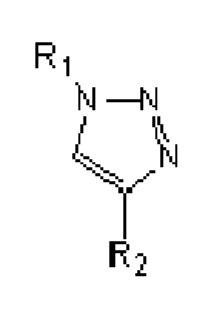
の、1,2,3-トリアゾールは、第1の成分に接着したアジドの、免疫抑制剤などの第2の成分に接着した末端アルキンによる1,3-双極性環化付加反応により生成することができる。1,3-双極性環化付加反応は、触媒を用いてまたはこれを用いずに、好ましくは1,2,3-トリアゾール官能基を通して2つの成分を連結するCu(I)触媒を用いて行う。この化学は、Sharpless et al., Angew. Chem. Int. Ed. 41(14), 2596, (2002)およびMeldal, et al, Chem. Rev., 2008, 108(8), 2952-3015において詳細に記載され、しばしば、「クリック」反応またはCuAACとして言及される。
The form in which the triazole linker, in particular R1 and R2, is any chemical component.
1,2,3-triazole is produced by a 1,3-bipolar cycloaddition reaction of azide adhered to the first component with a terminal alkyne adhered to a second component such as an immunosuppressant. Can be done. The 1,3-bipolar cycloaddition reaction is carried out with or without a catalyst, preferably with a Cu (I) catalyst linking the two components through a 1,2,3-triazole functional group. .. This chemistry is detailed in Sharpless et al., Angew. Chem. Int. Ed. 41 (14), 2596, (2002) and Meldal, et al, Chem. Rev., 2008, 108 (8), 2952-3015. And often referred to as a "click" reaction or CuAAC.
チオエーテルリンカーは、例えばR1-S-R2の形態における硫黄-炭素(チオエーテル)結合の形成により生成される。チオエーテルは、1つの成分上でのチオール/メルカプタン(-SH)基の、第2の成分上のハライドまたはエポキシドなどのアルキル化基によるアルキル化により、生成することができる。チオエーテルリンカーはまた、1つの成分上のチオール/メルカプタン基の、マイケルアクセプターとしてマレイミド基またはビニルスルホン基を含む第2の成分上の電子欠乏アルケン基に対するマイケル付加により、形成させることができる。別の方法において、1つの成分上のチオール/メルカプタン基の、第2の成分上のアルケン基によるラジカルチオール-エン反応により、チオエーテルリンカーを調製することができる。
ヒドラゾンリンカーは、1つの成分上のヒドラジド基の、第2の成分上のアルデヒド/ケトン基との反応により生成することができる。
The thioether linker is produced, for example, by the formation of a sulfur-carbon (thioether) bond in the form of R1-S-R2. Thioethers can be produced by alkylation of a thiol / mercaptan (-SH) group on one component with an alkylating group such as a halide or epoxide on a second component. The thioether linker can also be formed by Michael addition of a thiol / mercaptan group on one component to an electron-deficient alkene group on a second component containing a maleimide or vinyl sulfone group as a Michael acceptor. Alternatively, a thioether linker can be prepared by radical thiol-ene reaction of a thiol / mercaptan group on one component with an alkene group on a second component.
The hydrazone linker can be produced by reacting a hydrazide group on one component with an aldehyde / ketone group on the second component.
ヒドラジドリンカーは、1つの成分上のヒドラジン基の、第2の成分上のカルボン酸基との反応により生成することができる。かかる反応は、一般に、カルボン酸が活性化試薬により活性化される、アミド結合の形成に類似する化学を用いて行う。 The hydrazidlinker can be produced by reacting a hydrazine group on one component with a carboxylic acid group on the second component. Such a reaction is generally carried out using a chemistry similar to the formation of an amide bond, in which the carboxylic acid is activated by an activating reagent.
イミンまたはオキシムリンカーは、1つの成分上のアミンまたはN-アルコキシアミン(またはアミノオキシ)基の、第2の成分上のアルデヒドまたはケトン基との反応により形成される。
ウレアまたはチオウレアリンカーは、1つの成分上のアミン基の、第2の成分上のイソシアナートまたはチオイソシアナート基との反応により調製される。
アミジンリンカーは、1つの成分上のアミン基の、第2の成分上のイミドエステル基との反応により調製される。
The imine or oxime linker is formed by the reaction of an amine or N-alkoxyamine (or aminooxy) group on one component with an aldehyde or ketone group on the second component.
Urea or thiourea linkers are prepared by reacting an amine group on one component with an isocyanate or thioisocyanate group on a second component.
The amidine linker is prepared by reacting an amine group on one component with an imide ester group on a second component.
アミンリンカーは、1つの成分上のアミン基の、第2の成分上のハライド、エポキシドまたはスルホナートエステル基などのアルキル化基によるアルキル化反応により生成される。あるいは、アミンリンカーはまた、シアノ水素化ホウ素ナトリウムまたはトリアセトキシ水素化ホウ素ナトリウムなどの好適な還元試薬による、1つの成分上のアミン基の、第2の成分上のアルデヒドまたはケトン基による還元性アミノ化により生成することができる。
スルホンアミドリンカーは、1つの成分上のアミン基の、第2の成分上のスルホニルハライド(スルホニルクロリドなどの)基との反応により生成される。
スルホンリンカーは、ビニルスルホンへの求核試薬のマイケル付加により生成される。ビニルスルホンまたは求核試薬のいずれかは、ナノキャリアの表面上にあるか、成分に接着していてもよい。
The amine linker is produced by an alkylation reaction of an amine group on one component with an alkylating group such as a halide, epoxide or sulfonate ester group on the second component. Alternatively, the amine linker may also be a reducing amino with an amine group on one component and an aldehyde or ketone group on the second component with a suitable reducing reagent such as sodium cyanoborohydride or sodium triacetoxyborohydride. It can be generated by cyanoborohydride.
Sulfonamide linkers are produced by the reaction of an amine group on one component with a sulfonyl halide (such as sulfonyl chloride) group on a second component.
The sulfone linker is produced by Michael addition of a nucleophile to vinyl sulfone. Either the vinyl sulfone or the nucleophile may be on the surface of the nanocarrier or adhered to the component.
成分はまた、非共有的共役方法を介して共役させることができる。例えば、静電吸着を通して、負に荷電した免疫抑制剤を、正に荷電した成分に共役させることができる。金属配位子を含む成分はまた、金属-配位子錯体を介して金属錯体に共役させることができる。 The components can also be conjugated via a non-shared conjugation method. For example, negatively charged immunosuppressants can be conjugated to positively charged components through electrostatic adsorption. The component containing the metal ligand can also be conjugated to the metal complex via the metal-ligand complex.
態様において、成分は、合成ナノキャリアのアセンブリーの前に、ポリマー、例えばポリ乳酸-ブロック-ポリエチレングリコールに接着していてもよく、合成ナノキャリアは、反応性または活性化可能な基により形成させることができる。後者の場合において、成分は、合成ナノキャリアの表面により提示される接着化学に適合性である基を用いて調製することができる。他の態様において、ペプチド成分は、好適なリンカーを用いてVLPまたはリポソームに接着させることができる。リンカーは、2つの分子を一緒にカップリングすることができる化合物または試薬である。一態様において、リンカーは、Hermanson 2008において記載されるようなホモ二官能性またはヘテロ二官能性の試薬であってよい。例えば、表面上にカルボン酸基を含むVLPまたはリポソーム合成ナノキャリアを、EDCの存在下において、ホモ二官能性リンカーであるアジピン酸ジヒドラジド(ADH)で処置して、ADHリンカーを有する対応する合成ナノキャリアを形成させることができる。結果として生じるADHと連結された合成ナノキャリアを、次いで、ナノキャリア上のADHリンカーの他方の末端を介して、酸基を含むペプチド成分と共役させて、対応するVLPまたはリポソームペプチドコンジュゲートを生成する。 In embodiments, the components may be adhered to a polymer such as polylactic acid-block-polyethylene glycol prior to assembly of the synthetic nanocarriers, the synthetic nanocarriers being formed by reactive or activating groups. Can be done. In the latter case, the components can be prepared with groups that are compatible with the adhesive chemistry presented by the surface of the synthetic nanocarriers. In another embodiment, the peptide component can be attached to the VLP or liposome using a suitable linker. A linker is a compound or reagent that can couple two molecules together. In one embodiment, the linker may be a homobifunctional or heterobifunctional reagent as described in Hermanson 2008. For example, VLPs or liposome synthetic nanocarriers containing carboxylic acid groups on the surface are treated with the homobifunctional linker adipic acid dihydrazide (ADH) in the presence of EDC to provide the corresponding synthetic nanocarriers with the ADH linker. Carriers can be formed. The resulting synthetic nanocarriers linked to ADH are then coupled to the acid group-containing peptide component via the other end of the ADH linker on the nanocarrier to produce the corresponding VLP or liposomal peptide conjugate. do.
態様において、ポリマー鎖の末端側にまたはアルキン基を含むポリマーが、調製される。このポリマーを、次いで、複数のアルキンまたはアジド基がナノキャリアの表面上に位置するような様式において合成ナノキャリアを調製するために用いられる。あるいは、合成ナノキャリアを、別の経路により調製して、その後、アルキンまたはアジド基で官能化してもよい。成分は、アルキン(ポリマーがアジドを含む場合)またはアジド(ポリマーがアルキンを含む場合)基のいずれかの存在と共に調製される。成分を、次いで、1,3-双極性環化付加反応を介して、1,4-二置換1,2,3-トリアゾールリンカーを通して成分を粒子に共有的に接着させる触媒を用いてまたはこれを用いずに、ナノキャリアと反応させる。 In embodiments, a polymer is prepared on the terminal side of the polymer chain or with an alkyne group. This polymer is then used to prepare synthetic nanocarriers in such a manner that multiple alkynes or azido groups are located on the surface of the nanocarriers. Alternatively, synthetic nanocarriers may be prepared by another route and then functionalized with an alkyne or azide group. Ingredients are prepared with the presence of either an alkyne (if the polymer contains an alkyne) or an azide (if the polymer contains an alkyne) group. The component is then covalently adhered to the particles through a 1,4-disubstituted 1,2,3-triazole linker via a 1,3-bipolar cycloaddition reaction or with a catalyst. React with nanocarriers without use.
成分が低分子である場合、合成ナノキャリアのアセンブリーの前に成分をポリマーに接着させることは、有利であり得る。態様において、成分を合成ナノキャリアに接着させるために用いられる表面基を用いて、成分をポリマーに接着させるというよりはむしろこれらの表面基の使用を通して、合成ナノキャリアを調製し、次いで、このポリマーコンジュゲートを合成ナノキャリアの構築において用いることもまた、有利であり得る。 If the component is a small molecule, it may be advantageous to bond the component to the polymer prior to assembly of the synthetic nanocarriers. In embodiments, the surface groups used to adhere the components to the synthetic nanocarriers are used to prepare the synthetic nanocarriers through the use of these surface groups rather than adhering the components to the polymer, and then the polymer. It may also be advantageous to use conjugates in the construction of synthetic nanocarriers.
利用可能な共役方法の詳細な記載については、Hermanson GT「Bioconjugate Techniques」、第2版、Academic Press, Inc.刊行、2008年を参照。共有的接着に加えて、成分は、予め形成された合成ナノキャリアに吸着させることにより接着させても、または合成ナノキャリアの形成の間の封入により接着させてもよい。 For a detailed description of the available conjugation methods, see Hermanson GT "Bioconjugate Techniques", 2nd Edition, Academic Press, Inc. See publication 2008. In addition to covalent adhesion, the components may be adhered by adsorption to preformed synthetic nanocarriers or by encapsulation during the formation of synthetic nanocarriers.
合成ナノキャリアは、当該分野において公知の広範な方法を用いて調製することができる。例えば、合成ナノキャリアは、ナノ沈殿、流体チャネルを用いるフローフォーカシング(flow focusing)、スプレー乾燥、シングルおよびダブルエマルション溶媒蒸発、溶媒抽出、相分離、製粉、マイクロエマルション法、微細加工(microfabrication)、ナノ加工(nanofabrication)、犠牲層、単純および複合コアセルベーションなどの方法、ならびに当業者に周知の他の方法により形成することができる。あるいはまたは加えて、単分散半導体のための水性および有機性の溶媒合成、伝導性、磁性、有機および他のナノ材料が記載されている(Pellegrino et al., 2005, Small, 1:48; Murray et al., 2000, Ann. Rev. Mat. Sci., 30:545; and Trindade et al., 2001, Chem. Mat., 13:3843)。さらなる方法は、文献において記載されている(例えば、Doubrow編、「Microcapsules and Nanoparticles in Medicine and Pharmacy」、CRC Press, Boca Raton, 1992;Mathiowitz et al., 1987, J. Control. Release, 5:13; Mathiowitz et al., 1987, Reactive Polymers, 6:275; ならびにMathiowitz et al., 1988, J. Appl. Polymer Sci., 35:755;米国特許第5578325号および同第6007845号;P. Paolicelli et al., 「Surface-modified PLGA-based Nanoparticles that can Efficiently Associate and Deliver Virus-like Particles」Nanomedicine. 5(6):843-853 (2010)を参照)。 Synthetic nanocarriers can be prepared using a wide range of methods known in the art. For example, synthetic nanocarriers include nanoprecipitation, flow focusing using fluid channels, spray drying, single and double emulsion solvent evaporation, solvent extraction, phase separation, milling, microemulsion methods, microfabrication, nano. It can be formed by methods such as nanofabrication, sacrificial layers, simple and composite coagulation, and other methods well known to those of skill in the art. Alternatively or additionally, aqueous and organic solvent synthesis, conductive, magnetic, organic and other nanomaterials for monodisperse semiconductors have been described (Pellegrino et al., 2005, Small, 1:48; Murray. et al., 2000, Ann. Rev. Mat. Sci., 30: 545; and Trindade et al., 2001, Chem. Mat., 13: 3843). Further methods are described in the literature (eg, Doubrow ed., "Microcapsules and Nanoparticles in Medicine and Pharmacy", CRC Press, Boca Raton, 1992; Mathiowitz et al., 1987, J. Control. Release, 5:13. Mathiowitz et al., 1987, Reactive Polymers, 6: 275; and Mathiowitz et al., 1988, J. Appl. Polymer Sci., 35: 755; US Pat. Nos. 5,578,325 and 6,007845; P. Paolicelli et. al., "Surface-modified PLGA-based Nanoparticles that can Efficiently Associate and Deliver Virus-like Particles" Nanomedicine. 5 (6): 843-853 (2010)).
材料を、望ましい場合には、限定されないが以下を含む多様な方法を用いて、合成ナノキャリア中に封入してもよい:C. Astete et al., 「Synthesis and characterization of PLGA nanoparticles」J. Biomater. Sci. Polymer Edn、第17巻、第3号、pp. 247-289(2006);K. Avgoustakis「Pegylated Poly(Lactide) and Poly(Lactide-Co-Glycolide) Nanoparticles: Preparation, Properties and Possible Applications in Drug Delivery」Current Drug Delivery 1:321-333(2004);C. Reis et al., 「Nanoencapsulation I. Methods for preparation of drug-loaded polymeric nanoparticles」Nanomedicine 2:8- 21(2006);P. Paolicelli et al., 「Surface-modified PLGA-based Nanoparticles that can Efficiently Associate and Deliver Virus-like Particles」Nanomedicine. 5(6): 843-853(2010)。材料を合成ナノキャリア中に封入するために好適な他の方法を用いてもよく、これらは、限定することなく、2003年10月14日に発行されたUngerに対する米国特許第6,632,671号において開示される方法を含む。 The material may be encapsulated in synthetic nanocarriers, if desired, using a variety of methods, including but not limited to: C. Astete et al., "Synthesis and characterization of PLGA nanoparticles" J. Biomater. Sci. Polymer Edn, Vol. 17, No. 3, pp. 247-289 (2006); K. Avgoustakis "Pegylated Poly (Lactide) and Poly (Lactide-Co-Glycolide) Nanoparticles: Preparation, Properties and Possible Applications in Drug Delivery "Current Drug Delivery 1: 321-333 (2004); C. Reis et al.," Nanoencapsulation I. Methods for preparation of drug-loaded polypropylene nanoparticles "Nanomedicine 2: 8-21 (2006); P. Paolicelli et. al., "Surface-modified PLGA-based Nanoparticles that can Efficiently Associate and Deliver Virus-like Particles" Nanomedicine. 5 (6): 843-853 (2010). Other methods suitable for encapsulating the material in synthetic nanocarriers may be used, which are, without limitation, US Pat. No. 6,632,671 to Unger issued October 14, 2003. Including the methods disclosed in the issue.
ある態様において、合成ナノキャリアは、ナノ沈殿法またはスプレー乾燥により調製される。合成ナノキャリアを調製することにおいて用いられる条件は、所望されるサイズおよび特性(例えば、疎水性、親水性、外側の形態、「粘着性」、形状など)の粒子を得るために改変することができる。合成ナノキャリアを調製する方法および用いられる条件(例えば、溶媒、温度、濃度、気体の流速など)は、合成ナノキャリアに結合させるべき材料および/またはポリマーマトリックスの組成に依存し得る。 In some embodiments, synthetic nanocarriers are prepared by nanoprecipitation or spray drying. The conditions used in preparing synthetic nanocarriers can be modified to obtain particles of the desired size and properties (eg, hydrophobicity, hydrophilicity, outer morphology, "stickiness", shape, etc.). can. The method of preparing the synthetic nanocarriers and the conditions used (eg, solvent, temperature, concentration, gas flow velocity, etc.) may depend on the composition of the material and / or polymer matrix to be attached to the synthetic nanocarriers.
上記の方法のいずれかにより調製される合成ナノキャリアが所望される範囲の外のサイズ範囲を有する場合、合成ナノキャリアを、例えば篩を用いて、サイズ分類することができる。 If the synthetic nanocarriers prepared by any of the above methods have a size range outside the desired range, the synthetic nanocarriers can be sized, for example using a sieve.
合成ナノキャリアの要素は、例えば1以上の共有結合により合成ナノキャリア全体に接着させても、1以上のリンカーにより接着させてもよい。合成ナノキャリアを官能化するさらなる方法は、Saltzmanらに対する米国特許出願公開2006/0002852、DeSimoneらに対する米国特許出願公開2009/0028910、またはMurthyらに対する国際特許出願公開WO/2008/127532A1から適応させることができる。 The elements of the synthetic nanocarriers may be adhered to the entire synthetic nanocarrier by, for example, one or more covalent bonds, or by one or more linkers. Further methods for functionalizing synthetic nanocarriers are adapted from US Patent Application Publication 2006/0002852 to Saltzman et al., US Patent Application Publication 2009/0028910 to DeSimone et al., Or International Patent Application Publication WO/2008/127532A1 to Murthy et al. Can be done.
代替的にまたは加えて、合成ナノキャリアは、直接的または間接的に、非共有的相互作用を介して、成分に接着させることができる。非共有的態様において、非共有的接着は、限定されないが以下を含む非共有的相互作用により媒介される:電荷相互作用、アフィニティー相互作用、金属配位、物理的吸着、主客相互作用、疎水性相互作用、TTスタッキング相互作用、水素結合相互作用、ファン・デル・ワールス相互作用、磁性相互作用、静電相互作用、双極子-双極子相互作用、および/またはこれらの組み合わせを含む。 Alternatively or in addition, synthetic nanocarriers can be adhered to the components, either directly or indirectly, through non-covalent interactions. In non-covalent embodiments, non-covalent adhesions are mediated by non-covalent interactions, including but not limited to: charge interactions, affinity interactions, metal coordination, physical adsorption, main customer interactions, hydrophobicity. Includes interactions, TT stacking interactions, hydrogen binding interactions, van der Waals interactions, magnetic interactions, electrostatic interactions, bipolar-dipolar interactions, and / or combinations thereof.
かかる接着は、合成ナノキャリアの外部表面または内部表面上にあるように配置することができる。態様において、封入および/または吸収は、接着の形態である。 Such adhesions can be arranged to be on the outer or inner surface of the synthetic nanocarriers. In embodiments, encapsulation and / or absorption is a form of adhesion.
本明細書において提供される組成物は、無機または有機の緩衝化剤(例えば、リン酸、炭酸、酢酸またはクエン酸のナトリウムまたはカリウム塩)およびpH調整剤(例えば、塩酸、水酸化ナトリウムまたはカリウム、クエン酸または酢酸の塩、アミノ酸およびそれらの塩)、抗酸化剤(例えば、アスコルビン酸、アルファ-トコフェロール)、界面活性剤(例えば、ポリソルベート20、ポリソルベート80、ポリオキシエチレン9-10ノニルフェノール、デオキシコール酸ナトリウム)、溶液および/または低温(cryo)/凍結安定化剤(例えば、スクロース、ラクトース、マンニトール、トレハロース)、浸透圧調節剤(例えば、塩または糖)、抗菌剤(例えば、安息香酸、フェノール、ゲンタマイシン)、消泡剤(例えば、ポリジメチルシロキサン、保存剤(例えば、チメロサール、2-フェノキシエタノール、EDTA)、ポリマー性安定化剤および粘度調節剤(例えば、ポリビニルピロリドン、ポロキサマー488、カルボキシメチルセルロース)および共溶媒(例えば、グリセロール、ポリエチレングリコール、エタノール)を含んでもよい。
The compositions provided herein are inorganic or organic buffering agents (eg, sodium or potassium salts of phosphoric acid, carbonic acid, acetic acid or citric acid) and pH adjusters (eg, hydrochloric acid, sodium hydroxide or potassium). , Citrate or acetic acid salts, amino acids and salts thereof), antioxidants (eg ascorbic acid, alpha-tocopherol), surfactants (
本発明による組成物は、薬学的に許容し得る賦形剤を含んでもよい。組成物は、有用な投与形態を達成するために、慣用的な医薬の製造および配合技術を用いて製造することができる。本発明の実施における使用のために好適な技術は、Handbook of Industrial Mixing: Science and Practice、Edward L. Paul, Victor A. Atiemo-ObengおよびSuzanne M. Kresta編、2004年、John Wiley & Sons, Inc.; ならびにPharmaceutics: The Science of Dosage Form Design、第2版M. E. Auten編、2001年、Churchill Livingstoneにおいて見出すことができる。一態様において、組成物を、注射のために、保存剤と共に、無菌の食塩水溶液中に懸濁する。 The compositions according to the invention may contain pharmaceutically acceptable excipients. The composition can be prepared using conventional pharmaceutical manufacturing and compounding techniques to achieve useful dosage forms. Suitable techniques for use in the practice of the present invention are Handbook of Industrial Mixing: Science and Practice, Edward L. Paul, Victor A. Atiemo-Obeng and Suzanne M. Kresta, 2004, John Wiley & Sons, Inc. .; And can be found in Pharmaceutics: The Science of Dosage Form Design, 2nd Edition M. E. Auten, 2001, Churchill Livingstone. In one embodiment, the composition is suspended in sterile aqueous saline solution with a preservative for injection.
本発明の組成物は任意の好適な様式において製造することができることが、理解されるべきであり、本発明は、本明細書において記載される方法を用いて製造することができる組成物に決して限定されない。適切な製造の方法の選択は、関連する特定の部分の特性に対する注意を必要とする場合がある。 It should be understood that the compositions of the present invention can be made in any suitable manner, and the present invention will never be made into compositions which can be made using the methods described herein. Not limited. Choosing the right manufacturing method may require attention to the properties of the particular part involved.
いくつかの態様において、組成物は、無菌条件下において製造されるか、最終的に無菌化される。このことにより、結果として生じる組成物が無菌であり、非感染性であることを確実にすることができ、それにより、非無菌の組成物と比較して安全性を改善する。このことは、特に組成物を投与されている対象が免疫欠損を有するか、感染症を罹患しているか、および/または感染に対して感受性である場合に、有益な安全性の指標を提供する。 In some embodiments, the composition is manufactured under sterile conditions or is finally sterilized. This can ensure that the resulting composition is sterile and non-infectious, thereby improving safety as compared to non-sterile compositions. This provides a useful safety indicator, especially if the subject receiving the composition has an immune deficiency, has an infection, and / or is susceptible to infection. ..
本発明による投与は、多様な経路によるものであってよく、これは、限定されないが、皮下、静脈内、筋肉内および腹腔内経路を含む。本明細書において言及される組成物は、混合物としてのいくつかの態様において、従来の方法を用いて、投与のために製造および調製されることができる。 Administration according to the invention may be by a variety of routes, including, but not limited to, subcutaneous, intravenous, intramuscular and intraperitoneal routes. The compositions referred to herein can be prepared and prepared for administration using conventional methods in some embodiments as a mixture.
本発明の組成物は、有効量、例えば本明細書において他の場所で記載される有効量で投与することができる。投与形態は、多様な頻度において投与することができる。提供される方法または組成物のいずれか1つのいくつかの態様において、ウイルスベクターを伴う、免疫抑制剤を含む合成ナノキャリアの反復投与が、行われる。 The compositions of the invention can be administered in an effective amount, eg, an effective amount described elsewhere herein. The dosage form can be administered at various frequencies. In some embodiment of any one of the methods or compositions provided, repeated administration of synthetic nanocarriers, including immunosuppressive agents, with a viral vector is performed.
例
例1:免疫抑制剤を含む合成ナノキャリアの合成(理論上)
ラパマイシンなどの免疫抑制剤を含む合成ナノキャリアは、当業者に公知のいずれかの方法を使用して、産生することができる。好ましくは、本明細書に提供される方法または組成物のいずれか1つのいくつかの態様において、免疫抑制剤を含む合成ナノキャリアは、米国公開番号US2016/0128986A1および米国公開番号US2016/0128987A1の方法のいずれか1つによって産生され、かかる産生および結果として生じる合成ナノキャリアの記載された方法は、本明細書においてその全体において参考として援用される。
Example 1: Synthesis of synthetic nanocarriers containing immunosuppressants (theoretically)
Synthetic nanocarriers containing immunosuppressive agents such as rapamycin can be produced using any method known to those of skill in the art. Preferably, in some aspect of any one of the methods or compositions provided herein, the synthetic nanocarriers comprising the immunosuppressive agent are the methods of US Publication No. US2016 / 0128986A1 and US Publication No. US2016 / 0128987A1. The described method of synthetic nanocarriers produced by any one of the above and resulting in such production is incorporated herein by reference in its entirety.
本明細書に提供される方法、または組成物のいずれか1つにおいて、免疫抑制剤を含む合成ナノキャリアは、かかる援用された合成ナノキャリアである。ImmTOR、ラパマイシンを封入している生物分解可能なPLA+PLA-PEGナノ粒子は、かかる合成ナノキャリアの例を指す(Kishimoto TK, Maldonado RA. Nanoparticles for the induction of antigen-specific immunological tolerance. Front Immunol. 2018; 9: 230. Sands E, Kivitz AJ, DeHaan W, et al. Update of SEL-212 phase 2 clinical data in symptomatic gout patients: SVP-rapamycin combined with pegadricase mitigates immunogenicity and enables sustained reduction of serum uric acid levels, low rate of gout flares and monthly dosing. Poster presentation at: 2018 American College of Rheumatology/Association of Reproductive Health Professionals (ACR/ARHP) Annual Meeting; October 19-24, 2018; Chicago, IL. Poster #2254)。 In any one of the methods or compositions provided herein, a synthetic nanocarrier comprising an immunosuppressant is such an incorporated synthetic nanocarrier. Biodegradable PLA + PLA-PEG nanoparticles encapsulating ImmTOR, rapamycin point to an example of such synthetic nanocarriers (Kishimoto TK, Maldonado RA. Nanoparticles for the induction of antigen-specific immunological tolerance. Front Immunol. 2018; 9: 230. Sands E, Kivitz AJ, DeHaan W, et al. Update of SEL-212 phase 2 clinical data in symptomatic gout patients: SVP-rapamycin combined with pegadricase mitigates immunogenicity and enables sustained reduction of serum uric acid levels, low rate of gout flares and monthly dosing. Poster presentation at: 2018 American College of Rheumatology / Association of Reproductive Health Professionals (ACR / ARHP) Annual Meeting; October 19-24, 2018; Chicago, IL. Poster # 2254).
例2:AAVベクターの免疫抑制剤を含む合成ナノキャリアへの混合は、抗AAV抗体を伴うマウスにおける導入遺伝子発現を救済する
抗AAV抗体を伴うマウスにおける導入遺伝子発現を救済するためのラパマイシンを含む混合されたAAVベクターおよび合成ナノキャリア(例として、ImmTORナノ粒子)の能力が、調査された。最初に、正常なヒトドナーからの血清を、in vitroアッセイにおいて、AAVに対する既存の中和およびIgG抗体の存在に関して、スクリーニングした。
Example 2: Mixing of an AAV vector into a synthetic nanocarrier containing an immunosuppressant comprises rapamycin to rescue introduced gene expression in mice with anti-AAV antibody that rescues introduced gene expression in mice with anti-AAV antibody. The capabilities of mixed AAV vectors and synthetic nanocarriers (eg, ImmTOR nanoparticles) were investigated. First, sera from normal human donors were screened for existing neutralization to AAV and the presence of IgG antibodies in an in vitro assay.
簡潔には、Huh7肝臓由来細胞を、正常なヒトドナーからの血清の存在下で、AAV8-ルシフェラーゼとインキュベートした。ルシフェラーゼ発現を、Huh7細胞の形質導入に続いて評価した。ヒトドナー8からの血清とインキュベートした細胞は、ハイレベルのルシフェラーゼ活性を示し、著しいレベルの中和抗体の非存在を、指し示した。対照的に、ヒトドナー45からの血清とインキュベートした細胞は、殆どまたは全くルシフェラーゼ発現を示さず、ハイレベルの中和抗体の存在を、指し示した。同じく、ヒトドナー44からの血清とインキュベートした細胞は、殆どルシフェラーゼ発現を示さず、中からハイレベルの中和抗体の存在を、指し示した。ヒトドナー31および35からの血清とインキュベートした細胞は、ルシフェラーゼ発現の中間のレベルを示し、中レベルの中和抗体の存在を、指し示した。上で記載された機能的な中和抗体アッセイに基づく中和抗体の予測されたレベルが、抗AAV IgG抗体の観察されたレベルと相関するとわかった(図1)。
Briefly, Huh7 liver-derived cells were incubated with AAV8-luciferase in the presence of serum from normal human donors. Luciferase expression was evaluated following transduction of Huh7 cells. Cells incubated with serum from
ヒトドナー8、31、35、44、および45からの血清の80マイクロリットル(80μL)を、個々のマウスに静脈内注入によって移した。およそ24時間後に、マウスに、ラパマイシンを含む合成ナノキャリア(例として、ImmTORナノ粒子)の100μgと混合した、AAV8-SEAPベクターの5.0E11vg/kg、または、AAV8-SEAPベクターの5.0E11vg/kgを、注入した。12日後に、血清を、マウスから収集し、そして、血清SEAP活性レベルを、測定した。
80 microliters (80 μL) of serum from
結果を図2に示す。AAV8-SEAPベクターの後に、ヒトドナー8からの血清を受けたマウスは、AAV8-SEAPだけを受けた対照マウスと同様のレベルのSEAP活性を示し、ヒトドナー8からの血清が、抗AAV8抗体の有意なレベルを有していないことを確認した(対照の「血清なし」の白抜き棒グラフに対する、ドナー8の棒グラフを比較する)。AAV8-SEAPベクターが続くヒトドナー31および35からの血清を受けているマウスは、血清がない対照マウスと比較して、およそ46~47%のSEAP活性を示し、ヒトドナー31および35からの血清における中程度に中和する抗体の存在を確認した(白抜き対照「血清なし」棒グラフに対する、白抜きドナー31および35棒グラフを比較する)。しかしながら、ラパマイシンを含む合成ナノキャリア(例として、ImmTORナノ粒子)とヒトドナー31および35からの血清を受けているマウスのAAV8-SEAPベクターとの混合は、AAV8-SEAPベクターのみを受けている血清なし対照マウスと比較して、だけを受けている血清制御マウスと同等でない、SEAP導入遺伝子発現および活性レベルを増強するとわかった(白抜き対照「血清なし」棒グラフに対する、濃いドナー31および35棒グラフを比較する)。これらの結果は、ラパマイシンを含む合成ナノキャリア(例えば、ImmTORナノ粒子)とAAV8-SEAPベクターの第1の用量との混合が、中和抗体の中程度のレベルを伴うマウスにおける導入遺伝子発現および活性を救済することができることを、指し示す。
The results are shown in FIG. Mice that received serum from
例3:AAVベクターと免疫抑制剤を含む合成ナノキャリアとの混合は、抗AAV抗体を伴う未治療のマウスにおける導入遺伝子発現を救済する
AAV8-SEAPベクターを、室温で20分間、ラパマイシンを含む合成ナノキャリア(例として、ImmTORナノ粒子)または生理食塩水50μgと当量で混合し、その後、室温で1時間、未治療正常マウス血清、または抗AAV抗体を含有するマウス血清の1:100の希釈物と混合した。結果として生じる混合物を、未治療のマウスに注入し、そして、33日後に、SEAP導入遺伝子の血清発現を、測定した。SEAP導入遺伝子の血清発現を、血清と混合せずにAAV8-SEAPベクターを注入した対照マウスと、比較した。
Example 3: Mixing of an AAV vector with a synthetic nanocarrier containing an immunosuppressant synthesizes an AAV8-SEAP vector that rescues transgene expression in untreated mice with anti-AAV antibody for 20 minutes at room temperature containing rapamycin. Mix with nanocarriers (eg, ImmTOR nanoparticles) or 50 μg of saline in equivalent amounts, then 1: 100 dilutions of untreated normal mouse serum or mouse serum containing anti-AAV antibody for 1 hour at room temperature. Was mixed with. The resulting mixture was injected into untreated mice and 33 days later, serum expression of the SEAP transgene was measured. Serum expression of the SEAP transgene was compared to control mice injected with the AAV8-SEAP vector unmixed with serum.
その結果を、図3に示す。抗AAV抗体を含有していない正常な血清に混合したAAV8-SEAPベクターを注入したマウスは、対照マウスに匹敵する血清SEAP活性を示し、そして、抗AAV抗体を含有している血清に混合したAAV8-SEAPベクターを注入したマウスは、対照マウスと比較して、減少したSEAP血清活性を、示した。対照的に、ラパマイシンを含む50μg合成ナノキャリア(例として、ImmTORナノ粒子)の、抗AAV抗体を含有している血清への混合の前の、AAV8-SEAPベクターへの混合は、血清なしの対照に匹敵するレベルに、SEAP発現を救済することが、わかった。 The results are shown in FIG. Mice injected with the AAV8-SEAP vector mixed with normal serum containing no anti-AAV antibody exhibited serum SEAP activity comparable to control mice and AAV8 mixed with serum containing anti-AAV antibody. Mice injected with the -SEAP vector showed reduced SEAP serum activity compared to control mice. In contrast, mixing of 50 μg synthetic nanocarriers containing rapamycin (eg, ImmTOR nanoparticles) into serum containing anti-AAV antibodies prior to mixing with the AAV8-SEAP vector was a serum-free control. It was found to rescue SEAP expression to a level comparable to that of.
例4:免疫抑制剤を含む合成ナノキャリアは、母性移入抗体を改善する
母性移入抗AAVを収容しているマウスの導入遺伝子発現を救うラパマイシン(例として、ImmTORナノ粒子)を含む合成ナノキャリアの能力を、調査した。
Example 4: Synthetic nanocarriers containing immunosuppressants are synthetic nanocarriers containing rapamycin (eg, ImmTOR nanoparticles) that saves the transgene expression in mice containing maternally transferred anti-AAV that improves maternally transferred antibodies . The ability was investigated.
メチルマロノイル-CoAムターゼ(MUT)の発現において欠損する、および筋特異的プロモーターの下でのMUTに関する導入遺伝子を発現する低形質マウス(Mck-MUTマウス)を、使用した(Manoli et al., 2018)。これらのマウスは、メチルマロン酸血症の重篤な形態を、呈する。雌雄同種接合Mck-MUTマウスは、肝臓のMUT遺伝子発現欠損を修正するために、AAV Anc80-hAAT-MUTベクターによる遺伝子治療を受けた。マウスを次いで飼育し、そして、それらの子孫からのすべての新生児の子は、既存の抗Anc80抗体を担持し、それは、おそらく子宮内で母体から移入された(図4)。 Low-trait mice (Mck-MUT mice) that are deficient in the expression of methylmalonoyl-CoA mutase (MUT) and express transgenes for MUT under a muscle-specific promoter were used (Manoli et al., 2018). These mice exhibit a severe form of methylmalonic acidemia. Male-female allogeneic Mck-MUT mice underwent gene therapy with the AAV Anc80-hAAT-MUT vector to correct hepatic MUT gene expression deficiencies. Mice were then reared and all neonatal offspring from their offspring carried the existing anti-Anc80 antibody, which was probably transferred from the mother in utero (Fig. 4).
およそ26日齢で、Mck-MUTマウスは、母体に移入された抗Anc80抗体の有意なレベルを、依然として示した。マウスを無作為化し、5.0e12vg/kgのAnc80-MUT単独で処置するか、または100μgまたは300μgのラパマイシンを含む合成ナノキャリア(例として、ImmTORナノ粒子)と混合した。Anc80-MUT単独で処置した4匹のマウスのうちの2匹は、遺伝子導入から数日以内に死んだ。ラパマイシンを含む合成ナノキャリア(例として、ImmTORナノ粒子)100μgに混合したAnc80-MUTで処置した5匹のマウスのうちの3匹は、が遺伝子導入の直後に死んだ。その上、ラパマイシンを含む合成ナノキャリア(例えば、ImmTORナノ粒子)300μgに混合したAnc80-MUTで処置した全7匹の動物は、生き残った。 At approximately 26 days of age, Mcc-MUT mice still showed significant levels of anti-Anc80 antibody transferred to the mother. Mice were randomized and treated with 5.0 e12 vg / kg Anc80-MUT alone or mixed with synthetic nanocarriers (eg, ImmTOR nanoparticles) containing 100 μg or 300 μg rapamycin. Two of the four mice treated with Anc80-MUT alone died within a few days of gene transfer. Three of the five mice treated with Anc80-MUT mixed with 100 μg of synthetic nanocarriers (eg, ImmTOR nanoparticles) containing rapamycin died shortly after gene transfer. Moreover, all 7 animals treated with Anc80-MUT mixed with 300 μg of synthetic nanocarriers (eg, ImmTOR nanoparticles) containing rapamycin survived.
これらのデータは、ラパマイシンを含む合成ナノキャリア(例えば、ImmTORナノ粒子)の、AAV Anc80-hAAT-MUTベクターの第1の用量への混合が、用量依存的なやり方におけるマウスの生存を、増強したことを、指し示す。 These data indicate that mixing synthetic nanocarriers containing rapamycin (eg, ImmTOR nanoparticles) with a first dose of AAV Anc80-hAAT-MUT vector enhanced mouse survival in a dose-dependent manner. Point out that.
例5:AAV-MUTベクターで処置した母性移入抗体を伴うメチルマロン酸血症のマウスモデルにおける、免疫抑制剤を含む合成ナノキャリアの効果
Anc80に対する既存のIgGを伴う23Mck-MMUTマウスを、まとめて発生させた。これらのうち、6匹のマウスを、AAV Anc80-MMUTの5×10¹²vg/kgで処置し、7匹のマウスを、ImmTORナノ粒子の100μgと混合したAAV Anc80-MMUTの同じ用量で処置し、そして、10匹のマウスを、ImmTORの300μgと混合したAAV Anc80-MMUTの同じ用量で処置した。
Example 5: Effect of Synthetic NanoCarriers Containing Immunosuppressants in a Mouse Model of Methylmalonic Acidemia with Maternally Transferred Antibodies Treated with AAV-MUT Vector 23 Mck-MMUT Mice with Existing IgG on Anc80, Collectively. Generated. Of these, 6 mice were treated with 5 × 10¹² vg / kg of AAV Anc80-MMUT, 7 mice were treated with the same dose of AAV Anc80-MMUT mixed with 100 μg of ImmTOR nanoparticles, and Ten mice were treated with the same dose of AAV Anc80-MMUT mixed with 300 μg of ImmTOR.
pMMAレベルによって測定したとおり、どの群も、最初の処置の後の利益を示さなかった。その上、Anc80-MMUT単独で処置した6匹のマウスのうち4匹、およびImmTORナノ粒子の100μgに混合したAnc80-MUTで処置した7匹のマウスのうち4匹は、遺伝子導入の直後に、死んだ。同時に、ImmTORナノ粒子の300μgに混合したAnc80-MUTで処置した群における全10匹のマウスは、21日間生存し、その時点で、2回目の処置を、すべての生存しているマウスに投与した。今回、ImmTORの300μgに混合したAnc80-MUTで処置したマウスのおよそ半分は、第2の遺伝子移入の後9日で、pMMAレベルの実質的減少を示し、その一方で、ImmTORの100μgに混合したAnc80-MUTで処置した群における3匹の残存するマウスのうち1匹も、pMMA減少を、示した。数日以内に疾患に屈したこれらのマウスの1匹とともに、Anc80-MMUT単独で処置した残存する2匹のマウスにおいて利益は、なかった。 None of the groups showed benefit after the first treatment, as measured by pMMA levels. Moreover, 4 of the 6 mice treated with Anc80-MMUT alone and 4 of the 7 mice treated with Anc80-MUT mixed with 100 μg of ImmTOR nanoparticles were immediately after gene transfer. Dead. At the same time, all 10 mice in the Anc80-MUT-treated group mixed with 300 μg of ImmTOR nanoparticles survived for 21 days, at which point a second treatment was administered to all surviving mice. .. Approximately half of the mice treated with Anc80-MUT mixed with 300 μg of ImmTOR this time showed a substantial reduction in pMMA levels 9 days after the second gene transfer, while mixing with 100 μg of ImmTOR. One of the three remaining mice in the Anc80-MUT-treated group also showed a decrease in pMMA. There was no benefit in the remaining two mice treated with Anc80-MMUT alone, along with one of these mice that succumbed to the disease within a few days.
ImmTORの300μgに混合したAnc80-MUTで処置した10匹のマウスのうち9匹は、pMMAの高い変数レベルを呈するところで、3ヵ月以上生存し、最初の処置の101日後に、3回目を処置した。この介入は、この群のすべてのマウスにおけるpMMAレベルの劇的な減少につながり(対前処置18%へ)、およびImmTORの100μgに混合したAnc80-MUTで処置したすべての生存しているマウスにおいても、同様だった。Anc80-MMUT単独で処置した1匹の生存マウスにおいては、利益が見られず、そして、それは、疾患にすぐに屈した。 Nine of the 10 mice treated with Anc80-MUT mixed with 300 μg of ImmTOR survived for more than 3 months at high variable levels of pMMA and were treated a third time 101 days after the first treatment. .. This intervention led to a dramatic reduction in pMMA levels in all mice in this group (to 18% pretreatment), and in all surviving mice treated with Anc80-MUT mixed with 100 μg of ImmTOR. Was the same. No benefit was seen in one surviving mouse treated with Anc80-MMUT alone, and it immediately succumbed to the disease.
まとめると、ImmTORの300μgに混合したAnc80-MUTで処置した群と、Anc80-MUT単独で処置した群(p<0.0001)またはImmTORの100μgに混合した(p<0.05)群の間に、生存において統計的に有意な差が、あった。 In summary, between the group treated with Anc80-MUT mixed with 300 μg of ImmTOR and the group treated with Anc80-MUT alone (p <0.0001) or the group mixed with 100 μg of ImmTOR (p <0.05). There was also a statistically significant difference in survival.
その上、ImmTORの300μgに混合したAnc80-MUTで処置したほとんど全てのマウス(9/10)は、試験の115日目まで(すなわち、3回の処置の後)、de novoのAnc80 IgG形成の非存在を、示した。これらのデータは、ラパマイシンを含む合成ナノキャリア(例として、ImmTORナノ粒子)の、AAV Anc80-hAAT-MMUTベクターの第1の用量への混合が、用量依存的なやり方におけるマウスの生存を、増強し、反復投与後のpMMAのレベルを改善したことを、指し示す。データを、図5~8において示す。 Moreover, almost all mice treated with Anc80-MUT mixed with 300 μg of ImmTOR (9/10) had anc80 IgG formation in de novo until day 115 of the study (ie, after 3 treatments). Showed non-existence. These data indicate that mixing synthetic nanocarriers containing rapamycin (eg, ImmTOR nanoparticles) with a first dose of AAV Anc80-hAAT-MMUT vector enhances mouse survival in a dose-dependent manner. It indicates that the level of pMMA after repeated administration was improved. The data are shown in FIGS. 5-8.
よって、合成ナノキャリアに混合したAnc80-MUTの第1の用量については、再処置の後、血清MMAにおける1部分の減少を、観察した(Anc80-MUT+300μg ImmTORで処置したマウスにおいて)。さらに、Anc80-MUT+300μg ImmTORで処置したマウスにおける第2の再処置に続いて、結果は、血清MMAの一様な減少を示した。混合した免疫抑制剤を含む合成ナノキャリアを伴うAnc80-MUTで、反復して処置した既存の母性移入抗Anc80 IgGを伴うMck-MUTマウスは、より高い初期の生存率を有した。母性移入抗Anc80 IgGを伴うマウスの既存の液性免疫は、ラパマイシンなどの、免疫抑制剤を含む合成ナノキャリアの投与に起因するウイルスベクターでの処置を、排除しない。 Thus, for the first dose of Anc80-MUT mixed with synthetic nanocarriers, a partial reduction in serum MMA was observed after retreatment (in mice treated with Anc80-MUT + 300 μg ImmTOR). In addition, following a second retreatment in mice treated with Anc80-MUT + 300 μg ImmTOR, the results showed a uniform reduction in serum MMA. Mck-MUT mice with pre-existing maternally transferred anti-Anc80 IgG that were repeatedly treated with Anc80-MUT with synthetic nanocarriers containing mixed immunosuppressants had higher initial survival rates. Existing humoral immunity of mice with maternal transfer anti-Anc80 IgG does not rule out treatment with viral vectors resulting from administration of synthetic nanocarriers containing immunosuppressive agents such as rapamycin.
該データは、免疫抑制剤を含む合成ナノキャリアのより高用量が、初期の生存を可能にすることができ、次いで反復投与で治療の有効性を提供することができ、その一方で、de novoのIgGの形成を遅延させることも、示す。 The data show that higher doses of synthetic nanocarriers, including immunosuppressants, can allow early survival, and then repeated doses can provide therapeutic efficacy, while de novo. It also shows that it delays the formation of IgG.
Claims (65)
対象に、ウイルスベクターと混合した免疫抑制剤を含む合成ナノキャリアを投与すること、ここで、前記対象は、ウイルスベクターのウイルス抗原に対して、既存の免疫を有する、を含む方法。 Less than:
A method comprising administering to a subject a synthetic nanocarrier comprising an immunosuppressive agent mixed with a viral vector, wherein said subject has existing immunity to the viral antigen of the viral vector.
Applications Claiming Priority (7)
| Application Number | Priority Date | Filing Date | Title |
|---|---|---|---|
| US201962839771P | 2019-04-28 | 2019-04-28 | |
| US62/839,771 | 2019-04-28 | ||
| US201962924103P | 2019-10-21 | 2019-10-21 | |
| US62/924,103 | 2019-10-21 | ||
| US202062981555P | 2020-02-26 | 2020-02-26 | |
| US62/981,555 | 2020-02-26 | ||
| PCT/US2020/030217 WO2020223205A1 (en) | 2019-04-28 | 2020-04-28 | Methods for treatment of subjects with preexisting immunity to viral transfer vectors |
Publications (2)
| Publication Number | Publication Date |
|---|---|
| JP2022531201A true JP2022531201A (en) | 2022-07-06 |
| JPWO2020223205A5 JPWO2020223205A5 (en) | 2023-04-27 |
Family
ID=70918963
Family Applications (1)
| Application Number | Title | Priority Date | Filing Date |
|---|---|---|---|
| JP2021564364A Pending JP2022531201A (en) | 2019-04-28 | 2020-04-28 | Methods for the treatment of subjects with existing immunity to the virus-introduced vector |
Country Status (11)
| Country | Link |
|---|---|
| US (1) | US20200360453A1 (en) |
| EP (1) | EP3962537A1 (en) |
| JP (1) | JP2022531201A (en) |
| KR (1) | KR20220004121A (en) |
| CN (1) | CN114126666A (en) |
| AU (1) | AU2020265215A1 (en) |
| BR (1) | BR112021021566A2 (en) |
| CA (1) | CA3138525A1 (en) |
| IL (1) | IL287606A (en) |
| MX (1) | MX2021013163A (en) |
| WO (1) | WO2020223205A1 (en) |
Families Citing this family (10)
| Publication number | Priority date | Publication date | Assignee | Title |
|---|---|---|---|---|
| MX2013012596A (en) | 2011-04-29 | 2014-08-21 | Selecta Biosciences Inc | SYNTHETIC TOLEROGENIC NANOPORTERS TO GENERATE CD8 + T REGULATORS LYMPHOCYTES. |
| BR112015027279A8 (en) | 2013-05-03 | 2018-01-30 | Selecta Biosciences Inc | methods and compositions for enhancing cd4 + regulatory t cells |
| US20160074532A1 (en) | 2014-09-07 | 2016-03-17 | Selecta Biosciences, Inc. | Methods and compositions for attenuating gene editing anti-viral transfer vector immune responses |
| EP3592389B1 (en) | 2017-03-11 | 2025-05-07 | Cartesian Therapeutics, Inc. | Methods and compositions related to combined treatment with anti-inflammatories and synthetic nanocarriers comprising an immunosuppressant |
| EP4048269A1 (en) * | 2019-10-21 | 2022-08-31 | Selecta Biosciences, Inc. | Methods and compositions for treating liver diseases and disorders |
| WO2022150335A1 (en) * | 2021-01-05 | 2022-07-14 | Selecta Biosciences, Inc. | Viral vector dosing protocols |
| BR112023020597A2 (en) * | 2021-04-09 | 2023-12-12 | Selecta Biosciences Inc | SYNTHETIC NANOCARRIERS COMPRISING AN IMMUNOSUPPRESSANT IN COMBINATION WITH HIGH AFFINITY IL-2 RECEPTOR AGONITS TO INCREASE IMMUNE TOLERANCE |
| CN117320717A (en) * | 2021-04-09 | 2023-12-29 | 西莱克塔生物科技公司 | Synthetic nanocarriers containing immunosuppressants in combination with high-affinity IL-2 receptor agonists to enhance immune tolerance |
| WO2023064350A1 (en) * | 2021-10-12 | 2023-04-20 | Selecta Biosciences, Inc. | Viral vector dosing protocols |
| US20230263906A1 (en) * | 2022-01-10 | 2023-08-24 | Selecta Biosciences, Inc. | High affinity il-2 receptor agonists and synthetic nanocarrier dose sparing |
Family Cites Families (97)
| Publication number | Priority date | Publication date | Assignee | Title |
|---|---|---|---|---|
| US609548A (en) | 1898-08-23 | Horse-hitching device | ||
| US4946929A (en) | 1983-03-22 | 1990-08-07 | Massachusetts Institute Of Technology | Bioerodible articles useful as implants and prostheses having predictable degradation rates |
| US4638045A (en) | 1985-02-19 | 1987-01-20 | Massachusetts Institute Of Technology | Non-peptide polyamino acid bioerodible polymers |
| US4797368A (en) | 1985-03-15 | 1989-01-10 | The United States Of America As Represented By The Department Of Health And Human Services | Adeno-associated virus as eukaryotic expression vector |
| US4806621A (en) | 1986-01-21 | 1989-02-21 | Massachusetts Institute Of Technology | Biocompatible, bioerodible, hydrophobic, implantable polyimino carbonate article |
| US5804178A (en) | 1986-11-20 | 1998-09-08 | Massachusetts Institute Of Technology | Implantation of cell-matrix structure adjacent mesentery, omentum or peritoneum tissue |
| CA1340581C (en) | 1986-11-20 | 1999-06-08 | Joseph P. Vacanti | Chimeric neomorphogenesis of organs by controlled cellular implantation using artificial matrices |
| US5736372A (en) | 1986-11-20 | 1998-04-07 | Massachusetts Institute Of Technology | Biodegradable synthetic polymeric fibrous matrix containing chondrocyte for in vivo production of a cartilaginous structure |
| US5019379A (en) | 1987-07-31 | 1991-05-28 | Massachusetts Institute Of Technology | Unsaturated polyanhydrides |
| US5010167A (en) | 1989-03-31 | 1991-04-23 | Massachusetts Institute Of Technology | Poly(amide-and imide-co-anhydride) for biological application |
| GB8918616D0 (en) | 1989-08-15 | 1989-09-27 | Univ Glasgow | Herpes simplex virus type 1 mutant |
| US5849572A (en) | 1990-10-10 | 1998-12-15 | Regents Of The University Of Michigan | HSV-1 vector containing a lat promoter |
| US5804413A (en) | 1992-07-31 | 1998-09-08 | University Of Pittsburgh Of The Commonwealth System Of Higher Education | Herpes simplex virus strains for gene transfer |
| US5399665A (en) | 1992-11-05 | 1995-03-21 | Massachusetts Institute Of Technology | Biodegradable polymers for cell transplantation |
| US5478745A (en) | 1992-12-04 | 1995-12-26 | University Of Pittsburgh | Recombinant viral vector system |
| US5512600A (en) | 1993-01-15 | 1996-04-30 | Massachusetts Institute Of Technology | Preparation of bonded fiber structures for cell implantation |
| US5514378A (en) | 1993-02-01 | 1996-05-07 | Massachusetts Institute Of Technology | Biocompatible polymer membranes and methods of preparation of three dimensional membrane structures |
| US5565215A (en) | 1993-07-23 | 1996-10-15 | Massachusettes Institute Of Technology | Biodegradable injectable particles for imaging |
| US5543158A (en) | 1993-07-23 | 1996-08-06 | Massachusetts Institute Of Technology | Biodegradable injectable nanoparticles |
| ATE314482T1 (en) | 1993-10-25 | 2006-01-15 | Canji Inc | RECOMBINANT ADENOVIRUS VECTOR AND METHOD OF USE |
| EP1548118A2 (en) | 1994-06-10 | 2005-06-29 | Genvec, Inc. | Complementary adenoviral vector systems and cell lines |
| US6007845A (en) | 1994-07-22 | 1999-12-28 | Massachusetts Institute Of Technology | Nanoparticles and microparticles of non-linear hydrophilic-hydrophobic multiblock copolymers |
| GB9415319D0 (en) | 1994-07-29 | 1994-09-21 | Medical Res Council | HSV viral vector |
| US5846782A (en) | 1995-11-28 | 1998-12-08 | Genvec, Inc. | Targeting adenovirus with use of constrained peptide motifs |
| CA2200869A1 (en) * | 1994-10-19 | 1996-05-02 | Bruce C. Trapnell | Gene therapy involving concurrent and repeated administration of adenoviruses and immunosuppressive agents |
| US5716404A (en) | 1994-12-16 | 1998-02-10 | Massachusetts Institute Of Technology | Breast tissue engineering |
| US6123727A (en) | 1995-05-01 | 2000-09-26 | Massachusetts Institute Of Technology | Tissue engineered tendons and ligaments |
| IL122614A0 (en) | 1995-06-15 | 1998-08-16 | Introgene Bv | Packaging systems for human recombinant adenovirus to be used in gene therapy |
| US6001650A (en) | 1995-08-03 | 1999-12-14 | Avigen, Inc. | High-efficiency wild-type-free AAV helper functions |
| US5801030A (en) | 1995-09-01 | 1998-09-01 | Genvec, Inc. | Methods and vectors for site-specific recombination |
| US5837511A (en) | 1995-10-02 | 1998-11-17 | Cornell Research Foundation, Inc. | Non-group C adenoviral vectors |
| US6095148A (en) | 1995-11-03 | 2000-08-01 | Children's Medical Center Corporation | Neuronal stimulation using electrically conducting polymers |
| US5902599A (en) | 1996-02-20 | 1999-05-11 | Massachusetts Institute Of Technology | Biodegradable polymer networks for use in orthopedic and dental applications |
| EP0937082A2 (en) | 1996-07-12 | 1999-08-25 | Ariad Pharmaceuticals, Inc. | Materials and method for treating or preventing pathogenic fungal infection |
| US5849561A (en) | 1997-05-22 | 1998-12-15 | Cornell Research Foundation, Inc. | Method for the production of non-group C adenoviral vectors |
| AU8067698A (en) | 1997-06-09 | 1998-12-30 | Genvec, Inc. | Chimeric vectors comprising a phage packaging site and a portion derived from a genome of a eukaryotic virus |
| US5837752A (en) | 1997-07-17 | 1998-11-17 | Massachusetts Institute Of Technology | Semi-interpenetrating polymer networks |
| AU8605598A (en) | 1997-07-31 | 1999-02-22 | University Of Pittsburgh | Targeted hsv vectors |
| ATE303448T1 (en) | 1997-09-23 | 2005-09-15 | Genvec Inc | DUAL SELECTION CASSETTE AND PLASMIDS CONTAINING SAME |
| NZ505325A (en) | 1997-12-23 | 2003-07-25 | Crucell Holland B | Adeno-associated virus and adenovirus chimeric recombinant viruses useful for the integration of foreign genetic information into the chromosomal dna of target cells |
| US6506577B1 (en) | 1998-03-19 | 2003-01-14 | The Regents Of The University Of California | Synthesis and crosslinking of catechol containing copolypeptides |
| US6686446B2 (en) | 1998-03-19 | 2004-02-03 | The Regents Of The University Of California | Methods and compositions for controlled polypeptide synthesis |
| US6632922B1 (en) | 1998-03-19 | 2003-10-14 | The Regents Of The University Of California | Methods and compositions for controlled polypeptide synthesis |
| DE69927013T2 (en) | 1998-04-22 | 2006-06-29 | Genvec, Inc. | EFFICIENT CLEANING OF ADENOVIRUS |
| US6436392B1 (en) | 1998-05-20 | 2002-08-20 | University Of Iowa Research Foundation | Adeno-associated virus vectors |
| US5965358A (en) | 1998-08-26 | 1999-10-12 | Genvec, Inc. | Method for assessing the relative purity of viral gene transfer vector stocks |
| US6759237B1 (en) | 1998-11-05 | 2004-07-06 | The Trustees Of The University Of Pennsylvania | Adeno-associated virus serotype 1 nucleic acid sequences, vectors and host cells containing same |
| EP1267946A4 (en) | 2000-02-28 | 2008-07-02 | Genesegues Inc | Nanocapsule encapsulation system and method |
| US6168941B1 (en) | 2000-04-07 | 2001-01-02 | Genvec, Inc. | Method of producing adenoviral vector stocks |
| WO2001085208A2 (en) | 2000-05-05 | 2001-11-15 | Cytos Biotechnology Ag | Molecular antigen arrays and vaccines |
| WO2001091802A1 (en) | 2000-05-30 | 2001-12-06 | Baylor College Of Medicine | Chimeric viral vectors for gene therapy |
| WO2001092551A2 (en) | 2000-06-01 | 2001-12-06 | University Of North Carolina At Chapel Hill | Duplexed parvovirus vectors |
| US6593123B1 (en) | 2000-08-07 | 2003-07-15 | Avigen, Inc. | Large-scale recombinant adeno-associated virus (rAAV) production and purification |
| CA2319928A1 (en) | 2000-09-18 | 2002-03-18 | Vasogen Ireland Limited | Apoptosis-mimicking synthetic entities and use thereof in medical treatments |
| US6447995B1 (en) | 2000-10-04 | 2002-09-10 | Genvec, Inc. | Utilizing intrinsic fluorescence to detect adenovirus |
| GB0025414D0 (en) | 2000-10-16 | 2000-11-29 | Consejo Superior Investigacion | Nanoparticles |
| US7122181B2 (en) | 2000-12-19 | 2006-10-17 | Research Development Foundation | Lentiviral vector-mediated gene transfer and uses thereof |
| ATE472335T1 (en) | 2001-05-31 | 2010-07-15 | Novartis Vaccines & Diagnostic | CHIMERE ALPHAVIRUS REPLICON PARTICLES |
| DK1412493T3 (en) | 2001-08-02 | 2012-01-09 | Inst Clayton De La Rech | Methods and compositions relating to improved lentiviral vector production systems |
| US6818732B2 (en) | 2001-08-30 | 2004-11-16 | The Regents Of The University Of California | Transition metal initiators for controlled poly (beta-peptide) synthesis from beta-lactam monomers |
| AU2002327614B2 (en) | 2001-09-06 | 2007-12-06 | Alphavax, Inc. | Alphavirus replicon vector systems |
| CN1606456A (en) | 2001-10-02 | 2005-04-13 | 克雷顿研究院 | Restricted expression lentiviral vectors |
| WO2003052051A2 (en) | 2001-12-17 | 2003-06-26 | The Trustees Of The University Of Pennsylvania | Adeno-associated virus (aav) serotype 8 sequences |
| EP1581056B1 (en) | 2002-12-13 | 2010-07-21 | Genetix Pharmaceuticals Inc. | Therapeutic retroviral vectors for gene therapy |
| WO2004075861A2 (en) | 2003-02-26 | 2004-09-10 | Children's Hospital, Inc. | Recombinant adeno-associated virus production |
| AU2004224762B2 (en) | 2003-03-26 | 2009-12-24 | Kuros Us Llc | Packaging of immunostimulatory oligonucleotides into virus-like particles: method of preparation and use |
| US7186699B2 (en) | 2003-06-03 | 2007-03-06 | Cell Genesys, Inc. | Method for treating cancer by vector-mediated delivery of one or more anti-angiogenic or pro-apoptotic genes |
| EP1486567A1 (en) | 2003-06-11 | 2004-12-15 | Deutsches Krebsforschungszentrum Stiftung des öffentlichen Rechts | Improved adeno-associated virus (AAV) vector for gene therapy |
| US20050100890A1 (en) | 2003-10-15 | 2005-05-12 | Davidson Beverly L. | Methods for producing and using in vivo pseudotyped retroviruses |
| KR101376715B1 (en) | 2003-12-19 | 2014-03-27 | 더 유니버시티 오브 노쓰 캐롤라이나 엣 채플 힐 | Methods for fabricating isolated micro- and nano- structures using soft or imprint lithography |
| JP2008512350A (en) | 2004-07-01 | 2008-04-24 | イェール ユニバーシティ | Polymeric substances that are targeted and loaded with drugs at high density |
| EP1858332A4 (en) | 2005-02-16 | 2011-06-22 | Lentigen Corp | Lentiviral vectors and their use |
| CN101248186A (en) | 2005-05-23 | 2008-08-20 | 瓦克辛公司 | Rapid Production of Adenovirus-Free Recombinant Adenoviral Vectors |
| EP1974044B1 (en) | 2005-12-12 | 2011-01-26 | CANJI, Inc. | Adenoviral expression vectors having an expression cassette in the e1 region and an inactivated e2b polymerase |
| GB0526211D0 (en) | 2005-12-22 | 2006-02-01 | Oxford Biomedica Ltd | Viral vectors |
| US20090226525A1 (en) | 2007-04-09 | 2009-09-10 | Chimeros Inc. | Self-assembling nanoparticle drug delivery system |
| AU2008239795A1 (en) | 2007-04-12 | 2008-10-23 | Emory University | Novel strategies for delivery of active agents using micelles and particles |
| MX2010001379A (en) | 2007-08-03 | 2010-06-08 | Pasteur Institut | VECTOR OF TRANSFER OF LENTIVIRAL GEN AND ITS MEDICINAL APPLICATIONS. |
| AU2008314647B2 (en) | 2007-10-12 | 2013-03-21 | Massachusetts Institute Of Technology | Vaccine nanotechnology |
| EP2262489A2 (en) | 2008-02-28 | 2010-12-22 | Deutsches Krebsforschungszentrum, Stiftung des öffentlichen Rechts | Hollow nanoparticles and uses thereof |
| US8871515B2 (en) | 2008-09-17 | 2014-10-28 | Isogenis, Inc. | Construction of fully-deleted adenovirus-based gene delivery vectors and uses thereof |
| CN101676291B (en) | 2008-09-18 | 2012-05-09 | 上海海和药物研究开发有限公司 | Rapamycin carbonate analog, pharmaceutical composition thereof, and preparation method and uses thereof |
| WO2010047839A1 (en) | 2008-10-25 | 2010-04-29 | Aura Biosciences | Modified plant virus particles and uses therefor |
| WO2010114948A2 (en) | 2009-04-02 | 2010-10-07 | University Of Florida Research Foundation, Inc. | An inducible system for highly efficient production of recombinant adeno-associated virus (raav) vectors |
| US20120283318A1 (en) | 2009-10-05 | 2012-11-08 | Mei Ya-Fang | Replicating viral vectors for gene therapy |
| US8927514B2 (en) | 2010-04-30 | 2015-01-06 | City Of Hope | Recombinant adeno-associated vectors for targeted treatment |
| WO2012112578A2 (en) | 2011-02-14 | 2012-08-23 | The Children's Hospital Of Philadelphia | Improved aav8 vector with enhanced functional activity and methods of use thereof |
| US20140155469A1 (en) | 2011-04-19 | 2014-06-05 | The Research Foundation Of State University Of New York | Adeno-associated-virus rep sequences, vectors and viruses |
| EP3663395B1 (en) | 2012-03-26 | 2024-07-31 | The United States of America, as Represented by The Secretary, Department of Health and Human Services Office of Technology, Transfer, | Delivery of packaged rna to mammalian cells |
| HUE054087T2 (en) | 2012-04-18 | 2021-09-28 | Childrens Hospital Philadelphia | Composition and methods for highly efficient gene transfer using aav capsid variants |
| US20150224209A1 (en) | 2012-09-14 | 2015-08-13 | The Regents Of The University Of California | Lentiviral vector for stem cell gene therapy of sickle cell disease |
| US9624510B2 (en) | 2013-03-01 | 2017-04-18 | The Wistar Institute | Adenoviral vectors comprising partial deletions of E3 |
| CA2909085C (en) | 2013-04-08 | 2023-08-29 | University Of Iowa Research Foundation | Chimeric adeno-associated virus/ bocavirus parvovirus vector |
| US20160074532A1 (en) * | 2014-09-07 | 2016-03-17 | Selecta Biosciences, Inc. | Methods and compositions for attenuating gene editing anti-viral transfer vector immune responses |
| CN107072964A (en) | 2014-11-05 | 2017-08-18 | 西莱克塔生物科技公司 | Methods and compositions related to the use of low HLB surfactants in the production of synthetic nanoparticles comprising RAPALOG |
| JP2020506890A (en) * | 2017-01-07 | 2020-03-05 | セレクタ バイオサイエンシーズ インコーポレーテッドSelecta Biosciences,Inc. | Patterned administration of immunosuppressants coupled to synthetic nanocarriers |
| MX2021000638A (en) * | 2018-07-16 | 2021-06-23 | Selecta Biosciences Inc | Methods and compositions of mma constructs and vectors. |
-
2020
- 2020-04-28 JP JP2021564364A patent/JP2022531201A/en active Pending
- 2020-04-28 EP EP20729267.3A patent/EP3962537A1/en active Pending
- 2020-04-28 MX MX2021013163A patent/MX2021013163A/en unknown
- 2020-04-28 CA CA3138525A patent/CA3138525A1/en active Pending
- 2020-04-28 AU AU2020265215A patent/AU2020265215A1/en not_active Abandoned
- 2020-04-28 BR BR112021021566A patent/BR112021021566A2/en not_active IP Right Cessation
- 2020-04-28 KR KR1020217038381A patent/KR20220004121A/en active Pending
- 2020-04-28 US US16/860,729 patent/US20200360453A1/en not_active Abandoned
- 2020-04-28 CN CN202080047044.3A patent/CN114126666A/en active Pending
- 2020-04-28 WO PCT/US2020/030217 patent/WO2020223205A1/en not_active Ceased
-
2021
- 2021-10-27 IL IL287606A patent/IL287606A/en unknown
Non-Patent Citations (4)
| Title |
|---|
| CHANDLER R J; ET AL, HUMAN GENE THERAPY, vol. 28, JPN5022008778, 2017, pages 2 - 70, ISSN: 0005293856 * |
| ILYINSKII P O; ET AL, HUMAN GENE THERAPY, vol. VOL:27, NR:12, JPN5022008779, December 2018 (2018-12-01), GB, pages 2 - 168, ISSN: 0005495123 * |
| LI LINA; ET AL, MOLECULAR THERAPY, vol. VOL:27, NR:4, SUPPL. 1, JPN5022008781, 22 April 2019 (2019-04-22), US, pages 202, ISSN: 0005495125 * |
| PETR O. ILYINSKII; ET AL, MOLECULAR THERAPY, vol. 26, JPN5022008780, 2018, pages 1 - 2, ISSN: 0005495124 * |
Also Published As
| Publication number | Publication date |
|---|---|
| US20200360453A1 (en) | 2020-11-19 |
| AU2020265215A1 (en) | 2021-11-18 |
| IL287606A (en) | 2021-12-01 |
| MX2021013163A (en) | 2022-02-21 |
| KR20220004121A (en) | 2022-01-11 |
| EP3962537A1 (en) | 2022-03-09 |
| CA3138525A1 (en) | 2020-11-05 |
| CN114126666A (en) | 2022-03-01 |
| BR112021021566A2 (en) | 2022-04-19 |
| WO2020223205A1 (en) | 2020-11-05 |
Similar Documents
| Publication | Publication Date | Title |
|---|---|---|
| JP7425767B2 (en) | Gene Expression Regulation Antiviral Transfer Vectors Methods and Compositions for Attenuating Immune Responses | |
| JP2023071721A (en) | Patterned dosing of immunosuppressants coupled to synthetic nanocarriers | |
| JP2022531201A (en) | Methods for the treatment of subjects with existing immunity to the virus-introduced vector | |
| JP2021531282A (en) | OTC constructs and vectors methods and compositions | |
| JP2024502115A (en) | Viral vector dosing protocol |
Legal Events
| Date | Code | Title | Description |
|---|---|---|---|
| A521 | Request for written amendment filed |
Free format text: JAPANESE INTERMEDIATE CODE: A523 Effective date: 20230419 |
|
| A621 | Written request for application examination |
Free format text: JAPANESE INTERMEDIATE CODE: A621 Effective date: 20230419 |
|
| A131 | Notification of reasons for refusal |
Free format text: JAPANESE INTERMEDIATE CODE: A131 Effective date: 20240401 |
|
| A601 | Written request for extension of time |
Free format text: JAPANESE INTERMEDIATE CODE: A601 Effective date: 20240625 |
|
| A601 | Written request for extension of time |
Free format text: JAPANESE INTERMEDIATE CODE: A601 Effective date: 20240816 |
|
| A521 | Request for written amendment filed |
Free format text: JAPANESE INTERMEDIATE CODE: A523 Effective date: 20240930 |
|
| A02 | Decision of refusal |
Free format text: JAPANESE INTERMEDIATE CODE: A02 Effective date: 20250106 |