KR102349659B1 - Phosphorescent tetradentate metal complexes having modified emission spectra - Google Patents
Phosphorescent tetradentate metal complexes having modified emission spectra Download PDFInfo
- Publication number
- KR102349659B1 KR102349659B1 KR1020140070384A KR20140070384A KR102349659B1 KR 102349659 B1 KR102349659 B1 KR 102349659B1 KR 1020140070384 A KR1020140070384 A KR 1020140070384A KR 20140070384 A KR20140070384 A KR 20140070384A KR 102349659 B1 KR102349659 B1 KR 102349659B1
- Authority
- KR
- South Korea
- Prior art keywords
- group
- substituted
- unsubstituted
- mmol
- nmr
- Prior art date
- Legal status (The legal status is an assumption and is not a legal conclusion. Google has not performed a legal analysis and makes no representation as to the accuracy of the status listed.)
- Active
Links
- 0 CC(C)(C)c1cc*(*2(*3=C(C)C=C(C)*33)c4c(*5c6c-7cccc6)c-7ccc4Oc4c2c3ccc4)c5c1 Chemical compound CC(C)(C)c1cc*(*2(*3=C(C)C=C(C)*33)c4c(*5c6c-7cccc6)c-7ccc4Oc4c2c3ccc4)c5c1 0.000 description 4
- RDNBQLKCMFLYLS-UHFFFAOYSA-N Brc(cc1)cc2c1c1ccccc1[n]2-c1ncccc1 Chemical compound Brc(cc1)cc2c1c1ccccc1[n]2-c1ncccc1 RDNBQLKCMFLYLS-UHFFFAOYSA-N 0.000 description 2
- HUCFPTIDJTYMQY-UHFFFAOYSA-N [O-][N+](c1ccccc1-c(cc1)ccc1I)=O Chemical compound [O-][N+](c1ccccc1-c(cc1)ccc1I)=O HUCFPTIDJTYMQY-UHFFFAOYSA-N 0.000 description 2
- NMQKVPDXWFXQTR-UHFFFAOYSA-N c1c[n](-c(cc2)cc3c2c2ccccc2[nH]3)nc1 Chemical compound c1c[n](-c(cc2)cc3c2c2ccccc2[nH]3)nc1 NMQKVPDXWFXQTR-UHFFFAOYSA-N 0.000 description 2
- PJRGCJBBXGNEGD-UHFFFAOYSA-N Brc(cc1)cc2c1c(cccc1)c1[nH]2 Chemical compound Brc(cc1)cc2c1c(cccc1)c1[nH]2 PJRGCJBBXGNEGD-UHFFFAOYSA-N 0.000 description 1
- CHXZVBVVGNWQSN-UHFFFAOYSA-N CC1(C2)Nc(cccc3)c3C1=CC=C2[n]1c(cc(cc2)-[n]3nccc3)c2c2c1cccc2 Chemical compound CC1(C2)Nc(cccc3)c3C1=CC=C2[n]1c(cc(cc2)-[n]3nccc3)c2c2c1cccc2 CHXZVBVVGNWQSN-UHFFFAOYSA-N 0.000 description 1
- MMKBTWZSRCLYIT-UHFFFAOYSA-N COc1cccc(-[n]2ncc(-c3ccccc3)c2)c1 Chemical compound COc1cccc(-[n]2ncc(-c3ccccc3)c2)c1 MMKBTWZSRCLYIT-UHFFFAOYSA-N 0.000 description 1
- CIVRQSQNARMKMU-UHFFFAOYSA-N Cc1cc(-[n]2c(cc(cc3)-[n]4c5cc(-[n]6nccc6)ccc5c5c4cccc5)c3c3c2cccc3)ncc1 Chemical compound Cc1cc(-[n]2c(cc(cc3)-[n]4c5cc(-[n]6nccc6)ccc5c5c4cccc5)c3c3c2cccc3)ncc1 CIVRQSQNARMKMU-UHFFFAOYSA-N 0.000 description 1
- LSZMVESSGLHDJE-UHFFFAOYSA-N Cc1cc(Br)ncc1 Chemical compound Cc1cc(Br)ncc1 LSZMVESSGLHDJE-UHFFFAOYSA-N 0.000 description 1
- AWIISGMFHAESGW-UHFFFAOYSA-N Cc1cc(C)n[n]1-c1cc(Oc(cc2)cc3c2c(cccc2)c2[nH]3)ccc1 Chemical compound Cc1cc(C)n[n]1-c1cc(Oc(cc2)cc3c2c(cccc2)c2[nH]3)ccc1 AWIISGMFHAESGW-UHFFFAOYSA-N 0.000 description 1
- KRJNSGXAXHUMON-UHFFFAOYSA-N Cc1cc(C)n[n]1-c1cccc(Oc(cc2)cc3c2c(cccc2)c2[n]3-c2nccc(C(F)(F)F)c2)c1 Chemical compound Cc1cc(C)n[n]1-c1cccc(Oc(cc2)cc3c2c(cccc2)c2[n]3-c2nccc(C(F)(F)F)c2)c1 KRJNSGXAXHUMON-UHFFFAOYSA-N 0.000 description 1
- PVEOKQITVSORIL-UHFFFAOYSA-N Cc1cc(C)n[n]1-c1cccc(Oc(cc2)cc3c2c2ccccc2[n]3-c2ncc(C)cc2)c1 Chemical compound Cc1cc(C)n[n]1-c1cccc(Oc(cc2)cc3c2c2ccccc2[n]3-c2ncc(C)cc2)c1 PVEOKQITVSORIL-UHFFFAOYSA-N 0.000 description 1
- CPNNUACTCJJURN-FQTDTVMSSA-N Cc1cc(C)n[n]1-c1cccc(Oc(cc2)cc3c2c2ccccc2[n]3C#C/C(/F)=C\C=N/C)c1 Chemical compound Cc1cc(C)n[n]1-c1cccc(Oc(cc2)cc3c2c2ccccc2[n]3C#C/C(/F)=C\C=N/C)c1 CPNNUACTCJJURN-FQTDTVMSSA-N 0.000 description 1
- LIZMHAMMSQPUQZ-UHFFFAOYSA-N Clc1nc([IH+])cc(-c2ccccc2)c1 Chemical compound Clc1nc([IH+])cc(-c2ccccc2)c1 LIZMHAMMSQPUQZ-UHFFFAOYSA-N 0.000 description 1
- WZVHLUMAQLUNTJ-UHFFFAOYSA-N FC(c1ccnc(Br)c1)(F)F Chemical compound FC(c1ccnc(Br)c1)(F)F WZVHLUMAQLUNTJ-UHFFFAOYSA-N 0.000 description 1
- DEZZICHACAASRU-UHFFFAOYSA-N [O-][N+](c(cccc1)c1-c(cc1)ccc1-[n]1c2cc(-[n]3nccc3)ccc2c2c1cccc2)=O Chemical compound [O-][N+](c(cccc1)c1-c(cc1)ccc1-[n]1c2cc(-[n]3nccc3)ccc2c2c1cccc2)=O DEZZICHACAASRU-UHFFFAOYSA-N 0.000 description 1
- HBVQLWCIQUHBHA-UHFFFAOYSA-N [O-][N+](c1ccccc1-c(cc1)ccc1-[n]1nccc1)=O Chemical compound [O-][N+](c1ccccc1-c(cc1)ccc1-[n]1nccc1)=O HBVQLWCIQUHBHA-UHFFFAOYSA-N 0.000 description 1
- SVAHHCNTAZYUAT-UHFFFAOYSA-N [O-][N+](c1ccccc1-c(cc1)ccc1Br)=O Chemical compound [O-][N+](c1ccccc1-c(cc1)ccc1Br)=O SVAHHCNTAZYUAT-UHFFFAOYSA-N 0.000 description 1
- YOJKKXRJMXIKSR-UHFFFAOYSA-N [O-][N+](c1ccccc1-c1ccccc1)=O Chemical compound [O-][N+](c1ccccc1-c1ccccc1)=O YOJKKXRJMXIKSR-UHFFFAOYSA-N 0.000 description 1
- MDMIYSPWATZBTE-UHFFFAOYSA-N c1c[n](-c2ccc(c(cccc3)c3[n]3-c(cc4)cc5c4c(cccc4)c4[n]5-c4nccc(-c5ccccc5)c4)c3c2)nc1 Chemical compound c1c[n](-c2ccc(c(cccc3)c3[n]3-c(cc4)cc5c4c(cccc4)c4[n]5-c4nccc(-c5ccccc5)c4)c3c2)nc1 MDMIYSPWATZBTE-UHFFFAOYSA-N 0.000 description 1
- HTROJDUXZAMRHM-UHFFFAOYSA-N c1c[n](-c2ccc(c(cccc3)c3[n]3-c(cc4)cc5c4c4ccccc4[n]5-c4ncccc4)c3c2)nc1 Chemical compound c1c[n](-c2ccc(c(cccc3)c3[n]3-c(cc4)cc5c4c4ccccc4[n]5-c4ncccc4)c3c2)nc1 HTROJDUXZAMRHM-UHFFFAOYSA-N 0.000 description 1
Images


Classifications
-
- C—CHEMISTRY; METALLURGY
- C09—DYES; PAINTS; POLISHES; NATURAL RESINS; ADHESIVES; COMPOSITIONS NOT OTHERWISE PROVIDED FOR; APPLICATIONS OF MATERIALS NOT OTHERWISE PROVIDED FOR
- C09K—MATERIALS FOR MISCELLANEOUS APPLICATIONS, NOT PROVIDED FOR ELSEWHERE
- C09K11/00—Luminescent, e.g. electroluminescent, chemiluminescent materials
- C09K11/06—Luminescent, e.g. electroluminescent, chemiluminescent materials containing organic luminescent materials
-
- A—HUMAN NECESSITIES
- A61—MEDICAL OR VETERINARY SCIENCE; HYGIENE
- A61K—PREPARATIONS FOR MEDICAL, DENTAL OR TOILETRY PURPOSES
- A61K31/00—Medicinal preparations containing organic active ingredients
- A61K31/33—Heterocyclic compounds
- A61K31/395—Heterocyclic compounds having nitrogen as a ring hetero atom, e.g. guanethidine or rifamycins
- A61K31/435—Heterocyclic compounds having nitrogen as a ring hetero atom, e.g. guanethidine or rifamycins having six-membered rings with one nitrogen as the only ring hetero atom
- A61K31/44—Non condensed pyridines; Hydrogenated derivatives thereof
- A61K31/4427—Non condensed pyridines; Hydrogenated derivatives thereof containing further heterocyclic ring systems
-
- C—CHEMISTRY; METALLURGY
- C07—ORGANIC CHEMISTRY
- C07F—ACYCLIC, CARBOCYCLIC OR HETEROCYCLIC COMPOUNDS CONTAINING ELEMENTS OTHER THAN CARBON, HYDROGEN, HALOGEN, OXYGEN, NITROGEN, SULFUR, SELENIUM OR TELLURIUM
- C07F15/00—Compounds containing elements of Groups 8, 9, 10 or 18 of the Periodic Table
- C07F15/0006—Compounds containing elements of Groups 8, 9, 10 or 18 of the Periodic Table compounds of the platinum group
- C07F15/0086—Platinum compounds
-
- H—ELECTRICITY
- H10—SEMICONDUCTOR DEVICES; ELECTRIC SOLID-STATE DEVICES NOT OTHERWISE PROVIDED FOR
- H10K—ORGANIC ELECTRIC SOLID-STATE DEVICES
- H10K85/00—Organic materials used in the body or electrodes of devices covered by this subclass
- H10K85/30—Coordination compounds
- H10K85/341—Transition metal complexes, e.g. Ru(II)polypyridine complexes
- H10K85/346—Transition metal complexes, e.g. Ru(II)polypyridine complexes comprising platinum
-
- C—CHEMISTRY; METALLURGY
- C09—DYES; PAINTS; POLISHES; NATURAL RESINS; ADHESIVES; COMPOSITIONS NOT OTHERWISE PROVIDED FOR; APPLICATIONS OF MATERIALS NOT OTHERWISE PROVIDED FOR
- C09K—MATERIALS FOR MISCELLANEOUS APPLICATIONS, NOT PROVIDED FOR ELSEWHERE
- C09K2211/00—Chemical nature of organic luminescent or tenebrescent compounds
- C09K2211/10—Non-macromolecular compounds
- C09K2211/1003—Carbocyclic compounds
- C09K2211/1007—Non-condensed systems
-
- C—CHEMISTRY; METALLURGY
- C09—DYES; PAINTS; POLISHES; NATURAL RESINS; ADHESIVES; COMPOSITIONS NOT OTHERWISE PROVIDED FOR; APPLICATIONS OF MATERIALS NOT OTHERWISE PROVIDED FOR
- C09K—MATERIALS FOR MISCELLANEOUS APPLICATIONS, NOT PROVIDED FOR ELSEWHERE
- C09K2211/00—Chemical nature of organic luminescent or tenebrescent compounds
- C09K2211/10—Non-macromolecular compounds
- C09K2211/1018—Heterocyclic compounds
- C09K2211/1025—Heterocyclic compounds characterised by ligands
- C09K2211/1029—Heterocyclic compounds characterised by ligands containing one nitrogen atom as the heteroatom
-
- C—CHEMISTRY; METALLURGY
- C09—DYES; PAINTS; POLISHES; NATURAL RESINS; ADHESIVES; COMPOSITIONS NOT OTHERWISE PROVIDED FOR; APPLICATIONS OF MATERIALS NOT OTHERWISE PROVIDED FOR
- C09K—MATERIALS FOR MISCELLANEOUS APPLICATIONS, NOT PROVIDED FOR ELSEWHERE
- C09K2211/00—Chemical nature of organic luminescent or tenebrescent compounds
- C09K2211/10—Non-macromolecular compounds
- C09K2211/1018—Heterocyclic compounds
- C09K2211/1025—Heterocyclic compounds characterised by ligands
- C09K2211/1044—Heterocyclic compounds characterised by ligands containing two nitrogen atoms as heteroatoms
-
- C—CHEMISTRY; METALLURGY
- C09—DYES; PAINTS; POLISHES; NATURAL RESINS; ADHESIVES; COMPOSITIONS NOT OTHERWISE PROVIDED FOR; APPLICATIONS OF MATERIALS NOT OTHERWISE PROVIDED FOR
- C09K—MATERIALS FOR MISCELLANEOUS APPLICATIONS, NOT PROVIDED FOR ELSEWHERE
- C09K2211/00—Chemical nature of organic luminescent or tenebrescent compounds
- C09K2211/18—Metal complexes
- C09K2211/185—Metal complexes of the platinum group, i.e. Os, Ir, Pt, Ru, Rh or Pd
-
- H—ELECTRICITY
- H10—SEMICONDUCTOR DEVICES; ELECTRIC SOLID-STATE DEVICES NOT OTHERWISE PROVIDED FOR
- H10K—ORGANIC ELECTRIC SOLID-STATE DEVICES
- H10K2101/00—Properties of the organic materials covered by group H10K85/00
- H10K2101/10—Triplet emission
-
- H—ELECTRICITY
- H10—SEMICONDUCTOR DEVICES; ELECTRIC SOLID-STATE DEVICES NOT OTHERWISE PROVIDED FOR
- H10K—ORGANIC ELECTRIC SOLID-STATE DEVICES
- H10K50/00—Organic light-emitting devices
- H10K50/10—OLEDs or polymer light-emitting diodes [PLED]
- H10K50/11—OLEDs or polymer light-emitting diodes [PLED] characterised by the electroluminescent [EL] layers
-
- Y—GENERAL TAGGING OF NEW TECHNOLOGICAL DEVELOPMENTS; GENERAL TAGGING OF CROSS-SECTIONAL TECHNOLOGIES SPANNING OVER SEVERAL SECTIONS OF THE IPC; TECHNICAL SUBJECTS COVERED BY FORMER USPC CROSS-REFERENCE ART COLLECTIONS [XRACs] AND DIGESTS
- Y02—TECHNOLOGIES OR APPLICATIONS FOR MITIGATION OR ADAPTATION AGAINST CLIMATE CHANGE
- Y02E—REDUCTION OF GREENHOUSE GAS [GHG] EMISSIONS, RELATED TO ENERGY GENERATION, TRANSMISSION OR DISTRIBUTION
- Y02E10/00—Energy generation through renewable energy sources
- Y02E10/50—Photovoltaic [PV] energy
- Y02E10/549—Organic PV cells
Landscapes
- Chemical & Material Sciences (AREA)
- Organic Chemistry (AREA)
- Engineering & Computer Science (AREA)
- Materials Engineering (AREA)
- Health & Medical Sciences (AREA)
- Inorganic Chemistry (AREA)
- Crystallography & Structural Chemistry (AREA)
- Life Sciences & Earth Sciences (AREA)
- Epidemiology (AREA)
- Animal Behavior & Ethology (AREA)
- General Health & Medical Sciences (AREA)
- Public Health (AREA)
- Veterinary Medicine (AREA)
- Pharmacology & Pharmacy (AREA)
- Medicinal Chemistry (AREA)
- Electroluminescent Light Sources (AREA)
- Organic Low-Molecular-Weight Compounds And Preparation Thereof (AREA)
- Plural Heterocyclic Compounds (AREA)
- Photovoltaic Devices (AREA)
Abstract
하기 구조를 가진, 디스플레이 및 조명 분야에서 인광성 이미터로서 유용한 여러자리 금속 착물:

Description
[관련 출원의 상호 참조][Cross-reference to related applications]
본원은 2013. 6. 10자 출원된, "개질된 방출 스펙트럼을 갖는 인광성 네자리 금속 착물" 제하의 미국출원 제61/833,091호를 우선권 주장하며, 이는 전체로서 본원에서 참조로 원용된다.This application claims priority to U.S. Application Serial No. 61/833,091, entitled “Phosphorescent tetradentate metal complexes with modified emission spectra,” filed on June 10, 2013, which is incorporated herein by reference in its entirety.
[기술 분야][Technical field]
본 개시 내용은 디스플레이와 조명 응용 분야에서 이미터(emitter)로서 유용할 수 있는 여러자리 금속 착물 및 이를 포함하는 조성물, 및 이들 착물과 조성물을 포함하는 디바이스(device)에 관한 것이다.The present disclosure relates to multidentate metal complexes and compositions comprising them that may be useful as emitters in display and lighting applications, and devices comprising these complexes and compositions.
광을 흡수하고/하거나 방출할 수 있는 화합물은 예를 들어 광흡수 디바이스 예컨대 태양- 및 광-감성 디바이스, 유기 발광 다이오드(OLED), 발광 디바이스, 또는 광흡수 및 광방출 둘 다 가능한 디바이스를 포함하여 광범위한 광학 및 전기광학 디바이스에서 그리고 생물 응용분야를 위한 마커(marker)로서 사용하는데 이론상 적합할 수 있다.Compounds capable of absorbing and/or emitting light include, for example, light absorbing devices such as solar- and light-sensitive devices, organic light emitting diodes (OLEDs), light emitting devices, or devices capable of both absorbing and emitting light. It may be suitable in theory for use in a wide range of optical and electro-optical devices and as markers for biological applications.
도 1에서는 OLED의 일예를 도시한다. 도 1에 도시한 바와 같이, OLED(100)는 기판(112) 상에 애노드(102)로서 인듐 주석 산화물 층, 정공 수송 물질 층(HTL)(104), 이미터(들)와 호스트(들)를 포함하는 방출 물질 층(EML), 전자 수송 물질 층(ETL)(108), 및 금속 캐소드 층(110)을 포함할 수 있다. OLED(100)의 방출 색은 방출 물질 층에서 이미터(들)의 방출 에너지(광학 에너지 갭)에 의해 측정될 수 있다.1 shows an example of an OLED. As shown in FIG. 1 , OLED 100 has an indium tin oxide layer as an
OLED와 같은 광학 및 전기광학 디바이스에 사용하기 위한 유기 및 유기금속 물질의 발견과 최적화에 많은 연구를 기울인 바 있다. 일반적으로, 이러한 분야에서 연구 목적은 처리 능력의 개선 뿐만 아니라 흡수와 방출 효능의 향상을 포함하여, 많은 목표를 달성하는데 있다. 광학 및 전기광학 물질에 기울인 연구의 상당한 진보에도 불구하고, 현재 이용되는 많은 물질은 특히 열악한 처리 능력, 비효율적인 방출 또는 흡수, 및 결코 이상적이 아닌 안정성을 포함하여, 여러가지 단점을 나타낸다. 따라서, 광학 방출 및 흡수 응용 분야에서 향상된 성능을 나타내는 신규 물질에 대한 필요성이 존재한다.Much research has been devoted to the discovery and optimization of organic and organometallic materials for use in optical and electro-optical devices such as OLEDs. In general, the aim of research in this field is to achieve a number of goals, including improvement of absorption and release efficacy as well as improvement of processing capacity. Despite significant advances in research devoted to optical and electro-optical materials, many materials currently available exhibit several disadvantages, including particularly poor processing power, inefficient emission or absorption, and far less than ideal stability. Accordingly, a need exists for new materials that exhibit improved performance in optical emission and absorption applications.
1 이상의 착물을 포함하는 여러자리 금속 착물 및 조성물은 이미터로서 유기 발광 다이오드(OLED), 디스플레이 및 조명 응용 분야에서, 그리고 광전 디바이스에서 유용할 수 있다.Multidentate metal complexes and compositions comprising one or more complexes may be useful in organic light emitting diodes (OLEDs) as emitters, in display and lighting applications, and in optoelectronic devices.
일반적으로, 화학 구조 변화는 화합물의 전자 구조에 영향을 미칠 것이며, 이에 의해 화합물의 광학 특성(예, 방출 및 흡수 스펙트럼)에 영향을 미친다. 따라서, 본원에서 기재한 화합물은 특정 방출 또는 흡수 에너지로 조정되거나 조율될 수 있다. 일부 양태에서, 본원에서 개시한 화합물의 광학 특성은 금속 중심을 둘러싸는 리간드의 구조를 변화시켜 조율될 수 있다. 예를 들어, 전자 공여기 또는 전자 구인기가 있는 리간드를 갖는 화합물은 일반적으로 상이한 방출 및 흡수 스펙트럼을 포함하여, 상이한 광학 특성을 나타낸다.In general, changes in chemical structure will affect the electronic structure of the compound, thereby affecting the optical properties (eg, emission and absorption spectra) of the compound. Accordingly, the compounds described herein can be tuned or tuned to specific emitted or absorbed energies. In some embodiments, the optical properties of the compounds disclosed herein can be tuned by changing the structure of the ligand surrounding the metal center. For example, compounds with ligands with electron donating or electron withdrawing groups generally exhibit different optical properties, including different emission and absorption spectra.
본원에서 기재한 바와 같이, 화합물의 방출 스펙트럼은 보조 리간드의 1 이상의 치환기를 변경시켜 변형될 수 있다. 일부 양태에서, 방출 스펙트럼의 1 이상의 피처(feature)는 더 좁거나 더 넓게 되며, 청색 이동 또는 적색 이동, 또는 이의 조합을 나타낸다.As described herein, the emission spectrum of a compound can be modified by altering one or more substituents of the ancillary ligand. In some aspects, one or more features of the emission spectrum become narrower or wider and exhibit a blue shift or a red shift, or a combination thereof.
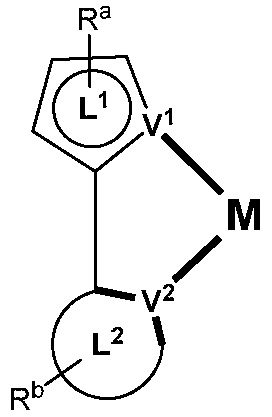
제1 일반 양태에서, 조성물은 하기 화학식의 1 이상의 화합물을 포함한다:In a first general aspect, the composition comprises at least one compound of the formula:
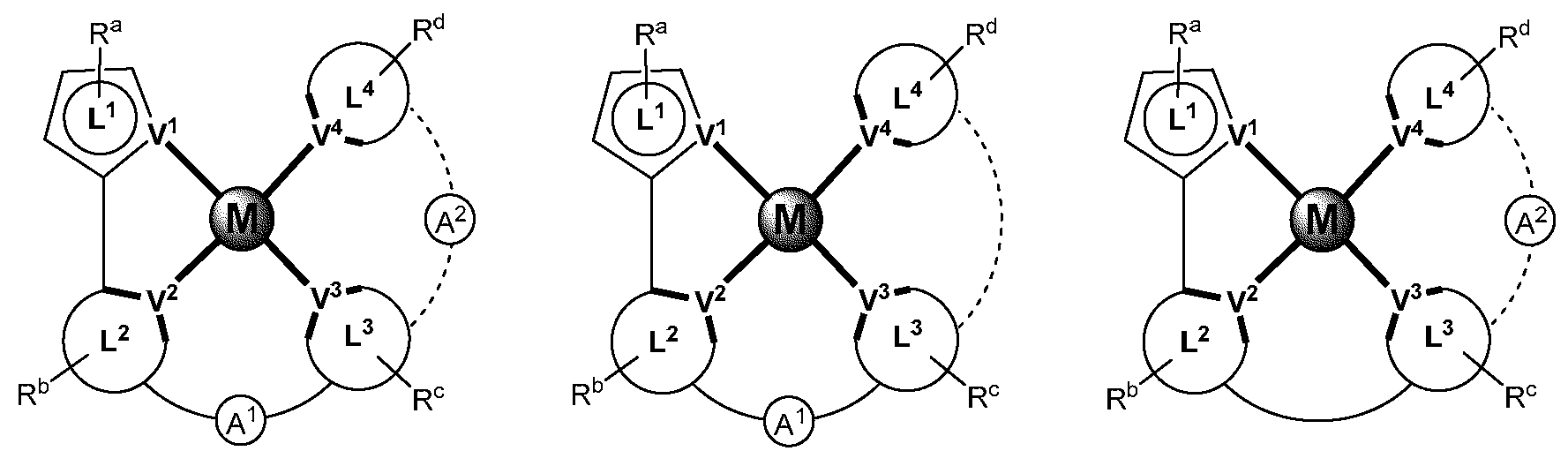
상기 식에서, 1 이상의 화합물 각각에 대해;wherein for each of the one or more compounds;
(L1^L2)는 화합물의 방출 부위(emitting portion)를 나타내며,(L 1 ^L 2 ) represents the emitting portion of the compound,
(L3^L4)는 화합물의 보조 부위(ancillary portion)를 나타내고,(L 3 ^L 4 ) represents the ancillary portion of the compound,
L1, L2 및 L3은 각각 독립적으로 치환되거나 치환되거나 비치환된된 방향족 고리, 헤테로사이클릭기, 카르벤기, 또는 N-헤테로사이클릭 카르벤을 나타내며,L 1 , L 2 and L 3 each independently represents a substituted, substituted or unsubstituted aromatic ring, heterocyclic group, carbene group, or N-heterocyclic carbene,
L4는 치환되거나 비치환된 방향족 고리, 헤테로사이클릭기, 카르벤기, N-헤테로사이클릭 카르벤, 염소(Cl), 불소(F), 니트릴, 치환 알킬, 치환 알케닐, 또는 C3-C6 알키닐을 나타내고,L 4 is a substituted or unsubstituted aromatic ring, heterocyclic group, carbene group, N-heterocyclic carbene, chlorine (Cl), fluorine (F), nitrile, substituted alkyl, substituted alkenyl, or C 3 - Represent C 6 alkynyl,
L1 및 L2는 직접적으로 연결되고,L 1 and L 2 are directly connected,
L2 및 L3은 직접적으로 연결되거나 연결 원자 A1을 통해 연결되며, 여기서 A1은 산소(O), 황(S), 질소(N), 탄소(C), 인(P), 규소(Si), 또는 붕소(B)를 나타내고,L 2 and L 3 are linked directly or via a connecting atom A 1 , wherein A 1 is oxygen (O), sulfur (S), nitrogen (N), carbon (C), phosphorus (P), silicon ( Si), or boron (B),
L3 및 L4는 연결되지 않거나, 직접 연결되거나, L4가 치환되거나 비치환된 방향족 고리, 헤테로사이클릭기, 카르벤기, 또는 N-헤테로사이클릭 카르벤을 나타내는 경우, 연결 원자 A2를 통해 연결되며, 여기서 A2는 산소(O), 황(S), 질소(N), 탄소(C), 인(P), 규소(Si), 또는 붕소(B)를 나타내며,L 3 and L 4 are unconnected, directly linked, or when L 4 represents a substituted or unsubstituted aromatic ring, heterocyclic group, carbene group, or N-heterocyclic carbene, the connecting atom A 2 is connected through, wherein A 2 represents oxygen (O), sulfur (S), nitrogen (N), carbon (C), phosphorus (P), silicon (Si), or boron (B),
V1, V2, V3 및 V4는 각각 L1, L2, L3 또는 L4의 배위 원자를 나타내며, 여기서 V1, V2, V3 및 V4는 각각 독립적으로 질소(N), 탄소(C), 인(P), 붕소(B), 또는 규소(Si)를 나타내고,V 1 , V 2 , V 3 and V 4 each represent a coordinating atom of L 1 , L 2 , L 3 or L 4 , wherein V 1 , V 2 , V 3 and V 4 are each independently nitrogen (N) , carbon (C), phosphorus (P), boron (B), or silicon (Si),
M은 백금(Pt), 금(Au), 이리듐(Ir), 로듐(Rh), 루테늄(Ru), 철(Fe), 코발트(Co), 니켈(Ni), 구리(Cu), 아연(Zn), 은(Ag), 수은(Hg), 카드뮴(Cd), 또는 지르코늄(Zr)을 나타내며,M is platinum (Pt), gold (Au), iridium (Ir), rhodium (Rh), ruthenium (Ru), iron (Fe), cobalt (Co), nickel (Ni), copper (Cu), zinc (Zn) ), silver (Ag), mercury (Hg), cadmium (Cd), or zirconium (Zr),
Ra, Rb, Rc 및 Rd는 각각 독립적으로 일 치환, 이 치환, 삼 치환 또는 사 치환을 나타내며, 각각 독립적으로 1 이상의, 중수소, 할로겐 원자, 히드록실기, 티올기, 니트로기, 시아노기, 치환되거나 비치환된 알킬기, 치환되거나 비치환된 할로알킬기, 치환되거나 비치환된 아랄킬기, 치환되거나 비치환된 알케닐기, 치환되거나 비치환된 알키닐기, 치환되거나 비치환된 아릴기, 치환되거나 비치환된 아미노기, 치환되거나 비치환된 모노- 또는 디알킬아미노기, 치환되거나 비치환된 모노- 또는 디아릴아미노기, 치환되거나 비치환된 알콕시기, 치환되거나 비치환된 아릴옥시기, 치환되거나 비치환된 헤테로아릴기, 알콕시카르보닐기, 아실옥시기, 아실아미노기, 알콕시카르보닐아미노기, 아릴옥시카르보닐아미노기, 술포닐아미노기, 술파모일기, 카바모일 기, 알킬티오기, 술피닐기, 우레이도기, 포스포르아미드기, 머캅토기, 술포기, 카르복실기, 히드라지노기, 치환된 실릴기, 폴리머기, 또는 이들의 조합을 나타낸다.R a , R b , R c and R d each independently represent monosubstituted, disubstituted, trisubstituted or tetrasubstituted, and each independently represent one or more, deuterium, halogen atom, hydroxyl group, thiol group, nitro group, A cyano group, a substituted or unsubstituted alkyl group, a substituted or unsubstituted haloalkyl group, a substituted or unsubstituted aralkyl group, a substituted or unsubstituted alkenyl group, a substituted or unsubstituted alkynyl group, a substituted or unsubstituted aryl group, A substituted or unsubstituted amino group, a substituted or unsubstituted mono- or dialkylamino group, a substituted or unsubstituted mono- or diarylamino group, a substituted or unsubstituted alkoxy group, a substituted or unsubstituted aryloxy group, a substituted or unsubstituted heteroaryl group, alkoxycarbonyl group, acyloxy group, acylamino group, alkoxycarbonylamino group, aryloxycarbonylamino group, sulfonylamino group, sulfamoyl group, carbamoyl group, alkylthio group, sulfinyl group, ureido group, a phosphoramide group, a mercapto group, a sulfo group, a carboxyl group, a hydrazino group, a substituted silyl group, a polymer group, or a combination thereof.
실시는 하기 특징 중 하나 이상을 포함할 수 있다. 일부 경우에, 예를 들어, 폴리머 기는 폴리알킬렌, 폴리에테르, 또는 폴리에스테르를 포함한다. 특정 경우에, 하나 이상의 화합물에 대해, 하기 중 하나 이상은 참이다: Ra는 L1에 융합되고, Rb는 L2에 융합되며, Rc는 L3에 융합되고, Rd는 L4에 융합된다. 조성물, 또는 조성물의 화합물은 중성 전하를 가질 수 있다.Implementations may include one or more of the following features. In some cases, for example, polymeric groups include polyalkylenes, polyethers, or polyesters. In certain instances, for one or more compounds, one or more of the following is true: R a is fused to L 1 , R b is fused to L 2 , R c is fused to L 3 , and R d is L 4 . is fused to The composition, or compound of the composition, may have a neutral charge.
제2 일반 양태에서, 발광 디바이스는 제1 일반 양태의 조성물을 포함한다. 일부 경우에, 발광 디바이스는 유기 발광 다이오드를 포함한다. 특정 경우에, 발광 디바이스는 유기 발광 다이오드이다.In a second general aspect, a light emitting device comprises the composition of the first general aspect. In some cases, the light emitting device includes an organic light emitting diode. In certain cases, the light emitting device is an organic light emitting diode.
제3 일반 양태에서, 디바이스는 제1 일반 양태의 조성물 또는 제2 일반 양태의 발광 디바이스를 포함한다. 디바이스는 예를 들어 풀 컬러 디바이스, 광기전 디바이스, 또는 발광성 또는 인광성 디스플레이 디바이스를 포함할 수 있다. 일부 경우에, 디바이스는 유기 발광 다이오드를 포함한다. 특정 경우에, 디바이스는 유기 발광 다이오드이다.In a third general aspect, a device comprises the composition of the first general aspect or the light emitting device of the second general aspect. The device may include, for example, a full color device, a photovoltaic device, or a luminescent or phosphorescent display device. In some cases, the device includes an organic light emitting diode. In certain cases, the device is an organic light emitting diode.
추가 양태는 하기 설명에 제시될 것이다. 장점은 청구범위에서 특히 언급된 요소 및 조합에 의해 실현되고 성취될 것이다. 이전의 일반 설명과 하기 상세한 설명 모두 당연히 단지 일예이고 설명이며 한정적이지 않다.Additional aspects will be set forth in the description below. The advantages will be realized and attained by means of the elements and combinations particularly pointed out in the claims. Both the foregoing general description and the following detailed description are, of course, by way of example only, and are illustrative and not restrictive.
도 1은 유기 발광 디바이스(OLED)를 도시한다.
도 2는 실온에서 CH2Cl2 중 PtN1N, PtN1NMe, PtN1N-tBu, PtN1NPh 및 PtN1NCF 3 의 방출 스펙트럼을 보여준다.
도 3은 실온에서 CH2Cl2 중 PtON6, PtON6-tBu 및 PtON6Ph의 방출 스펙트럼을 보여준다.
도 4는 실온에서 CH2Cl2 중 PtON1, PtON1Me 4 , PtON1Me 5 , PtON1Me 6 , PtON1-tBu, PtON1Ph, PtON1NMe 2 , PtON1F 및 PtON1CF 3 의 방출 스펙트럼을 보여준다.
도 5는 실온에서 CH2Cl2 중 및 77 K에서 2-메틸-THF 중 PtON1Me 4 의 방출 스펙트럼을 보여준다.
도 6은 실온에서 CH2Cl2 중 및 77 K에서 2-메틸-THF 중 PtON1Me 5 의 방출 스펙트럼을 보여준다.
도 7은 실온에서 CH2Cl2 중 및 77 K에서 2-메틸-THF 중 PtON1Me 6 의 방출 스펙트럼을 보여준다.
도 8은 실온에서 CH2Cl2 중 및 77 K에서 2-메틸-THF 중 PtON1-tBu의 방출 스펙트럼을 보여준다.
도 9는 실온에서 CH2Cl2 중 및 77 K에서 2-메틸-THF 중 PtON1Me 2 의 방출 스펙트럼을 보여준다.
도 10은 실온에서 CH2Cl2 중 및 77 K에서 2-메틸-THF 중 PtON1Ph의 방출 스펙트럼을 보여준다.
도 11은 실온에서 CH2Cl2 중 및 77 K에서 2-메틸-THF 중 PtON1F의 방출 스펙트럼을 보여준다.
도 12는 실온에서 CH2Cl2 중 및 77 K에서 2-메틸-THF 중 PtON1CF 3 의 방출 스펙트럼을 보여준다.
도 13은 실온에서 CH2Cl2 중 및 77 K에서 2-메틸-THF 중 PtON1N의 방출 스펙트럼을 보여준다.
도 14는 실온에서 CH2Cl2 중 및 77 K에서 2-메틸-THF 중 PtON1Cz의 방출 스펙트럼을 보여준다.
도 15는 조성물 A(PtON1) 에 대한 그리고 조성물 B(PtON6) 에 대한 정규화 광발광 세기를 보여준다.
도 16은 조성물 A PMMA:(PtON1) 에 대한 그리고 조성물 B ONNA:(PtON6) 에 대한 정규화 광발광 세기를 보여준다.1 shows an organic light emitting device (OLED).
FIG. 2 shows emission spectra of PtN1N , PtN1NMe , PtN1N-tBu , PtN1NPh and PtN1NCF 3 in CH 2 Cl 2 at room temperature.
3 shows emission spectra of PtON6 , PtON6-tBu and PtON6Ph in CH 2 Cl 2 at room temperature.
4 shows emission spectra of PtON1 , PtON1Me 4 , PtON1Me 5 , PtON1Me 6 , PtON1-tBu , PtON1Ph , PtON1NMe 2 , PtON1F and PtON1CF 3 in CH 2 Cl 2 at room temperature.
5 shows emission spectra of PtON1Me 4 in CH 2 Cl 2 at room temperature and 2-methyl-THF at 77 K.
6 shows emission spectra of PtON1Me 5 in CH 2 Cl 2 at room temperature and 2-methyl-THF at 77 K.
7 shows emission spectra of PtON1Me 6 in CH 2 Cl 2 at room temperature and 2-methyl-THF at 77 K.
8 shows emission spectra of PtON1-tBu in CH 2 Cl 2 at room temperature and in 2-methyl-THF at 77 K.
9 shows emission spectra of PtON1Me 2 in CH 2 Cl 2 at room temperature and 2-methyl-THF at 77 K.
10 shows emission spectra of PtON1Ph in CH 2 Cl 2 at room temperature and in 2-methyl-THF at 77 K.
11 shows emission spectra of PtON1F in CH 2 Cl 2 at room temperature and 2-methyl-THF at 77 K.
12 shows emission spectra of PtON1CF 3 in CH 2 Cl 2 at room temperature and 2-methyl-THF at 77 K.
13 shows emission spectra of PtON1N in CH 2 Cl 2 at room temperature and 2-methyl-THF at 77 K.
14 shows emission spectra of PtON1Cz in CH 2 Cl 2 at room temperature and 2-methyl-THF at 77 K.
15 shows the normalized photoluminescence intensity for composition A ( PtON1 ) and for composition B ( PtON6).
16 shows the normalized photoluminescence intensity for Composition A PMMA:( PtON1 ) and for Composition B ONNA:( PtON6).
본 개시 내용은 하기 상세한 설명과 본원에서 포함된 실시예에 의해 더 쉽게 이해될 수 있다. 본 발명의 화합물, 디바이스, 및/또는 방법이 개시되고 설명되기 전에, 당연히 이들이 달리 특정되지 않는 한 특정 합성 방법으로 한정되지 않거나, 달리 특정되지 않는 한 특정 시약으로 한정되지 않으며, 물론 달라질 수 있다. 또한 본원에서 사용된 용어는 당연히 특정 양태만을 설명할 목적을 위한 것이며 한정하는 것으로 의도되지 않는다. 본원에서 기재한 것들과 유사하거나 균등한 임의 방법 및 물질이 실시 또는 시험에 사용될 수 있지만, 현재 일예의 방법 및 물질을 기재한다.BRIEF DESCRIPTION OF THE DRAWINGS The present disclosure may be more readily understood by the following detailed description and the Examples included herein. Before the compounds, devices, and/or methods of the present invention are disclosed and described, they are, of course, not limited to specific synthetic methods unless otherwise specified, or to specific reagents unless otherwise specified, as they may vary. Also, the terminology used herein is, of course, for the purpose of describing particular embodiments only and is not intended to be limiting. Although any methods and materials similar or equivalent to those described herein can be used in the practice or testing, exemplary methods and materials are now described.
명세서 및 첨부 청구범위에 사용된 바와 같이, 단수형은 본문에서 명백히 다르게 지시되지 않는 한 복수 대상을 포함한다. 따라서, 예를 들어 "하나의 성분"에 대해 2종 이상의 성분의 혼합물을 포함한다.As used in the specification and appended claims, the singular includes the plural unless the text clearly dictates otherwise. Thus, for example, reference to "one component" includes mixtures of two or more components.
일부 양태에서, "약" 일 특정 값 내지 "약" 또다른 특정 값으로서 본원에서 표시된 범위는 일 특정 값으로부터 및/또는 다른 특정 값까지 포함한다. 유사하게, 값이 근사치로서 표시되는 경우, 선행하는 "약"의 사용에 의해 특정 값이 또다른 양태를 형성한다는 사실이 이해될 것이다. 각 범위의 단점은 다른 단점에 관해, 그리고 다른 단점과 독립적으로 모두 중요하다는 사실이 또한 이해될 것이다. 본원에서 개시된 여러가지 값이 존재하고, 각 값은 또한 값 자체에 더해 "약" 특정 값으로서 본원에서 개시되는 것은 당연하다. 예를 들어, 값 "10"이 개시되면, "약 10"이 또한 개시된다. 또한 당연히 2개의 특정 단위 사이의 각 단위가 또한 개시된다. 예를 들어, 10과 15가 개시되면, 11, 12, 13, 및 14가 또한 개시된다.In some embodiments, ranges indicated herein as from “about” one particular value to “about” another particular value include from and/or to the other particular value. Similarly, when values are expressed as approximations, it will be understood that, by use of the antecedent "about," the particular value forms another aspect. It will also be understood that the disadvantages of each range are significant both with respect to the other disadvantages and independently of the other disadvantages. There are several values disclosed herein, and it is to be understood that each value is also disclosed herein as “about” the particular value in addition to the value itself. For example, if the value “10” is disclosed, “about 10” is also disclosed. Also, of course, each unit between two specific units is also disclosed. For example, if 10 and 15 are disclosed, 11, 12, 13, and 14 are also disclosed.
본원에서 사용된 바와 같이, 용어 "임의" 또는 "임의로"는 후속으로 기재된 이벤트 또는 상황이 일어날 수 있거나 없으며, 설명에서는 상기 이벤트 또는 상황이 일어나는 사례와 그것이 일어나지 않는 사례를 포함하는 것을 의미한다.As used herein, the term “optionally” or “optionally” means that the subsequently described event or circumstance may or may not occur, and the description includes instances in which the event or circumstance occurs and instances in which it does not.
본원에 기재된 조성물을 제조하는데 사용될 성분 및 본원에서 개시된 방법 내에 사용될 조성물 자체가 개시된다. 이들 물질과 다른 물질이 본원에서 개시되며, 이들 물질의 조합, 서브셋, 관계, 그룹, 등이 개시될 때 이들 화합물의 각 다양한 개체 및 집합적 조합 및 순열에 대해 구체적인 지시가 명쾌하게 개시될 수 없지만, 각각 구체적으로 예상되고 본원에서 기재되어 있다는 것은 당연하다. 예를 들어, 특정 화합물이 개시되고 논의되며 화합물을 포함하여 여러가지 분자에 이루어질 수 있는 여러가지 변형이 논의되는 경우, 화합물의 각각 그리고 모든 조합과 순열 및 구체적으로 반대로 지시되지 않는 한 가능한 변형이 구체적으로 예상된다. 따라서, 분자 A, B, 및 C의 클래스가 개시되고 분자 D, E, 및 F와 조합 분자, A-D의 일예의 클래스가 개시되는 경우, 그 후 심지어 각각 개별적으로 인용되지 않고, 각각 개별적으로 그리고 집합적으로 예상되는 경우, 의미 조합, A-E, A-F, B-D, B-E, B-F, C-D, C-E, 및 C-F가 개시된 것으로 생각된다. 비슷하게, 이들의 임의 서브셋 또는 조합이 또한 개시된다. 따라서, 예를 들어, A-E, B-F, 및 C-E의 서브 그룹이 개시된 것으로 생각될 것이다. 이러한 개념은 조성물을 제조하고 사용하는 방법에서 단계를 포함하나, 이들에 한정되지 않는 이러한 응용 분야의 모든 양태에 적용된다. 따라서, 수행될 수 있는 다양한 추가 단계가 존재하는 경우, 이들 추가 단계의 각각은 방법의 임의의 특정 실시형태 또는 실시형태들의 조합에 의해 당연히 수행될 수 있다.Disclosed are the ingredients to be used in preparing the compositions described herein and the compositions themselves to be used in the methods disclosed herein. Although these and other substances are disclosed herein, specific instructions for each of the various entities and collective combinations and permutations of these compounds cannot be explicitly disclosed when combinations, subsets, relationships, groups, etc. of these substances are disclosed. , each of which is specifically contemplated and described herein. For example, where a particular compound is disclosed and discussed and various modifications that may be made to various molecules including the compound are discussed, each and every combination and permutation of the compound and possible modifications unless specifically indicated to the contrary are specifically contemplated. do. Thus, when classes of molecules A, B, and C are disclosed and an example class of molecules D, E, and F and combination molecules, AD, are disclosed, then even each is not recited individually, but each individually and collectively Where expected, the semantic combinations, AE, AF, BD, BE, BF, CD, CE, and CF are considered disclosed. Similarly, any subset or combination thereof is also disclosed. Thus, for example, subgroups of A-E, B-F, and C-E would be considered disclosed. These concepts apply to all aspects of this field of application, including, but not limited to, steps in methods of making and using the compositions. Thus, where there are various additional steps that may be performed, each of these additional steps may of course be performed by any particular embodiment or combination of embodiments of the method.
본원에서 언급된 바와 같이, 연결 원자는 2개의 기 예컨대, 예를 들어, N 및 C 기를 연결할 수 있다. 연결 원자는 임의로 원잣가가 허용되는 경우 다른 화학 부분을 부착시킬 수 있다. 예를 들어, 일 양태에서, 산소는 일단 2개 원자(예, N 또는 C)에 결합되면 원잣가가 만족됨에 따라 임의의 다른 화학 기를 부착시키지 못할 것이다. 비교하여, 탄소가 연결 원자인 경우, 2개의 추가 화학 부분이 탄소에 부착될 수 있다. 적합한 화학 부분은 수소, 히드록실, 알킬, 알콕시, =O, 할로겐, 니트로, 아민, 아미드, 티올, 아릴, 헤테로아릴, 사이클로알킬, 및 헤테로사이클일을 포함하나, 이들에 한정되지 않는다.As mentioned herein, a linking atom may link two groups such as, for example, N and C groups. The linking atom may optionally attach other chemical moieties if valency permits. For example, in one aspect, oxygen will not attach any other chemical group once bound to two atoms (eg, N or C) as the valency is satisfied. In comparison, when carbon is the linking atom, two additional chemical moieties can be attached to the carbon. Suitable chemical moieties include, but are not limited to, hydrogen, hydroxyl, alkyl, alkoxy, =O, halogen, nitro, amine, amide, thiol, aryl, heteroaryl, cycloalkyl, and heterocyclyl.
용어 "사이클릭 구조" 또는 본원에서 사용된 유사 용어는 아릴, 헤테로아릴, 사이클로알킬, 사이클로알케닐, 헤테로사이클일, 카르벤, 및 N-헤테로사이클릭 카르벤을 포함하나 이들에 한정되지 않는 임의의 사이클릭 화학 구조를 뜻한다.The term “cyclic structure” or similar terms as used herein refers to any of the following, including but not limited to, aryl, heteroaryl, cycloalkyl, cycloalkenyl, heterocyclyl, carbene, and N-heterocyclic carbene. The cyclic chemical structure of
본원에서 사용된 바와 같이, 용어 "치환된"은 유기 화합물의 모든 허용가능한 치환기를 포함하는 것으로 예상된다. 광범위한 양태에서, 허용가능한 치환기는 유기 화합물의 비환식 및 사이클릭, 분지된 및 비분지된, 카르보사이클릭 및 헤테로사이클릭, 및 방향족 및 비방향족 치환기를 포함한다. 일예의 치환기는 예를 들어, 하기에 기재한 것들을 포함한다. 허용가능한 치환기는 1 이상일 수 있으며 적합한 유기 화합물에 대해 동일하거나 상이할 수 있다. 이러한 개시 내용의 목적으로, 헤테로원자, 예컨대 질소는 수소 치환기 및/또는 헤테로원자의 원잣가를 만족하는 본원에서 기재된 유기 화합물의 임의 허용가능한 치환기를 가질 수 있다. 이러한 개시 내용은 유기 화합물의 허용가능한 치환기에 의해 어느 식으로 한정되는 것으로 의도되지 않는다. 또한, 용어 "치환" 또는 "으로 치환된"은 이러한 치환이 치환된 원자와 치환기의 허용된 원잣가에 따르며, 치환으로 안정한 화합물(예, 예컨대 재배열, 고리화, 제거, 등에 의해 자발적으로 변환을 수행하지 않는 화합물)을 생성한다는 함축적 단서를 포함한다. 또한 특정 양태에서, 분명히 반대로 지시되지 않는 한, 개별 치환기는 임의로 더 치환될 수 있다(즉, 더 치환되거나 비치환된다)고 에상된다.As used herein, the term “substituted” is expected to include all permissible substituents of organic compounds. In a broad aspect, permissible substituents include acyclic and cyclic, branched and unbranched, carbocyclic and heterocyclic, and aromatic and non-aromatic substituents of organic compounds. Exemplary substituents include, for example, those described below. The permissible substituents may be one or more and may be the same or different for suitable organic compounds. For purposes of this disclosure, heteroatoms such as nitrogen may have hydrogen substituents and/or any permissible substituents of the organic compounds described herein that satisfy the valence of the heteroatoms. This disclosure is not intended to be limited in any way by the permissible substituents of organic compounds. Also, the term "substituted" or "substituted with" means that such substitutions depend on the allowed valences of the atoms and substituents being substituted, and are stable compounds with substitution (e.g., spontaneous conversion by rearrangement, cyclization, elimination, etc.) (a compound that does not perform It is also envisioned that, in certain embodiments, individual substituents may optionally be further substituted (ie, further substituted or unsubstituted), unless expressly indicated to the contrary.
다양한 용어를 정의하는데 있어서, "A1", "A2", "A3" 및 "A4"는 다양한 특정 치환기를 나타내는 총칭 심볼로서 본원에서 사용된다. 이들 심볼은 임의 치환기일 수 있으며, 본원에서 개시된 것들로 한정되지 않으며, 이들이 일예로 특정 치환기인 것으로 정의되는 경우, 이들은 또다른 일예에서 일부 다른 치환기로서 정의될 수 있다.In defining various terms, “A 1 ”, “A 2 ”, “A 3 ” and “A 4 ” are used herein as generic symbols representing various specific substituents. These symbols may be any substituent and are not limited to those disclosed herein, and when they are defined as being a particular substituent in one example, they may be defined as some other substituent in another example.
본원에서 사용된 용어 "알킬"은 1 내지 24 탄소 원자의 분지되거나 비분지된 포화 탄화수소 기, 예컨대 메틸, 에틸, n-프로필, 이소프로필, n-부틸, 이소부틸, s-부틸, t-부틸, n-펜틸, 이소펜틸, s-펜틸, 네오펜틸, 헥실, 헵틸, 옥틸, 노닐, 데실, 도데실, 테트라데실, 헥사데실, 에이코실, 테트라코실, 등이다. 알킬 기는 사이클릭 또는 비환식일 수 있다. 알킬 기는 분지되거나 비분지될 수 있다. 알킬 기는 또한 치환되거나 비치환될 수 있다. 예를 들어, 알킬 기는 본원에서 기재된 바와 같이, 임의로 치환된 알킬, 사이클로알킬, 알콕시, 아미노, 에테르, 할라이드, 히드록시, 니트로, 실릴, 술포-옥소, 또는 티올을 포함하나, 이들에 한정되지 않는 1 이상의 기로 치환될 수 있다. "저급 알킬" 기는 1 내지 6개(예, 1 내지 4개)의 탄소 원자를 함유한 알킬 기이다.As used herein, the term “alkyl” refers to a branched or unbranched saturated hydrocarbon group of 1 to 24 carbon atoms, such as methyl, ethyl, n-propyl, isopropyl, n-butyl, isobutyl, s-butyl, t-butyl , n-pentyl, isopentyl, s-pentyl, neopentyl, hexyl, heptyl, octyl, nonyl, decyl, dodecyl, tetradecyl, hexadecyl, eicosyl, tetracosyl, and the like. Alkyl groups can be cyclic or acyclic. Alkyl groups may be branched or unbranched. Alkyl groups may also be substituted or unsubstituted. For example, alkyl groups include, but are not limited to, optionally substituted alkyl, cycloalkyl, alkoxy, amino, ether, halide, hydroxy, nitro, silyl, sulfo-oxo, or thiol, as described herein. It may be substituted with one or more groups. A “lower alkyl” group is an alkyl group containing 1 to 6 (eg, 1 to 4) carbon atoms.
명세서 전반에 걸쳐 "알킬"은 일반적으로 비치환된 알킬 기 및 치환된 알킬 기 둘 다를 의미하는 것으로 사용되며; 그러나, 치환된 알킬 기는 또한 알킬 기 상에 구체적인 치환기(들)를 확인함으로써 본원에서 구체적으로 언급된다. 예를 들어, 용어 "할로겐화 알킬" 또는 "할로알킬"은 구체적으로 1 이상의 할라이드, 예 불소, 염소, 브롬, 또는 요드로 치환되는 알킬 기를 뜻한다. 용어 "알콕시알킬"은 구체적으로 하기에 기재된 바와 같이, 1 이상의 알콕시 기로 치환되는 알킬 기를 뜻한다. 용어 "알킬아미노"는 구체적으로 하기에 기재된 바와 같이, 1 이상의 아미노 기로 치환되는 알킬 기 등을 의미한다. "알킬"이 일예로 사용되고 "알킬알코올"과 같은 특정 용어가 또다른 일예로 사용되는 경우, 용어 "알킬"이 또한 "알킬알코올" 등과 같은 특정 용어를 뜻하지 않는다고 시사하도록 여겨지지 않는다.Throughout the specification "alkyl" is generally used to mean both unsubstituted and substituted alkyl groups; However, substituted alkyl groups are also specifically referred to herein by identifying the specific substituent(s) on the alkyl group. For example, the term "halogenated alkyl" or "haloalkyl" specifically refers to an alkyl group substituted with one or more halides, such as fluorine, chlorine, bromine, or iodine. The term “alkoxyalkyl” refers specifically to an alkyl group substituted with one or more alkoxy groups, as described below. The term “alkylamino” refers specifically to an alkyl group or the like substituted with one or more amino groups, as described below. Where “alkyl” is used as an example and a specific term such as “alkylalcohol” is used as another example, it is not to be taken to suggest that the term “alkyl” also does not mean the specific term such as “alkylalcohol” and the like.
이러한 관행은 또한 본원에서 기재한 다른 기에 대해 사용된다. 즉, "사이클로알킬"과 같은 용어는 비치환되고 치환된 사이클로알킬 부분 모두를 뜻하지만, 치환된 부분은 또한 본원에서 구체적으로 확인될 수 있으며; 예를 들어, 특정 치환된 사이클로알킬은 예 "알킬사이클로알킬"로서 지칭될 수 있다. 유사하게, 치환된 알콕시는 구체적으로 예 "할로겐화 알콕시"로서 지칭될 수 있으며, 특정 치환된 알케닐은 예 "알케닐알코올", 등일 수 있다. 다시, 일반적인 용어, 예컨대 "사이클로알킬" 및 특정 용어, 예컨대 "알킬사이클로알킬"을 사용하는 관례는 일반적 용어가 또한 특정 용어를 포함하지 않는다고 시사하도록 여겨지지 않는다.This practice is also used for other groups described herein. That is, terms such as “cycloalkyl” refer to both unsubstituted and substituted cycloalkyl moieties, although substituted moieties may also be specifically identified herein; For example, a particular substituted cycloalkyl may be referred to as, for example, “alkylcycloalkyl.” Similarly, a substituted alkoxy may be specifically referred to as an example "halogenated alkoxy", a particular substituted alkenyl may be specifically referred to as an example "alkenylalcohol," and the like. Again, the convention of using generic terms such as “cycloalkyl” and specific terms such as “alkylcycloalkyl” is not to be taken to imply that the generic term also does not include the specific term.
본원에서 사용된 용어 "사이클로알킬"은 3개 이상의 탄소 원자로 이루어진 비방향족 탄소계 고리이다. 사이클로알킬 기의 일예는 사이클로프로필, 사이클로부틸, 사이클로펜틸, 사이클로헥실, 노르보르닐, 등을 포함하나, 이들에 한정되지 않는다. 용어 "헤테로사이클로알킬"은 상기에 정의된 사이클로알킬 기의 형태이며, 용어 "사이클로알킬"의 의미 내에 포함되며, 여기서 고리의 탄소 원자 중 하나 이상이 질소, 산소, 황, 또는 인과 같으나, 이들에 한정되지 않는 헤테로원자로 치환된다. 사이클로알킬 기와 헤테로사이클로알킬 기는 치환되거나 비치환될 수 있다. 사이클로알킬 기와 헤테로사이클로알킬 기는 본원에서 기재한 바와 같이, 알킬, 사이클로알킬, 알콕시, 아미노, 에테르, 할라이드, 히드록시, 니트로, 실릴, 술포-옥소, 또는 티올을 포함하나, 이들에 한정되지 않는 1 이상의 기로 치환될 수 있다.The term “cycloalkyl,” as used herein, is a non-aromatic carbon-based ring of three or more carbon atoms. Examples of cycloalkyl groups include, but are not limited to, cyclopropyl, cyclobutyl, cyclopentyl, cyclohexyl, norbornyl, and the like. The term “heterocycloalkyl” is in the form of a cycloalkyl group as defined above and is included within the meaning of the term “cycloalkyl”, wherein at least one of the carbon atoms of the ring is nitrogen, oxygen, sulfur, or phosphorus, but is It is substituted with a heteroatom without limitation. Cycloalkyl and heterocycloalkyl groups may be substituted or unsubstituted. Cycloalkyl and heterocycloalkyl groups include, but are not limited to, alkyl, cycloalkyl, alkoxy, amino, ether, halide, hydroxy, nitro, silyl, sulfo-oxo, or thiol, as described herein. It may be substituted with more than one group.
본원에서 사용된 용어 "아민" 또는 "아미노"는 식 NA1A2A3로 표시되며, 여기서 A1, A2, 및 A3은 본원에서 기재한 바와 같이 독립적으로 수소, 임의로 치환된 알킬, 사이클로알킬, 알케닐, 사이클로알케닐, 알키닐, 사이클로알키닐, 아릴, 또는 헤테로아릴 기이다.As used herein, the term “amine” or “amino” is represented by the formula NA 1 A 2 A 3 , wherein A 1 , A 2 , and A 3 are independently hydrogen, optionally substituted alkyl, as described herein; a cycloalkyl, alkenyl, cycloalkenyl, alkynyl, cycloalkynyl, aryl, or heteroaryl group.
본원에서 사용된 용어 "알콕시" 및 "알콕실"은 에테르 결합을 통해 결합된 알킬 또는 사이클로알킬을 뜻하며; 즉, "알콕시" 기는 -OA1로서 정의될 수 있으며, 여기서 A1은 상기에 정의한 바와 같이 알킬 또는 사이클로알킬이다. "알콕시"는 또한 바로 기재한 알콕시 기의 폴리머를 포함하며; 즉, 알콕시는 -OA1-OA2 또는 -OA1-(OA2)a-OA3 와 같은 폴리에테르일 수 있으며, 여기서 "a"는 1 내지 200의 정수이고 A1, A2, 및 A3은 각각 독립적으로 알킬 기, 사이클로알킬 기, 또는 이들의 조합이다.As used herein, the terms “alkoxy” and “alkoxyl” refer to an alkyl or cycloalkyl linked through an ether linkage; That is, an “alkoxy” group may be defined as —OA 1 , wherein A 1 is alkyl or cycloalkyl as defined above. "Alkoxy" also includes polymers of the alkoxy groups just described; That is, alkoxy can be a polyether such as -OA 1 -OA 2 or -OA 1 -(OA 2 ) a -OA 3 , where “a” is an integer from 1 to 200 and A 1 , A 2 , and A 3 is each independently an alkyl group, a cycloalkyl group, or a combination thereof.
본 명세서에서 사용되는 용어 "알케닐"은 하나 이상의 탄소-탄소 이중 결합을 포함하는 구조식을 갖는 탄소수 2∼24의 히드로카본기이다. (A1A2)C=C(A3A4)와 같은 비대칭 구조는 E 및 Z 이성질체 모두를 포함한다. 이것은 비대칭 케톤이 존재하거나 또는 이것이 결합 기호 C=C에 의해 명시적으로 표시될 수 있는 구조식에서 추정될 수 있다. 알케닐 기는 본 명세서에 개시된 바와 같은 알킬, 사이클로알킬, 알콕시, 알케닐, 사이클로알케닐, 알키닐, 사이클로알키닐, 아릴, 헤테로아릴, 알데히드, 아미노, 카르복실산, 에스테르, 에테르, 할로겐화물, 히드록시, 케톤, 아지드, 니트로, 실릴, 술포-옥소, 또는 티올을 포함하나 이에 한정되지 않는 하나 이상의 기로 치환될 수 있다.As used herein, the term "alkenyl" is a hydrocarbon group having 2 to 24 carbon atoms having a structural formula containing one or more carbon-carbon double bonds. Asymmetric structures such as (A 1 A 2 )C=C(A 3 A 4 ) include both E and Z isomers. This can be deduced from the structural formula in which an asymmetric ketone is present or can be explicitly represented by the bonding symbol C=C. Alkenyl groups include alkyl, cycloalkyl, alkoxy, alkenyl, cycloalkenyl, alkynyl, cycloalkynyl, aryl, heteroaryl, aldehyde, amino, carboxylic acid, ester, ether, halide, may be substituted with one or more groups including, but not limited to, hydroxy, ketone, azide, nitro, silyl, sulfo-oxo, or thiol.
본 명세서에서 사용되는 용어 "사이클로알케닐"은 3개 이상의 탄소 원자로 구성되고 하나 이상의 탄소-탄소 이중 결합, 즉 C=C를 포함하는 비방향족 탄소계 고리이다. 사이클로알케닐의 예는 사이클로프로페닐, 사이클로부테닐, 사이클로펜테닐, 사이클로펜타디에닐, 사이클로헥세닐, 사이클로헥사디에닐, 노르보르네닐 등을 포함하나 이에 한정되지 않는다. 용어 "헤테로사이클로알케닐"은 상기 정의된 바와 같은 사이클로알케닐 기의 한 유형이며 용어 "사이클로알케닐"의 의미내에 포함되는데, 여기서 고리의 탄소 원자 중 적어도 하나는 질소, 산소, 황 또는 인과 같은, 그러나 이에 한정되지 않는 헤테로원자로 치환된다. 사이클로알케닐 기 및 헤테로사이클로알케닐 기는 치환되거나 비치환될 수 있다. 사이클로알케닐 기 및 헤테로사이클로알케닐 기는 본 명세서에 개시된 바와 같은 알킬, 사이클로알킬, 알콕시, 알케닐, 사이클로알케닐, 알키닐, 사이클로알키닐, 아릴, 헤테로아릴, 알데히드, 아미노, 카르복실산, 에스테르, 에테르, 할로겐화물, 히드록시, 케톤, 아지드, 니트로, 실릴, 술포-옥소, 또는 티올을 포함하나 이에 한정되지 않는 하나 이상의 기로 치환될 수 있다.As used herein, the term “cycloalkenyl” is a non-aromatic carbon-based ring composed of at least three carbon atoms and containing at least one carbon-carbon double bond, i.e., C═C. Examples of cycloalkenyl include, but are not limited to, cyclopropenyl, cyclobutenyl, cyclopentenyl, cyclopentadienyl, cyclohexenyl, cyclohexadienyl, norbornenyl, and the like. The term "heterocycloalkenyl" is a type of cycloalkenyl group as defined above and is included within the meaning of the term "cycloalkenyl", wherein at least one of the carbon atoms of the ring is nitrogen, oxygen, sulfur or phosphorus. , but is substituted with a heteroatom, but not limited thereto. Cycloalkenyl groups and heterocycloalkenyl groups may be substituted or unsubstituted. Cycloalkenyl and heterocycloalkenyl groups include alkyl, cycloalkyl, alkoxy, alkenyl, cycloalkenyl, alkynyl, cycloalkynyl, aryl, heteroaryl, aldehyde, amino, carboxylic acid, may be substituted with one or more groups including, but not limited to, esters, ethers, halides, hydroxy, ketones, azides, nitro, silyl, sulfo-oxo, or thiol.
본 명세서에서 사용되는 용어 "알키닐"은 하나 이상의 탄소-탄소 삼중 결합을 포함하는 구조식을 갖는 탄소수 2∼24의 히드로카본기이다. 알키닐 기는 본 명세서에 개시된 바와 같은 알킬, 사이클로알킬, 알콕시, 알케닐, 사이클로알케닐, 알키닐, 사이클로알키닐, 아릴, 헤테로아릴, 알데히드, 아미노, 카르복실산, 에스테르, 에테르, 할로겐화물, 히드록시, 케톤, 아지드, 니트로, 실릴, 술포-옥소, 또는 티올을 포함하나 이에 한정되지 않는 하나 이상의 기로 치환될 수 있다.As used herein, the term "alkynyl" is a hydrocarbon group having 2 to 24 carbon atoms having a structural formula containing one or more carbon-carbon triple bonds. An alkynyl group is an alkyl, cycloalkyl, alkoxy, alkenyl, cycloalkenyl, alkynyl, cycloalkynyl, aryl, heteroaryl, aldehyde, amino, carboxylic acid, ester, ether, halide, may be substituted with one or more groups including, but not limited to, hydroxy, ketone, azide, nitro, silyl, sulfo-oxo, or thiol.
본 명세서에서 사용되는 용어 "사이클로알키닐"은 7개 이상의 탄소 원자로 구성되고 하나 이상의 탄소-탄소 삼중 결합을 포함하는 비방향족 탄소계 고리이다. 사이클로알키닐 기의 예는 사이클로헵티닐, 사이클로옥티닐, 사이클로노니닐 등을 포함하나 이에 한정되지 않는다. 용어 "헤테로사이클로알키닐"은 상기 정의된 바와 같은 사이클로알키닐 기의 한 유형이며 용어 "사이클로알키닐"의 의미내에 포함되는데, 여기서 고리의 탄소 원자 중 적어도 하나는 질소, 산소, 황 또는 인과 같은, 그러나 이에 한정되지 않는 헤테로원자로 치환된다. 사이클로알키닐 기 및 헤테로사이클로알키닐 기는 치환되거나 비치환될 수 있다. 사이클로알키닐 기 및 헤테로사이클로알키닐 기는 본 명세서에 개시된 바와 같은 알킬, 사이클로알킬, 알콕시, 알케닐, 사이클로알케닐, 알키닐, 사이클로알키닐, 아릴, 헤테로아릴, 알데히드, 아미노, 카르복실산, 에스테르, 에테르, 할로겐화물, 히드록시, 케톤, 아지드, 니트로, 실릴, 술포-옥소, 또는 티올을 포함하나 이에 한정되지 않는 하나 이상의 기로 치환될 수 있다.As used herein, the term “cycloalkynyl” is a non-aromatic carbon-based ring composed of at least 7 carbon atoms and containing at least one carbon-carbon triple bond. Examples of cycloalkynyl groups include, but are not limited to, cycloheptynyl, cyclooctynyl, cyclononinyl, and the like. The term "heterocycloalkynyl" is a type of cycloalkynyl group as defined above and is included within the meaning of the term "cycloalkynyl", wherein at least one of the carbon atoms of the ring is nitrogen, oxygen, sulfur or phosphorus. , but is substituted with a heteroatom, but not limited thereto. Cycloalkynyl groups and heterocycloalkynyl groups may be substituted or unsubstituted. Cycloalkynyl and heterocycloalkynyl groups include alkyl, cycloalkyl, alkoxy, alkenyl, cycloalkenyl, alkynyl, cycloalkynyl, aryl, heteroaryl, aldehyde, amino, carboxylic acid, may be substituted with one or more groups including, but not limited to, esters, ethers, halides, hydroxy, ketones, azides, nitro, silyl, sulfo-oxo, or thiol.
본 명세서에서 사용되는 용어 "아릴"은 벤젠, 나프탈렌, 페닐, 비페닐, 페녹시벤젠 등을 포함하나 이에 한정되지 않는 임의의 탄소계 방향족 기를 함유하는 기이다. 용어 "아릴"은 또한 상기 방향족 기의 고리 내에 포함되는 하나 이상의 헤테로원자를 갖는 방향족 기를 함유하는 기로서 정의되는 "헤테로아릴"을 포함한다. 헤테로원자의 예는 질소, 산소, 황 또는 인을 포함하나 이에 한정되지 않는다. 마찬가지로, 또한 용어 "아릴"에 포함되는 용어 "비헤테로아릴"은 헤테로원자를 함유하지 않는 방향족 기를 함유하는 기를 규정한다. 아릴 기는 치환되거나 비치환될 수 있다. 아릴 기는 본 명세서에 개시된 바와 같은 알킬, 사이클로알킬, 알콕시, 알케닐, 사이클로알케닐, 알키닐, 사이클로알키닐, 아릴, 헤테로아릴, 알데히드, 아미노, 카르복실산, 에스테르, 에테르, 할로겐화물, 히드록시, 케톤, 아지드, 니트로, 실릴, 술포-옥소, 또는 티올을 포함하나 이에 한정되지 않는 하나 이상의 기로 치환될 수 있다. 용어 "비아릴"은 아릴 기의 특별한 유형이며 "아릴"의 정의에 포함된다. 비아릴은 나프탈렌에서와 같이 융합 고리 구조를 통해 함께 결합되거나 또는 비페닐에서와 같이 하나 이상의 탄소-탄소 결합을 통해 부착된 2개의 아릴 기를 의미한다.The term “aryl,” as used herein, is a group containing any carbon-based aromatic group, including, but not limited to, benzene, naphthalene, phenyl, biphenyl, phenoxybenzene, and the like. The term “aryl” also includes “heteroaryl”, which is defined as a group containing an aromatic group having one or more heteroatoms contained within the ring of said aromatic group. Examples of heteroatoms include, but are not limited to, nitrogen, oxygen, sulfur or phosphorus. Likewise, the term “biheteroaryl” also encompassed by the term “aryl” defines a group containing an aromatic group containing no heteroatoms. Aryl groups may be substituted or unsubstituted. Aryl groups are alkyl, cycloalkyl, alkoxy, alkenyl, cycloalkenyl, alkynyl, cycloalkynyl, aryl, heteroaryl, aldehyde, amino, carboxylic acid, ester, ether, halide, hydride groups as disclosed herein. may be substituted with one or more groups including, but not limited to, hydroxy, ketone, azide, nitro, silyl, sulfo-oxo, or thiol. The term “biaryl” is a special type of aryl group and is included in the definition of “aryl”. Biaryl refers to two aryl groups attached together through a fused ring structure as in naphthalene or attached through one or more carbon-carbon bonds as in biphenyl.
본 명세서에서 사용되는 용어 "알데히드"는 식 -C(O)H로 나타내어진다. 본 명세서를 통해 "C(O)"는 카르보닐 기, 즉, C=O에 대한 속기 표기이다.As used herein, the term "aldehyde" is represented by the formula -C(O)H. "C(O)" throughout this specification is a shorthand notation for a carbonyl group, ie, C=O.
본 명세서에서 사용되는 용어 "알킬아미노"는 식 -NH(-알킬)로 나타내어지며, 여기서 알킬은 본 명세서에 개시된 바와 같다. 대표적인 예는 메틸아미노 기, 에틸아미노 기, 프로필아미노 기, 이소프로필아미노 기, 부틸아미노 기, 이소부틸아미노 기, (sec-부틸)아미노 기, (tert-부틸)아미노 기, 펜틸아미노 기, 이소펜틸아미노 기, (tert-펜틸)아미노 기, 헥실아미노 기 등을 포함하나 이에 한정되지 않는다.As used herein, the term "alkylamino" is represented by the formula -NH(-alkyl), wherein alkyl is as disclosed herein. Representative examples are methylamino group, ethylamino group, propylamino group, isopropylamino group, butylamino group, isobutylamino group, (sec-butyl)amino group, (tert-butyl)amino group, pentylamino group, iso pentylamino group, (tert-pentyl)amino group, hexylamino group, and the like.
본 명세서에서 사용되는 용어 "디알킬아미노"는 식 -N(-알킬)2로 나타내어지며, 여기서 알킬은 본 명세서에 개시된 바와 같다. 대표적인 예는 디메틸아미노 기, 디에틸아미노 기, 디프로필아미노 기, 디이소프로필아미노 기, 디부틸아미노 기, 디이소부틸아미노 기, 디(sec-부틸)아미노 기, 디(tert-부틸)아미노 기, 디펜틸아미노 기, 디이소펜틸아미노 기, 디(tert-펜틸)아미노 기, 디헥실아미노 기, N-에틸-N-메틸아미노 기, N-메틸-N-프로필아미노 기, N-에틸-N-프로필아미노 기 등을 포함하나 이에 한정되지 않는다.As used herein, the term “dialkylamino” is represented by the formula —N(-alkyl) 2 , wherein alkyl is as disclosed herein. Representative examples are dimethylamino group, diethylamino group, dipropylamino group, diisopropylamino group, dibutylamino group, diisobutylamino group, di(sec-butyl)amino group, di(tert-butyl)amino group group, dipentylamino group, diisopentylamino group, di(tert-pentyl)amino group, dihexylamino group, N-ethyl-N-methylamino group, N-methyl-N-propylamino group, N-ethyl -N-propylamino group, and the like.
본 명세서에서 사용되는 용어 "카르복실산"은 식 -C(O)OH로 나타내어진다.As used herein, the term "carboxylic acid" is represented by the formula -C(O)OH.
본 명세서에서 사용되는 용어 "에스테르"는 식 -OC(O)A1 또는 -C(O)OA1로 나타내어지며, 여기서 A1은 본 명세서에 개시된 바와 같은 알킬, 사이클로알킬, 알케닐, 사이클로알케닐, 알키닐, 사이클로알키닐, 아릴, 또는 헤테로아릴일 수 있다. 본 명세서에서 사용되는 용어 "폴리에스테르"는 식 -(A1O(O)C-A2-C(O)O)a- 또는 -(A1O(O)C-A2-OC(O))a-로 나타내어지며, 여기서 A1 및 A2는 독립적으로 본 명세서에 개시된 바와 같은 알킬, 사이클로알킬, 알케닐, 사이클로알케닐, 알키닐, 사이클로알키닐, 아릴, 또는 헤테로아릴 기일 수 있고, "a"는 1∼500의 정수이다. "폴리에스테르"는 2개 이상의 히드록실 기를 갖는 화합물과 2개 이상의 카르복실산 기를 갖는 화합물 사이의 반응에 의하여 생성되는 기를 나타내기 위하여 사용되는 용어이다.As used herein, the term "ester" is represented by the formula -OC(O)A 1 or -C(O)OA 1 , wherein A 1 is alkyl, cycloalkyl, alkenyl, cycloal as disclosed herein. kenyl, alkynyl, cycloalkynyl, aryl, or heteroaryl. As used herein, the term "polyester" refers to the formula -(A 1 O(O)CA 2 -C(O)O) a - or -(A 1 O(O)CA 2 -OC(O)) a - wherein A 1 and A 2 can independently be an alkyl, cycloalkyl, alkenyl, cycloalkenyl, alkynyl, cycloalkynyl, aryl, or heteroaryl group as disclosed herein, and “a” is an integer from 1 to 500. "Polyester" is a term used to denote a group resulting from the reaction between a compound having two or more hydroxyl groups and a compound having two or more carboxylic acid groups.
본 명세서에서 사용되는 용어 "에테르"는 식 A1OA2로 나타내어지며, 여기서 A1 및 A2는 독립적으로 본 명세서에 개시된 바와 같은 알킬, 사이클로알킬, 알케닐, 사이클로알케닐, 알키닐, 사이클로알키닐, 아릴, 또는 헤테로아릴 기이다. 본 명세서에서 사용되는 용어 "폴리에테르"는 식 -(A1O-A2O)a-로 나타내어지며, 여기서 A1 및 A2는 독립적으로 본 명세서에 개시된 바와 같은 알킬, 사이클로알킬, 알케닐, 사이클로알케닐, 알키닐, 사이클로알키닐, 아릴, 또는 헤테로아릴 기일 수 있고, "a"는 1∼500의 정수이다. 폴리에테르 기의 예는 폴리에틸렌 옥시드, 폴리프로필렌 옥시드 및 폴리부틸렌 옥시드를 포함한다.As used herein, the term “ether” is represented by the formula A 1 OA 2 , wherein A 1 and A 2 are independently alkyl, cycloalkyl, alkenyl, cycloalkenyl, alkynyl, cyclo as disclosed herein. an alkynyl, aryl, or heteroaryl group. As used herein, the term "polyether" is represented by the formula -(A 1 OA 2 O) a -, wherein A 1 and A 2 are independently alkyl, cycloalkyl, alkenyl, cyclo as disclosed herein. an alkenyl, alkynyl, cycloalkynyl, aryl, or heteroaryl group, wherein "a" is an integer from 1 to 500. Examples of polyether groups include polyethylene oxide, polypropylene oxide and polybutylene oxide.
용어 "폴리머"는 폴리알킬렌, 폴리에테르, 폴리에스테르, 및 -(CH2O)n-CH3, -(CH2CH2O)n-CH3, -[CH2CH(CH3)]n-CH3, -[CH2CH(COOCH3)]n-CH3, -[CH2CH(COO CH2CH3)]n-CH3, 및 -[CH2CH(COOtBu)]n-CH3 [여기서, n은 정수(예컨대, n > 1 또는 n > 2)]와 같은, 그러나 이에 한정되지 않는 반복 단위를 갖는 다른 기를 포함한다.The term "polymer" refers to polyalkylene, polyether, polyester, and -(CH 2 O) n -CH 3 , -(CH 2 CH 2 O) n -CH 3 , -[CH 2 CH(CH 3 )] n -CH 3 , -[CH 2 CH(COOCH 3 )] n -CH 3 , -[CH 2 CH(COO CH 2 CH 3 )] n -CH 3 , and -[CH 2 CH(COO t Bu)] includes other groups having repeating units such as, but not limited to, n -CH 3 where n is an integer (eg, n > 1 or n > 2).
본 명세서에서 사용되는 용어 "할로겐화물"은 불소, 염소, 브롬 및 요오드와 같은 할로겐을 의미한다.As used herein, the term "halide" refers to halogens such as fluorine, chlorine, bromine and iodine.
본 명세서에서 사용되는 용어 "헤테로사이클릴"은 단환식 및 다환식 비방향족 고리계를 의미하며, 본 명세서에서 사용되는 용어 "헤테로아릴"은 고리원 중 적어도 하나가 탄소가 아닌 단환식 및 다환식 방향족 고리계를 의미한다. 상기 용어는 아제티딘, 디옥산, 푸란, 이미다졸, 이소티아졸, 이속사졸, 모르폴린, 옥사졸, 1,2,3-옥사디아졸, 1,2,5-옥사디아졸 및 1,3,4-옥사디아졸을 포함하는 옥사졸, 피페라진, 피페리딘, 피라진, 피라졸, 피리다진, 피리딘, 피리미딘, 피롤, 피롤리딘, 테트라히드로푸란, 테트라히드로피란, 1,2,4,5-테트라진을 포함하는 테트라진, 1,2,3,4-테트라졸 및 1,2,4,5-테트라졸을 포함하는 테트라졸, 1,2,3-티아디아졸, 1,2,5-티아디아졸 및 1,3,4-티아디아졸을 포함하는 티아디아졸, 티아졸, 티오펜, 1,3,5-트리아진 및 1,2,4-트리아진을 포함하는 트리아진, 1,2,3-트리아졸 및 1,3,4-트리아졸을 포함하는 트리아졸 등을 포함한다.As used herein, the term “heterocyclyl” refers to monocyclic and polycyclic non-aromatic ring systems, and the term “heteroaryl” as used herein refers to monocyclic and polycyclic rings in which at least one of the ring members is not carbon. means an aromatic ring system. The term includes azetidine, dioxane, furan, imidazole, isothiazole, isoxazole, morpholine, oxazole, 1,2,3-oxadiazole, 1,2,5-oxadiazole and 1,3 , 4-oxadiazole, including oxazole, piperazine, piperidine, pyrazine, pyrazole, pyridazine, pyridine, pyrimidine, pyrrole, pyrrolidine, tetrahydrofuran, tetrahydropyran, 1,2, Tetrazine, including 4,5-tetrazine, 1,2,3,4-tetrazole, and tetrazole, including 1,2,4,5-tetrazole, 1,2,3-thiadiazole, 1 , including thiadiazole, including 2,5-thiadiazole and 1,3,4-thiadiazole, thiazole, thiophene, 1,3,5-triazine and 1,2,4-triazine and triazoles including triazines, 1,2,3-triazoles and 1,3,4-triazoles.
본 명세서에서 사용되는 용어 "히드록실"은 식 -OH로 나타내어진다.As used herein, the term "hydroxyl" is represented by the formula -OH.
본 명세서에서 사용되는 용어 "케톤"은 식 A1C(O)A2으로 나타내어지며, 여기서, A1 및 A2는 독립적으로 본 명세서에 개시된 바와 같은 알킬, 사이클로알킬, 알케닐, 사이클로알케닐, 알키닐, 사이클로알키닐, 아릴, 또는 헤테로아릴 기일 수 있다.As used herein, the term “ketone” is represented by the formula A 1 C(O)A 2 , wherein A 1 and A 2 are independently alkyl, cycloalkyl, alkenyl, cycloalkenyl as disclosed herein. , an alkynyl, cycloalkynyl, aryl, or heteroaryl group.
본 명세서에서 사용되는 용어 "아지드"는 식 -N3로 나타내어진다.As used herein, the term "azide" is represented by the formula -N 3 .
본 명세서에서 사용되는 용어 "니트로"는 식 -NO2로 나타내어진다.As used herein, the term "nitro" is represented by the formula -NO 2 .
본 명세서에서 사용되는 용어 "니트릴"은 식 -CN으로 나타내어진다.As used herein, the term "nitrile" is represented by the formula -CN.
본 명세서에서 사용되는 용어 "실릴"은 식 -SiA1A2A3로 나타내어지며, 여기서, A1, A2, 및 A3는 독립적으로 수소 또는 본 명세서에 개시된 바와 같은 알킬, 사이클로알킬, 알콕시, 알케닐, 사이클로알케닐, 알키닐, 사이클로알키닐, 아릴, 또는 헤테로아릴 기일 수 있다.As used herein, the term “silyl” is represented by the formula —SiA 1 A 2 A 3 , wherein A 1 , A 2 , and A 3 are independently hydrogen or alkyl, cycloalkyl, alkoxy as disclosed herein. , alkenyl, cycloalkenyl, alkynyl, cycloalkynyl, aryl, or heteroaryl group.
본 명세서에서 사용되는 용어 "술포-옥소"는 식 -S(O)A1, -S(O)2A1, -OS(O)2A1, 또는 -OS(O)2OA1로 나타내어지며, 여기서, A1은 수소 또는 본 명세서에 개시된 바와 같은 알킬, 사이클로알킬, 알케닐, 사이클로알케닐, 알키닐, 사이클로알키닐, 아릴, 또는 헤테로아릴 기일 수 있다. 본 명세서를 통해 "S(O)"는 S=O에 대한 속기 표기이다. 본 명세서에서 사용되는 용어 "술포닐"은 식 -S(O)2A1로 표시되는 술포-옥소 기를 의미하며, 여기서 A1은 수소 또는 본 명세서에 개시된 바와 같은 알킬, 사이클로알킬, 알케닐, 사이클로알케닐, 알키닐, 사이클로알키닐, 아릴, 또는 헤테로아릴 기일 수 있다. 본 명세서에서 사용되는 용어 "술폰"은 식 A1S(O)2A2로 나타내어지며, 여기서, A1 및 A2는 독립적으로 본 명세서에 개시된 바와 같은 알킬, 사이클로알킬, 알케닐사이클로알케닐, 알키닐, 사이클로알키닐, 아릴, 또는 헤테로아릴 기일 수 있다. 본 명세서에서 사용되는 용어 "술폭시드"는 식 A1S(O)A2로 나타내어지며, 여기서, A1 및 A2는 독립적으로 본 명세서에 개시된 바와 같은 알킬, 사이클로알킬, 알케닐, 사이클로알케닐, 알키닐, 사이클로알키닐, 아릴, 또는 헤테로아릴 기일 수 있다.As used herein, the term "sulfo-oxo" is represented by the formula -S(O)A 1 , -S(O) 2 A 1 , -OS(O) 2 A 1 , or -OS(O) 2 OA 1 . where A 1 can be hydrogen or an alkyl, cycloalkyl, alkenyl, cycloalkenyl, alkynyl, cycloalkynyl, aryl, or heteroaryl group as disclosed herein. Throughout this specification, "S(O)" is a shorthand notation for S=O. The term “sulfonyl,” as used herein, refers to a sulfo-oxo group represented by the formula —S(O) 2 A 1 , wherein A 1 is hydrogen or alkyl, cycloalkyl, alkenyl, as disclosed herein; a cycloalkenyl, alkynyl, cycloalkynyl, aryl, or heteroaryl group. As used herein, the term “sulfone” is represented by the formula A 1 S(O) 2 A 2 , wherein A 1 and A 2 are independently alkyl, cycloalkyl, alkenylcycloalkenyl as disclosed herein. , an alkynyl, cycloalkynyl, aryl, or heteroaryl group. As used herein, the term “sulfoxide” is represented by the formula A 1 S(O)A 2 , wherein A 1 and A 2 are independently alkyl, cycloalkyl, alkenyl, cycloal as disclosed herein. kenyl, alkynyl, cycloalkynyl, aryl, or heteroaryl group.
본 명세서에서 사용되는 용어 "티올"은 식 -SH로 나타내어진다.As used herein, the term "thiol" is represented by the formula -SH.
본 명세서에서 사용되는 "R1," "R2," "R3," "Rn(여기서, n은 정수임)"은 독립적으로 상기 열거한 기 중 하나 이상을 가진다. 예컨대, R1이 직쇄 알킬 기인 경우, 알킬 기의 수소 원자 중 하나는 히드록실 기, 알콕시 기, 알킬 기, 할로겐화물 등으로 임의로 치환될 수 있다. 선택되는 기에 따라, 제1 기는 제2 기 내에 포함되거나 또는 이와는 다르게 제1 기가 제2 기에 현수(부착)될 수 있다. 예컨대, "아미노 기를 포함하는 알킬 기"라는 구에 의하면, 아미노 기는 알킬 기의 주쇄에 포함될 수 있다. 이와는 다르게, 아미노 기는 알킬 기의 주쇄에 부착될 수 있다. 선택되는 기(들)의 성질이 제1 기가 제2 기에 포함되는지 또는 부착되는지를 결정한다.As used herein, “R 1 ,” “R 2 ,” “R 3 ,” “R n , wherein n is an integer” independently has one or more of the groups listed above. For example, when R 1 is a straight-chain alkyl group, one of the hydrogen atoms of the alkyl group may be optionally substituted with a hydroxyl group, an alkoxy group, an alkyl group, a halide, or the like. Depending on the group selected, the first group may be contained within the second group or alternatively the first group may be suspended (attached) to the second group. For example, according to the phrase “an alkyl group comprising an amino group”, an amino group may be included in the backbone of the alkyl group. Alternatively, the amino group may be attached to the backbone of the alkyl group. The nature of the group(s) selected determines whether the first group is included or attached to the second group.
본 명세서에 개시되는 화합물은 "임의로 치환된" 부분을 포함할 수 있다. 일반적으로, 용어 "임의로"가 수반되거나 수반되지 않는 용어 "치환된"은 지정된 부분의 하나 이상의 수소가 적당한 치환기로 치환됨을 의미한다. 달리 언급하지 않는 한, "임의로 치환된" 기는 기의 각 치환가능한 위치에 적당한 치환기를 가질 수 있고, 임의의 주어진 구조에서 하나 이상의 위치가 특정된 기에서 선택되는 하나 이상의 치환기로 치환될 수 있는 경우, 치환기는 모든 위치에서 동일 또는 상이할 수 있다. 본 발명에서 고려되는 치환기의 조합은 바람직하게는 안정한 또는 화학적으로 실현 가능한 화합물을 형성하는 것들이다. 또한, 어떤 양태에서는, 반대로 명시되어 있지 않는 한, 개개의 치환기는 추가로 임의 치환(즉, 추가로 치환되거나 비치환된)될 수 있다.The compounds disclosed herein may include an “optionally substituted” moiety. In general, the term “substituted” with or without the term “optionally” means that one or more hydrogens of the designated moiety are replaced with suitable substituents. Unless otherwise stated, an "optionally substituted" group may have an appropriate substituent at each substitutable position of the group, and one or more positions in any given structure may be substituted with one or more substituents selected from the specified groups. , the substituents may be the same or different at all positions. Combinations of substituents contemplated herein are preferably those that form stable or chemically feasible compounds. Also, in certain embodiments, unless otherwise indicated, individual substituents may be further optionally substituted (ie, further substituted or unsubstituted).
화합물의 구조는 하기 식으로 나타내어질 수 있다: The structure of the compound can be represented by the formula:

이것은 하기 식과 등가인 것으로 이해된다: This is understood to be equivalent to the formula:

상기 식에서, n은 일반적으로 정수이다. 즉, Rn은 5개의 독립적인 치환기 Rn(a), Rn(b), Rn(c), Rn(d), Rn(e)를 나타내는 것으로 이해된다. "독립적인 치환기"란 각각의 R 치환기가 독립적으로 정의될 수 있음을 의미한다. 예컨대, 한 예에서 Rn(a)가 할로겐인 경우, 이 예에서 Rn(b)가 반드시 할로겐일 필요는 없다.In the above formula, n is generally an integer. That is, R n is understood to represent five independent substituents R n(a) , R n(b) , R n(c) , R n(d) , R n(e) . By “independent substituent” it is meant that each R substituent can be defined independently. For example, if R n(a) is halogen in one example, then R n(b) in this example need not necessarily be halogen.
본 명세서에 기재 및 개시된 화학 구조 및 부분에서 R1, R2, R3, R4, R5, R6 등이 수 차례 언급된다. 본 명세서에서 R1, R2, R3, R4, R5, R6 등에 대한 임의의 설명은 달리 언급하지 않는 한 각각 R1, R2, R3, R4, R5, R6 등을 언급하는 임의의 구조 또는 부분에 적용될 수 있다. R 1 , R 2 , R 3 , R 4 , R 5 , R 6 and the like are mentioned several times in the chemical structures and moieties described and disclosed herein. R 1 in the
여러자리(예컨대, 네자리) 사이클로메탈화 착물이 본 명세서에 개시된다. 일부 경우, 이러한 착물은 7환식 또는 더 고차의 물질과 통합될 수 있다. 다른 양태에서, 이러한 착물은 예컨대 디스플레이 및 조명 용도에서 유용할 수 있다.Polydentate (eg, tetradentate) cyclometalation complexes are disclosed herein. In some cases, such complexes may be incorporated with hepcyclic or higher order substances. In other aspects, such complexes may be useful, for example, in display and lighting applications.
본 명세서에서 "화합물" 및 "착물"은 상호 교환적으로 사용된다. "조성물"은 하나 이상의 화합물을 포함한다.As used herein, “compound” and “complex” are used interchangeably. A “composition” includes one or more compounds.
여러 양태에서, 본 명세서에 개시된 화합물은 백금(Pt) 착물, 팔라듐(Pd) 착물, 금(Au) 착물, 이리듐(Ir) 착물, 로듐(Rh) 착물, 루테늄(Ru) 착물, 철(Fe) 착물, 코발트(Co) 착물, 니켈(Ni) 착물, 구리(Cu) 착물, 아연(Zn) 착물, 은(Ag) 착물, 수은(Hg) 착물, 카드뮴(Cd) 착물, 지르코늄(Zr) 착물, 또는 본 명세서에 구체적으로 언급하되지 않으나 빛을 방출할 수 있으므로 디바이스에서 발광성 물질로서 유용한 다른 금속 착물 중 하나 이상을 포함할 수 있다. In various embodiments, the compounds disclosed herein are platinum (Pt) complexes, palladium (Pd) complexes, gold (Au) complexes, iridium (Ir) complexes, rhodium (Rh) complexes, ruthenium (Ru) complexes, iron (Fe) complexes. Complex, cobalt (Co) complex, nickel (Ni) complex, copper (Cu) complex, zinc (Zn) complex, silver (Ag) complex, mercury (Hg) complex, cadmium (Cd) complex, zirconium (Zr) complex, or other metal complexes not specifically mentioned herein but capable of emitting light and thus useful as emissive materials in devices.
한 양태에서, 본 출원은 전자기선을 방출할 수 있는 백금(Pt), 팔라듐(Pd), 금(Au), 이리듐(Ir), 로듐(Rh), 루테늄(Ru), 철(Fe), 코발트(Co), 니켈(Ni), 구리(Cu), 아연(Zn), 은(Ag), 수은(Hg), 카드뮴(Cd), 및/또는 지르코늄(Zr) 착물을 개시한다. 다른 양태에서, 상기 착물의 방출은 예컨대 리간드 구조를 개질함으로써 (예컨대 자외선에서부터 근적외선까지) 조정될 수 있다. 다른 양태에서, 착물은 가시 스펙트럼의 대부분에 걸쳐 방출성이다. 일부 실시예에서, 상기 착물은 약 400 nm 내지 약 700 nm의 범위에 걸쳐 빛을 방출할 수 있다. 다른 양태에서, 상기 착물은 종래의 방출성 착물에 비하여 개선된 안정성 및 효율을 가진다. 또 다른 양태에서, 상기 착물은 예컨대 바이오 용도, 항암제 또는 이의 조합에서 발광성 라벨로서 유용할 수 있다. 다른 양태에서, 상기 착물은 예컨대 유기 발광 다이오드(OLED), 콤팩트 형광 램프(CFL), 발광 다이오드(LED), 백열 램프 및 이들의 조합과 같은 발광 디바이스에서 유용할 수 있다.In one aspect, the present application relates to platinum (Pt), palladium (Pd), gold (Au), iridium (Ir), rhodium (Rh), ruthenium (Ru), iron (Fe), cobalt capable of emitting electromagnetic radiation. (Co), nickel (Ni), copper (Cu), zinc (Zn), silver (Ag), mercury (Hg), cadmium (Cd), and/or zirconium (Zr) complexes are disclosed. In other embodiments, the emission of the complex can be modulated (eg from ultraviolet to near infrared), such as by modifying the ligand structure. In other embodiments, the complex is emissive over most of the visible spectrum. In some embodiments, the complex can emit light over a range from about 400 nm to about 700 nm. In another aspect, the complex has improved stability and efficiency compared to conventional emissive complexes. In another embodiment, the complex may be useful as a luminescent label, such as in bio applications, anticancer agents, or combinations thereof. In other aspects, the complexes may be useful in light emitting devices such as, for example, organic light emitting diodes (OLEDs), compact fluorescent lamps (CFLs), light emitting diodes (LEDs), incandescent lamps, and combinations thereof.
본 명세서에서 임의의 식에 대하여, R, Ra, Rb, Rc, Rd, R1, R2, R3, R4, R5, R6, R7, R8, R9, R10, R11, R12, R13 및 R14는 여러 양태에서 각각 독립적으로 중수소, 할로겐 원자, 히드록실 기, 티올 기, 니트로 기, 시아노 기, 치환되거나 비치환된 알킬 기, 치환되거나 비치환된 할로알킬 기, 치환되거나 비치환된 아랄킬 기, 치환되거나 비치환된 알케닐 기, 치환되거나 비치환된 알키닐 기, 치환되거나 비치환된 아릴 기, 아미노 기, 모노- 또는 디알킬아미노 기, 모노- 또는 디아릴아미노 기, 치환되거나 비치환된 알콕시 기, 치환되거나 비치환된 아릴옥시 기, 치환되거나 비치환된 헤테로아릴 기, 알콕시카르보닐 기, 아실옥시 기, 아실아미노 기, 알콕시카르보닐아미노 기, 아릴옥시카르보닐아미노 기, 술포닐아미노 기, 술파모일 기, 카바모일 기, 알킬티오 기, 술피닐 기, 우레이도 기, 포스포르아미드 기, 머캅토 기, 술포 기, 카르복실 기, 히드라진 기, 치환된 실릴 기, 폴리머 기, 또는 이들의 조합을 나타낼 수 있다. 일부 양태에서, 임의의 2 이상의 치환기는 동일하거나 상이한 기를 나타낼 수 있다. 또한, 문자 "m", "n", "o", "p", "q" 및 "r"은 여러 양태에서 0, 1, 2, 3, 4, 5, 6, 7, 8, 9, 10, 11, 12 등의 정수를 나타낼 수 있고, 임의의 2개 이상의 문자는 동일하거나 상이한 숫자를 나타낼 수 있다.For any formula herein, R, R a , R b , R c , R d , R 1 , R 2 , R 3 , R 4 , R 5 , R 6 , R 7 , R 8 , R 9 , R 10 , R 11 , R 12 , R 13 and R 14 in various aspects each independently represent deuterium, a halogen atom, a hydroxyl group, a thiol group, a nitro group, a cyano group, a substituted or unsubstituted alkyl group, a substituted or unsubstituted haloalkyl group, substituted or unsubstituted aralkyl group, substituted or unsubstituted alkenyl group, substituted or unsubstituted alkynyl group, substituted or unsubstituted aryl group, amino group, mono- or dialkyl group an amino group, a mono- or diarylamino group, a substituted or unsubstituted alkoxy group, a substituted or unsubstituted aryloxy group, a substituted or unsubstituted heteroaryl group, an alkoxycarbonyl group, an acyloxy group, an acylamino group, Alkoxycarbonylamino group, aryloxycarbonylamino group, sulfonylamino group, sulfamoyl group, carbamoyl group, alkylthio group, sulfinyl group, ureido group, phosphoramide group, mercapto group, sulfo group, a carboxyl group, a hydrazine group, a substituted silyl group, a polymer group, or a combination thereof. In some embodiments, any two or more substituents may represent the same or different groups. Also, the letters "m", "n", "o", "p", "q" and "r" in various aspects are 0, 1, 2, 3, 4, 5, 6, 7, 8, 9, It may represent an integer such as 10, 11, 12, etc., and any two or more characters may represent the same or different numbers.
본 명세서에 개시될 때, 조성물은 하기 식의 하나 이상의 화합물을 포함할 수 있다:As disclosed herein, a composition may comprise one or more compounds of the formula:
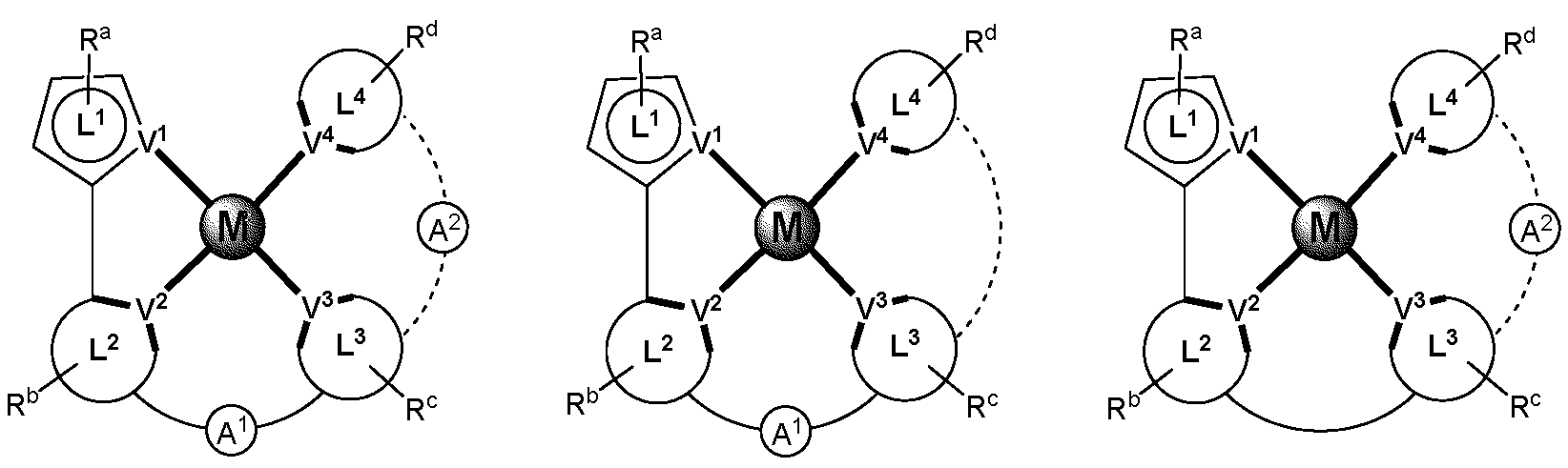
여기서, 하나 이상의 화합물 각각에 대하여:wherein, for each of the one or more compounds:
(L1^L2)는 화합물의 방출 부위를 나타내고, (L 1 ^L 2 ) represents the release site of the compound,
(L3^L4)는 화합물의 보조 부위를 나타내며, (L 3 ^L 4 ) represents the auxiliary moiety of the compound,
L1, L2 및 L3은 각각 독립적으로 치환되거나 비치환된 방향족 고리, 헤테로사이클릭 기, 카르벤 기, 또는 N-헤테로사이클릭 카르벤을 나타내고, L 1 , L 2 and L 3 each independently represent a substituted or unsubstituted aromatic ring, a heterocyclic group, a carbene group, or N-heterocyclic carbene,
L4는 치환되거나 비치환된 방향족 고리, 헤테로사이클릭 기, 카르벤 기, N-헤테로사이클릭 카르벤, 염소(Cl), 불소(F), 니트릴, 치환된 알킬, 치환된 알케닐, 또는 C3-C6 알키닐을 나타내며, L 4 is a substituted or unsubstituted aromatic ring, heterocyclic group, carbene group, N-heterocyclic carbene, chlorine (Cl), fluorine (F), nitrile, substituted alkyl, substituted alkenyl, or Represents C 3 -C 6 alkynyl,
L1 및 L2는 직접적으로 연결되고,L 1 and L 2 are directly connected,
L2 및 L3은 직접적으로 연결되거나 연결 원자 A1을 통해 연결되는데, 여기서 A1은 산소(O), 황(S), 질소(N), 탄소(C), 인(P), 규소(Si), 또는 붕소(B)를 나타내며,L 2 and L 3 are linked directly or via a connecting atom A 1 , where A 1 is oxygen (O), sulfur (S), nitrogen (N), carbon (C), phosphorus (P), silicon ( Si), or boron (B),
L3 및 L4는 연결되지 않거나, 직접적으로 연결되거나 또는 L4가 치환되거나 비치환된 방향족 고리, 헤테로사이클릭 기, 카르벤 기, 또는 N-헤테로사이클릭 카르벤일 경우, 연결 원자 A2를 통해 연결되는데, 여기서 A2는 산소(O), 황(S), 질소(N), 탄소(C), 인(P), 규소(Si), 또는 붕소(B)를 나타내고,L 3 and L 4 are unconnected, directly linked, or when L 4 is a substituted or unsubstituted aromatic ring, heterocyclic group, carbene group, or N-heterocyclic carbene, the connecting atom A 2 is connected via, wherein A 2 represents oxygen (O), sulfur (S), nitrogen (N), carbon (C), phosphorus (P), silicon (Si), or boron (B),
V1, V2, V3 및 V4는 각각 L1, L2, L3 또는 L4의 배위 원자를 나타내고, 여기서 V1, V2, V3 및 V4는 각각 독립적으로 질소(N), 탄소(C), 인(P), 붕소(B), 또는 규소(Si)를 나타내며,V 1 , V 2 , V 3 and V 4 each represent a coordinating atom of L 1 , L 2 , L 3 or L 4 , wherein V 1 , V 2 , V 3 and V 4 are each independently nitrogen (N) , carbon (C), phosphorus (P), boron (B), or silicon (Si),
M은 백금(Pt), 금(Au), 이리듐(Ir), 로듐(Rh), 루테늄(Ru), 철(Fe), 코발트(Co), 니켈(Ni), 구리(Cu), 아연(Zn), 은(Ag), 수은(Hg), 카드뮴(Cd), 또는 지르코늄(Zr)을 나타내고,M is platinum (Pt), gold (Au), iridium (Ir), rhodium (Rh), ruthenium (Ru), iron (Fe), cobalt (Co), nickel (Ni), copper (Cu), zinc (Zn) ), silver (Ag), mercury (Hg), cadmium (Cd), or zirconium (Zr);
Ra, Rb, Rc 및 Rd는 각각 독립적으로 모노-, 디-, 트리- 또는 테트라 치환기를 나타내고, 각각 독립적으로 중주소, 할로겐 원자, 히드록실 기, 티올 기, 니트로 기, 시아노 기, 치환되거나 비치환된 알킬 기, 치환되거나 비치환된 할로알킬 기, 치환되거나 비치환된 아랄킬 기, 치환되거나 비치환된 알케닐 기, 치환되거나 비치환된 알키닐 기, 치환되거나 비치환된 아릴 기, 치환되거나 비치환된 아미노 기, 치환되거나 비치환된 모노- 또는 디알킬아미노 기, 치환되거나 비치환된 모노- 또는 디아릴아미노 기, 치환되거나 비치환된 알콕시 기, 치환되거나 비치환된 아릴옥시 기, 치환되거나 비치환된 헤테로아릴 기, 알콕시카르보닐 기, 아실옥시 기, 아실아미노 기, 알콕시카르보닐아미노 기, 아릴옥시카르보닐아미노 기, 술포닐아미노 기, 술파모일 기, 카바모일 기, 알킬티오 기, 술피닐 기, 우레이도 기, 포스포르아미드 기, 머캅토 기, 술포 기, 카르복실 기, 히드라지노 기, 치환된 실릴 기, 폴리머 기, 또는 이들의 조합 중 하나 이상을 나타낸다.R a , R b , R c and R d each independently represent a mono-, di-, tri- or tetra substituent, and each independently represent a key group, a halogen atom, a hydroxyl group, a thiol group, a nitro group, a cyano group group, substituted or unsubstituted alkyl group, substituted or unsubstituted haloalkyl group, substituted or unsubstituted aralkyl group, substituted or unsubstituted alkenyl group, substituted or unsubstituted alkynyl group, substituted or unsubstituted aryl group, substituted or unsubstituted amino group, substituted or unsubstituted mono- or dialkylamino group, substituted or unsubstituted mono- or diarylamino group, substituted or unsubstituted alkoxy group, substituted or unsubstituted aryloxy group, substituted or unsubstituted heteroaryl group, alkoxycarbonyl group, acyloxy group, acylamino group, alkoxycarbonylamino group, aryloxycarbonylamino group, sulfonylamino group, sulfamoyl group, carba At least one of a moyl group, an alkylthio group, a sulfinyl group, a ureido group, a phosphoramide group, a mercapto group, a sulfo group, a carboxyl group, a hydrazino group, a substituted silyl group, a polymer group, or a combination thereof indicates
일부 경우, 다음 중 하나 이상이 해당된다: Ra는 리간드 L1에 융합되고, Rb는 리간드 L2에 융합되며, Rc는 리간드 L3에 융합되고, Rd는 리간드 L4에 융합된다. 어?? 경우, 조성물, 본 명세서의 각 화합물 또는 둘다는 중성 전하이다. 일부 실시양태에서, "폴리머"는 폴리알킬렌, 폴리에테르, 폴리에스테르, 또는 이들의 조합을 포함한다.In some cases, one or more of the following is true: R a is fused to ligand L 1 , R b is fused to ligand L 2 , R c is fused to ligand L 3 , and R d is fused to ligand L 4 . . Huh?? In this case, the composition, each compound herein, or both, is a neutral charge. In some embodiments, "polymer" includes polyalkylene, polyether, polyester, or combinations thereof.
일반적으로, 화학 구조 변화는 화합물의 전자 구조에 영향을 주며, 이것은 이로써 화합물의 광학 특성(예컨대, 방출 및 흡수 스펙트럼)에 영향을 준다. 따라서, 본 명세서에 개시된 화합물은 특별한 방출 또는 흡수 에너지로 조정 또는 조절될 수 있다. 일부 양태에서, 본 명세서에 개시된 화합물의 광학 특성은 금속 중심을 둘러싸는 리간드의 구조를 변화시킴으로써 조절될 수 있다. 예컨대, 전자 공여 치환기 또는 전기 구인 치환기를 갖는 리간드를 갖는 화합물은 일반적으로 상이한 방출 및 흡수 스펙트럼을 포함하는 상이한 광학 특성을 나타낸다.In general, changes in chemical structure affect the electronic structure of a compound, which in turn affects the optical properties (eg, emission and absorption spectra) of the compound. Accordingly, the compounds disclosed herein can be tuned or modulated to a particular emitted or absorbed energy. In some embodiments, the optical properties of the compounds disclosed herein can be modulated by changing the structure of the ligand surrounding the metal center. For example, compounds having ligands with electron-donating substituents or electron-donating substituents or substituents that are electrically spheres generally exhibit different optical properties, including different emission and absorption spectra.
본 명세서에 개시된 바와 같이, 화합물의 방출 스펙트럼은 보조 리간드의 하나 이상의 치환기를 변경함으로써 변화시킬 수 있다. 일부 양태에서, 방출 스펙트럼의 하나 이상의 특징부는 좁아지거나 넓어지거나, 블루 시프트 또는 레드 시프트를 나타내거나 또는 둘다이다.As disclosed herein, the emission spectrum of a compound can be changed by altering one or more substituents of the ancillary ligand. In some embodiments, one or more features of the emission spectrum narrow or broaden, exhibit a blue shift or a red shift, or both.
본 명세서에 개시된 식에서, 



V1, V2, V3 및 V4는 L1, L2, L3 또는 L4에 배위된 원자를 나타내고, 여기서 V1, V2, V3 및 V4는 각각 독립적으로 질소(N), 탄소(C), 인(P), 붕소(B) 또는 규소(Si)를 나타낼 수 있다.V 1 , V 2 , V 3 and V 4 represent an atom coordinated to L 1 , L 2 , L 3 or L 4 , wherein V 1 , V 2 , V 3 and V 4 are each independently nitrogen (N) , carbon (C), phosphorus (P), boron (B) or silicon (Si).
본 명세서에 개시된 식 중 임의의 것에 대해, 

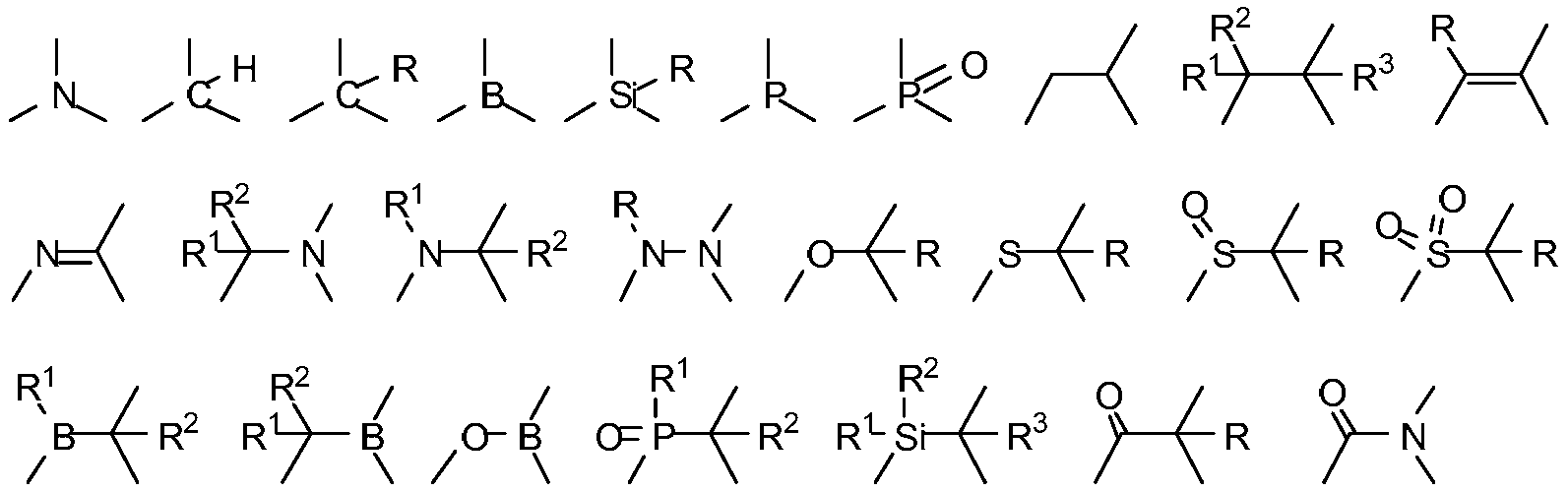
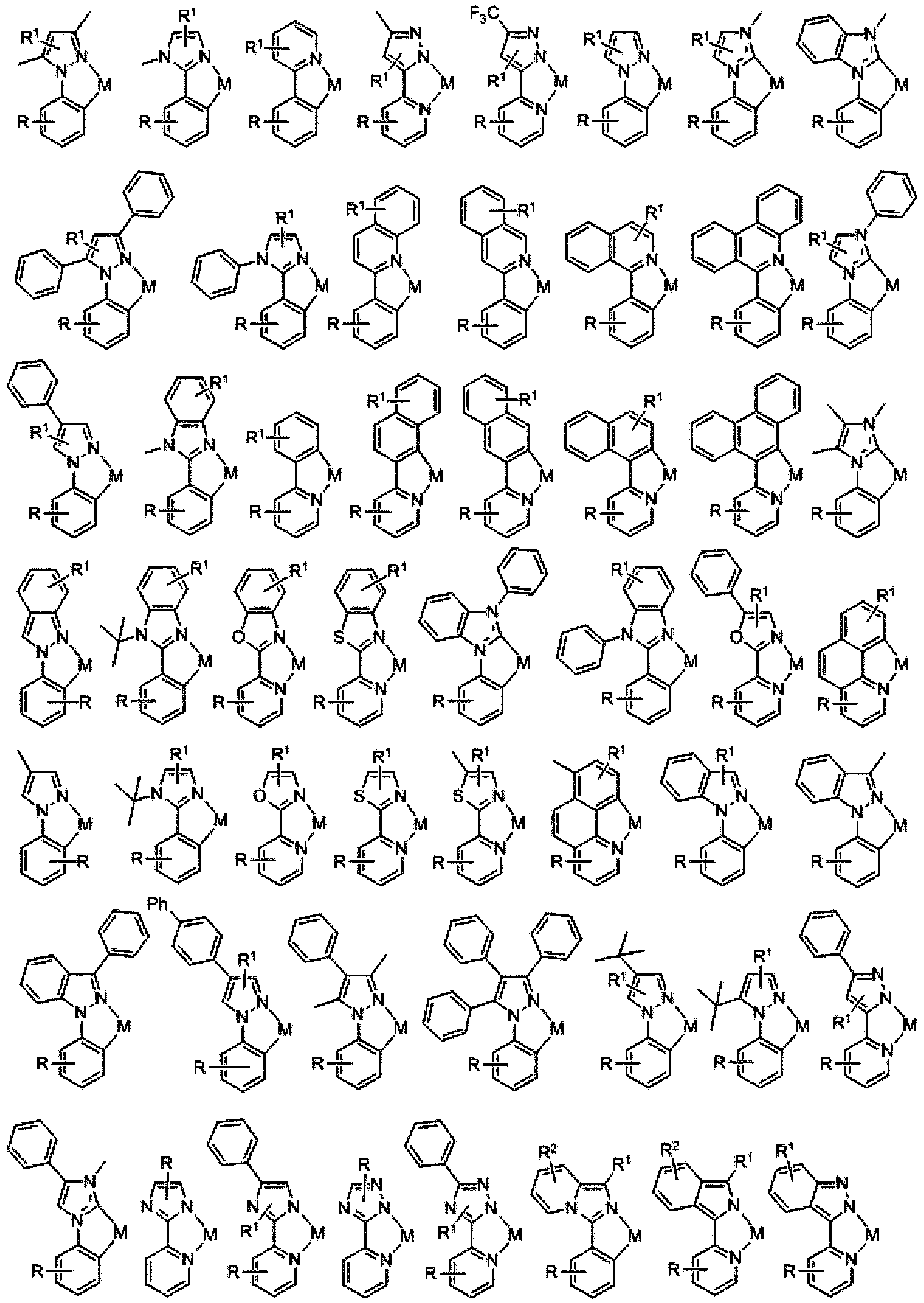
식 중, R, R1, R2 및 R3은 각각 독립적으로 중수소, 할로겐 원자, 히드록실기, 티올기, 니트로기, 시아노기, 치환되거나 비치환된 알킬기, 치환되거나 비치환된 할로알킬기, 치환되거나 비치환된 아랄킬기, 치환되거나 비치환된 알케닐기, 치환되거나 비치환된 알키닐기, 치환되거나 비치환된 아릴기, 아미노기, 모노- 또는 디-알킬아미노기, 모노- 또는 디-아릴아미노기, 치환되거나 비치환된 알콕시기, 치환되거나 비치환된 아릴옥시기, 치환되거나 비치환된 헤테로아릴기, 알콕시카르보닐기, 아실옥시기, 아실아미노기, 알콕시카르보닐아미노기, 아릴옥시카르보닐아미노기, 술포닐아미노기, 술파모일기, 카바모일기, 알킬티오기, 술피닐기, 우레이도기, 포스포르아미드기, 머캅토기, 술포기, 카르복실기, 히드라지노기, 치환된 실릴기, 폴리머 기, 또는 이의 조합을 나타낸다.wherein R, R 1 , R 2 and R 3 are each independently deuterium, a halogen atom, a hydroxyl group, a thiol group, a nitro group, a cyano group, a substituted or unsubstituted alkyl group, a substituted or unsubstituted haloalkyl group, A substituted or unsubstituted aralkyl group, a substituted or unsubstituted alkenyl group, a substituted or unsubstituted alkynyl group, a substituted or unsubstituted aryl group, an amino group, a mono- or di-alkylamino group, a mono- or di-arylamino group, A substituted or unsubstituted alkoxy group, a substituted or unsubstituted aryloxy group, a substituted or unsubstituted heteroaryl group, an alkoxycarbonyl group, an acyloxy group, an acylamino group, an alkoxycarbonylamino group, an aryloxycarbonylamino group, a sulfonylamino group , a sulfamoyl group, a carbamoyl group, an alkylthio group, a sulfinyl group, a ureido group, a phosphoramide group, a mercapto group, a sulfo group, a carboxyl group, a hydrazino group, a substituted silyl group, a polymer group, or a combination thereof.
본 명세서에 개시된 식 중 임의의 것에 대해, 
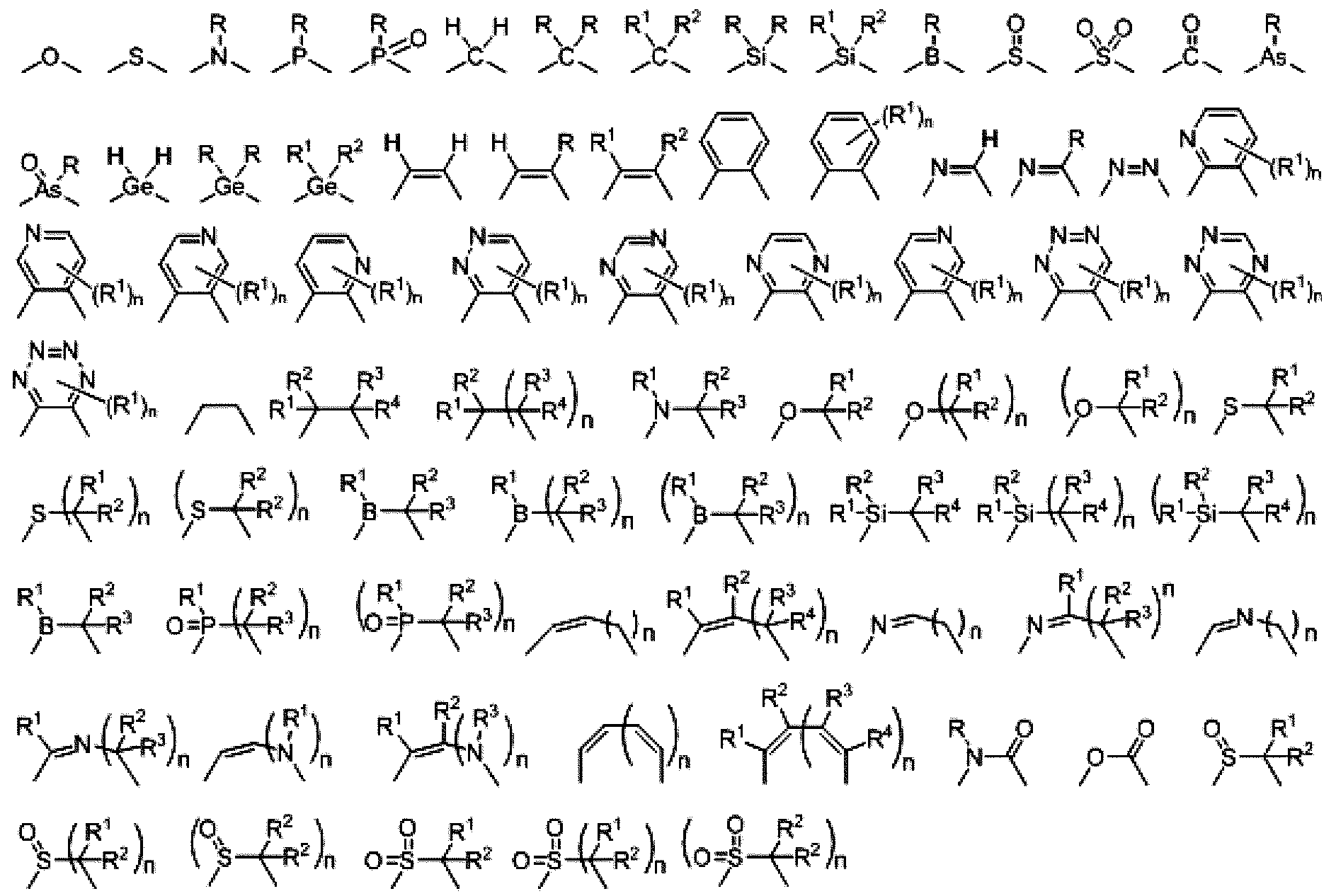
식 중,during the meal,
n은 정수이고,n is an integer,
R1, R2, R3 및 R4는 각각 독립적으로 중수소, 할로겐 원자, 히드록실기, 티올기, 니트로기, 시아노기, 치환되거나 비치환된 알킬기, 치환되거나 비치환된 할로알킬기, 치환되거나 비치환된 아랄킬기, 치환되거나 비치환된 알케닐기, 치환되거나 비치환된 알키닐기, 치환되거나 비치환된 아릴기, 아미노기, 모노- 또는 디-알킬아미노기, 모노- 또는 디-아릴아미노기, 치환되거나 비치환된 알콕시기, 치환되거나 비치환된 아릴옥시기, 치환되거나 비치환된 헤테로아릴기, 알콕시카르보닐기, 아실옥시기, 아실아미노기, 알콕시카르보닐아미노기, 아릴옥시카르보닐아미노기, 술포닐아미노기, 술파모일기, 카바모일기, 알킬티오기, 술피닐기, 우레이도기, 포스포르아미드기, 머캅토기, 술포기, 카르복실기, 히드라지노기, 치환된 실릴기, 폴리머 기, 또는 이의 조합을 나타낸다.R 1 , R 2 , R 3 and R 4 are each independently deuterium, a halogen atom, a hydroxyl group, a thiol group, a nitro group, a cyano group, a substituted or unsubstituted alkyl group, a substituted or unsubstituted haloalkyl group, a substituted or unsubstituted aralkyl group, substituted or unsubstituted alkenyl group, substituted or unsubstituted alkynyl group, substituted or unsubstituted aryl group, amino group, mono- or di-alkylamino group, mono- or di-arylamino group, substituted or Unsubstituted alkoxy group, substituted or unsubstituted aryloxy group, substituted or unsubstituted heteroaryl group, alkoxycarbonyl group, acyloxy group, acylamino group, alkoxycarbonylamino group, aryloxycarbonylamino group, sulfonylamino group, alcohol pamoyl group, carbamoyl group, alkylthio group, sulfinyl group, ureido group, phosphoramide group, mercapto group, sulfo group, carboxyl group, hydrazino group, substituted silyl group, polymer group, or a combination thereof.
본 명세서에 개시된 식 중 임의의 것에 대해, 

식 중, R, R1 및 R2는 각각 독립적으로 중수소, 할로겐 원자, 히드록실기, 티올기, 니트로기, 시아노기, 치환되거나 비치환된 알킬기, 치환되거나 비치환된 할로알킬기, 치환되거나 비치환된 아랄킬기, 치환되거나 비치환된 알케닐기, 치환되거나 비치환된 알키닐기, 치환되거나 비치환된 아릴기, 아미노기, 모노- 또는 디-알킬아미노기, 모노- 또는 디-아릴아미노기, 치환되거나 비치환된 알콕시기, 치환되거나 비치환된 아릴옥시기, 치환되거나 비치환된 헤테로아릴기, 알콕시카르보닐기, 아실옥시기, 아실아미노기, 알콕시카르보닐아미노기, 아릴옥시카르보닐아미노기, 술포닐아미노기, 술파모일기, 카바모일기, 알킬티오기, 술피닐기, 우레이도기, 포스포르아미드기, 머캅토기, 술포기, 카르복실기, 히드라지노기, 치환된 실릴기, 폴리머 기, 또는 이의 조합을 나타낸다.wherein R, R 1 and R 2 are each independently deuterium, a halogen atom, a hydroxyl group, a thiol group, a nitro group, a cyano group, a substituted or unsubstituted alkyl group, a substituted or unsubstituted haloalkyl group, a substituted or unsubstituted A substituted aralkyl group, a substituted or unsubstituted alkenyl group, a substituted or unsubstituted alkynyl group, a substituted or unsubstituted aryl group, an amino group, a mono- or di-alkylamino group, a mono- or di-arylamino group, a substituted or unsubstituted A substituted or unsubstituted aryloxy group, a substituted or unsubstituted heteroaryl group, an alkoxycarbonyl group, an acyloxy group, an acylamino group, an alkoxycarbonylamino group, an aryloxycarbonylamino group, a sulfonylamino group, sulfamo diyl, carbamoyl group, alkylthio group, sulfinyl group, ureido group, phosphoramide group, mercapto group, sulfo group, carboxyl group, hydrazino group, substituted silyl group, polymer group, or a combination thereof.
식 중, R, R1 및 R2는 각각 독립적으로 일-, 이-, 삼- 또는 사-치환기(substitution)를 나타내며, 독립적으로 중수소, 할로겐 원자, 히드록실기, 티올기, 니트로기, 시아노기, 치환되거나 비치환된 알킬기, 치환되거나 비치환된 할로알킬기, 치환되거나 비치환된 아랄킬기, 치환되거나 비치환된 알케닐기, 치환되거나 비치환된 알키닐기, 치환되거나 비치환된 아릴기, 아미노기, 모노- 또는 디-알킬아미노기, 모노- 또는 디-아릴아미노기, 치환되거나 비치환된 알콕시기, 치환되거나 비치환된 아릴옥시기, 치환되거나 비치환된 헤테로아릴기, 알콕시카르보닐기, 아실옥시기, 아실아미노기, 알콕시카르보닐아미노기, 아릴옥시카르보닐아미노기, 술포닐아미노기, 술파모일기, 카바모일기, 알킬티오기, 술피닐기, 우레이도기, 포스포르아미드기, 머캅토기, 술포기, 카르복실기, 히드라지노기, 치환된 실릴기, 폴리머 기, 또는 이의 조합을 나타낸다.In the formula, R, R 1 and R 2 each independently represent a mono-, di-, tri- or tetra-substitution, and independently deuterium, a halogen atom, a hydroxyl group, a thiol group, a nitro group, cya No group, substituted or unsubstituted alkyl group, substituted or unsubstituted haloalkyl group, substituted or unsubstituted aralkyl group, substituted or unsubstituted alkenyl group, substituted or unsubstituted alkynyl group, substituted or unsubstituted aryl group, amino group , mono- or di-alkylamino group, mono- or di-arylamino group, substituted or unsubstituted alkoxy group, substituted or unsubstituted aryloxy group, substituted or unsubstituted heteroaryl group, alkoxycarbonyl group, acyloxy group, Acylamino group, alkoxycarbonylamino group, aryloxycarbonylamino group, sulfonylamino group, sulfamoyl group, carbamoyl group, alkylthio group, sulfinyl group, ureido group, phosphoramide group, mercapto group, sulfo group, carboxyl group, hydra a zino group, a substituted silyl group, a polymer group, or a combination thereof.
본 명세서에 개시된 식 중 임의의 것에 대해, 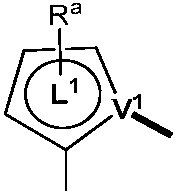
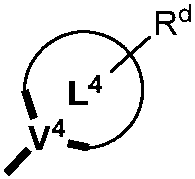

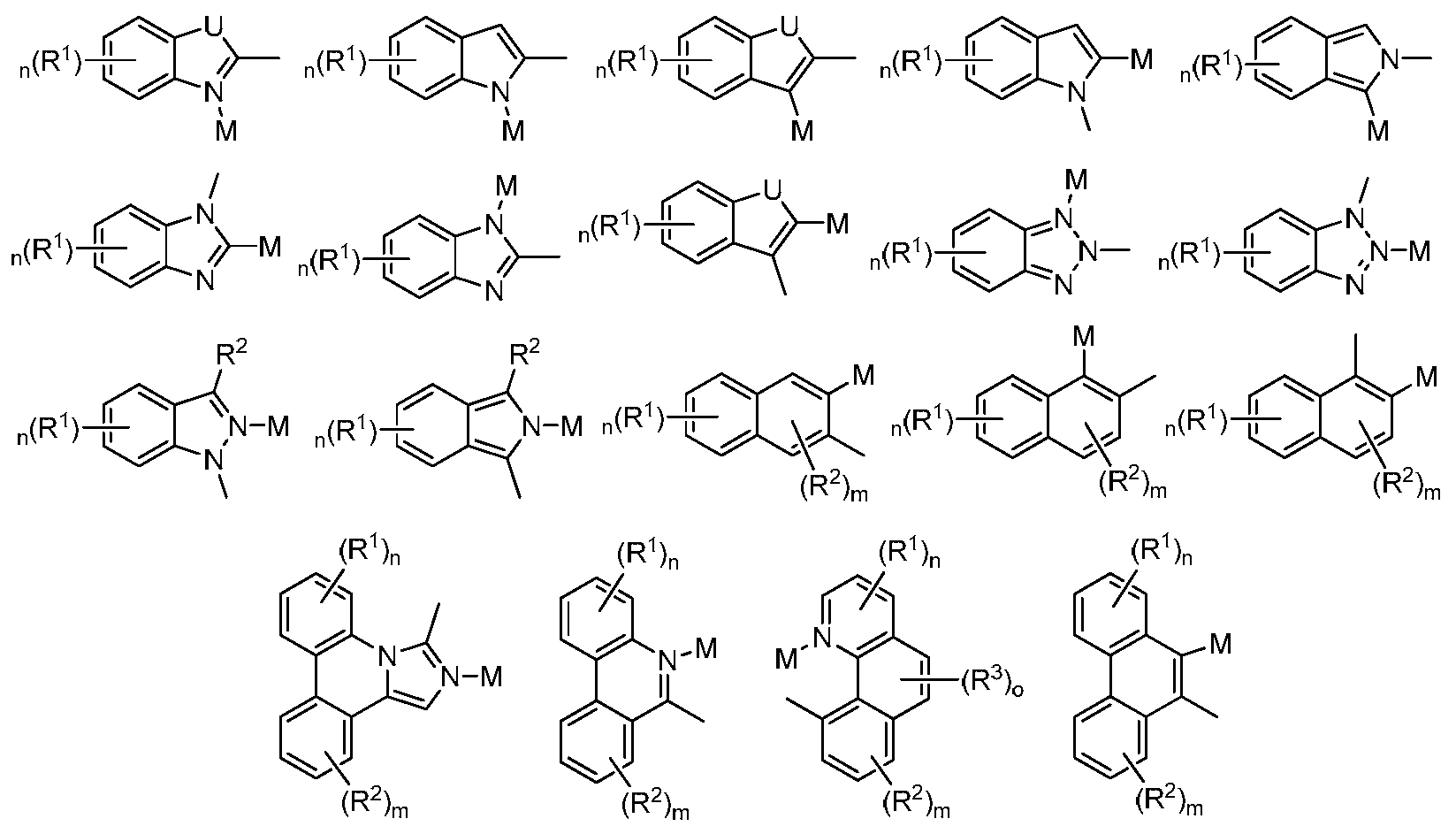
식 중,during the meal,
m, n 및 o는 각각 독립적으로 일-, 이-, 삼- 또는 사-치환을 표시하는 1 내지 4의 정수를 나타내며,m, n and o each independently represent an integer of 1 to 4 representing mono-, di-, tri- or tetra-substitution,
R1 및 R2는 각각 독립적으로 중수소, 할로겐 원자, 히드록실기, 티올기, 니트로기, 시아노기, 치환되거나 비치환된 알킬기, 치환되거나 비치환된 할로알킬기, 치환되거나 비치환된 아랄킬기, 치환되거나 비치환된 알케닐기, 치환되거나 비치환된 알키닐기, 치환되거나 비치환된 아릴기, 아미노기, 모노- 또는 디-알킬아미노기, 모노- 또는 디-아릴아미노기, 치환되거나 비치환된 알콕시기, 치환되거나 비치환된 아릴옥시기, 치환되거나 비치환된 헤테로아릴기, 알콕시카르보닐기, 아실옥시기, 아실아미노기, 알콕시카르보닐아미노기, 아릴옥시카르보닐아미노기, 술포닐아미노기, 술파모일기, 카바모일기, 알킬티오기, 술피닐기, 우레이도기, 포스포르아미드기, 머캅토기, 술포기, 카르복실기, 히드라지노기, 치환된 실릴기, 폴리머 기, 또는 이의 조합을 나타낸다.R 1 and R 2 are each independently deuterium, a halogen atom, a hydroxyl group, a thiol group, a nitro group, a cyano group, a substituted or unsubstituted alkyl group, a substituted or unsubstituted haloalkyl group, a substituted or unsubstituted aralkyl group, A substituted or unsubstituted alkenyl group, a substituted or unsubstituted alkynyl group, a substituted or unsubstituted aryl group, an amino group, a mono- or di-alkylamino group, a mono- or di-arylamino group, a substituted or unsubstituted alkoxy group, Substituted or unsubstituted aryloxy group, substituted or unsubstituted heteroaryl group, alkoxycarbonyl group, acyloxy group, acylamino group, alkoxycarbonylamino group, aryloxycarbonylamino group, sulfonylamino group, sulfamoyl group, carbamoyl group , alkylthio group, sulfinyl group, ureido group, phosphoramide group, mercapto group, sulfo group, carboxyl group, hydrazino group, substituted silyl group, polymer group, or a combination thereof.
본 명세서에 개시된 식 중 임의의 것에 대해, 
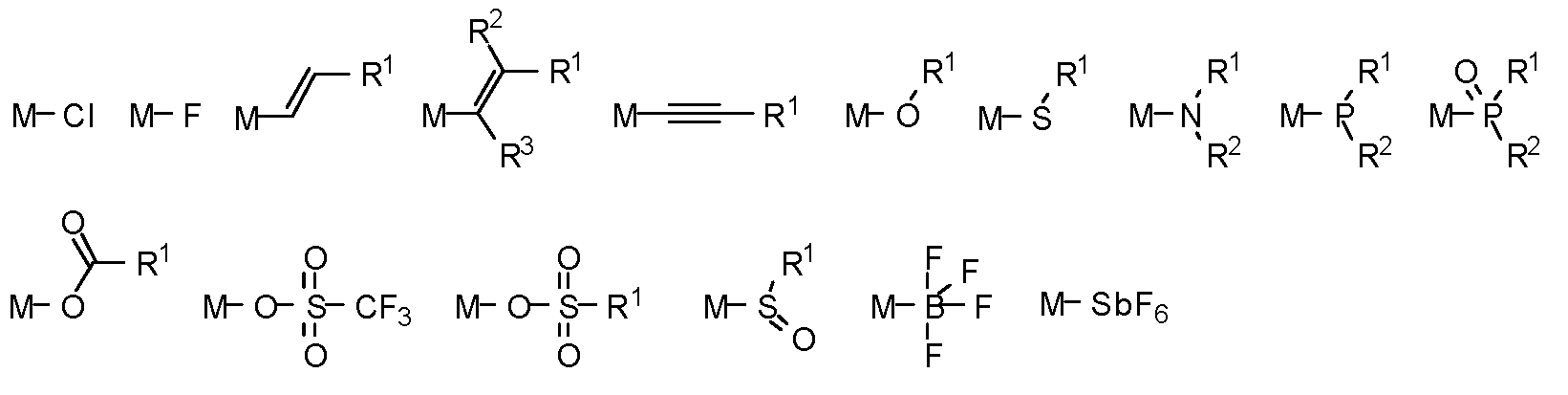
식 중, R1 및 R2는 각각 독립적으로 중수소, 할로겐 원자, 히드록실기, 티올기, 니트로기, 시아노기, 치환되거나 비치환된 알킬기, 치환되거나 비치환된 할로알킬기, 치환되거나 비치환된 아랄킬기, 치환되거나 비치환된 알케닐기, 치환되거나 비치환된 알키닐기, 치환되거나 비치환된 아릴기, 아미노기, 모노- 또는 디-알킬아미노기, 모노- 또는 디-아릴아미노기, 치환되거나 비치환된 알콕시기, 치환되거나 비치환된 아릴옥시기, 치환되거나 비치환된 헤테로아릴기, 알콕시카르보닐기, 아실옥시기, 아실아미노기, 알콕시카르보닐아미노기, 아릴옥시카르보닐아미노기, 술포닐아미노기, 술파모일기, 카바모일기, 알킬티오기, 술피닐기, 우레이도기, 포스포르아미드기, 머캅토기, 술포기, 카르복실기, 히드라지노기, 치환된 실릴기, 폴리머 기, 또는 이의 조합을 나타낸다.wherein R 1 and R 2 are each independently deuterium, a halogen atom, a hydroxyl group, a thiol group, a nitro group, a cyano group, a substituted or unsubstituted alkyl group, a substituted or unsubstituted haloalkyl group, a substituted or unsubstituted Aralkyl group, substituted or unsubstituted alkenyl group, substituted or unsubstituted alkynyl group, substituted or unsubstituted aryl group, amino group, mono- or di-alkylamino group, mono- or di-arylamino group, substituted or unsubstituted Alkoxy group, substituted or unsubstituted aryloxy group, substituted or unsubstituted heteroaryl group, alkoxycarbonyl group, acyloxy group, acylamino group, alkoxycarbonylamino group, aryloxycarbonylamino group, sulfonylamino group, sulfamoyl group, carbamoyl group, alkylthio group, sulfinyl group, ureido group, phosphoramide group, mercapto group, sulfo group, carboxyl group, hydrazino group, substituted silyl group, polymer group, or a combination thereof.
조성물은 하기 중 1 이상을 포함할 수 있다: The composition may comprise one or more of the following:
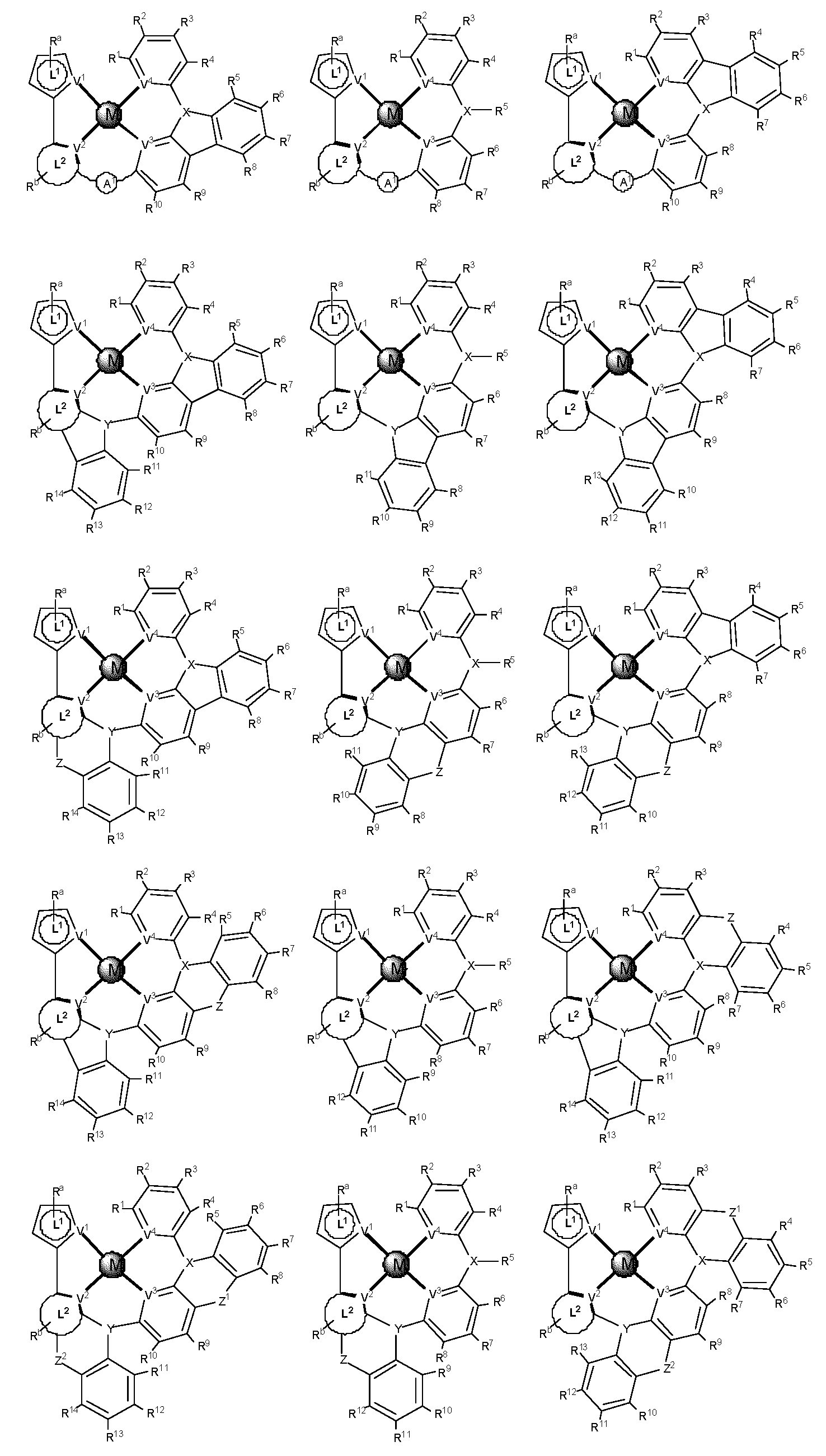
식 중, 모든 기호는 상기에서 정의되어 있다.In the formula, all symbols are defined above.
일부 경우, 본 명세서에 개시된 조성물은 하기 중 1 이상을 포함한다:In some cases, a composition disclosed herein comprises one or more of the following:
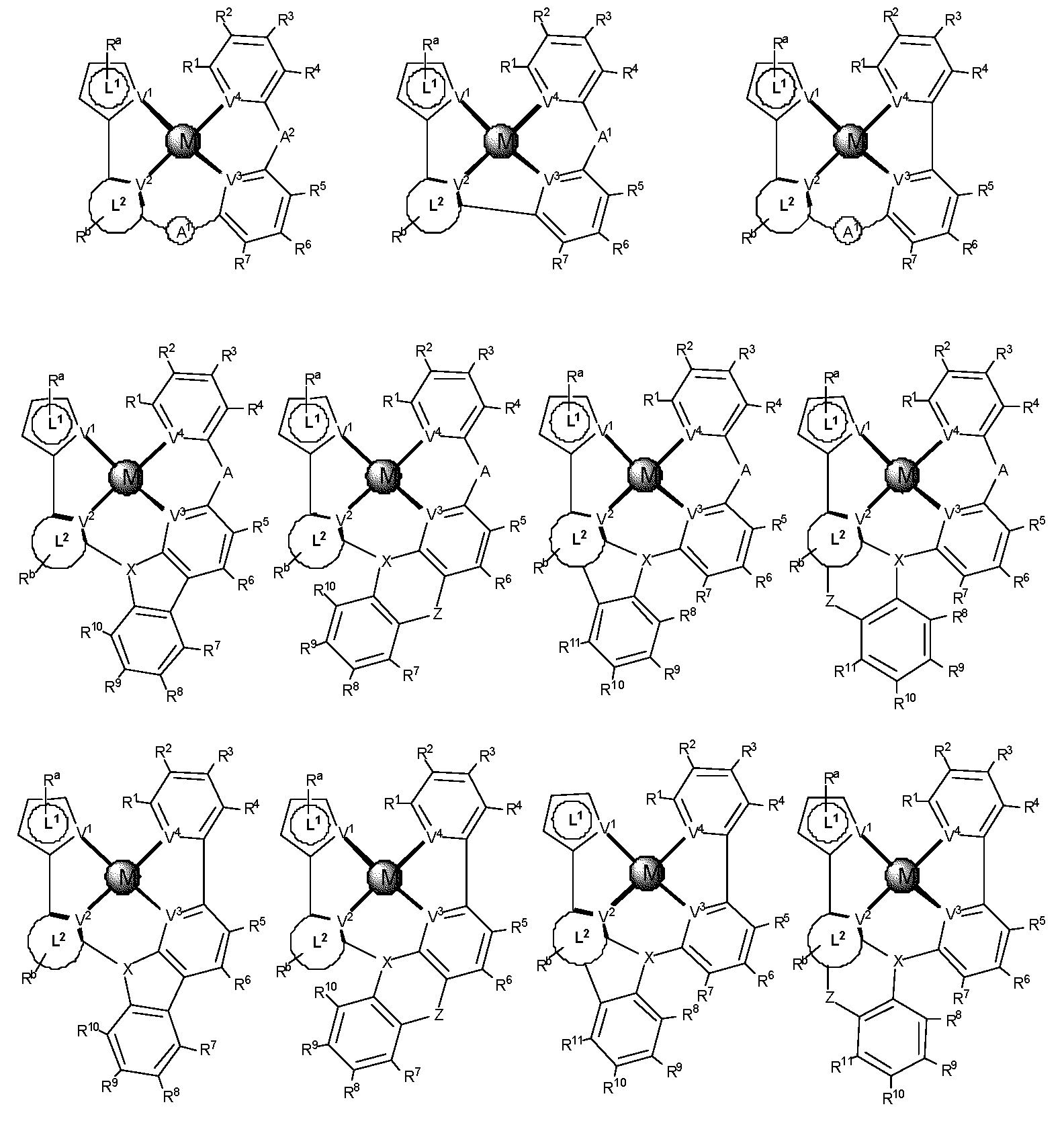
식 중, 모든 기호는 상기에서 정의되어 있다.Wherein, all symbols are defined above.
특정 경우, 본 명세서에 개시된 조성물은 하기 중 1 이상을 포함한다:In certain instances, a composition disclosed herein comprises one or more of the following:
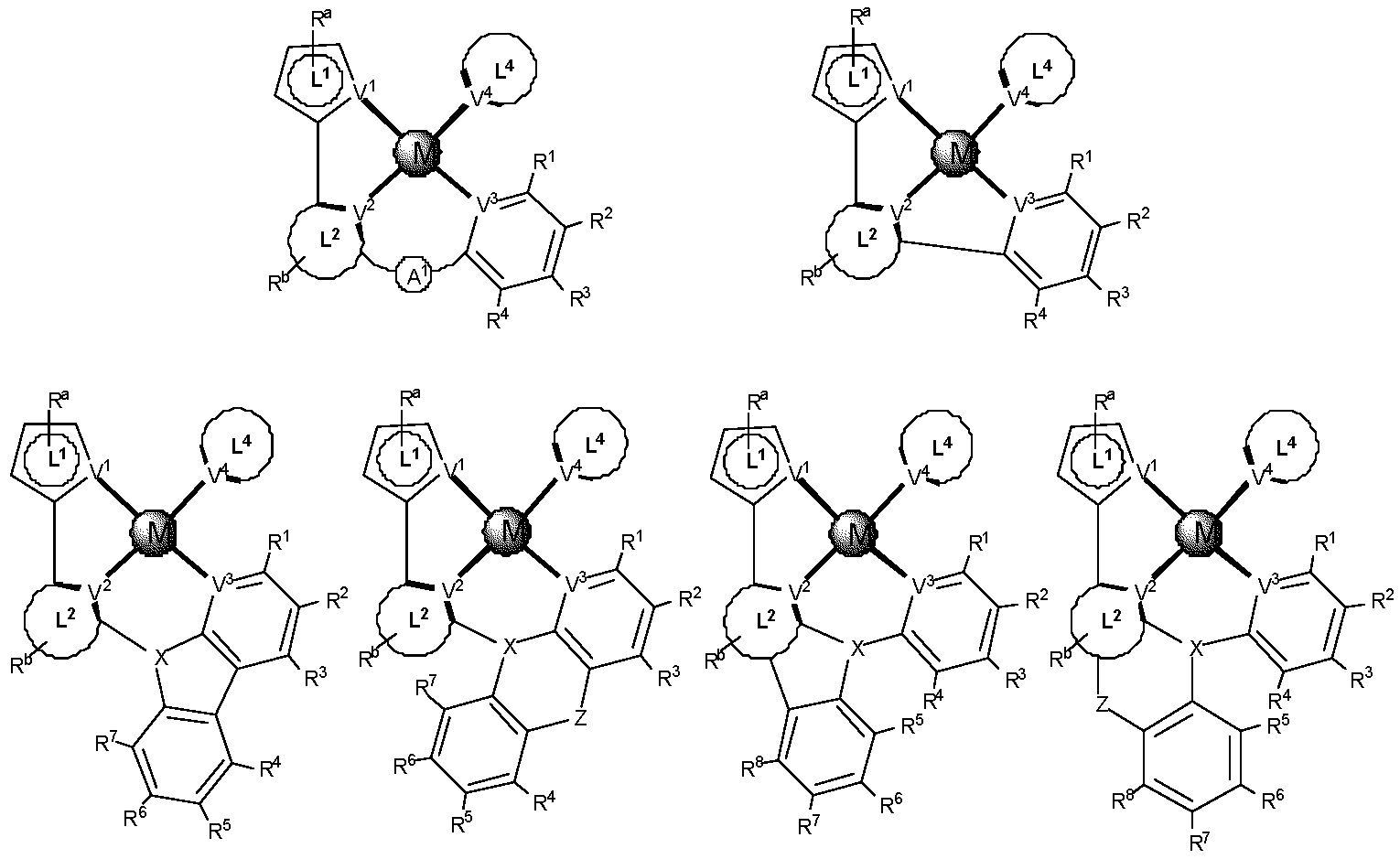
식 중, 모든 기호는 상기에서 정의되어 있다.In the formula, all symbols are defined above.
특정 경우, 본 명세서에 개시된 조성물은 하기 중 1 이상을 포함한다:In certain instances, a composition disclosed herein comprises one or more of the following:
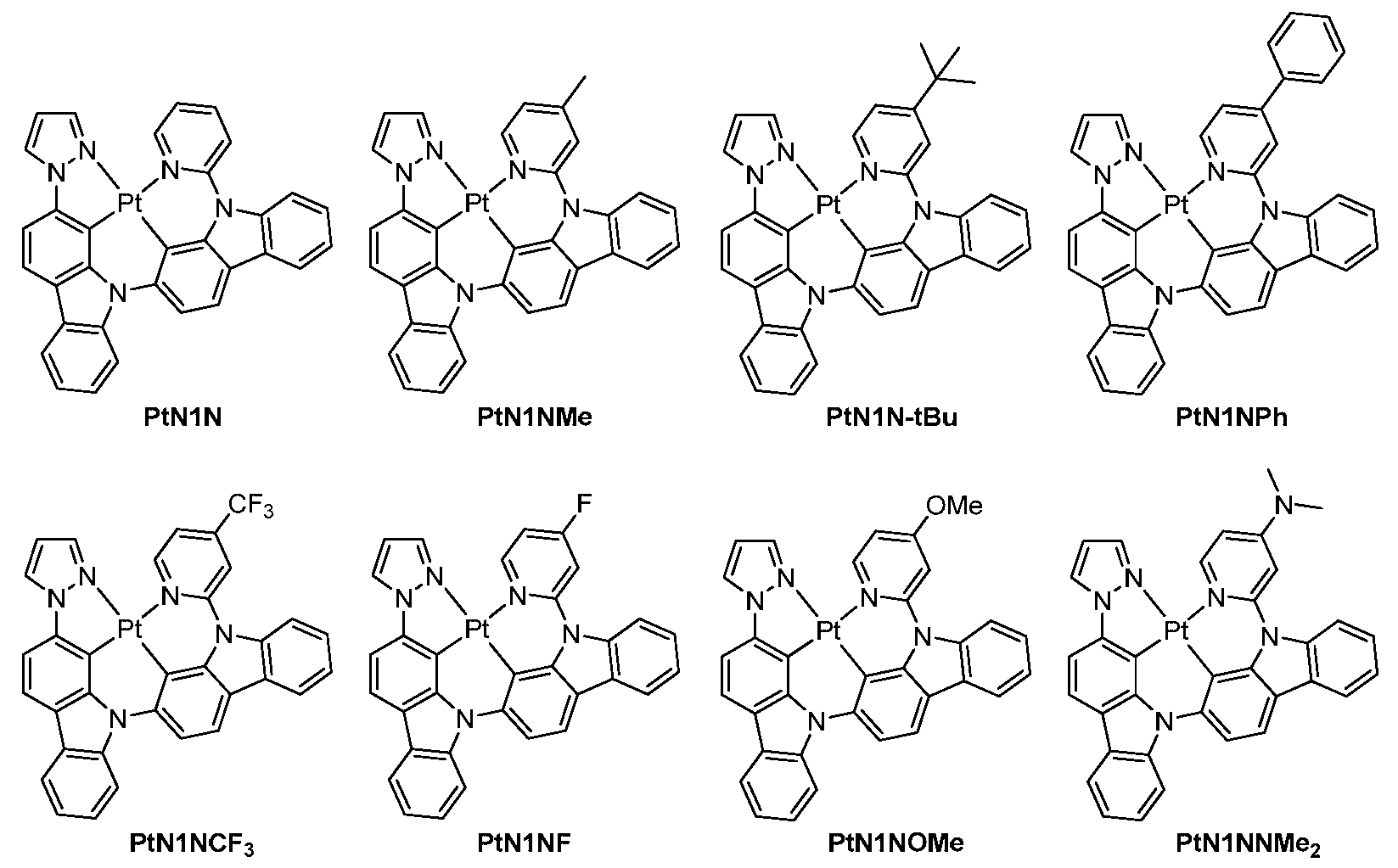
특정 경우, 본 명세서에 개시된 조성물은 하기 중 1 이상을 포함한다:In certain instances, a composition disclosed herein comprises one or more of the following:
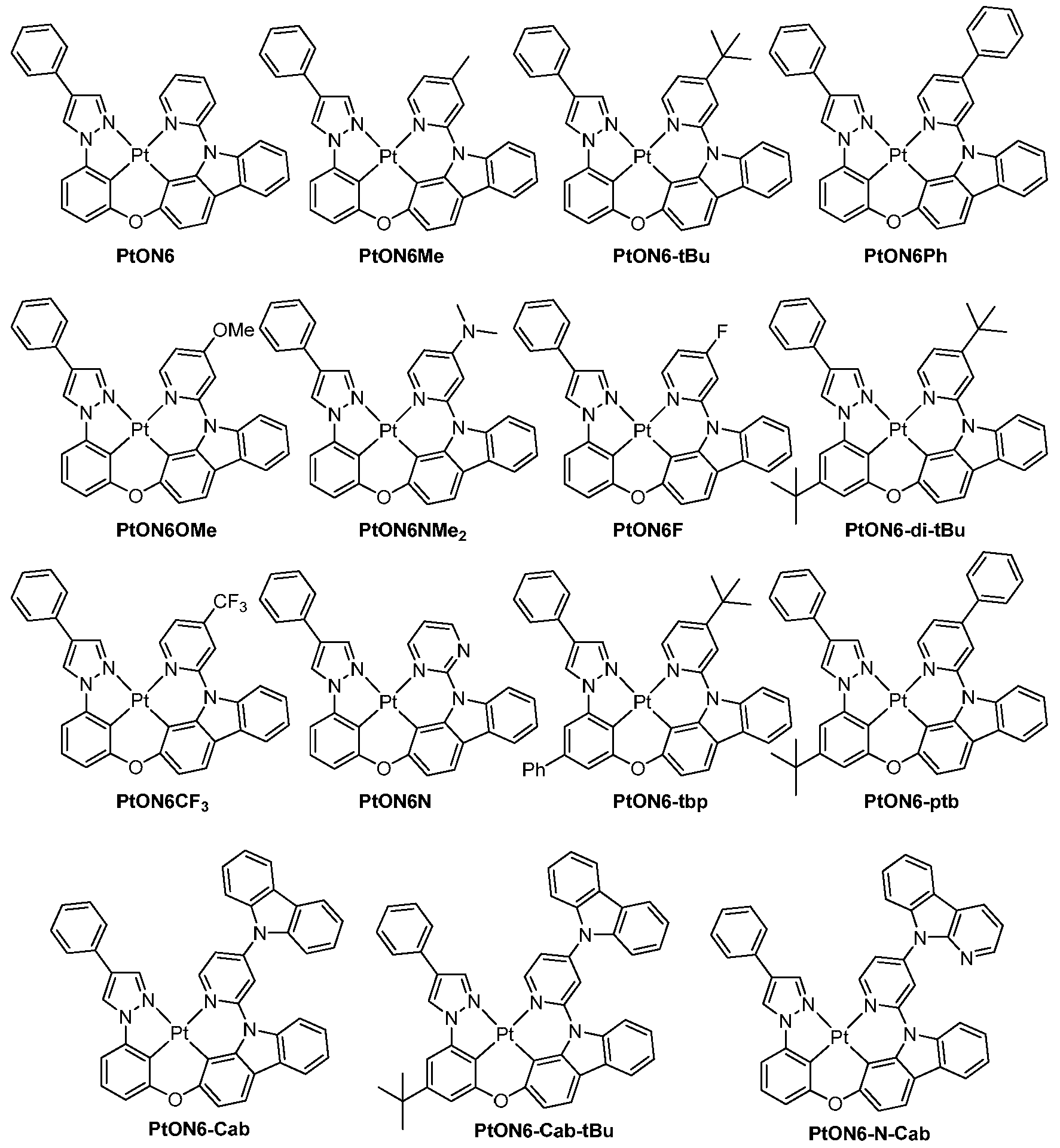
또 다른 경우, 본 명세서에 개시된 조성물은 하기 중 1 이상을 포함한다:In still other instances, a composition disclosed herein comprises one or more of the following:
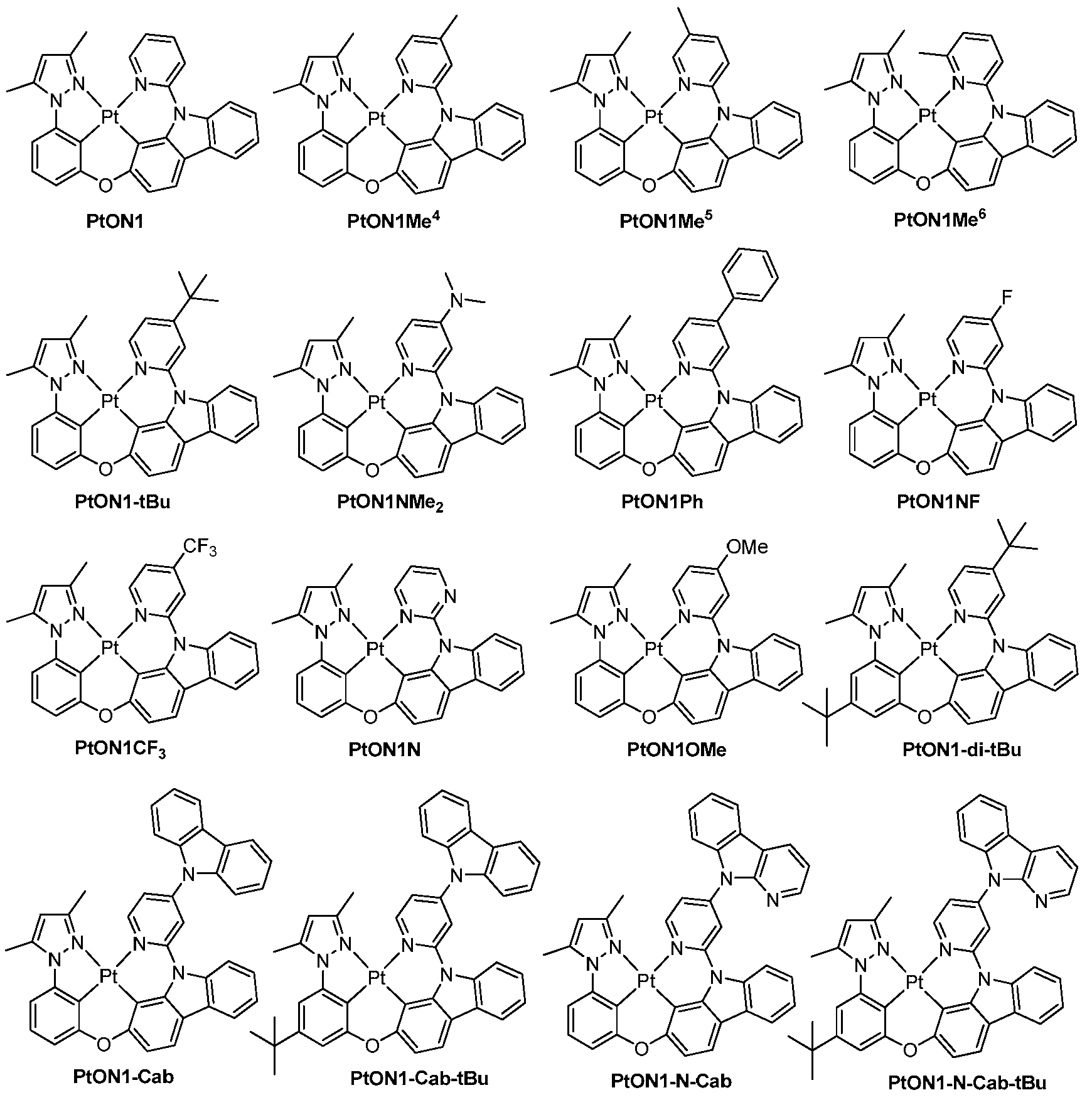
일부 실시에서, 본 명세서에 개시된 조성물 또는 화합물은 본 명세서에 기재된 화합물의 1 이상의 유도체 및/또는 유사체를 포함하며, 단, 이러한 화합물은 바람직한 특성을 나타내고, 적절한 리간드의 선택을 통해 조정될 수 있는 발광 또는 흡수 스펙트럼 또는 둘다를 갖는다.In some implementations, a composition or compound disclosed herein comprises one or more derivatives and/or analogs of a compound described herein, provided that such compounds exhibit desirable properties and have a luminescence or absorption spectrum or both.
본 명세서에 개시된 조성물은 일반적으로 예컨대 흡광 디바이스, 예컨대 감일광성(solar-sensitive) 또는 감광성 디바이스, 광기전(photovoltaic) 디바이스, 유기 발광 다이오드(OLED), 광-방출 디바이스, 또는 흡광 및 광-방출 모두가 가능하며 바이오 용도를 위한 마커로서의 디바이스를 비롯한 매우 다양한 광학 및 전기광학 디바이스에 사용하기에 적합하다. 본 명세서에 기재된 조성물은 1 이상의 여러자리 금속 착물 또는 화합물을 포함한다. 따라서, 일부 실시에서, 조성물은 하나의 여러가지 금속 착물을 포함하고, 일부 실시에서, 조성물은 2 이상의 여러자리 금속 착물을 포함한다.The compositions disclosed herein are generally, for example, light-absorbing devices, such as solar- or photosensitive devices, photovoltaic devices, organic light emitting diodes (OLEDs), light-emitting devices, or both light-absorbing and light-emitting devices. , and is suitable for use in a wide variety of optical and electro-optical devices, including devices as markers for bio-applications. The compositions described herein include one or more multidentate metal complexes or compounds. Thus, in some implementations, the composition comprises one multidentate metal complex, and in some implementations, the composition comprises two or more multidentate metal complexes.
일부 실시에서, 넓은 범위의 파장을 커버하기 위해 본 명세서에 기재된 여러자리 금속 착물을 조합한다. 일례에서, 도 2는 실온에서 CH2Cl2 중 PtN1N, PtN1NMe, PtN1N-tBu, PtN1NPh 및 PtN1NCF3의 발광 스펙트럼을 도시한다. 다른 예에서, 도 3은 실온에서 CH2Cl2 중 PtON6, PtON6-tBu 및 PtON6Ph의 발광 스펙트럼을 도시한다. 또 다른 예에서, 도 4는 실온에서 CH2Cl2 중 PtON1, PtON1Me4, PtON1Me5, PtON1Me6, PtON1-tBu, PtON1Ph, PtON1NMe2, PtON1F 및 PtON1CF3의 발광 스펙트럼을 도시한다. 따라서, 도 2 내지 4에 의해 시사되는 바와 같이, 본 명세서에 기재된 화합물은 OLED에서 소정 파장 범위를 얻기 위한 발광 물질로서 단독 사용하거나 또는 선택적으로 병용할 수 있다.In some implementations, the multidentate metal complexes described herein are combined to cover a wide range of wavelengths. In one example, FIG. 2 shows emission spectra of PtN1N, PtN1NMe, PtN1N-tBu, PtN1NPh and PtN1NCF 3 in CH 2 Cl 2 at room temperature. In another example, FIG. 3 shows emission spectra of PtON6, PtON6-tBu and PtON6Ph in CH 2 Cl 2 at room temperature. In another example, FIG. 4 shows emission spectra of PtON1, PtON1Me 4 , PtON1Me 5 , PtON1Me 6 , PtON1-tBu, PtON1Ph, PtON1NMe 2 , PtON1F and PtON1CF 3 in CH 2 Cl 2 at room temperature. Thus, as suggested by Figures 2 to 4, the compounds described herein can be used alone or optionally in combination as a light emitting material to achieve a desired wavelength range in an OLED.
일부 실시에서, 본 명세서에 개시된 조성물은 풀 컬러(full color) 디스플레이와 같이 OLED 용도를 위한 호스트 물질로서 사용된다.In some implementations, the compositions disclosed herein are used as host materials for OLED applications, such as full color displays.
일측면에서, 본 명세서에 개시된 조성물은 예컨대 조명 디바이스와 같은 매우 다양한 용도에서 유용할 수 있다. 추가의 측면에서, 1 이상의 착물이 유기 발광 디스플레이 디바이스에 대한 호스트 물질로서 유용할 수 있다.In one aspect, the compositions disclosed herein may be useful in a wide variety of applications, such as, for example, lighting devices. In a further aspect, one or more complexes may be useful as host materials for organic light emitting display devices.
다른 측면에서, 본 명세서에 개시된 조성물은 예컨대 발광 물질로서 다양한 용도에서 유용하다. 추가의 측면에서, 상기 화합물은 유기 발광 다이오드(OLED), 발광성 디바이스 및 디스플레이, 및 다른 발광 디바이스에 유용할 수 있다.In another aspect, the compositions disclosed herein are useful in a variety of applications, such as as light emitting materials. In a further aspect, the compounds may be useful in organic light emitting diodes (OLEDs), light emitting devices and displays, and other light emitting devices.
다른 측면에서, 본 명세서에 개시된 조성물은 조명 디바이스에서 개선된 효율 및/또는 작동 수명을 제공할 수 있다. 일부 측면에서, 본 명세서에 개시된 조성물은 종래의 재료에 비해 유기 발광 디바이스에 대한 개선된 효율 및/또는 작동 수명을 제공할 수 있다.In another aspect, the compositions disclosed herein can provide improved efficiency and/or operating life in lighting devices. In some aspects, the compositions disclosed herein can provide improved efficiency and/or operating life for organic light emitting devices compared to conventional materials.
다른 측면에서, 본 명세서에 개시된 조성물은 예컨대 OLED, 조명 용도 및 이의 조합에 대한 호스트 물질로서 유용할 수 있다.In other aspects, the compositions disclosed herein can be useful as host materials, such as for OLEDs, lighting applications, and combinations thereof.
다른 측면에서, 본 명세서에 개시된 조성물은 본 명세서에 제공된 실시예에 기재된 것을 포함하나 이에 한정되지 않는 다양한 방법을 이용하여 제조할 수 있다.In another aspect, the compositions disclosed herein can be prepared using a variety of methods including, but not limited to, those described in the Examples provided herein.
실시예Example
하기 실시예는 본 명세서에 청구된 화합물, 조성물, 물품, 디바이스 및/또는 방법이 어떻게 제조되고 평가되는지에 대한 완전한 개시 및 설명을 당업자에게 제공하기 위해 제안되며, 단지 예시적인 것으로서 범위를 한정하려는 것이 아니다. 수치(예컨대 양, 온도 등)에 대해 정확성을 보장하기 위해 노력이 가해졌지만, 약간의 에러 및 편차가 고려되어야 한다. 달리 기재되지 않으면, 부는 중량부이고, 온도는 ℃이거나 상온이며, 압력은 대기압 또는 그 부근이다.The following examples are proposed to provide those skilled in the art with a complete disclosure and description of how the compounds, compositions, articles, devices, and/or methods claimed herein may be made and evaluated, and are illustrative only and are not intended to be limiting in scope. no. Efforts have been made to ensure accuracy with respect to numbers (eg amounts, temperature, etc.), however, some errors and deviations should be accounted for. Unless otherwise stated, parts are parts by weight, temperature is at or at room temperature, and pressure is at or near atmospheric.
본 명세서에 기재된 화합물의 다양한 제조 방법이 실시예에 기재되어 있다. 이들 방법은 다양한 제조 방법을 예시하기 위해 제공된 것이며, 본 명세서에 기재된 방법 중 임의의 것으로 한정하려는 것이 아니다. 따라서, 본 개시를 입수한 당업자는 본 명세서에 기재된 화합물 중 1 이상을 제조하기 위해, 용이하게 기재된 방법을 변경하거나 상이한 방법을 이용할 수 있을 것이다. 하기 측면은 단지 예시이며, 범위를 한정하려는 것이 아니다. 온도, 촉매, 농도, 반응물 조성물 및 다른 공정 조건은 변경될 수 있으며, 본 개시를 입수한 당업자는 소정 착물을 위한 적절한 반응물 및 조건을 용이학 선택할 수 있을 것이다.Various methods of making the compounds described herein are described in the Examples. These methods are provided to illustrate various methods of preparation and are not intended to be limiting to any of the methods described herein. Accordingly, one of ordinary skill in the art, having received this disclosure, will be able to readily modify the described methods or use different methods to prepare one or more of the compounds described herein. The following aspects are illustrative only and are not intended to be limiting in scope. Temperature, catalyst, concentration, reactant composition, and other process conditions may vary, and one of ordinary skill in the art, having received this disclosure, will be able to readily select appropriate reactants and conditions for a given complex.
1H 스펙트럼은 400 MHz에서 기록하였고, 13C NMR 스펙트럼은 CDCl3 또는 DMSO-d6 용액 중에서 Varian Liquid-State NMR 기구 상에서 100 MHz에서 기록하였으며, 화학적 이동은 잔류 프로티에이티드(protiated) 용매를 기준으로 하였다. CDCl3을 용매로서 사용시, 1H NMR 스펙트럼은 내부 기준 물질로서 테트라메틸실란(δ = 0.00 ppm)을 사용하여 기록하였고; 13C NMR 스펙트럼은 내부 기준 물질로서 CDCl3(δ = 77.00 ppm)을 사용하여 기록하였다. DMSO-d6을 용매로서 사용시, 1H NMR 스펙트럼은 내부 기준 물질로서 잔류 H2O(δ = 3.33 ppm)를 사용하여 기록하였고; 13C NMR 스펙트럼은 내부 기준 물질로서 DMSO-d6(δ = 39.52 ppm)을 사용하여 기록하였다. 1H NMR 다중성을 설명하기 위해 하기 약어(또는 이의 조합)를 사용하였다: s = 단일선, d = 이중선, t = 삼중선, q = 사중선, p = 오중선, m = 다중선, br = 넓은 선. 1 H spectra were recorded at 400 MHz, 13 C NMR spectra were recorded at 100 MHz on a Varian Liquid-State NMR instrument in CDCl 3 or DMSO-d 6 solutions, and chemical shifts were based on residual protiated solvent. was done with Using CDCl 3 as a solvent, 1 H NMR spectra were recorded using tetramethylsilane (δ = 0.00 ppm) as an internal reference; 13 C NMR spectra were recorded using CDCl 3 (δ = 77.00 ppm) as an internal reference. Using DMSO-d 6 as solvent, 1 H NMR spectra were recorded using residual H 2 O (δ = 3.33 ppm) as internal reference; 13 C NMR spectra were recorded using DMSO-d 6 (δ = 39.52 ppm) as an internal reference. The following abbreviations (or combinations thereof) were used to describe 1 H NMR multiplicity: s = singlet, d = doublet, t = triplet, q = quartet, p = quintet, m = multiplet, br = wide line.
실시예 1.Example 1.
백금 착물 PtN1N은 하기 반응식에 따라 제조될 수 있다:The platinum complex PtN1N can be prepared according to the following scheme:

2-브로모-9H-카바졸 1의 합성:Synthesis of 2-bromo-9 H -carbazole 1 :
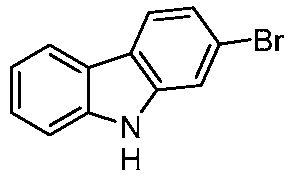
4'-브로모-2-니트로비페닐(22.40 g, 80.55 mmol) 및 P(OEt)3(150 mL)를 질소 하에 자석 교반 막대 및 응축기를 구비한 3구 둥근 바닥 플라스크에 첨가하였다. 혼합물을 오일 배쓰에서 150∼160℃로 30 시간 동안 가열하고, 상온으로 냉각시키고, 과잉 P(OEt)3를 고진공 하에 증류에 의해 제거하였다. 잔류물을 톨루엔 중에서 재결정화하여 목적 생성물 2-브로모-9H-카바졸(8.30 g)을 백색 결정으로서 얻었다. 여액을 농축시키고, 헥산 및 에틸 아세테이트(10:1-5:1)를 용리제로 사용하여 실리카 겔 컬럼 크로마토그래피를 통해 잔류물을 정제하여, 목적 생성물 2-브로모-9H-카바졸 1(52% 수율로 2.00 g)을 얻었다. 1H NMR (DMSO-d 6, 400 MHz): δ 7.17 (t, J = 7.6 Hz, 1H), 7.28 (dd, J = 8.0, 1.6 Hz, 1H), 7.41 (t, J = 7.6 Hz, 1H), 7.49 (d, J = 8.4 Hz, 1H), 7.65 (d, J = 1.6 Hz, 1H), 8.06 (d, J = 8.4 Hz, 1H), 8.11 (d, J = 7.6 Hz, 1H), 11.38 (s, 1H). 13C NMR (DMSO-d 6, 100 MHz): δ 111.22, 113.50, 118.11, 119.09, 120.36, 121.29, 121.58, 121.79, 121.90, 126.09, 139.89, 140.62. 분광분석 데이터는 이전에 보고된 것과 일치한다(Pan, J.; Wang, X.; Zhang, Y.; Buchwald, S. L. Org. Lett. 2011, 13, 4974-4976).4'-Bromo-2-nitrobiphenyl (22.40 g, 80.55 mmol) and P(OEt) 3 (150 mL) were added under nitrogen to a three necked round bottom flask equipped with a magnetic stir bar and condenser. The mixture was heated to 150-160° C. for 30 hours in an oil bath, cooled to room temperature, and excess P(OEt) 3 was removed by distillation under high vacuum. The residue was recrystallized in toluene to give the desired product 2-bromo-9 H -carbazole (8.30 g) as white crystals. The filtrate was concentrated, and hexane and ethyl acetate (10: 1-5: 1) using the zero eluting the residue was purified through silica gel column chromatography to give the desired product 2-bromo -9 H - carbazol-1 ( 2.00 g) was obtained in 52% yield. 1 H NMR (DMSO- d 6 , 400 MHz): δ 7.17 (t, J = 7.6 Hz, 1H), 7.28 (dd, J = 8.0, 1.6 Hz, 1H), 7.41 (t, J = 7.6 Hz, 1H) ), 7.49 (d, J = 8.4 Hz, 1H), 7.65 (d, J = 1.6 Hz, 1H), 8.06 (d, J = 8.4 Hz, 1H), 8.11 (d, J = 7.6 Hz, 1H), 11.38 (s, 1H). 13 C NMR (DMSO- d 6 , 100 MHz): δ 111.22, 113.50, 118.11, 119.09, 120.36, 121.29, 121.58, 121.79, 121.90, 126.09, 139.89, 140.62. Spectroscopic data are consistent with previously reported (Pan, J.; Wang, X.; Zhang, Y.; Buchwald, SL Org. Lett. 2011 , 13 , 4974-4976).
2-브로모-9-(피리딘-2-일)-9H-카바졸 2의 합성:2-bromo-9- (pyridin-2-yl) -9 H - Synthesis of Carbazole 2:
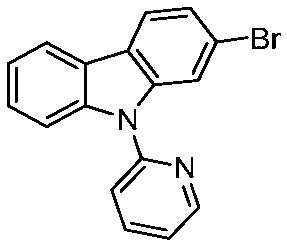
2-브로모-9H-카바졸 1(8.33 g, 34 mmol, 1.0 eq), 2-브로모피리딘(10.61 g, 68 mmol, 2.0 eq), L-프롤린(0.78 g, 6.8 mmol, 0.2 eq) 및 K2CO3(11.75 g, 85 mmol, 2.5 eq)를 자석 교반 막대가 구비된 건조 압력관에 첨가하였다. 그 후 관을 글로브 박스에 넣고, 여기에서 CuI(0.44 g, 3.4 mmol, 0.1 eq) 및 DMSO(68 mL)를 첨가하였다. 혼합물을 질소로 10 분 동안 버블링한 후 관을 밀봉하였다. 관을 글로브 박스에서 꺼내어 오일 배쓰에서 90℃로 가열하였다. 90℃에서 3 일 동안 교반한 후, 혼합물을 상온으로 냉각시키고, 물(250 mL)로 켄칭하였다. 그 후 혼합물을 에틸 아세테이트로 3 회 추출하고, 합한 유기층을 물로 3 회 세척하고, 황산마그네슘으로 건조시킨 후, 여과하고, 에틸 아세테이트로 세척하였다. 여액을 농축시키고, 헥산 및 에틸 아세테이트(20:1-10:1)를 용리제로 사용하여 실리카 겔 컬럼 크로마토그래피를 통해 잔류물을 정제하여, 목적 생성물 2-브로모-9-(피리딘-2-일)-9H-카바졸 2를 회백색 고체(78% 수율로 8.53 g)로서 얻었다. 1H NMR (DMSO-d 6, 400 MHz): δ 7.33 (t, J = 7.6 Hz, 1H), 7.45-7.50 (m, 3H), 7.74 (d, J = 8.4 Hz, 1H), 7.78 (d, J = 8.0 Hz, 1H), 7.95 (d, J = 2.0 Hz, 1H), 8.11 (td, J = 8.0, 2.0 Hz, 1H), 8.19 (d, J = 8.4 Hz, 1H), 8.24 (d, J = 7.6 Hz, 1H), 8.72 (dd, J = 4.8, 1.6 Hz, 1H). 1H NMR (CDCl3, 400 MHz): δ 7.32 (t, J = 7.6 Hz, 2H), 7.41-7.47 (m, 2H), 7.60 (d, J = 8.0 Hz, 1H), 7.77 (d, J = 8.4 Hz, 1H), 7.91-7.95 (m, 2H), 8.01 (d, J = 2.0 Hz, 1H), 8.07 (d, J = 8.0 Hz, 1H), 8.72-8.73 (m, 1H). 13C NMR (CDCl3, 100 MHz): δ 111.10, 114.35, 119.01, 119.78, 120.21, 121.26, 121.30, 121.61, 123.16, 123.64, 124.06, 126.58, 138.65, 139.60, 140.29, 149.78, 151.26. 분광분석 데이터는 이전에 보고된 것과 일치한다(Chu, J.-H.; Lin, P.-S.; Lee, Y.-M.; Shen, W.-T., Wu, M.-J. Chem. Eur. J. 2011, 17, 13613-13620). 2-Bromo--9 H - carbazol-1 (8.33 g, 34 mmol, 1.0 eq), 2- bromopyridine (10.61 g, 68 mmol, 2.0 eq), L- proline (0.78 g, 6.8 mmol, 0.2 eq ) and K 2 CO 3 (11.75 g, 85 mmol, 2.5 eq) were added to a dry pressure tube equipped with a magnetic stir bar. The tube was then placed in a glove box, to which CuI (0.44 g, 3.4 mmol, 0.1 eq) and DMSO (68 mL) were added. The mixture was bubbled with nitrogen for 10 min before sealing the tube. The tube was removed from the glove box and heated to 90° C. in an oil bath. After stirring at 90° C. for 3 days, the mixture was cooled to room temperature and quenched with water (250 mL). Then the mixture was extracted 3 times with ethyl acetate, and the combined organic layers were washed 3 times with water, dried over magnesium sulfate, filtered and washed with ethyl acetate. The filtrate was concentrated and the residue was purified via silica gel column chromatography using hexane and ethyl acetate (20:1-10:1) as eluents to obtain the desired product 2-bromo-9-(pyridine-2- yl) -9 H - carbazol-2 was obtained as an off-white solid (8.53 g) in 78% yield. 1 H NMR (DMSO- d 6 , 400 MHz): δ 7.33 (t, J = 7.6 Hz, 1H), 7.45-7.50 (m, 3H), 7.74 (d, J = 8.4 Hz, 1H), 7.78 (d) , J = 8.0 Hz, 1H), 7.95 (d, J = 2.0 Hz, 1H), 8.11 (td, J = 8.0, 2.0 Hz, 1H), 8.19 (d, J = 8.4 Hz, 1H), 8.24 (d) , J = 7.6 Hz, 1H), 8.72 (dd, J = 4.8, 1.6 Hz, 1H). 1 H NMR (CDCl 3 , 400 MHz): δ 7.32 (t, J = 7.6 Hz, 2H), 7.41-7.47 (m, 2H), 7.60 (d, J = 8.0 Hz, 1H), 7.77 (d, J) = 8.4 Hz, 1H), 7.91-7.95 (m, 2H), 8.01 (d, J = 2.0 Hz, 1H), 8.07 (d, J = 8.0 Hz, 1H), 8.72-8.73 (m, 1H). 13 C NMR (CDCl 3 , 100 MHz): δ 111.10, 114.35, 119.01, 119.78, 120.21, 121.26, 121.30, 121.61, 123.16, 123.64, 124.06, 126.58, 138.65, 139.60, 140.29, 149.78, 151.26.78 The spectroscopic data are consistent with previously reported (Chu, J.-H.; Lin, P.-S.; Lee, Y.-M.; Shen, W.-T., Wu, M.-J. (. Chem. Eur. J. 2011 , 17 , 13613-13620).
4'-요오도-2-니트로비페닐 3의 합성:Synthesis of 4'-iodo-2-nitrobiphenyl 3:
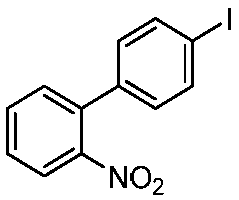
2-니트로비페닐(39.84 g, 200 mmol) 및 HIO4ㆍ2H2O(9.71 g, 42.6 mmol, 0.213 eq)를 자석 교반 막대가 구비된 1구 플라스크에 첨가하였다. 그 후, HOAc/H2O/H2SO4(200 mL/40 mL/6 mL) 혼합물 및 I2(20.20 g, 79.6 mmol, 0.398 eq)를 독립적으로 첨가하였고, 그 후 응축기를 이용하였으며, I2의 색이 거의 사라질 때까지 혼합물을 오일 배쓰에서 65∼70℃로 90 시간 동안 가열하였다. 그 후 혼합물을 상온으로 냉각시켰다. 물(500 mL)을 혼합물에 적가하고, 혼합물을 격렬히 교반하였다. 그 후, 갈색 고체를 여과하여 물로 3 회 세척하였다. 그 후, 수집된 고체를 끓는 에탄올(200 mL)에서 용해시켰다. 혼합물을 45∼50℃로 서서히 냉각시키고 그 온도에서 3 시간 동안 교반하였다. 그 후, 혼합물을 교반하면서 상온으로 서서히 냉각시켰다. 그 후, 침전물을 여과하여 소량의 에탄올로 세척하였다. 감압 하에 고체를 건조시켜 목적 생성물 4'-요오도-2-니트로비페닐 3을 회백색 고체(47% 수율로 30.52 g)로서 얻었다. 1H NMR (CDCl3, 400 MHz): δ 7.04-7.08 (m, 2H), 7.40 (dd, J = 8.0, 1.6 Hz, 1H), 7.51 (td, J = 8.0, 1.6 Hz, 1H), 7.63 (td, J = 7.6, 1.2 Hz, 1H), 7.75-7.78 (m, 2H), 7.89 (dd, J = 8.2, 1.6 Hz, 1H). 13C NMR (CDCl3, 100 MHz): δ 94.26, 124.28, 128.56, 129.69, 131.71, 132.49, 135.33, 136.99, 137.78, 148.91. 분광분석 데이터는 이전에 보고된 것과 일치한다(Kuethe, J. T.; Childers, K. G. Adv. Synth. Catal. 2008, 350, 1577-1586).2-Nitrobiphenyl (39.84 g, 200 mmol) and HIO 4 .2H 2 O (9.71 g, 42.6 mmol, 0.213 eq) were added to a one-necked flask equipped with a magnetic stir bar. Then HOAc/H 2 O/H 2 SO 4 (200 mL/40 mL/6 mL) mixture and I 2 (20.20 g, 79.6 mmol, 0.398 eq) were added independently, then using a condenser, The mixture was heated in an oil bath at 65-70° C. for 90 hours until the color of I 2 almost disappeared. Then the mixture was cooled to room temperature. Water (500 mL) was added dropwise to the mixture and the mixture was stirred vigorously. Then, the brown solid was filtered and washed 3 times with water. The collected solid was then dissolved in boiling ethanol (200 mL). The mixture was cooled slowly to 45-50° C. and stirred at that temperature for 3 hours. Thereafter, the mixture was cooled slowly to room temperature while stirring. Then, the precipitate was filtered and washed with a small amount of ethanol. The solid was dried under reduced pressure to give the desired product 4'-iodo-2-
1-(2'-니트로비페닐-4-일)-1H-피라졸 4의 합성:1- (2'-knit lobby-4-yl) -1 H - pyrazole-4:
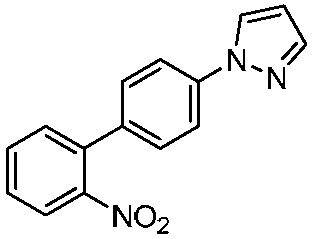
4'-요오도-2-니트로비페닐 3(9.75 g, 30 mmol, 1.0 eq), 1H-피라졸(2.45 g, 36 mmol, 1.2 eq) 및 K2CO3(8.71 g, 63 mmol, 3.1 eq)를 자석 교반 막대가 구비된 건조 압력관에 첨가하였다. 그 후, 관을 글로브 박스에 넣고, 여기에서 CuI(0.11 g, 0.6 mmol, 0.02 eq), 트랜스-1,2-사이클로헥산디아민(0.34 g, 3 mmol, 0.1 eq) 및 디옥산(30 mL)을 첨가하였다. 혼합물을 질소로 5 분 동안 버블링한 후 관을 밀봉하였다. 글로브 박스에서 관을 꺼내어 오일 배쓰에서 105∼115℃로 가열하였다. 반응을 TLC로 모니터링하였고, 약 68 시간 후 출발 물질 5가 완전히 소비되었다. 그 후, 혼합물을 상온으로 냉각시켜, 에틸 아세테이트로 희석한 후, 여과하고, 에틸 아세테이트로 세척하였다. 여액을 농축시키고, 헥산 및 에틸 아세테이트(10:1-3:1)를 용리제로 사용하여 실리카 겔 컬럼 크로마토그래피를 통해 잔류물을 정제하여, 목적 생성물 1-(2'-니트로비페닐-4-일)-1H-피라졸 4를 회백색 고체(94% 수율로 7.5 g)로서 얻었다. 1H NMR (DMSO-d 6, 400 MHz): δ 6.57 (t, J = 2.0 Hz, 1H), 7.46 (d, J = 8.4 Hz, 2H), 7.59-7.65 (m, 2H), 7.75-7.79 (m, 2H), 7.92 (d, J = 8.4 Hz, 2H), 7.99-8.01 (m, 1H), 8.56 (d, J = 2.4 Hz, 1H). 13C NMR (DMSO-d 6, 100 MHz): δ 108.14, 118.56, 124.20, 127.88, 128.99, 129.06, 131.83, 133.01, 134.26, 134.62, 139.51, 141.33, 148.82.4'-iodo-2- nitrobiphenyl 3 ( 9.75 g, 30 mmol, 1.0 eq), 1 H -pyrazole (2.45 g, 36 mmol, 1.2 eq) and K 2 CO 3 (8.71 g, 63 mmol, 3.1 eq) was added to a dry pressure tube equipped with a magnetic stir bar. The tube is then placed in a glove box, in which CuI (0.11 g, 0.6 mmol, 0.02 eq), trans-1,2-cyclohexanediamine (0.34 g, 3 mmol, 0.1 eq) and dioxane (30 mL) was added. The mixture was bubbled with nitrogen for 5 min before sealing the tube. The tube was removed from the glove box and heated to 105-115° C. in an oil bath. The reaction was monitored by TLC and starting
2-(1H-피라졸-1-일)-9H-카바졸 5의 합성:Synthesis of 2-(1 H -pyrazol-1-yl)-9 H -carbazole 5 :
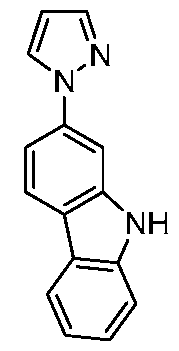
1-(2'-니트로비페닐-4-일)-1H-피라졸 4(7.23 g, 27.26 mmol)를 자석 교반 막대 및 응축기를 구비한 3구 플라스크에 첨가하였다. 플라스크를 배기시키고 질소로 재충전하였다. 배기 및 재충전 절차는 2 회 반복하였고, 그 후 P(OEt)3(150 mL)를 질소 하에 첨가하였다. 혼합물을 오일 배쓰에서 150∼165℃의 온도로 24 시간 동안 교반하였다. 그 후 혼합물을 냉각시키고, 과잉 P(OEt)3를 고진공 하에 증류로 제거하였다. 잔류물을 에틸 아세테이트 중에서 재결정화하여, 목적 생성물을 백색 고체(3.60 g)로서 얻었다. 여액을 농축시키고, 헥산 및 에틸 아세테이트(10:1-5:1-3:1-2:1)를 용리제로 사용하여 실리카 겔 컬럼 크로마토그래피를 통해 잔류물을 정제하여, 추가분의 목적 생성물 2-(1H-피라졸-1-일)-9H-카바졸 5(77% 수율로 1.30 g)을 얻었다. 1H NMR(DMSO-d 6, 400 MHz): δ 6.55-6056 (m, 1H), 7.17 (t, J = 7.6 Hz, 1H), 7.36-7.40 (m, 1H), 7.48-7.50 (m, 1H), 7.64 (dt, J = 8.0, 0.8 Hz, 1H), 7.76 (s, 1H), 7.90 (d, J = 2.0 Hz, 1H), 8.11 (d, J = 7.6 Hz, 1H), 8.18 (d, J = 8.8 Hz, 1H), 8.55 (d, J = 2.8 Hz, 1H), 11.40 (s, 1H). 13C NMR (DMSO-d 6, 100 MHz): δ100.97, 107.65, 109.96, 111.01, 118.94, 120.16, 120.74, 120.99, 122.11, 125.55, 127.96, 137.87, 140.11, 140.42, 140.71.1- (2'-knit lobby-4-yl) -1 H - pyrazole 4 (7.23 g, 27.26 mmol) was added to a 3-neck flask equipped with a magnetic stir bar and a condenser. The flask was evacuated and backfilled with nitrogen. The evacuation and refill procedure was repeated twice, after which P(OEt) 3 (150 mL) was added under nitrogen. The mixture was stirred in an oil bath at a temperature of 150-165° C. for 24 hours. The mixture was then cooled and excess P(OEt) 3 was removed by distillation under high vacuum. The residue was recrystallized in ethyl acetate to give the desired product as a white solid (3.60 g). Concentrate the filtrate and purify the residue via silica gel column chromatography using hexanes and ethyl acetate (10:1-5:1-3:1-2:1) as eluents to obtain additional desired product 2- (1 H - pyrazol-1-yl) -9 H - to give the carbazole 5 (1.30 g in 77% yield). 1 H NMR (DMSO- d 6 , 400 MHz): δ 6.55-6056 (m, 1H), 7.17 (t, J = 7.6 Hz, 1H), 7.36-7.40 (m, 1H), 7.48-7.50 (m, 1H), 7.64 (dt, J = 8.0, 0.8 Hz, 1H), 7.76 (s, 1H), 7.90 (d, J = 2.0 Hz, 1H), 8.11 (d, J = 7.6 Hz, 1H), 8.18 ( d, J = 8.8 Hz, 1H), 8.55 (d, J = 2.8 Hz, 1H), 11.40 (s, 1H). 13 C NMR (DMSO- d 6 , 100 MHz): δ100.97, 107.65, 109.96, 111.01, 118.94, 120.16, 120.74, 120.99, 122.11, 125.55, 127.96, 137.87, 140.11, 140.42, 140.71.
2'-(1H-피라졸-1-일)-9-(피리딘-2-일)-9H-2,9'-비카바졸 리간드 N1N의 합성:2 '- (1 H - pyrazol-1-yl) -9- (pyridin-2-yl) -9 H -2,9'- non-carbazol-ligand N1N Synthesis of:
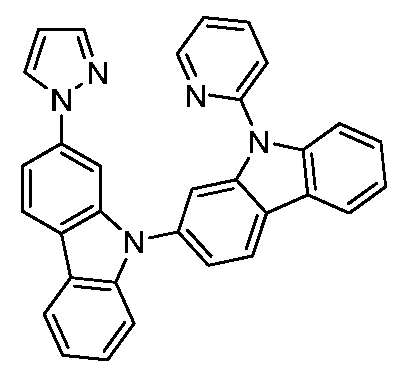
2-(1H-피라졸-1-일)-9H-카바졸 5(3.50 g, 15.0 mmol, 1.0 eq), 2-브로모-9-(피리딘-2-일)-9H-카바졸 2(5.82 g, 18 mmol, 1.2 eq), Pd2(dba)3(0.28 g, 0.3 mmol, 0.02 eq), 및 JohnPhos(2-비페닐)디-tert-부틸포스핀)(0.18 g, 0.6 mmol, 0.04 eq)을 자석 교반 막대가 구비된 건조 압력관에 첨가하였다. 그 후, 관을 글로브 박스에 넣었다. t BuONa(2.02 g, 21 mmol, 1.4 eq) 및 무수 톨루엔(60 mL)을 첨가하였다. 혼합물을 질소로 10 분 동안 버블링한 후 관을 밀봉하였다. 글로브 박스에서 관을 꺼내어 오일 배쓰에서 95∼105℃로 가열하였다. 반응을 TLC로 모니터링하였고, 약 6 시간 후 출발 물질 5가 완전히 소비되었다. 그 후 혼합물을 상온으로 냉각시키고, 에틸 아세테이트로 희석하였다. 혼합물을 농축시키고, 헥산 및 에틸 아세테이트(10:1-5:1-3:1)를 용리제로 사용하여 실리카 겔 컬럼 크로마토그래피를 통해 정제하여, 목적 생성물 2'-(1H-피라졸-1-일)-9-(피리딘-2-일)-9H-2,9'-비카바졸 리간드 N1N을 갈색 고체(96% 수율로 6829 mg)로서 얻었다. 1H NMR (DMSO-d 6, 400 MHz): δ 6.53 (t, J = 1.6 Hz, 1H), 7.31-7.35 (m, 1H), 7.42-7.47 (m, 4H), 7.57 (t, J = 8.4 Hz, 1H), 7.61 (dd, J = 8.0, 1.6 Hz, 1H), 7.70 (d, J = 1.6 Hz, 1H), 7.81 (dd, J = 8.8, 1.6 Hz, 1H), 7.86 (d, J = 1.2 Hz, 1H), 7.90 (d, J = 8.4 Hz, 2H), 8.05 (d, J = 1.6 Hz, 1H), 8.09 (td, J = 8.0, 1.6 Hz, 1H), 8.30 (d, J = 7.6 Hz, 1H), 8.38 (d, J = 8.4 Hz, 1H), 8.41 (d, J = 8.0 Hz, 1H), 8.57-8.60 (m, 2H), 8.67-8.68 (m, 1H). 1H NMR (CDCl3, 400 MHz): δ 6.42 (t, J = 2.0 Hz, 1H), 7.22-7.26 (m, 1H), 7.28-7.32 (m, 1H), 7.37-7.43 (m, 3H), 7.48-7.52 (m, 2H), 7.61 (dd, J = 8.0, 1.6 Hz, 1H), 7.66 (d, J = 8.0 Hz, 1H), 7.68 (d, J = 1.6 Hz, 1H), 7.76 (d, J = 2.0 Hz, 1H), 7.84-7.89 (m, 2H), 7.94 (d, J = 2.4 Hz, 1H), 8.04 (d, J = 2.0 Hz, 1H), 8.13 (d, J = 7.2 Hz, 1H), 8.16-8.20 (m, 2H), 8.31 (d, J = 8.0 Hz, 1H), 8.63 (dd, J = 4.8, 0.8 Hz, 1H). 13C NMR (CDCl3, 100 MHz): δ 101.22, 107.40, 110.12, 110.64, 111.21, 111.81, 119.00, 120.16, 120.20, 120.24, 120.42, 120.99, 121.40, 121.43, 121.56, 121.72, 122.77, 123.78, 123.97, 126.01, 126.70, 127.21, 135.08, 138.69, 138.70, 140.29, 140.31, 140.88, 141.94, 142.22, 149.77, 151.36.2- (1 H - pyrazol-1-yl) -9 H - carbazol-5 (3.50 g, 15.0 mmol, 1.0 eq), 2- bromo-9- (pyridin-2-yl) -9 H - carbazol Sol 2 (5.82 g, 18 mmol, 1.2 eq), Pd 2 (dba) 3 (0.28 g, 0.3 mmol, 0.02 eq), and JohnPhos(2-biphenyl)di- tert -butylphosphine) (0.18 g, 0.6 mmol, 0.04 eq) was added to a dry pressure tube equipped with a magnetic stir bar. After that, the tube was placed in a glove box. t BuONa (2.02 g, 21 mmol, 1.4 eq) and anhydrous toluene (60 mL) were added. The mixture was bubbled with nitrogen for 10 min before sealing the tube. The tube was removed from the glove box and heated to 95-105° C. in an oil bath. The reaction was monitored by TLC and the starting
2'-(1H-피라졸-1-일)-9-(피리딘-2-일)-9H-2,9'-비카바졸 백금 착물 PtN1N의 합성:2 '- (1 H - pyrazol-1-yl) -9- (pyridin-2-yl) -9 H -2,9'- non-carbazol-platinum complex PtN1N Synthesis of:

2'-(1H-피라졸-1-일)-9-(피리딘-2-일)-9H-2,9'-비카바졸 리간드 N1N(1427 mg, 3.0 mmol, 1.0eq), K2PtCl4(1308 mg, 3.15 mmol, 1.05 eq) 및 n Bu4NBr(97 mg, 0.3 mmol, 0.1 eq)를 자석 교반 막대가 구비된 건조 압력관에 첨가하였다. 그 후, 관을 글로브 박스에 넣고, 아세트산(180 mL)을 첨가하였다. 혼합물을 질소로 30 분 동안 버블링한 후, 관을 밀봉하였다. 글로브 박스에서 관을 꺼내어 혼합물을 실온에서 20 시간 동안 교반하였다. 그 후 혼합물을 오일 배쓰에서 105∼115℃로 가열하고 그 온도에서 3 일 동안 교반한 후 상온으로 냉각시키고, 물(180 mL)을 천천히 첨가하였다. 실온에서 10 분 동안 교반한 후, 침전물을 여과하여 물로 3 회 세척하였다. 그 후, 고체를 감압 하에 공기 중에서 건조시켰다. 수집된 고체를, 디클로로메탄을 용리제로 사용하여 실리카 겔 크로마토그래피를 통해 정제하여, 목적 생성물 2'-(1H-피라졸-1-일)-9-(피리딘-2-일)-9H-2,9'-비카바졸 백금 착물 PtN1N을 황색 고체(44% 수율로 872 mg)로서 얻었다. 생성물(546 mg)을 고진공 하에 4존 컨트롤러를 갖는 승화기에서 승화시켜 추가로 정제하였다. 승화 조건은 다음과 같았다: 180℃, 180℃, 140℃, 100℃C, 4.6×10⁻⁶ Pa, 0.5 시간 동안; 그 후 200℃, 200℃, 170℃, 140℃, 4.1×10⁻⁶ Pa, 19 시간; 그 후 255℃, 255℃, 210℃, 180℃, 4.1×10⁻⁶ Pa, 1 시간; 그 후 265℃, 260℃, 210℃, 180℃, 4.1×10⁻⁶ Pa, 1.5 시간; 그 후 270℃, 265℃, 210℃, 180℃, 4.1×10⁻⁶ Pa, 93 시간; 그 후 275℃, 265℃, 210℃, 180℃, 4.1×10⁻⁶ Pa, 48 시간. 그 후 승화기를 상온으로 냉각시켜, 목적 생성물 PtN1N을 황색 고체(54% 수율로 295 mg)로서 얻었다. 도 1은 실온에서의 CH2Cl2 중의 PtN1N의 방출 스펙트럼을 도시한다. 1H NMR (DMSO-d 6, 400 MHz): δ 6.86 (t, J = 2.0 Hz, 1H), 7.30 (t, , J = 7.6 Hz, 1H), 7.40-7.44 (m, 2H), 7.48-7.52 (m, 2H), 7.70 (d, J = 8.4 Hz, 1H), 7.95 (d, J = 8.0 Hz, 1H), 8.00 (d, J = 8.0 Hz, 1H), 8.07 (d, J = 8.0 Hz, 1H), 8.10 (d, J = 2.0 Hz, 1H), 8.14 (d, J = 8.0 Hz, 1H), 8.20-8.27 (m, 5H), 8.90 (d, J = 2.8 Hz, 1H), 9.20 (d, J = 5.6 Hz, 1H). 13C NMR (DMSO-d 6, 100 MHz): δ 106.00, 107.65, 108.24, 11.58, 113.00, 113.54, 114.40, 115.31, 115.35, 116.47, 116.93, 118.27, 120.19, 120.45, 120.59, 120.91, 122.89, 125.09, 125.59, 126.09, 127.48, 128.87, 137.97, 138.21, 138.27, 139.28, 139.91, 140.23, 143.32, 143.35, 147.26, 151.84. C32H19N5Pt에 대한 분석 계산치: C, 57.48, H, 2.86, N, 10.47; 실측치: C, 57.29, H, 3.06, N, 10.39.2 '- (1 H - pyrazol-1-yl) -9- (pyridin-2-yl) -9 H -2,9'- non-carbazol-ligand N1N (1427 mg, 3.0 mmol, 1.0eq), K 2 PtCl 4 (1308 mg, 3.15 mmol, 1.05 eq) and n Bu 4 NBr (97 mg, 0.3 mmol, 0.1 eq) were added to a dry pressure tube equipped with a magnetic stir bar. The tube was then placed in a glove box and acetic acid (180 mL) was added. After the mixture was bubbled with nitrogen for 30 min, the tube was sealed. The tube was removed from the glove box and the mixture was stirred at room temperature for 20 hours. After that, the mixture was heated to 105-115° C. in an oil bath, stirred at that temperature for 3 days, cooled to room temperature, and water (180 mL) was slowly added. After stirring at room temperature for 10 minutes, the precipitate was filtered and washed three times with water. The solid was then dried in air under reduced pressure. The collected solid was purified through silica gel chromatography using dichloromethane as eluent, resulting in the desired product 2'-(1 H -pyrazol-1-yl)-9-(pyridin-2-yl)-9 H The -2,9'-bicarbazole platinum complex PtN1N was obtained as a yellow solid (872 mg in 44% yield). The product (546 mg) was further purified by sublimation in a sublimer with a 4 zone controller under high vacuum. The sublimation conditions were as follows: 180° C., 180° C., 140° C., 100° C., 4.6×10 −6 Pa, for 0.5 h; then 200°C, 200°C, 170°C, 140°C, 4.1×10 -6 Pa, 19 hours; then 255° C., 255° C., 210° C., 180° C., 4.1×10 -6 Pa, 1 hour; then 265°C, 260°C, 210°C, 180°C, 4.1×10 -6 Pa, 1.5 hours; then 270°C, 265°C, 210°C, 180°C, 4.1×10 -6 Pa, 93 hours; Then 275°C, 265°C, 210°C, 180°C, 4.1×10 -6 Pa, 48 hours. Then, the sublimer was cooled to room temperature to obtain the desired product PtN1N as a yellow solid (295 mg in 54% yield). 1 shows the emission spectrum of PtN1N in CH 2 Cl 2 at room temperature. 1 H NMR (DMSO- d 6 , 400 MHz): δ 6.86 (t, J = 2.0 Hz, 1H), 7.30 (t, , J = 7.6 Hz, 1H), 7.40-7.44 (m, 2H), 7.48- 7.52 (m, 2H), 7.70 (d, J = 8.4 Hz, 1H), 7.95 (d, J = 8.0 Hz, 1H), 8.00 (d, J = 8.0 Hz, 1H), 8.07 (d, J = 8.0) Hz, 1H), 8.10 (d, J = 2.0 Hz, 1H), 8.14 (d, J = 8.0 Hz, 1H), 8.20-8.27 (m, 5H), 8.90 (d, J = 2.8 Hz, 1H), 9.20 (d, J = 5.6 Hz, 1H). 13 C NMR (DMSO- d 6 , 100 MHz): δ 106.00, 107.65, 108.24, 11.58, 113.00, 113.54, 114.40, 115.31, 115.35, 116.47, 116.93, 118.27, 120.19, 120.45, 120.59, 120.91, 125.09 125.59, 126.09, 127.48, 128.87, 137.97, 138.21, 138.27, 139.28, 139.91, 140.23, 143.32, 143.35, 147.26, 151.84. Analytical calculations for C 32 H 19 N 5 Pt: C, 57.48, H, 2.86, N, 10.47; Found: C, 57.29, H, 3.06, N, 10.39.
실시예 2.Example 2.
백금 착물 PtN1NMe는 하기 반응식에 따라 제조될 수 있다:The platinum complex PtN1NMe can be prepared according to the following scheme:

9-(2'-니트로비페닐-4-일)-2-(1H-피라졸-1-일)-9H-카바졸 6의 합성:9- (2'-knit lobby-4-yl) -2- (1 H - pyrazol-1-yl) -9 H - Synthesis of carbazole 6:

2-(1H-피라졸-1-일)-9H-카바졸 5(1.35 g, 5.78 mmol, 1.0 eq), 4'-요오도-2-니트로비페닐 3(2.26 g, 6.94 mmol, 1.2 eq), K3PO4(2.58 g, 12.14 mmol, 2.1 eq) 및 CuI(55 mg, 0.29 mmol, 0.05 eq)를 자석 교반 막대가 구비된 건조 압력관에 첨가하였다. 관을 배기시키고 질소로 재충전하였다. 배기 및 재충전 절차는 2 회 반복하였고, 그 후 1,2-사이클로헥산디아민(0.33 g, 290 ㎕, 2.89 mmol, 0.5 eq) 및 디옥산(20 mL)을 첨가하였다. 혼합물을 질소로 30 분 동안 버블링한 후 관을 밀봉하였다. 혼합물을 오일 배쓰에서 110∼120℃의 온도로 3 일 동안 교반하였고, 그 후 상온으로 냉각시켰다. 감압 하에 용매를 제거하고, 헥산 및 에틸 아세테이트(10:1-3:1)를, 그 후 디클로메탄 및 메탄올(20:1)을 용리제로 사용하여 실리카 겔 컬럼 크로마토그래피를 통해 잔류물을 정제하여, 목적 생성물 9-(2'-니트로비페닐-4-일)-2-(1H-피라졸-1-일)-9H-카바졸 6을 갈색 고체(80% 수율로 1.98 g)로서 얻었다. 1H NMR (DMSO-d 6, 400 MHz): δ 6.55 (t, J = 1.6 Hz, 1H), 7.32-7.36 (m, 1H), 7.42 (d, J = 8.0 Hz, 1H), 7.45-7.49 (m, 1H), 7.67-7.76 (m, 5H), 7.78-7.81 (m, 3H), 7.84 (dd, J = 8.0, 1.6 Hz, 1H), 7.87 (d, J = 1.6 Hz, 1H), 8.08 (dd, J = 8.4, 1.2 Hz, 1H), 8.29 (d, J = 8.0 Hz, 1H), 8.37 (d, J = 8.4 Hz, 1H), 8.59 (d, J = 1.6 Hz, 1H).2-(1 H -pyrazol-1-yl)-9 H -carbazole 5 (1.35 g, 5.78 mmol, 1.0 eq), 4'-iodo-2- nitrobiphenyl 3 (2.26 g, 6.94 mmol, 1.2 eq), K 3 PO 4 (2.58 g, 12.14 mmol, 2.1 eq) and CuI (55 mg, 0.29 mmol, 0.05 eq) were added to a dry pressure tube equipped with a magnetic stir bar. The tube was evacuated and backfilled with nitrogen. The evacuation and refill procedure was repeated twice, after which 1,2-cyclohexanediamine (0.33 g, 290 μl, 2.89 mmol, 0.5 eq) and dioxane (20 mL) were added. The mixture was bubbled with nitrogen for 30 min before the tube was sealed. The mixture was stirred in an oil bath at a temperature of 110-120° C. for 3 days, and then cooled to room temperature. The solvent was removed under reduced pressure, and the residue was purified by silica gel column chromatography using hexane and ethyl acetate (10:1-3:1), then dichloromethane and methanol (20:1) as eluents. the desired product of 9- (2'-knit lobby-4-yl) -2- (1 H - pyrazol-1-yl) -9 H - (1.98 g in 80% yield) of 6-carbazol-brown solid obtained as 1 H NMR (DMSO- d 6 , 400 MHz): δ 6.55 (t, J = 1.6 Hz, 1H), 7.32-7.36 (m, 1H), 7.42 (d, J = 8.0 Hz, 1H), 7.45-7.49 (m, 1H), 7.67-7.76 (m, 5H), 7.78-7.81 (m, 3H), 7.84 (dd, J = 8.0, 1.6 Hz, 1H), 7.87 (d, J = 1.6 Hz, 1H), 8.08 (dd, J = 8.4, 1.2 Hz, 1H), 8.29 (d, J = 8.0 Hz, 1H), 8.37 (d, J = 8.4 Hz, 1H), 8.59 (d, J = 1.6 Hz, 1H).
2'-(1H-피라졸-1-일)-9H-2,9'-비카바졸 7의 합성:Synthesis of 2'-(1 H -pyrazol-1-yl)-9 H -2,9'-bicarbazole 7:

9-(2'-니트로비페닐-4-일)-2-(1H-피라졸-1-일)-9H-카바졸 6(1.95 g, 4.53 mmol, 1.0 eq) 및 PPh3(3.57 g, 13.59 mmol, 3.0 eq)를 자석 교반 막대 및 응축기를 구비한 3구 플라스크에 첨가하였다. 플라스크를 배기시키고 질소로 재충전하였다. 배기 및 재충전 절차는 2 회 반복하였고, 그 후 1,2-디클로로벤젠(25 mL)을 질소 하에 첨가하였다. 혼합물을 오일 배쓰에서 24 시간 동안 환류시키고(175∼185℃), 그 후 냉각시키고, 고진공 하에 증류에 의해 용매를 제거하였다. 헥산 및 에틸 아세테이트(10:1-5:1-3:1)를 용리제로 사용하여 실리카 겔 컬럼 크로마토그래피를 통해 잔류물을 정제하여, 목적 생성물 2'-(1H-피라졸-1-일)-9H-2,9'-비카바졸 7을 백색 고체(94% 수율로 1.69 g)로서 얻었다. 1H NMR (DMSO- d 6, 400 MHz): δ 6.51 (t, J = 1.6 Hz, 1H), 7.24 (t, J = 7.2 Hz, 1H), 7.30-7.34 (m, 1H), 7.39 (dd, J = 8.4, 1.2 Hz, 1H), 7.41-7.47 (m, 3H), 7.57 (d, J = 8.0 Hz, 1H), 7.67 (d, J = 1.6 Hz, 1H), 7.72 (d, J = 1.6 Hz, 1H), 7.79 (dd, J = 8.0, 1.6 Hz, 1H), 7.85 (d, J = 1.6 Hz, 1H), 8.24 (d, J = 7.6 Hz, 1H), 8.29 (d, J = 8.0 Hz, 1H), 8.37 (d, J = 8.8 Hz, 1H), 8.41 (d, J = 8.0 Hz, 1H), 8.56 (d, J = 2.0 Hz, 1H), 11.51 (s, 1H).9-(2′-nitrobiphenyl-4-yl)-2-(1 H -pyrazol-1-yl)-9 H -carbazole 6 (1.95 g, 4.53 mmol, 1.0 eq) and PPh 3 (3.57 g, 13.59 mmol, 3.0 eq) was added to a three-necked flask equipped with a magnetic stir bar and condenser. The flask was evacuated and backfilled with nitrogen. The evacuation and recharge procedure was repeated twice, after which 1,2-dichlorobenzene (25 mL) was added under nitrogen. The mixture was refluxed (175-185° C.) in an oil bath for 24 h, then cooled and the solvent removed by distillation under high vacuum. Purify the residue via silica gel column chromatography using hexane and ethyl acetate (10:1-5:1-3:1) as eluents to obtain the desired product 2'-(1 H -pyrazol-1-yl) ) -9 H -2,9'- obtain a non-carbazol-7 as a white solid (1.69 g) in 94% yield. 1 H NMR (DMSO- d 6 , 400 MHz): δ 6.51 (t, J = 1.6 Hz, 1H), 7.24 (t, J = 7.2 Hz, 1H), 7.30-7.34 (m, 1H), 7.39 (dd , J = 8.4, 1.2 Hz, 1H), 7.41-7.47 (m, 3H), 7.57 (d, J = 8.0 Hz, 1H), 7.67 (d, J = 1.6 Hz, 1H), 7.72 (d, J = 1.6 Hz, 1H), 7.79 (dd, J = 8.0, 1.6 Hz, 1H), 7.85 (d, J = 1.6 Hz, 1H), 8.24 (d, J = 7.6 Hz, 1H), 8.29 (d, J = 8.0 Hz, 1H), 8.37 (d, J = 8.8 Hz, 1H), 8.41 (d, J = 8.0 Hz, 1H), 8.56 (d, J = 2.0 Hz, 1H), 11.51 (s, 1H).
9-(4-메틸피리딘-2-일)-2'-(1H-피라졸-1-일)-9H-2,9'-비카바졸 리간드 N1NMe의 합성:9- (4-methylpyridin-2-yl) -2 '- (1 H - pyrazol-1-yl) -9 H -2,9'- non-carbazol-ligand N1NMe Synthesis of:
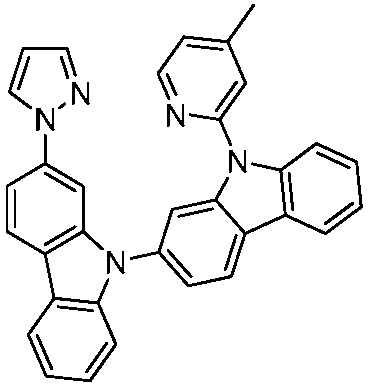
2'-(1H-피라졸-1-일)-9H-2,9'-비카바졸 7(398 mg, 1.0 mmol, 1.0 eq), Pd2(dba)3(18 mg, 0.02 mmol, 0.02 eq), JohnPhos(12 mg, 0.4 mmol, 0.4 eq) 및 t BuONa(154 mg, 1.6 mmol, 1.6 eq)를 자석 교반 막대가 구비된 건조 압력 슐렝크관(Schlenk tube)에 첨가하였다. 그 후 관을 배기시키고 질소로 재충전하였다. 배기 및 재충전 절차는 2 회 반복하였으며, 그 후 무수 톨루엔(3 mL) 및 2-브로모-4-메틸-부틸피리딘(258 mg, 1.5 mmol, 1.5 eq)을 질소 하에 첨가하였다. 관을 밀봉하고 혼합물을 오일 배쓰에서 100∼105℃로 2 일 동안 교반하였다. 그 후 혼합물을 상온으로 냉각시켰다. 감압 하에 용매를 제거하였고, 헥산 및 에틸 아세테이트(10:1-5:1)를 용리제로 사용하여 실리카 겔 컬럼 크로마토그래피를 통해 잔류물을 정제하여, 목적 생성물 9-(4-메틸피리딘-2-일)-2'-(1H-피라졸-1-일)-9H-2,9'-비카바졸 리간드 N1NMe를 백색 고체(83% 수율로 415 mg)로서 얻었다. 1H NMR (DMSO-d 6, 400 MHz): δ 2.39 (s, 3H), 6.50 (t, J = 2.4 Hz, 1H), 7.25 (d, J = 5.2 Hz, 1H), 7.28-7.32 (m, 1H), 7.39-7.43 (m, 3H), 7.52-7.56 (m, 1H), 7.58 (dd, J = 8.1, 1.6 Hz, 1H), 7.67 (d, J = 1.6 Hz, 1H), 7.69 (s, 1H), 7.78 (dd, J = 8.0, 1.6 Hz, 1H), 7.85 (s, 1H), 7.86 (d, J = 8.8 Hz, 1H), 8.00 (d, J = 2.0 Hz, 1H), 8.27 (d, J = 7.6 Hz, 1H), 8.36 (t, J = 8.8 Hz, 2H), 8.48 (d, J = 5.2 Hz, 1H), 8.55 (d, J = 5.6 Hz, 1H), 8.56 (s, 1H).2'-(1 H -pyrazol-1-yl)-9 H -2,9'-bicarbazole 7 (398 mg, 1.0 mmol, 1.0 eq), Pd 2 (dba) 3 (18 mg, 0.02 mmol) , 0.02 eq), JohnPhos (12 mg, 0.4 mmol, 0.4 eq) and t BuONa (154 mg, 1.6 mmol, 1.6 eq) were added to a dry pressure Schlenk tube equipped with a magnetic stir bar. The tube was then evacuated and backfilled with nitrogen. The evacuation and recharge procedure was repeated twice, after which anhydrous toluene (3 mL) and 2-bromo-4-methyl-butylpyridine (258 mg, 1.5 mmol, 1.5 eq) were added under nitrogen. The tube was sealed and the mixture stirred in an oil bath at 100-105° C. for 2 days. Then the mixture was cooled to room temperature. The solvent was removed under reduced pressure, and the residue was purified through silica gel column chromatography using hexane and ethyl acetate (10:1-5:1) as eluents to obtain the desired product 9-(4-methylpyridine-2- yl) -2 '- (1 H - pyrazol-1-yl) -9 H -2,9'- non-carbazol-ligand N1NMe was obtained as a white solid (415 mg 83% yield). 1 H NMR (DMSO- d 6 , 400 MHz): δ 2.39 (s, 3H), 6.50 (t, J = 2.4 Hz, 1H), 7.25 (d, J = 5.2 Hz, 1H), 7.28-7.32 (m) , 1H), 7.39-7.43 (m, 3H), 7.52-7.56 (m, 1H), 7.58 (dd, J = 8.1, 1.6 Hz, 1H), 7.67 (d, J = 1.6 Hz, 1H), 7.69 ( s, 1H), 7.78 (dd, J = 8.0, 1.6 Hz, 1H), 7.85 (s, 1H), 7.86 (d, J = 8.8 Hz, 1H), 8.00 (d, J = 2.0 Hz, 1H), 8.27 (d, J = 7.6 Hz, 1H), 8.36 (t, J = 8.8 Hz, 2H), 8.48 (d, J = 5.2 Hz, 1H), 8.55 (d, J = 5.6 Hz, 1H), 8.56 ( s, 1H).
9-(4-메틸피리딘-2-일)-2'-(1H-피라졸-1-일)-9H-2,9'-비카바졸 백금 착물 PtN1Nme의 합성:9- (4-methylpyridin-2-yl) -2 '- (1 H - pyrazol-1-yl) -9 H -2,9'- non-carbazol-platinum complex PtN1Nme Synthesis of:
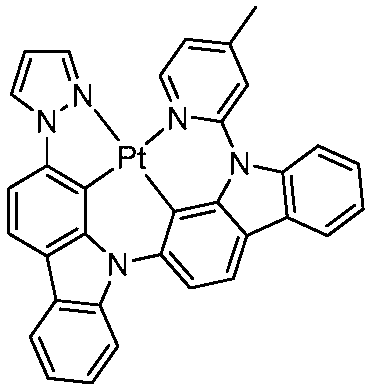
9-(4-메틸피리딘-2-일)-2'-(1H-피라졸-1-일)-9H-2,9'-비카바졸 리간드 N1NMe(405 mg, 0.81 mmol, 1.0 eq), K2PtCl4(353 mg, 0.85 mmol, 1.05 eq), n Bu4NBr(26 mg, 0.081 mmol, 0.1 eq) 및 아세트산(49 mL)을 자석 교반 막대가 구비된 건조 압력관에 첨가하였다. 혼합물을 질소로 30 분 동안 버블링한 후 관을 밀봉하였다. 그 후 혼합물을 실온에서 24 시간 동안 교반하였다. 그 후 혼합물을 오일 배쓰에서 110∼115℃로 가열하였고 그 온도에서 4 일 동안 교반한 후, 상온으로 냉각시키고, 물(60 mL)을 첨가하였다. 실온에서 5 분 동안 교반한 후, 침전물을 여과하고 물로 3 회 세척하였다. 그 후 고체를 감압 하에 공기 중에서 건조시켰다. 수집된 고체를, 디클로로메탄을 용리제로 사용하여 실리카 겔 컬럼 크로마토그래피를 통해 정제하여, 목적 생성물 9-(4-메틸피리딘-2-일)-2'-(1H-피라졸-1-일)-9H-2,9'-비카바졸 백금 착물 PtN1NMe을 황색 고체(47% 수율로 260 mg)를 얻었다. 도 1은 실온에서의 CH2Cl2 중의 PtN1NMe의 방출 스펙트럼을 도시한다. 1H NMR (DMSO-d 6, 400 MHz): δ 2.46 (s, 3H), 6.85 (t, J = 2.4 Hz, 1H), 7.28-7.31 (m, 2H), 7.42 (t, J = 7.6 Hz, 1H), 7.48 (d, J = 7.6 Hz, 1H), 7.52 (d, J = 7.6 Hz, 1H), 7.68 (d, J = 8.4 Hz, 1H), 7.94 (d, J = 8.0 Hz, 1H), 7.99 (d, J = 8.4 Hz, 1H), 8.06 (s, 1H), 8.08 (d, J = 1.6 Hz, 1H), 8.10 (d, J = 7.6 Hz, 1H), 8.12 (d, J = 8.8 Hz, 1H), 8.20 (d, J = 4.0 Hz, 1H), 8.21 (d, J = 4.0 Hz, 1H), 8.25 (d, J = 8.0 Hz, 1H), 8.88 (d, J = 2.4 Hz, 1H), 9.05 (d, J = 6.4 Hz, 1H). 13C NMR (DMSO-d 6, 100 MHz): δ 21.03, 105.99, 107.64, 108.36, 111.91, 113.01, 113.50, 114.50, 115.23, 115.24, 116.27, 116.93, 118.25, 120.13, 120.42, 120.92, 121.86, 122.73, 125.12, 125.58, 126.09, 127.43, 128.84, 137.92, 138.25, 138.28, 139.29, 140.15, 143.30, 143.50, 147.03, 151.11, 151.53.9- (4-methylpyridin-2-yl) -2 '- (1 H - pyrazol-1-yl) -9 H -2,9'- non-carbazol-ligand N1NMe (405 mg, 0.81 mmol, 1.0 eq ), K 2 PtCl 4 (353 mg, 0.85 mmol, 1.05 eq), n Bu 4 NBr (26 mg, 0.081 mmol, 0.1 eq) and acetic acid (49 mL) were added to a dry pressure tube equipped with a magnetic stir bar. The mixture was bubbled with nitrogen for 30 min before the tube was sealed. The mixture was then stirred at room temperature for 24 h. The mixture was then heated to 110-115° C. in an oil bath and stirred at that temperature for 4 days, then cooled to room temperature, and water (60 mL) was added. After stirring at room temperature for 5 minutes, the precipitate was filtered and washed 3 times with water. The solid was then dried in air under reduced pressure. The collected solid was purified through silica gel column chromatography using dichloromethane as eluent to obtain the desired product 9-(4-methylpyridin-2-yl)-2'-(1 H -pyrazol-1-yl ) -9 H -2,9'- rain cover the platinum complex sol PtN1NMe give a yellow solid (260 mg 47% yield). 1 shows the emission spectrum of PtN1NMe in CH 2 Cl 2 at room temperature. 1 H NMR (DMSO- d 6 , 400 MHz): δ 2.46 (s, 3H), 6.85 (t, J = 2.4 Hz, 1H), 7.28-7.31 (m, 2H), 7.42 (t, J = 7.6 Hz) , 1H), 7.48 (d, J = 7.6 Hz, 1H), 7.52 (d, J = 7.6 Hz, 1H), 7.68 (d, J = 8.4 Hz, 1H), 7.94 (d, J = 8.0 Hz, 1H) ), 7.99 (d, J = 8.4 Hz, 1H), 8.06 (s, 1H), 8.08 (d, J = 1.6 Hz, 1H), 8.10 (d, J = 7.6 Hz, 1H), 8.12 (d, J) = 8.8 Hz, 1H), 8.20 (d, J = 4.0 Hz, 1H), 8.21 (d, J = 4.0 Hz, 1H), 8.25 (d, J = 8.0 Hz, 1H), 8.88 (d, J = 2.4) Hz, 1H), 9.05 (d, J = 6.4 Hz, 1H). 13 C NMR (DMSO- d 6 , 100 MHz): δ 21.03, 105.99, 107.64, 108.36, 111.91, 113.01, 113.50, 114.50, 115.23, 115.24, 116.27, 116.93, 118.25, 120.13, 120.42, 120.92, 122.86, 122. 125.12, 125.58, 126.09, 127.43, 128.84, 137.92, 138.25, 138.28, 139.29, 140.15, 143.30, 143.50, 147.03, 151.11, 151.53.
실시예 3.Example 3.
백금 착물 PtN1N-tBu는 하기 반응식에 따라 제조될 수 있다:The platinum complex PtN1N-tBu can be prepared according to the following scheme:
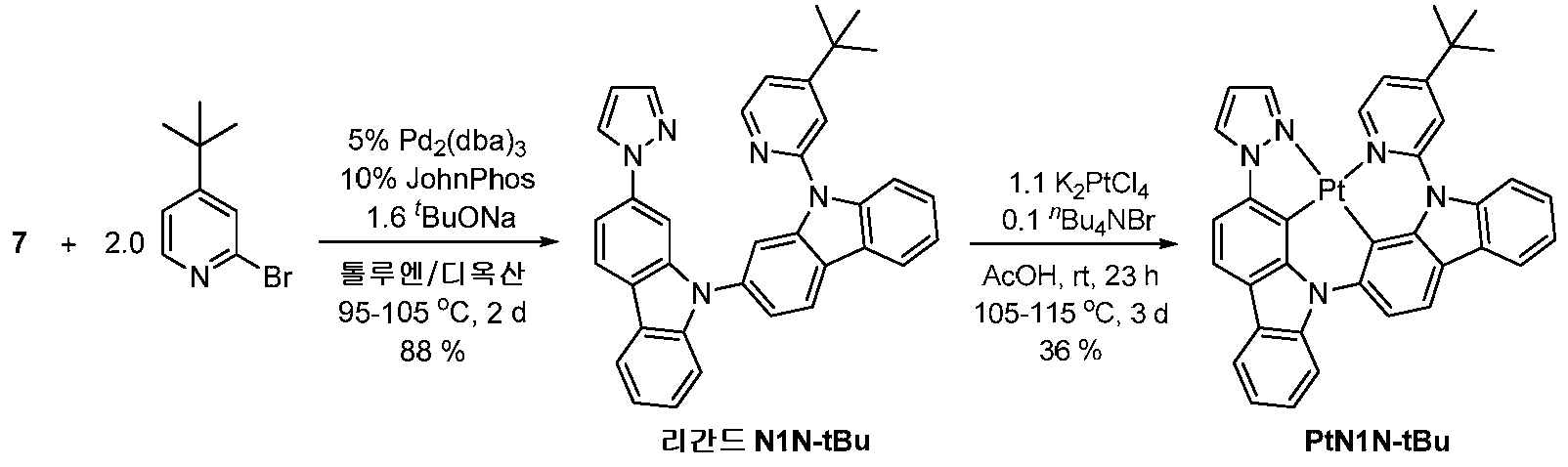
9-(4-tert-부틸피리딘-2-일)-2'-(1H-피라졸-1-일)-9H-2,9'-비카바졸 리간드 N1N-tBu의 합성:9- (4- tert - butyl-2-yl) -2 '- (1 H - pyrazol-1-yl) -9 H -2,9'- non-carbazol-ligand N1N-tBu Synthesis of:
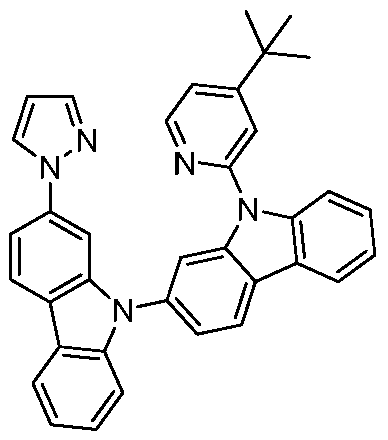
2'-(1H-피라졸-1-일)-9H-2,9'-바이카르바졸 7 (398 mg, 1.0 mmol, 1.0 eq), Pd2(dba)3 (46 mg, 0.05 mmol, 0.05 eq), JohnPhos (30 mg, 0.1 mmol, 0.1 eq) 및 t BuONa (154 mg, 1.6 mmol, 1.6 eq)을 자석 교반봉이 구비된 건조한 압력 쉴렝크(Schlenk) 튜브에 첨가하였다. 이어서, 그 튜브를 진공 처리하고, 질소로 역충전하였다. 이 진공 처리 및 역충전 절차를 2회 반복한 후, 무수 톨루엔 (4 mL), 디옥산 (4 mL), 및 2-브로모-4-tert-부틸피리딘 (418 mg, 2.0 mmol, 2.0 eq)을 질소 하에 첨가하였다. 그 튜브를 밀봉하고, 혼합물을 95-105℃의 온도의 유조에서 2 일 동안 교반하였다. 이어서, 혼합물을 주위 온도로 냉각하였다. 용매를 감압 하에 제거하고, 잔류물을 용출제로서 헥산 및 에틸 아세테이트 (10:1-5:1)을 사용하는 실리카 겔 상의 컬럼 크로마토그래피를 통해 정제하여 소정의 생성물, 9-(4-tert-부틸피리딘-2-일-2'-(1H-피라졸-1-일-9H-2,9'-바이카르바졸 리간드 N1N-tBu을 갈색 고체 (470 mg,88% 수율)로서 얻었다. 1H NMR (DMSO-d 6, 400 MHz): δ 1.28 (s, 9H), 6.52 (t, J = 1.6 Hz, 1H), 7.33 (t, J = 8.0 Hz, 1H), 7.42-7.45 (m, 3H), 7.50 (d, J = 8.4 Hz, 1H), 7.55-7.59 (m, 1H), 7.61 (dd, J = 8.0, 2.0 Hz, 1H), 7.69 (d, J = 1.6 Hz, 1H), 7.82 (dd, J = 8.4, 2.0 Hz, 1H), 7.86-7.88 (m, 2H), 7.91 (d, J = 2.0 Hz, 1H), 7.94 (d, J = 1.6 Hz, 1H), 8.28 (d, J = 8.0 Hz, 1H), 8.36 (d, J = 8.8 Hz, 1H), 8.40 (d, J = 8.0 Hz, 1H), 8.56 (d, J = 5.2 Hz, 1H), 8.59 (d, J = 8.4 Hz, 1H), 8.60 (s, 1H). 13C NMR (CDCl3, 100 MHz): δ30.05, 34.86, 99.67, 104.57, 107.74, 109.80, 111.17, 111.42, 116.16, 119.42, 119.69, 120.44, 120.53, 120.77, 120.82, 121.34, 121.53, 122.07, 122.38, 123.01, 123.03, 126.25, 126.91, 128.12, 134.57, 138.43, 139.76, 139.82, 140.80, 141.16, 141.36, 149.44, 150.58, 163.20.2'-(1 H -pyrazol-1-yl)-9 H -2,9'-bicarbazole 7 (398 mg, 1.0 mmol, 1.0 eq), Pd 2 (dba) 3 (46 mg, 0.05 mmol , 0.05 eq), JohnPhos (30 mg, 0.1 mmol, 0.1 eq) and t BuONa (154 mg, 1.6 mmol, 1.6 eq) were added to a dry pressure Schlenk tube equipped with a magnetic stir bar. The tube was then evacuated and backfilled with nitrogen. After repeating this vacuum treatment and backfill procedure twice, anhydrous toluene (4 mL), dioxane (4 mL), and 2-bromo-4-tert-butylpyridine (418 mg, 2.0 mmol, 2.0 eq) was added under nitrogen. The tube was sealed and the mixture stirred in an oil bath at a temperature of 95-105° C. for 2 days. The mixture was then cooled to ambient temperature. The solvent was removed under reduced pressure, hexane and ethyl acetate as eluent of the residue (10: 1-5: 1) the use of a given product is purified via column chromatography on silica gel, 9- (4- tert - butyl-2-yl -2 '- (1 H - pyrazol-1-yl -9 H -2,9'- bi-carbazole ligand N1N-tBu was obtained as a brown solid (470 mg, 88% yield). 1 H NMR (DMSO- d 6 , 400 MHz): δ 1.28 (s, 9H), 6.52 (t, J = 1.6 Hz, 1H), 7.33 (t, J = 8.0 Hz, 1H), 7.42-7.45 (m , 3H), 7.50 (d, J = 8.4 Hz, 1H), 7.55-7.59 (m, 1H), 7.61 (dd, J = 8.0, 2.0 Hz, 1H), 7.69 (d, J = 1.6 Hz, 1H) , 7.82 (dd, J = 8.4, 2.0 Hz, 1H), 7.86-7.88 (m, 2H), 7.91 (d, J = 2.0 Hz, 1H), 7.94 (d, J = 1.6 Hz, 1H), 8.28 ( d, J = 8.0 Hz, 1H), 8.36 (d, J = 8.8 Hz, 1H), 8.40 (d, J = 8.0 Hz, 1H), 8.56 (d, J = 5.2 Hz, 1H), 8.59 (d, J = 8.4 Hz, 1H), 8.60 (s, 1H) 13 C NMR (CDCl 3, 100 MHz):. δ30.05, 34.86, 99.67, 104.57, 107.74, 109.80, 111.17, 111.42, 116.16, 119.42, 119.69, 120.44, 120.53, 120.77, 120.82, 121.34, 121.53, 122.07, 122.38, 123.01, 123.03, 126.25, 126.91, 128.12, 134.57, 138.43, 139.76, 139.82, 140.80, 141.16, 141.36.58, 149.44
9-(4-tert-부틸피리딘-2-일)-2'-(1H-피라졸-1-일)-9H-2,9'-바이카르바졸 백금 착물 PtN1N-tBu의 합성: 9- (4- tert - butyl-2-yl) -2 '- (1 H - pyrazol-1-yl) -9 H -2,9'- bi-carbazole platinum complex PtN1N-tBu Synthesis of:
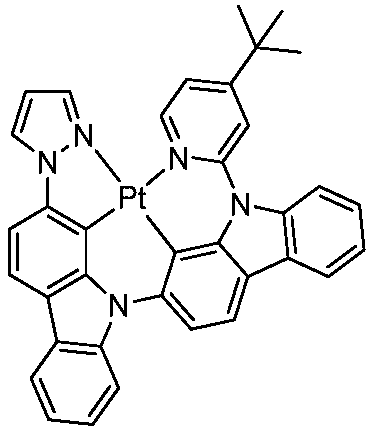
9-(4-tert-부틸피리딘-2-일)-2'-(1H-피라졸-1-일)-9H-2,9'-바이카르바졸 리간드 N1N-tBu (460 mg, 0.87 mmol, 1.0 eq), K2PtCl4 (395 mg, 0.95 mmol, 1.1 eq), n Bu4NBr (28 mg, 0.087 mmol, 0.1 eq) 및 아세트산 (52 mL)을 자석 교반봉이 구비된 건조한 압력 튜브에 첨가하였다. 이 혼합물을 질소로 30 분 동안 발포시키고, 이어서 튜브를 밀봉하였다. 혼합물을 실온에서 23 시간 동안 교반하였다. 이어서, 혼합물을 유조에서 105-115℃의 가열하고, 그 온도에서 3 일 동안 교반하였다. 이어서, 혼합물을 주위 온도로 냉각하고, 물 (52 mL)을 서서히 첨가하였다. 실온에서 5 분 동안 교반한 후에, 침전물을 여과하고, 물로 3회 세척하였다. 이어서, 고체를 공기 중에서 감압 하에 건조시켰다. 수집된 고체를 용출제로서 디클로로메탄을 사용하는 실리카 겔 상의 컬럼 크로마토그래피를 통해 정제하여 소정의 생성물, 9-(4-tert-부틸피리딘-2-일)-2'-(1H-피라졸-1-일)-9H-2,9'-바이카르바졸 백금 착물 PtN1N-tBu을 황색 고체 (226 mg, 36%수율)로서 얻었다. 도 1은 실온에서 CH2Cl2 중의 PtN1N-tBu의 방출 스펙트럼을 도시한 것이다. 1H NMR (DMSO-d 6, 400 MHz): δ 1.38 (s, 9H), 6.83 (t, J = 2.4 Hz, 1H), 7.30 (t, J = 7.6 Hz, 1H), 7.42 (t, J = 7.6 Hz, 1H), 7.48-7.53 (m, 3H), 7.69 (d, J = 8.0 Hz, 1H), 7.94 (d, J = 8.0 Hz, 1H), 8.00 (d, J = 8.8 Hz, 1H), 8.06 (d, J = 8.0 Hz, 1H), 8.10-8.12 (m, 2H), 8.14 (d, J = 8.8 Hz, 1H), 8.22 (d, J = 7.6 Hz, 2H), 8.26 (d, J = 8.0 Hz, 1H), 8.88 (d, J = 2.8 Hz, 1H), 9.08 (d, J = 6.4 Hz, 1H). 13C NMR (DMSO-d 6, 100 MHz): δ29.64, 35.45, 106.00, 107.63, 108.29, 111.88, 112.71, 112.99, 113.51, 114.07, 115.26, 115.27, 116.90, 118.26, 118.38, 120.34, 120.43, 120.92, 122.81, 125.19, 125.59, 126.10, 127.53, 128.85, 137.98, 138.24, 138.39, 139.29, 140.19, 143.32, 143.50, 147.19, 151.33, 163.22.9- (4- tert - butyl-2-yl) -2 '- (1 H - pyrazol-1-yl) -9 H -2,9'- bi-carbazole ligand N1N-tBu (460 mg, 0.87 mmol, 1.0 eq), K 2 PtCl 4 (395 mg, 0.95 mmol, 1.1 eq), n Bu 4 NBr (28 mg, 0.087 mmol, 0.1 eq) and acetic acid (52 mL) in a dry pressure tube equipped with a magnetic stir bar. was added to The mixture was bubbled with nitrogen for 30 minutes, then the tube was sealed. The mixture was stirred at room temperature for 23 hours. The mixture was then heated in an oil bath at 105-115° C. and stirred at that temperature for 3 days. The mixture was then cooled to ambient temperature and water (52 mL) was added slowly. After stirring at room temperature for 5 minutes, the precipitate was filtered and washed three times with water. The solid was then dried in air under reduced pressure. The collected solid was purified via column chromatography on silica gel using dichloromethane as eluent to give the desired product, 9-(4- tert -butylpyridin-2-yl)-2'-(1 H -pyrazole 1-yl) -9 H -2,9'- bi-carbazole platinum complex to give a PtN1N-tBu as a yellow solid (226 mg, 36% yield). 1 shows the emission spectrum of PtN1N-tBu in CH 2 Cl 2 at room temperature. 1 H NMR (DMSO- d 6 , 400 MHz): δ 1.38 (s, 9H), 6.83 (t, J = 2.4 Hz, 1H), 7.30 (t, J = 7.6 Hz, 1H), 7.42 (t, J) = 7.6 Hz, 1H), 7.48-7.53 (m, 3H), 7.69 (d, J = 8.0 Hz, 1H), 7.94 (d, J = 8.0 Hz, 1H), 8.00 (d, J = 8.8 Hz, 1H) ), 8.06 (d, J = 8.0 Hz, 1H), 8.10-8.12 (m, 2H), 8.14 (d, J = 8.8 Hz, 1H), 8.22 (d, J = 7.6 Hz, 2H), 8.26 (d) , J = 8.0 Hz, 1H), 8.88 (d, J = 2.8 Hz, 1H), 9.08 (d, J = 6.4 Hz, 1H). 13 C NMR (DMSO- d 6 , 100 MHz): δ29.64, 35.45, 106.00, 107.63, 108.29, 111.88, 112.71, 112.99, 113.51, 114.07, 115.26, 115.27, 116.90, 118.26, 118.38, 120.92 , 122.81, 125.19, 125.59, 126.10, 127.53, 128.85, 137.98, 138.24, 138.39, 139.29, 140.19, 143.32, 143.50, 147.19, 151.33, 163.22.
실시예 4.Example 4.
백금 착물 PtN1NPh은 하기 반응식에 따라 제조할 수 있다:The platinum complex PtN1NPh can be prepared according to the following scheme:

9-(4-페닐피리딘-2-일)-2'-(1H-피라졸-1-일)-9H-2,9'-바이카르바졸 리간드 N1NPh의 합성:9- (4-pyridin-2-yl) -2 '- (1 H - pyrazol-1-yl) -9 H -2,9'- bi-carbazole ligand N1NPh Synthesis of:

2'-(1H-피라졸-1-일)-9H-2,9'-바이카르바졸 7 (398 mg, 1.0 mmol, 1.0 eq), 2-chloro-4-phenylpyridine (228 mg, 1.2 mmol, 1.2 eq), Pd2(dba)3 (18 mg, 0.02 mmol, 0.02 eq), JohnPhos (24 mg, 0.8 mmol, 0.8 eq) 및 t BuONa (154 mg, 1.6 mmol, 1.6 eq)을 자석 교반봉이 구비된 건조한 압력 쉴렝크 튜브에 첨가하였다. 이어서, 그 튜브를 진공 처리하고, 질소로 역충전하였다. 진공 처리 및 역충전을 2회 반복하고, 이어서 무수 톨루엔 (4 mL)을 질소 하에 첨가하였다. 튜브를 밀봉하고, 혼합물을 95`105℃ 온도의 유조에서 1 일 동안 교반하였다. 이어서, 혼합물을 주위 온도로 냉각하였다. 용매를 감압 하에 제거하고, 잔류물을 용출제로서 헥산 및 에틸 아세테이트 (10:1-5:1-3:1)를 사용하는 실리카 겔 상의 컬럼 크로마토그래피를 통해 정제하여 소정의 생성물, 9-(4-페닐피리딘-2-일)-2'-(1H-피라졸-1-일)-9H-2,9'-바이카르바졸 리간드 N1NPh를 백색 고체 (431 mg, 78% 수율)로서 얻었다. 1H NMR (DMSO-d 6, 400 MHz): δ 6.50 (t, J = 1.2 Hz, 1H), 7.13 (t, J = 8.0 Hz, 1H), 7.41-7.46 (m, 5H), 7.51 (d, J = 8.0 Hz, 1H), 7.57 (t, J = 8.0 Hz, 1H), 7.61 (dd, J = 8.4, 0.8 Hz, 1H), 7.68 (t, J = 0.8 Hz, 1H), 7.76 (d, J = 5.2 Hz, 1H), 7.81 (dd, J = 8.4, 1.2 Hz, 1H), 7.87-7.88 (m, 2H), 7.91 (d, J = 1.6 Hz, 1H), 7.96 (d, J = 8.4 Hz, 1H), 8.08 (s, 1H), 8.21 (s, 1H), 8.27 (d, J = 8.0 Hz, 1H), 8.35 (d, J = 8.4 Hz, 1H), 8.40 (d, J = 7.6 Hz, 1H), 8.58 (d, J = 5.6 Hz, 1H), 8.59 (s, 1H), 8.70 (d, J = 5.6 Hz, 1H).2'-(1 H -pyrazol-1-yl)-9 H -2,9'-bicarbazole 7 (398 mg, 1.0 mmol, 1.0 eq), 2-chloro-4-phenylpyridine (228 mg, 1.2 mmol, 1.2 eq), Pd 2 (dba) 3 (18 mg, 0.02 mmol, 0.02 eq), JohnPhos (24 mg, 0.8 mmol, 0.8 eq) and t BuONa (154 mg, 1.6 mmol, 1.6 eq) were magnetically stirred. A dry pressure Schlenk tube equipped with a rod was added. The tube was then evacuated and backfilled with nitrogen. Vacuum treatment and backfill were repeated twice, then anhydrous toluene (4 mL) was added under nitrogen. The tube was sealed and the mixture was stirred in an oil bath at a temperature of 95'105° C. for 1 day. The mixture was then cooled to ambient temperature. The solvent was removed under reduced pressure and the residue was purified via column chromatography on silica gel using hexanes and ethyl acetate (10:1-5:1-3:1) as eluents to give the desired product, 9-( a pyrazol-1-yl) -9 H -2,9'- bi-carbazole ligand N1NPh a white solid (431 mg, 78% yield) - 4-phenyl-2-yl) -2 '- (1 H got it 1 H NMR (DMSO- d 6 , 400 MHz): δ 6.50 (t, J = 1.2 Hz, 1H), 7.13 (t, J = 8.0 Hz, 1H), 7.41-7.46 (m, 5H), 7.51 (d , J = 8.0 Hz, 1H), 7.57 (t, J = 8.0 Hz, 1H), 7.61 (dd, J = 8.4, 0.8 Hz, 1H), 7.68 (t, J = 0.8 Hz, 1H), 7.76 (d) , J = 5.2 Hz, 1H), 7.81 (dd, J = 8.4, 1.2 Hz, 1H), 7.87-7.88 (m, 2H), 7.91 (d, J = 1.6 Hz, 1H), 7.96 (d, J = 8.4 Hz, 1H), 8.08 (s, 1H), 8.21 (s, 1H), 8.27 (d, J = 8.0 Hz, 1H), 8.35 (d, J = 8.4 Hz, 1H), 8.40 (d, J = 7.6 Hz, 1H), 8.58 (d, J = 5.6 Hz, 1H), 8.59 (s, 1H), 8.70 (d, J = 5.6 Hz, 1H).
9-(4-페닐피리딘-2-일)-2'-(1H-피라졸-1-일)-9H-2,9'-바이카르바졸 백금 착물 PtN1NPh의 합성:9- (4-pyridin-2-yl) -2 '- (1 H - pyrazol-1-yl) -9 H -2,9'- bi-carbazole platinum complex PtN1NPh Synthesis of:
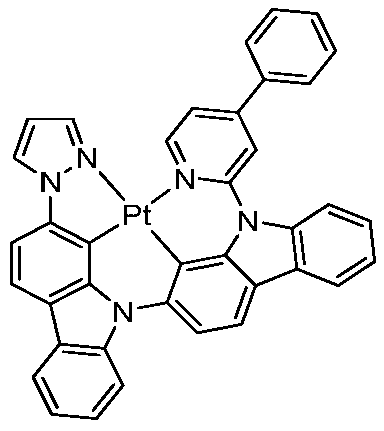
9-(4-페닐피리딘-2-일)-2'-(1H-피라졸-1-일)-9H-2,9'-바이카르바졸 리간드 N1NPh (420 mg, 0.76 mmol, 1.0 eq), K2PtCl4 (332 mg, 0.80 mmol, 1.05 eq), n Bu4NBr (25 mg, 0.076 mmol, 0.1 eq) 및 아세트산 (46 mL)을 자석 교반봉이 구비된 건조한 압력 튜브에 첨가하였다. 혼합물을 질소로 30 분 동안 발포시킨 후, 튜브를 밀봉하였다. 혼합물을 실온에서 24 시간 동안 교반하였다. 이어서, 혼합물을 유조에서 110-115℃로 가열하고, 그 온도에서 4 시간 동안 교반하였다. 이어서, 혼합물을 주위 온도로 냉각하고, 물 (60 mL)을 서서히 첨가하였다. 실온에서 5 분 동안 교반한 후, 침전물을 여과하고 물로 3회 세척하였다. 이어서, 고체를 공기 중에서 감압 하에 건조시켰다. 수집된 고체를 용출제로서 디클로로메탄을 사용하는 실리카 겔 상의 컬럼 크로마토그래피를 통해 정제하여 소정의 생성물, 9-(4-페닐피리딘-2-일)-2'-(1H-피라졸-1-일)-9H-2,9'-바이카르바졸 백금 착물 PtN1NPh를 황색 고체 (137 mg, 24% 수율)로서 얻었다. 도 1은 실온에서 CH2Cl2 중의 PtN1NPh의 방출 스펙트럼을 도시한 것이다. 1H NMR (DMSO-d 6, 400 MHz): δ 6.83 (t, J = 2.4 Hz, 1H), 7.28 (t, J = 7.6 Hz, 1H), 7.41 (t, J = 7.6 Hz, 1H), 7.46-7.58 (m, 5H), 7.66-7.70 (m, 2H), 7.87-7.89 (m, 2H), 7.93 (d, J = 8.0 Hz, 1H), 7.99 (d, J = 8.0 Hz, 1H), 8.10 (d, J = 2.0 Hz, 1H), 8.13 (d, J = 8.0 Hz, 1H), 8.18 (d, J = 8.0 Hz, 1H), 8.20 (d, J = 8.0 Hz, 2H), 8.24 (d, J = 8.4 Hz, 1H), 8.32 (d, J = 1.6 Hz, 1H), 8.86 (d, J = 2.8 Hz, 1H), 9.18 (d, J = 6.4 Hz, 1H). 13C NMR (DMSO-d 6, 100 MHz): δ 106.03, 107.68, 108.32, 111.79, 113.04, 113.23, 113.58, 114.35, 115.33, 115.38, 117.04, 118.26, 118.31, 120.31, 120.48, 120.94, 122.95, 125.39, 125.62, 126.13, 127.08, 127.58, 128.89, 129.55, 130.23, 136.21, 138.00, 138.34, 138.46, 139.32, 140.19, 143.34, 143.58, 147.65, 150.01, 152.17.9- (4-pyridin-2-yl) -2 '- (1 H - pyrazol-1-yl) -9 H -2,9'- bi-carbazole ligand N1NPh (420 mg, 0.76 mmol, 1.0 eq ), K 2 PtCl 4 (332 mg, 0.80 mmol, 1.05 eq), n Bu 4 NBr (25 mg, 0.076 mmol, 0.1 eq) and acetic acid (46 mL) were added to a dry pressure tube equipped with a magnetic stir bar. After the mixture was bubbled with nitrogen for 30 minutes, the tube was sealed. The mixture was stirred at room temperature for 24 h. The mixture was then heated in an oil bath to 110-115° C. and stirred at that temperature for 4 hours. The mixture was then cooled to ambient temperature and water (60 mL) was added slowly. After stirring at room temperature for 5 minutes, the precipitate was filtered and washed three times with water. The solid was then dried in air under reduced pressure. The collected solid was purified via column chromatography on silica gel using dichloromethane as eluent to give the desired product, 9-(4-phenylpyridin-2-yl)-2'-(1 H -pyrazole-1 -yl) -9 H -2,9'- bi-carbazole was obtained PtN1NPh platinum complex as a yellow solid (137 mg, 24% yield). 1 shows the emission spectrum of PtN1NPh in CH 2 Cl 2 at room temperature. 1 H NMR (DMSO- d 6 , 400 MHz): δ 6.83 (t, J = 2.4 Hz, 1H), 7.28 (t, J = 7.6 Hz, 1H), 7.41 (t, J = 7.6 Hz, 1H), 7.46-7.58 (m, 5H), 7.66-7.70 (m, 2H), 7.87-7.89 (m, 2H), 7.93 (d, J = 8.0 Hz, 1H), 7.99 (d, J = 8.0 Hz, 1H) , 8.10 (d, J = 2.0 Hz, 1H), 8.13 (d, J = 8.0 Hz, 1H), 8.18 (d, J = 8.0 Hz, 1H), 8.20 (d, J = 8.0 Hz, 2H), 8.24 (d, J = 8.4 Hz, 1H), 8.32 (d, J = 1.6 Hz, 1H), 8.86 (d, J = 2.8 Hz, 1H), 9.18 (d, J = 6.4 Hz, 1H). 13 C NMR (DMSO- d 6 , 100 MHz): δ 106.03, 107.68, 108.32, 111.79, 113.04, 113.23, 113.58, 114.35, 115.33, 115.38, 117.04, 118.26, 118.31, 120.31, 120.48.95, 120.94 125.62, 126.13, 127.08, 127.58, 128.89, 129.55, 130.23, 136.21, 138.00, 138.34, 138.46, 139.32, 140.19, 143.34, 143.58, 147.65, 150.01, 152.17.
실시예 5. Example 5.
백금 착물 PtN1NCF 3 은 하기 반응식에 따라 제조할 수 있다:The platinum complex PtN1NCF 3 can be prepared according to the following scheme:
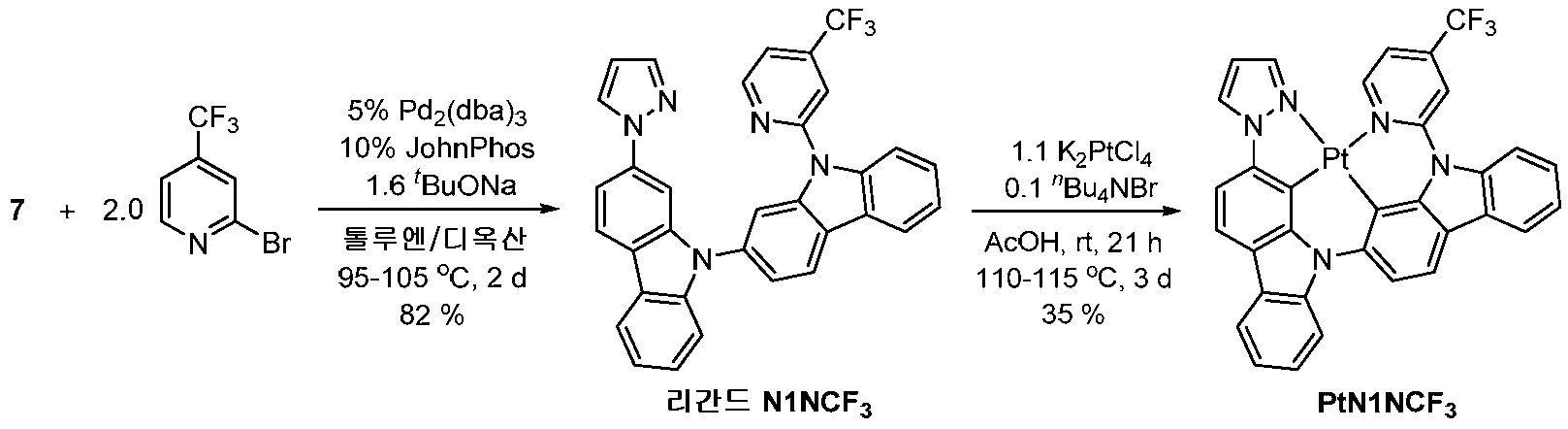
2'-(1H-피라졸-1-yl)-9-(4-(트리플루오로메틸)피리딘-2-일)-9H-2,9'-바이카르바졸 리간드 N1NCF 3 의 합성:2 '- (1 H - pyrazol -1-yl) -9- (4- (trifluoromethyl) pyridin-2-yl) -9 H -2,9'- bi-carbazole ligand N1NCF 3 Synthesis of:
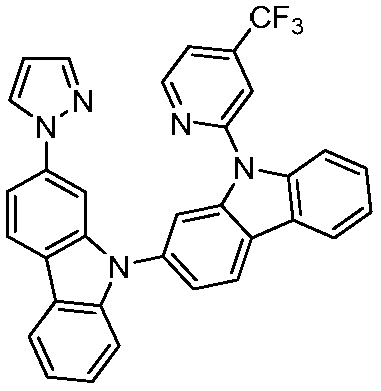
2'-(1H-피라졸-1-일)-9H-2,9'-바이카르바졸 7 (420 mg, 1.05 mmol, 1.0 eq), 2-브로모-4-(트리플루오로메틸)피리딘 (475 mg, 2.10 mmol, 2.0 eq), Pd2(dba)3 (48 mg, 0.05 mmol, 0.05 eq), JohnPhos (31 mg, 0.11 mmol, 0.10 eq) 및 t BuONa (161 mg, 1.68 mmol, 1.6 eq)을 자석 교반봉이 구비된 건조한 압력 쉴렝크 튜브에 첨가하였다. 이어서, 이 튜브를 진공 처리하고, 질소로 역충전하였다. 진공 처리 및 역충전 절차를 2회 반복한 후, 무수 톨루엔 (4 mL) 및 디옥산 (4 mL)을 질소 하에 첨가하였다. 튜브를 밀봉하고, 혼합물을 95-105℃ 온도의 유조에서 2 일 동안 교반하였다. 이어서, 혼합물을 주위 온도로 냉각하였다. 용매를 감압 하에 제거하고, 잔류물을 헥산 및 에틸 아세테이트 (10:1-5:1)를 용출제로서 사용하는 실리카 겔 상의 컬럼 크로마토그래피를 통해 정제하여 소정의 생성물, 2'-(1H-피라졸-1-일)-9-(4-(트피플루오로메틸)피리딘-2-일)-9H-2,9'-바이카르바졸 리간드 N1NCF 3 을 갈색 고체 (467 mg, 82% 수율)로서 얻었다. 1H NMR (DMSO-d 6, 400 MHz): δ 6.45 (s, 1H), 7.25 (t, J = 7.6 Hz, 1H), 7.34-7.43 (m, 3H), 7.51 (t, J = 7.6 Hz, 1H), 7.57 (d, J = 8.0 Hz, 1H), 7.64 (s, 1H), 7.70 (d, J = 5.2 Hz, 1H), 7.76 (dd, J = 8.4, 1.2 Hz, 1H), 7.85 (d, J = 8.4 Hz, 1H), 7.87 (s, 1H), 8.06 (s, 1H), 8.19 (s, 1H), 8.21 (d, J = 7.2 Hz, 1H), 8.29 (d, J = 8.8 Hz, 1H), 8.32 (d, J = 7.6 Hz, 1H), 8.49 (d, J = 8.4 Hz, 1H), 8.52 (d, J = 2.4 Hz, 1H), 8.84 (d, J = 5.2 Hz, 1H). 13C NMR (DMSO-d 6, 100 MHz): δ 99.74, 107.71, 109.79, 110.29, 111.17, 111.31, 114.83 (q, J = 3.9 Hz), 117.46 (q, J = 3.3 Hz), 120.32, 120.43, 120.48, 120.81, 120.84, 121.45, 121.95, 122.01, 122.40, 122.53 (q, J = 272.3 Hz), 123.37, 123.41, 126.19, 127.07, 128.01, 134.78, 138.45, 139.46, 139.56, 139.59 (q, J = 33.5 Hz), 140.78, 141.14, 141.34, 151.32, 151.52. 19F NMR (DMSO-d 6, 376 MHz): δ -63.39.2'-(1 H -pyrazol-1-yl)-9 H -2,9'-bicarbazole 7 (420 mg, 1.05 mmol, 1.0 eq), 2-bromo-4-(trifluoromethyl )pyridine (475 mg, 2.10 mmol, 2.0 eq), Pd 2 (dba) 3 (48 mg, 0.05 mmol, 0.05 eq), JohnPhos (31 mg, 0.11 mmol, 0.10 eq) and t BuONa (161 mg, 1.68 mmol) , 1.6 eq) was added to a dry pressure Schlenk tube equipped with a magnetic stir bar. The tube was then evacuated and backfilled with nitrogen. After repeating the vacuum treatment and backfill procedure twice, anhydrous toluene (4 mL) and dioxane (4 mL) were added under nitrogen. The tube was sealed and the mixture stirred in an oil bath at a temperature of 95-105° C. for 2 days. The mixture was then cooled to ambient temperature. The solvent was removed under reduced pressure and the residue was purified via column chromatography on silica gel using hexanes and ethyl acetate (10:1-5:1) as eluent to give the desired product, 2'-(1 H- pyrazol-1-yl) -9- (4- (4-methyl-bit people Luo) pyridin-2-yl) -9 H -2,9'- bi-carbazole ligand N1NCF a brown solid 3 (467 mg, 82% yield) was obtained. 1 H NMR (DMSO- d 6 , 400 MHz): δ 6.45 (s, 1H), 7.25 (t, J = 7.6 Hz, 1H), 7.34-7.43 (m, 3H), 7.51 (t, J = 7.6 Hz) , 1H), 7.57 (d, J = 8.0 Hz, 1H), 7.64 (s, 1H), 7.70 (d, J = 5.2 Hz, 1H), 7.76 (dd, J = 8.4, 1.2 Hz, 1H), 7.85 (d, J = 8.4 Hz, 1H), 7.87 (s, 1H), 8.06 (s, 1H), 8.19 (s, 1H), 8.21 (d, J = 7.2 Hz, 1H), 8.29 (d, J = 8.8 Hz, 1H), 8.32 (d, J = 7.6 Hz, 1H), 8.49 (d, J = 8.4 Hz, 1H), 8.52 (d, J = 2.4 Hz, 1H), 8.84 (d, J = 5.2 Hz) , 1H). 13 C NMR (DMSO- d 6 , 100 MHz): δ 99.74, 107.71, 109.79, 110.29, 111.17, 111.31, 114.83 (q, J = 3.9 Hz), 117.46 (q, J = 3.3 Hz), 120.32, 120.43, 120.48, 120.81, 120.84, 121.45, 121.95, 122.01, 122.40, 122.53 (q, J = 272.3 Hz), 123.37, 123.41, 126.19, 127.07, 128.01, 134.78, 138.45, 139.46, 139.56, 139.59 (q, J = 139.59 (q, J = 272.3 Hz) ), 140.78, 141.14, 141.34, 151.32, 151.52. 19 F NMR (DMSO- d 6 , 376 MHz): δ -63.39.
2'-(1H-피라졸-1-일)-9-(4-(트리플루오메틸)피리딘-2-일)-9H-2,9'-바이카르바졸 백금 착물 PtN1NCF 3 의 합성:2 '- (1 H - pyrazol-1-yl) -9- (4- (trifluoromethyl) pyridin-2-yl) -9 H -2,9'- bi-carbazole platinum complex PtN1NCF 3 Synthesis of:
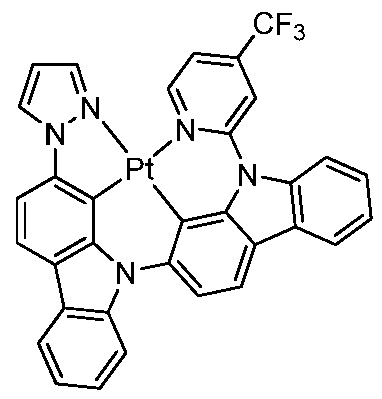
2'-(1H-피라졸-1-일)-9-(4-(트리플루오로메틸)피리딘-2-일)-9H-2,9'-바이카르바졸 리간드 N1NCF 3 (405 mg, 0.745 mmol, 1.0 eq), K2PtCl4 (340 mg, 0.82 mmol, 1.1 eq, n Bu4NBr (24 mg, 0.0745 mmol, 0.1 eq) 및 아세트산 (45 mL)을 자석 교반봉이 구비된 건조한 압력 튜브에 첨가하였다. 이 혼합물을 질소로 30 분 동안 발포시킨 후, 튜브를 밀봉하였다. 혼합물을 실온에서 21 시간 동안 교반하였다. 이어서, 혼합물을 유조에서 110-115℃로 가열하고, 그 온도에서 3 일 동안 교반하였다. 이어서, 혼합물을 주위 온도로 냉각하고, 물 (45 mL)을 서서히 첨가하였다. 실온에서 5 분 동안 교반한 후에, 침전물을 여과하고 물로 3회 세척하였다. 이어서, 고체를 공기 중에서 감압 하에 건조시켰다. 이 수집된 고체를 디클로로메탄/헥산을 용출제로서 사용하는 실리카 겔 상의 컬럼 크로마토그래피를 통해 정제하여 소정의 생성물, 2'-(1H-피라졸-1-일)-9-(4-(트리플루오로메틸)피리딘-2-일)-9H-2,9'-바이카르바졸 백금 착물 PtN1NCF 3 을 황색 고체 (190 mg, 35% 수율)로서 얻었다. 도 1은 실온에서 CH2Cl2 중의 PtN1NCF 3 의 방출 스펙트럼을 도시한 것이다. 1H NMR (DMSO-d 6, 500 MHz): δ 6.84 (t, J = 2.5 Hz, 1H), 7.31 (t, J = 7.5 Hz, 1H), 7.45 (t, J = 7.5 Hz, 1H), 7.49-7.55 (m, 2H), 7.64 (d, J = 6.5 Hz, 1H), 7.70 (d, J = 8.5 Hz, 1H), 7.96 (d, J = 8.0 Hz, 1H), 8.00 (d, J = 8.5 Hz, 1H), 8.08-8.09 (m, 2H), 8.16 (d, J = 8.5 Hz, 1H), 8.22 (t, J = 8.0 Hz, 2H), 8.26 (d, J = 8.5 Hz, 1H), 8.37 (s, 1H), 8.88 (d, J = 2.0 Hz, 1H), 9.39 (d, J = 6.5 Hz, 1H). 13C NMR (DMSO-d 6, 100 MHz): δ 106.03, 107.66, 108.03, 110.77, 112.70 (q, J = 4.1 Hz), 113.07, 113.81, 114.12, 115.53, 115.64, 117.08, 118.34, 120.40, 120.56, 120.92, 122.51 (q, J = 272.4 Hz), 123.58, 125.43, 125.64, 126.12, 127.88, 128.93, 138.00, 138.12, 138.15, 138.19 (q, J = 34.4 Hz), 139.27, 140.27, 143.07, 143.31, 147.65, 153.83. 19F NMR (DMSO-d 6, 376 MHz): δ -64.04.2 '- (pyridin-2-yl 4- (trifluoromethyl)) -9 H -2,9'- bi-carbazole ligand N1NCF 3 - (1 H-pyrazol-1-yl) -9- (405 mg, 0.745 mmol, 1.0 eq), K 2 PtCl 4 (340 mg, 0.82 mmol, 1.1 eq, n Bu 4 NBr (24 mg, 0.0745 mmol, 0.1 eq) and acetic acid (45 mL) with a magnetic stir bar added to dry pressure tube.This mixture is bubbled with nitrogen for 30 minutes, then the tube is sealed.The mixture is stirred at room temperature for 21 hours.Then the mixture is heated to 110-115°C in oil bath, and Stir at temperature for 3 days.Then the mixture is cooled to ambient temperature, and water (45 mL) is added slowly.After stirring at room temperature for 5 minutes, the precipitate is filtered and washed with water 3 times.Then solid was dried under reduced pressure in air.The collected solid was purified by column chromatography on silica gel using dichloromethane/hexane as eluent to obtain the desired product, 2'-(1 H -pyrazol-1-yl ) -9- (4- (trifluoromethyl) pyridin-2-yl) -9 H -2,9'- bi-carbazole platinum complex to give a PtN1NCF 3 as a yellow solid (190 mg, 35% yield). Fig. 1 shows the emission spectrum of PtN1NCF 3 in CH 2 Cl 2 at room temperature : 1 H NMR (DMSO- d 6 , 500 MHz): δ 6.84 (t, J = 2.5 Hz, 1H), 7.31 (t, J) = 7.5 Hz, 1H), 7.45 (t, J = 7.5 Hz, 1H), 7.49-7.55 (m, 2H), 7.64 (d, J = 6.5 Hz, 1H), 7.70 (d, J = 8.5 Hz, 1H) ), 7.96 (d, J = 8.0 Hz, 1H), 8.00 (d, J = 8.5 Hz, 1H), 8.08-8.09 (m, 2H), 8.16 (d, J = 8.5 Hz, 1H), 8.22 (t) , J = 8.0 Hz, 2H), 8.26 (d, J = 8.5 Hz, 1H), 8.37 (s, 1H), 8.88 (d, J = 2.0 Hz, 1H), 9.39 (d, J) = 6.5 Hz, 1H). 13 C NMR (DMSO- d 6 , 100 MHz): δ 106.03, 107.66, 108.03, 110.77, 112.70 (q, J = 4.1 Hz), 113.07, 113.81, 114.12, 115.53, 115.64, 117.08, 118.34, 120.40, 120.56 120.92, 122.51 (q, J = 272.4 Hz), 123.58, 125.43, 125.64, 126.12, 127.88, 128.93, 138.00, 138.12, 138.15, 138.19 (q, J = 34.4 Hz), 139.27, 140.27, 143.07, 143.31, 147.65.31, 153.83. 19 F NMR (DMSO- d 6 , 376 MHz): δ -64.04.
실시예 6. Example 6.
백금 착물 PtON6-tBu는 하기 화학식에 따라 제조할 수 있다:The platinum complex PtON6-tBu can be prepared according to the formula:
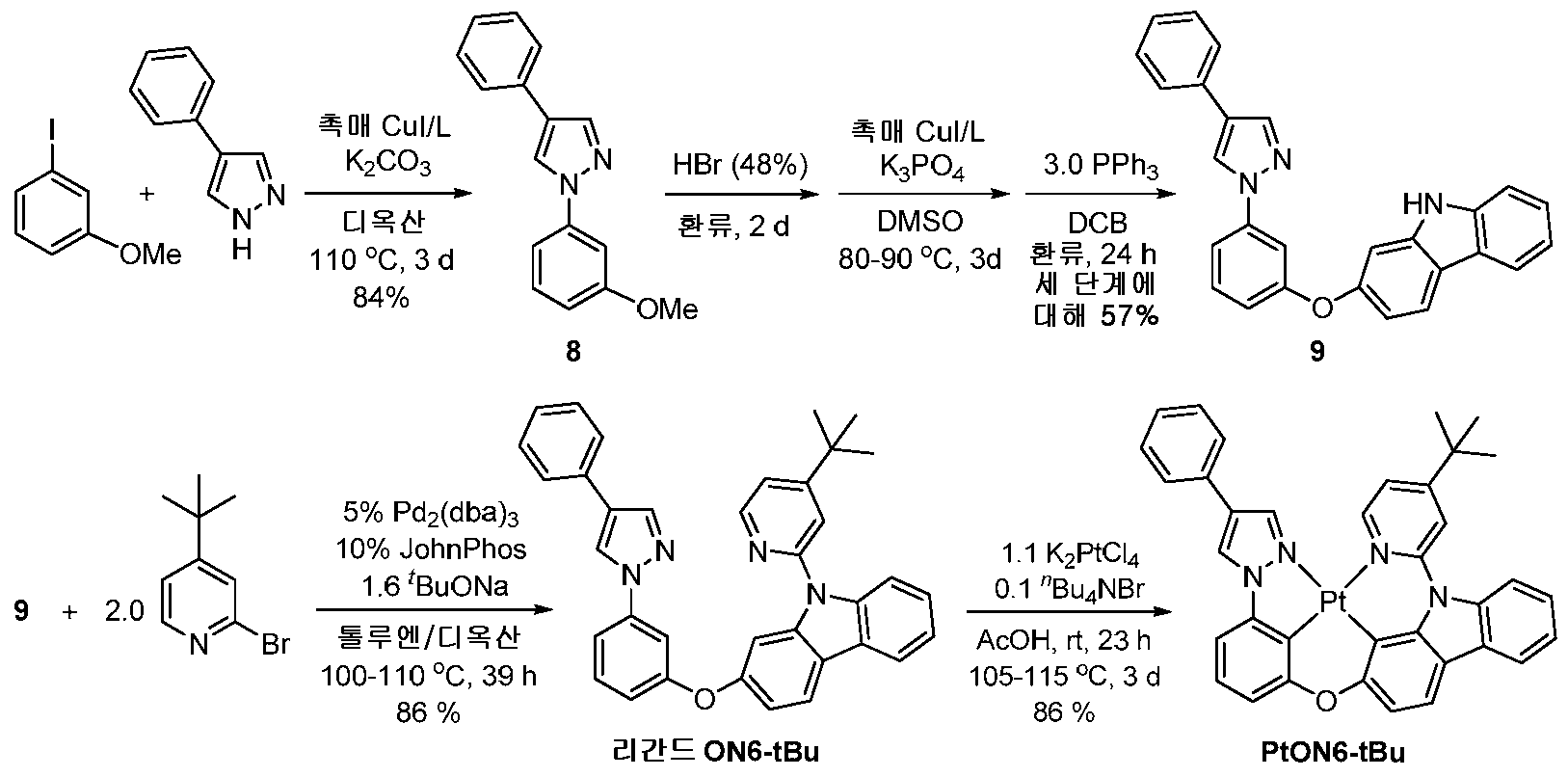
1-(3-메톡시페닐)-4-페닐-1H-피라졸 8의 합성:Synthesis of 1-(3-methoxyphenyl)-4-phenyl- 1H -pyrazole 8 :
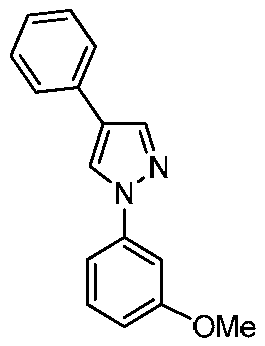
4-페닐-1H-피라졸 (775 mg, 5.38 mmol, 1.0 eq), 1-요오도-3-메톡시벤젠 (1510 mg, 768 μL, 6.45 mmol, 1.2 eq), CuI (21 mg, 0.11 mmol, 0.02 eq) 및 K2CO3 (1561 mg, 11.30 mmol, 2.1 eq)을 자석 교반봉이 구비된 건조한 압력 튜브에 첨가하였다. 이어서, trans-1,2-시아노헥산디아민 (123 mg, 1.08 mmol, 0.20 eq) 및 디옥산 (12 mL)을 첨가하였다. 혼합물을 질소로 30 분 동안 발포시킨 후, 튜브를 밀봉하였다. 혼합물을 110℃ 온도의 유조에서 3 일 동안 교반한 후에 주위 온도로 냉각하였다. 용매를 감압 하에 제거하고 잔류물을 헥산 및 에틸 아세테이트 (10:1-3:1)을 용출제로서 사용하는 실리카 겔 상의 컬럼 크로마토그래피를 통해 정제하여 소정의 생성물, 1-(3-메톡시페닐)-4-페닐-1H-피라졸 8을 무색 액체 (1.13 g, 84% 수율)로서 얻었다. 1H NMR (DMSO-d 6, 400 MHz): δ 3.84 (s, 3H), 6.87-6.90 (m, 1H), 7.25 (t, J = 7.2 Hz, 1H), 7.38-7.48 (m, 5H), 7.71 (d, J = 7.2 Hz, 2H), 8.20 (s, 1H), 9.01 (s, 1H).4-phenyl- 1H -pyrazole (775 mg, 5.38 mmol, 1.0 eq), 1-iodo-3-methoxybenzene (1510 mg, 768 μL, 6.45 mmol, 1.2 eq), CuI (21 mg, 0.11) mmol, 0.02 eq) and K 2 CO 3 (1561 mg, 11.30 mmol, 2.1 eq) were added to a dry pressure tube equipped with a magnetic stir bar. Then trans -1,2-cyanohexanediamine (123 mg, 1.08 mmol, 0.20 eq) and dioxane (12 mL) were added. After the mixture was bubbled with nitrogen for 30 minutes, the tube was sealed. The mixture was stirred in an oil bath at 110° C. for 3 days and then cooled to ambient temperature. The solvent was removed under reduced pressure and the residue was purified via column chromatography on silica gel using hexanes and ethyl acetate (10:1-3:1) as eluent to give the desired product, 1-(3-methoxyphenyl). )-4-phenyl- 1H -
2-(3-(4-페닐-1H-피라졸-1-일)페닐옥시)-9H-카르바졸 9의 합성:2- (3- (4-phenyl -1 H - pyrazol-1-yl) phenyloxy) -9 H - carbazole-9 Synthesis of:
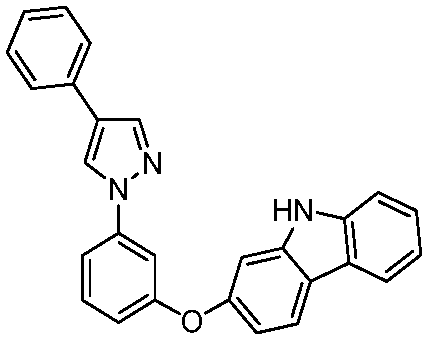
염산 (6 mL, 48%) 중의 1-(3-메톡시페닐)-4-페닐-1H-피라졸 8 (1100 mg, 4.39 mmol)의 용액을 질소 대기 하에 2일 동안 (110-120℃) 환류시켰다. 이어서, 혼합물을 주위 온도로 냉각시키고, 기체 생성이 중단될 때까지 K2CO3의 수용액으로 중화시켰다. 이어서, 침전물을 여과하고, 물로 수회 세척한 후, 공기 중에서 감압 하에 건조시켜서 갈색 고체인 생성물을 출발 물질과 생성물의 혼합물(100:31, 1H NMR 스펙트럼으로부터 유래된 것)로서 얻었고, 이것을 다음 단계에 직접 사용하였다. 이 갈색 고체, 4'-요오도-2-니트로바이페닐 (1209 mg, 3.72 mmol), CuI (30 mg, 0.16 mmol), 피콜린산 (38 mg, 0.31 mmol) 및 K3PO4 (1316 mg, 6.20 mmol)을 자석 교반봉이 구비된 건조한 압력 쉴렝크 튜브에 첨가하였다. 이 튜브를 진공 처리하고, 질소 역충전하였다. 이 진공 처리 및 역충전을 2회 반복한 후에, DMSO (10 mL)을 첨가하고, 이 혼합물을 질소로 30 분 동안 발포시키고, 튜브를 밀봉하였다. 혼합물을 3일 동안 유조에서 80-90℃로 가열하였다. 이어서, 혼합물을 주위 온도로 냉각하고, 물로 희석하며, 에틸 아세테이트로 3회 추출하였다. 합한 유기 층을 물로 3회 세척하고, 황산나트륨으로 건조시킨 후, 여과하고 에틸 아세테이트로 세척하였다. 여과액을 농축하고, 잔류물을 헥산 및 에틸 아세테이트 (10:1-5:1-3:1)를 용출제로서 사용하는 실리카 겔 상의 컬럼 크로마토그래피를 통해 정제하여 소정의 생성물을 점성 액체 (1.13 g)로서 얻었고, 이것을 다음 단계에서 직접 사용하였다. 1.2-디클로로벤젠(15 mL) 중의 점성 액체 (1100 mg, 2.54 mmol, 1.0 eq)의 용액에 질소 보호 하에 서 첨가하였다. 이 혼합물을 유조에서 가열하여 환류시키고, 그 온도에서 24 시간 동안 교반하였다. 이어서, 혼합물을 냉각하고, 용매를 고 진공 하에 증류로 제거하였다. 잔류물을 헥산 및 에틸 아세테이트 (10:1-5:1-3:1)를 용출제로서 사용하는 실리카 겔 상의 컬럼 크로마토그래피를 통해 정제하여 소정의 생성물, 2-(3-(4-페닐-1H-피라졸-1-일)페녹시)-9H-카르바졸 9를 백색 고체 (1000 mg, 3개 단계에 대한 총 수율 57%). 1H NMR (DMSO- d 6, 400 MHz): δ 6.96 (dd, J = 8.4, 2.4 Hz, 1H), 7.01 (dd, J = 8.0, 2.4 Hz, 1H), 7.16-7.19 (m, 2H), 7.25 (d, J = 7.6 Hz, 1H), 7.35-7.42 (m, 3H), 7.48 (d, J = 8.0 Hz, 1H), 7.54 (t, J = 8.0 Hz, 1H), 7.63 (t, J = 2.4 Hz, 1H), 7.68-7.72 (m, 3H), 8.10 (d, J = 8.0 Hz, 1H), 8.16 (d, J = 7.2 Hz, 1H), 8.19 (s, 1H), 9.05 (s, 1H), 11.26 (s, 1H).A solution of 1-(3-methoxyphenyl)-4-phenyl-1 H -pyrazole 8 (1100 mg, 4.39 mmol) in hydrochloric acid (6 mL, 48%) was dissolved under a nitrogen atmosphere (110-120° C.) for 2 days. ) was refluxed. The mixture was then cooled to ambient temperature and neutralized with an aqueous solution of K 2 CO 3 until gas formation ceased. The precipitate was then filtered, washed several times with water and then dried in air under reduced pressure to give the product as a brown solid as a mixture of starting material and product (100:31, derived from 1 H NMR spectrum), which was used in the next step was used directly for This brown solid, 4'-iodo-2-nitrobiphenyl (1209 mg, 3.72 mmol), CuI (30 mg, 0.16 mmol), picolinic acid (38 mg, 0.31 mmol) and K 3 PO 4 (1316 mg) , 6.20 mmol) was added to a dry pressure Schlenk tube equipped with a magnetic stir bar. The tube was evacuated and backfilled with nitrogen. After this vacuum treatment and backfill were repeated twice, DMSO (10 mL) was added, the mixture was bubbled with nitrogen for 30 minutes, and the tube was sealed. The mixture was heated to 80-90° C. in an oil bath for 3 days. The mixture was then cooled to ambient temperature, diluted with water and extracted three times with ethyl acetate. The combined organic layers were washed 3 times with water, dried over sodium sulfate, filtered and washed with ethyl acetate. The filtrate was concentrated and the residue was purified via column chromatography on silica gel using hexanes and ethyl acetate (10:1-5:1-3:1) as eluent to give the desired product as a viscous liquid (1.13). g), which was used directly in the next step. To a solution of viscous liquid (1100 mg, 2.54 mmol, 1.0 eq) in 1.2-dichlorobenzene (15 mL) was added under nitrogen protection. The mixture was heated to reflux in an oil bath and stirred at that temperature for 24 hours. The mixture was then cooled and the solvent removed by distillation under high vacuum. The residue was purified via column chromatography on silica gel using hexanes and ethyl acetate (10:1-5:1-3:1) as eluent to give the desired product, 2-(3-(4-phenyl-) 1 H -Pyrazol-1-yl)phenoxy)-9 H -
9-(4-tert-부틸피리딘-2-일)-2-(3-(4-페닐-1H-피라졸-1-일)페녹시)- 9H-카르바졸 리간드 ON6-tBu의 합성:9- (4-tert - butyl-2-yl) -2- (3- (4-phenyl -1 H - pyrazol-1-yl) phenoxy) - 9 H - carbazole ligand ON6-tBu Synthesis of :

2-(3-(4-페닐-1H-피라졸-1-일)페녹시)-9H-카르바졸 9 (401 mg, 1.0 mmol, 1.0 eq), Pd2(dba)3 (46 mg, 0.05 mmol, 0.05 eq), JohnPhos (30 mg, 0.1 mmol, 0.1 eq) 및 t BuONa (154 mg, 1.6 mmol, 1.6 eq)을 자석 교반봉이 구비된 건조한 압력 쉴렝크 튜브에 첨가하였다. 이어서, 그 튜브를 진공 처리하고 질소로 역충전하였다. 진공 처리 및 역충전 절차를 2회 반복한 후, 무수 톨루엔 (4 mL), 디옥산 (4 mL) 및 2-브로모-4-tert-부틸피리딘 (418 mg, 2.0 mmol, 2.0 eq)을 질소 하에 첨가하였다. 튜브를 밀봉하고, 혼합물을 100-110℃ 온도의 유조에서 39 시간 동안 교반하였다. 이어서, 혼합물을 주위 온도로 냉각하였다. 용매를 감압 하에 제거하고, 잔류물을 헥산 및 에틸 아세테이트 (20:1-15:1-10:1-5:1)를 용출제로서 사용하는 실리카 겔 상의 컬럼 크로마토그래피를 통해 정제하여 소정의 생성물, 9-(4-tert-부틸피리미미딘-2-일)-2-(3-(4-페닐-1H-피라졸-1-일)페녹시)-9H-카르바졸 리간드 ON6-tBu를 갈색 고체 (460 mg, 86% 수율)로서 얻었다. 1H NMR (DMSO-d 6, 400 MHz): δ 1.24 (s, 9H), 7.04 (dd, J = 8.0, 2.6 Hz, 1H), 7.16 (dd, J = 8.4, 2.4 Hz, 1H), 7.24 (t, J = 7.6 Hz, 1H), 7.32-7.47 (m, 6H), 7.53 (t, J = 8.4 Hz, 1H), 7.62 (d, J = 1.2 Hz, 1H), 7.66 (t, J = 2.0 Hz, 1H), 7.69-7.72 (m, 3H), 7.78 (d, J = 8.4 Hz, 1H), 8.19 (s, 1H), 8.24 (d, J = 7.6 Hz, 1H), 8.31 (d, J = 8.8 Hz, 1H), 8.57 (d, J = 5.6 Hz, 1H), 9.05 (s, 1H).2- (3- (4-phenyl -1 H - pyrazol-1-yl) phenoxy) -9 H - carbazole-9 (401 mg, 1.0 mmol, 1.0 eq), Pd 2 (dba) 3 (46 mg , 0.05 mmol, 0.05 eq), JohnPhos (30 mg, 0.1 mmol, 0.1 eq) and t BuONa (154 mg, 1.6 mmol, 1.6 eq) were added to a dry pressure Schlenk tube equipped with a magnetic stir bar. The tube was then evacuated and backfilled with nitrogen. After repeating the vacuum treatment and backfill procedure twice, anhydrous toluene (4 mL), dioxane (4 mL) and 2-bromo-4-tert-butylpyridine (418 mg, 2.0 mmol, 2.0 eq) were mixed with nitrogen was added under The tube was sealed and the mixture was stirred in an oil bath at a temperature of 100-110° C. for 39 hours. The mixture was then cooled to ambient temperature. The solvent is removed under reduced pressure and the residue is purified via column chromatography on silica gel using hexanes and ethyl acetate (20:1-15:1-10:1-5:1) as eluent to give the desired product , 9- (4-tert - butyl-pyrimidin minor-2-yl) -2- (3- (4-phenyl -1 H - pyrazol-1-yl) phenoxy) -9 H - carbazole ligand ON6- tBu was obtained as a brown solid (460 mg, 86% yield). 1 H NMR (DMSO- d 6 , 400 MHz): δ 1.24 (s, 9H), 7.04 (dd, J = 8.0, 2.6 Hz, 1H), 7.16 (dd, J = 8.4, 2.4 Hz, 1H), 7.24 (t, J = 7.6 Hz, 1H), 7.32-7.47 (m, 6H), 7.53 (t, J = 8.4 Hz, 1H), 7.62 (d, J = 1.2 Hz, 1H), 7.66 (t, J = 2.0 Hz, 1H), 7.69-7.72 (m, 3H), 7.78 (d, J = 8.4 Hz, 1H), 8.19 (s, 1H), 8.24 (d, J = 7.6 Hz, 1H), 8.31 (d, J = 8.8 Hz, 1H), 8.57 (d, J = 5.6 Hz, 1H), 9.05 (s, 1H).
9-(4-tert-부틸피리딘-2-일)-2-(3-(4-페닐-1H-피라졸-1-일)페녹시)-9H-카바졸 백금 착물 PtON6-tBu의 합성Synthesis of 9-(4-tert-butylpyridin-2-yl)-2-(3-(4-phenyl-1H-pyrazol-1-yl)phenoxy)-9H-carbazole platinum complex PtON6-tBu
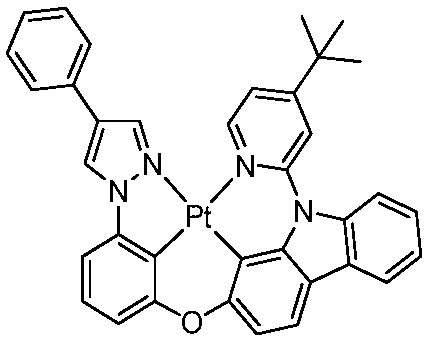
9-(4-tert-부틸피리딘-2-일)-2-(3-(4-페닐-1H-피라졸-1-일)페녹시)-9H-카바졸 리간드 ON6-tBu (450 mg, 0.84 mmol, 1.0 eq), K2PtCl4 (383 mg, 0.92 mmol, 1.1 eq), n Bu4NBr (27 mg, 0.084 mmol, 0.1 eq) 및 아세트산 (50 mL)을, 자기 교반 막대가 구비된 건조 압력관에 첨가하였다. 혼합물에 30분 동안 질소를 발포시킨 다음 관을 밀봉하였다. 실온에서 23 시간 동안 혼합물을 교반하였다. 그 후, 혼합물을 오일조에서 105-115℃로 가열하고 그 온도에서 3일간 교반하고, 상온으로 냉각하고 물 (50 mL)을 첨가하였다. 실온에서 5 분동안 교반한 후에, 침전물을 여과해내고 물로 3회 세척하였다. 이후, 감압 하에 공기 중에서 고체를 건조하였다. 수거된 고체를, 용리제로서 디클로로메탄을 이용하여 실리카 겔 상에서 컬럼 크로마토그래피로 정제하여 목적 생성물인 9-(4-tert-부틸피리딘-2-일)-2-(3-(4-페닐-1H-피라졸-1-일)페녹시)-9H-카바졸 백금 착물 PtON6-tBu를 황색 고체로서 얻었다 (525 mg, 86% 수율). 도 2는 실온에서 CH2Cl2 중 PtON6-tBu의 발광 스펙트럼을 도시한다. 1H NMR (DMSO-d 6, 400 MHz): δ 1.40 (s, 9H), 6.99 (d, J = 7.6 Hz, 1H), 7.22 (d, J = 8.0 Hz, 1H), 7.27 (t, J = 8.0 Hz, 1H), 7.36 (t, J = 8.0 Hz, 1H), 7.42 (t, J = 7.6 Hz, 1H), 7.48-7.56 (m, 5H), 7.91 (t, J = 8.0 Hz, 3H), 8.10 (d, J = 8.4 Hz, 1H), 8.17-8.19 (m, 2H), 8.67 (s, 1H), 9.25 (d, J = 2.4 Hz, 1H), 9.42 (s, 1H). 13C NMR (DMSO-d 6, 100 MHz): δ29.64, 35.46, 98.77, 106.04, 111.18, 112.39, 112.51, 113.26, 114.57, 115.60, 115.72, 118.35, 120.13, 122.88, 123.82, 124.62, 124.73, 125.41, 125.37, 127.33, 127.90, 128.99, 130.80, 136.95, 138.10, 142.01, 146.00, 147.45, 151.96, 152.29, 152.55, 163.03.9-(4-tert-butylpyridin-2-yl)-2-(3-(4-phenyl-1H-pyrazol-1-yl)phenoxy)-9H-carbazole ligand ON6-tBu (450 mg, 0.84 mmol, 1.0 eq), K 2 PtCl 4 (383 mg, 0.92 mmol, 1.1 eq), n Bu 4 NBr (27 mg, 0.084 mmol, 0.1 eq) and acetic acid (50 mL), equipped with a magnetic stir bar was added to the dry pressure tube. The mixture was bubbled with nitrogen for 30 minutes and then the tube was sealed. The mixture was stirred at room temperature for 23 hours. Then, the mixture was heated to 105-115° C. in an oil bath and stirred at that temperature for 3 days, cooled to room temperature and water (50 mL) was added. After stirring at room temperature for 5 minutes, the precipitate was filtered off and washed three times with water. The solid was then dried in air under reduced pressure. The collected solid was purified by column chromatography on silica gel using dichloromethane as eluent to obtain the desired product, 9-(4-tert-butylpyridin-2-yl)-2-(3-(4-phenyl-) 1H-Pyrazol- 1-yl)phenoxy)-9H-carbazole platinum complex PtON6-tBu was obtained as a yellow solid (525 mg, 86% yield). 2 shows the emission spectrum of PtON6-tBu in CH 2 Cl 2 at room temperature. 1 H NMR (DMSO- d 6 , 400 MHz): δ 1.40 (s, 9H), 6.99 (d, J = 7.6 Hz, 1H), 7.22 (d, J = 8.0 Hz, 1H), 7.27 (t, J) = 8.0 Hz, 1H), 7.36 (t, J = 8.0 Hz, 1H), 7.42 (t, J = 7.6 Hz, 1H), 7.48-7.56 (m, 5H), 7.91 (t, J = 8.0 Hz, 3H) ), 8.10 (d, J = 8.4 Hz, 1H), 8.17-8.19 (m, 2H), 8.67 (s, 1H), 9.25 (d, J = 2.4 Hz, 1H), 9.42 (s, 1H). 13 C NMR (DMSO- d 6 , 100 MHz): δ29.64, 35.46, 98.77, 106.04, 111.18, 112.39, 112.51, 113.26, 114.57, 115.60, 115.72, 118.35, 120.13, 122.88, 123.82, 124.62, 124.41. , 125.37, 127.33, 127.90, 128.99, 130.80, 136.95, 138.10, 142.01, 146.00, 147.45, 151.96, 152.29, 152.55, 163.03.
실시예 7. Example 7.
백금 착물 PtON6Ph는 하기 반응식에 따라 제조할 수 있다. The platinum complex PtON6Ph can be prepared according to the following scheme.

2-(3-(4-페닐-1H-피라졸-1-일)페녹시)-9-(4-페닐피리딘-2-일)-9H-카바졸 백금 착물 PtON6Ph의 합성Synthesis of 2-(3-(4-phenyl-1H-pyrazol-1-yl)phenoxy)-9-(4-phenylpyridin-2-yl)-9H-carbazole platinum complex PtON6Ph

2-(3-(4-페닐-1H-피라졸-1-일)페녹시)-9H-카바졸 9 (201 mg, 0.5 mmol, 1.0 eq), 2-클로로-4-페닐피리딘 (114 mg, 0.6 mmol, 1.2 eq), Pd2(dba)3 (9 mg, 0.02 mmol, 0.02 eq), JohnPhos (12 mg, 0.8 mmol, 0.8 eq) 및 t BuONa (77 mg, 1.6 mmol, 1.6 eq)를 자기 교반 막대가 구비된 건조 슐랭크 압력관에 첨가하였다. 이 후, 관을 배기시키고 질소로 재충전하였다. 배기 및 재충전 절차를 2회 반복한 다음, 질소 하에서 무수 톨루엔 (2 mL)을 첨가하였다. 관을 밀봉하고, 2일 동안 95-105℃ 온도의 오일조에서 혼합물을 교반하였다. 이어서, 혼합물을 상온으로 냉각하였다. 감압 하에 용매를 제거하고, 용리제로서 헥산 및 에틸 아세테이트를 사용하여 실리카 겔 상에서 컬럼 크로마토그래피로 잔류물을 정제하여, 출발 물질 2-(3-(4-페닐-1H-피라졸-1-일)페녹시)-9H-카바졸 9와 목적 생성물의 혼합물로서 점성 액체 (209 mg)의 생성물을 얻었으며, 이를 다음 단계에서 직접 사용하였다. 점성 액체(200 mg), K2PtCl4 (183 mg, 0.44 mmol), n Bu4NBr (13 mg, 0.04 mmol,) 및 아세트산 (24 mL)을 자기 교반 막대가 구비된 건조 압력관에 첨가하였다. 혼합물에 30분 동안 질소를 발포시킨 다음 관을 밀봉하였다. 혼합물을 실온에서 18 시간 동안 교반하였다. 이 후, 혼합물을 오일조에서 110-120℃로 가열하고 그 온도에서 3일 더 교반하였다. 혼합물을 상온으로 냉각하고 물 (25 mL)을 첨가하였다. 실온에서 5분 동안 교반한 후에, 침전물을 여과해내고 물로 3회 세척하였다. 이어서, 감압 하에 공기 중에서 고체를 건조하였다. 수거된 고체를, 용리제로서 헥산 및 디클로로메탄(2:3)을 이용하여 실리카 겔 상에서 컬럼 크로마토그래피로 정제하여 목적 생성물인 2-(3-(4-페닐-1H-피라졸-1-일)페녹시)-9-(4-페닐피리딘-2-일)-9H-카바졸 백금 착물 PtON6Ph을 황색 고체로서 얻었다(127 mg, 두 단계에 대한 총 수율 34%). 도 2는 실온에서 CH2Cl2 중 PtON6Ph의 발광 스펙트럼을 도시한다. 1H NMR (DMSO-d 6, 400 MHz): δ 7.02 (d, J = 8.0 Hz, 1H), 7.24 (d, J = 8.4 Hz, 1H), 7.29 (t, J = 8.0 Hz, 1H), 7.37 (t, J = 7.2 Hz, 1H), 7.44 (t, J = 7.2 Hz, 1H), 7.49-7.64 (m, 7H), 7.80 (dd, J = 6.4, 1.6 Hz, 1H), 7.91-7.97 (m, 5H), 8.19 (d, J = 7.6 Hz, 1H), 8.26 (d, J = 8.0 Hz, 1H), 8.44 (d, J = 2.0 Hz, 1H), 8.72 (s, 1H) 9.40 (d, J = 6.4 Hz, 1H), 9.44 (s, 1H).2-(3-(4-phenyl-1H-pyrazol-1-yl)phenoxy)-9H-carbazole 9 (201 mg, 0.5 mmol, 1.0 eq), 2-chloro-4-phenylpyridine (114 mg , 0.6 mmol, 1.2 eq), Pd 2 (dba) 3 (9 mg, 0.02 mmol, 0.02 eq), JohnPhos (12 mg, 0.8 mmol, 0.8 eq) and t BuONa (77 mg, 1.6 mmol, 1.6 eq) A dry Schlank pressure tube equipped with a magnetic stir bar was added. After this time, the tube was evacuated and backfilled with nitrogen. The evacuation and recharge procedure was repeated twice, then anhydrous toluene (2 mL) was added under nitrogen. The tube was sealed and the mixture was stirred in an oil bath at a temperature of 95-105° C. for 2 days. Then, the mixture was cooled to room temperature. Removal of the solvent under reduced pressure and purification of the residue by column chromatography on silica gel using hexane and ethyl acetate as eluents, starting material 2-(3-(4-phenyl-1H-pyrazol-1-yl) )phenoxy)-9H-
실시예 8. Example 8.
백금 착물 PtON1은 하기 반응식에 따라 제조할 수 있다. The platinum complex PtON1 can be prepared according to the following scheme.
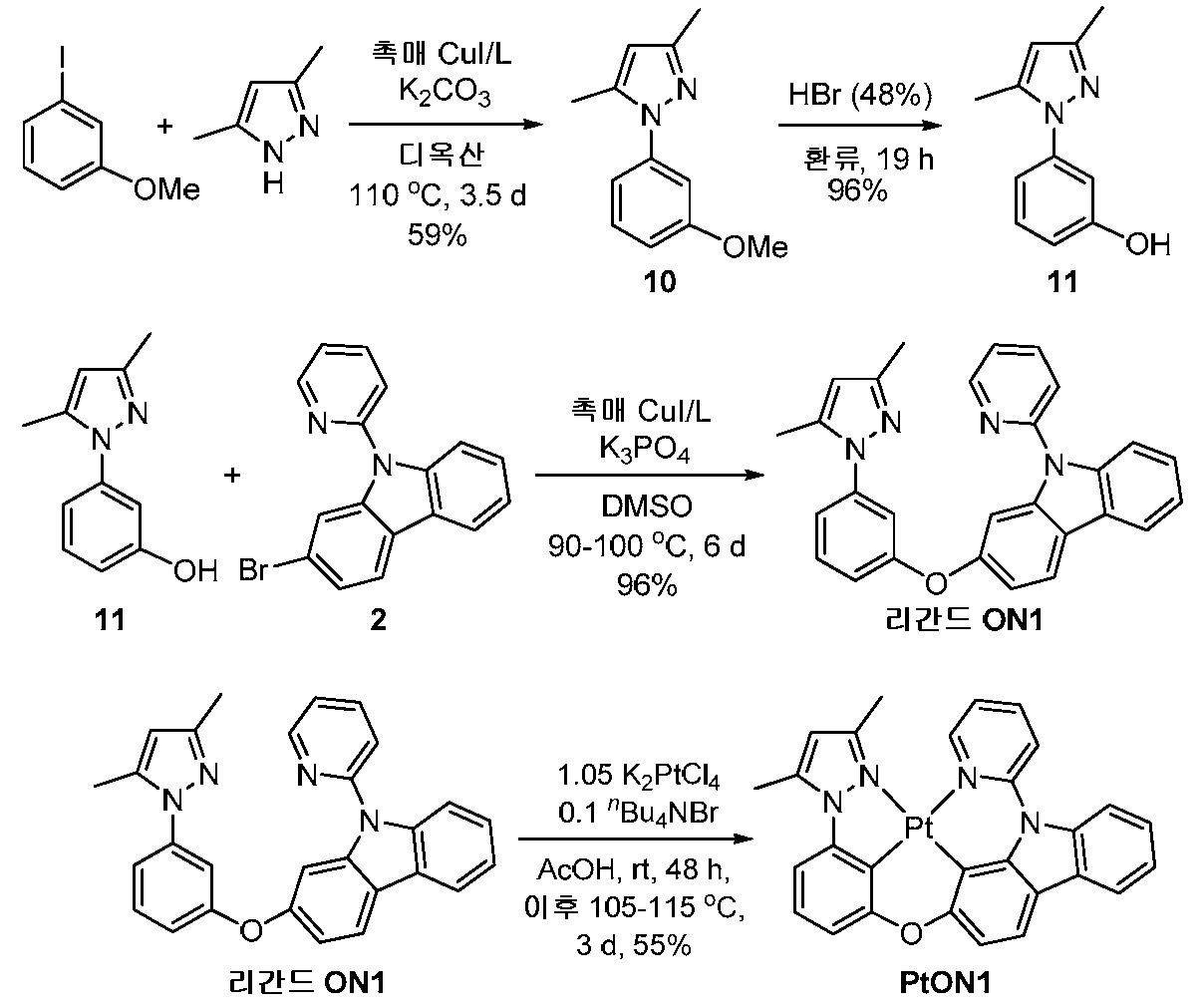
1-(3-메톡시페닐)-3,5-디메틸-1H-피라졸 10의 합성:Synthesis of 1-(3-methoxyphenyl)-3,5-dimethyl-1H-pyrazole 10 :
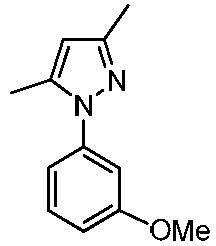
1-요오도-3-메톡시벤젠 (7.15 mL, 60 mmol, 1.0 eq), 3,5-디메틸-1H-피라졸 (6.92 g, 72 mmol, 1.2 eq), CuI (0.46 g, 2.4 mmol, 0.04 eq) 및 K2CO3 (17.41 g, 126 mmol, 2.1 eq)를 자기 교반 막대가 구비된 건조 압력관에 첨가하였다. 이어서, trans-1,2-사이클로헥산디아민 (1.37 g, 12 mmol, 0.2 eq) 및 디옥산 (45 mL)을 첨가하였다. 혼합물에 30분 동안 질소를 발포시킨 다음 관을 밀봉하였다. 3.5일 동안110℃ 온도의 오일조에서 혼합물을 교반한 다음 상온으로 냉각하였다. 고체를 여과해내고 에틸 아세테이트로 세척하였다. 감압 하에 여과물을 농축하고 용리제로서 헥산 및 에틸 아세테이트 (10:1-3:1)를 이용하여 실리카 겔 상에서 컬럼 크로마토그래피로 잔류물을 정제하여 목적 생성물인 1-(3-메톡시페닐)-3,5-디메틸-1H-피라졸 10을 갈색 액체로서 얻었다(7.12 g, 59% 수율). 1H NMR (DMSO-d 6, 400 MHz): δ 2.18 (s, 3H), 2.30 (s, 3H), 3.80 (s, 3H), 6.06 (s, 1H), 6.95 (dd, J = 8.0, 2.4 Hz, 1H), 7.02-7.06 (m, 2H), 7.39 (t, J = 8.0 Hz, 1H).1-iodo-3-methoxybenzene (7.15 mL, 60 mmol, 1.0 eq), 3,5-dimethyl-1H-pyrazole (6.92 g, 72 mmol, 1.2 eq), CuI (0.46 g, 2.4 mmol, 0.04 eq) and K 2 CO 3 (17.41 g, 126 mmol, 2.1 eq) were added to a dry pressure tube equipped with a magnetic stir bar. Then trans -1,2-cyclohexanediamine (1.37 g, 12 mmol, 0.2 eq) and dioxane (45 mL) were added. The mixture was bubbled with nitrogen for 30 minutes and then the tube was sealed. The mixture was stirred in an oil bath at 110° C. for 3.5 days and then cooled to room temperature. The solid was filtered off and washed with ethyl acetate. The filtrate was concentrated under reduced pressure and the residue was purified by column chromatography on silica gel using hexane and ethyl acetate (10:1-3:1) as eluents to obtain the desired product, 1-(3-methoxyphenyl) -3,5-dimethyl-1H-pyrazole 10 was obtained as a brown liquid (7.12 g, 59% yield). 1 H NMR (DMSO- d 6 , 400 MHz): δ 2.18 (s, 3H), 2.30 (s, 3H), 3.80 (s, 3H), 6.06 (s, 1H), 6.95 (dd, J = 8.0, 2.4 Hz, 1H), 7.02-7.06 (m, 2H), 7.39 (t, J = 8.0 Hz, 1H).
3-(3,5-디메틸-1H-피라졸-1-일)페놀 11의 합성:Synthesis of 3-(3,5-dimethyl-1H-pyrazol-1-yl)phenol 11 :
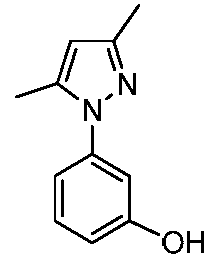
브롬화수소산 (45 mL, 48%) 중 1-(3-메톡시페닐)-3,5-디메틸-1H-피라졸 10 (7.10 g, 35.11 mmol) 용액을 질소 분위기 하에서 19 시간 동안 환류시켰다(110-120℃). 이어서, 혼합물을 상온으로 냉각하고 기체 형성이 멈출 때까지 K2CO3의 수용액으로 중화시켰다. 이어서, 침전물을 여과해내고 물로 수회 세척하였다. 수거된 고체를, 공기 중에서 건조하여 생성물을 갈색 고체로서 얻었다(6.33 g, 96% 수율). 1H NMR (DMSO-d 6, 400 MHz): δ 2.16 (s, 3H), 2.28 (s, 3H), 6.04 (s, 1H), 6.75-6.77 (m, 1H), 6.86-6.89 (m, 2H), 7.26 (t, J = 8.0 Hz, 1H), 9.73 (s, 1H). 13C NMR (DMSO-d 6, 100 MHz): δ 12.29, 13.30, 107.07, 111.10, 113.94, 114.43, 129.71, 138.95, 140.70, 147.57, 157.84.A solution of 1-(3-methoxyphenyl)-3,5-dimethyl-1H-pyrazole 10 (7.10 g, 35.11 mmol) in hydrobromic acid (45 mL, 48%) was refluxed under nitrogen atmosphere for 19 h (110) -120°C). The mixture was then cooled to room temperature and neutralized with an aqueous solution of K 2 CO 3 until gas formation ceased. The precipitate was then filtered off and washed several times with water. The collected solid was dried in air to give the product as a brown solid (6.33 g, 96% yield). 1 H NMR (DMSO- d 6 , 400 MHz): δ 2.16 (s, 3H), 2.28 (s, 3H), 6.04 (s, 1H), 6.75-6.77 (m, 1H), 6.86-6.89 (m, 2H), 7.26 (t, J = 8.0 Hz, 1H), 9.73 (s, 1H). 13 C NMR (DMSO- d 6 , 100 MHz): δ 12.29, 13.30, 107.07, 111.10, 113.94, 114.43, 129.71, 138.95, 140.70, 147.57, 157.84.
2-(3-(3,5-디메틸-1H-피라졸-1-일)페녹시)-9-(피리딘-2-일)-9H-카바졸 리간드 ON1의 합성:Synthesis of 2-(3-(3,5-dimethyl-1H-pyrazol-1-yl)phenoxy)-9-(pyridin-2-yl)-9H-carbazole ligand ON1 :
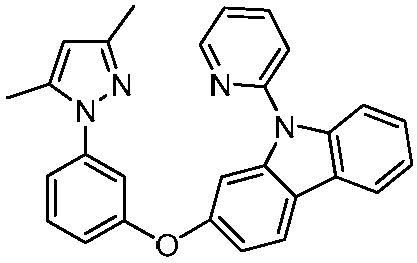
3-(3,5-디메틸-1H-피라졸-1-일)페놀 11 (1.27 g, 6.75 mmol, 1.0 eq), 2-브로모-9-(피리딘-2-일)-9H-카바졸 2 (2.62 g, 8.10 mmol, 1.2 eq), CuI (0.13 g, 0.675 mmol, 0.1 eq), 피콜린산 (0.17 g, 1.35 mmol, 0.2 eq), K3PO4 (2.87 g, 13.50 mmol, 2.0 eq) 및 DMSO (20 mL)를 자기 교반 막대가 구비된 건조 압력 용기에 첨가하였다. 혼합물에 30분 동안 질소를 발포시킨 다음 용기를 밀봉하였다. 6일 동안 90-100℃ 온도의 오일조에서 혼합물을 교반한 다음 상온으로 냉각하고 에틸 아세테이트로 희석하였다. 고체를 여과해내고 에틸 아세테이트로 세척하였다. 이 후 여과물을 물로 3회 세척하고, 황산나트륨 상에서 건조하고, 여과하고, 용매를 감압하에 제거하였다. 용리제로서 헥산/에틸 아세테이트 (10:1-3:1-2:1)를 이용하여 실리카 겔 상에서 컬럼 크로마토그래피로 잔류물을 정제하여 목적 생성물을 무색 점성 액체로서 얻었다(2.80 g, 96% 수율). 1H NMR (DMSO-d 6, 400 MHz): δ 2.11 (s, 3H), 2.24 (s, 3H), 6.01 (s, 1H), 7.02-7.04 (m, 1H), 7.07-7.11 (m, 2H), 7.21-7.24 (m, 1H), 7.33 (t, J = 7.6 Hz, 1H), 7.41-7.48 (m, 3H), 7.53 (d, J = 2.4 Hz, 1H), 7.76 (d, J = 8.8 Hz, 2H), 8.07 (td, J = 7.6, 2.0 Hz, 1H), 8.21 (d, J = 8.0 Hz, 1H), 8.27 (d, J = 8.4 Hz, 1H), 8.66-8.68 (m, 1H). 13C NMR (DMSO-d 6, 100 MHz): δ 12.21, 13.23, 102.42, 107.48, 111.10, 113.25, 113.32, 116.26, 118.25, 119.04, 120.03, 120.19, 121.25, 121.79, 122.13, 123.24, 125.98, 130.41, 139.24, 139.34, 139.51, 139.92, 140.93, 148.08, 149.52, 150.45, 154.77, 157.93.3-(3,5-Dimethyl-1H-pyrazol-1-yl)phenol 11 (1.27 g, 6.75 mmol, 1.0 eq), 2-bromo-9-(pyridin-2-yl)-9H-carbazole 2 (2.62 g, 8.10 mmol, 1.2 eq), CuI (0.13 g, 0.675 mmol, 0.1 eq), picolinic acid (0.17 g, 1.35 mmol, 0.2 eq), K 3 PO 4 (2.87 g, 13.50 mmol, 2.0) eq) and DMSO (20 mL) were added to a dry pressure vessel equipped with a magnetic stir bar. The mixture was bubbled with nitrogen for 30 minutes and then the vessel was sealed. The mixture was stirred in an oil bath at a temperature of 90-100° C. for 6 days, then cooled to room temperature and diluted with ethyl acetate. The solid was filtered off and washed with ethyl acetate. The filtrate was then washed with
2-(3-(3,5-디메틸-1H-피라졸-1-일)페녹시)-9-(피리딘-2-일)-9H-카바졸 백금 착물 PtON1의 합성:Synthesis of 2-(3-(3,5-dimethyl-1H-pyrazol-1-yl)phenoxy)-9-(pyridin-2-yl)-9H-carbazole platinum complex PtON1 :
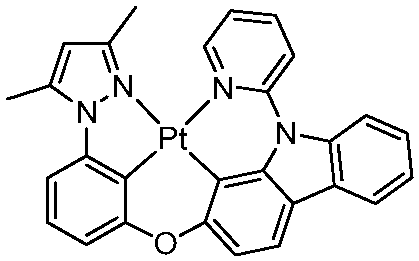
2-(3-(3,5-디메틸-1H-피라졸-1-일)페녹시)-9-(피리딘-2-일)-9H-카바졸 리간드 ON1 (1340 mg, 3.11 mmol, 1.0 eq), K2PtCl4 (1356 mg, 3.27 mmol, 1.05 eq), n Bu4NBr (100 mg, 0.31 mmol, 0.1 eq) 및 아세트산 (187 mL, 60 mL/mmol 리간드)를 자기 교반 막대가 구비된 건조 압력관에 첨가하였다. 혼합물에 30분 동안 질소를 발포시킨 다음 관을 밀봉하였다. 혼합물을 48 시간 동안 실온에서 교반한 다음, 105-115℃ 온도의 오일조에서 3일 더 교반하였다. 그 후, 혼합물을 상온으로 냉각하고 물 (373 mL, 120 mL/mmol 리간드)을 첨가하였다. 혼합물을 5분 동안 실온에서 교반한 다음, 침전물을 여과해내고 물로 3회 세척하였다. 이어서, 고체를 감압 하에 공기중에서 건조하였다. 수거된 고체를, 용리제로서 디클로로메탄을 이용하여 실리카 겔 상에서 컬럼 크로마토그래피로 정제하여 표제 화합물을 황색 고체로서 얻었다(1057 mg, 55% 수율). 도 3은 실온에서 CH2Cl2 중 PtON1의 발광 스펙트럼을 도시한다. 1H NMR (DMSO-d 6, 400 MHz): δ 2.40 (s, 3H), 2.73 (s, 3H), 6.42 (s, 1H), 6.96 (d, J = 8.0, 1H), 7.18 (d, J = 8.4, 1H), 7.22 (d, J = 8.0, 1H), 7.26-7.30 (m, 2H), 7.39 (t, J = 7.6, 1H), 7.47 (t, J = 7.6 Hz, 1H), 7.85 (d, J = 7.6 Hz, 1H), 8.08 (d, J = 8.0, 1H), 8.11-8.19 (m, 3H), 9.24 (d, J = 4.8 Hz, 1H). 13C NMR (DMSO-d 6, 100 MHz): δ 14.31, 14.36, 100.17, 107.12, 110.29, 110.97, 112.18, 112.40, 115.07, 115.29, 115.68, 115.71, 119.02, 119.93, 122.85, 124.46, 124.70, 127.95, 137.84, 140.14, 141.87, 141.93, 147.40, 147.98, 149.66, 151.61, 151.99, 153.78.2-(3-(3,5-dimethyl-1H-pyrazol-1-yl)phenoxy)-9-(pyridin-2-yl)-9H-carbazole ligand ON1 (1340 mg, 3.11 mmol, 1.0 eq ), K 2 PtCl 4 (1356 mg, 3.27 mmol, 1.05 eq), n Bu 4 NBr (100 mg, 0.31 mmol, 0.1 eq) and acetic acid (187 mL, 60 mL/mmol ligand) equipped with a magnetic stir bar. was added to the dry pressure tube. The mixture was bubbled with nitrogen for 30 minutes and then the tube was sealed. The mixture was stirred at room temperature for 48 hours and then stirred for 3 more days in an oil bath at 105-115° C. After that, the mixture was cooled to room temperature and water (373 mL, 120 mL/mmol ligand) was added. The mixture was stirred at room temperature for 5 minutes, then the precipitate was filtered off and washed 3 times with water. The solid was then dried in air under reduced pressure. The collected solid was purified by column chromatography on silica gel using dichloromethane as eluent to give the title compound as a yellow solid (1057 mg, 55% yield). 3 shows the emission spectrum of PtON1 in CH 2 Cl 2 at room temperature. 1 H NMR (DMSO- d 6 , 400 MHz): δ 2.40 (s, 3H), 2.73 (s, 3H), 6.42 (s, 1H), 6.96 (d, J = 8.0, 1H), 7.18 (d, J = 8.4, 1H), 7.22 (d, J = 8.0, 1H), 7.26-7.30 (m, 2H), 7.39 (t, J = 7.6, 1H), 7.47 (t, J = 7.6 Hz, 1H), 7.85 (d, J = 7.6 Hz, 1H), 8.08 (d, J = 8.0, 1H), 8.11-8.19 (m, 3H), 9.24 (d, J = 4.8 Hz, 1H). 13 C NMR (DMSO- d 6 , 100 MHz): δ 14.31, 14.36, 100.17, 107.12, 110.29, 110.97, 112.18, 112.40, 115.07, 115.29, 115.68, 115.71, 119.02, 119.93, 122.85, 124.70, 127.46, 124. 137.84, 140.14, 141.87, 141.93, 147.40, 147.98, 149.66, 151.61, 151.99, 153.78.
실시예 9.Example 9.
백금 착물 PtON1Me 4 는 하기 반응식에 따라 제조될 수 있다:The platinum complex PtON1Me 4 can be prepared according to the following scheme:

3,5-디메틸-1-(3-(2'-니트로비페닐-4-일옥시)페닐)-1H-피라졸 12의 합성:Synthesis of 3,5-dimethyl-1-(3-(2′-nitrobiphenyl-4-yloxy)phenyl)-1H-pyrazole 12 :

3-(3,5-디메틸-1H-피라졸-1-일)페놀 11 (5.00 g, 26.56 mmol, 1.0 당량), 4'-요오도-2-니트로비페닐 3 (10.38 g, 31.92 mmol, 1.2 당량), CuI (0.25 g, 1.33 mmol, 0.05 당량), 피콜린산 (0.33 g, 2.66 mmol, 0.1 당량), K3PO4 (11.28 g, 53.12 mmol, 2.0 당량) 및 DMSO (60 ㎖)를 자성 교반 막대가 구비된 건조 압력 튜브에 첨가하였다. 이 혼합물을 30분 동안 질소로 버블링하고난 후 튜브를 밀봉하였다. 80∼90℃의 온도에서 3일 동안 혼합물을 유조에서 교반한 후 상온으로 냉각시켰다. 고체를 여과시키고 에틸 아세테이트(250 ㎖)로 세척하였다. 그리고나서 여과물을 3회 물로 세척하고, 황산나트륨 상에서 건조시키고, 여과하고, 용매를 감압 하에 제거하였다. 용출액으로서 헥산/에틸 아세테이트(10:1-5:1-3:1)를 사용하여 실리카겔 상에서 컬럼 크로마토그래피를 통해 잔류물을 정제하여 점성이 있는 액체로서 원하는 생성물을 수득하였다(92% 수율로 9.38 g). 1H NMR (DMSO-d6, 400 MHz): δ 2.15 (s, 3H), 2.30 (s, 3H), 6.06 (s, 1H), 7.07 (dd, J = 8.0, 2.4 Hz, 1H), 7.13-7.16 (m, 3H), 7.30-7.32 (m, 1H), 7.36-7.40 (m, 2H), 7.52 (t, J = 8.0, 1H), 7.57 (dd, J = 7.6, 1.2 Hz, 1H), 7.59-7.64 (m, 1H), 7.75 (td, J = 7.6, 1.2 Hz, 1H), 7.97 (dd, J = 8.0, 1.2 Hz, 1H). 13C NMR (DMSO-d6, 100 MHz): δ 12.30, 13.27, 107.63, 114.22, 117.18, 118.91, 118.97, 124.10, 128.81, 129.73, 130.61, 131.84, 132.28, 132.92, 134.33, 139.35, 141.11, 148.20, 148.92, 156.52, 156.67.3-(3,5-dimethyl-1H-pyrazol-1-yl)phenol 11 (5.00 g, 26.56 mmol, 1.0 equiv), 4'-iodo-2-nitrobiphenyl 3 (10.38 g, 31.92 mmol, 1.2 equiv), CuI (0.25 g, 1.33 mmol, 0.05 equiv), picolinic acid (0.33 g, 2.66 mmol, 0.1 equiv), K 3 PO 4 (11.28 g, 53.12 mmol, 2.0 equiv) and DMSO (60 mL) was added to a dry pressure tube equipped with a magnetic stir bar. The mixture was bubbled with nitrogen for 30 min before sealing the tube. The mixture was stirred in an oil bath at a temperature of 80-90° C. for 3 days and then cooled to room temperature. The solid was filtered and washed with ethyl acetate (250 mL). The filtrate was then washed with
2-(3-(3,5-디메틸-1H-피라졸-1-일)페녹시)-9H-카르바졸 13의 합성:Synthesis of 2-(3-(3,5-dimethyl-1H-pyrazol-1-yl)phenoxy)-9H-carbazole 13 :
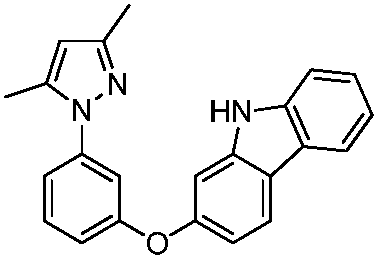
1,2-디클로로벤젠(30 ㎖) 중 3,5-디메틸-1-(3-(2'-니트로비페닐-4-일옥시)페닐)-1H-피라졸 12 (2.19 g, 5.68 mmol, 1.0 당량) 및 PPh3 (4.47 g, 17.04 mmol, 3.0 당량)의 용액을 유조에서 24시간 동안 환류시켰다(175∼185℃). 그리고나서 이 혼합물을 냉각시키고 고진공 하에 증류에 의해 용매를 제거하였다. 용출액으로서 헥산/에틸 아세테이트(10:1-5:1)를 사용하여 실리카겔 상에서 컬럼 크로마토그래피를 통해 잔류물을 정제하여 백색 고체로서 원하는 생성물, 2-(3-(3,5-디메틸-1H-피라졸-1-일)페녹시)-9H-카르바졸 13을 수득하였다(92% 수율로 1.83 g). 1H NMR (DMSO-d6, 400 MHz): δ 2.11 (s, 3H), 2.28 (s, 3H), 6.02 (s, 1H), 6.92 (dd, J = 8.4, 2.0 Hz, 1H), 7.05 (dd, J = 8.4, 2.4 Hz, 1H), 7.10 (t, J = 2.0 Hz, 1H), 7.13-7.16 (m, 2H), 7.22-7.25 (m, 1H), 7.32-7.36 (m, 1H), 7.46 (d, J = 8.0, 1H), 7.47 (t, J = 8.4 Hz, 1H), 8.07 (d, J = 7.2 Hz, 1H), 8.12 (d, J = 8.4 Hz, 1H), 11.25 (s, 1H). 13C NMR (DMSO-d6, 100 MHz): δ 12.30, 13.24, 101.46, 107.52, 110.92, 111.10, 113.37, 116.43, 118.09, 118.87, 119.12, 119.88, 121.50, 122.23, 125.23, 130.36, 139.24, 140.17, 140.68, 140.99, 148.10, 154.44, 158.21.3,5-dimethyl-1-(3-(2′-nitrobiphenyl-4-yloxy)phenyl)-1H-pyrazole 12 (2.19 g, 5.68 mmol, 1.0 equiv) and PPh 3 (4.47 g, 17.04 mmol, 3.0 equiv) was refluxed in an oil bath (175-185° C.) for 24 h. The mixture was then cooled and the solvent removed by distillation under high vacuum. Purify the residue via column chromatography on silica gel using hexanes/ethyl acetate (10:1-5:1) as eluent to obtain the desired product as a white solid, 2-(3-(3,5-dimethyl-1H-) Pyrazol-1-yl)phenoxy)-9H-carbazole 13 was obtained (1.83 g in 92% yield). 1 H NMR (DMSO-d 6 , 400 MHz): δ 2.11 (s, 3H), 2.28 (s, 3H), 6.02 (s, 1H), 6.92 (dd, J = 8.4, 2.0 Hz, 1H), 7.05 (dd, J = 8.4, 2.4 Hz, 1H), 7.10 (t, J = 2.0 Hz, 1H), 7.13-7.16 (m, 2H), 7.22-7.25 (m, 1H), 7.32-7.36 (m, 1H) ), 7.46 (d, J = 8.0, 1H), 7.47 (t, J = 8.4 Hz, 1H), 8.07 (d, J = 7.2 Hz, 1H), 8.12 (d, J = 8.4 Hz, 1H), 11.25 (s, 1H). 13 C NMR (DMSO-d 6 , 100 MHz): δ 12.30, 13.24, 101.46, 107.52, 110.92, 111.10, 113.37, 116.43, 118.09, 118.87, 119.12, 119.88, 121.50, 122.23, 125.23, 130.36, 139.24 140.68, 140.99, 148.10, 154.44, 158.21.
2-(3-(3,5-디메틸-1H-피라졸-1-일)페녹시)-9-(4-메틸피리딘-2-일)-9H-카르바졸 리간드 ON1Me 4 의 합성:Synthesis of 2-(3-(3,5-dimethyl-1H-pyrazol-1-yl)phenoxy)-9-(4-methylpyridin-2-yl)-9H-carbazole ligand ON1Me 4 :
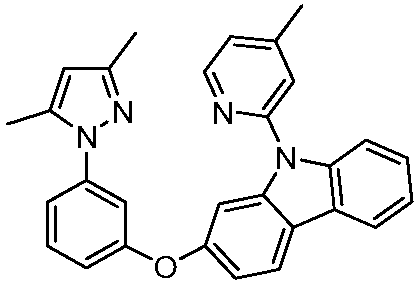
2-(3-(3,5-디메틸-1H-피라졸-1-일)페녹시)-9H-카르바졸 13 (530 mg, 1.5 mmol, 1.0 당량), Pd2(dba)3 (55 mg, 0.06 mmol, 0.04 당량), JohnPhos (36 mg, 0.12 mmol, 0.08 당량) 및 tBuONa (231 mg, 2.4 mmol, 1.6 당량)를 자성 교반 막대가 구비된 건조 압력 Schlenk 튜브에 첨가하였다. 이 튜브를 비우고 질소로 후방-충전하였다. 비움/후방-충전 절차를 2회 반복한 후 톨루엔 (6 ㎖, 4 ㎖/mmol 13), 디옥산 (6 ㎖, 4 ㎖/mmol 13) 및 2-브로모-4-메틸피리딘 (387 mg, 2.25 mmol, 1.5 당량)을 질소 하에 첨가하였다. 튜브를 밀봉하고 혼합물을 95∼105℃의 온도에서 2일 동안 유조에서 교반하였다. 그리고나서 혼합물을 상온으로 냉각시켰다. 용매를 감압 하에 제거하고 용출액으로서 헥산/에틸 아세테이트(10:1-4:1)를 사용하여 실리카겔 상에서 컬럼 크로마토그래피를 통해 잔류물을 정제하여 무색 고체로서 표제 화합물을 수득하였다(94% 수율로 628 mg). 1H NMR (DMSO-d6, 400 MHz): δ 2.14 (s, 3H), 2.28 (s, 3H), 2.46 (s, 3H), 6.05 (s, 1H), 7.06 (dd, J = 8.0, 2.4 Hz, 1H), 7.09-7.13 (m, 2H), 7.26 (dt, J = 8.0, 1.2 Hz, 1H), 7.31 (d, J = 5.2 Hz, 1H), 7.35 (t, J = 7.2 Hz, 1H), 7.44-7.52 (m, 3H), 7.61 (s, 1H), 7.78 (d, J = 8.0, 1H), 8.24 (d, J = 8.0 Hz, 1H), 8.29 (d, J = 8.8 Hz, 1H), 8.53 (d, J = 4.8 Hz, 1H). 13C NMR (DMSO-d6, 100 MHz): δ 12.22, 13.22, 20.58, 102.38, 107.48, 111.18, 113.15, 113.29, 116.34, 118.25, 119.48, 119.91, 120.15, 121.12, 121.76, 123.14, 123.16, 125.92, 130.39, 139.24, 139.38, 139.98, 140.93, 148.07, 149.07, 150.47, 150.70, 154.79, 157.90.2-(3-(3,5-dimethyl-1H-pyrazol-1-yl)phenoxy)-9H-carbazole 13 (530 mg, 1.5 mmol, 1.0 equiv), Pd 2 (dba) 3 (55 mg , 0.06 mmol, 0.04 equiv), JohnPhos (36 mg, 0.12 mmol, 0.08 equiv) and t BuONa (231 mg, 2.4 mmol, 1.6 equiv) were added to a dry pressure Schlenk tube equipped with a magnetic stir bar. The tube was evacuated and back-filled with nitrogen. After repeating the empty/back-fill procedure twice, toluene (6 mL, 4 mL/mmol 13 ), dioxane (6 mL, 4 mL/mmol 13 ) and 2-bromo-4-methylpyridine (387 mg, 2.25 mmol, 1.5 eq) were added under nitrogen. The tube was sealed and the mixture stirred in an oil bath at a temperature of 95-105° C. for 2 days. Then the mixture was cooled to room temperature. The solvent was removed under reduced pressure and the residue was purified via column chromatography on silica gel using hexane/ethyl acetate (10:1-4:1) as eluent to give the title compound as a colorless solid (628 in 94% yield). mg). 1 H NMR (DMSO-d 6 , 400 MHz): δ 2.14 (s, 3H), 2.28 (s, 3H), 2.46 (s, 3H), 6.05 (s, 1H), 7.06 (dd, J = 8.0, 2.4 Hz, 1H), 7.09-7.13 (m, 2H), 7.26 (dt, J = 8.0, 1.2 Hz, 1H), 7.31 (d, J = 5.2 Hz, 1H), 7.35 (t, J = 7.2 Hz, 1H), 7.44-7.52 (m, 3H), 7.61 (s, 1H), 7.78 (d, J = 8.0, 1H), 8.24 (d, J = 8.0 Hz, 1H), 8.29 (d, J = 8.8 Hz) , 1H), 8.53 (d, J = 4.8 Hz, 1H). 13 C NMR (DMSO-d 6 , 100 MHz): δ 12.22, 13.22, 20.58, 102.38, 107.48, 111.18, 113.15, 113.29, 116.34, 118.25, 119.48, 119.91, 120.15, 121.12, 121.76, 123.14, 123.92 130.39, 139.24, 139.38, 139.98, 140.93, 148.07, 149.07, 150.47, 150.70, 154.79, 157.90.
2-(3-(3,5-디메틸-1H-피라졸-1-일)페녹시)-9-(4-메틸피리딘-2-일)-9H-카르바졸 백금 착물 PtON1Me 4 의 합성:Synthesis of 2-(3-(3,5-dimethyl-1H-pyrazol-1-yl)phenoxy)-9-(4-methylpyridin-2-yl)-9H-carbazole platinum complex PtON1Me 4 :
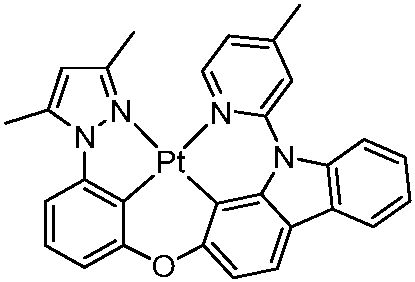
PtON1의 합성 절차에 따라 PtON1Me 4 를 합성하였다. nBu4NBr (42 mg, 0.13 mmol, 0.1 당량)의 존재 하에서 19시간 동안 실온에서 그리고나서 105∼115℃에서 추가 3일 동안 2-(3-(3,5-디메틸-1H-피라졸-1-일)페녹시)-9-(4-메틸피리딘-2-일)-9H-카르바졸 리간드 ON1Me 4 (595 mg, 1.34 mmol, 1.0 당량)를 K2PtCl2 (583 mg, 1.41 mmol, 1.05 당량)와 반응시켰다. 실리카겔 상 플래시 크로마토그래피(용출액: 디클로로메탄)에 의해 미정제 생성물을 정제하여 황색 고체로서 표제 화합물을 수득하였다(58% 수율로 496 mg). 도 3에는 실온에서의 CH2Cl2 중 PtOMe 4 의 방출 스펙트럼이 도시되어 있다. 도 5에는 실온에서 CH2Cl2 중 및 77 K에서 2-메틸-THF 중 PtON1Me 4 의 방출 스펙트럼이 도시되어 있다. 1H NMR (DMSO-d6, 400 MHz): δ 2.36 (s, 3H), 2.37 (s, 3H), 2.70 (s, 3H), 6.38 (s, 1H), 6.91 (d, J = 7.6, 1H), 7.10 (d, J = 7.0, 1H), 7.13 (d, J = 8.0, 1H), 7.17 (t, J = 8.0, 1H), 7.23 (d, J = 7.2, 1H), 7.36 (t, J = 7.6, 1H), 7.45 (t, J = 7.6, 1H), 7.80 (d, J = 8.0 Hz, 1H), 7.94 (s, 1H), 8.09 (t, J = 8.4 Hz, 2H), 9.03 (d, J = 6.0 Hz, 1H). 1H NMR (CD2Cl2, 400 MHz): δ 2.28 (s, 3H), 2.38 (s, 3H), 2.67 (s, 3H), 6.09 (s, 1H), 6.76 (d, J = 6.4, 1H), 7.05 (d, J = 8.0, 1H), 7.17 (d, J = 7.6, 1H), 7.22 (t, J = 7.6, 1H), 7.29 (d, J = 8.0, 1H), 7.38 (t, J = 7.2 Hz, 1H), 7.44 (d, J = 7.6 Hz, 1H), 7.81 (d, J = 8.0, 1H), 7.88 (s, 1H), 7.96 (d, J = 8.0, 1H), 8.06 (d, J = 7.6, 1H), 8.96 (d, J = 6.4 Hz, 1H). 13C NMR (CD2Cl2, 100 MHz): δ 14.85, 15.08, 21.59, 100.57, 107.22, 110.31, 111.81, 112.82, 113.15, 115.15, 115.35, 115.95, 116.37, 119.99, 120.19, 122.99, 124.32, 124.67, 129.27, 138.89, 141.95, 143.16, 148.40, 149.13, 149.89, 151.37, 152.76, 153.18, 153.21. PtON1Me 4 was synthesized according to the synthesis procedure of PtON1. 2-(3-(3,5-dimethyl-1H-pyrazole-) in the presence of n Bu 4 NBr (42 mg, 0.13 mmol, 0.1 equiv) for 19 h at room temperature and then at 105-115 °C for an additional 3 days. 1-yl)phenoxy)-9-(4-methylpyridin-2-yl)-9H-carbazole ligand ON1Me 4 (595 mg, 1.34 mmol, 1.0 equiv) was mixed with K 2 PtCl 2 (583 mg, 1.41 mmol, 1.05 equiv). Purification of the crude product by flash chromatography on silica gel (eluent: dichloromethane) gave the title compound as a yellow solid (496 mg in 58% yield). 3 shows the emission spectrum of PtOMe 4 in CH 2 Cl 2 at room temperature. Figure 5 shows emission spectra of PtON1Me 4 in CH 2 Cl 2 at room temperature and 2-methyl-THF at 77 K. 1 H NMR (DMSO-d 6 , 400 MHz): δ 2.36 (s, 3H), 2.37 (s, 3H), 2.70 (s, 3H), 6.38 (s, 1H), 6.91 (d, J = 7.6, 1H), 7.10 (d, J = 7.0, 1H), 7.13 (d, J = 8.0, 1H), 7.17 (t, J = 8.0, 1H), 7.23 (d, J = 7.2, 1H), 7.36 (t) , J = 7.6, 1H), 7.45 (t, J = 7.6, 1H), 7.80 (d, J = 8.0 Hz, 1H), 7.94 (s, 1H), 8.09 (t, J = 8.4 Hz, 2H), 9.03 (d, J = 6.0 Hz, 1H). 1 H NMR (CD 2 Cl 2 , 400 MHz): δ 2.28 (s, 3H), 2.38 (s, 3H), 2.67 (s, 3H), 6.09 (s, 1H), 6.76 (d, J = 6.4, 1H), 7.05 (d, J = 8.0, 1H), 7.17 (d, J = 7.6, 1H), 7.22 (t, J = 7.6, 1H), 7.29 (d, J = 8.0, 1H), 7.38 (t) , J = 7.2 Hz, 1H), 7.44 (d, J = 7.6 Hz, 1H), 7.81 (d, J = 8.0, 1H), 7.88 (s, 1H), 7.96 (d, J = 8.0, 1H), 8.06 (d, J = 7.6, 1H), 8.96 (d, J = 6.4 Hz, 1H). 13 C NMR (CD 2 Cl 2 , 100 MHz): δ 14.85, 15.08, 21.59, 100.57, 107.22, 110.31, 111.81, 112.82, 113.15, 115.15, 115.35, 115.95, 116.37, 119.99, 120.19, 122.99, 124.32, 124.67 129.27, 138.89, 141.95, 143.16, 148.40, 149.13, 149.89, 151.37, 152.76, 153.18, 153.21.
실시예 10.Example 10.
백금 착물 PtON1Me 5 는 하기 반응식에 따라 제조될 수 있다:The platinum complex PtON1Me 5 can be prepared according to the following scheme:

2-(3-(3,5-디메틸-1H-피라졸-1-일)페녹시)-9-(5-메틸피리딘-2-일)-9H-카르바졸 리간드 ON1Me 5 의 합성:Synthesis of 2-(3-(3,5-dimethyl-1H-pyrazol-1-yl)phenoxy)-9-(5-methylpyridin-2-yl)-9H-carbazole ligand ON1Me 5 :
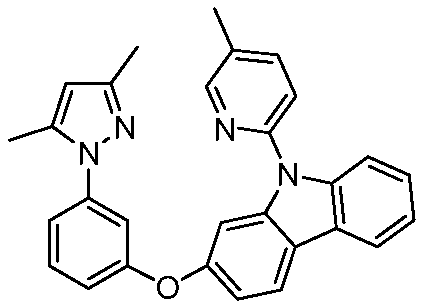
2-(3-(3,5-디메틸-1H-피라졸-1-일)페녹시)-9H-카르바졸 13 (353 mg, 1.0 mmol, 1.0 당량) 및 2-브로모-5-메틸피리딘 (258 mg, 1.5 mmol, 1.5 당량)을 사용하여 리간드 ON1Me 4 의 합성 절차에 따라 리간드 ON1Me 5 를 합성하였다. 실리카겔 상 플래시 크로마토그래피(용출액: 헥산/에틸 아세테이트 = 10:1-5:1)에 의해 미정제 생성물을 정제하여 무색 고체로서 표제 화합물을 수득하였다(94% 수율로 420 mg). 1H NMR (DMSO-d6, 400 MHz): δ 2.12 (s, 3H), 2.25 (s, 3H), 2.39 (s, 3H), 6.03 (s, 1H), 7.04 (dd, J = 8.0, 2.4 Hz, 1H), 7.07-7.11 (m, 2H), 7.23 (dd, J = 8.0, 2.0 Hz, 1H), 7.32 (t, J = 7.6 Hz, 1H), 7.41-7.49 (m, 3H), 7.66 (d, J = 8.4 Hz, 1H), 7.71 (d, J = 8.0, 1H), 7.89 (dd, J = 8.0, 2.0 Hz, 1H), 8.22 (d, J = 7.2 Hz, 1H), 8.27 (d, J = 8.0 Hz, 1H), 8.50 (d, J = 2.0 Hz, 1H). 13C NMR (DMSO-d6, 125 MHz): δ 12.21, 13.23, 17.48, 102.16, 107.49, 110.95, 113.14, 113.26, 116.28, 118.26, 118.64, 119.87, 120.19, 121.04, 121.80, 123.07, 125.92, 130.42, 131.64, 139.25, 139.49, 139.79, 140.05, 140.92, 148.09, 148.10, 149.50, 154.74, 157.95.2-(3-(3,5-dimethyl-1H-pyrazol-1-yl)phenoxy)-9H-carbazole 13 (353 mg, 1.0 mmol, 1.0 equiv) and 2-bromo-5-methylpyridine Ligand ON1Me 5 was synthesized according to the procedure for synthesis of ligand ON1Me 4 using (258 mg, 1.5 mmol, 1.5 equiv). The crude product was purified by flash chromatography on silica gel (eluent: hexane/ethyl acetate = 10:1-5:1) to give the title compound as a colorless solid (420 mg in 94% yield). 1 H NMR (DMSO-d 6 , 400 MHz): δ 2.12 (s, 3H), 2.25 (s, 3H), 2.39 (s, 3H), 6.03 (s, 1H), 7.04 (dd, J = 8.0, 2.4 Hz, 1H), 7.07-7.11 (m, 2H), 7.23 (dd, J = 8.0, 2.0 Hz, 1H), 7.32 (t, J = 7.6 Hz, 1H), 7.41-7.49 (m, 3H), 7.66 (d, J = 8.4 Hz, 1H), 7.71 (d, J = 8.0, 1H), 7.89 (dd, J = 8.0, 2.0 Hz, 1H), 8.22 (d, J = 7.2 Hz, 1H), 8.27 (d, J = 8.0 Hz, 1H), 8.50 (d, J = 2.0 Hz, 1H). 13 C NMR (DMSO-d 6 , 125 MHz): δ 12.21, 13.23, 17.48, 102.16, 107.49, 110.95, 113.14, 113.26, 116.28, 118.26, 118.64, 119.87, 120.19, 121.04, 121.80, 123.07, 125.92, 130.42, 125. 131.64, 139.25, 139.49, 139.79, 140.05, 140.92, 148.09, 148.10, 149.50, 154.74, 157.95.
2-(3-(3,5-디메틸-1H-피라졸-1-일)페녹시)-9-(5-메틸피리딘-2-일)-9H-카르바졸 백금 착물 PtON1Me 5 의 합성:Synthesis of 2-(3-(3,5-dimethyl-1H-pyrazol-1-yl)phenoxy)-9-(5-methylpyridin-2-yl)-9H-carbazole platinum complex PtON1Me 5 :
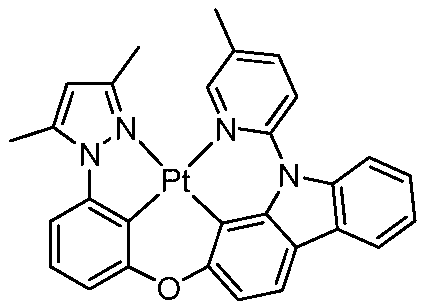
PtON1의 합성 절차에 따라 PtON1Me 5 를 합성하였다. nBu4NBr (30 mg, 0.092 mmol, 0.1 당량)의 존재 하에서 19시간 동안 실온에서 그리고나서 105∼115℃에서 추가 3일 동안 2-(3-(3,5-디메틸-1H-피라졸-1-일)페녹시)-9-(5-메틸피리딘-2-일)-9H-카르바졸 리간드 ON1Me 5 (410 mg, 0.92 mmol, 1.0 당량)를 K2PtCl2 (402 mg, 0.97 mmol, 1.05 당량)와 반응시켰다. 실리카겔 상 플래시 크로마토그래피(용출액: 헥산/디클로로메탄 = 1:1)에 의해 미정제 생성물을 정제하여 황색 고체로서 표제 화합물을 수득하였다(19% 수율로 111 mg). 도 3에는 실온에서 PtON1Me 5 의 방출 스펙트럼이 도시되어 있다. 도 6에는 실온에서 CH2Cl2 중 및 77 K에서 2-메틸-THF 중 PtON1Me 5 의 방출 스펙트럼이 도시되어 있다. 1H NMR (CD2Cl2, 400 MHz): δ 2.34 (s, 3H), 2.47 (s, 3H), 2.74 (s, 3H), 6.20 (s, 1H), 7.00-7.03 (m, 1H), 7.20-7.26 (m, 3H), 7.35-7.39 (m, 1H), 7.41-7.46 (m, 1H), 7.74 (d, J = 9.2 Hz, 1H), 7.77 (dd, J = 8.0, 1.6 Hz, 1H), 7.94 (d, J = 8.4 Hz, 1H), 8.05 (d, J = 8.4 Hz, 2H), 9.09 (s, 1H). 1H NMR (DMSO-d6, 400 MHz): δ 2.40 (s, 3H), 2.43 (s, 3H), 2.77 (s, 3H), 6.47 (s, 1H), 6.96 (d, J = 8.0 Hz, 1H), 7.17 (d, J = 8.4 Hz, 1H), 7.23 (t, J = 8.0 Hz, 1H), 7.29 (d, J = 8.0 Hz, 1H), 7.40 (d, J = 8.4 Hz, 1H), 7.47-7.51 (m, 1H), 7.85 (d, J = 8.0 Hz, 1H), 8.02 (dd, J = 8.4, 2.0 Hz, 1H), 8.08 (d, J = 7.6 Hz, 1H), 8.13 (d, J = 8.4 Hz, 1H), 8.15 (d, J = 8.4 Hz, 1H), 9.09 (d, J = 1.6 Hz, 1H). 13C NMR (CD2Cl2, 100 MHz): δ 14.72, 15.16, 17.67, 100.21, 107.25, 110.41, 111.44, 112.78, 113.27, 114.93, 115.44, 115.58, 116.30, 120.23, 122.93, 124.33, 124.79, 128.05, 129.20, 138.97, 140.30, 142.11, 143.10, 147.68, 148.41, 149.93, 152.76, 153.20, 153.43. PtON1Me 5 was synthesized according to the synthesis procedure of PtON1. 2-(3-(3,5-dimethyl-1H-pyrazole-) in the presence of n Bu 4 NBr (30 mg, 0.092 mmol, 0.1 equiv) for 19 h at room temperature and then at 105-115° C. for an additional 3 days. 1-yl)phenoxy)-9-(5-methylpyridin-2-yl)-9H-carbazole ligand ON1Me 5 (410 mg, 0.92 mmol, 1.0 equiv) was mixed with K 2 PtCl 2 (402 mg, 0.97 mmol, 1.05 equiv). The crude product was purified by flash chromatography on silica gel (eluent: hexane/dichloromethane = 1:1) to give the title compound as a yellow solid (111 mg in 19% yield). 3 shows the emission spectrum of PtON1Me 5 at room temperature. 6 shows emission spectra of PtON1Me 5 in CH 2 Cl 2 at room temperature and 2-methyl-THF at 77 K. 1 H NMR (CD 2 Cl 2 , 400 MHz): δ 2.34 (s, 3H), 2.47 (s, 3H), 2.74 (s, 3H), 6.20 (s, 1H), 7.00-7.03 (m, 1H) , 7.20-7.26 (m, 3H), 7.35-7.39 (m, 1H), 7.41-7.46 (m, 1H), 7.74 (d, J = 9.2 Hz, 1H), 7.77 (dd, J = 8.0, 1.6 Hz) , 1H), 7.94 (d, J = 8.4 Hz, 1H), 8.05 (d, J = 8.4 Hz, 2H), 9.09 (s, 1H). 1 H NMR (DMSO-d 6 , 400 MHz): δ 2.40 (s, 3H), 2.43 (s, 3H), 2.77 (s, 3H), 6.47 (s, 1H), 6.96 (d, J = 8.0 Hz) , 1H), 7.17 (d, J = 8.4 Hz, 1H), 7.23 (t, J = 8.0 Hz, 1H), 7.29 (d, J = 8.0 Hz, 1H), 7.40 (d, J = 8.4 Hz, 1H) ), 7.47-7.51 (m, 1H), 7.85 (d, J = 8.0 Hz, 1H), 8.02 (dd, J = 8.4, 2.0 Hz, 1H), 8.08 (d, J = 7.6 Hz, 1H), 8.13 (d, J = 8.4 Hz, 1H), 8.15 (d, J = 8.4 Hz, 1H), 9.09 (d, J = 1.6 Hz, 1H). 13 C NMR (CD 2 Cl 2 , 100 MHz): δ 14.72, 15.16, 17.67, 100.21, 107.25, 110.41, 111.44, 112.78, 113.27, 114.93, 115.44, 115.58, 116.30, 120.23, 122.93, 124.33, 124.79, 128.05, 124.79 129.20, 138.97, 140.30, 142.11, 143.10, 147.68, 148.41, 149.93, 152.76, 153.20, 153.43.
실시예 11.Example 11.
백금 착물 PtON1Me 6 은 하기 반응식에 따라 제조될 수 있다:The platinum complex PtON1Me 6 can be prepared according to the following scheme:

2-(3-(3,5-디메틸-1H-피라졸-1-일)페녹시)-9-(6-메틸피리딘-2-일)-9H-카르바졸 리간드 ON1Me 6 의 합성:Synthesis of 2-(3-(3,5-dimethyl-1H-pyrazol-1-yl)phenoxy)-9-(6-methylpyridin-2-yl)-9H-carbazole ligand ON1Me 6 :
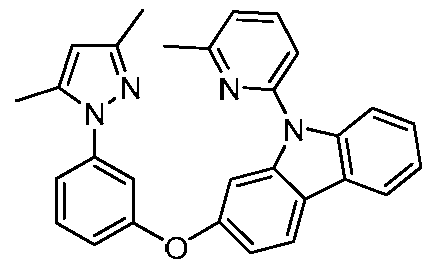
2-(3-(3,5-디메틸-1H-피라졸-1-일)페녹시)-9H-카르바졸 13 (475 mg, 1.34 mmol, 1.0 당량) 및 2-브로모-6-메틸피리딘 (461 mg, 2.68 mmol, 2.0 당량)을 사용하여 리간드 ON1Me 4 의 합성 절차에 따라 리간드 ON1Me 6 을 합성하였다. 실리카겔 상 플래시 크로마토그래피(용출액: 헥산/에틸 아세테이트 = 10:1-5:1)에 의해 미정제 생성물을 정제하여 갈색 고체로서 표제 화합물을 수득하였다(88% 수율로 526 mg). 1H NMR (DMSO-d6, 400 MHz): δ 2.11 (s, 3H), 2.24 (s, 3H), 2.48 (s, 3H), 6.02 (s, 1H), 7.07 (td, J = 8.0, 2.4 Hz, 2H), 7.14 (t, J = 2.0 Hz, 1H), 7.24-7.29 (m, 2H), 7.32 (t, J = 7.2 Hz, 1H), 7.43 (t, J = 7.2 Hz, 1H), 7.48 (t, J = 8.0 Hz, 1H), 7.51 (d, J = 2.0, 1H), 7.54 (d, J = 8.0 Hz, 1H), 7.76 (d, J = 8.0 Hz, 1H), 7.93 (d, J = 8.0 Hz, 1H), 8.20 (d, J = 7.6 Hz, 1H), 8.25 (d, J = 8.0 Hz, 1H). 13C NMR (DMSO-d6, 100 MHz): δ 12.23, 13.23, 23.82, 102.00, 107.51, 111.15, 112.98, 113.68, 115.74, 116.72, 118.42, 119.75, 120.14, 121.13, 121.28, 121.71, 123.23, 125.88, 130.42, 139.23, 139.30, 139.60, 139.93, 140.97, 148.10, 149.75, 155.13, 157.62, 158.34.2-(3-(3,5-dimethyl-1H-pyrazol-1-yl)phenoxy)-9H-carbazole 13 (475 mg, 1.34 mmol, 1.0 equiv) and 2-bromo-6-methylpyridine Ligand ON1Me 6 was synthesized according to the procedure for synthesis of ligand ON1Me 4 using (461 mg, 2.68 mmol, 2.0 equiv). The crude product was purified by flash chromatography on silica gel (eluent: hexane/ethyl acetate = 10:1-5:1) to give the title compound as a brown solid (526 mg in 88% yield). 1 H NMR (DMSO-d 6 , 400 MHz): δ 2.11 (s, 3H), 2.24 (s, 3H), 2.48 (s, 3H), 6.02 (s, 1H), 7.07 (td, J = 8.0, 2.4 Hz, 2H), 7.14 (t, J = 2.0 Hz, 1H), 7.24-7.29 (m, 2H), 7.32 (t, J = 7.2 Hz, 1H), 7.43 (t, J = 7.2 Hz, 1H) , 7.48 (t, J = 8.0 Hz, 1H), 7.51 (d, J = 2.0, 1H), 7.54 (d, J = 8.0 Hz, 1H), 7.76 (d, J = 8.0 Hz, 1H), 7.93 ( d, J = 8.0 Hz, 1H), 8.20 (d, J = 7.6 Hz, 1H), 8.25 (d, J = 8.0 Hz, 1H). 13 C NMR (DMSO-d 6 , 100 MHz): δ 12.23, 13.23, 23.82, 102.00, 107.51, 111.15, 112.98, 113.68, 115.74, 116.72, 118.42, 119.75, 120.14, 121.13, 121.28, 121.71, 123.23, 125.88,23 130.42, 139.23, 139.30, 139.60, 139.93, 140.97, 148.10, 149.75, 155.13, 157.62, 158.34.
2-(3-(3,5-디메틸-1H-피라졸-1-일)페녹시)-9-(6-메틸피리딘-2-일)-9H-카르바졸 백금 착물 PtON1Me 6 의 합성:Synthesis of 2-(3-(3,5-dimethyl-1H-pyrazol-1-yl)phenoxy)-9-(6-methylpyridin-2-yl)-9H-carbazole platinum complex PtON1Me 6 :

PtON1의 합성 절차에 따라 PtON1Me 6 을 합성하였다. nBu4NBr (37 mg, 0.115 mmol, 0.1 당량)의 존재 하에서 23시간 동안 실온에서 그리고나서 105∼115℃에서 추가 3일 동안 2-(3-(3,5-디메틸-1H-피라졸-1-일)페녹시)-9-(6-메틸피리딘-2-일)-9H-카르바졸 리간드 ON1Me 6 (510 mg, 1.15 mmol, 1.0 당량)를 K2PtCl2 (500 mg, 1.20 mmol, 1.05 당량)와 반응시켰다. 실리카겔 상 플래시 크로마토그래피(용출액: 디클로로메탄)에 의해 미정제 생성물을 정제하여 황색 고체로서 표제 화합물을 수득하였다(37% 수율로 271 mg). 도 3에는 실온에서 PtON1Me 6 의 방출 스펙트럼이 도시되어 있다. 도 6에는 실온에서 CH2Cl2 중 그리고 77 K에서 2-메틸-THF 중 PtON1Me 6 의 방출 스펙트럼이 도시되어 있다. 1H NMR (CD2Cl2, 400 MHz): δ 2.19 (s, 3H), 2.68 (s, 3H), 3.05 (s, 3H), 6.11 (s, 1H), 7.01 (dd, J = 7.6, 2.0 Hz, 1H), 7.08 (d, J = 7.6 Hz, 1H), 7.16-7.22 (m, 3H), 7.34 (t, J = 8.4 Hz, 1H), 7.42 (t, J = 8.4 Hz, 1H), 7.64 (t, J = 8.4 Hz, 1H), 7.75 (t, J = 8.4 Hz, 1H), 7.96-7.99 (m, 2H), 8.09 (d, J = 8.4 Hz, 1H). 1H NMR (DMSO-d6, 400 MHz): δ 2.14 (s, 3H), 2.69 (s, 3H), 2.98 (s, 3H), 6.35 (s, 1H), 6.96 (dd, J = 8.0, 0.8 Hz, 1H), 7.12 (d, J = 8.0 Hz, 1H), 7.20 (t, J = 8.0 Hz, 1H), 7.25 (dd, J = 7.6, 0.8 Hz, 1H), 7.33 (d, J = 7.6 Hz, 1H), 7.37 (t, J = 7.6 Hz, 1H), 7.45-7.49 (m, 1H), 7.72 (d, J = 8.4 Hz, 1H), 8.00 (t, J = 8.0 Hz, 1H), 8.08-8.13 (m, 3H). 13C NMR (DMSO-d6, 100 MHz): δ 12.84, 13.99, 27.35, 102.71, 107.70, 109.58, 111.71, 112.80, 112.82, 113.41, 114.61, 115.98, 116.51, 120.09, 121.23, 122.89, 124.55, 124.60, 128.77, 138.72, 140.13, 141.31, 142.58, 147.18, 149.46, 149.53, 151.85, 153.31, 161.27. PtON1Me 6 was synthesized according to the synthesis procedure of PtON1. 2-(3-(3,5-dimethyl-1H-pyrazole-) in the presence of n Bu 4 NBr (37 mg, 0.115 mmol, 0.1 equiv) for 23 h at room temperature and then at 105-115° C. for an additional 3 days. 1-yl)phenoxy)-9-(6-methylpyridin-2-yl)-9H-carbazole ligand ON1Me 6 (510 mg, 1.15 mmol, 1.0 equiv) was mixed with K 2 PtCl 2 (500 mg, 1.20 mmol, 1.05 equiv). Purification of the crude product by flash chromatography on silica gel (eluent: dichloromethane) gave the title compound as a yellow solid (271 mg in 37% yield). Figure 3 shows the emission spectrum of
실시예 12.Example 12.
백금 착물 PtON1-tBu는 하기 반응식에 따라 제조되었다:The platinum complex PtON1-tBu was prepared according to the following scheme:
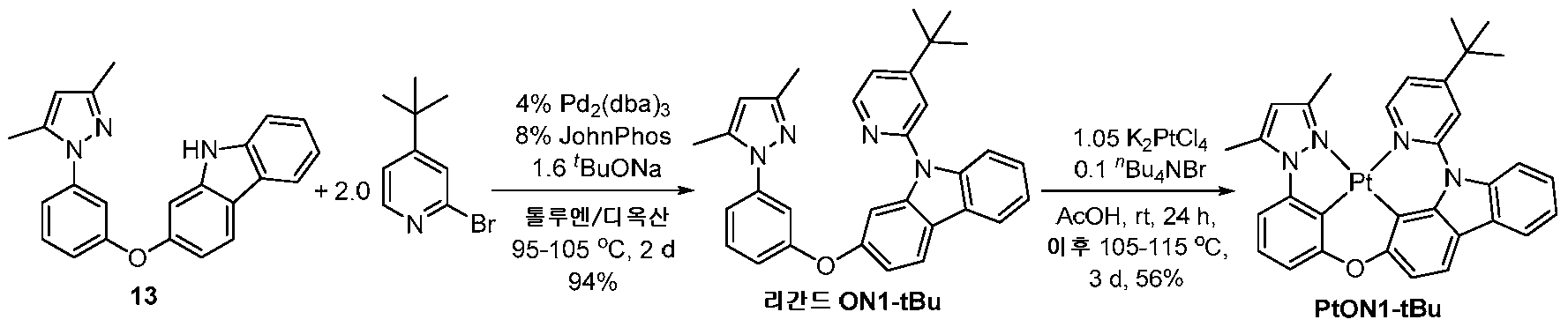
2-(3-(3,5-디메틸-1H-피라졸-1-일)페녹시)-9-(4-tert-부틸피리딘-2-일)-9H-카르바졸 리간드 ON1-tBu의 합성:Synthesis of 2-(3-(3,5-dimethyl-1H-pyrazol-1-yl)phenoxy)-9-(4-tert-butylpyridin-2-yl)-9H-carbazole ligand ON1-tBu :
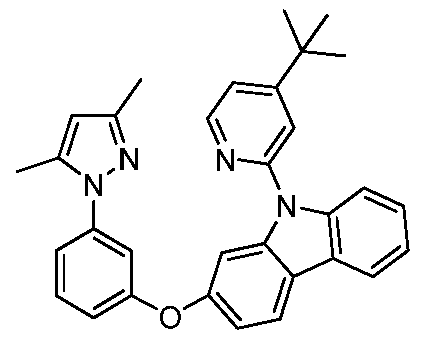
2-(3-(3,5-디메틸-1H-피라졸-1-일)페녹시)-9H-카르바졸 13 (530 mg, 1.5 mmol, 1.0 당량) 및 2-브로모-4-tert-부틸피리딘 (642 mg, 3.0 mmol, 2.0 당량)을 사용하여 리간드 ON1Me 4 의 합성 절차에 따라 리간드 ON1-tBu를 합성하였다. 실리카겔 상 플래시 크로마토그래피(용출액: 헥산/에틸 아세테이트 = 10:1-5:1)에 의해 미정제 생성물을 정제하여 갈색 고체로서 표제 화합물을 수득하였다(94% 수율로 685 mg). 1H NMR (DMSO-d6, 400 MHz): δ 1.26 (s, 9H), 2.11 (s, 3H), 2.23 (s, 3H), 6.00 (s, 1H), 7.06-7.08 (m, 1H), 7.10 (dd, J = 8.0, 2.4 Hz, 1H), 7.14 (t, J = 2.4 Hz, 1H), 7.24-7.26 (m, 1H), 7.31 (t, J = 7.2 Hz, 1H), 7.38 (d, J = 2.0 Hz, 1H), 7.41-7.48 (m, 3H), 7.61 (d, J = 1.6, 1H), 7.74 (d, J = 8.4 Hz, 1H), 8.20 (d, J = 8.0 Hz, 1H), 8.26 (d, J = 8.8 Hz, 1H), 8.55 (d, J = 4.8 Hz, 1H). 13C NMR (DMSO-d6, 100 MHz): δ 12.21, 13.22, 30.01, 34.81, 101.37, 107.50, 111.11, 113.01, 113.81, 115.78, 116.80, 118.49, 119.27, 119.72, 120.13, 121.11, 121.83, 123.20, 125.90, 130.45, 139.19, 139.43, 139.94, 141.01, 148.07, 149.37, 150.60, 155.32, 157.50, 163.03.2-(3-(3,5-dimethyl-1H-pyrazol-1-yl)phenoxy)-9H-carbazole 13 (530 mg, 1.5 mmol, 1.0 equiv) and 2-bromo-4-tert- Ligand ON1-tBu was synthesized according to the procedure for the synthesis of ligand ON1Me 4 using butylpyridine (642 mg, 3.0 mmol, 2.0 equiv). The crude product was purified by flash chromatography on silica gel (eluent: hexane/ethyl acetate = 10:1-5:1) to give the title compound as a brown solid (685 mg in 94% yield). 1 H NMR (DMSO-d 6 , 400 MHz): δ 1.26 (s, 9H), 2.11 (s, 3H), 2.23 (s, 3H), 6.00 (s, 1H), 7.06-7.08 (m, 1H) , 7.10 (dd, J = 8.0, 2.4 Hz, 1H), 7.14 (t, J = 2.4 Hz, 1H), 7.24-7.26 (m, 1H), 7.31 (t, J = 7.2 Hz, 1H), 7.38 ( d, J = 2.0 Hz, 1H), 7.41-7.48 (m, 3H), 7.61 (d, J = 1.6, 1H), 7.74 (d, J = 8.4 Hz, 1H), 8.20 (d, J = 8.0 Hz) , 1H), 8.26 (d, J = 8.8 Hz, 1H), 8.55 (d, J = 4.8 Hz, 1H). 13 C NMR (DMSO-d 6 , 100 MHz): δ 12.21, 13.22, 30.01, 34.81, 101.37, 107.50, 111.11, 113.01, 113.81, 115.78, 116.80, 118.49, 119.27, 119.72, 120.13, 121.11, 121.83 125.90, 130.45, 139.19, 139.43, 139.94, 141.01, 148.07, 149.37, 150.60, 155.32, 157.50, 163.03.
2-(3-(3,5-디메틸-1H-피라졸-1-일)페녹시)-9-(4-tert-부틸피리딘-2-일)-9H-카르바졸 백금 착물 PtON1-tBu의 합성:2-(3-(3,5-dimethyl-1H-pyrazol-1-yl)phenoxy)-9-(4-tert-butylpyridin-2-yl)-9H-carbazole platinum complex of PtON1-tBu synthesis:

PtON1의 합성 절차에 따라 PtON1-tBu를 합성하였다. nBu4NBr (42 mg, 0.13 mmol, 0.1 당량)의 존재 하에서 24시간 동안 실온에서 그리고나서 105∼115℃에서 추가 3일 동안 9-(4-Tert-부틸피리딘-2-일)-2-(3-(3,5-디메틸-1H-피라졸-1-일)페녹시)-9H-카르바졸 리간드 ON1-tBu (635 mg, 1.30 mmol, 1.0 당량)를 K2PtCl2 (567 mg, 1.37 mmol, 1.05 당량)와 반응시켰다. 실리카겔 상 플래시 크로마토그래피(용출액: 헥산/디클로로메탄 = 1:1)에 의해 미정제 생성물을 정제하여 황색 고체로서 표제 화합물을 수득하였다(56% 수율로 495 mg). 도 3에는 실온에서 PtON1-tBu의 방출 스펙트럼이 도시되어 있다. 도 9에는 실온에서 CH2Cl2 중 그리고 77 K에서 2-메틸-THF 중 PtON1-tBu의 방출 스펙트럼이 도시되어 있다. 1H NMR (CD2Cl2, 400 MHz): δ 1.32 (s, 9H), 2.46 (s, 3H), 2.73 (s, 3H), 6.18 (s, 1H), 6.99-7.03 (m, 2H), 7.20-7.26 (m, 3H), 7.38 (t, J = 7.6 Hz, 1H), 7.48 (t, J = 8.0 Hz, 1H), 7.79 (d, J = 7.6 Hz, 1H), 7.94 (d, J = 8.0 Hz, 1H), 8.07 (d, J = 8.0 Hz, 1H), 8.09 (d, J = 1.2 Hz, 1H), 9.08 (d, J = 7.2 Hz, 1H). 1H NMR (DMSO-d6, 400 MHz): δ 1.32 (s, 9H), 2.43 (s, 3H), 2.75 (s, 3H), 6.44 (s, 1H), 6.95 (d, J = 8.0 Hz, 1H), 7.17 (d, J = 8.4 Hz, 1H), 7.22 (t, J = 8.0 Hz, 1H), 7.28 (d, J = 7.6 Hz, 1H), 7.34 (dd, J = 6.0, 1.6 Hz, 1H), 7.40 (t, J = 7.6 Hz, 1H), 7.50 (t, J = 7.6 Hz, 1H), 7.86 (d, J = 8.4 Hz, 1H), 8.05 (d, J = 1.2 Hz, 1H), 8.11 (d, J = 8.0 Hz, 1H), 8.16 (d, J = 7.6 Hz, 1H), 9.11 (d, J = 6.4 Hz, 1H). 13C NMR (CD2Cl2, 100 MHz): δ 14.99, 15.15, 30.24, 35.89, 100.32, 107.22, 110.29, 111.78, 112.79, 113.07, 113.21, 114.78, 115.40, 116.33, 116.36, 120.32, 122.94, 124.45, 124.71, 129.28, 139.07, 142.06, 143.23, 148.44, 149.35, 150.01, 152.80, 153.22, 153.41, 163.97. PtON1 -tBu was synthesized according to the synthesis procedure of PtON1. 9-(4-Tert-butylpyridin-2-yl)-2-yl in the presence of n Bu 4 NBr (42 mg, 0.13 mmol, 0.1 equiv) for 24 h at room temperature and then at 105-115° C. for an additional 3 days. (3-(3,5-dimethyl-1H-pyrazol-1-yl)phenoxy)-9H-carbazole ligand ON1-tBu (635 mg, 1.30 mmol, 1.0 equiv) was mixed with K 2 PtCl 2 (567 mg, 1.37 mmol, 1.05 equiv). Purification of the crude product by flash chromatography on silica gel (eluent: hexane/dichloromethane = 1:1) gave the title compound as a yellow solid (495 mg in 56% yield). Figure 3 shows the emission spectrum of PtON1-tBu at room temperature. 9 shows emission spectra of PtON1-tBu in CH 2 Cl 2 at room temperature and 2-methyl-THF at 77 K. 1 H NMR (CD 2 Cl 2 , 400 MHz): δ 1.32 (s, 9H), 2.46 (s, 3H), 2.73 (s, 3H), 6.18 (s, 1H), 6.99-7.03 (m, 2H) , 7.20-7.26 (m, 3H), 7.38 (t, J = 7.6 Hz, 1H), 7.48 (t, J = 8.0 Hz, 1H), 7.79 (d, J = 7.6 Hz, 1H), 7.94 (d, J = 8.0 Hz, 1H), 8.07 (d, J = 8.0 Hz, 1H), 8.09 (d, J = 1.2 Hz, 1H), 9.08 (d, J = 7.2 Hz, 1H). 1 H NMR (DMSO-d 6 , 400 MHz): δ 1.32 (s, 9H), 2.43 (s, 3H), 2.75 (s, 3H), 6.44 (s, 1H), 6.95 (d, J = 8.0 Hz) , 1H), 7.17 (d, J = 8.4 Hz, 1H), 7.22 (t, J = 8.0 Hz, 1H), 7.28 (d, J = 7.6 Hz, 1H), 7.34 (dd, J = 6.0, 1.6 Hz) , 1H), 7.40 (t, J = 7.6 Hz, 1H), 7.50 (t, J = 7.6 Hz, 1H), 7.86 (d, J = 8.4 Hz, 1H), 8.05 (d, J = 1.2 Hz, 1H) ), 8.11 (d, J = 8.0 Hz, 1H), 8.16 (d, J = 7.6 Hz, 1H), 9.11 (d, J = 6.4 Hz, 1H). 13 C NMR (CD 2 Cl 2 , 100 MHz): δ 14.99, 15.15, 30.24, 35.89, 100.32, 107.22, 110.29, 111.78, 112.79, 113.07, 113.21, 114.78, 115.40, 116.33, 116.36, 120.32, 122.94, 124.45.94 124.71, 129.28, 139.07, 142.06, 143.23, 148.44, 149.35, 150.01, 152.80, 153.22, 153.41, 163.97.
실시예 13.Example 13.
백금 착물 PtON1NMe 2 는 하기 반응식에 따라 제조될 수 있다:The platinum complex PtON1NMe 2 can be prepared according to the following scheme:

2-(2-(3-(3,5-디메틸-1H-피라졸-1-일)페녹시)-9H-카르바졸-9-일)-N,N-디메틸피리딘-4-아민 리간드 ON1NMe 2 의 합성:2-(2-(3-(3,5-dimethyl-1H-pyrazol-1-yl)phenoxy)-9H-carbazol-9-yl)-N,N-dimethylpyridin-4-amine ligand ON1NMe 2 , Composite:

2-(3-(3,5-디메틸-1H-피라졸-1-일)페녹시)-9H-카르바졸 13 (530 mg, 1.5 mmol, 1.0 당량) 및 2-브로모-4-N,N-디메틸아미노피리딘 (362 mg, 1.8 mmol, 1.2 당량)을 사용하여 리간드 ON1Me 4 의 합성 절차에 따라 리간드 ON1NMe 2 를 합성하였다. 실리카겔 상 플래시 크로마토그래피(용출액: 헥산/에틸 아세테이트 = 3:1-2:1-1:1)에 의해 미정제 생성물을 정제하여 무색 고체로서 표제 화합물을 수득하였다(88% 수율로 624 mg). 1H NMR (DMSO-d6, 400 MHz): δ 2.10 (s, 3H), 2.23 (s, 3H), 2.94 (s, 6H), 5.99 (s, 1H), 6.63 (dd, J = 6.0, 1.6 Hz, 1H), 6.74 (d, J = 1.6 Hz, 1H), 7.02-7.07 (m, 2H), 7.12 (s, 1H), 7.22 (d, J = 8.0 Hz, 1H), 7.27 (t, J = 7.6 Hz, 1H), 7.37-7.46 (m, 3H), 7.74 (d, J = 8.4 Hz, 1H), 8.15-8.17 (m, 2H), 8.22 (d, J = 2.0 Hz, 1H). 13C NMR (DMSO-d6, 100 MHz): δ 12.23, 13.22, 38.89, 101.14, 102.07, 105.77, 107.49, 111.33, 112.71, 113.49, 116.46, 118.27, 119.63, 119.99, 120.64, 121.63, 122.92, 125.70, 130.38, 139.21, 139.73, 140.24, 140.97, 148.07, 148.90, 151.08, 154.84, 156.09, 157.86.2-(3-(3,5-dimethyl-1H-pyrazol-1-yl)phenoxy)-9H-carbazole 13 (530 mg, 1.5 mmol, 1.0 equiv) and 2-bromo-4-N, Ligand ON1NMe 2 was synthesized according to the procedure for synthesis of ligand ON1Me 4 using N-dimethylaminopyridine (362 mg, 1.8 mmol, 1.2 equiv). The crude product was purified by flash chromatography on silica gel (eluent: hexane/ethyl acetate = 3:1-2:1-1:1) to give the title compound as a colorless solid (624 mg in 88% yield). 1 H NMR (DMSO-d 6 , 400 MHz): δ 2.10 (s, 3H), 2.23 (s, 3H), 2.94 (s, 6H), 5.99 (s, 1H), 6.63 (dd, J = 6.0, 1.6 Hz, 1H), 6.74 (d, J = 1.6 Hz, 1H), 7.02-7.07 (m, 2H), 7.12 (s, 1H), 7.22 (d, J = 8.0 Hz, 1H), 7.27 (t, J = 7.6 Hz, 1H), 7.37-7.46 (m, 3H), 7.74 (d, J = 8.4 Hz, 1H), 8.15-8.17 (m, 2H), 8.22 (d, J = 2.0 Hz, 1H). 13 C NMR (DMSO-d 6 , 100 MHz): δ 12.23, 13.22, 38.89, 101.14, 102.07, 105.77, 107.49, 111.33, 112.71, 113.49, 116.46, 118.27, 119.63, 119.99, 120.64, 121.63, 122.92, 130.38, 139.21, 139.73, 140.24, 140.97, 148.07, 148.90, 151.08, 154.84, 156.09, 157.86.
2-(2-(3-(3,5-디메틸-1H-피라졸-1-일)페녹시)-9H-카르바졸-9-일)-N,N-디메틸피리딘-4-아민 백금 착물 PtON1NMe 2 의 합성:2- (2- (3- (3,5-dimethyl -1 H - pyrazol-1-yl) phenoxy) -9 H - carbazole-9-yl) -N, N- dimethyl-4-amine Synthesis of platinum complex PtON1NMe 2 :

PtON1의 합성 절차에 따라 PtON1NMe 2 를 합성하였다. 2-(2-(3-(3,5-디메틸-1H-피라졸-1-일)페녹시)-9H-카르바졸-9-일)-N,N-디메틸피리딘-4-아민 리간드 ON1NMe 2 (560 mg, 1.18 mmol, 1.0 eq)를 K2PtCl2(514 mg, 1.24 mmol, 1.05 eq)와, n Bu4NBr(38 mg, 0.118 mmol, 0.1 eq)의 존재 하에 실온에서 24 시간 동안 반응시킨 다음, 105℃∼115℃에서 추가의 3일 동안 반응시켰다. 실리카 겔 상에서 플래시 크로마토그래피(용리액: 헥산/디클로로메탄 = 1:2)로 조생성물을 정제하여, 표제 화합물을 황색 고체로 얻었다(10% 수율로 81 mg). 도 3은 실온에서의 PtON1NMe 2 의 발광 스펙트럼을 도시한다. CH2Cl2 중 실온에서 및 2-메틸-THF 중 77 K에서의 PtON1NMe 2 의 발광 스펙트럼을 도 9에 도시한다. 1H NMR (DMSO-d 6, 400 MHz): δ 2.45 (s, 3H), 2.74 (s, 3H), 3.08 (s, 6H), 6.42 (s, 1H), 6.66 (dd, J = 7.2, 2.0 1H), 6.92 (d, J = 8.0 Hz, 1H), 7.10 (d, J = 2.0 Hz, 1H), 7.12 (dd, J = 8.4, 1.2 Hz, 1H), 7.19 (t, J = 8.0 Hz, 1H), 7.25 (d, J = 8.0 Hz, 1H), 7.35 (t, J = 8.0 Hz, 1H), 7.45 (t, J = 8.4 Hz, 1H), 7.81 (dd, J = 8.4, 0.8 Hz, 1H), 8.12 (d, J = 8.0 Hz, 1H), 8.20 (d, J = 7.6 Hz, 1H), 8.67 (d, J = 6.4 Hz, 1H). 1H NMR (CD2Cl2, 400 MHz): δ 2.47 (s, 3H), 2.71 (s, 3H), 3.02 (s, 6H), 6.14 (s, 1H), 6.32 (dd, J = 7.2, 2.4 1H), 6.97-6.99 (m, 1H), 7.13-7.21 (m, 4H), 7.32 (t, J = 7.6 Hz, 1H), 7.40 (t, J = 8.0 Hz, 1H), 7.75 (dd, J = 8.0, 2.0 Hz, 1H), 8.02 (d, J = 8.0 Hz, 2H), 8.69 (dd, J = 7.2, 2.0 Hz, 1H). 13C NMR (CD2Cl2, 100 MHz): δ 14.81, 15.14, 39.69, 96.01, 100.83, 103.58, 107.16, 110.14, 112.51, 112.94, 113.09, 115.00, 115.04, 116.24, 120.12, 122.39, 124.13, 124.25, 129.18, 139.41, 141.85, 143.99, 148.41, 149.53, 149.82, 152.65, 153.16, 153.32, 155.98. PtON1NMe 2 was synthesized according to the synthesis procedure of PtON1. 2- (2- (3- (3,5-dimethyl -1 H - pyrazol-1-yl) phenoxy) -9 H - carbazole-9-yl) -N, N- dimethyl-4-amine Ligand ON1NMe 2 (560 mg, 1.18 mmol, 1.0 eq) was reacted with K 2 PtCl 2 (514 mg, 1.24 mmol, 1.05 eq) and n Bu 4 NBr (38 mg, 0.118 mmol, 0.1 eq) at room temperature 24 After reacting for an hour, the reaction was carried out at 105° C. to 115° C. for an additional 3 days. The crude product was purified by flash chromatography on silica gel (eluent: hexane/dichloromethane = 1:2) to give the title compound as a yellow solid (81 mg in 10% yield). 3 shows the emission spectrum of PtON1NMe 2 at room temperature. The emission spectra of PtON1NMe 2 at room temperature in CH 2 Cl 2 and at 77 K in 2-methyl-THF are shown in FIG. 9 . 1 H NMR (DMSO- d 6 , 400 MHz): δ 2.45 (s, 3H), 2.74 (s, 3H), 3.08 (s, 6H), 6.42 (s, 1H), 6.66 (dd, J = 7.2, 2.0 1H), 6.92 (d, J = 8.0 Hz, 1H), 7.10 (d, J = 2.0 Hz, 1H), 7.12 (dd, J = 8.4, 1.2 Hz, 1H), 7.19 (t, J = 8.0 Hz) , 1H), 7.25 (d, J = 8.0 Hz, 1H), 7.35 (t, J = 8.0 Hz, 1H), 7.45 (t, J = 8.4 Hz, 1H), 7.81 (dd, J = 8.4, 0.8 Hz) , 1H), 8.12 (d, J = 8.0 Hz, 1H), 8.20 (d, J = 7.6 Hz, 1H), 8.67 (d, J = 6.4 Hz, 1H). 1 H NMR (CD 2 Cl 2 , 400 MHz): δ 2.47 (s, 3H), 2.71 (s, 3H), 3.02 (s, 6H), 6.14 (s, 1H), 6.32 (dd, J = 7.2, 2.4 1H), 6.97-6.99 (m, 1H), 7.13-7.21 (m, 4H), 7.32 (t, J = 7.6 Hz, 1H), 7.40 (t, J = 8.0 Hz, 1H), 7.75 (dd, J = 8.0, 2.0 Hz, 1H), 8.02 (d, J = 8.0 Hz, 2H), 8.69 (dd, J = 7.2, 2.0 Hz, 1H). 13 C NMR (CD 2 Cl 2 , 100 MHz): δ 14.81, 15.14, 39.69, 96.01, 100.83, 103.58, 107.16, 110.14, 112.51, 112.94, 113.09, 115.00, 115.04, 116.24, 120.12, 122.39, 124.13, 124. 129.18, 139.41, 141.85, 143.99, 148.41, 149.53, 149.82, 152.65, 153.16, 153.32, 155.98.
실시예 14.Example 14.
백금 착물 PtON1Ph는 하기 반응식에 따라 제조할 수 있다:The platinum complex PtON1Ph can be prepared according to the following scheme:
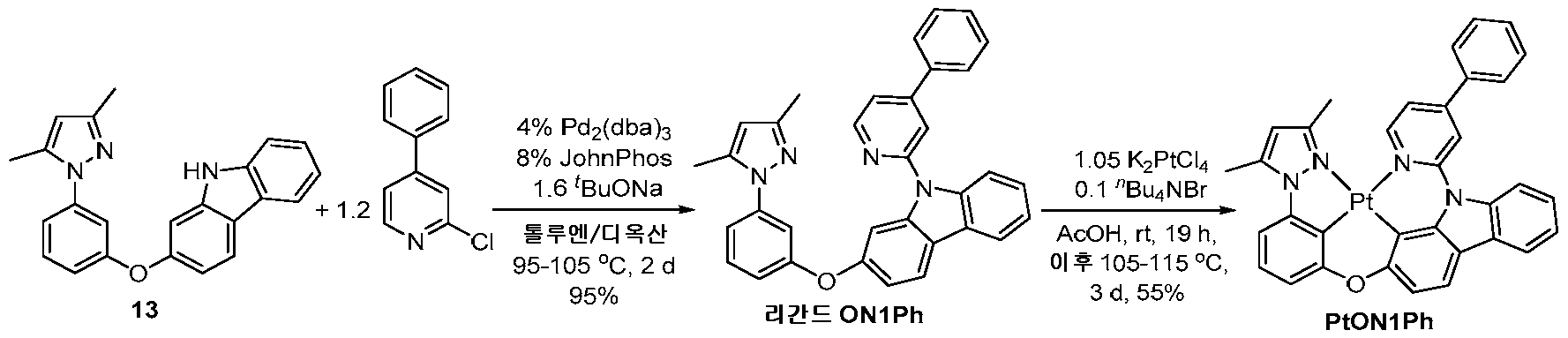
2-(3-(3,5-디메틸-1H-피라졸-1-일)페녹시)-9-(4-페닐피리딘-2-일)-9H-카르바졸 리간드 ON1Ph의 합성:2- (3- (3,5-dimethyl -1 H - pyrazol-1-yl) phenoxy) -9- (4-pyridin-2-yl) -9 H - carbazole ligand ON1Ph Synthesis of:
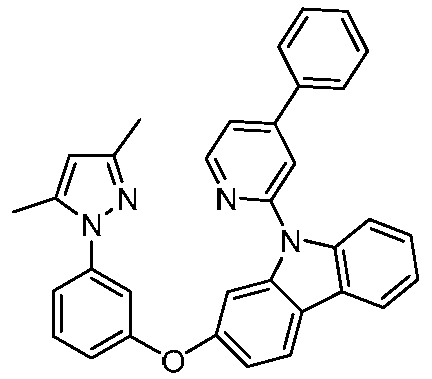
2-(3-(3,5-디메틸-1H-피라졸-1-일)페녹시)-9H-카르바졸 13(530 mg, 1.5 mmol, 1.0 eq) 및 2-클로로-4-페닐피리딘(342 mg, 1.8 mmol, 1.2 eq)을 이용하여 리간드 ON1Me 4 의 합성 절차에 따라 리간드 ON1Ph를 합성하였다. 실리카 겔 상에서 플래시 크로마토그래피(용리액: 헥산/아세트산에틸 = 10:1-5:1-3:1)로 조생성물을 정제하여, 표제 화합물을 갈색 고체로 얻었다(95% 수율로 725 mg). 1H NMR (DMSO-d 6, 400 MHz): δ 2.13 (s, 3H), 2.25 (s, 3H), 6.04 (s, 1H), 7.10 (dd, J = 8.0, 2.4 Hz, 1H), 7.12-7.15 (m, 2H), 7.25-7.27 (m, 1H), 7.37 (t, J = 7.6 Hz, 1H), 7.46-7.57 (m, 6H), 7.79 (dd, J = 4.8, 1.6, 1H), 7.85-7.88 (m, 3H), 8.00 (d, J = 0.4 Hz, 1H), 8.26 (d, J = 7.6 Hz, 1H), 8.31 (d, J = 8.8 Hz, 1H), 8.74 (d, J = 5.2 Hz, 1H). 13C NMR (DMSO-d 6, 100 MHz): δ 12.19, 13.21, 102.13, 107.49, 111.22, 113.20, 113.58, 116.14, 116.49, 118.33, 119.73, 119.95, 120.14, 121.23, 121.77, 123.29, 126.01, 127.10, 129.20, 129.62, 130.37, 136.62, 139.19, 139.44, 140.01, 140.98, 148.06, 150.08, 150.46, 151.29, 155.08, 157.76.2- (3- (3,5-dimethyl -1 H - pyrazol-1-yl) phenoxy) -9 H - carbazole 13 (530 mg, 1.5 mmol, 1.0 eq) and 2-chloro-4-phenyl Ligand ON1Ph was synthesized according to the procedure for the synthesis of ligand ON1Me 4 using pyridine (342 mg, 1.8 mmol, 1.2 eq). The crude product was purified by flash chromatography on silica gel (eluent: hexane/ethyl acetate = 10:1-5:1-3:1) to give the title compound as a brown solid (725 mg in 95% yield). 1 H NMR (DMSO- d 6 , 400 MHz): δ 2.13 (s, 3H), 2.25 (s, 3H), 6.04 (s, 1H), 7.10 (dd, J = 8.0, 2.4 Hz, 1H), 7.12 -7.15 (m, 2H), 7.25-7.27 (m, 1H), 7.37 (t, J = 7.6 Hz, 1H), 7.46-7.57 (m, 6H), 7.79 (dd, J = 4.8, 1.6, 1H) , 7.85-7.88 (m, 3H), 8.00 (d, J = 0.4 Hz, 1H), 8.26 (d, J = 7.6 Hz, 1H), 8.31 (d, J = 8.8 Hz, 1H), 8.74 (d, J = 5.2 Hz, 1H). 13 C NMR (DMSO- d 6 , 100 MHz): δ 12.19, 13.21, 102.13, 107.49, 111.22, 113.20, 113.58, 116.14, 116.49, 118.33, 119.73, 119.95, 120.14, 121.23, 121.77, 123.29, 127.10, 126.01,29, 129.20, 129.62, 130.37, 136.62, 139.19, 139.44, 140.01, 140.98, 148.06, 150.08, 150.46, 151.29, 155.08, 157.76.
2-(3-(3,5-디메틸-1H-피라졸-1-일)페녹시)-9-(4-페닐피리딘-2-일)-9H-카르바졸 백금 착물 PtON1Ph의 합성:2- (3- (3,5-dimethyl -1 H - pyrazol-1-yl) phenoxy) -9- (4-pyridin-2-yl) -9 H - carbazole platinum complex PtON1Ph Synthesis of:
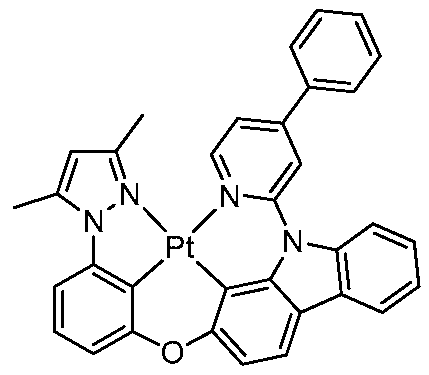
PtON1의 합성 절차에 따라 PtON1Ph를 합성하였다. 2-(3-(3,5-디메틸-1H-피라졸-1-일)페녹시)-9-(4-페닐피리딘-2-일)-9H-카르바졸 리간드 ON1Ph(679 mg, 1.34 mmol, 1.0 eq)를 K2PtCl2(584 mg, 1.41 mmol, 1.05 eq)와, n Bu4NBr(43 mg, 0.134 mmol, 0.1 eq)의 존재 하에 실온에서 19 시간 반응시킨 다음, 105℃∼115℃에서 추가의 3일 동안 반응시켰다. 실리카 겔 상에서 플래시 크로마토그래피(용리액: 헥산/디클로로메탄 = 1:1)로 조생성물을 정제하여 표제 화합물을 황색 고체로 얻었다(55% 수율로 517 mg). 도 3은 실온에서의 PtON1Ph의 발광 스펙트럼을 도시한다. CH2Cl2 중 실온에서 및 2-메틸-THF 중 77 K에서의 PtON1Ph의 발광 스펙트럼을 도 10에 도시한다. 1H NMR (DMSO-d 6, 400 MHz): δ 2.35 (s, 3H), 2.70 (s, 3H), 6.35 (s, 1H), 6.96 (d, J = 8.0, 1H), 7.18-7.26 (m, 3H), 7.35-7.37 (m, 2H), 7.45-7.48 (m, 4H), 7.71-7.72 (m, 2H), 7.84 (d, J = 8.4 Hz, 1H), 8.12 (d, J = 7.2 Hz, 1H), 8.18 (s, 1H), 8.22 (d, J = 8.4 Hz, 1H), 9.14 (d, J = 6.4 Hz, 1H). 13C NMR (DMSO-d 6, 100 MHz): δ 14.32, 14.35, 100.17, 107.15, 110.29, 111.18, 112.23, 112.38, 112.42, 115.04, 115.31, 115.69, 116.63, 120.02, 122.90, 124.72, 126.96, 128.01, 129.37, 130.11, 136.08, 137.99, 141.88, 142.09, 147.41, 148.26, 149.61, 150.15, 151.64, 152.01, 153.99. PtON1Ph was synthesized according to the synthesis procedure of PtON1 . 2- (3- (3,5-dimethyl -1 H - pyrazol-1-yl) phenoxy) -9- (4-pyridin-2-yl) -9 H - carbazole ligand ON1Ph (679 mg, 1.34 mmol, 1.0 eq) was reacted with K 2 PtCl 2 (584 mg, 1.41 mmol, 1.05 eq) and n Bu 4 NBr (43 mg, 0.134 mmol, 0.1 eq) at room temperature for 19 hours, and then at 105° C. Reacted for an additional 3 days at -115°C. The crude product was purified by flash chromatography on silica gel (eluent: hexane/dichloromethane = 1:1) to give the title compound as a yellow solid (55% yield, 517 mg). 3 shows the emission spectrum of PtON1Ph at room temperature. The emission spectra of PtON1Ph at room temperature in CH 2 Cl 2 and at 77 K in 2-methyl-THF are shown in FIG. 10 . 1 H NMR (DMSO- d 6 , 400 MHz): δ 2.35 (s, 3H), 2.70 (s, 3H), 6.35 (s, 1H), 6.96 (d, J = 8.0, 1H), 7.18-7.26 ( m, 3H), 7.35-7.37 (m, 2H), 7.45-7.48 (m, 4H), 7.71-7.72 (m, 2H), 7.84 (d, J = 8.4 Hz, 1H), 8.12 (d, J = 7.2 Hz, 1H), 8.18 (s, 1H), 8.22 (d, J = 8.4 Hz, 1H), 9.14 (d, J = 6.4 Hz, 1H). 13 C NMR (DMSO- d 6 , 100 MHz): δ 14.32, 14.35, 100.17, 107.15, 110.29, 111.18, 112.23, 112.38, 112.42, 115.04, 115.31, 115.69, 116.63, 120.02, 122.90, 126.96, 128.01, 126.96, 128.01 129.37, 130.11, 136.08, 137.99, 141.88, 142.09, 147.41, 148.26, 149.61, 150.15, 151.64, 152.01, 153.99.
실시예 15.Example 15.
백금 착물 PtON1F는 하기 반응식에 따라 제조할 수 있다:The platinum complex PtON1F can be prepared according to the following scheme:

2-(3-(3,5-디메틸-1H-피라졸-1-일)페녹시)-9-(4-플루오로피리딘-2-일)-9H-카르바졸 리간드 ON1F의 합성:2- (3- (3,5-dimethyl -1 H - pyrazol-1-yl) phenoxy) -9- (4-fluoro-2-yl) -9 H - carbazole ligand ON1F Synthesis of:
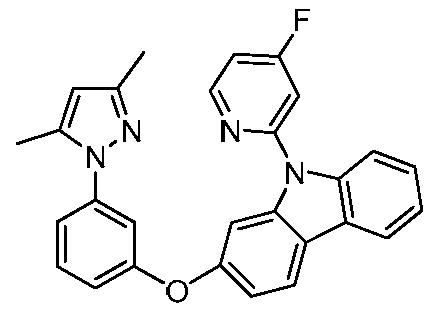
2-(3-(3,5-디메틸-1H-피라졸-1-일)페녹시)-9H-카르바졸 13(565 mg, 1.6 mmol, 1.0 eq) 및 2-브로모-4-플루오로피리딘(563 mg, 3.2 mmol, 2.0 eq)을 이용하여 리간드 ON1Me 4 의 합성 절차에 따라 리간드 ON1F를 합성하였다. 실리카 겔 상에서 플래시 크로마토그래피(용리액: 헥산/아세트산에틸 = 10:1-5:1-4:1)로 조생성물을 정제하여, 표제 화합물을 갈색 고체로 얻었다(90% 수율로 643 mg). 1H NMR (DMSO-d 6, 400 MHz): δ 2.10 (s, 3H), 2.24 (s, 3H), 6.00 (s, 1H), 7.03 (dd, J = 8.4, 2.4 Hz, 1H), 7.08-7.10 (m, 2H), 7.22 (d, J = 8.0 Hz,, 1H), 7.32-7.39 (m, 2H), 7.43 (d, J = 7.6 Hz, 1H), 7.46 (d, J = 8.4 Hz, 1H), 7.61 (d, J = 2.0 Hz, 1H), 7.71 (dd, J = 10.0, 1.6 Hz, 1H), 7.82 (d, J = 8.4 Hz, 1H), 8.20 (d, J = 7.6 Hz, 1H), 8.25 (d, J = 8.4 Hz, 1H), 8.68 (dd, J = 8.8, 5.6 Hz, 1H). 13C NMR (DMSO-d 6, 100 MHz): δ 12.20, 13.21, 102.95, 106.76 (d, J = 20.3 Hz), 107.47, 110.11 (d, J = 16.0 Hz), 111.37, 113.24, 113.67, 116.24, 118.24, 120.18, 120.20, 121.60, 121.74, 123.43, 126.11, 130.37, 139.12, 139.22, 139.77, 140.94, 148.07, 151.98 (d, J = 8.8 Hz), 152.69 (d, J = 10.6 Hz), 154.83, 157.95, 169.56 (d, J = 258.8 Hz). 19F NMR (DMSO-d 6, 376 MHz): δ -99.56- -99.49 (m, 1F).2-(3-(3,5-dimethyl-1H-pyrazol-1-yl)phenoxy)-9H-carbazole 13 (565 mg, 1.6 mmol, 1.0 eq) and 2-bromo-4-fluoro Ligand ON1F was synthesized according to the procedure for the synthesis of ligand ON1Me 4 using pyridine (563 mg, 3.2 mmol, 2.0 eq). The crude product was purified by flash chromatography on silica gel (eluent: hexane/ethyl acetate = 10:1-5:1-4:1) to give the title compound as a brown solid (643 mg in 90% yield). 1 H NMR (DMSO- d 6 , 400 MHz): δ 2.10 (s, 3H), 2.24 (s, 3H), 6.00 (s, 1H), 7.03 (dd, J = 8.4, 2.4 Hz, 1H), 7.08 -7.10 (m, 2H), 7.22 (d, J = 8.0 Hz,, 1H), 7.32-7.39 (m, 2H), 7.43 (d, J = 7.6 Hz, 1H), 7.46 (d, J = 8.4 Hz) , 1H), 7.61 (d, J = 2.0 Hz, 1H), 7.71 (dd, J = 10.0, 1.6 Hz, 1H), 7.82 (d, J = 8.4 Hz, 1H), 8.20 (d, J = 7.6 Hz) , 1H), 8.25 (d, J = 8.4 Hz, 1H), 8.68 (dd, J = 8.8, 5.6 Hz, 1H). 13 C NMR (DMSO- d 6 , 100 MHz): δ 12.20, 13.21, 102.95, 106.76 (d, J = 20.3 Hz), 107.47, 110.11 (d, J = 16.0 Hz), 111.37, 113.24, 113.67, 116.24, 118.24, 120.18, 120.20, 121.60, 121.74, 123.43, 126.11, 130.37, 139.12, 139.22, 139.77, 140.94, 148.07, 151.98 (d, J = 8.8 Hz), 152.69 (d, J = 10.6 Hz), 157.95,83, 157.95,83 169.56 (d, J = 258.8 Hz). 19 F NMR (DMSO- d 6 , 376 MHz): δ -99.56- -99.49 (m, 1F).
2-(3-(3,5-디메틸-1H-피라졸-1-일)페녹시)-9-(4-플루오로피리딘-2-일)-9H-카르바졸 백금 착물 PtON1F의 합성:2- (3- (3,5-dimethyl -1 H - pyrazol-1-yl) phenoxy) -9- (4-fluoro-2-yl) -9 H - carbazole platinum complex PtON1F Synthesis of :
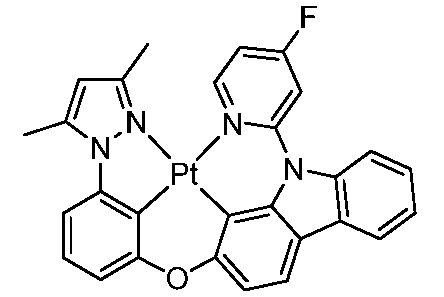
PtON1의 합성 절차에 따라 PtON1F를 합성하였다. 2-(3-(3,5-디메틸-1H-피라졸-1-일)페녹시)-9-(4-플루오로피리딘-2-일)-9H-카르바졸 리간드 ON1F(600 mg, 1.34 mmol, 1.0 eq)를 K2PtCl2(583 mg, 1.40 mmol, 1.05 eq)와, n Bu4NBr(43 mg, 0.13 mmol, 0.1 eq)의 존재 하에 실온에서 22 시간 반응시킨 다음, 105℃∼115℃에서 추가의 3일 동안 반응시켰다. 실리카 겔 상에서 플래시 크로마토그래피(용리액: 디클로로메탄)로 조생성물을 정제하여, 표제 화합물을 황색 고체로 얻었다(10% 수율로 81 mg). 도 3은 실온에서의 PtON1F의 발광 스펙트럼을 도시한다. CH2Cl2 중 실온에서 및 2-메틸-THF 중 77 K에서의 PtON1F의 발광 스펙트럼을 도 11에 도시한다. 1H NMR (DMSO-d 6, 400 MHz): δ 2.43 (s, 3H), 2.76 (s, 3H), 6.46 (s, 1H), 6.96 (d, J = 8.0 Hz, 1H), 7.20 (d, J = 8.8 Hz, 1H), 7.24 (d, J = 8.4 Hz, 1H), 7.28-7.31 (m, 2H), 7.43 (t, J = 7.6 Hz, 1H), 7.51 (t, J = 8.0 Hz, 1H), 7.87 (d, J = 8.4 Hz, 1H), 7.98 (dd, J = 10.4, 2.4 Hz, 1H), 8.15 (d, J = 8.4 Hz, 2H), 9.30 (t, J = 6.8 Hz, 1H). 13C NMR (DMSO-d 6, 100 MHz): δ 14.32, 100.33, 102.80 (d, J = 23.9 Hz), 107.18, 108.09 (d, J = 19.8 Hz), 110.34, 110.52, 112.42, 112.45, 115.17, 115.33, 115.77, 119.98, 123.33, 124.76, 128.16, 137.77, 141.80, 142.01, 147.31, 149.70, 150.08 (d, J = 11.8 Hz), 151.67, 151.91, 156.71 (d, J = 10.1 Hz), 168.86 (d, J = 262.5 Hz). 19F NMR (DMSO-d 6, 376 MHz): δ -96.41--96.34 (m, 1F). PtON1F was synthesized according to the synthesis procedure of PtON1 . 2- (3- (3,5-dimethyl -1 H - pyrazol-1-yl) phenoxy) -9- (pyridin-2-yl 4-fluorophenyl) -9 H - carbazole ligand ON1F (600 mg , 1.34 mmol, 1.0 eq) was reacted with K 2 PtCl 2 (583 mg, 1.40 mmol, 1.05 eq) and n Bu 4 NBr (43 mg, 0.13 mmol, 0.1 eq) for 22 hours at room temperature, followed by 105 The reaction was carried out at °C-115 °C for an additional 3 days. The crude product was purified by flash chromatography on silica gel (eluent: dichloromethane) to give the title compound as a yellow solid (81 mg in 10% yield). 3 shows the emission spectrum of PtON1F at room temperature. The emission spectra of PtON1F at room temperature in CH 2 Cl 2 and at 77 K in 2-methyl-THF are shown in FIG. 11 . 1 H NMR (DMSO- d 6 , 400 MHz): δ 2.43 (s, 3H), 2.76 (s, 3H), 6.46 (s, 1H), 6.96 (d, J = 8.0 Hz, 1H), 7.20 (d , J = 8.8 Hz, 1H), 7.24 (d, J = 8.4 Hz, 1H), 7.28-7.31 (m, 2H), 7.43 (t, J = 7.6 Hz, 1H), 7.51 (t, J = 8.0 Hz) , 1H), 7.87 (d, J = 8.4 Hz, 1H), 7.98 (dd, J = 10.4, 2.4 Hz, 1H), 8.15 (d, J = 8.4 Hz, 2H), 9.30 (t, J = 6.8 Hz) , 1H). 13 C NMR (DMSO- d 6 , 100 MHz): δ 14.32, 100.33, 102.80 (d, J = 23.9 Hz), 107.18, 108.09 (d, J = 19.8 Hz), 110.34, 110.52, 112.42, 112.45, 115.17, 115.33, 115.77, 119.98, 123.33, 124.76, 128.16, 137.77, 141.80, 142.01, 147.31, 149.70, 150.08 (d, J = 11.8 Hz), 151.67, 151.91, 156.71 (d, J = 10.1 Hz), 168.86 (d, J = 10.1 Hz), 168.86 (d, J = 11.8 Hz), 168.86 J = 262.5 Hz). 19 F NMR (DMSO- d 6 , 376 MHz): δ -96.41--96.34 (m, 1F).
실시예 16.Example 16.
백금 착물 PtON1CF 3 는 하기 반응식에 따라 제조할 수 있다:The platinum complex PtON1CF 3 can be prepared according to the following scheme:
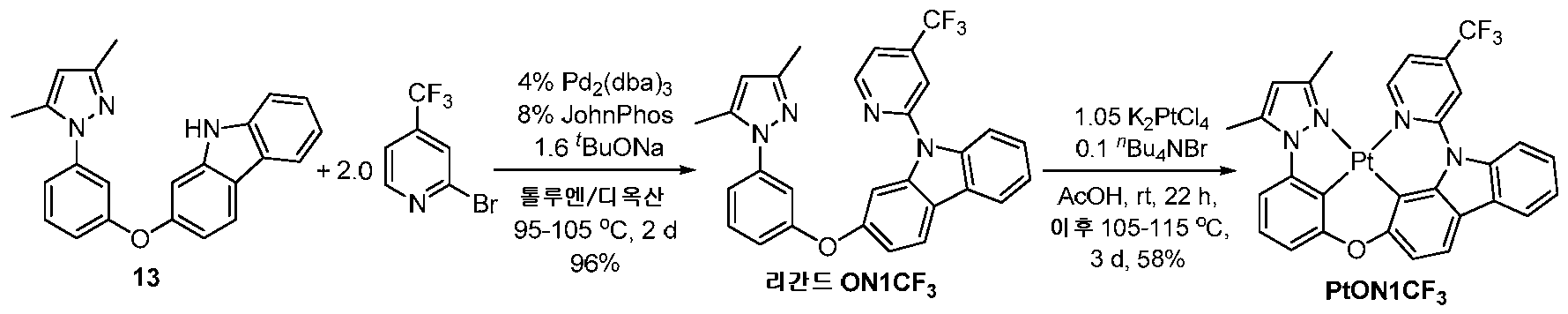
2-(3-(3,5-디메틸-1H-피라졸-1-일)페녹시)-9-(4-(트리플루오로메틸)피리딘-2-일)-9H-카르바졸 리간드 ON1CF 3 의 합성:2- (3- (3,5-dimethyl -1 H - pyrazol-1-yl) phenoxy) -9- (4- (trifluoromethyl) pyridin-2-yl) -9 H - carbazole ligand Synthesis of ON1CF 3 :

2-(3-(3,5-디메틸-1H-피라졸-1-일)페녹시)-9H-카르바졸 13(707 mg, 2.0 mmol, 1.0 eq) 및 2-브로모-4-(트리플루오로메틸)피리딘(904 mg, 4.0 mmol, 2.0 eq)을 이용하여 리간드 ON1Me 4 의 합성 절차에 따라 리간드 ON1CF 3 를 합성하였다. 실리카 겔 상에서 플래시 크로마토그래피(용리액: 헥산/아세트산에틸 = 10:1-5:1)로 조생성물을 정제하여 표제 화합물을 갈색 고체로 얻었다(96% 수율로 962 mg). 1H NMR (DMSO-d 6, 400 MHz): δ 2.13 (s, 3H), 2.26 (s, 3H), 6.04 (s, 1H), 7.08 (dd, J = 8.0, 2.4 Hz, 1H), 7.12-7.15 (m, 2H), 7.25-7.27 (m, 1H), 7.38 (t, J = 7.6 Hz, 1H), 7.48 (t, J = 8.0 Hz, 2H), 7.58 (d, J = 1.6 Hz, 1H), 7.81-7.83 (m, 2H), 8.10 (s, 1H), 8.25 (d, J = 7.6 Hz, 1H), 8.30 (d, J = 8.8 Hz, 1H), 8.95 (d, J = 4.8 Hz, 1H). 13C NMR (DMSO-d 6, 100 MHz): δ 12.16, 13.18, 102.47, 107.46, 111.09, 113.43, 113.71, 114.52 (q, J = 3.9 Hz), 116.37, 117.37 (q, J = 2.7 Hz), 118.32, 120.25, 121.77, 121.81, 122.55 (q, J = 272.5 Hz), 123.59, 126.16, 130.35, 139.09, 139.19, 139.56 (q, J = 34.7 Hz), 139.73, 140.98, 148.06, 151.32, 151.53, 155.05, 157.75. 19F NMR (DMSO-d 6, 376 MHz): δ -63.32.2- (3- (3,5-dimethyl -1 H - pyrazol-1-yl) phenoxy) -9 H - carbazole 13 (707 mg, 2.0 mmol, 1.0 eq) and 2-bromo-4- Ligand ON1CF 3 was synthesized according to the procedure for the synthesis of ligand ON1Me 4 using (trifluoromethyl)pyridine (904 mg, 4.0 mmol, 2.0 eq). The crude product was purified by flash chromatography on silica gel (eluent: hexane/ethyl acetate = 10:1-5:1) to give the title compound as a brown solid (962 mg in 96% yield). 1 H NMR (DMSO- d 6 , 400 MHz): δ 2.13 (s, 3H), 2.26 (s, 3H), 6.04 (s, 1H), 7.08 (dd, J = 8.0, 2.4 Hz, 1H), 7.12 -7.15 (m, 2H), 7.25-7.27 (m, 1H), 7.38 (t, J = 7.6 Hz, 1H), 7.48 (t, J = 8.0 Hz, 2H), 7.58 (d, J = 1.6 Hz, 1H), 7.81-7.83 (m, 2H), 8.10 (s, 1H), 8.25 (d, J = 7.6 Hz, 1H), 8.30 (d, J = 8.8 Hz, 1H), 8.95 (d, J = 4.8) Hz, 1H). 13 C NMR (DMSO- d 6 , 100 MHz): δ 12.16, 13.18, 102.47, 107.46, 111.09, 113.43, 113.71, 114.52 (q, J = 3.9 Hz), 116.37, 117.37 (q, J = 2.7 Hz), 118.32, 120.25, 121.77, 121.81, 122.55 (q, J = 272.5 Hz), 123.59, 126.16, 130.35, 139.09, 139.19, 139.56 (q, J = 34.7 Hz), 139.73, 140.98, 148.06, 151.32, 151.53, 155.05, 155.53 157.75. 19 F NMR (DMSO- d 6 , 376 MHz): δ -63.32.
2-(3-(3,5-디메틸-1H-피라졸-1-일)페녹시)-9-(4-(트리플루오로메틸)피리딘-2-일)-9H-카르바졸 백금 착물 PtON1CF 3 의 합성:2- (3- (3,5-dimethyl -1 H - pyrazol-1-yl) phenoxy) -9- (4- (trifluoromethyl) pyridin-2-yl) -9 H - carbazole platinum Synthesis of complex PtON1CF 3 :

PtON1의 합성 절차에 따라 PtON1CF 3 를 합성하였다. 2-(3-(3,5-디메틸-1H-피라졸-1-일)페녹시)-9-(4-(트리플루오로메틸)피리딘-2-일)-9H-카르바졸 리간드 ON1CF 3 (900 mg, 1.81 mmol, 1.0 eq)를 K2PtCl2(787 mg, 1.90 mmol, 1.05 eq)와, n Bu4NBr(58 mg, 0.18 mmol, 0.1 eq)의 존재 하에 실온에서 22 시간 동안 반응시킨 다음, 105℃∼115℃에서 추가의 3일 동안 반응시켰다. 실리카 겔 상에서 플래시 크로마토그래피(용리액: 헥산/디클로로메탄 = 1:1)로 조생성물을 정제하여, 표제 화합물을 황색 고체로 얻었다(58% 수율로 720 mg). 도 3은 실온에서의 PtON1CF 3 의 발광 스펙트럼을 도시한다. CH2Cl2 중 실온에서 및 2-메틸-THF 중 77 K에서의 PtON1CF 3 의 발광 스펙트럼을 도 12에 도시한다. 1H NMR (CD2Cl2, 400 MHz): δ 2.41 (s, 3H), 2.72 (s, 3H), 6.17 (s, 1H), 7.03-7.06 (m, 1H), 7.11 (d, J = 5.6 Hz, 1H), 7.18-7.25 (m, 2H), 7.31 (dd, J = 8.0, 1.6 Hz, 1H), 7.41-7.50 (m, 2H), 7.80 (dd, J = 8.4, 1.6 Hz, 1H), 7.93 (d, J = 8.4 Hz, 1H), 8.07 (d, J = 7.6 Hz, 1H), 8.36 (s, 1H), 9.39 (d, J = 6.4 Hz, 1H). 13C NMR (CD2Cl2, 100 MHz): δ 14.97, 15.14, 100.19, 107.38, 110.48, 110.49, 122.74 (q, J = 3.7 Hz), 113.36, 113.43, 113.49 (q, J = 2.6 Hz), 114.76, 115.79, 116.57, 120.57, 122.90 (q, J = 272.4 Hz), 124.03, 124.92, 125.19, 129.77, 138.56, 140.11 (q, J = 35.5 Hz), 142.31, 142.56, 148.34, 149.87, 150.00, 152.96, 153.01, 155.49. 19F NMR (DMSO-d 6, 376 MHz): δ -64.10. PtON1CF 3 was synthesized according to the synthesis procedure of PtON1. 2- (3- (3,5-dimethyl -1 H - pyrazol-1-yl) phenoxy) -9- (4- (trifluoromethyl) pyridin-2-yl) -9 H - carbazole ligand ON1CF 3 (900 mg, 1.81 mmol, 1.0 eq) in the presence of K 2 PtCl 2 (787 mg, 1.90 mmol, 1.05 eq) and n Bu 4 NBr (58 mg, 0.18 mmol, 0.1 eq) at room temperature for 22 hours After reacting at 105°C to 115°C for an additional 3 days. The crude product was purified by flash chromatography on silica gel (eluent: hexane/dichloromethane = 1:1) to give the title compound as a yellow solid (58% yield, 720 mg). Figure 3 shows the emission spectrum of the PtON1CF 3 at room temperature. The emission spectra of PtON1CF 3 at room temperature in CH 2 Cl 2 and at 77 K in 2-methyl-THF are shown in FIG. 12 . 1 H NMR (CD 2 Cl 2 , 400 MHz): δ 2.41 (s, 3H), 2.72 (s, 3H), 6.17 (s, 1H), 7.03-7.06 (m, 1H), 7.11 (d, J = 5.6 Hz, 1H), 7.18-7.25 (m, 2H), 7.31 (dd, J = 8.0, 1.6 Hz, 1H), 7.41-7.50 (m, 2H), 7.80 (dd, J = 8.4, 1.6 Hz, 1H) ), 7.93 (d, J = 8.4 Hz, 1H), 8.07 (d, J = 7.6 Hz, 1H), 8.36 (s, 1H), 9.39 (d, J = 6.4 Hz, 1H). 13 C NMR (CD 2 Cl 2 , 100 MHz): δ 14.97, 15.14, 100.19, 107.38, 110.48, 110.49, 122.74 (q, J = 3.7 Hz), 113.36, 113.43, 113.49 (q, J = 2.6 Hz), 114.76, 115.79, 116.57, 120.57, 122.90 (q, J = 272.4 Hz), 124.03, 124.92, 125.19, 129.77, 138.56, 140.11 (q, J = 35.5 Hz), 142.31, 142.56, 148.34, 149.87, 150.00, 152.96, 150.00, 153.01, 155.49. 19 F NMR (DMSO- d 6 , 376 MHz): δ -64.10.
실시예 17. Example 17.
백금 착물 PtON1N은 하기 반응식에 따라 제조할 수 있다: The platinum complex PtON1N can be prepared according to the following scheme:

2-(3-(3,5-디메틸-1H-피라졸-1-일)페녹시)-9-(피리미딘-2-일)-9H-카바졸 리간드 ON1N의 합성:2- (3- (3,5-dimethyl -1 H - pyrazol-1-yl) phenoxy) -9- (pyrimidin-2-yl) -9 H - carbazol-ligand ON1N Synthesis of:
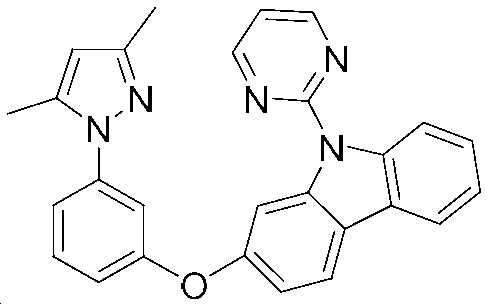
리간드 ON1N을 2-(3-(3,5-디메틸-1H-피라졸-1-일)페녹시)-9H-카바졸 13 (707 mg, 2.0 mmol, 1.0 당량) 및 2-브로모피리미딘 (636 mg, 4.0 mmol, 2.0 당량)을 사용하는 리간드 ON1Me 4 의 합성 공정에 따라 합성하였다. 실리카 겔 (용리액: 헥산/에틸 아세테이트 = 10:1-5:1-3:1) 상의 플래시 크로마토그래피에 의한 미정제 생성물의 정제로 갈색 고형의 표제 화합물(814 mg, 94% 수율)을 수득하였다. 1H NMR (DMSO-d 6, 400 MHz): δ 2.11 (s, 3H), 2.27 (s, 3H), 6.01 (s, 1H), 7.06 (dd, J = 8.0, 2.4 Hz, 1H), 7.12 (t, J = 2.0 Hz, 1H), 7.15 (dd, J = 8.4, 2.0 Hz, 1H), 7.23-7.26 (m, 1H), 7.37-7.40 (m, 2H), 7.46-7.52 (m, 2H), 8.19 (d, J = 8.0 Hz, 1H), 7.25 (d, J = 7.6 Hz, 1H), 8.59 (d, J = 2.4 Hz, 1H), 8.79 (d, J = 8.4 Hz, 1H), 8.93 (d, J = 4.4 Hz, 2H). 13C NMR (DMSO-d 6, 100 MHz): δ 12.25, 13.22, 107.47, 107.67, 113.10, 114.61, 116.12, 116.16, 117.19, 118.20, 119.69, 121.16, 121.57, 122.60, 124.62, 126.31, 130.43, 138.86, 139.25, 139.33, 140.97, 148.07, 154.68, 158.05, 158.12, 158.63. Ligand ON1N 2- (3- (3,5- dimethyl -1 H - pyrazol-1-yl) phenoxy) -9 H - carbazol-13 (707 mg, 2.0 mmol, 1.0 eq) and 2-Bromo-Fur It was synthesized according to the procedure for the synthesis of ligand ON1Me 4 using limidine (636 mg, 4.0 mmol, 2.0 equiv). Purification of the crude product by flash chromatography on silica gel (eluent: hexane/ethyl acetate = 10:1-5:1-3:1) gave the title compound (814 mg, 94% yield) as a brown solid. . 1 H NMR (DMSO- d 6 , 400 MHz): δ 2.11 (s, 3H), 2.27 (s, 3H), 6.01 (s, 1H), 7.06 (dd, J = 8.0, 2.4 Hz, 1H), 7.12 (t, J = 2.0 Hz, 1H), 7.15 (dd, J = 8.4, 2.0 Hz, 1H), 7.23-7.26 (m, 1H), 7.37-7.40 (m, 2H), 7.46-7.52 (m, 2H) ), 8.19 (d, J = 8.0 Hz, 1H), 7.25 (d, J = 7.6 Hz, 1H), 8.59 (d, J = 2.4 Hz, 1H), 8.79 (d, J = 8.4 Hz, 1H), 8.93 (d, J = 4.4 Hz, 2H). 13 C NMR (DMSO- d 6 , 100 MHz): δ 12.25, 13.22, 107.47, 107.67, 113.10, 114.61, 116.12, 116.16, 117.19, 118.20, 119.69, 121.16, 121.57, 122.86. 130. 139.25, 139.33, 140.97, 148.07, 154.68, 158.05, 158.12, 158.63.
2-(3-(3,5-디메틸-1H-피라졸-1-일)페녹시)-9-(피리미딘-2-일)-9H-카바졸 백금 착물 PtON1N의 합성:2- (3- (3,5-dimethyl -1 H - pyrazol-1-yl) phenoxy) -9- (pyrimidin-2-yl) -9 H - carbazol-platinum complex PtON1N Synthesis of:
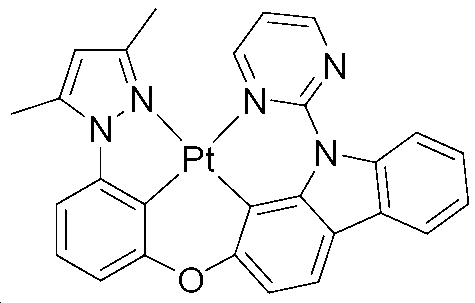
PtON1N을 PtON1의 합성 공정에 따라 합성하였다. 2-(3-(3,5-디메틸-1H-피라졸-1-일)페녹시)-9-(피리미딘-2-일)-9H-카바졸 리간드 ON1N (770 mg, 1.78 mmol, 1.0 당량)을 n Bu4NBr (57 mg, 0.18 mmol, 0.1 당량)의 존재 하에 K2PtCl2 (776 mg, 1.87 mmol, 1.05 당량)와 실온에서 20시간 동안 및 이후 105-115oC에서 추가 3일 동안 반응시켰다. 실리카 겔 (용리액: 디클로로메탄) 상의 플래시 크로마토그래피에 의한 미정제 생성물의 정제로 황색 고형의 표제 화합물(433 mg, 39% 수율)을 수득하였다. CH2Cl2 중 실온에서의 및 2-메틸-THF 중 77 K에서의 PtON1N의 방출 스펙트럼을 도 13에 도시하였다. 1H NMR (CD2Cl2, 400 MHz): δ 2.32 (s, 3H), 2.76 (s, 3H), 6.44 (s, 1H), 6.98 (d, J = 7.6 Hz, 1H), 7.22-7.26 (m, 2H), 7.30 (d, J = 8.0 Hz, 1H), 7.37 (t, J = 6.0 Hz, 1H), 7.41 (t, J = 7.6 Hz, 1H), 7.49 (d, J = 8.0 Hz, 1H), 7.90 (d, J = 8.4 Hz, 1H), 8.12 (d, J = 7.6 Hz, 1H), 8.80 (d, J = 8.0 Hz, 1H), 9.14-9.16 (m, 1H), 9.51-9.52 (m, 1H). 13C NMR (DMSO-d 6, 100 MHz): δ 14.33, 99.67, 107.05, 110.51, 110.89, 112.28, 112.72, 114.92, 115.45, 116.20, 118.99, 119.40, 123.26, 124.63, 124.90, 127.59, 137.90, 140.97, 142.04, 147.40, 149.84, 151.35, 151.51, 151.67, 159.30, 162.97. PtON1N was synthesized according to the synthesis process of PtON1. 2- (3- (3,5-dimethyl -1 H - pyrazol-1-yl) phenoxy) -9- (pyrimidin-2-yl) -9 H - carbazol-ligand ON1N (770 mg, 1.78 mmol, 1.0 equiv) was mixed with K 2 PtCl 2 (776 mg, 1.87 mmol, 1.05 equiv) in the presence of n Bu 4 NBr (57 mg, 0.18 mmol, 0.1 equiv) at room temperature for 20 h and then The reaction was carried out at 105-115 o C for an additional 3 days. Purification of the crude product by flash chromatography on silica gel (eluent: dichloromethane) gave the title compound (433 mg, 39% yield) as a yellow solid. The emission spectra of PtON1N at room temperature in CH 2 Cl 2 and at 77 K in 2-methyl-THF are shown in FIG. 13 . 1 H NMR (CD 2 Cl 2 , 400 MHz): δ 2.32 (s, 3H), 2.76 (s, 3H), 6.44 (s, 1H), 6.98 (d, J = 7.6 Hz, 1H), 7.22-7.26 (m, 2H), 7.30 (d, J = 8.0 Hz, 1H), 7.37 (t, J = 6.0 Hz, 1H), 7.41 (t, J = 7.6 Hz, 1H), 7.49 (d, J = 8.0 Hz) , 1H), 7.90 (d, J = 8.4 Hz, 1H), 8.12 (d, J = 7.6 Hz, 1H), 8.80 (d, J = 8.0 Hz, 1H), 9.14-9.16 (m, 1H), 9.51 -9.52 (m, 1H). 13 C NMR (DMSO- d 6 , 100 MHz): δ 14.33, 99.67, 107.05, 110.51, 110.89, 112.28, 112.72, 114.92, 115.45, 116.20, 118.99, 119.40, 123.26, 124.63, 124.90, 127.59, 127.59, 142.04, 147.40, 149.84, 151.35, 151.51, 151.67, 159.30, 162.97.
실시예 18. Example 18.
백금 착물 PtON1Cz은 하기 반응식에 따라 제조할 수 있다: The platinum complex PtON1Cz can be prepared according to the following scheme:
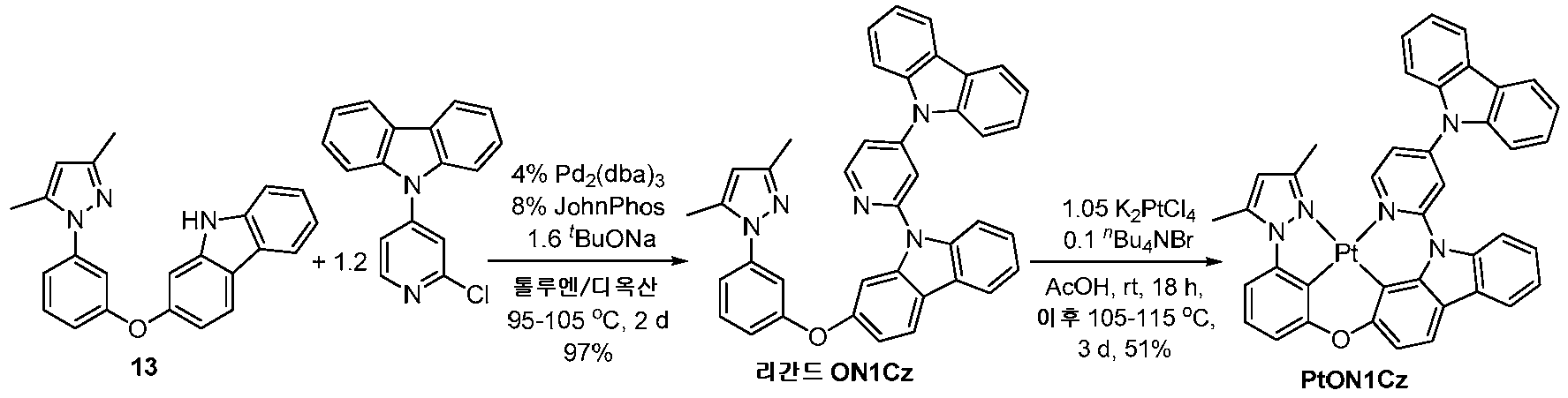
9-(4-(9H-카바졸-9-일)피리딘-2-일)-2-(3-(3,5-디메틸-1H-피라졸-1-일)페녹시)-9H-카바졸 리간드 ON1N의 합성:9- (4- (9 H - carbazol-9-yl) pyridin-2-yl) -2- (3- (3,5-dimethyl -1 H - pyrazol-1-yl) phenoxy) -9H -Synthesis of carbazole ligand ON1N:
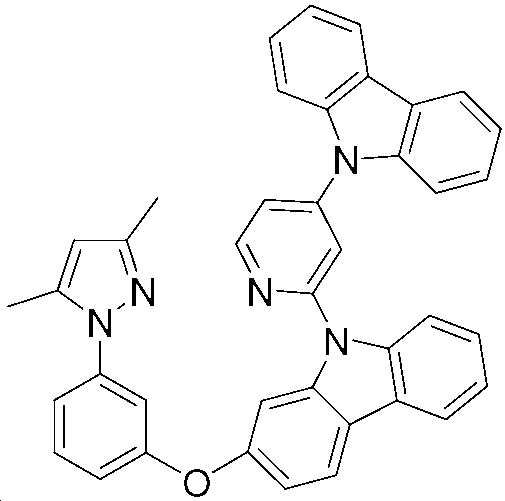
리간드 ON1Cz를 2-(3-(3,5-디메틸-1H-피라졸-1-일)페녹시)-9H-카바졸 13 (589 mg, 1.66 mmol, 1.0 당량) 및 9-(2-클로로피리딘-4-일)-9H-카바졸 (560 mg, 2.0 mmol, 1.2 당량)를 사용하는 리간드 ON1Me 4 의 합성 공정에 따라 합성하였다. 실리카 겔 (용리액: 헥산/에틸 아세테이트 = 10:1-3:1) 상의 플래시 크로마토그래피에 의한 미정제 생성물의 정제로 갈색 고형의 표제 화합물(958 mg, 97% 수율)을 수득하였다. 1H NMR (DMSO-d 6, 400 MHz): δ 2.07 (s, 3H), 2.17 (s, 3H), 5.95 (s, 1H), 7.01 (dd, J = 7.6, 2.4 Hz, 1H), 7.06-7.09 (m, 2H), 7.15-7.18 (m, 1H), 7.27-7.32 (m, 3H), 7.35-7.43 (m, 4H), 7.67 (d, J = 8.4 Hz, 2H), 7.72 (d, J = 2.0 Hz, 1H), 7.75 (dd, J = 5.6, 2.0 Hz, 1H), 7.89 (d, J = 8.8 Hz, 1H), 7.91 (d, J = 2.0 Hz, 1H), 8.17-8.21 (m, 3H), 8.24 (d, J = 8.8 Hz, 1H), 8.87 (d, J = 5.6 Hz, 1H). 13C NMR (DMSO-d 6, 100 MHz): δ 12.16, 13.21, 103.03, 107.44, 110.16, 111.38, 113.08, 113.63, 115.07, 116.06, 118.16, 118.73, 120.21, 120.33, 120.65, 121.18, 121.45, 121.76, 123.49, 123.63, 126.08, 126.57, 130.35, 138.94, 139.16, 139.38, 140.04, 140.93, 147.11, 148.04, 151.38, 152.44, 154.68, 158.04. Ligand ON1Cz 2- (3- (3,5- dimethyl -1 H - pyrazol-1-yl) phenoxy) -9 H - carbazol-13 (589 mg, 1.66 mmol, 1.0 eq) and 9 (2 -chloropyridin-4-yl) -9 H-ligand was synthesized according to the synthesis process of ON1Me 4 using the carbazole (560 mg, 2.0 mmol, 1.2 eq.). Purification of the crude product by flash chromatography on silica gel (eluent: hexane/ethyl acetate = 10:1-3:1) gave the title compound (958 mg, 97% yield) as a brown solid. 1 H NMR (DMSO- d 6 , 400 MHz): δ 2.07 (s, 3H), 2.17 (s, 3H), 5.95 (s, 1H), 7.01 (dd, J = 7.6, 2.4 Hz, 1H), 7.06 -7.09 (m, 2H), 7.15-7.18 (m, 1H), 7.27-7.32 (m, 3H), 7.35-7.43 (m, 4H), 7.67 (d, J = 8.4 Hz, 2H), 7.72 (d , J = 2.0 Hz, 1H), 7.75 (dd, J = 5.6, 2.0 Hz, 1H), 7.89 (d, J = 8.8 Hz, 1H), 7.91 (d, J = 2.0 Hz, 1H), 8.17-8.21 (m, 3H), 8.24 (d, J = 8.8 Hz, 1H), 8.87 (d, J = 5.6 Hz, 1H). 13 C NMR (DMSO- d 6 , 100 MHz): δ 12.16, 13.21, 103.03, 107.44, 110.16, 111.38, 113.08, 113.63, 115.07, 116.06, 118.16, 118.73, 120.21, 120.33, 120.65, 121.18, 121.176 123.49, 123.63, 126.08, 126.57, 130.35, 138.94, 139.16, 139.38, 140.04, 140.93, 147.11, 148.04, 151.38, 152.44, 154.68, 158.04.
9-(4-(9H-카바졸-9-일)피리딘-2-일)-2-(3-(3,5-디메틸-1H-피라졸-1-일)페녹시)-9H-카바졸 백금 착물 PtON1N의 합성:9- (4- (9 H - carbazol-9-yl) pyridin-2-yl) -2- (3- (3,5-dimethyl -1 H - pyrazol-1-yl) phenoxy) -9H -Synthesis of carbazole platinum complex PtON1N:
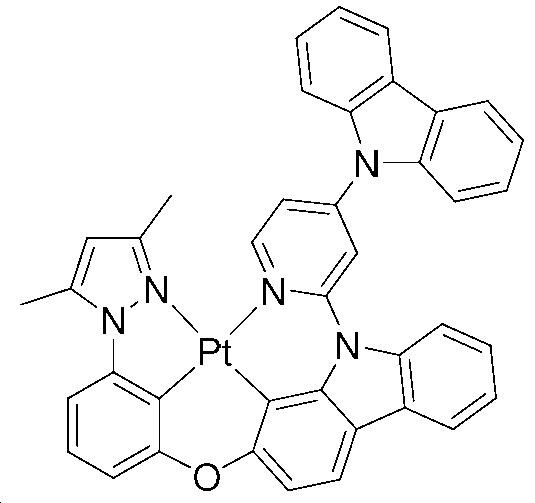
PtON1Cz을 PtON1의 합성 공정에 따라 합성하였다. 9-(4-(9H-카바졸-9-일)피리딘-2-일)-2-(3-(3,5-디메틸-1H-피라졸-1-일)페녹시)-9H-카바졸 리간드 ON1Cz (910 mg, 1.53 mmol, 1.0 당량)을 n Bu4NBr (49 mg, 0.15 mmol, 0.1 당량)의 존재 하에 K2PtCl2 (672 mg, 1.60 mmol, 1.05 당량)와 실온에서 18 시간 동안 및 105-115oC에서 추가 3일 동안 반응시켰다. 실리카 겔 (용리액: 디클로로메탄/헥산 = 2:1) 상의 플래시 크로마토그래피에 의한 미정제 생성물의 정제로 주황색 고형의 표제 화합물(617 mg, 51% 수율)을 수득하였다. CH2Cl2 중 실온에서의 및 이후 2-메틸-THF 중 77 K에서의 PtON1Cz의 방출 스펙트럼을 도 14에 도시하였다. 1H NMR (DMSO-d 6, 400 MHz): 2.56 (s, 3H), 2.77 (s, 3H), 6.48 (s, 1H), 6.98 (d, J = 8.0 Hz, 1H), 7.21 (d, J = 8.0 Hz, 1H), 7.25 (d, J = 8.0 Hz, 1H), 7.20-7.44 (m, 5H), 7.54 (d, J = 7.6 Hz, 2H), 7.70 (dd, J = 6.8, 2.0 Hz, 1H), 7.85 (d, J = 8.0 Hz, 3H), 8.13 (d, J = 7.6 Hz, 1H), 8.22-8.28 (m, 4H), 9.43 (d, J = 6.0 Hz, 1H). 13C NMR (DMSO-d 6, 100 MHz): δ 100.44, 107.19, 110.35, 110.45, 110.91, 111.15, 112.33, 112.48, 114.90, 115.39, 115.93, 120.08, 120.85, 121.73, 123.13, 123.97, 124.64, 124.75, 126.89, 128.16, 137.96, 138.56, 142.07, 142.22, 146.76, 147.40, 149.58, 149.78, 151.65, 151.99, 155.44. PtON1Cz was synthesized according to the synthesis process of PtON1. 9- (4- (9 H - carbazol-9-yl) pyridin-2-yl) -2- (3- (3,5-dimethyl -1 H - pyrazol-1-yl) phenoxy) -9H -carbazole ligand ON1Cz (910 mg, 1.53 mmol, 1.0 equiv) was mixed with K 2 PtCl 2 (672 mg, 1.60 mmol, 1.05 equiv) in the presence of n Bu 4 NBr (49 mg, 0.15 mmol, 0.1 equiv) at room temperature for 18 h and 105 The reaction was carried out at -115 o C for an additional 3 days. Purification of the crude product by flash chromatography on silica gel (eluent: dichloromethane/hexane=2:1) gave the title compound (617 mg, 51% yield) as an orange solid. The emission spectra of PtON1Cz at room temperature in CH 2 Cl 2 and then at 77 K in 2-methyl-THF are shown in FIG. 14 . 1 H NMR (DMSO- d 6 , 400 MHz): 2.56 (s, 3H), 2.77 (s, 3H), 6.48 (s, 1H), 6.98 (d, J = 8.0 Hz, 1H), 7.21 (d, J = 8.0 Hz, 1H), 7.25 (d, J = 8.0 Hz, 1H), 7.20-7.44 (m, 5H), 7.54 (d, J = 7.6 Hz, 2H), 7.70 (dd, J = 6.8, 2.0) Hz, 1H), 7.85 (d, J = 8.0 Hz, 3H), 8.13 (d, J = 7.6 Hz, 1H), 8.22-8.28 (m, 4H), 9.43 (d, J = 6.0 Hz, 1H). 13 C NMR (DMSO- d 6 , 100 MHz): δ 100.44, 107.19, 110.35, 110.45, 110.91, 111.15, 112.33, 112.48, 114.90, 115.39, 115.93, 120.08, 120.85, 121.73, 123.13, 123.97, 124.75 126.89, 128.16, 137.96, 138.56, 142.07, 142.22, 146.76, 147.40, 149.58, 149.78, 151.65, 151.99, 155.44.
실시예 19. Example 19.
조성물 A (PtON1) 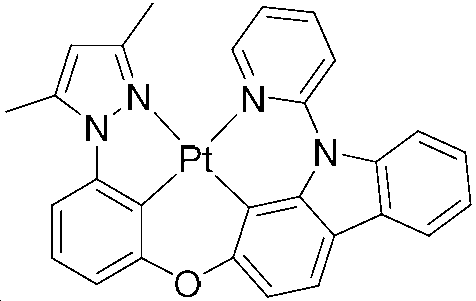

몇 가지 실시양태들을 기술하였다. 그럼에도 불구하고, 본 출원의 사상 및 영역을 벗어남이 없이 다양한 변형이 실시될 수 있음이 이해될 것이다. 따라서, 다른 실시양태들은 하기 특허정구범위의 영역 내에 있다.Several embodiments have been described. Nevertheless, it will be understood that various modifications may be made without departing from the spirit and scope of the present application. Accordingly, other embodiments are within the scope of the following claims.
Claims (30)

식 중,
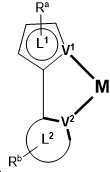

M은 백금(Pt), 금(Au), 이리듐(Ir), 로듐(Rh), 루테늄(Ru), 철(Fe), 코발트(Co), 니켈(Ni), 구리(Cu), 아연(Zn), 은(Ag), 수은(Hg), 카드뮴(Cd), 또는 지르코늄(Zr)을 나타내고,
Ra 및 Rb는 각각 독립적으로 일-, 이-, 삼-, 또는 사-치환기(substitution)를 나타내고, 각각 독립적으로 중수소, 할로겐 원자, 히드록실기, 티올기, 니트로기, 시아노기, 치환되거나 비치환된 알킬기, 치환되거나 비치환된 할로알킬기, 치환되거나 비치환된 아랄킬기, 치환되거나 비치환된 알케닐기, 치환되거나 비치환된 알키닐기, 치환되거나 비치환된 아릴기, 치환되거나 비치환된 아미노기, 치환되거나 비치환된 모노- 또는 디알킬아미노기, 치환되거나 비치환된 모노- 또는 디아릴아미노기, 치환되거나 비치환된 알콕시기, 치환되거나 비치환된 아릴옥시기, 치환되거나 비치환된 헤테로아릴기, 알콕시카르보닐기, 아실옥시기, 아실아미노기, 알콕시카르보닐아미노기, 아릴옥시카르보닐아미노기, 술포닐아미노기, 술파모일기, 카바모일기, 알킬티오기, 술피닐기, 우레이도기, 포스포르아미드기, 머캅토기, 술포기, 카르복실기, 히드라지노기, 치환된 실릴기, 폴리머기, 또는 이의 조합 중 하나 이상을 나타내고,
V3은 C이고,
V4는 N이고,
X는 N이고,
A1는 O이고,
R1, R2 및 R4는 수소이고,
R3은 할로겐 원자, 히드록실기, 티올기, 치환되거나 비치환된 알킬기, 아미노기, 모노- 또는 디알킬아미노기, 모노- 또는 디아릴아미노기, 치환되거나 비치환된 알콕시기, 치환되거나 비치환된 아릴옥시기, 아실옥시기, 아실아미노기, 머캅토기 또는 치환된 실릴기이고,
R5, R6, R7, R8, R9, 및 R10은 각각 독립적으로 중수소, 할로겐 원자, 히드록실기, 티올기, 니트로기, 시아노기, 치환되거나 비치환된 알킬기, 치환되거나 비치환된 할로알킬기, 치환되거나 비치환된 아랄킬기, 치환되거나 비치환된 알케닐기, 치환되거나 비치환된 알키닐기, 치환되거나 비치환된 아릴기, 아미노기, 모노- 또는 디알킬아미노기, 모노- 또는 디아릴아미노기, 치환되거나 비치환된 알콕시기, 치환되거나 비치환된 아릴옥시기, 치환되거나 비치환된 헤테로아릴기, 알콕시카르보닐기, 아실옥시기, 아실아미노기, 알콕시카르보닐아미노기, 아릴옥시카르보닐아미노기, 술포닐아미노기, 술파모일기, 카바모일기, 알킬티오기, 술피닐기, 우레이도기, 포스포르아미드기, 머캅토기, 술포기, 카르복실기, 히드라지노기, 치환된 실릴기, 폴리머기, 또는 이의 조합을 나타내고, 그리고
치환된 알킬기, 치환된 할로알킬기, 치환된 아랄킬기, 치환된 알케닐기, 치환된 알키닐기, 치환된 아릴기, 치환된 아미노기, 치환된 모노- 또는 디알킬아미노기, 치환된 모노- 또는 디아릴아미노기, 치환된 알콕시기, 치환된 아릴옥시기, 치환된 헤테로아릴기 및 치환된 실릴기 상의 하나 이상의 치환기는 비환식 및 사이클릭 치환기, 분지된 및 비분지된 치환기, 카르보사이클릭 및 헤테로사이클릭 치환기, 및 방향족 및 비방향족 치환기로 이루어진 군으로부터 선택되는 것이다.A composition comprising at least one compound of the formula:
during the meal,
M is platinum (Pt), gold (Au), iridium (Ir), rhodium (Rh), ruthenium (Ru), iron (Fe), cobalt (Co), nickel (Ni), copper (Cu), zinc (Zn) ), silver (Ag), mercury (Hg), cadmium (Cd), or zirconium (Zr);
R a and R b each independently represents a mono-, di-, tri-, or tetra-substitution, and each independently represents deuterium, a halogen atom, a hydroxyl group, a thiol group, a nitro group, a cyano group, a substitution a substituted or unsubstituted alkyl group, a substituted or unsubstituted haloalkyl group, a substituted or unsubstituted aralkyl group, a substituted or unsubstituted alkenyl group, a substituted or unsubstituted alkynyl group, a substituted or unsubstituted aryl group, a substituted or unsubstituted substituted amino group, substituted or unsubstituted mono- or dialkylamino group, substituted or unsubstituted mono- or diarylamino group, substituted or unsubstituted alkoxy group, substituted or unsubstituted aryloxy group, substituted or unsubstituted hetero Aryl group, alkoxycarbonyl group, acyloxy group, acylamino group, alkoxycarbonylamino group, aryloxycarbonylamino group, sulfonylamino group, sulfamoyl group, carbamoyl group, alkylthio group, sulfinyl group, ureido group, phosphoramide group , a mercapto group, a sulfo group, a carboxyl group, a hydrazino group, a substituted silyl group, a polymer group, or at least one of a combination thereof,
V 3 is C;
V 4 is N,
X is N;
A 1 is O,
R 1 , R 2 and R 4 are hydrogen,
R 3 is a halogen atom, a hydroxyl group, a thiol group, a substituted or unsubstituted alkyl group, an amino group, a mono- or dialkylamino group, a mono- or diarylamino group, a substituted or unsubstituted alkoxy group, a substituted or unsubstituted aryl an oxy group, an acyloxy group, an acylamino group, a mercapto group, or a substituted silyl group;
R 5 , R 6 , R 7 , R 8 , R 9 , and R 10 are each independently deuterium, a halogen atom, a hydroxyl group, a thiol group, a nitro group, a cyano group, a substituted or unsubstituted alkyl group, a substituted or unsubstituted A substituted haloalkyl group, a substituted or unsubstituted aralkyl group, a substituted or unsubstituted alkenyl group, a substituted or unsubstituted alkynyl group, a substituted or unsubstituted aryl group, an amino group, a mono- or dialkylamino group, a mono- or di Rylamino group, substituted or unsubstituted alkoxy group, substituted or unsubstituted aryloxy group, substituted or unsubstituted heteroaryl group, alkoxycarbonyl group, acyloxy group, acylamino group, alkoxycarbonylamino group, aryloxycarbonylamino group, Sulfonylamino group, sulfamoyl group, carbamoyl group, alkylthio group, sulfinyl group, ureido group, phosphoramide group, mercapto group, sulfo group, carboxyl group, hydrazino group, substituted silyl group, polymer group, or a combination thereof represents, and
Substituted alkyl group, substituted haloalkyl group, substituted aralkyl group, substituted alkenyl group, substituted alkynyl group, substituted aryl group, substituted amino group, substituted mono- or dialkylamino group, substituted mono- or diarylamino group One or more substituents on , substituted alkoxy groups, substituted aryloxy groups, substituted heteroaryl groups and substituted silyl groups are acyclic and cyclic substituents, branched and unbranched substituents, carbocyclic and heterocyclic substituents , and is selected from the group consisting of aromatic and non-aromatic substituents.

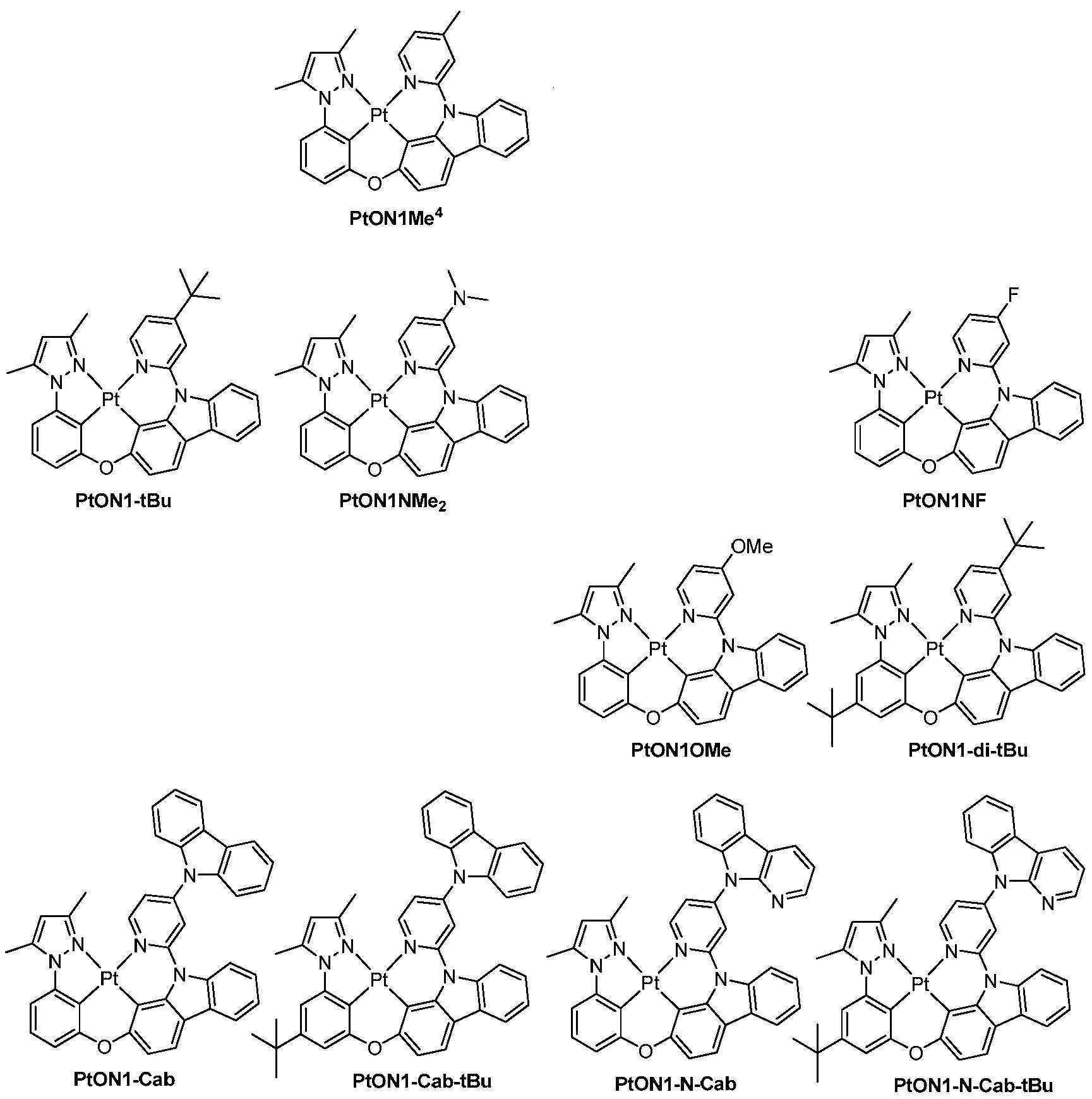
Priority Applications (1)
| Application Number | Priority Date | Filing Date | Title |
|---|---|---|---|
| KR1020220001402A KR20220008931A (en) | 2013-06-10 | 2022-01-05 | Phosphorescent tetradentate metal complexes having modified emission spectra |
Applications Claiming Priority (2)
| Application Number | Priority Date | Filing Date | Title |
|---|---|---|---|
| US201361833091P | 2013-06-10 | 2013-06-10 | |
| US61/833,091 | 2013-06-10 |
Related Child Applications (1)
| Application Number | Title | Priority Date | Filing Date |
|---|---|---|---|
| KR1020220001402A Division KR20220008931A (en) | 2013-06-10 | 2022-01-05 | Phosphorescent tetradentate metal complexes having modified emission spectra |
Publications (2)
| Publication Number | Publication Date |
|---|---|
| KR20140144152A KR20140144152A (en) | 2014-12-18 |
| KR102349659B1 true KR102349659B1 (en) | 2022-01-11 |
Family
ID=52005992
Family Applications (4)
| Application Number | Title | Priority Date | Filing Date |
|---|---|---|---|
| KR1020140070384A Active KR102349659B1 (en) | 2013-06-10 | 2014-06-10 | Phosphorescent tetradentate metal complexes having modified emission spectra |
| KR1020220001402A Ceased KR20220008931A (en) | 2013-06-10 | 2022-01-05 | Phosphorescent tetradentate metal complexes having modified emission spectra |
| KR1020230027855A Ceased KR20230035022A (en) | 2013-06-10 | 2023-03-02 | Phosphorescent tetradentate metal complexes having modified emission spectra |
| KR1020250005969A Pending KR20250011225A (en) | 2013-06-10 | 2025-01-15 | Phosphorescent tetradentate metal complexes having modified emission spectra |
Family Applications After (3)
| Application Number | Title | Priority Date | Filing Date |
|---|---|---|---|
| KR1020220001402A Ceased KR20220008931A (en) | 2013-06-10 | 2022-01-05 | Phosphorescent tetradentate metal complexes having modified emission spectra |
| KR1020230027855A Ceased KR20230035022A (en) | 2013-06-10 | 2023-03-02 | Phosphorescent tetradentate metal complexes having modified emission spectra |
| KR1020250005969A Pending KR20250011225A (en) | 2013-06-10 | 2025-01-15 | Phosphorescent tetradentate metal complexes having modified emission spectra |
Country Status (4)
| Country | Link |
|---|---|
| US (3) | US9673409B2 (en) |
| JP (1) | JP6603445B2 (en) |
| KR (4) | KR102349659B1 (en) |
| CN (2) | CN110003279A (en) |
Cited By (1)
| Publication number | Priority date | Publication date | Assignee | Title |
|---|---|---|---|---|
| KR20150043225A (en) * | 2013-10-14 | 2015-04-22 | 아리조나 보드 오브 리젠츠 온 비하프 오브 아리조나 스테이트 유니버시티 | Platinum complexes, devices, and uses thereof |
Families Citing this family (169)
| Publication number | Priority date | Publication date | Assignee | Title |
|---|---|---|---|---|
| JP5604505B2 (en) | 2009-04-06 | 2014-10-08 | アリゾナ ボード オブ リージェンツ アクティング フォー アンド オン ビハーフ オブ アリゾナ ステイト ユニバーシティ | Synthesis of four-coordinate platinum complexes and their application to light-emitting devices |
| KR20130067276A (en) | 2010-04-30 | 2013-06-21 | 아리조나 보드 오브 리젠츠 퍼 앤 온 비하프 오브 아리조나 스테이트 유니버시티 | Synthesis of four coordinated palladium complexes and their applications in light emitting devices thereof |
| US9324957B2 (en) | 2010-04-30 | 2016-04-26 | Arizona Board Of Regents On Behalf Of Arizona State University | Synthesis of four coordinated gold complexes and their applications in light emitting devices thereof |
| US8816080B2 (en) | 2011-02-18 | 2014-08-26 | Arizona Board Of Regents Acting For And On Behalf Of Arizona State University | Four coordinated platinum and palladium complexes with geometrically distorted charge transfer state and their applications in light emitting devices |
| US9238668B2 (en) | 2011-05-26 | 2016-01-19 | Arizona Board Of Regents, Acting For And On Behalf Of Arizona State University | Synthesis of platinum and palladium complexes as narrow-band phosphorescent emitters for full color displays |
| WO2014031977A1 (en) | 2012-08-24 | 2014-02-27 | Arizona Board Of Regents For And On Behalf Of Arizona State University | Metal compounds and methods and uses thereof |
| WO2014047616A1 (en) | 2012-09-24 | 2014-03-27 | Arizona Board Of Regents For And On Behalf Of Arizona State University | Metal compounds, methods, and uses thereof |
| WO2014109814A2 (en) | 2012-10-26 | 2014-07-17 | Arizona Board Of Regents Acting For And On Behalf Of Arizona State University | Metal complexes, methods, and uses thereof |
| KR102349659B1 (en) | 2013-06-10 | 2022-01-11 | 아리조나 보드 오브 리젠츠 온 비하프 오브 아리조나 스테이트 유니버시티 | Phosphorescent tetradentate metal complexes having modified emission spectra |
| US9224963B2 (en) | 2013-12-09 | 2015-12-29 | Arizona Board Of Regents On Behalf Of Arizona State University | Stable emitters |
| US10020455B2 (en) | 2014-01-07 | 2018-07-10 | Arizona Board Of Regents On Behalf Of Arizona State University | Tetradentate platinum and palladium complex emitters containing phenyl-pyrazole and its analogues |
| WO2015131158A1 (en) | 2014-02-28 | 2015-09-03 | Arizona Board Of Regents On Behalf Of Arizona State University | Chiral metal complexes as emitters for organic polarized electroluminescent devices |
| US10008679B2 (en) | 2014-04-14 | 2018-06-26 | Universal Display Corporation | Organic electroluminescent materials and devices |
| US9905785B2 (en) | 2014-04-14 | 2018-02-27 | Universal Display Corporation | Organic electroluminescent materials and devices |
| US10403830B2 (en) | 2014-05-08 | 2019-09-03 | Universal Display Corporation | Organic electroluminescent materials and devices |
| WO2015171627A1 (en) | 2014-05-08 | 2015-11-12 | Universal Display Corporation | Stabilized imidazophenanthridine materials |
| US10301338B2 (en) | 2014-05-08 | 2019-05-28 | Universal Display Corporation | Organic electroluminescent materials and devices |
| US10636983B2 (en) | 2014-05-08 | 2020-04-28 | Universal Display Corporation | Organic electroluminescent materials and devices |
| US9941479B2 (en) | 2014-06-02 | 2018-04-10 | Arizona Board Of Regents On Behalf Of Arizona State University | Tetradentate cyclometalated platinum complexes containing 9,10-dihydroacridine and its analogues |
| US9923155B2 (en) | 2014-07-24 | 2018-03-20 | Arizona Board Of Regents On Behalf Of Arizona State University | Tetradentate platinum (II) complexes cyclometalated with functionalized phenyl carbene ligands and their analogues |
| US9502671B2 (en) | 2014-07-28 | 2016-11-22 | Arizona Board Of Regents On Behalf Of Arizona State University | Tridentate cyclometalated metal complexes with six-membered coordination rings |
| US9818959B2 (en) | 2014-07-29 | 2017-11-14 | Arizona Board of Regents on behlaf of Arizona State University | Metal-assisted delayed fluorescent emitters containing tridentate ligands |
| US10793546B2 (en) | 2014-08-15 | 2020-10-06 | Arizona Board Of Regents On Behalf Of Arizona State University | Non-platinum metal complexes for excimer based single dopant white organic light emitting diodes |
| US9920242B2 (en) | 2014-08-22 | 2018-03-20 | Arizona Board Of Regents On Behalf Of Arizona State University | Metal-assisted delayed fluorescent materials as co-host materials for fluorescent OLEDs |
| US11329244B2 (en) | 2014-08-22 | 2022-05-10 | Arizona Board Of Regents On Behalf Of Arizona State University | Organic light-emitting diodes with fluorescent and phosphorescent emitters |
| CN104241553A (en) * | 2014-10-13 | 2014-12-24 | 深圳市华星光电技术有限公司 | OLED (organic light emitting diode) production method and OLED produced by same |
| CN104253247A (en) * | 2014-10-13 | 2014-12-31 | 深圳市华星光电技术有限公司 | Preparation method of OLED (Organic Light Emitting Diode) device and OLED device prepared by adopting preparation method |
| US10033003B2 (en) | 2014-11-10 | 2018-07-24 | Arizona Board Of Regents On Behalf Of Arizona State University | Tetradentate metal complexes with carbon group bridging ligands |
| US9865825B2 (en) | 2014-11-10 | 2018-01-09 | Arizona Board Of Regents On Behalf Of Arizona State University | Emitters based on octahedral metal complexes |
| US10115912B2 (en) * | 2015-04-28 | 2018-10-30 | Semiconductor Energy Laboratory Co., Ltd. | Organometallic complex, light-emitting element, light-emitting device, electronic device, and lighting device |
| US9711739B2 (en) | 2015-06-02 | 2017-07-18 | Arizona Board Of Regents On Behalf Of Arizona State University | Tetradentate metal complexes containing indoloacridine and its analogues |
| US9879039B2 (en) | 2015-06-03 | 2018-01-30 | Arizona Board Of Regents On Behalf Of Arizona State University | Tetradentate and octahedral metal complexes containing naphthyridinocarbazole and its analogues |
| US11930662B2 (en) | 2015-06-04 | 2024-03-12 | Arizona Board Of Regents On Behalf Of Arizona State University | Transparent electroluminescent devices with controlled one-side emissive displays |
| US20180194769A1 (en) | 2015-07-06 | 2018-07-12 | Rodin Therapeutics, Inc. | Hetero-halo inhibitors of histone deacetylase |
| US10421756B2 (en) | 2015-07-06 | 2019-09-24 | Rodin Therapeutics, Inc. | Heterobicyclic N-aminophenyl-amides as inhibitors of histone deacetylase |
| US10158091B2 (en) * | 2015-08-04 | 2018-12-18 | Arizona Board Of Regents On Behalf Of Arizona State University | Tetradentate platinum (II) and palladium (II) complexes, devices, and uses thereof |
| US10211411B2 (en) | 2015-08-25 | 2019-02-19 | Arizona Board Of Regents On Behalf Of Arizona State University | Thermally activated delayed fluorescent material based on 9,10-dihydro-9,9-dimethylacridine analogues for prolonging device longevity |
| JP6935176B2 (en) * | 2015-08-31 | 2021-09-15 | 株式会社半導体エネルギー研究所 | Organometallic complexes, light emitting elements, light emitting devices, electronic devices, and lighting devices |
| US10290816B2 (en) | 2015-11-16 | 2019-05-14 | The Regents Of The University Of Michigan | Organic electroluminescent materials and devices |
| US11335865B2 (en) | 2016-04-15 | 2022-05-17 | Arizona Board Of Regents On Behalf Of Arizona State University | OLED with multi-emissive material layer |
| US10727423B2 (en) * | 2016-06-20 | 2020-07-28 | Universal Display Corporation | Organic electroluminescent materials and devices |
| US10672997B2 (en) | 2016-06-20 | 2020-06-02 | Universal Display Corporation | Organic electroluminescent materials and devices |
| US10177323B2 (en) | 2016-08-22 | 2019-01-08 | Arizona Board Of Regents On Behalf Of Arizona State University | Tetradentate platinum (II) and palladium (II) complexes and octahedral iridium complexes employing azepine functional groups and their analogues |
| CN106366069B (en) * | 2016-08-30 | 2019-01-08 | 浙江工业大学 | A kind of preparation method of N- heteroaryl carbazole compound |
| ES2927104T3 (en) | 2016-09-09 | 2022-11-02 | Incyte Corp | Pyrazolopyridine derivatives as modulators of HPK1 and uses thereof for the treatment of cancer |
| US20180072741A1 (en) | 2016-09-09 | 2018-03-15 | Incyte Corporation | Pyrazolopyrimidine compounds and uses thereof |
| US20180072718A1 (en) | 2016-09-09 | 2018-03-15 | Incyte Corporation | Pyrazolopyridine compounds and uses thereof |
| US10822363B2 (en) | 2016-10-12 | 2020-11-03 | Arizona Board Of Regents On Behalf Of Arizona State University | Narrow band red phosphorescent tetradentate platinum (II) complexes |
| CN106632514B (en) * | 2016-12-14 | 2019-10-29 | 中国科学院福建物质结构研究所 | A kind of phosphorescence PtAg2Complex and its preparation method and application |
| US11183670B2 (en) | 2016-12-16 | 2021-11-23 | Arizona Board Of Regents On Behalf Of Arizona State University | Organic light emitting diode with split emissive layer |
| US11152579B2 (en) | 2016-12-28 | 2021-10-19 | Universal Display Corporation | Organic electroluminescent materials and devices |
| DK3570834T3 (en) | 2017-01-11 | 2022-02-28 | Alkermes Inc | Bicyclic inhibitors of histone deacetylase |
| US11053268B2 (en) | 2017-01-20 | 2021-07-06 | Universal Display Corporation | Organic electroluminescent materials and devices |
| WO2018140765A1 (en) | 2017-01-27 | 2018-08-02 | Jian Li | Metal-assisted delayed fluorescent emitters employing pyrido-pyrrolo-acridine and analogues |
| WO2018152220A1 (en) | 2017-02-15 | 2018-08-23 | Incyte Corporation | Pyrazolopyridine compounds and uses thereof |
| US11084838B2 (en) | 2017-04-21 | 2021-08-10 | Universal Display Corporation | Organic electroluminescent materials and device |
| KR102429875B1 (en) * | 2017-04-21 | 2022-08-05 | 삼성전자주식회사 | Organometallic compound and organic light emitting device including the same |
| KR102496480B1 (en) * | 2017-04-25 | 2023-02-06 | 삼성전자주식회사 | Organometallic compound, organic light emitting device including the same and a composition including the same |
| KR102527229B1 (en) | 2017-05-10 | 2023-05-02 | 삼성디스플레이 주식회사 | Organometallic compound and organic light emitting device comprising the same |
| US11101435B2 (en) | 2017-05-19 | 2021-08-24 | Arizona Board Of Regents On Behalf Of Arizona State University | Tetradentate platinum and palladium complexes based on biscarbazole and analogues |
| US10392387B2 (en) | 2017-05-19 | 2019-08-27 | Arizona Board Of Regents On Behalf Of Arizona State University | Substituted benzo[4,5]imidazo[1,2-a]phenanthro[9,10-c][1,8]naphthyridines, benzo[4,5]imidazo[1,2-a]phenanthro[9,10-c][1,5]naphthyridines and dibenzo[f,h]benzo[4,5]imidazo[2,1-a]pyrazino[2,3-c]isoquinolines as thermally assisted delayed fluorescent materials |
| US10615349B2 (en) | 2017-05-19 | 2020-04-07 | Arizona Board Of Regents On Behalf Of Arizona State University | Donor-acceptor type thermally activated delayed fluorescent materials based on imidazo[1,2-F]phenanthridine and analogues |
| US10516117B2 (en) | 2017-05-19 | 2019-12-24 | Arizona Board Of Regents On Behalf Of Arizona State University | Metal-assisted delayed fluorescent emttters employing benzo-imidazo-phenanthridine and analogues |
| CN107200755A (en) * | 2017-06-20 | 2017-09-26 | 南京工业大学 | platinum complex coordinated by four-coordinate deuterated ligand |
| KR102606281B1 (en) | 2017-07-14 | 2023-11-27 | 삼성디스플레이 주식회사 | Organometallic compound and organic light-emitting device including the same |
| KR102474204B1 (en) | 2017-07-21 | 2022-12-06 | 삼성디스플레이 주식회사 | Organometallic compound and organic light-emitting device including the same |
| US11678499B2 (en) | 2017-07-27 | 2023-06-13 | Universal Display Corporation | Use of singlet-triplet gap hosts for increasing stability of blue phosphorescent emission |
| KR102456073B1 (en) | 2017-07-28 | 2022-10-19 | 삼성디스플레이 주식회사 | Organometallic compound and organic light emitting device comprising the same |
| AU2018313094A1 (en) | 2017-08-07 | 2020-02-20 | Rodin Therapeutics, Inc. | Bicyclic inhibitors of histone deacetylase |
| US10722495B2 (en) | 2017-09-08 | 2020-07-28 | Incyte Corporation | Cyanoindazole compounds and uses thereof |
| KR102658370B1 (en) * | 2017-09-13 | 2024-04-19 | 삼성디스플레이 주식회사 | Cyclometallic compound, organic light emitting device comprising the same and organic emitting apparatus comprising the organic light emitting device |
| US11647643B2 (en) | 2017-10-17 | 2023-05-09 | Arizona Board Of Regents On Behalf Of Arizona State University | Hole-blocking materials for organic light emitting diodes |
| KR102718677B1 (en) | 2017-10-17 | 2024-10-16 | 지안 리 | Phosphorescent excimers with desirable molecular orientation as monochromatic emitters for display and lighting applications |
| KR102518722B1 (en) * | 2017-11-21 | 2023-04-07 | 삼성디스플레이 주식회사 | Organometallic compound and organic light emitting device comprising the same |
| KR102817395B1 (en) * | 2017-12-04 | 2025-06-10 | 토미 엘. 로이스터 | Bridged bis(azinyl)amine phosphorescent emitting composition |
| CN108276449B (en) * | 2018-01-30 | 2021-03-09 | 瑞声光电科技(常州)有限公司 | Tetradentate ring metal platinum complex containing 4-aryl-3,5-disubstituted pyrazole, preparation method and application |
| CN108299507B (en) * | 2018-01-30 | 2021-03-09 | 瑞声光电科技(常州)有限公司 | Tetradentate ring metal platinum complex containing trisubstituted pyrazole, preparation method and application |
| CN108484676B (en) * | 2018-01-30 | 2021-03-09 | 瑞声光电科技(常州)有限公司 | Tetradentate ring metal platinum complex containing 4-aryl-pyrazole, preparation method and application |
| CN108276450B (en) * | 2018-02-06 | 2020-08-21 | 南京工业大学 | Aryl-substituted tetradentate ligand-coordinated platinum complexes and their synthesis and applications |
| CN108409794B (en) * | 2018-02-09 | 2021-01-19 | 瑞声光电科技(常州)有限公司 | Tetradentate ring metal platinum complexes based on phenyl-carbazole and their applications |
| CN108178774A (en) * | 2018-02-09 | 2018-06-19 | 瑞声光电科技(常州)有限公司 | Platinum complex and light-emitting device |
| US10745388B2 (en) | 2018-02-20 | 2020-08-18 | Incyte Corporation | Indazole compounds and uses thereof |
| LT3755703T (en) | 2018-02-20 | 2022-10-10 | Incyte Corporation | N-(PHENYL)-2-(PHENYL)PYRIMIDINE-4-CARBOXAMIDE DERIVATIVES AND RELATED COMPOUNDS AS HPK1 INHIBITORS FOR THE TREATMENT OF CANCER |
| WO2019164847A1 (en) | 2018-02-20 | 2019-08-29 | Incyte Corporation | Indazole compounds and uses thereof |
| US12037348B2 (en) | 2018-03-09 | 2024-07-16 | Arizona Board Of Regents On Behalf Of Arizona State University | Blue and narrow band green and red emitting metal complexes |
| US11299473B2 (en) | 2018-04-13 | 2022-04-12 | Incyte Corporation | Benzimidazole and indole compounds and uses thereof |
| CN108424425B (en) * | 2018-04-23 | 2021-11-12 | 浙江工业大学 | Quadridentate ring metal palladium complex containing 4-aryl-3, 5-disubstituted pyrazole, preparation method and application |
| CN108659050B (en) * | 2018-04-23 | 2021-03-09 | 浙江工业大学 | Tetradentate ring metal platinum complex containing 6-substituted carbazole, preparation method and application |
| KR102661471B1 (en) * | 2018-04-27 | 2024-04-29 | 삼성디스플레이 주식회사 | Organometallic compound and organic light emitting device comprising the same |
| CN108424426A (en) * | 2018-05-07 | 2018-08-21 | 浙江工业大学 | The four ring gear metal palladium complexes containing three substituted pyrazolecarboxylics, preparation method and application |
| WO2020018476A1 (en) | 2018-07-16 | 2020-01-23 | Jian Li | Fluorinated porphyrin derivatives for optoelectronic applications |
| CN108948095B (en) * | 2018-08-02 | 2021-01-19 | 浙江工业大学 | Tetradentate ring metal platinum complex based on phenylcarbazole and application thereof |
| US10899755B2 (en) | 2018-08-08 | 2021-01-26 | Incyte Corporation | Benzothiazole compounds and uses thereof |
| US11111247B2 (en) | 2018-09-25 | 2021-09-07 | Incyte Corporation | Pyrazolopyrimidine compounds and uses thereof |
| KR102875649B1 (en) * | 2018-11-26 | 2025-10-23 | 삼성디스플레이 주식회사 | Organometallic compound and organic light emitting device comprising the same |
| CN109678906B (en) * | 2018-12-29 | 2022-02-25 | 浙江工业大学 | A kind of metal platinum (II) complex containing double bridged phenyl-phenyl-pyrazole structural unit and application thereof |
| CN109748937B (en) * | 2018-12-29 | 2022-01-21 | 浙江工业大学 | Metal palladium (II) complex containing bridged phenyl-pyrazole structural unit and application thereof |
| CN109678907B (en) * | 2018-12-29 | 2021-08-06 | 浙江工业大学 | A metal platinum(II) complex containing bridged phenyl-phenyl-pyrazole structural units |
| CN109651337A (en) * | 2018-12-30 | 2019-04-19 | 瑞声科技(南京)有限公司 | Light emitting composition and luminescent layer and electroluminescent device comprising the light emitting composition |
| KR102840022B1 (en) | 2019-01-04 | 2025-07-29 | 삼성디스플레이 주식회사 | Organometallic compound and organic light emitting device comprising the same |
| US11878988B2 (en) | 2019-01-24 | 2024-01-23 | Arizona Board Of Regents On Behalf Of Arizona State University | Blue phosphorescent emitters employing functionalized imidazophenthridine and analogues |
| US11594691B2 (en) | 2019-01-25 | 2023-02-28 | Arizona Board Of Regents On Behalf Of Arizona State University | Light outcoupling efficiency of phosphorescent OLEDs by mixing horizontally aligned fluorescent emitters |
| KR102896847B1 (en) | 2019-01-31 | 2025-12-05 | 삼성전자주식회사 | Organometallic compound and organic light emitting device including the same |
| EP3689888B1 (en) | 2019-01-31 | 2021-09-22 | Samsung Electronics Co., Ltd. | Organometallic compound and organic light-emitting device including the same |
| KR102775176B1 (en) | 2019-03-15 | 2025-03-05 | 삼성디스플레이 주식회사 | Organometallic compound and organic light emitting device comprising the same |
| KR20200115795A (en) * | 2019-03-26 | 2020-10-08 | 삼성디스플레이 주식회사 | Organic light emitting device and electronic apparatus |
| KR102608423B1 (en) * | 2019-03-28 | 2023-12-01 | 삼성디스플레이 주식회사 | Organic light emitting device and electronic apparatus |
| KR102743890B1 (en) * | 2019-05-03 | 2024-12-19 | 삼성디스플레이 주식회사 | Organometallic compound, organic light-emitting device including the same and apparatus including the same |
| KR102892097B1 (en) | 2019-05-03 | 2025-11-27 | 삼성디스플레이 주식회사 | Organometallic compound and organic light emitting device including the same |
| KR102824584B1 (en) | 2019-05-10 | 2025-06-24 | 삼성전자주식회사 | Organometallic compound, organic light emitting device including the same and a composition for diagnosing including the same |
| KR102749501B1 (en) | 2019-05-16 | 2025-01-03 | 삼성디스플레이 주식회사 | Organometallic compound and organic light emitting device comprising the same |
| KR102820738B1 (en) * | 2019-05-30 | 2025-06-16 | 삼성디스플레이 주식회사 | Organometallic compound and organic light emitting device including the same |
| JP7232140B2 (en) * | 2019-06-27 | 2023-03-02 | 日本放送協会 | Organic electroluminescence device, display device, and lighting device |
| CN110437134A (en) * | 2019-07-24 | 2019-11-12 | 苏州络森生物科技有限公司 | A kind of synthetic method of 2,7- Dimethylcarbazole |
| KR102784238B1 (en) | 2019-08-02 | 2025-03-24 | 삼성디스플레이 주식회사 | Organic electroluminescence device and organometallic complex for organic electroluminescence device |
| AU2020326703A1 (en) | 2019-08-06 | 2022-02-17 | Incyte Corporation | Solid forms of an HPK1 inhibitor |
| KR102843326B1 (en) | 2019-08-09 | 2025-08-05 | 삼성전자주식회사 | Organometallic compound, organic light emitting device including the same and a composition for diagnosing including the same |
| KR102798042B1 (en) * | 2019-09-06 | 2025-04-22 | 삼성디스플레이 주식회사 | Organic light-emitting device and apparatus including the same |
| US11785838B2 (en) | 2019-10-02 | 2023-10-10 | Arizona Board Of Regents On Behalf Of Arizona State University | Green and red organic light-emitting diodes employing excimer emitters |
| KR102806420B1 (en) | 2019-10-21 | 2025-05-13 | 삼성디스플레이 주식회사 | Organic electroluminescence device and organometallic compound for organic electroluminescence device |
| US12382824B2 (en) | 2019-11-14 | 2025-08-05 | Samsung Display Co., Ltd. | Organic electroluminescence device and organometallic compound for organic electroluminescence device |
| KR102810570B1 (en) | 2019-11-25 | 2025-05-23 | 삼성디스플레이 주식회사 | Organic electroluminescence device and organometallic compound for organic electroluminescence device |
| KR102860615B1 (en) | 2019-11-28 | 2025-09-16 | 삼성전자주식회사 | Organometallic compound, organic light emitting device including the same and a composition for diagnosing including the same |
| US20210175443A1 (en) * | 2019-12-09 | 2021-06-10 | Universal Display Corporation | Organic electroluminescent materials and devices |
| KR102857112B1 (en) * | 2019-12-12 | 2025-09-09 | 삼성디스플레이 주식회사 | Organic light-emitting device and apparatus including the same |
| US12168661B2 (en) | 2020-02-21 | 2024-12-17 | Arizona Board Of Regents On Behalf Of Arizona State University | Functional materials based on stable chemical structure |
| KR20210124605A (en) | 2020-04-06 | 2021-10-15 | 삼성디스플레이 주식회사 | Organometallic compound and organic light emitting device including the same |
| CN111548371B (en) * | 2020-04-21 | 2022-03-25 | 浙江工业大学 | 1, 8-substituted carbazole-based quadridentate ring metal palladium (II) complex phosphorescent material and application |
| KR102853328B1 (en) | 2020-04-24 | 2025-09-01 | 삼성디스플레이 주식회사 | Organometallic compound and organic light emitting device comprising the same |
| KR102776384B1 (en) * | 2020-05-06 | 2025-03-10 | 삼성디스플레이 주식회사 | Llight emitting device and electronic apparatus comprising same |
| KR102853327B1 (en) | 2020-05-14 | 2025-09-01 | 삼성디스플레이 주식회사 | Organometallic compound and organic light emitting device comprising the same |
| CN113683625B (en) | 2020-05-19 | 2025-06-10 | 亚利桑那州立大学董事会 | Metal-assisted delayed fluorescence emitters for organic light emitting diodes |
| US11945985B2 (en) | 2020-05-19 | 2024-04-02 | Arizona Board Of Regents On Behalf Of Arizona State University | Metal assisted delayed fluorescent emitters for organic light-emitting diodes |
| KR20210146500A (en) | 2020-05-26 | 2021-12-06 | 삼성디스플레이 주식회사 | Organometallic compound and organic light emitting device comprising the same |
| KR20210152626A (en) | 2020-06-08 | 2021-12-16 | 삼성디스플레이 주식회사 | Organometallic compound and organic light emitting device including the same |
| CN111518142B (en) * | 2020-06-10 | 2021-10-01 | 浙江工业大学 | Tetradentate cyclic metal platinum(II) complexes based on carboxyl coordination and containing pyridyl acridine and their applications |
| CN111574501B (en) * | 2020-06-10 | 2021-09-17 | 浙江工业大学 | Four-tooth ring metal platinum (II) complex based on oxygen atom linkage and containing phenylacridine and application |
| KR20210156385A (en) * | 2020-06-17 | 2021-12-27 | 삼성디스플레이 주식회사 | organometallic compound, light emitting device including the same and electronic device including the light emitting device |
| KR102867203B1 (en) | 2020-07-13 | 2025-10-16 | 삼성디스플레이 주식회사 | Light emitting device, electronic apparatus including the same and organometallic compound |
| KR102801011B1 (en) | 2020-07-13 | 2025-04-30 | 삼성디스플레이 주식회사 | Light emitting device and electronic apparatus including the same |
| KR20220010691A (en) | 2020-07-17 | 2022-01-26 | 삼성디스플레이 주식회사 | Light emitting device and electronic apparatus comprising the device |
| KR20220016406A (en) | 2020-07-31 | 2022-02-09 | 삼성디스플레이 주식회사 | Organometallic compound and light emitting device comprising the same and electronic apparatus comprising the same |
| US20220073551A1 (en) * | 2020-09-09 | 2022-03-10 | Arizona Board Of Regents On Behalf Of Arizona State University | Non-planar blue phosphorescent emitters based on functionalized imidazolyl group |
| KR20220037040A (en) | 2020-09-16 | 2022-03-24 | 삼성디스플레이 주식회사 | Organometallic compound and light emitting device comprising the same and electronic apparatus comprising the same |
| EP3971261A1 (en) * | 2020-09-17 | 2022-03-23 | Samsung Electronics Co., Ltd. | Organometallic compound, organic light-emitting device including the same, and diagnostic composition including the organometallic compound |
| KR102870801B1 (en) | 2020-10-13 | 2025-10-14 | 삼성디스플레이 주식회사 | Organometallic compound and light emitting device including the same and electronic apparatus including the same |
| JP2022074041A (en) | 2020-10-30 | 2022-05-17 | 学校法人関西学院 | Polycyclic aromatic compound |
| KR102779968B1 (en) | 2020-12-02 | 2025-03-13 | 삼성디스플레이 주식회사 | Organometallic compound and light emitting device including the same and electronic apparatus including the same |
| KR20220078797A (en) | 2020-12-03 | 2022-06-13 | 삼성디스플레이 주식회사 | Organometallic compound, light emitting device including the same and electronic apparatus including the device |
| KR20220085892A (en) | 2020-12-15 | 2022-06-23 | 삼성디스플레이 주식회사 | Organic electroluminescence device and organometallic compound for organic electroluminescence device |
| CN112679555B (en) * | 2021-01-14 | 2023-04-07 | 南京工业大学 | Broad-spectrum divalent platinum complex and preparation method and application thereof |
| KR102896743B1 (en) | 2021-01-18 | 2025-12-05 | 삼성디스플레이 주식회사 | Organometallic complexes and organic light emitting device |
| JP7622941B2 (en) | 2021-03-02 | 2025-01-28 | エスケーマテリアルズジェイエヌシー株式会社 | Polycyclic aromatic compounds |
| KR20220125864A (en) * | 2021-03-04 | 2022-09-15 | 삼성디스플레이 주식회사 | Organometallic compound, light emitting device including the same and electronic apparatus including the light emitting device |
| KR102892042B1 (en) | 2021-03-25 | 2025-11-28 | 삼성디스플레이 주식회사 | Organic electroluminescence device and organometallic compound for organic electroluminescence device |
| CN115141232A (en) | 2021-03-31 | 2022-10-04 | 三星显示有限公司 | Organometallic compound, light-emitting device including the same, and electronic device |
| CN115197274A (en) | 2021-04-02 | 2022-10-18 | 三星显示有限公司 | Organometallic compound, light-emitting device including the same, and electronic device |
| CN115215852A (en) * | 2021-04-15 | 2022-10-21 | 浙江工业大学 | Central chiral induced spiro chiral four-tooth ring metal platinum (II) and palladium (II) complex circularly polarized luminescent material and application thereof |
| CN113201021B (en) * | 2021-04-22 | 2022-09-30 | 浙江工业大学 | High-radiation-rate platinum complex based on1, 8-substituted carbazole and application thereof |
| CN113201026B (en) * | 2021-05-19 | 2024-02-02 | 浙江虹舞科技有限公司 | Four-tooth ring metal platinum (II) or palladium (II) complex luminescent material based on donor-acceptor structure and application thereof |
| KR20230015230A (en) | 2021-07-22 | 2023-01-31 | 삼성전자주식회사 | Organometallic compound and organic light emitting device including the same |
| JP7769504B2 (en) | 2021-09-29 | 2025-11-13 | エスケーマテリアルズジェイエヌシー株式会社 | Polycyclic aromatic compounds |
| JP2023049580A (en) | 2021-09-29 | 2023-04-10 | 学校法人関西学院 | polycyclic aromatic compounds |
| JP2023067419A (en) | 2021-11-01 | 2023-05-16 | エスケーマテリアルズジェイエヌシー株式会社 | polycyclic aromatic compound |
| JP7784874B2 (en) | 2021-12-01 | 2025-12-12 | エスケーマテリアルズジェイエヌシー株式会社 | Triazine Compounds |
| CN114621296B (en) * | 2022-03-31 | 2024-02-13 | 浙江华显光电科技有限公司 | Organometallic complex, preparation, organic photoelectric device and display or lighting device |
| CN114805446B (en) * | 2022-04-09 | 2023-08-15 | 浙江工业大学 | Metal platinum (II) and palladium (II) complexes, organic light-emitting devices and display or lighting devices |
| KR20240004104A (en) | 2022-07-04 | 2024-01-11 | 가꼬우 호징 관세이 가쿠잉 | Polycyclic aromatic compound |
| KR20240176070A (en) | 2023-06-13 | 2024-12-23 | 고쿠리츠 다이가쿠 호진 교토 다이가쿠 | Polycyclic aromatic compound |
Citations (3)
| Publication number | Priority date | Publication date | Assignee | Title |
|---|---|---|---|---|
| WO2012112853A1 (en) * | 2011-02-18 | 2012-08-23 | Arizona Board Of Regents Acting For And On Behalf Of Arizona State University | Four coordinated platinum and palladium complexes with geometrically distorted charge transfer state and their applications in light emitting devices |
| JP2012207231A (en) * | 2006-02-20 | 2012-10-25 | Konica Minolta Holdings Inc | Organic electroluminescent element material |
| US20120302753A1 (en) * | 2011-05-26 | 2012-11-29 | Jian Li | Synthesis of platinum and palladium complexes as narrow-band phosphorescent emitters for full color displays |
Family Cites Families (172)
| Publication number | Priority date | Publication date | Assignee | Title |
|---|---|---|---|---|
| CH599987A5 (en) | 1975-10-28 | 1978-06-15 | Sandoz Ag | |
| US4769292A (en) | 1987-03-02 | 1988-09-06 | Eastman Kodak Company | Electroluminescent device with modified thin film luminescent zone |
| US5707745A (en) | 1994-12-13 | 1998-01-13 | The Trustees Of Princeton University | Multicolor organic light emitting devices |
| US5844363A (en) | 1997-01-23 | 1998-12-01 | The Trustees Of Princeton Univ. | Vacuum deposited, non-polymeric flexible organic light emitting devices |
| US6303238B1 (en) | 1997-12-01 | 2001-10-16 | The Trustees Of Princeton University | OLEDs doped with phosphorescent compounds |
| JP4142782B2 (en) | 1998-06-26 | 2008-09-03 | Tdk株式会社 | Organic EL device |
| WO2000070655A2 (en) | 1999-05-13 | 2000-11-23 | The Trustees Of Princeton University | Very high efficiency organic light emitting devices based on electrophosphorescence |
| JP4154140B2 (en) | 2000-09-26 | 2008-09-24 | キヤノン株式会社 | Metal coordination compounds |
| WO2003015720A1 (en) | 2001-08-15 | 2003-02-27 | 3M Innovative Properties Company | Hardenable self-supporting structures and methods |
| JP4166455B2 (en) | 2001-10-01 | 2008-10-15 | 株式会社半導体エネルギー研究所 | Polarizing film and light emitting device |
| US20030186077A1 (en) | 2001-12-31 | 2003-10-02 | Chen Jian P. | Bis- and tris- (di) benzocarbazole-based materials as hole transport materials for organic light emitting devices |
| GB0215153D0 (en) | 2002-07-01 | 2002-08-07 | Univ Hull | Luminescent compositions |
| US20060094875A1 (en) | 2002-11-01 | 2006-05-04 | Hisanori Itoh | Platinum complexes |
| WO2004070655A2 (en) | 2003-02-04 | 2004-08-19 | Vanderbilt University | Apparatus and methods of determining marker orientation in fiducial registration |
| US7037599B2 (en) | 2003-02-28 | 2006-05-02 | Eastman Kodak Company | Organic light emitting diodes for production of polarized light |
| CN101667626B (en) | 2003-06-02 | 2012-11-28 | 富士胶片株式会社 | Organic electroluminescent devices and metal complex compounds |
| JP4460952B2 (en) | 2003-06-02 | 2010-05-12 | 富士フイルム株式会社 | Organic electroluminescent device and complex compound |
| EP3623444B1 (en) | 2003-06-02 | 2021-05-26 | UDC Ireland Limited | Organic electroluminescent devices and metal complex compounds |
| DE10350722A1 (en) | 2003-10-30 | 2005-05-25 | Covion Organic Semiconductors Gmbh | metal complexes |
| US7442797B2 (en) | 2003-11-04 | 2008-10-28 | Takasago International Corporation | Platinum complex and light emitting device |
| DE10359341A1 (en) | 2003-12-16 | 2005-07-28 | Basell Polyolefine Gmbh | New monocyclopentadienyl complex useful in catalyst system used in prepolymerized catalyst system and for the polymerization or copolymerization of olefins |
| US7332232B2 (en) | 2004-02-03 | 2008-02-19 | Universal Display Corporation | OLEDs utilizing multidentate ligand systems |
| JP2005267557A (en) | 2004-03-22 | 2005-09-29 | Ntt Docomo Inc | Server device |
| US20050211974A1 (en) | 2004-03-26 | 2005-09-29 | Thompson Mark E | Organic photosensitive devices |
| US7445855B2 (en) | 2004-05-18 | 2008-11-04 | The University Of Southern California | Cationic metal-carbene complexes |
| US7393599B2 (en) | 2004-05-18 | 2008-07-01 | The University Of Southern California | Luminescent compounds with carbene ligands |
| US7279704B2 (en) | 2004-05-18 | 2007-10-09 | The University Of Southern California | Complexes with tridentate ligands |
| US7534505B2 (en) * | 2004-05-18 | 2009-05-19 | The University Of Southern California | Organometallic compounds for use in electroluminescent devices |
| JP4576605B2 (en) | 2004-08-09 | 2010-11-10 | 独立行政法人産業技術総合研究所 | Identification method of oligosaccharide |
| JP4500735B2 (en) | 2004-09-22 | 2010-07-14 | 富士フイルム株式会社 | Organic electroluminescence device |
| US7002013B1 (en) | 2004-09-23 | 2006-02-21 | National Tsing Hua University | Pt complexes as phosphorescent emitters in the fabrication of organic light emitting diodes |
| JP4531509B2 (en) | 2004-09-27 | 2010-08-25 | 富士フイルム株式会社 | Light emitting element |
| CA2589711A1 (en) * | 2004-12-23 | 2006-06-29 | Ciba Specialty Chemicals Holding Inc. | Electroluminescent metal complexes with nucleophilic carbene ligands |
| JP4773109B2 (en) | 2005-02-28 | 2011-09-14 | 高砂香料工業株式会社 | Platinum complex and light emitting device |
| JP2006242080A (en) | 2005-03-02 | 2006-09-14 | Denso Corp | Abnormality diagnostic device for exhaust gas recirculating device |
| JP4425816B2 (en) | 2005-03-02 | 2010-03-03 | 富士重工業株式会社 | Electronically controlled throttle device |
| JP4727262B2 (en) | 2005-03-16 | 2011-07-20 | 富士フイルム株式会社 | Organic electroluminescence device |
| JP4399429B2 (en) | 2005-03-16 | 2010-01-13 | 富士フイルム株式会社 | Organic electroluminescence device |
| JP4399382B2 (en) | 2005-03-16 | 2010-01-13 | 富士フイルム株式会社 | Organic electroluminescence device |
| US7981524B2 (en) | 2005-03-16 | 2011-07-19 | Fujifilm Corporation | Platinum complex compound and organic electroluminescent device |
| JP4790298B2 (en) | 2005-04-08 | 2011-10-12 | 日本放送協会 | Good solubility iridium complex and organic EL device |
| US9070884B2 (en) | 2005-04-13 | 2015-06-30 | Universal Display Corporation | Hybrid OLED having phosphorescent and fluorescent emitters |
| JP4934346B2 (en) | 2005-04-25 | 2012-05-16 | 富士フイルム株式会社 | Organic electroluminescence device |
| JP2006303394A (en) | 2005-04-25 | 2006-11-02 | Fuji Photo Film Co Ltd | Organic electroluminescent element |
| TWI418606B (en) | 2005-04-25 | 2013-12-11 | Udc Ireland Ltd | Organic electroluminescent device |
| US7758971B2 (en) | 2005-04-25 | 2010-07-20 | Fujifilm Corporation | Organic electroluminescent device |
| TWI391027B (en) | 2005-04-25 | 2013-03-21 | Fujifilm Corp | Organic electroluminescent device |
| JP5046548B2 (en) | 2005-04-25 | 2012-10-10 | 富士フイルム株式会社 | Organic electroluminescence device |
| JP4533796B2 (en) | 2005-05-06 | 2010-09-01 | 富士フイルム株式会社 | Organic electroluminescence device |
| JP2006351638A (en) | 2005-06-13 | 2006-12-28 | Fujifilm Holdings Corp | Light emitting device |
| JP2007042875A (en) | 2005-08-03 | 2007-02-15 | Fujifilm Holdings Corp | Organic electroluminescence element |
| JP4796802B2 (en) | 2005-08-15 | 2011-10-19 | 富士フイルム株式会社 | Organic electroluminescence device |
| JP4923478B2 (en) | 2005-08-19 | 2012-04-25 | コニカミノルタホールディングス株式会社 | Organic electroluminescence element, display device and lighting device |
| JP2007066581A (en) | 2005-08-29 | 2007-03-15 | Fujifilm Holdings Corp | Organic electroluminescent element |
| JP2007073620A (en) | 2005-09-05 | 2007-03-22 | Fujifilm Corp | Organic electroluminescence device |
| JP2007073845A (en) | 2005-09-08 | 2007-03-22 | Fujifilm Holdings Corp | Organic laser oscillator |
| JP5208391B2 (en) | 2005-09-09 | 2013-06-12 | 住友化学株式会社 | Metal complex, light emitting material and light emitting device |
| JP2007073900A (en) | 2005-09-09 | 2007-03-22 | Fujifilm Corp | Organic electroluminescence device |
| JP2007080593A (en) | 2005-09-12 | 2007-03-29 | Fujifilm Corp | Electrochemiluminescence device |
| JP2007080677A (en) | 2005-09-14 | 2007-03-29 | Fujifilm Corp | Organic electroluminescent device and manufacturing method thereof |
| JP2007110067A (en) | 2005-09-14 | 2007-04-26 | Fujifilm Corp | Composition for organic electroluminescent device, method for producing organic electroluminescent device, and organic electroluminescent device |
| JP2007110102A (en) | 2005-09-15 | 2007-04-26 | Fujifilm Corp | Organic electroluminescence device |
| US7839078B2 (en) | 2005-09-15 | 2010-11-23 | Fujifilm Corporation | Organic electroluminescent element having a luminescent layer and a buffer layer adjacent thereto |
| JP2007088105A (en) | 2005-09-20 | 2007-04-05 | Fujifilm Corp | Organic electroluminescence device |
| JP4789556B2 (en) | 2005-09-21 | 2011-10-12 | 富士フイルム株式会社 | Organic electroluminescence device |
| JP2007186490A (en) | 2005-12-14 | 2007-07-26 | Sumitomo Seika Chem Co Ltd | Compound for electroluminescent device and method for producing the same |
| JP4945156B2 (en) | 2006-03-24 | 2012-06-06 | 富士フイルム株式会社 | Organic electroluminescence device |
| JP5144034B2 (en) | 2006-05-31 | 2013-02-13 | 富士フイルム株式会社 | Organic electroluminescence device |
| JP2008010353A (en) | 2006-06-30 | 2008-01-17 | Seiko Epson Corp | Mask manufacturing method, wiring pattern manufacturing method, and plasma display manufacturing method |
| JP2008037848A (en) | 2006-08-10 | 2008-02-21 | Takasago Internatl Corp | Platinum complex and light emitting device |
| JP5205584B2 (en) | 2006-09-06 | 2013-06-05 | ユー・ディー・シー アイルランド リミテッド | Organic electroluminescence device and display device |
| US7598381B2 (en) | 2006-09-11 | 2009-10-06 | The Trustees Of Princeton University | Near-infrared emitting organic compounds and organic devices using the same |
| JP5049711B2 (en) | 2006-09-27 | 2012-10-17 | 富士フイルム株式会社 | Organic electroluminescence device |
| JP2008109085A (en) | 2006-09-29 | 2008-05-08 | Fujifilm Corp | Organic electroluminescence device |
| JP2008103535A (en) | 2006-10-19 | 2008-05-01 | Takasago Internatl Corp | Light emitting element |
| JP2008108617A (en) | 2006-10-26 | 2008-05-08 | Fujifilm Corp | Organic electroluminescence device |
| US8945722B2 (en) | 2006-10-27 | 2015-02-03 | The University Of Southern California | Materials and architectures for efficient harvesting of singlet and triplet excitons for white light emitting OLEDs |
| JP4478166B2 (en) | 2006-11-09 | 2010-06-09 | 三星モバイルディスプレイ株式會社 | Organic light-emitting device provided with organic film containing organometallic complex |
| JP5187493B2 (en) | 2006-11-27 | 2013-04-24 | ユー・ディー・シー アイルランド リミテッド | Organic electroluminescent devices and novel indole derivatives |
| JP2009076834A (en) | 2006-11-27 | 2009-04-09 | Fujifilm Corp | Organic electroluminescent devices and novel indole derivatives |
| JP5282260B2 (en) | 2006-11-27 | 2013-09-04 | ユー・ディー・シー アイルランド リミテッド | Organic electroluminescence device |
| JP4833106B2 (en) | 2007-02-13 | 2011-12-07 | 富士フイルム株式会社 | Organic light emitting device |
| US20080241518A1 (en) | 2007-03-26 | 2008-10-02 | Tasuku Satou | Organic electroluminescence element |
| JP5230218B2 (en) | 2007-03-26 | 2013-07-10 | ユー・ディー・シー アイルランド リミテッド | Organic electroluminescence device |
| JP5081010B2 (en) | 2007-03-26 | 2012-11-21 | 富士フイルム株式会社 | Organic electroluminescence device |
| WO2008117889A1 (en) | 2007-03-28 | 2008-10-02 | Fujifilm Corporation | Organic electroluminescent device |
| JP5430073B2 (en) | 2007-03-30 | 2014-02-26 | ユー・ディー・シー アイルランド リミテッド | Organic electroluminescence device |
| JP2009016184A (en) | 2007-07-04 | 2009-01-22 | Fujifilm Corp | Organic electroluminescence device |
| JP2009016579A (en) | 2007-07-04 | 2009-01-22 | Fujifilm Corp | Organic electroluminescence device and manufacturing method |
| JP2009055010A (en) | 2007-07-27 | 2009-03-12 | Fujifilm Corp | Organic electroluminescence device |
| JP2009032989A (en) | 2007-07-27 | 2009-02-12 | Fujifilm Corp | Organic electroluminescence device |
| JP5497259B2 (en) | 2007-07-27 | 2014-05-21 | ユー・ディー・シー アイルランド リミテッド | Organic electroluminescence device |
| JP5255794B2 (en) | 2007-07-27 | 2013-08-07 | ユー・ディー・シー アイルランド リミテッド | Organic electroluminescence device |
| KR101508024B1 (en) | 2007-08-13 | 2015-04-06 | 유니버시티 오브 써던 캘리포니아 | Organic photosensitive optoelectronic devices with triplet harvesting |
| KR101548382B1 (en) | 2007-09-14 | 2015-08-28 | 유디씨 아일랜드 리미티드 | Organic electroluminescence device |
| JP5014036B2 (en) | 2007-09-18 | 2012-08-29 | 富士フイルム株式会社 | Organic electroluminescence device |
| GB0718577D0 (en) | 2007-09-24 | 2007-10-31 | Acal Energy Ltd | Fuel cells |
| JP5438941B2 (en) | 2007-09-25 | 2014-03-12 | ユー・ディー・シー アイルランド リミテッド | Organic electroluminescence device |
| JP5438955B2 (en) | 2007-12-14 | 2014-03-12 | ユー・ディー・シー アイルランド リミテッド | Platinum complex compound and organic electroluminescence device using the same |
| JP5243972B2 (en) | 2008-02-28 | 2013-07-24 | ユー・ディー・シー アイルランド リミテッド | Organic electroluminescence device |
| WO2009111299A2 (en) | 2008-02-29 | 2009-09-11 | Arizona Board Of Regents For And On Behalf Of Arizona State University | Tridentate platinum (ii) complexes |
| JP2009211892A (en) | 2008-03-03 | 2009-09-17 | Fujifilm Corp | Organic electroluminescent element |
| DE102008015526B4 (en) | 2008-03-25 | 2021-11-11 | Merck Patent Gmbh | Metal complexes |
| JP5228578B2 (en) | 2008-03-31 | 2013-07-03 | 株式会社ジェイテクト | Motor control device and electric power steering device |
| JP4531836B2 (en) | 2008-04-22 | 2010-08-25 | 富士フイルム株式会社 | Organic electroluminescent device, novel platinum complex compound and novel compound that can be a ligand |
| JP2009266943A (en) | 2008-04-23 | 2009-11-12 | Fujifilm Corp | Organic field light-emitting element |
| JP4531842B2 (en) | 2008-04-24 | 2010-08-25 | 富士フイルム株式会社 | Organic electroluminescence device |
| JP2009267171A (en) | 2008-04-25 | 2009-11-12 | Fujifilm Corp | Organic electric field light emitting element |
| JP2009267244A (en) | 2008-04-28 | 2009-11-12 | Fujifilm Corp | Organic electroluminescent element |
| JP2009272339A (en) | 2008-04-30 | 2009-11-19 | Fujifilm Corp | Organic electric field light-emitting element |
| JP5507185B2 (en) | 2008-11-13 | 2014-05-28 | ユー・ディー・シー アイルランド リミテッド | Organic electroluminescence device |
| JP5497284B2 (en) | 2008-12-08 | 2014-05-21 | ユー・ディー・シー アイルランド リミテッド | White organic electroluminescence device |
| US8420234B2 (en) | 2009-01-06 | 2013-04-16 | Udc Ireland Limited | Organic electroluminescent device |
| JP5627883B2 (en) | 2009-01-07 | 2014-11-19 | ユー・ディー・シー アイルランド リミテッド | Organic electroluminescence device |
| JP5210187B2 (en) | 2009-01-22 | 2013-06-12 | ユー・ディー・シー アイルランド リミテッド | Organic electroluminescence device |
| JP5604505B2 (en) | 2009-04-06 | 2014-10-08 | アリゾナ ボード オブ リージェンツ アクティング フォー アンド オン ビハーフ オブ アリゾナ ステイト ユニバーシティ | Synthesis of four-coordinate platinum complexes and their application to light-emitting devices |
| JP2010185068A (en) | 2009-08-31 | 2010-08-26 | Fujifilm Corp | Organic electroluminescent device |
| JP5770441B2 (en) | 2009-09-30 | 2015-08-26 | ユー・ディー・シー アイルランド リミテッド | Material for organic electroluminescence device and organic electroluminescence device |
| WO2011076325A1 (en) | 2009-12-23 | 2011-06-30 | Merck Patent Gmbh | Compositions comprising polymeric binders |
| DE102010005463A1 (en) | 2010-01-20 | 2011-07-21 | cynora GmbH, 76344 | Singlet Harvesting Blue Light Emitter for use in OLEDs and other organic electronic devices |
| US9324957B2 (en) | 2010-04-30 | 2016-04-26 | Arizona Board Of Regents On Behalf Of Arizona State University | Synthesis of four coordinated gold complexes and their applications in light emitting devices thereof |
| KR20130067276A (en) | 2010-04-30 | 2013-06-21 | 아리조나 보드 오브 리젠츠 퍼 앤 온 비하프 오브 아리조나 스테이트 유니버시티 | Synthesis of four coordinated palladium complexes and their applications in light emitting devices thereof |
| JP5973692B2 (en) | 2010-09-30 | 2016-08-23 | ユー・ディー・シー アイルランド リミテッド | Organic electroluminescence device |
| JP5627979B2 (en) | 2010-09-30 | 2014-11-19 | ユー・ディー・シー アイルランド リミテッド | Organic electroluminescence device |
| TWI560191B (en) | 2011-02-23 | 2016-12-01 | Universal Display Corp | Novel tetradentate platinum complexes |
| JP6014350B2 (en) | 2011-04-12 | 2016-10-25 | ユー・ディー・シー アイルランド リミテッド | Organic electroluminescent device, organic electroluminescent device material, film, light emitting layer, and organic electroluminescent device manufacturing method |
| JP5794813B2 (en) | 2011-04-12 | 2015-10-14 | ユー・ディー・シー アイルランド リミテッド | Organic electroluminescent element, organic electroluminescent element material, film, and method for producing organic electroluminescent element |
| TWI558713B (en) | 2011-04-14 | 2016-11-21 | 美國亞利桑那州立大學董事會 | Pyridine-oxyphenyl coordinated iridium (iii) complexes and methods of making and using |
| KR101972184B1 (en) | 2011-06-03 | 2019-04-24 | 메르크 파텐트 게엠베하 | Metal complexes |
| US9783564B2 (en) | 2011-07-25 | 2017-10-10 | Universal Display Corporation | Organic electroluminescent materials and devices |
| JP6234666B2 (en) | 2011-07-25 | 2017-11-22 | ユニバーサル ディスプレイ コーポレイション | Tetradentate platinum complex |
| US9493698B2 (en) | 2011-08-31 | 2016-11-15 | Universal Display Corporation | Organic electroluminescent materials and devices |
| KR101897044B1 (en) | 2011-10-20 | 2018-10-23 | 에스에프씨 주식회사 | Organic metal compounds and organic light emitting diodes comprising the same |
| US9461254B2 (en) | 2012-01-03 | 2016-10-04 | Universal Display Corporation | Organic electroluminescent materials and devices |
| US8987451B2 (en) | 2012-01-03 | 2015-03-24 | Universal Display Corporation | Synthesis of cyclometallated platinum(II) complexes |
| WO2013130483A1 (en) | 2012-02-27 | 2013-09-06 | Jian Li | Microcavity oled device with narrow band phosphorescent emitters |
| CN202549937U (en) | 2012-05-10 | 2012-11-21 | 京东方科技集团股份有限公司 | Organic light-emitting diode (OLED) display structure and OLED display device |
| US9502672B2 (en) | 2012-06-21 | 2016-11-22 | Universal Display Corporation | Organic electroluminescent materials and devices |
| US9231218B2 (en) | 2012-07-10 | 2016-01-05 | Universal Display Corporation | Phosphorescent emitters containing dibenzo[1,4]azaborinine structure |
| US9059412B2 (en) | 2012-07-19 | 2015-06-16 | Universal Display Corporation | Transition metal complexes containing substituted imidazole carbene as ligands and their application in OLEDs |
| GB201213392D0 (en) | 2012-07-27 | 2012-09-12 | Imp Innovations Ltd | Electroluminescent compositions |
| WO2014031977A1 (en) | 2012-08-24 | 2014-02-27 | Arizona Board Of Regents For And On Behalf Of Arizona State University | Metal compounds and methods and uses thereof |
| WO2014047616A1 (en) | 2012-09-24 | 2014-03-27 | Arizona Board Of Regents For And On Behalf Of Arizona State University | Metal compounds, methods, and uses thereof |
| US9312505B2 (en) | 2012-09-25 | 2016-04-12 | Universal Display Corporation | Organic electroluminescent materials and devices |
| WO2014109814A2 (en) | 2012-10-26 | 2014-07-17 | Arizona Board Of Regents Acting For And On Behalf Of Arizona State University | Metal complexes, methods, and uses thereof |
| KR102017743B1 (en) | 2013-01-04 | 2019-09-04 | 삼성디스플레이 주식회사 | Organic light-emitting device having improved efficiency characterisitics and organic light-emitting display apparatus including the same |
| KR102120894B1 (en) | 2013-05-03 | 2020-06-10 | 삼성디스플레이 주식회사 | Organic light emitting device |
| WO2015027060A1 (en) | 2013-08-21 | 2015-02-26 | Arizona Board Of Regents On Behalf Of Arizona State University | Phosphorescent tetradentate metal complexes having modified emission spectra |
| KR102349659B1 (en) | 2013-06-10 | 2022-01-11 | 아리조나 보드 오브 리젠츠 온 비하프 오브 아리조나 스테이트 유니버시티 | Phosphorescent tetradentate metal complexes having modified emission spectra |
| JPWO2014208271A1 (en) | 2013-06-28 | 2017-02-23 | コニカミノルタ株式会社 | ORGANIC ELECTROLUMINESCENT ELEMENT, ITS MANUFACTURING METHOD, AND ORGANIC ELECTROLUMINESCENT DEVICE |
| US9735378B2 (en) | 2013-09-09 | 2017-08-15 | Universal Display Corporation | Organic electroluminescent materials and devices |
| JP6804823B2 (en) | 2013-10-14 | 2020-12-23 | アリゾナ・ボード・オブ・リージェンツ・オン・ビハーフ・オブ・アリゾナ・ステイト・ユニバーシティーArizona Board of Regents on behalf of Arizona State University | Platinum complex and device |
| US9224963B2 (en) | 2013-12-09 | 2015-12-29 | Arizona Board Of Regents On Behalf Of Arizona State University | Stable emitters |
| US10020455B2 (en) | 2014-01-07 | 2018-07-10 | Arizona Board Of Regents On Behalf Of Arizona State University | Tetradentate platinum and palladium complex emitters containing phenyl-pyrazole and its analogues |
| WO2015131158A1 (en) | 2014-02-28 | 2015-09-03 | Arizona Board Of Regents On Behalf Of Arizona State University | Chiral metal complexes as emitters for organic polarized electroluminescent devices |
| WO2015171627A1 (en) | 2014-05-08 | 2015-11-12 | Universal Display Corporation | Stabilized imidazophenanthridine materials |
| US9941479B2 (en) | 2014-06-02 | 2018-04-10 | Arizona Board Of Regents On Behalf Of Arizona State University | Tetradentate cyclometalated platinum complexes containing 9,10-dihydroacridine and its analogues |
| US9923155B2 (en) | 2014-07-24 | 2018-03-20 | Arizona Board Of Regents On Behalf Of Arizona State University | Tetradentate platinum (II) complexes cyclometalated with functionalized phenyl carbene ligands and their analogues |
| US9818959B2 (en) | 2014-07-29 | 2017-11-14 | Arizona Board of Regents on behlaf of Arizona State University | Metal-assisted delayed fluorescent emitters containing tridentate ligands |
| US10793546B2 (en) | 2014-08-15 | 2020-10-06 | Arizona Board Of Regents On Behalf Of Arizona State University | Non-platinum metal complexes for excimer based single dopant white organic light emitting diodes |
| US11329244B2 (en) | 2014-08-22 | 2022-05-10 | Arizona Board Of Regents On Behalf Of Arizona State University | Organic light-emitting diodes with fluorescent and phosphorescent emitters |
| US9920242B2 (en) | 2014-08-22 | 2018-03-20 | Arizona Board Of Regents On Behalf Of Arizona State University | Metal-assisted delayed fluorescent materials as co-host materials for fluorescent OLEDs |
| US10033003B2 (en) | 2014-11-10 | 2018-07-24 | Arizona Board Of Regents On Behalf Of Arizona State University | Tetradentate metal complexes with carbon group bridging ligands |
| US9711739B2 (en) | 2015-06-02 | 2017-07-18 | Arizona Board Of Regents On Behalf Of Arizona State University | Tetradentate metal complexes containing indoloacridine and its analogues |
| US9879039B2 (en) | 2015-06-03 | 2018-01-30 | Arizona Board Of Regents On Behalf Of Arizona State University | Tetradentate and octahedral metal complexes containing naphthyridinocarbazole and its analogues |
| US11930662B2 (en) | 2015-06-04 | 2024-03-12 | Arizona Board Of Regents On Behalf Of Arizona State University | Transparent electroluminescent devices with controlled one-side emissive displays |
| US10158091B2 (en) | 2015-08-04 | 2018-12-18 | Arizona Board Of Regents On Behalf Of Arizona State University | Tetradentate platinum (II) and palladium (II) complexes, devices, and uses thereof |
| US11335865B2 (en) | 2016-04-15 | 2022-05-17 | Arizona Board Of Regents On Behalf Of Arizona State University | OLED with multi-emissive material layer |
| US10177323B2 (en) | 2016-08-22 | 2019-01-08 | Arizona Board Of Regents On Behalf Of Arizona State University | Tetradentate platinum (II) and palladium (II) complexes and octahedral iridium complexes employing azepine functional groups and their analogues |
| US10822363B2 (en) | 2016-10-12 | 2020-11-03 | Arizona Board Of Regents On Behalf Of Arizona State University | Narrow band red phosphorescent tetradentate platinum (II) complexes |
| US11183670B2 (en) | 2016-12-16 | 2021-11-23 | Arizona Board Of Regents On Behalf Of Arizona State University | Organic light emitting diode with split emissive layer |
| WO2018140765A1 (en) | 2017-01-27 | 2018-08-02 | Jian Li | Metal-assisted delayed fluorescent emitters employing pyrido-pyrrolo-acridine and analogues |
-
2014
- 2014-06-10 KR KR1020140070384A patent/KR102349659B1/en active Active
- 2014-06-10 US US14/300,832 patent/US9673409B2/en active Active
- 2014-06-10 CN CN201811534793.XA patent/CN110003279A/en active Pending
- 2014-06-10 CN CN201410256105.3A patent/CN104232076B/en active Active
- 2014-06-10 JP JP2014119789A patent/JP6603445B2/en active Active
- 2014-08-21 US US14/913,306 patent/US9899614B2/en active Active
-
2017
- 2017-06-06 US US15/615,566 patent/US10211414B2/en active Active
-
2022
- 2022-01-05 KR KR1020220001402A patent/KR20220008931A/en not_active Ceased
-
2023
- 2023-03-02 KR KR1020230027855A patent/KR20230035022A/en not_active Ceased
-
2025
- 2025-01-15 KR KR1020250005969A patent/KR20250011225A/en active Pending
Patent Citations (3)
| Publication number | Priority date | Publication date | Assignee | Title |
|---|---|---|---|---|
| JP2012207231A (en) * | 2006-02-20 | 2012-10-25 | Konica Minolta Holdings Inc | Organic electroluminescent element material |
| WO2012112853A1 (en) * | 2011-02-18 | 2012-08-23 | Arizona Board Of Regents Acting For And On Behalf Of Arizona State University | Four coordinated platinum and palladium complexes with geometrically distorted charge transfer state and their applications in light emitting devices |
| US20120302753A1 (en) * | 2011-05-26 | 2012-11-29 | Jian Li | Synthesis of platinum and palladium complexes as narrow-band phosphorescent emitters for full color displays |
Cited By (2)
| Publication number | Priority date | Publication date | Assignee | Title |
|---|---|---|---|---|
| KR20150043225A (en) * | 2013-10-14 | 2015-04-22 | 아리조나 보드 오브 리젠츠 온 비하프 오브 아리조나 스테이트 유니버시티 | Platinum complexes, devices, and uses thereof |
| KR102521843B1 (en) * | 2013-10-14 | 2023-04-13 | 아리조나 보드 오브 리젠츠 온 비하프 오브 아리조나 스테이트 유니버시티 | Platinum complexes, devices, and uses thereof |
Also Published As
| Publication number | Publication date |
|---|---|
| JP6603445B2 (en) | 2019-11-06 |
| US9899614B2 (en) | 2018-02-20 |
| US10211414B2 (en) | 2019-02-19 |
| KR20230035022A (en) | 2023-03-10 |
| US20140364605A1 (en) | 2014-12-11 |
| CN104232076B (en) | 2019-01-15 |
| KR20220008931A (en) | 2022-01-21 |
| US9673409B2 (en) | 2017-06-06 |
| JP2014239225A (en) | 2014-12-18 |
| KR20250011225A (en) | 2025-01-21 |
| US20160285015A1 (en) | 2016-09-29 |
| CN104232076A (en) | 2014-12-24 |
| CN110003279A (en) | 2019-07-12 |
| US20170331056A1 (en) | 2017-11-16 |
| KR20140144152A (en) | 2014-12-18 |
Similar Documents
| Publication | Publication Date | Title |
|---|---|---|
| KR102349659B1 (en) | Phosphorescent tetradentate metal complexes having modified emission spectra | |
| KR102764844B1 (en) | Tetradentate platinum (ii) complexes cyclometalated with functionalized phenyl carbene ligands and their analogues | |
| US20230115701A1 (en) | Tetradentate and octahedral metal complexes containing naphthyridinocarbazole and its analogues | |
| KR102678967B1 (en) | Metal-assisted delayed fluorescence emitters using pyrido-pyrrolo-acridine and analogues | |
| US9203039B2 (en) | Tridentate platinum (II) complexes | |
| US8846940B2 (en) | Platinum (II) di (2-pyrazolyl) benzene chloride analogs and uses | |
| KR20250041120A (en) | Blue and narrow band green and red emitting metal complexes | |
| KR20230053571A (en) | Platinum complexes, devices, and uses thereof | |
| WO2015027060A1 (en) | Phosphorescent tetradentate metal complexes having modified emission spectra | |
| KR20240014475A (en) | Narrow band red phosphorescent tetradentate platinum (ii) complexes | |
| US10297768B2 (en) | Multidentate dinuclear cyclometallated complexes containing N^C^C^N—N^C^C^N ligand | |
| US10246475B2 (en) | Multidentate dinuclear cyclometallated platinum complexes containing N-(pyrimidin-2-yl)-carbazole and its analogues | |
| CN108659050B (en) | Tetradentate ring metal platinum complex containing 6-substituted carbazole, preparation method and application | |
| US20140183504A1 (en) | Heteroarene derivative and material for organic electroluminescence device using the same |
Legal Events
| Date | Code | Title | Description |
|---|---|---|---|
| PA0109 | Patent application |
St.27 status event code: A-0-1-A10-A12-nap-PA0109 |
|
| T11-X000 | Administrative time limit extension requested |
St.27 status event code: U-3-3-T10-T11-oth-X000 |
|
| T11-X000 | Administrative time limit extension requested |
St.27 status event code: U-3-3-T10-T11-oth-X000 |
|
| P11-X000 | Amendment of application requested |
St.27 status event code: A-2-2-P10-P11-nap-X000 |
|
| P13-X000 | Application amended |
St.27 status event code: A-2-2-P10-P13-nap-X000 |
|
| N231 | Notification of change of applicant | ||
| PN2301 | Change of applicant |
St.27 status event code: A-3-3-R10-R13-asn-PN2301 St.27 status event code: A-3-3-R10-R11-asn-PN2301 |
|
| P11-X000 | Amendment of application requested |
St.27 status event code: A-2-2-P10-P11-nap-X000 |
|
| P13-X000 | Application amended |
St.27 status event code: A-2-2-P10-P13-nap-X000 |
|
| PG1501 | Laying open of application |
St.27 status event code: A-1-1-Q10-Q12-nap-PG1501 |
|
| R17-X000 | Change to representative recorded |
St.27 status event code: A-3-3-R10-R17-oth-X000 |
|
| A201 | Request for examination | ||
| PA0201 | Request for examination |
St.27 status event code: A-1-2-D10-D11-exm-PA0201 |
|
| E902 | Notification of reason for refusal | ||
| PE0902 | Notice of grounds for rejection |
St.27 status event code: A-1-2-D10-D21-exm-PE0902 |
|
| T11-X000 | Administrative time limit extension requested |
St.27 status event code: U-3-3-T10-T11-oth-X000 |
|
| T11-X000 | Administrative time limit extension requested |
St.27 status event code: U-3-3-T10-T11-oth-X000 |
|
| AMND | Amendment | ||
| E13-X000 | Pre-grant limitation requested |
St.27 status event code: A-2-3-E10-E13-lim-X000 |
|
| P11-X000 | Amendment of application requested |
St.27 status event code: A-2-2-P10-P11-nap-X000 |
|
| P13-X000 | Application amended |
St.27 status event code: A-2-2-P10-P13-nap-X000 |
|
| E902 | Notification of reason for refusal | ||
| PE0902 | Notice of grounds for rejection |
St.27 status event code: A-1-2-D10-D21-exm-PE0902 |
|
| AMND | Amendment | ||
| P11-X000 | Amendment of application requested |
St.27 status event code: A-2-2-P10-P11-nap-X000 |
|
| P13-X000 | Application amended |
St.27 status event code: A-2-2-P10-P13-nap-X000 |
|
| E601 | Decision to refuse application | ||
| PE0601 | Decision on rejection of patent |
St.27 status event code: N-2-6-B10-B15-exm-PE0601 |
|
| T11-X000 | Administrative time limit extension requested |
St.27 status event code: U-3-3-T10-T11-oth-X000 |
|
| T13-X000 | Administrative time limit extension granted |
St.27 status event code: U-3-3-T10-T13-oth-X000 |
|
| T11-X000 | Administrative time limit extension requested |
St.27 status event code: U-3-3-T10-T11-oth-X000 |
|
| T13-X000 | Administrative time limit extension granted |
St.27 status event code: U-3-3-T10-T13-oth-X000 |
|
| R18-X000 | Changes to party contact information recorded |
St.27 status event code: A-3-3-R10-R18-oth-X000 |
|
| AMND | Amendment | ||
| E13-X000 | Pre-grant limitation requested |
St.27 status event code: A-2-3-E10-E13-lim-X000 |
|
| P11-X000 | Amendment of application requested |
St.27 status event code: A-2-2-P10-P11-nap-X000 |
|
| P13-X000 | Application amended |
St.27 status event code: A-2-2-P10-P13-nap-X000 |
|
| PX0901 | Re-examination |
St.27 status event code: A-2-3-E10-E12-rex-PX0901 |
|
| PX0701 | Decision of registration after re-examination |
St.27 status event code: A-3-4-F10-F13-rex-PX0701 |
|
| X701 | Decision to grant (after re-examination) | ||
| PA0107 | Divisional application |
St.27 status event code: A-0-1-A10-A18-div-PA0107 St.27 status event code: A-0-1-A10-A16-div-PA0107 |
|
| GRNT | Written decision to grant | ||
| PR0701 | Registration of establishment |
St.27 status event code: A-2-4-F10-F11-exm-PR0701 |
|
| PR1002 | Payment of registration fee |
St.27 status event code: A-2-2-U10-U11-oth-PR1002 Fee payment year number: 1 |
|
| PG1601 | Publication of registration |
St.27 status event code: A-4-4-Q10-Q13-nap-PG1601 |
|
| R18-X000 | Changes to party contact information recorded |
St.27 status event code: A-5-5-R10-R18-oth-X000 |
|
| P22-X000 | Classification modified |
St.27 status event code: A-4-4-P10-P22-nap-X000 |
|
| PR1001 | Payment of annual fee |
St.27 status event code: A-4-4-U10-U11-oth-PR1001 Fee payment year number: 4 |
|
| U11 | Full renewal or maintenance fee paid |
Free format text: ST27 STATUS EVENT CODE: A-4-4-U10-U11-OTH-PR1001 (AS PROVIDED BY THE NATIONAL OFFICE) Year of fee payment: 4 |