CN108948095B - Tetradentate ring metal platinum complex based on phenylcarbazole and application thereof - Google Patents
Tetradentate ring metal platinum complex based on phenylcarbazole and application thereof Download PDFInfo
- Publication number
- CN108948095B CN108948095B CN201810872326.1A CN201810872326A CN108948095B CN 108948095 B CN108948095 B CN 108948095B CN 201810872326 A CN201810872326 A CN 201810872326A CN 108948095 B CN108948095 B CN 108948095B
- Authority
- CN
- China
- Prior art keywords
- group
- alkyl
- platinum complex
- term
- substituted
- Prior art date
- Legal status (The legal status is an assumption and is not a legal conclusion. Google has not performed a legal analysis and makes no representation as to the accuracy of the status listed.)
- Active
Links
Images


Classifications
-
- C—CHEMISTRY; METALLURGY
- C07—ORGANIC CHEMISTRY
- C07F—ACYCLIC, CARBOCYCLIC OR HETEROCYCLIC COMPOUNDS CONTAINING ELEMENTS OTHER THAN CARBON, HYDROGEN, HALOGEN, OXYGEN, NITROGEN, SULFUR, SELENIUM OR TELLURIUM
- C07F15/00—Compounds containing elements of Groups 8, 9, 10 or 18 of the Periodic Table
- C07F15/0006—Compounds containing elements of Groups 8, 9, 10 or 18 of the Periodic Table compounds of the platinum group
- C07F15/0086—Platinum compounds
-
- C—CHEMISTRY; METALLURGY
- C09—DYES; PAINTS; POLISHES; NATURAL RESINS; ADHESIVES; COMPOSITIONS NOT OTHERWISE PROVIDED FOR; APPLICATIONS OF MATERIALS NOT OTHERWISE PROVIDED FOR
- C09K—MATERIALS FOR MISCELLANEOUS APPLICATIONS, NOT PROVIDED FOR ELSEWHERE
- C09K11/00—Luminescent, e.g. electroluminescent, chemiluminescent materials
- C09K11/06—Luminescent, e.g. electroluminescent, chemiluminescent materials containing organic luminescent materials
-
- H—ELECTRICITY
- H10—SEMICONDUCTOR DEVICES; ELECTRIC SOLID-STATE DEVICES NOT OTHERWISE PROVIDED FOR
- H10K—ORGANIC ELECTRIC SOLID-STATE DEVICES
- H10K50/00—Organic light-emitting devices
- H10K50/10—OLEDs or polymer light-emitting diodes [PLED]
- H10K50/11—OLEDs or polymer light-emitting diodes [PLED] characterised by the electroluminescent [EL] layers
-
- H—ELECTRICITY
- H10—SEMICONDUCTOR DEVICES; ELECTRIC SOLID-STATE DEVICES NOT OTHERWISE PROVIDED FOR
- H10K—ORGANIC ELECTRIC SOLID-STATE DEVICES
- H10K85/00—Organic materials used in the body or electrodes of devices covered by this subclass
- H10K85/30—Coordination compounds
- H10K85/341—Transition metal complexes, e.g. Ru(II)polypyridine complexes
- H10K85/346—Transition metal complexes, e.g. Ru(II)polypyridine complexes comprising platinum
-
- C—CHEMISTRY; METALLURGY
- C09—DYES; PAINTS; POLISHES; NATURAL RESINS; ADHESIVES; COMPOSITIONS NOT OTHERWISE PROVIDED FOR; APPLICATIONS OF MATERIALS NOT OTHERWISE PROVIDED FOR
- C09K—MATERIALS FOR MISCELLANEOUS APPLICATIONS, NOT PROVIDED FOR ELSEWHERE
- C09K2211/00—Chemical nature of organic luminescent or tenebrescent compounds
- C09K2211/18—Metal complexes
- C09K2211/185—Metal complexes of the platinum group, i.e. Os, Ir, Pt, Ru, Rh or Pd
Landscapes
- Chemical & Material Sciences (AREA)
- Organic Chemistry (AREA)
- Engineering & Computer Science (AREA)
- Materials Engineering (AREA)
- Physics & Mathematics (AREA)
- Optics & Photonics (AREA)
- Crystallography & Structural Chemistry (AREA)
- Inorganic Chemistry (AREA)
- Electroluminescent Light Sources (AREA)
Abstract
The invention relates to the technical field of organic luminescent materials, and provides a phenylcarbazole-based quadridentate ring metal platinum complex luminescent material and a field thereof. The tetradentate ring metal platinum complex has a structure shown in a general formula (I). The luminescent material provided by the invention regulates and controls the photophysical properties of the tetradentate ring metal platinum complex by regulating the structure of the ligand surrounding the metal center and regulating and controlling the structure of the substituent on the ligand, and has the advantages of narrow emission spectrum, high stability and high efficiency; the method has wide application prospect in various fields such as OLED display and illumination.
Description
[ technical field ] A method for producing a semiconductor device
The invention relates to the technical field of organic luminescent materials, in particular to a tetradentate ring metal platinum complex luminescent material with an improved emission spectrum and application thereof.
[ background of the invention ]
Compounds capable of absorbing and/or emitting light are suitable for use in a variety of optical and electroluminescent devices, including: light absorbing, solar and photosensitive devices, Organic Light Emitting Diodes (OLEDs), light emitting devices, or devices capable of both light absorption and light emission and as markers (markers) for biological applications. Much research has been devoted to the discovery and optimization of organic and organometallic materials for use in optical and electroluminescent devices. In general, research in this field is aimed at achieving a number of goals, including improvements in absorption and emission efficiencies, and improvements in processing capabilities.
Although research into electro-optic materials has made significant progress, such as red-green phosphorescent organometallic materials have been commercialized and applied to organic electroluminescent devices OLEDs, illumination devices, and advanced displays, there are many disadvantages of currently available materials, including poor machinability, inefficient emission or absorption efficiency, and less than ideal stability.
In addition, good blue light emitting materials are rare, blue light devices are not good enough in stability, and the selection of the host material has an important influence on the stability and efficiency of the devices. Compared with a red-green phosphorescent material, the lowest triplet state energy level of the blue phosphorescent material is higher, which means that the triplet state energy level of a host material in a blue light device needs to be higher. Therefore, the ideal host material in the blue device is more scarce.
Typically, a change in chemical structure affects the electronic structure of a compound, thereby affecting its optical properties (e.g., emission and absorption spectra), and thus, changing the chemical structure can cause the compound to have particular emission or absorption characteristics. In addition, the optical properties of the compounds can also be modulated by changing the ligands at the structural center. For example, compounds bearing ligands with electron donating or electron withdrawing substituents often exhibit different optical properties, including different emission and absorption spectra.
Because the phosphorescent multidentate platinum metal complexes can simultaneously utilize singlet excitons and triplet excitons which are electrically excited, 100% of internal quantum efficiency is obtained, and the complexes can be used as alternative luminescent materials of OLEDs. In general, the ligand of the multidentate platinum metal complex includes a luminescent group and an auxiliary group. If a conjugated group is introduced, for example, an aromatic ring substituent or a heteroatom substituent or the like is introduced into the light-emitting portion, the energy levels of the Highest Occupied Molecular Orbital (HOMO) and the Lowest Unoccupied Molecular Orbital (LUMO) of the light-emitting material are changed, and at the same time, the energy level gap between the HOMO orbital and the LUMO orbital is further adjusted, so that the emission spectrum property of the phosphorescent multidentate platinum metal complex can be adjusted, for example, made wider or narrower, or red-shifted or blue-shifted. Thereby meeting the need for improved performance in light emitting and absorbing applications.
[ summary of the invention ]
The invention aims to provide a tetradentate ring metal platinum complex luminescent material with an improved emission spectrum and application thereof.
In a first aspect, embodiments of the present invention provide a phenylcarbazole-based tetradentate cyclometalated platinum complex having a structure represented by formula I:
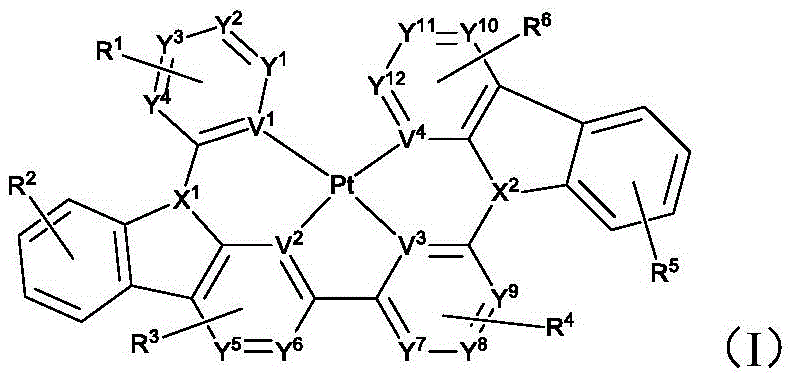
wherein:
V1、V2、V3and V4Is an atom bonded to Pt, each independently selected from an N atom or a C atom, and V1、V2、V3、V4Comprises at least 2N atoms;
Y1、Y2、Y3、Y4、Y5、Y6、Y7、Y8、Y9、Y10、Y11and Y12Each independently selected from an N atom or a CH group;
X1and X2Each independently represents N, B, CH, CD, CRa、SiH、SiD、SiRa、GeH、GeD、GeRdP, P ═ O, As ═ O, Bi, or Bi ═ O;
Ra、Rb、Rcand RdEach independently is hydrogen, deuterium, aryl, cycloalkyl, cycloalkenyl, heterocyclyl, heteroaryl, alkyl, alkenyl, alkynyl, halogen, hydroxy, mercapto, nitro, cyano, amino, mono-or dialkylamino, mono-or diarylamino, alkoxy, aryloxy, haloalkyl, ester, nitrile, isonitrile, heteroaryl, alkoxycarbonyl, amido, alkoxycarbonylamino, aryloxycarbonylamino, sulfonylamino, sulfamoyl, carbamoyl, alkylthio, sulfinyl, ureido, phosphoramido, imine, sulfo, carboxyl, hydrazine, substituted silyl, a polymeric group, or a combination thereof;
R1、R2、R3、R4、R5and R6Each independently represents a mono-, di-, tri-, tetra-or unsubstituted substituent, and R1、R2、R3、R4、R5And R6Each independently is hydrogen, deuterium, aryl, cycloalkyl, cycloalkenyl, heterocyclyl, heteroaryl, alkyl, alkenyl, alkynyl, halogen, hydroxy, mercapto, nitro, cyano, amino, mono-or dialkylamino, mono-or diarylamino, alkoxy, aryloxy, haloalkyl, ester, nitrile, isonitrile, heteroaryl, alkoxycarbonyl, amido, alkoxycarbonylamino, aryloxycarbonylamino, sulfonylamino, sulfamoyl, carbamoyl, alkylthio, sulfinyl, ureido, phosphoramido, imine, sulfo, carboxyl, hydrazine, substituted silyl, a polymeric group, or a combination thereof; and two or more adjacent R1、R2、R3、R4、R5And R6May each be independently or selectively joined to form a fused ring.
Optionally, the phenylcarbazole-based tetradentate cyclometalated platinum complex provided by the embodiments of the present invention has a structure of one of:
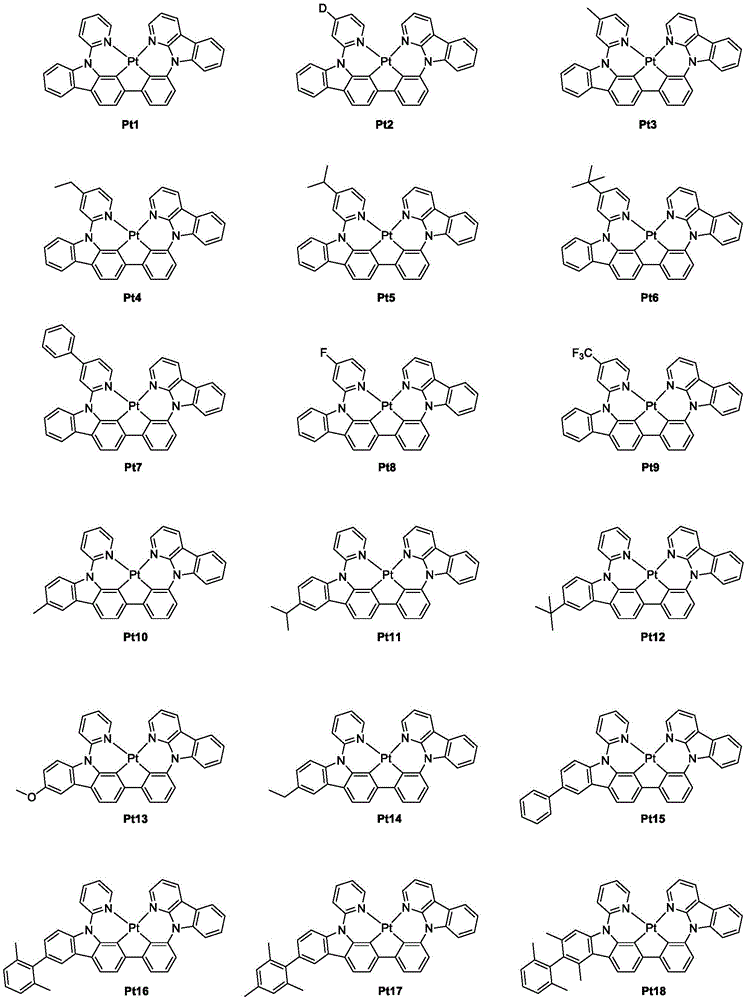


the phenyl carbazole-based tetradentate ring metal platinum complex provided by the embodiment of the invention has neutral charge.
The embodiment of the invention also provides application of the phenylcarbazole-based tetradentate ring metal platinum complex in an electroluminescent device.
In addition, embodiments of the present invention also provide a device comprising the phenylcarbazole-based tetradentate cyclometalated platinum complex described above.
Optionally, the device comprises a full-color display.
Optionally, the device is a photovoltaic device.
Optionally, the device is a light emitting display device.
Optionally, the device comprises an organic light emitting diode.
Optionally, the device comprises a phosphorescent organic light emitting diode.
Optionally, the tetradentate ring metal platinum complex is selected to have 100% internal quantum efficiency in the device environment.
Alternatively, there is provided a device according to an embodiment of the present invention, including at least one cathode, at least one anode, and at least one light-emitting layer, at least one of the light-emitting layers including the phenylcarbazole-based tetradentate cyclometallated platinum complex described above.
The invention has the beneficial effects that: the photophysical property of the metal platinum complex is adjusted by changing the ligand structure surrounding the metal center and regulating and controlling the substituent structure on the ligand, so that the phenyl carbazole-based tetradentate ring metal platinum complex can emit light in the range of about 400nm to about 700nm, and has the advantages of narrow emission spectrum, high stability and high efficiency; the metal platinum complex is applied to a light-emitting device, can improve the light-emitting efficiency and the operation time of the device, and has wide application prospects in various fields such as OLED display, illumination and the like.
[ description of the drawings ]
In order to more clearly illustrate the technical solutions in the embodiments of the present invention, the drawings needed to be used in the description of the embodiments are briefly introduced below, it is obvious that the drawings in the following description are only some embodiments of the present invention, and other drawings can be obtained by those skilled in the art without inventive efforts, wherein:
FIG. 1 is a room temperature emission spectrum of a platinum complex Pt1 in a dichloromethane solution in an embodiment;
FIG. 2 is a room temperature emission spectrum of a platinum complex Pt3 in a dichloromethane solution in an embodiment;
FIG. 3 is a room temperature emission spectrum of a platinum complex Pt28 in a dichloromethane solution in an embodiment;
fig. 4 is a room temperature emission spectrum of the platinum complex Pt29 in the embodiment in a dichloromethane solution.
Other aspects of the picture are also described in the picture description following the picture. The advantages are realized and attained by means of the elements and combinations particularly pointed out in the claims. It is to be understood that both the foregoing general description and the following detailed description are exemplary and explanatory only and are not restrictive.
[ detailed description ] embodiments
The disclosure may be understood more readily by reference to the following detailed description and the examples included therein.
Before the present compounds, devices, and/or methods are disclosed and described, it is to be understood that they are not limited to the particular synthetic methods (otherwise specified), or to the particular reagents (otherwise specified), as such can, of course, vary. It is also to be understood that the terminology used herein is for the purpose of describing particular aspects only and is not intended to be limiting. Although any methods and materials similar or equivalent to those described herein can be used in the practice or testing, the exemplary methods and materials are described below.
The term "optional" or "optionally" as used herein means that the subsequently described event or circumstance may or may not occur, and that the description includes instances where said event or circumstance occurs and instances where it does not.
Disclosed are components useful in preparing the compositions described herein, as well as the compositions themselves to be used in the methods disclosed herein. These and other materials are disclosed herein, and it is understood that when combinations, subsets, interactions, groups, etc. of these materials are disclosed that while specific reference of each various individual and collective combinations and permutation of these compounds may not be specifically disclosed, each is specifically contemplated and described herein. For example, if a particular compound is disclosed and discussed, and a number of modifications that can be made to a number of molecules comprising the compound are discussed, then various and each combination and permutation of the compound are specifically contemplated and may be made, otherwise specifically indicated to the contrary. Thus, if a class of molecules A, B, and C are disclosed as well as a class of molecules D, E, and F, and an example of a combination molecule A-D is disclosed, then even if each is not individually recited, it is contemplated that each individually and collectively contemplated combination of meanings, A-E, A-F, B-D, B-E, B-F, C-D, C-E, and C-F, will be disclosed. Likewise, any subset or combination of these is also disclosed. Thus, for example, it is contemplated that subgroups A-E, B-F, and C-E are disclosed. These concepts are applicable to all aspects of the invention, including but not limited to the steps of the methods of making and using the compositions. Thus, if there are a variety of additional steps that can be performed it is understood that each of these additional steps can be performed with a specific embodiment or combination of embodiments of the method.
The linking atom used in the present invention can link two groups, for example, N and C groups. The linking atom can optionally (if valency permits) have other chemical moieties attached. For example, in one aspect, oxygen does not have any other chemical group attached because once bonded to two atoms (e.g., N or C) valences have been satisfied. Conversely, when carbon is a linking atom, two additional chemical moieties can be attached to the carbon atom. Suitable chemical moieties include, but are not limited to, hydrogen, hydroxyl, alkyl, alkoxy, ═ 0, halogen, nitro, amine, amide, thiol, aryl, heteroaryl, cycloalkyl, and heterocyclyl.
The term "cyclic structure" or similar terms as used herein refers to any cyclic chemical structure including, but not limited to, aryl, heteroaryl, cycloalkyl, cycloalkenyl, heterocyclyl, carbene, and N-heterocyclic carbene.
The term "substituted" as used herein is intended to encompass all permissible substituents of organic compounds. In a broad aspect, permissible substituents include acyclic and cyclic, branched and unbranched, carbocyclic and heterocyclic, and aromatic and nonaromatic substituents of organic compounds. Illustrative substituents include, for example, those described below. The permissible substituents can be one or more, identical or different for suitable organic compounds. For the purposes of the present invention, a heteroatom (e.g. nitrogen) can have a hydrogen substituent and/or any permissible substituents of organic compounds described herein which satisfy the valences of the heteroatom. The present disclosure is not intended to be limited in any way by the permissible substituents of organic compounds. Likewise, the term "substituted" or "substituted with" includes the implicit proviso that such substitution is consistent with the atom being substituted and the allowed valence of the substituent, and that the substitution results in a stable compound (e.g., a compound that does not spontaneously undergo transformation (e.g., by rearrangement, cyclization, elimination, etc.)). It is also contemplated that, in certain aspects, individual substituents can be further optionally substituted (i.e., further substituted or unsubstituted), unless explicitly stated to the contrary.
In defining the terms, "R1”、“R2”、“R3"and" R4"used as a general symbol in the present invention denotes various specific substituents. These symbols can be any substituent, are not limited to those disclosed herein, and when they are defined as certain substituents in one instance, they can be defined as some other substituents in other instances.
The term "alkyl" as used herein is a branched or unbranched saturated hydrocarbon group of 1 to 24 carbon atoms, such as methyl, ethyl, n-propyl, isopropyl, n-butyl, isobutyl, sec-butyl, tert-butyl, n-pentyl, isopentyl, sec-pentyl, neopentyl, hexyl, heptyl, half-yl, nonyl, decyl, dodecyl, tetradecyl, hexadecyl, eicosyl, tetracosyl and the like. The alkyl group may be cyclic or acyclic. The alkyl group may be branched or unbranched. The alkyl group may also be substituted or unsubstituted. For example, the alkyl group may be substituted with one or more groups including, but not limited to, optionally substituted alkyl, cycloalkyl, alkoxy, amino, ether, halogen, hydroxy, nitro, silyl, Sulfo-OXO (Sulfo-OXO), or thiol as described herein. A "lower alkyl" group is an alkyl group containing 1 to 6 (e.g., 1 to 4) carbon atoms.
Throughout the specification, "alkyl" is generally used to refer to both unsubstituted alkyl and substituted alkyl; however, substituted alkyl groups are also specifically mentioned in the present invention by identifying specific substituents on the alkyl group. For example, the term "halogenated alkyl" or "haloalkyl" specifically refers to an alkyl substituted with one or more halogens (e.g., fluorine, chlorine, bromine, or iodine). The term "alkoxyalkyl" specifically refers to an alkyl group substituted with one or more alkoxy groups, as described below. The term "alkylamino" specifically refers to an alkyl group substituted with one or more amino groups, as described below, and the like. When "alkyl" is used in one instance and a specific term such as "alkyl alcohol" is used in another instance, it is not meant to imply that the term "alkyl" does not refer to the specific term such as "alkyl alcohol" or the like at the same time.
This practice is also applicable to the other groups described in the present invention. That is, when a term such as "cycloalkyl" refers to both unsubstituted and substituted cycloalkyl moieties, the substituted moiety may be otherwise specifically identified in the present invention; for example, a specifically substituted cycloalkyl group can be referred to as, for example, "alkylcycloalkyl". Similarly, a substituted alkoxy group may be specifically referred to as, for example, "halogenated alkoxy", and a specific substituted alkenyl group may be, for example, "enol" and the like. Likewise, practice of using general terms such as "cycloalkyl" and specific terms such as "alkylcycloalkyl" is not intended to imply that the general terms do not also encompass the specific terms.
The term "cycloalkyl" as used herein is a non-aromatic carbon-based ring made up of at least three carbon atoms. Examples of cycloalkyl groups include, but are not limited to, cyclopropyl, cyclobutyl, cyclopentyl, cyclohexyl, cyclononyl, and the like. The term "heterocycloalkyl" is a class of cycloalkyl groups as defined above and is included within the meaning of the term "cycloalkyl" in which at least one ring carbon atom is substituted with a heteroatom such as, but not limited to, nitrogen, oxygen, sulfur, or phosphorus. The cycloalkyl and heterocycloalkyl groups can be substituted or unsubstituted. The cycloalkyl and heterocycloalkyl groups may be substituted with one or more groups including, but not limited to, alkyl, cycloalkyl, alkoxy, amino, ether, halogen, hydroxy, nitro, silyl, sulfo-oxo, or thiol groups as described herein.
The term "polyalkylene group" as used herein refers to a group containing two or more CH2Groups and other moieties that are the same are attached. "polyolefin group" can be represented by- (CH)2)a-, wherein "a" is an integer of 2 to 500.
The terms "alkoxy" and "alkoxy group," as used herein, refer to an alkyl or cycloalkyl group bonded through an ether linkage; that is, "alkoxy" may be defined as-OR1Wherein R is1Is alkyl or cycloalkyl as defined above. "alkoxy" also includes polymers of the alkoxy groups just described; that is, the alkoxy group may be a polyether such as-OR1-OR2OR-OR1-(OR2)a-OR3Wherein "a" is an integer of 1 to 200, and R1、R2And R3Each independently is an alkyl group, a cycloalkyl group, or a combination thereof.
The term "alkenyl" as used herein is a hydrocarbon group of 2 to 24 carbon atoms, the structural formula of which contains at least one carbon-carbon double bond. Asymmetric structures such as (R)1R2)C=C(R3R4) Intended to include both the E and Z isomers. This can be presumed in the structural formula of the present invention in which an asymmetric olefin is present, or it can be explicitly represented by the bond symbol C ═ C. The alkenyl group may be substituted with one or more groups including, but not limited to, alkyl, cycloalkyl, alkoxy, alkenyl, cycloalkenyl, alkynyl, cycloalkynyl, aryl, heteroaryl, aldehyde, amino, carboxylic acid, ester, ether, halogen, hydroxy, ketone, azido, nitro, silyl, thio-oxo (sulfo-oxo), or thiol as described herein.
The term "cycloalkenyl" as used herein is a non-aromatic, carbon-based ring, consisting of at least 3 carbon atoms and containing at least one carbon-carbon double bond, i.e., C ═ C. Examples of cycloalkenyl groups include, but are not limited to, cyclopropenyl, cyclobutenyl, cyclopentenyl, cyclopentadienyl, cyclohexenyl, cyclohexadienyl, norbornenyl, and the like. The term "heterocycloalkenyl" is a type of cycloalkenyl group as defined above, and is included within the meaning of the term "cycloalkenyl", where at least one carbon atom of the ring is substituted with a heteroatom such as, but not limited to, nitrogen, oxygen, sulfur, or phosphorus. Cycloalkenyl and heterocycloalkenyl groups can be substituted or unsubstituted. The cycloalkenyl and heterocycloalkenyl groups may be substituted with one or more groups including, but not limited to, alkyl, cycloalkyl, alkoxy, alkenyl, cycloalkenyl, alkynyl, cycloalkynyl, aryl, heteroaryl, aldehyde, amino, carboxylic acid, ester, ether, halogen, hydroxy, ketone, azido, nitro, silyl, thio-oxo (sulfo-oxo), or thiol groups as described herein.
The term "alkynyl" as used herein is a hydrocarbon group having 2 to 24 carbon atoms and having a structural formula containing at least one carbon-carbon triple bond. Alkynyl groups can be unsubstituted or substituted with one or more groups including, but not limited to, alkyl, cycloalkyl, alkoxy, alkenyl, cycloalkenyl, alkynyl, cycloalkynyl, aryl, heteroaryl, aldehyde, amino, carboxylic acid, ester, ether, halogen, hydroxy, ketone, azido, nitro, silyl, thio-oxo (sulfo-oxo), or thiol groups as described herein.
The term "cycloalkynyl" as used herein is a non-aromatic, carbon-based ring containing at least seven carbon atoms and containing at least one carbon-carbon triple bond. Examples of cycloalkynyl include, but are not limited to, cycloheptynyl, cyclooctynyl, cyclononynyl, and the like. The term "heterocycloalkynyl" is a type of cycloalkenyl group as defined above and is included within the meaning of the term "cycloalkynyl" wherein at least one of the carbon atoms of the ring is replaced with a heteroatom such as, but not limited to, nitrogen, oxygen, sulfur, or phosphorus. Cycloalkynyl and heterocycloalkynyl can be substituted or unsubstituted. Cycloalkynyl and heterocycloalkynyl may be substituted with one or more groups including, but not limited to, alkyl, cycloalkyl, alkoxy, alkenyl, cycloalkenyl, alkynyl, cycloalkynyl, aryl, heteroaryl, aldehyde, amino, carboxylic acid, ester, ether, halogen, hydroxy, ketone, azido, nitro, silyl, thio-oxo (sulfo-oxo), or thiol as described herein.
The term "aryl" as used herein is a group containing any carbon-based aromatic group including, but not limited to, benzene, naphthalene, phenyl, biphenyl, phenoxybenzene, and the like. The term "aryl" also includes "heteroaryl," which is defined as a group containing an aromatic group having at least one heteroatom incorporated into the ring of the aromatic group. Examples of heteroatoms include, but are not limited to, nitrogen, oxygen, sulfur, and phosphorus. Likewise, the term "non-heteroaryl" (which is also included in the term "aryl") defines a group that contains an aromatic group, which does not contain heteroatoms. The aryl group may be substituted or unsubstituted. The aryl group can be substituted with one or more groups including, but not limited to, alkyl, cycloalkyl, alkoxy, alkenyl, cycloalkenyl, alkynyl, cycloalkynyl, aryl, heteroaryl, aldehyde groups, amino, carboxylic acid groups, ester groups, ether groups, halogens, hydroxyl, ketone groups, azido, nitro, silyl, thio-oxo groups, or mercapto groups as described herein. The term "biaryl" is a specific type of aryl group and is included in the definition of "aryl". Biaryl refers to two aryl groups joined together via a fused ring structure, as in naphthalene, or two aryl groups connected via one or more carbon-carbon bonds, as in biphenyl.
The term "aldehyde" as used herein is represented by the formula-C (O) H. Throughout the specification, "C (O)" is a shorthand form of carbonyl (i.e., C ═ O).
The term "amine" or "amino" as used herein is defined by the formula-NR1R2Is represented by the formula (I) in which R1And R2Can be independently selected from hydrogen, alkyl, cycloalkyl, alkenyl, cycloalkenyl, alkynyl, cycloalkynyl, aryl, or heteroaryl.
The term "alkylamino" as used herein is represented by the formula-NH (-alkyl), wherein alkyl is as described herein. Representative examples include, but are not limited to, methylamino, ethylamino, propylamino, isopropylamino, butylamino, isobutylamino, (sec-butyl) amino, (tert-butyl) amino, pentylamino, isopentylamino, (tert-pentyl) amino, hexylamino, and the like.
The term "dialkylamino" as used herein, is defined by the formula-N (_ alkyl)2Wherein alkyl is as described herein. Representative examples include, but are not limited to, dimethylamino, diethylamino, dipropylamino, diisopropylamino, dibutylamino, diisobutylamino, di (sec-butyl) amino, di (tert-butyl) amino, dipentylamino, diisopentylamino, di (tert-pentyl) amino, dihexylamino, N-ethyl-N-methylamino, N-methyl-N-propylamino, N-ethyl-N-propylamino, and the like.
The term "carboxylic acid" as used herein is represented by the formula-C (O) OH.
The term "ester" as used herein is defined by the formula-OC (O) R1OR-C (O) OR1Wherein R1 may be an alkyl, cycloalkyl, alkenyl, cycloalkenyl, alkynyl, cycloalkynyl, aryl, or heteroaryl group as described herein. The term "polyester" as used herein is represented by the formula- (R)1O(O)C-R2-C(O)O)a-or- (R)1O(O)C-R2-OC(O))a-represents wherein R1And R2May independently be an alkyl, cycloalkyl, alkenyl, cycloalkenyl, alkynyl, cycloalkynyl, aryl, or heteroaryl group described herein and "a" is an integer from 1 to 500. The term "polyester" is used to describe a group produced by the reaction between a compound having at least two carboxyl groups and a compound having at least two hydroxyl groups.
The term "ether" as used herein is defined by the formula R1OR2Is represented by the formula (I) in which R1And R2May independently be an alkyl, cycloalkyl, alkenyl, cycloalkenyl, alkynyl, cycloalkynyl, aryl, or heteroaryl group as described herein. The term "polyether" as used herein is of the formula- (R)1O-R2O)a-represents wherein R1And R2May independently be an alkyl, cycloalkyl, alkenyl, cycloalkenyl, alkynyl, cycloalkynyl, aryl, or heteroaryl group described herein and "a" is an integer from 1 to 500. Examples of polyether groups include polyethylene oxide, polypropylene oxideAnd polyoxybutylene.
The term "halogen" as used herein refers to the halogens fluorine, chlorine, bromine, and iodine.
The term "heterocyclyl" as used herein refers to monocyclic and polycyclic non-aromatic ring systems, and "heteroaryl" as used herein refers to monocyclic and polycyclic aromatic ring systems: wherein at least one of the ring members is not carbon. The term includes azetidinyl, dioxanyl, furanyl, imidazolyl, isothiazolyl, isoxazolyl, morpholinyl, oxazolyl including 1, 2, 3-oxadiazolyl, 1, 2, 5-oxadiazolyl and 1,3, 4-oxadiazolyl, piperazinyl, piperidinyl, pyrazinyl, pyrazolyl, pyridazinyl, pyridinyl, pyrimidinyl, pyrrolyl, pyrrolidinyl, tetrahydrofuryl, tetrahydropyranyl, tetrazinyl including 1, 2, 4, 5-tetrazinyl, tetrazolyl including 1, 2,3, 4-tetrazolyl and 1, 2, 4, 5-tetrazolyl, thiadiazolyl including 1, 2, 3-thiadiazolyl, 1, 2, 5-thiadiazolyl and 1,3, 4-thiadiazolyl, thiazolyl, thienyl, thiadiazolyl including 1,3, 5-triazinyl and 1, triazinyl groups of 2, 4-triazinyl groups, triazolyl groups including 1, 2, 3-triazolyl groups and 1,3, 4-triazolyl groups, and the like.
The term "hydroxy" as used herein is represented by the formula-OH.
The term "ketone" as used herein is defined by the formula R1C(O)R2Is represented by the formula (I) in which R1And R2May independently be an alkyl, cycloalkyl, alkenyl, cycloalkenyl, alkynyl, cycloalkynyl, aryl, or heteroaryl group as described herein.
The term "azido" as used herein is of the formula-N3And (4) showing.
The term "nitro" as used herein is of the formula-NO2And (4) showing.
The term "nitrile" as used herein is represented by the formula-CN.
The term "silyl" as used herein, is defined by the formula-SiR1R2R3Is represented by the formula (I) in which R1、R2And R3Can be independently hydrogen or alkyl, cycloalkyl, alkoxy, alkene described in the inventionA group, cycloalkenyl, alkynyl, cycloalkynyl, aryl, or heteroaryl.
The term "thio-oxo" as used herein is defined by the formula-S (O) R1、-S(O)2R1、-OS(O)2R1or-OS (O)2OR1Is represented by the formula (I) in which R1May be hydrogen or an alkyl, cycloalkyl, alkenyl, cycloalkenyl, alkynyl, cycloalkynyl, aryl, or heteroaryl group as described herein. Throughout the specification, "S (O)" is a shorthand form of S ═ O. The term "sulfonyl", as used herein, refers to a compound of the formula-S (O)2R1A thio-oxo group of the formula, wherein R1Can be alkyl, cycloalkyl, alkenyl, cycloalkenyl, alkynyl, cycloalkynyl, aryl, or heteroaryl. The term "sulfone" as used herein is defined by the formula R1S(O)2R2Is represented by the formula (I) in which R1And R2May independently be an alkyl, cycloalkyl, alkenyl, cycloalkenyl, alkynyl, cycloalkynyl, aryl, or heteroaryl group as described herein. The term "sulfoxide" as used herein is defined by the formula R1S(O)R2Is represented by the formula (I) in which R1And R2May independently be an alkyl, cycloalkyl, alkenyl, cycloalkenyl, alkynyl, cycloalkynyl, aryl, or heteroaryl group as described herein.
The term "mercapto" as used herein is represented by the formula-SH
"R" used in the present invention1”、“R2”、“R3”、“Rn"(wherein n is an integer) may independently have one or more of the groups listed above. For example, if R1Being a straight chain alkyl, then one hydrogen atom of the alkyl group may be optionally substituted with hydroxyl, alkoxy, alkyl, halogen, and the like. Depending on the group selected, the first group may be incorporated within the second group, or alternatively, the first group may be pendent, i.e., attached, to the second group. For example, for the phrase "alkyl group comprising an amino group," the amino group can be incorporated within the backbone of the alkyl group. Alternatively, the amino group may be attached to the backbone of the alkyl group. The nature of the selected group will determine whether the first group is intercalated or attached to the second group.
The compounds of the present invention may contain "optionally substituted" moieties. Generally, the term "substituted" (whether or not the term "optionally" is present above) means that one or more hydrogens of the indicated moiety are replaced with a suitable substituent. Unless otherwise specified, an "optionally substituted" group may have suitable substituents at each substitutable position of the group, and when more than one position may be substituted with more than one substituent selected from a specified group in any given structure, the substituents at each position may be the same or different. The combinations of substituents contemplated by the present invention are preferably those that form stable or chemically feasible compounds. In certain aspects, it is also contemplated that each substituent may be further optionally substituted (i.e., further substituted or unsubstituted), unless clearly indicated to the contrary.
The structure of the compound can be represented by the following formula:

it is understood to be equivalent to the following formula:

where n is typically an integer. Namely, RnIs understood to mean five individual substituents Rn(a)、Rn(b)、Rn(c)、Rn(d)、Rn (e). By "individual substituents" is meant that each R substituent can be independently defined. For example, if in one instance Rn(a)Is halogen, then in this case Rn(b)Not necessarily halogen.
R is referred to several times in the chemical structures and parts disclosed and described in this specification1、R2、R3、R4、R5、R6And the like. In the specification, R1、R2、R3、R4、R5、R6Etc. are each applicable to the citation of R1、R2、R3、R4、R5、R6Etc., unless otherwise specified.
Optoelectronic devices using organic materials are becoming more and more stringent for a number of reasons. Many of the materials used to make such devices are relatively inexpensive, and therefore organic photovoltaic devices have the potential for cost advantages of inorganic devices. Furthermore, the inherent properties of organic materials, such as their flexibility, may make them well suited for particular applications such as fabrication on flexible substrates. Examples of organic optoelectronic devices include Organic Light Emitting Devices (OLEDs), organic phototransistors, organic photovoltaic cells, and organic photodetectors. For OLEDs, organic materials may have performance advantages over conventional materials. For example, the wavelength at which the organic light-emitting layer emits light can generally be tuned with appropriate dopants.
The excitons decay from the singlet excited state to the ground state to generate instant luminescence, which is fluorescence. If excitons decay from the triplet excited state to the ground state to generate light emission, it is phosphorescence. Phosphorescent metal complexes (e.g., platinum complexes) have shown their potential to utilize both singlet and triplet excitons, achieving 100% internal quantum efficiency, due to the strong spin-orbit coupling of heavy metal atoms between singlet and triplet excited states, effectively enhancing intersystem crossing (ISC). Accordingly, phosphorescent metal complexes are a good choice of dopants in the emissive layer of Organic Light Emitting Devices (OLEDs) and have gained great attention in both academic and industrial fields. Over the last decade, much effort has been made to bring profitable commercialization of this technology, for example, OLEDs have been used for advanced displays for smart phones, televisions and digital cameras.
However, blue electroluminescent devices remain the most challenging area in the art to date, and stability of blue devices is a big problem. The choice of host material has proven to be very important for the stability of blue devices. However, the triplet excited state (T1) lowest energy of the blue light emitting material is very high, which means that the triplet excited state (T1) lowest energy of the host material of the blue device should be higher. This results in increased difficulty in developing the host material for blue devices.
The metal complexes of the present invention can be tailored or tuned to specific applications where specific emission or absorption characteristics are desired. The optical properties of the disclosed metal complexes can be tuned by changing the structure of the ligands surrounding the metal center or by changing the structure of the fluorescent luminophores on the ligands. For example, metal complexes or electron-withdrawing substituents of ligands having electron-donating substituents may generally exhibit different optical properties in the emission and absorption spectra. The color of the metal complex can be adjusted by modifying the fluorescent emitter and the conjugated group on the ligand.
The emission of the complexes of the invention can be modulated, for example, by changing the ligand or fluorescent emitter structure, for example from ultraviolet to near infrared. Fluorescent emitters are a group of atoms in an organic molecule that can absorb energy to produce a singlet excited state, which rapidly decays to produce instant light emission. In one aspect, the complexes of the invention can provide emission in a large portion of the visible spectrum. In particular examples, the complexes of the present invention may emit light in the range of about 400nm to about 700 nm. On the other hand, the complexes of the invention have improved stability and efficiency relative to conventional emissive complexes. In addition, the complexes of the invention may be used as luminescent labels, for example, for biological applications, anticancer agents, emitters in Organic Light Emitting Diodes (OLEDs), or combinations thereof. In another aspect, the complexes of the present invention can be used in light emitting devices, such as Compact Fluorescent Lamps (CFLs), Light Emitting Diodes (LEDs), incandescent lamps, and combinations thereof.
Disclosed herein are platinum-containing compounds or complex complexes. The terms compound or complex are used interchangeably herein. In addition, the compounds disclosed herein have a neutral charge.
The compounds disclosed herein may exhibit desirable properties and have emission and/or absorption spectra that can be tailored by selection of appropriate ligands. In another aspect, the invention can exclude any one or more of the compounds, structures, or portions thereof specifically recited herein.
The compounds disclosed herein are suitable for use in a wide variety of optical and electro-optical devices, including but not limited to light absorbing devices, such as solar and photosensitive devices, Organic Light Emitting Diodes (OLEDs), light emitting devices or devices capable of compatible light absorption and emission and as labels for biological applications.
As mentioned above, the disclosed compounds are platinum complexes. At the same time, the compounds disclosed herein can be used as host materials for OLED applications, such as full color displays.
The compounds disclosed herein are useful in a variety of applications. As a light-emitting material, the compound is useful for organic light-emitting diodes (OLEDs), light-emitting devices and displays, and other light-emitting devices.
In addition, the compounds of the present invention are used in light emitting devices (e.g., OLEDs) to improve the luminous efficiency and the operation time of the devices, relative to conventional materials.
The compounds of the present invention may be prepared using a variety of methods, including but not limited to those described in the examples provided herein.
The compounds disclosed herein may be delayed fluorescence and/or phosphorescence emitters. In one aspect, the compounds disclosed herein can be delayed fluorescence emitters. In one aspect, the compounds disclosed herein can be phosphorescent emitters. In another aspect, the compounds disclosed herein can be delayed fluorescence emitters and phosphorescence emitters.
The invention relates to an organic luminescent material, which comprises a tetradentate metal platinum complex of benzene ring-carbazole and derivatives thereof, and the tetradentate metal platinum complex can be used as a phosphorescent luminescent material in an OLED device and is used for improving the efficiency and the service life of the device.
The phenylcarbazole-based tetradentate ring metal platinum complex disclosed in the embodiments of the present invention has a structure represented by general formula (I):

wherein: v1、V2、V3And V4Are atoms bonded to Pt, each independently selected from an N atom or a C atom,and V is1、V2、V3、V4Comprises at least 2N atoms;
Y1、Y2、Y3、Y4、Y5、Y6、Y7、Y8、Y9、Y10、Y11and Y12Each independently selected from an N atom or a CH group;
X1and X2Each independently represents N, B, CH, CD, CRa、SiH、SiD、SiRa、GeH、GeD、GeRdP, P ═ O, As ═ O, Bi, or Bi ═ O;
Ra、Rb、Rcand RdEach independently is hydrogen, deuterium, aryl, cycloalkyl, cycloalkenyl, heterocyclyl, heteroaryl, alkyl, alkenyl, alkynyl, halogen, hydroxy, mercapto, nitro, cyano, amino, mono-or dialkylamino, mono-or diarylamino, alkoxy, aryloxy, haloalkyl, ester, nitrile, isonitrile, heteroaryl, alkoxycarbonyl, amido, alkoxycarbonylamino, aryloxycarbonylamino, sulfonylamino, sulfamoyl, carbamoyl, alkylthio, sulfinyl, ureido, phosphoramido, imine, sulfo, carboxyl, hydrazine, substituted silyl, a polymeric group, or a combination thereof;
R1、R2、R3、R4、R5and R6Each independently represents a mono-, di-, tri-, tetra-or unsubstituted substituent, and R1、R2、R3、R4、R5And R6Each independently is hydrogen, deuterium, aryl, cycloalkyl, cycloalkenyl, heterocyclyl, heteroaryl, alkyl, alkenyl, alkynyl, halogen, hydroxy, mercapto, nitro, cyano, amino, mono-or dialkylamino, mono-or diarylamino, alkoxy, aryloxy, haloalkyl, ester, nitrile, isonitrile, heteroaryl, alkoxycarbonyl, amido, alkoxycarbonylamino, aryloxycarbonylamino, sulfonylamino, sulfamoyl, carbamoyl, alkylthio, sulfinyl, ureido, phosphoramido, heteroaryl, nitro, cyano, amino, alkoxycarbonyl, amino,Imino, sulfo, carboxyl, hydrazino, substituted silyl, polymeric group, or a combination thereof; and two or more adjacent R1、R2、R3、R4、R5And R6Each independently or may be optionally joined to form a fused ring.
For formula I described in the present invention, its cluster may be defined in the description below.
1) Group V
Wherein V1、V2、V3、V4Are atoms bonded to Pt, each independently, may be N or C, wherein V1、V2、V3、V4At least 2N;
in one aspect, V1And V4Is N, V2And V3Is C;
on the other hand, V1And V3Is N, V2And V4Is C;
further, V1And V2Is N, V3And V4Is C;
2) y radical
Wherein Y is1、Y2、Y3、Y4、Y5、Y6、Y7、Y8、Y9、Y10、Y11And Y12Each independently selected from N and CH groups;
wherein Y is1、Y2、Y3、Y4、Y5、Y6、Y7、Y8、Y9、Y10、Y11And Y12Each independently may be N;
wherein Y is1、Y2、Y3、Y4、Y5、Y6、Y7、Y8、Y9、Y10、Y11And Y12Each independently may be a CH group;
4) x group
Wherein X1And X2Can be selected from N, B, CH, CD, CRa、SiH、SiD、SiRa、GeH、GeD、GeRdP, P ═ O, As ═ O, Bi, or Bi ═ O;
on the other hand, X1Is N, X2Is N;
on the other hand, X1Is N, X2Is B;
on the other hand, X1Is B, X2Is B;
on the other hand, X1Is N, X2Is CH;
on the other hand, X1Is N, X2Is P ═ O;
on the other hand, X1Is N, X2Is Bi ═ O;
on the other hand, X1Is N, X2As ═ O;
on the other hand, X1Is CH, X2Is CH;
on the other hand, X1Is N, X2Is CRa;
On the other hand, X1Is N, X2Is SiRa;
5) R group
Wherein R is1Present, on the other hand R1Is absent.
In one aspect, R1Is monosubstituted, on the other hand, R1Is disubstituted; in another aspect, R1Is a trisubstituted radical; further, R1Is tetra-substituted;
while R is1Selected from hydrogen, deuterium, aryl, cycloalkyl, cycloalkenyl, heterocyclyl, heteroaryl, alkyl, alkenyl, alkynyl, halogen, hydroxyl, mercapto, nitro, cyano, amino, mono-or dialkylamino, mono-or diarylamino, alkoxy, aryloxy, haloalkyl, ester, nitrile, isonitrile, heteroaryl, alkoxycarbonyl, amide, alkoxycarbonylamino, aryloxycarbonylamino, sulfonylamino, sulfamoyl, carbamoyl, alkylthio, sulfinyl, ureido, phosphoramido, imino, sulfo, carboxyl, hydrazino, substituted silyl, polymeric group, or a combination thereof.
Wherein R is2Present, on the other hand R2Is absent.
In one aspect, R2Is monosubstituted, on the other hand, R2Is disubstituted; in another aspect, R2Is a trisubstituted radical; further, R2Is tetra-substituted;
while R is2Selected from hydrogen, deuterium, aryl, cycloalkyl, cycloalkenyl, heterocyclyl, heteroaryl, alkyl, alkenyl, alkynyl, halogen, hydroxyl, mercapto, nitro, cyano, amino, mono-or dialkylamino, mono-or diarylamino, alkoxy, aryloxy, haloalkyl, ester, nitrile, isonitrile, heteroaryl, alkoxycarbonyl, amide, alkoxycarbonylamino, aryloxycarbonylamino, sulfonylamino, sulfamoyl, carbamoyl, alkylthio, sulfinyl, ureido, phosphoramido, imino, sulfo, carboxyl, hydrazino, substituted silyl, polymeric group, or a combination thereof.
Wherein R is3Present, on the other hand R3Is absent.
In one aspect, R3Is monosubstituted, on the other hand, R3Is disubstituted; in another aspect, R3Is a trisubstituted radical; further, R3Is tetra-substituted;
while R is3Selected from hydrogen, deuterium, aryl, cycloalkyl, cycloalkenyl, heterocyclyl, heteroaryl, alkyl, alkenyl, alkynyl, halogen, hydroxyl, mercapto, nitro, cyano, amino, mono-or dialkylamino, mono-or diarylamino, alkoxy, aryloxy, haloalkyl, ester, nitrile, isonitrile, heteroaryl, alkoxycarbonyl, amide, alkoxycarbonylamino, aryloxycarbonylamino, sulfonylamino, sulfamoyl, carbamoyl, alkylthio, sulfinyl, ureido, phosphoramido, imino, sulfo, carboxyl, hydrazino, substituted silyl, polymeric group, or a combination thereof.
Wherein R is4Present, on the other hand R4Is absent.
In one aspect, R4Is monosubstituted, on the other hand, R4Is disubstituted;
and R4 is selected from hydrogen, deuterium, aryl, cycloalkyl, cycloalkenyl, heterocyclyl, heteroaryl, alkyl, alkenyl, alkynyl, halogen, hydroxy, mercapto, nitro, cyano, amino, mono-or dialkylamino, mono-or diarylamino, alkoxy, aryloxy, haloalkyl, ester, nitrile, isonitrile, heteroaryl, alkoxycarbonyl, amido, alkoxycarbonylamino, aryloxycarbonylamino, sulfonylamino, sulfamoyl, carbamoyl, alkylthio, sulfinyl, ureido, phosphoramido, imine, sulfo, carboxyl, hydrazine, substituted silyl, polymeric group, or combinations thereof.
Wherein R is5Present, on the other hand R5Is absent. .
In one aspect, R5Is monosubstituted, on the other hand, R5Is disubstituted;
while R is5Selected from hydrogen, deuterium, aryl, cycloalkyl, cycloalkenyl, heterocyclyl, heteroaryl, alkyl, alkenyl, alkynyl, halogen, hydroxyl, mercapto, nitro, cyano, amino, mono-or dialkylamino, mono-or diarylamino, alkoxy, aryloxy, haloalkyl, ester, nitrile, isonitrile, heteroaryl, alkoxycarbonyl, amide, alkoxycarbonylamino, aryloxycarbonylamino, sulfonylamino, sulfamoyl, carbamoyl, alkylthio, sulfinyl, ureido, phosphoramido, imino, sulfo, carboxyl, hydrazino, substituted silyl, polymeric group, or a combination thereof.
In one aspect, R6Is monosubstituted, on the other hand, R5Is disubstituted;
while R is6From hydrogen, deuterium, aryl, cycloalkyl, cycloalkenyl, heterocyclyl, heteroaryl, alkyl, alkenyl, alkynyl, halogen, hydroxy, mercapto, nitro, cyano, amino, mono-or dialkylamino, mono-or diarylamino, alkoxy, aryloxy, haloalkyl, ester, nitrile, isonitrile, heteroaryl, alkoxycarbonyl, amido, alkoxycarbonylamino, aryloxycarbonylamino, sulfonylamino, sulfamoyl, substituted aryl, substituted,Carbamoyl, alkylthio, sulfinyl, ureido, phosphoramido, imino, sulfo, carboxyl, hydrazino, substituted silyl, polymeric group, or combinations thereof.
Exemplary Compounds
In one aspect, any of the tetradentate ring metal platinum complexes reported for the present invention may include one or more of the following structures. In addition, the metal platinum complex may also include other structures or moieties not specifically enumerated herein, and the scope of the present invention is not limited to the structures and moieties enumerated in this patent.
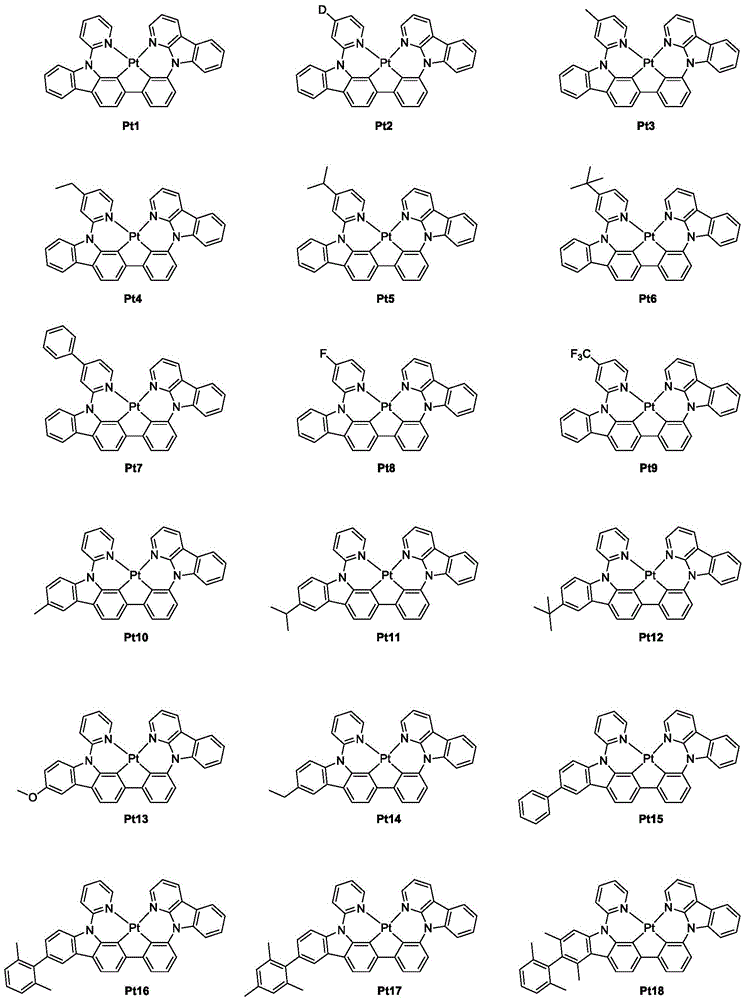

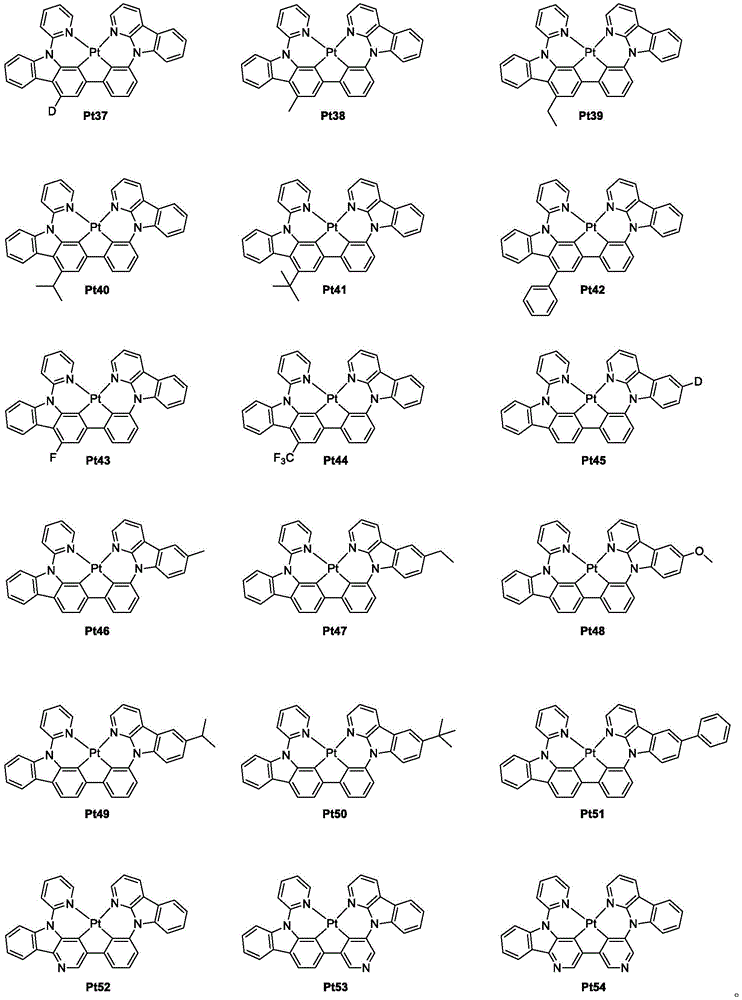
In embodiments of the present invention, there are provided phenylcarbazole-based tetradentate cyclometallated platinum complexes having a neutral charge.
In the embodiment of the invention, the application of the phenylcarbazole-based tetradentate ring metal platinum complex in an electroluminescent device is also provided. Also disclosed in embodiments of the invention are devices, including full color displays, photovoltaic devices, light emitting display devices, organic light emitting diodes, phosphorescent organic light emitting diodes, and the like, comprising one or more of the compounds disclosed herein. In the device environment, the phenylcarbazole-based tetradentate ring metal platinum complex has 100% internal quantum efficiency.
The disclosed compounds are suitable for use in a variety of optical and electro-optical devices, including but not limited to light absorbing devices such as solar and light sensitive devices, Organic Light Emitting Diodes (OLEDs), light emitting devices or devices having both light absorbing and light emitting capabilities, and as labels for biological applications.
The compounds provided by embodiments of the present invention may be used in a light emitting device, such as an OLED, comprising at least one cathode, at least one anode and at least one light emitting layer, at least one of which comprises the above-described phenylcarbazole-based tetradentate cyclometalated platinum complex. Specifically, the light emitting device may include an anode, a hole transport layer, a light emitting layer, an electron transport layer, and a cathode, which are sequentially deposited. The hole transport layer, the luminescent layer and the electron transport layer are all organic layers, and the anode and the cathode are electrically connected.
Synthetic examples
The following examples of compound syntheses, compositions, articles, devices, or processes are intended to provide a general approach to the art, and are not intended to limit the scope of the patent. Unless otherwise indicated, the weights were taken separately, at ambient temperature, or at a pressure near atmospheric pressure.
The following examples provide methods for the preparation of the novel compounds, but the preparation of such compounds is not limited to this method. In this area of expertise, the compounds protected in this patent can be prepared by the methods listed below or by other methods, since they are easy to modify. The following examples are given by way of example only and are not intended to limit the scope of the patent. The temperature, catalyst, concentration, reactants, and course of reaction can all be varied to select different conditions for the preparation of the compound for different reactants.
1H NMR(500MHz)、13C NMR (126MHz) spectra were determined on an ANANCE III (500M) model NMR spectrometer; unless otherwise specified, nuclear magnetic treatment with DMSO-d6Or CDCl containing 0.1% TMS3As a solvent, wherein1H NMR spectrum if CDCl3As a solvent, TMS (δ 0.00ppm) was used as an internal standard; with DMSO-d6TMS (delta 0.00ppm) or a residue was used as a solventDMSO peak (δ ═ 2.50ppm) or residual water peak (δ ═ 3.33ppm) were used as internal standards.13In the C NMR spectrum, as CDCl3(delta 77.00ppm) or DMSO-d6(δ 39.52ppm) as an internal standard. Determination on a HPLC-MSAgilent 6210TOF LC/MS type mass spectrometer; HRMS spectra were determined on an Agilent 6210TOF LC/MS liquid chromatography-time of flight mass spectrometer.1H NMR spectrum data: s is singlelet, d is doublet, t is triplet, q is quartet, p is quintet, m is multiplex, br is broad.
Synthetic route
The general synthesis procedure was as follows:
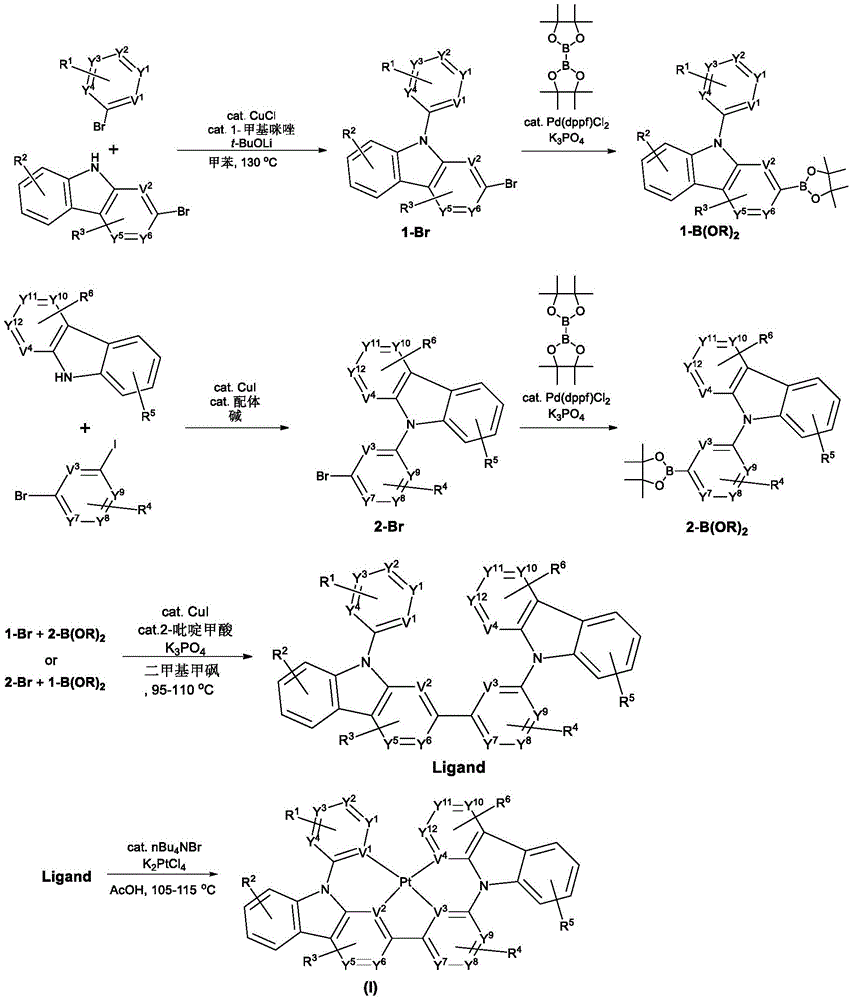
example 1
Pt1 can be prepared according to the following method

Synthesis of 1-Br: to a dry three-necked flask with reflux condenser and magnetic rotor were added 2-bromocarbazole (14.77g,60.00mmol,1.0eq), cuprous chloride (60.0mg,0.60mmol,0.01eq), lithium tert-butoxide (7.21g,90.00mmol,1.5eq), nitrogen was purged three times, then 2-bromopyridine (8.58mL,90.00mmol,1.5eq), 1-methylimidazole (95.1 μ L,1.20mmol,0.02eq) and toluene (240mL) in that order. The reaction mixture was stirred at 130 ℃ under reflux for 5.0 h. Quenching with saturated sodium sulfite solution 100mL, filtering, washing the insoluble matters with ethyl acetate, separating the organic phase from the mother liquor, extracting the aqueous phase with 100mL ethyl acetate for 3 times, combining the organic phases, washing with 50mL water, filtering, drying with anhydrous sodium sulfate, and distilling under reduced pressure to remove the solvent. The resulting crude product was isolated and purified by recrystallization (petroleum ether: dichloromethane 40mL:5mL) to obtain 16.77g of a white solid with a yield of 87%.1H NMR(500MHz,CDCl3):δ7.31-7.34(m,2H),7.42(dd,J=8.0,1.5Hz,1H),7.44-7.47(m,1H),7.61(d,J=8.5Hz,1H),7.77(d,J=8.0Hz,1H),7.93-7.96(m,2H),8.01(d,J=1.5Hz,1H),8.08(d,J=7.5Hz,1H),8.73(d,J=5.0,1.5Hz,1H).
1-B(OR)2The synthesis of (2): 2-bromo-9- (2-pyridine) -9H-carbazole 1-Br (3.20g,10.0mmol,1.0eq), pinacol diboron (2.60g,11.0mmol,1.1eq), PdCl were added sequentially to a dry reaction flask with a magnetic rotor2(dppf).CH2Cl2(245.0mg,0.30mmol,0.03eq), potassium acetate (2.94g,30.0mmol,3.0 eq). Nitrogen was purged three times and then dimethyl sulfoxide (20mL) was added. Then placed in an oil bath at 80 ℃ for 3 days. Cooling to room temperature, diluting with 200mL ethyl acetate, filtering, adding 50mL water, separating, extracting the water phase with ethyl acetate for three times, combining the organic phases, drying the organic phases with anhydrous sodium sulfate, filtering, distilling under reduced pressure to remove the solvent, separating and purifying the crude product by silica gel column chromatography, eluting with eluent (petroleum ether/ethyl acetate 10:1-4:1) to obtain a white solid, adding 1.0mL ethyl acetate, 20mL petroleum ether, pulping at room temperature for 24 hours, filtering to obtain a white solid 1-B (OR)22.46g, yield 68%.1H NMR(500MHz,DMSO-d6):δ1.31(s,12H),7.33-7.36(m,1H),7.49-7.54(m,2H),7.65(dd,J=8.0,1.0Hz,1H),7.74(d,J=8.0Hz,1H),7.79(d,J=8.0Hz,1H),8.05(s,1H),8.17(td,J=8.0,2.0Hz,1H),8.26(dd,J=7.5,0.5Hz,1H),8.29(d,J=7.5Hz,1H),8.78(ddd,J=4.5,1.5,0.5Hz,1H).
Synthesis of 2-Br: sequentially adding 9H-pyrido [2,3b ] into a dry reaction tube with a magnetic rotor]Indole (2.52g,15.0mmol,1.0eq), CuI (285.7mg,1.5mmol,0.01eq), L-Proline (345.4mg, 3.0mmol,0.02eq) and K2CO3(4.15g,30.0mmol,2.0 eq). The nitrogen was purged three times, then 3-bromo-iodobenzene (2.40mL,18.0mmol,1.2eq) and solvent dimethyl sulfoxide (15mL) were added. The reaction mixture was placed in a 120 ℃ oil bath for 3.5 days. Cooling to room temperature, adding 100mL of ethyl acetate for dilution, carrying out suction filtration on kieselguhr, fully washing with ethyl acetate, adding 50mL of water, carrying out liquid separation, extracting an aqueous phase with ethyl acetate for three times, combining organic phases, drying the organic phases with anhydrous sodium sulfate, filtering, carrying out reduced pressure distillation to remove the solvent, separating and purifying the obtained crude product by silica gel column chromatography, and eluting a eluent (petroleum ether/dichloromethane is 1:1-1:2) to obtain 2.78g of white solid 2-Br, wherein the yield is 57%. The product was used directly in the next synthesis.
Synthesis of L1: adding 9- (3-bromophenyl) -9H-pyrido [2,3b ] into a drying reaction with a magnetic rotor in sequence]Indole 2-Br (168.9mg,0.52mmol,1.0eq), 2- (2- (4,4,5, 5-tetramethyl-1, 3, 2-dioxaboronyl)) -9- (2-pyridyl) -9H-carbazole 1-B (OR))2(212.8mg,0.57mmol,1.1eq),Pd(PPh3)4(18.0mg,0.02mmol,0.03eq),K2CO3(107.6mg, 0.78mmol,1.5 eq). Nitrogen was purged three times, then toluene (4.0mL), ethanol (1.0mL) and water (1.0mL) were added. Nitrogen was then bubbled for 15 minutes and the mixture was placed in a 100 ℃ oil bath for 3 days. Cooling to room temperature, removing the solvent by distillation under the reduced pressure, and separating and purifying the crude product by silica gel column chromatography with eluent (petroleum ether/ethyl acetate: 10:1-5:1) to obtain 261.2mg (ligand L1) as a white solid with a yield of 75%.
Synthesis of Pt 1: the ligand L1(97.2mg,0.20mmol,1.0eq), K was added sequentially to a dry reaction tube with a magnetic rotor2PtCl4(91.4mg,0.22mmol,1.1eq),nBu4NBr (6.4mg, 0.02mmol,0.1 eq). Nitrogen was purged three times, then acetic acid (12.0mL) and water (0.4mL) were added. After stirring for 12h at normal temperature, the mixture was put in an oil bath at 120 ℃ for reaction for 3 days. After cooling to room temperature, the solvent was distilled off under reduced pressure, and the obtained crude product was purified by silica gel column chromatography with an eluent (petroleum ether/dichloromethane ═ 3:1-1:1) to give 20.8mg of a yellow solid in 31% yield.1H NMR(500MHz,DMSO-d6) δ 7.08-7.11(m,1H), 7.24-7.27(m,1H),7.32-7.33(m,1H),7.36-7.39(m,1H),7.42(d, J ═ 8.0Hz,1H),7.47-7.51(m,1H),7.53(dd, J ═ 8.0,1.0Hz,1H),7.63-7.66(m,3H),7.70-7.73(m,1H),8.06(d, J ═ 8.5Hz,1H),8.13(dd, J ═ 8.0,0.5Hz,1H),8.16-8.19(m,1H),8.30(t, J ═ 9.0Hz,2H),8.48(dd, J ═ 7.5 Hz,1H),8.5 (dd, 1H), 8.6.5H, 1H), 8.6.6H, 6H, 1H, 7.6H, 1H, 7.7.7.7H, 1H, and 5H: theoretical value C34H21N4Pt[M+H]+680.1408, Experimental value 680.1411.
Example 2
Pt3 can be prepared according to the following method
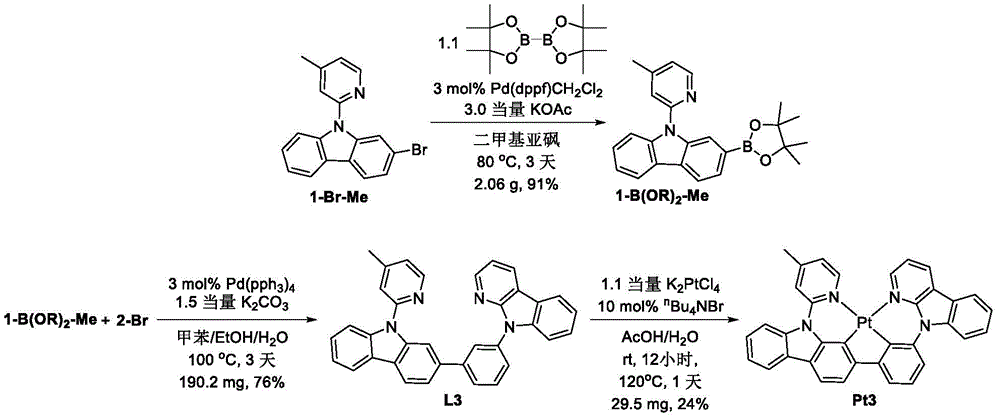
1-B(OR)2Synthesis of-Me 2-bromo-9- (2- (4-methylpyridyl)) -9H-carbazole 1-Br-Me (2.0g,5.9mmol,1.0eq), pinacol diborate (1.65g,6.5mmol,1.1eq), PdCl2(dppf).CH2Cl2(144.5mg,0.18mmol,0.03eq), potassium acetate (1.74g,17.7mmol,3.0 eq). Nitrogen was purged three times, then dimethyl sulfoxide (10mL) was added. Then placed in an oil bath at 80 ℃ for 3 days. Cooling to room temperature, adding 100mL of ethyl acetate for dilution, performing suction filtration, adding 50mL of water, separating liquid, extracting the water phase with ethyl acetate for three times, combining organic phases, drying the organic phases with anhydrous sodium sulfate, filtering, distilling under reduced pressure to remove the solvent, separating and purifying the obtained crude product by silica gel column chromatography, and eluting with an eluent (petroleum ether/ethyl acetate ═ 10:1-5:1) to obtain 2.06g of white solid with the yield of 91%.
L3 Synthesis by sequentially adding 2- (2- (4,4,5, 5-tetramethyl-1, 3, 2-dioxaborole-pentyl)) -9- (2- (4-methylpyridyl)) -9H-carbazole 1-B (OR) to a dry reaction tube equipped with a magnetic rotor2Me (192.1mg,0.50mmol,1.0eq), 9- (3-bromophenyl) -9H-pyrido [2,3b]Indole 2-Br (177.8mg,0.55mmol,1.1eq), Pd (PPh)3)4(17.3mg,0.02mmol,0.03eq),K2CO3(103.5mg, 0.75mmol,1.5 eq). Nitrogen was purged three times, then toluene (4.0mL), ethanol (1.0mL) and water (1.0mL) were added. Nitrogen was then bubbled for 15 minutes and the mixture was placed in a 100 ℃ oil bath for 3 days. Cooling to room temperature, removing the solvent by distillation under the reduced pressure, separating and purifying the crude product by silica gel column chromatography, eluting with a eluent (petroleum ether/ethyl acetate: 5:1) to obtain 190.2mg of white solid with a yield of 76%.1H NMR(500MHz,DMSO-d6):δ2.46(s.3H),7.32-7.40(m,4H),7.46-7.50(m,1H),7.53(td,J=7.0,1.0Hz,1H),7.59(d,J=8.0Hz,1H),7.67-7.73(m,3H),7.75(t,J=8.0Hz,1H),7.79(d,J=8.0Hz,1H),7.86(d,J=7.5Hz,1H),8.01(t,J=2.0Hz,1H),8.10(d,J=1.0Hz,1H),8.28(d,J=7.5Hz,1H),8.33(d,J=8.0Hz,1H),8.35(d,J=8.5Hz,1H),8.44(dd,J=5.0,1.5Hz,1H),8.58(d,J=5.0Hz,1H),8.67(dd,J=7.5,1.5Hz,1H).
Synthesis of Pt3 into a dry reaction tube with a magnetic rotor, L3(90.0mg,0.18 m) was added in sequencemol,1.0eq),K2PtCl4(82.1mg,0.20mmol,1.1eq),nBu4NBr (6.4mg, 0.02mmol,0.1 eq). Nitrogen was purged three times, then acetic acid (10.0mL) and water (0.3mL) were added. After stirring for 10h at normal temperature, the mixture was placed in a 120 ℃ oil bath to react for 1 day. After cooling to room temperature, the solvent was distilled off under reduced pressure, and the resulting crude product was purified by silica gel column chromatography with an eluent (petroleum ether/dichloromethane ═ 3:1-1:1) to give 29.5mg of a yellow solid in 24% yield. Hrms (esi): theoretical value C35H23N4Pt[M+H]+694.1565, Experimental value 680.1573.
Example 3
Pt28 can be prepared according to the following method

Synthesis of 2-Br-F by sequentially adding 9H-pyrido [2,3b ] into a dry reaction tube with a magnetic rotor]Indole (5.04g,30.00mmol,1.0eq), CuI (571.4mg,3.00mmol,0.01eq), L-Proline (690.0mg, 6.00mmol,0.02eq) and K2CO3(8.29g,60.00mmol,2.0 eq). Nitrogen was purged three times, and then 1, 3-dibromo-5-fluorobenzene (9.14g,36.0mmol,1.2eq) and dimethyl sulfoxide (30mL) as a solvent were added. The reaction mixture was placed in a 120 ℃ oil bath for 1.5 days. Cooling to room temperature, adding 100mL of ethyl acetate for dilution, carrying out suction filtration on kieselguhr, fully washing with ethyl acetate, adding 50mL of water, carrying out liquid separation, extracting an aqueous phase with ethyl acetate for three times, combining organic phases, drying the organic phases with anhydrous sodium sulfate, filtering, carrying out reduced pressure distillation to remove the solvent, separating and purifying the obtained crude product by silica gel column chromatography, and eluting a eluent (petroleum ether/dichloromethane is 4:1-2:1) to obtain 3.22g of white solid 2-Br-F, wherein the yield is 31%. The product was used directly in the next synthesis.
Synthesis of L28 by adding 2- (2- (4,4,5, 5-tetramethyl-1, 3, 2-dioxaboropentyl)) -9- (2-pyridyl) -9H-carbazole 1-B (OR) in sequence to a drying reaction with a magnetic rotor2(370.3mg,1.00mmol,1.0eq), 9- (3-bromo-5-fluorophenyl) -9H-pyrido [2,3 b)]Indole 2-Br-F (374.2mg,1.10mmol,1.1eq), Pd (PPh)3)4(57.8mg,0.05mmol,0.05eq),K2CO3(207.0mg, 1.50mmol,1.5 eq). Nitrogen was purged three times, then toluene (8mL), ethanol (2.0mL) and water (2.0mL) were added. Nitrogen was then bubbled for 15 minutes and the mixture was placed in a 100 ℃ oil bath for 3 days. Cooling to room temperature, removing the solvent by distillation under the reduced pressure, and separating and purifying the crude product by silica gel column chromatography with eluent (petroleum ether/ethyl acetate 10:1-4:1) to obtain 344.2mg (L28) of white solid with a yield of 68%.
Synthesis of Pt28 ligand L28(50mg,0.10mmol,1.0eq), K were added sequentially to a dry reaction tube with a magnetic rotor2PtCl4(45.7mg,0.11mmol,1.1eq),nBu4NBr (3.2mg, 0.01mmol,0.1 eq). Nitrogen was purged three times, then acetic acid (6.0mL) and water (0.2mL) were added. After stirring for 24h at normal temperature, the mixture was put in an oil bath at 120 ℃ for reaction for 3 days. Cooling to room temperature, removing the solvent by distillation under the reduced pressure, and separating and purifying the obtained crude product by silica gel column chromatography with eluent (petroleum ether/dichloromethane ═ 3:1-0:1) to obtain 2.0mg of yellow solid with the yield of 3%. Ms (esi): theoretical value C34H21N4Pt[M-F+2H]+680.1, Experimental value 680.5.
Example 4
Pt29 can be prepared according to the following method
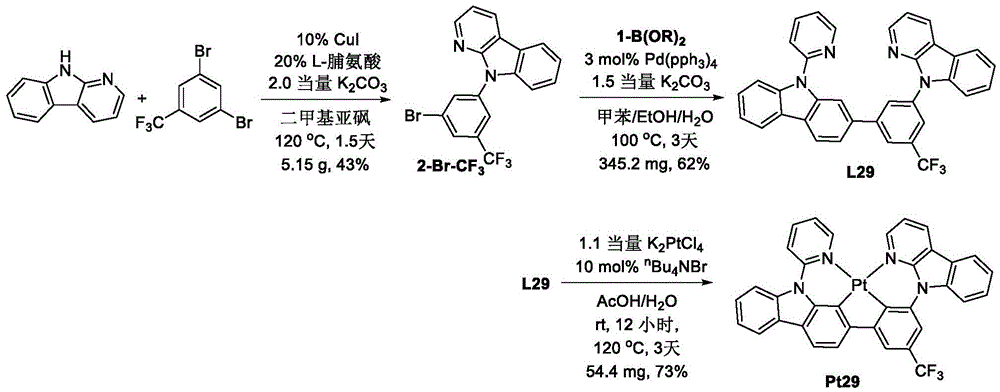
2-Br-CF3The synthesis of (1) is that 9H-pyrido [2,3b ] is added into a dry reaction tube with a magnetic rotor in sequence]Indole (5.04g,30.00mmol,1.0eq), CuI (571.4mg,3.00mmol,0.01eq), L-Proline (690.0mg, 6.00mmol,0.02eq) and K2CO3(8.29g,60.00mmol,2.0 eq). Nitrogen was purged three times, and then 1, 3-dibromo-5-trifluoromethylbenzene (10.94g,36.0mmol,1.2eq) and dimethyl sulfoxide (30mL) as a solvent were added. The reaction mixture was placed in a 120 ℃ oil bath for 1.5 days. Cooling to room temperature, diluting with 100mL ethyl acetate, filtering with diatomaceous earth, washing with ethyl acetate, adding 50mL water, separating, extracting water phase with ethyl acetate for three times, mixing organic phases, drying the organic phase with anhydrous sodium sulfate, filtering, distilling under reduced pressure to remove solvent, and mixing the organic phasesSeparating and purifying the crude product by silica gel column chromatography, eluting with petroleum ether/dichloromethane (4: 1-2:1) to obtain white solid 2-Br-CF35.15g, yield 43%. The product was used directly in the next synthesis.
Synthesis of L29 by adding 2- (2- (4,4,5, 5-tetramethyl-1, 3, 2-dioxaboropentyl)) -9- (2-pyridyl) -9H-carbazole 1-B (OR) in sequence to a drying reaction with a magnetic rotor2(370.3mg,1.00mmol,1.0eq), 9- (3-bromo-5-trifluoromethylphenyl) -9H-pyrido [2,3b ]]Indole 2-Br-CF3(564.0mg,1.40mmol,1.4eq),Pd(PPh3)4(57.8mg,0.05mmol,0.05eq),K2CO3(207.0mg, 1.50mmol,1.5 eq). Nitrogen was purged three times, then toluene (8mL), ethanol (2.0mL) and water (2.0mL) were added. Nitrogen was then bubbled for 15 minutes and the mixture was placed in a 100 ℃ oil bath for 3 days. Cooling to room temperature, removing the solvent by distillation under the reduced pressure, and separating and purifying the crude product by silica gel column chromatography with eluent (petroleum ether/ethyl acetate 10:1-1:1) to obtain 345.2mg (L29) of white solid with a yield of 62%.
Synthesis of Pt29 ligand L29(55.0mg,0.10mmol,1.0eq), K were added sequentially to a dry reaction tube with a magnetic rotor2PtCl4(45.7mg,0.11mmol,1.1eq),nBu4NBr (3.2mg, 0.01mmol,0.1 eq). Nitrogen was purged three times, then acetic acid (6.0mL) and water (0.2mL) were added. After stirring for 12h at normal temperature, the mixture was put in an oil bath at 120 ℃ for reaction for 3 days. After cooling to room temperature, the solvent was distilled off under reduced pressure, and the resulting crude product was purified by silica gel column chromatography with an eluent (petroleum ether/dichloromethane ═ 3:1-1:1) to give 54.4mg of a yellow solid in a yield of 73%. Ms (esi): theoretical value C34H21N4Pt[M-CF3+2H]+680.1, Experimental value 680.5.
While the foregoing is directed to embodiments of the present invention, it will be understood by those skilled in the art that various changes may be made without departing from the spirit and scope of the invention.
Claims (3)

Priority Applications (1)
| Application Number | Priority Date | Filing Date | Title |
|---|---|---|---|
| CN201810872326.1A CN108948095B (en) | 2018-08-02 | 2018-08-02 | Tetradentate ring metal platinum complex based on phenylcarbazole and application thereof |
Applications Claiming Priority (1)
| Application Number | Priority Date | Filing Date | Title |
|---|---|---|---|
| CN201810872326.1A CN108948095B (en) | 2018-08-02 | 2018-08-02 | Tetradentate ring metal platinum complex based on phenylcarbazole and application thereof |
Publications (2)
| Publication Number | Publication Date |
|---|---|
| CN108948095A CN108948095A (en) | 2018-12-07 |
| CN108948095B true CN108948095B (en) | 2021-01-19 |
Family
ID=64467281
Family Applications (1)
| Application Number | Title | Priority Date | Filing Date |
|---|---|---|---|
| CN201810872326.1A Active CN108948095B (en) | 2018-08-02 | 2018-08-02 | Tetradentate ring metal platinum complex based on phenylcarbazole and application thereof |
Country Status (1)
| Country | Link |
|---|---|
| CN (1) | CN108948095B (en) |
Families Citing this family (6)
| Publication number | Priority date | Publication date | Assignee | Title |
|---|---|---|---|---|
| CN111662336B (en) * | 2020-02-06 | 2023-02-14 | 浙江虹舞科技有限公司 | Tetradentate ring metal platinum complex phosphorescent material and organic light-emitting element |
| CN113501809B (en) * | 2021-07-13 | 2022-07-26 | 浙江工业大学 | Quaternary ring metal platinum (II) and palladium (II) complex luminescent material containing quinoline structural unit and application thereof |
| CN113801154B (en) * | 2021-10-20 | 2024-01-26 | 中钢集团南京新材料研究院有限公司 | Synthesis method of carbazole C2-site direct C-H boronated 9H-carbazole-2-boronic acid pinacol ester |
| CN114805446B (en) * | 2022-04-09 | 2023-08-15 | 浙江工业大学 | Metal platinum (II) and palladium (II) complexes, organic light-emitting devices and display or lighting devices |
| CN115160379B (en) * | 2022-08-01 | 2024-02-02 | 浙江工业大学 | Circularly polarized luminescent material and application, luminescent display device and display device |
| TW202530234A (en) * | 2023-10-09 | 2025-08-01 | 香港大學 | Luminescent tetradentate ligand gold(iii) compounds for organic light-emitting devices and their preparation |
Citations (3)
| Publication number | Priority date | Publication date | Assignee | Title |
|---|---|---|---|---|
| CN104232076A (en) * | 2013-06-10 | 2014-12-24 | 代表亚利桑那大学的亚利桑那校董会 | Phosphorescent tetradentate metal complexes with improved emission spectra |
| CN104693243A (en) * | 2013-10-14 | 2015-06-10 | 代表亚利桑那大学的亚利桑那校董事会 | Platinum complexes and devices |
| US20150194616A1 (en) * | 2014-01-07 | 2015-07-09 | Jian Li | Tetradentate Platinum And Palladium Complex Emitters Containing Phenyl-Pyrazole And Its Analogues |
-
2018
- 2018-08-02 CN CN201810872326.1A patent/CN108948095B/en active Active
Patent Citations (3)
| Publication number | Priority date | Publication date | Assignee | Title |
|---|---|---|---|---|
| CN104232076A (en) * | 2013-06-10 | 2014-12-24 | 代表亚利桑那大学的亚利桑那校董会 | Phosphorescent tetradentate metal complexes with improved emission spectra |
| CN104693243A (en) * | 2013-10-14 | 2015-06-10 | 代表亚利桑那大学的亚利桑那校董事会 | Platinum complexes and devices |
| US20150194616A1 (en) * | 2014-01-07 | 2015-07-09 | Jian Li | Tetradentate Platinum And Palladium Complex Emitters Containing Phenyl-Pyrazole And Its Analogues |
Also Published As
| Publication number | Publication date |
|---|---|
| CN108948095A (en) | 2018-12-07 |
Similar Documents
| Publication | Publication Date | Title |
|---|---|---|
| KR102904935B1 (en) | Platinum complexes, devices, and uses thereof | |
| CN108948095B (en) | Tetradentate ring metal platinum complex based on phenylcarbazole and application thereof | |
| CN109608506B (en) | Tetravalent metal platinum complex containing tetradentate ligand, preparation method, application and device | |
| KR20220115904A (en) | Tetradentate platinum (ii) complexes cyclometalated with functionalized phenyl carbene ligands and their analogues | |
| CN107698623A (en) | Multidentate Dinuclear Cyclometallic Complexes Containing N^C^C^N‑N^C^C^N Type Ligands | |
| US10246475B2 (en) | Multidentate dinuclear cyclometallated platinum complexes containing N-(pyrimidin-2-yl)-carbazole and its analogues | |
| JP7756401B2 (en) | High-emissivity platinum complexes with 1,8-substituted carbazoles and uses thereof | |
| CN108276449B (en) | Tetradentate ring metal platinum complex containing 4-aryl-3,5-disubstituted pyrazole, preparation method and application | |
| CN107383109A (en) | Multiple tooth double-nuclear ring metal complex containing 2 phenylpyridines and its derivative | |
| WO2024113800A1 (en) | Organic light-emitting diode material, device and apparatus | |
| CN113501809B (en) | Quaternary ring metal platinum (II) and palladium (II) complex luminescent material containing quinoline structural unit and application thereof | |
| CN108409794B (en) | Tetradentate ring metal platinum complexes based on phenyl-carbazole and their applications | |
| CN115260249B (en) | Compositions, preparations, organic electroluminescent devices and display or lighting devices | |
| WO2023193596A1 (en) | Metal platinum (ii) and palladium (ii) complexes, organic light-emitting device, and display or lighting apparatus | |
| WO2024002049A1 (en) | Composition, preparation, organic electroluminescent device, and display or illumination apparatus | |
| CN108948096B (en) | Tetradentate ring metal platinum complex based on biphenyl and application thereof | |
| CN108484676B (en) | Tetradentate ring metal platinum complex containing 4-aryl-pyrazole, preparation method and application | |
| CN108659050A (en) | Four ring gear metal platinum complexes, preparation method and application containing 6- substituted carbazoles | |
| CN108299507A (en) | The four ring gear metal platinum complexes containing three substituted pyrazolecarboxylics, preparation method and application | |
| CN115651029A (en) | Spirofluorene-biphenyl-azaacridine-based four-tooth cyclometalated platinum (II) complex phosphorescent light-emitting material and application thereof | |
| CN109678906B (en) | A kind of metal platinum (II) complex containing double bridged phenyl-phenyl-pyrazole structural unit and application thereof | |
| CN108424425B (en) | Quadridentate ring metal palladium complex containing 4-aryl-3, 5-disubstituted pyrazole, preparation method and application | |
| CN109748937B (en) | Metal palladium (II) complex containing bridged phenyl-pyrazole structural unit and application thereof | |
| CN109678907B (en) | A metal platinum(II) complex containing bridged phenyl-phenyl-pyrazole structural units | |
| CN108424426A (en) | The four ring gear metal palladium complexes containing three substituted pyrazolecarboxylics, preparation method and application |
Legal Events
| Date | Code | Title | Description |
|---|---|---|---|
| PB01 | Publication | ||
| PB01 | Publication | ||
| SE01 | Entry into force of request for substantive examination | ||
| SE01 | Entry into force of request for substantive examination | ||
| GR01 | Patent grant | ||
| GR01 | Patent grant |