JP2024123105A - Cancer immunotherapy by immune activation or immune regulation via globo-series antigens - Google Patents
Cancer immunotherapy by immune activation or immune regulation via globo-series antigens Download PDFInfo
- Publication number
- JP2024123105A JP2024123105A JP2024097870A JP2024097870A JP2024123105A JP 2024123105 A JP2024123105 A JP 2024123105A JP 2024097870 A JP2024097870 A JP 2024097870A JP 2024097870 A JP2024097870 A JP 2024097870A JP 2024123105 A JP2024123105 A JP 2024123105A
- Authority
- JP
- Japan
- Prior art keywords
- cancer
- globo
- antigen
- obi
- series
- Prior art date
- Legal status (The legal status is an assumption and is not a legal conclusion. Google has not performed a legal analysis and makes no representation as to the accuracy of the status listed.)
- Pending
Links
Images




Classifications
-
- A—HUMAN NECESSITIES
- A61—MEDICAL OR VETERINARY SCIENCE; HYGIENE
- A61K—PREPARATIONS FOR MEDICAL, DENTAL OR TOILETRY PURPOSES
- A61K39/00—Medicinal preparations containing antigens or antibodies
- A61K39/0005—Vertebrate antigens
- A61K39/0011—Cancer antigens
- A61K39/001169—Tumor associated carbohydrates
- A61K39/001173—Globo-H
-
- G01N33/57515—
-
- A—HUMAN NECESSITIES
- A61—MEDICAL OR VETERINARY SCIENCE; HYGIENE
- A61K—PREPARATIONS FOR MEDICAL, DENTAL OR TOILETRY PURPOSES
- A61K39/00—Medicinal preparations containing antigens or antibodies
- A61K39/0005—Vertebrate antigens
- A61K39/0011—Cancer antigens
-
- A—HUMAN NECESSITIES
- A61—MEDICAL OR VETERINARY SCIENCE; HYGIENE
- A61K—PREPARATIONS FOR MEDICAL, DENTAL OR TOILETRY PURPOSES
- A61K39/00—Medicinal preparations containing antigens or antibodies
- A61K39/0005—Vertebrate antigens
- A61K39/0011—Cancer antigens
- A61K39/00118—Cancer antigens from embryonic or fetal origin
-
- A—HUMAN NECESSITIES
- A61—MEDICAL OR VETERINARY SCIENCE; HYGIENE
- A61K—PREPARATIONS FOR MEDICAL, DENTAL OR TOILETRY PURPOSES
- A61K39/00—Medicinal preparations containing antigens or antibodies
- A61K39/39—Medicinal preparations containing antigens or antibodies characterised by the immunostimulating additives, e.g. chemical adjuvants
-
- A—HUMAN NECESSITIES
- A61—MEDICAL OR VETERINARY SCIENCE; HYGIENE
- A61P—SPECIFIC THERAPEUTIC ACTIVITY OF CHEMICAL COMPOUNDS OR MEDICINAL PREPARATIONS
- A61P35/00—Antineoplastic agents
-
- A—HUMAN NECESSITIES
- A61—MEDICAL OR VETERINARY SCIENCE; HYGIENE
- A61P—SPECIFIC THERAPEUTIC ACTIVITY OF CHEMICAL COMPOUNDS OR MEDICINAL PREPARATIONS
- A61P35/00—Antineoplastic agents
- A61P35/04—Antineoplastic agents specific for metastasis
-
- G01N33/57557—
-
- G01N33/5759—
-
- A—HUMAN NECESSITIES
- A61—MEDICAL OR VETERINARY SCIENCE; HYGIENE
- A61K—PREPARATIONS FOR MEDICAL, DENTAL OR TOILETRY PURPOSES
- A61K39/00—Medicinal preparations containing antigens or antibodies
- A61K2039/545—Medicinal preparations containing antigens or antibodies characterised by the dose, timing or administration schedule
-
- A—HUMAN NECESSITIES
- A61—MEDICAL OR VETERINARY SCIENCE; HYGIENE
- A61K—PREPARATIONS FOR MEDICAL, DENTAL OR TOILETRY PURPOSES
- A61K39/00—Medicinal preparations containing antigens or antibodies
- A61K2039/555—Medicinal preparations containing antigens or antibodies characterised by a specific combination antigen/adjuvant
- A61K2039/55511—Organic adjuvants
- A61K2039/55577—Saponins; Quil A; QS21; ISCOMS
-
- A—HUMAN NECESSITIES
- A61—MEDICAL OR VETERINARY SCIENCE; HYGIENE
- A61K—PREPARATIONS FOR MEDICAL, DENTAL OR TOILETRY PURPOSES
- A61K39/00—Medicinal preparations containing antigens or antibodies
- A61K2039/57—Medicinal preparations containing antigens or antibodies characterised by the type of response, e.g. Th1, Th2
- A61K2039/575—Medicinal preparations containing antigens or antibodies characterised by the type of response, e.g. Th1, Th2 humoral response
-
- A—HUMAN NECESSITIES
- A61—MEDICAL OR VETERINARY SCIENCE; HYGIENE
- A61K—PREPARATIONS FOR MEDICAL, DENTAL OR TOILETRY PURPOSES
- A61K39/00—Medicinal preparations containing antigens or antibodies
- A61K2039/60—Medicinal preparations containing antigens or antibodies characteristics by the carrier linked to the antigen
- A61K2039/6031—Proteins
- A61K2039/6081—Albumin; Keyhole limpet haemocyanin [KLH]
-
- A—HUMAN NECESSITIES
- A61—MEDICAL OR VETERINARY SCIENCE; HYGIENE
- A61K—PREPARATIONS FOR MEDICAL, DENTAL OR TOILETRY PURPOSES
- A61K39/00—Medicinal preparations containing antigens or antibodies
- A61K2039/80—Vaccine for a specifically defined cancer
- A61K2039/812—Breast
-
- A—HUMAN NECESSITIES
- A61—MEDICAL OR VETERINARY SCIENCE; HYGIENE
- A61K—PREPARATIONS FOR MEDICAL, DENTAL OR TOILETRY PURPOSES
- A61K39/00—Medicinal preparations containing antigens or antibodies
- A61K2039/80—Vaccine for a specifically defined cancer
- A61K2039/892—Reproductive system [uterus, ovaries, cervix, testes]
-
- A—HUMAN NECESSITIES
- A61—MEDICAL OR VETERINARY SCIENCE; HYGIENE
- A61K—PREPARATIONS FOR MEDICAL, DENTAL OR TOILETRY PURPOSES
- A61K2300/00—Mixtures or combinations of active ingredients, wherein at least one active ingredient is fully defined in groups A61K31/00 - A61K41/00
-
- A—HUMAN NECESSITIES
- A61—MEDICAL OR VETERINARY SCIENCE; HYGIENE
- A61K—PREPARATIONS FOR MEDICAL, DENTAL OR TOILETRY PURPOSES
- A61K45/00—Medicinal preparations containing active ingredients not provided for in groups A61K31/00 - A61K41/00
- A61K45/06—Mixtures of active ingredients without chemical characterisation, e.g. antiphlogistics and cardiaca
-
- G—PHYSICS
- G01—MEASURING; TESTING
- G01N—INVESTIGATING OR ANALYSING MATERIALS BY DETERMINING THEIR CHEMICAL OR PHYSICAL PROPERTIES
- G01N2400/00—Assays, e.g. immunoassays or enzyme assays, involving carbohydrates
- G01N2400/10—Polysaccharides, i.e. having more than five saccharide radicals attached to each other by glycosidic linkages; Derivatives thereof, e.g. ethers, esters
- G01N2400/38—Heteroglycans, i.e. polysaccharides having more than one sugar residue in the main chain in either alternating or less regular sequence, e.g. gluco- or galactomannans, Konjac gum, Locust bean gum or Guar gum
-
- G—PHYSICS
- G01—MEASURING; TESTING
- G01N—INVESTIGATING OR ANALYSING MATERIALS BY DETERMINING THEIR CHEMICAL OR PHYSICAL PROPERTIES
- G01N2800/00—Detection or diagnosis of diseases
- G01N2800/52—Predicting or monitoring the response to treatment, e.g. for selection of therapy based on assay results in personalised medicine; Prognosis
Landscapes
- Health & Medical Sciences (AREA)
- Life Sciences & Earth Sciences (AREA)
- Chemical & Material Sciences (AREA)
- Medicinal Chemistry (AREA)
- General Health & Medical Sciences (AREA)
- Pharmacology & Pharmacy (AREA)
- Veterinary Medicine (AREA)
- Public Health (AREA)
- Animal Behavior & Ethology (AREA)
- Epidemiology (AREA)
- Immunology (AREA)
- Oncology (AREA)
- Microbiology (AREA)
- Mycology (AREA)
- Chemical Kinetics & Catalysis (AREA)
- General Chemical & Material Sciences (AREA)
- Nuclear Medicine, Radiotherapy & Molecular Imaging (AREA)
- Organic Chemistry (AREA)
- Molecular Biology (AREA)
- Gynecology & Obstetrics (AREA)
- Pregnancy & Childbirth (AREA)
- Reproductive Health (AREA)
- Developmental Biology & Embryology (AREA)
- Medicines Containing Antibodies Or Antigens For Use As Internal Diagnostic Agents (AREA)
- Engineering & Computer Science (AREA)
- Urology & Nephrology (AREA)
- Biomedical Technology (AREA)
- Hematology (AREA)
- Medicines That Contain Protein Lipid Enzymes And Other Medicines (AREA)
- Cell Biology (AREA)
- Physics & Mathematics (AREA)
- Food Science & Technology (AREA)
- Hospice & Palliative Care (AREA)
- Analytical Chemistry (AREA)
- Biochemistry (AREA)
- General Physics & Mathematics (AREA)
- Pathology (AREA)
- Biotechnology (AREA)
- Peptides Or Proteins (AREA)
- Medicinal Preparation (AREA)
Abstract
Description
関連出願の相互参照
本出願は、米国仮特許出願第62/326,623号(2016年4月22日出願)、同第62/343,530号(2016年5月31日出願)、同第62/345,755号(2016年6月4日出願)及び同第62/381,875号2016年8月31日)の優先権を主張するものである。前記出願の全体が参照により本明細書に組み込まれる。
CROSS-REFERENCE TO RELATED APPLICATIONS This application claims priority to U.S. Provisional Patent Application Nos. 62/326,623, filed April 22, 2016, 62/343,530, filed May 31, 2016, 62/345,755, filed June 4, 2016, and 62/381,875, filed August 31, 2016, all of which are incorporated herein by reference in their entireties.
本発明は、グロボシリーズの抗原に対するワクチンを患者に投与することを含む、がん患者の免疫療法のための方法に関する。 The present invention relates to a method for immunotherapy of cancer patients, comprising administering to the patient a vaccine against an antigen of the globo-series.
糖鎖抗原グロボH(Fucα1→2Galβ1→3GalNAcβ1→3Galα1→4Galβ1→4Glc)は、セラミド結合糖脂質として最初に単離され、1984年にHakomori et al.によって乳がんMCF-7細胞から同定された(Bremer E G,et al.(1984)J Biol Chem 259:14773-14777)。抗グロボHモノクローナル抗体に関するさらなる試験は、グロボHが、前立腺がん、胃がん、膵臓がん、肺がん、卵巣がん及び結腸がんを含む多くの他のがんに存在し、並びに免疫系が容易にアクセスできない正常分泌組織の内腔表面にごくわずかに発現されることを示した(Ragupathi G et al.(1997)Angew Chem Int Ed 36:125-128)。さらに、乳がん患者の血清は、高レベルの抗グロボH抗体を含むことが証明されている(Gilewski T et al.(2001)Proc Natl Acad Sci USA 98:3270-3275;Huang C-Y,et al.(2006)Proc Natl Acad Sci USA 103:15-20;Wang C-C,et al.(2008)Proc Natl Acad Sci USA 105(33):11661-11666)。グロボH陽性腫瘍を有する患者は、グロボH陰性腫瘍を有する患者と比較してより短い生存期間を示した(Chang,Y-J,et al.(2007)Proc Natl Acad Sci USA 104(25):10299-10304)。これらの所見により、六糖エピトープであるグロボHは、魅力的な腫瘍マーカー及びがんワクチン開発のための実現可能な標的となっている。 The carbohydrate antigen globo H (Fucα1→2Galβ1→3GalNAcβ1→3Galα1→4Galβ1→4Glc) was first isolated as a ceramide-linked glycolipid and identified in breast cancer MCF-7 cells by Hakomori et al. in 1984 (Bremer E G, et al. (1984) J Biol Chem 259:14773-14777). Further studies with anti-globo H monoclonal antibodies have shown that globo H is present in many other cancers, including prostate, gastric, pancreatic, lung, ovarian and colon cancers, and is expressed only in minimal amounts on the luminal surface of normal secretory tissues that are not readily accessible to the immune system (Ragupati G et al. (1997) Angew Chem Int Ed 36:125-128). Furthermore, sera from breast cancer patients have been shown to contain high levels of anti-globo H antibodies (Gilewski T et al. (2001) Proc Natl Acad Sci USA 98:3270-3275; Huang C-Y, et al. (2006) Proc Natl Acad Sci USA 103:15-20; Wang C-C, et al. (2008) Proc Natl Acad Sci USA 105(33):11661-11666). Patients with globoH-positive tumors showed shorter survival times compared to patients with globoH-negative tumors (Chang, Y-J, et al. (2007) Proc Natl Acad Sci USA 104(25):10299-10304). These findings make the hexasaccharide epitope globoH an attractive tumor marker and a feasible target for cancer vaccine development.
本開示の態様及び実施形態は、免疫応答(IgG及び/又はIgM)を誘導/調節するために有用なグロボシリーズの抗原を標的とする免疫原性物質(例えばOBI-822)を、がんの治療を必要とする被験体に投与することを含む、がんに罹患した被験体を免疫療法によって治療するための方法を提供し、前記方法は、被験体の生存率を改善するように、グロボシリーズ抗原の相互作用を調節することによって生存率(全生存率及び/又は無増悪生存率を含む)を改善することを含む。一態様では、グロボシリーズの抗原を標的とする免疫原性物質は、例えばOBI-822である。本発明者らの以前のPCT特許出願(公開番号:WO2015159118A2及びWO2016044326A1)を参照されたい。これらの出願の開示は、グロボH-KLH複合糖質(OBI-822)及び/又は治療用アジュバント(OBI-821/OBI-834)を含む免疫原性/治療用組成物、並びにこれらを製造し、がんなどの増殖性疾患を治療するために使用する方法を包含する。治療用組成物は、一部には、がん細胞などの損傷細胞又は異常細胞によってもたらされる危険性から、免疫系を介して自らを守る身体の自然の能力を強化するためのがんワクチンとして働くことが想定されている。 Aspects and embodiments of the present disclosure provide a method for immunotherapeutic treatment of a subject suffering from cancer, comprising administering to a subject in need of cancer treatment an immunogenic agent (e.g., OBI-822) that targets a globo-series antigen useful for inducing/modulating an immune response (IgG and/or IgM), the method comprising improving survival (including overall survival and/or progression-free survival) by modulating the interaction of the globo-series antigens to improve the survival of the subject. In one aspect, the immunogenic agent that targets a globo-series antigen is, for example, OBI-822. See our previous PCT patent applications (Publication Nos. WO2015159118A2 and WO2016044326A1). The disclosures of these applications include immunogenic/therapeutic compositions comprising globoH-KLH glycoconjugates (OBI-822) and/or therapeutic adjuvants (OBI-821/OBI-834), and methods of making and using the same to treat proliferative diseases, such as cancer. The therapeutic compositions are envisioned to act, in part, as cancer vaccines to enhance the body's natural ability to protect itself, via the immune system, from the dangers posed by damaged or abnormal cells, such as cancer cells.
一実施形態では、免疫原性物質は、OBI-822及び関連する変異体を含み得る。 In one embodiment, the immunogenic agent may include OBI-822 and related variants.
特定の実施形態では、免疫応答は、IgG(サブクラスIgG1、IgG2、IgG3、IgG4を含む)、IgM、グロボHシリーズ抗原/腫瘍に対するCTL(細胞傷害性リンパ球)を含み得る。 In certain embodiments, the immune response may include IgG (including subclasses IgG1, IgG2, IgG3, IgG4), IgM, and CTLs (cytotoxic lymphocytes) against globo-H series antigens/tumors.
特定の実施形態では、臨床的に意味のある利点には、以下における変化が含まれ得る:無増悪生存率;全生存率;(十分に耐容される及び/又は重大な安全性の懸念がない);客観的な奏功率;進行までの時間;無病生存率;腫瘍応答;生活の質の改善;固形腫瘍のサイズの縮小及び/又は腫瘍関連抗原(主にグロボH又はグロボHを含む)の減少。 In certain embodiments, clinically meaningful benefits may include changes in: progression-free survival; overall survival; (well tolerated and/or free of significant safety concerns); objective response rate; time to progression; disease-free survival; tumor response; improved quality of life; reduction in size of solid tumors and/or reduction in tumor associated antigens (mainly globo-H or including globo-H).
特定の態様では、投与レジメンは、2回以上(例えば3回、4回、5回、6回、7回、8回、9回又は10回以上)のワクチンの投与;2回の連続する投与の間の時間間隔及び/若しくは投与量レジメンの調整;投与経路の調整及び/若しくは注射部位/投与位置の変更/交互実施又は上記のいずれかの任意の組み合わせを含むことができ、これにより、各々の投与は免疫応答を増加させる[例えば力価-IgG及び/若しくはIgM Abの量及び/又は親和性/アビディティの増加;グロボH抗原複合体のグロボH部分の免疫原性がより低い部位へのAbの誘導(例えば複合体中のよりアクセスしにくいと考えられるグロボH抗原の部分)]。特定の態様では、注射は、免疫応答ブースター剤の添加によって変更及び/又は補完することができる。 In certain aspects, the dosing regimen can include administering two or more (e.g., 3, 4, 5, 6, 7, 8, 9, or 10 or more) doses of the vaccine; adjusting the time interval and/or dosing regimen between two successive doses; adjusting the route of administration and/or changing/alternating the injection site/location or any combination of any of the above, whereby each administration increases the immune response (e.g., increasing the titer-quantity and/or affinity/avidity of IgG and/or IgM Abs; directing Abs to less immunogenic sites of the globo-H portion of the globo-H antigen complex (e.g., portions of the globo-H antigen in the complex that are considered less accessible)). In certain aspects, the injections can be modified and/or supplemented by the addition of immune response boosting agents.
特定の態様では、グロボシリーズ抗原の相互作用の調節には、以下のものが含まれ得る:複数回のワクチン接種で親和性が高められた抗グロボH抗体の誘導;B細胞の胚中心のグロボHシリーズ腫瘍抗原への拡大;高親和性抗グロボH抗体を含む胚中心の優先的な拡大;通常、単回(又は少ない回数の抗原への暴露の反復)では意味のある応答を生じさせるのに十分な数で存在しない低頻度のB細胞の誘導(例えば、それらはほとんどの抗体が結合しないエピトープに結合し得る);抗腫瘍応答の長期間の維持にとって重要であり得る抗体分泌形質細胞(「抗体分泌形質細胞」はB細胞が分化するものである)及び記憶B細胞の増殖拡大;Abクラススイッチの速度の増加[良好なT細胞ヘルパー機能を必要とするか又はB細胞がIgGに切り替わらない];抗体応答の速度の増加(例えば、連続的なワクチン接種は、KLHへの結合なしで、シクロホスファミドの同時投与なしで及び/又は反復ワクチン接種なしで得られるよりも迅速な抗体の拡大をもたらし得る);上記の抗腫瘍応答の発現及び維持を妨げるTreg活性の低下;腫瘍の死滅のための抗体依存性細胞傷害(ADCC)及び補体依存性細胞傷害(CDC)の誘導;CDC及びADCC媒介腫瘍細胞死滅を誘発するための抗グロボシリーズ抗原のIgM/IgG免疫応答の誘導;腫瘍細胞からのグロボシリーズ抗原-セラミドを捕捉し、トランスリン関連因子X(TRAX)依存性血管新生をブロックする抗グロボシリーズ抗原抗体の誘導;グロボシリーズ抗原-セラミド誘導Notch 1依存性免疫抑制をブロックし、それによってT細胞増殖及びサイトカイン産生を増強する抗グロボシリーズ抗原抗体の誘導;アポトーシスをもたらす抗グロボシリーズ抗原抗体の誘導;グロボシリーズ抗原誘導性血管新生の阻害;OBI-822ワクチン接種はアポトーシスを誘導する;CTL(細胞傷害性リンパ球)の誘導。 In certain aspects, modulation of globo-series antigen interactions may include: induction of anti-globo H antibodies with increased affinity with multiple vaccinations; expansion of germinal centers with B cells to globo H series tumor antigens; preferential expansion of germinal centers containing high affinity anti-globo H antibodies; induction of low frequency B cells that are not normally present in sufficient numbers to generate a meaningful response after a single (or a small number of repeated exposures to antigen) (e.g., they may bind epitopes that are not bound by most antibodies); expansion of antibody-secreting plasma cells ("antibody-secreting plasma cells" are what B cells differentiate into) and memory B cells that may be important for long-term maintenance of anti-tumor responses; increased rate of Ab class switching [requiring good T cell helper function or B cell increased kinetics of antibody response (e.g., sequential vaccinations may result in more rapid expansion of antibodies than can be obtained without conjugation to KLH, without coadministration of cyclophosphamide and/or without repeated vaccinations); decreased Treg activity, which prevents the development and maintenance of the anti-tumor responses described above; induction of antibody-dependent cellular cytotoxicity (ADCC) and complement-dependent cytotoxicity (CDC) for tumor killing; induction of anti-globo-series antigen IgM/IgG immune responses to trigger CDC- and ADCC-mediated tumor cell killing; induction of anti-globo-series antigen antibodies that capture globo-series antigen-ceramide from tumor cells and block transaminase-associated factor X (TRAX)-dependent angiogenesis; induction of globo-series antigen-ceramide-induced Notch Induction of anti-globo-series antigen antibodies that block IgM-1-dependent immunosuppression and thereby enhance T cell proliferation and cytokine production; Induction of anti-globo-series antigen antibodies that lead to apoptosis; Inhibition of globo-series antigen-induced angiogenesis; OBI-822 vaccination induces apoptosis; Induction of CTLs (cytotoxic lymphocytes).
本発明は、がん又は感染症などの疾患に罹患した被験体の免疫療法のための方法であって、内因性免疫応答を増強し、内因性応答の活性化を刺激するか又は内在性応答の抑制を阻害する治療有効量の化合物又は薬剤を含む組成物を被験体に投与することを含む方法に関する。より具体的には、本開示は、がんに罹患した被験体における内因性免疫応答を増強し、それによって患者を治療するための方法であって、治療有効量の免疫原性物質を被験体に投与することを含む方法を提供する。 The present invention relates to a method for immunotherapy of a subject suffering from a disease, such as cancer or an infectious disease, comprising administering to the subject a composition comprising a therapeutically effective amount of a compound or agent that enhances an endogenous immune response, stimulates activation of an endogenous response or inhibits suppression of an endogenous response. More specifically, the present disclosure provides a method for enhancing an endogenous immune response in a subject suffering from cancer, thereby treating the patient, comprising administering to the subject a therapeutically effective amount of an immunogenic agent.
定義:
本明細書で使用される場合の「投与する」、投与レジメンの実施形態は、以下の特徴を含み得る:1)2回以上(例えば3回、4回、5回、6回、7回、8回、9回又は10回以上)ワクチンを投与する;2)各々の投与は免疫応答(上記参照)を増加させる[力価-IgG及び/若しくはIgM Abの量及び/又は親和性/アビディティを増加させる;グロボH抗原複合体のグロボH部分のより低い免疫原性部位へのAbの誘導(例えば複合体中のよりアクセスしにくいと考えられるグロボH抗原の部分)]。
Definition:
"Administering" as used herein, embodiments of dosing regimens may include the following features: 1) administering the vaccine two or more times (e.g., 3, 4, 5, 6, 7, 8, 9, or 10 or more times); 2) each administration increases the immune response (see above) [titer - increasing the amount and/or affinity/avidity of IgG and/or IgM Abs; directing Abs to less immunogenic sites of the globo H portion of the globo H antigen complex (e.g., portions of the globo H antigen that are considered less accessible in the complex)].
本明細書中で使用される場合、「治療」は、治療される個体又は細胞の自然経過を改変しようとする臨床的介入を指し、予防のために又は臨床病理の経過中のいずれかに実施することができる。治療の望ましい効果には、疾患の発症又は再発の予防、症状の軽減、疾患の任意の直接又は間接的な病理学的結果の縮小、炎症及び/又は組織/臓器の損傷の予防又は減少、疾患の進行速度の低下、疾患状態の改善又は緩和、並びに寛解又は予後の改善が含まれる。いくつかの実施形態では、本発明の抗体は、疾患又は障害の発症を遅らせるために使用される。 As used herein, "treatment" refers to a clinical intervention that seeks to alter the natural history of the individual or cell being treated, and can be performed either prophylactically or during the course of clinical pathology. Desirable effects of treatment include prevention of disease onset or recurrence, alleviation of symptoms, reduction of any direct or indirect pathological consequences of the disease, prevention or reduction of inflammation and/or tissue/organ damage, slowing of disease progression, amelioration or palliation of the disease state, and remission or improvement of prognosis. In some embodiments, the antibodies of the invention are used to delay the onset of a disease or disorder.
「有効量」とは、所望の治療結果又は予防結果を達成するのに必要な用量及び期間で有効な量を指す。 "Effective amount" refers to an amount effective, at dosages and for periods of time necessary, to achieve the desired therapeutic or prophylactic result.
本発明の物質/分子の「治療有効量」は、個体の疾患状態、年齢、性別及び体重、並びに個体における所望の応答を誘発する物質/分子の能力などの因子に応じて異なり得る。治療有効量はまた、物質/分子の治療上の有益な効果が毒性又は有害作用を上回る量である。「予防有効量」は、所望の予防結果を達成するのに必要な用量及び期間で有効な量を指す。必ずしも必要ではないが典型的には、予防用量は疾患の前又は初期段階の被験体において使用されるので、予防有効量は治療有効量より低い。 The "therapeutically effective amount" of the substance/molecule of the invention may vary depending on factors such as the disease state, age, sex, and weight of the individual, and the ability of the substance/molecule to elicit a desired response in the individual. A therapeutically effective amount is also an amount in which the therapeutically beneficial effects of the substance/molecule outweigh any toxic or adverse effects. A "prophylactically effective amount" refers to an amount effective, at dosages and for periods of time necessary, to achieve the desired prophylactic result. Typically, but not necessarily, the prophylactically effective amount is lower than the therapeutically effective amount, since a prophylactic dose is used in subjects prior to or at an early stage of disease.
「有害事象」(AE)毒性は、国立がん研究所のがん治療評価プログラムによって開発された米国NCI共通毒性基準、バージョン4に従って測定される。許容できない毒性の基準には、任意のグレード4以上の毒性が含まれるべきであるが、局所皮膚反応、発熱、悪寒、発汗、蕁麻疹及び/又は掻痒は、抗体/アジュバント投与の一般的な副作用であって、可逆性でありかつ支持的管理によって制御されるものであるので、これらを除くべきである。理論的には、皮膚、関節、腎臓又は他の症状発現によって顕在化するような免疫複合疾患は、起こり得るが、マウスタンパク質への事前暴露がない場合には滅多に起こらないものである。これらは、影響を受けた被験体の治療を中止するための指標となるが、新たな被験体の追加は継続し得る。有害事象は、治験薬の使用に関連するとみなされるか否かに関わらず、無作為化の日から、被験体の無作為化から最大2年間続く追跡期間までの間に、被験体が経験した任意の身体的又は臨床的変化又は疾患である。これには、新たな疾病の発症及び既存の状態の増悪が含まれる。治療期間中に治療を中止した被験体については、試験治療(OBI-822/OBI-821又は対照)の最終投与後28日目まで有害事象を記録すべきである。
"Adverse Events" (AEs) Toxicity will be measured according to the US NCI Common Toxicity Criteria,
「抗体」(Ab)及び「免疫グロブリン」(Ig)は、同じ構造特性を有する糖タンパク質である。抗体は特定の抗原に対して結合特異性を示すが、免疫グロブリンは、抗体及び一般に抗原特異性を欠く他の抗体様分子の両方を含む。後者の種類のポリペプチドは、例えばリンパ系によって低レベルで産生され、骨髄腫によって高レベルで産生される。「抗体」及び「免疫グロブリン」という用語は、最も広い意味で交換可能に使用され、モノクローナル抗体(例えば完全長又は無傷モノクローナル抗体)、ポリクローナル抗体、一価抗体、多価抗体、多重特異性抗体(例えば、所望の生物学的活性を示す限りは二重特異性抗体)を含み、特定の抗体フラグメント(本明細書中でより詳細に説明される)をも含み得る。抗体は、キメラ、ヒト、ヒト化及び/又は親和性成熟抗体であり得る。 "Antibodies" (Ab) and "immunoglobulins" (Ig) are glycoproteins with the same structural characteristics. While antibodies exhibit binding specificity to a specific antigen, immunoglobulins include both antibodies and other antibody-like molecules that generally lack antigen specificity. The latter type of polypeptide is produced at low levels by, for example, the lymphatic system and at higher levels by myelomas. The terms "antibody" and "immunoglobulin" are used interchangeably in the broadest sense and include monoclonal antibodies (e.g., full-length or intact monoclonal antibodies), polyclonal antibodies, monovalent antibodies, polyvalent antibodies, multispecific antibodies (e.g., bispecific antibodies so long as they exhibit the desired biological activity), and may also include certain antibody fragments (described in more detail herein). Antibodies may be chimeric, human, humanized and/or affinity matured.
「可変」及び「相補性決定領域」(CDR)
「可変」という用語は、可変ドメインの特定の部分が、抗体間で配列が大きく異なり、その特定の抗原に対する各特定の抗体の結合及び特異性において使用されるという事実を指す。しかしながら、可変性は、抗体の可変ドメイン全体に均一に分布しているわけではない。これは、軽鎖及び重鎖可変ドメインの両方における相補性決定領域(CDR)又は超可変領域と呼ばれる3つのセグメントに集中している。可変ドメインのより高度に保存された部分は、フレームワーク(FR)と呼ばれる。天然の重鎖及び軽鎖の可変ドメインは、それぞれ、3つのCDRによって連結された、主としてβシート構造をとる4つのFR領域を含み、CDRは、βシート構造を連結するループを形成し、場合によってはβシート構造の一部を形成する。各鎖中のCDRは、FR領域によって近接して一緒に保持され、他の鎖由来のCDRと共に、抗体の抗原結合部位の形成に寄与する(Kabat et al.,Sequences of Proteins of Immunological Interest,Fifth Edition, National Institute of Health,Bethesda,Md.(1991)参照)。定常ドメインは、抗原への抗体の結合に直接関与しないが、抗体依存性細胞毒性における抗体の関与などの様々なエフェクター機能を示す。抗体のパパイン消化は、それぞれが単一の抗原結合部位を有する「Fab」フラグメントと呼ばれる2つの同一の抗原結合フラグメント、及び残りの、容易に結晶化する能力を反映した名前を有する「Fc」フラグメントを、生じる。ペプシン処理は、2つの抗原結合部位を有しかつ依然として抗原を架橋することができる、F(ab’)2フラグメントを生じる。
"Variable" and "Complementarity Determining Regions" (CDRs)
The term "variable" refers to the fact that certain portions of the variable domains differ widely in sequence among antibodies and are used in the binding and specificity of each particular antibody for its particular antigen. However, the variability is not uniformly distributed throughout the variable domains of antibodies. It is concentrated in three segments called complementarity determining regions (CDRs) or hypervariable regions in both the light and heavy chain variable domains. The more highly conserved portions of the variable domains are called frameworks (FRs). Naturally occurring heavy and light chain variable domains each contain four FR regions that adopt a largely β-sheet structure connected by three CDRs, which form loops that connect, and in some cases form part of, the β-sheet structure. The CDRs in each chain are held together in close proximity by the FR regions and, with the CDRs from the other chain, contribute to the formation of the antigen-binding site of antibodies (see Kabat et al., Sequences of Proteins of Immunological Interest, Fifth Edition, National Institute of Health, Bethesda, Md. (1991)). The constant domains are not directly involved in binding the antibody to the antigen but exhibit various effector functions, such as participation of the antibody in antibody-dependent cellular cytotoxicity. Papain digestion of an antibody produces two identical antigen-binding fragments, called "Fab" fragments, each with a single antigen-binding site, and a residual "Fc" fragment, a name reflecting its ability to crystallize readily. Pepsin treatment produces an F(ab')2 fragment that has two antigen-binding sites and is still capable of cross-linking antigen.
「Fv」は、完全な抗原認識及び抗原結合部位を含む最小限の抗体断片である。二本鎖Fv種において、この領域は、緊密で非共有結合的に結合した1つの重鎖及び1つの軽鎖可変ドメインの二量体からなる。一本鎖Fv種では、1つの重鎖及び1つの軽鎖可変ドメインを、軽鎖と重鎖が二本鎖Fv種のものと類似の「二量体」構造で結合できるように、柔軟なペプチドリンカーによって共有結合させることができる。この構造において、各可変ドメインの3つのCDRが相互作用して、VH-VL二量体の表面上の抗原結合部位を規定する。集合的に、6つのCDRは抗体に抗原結合特異性を付与する。しかしながら、単一の可変ドメイン(又は抗原に特異的な3つのCDRのみを含むFvの半分)でさえも、結合部位全体よりも低い親和性であるが、抗原を認識して結合する能力を有する。 An "Fv" is the minimum antibody fragment which contains a complete antigen recognition and binding site. In a two-chain Fv species, this region consists of a dimer of one heavy- and one light-chain variable domain in tight, non-covalent association. In a single-chain Fv species, one heavy- and one light-chain variable domain can be covalently linked by a flexible peptide linker such that the light and heavy chains can associate in a "dimeric" structure similar to that of the two-chain Fv species. In this structure, the three CDRs of each variable domain interact to define an antigen-binding site on the surface of the VH-VL dimer. Collectively, the six CDRs confer antigen-binding specificity to the antibody. However, even a single variable domain (or even half of an Fv containing only the three CDRs specific for an antigen) has the ability to recognize and bind antigen, albeit with a lower affinity than the entire binding site.
Fabフラグメントはまた、軽鎖の定常ドメイン及び重鎖の第1定常ドメイン(CH1)を含む。Fab’フラグメントは、抗体ヒンジ領域由来の1つ以上のシステインを含む重鎖CH1ドメインのカルボキシ末端における数個の残基の付加によってFabフラグメントと異なる。Fab’-SHは、定常ドメインのシステイン残基(1つ又は複数)が遊離チオール基を担持するFab’についての本明細書における名称である。F(ab’)2抗体フラグメントはもともと、それらの間にヒンジシステインを有するFab’フラグメントの対として産生された。 Fab fragments also contain the constant domain of the light chain and the first constant domain (CH1) of the heavy chain. Fab' fragments differ from Fab fragments by the addition of a few residues at the carboxy terminus of the heavy chain CH1 domain including one or more cysteines from the antibody hinge region. Fab'-SH is the designation herein for Fab' in which the cysteine residue(s) of the constant domains bear a free thiol group. F(ab')2 antibody fragments were originally produced as pairs of Fab' fragments that have hinge cysteines between them.
任意の脊椎動物種由来の抗体(免疫グロブリン)の「軽鎖」は、それらの定常ドメインのアミノ酸配列に基づき、カッパ(κ)及びラムダ(λ)と呼ばれる2つの明確に異なる型の1つに割り当てることができる。 The "light chains" of antibodies (immunoglobulins) from any vertebrate species can be assigned to one of two clearly distinct types, called kappa (κ) and lambda (λ), based on the amino acid sequences of their constant domains.
重鎖の定常ドメインのアミノ酸配列に依存して、抗体(免疫グロブリン)を異なるクラスに割り当てることができる。IgA、IgD、IgE、IgG及びIgMの5つの主要なクラスの免疫グロブリンがあり、これらのいくつかは、サブクラス(アイソタイプ)、例えばIgG1、IgG2、IgG3、IgG4、IgA1及びIgA2にさらに分類し得る。免疫グロブリンの異なるクラスに対応する重鎖定常ドメインは、それぞれα、δ、ε、γ及びμと呼ばれる。異なるクラスの免疫グロブリンのサブユニット構造及び三次元立体配置は周知であり、例えば、Abbas et al.Cellular and Mol.Immunology,4th ed.(2000)に一般的に記載されている。抗体は、抗体と1つ以上の他のタンパク質又はペプチドとの共有結合又は非共有結合によって形成される、より大きな融合分子の一部であり得る。 Depending on the amino acid sequence of the constant domain of the heavy chain, antibodies (immunoglobulins) can be assigned to different classes. There are five major classes of immunoglobulins: IgA, IgD, IgE, IgG, and IgM, and some of these can be further divided into subclasses (isotypes), e.g., IgG1, IgG2, IgG3, IgG4, IgA1, and IgA2. The heavy chain constant domains corresponding to the different classes of immunoglobulins are called α, δ, ε, γ, and μ, respectively. The subunit structures and three-dimensional configurations of the different classes of immunoglobulins are well known and are generally described, e.g., in Abbas et al. Cellular and Mol. Immunology, 4th ed. (2000). An antibody may be part of a larger fusion molecule formed by covalent or noncovalent association of the antibody with one or more other proteins or peptides.
本明細書中で使用される場合、「単離された抗体」は、同定され、その天然環境の成分から分離及び/又は回収されたものである「単離された」抗体を含み得る。その天然環境の夾雑成分は、抗体の研究、診断又は治療的使用を妨げる物質であり、酵素、ホルモン及び他のタンパク質性又は非タンパク質性溶質を含み得る。一実施形態では、抗体は、(1)例えばローリー法によって測定した場合に抗体の95重量%を超えるまで、いくつかの実施形態では99重量%を超えるまで、(2)例えばスピニングカップシーケネータを用いてN末端若しくは内部アミノ酸配列の少なくとも15残基を得るのに十分な程度まで、又は(3)例えばクマシーブルー若しくは銀染色を用いる還元若しくは非還元条件下でのSDS-PAGEによって均質になるまで精製される。単離された抗体は、抗体の天然の環境の少なくとも1つの成分が存在しないため、組換え細胞内にインサイチュで抗体を含む。しかしながら、通常、単離された抗体は少なくとも1つの精製工程によって調製される。 As used herein, an "isolated antibody" may include an "isolated" antibody that has been identified and separated and/or recovered from a component of its natural environment. Contaminant components of its natural environment are substances that would interfere with research, diagnostic or therapeutic uses of the antibody and may include enzymes, hormones and other proteinaceous or non-proteinaceous solutes. In one embodiment, the antibody is purified (1) to greater than 95% by weight, and in some embodiments, greater than 99% by weight, of the antibody as measured, for example, by the Lowry method; (2) to a degree sufficient to obtain at least 15 residues of N-terminal or internal amino acid sequence, for example, using a spinning cup sequenator; or (3) to homogeneity, for example, by SDS-PAGE under reducing or non-reducing conditions using Coomassie blue or silver staining. An isolated antibody includes the antibody in situ within a recombinant cell, since at least one component of the antibody's natural environment is absent. Ordinarily, however, an isolated antibody is prepared by at least one purification step.
本明細書で使用される「モノクローナル抗体」(mAB)という用語は、実質的に均質な抗体の集団から得られる抗体を指し、例えば、集団を構成する個々の抗体は、少量で存在し得る、起こり得る天然の突然変異を除いて同一である。したがって、「モノクローナル」という修飾語は、別個の抗体の混合物ではないという抗体の特徴を示す。そのようなモノクローナル抗体は、典型的には、標的に結合するポリペプチド配列を含む抗体を包含し、ここで、標的結合ポリペプチド配列は、複数のポリペプチド配列から単一の標的結合ポリペプチド配列を選択することを含む工程によって得られた。例えば、選択工程は、ハイブリドーマクローン、ファージクローン又は組換えDNAクローンのプールなどの複数のクローンからユニークなクローンを選択することであり得る。選択された標的結合配列は、例えば標的に対する親和性を改善する、標的結合配列をヒト化する、細胞培養におけるその産生を改善する、インビボでその免疫原性を低減する、多重特異性抗体を作製する等のためにさらに改変することができ、改変された標的結合配列を含む抗体も本発明のモノクローナル抗体であることが理解されるべきである。典型的には異なる決定基(エピトープ)に対する異なる抗体を含むポリクローナル抗体調製物とは対照的に、モノクローナル抗体調製物の各モノクローナル抗体は、抗原上の単一の決定基に対するものである。モノクローナル抗体調製物は、それらの特異性に加えて、典型的には他の免疫グロブリンが夾雑していないという点で有利である。「モノクローナル」という修飾語は、抗体の実質的に均質な集団から得られるという抗体の特性を示すものであり、任意の特定の方法による抗体の作製を必要とすると解釈されるべきではない。例えば、本発明に従って使用されるモノクローナル抗体は、例えば、ハイブリドーマ法(例えばKohler et al.,Nature,256:495(1975);Harlow et al.,Antibodies:A Laboratory Manual,(Cold Spring Harbor Laboratory Press,2nd ed.1988);Hammerling et al.,in:Monoclonal Antibodies and T-Cell hybridomas 563-681(Elsevier,N.Y.,1981))、組換えDNA法(例えば米国特許第4,816,567号参照)、ファージディスプレイ技術(例えばClackson et al.,Nature,352:624-628(1991);Marks et al.,J.Mol.Biol.222:581-597(1992);Sidhu et al.,J.Mol.Biol.338(2):299-310(2004);Lee et al.,J.Mol.Biol.340(5):1073-1093(2004);Fellouse,Proc.Natl.Acad.Sci.USA 101(34):12467-12472(2004);及びLee et al.,J.Immunol.Methods 284(1-2):119-132(2004)参照)、並びにヒト免疫グロブリン遺伝子座又はヒト免疫グロブリン配列をコードする遺伝子の一部又は全部を有する、動物におけるヒト又はヒト様抗体を作製するための技術(例えばWO98/24893;WO96/34096;WO96/33735;WO91/10741;Jakobovits et al.,Proc.Natl.Acad.Sci.USA 90:2551(1993);Jakobovits et al.,Nature 362:255-258(1993);Bruggemann et al.,Year in Immunol.7:33(1993);米国特許第5,545,807号;同第5,545,806号;同第5,569,825号;同第5,625,126号;同第5,633,425号;同第5,661,016号; Marks et al.,Bio.Technology 10:779-783(1992);Lonberg et al.,Nature 368:856-859(1994);Morrison,Nature 368:812-813(1994);Fishwild et al.,Nature Biotechnol.14:845-851(1996);Neuberger,Nature Biotechnol.14:826(1996)及びLonberg and Huszar,Intern.Rev.Immunol.13:65-93(1995)参照)を含む、様々な技術によって作製し得る。 The term "monoclonal antibody" (mAB) as used herein refers to an antibody obtained from a population of substantially homogeneous antibodies, e.g., the individual antibodies that make up the population are identical except for possible natural mutations that may be present in minor amounts. Thus, the modifier "monoclonal" indicates the character of the antibody as not being a mixture of separate antibodies. Such monoclonal antibodies typically include antibodies that include a polypeptide sequence that binds to a target, where the target-binding polypeptide sequence was obtained by a process that includes selecting a single target-binding polypeptide sequence from a plurality of polypeptide sequences. For example, the selection process can be selecting a unique clone from a plurality of clones, such as a pool of hybridoma clones, phage clones, or recombinant DNA clones. It should be understood that the selected target-binding sequence can be further modified, e.g., to improve affinity for the target, humanize the target-binding sequence, improve its production in cell culture, reduce its immunogenicity in vivo, create a multispecific antibody, etc., and that an antibody that includes a modified target-binding sequence is also a monoclonal antibody of the present invention. In contrast to polyclonal antibody preparations, which typically contain different antibodies directed against different determinants (epitopes), each monoclonal antibody of a monoclonal antibody preparation is directed against a single determinant on an antigen. In addition to their specificity, monoclonal antibody preparations are advantageous in that they are typically free of contaminating other immunoglobulins. The modifier "monoclonal" indicates the character of the antibody as being obtained from a substantially homogeneous population of antibodies and is not to be construed as requiring production of the antibody by any particular method. For example, the monoclonal antibodies used in accordance with the present invention can be produced using, for example, hybridoma methods (see, e.g., Kohler et al., Nature, 256:495 (1975); Harlow et al., Antibodies: A Laboratory Manual, (Cold Spring Harbor Laboratory Press, 2nd ed. 1988); Hammerling et al., in: Monoclonal Antibodies and T-Cell hybridomas 563-681 (Elsevier, N.Y., 1981)), recombinant DNA methods (see, e.g., U.S. Pat. No. 4,816,567), phage display techniques (see, e.g., Clackson et al., Nature, 256:495 (1975); Harlow et al., Antibodies: A Laboratory Manual, (Cold Spring Harbor Laboratory Press, 2nd ed. 1988); Hammerling et al., in: Monoclonal Antibodies and T-Cell hybridomas 563-681 (Elsevier, N.Y., 1981)), al. , Nature, 352:624-628 (1991); Marks et al. , J. Mol. Biol. 222:581-597 (1992); Sidhu et al. , J. Mol. Biol. 338(2):299-310 (2004); Lee et al. , J. Mol. Biol. 340(5):1073-1093 (2004); Fellouse, Proc. Natl. Acad. Sci. USA 101(34):12467-12472 (2004); and Lee et al. , J. Immunol. Methods 284(1-2):119-132 (2004)), as well as techniques for making human or human-like antibodies in animals that have some or all of the human immunoglobulin loci or genes encoding human immunoglobulin sequences (see, e.g., WO 98/24893; WO 96/34096; WO 96/33735; WO 91/10741; Jakobovits et al., Proc. Natl. Acad. Sci. USA 90:2551 (1993); Jakobovits et al., Nature 362:255-258 (1993); Bruggemann et al., Year in Immunol. 7:33 (1993); U.S. Patent Nos. 5,545,807; 5,545,806; 5,569,825; 5,625,126; 5,633,425; 5,661,016; Marks et al., Bio. Technology 10:779-783 (1992); Lonberg et al., Nature 368:856-859 (1994); Morrison, Nature 368:812-813 (1994); Fishwild et al., Nature Biotechnol. 14:845-851 (1996); see Neuberger, Nature Biotechnol. 14:826 (1996) and Lonberg and Huszar, Intern. Rev. Immunol. 13:65-93 (1995)).
「ヒトモノクローナル抗体」(HuMAb)
「ヒトモノクローナル抗体」は、ヒトによって産生される抗体のアミノ酸配列に対応するアミノ酸配列を有しかつ/又は本明細書で開示されるヒト抗体を作製するための技術のいずれかを用いて作製された、mAbである。ヒト抗体のこの定義は、特に、非ヒト抗原結合残基を含むヒト化抗体を除外する。
"Human Monoclonal Antibody" (HuMAb)
A "human monoclonal antibody" is a mAb that has an amino acid sequence that corresponds to that of an antibody produced by a human and/or that has been made using any of the techniques for making human antibodies disclosed herein. This definition of a human antibody specifically excludes humanized antibodies, which contain non-human antigen-binding residues.
「ヒト化抗体」
非ヒト(例えばマウス)抗体の「ヒト化」形態は、非ヒト免疫グロブリンに由来する最小配列を含むキメラ抗体である。一実施形態では、ヒト化抗体は、レシピエントの超可変領域由来の残基が、所望の特異性、親和性及び/又は能力を有するマウス、ラット、ウサギ又は非ヒト霊長動物などの非ヒト種(ドナー抗体)の超可変領域由来の残基によって置き換えられているヒト免疫グロブリン(レシピエント抗体)である。場合によっては、ヒト免疫グロブリンのフレームワーク領域(FR)残基が、対応する非ヒト残基によって置き換えられている。さらに、ヒト化抗体は、レシピエント抗体又はドナー抗体中には見出されない残基を含み得る。これらの改変は、抗体性能をさらに高めるために行われる。一般に、ヒト化抗体は、少なくとも1つ、典型的には2つの可変ドメインの実質的に全てを含み、超可変ループの全て又は実質的に全てが非ヒト免疫グロブリンのものに対応し、FRの全て又は実質的に全てがヒト免疫グロブリン配列のものである。ヒト化抗体は、任意に、免疫グロブリン定常領域(Fc)の少なくとも一部、典型的にはヒト免疫グロブリンの少なくとも一部も含む。さらなる詳細については、Jones et al.,Nature 321:522-525(1986);Riechmann et al.,Nature 332:323-329(1988)及びPresta,Curr.Op.Struct.Biol.2:593-596(1992)を参照のこと。また、以下の総説及びその中で引用されている参考文献も参照されたい:Vaswani and Hamilton,Ann.Allergy,Asthma&Immunol.1:105-115(1998);Harris,Biochem.Soc.Transactions 23:1035-1038(1995);Hurle and Gross,Curr.Op.Biotech.5:428-433(1994)。
"Humanized antibodies"
"Humanized" forms of non-human (e.g., murine) antibodies are chimeric antibodies that contain minimal sequence derived from non-human immunoglobulin. In one embodiment, humanized antibodies are human immunoglobulins (recipient antibody) in which residues from a hypervariable region of the recipient are replaced by residues from a hypervariable region of a non-human species (donor antibody) such as mouse, rat, rabbit or non-human primate having the desired specificity, affinity, and/or capacity. In some cases, framework region (FR) residues of the human immunoglobulin are replaced by corresponding non-human residues. Furthermore, humanized antibodies may comprise residues that are not found in the recipient antibody or in the donor antibody. These modifications are made to further enhance antibody performance. In general, humanized antibodies will comprise substantially all of at least one, and typically two, variable domains, with all or substantially all of the hypervariable loops corresponding to those of a non-human immunoglobulin and all or substantially all of the FRs being those of human immunoglobulin sequences. The humanized antibody optionally also comprises at least a portion of an immunoglobulin constant region (Fc), typically that of a human immunoglobulin. For further details, see Jones et al., Nature 321:522-525 (1986); Riechmann et al., Nature 332:323-329 (1988) and Presta, Curr. Op. Struct. Biol. 2:593-596 (1992). See also the following reviews and references cited therein: Vaswani and Hamilton, Ann. Allergy, Asthma & Immunol. 1:105-115 (1998); Harris, Biochem. Soc. Transactions 23:1035-1038 (1995); Hurle and Gross, Curr. Op. Biotech. 5:428-433 (1994).
「キメラ抗体」
本明細書中のモノクローナル抗体は、特に、重鎖及び/又は軽鎖の一部が、特定の種に由来する抗体又は特定の抗体クラス若しくはサブクラスに属する抗体の対応する配列と同一又は相同であるが、鎖(1又は複数)の残りの部分は別の種に由来する抗体又は別の抗体クラス若しくはサブクラスに属する抗体の対応する配列と同一又は相同である「キメラ」抗体、並びに所望の生物学的活性を示す限り、そのような抗体のフラグメントを含む(米国特許第4,816,567号;及びMorrison et al.,Proc.Natl.Acad.Sci.USA 81:6851-6855(1984))。
"Chimeric antibodies"
Monoclonal antibodies herein specifically include "chimeric" antibodies in which portions of the heavy and/or light chains are identical to or homologous to corresponding sequences in antibodies from a particular species or belonging to a particular antibody class or subclass, while the remainder of the chain(s) are identical to or homologous to corresponding sequences in antibodies from another species or belonging to another antibody class or subclass, as well as fragments of such antibodies so long as they exhibit the desired biological activity (U.S. Pat. No. 4,816,567; and Morrison et al., Proc. Natl. Acad. Sci. USA 81:6851-6855 (1984)).
「抗原結合部分」又は「抗体フラグメント」
「抗体フラグメント」は無傷抗体の一部分のみを含み、この部分は、無傷抗体に存在する場合にその部分に通常関連する機能の少なくとも1つ、できるだけ多く又は全部を保持する。一実施形態では、抗体フラグメントは無傷抗体の抗原結合部位を含み、したがって抗原に結合する能力を保持する。
"Antigen-binding portion" or "antibody fragment"
An "antibody fragment" comprises only a portion of an intact antibody, which portion retains at least one, and as many as possible or all of the functions normally associated with that portion when present in the intact antibody. In one embodiment, an antibody fragment comprises the antigen-binding site of the intact antibody and thus retains the ability to bind antigen.
別の実施形態では、抗体フラグメント、例えばFc領域を含むものは、FcRn結合、抗体半減期の調節、ADCC機能及び補体結合などの、無傷抗体に存在する場合にFc領域と通常関連する生物学的機能の少なくとも1つを保持する。一実施形態では、抗体フラグメントは、無傷抗体と実質的に類似したインビボ半減期を有する一価抗体である。例えば、そのような抗体フラグメントは、そのフラグメントにインビボでの安定性を付与することができる、Fc配列に連結された抗原結合アームを含み得る。 In another embodiment, an antibody fragment, e.g., one that includes an Fc region, retains at least one of the biological functions normally associated with the Fc region when present in an intact antibody, such as FcRn binding, regulation of antibody half-life, ADCC function, and complement fixation. In one embodiment, the antibody fragment is a monovalent antibody that has an in vivo half-life substantially similar to that of the intact antibody. For example, such an antibody fragment may include an antigen-binding arm linked to an Fc sequence, which may confer in vivo stability to the fragment.
「がん」及び「がん性」という用語は、典型的には調節されない細胞成長/増殖を特徴とする、哺乳動物における生理学的状態を指す又は表す。がんの例には、癌腫、リンパ腫(例えばホジキンリンパ腫及び非ホジキンリンパ腫)、芽腫、肉腫及び白血病が含まれるが、これらに限定されない。そのようながんのより特定の例には、扁平上皮がん、小細胞肺がん、非小細胞肺がん、肺の腺癌、肺の扁平上皮癌、腹膜がん、肝細胞がん、胃腸がん、膵臓がん、神経膠芽腫、子宮頸がん、卵巣がん、肝臓がん、膀胱がん、肝がん、乳がん、結腸がん、結腸直腸がん、子宮内膜癌又は子宮癌、唾液腺癌、腎臓がん、肝臓がん、前立腺がん、外陰がん、甲状腺がん、肝癌、白血病及び他のリンパ増殖性障害及び様々な種類の頭頸部がんが含まれる。「腫瘍」は、本明細書中で使用される場合、悪性又は良性に関わらず、全ての新生物細胞の成長及び増殖、並びに全ての前がん性及びがん性の細胞及び組織を指す。「がん」、「がん性」、「細胞増殖性障害」、「増殖性障害」及び「腫瘍」は、本明細書中で言及される場合、互いに排他的ではない。 The terms "cancer" and "cancerous" refer to or describe a physiological condition in a mammal that is typically characterized by unregulated cell growth/proliferation. Examples of cancer include, but are not limited to, carcinoma, lymphoma (e.g., Hodgkin's lymphoma and non-Hodgkin's lymphoma), blastoma, sarcoma, and leukemia. More specific examples of such cancers include squamous cell carcinoma, small cell lung cancer, non-small cell lung cancer, adenocarcinoma of the lung, squamous cell carcinoma of the lung, peritoneal carcinoma, hepatocellular carcinoma, gastrointestinal cancer, pancreatic cancer, glioblastoma, cervical cancer, ovarian cancer, liver cancer, bladder cancer, hepatoma, breast cancer, colon cancer, colorectal cancer, endometrial or uterine cancer, salivary gland cancer, kidney cancer, liver cancer, prostate cancer, vulvar cancer, thyroid cancer, liver cancer, leukemia and other lymphoproliferative disorders, and various types of head and neck cancer. "Tumor" as used herein refers to all neoplastic cell growth and proliferation, whether malignant or benign, and all precancerous and cancerous cells and tissues. "Cancer," "cancerous," "cell proliferative disorder," "proliferative disorder," and "tumor" are not mutually exclusive when referred to herein.
「免疫応答」とは、侵入病原体、病原体に感染した細胞若しくは組織、がん性細胞若しくは他の異常細胞、又は、自己免疫若しくは病的炎症の場合は、正常ヒト細胞若しくは組織の選択的標的化、これらへの結合、損傷、破壊及び/又は脊椎動物の身体からの排除をもたらす、免疫系の細胞(例えばTリンパ球、Bリンパ球、ナチュラルキラー(NK)細胞、マクロファージ、好酸球、肥満細胞、樹状細胞及び好中球)並びにこれらの細胞のいずれか又は肝臓によって産生される可溶性高分子(Ab、サイトカイン及び補体を含む)の作用を指す。 "Immune response" refers to the actions of cells of the immune system (e.g., T lymphocytes, B lymphocytes, natural killer (NK) cells, macrophages, eosinophils, mast cells, dendritic cells, and neutrophils) and soluble macromolecules (including Abs, cytokines, and complement) produced by any of these cells or by the liver that result in the selective targeting, binding to, damaging, destroying, and/or eliminating from the vertebrate body an invading pathogen, a pathogen-infected cell or tissue, a cancerous or other abnormal cell, or, in the case of autoimmunity or pathological inflammation, a normal human cell or tissue.
「免疫調節剤」は、免疫応答を調節する物質、薬剤、シグナル伝達経路又はその構成要素を指す。免疫応答を「調節する」、「修飾する」又は「調整する」とは、免疫系の細胞又はそのような細胞の活性の任意の改変を指す。そのような調節には、様々な細胞型の数の増加若しくは減少、これらの細胞の活性の増加若しくは減少、又は免疫系内で起こり得る他の何らかの変化として現れ得る、免疫系の刺激又は抑制が含まれる。阻害性及び刺激性免疫調節剤の両方が同定されており、そのいくつかは、がん微小環境において増強された機能を有し得る。 "Immunomodulator" refers to a substance, agent, signaling pathway, or component thereof that modulates the immune response. "Modulating," "modulating," or "regulating" the immune response refers to any alteration of the cells of the immune system or the activity of such cells. Such modulation includes stimulation or suppression of the immune system, which may be manifested as an increase or decrease in the numbers of various cell types, an increase or decrease in the activity of these cells, or any other change that may occur within the immune system. Both inhibitory and stimulatory immunomodulators have been identified, some of which may have enhanced function in the cancer microenvironment.
「免疫療法」とは、免疫応答を誘導、増強、抑制又は別の方法で修飾することを含む方法による、疾患に罹患しているか又は疾患に罹患する若しくは疾患の再発をきたす危険性がある、被験体の治療を指す。 "Immunotherapy" refers to the treatment of a subject suffering from a disease or at risk of suffering from or experiencing a recurrence of a disease by methods involving inducing, enhancing, suppressing or otherwise modifying the immune response.
被験体の「治療」又は「療法」とは、疾患に関連する症状、合併症、状態又は生化学的徴候の発症、進行、発現、重症度又は再発を逆転させる、緩和する、改善する、阻害する、減速させる又は予防する目的で、被験体に対して実施される任意の種類の介入若しくは工程、又は被験体への活性物質の投与を指す。 "Treatment" or "therapy" of a subject refers to any type of intervention or procedure performed on a subject, or the administration of an active substance to a subject, for the purpose of reversing, mitigating, ameliorating, inhibiting, slowing or preventing the onset, progression, manifestation, severity or recurrence of a symptom, complication, condition or biochemical sign associated with a disease.
「内因性免疫応答を増強する」とは、被験体における既存の免疫応答の有効性又は効力を増加させることを意味する。有効性及び効力のこの増加は、例えば、内因性宿主免疫応答を抑制する機構を克服することによって又は内因性宿主免疫応答を増強する機構を刺激することによって、達成され得る。 "Enhancing an endogenous immune response" means increasing the effectiveness or potency of an existing immune response in a subject. This increase in effectiveness and potency can be achieved, for example, by overcoming mechanisms that suppress the endogenous host immune response or by stimulating mechanisms that enhance the endogenous host immune response.
「被験体」には、任意のヒト又はヒト以外の動物が含まれる。 "Subject" includes any human or non-human animal.
本発明のAbなどの薬剤又は治療薬の「治療有効量」又は「治療上有効な用量」は、単独で又は別の治療薬と組み合わせて使用される場合に、疾患の発症から被験体を保護する、又は疾患症状の重症度の低下、疾患症状のない期間の頻度及び持続時間の増加又は疾患の苦痛による機能低下若しくは障害の予防によって証明される疾患の退行を促進する、薬剤の量である。疾患の退行を促進する治療薬の能力は、当業者に公知の様々な方法を用いて、例えば臨床試験中のヒト被験体において、ヒトにおける効果を予測する動物モデル系において、又はインビトロアッセイで薬剤の活性を検定することによって評価することができる。 A "therapeutically effective amount" or "therapeutically effective dose" of an agent or therapeutic, such as an Ab of the invention, is an amount of agent that, when used alone or in combination with another therapeutic, protects a subject from onset of disease or promotes regression of disease as evidenced by a decrease in the severity of disease symptoms, an increase in the frequency and duration of disease symptom-free periods, or prevention of functional impairment or disability due to disease affliction. The ability of a therapeutic agent to promote regression of disease can be evaluated using a variety of methods known to those of skill in the art, such as by assaying the activity of the agent in human subjects in clinical trials, in animal model systems predictive of efficacy in humans, or in in vitro assays.
「がん退行を促進する」とは、有効量の薬剤を単独で又は抗腫瘍薬と組み合わせて投与すると、腫瘍増殖若しくは腫瘍サイズの低減、腫瘍の壊死、少なくとも1つの疾患症状の重症度の低下、疾患症状がない期間の頻度及び持続期間の増加、又は疾患の苦痛による機能低下若しくは障害の予防をもたらすことを意味する。さらに、治療に関する「有効な」及び「有効性」という用語には、薬理学的有効性及び生理学的安全性の両方が含まれる。薬理学的有効性は、患者におけるがんの退行を促進する薬剤の能力を指す。生理学的安全性とは、薬剤の投与によって生じる細胞、臓器及び/又は生物レベルでの毒性又は他の有害な生理学的作用(副作用)のレベルを指す。 "Promoting cancer regression" means that an effective amount of an agent administered alone or in combination with an antitumor agent results in a reduction in tumor growth or tumor size, tumor necrosis, a decrease in the severity of at least one disease symptom, an increase in the frequency and duration of disease symptom-free periods, or prevention of functional impairment or disability due to disease affliction. Furthermore, the terms "effective" and "efficacy" in reference to treatment include both pharmacological efficacy and physiological safety. Pharmacological efficacy refers to the ability of an agent to promote cancer regression in a patient. Physiological safety refers to the level of toxicity or other adverse physiological effects (side effects) at the cellular, organ and/or organism level resulting from administration of the agent.
「免疫関連」応答パターンとは、がん特異的免疫応答を誘導することによって又は先天免疫過程を改変することによって抗腫瘍効果を生じさせる免疫療法剤で治療されたがん患者においてしばしば観察される、臨床応答パターンを指す。この応答パターンは、従来の化学療法剤の評価において疾患進行として分類され、薬剤の失敗と同義である、腫瘍負荷の初期増加又は新たな病変の出現に続く有益な治療効果を特徴とする。したがって、免疫療法剤の適切な評価は、標的疾患に対するこれらの薬剤の作用の長期モニタリングを必要とし得る。 "Immune-related" response pattern refers to a clinical response pattern frequently observed in cancer patients treated with immunotherapeutic agents that produce antitumor effects by inducing cancer-specific immune responses or by modifying innate immune processes. This response pattern is characterized by an initial increase in tumor burden or the appearance of new lesions followed by a beneficial therapeutic effect, which in the evaluation of conventional chemotherapeutic agents would be classified as disease progression and is synonymous with drug failure. Thus, proper evaluation of immunotherapeutic agents may require long-term monitoring of the effects of these agents on the target disease.
薬剤の治療有効量は、がんを発症する危険性のある被験体(例えば前悪性状態を有する被験体)又はがんの再発をきたす危険性のある被験体に、単独で又は抗腫瘍薬と組み合わせて投与した場合、がんの発症又は再発を阻止する薬剤の任意の量である、「予防有効量」を含む。好ましい実施形態では、予防有効量は、がんの発症又は再発を完全に予防する。がんの発症又は再発を「阻止する」とは、がんの発症若しくは再発の可能性を低減すること、又はがんの発症若しくは再発を完全に予防することのいずれかを意味する。 A therapeutically effective amount of an agent includes a "prophylactically effective amount," which is any amount of agent that, when administered alone or in combination with an anti-tumor agent to a subject at risk of developing cancer (e.g., a subject with a pre-malignant condition) or at risk of having a recurrence of cancer, prevents the onset or recurrence of cancer. In preferred embodiments, a prophylactically effective amount completely prevents the onset or recurrence of cancer. "Preventing" the onset or recurrence of cancer means either reducing the likelihood of the onset or recurrence of cancer, or completely preventing the onset or recurrence of cancer.
「腫瘍浸潤性炎症細胞」は、典型的には被験体における炎症応答に関与し、腫瘍組織に浸潤する任意の種類の細胞である。そのような細胞には、腫瘍浸潤性リンパ球(TIL)、マクロファージ、単球、好酸球、組織球及び樹状細胞が含まれる。 "Tumor-infiltrating inflammatory cells" are any type of cell that typically participates in an inflammatory response in a subject and infiltrates tumor tissue. Such cells include tumor-infiltrating lymphocytes (TILs), macrophages, monocytes, eosinophils, histiocytes, and dendritic cells.
本発明の免疫原性物質及び生成される抗体は、1つのAb又はAbの組み合わせ、又はその抗原結合部分、及び薬学的に許容される担体を含む組成物、例えば医薬組成物中で構成され得る。本明細書中で使用される場合、「薬学的に許容される担体」には、生理学的に適合性のありとあらゆる溶媒、分散媒、コーティング、抗菌剤及び抗真菌剤、等張剤及び吸収遅延剤等が含まれる。好ましくは、担体は、静脈内、筋肉内、皮下、非経口、脊髄又は表皮投与(例えば注射又は注入による)に適する。本発明の医薬組成物は、1つ以上の薬学的に許容される塩、抗酸化剤、水性及び非水性担体、並びに/又は補助剤、例えば防腐剤、湿潤剤、乳化剤及び分散剤を含み得る。 The immunogenic agents of the invention and the antibodies produced may be comprised in a composition, e.g., a pharmaceutical composition, comprising an Ab or a combination of Abs, or antigen-binding portions thereof, and a pharma- ceutically acceptable carrier. As used herein, "pharma-ceutically acceptable carrier" includes any and all physiologically compatible solvents, dispersion media, coatings, antibacterial and antifungal agents, isotonic and absorption delaying agents, and the like. Preferably, the carrier is suitable for intravenous, intramuscular, subcutaneous, parenteral, spinal or epidermal administration (e.g., by injection or infusion). The pharmaceutical compositions of the invention may include one or more pharma-ceutically acceptable salts, antioxidants, aqueous and non-aqueous carriers, and/or adjuvants, such as preservatives, wetting agents, emulsifying agents, and dispersing agents.
好ましい被験体には、免疫応答の増強を必要とするヒト患者が含まれる。本明細書中に開示される免疫治療方法は、免疫応答を増強することによって治療することができる障害を有するヒト患者の治療に特に適する。特定の実施形態では、本方法は、感染因子によって引き起こされる疾患に罹患した被験体の治療のために用いられる。好ましい実施形態では、この方法は、がんに罹患しているか又はがんに罹患する危険性のある被験体の治療に用いられる。 Preferred subjects include human patients in need of an enhanced immune response. The immunotherapeutic methods disclosed herein are particularly suited for treating human patients having disorders that can be treated by enhancing an immune response. In certain embodiments, the methods are used for the treatment of subjects suffering from a disease caused by an infectious agent. In preferred embodiments, the methods are used for the treatment of subjects suffering from or at risk of suffering from cancer.
「がん免疫療法」
本明細書中で使用される場合、がん免疫療法は、転移性がんを有する患者の腫瘍サイズを縮小させることができる、免疫に基づく治療法を含み得るが、これに限定されない。現在、がん免疫療法には3つの主要なアプローチ、すなわち、エフェクター細胞を刺激すること及び/又は調節細胞を阻害することによる免疫反応の非特異的刺激、特異的抗腫瘍反応を増強するための能動的免疫化(がんワクチンとして知られる)、並びに抗腫瘍抗体又は抗腫瘍活性を有する活性化免疫細胞の受身移入(養子免疫療法としても知られる)がある(DeVita et al.,2008)。
"Cancer immunotherapy"
As used herein, cancer immunotherapy may include, but is not limited to, immune-based therapies that can reduce tumor size in patients with metastatic cancer. Currently, there are three major approaches to cancer immunotherapy: non-specific stimulation of immune responses by stimulating effector cells and/or inhibiting regulatory cells, active immunization to enhance specific anti-tumor responses (known as cancer vaccines), and passive transfer of anti-tumor antibodies or activated immune cells with anti-tumor activity (also known as adoptive immunotherapy) (DeVita et al., 2008).
「併用療法」特定の実施形態では、本明細書中で論じる免疫調節剤を、重大な全身毒性を伴わずに腫瘍負荷を低減するのに有効であり、免疫応答の有効性を改善するように作用し得る1つ以上の抗増殖剤/化学療法剤と組み合わせて使用し得る。薬剤は、同時投与併用療法及び/又は共製剤化併用療法として組み合わせることができる。 "Combination Therapy" In certain embodiments, the immunomodulatory agents discussed herein may be used in combination with one or more anti-proliferative/chemotherapeutic agents that are effective in reducing tumor burden without significant systemic toxicity and that may act to improve the efficacy of the immune response. The agents may be combined as co-administered combination therapies and/or co-formulated combination therapies.
いくつかの投薬レジメン又は投与形態において2つ以上の薬剤を一緒に使用する併用療法は、典型的には以下の1つ以上の目標を有する:(i)最小の交差耐性を有する薬剤を組み合わせることによって獲得耐性が生じる頻度を低減すること、(ii)より少ない副作用で効果を達成するために、重複しない毒性及び類似の治療プロフィールを有する薬剤の用量を減少させること、すなわち治療指数を高めること、(iii)別の薬剤の使用を介して1つの薬剤の作用に細胞を感作させること、例えば細胞周期段階又は成長特性を改変すること、並びに(iv)2つの薬剤の生物学的活性における相加性又は相加性よりも大きな作用を利用することによって効力の増強を達成すること(Pegram,M.,et al(1999)Oncogene 18:2241-2251;Konecny,G.,et al(2001)Breast Cancer Res.and Treatment 67:223-233;Pegram,M.,et al(2004)J.of the Nat.Cancer Inst.96(10):739-749; Fitzgerald et al(2006)Nature Chem.Biol.2(9):458-466;Borisy et al(2003)Proc.Natl.Acad.Sci.100(13):7977-7982)。Loewe相加性(Chou,T.C.and Talalay,P.(1977)J.Biol.Chem.252:6438-6442;Chou,T.C.and Talalay,P.(1984)Adv.Enzyme Regul.22:27-55;Berenbaum,M.C.(1989)Pharmacol.Rev.41:93-141)及びBliss独立作用/相乗作用(Bliss,C.I.(1956)Bacteriol.Rev.20:243-258;Greco et al(1995)Pharmacol.Rev.47:331-385)は、50%標的阻害を達成するのに必要な薬剤の用量であり、最も単純な場合にはKiに等しいIC50などのパラメータに基づき、単剤療法と比較して併用療法の予想される用量応答関係を計算するために使用される方法である。 Combination therapy, using two or more drugs together in some dosing regimen or administration form, typically has one or more of the following goals: (i) reducing the frequency of acquired resistance by combining drugs with minimal cross-resistance; (ii) reducing the dose of drugs with non-overlapping toxicities and similar therapeutic profiles to achieve efficacy with fewer side effects, i.e., increasing the therapeutic index; (iii) sensitizing cells to the action of one drug through the use of another drug, e.g., altering cell cycle stage or growth characteristics; and (iv) achieving enhanced efficacy by taking advantage of additive or greater than additive effects in the biological activities of the two drugs (Pegram, M., et al (1999) Oncogene 18:2241-2251; Konecny, G., et al (2001) Breast Cancer Res. and Treatment 67:223-233; Pegram, M., et al (2002) Breast Cancer Res. and Treatment 67:223-233; Pegram, M., et al (2003 ... al (2004) J. of the Nat. Cancer Inst. 96(10):739-749; Fitzgerald et al (2006) Nature Chem. Biol. 2(9):458-466; Borisy et al (2003) Proc. Natl. Acad. Sci. 100(13):7977-7982). Loewe additivity (Chou, T.C. and Talalay, P. (1977) J. Biol. Chem. 252:6438-6442; Chou, T. C. and Talalay, P. (1984) Adv. Enzyme Regulation. 22: 27-55; Bliss independent action/synergism (Bliss, C. I. (1956) Bacteriol. Rev. 20:243-258; Greco et al. al (1995) Pharmacol. Rev. 47:331-385) is a method used to calculate the expected dose-response relationship of combination therapy compared to monotherapy, based on parameters such as IC50, which is the dose of drug required to achieve 50% target inhibition and is equal to Ki in the simplest case.
「化学療法剤」は、作用機序に関わらず、がんの治療において有用な化合物である。化学療法剤のクラスには、アルキル化剤、代謝拮抗物質、紡錘体阻害剤植物アルカロイド、細胞傷害性/抗腫瘍性抗生物質、トポイソメラーゼ阻害剤、抗体、光増感剤及びキナーゼ阻害剤が含まれるが、これらに限定されない。化学療法剤には、「標的療法」及び従来の化学療法で使用される化合物が含まれる。化学療法剤の例としては、エルロチニブ(TARCEVA(R)、Genentech/OSI Pharm.)、ドセタキセル(TAXOTERE(R)、Sanofi-Aventis)、5-FU(フルオロウラシル、5-フルオロウラシル、CAS番号51-21-8)、ゲムシタビン(GEMZAR(R)、Lilly)、PD-0325901(CAS番号391210-10-9、Pfizer)、シスプラチン(シス-ジアミン、ジクロロ白金(II)、CAS番号15663-27-1)、カルボプラチン(CAS番号41575-94-4)、パクリタキセル(TAXOL(R)、Bristol-Myers Squibb Oncology,Princeton,N.J.)、トラスツズマブ(HERCEPTIN(R)、Genentech)、テモゾロミド(4-メチル-5-オキソ-2,3,4,6,8-ペンタアザビシクロ[4.3.0]ノナ-2,7,9-トリエン-9-カルボキサミド、CAS番号85622-93-1、TEMODAR(R)、TEMODAL(R)、Schering Plough)、タモキシフェン((Z)-2-[4-(1,2-ジフェニルブト-1-エニル)フェノキシ]-N,N-ジメチル-エタンアミン、NOLVADEX(R)、ISTUBAL(R)、VALODEX(R))及びドキソルビシン(ADRIAMYCIN(R))、Akti-1/2、HPPD及びラパマイシンが挙げられる。 A "chemotherapeutic agent" is a compound useful in the treatment of cancer, regardless of mechanism of action. Classes of chemotherapeutic agents include, but are not limited to, alkylating agents, antimetabolites, spindle inhibitor plant alkaloids, cytotoxic/antitumor antibiotics, topoisomerase inhibitors, antibodies, photosensitizers, and kinase inhibitors. Chemotherapeutic agents include compounds used in "targeted therapy" and conventional chemotherapy. Examples of chemotherapeutic agents include erlotinib (TARCEVA®, Genentech/OSI Pharm.), docetaxel (TAXOTERE®, Sanofi-Aventis), 5-FU (fluorouracil, 5-fluorouracil, CAS No. 51-21-8), gemcitabine (GEMZAR®, Lilly), PD-0325901 (CAS No. 391210-10-9, Pfizer), cisplatin (cis-diamine, dichloroplatinum(II), CAS No. 15663-27-1), carboplatin (CAS No. 41575-94-4), paclitaxel (TAXOL®, Bristol-Myers Squibb), and rifampicin (RIBA). Oncology, Princeton, N.J.), trastuzumab (HERCEPTIN®, Genentech), temozolomide (4-methyl-5-oxo-2,3,4,6,8-pentaazabicyclo[4.3.0]nona-2,7,9-triene-9-carboxamide, CAS No. 85622-93-1, TEMODAR®, TEMODAL®, Schering Plough), tamoxifen ((Z)-2-[4-(1,2-diphenylbut-1-enyl)phenoxy]-N,N-dimethyl-ethanamine, NOLVADEX®, ISTUBAL®, VALODEX®), and doxorubicin (ADRIAMYCIN®), Akti-1/2, HPPD, and rapamycin.
化学療法剤のさらなる例には、以下のものが含まれる:オキサリプラチン(ELOXATIN(R)、Sanofi)、ボルテゾミブ(VELCADE(R)、Millennium Pharm.)、スーテント(SUNITINIB(R)、SU11248、Pfizer)、レトロゾール(FEMARA(R)、Novartis)、イマチニブメシレート(GLEEVEC(R)、Novartis)、XL-518(MEK阻害剤、Exelixis、WO2007/044515)、ARRY-886(Mek阻害剤、AZD6244、Array BioPharma、Astra Zeneca)、SF-1126(PI3K阻害剤、Semafore Pharmaceuticals)、BEZ-235(PI3K阻害剤、Novartis)、XL-147(PI3K阻害剤、Exelixis)、PTK787/ZK222584(Novartis)、フルベストラント(FASLODEX(R)、AstraZeneca)、ロイコボリン(フォリン酸)、ラパマイシン(シロリムス、RAPAMUNE(R)、Wyeth)、ラパチニブ(TYKERB(R)、GSK572016、Glaxo Smith Kline)、ロナファルニブ(SARASAR(商標)、SCH 66336、Schering Plough)、ソラフェニブ(NEXAVAR(R)、BAY43-9006、Bayer Labs)、ゲフィチニブ(IRESSA(R)、AstraZeneca)、イリノテカン(CAMPTOSAR(R)、Pfizer)、チピファルニブ(ZARNESTRA(商標)、Johnson&Johnson)、ABRAXANE(商標)(クレモフォール不含)、パクリタキセルのアルブミン操作ナノ粒子製剤(American Pharmaceutical Partners,Schaumberg,Il)、バンデタニブ(rINN、ZD6474、ZACTIMA(R)、AstraZeneca)、クロラムブシル、AG1478、AG1571(SU 5271;Sugen)、テムシロリムス(TORISEL(R)、Wyeth)、パゾパニブ(GlaxoSmithKline)、カンフォスファミド(TELCYTA(R)、Telik)、チオテパ及びシクロホスファミド(CYTOXAN(R)、NEOSAR(R));アルキルスルホネート、例えばブスルファン、イムプロスルファン及びピポスルファン;アジリジン、例えばベンゾドーパ、カルボコン、メツレドパ及びウレドパ;エチレンイミン類及びメチルメラミン類、例えばアルトレタミン、トリエチレンメラミン、トリエチレンホスホルアミド、トリエチレンチオホスホルアミド及びトリメチロメラミン;アセトゲニン類(特にブラタシン及びブラタシノン);カンプトテシン(合成類似体トポテカンを含む);ブリオスタチン;カリスタチン;CC-1065(そのアドゼレシン、カルゼレシン及びビゼレシン合成類似体を含む);クリプトフィシン類(特にクリプトフィシン1及びクリプトフィシン8);ドラスタチン;デュオカルマイシン(合成類似体、KW-2189及びCB1-TM1を含む);エリュテロビン;パンクラチスタチン;サルコジクチイン;スポンギスタチン;ナイトロジェンマスタード類、例えばクロラムブシル、クロルナファジン、クロロホスファミド、エストラムスチン、イホスファミド、メクロレタミン、メクロレタミンオキシドヒドロクロリド、メルファラン、ノボエンビキン、フェネステリン、プレドニムスチン、トロホスファミド、ウラシルマスタード;ニトロソ尿素、例えばカルムスチン、クロロゾトシン、ホテムスチン、ロムスチン、ニムスチン及びラニムスチン;抗生物質、例えばエンジイン抗生物質(例えばカリケアマイシン、カリケアマイシンγ1I、カリケアマイシンωI1(Angew Chem.Intl.Ed.Engl.(1994)33:183-186);ジネマイシン、ジネマイシンA;ビスホスホネート類、例えばクロドロネート;エスペラマイシン;並びにネオカルジノスタチンクロモフォア及び関連色素タンパク質エンジイン抗生物質クロモフォア)、アクラシノマイシン類、アクチノマイシン、オースラマイシン、アザセリン、ブレオマイシン類、カクチノマイシン、カラビシン、カルミノマイシン、カルジノフィリン、クロモマイシン類、ダクチノマイシン、ダウノルビシン、デトルビシン、6-ジアゾ-5-オキソ-L-ノルロイシン、モルホリノ-ドキソルビシン、シアノモルホリノ-ドキソルビシン、2-ピロリノ-ドキソルビシン及びデオキシドキソルビシン)、エピルビシン、エソルビシン、イダルビシン、マルセロマイシン、マイトマイシン、例えばマイトマイシンC、ミコフェノール酸、ノガラマイシン、オリボマイシン類、ペプロマイシン、ポルフィロマイシン、ピューロマイシン、ケラマイシン、ロドルビシン、ストレプトニグリン、ストレプトゾシン、ツベルシジン、ウベニメクス、ジノスタチン、ゾルビシン;代謝拮抗物質、例えばメトトレキセート及び5-フルオロウラシル(5-FU);葉酸類似体、例えばデノプテリン、メトトレキセート、プテロプテリン、トリメトレキセート;プリン類似体、例えばフルダラビン、6-メルカプトプリン、チアミプリン、チオグアニン;ピリミジン類似体、例えばアンシタビン、アザシチジン、6-アザウリジン、カルモフール、シタラビン、ジデオキシウリジン、ドキシフルリジン、エノシタビン、フロクスウリジン;アンドロゲン類、例えばカルステロン、ドロモスタノロンプロピオネート、エピチオスタノール、メピチオスタン、テストラクトン;抗副腎剤、例えばアミノグルテチミド、ミトタン、トリロスタン;葉酸補充剤、例えばフォリン酸;アセグラトン;アルドホスファミドグリコシド;アミノレブリン酸;エニルウラシル;アムサクリン;ベストラブシル;ビサントレン;エダトレキセート;デフォファミン;デメコルシン;ジアジコン;エフロルニチン;エリプチニウムアセテート;エポチロン;エトグルシド;ガリウムニトレート;ヒドロキシ尿素;レンチナン;ロニダミン;メイタンシノイド類、例えばメイタンシン及びアンサミトシン類;ミトグアゾン;ミトキサントロン;モピダモール;ニトラエリン;ペントスタチン;フェナメット;ピラルビシン;ロソキサントロン;ポドフィリン酸;2-エチルヒドラジド;プロカルバジン;PSK(R)多糖複合体(JHS Natural Products,Eugene,Oreg.);ラゾキサン;リゾキシン;シゾフィラン;スピロゲルマニウム;テヌアゾン酸;トリアジコン;2,2’,2”-トリクロロトリエチルアミン;トリコテセン類(T-2毒素、ベラキュリンA、ロリジンA及びアングイジン);ウレタン;ビンデシン;ダカルバジン;マンノムスチン;ミトブロニトール;ミトラクトール;ピポブロマン;ガシトシン;アラビノシド(Ara-C);シクロホスファミド;チオテパ;6-チオグアニン;メルカプトプリン;メトトレキセート;白金類似体、例えばシスプラチン及びカルボプラチン;ビンブラスチン;エトポシド(VP-16);イホスファミド;ミトキサントロン;ビンクリスチン;ビノレルビン(NAVELBINE(R));ノバントロン;テニポシド;エダトレキセート;ダウノマイシン;アミノプテリン;カペシタビン(XELODA(R),Roche);イバンドロネート;CPT-11;トポイソメラーゼ阻害剤RFS 2000;ジフルオロメチルオルニチン(DMFO);レチノイド類、例えばレチノイン酸;並びに上記のいずれかの薬学的に許容される塩、酸及び誘導体。 Further examples of chemotherapeutic agents include: oxaliplatin (ELOXATIN®, Sanofi), bortezomib (VELCADE®, Millennium Pharm.), sutent (SUNITINB®, SU11248, Pfizer), letrozole (FEMARA®, Novartis), imatinib mesylate (GLEEVEC®, Novartis), XL-518 (MEK inhibitor, Exelixis, WO2007/044515), ARRY-886 (Mek inhibitor, AZD6244, Array BioPharma, Astra Zeneca), SF-1126 (PI3K inhibitor, Semafore Pharmaceuticals), BEZ-235 (PI3K inhibitor, Novartis), XL-147 (PI3K inhibitor, Exelixis), PTK787/ZK222584 (Novartis), fulvestrant (FASLODEX®, AstraZeneca), leucovorin (folinic acid), rapamycin (sirolimus, RAPAMUNE®, Wyeth), lapatinib (TYKERB®, GSK572016, Glaxo Smith Kline), lonafarnib (SARASAR™, SCH 66336, Schering Plough), sorafenib (NEXAVAR®, BAY 43-9006, Bayer Labs), gefitinib (IRESSA®, AstraZeneca), irinotecan (CAMPTOSAR®, Pfizer), tipifarnib (ZARNESTRA™, Johnson & Johnson), ABRAXANE™ (Cremophor-free), albumin engineered nanoparticle formulation of paclitaxel (American Pharmaceuticals Partners, Schaumberg, Ill.), vandetanib (rINN, ZD6474, ZACTIMA®, AstraZeneca), chlorambucil, AG1478, AG1571 (SU 5271; Sugen), temsirolimus (TORISEL®, Wyeth), pazopanib (GlaxoSmithKline), canfosfamide (TELCYTA®, Telik), thiotepa and cyclophosphamide (CYTOXAN®, NEOSAR®); alkylsulfonates, such as busulfan, improsulfan and piposulfan; aziridines, such as benzodopa, carboco ethylenimines and methylmelamines such as altretamine, triethylenemelamine, triethylenephosphoramide, triethylenethiophosphoramide and trimethylmelamine; acetogenins (especially bullatasin and bullatasinone); camptothecin (including the synthetic analogue topotecan); bryostatin; kallistatin; CC-1065 (including its adzelesin, carzelesin and bizeresin); Cryptophycins (especially cryptophycin 1 and cryptophycin 8); dolastatins; duocarmycins (including synthetic analogs, KW-2189 and CB1-TM1); eleutherobin; pancratistatin; sarcodictyin; spongistatin; nitrogen mustards such as chlorambucil, chlornaphazine, chlorophosphamide, estramustine, ifosfamide, mechlorethamine, mechlorethamine oxide hydrochloride, melphalan, novoenbiquine, phenesterine, prednimustine, trofosfamide, uracil mustard; nitrosoureas such as carmustine, chlorozotocin, fotemustine, lomustine, nimustine and ranimustine; antibiotics such as enediyne antibiotics (e.g. calicheamicin, calicheamicin γ1I, calicheamicin ω11 (Angew Chem. Intl. Ed. Engl. (1994) 33:183-186); dynemicin, dynemicin A; bisphosphonates such as clodronate; esperamicin; and neocarzinostatin chromophore and related chromoprotein enediyne antibiotic chromophores), aclacinomycins, actinomycin, ausramycin, azaserine, bleomycins, cactinomycin, carabicin, carminomycin, carzinophilin, chromomycins, dactinomycin, daunorubicin, detorubicin, 6-diazo-5-oxo-L-norleucine, morpholino-doxorubicin, cyanomorpholino doxorubicin, 2-pyrrolino-doxorubicin and deoxydoxorubicin), epirubicin, esorubicin, idarubicin, marcelomycin, mitomycins such as mitomycin C, mycophenolic acid, nogalamycin, olivomycins, peplomycin, porfiromycin, puromycin, chelamycin, rodorubicin, streptonigrin, streptozocin, tubercidin, ubenimex, zinostatin, zorubicin; antimetabolites such as methotrexate and 5-fluorouracil (5-FU); folic acid analogues such as denopterin, methotrexate, pteropterin, Phosphorus, trimetrexate; purine analogues such as fludarabine, 6-mercaptopurine, thiamiprine, thioguanine; pyrimidine analogues such as ancitabine, azacitidine, 6-azauridine, carmofur, cytarabine, dideoxyuridine, doxifluridine, enocitabine, floxuridine; androgens such as calsterone, dromostanolone propionate, epithiostanol, mepitiostane, testolactone; antiadrenal agents such as aminoglutethimide, mitotane, trilostane; folic acid supplements such as folinic acid; aceglatone; aldophosphamide glycosides; Aminolevulinic acid; Eniluracil; Amsacrine; Bestravcil; Bisantrene; Edatrexate; Defofamine; Demecolcine; Diazicon; Eflornithine; Elliptinium acetate; Epothilone; Etoglucide; Gallium nitrate; Hydroxyurea; Lentinan; Lonidamine; Maytansinoids, such as maytansine and ansamitocins; Mitoguazone; Mitoxantrone; Mopidamol; Nitraerin; Pentostatin; Phenamet; Pirarubicin; Rosoxantrone; Podophyllic acid; 2-Ethylhydrazide; Procarbazine; PSK(R) polysaccharide complex (JHS Natural Products, Eugene, Oreg. ); Razoxane; Rhizoxin; Sizofiran; Spirogermanium; Tenuazonic acid; Triazicon; 2,2',2"-Trichlorotriethylamine; Trichothecenes (T-2 toxin, veraculin A, roridin A and anguidine); Urethane; Vindesine; Dacarbazine; Mannomustine; Mitobronitol; Mitolactol; Pipobroman; Gacytosine; Arabinoside (Ara-C); Cyclophosphamide; Thiotepa; 6-Thioguanine; Mer Captopurine; methotrexate; platinum analogues such as cisplatin and carboplatin; vinblastine; etoposide (VP-16); ifosfamide; mitoxantrone; vincristine; vinorelbine (NAVELBINE®); novantrone; teniposide; edatrexate; daunomycin; aminopterin; capecitabine (XELODA®, Roche); ibandronate; CPT-11; topoisomerase inhibitor RFS 2000; difluoromethylornithine (DMFO); retinoids such as retinoic acid; and pharma- ceutically acceptable salts, acids, and derivatives of any of the above.
「化学療法剤」の定義には、以下のものも含まれる:(i)例えばタモキシフェン(NOLVADEX(R);タモキシフェンシトレート)、ラロキシフェン、ドロロキシフェン、4-ヒドロキシタモキシフェン、トリオキシフェン、ケオキシフェン、LY117018、オナプリストン及びFARESTON(R)(トレミフェンシトレート)を含む、抗エストロゲン及び選択的エストロゲン受容体調節剤(SERM)などの腫瘍に対するホルモン作用を調節又は阻害するように作用する抗ホルモン剤;(ii)例えば4(5)-イミダゾール、アミノグルテチミド、MEGASE(R)(メゲストロールアセテート)、AROMASIN(R)(エキセメスタン;Pfizer)、フォルメスタニー、ファドロゾール、RIVISOR(R)(ボロゾール)、FEMARA(R)(レトロゾール;Novartis)及びARIMIDEX(R)(アナストロゾール;AstraZeneca)などの、副腎におけるエストロゲン産生を調節する酵素、アロマターゼを阻害するアロマターゼ阻害剤;(iii)フルタミド、ニルタミド、ビカルタミド、ロイプロリド及びゴセレリンなどの抗アンドロゲン;並びにトロキサシタビン(1,3-ジオキソランヌクレオシドシトシン類縁体);(iv)MEK阻害剤(WO2007/044515)などのプロテインキナーゼ阻害剤;(v)脂質キナーゼ阻害剤;(vi)アンチセンスオリゴヌクレオチド、特に異常な細胞増殖に関与するシグナル伝達経路における遺伝子、例えばPKC-α、Raf及びH-Rasの発現を阻害するもの、例えばオブリメルセン(GENASENSE(R)、Genta Inc.);(vii)VEGF発現阻害剤(例えばANGIOZYME(R))及びHER2発現阻害剤などのリボザイム;(viii)遺伝子治療ワクチンなどのワクチン、例えばALLOVECTIN(R)、LEUVECTIN(R)及びVAXID(R);PROLEUKIN(R)rIL-2;LURTOTECAN(R)などのトポイソメラーゼ1阻害剤;ABARELIX(R)rmRH;(ix)ベバシズマブ(AVASTIN(R)、Genentech)などの抗血管新生剤;並びに上記のいずれかの薬学的に許容される塩、酸及び誘導体。 The definition of "chemotherapeutic agent" also includes: (i) antihormonal agents that act to regulate or inhibit hormone action on tumors, such as antiestrogens and selective estrogen receptor modulators (SERMs), including, for example, tamoxifen (NOLVADEX®; tamoxifen citrate), raloxifene, droloxifene, 4-hydroxytamoxifen, trioxyphene, ketoxifene, LY117018, onapristone, and FARESTON® (toremifene citrate); (ii) 4(5)-imidazoles, aminoglutethimide, MEGASE® (megestrol acetate), AROMASIN® (exemestane; Pfizer), formestany, fadrozole, RIVISOR® (vorozole), FEMARA, (iii) antiandrogens such as flutamide, nilutamide, bicalutamide, leuprolide and goserelin; and troxacitabine (a 1,3-dioxolane nucleoside cytosine analog); (iv) protein kinase inhibitors such as MEK inhibitors (WO 2007/044515); (v) lipid kinase inhibitors; (vi) antisense oligonucleotides, particularly those that inhibit the expression of genes in signal transduction pathways involved in abnormal cell proliferation, such as PKC-α, Raf and H-Ras, e.g., oblimersen (GENASENSE®, Genta, Inc.); (vii) ribozymes such as VEGF expression inhibitors (e.g., ANGIOZYME(R)) and HER2 expression inhibitors; (viii) vaccines such as gene therapy vaccines, e.g., ALLOVECTIIN(R), LEUVECTIN(R) and VAXID(R); topoisomerase 1 inhibitors such as PROLEUKIN(R) rIL-2; LURTOTECAN(R); ABARELIX(R) rmRH; (ix) antiangiogenic agents such as bevacizumab (AVASTIN(R), Genentech); and pharma- ceutically acceptable salts, acids and derivatives of any of the above.
また、「化学療法剤」の定義には、アレムツズマブ(Campath)、ベバシズマブ(AVASTIN(R)、Genentech)などの治療用抗体;セツキシマブ(ERBITUX(R)、Imclone);パニツムマブ(VECTIBIX(R)、Amgen)、リツキシマブ(RITUXAN(R)、Genentech/Biogen Idec)、ペルツズマブ(OMNITARG(商標)、2C4、Genentech)、トラスツズマブ(HERCEPTIN(R)、Genentech)、トシツモマブ(Bexxar、Corixia)及び抗体-薬剤複合体であるゲムツズマブオゾガマイシン(MYLOTARG(R)、Wyeth)も含まれる。 Also included in the definition of "chemotherapeutic agent" are therapeutic antibodies such as alemtuzumab (Campath), bevacizumab (AVASTIN®, Genentech); cetuximab (ERBITUX®, Imclone); panitumumab (VECTIBIX®, Amgen), rituximab (RITUXAN®, Genentech/Biogen Idec), pertuzumab (OMNITARG™, 2C4, Genentech), trastuzumab (HERCEPTIN®, Genentech), tositumomab (Bexxar, Corixia), and the antibody-drug conjugate gemtuzumab ozogamicin (MYLOTARG®, Wyeth).
本発明の免疫原性物質/治療薬と組み合わせて化学療法剤としての治療可能性を有するヒト化モノクローナル抗体は、以下のものの1つ以上を含み得るか又は除外し得る:アレムツズマブ、アポリズマブ、アセリズマブ、アトリズマブ、バピネオズマブ、ベバシズマブ、ビバツズマブメルタンシン、カンツズマブメルタンシン、セデリズマブ、セルトリズマブペゴール、シドフシツズマブ、シドツズマブ、ダクリズマブ、エクリズマブ、エファリズマブ、エプラツズマブ、エルリズマブ、フェルビズマブ、フォントリズマブ、ゲムツズマブオゾガマイシン、イノツズマブオゾガマイシン、イピリムマブ、ラベツズマブ、リンツズマブ、マツズマブ、メポリズマブ、モタビズマブ、モトビズマブ、ナタリズマブ、ニモツズマブ、ノロビズマブ、ヌマビズマブ、オクレリズマブ、オマリズマブ、パリビズマブ、パスコリズマブ、ペクフシツズマブ、ペクツズマブ、ペルツズマブ、ペキセリズマブ、ラリビズマブ、ラニビズマブ、レスリビズマブ、レスリズマブ、レシビズマブ、ロベリズマブ、ルプリズマブ、シブロツズマブ、シプリズマブ、ソンツズマブ、タカツズマブテトラキセタン、タドシズマブ、タリズマブ、テフィバズマブ、トシリズマブ、トラリズマブ、トラスツズマブ、ツコツズマブセルモロイキン、ツクシツズマブ、ウマビズマブ、ウルトキサズマブ及びビシリズマブ。 Humanized monoclonal antibodies having therapeutic potential as chemotherapeutic agents in combination with the immunogenic/therapeutic agents of the present invention may include or exclude one or more of the following: alemtuzumab, apolizumab, acelizumab, atlizumab, bapineuzumab, bevacizumab, bivatuzumab mertansine, cantuzumab mertansine, cedelizumab, certolizumab pegol, cidofusituzumab, cidtuzumab, daclizumab, eculizumab, efalizumab, epratuzumab, erlizumab, felvizumab, fontolizumab, gemtuzumab ozogamicin, inotuzumab ozogamicin, ipilimumab, labetuzumab, lintuzumab, matuzumab Mab, mepolizumab, motavizumab, motavizumab, natalizumab, nimotuzumab, norobizumab, numavizumab, ocrelizumab, omalizumab, palivizumab, pascolizumab, pecfusituzumab, pectuzumab, pertuzumab, pexelizumab, ralibizumab, ranibizumab, reslivizumab, reslizumab, resi Bisumab, rovelizumab, ruplizumab, sibrotuzumab, siplizumab, sontuzumab, tacatuzumab tetraxetan, tadocizumab, talizumab, tefibazumab, tocilizumab, toralizumab, trastuzumab, tucotuzumab celmoleukin, tucusituzumab, umavizumab, urtoxazumab and vicilizumab.
「スタンダードオブケア治療法」は、薬剤又は薬剤の組み合わせ、放射線療法(RT)、手術又は医師によって適切と認められ、受け入れられ、及び/若しくは特定の種類の患者、疾患若しくは臨床状況のために広く使用されている他の医学的介入を含む治療方法である。種々のタイプのがんに対するスタンダードオブケア治療法が、当業者に周知である。例えば、米国における21の主要ながんセンターの連合である全米総合がん情報ネットワーク(NCCN)は、多種多様ながんに対するスタンダードオブケア治療についての詳細な最新情報を提供するNCCN腫瘍学臨床診療ガイドライン(NCCN GUIDELINES(R))を発行している(NCCN GUIDELINES(R)、2013参照)。 A "standard of care treatment" is a treatment method that includes a drug or combination of drugs, radiation therapy (RT), surgery, or other medical intervention that is recognized as appropriate, accepted by physicians, and/or widely used for a particular type of patient, disease, or clinical situation. Standard of care treatments for various types of cancer are well known to those of skill in the art. For example, the National Comprehensive Cancer Network (NCCN), an alliance of 21 major cancer centers in the United States, publishes the NCCN Clinical Practice Guidelines in Oncology (NCCN GUIDELINES®), which provide detailed, up-to-date information on standard of care treatments for a wide variety of cancers (see NCCN GUIDELINES®, 2013).
キット:治療用途のための医薬キット及び診断キットを含むキットも、本発明の範囲内である。 Kits: Kits, including pharmaceutical kits and diagnostic kits for therapeutic use, are also within the scope of the present invention.
本明細書中で使用される場合、本開示のさらなる態様は、用量漸増;患者コホート;安全性;及び薬物動態/薬力学分析に関する態様及び因子を含む。 As used herein, further aspects of the present disclosure include aspects and factors relating to dose escalation; patient cohorts; safety; and pharmacokinetic/pharmacodynamic analysis.
広義には、免疫系は自然免疫と適応免疫に分けることができる。自然免疫は、2つのうちでより原始的であり、物理的障壁(例えば皮膚)、非特異的防御細胞(例えばマクロファージ)及び種々のサイトカイン(例えばIL-1)などの非特異的防御からなる。一般に、ワクチンは、特定の病原体又は疾患に対する自然免疫系を上方調節することはないが、ワクチンに添加されるアジュバントは、自然免疫を非特異的に活性化することができ、これが適応免疫応答を改善し得る。適応免疫は、体液性(すなわち抗体)及び細胞性(例えば細胞傷害性T細胞)免疫応答にさらに分けることができる。体液性免疫応答のエフェクター細胞は、適応免疫のみに特化された細胞(例えばTリンパ球及びBリンパ球)で構成される;しかし、自然免疫の細胞は必須の機能(例えば抗原提示)を提供する。したがって、例えば、ウイルスに対する抗体産生の誘導は、いくつかの細胞型の一連の複雑な相互作用を必要とする。簡単に言うと、これらには、樹状細胞によるウイルス成分(例えばウイルスのエンベロープタンパク質)の捕捉及びプロセシングが含まれ、これらが次に、提示される抗原に特異的なT細胞に提示される。提示された抗原によって活性化されると、T細胞は、ウイルス特異的B細胞が侵入病原体に対する抗体を産生するのを「助ける」。 In broad terms, the immune system can be divided into innate and adaptive immunity. Innate immunity is the more primitive of the two and consists of non-specific defenses such as physical barriers (e.g., skin), non-specific defense cells (e.g., macrophages), and various cytokines (e.g., IL-1). Generally, vaccines do not upregulate the innate immune system against specific pathogens or diseases, but adjuvants added to vaccines can non-specifically activate innate immunity, which can improve the adaptive immune response. Adaptive immunity can be further divided into humoral (i.e., antibodies) and cellular (e.g., cytotoxic T cell) immune responses. Effector cells of the humoral immune response are composed of cells specialized exclusively for adaptive immunity (e.g., T lymphocytes and B lymphocytes); however, cells of the innate immunity provide essential functions (e.g., antigen presentation). Thus, for example, induction of antibody production against a virus requires a complex series of interactions of several cell types. Briefly, these involve the capture and processing of viral components (e.g., viral envelope proteins) by dendritic cells, which are then presented to T cells specific for the presented antigen. Once activated by the presented antigen, the T cells "help" virus-specific B cells to produce antibodies against the invading pathogen.
寛容
免疫系は宿主抗原を認識する能力を有するが、通常、そのような応答は観察されない(すなわち免疫系は自己に対する寛容を示す)ことが長い間認められてきた。この自己に対する寛容は、「正常」抗原及び腫瘍抗原の両方を含む。
Tolerance It has long been recognized that the immune system has the capacity to recognize host antigens, but that such responses are not normally observed (i.e., the immune system exhibits tolerance to self). This tolerance to self includes both "normal" antigens and tumor antigens.
一態様では、本開示は、腫瘍抗原グロボHに対する免疫系の寛容を破壊することができるワクチンを特徴とする。 In one aspect, the disclosure features a vaccine that can break the immune system's tolerance to the tumor antigen globoH.
寛容の種類
寛容は、中枢性寛容及び/又は末梢性寛容のいずれかから生じ得る。中枢性寛容は、自己を認識するTリンパ球及びBリンパ球の成熟を妨げる。自己寛容は絶対的ではなく、抗自己抗体を産生するいくつかのB細胞は正常個体で見出され得る。しかし、B細胞活性化の必須成分である自己抗原に対する抗自己T細胞の助けがないため、自己に対する抗体はまれにしか見出されない。末梢性寛容は、自己に対する免疫応答の進行中の能動的抑制であり、主にTreg細胞によって維持されると考えられている。Treg細胞は、正常抗原及び腫瘍抗原の両方を含む自己抗原に対するT細胞支援の誘導を妨げると考えられている。
Types of Tolerance Tolerance can arise from either central tolerance and/or peripheral tolerance. Central tolerance prevents the maturation of T and B lymphocytes that recognize self. Self-tolerance is not absolute, and some B cells that produce anti-self antibodies can be found in normal individuals. However, antibodies against self are rarely found due to the lack of anti-self T cell help against self antigens, which is an essential component of B cell activation. Peripheral tolerance is an ongoing active suppression of immune responses against self and is believed to be maintained primarily by Treg cells. Treg cells are believed to prevent the induction of T cell help against self antigens, including both normal and tumor antigens.
自己に対する寛容を打ち破るための方法
一態様では、本開示は、グロボHシリーズの腫瘍抗原に対する中枢性及び末梢性寛容の両方を克服するための組成物及び方法を特徴とする。例えば、いくつかの態様では、組成物及び方法は、Treg抑制を低減し、抗グロボH抗体を産生するB細胞に対するT細胞支援を刺激するのに有用である。
Methods for Breaking Tolerance to Self In one aspect, the disclosure features compositions and methods for overcoming both central and peripheral tolerance to tumor antigens of the Globo H series. For example, in some aspects, the compositions and methods are useful for reducing Treg suppression and stimulating T cell help to B cells that produce anti-Globo H antibodies.
いくつかの態様では、本開示は、末梢性寛容を克服するためのTreg下方調節剤の同時投与を特徴とする。態様において、Treg下方調節剤は、シクロホスファミド、抗Treg抗体又は(選択的に)Treg活性を阻害する(適応免疫系の他の細胞よりも)他の薬剤であり得る。 In some aspects, the disclosure features the co-administration of a Treg downregulator to overcome peripheral tolerance. In aspects, the Treg downregulator can be cyclophosphamide, an anti-Treg antibody, or other agent that (preferentially) inhibits Treg activity (over other cells of the adaptive immune system).
したがって、いくつかの態様では、シクロホスファミドをグロボH-KLH複合体と同時に患者に投与することができ、それによって抗グロボH抗体産生のTreg抑制を阻止することができる。いくつかの態様では、Treg下方調節剤はまた、グロボH抗原陽性細胞に対する細胞傷害性Tリンパ球の増殖拡大を刺激し、グロボHを発現する腫瘍細胞の直接死滅を可能にし得る。 Thus, in some embodiments, cyclophosphamide can be administered to a patient simultaneously with the globoH-KLH complex, thereby blocking Treg suppression of anti-globoH antibody production. In some embodiments, the Treg down-regulator can also stimulate the expansion of cytotoxic T lymphocytes against globoH antigen-positive cells, allowing direct killing of tumor cells expressing globoH.
B細胞抗体産生は、抗原を認識するT細胞からの助けを必要とすることが認識されている。しかし、中枢性寛容及び/又は抗原提示欠損は、グロボH(自己)抗原のT細胞認識の欠如をもたらし得る。したがって、いくつかの実施形態では、本開示は、KLHなどの強い免疫原性物質へのグロボHシリーズ抗原の結合を介して抗グロボH抗体を産生するB細胞に対するT細胞の支援を刺激するための組成物及び方法を特徴とする。KLHは、系統発生的に遠い生物で、大きな分子量(390,000を超える)を有しており、どちらも免疫原性を高めることが公知の特性である。グロボH複合体を患者に投与する場合、樹状細胞及び/又は他の抗原提示細胞はグロボH複合体をプロセシングし、例えばグロボH-KLH複合体をグロボHとKLH成分にプロセシングする。T細胞はKLH抗原を認識し、これが次に、B細胞が所望の抗グロボH抗体を産生するのを助ける。 It is recognized that B cell antibody production requires help from T cells that recognize antigens. However, central tolerance and/or antigen presentation defects can result in lack of T cell recognition of globoH (self) antigens. Thus, in some embodiments, the disclosure features compositions and methods for stimulating T cell help for B cells that produce anti-globoH antibodies via binding of globoH series antigens to a strongly immunogenic substance such as KLH. KLH is a phylogenetically distant organism and has a large molecular weight (greater than 390,000), both properties known to enhance immunogenicity. When the globoH complex is administered to a patient, dendritic cells and/or other antigen presenting cells process the globoH complex, e.g., globoH-KLH complex into globoH and KLH components. T cells recognize the KLH antigen, which in turn helps B cells to produce the desired anti-globoH antibodies.
腫瘍ワクチンの他の作用
抗体価の増加:いくつかの実施形態では、本発明の組成物及び方法は、閾値力価を上回る抗体応答を生じさせることによる臨床的利益を特徴とする。閾値力価未満では、抗腫瘍応答は有意な臨床的利益を生じさせるには不十分であり得る。
Other Effects of Tumor Vaccines Increased Antibody Titer: In some embodiments, the compositions and methods of the invention feature clinical benefit by generating an antibody response above a threshold titer, below which the anti-tumor response may be insufficient to generate significant clinical benefit.
抗グロボH抗体の親和性の増加:いくつかの実施形態では、本開示の方法は、グロボH複合体を患者に2回、3回、4回、5回、6回、7回、8回、9回、10回、又はそれ以上投与することを特徴とする。 Increasing the affinity of anti-globo H antibodies: In some embodiments, the disclosed methods feature administering the globo H complex to the patient two, three, four, five, six, seven, eight, nine, ten, or more times.
いくつかの実施形態では、グロボHに対する最も高い親和性を有する表面抗体を発現するB細胞は、より低い親和性の抗体を発現するB細胞よりも良好に抗原に結合するため、注入された抗原によって優先的に刺激されるので、反復投与は生じる抗体応答の親和性を高める。いくつかの実施形態では、投与の各サイクルは、抗体応答を高め、抗体の親和性及び/若しくはアビディティを増加させ、並びに/又はグロボH複合体のグロボH部分の免疫原性がより低い部位に抗体の産生を誘導する。 In some embodiments, repeated administration increases the affinity of the resulting antibody response because B cells expressing surface antibodies with the highest affinity for GloboH are preferentially stimulated by the injected antigen because they bind the antigen better than B cells expressing antibodies of lower affinity. In some embodiments, each cycle of administration enhances the antibody response, increases the affinity and/or avidity of the antibodies, and/or directs the production of antibodies to less immunogenic sites in the GloboH portion of the GloboH complex.
いくつかの実施形態では、反復投与はさらに、通常、単回(又は抗原への暴露の少ない回数の反復)では意味のある応答を生じさせるのに十分な数で存在しない低頻度のB細胞(例えば、それらはほとんどの抗体が結合しないエピトープに結合し得る)を誘導し、抗腫瘍応答の長期間の維持にとって重要であり得る抗体分泌形質細胞(「抗体分泌形質細胞」はB細胞が分化するものである)及び記憶B細胞を増殖拡大させ、並びにAbクラススイッチの速度を増加させる。 In some embodiments, repeated administration also induces low-frequency B cells (e.g., they may bind epitopes that are not bound by most antibodies) that are not normally present in sufficient numbers to generate a meaningful response after a single (or fewer repeated exposures to antigen), expands antibody-secreting plasma cells ("antibody-secreting plasma cells" are what B cells differentiate into) and memory B cells that may be important for long-term maintenance of anti-tumor responses, and increases the rate of Ab class switching.
いくつかの実施形態では、反復投与はまた、グロボHシリーズ腫瘍抗原に対するB細胞の胚中心の拡大及び高親和性抗グロボH抗体を含む胚中心の優先的拡大をもたらす。 In some embodiments, repeated administration also results in expansion of germinal centers of B cells directed against globo-H series tumor antigens and preferential expansion of germinal centers containing high affinity anti-globo-H antibodies.
IgGサブクラスの拡大:T細胞の支援は、B細胞が重鎖クラス及びサブクラスの発現を切り替えるように誘導することができる。ヒトにおいては、IgG1、IgG2、IgG3及びIgG4の4つのIgGサブクラスが存在する。各IgGサブクラスは、それを他のサブクラスと区別する生物学的エフェクター機能を有する。4つのサブクラスの全ての発現は、抗グロボH応答の腫瘍死滅活性を最大にし得る。 IgG subclass expansion: T cell help can induce B cells to switch heavy chain class and subclass expression. In humans, there are four IgG subclasses: IgG1, IgG2, IgG3, and IgG4. Each IgG subclass has a biological effector function that distinguishes it from the other subclasses. Expression of all four subclasses can maximize the tumor-killing activity of the anti-globo H response.
抗体応答の速度の増加:いくつかの実施形態では、グロボH-KLH複合体、シクロホスファミド及びアジュバントの反復接種は、KLHへの結合、シクロホスファミド又はアジュバントの反復注射なしで得られるよりも迅速な抗体の拡大をもたらす。 Increased rate of antibody response: In some embodiments, repeated inoculations of globoH-KLH conjugate, cyclophosphamide and adjuvant result in a more rapid expansion of antibodies than is obtained without conjugation to KLH, repeated injections of cyclophosphamide or adjuvant.
特定の実施形態では、OBI-822は、グロボH誘導Notchシグナル伝達を低減することによってがんの免疫抑制をブロックすることができる。 In certain embodiments, OBI-822 can block cancer immunosuppression by reducing GloboH-induced Notch signaling.
特定の態様では、OBI-822は、がん治療におけるグロボHの特定の負の形質に対抗することができる。 In certain aspects, OBI-822 can counter certain negative traits of GloboH in cancer treatment.
特定の実施形態では、OBI-822はグロボHを枯渇させ、これは次にNotch 1分解を増加させ、腫瘍の免疫抑制作用をブロックし、腫瘍退縮をもたらす。
In certain embodiments, OBI-822 depletes GloboH, which in turn increases
特定の実施形態では、OBI-822は、T細胞増殖及びサイトカイン分泌のグロボHに関連する減少に対抗することができる。 In certain embodiments, OBI-822 can counteract globoH-associated decreases in T cell proliferation and cytokine secretion.
特定の実施形態では、OBI-822は、B細胞分化及びIg分泌のグロボHに関連する阻害に対抗することができる。 In certain embodiments, OBI-822 can counteract globo H-associated inhibition of B cell differentiation and Ig secretion.
がんの発症におけるグロボシリーズ抗原の役割は重要である。特定の実施形態では、それらは、カスパーゼ3の活性化を阻害することによって腫瘍生存に影響を及ぼすことができる。特定の実施形態では、カスパーゼ3の不活性化を逆転させ、アポトーシスを導く。 The role of globo-series antigens in cancer development is important. In certain embodiments, they can affect tumor survival by inhibiting caspase-3 activation. In certain embodiments, they reverse the inactivation of caspase-3, leading to apoptosis.
特定の実施形態では、グロボシリーズのクラスター化は、カスパーゼ3カスケードを阻害することによって腫瘍生存を増強する。 In certain embodiments, globo-series clustering enhances tumor survival by inhibiting the caspase-3 cascade.
出願人の本開示並びに肯定的免疫原性応答及び治療効果を裏付ける例示的データ以前に、グロボHワクチンの前臨床試験;第I相試験におけるQS-21とOBI-822;及びがん臨床試験におけるOBI-821とOBI-822を含む、実施例の項で証明されるアジュバントとしてのOBI-821の使用の成功に関連して本明細書で開示される免疫調節剤の有効な使用についての事前の決定的な実証/報告はない。 Prior to Applicant's present disclosure and exemplary data supporting positive immunogenic responses and therapeutic efficacy, there has been no prior conclusive demonstration/report of the effective use of the immunomodulators disclosed herein in connection with the successful use of OBI-821 as an adjuvant as demonstrated in the Examples section, including preclinical studies of Globo H vaccines; QS-21 and OBI-822 in Phase I studies; and OBI-821 and OBI-822 in cancer clinical trials.
治験の概要:グロボHは、乳がんにおいて高発現されることが認められた糖脂質である。OBI-822、グロボH-KLH複合体及び2つの第I相試験におけるアジュバントであるOBI-821を用いた能動免疫療法は、グロボHを発現する乳がん細胞へのインビトロ結合及び細胞傷害性を媒介することができるグロボH特異的抗体を誘導した。 Clinical Trial Summary : GloboH is a glycolipid found to be highly expressed in breast cancer. Active immunotherapy with OBI-822, a GloboH-KLH conjugate, and OBI-821, an adjuvant in two Phase I trials, induced GloboH-specific antibodies capable of in vitro binding and mediating cytotoxicity to GloboH-expressing breast cancer cells.
方法:国際的無作為化二重盲検プラセボ対照第II/III相試験(NCT01516307)において、進行性疾患(PD)の2以下の事象があり、1回以上の抗がんレジメン後に少なくとも安定した疾患(SD)を達成した転移性乳がんの患者を、第1、2、3、5、9、13、17、25、37週に又はPDまで、低用量のシクロホスファミド(300mg/m2)と組み合わせて皮下OBI-822(グロボH 30μg)/OBI-821(100μg)又は対照(PBS)を摂取するように2:1に無作為に割り付ける。ホルモン療法は許容される。有効性の主要及び副次評価項目は、体液性抗体応答と相関する、無増悪生存期間(PFS)及び全生存期間(OS)である。
Methods : In an international, randomized, double-blind, placebo-controlled Phase II/III study (NCT01516307), patients with metastatic breast cancer who have had 2 or less events of progressive disease (PD) and have achieved at least stable disease (SD) after 1 or more anticancer regimens will be randomized 2: 1 to receive subcutaneous OBI-822 (
結果:349名の患者を無作為に割り付け、348名が治験薬(ITT)を摂取し、168名(48%)が9回全ての注射を受けた。70%はホルモン受容体陽性乳がんを有しており、13%はトリプルネガティブであり、62%はホルモン療法を受けていた。グロボH特異的IgG応答を発現した患者及びグロボH特異的IgG応答を発現しなかった患者を含む全患者において、PFS(HR、0.96[95%CI、0.74-1.25]P=0.77)又は中間OS(HR、0.79[95%CI、0.51-1.22]P=0.29)に差は認められなかった。しかし、ベースライン疾患状態及び/又はホルモン使用について調整すると、治療期間中のいずれかの時点で1:160以上の力価でOBI-822/OBI-821に対するグロボH特異的IgG応答を発現した患者の50%において、対照(PFSについては、HR、0.71[95%CI、0.52-0.97]P=0.029、OSについては、HR、0.57[95%CI、0.33-0.97]P=0.04)及び非応答者(PFSについては、HR、0.52[95%CI、0.37-0.71]P<0.0001、OSについては、HR、0.52[95%CI、0.29-0.92]P=0.025)と比較してPFS及びOSが有意に改善された。時間依存型Coxモデルにおいて、対照と比較してOBIの全9回の注射を受けた患者ではPFSが改善された(HR、0.66[95%CI、0.42-1.01]P=0.057)。OBI-822/OBI-821は良好に耐容された;最も一般的な薬剤関連有害事象は、グレード1/2の注射反応であった。
Results : 349 patients were randomized, 348 received the investigational drug (ITT), and 168 (48%) received all 9 injections. 70% had hormone receptor positive breast cancer, 13% were triple negative, and 62% were receiving hormonal therapy. No differences were observed in PFS (HR, 0.96 [95% CI, 0.74-1.25] P = 0.77) or intermediate OS (HR, 0.79 [95% CI, 0.51-1.22] P = 0.29) among all patients, including those who developed a globo-H specific IgG response and those who did not. However, after adjusting for baseline disease status and/or hormone use, the 50% of patients who developed a globo H-specific IgG response to OBI-822/OBI-821 with a titer of 1:160 or greater at any time during treatment had significantly improved PFS and OS compared with controls (HR, 0.71 [95% CI, 0.52-0.97] for PFS, P = .029; HR, 0.57 [95% CI, 0.33-0.97] for OS, P = .04) and non-responders (HR, 0.52 [95% CI, 0.37-0.71] for PFS, P <.0001; HR, 0.52 [95% CI, 0.29-0.92] for OS, P = .025). In a time-dependent Cox model, PFS was improved in patients who received all nine injections of OBI compared with controls (HR, 0.66 [95% CI, 0.42-1.01] P=0.057). OBI-822/OBI-821 was well tolerated; the most common drug-related adverse events were
結論:OBI-822/OBI-821によるワクチン接種は、ITTにおけるPFSを改善しなかった。しかし、PFS及び中間OSは、ワクチンに対する免疫応答を発現した患者において有意に改善された。これらのサブグループデータを、最終的な第III相試験を設計するために使用する。 Conclusions : Vaccination with OBI-822/OBI-821 did not improve PFS in the ITT. However, PFS and mid-term OS were significantly improved in patients who developed an immune response to the vaccine. These subgroup data will be used to design the final Phase III trial.
治験デザインの理論的根拠:OBI-822は、能動免疫療法の新規クラスに属する新しい治験抗がん治療薬である。これは、担体タンパク質であるキーホールリンペットヘモシアニン(KLH)に共有結合した腫瘍関連炭水化物抗原(TACA)、グロボHからなる合成糖タンパク質である。OBI-821は、サポニンベースのアジュバントである。グロボHは、乳がん、前立腺がん、胃がん、肺がん、結腸がん、膵臓がん及び卵巣がん等のような多くの上皮がんにおける悪性腫瘍の表面上に高レベルで発現される。抗原の免疫原性は、グロボHをKLH担体タンパク質に結合してOBI-822(グロボH-KLH)を形成し、アジュバントであるOBI-821と同時投与することによって増強される。 Rationale for Clinical Trial Design : OBI-822 is a new investigational anti-cancer therapeutic that belongs to a novel class of active immunotherapy. It is a synthetic glycoprotein consisting of a tumor-associated carbohydrate antigen (TACA), GloboH, covalently linked to the carrier protein Keyhole Limpet Hemocyanin (KLH). OBI-821 is a saponin-based adjuvant. GloboH is expressed at high levels on the surface of malignant tumors in many epithelial cancers such as breast, prostate, gastric, lung, colon, pancreatic and ovarian cancers. The immunogenicity of the antigen is enhanced by conjugating GloboH to the KLH carrier protein to form OBI-822 (GloboH-KLH) and co-administering with the adjuvant OBI-821.
試験デザイン:国際的無作為化二重盲検プラセボ対照第II/III相試験(NCT01516307)は、41週間の治療期間にOBI-822の9回の注射、無作為化から最大2年までの疾患進行追跡期間及び最大5年までの生存追跡期間からなる。組織学的又は細胞学的に確認された転移性BCを有する合計349名の以前に治療された女性を、低用量のシクロホスファミド(300mg/m2)と組み合わせた皮下OBI-822(グロボH 30μg)/OBI-821(100μg)又は対照(PBS)での処置に無作為に割り付ける(2:1)。
Study Design : An international, randomized, double-blind, placebo-controlled Phase II/III study (NCT01516307) consisting of 9 injections of OBI-822 over a 41-week treatment period, with disease progression follow-up of up to 2 years and survival follow-up of up to 5 years from randomization. A total of 349 previously treated women with histologically or cytologically confirmed metastatic BC will be randomized (2: 1 ) to treatment with subcutaneous OBI-822 (
適格基準:(選択基準及び除外基準を確立した)
1.選択基準
2.除外基準
Eligibility Criteria: (Inclusion and Exclusion Criteria were established)
1.
試験手順スケジュール:
1.スクリーニング期-無作為化の3週間前(訪問1)
2.治療期間:第1週~第3週(訪問2~訪問5)
3.治療期間:第5週~第41週(訪問6~訪問19)
4.追跡期間(8週間ごと)
5.早期中止基準を確立した
6.生存追跡期間(12週間ごと)
7.完全性のために他の試験手順を検討した
Test procedure schedule:
1. Screening Period - 3 weeks prior to randomization (Visit 1)
2. Treatment period: 1st week to 3rd week (Visit 2 to Visit 5)
3. Treatment period:
4. Follow-up period (every 8 weeks)
5. Establish early discontinuation criteria. 6. Survival follow-up period (every 12 weeks).
7. Other test procedures considered for completeness
治療計画:(考慮される項目)
1.無作為化及び盲検化
2.シクロホスファミド投与スケジュール
3.OBI-822/OBI-821及びプラセボ投与スケジュール
Treatment plan: (items to be considered)
1. Randomization and blinding 2.
毒性の管理及び治療の中止:(デザインの一部として考慮された例示的因子)
1.一般的管理
2.薬剤誘発毒性の管理
3.個別被験者試験治療(OBI-822/OBI-821、プラセボ)中止のガイドライン
4.シクロホスファミド治療中止のガイドライン
Management of Toxicity and Treatment Discontinuation: (Illustrative Factors Considered as Part of the Design)
1.
試験期間中に許可される治療及び禁止される治療:(デザインの一部として考慮された例示的な因子)
1.試験期間中許可される治療
2.試験期間中禁止される治療
Treatments permitted and prohibited during the study: (exemplary factors considered as part of the design)
1. Treatments permitted during the
薬剤情報:(デザインの一部として考慮される例示的な因子)
1.シクロホスファミド
2.OBI-822(グロボH-KLH)
3.OBI-821
4.臨床試験材料(CTM)の供給、包装、ラベル付け及び保存
Drug Information: (Illustrative factors considered as part of the design)
1.
3. OBI-821
4. Supply, packaging, labelling and storage of clinical trial materials (CTM)
試験評価項目:
1.有効性評価
2.安全性評価
3.安全性変数
Study endpoints:
1.
応答基準:
1.腫瘍病変の測定可能性の定義
2.腫瘍病変の記録
3.応答の評価
4.プロトコル治療からの除外の基準
5.試験外判定基準
Response Criteria:
1. Defining measurability of
統計的考察:
1.目的及び仮説
2.標的サンプルサイズ
3.試験評価項目の評価
4.統計方法
5.安全性分析
Statistical Considerations:
1. Objectives and
有害事象:
1.有害事象の定義:
2.治療との関係の評価
Adverse events:
1. Definition of adverse events:
2. Evaluation of the relationship with treatment
有効性の実証:特定の実施形態では、シクロホスファミドを伴うOBI-822/OBI-821は、転移性乳がんを有する非応答者(IgG/IgM応答なし)と比較して「応答者」(グロボH特異的IgG/IgMの増加)を改善した。 Demonstration of Efficacy : In certain embodiments, OBI-822/OBI-821 with cyclophosphamide improved "responders" (increased Globo-H specific IgG/IgM) compared to non-responders (no IgG/IgM response) with metastatic breast cancer.
転移性乳がんを有する患者における免疫後の体液性免疫応答(グロボH特異的IgG/IgM)の頻度及び程度並びにPFS及びOSとの相関。 Frequency and magnitude of post-immunization humoral immune responses (globoH-specific IgG/IgM) in patients with metastatic breast cancer and correlation with PFS and OS.
シクロホスファミドを伴うPBSと比較した、シクロホスファミドを伴うOBI-822/OBI-821の安全性及び毒性プロフィール。 Safety and toxicity profile of OBI-822/OBI-821 with cyclophosphamide compared to PBS with cyclophosphamide.
特定の例としての臨床試験:転移性乳がんを有する被験者におけるグロボH-KLH(OBI-822)及びOBI-821アジュバントを用いた能動免疫療法の二重盲検無作為化第II/III相試験。 Specific Example Clinical Trial : A double-blind, randomized Phase II/III study of active immunotherapy with GloboH-KLH (OBI-822) and OBI-821 adjuvant in subjects with metastatic breast cancer.
治療計画:これは、転移性乳がんを有する被験者における二重盲検無作為化2アーム第II/III相試験である。 Treatment Design : This is a double-blind, randomized, two-arm Phase II/III study in subjects with metastatic breast cancer.
スクリーニング時の腫瘍評価:全身CTスキャン(胸部、腹部及び骨盤)をスクリーニング時に実施し、ベースラインスキャンとして使用する。全身CTスキャンがスクリーニングスキャンから2週間以内に実施された場合は、この実施されたスキャンをベースラインスキャンとして使用することができる。スクリーニング前の全身CTスキャンが利用できない場合、転移性乳がんの診断後の病変部を含む切片は、腫瘍状態を確認するためにCT又はMRIスキャンからの画像を有さなければならない。 Tumor assessment at screening : A total body CT scan (chest, abdomen and pelvis) is performed at screening and serves as the baseline scan. If a total body CT scan is performed within 2 weeks of the screening scan, this scan can be used as the baseline scan. If a pre-screening total body CT scan is not available, sections containing lesions after diagnosis of metastatic breast cancer must have images from a CT or MRI scan to confirm tumor status.
腫瘍応答の状態(SD、PR、CR)は、RECIST 1.1基準に基づく。スクリーニング時(ベースライン)の確証的CTスキャンをスクリーニング前の過去の全身CTスキャンと比較した。スクリーニングスキャン前のスキャンの疾患状態は、スクリーニングスキャンと同じ疾患状態でなければならない。SDについては少なくとも6週間の間隔が必要であり、PR及びCRについては少なくとも4週間の間隔が必要である。 Tumor response status (SD, PR, CR) was based on RECIST 1.1 criteria. Confirmatory CT scans at screening (baseline) were compared to a prior whole-body CT scan before screening. The disease state of the scan before the screening scan must be the same as the disease state of the screening scan. An interval of at least 6 weeks is required for SD and at least 4 weeks for PR and CR.
スクリーニング時に新たな病変が検出された場合(すなわち、以前の画像では明らかでない腫瘍及び/又は以前に画像には記録されていない腫瘍)、この症例はPDとみなされ、したがって選択に適格ではない。 If new lesions are detected at screening (i.e., tumors not evident on previous images and/or tumors not previously documented on images), the case will be considered PD and therefore ineligible for selection.
層別化のための疾患状態を、疾患の証拠がある(PR/SD)又は疾患の証拠がない(CR)のいずれかに分類する。 Disease status for stratification will be classified as either evidence of disease (PR/SD) or no evidence of disease (CR).
スクリーニング前の転移性病変の切除により疾患の証拠がない(CR)被験者については、治験責任医師は、外科的切除の前に腫瘍応答状態が画像によって記録されることを確実にする必要がある。 For subjects with no evidence of disease by resection of metastatic disease pre-screening (CR), investigators must ensure that tumor response status is documented by imaging prior to surgical resection.
腫瘍の状態は、登録されている場合、疾患の証拠(PR/SD)として記録される。 Tumor status, if registered, will be recorded as evidence of disease (PR/SD).
画像は施設の放射線科医によって評価され、施設の解釈及び決定に干渉されない独立した検討のために、コピーが中央の放射線検査室に送られる。 Images are evaluated by the site's radiologists and copies are sent to a central radiology laboratory for independent review without interference from site interpretations and decisions.
被験者を、OBI-822/OBI-821(治療群)又はPBS(対照群)のいずれかを摂取するように2:1の配分で無作為に割り付ける。 Subjects will be randomly assigned in a 2:1 ratio to receive either OBI-822/OBI-821 (treatment group) or PBS (control group).
被験者を、試験中のホルモン療法の使用及び登録時の疾患状態に従って層別化する。 Subjects will be stratified according to use of hormone therapy during the study and disease status at enrollment.
ホルモン療法の非使用者として登録された場合、患者が試験中にホルモン療法を開始することは認められない。 If enrolled as a non-user of hormone therapy, patients were not permitted to start hormone therapy during the study.
ホルモン療法の使用者として登録された場合、患者はホルモン療法を受けなければならない。 If registered as a hormone therapy user, the patient must be taking hormone therapy.
以前のホルモン療法による毒性の不耐性のためにホルモン療法の別のレジメンに変更することは許可される。 Changes to a different hormone therapy regimen due to intolerance to toxicity from the previous hormone therapy are permitted.
4つの層が存在する:
1.ホルモン療法の使用者-疾患の証拠あり(PR/SD)
2.ホルモン療法の使用者-疾患の証拠なし(CR)
3.ホルモン療法の非使用者-疾患の証拠あり(PR/SD)
4.ホルモン療法の非使用者-疾患の証拠なし(CR)
There are four layers:
1. Hormone Therapy Users – Evidence of Disease (PR/SD)
2. Hormone therapy users – no evidence of disease (CR)
3. Hormone Therapy Non-Users – Evidence of Disease (PR/SD)
4. Non-users of hormone therapy – no evidence of disease (CR)
被験者の腫瘍生検/組織試料を収集して、腫瘍のグロボH発現を試験し、治療応答と相関させる。 Tumor biopsies/tissue samples will be collected from subjects to test for tumor GloboH expression and correlate with treatment response.
特定の併用療法の実施形態では、治療被験者に、第1、5、9、13、17、25及び37週(訪問2、6、8、10、12、14及び17)に又は疾患の進行まで、シクロホスファミド(300mg/m2)を静脈内投与する。
In certain combination therapy embodiments, treated subjects receive cyclophosphamide (300 mg/m 2 ) intravenously at
OBI-822/OBI-821又は対照(PBS)を第1、2、3、5、9、13、17、25及び37週(訪問3、4、5、7、9、11、13、15及び18)に皮下投与する。疾患の進行まで又は無作為化から最大2年まで被験者を追跡する。
OBI-822/OBI-821 or control (PBS) will be administered subcutaneously at
治療中及び治療の開始から最大2年まで又は疾患の進行までの追跡期間中、グロボH-KLHに対する免疫応答の評価のために血液試料を採取する。 Blood samples will be collected for assessment of the immune response to GloboH-KLH during treatment and follow-up for up to 2 years from the start of treatment or until disease progression.
試験中の腫瘍評価
1.全身CTスキャン(胸部、腹部及び骨盤)を、試験の終了まで又は疾患の進行まで8週間ごとに実施する。
2.各時点からのCTスキャンを、RECIST 1.1基準に基づき、無増悪生存期間(PFS)及び腫瘍応答状態(PD、SD、PR、CR)に関してベースラインスキャン(スクリーニング時)及び過去の時点と比較する。
Tumor Assessment During the
2. CT scans from each time point will be compared to baseline scans (at screening) and previous time points for progression free survival (PFS) and tumor response status (PD, SD, PR, CR) based on RECIST 1.1 criteria.
全ての生存被験者を、全生存期間(OS)に関して無作為化から最大5年まで12週間の間隔で追跡調査する。 All surviving subjects will be followed up at 12-week intervals for overall survival (OS) up to 5 years from randomization.
PDの被験者については、進行の時点で又は被験者が試験から離脱する前に血液及び尿試料を採取する。 For subjects with PD, blood and urine samples will be collected at the time of progression or before the subject leaves the study.
[実施例1]
OBI-822の修正インテント・トゥ・トリート(Mitt)集団についての無増悪生存期間(PFS)の臨床試験データ
OBI-822(元の名称OPT-822)の修正インテント・トゥ・トリート(mITT)集団についてのカプラン-マイヤープロットの無増悪生存期間(PFS)及び全生存期間(OS)は、患者がOBI-822の9回の注射を完了した後、プラセボと比較してより高いPFS及びOSが存在することを示した。
[Example 1]
Clinical Trial Data for Progression Free Survival (PFS) for the OBI-822 Modified Intent-to-Treat (Mitt) Population Kaplan-Meier plots of progression free survival (PFS) and overall survival (OS) for the modified intent-to-treat (mITT) population of OBI-822 (originally named OPT-822) showed that after patients completed nine injections of OBI-822, there was a higher PFS and OS compared to placebo.
ELISAによるヒト抗グロボH IgG力価測定の臨床試験データ
試薬/緩衝液の調製
コーティング抗原:1mg/mLのグロボH-セラミドをエタノール(OBI Pharma Inc.)に溶解した;ヒト血清の二次抗体:ヤギ抗ヒトIgG-AP(Jackson Immunoresearch、カタログ番号109-055-008);10×PBS、pH7.4(Gibco、カタログ番号70011-044);Tween-20(Sigma-Aldrich、カタログ番号P2287);基質溶液:アルカリホスファターゼイエロー(pNPP)液体基質(Sigma-Aldrich、カタログ番号P7998);ブロッキング緩衝液(Sigma-Aldrich、カタログ番号B6429);PBST:PBS中0.05%tween-20;停止溶液:アルカリホスファターゼ停止溶液(Sigma-Aldrich、カタログ番号A5852)。
Clinical trial data for measuring human anti-globulin H IgG titers by ELISA
Reagent/Buffer Preparation
Coating antigen: 1 mg/mL Globo H-ceramide dissolved in ethanol (OBI Pharma Inc.); secondary antibody in human serum: goat anti-human IgG-AP (Jackson Immunoresearch, Catalog No. 109-055-008); 10x PBS, pH 7.4 (Gibco, Catalog No. 70011-044); Tween-20 (Sigma-Aldrich, Catalog No. P2287); Substrate solution: Alkaline Phosphatase Yellow (pNPP) Liquid Substrate (Sigma-Aldrich, Catalog No. P7998); Blocking Buffer (Sigma-Aldrich, Catalog No. B6429); PBST: 0.05% tween-20 in PBS; Stop Solution: Alkaline Phosphatase Stop Solution (Sigma-Aldrich, Catalog No. A5852).
アッセイ手順
グロボH-セラミドをエタノール中で4μg/mLに希釈した。希釈したグロボH-セラミド溶液50μLを標準反応プレートの各ウェルに添加した。反応混合物を含むプレートを室温で一晩インキュベートした。プレートをデカントし、200μL/ウェルのPBSTで3回洗浄した。ブロッキング緩衝液100μLを各ウェルに添加し、室温で30分間インキュベートした。プレートをデカントし、PBST 200μL/ウェルで3回洗浄した。
Assay Procedure Globo H-ceramide was diluted to 4 μg/mL in ethanol. 50 μL of the diluted Globo H-ceramide solution was added to each well of the standard reaction plate. The plate containing the reaction mixture was incubated overnight at room temperature. The plate was decanted and washed 3 times with 200 μL/well PBST. 100 μL of blocking buffer was added to each well and incubated for 30 minutes at room temperature. The plate was decanted and washed 3 times with 200 μL/well PBST.
血清試料の希釈:試料を20、40、80、160、320、640、1280~2560倍の範囲のブロッキング緩衝液で2倍連続希釈した(20倍希釈液を作製するには、血清試料40μLをブロッキング緩衝液760μLに添加した)。血清試料50μLを、コーティングしたプレート及びコーティングしていないプレートの各ウェルに添加し、室温で60分間インキュベートした。プレートをデカントし、PBST 200μL/ウェルで3回洗浄した。0.3mg/mLの保存抗ヒトIgG-AP二次抗体40μLを、1:200希釈のためにブロッキング緩衝液7960μLに添加した。希釈した抗ヒトIgG-AP 50μLを、コーティングしたプレート及びコーティングしていないプレートの各ウェルに添加し、室温で45分間インキュベートした。プレートをデカントし、PBST 200μL/ウェルで3回洗浄した。基質溶液100μLを、コーティングしたプレート及びコーティングしていないプレートの各ウェルに添加し、37℃で20分間インキュベートした。停止溶液50μLを各ウェルに添加した。プレートをELISAリーダーによって吸光度405nmで読み取った。 Serum sample dilution: Samples were serially diluted 2-fold in blocking buffer ranging from 20, 40, 80, 160, 320, 640, 1280-2560 fold (40 μL of serum sample was added to 760 μL of blocking buffer to make 20-fold dilutions). 50 μL of serum sample was added to each well of coated and uncoated plates and incubated at room temperature for 60 minutes. Plates were decanted and washed 3 times with 200 μL/well of PBST. 40 μL of stock anti-human IgG-AP secondary antibody at 0.3 mg/mL was added to 7960 μL of blocking buffer for a 1:200 dilution. 50 μL of diluted anti-human IgG-AP was added to each well of coated and uncoated plates and incubated at room temperature for 45 minutes. Plates were decanted and washed 3 times with 200 μL/well of PBST. 100 μL of substrate solution was added to each well of the coated and uncoated plates and incubated at 37° C. for 20 minutes. 50 μL of stop solution was added to each well. Plates were read in an ELISA reader at an absorbance of 405 nm.
データ分析
カットオフ値は、コーティングしたプレートからの二次抗体のみの平均OD値と、コーティングしていないプレートからの二次Abのみの平均OD値との差プラス0.1によって得た。
Data analysis cutoff value was obtained by the difference between the mean OD value of secondary Ab only from coated plates and the mean OD value of secondary Ab only from uncoated plates plus 0.1.
力価は、各希釈におけるコーティングしたプレートのOD値とコーティングしていないプレートのOD値との差として定義した。カットオフ値を上回る最も高い希釈液は、抗グロボH IgG力価であった。GraphPad Prism 6ソフトウェアを用いて統計分析を行った。
The titer was defined as the difference between the OD value of the coated plate and the OD value of the uncoated plate at each dilution. The highest dilution above the cutoff value was the anti-globo H IgG titer. Statistical analysis was performed using
臨床患者の特徴を表1に列挙した。 Clinical patient characteristics are listed in Table 1.

無増悪生存期間(PFS)は、OBI-822がいくつかの生物学的サブタイプの乳がん(ステージI、II、III、ER(+)、PR(+)、HER2(+)又はトリプルネガティブ)において反応性であることを示した。異なる腫瘍サブタイプ間のグロボH発現のプロフィールを表2に列挙した。 Progression-free survival (PFS) showed that OBI-822 was responsive in several biological subtypes of breast cancer (stage I, II, III, ER(+), PR(+), HER2(+) or triple negative). The profile of GloboH expression among different tumor subtypes is listed in Table 2.


図4及び5は、試験薬の9回の注射を受けた後の無増悪生存期間(PFS)を示した。これは、OBI-822ワクチンが乳がん患者の生存率をより長期間延長できることを示した。 Figures 4 and 5 show the progression-free survival (PFS) after receiving nine injections of the study drug, indicating that the OBI-822 vaccine can extend the survival rate of breast cancer patients for a longer period of time.
図6及び7は、IgG免疫応答を伴う/伴わない(IgG基準1:640)、試験薬の摂取後の無増悪生存期間(PFS)/全生存期間(OS)を示した。これは、OBI-822ワクチンがIgG免疫応答を誘導し、乳がん患者の生存率をより長期間延長できることを示した。 Figures 6 and 7 show the progression-free survival (PFS)/overall survival (OS) after taking the test drug with/without IgG immune response (IgG standard 1:640). This indicated that OBI-822 vaccine can induce IgG immune response and extend the survival rate of breast cancer patients for a longer period.
グリカンアレイによるヒト抗グロボH IgM力価測定の臨床試験データ
背景
グリカンアレイプラットフォームは、マイクロ流体カートリッジ内でELISAが実施される自動化Agnitio BioICシステムを利用する。マイクロ流体カートリッジは、マイクロ流体ポンプ及びバルブのアレイ、チャネルネットワーク、試薬貯蔵リザーバ、グリカンアレイ反応ゾーン及び廃棄物貯蔵リザーバを含む。自動化Agnitio BioICシステムは、それぞれのリザーバからの試薬及び試料を、化学発光を伴う多重ELISA反応のための反応ゾーンにポンプで送り込む。収集されたデータを、Agnitio Science and Technology Inc.によって提供されるLabITソフトウェアによって分析する。Agnitio BioICシステムの装置の仕様は、以前のPCT特許出願(WO2017041027A1)に開示されている。
Clinical trial data for measuring human anti-globulin H IgM titers using glycan arrays
background
The glycan array platform utilizes an automated Agnitio BioIC system in which ELISA is performed in a microfluidic cartridge. The microfluidic cartridge includes an array of microfluidic pumps and valves, a channel network, a reagent storage reservoir, a glycan array reaction zone, and a waste storage reservoir. The automated Agnitio BioIC system pumps the reagents and samples from the respective reservoirs into the reaction zone for multiplexed ELISA reactions with chemiluminescence. The collected data is analyzed by LabIT software provided by Agnitio Science and Technology Inc. The device specifications of the Agnitio BioIC system are disclosed in a previous PCT patent application (WO2017041027A1).
試薬/緩衝液の調製
66μLの、正常ヒト血清(NHS)又は220名の乳がん患者試料からの血清及び124のプラセボ試料からの血清を、試料希釈緩衝液(BioCheck Inc.、カタログ番号MB10175)594μLに添加して、10倍希釈液を形成した。二次抗体溶液は、複合体緩衝液(SuperBlock(TBS)ブロッキング緩衝液+0.2%Tween20、Thermo Fisher Scientific Inc.、カタログ番号37535)98μL中にホースラディッシュペルオキシダーゼ(HRP)結合ヤギ抗ヒトIgM(KPL Inc.、カタログ番号474-1003)2μLを混合して、50倍希釈液を形成することによって調製した。希釈した二次抗体溶液40μLを複合体緩衝液2360μLにポンプで注入して、二次抗体溶液(3000倍希釈)を形成した。
Reagent/Buffer Preparation 66 μL of normal human serum (NHS) or serum from 220 breast cancer patient samples and 124 placebo samples was added to 594 μL of sample dilution buffer (BioCheck Inc., Catalog No. MB10175) to form a 10-fold dilution. Secondary antibody solution was prepared by mixing 2 μL of horseradish peroxidase (HRP)-conjugated goat anti-human IgM (KPL Inc., Catalog No. 474-1003) in 98 μL of conjugate buffer (SuperBlock (TBS) blocking buffer + 0.2
アッセイ手順
洗浄緩衝液(0.2%(v/v)Tween 20(J.T.Baker、カタログ番号JTB-X251-07)中のリン酸緩衝生理食塩水(Thermo Fisher Scientific Inc.、カタログ番号70011))620μlを「洗浄」リザーバに添加した。ブロッキング緩衝液(無タンパク質ブロッキング緩衝液、Thermo Fisher Scientific Inc.、カタログ番号37571)120μLを「ブロッキング」リザーバに添加した。二次抗体溶液120μLを「複合体」リザーバに添加した。血清100μLを「血清」リザーバに添加した。基質緩衝液(SuperSignal ELISA Femto Maximum Sensitivity Substrate、Thermo Fisher Scientific Inc.、カタログ番号37074)120μLを10分間で「基質」リザーバに添加した。
Assay Procedure: 620 μl of wash buffer (phosphate buffered saline (Thermo Fisher Scientific Inc., catalog number 70011) in 0.2% (v/v) Tween 20 (J.T. Baker, catalog number JTB-X251-07)) was added to the "wash" reservoir. 120 μL of blocking buffer (protein-free blocking buffer, Thermo Fisher Scientific Inc., catalog number 37571) was added to the "blocking" reservoir. 120 μL of secondary antibody solution was added to the "complex" reservoir. 100 μL of serum was added to the "serum" reservoir. 120 μL of substrate buffer (SuperSignal ELISA Femto Maximum Sensitivity Substrate, Thermo Fisher Scientific Inc., Catalog No. 37074) was added to the “Substrate” reservoir for 10 min.
データ分析
グリカンアレイをAgnitio BioIC Pumping Machineによって30分間加圧した。結合した血清を、Agnitio BioIC Analyzerを用いて視覚的にモニターした。アレイの吸光度を抗ヒトグロボH IgGに関する「Abレベル(μg/mL)」に換算した。内部曲線は、0.0625、0.125、0.25、0.5、0.75及び1μg/mLのヒトIgMを用いて作成した。各チップの内部曲線の線形回帰を用いて勾配及び切片を計算した。特定の例では、Abレベル(μg/mL)=[(生データ-切片)/勾配]×0.1である。
Data Analysis Glycan arrays were pumped by Agnition BioIC Pumping Machine for 30 minutes. Bound serum was visually monitored using Agnition BioIC Analyzer. Array absorbance was converted to "Ab level (μg/mL)" for anti-human Globo H IgG. Internal curves were generated using 0.0625, 0.125, 0.25, 0.5, 0.75 and 1 μg/mL human IgM. Slope and intercept were calculated using linear regression of the internal curve for each chip. In the specific example, Ab level (μg/mL) = [(raw data - intercept)/slope] x 0.1.
図8は、初期IgM免疫応答を伴う/伴わない、第2週に試験薬の1回の注射を受けた後の無増悪生存期間(PFS)を示した。これは、OBI-822ワクチンが初期IgM免疫応答を誘導し、乳がん患者の生存率をより長期間延長できることを示した。
Figure 8 shows the progression-free survival (PFS) after receiving one injection of the study drug in
ヒト抗キーホールリンペットヘモシアニン(KLH)IgG力価アッセイに基づく臨床試験データを用いた有効性の実証
ヒト抗キーホールリンペットヘモシアニン(KLH)IgG力価アッセイを用いて、グロボシリーズ抗原ワクチンの投与によって生じる免疫学的反応が、グロボシリーズ抗原ワクチン、グロボシリーズ抗原及び/又は担体タンパク質によって誘導され得ることを示した。
Demonstration of efficacy using clinical trial data based on human anti-keyhole limpet hemocyanin (KLH) IgG titer assays Human anti-keyhole limpet hemocyanin (KLH) IgG titer assays were used to demonstrate that the immunological response produced by administration of a globo-series antigen vaccine can be induced by the globo-series antigen vaccine, the globo-series antigen and/or the carrier protein.
試薬/緩衝液の調製
KLH(Sigma-Aldrich、カタログ番号H1158、海洋収穫物、ストック濃度5mg/mL);コーティング緩衝液:カーボネート-ビカーボネート緩衝液、pH9.2(Sigma-Aldrich、カタログ番号C3041-50CAP);二次抗体:ヤギ抗ヒトIgG-HRP(KPL、カタログ番号474-1002);10×PBS、pH7.4(Gibco、カタログ番号70011-044);Tween-20(Sigma-Aldrich、カタログ番号P2287);TMB基質溶液(Clinical、カタログ番号01016-1-500);ブロッキング緩衝液(Sigma-Aldrich、カタログ番号B6429);PBST:PBS中0.05%tween-20;停止溶液:1N H2SO4。
Reagent/Buffer Preparation: KLH (Sigma-Aldrich, Cat. No. H1158, marine harvest,
アッセイ手順
KLHをコーティング緩衝液で4μg/mLに希釈した。希釈したKLH溶液50μLを標準ウェルの各ウェルに添加した。プレートを4℃で一晩インキュベートした。プレートをデカントし、200μL/ウェルのPBSTで3回洗浄した。ブロッキング緩衝液100μLを各ウェルに添加し、室温で30分間インキュベートした。プレートをデカントし、PBST 200μL/ウェルで3回洗浄した。
Assay procedure KLH was diluted to 4 μg/mL in coating buffer. 50 μL of the diluted KLH solution was added to each well of the standard wells. The plate was incubated overnight at 4° C. The plate was decanted and washed 3 times with 200 μL/well PBST. 100 μL of blocking buffer was added to each well and incubated for 30 minutes at room temperature. The plate was decanted and washed 3 times with 200 μL/well PBST.
血清試料の希釈:試料を約1000、2000、4000、8000、16000、32000、64000~128000倍の範囲のブロッキング緩衝液で2倍連続希釈した(1000倍希釈液を作製するには、血清試料1μLをブロッキング緩衝液999μLに添加した)。試料50μLをコーティングしたプレート及びコーティングしていないプレートの各ウェルに添加し、次いで室温で1時間半インキュベートした。プレートをデカントし、PBST 200μL/ウェルで3回洗浄した。抗ヒトIgG-HRP二次抗体をブロッキング緩衝液で1:20000に希釈した。1mg/mLのストックから1μLを取り、ブロッキング緩衝液20mLに添加して1:20000希釈液を作製した。抗ヒトIgG-HRP 50μLをコーティングしたプレート及びコーティングしていないプレートの各ウェルに添加し、室温で45分間インキュベートした。プレートをデカントし、PBST 200μL/ウェルで3回洗浄した。TMB基質溶液100μLをコーティングしたプレート及びコーティングしていないプレートの各ウェルに添加し、次いで室温で5分間インキュベートした。停止溶液100μLを各ウェルに添加した。プレートをELISAリーダーによって吸光度450nmで読み取った。 Serum sample dilutions: Samples were serially diluted 2-fold in blocking buffer ranging from approximately 1000, 2000, 4000, 8000, 16000, 32000, 64000-128000 (1 μL of serum sample was added to 999 μL of blocking buffer to make 1000-fold dilutions). 50 μL of sample was added to each well of the coated and uncoated plates and then incubated at room temperature for 1.5 hours. Plates were decanted and washed 3 times with 200 μL/well of PBST. Anti-human IgG-HRP secondary antibody was diluted 1:20000 in blocking buffer. 1 μL was taken from the 1 mg/mL stock and added to 20 mL of blocking buffer to make a 1:20000 dilution. 50 μL of anti-human IgG-HRP was added to each well of the coated and uncoated plates and incubated at room temperature for 45 minutes. The plates were decanted and washed 3 times with 200 μL/well PBST. 100 μL of TMB substrate solution was added to each well of the coated and uncoated plates and then incubated at room temperature for 5 minutes. 100 μL of stop solution was added to each well. The plates were read by an ELISA reader at an absorbance of 450 nm.
図9は、患者がOBI-822ワクチンの注射を受けた後の高い抗KLH IgG免疫応答を示した。合計30の臨床血清試料を3つの群(応答者:OBI-822ワクチン注射を受け、抗グロボH IgG/IgMレベルが上昇した;非応答者:OBI-822ワクチン注射を受け、抗グロボH IgG/IgMレベルが上昇しなかった)に分けた。これは、OBI-822ワクチンの投与が実際に抗KLH免疫応答を誘導できることを実証した。したがって、グロボシリーズ抗原ワクチンの投与によってもたらされる免疫学的反応は、グロボシリーズ抗原ワクチン、グロボシリーズ抗原又は担体タンパク質によって誘導することができる。 Figure 9 shows high anti-KLH IgG immune responses after patients were injected with OBI-822 vaccine. A total of 30 clinical serum samples were divided into three groups (responders: received OBI-822 vaccine injection and anti-globoH IgG/IgM levels increased; non-responders: received OBI-822 vaccine injection and anti-globoH IgG/IgM levels did not increase). This demonstrated that administration of OBI-822 vaccine can indeed induce anti-KLH immune responses. Therefore, the immunological response brought about by administration of globo-series antigen vaccine can be induced by globo-series antigen vaccine, globo-series antigen or carrier protein.
[実施例2]
代表的な卵巣がんモデルを用いた有効性の実証
特定の例としての臨床試験:非進行性上皮卵巣がん又はファローピウス管がんを有する女性におけるグロボH-KLH(OBI-822/821)を用いた能動免疫療法のオープンラベル第II相試験。
[Example 2]
Demonstration of efficacy using a representative ovarian cancer model
Specific Example Clinical Trial : An open-label Phase II study of active immunotherapy with GloboH-KLH (OBI-822/821) in women with non-advanced epithelial ovarian cancer or fallopian tube cancer.
方法:これは、細胞減少手術を受けた後進行していなかったが、その後新たに診断されたステージII以上の上皮卵巣がん又はファローピウス管がんのために白金ベースの化学療法を受けた女性における、オープンラベル第II相試験であった。 Methods : This was an open-label phase II study in women who had undergone cytoreductive surgery and had not progressed but who subsequently received platinum-based chemotherapy for newly diagnosed stage II or greater epithelial ovarian or fallopian tube cancer.
治療を受けるために参加する被験者については、第1、2、3、4、12、20、28、36、44及び52週(訪問1、2、3、4、5、6、7、8、9及び10)にOBI-822(グロボH 30μg)/OBI-821(100μg)を皮下投与した。疾患状態は、RECIST 1.1基準を組み込んだ評価の結果に従って決定した。被験者は、客観的RECIST 1.1基準に基づいてPDを有すると評価された。RECIST基準のためのCTスキャン/MRIを、スクリーニング時、第28週及び第52週に実施した。腹部全体(腹部及び骨盤)のCTスキャンを、約24週間の間隔で治療中の指定された時点に実施した。CTスキャンのウィンドウ期間は、プロトコルスケジュールで予定された訪問から+/-14日間であった。予定されていなかった腫瘍評価を治験責任医師の裁量で実施し、これは、評価の時点で、ベースライン時に実施した検査と一致した。CT禁忌の被験者については、代わりにMRIを実施した。
For subjects enrolled to receive treatment, OBI-822 (
病変がない被験者、測定可能な疾患を有する被験者及び測定不能の疾患を有する被験者は、この試験への参加に適格であった。測定可能な疾患は、1つ以上の測定可能な病変(最長直径[LD]が、螺旋状コンピュータ断層撮影[CT]スキャンで10mm以上又は従来のCT、磁気共鳴イメージング[MRI]若しくはX線で20mm以上)の存在によって定義された。関与する全ての病変を代表する最大5つの測定可能な病変(器官当たり最大2つの病変)を、ベースライン時に標的病変(TL)として同定した。TLの客観的腫瘍応答を決定するために使用されるRECIST 1.1基準を表3に要約する。 Subjects with no lesions, measurable disease, and nonmeasurable disease were eligible to participate in the study. Measurable disease was defined by the presence of one or more measurable lesions (longest diameter [LD] ≥10 mm on spiral computed tomography [CT] scan or ≥20 mm on conventional CT, magnetic resonance imaging [MRI], or X-ray). Up to five measurable lesions (maximum of two lesions per organ), representative of all involved lesions, were identified as target lesions (TL) at baseline. The RECIST 1.1 criteria used to determine objective tumor response for TL are summarized in Table 3.
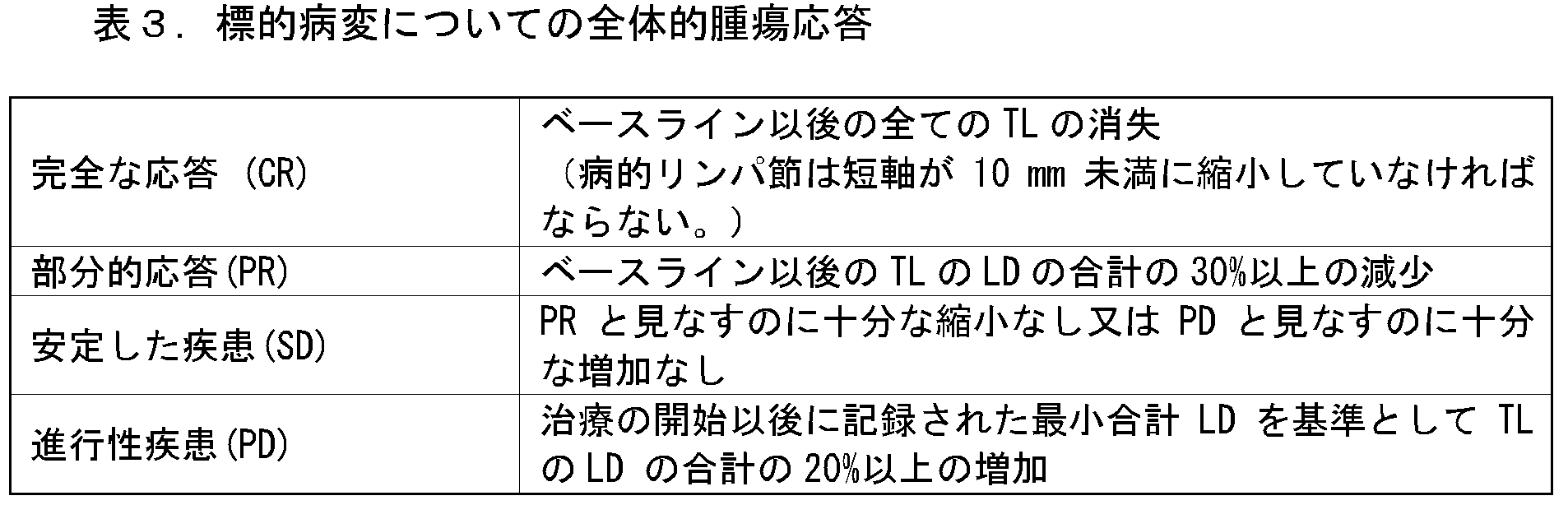
TLとして記録されない他の全ての病変(又は疾患の部位)は、非標的病変(NTL)として同定した。NTLの客観的腫瘍応答を決定するために使用されるRECIST基準を表4に要約する。 All other lesions (or sites of disease) not recorded as TL were identified as non-target lesions (NTL). The RECIST criteria used to determine objective tumor response for NTL are summarized in Table 4.

新しい病変の詳細も記録した;1つ以上の新たな病変の存在を進行として評価した。全体的応答のRECIST評価を表5に要約する。 Details of new lesions were also recorded; the presence of one or more new lesions was assessed as progression. RECIST assessment of overall response is summarized in Table 5.

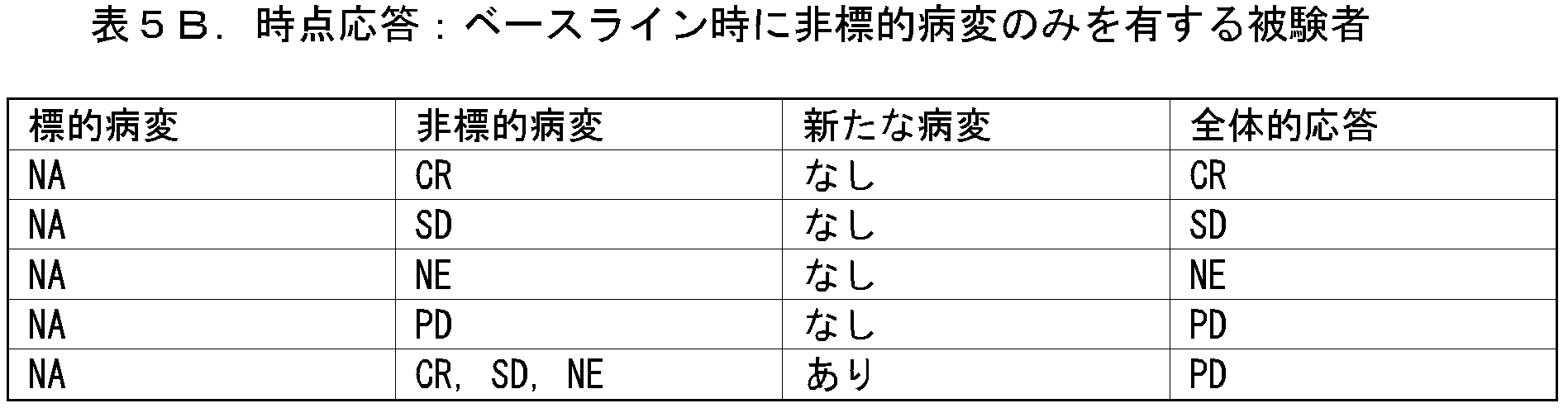


試験対象母集団:
患者の内訳:以下の患者データを要約し、募集した全ての被験者について提示した:スクリーニングされた患者、試験薬を摂取した患者、治療期間中に完了した患者及び中止された患者、追跡期間中に完了した患者及び中止された患者の数及び割合。
Study population:
Patient Disposition: The following patient data were summarized and presented for all subjects recruited: numbers and percentages of patients who were screened, who took study medication, who completed and discontinued during the treatment period, and who completed and discontinued during the follow-up period.
全ての募集患者の試験群別の、各解析集団における患者の数及び割合並びに除外理由。 Number and percentage of patients in each analysis set by study arm of all recruited patients, and reasons for exclusion.
プロトコル違反は、どのような違反がEVA集団から患者を不適格とするかを決定するために、データベースをロックする前に試験チームによって検討される。 Protocol violations will be reviewed by the study team prior to database lock to determine what violations would disqualify a patient from the EVA population.
臨床結果:陰性対照(患者番号:065)(図10):評価日は、2015年3月18日又はそれ以前に開始された。これは、OBI-822治療が28週間(訪問7)以内にいかなる腫瘍生成ももたらさないことを示した。したがって、OBI-822の安全性が確認された。 Clinical Results: Negative Control (Patient No.: 065) (Figure 10): The evaluation date was started on or before March 18, 2015. This showed that OBI-822 treatment did not result in any tumor formation within 28 weeks (Visit 7). Thus, the safety of OBI-822 was confirmed.
ステージIIIの卵巣がん(患者番号:035)(図11):評価日は、2014年4月24日又はそれ以前に開始された。患者の元の症状は、CTスキャンにより「サブセンチメートルの腸間膜リンパ節腫瘍」(病変カテゴリー:非標的腫瘍)であった。これは、OBI-822治療後、28週間(訪問7)以内に腫瘍の進行/転移がないこと(SD)を示した。したがって、OBI-822の腫瘍阻害能は28週間以内に確認される。 Stage III ovarian cancer (patient no.: 035) (Figure 11): Evaluation date began on or before April 24, 2014. The patient's original presentation was a "sub-centimeter mesenteric lymph node tumor" (lesion category: non-target tumor) by CT scan. This showed no tumor progression/metastasis (SD) within 28 weeks (visit 7) after OBI-822 treatment. Thus, the tumor inhibition ability of OBI-822 is confirmed within 28 weeks.
ステージIVのファローピウス管がん(患者番号:041)(図12):評価日は、2014年5月22日又はそれ以前に開始された。患者の元の症状は、CTスキャンにより「肺腫瘍」(病変カテゴリー:非標的腫瘍)であった。これは、OBI-822治療後、28週間(訪問7)以内に腫瘍の進行/転移がないこと(SD)を示した。したがって、OBI-822の腫瘍阻害能は28週間以内に確認される。 Stage IV Fallopian tube cancer (patient number: 041) (Figure 12): Evaluation date was initiated on or before May 22, 2014. The patient's original presentation was "lung tumor" (lesion category: non-target tumor) by CT scan, which showed no tumor progression/metastasis (SD) within 28 weeks (visit 7) after OBI-822 treatment. Thus, the tumor inhibition ability of OBI-822 is confirmed within 28 weeks.
ステージIIIの卵巣がん(患者番号:060)(図13):評価日は、2015年1月6日又はそれ以前に開始された。患者の元の症状は、CTスキャンにより「腹膜腫瘍」(病変カテゴリー:非標的腫瘍)であった。これは、OBI-822治療後、28週間(訪問7)以内に腫瘍の進行/転移がないこと(SD)を示した。したがって、OBI-822の腫瘍阻害能は28週間以内に確認される。 Stage III ovarian cancer (patient no.: 060) (Figure 13): Evaluation date was started on or before January 6, 2015. The patient's original presentation was "peritoneal tumor" (lesion category: non-target tumor) by CT scan, which showed no tumor progression/metastasis (SD) within 28 weeks (visit 7) after OBI-822 treatment. Thus, the tumor inhibition ability of OBI-822 is confirmed within 28 weeks.
[実施例3]
OBI-822とOBI-821の混合の指示
保存条件:OBI-822及びそのプラセボであるPBSのバイアルは、2~8℃で保存する。OBI-821及びそのプラセボであるPBSのバイアルは、-15~-25℃で保存する。
[Example 3]
Instructions for mixing OBI-822 and OBI-821 Storage Conditions: OBI-822 and its placebo PBS vials are stored at 2-8° C. OBI-821 and its placebo PBS vials are stored at -15 to -25° C.
試験群:
A群:能動的治療群;注射あたりの投薬量:OBI-822(30μgのグロボHに相当)/100μgのOBI-821。総最終注入量:0.8mL。
Study Group:
Group A: active treatment group; dosage per injection: OBI-822 (equivalent to 30 μg Globo H)/100 μg OBI-821. Total final injection volume: 0.8 mL.
B群:対照群;注入あたりの投薬量:PBS。総最終注入量:0.8mL。 Group B: control group; dosage per injection: PBS. Total final injection volume: 0.8 mL.
治験薬:
バイアル1a(PBS:OBI-821対照試験品)充填容量-0.5mL。含量:10mMリン酸ナトリウム、150mM NaCl、pH6.8;
バイアル1b(OBI-821)充填容量-0.5mL。含量:10mMリン酸ナトリウム、150mM NaCl中250μg/mL OBI-821、pH6.8;
バイアル2a(PBS:OBI-822対照試験品)充填容量-0.75mL。含量:100mMリン酸ナトリウム、150mM NaCl、pH7.2;
バイアル2b(OBI-822)充填容量-0.75mL。含量:100mMリン酸ナトリウム、150mM NaCl中75μgのグロボH/mL OBI-822に相当、pH7.2。
Investigational Drug:
Vial 1a (PBS: OBI-821 control) Fill volume - 0.5 mL. Contents: 10 mM sodium phosphate, 150 mM NaCl, pH 6.8;
Vial 1b (OBI-821) Fill Volume - 0.5 mL. Content: 250 μg/mL OBI-821 in 10 mM sodium phosphate, 150 mM NaCl, pH 6.8;
Vial 2a (PBS: OBI-822 control) Fill volume - 0.75 mL. Contents: 100 mM sodium phosphate, 150 mM NaCl, pH 7.2;
Vial 2b (OBI-822) Fill Volume - 0.75 mL. Content: Equivalent to 75 μg Globo H/mL OBI-822 in 100 mM Sodium Phosphate, 150 mM NaCl, pH 7.2.
OBI-822とOBI-821の混合の指示:
治療の時点で、シリンジを用いてバイアル2a(PBSのみ)0.5mLを取り出し、バイアル1a(PBSのみ)に入れるか、又はバイアル2b(PBS中のOBI-822)0.5mLを取り出し、バイアル1b(PBS中のOBI-821)に入れる。バイアル(バイアル1a又はバイアル1bのいずれか)の内容物を、バイアルを穏やかに4~5回ひっくり返すことによって静かに混合する。バイアルを強く振とうしてはならない。この時点で、このバイアルはプラセボ(PBSのみ)又は治療薬(OBI-822+OBI-821)のいずれかを含んでおり、注射の準備ができている。次いで、被験者への注射のためにこのバイアルから0.8mLを取り出す。各試験群の最終投与量を表6に要約する。
Instructions for mixing OBI-822 and OBI-821:
At the time of treatment, use a syringe to remove 0.5 mL of vial 2a (PBS only) and place into vial 1a (PBS only) or remove 0.5 mL of vial 2b (OBI-822 in PBS) and place into vial 1b (OBI-821 in PBS). The contents of the vial (either vial 1a or vial 1b) are gently mixed by gently inverting the vial 4-5 times. Do not vigorously shake the vial. At this point, the vial contains either placebo (PBS only) or treatment (OBI-822 + OBI-821) and is ready for injection. 0.8 mL is then removed from this vial for injection into the subject. The final doses for each study group are summarized in Table 6.

組み合わせたOBI-822とOBI-821の安定性は、室温で再構成してから10時間まで安定である。組み合わせた製品の投与は、潜在的な微生物増殖を最小限に抑えるために再構成から2時間以内に行うべきである。再構成から2時間以内に投与することが不可能な場合は、施設の薬局の標準操作手順に従って混合した製品を破壊し、治験薬管理記録に記録すべきである。図14は、治験薬の混合手順を示す。 The stability of the combined OBI-822 and OBI-821 is stable for up to 10 hours after reconstitution at room temperature. Administration of the combined product should occur within 2 hours of reconstitution to minimize potential microbial growth. If administration within 2 hours of reconstitution is not possible, the combined product should be destroyed according to the facility's pharmacy standard operating procedures and documented in the investigational drug management record. Figure 14 shows the investigational drug mixing procedure.
[実施例4]
許可される併用薬及び禁止される併用薬
許可される併用薬:
[Example 4]
Permitted and Prohibited Concomitant Medications Permitted concomitant medications:
アヘン製剤:痛みの管理のために使用してもよく、便秘の予防的治療も許可される。 Opiates: May be used for pain management and are permitted for prophylactic treatment of constipation.
GCSF:医師が必要と考える場合は許可される。 GCSF: Allowed if doctor deems it necessary.
ビスホスホネート。 Bisphosphonates.
ホルモン療法(ホルモン療法使用者として層別化されている被験者の場合)。 Hormone therapy (for subjects stratified as hormone therapy users).
使用される場合、ホルモン療法の選択される形態、用量又は用法は、毒性の不耐性に起因するのでない限り、一貫している必要があり、すなわち、治療の切り替え、さらなる療法の追加又は用量の増加があってはならない。全ての種類のホルモン療法をこの試験で使用することができ、一般的に使用されるホルモン療法を以下に列挙する。 If used, the selected form, dose or administration of hormone therapy should be consistent, i.e., there should be no switching of therapy, addition of additional therapy or increase in dose, unless due to intolerance of toxicity. All types of hormone therapy can be used in this study, and commonly used hormone therapies are listed below.
エストロゲン阻害剤(例えばタモキシフェン、Fareston)。 Estrogen inhibitors (e.g. tamoxifen, Fareston).
アロマターゼ阻害剤(例えばアナストロゾール[Arimidex]、エキセメスタン[Aromasin]及びレトロゾール[Femara])。 Aromatase inhibitors (e.g. anastrozole [Arimidex], exemestane [Aromasin] and letrozole [Femara]).
下垂体下方調節剤(例えばゴセレリン[Zoladex]、ロイプロリド[Lupron]-これらはLHRH類似体とも呼ばれる。 Pituitary downregulators (e.g., goserelin [Zoladex], leuprolide [Lupron] - these are also called LHRH analogs.
Novaldex(R)(タモキシフェン選択的エストロゲン受容体調節剤、SERM)。 Novaldex(R) (tamoxifen selective estrogen receptor modulator, SERM).
Evista(R)(ラロキシフェン、別のSERM)。 Evista(R) (raloxifene, another SERM).
Faslodex(R)(フルベストラント、エストロゲン受容体下方調節剤)。 Faslodex(R) (fulvestrant, an estrogen receptor down-modulator).
抗凝固薬(レピルジン[Refludan])。 Anticoagulant (Lepirudin).
酵素(ラスブリカーゼ[Elitek])。 Enzyme (rasburicase [Elitek]).
造血成長因子。 Hematopoietic growth factors.
投与方法は、好ましくは、表7に列挙される併用薬の不在下で実施される。 The administration method is preferably performed in the absence of concomitant medications listed in Table 7.

禁止される併用薬(例えばシクロスポリン、ラパマイシン、タクロリムス、リツキシマブ等)。 Prohibited concomitant medications (e.g. cyclosporine, rapamycin, tacrolimus, rituximab, etc.).
東部腫瘍学共同研究グループ(ECOG)パフォーマンス。 Eastern Cooperative Oncology Group (ECOG) Performance.
これらの尺度及び基準は、被験者の疾患がどのように進行しているかを評価し、疾患が被験者の日々の生活能力にどのように影響するかを評価し、適切な治療及び予後を決定するために医師及び研究者によって使用される。それらは、医療従事者がアクセスするために表8に含まれる。 These scales and criteria are used by physicians and researchers to assess how a subject's disease is progressing, to evaluate how the disease is affecting the subject's ability to live their daily lives, and to determine appropriate treatment and prognosis. They are included in Table 8 for access by health care professionals.

本発明の特定の態様を説明し、例示したが、そのような態様は、本発明の単なる例示であり、添付の特許請求の範囲に従って解釈される本発明を限定するものではないと考えられるべきである。個々の刊行物又は特許出願が、全ての目的のためにその全体が参照により本明細書に組み込まれることが具体的及び個別に示されているかのように、本明細書で引用される全ての刊行物及び特許出願は、あらゆる目的のためにその全体が参照により本明細書に組み込まれる。上記発明を、理解の明瞭さのために例示及び実施例によってある程度詳細に説明したが、特定の変更及び修正が添付の特許請求の範囲の精神又は範囲から逸脱することなく行われ得ることは、本発明の教示に照らして当業者には容易に明らかであろう。 Although certain aspects of the present invention have been described and illustrated, such aspects should be considered as merely illustrative of the present invention and not limiting of the present invention as interpreted in accordance with the appended claims. All publications and patent applications cited herein are incorporated by reference in their entirety for all purposes as if each individual publication or patent application was specifically and individually indicated to be incorporated by reference in its entirety for all purposes. Although the above invention has been described in some detail by way of illustration and example for clarity of understanding, it will be readily apparent to those skilled in the art in light of the teachings of the present invention that certain changes and modifications can be made without departing from the spirit or scope of the appended claims.
Claims (70)
(a)腫瘍を死滅させるための抗体依存性細胞傷害(ADCC)及び補体依存性細胞傷害(CDC)の誘導;
(b)抗体依存性細胞傷害(ADCC)及び補体依存性細胞傷害(CDC)媒介腫瘍細胞死滅を誘発するための抗グロボシリーズ抗原IgM/IgG免疫応答の誘導;
(c)腫瘍細胞からのグロボシリーズ抗原-セラミドを捕捉し、トランスリン関連因子X(TRAX)依存性血管新生をブロックするための抗グロボシリーズ抗原抗体の誘導;
(d)グロボシリーズ抗原-セラミド誘導Notch 1依存性免疫抑制をブロックし、それによってT細胞増殖及びサイトカイン産生を増強する抗グロボシリーズ抗原抗体の誘導;
(e)アポトーシスをもたらす抗グロボシリーズ抗原抗体の誘導;
(f)グロボシリーズ抗原誘導性血管新生の阻害;又は
(g)OBI-822ワクチン接種がアポトーシスを誘導すること
をさらに含む、請求項40に記載の方法。 The modulation of globo-series antigen interactions includes one or more of the following:
(a) induction of antibody-dependent cellular cytotoxicity (ADCC) and complement-dependent cytotoxicity (CDC) to kill tumors;
(b) induction of anti-globoseries antigen IgM/IgG immune responses to induce antibody-dependent cellular cytotoxicity (ADCC) and complement-dependent cytotoxicity (CDC)-mediated tumor cell killing;
(c) induction of anti-globoseries antigen antibodies to capture globoseries antigen-ceramide from tumor cells and block transaminase-associated factor X (TRAX)-dependent angiogenesis;
(d) induction of anti-globoseries antigen antibodies that block globoseries antigen-ceramide-induced Notch 1-dependent immunosuppression, thereby enhancing T cell proliferation and cytokine production;
(e) induction of anti-globo-series antigen antibodies leading to apoptosis;
41. The method of claim 40, further comprising: (f) inhibiting globo-series antigen-induced angiogenesis; or (g) OBI-822 vaccination induces apoptosis.
(a)ワクチンの2回以上(例えば3回、4回、5回、6回、7回、8回、9回、10回、11回又は12回以上)の投与;
(b)2回の連続する投与の間の時間間隔及び/若しくは投与量の調整;
(c)投与経路の調整及び/若しくは投与の注射部位の変更;又は
(d)各々の投与が抗体免疫応答を増加させる及び/若しくは抗原-抗体結合親和性を増加させる、上記の任意の組み合わせ。 1. A method of improving OBI-822 vaccine-induced immune responsiveness in a subject in need thereof, comprising administering an immunogenically effective amount of a pharma- ceutically acceptable excipient comprising OBI-822 and one or more selected from the following:
(a) two or more (e.g., three, four, five, six, seven, eight, nine, ten, eleven or twelve or more) administrations of the vaccine;
(b) adjusting the time interval and/or dosage between two successive administrations;
(c) adjusting the route of administration and/or changing the injection site of administration; or (d) any combination of the above, each of which increases the antibody immune response and/or increases antigen-antibody binding affinity.
(a)前記患者に有効用量のグロボシリーズ抗原ワクチンを投与すること;
(b)前記患者の免疫応答を評価すること;
(c)各患者におけるグロボシリーズ抗原の発現を測定すること;並びに
(d)免疫応答の指標及びグロボシリーズ抗原の発現に基づいて患者の適合性を分類し、ここで、前記指標が、回復の良好な予後を有する前記患者を示すこと
を含む、方法。 1. A method for identifying a patient in need of cancer treatment who is suitable for cancer treatment, comprising:
(a) administering to said patient an effective dose of a globo-series antigen vaccine;
(b) assessing the immune response of said patient;
(c) determining the expression of globo-series antigens in each patient; and (d) classifying the suitability of the patient based on the index of immune response and the expression of globo-series antigens, wherein the index indicates the patient having a good prognosis of recovery.
(a)がんを有すると診断された患者を同定すること;
(b)請求項1に記載の治療を受けた後の前記患者の適合性を測定することによって免疫応答のレベルを決定すること;
(c)請求項57で得られたデータを分析すること
を含む、方法。 1. A method for determining a prognosis of a cancer treatment and/or a drug response in a patient in need of a cancer treatment, comprising:
(a) identifying a patient diagnosed with cancer;
(b) determining the level of immune response by measuring the fitness of the patient after undergoing the treatment of claim 1;
(c) analyzing the data obtained according to claim 57.
Applications Claiming Priority (11)
| Application Number | Priority Date | Filing Date | Title |
|---|---|---|---|
| US201662326623P | 2016-04-22 | 2016-04-22 | |
| US62/326,623 | 2016-04-22 | ||
| US201662343530P | 2016-05-31 | 2016-05-31 | |
| US62/343,530 | 2016-05-31 | ||
| US201662345755P | 2016-06-04 | 2016-06-04 | |
| US62/345,755 | 2016-06-04 | ||
| US201662381875P | 2016-08-31 | 2016-08-31 | |
| US62/381,875 | 2016-08-31 | ||
| JP2018555276A JP7544465B2 (en) | 2016-04-22 | 2017-04-24 | Cancer immunotherapy by immune activation or immune regulation via globo-series antigens |
| PCT/US2017/029138 WO2017185089A2 (en) | 2016-04-22 | 2017-04-24 | Cancer immunotherapy by immune activation or immune modulation via globo series antigens |
| JP2022074266A JP2022115924A (en) | 2016-04-22 | 2022-04-28 | Cancer immunotherapy by immunostimulation or immunoregulation mediated by antigens of the Globo series |
Related Parent Applications (1)
| Application Number | Title | Priority Date | Filing Date |
|---|---|---|---|
| JP2022074266A Division JP2022115924A (en) | 2016-04-22 | 2022-04-28 | Cancer immunotherapy by immunostimulation or immunoregulation mediated by antigens of the Globo series |
Publications (1)
| Publication Number | Publication Date |
|---|---|
| JP2024123105A true JP2024123105A (en) | 2024-09-10 |
Family
ID=60088869
Family Applications (3)
| Application Number | Title | Priority Date | Filing Date |
|---|---|---|---|
| JP2018555276A Active JP7544465B2 (en) | 2016-04-22 | 2017-04-24 | Cancer immunotherapy by immune activation or immune regulation via globo-series antigens |
| JP2022074266A Pending JP2022115924A (en) | 2016-04-22 | 2022-04-28 | Cancer immunotherapy by immunostimulation or immunoregulation mediated by antigens of the Globo series |
| JP2024097870A Pending JP2024123105A (en) | 2016-04-22 | 2024-06-18 | Cancer immunotherapy by immune activation or immune regulation via globo-series antigens |
Family Applications Before (2)
| Application Number | Title | Priority Date | Filing Date |
|---|---|---|---|
| JP2018555276A Active JP7544465B2 (en) | 2016-04-22 | 2017-04-24 | Cancer immunotherapy by immune activation or immune regulation via globo-series antigens |
| JP2022074266A Pending JP2022115924A (en) | 2016-04-22 | 2022-04-28 | Cancer immunotherapy by immunostimulation or immunoregulation mediated by antigens of the Globo series |
Country Status (17)
| Country | Link |
|---|---|
| US (1) | US11583577B2 (en) |
| EP (1) | EP3445395A4 (en) |
| JP (3) | JP7544465B2 (en) |
| KR (3) | KR20250048399A (en) |
| CN (1) | CN109379889A (en) |
| AU (1) | AU2017252128B2 (en) |
| BR (1) | BR112018071683A2 (en) |
| CA (1) | CA3021548A1 (en) |
| CL (1) | CL2018002994A1 (en) |
| IL (1) | IL262296B2 (en) |
| MY (1) | MY200886A (en) |
| PH (1) | PH12018502250A1 (en) |
| RU (1) | RU2018140976A (en) |
| SG (1) | SG11201809024UA (en) |
| TW (1) | TWI697333B (en) |
| WO (1) | WO2017185089A2 (en) |
| ZA (1) | ZA201806919B (en) |
Families Citing this family (16)
| Publication number | Priority date | Publication date | Assignee | Title |
|---|---|---|---|---|
| CN105764921B (en) | 2013-09-17 | 2020-06-30 | 台湾浩鼎生技股份有限公司 | Carbohydrate vaccine compositions for inducing immune response and use thereof for treating cancer |
| HK1256912A1 (en) | 2015-09-04 | 2019-10-04 | 台湾浩鼎生技股份有限公司 | Glycan arrays and method of use |
| CN109311995A (en) | 2016-03-29 | 2019-02-05 | 台湾浩鼎生技股份有限公司 | Antibodies, pharmaceutical compositions and methods |
| US10980894B2 (en) | 2016-03-29 | 2021-04-20 | Obi Pharma, Inc. | Antibodies, pharmaceutical compositions and methods |
| RU2018140976A (en) | 2016-04-22 | 2020-05-22 | Оби Фарма, Инк. | CANCER IMMUNOTHERAPY BY IMMUNE ACTIVATION OR IMMUNE MODULATION THROUGH GLOBO SERIES ANTIGENS |
| KR20230117482A (en) | 2016-07-27 | 2023-08-08 | 오비아이 파머 인코퍼레이티드 | Immunogenic/therapeutic glycan compositions and uses thereof |
| KR102528998B1 (en) | 2016-07-29 | 2023-05-03 | 오비아이 파머 인코퍼레이티드 | Human Antibodies, Pharmaceutical Compositions and Methods |
| CN110290800A (en) | 2016-11-21 | 2019-09-27 | 台湾浩鼎生技股份有限公司 | Conjugated biomolecules, pharmaceutical compositions and methods |
| EP3775894B1 (en) * | 2018-05-11 | 2024-04-24 | OBI Pharma, Inc. | Method for predicting human immune response |
| WO2020006176A1 (en) | 2018-06-27 | 2020-01-02 | Obi Pharma, Inc. | Glycosynthase variants for glycoprotein engineering and methods of use |
| TWI735210B (en) * | 2019-04-26 | 2021-08-01 | 中國醫藥大學 | Use of adam9 inhibitor as immune modulator |
| CN111053895B (en) * | 2019-12-26 | 2023-08-29 | 深圳大学 | Antigen and its preparation method and application |
| EP4188431A4 (en) * | 2020-07-31 | 2024-07-24 | The Board Of Trustees Of The Leland Stanford Junior University | COMBINATION THERAPY AGAINST CANCER |
| US20240139301A1 (en) * | 2020-11-19 | 2024-05-02 | Obi Pharma, Inc. | Active cancer immunotherapy by immune modulation via globo series antigens |
| CN114259559B (en) * | 2021-12-28 | 2024-03-19 | 天津科技大学 | Synthetic tumor vaccine containing alpha-GalCer endogenous adjuvant |
| CN118903397A (en) * | 2024-10-12 | 2024-11-08 | 成都迈科康生物科技有限公司 | Application of globoH hexose, linker compound, protein conjugate and immunogenic composition in treating or inhibiting epithelial tumor |
Family Cites Families (161)
| Publication number | Priority date | Publication date | Assignee | Title |
|---|---|---|---|---|
| US3773919A (en) | 1969-10-23 | 1973-11-20 | Du Pont | Polylactide-drug mixtures |
| CU22545A1 (en) | 1994-11-18 | 1999-03-31 | Centro Inmunologia Molecular | OBTAINING A CHEMICAL AND HUMANIZED ANTIBODY AGAINST THE RECEPTOR OF THE EPIDERMAL GROWTH FACTOR FOR DIAGNOSTIC AND THERAPEUTIC USE |
| AU519567B2 (en) | 1977-07-13 | 1981-12-10 | Akzo Nv | Psychopharmacological penta and hexa-peptides |
| USRE30985E (en) | 1978-01-01 | 1982-06-29 | Serum-free cell culture media | |
| US4419446A (en) | 1980-12-31 | 1983-12-06 | The United States Of America As Represented By The Department Of Health And Human Services | Recombinant DNA process utilizing a papilloma virus DNA as a vector |
| US4522811A (en) | 1982-07-08 | 1985-06-11 | Syntex (U.S.A.) Inc. | Serial injection of muramyldipeptides and liposomes enhances the anti-infective activity of muramyldipeptides |
| US4601978A (en) | 1982-11-24 | 1986-07-22 | The Regents Of The University Of California | Mammalian metallothionein promoter system |
| US4560655A (en) | 1982-12-16 | 1985-12-24 | Immunex Corporation | Serum-free cell culture medium and process for making same |
| US4657866A (en) | 1982-12-21 | 1987-04-14 | Sudhir Kumar | Serum-free, synthetic, completely chemically defined tissue culture media |
| US4816567A (en) | 1983-04-08 | 1989-03-28 | Genentech, Inc. | Recombinant immunoglobin preparations |
| US4767704A (en) | 1983-10-07 | 1988-08-30 | Columbia University In The City Of New York | Protein-free culture medium |
| US4943533A (en) | 1984-03-01 | 1990-07-24 | The Regents Of The University Of California | Hybrid cell lines that produce monoclonal antibodies to epidermal growth factor receptor |
| US4965199A (en) | 1984-04-20 | 1990-10-23 | Genentech, Inc. | Preparation of functional human factor VIII in mammalian cells using methotrexate based selection |
| US4601903A (en) | 1985-05-01 | 1986-07-22 | The United States Of America As Represented By The Department Of Health And Human Services | Vaccine against Neisseria meningitidis Group B serotype 2 invasive disease |
| GB8516415D0 (en) | 1985-06-28 | 1985-07-31 | Celltech Ltd | Culture of animal cells |
| US4676980A (en) | 1985-09-23 | 1987-06-30 | The United States Of America As Represented By The Secretary Of The Department Of Health And Human Services | Target specific cross-linked heteroantibodies |
| US4927762A (en) | 1986-04-01 | 1990-05-22 | Cell Enterprises, Inc. | Cell culture medium with antioxidant |
| US6024983A (en) | 1986-10-24 | 2000-02-15 | Southern Research Institute | Composition for delivering bioactive agents for immune response and its preparation |
| IL85035A0 (en) | 1987-01-08 | 1988-06-30 | Int Genetic Eng | Polynucleotide molecule,a chimeric antibody with specificity for human b cell surface antigen,a process for the preparation and methods utilizing the same |
| US4849222A (en) | 1987-03-24 | 1989-07-18 | The Procter & Gamble Company | Mixtures for treating hypercholesterolemia |
| US5057540A (en) | 1987-05-29 | 1991-10-15 | Cambridge Biotech Corporation | Saponin adjuvant |
| US4975278A (en) | 1988-02-26 | 1990-12-04 | Bristol-Myers Company | Antibody-enzyme conjugates in combination with prodrugs for the delivery of cytotoxic agents to tumor cells |
| US5004697A (en) | 1987-08-17 | 1991-04-02 | Univ. Of Ca | Cationized antibodies for delivery through the blood-brain barrier |
| JP2670680B2 (en) | 1988-02-24 | 1997-10-29 | 株式会社ビーエムジー | Polylactic acid microspheres containing physiologically active substance and method for producing the same |
| AU632065B2 (en) | 1988-09-23 | 1992-12-17 | Novartis Vaccines And Diagnostics, Inc. | Cell culture medium for enhanced cell growth, culture longevity and product expression |
| NZ230747A (en) | 1988-09-30 | 1992-05-26 | Bror Morein | Immunomodulating matrix comprising a complex of at least one lipid and at least one saponin; certain glycosylated triterpenoid saponins derived from quillaja saponaria molina |
| GB8823869D0 (en) | 1988-10-12 | 1988-11-16 | Medical Res Council | Production of antibodies |
| DE3920358A1 (en) | 1989-06-22 | 1991-01-17 | Behringwerke Ag | BISPECIFIC AND OLIGO-SPECIFIC, MONO- AND OLIGOVALENT ANTI-BODY CONSTRUCTS, THEIR PRODUCTION AND USE |
| ES2096590T3 (en) | 1989-06-29 | 1997-03-16 | Medarex Inc | BI-SPECIFIC REAGENTS FOR AIDS THERAPY. |
| WO1991003489A1 (en) | 1989-09-08 | 1991-03-21 | The Johns Hopkins University | Structural alterations of the egf receptor gene in human gliomas |
| DK0463151T3 (en) | 1990-01-12 | 1996-07-01 | Cell Genesys Inc | Generation of xenogenic antibodies |
| US5061620A (en) | 1990-03-30 | 1991-10-29 | Systemix, Inc. | Human hematopoietic stem cell |
| US5268164A (en) | 1990-04-23 | 1993-12-07 | Alkermes, Inc. | Increasing blood-brain barrier permeability with permeabilizer peptides |
| US5112596A (en) | 1990-04-23 | 1992-05-12 | Alkermes, Inc. | Method for increasing blood-brain barrier permeability by administering a bradykinin agonist of blood-brain barrier permeability |
| US5427908A (en) | 1990-05-01 | 1995-06-27 | Affymax Technologies N.V. | Recombinant library screening methods |
| ATE204902T1 (en) | 1990-06-29 | 2001-09-15 | Large Scale Biology Corp | MELANIN PRODUCTION BY TRANSFORMED MICROORGANISMS |
| JP2938569B2 (en) | 1990-08-29 | 1999-08-23 | ジェンファーム インターナショナル,インコーポレイティド | Method for producing xenogeneic immunoglobulin and transgenic mouse |
| US5625126A (en) | 1990-08-29 | 1997-04-29 | Genpharm International, Inc. | Transgenic non-human animals for producing heterologous antibodies |
| US5633425A (en) | 1990-08-29 | 1997-05-27 | Genpharm International, Inc. | Transgenic non-human animals capable of producing heterologous antibodies |
| US5661016A (en) | 1990-08-29 | 1997-08-26 | Genpharm International Inc. | Transgenic non-human animals capable of producing heterologous antibodies of various isotypes |
| US5545806A (en) | 1990-08-29 | 1996-08-13 | Genpharm International, Inc. | Ransgenic non-human animals for producing heterologous antibodies |
| US5122469A (en) | 1990-10-03 | 1992-06-16 | Genentech, Inc. | Method for culturing Chinese hamster ovary cells to improve production of recombinant proteins |
| US5508192A (en) | 1990-11-09 | 1996-04-16 | Board Of Regents, The University Of Texas System | Bacterial host strains for producing proteolytically sensitive polypeptides |
| US5264365A (en) | 1990-11-09 | 1993-11-23 | Board Of Regents, The University Of Texas System | Protease-deficient bacterial strains for production of proteolytically sensitive polypeptides |
| DE69129154T2 (en) | 1990-12-03 | 1998-08-20 | Genentech, Inc., South San Francisco, Calif. | METHOD FOR ENRICHING PROTEIN VARIANTS WITH CHANGED BINDING PROPERTIES |
| US5571894A (en) | 1991-02-05 | 1996-11-05 | Ciba-Geigy Corporation | Recombinant antibodies specific for a growth factor receptor |
| WO1992019971A1 (en) | 1991-04-30 | 1992-11-12 | Alkermes, Inc. | Cationized antibodies against intracellular proteins |
| JP4124480B2 (en) | 1991-06-14 | 2008-07-23 | ジェネンテック・インコーポレーテッド | Immunoglobulin variants |
| GB9114948D0 (en) | 1991-07-11 | 1991-08-28 | Pfizer Ltd | Process for preparing sertraline intermediates |
| WO1993006217A1 (en) | 1991-09-19 | 1993-04-01 | Genentech, Inc. | EXPRESSION IN E. COLI OF ANTIBODY FRAGMENTS HAVING AT LEAST A CYSTEINE PRESENT AS A FREE THIOL, USE FOR THE PRODUCTION OF BIFUNCTIONAL F(ab')2 ANTIBODIES |
| WO1993006213A1 (en) | 1991-09-23 | 1993-04-01 | Medical Research Council | Production of chimeric antibodies - a combinatorial approach |
| ES2136092T3 (en) | 1991-09-23 | 1999-11-16 | Medical Res Council | PROCEDURES FOR THE PRODUCTION OF HUMANIZED ANTIBODIES. |
| FI941572L (en) | 1991-10-07 | 1994-05-27 | Oncologix Inc | Combination and method of use of anti-erbB-2 monoclonal antibodies |
| US5288502A (en) | 1991-10-16 | 1994-02-22 | The University Of Texas System | Preparation and uses of multi-phase microspheres |
| WO1993008829A1 (en) | 1991-11-04 | 1993-05-13 | The Regents Of The University Of California | Compositions that mediate killing of hiv-infected cells |
| US5667988A (en) | 1992-01-27 | 1997-09-16 | The Scripps Research Institute | Methods for producing antibody libraries using universal or randomized immunoglobulin light chains |
| ATE503496T1 (en) | 1992-02-06 | 2011-04-15 | Novartis Vaccines & Diagnostic | BIOSYNTHETIC BINDING PROTEIN FOR TUMOR MARKERS |
| US5733743A (en) | 1992-03-24 | 1998-03-31 | Cambridge Antibody Technology Limited | Methods for producing members of specific binding pairs |
| CA2137558A1 (en) | 1992-07-17 | 1994-02-03 | Wayne A. Marasco | Method of intracellular binding of target molecules |
| DE69328430T2 (en) | 1992-07-27 | 2001-01-25 | The Government Of The United States Of America As Represented By The Secretary Of National Institute Of Health, Office Of Technology Transfer | TARGETED LIPOSOME TO THE BLOOD BRAIN CABINET |
| JPH08500017A (en) | 1992-08-17 | 1996-01-09 | ジェネンテク,インコーポレイテッド | Bispecific immune adhesin |
| ATE139900T1 (en) | 1992-11-13 | 1996-07-15 | Idec Pharma Corp | THERAPEUTIC USE OF CHIMERIC AND LABELED ANTIBODIES AGAINST HUMAN B LYMPHOCYTE RESTRICTED DIFFERENTIATION ANTIGEN FOR THE TREATMENT OF B CELL LYMPHOMA |
| WO1995011010A1 (en) | 1993-10-22 | 1995-04-27 | Genentech, Inc. | Methods and compositions for microencapsulation of antigens for use as vaccines |
| US6544952B1 (en) | 1994-03-15 | 2003-04-08 | Sloan-Kettering Institute For Cancer Research | Synthesis of glycoconjugates of the globo-H epitope and uses thereof |
| US5804396A (en) | 1994-10-12 | 1998-09-08 | Sugen, Inc. | Assay for agents active in proliferative disorders |
| AUPM873294A0 (en) | 1994-10-12 | 1994-11-03 | Csl Limited | Saponin preparations and use thereof in iscoms |
| US5840523A (en) | 1995-03-01 | 1998-11-24 | Genetech, Inc. | Methods and compositions for secretion of heterologous polypeptides |
| EP2163546B1 (en) | 1995-03-30 | 2016-06-01 | Pfizer Products Inc. | Quinazoline derivatives |
| US5641870A (en) | 1995-04-20 | 1997-06-24 | Genentech, Inc. | Low pH hydrophobic interaction chromatography for antibody purification |
| US5869046A (en) | 1995-04-14 | 1999-02-09 | Genentech, Inc. | Altered polypeptides with increased half-life |
| DE69637481T2 (en) | 1995-04-27 | 2009-04-09 | Amgen Fremont Inc. | Human antibodies to IL-8 derived from immunized Xenomae |
| GB9508538D0 (en) | 1995-04-27 | 1995-06-14 | Zeneca Ltd | Quinazoline derivatives |
| GB9508565D0 (en) | 1995-04-27 | 1995-06-14 | Zeneca Ltd | Quiazoline derivative |
| AU2466895A (en) | 1995-04-28 | 1996-11-18 | Abgenix, Inc. | Human antibodies derived from immunized xenomice |
| JPH11507535A (en) | 1995-06-07 | 1999-07-06 | イムクローン システムズ インコーポレイテッド | Antibodies and antibody fragments that suppress tumor growth |
| US6265150B1 (en) | 1995-06-07 | 2001-07-24 | Becton Dickinson & Company | Phage antibodies |
| US6027888A (en) | 1996-04-05 | 2000-02-22 | Board Of Regents, The University Of Texas System | Methods for producing soluble, biologically-active disulfide-bond containing eukaryotic proteins in bacterial cells |
| DE69710712T3 (en) | 1996-04-12 | 2010-12-23 | Warner-Lambert Co. Llc | REVERSIBLE INHIBITORS OF TYROSINE KINASEN |
| US6231859B1 (en) | 1996-12-02 | 2001-05-15 | Aquila Biopharmaceuticals, Inc. | Saponin adjuvant compositions |
| CA2273194C (en) | 1996-12-03 | 2011-02-01 | Abgenix, Inc. | Transgenic mammals having human ig loci including plural vh and vk regions and antibodies produced therefrom |
| AUPO517897A0 (en) | 1997-02-19 | 1997-04-11 | Csl Limited | Chelating immunostimulating complexes |
| UA73073C2 (en) | 1997-04-03 | 2005-06-15 | Уайт Холдінгз Корпорейшн | Substituted 3-cyan chinolines |
| US6083715A (en) | 1997-06-09 | 2000-07-04 | Board Of Regents, The University Of Texas System | Methods for producing heterologous disulfide bond-containing polypeptides in bacterial cells |
| ZA986732B (en) | 1997-07-29 | 1999-02-02 | Warner Lambert Co | Irreversible inhibitiors of tyrosine kinases |
| ZA986729B (en) | 1997-07-29 | 1999-02-02 | Warner Lambert Co | Irreversible inhibitors of tyrosine kinases |
| TW436485B (en) | 1997-08-01 | 2001-05-28 | American Cyanamid Co | Substituted quinazoline derivatives |
| US7018637B2 (en) | 1998-02-23 | 2006-03-28 | Aventis Pasteur, Inc | Multi-oligosaccharide glycoconjugate bacterial meningitis vaccines |
| AUPP807399A0 (en) | 1999-01-08 | 1999-02-04 | Csl Limited | Improved immunogenic lhrh composition and methods relating thereto |
| NZ513935A (en) | 1999-02-17 | 2004-02-27 | Csl Ltd | Immunogenic complexes and methods relating thereto |
| JP2002537562A (en) | 1999-02-17 | 2002-11-05 | グリコマインズ リミテッド | Combinatorial glycoconjugate library and methods for its production and use |
| US7854934B2 (en) | 1999-08-20 | 2010-12-21 | Sloan-Kettering Institute For Cancer Research | Glycoconjugates, glycoamino acids, intermediates thereto, and uses thereof |
| US7824687B2 (en) | 1999-08-20 | 2010-11-02 | Sloan-Kettering Institute For Cancer Research | Clustered multi-antigenic carbohydrate constructs, methods for their preparation, and uses thereof |
| US6514221B2 (en) | 2000-07-27 | 2003-02-04 | Brigham And Women's Hospital, Inc. | Blood-brain barrier opening |
| US20020065259A1 (en) | 2000-08-30 | 2002-05-30 | Schatzberg Alan F. | Glucocorticoid blocking agents for increasing blood-brain barrier permeability |
| US7034036B2 (en) | 2000-10-30 | 2006-04-25 | Pain Therapeutics, Inc. | Inhibitors of ABC drug transporters at the blood-brain barrier |
| US20030083299A1 (en) | 2000-11-04 | 2003-05-01 | Ferguson Ian A. | Non-invasive delivery of polypeptides through the blood-brain barrier |
| US20040018194A1 (en) | 2000-11-28 | 2004-01-29 | Francisco Joseph A. | Recombinant anti-CD30 antibodies and uses thereof |
| US20030104402A1 (en) | 2001-01-23 | 2003-06-05 | University Of Rochester | Methods of producing or identifying intrabodies in eukaryotic cells |
| DE10121982B4 (en) | 2001-05-05 | 2008-01-24 | Lts Lohmann Therapie-Systeme Ag | Nanoparticles of protein with coupled apolipoprotein E to overcome the blood-brain barrier and process for their preparation |
| ATE445838T1 (en) | 2001-07-25 | 2009-10-15 | Raptor Pharmaceutical Inc | COMPOSITIONS AND METHODS FOR MODULATING TRANSPORT ACROSS THE BLOOD-BRAIN BARRIER |
| EP1429785A4 (en) | 2001-08-14 | 2005-12-14 | Biomira Inc | Imunogenic conjugate of carbohydrate haptens and aggregated protein carrier |
| US20050123536A1 (en) | 2001-11-20 | 2005-06-09 | Che-Leung Law | Treatment of immunological disorders using anti-dc30 antibodies |
| US20030162695A1 (en) | 2002-02-27 | 2003-08-28 | Schatzberg Alan F. | Glucocorticoid blocking agents for increasing blood-brain barrier permeability |
| WO2003077945A1 (en) | 2002-03-14 | 2003-09-25 | Medical Research Council | Intracellular antibodies |
| WO2004032828A2 (en) | 2002-07-31 | 2004-04-22 | Seattle Genetics, Inc. | Anti-cd20 antibody-drug conjugates for the treatment of cancer and immune disorders |
| EP1391213A1 (en) | 2002-08-21 | 2004-02-25 | Boehringer Ingelheim International GmbH | Compositions and methods for treating cancer using maytansinoid CD44 antibody immunoconjugates and chemotherapeutic agents |
| US7608429B2 (en) | 2002-10-31 | 2009-10-27 | Genentech, Inc. | Methods and compositions for increasing antibody production |
| AU2003302676A1 (en) | 2002-12-03 | 2004-06-23 | Blanchette Rockefeller Neurosciences Institute | Artificial low-density lipoprotein carriers for transport of substances across the blood-brain barrier |
| US7575893B2 (en) | 2003-01-23 | 2009-08-18 | Genentech, Inc. | Methods for producing humanized antibodies and improving yield of antibodies or antigen binding fragments in cell culture |
| US20060035267A1 (en) | 2003-04-09 | 2006-02-16 | Livingston Philip O | Optimal polyvalent vaccine for cancer |
| GB0316294D0 (en) | 2003-07-11 | 2003-08-13 | Polytherics Ltd | Conjugated biological molecules and their preparation |
| ATE475430T1 (en) | 2003-08-25 | 2010-08-15 | Univax Llc | PREVENTIVE CANCER VACCINE BASED ON THE BORIS (BROTHER OF REGULATOR OF IMPRINTED SITES) MOLECULE |
| US20050089473A1 (en) | 2003-09-10 | 2005-04-28 | Cedars-Sinai Medical Center | Potassium channel mediated delivery of agents through the blood-brain barrier |
| WO2005088310A2 (en) | 2004-03-05 | 2005-09-22 | The Scripps Research Institute | High throughput glycan microarrays |
| AU2005333126A1 (en) | 2004-07-18 | 2006-12-21 | Csl Limited | Methods and compositions for inducing innate immune responses |
| JP2008506789A (en) | 2004-07-18 | 2008-03-06 | シーエスエル、リミテッド | Immunostimulatory complex and oligonucleotide formulation for inducing enhanced interferon-gamma response |
| CN103361302A (en) | 2005-03-31 | 2013-10-23 | 斯丹姆涅恩有限公司 | A composition of a cell lysis product obtained from highly purified amnion-derived cell populations |
| SI1934174T1 (en) | 2005-10-07 | 2011-08-31 | Exelixis Inc | Azetidines as mek inhibitors for the treatment of proliferative diseases |
| WO2007047764A2 (en) | 2005-10-17 | 2007-04-26 | Sloan Kettering Institute For Cancer Research | Wt1 hla class ii-binding peptides and compositions and methods comprising same |
| CA2670696A1 (en) | 2006-11-27 | 2008-06-05 | Diadexus, Inc. | Ovr110 antibody compositions and methods of use |
| WO2009035494A2 (en) | 2007-07-30 | 2009-03-19 | The Scripps Research Institute | Methods for producing anti-glycan antibodies, vaccines and methods for treating cancer or infectious disease |
| US20100286035A1 (en) | 2007-10-05 | 2010-11-11 | Takeda Pharmaceutical Company Limited | Neuromedin u derivative |
| US20110117009A1 (en) | 2008-03-31 | 2011-05-19 | Freie Universität Berlin | Drug conjugates with polyglycerols |
| KR101947332B1 (en) | 2008-04-08 | 2019-02-12 | 슬로안-케테링인스티튜트퍼캔서리서치 | Triterpene saponins, methods of synthesis, and uses thereof |
| WO2010005735A2 (en) | 2008-06-16 | 2010-01-14 | Academia Sinica | Compositions for inducing immune responses specific to globo h and ssea3 and uses thereof in cancer treatment |
| JP2012500880A (en) | 2008-08-29 | 2012-01-12 | アクゾ ノーベル ナムローゼ フェンノートシャップ | Flame retardant polyolefin composition |
| CN102215862B (en) | 2009-06-16 | 2016-04-06 | 中央研究院 | GLOBO H and related anticancer vaccines containing novel glycolipid adjuvants |
| EP2347769A1 (en) | 2010-01-20 | 2011-07-27 | Glycotope GmbH | Cancer stem cell markers and uses thereof |
| NZ604089A (en) | 2010-06-11 | 2015-03-27 | Sloan Kettering Inst Cancer | Multivalent glycopeptide constructs and uses thereof |
| US9175326B2 (en) | 2011-03-03 | 2015-11-03 | University Of Maryland, Baltimore | Transglycosylation activity of glycosynthase mutants of an endo-beta-N-acetylglucosaminidase (endo-D) from streptococcus pneumoniae |
| EP2500035A1 (en) | 2011-03-15 | 2012-09-19 | Icon Genetics GmbH | Pharmaceutical formulation containing immunglobulin |
| KR102087854B1 (en) | 2011-06-10 | 2020-03-12 | 메르사나 테라퓨틱스, 인코포레이티드 | Protein-Polymer-Drug Conjugates |
| US9434786B2 (en) | 2012-02-10 | 2016-09-06 | University Of Maryland, Baltimore | Chemoenzymatic glycoengineering of antibodies and Fc fragments thereof |
| JP6089047B2 (en) | 2012-02-24 | 2017-03-01 | アッヴィ・ステムセントルクス・エル・エル・シー | DLL3 modulator and method of use |
| JP6527331B2 (en) | 2012-03-16 | 2019-06-05 | メルク パテント ゲゼルシャフト ミット ベシュレンクテル ハフツングMerck Patent Gesellschaft mit beschraenkter Haftung | Target-directed amino acid lipid |
| TW201425336A (en) | 2012-12-07 | 2014-07-01 | Amgen Inc | BCMA antigen binding proteins |
| KR102084301B1 (en) | 2013-01-04 | 2020-03-03 | 오비아이 파머 인코퍼레이티드 | Vaccines with higher carbohydrate antigen density and novel saponin adjuvant |
| JP6143240B2 (en) | 2013-05-02 | 2017-06-07 | 国立研究開発法人産業技術総合研究所 | Sugar chain immunity inducer |
| CN105764921B (en) | 2013-09-17 | 2020-06-30 | 台湾浩鼎生技股份有限公司 | Carbohydrate vaccine compositions for inducing immune response and use thereof for treating cancer |
| US10150818B2 (en) | 2014-01-16 | 2018-12-11 | Academia Sinica | Compositions and methods for treatment and detection of cancers |
| JP2017507118A (en) | 2014-01-16 | 2017-03-16 | アカデミア シニカAcademia Sinica | Compositions and methods for the treatment and detection of cancer |
| CN106163547A (en) | 2014-03-15 | 2016-11-23 | 诺华股份有限公司 | Use Chimeric antigen receptor treatment cancer |
| CA2943333A1 (en) | 2014-03-19 | 2015-09-24 | Mackay Medical Foundation The Presbyterian Church In Taiwan Mackay Memorial Hospital | Antibodies against immunogenic glycopeptides, composition comprising the same and use thereof |
| ES2693035T3 (en) | 2014-04-01 | 2018-12-07 | Miltenyi Biotec Gmbh | SSEA4 and ST3GAL2 as biomarkers of response to chemotherapeutic drugs |
| WO2015157629A2 (en) | 2014-04-10 | 2015-10-15 | Obi Pharma Inc. | Antibodies, pharmaceutical compositions and uses thereof |
| US10092645B2 (en) | 2014-06-17 | 2018-10-09 | Medimmune Limited | Methods of treatment with antagonists against PD-1 and PD-L1 in combination with radiation therapy |
| KR102387122B1 (en) | 2014-08-19 | 2022-04-14 | 밀테니 비오텍 비.브이. & 씨오. 케이지 | Chimeric antigen receptor specific for ssea4 antigen |
| SG11201702037SA (en) | 2014-09-15 | 2017-04-27 | Obi Pharma Inc | Immunogenic/therapeutic glycoconjugate compositions and uses thereof |
| CN107430127B (en) | 2015-01-24 | 2020-08-28 | 中央研究院 | Cancer markers and methods of use thereof |
| KR102620346B1 (en) | 2015-01-30 | 2024-01-02 | 아카데미아 시니카 | Compositions and Methods Related to Universal Glycoforms for Enhanced Antibody Efficacy |
| AU2016285859A1 (en) | 2015-06-29 | 2018-02-15 | The Johns Hopkins University | Immune checkpoint chimeric antigen receptors therapy |
| TWI730972B (en) | 2015-07-16 | 2021-06-21 | 日商第一三共股份有限公司 | NOVEL Endo-S MUTANTS AND METHOD FOR PRODUCING MOLECULE COMPRISING SUGAR-REMODELED Fc REGION BY USING THE SAME |
| HK1256912A1 (en) | 2015-09-04 | 2019-10-04 | 台湾浩鼎生技股份有限公司 | Glycan arrays and method of use |
| CN108472362B (en) | 2015-10-07 | 2022-03-29 | 台湾浩鼎生技股份有限公司 | Novel carbohydrate antibodies, pharmaceutical compositions and uses thereof |
| US10980894B2 (en) | 2016-03-29 | 2021-04-20 | Obi Pharma, Inc. | Antibodies, pharmaceutical compositions and methods |
| CN109311995A (en) | 2016-03-29 | 2019-02-05 | 台湾浩鼎生技股份有限公司 | Antibodies, pharmaceutical compositions and methods |
| RU2018140976A (en) | 2016-04-22 | 2020-05-22 | Оби Фарма, Инк. | CANCER IMMUNOTHERAPY BY IMMUNE ACTIVATION OR IMMUNE MODULATION THROUGH GLOBO SERIES ANTIGENS |
| KR20230117482A (en) | 2016-07-27 | 2023-08-08 | 오비아이 파머 인코퍼레이티드 | Immunogenic/therapeutic glycan compositions and uses thereof |
| KR102528998B1 (en) | 2016-07-29 | 2023-05-03 | 오비아이 파머 인코퍼레이티드 | Human Antibodies, Pharmaceutical Compositions and Methods |
| CN109963868B (en) | 2016-08-22 | 2023-11-14 | 醣基生医股份有限公司 | Antibodies, binding fragments and methods of use |
| CN110290800A (en) | 2016-11-21 | 2019-09-27 | 台湾浩鼎生技股份有限公司 | Conjugated biomolecules, pharmaceutical compositions and methods |
-
2017
- 2017-04-24 RU RU2018140976A patent/RU2018140976A/en unknown
- 2017-04-24 KR KR1020257010358A patent/KR20250048399A/en not_active Ceased
- 2017-04-24 MY MYPI2018001766A patent/MY200886A/en unknown
- 2017-04-24 WO PCT/US2017/029138 patent/WO2017185089A2/en not_active Ceased
- 2017-04-24 IL IL262296A patent/IL262296B2/en unknown
- 2017-04-24 CN CN201780036775.6A patent/CN109379889A/en active Pending
- 2017-04-24 KR KR1020187033397A patent/KR20180128496A/en not_active Ceased
- 2017-04-24 TW TW106113647A patent/TWI697333B/en active
- 2017-04-24 EP EP17786800.7A patent/EP3445395A4/en active Pending
- 2017-04-24 AU AU2017252128A patent/AU2017252128B2/en active Active
- 2017-04-24 BR BR112018071683-9A patent/BR112018071683A2/en not_active Application Discontinuation
- 2017-04-24 JP JP2018555276A patent/JP7544465B2/en active Active
- 2017-04-24 SG SG11201809024UA patent/SG11201809024UA/en unknown
- 2017-04-24 CA CA3021548A patent/CA3021548A1/en active Pending
- 2017-04-24 US US15/495,470 patent/US11583577B2/en active Active
- 2017-04-24 KR KR1020237023187A patent/KR20230110820A/en not_active Ceased
-
2018
- 2018-10-17 ZA ZA2018/06919A patent/ZA201806919B/en unknown
- 2018-10-22 PH PH12018502250A patent/PH12018502250A1/en unknown
- 2018-10-22 CL CL2018002994A patent/CL2018002994A1/en unknown
-
2022
- 2022-04-28 JP JP2022074266A patent/JP2022115924A/en active Pending
-
2024
- 2024-06-18 JP JP2024097870A patent/JP2024123105A/en active Pending
Non-Patent Citations (1)
| Title |
|---|
| PNAS, 2001, VOL. 98, NO. 6, PP. 3270-3275, JPN6022029623, ISSN: 0005642289 * |
Also Published As
| Publication number | Publication date |
|---|---|
| TW201739467A (en) | 2017-11-16 |
| CN109379889A (en) | 2019-02-22 |
| CL2018002994A1 (en) | 2019-02-08 |
| NZ747262A (en) | 2024-12-20 |
| TWI697333B (en) | 2020-07-01 |
| RU2018140976A3 (en) | 2020-07-10 |
| US20170304419A1 (en) | 2017-10-26 |
| IL262296B2 (en) | 2024-09-01 |
| IL262296A (en) | 2018-11-29 |
| JP2022115924A (en) | 2022-08-09 |
| KR20250048399A (en) | 2025-04-08 |
| CA3021548A1 (en) | 2017-10-26 |
| EP3445395A2 (en) | 2019-02-27 |
| BR112018071683A2 (en) | 2019-02-19 |
| US11583577B2 (en) | 2023-02-21 |
| KR20230110820A (en) | 2023-07-25 |
| JP2019515916A (en) | 2019-06-13 |
| RU2018140976A (en) | 2020-05-22 |
| WO2017185089A2 (en) | 2017-10-26 |
| MY200886A (en) | 2024-01-22 |
| EP3445395A4 (en) | 2019-12-25 |
| PH12018502250A1 (en) | 2019-08-19 |
| AU2017252128B2 (en) | 2024-06-06 |
| JP7544465B2 (en) | 2024-09-03 |
| ZA201806919B (en) | 2020-01-29 |
| KR20180128496A (en) | 2018-12-03 |
| SG11201809024UA (en) | 2018-11-29 |
| AU2017252128A1 (en) | 2018-11-01 |
| IL262296B1 (en) | 2024-05-01 |
Similar Documents
| Publication | Publication Date | Title |
|---|---|---|
| JP7544465B2 (en) | Cancer immunotherapy by immune activation or immune regulation via globo-series antigens | |
| TWI574698B (en) | Combination of anti-HER2 antibody-drug conjugate and chemotherapeutic agent and method of use thereof | |
| JP2020114840A (en) | PD-1/PD-L1 inhibitors for treating cancer | |
| CA3165187A1 (en) | Methods for treatment of cancer with an anti-tigit antagonist antibody | |
| US11596696B2 (en) | Combination therapy with an anti-CD25 antibody-drug conjugate | |
| US20200129638A1 (en) | Combination therapy with an anti-psma antibody-drug conjugate | |
| CN109689102A (en) | Combination therapy with MEK inhibitor, PD-1 axis inhibitor, and VEGF inhibitor | |
| CN112638392B (en) | Combination therapy | |
| US20240139301A1 (en) | Active cancer immunotherapy by immune modulation via globo series antigens | |
| KR20210031696A (en) | Combination therapy | |
| JP7740994B2 (en) | Combination Therapies Comprising Anti-CD19 Antibody Drug Conjugates and PI3K Inhibitors or Second-Line Agents | |
| HK40000499A (en) | Cancer immunotherapy by immune activation or immune modulation via globo series antigens | |
| HK40094728A (en) | Active cancer immunotherapy by immune modulation via globo series antigens | |
| EA046551B1 (en) | COMBINATION THERAPY | |
| EA047973B1 (en) | COMBINATION THERAPY CONTAINING ANTI-CD19 DRUG CONJUGATE AND PI3K INHIBITOR |
Legal Events
| Date | Code | Title | Description |
|---|---|---|---|
| A521 | Request for written amendment filed |
Free format text: JAPANESE INTERMEDIATE CODE: A523 Effective date: 20240712 |
|
| A621 | Written request for application examination |
Free format text: JAPANESE INTERMEDIATE CODE: A621 Effective date: 20240712 |
|
| A131 | Notification of reasons for refusal |
Free format text: JAPANESE INTERMEDIATE CODE: A131 Effective date: 20250715 |
|
| A02 | Decision of refusal |
Free format text: JAPANESE INTERMEDIATE CODE: A02 Effective date: 20260120 |