JP2019523301A - Combination therapy of chimeric antigen receptor and PD-1 inhibitor - Google Patents
Combination therapy of chimeric antigen receptor and PD-1 inhibitor Download PDFInfo
- Publication number
- JP2019523301A JP2019523301A JP2019526201A JP2019526201A JP2019523301A JP 2019523301 A JP2019523301 A JP 2019523301A JP 2019526201 A JP2019526201 A JP 2019526201A JP 2019526201 A JP2019526201 A JP 2019526201A JP 2019523301 A JP2019523301 A JP 2019523301A
- Authority
- JP
- Japan
- Prior art keywords
- seq
- amino acid
- acid sequence
- car
- car therapy
- Prior art date
- Legal status (The legal status is an assumption and is not a legal conclusion. Google has not performed a legal analysis and makes no representation as to the accuracy of the status listed.)
- Withdrawn
Links
- WPKBIXCCNXOOQL-UHFFFAOYSA-N CCC(C)[F]CC Chemical compound CCC(C)[F]CC WPKBIXCCNXOOQL-UHFFFAOYSA-N 0.000 description 1
- 0 C[C@@]1[C@](C)[C@@](C)*(C*C2(C)[C@]3[C@@]2CCC3)C1 Chemical compound C[C@@]1[C@](C)[C@@](C)*(C*C2(C)[C@]3[C@@]2CCC3)C1 0.000 description 1
Images


Classifications
-
- A—HUMAN NECESSITIES
- A61—MEDICAL OR VETERINARY SCIENCE; HYGIENE
- A61K—PREPARATIONS FOR MEDICAL, DENTAL OR TOILETRY PURPOSES
- A61K40/00—Cellular immunotherapy
- A61K40/30—Cellular immunotherapy characterised by the recombinant expression of specific molecules in the cells of the immune system
- A61K40/31—Chimeric antigen receptors [CAR]
-
- C—CHEMISTRY; METALLURGY
- C07—ORGANIC CHEMISTRY
- C07K—PEPTIDES
- C07K14/00—Peptides having more than 20 amino acids; Gastrins; Somatostatins; Melanotropins; Derivatives thereof
- C07K14/435—Peptides having more than 20 amino acids; Gastrins; Somatostatins; Melanotropins; Derivatives thereof from animals; from humans
- C07K14/705—Receptors; Cell surface antigens; Cell surface determinants
- C07K14/70503—Immunoglobulin superfamily
- C07K14/7051—T-cell receptor (TcR)-CD3 complex
-
- A—HUMAN NECESSITIES
- A61—MEDICAL OR VETERINARY SCIENCE; HYGIENE
- A61K—PREPARATIONS FOR MEDICAL, DENTAL OR TOILETRY PURPOSES
- A61K35/00—Medicinal preparations containing materials or reaction products thereof with undetermined constitution
- A61K35/12—Materials from mammals; Compositions comprising non-specified tissues or cells; Compositions comprising non-embryonic stem cells; Genetically modified cells
- A61K35/14—Blood; Artificial blood
- A61K35/17—Lymphocytes; B-cells; T-cells; Natural killer cells; Interferon-activated or cytokine-activated lymphocytes
-
- A—HUMAN NECESSITIES
- A61—MEDICAL OR VETERINARY SCIENCE; HYGIENE
- A61K—PREPARATIONS FOR MEDICAL, DENTAL OR TOILETRY PURPOSES
- A61K39/00—Medicinal preparations containing antigens or antibodies
- A61K39/0005—Vertebrate antigens
- A61K39/0011—Cancer antigens
-
- A—HUMAN NECESSITIES
- A61—MEDICAL OR VETERINARY SCIENCE; HYGIENE
- A61K—PREPARATIONS FOR MEDICAL, DENTAL OR TOILETRY PURPOSES
- A61K39/00—Medicinal preparations containing antigens or antibodies
- A61K39/0005—Vertebrate antigens
- A61K39/0011—Cancer antigens
- A61K39/001102—Receptors, cell surface antigens or cell surface determinants
- A61K39/001111—Immunoglobulin superfamily
- A61K39/001112—CD19 or B4
-
- A—HUMAN NECESSITIES
- A61—MEDICAL OR VETERINARY SCIENCE; HYGIENE
- A61K—PREPARATIONS FOR MEDICAL, DENTAL OR TOILETRY PURPOSES
- A61K39/00—Medicinal preparations containing antigens or antibodies
- A61K39/395—Antibodies; Immunoglobulins; Immune serum, e.g. antilymphocytic serum
- A61K39/39533—Antibodies; Immunoglobulins; Immune serum, e.g. antilymphocytic serum against materials from animals
- A61K39/39541—Antibodies; Immunoglobulins; Immune serum, e.g. antilymphocytic serum against materials from animals against normal tissues, cells
-
- A—HUMAN NECESSITIES
- A61—MEDICAL OR VETERINARY SCIENCE; HYGIENE
- A61K—PREPARATIONS FOR MEDICAL, DENTAL OR TOILETRY PURPOSES
- A61K39/00—Medicinal preparations containing antigens or antibodies
- A61K39/395—Antibodies; Immunoglobulins; Immune serum, e.g. antilymphocytic serum
- A61K39/39533—Antibodies; Immunoglobulins; Immune serum, e.g. antilymphocytic serum against materials from animals
- A61K39/3955—Antibodies; Immunoglobulins; Immune serum, e.g. antilymphocytic serum against materials from animals against proteinaceous materials, e.g. enzymes, hormones, lymphokines
-
- A—HUMAN NECESSITIES
- A61—MEDICAL OR VETERINARY SCIENCE; HYGIENE
- A61K—PREPARATIONS FOR MEDICAL, DENTAL OR TOILETRY PURPOSES
- A61K40/00—Cellular immunotherapy
- A61K40/10—Cellular immunotherapy characterised by the cell type used
- A61K40/11—T-cells, e.g. tumour infiltrating lymphocytes [TIL] or regulatory T [Treg] cells; Lymphokine-activated killer [LAK] cells
-
- A—HUMAN NECESSITIES
- A61—MEDICAL OR VETERINARY SCIENCE; HYGIENE
- A61K—PREPARATIONS FOR MEDICAL, DENTAL OR TOILETRY PURPOSES
- A61K40/00—Cellular immunotherapy
- A61K40/40—Cellular immunotherapy characterised by antigens that are targeted or presented by cells of the immune system
- A61K40/41—Vertebrate antigens
- A61K40/42—Cancer antigens
- A61K40/4202—Receptors, cell surface antigens or cell surface determinants
- A61K40/421—Immunoglobulin superfamily
- A61K40/4211—CD19 or B4
-
- A—HUMAN NECESSITIES
- A61—MEDICAL OR VETERINARY SCIENCE; HYGIENE
- A61K—PREPARATIONS FOR MEDICAL, DENTAL OR TOILETRY PURPOSES
- A61K45/00—Medicinal preparations containing active ingredients not provided for in groups A61K31/00 - A61K41/00
- A61K45/06—Mixtures of active ingredients without chemical characterisation, e.g. antiphlogistics and cardiaca
-
- A—HUMAN NECESSITIES
- A61—MEDICAL OR VETERINARY SCIENCE; HYGIENE
- A61P—SPECIFIC THERAPEUTIC ACTIVITY OF CHEMICAL COMPOUNDS OR MEDICINAL PREPARATIONS
- A61P35/00—Antineoplastic agents
-
- A—HUMAN NECESSITIES
- A61—MEDICAL OR VETERINARY SCIENCE; HYGIENE
- A61P—SPECIFIC THERAPEUTIC ACTIVITY OF CHEMICAL COMPOUNDS OR MEDICINAL PREPARATIONS
- A61P35/00—Antineoplastic agents
- A61P35/02—Antineoplastic agents specific for leukemia
-
- C—CHEMISTRY; METALLURGY
- C07—ORGANIC CHEMISTRY
- C07K—PEPTIDES
- C07K16/00—Immunoglobulins [IGs], e.g. monoclonal or polyclonal antibodies
- C07K16/18—Immunoglobulins [IGs], e.g. monoclonal or polyclonal antibodies against material from animals or humans
- C07K16/28—Immunoglobulins [IGs], e.g. monoclonal or polyclonal antibodies against material from animals or humans against receptors, cell surface antigens or cell surface determinants
- C07K16/2803—Immunoglobulins [IGs], e.g. monoclonal or polyclonal antibodies against material from animals or humans against receptors, cell surface antigens or cell surface determinants against the immunoglobulin superfamily
-
- C—CHEMISTRY; METALLURGY
- C07—ORGANIC CHEMISTRY
- C07K—PEPTIDES
- C07K16/00—Immunoglobulins [IGs], e.g. monoclonal or polyclonal antibodies
- C07K16/18—Immunoglobulins [IGs], e.g. monoclonal or polyclonal antibodies against material from animals or humans
- C07K16/28—Immunoglobulins [IGs], e.g. monoclonal or polyclonal antibodies against material from animals or humans against receptors, cell surface antigens or cell surface determinants
- C07K16/2803—Immunoglobulins [IGs], e.g. monoclonal or polyclonal antibodies against material from animals or humans against receptors, cell surface antigens or cell surface determinants against the immunoglobulin superfamily
- C07K16/2818—Immunoglobulins [IGs], e.g. monoclonal or polyclonal antibodies against material from animals or humans against receptors, cell surface antigens or cell surface determinants against the immunoglobulin superfamily against CD28 or CD152
-
- C—CHEMISTRY; METALLURGY
- C07—ORGANIC CHEMISTRY
- C07K—PEPTIDES
- C07K16/00—Immunoglobulins [IGs], e.g. monoclonal or polyclonal antibodies
- C07K16/18—Immunoglobulins [IGs], e.g. monoclonal or polyclonal antibodies against material from animals or humans
- C07K16/28—Immunoglobulins [IGs], e.g. monoclonal or polyclonal antibodies against material from animals or humans against receptors, cell surface antigens or cell surface determinants
- C07K16/2803—Immunoglobulins [IGs], e.g. monoclonal or polyclonal antibodies against material from animals or humans against receptors, cell surface antigens or cell surface determinants against the immunoglobulin superfamily
- C07K16/2827—Immunoglobulins [IGs], e.g. monoclonal or polyclonal antibodies against material from animals or humans against receptors, cell surface antigens or cell surface determinants against the immunoglobulin superfamily against B7 molecules, e.g. CD80, CD86
-
- G01N33/575—
-
- G01N33/57505—
-
- G01N33/57557—
-
- A—HUMAN NECESSITIES
- A61—MEDICAL OR VETERINARY SCIENCE; HYGIENE
- A61K—PREPARATIONS FOR MEDICAL, DENTAL OR TOILETRY PURPOSES
- A61K39/00—Medicinal preparations containing antigens or antibodies
- A61K2039/505—Medicinal preparations containing antigens or antibodies comprising antibodies
-
- A—HUMAN NECESSITIES
- A61—MEDICAL OR VETERINARY SCIENCE; HYGIENE
- A61K—PREPARATIONS FOR MEDICAL, DENTAL OR TOILETRY PURPOSES
- A61K39/00—Medicinal preparations containing antigens or antibodies
- A61K2039/505—Medicinal preparations containing antigens or antibodies comprising antibodies
- A61K2039/507—Comprising a combination of two or more separate antibodies
-
- A—HUMAN NECESSITIES
- A61—MEDICAL OR VETERINARY SCIENCE; HYGIENE
- A61K—PREPARATIONS FOR MEDICAL, DENTAL OR TOILETRY PURPOSES
- A61K39/00—Medicinal preparations containing antigens or antibodies
- A61K2039/51—Medicinal preparations containing antigens or antibodies comprising whole cells, viruses or DNA/RNA
- A61K2039/515—Animal cells
- A61K2039/5156—Animal cells expressing foreign proteins
-
- A—HUMAN NECESSITIES
- A61—MEDICAL OR VETERINARY SCIENCE; HYGIENE
- A61K—PREPARATIONS FOR MEDICAL, DENTAL OR TOILETRY PURPOSES
- A61K39/00—Medicinal preparations containing antigens or antibodies
- A61K2039/545—Medicinal preparations containing antigens or antibodies characterised by the dose, timing or administration schedule
-
- A—HUMAN NECESSITIES
- A61—MEDICAL OR VETERINARY SCIENCE; HYGIENE
- A61K—PREPARATIONS FOR MEDICAL, DENTAL OR TOILETRY PURPOSES
- A61K39/00—Medicinal preparations containing antigens or antibodies
- A61K2039/55—Medicinal preparations containing antigens or antibodies characterised by the host/recipient, e.g. newborn with maternal antibodies
-
- A—HUMAN NECESSITIES
- A61—MEDICAL OR VETERINARY SCIENCE; HYGIENE
- A61K—PREPARATIONS FOR MEDICAL, DENTAL OR TOILETRY PURPOSES
- A61K2239/00—Indexing codes associated with cellular immunotherapy of group A61K40/00
- A61K2239/31—Indexing codes associated with cellular immunotherapy of group A61K40/00 characterized by the route of administration
-
- A—HUMAN NECESSITIES
- A61—MEDICAL OR VETERINARY SCIENCE; HYGIENE
- A61K—PREPARATIONS FOR MEDICAL, DENTAL OR TOILETRY PURPOSES
- A61K2239/00—Indexing codes associated with cellular immunotherapy of group A61K40/00
- A61K2239/38—Indexing codes associated with cellular immunotherapy of group A61K40/00 characterised by the dose, timing or administration schedule
-
- A—HUMAN NECESSITIES
- A61—MEDICAL OR VETERINARY SCIENCE; HYGIENE
- A61K—PREPARATIONS FOR MEDICAL, DENTAL OR TOILETRY PURPOSES
- A61K2239/00—Indexing codes associated with cellular immunotherapy of group A61K40/00
- A61K2239/46—Indexing codes associated with cellular immunotherapy of group A61K40/00 characterised by the cancer treated
- A61K2239/48—Blood cells, e.g. leukemia or lymphoma
-
- A—HUMAN NECESSITIES
- A61—MEDICAL OR VETERINARY SCIENCE; HYGIENE
- A61K—PREPARATIONS FOR MEDICAL, DENTAL OR TOILETRY PURPOSES
- A61K2300/00—Mixtures or combinations of active ingredients, wherein at least one active ingredient is fully defined in groups A61K31/00 - A61K41/00
-
- C—CHEMISTRY; METALLURGY
- C07—ORGANIC CHEMISTRY
- C07K—PEPTIDES
- C07K2317/00—Immunoglobulins specific features
- C07K2317/20—Immunoglobulins specific features characterized by taxonomic origin
- C07K2317/24—Immunoglobulins specific features characterized by taxonomic origin containing regions, domains or residues from different species, e.g. chimeric, humanized or veneered
-
- C—CHEMISTRY; METALLURGY
- C07—ORGANIC CHEMISTRY
- C07K—PEPTIDES
- C07K2317/00—Immunoglobulins specific features
- C07K2317/50—Immunoglobulins specific features characterized by immunoglobulin fragments
- C07K2317/52—Constant or Fc region; Isotype
- C07K2317/53—Hinge
-
- C—CHEMISTRY; METALLURGY
- C07—ORGANIC CHEMISTRY
- C07K—PEPTIDES
- C07K2317/00—Immunoglobulins specific features
- C07K2317/50—Immunoglobulins specific features characterized by immunoglobulin fragments
- C07K2317/56—Immunoglobulins specific features characterized by immunoglobulin fragments variable (Fv) region, i.e. VH and/or VL
-
- C—CHEMISTRY; METALLURGY
- C07—ORGANIC CHEMISTRY
- C07K—PEPTIDES
- C07K2317/00—Immunoglobulins specific features
- C07K2317/70—Immunoglobulins specific features characterized by effect upon binding to a cell or to an antigen
- C07K2317/76—Antagonist effect on antigen, e.g. neutralization or inhibition of binding
-
- C—CHEMISTRY; METALLURGY
- C07—ORGANIC CHEMISTRY
- C07K—PEPTIDES
- C07K2317/00—Immunoglobulins specific features
- C07K2317/90—Immunoglobulins specific features characterized by (pharmaco)kinetic aspects or by stability of the immunoglobulin
- C07K2317/94—Stability, e.g. half-life, pH, temperature or enzyme-resistance
Landscapes
- Health & Medical Sciences (AREA)
- Chemical & Material Sciences (AREA)
- Life Sciences & Earth Sciences (AREA)
- Immunology (AREA)
- General Health & Medical Sciences (AREA)
- Medicinal Chemistry (AREA)
- Organic Chemistry (AREA)
- Veterinary Medicine (AREA)
- Public Health (AREA)
- Animal Behavior & Ethology (AREA)
- Pharmacology & Pharmacy (AREA)
- Epidemiology (AREA)
- Molecular Biology (AREA)
- Biochemistry (AREA)
- Proteomics, Peptides & Aminoacids (AREA)
- Biophysics (AREA)
- Genetics & Genomics (AREA)
- Engineering & Computer Science (AREA)
- General Chemical & Material Sciences (AREA)
- Chemical Kinetics & Catalysis (AREA)
- Nuclear Medicine, Radiotherapy & Molecular Imaging (AREA)
- Microbiology (AREA)
- Oncology (AREA)
- Mycology (AREA)
- Cell Biology (AREA)
- Hematology (AREA)
- Biomedical Technology (AREA)
- Zoology (AREA)
- Bioinformatics & Cheminformatics (AREA)
- Toxicology (AREA)
- Gastroenterology & Hepatology (AREA)
- Biotechnology (AREA)
- Developmental Biology & Embryology (AREA)
- Virology (AREA)
- Endocrinology (AREA)
- Medicines Containing Antibodies Or Antigens For Use As Internal Diagnostic Agents (AREA)
- Medicines That Contain Protein Lipid Enzymes And Other Medicines (AREA)
- Peptides Or Proteins (AREA)
- Medicines Containing Material From Animals Or Micro-Organisms (AREA)
- Micro-Organisms Or Cultivation Processes Thereof (AREA)
Abstract
疾患、例えば癌、例えば抗原、例えばCD19の発現に関連する疾患を治療するための組成物及び方法であって、抗原、例えばCD19に特異的なキメラ抗原受容体(CAR)を発現する細胞をPD−1阻害薬と併用して投与することを含む方法が提供される。Compositions and methods for treating a disease, eg, a cancer, eg, a disease associated with expression of an antigen, eg, CD19, wherein cells expressing a chimeric antigen receptor (CAR) specific for the antigen, eg, CD19, are expressed in PD A method comprising administering in combination with a -1 inhibitor.
Description
本願は、2016年7月28日に出願された米国仮特許出願第62/368100号明細書、2017年2月6日に出願された米国特許出願第62/455,547号明細書、2017年4月7日に出願された米国仮特許出願第62/482846号明細書、及び2017年6月2日に出願された米国仮特許出願第62/514542号明細書に対する優先権を主張し、これらの全ての内容は、全体として参照により本明細書に援用される。 This application is based on US Provisional Patent Application No. 62/368100 filed on July 28, 2016, US Patent Application No. 62 / 455,547 filed on February 6, 2017, 2017. Claims priority to US Provisional Patent Application No. 62 / 482,846 filed on April 7, and US Provisional Patent Application No. 62/514542 filed on June 2, 2017. The entire contents of are hereby incorporated by reference in their entirety.
配列表
本願は、ASCII形式で電子的に提出された配列表を含み、この配列表は、全体として参照により本明細書に援用される。2017年7月27日に作成された前記ASCII複製物は、N2067−7109WO_SL.txtという名称であり、サイズが907,582バイトである。
SEQUENCE LISTING This application contains a Sequence Listing electronically submitted in ASCII format, which is incorporated herein by reference in its entirety. The ASCII replica created on July 27, 2017 is N2067-7109 WO_SL. The name is txt, and the size is 907,582 bytes.
本発明は、概して、疾患を治療するためのPD−1阻害薬との併用での、抗原、例えばCD19を標的とするキメラ抗原受容体(CAR)を発現するように操作された細胞、例えば免疫エフェクター細胞の使用に関する。 The present invention generally relates to cells engineered to express an antigen, eg, a chimeric antigen receptor (CAR) targeting CD19, in combination with a PD-1 inhibitor to treat a disease, eg, immune It relates to the use of effector cells.
多くのB細胞悪性腫瘍患者は、標準療法では不治である。加えて、従来の治療選択肢は、多くの場合に重篤な副作用を有する。癌免疫療法において試みがなされているものの、幾つかの障害により、これは、臨床効果の実現が極めて困難な目標となっている。何百ものいわゆる腫瘍抗原が同定されているが、それらは、概して自己由来であり、従って免疫原性が低い。更に、腫瘍は、幾つかの機構を用いて自らを免疫攻撃の惹起及び伝播に不適にする。 Many patients with B-cell malignancies are incurable with standard therapies. In addition, conventional treatment options often have severe side effects. While attempts have been made in cancer immunotherapy, due to several obstacles, this has become a very difficult goal to achieve clinical effects. Hundreds of so-called tumor antigens have been identified, but they are generally autologous and are therefore less immunogenic. In addition, tumors use several mechanisms to render themselves unsuitable for initiating and spreading immune attacks.
キメラ抗原受容体(CAR)改変自己T細胞(CART)療法を用いた最近の展開は、T細胞をB細胞悪性腫瘍などの癌細胞上の好適な細胞表面分子に仕向け直すことに依存するものであり、免疫系の力を利用したB細胞悪性腫瘍及び他の癌の治療において有望な結果を示している(例えば、非特許文献1を参照されたい)。マウス由来CART19(即ち「CTL019」)の臨床結果は、CLL並びに小児ALLに罹患している患者において完全寛解が得られる見込みを示している(例えば、非特許文献2、非特許文献3、非特許文献4を参照されたい)。遺伝子改変T細胞上のキメラ抗原受容体が標的細胞を認識して破壊する能力に加えて、治療的T細胞療法の成功には、白血病再発を監視するため、増殖して長期間持続する能力を有することが必要である。アネルギー、抑制、又は枯渇に起因したT細胞品質のばらつきがCAR形質転換T細胞の性能に影響を及ぼし得るが、これに関して現時点で当業者の制御は限られている。有効であるために、CAR形質転換患者T細胞が持続し、且つコグネイト抗原に応答して増殖する能力を維持する必要がある。ALL患者T細胞は、マウスscFvを含むCART19でこれを行い得ることが示されている(例えば、非特許文献5を参照されたい)。
Recent developments using chimeric antigen receptor (CAR) modified autologous T cell (CART) therapy rely on redirecting T cells to suitable cell surface molecules on cancer cells such as B cell malignancies. There are promising results in the treatment of B cell malignancies and other cancers utilizing the power of the immune system (see, for example, Non-Patent Document 1). The clinical results of mouse-derived CART19 (ie, “CTL019”) indicate that complete remission is expected in patients suffering from CLL and pediatric ALL (eg,
本開示は、少なくとも一部には、抗原、例えば本明細書に記載される抗原、例えばCD19に特異的に結合するキメラ抗原受容体(CAR)を発現する細胞、例えば免疫エフェクター細胞(本明細書では「CD19 CAR発現細胞」とも称される)(本明細書では「CAR療法」とも称される)と、プログラム死1の阻害薬(本明細書では「PD−1阻害薬」とも称される)とを含む併用療法を用いることにより、対象の疾患(例えば、癌)、例えば抗原に関連する疾患、例えばCD19の発現に関連する疾患、例えば癌を治療するための方法及び組成物を特徴とする。一部の実施形態において、抗原、例えばCD19に特異的に結合するCARは、例えば、本明細書に記載されるとおりの抗原結合ドメイン、例えばCD19結合ドメインと、膜貫通ドメインと、細胞内シグナル伝達ドメインとを含む。一部の実施形態において、PD−1阻害薬は、抗体分子、ポリペプチド、小分子、又はポリヌクレオチド、例えば阻害核酸である。一実施形態において、PD−1阻害薬は、抗体分子、例えば本明細書に記載される抗体分子である。理論によって拘束されることを望むものではないが、疾患(例えば、癌)、例えばCD19発現に関連する疾患、例えば本明細書に記載される癌を有する対象を、CAR発現細胞(例えば、CD19 CAR発現細胞)とPD−1阻害薬とを含む併用療法で治療すると、例えば、疾患を有する対象をCAR発現細胞(例えば、CD19 CAR発現細胞)又はPD−1阻害薬のいずれか単独で治療するのと比較して、対象における腫瘍進行の阻害又は低減の向上がもたらされると考えられる。例えば、CAR療法との併用でのPD−1/PD−L1相互作用の阻害は、(i)CAR発現細胞(例えば、CD19 CAR発現細胞)の活性化(又は再活性化)、(ii)CAR発現細胞の集団の拡大、(iii)CAR療法に対する長期間の治療応答、(iv)CAR療法の持続性の増加、(v)枯渇エフェクターT細胞機能の低減、(vi)T細胞枯渇の逆転又は軽減、(vii)サイトカイン(例えば、IL−6、又はIL−2)レベルの増加、又は(viii)免疫エフェクター細胞上(例えば、CD4+及び/又はCD8+細胞、例えばCAR発現免疫エフェクター細胞上)のチェックポイント阻害薬(例えば、PD−1、TIM−3、又はLAG−3の1つ以上)の発現低下の1つ以上をもたらすことができ、従って、例えばCAR療法単独又はPD−1阻害薬単独を受ける対象と比較して、併用療法で治療される対象において治療結果の向上がもたらされ得る。
The disclosure at least in part includes cells expressing chimeric antigen receptor (CAR) that specifically binds an antigen, eg, an antigen described herein, eg, CD19, eg, an immune effector cell (herein (Also referred to as “CD19 CAR expressing cells”) (also referred to herein as “CAR therapy”) and programmed
従って、一態様において、本開示は、疾患(例えば、癌)、例えば抗原に関連する疾患、例えばCD19の発現に関連する疾患、例えば本明細書に記載されるとおりの癌を有する対象を治療する方法を特徴とする。本方法は、抗原、例えばCD19に特異的に結合するCARを含む、例えば発現する細胞、例えば細胞の集団(本明細書ではCAR療法とも称される)と、PD−1阻害薬とを対象に投与することを含む。一実施形態において、CAR発現細胞とPD−1阻害薬とは、逐次的に投与される。一実施形態において、PD−1阻害薬は、CAR発現細胞(例えば、CD19 CAR発現細胞)の投与前に投与される。一実施形態において、PD−1阻害薬は、CAR発現細胞(例えば、CD19 CAR発現細胞)の投与後に投与される。一実施形態において、PD−1阻害薬とCAR発現細胞(例えば、CD19 CAR発現細胞)とは、同時に又は並行して投与される。 Accordingly, in one aspect, the disclosure treats a subject having a disease (eg, cancer), eg, a disease associated with an antigen, eg, a disease associated with expression of CD19, eg, a cancer as described herein. Features method. The method is directed to cells that contain, for example, a CAR that specifically binds an antigen, eg, CD19, eg, a population of cells (also referred to herein as CAR therapy), and a PD-1 inhibitor. Administration. In one embodiment, the CAR-expressing cells and the PD-1 inhibitor are administered sequentially. In one embodiment, the PD-1 inhibitor is administered prior to administration of CAR expressing cells (eg, CD19 CAR expressing cells). In one embodiment, the PD-1 inhibitor is administered after administration of CAR expressing cells (eg, CD19 CAR expressing cells). In one embodiment, the PD-1 inhibitor and the CAR-expressing cell (eg, CD19 CAR-expressing cell) are administered simultaneously or concurrently.
実施形態において、CAR発現細胞、例えば本明細書に記載されるCD19 CAR発現細胞とPD−1阻害薬とは、逐次的に、例えば任意の順序で投与される。一実施形態において、併用は、治療インターバル中に投与される。一実施形態において、治療インターバルは、単回用量のPD−1阻害薬及び単回用量のCAR発現細胞を(例えば、任意の順序で)含む。別の実施形態において、治療インターバルは、複数回用量(例えば、第1及び第2の用量)のPD−1阻害薬と、ある用量のCAR発現細胞とを(例えば、任意の順序で)含む。 In embodiments, the CAR-expressing cells, eg, CD19 CAR-expressing cells described herein and the PD-1 inhibitor are administered sequentially, eg, in any order. In one embodiment, the combination is administered during the treatment interval. In one embodiment, the treatment interval comprises a single dose of PD-1 inhibitor and a single dose of CAR-expressing cells (eg, in any order). In another embodiment, the treatment interval includes multiple doses (eg, first and second doses) of PD-1 inhibitor and a dose of CAR-expressing cells (eg, in any order).
関連する態様において、本開示は、癌を有する対象を治療する方法を提供する。本方法は、
(i)CARを含む、例えば発現する免疫エフェクター細胞の集団を含むCAR療法であって、CARは、抗原(例えば、CD19)結合ドメインと、膜貫通ドメインと、細胞内シグナル伝達ドメインとを含む、CAR療法、及び
(ii)PD−1阻害薬
を対象に投与することを含む。
In a related aspect, the present disclosure provides a method of treating a subject having cancer. This method
(I) a CAR therapy comprising a population of immune effector cells, eg, comprising CAR, wherein the CAR comprises an antigen (eg, CD19) binding domain, a transmembrane domain, and an intracellular signaling domain; CAR therapy, and (ii) administering a PD-1 inhibitor to the subject.
一部の実施形態において、PD−1阻害薬、例えば抗PD−1抗体分子の用量は、例えば、2週間、3週間、4週間、又は5週間毎に投与される約200mg〜約450mg、例えば約300mg〜約400mgである。 In some embodiments, the dose of a PD-1 inhibitor, eg, an anti-PD-1 antibody molecule, is, for example, about 200 mg to about 450 mg administered every 2 weeks, 3 weeks, 4 weeks, or 5 weeks, such as About 300 mg to about 400 mg.
別の態様において、本開示は、癌を有する対象を治療する方法を提供する。本方法は、
(i)CARを含む、例えば発現する免疫エフェクター細胞の集団を含むCAR療法であって、CARは、抗原(例えば、CD19)結合ドメインと、膜貫通ドメインと、細胞内シグナル伝達ドメインとを含む、CAR療法、及び
(ii)PD−1阻害薬
を対象に投与することを含む。
In another aspect, the present disclosure provides a method of treating a subject having cancer. This method
(I) a CAR therapy comprising a population of immune effector cells, eg, comprising CAR, wherein the CAR comprises an antigen (eg, CD19) binding domain, a transmembrane domain, and an intracellular signaling domain; CAR therapy, and (ii) administering a PD-1 inhibitor to the subject.
一部の実施形態において、PD−1阻害薬の投与は、CAR療法の投与後20日以内に開始される。例えば、PD−1阻害薬の投与は、CAR療法の投与後16日以内、15日以内、14日以内、13日以内、12日以内、11日以内、10日以内、9日以内、8日以内、7日以内、6日以内、5日以内、4日以内、3日以内、2日以内に開始される。 In some embodiments, administration of the PD-1 inhibitor is initiated within 20 days after administration of CAR therapy. For example, administration of a PD-1 inhibitor can be performed within 16 days, within 15 days, within 14 days, within 13 days, within 12 days, within 11 days, within 10 days, within 9 days, or 8 days after administration of CAR therapy. Within 7 days, within 6 days, within 5 days, within 4 days, within 3 days, within 2 days.
別の態様において、本開示は、癌を有する対象を治療する方法を提供する。本方法は、
(i)CARを含む、例えば発現する免疫エフェクター細胞の集団を含むCAR療法であって、CARは、抗原(例えば、CD19)結合ドメインと、膜貫通ドメインと、細胞内シグナル伝達ドメインとを含む、CAR療法、及び
(ii)PD−1阻害薬
を対象に投与することを含む。
In another aspect, the present disclosure provides a method of treating a subject having cancer. This method
(I) a CAR therapy comprising a population of immune effector cells, eg, comprising CAR, wherein the CAR comprises an antigen (eg, CD19) binding domain, a transmembrane domain, and an intracellular signaling domain; CAR therapy, and (ii) administering a PD-1 inhibitor to the subject.
一部の実施形態において、PD−1阻害薬の投与は、対象が以下:
(a)CAR療法に対する部分奏効又は検出可能な奏効なし、
(b)CAR療法後の再発癌、
(c)CAR療法に不応性の癌、
(d)CAR療法後の進行型の癌、又は
(e)CAR療法後、例えば3ヵ月未満のB細胞回復
の1つ以上を有するか、又は有すると同定された後に開始される。
In some embodiments, administration of the PD-1 inhibitor is performed by the subject:
(A) partial response to CAR therapy or no detectable response,
(B) recurrent cancer after CAR therapy,
(C) cancer refractory to CAR therapy,
(D) Advanced cancer after CAR therapy, or (e) After CAR therapy, for example, after having been identified or having one or more of B cell recovery of less than 3 months.
更に別の態様において、本開示は、癌を有する対象を治療する方法を提供する。本方法は、
(i)キメラ抗原受容体(CAR)を含む、例えば発現する免疫エフェクター細胞の集団を含むCAR療法であって、CARは、抗原(例えば、CD19)結合ドメインと、膜貫通ドメインと、細胞内シグナル伝達ドメインとを含む、CAR療法、及び
(ii)PD−1阻害薬
を対象に投与することを含む。
In yet another aspect, the present disclosure provides a method of treating a subject having cancer. This method
(I) CAR therapy comprising a chimeric antigen receptor (CAR), eg, a population of expressing immune effector cells, wherein the CAR comprises an antigen (eg, CD19) binding domain, a transmembrane domain, and an intracellular signal. CAR therapy comprising a transduction domain, and (ii) administering a PD-1 inhibitor to the subject.
一部の実施形態において、PD−1阻害薬の投与は、CAR療法の投与後に開始され、及び対象は、以下:
(a)CAR療法に対する部分奏効又は検出可能な奏効なし、
(b)CAR療法後の再発癌、
(c)CAR療法に不応性の癌、
(d)進行型の癌、又は
(e)CAR療法後、例えば3ヵ月未満のB細胞回復
の1つ以上を有しないか、又は有すると同定されていない。
In some embodiments, administration of the PD-1 inhibitor is initiated after administration of CAR therapy, and the subject is:
(A) partial response to CAR therapy or no detectable response,
(B) recurrent cancer after CAR therapy,
(C) cancer refractory to CAR therapy,
(D) advanced cancer, or (e) one or more of B cell recovery after CAR therapy, eg less than 3 months, or not identified.
別の態様において、本開示は、本明細書に開示される方法のいずれかにおいてPD−1阻害薬との併用で使用するためのCAR療法を提供する。他の実施形態において、本明細書には、障害、例えば増殖性障害、例えば癌の治療用薬剤の調製におけるPD−1阻害薬と併用したCAR療法の使用が開示される。 In another aspect, the present disclosure provides CAR therapy for use in combination with a PD-1 inhibitor in any of the methods disclosed herein. In other embodiments, disclosed herein is the use of CAR therapy in combination with a PD-1 inhibitor in the preparation of a medicament for the treatment of a disorder, eg, a proliferative disorder, eg, cancer.
本明細書に開示される任意の方法、使用、組成物又は併用の更なる特徴又は実施形態は、以下の1つ以上を含む。 Additional features or embodiments of any method, use, composition or combination disclosed herein include one or more of the following.
一部の実施形態において、1用量以上、例えば1、2、3、4若しくは5用量又はそれを超える後続用量のPD−1阻害薬が投与され得る。一実施形態において、最大6用量のPD−1阻害薬が投与される。 In some embodiments, one or more doses, eg, 1, 2, 3, 4 or 5 doses or more of subsequent doses of PD-1 inhibitor may be administered. In one embodiment, up to 6 doses of PD-1 inhibitor are administered.
一部の実施形態において、本方法又は使用は、対象におけるCRSの存在又は非存在を評価することを更に含む。一実施形態において、対象は、CAR療法後にCRS、例えば重症CRS(例えば、CRSグレード3又はグレード4)を有しないか、又は有しないと同定される。
In some embodiments, the method or use further comprises assessing the presence or absence of CRS in the subject. In one embodiment, the subject has no or no CRS, eg, severe CRS (eg,
他の実施形態において、PD−1阻害薬の投与は、対象がCAR療法後にCRS、例えば重症CRS(例えば、CRSグレード3又はグレード4)を有しないと同定された後に開始される。
In other embodiments, administration of the PD-1 inhibitor is initiated after the subject is identified as having no CRS, eg, severe CRS (eg,
他の実施形態において、PD−1阻害薬の投与は、CAR療法後のCRSの治療後、例えばCRS消散後に開始される。一実施形態において、CRSは、グレード1まで消散する。ある実施形態において、CRSは、検出不能なレベルまで消散する。
In other embodiments, administration of the PD-1 inhibitor is initiated after treatment of CRS after CAR therapy, eg, after resolution of CRS. In one embodiment, the CRS dissipates to
治療インターバルが単回用量のPD−1阻害薬及び単回用量のCAR発現細胞を含む場合、特定の実施形態において、PD−1阻害薬の用量とCAR発現細胞の用量とは、同時に又は並行して投与される。例えば、PD−1阻害薬の用量とCAR発現細胞の用量とは、互いから20日、18日、16日、15日、12日、10日、9日、8日、7日、6日、5日、4日、3日、2日、1日、24時間、12時間、6時間、4時間、2時間以内に、又はそれ未満で)投与される。実施形態において、治療インターバルは、初回投与用量の投与で開始され、且つ最終回投与用量の投与で完了される。 Where the treatment interval includes a single dose of PD-1 inhibitor and a single dose of CAR-expressing cells, in certain embodiments, the dose of PD-1 inhibitor and the dose of CAR-expressing cells are simultaneous or parallel. Administered. For example, the dose of PD-1 inhibitor and the dose of CAR expressing cells are 20 days, 18 days, 16 days, 15 days, 12 days, 10 days, 9 days, 8 days, 7 days, 6 days from each other, (5 days, 4 days, 3 days, 2 days, 1 day, 24 hours, 12 hours, 6 hours, 4 hours, within 2 hours or less). In embodiments, the treatment interval begins with the administration of the first dose and is completed with the administration of the last dose.
治療インターバルが単回用量のPD−1阻害薬及び単回用量のCAR発現細胞を含む場合、特定の実施形態において、PD−1阻害薬の用量とCAR発現細胞の用量とは、逐次的に投与される。実施形態において、CAR発現細胞の用量は、PD−1阻害薬の用量前に投与され、及び治療インターバルは、CAR発現細胞の用量の投与で開始され、且つPD−1阻害薬の用量の投与で完了される。他の実施形態において、PD−1阻害薬の用量は、CAR発現細胞の用量前に投与され、及び治療インターバルは、PD−1阻害薬の用量の投与で開始され、且つCAR発現細胞の用量の投与で完了される。一実施形態において、治療インターバルは、1用量以上、例えば1、2、3、4若しくは5用量又はそれを超える後続用量のPD−1阻害薬を更に含む。かかる実施形態において、治療インターバルは、2、3、4、5、6用量又はそれを超えるPD−1阻害薬及び1用量のCAR発現細胞を含む。一実施形態において、CAR発現細胞の用量は、PD−1阻害薬の用量が投与される少なくとも2日、少なくとも3日、少なくとも4日、少なくとも5日、少なくとも6日、少なくとも7日、少なくとも8日、少なくとも9日、少なくとも10日、少なくとも8日、少なくとも9日、少なくとも10日、少なくとも11日、少なくとも12日、少なくとも13日、又は少なくとも2週間前又は後に投与される。2用量以上のPD−1阻害薬が投与される実施形態において、CAR発現細胞の用量は、PD−1阻害薬の第1の用量が投与される少なくとも2日、少なくとも3日、少なくとも4日、少なくとも5日、少なくとも6日、少なくとも7日、少なくとも8日、少なくとも9日、少なくとも10日、少なくとも8日、少なくとも9日、少なくとも10日、少なくとも11日、少なくとも12日、少なくとも13日、又は少なくとも2週間前若しくは後、又は治療インターバルの開始後に投与される。一実施形態において、PD−1阻害薬の用量は、CAR発現細胞の用量が投与されてから約25〜40日後(例えば、約25〜30、30〜35、又は35〜40日、例えば約35日後)又は約2〜7週間後(例えば、2、3、4、5、6、又は7週間後)に投与される。実施形態において、2用量以上のPD−1阻害薬が投与される場合、第2のPD−1阻害薬用量は、PD−1阻害薬の第1の用量が投与されてから約15〜30日後(例えば、約15〜20、20〜25、又は25〜30日、例えば約20日後)又は約2〜5週間後(例えば、2、3、4、又は5週間後)に投与される。
Where the treatment interval comprises a single dose of PD-1 inhibitor and a single dose of CAR-expressing cells, in certain embodiments, the dose of PD-1 inhibitor and the dose of CAR-expressing cells are administered sequentially. Is done. In embodiments, the dose of CAR-expressing cells is administered prior to the dose of the PD-1 inhibitor, and the treatment interval begins with administration of the dose of CAR-expressing cells, and administration of the dose of PD-1 inhibitor. Completed. In other embodiments, the dose of the PD-1 inhibitor is administered prior to the dose of the CAR-expressing cell, and the treatment interval is initiated with the administration of the dose of the PD-1 inhibitor, and the dose of the CAR-expressing cell. Complete with administration. In one embodiment, the treatment interval further comprises one or more doses, eg, 1, 2, 3, 4 or 5 doses or more of subsequent doses of PD-1 inhibitor. In such embodiments, the treatment interval comprises 2, 3, 4, 5, 6 doses or more of a PD-1 inhibitor and 1 dose of CAR-expressing cells. In one embodiment, the dose of CAR expressing cells is at least 2, at least 3, at least 4, at least 5, at least 6, at least 7, at least 8 days when the dose of PD-1 inhibitor is administered. Administered at least 9 days, at least 10 days, at least 8 days, at least 9 days, at least 10 days, at least 11 days, at least 12 days, at least 13 days, or at least 2 weeks before or after. In embodiments in which two or more doses of a PD-1 inhibitor are administered, the dose of CAR-expressing cells is at least 2, at least 3, at least 4 days, wherein the first dose of the PD-1 inhibitor is administered. At least 5, at least 6, at least 7, at least 8, at least 9, at least 10, at least 8, at least 9, at least 10, at least 11, at least 12, at least 13, or at least It is administered two weeks before or after, or after the start of the treatment interval. In one embodiment, the dose of the PD-1 inhibitor is about 25-40 days after administration of the dose of CAR-expressing cells (eg, about 25-30, 30-35, or 35-40 days, eg, about 35 Days) or about 2-7 weeks later (
治療インターバルが複数回用量(例えば、第1及び第2の並びに任意選択で1用量以上の後続用量)のPD−1阻害薬と、ある用量のCAR発現細胞とを含む場合、特定の実施形態において、CAR発現細胞の用量とPD−1阻害薬の第1の用量とは、同時に又は並行して、例えば互いから2日以内に(例えば、2日、1日、24時間、12時間、6時間、4時間、2時間以内に、又はそれ未満で)投与される。実施形態において、PD−1阻害薬の第2の用量は、(i)CAR発現細胞の用量又は(ii)PD−1阻害薬の第1の用量のいずれか遅い方の後に投与される。実施形態において、PD−1阻害薬の第2の用量は、(i)又は(ii)の少なくとも2日後(例えば、少なくとも2日、3日、4日、5日、6日、7日、1週、2週間、3週間、4週間、5週間又はそれを超えて後)に投与される。実施形態において、PD−1阻害薬の後続用量(例えば、第3、第4、又は第5の用量など)は、PD−1阻害薬の第2の用量後に投与される。実施形態において、PD−1阻害薬の後続用量は、PD−1阻害薬の第2の用量の少なくとも2日後(例えば、少なくとも2日、3日、4日、5日、6日、7日、1週、2週間、3週間、4週間、5週間又はそれを超えて後)に投与される。かかる実施形態において、治療インターバルは、PD−1阻害薬の第1の投与用量の投与で開始され、且つ第2の用量(又は後続用量)の投与で完了される。 In certain embodiments where the treatment interval comprises multiple doses (eg, first and second and optionally one or more subsequent doses) of PD-1 inhibitor and a dose of CAR-expressing cells, The CAR-expressing cell dose and the first dose of PD-1 inhibitor may be simultaneously or in parallel, for example within 2 days of each other (eg, 2 days, 1 day, 24 hours, 12 hours, 6 hours) (Within 4 hours, within 2 hours, or less). In embodiments, the second dose of the PD-1 inhibitor is administered after the later of (i) the dose of CAR expressing cells or (ii) the first dose of the PD-1 inhibitor. In embodiments, the second dose of PD-1 inhibitor is at least 2 days after (i) or (ii) (eg, at least 2, 3, 4, 5, 6, 7, 7, 1 Administered after 2 weeks, 3 weeks, 4 weeks, 5 weeks or more). In embodiments, a subsequent dose of PD-1 inhibitor (eg, a third, fourth, or fifth dose) is administered after the second dose of PD-1 inhibitor. In embodiments, the subsequent dose of the PD-1 inhibitor is at least 2 days after the second dose of the PD-1 inhibitor (eg, at least 2 days, 3 days, 4 days, 5 days, 6 days, 7 days, Administered after 1 week, 2 weeks, 3 weeks, 4 weeks, 5 weeks or more). In such embodiments, the treatment interval begins with the administration of the first dose of the PD-1 inhibitor and is completed with the administration of the second dose (or subsequent dose).
治療インターバルが複数回用量(例えば、第1及び第2の並びに任意選択で後続用量)のPD−1阻害薬と、ある用量のCAR発現細胞とを含む他の実施形態において、CAR発現細胞の用量とPD−1阻害薬の第1の用量とは、逐次的に投与される。実施形態において、CAR発現細胞の用量は、PD−1阻害薬の第1の用量の投与後であるが、PD−1阻害薬の第2の用量の投与前に投与される。実施形態において、PD−1阻害薬の後続用量(例えば、第3、第4、又は第5の用量など)は、PD−1阻害薬の第2の用量後に投与される。かかる実施形態において、治療インターバルは、PD−1阻害薬の第1の用量の投与で開始され、且つPD−1阻害薬の第2の用量(又は後続用量)の投与で完了される。一実施形態において、PD−1阻害薬の第2の用量は、PD−1阻害薬の第1の用量の投与の少なくとも2日後(例えば、少なくとも2日、3日、4日、5日、6日、7日、1週、2週間、3週間、4週間、5週間又はそれを超えて後)に投与される。ある実施形態において、PD−1阻害薬が阻害性RNA、例えばsiRNAである場合、第2の用量は、2日毎〜2週間毎に投与される。ある実施形態において、PD−1阻害薬が抗体分子である場合、第2の用量は、2〜3週間毎に投与される。一実施形態において、PD−1阻害薬の後続用量(例えば、第3、第4、又は第5の用量など)は、PD−1阻害薬の第2の用量の少なくとも2日後(例えば、少なくとも2日、3日、4日、5日、6日、7日、1週、2週間、3週間、4週間、5週間又はそれを超えて後)に投与される。一実施形態において、CAR発現細胞の用量は、PD−1阻害薬の第1の用量の投与の少なくとも2日後(例えば、少なくとも2日、3日、4日、5日、6日、7日、1週、2週間、3週間、4週間、5週間又はそれを超えて後)に投与される。一実施形態において、PD−1阻害薬の第2の用量は、CAR発現細胞の用量の投与の少なくとも2日後(例えば、少なくとも2日、3日、4日、5日、6日、7日、1週、2週間、3週間、4週間、5週間又はそれを超えて後)に投与される。実施形態において、PD−1阻害薬(例えば、抗PD−1抗体分子)は、治療インターバル中に2〜3週間毎(例えば、2週間毎又は3週間毎)に投与される。 In other embodiments, where the treatment interval comprises multiple doses (eg, first and second and optionally subsequent doses) of a PD-1 inhibitor and a dose of CAR-expressing cells, the dose of CAR-expressing cells And the first dose of PD-1 inhibitor are administered sequentially. In embodiments, the dose of CAR-expressing cells is administered after administration of the first dose of PD-1 inhibitor but before administration of the second dose of PD-1 inhibitor. In embodiments, a subsequent dose of PD-1 inhibitor (eg, a third, fourth, or fifth dose) is administered after the second dose of PD-1 inhibitor. In such embodiments, the treatment interval begins with the administration of the first dose of the PD-1 inhibitor and is completed with the administration of the second dose (or subsequent dose) of the PD-1 inhibitor. In one embodiment, the second dose of PD-1 inhibitor is at least 2 days after administration of the first dose of PD-1 inhibitor (eg, at least 2, 3, 4, 5, 6). Day, 7 days, 1 week, 2 weeks, 3 weeks, 4 weeks, 5 weeks or later). In certain embodiments, when the PD-1 inhibitor is an inhibitory RNA, such as siRNA, the second dose is administered every 2 days to every 2 weeks. In certain embodiments, when the PD-1 inhibitor is an antibody molecule, the second dose is administered every 2-3 weeks. In one embodiment, the subsequent dose of PD-1 inhibitor (eg, the third, fourth, or fifth dose, etc.) is at least 2 days after the second dose of PD-1 inhibitor (eg, at least 2). Day, 3 days, 4 days, 5 days, 6 days, 7 days, 1 week, 2 weeks, 3 weeks, 4 weeks, 5 weeks or later). In one embodiment, the dose of CAR-expressing cells is at least 2 days after administration of the first dose of PD-1 inhibitor (eg, at least 2, 3, 4, 5, 6, 7, Administered after 1 week, 2 weeks, 3 weeks, 4 weeks, 5 weeks or more). In one embodiment, the second dose of the PD-1 inhibitor is at least 2 days after administration of the dose of CAR-expressing cells (eg, at least 2, 3, 4, 5, 6, 7, Administered after 1 week, 2 weeks, 3 weeks, 4 weeks, 5 weeks or more). In embodiments, a PD-1 inhibitor (eg, an anti-PD-1 antibody molecule) is administered every 2-3 weeks (eg, every 2 weeks or every 3 weeks) during a treatment interval.
他の実施形態において、CAR発現細胞の用量は、PD−1阻害薬の第1の用量の投与前に投与される。かかる実施形態において、治療インターバルは、CAR発現細胞の投与で開始され、且つPD−1阻害薬の第1の用量(又は後続用量)の投与で完了される。実施形態において、PD−1阻害薬の第1の用量は、CAR発現細胞の投与の少なくとも2日後(例えば、少なくとも2日、少なくとも3日、少なくとも4日、少なくとも5日、少なくとも6日、少なくとも1週間、少なくとも8日、少なくとも9日、少なくとも10日、少なくとも11日、少なくとも12日、少なくとも13日、少なくとも2週間、少なくとも15日、少なくとも16日、少なくとも17日、少なくとも18日、少なくとも19日、少なくとも20日、少なくとも3週間、少なくとも4週間、少なくとも5週間又はそれを超えて後)に投与される。一部の実施形態において、PD−1阻害薬の第1の用量の投与は、CAR発現細胞の投与の約5〜約10日後、例えば約8日後に行われる。他の実施形態において、PD−1阻害薬の第1の用量の投与は、CAR発現細胞の投与の約10〜約20日後、例えば約15又は16日後に行われる。実施形態において、PD−1阻害薬の第2の用量は、PD−1阻害薬の第1の用量の投与の少なくとも2日後(例えば、少なくとも2日、少なくとも3日、少なくとも4日、少なくとも5日、少なくとも6日、少なくとも1週間、少なくとも8日、少なくとも9日、少なくとも10日、少なくとも11日、少なくとも12日、少なくとも13日、2週間、少なくとも15日、少なくとも16日、少なくとも17日、少なくとも18日、少なくとも19日、少なくとも20日、3週間、4週間、5週間又はそれを超えて後)に投与される。実施形態において、PD−1阻害薬の第2の用量は、PD−1阻害薬の第1の用量の約2〜4週間後、例えば3週間後に投与される。実施形態において、PD−1阻害薬の後続用量(例えば、第3、第4、又は第5の用量など)は、PD−1阻害薬の第2の用量の少なくとも2日後(例えば、少なくとも2日、3日、4日、5日、6日、7日、1週、2週間、3週間、4週間、5週間又はそれを超えて後)に投与される。実施形態において、PD−1阻害薬の後続用量(例えば、第3、第4、又は第5の用量など)は、PD−1阻害薬の前回用量の約2〜4週間後、例えば3週間後に投与される。実施形態において、PD1阻害薬の第1の用量は、CAR発現細胞の投与の少なくとも2日後(例えば、少なくとも2日、3日、4日、5日、6日、7日、1週、2週間、3週間、4週間、5週間又はそれを超えて後)に投与される。 In other embodiments, the dose of CAR-expressing cells is administered prior to administration of the first dose of PD-1 inhibitor. In such embodiments, the treatment interval is initiated with the administration of the CAR expressing cells and completed with the administration of the first dose (or subsequent dose) of the PD-1 inhibitor. In embodiments, the first dose of the PD-1 inhibitor is at least 2 days after administration of the CAR-expressing cells (eg, at least 2, at least 3, at least 4, at least 5, at least 6, at least 1, At least 8 days, at least 9 days, at least 10 days, at least 11 days, at least 12 days, at least 13 days, at least 2 weeks, at least 15 days, at least 16 days, at least 17 days, at least 18 days, at least 19 days, Administered at least 20 days, at least 3 weeks, at least 4 weeks, at least 5 weeks or more). In some embodiments, administration of the first dose of PD-1 inhibitor is performed about 5 to about 10 days after administration of the CAR-expressing cells, such as about 8 days. In other embodiments, administration of the first dose of PD-1 inhibitor occurs about 10 to about 20 days after administration of the CAR-expressing cells, such as about 15 or 16 days. In embodiments, the second dose of the PD-1 inhibitor is at least 2 days after administration of the first dose of the PD-1 inhibitor (eg, at least 2, at least 3, at least 4, at least 5 days). At least 6 days, at least 1 week, at least 8 days, at least 9 days, at least 10 days, at least 11 days, at least 12 days, at least 13 days, 2 weeks, at least 15 days, at least 16 days, at least 17 days, at least 18 Day, at least 19 days, at least 20 days, 3 weeks, 4 weeks, 5 weeks or more later). In embodiments, the second dose of the PD-1 inhibitor is administered about 2-4 weeks, such as 3 weeks after the first dose of the PD-1 inhibitor. In embodiments, the subsequent dose of PD-1 inhibitor (eg, the third, fourth, or fifth dose) is at least 2 days after the second dose of PD-1 inhibitor (eg, at least 2 days). 3 days, 4 days, 5 days, 6 days, 7 days, 1 week, 2 weeks, 3 weeks, 4 weeks, 5 weeks or more). In embodiments, the subsequent dose of PD-1 inhibitor (eg, the third, fourth, or fifth dose, etc.) is about 2-4 weeks after the previous dose of PD-1 inhibitor, such as 3 weeks later. Be administered. In embodiments, the first dose of PD1 inhibitor is at least 2 days after administration of CAR expressing cells (eg, at least 2, 3, 4, 5, 6, 7, 7, 1 week, 2 weeks). 3 weeks, 4 weeks, 5 weeks or later).
一部の実施形態において、治療インターバルは、1、2、又は3用量(例えば、第1及び第2の、及び第3の用量)のPD−1阻害薬と、ある用量のCAR発現細胞とを含む。一実施形態において、CAR発現細胞の用量とPD−1阻害薬の第1の用量とは、逐次的に投与される。例えば、対象、例えば患者は、PD−1阻害薬の1、2、又は3用量をCAR発現細胞の投与後、例えばCAR発現細胞の用量の投与の約1週間〜4ヵ月、例えば約14日〜2ヵ月後に開始して投与される。 In some embodiments, the treatment interval comprises 1, 2, or 3 doses (eg, first and second and third doses) of a PD-1 inhibitor and a dose of CAR-expressing cells. Including. In one embodiment, the dose of CAR-expressing cells and the first dose of PD-1 inhibitor are administered sequentially. For example, a subject, such as a patient, may receive 1, 2, or 3 doses of a PD-1 inhibitor after administration of CAR-expressing cells, eg, about 1 week to 4 months, eg, about 14 days after administration of the dose of CAR-expressing cells. It is administered starting after 2 months.
一実施形態において、本明細書に記載される治療インターバルのいずれも、1回以上、例えば1、2、3、4、又は5回の更なる回数だけ繰り返され得る。一実施形態において、治療インターバルは、1回だけ繰り返され、結果として2回の治療インターバルを含む治療レジメンとなる。ある実施形態において、繰り返しの治療インターバルは、初回又は前回の治療インターバルの完了から少なくとも1日後、例えば少なくとも1日、少なくとも2日、少なくとも3日、少なくとも4日、少なくとも5日、少なくとも6日、少なくとも7日、少なくとも2週間、少なくとも1ヵ月、少なくとも3ヵ月、少なくとも6ヵ月、少なくとも1年又はそれを超えて後に投与される。ある実施形態において、繰り返しの治療インターバルは、初回又は前回の治療インターバルの完了から少なくとも3日後に投与される。 In one embodiment, any of the treatment intervals described herein can be repeated one or more times, for example 1, 2, 3, 4, or 5 additional times. In one embodiment, the treatment interval is repeated only once, resulting in a treatment regimen that includes two treatment intervals. In certain embodiments, the repeated treatment interval is at least one day after completion of the first or previous treatment interval, such as at least 1, at least 2, at least 3, at least 4, at least 5, at least 6, at least 7 days, at least 2 weeks, at least 1 month, at least 3 months, at least 6 months, at least 1 year or more later. In certain embodiments, the repeated treatment interval is administered at least 3 days after the completion of the first or previous treatment interval.
一実施形態において、本明細書に記載される治療インターバルのいずれも、その後に1回以上、例えば1、2、3、4、又は5回の後続の治療インターバルが続くことができる。1回以上の後続の治療インターバルは、初回又は前回の治療インターバルと異なる。例として、単回用量のPD−1阻害薬と単回用量のCAR発現細胞とからなる第1の治療インターバル後、複数回用量(例えば、2、3、4用量又はそれを超える)のPD−1阻害薬と単回用量のCAR発現細胞とからなる第2の治療インターバルが続く。一実施形態において、1回以上の後続の治療インターバルは、初回又は前回の治療インターバルの完了から少なくとも1日後、例えば1日、2日、3日、4日、5日、6日、7日、又は2週間後に投与される。 In one embodiment, any of the treatment intervals described herein can be followed by one or more subsequent treatment intervals, eg, 1, 2, 3, 4, or 5 times. One or more subsequent treatment intervals are different from the first or previous treatment interval. As an example, multiple doses (eg, 2, 3, 4 or more doses) of PD- after a first treatment interval consisting of a single dose of a PD-1 inhibitor and a single dose of CAR-expressing cells. A second treatment interval consisting of 1 inhibitor and a single dose of CAR-expressing cells follows. In one embodiment, the one or more subsequent treatment intervals are at least one day after completion of the first or previous treatment interval, eg, 1, 2, 3, 4, 5, 6, 7, Or administered 2 weeks later.
本明細書に記載される任意の方法において、1回以上の治療インターバルの完了後、1用量以上の後続用量、例えば1、2、3、4若しくは5用量又はそれを超えるPD−1阻害薬が投与される。治療インターバルが繰り返されるか又は2回以上の治療インターバルが投与される実施形態において、1回の治療インターバルの完了後且つ別の治療インターバルの開始前に1用量以上の後続用量、例えば1、2、3、4若しくは5用量又はそれを超えるPD−1阻害薬が投与される。一実施形態において、PD−1阻害薬の用量は、1回以上の又は各々の治療インターバルの完了後、5日、7日、2週間、3週間、又は4週間毎に投与される。 In any of the methods described herein, after completion of one or more treatment intervals, one or more subsequent doses, eg, 1, 2, 3, 4 or 5 doses or more PD-1 inhibitors are present. Be administered. In embodiments where the treatment interval is repeated or more than one treatment interval is administered, one or more subsequent doses after completion of one treatment interval and before the start of another treatment interval, eg 1, 2, Three, four or five doses or more of a PD-1 inhibitor is administered. In one embodiment, the dose of PD-1 inhibitor is administered every 5 days, 7 days, 2 weeks, 3 weeks, or 4 weeks after the completion of one or more or each treatment interval.
本明細書に記載される任意の方法において、1回以上の治療インターバルの完了後、1用量以上、例えば1、2、3、4若しくは5用量又はそれを超える後続用量のCAR発現細胞が投与される。治療インターバルが繰り返されるか又は2回以上の治療インターバルが投与される実施形態において、1用量以上の後続用量、例えば1、2、3、4若しくは5用量又はそれを超えるCAR発現細胞は、1回の治療インターバルの完了後且つ別の治療インターバルの開始前に投与される。一実施形態において、CAR発現細胞の用量は、1回以上の又は各々の治療インターバルの完了後、2日、3日、4日、5日、7日、2週間、3週間、又は4週間毎に投与される。
In any of the methods described herein, after completion of one or more treatment intervals, one or more doses, eg, 1, 2, 3, 4 or 5 doses or more subsequent doses of CAR-expressing cells are administered. The In embodiments where the treatment interval is repeated or more than one treatment interval is administered, one or more subsequent doses,
一実施形態において、治療インターバルは、PD−1阻害薬の第1の用量前に投与される単回用量のCAR発現細胞を含む。この実施形態において、PD−1阻害薬の第1の用量は、CAR発現細胞の投与の約7、約8、約9、約10、約11、約12、約13、約14、約15、約16、約17、約18、約19、約20、約25、約30、又は約35日後に投与される。実施形態において、PD−1阻害薬の第1の用量の投与後に第2の用量のPD−1阻害薬が投与される。実施形態において、PD−1阻害薬の第2の用量は、PD−1阻害薬の第1の用量の投与の約20日後、例えばPD−1阻害薬の第1の用量の約2〜4週間後、例えば3週間後に投与される。実施形態において、PD−1阻害薬の第2の用量後、例えばPD−1阻害薬の前回の用量後、1週間、2週間、3週間、4週間、5週間、5日、7日、10日、14日、20日、25日、30日、又は35日毎、例えば約2〜4週間毎、例えば3週間毎にPD−1阻害薬の後続用量が投与される。 In one embodiment, the treatment interval comprises a single dose of CAR-expressing cells administered prior to the first dose of PD-1 inhibitor. In this embodiment, the first dose of PD-1 inhibitor is about 7, about 8, about 9, about 10, about 11, about 12, about 13, about 14, about 15, administration of CAR expressing cells. Administered after about 16, about 17, about 18, about 19, about 20, about 25, about 30, or about 35 days. In an embodiment, a second dose of PD-1 inhibitor is administered after administration of the first dose of PD-1 inhibitor. In embodiments, the second dose of the PD-1 inhibitor is about 20 days after administration of the first dose of the PD-1 inhibitor, such as about 2 to 4 weeks after the first dose of the PD-1 inhibitor. Later, for example, 3 weeks later. In embodiments, after a second dose of a PD-1 inhibitor, eg, after a previous dose of a PD-1 inhibitor, 1 week, 2 weeks, 3 weeks, 4 weeks, 5 weeks, 5 days, 7 days, 10 days Subsequent doses of the PD-1 inhibitor are administered every day, 14, 20, 25, 30, or 35 days, eg, about every 2-4 weeks, eg, every 3 weeks.
ある実施形態において、本方法は、例えば、CAR発現細胞の投与前に対象にリンパ球枯渇化学療法を投与することを含む。実施形態において、リンパ球枯渇化学療法は、例えば、1〜10用量(例えば、1、2、3、4、5、6、7、8、9、又は10用量)にわたる、例えば約200〜400mg/m2、例えば約300mg/m2の用量のシクロホスファミド、例えば多分割シクロホスファミドを含む。実施形態において、本方法は、ある用量のCAR発現細胞と複数回用量のPD−1阻害薬とを含む治療インターバルを投与することを含む。実施形態において、治療インターバルは、PD−1阻害薬の第1の用量前、例えばPD−1阻害薬の第1の用量の少なくとも2週間(例えば、2、3、4、5、6週間又はそれを超えて)前(例えば、PD−1阻害薬の第1の用量の約7、約8、約9、約10、約11、約12、約13、約14、約15、約16日又はそれを超えて前)に投与される単回用量のCAR発現細胞(例えば、CD19 CAR発現細胞)を含む。実施形態において、CAR発現細胞の用量は、PD−1阻害薬の第1の用量の約3〜4週間前に投与される。実施形態において、PD−1阻害薬は、治療インターバル中に2〜4週間毎(例えば、2〜3週間又は3〜4週間毎、例えば3週間毎)に投与される)。実施形態において、PD−1阻害薬は、約1〜3mg/kg、例えば約2mg/kgの用量で投与される。実施形態において、CAR発現細胞は、約1〜10×106細胞/kg、例えば約5×106細胞/kg、例えば約5.3×106細胞/kgの用量で投与される。実施形態において、CAR発現細胞は、輸注1回当たり約1〜10×108細胞、例えば輸注1回当たり約5×108細胞の用量で投与される。 In certain embodiments, the method includes, for example, administering lymphocyte depletion chemotherapy to the subject prior to administration of the CAR expressing cells. In embodiments, lymphocyte depletion chemotherapy is, for example, about 1 to 10 doses (eg, 1, 2, 3, 4, 5, 6, 7, 8, 9, or 10 doses), for example about 200-400 mg / A dose of cyclophosphamide, for example multi-partition cyclophosphamide, of m 2 , eg about 300 mg / m 2 is included. In embodiments, the method includes administering a treatment interval comprising a dose of CAR-expressing cells and multiple doses of a PD-1 inhibitor. In embodiments, the treatment interval is prior to the first dose of the PD-1 inhibitor, eg, at least 2 weeks (eg, 2, 3, 4, 5, 6 weeks or more of the first dose of the PD-1 inhibitor) (Eg, about 7, about 8, about 9, about 10, about 11, about 12, about 13, about 14, about 15, about 16 days of the first dose of the PD-1 inhibitor or Including a single dose of CAR-expressing cells (eg, CD19 CAR-expressing cells) administered beyond that). In embodiments, the dose of CAR-expressing cells is administered about 3-4 weeks prior to the first dose of PD-1 inhibitor. In embodiments, the PD-1 inhibitor is administered every 2-4 weeks (eg, every 2-3 weeks or every 3-4 weeks, eg every 3 weeks) during the treatment interval). In embodiments, the PD-1 inhibitor is administered at a dose of about 1-3 mg / kg, for example about 2 mg / kg. In embodiments, CAR-expressing cells are administered at a dose of about 1-10 × 10 6 cells / kg, such as about 5 × 10 6 cells / kg, such as about 5.3 × 10 6 cells / kg. In embodiments, the CAR-expressing cells are administered at a dose of about 1-10 × 10 8 cells per infusion, eg, about 5 × 10 8 cells per infusion.
本明細書に記載される任意の方法において、対象は、単回用量のCAR発現細胞及び単回用量のPD−1阻害薬を投与される。一実施形態において、CAR発現細胞の単回用量は、PD−1阻害薬の単回用量の投与の少なくとも2日前、例えば2、3、4、5、6、7、8、9、10、14、15、16、17、18、20、25、30、35、40日若しくは2週間、3週間、4週間又はそれを超えて前に投与される。実施形態において、CAR発現細胞の単回用量は、PD−1阻害薬の投与の約35日前に投与される。 In any of the methods described herein, the subject is administered a single dose of CAR-expressing cells and a single dose of a PD-1 inhibitor. In one embodiment, a single dose of CAR-expressing cells is at least 2 days prior to administration of a single dose of PD-1 inhibitor, eg 2, 3, 4, 5, 6, 7, 8, 9, 10, 14 , 15, 16, 17, 18, 20, 25, 30, 35, 40 days or 2 weeks, 3 weeks, 4 weeks or more before. In embodiments, a single dose of CAR-expressing cells is administered about 35 days prior to administration of the PD-1 inhibitor.
一実施形態において、CAR発現細胞の初回用量後に1用量以上、例えば1、2、3、4、又は5用量の後続用量のCAR発現細胞が対象に投与される。一実施形態において、CAR発現細胞の1用量以上の後続用量は、CAR発現細胞の前回用量の少なくとも2日後、例えば2、3、4、5、6、7、8、9、10、14、20、25、30、35、40日若しくは2週間、3週間、4週間又はそれを超えて後に投与される。一実施形態において、CAR発現細胞の1用量以上の後続用量は、CAR発現細胞の前回用量の少なくとも1ヵ月後、例えば1、2、3、4、5、6、7、8、9、10、11、12、13、14、15、16、17、18、19、20ヵ月又はそれを超えて後に投与される。一実施形態において、CAR発現細胞の1用量以上の後続用量は、CAR発現細胞の前回用量の少なくとも5日後に投与される。一実施形態において、対象は、週に3用量のCAR発現細胞又は2日毎に1用量を投与される。
In one embodiment, the subject is administered one or more doses,
一実施形態において、PD−1阻害薬の単回用量の投与後に1用量以上、例えば1、2、3、4、又は5用量の後続用量のPD−1阻害薬が投与される。一実施形態において、PD−1阻害薬の1用量以上の後続用量は、PD−1阻害薬の前回用量の少なくとも5日、7日、10日、14日、20日、25日、30日、2週間、3週間、4週間、又は5週間後、例えば3週間後に投与される。 In one embodiment, one or more doses of, for example, 1, 2, 3, 4, or 5 subsequent doses of PD-1 inhibitor are administered after administration of a single dose of PD-1 inhibitor. In one embodiment, the one or more subsequent doses of the PD-1 inhibitor are at least 5, 7, 10, 14, 20, 25, 30 days of the previous dose of the PD-1 inhibitor, Administered after 2 weeks, 3 weeks, 4 weeks, or 5 weeks, eg after 3 weeks.
一実施形態において、PD−1阻害薬の1用量以上の後続用量は、CAR発現細胞の用量、例えばCAR発現細胞の初回用量の少なくとも1、2、3、4、5、6、又は7日後に投与される。 In one embodiment, the one or more subsequent doses of PD-1 inhibitor are at least 1, 2, 3, 4, 5, 6, or 7 days after the dose of CAR-expressing cells, eg, the initial dose of CAR-expressing cells. Be administered.
一実施形態において、CAR発現細胞の第1の用量前に1用量以上、例えば1、2、3、4、又は5用量のPD−1阻害薬が投与される。 In one embodiment, one or more doses, such as 1, 2, 3, 4, or 5 doses of a PD-1 inhibitor are administered prior to the first dose of CAR-expressing cells.
一実施形態において、CAR発現細胞の第1の用量後、例えばCAR発現細胞の第1の用量の2日、3日、4日、5日、6日、7日、2週間、3週間、4週間、5週間、6週間、7週間、又は8週間後に、1用量以上、例えば1、2、3、4、5、又は6用量のPD−1阻害薬が投与される。一実施形態において、PD−1阻害薬の1用量以上、例えば1、2、3、4、又は5用量は、CAR発現細胞の第1の用量後、例えばCAR発現細胞の第1の用量の2、3、4、5、6、7、8、9、10、11、12、13、14、15、16、17、18、19、又は20ヵ月後に投与される。
In one embodiment, after the first dose of CAR-expressing cells, for example, the first dose of CAR-expressing
一実施形態において、CAR発現細胞の第1の用量後に投与される1用量以上、例えば1、2、3、4、5、又は6用量のPD−1阻害薬は、少なくとも1ヵ月にわたり、例えば1、2、3、4、5、6、7、8、9、10、11若しくは12ヵ月又はそれを超えて2〜3週間毎、例えば2、3、4、又は5週間毎に投与される。一実施形態において、PD−1阻害薬の1用量以上は、PD−1阻害薬の前回の用量の例えば約2〜4週間後、例えば3週間後に例えば最大6用量にわたって投与される。 In one embodiment, one or more doses, such as 1, 2, 3, 4, 5, or 6 doses of a PD-1 inhibitor administered after the first dose of CAR-expressing cells, for at least 1 month, such as 1 It is administered every 2-3 weeks, such as every 2, 3, 4, or 5 weeks, 2, 3, 4, 5, 6, 7, 8, 9, 10, 11 or 12 months or longer. In one embodiment, one or more doses of the PD-1 inhibitor are administered over a maximum of 6 doses, eg, about 2-4 weeks, eg, 3 weeks, after the previous dose of PD-1 inhibitor.
一実施形態において、CAR発現細胞の1用量以上及びPD−1阻害薬の1用量以上の投与は、例えば、1、2、3、4、又は5回の更なる回数だけ繰り返される。 In one embodiment, administration of one or more doses of CAR-expressing cells and one or more doses of PD-1 inhibitor is repeated, for example, 1, 2, 3, 4, or 5 additional times.
本明細書に記載される任意の方法では、実施形態において、対象は、化学療法、例えば本明細書に記載される化学療法を更に投与される。実施形態において、化学療法は、CAR発現細胞の投与前に投与される。実施形態において、化学療法は、CAR発現細胞の投与の約1〜10日前(例えば、約1〜4、1〜5、4〜8、4〜10、又は5〜10日前)に投与される。 In any of the methods described herein, in embodiments, the subject is further administered chemotherapy, eg, chemotherapy described herein. In embodiments, chemotherapy is administered prior to administration of CAR expressing cells. In embodiments, the chemotherapy is administered about 1-10 days prior to administration of the CAR-expressing cells (eg, about 1-4, 1-5, 4-8, 4-10, or 5-10 days before).
本明細書に開示される治療剤の投薬量及び治療レジメンは、当業者が決定することができる。 Dosages and treatment regimens for the therapeutic agents disclosed herein can be determined by one skilled in the art.
本明細書に記載される任意の投与レジメン又は治療インターバルでは、一部の実施形態において、CAR発現細胞(例えば、CD19 CAR発現細胞)の用量は、約104〜約109細胞/kg、例えば約104〜約105細胞/kg、約105〜約106細胞/kg、約106〜約107細胞/kg、約107〜約108細胞/kg若しくは約108〜約109細胞/kg、又は1×107、1.5×107、2×107、2.5×107、3×107、3.5×107、4×107、5×107、1×108、1.5×108、2×108、2.5×108、3×108、3.5×108、4×108、5×108、1×109、2×109若しくは5×109細胞の少なくとも1つを含む。一部の実施形態において、CAR発現細胞(例えば、CD19 CAR発現細胞)の用量は、少なくとも約1〜5×10⁷〜1〜5×10⁸個のCAR発現細胞を含む。一部の実施形態において、対象は、約1〜5×10⁷個のCAR発現細胞(例えば、CD19 CAR発現細胞)を投与される。他の実施形態において、対象は、約1〜5×10⁸個のCAR発現細胞(例えば、CD19 CAR発現細胞)を投与される。 In any administration regimen or treatment interval described herein, in some embodiments, the dose of CAR-expressing cells (eg, CD19 CAR-expressing cells) is from about 10 4 to about 10 9 cells / kg, such as About 10 4 to about 10 5 cells / kg, about 10 5 to about 10 6 cells / kg, about 10 6 to about 10 7 cells / kg, about 10 7 to about 10 8 cells / kg, or about 10 8 to about 10 9 cells / kg, or 1 × 10 7 , 1.5 × 10 7 , 2 × 10 7 , 2.5 × 10 7 , 3 × 10 7 , 3.5 × 10 7 , 4 × 10 7 , 5 × 10 7 , 1 × 10 8 , 1.5 × 10 8 , 2 × 10 8 , 2.5 × 10 8 , 3 × 10 8 , 3.5 × 10 8 , 4 × 10 8 , 5 × 10 8 , 1 × At least one of 10 9 , 2 × 10 9 or 5 × 10 9 cells. In some embodiments, the dose of CAR-expressing cells (eg, CD19 CAR-expressing cells) comprises at least about 1-5 × 10 7 to 1-5 × 10 8 CAR-expressing cells. In some embodiments, the subject is administered about 1-5 × 10 7 CAR-expressing cells (eg, CD19 CAR-expressing cells). In other embodiments, the subject is administered about 1-5 × 10 8 CAR-expressing cells (eg, CD19 CAR-expressing cells).
実施形態において、CAR発現細胞(例えば、CD19 CAR発現細胞)は、用量分割、例えば部分用量の1、2、3回、又はそれを超える個別の投与によって対象に投与される細胞の総用量を含む投与レジメンに従って対象に投与される。実施形態において、治療1日目に総用量の第1の割合が投与され、後続の(例えば、2、3、4、5、6若しくは7日目又はそれ以降の)治療日に総用量の第2の割合が投与され、及び任意選択で、更に後続の(例えば、3、4、5、6、7、8、9、10日目又はそれ以降の)治療日に総用量の第3の割合(例えば、残りの割合)が投与される。例えば、治療1日目に総用量の10%の細胞が送達され、2日目に総用量の30%の細胞が送達され、及び3日目に総用量の残り60%の細胞が送達される。例えば、総細胞用量は、1〜5×10⁷又は1〜5×10⁸個のCAR発現細胞(例えば、CD19 CAR発現細胞)を含む。
In embodiments, a CAR-expressing cell (eg, a CD19 CAR-expressing cell) comprises a total dose of cells administered to a subject by dose administration, eg, 1, 2, 3 or more individual doses of a partial dose. The subject is administered according to the dosing regimen. In embodiments, a first percentage of the total dose is administered on the first day of treatment, and the first dose of the total dose on subsequent (eg, 2, 3, 4, 5, 6 or 7 days or later) treatment days. A proportion of 2 is administered, and optionally a third proportion of the total dose on further treatment days (eg, 3, 4, 5, 6, 7, 8, 9, 10 days or later) (Eg, remaining percentage) is administered. For example, 10% of the total dose of cells is delivered on the first day of treatment, 30% of the total dose is delivered on
本明細書に記載される任意の投与レジメンにおいて、PD−1阻害薬、例えば本明細書に記載される抗PD−1抗体分子(例えば、ペンブロリズマブ、ニボルマブ、PDR001、又は表6に提供される抗PD−1抗体分子)の用量は、約1〜30mg/kg、例えば約1〜20mg/kg、約2〜15mg/kg、約5〜25mg/kg、約10〜20mg/kg、約1〜5mg/kg、約2mg/kg、約3mg/kg、又は約10mg/kgを含む。一実施形態において、用量は、約10〜20mg/kgを含む。一実施形態において、用量は、約1〜5mg/kgを含む。一実施形態において、用量は、5mg/kg未満、4mg/kg未満、3mg/kg未満、2mg/kg未満、又は1mg/kg未満である。一実施形態において、用量は、約2mg/kgである。 In any of the administration regimes described herein, a PD-1 inhibitor, such as an anti-PD-1 antibody molecule described herein (eg, pembrolizumab, nivolumab, PDR001, or the anti-antigen provided in Table 6). PD-1 antibody molecule) dose is about 1-30 mg / kg, for example about 1-20 mg / kg, about 2-15 mg / kg, about 5-25 mg / kg, about 10-20 mg / kg, about 1-5 mg / Kg, about 2 mg / kg, about 3 mg / kg, or about 10 mg / kg. In one embodiment, the dose comprises about 10-20 mg / kg. In one embodiment, the dose comprises about 1-5 mg / kg. In one embodiment, the dose is less than 5 mg / kg, less than 4 mg / kg, less than 3 mg / kg, less than 2 mg / kg, or less than 1 mg / kg. In one embodiment, the dose is about 2 mg / kg.
実施形態において、本明細書に記載される任意の投与レジメンにおいて、PD−1阻害薬の用量は、1〜4週間毎、例えば毎週、2週間毎、3週間毎、又は4週間毎に投与される。 In embodiments, in any administration regime described herein, the dose of the PD-1 inhibitor is administered every 1 to 4 weeks, such as every week, every 2 weeks, every 3 weeks, or every 4 weeks. The
特定の実施形態において、抗PD−1抗体分子(例えば、ペンブロリズマブ、ニボルマブ、PDR001、又は表6に提供される抗PD−1抗体分子)は、約1〜30mg/kg、例えば約1〜20mg/kg、約2〜15mg/kg、約5〜25mg/kg、約10〜20mg/kg、約1〜5mg/kg、約3mg/kg、又は約2mg/kgの用量で注射によって(例えば、皮下又は静脈内に)投与される。投薬スケジュールは、例えば、週1回から2、3、又は4週間に1回まで異なり得る。一実施形態において、抗PD−1抗体分子は、隔週で約10〜20mg/kgの用量で投与される。一実施形態において、用量は、2週間毎、3週間毎、又は4週間毎に約1〜5mg/kgである。一実施形態において、用量は、2週間毎、3週間毎、又は4週間毎に5mg/kg未満、4mg/kg未満、3mg/kg未満、2mg/kg未満、又は1mg/kg未満である。一実施形態において、用量は、2週間毎、3週間毎、又は4週間毎に約2mg/kgである。 In certain embodiments, the anti-PD-1 antibody molecule (eg, pembrolizumab, nivolumab, PDR001, or the anti-PD-1 antibody molecule provided in Table 6) is about 1-30 mg / kg, eg, about 1-20 mg / kg. by injection (eg, subcutaneously or at a dose of about 2-15 mg / kg, about 5-25 mg / kg, about 10-20 mg / kg, about 1-5 mg / kg, about 3 mg / kg, or about 2 mg / kg) Administered intravenously). Dosage schedules can vary, for example, from once a week to once every 2, 3, or 4 weeks. In one embodiment, the anti-PD-1 antibody molecule is administered at a dose of about 10-20 mg / kg every other week. In one embodiment, the dose is about 1-5 mg / kg every two weeks, every three weeks, or every four weeks. In one embodiment, the dose is less than 5 mg / kg, every 2 weeks, every 3 weeks, or every 4 weeks, less than 4 mg / kg, less than 3 mg / kg, less than 2 mg / kg, or less than 1 mg / kg. In one embodiment, the dose is about 2 mg / kg every 2 weeks, every 3 weeks, or every 4 weeks.
一部の実施形態において、PD−1阻害薬、例えば抗PD−1抗体分子(例えば、ペンブロリズマブ、ニボルマブ、PDR001又は表6に提供される抗PD−1抗体分子)の用量は、一定用量である。一部の実施形態において、抗PD−1抗体分子は、約200mg〜500mg、例えば約250mg〜450mg、約300mg〜400mg、約250mg〜350mg、約350mg〜450mg、又は約200mg、約300mg若しくは約400mgの用量(例えば、一定用量)で注射によって(例えば、皮下又は静脈内に)投与される。投薬スケジュール(例えば、一定用量投与スケジュール)は、例えば、週1回から2、3、4、5、又は6週間に1回まで異なり得る。一実施形態において、抗PD−1抗体分子は、約200mgからの用量で3週間に1回又は4週間に1回投与される。一実施形態において、抗PD−1抗体分子は、約300mg〜400mg用量で3週間に1回又は4週間に1回投与される。一実施形態において、抗PD−1抗体分子は、約300mgからの用量で3週間に1回、例えばi.v.注入によって投与される。一実施形態において、抗PD−1抗体分子は、約200mgからの用量で3週間に1回、例えばi.v.注入によって投与される。一実施形態において、抗PD−1抗体分子は、約400mgからの用量で4週間に1回、例えばi.v.注入によって投与される。一実施形態において、抗PD−1抗体分子は、約300mgからの用量で4週間に1回、例えばi.v.注入によって投与される。一実施形態において、抗PD−1抗体分子は、約400mgからの用量で3週間に1回、例えばi.v.注入によって投与される。 In some embodiments, the dose of a PD-1 inhibitor, eg, an anti-PD-1 antibody molecule (eg, pembrolizumab, nivolumab, PDR001, or an anti-PD-1 antibody molecule provided in Table 6) is a fixed dose. . In some embodiments, the anti-PD-1 antibody molecule is about 200 mg to 500 mg, such as about 250 mg to 450 mg, about 300 mg to 400 mg, about 250 mg to 350 mg, about 350 mg to 450 mg, or about 200 mg, about 300 mg or about 400 mg. Administered by injection (eg, subcutaneously or intravenously) at a dose (eg, constant dose). Dosage schedules (eg, fixed dose dosing schedules) can vary, for example, from once a week to once every 2, 3, 4, 5, or 6 weeks. In one embodiment, the anti-PD-1 antibody molecule is administered once every 3 weeks or once every 4 weeks at a dose from about 200 mg. In one embodiment, the anti-PD-1 antibody molecule is administered at a dose of about 300 mg to 400 mg once every three weeks or once every four weeks. In one embodiment, the anti-PD-1 antibody molecule is administered once every three weeks at a dose from about 300 mg, e.g. v. Administered by infusion. In one embodiment, the anti-PD-1 antibody molecule is administered at a dose from about 200 mg once every 3 weeks, e.g. v. Administered by infusion. In one embodiment, the anti-PD-1 antibody molecule is administered once every 4 weeks at a dose from about 400 mg, e.g. v. Administered by infusion. In one embodiment, the anti-PD-1 antibody molecule is administered once every 4 weeks at a dose from about 300 mg, e.g. v. Administered by infusion. In one embodiment, the anti-PD-1 antibody molecule is administered at a dose from about 400 mg once every 3 weeks, e.g. v. Administered by infusion.
一実施形態において、PD−1阻害薬は、200mgで3週間毎に最大6用量にわたって投与されるペンブロリズマブである。一部の実施形態において、PD−1阻害薬は、300mgで3週間毎に最大6用量にわたって投与されるペンブロリズマブである。 In one embodiment, the PD-1 inhibitor is pembrolizumab administered at 200 mg over a maximum of 6 doses every 3 weeks. In some embodiments, the PD-1 inhibitor is pembrolizumab administered at 300 mg for up to 6 doses every 3 weeks.
一実施形態において、PD−1阻害薬は、ニボルマブ、ペンブロリズマブ、ピジリズマブ、PDR001、AMP 514、AMP−224、及び表6に提供される任意の抗PD−1抗体分子からなる群から選択される。 In one embodiment, the PD-1 inhibitor is selected from the group consisting of nivolumab, pembrolizumab, pidilizumab, PDR001, AMP 514, AMP-224, and any anti-PD-1 antibody molecule provided in Table 6.
一部の実施形態において、本開示は、CD19の発現に関連する疾患、例えば血液癌(例えば、DLBCL(例えば、原発性DLBCL)又はB細胞急性リンパ芽球性白血病(B−ALL))を有する対象を治療する方法を提供する。本方法は、CD19に結合するCAR分子、例えば本明細書に記載されるとおりのCD19 CARを発現する有効な数の細胞の集団(「CD19 CAR療法」)をPD1阻害薬、例えば本明細書に記載されるとおりの抗PD1抗体と併用して対象に投与することを含む。一部の実施形態において、CD19 CAR療法は、PD−1阻害薬の前に、それと同時に、又はその後に投与される。一実施形態において、CD19 CAR療法は、PD−1阻害薬の前に投与される。例えば、1用量以上のPD−1阻害薬がCD19 CAR療法後に(例えば、CD19 CAR療法の5日〜4ヵ月後、例えば10日〜3ヵ月後、例えば14日〜2ヵ月後に開始して)投与され得る。一部の実施形態において、CD19 CAR療法とPD−1阻害薬療法との併用は、繰り返される。 In some embodiments, the disclosure has a disease associated with the expression of CD19, such as blood cancer (eg, DLBCL (eg, primary DLBCL) or B cell acute lymphoblastic leukemia (B-ALL)). A method of treating a subject is provided. The method involves the treatment of a CD1 inhibitor, eg, a CD1 inhibitor, eg, a CD19 CAR, effective number population of cells that express CD19 CAR as described herein (eg, “CD19 CAR therapy”). Administration to a subject in combination with an anti-PD1 antibody as described. In some embodiments, the CD19 CAR therapy is administered before, simultaneously with, or after the PD-1 inhibitor. In one embodiment, the CD19 CAR therapy is administered before the PD-1 inhibitor. For example, one or more doses of a PD-1 inhibitor is administered after CD19 CAR therapy (eg, starting 5 days to 4 months after CD19 CAR therapy, such as 10 days to 3 months, eg 14 days to 2 months) Can be done. In some embodiments, the combination of CD19 CAR therapy and PD-1 inhibitor therapy is repeated.
CD19 CAR発現細胞とPD1阻害薬とを含む療法の一実施形態において、CD19 CAR療法は、本明細書に記載されるとおりのCD19 CARを発現する細胞による1つ以上の治療を含む。実施形態において、CD19 CAR分子は、例えば、本明細書に記載されるとおりのCD19に特異的に結合する抗原結合ドメインを含む。実施形態において、CD19 CAR及びPD−1阻害薬療法は、本明細書に記載される投薬量で投与される。 In one embodiment of a therapy comprising a CD19 CAR expressing cell and a PD1 inhibitor, the CD19 CAR therapy comprises one or more treatments with a cell that expresses a CD19 CAR as described herein. In embodiments, the CD19 CAR molecule comprises an antigen binding domain that specifically binds to CD19, eg, as described herein. In embodiments, the CD19 CAR and PD-1 inhibitor therapy is administered at the dosages described herein.
一部の実施形態において、CD19 CAR(又はそれをコードする核酸)は、表2又は表3のいずれかに示される配列を含む。 In some embodiments, the CD19 CAR (or nucleic acid encoding it) comprises a sequence shown in either Table 2 or Table 3.
CD19 CAR発現細胞とPD1阻害薬とを含む療法の実施形態において、CD19 CAR療法は、本明細書に記載されるマウスCAR分子、例えば表3の又は表4及び表5に示されるとおりのCDRを有するマウスCD19 CAR分子を発現する細胞による1つ以上の治療を含む。実施形態において、CD19 CARは、例えば、本明細書に記載されるとおりのCTL019である。 In a therapeutic embodiment comprising a CD19 CAR-expressing cell and a PD1 inhibitor, the CD19 CAR therapy comprises a mouse CAR molecule as described herein, eg, a CDR as shown in Table 3 or as shown in Tables 4 and 5. Comprising one or more treatments with cells expressing mouse CD19 CAR molecules. In an embodiment, the CD19 CAR is, for example, CTL019 as described herein.
CD19 CAR発現細胞とPD1阻害薬とを含む療法の別の実施形態において、CD19 CAR療法は、ヒト化CD19 CAR、例えば表2に係る又は表4及び表5に示されるとおりのCDRを有するヒト化CD19 CAR、例えば表2に係るCAR2、例えばCTL119を発現する細胞による1つ以上の治療を含む。 In another embodiment of the therapy comprising a CD19 CAR-expressing cell and a PD1 inhibitor, the CD19 CAR therapy is a humanized CD19 CAR, eg, a humanized with a CDR according to Table 2 or as shown in Tables 4 and 5 One or more treatments with cells expressing a CD19 CAR, eg CAR2 according to Table 2, eg CTL119.
一部の実施形態において、CAR分子は、表4及び表5のマウス又はヒト化CD19 CARの重鎖可変領域からの1、2、及び/若しくは3つのCDR並びに/又は軽鎖可変領域からの1、2、及び/若しくは3つのCDRを含む。 In some embodiments, the CAR molecule is one, two, and / or three CDRs from the heavy chain variable region of mouse or humanized CD19 CAR of Table 4 and Table 5 and / or one from the light chain variable region. Includes two, and / or three CDRs.
CD19 CAR発現細胞とPD1阻害薬とを含む療法の別の実施形態において、PD−1阻害薬は、PD−1に対する抗体である。一部の実施形態において、PD−1阻害薬は、ペンブロリズマブ、ニボルマブ、PDR001(例えば、表6の抗体分子)、MEDI−0680(AMP−514)、AMP−224、REGN−2810、又はBGB−A317から選択される。 In another embodiment of the therapy comprising CD19 CAR expressing cells and a PD1 inhibitor, the PD-1 inhibitor is an antibody against PD-1. In some embodiments, the PD-1 inhibitor is pembrolizumab, nivolumab, PDR001 (eg, the antibody molecule of Table 6), MEDI-0680 (AMP-514), AMP-224, REGN-2810, or BGB-A317. Selected from.
CD19 CAR発現細胞とPD1阻害薬とを含む療法の一実施形態において、PD−1阻害薬は、ペンブロリズマブである。一実施形態において、抗体分子は、
(i)配列番号503のVHCDR1アミノ酸配列、配列番号504のVHCDR2アミノ酸配列、及び配列番号505のVHCDR3アミノ酸配列を含む重鎖可変(VH)領域、及び
(ii)配列番号500のVLCDR1アミノ酸配列、配列番号501のVLCDR2アミノ酸配列、及び配列番号502のVLCDR3アミノ酸配列を含む軽鎖可変(VL)領域、又は
少なくとも85%、90%、95%又はそれを超えて同一の高いアミノ酸配列
を含む。
In one embodiment of the therapy comprising CD19 CAR expressing cells and a PD1 inhibitor, the PD-1 inhibitor is pembrolizumab. In one embodiment, the antibody molecule is
(I) the heavy chain variable (VH) region comprising the VHCDR1 amino acid sequence of SEQ ID NO: 503, the VHCDR2 amino acid sequence of SEQ ID NO: 504, and the VHCDR3 amino acid sequence of SEQ ID NO: 505, and (ii) the VLCDR1 amino acid sequence of SEQ ID NO: 500, the sequence A light chain variable (VL) region comprising the VLCDR2 amino acid sequence of number 501 and the VLCDR3 amino acid sequence of SEQ ID NO: 502, or a high amino acid sequence that is at least 85%, 90%, 95% or more identical.
CD19 CAR発現細胞とPD1阻害薬とを含む療法の別の実施形態において、PD−1阻害薬、例えば抗PD−1抗体分子は、BAP049−hum01、BAP049−hum02、BAP049−hum03、BAP049−hum04、BAP049−hum05、BAP049−hum06、BAP049−hum07、BAP049−hum08、BAP049−hum09、BAP049−hum10、BAP049−hum11、BAP049−hum12、BAP049−hum13、BAP049−hum14、BAP049−hum15、BAP049−hum16、BAP049−クローン−A、BAP049−クローン−B、BAP049−クローン−C、BAP049−クローン−D、又はBAP049−クローン−Eのいずれかから選択される抗体からの、又は米国特許出願公開第2015/0210769号明細書の表1、又は本明細書の表6に記載されるとおりの、又は表1のヌクレオチド配列によってコードされる、又は本明細書の表6のヌクレオチド配列によってコードされる重鎖及び軽鎖可変領域からの少なくとも1、2、3、4、5、又は6つのCDR(又はまとめて全てのCDR)、又は前記配列のいずれかと実質的に同一の(例えば、少なくとも80%、85%、90%、92%、95%、97%、98%、99%又はそれを超えて同一の)配列、又は近縁のCDR、例えば同一であるか、若しくは少なくとも1つのアミノ酸変化であるが、2、3、若しくは4つ以下の変化(例えば、置換、欠失若しくは挿入、例えば保存的置換)を有するCDRを含む。 In another embodiment of the therapy comprising a CD19 CAR expressing cell and a PD1 inhibitor, a PD-1 inhibitor, eg, an anti-PD-1 antibody molecule, is BAP049-hum01, BAP049-hum02, BAP049-hum03, BAP049-hum04, BAP049-hum05, BAP049-hum06, BAP049-hum07, BAP049-hum08, BAP049-hum09, BAP049-hum10, BAP049-hum11, BAP049-hum12, BAP049-hum13, BAP049-hum14BAP049-AP0 Clone-A, BAP049-Clone-B, BAP049-Clone-C, BAP049-Clone-D, or BAP049-C Nucleotides from or from an antibody selected from any of N-E, or as described in Table 1 of US Patent Application Publication No. 2015/0210769, or Table 6 of this specification At least 1, 2, 3, 4, 5, or 6 CDRs (or all together) from the heavy and light chain variable regions encoded by the sequences or encoded by the nucleotide sequences in Table 6 herein. CDR), or a sequence substantially identical to any of the sequences (eg, at least 80%, 85%, 90%, 92%, 95%, 97%, 98%, 99% or more identical) Or a closely related CDR, eg, the same or at least one amino acid change, but no more than 2, 3, or 4 changes (eg, substitutions, deletions or insertions, eg, conservative substitutions) CDRs having).
CD19 CAR発現細胞とPD1阻害薬とを含む療法の更に別の実施形態において、PD−1阻害薬、例えば抗PD−1抗体分子は、本明細書に記載される抗体、例えばBAP049−hum01、BAP049−hum02、BAP049−hum03、BAP049−hum04、BAP049−hum05、BAP049−hum06、BAP049−hum07、BAP049−hum08、BAP049−hum09、BAP049−hum10、BAP049−hum11、BAP049−hum12、BAP049−hum13、BAP049−hum14、BAP049−hum15、BAP049−hum16、BAP049−クローン−A、BAP049−クローン−B、BAP049−クローン−C、BAP049−クローン−D、又はBAP049−クローン−Eのいずれかから選択される抗体からの、又は米国特許出願公開第2015/0210769号明細書の表1、又は本明細書の表6に記載されるとおりの、又は表1のヌクレオチド配列によってコードされる、又は本明細書の表6のヌクレオチド配列によってコードされる少なくとも1、2、3、又は4つの可変領域、又は前記配列のいずれかと実質的に同一の(例えば、少なくとも80%、85%、90%、92%、95%、97%、98%、99%又はそれを超えて同一の)配列を含む。 In yet another embodiment of the therapy comprising a CD19 CAR-expressing cell and a PD1 inhibitor, a PD-1 inhibitor, eg, an anti-PD-1 antibody molecule, is an antibody described herein, eg, BAP049-hum01, BAP049. -Hum02, BAP049-hum03, BAP049-hum04, BAP049-hum05, BAP049-hum06, BAP049-hum07, BAP049-hum08, BAP049-hum09, BAP049-hum10, BAP049-hum11, BAP049AP4 BAP049-hum15, BAP049-hum16, BAP049-clone-A, BAP049-clone-B, BAP049-clone-C, BAP049 From an antibody selected from either clone-D or BAP049-clone-E, or as described in Table 1 of US Patent Application Publication No. 2015/0210769, or Table 6 herein. Or at least 1, 2, 3, or 4 variable regions encoded by the nucleotide sequence of Table 1 or encoded by the nucleotide sequence of Table 6 herein, or substantially identical to any of the foregoing sequences Sequence (eg, at least 80%, 85%, 90%, 92%, 95%, 97%, 98%, 99% or more identical).
実施形態において、PD−1阻害薬、例えば抗PD−1抗体分子は、PDR−001であり、これは、表6に記載されるとおりのBAP049−クローン−Eの可変軽鎖及び可変重鎖アミノ酸配列を含む。 In embodiments, the PD-1 inhibitor, eg, an anti-PD-1 antibody molecule, is PDR-001, which is a variable light and variable heavy amino acid of BAP049-clone-E as described in Table 6. Contains an array.
CD19 CAR発現細胞とPD1阻害薬とを含む療法の一実施形態において、PD−1阻害薬、例えばペンブロリズマブは、CD19 CAR療法後に(例えば、CTL019後又はCTL119療法後、又はCTL019とCTL119との併用療法後5日〜4ヵ月、例えば10日〜3ヵ月、例えば14日〜2ヵ月で開始して)投与される。実施形態において、療法の投与は、B−ALL、例えば再発性又は不応性B−ALLを有する対象に対するものである。 In one embodiment of the therapy comprising CD19 CAR-expressing cells and a PD1 inhibitor, a PD-1 inhibitor, such as pembrolizumab, is administered after CD19 CAR therapy (eg, after CTL019 or after CTL119 therapy, or combination therapy with CTL019 and CTL119). 5 days to 4 months later, eg 10 days to 3 months, eg starting 14 days to 2 months). In embodiments, the administration of the therapy is to a subject with B-ALL, eg, relapsed or refractory B-ALL.
CD19 CAR発現細胞とPD1阻害薬とを含む療法の更に別の実施形態において、血液癌は、B−ALL又はDLBCL、例えば再発性又は不応性B−ALL又はDLBCLである。一実施形態において、対象は、血液学的悪性腫瘍、例えばB−ALL又はDLBCLを有し、CAR T療法に応答しないこともあり、又は例えばCAR T細胞持続性の不足に起因して再発することもある。CD19 CAR療法−PD1阻害薬療法の一実施形態において、対象は、治療結果の改善を示し、例えば、対象は、CD19 CAR療法−PD1阻害薬療法、例えば1サイクル以上のCD19 CAR療法−PD1阻害薬療法に応答して、部分寛解、完全寛解、又は長期CAR T細胞持続性の1つ以上を実現する。 In yet another embodiment of the therapy comprising CD19 CAR expressing cells and a PD1 inhibitor, the hematological cancer is B-ALL or DLBCL, such as relapsed or refractory B-ALL or DLBCL. In one embodiment, the subject has a hematological malignancy, such as B-ALL or DLBCL, may not respond to CART therapy, or recurs due to, for example, lack of CAR T cell persistence. There is also. In one embodiment of CD19 CAR therapy-PD1 inhibitor therapy, the subject exhibits improved treatment outcome, eg, the subject is CD19 CAR therapy-PD1 inhibitor therapy, eg, one or more cycles of CD19 CAR therapy-PD1 inhibitor. In response to therapy, one or more of partial response, complete response, or long-term CAR T cell persistence is achieved.
CD19 CAR発現細胞とPD1阻害薬とを含む療法の一実施形態において、PD−1阻害薬の投与前に、対象は、CD19 CAR療法による前治療、例えばCTL019及びCTL119の一方又は両方による前治療に対して再発性又は不応性B−ALL又はDLBCLを有する。一部の実施形態において、対象は、CAR T細胞持続性の低下又は不足を示す。一部の実施形態において、対象は、CTL019と、その後に続くCTL119とで治療されるか、又は治療されたことがある。 In one embodiment of the therapy comprising a CD19 CAR-expressing cell and a PD1 inhibitor, prior to the administration of the PD-1 inhibitor, the subject is pre-treated with CD19 CAR therapy, eg, pre-treated with one or both of CTL019 and CTL119. In contrast, it has relapsed or refractory B-ALL or DLBCL. In some embodiments, the subject exhibits reduced or deficient CAR T cell persistence. In some embodiments, the subject is or has been treated with CTL019 followed by CTL119.
一部の実施形態において、対象は、CD19+再発を示す。一部の実施形態において、対象は、再発性又は不応性CD19+ B−ALLを有する。一部の実施形態において、対象は、再発性又は不応性CD19+ DLBCLを有する。一実施形態において、対象は、リンパ節病変を伴う再発性又は不応性B−ALLを有し、例えばリンパ腫様疾患を有する。 In some embodiments, the subject exhibits CD19 + recurrence. In some embodiments, the subject has relapsed or refractory CD19 + B-ALL. In some embodiments, the subject has relapsed or refractory CD19 + DLBCL. In one embodiment, the subject has relapsed or refractory B-ALL with lymph node involvement, eg, a lymphoma-like disease.
一部の実施形態において、CD19 CAR療法による前治療に対し、リンパ節病変を伴う再発性又は不応性B−ALLを有する、例えばリンパ腫様疾患を有する対象は、CD19 CAR療法−PD1阻害薬療法に応答して、例えば1サイクル以上のCD19 CAR療法−PD1阻害薬療法に応答して、PET集積病変の低下を示し、例えば病変部の数又は強度の減少を示す。 In some embodiments, a subject with relapsed or refractory B-ALL with lymph node involvement, eg, lymphoma-like disease, versus pretreatment with CD19 CAR therapy is treated with CD19 CAR therapy-PD1 inhibitor therapy. In response, for example in response to one or more cycles of CD19 CAR therapy-PD1 inhibitor therapy, it shows a reduction in PET accumulated lesions, eg, a reduction in the number or intensity of lesions.
一部の実施形態において、対象、例えばCD19CAR療法後にCD19+再発を示す対象には、PD−1阻害薬、例えばペンブロリズマブと併用した更なるCD19 CAR療法が投与される。実施形態において、併用療法の更なる投与により治療結果の改善がもたらされ、例えば、対象は、部分寛解、完全寛解、又は長期CAR T細胞持続性の1つ以上を実現する。ある実施形態において、併用療法の投与により、CAR T細胞、例えばCD19 CAR発現細胞の長期持続性がもたらされる。ある実施形態において、併用療法の投与により、例えばCD19 CAR療法単独で治療された対象と比較してB細胞回復の時間が長くなり、例えばB細胞形成不全までの時間が長くなる。一部の実施形態において、本明細書に開示される併用による治療後の対象は、例えば、CD19 CAR療法単独で治療される対象と比較して、(i)再発リスクの低下、(ii)再発の発生タイミングの遅延、又は(iii)再発の重症度の低下の1つ以上を有する。ある実施形態において、併用療法の投与により、客観的臨床応答がもたらされる。 In some embodiments, a subject, eg, a subject who exhibits CD19 + recurrence after CD19 CAR therapy, is administered additional CD19 CAR therapy in combination with a PD-1 inhibitor, eg, pembrolizumab. In embodiments, further administration of the combination therapy results in improved treatment outcome, for example, the subject achieves one or more of partial response, complete response, or long-term CAR T cell persistence. In certain embodiments, administration of the combination therapy results in long-term persistence of CAR T cells, eg, CD19 CAR expressing cells. In certain embodiments, administration of the combination therapy increases the time for B cell recovery compared to, for example, a subject treated with CD19 CAR therapy alone, eg, increases the time to B cell dysplasia. In some embodiments, the subject after treatment with the combination disclosed herein is, for example, (i) reduced risk of recurrence, (ii) recurrence compared to a subject treated with CD19 CAR therapy alone. Or (iii) reduced severity of recurrence. In certain embodiments, administration of the combination therapy results in an objective clinical response.
ある実施形態において、対象、例えばCD19 CAR療法後に再発を示す対象は、CD19 CAR療法の反復投与、例えば第2、第3、又は第4の用量を受けるのに適格である。ある実施形態において、対象は、PD−1阻害薬と共にCD19 CAR療法の反復投与、例えば第2、第3、又は第4の用量を受けるのに適格である。ある実施形態において、CD19 CAR療法の初回投与後にCD19 CAR療法の持続性が低いことを示す対象は、PD−1阻害薬と共にCD19 CAR療法の反復投与、例えば第2、第3、又は第4の用量を受けるのに適格である。 In certain embodiments, a subject, eg, a subject who exhibits recurrence after CD19 CAR therapy, is eligible to receive repeated administrations of CD19 CAR therapy, eg, second, third, or fourth dose. In certain embodiments, the subject is eligible to receive repeated doses of CD19 CAR therapy with a PD-1 inhibitor, eg, a second, third, or fourth dose. In certain embodiments, a subject who shows low persistence of CD19 CAR therapy after the initial administration of CD19 CAR therapy is a repeated dose of CD19 CAR therapy with a PD-1 inhibitor, eg, second, third, or fourth Eligible to receive a dose.
任意選択で、対象は、少なくとも5%、6%、7%、8%、9%、10%、20%、30%、40%、50%、60%、70%、80%、又は90%のCD3+/PD1+である癌細胞、例えばDLBCL細胞を有するか、又は有すると同定される。 Optionally, the subject is at least 5%, 6%, 7%, 8%, 9%, 10%, 20%, 30%, 40%, 50%, 60%, 70%, 80%, or 90% Have or are identified to have cancer cells that are CD3 + / PD1 +, eg, DLBCL cells.
別の態様において、本開示は、本明細書に記載されるCAR(例えば、CD19 CAR)を発現する細胞と、本明細書に記載されるPD−1阻害薬とを含む組成物(例えば、1つ以上の投薬製剤、併用、又は1つ以上の医薬組成物)を特徴とする。一実施形態において、CAR(例えば、CD19 CAR)は、本明細書に記載されるとおりの抗原結合ドメイン(例えば、CD19抗原結合ドメイン)と、膜貫通ドメインと、細胞内シグナル伝達ドメインとを含む。一実施形態において、CD19 CARは、表2又は表3に挙げられるCD19抗原結合ドメインを含む。一実施形態において、PD−1阻害薬は、抗体分子、小分子、ポリペプチド、例えば融合タンパク質、又は阻害性核酸、例えばsiRNA又はshRNAを含む。一実施形態において、PD−1阻害薬は、抗体分子、例えばペンブロリズマブ、ニボルマブ、PDR001、又は表6に挙げられる抗体分子を含む。CAR発現細胞とPD−1阻害薬とは、同じ又は異なる製剤又は医薬組成物中にあり得る。 In another aspect, the disclosure provides a composition (eg, 1) comprising a cell expressing a CAR described herein (eg, a CD19 CAR) and a PD-1 inhibitor described herein. One or more dosage formulations, combinations, or one or more pharmaceutical compositions). In one embodiment, the CAR (eg, CD19 CAR) comprises an antigen binding domain (eg, a CD19 antigen binding domain) as described herein, a transmembrane domain, and an intracellular signaling domain. In one embodiment, the CD19 CAR comprises a CD19 antigen binding domain listed in Table 2 or Table 3. In one embodiment, PD-1 inhibitors include antibody molecules, small molecules, polypeptides such as fusion proteins, or inhibitory nucleic acids such as siRNA or shRNA. In one embodiment, the PD-1 inhibitor comprises an antibody molecule, eg, pembrolizumab, nivolumab, PDR001, or an antibody molecule listed in Table 6. The CAR-expressing cells and the PD-1 inhibitor can be in the same or different formulations or pharmaceutical compositions.
別の態様において、本開示は、疾患(例えば、癌)、例えばCD19の発現に関連する疾患、例えば本明細書に記載される癌を治療する方法における使用のための、本明細書に記載されるCAR(例えば、CD19 CAR)を発現する細胞と、本明細書に記載されるPD−1阻害薬とを含む組成物(例えば、1つ以上の投薬製剤、併用、又は1つ以上の医薬組成物)を特徴とする。一実施形態において、CAR(例えば、CD19 CAR)は、本明細書に記載されるとおりの抗原結合ドメイン(例えば、CD19抗原結合ドメイン)と、膜貫通ドメインと、細胞内シグナル伝達ドメインとを含む。一実施形態において、CD19 CARは、表2又は表3に挙げられるCD19抗原結合ドメインを含む。一実施形態において、PD−1阻害薬は、抗体分子、小分子、ポリペプチド、例えば融合タンパク質、又は阻害核酸、例えばsiRNA若しくはshRNAを含む。一実施形態において、PD−1阻害薬は、抗体分子、例えばペンブロリズマブ、ニボルマブ、PDR001、又は表6に挙げられる抗体分子を含む。CAR発現細胞とPD−1阻害薬とは、同じ又は異なる製剤又は医薬組成物中にあり得る。 In another aspect, the disclosure is described herein for use in a method of treating a disease (eg, cancer), eg, a disease associated with expression of CD19, eg, a cancer described herein. A composition (eg, one or more dosage formulations, combinations, or one or more pharmaceutical compositions) comprising a cell that expresses a CAR (eg, CD19 CAR) and a PD-1 inhibitor described herein. Feature). In one embodiment, the CAR (eg, CD19 CAR) comprises an antigen binding domain (eg, a CD19 antigen binding domain) as described herein, a transmembrane domain, and an intracellular signaling domain. In one embodiment, the CD19 CAR comprises a CD19 antigen binding domain listed in Table 2 or Table 3. In one embodiment, PD-1 inhibitors include antibody molecules, small molecules, polypeptides such as fusion proteins, or inhibitory nucleic acids such as siRNA or shRNA. In one embodiment, the PD-1 inhibitor comprises an antibody molecule, eg, pembrolizumab, nivolumab, PDR001, or an antibody molecule listed in Table 6. The CAR-expressing cells and the PD-1 inhibitor can be in the same or different formulations or pharmaceutical compositions.
PD−1阻害薬
本明細書では、本明細書に記載される方法又は組成物のいずれかにおける使用のためのPD−1阻害薬が提供される。本明細書に記載される任意の方法又は組成物において、PD−1阻害薬は、抗体分子、小分子、ポリペプチド、例えば融合タンパク質、又は阻害核酸、例えばsiRNA若しくはshRNAを含む。
PD-1 Inhibitors Provided herein are PD-1 inhibitors for use in any of the methods or compositions described herein. In any method or composition described herein, the PD-1 inhibitor comprises an antibody molecule, a small molecule, a polypeptide such as a fusion protein, or an inhibitory nucleic acid such as siRNA or shRNA.
一実施形態において、PD−1阻害薬は、以下:PD−1発現、例えばPD−1の転写又は翻訳を阻害するか又は低下させること、PD−1活性を阻害するか又は低下させる、例えばPD−1のそのリガンド、例えばPD−L1への結合を阻害するか又は低下させること、又はPD−1又はそのリガンド、例えばPD−L1に結合することの1つ以上によって特徴付けられる。 In one embodiment, the PD-1 inhibitor comprises the following: inhibiting or reducing PD-1 expression, eg, transcription or translation of PD-1, inhibiting or reducing PD-1 activity, eg, PD -1 is characterized by one or more of inhibiting or reducing binding to its ligand, eg PD-L1, or binding to PD-1 or its ligand, eg PD-L1.
一実施形態において、PD−1阻害薬は、抗体分子である。 In one embodiment, the PD-1 inhibitor is an antibody molecule.
一実施形態において、PD−1阻害薬は、表6に挙げられる任意のPD−1抗体分子アミノ酸配列の重鎖相補性決定領域1(HC CDR1)、重鎖相補性決定領域2(HC CDR2)、及び重鎖相補性決定領域3(HC CDR3)、及び/又は表6に挙げられる任意のPD−1抗体分子アミノ酸配列の軽鎖相補性決定領域1(LC CDR1)、軽鎖相補性決定領域2(LC CDR2)、及び軽鎖相補性決定領域3(LC CDR3)を含む抗PD−1抗体分子を含む。一実施形態において、抗PD1抗体分子は、配列番号137又は140から選択されるHC CDR1アミノ酸配列、配列番号138又は141のHC CDR2アミノ酸配列、及び配列番号139のHC CDR3アミノ酸配列、及び/又は配列番号146又は149のLC CDR1アミノ酸配列、配列番号147又は150のLC CDR2アミノ酸配列、及び配列番号148、151、166、又は167のLC CDR3アミノ酸配列を含む。一実施形態において、抗PD−1抗体は、配列番号137又は140から選択されるHC CDR1アミノ酸配列、配列番号138又は141のHC CDR2アミノ酸配列、及び配列番号139のHC CDR3アミノ酸配列、及び/又は配列番号146又は149のLC CDR1アミノ酸配列、配列番号147又は150のLC CDR2アミノ酸配列、及び配列番号166又は167のLC CDR3アミノ酸配列を含む。 In one embodiment, the PD-1 inhibitor is a heavy chain complementarity determining region 1 (HC CDR1), heavy chain complementarity determining region 2 (HC CDR2) of any PD-1 antibody molecule amino acid sequence listed in Table 6. , And heavy chain complementarity determining region 3 (HC CDR3) and / or light chain complementarity determining region 1 (LC CDR1), light chain complementarity determining region of any PD-1 antibody molecule amino acid sequence listed in Table 6 2 (LC CDR2), and an anti-PD-1 antibody molecule comprising light chain complementarity determining region 3 (LC CDR3). In one embodiment, the anti-PD1 antibody molecule comprises an HC CDR1 amino acid sequence selected from SEQ ID NO: 137 or 140, an HC CDR2 amino acid sequence of SEQ ID NO: 138 or 141, and an HC CDR3 amino acid sequence of SEQ ID NO: 139, and / or a sequence The LC CDR1 amino acid sequence of number 146 or 149, the LC CDR2 amino acid sequence of SEQ ID NO: 147 or 150, and the LC CDR3 amino acid sequence of SEQ ID NO: 148, 151, 166, or 167. In one embodiment, the anti-PD-1 antibody comprises an HC CDR1 amino acid sequence selected from SEQ ID NO: 137 or 140, an HC CDR2 amino acid sequence of SEQ ID NO: 138 or 141, and an HC CDR3 amino acid sequence of SEQ ID NO: 139, and / or It comprises an LC CDR1 amino acid sequence of SEQ ID NO: 146 or 149, an LC CDR2 amino acid sequence of SEQ ID NO: 147 or 150, and an LC CDR3 amino acid sequence of SEQ ID NO: 166 or 167.
一実施形態において、抗PD−1抗体分子は、表6に挙げられる任意の重鎖可変領域のアミノ酸配列、例えば配列番号142、144、154、158、154、158、172、184、216、又は220を含む重鎖可変領域を含む。一実施形態において、抗PD−1抗体分子は、表6に提供される任意の重鎖可変領域のアミノ酸配列、例えば配列番号142、144、154、158、154、158、172、184、216、又は220に対して少なくとも1、2、又は3つの改変であるが、30、20、又は10以下の改変を有するアミノ酸配列を含む重鎖可変領域を含む。一実施形態において、抗PD−1抗体分子は、表6に提供される任意の重鎖可変領域のアミノ酸配列、例えば配列番号142、144、154、158、154、158、172、184、216、又は220と少なくとも95%同一の(例えば、95〜99%の同一性を有する)アミノ酸配列を含む重鎖可変領域を含む。 In one embodiment, the anti-PD-1 antibody molecule comprises an amino acid sequence of any heavy chain variable region listed in Table 6, such as SEQ ID NOs: 142, 144, 154, 158, 154, 158, 172, 184, 216, or A heavy chain variable region comprising 220. In one embodiment, the anti-PD-1 antibody molecule comprises an amino acid sequence of any heavy chain variable region provided in Table 6, eg, SEQ ID NOs: 142, 144, 154, 158, 154, 158, 172, 184, 216, Or a heavy chain variable region comprising an amino acid sequence having at least 1, 2, or 3 modifications to 220 but no more than 30, 20, or 10 modifications. In one embodiment, the anti-PD-1 antibody molecule comprises an amino acid sequence of any heavy chain variable region provided in Table 6, eg, SEQ ID NOs: 142, 144, 154, 158, 154, 158, 172, 184, 216, Or a heavy chain variable region comprising an amino acid sequence that is at least 95% identical to 220 (eg, having 95-99% identity).
一実施形態において、抗PD−1抗体分子は、表6に挙げられる任意の重鎖のアミノ酸配列、例えば配列番号156、160、174、186、218、222、225、又は236を含む重鎖を含む。一実施形態において、抗PD−1抗体分子は、表6に挙げられる任意の重鎖、例えば配列番号156、160、174、186、218、222、225、又は236に対して少なくとも1、2、又は3つの改変であるが、30、20、又は10以下の改変を有するアミノ酸配列を含む重鎖を含む。一実施形態において、抗PD−1抗体分子は、表6に挙げられる任意の重鎖のアミノ酸配列、例えば配列番号156、160、174、186、218、222、225、又は236と95〜99%の同一性を有するアミノ酸配列を含む重鎖を含む。 In one embodiment, the anti-PD-1 antibody molecule comprises a heavy chain comprising any of the heavy chain amino acid sequences listed in Table 6, eg, SEQ ID NOs: 156, 160, 174, 186, 218, 222, 225, or 236. Including. In one embodiment, the anti-PD-1 antibody molecule is at least 1, 2, against any heavy chain listed in Table 6, eg, SEQ ID NOs: 156, 160, 174, 186, 218, 222, 225, or 236. Or a heavy chain comprising an amino acid sequence with three modifications, but no more than 30, 20, or 10 modifications. In one embodiment, the anti-PD-1 antibody molecule comprises 95-99% of any heavy chain amino acid sequence listed in Table 6, eg, SEQ ID NOs: 156, 160, 174, 186, 218, 222, 225, or 236. A heavy chain comprising an amino acid sequence having the following identity:
一実施形態において、抗PD−1抗体分子は、表6に挙げられる任意の軽鎖可変領域のアミノ酸配列、例えば配列番号152、162、168、176、180、188、192、196、200、204、208、又は212を含む軽鎖可変領域を含む。一実施形態において、抗PD−1抗体分子は、表6に提供される任意の軽鎖可変領域のアミノ酸配列、例えば配列番号152、162、168、176、180、188、192、196、200、204、208、又は212に対して少なくとも1、2、又は3つの改変であるが、30、20、又は10以下の改変を有するアミノ酸配列を含む軽鎖可変領域を含む。一実施形態において、抗PD−1抗体分子は、表6に提供される任意の軽鎖可変領域のアミノ酸配列、例えば配列番号152、162、168、176、180、188、192、196、200、204、208、又は212と少なくとも95%同一の(例えば、95〜99%の同一性を有する)アミノ酸配列を含む軽鎖可変領域を含む。 In one embodiment, the anti-PD-1 antibody molecule comprises an amino acid sequence of any light chain variable region listed in Table 6, eg, SEQ ID NOs: 152, 162, 168, 176, 180, 188, 192, 196, 200, 204. , 208, or 212, including the light chain variable region. In one embodiment, the anti-PD-1 antibody molecule comprises an amino acid sequence of any light chain variable region provided in Table 6, eg, SEQ ID NOs: 152, 162, 168, 176, 180, 188, 192, 196, 200, It includes a light chain variable region comprising an amino acid sequence having at least 1, 2, or 3 modifications to 204, 208, or 212, but no more than 30, 20, or 10 modifications. In one embodiment, the anti-PD-1 antibody molecule comprises an amino acid sequence of any light chain variable region provided in Table 6, eg, SEQ ID NOs: 152, 162, 168, 176, 180, 188, 192, 196, 200, A light chain variable region comprising an amino acid sequence that is at least 95% identical (eg, having 95-99% identity) to 204, 208, or 212.
一実施形態において、抗PD−1抗体分子は、表6に挙げられる任意の軽鎖のアミノ酸配列、例えば配列番号164、170、178、182、190、194、198、202、206、210、又は214を含む軽鎖を含む。一実施形態において、抗PD−1抗体分子は、表6に挙げられる任意の軽鎖、例えば配列番号164、170、178、182、190、194、198、202、206、210、又は214に対して少なくとも1、2、又は3つの改変であるが、30、20、又は10以下の改変を有するアミノ酸配列を含む軽鎖を含む。一実施形態において、抗PD−1抗体分子は、表6に挙げられる任意の軽鎖に対するアミノ酸配列、例えば配列番号164、170、178、182、190、194、198、202、206、210、又は214と少なくとも95%同一の(例えば、95〜99%の同一性を有する)アミノ酸配列を含む軽鎖を含む。 In one embodiment, the anti-PD-1 antibody molecule is an amino acid sequence of any light chain listed in Table 6, such as SEQ ID NOs: 164, 170, 178, 182, 190, 194, 198, 202, 206, 210, or A light chain comprising 214. In one embodiment, the anti-PD-1 antibody molecule is against any light chain listed in Table 6, eg, SEQ ID NOs: 164, 170, 178, 182, 190, 194, 198, 202, 206, 210, or 214. A light chain comprising an amino acid sequence having at least 1, 2, or 3 modifications, but no more than 30, 20, or 10 modifications. In one embodiment, the anti-PD-1 antibody molecule has an amino acid sequence for any light chain listed in Table 6, such as SEQ ID NOs: 164, 170, 178, 182, 190, 194, 198, 202, 206, 210, or A light chain comprising an amino acid sequence that is at least 95% identical to 214 (eg, having 95-99% identity).
一実施形態において、抗PD−1抗体分子は、
i)配列番号144のアミノ酸配列を含む重鎖及び配列番号152のアミノ酸配列を含む軽鎖、
ii)配列番号156又は160のアミノ酸配列を含む重鎖及び配列番号164のアミノ酸配列を含む軽鎖、
iii)配列番号156又は160のアミノ酸配列を含む重鎖及び配列番号170のアミノ酸配列を含む軽鎖
iv)配列番号174のアミノ酸配列を含む重鎖及び配列番号178のアミノ酸配列を含む軽鎖、
v)配列番号174のアミノ酸配列を含む重鎖及び配列番号182のアミノ酸配列を含む軽鎖、
vi)配列番号186のアミノ酸配列を含む重鎖及び配列番号182のアミノ酸配列を含む軽鎖、
vii)配列番号186のアミノ酸配列を含む重鎖及び配列番号190のアミノ酸配列を含む軽鎖、
viii)配列番号174のアミノ酸配列を含む重鎖及び配列番号190のアミノ酸配列を含む軽鎖、
ix)配列番号174のアミノ酸配列を含む重鎖及び配列番号194のアミノ酸配列を含む軽鎖、
x)配列番号174のアミノ酸配列を含む重鎖及び配列番号198のアミノ酸配列を含む軽鎖、
xi)配列番号186のアミノ酸配列を含む重鎖及び配列番号202のアミノ酸配列を含む軽鎖、
xii)配列番号174のアミノ酸配列を含む重鎖及び配列番号202のアミノ酸配列を含む軽鎖、
xiii)配列番号186のアミノ酸配列を含む重鎖及び配列番号206のアミノ酸配列を含む軽鎖、
xiv)配列番号174のアミノ酸配列を含む重鎖及び配列番号206のアミノ酸配列を含む軽鎖、
xv)配列番号174のアミノ酸配列を含む重鎖及び配列番号210のアミノ酸配列を含む軽鎖、
xvi)配列番号174のアミノ酸配列を含む重鎖及び配列番号214のアミノ酸配列を含む軽鎖、
xvii)配列番号218のアミノ酸配列を含む重鎖及び配列番号206のアミノ酸配列を含む軽鎖、
xviii)配列番号218のアミノ酸配列を含む重鎖及び配列番号202のアミノ酸配列を含む軽鎖、
xix)配列番号222のアミノ酸配列を含む重鎖及び配列番号202のアミノ酸配列を含む軽鎖、
xx)配列番号225のアミノ酸配列を含む重鎖及び配列番号178のアミノ酸配列を含む軽鎖、
xxi)配列番号225のアミノ酸配列を含む重鎖及び配列番号190のアミノ酸配列を含む軽鎖、
xxii)配列番号225のアミノ酸配列を含む重鎖及び配列番号202のアミノ酸配列を含む軽鎖、
xxiii)配列番号236のアミノ酸配列を含む重鎖及び配列番号206のアミノ酸配列を含む軽鎖、又は
xxiv)配列番号225のアミノ酸配列を含む重鎖及び配列番号206のアミノ酸配列を含む軽鎖
を含む。
In one embodiment, the anti-PD-1 antibody molecule is
i) a heavy chain comprising the amino acid sequence of SEQ ID NO: 144 and a light chain comprising the amino acid sequence of SEQ ID NO: 152;
ii) a heavy chain comprising the amino acid sequence of SEQ ID NO: 156 or 160 and a light chain comprising the amino acid sequence of SEQ ID NO: 164,
iii) a heavy chain comprising the amino acid sequence of SEQ ID NO: 156 or 160 and a light chain comprising the amino acid sequence of SEQ ID NO: 170 iv) a heavy chain comprising the amino acid sequence of SEQ ID NO: 174 and a light chain comprising the amino acid sequence of SEQ ID NO: 178,
v) a heavy chain comprising the amino acid sequence of SEQ ID NO: 174 and a light chain comprising the amino acid sequence of SEQ ID NO: 182;
vi) a heavy chain comprising the amino acid sequence of SEQ ID NO: 186 and a light chain comprising the amino acid sequence of SEQ ID NO: 182;
vii) a heavy chain comprising the amino acid sequence of SEQ ID NO: 186 and a light chain comprising the amino acid sequence of SEQ ID NO: 190,
viii) a heavy chain comprising the amino acid sequence of SEQ ID NO: 174 and a light chain comprising the amino acid sequence of SEQ ID NO: 190,
ix) a heavy chain comprising the amino acid sequence of SEQ ID NO: 174 and a light chain comprising the amino acid sequence of SEQ ID NO: 194,
x) a heavy chain comprising the amino acid sequence of SEQ ID NO: 174 and a light chain comprising the amino acid sequence of SEQ ID NO: 198,
xi) a heavy chain comprising the amino acid sequence of SEQ ID NO: 186 and a light chain comprising the amino acid sequence of SEQ ID NO: 202,
xii) a heavy chain comprising the amino acid sequence of SEQ ID NO: 174 and a light chain comprising the amino acid sequence of SEQ ID NO: 202,
xiii) a heavy chain comprising the amino acid sequence of SEQ ID NO: 186 and a light chain comprising the amino acid sequence of SEQ ID NO: 206,
xiv) a heavy chain comprising the amino acid sequence of SEQ ID NO: 174 and a light chain comprising the amino acid sequence of SEQ ID NO: 206,
xv) a heavy chain comprising the amino acid sequence of SEQ ID NO: 174 and a light chain comprising the amino acid sequence of SEQ ID NO: 210,
xvi) a heavy chain comprising the amino acid sequence of SEQ ID NO: 174 and a light chain comprising the amino acid sequence of SEQ ID NO: 214,
xvii) a heavy chain comprising the amino acid sequence of SEQ ID NO: 218 and a light chain comprising the amino acid sequence of SEQ ID NO: 206,
xviii) a heavy chain comprising the amino acid sequence of SEQ ID NO: 218 and a light chain comprising the amino acid sequence of SEQ ID NO: 202,
xix) a heavy chain comprising the amino acid sequence of SEQ ID NO: 222 and a light chain comprising the amino acid sequence of SEQ ID NO: 202,
xx) a heavy chain comprising the amino acid sequence of SEQ ID NO: 225 and a light chain comprising the amino acid sequence of SEQ ID NO: 178,
xxi) a heavy chain comprising the amino acid sequence of SEQ ID NO: 225 and a light chain comprising the amino acid sequence of SEQ ID NO: 190,
xxii) a heavy chain comprising the amino acid sequence of SEQ ID NO: 225 and a light chain comprising the amino acid sequence of SEQ ID NO: 202,
xxiii) comprising a heavy chain comprising the amino acid sequence of SEQ ID NO: 236 and a light chain comprising the amino acid sequence of SEQ ID NO: 206, or xxiv) comprising a heavy chain comprising the amino acid sequence of SEQ ID NO: 225 and a light chain comprising the amino acid sequence of SEQ ID NO: 206 .
一実施形態において、抗PD−1抗体分子は、
i)配列番号172のアミノ酸配列を含む重鎖可変ドメイン及び配列番号204のアミノ酸配列を含む軽鎖可変ドメイン、
ii)配列番号142又は144のアミノ酸配列を含む重鎖可変ドメイン及び配列番号152のアミノ酸配列を含む軽鎖可変ドメイン、
iii)配列番号154又は158のアミノ酸配列を含む重鎖可変ドメイン及び配列番号162のアミノ酸配列を含む軽鎖可変ドメイン、
iv)配列番号154又は158のアミノ酸配列を含む重鎖可変ドメイン及び配列番号168のアミノ酸配列を含む軽鎖可変ドメイン、
v)配列番号172のアミノ酸配列を含む重鎖可変ドメイン及び配列番号176のアミノ酸配列を含む軽鎖可変ドメイン、
vi)配列番号172のアミノ酸配列を含む重鎖可変ドメイン及び配列番号180のアミノ酸配列を含む軽鎖可変ドメイン、
vii)配列番号184のアミノ酸配列を含む重鎖可変ドメイン及び配列番号180のアミノ酸配列を含む軽鎖可変ドメイン、
viii)配列番号184のアミノ酸配列を含む重鎖可変ドメイン及び配列番号188のアミノ酸配列を含む軽鎖可変ドメイン、
ix)配列番号172のアミノ酸配列を含む重鎖可変ドメイン及び配列番号188のアミノ酸配列を含む軽鎖可変ドメイン、
x)配列番号172のアミノ酸配列を含む重鎖可変ドメイン及び配列番号192のアミノ酸配列を含む軽鎖可変ドメイン、
xi)配列番号172のアミノ酸配列を含む重鎖可変ドメイン及び配列番号196のアミノ酸配列を含む軽鎖可変ドメイン、
xii)配列番号184のアミノ酸配列を含む重鎖可変ドメイン及び配列番号200のアミノ酸配列を含む軽鎖可変ドメイン、
xiii)配列番号172のアミノ酸配列を含む重鎖可変ドメイン及び配列番号200のアミノ酸配列を含む軽鎖可変ドメイン、
xiv)配列番号184のアミノ酸配列を含む重鎖可変ドメイン及び配列番号204のアミノ酸配列を含む軽鎖可変ドメイン、
xv)配列番号172のアミノ酸配列を含む重鎖可変ドメイン及び配列番号204のアミノ酸配列を含む軽鎖可変ドメイン、
xvi)配列番号172のアミノ酸配列を含む重鎖可変ドメイン及び配列番号208のアミノ酸配列を含む軽鎖可変ドメイン、
xvii)配列番号172のアミノ酸配列を含む重鎖可変ドメイン及び配列番号212のアミノ酸配列を含む軽鎖可変ドメイン、
xviii)配列番号216のアミノ酸配列を含む重鎖可変ドメイン及び配列番号204のアミノ酸配列を含む軽鎖可変ドメイン、
xix)配列番号216のアミノ酸配列を含む重鎖可変ドメイン及び配列番号200のアミノ酸配列を含む軽鎖可変ドメイン、
xx)配列番号220のアミノ酸配列を含む重鎖可変ドメイン及び配列番号200のアミノ酸配列を含む軽鎖可変ドメイン、
xxi)配列番号172のアミノ酸配列を含む重鎖可変ドメイン及び配列番号176のアミノ酸配列を含む軽鎖可変ドメイン、
xxii)配列番号172のアミノ酸配列を含む重鎖可変ドメイン及び配列番号188のアミノ酸配列を含む軽鎖可変ドメイン、
xxiii)配列番号172のアミノ酸配列を含む重鎖可変ドメイン及び配列番号200のアミノ酸配列を含む軽鎖可変ドメイン、又は
xxiv)配列番号184のアミノ酸配列を含む重鎖可変ドメイン及び配列番号204のアミノ酸配列を含む軽鎖可変ドメイン
を含む。
In one embodiment, the anti-PD-1 antibody molecule is
i) a heavy chain variable domain comprising the amino acid sequence of SEQ ID NO: 172 and a light chain variable domain comprising the amino acid sequence of SEQ ID NO: 204;
ii) a heavy chain variable domain comprising the amino acid sequence of SEQ ID NO: 142 or 144 and a light chain variable domain comprising the amino acid sequence of SEQ ID NO: 152;
iii) a heavy chain variable domain comprising the amino acid sequence of SEQ ID NO: 154 or 158 and a light chain variable domain comprising the amino acid sequence of SEQ ID NO: 162;
iv) a heavy chain variable domain comprising the amino acid sequence of SEQ ID NO: 154 or 158 and a light chain variable domain comprising the amino acid sequence of SEQ ID NO: 168,
v) a heavy chain variable domain comprising the amino acid sequence of SEQ ID NO: 172 and a light chain variable domain comprising the amino acid sequence of SEQ ID NO: 176;
vi) a heavy chain variable domain comprising the amino acid sequence of SEQ ID NO: 172 and a light chain variable domain comprising the amino acid sequence of SEQ ID NO: 180;
vii) a heavy chain variable domain comprising the amino acid sequence of SEQ ID NO: 184 and a light chain variable domain comprising the amino acid sequence of SEQ ID NO: 180;
viii) a heavy chain variable domain comprising the amino acid sequence of SEQ ID NO: 184 and a light chain variable domain comprising the amino acid sequence of SEQ ID NO: 188,
ix) a heavy chain variable domain comprising the amino acid sequence of SEQ ID NO: 172 and a light chain variable domain comprising the amino acid sequence of SEQ ID NO: 188,
x) a heavy chain variable domain comprising the amino acid sequence of SEQ ID NO: 172 and a light chain variable domain comprising the amino acid sequence of SEQ ID NO: 192,
xi) a heavy chain variable domain comprising the amino acid sequence of SEQ ID NO: 172 and a light chain variable domain comprising the amino acid sequence of SEQ ID NO: 196;
xii) a heavy chain variable domain comprising the amino acid sequence of SEQ ID NO: 184 and a light chain variable domain comprising the amino acid sequence of SEQ ID NO: 200;
xiii) a heavy chain variable domain comprising the amino acid sequence of SEQ ID NO: 172 and a light chain variable domain comprising the amino acid sequence of SEQ ID NO: 200;
xiv) a heavy chain variable domain comprising the amino acid sequence of SEQ ID NO: 184 and a light chain variable domain comprising the amino acid sequence of SEQ ID NO: 204,
xv) a heavy chain variable domain comprising the amino acid sequence of SEQ ID NO: 172 and a light chain variable domain comprising the amino acid sequence of SEQ ID NO: 204;
xvi) a heavy chain variable domain comprising the amino acid sequence of SEQ ID NO: 172 and a light chain variable domain comprising the amino acid sequence of SEQ ID NO: 208;
xvii) a heavy chain variable domain comprising the amino acid sequence of SEQ ID NO: 172 and a light chain variable domain comprising the amino acid sequence of SEQ ID NO: 212;
xviii) a heavy chain variable domain comprising the amino acid sequence of SEQ ID NO: 216 and a light chain variable domain comprising the amino acid sequence of SEQ ID NO: 204,
xix) a heavy chain variable domain comprising the amino acid sequence of SEQ ID NO: 216 and a light chain variable domain comprising the amino acid sequence of SEQ ID NO: 200,
xx) a heavy chain variable domain comprising the amino acid sequence of SEQ ID NO: 220 and a light chain variable domain comprising the amino acid sequence of SEQ ID NO: 200,
xxi) a heavy chain variable domain comprising the amino acid sequence of SEQ ID NO: 172 and a light chain variable domain comprising the amino acid sequence of SEQ ID NO: 176;
xxii) a heavy chain variable domain comprising the amino acid sequence of SEQ ID NO: 172 and a light chain variable domain comprising the amino acid sequence of SEQ ID NO: 188,
xxiii) a heavy chain variable domain comprising the amino acid sequence of SEQ ID NO: 172 and a light chain variable domain comprising the amino acid sequence of SEQ ID NO: 200, or xxiv) a heavy chain variable domain comprising the amino acid sequence of SEQ ID NO: 184 and the amino acid sequence of SEQ ID NO: 204 A light chain variable domain comprising
一実施形態において、抗PD−1抗体分子は、BAP049−クローン−A、BAP049−クローン−B、BAP049−クローン−C、BAP049−クローン−D、又はBAP049−クローン−Eの、又は米国特許出願公開第2015/0210769号明細書の表1、又は本明細書の表6に記載される、又は表6のヌクレオチド配列によってコードされるとおりのアミノ酸配列、又は前記配列のいずれかと実質的に同一の(例えば、少なくとも80%、85%、90%、92%、95%、97%、98%、99%又はそれを超えて同一の)配列を含む、少なくとも1又は2つの重鎖可変ドメイン(任意選択で定常領域を含む)、少なくとも1又は2つの軽鎖可変ドメイン(任意選択で定常領域を含む)、又は両方を含む。抗PD−1抗体分子は、任意選択で、米国特許出願公開第2015/0210769号明細書の表4に示されるとおりの重鎖、軽鎖、又は両方からのリーダー配列又はそれと実質的に同一の配列を含む。 In one embodiment, the anti-PD-1 antibody molecule is BAP049-clone-A, BAP049-clone-B, BAP049-clone-C, BAP049-clone-D, or BAP049-clone-E, or U.S. Patent Application Publication. The amino acid sequence as described in Table 1 of 2015/0210769, or Table 6 of this specification, or as encoded by the nucleotide sequence of Table 6, or substantially identical to any of the above sequences ( For example, at least one or two heavy chain variable domains (optional) comprising a sequence of at least 80%, 85%, 90%, 92%, 95%, 97%, 98%, 99% or more identical) A constant region), at least one or two light chain variable domains (optionally including a constant region), or both. The anti-PD-1 antibody molecule is optionally a leader sequence from heavy chain, light chain, or both as shown in Table 4 of US Patent Application Publication No. 2015/0210769, or substantially identical thereto. Contains an array.
更に別の実施形態において、抗PD−1抗体分子は、本明細書に記載される抗体、例えばBAP049−hum01、BAP049−hum02、BAP049−hum03、BAP049−hum04、BAP049−hum05、BAP049−hum06、BAP049−hum07、BAP049−hum08、BAP049−hum09、BAP049−hum10、BAP049−hum11、BAP049−hum12、BAP049−hum13、BAP049−hum14、BAP049−hum15、BAP049−hum16、BAP049−クローン−A、BAP049−クローン−B、BAP049−クローン−C、BAP049−クローン−D、又はBAP049−クローン−Eのいずれかから選択される抗体の、又は表6に記載される、又は表6のヌクレオチド配列によってコードされるとおりの重鎖可変領域及び/又は軽鎖可変領域からの少なくとも1、2、又は3つの相補性決定領域(CDR)、又は前記配列のいずれかと実質的に同一の(例えば、少なくとも80%、85%、90%、92%、95%、97%、98%、99%又はそれを超えて同一の)配列を含む。 In yet another embodiment, the anti-PD-1 antibody molecule is an antibody described herein, eg, BAP049-hum01, BAP049-hum02, BAP049-hum03, BAP049-hum04, BAP049-hum05, BAP049-hum06, BAP049. -Hum07, BAP049-hum08, BAP049-hum09, BAP049-hum10, BAP049-hum11, BAP049-hum12, BAP049-hum13, BAP049-hum14, BAP049-hum15, BAP049-hum16, BAP049-AP0-Clone-A , An antibody selected from BAP049-clone-C, BAP049-clone-D, or BAP049-clone-E Or at least 1, 2, or 3 complementarity determining regions (CDRs) from the heavy and / or light chain variable regions as described in Table 6 or as encoded by the nucleotide sequences of Table 6, Or a sequence substantially identical to any of the above sequences (eg, at least 80%, 85%, 90%, 92%, 95%, 97%, 98%, 99% or more identical).
更に別の実施形態において、抗PD−1抗体分子は、米国特許出願公開第2015/0210769号明細書の表1、又は本明細書の表6に示される、又は表6に示されるヌクレオチド配列によってコードされるアミノ酸配列を含む重鎖可変領域からの少なくとも1、2、又は3つのCDR(又はまとめて全てのCDR)を含む。一実施形態において、CDRの1つ以上(又はまとめて全てのCDR)は、表6に示される、又は表6に示されるヌクレオチド配列によってコードされるアミノ酸配列と比べて1、2、3、4、5、6つ又はそれを超える変化、例えばアミノ酸置換又は欠失を有する。 In yet another embodiment, the anti-PD-1 antibody molecule is represented by the nucleotide sequence set forth in Table 1 of US Patent Application Publication No. 2015/0210769, or Table 6 herein, or shown in Table 6. It includes at least 1, 2, or 3 CDRs (or all CDRs together) from the heavy chain variable region containing the encoded amino acid sequence. In one embodiment, one or more of the CDRs (or all CDRs together) are 1, 2, 3, 4 compared to the amino acid sequence shown in Table 6 or encoded by the nucleotide sequence shown in Table 6. Has 5, 6 or more changes, such as amino acid substitutions or deletions.
更に別の実施形態において、抗PD−1抗体分子は、米国特許出願公開第2015/0210769号明細書の表1、又は本明細書の表6に示される、又は表6に示されるヌクレオチド配列によってコードされるアミノ酸配列を含む軽鎖可変領域からの少なくとも1、2、又は3つのCDR(又はまとめて全てのCDR)を含む。一実施形態において、CDRの1つ以上(又はまとめて全てのCDR)は、表6に示される、又は表6に示されるヌクレオチド配列によってコードされるアミノ酸配列と比べて1、2、3、4、5、6つ又はそれを超える変化、例えばアミノ酸置換又は欠失を有する。特定の実施形態において、抗PD−1抗体分子は、軽鎖CDRに置換を含み、例えば軽鎖のCDR1、CDR2及び/又はCDR3に1つ以上の置換を含む。一実施形態において、抗PD−1抗体分子は、軽鎖可変領域の102位における軽鎖CDR3に置換、例えば表6に係る軽鎖可変領域(例えば、マウス又はキメラ、非改変型について配列番号152又は162、又は改変配列について配列番号168、176、180、188、192、196、200、204、208、又は212のいずれか)の102位におけるシステインからチロシンへの又はシステインからセリン残基への置換を含む。
In yet another embodiment, the anti-PD-1 antibody molecule is represented by the nucleotide sequence set forth in Table 1 of US Patent Application Publication No. 2015/0210769, or Table 6 herein, or shown in Table 6. It comprises at least 1, 2, or 3 CDRs (or all CDRs together) from the light chain variable region comprising the encoded amino acid sequence. In one embodiment, one or more of the CDRs (or all CDRs together) are 1, 2, 3, 4 compared to the amino acid sequence shown in Table 6 or encoded by the nucleotide sequence shown in Table 6. Has 5, 6 or more changes, such as amino acid substitutions or deletions. In certain embodiments, the anti-PD-1 antibody molecule comprises a substitution in the light chain CDR, eg, one or more substitutions in the CDR1, CDR2 and / or CDR3 of the light chain. In one embodiment, the anti-PD-1 antibody molecule is substituted with a light chain CDR3 at
別の実施形態において、抗PD−1抗体分子は、米国特許出願公開第2015/0210769号明細書の表1、又は本明細書の表6に示される、又は表6に示されるヌクレオチド配列によってコードされるアミノ酸配列を含む重鎖及び軽鎖可変領域からの少なくとも1、2、3、4、5又は6つのCDR(又はまとめて全てのCDR)を含む。一実施形態において、CDRの1つ以上(又はまとめて全てのCDR)は、表6に示される、又は表6に示されるヌクレオチド配列によってコードされるアミノ酸配列と比べて1、2、3、4、5、6つ又はそれを超える変化、例えばアミノ酸置換又は欠失を有する。 In another embodiment, the anti-PD-1 antibody molecule is encoded by the nucleotide sequence shown in Table 1 of US Patent Application Publication No. 2015/0210769, or Table 6 herein, or shown in Table 6. It comprises at least 1, 2, 3, 4, 5 or 6 CDRs (or all CDRs together) from the heavy and light chain variable regions comprising the amino acid sequence to be determined. In one embodiment, one or more of the CDRs (or all CDRs together) are 1, 2, 3, 4 compared to the amino acid sequence shown in Table 6 or encoded by the nucleotide sequence shown in Table 6. Has 5, 6 or more changes, such as amino acid substitutions or deletions.
一実施形態において、抗PD−1抗体分子は、
(a)配列番号140のVHCDR1アミノ酸配列、配列番号141のVHCDR2アミノ酸配列、及び配列番号139のVHCDR3アミノ酸配列を含む重鎖可変領域(VH)、並びに配列番号149のVLCDR1アミノ酸配列、配列番号150のVLCDR2アミノ酸配列、及び配列番号167のVLCDR3アミノ酸配列を含む軽鎖可変領域(VL)(それぞれ米国特許出願公開第2015/0210769号明細書の表1、又は本明細書の表6に開示される)、
(b)配列番号137から選択されるVHCDR1アミノ酸配列、配列番号138のVHCDR2アミノ酸配列、及び配列番号139のVHCDR3アミノ酸配列を含むVH、並びに配列番号146のVLCDR1アミノ酸配列、配列番号147のVLCDR2アミノ酸配列、及び配列番号166のVLCDR3アミノ酸配列を含むVL(それぞれ米国特許出願公開第2015/0210769号明細書の表1、又は本明細書の表6に開示される)、
(c)配列番号286のVHCDR1アミノ酸配列、配列番号141のVHCDR2アミノ酸配列、及び配列番号139のVHCDR3アミノ酸配列を含むVH、並びに配列番号149のVLCDR1アミノ酸配列、配列番号150のVLCDR2アミノ酸配列、及び配列番号167のVLCDR3アミノ酸配列を含むVL(それぞれ米国特許出願公開第2015/0210769号明細書の表1、又は本明細書の表6に開示される)、又は
(d)配列番号286のVHCDR1アミノ酸配列、配列番号138のVHCDR2アミノ酸配列、及び配列番号139のVHCDR3アミノ酸配列を含むVH、並びに配列番号146のVLCDR1アミノ酸配列、配列番号147のVLCDR2アミノ酸配列、及び配列番号166のVLCDR3アミノ酸配列を含むVL(それぞれ米国特許出願公開第2015/0210769号明細書の表1、又は本明細書の表6に開示される)
を含む。
In one embodiment, the anti-PD-1 antibody molecule is
(A) the VHCDR1 amino acid sequence of SEQ ID NO: 140, the VHCDR2 amino acid sequence of SEQ ID NO: 141, and the heavy chain variable region (VH) comprising the VHCDR3 amino acid sequence of SEQ ID NO: 139, and the VLCDR1 amino acid sequence of SEQ ID NO: 149, SEQ ID NO: 150 VLCDR2 amino acid sequence and light chain variable region (VL) comprising the VLCDR3 amino acid sequence of SEQ ID NO: 167 (disclosed in Table 1 of US Patent Application Publication No. 2015/0210769, respectively, or Table 6 of this specification) ,
(B) a VH CDR1 amino acid sequence selected from SEQ ID NO: 137, a VH DR2 amino acid sequence of SEQ ID NO: 138, and a VH CDR3 amino acid sequence of SEQ ID NO: 139, and a VLCDR1 amino acid sequence of SEQ ID NO: 146, a VLCDR2 amino acid sequence of SEQ ID NO: 147 And a VL comprising the VLCDR3 amino acid sequence of SEQ ID NO: 166 (discussed in Table 1 of US Patent Application Publication No. 2015/0210769, respectively, or Table 6 of this specification),
(C) VH including the VHCDR1 amino acid sequence of SEQ ID NO: 286, the VHCDR2 amino acid sequence of SEQ ID NO: 141, and the VHCDR3 amino acid sequence of SEQ ID NO: 139, and the VLCDR1 amino acid sequence of SEQ ID NO: 149, the VLCDR2 amino acid sequence of SEQ ID NO: 150, and the sequence VL comprising the VLCDR3 amino acid sequence of number 167 (each disclosed in Table 1 of US Patent Application Publication No. 2015/0210769, or Table 6 of this specification), or (d) the VHCDR1 amino acid sequence of SEQ ID NO: 286 VH comprising the VHCDR2 amino acid sequence of SEQ ID NO: 138, and the VHCDR3 amino acid sequence of SEQ ID NO: 139, and the VLCDR1 amino acid sequence of SEQ ID NO: 146, the VLCDR2 amino acid sequence of SEQ ID NO: 147, and the VLCDR3 sequence of SEQ ID NO: 166 VL containing a mino acid sequence (disclosed in Table 1 of US Patent Application Publication No. 2015/0210769, or Table 6 of this specification, respectively)
including.
本明細書における以下の併用では、別の実施形態において、抗PD−1抗体分子は、(i)配列番号137、配列番号140、又は配列番号286から選択されるVHCDR1アミノ酸配列、配列番号138又は配列番号141のVHCDR2アミノ酸配列、及び配列番号139のVHCDR3アミノ酸配列を含む重鎖可変領域(VH)、並びに(ii)配列番号146又は配列番号149のVLCDR1アミノ酸配列、配列番号147又は配列番号150のVLCDR2アミノ酸配列、及び配列番号166又は配列番号167のVLCDR3アミノ酸配列を含む軽鎖可変領域(VL)(それぞれ米国特許出願公開第2015/0210769号明細書の表1、又は本明細書の表6に開示される)を含む。 In the following combinations herein, in another embodiment, the anti-PD-1 antibody molecule comprises (i) a VHCDR1 amino acid sequence selected from SEQ ID NO: 137, SEQ ID NO: 140, or SEQ ID NO: 286, SEQ ID NO: 138, or The VHCDR2 amino acid sequence of SEQ ID NO: 141, and the heavy chain variable region (VH) comprising the VHCDR3 amino acid sequence of SEQ ID NO: 139, and (ii) the VLCDR1 amino acid sequence of SEQ ID NO: 146 or SEQ ID NO: 149, of SEQ ID NO: 147 or SEQ ID NO: 150 VLCDR2 amino acid sequence and light chain variable region (VL) comprising the VLCDR3 amino acid sequence of SEQ ID NO: 166 or SEQ ID NO: 167 (respectively in Table 1 of US Patent Application Publication No. 2015/0210769, or Table 6 of this specification) Disclosed).
実施形態において、PD−1阻害薬、例えば抗PD−1抗体分子は、PDR−001であり、これは、表6に記載されるとおりのBAP049−クローン−Eの可変軽鎖及び可変重鎖アミノ酸配列を含む。一実施形態において、抗PD−1抗体分子は、配列番号172のアミノ酸配列を含む重鎖可変ドメイン及び配列番号204のアミノ酸配列を含む軽鎖可変ドメインを含む。 In embodiments, the PD-1 inhibitor, eg, an anti-PD-1 antibody molecule, is PDR-001, which is a variable light and variable heavy amino acid of BAP049-clone-E as described in Table 6. Contains an array. In one embodiment, the anti-PD-1 antibody molecule comprises a heavy chain variable domain comprising the amino acid sequence of SEQ ID NO: 172 and a light chain variable domain comprising the amino acid sequence of SEQ ID NO: 204.
一部の実施形態において、PD−1阻害薬は、ニボルマブ、ペンブロリズマブ、ピジリズマブ、AMP 514、AMP−224、又は米国特許第8,609,089号明細書、米国特許出願公開第2010028330号明細書、及び/又は米国特許出願公開第20120114649号明細書(これらの各々は、全体として参照により本明細書に援用される)に記載される抗PD1抗体から選択される。 In some embodiments, the PD-1 inhibitor is nivolumab, pembrolizumab, pizilizumab, AMP 514, AMP-224, or US Pat. And / or selected from the anti-PD1 antibodies described in US Patent Application Publication No. 201201114649, each of which is incorporated herein by reference in its entirety.
一実施形態において、PD−1阻害薬は、ペンブロリズマブである。一実施形態において、抗体分子は、
(i)配列番号503のVHCDR1アミノ酸配列、配列番号504のVHCDR2アミノ酸配列、及び配列番号505のVHCDR3アミノ酸配列を含む重鎖可変(VH)領域、及び
(ii)配列番号500のVLCDR1アミノ酸配列、配列番号501のVLCDR2アミノ酸配列、及び配列番号502のVLCDR3アミノ酸配列を含む軽鎖可変(VL)領域、又は
少なくとも85%、90%、95%又はそれを超えて同一の高いアミノ酸配列
を含む。
In one embodiment, the PD-1 inhibitor is pembrolizumab. In one embodiment, the antibody molecule is
(I) the heavy chain variable (VH) region comprising the VHCDR1 amino acid sequence of SEQ ID NO: 503, the VHCDR2 amino acid sequence of SEQ ID NO: 504, and the VHCDR3 amino acid sequence of SEQ ID NO: 505, and (ii) the VLCDR1 amino acid sequence of SEQ ID NO: 500, the sequence A light chain variable (VL) region comprising the VLCDR2 amino acid sequence of number 501 and the VLCDR3 amino acid sequence of SEQ ID NO: 502, or a high amino acid sequence that is at least 85%, 90%, 95% or more identical.
CAR発現細胞
本明細書には、本明細書に記載される方法又は組成物のいずれかにおける使用のための、抗原(例えば、CD19)を標的とする、例えばそれに特異的に結合するキメラ抗原受容体(CAR)を発現する細胞、例えば免疫エフェクター細胞が提供される。抗原Xに特異的に結合するCARは、本明細書では「X CAR」とも称される。例えば、CD19に特異的に結合するCARは、本明細書では「CD19 CAR」とも称される。本明細書に記載されるCAR発現細胞(例えば、CD19 CAR発現細胞)によって発現されるCAR(例えば、CD19 CAR)は、抗原結合ドメイン(例えば、CD19結合ドメイン)と、膜貫通ドメインと、細胞内シグナル伝達ドメインとを含む。一実施形態において、細胞内シグナル伝達ドメインは、共刺激ドメイン及び/又は一次シグナル伝達ドメインを含む。
CAR-expressing cells Included herein are chimeric antigen receptors that target, eg, specifically bind to, an antigen (eg, CD19) for use in any of the methods or compositions described herein. Cells expressing the body (CAR), eg immune effector cells, are provided. A CAR that specifically binds to antigen X is also referred to herein as “X CAR”. For example, CAR that specifically binds to CD19 is also referred to herein as “CD19 CAR”. A CAR (eg, CD19 CAR) expressed by a CAR-expressing cell (eg, a CD19 CAR-expressing cell) described herein comprises an antigen binding domain (eg, a CD19 binding domain), a transmembrane domain, and an intracellular Signal transduction domain. In one embodiment, the intracellular signaling domain comprises a costimulatory domain and / or a primary signaling domain.
実施形態において、CAR分子は、抗原結合ドメインと、膜貫通ドメインと、細胞内シグナル伝達ドメイン(例えば、共刺激ドメイン及び/又は一次シグナル伝達ドメインを含む細胞内シグナル伝達ドメイン)とを含む。 In embodiments, the CAR molecule comprises an antigen binding domain, a transmembrane domain, and an intracellular signaling domain (eg, an intracellular signaling domain comprising a costimulatory domain and / or a primary signaling domain).
一実施形態において、CAR分子は、例えば、以下の1つ以上から選択される、本明細書に記載される抗原、例えば腫瘍抗原への結合能を有する抗原結合ドメインを含む:CD19、CD123、CD22、CD30、CD171、CS−1(CD2サブセット1、CRACC、SLAMF7、CD319、及び19A24とも称される)、C型レクチン様分子−1(CLL−1又はCLECL1)、CD33、上皮成長因子受容体変異体III(EGFRvIII)、ガングリオシドG2(GD2)、ガングリオシドGD3(aNeu5Ac(2−8)aNeu5Ac(2−3)bDGalp(1−4)bDGlcp(1−1)Cer)、TNF受容体ファミリーメンバーB細胞成熟(BCMA)、Tn抗原((Tn Ag)又は(GalNAcα−Ser/Thr))、前立腺特異的膜抗原(PSMA)、受容体チロシンキナーゼ様オーファン受容体1(ROR1)、Fms様チロシンキナーゼ3(FLT3)、腫瘍関連糖タンパク質72(TAG72)、CD38、CD44v6、癌胎児性抗原(CEA)、上皮細胞接着分子(EPCAM)、B7H3(CD276)、KIT(CD117)、インターロイキン−13受容体サブユニットα−2(IL−13Ra2又はCD213A2)、メソテリン、インターロイキン11受容体α(IL−11Ra)、前立腺幹細胞抗原(PSCA)、プロテアーゼセリン21(テスチシン又はPRSS21)、血管内皮成長因子受容体2(VEGFR2)、ルイス(Y)抗原、CD24、血小板由来成長因子受容体β(PDGFR−β)、ステージ特異的胎児抗原−4(SSEA−4)、CD20、葉酸受容体α、受容体チロシン−プロテインキナーゼERBB2(Her2/neu)、ムチン1、細胞表面関連(MUC1)、上皮成長因子受容体(EGFR)、神経細胞接着分子(NCAM)、プロスターゼ、前立腺酸性ホスファターゼ(PAP)、伸長因子2突然変異型(ELF2M)、エフリンB2、線維芽細胞活性化タンパク質α(FAP)、インスリン様成長因子1受容体(IGF−I受容体)、炭酸脱水酵素IX(CAIX)、プロテアソーム(プロソーム、マクロパイン)サブユニット、ベータ型、9(LMP2)、糖タンパク質100(gp100)、切断点クラスター領域(BCR)及びエーベルソンマウス白血病ウイルス性癌遺伝子ホモログ1(Abl)からなる癌遺伝子融合タンパク質(bcr−abl)、チロシナーゼ、エフリンA型受容体2(EphA2)、フコシルGM1、シアリルルイス接着分子(sLe)、ガングリオシドGM3(aNeu5Ac(2−3)bDGalp(1−4)bDGlcp(1−1)Cer)、トランスグルタミナーゼ5(TGS5)、高分子量メラノーマ関連抗原(HMWMAA)、o−アセチル−GD2ガングリオシド(OAcGD2)、葉酸受容体β、腫瘍内皮マーカー1(TEM1/CD248)、腫瘍内皮マーカー7関連(TEM7R)、クローディン6(CLDN6)、甲状腺刺激ホルモン受容体(TSHR)、Gタンパク質共役受容体クラスCグループ5、メンバーD(GPRC5D)、X染色体オープンリーディングフレーム61(CXORF61)、CD97、CD179a、未分化リンパ腫キナーゼ(ALK)、ポリシアル酸、胎盤特異的1(PLAC1)、グロボHグリコセラミドの六糖部分(GloboH)、乳腺分化抗原(NY−BR−1)、ウロプラキン2(UPK2)、A型肝炎ウイルス細胞受容体1(HAVCR1)、アドレノセプターβ3(ADRB3)、パネキシン3(PANX3)、Gタンパク質共役受容体20(GPR20)、リンパ球抗原6複合体、遺伝子座K9(LY6K)、嗅覚受容体51E2(OR51E2)、TCRγ代替リーディングフレームタンパク質(TARP)、ウィルムス腫瘍タンパク質(WT1)、癌/精巣抗原1(NY−ESO−1)、癌/精巣抗原2(LAGE−1a)、メラノーマ関連抗原1(MAGE−A1)、ETS転座変異体遺伝子6、染色体12pに位置する(ETV6−AML)、精子タンパク質17(SPA17)、X抗原ファミリー、メンバー1A(XAGE1)、アンギオポエチン結合細胞表面受容体2(Tie 2)、メラノーマ癌精巣抗原−1(MAD−CT−1)、メラノーマ癌精巣抗原−2(MAD−CT−2)、Fos関連抗原1、腫瘍タンパク質p53(p53)、p53突然変異体、プロステイン、サーバイビング、テロメラーゼ、前立腺癌腫瘍抗原−1(PCTA−1又はガレクチン8)、T細胞によって認識されるメラノーマ抗原1(メランA又はMART1)、ラット肉腫(Ras)突然変異体、ヒトテロメラーゼ逆転写酵素(hTERT)、サルコーマ転座切断点、メラノーマアポトーシス阻害因子(ML−IAP)、ERG(膜貫通型プロテアーゼ、セリン2(TMPRSS2)ETS融合遺伝子)、N−アセチルグルコサミニルトランスフェラーゼV(NA17)、ペアードボックスタンパク質Pax−3(PAX3)、アンドロゲン受容体、サイクリンB1、v−mycトリ骨髄球腫症ウイルス性癌遺伝子神経芽細胞腫由来ホモログ(MYCN)、RasホモログファミリーメンバーC(RhoC)、チロシナーゼ関連タンパク質2(TRP−2)、シトクロムP450 1B1(CYP1B1)、CCCTC結合因子(ジンクフィンガータンパク質)様(BORIS又は刷り込み部位の調節因子のブラザー(Brother of the Regulator of Imprinted Sites))、T細胞によって認識される扁平上皮癌抗原3(SART3)、ペアードボックスタンパク質Pax−5(PAX5)、プロアクロシン結合タンパク質sp32(OY−TES1)、リンパ球特異的プロテインチロシンキナーゼ(LCK)、Aキナーゼアンカータンパク質4(AKAP−4)、滑膜肉腫、X切断点2(SSX2)、後期糖化最終産物受容体(RAGE−1)、腎臓遍在性1(RU1)、腎臓遍在性2(RU2)、レグマイン、ヒトパピローマウイルスE6(HPV E6)、ヒトパピローマウイルスE7(HPV E7)、腸カルボキシルエステラーゼ、熱ショックタンパク質70−2突然変異型(mut hsp70−2)、CD79a、CD79b、CD72、白血球関連免疫グロブリン様受容体1(LAIR1)、IgA受容体のFc断片(FCAR又はCD89)、白血球免疫グロブリン様受容体サブファミリーAメンバー2(LILRA2)、CD300分子様ファミリーメンバーf(CD300LF)、C型レクチンドメインファミリー12メンバーA(CLEC12A)、骨髄間質細胞抗原2(BST2)、EGF様モジュール含有ムチン様ホルモン受容体様2(EMR2)、リンパ球抗原75(LY75)、グリピカン−3(GPC3)、Fc受容体様5(FCRL5)、及び免疫グロブリンλ様ポリペプチド1(IGLL1)。 In one embodiment, the CAR molecule comprises an antigen binding domain capable of binding to an antigen described herein, eg, a tumor antigen, selected from, for example, one or more of the following: CD19, CD123, CD22 CD30, CD171, CS-1 (also referred to as CD2 subset 1, CRACC, SLAMF7, CD319, and 19A24), C-type lectin-like molecule-1 (CLL-1 or CCLCL1), CD33, epidermal growth factor receptor mutation Body III (EGFRvIII), ganglioside G2 (GD2), ganglioside GD3 (aNeu5Ac (2-8) aNeu5Ac (2-3) bDGalp (1-4) bDGlcp (1-1) Cer), TNF receptor family member B cell maturation (BCMA), Tn antigen ((Tn Ag) or (Gal Acα-Ser / Thr)), prostate specific membrane antigen (PSMA), receptor tyrosine kinase-like orphan receptor 1 (ROR1), Fms-like tyrosine kinase 3 (FLT3), tumor-associated glycoprotein 72 (TAG72), CD38 CD44v6, carcinoembryonic antigen (CEA), epithelial cell adhesion molecule (EPCAM), B7H3 (CD276), KIT (CD117), interleukin-13 receptor subunit α-2 (IL-13Ra2 or CD213A2), mesothelin, Interleukin 11 receptor α (IL-11Ra), prostate stem cell antigen (PSCA), protease serine 21 (testisin or PRSS21), vascular endothelial growth factor receptor 2 (VEGFR2), Lewis (Y) antigen, CD24, platelet derived growth Factor receptor β (PDGFR-β), Tage-specific fetal antigen-4 (SSEA-4), CD20, folate receptor α, receptor tyrosine-protein kinase ERBB2 (Her2 / neu), mucin 1, cell surface associated (MUC1), epidermal growth factor receptor (EGFR) ), Neuronal cell adhesion molecule (NCAM), prostase, prostatic acid phosphatase (PAP), elongation factor 2 mutant (ELF2M), ephrin B2, fibroblast activation protein α (FAP), insulin-like growth factor 1 receptor (IGF-I receptor), carbonic anhydrase IX (CAIX), proteasome (prosome, macropain) subunit, beta type, 9 (LMP2), glycoprotein 100 (gp100), breakpoint cluster region (BCR) and ebel From Son mouse leukemia virus oncogene homolog 1 (Abl) Oncogene fusion protein (bcr-abl), tyrosinase, ephrin type A receptor 2 (EphA2), fucosyl GM1, sialyl Lewis adhesion molecule (sLe), ganglioside GM3 (aNeu5Ac (2-3) bDGalp (1-4) bDGlcp ( 1-1) Cer), transglutaminase 5 (TGS5), high molecular weight melanoma associated antigen (HMWMAA), o-acetyl-GD2 ganglioside (OAcGD2), folate receptor β, tumor endothelial marker 1 (TEM1 / CD248), tumor endothelium Marker 7 related (TEM7R), claudin 6 (CLDN6), thyroid stimulating hormone receptor (TSHR), G protein coupled receptor class C group 5, member D (GPRC5D), X chromosome open reading frame 61 (CXORF6) ), CD97, CD179a, anaplastic lymphoma kinase (ALK), polysialic acid, placenta-specific 1 (PLAC1), hexasaccharide part of globo H glycoceramide (GloboH), mammary differentiation antigen (NY-BR-1), uroplakin 2 (UPK2), hepatitis A virus cell receptor 1 (HAVCR1), adrenoceptor β3 (ADRB3), pannexin 3 (PANX3), G protein-coupled receptor 20 (GPR20), lymphocyte antigen 6 complex, locus K9 (LY6K), olfactory receptor 51E2 (OR51E2), TCRγ alternative reading frame protein (TARP), Wilms tumor protein (WT1), cancer / testis antigen 1 (NY-ESO-1), cancer / testis antigen 2 (LAGE-1a) ), Melanoma-associated antigen 1 (MAGE-A1), ETS translocation mutation Gene 6, located on chromosome 12p (ETV6-AML), sperm protein 17 (SPA17), X antigen family, member 1A (XAGE1), angiopoietin-binding cell surface receptor 2 (Tie 2), melanoma cancer testis antigen- 1 (MAD-CT-1), melanoma cancer testis antigen-2 (MAD-CT-2), Fos-related antigen 1, tumor protein p53 (p53), p53 mutant, prostain, server-serving, telomerase, prostate cancer Tumor antigen-1 (PCTA-1 or galectin 8), melanoma antigen 1 recognized by T cells (Melan A or MART1), rat sarcoma (Ras) mutant, human telomerase reverse transcriptase (hTERT), sarcoma translocation Breakpoint, melanoma apoptosis inhibitor (ML-IAP), ERG (membrane Penetrating protease, serine 2 (TMPRSS2) ETS fusion gene), N-acetylglucosaminyltransferase V (NA17), paired box protein Pax-3 (PAX3), androgen receptor, cyclin B1, v-myc avian myelocytes Oncogenic viral oncogene neuroblastoma-derived homolog (MYCN), Ras homolog family member C (RhoC), tyrosinase-related protein 2 (TRP-2), cytochrome P450 1B1 (CYP1B1), CCCTC binding factor (zinc finger protein) (BORIS or Brother of the Regulator of Imprinted Sites), squamous cell carcinoma antigen 3 (SART) recognized by T cells ), Paired box protein Pax-5 (PAX5), proacrosin binding protein sp32 (OY-TES1), lymphocyte-specific protein tyrosine kinase (LCK), A kinase anchor protein 4 (AKAP-4), synovial sarcoma, X breakpoint 2 (SSX2), late glycation end product receptor (RAGE-1), kidney ubiquitous 1 (RU1), kidney ubiquitous 2 (RU2), legumain, human papillomavirus E6 (HPV E6), human papillomavirus E7 (HPV E7), intestinal carboxylesterase, heat shock protein 70-2 mutant (mut hsp70-2), CD79a, CD79b, CD72, leukocyte related immunoglobulin-like receptor 1 (LAIR1), Fc fragment of IgA receptor (FCAR or CD89), leukocyte immunity Globulin-like receptor subfamily A member 2 (LILRA2), CD300 molecule-like family member f (CD300LF), C-type lectin domain family 12 member A (CLEC12A), bone marrow stromal cell antigen 2 (BST2), EGF-like module-containing mucin Like hormone receptor-like 2 (EMR2), lymphocyte antigen 75 (LY75), glypican-3 (GPC3), Fc receptor-like 5 (FCRL5), and immunoglobulin λ-like polypeptide 1 (IGLL1).
一実施形態において、CARの抗原結合ドメインは、B細胞抗原、例えばCD10、CD19、CD20、CD22、CD34、CD123、FLT−3、ROR1、CD79b、CD179b、及び/又はCD79aに結合する。 In one embodiment, the antigen binding domain of CAR binds to a B cell antigen, such as CD10, CD19, CD20, CD22, CD34, CD123, FLT-3, ROR1, CD79b, CD179b, and / or CD79a.
実施形態において、CARの抗原結合ドメインは、CD123に結合する。 In an embodiment, the antigen binding domain of CAR binds to CD123.
実施形態において、CARの抗原結合ドメインは、CD19に結合する。 In an embodiment, the antigen binding domain of CAR binds to CD19.
他の実施形態において、CARの抗原結合ドメインは、BCMAに結合する。 In other embodiments, the antigen binding domain of CAR binds to BCMA.
実施形態において、CARの抗原結合ドメインは、CLLに結合する。 In an embodiment, the antigen binding domain of CAR binds to CLL.
CD19抗原結合ドメイン
一実施形態において、CD19結合ドメインは、表2又は表3に挙げられる任意のCD19重鎖結合ドメインアミノ酸配列の重鎖相補性決定領域1(HC CDR1)、重鎖相補性決定領域2(HC CDR2)、及び重鎖相補性決定領域3(HC CDR3)、並びに表2又は表3に挙げられる任意のCD19軽鎖結合ドメインアミノ酸配列の軽鎖相補性決定領域1(LC CDR1)、軽鎖相補性決定領域2(LC CDR2)、及び軽鎖相補性決定領域3(LC CDR3)を含む。一実施形態において、CD19結合ドメインは、表4のHC CDRアミノ酸配列に係るHC CDR1、HC CDR2、及びHC CDR3、並びに表5のLC CDRアミノ酸配列に係るLC CDR1、LC CDR2、及びLC CDR3を含む。
CD19 antigen binding domain In one embodiment, the CD19 binding domain is a heavy chain complementarity determining region 1 (HC CDR1), heavy chain complementarity determining region of any of the CD19 heavy chain binding domain amino acid sequences listed in Table 2 or Table 3. 2 (HC CDR2), and heavy chain complementarity determining region 3 (HC CDR3), and light chain complementarity determining region 1 (LC CDR1) of any CD19 light chain binding domain amino acid sequence listed in Table 2 or Table 3, It includes a light chain complementarity determining region 2 (LC CDR2) and a light chain complementarity determining region 3 (LC CDR3). In one embodiment, the CD19 binding domain comprises HC CDR1, HC CDR2, and HC CDR3 according to the HC CDR amino acid sequences of Table 4, and LC CDR1, LC CDR2, and LC CDR3 according to the LC CDR amino acid sequences of Table 5. .
一実施形態において、CD19結合ドメインは、配列番号109、配列番号45、配列番号46、配列番号47、配列番号48、配列番号49、配列番号50、配列番号51、配列番号52、配列番号53、配列番号54、配列番号55、配列番号56、配列番号110、配列番号112、又は配列番号115からなる群から選択されるアミノ酸配列を含む(例えば、それからなる)。一実施形態において、CD19結合ドメインは、配列番号109、配列番号45、配列番号46、配列番号47、配列番号48、配列番号49、配列番号50、配列番号51、配列番号52、配列番号53、配列番号54、配列番号55、配列番号56、配列番号110、配列番号112、又は配列番号115のいずれかに対して少なくとも1、2、又は3つの改変であるが、30、20、又は10以下の改変(例えば、置換、例えば保存的置換)を有するアミノ酸配列を含む(例えば、それからなる)。一実施形態において、CD19結合ドメインは、配列番号109、配列番号45、配列番号46、配列番号47、配列番号48、配列番号49、配列番号50、配列番号51、配列番号52、配列番号53、配列番号54、配列番号55、配列番号56、配列番号110、配列番号112、又は配列番号115のいずれかに対するアミノ酸配列と95〜99%の同一性を有するアミノ酸配列を含む(例えば、それからなる)。 In one embodiment, the CD19 binding domain comprises SEQ ID NO: 109, SEQ ID NO: 45, SEQ ID NO: 46, SEQ ID NO: 47, SEQ ID NO: 48, SEQ ID NO: 49, SEQ ID NO: 50, SEQ ID NO: 51, SEQ ID NO: 52, SEQ ID NO: 53, It comprises (eg consists of) an amino acid sequence selected from the group consisting of SEQ ID NO: 54, SEQ ID NO: 55, SEQ ID NO: 56, SEQ ID NO: 110, SEQ ID NO: 112, or SEQ ID NO: 115. In one embodiment, the CD19 binding domain comprises SEQ ID NO: 109, SEQ ID NO: 45, SEQ ID NO: 46, SEQ ID NO: 47, SEQ ID NO: 48, SEQ ID NO: 49, SEQ ID NO: 50, SEQ ID NO: 51, SEQ ID NO: 52, SEQ ID NO: 53, At least 1, 2, or 3 modifications to any of SEQ ID NO: 54, SEQ ID NO: 55, SEQ ID NO: 56, SEQ ID NO: 110, SEQ ID NO: 112, or SEQ ID NO: 115, but no more than 30, 20, or 10 An amino acid sequence having (eg, consisting of) an alteration (eg, a substitution, eg, a conservative substitution). In one embodiment, the CD19 binding domain comprises SEQ ID NO: 109, SEQ ID NO: 45, SEQ ID NO: 46, SEQ ID NO: 47, SEQ ID NO: 48, SEQ ID NO: 49, SEQ ID NO: 50, SEQ ID NO: 51, SEQ ID NO: 52, SEQ ID NO: 53, Comprising (eg, consisting of) an amino acid sequence having 95-99% identity to any one of SEQ ID NO: 54, SEQ ID NO: 55, SEQ ID NO: 56, SEQ ID NO: 110, SEQ ID NO: 112, or SEQ ID NO: 115 .
CAR分子の更なるドメイン
一実施形態において、CAR、例えばCD19 CARは、例えば、T細胞受容体のα、β又はζ鎖、CD28、CD3ε、CD45、CD4、CD5、CD8、CD9、CD16、CD22、CD33、CD37、CD64、CD80、CD86、CD134、CD137、及びCD154からなる群から選択されるタンパク質、例えば本明細書に記載されるタンパク質の膜貫通ドメインを含む膜貫通ドメインを含む。一実施形態において、膜貫通ドメインは、配列番号6の配列を含む。一実施形態において、膜貫通ドメインは、配列番号6のアミノ酸配列の少なくとも1、2、又は3つの改変であるが、20、10、又は5つ以下の改変を含むアミノ酸配列、又は配列番号6のアミノ酸配列と95〜99%の同一性を有する配列を含む。一実施形態において、膜貫通ドメインをコードする核酸配列は、配列番号17のヌクレオチド配列又はそれと少なくとも95%同一の(例えば、95〜99%の同一性を有する)配列を含む。
Additional Domains of CAR Molecules In one embodiment, a CAR, eg, a CD19 CAR, eg, a T cell receptor α, β or ζ chain, CD28, CD3ε, CD45, CD4, CD5, CD8, CD9, CD16, CD22, A protein selected from the group consisting of CD33, CD37, CD64, CD80, CD86, CD134, CD137, and CD154, for example, a transmembrane domain comprising a transmembrane domain of a protein described herein. In one embodiment, the transmembrane domain comprises the sequence of SEQ ID NO: 6. In one embodiment, the transmembrane domain is at least 1, 2, or 3 modifications of the amino acid sequence of SEQ ID NO: 6, but an amino acid sequence comprising no more than 20, 10, or 5 modifications, or of SEQ ID NO: 6 Includes sequences having 95-99% identity with amino acid sequences. In one embodiment, the nucleic acid sequence encoding the transmembrane domain comprises the nucleotide sequence of SEQ ID NO: 17, or a sequence that is at least 95% identical (eg, having 95-99% identity).
一実施形態において、抗原結合ドメイン(例えば、CD19結合ドメイン)は、ヒンジ領域、例えば本明細書に記載されるヒンジ領域によって膜貫通ドメインに結合される。一実施形態において、コードされるヒンジ領域は、配列番号2又はそれと少なくとも95%同一の(例えば、95〜99%の同一性を有する)配列を含む。一実施形態において、ヒンジ領域をコードする核酸配列は、配列番号13のヌクレオチド配列又はそれと少なくとも95%同一の(例えば、95〜99%の同一性を有する)配列を含む。 In one embodiment, the antigen binding domain (eg, CD19 binding domain) is bound to the transmembrane domain by a hinge region, eg, a hinge region as described herein. In one embodiment, the encoded hinge region comprises SEQ ID NO: 2 or a sequence that is at least 95% identical (eg, having 95-99% identity). In one embodiment, the nucleic acid sequence encoding the hinge region comprises the nucleotide sequence of SEQ ID NO: 13, or a sequence that is at least 95% identical (eg, having 95-99% identity).
一実施形態において、単離核酸分子は、共刺激ドメイン、例えば本明細書に記載される共刺激ドメインをコードする配列を更に含む。実施形態において、細胞内シグナル伝達ドメインは、共刺激ドメインを含む。実施形態において、細胞内シグナル伝達ドメインは、一次シグナル伝達ドメインを含む。実施形態において、細胞内シグナル伝達ドメインは、共刺激ドメイン及び一次シグナル伝達ドメインを含む。 In one embodiment, the isolated nucleic acid molecule further comprises a sequence that encodes a costimulatory domain, eg, a costimulatory domain described herein. In embodiments, the intracellular signaling domain comprises a costimulatory domain. In embodiments, the intracellular signaling domain comprises a primary signaling domain. In embodiments, the intracellular signaling domain comprises a costimulatory domain and a primary signaling domain.
一実施形態において、共刺激ドメインは、例えば、MHCクラスI分子、TNF受容体タンパク質、免疫グロブリン様タンパク質、サイトカイン受容体、インテグリン、シグナル伝達リンパ球活性化分子(SLAMタンパク質)、活性化NK細胞受容体、BTLA、Tollリガンド受容体、OX40、CD2、CD7、CD27、CD28、CD30、CD40、CDS、ICAM−1、LFA−1(CD11a/CD18)、4−1BB(CD137)、B7−H3、CDS、ICAM−1、ICOS(CD278)、GITR、BAFFR、LIGHT、HVEM(LIGHTR)、KIRDS2、SLAMF7、NKp80(KLRF1)、NKp44、NKp30、NKp46、CD19、CD4、CD8α、CD8β、IL2Rβ、IL2Rγ、IL7Rα、ITGA4、VLA1、CD49a、ITGA4、IA4、CD49D、ITGA6、VLA−6、CD49f、ITGAD、CD11d、ITGAE、CD103、ITGAL、CD11a、LFA−1、ITGAM、CD11b、ITGAX、CD11c、ITGB1、CD29、ITGB2、CD18、LFA−1、ITGB7、NKG2D、NKG2C、TNFR2、TRANCE/RANKL、DNAM1(CD226)、SLAMF4(CD244、2B4)、CD84、CD96(Tactile)、CEACAM1、CRTAM、Ly9(CD229)、CD160(BY55)、PSGL1、CD100(SEMA4D)、CD69、SLAMF6(NTB−A、Ly108)、SLAM(SLAMF1、CD150、IPO−3)、BLAME(SLAMF8)、SELPLG(CD162)、LTBR、LAT、GADS、SLP−76、PAG/Cbp、CD19a、及びCD83に特異的に結合するリガンドからなる群から選択される、例えば本明細書に記載されるタンパク質からの機能性シグナル伝達ドメインである。 In one embodiment, the costimulatory domain is, for example, an MHC class I molecule, a TNF receptor protein, an immunoglobulin-like protein, a cytokine receptor, an integrin, a signaling lymphocyte activation molecule (SLAM protein), an activated NK cell receptor. Body, BTLA, Toll ligand receptor, OX40, CD2, CD7, CD27, CD28, CD30, CD40, CDS, ICAM-1, LFA-1 (CD11a / CD18), 4-1BB (CD137), B7-H3, CDS , ICAM-1, ICOS (CD278), GITR, BAFFR, LIGHT, HVEM (LIGHTTR), KIRDS2, SLAMF7, NKp80 (KLRF1), NKp44, NKp30, NKp46, CD19, CD4, CD8α, CD8β, IL2Rβ IL2Rγ, IL7Rα, ITGA4, VLA1, CD49a, ITGA4, IA4, CD49D, ITGA6, VLA-6, CD49f, ITGAD, CD11d, ITGAE, CD103, ITGAL, CD11a, LFA-1, ITGAM, CD11b, ITGAX, CD11c, ITGB1, CD29, ITGB2, CD18, LFA-1, ITGB7, NKG2D, NKG2C, TNFR2, TRANCE / RANKL, DNAM1 (CD226), SLAMF4 (CD244, 2B4), CD84, CD96 (Tactile), CEACAM1, CRTAM, Ly9 (29) CD160 (BY55), PSGL1, CD100 (SEMA4D), CD69, SLAMF6 (NTB-A, Ly108), SLAM (SL MF1, CD150, IPO-3), BLAME (SLAMF8), SELPLG (CD162), LTBR, LAT, GADS, SLP-76, PAG / Cbp, CD19a, and selected from the group consisting of CD83 For example, functional signaling domains from the proteins described herein.
一実施形態において、4−1BBの共刺激ドメインは、配列番号7のアミノ酸配列を含む。一実施形態において、コードされる共刺激ドメインは、配列番号7のアミノ酸配列の少なくとも1、2、又は3つの改変であるが、20、10、又は5つ以下の改変を有するアミノ酸配列、又は配列番号7のアミノ酸配列と少なくとも95%同一の(例えば、95〜99%の同一性を有する)配列を含む。一実施形態において、共刺激ドメインをコードする核酸配列は、配列番号18のヌクレオチド配列又はそれと少なくとも95%同一の(例えば、95〜99%の同一性を有する)配列を含む。別の実施形態において、CD28の共刺激ドメインは、配列番号36のアミノ酸配列を含む。一実施形態において、共刺激ドメインは、配列番号36のアミノ酸配列の少なくとも1、2、又は3つの改変であるが、20、10、又は5つ以下の改変を有するアミノ酸配列、又は配列番号36のアミノ酸配列と95〜99%の同一性を有する配列を含む。一実施形態において、CD28の共刺激ドメインをコードする核酸配列は、配列番号37のヌクレオチド配列又はそれと少なくとも95%同一の(例えば、95〜99%の同一性を有する)配列を含む。別の実施形態において、CD27の共刺激ドメインは、配列番号8のアミノ酸配列を含む。一実施形態において、共刺激ドメインは、配列番号8のアミノ酸配列の少なくとも1、2、又は3つの改変であるが、20、10、又は5つ以下の改変を有するアミノ酸配列、又は配列番号8のアミノ酸配列と少なくとも95%同一の(例えば、95〜99%の同一性を有する)配列を含む。一実施形態において、CD27の共刺激ドメインをコードする核酸配列は、配列番号19のヌクレオチド配列又はそれと少なくとも95%同一の(例えば、95〜99%の同一性を有する)配列を含む。別の実施形態において、ICOSの共刺激ドメインは、配列番号38のアミノ酸配列を含む。一実施形態において、ICOSの共刺激ドメインは、配列番号38のアミノ酸配列の少なくとも1、2、又は3つの改変であるが、20、10、又は5つ以下の改変を有するアミノ酸配列、又は配列番号38のアミノ酸配列と95〜99%の同一性を有する配列を含む。一実施形態において、ICOSの共刺激ドメインをコードする核酸配列は、配列番号44のヌクレオチド配列又はそれと少なくとも95%同一の(例えば、95〜99%の同一性を有する)配列を含む。実施形態において、共刺激ドメインは、配列番号43のアミノ酸配列を含むICOS共刺激ドメイン突然変異体(例えば、YからFへの突然変異体)を含む。
In one embodiment, the costimulatory domain of 4-1BB comprises the amino acid sequence of SEQ ID NO: 7. In one embodiment, the encoded costimulatory domain is an amino acid sequence or sequence having at least 1, 2, or 3 modifications of the amino acid sequence of SEQ ID NO: 7, but no more than 20, 10, or 5 modifications. A sequence that is at least 95% identical (eg, having 95-99% identity) to the amino acid sequence of
一部の実施形態において、一次シグナル伝達ドメインは、CD3ζの機能性シグナル伝達ドメインを含む。実施形態において、CD3ζの機能性シグナル伝達ドメインは、配列番号9(突然変異体CD3ζ)若しくは配列番号10(野生型ヒトCD3ζ)のアミノ酸配列又はそれと少なくとも95%同一の(例えば、95〜99%の同一性を有する)配列を含む。 In some embodiments, the primary signaling domain comprises a functional signaling domain of CD3ζ. In embodiments, the functional signaling domain of CD3ζ is the amino acid sequence of SEQ ID NO: 9 (mutant CD3ζ) or SEQ ID NO: 10 (wild type human CD3ζ) or at least 95% identical (eg, 95-99%) Sequences with identity).
一実施形態において、細胞内シグナル伝達ドメインは、4−1BBの機能性シグナル伝達ドメイン及び/又はCD3ζの機能性シグナル伝達ドメインを含む。一実施形態において、4−1BBの細胞内シグナル伝達ドメインは、配列番号7の配列及び/又は配列番号9若しくは配列番号10のCD3ζアミノ酸配列を含む。一実施形態において、細胞内シグナル伝達ドメインは、配列番号7のアミノ酸配列及び/又は配列番号9若しくは配列番号10のアミノ酸配列の少なくとも1、2、又は3つの改変であるが、20、10、又は5つ以下の改変を有するアミノ酸配列、又は配列番号7のアミノ酸配列及び/又は配列番号9若しくは配列番号10のアミノ酸配列と少なくとも95%同一の(例えば、95〜99%の同一性を有する)配列を含む。一実施形態において、細胞内シグナル伝達ドメインは、配列番号7の配列及び配列番号9又は配列番号10の配列を含み、ここで、細胞内シグナル伝達ドメインを含む配列は、同じフレームで単一のポリペプチド鎖として発現する。一実施形態において、細胞内シグナル伝達ドメインをコードする核酸配列は、配列番号18のヌクレオチド配列又はそれと少なくとも95%同一の(例えば、95〜99%の同一性を有する)配列、及び/又は配列番号20若しくは配列番号21のCD3ζヌクレオチド配列若しくはそれと少なくとも95%同一の(例えば、95〜99%の同一性を有する)配列を含む。 In one embodiment, the intracellular signaling domain comprises a functional signaling domain of 4-1BB and / or a functional signaling domain of CD3ζ. In one embodiment, the 4-1BB intracellular signaling domain comprises the sequence of SEQ ID NO: 7 and / or the CD3ζ amino acid sequence of SEQ ID NO: 9 or SEQ ID NO: 10. In one embodiment, the intracellular signaling domain is at least 1, 2, or 3 modifications of the amino acid sequence of SEQ ID NO: 7 and / or the amino acid sequence of SEQ ID NO: 9 or SEQ ID NO: 10, but 20, 10, or Amino acid sequence having 5 or fewer modifications, or a sequence that is at least 95% identical (eg, having 95-99% identity) to the amino acid sequence of SEQ ID NO: 7 and / or the amino acid sequence of SEQ ID NO: 9 or SEQ ID NO: 10 including. In one embodiment, the intracellular signaling domain comprises the sequence of SEQ ID NO: 7 and the sequence of SEQ ID NO: 9 or SEQ ID NO: 10, wherein the sequence comprising the intracellular signaling domain is a single poly in the same frame. Expressed as a peptide chain. In one embodiment, the nucleic acid sequence encoding the intracellular signaling domain is the nucleotide sequence of SEQ ID NO: 18, or a sequence that is at least 95% identical (eg, having 95-99% identity), and / or SEQ ID NO: 20 or the CD3ζ nucleotide sequence of SEQ ID NO: 21 or a sequence that is at least 95% identical (eg, having 95-99% identity).
一実施形態において、細胞内シグナル伝達ドメインは、CD27の機能性シグナル伝達ドメイン及び/又はCD3ζの機能性シグナル伝達ドメインを含む。一実施形態において、CD27のコードされる細胞内シグナル伝達ドメインは、配列番号8のアミノ酸配列及び/又は配列番号9若しくは配列番号10のCD3ζアミノ酸配列を含む。一実施形態において、細胞内シグナル伝達ドメインは、配列番号8のアミノ酸配列及び/又は配列番号9若しくは配列番号10のアミノ酸配列の少なくとも1、2、又は3つの改変であるが、20、10、又は5つ以下の改変を有するアミノ酸配列、又は配列番号8のアミノ酸配列及び/又は配列番号9若しくは配列番号10のアミノ酸配列と少なくとも95%同一の(例えば、95〜99%の同一性を有する)配列を含む。一実施形態において、細胞内シグナル伝達ドメインは、配列番号8の配列及び配列番号9又は配列番号10の配列を含み、ここで、細胞内シグナル伝達ドメインを含む配列は、同じフレームで単一のポリペプチド鎖として発現する。一実施形態において、CD27の細胞内シグナル伝達ドメインをコードする核酸配列は、配列番号19のヌクレオチド配列又はそれと少なくとも95%同一の(例えば、95〜99%の同一性を有する)配列、及び/又は配列番号20若しくは配列番号21のCD3ζヌクレオチド配列若しくはそれと少なくとも95%同一の(例えば、95〜99%の同一性を有する)配列を含む。 In one embodiment, the intracellular signaling domain comprises a functional signaling domain of CD27 and / or a functional signaling domain of CD3ζ. In one embodiment, the intracellular signaling domain encoded by CD27 comprises the amino acid sequence of SEQ ID NO: 8 and / or the CD3ζ amino acid sequence of SEQ ID NO: 9 or SEQ ID NO: 10. In one embodiment, the intracellular signaling domain is at least 1, 2, or 3 modifications of the amino acid sequence of SEQ ID NO: 8 and / or the amino acid sequence of SEQ ID NO: 9 or SEQ ID NO: 10, but 20, 10, or Amino acid sequence having 5 or fewer modifications, or a sequence that is at least 95% identical (eg, having 95-99% identity) to the amino acid sequence of SEQ ID NO: 8 and / or the amino acid sequence of SEQ ID NO: 9 or SEQ ID NO: 10 including. In one embodiment, the intracellular signaling domain comprises the sequence of SEQ ID NO: 8 and the sequence of SEQ ID NO: 9 or SEQ ID NO: 10, wherein the sequence comprising the intracellular signaling domain is a single poly in the same frame. Expressed as a peptide chain. In one embodiment, the nucleic acid sequence encoding the intracellular signaling domain of CD27 is the nucleotide sequence of SEQ ID NO: 19, or a sequence that is at least 95% identical (eg, having 95-99% identity), and / or The CD3ζ nucleotide sequence of SEQ ID NO: 20 or SEQ ID NO: 21 or a sequence that is at least 95% identical (eg, having 95-99% identity).
一実施形態において、細胞内シグナル伝達ドメインは、CD28の機能性シグナル伝達ドメイン及び/又はCD3ζの機能性シグナル伝達ドメインを含む。一実施形態において、CD28の細胞内シグナル伝達ドメインは、配列番号36のアミノ酸配列及び/又は配列番号9若しくは配列番号10のCD3ζアミノ酸配列を含む。一実施形態において、細胞内シグナル伝達ドメインは、配列番号36のアミノ酸配列及び/又は配列番号9若しくは配列番号10のアミノ酸配列の少なくとも1、2、又は3つの改変であるが、20、10、又は5つ以下の改変を有するアミノ酸配列、又は配列番号36のアミノ酸配列及び/又は配列番号9若しくは配列番号10のアミノ酸配列と少なくとも95%同一の(例えば、95〜99%の同一性を有する)配列を含む。一実施形態において、細胞内シグナル伝達ドメインは、配列番号36の配列及び配列番号9又は配列番号10の配列を含み、ここで、細胞内シグナル伝達ドメインを含む配列は、同じフレームで単一のポリペプチド鎖として発現する。一実施形態において、CD28の細胞内シグナル伝達ドメインをコードする核酸配列は、配列番号37のヌクレオチド配列又はそれと少なくとも95%同一の(例えば、95〜99%の同一性を有する)配列、及び/又は配列番号20若しくは配列番号21のCD3ζヌクレオチド配列若しくはそれと少なくとも95%同一の(例えば、95〜99%の同一性を有する)配列を含む。 In one embodiment, the intracellular signaling domain comprises a functional signaling domain of CD28 and / or a functional signaling domain of CD3ζ. In one embodiment, the intracellular signaling domain of CD28 comprises the amino acid sequence of SEQ ID NO: 36 and / or the CD3ζ amino acid sequence of SEQ ID NO: 9 or SEQ ID NO: 10. In one embodiment, the intracellular signaling domain is at least 1, 2, or 3 modifications of the amino acid sequence of SEQ ID NO: 36 and / or the amino acid sequence of SEQ ID NO: 9 or SEQ ID NO: 10, but 20, 10, or An amino acid sequence having 5 or fewer modifications, or a sequence that is at least 95% identical (eg, having 95-99% identity) to the amino acid sequence of SEQ ID NO: 36 and / or the amino acid sequence of SEQ ID NO: 9 or SEQ ID NO: 10 including. In one embodiment, the intracellular signaling domain comprises the sequence of SEQ ID NO: 36 and the sequence of SEQ ID NO: 9 or SEQ ID NO: 10, wherein the sequence comprising the intracellular signaling domain is a single poly in the same frame. Expressed as a peptide chain. In one embodiment, the nucleic acid sequence encoding the intracellular signaling domain of CD28 is the nucleotide sequence of SEQ ID NO: 37 or a sequence that is at least 95% identical (eg, having 95-99% identity), and / or The CD3ζ nucleotide sequence of SEQ ID NO: 20 or SEQ ID NO: 21 or a sequence that is at least 95% identical (eg, having 95-99% identity).
一実施形態において、細胞内シグナル伝達ドメインは、ICOSの機能性シグナル伝達ドメイン及び/又はCD3ζの機能性シグナル伝達ドメインを含む。一実施形態において、ICOSの細胞内シグナル伝達ドメインは、配列番号38のアミノ酸配列及び/又は配列番号9若しくは配列番号10のCD3ζアミノ酸配列を含む。一実施形態において、細胞内シグナル伝達ドメインは、配列番号38のアミノ酸配列及び/又は配列番号9若しくは配列番号10のアミノ酸配列の少なくとも1、2、又は3つの改変であるが、20、10、又は5つ以下の改変を有するアミノ酸配列、又は配列番号38のアミノ酸配列及び/又は配列番号9若しくは配列番号10のアミノ酸配列と少なくとも95%同一の(例えば、95〜99%の同一性を有する)配列を含む。一実施形態において、細胞内シグナル伝達ドメインは、配列番号38の配列及び配列番号9又は配列番号10の配列を含み、ここで、細胞内シグナル伝達ドメインを含む配列は、同じフレームで単一のポリペプチド鎖として発現する。一実施形態において、ICOSの細胞内シグナル伝達ドメインをコードする核酸配列は、配列番号44のヌクレオチド配列又はそれと少なくとも95%同一の(例えば、95〜99%の同一性を有する)配列、及び/又は配列番号20若しくは配列番号21のCD3ζヌクレオチド配列若しくはそれと少なくとも95%同一の(例えば、95〜99%の同一性を有する)配列を含む。 In one embodiment, the intracellular signaling domain comprises a functional signaling domain of ICOS and / or a functional signaling domain of CD3ζ. In one embodiment, the intracellular signaling domain of ICOS comprises the amino acid sequence of SEQ ID NO: 38 and / or the CD3ζ amino acid sequence of SEQ ID NO: 9 or SEQ ID NO: 10. In one embodiment, the intracellular signaling domain is at least one, two, or three modifications of the amino acid sequence of SEQ ID NO: 38 and / or the amino acid sequence of SEQ ID NO: 9 or SEQ ID NO: 10, but 20, 10, or An amino acid sequence having 5 or fewer modifications, or a sequence that is at least 95% identical (eg, having 95-99% identity) to the amino acid sequence of SEQ ID NO: 38 and / or the amino acid sequence of SEQ ID NO: 9 or SEQ ID NO: 10 including. In one embodiment, the intracellular signaling domain comprises the sequence of SEQ ID NO: 38 and the sequence of SEQ ID NO: 9 or SEQ ID NO: 10, wherein the sequence comprising the intracellular signaling domain is a single poly in the same frame. Expressed as a peptide chain. In one embodiment, the nucleic acid sequence encoding the intracellular signaling domain of ICOS is the nucleotide sequence of SEQ ID NO: 44 or a sequence that is at least 95% identical (eg, having 95-99% identity), and / or The CD3ζ nucleotide sequence of SEQ ID NO: 20 or SEQ ID NO: 21 or a sequence that is at least 95% identical (eg, having 95-99% identity).
一実施形態において、CAR、例えばCD19 CARは、配列番号1のアミノ酸配列を含むリーダー配列を更に含む。 In one embodiment, the CAR, eg CD19 CAR, further comprises a leader sequence comprising the amino acid sequence of SEQ ID NO: 1.
例示的CAR分子
一実施形態において、CD19 CARは、配列番号108、配列番号93、配列番号94、配列番号95、配列番号96、配列番号97、配列番号98、配列番号99、配列番号100、配列番号101、配列番号102、配列番号103、配列番号104、配列番号111、配列番号114、又は配列番号116のいずれかのアミノ酸配列を含む。一実施形態において、CD19 CARは、配列番号108、配列番号93、配列番号94、配列番号95、配列番号96、配列番号97、配列番号98、配列番号99、配列番号100、配列番号101、配列番号102、配列番号103、配列番号104、配列番号111、配列番号114、又は配列番号116のいずれかに対して少なくとも1、2、又は3つの改変であるが、30、20、又は10以下の改変を有するアミノ酸配列を含む。一実施形態において、CD19 CARは、配列番号108、配列番号93、配列番号94、配列番号95、配列番号96、配列番号97、配列番号98、配列番号99、配列番号100、配列番号101、配列番号102、配列番号103、配列番号104、配列番号111、配列番号114、又は配列番号116のいずれかと少なくとも95%同一の(例えば、95〜99%の同一性を有する)アミノ酸配列を含む。
Exemplary CAR Molecule In one embodiment, the CD19 CAR comprises SEQ ID NO: 108, SEQ ID NO: 93, SEQ ID NO: 94, SEQ ID NO: 95, SEQ ID NO: 96, SEQ ID NO: 97, SEQ ID NO: 98, SEQ ID NO: 99, SEQ ID NO: 100, SEQ ID NO: The amino acid sequence includes any one of SEQ ID NO: 101, SEQ ID NO: 102, SEQ ID NO: 103, SEQ ID NO: 104, SEQ ID NO: 111, SEQ ID NO: 114, or SEQ ID NO: 116. In one embodiment, the CD19 CAR comprises SEQ ID NO: 108, SEQ ID NO: 93, SEQ ID NO: 94, SEQ ID NO: 95, SEQ ID NO: 96, SEQ ID NO: 97, SEQ ID NO: 98, SEQ ID NO: 99, SEQ ID NO: 100, SEQ ID NO: 101, SEQ ID NO: No. 102, SEQ ID NO: 103, SEQ ID NO: 104, SEQ ID NO: 111, SEQ ID NO: 114, or SEQ ID NO: 116 with at least 1, 2, or 3 modifications, but no more than 30, 20, or 10 Includes amino acid sequences with modifications. In one embodiment, the CD19 CAR comprises SEQ ID NO: 108, SEQ ID NO: 93, SEQ ID NO: 94, SEQ ID NO: 95, SEQ ID NO: 96, SEQ ID NO: 97, SEQ ID NO: 98, SEQ ID NO: 99, SEQ ID NO: 100, SEQ ID NO: 101, SEQ ID NO: It comprises an amino acid sequence that is at least 95% identical (eg, having 95-99% identity) to any of SEQ ID NO: 102, SEQ ID NO: 103, SEQ ID NO: 104, SEQ ID NO: 111, SEQ ID NO: 114, or SEQ ID NO: 116.
ある実施形態において、CAR分子は、本明細書に記載されるCD123 CAR、例えば米国特許出願公開第2014/0322212A1号明細書又は米国特許出願公開第2016/0068601A1号明細書(両方とも参照により本明細書に援用される)に記載されるCD123 CARを含む。実施形態において、CD123 CARは、米国特許出願公開第2014/0322212A1号明細書又は米国特許出願公開第2016/0068601A1号明細書(両方とも参照により本明細書に援用される)に示されるアミノ酸を含むか又はヌクレオチド配列を有する。 In certain embodiments, the CAR molecule is a CD123 CAR as described herein, eg, US 2014/0322212 A1 or US 2016/0068601 A1, both of which are hereby incorporated by reference. CD123 CAR described in the above). In embodiments, the CD123 CAR comprises an amino acid set forth in US Patent Application Publication No. 2014 / 0322212A1 or US Patent Application Publication No. 2016 / 0068601A1, both incorporated herein by reference. Or having a nucleotide sequence.
実施形態において、CAR分子は、本明細書に記載されるCD19 CAR分子、例えば米国特許出願公開第2015−0283178−A1号明細書に記載されるCD19 CAR分子、例えばCTL019を含む。実施形態において、CD19 CARは、米国特許出願公開第2015−0283178−A1号明細書(参照により本明細書に援用される)に示されるアミノ酸を含むか又はヌクレオチド配列を有する。 In embodiments, the CAR molecule comprises a CD19 CAR molecule described herein, such as the CD19 CAR molecule described in US Patent Application Publication No. 2015-0283178-A1, such as CTL019. In embodiments, the CD19 CAR comprises an amino acid set forth in US Patent Application Publication No. 2015-0283178-A1 (incorporated herein by reference) or has a nucleotide sequence.
一実施形態において、CAR分子は、本明細書に記載されるBCMA CAR分子、例えば米国特許出願公開第2016−0046724−A1号明細書に記載されるBCMA CARを含む。実施形態において、BCMA CARは、米国特許出願公開第2016−0046724−A1号明細書(参照により本明細書に援用される)に示されるアミノ酸を含むか又はヌクレオチド配列を有する。 In one embodiment, the CAR molecule comprises a BCMA CAR molecule described herein, eg, a BCMA CAR described in US Patent Application Publication No. 2006-0046724-A1. In an embodiment, the BCMA CAR comprises an amino acid set forth in US Patent Application Publication No. 2006-0046724-A1 (incorporated herein by reference) or has a nucleotide sequence.
ある実施形態において、CAR分子は、本明細書に記載されるCLL1 CAR、例えば米国特許出願公開第2016/0051651A1号明細書(参照により本明細書に援用される)に記載されるCLL1 CARを含む。実施形態において、CLL1 CARは、米国特許出願公開第2016/0051651A1号明細書(参照により本明細書に援用される)に示されるアミノ酸を含むか又はヌクレオチド配列を有する。 In certain embodiments, the CAR molecule comprises a CLL1 CAR as described herein, eg, a CLL1 CAR as described in US 2016/0051651 A1 (incorporated herein by reference). . In an embodiment, the CLL1 CAR comprises an amino acid set forth in US Patent Application Publication No. 2016/0051651 A1 (incorporated herein by reference) or has a nucleotide sequence.
ある実施形態において、CAR分子は、本明細書に記載されるCD33 CAR、例えば米国特許出願公開第2016/0096892A1号明細書(参照により本明細書に援用される)に記載されるCD33 CARを含む。実施形態において、CD33 CARは、米国特許出願公開第2016/0096892A1号明細書(参照により本明細書に援用される)に示されるアミノ酸を含むか又はヌクレオチド配列を有する。 In certain embodiments, the CAR molecule comprises a CD33 CAR as described herein, eg, a CD33 CAR as described in US Patent Application Publication No. 2016 / 0096892A1 (incorporated herein by reference). . In embodiments, the CD33 CAR comprises an amino acid set forth in US Patent Application Publication No. 2016 / 0096892A1 (incorporated herein by reference) or has a nucleotide sequence.
ある実施形態において、CAR分子は、本明細書に記載されるEGFRvIII CAR分子、例えば米国特許出願公開第2014/0322275A1号明細書(参照により本明細書に援用される)に記載されるEGFRvIII CARを含む。実施形態において、EGFRvIII CARは、米国特許出願公開第2014/0322275A1号明細書(参照により本明細書に援用される)に示されるアミノ酸を含むか又はヌクレオチド配列を有する。 In certain embodiments, the CAR molecule comprises an EGFRvIII CAR molecule described herein, eg, an EGFRvIII CAR described in US Patent Application Publication No. 2014 / 0322275A1 (incorporated herein by reference). Including. In embodiments, the EGFRvIII CAR comprises an amino acid set forth in US Patent Application Publication No. 2014 / 0322275A1 (incorporated herein by reference) or has a nucleotide sequence.
ある実施形態において、CAR分子は、本明細書に記載されるメソテリンCAR、例えば国際公開第2015/090230号パンフレット(参照により本明細書に援用される)に記載されるメソテリンCARを含む。実施形態において、メソテリンCARは、国際公開第2015/090230号パンフレット(参照により本明細書に援用される)に示されるアミノ酸を含むか又はヌクレオチド配列を有する。 In certain embodiments, the CAR molecule comprises a mesothelin CAR as described herein, eg, a mesothelin CAR as described in WO2015 / 090230 (incorporated herein by reference). In embodiments, the mesothelin CAR comprises an amino acid set forth in WO 2015/090230 (incorporated herein by reference) or has a nucleotide sequence.
本明細書に記載される方法及び組成物のいずれかの実施形態において、CARを含む細胞は、CARをコードする核酸を含む。 In any of the embodiments of the methods and compositions described herein, the cell comprising CAR comprises a nucleic acid encoding CAR.
一実施形態において、CARをコードする核酸は、レンチウイルスベクターである。一実施形態において、CARをコードする核酸は、レンチウイルス形質導入によって細胞に導入される。一実施形態において、CARをコードする核酸は、RNA、例えばインビトロ転写RNAである。一実施形態において、CARをコードする核酸は、電気穿孔によって細胞に導入される。 In one embodiment, the nucleic acid encoding CAR is a lentiviral vector. In one embodiment, the nucleic acid encoding CAR is introduced into the cell by lentiviral transduction. In one embodiment, the nucleic acid encoding CAR is RNA, such as in vitro transcribed RNA. In one embodiment, the nucleic acid encoding CAR is introduced into the cell by electroporation.
本明細書に記載される方法及び組成物のいずれかの実施形態において、細胞は、T細胞又はNK細胞である。一実施形態において、T細胞は、自己T細胞又は同種異系T細胞である。 In any embodiment of the methods and compositions described herein, the cells are T cells or NK cells. In one embodiment, the T cell is an autologous T cell or allogeneic T cell.
一実施形態において、本方法は、本明細書に記載される疾患の治療のための追加の療法剤、例えば抗癌療法剤を投与することを更に含む。実施形態において、本方法は、例えば、本明細書に記載されるCAR発現細胞(例えば、CD19 CAR発現細胞)及び/又はPD−1阻害薬を含む投与の前、それと並行して、又はその後に、例えば本明細書に記載されるリンパ球枯渇剤を投与することを更に含む。実施形態において、リンパ球枯渇剤は、限定されないが、メルファラン、シクロホスファミド、フルダラビン、ベンダムスチン、及びシクロホスファミド−放射線療法を含め、1つ以上の化学療法剤、化学療法剤の併用、放射線療法、又は併用化学療法−放射線療法を含む。 In one embodiment, the method further comprises administering an additional therapeutic agent, eg, an anticancer therapeutic agent, for the treatment of the diseases described herein. In embodiments, the method comprises, for example, prior to, concurrently with, or following administration comprising a CAR expressing cell (eg, a CD19 CAR expressing cell) and / or a PD-1 inhibitor as described herein. For example, further comprising administering a lymphocyte depleting agent as described herein. In embodiments, lymphocyte depleting agents include, but are not limited to, melphalan, cyclophosphamide, fludarabine, bendamustine, and cyclophosphamide-radiotherapy including one or more chemotherapeutic agents, chemotherapeutic agents in combination Radiation therapy, or combination chemotherapy-radiation therapy.
本明細書に記載される方法及び組成物のいずれかの実施形態において、疾患(例えば、癌)、例えばCD19発現に関連する疾患は、癌である。一実施形態において、癌は、血液癌である。実施形態において、血液癌は、B細胞急性リンパ性白血病(BALL)、T細胞急性リンパ性白血病(TALL)、小リンパ球性白血病(SLL)、急性リンパ性白血病(ALL)、慢性骨髄球性白血病(CML)、慢性リンパ球性白血病(CLL)、マントル細胞リンパ腫(MCL)、B細胞前リンパ球性白血病、芽球性形質細胞様樹状細胞新生物、バーキットリンパ腫、びまん性大細胞型B細胞リンパ腫、濾胞性リンパ腫、ヘアリー細胞白血病、小細胞型又は大細胞型濾胞性リンパ腫、悪性リンパ球増殖病態、MALTリンパ腫、辺縁帯リンパ腫、多発性骨髄腫、骨髄形成異常及び骨髄異形成症候群、非ホジキンリンパ腫、ホジキンリンパ腫、形質芽球性リンパ腫、形質細胞様樹状細胞新生物、又はワルデンシュトレームマクログロブリン血症の1つ以上から選択される。実施形態において、血液癌は、白血病、例えば急性白血病又は慢性白血病である。他の実施形態において、血液癌は、リンパ腫、例えば非ホジキンリンパ腫又はホジキンリンパ腫である。実施形態において、非ホジキンリンパ腫は、バーキットリンパ腫、慢性リンパ球性白血病/小リンパ球性白血病(CLL/SLL)、びまん性大細胞型B細胞リンパ腫(DLBCL)、濾胞性リンパ腫、免疫芽球性大細胞型リンパ腫、前駆Bリンパ芽球性リンパ腫、及びマントル細胞リンパ腫、菌状息肉症、未分化大細胞型リンパ腫、又は前駆Tリンパ芽球性リンパ腫である。 In any embodiment of the methods and compositions described herein, the disease (eg, cancer), eg, a disease associated with CD19 expression is cancer. In one embodiment, the cancer is a hematological cancer. In embodiments, the hematological cancer is B cell acute lymphocytic leukemia (BALL), T cell acute lymphocytic leukemia (TALL), small lymphocytic leukemia (SLL), acute lymphocytic leukemia (ALL), chronic myelocytic leukemia. (CML), chronic lymphocytic leukemia (CLL), mantle cell lymphoma (MCL), B cell prolymphocytic leukemia, blastoid plasmacytoid dendritic cell neoplasm, Burkitt lymphoma, diffuse large cell B Cell lymphoma, follicular lymphoma, hairy cell leukemia, small or large cell follicular lymphoma, malignant lymphocyte proliferative condition, MALT lymphoma, marginal zone lymphoma, multiple myeloma, myelodysplastic and myelodysplastic syndrome, Non-Hodgkin lymphoma, Hodgkin lymphoma, plasmablastic lymphoma, plasmacytoid dendritic cell neoplasm, or Waldenstrom macroglobulin It is selected from one or more hyperlipidemia. In embodiments, the hematological cancer is leukemia, such as acute leukemia or chronic leukemia. In other embodiments, the hematological cancer is a lymphoma, such as non-Hodgkin lymphoma or Hodgkin lymphoma. In embodiments, the non-Hodgkin lymphoma is Burkitt lymphoma, chronic lymphocytic leukemia / small lymphocytic leukemia (CLL / SLL), diffuse large B cell lymphoma (DLBCL), follicular lymphoma, immunoblastic Large cell lymphoma, precursor B lymphoblastic lymphoma, and mantle cell lymphoma, mycosis fungoides, anaplastic large cell lymphoma, or precursor T lymphoblastic lymphoma.
一実施形態において、癌は、CD19を発現し、例えばCD19を発現する。他の実施形態において、癌は、再発性又は不応性B−ALLである。一実施形態において、癌は、リンパ節病変、例えばリンパ腫様疾患を伴う再発性又は不応性B−ALLである。他の実施形態において、癌は、DLBCL、例えば再発性又は不応性DLBCLである。 In one embodiment, the cancer expresses CD19, eg, expresses CD19. In other embodiments, the cancer is relapsed or refractory B-ALL. In one embodiment, the cancer is lymph node involvement, such as relapsed or refractory B-ALL with lymphoma-like disease. In other embodiments, the cancer is DLBCL, eg, relapsed or refractory DLBCL.
一部の実施形態において、CAR療法、例えばCD19 CAR療法は、ホジキンリンパ腫(HL)、例えば再発性又は不応性HLを有する対象にPD−1阻害薬、例えば本明細書に記載されるとおりのPD−1阻害薬と併用して投与される。ある実施形態において、CAR療法は、再発性及び/又は不応性HLを有する対象にPD−1阻害薬後に投与される。別の実施形態において、PD−1阻害薬は、再発性及び/又は不応性HLを有する対象に、例えば本明細書に記載されるとおりのCAR療法後に投与される。別の実施形態において、PD−1阻害薬の投与は、例えば、本明細書に記載されるとおりのCAR療法の投与後20日以内に開始される。一部の実施形態において、CD19 CAR発現細胞は、CD19CARをコードするRNAが例えば電気穿孔によって導入された細胞である。実施形態において、対象は、CD19陰性及びCD19陽性癌細胞を含む。実施形態において、対象は、6用量のCAR発現細胞で例えば2週間にわたって治療される。実施形態において、用量は、例えば、<80kgの対象について、1用量当たり1×10⁵〜5×10⁶個又は8×10⁵〜1.5×10⁶個のCD19 CAR発現細胞、又は例えば≧80kgの対象について、1用量当たり1×10⁸個(±50%)又は1×10⁸個(±20%)のCD19 CAR発現細胞を含む。実施形態において、用量は、1用量当たり約1×10⁵〜1.5×10⁶個のCD19 CAR発現細胞を含む。実施形態において、対象は、CRSを経験しないか、又は重症CRSを経験しない。実施形態において、対象は、完全奏効、部分奏効、又は安定疾患を経験する。 In some embodiments, CAR therapy, eg, CD19 CAR therapy, is a PD-1 inhibitor, eg, PD as described herein, in a subject with Hodgkin lymphoma (HL), eg, relapsed or refractory HL. -1 inhibitor in combination. In certain embodiments, CAR therapy is administered after a PD-1 inhibitor to a subject with relapsed and / or refractory HL. In another embodiment, the PD-1 inhibitor is administered to a subject with relapsed and / or refractory HL, eg, after CAR therapy as described herein. In another embodiment, administration of the PD-1 inhibitor is initiated, for example, within 20 days after administration of CAR therapy as described herein. In some embodiments, the CD19 CAR expressing cell is a cell into which RNA encoding CD19 CAR has been introduced, for example by electroporation. In embodiments, the subject comprises CD19 negative and CD19 positive cancer cells. In embodiments, the subject is treated with 6 doses of CAR-expressing cells, eg, for 2 weeks. In embodiments, the dose is, for example, 1 × 10 5 to 5 × 10 6 or 8 × 10 5 to 1.5 × 10 6 CD19 CAR expressing cells, or for example ≧ 80 kg subject. An 80 kg subject contains 1 × 10 8 (± 50%) or 1 × 10 8 (± 20%) CD19 CAR expressing cells per dose. In embodiments, the dose comprises about 1 × 10 5 to 1.5 × 10 6 CD19 CAR expressing cells per dose. In embodiments, the subject does not experience CRS or does not experience severe CRS. In embodiments, the subject experiences a complete response, a partial response, or a stable disease.
対象
一実施形態において、対象、例えば免疫細胞を取得する対象及び/又は治療する対象は、ヒト、例えば癌患者である。特定の実施形態において、対象は、18歳以下(例えば、18、17、16、15、14、13、12、11、10、9、8、7、6、5、4、3、2、1歳又はそれ未満(例えば、12ヵ月、6ヵ月、3ヵ月又はそれ未満))である。一実施形態において、対象は、小児癌患者である。
Subjects In one embodiment, the subject, eg, the subject from which immune cells are obtained and / or the subject to be treated is a human, eg, a cancer patient. In certain embodiments, the subject is 18 years of age or younger (eg, 18, 17, 16, 15, 14, 13, 12, 11, 10, 9, 8, 7, 6, 5, 4, 3, 2, 1 Age or less (eg, 12 months, 6 months, 3 months or less). In one embodiment, the subject is a childhood cancer patient.
他の実施形態において、対象は、成人であり、例えば、対象は、18歳超(例えば、18、19、20、25、30、35、40、45、50、55、60、65、70、75、80歳超又はそれを超える)である。一実施形態において、対象は、成人癌患者である。 In other embodiments, the subject is an adult, eg, the subject is over 18 years old (eg, 18, 19, 20, 25, 30, 35, 40, 45, 50, 55, 60, 65, 70, 75, over 80 years of age or over). In one embodiment, the subject is an adult cancer patient.
特定の実施形態において、対象は、腫瘍関連又は癌関連抗原の発現に関連する疾患、例えば本明細書に記載されるとおりの疾患を有する。一実施形態において、対象は、癌、例えば本明細書に記載されるとおりの癌を有する。 In certain embodiments, the subject has a disease associated with expression of a tumor-related or cancer-related antigen, eg, a disease as described herein. In one embodiment, the subject has a cancer, eg, a cancer as described herein.
一実施形態において、対象は、血液癌、固形腫瘍、又はその転移性病変から選択される癌を有する。例示的癌としては、限定されないが、B細胞急性リンパ球性白血病(B−ALL)、T細胞急性リンパ球性白血病(T−ALL)、急性リンパ球性白血病(ALL)、慢性骨髄球性白血病(CML)、慢性リンパ球性白血病(CLL)、B細胞前骨髄球性白血病、芽球性形質細胞様樹状細胞新生物、バーキットリンパ腫、びまん性大細胞型B細胞リンパ腫(DLBCL)、濾胞性リンパ腫、ヘアリー細胞白血病、小細胞型又は大細胞型濾胞性リンパ腫、悪性リンパ球増殖病態、MALTリンパ腫、マントル細胞リンパ腫(MCL)、辺縁帯リンパ腫、多発性骨髄腫、骨髄形成異常及び骨髄異形成症候群、非ホジキンリンパ腫(NHL)、ホジキンリンパ腫(HL)、形質芽球性リンパ腫、形質細胞様樹状細胞新生物、及びワルデンシュトレームマクログロブリン血症が挙げられる。一実施形態において、癌は、ALLである。別の実施形態において、癌は、CLLである。一実施形態において、癌は、DLBCL、例えば再発性又は不応性DLBCLである。 In one embodiment, the subject has a cancer selected from a hematological cancer, a solid tumor, or a metastatic lesion thereof. Exemplary cancers include, but are not limited to, B cell acute lymphocytic leukemia (B-ALL), T cell acute lymphocytic leukemia (T-ALL), acute lymphocytic leukemia (ALL), chronic myelocytic leukemia (CML), chronic lymphocytic leukemia (CLL), B cell promyelocytic leukemia, blastoid plasmacytoid dendritic cell neoplasm, Burkitt lymphoma, diffuse large B cell lymphoma (DLBCL), follicle Lymphoma, hairy cell leukemia, small or large cell follicular lymphoma, malignant lymphocyte proliferative pathology, MALT lymphoma, mantle cell lymphoma (MCL), marginal zone lymphoma, multiple myeloma, myelodysplasia and myelodysplasia Plastic syndrome, non-Hodgkin lymphoma (NHL), Hodgkin lymphoma (HL), plasmablastic lymphoma, plasmacytoid dendritic cell neoplasm, and Waldenstray Macroglobulinemia, and the like. In one embodiment, the cancer is ALL. In another embodiment, the cancer is CLL. In one embodiment, the cancer is DLBCL, such as relapsed or refractory DLBCL.
実施形態において、対象は、白血病、例えばALL(例えば、B−ALL)を有する。実施形態において、対象は、白血病、例えばALLを有し、及び小児患者であり、例えば18歳以下(例えば、18、17、16、15、14、13、12、11、10、9、8、7、6、5、4、3、2、1歳又はそれ未満(例えば、12ヵ月、6ヵ月、3ヵ月又はそれ未満))である。 In embodiments, the subject has leukemia, such as ALL (eg, B-ALL). In embodiments, the subject has leukemia, eg, ALL, and is a pediatric patient, eg, 18 years of age or younger (eg, 18, 17, 16, 15, 14, 13, 12, 11, 10, 9, 8, 7, 6, 5, 4, 3, 2, 1 year old or less (eg, 12 months, 6 months, 3 months or less).
実施形態において、対象は、リンパ腫、例えばDLBCLを有する。実施形態において、対象は、リンパ腫、例えばDLBCL(例えば、再発性又は不応性DLBCL)を有し、及び成人患者であり、例えば18歳超(例えば、18、19、20、25、30、35、40、45、50、55、60、65、70、75、80歳超又はそれ未満)である。 In embodiments, the subject has a lymphoma, eg, DLBCL. In embodiments, the subject has a lymphoma, eg, DLBCL (eg, relapsed or refractory DLBCL), and is an adult patient, eg, over 18 years (eg, 18, 19, 20, 25, 30, 35, 40, 45, 50, 55, 60, 65, 70, 75, over 80 years old or less).
実施形態において、対象は、本明細書に記載される疾患(例えば、癌)、例えばCD19発現に関連する疾患、例えば本明細書に記載されるCD19発現に関連する癌を有する(例えば、それと診断される)。実施形態において、対象は、再発性及び/又は不応性癌、例えば再発性又は不応性リンパ腫、例えばCD19+リンパ腫を有する。実施形態において、対象は、DLBCL、例えばCD19+DLBCLを有する。実施形態において、対象は、濾胞性リンパ腫から形質転換したDLBCLを有する。実施形態において、対象は、DLBCL及び進行性リンパ腫を有する。実施形態において、対象は、縦隔原発DLBCLを有する。実施形態において、対象は、以前にリンパ腫、例えばDLBCLの治療を受けたことがあり、不応性リンパ腫、例えば不応性DLBCLを有する。 In embodiments, the subject has a disease (eg, cancer) described herein, eg, a disease associated with CD19 expression, eg, a cancer associated with CD19 expression described herein (eg, diagnosed with it). ) In embodiments, the subject has a relapsed and / or refractory cancer, such as a relapsed or refractory lymphoma, such as CD19 + lymphoma. In embodiments, the subject has DLBCL, eg, CD19 + DLBCL. In embodiments, the subject has DLBCL transformed from follicular lymphoma. In embodiments, the subject has DLBCL and progressive lymphoma. In an embodiment, the subject has mediastinal primary DLBCL. In embodiments, the subject has previously been treated for a lymphoma, eg, DLBCL, and has a refractory lymphoma, eg, refractory DLBCL.
実施形態において、対象は、例えば、第1の用量が投与される前に高腫瘍負荷の癌を有する(例えば、それと診断される)。一実施形態において、癌は、ALL又はCLLである。実施形態において、対象は、少なくとも1%、2%、3%、4%、5%、6%、7%、8%、9%、10%、15%、20%、25%、30%、35%、40%、45%、又は50%、例えば少なくとも5%の骨髄芽球レベルを有する。実施形態において、対象は、ステージI、II、III、又はIVの癌を有する。実施形態において、対象は、例えば、単一の腫瘍又は複数の腫瘍で少なくとも1、2、5、10、20、50、100、200、500、又は1000gの腫瘍量を有する。 In embodiments, the subject has (eg, is diagnosed with) a high tumor burden cancer, for example, before the first dose is administered. In one embodiment, the cancer is ALL or CLL. In embodiments, the subject is at least 1%, 2%, 3%, 4%, 5%, 6%, 7%, 8%, 9%, 10%, 15%, 20%, 25%, 30%, Have a myeloblast level of 35%, 40%, 45%, or 50%, for example at least 5%. In embodiments, the subject has stage I, II, III, or IV cancer. In embodiments, the subject has a tumor mass of at least 1, 2, 5, 10, 20, 50, 100, 200, 500, or 1000 g, for example, a single tumor or multiple tumors.
実施形態において、対象は、本明細書に記載されるCAR発現細胞及び/又はPD−1阻害薬を含む投与前に化学療法、例えば本明細書に記載される化学療法(例えば、リンパ球枯渇化学療法、例えばカルボプラチン及び/又はゲムシタビン)を投与されている。実施形態において、対象は、本明細書に記載されるCAR発現細胞及び/又はPD−1阻害薬を含む投与前に免疫療法、例えば同種骨髄移植を投与されている。 In embodiments, the subject has chemotherapy prior to administration comprising a CAR-expressing cell and / or PD-1 inhibitor as described herein, eg, chemotherapy as described herein (eg, lymphocyte depletion chemistry). Therapies, eg carboplatin and / or gemcitabine). In embodiments, the subject has been administered immunotherapy, eg, allogeneic bone marrow transplantation, prior to administration comprising the CAR-expressing cells and / or PD-1 inhibitors described herein.
本明細書に記載される方法及び組成物のいずれかの実施形態において、対象は、哺乳類、例えばヒトである。一実施形態において、対象は、PD−1を発現する。一実施形態において、対象の癌細胞又は癌細胞に近接している細胞、例えば癌関連細胞は、PD−1又はPL−L1を発現する。ある実施形態において、癌関連細胞は、抗腫瘍免疫細胞、例えば腫瘍浸潤リンパ球(TIL)である。 In any embodiment of the methods and compositions described herein, the subject is a mammal, such as a human. In one embodiment, the subject expresses PD-1. In one embodiment, the subject's cancer cells or cells in close proximity to the cancer cells, such as cancer-related cells, express PD-1 or PL-L1. In certain embodiments, the cancer-associated cell is an anti-tumor immune cell, such as a tumor infiltrating lymphocyte (TIL).
一実施形態において、CARを発現する細胞、例えば本明細書に記載されるCD19 CAR発現細胞は、PD−1を発現する。 In one embodiment, a cell that expresses CAR, eg, a CD19 CAR expressing cell described herein, expresses PD-1.
特に定義しない限り、本明細書で使用される全ての科学技術用語は、本発明が属する技術分野の当業者が一般に理解するのと同じ意味を有する。本発明の実施又は試験では、本明細書に記載されるものと同様の又は均等な方法及び材料を使用し得るが、好適な方法及び材料を以下に記載する。本明細書において言及される刊行物、特許出願、特許、及び他の参考文献の全ては、全体として参照により援用される。加えて、材料、方法、及び例は、例示に過ぎず、限定することを意図するものではない。見出し、副見出し、又は番号若しくは文字が振られた要素、例えば(a)、(b)、(i)等は、単に読み易いように提供される。本明細書で見出し又は番号若しくは文字が振られた要素を使用しても、工程若しくは要素がアルファベット順に実施される必要はなく、又は工程若しくは要素が必ず互いに別個のものである必要はない。本発明の他の特徴、目的、及び利点は、説明及び図面、並びに特許請求の範囲から明らかとなるであろう。 Unless defined otherwise, all technical and scientific terms used herein have the same meaning as commonly understood by one of ordinary skill in the art to which this invention belongs. Although methods and materials similar or equivalent to those described herein can be used in the practice or testing of the present invention, suitable methods and materials are described below. All publications, patent applications, patents, and other references mentioned herein are incorporated by reference in their entirety. In addition, the materials, methods, and examples are illustrative only and not intended to be limiting. Headings, sub-headings, or numbered or lettered elements such as (a), (b), (i), etc. are provided for ease of reading. The use of elements headed or numbered or lettered herein does not require that the steps or elements be performed in alphabetical order, or that the steps or elements need not be distinct from one another. Other features, objects, and advantages of the invention will be apparent from the description and drawings, and from the claims.
定義
特に定義されない限り、本明細書で使用される全ての科学技術用語は、本発明が関係する技術分野の当業者が一般に理解するのと同じ意味を有する。
Definitions Unless defined otherwise, all technical and scientific terms used herein have the same meaning as commonly understood by one of ordinary skill in the art to which this invention pertains.
用語「1つの(a)」及び「1つの(an)」は、その冠詞の文法上の指示対象の1つ又は1つより多い(即ち少なくとも1つ)を指す。例として、「要素」は、1つの要素又は1つより多い要素を意味する。 The terms “a” and “an” refer to one or more (ie, at least one) of the grammatical referents of the article. By way of example, “element” means one element or more than one element.
用語「約」は、量、時間的な継続期間などの計測可能な値を参照するとき、指定される値から±20%又は一部の例では±10%、又は一部の例では±5%、又は一部の例では±1%、又は一部の例では±0.1%の変動が、かかる変動が本開示の方法の実施に適切であるものとして包含されることを意味する。 The term “about” refers to ± 20% from a specified value, or ± 10% in some examples, or ± 5 in some examples, when referring to a measurable value such as amount, time duration, etc. %, Or in some examples ± 1%, or in some examples ± 0.1% of variation means that such variation is included as appropriate for performing the methods of the present disclosure.
「併用して」投与するとは、本明細書で使用されるとき、対象の障害への罹患の経過中に対象に2つの(又はそれを超える)異なる治療が送達されること、例えば対象が障害と診断された後、及び障害を治癒若しくは除去し終える前又は治療が他の理由で中止される前に2つ以上の治療が送達されることを意味する。一部の実施形態では、一方の治療の送達は、第2の治療の送達の開始時になおも行われており、従って投与の点で重複がある。これは、ときに、本明細書において「同時」又は「並行送達」と称される。他の実施形態では、一方の治療の送達が他方の治療の送達開始前に終了している。いずれの場合にも、一部の実施形態において、治療は、併用投与に起因して有効性が高くなる。例えば、第2の治療が第1の治療なしに投与された場合に見られたであろうものと比べて、第2の治療は、有効性が高くなり、例えばより少ない第2の治療で均等な効果が見られ、又は第2の治療は、症状をより大きく低減するか、若しくは類似の状況が第1の治療で見られる。一部の実施形態において、送達は、症状又は障害に関連する他のパラメータの低減が、一方の治療を他方なしに送達して観察されるであろうものと比べて大きくなるようなものである。2つの治療の効果は、部分的に相加的なもの、完全に相加的なもの、又は相加的を上回るものであり得る。送達は、送達される第1の治療の効果が第2の治療の送達時になおも検出可能であるようなものである。 Administration “in combination” as used herein means that two (or more) different treatments are delivered to a subject during the course of affliction of the subject's disorder, eg, the subject is injured Means that two or more treatments are delivered after the diagnosis is made and before the disorder has been cured or removed or the treatment is discontinued for other reasons. In some embodiments, delivery of one treatment is still occurring at the beginning of delivery of the second treatment, and thus there is an overlap in administration. This is sometimes referred to herein as “simultaneous” or “concurrent delivery”. In other embodiments, delivery of one treatment is terminated before delivery of the other treatment begins. In either case, in some embodiments, the treatment is more effective due to the combined administration. For example, compared to what would have been seen if the second treatment was administered without the first treatment, the second treatment would be more effective, eg, even with less second treatment. Effects are seen, or the second treatment reduces symptoms more greatly, or a similar situation is seen with the first treatment. In some embodiments, the delivery is such that the reduction in other parameters associated with the symptom or disorder is greater than would be observed when delivering one treatment without the other. . The effects of the two treatments can be partially additive, fully additive, or more than additive. Delivery is such that the effect of the first treatment delivered is still detectable upon delivery of the second treatment.
用語「キメラ抗原受容体」又は代わりに「CAR」は、少なくとも、細胞外抗原結合ドメインと、膜貫通ドメインと、以下に定義するとおりの刺激分子に由来する機能性シグナル伝達ドメインを含む細胞質シグナル伝達ドメイン(本明細書では「細胞内シグナル伝達ドメイン」とも称される)とを含む組換えポリペプチドコンストラクトを指す。一部の実施形態において、CARポリペプチドコンストラクトのドメインは、同じポリペプチド鎖にあり、例えばキメラ融合タンパク質を含む。一部の実施形態において、CARポリペプチドコンストラクトのドメインは、互いに連続しておらず、例えば本明細書に記載されるとおりのRCARに提供されるように、例えば異なるポリペプチド鎖にある。 The term “chimeric antigen receptor” or alternatively “CAR” refers to cytoplasmic signaling comprising at least an extracellular antigen binding domain, a transmembrane domain, and a functional signaling domain derived from a stimulatory molecule as defined below. A recombinant polypeptide construct comprising a domain (also referred to herein as an “intracellular signaling domain”). In some embodiments, the domains of the CAR polypeptide construct are in the same polypeptide chain, including, for example, a chimeric fusion protein. In some embodiments, the domains of the CAR polypeptide construct are not contiguous with each other, eg, in different polypeptide chains, such as provided in RCAR as described herein.
一態様において、刺激分子は、T細胞受容体複合体に関連したζ鎖である。一態様において、細胞質シグナル伝達ドメインは、一次シグナル伝達ドメイン(例えば、CD3−ζの一次シグナル伝達ドメイン)を含む。一態様において、細胞質シグナル伝達ドメインは、以下に定義するとおりの少なくとも1つの共刺激分子に由来する1つ以上の機能性シグナル伝達ドメインを更に含む。一態様において、共刺激分子は、4−1BB(即ちCD137)、CD27、ICOS、及び/又はCD28から選択される。一態様において、CARは、細胞外抗原結合ドメインと、膜貫通ドメインと、刺激分子に由来する機能性シグナル伝達ドメインを含む細胞内シグナル伝達ドメインとを含むキメラ融合タンパク質を含む。一態様において、CARは、細胞外抗原結合ドメインと、膜貫通ドメインと、共刺激分子に由来する機能性シグナル伝達ドメイン及び刺激分子に由来する機能性シグナル伝達ドメインを含む細胞内シグナル伝達ドメインとを含むキメラ融合タンパク質を含む。一態様において、CARは、細胞外抗原結合ドメインと、膜貫通ドメインと、1つ以上の共刺激分子に由来する機能性シグナル伝達ドメイン及び刺激分子に由来する2つの機能性シグナル伝達ドメインを含む細胞内シグナル伝達ドメインとを含むキメラ融合タンパク質を含む。一態様において、CARは、細胞外抗原結合ドメインと、膜貫通ドメインと、1つ以上の共刺激分子に由来する少なくとも2つの機能性シグナル伝達ドメイン及び刺激分子に由来する機能性シグナル伝達ドメインを含む細胞内シグナル伝達ドメインとを含むキメラ融合タンパク質を含む。一態様において、CARは、CAR融合タンパク質のアミノ末端(N−ter)に任意選択のリーダー配列を含む。一態様において、CARは、細胞外抗原結合ドメインのN末端にリーダー配列を更に含み、リーダー配列は、任意選択により、細胞プロセシング及びCARの細胞膜局在化中に抗原認識ドメイン(例えば、scFv)から切断される。 In one embodiment, the stimulatory molecule is the ζ chain associated with the T cell receptor complex. In one embodiment, the cytoplasmic signaling domain comprises a primary signaling domain (eg, the primary signaling domain of CD3-ζ). In one aspect, the cytoplasmic signaling domain further comprises one or more functional signaling domains derived from at least one costimulatory molecule as defined below. In one embodiment, the costimulatory molecule is selected from 4-1BB (ie CD137), CD27, ICOS, and / or CD28. In one aspect, the CAR comprises a chimeric fusion protein comprising an extracellular antigen binding domain, a transmembrane domain, and an intracellular signaling domain comprising a functional signaling domain derived from a stimulatory molecule. In one embodiment, the CAR comprises an extracellular antigen binding domain, a transmembrane domain, an intracellular signaling domain comprising a functional signaling domain derived from a costimulatory molecule and a functional signaling domain derived from a stimulatory molecule. Including chimeric fusion proteins. In one aspect, a CAR comprises an extracellular antigen binding domain, a transmembrane domain, a functional signaling domain derived from one or more costimulatory molecules and two functional signaling domains derived from a stimulatory molecule. A chimeric fusion protein comprising an internal signaling domain. In one aspect, the CAR comprises an extracellular antigen binding domain, a transmembrane domain, at least two functional signaling domains derived from one or more costimulatory molecules and a functional signaling domain derived from a stimulatory molecule. A chimeric fusion protein comprising an intracellular signaling domain. In one aspect, the CAR comprises an optional leader sequence at the amino terminus (N-ter) of the CAR fusion protein. In one aspect, the CAR further comprises a leader sequence at the N-terminus of the extracellular antigen binding domain, optionally from the antigen recognition domain (eg, scFv) during cell processing and CAR membrane localization. Disconnected.
用語「シグナル伝達ドメイン」は、二次メッセンジャーを生成するか又はかかるメッセンジャーに応答してエフェクターとして機能することにより定義されたシグナル伝達経路を介して細胞活性を調節するように細胞内で情報を伝えることにより機能するタンパク質の機能性の一部分を指す。一部の態様において、本明細書に記載されるCARのシグナル伝達ドメインは、本明細書に記載される刺激分子又は共刺激分子に由来するか、又は合成若しくは操作されたシグナル伝達ドメインである。 The term “signal transduction domain” conveys information within a cell to modulate cellular activity via a defined signaling pathway by generating a second messenger or functioning as an effector in response to such messenger. Refers to a portion of the functionality of a protein that functions by In some embodiments, the CAR signaling domain described herein is a signaling domain derived from or synthesized or engineered from a stimulatory or costimulatory molecule described herein.
本明細書で使用されるとき、用語「CD19」は、白血病前駆細胞上に検出可能な抗原決定基である分化クラスター19タンパク質を指す。ヒト及びマウスアミノ酸及び核酸配列は、GenBank、UniProt及びSwiss−Protなどの公開データベースに見付けることができる。例えば、ヒトCD19のアミノ酸配列は、UniProt/Swiss−Prot受託番号P15391として見付けることができ、ヒトCD19をコードするヌクレオチド配列は、受託番号NM_001178098で見付けることができる。本明細書で使用されるとき、「CD19」には、完全長野生型CD19の突然変異、例えば点突然変異、断片、挿入、欠失及びスプライス変異を含むタンパク質が含まれる。CD19は、例えば、急性リンパ芽球性白血病、慢性リンパ球性白血病及び非ホジキンリンパ腫を含むほとんどのB細胞系列癌に発現する。CD19を発現する他の細胞は、以下の「CD19の発現に関連する疾患」の定義に提供する。これは、B細胞前駆細胞の初期マーカーでもある。例えば、Nicholson et al.Mol.Immun.34(16−17):1157−1165(1997)を参照されたい。一態様において、CARTの抗原結合部分は、CD19タンパク質の細胞外ドメイン内の抗原を認識し、結合する。一態様において、CD19タンパク質は、癌細胞上に発現する。
As used herein, the term “CD19” refers to a
用語「抗体」又は「抗体分子」は、本明細書で使用されるとき、抗原と特異的に結合する免疫グロブリン分子に由来するタンパク質、又はポリペプチド配列を指す。抗体は、ポリクローナル又はモノクローナル、多重鎖又は単鎖、又はインタクトな免疫グロブリンであり得、及び天然の供給源又は組換え供給源に由来し得る。抗体は、免疫グロブリン分子の四量体であり得る。一実施形態において、抗体又は抗体分子は、抗体断片を含み、例えばそれからなる。 The term “antibody” or “antibody molecule” as used herein refers to a protein or polypeptide sequence derived from an immunoglobulin molecule that specifically binds an antigen. Antibodies can be polyclonal or monoclonal, multi-chain or single chain, or intact immunoglobulins, and can be derived from natural or recombinant sources. The antibody can be a tetramer of immunoglobulin molecules. In one embodiment, the antibody or antibody molecule comprises, eg, consists of an antibody fragment.
用語「抗体断片」は、インタクトな抗体又はその組換え変異体の少なくとも一部分を指し、及び抗原などの標的に対する抗体断片の認識及び特異的結合をもたらすのに十分である、インタクトな抗体の抗原結合ドメイン、例えば抗原決定可変領域を指す。抗体断片の例としては、限定されないが、Fab、Fab’、F(ab’)2、及びFv断片、scFv抗体断片、線状抗体、sdAbなどのシングルドメイン抗体(VL又はVHのいずれか)、ラクダ科動物VHHドメイン、及びヒンジ領域でジスルフィド架橋によって連結された2つのFab断片を含む二価断片などの抗体断片で形成された多重特異性抗体、及び抗体の単離されたCDR又は他のエピトープ結合断片が挙げられる。抗原結合断片は、シングルドメイン抗体、マキシボディ、ミニボディ、ナノボディ、イントラボディ、ダイアボディ、トリアボディ、テトラボディ、v−NAR及びビス−scFvにも取り込まれ得る(例えば、Hollinger and Hudson,Nature Biotechnology 23:1126−1136,2005を参照されたい)。抗原結合断片は、フィブロネクチンIII型(Fn3)などのポリペプチドをベースとする足場にもグラフトされ得る(フィブロネクチンポリペプチドミニボディについて記載している米国特許第6,703,199号明細書を参照されたい)。 The term “antibody fragment” refers to at least a portion of an intact antibody or a recombinant variant thereof, and is sufficient for antigen binding of an intact antibody to provide recognition and specific binding of the antibody fragment to a target, such as an antigen. Refers to a domain, eg, an antigenic determining variable region. Examples of antibody fragments include, but are not limited to, Fab, Fab ′, F (ab ′) 2 , and single domain antibodies (either VL or VH) such as Fv fragments, scFv antibody fragments, linear antibodies, sdAbs, Multispecific antibodies formed of antibody fragments such as camelid VHH domains and bivalent fragments including two Fab fragments linked by disulfide bridges at the hinge region, and isolated CDRs or other epitopes of the antibody Examples include binding fragments. Antigen-binding fragments can also be incorporated into single domain antibodies, maxibodies, minibodies, nanobodies, intrabodies, diabodies, triabodies, tetrabodies, v-NARs and bis-scFvs (eg, Hollinger and Hudson, Nature Biotechnology). 23: 1126-1136, 2005). The antigen-binding fragment can also be grafted onto a scaffold based on a polypeptide such as fibronectin type III (Fn3) (see US Pat. No. 6,703,199 describing fibronectin polypeptide minibodies). ).
用語「scFv」は、軽鎖の可変領域を含む少なくとも1つの抗体断片と、重鎖の可変領域を含む少なくとも1つの抗体断片とを含む融合タンパク質を指し、軽鎖及び重鎖可変領域は、短い可動性ポリペプチドリンカーによって近接して連結されており、単鎖ポリペプチドとして発現することが可能であり、及びscFvは、その由来であるインタクトな抗体の特異性を保持している。指定されない限り、本明細書で使用されるとき、scFvは、VL及びVH可変領域を例えばポリペプチドのN端側及びC端側末端に対していずれの順序でも有し得、scFvは、VL−リンカー−VHを含み得るか又はVH−リンカー−VLを含み得る。 The term “scFv” refers to a fusion protein comprising at least one antibody fragment comprising a light chain variable region and at least one antibody fragment comprising a heavy chain variable region, wherein the light and heavy chain variable regions are short It is closely linked by a mobile polypeptide linker, can be expressed as a single chain polypeptide, and scFv retains the specificity of the intact antibody from which it is derived. Unless specified, as used herein, an scFv can have VL and VH variable regions in any order relative to, for example, the N-terminal and C-terminal ends of the polypeptide, A linker-VH may be included, or a VH-linker-VL may be included.
用語「相補性決定領域」又は「CDR」は、本明細書で使用されるとき、抗原特異性及び結合親和性を付与する抗体可変領域内にあるアミノ酸の配列を指す。例えば、一般に、各重鎖可変領域に3つのCDR(例えば、HCDR1、HCDR2、及びHCDR3)及び各軽鎖可変領域に3つのCDR(LCDR1、LCDR2、及びLCDR3)がある。所与のCDRの正確なアミノ酸配列境界は、Kabat et al.(1991),“Sequences of Proteins of Immunological Interest,”5th Ed.Public Health Service,National Institutes of Health,Bethesda,MD(「Kabat」付番スキーム)、Al−Lazikani et al.,(1997)JMB 273,927−948(「Chothia」付番スキーム)、又はこれらの組み合わせを含め、幾つもの周知のスキームのいずれかを用いて決定することができる。Kabat付番スキームに基づき、一部の実施形態において、重鎖可変ドメイン(VH)のCDRアミノ酸残基は、31〜35(HCDR1)、50〜65(HCDR2)、及び95〜102(HCDR3)と付番され、及び軽鎖可変ドメイン(VL)のCDRアミノ酸残基は、24〜34(LCDR1)、50〜56(LCDR2)、及び89〜97(LCDR3)と付番される。Chothia付番スキームに基づき、一部の実施形態において、VHのCDRアミノ酸は、26〜32(HCDR1)、52〜56(HCDR2)、及び95〜102(HCDR3)と付番され、及びVLのCDRアミノ酸残基は、26〜32(LCDR1)、50〜52(LCDR2)、及び91〜96(LCDR3)と付番される。Kabat及びChothia付番スキームの組み合わせでは、一部の実施形態において、CDRは、Kabat CDR、Chothia CDR、又は両方の一部であるアミノ酸残基に対応する。例えば、一部の実施形態において、CDRは、VH、例えば哺乳類VH、例えばヒトVHのアミノ酸残基26〜35(HCDR1)、50〜65(HCDR2)、及び95〜102(HCDR3)、及びVL、例えば哺乳類VL、例えばヒトVLのアミノ酸残基24〜34(LCDR1)、50〜56(LCDR2)、及び89〜97(LCDR3)に対応する。 The term “complementarity determining region” or “CDR” as used herein refers to a sequence of amino acids within an antibody variable region that confers antigen specificity and binding affinity. For example, there are generally three CDRs (eg, HCDR1, HCDR2, and HCDR3) in each heavy chain variable region and three CDRs (LCDR1, LCDR2, and LCDR3) in each light chain variable region. The exact amino acid sequence boundaries of a given CDR are described in Kabat et al. (1991), “Sequences of Proteins of Immunological Interest,” 5th Ed. Public Health Service, National Institutes of Health, Bethesda, MD ("Kabat" numbering scheme), Al-Lazikani et al. , (1997) JMB 273, 927-948 (“Chothia” numbering scheme), or any combination thereof, can be used to determine. Based on the Kabat numbering scheme, in some embodiments, the CDR amino acid residues of the heavy chain variable domain (VH) are 31-35 (HCDR1), 50-65 (HCDR2), and 95-102 (HCDR3). Numbered and light chain variable domain (VL) CDR amino acid residues are numbered 24-34 (LCDR1), 50-56 (LCDR2), and 89-97 (LCDR3). Based on the Chothia numbering scheme, in some embodiments, VH CDR amino acids are numbered 26-32 (HCDR1), 52-56 (HCDR2), and 95-102 (HCDR3), and VL CDRs. Amino acid residues are numbered 26-32 (LCDR1), 50-52 (LCDR2), and 91-96 (LCDR3). In a combination of Kabat and Chothia numbering schemes, in some embodiments, the CDRs correspond to amino acid residues that are part of Kabat CDR, Chothia CDR, or both. For example, in some embodiments, the CDRs are VH, eg, mammalian VH, eg, human VH, amino acid residues 26-35 (HCDR1), 50-65 (HCDR2), and 95-102 (HCDR3), and VL, For example, corresponding to amino acid residues 24-34 (LCDR1), 50-56 (LCDR2), and 89-97 (LCDR3) of mammalian VL, eg, human VL.
抗体又はその抗体断片を含む本発明のCARの一部分は、種々の形態で存在することができ、ここで、抗原結合ドメインは、例えば、scFv抗体断片、線状抗体、sdAbなどのシングルドメイン抗体(VL又はVHのいずれか)、ラクダ科動物VHHドメイン、ヒト化抗体、二重特異性抗体、抗体コンジュゲートを含め、連続ポリペプチド鎖の一部として発現する(Harlow et al.,1999,In:Using Antibodies: A Laboratory Manual,Cold Spring Harbor Laboratory Press,NY;Harlow et al.,1989,In:Antibodies: A Laboratory Manual,Cold Spring Harbor,New York;Houston et al.,1988,Proc.Natl.Acad.Sci.USA 85:5879−5883;Bird et al.,1988,Science 242:423−426)。一態様において、本発明のCARの抗原結合ドメインは、抗体断片を含む。更なる態様において、CARは、scFvを含む抗体断片を含む。 A portion of the CAR of the invention, including an antibody or antibody fragment thereof, can exist in various forms, wherein the antigen binding domain is a single domain antibody (eg, scFv antibody fragment, linear antibody, sdAb) Expressed as part of a continuous polypeptide chain, including either VL or VH), camelid VHH domains, humanized antibodies, bispecific antibodies, antibody conjugates (Harlow et al., 1999, In: Using Antibodies: A Laboratory Manual, Cold Spring Harbor Laboratory Press, NY; Harlow et al., 1989, In: Antibodies: A Laboratory Manual, Cold Harbor National, Cold Harbor ew York; Houston et al., 1988, Proc. Natl. Acad. Sci. USA 85: 5879-5883; Bird et al., 1988, Science 242: 423-426). In one embodiment, the antigen binding domain of the CAR of the invention comprises an antibody fragment. In a further embodiment, the CAR comprises an antibody fragment comprising scFv.
本明細書で使用されるとき、用語「抗体分子」は、少なくとも1つの免疫グロブリン可変ドメイン配列を含むタンパク質、例えば免疫グロブリン鎖又はその断片を指す。用語の抗体分子は、抗体及び抗体断片を包含する。一実施形態において、抗体分子は、「結合ドメイン」(本明細書では「抗標的(例えば、CD19)結合ドメイン」又は「標的(例えば、CD19)結合ドメイン」とも称される)を包含する。ある実施形態において、抗体分子は、多重特異性抗体分子であり、例えば、これは、複数個の免疫グロブリン可変ドメイン配列を含み、ここで、複数個のうちの第1の免疫グロブリン可変ドメイン配列が第1のエピトープに対する結合特異性を有し、複数個のうちの第2の免疫グロブリン可変ドメイン配列が第2のエピトープに対する結合特異性を有する。ある実施形態において、多重特異性抗体分子は、二重特異性抗体分子である。二重特異性抗体は、2つ以下の抗原に対して特異性を有する。二重特異性抗体分子は、第1のエピトープに対して結合特異性を有する第1の免疫グロブリン可変ドメイン配列及び第2のエピトープに対して結合特異性を有する第2の免疫グロブリン可変ドメイン配列によって特徴付けられる。 As used herein, the term “antibody molecule” refers to a protein, eg, an immunoglobulin chain or fragment thereof, that includes at least one immunoglobulin variable domain sequence. The term antibody molecule encompasses antibodies and antibody fragments. In one embodiment, the antibody molecule comprises a “binding domain” (also referred to herein as an “anti-target (eg, CD19) binding domain” or “target (eg, CD19) binding domain”). In certain embodiments, the antibody molecule is a multispecific antibody molecule, eg, it comprises a plurality of immunoglobulin variable domain sequences, wherein the first immunoglobulin variable domain sequence of the plurality is The first immunoglobulin has a binding specificity for the first epitope, and the second immunoglobulin variable domain sequence of the plurality has the binding specificity for the second epitope. In certain embodiments, the multispecific antibody molecule is a bispecific antibody molecule. Bispecific antibodies have specificity for no more than two antigens. A bispecific antibody molecule comprises a first immunoglobulin variable domain sequence that has binding specificity for a first epitope and a second immunoglobulin variable domain sequence that has binding specificity for a second epitope. Characterized.
用語「抗体重鎖」は、その天然に存在するコンホメーションをとる抗体分子に存在する2種類のポリペプチド鎖の大きい方を指し、通常、これが抗体の属するクラスを決定する。 The term “antibody heavy chain” refers to the larger of the two polypeptide chains present in an antibody molecule in its naturally occurring conformation, which usually determines the class to which the antibody belongs.
用語「抗体軽鎖」は、その天然に存在するコンホメーションをとる抗体分子に存在する2種類のポリペプチド鎖の小さい方を指す。カッパ(κ)及びラムダ(λ)軽鎖が2つの主要な抗体軽鎖アイソタイプを指す。 The term “antibody light chain” refers to the smaller of the two polypeptide chains present in an antibody molecule that adopts its naturally occurring conformation. Kappa (κ) and lambda (λ) light chains refer to the two major antibody light chain isotypes.
用語「組換え抗体」は、例えば、バクテリオファージ又は酵母発現システムによって発現される抗体など、組換えDNA技術を用いて作成される抗体を指す。この用語は、抗体をコードするDNA分子であって、抗体タンパク質を発現するDNA分子、又はその抗体を指定するアミノ酸配列の合成によって作成された抗体を意味するとも解釈されるべきであり、DNA又はアミノ酸配列は、当技術分野において利用可能な周知の組換えDNA又はアミノ酸配列技術を用いて得られたものである。 The term “recombinant antibody” refers to an antibody made using recombinant DNA technology, such as, for example, an antibody expressed by a bacteriophage or yeast expression system. This term should also be taken to mean an antibody-encoding DNA molecule, which expresses an antibody protein, or an antibody made by synthesis of an amino acid sequence specifying that antibody, Amino acid sequences are those obtained using well-known recombinant DNA or amino acid sequence techniques available in the art.
用語「抗原」又は「Ag」は、免疫応答を引き起こす分子を指す。この免疫応答には、抗体産生、又は特異的免疫適格細胞の活性化のいずれか又は両方が含まれ得る。当業者は、任意の巨大分子が、事実上あらゆるタンパク質又はペプチドを含め、抗原となり得ることを理解するであろう。更に、抗原は、組換えDNA又はゲノムDNAに由来し得る。当業者は、従って、免疫応答を生じさせるタンパク質をコードするヌクレオチド配列又は部分的ヌクレオチド配列を含む任意のDNAが、その用語が本明細書において使用されるとおりの「抗原」をコードすることを理解するであろう。更に、当業者は、抗原がある遺伝子の完全長ヌクレオチド配列によってのみコードされる必要はないことを理解するであろう。本発明には、限定されないが、2つ以上の遺伝子の部分的ヌクレオチド配列の使用が含まれること、及びそれらのヌクレオチド配列が所望の免疫応答を生じさせるポリペプチドをコードするように様々な組み合わせで配列されることが容易に明らかである。更に、当業者は、抗原が「遺伝子」によってコードされる必要は全くないことを理解するであろう。抗原は、合成して作成され得、又は生体試料から得られ得、又はポリペプチド以外の巨大分子である可能性もあることが容易に明らかである。かかる生体試料には、限定されないが、組織試料、腫瘍試料、細胞又は体液が他の生物学的成分と共に含まれ得る。 The term “antigen” or “Ag” refers to a molecule that elicits an immune response. This immune response can include either or both antibody production or activation of specific immune competent cells. One skilled in the art will understand that any macromolecule can be an antigen, including virtually any protein or peptide. Furthermore, the antigen can be derived from recombinant DNA or genomic DNA. Those skilled in the art will therefore understand that any DNA comprising a nucleotide sequence or partial nucleotide sequence encoding a protein that produces an immune response encodes an “antigen” as that term is used herein. Will do. Furthermore, one skilled in the art will understand that the antigen need not be encoded solely by the full-length nucleotide sequence of a gene. The present invention includes, but is not limited to, the use of partial nucleotide sequences of two or more genes, and in various combinations such that the nucleotide sequences encode polypeptides that produce the desired immune response. It is readily apparent that they are arranged. Furthermore, those skilled in the art will understand that an antigen need not be encoded by a “gene” at all. It is readily apparent that an antigen can be made synthetically, can be obtained from a biological sample, or can be a macromolecule other than a polypeptide. Such biological samples can include, but are not limited to, tissue samples, tumor samples, cells or body fluids along with other biological components.
用語「抗癌効果」は、限定されないが、例えば腫瘍容積の減少、癌細胞数の減少、転移数の減少、平均余命の増加、癌細胞増殖の減少、癌細胞生存の減少、又は癌性病態に関連する様々な生理学的症状の改善を含め、様々な手段によって明らかになり得る生物学的効果を指す。「抗癌効果」は、そもそも癌の発生を防ぐことにおけるペプチド、ポリヌクレオチド、細胞及び抗体の能力によっても明らかになり得る。用語「抗腫瘍効果」は、限定されないが、例えば腫瘍容積の低下、腫瘍細胞数の低下、腫瘍細胞増殖の低下、又は腫瘍細胞生存の低下を含め、様々な手段によって明らかになり得る生物学的効果を指す。 The term “anticancer effect” includes, but is not limited to, for example, a decrease in tumor volume, a decrease in the number of cancer cells, a decrease in the number of metastases, an increase in life expectancy, a decrease in cancer cell proliferation, a decrease in cancer cell survival, or a cancerous condition Refers to a biological effect that can be manifested by various means, including improvement of various physiological symptoms associated with. An “anti-cancer effect” can also be manifested by the ability of peptides, polynucleotides, cells and antibodies in preventing cancer development in the first place. The term “anti-tumor effect” refers to a biological that can be manifested by various means including, but not limited to, reducing tumor volume, reducing tumor cell number, reducing tumor cell proliferation, or reducing tumor cell survival. Refers to the effect.
用語「自己」は、同じ個体に由来する任意の材料であって、後にその個体に再導入されることになる材料を指す。 The term “self” refers to any material from the same individual that will later be reintroduced into that individual.
用語「同種異系」は、材料が導入される個体と同じ種の異なる動物に由来する任意の材料を指す。2つ以上の個体は、1つ以上の遺伝子座の遺伝子が同一でないとき、互いに同種異系であると言われる。一部の態様において、同じ種の個体からの同種異系材料は、抗原的に相互作用するのに十分に遺伝的に異なり得る。 The term “homologous” refers to any material derived from a different animal of the same species as the individual into which the material is introduced. Two or more individuals are said to be allogeneic to each other when the genes at one or more loci are not identical. In some embodiments, allogeneic material from individuals of the same species may be sufficiently genetically different to interact antigenically.
用語「異種」は、異なる種の動物に由来する移植片を指す。 The term “heterologous” refers to a graft derived from an animal of a different species.
用語「癌」は、異常細胞の無制御の成長によって特徴付けられる疾患を指す。癌細胞は、局所的に又は血流及びリンパ系を通じて体の他の部位に広がり得る。様々な癌の例が本明細書に記載され、限定されないが、乳癌、前立腺癌、卵巣癌、子宮頸癌、皮膚癌、膵癌、結腸直腸癌、腎癌、肝癌、脳癌、リンパ腫、白血病、肺癌などが挙げられる。用語「腫瘍」及び「癌」は、本明細書では同義的に使用され、例えば、両方の用語とも固形及び液性、例えばびまん性又は循環性腫瘍を包含する。本明細書で使用されるとき、用語「癌」又は「腫瘍」は、前癌性、並びに悪性の癌及び腫瘍を含む。 The term “cancer” refers to a disease characterized by uncontrolled growth of abnormal cells. Cancer cells can spread to other parts of the body locally or through the bloodstream and lymphatic system. Examples of various cancers are described herein, including but not limited to breast cancer, prostate cancer, ovarian cancer, cervical cancer, skin cancer, pancreatic cancer, colorectal cancer, renal cancer, liver cancer, brain cancer, lymphoma, leukemia, Examples include lung cancer. The terms “tumor” and “cancer” are used interchangeably herein, for example, both terms encompass solid and liquid, such as diffuse or circulating tumors. As used herein, the term “cancer” or “tumor” includes precancerous as well as malignant cancers and tumors.
用語「癌関連抗原」、又は「腫瘍抗原」、又は「増殖性障害抗原」、又は「増殖性障害に関連する抗原」は、正常細胞と比較して、完全に又は断片として(例えば、MHC/ペプチド)のいずれかで癌細胞の表面上に優先的に発現し、且つ癌細胞への薬理学的薬剤の優先的なターゲティングに有用な分子(典型的には、タンパク質、炭水化物又は脂質)を同義的に指す。一部の実施形態において、腫瘍抗原は、正常細胞及び癌細胞の両方が発現するマーカー、例えば系列マーカー、例えばB細胞上のCD19である。特定の態様において、本発明の腫瘍抗原は、限定されないが、原発性又は転移性黒色腫、胸腺腫、リンパ腫、肉腫、肺癌、肝癌、非ホジキンリンパ腫、ホジキンリンパ腫、白血病、子宮癌、子宮頸癌、膀胱癌、腎癌及び腺癌、例えば乳癌、前立腺癌、卵巣癌、膵癌などを含めた癌に由来する。一部の実施形態において、腫瘍抗原は、特定の増殖性障害に共通する抗原である。一部の実施形態において、癌関連抗原は、正常細胞と比較して、例えば正常細胞と比較して1倍過剰発現、2倍過剰発現、3倍過剰発現又はそれを超えて癌細胞で過剰発現する細胞表面分子である。一部の実施形態において、癌関連抗原は、癌細胞で不適切に合成される細胞表面分子、例えば正常細胞上に発現する分子と比較して欠失、付加、又は突然変異を含む分子である。一部の実施形態において、癌関連抗原は、癌細胞の細胞表面上にのみ、完全に又は断片として(例えば、MHC/ペプチド)発現することになり、正常細胞の表面上に合成されないか又は発現しない。一部の実施形態において、本発明のCARは、MHC提示ペプチドに結合する抗原結合ドメイン(例えば、抗体又は抗体断片)を含むCARを含む。通常、内因性タンパク質に由来するペプチドは、主要組織適合遺伝子複合体(MHC)クラスI分子のポケットに嵌まり、CD8+Tリンパ球上のT細胞受容体(TCR)によって認識される。MHCクラスI複合体は、あらゆる有核細胞が構成的に発現する。癌では、ウイルス特異的及び/又は腫瘍特異的ペプチド/MHC複合体は、免疫療法のためのユニークな細胞表面標的クラスに相当する。ヒト白血球抗原(HLA)−A1又はHLA−A2に関連して、ウイルス又は腫瘍抗原に由来するペプチドを標的とするTCR様抗体が記載されている(例えば、Sastry et al.,J Virol.2011 85(5):1935−1942;Sergeeva et al.,Bood,2011 117(16):4262−4272;Verma et al.,J Immunol 2010 184(4):2156−2165;Willemsen et al.,Gene Ther 2001 8(21):1601−1608;Dao et al.,Sci Transl Med 2013 5(176):176ra33;Tassev et al.,Cancer Gene Ther 2012 19(2):84−100を参照されたい)。例えば、TCR様抗体は、ヒトscFvファージディスプレイライブラリなどのライブラリのスクリーニングから同定することができる。 The term “cancer-associated antigen”, or “tumor antigen”, or “proliferative disorder antigen”, or “antigen associated with a proliferative disorder” is completely or as a fragment (eg, MHC / Synonymous with molecules (typically proteins, carbohydrates or lipids) that are preferentially expressed on the surface of cancer cells and useful for preferential targeting of pharmacological agents to cancer cells. Point to it. In some embodiments, the tumor antigen is a marker expressed by both normal and cancer cells, such as a lineage marker, such as CD19 on B cells. In certain embodiments, tumor antigens of the invention include, but are not limited to, primary or metastatic melanoma, thymoma, lymphoma, sarcoma, lung cancer, liver cancer, non-Hodgkin lymphoma, Hodgkin lymphoma, leukemia, uterine cancer, cervical cancer Derived from cancers including bladder cancer, renal cancer and adenocarcinoma such as breast cancer, prostate cancer, ovarian cancer, pancreatic cancer and the like. In some embodiments, the tumor antigen is an antigen common to a particular proliferative disorder. In some embodiments, the cancer-associated antigen is over-expressed in cancer cells compared to normal cells, eg, 1-fold over-expression, 2-fold over-expression, 3-fold over-expression or more compared to normal cells. Cell surface molecules. In some embodiments, a cancer-associated antigen is a cell surface molecule that is inappropriately synthesized in cancer cells, such as a molecule that contains deletions, additions, or mutations compared to molecules expressed on normal cells. . In some embodiments, the cancer-associated antigen will be expressed completely or as a fragment (eg, MHC / peptide) only on the cell surface of cancer cells and is not synthesized or expressed on the surface of normal cells. do not do. In some embodiments, the CAR of the invention comprises a CAR comprising an antigen binding domain (eg, an antibody or antibody fragment) that binds to an MHC presenting peptide. Normally, peptides derived from endogenous proteins fit into the pockets of major histocompatibility complex (MHC) class I molecules and are recognized by the T cell receptor (TCR) on CD8 + T lymphocytes. MHC class I complexes are constitutively expressed by all nucleated cells. In cancer, virus-specific and / or tumor-specific peptides / MHC complexes represent a unique cell surface target class for immunotherapy. In connection with human leukocyte antigen (HLA) -A1 or HLA-A2, TCR-like antibodies have been described that target peptides derived from viral or tumor antigens (see, eg, Sasty et al., J Virol. 2011 85). (5): 1935-1942; Sergeeva et al., Bod, 2011 117 (16): 4262-4272; Verma et al., J Immunol 2010 184 (4): 2156-2165; Willemsen et al., Gene Ther 2001. 8 (21): 1601-1608; Dao et al., Sci Transl Med 2013 5 (176): 176ra33; Tassev et al., Cancer Gene Ther 2012 19 (2): 84. See -100). For example, TCR-like antibodies can be identified from screening a library such as a human scFv phage display library.
語句「CD19の発現に関連する疾患」には、限定されないが、例えば癌若しくは悪性腫瘍などの増殖性疾患又は骨髄形成異常、骨髄異形成症候群若しくは前白血病などの前癌病態を含め、CD19(例えば、野生型又は突然変異体CD19)の発現に関連する疾患又はCD19(例えば、野生型又は突然変異体CD19)を発現するか、若しくはいずれかの時点で発現した細胞に関連する病態、又はCD19を発現する細胞に関連する非癌関連徴候が含まれる。誤解を避けるため、CD19の発現に関連する疾患には、例えばCD19を標的とする分子、例えばCD19 CARによる治療によって例えばCD19発現が下方制御されているため、現在ではCD19を発現しないが、かつてはCD19を発現した細胞に関連する病態が含まれ得る。一態様において、CD19の発現に関連する癌は、血液癌である。一態様において、血液癌は、白血病又はリンパ腫である。一態様において、CD19の発現に関連する癌には、限定されないが、例えばB細胞急性リンパ性白血病(BALL)、T細胞急性リンパ性白血病(TALL)、急性リンパ性白血病(ALL)を例えば含むがそれに限定されない1つ以上の急性白血病、慢性骨髄球性白血病(CML)、慢性リンパ性白血病(CLL)を例えば含むがそれに限定されない1つ以上の慢性白血病を含めた癌及び悪性腫瘍が含まれる。CD19の発現に関連する更なる癌又は血液学的病態は、限定されないが、例えばB細胞前リンパ球性白血病、芽球性形質細胞様樹状細胞新生物、バーキットリンパ腫、びまん性大細胞型B細胞リンパ腫、濾胞性リンパ腫、ヘアリー細胞白血病、小細胞型又は大細胞型濾胞性リンパ腫、悪性リンパ球増殖性病態、MALTリンパ腫、マントル細胞リンパ腫(MCL)、辺縁帯リンパ腫、多発性骨髄腫、骨髄形成異常及び骨髄異形成症候群、非ホジキンリンパ腫、ホジキンリンパ腫、形質芽球性リンパ腫、形質細胞様樹状細胞新生物、ワルデンシュトレームマクログロブリン血症、及び骨髄性血球細胞の無効な産生(又は異形成)によってまとめられる様々な血液学的病態の群である「前白血病」などを含む。更に、CD19発現の発現に関連する疾患には、限定されないが、例えばCD19の発現に関連する非定型の及び/又は非古典的な癌、悪性腫瘍、前癌病態又は増殖性疾患が含まれる。CD19の発現に関連する非癌関連徴候には、限定されないが、例えば自己免疫疾患(例えば、ループス)、炎症性障害(アレルギー及び喘息)及び移植が含まれる。一部の実施形態において、CD19発現細胞は、CD19 mRNAを発現するか、又はいずれかの時点で発現した。ある実施形態において、CD19発現細胞は、CD19タンパク質(例えば、野生型又は突然変異体)を産生し、CD19タンパク質は、正常レベル又は低下したレベルで存在し得る。ある実施形態において、CD19発現細胞は、一時的に検出可能なレベルのCD19タンパク質を産生したが、続いて検出可能なCD19タンパク質を実質的に産生しなくなった。 The phrase “diseases associated with the expression of CD19” includes, but is not limited to, CD19 (eg, proliferative diseases such as cancer or malignant tumors or precancerous conditions such as myelodysplastic abnormalities, myelodysplastic syndromes or preleukemias). A disease associated with the expression of wild type or mutant CD19) or a condition associated with cells expressing CD19 (eg, wild type or mutant CD19) or expressed at any point in time, or CD19 Non-cancer related signs associated with expressing cells are included. To avoid misunderstandings, diseases associated with the expression of CD19 do not currently express CD19 because, for example, CD19 expression is down-regulated by treatment with a molecule targeting CD19, such as CD19 CAR, Pathologies associated with cells that expressed CD19 may be included. In one aspect, the cancer associated with CD19 expression is a hematological cancer. In one aspect, the hematological cancer is leukemia or lymphoma. In one aspect, cancers associated with CD19 expression include, but are not limited to, for example, B cell acute lymphoblastic leukemia (BALL), T cell acute lymphoblastic leukemia (TALL), acute lymphoblastic leukemia (ALL), for example. Cancers and malignancies including, but not limited to, one or more acute leukemias, chronic myelocytic leukemia (CML), chronic lymphocytic leukemia (CLL), including but not limited to one or more chronic leukemias. Additional cancer or hematological conditions associated with CD19 expression include, but are not limited to, for example, B cell prolymphocytic leukemia, blastoid plasmacytoid dendritic cell neoplasm, Burkitt lymphoma, diffuse large cell type B cell lymphoma, follicular lymphoma, hairy cell leukemia, small or large cell follicular lymphoma, malignant lymphoproliferative condition, MALT lymphoma, mantle cell lymphoma (MCL), marginal zone lymphoma, multiple myeloma, Myelodysplastic and myelodysplastic syndromes, non-Hodgkin lymphoma, Hodgkin lymphoma, plasmablastic lymphoma, plasmacytoid dendritic cell neoplasm, Waldenstrom macroglobulinemia, and ineffective production of myeloid blood cells ( Or “pre-leukemia” which is a group of various hematological conditions summarized by dysplasia). Further, diseases associated with the expression of CD19 expression include, but are not limited to, atypical and / or non-classical cancers, malignant tumors, precancerous conditions or proliferative diseases associated with CD19 expression, for example. Non-cancer related symptoms associated with CD19 expression include, but are not limited to, for example, autoimmune diseases (eg, lupus), inflammatory disorders (allergy and asthma), and transplantation. In some embodiments, the CD19-expressing cells express CD19 mRNA or are expressed at any time. In certain embodiments, CD19-expressing cells produce CD19 protein (eg, wild type or mutant), and CD19 protein may be present at normal or reduced levels. In certain embodiments, the CD19-expressing cells produced transiently detectable levels of CD19 protein, but subsequently no longer produced detectable CD19 protein.
本明細書で使用されるとき、用語「プログラム死1」又は「PD−1」には、アイソフォーム、哺乳類、例えばヒトPD−1、ヒトPD−1の種ホモログ、及びPD−1との少なくとも1つの共通のエピトープを含む類似体が含まれる。PD−1、例えばヒトPD−1のアミノ酸配列は、当技術分野において公知である。例えば、Shinohara T et al.(1994)Genomics 23(3):704−6;Finger LR,et al.Gene(1997)197(1−2):177−87。
As used herein, the term “
用語「保存的配列改変」は、そのアミノ酸配列を含む抗体又は抗体断片の結合特性が大きい影響又は変化を被ることのないアミノ酸改変を指す。かかる保存的改変には、アミノ酸置換、付加及び欠失が含まれる。改変は、部位特異的突然変異誘発及びPCR媒介性突然変異誘発など、当技術分野において公知の標準技法によって本発明の抗体又は抗体断片に導入することができる。保存的アミノ酸置換は、アミノ酸残基が同様の側鎖を有するアミノ酸残基に置き換えられるものである。同様の側鎖を有するアミノ酸残基のファミリーは、当技術分野において定義されている。これらのファミリーには、塩基性側鎖(例えば、リジン、アルギニン、ヒスチジン)、酸性側鎖(例えば、アスパラギン酸、グルタミン酸)、非荷電極性側鎖(例えば、グリシン、アスパラギン、グルタミン、セリン、スレオニン、チロシン、システイン、トリプトファン)、非極性側鎖(例えば、アラニン、バリン、ロイシン、イソロイシン、プロリン、フェニルアラニン、メチオニン)、β分枝側鎖(例えば、スレオニン、バリン、イソロイシン)及び芳香族側鎖(例えば、チロシン、フェニルアラニン、トリプトファン、ヒスチジン)を有するアミノ酸が含まれる。従って、本発明のCAR内の1つ以上のアミノ酸残基は、同じ側鎖ファミリーからの他のアミノ酸残基に置き換えることができ、この変化したCARは、例えば、CD19に結合する能力に関して本明細書に記載される機能アッセイを用いて試験することができる。 The term “conservative sequence modification” refers to an amino acid modification in which the binding properties of the antibody or antibody fragment comprising the amino acid sequence do not undergo significant influence or change. Such conservative modifications include amino acid substitutions, additions and deletions. Modifications can be introduced into the antibodies or antibody fragments of the invention by standard techniques known in the art, such as site-directed mutagenesis and PCR-mediated mutagenesis. A conservative amino acid substitution is one in which the amino acid residue is replaced with an amino acid residue having a similar side chain. A family of amino acid residues having similar side chains has been defined in the art. These families include basic side chains (eg, lysine, arginine, histidine), acidic side chains (eg, aspartic acid, glutamic acid), uncharged polar side chains (eg, glycine, asparagine, glutamine, serine, threonine, Tyrosine, cysteine, tryptophan), non-polar side chains (eg alanine, valine, leucine, isoleucine, proline, phenylalanine, methionine), β-branched side chains (eg threonine, valine, isoleucine) and aromatic side chains (eg , Tyrosine, phenylalanine, tryptophan, histidine). Thus, one or more amino acid residues within a CAR of the invention can be replaced with other amino acid residues from the same side chain family, and this altered CAR is described herein, for example, with respect to its ability to bind to CD19. Can be tested using functional assays described in the literature.
用語「刺激」は、刺激分子(例えば、TCR/CD3複合体又はCAR)がそのコグネイトリガンド(又はCARの場合には腫瘍抗原)に結合して、それにより、限定されないが、TCR/CD3複合体を介したシグナル伝達又は適切なNK受容体若しくはCARのシグナル伝達ドメインを介したシグナル伝達など、シグナル伝達イベントが媒介されることによって誘導される一次応答を指す。刺激は、TGF−βの下方制御、及び/又は細胞骨格構造の再構築など、特定の分子の発現変化を媒介することができる。 The term “stimulation” refers to a stimulatory molecule (eg, a TCR / CD3 complex or CAR) that binds to its cognate ligand (or tumor antigen in the case of CAR), thereby, but not limited to, a TCR / CD3 complex. Refers to the primary response induced by mediating signaling events, such as signaling through the body or signaling through the appropriate NK receptor or CAR signaling domain. Stimulation can mediate changes in the expression of certain molecules, such as downregulation of TGF-β and / or remodeling of the cytoskeletal structure.
用語「刺激分子」は、免疫エフェクター細胞シグナル伝達経路、例えばT細胞シグナル伝達経路の少なくとも一部の側面に関して刺激的な方法で免疫エフェクター細胞の活性化を調節する、1つ又は複数の細胞質シグナル伝達配列を提供する免疫エフェクター細胞(例えば、T細胞、NK細胞、B細胞)によって発現される分子を指す。一態様において、シグナルは、例えば、TCR/CD3複合体とペプチドが負荷されたMHC分子との結合によって惹起され、これは、限定されないが、増殖、活性化、分化などを含めたT細胞応答の媒介につながる一次シグナルである。刺激的方法で機能する一次細胞質シグナル伝達配列(「一次シグナル伝達ドメイン」とも称される)は、免疫受容活性化チロシンモチーフ又はITAMとして知られるシグナル伝達モチーフを含み得る。本発明において特に有用なITAM含有一次細胞質シグナル伝達配列の例には、限定されないが、CD3ζ、共通FcRγ(FCER1G)、FcγRIIa、FcRβ(FcεR1b)、CD3γ、CD3δ、CD3ε、CD5、CD22、CD79a、CD79b、CD278(「ICOS」としても知られる)、FcεRI、DAP10、DAP12、及びCD66dに由来するものが含まれる。本発明の具体的なCARにおいて、本発明の任意の1つ以上のCARの細胞内シグナル伝達ドメインは、細胞内シグナル伝達配列、例えばCD3−ζの一次シグナル伝達配列を含む。本発明の具体的なCARにおいて、CD3−ζの一次シグナル伝達配列は、配列番号9として提供されるアミノ酸配列、又は非ヒト種、例えばマウス、げっ歯類、サル、類人猿などからの均等な残基である。本発明の具体的なCARにおいて、CD3−ζの一次シグナル伝達配列は、配列番号10に提供されるとおりのアミノ酸配列、又は非ヒト種、例えばマウス、げっ歯類、サル、類人猿などからの均等な残基である。 The term “stimulatory molecule” refers to one or more cytoplasmic signaling that modulates activation of immune effector cells in a stimulating manner with respect to at least some aspects of the immune effector cell signaling pathway, eg, the T cell signaling pathway. Refers to a molecule expressed by an immune effector cell (eg, T cell, NK cell, B cell) that provides the sequence. In one aspect, the signal is elicited, for example, by binding of a TCR / CD3 complex to a peptide loaded MHC molecule, which includes but is not limited to T cell responses including proliferation, activation, differentiation, etc. It is the primary signal that leads to mediation. A primary cytoplasmic signaling sequence that functions in a stimulatory manner (also referred to as a “primary signaling domain”) can include a signaling motif known as an immunoreceptor activating tyrosine motif or ITAM. Examples of ITAM-containing primary cytoplasmic signaling sequences particularly useful in the present invention include, but are not limited to, CD3ζ, common FcRγ (FCER1G), FcγRIIa, FcRβ (FcεR1b), CD3γ, CD3δ, CD3ε, CD5, CD22, CD79a, CD79b , CD278 (also known as “ICOS”), FcεRI, DAP10, DAP12, and CD66d. In a specific CAR of the present invention, the intracellular signaling domain of any one or more CAR of the present invention comprises an intracellular signaling sequence, eg, the primary signaling sequence of CD3-ζ. In a specific CAR of the invention, the primary signaling sequence of CD3-ζ is the amino acid sequence provided as SEQ ID NO: 9, or an equivalent residue from a non-human species such as mouse, rodent, monkey, ape, etc. It is a group. In a specific CAR of the invention, the primary signaling sequence of CD3-ζ is an amino acid sequence as provided in SEQ ID NO: 10, or equivalent from a non-human species such as mouse, rodent, monkey, ape, etc. Residue.
用語「抗原提示細胞」又は「APC」は、その表面上に主要組織適合遺伝子複合体(MHC)と複合体化した外来抗原を提示するアクセサリー細胞などの免疫系細胞(例えば、B細胞、樹状細胞など)を指す。T細胞は、そのT細胞受容体(TCR)を用いてこうした複合体を認識し得る。APCは、抗原をプロセシングしてそれをT細胞に提示する。 The term “antigen-presenting cell” or “APC” refers to immune system cells (eg, B cells, dendritic cells) such as accessory cells that present foreign antigens complexed with major histocompatibility complex (MHC) on their surface. Cell). T cells can recognize such complexes using their T cell receptor (TCR). APC processes the antigen and presents it to T cells.
「細胞内シグナル伝達ドメイン」は、この用語が本明細書で使用されるとき、分子の細胞内部分を指す。細胞内シグナル伝達ドメインは、CAR発現細胞、例えばCART細胞又はCAR発現NK細胞の免疫エフェクター機能を促進するシグナルを生成する。例えば、CART細胞又はCAR発現NK細胞における免疫エフェクター機能の例としては、細胞溶解活性及びサイトカインの分泌を含めたヘルパー活性が挙げられる。細胞内シグナル伝達ドメイン全体が用いられ得るが、多くの場合、鎖全体を使用する必要はない。細胞内シグナル伝達ドメインのトランケートされた一部分が使用される範囲で、かかるトランケートされた一部分がエフェクター機能シグナルを伝達する限り、それがインタクトな鎖の代わりに使用され得る。従って、用語の細胞内シグナル伝達ドメインは、エフェクター機能シグナルを伝達するのに十分な細胞内シグナル伝達ドメインの任意のトランケートされた一部分を含むことが意図される。 “Intracellular signaling domain”, as the term is used herein, refers to the intracellular portion of a molecule. Intracellular signaling domains generate signals that promote immune effector function of CAR-expressing cells, such as CART cells or CAR-expressing NK cells. For example, examples of immune effector functions in CART cells or CAR-expressing NK cells include helper activities including cytolytic activity and cytokine secretion. Although the entire intracellular signaling domain can be used, in many cases it is not necessary to use the entire chain. To the extent that a truncated portion of the intracellular signaling domain is used, it can be used in place of an intact chain so long as such truncated portion transmits an effector function signal. Thus, the term intracellular signaling domain is intended to include any truncated portion of the intracellular signaling domain sufficient to transmit effector function signals.
ある実施形態において、細胞内シグナル伝達ドメインは、一次細胞内シグナル伝達ドメインを含み得る。例示的一次細胞内シグナル伝達ドメインには、一次刺激、又は抗原依存性刺激に関与する分子に由来するものが含まれる。ある実施形態において、細胞内シグナル伝達ドメインは、共刺激細胞内ドメインを含み得る。例示的共刺激細胞内シグナル伝達ドメインには、共刺激シグナル、又は抗原非依存性刺激に関与する分子に由来するものが含まれる。ある実施形態において、細胞内シグナル伝達ドメインは、合成又は操作される。例えば、CAR発現免疫エフェクター細胞、例えばCART細胞又はCAR発現NK細胞の場合、一次細胞内シグナル伝達ドメインは、T細胞受容体の細胞質配列を含むことができ、一次細胞内シグナル伝達ドメインは、T細胞受容体の細胞質配列を含むことができ、及び共刺激細胞内シグナル伝達ドメインは、共受容体又は共刺激分子からの細胞質配列を含むことができる。 In certain embodiments, the intracellular signaling domain may comprise a primary intracellular signaling domain. Exemplary primary intracellular signaling domains include those derived from molecules involved in primary or antigen-dependent stimulation. In certain embodiments, the intracellular signaling domain may comprise a costimulatory intracellular domain. Exemplary costimulatory intracellular signaling domains include those derived from costimulatory signals or molecules involved in antigen-independent stimulation. In certain embodiments, intracellular signaling domains are synthesized or engineered. For example, in the case of CAR-expressing immune effector cells, such as CART cells or CAR-expressing NK cells, the primary intracellular signaling domain can comprise the cytoplasmic sequence of a T cell receptor, and the primary intracellular signaling domain is T cell The cytoplasmic sequence of the receptor can be included, and the costimulatory intracellular signaling domain can include a cytoplasmic sequence from a co-receptor or costimulatory molecule.
一次細胞内シグナル伝達ドメインは、免疫受容活性化チロシンモチーフ又はITAMとして知られるシグナル伝達モチーフを含み得る。ITAM含有一次細胞質シグナル伝達配列の例としては、限定されないが、CD3ζ、共通FcRγ(FCER1G)、FcγRIIa、FcRβ、CD3γ、CD3δ、CD3ε、CD5、CD22、CD79a、CD79b、CD278(「ICOS」)、FcεRI CD66d、DAP10及びDAP12に由来するものが挙げられる。 The primary intracellular signaling domain may include a signaling motif known as an immune receptor activating tyrosine motif or ITAM. Examples of ITAM-containing primary cytoplasmic signaling sequences include, but are not limited to, CD3ζ, common FcRγ (FCER1G), FcγRIIa, FcRβ, CD3γ, CD3δ, CD3ε, CD5, CD22, CD79a, CD79b, CD278 (“ICOS”), FcεRI Those derived from CD66d, DAP10 and DAP12.
用語「ζ」若しくは代わりに「ζ鎖」、「CD3−ζ」又は「TCR−ζ」は、GenBan受託番号BAG36664.1として提供されるタンパク質、又は非ヒト種、例えばマウス、げっ歯類、サル、類人猿などからの均等な残基として定義され、「ζ刺激ドメイン」若しくは代わりに「CD3−ζ刺激ドメイン」又は「TCR−ζ刺激ドメイン」は、T細胞活性化に必要な初期シグナルを機能的に伝達するのに十分なζ鎖の細胞質ドメインからのアミノ酸残基として定義される。一態様において、ζの細胞質ドメインは、GenBank受託番号BAG36664.1の残基52〜164又はその機能性オルソログである非ヒト種、例えばマウス、げっ歯類、サル、類人猿などからの均等な残基を含む。一態様において、「ζ刺激ドメイン」又は「CD3−ζ刺激ドメイン」は、配列番号10として提供される配列である。一態様において、「ζ刺激ドメイン」又は「CD3−ζ刺激ドメイン」は、配列番号9として提供される配列である。また、本明細書には、本明細書に記載されるアミノ酸配列、例えば配列番号9に対して1つ以上の突然変異を含むCD3ζドメインも包含される。 The term “ζ” or alternatively “ζ chain”, “CD3-ζ” or “TCR-ζ” refers to a protein provided as GenBan accession number BAG366664.1, or a non-human species such as mouse, rodent, monkey , Defined as equivalent residues from apes, etc., where “ζ-stimulating domain” or alternatively “CD3-ζ-stimulating domain” or “TCR-ζ-stimulating domain” functionally signals the initial signal required for T cell activation. Defined as the amino acid residues from the cytoplasmic domain of the ζ chain sufficient to transmit to. In one embodiment, the cytoplasmic domain of ζ is an equivalent residue from residues 52-164 of GenBank accession number BAG366664.1 or a functional ortholog thereof, such as a mouse, rodent, monkey, ape, etc. including. In one aspect, the “ζ stimulating domain” or “CD3-ζ stimulating domain” is the sequence provided as SEQ ID NO: 10. In one aspect, the “ζ stimulating domain” or “CD3-ζ stimulating domain” is the sequence provided as SEQ ID NO: 9. Also encompassed herein are CD3ζ domains comprising one or more mutations to the amino acid sequence described herein, eg, SEQ ID NO: 9.
用語「共刺激分子」は、共刺激リガンドに特異的に結合して、それにより、限定されないが増殖など、T細胞による共刺激応答を媒介するT細胞上のコグネイト結合パートナーを指す。共刺激分子は、効率的な免疫応答に必要である、抗原受容体又はそのリガンド以外の細胞表面分子である。共刺激分子には、限定されないが、MHCクラスI分子、TNF受容体タンパク質、免疫グロブリン様タンパク質、サイトカイン受容体、インテグリン、シグナル伝達リンパ球活性化分子(SLAMタンパク質)、活性化NK細胞受容体、BTLA、Tollリガンド受容体、OX40、CD2、CD7、CD27、CD28、CD30、CD40、CDS、ICAM−1、LFA−1(CD11a/CD18)、4−1BB(CD137)、B7−H3、CDS、ICAM−1、ICOS(CD278)、GITR、BAFFR、LIGHT、HVEM(LIGHTR)、KIRDS2、SLAMF7、NKp80(KLRF1)、NKp44、NKp30、NKp46、CD19、CD4、CD8α、CD8β、IL2Rβ、IL2Rγ、IL7Rα、ITGA4、VLA1、CD49a、ITGA4、IA4、CD49D、ITGA6、VLA−6、CD49f、ITGAD、CD11d、ITGAE、CD103、ITGAL、CD11a、LFA−1、ITGAM、CD11b、ITGAX、CD11c、ITGB1、CD29、ITGB2、CD18、LFA−1、ITGB7、NKG2D、NKG2C、TNFR2、TRANCE/RANKL、DNAM1(CD226)、SLAMF4(CD244、2B4)、CD84、CD96(Tactile)、CEACAM1、CRTAM、Ly9(CD229)、CD160(BY55)、PSGL1、CD100(SEMA4D)、CD69、SLAMF6(NTB−A、Ly108)、SLAM(SLAMF1、CD150、IPO−3)、BLAME(SLAMF8)、SELPLG(CD162)、LTBR、LAT、GADS、SLP−76、PAG/Cbp、CD19a、及びCD83に特異的に結合するリガンドが含まれる。 The term “costimulatory molecule” refers to a cognate binding partner on a T cell that specifically binds to a costimulatory ligand and thereby mediates a costimulatory response by the T cell, including but not limited to proliferation. A costimulatory molecule is a cell surface molecule other than an antigen receptor or its ligand that is required for an efficient immune response. Costimulatory molecules include, but are not limited to, MHC class I molecules, TNF receptor proteins, immunoglobulin-like proteins, cytokine receptors, integrins, signaling lymphocyte activation molecules (SLAM proteins), activated NK cell receptors, BTLA, Toll ligand receptor, OX40, CD2, CD7, CD27, CD28, CD30, CD40, CDS, ICAM-1, LFA-1 (CD11a / CD18), 4-1BB (CD137), B7-H3, CDS, ICAM -1, ICOS (CD278), GITR, BAFFR, LIGHT, HVEM (LIGHTTR), KIRDS2, SLAMF7, NKp80 (KLRF1), NKp44, NKp30, NKp46, CD19, CD4, CD8α, CD8β, IL2Rβ, IL2Rγ, L7Rα, ITGA4, VLA1, CD49a, ITGA4, IA4, CD49D, ITGA6, VLA-6, CD49f, ITGAD, CD11d, ITGAE, CD103, ITGAL, CD11a, LFA-1, ITGAM, CD11b, ITGAX, CD11c, ITGB1, CD29, ITGB2, CD18, LFA-1, ITGB7, NKG2D, NKG2C, TNFR2, TRANCE / RANKL, DNAM1 (CD226), SLAMF4 (CD244, 2B4), CD84, CD96 (Tactile), CEACAM1, CRTAM, Ly9 (CD229) BY55), PSGL1, CD100 (SEMA4D), CD69, SLAMF6 (NTB-A, Ly108), SLAM (SLAMF1, CD) 50, IPO-3), BLAME (SLAMF8), SELPLG (CD162), LTBR, LAT, GADS, SLP-76, PAG / Cbp, CD19a, and a ligand that specifically binds to CD83 contained.
共刺激細胞内シグナル伝達ドメインは、共刺激分子の細胞内部分であり得る。細胞内シグナル伝達ドメインは、その由来である分子の細胞内部分全体、又は天然の細胞内シグナル伝達ドメイン全体、又はその機能性断片を含み得る。 A costimulatory intracellular signaling domain can be the intracellular portion of a costimulatory molecule. An intracellular signaling domain can include the entire intracellular portion of the molecule from which it is derived, or the entire natural intracellular signaling domain, or a functional fragment thereof.
用語「4−1BB」は、GenBank受託番号AAA62478.2として提供されるアミノ酸配列、又は非ヒト種、例えばマウス、げっ歯類、サル、類人猿などからの均等な残基を有するTNFRスーパーファミリーのメンバーを指し、及び「4−1BB共刺激ドメイン」は、GenBank受託番号AAA62478.2のアミノ酸残基214〜255、又は非ヒト種、例えばマウス、げっ歯類、サル、類人猿などからの均等な残基として定義される。一態様において、「4−1BB共刺激ドメイン」は、配列番号7として提供される配列又は非ヒト種、例えばマウス、げっ歯類、サル、類人猿などからの均等な残基である。 The term “4-1BB” is a member of the TNFR superfamily having the amino acid sequence provided as GenBank accession number AAA62478.2, or equivalent residues from non-human species such as mice, rodents, monkeys, apes, etc. And “4-1BB costimulatory domain” refers to amino acid residues 214-255 of GenBank accession number AAA62478.2, or equivalent residues from non-human species such as mice, rodents, monkeys, apes, etc. Is defined as In one aspect, a “4-1BB costimulatory domain” is the sequence provided as SEQ ID NO: 7 or an equivalent residue from a non-human species such as mouse, rodent, monkey, ape, and the like.
「免疫エフェクター細胞」は、この用語が本明細書で使用されるとき、免疫応答、例えば免疫エフェクター応答の促進に関与する細胞を指す。免疫エフェクター細胞の例としては、T細胞、例えばα/β T細胞及びγ/δ T細胞、B細胞、ナチュラルキラー(NK)細胞、ナチュラルキラーT(NKT)細胞、肥満細胞、及び骨髄由来食細胞が挙げられる。 “Immune effector cell”, as the term is used herein, refers to a cell involved in promoting an immune response, eg, an immune effector response. Examples of immune effector cells include T cells such as α / β T cells and γ / δ T cells, B cells, natural killer (NK) cells, natural killer T (NKT) cells, mast cells, and bone marrow derived phagocytes. Is mentioned.
「免疫エフェクター機能又は免疫エフェクター応答」は、この用語が本明細書で使用されるとき、標的細胞の免疫攻撃を亢進させる又は促進する例えば免疫エフェクター細胞の機能又は応答を指す。例えば、免疫エフェクター機能又は応答は、標的細胞の死滅又は成長若しくは増殖阻害を促進するT細胞又はNK細胞の特性を指す。T細胞の場合、一次刺激及び共刺激が免疫エフェクター機能又は応答の例である。 “Immune effector function or immune effector response”, as the term is used herein, refers to a function or response of, for example, an immune effector cell that enhances or promotes an immune attack on a target cell. For example, immune effector function or response refers to the property of T cells or NK cells that promote target cell death or growth or proliferation inhibition. In the case of T cells, primary stimulation and costimulation are examples of immune effector functions or responses.
用語「エフェクター機能」は、細胞の特化した機能を指す。例えば、T細胞のエフェクター機能は、細胞溶解活性又はサイトカインの分泌を含めたヘルパー活性であり得る。 The term “effector function” refers to a specialized function of a cell. For example, the effector function of a T cell can be a helper activity including cytolytic activity or cytokine secretion.
用語「コードする」は、定義付けられたヌクレオチド配列(即ちrRNA、tRNA及びmRNA)又は定義付けられたアミノ酸配列のいずれかを有する生物学的過程における他のポリマー及び巨大分子の合成の鋳型としての役割を果たす、遺伝子、cDNA、又はmRNAなど、ポリヌクレオチド内の特異的ヌクレオチド配列の固有の特性及びそれによってもたらされる生物学的特性を指す。従って、遺伝子、cDNA、又はRNAは、その遺伝子に対応するmRNAの転写及び翻訳によって細胞又は他の生体系のタンパク質が産生される場合にタンパク質をコードする。そのヌクレオチド配列がmRNA配列と同一の且つ通常配列表に提供されるものであるコード鎖、及び遺伝子又はcDNAの転写鋳型として使用される非コード鎖の両方は、その遺伝子のcDNAのタンパク質又は他の産物をコードすると称することができる。 The term “encoding” is used as a template for the synthesis of other polymers and macromolecules in biological processes having either a defined nucleotide sequence (ie, rRNA, tRNA and mRNA) or a defined amino acid sequence. Refers to the intrinsic properties of a specific nucleotide sequence within a polynucleotide, such as a gene, cDNA, or mRNA that plays a role, and the biological properties provided thereby. Thus, a gene, cDNA, or RNA encodes a protein when a cell or other biological protein is produced by transcription and translation of mRNA corresponding to that gene. Both the coding strand whose nucleotide sequence is the same as the mRNA sequence and usually provided in the sequence listing, and the non-coding strand used as a transcription template for a gene or cDNA, are either a cDNA protein or other It can be referred to as encoding a product.
特記されない限り、「アミノ酸配列をコードするヌクレオチド配列」は、互いの縮重バージョンであり、同じアミノ酸配列をコードするヌクレオチド配列の全てを含む。タンパク質又はRNAをコードするヌクレオチド配列という語句には、そのタンパク質をコードするヌクレオチド配列が何らかのバージョンで1つ又は複数のイントロンを含み得る限りにおいて、イントロンも含まれ得る。 Unless otherwise specified, “nucleotide sequences encoding amino acid sequences” are degenerate versions of each other and include all nucleotide sequences that encode the same amino acid sequence. The phrase nucleotide sequence encoding a protein or RNA can include introns as long as the nucleotide sequence encoding the protein can include one or more introns in any version.
用語「有効量」又は「治療有効量」は、本明細書では同義的に使用され、本明細書に記載されるとおりの化合物、製剤、材料、又は組成物が特定の生物学的結果を達成するのに有効な量を指す。 The terms “effective amount” or “therapeutically effective amount” are used interchangeably herein, and a compound, formulation, material, or composition as described herein achieves a particular biological result. Refers to an amount effective to do.
用語「内因性」は、生物、細胞、組織又は系由来の、又はその内部で産生される任意の材料を指す。 The term “endogenous” refers to any material derived from or produced within an organism, cell, tissue or system.
用語「外因性」は、生物、細胞、組織又は系の外側から導入されるか又はその外側で産生される任意の材料を指す。 The term “exogenous” refers to any material that is introduced from or produced outside an organism, cell, tissue, or system.
用語「発現」は、そのプロモーターによってドライブされる特定のヌクレオチド配列の転写及び/又は翻訳を指す。 The term “expression” refers to the transcription and / or translation of a particular nucleotide sequence driven by its promoter.
用語「トランスファーベクター」は、単離核酸を含む組成物であって、細胞内部への単離核酸の送達に使用し得る組成物を指す。当技術分野では、限定されないが、線状ポリヌクレオチド、イオン性又は両親媒性化合物に関連するポリヌクレオチド、プラスミド、及びウイルスを含め、多くのベクターが公知である。従って、用語「トランスファーベクター」には自己複製プラスミド又はウイルスが含まれる。この用語は、例えば、ポリリジン化合物、リポソームなど、細胞への核酸のトランスファーを促進する非プラスミド及び非ウイルス化合物も更に含むものと解釈されなければならない。ウイルストランスファーベクターの例としては、限定されないが、アデノウイルスベクター、アデノ随伴ウイルスベクター、レトロウイルスベクター、レンチウイルスベクターなどが挙げられる。 The term “transfer vector” refers to a composition comprising an isolated nucleic acid that can be used to deliver the isolated nucleic acid to the interior of a cell. Many vectors are known in the art, including but not limited to linear polynucleotides, polynucleotides associated with ionic or amphiphilic compounds, plasmids, and viruses. Thus, the term “transfer vector” includes self-replicating plasmids or viruses. The term should also be construed to further include non-plasmid and non-viral compounds that facilitate the transfer of nucleic acids into cells, such as, for example, polylysine compounds, liposomes. Examples of viral transfer vectors include, but are not limited to, adenoviral vectors, adeno-associated viral vectors, retroviral vectors, lentiviral vectors, and the like.
用語「発現ベクター」は、発現させるヌクレオチド配列に作動可能に連結した発現制御配列を含む組換えポリヌクレオチドを含むベクターを指す。発現ベクターは、発現に十分なシス作用エレメントを含み、他の発現用エレメントは、宿主細胞によって供給されるか、又はインビトロ発現系に供給され得る。発現ベクターには、組換えポリヌクレオチドを組み込むコスミド、プラスミド(例えば、ネイキッド又はリポソームに含まれる)及びウイルス(例えば、レンチウイルス、レトロウイルス、アデノウイルス、及びアデノ随伴ウイルス)を含め、当技術分野において公知のもの全てが含まれる。 The term “expression vector” refers to a vector comprising a recombinant polynucleotide comprising expression control sequences operably linked to a nucleotide sequence to be expressed. Expression vectors contain sufficient cis-acting elements for expression, and other expression elements can be supplied by the host cell or supplied to an in vitro expression system. Expression vectors include cosmids, plasmids (eg, contained in naked or liposomes) and viruses (eg, lentiviruses, retroviruses, adenoviruses, and adeno-associated viruses) that incorporate recombinant polynucleotides in the art. All known ones are included.
用語「レンチウイルス」は、レトロウイルス科(Retroviridae)の属を指す。レンチウイルスは、非分裂細胞を感染させることができる点でレトロウイルスの中でユニークであり、レンチウイルスは、宿主細胞のDNAに多量の遺伝情報を送達することができ、そのため、遺伝子デリバリーベクターの最も効率的な方法の1つである。HIV、SIV、及びFIVは、全てレンチウイルスの例である。 The term “lentivirus” refers to the genus of Retroviridae. Lentiviruses are unique among retroviruses in that they can infect non-dividing cells, and lentiviruses can deliver large amounts of genetic information to the host cell DNA, thus One of the most efficient methods. HIV, SIV, and FIV are all examples of lentiviruses.
用語「レンチウイルスベクター」は、特に、Milone et al.,Mol.Ther.17(8):1453−1464(2009)に提供されるとおりの自己不活性化レンチウイルスベクターを含め、レンチウイルスゲノムの少なくとも一部分に由来するベクターを指す。臨床で使用し得るレンチウイルスベクターの他の例としては、限定されないが、例えばOxford BioMedicaからのLENTIVECTOR(登録商標)遺伝子デリバリー技術、LentigenからのLENTIMAX(商標)ベクターシステムなどが挙げられる。非臨床タイプのレンチウイルスベクターも利用可能であり、当業者に公知であろう。 The term “lentiviral vector” specifically refers to Milone et al. Mol. Ther. 17 (8): 1453-1464 (2009) refers to vectors derived from at least a portion of the lentiviral genome, including self-inactivating lentiviral vectors as provided. Other examples of lentiviral vectors that can be used clinically include, but are not limited to, for example, LENTIVECTOR® gene delivery technology from Oxford BioMedica, LENTIMAX ™ vector system from Lentigen. Non-clinical types of lentiviral vectors are also available and will be known to those skilled in the art.
用語「相同」又は「同一性」は、2つのポリマー分子間、例えば2つのDNA分子又は2つのRNA分子など、2つの核酸分子間又は2つのポリペプチド分子間におけるサブユニット配列同一性を指す。2つの分子の両方におけるサブユニット位置が同じ単量体サブユニットによって占有されるとき、例えば2つのDNA分子の各々の位置がアデニンによって占有される場合、それらは、その位置で相同又は同一である。2つの配列間の相同性は、一致する位置又は相同な位置の数の直接の関数である。例えば、2つの配列における位置の半分(例えば、10サブユニット長のポリマーにおける5個の位置)が相同である場合、それらの2つの配列は、50%相同である。位置の90%(例えば、10個中9個)が一致するか又は相同である場合、それらの2つの配列は、90%相同である。 The term “homology” or “identity” refers to subunit sequence identity between two polymer molecules, eg, between two nucleic acid molecules, such as two DNA molecules or two RNA molecules, or between two polypeptide molecules. When a subunit position in both of the two molecules is occupied by the same monomeric subunit, for example if each position of two DNA molecules is occupied by adenine, they are homologous or identical at that position . The homology between two sequences is a direct function of the number of matching positions or homologous positions. For example, if half of the positions in two sequences are homologous (eg, 5 positions in a 10 subunit long polymer), the two sequences are 50% homologous. If 90% (eg, 9 out of 10) of the positions match or are homologous, the two sequences are 90% homologous.
用語「ヒト化」は、非ヒト免疫グロブリンに由来する最小配列を含むキメラ免疫グロブリン、免疫グロブリン鎖又はその断片(抗体のFv、Fab、Fab’、F(ab’)2又は他の抗原結合部分配列など)である非ヒト(例えば、マウス)抗体の形態を指す。ほとんどの場合、ヒト化抗体及びその抗体断片は、ヒト免疫グロブリン(レシピエント抗体又は抗体断片)においてレシピエントの相補決定領域(CDR)からの残基が所望の特異性、親和性、及び能力を有するマウス、ラット又はウサギなどの非ヒト種(ドナー抗体)のCDRからの残基に置き換えられているものである。一部の例では、ヒト免疫グロブリンのFvフレームワーク領域(FR)残基が対応する非ヒト残基に置き換えられる。更に、ヒト化抗体/抗体断片は、レシピエント抗体にも、移入されるCDR又はフレームワーク配列にも見られない残基を含むことができる。これらの改変は抗体又は抗体断片の性能を更に精緻化及び最適化し得る。一般に、ヒト化抗体又はその抗体断片は、少なくとも1つ、及び典型的には2つの可変ドメインの大部分を含むことになり、CDR領域の全て又は実質的に全てが非ヒト免疫グロブリンのものに対応し、及びFR領域の全て又は実質的に全てがヒト免疫グロブリン配列のものである。ヒト化抗体又は抗体断片は、免疫グロブリン定常領域(Fc)、典型的にはヒト免疫グロブリンのFcの少なくとも一部分も含むことができる。更なる詳細については、Jones et al.,Nature,321:522−525,1986;Reichmann et al.,Nature,332:323−329,1988;Presta,Curr.Op.Struct.Biol.,2:593−596,1992を参照されたい。 The term “humanized” refers to a chimeric immunoglobulin, immunoglobulin chain or fragment thereof (Fv, Fab, Fab ′, F (ab ′) 2 or other antigen-binding portion of an antibody) that contains minimal sequence derived from non-human immunoglobulin. Refers to the form of a non-human (eg, mouse) antibody that is a sequence or the like. In most cases, humanized antibodies and antibody fragments thereof have the desired specificity, affinity, and ability of residues from the recipient's complementary determining region (CDR) in human immunoglobulins (recipient antibodies or antibody fragments). Which are replaced by residues from the CDRs of non-human species (donor antibodies) such as mice, rats or rabbits. In some examples, human immunoglobulin Fv framework region (FR) residues are replaced with corresponding non-human residues. Furthermore, humanized antibody / antibody fragments may comprise residues that are found neither in the recipient antibody nor in the imported CDR or framework sequences. These modifications can further refine and optimize the performance of the antibody or antibody fragment. In general, a humanized antibody or antibody fragment thereof will comprise at least one, and typically the majority of two variable domains, with all or substantially all of the CDR regions being non-human immunoglobulin. And all or substantially all of the FR region is of human immunoglobulin sequence. A humanized antibody or antibody fragment can also comprise at least a portion of an immunoglobulin constant region (Fc), typically that of a human immunoglobulin. For further details, see Jones et al. , Nature, 321: 522-525, 1986; Reichmann et al. , Nature, 332: 323-329, 1988; Presta, Curr. Op. Struct. Biol. 2: 593-596, 1992.
用語「完全にヒト」は、分子全体がヒト起源であるか、又はヒト形態の抗体又は免疫グロブリンと同一のアミノ酸配列からなる抗体又は抗体断片などの免疫グロブリンを指す。 The term “fully human” refers to an immunoglobulin, such as an antibody or antibody fragment, whose entire molecule is of human origin or consists of the same amino acid sequence as a human form of an antibody or immunoglobulin.
用語「単離されている」は、自然状態から改変されているか又は取り出されていることを意味する。例えば、生きている動物に天然に存在する核酸又はペプチドは、「単離されている」のではないが、その自然状態の共存する材料から部分的又は完全に分離された同じ核酸又はペプチドは、「単離されている」。単離核酸又はタンパク質は、実質的に精製された形態で存在することができ、又は例えば宿主細胞など、非天然環境中に存在することができる。 The term “isolated” means modified or removed from the natural state. For example, a nucleic acid or peptide that is naturally present in a living animal is not “isolated”, but the same nucleic acid or peptide that is partially or completely separated from its co-existing material is “Isolated”. An isolated nucleic acid or protein can exist in substantially purified form, or can exist in a non-native environment such as, for example, a host cell.
本発明との関連において、一般的に存在する核酸塩基に関して以下の略称が使用される。「A」は、アデノシンを指し、「C」は、シトシンを指し、「G」は、グアノシンを指し、「T」は、チミジンを指し、及び「U」は、ウリジンを指す。 In the context of the present invention, the following abbreviations are used for commonly occurring nucleobases. “A” refers to adenosine, “C” refers to cytosine, “G” refers to guanosine, “T” refers to thymidine, and “U” refers to uridine.
用語「作動可能に連結された」又は「転写制御」は、調節配列と異種核酸配列との間における後者の発現をもたらす機能的な連結を指す。例えば、第1の核酸配列が第2の核酸配列と機能的に関係した状態に置かれているとき、第1の核酸配列は、第2の核酸配列と作動可能に連結されている。例えば、プロモーターがコード配列の転写又は発現に影響を及ぼす場合、プロモーターは、コード配列に作動可能に連結されている。作動可能に連結されるDNA配列は、互いに連続し得、2つのタンパク質コード領域をつなぎ合わせる必要がある場合、同じリーディングフレーム内にある。 The term “operably linked” or “transcriptional control” refers to a functional linkage that results in the latter expression between a regulatory sequence and a heterologous nucleic acid sequence. For example, when a first nucleic acid sequence is placed in a functional relationship with a second nucleic acid sequence, the first nucleic acid sequence is operably linked to the second nucleic acid sequence. For example, a promoter is operably linked to a coding sequence if the promoter affects the transcription or expression of the coding sequence. The operably linked DNA sequences can be contiguous with each other and within the same reading frame when two protein coding regions need to be joined together.
免疫原性組成物の「非経口」投与という用語は、例えば、皮下(s.c.)、静脈内(i.v.)、筋肉内(i.m.)、又は胸骨内注射、腫瘍内、又は輸注技法を含む。 The term “parenteral” administration of an immunogenic composition includes, for example, subcutaneous (sc), intravenous (iv), intramuscular (im), or intrasternal injection, intratumoral. Or infusion techniques.
用語「核酸」又は「ポリヌクレオチド」は、一本鎖又は二本鎖のいずれかの形態のデオキシリボ核酸(DNA)又はリボ核酸(RNA)及びこれらのポリマーを指す。具体的に限定しない限り、この用語には、参照核酸と同様の結合特性を有し、且つ天然に存在するヌクレオチドと同じように代謝される、天然ヌクレオチドの既知の類似体を含む核酸が包含される。特に指示されない限り、ある詳細な核酸配列は、黙示的に、その保存的に改変された変異体(例えば、縮重コドン置換)、アレル、オルソログ、SNP、及び相補配列並びに明示的に指示される配列も包含する。具体的には、縮重コドン置換は、1つ以上の選択の(又は全ての)コドンの3番目の位置が混合塩基及び/又はデオキシイノシン残基で置換されている配列を作成することによって達成し得る(Batzer et al.,Nucleic Acid Res.19:5081(1991);Ohtsuka et al.,J.Biol.Chem.260:2605−2608(1985);及びRossolini et al.,Mol.Cell.Probes 8:91−98(1994))。 The term “nucleic acid” or “polynucleotide” refers to deoxyribonucleic acid (DNA) or ribonucleic acid (RNA) and polymers thereof in either single-stranded or double-stranded form. Unless specifically limited, the term encompasses nucleic acids containing known analogs of natural nucleotides that have similar binding properties as the reference nucleic acid and are metabolized in the same way as naturally occurring nucleotides. The Unless otherwise indicated, certain detailed nucleic acid sequences are implicitly indicated as well as conservatively modified variants thereof (eg, degenerate codon substitutions), alleles, orthologs, SNPs, and complementary sequences. Also includes sequences. Specifically, degenerate codon substitution is accomplished by creating a sequence in which the third position of one or more selected (or all) codons is replaced with a mixed base and / or deoxyinosine residue. (Batzer et al., Nucleic Acid Res. 19: 5081 (1991); Ohtsuka et al., J. Biol. Chem. 260: 2605-2608 (1985); and Rossolini et al., Mol. Cell. Probes. 8: 91-98 (1994)).
用語「ペプチド」、「ポリペプチド」、及び「タンパク質」は、同義的に使用され、ペプチド結合によって共有結合的に連結したアミノ酸残基で構成される化合物を指す。タンパク質又はペプチドは、少なくとも2つのアミノ酸を含有しなければならず、タンパク質の配列又はペプチドの配列を含むことのできるアミノ酸の最大数に制限はない。ポリペプチドは、互いにペプチド結合によってつなぎ合わされた2つ以上のアミノ酸を含む任意のペプチド又はタンパク質を含む。本明細書で使用されるとき、この用語は、当技術分野では一般に例えばペプチド、オリゴペプチド及びオリゴマーとも称される短鎖と、当技術分野では概してタンパク質と称される、多数の種類があるより長い鎖との両方を指す。「ポリペプチド」には、例えば、生物学的に活性な断片、実質的に相同なポリペプチド、オリゴペプチド、ホモ二量体、ヘテロ二量体、ポリペプチドの変異体、修飾ポリペプチド、誘導体、類似体、融合タンパク質が特に含まれる。ポリペプチドには、天然ペプチド、組換えペプチド、組換えペプチド、又はこれらの組み合わせが含まれる。 The terms “peptide”, “polypeptide”, and “protein” are used interchangeably and refer to a compound composed of amino acid residues covalently linked by peptide bonds. The protein or peptide must contain at least two amino acids, and there is no limit to the maximum number of amino acids that can comprise the protein sequence or peptide sequence. A polypeptide includes any peptide or protein comprising two or more amino acids joined together by peptide bonds. As used herein, this term refers to short chains commonly referred to in the art, for example, also referred to as peptides, oligopeptides and oligomers, and to many types, generally referred to in the art as proteins. Refers to both long chains. "Polypeptide" includes, for example, biologically active fragments, substantially homologous polypeptides, oligopeptides, homodimers, heterodimers, polypeptide variants, modified polypeptides, derivatives, Analogs, fusion proteins are specifically included. Polypeptides include natural peptides, recombinant peptides, recombinant peptides, or combinations thereof.
用語「プロモーター」は、ポリヌクレオチド配列の特異的転写を開始させるのに必要である、細胞の合成機構又は導入された合成機構によって認識されるDNA配列を指す。 The term “promoter” refers to a DNA sequence recognized by a cellular or introduced synthetic machinery that is necessary to initiate specific transcription of a polynucleotide sequence.
用語「プロモーター/調節配列」は、そのプロモーター/調節配列に作動可能に連結された遺伝子産物の発現に必要な核酸配列を指す。一部の例では、この配列は、コアプロモーター配列であり得、他の例では、この配列は、エンハンサー配列及び遺伝子産物の発現に必要な他の調節エレメントも含み得る。プロモーター/調節配列は、例えば、遺伝子産物を組織特異的に発現するものであり得る。 The term “promoter / regulatory sequence” refers to a nucleic acid sequence necessary for expression of a gene product operably linked to the promoter / regulatory sequence. In some examples, this sequence can be a core promoter sequence, and in other examples this sequence can also include enhancer sequences and other regulatory elements required for expression of the gene product. The promoter / regulatory sequence can be, for example, one that expresses the gene product in a tissue-specific manner.
用語「構成的」プロモーターは、遺伝子産物をコードするか又はそれを指定するポリヌクレオチドと作動可能に連結されているとき、細胞のほとんど又は全ての生理条件下で細胞において遺伝子産物の産生を生じさせるヌクレオチド配列を指す。 The term “constitutive” promoter, when operably linked to a polynucleotide that encodes or designates a gene product, causes the production of the gene product in the cell under most or all physiological conditions of the cell. Refers to the nucleotide sequence.
用語「誘導性」プロモーターは、遺伝子産物をコードするか又はそれを指定するポリヌクレオチドと作動可能に連結されているとき、実質的にプロモーターに対応する誘発物質が細胞に存在する場合に限り細胞において遺伝子産物の産生を生じさせるヌクレオチド配列を指す。 The term “inducible” promoter, when operably linked to a polynucleotide that encodes or designates a gene product, substantially only in cells when an inducer corresponding to the promoter is present in the cell. Refers to a nucleotide sequence that results in the production of a gene product.
用語「組織特異的」プロモーターは、遺伝子をコードするか又はそれによって指定されるポリヌクレオチドと作動可能に連結されているとき、実質的に細胞がプロモーターに対応する組織型の細胞である場合に限り細胞において遺伝子産物の産生を生じさせるヌクレオチド配列を指す。 The term “tissue-specific” promoter is substantially only when the cell is a cell of a tissue type that corresponds to the promoter when operably linked to a polynucleotide that encodes or is designated by the gene. Refers to a nucleotide sequence that results in the production of a gene product in a cell.
用語「可動性ポリペプチドリンカー」又は「リンカー」は、scFvとの関連で使用されるとき、可変重鎖領域と可変軽鎖領域とを共に連結するために単独又は組み合わせで使用されるグリシン及び/又はセリン残基などのアミノ酸からなるペプチドリンカーを指す。一実施形態において、可動性ポリペプチドリンカーは、Gly/Serリンカーであり、アミノ酸配列(Gly−Gly−Gly−Ser)n(式中、nは、1以上の正の整数(配列番号40)、例えばn=1、n=2、n=3、n=4、n=5及びn=6、n=7、n=8、n=9及びn=10である(配列番号41))を含む。一実施形態において、可動性ポリペプチドリンカーには、限定されないが、(Gly4 Ser)4(配列番号27)又は(Gly4 Ser)3(配列番号28)が含まれる。別の実施形態において、リンカーは、(Gly2Ser)、(GlySer)又は(Gly3Ser)(配列番号29)の複数の繰り返しを含む。また、国際公開第2012/138475号パンフレット(参照により本明細書に援用される)に記載されるリンカーも本発明の範囲内に含まれる。 The term “mobile polypeptide linker” or “linker”, when used in the context of scFv, is a glycine used alone or in combination to link together a variable heavy chain region and a variable light chain region. A peptide linker consisting of amino acids such as serine residues. In one embodiment, the mobile polypeptide linker is a Gly / Ser linker and the amino acid sequence (Gly-Gly-Gly-Ser) n, where n is a positive integer greater than or equal to 1 (SEQ ID NO: 40), for example n = 1, n = 2, n = 3, n = 4, n = 5 and n = 6, n = 7, n = 8, n = 9 and n = 10 (SEQ ID NO: 41)). In one embodiment, the mobile polypeptide linker includes, but is not limited to, (Gly4 Ser) 4 (SEQ ID NO: 27) or (Gly4 Ser) 3 (SEQ ID NO: 28). In another embodiment, the linker comprises multiple repeats of (Gly2Ser), (GlySer) or (Gly3Ser) (SEQ ID NO: 29). Also included within the scope of the present invention are linkers described in WO 2012/138475 (incorporated herein by reference).
本明細書で使用されるとき、5’キャップ(RNAキャップ、RNA7−メチルグアノシンキャップ又はRNA m7Gキャップとも称される)は、転写開始直後に真核生物メッセンジャーRNAの「前」又は5’末端に付加された修飾グアニンヌクレオチドである。5’キャップは、1番目の転写ヌクレオチドに連結される末端基からなる。その存在は、リボソームによる認識及びRNアーゼからの保護に重要である。キャップ付加は転写と結び付いており、それぞれが他方に影響を与えるようにして同時転写的に起こる。転写開始直後、合成されているmRNAの5’末端に、RNAポリメラーゼに関連するキャップ合成複合体が結合する。この酵素複合体は、mRNAキャッピングに必要な化学反応を触媒する。合成は、多段階生化学反応として進行する。キャッピング部分は、mRNAのその安定性又は翻訳効率などの機能を調整するために改変することができる。 As used herein, a 5 ′ cap (also referred to as an RNA cap, RNA7-methylguanosine cap or RNA m 7 G cap) is “before” or 5 ′ of a eukaryotic messenger RNA immediately after transcription initiation. A modified guanine nucleotide added to the end. The 5 ′ cap consists of a terminal group linked to the first transcribed nucleotide. Its presence is important for ribosome recognition and protection from RNases. Capping is associated with transcription, and occurs in a simultaneous transcription manner so that each affects the other. Immediately after the start of transcription, a cap synthesis complex related to RNA polymerase binds to the 5 ′ end of the synthesized mRNA. This enzyme complex catalyzes the chemical reaction required for mRNA capping. Synthesis proceeds as a multi-stage biochemical reaction. The capping moiety can be modified to adjust functions such as its stability or translation efficiency of the mRNA.
本明細書で使用されるとき、「インビトロ転写RNA」は、インビトロ合成されたRNA、好ましくはmRNAを指す。概して、インビトロ転写RNAは、インビトロ転写ベクターから作成される。インビトロ転写ベクターは、インビトロ転写RNAの作成に使用される鋳型を含む。 As used herein, “in vitro transcribed RNA” refers to in vitro synthesized RNA, preferably mRNA. In general, in vitro transcribed RNA is made from an in vitro transcription vector. In vitro transcription vectors contain templates that are used to make in vitro transcribed RNA.
本明細書で使用されるとき、「ポリ(A)」は、ポリアデニル化によってmRNAに付加される一連のアデノシンである。一過性発現用のコンストラクトの好ましい実施形態において、ポリAは、50〜5000(配列番号30)、好ましくは64より多く、より好ましくは100より多く、最も好ましくは300又は400より多い。ポリ(A)配列は、局在性、安定性又は翻訳効率などのmRNA機能を調整するために化学的又は酵素的に改変することができる。 As used herein, “poly (A)” is a series of adenosines that are added to mRNA by polyadenylation. In a preferred embodiment of the transient expression construct, poly A is 50-5000 (SEQ ID NO: 30), preferably more than 64, more preferably more than 100, most preferably more than 300 or 400. Poly (A) sequences can be modified chemically or enzymatically to modulate mRNA functions such as localization, stability or translation efficiency.
本明細書で使用されるとき、「ポリアデニル化」は、メッセンジャーRNA分子へのポリアデニリル部分、又はその改変変異体の共有結合を指す。真核生物では、ほとんどのメッセンジャーRNA(mRNA)分子が3’末端でポリアデニル化される。3’ポリ(A)テールは、酵素、ポリアデニル酸ポリメラーゼの作用によってmRNA前駆体に付加されるアデニンヌクレオチドの長い配列(多くの場合に数百個)である。高等真核生物では、ポリ(A)テールは、特異的配列、ポリアデニル化シグナルを含む転写物に付加される。ポリ(A)テール及びそれに結合したタンパク質は、mRNAをエキソヌクレアーゼによる分解から保護するのに役立つ。ポリアデニル化は、転写終結、mRNAの核外移行、及び翻訳にも重要である。ポリアデニル化は、DNAからRNAへの転写直後に核内で起こるが、更に後に細胞質でも起こり得る。転写が終結した後、RNAポリメラーゼに関連するエンドヌクレアーゼ複合体の作用によってmRNA鎖が切断される。切断部位は、通常、切断部位近傍の塩基配列AAUAAAの存在によって特徴付けられる。mRNAが切断された後、切断部位の遊離3’末端にアデノシン残基が付加される。 As used herein, “polyadenylation” refers to the covalent attachment of a polyadenylyl moiety, or a modified variant thereof, to a messenger RNA molecule. In eukaryotes, most messenger RNA (mRNA) molecules are polyadenylated at the 3 'end. The 3 'poly (A) tail is a long sequence (often hundreds) of adenine nucleotides added to the mRNA precursor by the action of the enzyme, polyadenylate polymerase. In higher eukaryotes, a poly (A) tail is added to a transcript containing a specific sequence, a polyadenylation signal. The poly (A) tail and the protein bound to it serve to protect mRNA from degradation by exonucleases. Polyadenylation is also important for transcription termination, mRNA nuclear export, and translation. Polyadenylation occurs in the nucleus immediately after transcription from DNA to RNA, but can also occur later in the cytoplasm. After transcription is terminated, the mRNA strand is cleaved by the action of an endonuclease complex associated with RNA polymerase. The cleavage site is usually characterized by the presence of the base sequence AAUAAAA in the vicinity of the cleavage site. After the mRNA is cleaved, an adenosine residue is added to the free 3 'end of the cleavage site.
本明細書で使用されるとき、「一過性」は、数時間、数日間又は数週間の期間にわたる組み込まれないトランス遺伝子の発現を指し、この発現期間は、宿主細胞においてゲノムに組み込まれた場合又は安定プラスミドレプリコン中に含まれている場合の遺伝子の発現期間よりも短い。 As used herein, “transient” refers to the expression of a transgene that does not integrate over a period of hours, days, or weeks, which expression period is integrated into the genome in the host cell. Or shorter than the expression period of the gene if included in the stable plasmid replicon.
本明細書で使用されるとき、用語「治療する」、「治療」及び「治療している」は、1つ以上の療法(例えば、本発明のCARなどの1つ以上の療法剤)の投与によってもたらされる増殖性障害の進行、重症度及び/又は持続期間の低減又は改善、又は増殖性障害の1つ以上の症状(好ましくは1つ以上の認識し得る症状)の改善を指す。具体的な実施形態において、用語「治療する」、「治療」及び「治療している」は、患者には必ずしも認識できない、腫瘍の成長などの増殖性障害の少なくとも1つの計測可能な理学的パラメータの改善を指す。他の実施形態において用語「治療する」、「治療」及び「治療している」は、増殖性障害の進行の物理的な、例えば認識し得る症状の安定化による阻害、生理学的な、例えば理学的パラメータの安定化による阻害のいずれか又は両方を指す。他の実施形態において用語「治療する」、「治療」及び「治療している」は、腫瘍サイズ又は癌性細胞数の低減又は安定化を指す。 As used herein, the terms “treat”, “treatment” and “treating” refer to the administration of one or more therapies (eg, one or more therapeutic agents such as the CAR of the present invention). Refers to the progression of the proliferative disorder caused by, reduction or improvement of severity and / or duration, or improvement of one or more symptoms (preferably one or more recognizable symptoms) of the proliferative disorder. In a specific embodiment, the terms “treat”, “treatment” and “treating” refer to at least one measurable physical parameter of a proliferative disorder, such as tumor growth, that is not necessarily recognized by the patient. Refers to improvement. In other embodiments, the terms “treat”, “treatment” and “treating” refer to inhibition of the progression of proliferative disorders by physical, eg, recognizable, stabilization, physiological, eg, physical Refers to either or both of inhibition by stabilization of the physical parameters. In other embodiments, the terms “treat”, “treatment” and “treating” refer to a reduction or stabilization of tumor size or number of cancerous cells.
投薬量レジメン、例えば治療投薬量レジメンは、1回以上の治療インターバルを含み得る。投薬量レジメンは、検出可能であるか又は検出不能であるかに関わらず、限定されないが、症状の軽減、疾患の程度の低減、疾患の状態の安定化(即ち悪化させないこと)、疾患の進行の遅延又は減速、疾患状態の改善又は緩和を含めた少なくとも1つの有益な又は所望の臨床結果をもたらすことができる。 A dosage regimen, eg, a therapeutic dosage regimen, can include one or more treatment intervals. Regardless of whether the dosage regimen is detectable or undetectable, it is not limited to alleviating symptoms, reducing the extent of the disease, stabilizing the disease state (ie, not exacerbating), disease progression. Can result in at least one beneficial or desired clinical outcome, including delaying or slowing the disease, improving or alleviating the disease state.
本明細書で使用されるとき、「治療インターバル」は、例えば、定期的スケジュールで繰り返され得る治療サイクル、例えば治療剤の投与コースを指す。実施形態において、投薬量レジメンは、治療インターバルにわたって治療剤を投与しない期間を1つ以上有し得る。例えば、治療インターバルは、第2の治療剤、例えば阻害薬(例えば、本明細書に記載されるとおりのキナーゼ阻害薬)の投与と併用して(その前に、それと並行して、又はその後に)投与される1用量のCAR分子を含み得る。 As used herein, a “treatment interval” refers to a treatment cycle that can be repeated, eg, on a regular schedule, eg, a course of administration of a therapeutic agent. In embodiments, a dosage regimen may have one or more periods during which no therapeutic agent is administered over a treatment interval. For example, the treatment interval may be in conjunction with (before, in parallel with, or after administration of a second therapeutic agent, such as an inhibitor (eg, a kinase inhibitor as described herein). ) May contain one dose of CAR molecule to be administered.
用語「シグナル伝達経路」は、細胞のある部分から細胞の別の部分へのシグナルの伝達において役割を果たす種々のシグナル伝達分子間の生化学的関係を指す。語句「細胞表面受容体」は、シグナルを受け取り、且つ細胞の膜を越えてシグナルを伝える能力を有する分子及び分子複合体を含む。 The term “signal transduction pathway” refers to the biochemical relationship between various signaling molecules that play a role in the transmission of signals from one part of the cell to another part of the cell. The phrase “cell surface receptor” includes molecules and molecular complexes that have the ability to receive signals and transduce signals across cell membranes.
用語「対象」は、免疫応答を生じさせることのできる生きている生物(例えば、哺乳類、ヒト)を含むことが意図される。ある実施形態において、対象は、哺乳類である。ある実施形態において、対象は、ヒトである。ある実施形態において、対象は、患者である。一実施形態において、対象は、小児対象である。他の実施形態において、対象は、成人である。 The term “subject” is intended to include living organisms (eg, mammals, humans) that are capable of generating an immune response. In certain embodiments, the subject is a mammal. In certain embodiments, the subject is a human. In certain embodiments, the subject is a patient. In one embodiment, the subject is a pediatric subject. In other embodiments, the subject is an adult.
用語の「実質的に精製された」細胞は、他の細胞型を本質的に含まない細胞を指す。実質的に精製された細胞とは、その天然に存在する状態でそれが通常結び付いている他の細胞型と分離されている細胞も指す。一部の例では、実質的に精製された細胞集団とは、均質な細胞集団を指す。他の例では、この用語は、単に、その自然状態でそれが天然に結び付いている細胞から分離されている細胞を指す。一部の態様において、これらの細胞は、インビトロで培養される。他の態様において、これら細胞は、インビトロで培養されない。 The term “substantially purified” cell refers to a cell that is essentially free of other cell types. A substantially purified cell also refers to a cell that is separated from other cell types with which it is normally associated in its naturally occurring state. In some examples, a substantially purified cell population refers to a homogeneous cell population. In other examples, the term simply refers to a cell that is separated from the cell with which it is naturally associated in its natural state. In some embodiments, these cells are cultured in vitro. In other embodiments, the cells are not cultured in vitro.
用語「療法的」とは、本明細書で使用されるとき、治療を意味する。療法的効果は疾患状態の低減、抑制、寛解、又は根絶によって達成される。 The term “therapeutic” as used herein means treatment. The therapeutic effect is achieved by reduction, suppression, remission, or eradication of the disease state.
用語「予防」は、本明細書で使用されるとき、疾患又は疾患状態の防止又は防御的治療を意味する。 The term “prevention” as used herein means prevention or protective treatment of a disease or disease state.
用語「トランスフェクトされた」、又は「形質転換された」、又は「形質導入された」は、外因性核酸を宿主細胞に移入させるか又は導入するプロセスを指す。「トランスフェクトされた」、又は「形質転換された」、又は「形質導入された」細胞は、外因性核酸をトランスフェクト、形質転換又は形質導入されたものである。細胞には初代対象細胞及びその子孫が含まれる。 The term “transfected” or “transformed” or “transduced” refers to the process of transferring or introducing exogenous nucleic acid into a host cell. A “transfected” or “transformed” or “transduced” cell is one that has been transfected, transformed or transduced with exogenous nucleic acid. Cells include primary subject cells and their progeny.
用語「特異的に結合する」は、試料中に存在する結合パートナー(例えば、腫瘍抗原)タンパク質を認識し、それと結合する抗体、又はリガンドであって、しかし、試料中の他の分子は、実質的に認識又は結合しない、抗体又はリガンドを指す。 The term “specifically binds” is an antibody or ligand that recognizes and binds to a binding partner (eg, tumor antigen) protein present in a sample, but other molecules in the sample are substantially Refers to an antibody or ligand that does not specifically recognize or bind.
本明細書で使用されるとおりの「調節可能なキメラ抗原受容体(RCAR)」は、免疫エフェクター細胞内にあるとき、標的細胞、典型的には癌細胞に対する特異性、及び調節可能な細胞内シグナル生成を細胞に付与するポリペプチドの組、最も単純な実施形態では典型的には2つのポリペプチドを指す。一部の実施形態において、RCARは、少なくとも、細胞外抗原結合ドメインと、膜貫通ドメインと、CAR分子に関連して本明細書に定義されるとおりの刺激分子及び/又は共刺激分子に由来する機能性シグナル伝達ドメインを含む細胞質シグナル伝達ドメイン(本明細書では「細胞内シグナル伝達ドメイン」とも称される)とを含む。一部の実施形態において、RCARのポリペプチドの組は、互いに連続しておらず、例えば異なるポリペプチド鎖にある。一部の実施形態において、RCARは、二量化スイッチを含み、このスイッチは、二量化分子の存在を受けてポリペプチドを互いにカップリングすることができ、例えば抗原結合ドメインを細胞内シグナル伝達ドメインにカップリングすることができる。一部の実施形態において、RCARは、本明細書に記載されるとおりの細胞(例えば、免疫エフェクター細胞)、例えばRCAR発現細胞(本明細書では「RCARX細胞」とも称される)に発現する。ある実施形態において、RCARX細胞は、T細胞であり、RCART細胞と称される。ある実施形態において、RCARX細胞は、NK細胞であり、RCARN細胞と称される。RCARは、RCAR発現細胞に標的細胞、典型的には癌細胞に対する特異性、及び調節可能な細胞内シグナル生成又は増殖を付与することができ、これがRCAR発現細胞の免疫エフェクター特性を最適化し得る。実施形態において、RCAR細胞は、抗原結合ドメインによって結合される抗原を含む標的細胞に対する特異性を付与するために、少なくとも一部には抗原結合ドメインに依存する。 A “regulatable chimeric antigen receptor (RCAR)” as used herein, when in an immune effector cell, is specific for a target cell, typically a cancer cell, and regulatable intracellular A set of polypeptides that confer signal generation to cells, and in the simplest embodiment typically refers to two polypeptides. In some embodiments, the RCAR is derived from at least an extracellular antigen binding domain, a transmembrane domain, and a stimulatory molecule and / or costimulatory molecule as defined herein in connection with the CAR molecule. A cytoplasmic signaling domain including a functional signaling domain (also referred to herein as an “intracellular signaling domain”). In some embodiments, the RCAR polypeptide sets are not contiguous with each other, eg, in different polypeptide chains. In some embodiments, the RCAR includes a dimerization switch that can couple polypeptides to each other in the presence of a dimerization molecule, eg, from an antigen binding domain to an intracellular signaling domain. Can be coupled. In some embodiments, the RCAR is expressed in cells as described herein (eg, immune effector cells), eg, RCAR-expressing cells (also referred to herein as “RCARX cells”). In certain embodiments, RCARX cells are T cells and are referred to as RCART cells. In certain embodiments, RCARX cells are NK cells and are referred to as RCARN cells. RCAR can confer specificity to target cells, typically cancer cells, and regulatable intracellular signal generation or proliferation to RCAR expressing cells, which can optimize the immune effector properties of RCAR expressing cells. In embodiments, RCAR cells rely at least in part on the antigen binding domain to confer specificity for a target cell that includes an antigen bound by the antigen binding domain.
「膜アンカー」又は「膜繋留ドメイン」は、この用語が本明細書で使用されるとき、細胞外又は細胞内ドメインを細胞膜にアンカリングするのに十分なポリペプチド又は部分、例えばミリストイル基を指す。 “Membrane anchor” or “membrane anchoring domain”, as the term is used herein, refers to a polypeptide or moiety sufficient to anchor an extracellular or intracellular domain to the cell membrane, such as a myristoyl group. .
「スイッチドメイン」は、この用語が本明細書で例えばRCARに言及する場合に使用されるとき、二量化分子の存在下で別のスイッチドメインと会合する実体、典型的にはポリペプチドベースの実体を指す。この会合の結果、第1のスイッチドメインに連結、例えば融合した第1の実体と、第2のスイッチドメインに連結、例えば融合した第2の実体との機能的カップリングが生じる。第1及び第2のスイッチドメインは、まとめて二量化スイッチと称される。実施形態において、第1及び第2のスイッチドメインは、互いに同じであり、例えば、これらは、同じ一次アミノ酸配列を有するポリペプチドであり、まとめてホモ二量化スイッチと称される。実施形態において、第1及び第2のスイッチドメインは、互いに異なり、例えば、これらは、異なる一次アミノ酸配列を有するポリペプチドであり、まとめてヘテロ二量化スイッチと称される。実施形態において、スイッチは、細胞内である。実施形態において、スイッチは、細胞外である。実施形態において、スイッチドメインは、ポリペプチドベースの実体、例えばFKBP又はFRBベースであり、二量化分子は、小分子、例えばラパログである。実施形態において、スイッチドメインは、ポリペプチドベースの実体、例えばmycペプチドに結合するscFvであり、二量化分子は、ポリペプチド、その断片、又はポリペプチドの多量体、例えば1つ以上のmyc scFvに結合するmycリガンド又はmycリガンドの多量体である。実施形態において、スイッチドメインは、ポリペプチドベースの実体、例えばmyc受容体であり、二量化分子は、抗体又はその断片、例えばmyc抗体である。 A “switch domain” is an entity that associates with another switch domain in the presence of a dimerization molecule, typically a polypeptide-based entity, as the term is used herein, eg, when referring to RCAR. Point to. This association results in a functional coupling of the first entity that is linked, eg, fused, to the first switch domain and the second entity that is linked, eg, fused, to the second switch domain. The first and second switch domains are collectively referred to as a dimerization switch. In embodiments, the first and second switch domains are the same as each other, eg, they are polypeptides having the same primary amino acid sequence and are collectively referred to as homodimerization switches. In embodiments, the first and second switch domains are different from each other, for example, they are polypeptides having different primary amino acid sequences and are collectively referred to as heterodimerization switches. In embodiments, the switch is intracellular. In embodiments, the switch is extracellular. In embodiments, the switch domain is a polypeptide-based entity, such as FKBP or FRB, and the dimerization molecule is a small molecule, such as a rapalog. In embodiments, the switch domain is a scFv that binds to a polypeptide-based entity, such as a myc peptide, and the dimerization molecule is a polypeptide, fragment thereof, or a multimer of polypeptides, such as one or more myc scFvs. A binding myc ligand or multimer of myc ligands. In embodiments, the switch domain is a polypeptide-based entity, such as a myc receptor, and the dimerization molecule is an antibody or fragment thereof, such as a myc antibody.
「二量化分子」は、この用語が本明細書で例えばRCARに言及する場合に使用されるとき、第1のスイッチドメインと第2のスイッチドメインとの会合を促進する分子を指す。実施形態において、二量化分子は、対象に天然に存在しないか、又は有意な二量化をもたらし得る濃度で存在しない。実施形態において、二量化分子は、小分子、例えばラパマイシン又はラパログ、例えばRAD001である。 “Dimerization molecule” refers to a molecule that facilitates the association of a first switch domain and a second switch domain when the term is used herein, eg, when referring to RCAR. In embodiments, the dimerization molecule is not naturally present in the subject or is not present at a concentration that can result in significant dimerization. In embodiments, the dimerization molecule is a small molecule, such as rapamycin or rapalog, such as RAD001.
用語「生物学的に均等」は、参照用量又は参照量の参照化合物(例えば、RAD001)によって生じる効果と均等な効果を生じさせるのに必要な量の参照化合物(例えば、RAD001)以外の薬剤を指す。ある実施形態において、効果は、例えば、P70 S6キナーゼ阻害によって測定したときの、例えばインビボ又はインビトロアッセイで評価したときの、例えば本明細書に記載されるアッセイ、例えばブーレイ(Boulay)アッセイ、又はウェスタンブロットによるリン酸化S6レベルの測定によって測定したときのmTOR阻害レベルである。ある実施形態において、効果は、細胞選別によって測定したときのPD−1陽性/PD−1陰性T細胞の比の変化である。ある実施形態において、mTOR阻害薬の生物学的に均等な量又は用量は、参照用量又は参照量の参照化合物と同じレベルのP70 S6キナーゼ阻害を達成する量又は用量である。ある実施形態において、mTOR阻害薬の生物学的に均等な量又は用量は、参照用量又は参照量の参照化合物と同じレベルのPD−1陽性/PD−1陰性T細胞の比の変化を達成する量又は用量である。 The term “biologically equivalent” refers to an agent other than a reference compound (eg, RAD001) in an amount necessary to produce an effect equivalent to that produced by a reference dose or reference amount of the reference compound (eg, RAD001). Point to. In certain embodiments, the effect is, for example, an assay described herein, eg, a boulay assay, or a western as measured by, eg, in vivo or in vitro assays, as measured by P70 S6 kinase inhibition. MTOR inhibition level as measured by measurement of phosphorylated S6 level by blot. In certain embodiments, the effect is a change in the ratio of PD-1 positive / PD-1 negative T cells as measured by cell sorting. In certain embodiments, a biologically equivalent amount or dose of an mTOR inhibitor is an amount or dose that achieves the same level of P70 S6 kinase inhibition as a reference dose or reference amount of a reference compound. In certain embodiments, a biologically equivalent amount or dose of an mTOR inhibitor achieves the same level of PD-1 positive / PD-1 negative T cell ratio change as a reference dose or reference amount of a reference compound. Amount or dose.
用語「低免疫増強用量」は、mTOR阻害薬、例えばアロステリックmTOR阻害薬、例えばRAD001又はラパマイシン、又は触媒mTOR阻害薬と併せて使用されるとき、例えばP70 S6キナーゼ活性の阻害によって測定したときのmTOR活性を、完全ではないが、部分的に阻害するmTOR阻害薬の用量を指す。mTOR活性の、例えばP70 S6キナーゼの阻害による評価方法は、本明細書で考察される。用量は、完全な免疫抑制をもたらすには不十分であるが、免疫応答を増強するには十分である。ある実施形態において、mTOR阻害薬の低免疫増強用量は、PD−1陽性T細胞の数の減少、及び/又はPD−1陰性T細胞の数の増加、又はPD−1陰性T細胞/PD−1陽性T細胞の比の増加をもたらす。ある実施形態において、mTOR阻害薬の低免疫増強用量は、ナイーブT細胞の数の増加をもたらす。ある実施形態において、mTOR阻害薬の低免疫増強用量は、以下の1つ以上をもたらす:
例えば、メモリーT細胞上、例えばメモリーT細胞前駆体上の、以下のマーカー:CD62Lhigh、CD127high、CD27+、及びBCL2の1つ以上の発現の増加、
例えば、メモリーT細胞上、例えばメモリーT細胞前駆体上の、KLRG1の発現の減少、及び
メモリーT細胞前駆体、例えば以下の特性:CD62Lhighの増加、CD127highの増加、CD27+の増加、KLRG1の減少、及びBCL2の増加のいずれか1つ又は組み合わせを有する細胞の数の増加。
ここで、上記に記載される変化のいずれも、例えば未治療対象と比較したとき、例えば少なくとも一過性に起こる。
The term “low immune enhancing dose” refers to an mTOR when used in combination with an mTOR inhibitor, eg, an allosteric mTOR inhibitor, eg, RAD001 or rapamycin, or a catalytic mTOR inhibitor, eg, by inhibition of P70 S6 kinase activity. Refers to a dose of mTOR inhibitor that partially but not completely inhibits activity. Methods for assessing mTOR activity, for example by inhibition of P70 S6 kinase, are discussed herein. The dose is insufficient to provide complete immunosuppression, but is sufficient to enhance the immune response. In certain embodiments, a low immunopotentiating dose of an mTOR inhibitor reduces the number of PD-1 positive T cells and / or increases the number of PD-1 negative T cells, or PD-1 negative T cells / PD−. This leads to an increase in the ratio of 1 positive T cells. In certain embodiments, a low immune enhancing dose of an mTOR inhibitor results in an increase in the number of naive T cells. In certain embodiments, a low immune enhancing dose of an mTOR inhibitor results in one or more of the following:
For example, increased expression of one or more of the following markers on memory T cells, eg, memory T cell precursors: CD62L high , CD127 high , CD27 + , and BCL2.
For example, decreased expression of KLRG1 on memory T cells, eg, memory T cell precursors, and memory T cell precursors, eg, the following characteristics: increased CD62L high , increased CD127 high , increased CD27 + , KLRG1 And an increase in the number of cells with any one or combination of an increase in BCL2.
Here, any of the changes described above occur, for example, at least transiently when compared to, for example, an untreated subject.
「進行性」は、本明細書で使用されるとき、進行又は悪化している疾患、例えば癌を指す。固形腫瘍、例えば肺癌では、進行性疾患は、典型的には、治療開始以降の少なくとも20%の腫瘍のサイズの成長又は腫瘍の広がりを示す。 “Progressive” as used herein refers to a disease that is progressing or worsening, such as cancer. In solid tumors, such as lung cancer, progressive disease typically exhibits at least 20% tumor size growth or tumor spread since the start of treatment.
「不応性」は、本明細書で使用されるとき、治療に応答しない疾患、例えば癌を指す。実施形態において、不応性癌は、治療の開始前又は開始時点で治療に抵抗性であり得る。他の実施形態において、不応性癌は、治療中に抵抗性になり得る。不応性癌は、抵抗性癌とも称される。 “Refractory” as used herein refers to a disease that does not respond to treatment, such as cancer. In embodiments, the refractory cancer can be resistant to treatment before or at the start of treatment. In other embodiments, the refractory cancer can become resistant during treatment. Refractory cancer is also referred to as resistant cancer.
「再発した」又は「再発する」は、本明細書で使用されるとき、改善又は奏効期間後、例えば療法、例えば癌療法の前治療後における疾患(例えば、癌)又は癌などの疾患の徴候及び症状の再来又は再出現を指す。初期奏効期間は、特定の閾値を下回る、例えば20%、1%、10%、5%、4%、3%、2%、又は1%を下回るレベルの癌細胞を伴い得る。再出現は、特定の閾値を上回る、例えば20%、1%、10%、5%、4%、3%、2%、又は1%を上回るレベルの癌細胞を含み得る。例えば、例としてB−ALLのコンテクストにおいて、再出現は、例えば、完全奏効後の血液、骨髄(>5%)、又は任意の髄外部位における芽球の再出現を含み得る。これに関連して、完全奏効は、<5%BM芽球を含み得る。より一般的には、ある実施形態において、奏効(例えば、完全奏効又は部分奏効)は、検出可能なMRD(微小残存病変)が存在しないことを含み得る。ある実施形態において、初期奏効期間は、少なくとも1、2、3、4、5、又は6日、少なくとも1、2、3、又は4週間、少なくとも1、2、3、4、6、8、10、又は12ヵ月、又は少なくとも1、2、3、4、又は5年続く。 “Relapsed” or “relapsed” as used herein is an indication of a disease such as a disease (eg, cancer) or cancer after a period of improvement or response, eg, prior to therapy, eg, cancer therapy. And the reappearance or reappearance of symptoms. The initial response period may involve cancer cells at a level below a certain threshold, eg, below 20%, 1%, 10%, 5%, 4%, 3%, 2%, or 1%. Reappearance may include cancer cells at a level above a certain threshold, eg, greater than 20%, 1%, 10%, 5%, 4%, 3%, 2%, or 1%. For example, in the context of B-ALL as an example, reappearance can include, for example, reappearance of blasts in blood, bone marrow (> 5%), or any extramedullary position after a complete response. In this regard, a complete response may include <5% BM blasts. More generally, in certain embodiments, a response (eg, complete response or partial response) can include the absence of detectable MRD (minimal residual disease). In certain embodiments, the initial duration of response is at least 1, 2, 3, 4, 5, or 6 days, at least 1, 2, 3, or 4 weeks, at least 1, 2, 3, 4, 6, 8, 10 Or 12 months, or at least 1, 2, 3, 4, or 5 years.
「完全奏効」又は「CR」は、治療に対して疾患、例えば癌の検出可能なエビデンスがないこと、例えば完全寛解を指す。完全奏効は、例えば、本明細書に記載されるとおり、NCCNガイドライン(登録商標)、又はCheson et al,J Clin Oncol 17:1244(1999)及びCheson et al.,“Revised Response Criteria for Malignant Lymphoma”,J Clin Oncol 25:579−586(2007)(これらの両方は、全体として参照により本明細書に援用される)を用いて同定され得る。例えば、B−ALLに関連して、完全奏効は、<5%BM芽球を伴い得る。 “Complete response” or “CR” refers to the absence of detectable evidence of a disease, eg, cancer, eg, complete remission, for treatment. Complete responses can be obtained, for example, as described herein, by NCCN Guidelines (R) or Cheson et al, J Clin Oncol 17: 1244 (1999) and Cheson et al. , “Revised Response Criteria for Alignment Lymphoma”, J Clin Oncol 25: 579-586 (2007), both of which are incorporated herein by reference in their entirety. For example, in connection with B-ALL, a complete response may be accompanied by <5% BM blasts.
「完全奏効者」は、本明細書で使用されるとき、疾患、例えば癌を有する対象であって、治療に対して完全奏効、例えば完全寛解を呈する対象を指す。 A “complete responder” as used herein refers to a subject who has a disease, eg, cancer, and who exhibits a complete response, eg, complete response, to treatment.
「部分奏効」又は「PR」は、例えば、なおも検出可能な疾患が存在するものの、疾患、例えば癌の低下を指す。 “Partial response” or “PR” refers to, for example, a reduction in a disease, eg, cancer, while there is still a detectable disease.
「部分奏効者」は、本明細書で使用されるとき、疾患、例えば癌を有する対象であって、治療に対して部分奏効、例えば部分寛解を呈する対象を指す。部分奏効は、例えば、本明細書に記載されるとおりのNCCNガイドライン(登録商標)、又はCheson基準を用いて同定され得る。 A “partial responder” as used herein refers to a subject who has a disease, eg, cancer, and who exhibits a partial response, eg, partial response, to treatment. A partial response can be identified using, for example, NCCN guidelines as described herein, or Cheson criteria.
「非奏効者」は、本明細書で使用されるとき、疾患、例えば癌を有する対象であって、治療に対する応答を呈しない対象を指し、例えば、この患者は、治療、例えば本明細書に記載される治療の投与後に安定疾患又は進行性疾患を有する。非奏効者は、例えば、NCCNガイドライン(登録商標)、又は本明細書に記載されるとおりのCheson基準を用いて同定され得る。 “Non-responder” as used herein refers to a subject who has a disease, eg, cancer, and does not respond to treatment, eg, the patient is treated, eg, as described herein. Having stable or progressive disease after administration of the described therapy. Non-responders can be identified using, for example, the NCCN Guidelines® or Cheson criteria as described herein.
患者が治療に応答するかどうかは、例えば、腫瘍学のNCCN臨床実践ガイドライン(NCCN Clinical Practice Guidelines in Oncology)(NCCNガイドライン(登録商標))によって提供される基準を含め、幾つかの方法を用いて決定することができる。例えば、B−ALLに関連して、完全奏効又は完全奏効者は、<5%BM芽球、>1000好中球/ANC(/μL)、循環芽球又は髄外疾患を伴わない(リンパ節症、脾腫、皮膚/歯肉浸潤/精巣腫瘤/CNS病変を伴わない)>100,000血小板(/μL)、三血球系造血、及び4週間無再発の1つ以上を伴い得る。部分奏効者は、BM芽球の≧50%減少、>1000好中球/ANC(/μL)、>100,000血小板(/μL)の1つ以上を伴い得る。非奏効者は、疾患の進行、例えば>25%のBM芽球を示し得る。 Whether a patient responds to treatment can be determined using several methods including, for example, the criteria provided by the NCCN Clinical Practice Guidelines in Oncology (NCCN Guidelines®). Can be determined. For example, in connection with B-ALL, complete responses or complete responders are <5% BM blasts,> 1000 neutrophils / ANC (/ μL), no circulating blasts or extramedullary disease (lymph nodes) , Splenomegaly, without skin / gingival invasion / testicular mass / CNS lesions)> 100,000 platelets (/ μL), trihemepoiesis, and 4 weeks of recurrence-free. Partial responders may be accompanied by one or more of ≧ 50% reduction in BM blasts,> 1000 neutrophils / ANC (/ μL),> 100,000 platelets (/ μL). Non-responders can show disease progression, eg> 25% BM blasts.
範囲:本開示全体を通じて、本発明の様々な態様が範囲の形式で提示され得る。範囲の形式での記載は、単に便宜上及び簡潔にするためのものであり、本発明の範囲に対する確固たる限定と解釈されてはならないことが理解されるべきである。従って、範囲の記載は、具体的に開示される全ての可能な部分範囲並びにその範囲内にある個々の数値を有すると考えられなければならない。例えば、1〜6などの範囲の記載は、1〜3、1〜4、1〜5、2〜4、2〜6、3〜6などの具体的に開示される部分範囲並びにその範囲内にある個々の数値、例えば1、2、2.7、3、4、5、5.3、及び6を有すると考えられなければならない。別の例として、95〜99%の同一性などの範囲は、95%、96%、97%、98%又は99%の同一性を有するものを含み、及び96〜99%、96〜98%、96〜97%、97〜99%、97〜98%及び98〜99%の同一性などの部分範囲を含む。これは、範囲の幅に関わらず適用される。 Scope: Throughout this disclosure, various aspects of this invention can be presented in a range format. It should be understood that the description in range format is merely for convenience and brevity and should not be construed as an absolute limitation on the scope of the invention. Accordingly, the description of a range should be considered to have specifically disclosed all the possible subranges as well as individual numerical values within that range. For example, descriptions of ranges such as 1 to 6 are specifically included in the sub ranges disclosed specifically such as 1 to 3, 1 to 4, 1 to 5, 2 to 4, 2 to 6, 3 to 6 It must be considered to have certain individual values, for example 1, 2, 2.7, 3, 4, 5, 5.3 and 6. As another example, ranges such as 95-99% identity include those having 95%, 96%, 97%, 98% or 99% identity, and 96-99%, 96-98% , 96-97%, 97-99%, 97-98% and 98-99% identity. This applies regardless of the range width.
説明
本明細書には、PD−1阻害薬と併用して、抗原、例えば本明細書に記載される抗原、例えばCD19を標的とするキメラ抗原受容体、例えばCD19 CARを含む細胞を投与することにより、癌などの疾患を治療するための組成物及び方法が提供される。CAR分子、例えばCD19 CAR及びCAR発現細胞(例えば、CD19 CAR発現細胞)を作成するための例示的構成要素は、本明細書に開示される。例示的PD−1阻害薬も本明細書に記載される。
DESCRIPTION Administration of an antigen, eg, a cell comprising a chimeric antigen receptor targeting CD19, eg, CD19 CAR, eg, CD19 CAR, in combination with a PD-1 inhibitor. Provides compositions and methods for treating diseases such as cancer. Exemplary components for making CAR molecules such as CD19 CAR and CAR expressing cells (eg, CD19 CAR expressing cells) are disclosed herein. Exemplary PD-1 inhibitors are also described herein.
実施形態において、本明細書に記載されるCAR発現細胞(例えば、CD19 CAR発現細胞)と、本明細書に記載されるPD−1阻害薬との併用療法は、以下の1つ以上をもたらす:CAR発現細胞の抗腫瘍活性の向上又は増加、CAR発現細胞の増殖又は持続性の増加、CAR発現細胞の浸潤の向上又は増加、腫瘍進行の阻害の向上、腫瘍進行の遅延、癌細胞増殖の阻害又は低下、及び/又は腫瘍負荷、例えば腫瘍容積、又はサイズの低下。ある実施形態において、CD19 CAR発現細胞、例えば複数のCD19 CAR発現細胞と、本明細書に記載されるPD−1阻害薬との併用療法は、CD19 CAR発現細胞の持続性の増加又は向上、例えば複数のCD19 CAR発現細胞の持続性の増加又は向上をもたらす。 In embodiments, the combination therapy of a CAR-expressing cell described herein (eg, a CD19 CAR-expressing cell) with a PD-1 inhibitor described herein results in one or more of the following: Improved or increased antitumor activity of CAR-expressing cells, increased proliferation or persistence of CAR-expressing cells, improved or increased invasion of CAR-expressing cells, improved inhibition of tumor progression, delayed tumor progression, inhibited cancer cell proliferation Or reduction, and / or reduction in tumor burden, eg, tumor volume, or size. In certain embodiments, a combination therapy of a CD19 CAR expressing cell, eg, a plurality of CD19 CAR expressing cells, with a PD-1 inhibitor described herein may increase or enhance the persistence of the CD19 CAR expressing cells, eg, This results in an increase or improvement in the persistence of multiple CD19 CAR expressing cells.
一部の実施形態において、CAR発現細胞(例えば、CD19 CAR発現細胞)の投与前又は投与後にPD−1阻害薬を投与すると、例えばPD−1阻害薬又はCAR発現細胞単独の投与と比較したとき、一部の癌において治療有効性の増加、例えば腫瘍進行及び/又は腫瘍成長の阻害の増加がもたらされる。 In some embodiments, administration of a PD-1 inhibitor before or after administration of CAR-expressing cells (eg, CD19 CAR-expressing cells), for example when compared to administration of PD-1 inhibitor or CAR-expressing cells alone. , Resulting in increased therapeutic efficacy in some cancers, such as increased tumor progression and / or inhibition of tumor growth.
PD−1は、免疫応答、例えば抗腫瘍免疫応答を下方制御することが知られている。PD−1及び/又はPD−L1は、癌細胞又は癌関連細胞、例えば腫瘍浸潤リンパ球(TIL)によっても発現され得る。理論によって拘束されることを望むものではないが、一部の実施形態において、本明細書に記載される併用療法、例えばCAR発現細胞(例えば、CD19 CAR発現細胞)とPD−1阻害薬とを投与される対象は、対象が以下の1つ以上:PD−1及び/又はPD−L1を発現する、例えば高度に発現する癌、抗腫瘍免疫細胞、例えば腫瘍浸潤リンパ球(TIL)が浸潤する癌、及び/又はPD−1及び/又はPD−L1を発現する、例えば高度に発現する癌関連細胞を有する場合、併用療法を投与されない対象又はCAR発現細胞若しくはPD−1阻害薬を単独で投与される対象と比較して増加した抗腫瘍活性を有する可能性が高い。例えば、理論によって拘束されることを望むものではないが、PD−1阻害薬による治療により、抗腫瘍免疫応答の下方制御、例えば抗腫瘍免疫細胞、例えばTILの枯渇が防止されるか又は低下し、それによりCAR発現細胞の抗腫瘍有効性が増加する。理論によって拘束されることを望むものではないが、併用療法、例えばCAR発現細胞、例えばCD19 CAR発現細胞と、免疫チェックポイント阻害薬、例えばPD−1阻害薬との投与により、T細胞の枯渇を低下させることができ、CAR発現細胞の持続性の向上、例えば長期化につながる。ある実施形態において、CD19 CAR発現細胞とPD−1阻害薬との併用の投与により、CD19 CAR発現細胞の持続性の向上、例えば長期化がもたらされ得る。 PD-1 is known to down-regulate immune responses, such as anti-tumor immune responses. PD-1 and / or PD-L1 can also be expressed by cancer cells or cancer-related cells, such as tumor infiltrating lymphocytes (TIL). While not wishing to be bound by theory, in some embodiments, a combination therapy described herein, for example, a CAR expressing cell (eg, a CD19 CAR expressing cell) and a PD-1 inhibitor. The subject to be administered is infiltrated with one or more of the following: PD-1 and / or PD-L1, eg, highly expressed cancer, anti-tumor immune cells such as tumor infiltrating lymphocytes (TIL) In the case of cancer and / or PD-1 and / or PD-L1 expressing cancer-related cells that are highly expressed, for example, subjects who do not receive combination therapy or CAR-expressing cells or PD-1 inhibitors alone It is likely to have increased anti-tumor activity compared to the subject being treated. For example, without wishing to be bound by theory, treatment with a PD-1 inhibitor prevents or reduces down-regulation of the anti-tumor immune response, such as depletion of anti-tumor immune cells, such as TIL. , Thereby increasing the anti-tumor efficacy of CAR-expressing cells. Although not wishing to be bound by theory, combination therapy, such as administration of CAR-expressing cells, such as CD19 CAR-expressing cells, with immune checkpoint inhibitors, such as PD-1 inhibitors, reduces T cell depletion. It can be reduced, leading to an improvement in the persistence of CAR-expressing cells, for example, a longer period. In certain embodiments, administration of a combination of a CD19 CAR expressing cell and a PD-1 inhibitor may result in improved persistence, eg, prolonged, of the CD19 CAR expressing cell.
キメラ抗原受容体(CAR)
本開示は、抗原、例えば本明細書に記載される抗原、例えばCD19を標的とする、例えばそれに特異的に結合するCAR分子(CAR、例えばCD19 CAR)を含む免疫エフェクター細胞(例えば、T細胞又はNK細胞)を包含する。一実施形態において、免疫エフェクター細胞は、CAR、例えばCD19 CARを発現するように操作される。一実施形態において、免疫エフェクター細胞は、CAR、例えばCD19 CARをコードする核酸配列を含む組換え核酸コンストラクトを含む。
Chimeric antigen receptor (CAR)
The present disclosure relates to immune effector cells (eg, T cells or target cells) comprising a CAR molecule (CAR, eg, CD19 CAR) that specifically targets, eg, binds to an antigen, eg, an antigen described herein, eg, CD19. NK cells). In one embodiment, the immune effector cells are engineered to express a CAR, such as CD19 CAR. In one embodiment, the immune effector cell comprises a recombinant nucleic acid construct comprising a nucleic acid sequence encoding a CAR, eg, a CD19 CAR.
実施形態において、CAR、例えばCD19 CARは、抗原、例えばCD19に特異的に結合する抗原結合ドメイン、例えば抗原結合ドメイン(例えば、CD19結合ドメイン)と、膜貫通ドメインと、細胞内シグナル伝達ドメインとを含む。一実施形態において、抗原結合ドメインの配列は、細胞内シグナル伝達ドメインをコードする核酸配列と連続しており、同じリーディングフレームにある。細胞内シグナル伝達ドメインは、共刺激シグナル伝達ドメイン及び/又は一次シグナル伝達ドメイン、例えばζ鎖を含み得る。共刺激シグナル伝達ドメインとは、共刺激分子の細胞内ドメインの少なくとも一部分を含むCARの一部分を指す。 In embodiments, a CAR, eg, a CD19 CAR, comprises an antigen binding domain that specifically binds an antigen, eg, CD19, eg, an antigen binding domain (eg, a CD19 binding domain), a transmembrane domain, and an intracellular signaling domain. Including. In one embodiment, the antigen binding domain sequence is contiguous with the nucleic acid sequence encoding the intracellular signaling domain and is in the same reading frame. The intracellular signaling domain may comprise a costimulatory signaling domain and / or a primary signaling domain, such as the ζ chain. A costimulatory signaling domain refers to the portion of a CAR that includes at least a portion of the intracellular domain of the costimulatory molecule.
本明細書に記載されるCAR分子(例えば、CD19 CAR分子)の一部となり得る様々な構成要素の非限定的な例の配列が表1に挙げられ、ここで、「aa」は、アミノ酸を表し、「na」は、対応するペプチドをコードする核酸を表す。 Non-limiting examples of sequences of various components that can be part of a CAR molecule described herein (eg, a CD19 CAR molecule) are listed in Table 1, where “aa” is the amino acid Where “na” represents a nucleic acid encoding the corresponding peptide.
本明細書に記載される任意の方法又は組成物において、実施形態では、CAR分子は、本明細書に記載されるCD123 CAR、例えば米国特許出願公開第2014/0322212A1号明細書又は米国特許出願公開第2016/0068601A1号明細書(両方とも参照により本明細書に援用される)に記載されるCD123 CARを含む。実施形態において、CD123 CARは、米国特許出願公開第2014/0322212A1号明細書又は米国特許出願公開第2016/0068601A1号明細書(両方とも参照により本明細書に援用される)に示されるアミノ酸を含むか又はヌクレオチド配列を有する。他の実施形態において、CAR分子は、本明細書に記載されるCD19 CAR分子、例えば米国特許出願公開第2015−0283178−A1号明細書に記載されるCD19 CAR分子、例えばCTL019を含む。実施形態において、CD19 CARは、米国特許出願公開第2015−0283178−A1号明細書(参照により本明細書に援用される)に示されるアミノ酸を含むか又はヌクレオチド配列を有する。一実施形態において、CAR分子は、本明細書に記載されるBCMA CAR分子、例えば米国特許出願公開第2016−0046724−A1号明細書に記載されるBCMA CARを含む。実施形態において、BCMA CARは、米国特許出願公開第2016−0046724−A1号明細書(参照により本明細書に援用される)に示されるアミノ酸を含むか又はヌクレオチド配列を有する。ある実施形態において、CAR分子は、本明細書に記載されるCLL1 CAR、例えば米国特許出願公開第2016/0051651A1号明細書(参照により本明細書に援用される)に記載されるCLL1 CARを含む。実施形態において、CLL1 CARは、米国特許出願公開第2016/0051651A1号明細書(参照により本明細書に援用される)に示されるアミノ酸を含むか又はヌクレオチド配列を有する。ある実施形態において、CAR分子は、本明細書に記載されるCD33 CAR、例えば米国特許出願公開第2016/0096892A1号明細書(参照により本明細書に援用される)に記載されるCD33 CARを含む。実施形態において、CD33 CARは、米国特許出願公開第2016/0096892A1号明細書(参照により本明細書に援用される)に示されるアミノ酸を含むか又はヌクレオチド配列を有する。ある実施形態において、CAR分子は、本明細書に記載されるEGFRvIII CAR分子、例えば米国特許出願公開第2014/0322275A1号明細書(参照により本明細書に援用される)に記載されるEGFRvIII CARを含む。実施形態において、EGFRvIII CARは、米国特許出願公開第2014/0322275A1号明細書(参照により本明細書に援用される)に示されるアミノ酸を含むか又はヌクレオチド配列を有する。ある実施形態において、CAR分子は、本明細書に記載されるメソテリンCAR、例えば国際公開第2015/090230号パンフレット(参照により本明細書に援用される)に記載されるメソテリンCARを含む。実施形態において、メソテリンCARは、国際公開第2015/090230号パンフレット(参照により本明細書に援用される)に示されるアミノ酸を含むか又はヌクレオチド配列を有する。 In any method or composition described herein, in an embodiment, the CAR molecule comprises a CD123 CAR as described herein, eg, US Patent Application Publication No. 2014 / 0322212A1 or US Patent Application Publication. Includes CD123 CAR as described in 2016/0068601 A1 (both incorporated herein by reference). In embodiments, the CD123 CAR comprises an amino acid set forth in US Patent Application Publication No. 2014 / 0322212A1 or US Patent Application Publication No. 2016 / 0068601A1, both incorporated herein by reference. Or having a nucleotide sequence. In other embodiments, the CAR molecule comprises a CD19 CAR molecule described herein, such as the CD19 CAR molecule described in US Patent Application Publication No. 2015-0283178-A1, such as CTL019. In embodiments, the CD19 CAR comprises an amino acid set forth in US Patent Application Publication No. 2015-0283178-A1 (incorporated herein by reference) or has a nucleotide sequence. In one embodiment, the CAR molecule comprises a BCMA CAR molecule described herein, eg, a BCMA CAR described in US Patent Application Publication No. 2006-0046724-A1. In an embodiment, the BCMA CAR comprises an amino acid set forth in US Patent Application Publication No. 2006-0046724-A1 (incorporated herein by reference) or has a nucleotide sequence. In certain embodiments, the CAR molecule comprises a CLL1 CAR as described herein, eg, a CLL1 CAR as described in US 2016/0051651 A1 (incorporated herein by reference). . In an embodiment, the CLL1 CAR comprises an amino acid set forth in US Patent Application Publication No. 2016/0051651 A1 (incorporated herein by reference) or has a nucleotide sequence. In certain embodiments, the CAR molecule comprises a CD33 CAR as described herein, eg, a CD33 CAR as described in US Patent Application Publication No. 2016 / 0096892A1 (incorporated herein by reference). . In embodiments, the CD33 CAR comprises an amino acid set forth in US Patent Application Publication No. 2016 / 0096892A1 (incorporated herein by reference) or has a nucleotide sequence. In certain embodiments, the CAR molecule comprises an EGFRvIII CAR molecule described herein, eg, an EGFRvIII CAR described in US Patent Application Publication No. 2014 / 0322275A1 (incorporated herein by reference). Including. In embodiments, the EGFRvIII CAR comprises an amino acid set forth in US Patent Application Publication No. 2014 / 0322275A1 (incorporated herein by reference) or has a nucleotide sequence. In certain embodiments, the CAR molecule comprises a mesothelin CAR as described herein, eg, a mesothelin CAR as described in WO2015 / 090230 (incorporated herein by reference). In embodiments, the mesothelin CAR comprises an amino acid set forth in WO 2015/090230 (incorporated herein by reference) or has a nucleotide sequence.
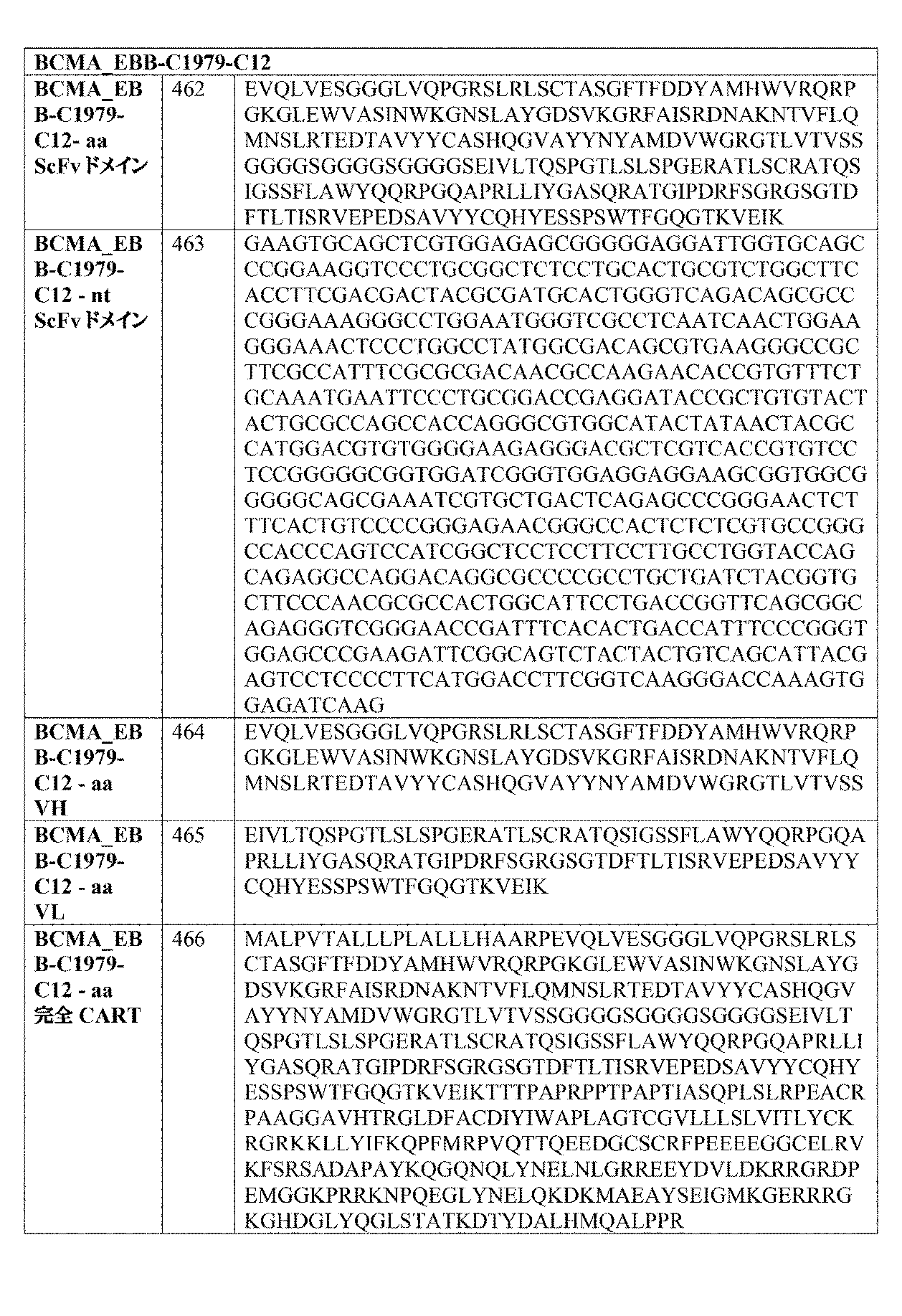
一態様において、例示的CARコンストラクトは、任意選択のリーダー配列(例えば、本明細書に記載されるリーダー配列)、細胞外抗原結合ドメイン(例えば、本明細書に記載される抗原結合ドメイン)、ヒンジ(例えば、本明細書に記載されるヒンジ領域)、膜貫通ドメイン(例えば、本明細書に記載される膜貫通ドメイン)、及び細胞内刺激ドメイン(例えば、本明細書に記載される細胞内刺激ドメイン)を含む。一態様において、例示的CARコンストラクトは、任意選択のリーダー配列(例えば、本明細書に記載されるリーダー配列)、細胞外抗原結合ドメイン(例えば、本明細書に記載される抗原結合ドメイン)、ヒンジ(例えば、本明細書に記載されるヒンジ領域)、膜貫通ドメイン(例えば、本明細書に記載される膜貫通ドメイン)、細胞内共刺激シグナル伝達ドメイン(例えば、本明細書に記載される共刺激シグナル伝達ドメイン)及び/又は細胞内一次シグナル伝達ドメイン(例えば、本明細書に記載される一次シグナル伝達ドメイン)を含む。 In one aspect, an exemplary CAR construct comprises an optional leader sequence (eg, a leader sequence described herein), an extracellular antigen binding domain (eg, an antigen binding domain described herein), hinge (Eg, a hinge region described herein), a transmembrane domain (eg, a transmembrane domain described herein), and an intracellular stimulation domain (eg, an intracellular stimulus described herein). Domain). In one aspect, an exemplary CAR construct comprises an optional leader sequence (eg, a leader sequence described herein), an extracellular antigen binding domain (eg, an antigen binding domain described herein), hinge (Eg, a hinge region described herein), a transmembrane domain (eg, a transmembrane domain described herein), an intracellular costimulatory signaling domain (eg, a co-domain described herein) Stimulation signaling domain) and / or an intracellular primary signaling domain (eg, a primary signaling domain as described herein).
一態様において、本発明のCAR(例えば、CD19 CAR)は、CD137(4−1BB)シグナル伝達ドメイン、CD28シグナル伝達ドメイン、CD27シグナル伝達ドメイン、ICOSシグナル伝達ドメイン、CD3ζシグナルドメイン、及びこれらの任意の組み合わせの群から選択される少なくとも1つの細胞内シグナル伝達ドメインを含む。一態様において、本発明のCARは、少なくとも1つの細胞内シグナル伝達ドメインを含み、CD137(4−1BB)、CD28、CD27、又はICOSから選択される1つ以上の共刺激分子からのものである。 In one aspect, a CAR of the invention (eg, CD19 CAR) comprises a CD137 (4-1BB) signaling domain, a CD28 signaling domain, a CD27 signaling domain, an ICOS signaling domain, a CD3ζ signaling domain, and any of these At least one intracellular signaling domain selected from the group of combinations. In one embodiment, the CAR of the present invention is from one or more costimulatory molecules selected from CD137 (4-1BB), CD28, CD27, or ICOS, comprising at least one intracellular signaling domain. .
例示的CD19 CARは、本明細書に記載される、例えば本明細書に記載される1つ以上の表中にあるCD19 CAR、又はXu et al.Blood 123.24(2014):3750−9;Kochenderfer et al.Blood 122.25(2013):4129−39、Cruz et al.Blood 122.17(2013):2965−73、NCT00586391、NCT01087294、NCT02456350、NCT00840853、NCT02659943、NCT02650999、NCT02640209、NCT01747486、NCT02546739、NCT02656147、NCT02772198、NCT00709033、NCT02081937、NCT00924326、NCT02735083、NCT02794246、NCT02746952、NCT01593696、NCT02134262、NCT01853631、NCT02443831、NCT02277522、NCT02348216、NCT02614066、NCT02030834、NCT02624258、NCT02625480、NCT02030847、NCT02644655、NCT02349698、NCT02813837、NCT02050347、NCT01683279、NCT02529813、NCT02537977、NCT02799550、NCT02672501、NCT02819583、NCT02028455、NCT01840566、NCT01318317、NCT01864889、NCT02706405、NCT01475058、NCT01430390、NCT02146924、NCT02051257、NCT02431988、NCT01815749、NCT02153580、NCT01865617、NCT02208362、NCT02685670、NCT02535364、NCT02631044、NCT02728882、NCT02735291、NCT01860937、NCT02822326、NCT02737085、NCT02465983、NCT02132624、NCT02782351、NCT01493453、NCT02652910、NCT02247609、NCT01029366、NCT01626495、NCT02721407、NCT01044069、NCT00422383、NCT01680991、NCT02794961、若しくはNCT02456207(これらの各々は、全体として参照により本明細書に援用される)に記載される抗CD19 CARを含む。 Exemplary CD19 CARs are described herein, eg, CD19 CARs in one or more tables described herein, or Xu et al. Blood 123.24 (2014): 3750-9; Kochender et al. Blood 122.25 (2013): 4129-39, Cruz et al. Blood 122.17 (2013): 2965-73, NCT00586391, NCT01087294, NCT02456350, NCT00840853, NCT02659943, NCT02650999, NCT02640209, NCT01747486, NCT02546739, NCT02656147, NCT02772198, NCT00709033, NCT02081937, NCT00924326, NCT02735083, NCT02794246, NCT02746952, NCT01593696, NCT02134262, NCT0853631, NCT0244431, NCT02277522, NCT02348216, NCT02614066, NCT02030834, NCT026 4258, NCT02625480, NCT02030847, NCT02644655, NCT02349698, NCT02813837, NCT02050347, NCT01683279, NCT02529813, NCT02537977, NCT02799550, NCT02672501, NCT02819583, NCT02028455, NCT01840566, NCT01318317, NCT01864889, NCT02706405, NCT01475058, NCT01430390, NCT02146924, NCT02051257, NCT02431988, NCT01815749, NCT02153580, NCT0865617, NCT02208362, NCT0265670, NCT0 2535364, NCT02631044, NCT02728882, NCT02735291, NCT01860937, NCT02822326, NCT02737085, NCT02465983, NCT02132624, NCT02782351, NCT01493453, NCT02652910, NCT02247609, NCT01029366, NCT01626495, NCT02721407, NCT01044069, NCT00422383, NCT01680991, NCT02794961, or NCT02456207 (in each of which, as a whole The anti-CD19 CAR described in US Pat.
抗原結合ドメイン
一態様において、本開示のCARは、別様には抗原結合ドメインと称される標的特異的結合エレメントを含む。一実施形態において、CARのうちの抗原結合ドメインを含む部分は、抗原、例えば本明細書に記載される抗原、例えばCD19を標的とする、例えばそれに特異的に結合する抗原結合ドメインを含む。一実施形態において、抗原結合ドメインは、ヒトCD19を標的とし、例えばそれに特異的に結合する。
Antigen-binding domain In one aspect, the CAR of the present disclosure comprises a target-specific binding element otherwise referred to as an antigen-binding domain. In one embodiment, the portion of the CAR comprising the antigen binding domain comprises an antigen binding domain that targets, eg, specifically binds to, an antigen, eg, an antigen described herein, eg, CD19. In one embodiment, the antigen binding domain targets, eg, specifically binds to human CD19.
抗原結合ドメインは、限定されないが、モノクローナル抗体、ポリクローナル抗体、組換え抗体、ヒト抗体、ヒト化抗体、及びその機能性断片、例えば、限定されないが、重鎖可変ドメイン(VH)、軽鎖可変ドメイン(VL)及びラクダ科動物由来ナノボディの可変ドメイン(VHH)などのシングルドメイン抗体、及び組換えフィブロネクチンドメインなど、抗原結合ドメインとして機能することが当技術分野において公知の代替的足場を含め、抗原に結合する任意のドメインであり得る。一部の例では、抗原結合ドメインは、CARが最終的に使用されることになる同じ種に由来することが有益である。例えば、ヒトでの使用には、CARの抗原結合ドメインが抗体又は抗体断片の抗原結合ドメインにヒト又はヒト化残基を含むことが有益であり得る。従って、一態様において、抗原結合ドメインは、ヒト抗体又は抗体断片を含む。 Antigen binding domains include, but are not limited to, monoclonal antibodies, polyclonal antibodies, recombinant antibodies, human antibodies, humanized antibodies, and functional fragments thereof such as, but not limited to, heavy chain variable domain (VH), light chain variable domain Antigens, including alternative scaffolds known in the art to function as antigen binding domains, such as single domain antibodies such as (VL) and Camelidae derived nanobody variable domains (VHH), and recombinant fibronectin domains It can be any domain that binds. In some instances, it is beneficial that the antigen binding domain is from the same species that CAR will eventually be used. For example, for human use, it may be beneficial for the antigen binding domain of the CAR to contain human or humanized residues in the antigen binding domain of the antibody or antibody fragment. Thus, in one aspect, the antigen binding domain comprises a human antibody or antibody fragment.
一実施形態において、抗原結合ドメインは、本明細書に記載される抗体(例えば、国際公開第2015/142675号パンフレット、米国特許出願公開第2015−0283178−A1号明細書、米国特許出願公開第2016−0046724−A1号明細書、米国特許出願公開第2014/0322212A1号明細書、米国特許出願公開第2016/0068601A1号明細書、米国特許出願公開第2016/0051651A1号明細書、米国特許出願公開第2016/0096892A1号明細書、米国特許出願公開第2014/0322275A1号明細書、又は国際公開第2015/090230号パンフレット(参照により本明細書に援用される)に記載される抗体)からの1つ、2つ、3つの(例えば、3つ全ての)重鎖CDR、HC CDR1、HC CDR2及びHC CDR3、及び/又は本明細書に記載される抗体(例えば、国際公開第2015/142675号パンフレット、米国特許出願公開第2015−0283178−A1号明細書、米国特許出願公開第2016−0046724−A1号明細書、米国特許出願公開第2014/0322212A1号明細書、米国特許出願公開第2016/0068601A1号明細書、米国特許出願公開第2016/0051651A1号明細書、米国特許出願公開第2016/0096892A1号明細書、米国特許出願公開第2014/0322275A1号明細書、又は国際公開第2015/090230号パンフレット(参照により本明細書に援用される)に記載される抗体)からの1つ、2つ、3つの(例えば、3つ全ての)軽鎖CDR、LC CDR1、LC CDR2、及びLC CDR3を含む。一実施形態において、抗原結合ドメインは、上記に挙げた抗体の重鎖可変領域及び/又は可変軽鎖領域を含む。 In one embodiment, the antigen binding domain is an antibody described herein (eg, WO 2015/142675, US Patent Application Publication No. 2015-0283178-A1, US Patent Application Publication No. 2016). -0046724-A1, US Patent Application Publication No. 2014 / 0322212A1, US Patent Application Publication No. 2016 / 0068601A1, US Patent Application Publication No. 2016 / 0051651A1, US Patent Application Publication No. 2016 One from US / 0096892A1, US 2014/0322275 A1, or WO 2015/090230 (incorporated herein by reference), 2 One, three (eg all three) Chain CDR, HC CDR1, HC CDR2 and HC CDR3, and / or the antibodies described herein (eg, WO 2015/142675, US Patent Application Publication No. 2015-0283178-A1, US Patent Application Publication No. 2006-0046724-A1, US Patent Application Publication No. 2014 / 0322212A1, US Patent Application Publication No. 2016 / 0068601A1, US Patent Application Publication No. 2016 / 0051651A1, US From Patent Application Publication No. 2016 / 0096892A1, US Patent Application Publication No. 2014 / 0322275A1, or WO 2015/090230 pamphlet (incorporated herein by reference). One or two Three (for example, all three) light chain CDR, LC CDRl, LC CDR2, and a LC CDR3. In one embodiment, the antigen binding domain comprises a heavy chain variable region and / or a variable light chain region of an antibody listed above.
実施形態において、抗原結合ドメインは、国際公開第2015/142675号パンフレット、米国特許出願公開第2015−0283178−A1号明細書、米国特許出願公開第2016−0046724−A1号明細書、米国特許出願公開第2014/0322212A1号明細書、米国特許出願公開第2016/0068601A1号明細書、米国特許出願公開第2016/0051651A1号明細書、米国特許出願公開第2016/0096892A1号明細書、米国特許出願公開第2014/0322275A1号明細書、又は国際公開第2015/090230号パンフレット(参照により本明細書に援用される)に記載される抗原結合ドメインである。 In an embodiment, the antigen-binding domain is WO2015 / 142675, US Patent Application Publication No. 2015-0283178-A1, US Patent Application Publication No. 2006-0046724-A1, US Patent Application Publication. 2014 / 0322212A1, US Patent Application Publication No. 2016 / 0068601A1, US Patent Application Publication No. 2016 / 0051651A1, US Patent Application Publication No. 2016 / 0096892A1, US Patent Application Publication No. 2014 The antigen binding domain described in / 0322275A1 or WO2015 / 090230 (incorporated herein by reference).
実施形態において、抗原結合ドメインは、BCMAを標的とし、米国特許出願公開第2016−0046724−A1号明細書に記載される。 In embodiments, the antigen binding domain targets BCMA and is described in US Patent Application Publication No. 2006-0046724-A1.
実施形態において、抗原結合ドメインは、CD19を標的とし、米国特許出願公開第2015−0283178−A1号明細書に記載される。 In embodiments, the antigen binding domain targets CD19 and is described in US Patent Application Publication No. 2015-0283178-A1.
実施形態において、抗原結合ドメインは、CD123を標的とし、米国特許出願公開第2014/0322212A1号明細書、米国特許出願公開第2016/0068601A1号明細書に記載される。 In embodiments, the antigen binding domain targets CD123 and is described in US Patent Application Publication No. 2014 / 0322212A1, US Patent Application Publication No. 2016 / 0068601A1.
実施形態において、抗原結合ドメインは、CLLを標的とし、米国特許出願公開第2016/0051651A1号明細書に記載される。 In embodiments, the antigen binding domain targets CLL and is described in US Patent Application Publication No. 2016/0051651 A1.
実施形態において、抗原結合ドメインは、CD33を標的とし、米国特許出願公開第2016/0096892A1号明細書に記載される。 In an embodiment, the antigen binding domain targets CD33 and is described in US Patent Application Publication No. 2016 / 0096892A1.
CAR発現細胞を使用して標的化することのできる例示的標的抗原には、例えば、国際公開第2014/153270号パンフレット、国際公開第2014/130635号パンフレット、国際公開第2016/028896号パンフレット、国際公開第2014/130657号パンフレット、国際公開第2016/014576号パンフレット、国際公開第2015/090230号パンフレット、国際公開第2016/014565号パンフレット、国際公開第2016/014535号パンフレット、及び国際公開第2016/025880号パンフレット(これらの各々は、全体として参照により本明細書に援用される)に記載されるとおり、限定されないが、特にCD19、CD123、EGFRvIII、CD33、メソテリン、BCMA、及びGFR ALPHA−4が含まれる。 Exemplary target antigens that can be targeted using CAR expressing cells include, for example, WO 2014/153270, WO 2014/130635, WO 2016/028896, International International Publication No. 2014/130657, International Publication No. 2016/014576, International Publication No. 2015/090230, International Publication No. 2016/014565, International Publication No. 2016/014535, and International Publication No. 2016 / No. 025880, each of which is incorporated herein by reference in its entirety, but is not limited to CD19, CD123, EGFRvIII, CD33, mesoteri Include BCMA, and GFR ALPHA-4 is.
他の実施形態において、CAR発現細胞は、ヒト化CD19に特異的に結合することができ、例えば国際公開第2014/153270号パンフレット(参照により本明細書に援用される)の表3に係るCAR分子、又は抗原結合ドメイン(例えば、ヒト化抗原結合ドメイン)を含み得る。CD19 CAR分子及び抗原結合ドメイン(例えば、Kabat又はChothiaによる1つ、2つ、3つのVH CDR、及び1つ、2つ、3つのVL CDRを含む)をコードするアミノ酸及びヌクレオチド配列は、国際公開第2014/153270号パンフレットに指定される。 In other embodiments, the CAR-expressing cells are capable of specifically binding to humanized CD19, eg CAR according to Table 3 of WO 2014/153270 (incorporated herein by reference). A molecule or antigen binding domain (eg, a humanized antigen binding domain) may be included. Amino acid and nucleotide sequences encoding CD19 CAR molecules and antigen binding domains (including one, two, three VH CDRs and one, two, three VL CDRs from Kabat or Chothia) are published internationally Designated in the 2014/153270 pamphlet.
他の実施形態において、CAR発現細胞は、CD123に特異的に結合することができ、例えば国際公開第2014/130635号パンフレット(参照により本明細書に援用される)の表1〜表2に係るCAR分子(例えば、CAR1〜CAR8のいずれか)、又は抗原結合ドメインを含み得る。CD123 CAR分子及び抗原結合ドメイン(例えば、Kabat又はChothiaによる1つ、2つ、3つのVH CDR、及び1つ、2つ、3つのVL CDRを含む)をコードするアミノ酸及びヌクレオチド配列は、国際公開第2014/130635号パンフレットに指定される。 In other embodiments, CAR-expressing cells can specifically bind to CD123, eg, according to Tables 1 and 2 of WO 2014/130635 (incorporated herein by reference). It may comprise a CAR molecule (eg, any of CAR1-CAR8), or an antigen binding domain. Amino acid and nucleotide sequences encoding CD123 CAR molecules and antigen binding domains (including one, two, three VH CDRs and one, two, three VL CDRs by Kabat or Chothia, for example) It is specified in the 2014/130635 pamphlet.
他の実施形態において、CAR発現細胞は、CD123に特異的に結合することができ、例えば国際公開第2016/028896号パンフレット(参照により本明細書に援用される)の表2、表6、及び表9に係るCAR分子(例えば、CAR123−1〜CAR123−4及びhzCAR123−1〜hzCAR123−32のいずれか)、又は抗原結合ドメインを含み得る。CD123 CAR分子及び抗原結合ドメイン(例えば、Kabat又はChothiaによる1つ、2つ、3つのVH CDR、及び1つ、2つ、3つのVL CDRを含む)をコードするアミノ酸及びヌクレオチド配列は、国際公開第2016/028896号パンフレットに指定される。 In other embodiments, the CAR-expressing cells can specifically bind to CD123, eg, Table 2, Table 6, and International Publication No. 2016/028896 (incorporated herein by reference), and A CAR molecule according to Table 9 (eg, any of CAR1233-1 to CAR123-4 and hzCAR1233-1 to hzCAR123-32), or an antigen binding domain may be included. Amino acid and nucleotide sequences encoding CD123 CAR molecules and antigen binding domains (including one, two, three VH CDRs and one, two, three VL CDRs by Kabat or Chothia, for example) It is specified in the 2016/028896 pamphlet.
他の実施形態において、CAR発現細胞は、EGFRvIIIに特異的に結合することができ、例えば国際公開第2014/130657号パンフレット(参照により本明細書に援用される)の表2又は配列番号11に係るCAR分子、又は抗原結合ドメインを含み得る。EGFRvIII CAR分子及び抗原結合ドメイン(例えば、Kabat又はChothiaによる1つ、2つ、3つのVH CDR、及び1つ、2つ、3つのVL CDRを含む)をコードするアミノ酸及びヌクレオチド配列は、国際公開第2014/130657号パンフレットに指定される。 In other embodiments, the CAR-expressing cells can specifically bind to EGFRvIII, eg, in Table 2 or SEQ ID NO: 11 of WO 2014/130657 (incorporated herein by reference). Such CAR molecules, or antigen binding domains may be included. Amino acid and nucleotide sequences encoding EGFRvIII CAR molecules and antigen binding domains (including one, two, three VH CDRs and one, two, three VL CDRs from Kabat or Chothia) It is specified in the 2014/130657 pamphlet.
他の実施形態において、CAR発現細胞は、CD33に特異的に結合することができ、例えば国際公開第2016/014576号パンフレット(参照により本明細書に援用される)の表2又は表9に係るCAR分子(例えば、CAR33−1〜CAR−33−9のいずれか)、又は抗原結合ドメインを含み得る。CD33 CAR分子及び抗原結合ドメイン(例えば、Kabat又はChothiaによる1つ、2つ、3つのVH CDR、及び1つ、2つ、3つのVL CDRを含む)をコードするアミノ酸及びヌクレオチド配列は、国際公開第2016/014576号パンフレットに指定される。 In other embodiments, the CAR-expressing cells can specifically bind to CD33, eg according to Table 2 or Table 9 of WO2016 / 014576 (incorporated herein by reference). It may comprise a CAR molecule (eg, any of CAR33-1 to CAR-33-9), or an antigen binding domain. Amino acid and nucleotide sequences encoding CD33 CAR molecules and antigen binding domains (including one, two, three VH CDRs and one, two, three VL CDRs by Kabat or Chothia, for example) It is specified in the 2016/014576 pamphlet.
他の実施形態において、CAR発現細胞は、メソテリンに特異的に結合することができ、例えば国際公開第2015/090230号パンフレット(参照により本明細書に援用される)の表2〜表3に係るCAR分子、又は抗原結合ドメインを含み得る。メソテリンCAR分子及び抗原結合ドメイン(例えば、Kabat又はChothiaによる1つ、2つ、3つのVH CDR、及び1つ、2つ、3つのVL CDRを含む)をコードするアミノ酸及びヌクレオチド配列は、国際公開第2015/090230号パンフレットに指定される。 In other embodiments, the CAR-expressing cells can specifically bind to mesothelin, for example according to Tables 2 to 3 of WO2015 / 090230 (incorporated herein by reference). It may contain a CAR molecule, or an antigen binding domain. Amino acid and nucleotide sequences encoding mesothelin CAR molecules and antigen binding domains (including one, two, three VH CDRs and one, two, three VL CDRs by Kabat or Chothia, for example) It is specified in the pamphlet No. 2015/090230.
他の実施形態において、CAR発現細胞は、BCMAに特異的に結合することができ、例えば国際公開第2016/014565号パンフレット(参照により本明細書に援用される)の表1又は表16、配列番号271又は配列番号273に係るCAR分子、又は抗原結合ドメインを含み得る。BCMA CAR分子及び抗原結合ドメイン(例えば、Kabat又はChothiaによる1つ、2つ、3つのVH CDR、及び1つ、2つ、3つのVL CDRを含む)をコードするアミノ酸及びヌクレオチド配列は、国際公開第2016/014565号パンフレットに指定される。 In other embodiments, the CAR-expressing cells can specifically bind to BCMA, eg, Table 1 or Table 16, sequences of WO 2016/014565 (incorporated herein by reference). It may comprise a CAR molecule according to number 271 or SEQ ID NO: 273, or an antigen binding domain. Amino acid and nucleotide sequences encoding BCMA CAR molecules and antigen binding domains (including one, two, three VH CDRs and one, two, three VL CDRs by Kabat or Chothia, for example) It is specified in the 2016/014565 pamphlet.
他の実施形態において、CAR発現細胞は、CLL−1に特異的に結合することができ、例えば国際公開第2016/014535号パンフレット(参照により本明細書に援用される)の表2に係るCAR分子、又は抗原結合ドメインを含み得る。CLL−1 CAR分子及び抗原結合ドメイン(例えば、Kabat又はChothiaによる1つ、2つ、3つのVH CDR、及び1つ、2つ、3つのVL CDRを含む)をコードするアミノ酸及びヌクレオチド配列は、国際公開第2016/014535号パンフレットに指定される。 In other embodiments, the CAR-expressing cells can specifically bind to CLL-1, such as CAR according to Table 2 of WO2016 / 014535 (incorporated herein by reference). It may contain a molecule or an antigen binding domain. The amino acid and nucleotide sequences encoding CLL-1 CAR molecules and antigen binding domains (eg, including one, two, three VH CDRs and one, two, three VL CDRs by Kabat or Chothia) are: Designated in the pamphlet of International Publication No. 2016/014535.
他の実施形態において、CAR発現細胞は、GFR ALPHA−4に特異的に結合することができ、例えば国際公開第2016/025880号パンフレット(参照により本明細書に援用される)の表2に係るCAR分子、又は抗原結合ドメインを含み得る。GFR ALPHA−4 CAR分子及び抗原結合ドメイン(例えば、Kabat又はChothiaによる1つ、2つ、3つのVH CDR、及び1つ、2つ、3つのVL CDRを含む)をコードするアミノ酸及びヌクレオチド配列は、国際公開第2016/025880号パンフレットに指定される。 In other embodiments, CAR-expressing cells can specifically bind to GFR ALPHA-4, for example according to Table 2 of WO2016 / 025880 (incorporated herein by reference). It may contain a CAR molecule, or an antigen binding domain. Amino acid and nucleotide sequences encoding GFR ALPHA-4 CAR molecules and antigen binding domains (eg, including one, two, three VH CDRs and one, two, three VL CDRs by Kabat or Chothia) , Specified in International Publication No. 2016/025880 pamphlet.
一実施形態において、本明細書に記載されるCAR分子のいずれか(例えば、CD19、CD123、EGFRvIII、CD33、メソテリン、BCMA、及びGFR ALPHA−4のいずれか)の抗原結合ドメインは、上記に挙げた抗体からの1つ、2つ、3つの(例えば、3つ全ての)重鎖CDR、HC CDR1、HC CDR2及びHC CDR3、及び/又は上記に挙げた抗原結合ドメインからの1つ、2つ、3つの(例えば、3つ全ての)軽鎖CDR、LC CDR1、LC CDR2、及びLC CDR3を含む。一実施形態において、抗原結合ドメインは、上記に挙げた又は記載した抗体の重鎖可変領域及び/又は可変軽鎖領域を含む。 In one embodiment, the antigen binding domain of any of the CAR molecules described herein (eg, any of CD19, CD123, EGFRvIII, CD33, mesothelin, BCMA, and GFR ALPHA-4) is listed above. One, two, three (eg, all three) heavy chain CDRs, HC CDR1, HC CDR2 and HC CDR3, and / or one, two, from the antigen binding domains listed above Includes three (eg, all three) light chain CDRs, LC CDR1, LC CDR2, and LC CDR3. In one embodiment, the antigen binding domain comprises a heavy chain variable region and / or a variable light chain region of an antibody listed or described above.
一実施形態において、CD19結合ドメインは、配列番号45〜56、69〜80、106、109、110、112、又は115から選択されるCD19結合ドメインの1つ以上の(例えば、3つ全ての)軽鎖相補性決定領域1(LC CDR1)、軽鎖相補性決定領域2(LC CDR2)、及び軽鎖相補性決定領域3(LC CDR3)、並びに配列番号45〜56、69〜80、106、109、110、112、又は115から選択されるCD19結合ドメインの1つ以上の(例えば、3つ全ての)重鎖相補性決定領域1(HC CDR1)、重鎖相補性決定領域2(HC CDR2)、及び重鎖相補性決定領域3(HC CDR3)を含む。一実施形態において、CD19結合ドメインは、本明細書に記載される(例えば、表2又は表3にある)軽鎖可変領域及び/又は本明細書に記載される(例えば、表2又は表3にある)重鎖可変領域を含む。一実施形態において、CD19結合ドメインは、表2又は表3のアミノ酸配列の軽鎖可変領域及び重鎖可変領域を含むscFvである。ある実施形態において、CD19結合ドメイン(例えば、scFV)は、表2又は表3に提供される軽鎖可変領域のアミノ酸配列の少なくとも1、2、又は3つの改変(例えば、置換)であるが、30、20、又は10以下の改変(例えば、置換)を有するアミノ酸配列、又は表2又は表3のアミノ酸配列と95〜99%の同一性を有する配列を含む軽鎖可変領域、及び/又は表2又は表3に提供される重鎖可変領域のアミノ酸配列の少なくとも1、2、又は3つの改変(例えば、置換)であるが、30、20、又は10以下の改変(例えば、置換)を有するアミノ酸配列、又は表2又は表3のアミノ酸配列と95〜99%の同一性を有する配列を含む重鎖可変領域を含む。 In one embodiment, the CD19 binding domain is one or more (eg, all three) of a CD19 binding domain selected from SEQ ID NOs: 45-56, 69-80, 106, 109, 110, 112, or 115. Light chain complementarity determining region 1 (LC CDR1), light chain complementarity determining region 2 (LC CDR2), and light chain complementarity determining region 3 (LC CDR3), and SEQ ID NOs: 45-56, 69-80, 106, One or more (eg, all three) heavy chain complementarity determining regions 1 (HC CDR1), heavy chain complementarity determining regions 2 (HC CDR2) of a CD19 binding domain selected from 109, 110, 112, or 115 ), And heavy chain complementarity determining region 3 (HC CDR3). In one embodiment, the CD19 binding domain is a light chain variable region described herein (eg, in Table 2 or Table 3) and / or described herein (eg, Table 2 or Table 3). The heavy chain variable region. In one embodiment, the CD19 binding domain is an scFv comprising a light chain variable region and a heavy chain variable region of the amino acid sequence of Table 2 or Table 3. In certain embodiments, the CD19 binding domain (eg, scFV) is at least 1, 2, or 3 modifications (eg, substitutions) of the light chain variable region amino acid sequence provided in Table 2 or Table 3, A light chain variable region comprising an amino acid sequence having no more than 30, 20, or 10 modifications (eg, substitutions), or a sequence having 95-99% identity with the amino acid sequence of Table 2 or Table 3, and / or Table 2 or at least 1, 2, or 3 modifications (eg substitutions) in the amino acid sequence of the heavy chain variable region provided in Table 3, but with 30, 20, or 10 modifications (eg substitutions) A heavy chain variable region comprising an amino acid sequence or a sequence having 95-99% identity with the amino acid sequence of Table 2 or Table 3.
一実施形態において、CD19結合ドメインは、本明細書に記載される、例えば表2又は表3にあるアミノ酸配列を含む軽鎖可変領域を含み、本明細書に記載される、例えば表2又は表3にあるアミノ酸配列を含む重鎖可変領域にリンカー、例えば本明細書に記載されるリンカーを介して付加される。一実施形態において、ヒト化抗CD19結合ドメインは、(Gly4−Ser)nリンカー(配列番号26)を含み、ここで、nは、1、2、3、4、5、又は6、好ましくは3又は4である。scFvの軽鎖可変領域及び重鎖可変領域は、例えば、以下の向き:軽鎖可変領域−リンカー−重鎖可変領域又は重鎖可変領域−リンカー−軽鎖可変領域のいずれでもあり得る。 In one embodiment, the CD19 binding domain comprises a light chain variable region described herein, eg, comprising the amino acid sequence in Table 2 or Table 3, and described herein, eg, Table 2 or Table. A heavy chain variable region comprising the amino acid sequence at 3 is added via a linker, eg, a linker described herein. In one embodiment, the humanized anti-CD19 binding domain comprises a (Gly4-Ser) n linker (SEQ ID NO: 26), where n is 1, 2, 3, 4, 5, or 6, preferably 3. Or 4. The light chain variable region and heavy chain variable region of scFv can be, for example, any of the following orientations: light chain variable region-linker-heavy chain variable region or heavy chain variable region-linker-light chain variable region.
別の実施形態において、CD19結合ドメインは、CD19に結合する当技術分野において公知の任意の抗体又はその抗体断片を含む。 In another embodiment, the CD19 binding domain comprises any antibody or antibody fragment thereof known in the art that binds to CD19.
一態様において、本発明の抗体は、例えば、Fab、Fab’、F(ab’)2、Fv断片、scFv抗体断片、ジスルフィド結合Fv(sdFv)、VH及びCH1ドメインからなるFd断片、線状抗体、sdAbなどのシングルドメイン抗体(VL又はVHのいずれか)、ラクダ科動物VHHドメイン、ヒンジ領域でジスルフィド架橋によって連結された2つのFab断片を含む二価断片などの抗体断片で形成される多重特異性抗体、及び抗体の単離CDR又は他のエピトープ結合断片を含め、種々の他の形態で存在し得る。一態様において、本明細書に提供される抗体断片は、scFvである。一部の例では、ヒトscFvは、酵母ディスプレイライブラリにも由来し得る。 In one embodiment, the antibody of the present invention includes, for example, Fab, Fab ′, F (ab ′) 2 , Fv fragment, scFv antibody fragment, disulfide bond Fv (sdFv), Fd fragment consisting of VH and CH1 domains, linear antibody Multispecifics formed of antibody fragments such as single domain antibodies (either VL or VH), such as sdAb, camelid VHH domains, bivalent fragments comprising two Fab fragments linked by a disulfide bridge in the hinge region May exist in various other forms, including sex antibodies, and isolated CDRs or other epitope-binding fragments of antibodies. In one aspect, the antibody fragment provided herein is a scFv. In some examples, the human scFv can also be derived from a yeast display library.
ヒト化抗体は、CDR移植(例えば、それぞれその全体が参照により本明細書に援用される欧州特許第239,400号明細書;国際公開第91/09967号パンフレット;及び米国特許第5,225,539号明細書、同第5,530,101号明細書及び同第5,585,089号明細書を参照されたい)、ベニアリング又はリサーフェシング(例えば、それぞれその全体が参照により本明細書に援用される欧州特許第592,106号明細書及び同第519,596号明細書;Padlan,1991,Molecular Immunology,28(4/5):489−498;Studnicka et al.,1994,Protein Engineering,7(6):805−814;及びRoguska et al.,1994,PNAS,91:969−973を参照されたい)、鎖シャッフリング(例えば、その全体が参照により本明細書に援用される米国特許第5,565,332号明細書を参照されたい)、並びに例えばそれぞれ参照によりその全体が本明細書に援用される米国特許出願公開第2005/0042664号明細書、米国特許出願公開第2005/0048617号明細書、米国特許第6,407,213号明細書、米国特許第5,766,886号明細書、国際公開第9317105号パンフレット、Tan et al.,J.Immunol.,169:1119−25(2002),Caldas et al.,Protein Eng.,13(5):353−60(2000),Morea et al.,Methods,20(3):267−79(2000),Baca et al.,J.Biol.Chem.,272(16):10678−84(1997),Roguska et al.,Protein Eng.,9(10):895−904(1996),Couto et al.,Cancer Res.,55(23 Supp):5973s−5977s(1995),Couto et al.,Cancer Res.,55(8):1717−22(1995),Sandhu J S,Gene,150(2):409−10(1994)及びPedersen et al.,J.Mol.Biol.,235(3):959−73(1994)に記載の技術を含むが、これらに限定されない、当技術分野で知られる多様な方法を使用して産生できる。フレームワーク領域及びヒト化抗体に関する更なる情報は、2016年4月8日に出願された国際公開第2016/164731号パンフレット(その全体が参照により援用される)の169〜170頁に記載されている。 Humanized antibodies can be obtained by CDR grafting (eg, European Patent 239,400, each of which is hereby incorporated by reference in its entirety; WO 91/09967; and US Pat. No. 5,225,225). 539, 5,530,101 and 5,585,089), veneering or resurfacing (eg, each incorporated herein by reference in its entirety) European Patent Nos. 592,106 and 519,596; Padlan, 1991, Molecular Immunology, 28 (4/5): 489-498; Studnikka et al., 1994, Protein Engineering, 7 (6): 805-814; and Roguska et l., 1994, PNAS, 91: 969-973), chain shuffling (see, eg, US Pat. No. 5,565,332, incorporated herein by reference in its entirety). As well as, for example, US Patent Application Publication No. 2005/0042664, US Patent Application Publication No. 2005/0048617, US Patent No. 6,407,213, each of which is incorporated herein by reference in its entirety. Specification, US Pat. No. 5,766,886, WO 9317105, Tan et al. , J .; Immunol. 169: 1119-25 (2002), Caldas et al. , Protein Eng. 13 (5): 353-60 (2000), Morea et al. , Methods, 20 (3): 267-79 (2000), Baca et al. , J .; Biol. Chem. 272 (16): 10678-84 (1997), Roguska et al. , Protein Eng. 9 (10): 895-904 (1996), Couto et al. , Cancer Res. , 55 (23 Supp): 5973s-5777s (1995), Couto et al. , Cancer Res. , 55 (8): 1717-22 (1995), Sandhu J S, Gene, 150 (2): 409-10 (1994) and Pedersen et al. , J .; Mol. Biol. , 235 (3): 959-73 (1994), and can be produced using a variety of methods known in the art, including but not limited to. Further information regarding framework regions and humanized antibodies can be found in pages 169-170 of WO2016 / 164731, filed April 8, 2016, which is incorporated by reference in its entirety. Yes.
ヒト化抗体を製造するために使用する軽及び重の両方のヒト可変ドメインの選択は、抗原性を減少するためである。いわゆる「ベストフィット」法により、齧歯類抗体の可変ドメインの配列を既知ヒト可変ドメイン配列のライブラリ全体に対してスクリーニングする。齧歯類に最も近いヒト配列を、その後、ヒト化抗体のためのヒトフレームワーク(FR)として受け入れる(その内容全体が参照により本明細書に援用されるSims et al.,J.Immunol.,151:2296(1993);Chothia et al.,J.Mol.Biol.,196:901(1987)を参照されたい)。別の方法は、特定のサブグループの軽鎖又は重鎖の全抗体のコンセンサス配列由来の特定のフレームワークを使用する。同じフレームワークは、数種の異なるヒト化抗体のために使用され得る(例えば、その内容全体が参照により本明細書に援用されるNicholson et al.Mol.Immun.34(16−17):1157−1165(1997);Carter et al.,Proc.Natl.Acad.Sci.USA,89:4285(1992);Presta et al.,J.Immunol.,151:2623(1993)を参照されたい)。一実施形態において、重鎖可変領域のフレームワーク領域、例えば全部で4つのフレームワーク領域は、VH4_4−59生殖細胞系配列由来である。一実施形態において、フレームワーク領域は、例えば、(例えば、配列番号109の)対応するマウス配列のアミノ酸からの1つ、2つ、3つ、4つ、又は5つの改変、例えば置換を含み得る。一実施形態において、軽鎖可変領域のフレームワーク領域、例えば全部で4つのフレームワーク領域は、VK3_1.25生殖細胞系配列由来である。一実施形態において、フレームワーク領域は、例えば、(例えば、配列番号109の)対応するマウス配列のアミノ酸からの1つ、2つ、3つ、4つ、又は5つの改変、例えば置換を含み得る。三次元コンホメーション構造に基づくヒト化抗体又は抗体断片の設計は、2016年4月8日に出願された国際公開第2016/164731号パンフレット(その全体が参照により援用される)の171頁に詳細に記載されている。 The choice of both light and heavy human variable domains used to produce humanized antibodies is to reduce antigenicity. The sequence of rodent antibody variable domains is screened against the entire library of known human variable domain sequences by the so-called “best fit” method. The human sequence closest to the rodent is then accepted as the human framework (FR) for humanized antibodies (Sims et al., J. Immunol., The entire contents of which are incorporated herein by reference. 151: 2296 (1993); see Chothia et al., J. Mol. Biol., 196: 901 (1987)). Another method uses a particular framework derived from the consensus sequence of all antibodies of a particular subgroup of light or heavy chains. The same framework can be used for several different humanized antibodies (eg, Nicholson et al. Mol. Immun. 34 (16-17): 1157, the entire contents of which are incorporated herein by reference. -1165 (1997); Carter et al., Proc. Natl. Acad. Sci. USA, 89: 4285 (1992); In one embodiment, the heavy chain variable region framework regions, eg, all four framework regions, are derived from VH4 — 4-59 germline sequences. In one embodiment, the framework region can include, for example, one, two, three, four, or five modifications, eg, substitutions, from the amino acid of the corresponding mouse sequence (eg, of SEQ ID NO: 109). . In one embodiment, the light chain variable region framework region, eg, all four framework regions, are derived from VK3 — 1.25 germline sequences. In one embodiment, the framework region can include, for example, one, two, three, four, or five modifications, eg, substitutions, from the amino acid of the corresponding mouse sequence (eg, of SEQ ID NO: 109). . The design of a humanized antibody or antibody fragment based on a three-dimensional conformation structure is described on page 171 of WO 2016/164731 filed on April 8, 2016 (incorporated by reference in its entirety). It is described in detail.
ヒト化抗体又は抗体断片は、元の抗体と同様の抗原特異性、例えば本開示ではヒトCD19結合能力を保持し得る。一部の実施形態において、ヒト化抗体又は抗体断片は、ヒトCD19への結合の向上した親和性及び/又は特異性を有し得る。 A humanized antibody or antibody fragment may retain the same antigenic specificity as the original antibody, eg, human CD19 binding ability in this disclosure. In some embodiments, the humanized antibody or antibody fragment may have improved affinity and / or specificity for binding to human CD19.
一態様において、結合ドメイン(例えば、CD19に結合する抗原結合ドメイン)は、断片、例えば単鎖可変断片(scFv)である。一態様において、結合ドメインは、Fv、Fab、(Fab’)2、又は二機能性(例えば、二重特異性)ハイブリッド抗体である(例えば、Lanzavecchia et al.,Eur.J.Immunol.17,105(1987))。一態様において、本発明の抗体及びその断片は、野生型の又は増進した親和性でCD19タンパク質と結合する。 In one embodiment, the binding domain (eg, an antigen binding domain that binds CD19) is a fragment, eg, a single chain variable fragment (scFv). In one embodiment, the binding domain is an Fv, Fab, (Fab ′) 2, or a bifunctional (eg, bispecific) hybrid antibody (eg, Lanzavecchia et al., Eur. J. Immunol. 17, 105 (1987)). In one embodiment, the antibodies and fragments thereof of the invention bind to the CD19 protein with wild-type or increased affinity.
ある例において、scFvは、当技術分野で知られる方法により製造できる(例えば、Bird et al.,(1988)Science 242:423−426及びHuston et al.,(1988)Proc.Natl.Acad.Sci.USA 85:5879−5883を参照されたい)。ScFv分子は、可動性ポリペプチドリンカーを使用して、VH領域とVL領域とを一緒に連結することにより産生できる。scFv分子は、最適長及び/又はアミノ酸組成を有するリンカー(例えば、Ser−Glyリンカー)を含む。リンカー長は、scFvの可変領域がどのように折りたたまれ、相互作用するかに大きく影響し得る。実際、短ポリペプチドリンカーを用いる場合、(例えば、5〜10のアミノ酸)、鎖内折りたたみが阻止される。鎖内折りたたみは、2つの可変領域が一体となって機能的エピトープ結合部位を形成させるためにも必要である。リンカー方向及びサイズの例については、例えば、参照により本明細書に援用されるHollinger et al.1993 Proc Natl Acad.Sci.U.S.A.90:6444−6448、米国特許出願公開第2005/0100543号明細書、同第2005/0175606号明細書、同第2007/0014794号明細書及び国際公開第2006/020258号パンフレット及び国際公開第2007/024715号パンフレットを参照されたい。 In certain instances, scFv can be produced by methods known in the art (eg, Bird et al., (1988) Science 242: 423-426 and Huston et al., (1988) Proc. Natl. Acad. Sci. USA 85: 5879-5883). ScFv molecules can be produced by linking VH and VL regions together using a mobile polypeptide linker. The scFv molecule includes a linker (eg, a Ser-Gly linker) having an optimal length and / or amino acid composition. The linker length can greatly affect how the variable regions of the scFv fold and interact. Indeed, when short polypeptide linkers are used (eg, 5-10 amino acids), intrachain folding is prevented. Intrachain folding is also necessary for the two variable regions to be united to form a functional epitope binding site. For examples of linker orientation and size, see, for example, Hollinger et al., Incorporated herein by reference. 1993 Proc Natl Acad. Sci. U. S. A. 90: 6444-6448, U.S. Patent Application Publication Nos. 2005/0100543, 2005/0175606, 2007/0014794, and WO 2006/020258 and WO 2007 /. See the 024715 pamphlet.
scFvは、そのVL領域とVH領域との間に少なくとも1つ、2つ、3つ、4つ、5つ、6つ、7つ、8つ、9つ、10、11、12、13、14、15、16、17、18、19、20、25、30、35、40、45、50又はそれを超えるアミノ酸残基のリンカーを含み得る。リンカー配列は、あらゆる天然に存在するアミノ酸を含み得る。一実施形態において、リンカー配列は、アミノ酸グリシン及びセリンを含む。別の実施形態において、リンカー配列は、(Gly4Ser)n(式中、nは、1以上の正の整数である)などの一連のグリシン及びセリン反復を含む(配列番号25)。一実施形態において、リンカーは、(Gly4Ser)4(配列番号27)又は(Gly4Ser)3(配列番号28)であり得る。リンカー長の変動は、活性を維持又は増強し、活性試験において優れた有効性を生じ得る。 The scFv has at least one, two, three, four, five, six, seven, eight, nine, 10, 11, 12, 13, 14 between its VL and VH regions. , 15, 16, 17, 18, 19, 20, 25, 30, 35, 40, 45, 50 or more linkers of amino acid residues. The linker sequence can include any naturally occurring amino acid. In one embodiment, the linker sequence comprises the amino acids glycine and serine. In another embodiment, the linker sequence comprises a series of glycine and serine repeats (SEQ ID NO: 25), such as (Gly 4 Ser) n, where n is a positive integer greater than or equal to 1. In one embodiment, the linker may be (Gly 4 Ser) 4 (SEQ ID NO: 27) or (Gly 4 Ser) 3 (SEQ ID NO: 28). Variations in linker length can maintain or enhance activity and produce superior effectiveness in activity testing.
一部の実施形態において、抗原結合ドメイン(例えば、CD19に結合する抗原結合ドメイン)若しくは他の部分又はCAR全体のアミノ酸配列は、改変することができ、例えば、本明細書に記載されるアミノ酸配列は、例えば、保存的置換によって改変することができる。同様の側鎖を有するアミノ酸残基のファミリーは、当技術分野において定義されており、塩基性側鎖(例えば、リジン、アルギニン、ヒスチジン)、酸性側鎖(例えば、アスパラギン酸、グルタミン酸)、非荷電極性側鎖(例えば、グリシン、アスパラギン、グルタミン、セリン、スレオニン、チロシン、システイン)、非極性側鎖(例えば、アラニン、バリン、ロイシン、イソロイシン、プロリン、フェニルアラニン、メチオニン、トリプトファン)、β分枝側鎖(例えば、スレオニン、バリン、イソロイシン)及び芳香族側鎖(例えば、チロシン、フェニルアラニン、トリプトファン、ヒスチジン)が含まれる。 In some embodiments, the amino acid sequence of the antigen binding domain (eg, the antigen binding domain that binds CD19) or other portion or the entire CAR can be altered, eg, the amino acid sequences described herein. Can be modified, for example, by conservative substitutions. Families of amino acid residues having similar side chains are defined in the art, basic side chains (eg lysine, arginine, histidine), acidic side chains (eg aspartic acid, glutamic acid), uncharged Polar side chains (eg glycine, asparagine, glutamine, serine, threonine, tyrosine, cysteine), nonpolar side chains (eg alanine, valine, leucine, isoleucine, proline, phenylalanine, methionine, tryptophan), β-branched side chains (Eg threonine, valine, isoleucine) and aromatic side chains (eg tyrosine, phenylalanine, tryptophan, histidine).
2つ以上の核酸又はポリペプチド配列に関連してパーセント同一性とは、同じである2つ以上の配列を指す。2つの配列は、比較ウィンドウ又は指示される領域にわたって最大限の一致となるように比較及びアラインメントしたとき、以下の配列比較アルゴリズムの1つを用いて計測されるか、又は手動でのアラインメント及び目視検査によって計測されるとおりの同じであるアミノ酸残基又はヌクレオチドが指定の割合だけ2つの配列にある場合(例えば、指定の領域にわたって又は指定されない場合には配列全体にわたって60%の同一性、任意選択で70%、71%、72%、73%、74%、75%、76%、77%、78%、79%、80%、81%、82%、83%、84%、85%、86%、87%、88%、89%、90%、91%、92%、93%、94%、95%、96%、97%、98%、99%の同一性)、「実質的に同一」である。任意選択で、同一性は、少なくとも約50ヌクレオチド長(又は10アミノ酸長)の領域にわたって又は100〜500又は1000又はそれを超えるヌクレオチド長(又は20、50、200又はそれを超えるアミノ酸長)の領域にわたって存在する。 Percent identity in the context of two or more nucleic acid or polypeptide sequences refers to two or more sequences that are the same. The two sequences are counted using one of the following sequence comparison algorithms when compared and aligned for maximum match over the comparison window or indicated region, or manually aligned and visually observed. If the amino acid residues or nucleotides that are the same as measured by the test are in the two sequences in the specified percentage (eg 60% identity over the specified region or the entire sequence if not specified, optional 70%, 71%, 72%, 73%, 74%, 75%, 76%, 77%, 78%, 79%, 80%, 81%, 82%, 83%, 84%, 85%, 86 %, 87%, 88%, 89%, 90%, 91%, 92%, 93%, 94%, 95%, 96%, 97%, 98%, 99% identity), “substantially identical It is. Optionally, the identity is a region that is at least about 50 nucleotides long (or 10 amino acids long) or a region that is 100-500 or 1000 or more nucleotides long (or 20, 50, 200 or more amino acids long). Exists over.
配列比較には、典型的には一方の配列が参照配列としての役割を果たし、それと試験配列が比較される。配列比較アルゴリズムを用いる場合、試験配列及び参照配列がコンピュータに入力され、必要に応じて部分配列の座標が指定され、配列アルゴリズムプログラムパラメータが指定される。デフォルトプログラムパラメータを使用することができ、又は別のパラメータを指定し得る。次に、配列比較アルゴリズムは、プログラムパラメータに基づき、参照配列と比べた試験配列のパーセント配列同一性を計算する。比較のための配列のアラインメント方法は、当技術分野において周知である。比較のための配列の最適アラインメントは、例えば、Smith and Waterman,(1970)Adv.Appl.Math.2:482cの局所的相同性アルゴリズムによるか、Needleman and Wunsch,(1970)J.Mol.Biol.48:443の相同性アラインメントアルゴリズムによるか、Pearson and Lipman,(1988)Proc.Nat’l.Acad.Sci.USA 85:2444の類似性検索方法によるか、これらのアルゴリズムのコンピュータ実装によるか(Wisconsin Genetics Software Package、Genetics Computer Group、575 Science Dr.,Madison,WIのGAP、BESTFIT、FASTA、及びTFASTA)、又は手動でのアラインメント及び目視検査によって行うことができる(例えば、Brent et al.,(2003)Current Protocols in Molecular Biologyを参照されたい)。 For sequence comparison, typically one sequence acts as a reference sequence, to which test sequences are compared. When using a sequence comparison algorithm, test and reference sequences are input into a computer, subsequence coordinates are designated, if necessary, and sequence algorithm program parameters are designated. Default program parameters can be used, or alternative parameters can be designated. The sequence comparison algorithm then calculates the percent sequence identity for the test sequences relative to the reference sequence, based on the program parameters. Methods for aligning sequences for comparison are well known in the art. The optimal alignment of sequences for comparison is described, for example, in Smith and Waterman, (1970) Adv. Appl. Math. 2: 482c local homology algorithm or Needleman and Wunsch, (1970) J. Mol. Mol. Biol. 48: 443 homology alignment algorithm or by Pearson and Lipman, (1988) Proc. Nat'l. Acad. Sci. By the similarity search method of USA 85: 2444 or by computer implementation of these algorithms (Wisconsin Genetics Software Package, Genetics Computer Group, 575 Science Dr., Madison, WI GAP, BESTFIT, FAST, FAST, This can be done by manual alignment and visual inspection (see, eg, Brent et al., (2003) Current Protocols in Molecular Biology).
パーセント配列同一性及び配列類似性の決定に好適なアルゴリズムの2つの例は、BLAST及びBLAST2.0アルゴリズムであり、これらについては、それぞれAltschul et al.,(1977)Nuc.Acids Res.25:3389−3402及びAltschul et al.,(1990)J.Mol.Biol.215:403−410に記載されている。BLAST解析を実施するためのソフトウェアは、国立バイオテクノロジー情報センター(National Center for Biotechnology Information)を通じて公的に利用可能である。 Two examples of suitable algorithms for determining percent sequence identity and sequence similarity are the BLAST and BLAST 2.0 algorithms, which are described in Altschul et al. (1977) Nuc. Acids Res. 25: 3389-3402 and Altschul et al. (1990) J. MoI. Mol. Biol. 215: 403-410. Software for performing BLAST analyzes is publicly available through the National Center for Biotechnology Information.
2つのアミノ酸配列間のパーセント同一性はまた、PAM120重み付け残基表、12のギャップ長ペナルティ及び4のギャップペナルティーを使用した、ALIGNプログラム(バージョン2.0)に組み込まれているE.Meyers and W.Miller,(1988)Comput.Appl.Biosci.4:11−17)のアルゴリズムを用いて決定することもできる。加えて、2つのアミノ酸配列間のパーセント同一性は、Blossom 62行列又はPAM250行列のいずれか、及び16、14、12、10、8、6、又は4のギャップ重み付け及び1、2、3、4、5、又は6の長さ重み付けを使用した、GCGソフトウェアパッケージ(www.gcg.comにおいて利用可能)のGAPプログラムに組み込まれているNeedleman and Wunsch(1970)J.Mol.Biol.48:444−453)のアルゴリズムを用いて決定することができる。 The percent identity between the two amino acid sequences is also the E. coli incorporated into the ALIGN program (version 2.0) using the PAM120 weighted residue table, a gap length penalty of 12, and a gap penalty of 4. Meyers and W.M. Miller, (1988) Comput. Appl. Biosci. It can also be determined using the algorithm of 4: 11-17). In addition, the percent identity between the two amino acid sequences is either a Blossom 62 matrix or a PAM250 matrix, and a gap weight of 16, 14, 12, 10, 8, 6, or 4 and 1, 2, 3, 4 Needleman and Wunsch (1970) J.I., incorporated in the GAP program of the GCG software package (available at www.gcg.com), using length weights of 5, or 6. Mol. Biol. 48: 444-453).
一態様において、本開示は、機能上均等な分子を生じさせる出発抗体又は断片(例えば、scFv)アミノ酸配列の改変を企図する。例えば、CARに含まれる結合ドメイン(例えば、CD19に結合する抗原結合ドメイン)、例えばscFvのVH又はVLは、抗CD19結合ドメイン、例えばscFvの出発VH又はVLフレームワーク領域の少なくとも約70%、71%、72%、73%、74%、75%、76%、77%、78%、79%、80%、81%、82%、83%、84%、85%、86%、87%、88%、89%、90%、91%、92%、93%、94%、95%、96%、97%、98%、99%の同一性を保持するように改変することができる。本発明は、機能上均等な分子を生じさせるためのCARコンストラクト全体の改変、例えばCARコンストラクトの様々なドメインの1つ以上のアミノ酸配列の改変を企図する。CARコンストラクトは、出発CARコンストラクトの少なくとも約70%、71%、72%、73%、74%、75%、76%、77%、78%、79%、80%、81%、82%、83%、84%、85%、86%、87%、88%、89%、90%、91%、92%、93%、94%、95%、96%、97%、98%、99%の同一性を保持するように改変することができる。 In one aspect, this disclosure contemplates modification of the starting antibody or fragment (eg, scFv) amino acid sequence to yield a functionally equivalent molecule. For example, a binding domain included in a CAR (eg, an antigen binding domain that binds CD19), eg, a VH or VL of an scFv, is at least about 70% of the anti-CD19 binding domain, eg, the starting VH or VL framework region of the scFv, 71 %, 72%, 73%, 74%, 75%, 76%, 77%, 78%, 79%, 80%, 81%, 82%, 83%, 84%, 85%, 86%, 87%, It can be modified to retain 88%, 89%, 90%, 91%, 92%, 93%, 94%, 95%, 96%, 97%, 98%, 99% identity. The present invention contemplates modification of the entire CAR construct to yield functionally equivalent molecules, such as modification of one or more amino acid sequences of various domains of the CAR construct. The CAR construct is at least about 70%, 71%, 72%, 73%, 74%, 75%, 76%, 77%, 78%, 79%, 80%, 81%, 82%, 83 of the starting CAR construct. %, 84%, 85%, 86%, 87%, 88%, 89%, 90%, 91%, 92%, 93%, 94%, 95%, 96%, 97%, 98%, 99% Modifications can be made to preserve identity.
一部の例では、scFvは、当技術分野において公知の方法により調製することができる(例えば、Bird et al.,(1988)Science 242:423−426及びHuston et al.,(1988)Proc.Natl.Acad.Sci.USA 85:5879−5883を参照されたい)。ScFv分子は、VH及びVL領域を例えば可動性ポリペプチドリンカーを使用して共に連結することにより作製され得る。scFv分子は、最適化された長さ及び/又はアミノ酸組成のリンカー(例えば、Ser−Glyリンカー)を含み得る。リンカー長さは、scFvの可変領域がどのように折り畳まれて相互作用するかに大きい影響を与え得る。実際に、短いポリペプチドリンカー(例えば、5〜10アミノ酸)が利用される場合、鎖内での折り畳みが妨げられる。2つの可変領域が一体となって機能性エピトープ結合部位を形成するには、鎖間の折り畳みも必要である。リンカーの向き及びサイズの例については、例えば、Hollinger et al.1993 Proc Natl Acad.Sci.U.S.A.90:6444−6448、米国特許出願公開第2005/0100543号明細書、同第2005/0175606号明細書、同第2007/0014794号明細書、及び国際公開第2006/020258号パンフレット及び同第2007/024715号パンフレットを参照されたく、参照により本明細書に援用される。 In some examples, scFvs can be prepared by methods known in the art (see, eg, Bird et al., (1988) Science 242: 423-426 and Huston et al., (1988) Proc. Natl.Acad.Sci.USA 85: 5879-5883). ScFv molecules can be made by linking VH and VL regions together using, for example, a mobile polypeptide linker. The scFv molecule may comprise a linker of optimized length and / or amino acid composition (eg, a Ser-Gly linker). Linker length can have a significant impact on how the variable regions of scFv fold and interact. Indeed, when short polypeptide linkers are utilized (eg, 5-10 amino acids), folding within the chain is prevented. In order for the two variable regions to be united to form a functional epitope binding site, interchain folding is also required. For examples of linker orientation and size, see, for example, Hollinger et al. 1993 Proc Natl Acad. Sci. U. S. A. 90: 6444-6448, U.S. Patent Application Publication Nos. 2005/0100543, 2005/0175606, 2007/0014794, and WO 2006/020258 and 2007/2007. See 024715 pamphlet, which is incorporated herein by reference.
例示的CD19抗原結合ドメイン及びCARコンストラクト
本明細書に開示される例示的CD19 CARコンストラクトは、任意選択で任意選択のリーダー配列(例えば、それぞれ例示的リーダーアミノ酸及びヌクレオチド配列について配列番号1及び配列番号12)が先行する、本明細書の表2又は表3に開示されるとおりのscFv(例えば、ヒトscFv)を含む。scFv断片の配列(配列番号45〜56、69〜80、106、109、110、112、又は115のアミノ酸配列)は、本明細書の表2又は表3に提供される。CD19 CAR構築物は、任意選択によるヒンジドメイン、例えばCD8ヒンジドメイン(例えば、配列番号2又は配列番号13の核酸配列によりコードされたアミノ酸配列を含む);膜貫通ドメイン、例えばCD8膜貫通ドメイン(例えば、配列番号6又は配列番号17のヌクレオチド配列によりコードされたアミノ酸配列を含む);細胞内ドメイン、例えば4−1BB細胞内ドメイン(例えば、配列番号7又は配列番号18のヌクレオチド配列によりコードされたアミノ酸配列を含み、及び機能的シグナル伝達ドメイン、例えばCD3ζドメイン(例えば、配列番号9若しくは10又は配列番号20若しくは21のヌクレオチド配列によりコードされたアミノ酸配列を含む)を更に含む。一実施形態において、ドメインは、単一融合タンパク質を形成するように同じリーディングフレームに隣接するか又はその中にある。他の実施形態において、ドメインは、例えば、本明細書に記載のようなRCAR分子におけるような別々のポリペプチドにある。
Exemplary CD19 Antigen Binding Domain and CAR Constructs Exemplary CD19 CAR constructs disclosed herein optionally include optional leader sequences (eg, SEQ ID NO: 1 and SEQ ID NO: 12 for exemplary leader amino acid and nucleotide sequences, respectively) ) Preceded by scFv as disclosed in Table 2 or Table 3 herein (eg, human scFv). The sequences of scFv fragments (amino acid sequences of SEQ ID NOs: 45-56, 69-80, 106, 109, 110, 112, or 115) are provided in Table 2 or Table 3 herein. A CD19 CAR construct is an optional hinge domain, eg, a CD8 hinge domain (eg, comprising an amino acid sequence encoded by the nucleic acid sequence of SEQ ID NO: 2 or SEQ ID NO: 13); a transmembrane domain, eg, a CD8 transmembrane domain (eg, Including the amino acid sequence encoded by the nucleotide sequence of SEQ ID NO: 6 or SEQ ID NO: 17; the intracellular domain, for example, the 4-1BB intracellular domain (eg, the amino acid sequence encoded by the nucleotide sequence of SEQ ID NO: 7 or SEQ ID NO: 18) And further includes a functional signaling domain, such as a CD3ζ domain (eg, comprising an amino acid sequence encoded by the nucleotide sequence of SEQ ID NO: 9 or 10 or SEQ ID NO: 20 or 21). Single fusion tongue In other embodiments, the domains are in separate polypeptides, eg, in an RCAR molecule as described herein, so as to form a protein. .
一実施形態において、全長CD19 CAR分子は、表2若しくは3に提供するCAR1〜CAR12、CTL019、mCAR1〜mCAR3若しくはSSJ25−C1、又はこれらの配列のいずれかと実質的に同一(例えば、95〜99%同一であるか、又は最大20、15、10、8つ、6つ、5つ、4つ、3つ、2つ若しくは1つのアミノ酸変化)である配列のアミノ酸配列を含むか、又はこれらのヌクレオチド配列によりコードされる。 In one embodiment, the full length CD19 CAR molecule is substantially identical (eg, 95-99%) to CAR1-CAR12, CTL019, mCAR1-mCAR3 or SSJ25-C1, or any of these sequences provided in Tables 2 or 3. Comprising the amino acid sequences of sequences that are identical or that are at most 20, 15, 10, 8, 6, 5, 5, 4, 3, 2 or 1 amino acid change), or these nucleotides Encoded by an array.
一実施形態において、CD19 CAR分子又はCD19抗原結合ドメインは、表2若しくは3に提供するCAR1〜CAR12、CTL019、mCAR1〜mCAR3若しくはSSJ25−C1、又はこれらの配列のいずれかと実質的に同一(例えば、95〜99%同一であるか、又は最大20、15、10、8つ、6つ、5つ、4つ、3つ、2つ若しくは1つのアミノ酸変化)である配列のscFvアミノ酸配列を含むか、又はこれらのヌクレオチド配列によりコードされる。 In one embodiment, the CD19 CAR molecule or CD19 antigen binding domain is substantially identical to CAR1-CAR12, CTL019, mCAR1-mCAR3 or SSJ25-C1, or any of these sequences provided in Tables 2 or 3 (eg, Whether it contains scFv amino acid sequences of sequences that are 95-99% identical or up to 20, 15, 10, 8, 6, 6, 5, 4, 3, 2, or 1 amino acid changes) Or encoded by these nucleotide sequences.
一実施形態において、CD19 CAR分子又はCD19抗原結合ドメインは、表2若しくは3に提供するCAR1〜CAR12、CTL019、mCAR1〜mCAR3若しくはSSJ25−C1、又はこれらの配列のいずれかと実質的に同一(例えば、95〜99%同一であるか、又は最大20、15、10、8つ、6つ、5つ、4つ、3つ、2つ若しくは1つのアミノ酸変化)である配列の重鎖可変領域及び/又は軽鎖可変領域を含む。 In one embodiment, the CD19 CAR molecule or CD19 antigen binding domain is substantially identical to CAR1-CAR12, CTL019, mCAR1-mCAR3 or SSJ25-C1, or any of these sequences provided in Tables 2 or 3 (eg, Heavy chain variable regions of sequences that are 95-99% identical, or up to 20, 15, 10, 8, 6, 5, 5, 4, 3, 2, or 1 amino acid changes) and / or Or a light chain variable region.
一実施形態において、CD19 CAR分子又はCD19抗原結合ドメインは、表2若しくは3に提供するCAR1〜CAR12、CTL019、mCAR1−mCAR3若しくはSSJ25−C1の重鎖可変領域からの1つ、2つ若しくは3つのCDR(例えば、HCDR1、HCDR2、及び/若しくはHCDR3)、及び/又は表2若しくは3に提供するCAR1〜CAR12、CTL019、mCAR1−mCAR3若しくはSSJ25−C1の軽鎖可変領域の1つ、2つ若しくは3つのCDR(例えば、LCDR1、LCDR2、及び/若しくはLCDR3)、又は前記配列のいずれかと実質的に同一(例えば、95〜99%同一であるか、又は最大5つ、4つ、3つ、2つ若しくは1つのアミノ酸変化)である配列を含む。 In one embodiment, the CD19 CAR molecule or CD19 antigen binding domain is one, two or three from the heavy chain variable region of CAR1-CAR12, CTL019, mCAR1-mCAR3 or SSJ25-C1 provided in Table 2 or 3. CDR (eg, HCDR1, HCDR2, and / or HCDR3) and / or one, two or three of the light chain variable regions of CAR1-CAR12, CTL019, mCAR1-mCAR3 or SSJ25-C1 provided in Table 2 or 3 One CDR (eg, LCDR1, LCDR2, and / or LCDR3), or substantially identical to any of the above sequences (eg, 95-99% identical, or up to 5, 4, 3, 2, Or a single amino acid change).
scFvドメインのCDR配列の配列を重鎖可変ドメインについて表4及び軽鎖可変ドメインについて表5に示す。 The sequences of the CDR sequences of the scFv domain are shown in Table 4 for the heavy chain variable domain and Table 5 for the light chain variable domain.
CD19 scFvドメイン及びCD19 CAR分子のアミノ酸及び核酸配列を表2及び3に提供する。一実施形態において、CD19 CAR分子は、例えば、表2及び3に提供される配列において下線を引いた本明細書に記載のリーダー配列を含む。一実施形態において、CD19 CAR分子は、リーダー配列を含まない。 The amino acid and nucleic acid sequences of the CD19 scFv domain and CD19 CAR molecule are provided in Tables 2 and 3. In one embodiment, the CD19 CAR molecule comprises a leader sequence described herein, for example, underlined in the sequences provided in Tables 2 and 3. In one embodiment, the CD19 CAR molecule does not include a leader sequence.
実施形態において、CAR分子は、CD19に特異的に結合する抗原結合ドメイン(CD19 CAR)を含む。一実施形態において、抗原結合ドメインは、ヒトCD19を標的とする。一実施形態において、CARの抗原結合ドメインは、Nicholson et al.Mol.Immun.34(16−17):1157−1165(1997)に記載のFMC63 scFvフラグメントと同一又は類似の結合特異性を有する。一実施形態において、CARの抗原結合ドメインは、Nicholson et al.Mol.Immun.34(16−17):1157−1165(1997)に記載のscFvフラグメントを含む。CD19抗体分子は、例えば、その全体が参照により本明細書に援用される国際公開第2014/153270号パンフレットに記載の抗体分子(例えば、ヒト化抗CD19抗体分子)であり得る。国際公開第2014/153270号パンフレットは、様々なCAR構築物の結合及び有効性をアッセイする方法も記載している。 In embodiments, the CAR molecule comprises an antigen binding domain (CD19 CAR) that specifically binds CD19. In one embodiment, the antigen binding domain targets human CD19. In one embodiment, the antigen binding domain of CAR is determined according to Nicholson et al. Mol. Immun. 34 (16-17): 1157-1165 (1997) and has the same or similar binding specificity as the FMC63 scFv fragment. In one embodiment, the antigen binding domain of CAR is determined according to Nicholson et al. Mol. Immun. 34 (16-17): 1157-1165 (1997). The CD19 antibody molecule can be, for example, an antibody molecule (eg, a humanized anti-CD19 antibody molecule) described in WO 2014/153270, which is incorporated herein by reference in its entirety. WO 2014/153270 also describes methods for assaying the binding and effectiveness of various CAR constructs.
一態様において、親マウスscFv配列は、国際公開第2012/079000号パンフレット(参照により本明細書に援用される)に提供され、本明細書に配列番号108として提供されるCAR19構築物である。一実施形態において、抗CD19結合ドメインは、国際公開第2012/079000号パンフレットに記載され、本明細書に配列番号109で提供されるscFvである。 In one aspect, the parental mouse scFv sequence is the CAR19 construct provided in WO2012 / 079000 (incorporated herein by reference) and provided herein as SEQ ID NO: 108. In one embodiment, the anti-CD19 binding domain is the scFv described in WO 2012/079000 and provided herein as SEQ ID NO: 109.
一実施形態において、CAR分子は、国際公開第2012/079000号パンフレットに配列番号12として提供され、本明細書に配列番号108として提供されるポリペプチド配列を含み、ここで、scFvドメインは、配列番号93〜104から選択される1つ以上の配列によって置換される。一実施形態において、配列番号93〜104のscFvドメインは、ヒトCD19に特異的に結合するマウス由来のscFvフラグメントである配列番号109のscFvドメインのヒト化変異体である。このマウスscFvのヒト化は、CART19処置、例えばCAR19構築物が形質導入されたT細胞での処置を受けている患者において、マウス特異的な残基がヒト抗マウス抗原(HAMA)応答を誘導することが可能な臨床条件にとって望ましい場合がある。 In one embodiment, the CAR molecule is provided as SEQ ID NO: 12 in WO 2012/079000 and comprises a polypeptide sequence provided herein as SEQ ID NO: 108, wherein the scFv domain has the sequence Substituted by one or more sequences selected from numbers 93-104. In one embodiment, the scFv domain of SEQ ID NOs: 93-104 is a humanized variant of the scFv domain of SEQ ID NO: 109, which is a mouse-derived scFv fragment that specifically binds human CD19. This humanization of mouse scFv results in mouse specific residues inducing a human anti-mouse antigen (HAMA) response in patients undergoing CART19 treatment, eg, treatment with T cells transduced with the CAR19 construct. May be desirable for possible clinical conditions.
一実施形態において、CD19 CARは、国際公開第2012/079000号パンフレットで配列番号12として提供されるアミノ酸配列を含む。実施形態において、アミノ酸配列は、
一実施形態において、アミノ酸配列は、
一実施形態において、CD19 CARは、USAN名TISAGENLECLEUCEL−Tを有する。実施形態では、CTL019は、T細胞の遺伝子改変によって作製され、この改変は、EF−1αプロモーターの制御下のCTL019導入遺伝子を含有する自己不活性化、複製欠損レンチウイルス(LV)ベクターでの形質導入による安定的挿入によって媒介される。CTL019は、パーセント導入遺伝子陽性T細胞に基づいて対象に送達される導入遺伝子陽性T細胞と導入遺伝子陰性T細胞の混合物であり得る。 In one embodiment, the CD19 CAR has the USAN name TISAGENLECLEUCEL-T. In an embodiment, CTL019 is generated by genetic modification of a T cell, which is a trait with a self-inactivating, replication deficient lentiviral (LV) vector containing a CTL019 transgene under the control of the EF-1α promoter. Mediated by stable insertion by introduction. CTL019 can be a mixture of transgene positive T cells and transgene negative T cells delivered to a subject based on percent transgene positive T cells.
他の実施形態において、CD19 CARは、参照により本明細書に援用される国際公開第2014/153270号パンフレットの表3に記載の抗原結合ドメイン(例えば、ヒト化抗原結合ドメイン)を含む。 In other embodiments, the CD19 CAR comprises an antigen binding domain (eg, a humanized antigen binding domain) set forth in Table 3 of WO 2014/153270, incorporated herein by reference.
実施形態において、CAR分子は、本明細書に記載のCD19CAR分子、例えば本明細書に記載のヒト化CAR分子、例えば表2のヒト化CD19CAR分子であるか、又は表4及び5に記載のCDRを有する。 In embodiments, the CAR molecule is a CD19 CAR molecule described herein, eg, a humanized CAR molecule described herein, eg, a humanized CD19 CAR molecule of Table 2, or a CDR described in Tables 4 and 5. Have
実施形態において、CAR分子は、本明細書に記載のCD19CAR分子、例えば本明細書に記載のマウスCAR分子、例えば表3のマウスCD19CAR分子であるか、又は表4及び5に記載のCDRを有する。 In embodiments, the CAR molecule is a CD19 CAR molecule described herein, eg, a mouse CAR molecule described herein, eg, a mouse CD19 CAR molecule of Table 3, or has a CDR described in Tables 4 and 5. .
いくつかの実施形態において、CAR分子は、表4及び5のマウス又はヒト化CD19 CARの重鎖可変領域からの1つ、2つ、及び/若しくは3つのCDR、並びに/又は軽鎖可変領域からの1つ、2つ、及び/若しくは3つのCDRを含む。 In some embodiments, the CAR molecule is from one, two, and / or three CDRs from the mouse or humanized CD19 CAR heavy chain variable regions of Tables 4 and 5, and / or from the light chain variable regions. One, two, and / or three CDRs.
一実施形態において、抗原結合ドメインは、本明細書に列挙した抗体からの1つ、2つ、3つ(例えば、3つ全て)の重鎖CDR、HC CDR1、HC CDR2、及びHC CDR3、並びに/又は本明細書に列挙した抗体からの1つ、2つ、3つ(例えば、3つ全て)の軽鎖CDR、LC CDR1、LC CDR2、及びLC CDR3を含む。一実施形態において、抗原結合ドメインは、本明細書に列挙した抗体の重鎖可変領域及び/又は軽鎖可変領域を含む。 In one embodiment, the antigen binding domain is one, two, three (eg, all three) heavy chain CDRs, HC CDR1, HC CDR2, and HC CDR3 from the antibodies listed herein, and Or one, two, three (eg, all three) light chain CDRs, LC CDR1, LC CDR2, and LC CDR3 from the antibodies listed herein. In one embodiment, the antigen binding domain comprises a heavy chain variable region and / or a light chain variable region of an antibody listed herein.
マウス抗CD19抗体のヒト化
マウスCD19抗体のヒト化は、CART19処置、即ちCAR19構築物が形質導入されたT細胞での処置を受けている患者において、マウス特異的な残基がヒト抗マウス抗原(HAMA)応答を誘導することが可能な臨床条件にとって望ましい。ヒト化CD19 CAR配列の産生、特徴付け及び効能は、実施例1〜5(115〜159頁)、例えば表3、4及び5(125〜147頁)を含めて、その全体が参照により本明細書に組み入れられる国際公開第2014/153270号パンフレットにおいて説明されている。
Humanization of murine anti-CD19 antibody Humanization of murine CD19 antibody is achieved in patients undergoing CART19 treatment, i.e., treatment with T cells transduced with the CAR19 construct. HAMA) is desirable for clinical conditions capable of inducing a response. The production, characterization and efficacy of the humanized CD19 CAR sequence is described herein by reference in its entirety, including Examples 1-5 (pages 115-159), eg, Tables 3, 4 and 5 (pages 125-147). Described in WO 2014/153270, which is incorporated into the document.
CAR構築物、例えばCD19 CAR構築物
国際公開第2014/153270号パンフレットに記載のCD19 CAR構築物の特定の配列を本明細書において再現する。
CAR constructs, such as the CD19 CAR construct The specific sequence of the CD19 CAR construct described in WO 2014/153270 is reproduced herein.
ヒト化scFv断片の配列(配列番号45〜56)を以下の表2に提供する。完全CARコンストラクトは、配列番号45〜56を例えば表1からの以下に示す追加の配列と共に使用して作成して、配列番号93〜104の完全CARコンストラクトを作成した。 The sequences of humanized scFv fragments (SEQ ID NOs: 45-56) are provided in Table 2 below. A complete CAR construct was made using SEQ ID NOs: 45-56, for example with the additional sequences shown below from Table 1, to create a complete CAR construct of SEQ ID NOs: 93-104.
これらのクローンの全ては、4−1BBに由来する共刺激ドメインのシグナルドメインにQ/K残基変化を含んだ。 All of these clones contained Q / K residue changes in the signal domain of the costimulatory domain from 4-1BB.
いくつかの実施形態において、抗原結合ドメインは、表2又は3に列挙する重鎖結合ドメインアミノ酸配列のいずれかのHC CDR1、HC CDR2、及びHC CDR3を含む。実施形態において、抗原結合ドメインは、LC CDR1、LC CDR2、及びLC CDR3を更に含む。実施形態において、抗原結合ドメインは、表2又は3に列挙する軽鎖結合ドメインアミノ酸配列のいずれかのLC CDR1、LC CDR2、及びLC CDR3を含む。 In some embodiments, the antigen binding domain comprises HC CDR1, HC CDR2, and HC CDR3 of any of the heavy chain binding domain amino acid sequences listed in Table 2 or 3. In embodiments, the antigen binding domain further comprises LC CDR1, LC CDR2, and LC CDR3. In embodiments, the antigen binding domain comprises any of the light chain binding domain amino acid sequences listed in Table 2 or 3, LC CDR1, LC CDR2, and LC CDR3.
いくつかの実施形態において、抗原結合ドメインは、表2又は3に記載する軽鎖結合ドメインアミノ酸配列のいずれかのLC CDR1、LC CDR2、及びLC CDR3の1つ、2つ、又は全て、並びに表2又は3に記載する重鎖結合ドメインアミノ酸配列のいずれかのHC CDR1、HC CDR2、及びHC CDR3の1つ、2つ、又は全てを含む。 In some embodiments, the antigen binding domain is one, two, or all of LC CDR1, LC CDR2, and LC CDR3 of any of the light chain binding domain amino acid sequences set forth in Table 2 or 3. One, two, or all of the HC CDR1, HC CDR2, and HC CDR3 of any of the heavy chain binding domain amino acid sequences set forth in 2 or 3.
いくつかの実施形態において、CDRは、Kabat番号付けスキーム、Chothia番号付けスキーム、又はそれらの組み合わせに従って定義される。 In some embodiments, the CDRs are defined according to a Kabat numbering scheme, a Chothia numbering scheme, or a combination thereof.
scFvドメインのヒト化CDR配列の配列を重鎖可変ドメインについて表4及び軽鎖可変ドメインについて表5に示す。「ID」は、各CDRの各配列番号を意味する。 The sequences of the humanized CDR sequences of the scFv domain are shown in Table 4 for the heavy chain variable domain and Table 5 for the light chain variable domain. “ID” means each SEQ ID NO of each CDR.
次にCAR scFv断片をレンチウイルスベクターにクローニングして、単一のコードフレームに、発現にEF1αプロモーター(配列番号11)を使用した完全長CARコンストラクトを作成した。 The CAR scFv fragment was then cloned into a lentiviral vector to create a full length CAR construct using the EF1α promoter (SEQ ID NO: 11) for expression in a single coding frame.
一部の実施形態において、CD19 CARは、抗CD19抗体(例えば、抗CD19単一特異性又は二重特異性抗体)又はその断片若しくはコンジュゲートに由来する(例えば、そのアミノ酸配列を含む)抗原結合ドメインを含む。一実施形態において、抗CD19抗体は、国際公開第2014/153270号パンフレット(例えば、国際公開第2014/153270号パンフレットの表3)(参照により本明細書に援用される)に記載されるとおりのヒト化抗原結合ドメイン、又はそのコンジュゲートである。他の例示的抗CD19抗体又はその断片若しくはコンジュゲートとしては、限定されないが、CD19を標的とする二重特異性T細胞エンゲイジャー(engager)(例えば、ブリナツモマブ)、SAR3419(Sanofi)、MEDI−551(MedImmune LLC)、コンボトックス(Combotox)、DT2219ARL(Masonic Cancer Center)、MOR−208(XmAb−5574とも称される;MorphoSys)、XmAb−5871(Xencor)、MDX−1342(Bristol−Myers Squibb)、SGN−CD19A(Seattle Genetics)、及びAFM11(Affimed Therapeutics)が挙げられる。例えば、Hammer.MAbs.4.5(2012):571−77を参照されたい。ブリナツモマブは、1つがCD19に結合し、1つがCD3に結合する、2つのscFvで構成される二重特異性抗体である。ブリナツモマブは、T細胞が癌細胞を攻撃するように仕向ける。例えば、Hammer et al.;臨床試験識別番号NCT00274742及びNCT01209286を参照されたい。MEDI−551は、Fcが増強された抗体依存性細胞媒介性細胞傷害(ADCC)を有するように操作されているヒト化抗CD19抗体である。例えば、Hammer et al.;及び臨床試験識別番号NCT01957579を参照されたい。コンボトックスは、CD19及びCD22に結合する免疫毒素の混合物である。免疫毒素は、脱グリコシル化リシンA鎖に融合したscFv抗体断片で構成される。例えば、Hammer et al.;and Herrera et al.J.Pediatr.Hematol.Oncol.31.12(2009):936−41;Schindler et al.Br.J.Haematol.154.4(2011):471−6を参照されたい。DT2219ARLは、2つのscFv及びトランケート型ジフテリア毒素を含む、CD19及びCD22を標的とする二重特異性免疫毒素である。例えば、Hammer et al.;及び臨床試験識別番号NCT00889408を参照されたい。SGN−CD19Aは、合成細胞傷害性細胞死滅剤のモノメチルアウリスタチンF(MMAF)に連結した抗CD19ヒト化モノクローナル抗体を含む抗体−薬物コンジュゲート(ADC)である。例えば、Hammer et al.;及び臨床試験識別番号NCT01786096及びNCT01786135を参照されたい。SAR3419は、切断可能なリンカーを介してメイタンシン誘導体にコンジュゲートした抗CD19ヒト化モノクローナル抗体を含む抗CD19抗体−薬物コンジュゲート(ADC)である。例えば、Younes et al.J.Clin.Oncol.30.2(2012):2776−82;Hammer et al.;臨床試験識別番号NCT00549185;及びBlanc et al.Clin Cancer Res.2011;17:6448−58を参照されたい。XmAb−5871は、Fc操作ヒト化抗CD19抗体である。例えば、Hammer et al.を参照されたい。MDX−1342は、増強されたADCCを有するヒトFc操作抗CD19抗体である。例えば、Hammer et al.を参照されたい。実施形態において、抗体分子は、二重特異性抗CD19及び抗CD3分子である。例えば、AFM11は、CD19及びCD3を標的とする二重特異性抗体である。例えば、Hammer et al.;及び臨床試験識別番号NCT02106091を参照されたい。一部の実施形態において、本明細書に記載される抗CD19抗体は、療法剤、例えば化学療法剤、ペプチドワクチン(Izumoto et al.2008 J Neurosurg 108:963−971に記載されるものなど)、免疫抑制剤、又は免疫除去剤、例えばシクロスポリン、アザチオプリン、メトトレキサート、ミコフェノール酸塩、FK506、CAMPATH、抗CD3抗体、サイトキシン、フルダラビン、ラパマイシン、ミコフェノール酸、ステロイド、FR901228、又はサイトカインにコンジュゲートされるか、又は他の方法で結合する。 In some embodiments, the CD19 CAR is derived from an anti-CD19 antibody (eg, an anti-CD19 monospecific or bispecific antibody) or a fragment or conjugate thereof (eg, comprising its amino acid sequence). Includes domain. In one embodiment, the anti-CD19 antibody is as described in WO 2014/153270 (eg, Table 3 of WO 2014/153270), which is incorporated herein by reference. A humanized antigen binding domain, or a conjugate thereof. Other exemplary anti-CD19 antibodies or fragments or conjugates thereof include, but are not limited to, a bispecific T cell engineer that targets CD19 (eg, blinatumomab), SAR3419 (Sanofi), MEDI-551 ( MedImmune LLC), Combotox, DT2219ARL (Masonic Cancer Center), MOR-208 (also referred to as XmAb-5574; MorphoSys), XmAb-5871 (Xencor), MDX-1342 (BristolSuM, Bristol-SG, Bristol-Sb, Bristol-SG) -CD19A (Seattle Genetics) and AFM11 (Affiliated Therapeutics). For example, Hammer. MAbs. 4.5 (2012): 571-77. Blinatumomab is a bispecific antibody composed of two scFvs, one binding to CD19 and one binding to CD3. Blinatumomab directs T cells to attack cancer cells. For example, Hammer et al. See clinical trial identification numbers NCT00274742 and NCT01209286; MEDI-551 is a humanized anti-CD19 antibody that has been engineered to have Fc-enhanced antibody-dependent cell-mediated cytotoxicity (ADCC). For example, Hammer et al. And clinical trial identification number NCT01957579. Combotox is a mixture of immunotoxins that bind to CD19 and CD22. The immunotoxin is composed of an scFv antibody fragment fused to a deglycosylated ricin A chain. For example, Hammer et al. And Herrera et al. J. et al. Pediatr. Hematol. Oncol. 31.12 (2009): 936-41; Schindler et al. Br. J. et al. Haematol. 154.4 (2011): 471-6. DT2219ARL is a bispecific immunotoxin that targets CD19 and CD22, including two scFvs and a truncated diphtheria toxin. For example, Hammer et al. And clinical trial identification number NCT00889408. SGN-CD19A is an antibody-drug conjugate (ADC) comprising an anti-CD19 humanized monoclonal antibody linked to the synthetic cytotoxic cell killing agent monomethyl auristatin F (MMAF). For example, Hammer et al. And clinical trial identification numbers NCT0178696 and NCT01786135. SAR3419 is an anti-CD19 antibody-drug conjugate (ADC) comprising an anti-CD19 humanized monoclonal antibody conjugated to a maytansine derivative via a cleavable linker. For example, Younges et al. J. et al. Clin. Oncol. 30.2 (2012): 2776-82; Hammer et al. Clinical trial identification number NCT00549185; and Blanc et al. Clin Cancer Res. 2011; 17: 6448-58. XmAb-5871 is an Fc engineered humanized anti-CD19 antibody. For example, Hammer et al. Please refer to. MDX-1342 is a human Fc engineered anti-CD19 antibody with enhanced ADCC. For example, Hammer et al. Please refer to. In embodiments, the antibody molecule is a bispecific anti-CD19 and anti-CD3 molecule. For example, AFM11 is a bispecific antibody that targets CD19 and CD3. For example, Hammer et al. And clinical trial identification number NCT02106091. In some embodiments, an anti-CD19 antibody described herein is a therapeutic agent, such as a chemotherapeutic agent, a peptide vaccine (such as that described in Izumoto et al. 2008 J Neurosurg 108: 963-971), Conjugated to immunosuppressive or immunodepleting agents such as cyclosporine, azathioprine, methotrexate, mycophenolate, FK506, CAMPATH, anti-CD3 antibody, cytoxin, fludarabine, rapamycin, mycophenolic acid, steroid, FR901228, or cytokine Or otherwise combined.
一実施形態において、CD19に対する抗原結合ドメインは、本明細書の表に記載される抗原結合ドメインの抗原結合部分、例えばCDRである。一実施形態において、CD19抗原結合ドメインは、任意のCD19 CAR、例えばLG−740からのものであり得る;米国特許第8,399,645号明細書;米国特許第7,446,190号明細書;Xu et al.,Leuk Lymphoma.2013 54(2):255−260(2012);Cruz et al.,Blood 122(17):2965−2973(2013);Brentjens et al.,Blood,118(18):4817−4828(2011);Kochenderfer et al.,Blood 116(20):4099−102(2010);Kochenderfer et al.,Blood 122(25):4129−39(2013);及び16th Annu Meet Am Soc Gen Cell Ther(ASGCT)(May 15−18,Salt Lake City)2013,Abst 10(これらの各々は、全体として参照により本明細書に援用される)。 In one embodiment, the antigen binding domain for CD19 is an antigen binding portion of an antigen binding domain described in the tables herein, eg, a CDR. In one embodiment, the CD19 antigen binding domain can be from any CD19 CAR, such as LG-740; US Pat. No. 8,399,645; US Pat. No. 7,446,190. Xu et al. Leuk Lymphoma. 2013 54 (2): 255-260 (2012); Cruz et al. , Blood 122 (17): 2965-2993 (2013); Brentjens et al. , Blood, 118 (18): 4817-4828 (2011); Kochenderfer et al. , Blood 116 (20): 4099-102 (2010); Kochender et al. , Blood 122 (25): 4129-39 (2013); and 16th Annu Meet Am Soc Gen Cell Ther (ASGCT) (May 15-18, Salt Lake City) 2013, Abst 10 (each of which is incorporated by reference in its entirety) Incorporated herein by reference).
例示的BCMA抗原結合ドメイン及びCARコンストラクト
実施形態において、BCMA CARは、抗BCMA結合ドメイン(例えば、ヒト又はヒト化抗BCMA結合ドメイン)と、膜貫通ドメインと、細胞内シグナル伝達ドメインとを含み、ここで、前記抗BCMA結合ドメインは、表7又は表8に挙げられる任意の抗BMCA重鎖結合ドメインアミノ酸配列の重鎖相補性決定領域1(HC CDR1)、重鎖相補性決定領域2(HC CDR2)、及び重鎖相補性決定領域3(HC CDR3)を含む。
Exemplary BCMA antigen binding domain and CAR construct In embodiments, the BCMA CAR comprises an anti-BCMA binding domain (eg, a human or humanized anti-BCMA binding domain), a transmembrane domain, and an intracellular signaling domain, wherein And the anti-BCMA binding domain includes any of the anti-BMCA heavy chain binding domain amino acid sequences listed in Table 7 or Table 8, heavy chain complementarity determining region 1 (HC CDR1), heavy chain complementarity determining region 2 (HC CDR2). ), And heavy chain complementarity determining region 3 (HC CDR3).
一実施形態において、抗BCMA結合ドメインは、本明細書に記載される(例えば、表7又は表8にある)軽鎖可変領域及び/又は本明細書に記載される(例えば、表7又は表8にある)重鎖可変領域を含む。 In one embodiment, the anti-BCMA binding domain is a light chain variable region described herein (eg, in Table 7 or Table 8) and / or described herein (eg, Table 7 or Table 8). 8) heavy chain variable region.
一実施形態において、コードされる抗BCMA結合ドメインは、表7又は表8のアミノ酸配列の軽鎖及び重鎖を含むscFvである。 In one embodiment, the encoded anti-BCMA binding domain is a scFv comprising a light chain and a heavy chain of the amino acid sequence of Table 7 or Table 8.
ある実施形態において、ヒト又はヒト化抗BCMA結合ドメイン(例えば、scFv)は、表7又は表8に提供される軽鎖可変領域のアミノ酸配列の少なくとも1、2、又は3つの改変(例えば、置換、例えば保存的置換)であるが、30、20、又は10以下の改変(例えば、置換、例えば保存的置換)を有するアミノ酸配列又はそれと少なくとも95%(例えば、95〜99%)の同一性を有する配列を含む軽鎖可変領域、及び/又は表7又は表8に提供される重鎖可変領域のアミノ酸配列の少なくとも1、2、又は3つの改変(例えば、置換、例えば保存的置換)であるが、30、20、又は10以下の改変(例えば、置換、例えば保存的置換)を有するアミノ酸配列又はそれと少なくとも95%(例えば、95〜99%)の同一性を有する配列を含む重鎖可変領域を含む。 In certain embodiments, the human or humanized anti-BCMA binding domain (eg, scFv) has at least 1, 2, or 3 modifications (eg, substitutions) of the amino acid sequence of the light chain variable region provided in Table 7 or Table 8. An amino acid sequence having 30, 20, or 10 modifications (eg, substitutions, eg, conservative substitutions) or at least 95% (eg, 95-99%) identity thereto A light chain variable region comprising a sequence having and / or at least one, two, or three modifications (eg, substitutions, eg, conservative substitutions) in the amino acid sequence of the heavy chain variable region provided in Table 7 or Table 8. Having at least 95% (eg, 95-99%) identity with an amino acid sequence having 30, 20, or 10 modifications (eg, substitutions, eg, conservative substitutions) or less Comprising a heavy chain variable region containing the sequence.
二特異性CAR
一実施形態において、多特異性抗体分子は、二特異性抗体分子である。二特異性抗体は、2以下の抗原に特異性を有する。二特異性抗体分子は、第1エピトープに対する結合特異性を有する第1免疫グロブリン可変ドメイン配列及び第2エピトープに対する結合特異性を有する第2免疫グロブリン可変ドメイン配列により特徴付けられる。一実施形態において、第1及び第2エピトープは、同じ抗原、例えば同じタンパク質(又は多量体タンパク質のサブユニット)である。一実施形態において、第1及び第2エピトープは、重複する。一実施形態において、第1及び第2エピトープは、重複しない。一実施形態において、第1及び第2エピトープは、異なる抗原、例えば異なるタンパク質(又は多量体タンパク質の異なるサブユニット)にある。ある実施形態において、二重特異性抗体分子は、第1のエピトープに対して結合特異性を有する重鎖可変ドメイン配列及び軽鎖可変ドメイン配列と、第2のエピトープに対して結合特異性を有する重鎖可変ドメイン配列及び軽鎖可変ドメイン配列とを含む。一実施形態において、二特異性抗体分子は、第1エピトープに結合特異性を有する半抗体及び第2エピトープに結合特異性を有する半抗体を含む。一実施形態において、二特異性抗体分子は、第1エピトープに結合特異性を有する半抗体又はそのフラグメント及び第2エピトープに結合特異性を有する半抗体又はそのフラグメントを含む。一実施形態において、二特異性抗体分子は、第1エピトープに結合特異性を有するscFv又はそのフラグメント及び第2エピトープに結合特異性を有するscFv又はそのフラグメントを含む。
Bispecific CAR
In one embodiment, the multispecific antibody molecule is a bispecific antibody molecule. Bispecific antibodies have specificity for no more than two antigens. Bispecific antibody molecules are characterized by a first immunoglobulin variable domain sequence that has binding specificity for a first epitope and a second immunoglobulin variable domain sequence that has binding specificity for a second epitope. In one embodiment, the first and second epitopes are the same antigen, eg, the same protein (or a subunit of a multimeric protein). In one embodiment, the first and second epitopes overlap. In one embodiment, the first and second epitopes do not overlap. In one embodiment, the first and second epitopes are on different antigens, such as different proteins (or different subunits of a multimeric protein). In certain embodiments, the bispecific antibody molecule has binding specificity for a second epitope with a heavy and light chain variable domain sequence having binding specificity for a first epitope and a second epitope. A heavy chain variable domain sequence and a light chain variable domain sequence. In one embodiment, the bispecific antibody molecule comprises a half antibody that has binding specificity for the first epitope and a half antibody that has binding specificity for the second epitope. In one embodiment, the bispecific antibody molecule comprises a half antibody or fragment thereof having binding specificity for the first epitope and a half antibody or fragment thereof having binding specificity for the second epitope. In one embodiment, the bispecific antibody molecule comprises a scFv or fragment thereof having binding specificity for the first epitope and a scFv or fragment thereof having binding specificity for the second epitope.
一実施形態において、抗体分子は、多特異性(例えば、二特異性又は三特異性)抗体分子である。二特異性又はヘテロ二量体抗体分子を産生するためのプロトコルは、当技術分野で知られており、例えば米国特許第5731168号明細書に記載の「ノブインアホール」アプローチ;例えば、国際公開第09/089004号パンフレット、国際公開第06/106905号パンフレット及び国際公開第2010/129304号パンフレットに記載のような静電的ステアリングFc対形成;例えば、国際公開第07/110205号パンフレットに記載のような鎖交換操作ドメイン(SEED)ヘテロ二量体形成;例えば、国際公開第08/119353号パンフレット、国際公開第2011/131746号パンフレット及び国際公開第2013/060867号パンフレットに記載のようなFabアーム交換;例えば、米国特許第4433059号明細書に記載のような、例えばアミン反応性基及びスルフヒドリル反応性基を有するヘテロ二官能性試薬を使用して二特異性構造を製造するための、抗体架橋結合による二重抗体コンジュゲート;例えば、米国特許第4444878号明細書に記載のような、2つの鎖間のジスルフィド結合の還元及び酸化のサイクルを経る異なる抗体からの半抗体(重−軽鎖対又はFab)の組み換えにより産生する二特異性抗体決定基;例えば、米国特許第5273743号明細書に記載のような、三機能性抗体、スルフヒドリル反応性基により架橋された3Fab’フラグメント;例えば、米国特許第5534254号明細書に記載のような、生合成結合タンパク質、例えばC末端テール、好ましくはジスルフィド又はアミン反応性化学架橋結合により架橋されたscFvの対;例えば、米国特許第5582996号明細書に記載のような、二機能性抗体、例えば置換された定常ドメインを有する、ロイシンジッパー(例えば、c−fos及びc−jun)により二量体化された異なる結合特性を有するFabフラグメント;例えば、米国特許第5591828号明細書に記載のような、二特異性及びオリゴ特異性一価及びオリゴ価受容体、例えば一方の抗体のCH1領域と他方の典型的には軽鎖を伴う抗体のVH領域との間のポリペプチドスペーサーを経て連結した2つの抗体(2つのFabフラグメント)のVH−CH1領域;例えば、米国特許第5635602号明細書に記載のような、二特異性DNA−抗体コンジュゲート、例えば二本鎖切片のDNAを経た抗体又はFabフラグメントの架橋;例えば、米国特許第5637481号明細書に記載のような、二特異性融合タンパク質、例えば親水性らせん状ペプチドリンカーを間に含み、完全定常領域を含む、2つのscFvを含む発現構築物;例えば、米国特許第5837242号明細書に記載のような、多価及び多特異性結合タンパク質、例えばIg重鎖可変領域の結合領域を有する第1ドメイン及びIg軽鎖可変領域の結合領域を有する第2ドメインを有し、一般に二特異性抗体(二特異性、三特異性、四特異性の分子を作るための高次構造も包含される)と呼ばれるポリペプチドの二量体;例えば、米国特許第5837821号明細書に記載のような、二特異性/多価分子を形成するように二量体化できる、ペプチドスペーサーで抗体ヒンジ領域及びCH3領域に更に結合された、連結VL鎖及びVH鎖を有するミニボディ構築物;二特異性抗体を形成するように二量体を形成できる、いずれかの方向で短ペプチドリンカー(例えば、5つ又は10のアミノ酸)により、又はリンカーなしで連結されたVH及びVLドメイン;例えば、米国特許第5844094号明細書に記載のような三量体及び四量体;例えば、米国特許第5864019号明細書に記載のような、一連のFV(又はscFv)を形成するように更にVLドメインと結合した、C末端で架橋可能基とのペプチド結合により連結した一連のVHドメイン(又はファミリーメンバーにおけるVLドメイン);及び例えば、米国特許第5869620号明細書に記載のような、scFV又は二特異性抗体形態の両方を使用して、例えばホモ二価、ヘテロ二価、三価及び四価構造を形成するように非共有又は化学架橋により多価構造に合わさっている、ペプチドリンカーにより連結したVHドメイン及びVLドメインの両方を有する一本鎖結合ポリペプチドを例えば含むが、これらに限定されない。多特異性及び二特異性分子並びにそれを製造するための更なる例は、例えば、米国特許第5910573号明細書、米国特許第5932448号明細書、米国特許第5959083号明細書、米国特許第5989830号明細書、米国特許第6005079号明細書、米国特許第6239259号明細書、米国特許第6294353号明細書、米国特許第6333396号明細書、米国特許第6476198号明細書、米国特許第6511663号明細書、米国特許第6670453号明細書、米国特許第6743896号明細書、米国特許第6809185号明細書、米国特許第6833441号明細書、米国特許第7129330号明細書、米国特許第7183076号明細書、米国特許第7521056号明細書、米国特許第7527787号明細書、米国特許第7534866号明細書、米国特許第7612181号明細書、米国特許出願公開第2002004587A1号明細書、米国特許出願公開第2002076406A1号明細書、米国特許出願公開第2002103345A1号明細書、米国特許出願公開第2003207346A1号明細書、米国特許出願公開第2003211078A1号明細書、米国特許出願公開第2004219643A1号明細書、米国特許出願公開第2004220388A1号明細書、米国特許出願公開第2004242847A1号明細書、米国特許出願公開第2005003403A1号明細書、米国特許出願公開第2005004352A1号明細書、米国特許出願公開第2005069552A1号明細書、米国特許出願公開第2005079170A1号明細書、米国特許出願公開第2005100543A1号明細書、米国特許出願公開第2005136049A1号明細書、米国特許出願公開第2005136051A1号明細書、米国特許出願公開第2005163782A1号明細書、米国特許出願公開第2005266425A1号明細書、米国特許出願公開第2006083747A1号明細書、米国特許出願公開第2006120960A1号明細書、米国特許出願公開第2006204493A1号明細書、米国特許出願公開第2006263367A1号明細書、米国特許出願公開第2007004909A1号明細書、米国特許出願公開第2007087381A1号明細書、米国特許出願公開第2007128150A1号明細書、米国特許出願公開第2007141049A1号明細書、米国特許出願公開第2007154901A1号明細書、米国特許出願公開第2007274985A1号明細書、米国特許出願公開第2008050370A1号明細書、米国特許出願公開第2008069820A1号明細書、米国特許出願公開第2008152645A1号明細書、米国特許出願公開第2008171855A1号明細書、米国特許出願公開第2008241884A1号明細書、米国特許出願公開第2008254512A1号明細書、米国特許出願公開第2008260738A1号明細書、米国特許出願公開第2009130106A1号明細書、米国特許出願公開第2009148905A1号明細書、米国特許出願公開第2009155275A1号明細書、米国特許出願公開第2009162359A1号明細書、米国特許出願公開第2009162360A1号明細書、米国特許出願公開第2009175851A1号明細書、米国特許出願公開第2009175867A1号明細書、米国特許出願公開第2009232811A1号明細書、米国特許出願公開第2009234105A1号明細書、米国特許出願公開第2009263392A1号明細書、米国特許出願公開第2009274649A1号明細書、欧州特許第346087A2号明細書、国際公開第0006605A2号パンフレット、国際公開第02072635A2号パンフレット、国際公開第04081051A1号パンフレット、国際公開第06020258A2号パンフレット、国際公開第2007044887A2号パンフレット、国際公開第2007095338A2号パンフレット、国際公開第2007137760A2号パンフレット、国際公開第2008119353A1号パンフレット、国際公開第2009021754A2号パンフレット、国際公開第2009068630A1号パンフレット、国際公開第9103493A1号パンフレット、国際公開第9323537A1号パンフレット、国際公開第9409131A1号パンフレット、国際公開第9412625A2号パンフレット、国際公開第9509917A1号パンフレット、国際公開第9637621A2号パンフレット、国際公開第9964460A1号パンフレットに見ることができる。上に引用した出願の内容は、参照によりその全体が本明細書に援用される。 In one embodiment, the antibody molecule is a multispecific (eg, bispecific or trispecific) antibody molecule. Protocols for producing bispecific or heterodimeric antibody molecules are known in the art, eg, the “knob-in-a-hole” approach described in US Pat. No. 5,731,168; Electrostatic steering Fc pairing as described in 09/099004, WO 06/106905 and WO 2010/129304; for example, as described in WO 07/110205 Strand exchange engineering domain (SEED) heterodimer formation; for example, Fab arm exchange as described in WO 08/119353, WO 2011/131746, and WO 2013/060867 For example, U.S. Pat. No. 4, Dual antibody conjugates with antibody cross-linking, for example to produce bispecific structures using heterobifunctional reagents having, for example, amine-reactive groups and sulfhydryl-reactive groups, as described in US Pat. No. 33059 Produced by recombination of half antibodies (heavy-light chain pairs or Fabs) from different antibodies through a cycle of reduction and oxidation of disulfide bonds between the two chains, as described, for example, in US Pat. No. 4,444,878 A bifunctional antibody determinant; for example, a trifunctional antibody, a 3 Fab ′ fragment crosslinked by a sulfhydryl reactive group, as described in US Pat. No. 5,273,743; for example, US Pat. No. 5,534,254 Biosynthetic binding proteins such as described, eg C-terminal tails, preferably disulfide or amine reactive chemistry A pair of scFv cross-linked by bridging; bifunctional antibodies such as those described in US Pat. No. 5,582,996, such as leucine zippers with substituted constant domains (eg, c-fos and c- Jun) Fab fragments with different binding properties dimerized by, for example, bispecific and oligospecific monovalent and oligovalent receptors such as those described in US Pat. No. 5,591,828 VH-CH1 regions of two antibodies (two Fab fragments) linked via a polypeptide spacer between the CH1 region of the antibody and the VH region of the other antibody, typically with a light chain; Bispecific DNA-antibody conjugates such as antibodies or DNA via double stranded DNA as described in US Pat. No. 5,635,602 cross-linking of ab fragments; for example, an expression comprising two scFvs comprising a bispecific fusion protein, such as a hydrophilic helical peptide linker in between and containing a complete constant region, as described in US Pat. No. 5,637,481 Constructs; for example, multidomain and multispecific binding proteins such as those described in US Pat. No. 5,837,242, such as a first domain having a binding region of an Ig heavy chain variable region and a binding region of an Ig light chain variable region A dimer of a polypeptide having a second domain and generally referred to as a bispecific antibody (including higher-order structures for making bispecific, trispecific and tetraspecific molecules); The antibody hinge region with a peptide spacer that can be dimerized to form a bispecific / multivalent molecule, as described in US Pat. No. 5,837,821, and A minibody construct having linked VL and VH chains further linked to the H3 region; short peptide linkers in either direction (eg 5 or 5) that can form dimers to form bispecific antibodies VH and VL domains linked by 10 amino acids) or without a linker; for example, trimers and tetramers as described in US Pat. No. 5,844,094; for example, US Pat. No. 5,846,019 A series of VH domains (or VL domains in a family member) linked by a peptide bond with a crosslinkable group at the C-terminus, further linked to a VL domain to form a series of FV (or scFv), as described; And using both scFV or bispecific antibody forms, eg, as described in US Pat. No. 5,869,620, For example, one with both a VH domain and a VL domain linked by a peptide linker that is joined to the multivalent structure by non-covalent or chemical cross-linking to form homobivalent, heterobivalent, trivalent and tetravalent structures Examples include, but are not limited to, chain-binding polypeptides. Multispecific and bispecific molecules and further examples for producing them are described, for example, in US Pat. No. 5,910,573, US Pat. No. 5,932,448, US Pat. No. 5,959,083, US Pat. Specification, US Pat. No. 6,050,079, US Pat. No. 6,239,259, US Pat. No. 6,294,353, US Pat. No. 6,333,396, US Pat. No. 6,476,198, US Pat. No. 6,651,663 US Pat. No. 6,670,453, US Pat. No. 6,743,896, US Pat. No. 6,809,185, US Pat. No. 6,833,441, US Pat. No. 7,129,330, US Pat. No. 7,183,076, US Pat. No. 7521056, US Pat. No. 7,527 87, U.S. Pat. No. 7,534,866, U.S. Pat.No. 7,612,181, U.S. Patent Application Publication No. 2002004587A1, U.S. Patent Application Publication No. 2002076406A1, U.S. Pat. US Patent Application Publication No. 20030346346A1, US Patent Application Publication No. 20030111078A1, US Patent Application Publication No. 200000421963A1, US Patent Application Publication No. 20040238388A1, US Patent Application Publication No. 2004242847A1 Specification US Patent Application Publication No. 200503403A1, US Patent Application Publication No. 2005004352A1, US Patent Application Publication No. 2005069552A1, US Patent Application Publication No. 2005079170A1, United States Patent Application Publication No. 200500510054A1, United States Patent Application Publication No. 2005136049A1, United States Patent Application Publication No. 2005136051A1, United States Patent Application Publication No. 2005163378A1, United States Patent Application Publication No. 2005266425A1, United States Patent Application Publication No. 2006083747A1, United States Patent Application Publication No. 2006120960A1, United States Patent Application Publication No. 2006204493A1, United States Patent Application Publication No. 20060363367A1, United States Patent Application Publication No. 2007004909A1, U.S. Patent Application Publication No. 2007083881A1, U.S. Patent Application Publication No. 20070071150A1, United States Patent Application Publication No. 2007141049A1, United States Patent Application Publication No. 2007154901A1, United States Patent Application Publication No. 200800724985A1, United States Patent Application Publication No. 2008050370A1, United States Patent Application Publication No. 2008069820A1, U.S. Patent Application Publication No. 2008152645A1, U.S. Patent Application Publication No. 2008171855A1, U.S. Patent Application Publication No. 2008241884A1, U.S. Patent Application Publication No. 2008254512A1, U.S. Patent Application Publication No. 2008060738A1, U.S. Patent Application Publication No. 20090106A1, U.S. Patent Application Publication No. 20080091905A1, U.S. Patent Application Publication No. US Patent Application Publication No. 2009162359A1, US Patent Application Publication No. 2009162360A1, US Patent Application Publication No. 2009759851A, US Patent Application Publication No. 2009175867A1, US Patent Application Publication No. 2008328181A1 U.S. Patent Application Publication No. 200009234105A1, U.S. Patent Application Publication No. 20080392392A1, U.S. Patent Application Publication No. 200800924649A1, European Patent No. 346087A2, Pamphlet of International Publication No. 0006605A2 and International Publication No. 02072635A2 pamphlet, WO04081051A1 pamphlet, WO06020258A2 pamphlet, WO20077044 No. 87A2, pamphlet of international publication No. 2007095338A2, pamphlet of international publication no. 20070071760A2, pamphlet of international publication no. 20080081353A1, pamphlet of international publication no. 2009027544A2, pamphlet of international publication no. No. pamphlet, International Publication No. 9409131A1 pamphlet, International Publication No. 9412625A2 pamphlet, International Publication No. 9509617A1 pamphlet, International Publication No. 96376621A2 pamphlet, International Publication No. 9964460A1 pamphlet. The contents of the above-cited applications are hereby incorporated by reference in their entirety.
二特異性抗体分子の各抗体又は抗体フラグメント(例えば、scFv)内において、VHは、VLの上流又は下流にあり得る。一実施形態において、上流抗体又は抗体フラグメント(例えば、scFv)は、そのVL(VL1)の上流のそのVH(VH1)と共に配置され、下流抗体又は抗体フラグメント(例えば、scFv)は、そのVL(VL2)の上流のそのVH(VH2)と共に配置され、その結果、全体的二特異性抗体分子は、配置VH1−VL1−VL2−VH2を有する。他の実施形態において、上流抗体又は抗体フラグメント(例えば、scFv)は、そのVH(VH1)の上流のそのVL(VL1)と共に配置され、下流抗体又は抗体フラグメント(例えば、scFv)は、そのVH(VH2)の上流のそのVL(VL2)と共に配置され、その結果、全体的二特異性抗体分子は、配置VL1−VH1−VH2−VL2を有する。任意選択により、リンカーは、2つの抗体又は抗体フラグメント(例えば、scFv)間、例えば構築物がVH1−VL1−VL2−VH2として配列される場合にVL1とVL2との間に、又は構築物がVL1−VH1−VH2−VL2として配置される場合にVH1とVH2との間に配置される。リンカーは、本明細書に記載のリンカー、例えば(Gly4−Ser)nリンカー(配列番号26)(式中、nは、1、2、3、4、5又は6、好ましくは4である)であり得る。一般に、2つのscFv間のリンカーは、2つのscFvのドメイン間の誤対合を避けるのに十分長くなければならない。任意選択により、リンカーは、第1のscFvのVLとVHとの間に配置される。任意選択により、リンカーは、第2のscFvのVLとVHとの間に配置される。複数リンカーを有する構築物において、リンカーの任意の2つ以上は、同じであるか又は異なり得る。従って、一実施形態において、二特異性CARは、本明細書に記載のような配置でVL、VH及び任意選択により1つ以上のリンカーを含む。 Within each antibody or antibody fragment (eg, scFv) of a bispecific antibody molecule, VH can be upstream or downstream of VL. In one embodiment, an upstream antibody or antibody fragment (eg, scFv) is placed with its VH (VH 1 ) upstream of its VL (VL 1 ), and a downstream antibody or antibody fragment (eg, scFv) is placed in its VL (VL 2) is arranged with its VH (VH 2) upstream of, and as a result, the overall bispecific antibody molecule, having the arrangement VH 1 -VL 1 -VL 2 -VH 2 . In other embodiments, the upstream antibody or antibody fragment (eg, scFv) is placed with its VL (VL 1 ) upstream of its VH (VH 1 ), and the downstream antibody or antibody fragment (eg, scFv) is Placed with its VL (VL 2 ) upstream of VH (VH 2 ), so that the overall bispecific antibody molecule has the configuration VL 1 -VH 1 -VH 2 -VL 2 . Optionally, the linker is between two antibodies or antibody fragments (eg, scFv), eg, between VL 1 and VL 2 when the construct is arranged as VH 1 -VL 1 -VL 2 -VH 2 , Or when the construct is placed as VL 1 -VH 1 -VH 2 -VL 2 , placed between VH 1 and VH 2 . The linker is a linker described herein, eg, a (Gly 4 -Ser) n linker (SEQ ID NO: 26), wherein n is 1, 2, 3, 4, 5 or 6, preferably 4. It can be. In general, the linker between two scFvs must be long enough to avoid mismatches between the two scFv domains. Optionally, the linker is placed between the VL and VH of the first scFv. Optionally, the linker is placed between the VL and VH of the second scFv. In constructs with multiple linkers, any two or more of the linkers can be the same or different. Accordingly, in one embodiment, a bispecific CAR comprises VL, VH and optionally one or more linkers in an arrangement as described herein.
特定の実施形態において、抗体分子は、第1のB細胞エピトープに対する第1の結合特異性と、別のB細胞抗原に対する第2の結合特異性とを有する二重特異性抗体分子である。例えば、一部の実施形態において、二重特異性抗体分子は、CD19に対する第1の結合特異性と、CD10、CD20、CD22、CD34、CD123、FLT−3、ROR1、CD79b、CD179b、又はCD79aの1つ以上に対する第2の結合特異性とを有する。一部の実施形態において、二重特異性抗体分子は、CD19に対する第1の結合特異性と、CD22に対する第2の結合特異性とを有する。 In certain embodiments, the antibody molecule is a bispecific antibody molecule having a first binding specificity for a first B cell epitope and a second binding specificity for another B cell antigen. For example, in some embodiments, the bispecific antibody molecule has a first binding specificity for CD19 and a CD10, CD20, CD22, CD34, CD123, FLT-3, ROR1, CD79b, CD179b, or CD79a. A second binding specificity for one or more. In some embodiments, the bispecific antibody molecule has a first binding specificity for CD19 and a second binding specificity for CD22.
キメラTCR
一態様において、本発明のCD19抗原及び抗原フラグメント(例えば、表2又は3に開示されるもの)を、CD19に特異的に結合するキメラTCRを作るために、T細胞受容体(「TCR」)鎖の1つ以上の定常ドメイン、例えばTCRα又はTCRβ鎖に移植できる。理論に拘束されないが、キメラTCRは、抗原結合によりTCR複合体を経てシグナル伝達すると考えられる。例えば、本明細書に記載するようなCD19 scFvを、TCR鎖、例えばTCRα鎖及び/又はTCRβ鎖の定常ドメイン、例えば少なくとも細胞外定常ドメイン、膜貫通ドメイン及び細胞質ドメインの部分に移植できる。別の例として、CD19抗体フラグメント、例えば本明細書に記載のようなVLドメインを、TCRα鎖の定常ドメインに移植でき、CD19抗体フラグメント、例えば本明細書に記載のようなVHドメインを、TCRβ鎖の定常ドメインに移植できる(又は代替的にVLドメインをTCRβ鎖の定常ドメインに移植し得、VHドメインをTCRα鎖に移植し得る)。別の例として、CD19抗体又は抗体フラグメントのCDR、例えば表4又は5に記載のCD19抗体又は抗体フラグメントのCDRをTCRα及び/又はβ鎖に移植して、CD19に特異的に結合するキメラTCRを生成し得る。例えば、本明細書に記載のLCDRをTCRα鎖の可変ドメインに移植し得、本明細書に記載のHCDRをTCRβ鎖の可変ドメインに移植し得、又はその逆も可能である。このようなキメラTCRは、当技術分野で知られる方法により産生し得る(例えば、Willemsen RA et al,Gene Therapy 2000;7:1369−1377;Zhang T et al,Cancer Gene Ther 2004;11:487−496;Aggen et al,Gene Ther.2012 Apr;19(4):365−74)。
Chimera TCR
In one aspect, the CD19 antigen and antigen fragments of the invention (eg, those disclosed in Tables 2 or 3) are used to create a chimeric TCR that specifically binds to CD19, a T cell receptor (“TCR”). It can be grafted onto one or more constant domains of the chain, eg, TCRα or TCRβ chain. Without being bound by theory, the chimeric TCR is thought to signal through the TCR complex by antigen binding. For example, a CD19 scFv as described herein can be grafted into a constant domain of a TCR chain, such as a TCR alpha chain and / or a TCR beta chain, such as at least an extracellular constant domain, a transmembrane domain, and a cytoplasmic domain. As another example, a CD19 antibody fragment, eg, a VL domain as described herein, can be grafted to the constant domain of a TCRα chain, and a CD19 antibody fragment, eg, a VH domain, as described herein, can be transferred to a TCRβ chain. (Or alternatively, the VL domain can be transplanted to the constant domain of the TCR beta chain and the VH domain can be grafted to the TCR alpha chain). As another example, a CDR of a CD19 antibody or antibody fragment, for example, a CDR of the CD19 antibody or antibody fragment described in Table 4 or 5 is grafted onto a TCRα and / or β chain to produce a chimeric TCR that specifically binds to CD19. Can be generated. For example, the LCDR described herein can be transplanted into the variable domain of the TCR α chain, and the HCDR described herein can be transplanted into the variable domain of the TCR β chain, or vice versa. Such chimeric TCRs can be produced by methods known in the art (eg, Willmessen RA et al, Gene Therapy 2000; 7: 1369-1377; Zhang T et al, Cancer Gene Ther 2004; 11: 487- 496; Aggen et al, Gene Ther. 2012 Apr; 19 (4): 365-74).
膜貫通ドメイン
膜貫通ドメインに関して、種々の実施形態において、CARは、CARの細胞外ドメインに結合する膜貫通ドメインを含むように設計できる。膜貫通ドメインは、膜貫通領域に隣接した1つ以上の更なるアミノ酸、例えば膜貫通が由来するタンパク質の細胞外領域と関係する1つ以上のアミノ酸(例えば、細胞外領域の1、2、3、4、5、6、7、8、9、10〜最大15アミノ酸)及び/又は膜貫通タンパク質が由来するタンパク質の細胞内領域と関係する1つ以上の更なるアミノ酸(例えば、細胞内領域の1、2、3、4、5、6、7、8、9、10〜最大15アミノ酸)を含み得る。一態様において、膜貫通ドメインは、CARの他のドメインの1つに関連するものであり、使用され、例えば、一実施形態において、膜貫通ドメインは、シグナル伝達ドメイン、共刺激ドメイン又はヒンジドメインが由来するのと同じタンパク質からのものであり得る。別の態様において、膜貫通ドメインは、CARの任意の他のドメインが由来するのと同じタンパク質に由来しない。ある例において、膜貫通ドメインは、このようなドメインが、同一又は異なる表面膜タンパク質の膜貫通ドメインと結合するのを避けるように、例えば受容体複合体の他のメンバーとの相互作用を最小化するように選択され又はアミノ酸置換による改変ができる。一態様において、膜貫通ドメインは、CAR発現細胞の細胞表面上の別のCARとホモ二量体化できる。異なる態様において、膜貫通ドメインのアミノ酸配列は、同じCAR発現細胞に存在する天然結合パートナーの結合ドメインとの相互作用を最小化するように改変又は置換され得る。
Transmembrane Domain With respect to the transmembrane domain, in various embodiments, the CAR can be designed to include a transmembrane domain that binds to the extracellular domain of the CAR. The transmembrane domain is one or more additional amino acids adjacent to the transmembrane region, eg, one or more amino acids related to the extracellular region of the protein from which the transmembrane is derived (eg, 1, 2, 3 of the extracellular region). 4, 5, 6, 7, 8, 9, 10 to a maximum of 15 amino acids) and / or one or more additional amino acids related to the intracellular region of the protein from which the transmembrane protein is derived (eg, of the intracellular region) 1, 2, 3, 4, 5, 6, 7, 8, 9, 10 to 15 amino acids). In one aspect, the transmembrane domain is associated with and used with one of the other domains of CAR, for example, in one embodiment, the transmembrane domain is a signaling domain, a costimulatory domain or a hinge domain. It can be from the same protein from which it is derived. In another embodiment, the transmembrane domain is not derived from the same protein from which any other domain of CAR is derived. In certain instances, the transmembrane domain minimizes interaction with other members of the receptor complex, for example, to avoid such domains binding to the transmembrane domain of the same or different surface membrane proteins. Can be selected or modified by amino acid substitution. In one aspect, the transmembrane domain can be homodimerized with another CAR on the cell surface of a CAR-expressing cell. In different embodiments, the amino acid sequence of the transmembrane domain can be modified or replaced to minimize interaction with the binding domain of the natural binding partner present in the same CAR-expressing cell.
膜貫通ドメインは、天然由来又は組み換え源由来であり得る。源が天然であるとき、ドメインは、あらゆる膜結合又は膜貫通タンパク質由来であり得る。一態様において、膜貫通ドメインは、CARが標的に結合したときは常に細胞内ドメインにシグナル伝達できる。本発明において特に有用な膜貫通ドメインは、例えば、T細胞受容体のα、β、又はζ鎖、CD28、CD3イプシロン、CD45、CD4、CD5、CD8(例えば、CD8α、CD8β)、CD9、CD16、CD22、CD33、CD37、CD64、CD80、CD86、CD134、CD137、CD154の少なくとも膜貫通ドメインを含み得る。一実施形態において、膜貫通ドメインは、例えば、KIRDS2、OX40、CD2、CD27、LFA−1(CD11a、CD18)、ICOS(CD278)、4−1BB(CD137)、GITR、CD40、BAFFR、HVEM(LIGHTR)、SLAMF7、NKp80(KLRF1)、NKp44、NKp30、NKp46、CD160、CD19、IL2Rβ、IL2Rγ、IL7Rα、ITGA1、VLA1、CD49a、ITGA4、IA4、CD49D、ITGA6、VLA−6、CD49f、ITGAD、CD11d、ITGAE、CD103、ITGAL、CD11a、LFA−1、ITGAM、CD11b、ITGAX、CD11c、ITGB1、CD29、ITGB2、CD18、LFA−1、ITGB7、TNFR2、DNAM1(CD226)、SLAMF4(CD244、2B4)、CD84、CD96(Tactile)、CEACAM1、CRTAM、Ly9(CD229)、CD160(BY55)、PSGL1、CD100(SEMA4D)、SLAMF6(NTB−A、Ly108)、SLAM(SLAMF1、CD150、IPO−3)、BLAME(SLAMF8)、SELPLG(CD162)、LTBR、PAG/Cbp、NKG2D、及びNKG2Cの少なくとも膜貫通領域を含み得る。 The transmembrane domain can be derived from a natural source or from a recombinant source. When the source is natural, the domain can be from any membrane bound or transmembrane protein. In one embodiment, the transmembrane domain can signal the intracellular domain whenever the CAR binds to the target. Transmembrane domains particularly useful in the present invention include, for example, the α, β, or ζ chain of the T cell receptor, CD28, CD3 epsilon, CD45, CD4, CD5, CD8 (eg, CD8α, CD8β), CD9, CD16, It may contain at least the transmembrane domain of CD22, CD33, CD37, CD64, CD80, CD86, CD134, CD137, CD154. In one embodiment, the transmembrane domain is, for example, KIRDS2, OX40, CD2, CD27, LFA-1 (CD11a, CD18), ICOS (CD278), 4-1BB (CD137), GITR, CD40, BAFFR, HVEM (LIGHTTR ), SLAMF7, NKp80 (KLRF1), NKp44, NKp30, NKp46, CD160, CD19, IL2Rβ, IL2Rγ, IL7Rα, ITGA1, VLA1, CD49a, ITGA4, IA4, CD49D, ITGA6, VLA-6, CD49f, ITGAD, 11 CD103, ITGAL, CD11a, LFA-1, ITGAM, CD11b, ITGAX, CD11c, ITGB1, CD29, ITGB2, CD18, LFA-1, ITGB7, NFR2, DNAM1 (CD226), SLAMF4 (CD244, 2B4), CD84, CD96 (Tactile), CEACAM1, CRTAM, Ly9 (CD229), CD160 (BY55), PSGL1, CD100 (SEMA4D), SLAMF6 (NTB-A, Ly108) , SLAM (SLAMF1, CD150, IPO-3), BLAME (SLAMF8), SELPLG (CD162), LTBR, PAG / Cbp, NKG2D, and NKG2C.
ある例において、膜貫通ドメインは、ヒンジ、例えばヒトタンパク質からのヒンジを介して、CARの細胞外領域、例えばCARの抗原結合ドメインに結合できる。例えば、一実施形態において、ヒンジは、ヒトIg(免疫グロブリン)ヒンジ(例えば、IgG4ヒンジ、IgDヒンジ)、GSリンカー(例えば、本明細書に記載されるGSリンカー)、KIR2DS2ヒンジ又はCD8aヒンジであり得る。一実施形態において、ヒンジ又はスペーサーは、配列番号2のアミノ酸配列を含む(例えば、これからなる)。一態様において、膜貫通ドメインは、配列番号6の膜貫通ドメインを含む(例えば、これからなる)。 In certain instances, the transmembrane domain can bind to the extracellular region of CAR, eg, the antigen binding domain of CAR, via a hinge, eg, a hinge from a human protein. For example, in one embodiment, the hinge is a human Ig (immunoglobulin) hinge (eg, IgG4 hinge, IgD hinge), GS linker (eg, GS linker described herein), KIR2DS2 hinge, or CD8a hinge. obtain. In one embodiment, the hinge or spacer comprises (eg, consists of) the amino acid sequence of SEQ ID NO: 2. In one embodiment, the transmembrane domain comprises (eg, consists of) the transmembrane domain of SEQ ID NO: 6.
一態様において、ヒンジ又はスペーサーは、IgG4ヒンジを含む。例えば、一実施形態において、ヒンジ又はスペーサーは、アミノ酸配列の配列番号3のヒンジを含む。 In one aspect, the hinge or spacer comprises an IgG4 hinge. For example, in one embodiment, the hinge or spacer comprises the hinge of amino acid sequence SEQ ID NO: 3.
一部の実施形態において、ヒンジ又はスペーサーは、ヌクレオチド配列の配列番号14によってコードされるヒンジを含む。 In some embodiments, the hinge or spacer comprises a hinge encoded by the nucleotide sequence SEQ ID NO: 14.
一態様において、ヒンジ又はスペーサーは、IgDヒンジを含む。例えば、一実施形態において、ヒンジ又はスペーサーは、アミノ酸配列の配列番号4のヒンジを含む。 In one aspect, the hinge or spacer comprises an IgD hinge. For example, in one embodiment, the hinge or spacer comprises the hinge of amino acid sequence SEQ ID NO: 4.
一部の実施形態において、ヒンジ又はスペーサーは、配列番号15のヌクレオチド配列によってコードされるヒンジを含む。 In some embodiments, the hinge or spacer comprises a hinge encoded by the nucleotide sequence of SEQ ID NO: 15.
一態様において、膜貫通ドメインは組み換えであり得、その場合、ロイシン及びバリンなどの疎水性残基を優勢に含む。一態様において、フェニルアラニン、トリプトファン及びバリンのトリプレットを、組み換え膜貫通ドメインの各末端に見ることができる。 In one embodiment, the transmembrane domain can be recombinant, in which case it predominantly comprises hydrophobic residues such as leucine and valine. In one embodiment, phenylalanine, tryptophan and valine triplets can be found at each end of the recombinant transmembrane domain.
任意選択により、2〜10アミノ酸長の短オリゴ又はポリペプチドリンカーが、CARの膜貫通ドメインと細胞質シグナル伝達領域との間に結合を形成し得る。グリシン−セリンダブレットは特に適当なリンカーを提供する。例えば、一態様において、リンカーは、GGGGSGGGGSのアミノ酸配列を含む(配列番号5)。一実施形態において、リンカーは、GGTGGCGGAGGTTCTGGAGGTGGAGGTTCCのヌクレオチド配列によりコードされる(配列番号16)。 Optionally, a short oligo or polypeptide linker 2-10 amino acids in length can form a bond between the transmembrane domain of the CAR and the cytoplasmic signaling region. Glycine-serine doublets provide a particularly suitable linker. For example, in one embodiment, the linker comprises the amino acid sequence of GGGGSGGGGS (SEQ ID NO: 5). In one embodiment, the linker is encoded by the nucleotide sequence of GGTGGCGGAGGTTCTGGAGGTGGAGGTTC (SEQ ID NO: 16).
一態様において、ヒンジ又はスペーサーは、KIR2DS2ヒンジ及びその一部分を含む。 In one aspect, the hinge or spacer includes a KIR2DS2 hinge and portions thereof.
細胞質ドメイン
CARの細胞質ドメイン又は領域は、細胞内シグナル伝達ドメインを含む。細胞内シグナル伝達ドメインは、概して、CARが導入された免疫細胞の正常エフェクター機能の少なくとも1つの活性化に関与する。用語「エフェクター機能」は、細胞の特殊化した機能を指す。例えば、T細胞のエフェクター機能は、細胞溶解活性又はサイトカインの分泌を含めたヘルパー活性であり得る。従って、用語「細胞内シグナル伝達ドメイン」は、エフェクター機能シグナルを伝達し、且つ細胞が特殊化した機能を果たすように仕向けるタンパク質の一部分を指す。通常、細胞内シグナル伝達ドメイン全体を利用し得るが、多くの場合、必ずしも鎖全体を使用する必要はない。細胞内シグナル伝達ドメインのトランケート部分が使用される範囲において、それがエフェクター機能シグナルを伝達する限り、インタクトな鎖の代わりにかかるトランケート部分が使用され得る。従って、用語の細胞内シグナル伝達ドメインは、エフェクター機能シグナルを伝達するのに十分な細胞内シグナル伝達ドメインの任意のトランケート部分を含むことが意味される。
Cytoplasmic domain The cytoplasmic domain or region of CAR comprises an intracellular signaling domain. The intracellular signaling domain is generally involved in the activation of at least one normal effector function of immune cells into which CAR has been introduced. The term “effector function” refers to a specialized function of a cell. For example, the effector function of a T cell can be a helper activity, including cytolytic activity or cytokine secretion. Thus, the term “intracellular signaling domain” refers to the portion of a protein that transmits effector function signals and directs the cell to perform specialized functions. Usually, the entire intracellular signaling domain can be utilized, but in many cases it is not necessary to use the entire chain. To the extent that a truncated portion of the intracellular signaling domain is used, such a truncated portion can be used in place of an intact chain so long as it transmits an effector function signal. Thus, the term intracellular signaling domain is meant to include any truncated portion of the intracellular signaling domain sufficient to transmit effector function signals.
本発明のCARにおいて使用する細胞内シグナル伝達ドメインの例は、T細胞受容体(TCR)及び抗原受容体結合後にシグナル伝達を開始するために協調して機能する共受容体の細胞質配列並びにこれらのあらゆる誘導体又はバリアント及び同じ機能的能力を有するあらゆる組み換え配列を含む。 Examples of intracellular signaling domains for use in the CAR of the present invention include cytoplasmic sequences of T cell receptor (TCR) and co-receptors that function in concert to initiate signal transduction after antigen receptor binding and these Includes any derivative or variant and any recombination sequence having the same functional ability.
TCR単独により産生されたシグナルは、T細胞の完全活性化には不十分であり、二次及び/又は共刺激性シグナルも必要であることが知られている。そのため、T細胞活性化は、2つの異なるクラスの細胞質シグナル伝達配列が介在するということができる:TCR(初代細胞内シグナル伝達ドメイン)を介して抗原依存性一次活性化を開始するもの及び二次又は共刺激性シグナル(二次細胞質ドメイン、例えば共刺激ドメイン)を提供するように抗原非依存的方法で作用するもの。 It is known that the signal produced by TCR alone is insufficient for full activation of T cells and secondary and / or costimulatory signals are also required. Thus, T cell activation can be mediated by two different classes of cytoplasmic signaling sequences: those that initiate antigen-dependent primary activation via the TCR (primary intracellular signaling domain) and secondary Or one that acts in an antigen-independent manner to provide a costimulatory signal (secondary cytoplasmic domain, eg, a costimulatory domain).
一次細胞質シグナル伝達ドメインは、TCR複合体の一次活性化を刺激性方向又は阻害性方向のいずれかで制御する。刺激性方向で作用する初代細胞内シグナル伝達ドメインは、免疫受容体チロシンベースの活性化モチーフ又はITAMとして知られるシグナル伝達モチーフを含み得る。 The primary cytoplasmic signaling domain controls the primary activation of the TCR complex in either a stimulatory or inhibitory direction. Primary intracellular signaling domains that act in a stimulatory direction can include an immunoreceptor tyrosine-based activation motif or a signaling motif known as ITAM.
本発明において特に有用なITAM含有一次細胞内シグナル伝達ドメインの例には、CD3ζ、共通FcRγ(FCER1G)、FcγRIIa、FcRβ(FcεR1b)、CD3γ、CD3δ、CD3ε、CD5、CD22、CD79a、CD79b、CD278(「ICOS」としても知られる)、FcεRI、CD66d、DAP10、及びDAP12のものが含まれる。一実施形態において、本発明のCARは、CD3−ζ、例えば本明細書に記載されるCD3−ζ配列の細胞内シグナル伝達ドメイン、例えば一次シグナル伝達ドメインを含む。 Examples of ITAM-containing primary intracellular signaling domains particularly useful in the present invention include CD3ζ, common FcRγ (FCER1G), FcγRIIa, FcRβ (FcεR1b), CD3γ, CD3δ, CD3ε, CD5, CD22, CD79a, CD79b, CD278 ( Also known as “ICOS”), FcεRI, CD66d, DAP10, and DAP12. In one embodiment, the CAR of the invention comprises an intracellular signaling domain, eg, a primary signaling domain, of CD3-ζ, eg, a CD3-ζ sequence described herein.
一実施形態において、一次シグナル伝達ドメインは、天然ITAMドメインと比較して改変された(例えば、増加又は減少した)活性を有する、修飾ITAMドメイン、例えば変異ITAMドメインを含む。一実施形態において、一次シグナル伝達ドメインは、修飾ITAM含有初代細胞内シグナル伝達ドメイン、例えば最適化及び/又は切断されたITAM含有初代細胞内シグナル伝達ドメインを含む。一実施形態において、一次シグナル伝達ドメインは、1つ、2つ、3つ、4つ、又はそれを超えるITAMモチーフを含む。 In one embodiment, the primary signaling domain comprises a modified ITAM domain, such as a mutated ITAM domain, that has altered (eg, increased or decreased) activity compared to a native ITAM domain. In one embodiment, the primary signaling domain comprises a modified ITAM-containing primary intracellular signaling domain, such as an optimized and / or truncated ITAM-containing primary intracellular signaling domain. In one embodiment, the primary signaling domain comprises one, two, three, four, or more ITAM motifs.
本発明で特に有用である初代細胞内シグナル伝達ドメインを含む分子の更なる例は、DAP10、DAP12及びCD32のものを含む。 Further examples of molecules comprising primary intracellular signaling domains that are particularly useful in the present invention include those of DAP10, DAP12 and CD32.
CARの細胞内ドメインは、CD3ζシグナル伝達ドメインをそれ自体で含むことができ又は本発明のCARに関連して、有用な任意の他の所望の細胞内シグナル伝達ドメインと組み合わせ得る。例えば、CARの細胞内シグナル伝達ドメインは、CD3ζ鎖部分及び共刺激性シグナル伝達ドメインを含み得る。共刺激性シグナル伝達ドメインは、共刺激性分子の細胞内ドメインを含むCARの部分を指す。共刺激性分子は、リンパ球の抗原に対する効率的応答に必要である、抗原受容体又はそのリガンド以外の細胞表面分子である。かかる分子の例としては、CD27、CD28、4−1BB(CD137)、OX40、CD30、CD40、PD−1(PD1としても知られる)、ICOS、リンパ球機能関連抗原−1(LFA−1)、CD2、CD7、LIGHT、NKG2C、B7−H3、及びCD83と特異的に結合するリガンドなどが挙げられる。例えば、CD27共刺激は、インビトロでヒトCART細胞の拡大培養、エフェクター機能、及び生存を亢進させることが実証されており、インビボでヒトT細胞持続性及び抗腫瘍活性を増大させる(Song et al.Blood.2012;119(3):696−706)。かかる共刺激分子の更なる例としては、MHCクラスI分子、TNF受容体タンパク質、免疫グロブリン様タンパク質、サイトカイン受容体、インテグリン、シグナル伝達リンパ球活性化分子(SLAMタンパク質)、活性化NK細胞受容体、BTLA、Tollリガンド受容体、OX40、CD2、CD7、CD27、CD28、CD30、CD40、CDS、ICAM−1、LFA−1(CD11a/CD18)、4−1BB(CD137)、B7−H3、CDS、ICAM−1、ICOS(CD278)、GITR、BAFFR、LIGHT、HVEM(LIGHTR)、KIRDS2、SLAMF7、NKp80(KLRF1)、NKp44、NKp30、NKp46、CD19、CD4、CD8α、CD8β、IL2Rβ、IL2Rγ、IL7Rα、ITGA4、VLA1、CD49a、ITGA4、IA4、CD49D、ITGA6、VLA−6、CD49f、ITGAD、CD11d、ITGAE、CD103、ITGAL、CD11a、LFA−1、ITGAM、CD11b、ITGAX、CD11c、ITGB1、CD29、ITGB2、CD18、LFA−1、ITGB7、NKG2D、NKG2C、TNFR2、TRANCE/RANKL、DNAM1(CD226)、SLAMF4(CD244、2B4)、CD84、CD96(Tactile)、CEACAM1、CRTAM、Ly9(CD229)、CD160(BY55)、PSGL1、CD100(SEMA4D)、CD69、SLAMF6(NTB−A、Ly108)、SLAM(SLAMF1、CD150、IPO−3)、BLAME(SLAMF8)、SELPLG(CD162)、LTBR、LAT、GADS、SLP−76、PAG/Cbp、CD19a、及びCD83に特異的に結合するリガンドが挙げられる。例えば、CD27共刺激は、インビトロでヒトCART細胞の増殖、エフェクター機能及び生存を増強し、インビボでヒトT細胞残留性及び抗腫瘍活性を増強することが示されている(Song et al.Blood.2012;119(3):696−706)。 The intracellular domain of CAR can comprise the CD3ζ signaling domain by itself or can be combined with any other desired intracellular signaling domain useful in connection with the CAR of the invention. For example, the intracellular signaling domain of CAR can include a CD3ζ chain portion and a costimulatory signaling domain. A costimulatory signaling domain refers to the portion of the CAR that contains the intracellular domain of the costimulatory molecule. A costimulatory molecule is a cell surface molecule other than an antigen receptor or its ligand that is required for an efficient response of lymphocytes to an antigen. Examples of such molecules include CD27, CD28, 4-1BB (CD137), OX40, CD30, CD40, PD-1 (also known as PD1), ICOS, lymphocyte function associated antigen-1 (LFA-1), Examples of the ligand include CD2, CD7, LIGHT, NKG2C, B7-H3, and a ligand that specifically binds to CD83. For example, CD27 costimulation has been demonstrated to enhance human CART cell expansion, effector function, and survival in vitro, increasing human T cell persistence and antitumor activity in vivo (Song et al. Blood.2012; 119 (3): 696-706). Further examples of such costimulatory molecules include MHC class I molecules, TNF receptor proteins, immunoglobulin-like proteins, cytokine receptors, integrins, signaling lymphocyte activation molecules (SLAM proteins), activated NK cell receptors. BTLA, Toll ligand receptor, OX40, CD2, CD7, CD27, CD28, CD30, CD40, CDS, ICAM-1, LFA-1 (CD11a / CD18), 4-1BB (CD137), B7-H3, CDS, ICAM-1, ICOS (CD278), GITR, BAFFR, LIGHT, HVEM (LIGHTTR), KIRDS2, SLAMF7, NKp80 (KLRF1), NKp44, NKp30, NKp46, CD19, CD4, CD8α, CD8β, IL2Rβ, IL2R , IL7Rα, ITGA4, VLA1, CD49a, ITGA4, IA4, CD49D, ITGA6, VLA-6, CD49f, ITGAD, CD11d, ITGAE, CD103, ITGAL, CD11a, LFA-1, ITGAM, CD11b, ITGAX, CD11c, ITGB1, CD29 , ITGB2, CD18, LFA-1, ITGB7, NKG2D, NKG2C, TNFR2, TRANCE / RANKL, DNAM1 (CD226), SLAMF4 (CD244, 2B4), CD84, CD96 (Tactile), CEACAM1, CRTAM, Ly9 (CD29) (BY55), PSGL1, CD100 (SEMA4D), CD69, SLAMF6 (NTB-A, Ly108), SLAM (SLAMF1, D150, IPO-3), BLAME (SLAMF8), SELPLG (CD162), LTBR, LAT, GADS, SLP-76, PAG / Cbp, CD19a, and include ligands that bind specifically to CD83. For example, CD27 costimulation has been shown to enhance human CART cell proliferation, effector function and survival in vitro, and to enhance human T cell persistence and antitumor activity in vivo (Song et al. Blood. 2012; 119 (3): 696-706).
本発明のCARの細胞質部分内の細胞内シグナル伝達ドメインは、互いに無作為に又は特定の順序で連結し得る。任意選択により、例えば、2〜10アミノ酸(例えば、2、3、4、5、6、7、8、9又は10アミノ酸)長の短オリゴ又はポリペプチドリンカーは、細胞内シグナル伝達ドメイン間に結合を形成し得る。一実施形態において、グリシン−セリンダブレットを適当なリンカーとして使用できる。一実施形態において、単一アミノ酸、例えばアラニン、グリシンを適当なリンカーとして使用できる。
Intracellular signaling domains within the cytoplasmic portion of the CAR of the invention may be linked to each other randomly or in a particular order. Optionally, short oligo or polypeptide linkers, eg, 2-10 amino acids long (
一態様において、細胞内シグナル伝達ドメインは、2つ以上、例えば2つ、3つ、4つ、5つ、又はそれを超える共刺激性シグナル伝達ドメインを含むように設計される。一実施形態において、2つ以上、例えば2つ、3つ、4つ、5つ、又はそれを超える共刺激性シグナル伝達ドメインは、リンカー分子、例えば本明細書に記載のリンカー分子により分けられる。一実施形態において、細胞内シグナル伝達ドメインは、2つの共刺激性シグナル伝達ドメインを含む。一実施形態において、リンカー分子はグリシン残基である。一実施形態において、リンカー分子はアラニン残基である。 In one aspect, intracellular signaling domains are designed to include two or more, eg, two, three, four, five, or more costimulatory signaling domains. In one embodiment, two or more, eg 2, 3, 4, 5, or more costimulatory signaling domains are separated by a linker molecule, eg, a linker molecule described herein. In one embodiment, the intracellular signaling domain comprises two costimulatory signaling domains. In one embodiment, the linker molecule is a glycine residue. In one embodiment, the linker molecule is an alanine residue.
一態様において、細胞内シグナル伝達ドメインは、CD3ζのシグナル伝達ドメイン及びCD28のシグナル伝達ドメインを含むように設計される。一態様において、細胞内シグナル伝達ドメインは、CD3ζのシグナル伝達ドメイン及び4−1BBのシグナル伝達ドメインを含むように設計される。一態様において、4−1BBのシグナル伝達ドメインは、配列番号7のシグナル伝達ドメインである。一態様において、CD3ζのシグナル伝達ドメインは、配列番号9(変異体CD3ζ)又は配列番号10(野生型ヒトCD3ζ)のシグナル伝達ドメインである。 In one embodiment, the intracellular signaling domain is designed to include a CD3ζ signaling domain and a CD28 signaling domain. In one embodiment, the intracellular signaling domain is designed to include a CD3ζ signaling domain and a 4-1BB signaling domain. In one embodiment, the 4-1BB signaling domain is the signaling domain of SEQ ID NO: 7. In one embodiment, the signaling domain of CD3ζ is the signaling domain of SEQ ID NO: 9 (variant CD3ζ) or SEQ ID NO: 10 (wild type human CD3ζ).
一態様において、細胞内は、CD3−ζのシグナル伝達ドメインと4−1BBのシグナル伝達ドメインとを含むように設計される。一態様において、4−1BBのシグナル伝達ドメインは、配列番号7のアミノ酸配列を含む。一態様において、4−1BBのシグナル伝達ドメインは、配列番号18の核酸配列によってコードされる。 In one aspect, the cell is designed to include a CD3-ζ signaling domain and a 4-1BB signaling domain. In one embodiment, the 4-1BB signaling domain comprises the amino acid sequence of SEQ ID NO: 7. In one embodiment, the 4-1BB signaling domain is encoded by the nucleic acid sequence of SEQ ID NO: 18.
一態様において、細胞内シグナル伝達ドメインは、CD3ζのシグナル伝達ドメイン及びCD27のシグナル伝達ドメインを含むように設計される。一態様において、CD27のシグナル伝達ドメインは、配列番号8のアミノ酸配列を含む。一態様において、CD27のシグナル伝達ドメインは、配列番号44の核酸配列によりコードされる。 In one embodiment, the intracellular signaling domain is designed to include a CD3ζ signaling domain and a CD27 signaling domain. In one aspect, the signaling domain of CD27 comprises the amino acid sequence of SEQ ID NO: 8. In one embodiment, the signaling domain of CD27 is encoded by the nucleic acid sequence of SEQ ID NO: 44.
一態様において、細胞内シグナル伝達ドメインは、CD3ζのシグナル伝達ドメイン及びCD28のシグナル伝達ドメインを含むように設計される。一態様において、CD28のシグナル伝達ドメインは、配列番号36のアミノ酸配列を含む。一態様において、CD28のシグナル伝達ドメインは、配列番号37の核酸配列によりコードされる。 In one embodiment, the intracellular signaling domain is designed to include a CD3ζ signaling domain and a CD28 signaling domain. In one embodiment, the signaling domain of CD28 comprises the amino acid sequence of SEQ ID NO: 36. In one embodiment, the signaling domain of CD28 is encoded by the nucleic acid sequence of SEQ ID NO: 37.
一態様において、細胞内シグナル伝達ドメインは、CD3ζのシグナル伝達ドメイン及びICOSのシグナル伝達ドメインを含むように設計される。一態様において、ICOSのシグナル伝達ドメインは、配列番号38又は43のアミノ酸配列を含む。一態様において、ICOSのシグナル伝達ドメインは、配列番号44の核酸配列によりコードされる。 In one embodiment, the intracellular signaling domain is designed to include a CD3ζ signaling domain and an ICOS signaling domain. In one embodiment, the signal transduction domain of ICOS comprises the amino acid sequence of SEQ ID NO: 38 or 43. In one aspect, the signaling domain of ICOS is encoded by the nucleic acid sequence of SEQ ID NO: 44.
ナチュラルキラー細胞受容体(NKR)CAR
ある実施形態において、本明細書に記載されるCAR分子は、ナチュラルキラー細胞受容体(NKR)の1つ以上の成分を含み、それによりNKR−CARを形成する。NKR成分は、以下のナチュラルキラー細胞受容体:キラー細胞免疫グロブリン様受容体(KIR)、例えばKIR2DL1、KIR2DL2/L3、KIR2DL4、KIR2DL5A、KIR2DL5B、KIR2DS1、KIR2DS2、KIR2DS3、KIR2DS4、DIR2DS5、KIR3DL1/S1、KIR3DL2、KIR3DL3、KIR2DP1、及びKIR3DP1;自然細胞傷害性受容体(NCR)、例えばNKp30、NKp44、NKp46;免疫細胞受容体のシグナル伝達リンパ球活性化分子(SLAM)ファミリー、例えばCD48、CD229、2B4、CD84、NTB−A、CRACC、BLAME、及びCD2F−10;Fc受容体(FcR)、例えばCD16、及びCD64;及びLy49受容体、例えばLY49A、LY49Cのいずれかからの膜貫通ドメイン、ヒンジドメイン、又は細胞質ドメインであり得る。本明細書に記載されるNKR−CAR分子は、アダプター分子又は細胞内シグナル伝達ドメイン、例えばDAP12と相互作用し得る。NKR成分を含むCAR分子の例示的構成及び配列は、国際公開第2014/145252号パンフレット(この内容は、参照により本明細書に援用される)に記載されている。
Natural killer cell receptor (NKR) CAR
In certain embodiments, a CAR molecule described herein comprises one or more components of a natural killer cell receptor (NKR), thereby forming an NKR-CAR. NKR components include the following natural killer cell receptors: killer cell immunoglobulin-like receptors (KIRs), such as KIR2DL1, KIR2DL2 / L3, KIR2DL4, KIR2DL5A, KIR2DL5B, KIR2DS1, KIR2DS2, KIR2DS3, KIR2DS5, DIR2DS5, 1 KIR3DL2, KIR3DL3, KIR2DP1, and KIR3DP1; natural cytotoxic receptors (NCR), such as NKp30, NKp44, NKp46; signaling cell lymphocyte activation molecule (SLAM) family of immune cell receptors, such as CD48, CD229, 2B4, CD84, NTB-A, CRACC, BLAME, and CD2F-10; Fc receptors (FcR), eg, CD16, and CD64; and Ly4 Receptors, for example Ly49A, the transmembrane domain from any of Ly49C, may be hinge domain or cytoplasmic domain. The NKR-CAR molecules described herein can interact with adapter molecules or intracellular signaling domains such as DAP12. Exemplary configurations and sequences of CAR molecules that contain an NKR component are described in WO 2014/145252, the contents of which are incorporated herein by reference.
スプリットCAR
一部の実施形態において、本明細書に記載されるCAR発現細胞は、スプリットCARを使用する。スプリットCAR手法については、国際公開第2014/055442号パンフレット及び同第2014/055657号パンフレット(参照により本明細書に援用される)に更に詳細に記載される。簡潔に言えば、スプリットCARシステムは、第1の抗原結合ドメイン及び共刺激ドメイン(例えば、4−1BB)を有する第1のCARを発現する細胞を含み、この細胞は、第2の抗原結合ドメイン及び細胞内シグナル伝達ドメイン(例えば、CD3ζ)を有する第2のCARも発現する。細胞が第1の抗原に遭遇すると、共刺激ドメインが活性化され、細胞が増殖する。細胞が第2の抗原に遭遇すると、細胞内シグナル伝達ドメインが活性化され、細胞死滅活性が始まる。従って、このCAR発現細胞は、両方の抗原の存在下に限り完全に活性化される。実施形態では、第1の抗原結合ドメインは、本明細書に記載される腫瘍抗原又はB細胞抗原を認識し、例えば本明細書に記載される抗原結合ドメインを含み、且つ第2の抗原結合ドメインは、第2の抗原、例えば本明細書に記載される第2の腫瘍抗原又は第2のB細胞抗原を認識する。
Split CAR
In some embodiments, the CAR-expressing cells described herein use split CAR. The split CAR approach is described in further detail in WO 2014/055442 and 2014/055657 (incorporated herein by reference). Briefly, a split CAR system includes a cell expressing a first CAR having a first antigen binding domain and a costimulatory domain (eg, 4-1BB), the cell comprising a second antigen binding domain. And a second CAR with an intracellular signaling domain (eg, CD3ζ) is also expressed. When the cell encounters the first antigen, the costimulatory domain is activated and the cell grows. When the cell encounters the second antigen, the intracellular signaling domain is activated and cell killing activity begins. Thus, this CAR-expressing cell is fully activated only in the presence of both antigens. In embodiments, the first antigen binding domain recognizes a tumor antigen or B cell antigen described herein, eg, comprises an antigen binding domain described herein, and a second antigen binding domain. Recognizes a second antigen, eg, a second tumor antigen or a second B cell antigen as described herein.
CARと他の分子又は薬剤との共発現
第2のCARの共発現
一態様において、本明細書に記載されるCAR発現細胞は、例えば、同じ標的(CD19)又は異なる標的(例えば、CD19以外の標的、例えばCD19以外のB細胞抗原、例えばCD10、CD20、CD22、CD34、CD123、FLT−3、ROR1、CD79b、CD179b、又はCD79a)に対する第2のCAR、例えば異なる抗原結合ドメインを含む第2のCARを更に含み得る。一実施形態において、CAR発現細胞は、第1の抗原を標的とし、共刺激性シグナル伝達ドメインを有するが、一次シグナル伝達ドメインを有しない細胞内シグナル伝達ドメインを含む第1のCAR、及び第2の異なる抗原を標的とし、一次シグナル伝達ドメインを有するが、共刺激性シグナル伝達ドメインを有しない細胞内シグナル伝達ドメインを含む第2のCARを含む。第1のCARへの共刺激性シグナル伝達ドメイン、例えば4−1BB、CD28、CD27、OX−40又はICOS及び一次シグナル伝達ドメイン、例えばCD3ζの第2のCARへの配置は、両標的が発現される細胞に対してCAR活性を制限する。一実施形態において、CAR発現細胞は、CD19結合ドメインと、膜貫通ドメインと、共刺激ドメインとを含む第1のCD19 CARと、CD19以外の抗原(例えば、CD19以外の標的、例えばCD19以外のB細胞抗原、例えばCD10、CD20、CD22、CD34、CD123、FLT−3、ROR1、CD79b、CD179b、又はCD79a)を標的とする第2のCARであって、抗原結合ドメインと、膜貫通ドメインと、一次シグナル伝達ドメインとを含む第2のCARとを含む。別の実施形態において、CAR発現細胞は、CD19結合ドメインと、膜貫通ドメインと、一次シグナル伝達ドメインとを含む第1のCD19 CARと、CD19以外の抗原(例えば、CD19以外の標的、例えばCD19以外のB細胞抗原、例えばCD10、CD20、CD22、CD34、CD123、FLT−3、ROR1、CD79b、CD179b、又はCD79a)を標的とする第2のCARであって、その抗原に対する抗原結合ドメインと、膜貫通ドメインと、共刺激シグナル伝達ドメインとを含む第2のCARとを含む。
Co-expression of CAR with other molecules or agents Co-expression of a second CAR In one embodiment, the CAR-expressing cells described herein can be, for example, the same target (CD19) or a different target (eg, other than CD19) A second CAR, eg a different antigen binding domain, for a target, eg a B cell antigen other than CD19, eg CD10, CD20, CD22, CD34, CD123, FLT-3, ROR1, CD79b, CD179b, or CD79a) It may further include a CAR. In one embodiment, a CAR-expressing cell targets a first antigen and has a first CAR comprising an intracellular signaling domain that has a costimulatory signaling domain but no primary signaling domain, and second A second CAR comprising an intracellular signaling domain that targets different antigens and has a primary signaling domain but no costimulatory signaling domain. Placement of a costimulatory signaling domain to the first CAR, such as 4-1BB, CD28, CD27, OX-40 or ICOS and a primary signaling domain, such as CD3ζ, into the second CAR causes both targets to be expressed. CAR activity is restricted against cells. In one embodiment, the CAR-expressing cell comprises a first CD19 CAR comprising a CD19 binding domain, a transmembrane domain, and a costimulatory domain, an antigen other than CD19 (eg, a target other than CD19, eg, a B other than CD19). A second CAR that targets cellular antigens such as CD10, CD20, CD22, CD34, CD123, FLT-3, ROR1, CD79b, CD179b, or CD79a), the antigen binding domain, the transmembrane domain, and the primary A second CAR comprising a signaling domain. In another embodiment, the CAR-expressing cell comprises a first CD19 CAR comprising a CD19 binding domain, a transmembrane domain, and a primary signaling domain, and an antigen other than CD19 (eg, a target other than CD19, eg, other than CD19). A second CAR that targets a B cell antigen of, e.g., CD10, CD20, CD22, CD34, CD123, FLT-3, ROR1, CD79b, CD179b, or CD79a), an antigen binding domain for the antigen, and a membrane A second CAR comprising a penetrating domain and a costimulatory signaling domain.
一実施形態において、CAR発現細胞は、本明細書に記載のCD19 CAR及び阻害性CARを含む。一実施形態において、阻害性CARは、正常細胞、例えばCD19を発現する正常細胞で見られるが、癌細胞で見られない抗原と結合する抗原結合ドメインを含む。一実施形態において、阻害性CARは、抗原結合ドメイン、膜貫通ドメイン及び阻害分子の細胞内ドメインを含む。例えば、阻害性CARの細胞内ドメインは、PD1、PD−L1、CTLA4、TIM3、CEACAM、LAG3、VISTA、BTLA、TIGIT、LAIR1、CD160、2B4、CD80、CD86、B7−H3(CD276)、B7−H4(VTCN1)、HVEM(TNFRSF14又はCD270)、KIR、A2aR、MHCクラスI、MHCクラスII、GAL9、アデノシン、又はTGFβの細胞内ドメインであり得る。 In one embodiment, the CAR-expressing cell comprises a CD19 CAR and an inhibitory CAR as described herein. In one embodiment, the inhibitory CAR comprises an antigen binding domain that binds to an antigen that is found in normal cells, eg, normal cells that express CD19, but not in cancer cells. In one embodiment, the inhibitory CAR comprises an antigen binding domain, a transmembrane domain, and an intracellular domain of the inhibitor molecule. For example, the intracellular domain of inhibitory CAR is PD1, PD-L1, CTLA4, TIM3, CEACAM, LAG3, VISTA, BTLA, TIGIT, LAIR1, CD160, 2B4, CD80, CD86, B7-H3 (CD276), B7- It can be the intracellular domain of H4 (VTCN1), HVEM (TNFRSF14 or CD270), KIR, A2aR, MHC class I, MHC class II, GAL9, adenosine, or TGFβ.
一実施形態において、CAR発現細胞が2つ以上の異なるCARを含むとき、種々のCARの抗原結合ドメインは、抗原結合ドメインが互いに相互作用しないようなものである。例えば、第1及び第2のCARを発現する細胞は、第2のCARの抗原結合ドメイン、例えばVHHである第2のCARの抗原結合ドメインと結合を形成しない、例えばフラグメント、例えばscFvとしての第1のCARの抗原結合ドメインを有し得る。 In one embodiment, when a CAR-expressing cell comprises two or more different CARs, the antigen binding domains of the various CARs are such that the antigen binding domains do not interact with each other. For example, a cell expressing a first and second CAR may not form a bond with an antigen binding domain of a second CAR that is a second CAR antigen binding domain, eg, VHH, eg, as a fragment, eg, scFv. It may have one CAR antigen binding domain.
一実施形態において、抗原結合ドメインは、単一ドメイン抗原結合(SDAB)分子を含み、相補的決定領域が単一ドメインポリペプチドの一部である分子を含む。例は、重鎖可変ドメイン、軽鎖を天然に欠く結合分子、慣用の4鎖抗体由来の単一ドメイン、操作されたドメイン及び抗体由来のもの以外の単一ドメインスキャフォールドを含むが、これらに限定されない。SDAB分子は、当技術分野の又は将来的な単一ドメイン分子であり得る。SDAB分子は、マウス、ヒト、ラクダ、ラマ、ヤツメウナギ、魚類、サメ、ヤギ、ウサギ及びウシを含むが、これらに限定されない任意の種由来であり得る。この用語は、ラクダ科(Camelidae)及びサメ以外の種由来の天然に存在する単一ドメイン抗体分子も含む。 In one embodiment, the antigen binding domain comprises a single domain antigen binding (SDAB) molecule, wherein the complementary determining region is part of a single domain polypeptide. Examples include heavy chain variable domains, binding molecules that naturally lack light chains, single domains derived from conventional 4-chain antibodies, engineered domains and single domain scaffolds other than those derived from antibodies. It is not limited. The SDAB molecule can be a single domain molecule in the art or future. The SDAB molecule may be from any species including, but not limited to, mouse, human, camel, llama, lamprey, fish, shark, goat, rabbit and cow. The term also includes naturally occurring single domain antibody molecules from species other than Camelidae and sharks.
一態様において、SDAB分子は、例えば、サメの血清に見られる新規抗原受容体(NAR)として知られる免疫グロブリンアイソタイプ由来であるような、魚類で見られる免疫グロブリンの可変領域に由来し得る。NAR(「IgNAR」)の可変領域由来の単一ドメイン分子を製造する方法は、国際公開第03/014161号パンフレット及びStreltsov(2005)Protein Sci.14:2901−2909に記載されている。 In one aspect, the SDAB molecule may be derived from an immunoglobulin variable region found in fish, such as from an immunoglobulin isotype known as a novel antigen receptor (NAR) found in shark serum. Methods for producing single domain molecules derived from the variable region of NAR (“IgNAR”) are described in WO 03/014161 and Stretsov (2005) Protein Sci. 14: 2901-2909.
別の態様によると、SDAB分子は、軽鎖を欠く重鎖として知られる天然に存在する単一ドメイン抗原結合分子である。このような単一ドメイン分子は、例えば、国際公開第9404678号パンフレット及びHamers−Casterman,C.et al.(1993)Nature 363:446−448に記載されている。明確化するために、天然に軽鎖を欠く重鎖分子由来のこの可変ドメインは、ここでは、4鎖免疫グロブリンの慣用のVHと区別するためにVHH又はナノボディとして知られている。このようなVHH分子は、ラクダ科(Camelidae)種、例えばラクダ、ラマ、ヒトコブラクダ、アルパカ及びグアナコ由来であり得る。ラクダ科(Camelidae)以外の他の種は、天然に軽鎖を欠く重鎖分子を産生し得、このようなVHHは、本発明の範囲内である。 According to another aspect, the SDAB molecule is a naturally occurring single domain antigen binding molecule known as a heavy chain that lacks a light chain. Such single domain molecules are described, for example, in WO 9404678 and Hamers-Casterman, C.I. et al. (1993) Nature 363: 446-448. For clarity, this variable domain from a heavy chain molecule that naturally lacks a light chain is known herein as a VHH or Nanobody to distinguish it from the conventional VH of 4-chain immunoglobulins. Such VHH molecules can be derived from camelidae species such as camels, llamas, dromedaries, alpaca and guanaco. Other species other than Camelidae can produce heavy chain molecules that naturally lack light chains, and such VHHs are within the scope of the present invention.
SDAB分子は、組み換え、CDR移植、ヒト化、ラクダ化、脱免疫化及び/又はインビトロ産生され得る(例えば、ファージディスプレイにより選択)。 SDAB molecules can be recombinant, CDR-grafted, humanized, camelized, deimmunized and / or produced in vitro (eg, selected by phage display).
受容体の抗原結合ドメイン間を相互作用する抗原結合ドメインを含む複数のキメラ膜包埋受容体を有する細胞は、例えば、抗原結合ドメインの1つ以上がその同族抗原に結合することを阻止するため、望ましくない可能性があることも判明した。従って、本明細書に開示されるのは、このような相互作用を最小化する、抗原結合ドメインを含む第1及び第2の天然に存在しないキメラ膜包埋受容体を有する細胞である。また、本明細書に開示されるのは、このような相互作用を最小化する抗原結合ドメインを含む第1及び第2の天然に存在しないキメラ膜包埋受容体をコードする核酸並びにこのような細胞及び核酸を製造及び使用する方法である。一実施形態において、第1及び第2の天然に存在しないキメラ膜包埋受容体の抗原結合ドメインの一方は、scFvを含み、他方は、単一VHドメイン、例えばラクダ科、サメ若しくはヤツメウナギ単一VHドメイン又はヒト若しくはマウス配列由来の単一VHドメインを含む。 A cell having a plurality of chimeric membrane-embedded receptors comprising an antigen binding domain that interacts between the antigen binding domains of the receptor, eg, to prevent one or more of the antigen binding domains from binding to its cognate antigen It has also been found that this may be undesirable. Accordingly, disclosed herein are cells having first and second non-naturally occurring chimeric membrane-embedded receptors that contain an antigen binding domain that minimize such interactions. Also disclosed herein are nucleic acids encoding first and second non-naturally occurring chimeric membrane-embedded receptors comprising antigen binding domains that minimize such interactions, as well as such A method for producing and using cells and nucleic acids. In one embodiment, one of the antigen binding domains of the first and second non-naturally occurring chimeric membrane-embedded receptors comprises a scFv and the other is a single VH domain, such as a camelid, shark or lamprey single Includes VH domains or single VH domains derived from human or mouse sequences.
一実施形態において、本発明は、第1及び第2のCARを含み、ここで、第1及び第2のCARの一方の抗原結合ドメインは、可変軽ドメイン及び可変重ドメインを含まない。一実施形態において、第1及び第2のCARの一方の抗原結合ドメインは、scFvであり、他方は、scFvではない。一実施形態において、第1及び第2のCARの一方の抗原結合ドメインは、単一VHドメイン、例えばラクダ科、サメ若しくはヤツメウナギ単一VHドメイン又はヒト若しくはマウス配列由来の単一VHドメインを含む。一実施形態において、第1及び第2のCARの一方の抗原結合ドメインは、ナノボディを含む。一実施形態において、第1及び第2のCARの一方の抗原結合ドメインは、ラクダ科VHHドメインを含む。 In one embodiment, the invention includes a first and second CAR, wherein one antigen binding domain of the first and second CAR does not include a variable light domain and a variable heavy domain. In one embodiment, one antigen binding domain of the first and second CAR is an scFv and the other is not an scFv. In one embodiment, one antigen binding domain of the first and second CAR comprises a single VH domain, such as a camelid, shark or lamprey single VH domain or a single VH domain from a human or mouse sequence. In one embodiment, one antigen binding domain of the first and second CAR comprises a Nanobody. In one embodiment, one antigen binding domain of the first and second CAR comprises a camelid VHH domain.
一実施形態において、第1及び第2のCARの一方の抗原結合ドメインは、scFvを含み、他方は、単一VHドメイン、例えばラクダ科、サメ若しくはヤツメウナギ単一VHドメイン又はヒト若しくはマウス配列由来の単一VHドメインを含む。一実施形態において、第1及び第2のCARの一方の抗原結合ドメインは、scFvを含み、他方は、ナノボディを含む。一実施形態において、第1及び第2のCARの一方の抗原結合ドメインは、scFvを含み、他方は、ラクダ科VHHドメインを含む。 In one embodiment, one antigen binding domain of the first and second CAR comprises an scFv and the other is derived from a single VH domain, such as a camelid, shark or lamprey single VH domain or a human or mouse sequence. Contains a single VH domain. In one embodiment, one antigen binding domain of the first and second CAR comprises a scFv and the other comprises a Nanobody. In one embodiment, one antigen binding domain of the first and second CAR comprises an scFv and the other comprises a camelid VHH domain.
一実施形態において、細胞の表面上に存在するとき、第1のCARの抗原結合ドメインのその同族抗原への結合は、第2のCARの存在により実質的に低減されない。一実施形態において、第2のCARの存在下の第1のCARの抗原結合ドメインのその同族抗原への結合は、第2のCARの非存在下の第1のCARの抗原結合ドメインのその同族抗原への結合の85%、90%、95%、96%、97%、98%又は99%である。 In one embodiment, when present on the surface of a cell, the binding of the antigen binding domain of the first CAR to its cognate antigen is not substantially reduced by the presence of the second CAR. In one embodiment, the binding of the antigen binding domain of the first CAR in the presence of the second CAR to its cognate antigen is the cognate of the antigen binding domain of the first CAR in the absence of the second CAR. 85%, 90%, 95%, 96%, 97%, 98% or 99% of binding to antigen.
一実施形態において、細胞の表面上に存在するとき、第1及び第2のCARの抗原結合ドメインは、両方がscFv抗原結合ドメインである場合より少なく互いに結合する。一実施形態において、第1及び第2のCARの抗原結合ドメインは、両方がscFv抗原結合ドメインである場合より85%、90%、95%、96%、97%、98%又は99%少なく互いに結合する。 In one embodiment, when present on the surface of a cell, the antigen binding domains of the first and second CAR bind to each other less than if both are scFv antigen binding domains. In one embodiment, the antigen binding domains of the first and second CAR are 85%, 90%, 95%, 96%, 97%, 98% or 99% less than each other when both are scFv antigen binding domains. Join.
CAR活性を増強する薬剤の共発現
別の態様において、本明細書に記載されるCAR発現細胞は、別の薬剤、例えばCAR発現細胞の活性又は適合性を増強する薬剤を更に発現することができる。
Co-expression of an agent that enhances CAR activity In another aspect, a CAR-expressing cell described herein can further express another agent, eg, an agent that enhances the activity or compatibility of the CAR-expressing cell. .
例えば、一実施形態において、薬剤は、T細胞機能を調整又は調節する、例えば阻害する分子を阻害する薬剤であり得る。一部の実施形態において、T細胞機能を調整又は調節する分子は、阻害性分子である。阻害性分子、例えばPD−1は、一部の実施形態において、CAR発現細胞が免疫エフェクター応答を開始する能力を低下させ得る。阻害性分子の例としては、PD−1、PD−L1、CTLA4、TIM3、LAG3、VISTA、BTLA、TIGIT、LAIR1、CD160、2B4、CD80、CD86、B7−H3(CD276)、B7−H4(VTCN1)、HVEM(TNFRSF14又はCD270)、KIR、A2aR、MHCクラスI、MHCクラスII、GAL9、アデノシン、又はTGFβが挙げられる。 For example, in one embodiment, the agent can be an agent that inhibits a molecule that modulates or modulates, eg, inhibits, T cell function. In some embodiments, the molecule that modulates or regulates T cell function is an inhibitory molecule. Inhibitory molecules, such as PD-1, in some embodiments may reduce the ability of CAR-expressing cells to initiate an immune effector response. Examples of inhibitory molecules include PD-1, PD-L1, CTLA4, TIM3, LAG3, VISTA, BTLA, TIGIT, LAIR1, CD160, 2B4, CD80, CD86, B7-H3 (CD276), B7-H4 (VTCN1) ), HVEM (TNFRSF14 or CD270), KIR, A2aR, MHC class I, MHC class II, GAL9, adenosine, or TGFβ.
実施形態において、薬剤、例えば阻害性核酸、例えばdsRNA、例えばsiRNA若しくはshRNA、又は例えば本明細書に記載されるとおりの例えば阻害性タンパク質又はシステム、例えばクラスター化した規則的な間隔の短いパリンドロームリピート(CRISPR)、転写活性化因子様エフェクターヌクレアーゼ(TALEN)、又はジンクフィンガーエンドヌクレアーゼ(ZFN)を使用して、CAR発現細胞におけるT細胞機能を調整又は調節する、例えば阻害する分子の発現を阻害することができる。ある実施形態において、薬剤は、shRNA、例えば本明細書に記載されるshRNAである。ある実施形態において、T細胞機能を調整又は調節する、例えば阻害する薬剤は、CAR発現細胞内で阻害される。例えば、T細胞機能を調整又は調節する、例えば阻害する分子の発現を阻害するdsRNA分子は、CARの成分、例えば全ての成分をコードする核酸に連結される。 In embodiments, an agent such as an inhibitory nucleic acid such as dsRNA, such as siRNA or shRNA, or such as an inhibitory protein or system as described herein, eg, clustered regularly spaced short palindromic repeats. (CRISPR), transcription activator-like effector nuclease (TALEN), or zinc finger endonuclease (ZFN) is used to modulate the expression of, or inhibit, the expression of molecules that modulate or regulate T cell function in CAR-expressing cells be able to. In certain embodiments, the agent is a shRNA, eg, a shRNA described herein. In certain embodiments, an agent that modulates or modulates, eg, inhibits, T cell function is inhibited in a CAR-expressing cell. For example, a dsRNA molecule that inhibits the expression of a molecule that modulates or regulates T cell function, eg, inhibits, is linked to a nucleic acid encoding a component of CAR, eg, all components.
一実施形態において、阻害性分子を阻害する薬剤は、細胞に正のシグナルを提供する第2のポリペプチド、例えば本明細書に記載される細胞内シグナル伝達ドメインと会合した第1のポリペプチド、例えば阻害性分子を含む。一実施形態において、薬剤は、例えば、PD−1、PD−L1、CTLA4、TIM3、LAG3、VISTA、BTLA、TIGIT、LAIR1、CD160、2B4、CD80、CD86、B7−H3(CD276)、B7−H4(VTCN1)、HVEM(TNFRSF14又はCD270)、KIR、A2aR、MHCクラスI、MHCクラスII、GAL9、アデノシン、又はTGFβ又はこれらのいずれかのフラグメント(例えば、これらのいずれかの少なくとも細胞外ドメインの部分)などの阻害分子の第1のポリペプチド及び本明細書に記載の細胞内シグナル伝達ドメイン(例えば、共刺激ドメイン(例えば、本明細書に記載のような例えば4−1BB、CD27又はCD28)及び/又は一次シグナル伝達ドメイン(例えば、本明細書に記載のCD3ζシグナル伝達ドメインを含む)である第2のポリペプチドを含む。一実施形態において、薬剤は、PD−1又はそのフラグメント(例えば、PD−1の少なくとも細胞外ドメインの部分)の第1のポリペプチド並びに本明細書に記載の細胞内シグナル伝達ドメイン(例えば、本明細書に記載のCD28シグナル伝達ドメイン及び/又は本明細書に記載のCD3ζシグナル伝達ドメイン)の第2のポリペプチドを含む。PD−1は、CD28、CTLA−4、ICOS及びBTLAも含む受容体のCD28ファミリーの阻害性メンバーである。PD−1は、活性化B細胞、T細胞及び骨髄細胞に発現される(Agata et al.1996 Int.Immunol 8:765−75)。PD−1に対する2リガンド、PD−L1及びPD−L2は、PD−1への結合によりT細胞活性化を下方制御することが示されている(Freeman et al.2000 J Exp Med 192:1027−34;Latchman et al.2001 Nat Immunol 2:261−8;Carter et al.2002 Eur J Immunol 32:634−43)。PD−L1は、ヒト癌において豊富である(Dong et al.2003 J Mol Med 81:281−7;Blank et al.2005 Cancer Immunol.Immunother 54:307−314;Konishi et al.2004 Clin Cancer Res 10:5094)。免疫抑制は、PD−1とPD−L1との局所相互作用の阻害により逆転できる。 In one embodiment, an agent that inhibits an inhibitory molecule is a second polypeptide that provides a positive signal to a cell, such as a first polypeptide associated with an intracellular signaling domain described herein, For example, including inhibitory molecules. In one embodiment, the agent is, for example, PD-1, PD-L1, CTLA4, TIM3, LAG3, VISTA, BTLA, TIGIT, LAIR1, CD160, 2B4, CD80, CD86, B7-H3 (CD276), B7-H4. (VTCN1), HVEM (TNFRSF14 or CD270), KIR, A2aR, MHC class I, MHC class II, GAL9, adenosine, or TGFβ or any fragment thereof (eg, part of at least the extracellular domain of any of these ) And an intracellular signaling domain as described herein (eg, a co-stimulatory domain (eg, 4-1BB, CD27 or CD28 as described herein) and / Or primary signaling domain (eg For example, the agent comprises PD-1 or a fragment thereof (eg, at least the extracellular domain of PD-1), which comprises a second polypeptide that comprises a CD3ζ signaling domain as described herein. Part of the first polypeptide and the intracellular signaling domain described herein (eg, the CD28 signaling domain described herein and / or the CD3ζ signaling domain described herein) PD-1 is an inhibitory member of the CD28 family of receptors that also includes CD28, CTLA-4, ICOS and BTLA PD-1 is an activated B cell, T cell and bone marrow cell (Agata et al. 1996 Int. Immunol 8: 765-75). Gand, PD-L1 and PD-L2 have been shown to down-regulate T cell activation by binding to PD-1 (Freeman et al. 2000 J Exp Med 192: 1027-34; Latchman et al. 2001 Nat Immunol 2: 261-8; Carter et al.2002 Eur J Immunol 32: 634-43) PD-L1 is abundant in human cancer (Dong et al. 2003 J Mol Med 81: 281-7). Blank et al. 2005 Cancer Immunol.Immunother 54: 307-314; Konishi et al. 2004 Clin Cancer Res 10: 5094). Immunosuppression can be reversed by inhibition of local interaction between PD-1 and PD-L1.
一実施形態において、阻害分子、例えばプログラム細胞死1(PD−1)の細胞外ドメイン(ECD)を含む薬剤を膜貫通ドメイン及び4−1BB及びCD3ζなどの細胞内シグナル伝達ドメインに融合できる(本明細書ではPD1 CARと称する)。一実施形態において、PD1 CARは、本明細書に記載のCD19 CARと組み合わせで使用したとき、T細胞の残留性を改善する。一実施形態において、CARは、配列番号24に下線で示されるPD−1の細胞外ドメイン及び配列番号24のアミノ酸1〜21におけるシグナル配列を含むPD1 CARである。一実施形態において、PD1 CARは、配列番号24のアミノ酸配列を含む。 In one embodiment, an inhibitor molecule, eg, an agent comprising the extracellular domain (ECD) of programmed cell death 1 (PD-1) can be fused to a transmembrane domain and an intracellular signaling domain such as 4-1BB and CD3ζ (this book (Referred to as PD1 CAR in the specification). In one embodiment, PD1 CAR improves T cell persistence when used in combination with the CD19 CAR described herein. In one embodiment, the CAR is a PD1 CAR comprising the extracellular domain of PD-1 shown underlined in SEQ ID NO: 24 and a signal sequence at amino acids 1-21 of SEQ ID NO: 24. In one embodiment, the PD1 CAR comprises the amino acid sequence of SEQ ID NO: 24.
一実施形態において、N末端シグナル配列を含まないPD1 CARは、配列番号22に提供されるアミノ酸配列を含む。 In one embodiment, the PD1 CAR without the N-terminal signal sequence comprises the amino acid sequence provided in SEQ ID NO: 22.
一実施形態において、薬剤は、N末端シグナル配列を含むPD1 CAR、例えば本明細書に記載されるPD1 CARをコードする核酸配列を含む。一実施形態において、PD1 CARの核酸配列は、表1に示され、配列番号23においてPD1 ECDに下線を付す。 In one embodiment, the agent comprises a PD1 CAR comprising an N-terminal signal sequence, eg, a nucleic acid sequence encoding a PD1 CAR as described herein. In one embodiment, the nucleic acid sequence of PD1 CAR is shown in Table 1, and the PD1 ECD is underlined in SEQ ID NO: 23.
別の例において、一実施形態において、CAR発現細胞の活性を増強する薬剤は、共刺激分子又は共刺激分子リガンドであり得る。共刺激分子の例としては、MHCクラスI分子、BTLA及びTollリガンド受容体、並びにOX40、CD27、CD28、CDS、ICAM−1、LFA−1(CD11a/CD18)、ICOS(CD278)、及び4−1BB(CD137)が挙げられる。かかる共刺激分子の更なる例としては、例えば、本明細書に記載されるとおりのCDS、ICAM−1、GITR、BAFFR、HVEM(LIGHTR)、SLAMF7、NKp80(KLRF1)、NKp44、NKp30、NKp46、CD160、CD19、CD4、CD8α、CD8β、IL2Rβ、IL2Rγ、IL7Rα、ITGA4、VLA1、CD49a、ITGA4、IA4、CD49D、ITGA6、VLA−6、CD49f、ITGAD、CD11d、ITGAE、CD103、ITGAL、CD11a、LFA−1、ITGAM、CD11b、ITGAX、CD11c、ITGB1、CD29、ITGB2、CD18、LFA−1、ITGB7、NKG2D、NKG2C、TNFR2、TRANCE/RANKL、DNAM1(CD226)、SLAMF4(CD244、2B4)、CD84、CD96(Tactile)、CEACAM1、CRTAM、Ly9(CD229)、CD160(BY55)、PSGL1、CD100(SEMA4D)、CD69、SLAMF6(NTB−A、Ly108)、SLAM(SLAMF1、CD150、IPO−3)、BLAME(SLAMF8)、SELPLG(CD162)、LTBR、LAT、GADS、SLP−76、PAG/Cbp、CD19a、及びCD83と特異的に結合するリガンドが挙げられる。共刺激分子リガンドの例としては、CD80、CD86、CD40L、ICOSL、CD70、OX40L、4−1BBL、GITRL、及びLIGHTが挙げられる。実施形態において、共刺激分子リガンドは、CARの共刺激分子ドメインと異なる共刺激分子のリガンドである。実施形態において、共刺激分子リガンドは、CARの共刺激分子ドメインと同じ共刺激分子のリガンドである。ある実施形態において、共刺激分子リガンドは、4−1BBLである。ある実施形態において、共刺激リガンドは、CD80又はCD86である。ある実施形態において、共刺激分子リガンドは、CD70である。実施形態において、本明細書に記載されるCAR発現免疫エフェクター細胞は、1つ以上の追加の共刺激分子又は共刺激分子リガンドを発現するように更に操作することができる。 In another example, in one embodiment, the agent that enhances the activity of a CAR-expressing cell can be a costimulatory molecule or a costimulatory molecule ligand. Examples of costimulatory molecules include MHC class I molecules, BTLA and Toll ligand receptors, and OX40, CD27, CD28, CDS, ICAM-1, LFA-1 (CD11a / CD18), ICOS (CD278), and 4- 1BB (CD137). Further examples of such costimulatory molecules include, for example, CDS, ICAM-1, GITR, BAFFR, HVEM (LIGHTTR), SLAMF7, NKp80 (KLRF1), NKp44, NKp30, NKp46, as described herein. CD160, CD19, CD4, CD8α, CD8β, IL2Rβ, IL2Rγ, IL7Rα, ITGA4, VLA1, CD49a, ITGA4, IA4, CD49D, ITGA6, VLA-6, CD49f, ITGAD, CD11d, ITGAE, CD103, ITGAL, CD11a, LFA- 1, ITGAM, CD11b, ITGAX, CD11c, ITGB1, CD29, ITGB2, CD18, LFA-1, ITGB7, NKG2D, NKG2C, TNFR2, TRANCE / RANKL, D NAM1 (CD226), SLAMF4 (CD244, 2B4), CD84, CD96 (Tactile), CEACAM1, CRTAM, Ly9 (CD229), CD160 (BY55), PSGL1, CD100 (SEMA4D), CD69, SLAMF6 (NTB-A, Ly108) , SLAM (SLAMF1, CD150, IPO-3), BLAME (SLAMF8), SELPLG (CD162), LTBR, LAT, GADS, SLP-76, PAG / Cbp, CD19a, and ligands that specifically bind to CD83. . Examples of costimulatory molecular ligands include CD80, CD86, CD40L, ICOSL, CD70, OX40L, 4-1BBL, GITRL, and LIGHT. In embodiments, the costimulatory molecule ligand is a ligand of a costimulatory molecule that is different from the costimulatory molecule domain of CAR. In embodiments, the costimulatory molecule ligand is a ligand of the same costimulatory molecule as the costimulatory molecule domain of CAR. In certain embodiments, the costimulatory molecular ligand is 4-1BBL. In certain embodiments, the costimulatory ligand is CD80 or CD86. In certain embodiments, the costimulatory molecule ligand is CD70. In embodiments, the CAR-expressing immune effector cells described herein can be further manipulated to express one or more additional costimulatory molecules or costimulatory molecule ligands.
CAR及びケモカイン受容体の共発現
実施形態において、本明細書に記載のCAR発現細胞、例えばCD19 CAR発現細胞は、ケモカイン受容体分子を更に含む。T細胞におけるケモカイン受容体CCR2b又はCXCR2のトランスジェニック発現は、黒色腫及び神経芽腫を含むCCL2−又はCXCL1分泌固形腫瘍への輸送を促進する(Craddock et al.,J Immunother.2010 Oct;33(8):780−8及びKershaw et al.,Hum Gene Ther.2002 Nov 1;13(16):1971−80)。そのため、理論に拘束されることを望まないが、腫瘍、例えば固形腫瘍により分泌されるケモカインを認識するCAR発現細胞で発現されるケモカイン受容体は、CAR発現細胞の腫瘍への帰巣を改善し、CAR発現細胞の腫瘍への浸潤を促進し、CAR発現細胞の抗腫瘍効果を増強すると考えられる。ケモカイン受容体分子は、天然に存在する又は組み換えケモカイン受容体又はそのケモカイン結合フラグメントを含む。本明細書に記載のCAR発現細胞(例えば、CAR−Tx)における発現に適するケモカイン受容体分子は、CXCケモカイン受容体(例えば、CXCR1、CXCR2、CXCR3、CXCR4、CXCR5、CXCR6又はCXCR7)、CCケモカイン受容体(例えば、CCR1、CCR2、CCR3、CCR4、CCR5、CCR6、CCR7、CCR8、CCR9、CCR10又はCCR11)、CX3Cケモカイン受容体(例えば、CX3CR1)、XCケモカイン受容体(例えば、XCR1)又はそのケモカイン結合フラグメントを含む。一実施形態において、本明細書に記載のCARと共に発現するケモカイン受容体分子は、腫瘍により発現されるケモカインに基づいて選択する。一実施形態において、本明細書に記載のCAR発現細胞は、CCR2b受容体又はCXCR2受容体を更に含み、例えば発現する。一実施形態において、本明細書に記載のCAR及びケモカイン受容体分子は、同じベクターにあるか又は2つの異なるベクターにある。本明細書に記載のCAR及びケモカイン受容体分子が同じベクターにある実施形態において、CAR及びケモカイン受容体分子は、それぞれ2つの異なるプロモーターの制御下にあるか又は同じプロモーターの制御下にある。
CAR and chemokine receptor co-expression In embodiments, a CAR-expressing cell described herein, eg, a CD19 CAR-expressing cell, further comprises a chemokine receptor molecule. Transgenic expression of the chemokine receptor CCR2b or CXCR2 in T cells facilitates transport to CCL2- or CXCL1-secreting solid tumors, including melanoma and neuroblastoma (Craddock et al., J Immunother. 2010 Oct; 33 ( 8): 780-8 and Kersshaw et al., Hum Gene Ther.2002
CARをコードする核酸コンストラクト
本発明は、本発明の1つ以上のCARコンストラクトをコードする核酸配列を含むCARトランス遺伝子を提供する。一態様において、CARトランス遺伝子は、メッセンジャーRNA転写物として提供される。一態様において、CARトランス遺伝子は、DNAコンストラクトとして提供される。
Nucleic Acid Constructs Encoding CAR The present invention provides a CAR transgene comprising a nucleic acid sequence encoding one or more CAR constructs of the present invention. In one aspect, the CAR transgene is provided as a messenger RNA transcript. In one aspect, the CAR transgene is provided as a DNA construct.
従って、一態様において、本発明は、キメラ抗原受容体(CAR)をコードする単離核酸分子に関し、ここで、CARは、抗CD19結合ドメイン(例えば、マウス抗CD19結合ドメイン又はヒト化抗CD19結合ドメイン)と、膜貫通ドメインと、刺激ドメインを含む細胞内シグナル伝達ドメインとを含む。一実施形態において、抗CD19結合ドメインは、本明細書に記載される抗CD19結合ドメイン、例えば配列番号45〜56、69〜80、106、109、110、112、又は115からなる群から選択される配列又はそれと95〜99%の同一性を有する配列を含む抗CD19結合ドメインである。一実施形態において、単離核酸分子は、共刺激ドメインをコードする配列を更に含む。一実施形態において、膜貫通ドメインは、T細胞受容体のα、β又はζ鎖、CD28、CD3ε、CD45、CD4、CD5、CD8、CD9、CD16、CD22、CD33、CD37、CD64、CD80、CD86、CD134、CD137、及びCD154からなる群から選択されるタンパク質の膜貫通ドメインである。一実施形態において、膜貫通ドメインは、配列番号6の配列又はそれと95〜99%の同一性を有する配列を含む。一実施形態において、抗CD19結合ドメインは、膜貫通ドメインにヒンジ領域、例えば本明細書に記載のヒンジによって接続されている。一実施形態において、ヒンジ領域は、配列番号2、配列番号3、配列番号4、配列番号5、配列番号16若しくは配列番号39又はそれと95〜99%の同一性を有する配列を含む。一実施形態において、単離核酸分子は、共刺激性ドメインをコードする配列を更に含む。一実施形態において、共刺激ドメインは、OX40、CD27、CD28、CDS、ICAM−1、LFA−1(CD11a/CD18)、ICOS(CD278)、及び4−1BB(CD137)からなる群から選択されるタンパク質の機能性シグナル伝達ドメインである。かかる共刺激分子の更なる例としては、CDS、ICAM−1、GITR、BAFFR、HVEM(LIGHTR)、SLAMF7、NKp80(KLRF1)、NKp44、NKp30、NKp46、CD160、CD19、CD4、CD8α、CD8β、IL2Rβ、IL2Rγ、IL7Rα、ITGA4、VLA1、CD49a、ITGA4、IA4、CD49D、ITGA6、VLA−6、CD49f、ITGAD、CD11d、ITGAE、CD103、ITGAL、CD11a、LFA−1、ITGAM、CD11b、ITGAX、CD11c、ITGB1、CD29、ITGB2、CD18、LFA−1、ITGB7、NKG2D、NKG2C、TNFR2、TRANCE/RANKL、DNAM1(CD226)、SLAMF4(CD244、2B4)、CD84、CD96(Tactile)、CEACAM1、CRTAM、Ly9(CD229)、CD160(BY55)、PSGL1、CD100(SEMA4D)、CD69、SLAMF6(NTB−A、Ly108)、SLAM(SLAMF1、CD150、IPO−3)、BLAME(SLAMF8)、SELPLG(CD162)、LTBR、LAT、GADS、SLP−76、及びPAG/Cbpが挙げられる。一実施形態において、共刺激ドメインは、配列番号7の配列又はそれと95〜99%の同一性を有する配列を含む。一実施形態において、細胞内シグナル伝達ドメインは、4−1BBの機能的シグナル伝達ドメイン及びCD3ζの機能的シグナル伝達ドメインを含む。一実施形態において、細胞内シグナル伝達ドメインは、配列番号7の配列若しくは配列番号8又はそれと95〜99%の同一性を有する配列及び配列番号9若しくは配列番号10の配列又はそれと95〜99%の同一性を有する配列を含み、ここで、細胞内シグナル伝達ドメインを含む配列は、同じフレームにおいて且つ単一のポリペプチド鎖として発現される。別の態様において、本発明は、配列番号1のリーダー配列、配列番号45、配列番号46、配列番号47、配列番号48、配列番号49、配列番号50、配列番号51、配列番号52、配列番号70、配列番号71、配列番号72、配列番号73、配列番号74、配列番号75、配列番号76、配列番号77、配列番号78、配列番号79、配列番号80、配列番号106、配列番号109、配列番号110、配列番号112、及び配列番号115からなる群から選択される配列(又はそれと95〜99%の同一性を有する配列)を有するscFvドメイン、配列番号2、配列番号3、配列番号4、配列番号5、配列番号16、又は配列番号39(又はそれと95〜99%の同一性を有する配列)のヒンジ領域、配列番号6の配列(又はそれと95〜99%の同一性を有する配列)を有する膜貫通ドメイン、配列番号7の配列(又はそれと95〜99%の同一性を有する配列)を有する4−1BB共刺激性ドメイン又は配列番号8の配列(又はそれと95〜99%の同一性を有する配列)を有するCD27共刺激性ドメイン、及び配列番号9又は配列番号10の配列(又はそれと95〜99%の同一性を有する配列)を有するCD3ζ刺激性ドメインを含む、CAR構築物をコードする単離核酸分子に関する。 Accordingly, in one aspect, the invention relates to an isolated nucleic acid molecule that encodes a chimeric antigen receptor (CAR), wherein CAR is an anti-CD19 binding domain (eg, a mouse anti-CD19 binding domain or a humanized anti-CD19 binding). Domain), a transmembrane domain, and an intracellular signaling domain including a stimulation domain. In one embodiment, the anti-CD19 binding domain is selected from the group consisting of the anti-CD19 binding domains described herein, eg, SEQ ID NOs: 45-56, 69-80, 106, 109, 110, 112, or 115. Or an anti-CD19 binding domain comprising a sequence having 95-99% identity thereto. In one embodiment, the isolated nucleic acid molecule further comprises a sequence that encodes a costimulatory domain. In one embodiment, the transmembrane domain is a T cell receptor α, β or ζ chain, CD28, CD3ε, CD45, CD4, CD5, CD8, CD9, CD16, CD22, CD33, CD37, CD64, CD80, CD86, A transmembrane domain of a protein selected from the group consisting of CD134, CD137, and CD154. In one embodiment, the transmembrane domain comprises the sequence of SEQ ID NO: 6 or a sequence having 95-99% identity thereto. In one embodiment, the anti-CD19 binding domain is connected to the transmembrane domain by a hinge region, eg, a hinge as described herein. In one embodiment, the hinge region comprises SEQ ID NO: 2, SEQ ID NO: 3, SEQ ID NO: 4, SEQ ID NO: 5, SEQ ID NO: 16 or SEQ ID NO: 39 or a sequence having 95-99% identity thereto. In one embodiment, the isolated nucleic acid molecule further comprises a sequence encoding a costimulatory domain. In one embodiment, the costimulatory domain is selected from the group consisting of OX40, CD27, CD28, CDS, ICAM-1, LFA-1 (CD11a / CD18), ICOS (CD278), and 4-1BB (CD137). It is a functional signaling domain of a protein. Further examples of such costimulatory molecules include CDS, ICAM-1, GITR, BAFFR, HVEM (LIGHTTR), SLAMF7, NKp80 (KLRF1), NKp44, NKp30, NKp46, CD160, CD19, CD4, CD8α, CD8β, IL2Rβ. , IL2Rγ, IL7Rα, ITGA4, VLA1, CD49a, ITGA4, IA4, CD49D, ITGA6, VLA-6, CD49f, ITGAD, CD11d, ITGAE, CD103, ITGAL, CD11a, LFA-1, ITGAM, CD11b, ITGAX, CD11c, ITGB1 CD29, ITGB2, CD18, LFA-1, ITGB7, NKG2D, NKG2C, TNFR2, TRANCE / RANKL, DNAM1 (CD226), SLAMF4 (CD244, 2B4), CD84, CD96 (Tactile), CEACAM1, CRTAM, Ly9 (CD229), CD160 (BY55), PSGL1, CD100 (SEMA4D), CD69, SLAMF6 (NTB-A, Ly108), SLAM (SLAMF1, CD150) , IPO-3), BLAME (SLAMF8), SELPLG (CD162), LTBR, LAT, GADS, SLP-76, and PAG / Cbp. In one embodiment, the costimulatory domain comprises the sequence of SEQ ID NO: 7 or a sequence having 95-99% identity thereto. In one embodiment, the intracellular signaling domain comprises a 4-1BB functional signaling domain and a CD3ζ functional signaling domain. In one embodiment, the intracellular signaling domain comprises the sequence of SEQ ID NO: 7 or SEQ ID NO: 8 or a sequence having 95-99% identity thereto and the sequence of SEQ ID NO: 9 or SEQ ID NO: 10 or 95-99% thereof. A sequence containing identity, where the sequence containing the intracellular signaling domain is expressed in the same frame and as a single polypeptide chain. In another aspect, the invention provides the leader sequence of SEQ ID NO: 1, SEQ ID NO: 45, SEQ ID NO: 46, SEQ ID NO: 47, SEQ ID NO: 48, SEQ ID NO: 49, SEQ ID NO: 50, SEQ ID NO: 51, SEQ ID NO: 52, SEQ ID NO: 70, SEQ ID NO: 71, SEQ ID NO: 72, SEQ ID NO: 73, SEQ ID NO: 74, SEQ ID NO: 75, SEQ ID NO: 76, SEQ ID NO: 77, SEQ ID NO: 78, SEQ ID NO: 79, SEQ ID NO: 80, SEQ ID NO: 106, SEQ ID NO: 109, ScFv domain having a sequence selected from the group consisting of SEQ ID NO: 110, SEQ ID NO: 112, and SEQ ID NO: 115 (or a sequence having 95-99% identity thereto), SEQ ID NO: 2, SEQ ID NO: 3, SEQ ID NO: 4 The hinge region of SEQ ID NO: 5, SEQ ID NO: 16, or SEQ ID NO: 39 (or a sequence having 95-99% identity thereto), the sequence of SEQ ID NO: 6 (or A transmembrane domain having a sequence of 95-99% identity), a 4-1BB costimulatory domain having the sequence of SEQ ID NO: 7 (or a sequence having 95-99% identity thereto) or of SEQ ID NO: 8 CD3 co-stimulatory domain having the sequence (or a sequence having 95-99% identity thereto) and CD3ζ having the sequence of SEQ ID NO: 9 or SEQ ID NO: 10 (or a sequence having 95-99% identity thereto) It relates to an isolated nucleic acid molecule encoding a CAR construct that contains a stimulatory domain.
別の態様において、本発明は、核酸分子によってコードされる単離ポリペプチド分子に関する。一実施形態において、単離ポリペプチド分子は、配列番号93、配列番号94、配列番号95、配列番号96、配列番号97、配列番号98、配列番号99、配列番号100、配列番号101、配列番号102、配列番号103、配列番号104、配列番号108、配列番号111、配列番号113、配列番号114、及び配列番号116からなる群から選択される配列又はそれと95〜99%の同一性を有する配列を含む。 In another aspect, the invention relates to an isolated polypeptide molecule encoded by a nucleic acid molecule. In one embodiment, the isolated polypeptide molecule is SEQ ID NO: 93, SEQ ID NO: 94, SEQ ID NO: 95, SEQ ID NO: 96, SEQ ID NO: 97, SEQ ID NO: 98, SEQ ID NO: 99, SEQ ID NO: 100, SEQ ID NO: 101, SEQ ID NO: 102, SEQ ID NO: 103, SEQ ID NO: 104, SEQ ID NO: 108, SEQ ID NO: 111, SEQ ID NO: 113, SEQ ID NO: 114, and a sequence selected from the group consisting of SEQ ID NO: 116, or a sequence having 95 to 99% identity thereto including.
別の態様において、本発明は、抗CD19結合ドメインと、膜貫通ドメインと、刺激ドメインを含む細胞内シグナル伝達ドメインとを含むキメラ抗原受容体(CAR)分子をコードする単離核酸分子に関し、ここで、抗CD19結合ドメインをコードする核酸は、配列番号57、配列番号58、配列番号59、配列番号60、配列番号61、配列番号62、配列番号63、配列番号64、配列番号65、配列番号66、配列番号67、配列番号68、及び配列番号105からなる群から選択される配列又はそれと95〜99%の同一性を有する配列を含む。 In another aspect, the invention relates to an isolated nucleic acid molecule encoding a chimeric antigen receptor (CAR) molecule comprising an anti-CD19 binding domain, a transmembrane domain, and an intracellular signaling domain comprising a stimulating domain, wherein The nucleic acid encoding the anti-CD19 binding domain is SEQ ID NO: 57, SEQ ID NO: 58, SEQ ID NO: 59, SEQ ID NO: 60, SEQ ID NO: 61, SEQ ID NO: 62, SEQ ID NO: 63, SEQ ID NO: 64, SEQ ID NO: 65, SEQ ID NO: 66, SEQ ID NO: 67, SEQ ID NO: 68, and a sequence selected from the group consisting of SEQ ID NO: 105 or a sequence having 95 to 99% identity thereto.
一実施形態において、コードされるCAR分子は、共刺激ドメインをコードする配列を更に含む。一実施形態において、共刺激ドメインは、OX40、CD27、CD28、CDS、ICAM−1、LFA−1(CD11a/CD18)及び4−1BB(CD137)からなる群から選択されるタンパク質の機能性シグナル伝達ドメインである。一実施形態において、共刺激ドメインは、配列番号7の配列を含む。一実施形態において、膜貫通ドメインは、T細胞受容体のα、β又はζ鎖、CD28、CD3ε、CD45、CD4、CD5、CD8、CD9、CD16、CD22、CD33、CD37、CD64、CD80、CD86、CD134、CD137、及びCD154からなる群から選択されるタンパク質の膜貫通ドメインである。一実施形態において、膜貫通ドメインは、配列番号6の配列を含む。一実施形態において、細胞内シグナル伝達ドメインは、4−1BBの機能性シグナル伝達ドメインとζの機能性シグナル伝達ドメインとを含む。一実施形態において、細胞内シグナル伝達ドメインは、配列番号7の配列と配列番号9の配列とを含み、ここで、細胞内シグナル伝達ドメインを含む配列は、同じフレームで単一のポリペプチド鎖として発現する。一実施形態において、抗CD19結合ドメインは、ヒンジ領域によって膜貫通ドメインに結合される。一実施形態において、ヒンジ領域は、配列番号2を含む。一実施形態において、ヒンジ領域は、配列番号3、配列番号4、配列番号5、配列番号16、又は配列番号39を含む。 In one embodiment, the encoded CAR molecule further comprises a sequence encoding a costimulatory domain. In one embodiment, the costimulatory domain is a functional signaling of a protein selected from the group consisting of OX40, CD27, CD28, CDS, ICAM-1, LFA-1 (CD11a / CD18) and 4-1BB (CD137). Is a domain. In one embodiment, the costimulatory domain comprises the sequence of SEQ ID NO: 7. In one embodiment, the transmembrane domain is a T cell receptor α, β or ζ chain, CD28, CD3ε, CD45, CD4, CD5, CD8, CD9, CD16, CD22, CD33, CD37, CD64, CD80, CD86, A transmembrane domain of a protein selected from the group consisting of CD134, CD137, and CD154. In one embodiment, the transmembrane domain comprises the sequence of SEQ ID NO: 6. In one embodiment, the intracellular signaling domain comprises a 4-1BB functional signaling domain and a ζ functional signaling domain. In one embodiment, the intracellular signaling domain comprises the sequence of SEQ ID NO: 7 and the sequence of SEQ ID NO: 9, wherein the sequence comprising the intracellular signaling domain is as a single polypeptide chain in the same frame. To express. In one embodiment, the anti-CD19 binding domain is bound to the transmembrane domain by a hinge region. In one embodiment, the hinge region comprises SEQ ID NO: 2. In one embodiment, the hinge region comprises SEQ ID NO: 3, SEQ ID NO: 4, SEQ ID NO: 5, SEQ ID NO: 16, or SEQ ID NO: 39.
別の態様において、本発明は、配列番号1のリーダー配列、配列番号45〜46、109、110、112、及び115からなる群から選択される配列を有するscFvドメイン、又はそれと95〜99%の同一性を有する配列、配列番号2、又は配列番号3、又は配列番号4、配列番号5、配列番号16、又は配列番号39のヒンジ領域、配列番号6の配列を有する膜貫通ドメイン、配列番号7の配列を有する4−1BB共刺激性ドメイン、又は配列番号8の配列を有するCD27共刺激性ドメイン、及び配列番号9又は配列番号10の配列を有するCD3ζ刺激性ドメインを含む単離CAR分子に関する。一実施形態において、コード化CAR分子は、配列番号93〜104、108、111、114、116からなる群から選択される配列又はそれと95〜99%の同一性を有する配列を含む。 In another aspect, the invention provides a scFv domain having a sequence selected from the group consisting of the leader sequence of SEQ ID NO: 1, SEQ ID NOs: 45-46, 109, 110, 112, and 115, or 95-99% thereof Sequence having identity, SEQ ID NO: 2, or SEQ ID NO: 3, or SEQ ID NO: 4, SEQ ID NO: 5, SEQ ID NO: 16, or SEQ ID NO: 39, the transmembrane domain having the sequence of SEQ ID NO: 6, SEQ ID NO: 7 Or a CD27 costimulatory domain having the sequence of SEQ ID NO: 8 and a CD3ζ stimulatory domain having the sequence of SEQ ID NO: 9 or SEQ ID NO: 10. In one embodiment, the encoded CAR molecule comprises a sequence selected from the group consisting of SEQ ID NOs: 93-104, 108, 111, 114, 116 or a sequence having 95-99% identity thereto.
本発明は、CARトランス遺伝子を含むベクターを更に提供する。一態様において、CARベクターは、細胞、例えばT細胞又はNK細胞に直接形質導入することができる。一態様において、ベクターは、クローニングベクター又は発現ベクター、例えば、限定されないが、1つ以上のプラスミド(例えば、発現プラスミド、クローニングベクター、ミニサークル、ミニベクター、二重微小染色体)、レトロウイルス及びレンチウイルスベクターコンストラクトを含むベクターである。一態様において、ベクターは、哺乳類T細胞又はNK細胞でCARコンストラクトを発現する能力を有する。一態様において、哺乳類T細胞は、ヒトT細胞又はヒトNK細胞である。 The present invention further provides a vector comprising a CAR transgene. In one aspect, the CAR vector can directly transduce cells, such as T cells or NK cells. In one aspect, the vector is a cloning or expression vector, such as, but not limited to, one or more plasmids (eg, expression plasmids, cloning vectors, minicircles, minivectors, double microchromosomes), retroviruses and lentiviruses. A vector containing a vector construct. In one aspect, the vector has the ability to express a CAR construct in mammalian T cells or NK cells. In one aspect, the mammalian T cell is a human T cell or a human NK cell.
本発明は、細胞、例えばT細胞又はNK細胞に直接トランスフェクトすることのできるCARコードRNAコンストラクトも含む。トランスフェクションに使用するためのmRNAの作成方法は、特別に設計されたプライマーによる鋳型のインビトロ転写(IVT)と、続くポリA付加とを伴い、3’及び5’非翻訳配列(「UTR」)、5’キャップ及び/又は配列内リボソーム進入部位(IRES)、発現させる遺伝子、及びポリAテール、典型的には50〜2000塩基長(配列番号35)を含むコンストラクトが作製される。このように作製されたRNAは、様々な種類の細胞を効率的にトランスフェクトすることができる。一態様において、鋳型は、CARの配列を含む。 The invention also includes CAR-encoding RNA constructs that can be directly transfected into cells, eg, T cells or NK cells. A method for generating mRNA for use in transfection involves in vitro transcription (IVT) of a template with a specially designed primer followed by poly A addition, 3 ′ and 5 ′ untranslated sequences (“UTR”). A construct is made comprising a 5 ′ cap and / or an in-sequence ribosome entry site (IRES), the gene to be expressed, and a poly A tail, typically 50-2000 bases in length (SEQ ID NO: 35). The RNA produced in this way can efficiently transfect various types of cells. In one embodiment, the template comprises a sequence of CAR.
一態様において、CAR(例えば、CD19 CAR)トランス遺伝子は、メッセンジャーRNA(mRNA)によってコードされる。一態様において、CARトランス遺伝子をコードするmRNAは、CART細胞の作製のためT細胞に、又はNK細胞に導入される。 In one embodiment, the CAR (eg, CD19 CAR) transgene is encoded by messenger RNA (mRNA). In one embodiment, mRNA encoding the CAR transgene is introduced into T cells or into NK cells for generation of CART cells.
ベクター
本発明は、本発明のDNAが挿入されているベクターも提供する。レンチウイルスなどのレトロウイルス由来のベクターは、それらが導入遺伝子の長期の安定した組込み及び娘細胞への伝播を可能にするため、長期遺伝子導入を達成するのに適するツールである。レンチウイルスベクターは、肝細胞などの非増殖細胞を形質導入できる点で、マウス白血病ウイルスなどのオンコ−レトロウイルス由来のベクターを超える更なる利点を有する。更に低免疫原性であるという付加的利点も有する。
Vector The present invention also provides a vector into which the DNA of the present invention is inserted. Vectors derived from retroviruses such as lentiviruses are suitable tools for achieving long-term gene transfer because they allow long-term stable integration of the transgene and transmission to daughter cells. Lentiviral vectors have the additional advantage over vectors derived from onco-retroviruses such as murine leukemia virus in that they can transduce non-proliferating cells such as hepatocytes. Furthermore, it has the additional advantage of low immunogenicity.
一実施形態において、本発明の所望のCARをコードする核酸を含むベクターは、DNA、RNA、プラスミド、アデノウイルスベクター、レンチウイルスベクター、又はレトロウイルスベクターである。レトロウイルスベクターは、例えば、γレトロウイルスベクターでもあり得る。γレトロウイルスベクターは、例えば、プロモーター、パッケージングシグナル(ψ)、プライマー結合部位(PBS)、1つ以上の(例えば、2)末端反復配列(LTR)及び目的の導入遺伝子、例えばCARをコードする遺伝子を含み得る。γレトロウイルスベクターは、gag、pol及びenvなどのウイルス構造的遺伝子を欠き得る。例示的なγレトロウイルスベクターは、マウス白血病ウイルス(MLV)、脾フォーカス形成ウイルス(SFFV)及び骨髄増殖性肉腫ウイルス(MPSV)及びそれら由来のベクターを含む。他のγレトロウイルスベクターは、例えば、Tobias Maetzig et al.,“Gammaretroviral Vectors:Biology,Technology and Application”Viruses.2011 Jun;3(6):677−713に記載される。 In one embodiment, the vector comprising the nucleic acid encoding the desired CAR of the present invention is a DNA, RNA, plasmid, adenoviral vector, lentiviral vector, or retroviral vector. The retroviral vector can be, for example, a γ retroviral vector. A gamma retroviral vector encodes, for example, a promoter, a packaging signal (ψ), a primer binding site (PBS), one or more (eg, 2) terminal repeats (LTR) and a transgene of interest, eg, CAR. It may contain a gene. A gamma retroviral vector may lack viral structural genes such as gag, pol and env. Exemplary gamma retroviral vectors include murine leukemia virus (MLV), spleen focus forming virus (SFFV) and myeloproliferative sarcoma virus (MPSV) and vectors derived therefrom. Other gamma retroviral vectors are described, for example, by Tobias Maetzig et al. , "Gammaretrovectors: Biology, Technology and Application" Viruses. 2011 Jun; 3 (6): 677-713.
別の実施形態において、所望の本発明のCARをコードする核酸を含むベクターは、アデノウイルスベクター(A5/35)である。別の実施形態において、CARをコードする核酸の発現は、sleeping beauty、CRISPR、CAS9及び亜鉛フィンガーヌクレアーゼなどのトランスポゾンを使用して達成できる。例えば、参照によりその全体が本明細書に援用されるJune et al.2009 Nature Reviews Immunology 9.10:704−716を参照されたい。 In another embodiment, the vector comprising the desired nucleic acid encoding the CAR of the present invention is an adenoviral vector (A5 / 35). In another embodiment, expression of a nucleic acid encoding CAR can be achieved using transposons such as sleeping beauty, CRISPR, CAS9 and zinc finger nuclease. See, for example, June et al., Which is incorporated herein by reference in its entirety. See 2009 Nature Reviews Immunology 9.10: 704-716.
概説すると、CARをコードする天然又は合成核酸の発現は、典型的には、CARポリペプチドをコードする核酸又はその一部をプロモーターに操作可能に連結させ、その構築物を発現ベクターに取り込むことにより達成される。ベクターは、真核生物での複製及び組込みに適し得る。典型的クローニングベクターは、所望の核酸配列の発現の制御に有用な転写及び翻訳ターミネーター、開始配列及びプロモーターを含む。 In overview, expression of a natural or synthetic nucleic acid encoding a CAR is typically achieved by operably linking a nucleic acid encoding a CAR polypeptide, or a portion thereof, to a promoter and incorporating the construct into an expression vector. Is done. Vectors may be suitable for eukaryotic replication and integration. Typical cloning vectors contain transcription and translation terminators, initiation sequences, and promoters useful for controlling the expression of the desired nucleic acid sequence.
本発明の構築物の発現は、標準遺伝子送達プロトコルを使用する核酸免疫化及び遺伝子治療にも使用し得る。遺伝子送達のための方法が当技術分野で知られている。例えば、参照によりその全体が本明細書に援用される米国特許第5,399,346号明細書、同第5,580,859号明細書、同第5,589,466号明細書を参照されたい。別の実施形態において、本発明は、遺伝子治療ベクターを提供する。 Expression of the constructs of the invention can also be used for nucleic acid immunization and gene therapy using standard gene delivery protocols. Methods for gene delivery are known in the art. See, for example, US Pat. Nos. 5,399,346, 5,580,859, and 5,589,466, which are incorporated herein by reference in their entirety. I want. In another embodiment, the present invention provides a gene therapy vector.
核酸は、多数のタイプのベクターにクローン化できる。例えば、核酸は、プラスミド、ファージミド、ファージ誘導体、動物ウイルス及びコスミドを含むが、これらに限定されないベクターにクローン化できる。特に興味深いベクターは、発現ベクター、複製ベクター、プローブ産生ベクター及びシークエンシングベクターを含む。 Nucleic acids can be cloned into many types of vectors. For example, nucleic acids can be cloned into vectors including, but not limited to, plasmids, phagemids, phage derivatives, animal viruses and cosmids. Particularly interesting vectors include expression vectors, replication vectors, probe production vectors and sequencing vectors.
更に、発現ベクターは、ウイルスベクターの形態で細胞に提供され得る。ウイルスベクター技術は、当技術分野で周知であり、例えばSambrook et al.,2012,MOLECULAR CLONING:A LABORATORY MANUAL,volumes 1 −4,Cold Spring Harbor Press,NY及び他のウイルス学及び分子生物学マニュアルに記載されている。ベクターとして有用なウイルスは、レトロウイルス、アデノウイルス、アデノ随伴ウイルス、ヘルペスウイルス及びレンチウイルスを含むが、これらに限定されない。一般に、適当なベクターは、少なくとも1生物で機能的な複製起点、プロモーター配列、便利な制限エンドヌクレアーゼ部位及び1つ以上の選択可能マーカーを含む(例えば、国際公開第01/96584号パンフレット;国際公開第01/29058号パンフレット;及び米国特許第6,326,193号明細書)。 Furthermore, the expression vector can be provided to the cell in the form of a viral vector. Viral vector technology is well known in the art and is described, for example, in Sambrook et al. , 2012, MOLECULAR CLONING: A LABORATORY MANUAL, volumes 1-4, Cold Spring Harbor Press, NY and other virology and molecular biology manuals. Viruses useful as vectors include, but are not limited to, retroviruses, adenoviruses, adeno-associated viruses, herpes viruses and lentiviruses. In general, suitable vectors include an origin of replication functional in at least one organism, a promoter sequence, a convenient restriction endonuclease site, and one or more selectable markers (eg, WO 01/96584; International Publication No. 01/29058; and US Pat. No. 6,326,193).
多数のウイルスベースの系が哺乳動物細胞への遺伝子移入のために開発されている。例えば、レトロウイルスは、遺伝子送達系のための簡便なプラットフォームを提供する。選択した遺伝子を、当技術分野で知られる技術を使用して、ベクターに挿入し、レトロウイルス粒子に包装できる。次いで、組み換えウイルスが単離され、対象の細胞にインビボ又はエクスビボで送達され得る。多数のレトロウイルス系が当技術分野で知られている。一実施形態において、アデノウイルスベクターを使用する。多数のアデノウイルスベクターが当技術分野で知られている。一実施形態において、レンチウイルスベクターを使用する。 A number of virus-based systems have been developed for gene transfer into mammalian cells. For example, retroviruses provide a convenient platform for gene delivery systems. The selected gene can be inserted into a vector and packaged into retroviral particles using techniques known in the art. The recombinant virus can then be isolated and delivered to the cells of interest in vivo or ex vivo. A number of retroviral systems are known in the art. In one embodiment, an adenoviral vector is used. A number of adenoviral vectors are known in the art. In one embodiment, a lentiviral vector is used.
更なるプロモーター要素、例えばエンハンサーは、転写開始の頻度を制御する。典型的には、これらは、開始部位の上流30〜110bpの領域に位置するが、多数のプロモーターが同様に開始部位の下流に機能的要素を含むことが示されている。プロモーター要素間の空間は、多くの場合、可動性であり、そのため、要素が互いに逆になったとき又は移動したときにプロモーター機能が保持される。チミジンキナーゼ(tk)プロモーターにおいて、プロモーター要素間の空間は、活性が落ち始める前、50bp離れるまで増加し得る。プロモーターにより、個々の要素は、転写を活性化するために協調的又は独立的に機能できるように見える。例示的プロモーターとしては、CMV IE遺伝子、EF−1α、ユビキチンC、又はホスホグリセロキナーゼ(PGK)プロモーターが挙げられる。 Additional promoter elements, such as enhancers, control the frequency of transcription initiation. Typically they are located in the 30-110 bp region upstream of the start site, but many promoters have been shown to contain functional elements as well downstream of the start site. The space between promoter elements is often mobile, so that promoter function is retained when the elements are reversed or moved from one another. In the thymidine kinase (tk) promoter, the space between promoter elements can increase until 50 bp away before activity begins to drop. With a promoter, individual elements appear to be able to function cooperatively or independently to activate transcription. Exemplary promoters include the CMV IE gene, EF-1α, ubiquitin C, or phosphoglycerokinase (PGK) promoter.
哺乳動物T細胞においてCAR導入遺伝子の発現ができるプロモーターの例は、EF1αプロモーター(EF1a又はEF1α)である。天然EF1aプロモーターは、アミノアシルtRNAのリボソームへの酵素送達を担う伸長因子−1複合体のαサブユニットの発現を駆動する。EF1aプロモーターは、哺乳動物発現プラスミドで広く使用されており、レンチウイルスベクターにクローン化された導入遺伝子からCAR発現を駆動するのに有効であることが示されている。例えば、Milone et al.,Mol.Ther.17(8):1453−1464(2009)を参照されたい。一態様において、EF1aプロモーターは、配列番号11として提供される配列を含む。 An example of a promoter capable of expressing the CAR transgene in mammalian T cells is the EF1α promoter (EF1a or EF1α). The native EF1a promoter drives the expression of the alpha subunit of the elongation factor-1 complex responsible for enzymatic delivery of aminoacyl tRNA to the ribosome. The EF1a promoter is widely used in mammalian expression plasmids and has been shown to be effective in driving CAR expression from a transgene cloned into a lentiviral vector. For example, Milone et al. Mol. Ther. 17 (8): 1453-1464 (2009). In one aspect, the EF1a promoter comprises the sequence provided as SEQ ID NO: 11.
プロモーターの別の例は、最初期サイトメガロウイルス(CMV)プロモーター配列である。このプロモーター配列は、それに操作可能に連結したあらゆるポリヌクレオチド配列の高レベルの発現を駆動できる強い構成的プロモーター配列である。しかしながら、サルウイルス40(SV40)初期プロモーター、マウス乳房腫瘍ウイルス(MMTV)、ヒト免疫不全ウイルス(HIV)末端反復配列(LTR)プロモーター、MoMuLVプロモーター、トリ白血病ウイルスプロモーター、エプスタイン・バーウイルス最初期プロモーター、ラウス肉腫ウイルスプロモーターを含むが、これらに限定されない他の構成的プロモーター配列並びにアクチンプロモーター、ミオシンプロモーター、伸長因子−1αプロモーター、ヘモグロビンプロモーター及びクレアチンキナーゼプロモーターなど、しかし、これらに限定されないヒト遺伝子プロモーターも使用し得る。更に、本発明は、構成的プロモーターの使用に限定すべきではない。誘導性プロモーターも本発明の一部であるとして意図される。誘導性プロモーターの使用は、操作可能に連結したポリヌクレオチド配列の発現を、発現が望まれるときに活性化し、発現が望まれないときに遮断することができる分子スイッチを提供する。誘導性プロモーターの例は、メタロチオネインプロモーター、グルココルチコイドプロモーター、プロゲステロンプロモーター及びテトラサイクリンプロモーターを含むが、これらに限定されない。 Another example of a promoter is the early cytomegalovirus (CMV) promoter sequence. This promoter sequence is a strong constitutive promoter sequence that can drive high level expression of any polynucleotide sequence operably linked thereto. However, simian virus 40 (SV40) early promoter, mouse mammary tumor virus (MMTV), human immunodeficiency virus (HIV) terminal repeat (LTR) promoter, MoMuLV promoter, avian leukemia virus promoter, Epstein-Barr virus early promoter, Other constitutive promoter sequences including but not limited to the rous sarcoma virus promoter and human gene promoters such as but not limited to actin promoter, myosin promoter, elongation factor-1α promoter, hemoglobin promoter and creatine kinase promoter are also used. Can do. Furthermore, the present invention should not be limited to the use of constitutive promoters. Inducible promoters are also contemplated as part of this invention. The use of an inducible promoter provides a molecular switch that can activate the expression of operably linked polynucleotide sequences when expression is desired and block when expression is not desired. Examples of inducible promoters include, but are not limited to, metallothionein promoters, glucocorticoid promoters, progesterone promoters and tetracycline promoters.
プロモーターの別の例は、ホスホグリセラートキナーゼ(PGK)プロモーターである。実施形態において、切断PGKプロモーター(例えば、野生型PGKプロモーター配列と比較したとき、1つ以上、例えば1つ、2つ、5つ、10、100、200、300又は400のヌクレオチド欠失を有するPGKプロモーター)が望ましいことがある。例示的PGKプロモーターのヌクレオチド配列は、配列番号126における野生型PGKプロモーター、又はトランケート型のPGKプロモーター、例えば配列番号127に提供されるとおりのPGK100、配列番号128に提供されるとおりのPGK200、配列番号129に提供されるとおりのPGK300、及び配列番号130に提供されるとおりのPGK400として提供される。 Another example of a promoter is the phosphoglycerate kinase (PGK) promoter. In embodiments, a truncated PGK promoter (eg, a PGK having one or more, eg, 1, 2, 5, 10, 100, 200, 300, or 400 nucleotide deletions when compared to a wild-type PGK promoter sequence. Promoter) may be desirable. The nucleotide sequence of an exemplary PGK promoter is the wild type PGK promoter in SEQ ID NO: 126, or a truncated PGK promoter, eg, PGK100 as provided in SEQ ID NO: 127, PGK200 as provided in SEQ ID NO: 128, SEQ ID NO: PGK300 as provided in 129 and PGK400 as provided in SEQ ID NO: 130.
ベクターは、例えば、分泌を促進するためのシグナル配列、ポリアデニル化シグナル及び転写ターミネーター(例えば、ウシ成長ホルモン(BGH)遺伝子から)、エピソーム複製及び原核生物における複製を可能にする要素(例えば、SV40起源及びColE1又は当技術分野で知られる他のもの)及び/又は選択を可能にする要素(例えば、アンピシリン耐性遺伝子及び/又はゼオシンマーカー)も含み得る。 Vectors include, for example, signal sequences to promote secretion, polyadenylation signals and transcription terminators (eg, from the bovine growth hormone (BGH) gene), elements that allow episomal replication and replication in prokaryotes (eg, SV40 origin) And ColE1 or others known in the art) and / or elements that allow selection (eg, ampicillin resistance gene and / or zeocin marker).
CARポリペプチド又はその一部の発現を評価するために、細胞に導入する発現ベクター遺伝子導入又はウイルスベクターによる感染が探求される細胞集団から発現細胞から発現細胞の同定及び選択を容易にするために、選択可能マーカー遺伝子又はレポーター遺伝子又は両方を含み得る。他の態様において、選択可能マーカーは、DNAの別の断面に担持され、共トランスフェクション法において使用される。選択可能マーカー及びレポーター遺伝子のいずれも、宿主細胞における発現が可能であるように適切な制御配列が隣接し得る。有用な選択可能マーカーは、例えば、neoなどの抗生物質耐性遺伝子を含む。 To facilitate the identification and selection of expressed cells from expressed cells from a cell population sought to be transfected with an expression vector gene introduced into a cell or infected with a viral vector to evaluate the expression of a CAR polypeptide or part thereof A selectable marker gene or a reporter gene or both. In other embodiments, the selectable marker is carried on another cross section of DNA and used in a cotransfection method. Both the selectable marker and the reporter gene can be flanked by appropriate regulatory sequences so that expression in the host cell is possible. Useful selectable markers include, for example, antibiotic resistance genes such as neo.
レポーター遺伝子は、恐らく遺伝子導入されている細胞を同定し、制御配列の機能性を評価するために使用される。一般に、レポーター遺伝子は、レシピエント生物又は組織に存在又は発現されず、発現がある容易に検出可能な特性、例えば酵素活性により顕在化されるポリペプチドをコードする遺伝子である。レポーター遺伝子の発現を、DNAがレシピエント細胞に導入されてから適当な時間後にアッセイする。適当なレポーター遺伝子は、ルシフェラーゼ、β−ガラクトシダーゼ、クロラムフェニコールアセチルトランスフェラーゼ、分泌型アルカリホスファターゼ又は緑色蛍光タンパク質遺伝子をコードする遺伝子を含み得る(例えば、Ui−Tei et al.,2000 FEBS Letters 479:79−82)。適当な発現系は、周知であり、既知技術により製造できるか又は商業的に入手できる。一般に、レポーター遺伝子の最高レベルの発現を示す最小5’フランキング領域を有する構築物をプロモーターとして同定する。このようなプロモーター領域は、レポーター遺伝子に連結し、プロモーター駆動転写を調節する能力について薬剤を評価するのに使用され得る。 Reporter genes are used to identify possibly transfected cells and assess the functionality of regulatory sequences. In general, a reporter gene is a gene that encodes a polypeptide that is not present or expressed in the recipient organism or tissue and that is manifested by an easily detectable property of expression, eg, enzymatic activity. Reporter gene expression is assayed an appropriate time after the DNA is introduced into the recipient cell. Suitable reporter genes can include genes encoding luciferase, β-galactosidase, chloramphenicol acetyltransferase, secreted alkaline phosphatase or green fluorescent protein gene (eg, Ui-Tei et al., 2000 FEBS Letters 479: 79-82). Suitable expression systems are well known and can be produced by known techniques or are commercially available. In general, the construct with the minimal 5 'flanking region that exhibits the highest level of expression of the reporter gene is identified as the promoter. Such promoter regions can be used to evaluate agents for the ability to link to a reporter gene and regulate promoter-driven transcription.
一実施形態において、ベクターは、第2のCARをコードする核酸を更に含み得る。一実施形態において、第2のCARは、例えば、CD19以外の標的(例えば、CD19以外のB細胞抗原、例えばCD10、CD20、CD22、CD34、CD123、FLT−3、ROR1、CD79b、CD179b、又はCD79a)に対する抗原結合ドメインを含む。一実施形態において、ベクターは、第1の抗原を標的とし、共刺激性シグナル伝達ドメインを有するが、一次シグナル伝達ドメインを有しない細胞内シグナル伝達ドメインを含む、第1のCARをコードする核酸配列を含み、第2の異なる抗原を標的とし、一次シグナル伝達ドメインを有するが、共刺激性シグナル伝達ドメインを有しない細胞内シグナル伝達ドメインを含む第2のCARをコードする核酸配列を含む。一実施形態において、ベクターは、CD19結合ドメイン、膜貫通ドメイン及び共刺激性ドメインを含む第1のCD19 CARをコードする核酸及びCD19以外の抗原(例えば、CD19以外のB細胞抗原、例えばCD10、CD20、CD22、CD34、CD123、FLT−3、ROR1、CD79b、CD179b、又はCD79a)を標的とし、抗原結合ドメイン、膜貫通ドメイン及び一次シグナル伝達ドメインを含む第2のCARをコードする核酸を含む。別の実施形態において、ベクターは、CD19結合ドメイン、膜貫通ドメイン及び一次シグナル伝達ドメインを含む第1のCD19 CARをコードする核酸及びCD19以外の抗原(例えば、CD19以外のB細胞抗原、例えばCD10、CD20、CD22、CD34、CD123,FLT−3、ROR1、CD79b、CD179b、又はCD79a)を標的とし、その抗原に対する抗原結合ドメイン、膜貫通ドメイン及び共刺激性シグナル伝達ドメインを含む第2のCARをコードする核酸を含む。 In one embodiment, the vector can further comprise a nucleic acid encoding a second CAR. In one embodiment, the second CAR is, for example, a target other than CD19 (eg, a B cell antigen other than CD19, such as CD10, CD20, CD22, CD34, CD123, FLT-3, ROR1, CD79b, CD179b, or CD79a. An antigen-binding domain. In one embodiment, the vector targets a first antigen and has a costimulatory signaling domain, but includes an intracellular signaling domain that does not have a primary signaling domain, the nucleic acid sequence encoding the first CAR And a nucleic acid sequence encoding a second CAR that includes an intracellular signaling domain that targets a second different antigen and has a primary signaling domain but no costimulatory signaling domain. In one embodiment, the vector comprises a nucleic acid encoding a first CD19 CAR comprising a CD19 binding domain, a transmembrane domain and a costimulatory domain and an antigen other than CD19 (eg, a B cell antigen other than CD19, eg, CD10, CD20 , CD22, CD34, CD123, FLT-3, ROR1, CD79b, CD179b, or CD79a) and includes a nucleic acid encoding a second CAR that includes an antigen binding domain, a transmembrane domain, and a primary signaling domain. In another embodiment, the vector comprises a nucleic acid encoding a first CD19 CAR comprising a CD19 binding domain, a transmembrane domain and a primary signaling domain and an antigen other than CD19 (eg, a B cell antigen other than CD19, eg, CD10, CD20, CD22, CD34, CD123, FLT-3, ROR1, CD79b, CD179b, or CD79a) and encodes a second CAR comprising an antigen binding domain, a transmembrane domain and a costimulatory signaling domain for that antigen Containing nucleic acids.
一実施形態において、ベクターは、本明細書に記載のCAR(例えば、CD19 CAR)をコードする核酸及び阻害性CARをコードする核酸を含む。一実施形態において、阻害性CARは、正常細胞、例えばまたCD19を発現する正常細胞で見られるが、癌細胞で見られない抗原と結合する抗原結合ドメインを含む。一実施形態において、阻害性CARは、抗原結合ドメイン、膜貫通ドメイン及び阻害分子の細胞内ドメインを含む。例えば、阻害性CARの細胞内ドメインは、PD1、PD−L1、CTLA4、TIM3、CEACAM(例えば、CEACAM−1、CEACAM−3及び/又はCEACAM−5)、LAG3、VISTA、BTLA、TIGIT、LAIR1、CD160、及び/又はTGFβの細胞内ドメインであり得る。 In one embodiment, the vector comprises a nucleic acid encoding a CAR described herein (eg, CD19 CAR) and a nucleic acid encoding an inhibitory CAR. In one embodiment, the inhibitory CAR comprises an antigen binding domain that binds to an antigen that is found in normal cells, eg, normal cells that also express CD19, but not in cancer cells. In one embodiment, the inhibitory CAR comprises an antigen binding domain, a transmembrane domain, and an intracellular domain of the inhibitor molecule. For example, the intracellular domain of inhibitory CAR is PD1, PD-L1, CTLA4, TIM3, CEACAM (eg, CEACAM-1, CEACAM-3 and / or CEACAM-5), LAG3, VISTA, BTLA, TIGIT, LAIR1, It can be the intracellular domain of CD160 and / or TGFβ.
実施形態において、ベクターは、2つ以上の核酸配列を含み得、ここで、核酸配列の一方は、本明細書に記載されるCAR、例えば本明細書に記載されるCD19 CARをコードする。一実施形態において、他方の核酸は、第2のCAR、例えば阻害性CAR又はCD19以外の抗原(例えば、CD19以外のB細胞抗原、例えばCD10、CD20、CD22、CD34、CD123、FLT−3、ROR1、CD79b、CD179b、又はCD79a)に特異的に結合するもの、又は本明細書に記載されるCAR(例えば、CD19 CAR)の活性を調節し得るポリペプチドをコードし得る。かかる実施形態において、例えば、本明細書に記載されるCAR(例えば、CD19 CAR)及び第2のCAR又は他のポリペプチドをコードする2つ以上の核酸配列は、同じフレームで単一のポリペプチド鎖として単一の核酸分子によってコードされる。一実施形態において、2つ以上のポリペプチドは、1つ以上のペプチド切断部位(例えば、自己切断部位又は細胞内プロテアーゼの基質)によって分離され得る。ペプチド切断部位の例としては、以下が挙げられ、ここで、GSG残基は、任意選択である:配列番号131に提供されるとおりのT2A、配列番号132に提供されるとおりのP2A、配列番号133に提供されるとおりのE2A、及び配列番号134に提供されるとおりのF2A。 In embodiments, a vector can include more than one nucleic acid sequence, wherein one of the nucleic acid sequences encodes a CAR described herein, eg, a CD19 CAR described herein. In one embodiment, the other nucleic acid is a second CAR, eg, an inhibitory CAR or an antigen other than CD19 (eg, a B cell antigen other than CD19, eg, CD10, CD20, CD22, CD34, CD123, FLT-3, ROR1 , CD79b, CD179b, or CD79a) or a polypeptide that can modulate the activity of a CAR (eg, CD19 CAR) described herein. In such embodiments, for example, two or more nucleic acid sequences encoding a CAR (eg, CD19 CAR) and a second CAR or other polypeptide described herein can be a single polypeptide in the same frame. Encoded by a single nucleic acid molecule as a strand. In one embodiment, two or more polypeptides can be separated by one or more peptide cleavage sites (eg, self-cleavage sites or substrates for intracellular proteases). Examples of peptide cleavage sites include the following, where the GSG residue is optional: T2A as provided in SEQ ID NO: 131, P2A as provided in SEQ ID NO: 132, SEQ ID NO: E2A as provided for 133 and F2A as provided for SEQ ID NO: 134.
遺伝子を細胞に導入し、発現させる方法は、当技術分野において公知である。発現ベクターとの関連において、ベクターは、当技術分野の任意の方法によって宿主細胞、例えば哺乳類、細菌、酵母、又は昆虫細胞に容易に導入することができ、2016年4月8日に出願された国際公開第2016/164731号パンフレット(その全体が参照により援用される)の208〜210頁に記載されている。 Methods for introducing and expressing genes into cells are known in the art. In the context of expression vectors, vectors can be easily introduced into host cells, such as mammals, bacteria, yeast, or insect cells, by any method in the art and were filed on Apr. 8, 2016. It is described in pages 208 to 210 of WO 2016/164731 (incorporated by reference in its entirety).
本発明は、CARコード化核酸分子を含むベクターを更に提供する。一態様において、CARベクターを細胞、例えばT細胞又はNK細胞に直接形質導入し得る。一態様において、ベクターは、クローニング又は発現ベクター、例えば1つ以上のプラスミド(例えば、発現プラスミド、クローニングベクター、ミニサークル、ミニベクター、二重微小染色体)、レトロウイルス及びレンチウイルスベクター構築物を含むが、これらに限定されないベクターである。一態様において、ベクターは、哺乳類T細胞でCARコンストラクトを発現する能力を有する。一態様において、哺乳類T細胞は、ヒトT細胞である。一態様において、哺乳類細胞は、ヒトNK細胞である。 The invention further provides a vector comprising a CAR-encoding nucleic acid molecule. In one embodiment, the CAR vector can be directly transduced into a cell, eg, a T cell or NK cell. In one aspect, the vectors include cloning or expression vectors, such as one or more plasmids (eg, expression plasmids, cloning vectors, minicircles, minivectors, double microchromosomes), retroviral and lentiviral vector constructs, The vectors are not limited to these. In one aspect, the vector has the ability to express a CAR construct in mammalian T cells. In one aspect, the mammalian T cell is a human T cell. In one aspect, the mammalian cell is a human NK cell.
RNAトランスフェクション
本明細書には、インビトロ転写RNA CARの作製方法が開示される。本発明は、細胞に直接トランスフェクトすることのできるCARコードRNAコンストラクトも含む。トランスフェクションに使用するためのmRNAの作成方法は、特別に設計されたプライマーによる鋳型のインビトロ転写(IVT)と、続くポリA付加とを伴うこともあり、3’及び5’非翻訳配列(「UTR」)、5’キャップ及び/又は配列内リボソーム進入部位(IRES)、発現させる核酸、及びポリAテール、典型的には50〜2000塩基長(配列番号35)を含むコンストラクトが作製される。このように作製されたRNAは、様々な種類の細胞を効率的にトランスフェクトすることができる。一態様において、鋳型は、CARの配列を含む。
RNA Transfection Disclosed herein are methods for producing in vitro transcribed RNA CAR. The invention also includes CAR-encoding RNA constructs that can be directly transfected into cells. Methods for generating mRNA for use in transfection may involve in vitro transcription (IVT) of the template with specially designed primers, followed by poly A addition, 3 ′ and 5 ′ untranslated sequences (“ UTR "), 5 'caps and / or in-sequence ribosome entry sites (IRES), nucleic acids to be expressed, and poly A tails, typically 50-2000 bases long (SEQ ID NO: 35), are made. The RNA produced in this way can efficiently transfect various types of cells. In one embodiment, the template comprises a sequence of CAR.
一態様において、CAR(例えば、CD19 CAR)は、メッセンジャーRNA(mRNA)によってコードされる。一態様において、CARをコードするmRNAは、CAR発現細胞、例えばCART細胞又はCAR NK細胞の作製のため、免疫エフェクター細胞、例えばT細胞又はNK細胞に導入される。更なるRNAトランスフェクション方法は、2016年4月8日に出願された国際公開第2016/164731号パンフレット(その全体が参照により援用される)の192〜196頁に記載されている。 In one aspect, the CAR (eg, CD19 CAR) is encoded by messenger RNA (mRNA). In one embodiment, the mRNA encoding CAR is introduced into immune effector cells, such as T cells or NK cells, for the production of CAR expressing cells, such as CART cells or CAR NK cells. Additional RNA transfection methods are described on pages 192-196 of WO 2016/164731, filed April 8, 2016, which is incorporated by reference in its entirety.
非ウイルス送達方法
一部の態様において、本明細書に記載されるCARをコードする核酸を細胞、又は組織、又は対象に送達するために非ウイルス方法を用いることができる。一部の実施形態において、非ウイルス方法は、トランスポゾン(転移因子とも称される)の使用を含む。一部の実施形態において、トランスポゾンは、それ自体をゲノム内の位置に挿入することのできるDNAの断片、例えば自己複製し且つそのコピーをゲノムに挿入する能力を有するDNAの断片、又はより長い核酸からスプライスアウトされ、且つゲノム内の別の場所に挿入され得るDNAの断片である。追加の例示的なトランスポゾン及び非ウイルス送達方法は、2016年4月8日に出願された国際公開第2016/164731号パンフレット(その全体が参照により援用される)の196〜198頁に記載されている。
Non-viral delivery methods In some embodiments, non-viral methods can be used to deliver a nucleic acid encoding a CAR described herein to a cell, tissue, or subject. In some embodiments, the non-viral method involves the use of a transposon (also referred to as a transposable element). In some embodiments, the transposon is a fragment of DNA that can insert itself into a position in the genome, such as a fragment of DNA that has the ability to self-replicate and insert a copy thereof into the genome, or a longer nucleic acid. A piece of DNA that can be spliced out of and inserted elsewhere in the genome. Additional exemplary transposons and non-viral delivery methods are described on pages 196-198 of WO2016 / 164731, filed April 8, 2016, which is incorporated by reference in its entirety. Yes.
細胞供給源
拡大培養及び例えば本明細書に記載されるCARを発現させるための遺伝子改変に先立ち、細胞、例えばT細胞又はNK細胞の供給源を対象から入手することができる。用語「対象」は、免疫応答が惹起できる生存生物(例えば、哺乳動物)を含むことを意図する。対象の例は、ヒト、イヌ、ネコ、マウス、ラット及びそれらのトランスジェニック種を含む。
Cell Sources A source of cells, such as T cells or NK cells, can be obtained from a subject prior to expansion culture and genetic modification, eg, to express a CAR as described herein. The term “subject” is intended to include living organisms (eg, mammals) from which an immune response can be elicited. Examples of subjects include humans, dogs, cats, mice, rats and their transgenic species.
実施形態において、免疫エフェクター細胞(例えば、免疫エフェクター細胞集団)、例えばT細胞は、幹細胞、例えば胚性幹細胞又は多能性幹細胞、例えば人工多能性幹細胞(iPSC)に由来(例えば、分化)する。実施形態において、細胞は、自己又は同種である。細胞が同種である実施形態において、例えば幹細胞(例えば、iPSC)由来細胞を改変して、そのアロ反応性を低減する。例えば、細胞を、例えばT細胞受容体の改変(例えば、破壊)により、アロ反応性を低減するように改変できる。実施形態において、部位特異的ヌクレアーゼを使用して、例えばT細胞分化後にT細胞受容体を破壊できる。他の例において、細胞、例えばiPSC由来T細胞をウイルス特異的T細胞から産生でき、これは、病原体由来抗原の認識により、移植片対宿主病を引き起こす可能性が低い。更に他の例において、アロ反応性を、適合、無関係レシピエント対象と組織適合性であるように、共通HLAハプロタイプからのiPSCの産生により、減少、例えば最小化できる。更に他の例において、アロ反応性を、遺伝子改変によりHLA発現を抑制することより、減少、例えば最小化できる。例えば、iPSC由来T細胞を、例えば参照により本明細書に援用されるThemeli et al.Nat.Biotechnol.31.10(2013):928−35に記載のとおり処理できる。ある例において、幹細胞由来免疫エフェクター細胞、例えばT細胞を、参照により本明細書に援用される国際公開第2014/165707号パンフレットに記載音方法を使用して処理/産生できる。同種細胞が関係する更なる実施形態は、本明細書において、例えば本明細書の「同種CAR免疫エフェクター細胞」の節に記載される。 In embodiments, immune effector cells (eg, immune effector cell population), eg, T cells are derived (eg, differentiated) from stem cells, eg, embryonic stem cells or pluripotent stem cells, eg, induced pluripotent stem cells (iPSCs). . In embodiments, the cell is autologous or allogeneic. In embodiments where the cells are allogeneic, for example, stem cell (eg, iPSC) derived cells are modified to reduce their alloreactivity. For example, the cells can be modified to reduce alloreactivity, for example, by modification (eg, destruction) of the T cell receptor. In embodiments, site-specific nucleases can be used to destroy T cell receptors, for example after T cell differentiation. In other examples, cells such as iPSC-derived T cells can be produced from virus-specific T cells, which are less likely to cause graft-versus-host disease due to recognition of pathogen-derived antigens. In yet another example, alloreactivity can be reduced, eg, minimized, by production of iPSCs from a common HLA haplotype so that it is histocompatible with compatible, unrelated recipient subjects. In yet another example, alloreactivity can be reduced, eg, minimized, by suppressing HLA expression by genetic modification. For example, iPSC-derived T cells may be obtained from Themeli et al., For example, incorporated herein by reference. Nat. Biotechnol. 31.10 (2013): 928-35. In certain examples, stem cell-derived immune effector cells, such as T cells, can be processed / produced using the sound method described in WO 2014/165707, incorporated herein by reference. Further embodiments involving allogeneic cells are described herein, eg, in the section “Allogeneic CAR immune effector cells” herein.
T細胞は、末梢血単核細胞、骨髄、リンパ節組織、臍帯血、胸腺組織、感染部位からの組織、腹水、胸水、脾臓組織及び腫瘍を含む多数の供給源から得ることができる。本開示の一態様において、当技術分野で利用可能な任意の数のT細胞系を使用し得る。本開示の一態様において、T細胞を、Ficoll(商標)分離など、当業者に知られるあらゆる技術を使用して、対象から採取した血液の単位から得ることができる。ある好ましい態様において、個体の循環血液からの細胞をアフェレーシスにより得る。アフェレーシス産物は、典型的にはT細胞、単球、顆粒球、B細胞、他の有核白血球を含むリンパ球、赤血球及び血小板を含む。一態様において、アフェレーシスにより採取した細胞は、血漿画分を除去するために洗浄し、細胞を続くプロセシング過程のために適切な緩衝液又は媒体に入れる。本発明の一態様において、細胞をリン酸緩衝化食塩水(PBS)で洗浄する。別の態様において、洗浄溶液は、カルシウムを欠き、マグネシウムを欠き得るか、又は全てではないにしても多くの二価カチオンを欠き得る。カルシウム非存在下の初期活性化過程は、活性化の増強に至り得る。当業者に容易に認識されるように、洗浄工程は、製造業者の指示に従う半自動化「フロースルー」遠心分離(例えば、Cobe 2991 cell processor、Baxter CytoMate又はHaemonetics Cell Saver 5)により達成され得る。洗浄後、細胞を、例えば無Ca、無MgPBS、PlasmaLyte A又は他の緩衝剤を含む又は含まない食塩水溶液など、多様な生体適合性緩衝液に再懸濁し得る。代わりに、アフェレーシス試料の望ましくない要素を除去し、細胞を培養培地に直接再懸濁し得る。 T cells can be obtained from a number of sources including peripheral blood mononuclear cells, bone marrow, lymph node tissue, umbilical cord blood, thymus tissue, tissue from the site of infection, ascites, pleural effusion, spleen tissue and tumors. In one aspect of the present disclosure, any number of T cell lines available in the art may be used. In one aspect of the present disclosure, T cells can be obtained from a unit of blood collected from a subject using any technique known to those skilled in the art, such as Ficoll ™ separation. In certain preferred embodiments, cells from the individual's circulating blood are obtained by apheresis. Apheresis products typically include T cells, monocytes, granulocytes, B cells, lymphocytes including other nucleated leukocytes, erythrocytes and platelets. In one embodiment, cells harvested by apheresis are washed to remove the plasma fraction and the cells are placed in a suitable buffer or medium for subsequent processing. In one embodiment of the invention, the cells are washed with phosphate buffered saline (PBS). In another embodiment, the wash solution may lack calcium, may lack magnesium, or may lack many, if not all, divalent cations. The initial activation process in the absence of calcium can lead to enhanced activation. As will be readily appreciated by those skilled in the art, the washing step may be accomplished by semi-automated “flow-through” centrifugation (eg, Cube 2991 cell processor, Baxter CytoMate or Haemonetics Cell Saver 5) according to the manufacturer's instructions. After washing, the cells can be resuspended in a variety of biocompatible buffers such as saline solutions with or without Ca-free, Mg-PBS, PlasmaLyte A or other buffers. Alternatively, undesired elements of the apheresis sample can be removed and the cells resuspended directly in the culture medium.
本願の方法は、5%以下、例えば2%の、ヒトAB血清を含む培養培地条件を利用でき、既知培養培地条件及び組成物、例えばSmith et al.,“Ex vivo expansion of human T cells for adoptive immunotherapy using the novel Xeno−free CTS Immune Cell Serum Replacement”Clinical&Translational Immunology(2015)4,e31;doi:10.1038/cti.2014.31に記載のものを用い得ることが認識される。 The methods of the present application can utilize culture media conditions containing 5% or less, eg 2%, human AB serum, known culture media conditions and compositions, such as Smith et al. , “Ex vivo expansion of human T cells for adaptive immunotherapeutic use the novel Xeno-free CTS Immune Cell Serum Replacement.” It will be appreciated that those described in 2014.31 may be used.
一態様において、T細胞は、赤血球を溶解し、例えばPERCOLLTM勾配による遠心分離又は向流遠心溶出法により単球を枯渇させることにより、末梢血リンパ球から単離する。CD3+、CD28+、CD4+、CD8+、CD45RA+及びCD45RO+T細胞などのT細胞の特異的下位集団を陽性又は陰性選択技術により更に単離し得る。例えば、一態様において、T細胞を、所望のT細胞の陽性選択に十分な時間、DYNABEADS(登録商標)M−450 CD3/CD28 Tなどの抗CD3/抗CD28(例えば、3x28)コンジュゲートビーズとインキュベーションすることにより単離する。一態様において、時間は、約30分である。更なる態様において、時間は、30分〜36時間又はそれより長い範囲及びその間の任意の整数値である。更なる態様において、時間は、少なくとも1時間、2時間、3時間、4時間、5時間又は6時間である。別の好ましい態様において、時間は、10〜24時間である。一態様において、インキュベーション時間は、24時間である。腫瘍組織又は免疫不全状態個体から腫瘍浸潤性リンパ球(TIL)を単離するような、他の細胞型と比較してT細胞が少ないあらゆる状況において、T細胞を単離するために長いインキュベーション時間が使用され得る。更に、長いインキュベーション時間の使用は、CD8+T細胞の捕獲効率を高め得る。そのため、単にT細胞をCD3/CD28ビーズと結合させる時間を短くするか若しくは長くし、及び/又はビーズ対T細胞比を増加若しくは減少させる(更に本明細書に記載のとおり)ことにより、T細胞の亜集団は、培養開始時又は工程中の他の時点で優先的に選択され得る。更に、ビーズ又は他の表面上の抗CD3及び/又は抗CD28抗体比を増加又は減少させることにより、T細胞の亜集団は、培養開始時又は工程中の他の時点で優先的に選択され得る。複数回の選択も本発明で使用できることを当業者は認識する。一態様において、選択過程を実施し、「未選択」細胞を活性化及び増殖過程で使用することが望ましいことがある。「未選択」細胞も更なる選択に付され得る。 In one embodiment, T cells are isolated from peripheral blood lymphocytes by lysing red blood cells and depleting monocytes, for example by centrifugation through a PERCOLLTM gradient or countercurrent centrifugal elution. Specific subpopulations of T cells such as CD3 +, CD28 +, CD4 +, CD8 +, CD45RA + and CD45RO + T cells can be further isolated by positive or negative selection techniques. For example, in one embodiment, T cells are treated with anti-CD3 / anti-CD28 (eg, 3x28) conjugate beads such as DYNABEADS® M-450 CD3 / CD28 T for a time sufficient for positive selection of the desired T cells. Isolate by incubation. In one aspect, the time is about 30 minutes. In further embodiments, the time is in the range of 30 minutes to 36 hours or longer and any integer value therebetween. In further embodiments, the time is at least 1 hour, 2 hours, 3 hours, 4 hours, 5 hours or 6 hours. In another preferred embodiment, the time is 10-24 hours. In one embodiment, the incubation time is 24 hours. Long incubation time to isolate T cells in any situation where T cells are low compared to other cell types, such as isolating tumor infiltrating lymphocytes (TIL) from tumor tissue or immunocompromised individuals Can be used. Furthermore, the use of long incubation times may increase the capture efficiency of CD8 + T cells. Thus, T cells can be obtained by simply shortening or lengthening the time for T cells to bind to CD3 / CD28 beads and / or increasing or decreasing the bead-to-T cell ratio (as further described herein). This subpopulation can be preferentially selected at the beginning of the culture or at other times during the process. Furthermore, by increasing or decreasing the ratio of anti-CD3 and / or anti-CD28 antibodies on beads or other surfaces, T cell subpopulations can be preferentially selected at the beginning of culture or at other times during the process. . One skilled in the art will recognize that multiple selections may be used with the present invention. In one aspect, it may be desirable to perform a selection process and use “unselected” cells in the activation and proliferation process. “Unselected” cells may also be subjected to further selection.
陰性選択によるT細胞集団富化は、陰性に選択される細胞に独特な表面マーカーを指向する抗体の組み合わせにより達成できる。1つの方法は、陰性に選択される細胞に存在する細胞表面マーカーを指向するモノクローナル抗体のカクテルを使用する陰性磁気免疫粘着又はフローサイトメトリーによる細胞選別及び/又は選択である。例えば、陰性選択によりCD4+細胞を富化するために、モノクローナル抗体カクテルは、典型的にはCD14、CD20、CD11b、CD16、HLA−DR及びCD8に対する抗体を含む。一態様において、典型的にはCD4+、CD25+、CD62Lhi、GITR+及びFoxP3+を発現する制御性T細胞について富化又は陽性選択することが望ましいことがある。代わりに、一態様において、T制御性細胞を抗C25コンジュゲートビーズ又は他の類似選択法により枯渇させる。 T cell population enrichment by negative selection can be achieved by a combination of antibodies directed against surface markers unique to negatively selected cells. One method is cell sorting and / or selection by negative magnetic immunoadhesion or flow cytometry using a cocktail of monoclonal antibodies directed against cell surface markers present on negatively selected cells. For example, to enrich CD4 + cells by negative selection, monoclonal antibody cocktails typically include antibodies to CD14, CD20, CD11b, CD16, HLA-DR and CD8. In one aspect, it may be desirable to enrich or positively select for regulatory T cells that typically express CD4 +, CD25 +, CD62Lhi, GITR + and FoxP3 +. Instead, in one embodiment, T regulatory cells are depleted by anti-C25 conjugated beads or other similar selection methods.
本明細書に記載の方法は、例えば、本明細書に記載の、例えば陰性選択技術を使用する、例えばT制御性細胞枯渇集団、CD25+枯渇細胞である、免疫エフェクター細胞の特異的亜集団、例えばT細胞の選択を含み得る。好ましくは、T制御性枯渇細胞集団は、30%、25%、20%、15%、10%、5%、4%、3%、2%、1%未満のCD25+細胞を含む。 The methods described herein may include, for example, specific subpopulations of immune effector cells, eg, T regulatory cell depleted populations, CD25 + depleted cells, eg, using negative selection techniques, as described herein, eg, T cell selection may be included. Preferably, the T regulatory depleted cell population comprises less than 30%, 25%, 20%, 15%, 10%, 5%, 4%, 3%, 2%, 1% CD25 + cells.
一実施形態において、T制御性細胞、例えばCD25+T細胞を、抗CD25抗体又はそのフラグメント又はCD25結合リガンド、IL−2を使用して集団から除去する。一実施形態において、抗CD25抗体又はそのフラグメント又はCD25結合リガンドを基質、例えばビーズにコンジュゲートするか又は他に基質、例えばビーズ上に被覆させる。一実施形態において、抗CD25抗体又はそのフラグメントを本明細書に記載の基質にコンジュゲートさせる。 In one embodiment, T regulatory cells, such as CD25 + T cells, are removed from the population using an anti-CD25 antibody or fragment thereof or the CD25 binding ligand, IL-2. In one embodiment, an anti-CD25 antibody or fragment thereof or CD25 binding ligand is conjugated to a substrate, such as a bead, or otherwise coated on a substrate, such as a bead. In one embodiment, the anti-CD25 antibody or fragment thereof is conjugated to a substrate as described herein.
一実施形態において、T制御性細胞、例えばCD25+T細胞を、Miltenyi(商標)からのCD25枯渇剤を使用して集団から除去する。一実施形態において、細胞対CD25枯渇剤の比は、1e7細胞対20μL、又は1e7細胞対15μL、又は1e7細胞対10μL、又は1e7細胞対5μL、又は1e7細胞対2.5μL、又は1e7細胞対1.25μLである。一実施形態において、例えばT制御性細胞、例えばCD25+枯渇のために5億細胞/mlを使用する。更なる態様において、6億、7億、8億又は9億細胞/mlの細胞濃度を使用する。 In one embodiment, T regulatory cells, such as CD25 + T cells, are removed from the population using a CD25 depleting agent from Miltenyi ™. In one embodiment, the ratio of cell to CD25 depleting agent is 1e7 cells to 20 μL, or 1e7 cells to 15 μL, or 1e7 cells to 10 μL, or 1e7 cells to 5 μL, or 1e7 cells to 2.5 μL, or 1e7 cells to 1 .25 μL. In one embodiment, for example, T regulatory cells, eg 500 million cells / ml are used for CD25 + depletion. In further embodiments, cell concentrations of 600, 700, 800, or 900 million cells / ml are used.
一実施形態において、枯渇すべき免疫エフェクター細胞集団は、約6×10⁹CD25+T細胞を含む。他の態様において、枯渇すべき免疫エフェクター細胞集団は、約1×10⁹〜1×10¹⁰(及びその間の任意の整数値)CD25+T細胞を含む。一実施形態において、得られたT制御性枯渇細胞集団は、2×10⁹T制御性細胞、例えばCD25+細胞又はそれ未満(例えば、1×10⁹、5×10⁸、1×10⁸、5×10⁷、1×10⁷又はそれ未満のCD25+細胞)を含む。 In one embodiment, the immune effector cell population to be depleted comprises about 6 × 10 9 CD25 + T cells. In other embodiments, the immune effector cell population to be depleted comprises about 1 × 10 9 to 1 × 10 10 (and any integer value therebetween) CD25 + T cells. In one embodiment, the resulting T regulatory depleted cell population is 2 × 10 9 T regulatory cells, such as CD25 + cells or less (eg, 1 × 10 9 , 5 × 10 8 , 1 × 10 8 , 5 × 10 7 , 1 × 10 7 or less CD25 + cells).
一実施形態において、T制御性細胞、例えばCD25+細胞を、例えばチュービング162−01など、枯渇チュービングセットと共にCliniMAC系を使用して集団から除去する。一実施形態において、CliniMAC系を例えばDEPLETION2.1などの枯渇設定において動かす。 In one embodiment, T regulatory cells, such as CD25 + cells, are removed from the population using the CliniMAC system with a depleted tubing set, such as tubing 162-01. In one embodiment, the CliniMAC system is run in a depletion setting such as DEPLETION 2.1.
特定の理論に拘束されることを望まないが、アフェレーシス前又はCAR発現細胞産物の製造中の対象における免疫細胞の負のレギュレーターのレベルの減少(例えば、望まない免疫細胞、例えばTREG細胞の数の減少)は、対象の再発リスクを減らし得る。例えば、TREG細胞を枯渇する方法は、当技術分野で知られている。例えば、TREG細胞を減少させる方法は、シクロホスファミド、抗GITR抗体(抗GITR本明細書に記載の抗体)、CD25枯渇及びそれらの組み合わせを含むが、これらに限定されない。 Although not wishing to be bound by any particular theory, a decrease in the level of negative regulators of immune cells in a subject prior to apheresis or during the production of a CAR-expressing cell product (eg, the number of unwanted immune cells such as T REG cells Reduction) may reduce the subject's risk of recurrence. For example, methods for depleting T REG cells are known in the art. For example, methods for reducing T REG cells include, but are not limited to, cyclophosphamide, anti-GITR antibodies (anti-GITR antibodies described herein), CD25 depletion, and combinations thereof.
一実施形態において、製造法は、CAR発現細胞製造前のTREG細胞の数の減少(例えば、枯渇)を含む。例えば、製造法は、例えば、試料、例えばアフェレーシス試料を抗GITR抗体及び/又は抗CD25抗体(又はそのフラグメント又はCD25結合リガンド)と接触させ、CAR発現細胞(例えば、T細胞、NK細胞)産物の製造前にTREG細胞を枯渇させることを含む。 In one embodiment, the production method includes a reduction (eg, depletion) of the number of T REG cells prior to the production of CAR-expressing cells. For example, the production method can include, for example, contacting a sample, eg, an apheresis sample, with an anti-GITR antibody and / or an anti-CD25 antibody (or a fragment thereof or a CD25 binding ligand) to produce a CAR-expressing cell (eg, T cell, NK cell) product. Including depleting T REG cells prior to manufacture.
一実施形態において、対象は、CAR発現細胞産物製造のための細胞採取前にTREG細胞を減らす1つ以上の治療で前処置されており、それにより対象がCAR発現細胞処置を再び必要とするリスクを軽減する。一実施形態において、TREG細胞を低減する方法は、対象へのシクロホスファミド、抗GITR抗体、CD25枯渇又はこれらの組み合わせの1つ以上の投与を含むが、これらに限定されない。シクロホスファミド、抗GITR抗体、CD25枯渇又はこれらの組み合わせの1つ以上の投与は、CAR発現細胞産物注入前、注入中又は注入後に行われ得る。 In one embodiment, the subject has been pre-treated with one or more therapies that reduce T REG cells prior to harvesting cells for production of CAR-expressing cell products, whereby the subject again needs CAR-expressing cell treatment. Reduce risk. In one embodiment, the method of reducing T REG cells includes, but is not limited to, administration of one or more of cyclophosphamide, anti-GITR antibody, CD25 depletion, or a combination thereof to a subject. One or more administrations of cyclophosphamide, anti-GITR antibody, CD25 depletion, or combinations thereof can be performed before, during or after the CAR expressing cell product injection.
一実施形態において、対象は、CAR発現細胞産物製造のための細胞の採取前にシクロホスファミドで前処置され、それにより対象がCAR発現細胞処置を再発するリスクを軽減する。一実施形態において、対象は、CAR発現細胞産物製造のための細胞の採取前に抗GITR抗体で前処置され、それにより対象がCAR発現細胞処置を再発するリスクを軽減する。 In one embodiment, the subject is pretreated with cyclophosphamide prior to harvesting cells for production of the CAR-expressing cell product, thereby reducing the risk that the subject will relapse with CAR-expressing cell treatment. In one embodiment, the subject is pretreated with an anti-GITR antibody prior to harvesting cells for production of the CAR-expressing cell product, thereby reducing the risk that the subject will relapse with CAR-expressing cell treatment.
一実施形態において、除去すべき細胞集団は、制御性T細胞又は腫瘍細胞ではなく、CART細胞の増殖及び/又は機能に他に負に影響する細胞、例えばCD14、CD11b、CD33、CD15又は潜在的免疫抑制性細胞により発現される他のマーカーを発現する細胞である。一実施形態において、このような細胞は、制御性T細胞及び/又は腫瘍細胞と同時に、又は前記枯渇後に、又は別の順番で除去することが意図される。 In one embodiment, the cell population to be removed is not a regulatory T cell or tumor cell, but a cell that negatively affects the proliferation and / or function of CART cells, such as CD14, CD11b, CD33, CD15 or potentially Cells expressing other markers expressed by immunosuppressive cells. In one embodiment, such cells are intended to be removed at the same time as regulatory T cells and / or tumor cells, after the depletion, or in another order.
本明細書に記載の方法は、2つ以上の選択工程、例えば2つ以上の枯渇工程を含み得る。陰性選択によるT細胞集団の富化は、例えば、陰性に選択される細胞に独特な表面マーカーを指向する抗体の組み合わせにより達成できる。1つの方法は、陰性に選択される細胞に存在する細胞表面マーカーを指向するモノクローナル抗体のカクテルを使用する陰性磁気免疫粘着又はフローサイトメトリーによる細胞選別及び/又は選択である。例えば、陰性選択によりCD4+細胞を富化するために、モノクローナル抗体カクテルは、CD14、CD20、CD11b、CD16、HLA−DR及びCD8に対する抗体を含み得る。 The methods described herein can include two or more selection steps, such as two or more depletion steps. Enrichment of the T cell population by negative selection can be achieved, for example, by a combination of antibodies directed against surface markers unique to the negatively selected cells. One method is cell sorting and / or selection by negative magnetic immunoadhesion or flow cytometry using a cocktail of monoclonal antibodies directed against cell surface markers present on negatively selected cells. For example, to enrich CD4 + cells by negative selection, a monoclonal antibody cocktail can include antibodies to CD14, CD20, CD11b, CD16, HLA-DR and CD8.
本明細書に記載の方法は、腫瘍抗原、例えばCD25を含まない腫瘍抗原、例えばCD19、CD30、CD38、CD123、CD20、CD14又はCD11bを発現する細胞集団からの除去を更に含み、それによりCAR、例えば本明細書に記載のCARの発現に適するT制御性枯渇、例えばCD25+枯渇及び腫瘍抗原枯渇細胞集団を提供する。一実施形態において、腫瘍抗原発現細胞は、T制御性、例えばCD25+細胞と同時に除去される。例えば、抗CD25抗体又はそのフラグメント及び抗腫瘍抗原抗体又はそのフラグメントを同じ基質、例えばビーズに結合でき、これを細胞の除去に使用でき、又は抗CD25抗体又はそのフラグメント及び抗腫瘍抗原抗体又はそのフラグメントを別のビーズに結合でき、その混合物を細胞の除去に使用できる。他の実施形態において、T制御性細胞、例えばCD25+細胞の除去及び腫瘍抗原発現細胞の除去は、逐次的であり、例えばいずれの順番でも生じ得る。 The methods described herein further comprise removal from a tumor population that expresses a tumor antigen, eg, a CD25-free tumor antigen, eg, CD19, CD30, CD38, CD123, CD20, CD14, or CD11b, whereby CAR, For example, T regulatory depletion, eg, CD25 + depletion and tumor antigen depletion cell populations suitable for expression of the CARs described herein are provided. In one embodiment, tumor antigen expressing cells are removed simultaneously with T regulatory, eg, CD25 + cells. For example, an anti-CD25 antibody or fragment thereof and an anti-tumor antigen antibody or fragment thereof can be bound to the same substrate, eg, beads, which can be used to remove cells, or an anti-CD25 antibody or fragment thereof and an anti-tumor antigen antibody or fragment thereof Can be bound to another bead and the mixture can be used to remove cells. In other embodiments, removal of T regulatory cells such as CD25 + cells and removal of tumor antigen expressing cells is sequential, eg, can occur in any order.
チェックポイント阻害剤、例えば本明細書に記載のチェックポイント阻害剤を発現する細胞、例えばPD1+細胞、LAG3+細胞及びTIM3+細胞の1つ以上の集団からの除去を含み、それによりT制御性枯渇、例えばCD25+枯渇細胞及びチェックポイント阻害剤枯渇細胞、例えばPD1+、LAG3+及び/又はTIM3+枯渇細胞集団を提供する方法も提供される。例示的なチェックポイント阻害剤は、B7−H1、B7−1、CD160、P1H、2B4、PD1、TIM3、CEACAM(例えば、CEACAM−1、CEACAM−3及び/又はCEACAM−5)、LAG3、TIGIT、CTLA−4、BTLA及びLAIR1を含む。一実施形態において、チェックポイント阻害剤発現細胞は、T制御性、例えばCD25+細胞と同時に除去される。例えば、抗CD25抗体又はそのフラグメント及び抗チェックポイント阻害剤抗体又はそのフラグメントを同じビーズに結合でき、それを細胞の除去に使用でき、又は抗CD25抗体又はそのフラグメント及び抗チェックポイント阻害剤抗体又はそのフラグメントを別のビーズに結合でき、その混合物を細胞の除去に使用できる。他の実施形態において、T制御性細胞、例えばCD25+細胞の除去及びチェックポイント阻害剤発現細胞の除去は、逐次的であり、例えばいずれ順序の順番でも生じ得る。 Including removal from one or more populations of checkpoint inhibitors, eg, cells expressing the checkpoint inhibitors described herein, eg, PD1 + cells, LAG3 + cells and TIM3 + cells, such as T regulatory depletion, eg Also provided are methods of providing CD25 + depleted cells and checkpoint inhibitor depleted cells, such as PD1 +, LAG3 + and / or TIM3 + depleted cell populations. Exemplary checkpoint inhibitors include B7-H1, B7-1, CD160, P1H, 2B4, PD1, TIM3, CEACAM (eg, CEACAM-1, CEACAM-3 and / or CEACAM-5), LAG3, TIGIT, Includes CTLA-4, BTLA and LAIR1. In one embodiment, checkpoint inhibitor expressing cells are removed simultaneously with T regulatory, eg, CD25 + cells. For example, an anti-CD25 antibody or fragment thereof and an anti-checkpoint inhibitor antibody or fragment thereof can be bound to the same bead and used to remove cells, or an anti-CD25 antibody or fragment thereof and an anti-checkpoint inhibitor antibody or its The fragment can be bound to another bead and the mixture can be used to remove cells. In other embodiments, removal of T regulatory cells, such as CD25 + cells, and removal of checkpoint inhibitor expressing cells is sequential, eg, can occur in any order.
一実施形態において、T細胞IFN−γ、TNFα、IL−17A、IL−2、IL−3、IL−4、GM−CSF、IL−10、IL−13、グランザイムB及びパーフォリン又は他の適切な分子、例えば他のサイトカインの1つ以上を発現するT細胞集団を選択できる。細胞発現についてスクリーニングする方法は、例えば、国際公開第2013/126712号パンフレットに記載する方法により決定できる。 In one embodiment, T cell IFN-γ, TNFα, IL-17A, IL-2, IL-3, IL-4, GM-CSF, IL-10, IL-13, granzyme B and perforin or other suitable A population of T cells that express one or more of a molecule, eg, another cytokine, can be selected. The method of screening for cell expression can be determined by the method described in International Publication No. 2013/126712 pamphlet, for example.
陽性又は陰性選択により所望の細胞集団を単離するために、細胞及び表面(例えば、ビーズなどの粒子)の濃度は、変わり得る。一態様において、細胞とビーズとの最大接触を確実にするために、ビーズと細胞とを一緒に混合する体積を有意に低下させる(例えば、細胞濃度を増加させる)ことが望まれ得る。例えば、一態様において、20億細胞/mlの濃度を使用する。一態様において、10億細胞/mlの濃度を使用する。更なる態様において、1億細胞/ml超を使用する。更なる態様において、1000万、1500万、2000万、2500万、3000万、3500万、4000万、4500万又は5000万細胞/mlの細胞濃度を使用する。更なる態様において、細胞の7500万、8000万、8500万、9000万、9500万又は1億細胞/mlの濃度を使用する。更なる態様において、1億2500万又は1億5000万細胞/mlの濃度を使用できる。高濃度を使用して細胞収率、細胞活性化及び細胞増殖を増加できる。更に、高細胞濃度の使用は、CD28陰性T細胞などの目的の標的抗原を弱く発現し得る細胞の、又は多くの腫瘍細胞が存在する試料(例えば、白血病性血液、腫瘍組織など)からのより効率的な捕獲を可能にする。このような細胞集団は、治療的価値を有し得、取得することが望ましい。例えば、高濃度細胞の使用は、通常CD28発現が弱いCD8+T細胞のより効率的な選択を可能にする。 In order to isolate the desired cell population by positive or negative selection, the concentration of cells and surfaces (eg, particles such as beads) can vary. In one aspect, it may be desirable to significantly reduce (eg, increase the cell concentration) the volume at which the beads and cells are mixed together to ensure maximum contact between the cells and the beads. For example, in one embodiment, a concentration of 2 billion cells / ml is used. In one embodiment, a concentration of 1 billion cells / ml is used. In a further embodiment, more than 100 million cells / ml are used. In further embodiments, cell concentrations of 10 million, 15 million, 20 million, 25 million, 30 million, 35 million, 45 million, 45 million, or 50 million cells / ml are used. In further embodiments, a concentration of 75 million, 80 million, 85 million, 90 million, 95 million or 100 million cells / ml of cells is used. In a further embodiment, a concentration of 125 million or 150 million cells / ml can be used. High concentrations can be used to increase cell yield, cell activation and cell proliferation. In addition, the use of high cell concentrations is greater than cells that can weakly express the target antigen of interest, such as CD28 negative T cells, or samples from which many tumor cells are present (eg, leukemic blood, tumor tissue, etc.). Enables efficient capture. Such cell populations can have therapeutic value and are desirably obtained. For example, the use of high concentration cells allows for more efficient selection of CD8 + T cells, which usually have weak CD28 expression.
関連する態様において、低濃度の細胞を使用することが望ましいことがある。T細胞と表面(例えば、ビーズなどの粒子)との混合物を有意に希釈することにより、粒子と細胞との相互作用が最小化される。これは、粒子に結合する所望の抗原を高量で発現する細胞で選択する。例えば、CD4+T細胞は、高レベルのCD28を発現し、希釈濃度でCD8+T細胞より効率的に捕獲される。一態様において、使用する細胞の濃度は5×10e6/mlである。他の態様において、使用する濃度は約1×105/ml〜1×106/ml及びその間の任意の整数値であり得る。 In related embodiments, it may be desirable to use low concentrations of cells. By significantly diluting the mixture of T cells and the surface (eg, particles such as beads), the interaction between the particles and the cells is minimized. This selects for cells that express high amounts of the desired antigen that binds to the particles. For example, CD4 + T cells express high levels of CD28 and are captured more efficiently than CD8 + T cells at diluted concentrations. In one embodiment, the concentration of cells used is 5 × 10e6 / ml. In other embodiments, the concentration used can be from about 1 × 10 5 / ml to 1 × 10 6 / ml and any integer value therebetween.
他の態様において、細胞を、種々の長さの時間、種々の速度で2〜10℃又は室温においてローテータでインキュベートし得る。 In other embodiments, the cells can be incubated on a rotator at 2-10 ° C. or at room temperature for various lengths of time at various rates.
刺激のためのT細胞はまた、洗浄工程後凍結させ得る。理論に拘束されることを望まないが、凍結と続く解凍工程は、細胞集団から顆粒球及びある程度単球を除去することにより、より均一な産物を提供する。血漿及び血小板を除去する洗浄工程後、細胞を凍結溶液に懸濁し得る。多くの凍結溶液及びパラメータが当技術分野で知られ、これに関連して有用であるが、ある方法は、20%DMSO及び8%ヒト血清アルブミンを含むPBS又は10%Dextran 40及び5%デキストロース、20%ヒト血清アルブミン及び7.5%DMSO又は31.25%Plasmalyte−A、31.25%デキストロース5%、0.45%NaCl、10%Dextran 40及び5%デキストロース、20%ヒト血清アルブミン及び7.5%DMSOを含む培養培地、又は例えばHespan及びPlasmaLyte Aを含む他の適当な細胞凍結媒体を使用し、次いで細胞を1°/分の速度で−80℃に凍結し、気相の液体窒素貯蔵タンクに保存する。制御凍結の他の方法並びに直接−20℃又は液体窒素の非制御凍結も使用できる。
T cells for stimulation can also be frozen after the washing step. Without wishing to be bound by theory, the freezing and subsequent thawing step provides a more uniform product by removing granulocytes and some monocytes from the cell population. After a washing step that removes plasma and platelets, the cells can be suspended in a frozen solution. Many freezing solutions and parameters are known in the art and useful in this regard, but one method is PBS containing 20% DMSO and 8% human serum albumin or 10
一態様において、凍結保存細胞を本明細書に記載のように解凍し、洗浄し、本開示の方法を使用する活性化前に室温で1時間休息させる。 In one embodiment, cryopreserved cells are thawed, washed as described herein, and allowed to rest for 1 hour at room temperature prior to activation using the disclosed methods.
本発明に関連して、本明細書に記載の増殖細胞が必要となり得る時点の前の期間における対象からの血液試料又はアフェレーシス産物の収集も企図されている。従って、増殖する細胞の供給源を必要な任意の時点で採取でき、T細胞などの所望の細胞を、本明細書に記載のものなどのT細胞治療からの利益があるであろう任意の数の疾患及び状態について、T細胞治療におけるその後の使用のために単離及び凍結できる。一態様において、血液試料又はアフェレーシスを一般に健常対象から採取する。一態様において、血液試料又はアフェレーシスを、一般に、疾患を発症するリスクにあるが、依然として疾患を発症していない健常対象から採取し、目的の細胞をその後の使用のために単離及び凍結する。一態様において、T細胞をその後の時点で増殖、凍結及び使用し得る。一態様において、試料を、本明細書に記載の特定の疾患の診断の直後に、しかし、何らかの処置前に患者から採取する。更なる態様において、ナタリズマブ、エファリズマブ、抗ウイルス剤、化学療法剤、放射線、シクロスポリン、アザチオプリン、メトトレキサート、ミコフェノレート及びFK506などの免疫抑制剤、CAMPATH、抗CD3抗体、シトキサン、フルダラビン、シクロスポリン、FK506、ラパマイシン、ミコフェノール酸、ステロイド、FR901228、及び照射などの抗体又は他の免疫除去剤による処置を含むが、これらに限定されない、任意の数の関連する処置モダリティの前に対象からの血液試料又はアフェレーシスから細胞を単離する。 In connection with the present invention, the collection of blood samples or apheresis products from a subject in a period prior to the point in time when proliferating cells as described herein may be required is also contemplated. Thus, a source of proliferating cells can be harvested at any time required and the desired cells, such as T cells, can be any number that would benefit from T cell therapy such as those described herein. Can be isolated and frozen for subsequent use in T cell therapy. In one embodiment, a blood sample or apheresis is generally taken from a healthy subject. In one embodiment, a blood sample or apheresis is generally taken from a healthy subject who is at risk of developing the disease but has not yet developed the disease, and the cells of interest are isolated and frozen for subsequent use. In one embodiment, T cells can be expanded, frozen and used at a later time. In one embodiment, a sample is taken from a patient immediately after diagnosis of a particular disease described herein, but prior to any treatment. In further embodiments, natalizumab, efalizumab, antiviral agents, chemotherapeutic agents, radiation, cyclosporine, azathioprine, methotrexate, immunosuppressive agents such as mycophenolate and FK506, CAMPATH, anti-CD3 antibody, cytoxan, fludarabine, cyclosporine, FK506, Blood sample or apheresis from a subject prior to any number of related treatment modalities including, but not limited to, treatment with antibodies or other immunodepleting agents such as rapamycin, mycophenolic acid, steroids, FR901228, and irradiation Isolate cells from
本開示の更なる態様において、T細胞を、対象に機能的T細胞を残す処置後、患者から直接得る。ある癌処置、特に免疫系を損傷させる薬物での処置後、処置の直後、患者が、通常、その処置から回復するまでの間、得られるT細胞の品質がエクスビボで増殖する能力について最適であり得るか又は改善され得ることが観察されている。同様に、本明細書に記載の方法を使用するエクスビボ操作後、これらの細胞は、生着及びインビボ増殖増強について好ましい状態であり得る。そのため、本開示に関連して、T細胞、樹状細胞又は造血細胞系統の他の細胞を含む血液細胞をこの回復期に採取することが企図される。更に、一態様において、可動化(例えば、GM−CSFでの可動化)及びコンディショニングレジメンを使用して、特定の細胞型の再増殖、再循環、再生及び/又は増殖に好都合である条件を、特に治療後の定められた時間枠中に対象に形成できる。細胞型の例は、T細胞、B細胞、樹状細胞及び免疫系の他の細胞を含む。 In a further aspect of the present disclosure, T cells are obtained directly from the patient after treatment leaving functional T cells in the subject. After certain cancer treatments, especially treatment with drugs that damage the immune system, immediately after treatment, the quality of the resulting T cells is optimal for their ability to grow ex vivo, usually until they recover from that treatment It has been observed that it can be obtained or improved. Similarly, after ex vivo manipulation using the methods described herein, these cells may be in a favorable state for engraftment and in vivo growth enhancement. Thus, in connection with the present disclosure, it is contemplated that blood cells, including T cells, dendritic cells or other cells of the hematopoietic cell lineage, will be collected during this recovery phase. Further, in one aspect, mobilization (eg, mobilization with GM-CSF) and conditioning regimen is used to favor conditions that favor the repopulation, recirculation, regeneration, and / or growth of specific cell types. In particular, it can be formed on the subject within a defined time frame after treatment. Examples of cell types include T cells, B cells, dendritic cells and other cells of the immune system.
一実施形態において、T細胞集団は、ジアシルグリセロールキナーゼ(DGK)欠損である。DGK欠損細胞は、DGK RNA又はタンパク質を発現しないか、又はDGK活性が低下した又は阻害された細胞である。DGK欠損細胞は、DGK発現を低減又は阻止するための遺伝的方法、例えばRNA干渉剤、例えばsiRNA、shRNA、miRNAの投与により産生できる。代わりに、DGK欠損細胞は、本明細書に記載のDGK阻害剤での処置により産生できる。 In one embodiment, the T cell population is diacylglycerol kinase (DGK) deficient. A DGK-deficient cell is a cell that does not express DGK RNA or protein or has reduced or inhibited DGK activity. DGK-deficient cells can be produced by genetic methods for reducing or blocking DGK expression, such as administration of RNA interference agents such as siRNA, shRNA, miRNA. Alternatively, DGK deficient cells can be produced by treatment with a DGK inhibitor as described herein.
一実施形態において、T細胞集団は、イカロス欠損である。イカロス欠損細胞は、イカロスRNA又はタンパク質を発現しないか、又はイカロス活性が低下した又は阻害された細胞を含み、イカロス欠損細胞は、イカロス発現を低減又は阻止するための遺伝的方法、例えばRNA干渉剤、例えばsiRNA、shRNA、miRNAの投与により産生できる。代わりに、イカロス欠損細胞は、イカロス阻害剤、例えばレナリドマイドでの処置により産生できる。 In one embodiment, the T cell population is Icarus deficient. Icarus-deficient cells include cells that do not express Icarus RNA or protein, or have reduced or inhibited Icarus activity, Icarus-deficient cells are genetic methods for reducing or preventing Icarus expression, such as RNA interference agents For example, by administration of siRNA, shRNA, miRNA. Alternatively, Icarus deficient cells can be produced by treatment with an Icarus inhibitor, such as lenalidomide.
実施形態において、T細胞集団は、DGK欠損及びイカロス欠損であり、例えばDGK及びイカロスを発現せず、又はDGK及びイカロス活性が低下又は阻害されている。このようなDGK及びイカロス欠損細胞は、本明細書に記載の方法のいずれかにより産生できる。 In an embodiment, the T cell population is DGK-deficient and icaros-deficient, eg, does not express DGK and icaros, or has reduced or inhibited DGK and icaros activity. Such DGK and Icarus deficient cells can be produced by any of the methods described herein.
一実施形態において、NK細胞を対象から得る。別の実施形態において、NK細胞は、NK細胞株、例えばNK−92細胞株(Conkwest)である。 In one embodiment, NK cells are obtained from the subject. In another embodiment, the NK cell is an NK cell line, such as the NK-92 cell line (Conkwest).
同種CAR免疫エフェクター細胞
本明細書に記載の実施形態において、免疫エフェクター細胞は、同種免疫エフェクター細胞、例えばT細胞又はNK細胞であり得る。例えば、細胞は、同種T細胞、例えば機能的T細胞受容体(TCR)及び/又はヒト白血球抗原(HLA)、例えばHLAクラスI及び/又はHLAクラスIIの発現を欠く同種T細胞である。
Allogeneic CAR immune effector cells In embodiments described herein, immune effector cells can be allogeneic immune effector cells, such as T cells or NK cells. For example, the cell is an allogeneic T cell, such as a functional T cell receptor (TCR) and / or a human leukocyte antigen (HLA), such as allogeneic T cells lacking expression of HLA class I and / or HLA class II.
機能的TCRを欠くT細胞は、例えば、その表面に何ら機能的TCRを発現しないように操作され、機能的TCRを含む1つ以上のサブユニットを発現しないように操作され、又はその表面に微少の機能的TCRを産生するように操作され得る。代わりに、T細胞は、例えば、TCRのサブユニットの1つ以上の変異した又は切断型の発現により、実質的に障害されたTCRを発現し得る。用語「実質的に障害されたTCR」は、このTCRが宿主で有害な免疫反応を惹起しないことを意味する。 A T cell that lacks a functional TCR can be engineered to express no functional TCR on its surface, be engineered to express one or more subunits containing a functional TCR, or be microscopic on its surface, for example. Can be engineered to produce a functional TCR of Alternatively, T cells can express a substantially impaired TCR, eg, by mutated or truncated expression of one or more of the TCR subunits. The term “substantially impaired TCR” means that the TCR does not elicit an adverse immune response in the host.
本明細書に記載のT細胞は、例えば、その表面に機能的HLAを発現しないように操作され得る。例えば、本明細書に記載のT細胞は、細胞表面発現HLA、例えばHLAクラスI及び/又はHLAクラスIIが下方制御されるように操作され得る。 The T cells described herein can be engineered, for example, so as not to express functional HLA on their surface. For example, the T cells described herein can be engineered such that cell surface expressed HLA, such as HLA class I and / or HLA class II, is down-regulated.
一実施形態において、T細胞は、機能的TCR及び機能的HLA、例えばHLAクラスI及び/又はHLAクラスIIを欠き得る。 In one embodiment, the T cells may lack a functional TCR and a functional HLA, such as HLA class I and / or HLA class II.
機能的TCR及び/又はHLAの発現を欠く修飾T細胞は、TCR又はHLAの1つ以上のサブユニットのノックアウト又はノックダウンを含む任意の適当な手段により得ることができる。例えば、T細胞は、siRNA、shRNA、群生性等間隔短回文反復配列(CRISPR)転写アクティベータ様エフェクターヌクレアーゼ(TALEN)又は亜鉛フィンガーエンドヌクレアーゼ(ZFN)を使用したTCR及び/又はHLAのノックダウンを含み得る。 Modified T cells lacking functional TCR and / or HLA expression can be obtained by any suitable means including knockout or knockdown of one or more subunits of TCR or HLA. For example, T cells can be TCR and / or HLA knockdown using siRNA, shRNA, clustered equidistant short palindromic repeat (CRISPR) transcription activator-like effector nuclease (TALEN) or zinc finger endonuclease (ZFN). Can be included.
一実施形態において、同種細胞は、例えば、本明細書に記載の方法のいずれかにより、阻害性分子を発現しないか又は低レベルで発現する細胞であり得る。例えば、細胞は、例えば、CAR発現細胞が免疫エフェクター応答を開始する能力を低下できる、阻害分子を発現しないか又は阻害分子を低レベルで発現する細胞であり得る。阻害分子の例は、PD1、PD−L1、CTLA4、TIM3、LAG3、VISTA、BTLA、TIGIT、LAIR1、CD160、2B4、CD80、CD86、B7−H3(CD276)、B7−H4(VTCN1)、HVEM(TNFRSF14又はCD270)、KIR、A2aR、MHCクラスI、MHCクラスII、GAL9、アデノシン及びTGFβを含む。DNA、RNA又はタンパク質レベルでの阻害による阻害分子の阻害は、CAR発現細胞性能を最適化できる。実施形態において、例えば本明細書に記載の阻害性核酸、例えば阻害性核酸、例えばdsRNA、例えばsiRNA又はshRNA、群生性等間隔短回文反復配列(CRISPR)、転写アクティベータ様エフェクターヌクレアーゼ(TALEN)又は亜鉛フィンガーエンドヌクレアーゼ(ZFN)を使用できる。 In one embodiment, the allogeneic cell can be a cell that does not express an inhibitory molecule or expresses at a low level, eg, by any of the methods described herein. For example, the cell can be, for example, a cell that does not express an inhibitory molecule or expresses an inhibitory molecule at a low level that can reduce the ability of a CAR-expressing cell to initiate an immune effector response. Examples of inhibitor molecules include PD1, PD-L1, CTLA4, TIM3, LAG3, VISTA, BTLA, TIGIT, LAIR1, CD160, 2B4, CD80, CD86, B7-H3 (CD276), B7-H4 (VTCN1), HVEM ( TNFRSF14 or CD270), KIR, A2aR, MHC class I, MHC class II, GAL9, adenosine and TGFβ. Inhibition of inhibitor molecules by inhibition at the DNA, RNA or protein level can optimize the performance of CAR-expressing cells. In embodiments, for example, an inhibitory nucleic acid described herein, eg, an inhibitory nucleic acid, eg, a dsRNA, eg, siRNA or shRNA, a clustered equidistant short palindromic sequence (CRISPR), a transcriptional activator-like effector nuclease (TALEN) Alternatively, zinc finger endonuclease (ZFN) can be used.
TCR又はHLAを阻害するためのsiRNA及びshRNA
一実施形態において、TCR発現及び/又はHLA発現を、細胞、例えばT細胞におけるTCR、及び/又はHLA、及び/又は本明細書に記載の阻害分子(例えば、PD1、PD−L1、PD−L2、CTLA4、TIM3、CEACAM(例えば、CEACAM−1、CEACAM−3及び/又はCEACAM−5)、LAG3、VISTA、BTLA、TIGIT、LAIR1、CD160、2B4、CD80、CD86、B7−H3(CD276)、B7−H4(VTCN1)、HVEM(TNFRSF14又はCD270)、KIR、A2aR、MHCクラスI、MHCクラスII、GAL9、アデノシン及びTGFβ)をコードする核酸を標的とするsiRNA又はshRNAを使用して阻害できる。
SiRNA and shRNA for inhibiting TCR or HLA
In one embodiment, TCR expression and / or HLA expression is altered by TCR and / or HLA in a cell, eg, a T cell, and / or an inhibitor molecule described herein (eg, PD1, PD-L1, PD-L2 , CTLA4, TIM3, CEACAM (eg, CEACAM-1, CEACAM-3 and / or CEACAM-5), LAG3, VISTA, BTLA, TIGIT, LAIR1, CD160, 2B4, CD80, CD86, B7-H3 (CD276), B7 It can be inhibited using siRNA or shRNA targeting nucleic acids encoding H4 (VTCN1), HVEM (TNFRSF14 or CD270), KIR, A2aR, MHC class I, MHC class II, GAL9, adenosine and TGFβ).
siRNA及びshRNAの発現システム、及び例示的shRNAについては、例えば、2015年3月13日に出願された国際公開第2015/142675号パンフレット(その全体が参照により援用される)の段落649及び650に記載されている。 For siRNA and shRNA expression systems, and exemplary shRNAs, see, for example, paragraphs 649 and 650 of WO 2015/142675 filed Mar. 13, 2015, which is incorporated by reference in its entirety. Have been described.
TCR又はHLAを阻害するためのCRISPR
本明細書で使用する「CRISPR」、又は「TCR及び/又はHLAに対するCRISPR」、又は「TCR及び/又はHLAを阻害するためのCRISPR」は、一連の群生性等間隔短回文反復配列又はこのような一連の反復を含む系を指す。本明細書で使用する「Cas」は、CRISPR関連タンパク質を指す。
CRISPR to inhibit TCR or HLA
As used herein, “CRISPR” or “CRISPR for TCR and / or HLA” or “CRISPR for inhibiting TCR and / or HLA” is a series of clustered equidistant short palindrome sequences or this Refers to a system comprising a series of such iterations. “Cas” as used herein refers to a CRISPR-related protein.
「CRISPR/Cas」系は、細胞、例えばT細胞におけるTCR及び/又はHLA遺伝子及び/又は本明細書に記載の阻害分子(例えば、PD1、PD−L1、PD−L2、CTLA4、TIM3、CEACAM(例えば、CEACAM−1、CEACAM−3及び/又はCEACAM−5)、LAG3、VISTA、BTLA、TIGIT、LAIR1、CD160、2B4、CD80、CD86、B7−H3(CD276)、B7−H4(VTCN1)、HVEM(TNFRSF14又はCD270)、KIR、A2aR、MHCクラスI、MHCクラスII、GAL9、アデノシン及びTGFβ)の発現抑制又は変異に使用できる、CRISPR及びCas由来の系を指す。 The “CRISPR / Cas” system is a TCR and / or HLA gene in cells, eg, T cells, and / or inhibitor molecules described herein (eg, PD1, PD-L1, PD-L2, CTLA4, TIM3, CEACAM ( For example, CEACAM-1, CEACAM-3 and / or CEACAM-5), LAG3, VISTA, BTLA, TIGIT, LAIR1, CD160, 2B4, CD80, CD86, B7-H3 (CD276), B7-H4 (VTCN1), HVEM (TNFRSF14 or CD270), KIR, A2aR, MHC class I, MHC class II, GAL9, adenosine and TGFβ) refers to a CRISPR and Cas-derived system that can be used for expression suppression or mutation.
CRISPR/Casシステム、及びその使用については、例えば、2015年3月13日に出願された国際公開第2015/142675号パンフレット(その全体が参照により援用される)の段落651〜658に記載されている。 The CRISPR / Cas system and its use are described, for example, in paragraphs 651-658 of WO 2015/142675 (incorporated by reference in its entirety) filed on March 13, 2015. Yes.
TCR及び/又はHLAを阻害するTALEN
「TALEN」、又は「HLA及び/又はTCRに対するTALEN」、又は「HLA及び/又はTCRを阻害するTALEN」は、細胞、例えばT細胞内でのHLA及び/又はTCR遺伝子、及び/又は本明細書に記載される阻害性分子(例えば、PD1、PD−L1、PD−L2、CTLA4、TIM3、CEACAM(例えば、CEACAM−1、CEACAM−3及び/又はCEACAM−5)、LAG3、VISTA、BTLA、TIGIT、LAIR1、CD160、2B4、CD80、CD86、B7−H3(CD276)、B7−H4(VTCN1)、HVEM(TNFRSF14又はCD270)、KIR、A2aR、MHCクラスI、MHCクラスII、GAL9、アデノシン、及びTGFβ)の編集に使用し得る人工ヌクレアーゼである転写活性化因子様エフェクターヌクレアーゼを指す。
TALEN that inhibits TCR and / or HLA
“TALEN” or “TALEN against HLA and / or TCR” or “TALEN that inhibits HLA and / or TCR” refers to an HLA and / or TCR gene in a cell, eg, a T cell, and / or herein. Inhibitory molecules described in (eg PD1, PD-L1, PD-L2, CTLA4, TIM3, CEACAM (eg CEACAM-1, CEACAM-3 and / or CEACAM-5), LAG3, VISTA, BTLA, TIGIT , LAIR1, CD160, 2B4, CD80, CD86, B7-H3 (CD276), B7-H4 (VTCN1), HVEM (TNFRSF14 or CD270), KIR, A2aR, MHC class I, MHC class II, GAL9, adenosine, and TGFβ ) Artificial that can be used for editing Refers to the transcription activator-like effector nuclease is Kureaze.
TALEN、及びその使用については、例えば、2015年3月13日に出願された国際公開第2015/142675号パンフレット(その全体が参照により援用される)の段落659〜665に記載されている。 TALEN and its use are described, for example, in paragraphs 659-665 of WO 2015/142675 (incorporated by reference in its entirety) filed on March 13, 2015.
HLA及び/又はTCRを阻害するジンクフィンガーヌクレアーゼ
「ZFN」、又は「ジンクフィンガーヌクレアーゼ」、又は「HLA及び/又はTCRに対するZFN」、又は「HLA及び/又はTCRを阻害するZFN」は、細胞、例えばT細胞内でのHLA及び/又はTCR遺伝子、及び/又は本明細書に記載される阻害性分子(例えば、PD1、PD−L1、PD−L2、CTLA4、TIM3、CEACAM(例えば、CEACAM−1、CEACAM−3及び/又はCEACAM−5)、LAG3、VISTA、BTLA、TIGIT、LAIR1、CD160、2B4、CD80、CD86、B7−H3(CD276)、B7−H4(VTCN1)、HVEM(TNFRSF14又はCD270)、KIR、A2aR、MHCクラスI、MHCクラスII、GAL9、アデノシン、及びTGFβ)の編集に使用し得る人工ヌクレアーゼであるジンクフィンガーヌクレアーゼを指す。
Zinc finger nuclease that inhibits HLA and / or TCR “ZFN”, or “zinc finger nuclease”, or “ZFN against HLA and / or TCR”, or “ZFN that inhibits HLA and / or TCR” is a cell, for example HLA and / or TCR genes in T cells, and / or inhibitory molecules described herein (eg, PD1, PD-L1, PD-L2, CTLA4, TIM3, CEACAM (eg, CEACAM-1, CEACAM-3 and / or CEACAM-5), LAG3, VISTA, BTLA, TIGIT, LAIR1, CD160, 2B4, CD80, CD86, B7-H3 (CD276), B7-H4 (VTCN1), HVEM (TNFRSF14 or CD270), KIR, A2aR, MHC Zinc finger nuclease, which is an artificial nuclease that can be used for editing class I, MHC class II, GAL9, adenosine, and TGFβ).
ZFN、及びその使用については、例えば、2015年3月13日に出願された国際公開第2015/142675号パンフレット(その全体が参照により援用される)の段落666〜671に記載されている。 ZFNs and their uses are described, for example, in paragraphs 666-671 of WO2015 / 142675 (incorporated by reference in its entirety) filed on March 13, 2015.
テロメラーゼ発現
何らかの特定の理論に拘束されることを望まないが、一実施形態において、治療的T細胞は、T細胞における短縮されたテロメアのために患者における残留性が短く、従って、テロメラーゼ遺伝子を用いるトランスフェクションは、T細胞のテロメアを延長し、患者におけるT細胞の残留性を改善し得る。Carl June,“Adoptive T cell therapy for cancer in the clinic”,Journal of Clinical Investigation,117:1466−1476(2007)を参照されたい。そのため、一実施形態において、免疫エフェクター細胞、例えばT細胞、異所性にテロメラーゼサブユニット、例えばテロメラーゼの触媒的サブユニット、例えばTERT、例えばhTERTを発現する。いくつかの態様において、本開示は、細胞をテロメラーゼサブユニット、例えばテロメラーゼの触媒的サブユニット、例えばTERT、例えばhTERTをコードする核酸と接触させることを含む、CAR発現細胞を産生する方法を提供する。細胞を、CARをコードする構築物と接触させる前に、同時に又は後に核酸と接触させ得る。
Telomerase expression Although not wishing to be bound by any particular theory, in one embodiment, therapeutic T cells are short-lived in patients due to shortened telomeres in T cells, and thus use telomerase genes. Transfection can prolong T cell telomere and improve T cell persistence in patients. See Carl June, “Adaptive T cell therapy for the inclinic”, Journal of Clinical Investigation, 117: 1466-1476 (2007). Thus, in one embodiment, immune effector cells, such as T cells, ectopically express telomerase subunits, such as the catalytic subunit of telomerase, such as TERT, such as hTERT. In some embodiments, the disclosure provides a method of producing a CAR-expressing cell comprising contacting a cell with a telomerase subunit, eg, a catalytic subunit of telomerase, eg, a TERT, eg, a nucleic acid encoding hTERT. . The cell may be contacted with the nucleic acid prior to, simultaneously with, or after contact with the CAR encoding construct.
一態様において、本開示は、免疫エフェクター細胞集団(例えば、T細胞、NK細胞)を製造する方法に関する。一実施形態において、本方法は、免疫エフェクター細胞集団(例えば、T細胞又はNK細胞)を提供し、免疫エフェクター細胞集団を、CARをコードする核酸と接触させ、免疫エフェクター細胞集団をテロメラーゼサブユニット、例えばhTERTをコードする核酸と、CAR及びテロメラーゼ発現を可能とする条件下で接触させることを含む。 In one aspect, the present disclosure relates to a method of producing an immune effector cell population (eg, T cells, NK cells). In one embodiment, the method provides an immune effector cell population (eg, T cells or NK cells), contacting the immune effector cell population with a nucleic acid encoding CAR, wherein the immune effector cell population is a telomerase subunit, For example, contacting with a nucleic acid encoding hTERT under conditions that allow CAR and telomerase expression.
一実施形態において、テロメラーゼサブユニットをコードする核酸は、DNAである。一実施形態において、テロメラーゼサブユニットをコードする核酸は、テロメラーゼサブユニットの発現を駆動できるプロモーターを含む。 In one embodiment, the nucleic acid encoding the telomerase subunit is DNA. In one embodiment, the nucleic acid encoding a telomerase subunit includes a promoter that can drive expression of the telomerase subunit.
一実施形態において、hTERTは、配列番号135に提供されるようにGenBank Protein ID AAC51724.1のアミノ酸配列を有する(Meyerson et al.,“hEST2,the Putative Human Telomerase Catalytic Subunit Gene,Is Up−Regulated in Tumor Cells and during Immortalization”Cell Volume 90,Issue 4,22 August 1997,Pages 785−795)。
In one embodiment, hTERT has the amino acid sequence of GenBank Protein ID AAC51724.1 as provided in SEQ ID NO: 135 (Meyerson et al., “HEST2, the Putative Human Telomeric Catalytic Subgene Gene-IsU. Tumor Cells and during Immobilization "Cell Volume 90,
一実施形態において、hTERTは、配列番号135の配列と少なくとも80%、85%、90%、95%、96^、97%、98%又は99%同一の配列を有する。一実施形態において、hTERTは、配列番号135の配列を有する。一実施形態において、hTERTは、N末端、C末端又は両方に欠失(例えば、5、10、15、20又は30アミノ酸以下)を含む。一実施形態において、hTERTは、N末端、C末端又は両方にトランスジェニックアミノ酸配列(例えば、5、10、15、20又は30アミノ酸以下)を含む。 In one embodiment, hTERT has a sequence that is at least 80%, 85%, 90%, 95%, 96 ^, 97%, 98%, or 99% identical to the sequence of SEQ ID NO: 135. In one embodiment, hTERT has the sequence of SEQ ID NO: 135. In one embodiment, hTERT comprises a deletion (eg, no more than 5, 10, 15, 20, or 30 amino acids) at the N-terminus, C-terminus, or both. In one embodiment, hTERT comprises a transgenic amino acid sequence (eg, no more than 5, 10, 15, 20, or 30 amino acids) at the N-terminus, C-terminus, or both.
一実施形態において、hTERTは、配列番号136に提供されるようにGenBank Accession No.AF018167の核酸配列によりコードされる(Meyerson et al.,“hEST2,the Putative Human Telomerase Catalytic Subunit Gene,Is Up−Regulated in Tumor Cells and during Immortalization”Cell Volume 90,Issue 4,22 August 1997,Pages 785−795)。
In one embodiment, hTERT is a GenBank Accession No. as provided in SEQ ID NO: 136. It is encoded by the nucleic acid sequence of AF018167 (Meyerson et al., “HEST2, the Putative Human Telomerase Catalytic Subunit Gene, Is Up-Regulated in
一実施形態において、hTERTは、配列番号136の配列と少なくとも80%、85%、90%、95%、96、97%、98%又は99%同一である配列を有する核酸によりコードされる。一実施形態において、hTERTは、配列番号136の核酸によりコードされる。 In one embodiment, hTERT is encoded by a nucleic acid having a sequence that is at least 80%, 85%, 90%, 95%, 96, 97%, 98% or 99% identical to the sequence of SEQ ID NO: 136. In one embodiment, hTERT is encoded by the nucleic acid of SEQ ID NO: 136.
免疫エフェクター細胞(例えば、T細胞)の活性化及び拡大培養
T細胞などの免疫エフェクター細胞は、概して、例えば米国特許第6,352,694号明細書、同第6,534,055号明細書、同第6,905,680号明細書、同第6,692,964号明細書、同第5,858,358号明細書、同第6,887,466号明細書、同第6,905,681号明細書、同第7,144,575号明細書、同第7,067,318号明細書、同第7,172,869号明細書、同第7,232,566号明細書、同第7,175,843号明細書、同第5,883,223号明細書、同第6,905,874号明細書、同第6,797,514号明細書、同第6,867,041号明細書、及び米国特許出願公開第20060121005号明細書に記載されるとおりの方法を用いて活性化し、拡大培養することができる。
Activation and expansion of immune effector cells (eg, T cells) Immune effector cells, such as T cells, are generally described in, for example, US Pat. Nos. 6,352,694, 6,534,055, 6,905,680, 6,692,964, 5,858,358, 6,887,466, 6,905, 681, No. 7,144,575, No. 7,067,318, No. 7,172,869, No. 7,232,566, No. 7,175,843, 5,883,223, 6,905,874, 6,797,514, 6,867,041 And US Patent Application Publication No. 200601210 It can be activated and expanded using methods as described in 05.
概して、免疫エフェクター細胞、例えばT細胞の集団は、それを結合させた表面と、CD3/TCR複合体関連シグナルを刺激する薬剤及び免疫エフェクター細胞、例えばT細胞の表面上の共刺激分子を刺激するリガンドを接触させることにより拡大培養し得る。特に、T細胞集団は、表面上に固定された抗CD3抗体若しくはその抗原結合フラグメント又は抗CD2抗体との接触又はカルシウムイオノフォアと組み合わせたタンパク質キナーゼCアクティベータ(例えば、ブリオスタチン)との接触により、本明細書に記載のように刺激し得る。T細胞表面上のアクセサリー分子の共刺激のために、アクセサリー分子と結合するリガンドを使用する。例えば、T細胞集団を、T細胞の増殖刺激に適する条件下で抗CD3抗体及び抗CD28抗体と接触させ得る。CD4+T細胞又はCD8+T細胞の増殖を刺激するために、抗CD3抗体及び抗CD28抗体である。抗CD28抗体の例は、9.3、B−T3、XR−CD28を含み(Diaclone,Besancon,France)、当技術分野で一般に知られる他の方法のように使用できる(Berg et al.,Transplant Proc.30(8):3975−3977,1998;Haanen et al.,J.Exp.Med.190(9):13191328,1999;Garland et al.,J.Immunol Meth.227(1−2):53−63,1999)。 In general, a population of immune effector cells, such as T cells, stimulates the surface to which they are bound and agents that stimulate CD3 / TCR complex-related signals and costimulatory molecules on the surface of immune effector cells, such as T cells. It can be expanded by contacting the ligand. In particular, the T cell population is contacted with an anti-CD3 antibody or antigen-binding fragment thereof immobilized on the surface or an anti-CD2 antibody or with a protein kinase C activator (eg, bryostatin) in combination with a calcium ionophore. Stimulation can be as described herein. For costimulation of accessory molecules on the T cell surface, a ligand that binds to the accessory molecule is used. For example, a T cell population can be contacted with an anti-CD3 antibody and an anti-CD28 antibody under conditions suitable for stimulating T cell proliferation. An anti-CD3 antibody and an anti-CD28 antibody to stimulate the proliferation of CD4 + T cells or CD8 + T cells. Examples of anti-CD28 antibodies include 9.3, B-T3, XR-CD28 (Diaclone, Besancon, France) and can be used like other methods commonly known in the art (Berg et al., Transplant Proc. 30 (8): 3975-3777, 1998; Haanen et al., J. Exp. Med. 190 (9): 13191328, 1999; 53-63, 1999).
一態様において、T細胞のための一次刺激シグナル及び共刺激シグナルは、異なるプロトコルにより提供され得る。例えば、各シグナルを提供する薬剤は、溶液中でも表面と結合し得る。表面に結合しているとき、薬剤は、同じ表面(即ち「シス」形態)又は別の表面(即ち「トランス」形態)に結合し得る。代わりに、一方の薬剤が表面に結合し、他方が溶液にあり得る。一態様において、共刺激シグナルを提供する薬剤は、細胞表面に結合し、一次活性化シグナルを提供する薬剤は、溶液中であるか又は表面と結合する。一態様において、両剤は、溶液中にあり得る。一態様において、薬剤は、不溶性形態であり、Fc受容体又は抗体又は薬剤と結合する他の結合剤を発現する細胞などの表面に架橋され得る。この点に関して、例えば本開示におけるT細胞の活性化及び増殖のために意図される人工抗原提示細胞(aAPC)について、米国特許出願公開第20040101519号明細書及び同第20060034810号明細書を参照されたい。 In one aspect, the primary and costimulatory signals for T cells can be provided by different protocols. For example, an agent that provides each signal can bind to the surface even in solution. When bound to a surface, an agent may bind to the same surface (ie, “cis” form) or another surface (ie, “trans” form). Alternatively, one drug can be bound to the surface and the other can be in solution. In one embodiment, the agent that provides a costimulatory signal binds to the cell surface and the agent that provides the primary activation signal is in solution or binds to the surface. In one embodiment, both agents can be in solution. In one embodiment, the agent is in an insoluble form and can be cross-linked to a surface such as a cell that expresses an Fc receptor or antibody or other binding agent that binds the agent. In this regard, see, for example, US Patent Publication Nos. 20040115519 and 20060034810 for artificial antigen presenting cells (aAPC) intended for T cell activation and proliferation in this disclosure. .
一態様において、2剤は、ビーズに、同じビーズ、即ち「シス」又は別のビーズ、即ち「トランス」で固定化される。例として、一次活性化シグナルを提供する薬剤は、抗CD3抗体又はその抗原結合フラグメントであり、共刺激シグナルを提供する薬剤は、抗CD28抗体又はその抗原結合フラグメントであり、両剤は、均等な分子量で同じビーズに共固定化される。一態様において、CD4+T細胞増殖及びT細胞増殖のためのビーズに結合した1:1比の各抗体を使用する。本開示の一態様において、1:1比を使用して観察された増殖と比較して、T細胞増殖の増殖が観察されるように、ビーズに結合した抗CD3:CD28抗体の比を使用する。特定の一態様において、1:1比を使用して観察された増殖と比較して約1〜約3倍増加が観察される。一態様において、ビーズに結合したCD3:CD28抗体比は、100:1〜1:100及びその間の全ての整数値の範囲である。本開示の一態様において、抗CD3抗体より多くの抗CD28抗体が粒子に結合しており、即ちCD3:CD28比が1未満である。本発明の一態様において、ビーズに結合した抗CD28抗体対抗CD3抗体比は、2:1より大きい。特定の一態様において、ビーズに結合した1:100 CD3:CD28比の抗体を使用する。一態様において、ビーズに結合した1:75 CD3:CD28比の抗体を使用する。更なる態様において、ビーズに結合した1:50 CD3:CD28比の抗体を使用する。一態様において、ビーズに結合した1:30 CD3:CD28比の抗体を使用する。ある好ましい態様において、ビーズに結合した1:10 CD3:CD28比の抗体を使用する。一態様において、ビーズに結合した1:3 CD3:CD28比の抗体を使用する。更なる態様において、ビーズに結合した3:1 CD3:CD28比の抗体を使用する。 In one embodiment, the two agents are immobilized to the bead with the same bead, ie “cis” or another bead, ie “trans”. By way of example, the agent that provides the primary activation signal is an anti-CD3 antibody or antigen-binding fragment thereof, the agent that provides the costimulatory signal is an anti-CD28 antibody or antigen-binding fragment thereof, and both agents have an equivalent molecular weight Are co-immobilized on the same beads. In one embodiment, a 1: 1 ratio of each antibody coupled to beads for CD4 + T cell proliferation and T cell proliferation is used. In one aspect of the present disclosure, a ratio of anti-CD3: CD28 antibody bound to beads is used so that proliferation of T cell proliferation is observed compared to proliferation observed using a 1: 1 ratio. . In one particular embodiment, an increase of about 1 to about 3 fold is observed compared to the growth observed using a 1: 1 ratio. In one embodiment, the ratio of CD3: CD28 antibody bound to the beads ranges from 100: 1 to 1: 100 and all integer values in between. In one aspect of the present disclosure, more anti-CD28 antibodies are bound to the particles than anti-CD3 antibodies, ie, the CD3: CD28 ratio is less than 1. In one aspect of the invention, the ratio of anti-CD28 antibody to anti-CD3 antibody bound to the beads is greater than 2: 1. In one particular embodiment, a 1: 100 CD3: CD28 ratio antibody bound to beads is used. In one embodiment, a 1:75 CD3: CD28 ratio antibody bound to beads is used. In a further embodiment, a 1:50 CD3: CD28 ratio antibody bound to beads is used. In one embodiment, a 1:30 CD3: CD28 ratio antibody bound to beads is used. In certain preferred embodiments, a 1:10 CD3: CD28 ratio antibody bound to beads is used. In one embodiment, a 1: 3 CD3: CD28 ratio antibody bound to beads is used. In a further embodiment, a 3: 1 CD3: CD28 ratio antibody bound to beads is used.
1:500〜500:1及びその間の任意の整数値の粒子対細胞比をT細胞又は他の標的細胞の刺激のために使用し得る。当業者に容易に認識され得るように、粒子対細胞比は、標的細胞に対する粒子径に依存し得る。例えば、小さいサイズのビーズは、少ない細胞にのみ結合でき、大きいビーズは、多く結合できる。一態様において、細胞対粒子比は、1:100〜100:1及びその間の任意の整数値の範囲であり、更なる態様において1:9〜9:1及びその間の任意の整数値からなる比をT細胞刺激に使用し得る。T細胞刺激をもたらす抗CD3及び抗CD28結合粒子対T細胞の比は、上記のように変わり得るが、しかしながら、ある好ましい値は、1:100、1:50、1:40、1:30、1:20、1:10、1:9、1:8、1:7、1:6、1:5、1:4、1:3、1:2、1:1、2:1、3:1、4:1、5:1、6:1、7:1、8:1、9:1、10:1及び15:1を含み、1つの好ましい比は少なくとも1:1粒子対T細胞である。一態様において、1:1以下の粒子対細胞比を使用する。特定の一態様において、好ましい粒子:細胞比は、1:5である。更なる態様において、粒子対細胞比は、刺激の日により変わり得る。例えば、一態様において、粒子対細胞比は、1日目は1:1〜10:1であり、更なる粒子をその後10日目まで連日又は隔日で細胞に添加し、最終比1:1〜1:10である(添加の比の細胞数に基づく)。特定の一態様において、粒子対細胞比は、刺激1日目に1:1であり、刺激3日目及び5日目に1:5に調節する。一態様において、粒子を、1日目の1:1及び刺激3日目及び5日目の1:5の最終比に基づき、連日又は隔日で添加する。一態様において、粒子対細胞比は、刺激1日目は2:1であり、刺激3日目及び5日目に1:10に調節する。一態様において、粒子を、1日目の1:1及び3日目及び5日目の1:10の最終比に基づき、連日又は隔日で添加する。当業者は、多様な他の比が本開示における使用に適し得ることを認識する。特に、比は、粒子径並びに細胞サイズ及びタイプによる。一態様において、使用するための最も典型的な比は、1日目の1:1、2:1及び3:1付近である。
Any integer value of particle to cell ratio between 1: 500 and 500: 1 and between may be used for stimulation of T cells or other target cells. As can be readily appreciated by those skilled in the art, the particle to cell ratio can depend on the particle size for the target cells. For example, small sized beads can bind only to a few cells and large beads can bind more. In one embodiment, the cell to particle ratio ranges from 1: 100 to 100: 1 and any integer value therebetween, and in a further embodiment a ratio consisting of 1: 9 to 9: 1 and any integer value therebetween. Can be used for T cell stimulation. The ratio of anti-CD3 and anti-CD28 binding particles to T cells resulting in T cell stimulation can vary as described above, however, certain preferred values are 1: 100, 1:50, 1:40, 1:30, 1:20, 1:10, 1: 9, 1: 8, 1: 7, 1: 6, 1: 5, 1: 4, 1: 3, 1: 2, 1: 1, 2: 1, 3: 1, 4: 1, 5: 1, 6: 1, 7: 1, 8: 1, 9: 1, 10: 1 and 15: 1, with one preferred ratio being at least 1: 1 particles to T cells is there. In one embodiment, a particle to cell ratio of 1: 1 or less is used. In one particular embodiment, the preferred particle: cell ratio is 1: 5. In further embodiments, the particle to cell ratio may vary with the day of stimulation. For example, in one embodiment, the particle to cell ratio is 1: 1 to 10: 1 on
本開示の更なる態様において、T細胞などの細胞を薬剤被覆ビーズと組み合わせ、ビーズ及び細胞をその後分離し、次いで細胞を培養する。異なる態様において、培養前に薬剤被覆ビーズ及び細胞を分離するが、一緒に培養する。更なる態様において、ビーズ及び細胞を磁気力などの力の適用によりまず濃縮し、細胞表面マーカーのライゲーションを増加させ、それにより細胞刺激を誘導する。 In a further embodiment of the present disclosure, cells such as T cells are combined with drug-coated beads, the beads and cells are then separated, and the cells are then cultured. In different embodiments, the drug-coated beads and cells are separated prior to culturing but are cultivated together. In further embodiments, the beads and cells are first concentrated by application of a force such as magnetic force to increase ligation of cell surface markers, thereby inducing cell stimulation.
例として、細胞表面タンパク質を、抗CD3及び抗CD28が結合した常磁性ビーズ(3x28ビーズ)とT細胞を接触させることにより、ライゲートし得る。一態様において、細胞(例えば、104〜109T細胞)及びビーズ(例えば、DYNAビーズS(登録商標)M−450 CD3/CD28 T常磁性ビーズを1:1比)を緩衝液、例えばPBS(カルシウム及びマグネシウムなどの二価カチオンなし)中で合わせる。再び、任意の細胞濃度を使用し得ることが当業者に容易に認識され得る。例えば、標的細胞は、試料中で極めて稀であり、試料の0.01%のみが含まれるか又は試料全体(即ち100%)が目的の標的細胞で構成され得る。従って、あらゆる細胞数が本開示に関連して一体となる。一態様において、細胞と粒子との最大接触を確実にするために、粒子及び細胞を混合する体積を有意に減少させる(即ち細胞の濃度を高める)ことが望ましいことがある。例えば、一態様において、約20億細胞/mlの濃度を使用する。一態様において、1億細胞/ml超を使用する。更なる態様において、1000万、1500万、2000万、2500万、3000万、3500万、4000万、4500万又は5000万細胞/mlの細胞濃度を使用する。更なる態様において、細胞の7500万、8000万、8500万、9000万、9500万又は1億細胞/mlの濃度を使用する。更なる態様において、1億2500万又は1億5000万細胞/mlの濃度を使用できる。高濃度を使用して、細胞収率、細胞活性化及び細胞増殖を増加できる。更に、高細胞濃度の使用は、CD28陰性T細胞などの目的の標的抗原を弱く発現し得る細胞のより効率的な捕獲を可能にする。このような細胞集団は、治療的価値を有し得、及び特定の態様では得ることが望ましいであろう。例えば、高濃度細胞の使用は、通常、CD28発現が弱いCD8+T細胞のより効率的な選択を可能にする。 As an example, cell surface proteins can be ligated by contacting T cells with paramagnetic beads (3 × 28 beads) conjugated with anti-CD3 and anti-CD28. In one embodiment, cells (eg, 10 4 to 10 9 T cells) and beads (eg, DYNA beads S® M-450 CD3 / CD28 T paramagnetic beads in a 1: 1 ratio) are buffered, eg, PBS. Combine in (without divalent cations such as calcium and magnesium). Again, it can be readily appreciated by those skilled in the art that any cell concentration can be used. For example, target cells are very rare in a sample and only 0.01% of the sample is included or the entire sample (ie 100%) can be composed of the target cells of interest. Thus, all cell numbers are united in the context of the present disclosure. In one aspect, it may be desirable to significantly reduce the volume of mixing particles and cells (ie, increase the concentration of cells) to ensure maximum contact between the cells and the particles. For example, in one embodiment, a concentration of about 2 billion cells / ml is used. In one embodiment, greater than 100 million cells / ml are used. In further embodiments, cell concentrations of 10 million, 15 million, 20 million, 25 million, 30 million, 35 million, 45 million, 45 million, or 50 million cells / ml are used. In further embodiments, a concentration of 75 million, 80 million, 85 million, 90 million, 95 million or 100 million cells / ml of cells is used. In a further embodiment, a concentration of 125 million or 150 million cells / ml can be used. High concentrations can be used to increase cell yield, cell activation and cell proliferation. Furthermore, the use of high cell concentrations allows for more efficient capture of cells that can weakly express the target antigen of interest, such as CD28 negative T cells. Such a cell population may have therapeutic value and would be desirable to obtain in certain embodiments. For example, the use of high concentration cells usually allows more efficient selection of CD8 + T cells with weak CD28 expression.
一実施形態において、CAR、例えば本明細書に記載のCARをコードする核酸が形質導入された細胞を例えば本明細書に記載の方法により増殖する。一実施形態において、細胞を数時間(例えば、約2時間、3時間、4時間、5時間、6時間、7時間、8時間、9時間、10時間、15時間、18時間、21時間)〜約14日(例えば、1日、2日、3日、4日、5日、6日、7日、8日、9日、10日、11日、12日、13日又は14日)の期間の培養により増殖する。一実施形態において、細胞は、4〜9日の期間増殖される。一実施形態において、細胞は、8日以下、例えば7日、6日又は5日の期間増殖される。一実施形態において、細胞、例えば本明細書に記載のCAR発現細胞は、5日の培養により増殖され、得られた細胞は、同じ培養条件において9日間培養で増殖された同じ細胞よりも強力である。効力は、例えば、多様なT細胞機能、例えば増殖、標的細胞死、サイトカイン産生、活性化、遊走又はそれらの組み合わせにより規定され得る。一実施形態において、5日増殖された細胞、例えば本明細書に記載のCAR発現細胞は、同じ培養条件下において9日間培養で増殖された同じ細胞と比較して、抗原刺激による細胞倍加の少なくとも1倍、2倍、3倍又は4倍増加を示す。一実施形態において、細胞、例えば本明細書に記載のCARを発現する細胞は、5日の培養により増殖され、得られた細胞は、同じ培養条件下において9日間培養で増殖された同じ細胞と比較して、高い炎症誘発性サイトカイン産生、例えばIFN−γ及び/又はGM−CSFレベルを示す。一実施形態において、5日増殖された細胞、例えば本明細書に記載のCAR発現細胞は、同じ培養条件下において9日間培養で増殖された同じ細胞と比較して、炎症誘発性サイトカイン産生、例えばIFN−γ及び/又はGM−CSFレベルのpg/mlで少なくとも1倍、2倍、3倍、4倍、5倍、10倍又はそれを超えて増加する。 In one embodiment, a cell transduced with a nucleic acid encoding a CAR, eg, a CAR described herein, is grown, eg, by a method described herein. In one embodiment, the cells are allowed to run for a few hours (eg, about 2 hours, 3 hours, 4 hours, 5 hours, 6 hours, 7 hours, 8 hours, 9 hours, 10 hours, 15 hours, 18 hours, 21 hours) to Period of about 14 days (for example, 1st, 2nd, 3rd, 4th, 5th, 6th, 7th, 8th, 9th, 10th, 11th, 12th, 13th or 14th) It grows by culturing. In one embodiment, the cells are grown for a period of 4-9 days. In one embodiment, the cells are grown for a period of 8 days or less, eg, 7 days, 6 days or 5 days. In one embodiment, a cell, eg, a CAR-expressing cell as described herein, is grown in a 5 day culture and the resulting cell is more potent than the same cell grown in a 9 day culture in the same culture conditions. is there. Efficacy can be defined, for example, by a variety of T cell functions such as proliferation, target cell death, cytokine production, activation, migration or combinations thereof. In one embodiment, a cell grown for 5 days, eg, a CAR-expressing cell described herein, is at least a cell doubling upon antigen stimulation as compared to the same cell grown in culture for 9 days under the same culture conditions. 1-fold, 2-fold, 3-fold or 4-fold increase. In one embodiment, a cell, eg, a cell expressing a CAR as described herein, is grown in a 5 day culture, and the resulting cell is the same cell grown in a 9 day culture under the same culture conditions. In comparison, it shows high pro-inflammatory cytokine production, eg IFN-γ and / or GM-CSF levels. In one embodiment, a cell grown for 5 days, eg, a CAR-expressing cell described herein, produces pro-inflammatory cytokine production, eg, compared to the same cell grown for 9 days in the same culture condition. Increase in pg / ml of IFN-γ and / or GM-CSF levels by at least 1 fold, 2 fold, 3 fold, 4 fold, 5 fold, 10 fold or more.
本開示の一態様において、混合物を数時間(約3時間)〜約14日又はその間の任意の時間的整数値だけ培養し得る。一態様において、混合物を21日培養し得る。本発明の一態様において、ビーズ及びT細胞を一緒に約8日培養する。一態様において、ビーズ及びT細胞を一緒に2〜3日培養する。T細胞の培養期間が60日以上となり得るような数サイクルの刺激も望まれ得る。T細胞培養に適する条件は、血清(例えば、胎児ウシ又はヒト血清)、インターロイキン−2(IL−2)、インスリン、IFN−γ、IL−4、IL−7、GM−CSF、IL−10、IL−12、IL−15、TGFβ及びTNF−α又は当業者に知られる細胞増殖のための任意の他の添加剤を含む、増殖及び生存能に必要な因子を含み得る、適切な培地(例えば、最小必須培地又はRPMI培地1640又はX−vivo 15(Lonza))を含む。細胞の増殖のための他の添加剤は、界面活性剤、プラスマネート、及びN−アセチル−システイン、及び2−メルカプトエタノールなどの還元剤を含むが、これらに限定されない。培地は、無血清又は適切な量の血清(又は血漿)が添加されたか、又は規定されたセットのホルモン及び/又はT細胞の増殖及び拡大に十分な量のサイトカインが添加されたRPMI 1640、AIM−V、DMEM、MEM、α−MEM、F−12、X−Vivo15及びX−Vivo20、Optimizerを含み得る。抗生物質、例えばペニシリン及びストレプトマイシンは、実験的培養においてのみ包含され、対象に注入すべき細胞の培養に含まれない。標的細胞は、増殖を支持するのに必要な条件、例えば適切な温度(例えば、37℃)及び雰囲気(例えば、空気+5%CO2)で維持される。 In one aspect of the present disclosure, the mixture may be incubated for a number of hours (about 3 hours) to about 14 days or any temporal integer value therebetween. In one embodiment, the mixture can be cultured for 21 days. In one embodiment of the invention, the beads and T cells are cultured together for about 8 days. In one embodiment, the beads and T cells are cultured together for 2-3 days. Several cycles of stimulation may also be desired such that the T cell culture period can be 60 days or longer. Suitable conditions for T cell culture include serum (eg fetal bovine or human serum), interleukin-2 (IL-2), insulin, IFN-γ, IL-4, IL-7, GM-CSF, IL-10. Appropriate media that can contain factors necessary for growth and viability, including IL-12, IL-15, TGFβ and TNF-α or any other additive for cell growth known to those skilled in the art ( For example, minimal essential medium or RPMI medium 1640 or X-vivo 15 (Lonza)). Other additives for cell growth include, but are not limited to, surfactants, plasmanates, and reducing agents such as N-acetyl-cysteine, and 2-mercaptoethanol. The medium may be RPMI 1640, AIM supplemented with serum-free or appropriate amount of serum (or plasma), or with a defined set of hormones and / or sufficient amount of cytokines for T cell proliferation and expansion. -V, DMEM, MEM, α-MEM, F-12, X-Vivo15 and X-Vivo20, Optimizer may be included. Antibiotics such as penicillin and streptomycin are included only in experimental culture and not in the culture of cells to be injected into the subject. Target cells are maintained at the conditions necessary to support growth, such as at an appropriate temperature (eg, 37 ° C.) and atmosphere (eg, air + 5% CO 2 ).
一実施形態において、細胞は、例えば、フローサイトメトリーなどの本明細書に記載の方法により測定して、14日の増殖期間にわたり、細胞の少なくとも200倍(例えば、200倍、250倍、300倍、350倍)増加をもたらす1つ以上のインターロイキンを含む適切な培地(例えば、本明細書に記載の培地)で増殖させる。一実施形態において、細胞は、IL−15及び/又はIL−7(例えば、IL−15及びIL−7)の存在下で増殖させる。 In one embodiment, the cells are at least 200 times (eg, 200 times, 250 times, 300 times) of cells over a 14 day growth period, as measured, for example, by methods described herein, such as flow cytometry. , 350 fold) in an appropriate medium (eg, a medium described herein) that contains one or more interleukins that results in an increase. In one embodiment, the cells are grown in the presence of IL-15 and / or IL-7 (eg, IL-15 and IL-7).
ある実施形態において、本明細書に記載される細胞(例えば、CAR発現細胞、例えばCD19 CAR発現細胞、例えば本明細書に記載されるCD19 CAR発現細胞、例えばCTL−019)の拡大培養方法(例えば、エキソビボ拡大培養)は、細胞をPD−1阻害薬、例えば本明細書に記載されるPD−1阻害薬、例えば本明細書に記載される抗PD−1抗体分子、例えばPDR−001と接触させることを含む。 In certain embodiments, a method of expansion (eg, a CAR-expressing cell, eg, a CD19 CAR-expressing cell, eg, a CD19 CAR-expressing cell, eg, CTL-019, as described herein) described herein (eg, , Ex vivo expansion culture) contacting cells with a PD-1 inhibitor, eg, a PD-1 inhibitor described herein, eg, an anti-PD-1 antibody molecule described herein, eg, PDR-001. Including.
実施形態において、本明細書に記載の方法、例えばCAR発現細胞製造法は、T制御性細胞、例えばCD25+T細胞を、例えば抗CD25抗体又はそのフラグメント又はCD25結合リガンド、IL−2を使用して細胞集団から除去することを含む。細胞集団からT制御性細胞、例えばCD25+T細胞を除去する方法は、本明細書に記載される。実施形態において、方法、例えば製造法は、細胞集団(例えば、CD25+T細胞などのT制御性細胞が枯渇されている細胞集団;又は抗CD25抗体、そのフラグメント又はCD25結合リガンドと前に接触された細胞集団)とIL−15及び/又はIL−7との接触を更に含む。例えば、細胞集団(例えば、抗CD25抗体、そのフラグメント又はCD25結合リガンドと先に接触されている)をIL−15及び/又はIL−7の存在下で増殖させる。 In embodiments, a method described herein, eg, a method for producing a CAR-expressing cell, comprises producing a T regulatory cell, eg, a CD25 + T cell, eg, using an anti-CD25 antibody or fragment thereof or a CD25 binding ligand, IL-2. Including removal from the population. Methods for removing T regulatory cells, such as CD25 + T cells, from a cell population are described herein. In embodiments, a method, eg, a method of manufacture, comprises a cell population (eg, a cell population that is depleted of T regulatory cells such as CD25 + T cells; or cells that have been previously contacted with an anti-CD25 antibody, fragment thereof, or CD25 binding ligand. A population) and IL-15 and / or IL-7. For example, a cell population (eg, previously contacted with an anti-CD25 antibody, fragment thereof or CD25 binding ligand) is grown in the presence of IL-15 and / or IL-7.
ある実施形態において、本明細書に記載される方法、例えばCAR発現細胞製造方法は、細胞(例えば、CAR発現細胞、例えばCD19 CAR発現細胞、例えば本明細書に記載されるCD19 CAR発現細胞、例えばCTL−019)をPD−1阻害薬、例えば本明細書に記載されるPD−1阻害薬、例えば本明細書に記載される抗PD−1抗体分子、例えばPDR−001と接触させることを含む。 In certain embodiments, a method described herein, eg, a method for producing a CAR-expressing cell, comprises producing a cell (eg, a CAR-expressing cell, eg, a CD19 CAR-expressing cell, eg, a CD19 CAR-expressing cell described herein, eg, Contacting CTL-019) with a PD-1 inhibitor, eg, a PD-1 inhibitor described herein, eg, an anti-PD-1 antibody molecule described herein, eg, PDR-001. .
一実施形態において、本明細書に記載のCAR発現細胞を、インターロイキン−15(IL−15)ポリペプチド、インターロイキン−15受容体α(IL−15Ra)ポリペプチド又はIL−15ポリペプチドとIL−15Raポリペプチドの組み合わせ、例えばhetIL−15を含む組成物とCAR発現細胞の製造中に例えばエクスビボで接触させることを含む。実施形態において、本明細書に記載のCAR発現細胞をCAR発現細胞の製造中に例えばエクスビボで、IL−15ポリペプチドを含む組成物と接触させる。実施形態において、本明細書に記載のCAR発現細胞をCAR発現細胞の製造中に例えばエクスビボで、IL−15ポリペプチド及びIL−15Raポリペプチドの両方の組み合わせを含む組成物と接触させる。実施形態において、本明細書に記載のCAR発現細胞をCAR発現細胞の製造中に例えばエクスビボで、hetIL−15を含む組成物と接触させる。 In one embodiment, the CAR-expressing cells described herein are interleukin-15 (IL-15) polypeptide, interleukin-15 receptor α (IL-15Ra) polypeptide or IL-15 polypeptide and IL. Contacting a composition comprising a -15Ra polypeptide, for example hetIL-15, with ex vivo during the production of CAR-expressing cells, for example. In embodiments, a CAR-expressing cell described herein is contacted with a composition comprising an IL-15 polypeptide, eg, ex vivo, during manufacture of the CAR-expressing cell. In embodiments, a CAR-expressing cell described herein is contacted with a composition comprising a combination of both an IL-15 polypeptide and an IL-15Ra polypeptide, eg, ex vivo, during manufacture of the CAR-expressing cell. In embodiments, the CAR-expressing cells described herein are contacted with a composition comprising hetIL-15, eg, ex vivo, during the production of CAR-expressing cells.
一実施形態において、本明細書に記載のCAR発現細胞を、エクスビボ増殖中、hetIL−15を含む組成物と接触させる。一実施形態において、本明細書に記載のCAR発現細胞を、エクスビボ増殖中、IL−15ポリペプチドを含む組成物と接触させる。一実施形態において、本明細書に記載のCAR発現細胞を、エクスビボ増殖中、IL−15ポリペプチド及びIL−15Raポリペプチドの両方を含む組成物と接触させる。一実施形態において、接触は、リンパ球亜集団、例えばCD8+T細胞の生存及び増殖をもたらす。 In one embodiment, the CAR-expressing cells described herein are contacted with a composition comprising hetIL-15 during ex vivo growth. In one embodiment, a CAR-expressing cell described herein is contacted with a composition comprising an IL-15 polypeptide during ex vivo growth. In one embodiment, the CAR-expressing cells described herein are contacted with a composition comprising both IL-15 and IL-15Ra polypeptides during ex vivo growth. In one embodiment, the contacting results in the survival and proliferation of a lymphocyte subpopulation, eg, CD8 + T cells.
一実施形態において、細胞は、血清を含む培地中で培養される(例えば、拡大、刺激、及び/又は形質導入される)。血清は、例えば、ヒトAB血清(hAB)であり得る。一部の実施形態において、hAB血清は、約2%、約5%、約2〜3%、約3〜4%、約4〜5%、又は約2〜5%で存在する。2%及び5%血清は、それぞれT細胞の何倍もの拡大培養を可能にする好適なレベルである。更に、Smith et al.,“Ex vivo expansion of human T cells for adoptive immunotherapy using the novel Xeno−free CTS Immune Cell Serum Replacement”Clinical&Translational Immunology(2015)4,e31;doi:10.1038/cti.2014.31に示されるとおり、2%ヒトAB血清を含有する培地がT細胞のエキソビボ拡大培養に好適である。 In one embodiment, the cells are cultured (eg, expanded, stimulated, and / or transduced) in medium containing serum. The serum can be, for example, human AB serum (hAB). In some embodiments, the hAB serum is present at about 2%, about 5%, about 2-3%, about 3-4%, about 4-5%, or about 2-5%. 2% and 5% serum are suitable levels that allow many times the expansion of T cells, respectively. Furthermore, Smith et al. , “Ex vivo expansion of human T cells for adaptive immunotherapeutic use the novel Xeno-free CTS Immune Cell Serum Replacement.” As shown in 2014.31, a medium containing 2% human AB serum is suitable for ex vivo expansion of T cells.
種々の刺激時間に曝されているT細胞は、異なる特徴を示し得る。例えば、典型的な血液又はアフェレーシスした末梢血単核細胞産物は、細胞毒性又はサプレッサーT細胞集団(TC、CD8+)より大きいヘルパーT細胞集団(TH、CD4+)を有する。CD3及びCD28受容体での刺激によるT細胞のエクスビボ増殖は、約8〜9日目前まで主にTH細胞からなるT細胞集団を産生するが、約8〜9日目後、T細胞集団は、徐々に大きくなるTC細胞集団を含む。従って、処置の目的により、主にTH細胞を含むT細胞集団を対象に注入することは有利であり得る。同様に、TC細胞の抗原特異的サブセットが単離されている場合、このサブセットを大きい程度まで増殖させることが有利であり得る。 T cells that have been exposed to various stimulation times can exhibit different characteristics. For example, a typical blood or apheresis peripheral blood mononuclear cell product has a helper T cell population (TH, CD4 +) that is greater than a cytotoxic or suppressor T cell population (TC, CD8 +). Ex vivo proliferation of T cells upon stimulation with CD3 and CD28 receptors produces a T cell population consisting primarily of TH cells until about 8-9 days before, after about 8-9 days, the T cell population is Includes a gradually growing population of TC cells. Thus, depending on the purpose of the treatment, it may be advantageous to inject a subject with a T cell population that primarily comprises TH cells. Similarly, if an antigen-specific subset of TC cells has been isolated, it may be advantageous to expand this subset to a greater extent.
更に、CD4及びCD8マーカーに加えて、他の表現型マーカーは、細胞増殖過程の経過中、有意に、しかし、主に再現性よく変化する。そうして、このような再現性は、特定の目的のために活性化T細胞産物をもたらす能力を可能とする。 Furthermore, in addition to the CD4 and CD8 markers, other phenotypic markers change significantly but primarily reproducibly during the course of the cell proliferation process. Thus, such reproducibility allows the ability to produce activated T cell products for specific purposes.
一部の実施形態において、CAR、例えば本明細書に記載されるCARをコードする核酸で形質導入された細胞は、例えば、CCL20、GM−CSF、IFNγ、IL−10、IL−13、IL−17a、IL−2、IL−21、IL−4、IL−5、IL−6、IL−9、TNFα、及び/又はこれらの組み合わせの1つ以上のタンパク質発現レベルに基づいて投与に選択することができる。一部の実施形態において、CAR、例えば本明細書に記載されるCARをコードする核酸で形質導入された細胞は、例えば、CCL20、IL−17a、IL−6、及びこれらの組み合わせのタンパク質発現レベルに基づいて投与に選択することができる。 In some embodiments, cells transduced with a nucleic acid encoding a CAR, eg, a CAR described herein, are, for example, CCL20, GM-CSF, IFNγ, IL-10, IL-13, IL- Selecting for administration based on one or more protein expression levels of 17a, IL-2, IL-21, IL-4, IL-5, IL-6, IL-9, TNFα, and / or combinations thereof. Can do. In some embodiments, a cell transduced with a nucleic acid encoding a CAR, eg, a CAR described herein, is, eg, a protein expression level of CCL20, IL-17a, IL-6, and combinations thereof. Can be selected for administration.
更に、細胞拡大培養プロセス中、CD4及びCD8マーカーに加えて、他の表現型マーカーは、大きく異なるが、大部分は再現性がある。従って、かかる再現性により、活性化T細胞産物を特定の目的に合わせて調整する能力が実現する。 Furthermore, during the cell expansion culture process, in addition to the CD4 and CD8 markers, other phenotypic markers differ greatly but are largely reproducible. Thus, such reproducibility provides the ability to tailor activated T cell products for a particular purpose.
CAR、例えばCD19 CARが構築されると、適切なインビトロ及び動物モデルにおける抗原刺激後にT細胞を増殖させる能力、再刺激の非存在下でのT細胞増殖の持続及び抗癌活性など、しかし、これらに限定されない分子の活性を評価するために種々のアッセイが使用され得る。CAR、例えばCD19 CARの効果を評価するアッセイは、例えば、2014年12月19日に出願された国際公開第2015/090230号パンフレット(その全体が参照により援用される)の段落[0417]〜[00423]に記載されている。 Once a CAR, eg CD19 CAR, is constructed, the ability to proliferate T cells after antigen stimulation in appropriate in vitro and animal models, persistence of T cell proliferation in the absence of restimulation and anti-cancer activity, etc. Various assays can be used to assess the activity of molecules not limited to. An assay for assessing the effect of a CAR, such as CD19 CAR, is described, for example, in paragraphs [0417] to [0417] of WO 2015/090230 (incorporated by reference in its entirety) filed on December 19, 2014. [00423].
CAR細胞の集団
別の態様において、本発明は、CAR発現細胞の集団、例えばCD19 CAR発現細胞の集団を提供する。一部の実施形態において、CAR発現細胞の集団は、異なるCARを発現する細胞の混合物を含む。
CAR Cell Populations In another aspect, the invention provides a population of CAR expressing cells, eg, a population of CD19 CAR expressing cells. In some embodiments, the population of CAR-expressing cells comprises a mixture of cells that express different CARs.
例えば、一実施形態において、CAR発現細胞の集団は、本明細書に記載される抗CD19結合ドメインを有するCARを発現する第1の細胞と、第1の細胞が発現するCARの抗CD19結合ドメインと異なる別の抗CD19結合ドメイン、例えば本明細書に記載される抗CD19結合ドメインを有するCARを発現する第2の細胞とを含み得る。 For example, in one embodiment, the population of CAR-expressing cells comprises a first cell that expresses a CAR having an anti-CD19 binding domain as described herein, and an anti-CD19 binding domain of the CAR that the first cell expresses. And a different cell that expresses a CAR having another anti-CD19 binding domain, eg, an anti-CD19 binding domain described herein.
別の例として、CAR発現細胞の集団は、例えば、本明細書に記載されるとおりの抗CD19結合ドメインを含むCARを発現する第1の細胞と、CD19以外の標的(例えば、CD19以外のB細胞抗原、例えばCD10、CD20、CD22、CD34、CD123、FLT−3、ROR1、CD79b、CD179b、又はCD79a)に対する抗原結合ドメインを含むCARを発現する第2の細胞とを含み得る。一実施形態において、CAR発現細胞の集団は、例えば、一次細胞内シグナル伝達ドメインを含むCARを発現する第1の細胞と、二次シグナル伝達ドメインを含むCARを発現する第2の細胞とを含む。 As another example, a population of CAR-expressing cells may include, for example, a first cell that expresses a CAR comprising an anti-CD19 binding domain as described herein, and a target other than CD19 (eg, a B other than CD19). A second cell expressing a CAR comprising an antigen binding domain for a cellular antigen, eg CD10, CD20, CD22, CD34, CD123, FLT-3, ROR1, CD79b, CD179b, or CD79a). In one embodiment, the population of CAR-expressing cells includes, for example, a first cell that expresses a CAR that includes a primary intracellular signaling domain and a second cell that expresses a CAR that includes a secondary signaling domain. .
一実施形態において、CAR発現細胞の集団は、抗CD19結合ドメインを含むCARを発現する第1の細胞と、B細胞上に発現する抗原、又はB細胞抗原を標的とする、例えばそれに特異的に結合する抗原結合ドメインを含むCARを発現する第2の細胞とを含み得る。一実施形態において、B細胞抗原は、CD19であり、例えば、ここで、第1の細胞と第2の細胞とは、異なるCD19 CARを発現する。別の実施形態において、B細胞抗原は、CD19以外の抗原、例えばCD10、CD20、CD22、CD34、CD123、FLT−3、ROR1、CD79b、CD179b、又はCD79aである。 In one embodiment, the population of CAR-expressing cells comprises a first cell that expresses a CAR comprising an anti-CD19 binding domain and an antigen that is expressed on a B cell or a B cell antigen. And a second cell expressing a CAR comprising an antigen binding domain that binds. In one embodiment, the B cell antigen is CD19, eg, where the first cell and the second cell express different CD19 CARs. In another embodiment, the B cell antigen is an antigen other than CD19, such as CD10, CD20, CD22, CD34, CD123, FLT-3, ROR1, CD79b, CD179b, or CD79a.
別の態様において、本発明は、集団中の少なくとも1つの細胞が、本明細書に記載される抗CD19結合ドメインを有するCARを発現し、及び第2の細胞が別の薬剤、例えばCAR発現細胞の活性又は機能を増強する薬剤を発現する細胞の集団を提供する。例えば、一実施形態において、薬剤は、T細胞機能を調整又は調節する、例えば阻害する薬剤であり得る。一部の実施形態において、T細胞機能を調整又は調節する分子は、阻害性分子、例えば本明細書に記載される薬剤である。阻害性分子は、例えば、一部の実施形態において、CAR発現細胞が免疫エフェクター応答を開始する能力を低下させ得る。阻害性分子の例としては、PD1、PD−L1、CTLA4、TIM3、LAG3、VISTA、BTLA、TIGIT、LAIR1、CD160、2B4、CD80、CD86、B7−H3(CD276)、B7−H4(VTCN1)、HVEM(TNFRSF14又はCD270)、KIR、A2aR、MHCクラスI、MHCクラスII、GAL9、アデノシン、又はTGFβが挙げられる。一実施形態において、阻害性分子を阻害する薬剤は、細胞に正のシグナルを提供する第2のポリペプチド、例えば本明細書に記載される細胞内シグナル伝達ドメインに会合した第1のポリペプチド、例えば阻害性分子を含む。一実施形態において、薬剤は、例えば、PD1、PD−L1、CTLA4、TIM3、LAG3、VISTA、BTLA、TIGIT、LAIR1、CD160、2B4、CD80、CD86、B7−H3(CD276)、B7−H4(VTCN1)、HVEM(TNFRSF14又はCD270)、KIR、A2aR、MHCクラスI、MHCクラスII、GAL9、アデノシン、又はTGFβなどの阻害性分子の第1のポリペプチド、又はこれらのいずれかの断片(例えば、これらのいずれかの細胞外ドメインの少なくとも一部分)と、本明細書に記載される細胞内シグナル伝達ドメイン(例えば、共刺激ドメイン(例えば、例えば本明細書に記載されるとおりの4−1BB、CD27、CD28、又はICOS)及び/又は一次シグナル伝達ドメイン(例えば、本明細書に記載されるCD3ζシグナル伝達ドメインを含む)である第2のポリペプチドとを含む。一実施形態において、薬剤は、PD1の第1のポリペプチド又はその断片(例えば、PD1の細胞外ドメインの少なくとも一部分)と、本明細書に記載される細胞内シグナル伝達ドメイン(例えば、本明細書に記載されるCD28シグナル伝達ドメイン及び/又は本明細書に記載されるCD3ζシグナル伝達ドメイン)の第2のポリペプチドとを含む。 In another aspect, the invention provides that at least one cell in the population expresses a CAR having an anti-CD19 binding domain as described herein, and the second cell is another agent, such as a CAR-expressing cell. A population of cells expressing an agent that enhances the activity or function of the cell is provided. For example, in one embodiment, the agent can be an agent that modulates or modulates, eg, inhibits, T cell function. In some embodiments, the molecule that modulates or modulates T cell function is an inhibitory molecule, eg, an agent described herein. Inhibitory molecules can, for example, in some embodiments, reduce the ability of CAR-expressing cells to initiate an immune effector response. Examples of inhibitory molecules include PD1, PD-L1, CTLA4, TIM3, LAG3, VISTA, BTLA, TIGIT, LAIR1, CD160, 2B4, CD80, CD86, B7-H3 (CD276), B7-H4 (VTCN1), HVEM (TNFRSF14 or CD270), KIR, A2aR, MHC class I, MHC class II, GAL9, adenosine, or TGFβ. In one embodiment, an agent that inhibits an inhibitory molecule is a second polypeptide that provides a positive signal to a cell, eg, a first polypeptide associated with an intracellular signaling domain described herein, For example, including inhibitory molecules. In one embodiment, the agent is, for example, PD1, PD-L1, CTLA4, TIM3, LAG3, VISTA, BTLA, TIGIT, LAIR1, CD160, 2B4, CD80, CD86, B7-H3 (CD276), B7-H4 (VTCN1). ), HVEM (TNFRSF14 or CD270), KIR, A2aR, MHC class I, MHC class II, GAL9, adenosine, or a first polypeptide of an inhibitory molecule such as TGFβ, or any fragment thereof (eg, these At least a portion of any of the extracellular domains) and an intracellular signaling domain described herein (eg, a costimulatory domain (eg, 4-1BB, CD27, eg, as described herein), CD28 or ICOS) and / or primary signa A second polypeptide that is a transduction domain (eg, comprising a CD3ζ signaling domain as described herein) In one embodiment, the agent is a PD1 first polypeptide or fragment thereof (eg, , At least a portion of the extracellular domain of PD1) and the intracellular signaling domain described herein (eg, the CD28 signaling domain described herein and / or the CD3ζ signal described herein). A second polypeptide of the transduction domain).
一態様において、本発明は、CAR発現細胞、例えばCART細胞の集団、例えば異なるCARを発現する細胞の混合物を別の薬剤、例えば本明細書に記載されるPD−1阻害薬などのPD−1阻害薬と併用して投与することを含む方法を提供する。別の態様において、本発明は、集団中の少なくとも1つの細胞が、本明細書に記載されるとおりの抗CD19結合ドメインを有するCARを発現し、及び第2の細胞が別の薬剤、例えばCAR発現細胞の活性又は適合性を増強する薬剤を発現する細胞の集団を別の薬剤、例えば本明細書に記載されるPD−1阻害薬などのPD−1阻害薬と併用して投与することを含む方法を提供する。 In one aspect, the invention relates to a population of CAR-expressing cells, eg, CART cells, eg, a mixture of cells that express different CARs with another agent, eg, a PD-1 such as a PD-1 inhibitor described herein. There is provided a method comprising administering in combination with an inhibitor. In another aspect, the invention provides that at least one cell in the population expresses a CAR having an anti-CD19 binding domain as described herein, and the second cell is another agent, such as CAR. Administering a population of cells expressing an agent that enhances the activity or compatibility of the expressed cells in combination with another agent, eg, a PD-1 inhibitor, such as a PD-1 inhibitor described herein. A method of including is provided.
PD−1阻害薬
免疫系は、腫瘍細胞を認識し、それを除去する能力を有する。しかしながら、腫瘍は、複数の戦略を用いて免疫を逃れることができる。免疫チェックポイントの遮断は、治療的抗腫瘍免疫を活性化又は再活性化する手法である。PD−1は、例示的な免疫チェックポイント分子である。
PD-1 Inhibitor The immune system has the ability to recognize and remove tumor cells. However, tumors can escape immunity using multiple strategies. Blocking immune checkpoints is a technique for activating or reactivating therapeutic anti-tumor immunity. PD-1 is an exemplary immune checkpoint molecule.
PD−1は、例えば、活性化CD4+及びCD8+T細胞、Treg、及びB細胞上に発現するCD28/CTLA−4ファミリーメンバーである。例えば、Agata et al.1996 Int.Immunol 8:765−75を参照されたい。PD−1は、CD28、CTLA−4、ICOS、及びBTLAも含むCD28受容体ファミリーの抑制性メンバーである。PD−1は、エフェクターT細胞シグナル伝達及び機能を負に調節する。PD−1は、腫瘍浸潤性T細胞上に誘導され、機能枯渇又は機能不全をもたらし得る(Keir et al.(2008)Annu.Rev.Immunol.26:677−704;Pardoll et al.(2012)Nat Rev Cancer 12(4):252−64)。PD−1は、その2つのリガンド、プログラム死リガンド1(PD−L1)又はプログラム死リガンド2(PD−L2)のいずれかに結合すると、共抑制シグナルを送出する。PD−L1及びPD−L2は、PD−1との結合時にT細胞活性化を下方制御することが示されている(Freeman et a.2000 J Exp Med 192:1027−34;Latchman et al.2001 Nat Immunol 2:261−8;Carter et al.2002 Eur J Immunol 32:634−43)。PD−L1は、T細胞、ナチュラルキラー(NK)細胞、マクロファージ、樹状細胞(DC)、B細胞、上皮細胞、血管内皮細胞、並びに多くの種類の腫瘍を含め、幾つもの細胞型に発現する。PD−L1は、ヒト癌に豊富にあり(Dong et al.2003 J Mol Med 81:281−7;Blank et al.2005 Cancer Immunol.Immunother 54:307−314;Konishi et al.2004 Clin Cancer Res 10:5094)、マウス及びヒト腫瘍におけるPD−L1の高発現は、種々の癌の臨床転帰不良と関係付けられている(Keir et al.(2008)Annu.Rev.Immunol.26:677−704;Pardoll et al.(2012)Nat Rev Cancer 12(4):252−64)。PD−L2は、樹状細胞、マクロファージ、及び一部の腫瘍に発現する。PD−1経路の遮断は、癌免疫療法向けに前臨床及び臨床でバリデートされている。免疫抑制は、PD−1とPD−L1との局所的相互作用の阻害によって逆転させることができる。前臨床試験及び臨床試験の両方で抗PD−1遮断がエフェクターT細胞の活性を回復させることができ、ロバストな抗腫瘍応答を生じさせることが実証されている。例えば、PD−1経路の遮断は、枯渇した/機能不全のエフェクターT細胞機能(例えば、増殖、IFN−γ分泌、又は細胞溶解機能)を回復させ、及び/又はTreg細胞機能を阻害することができる(Keir et al.(2008)Annu.Rev.Immunol.26:677−704;Pardoll et al.(2012)Nat Rev Cancer 12(4):252−64)。PD−1経路の遮断は、PD−1、PD−L1及び/又はPD−L2の抗体、その抗原結合断片、イムノアドヘシン、融合タンパク質、又はオリゴペプチドによって影響を及ぼすことができる。 PD-1 is a CD28 / CTLA-4 family member that is expressed on, for example, activated CD4 + and CD8 + T cells, T reg , and B cells. For example, Agata et al. 1996 Int. See Immunol 8: 765-75. PD-1 is an inhibitory member of the CD28 receptor family that also includes CD28, CTLA-4, ICOS, and BTLA. PD-1 negatively regulates effector T cell signaling and function. PD-1 is induced on tumor-infiltrating T cells and can lead to functional depletion or dysfunction (Kair et al. (2008) Annu. Rev. Immunol. 26: 677-704; Pardoll et al. (2012). Nat Rev Cancer 12 (4): 252-64). When PD-1 binds to either of its two ligands, programmed death ligand 1 (PD-L1) or programmed death ligand 2 (PD-L2), it sends a co-suppression signal. PD-L1 and PD-L2 have been shown to down-regulate T cell activation upon binding to PD-1 (Freeman et a. 2000 J Exp Med 192: 1027-34; Latchman et al. 2001. Nat Immunol 2: 261-8; Carter et al. 2002 Eur J Immunol 32: 634-43). PD-L1 is expressed in a number of cell types, including T cells, natural killer (NK) cells, macrophages, dendritic cells (DC), B cells, epithelial cells, vascular endothelial cells, and many types of tumors. . PD-L1 is abundant in human cancer (Dong et al. 2003 J MoI Med 81: 281-7; Blank et al. 2005 Cancer Immunol. Immunother 54: 307-314; Konishi et al. 2004 Clin Cancer Res 10 : 5094), high expression of PD-L1 in mouse and human tumors has been associated with poor clinical outcomes in various cancers (Kair et al. (2008) Annu. Rev. Immunol. 26: 677-704; Pardoll et al. (2012) Nat Rev Cancer 12 (4): 252-64). PD-L2 is expressed on dendritic cells, macrophages, and some tumors. Blockade of the PD-1 pathway has been validated preclinically and clinically for cancer immunotherapy. Immunosuppression can be reversed by inhibition of local interaction between PD-1 and PD-L1. Both preclinical and clinical trials have demonstrated that anti-PD-1 blockade can restore effector T cell activity and produce a robust anti-tumor response. For example, blockade of the PD-1 pathway restores depleted / dysfunctional effector T cell function (eg, proliferation, IFN-γ secretion, or cytolytic function) and / or inhibits T reg cell function. (Kair et al. (2008) Annu. Rev. Immunol. 26: 677-704; Pardoll et al. (2012) Nat Rev Cancer 12 (4): 252-64). Blocking the PD-1 pathway can be influenced by PD-1, PD-L1 and / or PD-L2 antibodies, antigen-binding fragments thereof, immunoadhesins, fusion proteins, or oligopeptides.
PD−1に対する抗体分子
一実施形態において、PD−1阻害薬は、「Antibody Molecules to PD−1 and Uses Thereof」という名称の2015年7月30日に公開された米国特許出願公開第2015/0210769号明細書(全体として参照により援用される)に記載されるとおりの抗PD−1抗体分子である。
Antibody Molecules Against PD-1 In one embodiment, the PD-1 inhibitor is US Patent Application Publication No. 2015/0210769 published July 30, 2015 entitled “Antibody Modules to PD-1 and Uses Theof”. An anti-PD-1 antibody molecule as described in the specification (incorporated by reference in its entirety).
一部の実施形態において、抗PD−1抗体分子(例えば、単離又は組換え抗体分子)は、以下の特性の1つ以上を有する:
(i)PD−1、例えばヒトPD−1に高親和性、例えば少なくとも約107M−1、典型的には約108M−1、及びより典型的には約109M−1〜1010M−1又はそれより強い親和性定数で結合する、
(ii)CD28、CTLA−4、ICOS又はBTLAに実質的に結合しない、
(iii)PD−1によるPD−1リガンド、例えばPD−L1又はPD−L2、又は両方への結合を阻害するか又は低下させる、
(iv)PD−1上のエピトープ、例えばマウスモノクローナル抗体BAP049又はキメラ抗体BAP049、例えばBAP049−chi又はBAP049−chi−Yによって認識されるエピトープと同じ又は同様のエピトープに特異的に結合する、
(v)BAP049−hum01、BAP049−hum02、BAP049−hum03、BAP049−hum04、BAP049−hum05、BAP049−hum06、BAP049−hum07、BAP049−hum08、BAP049−hum09、BAP049−hum10、BAP049−hum11、BAP049−hum12、BAP049−hum13、BAP049−hum14、BAP049−hum15、BAP049−hum16、BAP049−クローン−A、BAP049−クローン−B、BAP049−クローン−C、BAP049−クローン−D、又はBAP049−クローン−Eのいずれかと同じ又は同様の結合親和性若しくは特異性又は両方を示す、
(vi)表6に記載される抗体分子(例えば、重鎖可変領域及び軽鎖可変領域)と同じ又は同様の結合親和性若しくは特異性又は両方を示す、
(vii)表6に示されるアミノ酸配列を有する抗体分子(例えば、重鎖可変領域及び軽鎖可変領域)と同じ又は同様の結合親和性若しくは特異性又は両方を示す、
(viii)表6に示されるヌクレオチド配列によってコードされる抗体分子(例えば、重鎖可変領域及び軽鎖可変領域)と同じ又は同様の結合親和性若しくは特異性又は両方を示す、
(ix)第2の抗体分子によるPD−1への結合を阻害する、例えば競合的に阻害し、ここで、第2の抗体分子は、本明細書に記載される抗体分子、例えばBAP049−hum01、BAP049−hum02、BAP049−hum03、BAP049−hum04、BAP049−hum05、BAP049−hum06、BAP049−hum07、BAP049−hum08、BAP049−hum09、BAP049−hum10、BAP049−hum11、BAP049−hum12、BAP049−hum13、BAP049−hum14、BAP049−hum15、BAP049−hum16、BAP049−クローン−A、BAP049−クローン−B、BAP049−クローン−C、BAP049−クローン−D、又はBAP049−クローン−Eのいずれかから例えば選択される抗体分子である、
(x)PD−1に対する第2の抗体分子と同じ又は重複するエピトープに結合し、ここで、第2の抗体分子は、本明細書に記載される抗体分子、例えばBAP049−hum01、BAP049−hum02、BAP049−hum03、BAP049−hum04、BAP049−hum05、BAP049−hum06、BAP049−hum07、BAP049−hum08、BAP049−hum09、BAP049−hum10、BAP049−hum11、BAP049−hum12、BAP049−hum13、BAP049−hum14、BAP049−hum15、BAP049−hum16、BAP049−クローン−A、BAP049−クローン−B、BAP049−クローン−C、BAP049−クローン−D、又はBAP049−クローン−Eのいずれかから例えば選択される抗体分子である、
(xi)PD−1に対する第2の抗体分子と結合に関して競合し、及び/又はそれと同じエピトープに結合し、ここで、第2の抗体分子は、本明細書に記載される抗体分子、例えばBAP049−hum01、BAP049−hum02、BAP049−hum03、BAP049−hum04、BAP049−hum05、BAP049−hum06、BAP049−hum07、BAP049−hum08、BAP049−hum09、BAP049−hum10、BAP049−hum11、BAP049−hum12、BAP049−hum13、BAP049−hum14、BAP049−hum15、BAP049−hum16、BAP049−クローン−A、BAP049−クローン−B、BAP049−クローン−C、BAP049−クローン−D、又はBAP049−クローン−Eのいずれかから例えば選択される抗体分子である、
(xii)本明細書に記載される抗体分子、例えばBAP049−hum01、BAP049−hum02、BAP049−hum03、BAP049−hum04、BAP049−hum05、BAP049−hum06、BAP049−hum07、BAP049−hum08、BAP049−hum09、BAP049−hum10、BAP049−hum11、BAP049−hum12、BAP049−hum13、BAP049−hum14、BAP049−hum15、BAP049−hum16、BAP049−クローン−A、BAP049−クローン−B、BAP049−クローン−C、BAP049−クローン−D、又はBAP049−クローン−Eのいずれかから例えば選択される抗体分子の1つ以上の生物学的特性を有する、
(xiii)本明細書に記載される抗体分子、例えばBAP049−hum01、BAP049−hum02、BAP049−hum03、BAP049−hum04、BAP049−hum05、BAP049−hum06、BAP049−hum07、BAP049−hum08、BAP049−hum09、BAP049−hum10、BAP049−hum11、BAP049−hum12、BAP049−hum13、BAP049−hum14、BAP049−hum15、BAP049−hum16、BAP049−クローン−A、BAP049−クローン−B、BAP049−クローン−C、BAP049−クローン−D、又はBAP049−クローン−Eのいずれかから例えば選択される抗体分子の1つ以上の薬物動態特性を有する、
(xiv)PD−1の1つ以上の活性を阻害する、例えば腫瘍浸潤リンパ球の増加、T細胞受容体媒介性増殖の増加、又は癌性細胞による免疫回避の低下の1つ以上をもたらす、
(xv)ヒトPD−1に結合し、及びカニクイザルPD−1と交差反応性を有する、
(xvi)PD−1のC鎖、CC’ループ、C’鎖、若しくはFGループ、又はPD−1のC鎖、CC’ループ、C’鎖若しくはFGループの組み合わせの2、3つ又は全ての範囲内にある1つ以上の残基に結合し、例えば、ここで、結合は、ELISA又はBiacoreを用いてアッセイされる、又は
(xvii)VH領域よりも多くPD−1への結合に寄与するVL領域を有する。
In some embodiments, the anti-PD-1 antibody molecule (eg, an isolated or recombinant antibody molecule) has one or more of the following properties:
(I) High affinity for PD-1, such as human PD-1, such as at least about 10 7 M −1 , typically about 10 8 M −1 , and more typically about 10 9 M −1 to Bind with an affinity constant of 10 10 M −1 or stronger,
(Ii) does not substantially bind to CD28, CTLA-4, ICOS or BTLA;
(Iii) inhibit or reduce binding of PD-1 to a PD-1 ligand, such as PD-L1 or PD-L2, or both;
(Iv) specifically binds to an epitope on PD-1 such as the same or similar epitope recognized by mouse monoclonal antibody BAP049 or chimeric antibody BAP049 such as BAP049-chi or BAP049-chi-Y,
B) BAP049-hum13, BAP049-hum14, BAP049-hum15, BAP049-hum16, BAP049-clone-A, BAP049-clone-B, BAP049-clone-C, BAP049-clone-D, or BAP049-clone-E Exhibit the same or similar binding affinity or specificity or both,
(Vi) exhibiting the same or similar binding affinity or specificity or both as the antibody molecules described in Table 6 (eg, heavy chain variable region and light chain variable region),
(Vii) exhibiting the same or similar binding affinity or specificity or both as an antibody molecule having the amino acid sequence shown in Table 6 (eg, heavy chain variable region and light chain variable region),
(Viii) exhibits the same or similar binding affinity or specificity, or both, as an antibody molecule (eg, heavy chain variable region and light chain variable region) encoded by the nucleotide sequence shown in Table 6.
(Ix) inhibits binding, eg, competitively, to PD-1 by a second antibody molecule, wherein the second antibody molecule is an antibody molecule described herein, eg, BAP049-hum01 , BAP049-hum02, BAP049-hum03, BAP049-hum04, BAP049-hum05, BAP049-hum06, BAP049-hum07, BAP049-hum08, BAP049-hum09, BAP049-hum10, BAP049-hum13BAP0 -Hum14, BAP049-hum15, BAP049-hum16, BAP049-clone-A, BAP049-clone-B, BAP049-clone-C, BAP049-clone-D Or BAP049- an antibody molecule selected for example from any of the clones -E,
(X) binds to the same or overlapping epitope as a second antibody molecule against PD-1, wherein the second antibody molecule is an antibody molecule described herein, eg, BAP049-hum01, BAP049-hum02 , BAP049-hum03, BAP049-hum04, BAP049-hum05, BAP049-hum06, BAP049-hum07, BAP049-hum08, BAP049-hum09, BAP049-hum10, BAP049-hum11, BAP049-hum14BAP049-B14 -Hum15, BAP049-hum16, BAP049-clone-A, BAP049-clone-B, BAP049-clone-C, BAP049-clone-D, BAP049- an antibody molecule selected for example from any of the clones -E,
(Xi) compete with and bind to a second antibody molecule against PD-1 and / or bind to the same epitope, wherein the second antibody molecule is an antibody molecule described herein, eg, BAP049 -Hum01, BAP049-hum02, BAP049-hum03, BAP049-hum04, BAP049-hum05, BAP049-hum06, BAP049-hum07, BAP049-hum08, BAP049-hum09, BAP049-hum10, BAP049Hum0 BAP049-hum14, BAP049-hum15, BAP049-hum16, BAP049-clone-A, BAP049-clone-B, BAP049-clone-C, BA 049- clone -D, or BAP049- clone an antibody molecule selected for example from any of -E,
(Xii) antibody molecules described herein, such as BAP049-hum01, BAP049-hum02, BAP049-hum03, BAP049-hum04, BAP049-hum05, BAP049-hum06, BAP049-hum07, BAP049-hum08, BAP049-hum0 BAP049-hum10, BAP049-hum11, BAP049-hum12, BAP049-hum13, BAP049-hum14, BAP049-hum15, BAP049-hum16, BAP049-clone-A, BAP049-clone-B, BAP049-clone-C, BAP049-clone One or more biological properties of an antibody molecule, eg selected from either D or BAP049-clone-E With,
(Xiii) antibody molecules described herein, such as BAP049-hum01, BAP049-hum02, BAP049-hum03, BAP049-hum04, BAP049-hum05, BAP049-hum06, BAP049-hum07, BAP049-hum08, BAP049-um0 BAP049-hum10, BAP049-hum11, BAP049-hum12, BAP049-hum13, BAP049-hum14, BAP049-hum15, BAP049-hum16, BAP049-clone-A, BAP049-clone-B, BAP049-clone-C, BAP049-clone One or more pharmacokinetic characteristics of an antibody molecule, eg selected from either D or BAP049-clone-E Having,
(Xiv) inhibit one or more activities of PD-1, resulting in one or more of increased tumor infiltrating lymphocytes, increased T cell receptor mediated proliferation, or decreased immune evasion by cancerous cells,
(Xv) binds to human PD-1 and has cross-reactivity with cynomolgus monkey PD-1.
(Xvi) 2, 3, or all of the PD-1 C chain, CC ′ loop, C ′ chain, or FG loop, or a combination of PD-1 C chain, CC ′ loop, C ′ chain, or FG loop Binds to one or more residues within the range, eg, where the binding is assayed using ELISA or Biacore, or (xvii) contributes to PD-1 more than the VH region It has a VL region.
一部の実施形態において、抗体分子は、高親和性で、例えばマウス又はキメラ抗PD−1抗体分子、例えば本明細書に記載されるマウス又はキメラ抗PD−1抗体分子のKDとほぼ同じ、又はそれより少なくとも約10%、20%、30%、40%、50%、60%、70%、80%若しくは90%高い又は低いKDでPD−1に結合する。一部の実施形態において、マウス又はキメラ抗PD−1抗体分子のKDは、例えば、Biacore法によって測定して約0.4、0.3、0.2、0.1、又は0.05nM未満である。一部の実施形態において、マウス又はキメラ抗PD−1抗体分子のKDは、約0.2nM未満、例えば約0.135nMである。他の実施形態において、マウス又はキメラ抗PD−1抗体分子のKDは、例えば、PD−1を発現する細胞(例えば、300.19細胞)に対する結合によって測定して約10、5、3、2、又は1nM未満である。一部の実施形態において、マウス又はキメラ抗PD−1抗体分子のKDは、約5nM未満、例えば約4.60nM(又は約0.69μg/mL)である。 In some embodiments, the antibody molecule with high affinity, eg, a mouse or chimeric anti-PD-1 antibody molecules, substantially the same as K D of murine or chimeric anti-PD-1 antibody molecule as described herein e.g. , or of at least about 10%, 20%, 30%, 40%, 50%, 60%, 70%, binds to PD-1 with 80% or 90% higher or lower K D. In some embodiments, the K D of the mouse or chimeric anti-PD-1 antibody molecules, e.g., about as determined by Biacore method 0.4,0.3,0.2,0.1, or 0.05nM Is less than. In some embodiments, K D of the mouse or chimeric anti-PD-1 antibody molecule is less than about 0.2 nM, for example, about 0.135NM. In other embodiments, the K D of the mouse or chimeric anti-PD-1 antibody molecules, e.g., cells expressing PD-1 (e.g., 300.19 cells) approximately as measured by binding to 10,5,3, Less than 2 or 1 nM. In some embodiments, the K D of the mouse or chimeric anti-PD-1 antibody molecule is less than about 5 nM, such as about 4.60NM (or about 0.69μg / mL).
一部の実施形態において、抗PD−1抗体分子は、1×10⁻⁴、5×10⁻⁵、又は1×10⁻⁵s−1より遅いKoff、例えば約1.65×10⁻⁵s−1でPD−1に結合する。一部の実施形態において、抗PD−1抗体分子は、1×10⁴、5×10⁴、1×10⁵、又は5×10⁵M−1s−1より速いKon、例えば約1.23×10⁵M−1s−1でPD−1に結合する。 In some embodiments, the anti-PD-1 antibody molecule has a K off slower than 1 × 10 −4 , 5 × 10 −5 , or 1 × 10 −5 s −1 , such as about 1.65 × 10 −5. It binds to PD-1 in s -1. In some embodiments, the anti-PD-1 antibody molecule has a K on faster than 1 × 10 4 , 5 × 10 4 , 1 × 10 5 , or 5 × 10 5 M −1 s −1 , eg, about 1. It binds to PD-1 at 23 × 10 5 M −1 s −1 .
一部の実施形態において、抗体分子の発現レベルは、マウス又はキメラ抗体分子、例えば本明細書に記載されるマウス又はキメラ抗PD−1抗体分子の発現レベルよりも高く、例えば少なくとも約0.5、1、2、3、4、5、6、7、8、9又は10倍高い。一部の実施形態において、抗体分子は、CHO細胞において発現する。 In some embodiments, the expression level of the antibody molecule is higher than the expression level of a mouse or chimeric antibody molecule, eg, a mouse or chimeric anti-PD-1 antibody molecule described herein, eg, at least about 0.5. 1, 2, 3, 4, 5, 6, 7, 8, 9 or 10 times higher. In some embodiments, the antibody molecule is expressed in CHO cells.
一部の実施形態において、抗PD−1抗体分子は、マウス又はキメラ抗PD−1抗体分子、例えば本明細書に記載されるマウス又はキメラ抗PD−1抗体分子のIC50とほぼ同じ又はそれより低い、例えば少なくとも約10%、20%、30%、40%、50%、60%、70%、80%又は90%低いIC50(50%阻害の濃度)で1つ以上のPD−1関連活性を低下させる。一部の実施形態において、マウス又はキメラ抗PD−1抗体分子のIC50は、例えば、PD−1を発現する細胞(例えば、300.19細胞)に対する結合によって測定して約6、5、4、3、2、又は1nM未満である。一部の実施形態において、マウス又はキメラ抗PD−1抗体分子のIC50は、約4nM未満、例えば約3.40nM(又は約0.51μg/mL)である。一部の実施形態において、低下するPD−1関連活性は、PD−1へのPD−L1及び/又はPD−L2の結合である。一部の実施形態において、抗PD−1抗体分子は、ブドウ球菌エンテロトキシンB(SEB)によって活性化した末梢血単核球(PBMC)に特異的に結合する。他の実施形態において、抗PD−1抗体分子は、SEBによって活性化した全血におけるIL−2の発現を増加させる。例えば、抗PD−1抗体は、アイソタイプ対照(例えば、IgG4)を使用したときのIL−2の発現と比較してIL−2の発現を少なくとも約2、3、4、又は5倍増加させる。 In some embodiments, the anti-PD-1 antibody molecule is about the same as or equal to the IC 50 of a mouse or chimeric anti-PD-1 antibody molecule, eg, a mouse or chimeric anti-PD-1 antibody molecule described herein. One or more PD-1 with a lower IC 50 (concentration of 50% inhibition), eg, at least about 10%, 20%, 30%, 40%, 50%, 60%, 70%, 80% or 90% lower Reduce associated activity. In some embodiments, the IC 50 of a mouse or chimeric anti-PD-1 antibody molecule is measured by binding to PD-1 expressing cells (eg, 300.19 cells), eg, about 6, 5, 4, Less than 3, 2, or 1 nM. In some embodiments, the mouse or chimeric anti-PD-1 antibody molecule has an IC 50 of less than about 4 nM, such as about 3.40 nM (or about 0.51 μg / mL). In some embodiments, the reduced PD-1 related activity is PD-L1 and / or PD-L2 binding to PD-1. In some embodiments, the anti-PD-1 antibody molecule specifically binds to peripheral blood mononuclear cells (PBMC) activated by staphylococcal enterotoxin B (SEB). In other embodiments, the anti-PD-1 antibody molecule increases IL-2 expression in whole blood activated by SEB. For example, an anti-PD-1 antibody increases IL-2 expression by at least about 2, 3, 4, or 5 fold compared to expression of IL-2 when using an isotype control (eg, IgG4).
一部の実施形態において、抗PD−1抗体分子は、マウス又はキメラ抗PD−1抗体分子、例えば本明細書に記載されるマウス又はキメラ抗PD−1抗体分子と比べて向上した安定性を有し、例えばインビボ又はインビトロで少なくとも約0.5、1、2、3、4、5、6、7、8、9又は10倍安定性が高い。 In some embodiments, the anti-PD-1 antibody molecule has improved stability compared to a mouse or chimeric anti-PD-1 antibody molecule, eg, a mouse or chimeric anti-PD-1 antibody molecule described herein. For example, at least about 0.5, 1, 2, 3, 4, 5, 6, 7, 8, 9 or 10 times more stable in vivo or in vitro.
一実施形態において、抗PD−1抗体分子は、ヒト化抗体分子であり、T細胞エピトープ分析に基づいて300〜700、400〜650、450〜600のリスクスコア、又は本明細書に記載されるとおりのリスクスコアを有する。 In one embodiment, the anti-PD-1 antibody molecule is a humanized antibody molecule and is described herein as a risk score of 300-700, 400-650, 450-600 based on T cell epitope analysis, or Has a risk score as follows.
別の実施形態において、抗PD−1抗体分子は、本明細書に記載される抗体、例えばBAP049−hum01、BAP049−hum02、BAP049−hum03、BAP049−hum04、BAP049−hum05、BAP049−hum06、BAP049−hum07、BAP049−hum08、BAP049−hum09、BAP049−hum10、BAP049−hum11、BAP049−hum12、BAP049−hum13、BAP049−hum14、BAP049−hum15、BAP049−hum16、BAP049−クローン−A、BAP049−クローン−B、BAP049−クローン−C、BAP049−クローン−D、又はBAP049−クローン−Eのいずれかから選択される抗体からの、又は表6に記載される、又は表6のヌクレオチド配列によってコードされるとおりの少なくとも1つの抗原結合領域、例えば可変領域又はその抗原結合断片、又は前記配列のいずれかと実質的に同一の(例えば、少なくとも80%、85%、90%、92%、95%、97%、98%、99%又はそれを超えて同一の)配列を含む。 In another embodiment, the anti-PD-1 antibody molecule is an antibody described herein, eg, BAP049-hum01, BAP049-hum02, BAP049-hum03, BAP049-hum04, BAP049-hum05, BAP049-hum06, BAP049- hum07, BAP049-hum08, BAP049-hum09, BAP049-hum10, BAP049-hum11, BAP049-hum12, BAP049-hum13, BAP049-hum14, BAP049-hum15, BAP049-hum16, BAP049-Clone-A, clone BAP049-0 From an antibody selected from any of BAP049-clone-C, BAP049-clone-D, or BAP049-clone-E Or at least one antigen binding region as described in Table 6 or as encoded by the nucleotide sequence of Table 6, eg, a variable region or antigen binding fragment thereof, or substantially identical to any of the sequences (eg, , At least 80%, 85%, 90%, 92%, 95%, 97%, 98%, 99% or more identical) sequences.
更に別の実施形態において、抗PD−1抗体分子は、本明細書に記載される抗体、例えばBAP049−hum01、BAP049−hum02、BAP049−hum03、BAP049−hum04、BAP049−hum05、BAP049−hum06、BAP049−hum07、BAP049−hum08、BAP049−hum09、BAP049−hum10、BAP049−hum11、BAP049−hum12、BAP049−hum13、BAP049−hum14、BAP049−hum15、BAP049−hum16、BAP049−クローン−A、BAP049−クローン−B、BAP049−クローン−C、BAP049−クローン−D、又はBAP049−クローン−Eのいずれかから選択される抗体からの、又は表6に記載される、又は表6のヌクレオチド配列によってコードされるとおりの少なくとも1、2、3、又は4つの可変領域、又は前記配列のいずれかと実質的に同一の(例えば、少なくとも80%、85%、90%、92%、95%、97%、98%、99%又はそれを超えて同一の)配列を含む。 In yet another embodiment, the anti-PD-1 antibody molecule is an antibody described herein, eg, BAP049-hum01, BAP049-hum02, BAP049-hum03, BAP049-hum04, BAP049-hum05, BAP049-hum06, BAP049. -Hum07, BAP049-hum08, BAP049-hum09, BAP049-hum10, BAP049-hum11, BAP049-hum12, BAP049-hum13, BAP049-hum14, BAP049-hum15, BAP049-hum16, BAP049-AP0-Clone-A , An antibody selected from BAP049-clone-C, BAP049-clone-D, or BAP049-clone-E Or at least 1, 2, 3, or 4 variable regions as described in Table 6 or encoded by the nucleotide sequence of Table 6, or substantially identical to any of the sequences (eg, Sequence at least 80%, 85%, 90%, 92%, 95%, 97%, 98%, 99% or more identical).
更に別の実施形態において、抗PD−1抗体分子は、本明細書に記載される抗体、例えばBAP049−hum01、BAP049−hum02、BAP049−hum03、BAP049−hum04、BAP049−hum05、BAP049−hum06、BAP049−hum07、BAP049−hum08、BAP049−hum09、BAP049−hum10、BAP049−hum11、BAP049−hum12、BAP049−hum13、BAP049−hum14、BAP049−hum15、BAP049−hum16、BAP049−クローン−A、BAP049−クローン−B、BAP049−クローン−C、BAP049−クローン−D、又はBAP049−クローン−Eのいずれかから選択される抗体からの、又は表6に記載される、又は表6のヌクレオチド配列によってコードされるとおりの少なくとも1又は2つの重鎖可変領域、又は前記配列のいずれかと実質的に同一の(例えば、少なくとも80%、85%、90%、92%、95%、97%、98%、99%又はそれを超えて同一の)配列を含む。 In yet another embodiment, the anti-PD-1 antibody molecule is an antibody described herein, eg, BAP049-hum01, BAP049-hum02, BAP049-hum03, BAP049-hum04, BAP049-hum05, BAP049-hum06, BAP049. -Hum07, BAP049-hum08, BAP049-hum09, BAP049-hum10, BAP049-hum11, BAP049-hum12, BAP049-hum13, BAP049-hum14, BAP049-hum15, BAP049-hum16, BAP049-AP0-Clone-A , An antibody selected from BAP049-clone-C, BAP049-clone-D, or BAP049-clone-E Or at least one or two heavy chain variable regions as described in Table 6 or as encoded by the nucleotide sequence of Table 6, or substantially identical to any of the sequences (eg, at least 80% , 85%, 90%, 92%, 95%, 97%, 98%, 99% or more identical) sequences.
更に別の実施形態において、抗PD−1抗体分子は、本明細書に記載される抗体、例えばBAP049−hum01、BAP049−hum02、BAP049−hum03、BAP049−hum04、BAP049−hum05、BAP049−hum06、BAP049−hum07、BAP049−hum08、BAP049−hum09、BAP049−hum10、BAP049−hum11、BAP049−hum12、BAP049−hum13、BAP049−hum14、BAP049−hum15、BAP049−hum16、BAP049−クローン−A、BAP049−クローン−B、BAP049−クローン−C、BAP049−クローン−D、又はBAP049−クローン−Eのいずれかから選択される抗体からの、又は表6に記載される、又は表6のヌクレオチド配列によってコードされるとおりの少なくとも1又は2つの軽鎖可変領域、又は前記配列のいずれかと実質的に同一の(例えば、少なくとも80%、85%、90%、92%、95%、97%、98%、99%又はそれを超えて同一の)配列を含む。 In yet another embodiment, the anti-PD-1 antibody molecule is an antibody described herein, eg, BAP049-hum01, BAP049-hum02, BAP049-hum03, BAP049-hum04, BAP049-hum05, BAP049-hum06, BAP049. -Hum07, BAP049-hum08, BAP049-hum09, BAP049-hum10, BAP049-hum11, BAP049-hum12, BAP049-hum13, BAP049-hum14, BAP049-hum15, BAP049-hum16, BAP049-AP0-Clone-A , An antibody selected from BAP049-clone-C, BAP049-clone-D, or BAP049-clone-E Or at least one or two light chain variable regions as described in Table 6 or as encoded by the nucleotide sequences of Table 6, or substantially identical to any of the sequences (eg, at least 80% , 85%, 90%, 92%, 95%, 97%, 98%, 99% or more identical) sequences.
更に別の実施形態において、抗PD−1抗体分子は、IgG4、例えばヒトIgG4の重鎖定常領域を含む。一実施形態において、ヒトIgG4は、EU付番による位置228に置換(例えば、SerからProへの置換)を含む。なおも別の実施形態において、抗PD−1抗体分子は、IgG1、例えばヒトIgG1の重鎖定常領域を含む。一実施形態において、ヒトIgG1は、EU付番による位置297に置換(例えば、AsnからAlaへの置換)を含む。一実施形態において、ヒトIgG1は、EU付番による位置265の置換、EU付番による位置329の置換、又は両方(例えば、位置265のAspからAlaへの置換及び/又は位置329のProからAlaへの置換)を含む。一実施形態において、ヒトIgG1は、EU付番による位置234の置換、EU付番による位置235の置換、又は両方(例えば、位置234のLeuからAlaへの置換及び/又は位置235のLeuからAlaへの置換)を含む。一実施形態において、重鎖定常領域は、表3に示されるアミノ配列又はそれと実質的に同一の(例えば、少なくとも80%、85%、90%、92%、95%、97%、98%、99%又はそれを超えて同一の)配列を含む。 In yet another embodiment, the anti-PD-1 antibody molecule comprises a heavy chain constant region of IgG4, eg, human IgG4. In one embodiment, human IgG4 comprises a substitution at position 228 according to EU numbering (eg, a Ser to Pro substitution). In yet another embodiment, the anti-PD-1 antibody molecule comprises a heavy chain constant region of IgG1, eg, human IgG1. In one embodiment, human IgG1 comprises a substitution at position 297 according to EU numbering (eg, Asn to Ala substitution). In one embodiment, the human IgG1 is substituted at position 265 by EU numbering, at position 329 by EU numbering, or both (eg, Asp to Ala at position 265 and / or Pro to Ala at position 329). Replacement). In one embodiment, the human IgG1 is substituted at position 234 by EU numbering, at position 235 by EU numbering, or both (eg, Leu to Ala at position 234 and / or Leu to Ala at position 235). Replacement). In one embodiment, the heavy chain constant region is an amino sequence set forth in Table 3 or substantially identical thereto (eg, at least 80%, 85%, 90%, 92%, 95%, 97%, 98%, 99% or more identical) sequences.
更に別の実施形態において、抗PD−1抗体分子は、κ軽鎖定常領域、例えばヒトκ軽鎖定常領域を含む。一実施形態において、軽鎖定常領域は、米国特許出願公開第2015/0210769A1号明細書の表3に示されるアミノ配列又はそれと実質的に同一の(例えば、少なくとも80%、85%、90%、92%、95%、97%、98%、99%又はそれを超えて同一の)配列を含む。 In yet another embodiment, the anti-PD-1 antibody molecule comprises a kappa light chain constant region, eg, a human kappa light chain constant region. In one embodiment, the light chain constant region is the amino sequence set forth in Table 3 of US Patent Application Publication No. 2015 / 0210769A1 or substantially identical thereto (eg, at least 80%, 85%, 90%, 92%, 95%, 97%, 98%, 99% or more identical) sequences.
別の実施形態において、抗PD−1抗体分子は、IgG4、例えばヒトIgG4の重鎖定常領域、及びκ軽鎖定常領域、例えばヒトκ軽鎖定常領域、例えば米国特許出願公開第2015/0210769A1号明細書の表3に示されるアミノ配列又はそれと実質的に同一の(例えば、少なくとも80%、85%、90%、92%、95%、97%、98%、99%又はそれを超えて同一の)配列を含む重鎖及び軽鎖定常領域を含む。一実施形態において、ヒトIgG4は、EU付番による位置228に置換(例えば、SerからProへの置換)を含む。更に別の実施形態において、抗PD−1抗体分子は、IgG1、例えばヒトIgG1の重鎖定常領域、及びκ軽鎖定常領域、例えばヒトκ軽鎖定常領域、例えば米国特許出願公開第2015/0210769A1号明細書の表3に示されるアミノ配列又はそれと実質的に同一の(例えば、少なくとも80%、85%、90%、92%、95%、97%、98%、99%又はそれを超えて同一の)配列を含む重鎖及び軽鎖定常領域を含む。一実施形態において、ヒトIgG1は、EU付番による位置297に置換(例えば、AsnからAlaへの置換)を含む。一実施形態において、ヒトIgG1は、EU付番による位置265の置換、EU付番による位置329の置換、又は両方(例えば、位置265のAspからAlaへの置換及び/又は位置329のProからAlaへの置換)を含む。一実施形態において、ヒトIgG1は、EU付番による位置234の置換、EU付番による位置235の置換、又は両方(例えば、位置234のLeuからAlaへの置換及び/又は位置235のLeuからAlaへの置換)を含む。 In another embodiment, the anti-PD-1 antibody molecule is an IgG4, eg, human IgG4 heavy chain constant region, and a kappa light chain constant region, eg, a human kappa light chain constant region, eg, US Patent Application Publication No. 2015 / 0210769A1. Amino sequence shown in Table 3 of the specification or substantially identical (eg, at least 80%, 85%, 90%, 92%, 95%, 97%, 98%, 99% or more identical) A) heavy and light chain constant regions comprising the sequence of In one embodiment, human IgG4 comprises a substitution at position 228 according to EU numbering (eg, a Ser to Pro substitution). In yet another embodiment, the anti-PD-1 antibody molecule comprises an IgG1, eg, human IgG1, heavy chain constant region, and a kappa light chain constant region, eg, a human kappa light chain constant region, eg, US Patent Application Publication No. 2015 / 0210769A1. The amino acid sequence shown in Table 3 of the specification or substantially the same (eg, at least 80%, 85%, 90%, 92%, 95%, 97%, 98%, 99% or more It includes heavy and light chain constant regions containing the same sequence. In one embodiment, human IgG1 comprises a substitution at position 297 according to EU numbering (eg, Asn to Ala substitution). In one embodiment, the human IgG1 is substituted at position 265 by EU numbering, at position 329 by EU numbering, or both (eg, Asp to Ala at position 265 and / or Pro to Ala at position 329). Replacement). In one embodiment, the human IgG1 is substituted at position 234 by EU numbering, at position 235 by EU numbering, or both (eg, Leu to Ala at position 234 and / or Leu to Ala at position 235). Replacement).
別の実施形態において、抗PD−1抗体分子は、BAP049−クローン−A、BAP049−クローン−B、BAP049−クローン−C、BAP049−クローン−D、又はBAP049−クローン−Eの、又は表6に記載される、又は表6のヌクレオチド配列によってコードされるとおりのアミノ酸配列を含む重鎖可変ドメイン及び定常領域、軽鎖可変ドメイン及び定常領域若しくは両方、又は前記配列のいずれかと実質的に同一の(例えば、少なくとも80%、85%、90%、92%、95%、97%、98%、99%又はそれを超えて同一の)配列を含む。抗PD−1抗体分子は、任意選択で、米国特許出願公開第2015/0210769A1号明細書の表4に示されるとおりの重鎖、軽鎖、又は両方からのリーダー配列又はそれと実質的に同一の配列を含む。 In another embodiment, the anti-PD-1 antibody molecule is of BAP049-clone-A, BAP049-clone-B, BAP049-clone-C, BAP049-clone-D, or BAP049-clone-E, or in Table 6 A heavy chain variable domain and constant region, a light chain variable domain and a constant region or both comprising an amino acid sequence as described or encoded by the nucleotide sequence of Table 6, or substantially identical to any of the sequences ( For example, at least 80%, 85%, 90%, 92%, 95%, 97%, 98%, 99% or more identical) sequences are included. The anti-PD-1 antibody molecule is optionally a leader sequence from heavy chain, light chain, or both as shown in Table 4 of US Patent Application Publication No. 2015 / 0210769A1, or substantially identical thereto. Contains an array.
更に別の実施形態において、抗PD−1抗体分子は、本明細書に記載される抗体、例えばBAP049−hum01、BAP049−hum02、BAP049−hum03、BAP049−hum04、BAP049−hum05、BAP049−hum06、BAP049−hum07、BAP049−hum08、BAP049−hum09、BAP049−hum10、BAP049−hum11、BAP049−hum12、BAP049−hum13、BAP049−hum14、BAP049−hum15、BAP049−hum16、BAP049−クローン−A、BAP049−クローン−B、BAP049−クローン−C、BAP049−クローン−D、又はBAP049−クローン−Eのいずれかから選択される抗体の、又は表6に記載される、又は表6のヌクレオチド配列によってコードされるとおりの重鎖可変領域からの少なくとも1、2、又は3つの相補性決定領域(CDR)、又は前記配列のいずれかと実質的に同一の(例えば、少なくとも80%、85%、90%、92%、95%、97%、98%、99%又はそれを超えて同一の)配列を含む。 In yet another embodiment, the anti-PD-1 antibody molecule is an antibody described herein, eg, BAP049-hum01, BAP049-hum02, BAP049-hum03, BAP049-hum04, BAP049-hum05, BAP049-hum06, BAP049. -Hum07, BAP049-hum08, BAP049-hum09, BAP049-hum10, BAP049-hum11, BAP049-hum12, BAP049-hum13, BAP049-hum14, BAP049-hum15, BAP049-hum16, BAP049-AP0-Clone-A , An antibody selected from BAP049-clone-C, BAP049-clone-D, or BAP049-clone-E Or at least 1, 2, or 3 complementarity determining regions (CDRs) from a heavy chain variable region as described in Table 6 or as encoded by the nucleotide sequence of Table 6, or substantially in any of said sequences Sequences that are identical (eg, at least 80%, 85%, 90%, 92%, 95%, 97%, 98%, 99% or more identical).
更に別の実施形態において、抗PD−1抗体分子は、表6に示される、又は表6に示されるヌクレオチド配列によってコードされるアミノ酸配列を含む重鎖可変領域からの少なくとも1、2、又は3つのCDR(又はまとめて全てのCDR)を含む。一実施形態において、CDRの1つ以上(又はまとめて全てのCDR)は、表6に示される、又は表6に示されるヌクレオチド配列によってコードされるアミノ酸配列と比べて1、2、3、4、5、6つ又はそれを超える変化、例えばアミノ酸置換又は欠失を有する。 In yet another embodiment, the anti-PD-1 antibody molecule is at least 1, 2, or 3 from a heavy chain variable region comprising an amino acid sequence set forth in Table 6 or encoded by a nucleotide sequence set forth in Table 6. Includes one CDR (or all CDRs together). In one embodiment, one or more of the CDRs (or all CDRs together) are 1, 2, 3, 4 compared to the amino acid sequence shown in Table 6 or encoded by the nucleotide sequence shown in Table 6. Has 5, 6 or more changes, such as amino acid substitutions or deletions.
更に別の実施形態において、抗PD−1抗体分子は、本明細書に記載される抗体、例えばBAP049−hum01、BAP049−hum02、BAP049−hum03、BAP049−hum04、BAP049−hum05、BAP049−hum06、BAP049−hum07、BAP049−hum08、BAP049−hum09、BAP049−hum10、BAP049−hum11、BAP049−hum12、BAP049−hum13、BAP049−hum14、BAP049−hum15、BAP049−hum16、BAP049−クローン−A、BAP049−クローン−B、BAP049−クローン−C、BAP049−クローン−D、又はBAP049−クローン−Eのいずれかから選択される抗体の、又は表6に記載される、又は表6のヌクレオチド配列によってコードされるとおりの軽鎖可変領域からの少なくとも1、2、又は3つのCDR、又は前記配列のいずれかと実質的に同一の(例えば、少なくとも80%、85%、90%、92%、95%、97%、98%、99%又はそれを超えて同一の)配列を含む。 In yet another embodiment, the anti-PD-1 antibody molecule is an antibody described herein, eg, BAP049-hum01, BAP049-hum02, BAP049-hum03, BAP049-hum04, BAP049-hum05, BAP049-hum06, BAP049. -Hum07, BAP049-hum08, BAP049-hum09, BAP049-hum10, BAP049-hum11, BAP049-hum12, BAP049-hum13, BAP049-hum14, BAP049-hum15, BAP049-hum16, BAP049-AP0-Clone-A , An antibody selected from BAP049-clone-C, BAP049-clone-D, or BAP049-clone-E Or at least 1, 2, or 3 CDRs from the light chain variable region as described in Table 6 or as encoded by the nucleotide sequence of Table 6, or substantially identical to any of the sequences (e.g. , At least 80%, 85%, 90%, 92%, 95%, 97%, 98%, 99% or more identical) sequences.
更に別の実施形態において、抗PD−1抗体分子は、表6に示される、又は表6に示されるヌクレオチド配列によってコードされるアミノ酸配列を含む軽鎖可変領域からの少なくとも1、2、又は3つのCDR(又はまとめて全てのCDR)を含む。一実施形態において、CDRの1つ以上(又はまとめて全てのCDR)は、表6に示される、又は表6に示されるヌクレオチド配列によってコードされるアミノ酸配列と比べて1、2、3、4、5、6つ又はそれを超える変化、例えばアミノ酸置換又は欠失を有する。特定の実施形態において、抗PD−1抗体分子は、軽鎖CDRに置換を含み、例えば軽鎖のCDR1、CDR2及び/又はCDR3に1つ以上の置換を含む。一実施形態において、抗PD−1抗体分子は、軽鎖可変領域の102位における軽鎖CDR3に置換を含み、例えば表6に係る軽鎖可変領域(例えば、マウス又はキメラ、非改変型について配列番号152又は162、又は改変配列について配列番号168、176、180、188、192、196、200、204、208、又は212のいずれか)の102位にシステインからチロシンへの又はシステインからセリン残基への置換を含む。
In yet another embodiment, the anti-PD-1 antibody molecule is at least 1, 2, or 3 from a light chain variable region comprising an amino acid sequence set forth in Table 6 or encoded by a nucleotide sequence set forth in Table 6. Includes one CDR (or all CDRs together). In one embodiment, one or more of the CDRs (or all CDRs together) are 1, 2, 3, 4 compared to the amino acid sequence shown in Table 6 or encoded by the nucleotide sequence shown in Table 6. Has 5, 6 or more changes, such as amino acid substitutions or deletions. In certain embodiments, the anti-PD-1 antibody molecule comprises a substitution in the light chain CDR, eg, one or more substitutions in the CDR1, CDR2 and / or CDR3 of the light chain. In one embodiment, the anti-PD-1 antibody molecule comprises a substitution in the light chain CDR3 at
別の実施形態において、抗PD−1抗体分子は、表6に示される、又は表6に示されるヌクレオチド配列によってコードされるアミノ酸配列を含む重鎖及び軽鎖可変領域からの少なくとも1、2、3、4、5又は6つのCDR(又はまとめて全てのCDR)を含む。一実施形態において、CDRの1つ以上(又はまとめて全てのCDR)は、表6に示される、又は表6に示されるヌクレオチド配列によってコードされるアミノ酸配列と比べて1、2、3、4、5、6つ又はそれを超える変化、例えばアミノ酸置換又は欠失を有する。 In another embodiment, the anti-PD-1 antibody molecule is at least 1, 2, from a heavy and light chain variable region comprising an amino acid sequence set forth in Table 6 or encoded by a nucleotide sequence set forth in Table 6. Includes 3, 4, 5 or 6 CDRs (or all CDRs together). In one embodiment, one or more of the CDRs (or all CDRs together) are 1, 2, 3, 4 compared to the amino acid sequence shown in Table 6 or encoded by the nucleotide sequence shown in Table 6. Has 5, 6 or more changes, such as amino acid substitutions or deletions.
一実施形態において、抗PD−1抗体分子は、本明細書に記載される抗体、例えばBAP049−hum01、BAP049−hum02、BAP049−hum03、BAP049−hum04、BAP049−hum05、BAP049−hum06、BAP049−hum07、BAP049−hum08、BAP049−hum09、BAP049−hum10、BAP049−hum11、BAP049−hum12、BAP049−hum13、BAP049−hum14、BAP049−hum15、BAP049−hum16、BAP049−クローン−A、BAP049−クローン−B、BAP049−クローン−C、BAP049−クローン−D、又はBAP049−クローン−Eのいずれかから選択される抗体からの、又は表6に記載される、又は表6のヌクレオチド配列によってコードされるとおりの6つ全てのCDR、又は近縁のCDR、例えば同一であるか、若しくは少なくとも1つのアミノ酸変化であるが、2、3若しくは4つ以下の変化(例えば、置換、欠失若しくは挿入、例えば保存的置換)を有するCDRを含む。一実施形態において、抗PD−1抗体分子は、本明細書に記載される任意のCDRを含み得る。特定の実施形態において、抗PD−1抗体分子は、軽鎖CDRに置換を含み、例えば軽鎖のCDR1、CDR2及び/又はCDR3に1つ以上の置換を含む。一実施形態において、抗PD−1抗体分子は、軽鎖可変領域の102位における軽鎖CDR3に置換を含み、例えば表6に係る軽鎖可変領域(例えば、マウス又はキメラ、非改変型について配列番号152又は162、又は改変配列について配列番号168、176、180、188、192、196、200、204、208、又は212のいずれか)の102位にシステインからチロシンへの又はシステインからセリン残基への置換を含む。
In one embodiment, the anti-PD-1 antibody molecule is an antibody described herein, eg, BAP049-hum01, BAP049-hum02, BAP049-hum03, BAP049-hum04, BAP049-hum05, BAP049-hum06, BAP049-hum07. , BAP049-hum08, BAP049-hum09, BAP049-hum10, BAP049-hum11, BAP049-hum12, BAP049-hum13, BAP049-hum14, BAP049-hum15, BAP049-hum16, BAP049-clone-A, BAP0 From antibodies selected from either clone-C, BAP049-clone-D, or BAP049-clone-E Or all six CDRs as described in Table 6 or as encoded by the nucleotide sequences of Table 6, or closely related CDRs, eg, identical or at least one amino acid change, Includes CDRs with no more than 3 or 4 changes (eg, substitutions, deletions or insertions, eg, conservative substitutions). In one embodiment, the anti-PD-1 antibody molecule can comprise any of the CDRs described herein. In certain embodiments, the anti-PD-1 antibody molecule comprises a substitution in the light chain CDR, eg, one or more substitutions in the CDR1, CDR2 and / or CDR3 of the light chain. In one embodiment, the anti-PD-1 antibody molecule comprises a substitution in the light chain CDR3 at
別の実施形態において、抗PD−1抗体分子は、本明細書に記載される抗体、例えばBAP049−hum01、BAP049−hum02、BAP049−hum03、BAP049−hum04、BAP049−hum05、BAP049−hum06、BAP049−hum07、BAP049−hum08、BAP049−hum09、BAP049−hum10、BAP049−hum11、BAP049−hum12、BAP049−hum13、BAP049−hum14、BAP049−hum15、BAP049−hum16、BAP049−クローン−A、BAP049−クローン−B、BAP049−クローン−C、BAP049−クローン−D、又はBAP049−クローン−Eのいずれかから選択される抗体の、又は表6に記載される、又は表6のヌクレオチド配列によってコードされるとおりの重鎖可変領域からのKabat et al.による少なくとも1、2、又は3つのCDR(例えば、表6に示されるとおりのKabatの定義による少なくとも1、2、又は3つのCDR)、又は前記配列のいずれかと実質的に同一の(例えば、少なくとも80%、85%、90%、92%、95%、97%、98%、99%又はそれを超えて同一の)配列、又は表6に示されるKabat et al.による1、2、又は3つのCDRと比べて少なくとも1つのアミノ酸変化であるが、2、3、又は4つ以下の変化(例えば、置換、欠失、又は挿入、例えば保存的置換)を有するものを含む。 In another embodiment, the anti-PD-1 antibody molecule is an antibody described herein, eg, BAP049-hum01, BAP049-hum02, BAP049-hum03, BAP049-hum04, BAP049-hum05, BAP049-hum06, BAP049- hum07, BAP049-hum08, BAP049-hum09, BAP049-hum10, BAP049-hum11, BAP049-hum12, BAP049-hum13, BAP049-hum14, BAP049-hum15, BAP049-hum16, BAP049-Clone-A, clone BAP049-0 An antibody selected from any of BAP049-clone-C, BAP049-clone-D, or BAP049-clone-E; Kabat et al from the heavy chain variable region of as being codes are being, or by the nucleotide sequence of Table 6 in Table 6. At least 1, 2, or 3 CDRs (eg, at least 1, 2, or 3 CDRs according to Kabat definition as shown in Table 6), or substantially identical to any of the above sequences (eg, at least 80%, 85%, 90%, 92%, 95%, 97%, 98%, 99% or more identical) sequences, or Kabat et al. Have at least one amino acid change as compared to 1, 2 or 3 CDRs, but no more than 2, 3, or 4 changes (eg, substitutions, deletions, or insertions, eg, conservative substitutions) including.
別の実施形態において、抗PD−1抗体分子は、本明細書に記載される抗体、例えばBAP049−hum01、BAP049−hum02、BAP049−hum03、BAP049−hum04、BAP049−hum05、BAP049−hum06、BAP049−hum07、BAP049−hum08、BAP049−hum09、BAP049−hum10、BAP049−hum11、BAP049−hum12、BAP049−hum13、BAP049−hum14、BAP049−hum15、BAP049−hum16、BAP049−クローン−A、BAP049−クローン−B、BAP049−クローン−C、BAP049−クローン−D、又はBAP049−クローン−Eのいずれかから選択される抗体の、又は表6に記載される、又は表6のヌクレオチド配列によってコードされるとおりの軽鎖可変領域からのKabat et al.による少なくとも1、2、又は3つのCDR(例えば、表6に示されるとおりのKabatの定義による少なくとも1、2、又は3つのCDR)、又は前記配列のいずれかと実質的に同一の(例えば、少なくとも80%、85%、90%、92%、95%、97%、98%、99%又はそれを超えて同一の)配列、又は表6に示されるKabat et al.による1、2、又は3つのCDRと比べて少なくとも1つのアミノ酸変化であるが、2、3、又は4つ以下の変化(例えば、置換、欠失、又は挿入、例えば保存的置換)を有するものを含む。 In another embodiment, the anti-PD-1 antibody molecule is an antibody described herein, eg, BAP049-hum01, BAP049-hum02, BAP049-hum03, BAP049-hum04, BAP049-hum05, BAP049-hum06, BAP049- hum07, BAP049-hum08, BAP049-hum09, BAP049-hum10, BAP049-hum11, BAP049-hum12, BAP049-hum13, BAP049-hum14, BAP049-hum15, BAP049-hum16, BAP049-Clone-A, clone BAP049-0 An antibody selected from any of BAP049-clone-C, BAP049-clone-D, or BAP049-clone-E; Kabat et al from which the are, or light chain variable region as encoded by the nucleotide sequence of Table 6 in Table 6. At least 1, 2, or 3 CDRs (eg, at least 1, 2, or 3 CDRs according to Kabat definition as shown in Table 6), or substantially identical to any of the above sequences (eg, at least 80%, 85%, 90%, 92%, 95%, 97%, 98%, 99% or more identical) sequences, or Kabat et al. Have at least one amino acid change as compared to 1, 2 or 3 CDRs, but no more than 2, 3, or 4 changes (eg, substitutions, deletions, or insertions, eg, conservative substitutions) including.
更に別の実施形態において、抗PD−1抗体分子は、本明細書に記載される抗体、例えばBAP049−hum01、BAP049−hum02、BAP049−hum03、BAP049−hum04、BAP049−hum05、BAP049−hum06、BAP049−hum07、BAP049−hum08、BAP049−hum09、BAP049−hum10、BAP049−hum11、BAP049−hum12、BAP049−hum13、BAP049−hum14、BAP049−hum15、BAP049−hum16、BAP049−クローン−A、BAP049−クローン−B、BAP049−クローン−C、BAP049−クローン−D、又はBAP049−クローン−Eのいずれかから選択される抗体の、又は表6に記載される、又は表6のヌクレオチド配列によってコードされるとおりの重鎖及び軽鎖可変領域からのKabat et al.による少なくとも1、2、3、4、5、又は6つのCDR(例えば、表6に示されるとおりのKabatの定義による少なくとも1、2、3、4、5、又は6つのCDR)、又は前記配列のいずれかと実質的に同一の(例えば、少なくとも80%、85%、90%、92%、95%、97%、98%、99%又はそれを超えて同一の)配列、又は表6に示されるKabat et al.による1、2、3、4、5、又は6つのCDRと比べて少なくとも1つのアミノ酸変化であるが、2、3、又は4つ以下の変化(例えば、置換、欠失、又は挿入、例えば保存的置換)を有するものを含む。 In yet another embodiment, the anti-PD-1 antibody molecule is an antibody described herein, eg, BAP049-hum01, BAP049-hum02, BAP049-hum03, BAP049-hum04, BAP049-hum05, BAP049-hum06, BAP049. -Hum07, BAP049-hum08, BAP049-hum09, BAP049-hum10, BAP049-hum11, BAP049-hum12, BAP049-hum13, BAP049-hum14, BAP049-hum15, BAP049-hum16, BAP049-AP0-Clone-A , An antibody selected from BAP049-clone-C, BAP049-clone-D, or BAP049-clone-E , Or as described in Table 6, or heavy and Kabat et al from the light chain variable region of as encoded by the nucleotide sequence of Table 6. At least 1, 2, 3, 4, 5, or 6 CDRs according to (for example, at least 1, 2, 3, 4, 5, or 6 CDRs according to the definition of Kabat as shown in Table 6), or said sequence A sequence substantially identical to any of (eg, at least 80%, 85%, 90%, 92%, 95%, 97%, 98%, 99% or more identical), or as shown in Table 6 Kabat et al. At least one amino acid change compared to 1, 2, 3, 4, 5, or 6 CDRs, but no more than 2, 3, or 4 changes (eg, substitutions, deletions, or insertions, eg, conservation) Having a general substitution).
更に別の実施形態において、抗PD−1抗体分子は、本明細書に記載される抗体、例えばBAP049−hum01、BAP049−hum02、BAP049−hum03、BAP049−hum04、BAP049−hum05、BAP049−hum06、BAP049−hum07、BAP049−hum08、BAP049−hum09、BAP049−hum10、BAP049−hum11、BAP049−hum12、BAP049−hum13、BAP049−hum14、BAP049−hum15、BAP049−hum16、BAP049−クローン−A、BAP049−クローン−B、BAP049−クローン−C、BAP049−クローン−D、又はBAP049−クローン−Eのいずれかから選択される抗体の、又は表6に記載される、又は表6のヌクレオチド配列によってコードされるとおりの重鎖及び軽鎖可変領域からのKabat et al.による6つ全てのCDR(例えば、表6に示されるとおりのKabatの定義による6つ全てのCDR)、又は前記配列のいずれかと実質的に同一の(例えば、少なくとも80%、85%、90%、92%、95%、97%、98%、99%又はそれを超えて同一の)配列、又は表6に示されるKabat et al.による6つ全てのCDRと比べて少なくとも1つのアミノ酸変化であるが、2、3、又は4つ以下の変化(例えば、置換、欠失、又は挿入、例えば保存的置換)を有するものを含む。一実施形態において、抗PD−1抗体分子は、本明細書に記載される任意のCDRを含み得る。 In yet another embodiment, the anti-PD-1 antibody molecule is an antibody described herein, eg, BAP049-hum01, BAP049-hum02, BAP049-hum03, BAP049-hum04, BAP049-hum05, BAP049-hum06, BAP049. -Hum07, BAP049-hum08, BAP049-hum09, BAP049-hum10, BAP049-hum11, BAP049-hum12, BAP049-hum13, BAP049-hum14, BAP049-hum15, BAP049-hum16, BAP049-AP0-Clone-A , An antibody selected from BAP049-clone-C, BAP049-clone-D, or BAP049-clone-E , Or as described in Table 6, or heavy and Kabat et al from the light chain variable region of as encoded by the nucleotide sequence of Table 6. All 6 CDRs (eg, all 6 CDRs as defined by Kabat as shown in Table 6), or substantially identical to any of the above sequences (eg, at least 80%, 85%, 90% , 92%, 95%, 97%, 98%, 99% or more identical) sequences, or Kabat et al. Including at least one amino acid change as compared to all six CDRs according to, but no more than 2, 3, or 4 changes (eg, substitutions, deletions, or insertions, eg, conservative substitutions). In one embodiment, the anti-PD-1 antibody molecule can comprise any of the CDRs described herein.
別の実施形態において、抗PD−1抗体分子は、本明細書に記載される抗体、例えばBAP049−hum01、BAP049−hum02、BAP049−hum03、BAP049−hum04、BAP049−hum05、BAP049−hum06、BAP049−hum07、BAP049−hum08、BAP049−hum09、BAP049−hum10、BAP049−hum11、BAP049−hum12、BAP049−hum13、BAP049−hum14、BAP049−hum15、BAP049−hum16、BAP049−クローン−A、BAP049−クローン−B、BAP049−クローン−C、BAP049−クローン−D、又はBAP049−クローン−Eのいずれかから選択される抗体の、又は表6に記載される、又は表6のヌクレオチド配列によってコードされるとおりの重鎖可変領域からの少なくとも1、2、又は3つのChothia超可変ループ(例えば、表6に示されるとおりのChothiaの定義による少なくとも1、2、又は3つの超可変ループ)、又は少なくとも、PD−1に接触する超可変ループからのアミノ酸、又は表6に示されるChothia et al.による1、2、又は3つの超可変ループと比べて少なくとも1つのアミノ酸変化であるが、2、3、又は4つ以下の変化(例えば、置換、欠失、又は挿入、例えば保存的置換)を有するものを含む。 In another embodiment, the anti-PD-1 antibody molecule is an antibody described herein, eg, BAP049-hum01, BAP049-hum02, BAP049-hum03, BAP049-hum04, BAP049-hum05, BAP049-hum06, BAP049- hum07, BAP049-hum08, BAP049-hum09, BAP049-hum10, BAP049-hum11, BAP049-hum12, BAP049-hum13, BAP049-hum14, BAP049-hum15, BAP049-hum16, BAP049-Clone-A, clone BAP049-0 An antibody selected from any of BAP049-clone-C, BAP049-clone-D, or BAP049-clone-E; Are at least 1, 2, or 3 Chothia hypervariable loops from the heavy chain variable region as described in Table 6 or as encoded by the nucleotide sequence of Table 6 (eg, Chothia's At least 1, 2, or 3 hypervariable loops by definition), or at least amino acids from hypervariable loops that contact PD-1, or Chothia et al. With at least one amino acid change as compared to 1, 2, or 3 hypervariable loops, but no more than 2, 3, or 4 changes (eg, substitutions, deletions, or insertions, eg, conservative substitutions) Including what you have.
別の実施形態において、抗PD−1抗体分子は、本明細書に記載される抗体、例えばBAP049−hum01、BAP049−hum02、BAP049−hum03、BAP049−hum04、BAP049−hum05、BAP049−hum06、BAP049−hum07、BAP049−hum08、BAP049−hum09、BAP049−hum10、BAP049−hum11、BAP049−hum12、BAP049−hum13、BAP049−hum14、BAP049−hum15、BAP049−hum16、BAP049−クローン−A、BAP049−クローン−B、BAP049−クローン−C、BAP049−クローン−D、又はBAP049−クローン−Eのいずれかから選択される抗体の、又は表6に記載される、又は表6のヌクレオチド配列によってコードされるとおりの軽鎖可変領域の少なくとも1、2、又は3つのChothia超可変ループ(例えば、表6に示されるとおりのChothiaの定義による少なくとも1、2、又は3つの超可変ループ)、又は少なくとも、PD−1に接触する超可変ループからのアミノ酸、又は表6に示されるChothia et al.による1、2、又は3つの超可変ループと比べて少なくとも1つのアミノ酸変化であるが、2、3、又は4つ以下の変化(例えば、置換、欠失、又は挿入、例えば保存的置換)を有するものを含む。 In another embodiment, the anti-PD-1 antibody molecule is an antibody described herein, eg, BAP049-hum01, BAP049-hum02, BAP049-hum03, BAP049-hum04, BAP049-hum05, BAP049-hum06, BAP049- hum07, BAP049-hum08, BAP049-hum09, BAP049-hum10, BAP049-hum11, BAP049-hum12, BAP049-hum13, BAP049-hum14, BAP049-hum15, BAP049-hum16, BAP049-Clone-A, clone BAP049-0 An antibody selected from any of BAP049-clone-C, BAP049-clone-D, or BAP049-clone-E; Are at least 1, 2, or 3 Chothia hypervariable loops of the light chain variable region as described in Table 6 or as encoded by the nucleotide sequences of Table 6 (eg, Chothia definition as shown in Table 6) At least 1, 2, or 3 hypervariable loops), or at least amino acids from hypervariable loops that contact PD-1, or Chothia et al. With at least one amino acid change as compared to 1, 2, or 3 hypervariable loops, but no more than 2, 3, or 4 changes (eg, substitutions, deletions, or insertions, eg, conservative substitutions) Including what you have.
更に別の実施形態において、抗PD−1抗体分子は、本明細書に記載される抗体、例えばBAP049−hum01、BAP049−hum02、BAP049−hum03、BAP049−hum04、BAP049−hum05、BAP049−hum06、BAP049−hum07、BAP049−hum08、BAP049−hum09、BAP049−hum10、BAP049−hum11、BAP049−hum12、BAP049−hum13、BAP049−hum14、BAP049−hum15、BAP049−hum16、BAP049−クローン−A、BAP049−クローン−B、BAP049−クローン−C、BAP049−クローン−D、又はBAP049−クローン−Eのいずれかから選択される抗体の、又は表6に記載される、又は表6のヌクレオチド配列によってコードされるとおりの重鎖及び軽鎖可変領域からの少なくとも1、2、3、4、5、又は6つの超可変ループ(例えば、表6に示されるとおりのChothiaの定義による少なくとも1、2、3、4、5、又は6つの超可変ループ)、又は少なくとも、PD−1に接触する超可変ループからのアミノ酸、又は表6に示されるChothia et al.による1、2、3、4、5又は6つの超可変ループと比べて少なくとも1つのアミノ酸変化であるが、2、3、又は4つ以下の変化(例えば、置換、欠失、又は挿入、例えば保存的置換)を有するものを含む。 In yet another embodiment, the anti-PD-1 antibody molecule is an antibody described herein, eg, BAP049-hum01, BAP049-hum02, BAP049-hum03, BAP049-hum04, BAP049-hum05, BAP049-hum06, BAP049. -Hum07, BAP049-hum08, BAP049-hum09, BAP049-hum10, BAP049-hum11, BAP049-hum12, BAP049-hum13, BAP049-hum14, BAP049-hum15, BAP049-hum16, BAP049-AP0-Clone-A , An antibody selected from BAP049-clone-C, BAP049-clone-D, or BAP049-clone-E Or at least 1, 2, 3, 4, 5, or 6 hypervariable loops from heavy and light chain variable regions as described in Table 6 or as encoded by the nucleotide sequences of Table 6 (e.g., At least 1, 2, 3, 4, 5, or 6 hypervariable loops according to Chothia's definition as shown in Table 6), or at least amino acids from the hypervariable loop contacting PD-1, or in Table 6 Chothia et al. Is at least one amino acid change compared to 1, 2, 3, 4, 5 or 6 hypervariable loops, but no more than 2, 3, or 4 changes (eg, substitutions, deletions or insertions, eg Including those having conservative substitutions).
一実施形態において、抗PD−1抗体分子は、本明細書に記載される抗体、例えばBAP049−hum01、BAP049−hum02、BAP049−hum03、BAP049−hum04、BAP049−hum05、BAP049−hum06、BAP049−hum07、BAP049−hum08、BAP049−hum09、BAP049−hum10、BAP049−hum11、BAP049−hum12、BAP049−hum13、BAP049−hum14、BAP049−hum15、BAP049−hum16、BAP049−クローン−A、BAP049−クローン−B、BAP049−クローン−C、BAP049−クローン−D、又はBAP049−クローン−Eのいずれかから選択される抗体の6つ全ての超可変ループ(例えば、表6に示されるとおりのChothiaの定義による6つ全ての超可変ループ)、又は近縁の超可変ループ、例えば同一であるか、若しくは少なくとも1つのアミノ酸変化であるが、2、3若しくは4つ以下の変化(例えば、置換、欠失若しくは挿入、例えば保存的置換)を有する超可変ループ、又は表6に示されるChothia et al.による6つ全ての超可変ループと比べて少なくとも1つのアミノ酸変化であるが、2、3、又は4つ以下の変化(例えば、置換、欠失、又は挿入、例えば保存的置換)を有するものを含む。一実施形態において、抗PD−1抗体分子は、本明細書に記載される任意の超可変ループを含み得る。 In one embodiment, the anti-PD-1 antibody molecule is an antibody described herein, eg, BAP049-hum01, BAP049-hum02, BAP049-hum03, BAP049-hum04, BAP049-hum05, BAP049-hum06, BAP049-hum07. , BAP049-hum08, BAP049-hum09, BAP049-hum10, BAP049-hum11, BAP049-hum12, BAP049-hum13, BAP049-hum14, BAP049-hum15, BAP049-hum16, BAP049-clone-A, BAP0 6 of the antibodies selected from either clone-C, BAP049-clone-D, or BAP049-clone-E All hypervariable loops (eg all six hypervariable loops according to Chothia's definition as shown in Table 6), or closely related hypervariable loops, eg identical or at least one amino acid change Are hypervariable loops having no more than 2, 3 or 4 changes (eg, substitutions, deletions or insertions, eg, conservative substitutions), or Chothia et al. With at least one amino acid change compared to all six hypervariable loops according to, but with no more than 2, 3, or 4 changes (eg, substitutions, deletions or insertions, eg, conservative substitutions) Including. In one embodiment, the anti-PD-1 antibody molecule can comprise any hypervariable loop described herein.
なおも別の実施形態において、抗PD−1抗体分子は、本明細書に記載される抗体、例えばBAP049−hum01、BAP049−hum02、BAP049−hum03、BAP049−hum04、BAP049−hum05、BAP049−hum06、BAP049−hum07、BAP049−hum08、BAP049−hum09、BAP049−hum10、BAP049−hum11、BAP049−hum12、BAP049−hum13、BAP049−hum14、BAP049−hum15、BAP049−hum16、BAP049−クローン−A、BAP049−クローン−B、BAP049−クローン−C、BAP049−クローン−D、又はBAP049−クローン−Eのいずれかから選択される抗体の対応する超可変ループと同じカノニカル構造、例えば本明細書に記載される抗体の重鎖及び/又は軽鎖可変ドメインの少なくともループ1及び/又はループ2と同じカノニカル構造を有する少なくとも1、2、又は3つの超可変ループを含む。超可変ループカノニカル構造の説明については、例えば、Chothia et al.,(1992)J.Mol.Biol.227:799−817;Tomlinson et al.,(1992)J.Mol.Biol.227:776−798を参照されたい。これらの構造は、これらの参考文献に記載される表を調べることにより決定し得る。
In yet another embodiment, the anti-PD-1 antibody molecule is an antibody described herein, eg, BAP049-hum01, BAP049-hum02, BAP049-hum03, BAP049-hum04, BAP049-hum05, BAP049-hum06, BAP049-hum07, BAP049-hum08, BAP049-hum09, BAP049-hum10, BAP049-hum11, BAP049-hum12, BAP049-hum13, BAP049-hum14, BAP049-hum15, BAP049-hum16-AP049-BAP049-BAP049-BAP049 clone B, an anti-bacterial selected from BAP049-clone-C, BAP049-clone-D, or BAP049-clone-E At least one, two, having the same canonical structure as the corresponding hypervariable loop of, e.g., at
特定の実施形態において、抗PD−1抗体分子は、Kabat et al.及びChothia et al.により定義されるCDR又は超可変ループの組み合わせを含む。 In certain embodiments, anti-PD-1 antibody molecules are synthesized according to Kabat et al. And Chothia et al. A combination of CDRs or hypervariable loops defined by
一実施形態において、抗PD−1抗体分子は、Kabat及びChothiaの定義による、本明細書に記載される抗体、例えばBAP049−hum01、BAP049−hum02、BAP049−hum03、BAP049−hum04、BAP049−hum05、BAP049−hum06、BAP049−hum07、BAP049−hum08、BAP049−hum09、BAP049−hum10、BAP049−hum11、BAP049−hum12、BAP049−hum13、BAP049−hum14、BAP049−hum15、BAP049−hum16、BAP049−クローン−A、BAP049−クローン−B、BAP049−クローン−C、BAP049−クローン−D、又はBAP049−クローン−Eのいずれかから選択される抗体の、又は表6のヌクレオチド配列によってコードされる重鎖可変領域からの少なくとも1、2、又は3つのCDR又は超可変ループ(例えば、表6に示されるとおりのKabat及びChothiaの定義による少なくとも1、2、又は3つのCDR又は超可変ループ)、又は前記配列のいずれかと実質的に同一の(例えば、少なくとも80%、85%、90%、92%、95%、97%、98%、99%又はそれを超えて同一の)配列、又は表6に示されるKabat及び/又はChothiaによる1、2、又は3つのCDR又は超可変ループと比べて少なくとも1つのアミノ酸変化であるが、2、3、又は4つ以下の変化(例えば、置換、欠失、又は挿入、例えば保存的置換)を有するものを含む。 In one embodiment, the anti-PD-1 antibody molecule is an antibody as described herein, eg, BAP049-hum01, BAP049-hum02, BAP049-hum03, BAP049-hum04, BAP049-hum05, according to Kabat and Chothia definitions. BAP049-hum06, BAP049-hum07, BAP049-hum08, BAP049-hum09, BAP049-hum10, BAP049-hum11, BAP049-hum12, BAP049-hum13, BAP049-hum14, BAP049-hum15, BAP049-B15 BAP049-clone-B, BAP049-clone-C, BAP049-clone-D, or BAP049-clo At least one, two, or three CDRs or hypervariable loops of an antibody selected from any of -N, or from a heavy chain variable region encoded by the nucleotide sequence of Table 6 (eg, as shown in Table 6) At least 1, 2, or 3 CDRs or hypervariable loops, as defined by Kabat and Chothia, or substantially identical to any of the sequences (eg, at least 80%, 85%, 90%, 92%, 95%, 97%, 98%, 99% or more identical) sequence, or at least 1 compared to 1, 2, or 3 CDRs or hypervariable loops according to Kabat and / or Chothia as shown in Table 6 Including two amino acid changes but no more than 2, 3, or 4 changes (eg, substitutions, deletions, or insertions, eg, conservative substitutions) .
例えば、抗PD−1抗体分子は、例えば、表6に示されるとおりのKabat et al.によるVH CDR1又はChothia et al.によるVH超可変ループ1、又はこれらの組み合わせを含み得る。一実施形態において、VH CDR1のKabat及びChothia CDRの組み合わせは、アミノ酸配列GYTFTTYWMH(配列番号286)又はそれと実質的に同一の(例えば、少なくとも1つのアミノ酸変化であるが、2、3、又は4つ以下の変化(例えば、置換、欠失、又は挿入、例えば保存的置換)を有する)アミノ酸配列を含む。抗PD−1抗体分子は、例えば、表6に示されるとおりの例えばKabat et al.によるVH CDR2〜3及びKabat et al.によるVL CDR1〜3を更に含み得る。従って、一部の実施形態において、フレームワーク領域は、Kabat et al.により定義されるCDR及びChothia et al.により定義される超可変ループの組み合わせに基づいて定義される。例えば、抗PD−1抗体分子は、例えば、表6に示されるとおりのChothia et al.によるVH超可変ループ1に基づいて定義されるVH FR1及びKabat et al.によるVH CDR1〜2に基づいて定義されるVH FR2を含み得る。抗PD−1抗体分子は、例えば、Kabat et al.によるVH CDR2〜3に基づいて定義されるVH FR3〜4及びKabat et al.によるVL CDR1〜3に基づいて定義されるVL FR1〜4を更に含み得る。
For example, anti-PD-1 antibody molecules can be obtained from, for example, Kabat et al. VH CDR1 or Chothia et al. VH
抗PD−1抗体分子は、Kabat及びChothiaの定義によるCDR又は超可変ループの任意の組み合わせを含むことができる。一実施形態において、抗PD−1抗体分子は、Kabat及びChothiaの定義による、本明細書に記載される抗体、例えばBAP049−hum01、BAP049−hum02、BAP049−hum03、BAP049−hum04、BAP049−hum05、BAP049−hum06、BAP049−hum07、BAP049−hum08、BAP049−hum09、BAP049−hum10、BAP049−hum11、BAP049−hum12、BAP049−hum13、BAP049−hum14、BAP049−hum15、BAP049−hum16、BAP049−クローン−A、BAP049−クローン−B、BAP049−クローン−C、BAP049−クローン−D、又はBAP049−クローン−Eのいずれかから選択される抗体の軽鎖可変領域からの少なくとも1、2、又は3つのCDR(例えば、表6に示されるとおりのKabat及びChothiaの定義による少なくとも1、2、又は3つのCDR)を含む。 The anti-PD-1 antibody molecule can comprise any combination of CDRs or hypervariable loops according to the Kabat and Chothia definitions. In one embodiment, the anti-PD-1 antibody molecule is an antibody as described herein, eg, BAP049-hum01, BAP049-hum02, BAP049-hum03, BAP049-hum04, BAP049-hum05, according to Kabat and Chothia definitions. BAP049-hum06, BAP049-hum07, BAP049-hum08, BAP049-hum09, BAP049-hum10, BAP049-hum11, BAP049-hum12, BAP049-hum13, BAP049-hum14, BAP049-hum15, BAP049-B15 BAP049-clone-B, BAP049-clone-C, BAP049-clone-D, or BAP049-clo At least 1, 2, or 3 CDRs from the light chain variable region of an antibody selected from any of -N, eg, at least 1, 2, or 3 as defined by Kabat and Chothia as shown in Table 6 One CDR).
ある実施形態、例えば本明細書で例えば表6に言及される可変領域、CDR(例えば、Chothia CDR又はKabat CDR)、又は他の配列を含む実施形態において、抗体分子は、単一特異性抗体分子、二重特異性抗体分子であり、又は抗体の抗原結合断片を含む抗体分子、例えば半抗体又は半抗体の抗原結合断片である。特定の実施形態において、抗体分子は、PD−1に対する第1の結合特異性と、TIM−3、LAG−3、CEACAM(例えば、CEACAM−1及び/又はCEACAM−5)、PD−L1又はPD−L2に対する第2の結合特異性とを有する二重特異性抗体分子である。 In certain embodiments, eg, embodiments comprising a variable region, CDR (eg, Chothia CDR or Kabat CDR), or other sequence referred to herein, eg, in Table 6, the antibody molecule is a monospecific antibody molecule A bispecific antibody molecule, or an antibody molecule comprising an antigen-binding fragment of an antibody, such as a half antibody or an antigen-binding fragment of a half antibody. In certain embodiments, the antibody molecule has a first binding specificity for PD-1 and a TIM-3, LAG-3, CEACAM (eg, CEACAM-1 and / or CEACAM-5), PD-L1 or PD A bispecific antibody molecule having a second binding specificity for L2.
一実施形態において、抗PD−1抗体分子は、
(a)配列番号140のVHCDR1アミノ酸配列、配列番号141のVHCDR2アミノ酸配列、及び配列番号139のVHCDR3アミノ酸配列を含む重鎖可変領域(VH)、並びに配列番号149のVLCDR1アミノ酸配列、配列番号150のVLCDR2アミノ酸配列、及び配列番号167のVLCDR3アミノ酸配列を含む軽鎖可変領域(VL)、
(b)配列番号137から選択されるVHCDR1アミノ酸配列、配列番号138のVHCDR2アミノ酸配列、及び配列番号139のVHCDR3アミノ酸配列を含むVH、並びに配列番号146のVLCDR1アミノ酸配列、配列番号147のVLCDR2アミノ酸配列、及び配列番号166のVLCDR3アミノ酸配列を含むVL、
(c)配列番号286のVHCDR1アミノ酸配列、配列番号141のVHCDR2アミノ酸配列、及び配列番号139のVHCDR3アミノ酸配列を含むVH、並びに配列番号149のVLCDR1アミノ酸配列、配列番号150のVLCDR2アミノ酸配列、及び配列番号167のVLCDR3アミノ酸配列を含むVL、又は
(d)配列番号286のVHCDR1アミノ酸配列、配列番号138のVHCDR2アミノ酸配列、及び配列番号139のVHCDR3アミノ酸配列を含むVH、並びに配列番号146のVLCDR1アミノ酸配列、配列番号147のVLCDR2アミノ酸配列、及び配列番号166のVLCDR3アミノ酸配列を含むVL
を含む。
In one embodiment, the anti-PD-1 antibody molecule is
(A) the VHCDR1 amino acid sequence of SEQ ID NO: 140, the VHCDR2 amino acid sequence of SEQ ID NO: 141, and the heavy chain variable region (VH) comprising the VHCDR3 amino acid sequence of SEQ ID NO: 139, and the VLCDR1 amino acid sequence of SEQ ID NO: 149, SEQ ID NO: 150 A light chain variable region (VL) comprising a VLCDR2 amino acid sequence and a VLCDR3 amino acid sequence of SEQ ID NO: 167,
(B) a VH CDR1 amino acid sequence selected from SEQ ID NO: 137, a VH DR2 amino acid sequence of SEQ ID NO: 138, and a VH CDR3 amino acid sequence of SEQ ID NO: 139, and a VLCDR1 amino acid sequence of SEQ ID NO: 146, a VLCDR2 amino acid sequence of SEQ ID NO: 147 And a VL comprising the VLCDR3 amino acid sequence of SEQ ID NO: 166,
(C) VH including the VHCDR1 amino acid sequence of SEQ ID NO: 286, the VHCDR2 amino acid sequence of SEQ ID NO: 141, and the VHCDR3 amino acid sequence of SEQ ID NO: 139, and the VLCDR1 amino acid sequence of SEQ ID NO: 149, the VLCDR2 amino acid sequence of SEQ ID NO: 150, and the sequence A VL comprising the VLCDR3 amino acid sequence of No. 167, or (d) a VH CDR1 amino acid sequence of SEQ ID No. 286, a VHCDR2 amino acid sequence of SEQ ID NO: 138, and a VH comprising a VHCDR3 amino acid sequence of SEQ ID NO: 139, and a VLCDR1 amino acid sequence of SEQ ID NO: 146 VL comprising the VLCDR2 amino acid sequence of SEQ ID NO: 147, and the VLCDR3 amino acid sequence of SEQ ID NO: 166
including.
一実施形態において、抗PD−1抗体分子は、配列番号140のVHCDR1アミノ酸配列、配列番号141のVHCDR2アミノ酸配列、及び配列番号139のVHCDR3アミノ酸配列を含むVH、並びに配列番号149のVLCDR1アミノ酸配列、配列番号150のVLCDR2アミノ酸配列、及び配列番号167のVLCDR3アミノ酸配列を含むVLを含む。 In one embodiment, the anti-PD-1 antibody molecule comprises a VH CDR1 amino acid sequence of SEQ ID NO: 140, a VH CDR2 amino acid sequence of SEQ ID NO: 141, and a VH CDR3 amino acid sequence of SEQ ID NO: 139, and a VLCDR1 amino acid sequence of SEQ ID NO: 149, It includes a VL comprising the VLCDR2 amino acid sequence of SEQ ID NO: 150 and the VLCDR3 amino acid sequence of SEQ ID NO: 167.
一実施形態において、抗PD−1抗体分子は、配列番号137のVHCDR1アミノ酸配列、配列番号138のVHCDR2アミノ酸配列、及び配列番号139のVHCDR3アミノ酸配列を含むVH、並びに配列番号146のVLCDR1アミノ酸配列、配列番号147のVLCDR2アミノ酸配列、及び配列番号166のVLCDR3アミノ酸配列を含むVLを含む。 In one embodiment, the anti-PD-1 antibody molecule comprises a VH CDR1 amino acid sequence of SEQ ID NO: 137, a VH CDR2 amino acid sequence of SEQ ID NO: 138, and a VH CDR3 amino acid sequence of SEQ ID NO: 139, and a VLCDR1 amino acid sequence of SEQ ID NO: 146, It includes a VL comprising the VLCDR2 amino acid sequence of SEQ ID NO: 147 and the VLCDR3 amino acid sequence of SEQ ID NO: 166.
一実施形態において、抗PD−1抗体分子は、配列番号286のVHCDR1アミノ酸配列、配列番号141のVHCDR2アミノ酸配列、及び配列番号139のVHCDR3アミノ酸配列を含むVH、並びに配列番号149のVLCDR1アミノ酸配列、配列番号150のVLCDR2アミノ酸配列、及び配列番号167のVLCDR3アミノ酸配列を含むVLを含む。 In one embodiment, the anti-PD-1 antibody molecule comprises a VH CDR1 amino acid sequence of SEQ ID NO: 286, a VH CDR2 amino acid sequence of SEQ ID NO: 141, and a VH CDR3 amino acid sequence of SEQ ID NO: 139, and a VLCDR1 amino acid sequence of SEQ ID NO: 149, It includes a VL comprising the VLCDR2 amino acid sequence of SEQ ID NO: 150 and the VLCDR3 amino acid sequence of SEQ ID NO: 167.
一実施形態において、抗PD−1抗体分子は、配列番号286のVHCDR1アミノ酸配列、配列番号138のVHCDR2アミノ酸配列、及び配列番号139のVHCDR3アミノ酸配列を含むVH、並びに配列番号146のVLCDR1アミノ酸配列、配列番号147のVLCDR2アミノ酸配列、及び配列番号166のVLCDR3アミノ酸配列を含むVLを含む。 In one embodiment, the anti-PD-1 antibody molecule comprises a VHCDR1 amino acid sequence of SEQ ID NO: 286, a VH CDR2 amino acid sequence of SEQ ID NO: 138, and a VH CDR3 amino acid sequence of SEQ ID NO: 139, and a VLCDR1 amino acid sequence of SEQ ID NO: 146, It includes a VL comprising the VLCDR2 amino acid sequence of SEQ ID NO: 147 and the VLCDR3 amino acid sequence of SEQ ID NO: 166.
一実施形態において、抗体分子は、ヒト化抗体分子である。別の実施形態において、抗体分子は、単一特異性抗体分子である。更に別の実施形態において、抗体分子は、二重特異性抗体分子である。 In one embodiment, the antibody molecule is a humanized antibody molecule. In another embodiment, the antibody molecule is a monospecific antibody molecule. In yet another embodiment, the antibody molecule is a bispecific antibody molecule.
一実施形態において、抗PD−1抗体分子は、
(i)配列番号137、配列番号140又は配列番号286から選択されるVHCDR1アミノ酸配列、配列番号138のVHCDR2アミノ酸配列、及び配列番号139のVHCDR3アミノ酸配列を含む重鎖可変領域(VH)、及び
(ii)配列番号146のVLCDR1アミノ酸配列、配列番号147のVLCDR2アミノ酸配列、及び配列番号166のVLCDR3アミノ酸配列を含む軽鎖可変領域(VL)
を含む。
In one embodiment, the anti-PD-1 antibody molecule is
(I) a heavy chain variable region (VH) comprising a VHCDR1 amino acid sequence selected from SEQ ID NO: 137, SEQ ID NO: 140 or SEQ ID NO: 286, a VHCDR2 amino acid sequence of SEQ ID NO: 138, and a VHCDR3 amino acid sequence of SEQ ID NO: 139; ii) a light chain variable region (VL) comprising the VLCDR1 amino acid sequence of SEQ ID NO: 146, the VFDR2 amino acid sequence of SEQ ID NO: 147, and the VLCDR3 amino acid sequence of SEQ ID NO: 166
including.
別の実施形態において、抗PD−1抗体分子は、
(i)配列番号137、配列番号140又は配列番号286から選択されるVHCDR1アミノ酸配列、配列番号141のVHCDR2アミノ酸配列、及び配列番号139のVHCDR3アミノ酸配列を含む重鎖可変領域(VH)、及び
(ii)配列番号149のVLCDR1アミノ酸配列、配列番号150のVLCDR2アミノ酸配列、及び配列番号167のVLCDR3アミノ酸配列を含む軽鎖可変領域(VL)
を含む。
In another embodiment, the anti-PD-1 antibody molecule is
(I) a heavy chain variable region (VH) comprising a VHCDR1 amino acid sequence selected from SEQ ID NO: 137, SEQ ID NO: 140 or SEQ ID NO: 286, a VHCDR2 amino acid sequence of SEQ ID NO: 141, and a VHCDR3 amino acid sequence of SEQ ID NO: 139; ii) a light chain variable region (VL) comprising the VLCDR1 amino acid sequence of SEQ ID NO: 149, the VLCDR2 amino acid sequence of SEQ ID NO: 150, and the VLCDR3 amino acid sequence of SEQ ID NO: 167
including.
一実施形態において、抗PD−1抗体分子は、配列番号137のVHCDR1アミノ酸配列を含む。別の実施形態において、抗PD−1抗体分子は、配列番号140のVHCDR1アミノ酸配列を含む。更に別の実施形態において、抗PD−1抗体分子は、配列番号286のVHCDR1アミノ酸配列を含む。 In one embodiment, the anti-PD-1 antibody molecule comprises the VHCDR1 amino acid sequence of SEQ ID NO: 137. In another embodiment, the anti-PD-1 antibody molecule comprises the VHCDR1 amino acid sequence of SEQ ID NO: 140. In yet another embodiment, the anti-PD-1 antibody molecule comprises the VHCDR1 amino acid sequence of SEQ ID NO: 286.
一実施形態において、抗PD−1抗体分子の軽鎖又は重鎖可変フレームワーク(例えば、少なくともFR1、FR2、FR3、及び任意選択でFR4を含む領域)は、(a)ヒト軽鎖又は重鎖可変フレームワークからのアミノ酸残基、例えばヒト成熟抗体、ヒト生殖系列配列、又はヒトコンセンサス配列からの軽鎖又は重鎖可変フレームワーク残基の少なくとも80%、85%、87%、90%、92%、93%、95%、97%、98%、又は好ましくは100%を含む軽鎖又は重鎖可変フレームワーク、(b)ヒト軽鎖又は重鎖可変フレームワークからのアミノ酸残基、例えばヒト成熟抗体、ヒト生殖系列配列、又はヒトコンセンサス配列からの軽鎖又は重鎖可変フレームワーク残基の20%〜80%、40%〜60%、60%〜90%、又は70%〜95%を含む軽鎖又は重鎖可変フレームワーク、(c)非ヒトフレームワーク(例えば、げっ歯類フレームワーク)、又は(d)例えば抗原性又は細胞毒性決定基が除去されるように改変された、例えば脱免疫化された、又は部分的にヒト化された非ヒトフレームワークから選択することができる。一実施形態において、軽鎖又は重鎖可変フレームワーク領域(特にFR1、FR2及び/又はFR3)は、ヒト生殖系列遺伝子のVL又はVHセグメントのフレームワークと少なくとも70、75、80、85、87、88、90、92、94、95、96、97、98、99%同一であるか、又は同一の軽鎖又は重鎖可変フレームワーク配列を含む。 In one embodiment, the light or heavy chain variable framework (eg, a region comprising at least FR1, FR2, FR3, and optionally FR4) of the anti-PD-1 antibody molecule comprises (a) a human light or heavy chain Amino acid residues from the variable framework, eg, at least 80%, 85%, 87%, 90%, 92 of light or heavy chain variable framework residues from human mature antibodies, human germline sequences, or human consensus sequences Light chain or heavy chain variable framework comprising%, 93%, 95%, 97%, 98%, or preferably 100%, (b) amino acid residues from human light chain or heavy chain variable framework, eg human 20% -80%, 40% -60%, 60% -90% of light or heavy chain variable framework residues from mature antibodies, human germline sequences, or human consensus sequences Or a light or heavy chain variable framework comprising 70% -95%, (c) a non-human framework (eg, a rodent framework), or (d) eg, an antigenic or cytotoxic determinant is removed A non-human framework can be selected that has been so modified, eg, deimmunized, or partially humanized. In one embodiment, the light or heavy chain variable framework region (especially FR1, FR2 and / or FR3) is at least 70, 75, 80, 85, 87 and the framework of the VL or VH segment of the human germline gene. 88, 90, 92, 94, 95, 96, 97, 98, 99% identical or contain the same light or heavy chain variable framework sequence.
特定の実施形態において、抗PD−1抗体分子は、例えば、米国特許出願公開第2015/0210769A1号明細書の図9A〜図9B、又は配列番号154、156、158又は160に示される、BAP049−chi−HCのアミノ酸配列、例えば可変領域全体におけるFR領域のアミノ酸配列からの少なくとも1、2、3、4、5、6、7、10、15、20又はそれを超える変化、例えばアミノ酸置換又は欠失を有する重鎖可変ドメインを含む。一実施形態において、抗PD−1抗体分子は、例えば、米国特許出願公開第2015/0210769A1号明細書の図9A〜図9B、又は配列番号154、156、158又は160に示される、BAP049−chi−HCのアミノ酸配列、例えば可変領域全体におけるFRのアミノ酸配列の位置1のE、位置5のV、位置9のA、位置11のV、位置12のK、位置13のK、位置16のE、位置18のL、位置19のR、位置20のI又はV、位置24のG、位置37のI、位置40のA又はS、位置41のT、位置42のS、位置43のR、位置48のM又はL、位置68のV又はF、位置69のT、位置70のI、位置71のS、位置72のA又はR、位置74のK又はN、位置76のT又はK、位置77のS又はN、位置79のL、位置81のL、位置82のE又はQ、位置83のM、位置84のS又はN、位置87のR、位置88のA、又は位置91のTの1つ以上を有する重鎖可変ドメインを含む。
In certain embodiments, the anti-PD-1 antibody molecule is BAP049-, eg, as shown in FIGS. 9A-9B of US Patent Application Publication No. 2015 / 0210769A1, or SEQ ID NOs: 154, 156, 158 or 160. chi-HC amino acid sequence, eg, at least 1, 2, 3, 4, 5, 6, 7, 10, 15, 20 or more changes from the amino acid sequence of the FR region in the entire variable region, eg, amino acid substitutions or deletions It contains a heavy chain variable domain with a loss. In one embodiment, the anti-PD-1 antibody molecule is, for example, BAP049-chi as shown in FIGS. 9A-9B of US Patent Application Publication No. 2015 / 0210769A1, or SEQ ID NOs: 154, 156, 158 or 160. The amino acid sequence of HC, for example, E at
代わりに又は本明細書に記載されるBAP049−chi−HCの重鎖置換との組み合わせで、抗PD−1抗体分子は、BAP049−chi−LCのアミノ酸配列、例えば米国特許出願公開第2015/0210769A1号明細書の図10A〜図10B、又は配列番号162又は164に示されるアミノ酸配列からの少なくとも1、2、3、4、5、6、7、10、15、20又はそれを超えるアミノ酸変化、例えばアミノ酸置換又は欠失を有する軽鎖可変ドメインを含む。一実施形態において、抗PD−1抗体分子は、BAP049−chi−LCのアミノ酸配列、例えば米国特許出願公開第2015/0210769A1号明細書の図10A〜図10B、又は配列番号162又は164に示されるアミノ酸配列の位置1のE、位置2のV、位置3のQ、位置4のL、位置7のT、位置9のD又はL又はA、位置10のF又はT、位置11のQ、位置12のS又はP、位置13のL又はA、位置14のS、位置15のP又はL又はV、位置16のK、位置17のQ又はD、位置18のR、位置19のA、位置20のS、位置21のI又はL、位置22のT、位置43のL、位置48のK、位置49のA又はS、位置51のR又はQ、位置55のY、位置64のI、位置66のS又はP、位置69のS、位置73のY、位置74のG、位置76のE、位置79のF、位置82のN、位置83のN、位置84のL又はI、位置85のE、位置86のS又はP、位置87のD、位置89のA又はF又はI、位置91のT又はY、位置93のF、又は位置102のYの1つ以上を有する重鎖可変ドメインを含む。 Alternatively or in combination with the heavy chain substitution of BAP049-chi-HC described herein, the anti-PD-1 antibody molecule can be an amino acid sequence of BAP049-chi-LC, eg, US Patent Application Publication No. 2015 / 0210769A1. At least 1, 2, 3, 4, 5, 6, 7, 10, 15, 20 or more amino acid changes from the amino acid sequence set forth in FIG. For example, it includes a light chain variable domain with amino acid substitutions or deletions. In one embodiment, the anti-PD-1 antibody molecule is shown in BAP049-chi-LC amino acid sequence, eg, US Patent Application Publication No. 2015 / 0210769A1, FIGS. 10A-10B, or SEQ ID NO: 162 or 164 E of amino acid sequence, E at position 2, V at position 2, Q at position 3, L at position 4, T at position 7, D or L or A at position 9, F or T at position 10, Q at position 11, 12 S or P, position 13 L or A, position 14 S, position 15 P or L or V, position 16 K, position 17 Q or D, position 18 R, position 19 A, position 20 S, I or L at position 21, T at position 22, L at position 43, K at position 48, A or S at position 49, R or Q at position 51, Y at position 55, I at position 64, S or P at position 66, S at position 69, 73 at position 73 G at position 74, E at position 76, F at position 79, N at position 82, N at position 83, L or I at position 84, E at position 85, S or P at position 86, D at position 87, It comprises a heavy chain variable domain having one or more of A or F or I at position 89, T or Y at position 91, F at position 93, or Y at position 102.
他の実施形態において、抗PD−1抗体分子は、1、2、3、又は4つの重鎖フレームワーク領域(例えば、米国特許出願公開第2015/0210769A1号明細書の表2に示される、又は米国特許出願公開第2015/0210769A1号明細書の表2に示されるヌクレオチド配列によってコードされるVHFWアミノ酸配列)又はそれと実質的に同一の配列を含む。 In other embodiments, the anti-PD-1 antibody molecule is one, two, three, or four heavy chain framework regions (eg, as shown in Table 2 of US Patent Application Publication No. 2015/0210769 A1, or VHFW amino acid sequence encoded by the nucleotide sequence shown in Table 2 of US Patent Application Publication No. 2015 / 0210769A1) or a sequence substantially identical thereto.
更に他の実施形態において、抗PD−1抗体分子は、1、2、3、又は4つの軽鎖フレームワーク領域(例えば、米国特許出願公開第2015/0210769A1号明細書の表2に示される、又は米国特許出願公開第2015/0210769A1号明細書の表2に示されるヌクレオチド配列によってコードされるVLFWアミノ酸配列)又はそれと実質的に同一の配列を含む。 In still other embodiments, the anti-PD-1 antibody molecule is one, two, three, or four light chain framework regions (eg, as shown in Table 2 of US Patent Application Publication No. 2015 / 0210769A1, Or a VLFW amino acid sequence encoded by the nucleotide sequence shown in Table 2 of US Patent Application Publication No. 2015 / 0210769A1) or a sequence substantially identical thereto.
他の実施形態において、抗PD−1抗体分子は、1、2、3、又は4つの重鎖フレームワーク領域(例えば、米国特許出願公開第2015/0210769A1号明細書の表2に示される、又は米国特許出願公開第2015/0210769A1号明細書の表2に示されるヌクレオチド配列によってコードされるVHFWアミノ酸配列)又はそれと実質的に同一の配列、及び1、2、3、又は4つの軽鎖フレームワーク領域(例えば、米国特許出願公開第2015/0210769A1号明細書の表2に示される、又は米国特許出願公開第2015/0210769A1号明細書の表2に示されるヌクレオチド配列によってコードされるVLFWアミノ酸配列)又はそれと実質的に同一の配列を含む。 In other embodiments, the anti-PD-1 antibody molecule is one, two, three, or four heavy chain framework regions (eg, as shown in Table 2 of US Patent Application Publication No. 2015/0210769 A1, or VHFW amino acid sequence encoded by the nucleotide sequence shown in Table 2 of US Patent Application Publication No. 2015 / 0210769A1) or a sequence substantially identical thereto, and 1, 2, 3, or 4 light chain frameworks Region (eg VLFW amino acid sequence encoded by the nucleotide sequence shown in Table 2 of US Patent Application Publication No. 2015 / 0210769A1 or in Table 2 of US Patent Application Publication No. 2015 / 0210769A1) Or a sequence substantially identical thereto.
一部の実施形態において、抗PD−1抗体分子は、BAP049−hum01、BAP049−hum02、BAP049−hum03、BAP049−hum04、BAP049−hum05、BAP049−hum06、BAP049−hum07、BAP049−hum08、BAP049−hum09、BAP049−hum10、BAP049−hum11、BAP049−hum12、BAP049−hum13、BAP049−hum15、BAP049−hum16、BAP049−クローン−A、BAP049−クローン−B、BAP049−クローン−C、BAP049−クローン−D、又はBAP049−クローン−Eの重鎖フレームワーク領域1(VHFW1)(例えば、米国特許出願公開第2015/0210769A1号明細書の配列番号147)を含む。一部の実施形態において、抗体分子は、BAP049−hum14又はBAP049−hum15の重鎖フレームワーク領域1(VHFW1)(例えば、米国特許出願公開第2015/0210769A1号明細書の配列番号151)を含む。 In some embodiments, the anti-PD-1 antibody molecule is BAP049-hum01, BAP049-hum02, BAP049-hum03, BAP049-hum04, BAP049-hum05, BAP049-hum06, BAP049-hum07, BAP049-hum08, BAP049-hum09. , BAP049-hum10, BAP049-hum11, BAP049-hum12, BAP049-hum13, BAP049-hum15, BAP049-hum16, BAP049-clone-A, BAP049-clone-B, BAP049-clone-C, BAP049-clone-D, or BAP049-Clone-E heavy chain framework region 1 (VHFW1) (eg, US Patent Application Publication No. 2015/02107) Comprising SEQ ID NO: 147) of 9A1 Pat. In some embodiments, the antibody molecule comprises the heavy chain framework region 1 (VHFW1) of BAP049-hum14 or BAP049-hum15 (eg, SEQ ID NO: 151 of US Patent Application Publication No. 2015 / 0210769A1).
一部の実施形態において、抗PD−1抗体分子は、BAP049−hum01、BAP049−hum02、BAP049−hum05、BAP049−hum06、BAP049−hum07、BAP049−hum09、BAP049−hum11、BAP049−hum12、BAP049−hum13、BAP049−クローン−A、BAP049−クローン−B、BAP049−クローン−C、又はBAP049−クローン−Eの重鎖フレームワーク領域2(VHFW2)(例えば、米国特許出願公開第2015/0210769A1号明細書の配列番号153)を含む。一部の実施形態において、抗体分子は、BAP049−hum03、BAP049−hum04、BAP049−hum08、BAP049−hum10、BAP049−hum14、BAP049−hum15、又はBAP049−クローン−Dの重鎖フレームワーク領域2(VHFW2)(例えば、米国特許出願公開第2015/0210769A1号明細書の配列番号157)を含む。一部の実施形態において、抗体分子は、BAP049−hum16の重鎖フレームワーク領域2(VHFW2)(例えば、米国特許出願公開第2015/0210769A1号明細書の配列番号160)を含む。 In some embodiments, the anti-PD-1 antibody molecule is BAP049-hum01, BAP049-hum02, BAP049-hum05, BAP049-hum06, BAP049-hum07, BAP049-hum09, BAP049-hum11, BAP049-hum12, BAP049-hum13. , BAP049-clone-A, BAP049-clone-B, BAP049-clone-C, or BAP049-clone-E heavy chain framework region 2 (VHFW2) (see, eg, US Patent Application Publication No. 2015 / 0210769A1). SEQ ID NO: 153). In some embodiments, the antibody molecule is BAP049-hum03, BAP049-hum04, BAP049-hum08, BAP049-hum10, BAP049-hum14, BAP049-hum15, or BAP049-clone-D heavy chain framework region 2 (VHFW2 (For example, SEQ ID NO: 157 of US Patent Application Publication No. 2015 / 0210769A1). In some embodiments, the antibody molecule comprises the heavy chain framework region 2 (VHFW2) of BAP049-hum16 (eg, SEQ ID NO: 160 of US Patent Application Publication No. 2015 / 0210769A1).
一部の実施形態において、抗PD−1抗体分子は、BAP049−hum01、BAP049−hum02、BAP049−hum05、BAP049−hum06、BAP049−hum07、BAP049−hum09、BAP049−hum11、BAP049−hum12、BAP049−hum13、BAP049−クローン−A、BAP049−クローン−B、BAP049−クローン−C、又はBAP049−クローン−Eの重鎖フレームワーク領域3(VHFW3)(例えば、米国特許出願公開第2015/0210769A1号明細書の配列番号162)を含む。一部の実施形態において、抗体分子は、BAP049−hum03、BAP049−hum04、BAP049−hum08、BAP049−hum10、BAP049−hum14、BAP049−hum15、BAP049−hum16、又はBAP049−クローン−Dの重鎖フレームワーク領域3(VHFW3)(例えば、米国特許出願公開第2015/0210769A1号明細書の配列番号166)を含む。 In some embodiments, the anti-PD-1 antibody molecule is BAP049-hum01, BAP049-hum02, BAP049-hum05, BAP049-hum06, BAP049-hum07, BAP049-hum09, BAP049-hum11, BAP049-hum12, BAP049-hum13. , BAP049-clone-A, BAP049-clone-B, BAP049-clone-C, or BAP049-clone-E heavy chain framework region 3 (VHFW3) (see, eg, US Patent Application Publication No. 2015 / 0210769A1). SEQ ID NO: 162). In some embodiments, the antibody molecule is a heavy chain framework of BAP049-hum03, BAP049-hum04, BAP049-hum08, BAP049-hum10, BAP049-hum14, BAP049-hum15, BAP049-hum16, or BAP049-clone-D. Region 3 (VHFW3) (eg, SEQ ID NO: 166 of US Patent Application Publication No. 2015 / 0210769A1).
一部の実施形態において、抗PD−1抗体分子は、BAP049−hum01、BAP049−hum02、BAP049−hum03、BAP049−hum04、BAP049−hum05、BAP049−hum06、BAP049−hum07、BAP049−hum08、BAP049−hum09、BAP049−hum10、BAP049−hum11、BAP049−hum12、BAP049−hum13、BAP049−hum14、BAP049−hum15、BAP049−hum16、BAP049−クローン−A、BAP049−クローン−B、BAP049−クローン−C、BAP049−クローン−D、又はBAP049−クローン−Eの重鎖フレームワーク領域4(VHFW4)(例えば、米国特許出願公開第2015/0210769A1号明細書の配列番号169)を含む。 In some embodiments, the anti-PD-1 antibody molecule is BAP049-hum01, BAP049-hum02, BAP049-hum03, BAP049-hum04, BAP049-hum05, BAP049-hum06, BAP049-hum07, BAP049-hum08, BAP049-hum09. , BAP049-hum10, BAP049-hum11, BAP049-hum12, BAP049-hum13, BAP049-hum14, BAP049-hum15, BAP049-hum16, BAP049-clone-A, BAP049-clone-B, BAP049-clone-C, BAP049-clone -D or BAP049-clone-E heavy chain framework region 4 (VHFW4) (eg, US patent application) Hirakidai comprising SEQ ID NO: 169) of No. 2015 / 0210769A1 specification.
一部の実施形態において、抗PD−1抗体分子は、BAP049−hum08、BAP049−hum09、BAP049−hum15、BAP049−hum16、又はBAP049−クローン−Cの軽鎖フレームワーク領域1(VLFW1)(例えば、米国特許出願公開第2015/0210769A1号明細書の配列番号174)を含む。一部の実施形態において、抗体分子は、BAP049−hum01、BAP049−hum04、BAP049−hum05、BAP049−hum07、BAP049−hum10、BAP049−hum11、BAP049−hum14、BAP049−クローン−A、BAP049−クローン−B、BAP049−クローン−D、又はBAP049−クローン−Eの軽鎖フレームワーク領域1(VLFW1)(例えば、米国特許出願公開第2015/0210769A1号明細書の配列番号177)を含む。一部の実施形態において、抗体分子は、BAP049−hum06の軽鎖フレームワーク領域1(VLFW1)(例えば、米国特許出願公開第2015/0210769A1号明細書の配列番号181)を含む。一部の実施形態において、抗体分子は、BAP049−hum13の軽鎖フレームワーク領域1(VLFW1)(例えば、米国特許出願公開第2015/0210769A1号明細書の配列番号183)を含む。一部の実施形態において、抗体分子は、BAP049−hum02、BAP049−hum03、又はBAP049−hum12の軽鎖フレームワーク領域1(VLFW1)(例えば、米国特許出願公開第2015/0210769A1号明細書の配列番号185)を含む。 In some embodiments, the anti-PD-1 antibody molecule is a BAP049-hum08, BAP049-hum09, BAP049-hum15, BAP049-hum16, or BAP049-clone-C light chain framework region 1 (VLFW1) (eg, US Patent Application Publication No. 2015 / 0210769A1 SEQ ID NO: 174). In some embodiments, the antibody molecule is BAP049-hum01, BAP049-hum04, BAP049-hum05, BAP049-hum07, BAP049-hum10, BAP049-hum11, BAP049-hum14, BAP049-clone-A, BAP049-clone-B. , BAP049-clone-D, or BAP049-clone-E light chain framework region 1 (VLFW1) (eg, SEQ ID NO: 177 of US Patent Application Publication No. 2015 / 0210769A1). In some embodiments, the antibody molecule comprises the light chain framework region 1 (VLFW1) of BAP049-hum06 (eg, SEQ ID NO: 181 of US Patent Application Publication No. 2015 / 0210769A1). In some embodiments, the antibody molecule comprises the light chain framework region 1 (VLFW1) of BAP049-hum13 (eg, SEQ ID NO: 183 of US Patent Application Publication No. 2015 / 0210769A1). In some embodiments, the antibody molecule is a light chain framework region 1 (VLFW1) of BAP049-hum02, BAP049-hum03, or BAP049-hum12 (eg, SEQ ID NOs: US Patent Application Publication No. 2015 / 0210769A1). 185).
一部の実施形態において、抗PD−1抗体分子は、BAP049−hum01、BAP049−hum02、BAP049−hum03、BAP049−hum06、BAP049−hum08、BAP049−hum09、BAP049−hum10、BAP049−hum11、BAP049−hum14、BAP049−hum15、BAP049−hum16、BAP049−クローン−A、BAP049−クローン−B、BAP049−クローン−D、又はBAP049−クローン−Eの軽鎖フレームワーク領域2(VLFW2)(例えば、米国特許出願公開第2015/0210769A1号明細書の配列番号187)を含む。一部の実施形態において、抗体分子は、BAP049−hum04、BAP049−hum05、BAP049−hum07、BAP049−hum13、又はBAP049−クローン−Cの軽鎖フレームワーク領域2(VLFW2)(例えば、米国特許出願公開第2015/0210769A1号明細書の配列番号191)を含む。一部の実施形態において、抗体分子は、BAP049−hum12の軽鎖フレームワーク領域2(VLFW2)(例えば、米国特許出願公開第2015/0210769A1号明細書の配列番号194)を含む。 In some embodiments, the anti-PD-1 antibody molecule is BAP049-hum01, BAP049-hum02, BAP049-hum03, BAP049-hum06, BAP049-hum08, BAP049-hum09, BAP049-hum10, BAP049-hum11, BAP049-hum14. , BAP049-hum15, BAP049-hum16, BAP049-clone-A, BAP049-clone-B, BAP049-clone-D, or BAP049-clone-E light chain framework region 2 (VLFW2) (eg, published US patent application) 2015 / 0210769A1 SEQ ID NO: 187). In some embodiments, the antibody molecule is BAP049-hum04, BAP049-hum05, BAP049-hum07, BAP049-hum13, or BAP049-clone-C light chain framework region 2 (VLFW2) (eg, US Patent Application Publication). No. 2015 / 0210769A1 SEQ ID NO: 191). In some embodiments, the antibody molecule comprises the light chain framework region 2 (VLFW2) of BAP049-hum12 (eg, SEQ ID NO: 194 of US Patent Application Publication No. 2015 / 0210769A1).
一部の実施形態において、抗PD−1抗体分子は、BAP049−hum06、BAP049−hum07、BAP049−hum08、BAP049−hum09、BAP049−hum10、BAP049−hum11、BAP049−hum12、BAP049−hum13、BAP049−hum14、BAP049−hum15、BAP049−hum16、BAP049−クローン−C、BAP049−クローン−D、又はBAP049−クローン−Eの軽鎖フレームワーク領域3(VLFW3)(例えば、米国特許出願公開第2015/0210769A1号明細書の配列番号196)を含む。一部の実施形態において、抗体分子は、BAP049−hum02又はBAP049−hum03の軽鎖フレームワーク領域3(VLFW3)(例えば、米国特許出願公開第2015/0210769A1号明細書の配列番号200)を含む。一部の実施形態において、抗体分子は、BAP049−hum01又はBAP049−クローン−Aの軽鎖フレームワーク領域3(VLFW3)(例えば、米国特許出願公開第2015/0210769A1号明細書の配列番号202)を含む。一部の実施形態において、抗体分子は、BAP049−hum04、BAP049−hum05、又はBAP049−クローン−Bの軽鎖フレームワーク領域3(VLFW3)(例えば、米国特許出願公開第2015/0210769A1号明細書の配列番号205)を含む。 In some embodiments, the anti-PD-1 antibody molecule is BAP049-hum06, BAP049-hum07, BAP049-hum08, BAP049-hum09, BAP049-hum10, BAP049-hum11, BAP049-hum12, BAP049-hum13, BAP049-hum14. , BAP049-hum15, BAP049-hum16, BAP049-clone-C, BAP049-clone-D, or BAP049-clone-E light chain framework region 3 (VLFW3) (eg, US Patent Application Publication No. 2015 / 0210769A1) SEQ ID NO: 196). In some embodiments, the antibody molecule comprises the light chain framework region 3 (VLFW3) of BAP049-hum02 or BAP049-hum03 (eg, SEQ ID NO: 200 of US Patent Application Publication No. 2015 / 0210769A1). In some embodiments, the antibody molecule comprises BAP049-hum01 or BAP049-clone-A light chain framework region 3 (VLFW3) (eg, SEQ ID NO: 202 of US Patent Application Publication No. 2015 / 0210769A1). Including. In some embodiments, the antibody molecule is a light chain framework region 3 (VLFW3) of BAP049-hum04, BAP049-hum05, or BAP049-clone-B (see, eg, US Patent Application Publication No. 2015 / 0210769A1). SEQ ID NO: 205).
一部の実施形態において、抗PD−1抗体分子は、BAP049−hum01、BAP049−hum02、BAP049−hum03、BAP049−hum04、BAP049−hum05、BAP049−hum06、BAP049−hum07、BAP049−hum08、BAP049−hum09、BAP049−hum10、BAP049−hum11、BAP049−hum12、BAP049−hum13、BAP049−hum14、BAP049−hum15、BAP049−hum16、BAP049−クローン−A、BAP049−クローン−B、BAP049−クローン−C、BAP049−クローン−D、又はBAP049−クローン−Eの軽鎖フレームワーク領域4(VLFW4)(例えば、米国特許出願公開第2015/0210769A1号明細書の配列番号208)を含む。 In some embodiments, the anti-PD-1 antibody molecule is BAP049-hum01, BAP049-hum02, BAP049-hum03, BAP049-hum04, BAP049-hum05, BAP049-hum06, BAP049-hum07, BAP049-hum08, BAP049-hum09. , BAP049-hum10, BAP049-hum11, BAP049-hum12, BAP049-hum13, BAP049-hum14, BAP049-hum15, BAP049-hum16, BAP049-clone-A, BAP049-clone-B, BAP049-clone-C, BAP049-clone -D or BAP049-clone-E light chain framework region 4 (VLFW4) (eg, US patent application) Hirakidai comprising SEQ ID NO: 208) of the No. 2015 / 0210769A1 specification.
一部の実施形態において、抗PD−1抗体分子は、BAP049−hum01、BAP049−hum02、BAP049−hum05、BAP049−hum06、BAP−hum07、BAP049−hum09、BAP049−hum11、BAP049−hum12、BAP049−hum13、BAP049−クローン−A、BAP049−クローン−B、BAP049−クローン−C、又はBAP049−クローン−Eの重鎖フレームワーク領域1〜3(例えば、米国特許出願公開第2015/0210769A1号明細書の配列番号147(VHFW1)、配列番号153(VHFW2)、及び配列番号162(VHFW3))を含む。一部の実施形態において、抗体分子は、BAP049−hum03、BAP049−hum04、BAP049−hum08、BAP049−hum10、又はBAP049−クローン−Dの重鎖フレームワーク領域1〜3(例えば、米国特許出願公開第2015/0210769A1号明細書の配列番号147(VHFW1)、配列番号157(VHFW2)、及び配列番号166(VHFW3))を含む。一部の実施形態において、抗体分子は、BAP049−hum14又はBAP049−hum15の重鎖フレームワーク領域1〜3(例えば、米国特許出願公開第2015/0210769A1号明細書の配列番号151(VHFW1)、配列番号157(VHFW2)、及び配列番号166(VHFW3))を含む。一部の実施形態において、抗体分子は、BAP049−hum16の重鎖フレームワーク領域1〜3(例えば、米国特許出願公開第2015/0210769A1号明細書の配列番号147(VHFW1)、配列番号160(VHFW2)、及び配列番号166(VHFW3))を含む。一部の実施形態において、抗体分子は、BAP049−hum01、BAP049−hum02、BAP049−hum03、BAP049−hum04、BAP049−hum05、BAP049−hum06、BAP049−hum07、BAP049−hum08、BAP049−hum09、BAP049−hum10、BAP049−hum11、BAP049−hum12、BAP049−hum13、BAP049−hum14、BAP049−hum15、BAP049−hum16、BAP049−クローン−A、BAP049−クローン−B、BAP049−クローン−C、BAP049−クローン−D、又はBAP049−クローン−Eの重鎖フレームワーク領域4(VHFW4)(例えば、米国特許出願公開第2015/0210769A1号明細書の配列番号169)を更に含む。 In some embodiments, the anti-PD-1 antibody molecule is BAP049-hum01, BAP049-hum02, BAP049-hum05, BAP049-hum06, BAP-hum07, BAP049-hum09, BAP049-hum11, BAP049-hum12, BAP049-hum13. , BAP049-clone-A, BAP049-clone-B, BAP049-clone-C, or BAP049-clone-E heavy chain framework regions 1-3 (eg, sequences of US Patent Application Publication No. 2015 / 0210769A1) No. 147 (VHFW1), SEQ ID NO: 153 (VHFW2), and SEQ ID NO: 162 (VHFW3)). In some embodiments, the antibody molecule is a heavy chain framework region 1-3 of BAP049-hum03, BAP049-hum04, BAP049-hum08, BAP049-hum10, or BAP049-clone-D (eg, US Patent Application Publication No. 2015 / 0210769A1 SEQ ID NO: 147 (VHFW1), SEQ ID NO: 157 (VHFW2), and SEQ ID NO: 166 (VHFW3)). In some embodiments, the antibody molecule comprises a heavy chain framework region 1-3 of BAP049-hum14 or BAP049-hum15 (eg, SEQ ID NO: 151 (VHFW1) of US Patent Application Publication No. 2015 / 0210769A1), sequence No. 157 (VHFW2), and SEQ ID NO: 166 (VHFW3)). In some embodiments, the antibody molecule comprises a heavy chain framework region 1-3 of BAP049-hum16 (eg, SEQ ID NO: 147 (VHFW1), SEQ ID NO: 160 (VHFW2) of US Patent Application Publication No. 2015 / 0210769A1). And SEQ ID NO: 166 (VHFW3)). In some embodiments, the antibody molecule is BAP049-hum01, BAP049-hum02, BAP049-hum03, BAP049-hum04, BAP049-hum05, BAP049-hum06, BAP049-hum07, BAP049-hum08, BAP049-hum09h10, BAP0 BAP049-hum11, BAP049-hum12, BAP049-hum13, BAP049-hum14, BAP049-hum15, BAP049-hum16, BAP049-clone-A, BAP049-clone-B, BAP049-clone-C, BAP049-clone-D, or BAP049-Clone-E heavy chain framework region 4 (VHFW4) (eg, US Patent Application Publication No. 20 5 / further comprising SEQ ID NO: 169) of 0210769A1 Pat.
一部の実施形態において、抗PD−1抗体分子は、BAP049−hum01又はBAP049−クローン−Aの軽鎖フレームワーク領域1〜3(例えば、米国特許出願公開第2015/0210769A1号明細書の配列番号177(VLFW1)、配列番号187(VLFW2)、及び配列番号202(VLFW3))を含む。一部の実施形態において、抗体分子は、BAP049−hum02又はBAP049−hum03の軽鎖フレームワーク領域1〜3(例えば、米国特許出願公開第2015/0210769A1号明細書の配列番号185(VLFW1)、配列番号187(VLFW2)、及び配列番号200(VLFW3))を含む。一部の実施形態において、抗体分子は、BAP049−hum04、BAP049−hum05、又はBAP049−クローン−Bの軽鎖フレームワーク領域1〜3(例えば、米国特許出願公開第2015/0210769A1号明細書の配列番号177(VLFW1)、配列番号191(VLFW2)、及び配列番号205(VLFW3))を含む。一部の実施形態において、抗体分子は、BAP049−hum06の軽鎖フレームワーク領域1〜3(例えば、米国特許出願公開第2015/0210769A1号明細書の配列番号181(VLFW1)、配列番号187(VLFW2)、及び配列番号196(VLFW3))を含む。一部の実施形態において、抗体分子は、BAP049−hum07の軽鎖フレームワーク領域1〜3(例えば、米国特許出願公開第2015/0210769A1号明細書の配列番号177(VLFW1)、配列番号191(VLFW2)、及び配列番号196(VLFW3))を含む。一部の実施形態において、抗体分子は、BAP049−hum08、BAP049−hum09、BAP049−hum15、BAP049−hum16、又はBAP049−クローン−Cの軽鎖フレームワーク領域1〜3(例えば、米国特許出願公開第2015/0210769A1号明細書の配列番号174(VLFW1)、配列番号187(VLFW2)、及び配列番号196(VLFW3))を含む。一部の実施形態において、抗体分子は、BAP049−hum10、BAP049−hum11、BAP049−hum14、BAP049−クローン−D、又はBAP049−クローン−Eの軽鎖フレームワーク領域1〜3(例えば、米国特許出願公開第2015/0210769A1号明細書の配列番号177(VLFW1)、配列番号187(VLFW2)、及び配列番号196(VLFW3))を含む。一部の実施形態において、抗体分子は、BAP049−hum12の軽鎖フレームワーク領域1〜3(例えば、米国特許出願公開第2015/0210769A1号明細書の配列番号185(VLFW1)、配列番号194(VLFW2)、及び配列番号196(VLFW3))を含む。一部の実施形態において、抗体分子は、BAP049−hum13の軽鎖フレームワーク領域1〜3(例えば、米国特許出願公開第2015/0210769A1号明細書の配列番号183(VLFW1)、配列番号191(VLFW2)、及び配列番号196(VLFW3))を含む。一部の実施形態において、抗体分子は、BAP049−hum01、BAP049−hum02、BAP049−hum03、BAP049−hum04、BAP049−hum05、BAP049−hum06、BAP049−hum07、BAP049−hum08、BAP049−hum09、BAP049−hum10、BAP049−hum11、BAP049−hum12、BAP049−hum13、BAP049−hum14、BAP049−hum15、BAP049−hum16、BAP049−クローン−A、BAP049−クローン−B、BAP049−クローン−C、BAP049−クローン−D、又はBAP049−クローン−Eの軽鎖フレームワーク領域4(VLFW4)(例えば、米国特許出願公開第2015/0210769A1号明細書の配列番号208)を更に含む。
In some embodiments, the anti-PD-1 antibody molecule comprises a light
一部の実施形態において、抗PD−1抗体分子は、BAP049−hum01又はBAP049−クローン−Aの重鎖フレームワーク領域1〜3(例えば、米国特許出願公開第2015/0210769A1号明細書の配列番号147(VHFW1)、配列番号153(VHFW2)、及び配列番号162(VHFW3))及びBAP049−hum01又はBAP049−クローン−Aの軽鎖フレームワーク領域1〜3(例えば、米国特許出願公開第2015/0210769A1号明細書の配列番号177(VLFW1)、配列番号187(VLFW2)、及び配列番号202(VLFW3))を含む。 In some embodiments, the anti-PD-1 antibody molecule is a heavy chain framework region 1-3 of BAP049-hum01 or BAP049-clone-A (eg, SEQ ID NO: 147 (VHFW1), SEQ ID NO: 153 (VHFW2), and SEQ ID NO: 162 (VHFW3)) and the light chain framework regions 1-3 of BAP049-hum01 or BAP049-clone-A (eg, US Patent Application Publication No. 2015 / 0210769A1). SEQ ID NO: 177 (VLFW1), SEQ ID NO: 187 (VLFW2), and SEQ ID NO: 202 (VLFW3)).
一部の実施形態において、抗PD−1抗体分子は、BAP049−hum02の重鎖フレームワーク領域1〜3(例えば、米国特許出願公開第2015/0210769A1号明細書の配列番号147(VHFW1)、配列番号153(VHFW2)、及び配列番号162(VHFW3))及びBAP049−hum02の軽鎖フレームワーク領域1〜3(例えば、米国特許出願公開第2015/0210769A1号明細書の配列番号185(VLFW1)、配列番号187(VLFW2)、及び配列番号200(VLFW3))を含む。
In some embodiments, the anti-PD-1 antibody molecule comprises a heavy chain framework region 1-3 of BAP049-hum02 (eg, SEQ ID NO: 147 (VHFW1) of US Patent Application Publication No. 2015 / 0210769A1), 153 (VHFW2), and SEQ ID NO: 162 (VHFW3)) and BAP049-hum02 light
一部の実施形態において、抗PD−1抗体分子は、BAP049−hum03の重鎖フレームワーク領域1〜3(例えば、米国特許出願公開第2015/0210769A1号明細書の配列番号147(VHFW1)、配列番号157(VHFW2)、及び配列番号166(VHFW3))及びBAP049−hum03の軽鎖フレームワーク領域1〜3(例えば、米国特許出願公開第2015/0210769A1号明細書の配列番号185(VLFW1)、配列番号187(VLFW2)、及び配列番号200(VLFW3))を含む。
In some embodiments, the anti-PD-1 antibody molecule comprises a heavy chain framework region 1-3 of BAP049-hum03 (eg, SEQ ID NO: 147 (VHFW1) of US Patent Application Publication No. 2015 / 0210769A1), sequence No. 157 (VHFW2), and SEQ ID NO: 166 (VHFW3)) and the light
一部の実施形態において、抗PD−1抗体分子は、BAP049−hum04の重鎖フレームワーク領域1〜3(例えば、米国特許出願公開第2015/0210769A1号明細書の配列番号147(VHFW1)、配列番号157(VHFW2)、及び配列番号166(VHFW3))及びBAP049−hum04の軽鎖フレームワーク領域1〜3(例えば、米国特許出願公開第2015/0210769A1号明細書の配列番号177(VLFW1)、配列番号191(VLFW2)、及び配列番号205(VLFW3))を含む。 In some embodiments, the anti-PD-1 antibody molecule comprises a heavy chain framework region 1-3 of BAP049-hum04 (eg, SEQ ID NO: 147 (VHFW1) of US Patent Application Publication No. 2015 / 0210769A1), No. 157 (VHFW2), and SEQ ID NO: 166 (VHFW3)) and the light chain framework regions 1-3 of BAP049-hum04 (eg, SEQ ID NO: 177 (VLFW1) of US Patent Application Publication No. 2015 / 0210769A1), sequence No. 191 (VLFW2) and SEQ ID No. 205 (VLFW3)).
一部の実施形態において、抗PD−1抗体分子は、BAP049−hum05又はBAP049−クローン−Bの重鎖フレームワーク領域1〜3(例えば、米国特許出願公開第2015/0210769A1号明細書の配列番号147(VHFW1)、配列番号153(VHFW2)、及び配列番号162(VHFW3))及びBAP049−hum05又はBAP049−クローン−Bの軽鎖フレームワーク領域1〜3(例えば、米国特許出願公開第2015/0210769A1号明細書の配列番号177(VLFW1)、配列番号191(VLFW2)、及び配列番号205(VLFW3))を含む。 In some embodiments, the anti-PD-1 antibody molecule is a heavy chain framework region 1-3 of BAP049-hum05 or BAP049-clone-B (see, eg, SEQ ID NO: 147 (VHFW1), SEQ ID NO: 153 (VHFW2), and SEQ ID NO: 162 (VHFW3)) and the light chain framework regions 1-3 of BAP049-hum05 or BAP049-clone-B (eg, US Patent Application Publication No. 2015 / 0210769A1). SEQ ID NO: 177 (VLFW1), SEQ ID NO: 191 (VLFW2), and SEQ ID NO: 205 (VLFW3)).
一部の実施形態において、抗PD−1抗体分子は、BAP049−hum06の重鎖フレームワーク領域1〜3(例えば、米国特許出願公開第2015/0210769A1号明細書の配列番号147(VHFW1)、配列番号153(VHFW2)、及び配列番号162(VHFW3))及びBAP049−hum06の軽鎖フレームワーク領域1〜3(例えば、米国特許出願公開第2015/0210769A1号明細書の配列番号181(VLFW1)、配列番号187(VLFW2)、及び配列番号196(VLFW3))を含む。
In some embodiments, the anti-PD-1 antibody molecule comprises a heavy chain framework region 1-3 of BAP049-hum06 (eg, SEQ ID NO: 147 (VHFW1) of US Patent Application Publication No. 2015 / 0210769A1, No. 153 (VHFW2), and SEQ ID NO: 162 (VHFW3)) and the light
一部の実施形態において、抗PD−1抗体分子は、BAP049−hum07の重鎖フレームワーク領域1〜3(例えば、米国特許出願公開第2015/0210769A1号明細書の配列番号147(VHFW1)、配列番号153(VHFW2)、及び配列番号162(VHFW3))及びBAP049−hum07の軽鎖フレームワーク領域1〜3(例えば、米国特許出願公開第2015/0210769A1号明細書の配列番号177(VLFW1)、配列番号191(VLFW2)、及び配列番号196(VLFW3))を含む。 In some embodiments, the anti-PD-1 antibody molecule comprises a heavy chain framework region 1-3 of BAP049-hum07 (eg, SEQ ID NO: 147 (VHFW1) of US Patent Application Publication No. 2015 / 0210769A1), 153 (VHFW2), and SEQ ID NO: 162 (VHFW3)) and BAP049-hum07 light chain framework regions 1-3 (eg, SEQ ID NO: 177 (VLFW1) of US Patent Application Publication No. 2015 / 0210769A1), sequence No. 191 (VLFW2), and SEQ ID NO: 196 (VLFW3)).
一部の実施形態において、抗PD−1抗体分子は、BAP049−hum08の重鎖フレームワーク領域1〜3(例えば、米国特許出願公開第2015/0210769A1号明細書の配列番号147(VHFW1)、配列番号157(VHFW2)、及び配列番号166(VHFW3))及びBAP049−hum08の軽鎖フレームワーク領域1〜3(例えば、米国特許出願公開第2015/0210769A1号明細書の配列番号174(VLFW1)、配列番号187(VLFW2)、及び配列番号196(VLFW3))を含む。 In some embodiments, the anti-PD-1 antibody molecule comprises a heavy chain framework region 1-3 of BAP049-hum08 (eg, SEQ ID NO: 147 (VHFW1) of US Patent Application Publication No. 2015 / 0210769A1), No. 157 (VHFW2), and SEQ ID NO: 166 (VHFW3)) and BAP049-hum08 light chain framework regions 1-3 (eg, SEQ ID NO: 174 (VLFW1) of US Patent Application Publication No. 2015 / 0210769A1), sequence No. 187 (VLFW2), and SEQ ID NO: 196 (VLFW3)).
一部の実施形態において、抗PD−1抗体分子は、BAP049−hum09又はBAP049−クローン−Cの重鎖フレームワーク領域1〜3(例えば、米国特許出願公開第2015/0210769A1号明細書の配列番号147(VHFW1)、配列番号153(VHFW2)、及び配列番号162(VHFW3))及びBAP049−hum09又はBAP049−クローン−Cの軽鎖フレームワーク領域1〜3(例えば、米国特許出願公開第2015/0210769A1号明細書の配列番号174(VLFW1)、配列番号187(VLFW2)、及び配列番号196(VLFW3))を含む。 In some embodiments, the anti-PD-1 antibody molecule is a heavy chain framework region 1-3 of BAP049-hum09 or BAP049-clone-C (see, eg, SEQ ID NO: US Patent Application Publication No. 2015 / 0210769A1). 147 (VHFW1), SEQ ID NO: 153 (VHFW2), and SEQ ID NO: 162 (VHFW3)) and the light chain framework regions 1-3 of BAP049-hum09 or BAP049-clone-C (eg, US Patent Application Publication No. 2015 / 0210769A1). SEQ ID NO: 174 (VLFW1), SEQ ID NO: 187 (VLFW2), and SEQ ID NO: 196 (VLFW3)).
一部の実施形態において、抗PD−1抗体分子は、BAP049−hum10又はBAP049−クローン−Dの重鎖フレームワーク領域1〜3(例えば、米国特許出願公開第2015/0210769A1号明細書の配列番号147(VHFW1)、配列番号157(VHFW2)、及び配列番号166(VHFW3))及びBAP049−hum10又はBAP049−クローン−Dの軽鎖フレームワーク領域1〜3(例えば、米国特許出願公開第2015/0210769A1号明細書の配列番号177(VLFW1)、配列番号187(VLFW2)、及び配列番号196(VLFW3))を含む。 In some embodiments, the anti-PD-1 antibody molecule is a heavy chain framework region 1-3 of BAP049-hum10 or BAP049-clone-D (see, eg, SEQ ID NO: 147 (VHFW1), SEQ ID NO: 157 (VHFW2), and SEQ ID NO: 166 (VHFW3)) and light chain framework regions 1-3 of BAP049-hum10 or BAP049-clone-D (eg, US Patent Application Publication No. 2015 / 0210769A1). SEQ ID NO: 177 (VLFW1), SEQ ID NO: 187 (VLFW2), and SEQ ID NO: 196 (VLFW3)).
一部の実施形態において、抗PD−1抗体分子は、BAP049−hum11又はBAP049−クローン−Eの重鎖フレームワーク領域1〜3(例えば、米国特許出願公開第2015/0210769A1号明細書の配列番号147(VHFW1)、配列番号153(VHFW2)、及び配列番号162(VHFW3))及びBAP049−hum11又はBAP049−クローン−Eの軽鎖フレームワーク領域1〜3(例えば、米国特許出願公開第2015/0210769A1号明細書の配列番号177(VLFW1)、配列番号187(VLFW2)、及び配列番号196(VLFW3))を含む。 In some embodiments, the anti-PD-1 antibody molecule is a heavy chain framework region 1-3 of BAP049-hum11 or BAP049-clone-E (see, eg, US Patent Application Publication No. 2015 / 0210769A1, SEQ ID NO: 147 (VHFW1), SEQ ID NO: 153 (VHFW2), and SEQ ID NO: 162 (VHFW3)) and the light chain framework regions 1-3 of BAP049-hum11 or BAP049-clone-E (eg, US Patent Application Publication No. 2015 / 0210769A1). SEQ ID NO: 177 (VLFW1), SEQ ID NO: 187 (VLFW2), and SEQ ID NO: 196 (VLFW3)).
一部の実施形態において、抗PD−1抗体分子は、BAP049−hum12の重鎖フレームワーク領域1〜3(例えば、米国特許出願公開第2015/0210769A1号明細書の配列番号147(VHFW1)、配列番号153(VHFW2)、及び配列番号162(VHFW3))及びBAP049−hum12の軽鎖フレームワーク領域1〜3(例えば、米国特許出願公開第2015/0210769A1号明細書の配列番号185(VLFW1)、配列番号194(VLFW2)、及び配列番号196(VLFW3))を含む。
In some embodiments, the anti-PD-1 antibody molecule comprises a heavy chain framework region 1-3 of BAP049-hum12 (eg, SEQ ID NO: 147 (VHFW1) of US Patent Application Publication No. 2015 / 0210769A1, No. 153 (VHFW2), and SEQ ID NO: 162 (VHFW3)) and the light
一部の実施形態において、抗PD−1抗体分子は、BAP049−hum13の重鎖フレームワーク領域1〜3(例えば、米国特許出願公開第2015/0210769A1号明細書の配列番号147(VHFW1)、配列番号153(VHFW2)、及び配列番号162(VHFW3))及びBAP049−hum13の軽鎖フレームワーク領域1〜3(例えば、米国特許出願公開第2015/0210769A1号明細書の配列番号183(VLFW1)、配列番号191(VLFW2)、及び配列番号196(VLFW3))を含む。
In some embodiments, the anti-PD-1 antibody molecule comprises a heavy chain framework region 1-3 of BAP049-hum13 (eg, SEQ ID NO: 147 (VHFW1) of US Patent Application Publication No. 2015 / 0210769A1), No. 153 (VHFW2), and SEQ ID NO: 162 (VHFW3)) and the light
一部の実施形態において、抗PD−1抗体分子は、BAP049−hum14の重鎖フレームワーク領域1〜3(例えば、米国特許出願公開第2015/0210769A1号明細書の配列番号151(VHFW1)、配列番号157(VHFW2)、及び配列番号166(VHFW3))及びBAP049−hum14の軽鎖フレームワーク領域1〜3(例えば、米国特許出願公開第2015/0210769A1号明細書の配列番号177(VLFW1)、配列番号187(VLFW2)、及び配列番号196(VLFW3))を含む。 In some embodiments, the anti-PD-1 antibody molecule comprises a heavy chain framework region 1-3 of BAP049-hum14 (eg, SEQ ID NO: 151 (VHFW1) of US Patent Application Publication No. 2015 / 0210769A1, No. 157 (VHFW2), and SEQ ID NO: 166 (VHFW3)) and the light chain framework regions 1-3 of BAP049-hum14 (eg, SEQ ID NO: 177 (VLFW1) of US Patent Application Publication No. 2015 / 0210769A1), sequence No. 187 (VLFW2), and SEQ ID NO: 196 (VLFW3)).
一部の実施形態において、抗PD−1抗体分子は、BAP049−hum15の重鎖フレームワーク領域1〜3(例えば、米国特許出願公開第2015/0210769A1号明細書の配列番号151(VHFW1)、配列番号157(VHFW2)、及び配列番号166(VHFW3))及びBAP049−hum15の軽鎖フレームワーク領域1〜3(例えば、米国特許出願公開第2015/0210769A1号明細書の配列番号174(VLFW1)、配列番号187(VLFW2)、及び配列番号196(VLFW3))を含む。
In some embodiments, the anti-PD-1 antibody molecule comprises a heavy chain framework region 1-3 of BAP049-hum15 (eg, SEQ ID NO: 151 (VHFW1) of US Patent Application Publication No. 2015 / 0210769A1), No. 157 (VHFW2), and SEQ ID NO: 166 (VHFW3)) and the light
一部の実施形態において、抗PD−1抗体分子は、BAP049−hum16の重鎖フレームワーク領域1〜3(例えば、米国特許出願公開第2015/0210769A1号明細書の配列番号147(VHFW1)、配列番号160(VHFW2)、及び配列番号166(VHFW3))及びBAP049−hum16の軽鎖フレームワーク領域1〜3(例えば、米国特許出願公開第2015/0210769A1号明細書の配列番号174(VLFW1)、配列番号187(VLFW2)、及び配列番号196(VLFW3))を含む。 In some embodiments, the anti-PD-1 antibody molecule comprises a heavy chain framework region 1-3 of BAP049-hum16 (eg, SEQ ID NO: 147 (VHFW1) of US Patent Application Publication No. 2015 / 0210769A1), 160 (VHFW2), and SEQ ID NO: 166 (VHFW3)) and light chain framework regions 1-3 of BAP049-hum16 (eg, SEQ ID NO: 174 (VLFW1) of US Patent Application Publication No. 2015 / 0210769A1), sequence No. 187 (VLFW2), and SEQ ID NO: 196 (VLFW3)).
一部の実施形態において、抗PD−1抗体分子は、BAP049−hum01、BAP049−hum02、BAP049−hum03、BAP049−hum04、BAP049−hum05、BAP049−hum06、BAP049−hum07、BAP049−hum08、BAP049−hum09、BAP049−hum10、BAP049−hum11、BAP049−hum12、BAP049−hum13、BAP049−hum14、BAP049−hum15、BAP049−hum16、BAP049−クローン−A、BAP049−クローン−B、BAP049−クローン−C、BAP049−クローン−D、又はBAP049−クローン−Eの重鎖フレームワーク領域4(VHFW4)(例えば、米国特許出願公開第2015/0210769A1号明細書の配列番号169)及びBAP049−hum01、BAP049−hum02、BAP049−hum03、BAP049−hum04、BAP049−hum05、BAP049−hum06、BAP049−hum07、BAP049−hum08、BAP049−hum09、BAP049−hum10、BAP049−hum11、BAP049−hum12、BAP049−hum13、BAP049−hum14、BAP049−hum15、BAP049−hum16、BAP049−クローン−A、BAP049−クローン−B、BAP049−クローン−C、BAP049−クローン−D、又はBAP049−クローン−Eの軽鎖フレームワーク領域4(VLFW4)(例えば、米国特許出願公開第2015/0210769A1号明細書の配列番号208)を更に含む。 In some embodiments, the anti-PD-1 antibody molecule is BAP049-hum01, BAP049-hum02, BAP049-hum03, BAP049-hum04, BAP049-hum05, BAP049-hum06, BAP049-hum07, BAP049-hum08, BAP049-hum09. , BAP049-hum10, BAP049-hum11, BAP049-hum12, BAP049-hum13, BAP049-hum14, BAP049-hum15, BAP049-hum16, BAP049-clone-A, BAP049-clone-B, BAP049-clone-C, BAP049-clone -D or BAP049-clone-E heavy chain framework region 4 (VHFW4) (eg, US patent application) No. 2015 / 0210769A1 (SEQ ID NO: 169) and BAP049-hum01, BAP049-hum02, BAP049-hum03, BAP049-hum04, BAP049-hum05, BAP049-hum06, BAP049-hum07, BAP049-hum08, AP049-um0 BAP049-hum10, BAP049-hum11, BAP049-hum12, BAP049-hum13, BAP049-hum14, BAP049-hum15, BAP049-hum16, BAP049-clone-A, BAP049-clone-B, BAP049-clone-C, BAP049-clone D or BAP049-clone-E light chain framework region 4 (VLFW4) (example If, further comprising SEQ ID NO: 208) of U.S. Patent Application Publication No. 2015 / 0210769A1 Pat.
一部の実施形態において、抗PD−1抗体分子は、米国特許出願公開第2015/0210769A1号明細書の図5又は図7に示されるとおりのフレームワーク領域FW1、FW2及びFW3の組み合わせを有する重鎖フレームワーク領域を含む。他の実施形態において、抗体分子は、米国特許出願公開第2015/0210769A1号明細書の図5又は図7に示されるとおりのフレームワーク領域FW1、FW2及びFW3の組み合わせを有する軽鎖フレームワーク領域を含む。更に他の実施形態において、抗体分子は、米国特許出願公開第2015/0210769A1号明細書の図5又は図7に示されるとおりのフレームワーク領域FW1、FW2及びFW3の組み合わせを有する重鎖フレームワーク領域と、米国特許出願公開第2015/0210769A1号明細書の図5又は図7に示されるとおりのフレームワーク領域FW1、FW2及びFW3の組み合わせを有する軽鎖フレームワーク領域とを含む。 In some embodiments, the anti-PD-1 antibody molecule is a heavy chain having a combination of framework regions FW1, FW2 and FW3 as shown in FIG. 5 or FIG. 7 of US Patent Application Publication No. 2015 / 0210769A1. Contains the chain framework region. In other embodiments, the antibody molecule comprises a light chain framework region having a combination of framework regions FW1, FW2, and FW3 as shown in FIG. 5 or FIG. 7 of US Patent Application Publication No. 2015 / 0210769A1. Including. In yet another embodiment, the antibody molecule is a heavy chain framework region having a combination of framework regions FW1, FW2 and FW3 as shown in FIG. 5 or FIG. 7 of US Patent Application Publication No. 2015 / 0210769A1. And a light chain framework region having a combination of framework regions FW1, FW2 and FW3 as shown in FIG. 5 or FIG. 7 of US Patent Application Publication No. 2015 / 0210769A1.
一実施形態において、抗PD−1抗体分子の重鎖又は軽鎖可変ドメイン、又は両方は、本明細書に開示されるアミノ酸と実質的に同一である、例えば本明細書に記載される抗体、例えばBAP049−hum01、BAP049−hum02、BAP049−hum03、BAP049−hum04、BAP049−hum05、BAP049−hum06、BAP049−hum07、BAP049−hum08、BAP049−hum09、BAP049−hum10、BAP049−hum11、BAP049−hum12、BAP049−hum13、BAP049−hum14、BAP049−hum15、BAP049−クローン−A、BAP049−クローン−B、BAP049−クローン−C、BAP049−クローン−D、又はBAP049−クローン−Eのいずれかから選択される抗体の、又は表6に記載される、又は表6のヌクレオチド配列によってコードされるとおりの可変領域と少なくとも80%、85%、90%、92%、95%、97%、98%、99%又はそれを超えて同一のアミノ酸配列、又は本明細書に記載される抗体の可変領域と1又は5残基以上40、30、20、又は10残基以下異なるものを含む。
In one embodiment, the heavy or light chain variable domain of an anti-PD-1 antibody molecule, or both, is substantially identical to an amino acid disclosed herein, eg, an antibody described herein, For example, BAP049-hum01, BAP049-hum02, BAP049-hum03, BAP049-hum04, BAP049-hum05, BAP049-hum06, BAP049-hum07, BAP049-hum08, BAP049-hum09, AP11-Bum0, BAP049-hum10, AP11 -Hum13, BAP049-hum14, BAP049-hum15, BAP049-clone-A, BAP049-clone-B, BAP049-clone-C, BAP049-clone-D Or variable regions and at least 80%, 85%, 90%, 92 of an antibody selected from either BAP049-clone-E, or as described in Table 6 or as encoded by the nucleotide sequence of Table 6 %, 95%, 97%, 98%, 99% or more of the same amino acid sequence, or one or
一実施形態において、抗PD−1抗体分子の重鎖又は軽鎖可変領域、又は両方は、本明細書に記載される核酸配列、又は例えば低いストリンジェンシー、中程度のストリンジェンシー、又は高いストリンジェンシー、又は本明細書に記載される他のハイブリダイゼーション条件下で本明細書に記載される核酸配列(例えば、米国特許出願公開第2015/0210769A1号明細書の表1及び表2、又は本明細書の表6に示されるとおりの核酸配列)又はその相補体にハイブリダイズする核酸によってコードされるアミノ酸配列を含む。 In one embodiment, the heavy or light chain variable region of an anti-PD-1 antibody molecule, or both, comprises a nucleic acid sequence described herein, or such as low stringency, moderate stringency, or high stringency. Or nucleic acid sequences described herein under other hybridization conditions described herein (eg, Tables 1 and 2 of US Patent Application Publication No. 2015 / 0210769A1, or Nucleic acid sequence as shown in Table 6) or an amino acid sequence encoded by a nucleic acid that hybridizes to its complement.
別の実施形態において、抗PD−1抗体分子は、表6に示されるとおりのアミノ酸配列又はそれと実質的に同一の配列(例えば、それと少なくとも約85%、90%、95%、99%又はそれを超えて同一の配列、又は表6に示される配列と1、2、5、10、又は15アミノ酸残基以下だけ異なるものを有する少なくとも1、2、3、又は4つの抗原結合領域、例えば可変領域を含む。別の実施形態において、抗PD−1抗体分子は、表6に示されるとおりのヌクレオチド配列又はそれと実質的に同一の配列(例えば、それと少なくとも約85%、90%、95%、99%又はそれを超えて同一の配列、又は表6に示される配列と3、6、15、30、又は45ヌクレオチド以下だけ異なるものを有する核酸によってコードされるVH及び/又はVLドメインを含む。 In another embodiment, the anti-PD-1 antibody molecule has an amino acid sequence as shown in Table 6 or a sequence substantially identical thereto (eg, at least about 85%, 90%, 95%, 99% or more thereof). At least 1, 2, 3, or 4 antigen binding regions, eg, variable, having the same sequence or more than 1, 2, 5, 10, or 15 amino acid residues from the sequence shown in Table 6 In another embodiment, the anti-PD-1 antibody molecule comprises a nucleotide sequence as shown in Table 6 or a sequence substantially identical thereto (eg, at least about 85%, 90%, 95%, A VH encoded by a nucleic acid having 99% or more identical sequence, or having no more than 3, 6, 15, 30, or 45 nucleotides from the sequence shown in Table 6 and Or a VL domain.
更に別の実施形態において、抗PD−1抗体分子は、表6に示されるとおりのアミノ酸配列又はそれと実質的に相同な配列(例えば、それと少なくとも約85%、90%、95%、99%又はそれを超えて同一であり、及び/又は1、2、3つ又はそれを超える置換、挿入又は欠失、例えば保存された置換を有する配列)を有する重鎖可変領域からの少なくとも1、2、又は3つのCDRを含む。更に別の実施形態において、抗PD−1抗体分子は、表6に示されるとおりのアミノ酸配列又はそれと実質的に相同な配列(例えば、それと少なくとも約85%、90%、95%、99%又はそれを超えて同一であり、及び/又は1、2、3つ又はそれを超える置換、挿入又は欠失、例えば保存された置換を有する配列)を有する軽鎖可変領域からの少なくとも1、2、又は3つのCDRを含む。更に別の実施形態において、抗PD−1抗体分子は、表6に示されるとおりのアミノ酸配列)又はそれと実質的に相同な配列(例えば、それと少なくとも約85%、90%、95%、99%又はそれを超えて同一であり、及び/又は1、2、3つ又はそれを超える置換、挿入又は欠失、例えば保存された置換を有する配列)を有する重鎖及び軽鎖可変領域からの少なくとも1、2、3、4、5又は6つのCDRを含む。 In yet another embodiment, the anti-PD-1 antibody molecule comprises an amino acid sequence as shown in Table 6 or a sequence substantially homologous thereto (eg, at least about 85%, 90%, 95%, 99% or At least 1, 2 from a heavy chain variable region that is identical beyond that and / or has 1, 2, 3, or more substitutions, insertions or deletions, eg, sequences with conserved substitutions) Or three CDRs. In yet another embodiment, the anti-PD-1 antibody molecule comprises an amino acid sequence as shown in Table 6 or a sequence substantially homologous thereto (eg, at least about 85%, 90%, 95%, 99% or At least 1, 2 from a light chain variable region that is identical beyond that and / or has 1, 2, 3, or more substitutions, insertions or deletions, eg, sequences having conserved substitutions) Or three CDRs. In yet another embodiment, the anti-PD-1 antibody molecule comprises an amino acid sequence as shown in Table 6) or a sequence substantially homologous thereto (eg, at least about 85%, 90%, 95%, 99% Or at least from heavy and light chain variable regions having the same and / or having 1, 2, 3, or more substitutions, insertions or deletions, eg, sequences having conserved substitutions) Contains 1, 2, 3, 4, 5 or 6 CDRs.
一実施形態において、抗PD−1抗体分子は、本明細書に記載される抗体、例えば表6に要約されるとおりのBAP049−hum01、BAP049−hum02、BAP049−hum03、BAP049−hum04、BAP049−hum05、BAP049−hum06、BAP049−hum07、BAP049−hum08、BAP049−hum09、BAP049−hum10、BAP049−hum11、BAP049−hum12、BAP049−hum13、BAP049−hum14、BAP049−hum15、BAP049−hum16、BAP049−クローン−A、BAP049−クローン−B、BAP049−クローン−C、BAP049−クローン−D、又はBAP049−クローン−Eのいずれかから選択される抗体のアミノ酸配列又はそれと実質的に同一の配列(例えば、それと少なくとも約85%、90%、95%、99%又はそれを超えて同一であり、及び/又は1、2、3つ又はそれを超える置換、挿入又は欠失、例えば保存された置換を有する配列)を有する重鎖可変領域からの少なくとも1、2、又は3つのCDR及び/又は超可変ループを含む。別の実施形態において、抗PD−1抗体分子は、本明細書に記載される抗体、例えば表6に要約されるとおりのBAP049−hum01、BAP049−hum02、BAP049−hum03、BAP049−hum04、BAP049−hum05、BAP049−hum06、BAP049−hum07、BAP049−hum08、BAP049−hum09、BAP049−hum10、BAP049−hum11、BAP049−hum12、BAP049−hum13、BAP049−hum14、BAP049−hum15、BAP049−hum16、BAP049−クローン−A、BAP049−クローン−B、BAP049−クローン−C、BAP049−クローン−D、又はBAP049−クローン−Eのいずれかから選択される抗体のアミノ酸配列又はそれと実質的に同一の配列(例えば、それと少なくとも約85%、90%、95%、99%又はそれを超えて同一であり、及び/又は1、2、3つ又はそれを超える置換、挿入又は欠失、例えば保存された置換を有する配列)を有する軽鎖可変領域からの少なくとも1、2、又は3つのCDR及び/又は超可変ループを含む。一実施形態において、抗PD−1抗体分子は、本明細書に記載される、例えば表6に記載される6つ全てのCDR及び/又は超可変ループを含む。 In one embodiment, the anti-PD-1 antibody molecule is an antibody described herein, eg, BAP049-hum01, BAP049-hum02, BAP049-hum03, BAP049-hum04, BAP049-hum05 as summarized in Table 6. , BAP049-hum06, BAP049-hum07, BAP049-hum08, BAP049-hum09, BAP049-hum10, BAP049-hum11, BAP049-hum12, BAP049-hum13, BAP049-hum14, BAP049-hum15BAP16 , BAP049-clone-B, BAP049-clone-C, BAP049-clone-D, or BAP049-clone-E The amino acid sequence of the selected antibody or a sequence substantially identical thereto (eg, at least about 85%, 90%, 95%, 99% or more identical thereto, and / or 1, 2, 3 Comprising at least one, two, or three CDRs and / or hypervariable loops from a heavy chain variable region having one or more substitutions, insertions or deletions, eg, sequences with conserved substitutions. In another embodiment, the anti-PD-1 antibody molecule is an antibody described herein, eg, BAP049-hum01, BAP049-hum02, BAP049-hum03, BAP049-hum04, BAP049- as summarized in Table 6. hum05, BAP049-hum06, BAP049-hum07, BAP049-hum08, BAP049-hum09, BAP049-hum10, BAP049-hum11, BAP049-hum12, BAP049-hum13, BAP049-hum14, BAP049-AP49-AP0 Any of A, BAP049-clone-B, BAP049-clone-C, BAP049-clone-D, or BAP049-clone-E An amino acid sequence of an antibody selected from or a sequence substantially identical thereto (eg, at least about 85%, 90%, 95%, 99% or more identical thereto, and / or 1, 2, 3 Comprising at least one, two, or three CDRs and / or hypervariable loops from the light chain variable region having one or more substitutions, insertions or deletions, eg sequences with conserved substitutions. In one embodiment, the anti-PD-1 antibody molecule comprises all six CDRs and / or hypervariable loops described herein, eg, as described in Table 6.
一実施形態において、抗PD−1抗体分子は、本明細書に記載される可変領域(例えば、本明細書に開示されるFR領域)と配列が同一であるか、又は1、2、3、又は4アミノ酸だけ異なる可変領域を有する。 In one embodiment, the anti-PD-1 antibody molecule is identical in sequence to a variable region described herein (eg, a FR region disclosed herein), or 1, 2, 3, Or have variable regions that differ by 4 amino acids.
一実施形態において、抗PD−1抗体分子は、完全抗体又はその断片(例えば、Fab、F(ab’)2、Fv、又は単鎖Fv断片(scFv))である。特定の実施形態において、抗PD−1抗体分子は、モノクローナル抗体又は単一特異性を有する抗体である。抗PD−1抗体分子は、ヒト化、キメラ、ラクダ科動物、サメ、又はインビトロ生成抗体分子でもあり得る。一実施形態において、その抗PD−1抗体分子は、ヒト化抗体分子である。抗PD−1抗体分子の重鎖及び軽鎖は、完全長であり得(例えば、抗体は少なくとも1つ、好ましくは2つの完全な重鎖と、少なくとも1つ、好ましくは2つの完全な軽鎖とを含み得る)、又は抗原結合断片(例えば、Fab、F(ab’)2、Fv、単鎖Fv断片、シングルドメイン抗体、ダイアボディ(dAb)、二価抗体、又は二重特異性抗体又はその断片、そのシングルドメイン変異体、又はラクダ科動物抗体)を含み得る。 In one embodiment, the anti-PD-1 antibody molecule is a complete antibody or fragment thereof (eg, Fab, F (ab ′) 2 , Fv, or single chain Fv fragment (scFv)). In certain embodiments, the anti-PD-1 antibody molecule is a monoclonal antibody or a monospecific antibody. The anti-PD-1 antibody molecule can also be a humanized, chimeric, camelid, shark, or in vitro generated antibody molecule. In one embodiment, the anti-PD-1 antibody molecule is a humanized antibody molecule. The heavy and light chains of the anti-PD-1 antibody molecule can be full length (eg, the antibody has at least one, preferably two complete heavy chains and at least one, preferably two complete light chains. Or antigen-binding fragments (eg, Fab, F (ab ′) 2 , Fv, single chain Fv fragment, single domain antibody, diabody (dAb), bivalent antibody, or bispecific antibody or Fragments thereof, single domain variants thereof, or camelid antibodies).
更に他の実施形態において、抗PD−1抗体分子は、例えば、IgG1、IgG2、IgG3、IgG4、IgM、IgA1、IgA2、IgD、及びIgEの重鎖定常領域から選択される、詳細には例えばIgG1、IgG2、IgG3、及びIgG4の重鎖定常領域、より詳細にはIgG1又はIgG2(例えば、ヒトIgG1、IgG2又はIgG4)の重鎖定常領域から選択される重鎖定常領域(Fc)を有する。一実施形態において、重鎖定常領域は、ヒトIgG1である。別の実施形態において、抗PD−1抗体分子は、例えば、κ又はλ、好ましくはκ(例えば、ヒトκ)の軽鎖定常領域から選択される軽鎖定常領域を有する。一実施形態において、定常領域は、抗PD−1抗体分子の特性が改変されるように(例えば、Fc受容体結合、抗体グリコシル化、システイン残基数、エフェクター細胞機能、又は補体機能の1つ以上が増加又は減少するように)変化、例えば突然変異している。例えば、定常領域は、Fc受容体結合が変化するように位置296(MからY)、298(SからT)、300(TからE)、477(HからK)及び478(NからF)で突然変異している(例えば、突然変異位置は、配列番号212又は214の位置132(MからY)、134(SからT)、136(TからE)、313(HからK)及び314(NからF)、又は配列番号215、216、217又は218の位置135(MからY)、137(SからT)、139(TからE)、316(HからK)及び317(NからF)に対応する)。別の実施形態において、IgG4、例えばヒトIgG4の重鎖定常領域は、例えば、米国特許出願公開第2015/0210769A1号明細書の表3に示されるとおり、EU付番による位置228で(例えば、SからPに)突然変異している。特定の実施形態において、抗PD−1抗体分子は、例えば、米国特許出願公開第2015/0210769A1号明細書の表3に示されるとおり、EU付番による位置228で(例えば、SからPに)突然変異したヒトIgG4、及び例えば米国特許出願公開第2015/0210769A1号明細書の表3に示されるとおり、κ軽鎖定常領域を含む。なおも別の実施形態において、IgG1、例えばヒトIgG1の重鎖定常領域は、例えば、米国特許出願公開第2015/0210769A1号明細書の表3に示されるとおり、EU付番による位置297(例えば、NからA)、EU付番による位置265(例えば、DからA)、EU付番による位置329(例えば、PからA)、EU付番による位置234(例えば、LからA)、又はEU付番による位置235(例えば、LからA)の1つ以上で突然変異している。特定の実施形態において、抗PD−1抗体分子は、例えば、米国特許出願公開第2015/0210769A1号明細書の表3に示されるとおり、前記位置の1つ以上で突然変異したヒトIgG1、及び例えば米国特許出願公開第2015/0210769A1号明細書の表3に示されるとおり、κ軽鎖定常領域を含む。 In still other embodiments, the anti-PD-1 antibody molecule is selected from, for example, IgG1, IgG2, IgG3, IgG4, IgM, IgA1, IgA2, IgD, and IgE heavy chain constant regions, specifically, for example, IgG1 , IgG2, IgG3, and IgG4 heavy chain constant regions, and more particularly heavy chain constant regions (Fc) selected from the heavy chain constant regions of IgG1 or IgG2 (eg, human IgG1, IgG2 or IgG4). In one embodiment, the heavy chain constant region is human IgG1. In another embodiment, the anti-PD-1 antibody molecule has a light chain constant region selected from, for example, the light chain constant region of κ or λ, preferably κ (eg, human κ). In one embodiment, the constant region is such that the properties of the anti-PD-1 antibody molecule are altered (eg, one of Fc receptor binding, antibody glycosylation, cysteine residue number, effector cell function, or complement function). It is altered (eg, mutated) so that one or more increase or decrease). For example, the constant region is located at positions 296 (M to Y), 298 (S to T), 300 (T to E), 477 (H to K) and 478 (N to F) such that Fc receptor binding is altered. (Eg, mutation positions are positions 132 (M to Y), 134 (S to T), 136 (T to E), 313 (H to K) and 314 of SEQ ID NO: 212 or 214. (N to F), or positions 135 (M to Y), 137 (S to T), 139 (T to E), 316 (H to K), and 317 (N to N) of SEQ ID NOs: 215, 216, 217, or 218 Corresponding to F)). In another embodiment, the heavy chain constant region of IgG4, eg, human IgG4, is at position 228 according to EU numbering, eg, as shown in Table 3 of US Patent Application Publication No. 2015 / 0210769A1 (eg, S From P to P). In certain embodiments, the anti-PD-1 antibody molecule is at position 228 according to EU numbering (eg, from S to P), eg, as shown in Table 3 of US Patent Application Publication No. 2015 / 0210769A1. A mutated human IgG4 and contains a kappa light chain constant region, as shown, for example, in Table 3 of US Patent Application Publication No. 2015 / 0210769A1. In yet another embodiment, the heavy chain constant region of IgG1, eg, human IgG1, is located at position 297 according to EU numbering, eg, as shown in Table 3 of US Patent Application Publication No. 2015 / 0210769A1 (eg, N to A), EU numbered position 265 (eg, D to A), EU numbered position 329 (eg, P to A), EU numbered position 234 (eg, L to A), or EU numbered Mutated at one or more of positions 235 by number (eg, L to A). In certain embodiments, the anti-PD-1 antibody molecule is a human IgG1 mutated at one or more of the positions, eg, as shown in Table 3 of US Patent Application Publication No. 2015 / 0210769A1, and for example As shown in Table 3 of US Patent Application Publication No. 2015 / 0210769A1, it contains a kappa light chain constant region.
一実施形態において、抗PD−1抗体分子は、単離又は組換えである。 In one embodiment, the anti-PD-1 antibody molecule is isolated or recombinant.
一実施形態において、抗PD−1抗体分子は、ヒト化抗体分子である。 In one embodiment, the anti-PD-1 antibody molecule is a humanized antibody molecule.
一実施形態において、抗PD−1抗体分子は、T細胞エピトープ分析に基づいて700、600、500、400又はそれ未満のリスクスコアを有する。 In one embodiment, the anti-PD-1 antibody molecule has a risk score of 700, 600, 500, 400 or less based on T cell epitope analysis.
一実施形態において、抗PD−1抗体分子は、ヒト化抗体分子であり、T細胞エピトープ分析に基づいて300〜700、400〜650、450〜600のリスクスコア、又は本明細書に記載されるとおりのリスクスコアを有する。 In one embodiment, the anti-PD-1 antibody molecule is a humanized antibody molecule and is described herein as a risk score of 300-700, 400-650, 450-600 based on T cell epitope analysis, or Has a risk score as follows.
一実施形態において、抗PD−1抗体分子は、
(a)配列番号140のVHCDR1アミノ酸配列、配列番号141のVHCDR2アミノ酸配列、及び配列番号139のVHCDR3アミノ酸配列を含む重鎖可変領域(VH)、並びに配列番号149のVLCDR1アミノ酸配列、配列番号150のVLCDR2アミノ酸配列、及び配列番号167のVLCDR3アミノ酸配列を含む軽鎖可変領域(VL)、
(b)配列番号137から選択されるVHCDR1アミノ酸配列、配列番号138のVHCDR2アミノ酸配列、及び配列番号139のVHCDR3アミノ酸配列を含むVH、並びに配列番号146のVLCDR1アミノ酸配列、配列番号147のVLCDR2アミノ酸配列、及び配列番号166のVLCDR3アミノ酸配列を含むVL、
(c)配列番号286のVHCDR1アミノ酸配列、配列番号141のVHCDR2アミノ酸配列、及び配列番号139のVHCDR3アミノ酸配列を含むVH、並びに配列番号149のVLCDR1アミノ酸配列、配列番号150のVLCDR2アミノ酸配列、及び配列番号167のVLCDR3アミノ酸配列を含むVL、又は
(d)配列番号286のVHCDR1アミノ酸配列、配列番号138のVHCDR2アミノ酸配列、及び配列番号139のVHCDR3アミノ酸配列を含むVH、並びに配列番号146のVLCDR1アミノ酸配列、配列番号147のVLCDR2アミノ酸配列、及び配列番号166のVLCDR3アミノ酸配列を含むVL
を含む。
In one embodiment, the anti-PD-1 antibody molecule is
(A) the VHCDR1 amino acid sequence of SEQ ID NO: 140, the VHCDR2 amino acid sequence of SEQ ID NO: 141, and the heavy chain variable region (VH) comprising the VHCDR3 amino acid sequence of SEQ ID NO: 139, and the VLCDR1 amino acid sequence of SEQ ID NO: 149, SEQ ID NO: 150 A light chain variable region (VL) comprising a VLCDR2 amino acid sequence and a VLCDR3 amino acid sequence of SEQ ID NO: 167,
(B) a VH CDR1 amino acid sequence selected from SEQ ID NO: 137, a VH DR2 amino acid sequence of SEQ ID NO: 138, and a VH CDR3 amino acid sequence of SEQ ID NO: 139, and a VLCDR1 amino acid sequence of SEQ ID NO: 146, a VLCDR2 amino acid sequence of SEQ ID NO: 147 And a VL comprising the VLCDR3 amino acid sequence of SEQ ID NO: 166,
(C) VH including the VHCDR1 amino acid sequence of SEQ ID NO: 286, the VHCDR2 amino acid sequence of SEQ ID NO: 141, and the VHCDR3 amino acid sequence of SEQ ID NO: 139, and the VLCDR1 amino acid sequence of SEQ ID NO: 149, the VLCDR2 amino acid sequence of SEQ ID NO: 150, and the sequence A VL comprising the VLCDR3 amino acid sequence of No. 167, or (d) a VH CDR1 amino acid sequence of SEQ ID No. 286, a VHCDR2 amino acid sequence of SEQ ID NO: 138, and a VH comprising a VHCDR3 amino acid sequence of SEQ ID NO: 139, and a VLCDR1 amino acid sequence of SEQ ID NO: 146 VL comprising the VLCDR2 amino acid sequence of SEQ ID NO: 147, and the VLCDR3 amino acid sequence of SEQ ID NO: 166
including.
特定の実施形態において、抗PD−1抗体分子は、
(i)配列番号137、配列番号140又は配列番号286から選択されるVHCDR1アミノ酸配列、配列番号138のVHCDR2アミノ酸配列、及び配列番号139のVHCDR3アミノ酸配列を含む重鎖可変領域(VH)、及び
(ii)配列番号146のVLCDR1アミノ酸配列、配列番号147のVLCDR2アミノ酸配列、及び配列番号166のVLCDR3アミノ酸配列を含む軽鎖可変領域(VL)
を含む。
In certain embodiments, the anti-PD-1 antibody molecule is
(I) a heavy chain variable region (VH) comprising a VHCDR1 amino acid sequence selected from SEQ ID NO: 137, SEQ ID NO: 140 or SEQ ID NO: 286, a VHCDR2 amino acid sequence of SEQ ID NO: 138, and a VHCDR3 amino acid sequence of SEQ ID NO: 139; ii) a light chain variable region (VL) comprising the VLCDR1 amino acid sequence of SEQ ID NO: 146, the VFDR2 amino acid sequence of SEQ ID NO: 147, and the VLCDR3 amino acid sequence of SEQ ID NO: 166
including.
他の実施形態において、抗PD−1抗体分子は、
(i)配列番号137、配列番号140又は配列番号286から選択されるVHCDR1アミノ酸配列、配列番号141のVHCDR2アミノ酸配列、及び配列番号139のVHCDR3アミノ酸配列を含む重鎖可変領域(VH)、及び
(ii)配列番号149のVLCDR1アミノ酸配列、配列番号150のVLCDR2アミノ酸配列、及び配列番号167のVLCDR3アミノ酸配列を含む軽鎖可変領域(VL)
を含む。
In other embodiments, the anti-PD-1 antibody molecule is
(I) a heavy chain variable region (VH) comprising a VHCDR1 amino acid sequence selected from SEQ ID NO: 137, SEQ ID NO: 140 or SEQ ID NO: 286, a VHCDR2 amino acid sequence of SEQ ID NO: 141, and a VHCDR3 amino acid sequence of SEQ ID NO: 139; ii) a light chain variable region (VL) comprising the VLCDR1 amino acid sequence of SEQ ID NO: 149, the VLCDR2 amino acid sequence of SEQ ID NO: 150, and the VLCDR3 amino acid sequence of SEQ ID NO: 167
including.
前記抗体分子の実施形態において、VHCDR1は、配列番号137のアミノ酸配列を含む。他の実施形態において、VHCDR1は、配列番号140のアミノ酸配列を含む。更に他の実施形態において、配列番号286のVHCDR1アミノ酸配列である。 In an embodiment of said antibody molecule, VHCDR1 comprises the amino acid sequence of SEQ ID NO: 137. In other embodiments, VHCDR1 comprises the amino acid sequence of SEQ ID NO: 140. In yet another embodiment, the VHCDR1 amino acid sequence of SEQ ID NO: 286.
実施形態において、前記抗体分子は、米国特許出願公開第2015/0210769A1号明細書の配列番号147、151、153、157、160、162、166、又は169のいずれかのアミノ酸配列又はそれと少なくとも90%同一であるか、又は米国特許出願公開第2015/0210769A1号明細書の配列番号147、151、153、157、160、162、166、又は169のいずれかのアミノ酸配列と比較して2アミノ酸以下の置換、挿入又は欠失を有するアミノ酸配列を含む少なくとも1つのフレームワーク(FW)領域を含む重鎖可変領域を有する。 In an embodiment, the antibody molecule has an amino acid sequence of any of SEQ ID NOs: 147, 151, 153, 157, 160, 162, 166, or 169 of US Patent Application Publication No. 2015 / 0210769A1, or at least 90% thereof. Or less than 2 amino acids compared to any of the amino acid sequences of SEQ ID NOs: 147, 151, 153, 157, 160, 162, 166, or 169 of US Patent Application Publication No. 2015 / 0210769A1 It has a heavy chain variable region comprising at least one framework (FW) region comprising an amino acid sequence having substitutions, insertions or deletions.
他の実施形態において、前記抗体分子は、米国特許出願公開第2015/0210769A1号明細書の配列番号147、151、153、157、160、162、166、又は169のいずれかのアミノ酸配列を含む少なくとも1つのフレームワーク領域を含む重鎖可変領域を有する。 In another embodiment, the antibody molecule comprises at least the amino acid sequence of any of SEQ ID NOs: 147, 151, 153, 157, 160, 162, 166, or 169 of US Patent Application Publication No. 2015 / 0210769A1. It has a heavy chain variable region containing one framework region.
更に他の実施形態において、前記抗体分子は、米国特許出願公開第2015/0210769A1号明細書の配列番号147、151、153、157、160、162、166、又は169のいずれかのアミノ酸配列を含む少なくとも2、3、又は4つのフレームワーク領域を含む重鎖可変領域を有する。 In still other embodiments, the antibody molecule comprises an amino acid sequence of any of SEQ ID NOs: 147, 151, 153, 157, 160, 162, 166, or 169 of US Patent Application Publication No. 2015 / 0210769A1. It has a heavy chain variable region comprising at least 2, 3, or 4 framework regions.
他の実施形態において、前記抗体分子は、米国特許出願公開第2015/0210769A1号明細書の配列番号147又は151のVHFW1アミノ酸配列、米国特許出願公開第2015/0210769A1号明細書の配列番号153、157、又は160のVHFW2アミノ酸配列、及び米国特許出願公開第2015/0210769A1号明細書の配列番号162又は166のVHFW3アミノ酸配列を含み、及び任意選択で、米国特許出願公開第2015/0210769A1号明細書の配列番号169のVHFW4アミノ酸配列を更に含む。 In other embodiments, the antibody molecule is a VHFW1 amino acid sequence of SEQ ID NO: 147 or 151 of US Patent Application Publication No. 2015 / 0210769A1, SEQ ID NO: 153, 157 of US Patent Application Publication No. 2015 / 0210769A1. Or a VHFW2 amino acid sequence of 160, and a VHFW3 amino acid sequence of SEQ ID NO: 162 or 166 of US Patent Application Publication No. 2015 / 0210769A1, and optionally of US Patent Application Publication No. 2015 / 0210769A1 Further comprising the VHFW4 amino acid sequence of SEQ ID NO: 169.
他の実施形態において、前記抗体分子は、米国特許出願公開第2015/0210769A1号明細書の配列番号174、177、181、183、185、187、191、194、196、200、202、205、又は208のいずれかのアミノ酸配列又はそれと少なくとも90%同一であるか、又は米国特許出願公開第2015/0210769A1号明細書の174、177、181、183、185、187、191、194、196、200、202、205、又は208のいずれかのアミノ酸配列と比較して2アミノ酸以下の置換、挿入又は欠失を有するアミノ酸配列を含む少なくとも1つのフレームワーク領域を含む軽鎖可変領域を有する。 In other embodiments, the antibody molecule is SEQ ID NO: 174, 177, 181, 183, 185, 187, 191, 194, 196, 200, 202, 205, or US Patent Application Publication No. 2015 / 0210769A1, or Any amino acid sequence of 208 or at least 90% identical thereto, or US Patent Application Publication No. 2015 / 0210769A1, 174, 177, 181, 183, 185, 187, 191, 194, 196, 200, It has a light chain variable region comprising at least one framework region comprising an amino acid sequence having a substitution, insertion or deletion of 2 amino acids or less compared to any amino acid sequence of 202, 205, or 208.
他の実施形態において、前記抗体分子は、米国特許出願公開第2015/0210769A1号明細書の配列番号174、177、181、183、185、187、191、194、196、200、202、205、又は208のいずれかのアミノ酸配列を含む少なくとも1つのフレームワーク領域を含む軽鎖可変領域を有する。 In other embodiments, the antibody molecule is SEQ ID NO: 174, 177, 181, 183, 185, 187, 191, 194, 196, 200, 202, 205, or US Patent Application Publication No. 2015 / 0210769A1, or It has a light chain variable region comprising at least one framework region comprising any of the 208 amino acid sequences.
他の実施形態において、前記抗体分子は、米国特許出願公開第2015/0210769A1号明細書の配列番号174、177、181、183、185、187、191、194、196、200、202、205、又は208のいずれかのアミノ酸配列を含む少なくとも2、3、又は4つのフレームワーク領域を含む軽鎖可変領域を有する。 In other embodiments, the antibody molecule is SEQ ID NO: 174, 177, 181, 183, 185, 187, 191, 194, 196, 200, 202, 205, or US Patent Application Publication No. 2015 / 0210769A1, or It has a light chain variable region comprising at least 2, 3, or 4 framework regions comprising any of the 208 amino acid sequences.
他の実施形態において、前記抗体分子は、米国特許出願公開第2015/0210769A1号明細書の配列番号174、177、181、183、又は185のVLFW1アミノ酸配列、米国特許出願公開第2015/0210769A1号明細書の配列番号187、191、又は194のVLFW2アミノ酸配列、及び米国特許出願公開第2015/0210769A1号明細書の配列番号196、200、202、又は205のVLFW3アミノ酸配列を含み、及び任意選択で、米国特許出願公開第2015/0210769A1号明細書の配列番号208のVLFW4アミノ酸配列を更に含む。 In another embodiment, the antibody molecule is a VLFW1 amino acid sequence of SEQ ID NO: 174, 177, 181, 183, or 185 of US Patent Application Publication No. 2015 / 0210769A1, US Patent Application Publication No. 2015 / 0210769A1. VLFW2 amino acid sequence of SEQ ID NO: 187, 191 or 194, and VLFW3 amino acid sequence of SEQ ID NO: 196, 200, 202, or 205 of US Patent Application Publication No. 2015 / 0210769A1, and optionally, It further comprises the VLFW4 amino acid sequence of SEQ ID NO: 208 of US Patent Application Publication No. 2015 / 0210769A1.
他の実施形態において、前記抗体は、配列番号172、184、216、又は220のいずれかと少なくとも85%同一のアミノ酸配列を含む重鎖可変ドメインを含む。 In another embodiment, the antibody comprises a heavy chain variable domain comprising an amino acid sequence that is at least 85% identical to any of SEQ ID NOs: 172, 184, 216, or 220.
他の実施形態において、前記抗体分子は、配列番号172、184、216、又は220のアミノ酸配列を含む重鎖可変ドメインを含む。 In other embodiments, the antibody molecule comprises a heavy chain variable domain comprising the amino acid sequence of SEQ ID NO: 172, 184, 216, or 220.
他の実施形態において、前記抗体分子は、配列番号176、180、188、192、196、200、204、208、又は212のいずれかと少なくとも85%同一のアミノ酸配列を含む軽鎖可変ドメインを含む。 In another embodiment, the antibody molecule comprises a light chain variable domain comprising an amino acid sequence that is at least 85% identical to any of SEQ ID NOs: 176, 180, 188, 192, 196, 200, 204, 208, or 212.
他の実施形態において、前記抗体分子は、配列番号176、180、188、192、196、200、204、208、又は212のアミノ酸配列を含む軽鎖可変ドメインを含む。 In other embodiments, the antibody molecule comprises a light chain variable domain comprising the amino acid sequence of SEQ ID NO: 176, 180, 188, 192, 196, 200, 204, 208, or 212.
他の実施形態において、前記抗体分子は、配列番号172のアミノ酸配列を含む重鎖可変ドメインを含む。 In another embodiment, the antibody molecule comprises a heavy chain variable domain comprising the amino acid sequence of SEQ ID NO: 172.
他の実施形態において、前記抗体分子は、配列番号174のアミノ酸配列を含む重鎖を含む。 In another embodiment, the antibody molecule comprises a heavy chain comprising the amino acid sequence of SEQ ID NO: 174.
他の実施形態において、前記抗体分子は、配列番号225のアミノ酸配列を含む重鎖を含む。 In another embodiment, the antibody molecule comprises a heavy chain comprising the amino acid sequence of SEQ ID NO: 225.
他の実施形態において、前記抗体分子は、配列番号184のアミノ酸配列を含む重鎖可変ドメインを含む。 In another embodiment, the antibody molecule comprises a heavy chain variable domain comprising the amino acid sequence of SEQ ID NO: 184.
他の実施形態において、前記抗体分子は、配列番号186又は配列番号236のアミノ酸配列を含む重鎖を含む。 In another embodiment, the antibody molecule comprises a heavy chain comprising the amino acid sequence of SEQ ID NO: 186 or SEQ ID NO: 236.
他の実施形態において、前記抗体分子は、配列番号216のアミノ酸配列を含む重鎖可変ドメインを含む。 In another embodiment, the antibody molecule comprises a heavy chain variable domain comprising the amino acid sequence of SEQ ID NO: 216.
他の実施形態において、前記抗体分子は、配列番号218のアミノ酸配列を含む重鎖を含む。 In another embodiment, the antibody molecule comprises a heavy chain comprising the amino acid sequence of SEQ ID NO: 218.
他の実施形態において、前記抗体分子は、配列番号220のアミノ酸配列を含む重鎖可変ドメインを含む。 In another embodiment, the antibody molecule comprises a heavy chain variable domain comprising the amino acid sequence of SEQ ID NO: 220.
他の実施形態において、前記抗体分子は、配列番号222のアミノ酸配列を含む重鎖を含む。 In another embodiment, the antibody molecule comprises a heavy chain comprising the amino acid sequence of SEQ ID NO: 222.
他の実施形態において、前記抗体分子は、配列番号176のアミノ酸配列を含む軽鎖可変ドメインを含む。 In another embodiment, the antibody molecule comprises a light chain variable domain comprising the amino acid sequence of SEQ ID NO: 176.
他の実施形態において、前記抗体分子は、配列番号178のアミノ酸配列を含む軽鎖を含む。 In another embodiment, the antibody molecule comprises a light chain comprising the amino acid sequence of SEQ ID NO: 178.
他の実施形態において、前記抗体分子は、配列番号180のアミノ酸配列を含む軽鎖可変ドメインを含む。 In another embodiment, the antibody molecule comprises a light chain variable domain comprising the amino acid sequence of SEQ ID NO: 180.
他の実施形態において、前記抗体分子は、配列番号182のアミノ酸配列を含む軽鎖を含む。 In another embodiment, the antibody molecule comprises a light chain comprising the amino acid sequence of SEQ ID NO: 182.
他の実施形態において、前記抗体分子は、配列番号188のアミノ酸配列を含む軽鎖可変ドメインを含む。 In another embodiment, the antibody molecule comprises a light chain variable domain comprising the amino acid sequence of SEQ ID NO: 188.
他の実施形態において、前記抗体分子は、配列番号190のアミノ酸配列を含む軽鎖を含む。 In another embodiment, the antibody molecule comprises a light chain comprising the amino acid sequence of SEQ ID NO: 190.
他の実施形態において、前記抗体分子は、配列番号192のアミノ酸配列を含む軽鎖可変ドメインを含む。 In another embodiment, the antibody molecule comprises a light chain variable domain comprising the amino acid sequence of SEQ ID NO: 192.
他の実施形態において、前記抗体分子は、配列番号194のアミノ酸配列を含む軽鎖を含む。 In another embodiment, the antibody molecule comprises a light chain comprising the amino acid sequence of SEQ ID NO: 194.
他の実施形態において、前記抗体分子は、配列番号196のアミノ酸配列を含む軽鎖可変ドメインを含む。 In another embodiment, the antibody molecule comprises a light chain variable domain comprising the amino acid sequence of SEQ ID NO: 196.
他の実施形態において、前記抗体は、配列番号198のアミノ酸配列を含む軽鎖を含む。 In another embodiment, the antibody comprises a light chain comprising the amino acid sequence of SEQ ID NO: 198.
他の実施形態において、前記抗体分子は、配列番号200のアミノ酸配列を含む軽鎖可変ドメインを含む。 In another embodiment, the antibody molecule comprises a light chain variable domain comprising the amino acid sequence of SEQ ID NO: 200.
他の実施形態において、前記抗体分子は、配列番号202のアミノ酸配列を含む軽鎖を含む。 In another embodiment, the antibody molecule comprises a light chain comprising the amino acid sequence of SEQ ID NO: 202.
他の実施形態において、前記抗体分子は、配列番号204のアミノ酸配列を含む軽鎖可変ドメインを含む。 In another embodiment, the antibody molecule comprises a light chain variable domain comprising the amino acid sequence of SEQ ID NO: 204.
他の実施形態において、前記抗体分子は、配列番号206のアミノ酸配列を含む軽鎖を含む。 In another embodiment, the antibody molecule comprises a light chain comprising the amino acid sequence of SEQ ID NO: 206.
他の実施形態において、前記抗体分子は、配列番号208のアミノ酸配列を含む軽鎖可変ドメインを含む。 In another embodiment, the antibody molecule comprises a light chain variable domain comprising the amino acid sequence of SEQ ID NO: 208.
他の実施形態において、前記抗体分子は、配列番号210のアミノ酸配列を含む軽鎖を含む。 In another embodiment, the antibody molecule comprises a light chain comprising the amino acid sequence of SEQ ID NO: 210.
他の実施形態において、前記抗体分子は、配列番号212のアミノ酸配列を含む軽鎖可変ドメインを含む。 In another embodiment, the antibody molecule comprises a light chain variable domain comprising the amino acid sequence of SEQ ID NO: 212.
他の実施形態において、前記抗体分子は、配列番号214のアミノ酸配列を含む軽鎖を含む。 In another embodiment, the antibody molecule comprises a light chain comprising the amino acid sequence of SEQ ID NO: 214.
他の実施形態において、前記抗体分子は、配列番号172のアミノ酸配列を含む重鎖可変ドメインと配列番号176のアミノ酸配列を含む軽鎖可変ドメインとを含む。 In another embodiment, the antibody molecule comprises a heavy chain variable domain comprising the amino acid sequence of SEQ ID NO: 172 and a light chain variable domain comprising the amino acid sequence of SEQ ID NO: 176.
他の実施形態において、前記抗体分子は、配列番号172のアミノ酸配列を含む重鎖可変ドメインと配列番号200のアミノ酸配列を含む軽鎖可変ドメインとを含む。 In another embodiment, the antibody molecule comprises a heavy chain variable domain comprising the amino acid sequence of SEQ ID NO: 172 and a light chain variable domain comprising the amino acid sequence of SEQ ID NO: 200.
他の実施形態において、前記抗体分子は、配列番号172のアミノ酸配列を含む重鎖可変ドメインと配列番号204のアミノ酸配列を含む軽鎖可変ドメインとを含む。 In another embodiment, the antibody molecule comprises a heavy chain variable domain comprising the amino acid sequence of SEQ ID NO: 172 and a light chain variable domain comprising the amino acid sequence of SEQ ID NO: 204.
他の実施形態において、前記抗体分子は、配列番号184のアミノ酸配列を含む重鎖可変ドメインと配列番号204のアミノ酸配列を含む軽鎖可変ドメインとを含む。 In another embodiment, the antibody molecule comprises a heavy chain variable domain comprising the amino acid sequence of SEQ ID NO: 184 and a light chain variable domain comprising the amino acid sequence of SEQ ID NO: 204.
他の実施形態において、前記抗体分子は、配列番号172のアミノ酸配列を含む重鎖可変ドメインと配列番号180のアミノ酸配列を含む軽鎖可変ドメインとを含む。 In another embodiment, the antibody molecule comprises a heavy chain variable domain comprising the amino acid sequence of SEQ ID NO: 172 and a light chain variable domain comprising the amino acid sequence of SEQ ID NO: 180.
他の実施形態において、前記抗体分子は、配列番号184のアミノ酸配列を含む重鎖可変ドメインと配列番号180のアミノ酸配列を含む軽鎖可変ドメインとを含む。 In another embodiment, the antibody molecule comprises a heavy chain variable domain comprising the amino acid sequence of SEQ ID NO: 184 and a light chain variable domain comprising the amino acid sequence of SEQ ID NO: 180.
他の実施形態において、前記抗体分子は、配列番号184のアミノ酸配列を含む重鎖可変ドメインと配列番号188のアミノ酸配列を含む軽鎖可変ドメインとを含む。 In another embodiment, the antibody molecule comprises a heavy chain variable domain comprising the amino acid sequence of SEQ ID NO: 184 and a light chain variable domain comprising the amino acid sequence of SEQ ID NO: 188.
他の実施形態において、前記抗体分子は、配列番号172のアミノ酸配列を含む重鎖可変ドメインと配列番号188のアミノ酸配列を含む軽鎖可変ドメインとを含む。 In another embodiment, the antibody molecule comprises a heavy chain variable domain comprising the amino acid sequence of SEQ ID NO: 172 and a light chain variable domain comprising the amino acid sequence of SEQ ID NO: 188.
他の実施形態において、前記抗体分子は、配列番号172のアミノ酸配列を含む重鎖可変ドメインと配列番号192のアミノ酸配列を含む軽鎖可変ドメインとを含む。 In another embodiment, the antibody molecule comprises a heavy chain variable domain comprising the amino acid sequence of SEQ ID NO: 172 and a light chain variable domain comprising the amino acid sequence of SEQ ID NO: 192.
他の実施形態において、前記抗体分子は、配列番号172のアミノ酸配列を含む重鎖可変ドメインと配列番号196のアミノ酸配列を含む軽鎖可変ドメインとを含む。 In another embodiment, the antibody molecule comprises a heavy chain variable domain comprising the amino acid sequence of SEQ ID NO: 172 and a light chain variable domain comprising the amino acid sequence of SEQ ID NO: 196.
他の実施形態において、前記抗体分子は、配列番号184のアミノ酸配列を含む重鎖可変ドメインと配列番号200のアミノ酸配列を含む軽鎖可変ドメインとを含む。 In another embodiment, the antibody molecule comprises a heavy chain variable domain comprising the amino acid sequence of SEQ ID NO: 184 and a light chain variable domain comprising the amino acid sequence of SEQ ID NO: 200.
他の実施形態において、前記抗体分子は、配列番号172のアミノ酸配列を含む重鎖可変ドメインと配列番号208のアミノ酸配列を含む軽鎖可変ドメインとを含む。 In another embodiment, the antibody molecule comprises a heavy chain variable domain comprising the amino acid sequence of SEQ ID NO: 172 and a light chain variable domain comprising the amino acid sequence of SEQ ID NO: 208.
他の実施形態において、前記抗体分子は、配列番号172のアミノ酸配列を含む重鎖可変ドメインと配列番号212のアミノ酸配列を含む軽鎖可変ドメインとを含む。 In another embodiment, the antibody molecule comprises a heavy chain variable domain comprising the amino acid sequence of SEQ ID NO: 172 and a light chain variable domain comprising the amino acid sequence of SEQ ID NO: 212.
他の実施形態において、前記抗体分子は、配列番号216のアミノ酸配列を含む重鎖可変ドメインと配列番号204のアミノ酸配列を含む軽鎖可変ドメインとを含む。 In another embodiment, the antibody molecule comprises a heavy chain variable domain comprising the amino acid sequence of SEQ ID NO: 216 and a light chain variable domain comprising the amino acid sequence of SEQ ID NO: 204.
他の実施形態において、前記抗体分子は、配列番号216のアミノ酸配列を含む重鎖可変ドメインと配列番号200のアミノ酸配列を含む軽鎖可変ドメインとを含む。 In another embodiment, the antibody molecule comprises a heavy chain variable domain comprising the amino acid sequence of SEQ ID NO: 216 and a light chain variable domain comprising the amino acid sequence of SEQ ID NO: 200.
他の実施形態において、前記抗体分子は、配列番号220のアミノ酸配列を含む重鎖可変ドメインと配列番号200のアミノ酸配列を含む軽鎖可変ドメインとを含む。 In another embodiment, the antibody molecule comprises a heavy chain variable domain comprising the amino acid sequence of SEQ ID NO: 220 and a light chain variable domain comprising the amino acid sequence of SEQ ID NO: 200.
他の実施形態において、前記抗体分子は、配列番号225のアミノ酸配列を含む重鎖と配列番号178のアミノ酸配列を含む軽鎖とを含む。 In another embodiment, the antibody molecule comprises a heavy chain comprising the amino acid sequence of SEQ ID NO: 225 and a light chain comprising the amino acid sequence of SEQ ID NO: 178.
他の実施形態において、前記抗体分子は、配列番号225のアミノ酸配列を含む重鎖と配列番号190のアミノ酸配列を含む軽鎖とを含む。 In another embodiment, the antibody molecule comprises a heavy chain comprising the amino acid sequence of SEQ ID NO: 225 and a light chain comprising the amino acid sequence of SEQ ID NO: 190.
他の実施形態において、前記抗体分子は、配列番号225のアミノ酸配列を含む重鎖と配列番号202のアミノ酸配列を含む軽鎖とを含む。 In another embodiment, the antibody molecule comprises a heavy chain comprising the amino acid sequence of SEQ ID NO: 225 and a light chain comprising the amino acid sequence of SEQ ID NO: 202.
他の実施形態において、前記抗体分子は、配列番号225のアミノ酸配列を含む重鎖と配列番号206のアミノ酸配列を含む軽鎖とを含む。 In another embodiment, the antibody molecule comprises a heavy chain comprising the amino acid sequence of SEQ ID NO: 225 and a light chain comprising the amino acid sequence of SEQ ID NO: 206.
他の実施形態において、前記抗体分子は、配列番号236のアミノ酸配列を含む重鎖と配列番号206のアミノ酸配列を含む軽鎖とを含む。 In another embodiment, the antibody molecule comprises a heavy chain comprising the amino acid sequence of SEQ ID NO: 236 and a light chain comprising the amino acid sequence of SEQ ID NO: 206.
他の実施形態において、前記抗体分子は、配列番号174のアミノ酸配列を含む重鎖と配列番号178のアミノ酸配列を含む軽鎖とを含む。 In another embodiment, the antibody molecule comprises a heavy chain comprising the amino acid sequence of SEQ ID NO: 174 and a light chain comprising the amino acid sequence of SEQ ID NO: 178.
他の実施形態において、前記抗体分子は、配列番号174のアミノ酸配列を含む重鎖と配列番号182のアミノ酸配列を含む軽鎖とを含む。 In another embodiment, the antibody molecule comprises a heavy chain comprising the amino acid sequence of SEQ ID NO: 174 and a light chain comprising the amino acid sequence of SEQ ID NO: 182.
他の実施形態において、前記抗体分子は、配列番号186のアミノ酸配列を含む重鎖と配列番号182のアミノ酸配列を含む軽鎖とを含む。 In another embodiment, the antibody molecule comprises a heavy chain comprising the amino acid sequence of SEQ ID NO: 186 and a light chain comprising the amino acid sequence of SEQ ID NO: 182.
他の実施形態において、前記抗体分子は、配列番号186のアミノ酸配列を含む重鎖と配列番号190のアミノ酸配列を含む軽鎖とを含む。 In another embodiment, the antibody molecule comprises a heavy chain comprising the amino acid sequence of SEQ ID NO: 186 and a light chain comprising the amino acid sequence of SEQ ID NO: 190.
他の実施形態において、前記抗体分子は、配列番号174のアミノ酸配列を含む重鎖と配列番号190のアミノ酸配列を含む軽鎖とを含む。 In another embodiment, the antibody molecule comprises a heavy chain comprising the amino acid sequence of SEQ ID NO: 174 and a light chain comprising the amino acid sequence of SEQ ID NO: 190.
他の実施形態において、前記抗体は、配列番号174のアミノ酸配列を含む重鎖と配列番号194のアミノ酸配列を含む軽鎖とを含む。 In another embodiment, the antibody comprises a heavy chain comprising the amino acid sequence of SEQ ID NO: 174 and a light chain comprising the amino acid sequence of SEQ ID NO: 194.
他の実施形態において、前記抗体分子は、配列番号174のアミノ酸配列を含む重鎖と配列番号198のアミノ酸配列を含む軽鎖とを含む。 In another embodiment, the antibody molecule comprises a heavy chain comprising the amino acid sequence of SEQ ID NO: 174 and a light chain comprising the amino acid sequence of SEQ ID NO: 198.
他の実施形態において、前記抗体分子は、配列番号186のアミノ酸配列を含む重鎖と配列番号202のアミノ酸配列を含む軽鎖とを含む。 In another embodiment, the antibody molecule comprises a heavy chain comprising the amino acid sequence of SEQ ID NO: 186 and a light chain comprising the amino acid sequence of SEQ ID NO: 202.
他の実施形態において、前記抗体分子は、配列番号174のアミノ酸配列を含む重鎖と配列番号202のアミノ酸配列を含む軽鎖とを含む。 In another embodiment, the antibody molecule comprises a heavy chain comprising the amino acid sequence of SEQ ID NO: 174 and a light chain comprising the amino acid sequence of SEQ ID NO: 202.
他の実施形態において、前記抗体分子は、配列番号186のアミノ酸配列を含む重鎖と配列番号206のアミノ酸配列を含む軽鎖とを含む。 In another embodiment, the antibody molecule comprises a heavy chain comprising the amino acid sequence of SEQ ID NO: 186 and a light chain comprising the amino acid sequence of SEQ ID NO: 206.
他の実施形態において、前記抗体分子は、配列番号174のアミノ酸配列を含む重鎖と配列番号206のアミノ酸配列を含む軽鎖とを含む。 In another embodiment, the antibody molecule comprises a heavy chain comprising the amino acid sequence of SEQ ID NO: 174 and a light chain comprising the amino acid sequence of SEQ ID NO: 206.
他の実施形態において、前記抗体分子は、配列番号174のアミノ酸配列を含む重鎖と配列番号210のアミノ酸配列を含む軽鎖とを含む。 In another embodiment, the antibody molecule comprises a heavy chain comprising the amino acid sequence of SEQ ID NO: 174 and a light chain comprising the amino acid sequence of SEQ ID NO: 210.
他の実施形態において、前記抗体分子は、配列番号174のアミノ酸配列を含む重鎖と配列番号214のアミノ酸配列を含む軽鎖とを含む。 In another embodiment, the antibody molecule comprises a heavy chain comprising the amino acid sequence of SEQ ID NO: 174 and a light chain comprising the amino acid sequence of SEQ ID NO: 214.
他の実施形態において、前記抗体分子は、配列番号218のアミノ酸配列を含む重鎖と配列番号206のアミノ酸配列を含む軽鎖とを含む。 In another embodiment, the antibody molecule comprises a heavy chain comprising the amino acid sequence of SEQ ID NO: 218 and a light chain comprising the amino acid sequence of SEQ ID NO: 206.
他の実施形態において、前記抗体は、配列番号218のアミノ酸配列を含む重鎖と配列番号202のアミノ酸配列を含む軽鎖とを含む。 In another embodiment, the antibody comprises a heavy chain comprising the amino acid sequence of SEQ ID NO: 218 and a light chain comprising the amino acid sequence of SEQ ID NO: 202.
他の実施形態において、前記抗体分子は、配列番号222のアミノ酸配列を含む重鎖と配列番号202のアミノ酸配列を含む軽鎖とを含む。 In another embodiment, the antibody molecule comprises a heavy chain comprising the amino acid sequence of SEQ ID NO: 222 and a light chain comprising the amino acid sequence of SEQ ID NO: 202.
他の実施形態において、前記抗体分子は、Fab、F(ab’)2、Fv、又は単鎖Fv断片(scFv)から選択される。 In other embodiments, the antibody molecule is selected from Fab, F (ab ') 2, Fv, or a single chain Fv fragment (scFv).
他の実施形態において、前記抗体分子は、IgG1、IgG2、IgG3、及びIgG4から選択される重鎖定常領域を含む。 In another embodiment, the antibody molecule comprises a heavy chain constant region selected from IgG1, IgG2, IgG3, and IgG4.
他の実施形態において、前記抗体分子は、κ又はλの軽鎖定常領域から選択される軽鎖定常領域を含む。 In another embodiment, the antibody molecule comprises a light chain constant region selected from a kappa or lambda light chain constant region.
他の実施形態において、前記抗体分子は、EU付番による位置228又は米国特許出願公開第2015/0210769A1号明細書の配列番号212又は214の位置108に突然変異を有するヒトIgG4重鎖定常領域とκ軽鎖定常領域とを含む。 In another embodiment, the antibody molecule comprises a human IgG4 heavy chain constant region having a mutation at position 228 according to EU numbering or position 108 of SEQ ID NO: 212 or 214 of US Patent Application Publication No. 2015 / 0210769A1. and kappa light chain constant region.
他の実施形態において、前記抗体分子は、EU付番による位置228又は米国特許出願公開第2015/0210769A1号明細書の配列番号212又は214の位置108にセリンからプロリンへの突然変異を有するヒトIgG4重鎖定常領域とκ軽鎖定常領域とを含む。 In another embodiment, the antibody molecule is a human IgG4 having a serine to proline mutation at position 228 according to EU numbering or position 108 of SEQ ID NO: 212 or 214 of US Patent Application Publication No. 2015 / 0210769A1. It includes a heavy chain constant region and a kappa light chain constant region.
他の実施形態において、前記抗体分子は、EU付番による位置297又は米国特許出願公開第2015/0210769A1号明細書の配列番号216の位置180にアスパラギンからアラニンへの突然変異を有するヒトIgG1重鎖定常領域とκ軽鎖定常領域とを含む。 In another embodiment, the antibody molecule is a human IgG1 heavy chain antibody having an asparagine to alanine mutation at position 297 by EU numbering or position 180 of SEQ ID NO: 216 of US Patent Application Publication No. 2015 / 0210769A1. It includes a normal region and a kappa light chain constant region.
他の実施形態において、前記抗体分子は、EU付番による位置265又は米国特許出願公開第2015/0210769A1号明細書の配列番号217の位置148にアスパラギン酸からアラニンへの突然変異を有し、且つEU付番による位置329又は米国特許出願公開第2015/0210769A1号明細書の配列番号217の位置212にプロリンからアラニンへの突然変異を有するヒトIgG1重鎖定常領域とκ軽鎖定常領域とを含む。 In another embodiment, the antibody molecule has an aspartic acid to alanine mutation at position 265 according to EU numbering or position 148 of SEQ ID NO: 217 of US Patent Application Publication No. 2015 / 0210769A1, and Contains a human IgG1 heavy chain constant region and a kappa light chain constant region with a proline to alanine mutation at position 329 by EU numbering or position 212 of SEQ ID NO: 217 of US Patent Application Publication No. 2015 / 0210769A1 .
他の実施形態において、前記抗体分子は、EU付番による位置234又は米国特許出願公開第2015/0210769A1号明細書の配列番号218の位置117にロイシンからアラニンへの突然変異を有し、且つEU付番による位置235又は米国特許出願公開第2015/0210769A1号明細書の配列番号218の位置118にロイシンからアラニンへの突然変異を有するヒトIgG1重鎖定常領域とκ軽鎖定常領域とを含む。 In another embodiment, the antibody molecule has a leucine to alanine mutation at position 234 according to EU numbering or position 117 of SEQ ID NO: 218 of US Patent Application Publication No. 2015 / 0210769A1, and EU It contains a human IgG1 heavy chain constant region and a kappa light chain constant region with a leucine to alanine mutation at position 235 by numbering or position 118 of SEQ ID NO: 218 of US Patent Application Publication No. 2015 / 0210769A1.
他の実施形態において、前記抗体分子は、ヒトPD−1に約0.2nM未満の解離定数(KD)で結合する能力を有する。 In another embodiment, the antibody molecule has the ability to bind to human PD-1 with a dissociation constant (K D ) of less than about 0.2 nM.
一部の実施形態において、前記抗体分子は、例えば、Biacore法によって測定したとき、約0.2nM、0.15nM、0.1nM、0.05nM、又は0.02nM未満、例えば約0.13nM〜0.03nM、例えば約0.077nM〜0.088nM、例えば約0.083nMのKDでヒトPD−1に結合する。 In some embodiments, the antibody molecule is less than about 0.2 nM, 0.15 nM, 0.1 nM, 0.05 nM, or 0.02 nM, such as from about 0.13 nM, as measured by, for example, the Biacore method. 0.03 nM, binds to human PD-1, for example about 0.077NM~0.088NM, for example about 0.083nM the K D.
他の実施形態において、前記抗体分子は、例えば、Biacore法によって測定したとき、約0.2nM、0.15nM、0.1nM、0.05nM、又は0.02nM未満、例えば約0.11nM〜0.08nM、例えば約0.093nMのKDでカニクイザルPD−1に結合する。 In other embodiments, the antibody molecule is less than about 0.2 nM, 0.15 nM, 0.1 nM, 0.05 nM, or 0.02 nM, for example, about 0.11 nM-0, as measured by, for example, the Biacore method. .08NM, binds to cynomolgus PD-1, for example about 0.093nM the K D.
特定の実施形態において、前記抗体分子は、例えば、Biacore法によって測定したとき、同様の、例えばnM範囲のKDでヒトPD−1及びカニクイザルPD−1の両方に結合する。一部の実施形態において、前記抗体分子は、例えば、ELISAによって測定したとき、約0.1nM、0.075nM、0.05nM、0.025nM、又は0.01nM未満、例えば約0.04nMのKDでヒトPD−1−Ig融合タンパク質に結合する。 In certain embodiments, the antibody molecule, e.g., as measured by Biacore method, similar, binds to both human PD-1 and cynomolgus PD-1, for example nM range K D. In some embodiments, the antibody molecule has a K of, for example, less than about 0.1 nM, 0.075 nM, 0.05 nM, 0.025 nM, or 0.01 nM, for example about 0.04 nM, as measured by ELISA. D binds to human PD-1-Ig fusion protein.
一部の実施形態において、前記抗体分子は、例えば、FACS分析によって測定したとき、約0.1nM、0.075nM、0.05nM、0.025nM、又は0.01nM未満、例えば約0.06nMのKDで、ヒトPD−1を発現するジャーカット細胞(例えば、ヒトPD−1トランスフェクトジャーカット細胞)に結合する。 In some embodiments, the antibody molecule is less than about 0.1 nM, 0.075 nM, 0.05 nM, 0.025 nM, or 0.01 nM, such as about 0.06 nM, as measured by, for example, FACS analysis. in K D, Jurkat cells expressing human PD-1 (e.g., human PD-1 transfected Jurkat cells) bind to.
一部の実施形態において、前記抗体分子は、例えば、FACS分析によって測定したとき、約1nM、0.75nM、0.5nM、0.25nM、又は0.1nM未満、例えば約0.4nMのKDでカニクイザルT細胞に結合する。 In some embodiments, the antibody molecule, e.g., as measured by FACS analysis, about 1 nM, 0.75 nM, 0.5 nM, 0.25 nM, or less than 0.1 nM, such as about 0.4nM a K D Binds to cynomolgus monkey T cells.
一部の実施形態において、前記抗体分子は、例えば、FACS分析によって測定したとき、約1nM、0.75nM、0.5nM、0.25nM、又は0.01nM未満、例えば約0.6nMのKDで、カニクイザルPD−1を発現する細胞(例えば、カニクイザルPD−1がトランスフェクトされた細胞)に結合する。 In some embodiments, the antibody molecule, e.g., as measured by FACS analysis, about 1 nM, 0.75 nM, 0.5 nM, 0.25 nM, or less than 0.01 nM, such as about 0.6nM a K D And binds to cells expressing cynomolgus monkey PD-1 (eg, cells transfected with cynomolgus monkey PD-1).
特定の実施形態において、前記抗体分子は、マウス又はラットPD−1と交差反応性でない。他の実施形態において、前記抗体は、アカゲザルPD−1と交差反応性である。例えば、交差反応性は、Biacore法又はPD−1を発現する細胞(例えば、ヒトPD−1発現300.19細胞)を使用した結合アッセイによって測定することができる。他の実施形態において、前記抗体分子は、PD−1の細胞外Ig様ドメインに結合する。 In certain embodiments, the antibody molecule is not cross-reactive with mouse or rat PD-1. In another embodiment, the antibody is cross-reactive with rhesus monkey PD-1. For example, cross-reactivity can be measured by the Biacore method or a binding assay using cells that express PD-1 (eg, human PD-1 expressing 300.19 cells). In another embodiment, the antibody molecule binds to the extracellular Ig-like domain of PD-1.
他の実施形態において、前記抗体分子は、PD−1によるPD−L1、PD−L2、又は両方、又はPD−L1、PD−L2、若しくは両方を発現する細胞への結合を低下させる能力を有する。一部の実施形態において、前記抗体分子は、約1.5nM、1nM、0.8nM、0.6nM、0.4nM、0.2nM、又は0.1nM未満、例えば約0.79nM〜約1.09nM、例えば約0.94nM、又は約0.78nM以下、例えば約0.3nMのIC50で、PD−1を発現する細胞(例えば、ヒトPD−1発現300.19細胞)へのPD−L1結合を低下させる(例えば、遮断する)。一部の実施形態において、前記抗体は、約2nM、1.5nM、1nM、0.5nM、又は0.2nM未満、例えば約1.05nM〜約1.55nM、又は約1.3nM以下、例えば約0.9nMのIC50で、PD−1を発現する細胞(例えば、ヒトPD−1発現300.19細胞)へのPD−L2結合を低下させる(例えば、遮断する)。 In other embodiments, the antibody molecule has the ability to reduce binding of PD-1 to cells expressing PD-L1, PD-L2, or both, or PD-L1, PD-L2, or both. . In some embodiments, the antibody molecule is less than about 1.5 nM, 1 nM, 0.8 nM, 0.6 nM, 0.4 nM, 0.2 nM, or 0.1 nM, such as from about 0.79 nM to about 1. PD-L1 binding to cells that express PD-1 (eg, human PD-1 expressing 300.19 cells) with an IC50 of 09 nM, eg, about 0.94 nM, or less than about 0.78 nM, eg, about 0.3 nM Decrease (eg, block). In some embodiments, the antibody is less than about 2 nM, 1.5 nM, 1 nM, 0.5 nM, or 0.2 nM, such as about 1.05 nM to about 1.55 nM, or about 1.3 nM or less, such as about An IC50 of 0.9 nM reduces (eg, blocks) PD-L2 binding to cells that express PD-1 (eg, human PD-1 expressing 300.19 cells).
他の実施形態において、前記抗体分子は、抗原特異的T細胞応答を増強する能力を有する。 In another embodiment, the antibody molecule has the ability to enhance an antigen-specific T cell response.
実施形態において、抗体分子は、単一特異性抗体分子又は二重特異性抗体分子である。実施形態において、抗体分子は、PD−1に対する第1の結合特異性と、TIM−3、LAG−3、CEACAM(例えば、CEACAM−1、CEACAM−3、及び/又はCEACAM−5)、PD−L1又はPD−L2に対する第2の結合特異性とを有する。実施形態において、抗体分子は、抗体の抗原結合断片、例えば半抗体又は半抗体の抗原結合断片を含む。 In embodiments, the antibody molecule is a monospecific antibody molecule or a bispecific antibody molecule. In embodiments, the antibody molecule has a first binding specificity for PD-1 and a TIM-3, LAG-3, CEACAM (eg, CEACAM-1, CEACAM-3, and / or CEACAM-5), PD- A second binding specificity for L1 or PD-L2. In embodiments, the antibody molecule comprises an antigen binding fragment of an antibody, such as a half antibody or an antigen binding fragment of a half antibody.
一部の実施形態において、前記抗体分子は、例えば、SEB T細胞活性化アッセイ又はヒト全血エキソビボアッセイで測定したとき、ブドウ球菌エンテロトキシンB(SEB)(例えば、25μg/mL)によって活性化された細胞からのIL−2の発現を、IL−2アイソタイプ対照(例えば、IgG4)を使用したときの発現と比較して少なくとも約2、3、4、5倍、例えば約2〜3倍、例えば約2〜2.6倍、例えば約2.3倍増加させる。 In some embodiments, the antibody molecule is activated by staphylococcal enterotoxin B (SEB) (eg, 25 μg / mL) as measured, for example, in a SEB T cell activation assay or a human whole blood ex vivo assay. Expression of IL-2 from the cultured cells is at least about 2, 3, 4, 5 fold, such as about 2-3 fold compared to expression when using an IL-2 isotype control (eg, IgG4), such as Increase by about 2 to 2.6 times, for example about 2.3 times.
一部の実施形態において、前記抗体分子は、例えば、IFN−γ活性アッセイで測定したとき、抗CD3(例えば、0.1μg/mL)によって刺激されたT細胞からのIFN−γの発現を、アイソタイプ対照(例えば、IgG4)を使用したときのIFN−γの発現と比較して少なくとも約2、3、4、5倍、例えば約1.2〜3.4倍、例えば約2.3倍増加させる。 In some embodiments, the antibody molecule exhibits IFN-γ expression from T cells stimulated with anti-CD3 (eg, 0.1 μg / mL), as measured, for example, in an IFN-γ activity assay. Increase of at least about 2, 3, 4, 5 fold, for example about 1.2-3.4 fold, for example about 2.3 fold, compared to the expression of IFN-γ when using an isotype control (eg IgG4) Let
一部の実施形態において、前記抗体分子は、例えば、IFN−γ活性アッセイで測定したとき、SEB(例えば、3pg/mL)によって活性化されたT細胞からのIFN−γの発現を、アイソタイプ対照(例えば、IgG4)を使用したときのIFN−γの発現と比較して少なくとも約2、3、4、5倍、例えば約0.5〜4.5倍、例えば約2.5倍増加させる。 In some embodiments, the antibody molecule exhibits expression of IFN-γ from T cells activated by SEB (eg, 3 pg / mL) as determined by, for example, an IFN-γ activity assay. Increase by at least about 2, 3, 4, 5 fold, for example about 0.5-4.5 fold, for example about 2.5 fold compared to the expression of IFN-γ when using (eg IgG4).
一部の実施形態において、前記抗体分子は、例えば、IFN−γ活性アッセイで測定したとき、CMVペプチドで活性化されたT細胞からのIFN−γの発現を、アイソタイプ対照(例えば、IgG4)を使用したときのIFN−γの発現と比較して少なくとも約2、3、4、5倍、例えば約2〜3.6倍、例えば約2.8倍増加させる。 In some embodiments, the antibody molecule exhibits an expression of IFN-γ from T cells activated with CMV peptide as determined by, for example, an IFN-γ activity assay, as an isotype control (eg, IgG4). Increase by at least about 2, 3, 4, 5 fold, such as about 2-3.6 fold, for example about 2.8 fold, compared to the expression of IFN-γ when used.
一部の実施形態において、前記抗体分子は、例えば、少なくともn回の(例えば、n=2又は4)細胞分裂を経過したCD8+T細胞のパーセンテージによって測定したとき、CMVペプチドで活性化されたCD8+T細胞の増殖を、アイソタイプ対照(例えば、IgG4)を使用したときのCD8+T細胞の増殖と比較して少なくとも約1、2、3、4、5倍、例えば約1.5倍増加させる。 In some embodiments, the antibody molecule, for example, at least n times (e.g., n = 2 or 4) as measured by the percentage of CD8 + T cells after the elapse of cell division, activated with CMV peptide CD8 + Increase T cell proliferation by at least about 1, 2, 3, 4, 5 fold, for example about 1.5 fold, compared to CD8 + T cell proliferation when using an isotype control (eg, IgG4).
特定の実施形態において、前記抗体分子は、例えば、サルで測定したとき、約100μg/mL〜約500μg/mL、約150μg/mL〜約450μg/mL、約250μg/mL〜約350μg/mL、又は約200μg/mL〜約400μg/mL、例えば約292.5μg/mLのCmaxを有する。 In certain embodiments, the antibody molecule is, for example, from about 100 μg / mL to about 500 μg / mL, from about 150 μg / mL to about 450 μg / mL, from about 250 μg / mL to about 350 μg / mL, as measured in monkeys, or It has a Cmax of about 200 μg / mL to about 400 μg / mL, for example about 292.5 μg / mL.
特定の実施形態において、前記抗体分子は、例えば、サルで測定したとき、約250時間〜約650時間、約300時間〜約600時間、約350時間〜約550時間、又は約400時間〜約500時間、例えば約465.5時間のT1/2を有する。 In certain embodiments, the antibody molecule is about 250 hours to about 650 hours, about 300 hours to about 600 hours, about 350 hours to about 550 hours, or about 400 hours to about 500, as measured, for example, in monkeys. It has a T 1/2 of time, for example about 465.5 hours.
一部の実施形態において、前記抗体分子は、例えば、Biacore法によって測定したとき、5×10⁻⁴、1×10⁻⁴、5×10⁻⁵、又は1×10⁻⁵s−1、例えば約2.13×10⁻⁴s−1よりも遅いKdでPD−1に結合する。一部の実施形態において、前記抗体分子は、例えば、Biacore法によって測定したとき、1×10⁴、5×10⁴、1×10⁵、又は5×10⁵M−1s−1、例えば約2.78×10⁵M−1s−1よりも速いKaでPD−1に結合する。 In some embodiments, the antibody molecule is 5 × 10 −4 , 1 × 10 −4 , 5 × 10 −5 , or 1 × 10 −5 s −1 , for example, as measured by the Biacore method. It binds to PD-1 with a Kd slower than about 2.13 × 10 −4 s −1 . In some embodiments, the antibody molecule is 1 × 10 4 , 5 × 10 4 , 1 × 10 5 , or 5 × 10 5 M −1 s −1 , for example, as measured by the Biacore method. It binds to PD-1 with a Ka that is faster than 2.78 × 10 5 M −1 s −1 .
一部の実施形態において、前記抗PD−1抗体分子は、PD−1のC鎖、CC’ループ、C’鎖及びFGループの範囲内の1つ以上の残基に結合する。PD−1のドメイン構造については、例えば、Cheng et al.,“Structure and Interactions of the Human Programmed Cell Death 1 Receptor”J.Biol.Chem.2013,288:11771−11785に記載されている。Cheng et.al.に記載されるとおり、C鎖は、残基F43〜M50を含み、CC’ループは、S51〜N54を含み、C’鎖は、残基Q55〜F62を含み、及びFGループは、残基L108〜I114を含む(アミノ酸付番は、Chang et al.前掲による)。従って、一部の実施形態において、本明細書に記載されるとおりの抗PD−1抗体は、PD−1の範囲F43〜M50、S51〜N54、Q55〜F62、及びL108〜I114の1つ以上にある少なくとも1つの残基に結合する。一部の実施形態において、本明細書に記載されるとおりの抗PD−1抗体は、PD−1の範囲F43〜M50、S51〜N54、Q55〜F62、及びL108〜I114の2、3、又は4つ全てにある少なくとも1つの残基に結合する。一部の実施形態において、抗PD−1抗体は、PD−L1及びPD−L2の一方又は両方に対する結合部位の一部であるPD−1内の残基に結合する。
In some embodiments, the anti-PD-1 antibody molecule binds to one or more residues within the PD-1 C chain, CC 'loop, C' chain and FG loop. For the domain structure of PD-1, see, for example, Cheng et al. "Structure and Interactions of the Human Programmed
別の態様において、本発明は、前記抗体分子、そのベクター及び宿主細胞のいずれかをコードする単離核酸分子を提供する。 In another aspect, the present invention provides an isolated nucleic acid molecule encoding any of the antibody molecules, vectors thereof and host cells.
任意の前記抗体分子の抗体重鎖可変領域又は軽鎖可変領域、又は両方をコードする単離核酸も提供される。 Also provided is an isolated nucleic acid encoding the antibody heavy chain variable region or light chain variable region, or both, of any of the above antibody molecules.
一実施形態において、単離核酸は、重鎖CDR1〜3をコードし、ここで、前記核酸は、配列番号242〜246、255、256〜260、267〜271、又は278〜280のヌクレオチド配列を含む。 In one embodiment, the isolated nucleic acid encodes heavy chain CDRs 1-3, wherein the nucleic acid has the nucleotide sequence of SEQ ID NO: 242-246, 255, 256-260, 267-271, or 278-280. Including.
別の実施形態において、単離核酸は、軽鎖CDR1〜3をコードし、ここで、前記核酸は、配列番号247〜254、261〜266、又は272〜277のヌクレオチド配列を含む。 In another embodiment, the isolated nucleic acid encodes light chain CDRs 1-3, wherein the nucleic acid comprises the nucleotide sequence of SEQ ID NOs: 247-254, 261-266, or 272-277.
他の実施形態において、前記核酸は、重鎖可変ドメインをコードするヌクレオチド配列を更に含み、ここで、前記ヌクレオチド配列は、配列番号173、185、217、221、224、229、又は235のいずれかと少なくとも85%同一である。 In another embodiment, the nucleic acid further comprises a nucleotide sequence encoding a heavy chain variable domain, wherein the nucleotide sequence is any of SEQ ID NOs: 173, 185, 217, 221, 224, 229, or 235. At least 85% identical.
他の実施形態において、前記核酸は、重鎖可変ドメインをコードするヌクレオチド配列を更に含み、ここで、前記ヌクレオチド配列は、配列番号173、185、217、221、224、229、又は235のいずれかを含む。 In another embodiment, the nucleic acid further comprises a nucleotide sequence encoding a heavy chain variable domain, wherein the nucleotide sequence is any of SEQ ID NOs: 173, 185, 217, 221, 224, 229, or 235. including.
他の実施形態において、前記核酸は、重鎖をコードするヌクレオチド配列を更に含み、ここで、前記ヌクレオチド配列は、配列番号175、187、219、223、226、230、又は237のいずれかと少なくとも85%同一である。 In other embodiments, the nucleic acid further comprises a nucleotide sequence encoding a heavy chain, wherein the nucleotide sequence is at least 85 with any of SEQ ID NOs: 175, 187, 219, 223, 226, 230, or 237. % Identical.
他の実施形態において、前記核酸は、重鎖をコードするヌクレオチド配列を更に含み、ここで、前記ヌクレオチド配列は、配列番号175、187、219、223、226、230、又は237のいずれかを含む。 In other embodiments, the nucleic acid further comprises a nucleotide sequence encoding a heavy chain, wherein the nucleotide sequence comprises any of SEQ ID NOs: 175, 187, 219, 223, 226, 230, or 237. .
他の実施形態において、前記核酸は、軽鎖可変ドメインをコードするヌクレオチド配列を更に含み、ここで、前記ヌクレオチド配列は、配列番号177、181、189、193、197、201、205、209、213、227、231、233、238、又は240のいずれかと少なくとも85%同一である。 In another embodiment, the nucleic acid further comprises a nucleotide sequence encoding a light chain variable domain, wherein the nucleotide sequence is SEQ ID NO: 177, 181, 189, 193, 197, 201, 205, 209, 213. 227, 231, 233, 238, or 240 at least 85% identical.
他の実施形態において、前記核酸は、軽鎖可変ドメインをコードするヌクレオチド配列を更に含み、ここで、前記ヌクレオチド配列は、配列番号177、181、189、193、197、201、205、209、213、227、231、233、238、又は240のいずれかを含む。 In another embodiment, the nucleic acid further comprises a nucleotide sequence encoding a light chain variable domain, wherein the nucleotide sequence is SEQ ID NO: 177, 181, 189, 193, 197, 201, 205, 209, 213. 227, 231, 233, 238, or 240.
他の実施形態において、前記核酸は、軽鎖をコードするヌクレオチド配列を更に含み、ここで、前記ヌクレオチド配列は、配列番号179、183、191、195、199、203、207、211、215、228、232、234、239又は241のいずれかと少なくとも85%同一である。 In another embodiment, the nucleic acid further comprises a nucleotide sequence encoding a light chain, wherein the nucleotide sequence is SEQ ID NO: 179, 183, 191, 195, 199, 203, 207, 211, 215, 228. 232, 234, 239 or 241 at least 85% identical.
他の実施形態において、前記核酸は、軽鎖をコードするヌクレオチド配列を更に含み、ここで、前記ヌクレオチド配列は、配列番号179、183、191、195、199、203、207、211、215、228、232、234、239又は241のいずれかを含む。 In another embodiment, the nucleic acid further comprises a nucleotide sequence encoding a light chain, wherein the nucleotide sequence is SEQ ID NO: 179, 183, 191, 195, 199, 203, 207, 211, 215, 228. 232, 234, 239 or 241.
特定の実施形態において、前記核酸を含む1つ以上の発現ベクター及び宿主細胞が提供される。 In certain embodiments, one or more expression vectors and host cells comprising the nucleic acid are provided.
遺伝子発現に好適な条件下で本明細書に記載されるとおりの宿主細胞を培養することを含む、抗体分子又はその断片の作製方法も提供される。 Also provided is a method of making an antibody molecule or fragment thereof comprising culturing host cells as described herein under conditions suitable for gene expression.
一態様において、本開示は、本明細書に記載される抗体分子を提供する方法を特徴とする。この方法は、PD−1抗原(例えば、PD−1エピトープの少なくとも一部分を含む抗原)を提供すること、PD−1ポリペプチドに特異的に結合する抗体分子を入手すること、及び抗体分子がPD−1ポリペプチドに特異的に結合するかどうかを評価すること、又はPD−1の活性の調節、例えば阻害における抗体分子の有効性を評価することを含む。本方法は、対象、例えばヒト又は非ヒト動物に抗体分子を投与することを更に含み得る。 In one aspect, the disclosure features a method of providing an antibody molecule described herein. The method includes providing a PD-1 antigen (eg, an antigen comprising at least a portion of a PD-1 epitope), obtaining an antibody molecule that specifically binds to a PD-1 polypeptide, and wherein the antibody molecule is PD Evaluation of whether or not it specifically binds to a -1 polypeptide, or to assess the effectiveness of an antibody molecule in modulating, eg, inhibiting, the activity of PD-1. The method can further comprise administering the antibody molecule to a subject, eg, a human or non-human animal.
別の態様において、本開示は、薬学的に許容可能な担体、賦形剤又は安定剤と、本明細書に記載される治療剤、例えば抗PD−1抗体分子の少なくとも1つとを含む組成物、例えば医薬組成物を提供する。一実施形態において、本組成物、例えば医薬組成物は、抗体分子と、1つ以上の薬剤、例えば本明細書に記載されるとおりの治療剤又は他の抗体分子との組み合わせを含む。一実施形態において、抗体分子は、標識又は治療剤にコンジュゲートされる。 In another aspect, the present disclosure provides a composition comprising a pharmaceutically acceptable carrier, excipient or stabilizer and at least one of the therapeutic agents described herein, eg, an anti-PD-1 antibody molecule. For example, a pharmaceutical composition is provided. In one embodiment, the composition, eg, pharmaceutical composition, comprises a combination of an antibody molecule and one or more agents, eg, a therapeutic agent or other antibody molecule as described herein. In one embodiment, the antibody molecule is conjugated to a label or therapeutic agent.
実施形態において、PD−1の阻害剤は、抗体又はそのフラグメント以外の分子である。実施形態において、PD−1の阻害剤は、RNA分子、例えばdsRNA分子、例えば2014年12月19日に出願された国際公開第2015/090230号パンフレット(参照によりその全体が本明細書に援用される)の段落[00489]並びに表16及び17に記載されているように、PD−1を標的化及び調節又は制御、例えば阻害するdsRNA分子(例えば、shRNA、siRNA、miRNA、群生性等間隔短回文反復配列(CRISPR)、転写アクティベータ様エフェクターヌクレアーゼ(TALEN)、又は亜鉛フィンガーエンドヌクレアーゼ(ZFN)などのRNAi剤)を含む。 In embodiments, the inhibitor of PD-1 is a molecule other than an antibody or fragment thereof. In embodiments, an inhibitor of PD-1 is an RNA molecule, such as a dsRNA molecule, such as WO 2015/090230 filed Dec. 19, 2014 (incorporated herein by reference in its entirety). DsRNA molecules (eg, shRNA, siRNA, miRNA, clustered equidistant short) that target and regulate or control, eg, inhibit PD-1, as described in paragraph [00489] and Tables 16 and 17. RNAi agents such as palindromic repeats (CRISPR), transcription activator-like effector nuclease (TALEN), or zinc finger endonuclease (ZFN)).
PD−1、PD−L1及びPD−L2の抗体、抗体フラグメント及び他の阻害剤は、当技術分野で入手可能であり、本明細書に記載される本開示のCAR発現細胞と組み合わせて使用することができる。一部の実施形態では、PD−1阻害剤は、PDR001(Novartis)、ニボルマブ(Nivolumab)(Bristol−Myers Squibb)、ペンブロリズマブ(Pembrolizumab)(Merck&Co)、ピジリズマブ(Pidilizumab)(CureTech)、MEDI0680(Medimmune)、REGN2810(Regeneron)、TSR−042(Tesaro)、PF−06801591(Pfizer)、BGB−A317(Beigene)、BGB−108(Beigene)、INCSHR1210(Incyte)、又はAMP−224(Amplimmune)から選択される。 PD-1, PD-L1 and PD-L2 antibodies, antibody fragments and other inhibitors are available in the art and are used in combination with the CAR-expressing cells of the present disclosure described herein. be able to. In some embodiments, the PD-1 inhibitor is PDR001 (Novartis), Nivolumab (Bristol-Myers Squibb), Pembrolizumab (Merck & Co), Pidilizumab (DIidumTum6) , REGN2810 (Regeneron), TSR-042 (Tesaro), PF-068019591 (Pfizer), BGB-A317 (Beigen), BGB-108 (Begene), INCHRHR1210 (Incyte), or AMP-224 (Amplun) .
ニボルマブ(BMS−936558又はMDX−1106とも呼ばれる;Bristol−Myers Squibb)は、PD−1を特異的に遮断する完全ヒトIgG4モノクローナル抗体である。PD−1に特異的に結合するニボルマブ(クローン5C4)及び他のヒトモノクローナル抗体は、米国特許第8,008,449号明細書及び国際公開第2006/121168号パンフレットに開示されている。 Nivolumab (also called BMS-936558 or MDX-1106; Bristol-Myers Squibb) is a fully human IgG4 monoclonal antibody that specifically blocks PD-1. Nivolumab (clone 5C4) and other human monoclonal antibodies that specifically bind to PD-1 are disclosed in US Pat. No. 8,008,449 and WO 2006/121168.
一部の実施形態では、抗PD−1抗体は、ニボルマブである。ニボルマブの別名として、MDX−1106、MDX−1106−04、ONO−4538、OPDIVO(登録商標)又はBMS−936558が挙げられる。一部の実施形態では、抗PD−1抗体は、ニボルマブ(CAS登録番号:946414−94−4)である。ニボルマブは、PD1を特異的に遮断する完全ヒトIgG4モノクローナル抗体である。PD1に特異的に結合するニボルマブ(クローン5C4)及び他のヒトモノクローナル抗体は、米国特許第8,008,449号明細書及び国際公開第2006/121168号パンフレットに開示されている。一実施形態では、PD−1の阻害剤は、ニボルマブであり、本明細書に開示される配列(又はそれと実質的に同一若しくは類似の配列、例えば指定される配列と少なくとも85%、90%、95%若しくはそれを超えて同一の配列)を有する。一実施形態では、抗PD−1抗体分子は、ニボルマブのCDR配列(若しくは集合的にCDR配列の全部)、重鎖若しくは軽鎖可変領域配列、又は重鎖若しくは軽鎖配列の1つ以上を含む。 In some embodiments, the anti-PD-1 antibody is nivolumab. Alternative names for nivolumab include MDX-1106, MDX-1106-04, ONO-4538, OPDIVO® or BMS-936558. In some embodiments, the anti-PD-1 antibody is nivolumab (CAS Registry Number: 946414-94-4). Nivolumab is a fully human IgG4 monoclonal antibody that specifically blocks PD1. Nivolumab (clone 5C4) and other human monoclonal antibodies that specifically bind to PD1 are disclosed in US Pat. No. 8,008,449 and WO 2006/121168. In one embodiment, the inhibitor of PD-1 is nivolumab and has a sequence disclosed herein (or a sequence substantially identical or similar thereto, eg, at least 85%, 90%, 95% or more of the same sequence). In one embodiment, the anti-PD-1 antibody molecule comprises one or more of a nivolumab CDR sequence (or collectively the entire CDR sequence), a heavy or light chain variable region sequence, or a heavy or light chain sequence. .
ニボルマブの重鎖及び軽鎖アミノ酸配列は、以下のとおりである。 The heavy and light chain amino acid sequences of nivolumab are as follows:
重鎖
軽鎖
ペンブロリズマブ(以前はランブロリズマブとして知られ、MK03475とも呼ばれる;Merck)は、PD−1に結合するヒト化IgG4モノクローナル抗体である。ペンブロリズマブ及び他のヒト化抗PD−1抗体は、米国特許第8,354,509号明細書及び国際公開第2009/114335号パンフレットに開示されている。AMP−224(B7−DCIg;Amplimmune;例えば、国際公開第2010/027827号パンフレット及び国際公開第2011/066342号パンフレットに開示)は、PD−1とB7−H1との相互作用を遮断するPD−L2 Fc融合可溶性受容体である。他の抗PD−1抗体としては、とりわけAMP 514(Amplimmune)、例えば米国特許第8,609,089号明細書、米国特許出願公開第2010028330号明細書、及び/又は米国特許出願公開第20120114649号明細書に開示されている抗PD−1抗体が挙げられる。 Pembrolizumab (formerly known as lambrolizumab, also called MK03475; Merck) is a humanized IgG4 monoclonal antibody that binds PD-1. Pembrolizumab and other humanized anti-PD-1 antibodies are disclosed in US Pat. No. 8,354,509 and WO 2009/114335. AMP-224 (B7-DCIg; Amplimune; disclosed in, for example, WO2010 / 027827 and WO2011 / 063342) is a PD-blocking interaction between PD-1 and B7-H1. L2 Fc fusion soluble receptor. Other anti-PD-1 antibodies include, among others, AMP 514 (Amplimmune), for example, US Pat. No. 8,609,089, US Patent Application Publication No. 20120028330, and / or US Patent Application Publication No. 201201114649. And anti-PD-1 antibodies disclosed in the specification.
一部の実施形態では、抗PD−1抗体は、ペンブロリズマブである。ペンブロリズマブ(また、ランブロリズマブ、MK−3475、MK03475、SCH−900475又はKEYTRUDA(登録商標)とも呼ばれる;Merck)は、PD−1に結合するヒト化IgG4モノクローナル抗体である。ペンブロリズマブ及び他のヒト化抗PD−1抗体は、Hamid,O.et al.(2013)New England Journal of Medicine 369(2):134−44、米国特許第8,354,509号明細書及び国際公開第2009/114335号パンフレットに開示されている。 In some embodiments, the anti-PD-1 antibody is pembrolizumab. Pembrolizumab (also called lambrolizumab, MK-3475, MK03475, SCH-900475 or KEYTRUDA®; Merck) is a humanized IgG4 monoclonal antibody that binds PD-1. Pembrolizumab and other humanized anti-PD-1 antibodies are described in Hamid, O .; et al. (2013) New England Journal of Medicine 369 (2): 134-44, US Pat. No. 8,354,509 and International Publication No. 2009/114335.
ペンブロリズマブ
一実施形態では、PD−1の阻害剤は、例えば、米国特許第8,354,509号明細書及び国際公開第2009/114335号パンフレットに開示されており、且つ本明細書に開示される配列(又はそれと実質的に同一若しくは類似の配列、例えば指定される配列と少なくとも85%、90%、95%若しくはそれを超えて同一の配列)を有するペンブロリズマブである。一実施形態では、抗PD−1抗体分子は、ペンブロリズマブのCDR配列(若しくは集合的にCDR配列の全部)、重鎖若しくは軽鎖可変領域配列、又は重鎖若しくは軽鎖配列の1つ以上を含む。
Pembrolizumab In one embodiment, inhibitors of PD-1 are disclosed, for example, in US Pat. No. 8,354,509 and WO 2009/114335, and are disclosed herein. Pembrolizumab having a sequence (or a sequence substantially the same or similar thereto, eg, a sequence that is at least 85%, 90%, 95% or more identical to the specified sequence). In one embodiment, the anti-PD-1 antibody molecule comprises one or more of a pembrolizumab CDR sequence (or collectively the entire CDR sequence), a heavy or light chain variable region sequence, or a heavy or light chain sequence. .
一部の実施形態では、抗PD−1抗体分子は、
(i)配列番号530のVHCDR1アミノ酸配列、配列番号531のVHCDR2アミノ酸配列、及び配列番号532のVHCDR3アミノ酸配列を含む重鎖可変(VH)領域、及び
(ii)配列番号527のVLCDR1アミノ酸配列、配列番号528のVLCDR2アミノ酸配列、及び配列番号529のVLCDR3アミノ酸配列を含む軽鎖可変(VL)領域、又は
それらと類似の配列、例えば少なくとも85%、90%、95%若しくはそれを超えて同一の配列
を含む。
In some embodiments, the anti-PD-1 antibody molecule is
(I) a heavy chain variable (VH) region comprising the VHCDR1 amino acid sequence of SEQ ID NO: 530, the VHCDR2 amino acid sequence of SEQ ID NO: 531, and the VHCDR3 amino acid sequence of SEQ ID NO: 532, and (ii) the VLCDR1 amino acid sequence of SEQ ID NO: 527 A light chain variable (VL) region comprising the VLCDR2 amino acid sequence of number 528 and the VFDR3 amino acid sequence of SEQ ID NO: 529, or a similar sequence thereof, eg, at least 85%, 90%, 95% or more identical sequences including.
別の実施形態では、抗PD−1抗体分子は、配列番号283のアミノ酸を含む重鎖、及び配列番号284のアミノ酸を含む軽鎖、又はそれらと同一若しくは類似の配列、例えば少なくとも85%、90%、95%若しくはそれを超えて同一の配列を含む。 In another embodiment, the anti-PD-1 antibody molecule comprises a heavy chain comprising the amino acid of SEQ ID NO: 283, and a light chain comprising the amino acid of SEQ ID NO: 284, or a sequence identical or similar thereto, eg, at least 85%, 90 %, 95% or more contain the same sequence.
ペンブロリズマブの重鎖、軽鎖、重鎖CDR、及び軽鎖CDRのアミノ酸配列は、以下に開示するとおりである。 The amino acid sequences of pembrolizumab heavy chain, light chain, heavy chain CDR, and light chain CDR are as disclosed below.
重鎖
軽鎖
軽鎖CDR1:RASKGVSTSGYSYLH(配列番号527)
軽鎖CDR2:LASYLES(配列番号528)
軽鎖CDR3:QHSRDLPLT(配列番号529)
重鎖CDR1:NYYMY(配列番号530)
重鎖CDR2:GINPSNGGTNFNEKFKN(配列番号531)
重鎖CDR3:RDYRFDMGFDY(配列番号532)
Light chain CDR1: RASKGVSTSYSYLH (SEQ ID NO: 527)
Light chain CDR2: LASYLES (SEQ ID NO: 528)
Light chain CDR3: QHSDRDLLT (SEQ ID NO: 529)
Heavy chain CDR1: NYYMY (SEQ ID NO: 530)
Heavy chain CDR2: GINPSNGGTNFNEKFKN (SEQ ID NO: 531)
Heavy chain CDR3: RDYRFDMGFDY (SEQ ID NO: 532)
一部の実施形態では、抗PD−1抗体は、ピジリズマブである。ピジリズマブ(CT−011;Cure Tech)は、PD−1に結合するヒト化IgG1kモノクローナル抗体である。ピジリズマブ及び他のヒト化抗PD−1モノクローナル抗体は、国際公開第2009/101611号パンフレット、Rosenblatt,J.et al.(2011)J Immunotherapy 34(5):409−18、米国特許第7,695,715号明細書、米国特許第7,332,582号明細書、及び米国特許第8,686,119号明細書に開示されており、これらの文献は、参照によりその全体が本明細書に援用される。一実施形態では、抗PD−1抗体分子は、ピジリズマブのCDR配列(若しくは集合的にCDR配列の全部)、重鎖若しくは軽鎖可変領域配列、又は重鎖若しくは軽鎖配列の1つ以上を含む。 In some embodiments, the anti-PD-1 antibody is pidilizumab. Pidirizumab (CT-011; Cure Tech) is a humanized IgG1k monoclonal antibody that binds to PD-1. Pidirizumab and other humanized anti-PD-1 monoclonal antibodies are described in WO2009 / 101611, Rosenblatt, J. et al. et al. (2011) J Immunotherapy 34 (5): 409-18, US Pat. No. 7,695,715, US Pat. No. 7,332,582, and US Pat. No. 8,686,119 Which are incorporated herein by reference in their entirety. In one embodiment, the anti-PD-1 antibody molecule comprises one or more of the CDR sequences of pilizizumab (or collectively the entire CDR sequence), heavy or light chain variable region sequences, or heavy or light chain sequences. .
一実施形態では、抗PD−1抗体分子は、MEDI0680(Medimmune)であり、これは、AMP−514としても知られている。MEDI0680及び他の抗PD−1抗体は、米国特許第9,205,148号明細書及び国際公開第2012/145493号パンフレットに開示されており、これらの文献は、参照によりその全体が本明細書に援用される。一実施形態では、抗PD−1抗体分子は、MEDI0680のCDR配列(若しくは集合的にCDR配列の全部)、重鎖若しくは軽鎖可変領域配列、又は重鎖若しくは軽鎖配列の1つ以上を含む。 In one embodiment, the anti-PD-1 antibody molecule is MEDI0680 (Medimmune), also known as AMP-514. MEDI0680 and other anti-PD-1 antibodies are disclosed in US Pat. No. 9,205,148 and WO 2012/145493, which are hereby incorporated by reference in their entirety. Incorporated. In one embodiment, the anti-PD-1 antibody molecule comprises one or more of a MEDI0680 CDR sequence (or collectively the entire CDR sequence), a heavy or light chain variable region sequence, or a heavy or light chain sequence. .
一実施形態では、抗PD−1抗体分子は、REGN2810(Regeneron)である。一実施形態では、抗PD−1抗体分子は、REGN2810のCDR配列(若しくは集合的にCDR配列の全部)、重鎖若しくは軽鎖可変領域配列、又は重鎖若しくは軽鎖配列の1つ以上を含む。 In one embodiment, the anti-PD-1 antibody molecule is REGN2810 (Regeneron). In one embodiment, the anti-PD-1 antibody molecule comprises one or more of a CDR sequence of REGN2810 (or collectively the entire CDR sequence), a heavy or light chain variable region sequence, or a heavy or light chain sequence. .
一実施形態では、抗PD−1抗体分子は、PF−06801591(Pfizer)である。一実施形態では、抗PD−1抗体分子は、PF−06801591のCDR配列(若しくは集合的にCDR配列の全部)、重鎖若しくは軽鎖可変領域配列、又は重鎖若しくは軽鎖配列の1つ以上を含む。 In one embodiment, the anti-PD-1 antibody molecule is PF-06801595 (Pfizer). In one embodiment, the anti-PD-1 antibody molecule comprises one or more of a CDR sequence of PF-06801591 (or collectively the entire CDR sequence), a heavy or light chain variable region sequence, or a heavy or light chain sequence. including.
一実施形態では、抗PD−1抗体分子は、BGB−A317又はBGB−108(Beigene)である。一実施形態では、抗PD−1抗体分子は、BGB−A317又はBGB−108のCDR配列(若しくは集合的にCDR配列の全部)、重鎖若しくは軽鎖可変領域配列、又は重鎖若しくは軽鎖配列の1つ以上を含む。 In one embodiment, the anti-PD-1 antibody molecule is BGB-A317 or BGB-108 (Begene). In one embodiment, the anti-PD-1 antibody molecule comprises a CDR sequence of BGB-A317 or BGB-108 (or collectively the entire CDR sequence), heavy chain or light chain variable region sequence, or heavy chain or light chain sequence One or more of.
一実施形態では、抗PD−1抗体分子は、INCSHR1210(Incyte)であり、これは、INCSHR01210又はSHR1210としても知られている。一実施形態では、抗PD−1抗体分子は、INCSHR1210のCDR配列(若しくは集合的にCDR配列の全部)、重鎖若しくは軽鎖可変領域配列、又は重鎖若しくは軽鎖配列の1つ以上を含む。 In one embodiment, the anti-PD-1 antibody molecule is INCHRR1210 (Incyte), which is also known as INCHRHR01210 or SHR1210. In one embodiment, the anti-PD-1 antibody molecule comprises one or more of INCRHR1210 CDR sequences (or collectively the entire CDR sequence), heavy or light chain variable region sequences, or heavy or light chain sequences. .
一実施形態では、抗PD−1抗体分子は、TSR−042(Tesaro)であり、これは、ANB011としても知られている。一実施形態では、抗PD−1抗体分子は、TSR−042のCDR配列(若しくは集合的にCDR配列の全部)、重鎖若しくは軽鎖可変領域配列、又は重鎖若しくは軽鎖配列の1つ以上を含む。 In one embodiment, the anti-PD-1 antibody molecule is TSR-042 (Tesaro), also known as ANB011. In one embodiment, the anti-PD-1 antibody molecule comprises one or more of a CDR sequence of TSR-042 (or collectively the entire CDR sequence), a heavy or light chain variable region sequence, or a heavy or light chain sequence. including.
他の抗PD−1抗体は、AMP514(Amplimmune)、とりわけ例えば米国特許第8,609,089号明細書、米国特許出願公開第2010028330号明細書、及び/又は米国特許出願第20120114649号明細書に開示されている抗PD−1抗体が挙げられる。更に別の公知の抗PD−1抗体として、例えば国際公開第2015/112800号パンフレット、国際公開第2016/092419号パンフレット、国際公開第2015/085847号パンフレット、国際公開第2014/179664号パンフレット、国際公開第2014/194302号パンフレット、国際公開第2014/209804号パンフレット、国際公開第2015/200119号パンフレット、米国特許第8,735,553号明細書、米国特許第7,488,802号明細書、米国特許第8,927,697号明細書、米国特許第8,993,731号明細書及び米国特許第9,102,727号明細書に記載されているものがあり、これらの文献は、参照によりその全体が本明細書に援用される。 Other anti-PD-1 antibodies are described in AMP514 (Amplimmune), notably in US Pat. No. 8,609,089, US Patent Application Publication No. 20120028330, and / or US Patent Application No. 201201114649. The anti-PD-1 antibody currently disclosed is mentioned. As other known anti-PD-1 antibodies, for example, International Publication No. 2015/112800 Pamphlet, International Publication No. 2016/092419 Pamphlet, International Publication No. 2015/085847 Pamphlet, International Publication No. 2014/179664 Pamphlet, International Publication No. Publication No. 2014/194302, International Publication No. 2014/209804, International Publication No. 2015/200119, U.S. Pat. No. 8,735,553, U.S. Pat. No. 7,488,802, There are those described in U.S. Pat. No. 8,927,697, U.S. Pat. No. 8,993,731 and U.S. Pat. No. 9,102,727. Is hereby incorporated by reference in its entirety.
一実施形態では、抗PD−1抗体は、本明細書に記載の抗PD−1抗体の1つとPD−1上の同じエピトープへの結合について競合し、且つ/又はそのエピトープに結合する抗体である。 In one embodiment, the anti-PD-1 antibody is an antibody that competes with and / or binds to one of the anti-PD-1 antibodies described herein for binding to the same epitope on PD-1. is there.
一実施形態では、PD−1阻害剤は、例えば、米国特許第8,907,053号明細書(参照によりその全体が本明細書に援用される)に記載されているように、PD−1シグナル伝達経路を阻害するペプチドである。一部の実施形態では、PD−1阻害剤は、免疫アドヘシン(例えば、定常領域(例えば、免疫グロブリン配列のFc領域)に融合したPD−L1若しくはPD−L2の細胞外又はPD−1結合部分を含む免疫アドヘシンである。一部の実施形態では、PD−1阻害剤は、AMP−224(B7−DCIg;Amplimmune;例えば、国際公開第2010/027827号パンフレット及び国際公開第2011/066342号パンフレットに開示されている)であり、PD−1とB7−H1との相互作用を遮断するPD−L2Fc融合可溶性受容体である。 In one embodiment, the PD-1 inhibitor is PD-1 as described, for example, in US Pat. No. 8,907,053, which is hereby incorporated by reference in its entirety. A peptide that inhibits a signal transduction pathway. In some embodiments, the PD-1 inhibitor is an extracellular or PD-1 binding moiety of PD-L1 or PD-L2 fused to an immunoadhesin (eg, a constant region (eg, an Fc region of an immunoglobulin sequence)). In some embodiments, the PD-1 inhibitor is AMP-224 (B7-DCIg; Amplimmune; eg, WO 2010/027827 and WO 2011/066342). And is a PD-L2Fc fusion soluble receptor that blocks the interaction between PD-1 and B7-H1.
一実施形態では、抗PD−1抗体又はそのフラグメントは、「Antibody Molecules to PD−1 and Uses Thereof」という名称の米国特許出願公開第2015/0210769号明細書(参照によりその全体が本明細書に援用される)に記載のような抗PD−1抗体分子である。一実施形態では、抗PD−1抗体分子は、BAP049−hum01、BAP049−hum02、BAP049−hum03、BAP049−hum04、BAP049−hum05、BAP049−hum06、BAP049−hum07、BAP049−hum08、BAP049−hum09、BAP049−hum10、BAP049−hum11、BAP049−hum12、BAP049−hum13、BAP049−hum14、BAP049−hum15、BAP049−hum16、BAP049−Clone−A、BAP049−Clone−B、BAP049−Clone−C、BAP049−Clone−D、若しくはBAP049−Clone−Eのいずれかから選択される抗体由来の重鎖及び軽鎖可変領域からの少なくとも1つ、2つ、3つ、4つ、5つ若しくは6つのCDR(又は集合的に全てのCDR)、又は米国特許出願公開第2015/0210769号明細書の表1に記載されているもの、若しくは表1のヌクレオチド配列によりコードされるもの、又は前述した配列のいずれかと実質的に同一(例えば、少なくとも80%、85%、90%、92%、95%、97%、98%、99%若しくはそれを超えて同一)である配列、又は密接に関連するCDR、例えば同一であるか、若しくは少なくとも1つのアミノ酸改変であるが、2つ、3つ若しくは4つ以下の改変(例えば、置換、欠失、若しくは挿入、例えば保存的置換)を有するCDRを含む。 In one embodiment, an anti-PD-1 antibody or fragment thereof is disclosed in US Patent Application Publication No. 2015/0210769, which is entitled “Antibody Modules to PD-1 and Uses Theof” (incorporated herein by reference in its entirety). Anti-PD-1 antibody molecules as described in). In one embodiment, the anti-PD-1 antibody molecule is BAP049-hum01, BAP049-hum02, BAP049-hum03, BAP049-hum04, BAP049-hum05, BAP049-hum06, BAP049-hum07, BAP049-hum08, BAP049-hum09, -Hum10, BAP049-hum11, BAP049-hum12, BAP049-hum13, BAP049-hum14, BAP049-hum15, BAP049-hum16, BAP049-Clone-A, BAP049-Clone-B, BAP049-Clone-C, BAP049-Cone Or an antibody-derived heavy and light chain variable region selected from either BAP049-Clone-E At least one, two, three, four, five, or six CDRs (or collectively all CDRs), or listed in Table 1 of US Patent Application Publication No. 2015/0210769. Or one encoded by the nucleotide sequence of Table 1, or substantially the same as any of the aforementioned sequences (eg, at least 80%, 85%, 90%, 92%, 95%, 97%, 98%, A sequence that is 99% or more identical), or a closely related CDR, such as the same or at least one amino acid modification, but no more than two, three, or four modifications (e.g., CDRs with substitutions, deletions or insertions (eg conservative substitutions) are included.
また別の実施形態では、抗PD−1抗体分子は、本明細書に記載の抗体、例えばBAP049−hum01、BAP049−hum02、BAP049−hum03、BAP049−hum04、BAP049−hum05、BAP049−hum06、BAP049−hum07、BAP049−hum08、BAP049−hum09、BAP049−hum10、BAP049−hum11、BAP049−hum12、BAP049−hum13、BAP049−hum14、BAP049−hum15、BAP049−hum16、BAP049−Clone−A、BAP049−Clone−B、BAP049−Clone−C、BAP049−Clone−D、若しくはBAP049−Clone−Eのいずれかから選択される抗体からの少なくとも1つ、2つ、3つ若しくは4つの可変領域、又は米国特許出願公開第2015/0210769号明細書の表1に記載されているもの、若しくは表1のヌクレオチド配列によりコードされるもの、又は前述した配列のいずれかと実質的に同一(例えば、少なくとも80%、85%、90%、92%、95%、97%、98%、99%若しくはそれを超えて同一)である配列を含む。 In another embodiment, the anti-PD-1 antibody molecule is an antibody described herein, eg, BAP049-hum01, BAP049-hum02, BAP049-hum03, BAP049-hum04, BAP049-hum05, BAP049-hum06, BAP049- hum07, BAP049-hum08, BAP049-hum09, BAP049-hum10, BAP049-hum11, BAP049-hum12, BAP049-hum13, BAP049-hum14, BAP049-hum15, BAP049-Hlone16, BAP049-Bone0-Bone49 Selected from BAP049-Clone-C, BAP049-Clone-D, or BAP049-Clone-E Encoded by at least one, two, three or four variable regions from an antibody, or those described in Table 1 of US Patent Application Publication No. 2015/0210769, or the nucleotide sequence of Table 1 Or a sequence that is substantially identical (eg, at least 80%, 85%, 90%, 92%, 95%, 97%, 98%, 99% or more identical) including.
疾患及び障害のための治療適用
抗原(例えばCD19)関連疾患及び/又は障害
本開示は、例えば、抗原、例えばCD19の発現に関連する疾患及び障害(例えば、癌)を治療するための組成物及び方法を提供する。一態様では、本発明は、疾患を治療する方法を提供し、ここで、癌の一部は、抗原、例えばCD19について陰性であり、癌の一部は、抗原、例えばCD19について陽性である。
Therapeutically Applied Antigens (eg, CD19) Related Diseases and / or Disorders for Diseases and Disorders The present disclosure includes, for example, compositions for treating diseases and disorders (eg, cancer) associated with the expression of antigens, eg, CD19, and Provide a method. In one aspect, the invention provides a method of treating a disease, wherein some of the cancer is negative for an antigen, eg, CD19, and some of the cancer is positive for an antigen, eg, CD19.
例えば、本発明の方法及び組成物は、再発した又は難治性疾患(例えば、癌、例えばCD19+癌)を有する対象を治療する上で有用である。 For example, the methods and compositions of the present invention are useful in treating subjects who have relapsed or refractory disease (eg, cancer, eg, CD19 + cancer).
特定の実施形態では、対象は、本明細書に記載のCAR発現細胞及び/又はPD−1阻害剤の投与前に化学療法、例えば本明細書に記載される化学療法(例えば、リンパ球除去化学療法、カルボプラチン、及び/若しくはゲムシタビン)を投与されたことがある。実施形態において、対象は、本明細書に記載のCAR発現細胞及び/又はPD−1阻害剤の投与前に免疫療法、例えば同種骨髄移植を投与されたことがある。実施形態において、対象は、本明細書に記載のCAR発現細胞及び/又はPD−1阻害剤の投与前に放射線療法を受けたことがある。 In certain embodiments, the subject has chemotherapy prior to administration of the CAR-expressing cells and / or PD-1 inhibitors described herein, eg, chemotherapy described herein (eg, lymphocyte depletion chemistry). Therapy, carboplatin, and / or gemcitabine). In embodiments, the subject has been administered immunotherapy, eg, allogeneic bone marrow transplantation, prior to administration of the CAR-expressing cells and / or PD-1 inhibitors described herein. In embodiments, the subject has undergone radiation therapy prior to administration of the CAR-expressing cells and / or PD-1 inhibitors described herein.
本発明に記載される併用療法(例えば、CAR発現細胞及びPD−1阻害剤)で治療することができる癌の例として、血液癌が挙げられる。血液癌の例は、以下により詳細に記載される。 Examples of cancers that can be treated with the combination therapy described in the present invention (eg, CAR-expressing cells and PD-1 inhibitors) include blood cancer. Examples of blood cancer are described in more detail below.
本開示は、(とりわけ)ある種の細胞治療を含み、ここで、T細胞は、キメラ抗原受容体(CAR)を発現するように遺伝的に改変され、CAR T細胞は、それを必要とするレシピエントに注入される。注入された細胞は、レシピエントで腫瘍細胞を殺傷することができる。抗体療法と異なり、CAR修飾T細胞は、インビボで複製でき、持続した腫瘍制御をもたらし得る長期残留性をもたらす。種々の態様において、患者に投与されたT細胞又はその子孫は、患者において、患者にT細胞を投与した後に少なくとも4ヶ月、5ヶ月、6ヶ月、7ヶ月、8ヶ月、9ヶ月、10ヶ月、11ヶ月、12ヶ月、13ヶ月、14ヶ月、15ヶ月、16ヶ月、17ヶ月、18ヶ月、19ヶ月、20ヶ月、21ヶ月、22ヶ月、23ヶ月、2年、3年、4年又は5年持続する。 The present disclosure includes (among other things) certain cell therapies, where T cells are genetically modified to express a chimeric antigen receptor (CAR), and CAR T cells require it. Infused into the recipient. The injected cells can kill the tumor cells in the recipient. Unlike antibody therapy, CAR-modified T cells can replicate in vivo, resulting in long-term persistence that can result in sustained tumor control. In various embodiments, the T cell or progeny administered to the patient is at least 4 months, 5 months, 6 months, 7 months, 8 months, 9 months, 10 months after administering T cells to the patient in the patient, 11 months, 12 months, 13 months, 14 months, 15 months, 16 months, 17 months, 18 months, 19 months, 20 months, 21 months, 22 months, 23 months, 2 years, 3 years, 4 years or 5 years continue.
本発明は、ある種の細胞治療も含み、ここで、免疫エフェクター細胞、例えばNK細胞又はT細胞は、キメラ抗原受容体(CAR)を一過性に発現するように例えばインビトロ転写RNAにより改変され、CAR発現(例えば、CART)細胞は、それを必要とするレシピエントに注入される。注入された細胞は、レシピエントで癌細胞を殺傷することができる。そのため、種々の態様において、患者に投与したCAR発現細胞、例えばT細胞は、患者にCAR発現細胞、例えばT細胞投与後、1ヶ月、例えば3週間、2週間、1週間未満持続する。 The invention also includes certain cell therapies, in which immune effector cells, such as NK cells or T cells, are modified, for example by in vitro transcribed RNA, to transiently express a chimeric antigen receptor (CAR). CAR-expressing (eg, CART) cells are injected into a recipient in need thereof. The injected cells can kill cancer cells in the recipient. Thus, in various embodiments, CAR-expressing cells, eg, T cells, administered to a patient persist for less than 1 month, eg, 3 weeks, 2 weeks, 1 week after administration of the CAR-expressing cells, eg, T cells, to the patient.
特定の理論に拘束されることを望まないが、CAR修飾T細胞により誘発される抗癌免疫応答は、能動的若しくは受動的免疫応答であるか、又は直接及び間接免疫応答によるものであり得る。一態様において、CAR(例えば、CD19−CAR)形質導入T細胞は、標的抗原(例えば、CD19)を発現するヒト癌細胞に応答して特異的な炎症性サイトカイン分泌及び強力な細胞溶解活性を示し、可溶性標的抗原阻害に抵抗し、バイスタンダー細胞死を媒介すると共に、定着したヒト癌の退縮を媒介する。例えば、標的抗原を発現する癌の不均一な場における抗原低癌細胞は、隣接する抗原陽性癌細胞に対して先に反応している標的抗原再指向T細胞による間接的破壊に対して感受性となり得る。 Without wishing to be bound by any particular theory, the anti-cancer immune response elicited by CAR-modified T cells can be an active or passive immune response, or can be due to direct and indirect immune responses. In one aspect, CAR (eg, CD19-CAR) transduced T cells exhibit specific inflammatory cytokine secretion and potent cytolytic activity in response to human cancer cells that express the target antigen (eg, CD19). It resists soluble target antigen inhibition, mediates bystander cell death, and mediates regression of established human cancers. For example, antigen-low cancer cells in a heterogeneous field of cancer expressing a target antigen become sensitive to indirect destruction by target antigen redirecting T cells that have previously reacted to adjacent antigen-positive cancer cells. obtain.
一態様において、本開示は、対象の癌を治療する方法を特徴とする。本方法は、対象に併用療法を投与する工程を含み、この併用療法は、CAR発現細胞(例えば、CD19 CAR発現細胞)とPD−1阻害剤とを投与して対象の癌を治療する工程を含む。本明細書に記載の併用療法により治療が可能な癌の例は、抗原、例えばCD19の発現に関連する癌である。一態様では、抗原、例えばCD19の発現に関連する癌は、本明細書に記載される血液癌、例えばリンパ腫、例えば濾胞性リンパ腫又はDLBCLのいずれかから選択される。 In one aspect, the disclosure features a method of treating cancer in a subject. The method includes the step of administering a combination therapy to the subject, the combination therapy comprising administering a CAR expressing cell (eg, a CD19 CAR expressing cell) and a PD-1 inhibitor to treat the subject's cancer. Including. An example of a cancer that can be treated by the combination therapy described herein is a cancer associated with the expression of an antigen, such as CD19. In one aspect, the cancer associated with expression of an antigen, eg, CD19, is selected from any of the hematological cancers described herein, eg, lymphomas, eg, follicular lymphoma or DLBCL.
一実施形態において、本明細書に記載するCAR発現細胞(例えば、CD19 CAR発現細胞)とPD−1阻害剤との併用療法により、例えばCAR発現細胞又はPD−1阻害剤単独の単剤療法と比較して、以下の1つ以上:CAR発現細胞(例えば、CD19 CAR発現細胞)の抗腫瘍活性の向上若しくは増大、CAR発現細胞の増殖若しくは持続性の向上、CAR発現細胞の浸潤の向上若しくは増大、腫瘍進行の阻害の向上、腫瘍進行の遅延、癌細胞増殖の阻害若しくは抑制、及び/又は腫瘍負荷、例えば腫瘍体積若しくはサイズの低減が達成される。一実施形態では、併用療法により、CAR発現細胞の持続性の増大、及び例えばB細胞形成不全として発現される長期間のB細胞回復が達成される。一実施形態では、併用療法により、CAR発現細胞の持続性の増大、及び再発リスクの低下、例えば減少が達成される。 In one embodiment, a combination therapy of a CAR-expressing cell (eg, a CD19 CAR-expressing cell) described herein and a PD-1 inhibitor, such as a single agent therapy of the CAR-expressing cell or the PD-1 inhibitor alone. In comparison, one or more of the following: improved or increased antitumor activity of CAR expressing cells (eg, CD19 CAR expressing cells), improved proliferation or persistence of CAR expressing cells, improved or increased invasion of CAR expressing cells Improved inhibition of tumor progression, delayed tumor progression, inhibition or suppression of cancer cell proliferation, and / or reduction of tumor burden, eg, tumor volume or size. In one embodiment, the combination therapy achieves increased persistence of CAR-expressing cells and long-term B cell recovery, eg, expressed as B cell dysplasia. In one embodiment, the combination therapy achieves increased persistence of CAR-expressing cells and reduced risk, eg, decreased recurrence.
本発明は、抗原発現(例えば、CD19発現)細胞集団の増殖を阻害するか、又はそうした集団を低減する方法を提供する。一実施形態では、本方法は、併用療法、例えばCAR発現細胞(例えば、CD19 CAR発現細胞)、又はCAR発現細胞の集団と、PD−1阻害剤とを含む組み合わせを投与する工程を含む。特定の実施形態では、本明細書に記載の併用療法は、CAR発現(例えば、CD19 CAR発現)細胞又はPD−1阻害剤単独で治療した対象の細胞及び/又は癌細胞の数量、数、量若しくはパーセンテージと比較して、抗原(例えば、CD19)若しくは抗原発現(例えば、CD19発現)細胞に関連する別の癌を有する対象又はその動物モデルにおいて、細胞及び/又は癌細胞の数量、数、量若しくはパーセンテージを少なくとも5%、10%、少なくとも15%、少なくとも20%、少なくとも25%、少なくとも30%、少なくとも35%、少なくとも40%、少なくとも45%、少なくとも50%、少なくとも55%、少なくとも60%、少なくとも65%、少なくとも70%、少なくとも75%、少なくとも80%、少なくとも85%、少なくとも90%、少なくとも95%、又は少なくとも99%低減する。一実施形態において、対象は、ヒトである。一実施形態において、対象は、サル、例えばカニクイザルである。 The present invention provides methods for inhibiting or reducing the growth of antigen-expressing (eg, CD19-expressing) cell populations. In one embodiment, the method comprises administering a combination therapy, eg, a CAR-expressing cell (eg, CD19 CAR-expressing cell), or a combination comprising a population of CAR-expressing cells and a PD-1 inhibitor. In certain embodiments, the combination therapy described herein comprises a quantity, number, amount of cells and / or cancer cells in a subject treated with CAR-expressing (eg, CD19 CAR-expressing) cells or a PD-1 inhibitor alone. Or in a subject or animal model thereof having another cancer associated with an antigen (eg, CD19) or antigen-expressing (eg, CD19 expression) cell, as compared to a percentage, or the number, number, amount of cancer cells Or percentages of at least 5%, 10%, at least 15%, at least 20%, at least 25%, at least 30%, at least 35%, at least 40%, at least 45%, at least 50%, at least 55%, at least 60%, At least 65%, at least 70%, at least 75%, at least 80%, at least 85%, at least 90%, at least 95%, or to reduce at least 99%. In one embodiment, the subject is a human. In one embodiment, the subject is a monkey, such as a cynomolgus monkey.
本発明は、障害、例えば抗原発現細胞(例えば、CD19発現細胞)に関連する障害(例えば、本明細書に記載する癌)を予防、治療及び/又は管理する方法も提供し、本方法は、それを必要とする対象に、CAR発現細胞(例えば、CD19 CAR発現細胞)、又はCAR発現細胞の集団と、PD−1阻害剤とを投与する工程を含む。一態様において、対象は、ヒトである。 The present invention also provides a method for preventing, treating and / or managing a disorder (eg, a cancer described herein) associated with a disorder, eg, an antigen-expressing cell (eg, a CD19-expressing cell). Administering a CAR-expressing cell (eg, a CD19 CAR-expressing cell) or a population of CAR-expressing cells and a PD-1 inhibitor to a subject in need thereof. In one aspect, the subject is a human.
一態様において、本発明は、癌細胞(例えば、抗原発現、例えばCD19発現、癌細胞)の増殖を阻害する方法に関し、これは、癌細胞をCAR発現(例えば、CD19 CAR発現)細胞、例えば本明細書に記載のCD19 CART細胞、及び例えば本明細書に記載するような1つ以上の他のCAR発現細胞と接触させる工程であって、それにより、CARTは、抗原に応答して活性化されて癌細胞を標的化する、工程を含み、これにより癌の増殖が阻害される。CAR発現細胞、例えばT細胞は、PD−1、例えば本明細書に記載のPD−1と組み合わせて投与される。 In one aspect, the invention relates to a method of inhibiting the growth of cancer cells (eg, antigen expression, eg, CD19 expression, cancer cells), which comprises treating cancer cells with CAR-expressing (eg, CD19 CAR expression) cells, eg, the present Contacting a CD19 CART cell as described herein and one or more other CAR-expressing cells, eg as described herein, whereby CART is activated in response to an antigen. Targeting cancer cells, thereby inhibiting cancer growth. CAR expressing cells, eg, T cells, are administered in combination with PD-1, eg, PD-1 as described herein.
本開示は、疾患、例えば抗原発現(例えば、CD19発現)細胞に関連する疾患(例えば、抗原、例えばCD19を発現する血液癌又は非定型癌)を予防、治療及び/又は管理する方法も提供し、本方法は、それを必要とする対象に、抗原発現細胞に結合するCAR発現(例えば、CD19 CAR発現)細胞を投与する工程と、本明細書に記載のPD−1阻害剤を投与する工程とを含む。一態様において、対象は、ヒトである。抗原(例えば、CD19)発現細胞に関連する障害の非限定的な例として、自己免疫障害(例えば、狼瘡など)、炎症性障害(例えば、アレルギー及び喘息など)並びに癌(例えば、抗原、例えばCD19を発現する血液癌又は非定型癌など)が挙げられる。 The present disclosure also provides a method for preventing, treating and / or managing a disease, eg, a disease associated with an cell expressing an antigen (eg, CD19 expression) (eg, a blood cancer or an atypical cancer that expresses an antigen, eg, CD19). The method comprises the steps of administering CAR-expressing (eg, CD19 CAR-expressing) cells that bind to antigen-expressing cells to a subject in need thereof, and administering a PD-1 inhibitor as described herein. Including. In one aspect, the subject is a human. Non-limiting examples of disorders associated with antigen (eg, CD19) expressing cells include autoimmune disorders (eg, lupus), inflammatory disorders (eg, allergies and asthma), and cancers (eg, antigens, eg, CD19). Blood cancer or atypical cancer).
本開示は、抗原発現(例えば、CD19発現)細胞に関連する疾患を予防、治療及び/又は管理する方法も提供し、本方法は、それを必要とする対象に、抗原発現(例えば、CD19発現)細胞に結合する本発明のCART細胞(例えば、抗CD19 CART細胞)を投与する工程を含む。一態様において、対象は、ヒトである。 The present disclosure also provides a method for preventing, treating and / or managing a disease associated with an antigen-expressing (eg, CD19 expression) cell, wherein the method provides antigen expression (eg, CD19 expression) to a subject in need thereof. ) Administering a CART cell of the invention that binds to the cell (eg, an anti-CD19 CART cell). In one aspect, the subject is a human.
本開示は、例えば、抗原発現(例えば、CD19発現)細胞に関連する癌の再発を予防する方法を更に提供し、本方法は、それを必要とする対象に、抗原発現(例えば、CD19発現)細胞に結合する本発明のCART細胞(例えば、抗CD19 CART細胞)を投与する工程を含む。一態様において、本方法は、それを必要とする対象に、有効量の別の治療薬、例えばPD−1阻害剤と組み合わせて、抗原発現(例えば、CD19発現)細胞に結合する有効量の本明細書に記載のCART細胞(例えば、抗CD19 CART細胞)を投与する工程を含む。 The present disclosure further provides methods of preventing cancer recurrence associated with, for example, antigen-expressing (eg, CD19 expression) cells, wherein the method provides antigen expression (eg, CD19 expression) to a subject in need thereof. Administering a CART cell of the invention that binds to the cell (eg, an anti-CD19 CART cell). In one aspect, the method provides a subject in need thereof with an effective amount of a book that binds to an antigen-expressing (eg, CD19 expressing) cell in combination with an effective amount of another therapeutic agent, eg, a PD-1 inhibitor. Administering a CART cell (eg, an anti-CD19 CART cell) described in the specification.
例えば、抗原(例えば、CD19)の発現に関連する非癌関連適応として、限定されないが、例えば自己免疫疾患(例えば、狼瘡)、炎症性障害(アレルギー及び喘息)及び移植が挙げられる。 For example, non-cancer related indications associated with the expression of an antigen (eg, CD19) include, but are not limited to, autoimmune diseases (eg, lupus), inflammatory disorders (allergy and asthma) and transplantation.
本明細書に記載されるCAR発現細胞は、単独で、或いは希釈剤及び/又はIL−2若しくは他のサイトカイン又は細胞集団などの他の成分と組み合わせた医薬組成物としてのいずれかで投与され得る。 The CAR-expressing cells described herein can be administered either alone or as a pharmaceutical composition in combination with diluents and / or other components such as IL-2 or other cytokines or cell populations. .
一部の実施形態では、本明細書に記載されるCAR発現細胞(例えば、CD19発現細胞)を用いて、B細胞(例えば、B細胞、例えば制御性B細胞の集団)を枯渇させる。特定の理論に拘束されることを望まないが、B細胞、例えば制御性B細胞の枯渇は、併用療法(例えば、本明細書に記載の併用療法)がより有効になる(例えば、B細胞の枯渇なしと比較して)ように、腫瘍微小環境を改善し得ると考えられている。従って、本明細書には、制御性細胞(例えば、制御性B細胞)を減少、例えば枯渇させる方法が提供される。本方法は、制御性細胞を減少させるのに十分な量で本明細書に記載のCAR発現細胞(例えば、CD19 CAR発現細胞)を投与する工程を含む。一部の実施形態において、本方法を使用して、腫瘍微小環境を調節する、例えば本明細書に記載の治療法の有効性を高めることができる。 In some embodiments, CAR-expressing cells (eg, CD19-expressing cells) described herein are used to deplete B cells (eg, a population of B cells, eg, regulatory B cells). Without wishing to be bound by any particular theory, depletion of B cells, such as regulatory B cells, makes combination therapies (eg, the combination therapies described herein) more effective (eg, It is believed that the tumor microenvironment can be improved (as compared to no depletion). Accordingly, provided herein are methods for reducing, eg, depleting, regulatory cells (eg, regulatory B cells). The method includes administering a CAR-expressing cell described herein (eg, a CD19 CAR-expressing cell) in an amount sufficient to reduce regulatory cells. In some embodiments, the method can be used to modulate the tumor microenvironment, eg, to increase the effectiveness of the treatments described herein.
血液癌
血液癌状態は、白血病、リンパ腫、並びに血液、骨髄及びリンパ系に影響する悪性リンパ増殖状態などの癌の種類である。
Hematological cancers Hematological cancer conditions are types of cancer such as leukemia, lymphoma, and malignant lymphoproliferative conditions that affect the blood, bone marrow and lymphatic system.
一実施形態において、血液癌は、白血病である。一実施形態において、癌は、これらに限定されないが、B細胞急性リンパ性白血病(BALL)、T細胞急性リンパ性白血病(TALL)、小リンパ球性白血病(SLL)、急性リンパ性白血病(ALL)を包含する、1種又は複数の急性白血病;これらに限定されないが、慢性骨髄性白血病(CML)、慢性リンパ球性白血病(CLL)を包含する、1種又は複数の慢性白血病;これらに限定されないが、マントル細胞リンパ腫(MCL)、B細胞前リンパ球性白血病、芽球性形質細胞様樹状細胞の新生物、バーキットリンパ腫、びまん性大細胞型B細胞リンパ腫、濾胞性リンパ腫、ヘアリーセル白血病、小細胞型又は大細胞型濾胞性リンパ腫、悪性のリンパ増殖性状態、MALTリンパ腫、辺縁帯リンパ腫、多発性骨髄腫、脊髄形成異常及び骨髄異形成症候群、非ホジキンリンパ腫、ホジキンリンパ腫、形質芽細胞リンパ腫、形質細胞様樹状細胞の新生物、ワルデンシュトレーム型マクログロブリン血症、及び骨髄の血液細胞の無効な産生(又は異形成)を併せもつ血液学的な状態の多様な集合体である「前白血病状態」を包含する追加の血液癌又は血液学的状態からなる群から選択される。抗原(例えば、CD19)の発現に関連する疾患として、抗原(例えば、CD19)を発現する非定型及び/若しくは非古典的癌、悪性疾患、前癌状態又は増殖性疾患、並びにこれらの任意の組み合わせが挙げられるが、これらに限定されない。 In one embodiment, the hematological cancer is leukemia. In one embodiment, the cancer is, but is not limited to, B cell acute lymphocytic leukemia (BALL), T cell acute lymphocytic leukemia (TALL), small lymphocytic leukemia (SLL), acute lymphocytic leukemia (ALL). One or more acute leukemias including, but not limited to, one or more chronic leukemias including but not limited to chronic myeloid leukemia (CML), chronic lymphocytic leukemia (CLL); Mantle cell lymphoma (MCL), B cell prolymphocytic leukemia, blastoid plasmacytoid dendritic cell neoplasm, Burkitt lymphoma, diffuse large B cell lymphoma, follicular lymphoma, hairy cell leukemia Small cell or large cell follicular lymphoma, malignant lymphoproliferative condition, MALT lymphoma, marginal zone lymphoma, multiple myeloma, spinal cord dysplasia Myelodysplastic syndrome, non-Hodgkin lymphoma, Hodgkin lymphoma, plasmablast lymphoma, plasmacytoid dendritic cell neoplasm, Waldenstrom's macroglobulinemia, and ineffective production of bone marrow blood cells (or Selected from the group consisting of additional hematological cancers or hematological conditions, including a “pre-leukemic condition”, which is a diverse collection of hematological conditions with formation. A disease associated with the expression of an antigen (eg, CD19) as an atypical and / or non-classical cancer that expresses an antigen (eg, CD19), a malignant disease, a precancerous condition or a proliferative disease, and any combination thereof However, it is not limited to these.
白血病は、急性白血病及び慢性白血病に分類できる。急性白血病は、急性骨髄性白血病(AML)及び急性リンパ性白血病(ALL)として更に分類され得る。慢性白血病は、慢性骨髄性白血病(CML)及び慢性リンパ系白血病(CLL)を含む。他の関連する状態は、骨髄球性血液細胞の産生不良(又は異形成)によりまとめられる血液学的状態の多様な集合であり、AMLに癌化するリスクがある骨髄異形成症候群(MDS、以前は「前白血病状態」として知られる)である。 Leukemia can be classified as acute leukemia and chronic leukemia. Acute leukemia can be further classified as acute myeloid leukemia (AML) and acute lymphocytic leukemia (ALL). Chronic leukemia includes chronic myeloid leukemia (CML) and chronic lymphoid leukemia (CLL). Another related condition is a diverse set of hematological conditions put together by poor production (or dysplasia) of myeloid blood cells, and myelodysplastic syndrome (MDS, formerly at risk for canceration of AML) Is known as a “pre-leukemic condition”).
リンパ腫は、リンパ球から生じる血液細胞腫瘍の群である。代表的リンパ腫は、非ホジキンリンパ腫及びホジキンリンパ腫を含む。 Lymphoma is a group of blood cell tumors that arise from lymphocytes. Exemplary lymphomas include non-Hodgkin lymphoma and Hodgkin lymphoma.
一態様において、本発明は、ホジキンリンパ腫を有する哺乳動物を治療する方法に関し、これは、CAR分子、例えばCD19 CAR分子、例えば本明細書に記載のCD19 CAR分子を発現する有効量の細胞と、B細胞阻害剤とを哺乳動物に投与する工程を含む。 In one aspect, the present invention relates to a method of treating a mammal having Hodgkin lymphoma, which comprises an effective amount of cells that express a CAR molecule, eg, a CD19 CAR molecule, eg, a CD19 CAR molecule described herein, Administering a B cell inhibitor to the mammal.
一態様において、本発明の組成物及びCART細胞又はCAR発現NK細胞は、非ホジキンリンパ腫、例えばDLBCL、濾胞性リンパ腫、又はCLLなどのB細胞悪性腫瘍を処置するのに特に有用である。 In one aspect, the compositions and CART cells or CAR-expressing NK cells of the present invention are particularly useful for treating non-Hodgkin's lymphomas such as B cell malignancies such as DLBCL, follicular lymphoma, or CLL.
非ホジキンリンパ腫(NHL)は、B細胞又はT細胞のいずれかから形成される、リンパ球の癌の群である。NHLは、あらゆる年齢で起こり、多くの場合、正常なものより大きいリンパ節、体重減少及び発熱を特徴とする。異なるNHL型は、中悪性度(aggressive)(急速進行)及び低悪性度(緩徐進行)型として大別される。B細胞非ホジキンリンパ腫は、バーキットリンパ腫、慢性リンパ球性白血病/小リンパ球性リンパ腫(CLL/SLL)、びまん性大細胞型B細胞性リンパ腫(DLBCL)、濾胞性リンパ腫、免疫芽球性大細胞型リンパ腫、前駆Bリンパ芽球性リンパ腫、及びマントル細胞リンパ腫を包含する。T細胞非ホジキンリンパ腫の例としては、菌状息肉症、未分化大細胞リンパ腫、及び前駆Tリンパ芽球性リンパ腫が挙げられる。骨髄又は幹細胞移植後に起こるリンパ腫は、典型的にはB細胞非ホジキンリンパ腫である。例えば、Maloney.NEJM.366.21(2012):2008−16を参照されたい。一部の実施形態において、非ホジキンリンパ腫、例えばDLBCL、濾胞性リンパ腫、又はCLLは、PD−L1の高度発現を有し得、これは、臨床転帰不良に関連し得る。 Non-Hodgkin lymphoma (NHL) is a group of cancers of lymphocytes that are formed from either B cells or T cells. NHL occurs at any age and is often characterized by lymph nodes larger than normal, weight loss and fever. Different NHL types are broadly classified as aggressive (rapidly advanced) and low-grade (slowly progressive) types. B-cell non-Hodgkin lymphoma is Burkitt lymphoma, chronic lymphocytic leukemia / small lymphocytic lymphoma (CLL / SLL), diffuse large B-cell lymphoma (DLBCL), follicular lymphoma, large immunoblastic Includes cell type lymphoma, progenitor B lymphoblastic lymphoma, and mantle cell lymphoma. Examples of T-cell non-Hodgkin lymphoma include mycosis fungoides, anaplastic large cell lymphoma, and progenitor T lymphoblastic lymphoma. The lymphoma that occurs after bone marrow or stem cell transplantation is typically B-cell non-Hodgkin lymphoma. For example, Maloney. NEJM. 366.21 (2012): 2008-16. In some embodiments, non-Hodgkin lymphoma, such as DLBCL, follicular lymphoma, or CLL, may have high expression of PD-L1, which may be associated with poor clinical outcome.
びまん性大細胞型B細胞性リンパ腫(DLBCL)は、B細胞から発生するNHLの一形態である。DLBCLは、リンパ節内又はリンパ系の外部、例えば胃腸管、精巣、甲状腺、皮膚、乳房、骨又は脳において生じ得る中悪性度リンパ腫である。DLBCLでは、細胞の形状の3つの変異体、中心芽球型、免疫芽球型及び未分化型が一般に観察される。中心芽球型の形状が最もよく見られ、最小の細胞質を伴う中〜大型リンパ球の外観を有する。DLBCLにはいくつかの亜型がある。例えば、原発性中枢神経系リンパ腫は、もっぱら脳を冒すDLBCLの1つの型を指し、脳外の領域を冒すDLBCLとは別ものとして処置される。DLBCLのもう1つの型は、原発性縦隔B細胞リンパ腫であり、これは、多くの場合、若年患者において起こり、胸部で急速に進行する。DLBCLの症状としては、肥大したリンパ節に起因する頸部、腋窩部又は鼠径部における無痛の急速な腫脹が挙げられる。一部の対象については、腫脹が有痛であることもある。DLBCLの他の症状としては、寝汗、原因不明の発熱、及び体重減少が挙げられる。DLBCLを有するほとんどの患者は、成人であるが、この疾患が小児において起こることもある。 Diffuse large B-cell lymphoma (DLBCL) is a form of NHL that develops from B cells. DLBCL is a moderate-grade lymphoma that can occur in the lymph nodes or outside the lymphatic system, such as the gastrointestinal tract, testis, thyroid, skin, breast, bone, or brain. In DLBCL, three variants of cell shape are generally observed: central blast type, immunoblast type and undifferentiated type. A centroblastic shape is most common and has the appearance of medium to large lymphocytes with minimal cytoplasm. There are several subtypes of DLBCL. For example, primary central nervous system lymphoma refers to one type of DLBCL that affects the brain exclusively and is treated separately from DLBCL that affects areas outside the brain. Another type of DLBCL is primary mediastinal B-cell lymphoma, which often occurs in young patients and progresses rapidly in the chest. Symptoms of DLBCL include rapid painless swelling in the neck, axilla, or groin due to enlarged lymph nodes. For some subjects, the swelling may be painful. Other symptoms of DLBCL include night sweats, unexplained fever, and weight loss. Most patients with DLBCL are adults, but the disease may occur in children.
一部の実施形態において、DLBCL患者のサブセットは、PD−L1及び/又はPD−L2遺伝子座改変を示す。例えば、PD−L1及びPD−L2遺伝子座の改変は、19%の患者に観察され、そのうちの12%の患者は、コピー数増加を示し、3%は、増幅を呈示し、4%は、転座を示した。一部の実施形態において、PD−L1発現は、PD−L1及びPD−L2遺伝子座の転座又は増幅を有するものを含む患者由来の試料中の免疫組織化学(IHC)により検出することができる。 In some embodiments, the subset of DLBCL patients exhibit PD-L1 and / or PD-L2 locus modifications. For example, alterations in the PD-L1 and PD-L2 loci are observed in 19% of patients, of which 12% exhibit increased copy number, 3% exhibit amplification, and 4% Showed translocation. In some embodiments, PD-L1 expression can be detected by immunohistochemistry (IHC) in samples from patients, including those with translocations or amplifications of the PD-L1 and PD-L2 loci. .
遺伝子改変は、DLBCLの非GCB(胚中心B細胞)サブタイプにも存在し得る。一部の実施形態において、非GCB DLBCL患者にPD−L1発現を認めることができる。一部の実施形態において、非GCB DLBCL患者は、PD−L1/PD−L2発現又は遺伝子改変に関して古典的ホジキンリンパ腫(cHL)に類似している。 Genetic modifications may also be present in the non-GCB (germinal center B cell) subtype of DLBCL. In some embodiments, non-GCB DLBCL patients can have PD-L1 expression. In some embodiments, non-GCB DLBCL patients are similar to classic Hodgkin lymphoma (cHL) with respect to PD-L1 / PD-L2 expression or genetic modification.
DLBCLの処置としては、化学療法(例えば、シクロホスファミド、ドキソルビシン、ビンクリスチン、プレドニゾン、エトポシド)、抗腫瘍薬(例えば、ピキサントロン)、抗体(例えば、リツキサン)、アントラサイクリン含有レジメン、放射線、又は幹細胞移植、例えば自己幹細胞移植(ASCT)若しくは同種造血幹細胞移植(HSCT)が挙げられる。一部の実施形態において、DLBCLの処置は、併用療法を含むことができ、こうした療法として、以下のものが挙げられるが、これらに限定されない:R−CHOP(シクロホスファミド、ドキソルビシン、ビンクリスチン、プレドニゾン/プレドニゾロン、及びリツキシマブ)、R−ICE(リツキシマブ、イホスファミド、カルボプラチン及びエトポシド)、R−DHAP(リツキシマブ、デキサメタゾン、シタラビン及びシスプラチン)、R−GDP(リツキシマブ、デキサメタゾン、ゲムシタビン及びシスプラチン)、GemOX(ゲムシタビン及びオキサリプラチン)、又はHDCT(高用量化学療法)及びASCT。 Treatment of DLBCL includes chemotherapy (eg, cyclophosphamide, doxorubicin, vincristine, prednisone, etoposide), antitumor agents (eg, pixantrone), antibodies (eg, rituxan), anthracycline-containing regimens, radiation, or stem cells Examples of transplantation include autologous stem cell transplantation (ASCT) or allogeneic hematopoietic stem cell transplantation (HSCT). In some embodiments, treatment of DLBCL can include combination therapy, including but not limited to: R-CHOP (cyclophosphamide, doxorubicin, vincristine, Prednisone / Prednisolone and Rituximab), R-ICE (Rituximab, Ifosfamide, Carboplatin and Etoposide), R-DHAP (Rituximab, Dexamethasone, Cytarabine and Cisplatin), R-GDP (Rituximab, Dexamethasone, Gemcitabine and O And oxaliplatin), or HDCT (high dose chemotherapy) and ASCT.
DLBCLのこれらの処置、例えば複数の選択療法は、第1選択療法、第2選択療法、第3選択療法、又は第4選択療法として投与することができる。一部の実施形態において、DLBCLの処置は、1つ以上の選択療法、例えば1つ、2つ、3つ、又は4つの選択療法を含み得る。一部の実施形態では、DLBCLの治療は、本明細書に開示される治療のいずれか1つ以上、又はこれらの組み合わせを含み得る。 These treatments of DLBCL, such as multiple selection therapies, can be administered as a first selection therapy, a second selection therapy, a third selection therapy, or a fourth selection therapy. In some embodiments, treatment of DLBCL may include one or more selective therapies, such as one, two, three, or four selective therapies. In some embodiments, treatment of DLBCL can include any one or more of the treatments disclosed herein, or combinations thereof.
一部の実施形態において、第1選択療法は、R−CHOP、R−ICE、R−DHAP、R−GDP、GemOx、リツキシマブ、HDCT及びASCT、ピキサントロン、同種HSCT、CART療法(例えば、CTL019、CTL119若しくはBCMA CAR)、又は検査薬を含む。一部の実施形態では、第1療法は、R−CHOPである。 In some embodiments, the first line therapy is R-CHOP, R-ICE, R-DHAP, R-GDP, GemOx, Rituximab, HDCT and ASCT, Pixantrone, Allogeneic HSCT, CART therapy (eg, CTL019, CTL119) Or BCMA CAR), or a test drug. In some embodiments, the first therapy is R-CHOP.
一部の実施形態において、第2選択療法は、R−CHOP、R−ICE、R−DHAP、R−GDP、GemOx、リツキシマブ、HDCT及びASCT、ピキサントロン、同種HSCT、CART療法(例えば、CTL019、CTL119若しくはBCMA CAR)、又は検査薬を含む。一部の実施形態では、第2選択療法は、R−ICE、R−DHAP、R−GDP、GemOx、リツキシマブ、HDCT及びASCT、又は検査薬を含む。一部の実施形態では、第2選択療法は、R−ICE、R−DHAP、又はR−GDPである。一部の実施形態では、第2選択療法は、ASCTと組み合わせたHDCTである。一部の実施形態では、第2選択療法は、リツキシマブである。一部の実施形態では、第2選択療法は、GemOxである。一部の実施形態では、第2選択療法は、検査薬である。 In some embodiments, the second line therapy is R-CHOP, R-ICE, R-DHAP, R-GDP, GemOx, Rituximab, HDCT and ASCT, Pixantrone, Allogeneic HSCT, CART therapy (eg, CTL019, CTL119) Or BCMA CAR), or a test drug. In some embodiments, the second line therapy comprises R-ICE, R-DHAP, R-GDP, GemOx, rituximab, HDCT and ASCT, or a test agent. In some embodiments, the second line therapy is R-ICE, R-DHAP, or R-GDP. In some embodiments, the second line therapy is HDCT in combination with ASCT. In some embodiments, the second line therapy is rituximab. In some embodiments, the second-line therapy is GemOx. In some embodiments, the second line therapy is a test agent.
一部の実施形態において、第3選択療法は、R−CHOP、R−ICE、R−DHAP、R−GDP、GemOx、リツキシマブ、HDCT及びASCT、ピキサントロン、同種HSCT、CART療法(例えば、CTL019、CTL119若しくはBCMA CAR)、又は検査薬を含む。一部の実施形態では、第3選択療法は、ピキサントロンである。一部の実施形態では、第3選択療法は、検査薬である。一部の実施形態では、第3選択療法は、CART療法(例えば、CTL019、CTL119若しくはBCMA CAR)である。他の実施形態では、第3選択療法は、同種HSCTである。 In some embodiments, the third line therapy is R-CHOP, R-ICE, R-DHAP, R-GDP, GemOx, Rituximab, HDCT and ASCT, Pixantrone, Allogeneic HSCT, CART therapy (eg, CTL019, CTL119) Or BCMA CAR), or a test drug. In some embodiments, the third line therapy is Pixantrone. In some embodiments, the third line therapy is a test agent. In some embodiments, the third line therapy is CART therapy (eg, CTL019, CTL119 or BCMA CAR). In other embodiments, the third line therapy is allogeneic HSCT.
一部の実施形態において、第4選択療法は、R−CHOP、R−ICE、R−DHAP、R−GDP、GemOx、リツキシマブ、HDCT及びASCT、ピキサントロン、同種HSCT、CART療法(例えば、CTL019、CTL119若しくはBCMA CAR)、又は検査薬を含む。一部の実施形態では、第4選択療法は、検査薬を含む。 In some embodiments, the fourth-line therapy is R-CHOP, R-ICE, R-DHAP, R-GDP, GemOx, Rituximab, HDCT and ASCT, Pixantrone, Allogeneic HSCT, CART therapy (eg, CTL019, CTL119) Or BCMA CAR), or a test drug. In some embodiments, the fourth line therapy includes a test agent.
患者の約60%がリツキシマブ含有の第1選択療法に応答する。一部の実施形態において、2つを超える選択療法、例えば2つ、3つ、又は4つの選択療法を受ける患者は、予後が不良である。第2選択療法としてR−DHAP及びO−DHAPを受ける患者は、無増悪生存期間(PFS)中央値がそれぞれ2.1及び1.8ヶ月であり、全生存期間(OS)中央値がそれぞれ13.2及び13.7ヶ月である。自己HSCT後にサルベージ療法に失敗したか又は再発した患者は、4.4ヶ月のOS中央値を有する。これらの患者の1年OSは、23%であり、これらの患者の2年OSは、15.7%である。加えて、第3選択化学療法、又は自己移植に失敗したか若しくは自己移植が不適格な患者のための標準治療はない。従って、r/rDLBCLには、満たされていない必要性が存在する。 Approximately 60% of patients respond to first-line therapy containing rituximab. In some embodiments, patients who receive more than two selective therapies, such as two, three, or four selective therapies, have a poor prognosis. Patients receiving R-DHAP and O-DHAP as second-line therapy have median progression-free survival (PFS) of 2.1 and 1.8 months, respectively, and median overall survival (OS) of 13 respectively. .2 and 13.7 months. Patients who have failed or relapsed salvage therapy after autologous HSCT have a median OS of 4.4 months. The 1-year OS for these patients is 23% and the 2-year OS for these patients is 15.7%. In addition, there is no third-line chemotherapy or standard treatment for patients who have failed or are not eligible for autotransplantation. Thus, there is an unmet need for r / rDLBCL.
CART療法は、潜在的に治効があると考えられるが、全てのr/rDLBCL患者に対してではない。CART療法は、既存の療法に対して改善された転帰をもたらすが、r/rDLBCL患者の約2/3は、CART療法に対して持続性奏効を示さないであろう。CART療法とチェックポイント阻害剤、例えば抗PD−1抗体(例えば、ペンブロリズマブ)との併用は、r/rDLBCL患者の応答を改善することができる。 CART therapy is considered potentially curable but not for all r / rDLBCL patients. CART therapy provides improved outcomes over existing therapies, but about 2/3 of r / rDLBCL patients will not have a sustained response to CART therapy. The combination of CART therapy with a checkpoint inhibitor, such as an anti-PD-1 antibody (eg, pembrolizumab), can improve the response of r / rDLBCL patients.
一部の実施形態において、CART療法(例えば、CTL019、CTL119若しくはBCMA CAR)とチェックポイント阻害剤、例えば抗PD−1抗体(例えば、ペンブロリズマブ)との併用を第3選択療法として使用することができる。一部の実施形態において、併用療法は、例えば、r/rDLBCLを有する患者において持続性奏効率を達成することができる。一部の実施形態では、併用療法は、腫瘍部位(例えば、血液、骨髄、又は脾臓)におけるCART療法(例えば、CTL019、CTL119、又はBCMA CAR)の持続性を延長することができる。他の実施形態では、併用療法は、CART単剤療法、例えばCTL019、CTL119、又はBCMA CARの単剤療法よりも優れている可能性がある。一部の実施形態において、併用療法は、例えば、リンパ球枯渇後の、対象の正常T細胞集団の回復時に奏効期間を増大することができる。他の実施形態では、抗PD−1抗体(例えば、ペンブロリズマブ)は、自発的免疫応答のPD−1媒介阻害を遮断することができる。一部の実施形態では、併用療法を受ける対象は、DLBCL、例えばGCB又は非GCB DLBCLを有する。一部の実施形態では、PD−L1発現又は遺伝子改変に基づいて、DLBCL、例えばGCB又は非GCB DLBCLを有する対象を併用療法のために選択することができる。 In some embodiments, a combination of CART therapy (eg, CTL019, CTL119, or BCMA CAR) and a checkpoint inhibitor, eg, an anti-PD-1 antibody (eg, pembrolizumab), can be used as a third line therapy. . In some embodiments, the combination therapy can achieve a sustained response rate in patients with, for example, r / rDLBCL. In some embodiments, the combination therapy can extend the persistence of CART therapy (eg, CTL019, CTL119, or BCMA CAR) at the tumor site (eg, blood, bone marrow, or spleen). In other embodiments, the combination therapy may be superior to CART monotherapy, eg, CTL019, CTL119, or BCMA CAR monotherapy. In some embodiments, the combination therapy can increase the duration of response upon recovery of the subject's normal T cell population, eg, after lymphocyte depletion. In other embodiments, an anti-PD-1 antibody (eg, pembrolizumab) can block PD-1-mediated inhibition of a spontaneous immune response. In some embodiments, the subject receiving the combination therapy has DLBCL, eg, GCB or non-GCB DLBCL. In some embodiments, subjects with DLBCL, eg, GCB or non-GCB DLBCL, can be selected for combination therapy based on PD-L1 expression or genetic modification.
非ホジキンリンパ腫の1つの型である濾胞性リンパ腫は、少なくとも部分的に濾胞性のパターンを有する濾胞中心B細胞(セントロサイト及び中心芽球)のリンパ腫である。濾胞性リンパ腫細胞は、B細胞マーカーCD10、CD19、CD20及びCD22を発現する。濾胞性リンパ腫細胞は、一般に、CD5に関して陰性である。形態学的には、濾胞性リンパ腫腫瘍は、セントロサイト(くびれのある濾胞中心細胞又は小細胞とも呼ばれる)と中心芽球(くびれのない大型濾胞中心細胞又は大細胞とも呼ばれる)の混合物を含有する濾胞で構成されている。濾胞は、非悪性細胞、主にT細胞によって包囲されている。濾胞は、主としてセントロサイトを含有し、少数の中心芽細胞を有する。世界保健機関(WHO)は、形態学的にこの疾患を次のように分類している:グレード1[高倍率視野(hpf)当たり<5個の中心芽球]、グレード2(6〜15個の中心芽球/hpf)、グレード3(>15個の中心芽球/hpf)。グレード3は、以下のグレードに更に細分される:グレード3A(セントロサイトが依然として存在する)、グレード3B(濾胞がほぼ全て中心芽球からなる)。
One type of non-Hodgkin lymphoma, follicular lymphoma, is a lymphoma of follicular central B cells (centrosites and central blasts) that has an at least partially follicular pattern. Follicular lymphoma cells express the B cell markers CD10, CD19, CD20 and CD22. Follicular lymphoma cells are generally negative for CD5. Morphologically, follicular lymphoma tumors contain a mixture of centrocytos (also called constricted follicular central cells or small cells) and centroblasts (also called constricted large follicular central cells or large cells) It is composed of follicles. The follicle is surrounded by non-malignant cells, mainly T cells. The follicle contains mainly centrosite and has a small number of centroblasts. The World Health Organization (WHO) classifies the disease morphologically as follows: Grade 1 [<5 central blasts per high power field (hpf)], Grade 2 (6-15) Centroblasts / hpf), grade 3 (> 15 centroblasts / hpf).
濾胞性リンパ腫の処置としては、化学療法、例えばアルキル化剤、ヌクレオシド類似体、アントラサイクリン含有レジメン、例えばCHOPと呼ばれる併用療法−シクロホスファミド、ドキソルビシン、ビンクリスチン、プレドニゾン/プレドニゾロン、抗体(例えば、リツキシマブ)、放射免疫療法、及び造血幹細胞移植が挙げられる。 Treatment of follicular lymphoma includes chemotherapy, such as alkylating agents, nucleoside analogs, anthracycline-containing regimens, such as a combination therapy called CHOP-cyclophosphamide, doxorubicin, vincristine, prednisone / prednisolone, antibodies (eg, rituximab ), Radioimmunotherapy, and hematopoietic stem cell transplantation.
CLLは、骨髄、血液、リンパ節及び脾臓における新生物細胞増殖及び蓄積を特徴とするB細胞悪性腫瘍である。CLLの診断時の年齢中央値は、約65歳である。現行の処置としては、化学療法、放射線療法、生物学的療法、又は骨髄移植が挙げられる。症状は、外科的に(例えば、肥大した脾臓の脾摘出術での除去)、又は放射線療法(例えば、腫脹したリンパ節を減量すること)によって処置されることもある。CLLを処置するための化学療法剤としては、例えば、フルダラビン、2−クロロデオキシアデノシン(クラドリビン)、クロラムブシル、ビンクリスチン、ペントスタチン、シクロホスファミド、アレムツズマブ(Campath−1H)、ドキソルビシン及びプレドニゾンが挙げられる。CLLのための生物学的療法としては、抗体、例えばアレムツズマブ、リツキシマブ及びオファツムマブ;並びにチロシンキナーゼ阻害剤療法が挙げられる。多数の基準、例えばRai又はBinetシステムを使用して、CLLの病期を分類することができる。Raiシステムは、5つの病期を有するものとして(has having)CLLを説明する:リンパ球増加のみが存在する病期0;リンパ節腫大が存在する病期I;巨脾症、リンパ節腫大、又は両方が存在する病期II;貧血、臓器肥大、又は両方が存在する病期III(進行は体重減少、疲労、発熱、広範囲の臓器肥大、及びリンパ球数急増によって定義される);及び貧血、血小板減少症、臓器肥大、又はこれらの組み合わせが存在する病期IV。Binet病期分類システムのもとには3つのカテゴリーがある:リンパ球増加が存在し、3つ未満のリンパ節が肥大している病期A(この病期は、Rai病期0の患者全て、Rai病期Iの患者の半分、及びRai病期IIの患者の3分の1を含む);3つ以上のリンパ節が罹患している病期B;及び貧血若しくは血小板減少症、又は両方が存在する病期C。これらの分類システムを免疫グロブリン遺伝子の変異の測定値と併用して、その疾患の状況のより正確な特徴付けを行うことができる。変異した免疫グロブリン遺伝子の存在は、予後改善と相関する。
CLL is a B cell malignancy characterized by neoplastic cell proliferation and accumulation in the bone marrow, blood, lymph nodes and spleen. The median age at diagnosis of CLL is about 65 years. Current treatments include chemotherapy, radiation therapy, biological therapy, or bone marrow transplantation. Symptoms may be treated surgically (eg, removal with a splenectomy of enlarged spleen) or radiation therapy (eg, reducing swollen lymph nodes). Chemotherapeutic agents for treating CLL include, for example, fludarabine, 2-chlorodeoxyadenosine (Cladribine), chlorambucil, vincristine, pentostatin, cyclophosphamide, alemtuzumab (Campath-1H), doxorubicin and prednisone . Biological therapies for CLL include antibodies such as alemtuzumab, rituximab and ofatumumab; and tyrosine kinase inhibitor therapy. Numerous criteria, such as the Rai or Binet system, can be used to classify the stage of CLL. The Rai system describes CHA as having five stages:
別の実施形態において、本発明のCAR発現細胞は、例えば、白血病幹細胞を用いて、癌又は白血病を処置するために使用される。例えば、白血病幹細胞は、CD34+/CD38−白血病細胞である。 In another embodiment, the CAR-expressing cells of the invention are used to treat cancer or leukemia using, for example, leukemia stem cells. For example, leukemic stem cells are CD34 + / CD38 − leukemia cells.
併用療法
本明細書に記載する方法のいずれかを他の既知薬剤及び療法と組み合わせて使用し得る。
Combination Therapy Any of the methods described herein can be used in combination with other known drugs and therapies.
本明細書に記載の併用療法、例えばCAR発現細胞(例えば、CD19 CAR発現細胞)及びPD−1阻害剤、並びに少なくとも1種の追加治療薬は、同時に、同じ若しくは個別の組成物で、又は順次投与することができる。順次投与する場合、本明細書に記載のCAR発現細胞及び/又はPD−1阻害剤は、追加治療薬後に投与され得、又は投与順序が逆にされ得、その場合、本明細書に記載のCAR発現細胞及び/又はPD−1阻害剤後に追加治療薬を投与することができる。或いは、CAR発現細胞とPD−1阻害剤との投与の間に追加治療薬を投与することもできる。 Combination therapies described herein, such as CAR-expressing cells (eg, CD19 CAR-expressing cells) and PD-1 inhibitor, and at least one additional therapeutic agent are simultaneously, in the same or separate compositions, or sequentially Can be administered. When administered sequentially, the CAR-expressing cells and / or PD-1 inhibitors described herein can be administered after the additional therapeutic agent or the order of administration can be reversed, in which case, as described herein Additional therapeutic agents can be administered after the CAR-expressing cells and / or PD-1 inhibitors. Alternatively, an additional therapeutic agent can be administered between the CAR-expressing cell and the PD-1 inhibitor.
別の態様では、本明細書に記載の併用療法、例えばCAR発現細胞(例えば、CD19 CAR発現細胞)及びPD−1阻害剤は、手術、化学療法、放射線、免疫抑制剤、例えばシクロスポリン、アザチオプリン、メトトレキサート、ミコフェノレート及びFK506、抗体、又は他の免疫除去剤、例えばCAMPATH、抗CD3抗体、又は他の抗体治療剤、シトキシン、フルダラビン、シクロスポリン、FK506、ラパマイシン、ミコフェノール酸、ステロイド、FR901228、サイトカイン、及び照射、ペプチドワクチン(例えば、Izumoto et al.2008 J Neurosurg 108:963−971に記載のもの)と併用した治療レジメンで使用し得る。 In another aspect, combination therapies described herein, such as CAR expressing cells (eg, CD19 CAR expressing cells) and PD-1 inhibitors, are surgery, chemotherapy, radiation, immunosuppressive agents such as cyclosporine, azathioprine, Methotrexate, mycophenolate and FK506, antibodies, or other immunodepleting agents such as CAMPATH, anti-CD3 antibody, or other antibody therapeutics, cytoxin, fludarabine, cyclosporine, FK506, rapamycin, mycophenolic acid, steroids, FR901228, cytokines , And irradiation, in combination with peptide vaccines (eg, as described in Izumoto et al. 2008 J Neurosurg 108: 963-971).
一実施形態では、本明細書に記載の併用療法、例えばCAR発現細胞(例えば、CD19 CAR発現細胞)及びPD−1阻害剤は、化学療法剤と組み合わせて使用することができる。例示的な化学療法剤は、アントラサイクリン(例えば、ドキソルビシン(例えば、リポソームドキソルビシン))、ビンカアルカロイド(例えば、ビンブラスチン、ビンクリスチン、ビンデシン、ビノレルビン)、アルキル化剤(例えば、シクロホスファミド、デカルバジン、メルファラン、イホスファミド、テモゾロミド)、免疫細胞抗体(例えば、アレムツズマブ、ゲムツズマブ、リツキシマブ、トシツモマブ)、代謝拮抗剤(例えば、葉酸アンタゴニスト、ピリミジン類似体、プリン類似体及びアデノシンデアミナーゼ阻害剤(例えば、フルダラビン))、mTOR阻害剤、TNFRグルココルチコイド誘発TNFR関連タンパク質(GITR)アゴニスト、プロテアソーム阻害剤(例えば、アクラシノマイシンA、グリオトキシン又はボルテゾミブ)、サリドマイド又はサリドマイド誘導体(例えば、レナリドマイド)などの免疫調節剤を含む。 In one embodiment, combination therapies described herein, such as CAR expressing cells (eg, CD19 CAR expressing cells) and PD-1 inhibitors can be used in combination with chemotherapeutic agents. Exemplary chemotherapeutic agents include anthracyclines (eg, doxorubicin (eg, liposomal doxorubicin)), vinca alkaloids (eg, vinblastine, vincristine, vindesine, vinorelbine), alkylating agents (eg, cyclophosphamide, decarbazine, melamine) Faran, ifosfamide, temozolomide), immune cell antibodies (eg, alemtuzumab, gemtuzumab, rituximab, tocitumomab), antimetabolites (eg, folate antagonists, pyrimidine analogs, purine analogs and adenosine deaminase inhibitors (eg, fludarabine)), mTOR inhibitors, TNFR glucocorticoid-induced TNFR-related protein (GITR) agonists, proteasome inhibitors (eg aclacinomycin A, gliotoxin or Bortezomib), thalidomide or thalidomide derivatives (e.g., immunomodulatory agents, such as lenalidomide).
一般的な化学療法剤は、2016年4月8日に出願された国際公開第2016/164731号パンフレット(参照によりその全体が本明細書に援用される)の268〜269頁に開示されている。 Common chemotherapeutic agents are disclosed on pages 268-269 of WO2016 / 164731, filed April 8, 2016, which is hereby incorporated by reference in its entirety. .
例示的なアルキル化剤は、2016年4月8日に出願された国際公開第2016/164731号パンフレット(参照によりその全体が本明細書に援用される)の270〜271頁に開示されている。 Exemplary alkylating agents are disclosed on pages 270-271 of WO 2016/164731, filed Apr. 8, 2016, which is hereby incorporated by reference in its entirety. .
例示的なmTOR阻害剤は、例えば、テムシロリムス;リダフォロリムス(以前はデフェロリムスとして知られる(1R,2R,4S)−4−[(2R)−2−[(1R,9S,12S,15R,16E,18R,19R,21R,23S,24E,26E,28Z,30S,32S,35R)−1,18−ジヒドロキシ−19,30−ジメトキシ−15,17,21,23,29,35−ヘキサメチル−2,3,10,14,20−ペンタオキソ−11,36−ジオキサ−4−アザトリシクロ[30.3.1.04,9]ヘキサトリアコンタ−16,24,26,28−テトラエン−12−イル]プロピル]−2−メトキシシクロヘキシルジメチルホスフィネート、AP23573及びMK8669としても知られ、国際公開第03/064383号パンフレットに記載);エベロリムス(アフィニトール(登録商標)又はRAD001);ラパマイシン(AY22989、シロリムス(登録商標));シマピモド(CAS 164301−51−3);エムシロリムス、(5−{2,4−ビス[(3S)−3−メチルモルホリン−4−イル]ピリド[2,3−d]ピリミジン−7−イル}−2−メトキシフェニル)メタノール(AZD8055);2−アミノ−8−[トランス−4−(2−ヒドロキシエトキシ)シクロヘキシル]−6−(6−メトキシ−3−ピリジニル)−4−メチル−ピリド[2,3−d]ピリミジン−7(8H)−オン(PF04691502、CAS 1013101−36−4);及びN2−[1,4−ジオキソ−4−[[4−(4−オキソ−8−フェニル−4H−1−ベンゾピラン−2−イル)モルホリニウム−4−イル]メトキシ]ブチル]−L−アルギニルグリシル−L−α−アスパルチルL−セリン−、分子内塩(配列番号526)(SF1126、CAS 936487−67−1)及びXL765を含む。 Exemplary mTOR inhibitors include, for example, temsirolimus; lidaforimus (formerly known as deferrolimus (1R, 2R, 4S) -4-[(2R) -2-[(1R, 9S, 12S, 15R, 16E , 18R, 19R, 21R, 23S, 24E, 26E, 28Z, 30S, 32S, 35R) -1,18-dihydroxy-19,30-dimethoxy-15,17,21,23,29,35-hexamethyl-2, 3,10,14,20-pentaoxo-11,36-dioxa-4-azatricyclo [30.3.1.0 4 , 9 ] hexatriaconta-16,24,26,28-tetraen-12-yl] propyl ] 2-Methoxycyclohexyldimethylphosphinate, also known as AP23573 and MK8666, published in WO 03/0 643883); everolimus (Affinitol (registered trademark) or RAD001); rapamycin (AY22989, sirolimus (registered trademark)); simapimod (CAS 164301-51-3); emsirolimus, (5- {2,4- Bis [(3S) -3-methylmorpholin-4-yl] pyrido [2,3-d] pyrimidin-7-yl} -2-methoxyphenyl) methanol (AZD8055); 2-amino-8- [trans-4 -(2-Hydroxyethoxy) cyclohexyl] -6- (6-methoxy-3-pyridinyl) -4-methyl-pyrido [2,3-d] pyrimidin-7 (8H) -one (PF04691502, CAS 1013101-36) 4); and N 2- [1,4-dioxo-4-[[4- (4-oxo-8-thio). Enyl-4H-1-benzopyran-2-yl) morpholinium-4-yl] methoxy] butyl] -L-arginylglycyl-L-α-aspartyl L-serine-, inner salt (SEQ ID NO: 526) (SF1126 CAS 936487-67-1) and XL765.
例示的な免疫調節剤は、例えば、アフツズマブ(Roche(登録商標)から入手可能);ペグフィルグラスチム(Neulasta(登録商標));レナリドマイド(CC−5013、レブリミド(登録商標));サリドマイド(サロミド(登録商標))、アクチミド(CC4047);並びにIRX−2(インターロイキン1、インターロイキン2及びインターフェロンγを含むヒトサイトカイン混合物、CAS 951209−71−5、IRX Therapeuticsから入手可能)を含む。
Exemplary immunomodulators are, for example, aftuzumab (available from Roche®); pegfilgrastim (Neulasta®); lenalidomide (CC-5013, Revlimid®); thalidomide (salamide) (Registered trademark)), actinide (CC4047); and IRX-2 (human cytokine
例示的なアントラサイクリンは、例えば、ドキソルビシン(Adriamycin(登録商標)及びRubex(登録商標));ブレオマイシン(lenoxane(登録商標));ダウノルビシン(塩酸ダウノルビシン、ダウノマイシン及び塩酸ルビドマイシン、Cerubidine(登録商標));ダウノルビシンリポソーム(クエン酸ダウノルビシンリポソーム、DaunoXome(登録商標));ミトキサントロン(DHAD、ノバントロン(登録商標));エピルビシン(Ellence(商標));イダルビシン(イダマイシン(登録商標)、イダマイシンPFS(登録商標));マイトマイシンC(ムタマイシン(登録商標));ゲルダナマイシン;ハービマイシン;ラビドマイシン;並びにデスアセチルラビドマイシンを含む。 Exemplary anthracyclines include, for example, doxorubicin (Adriamycin® and Rubex®); bleomycin (lenoxane®); daunorubicin (daunorubicin hydrochloride, daunomycin and rubidomycin hydrochloride, Cerubidine®); Daunorubicin liposomes (Daunorubicin citrate liposomes, DaunoXome®); Mitoxantrone (DHAD, Novantron®); Epirubicin (Ellence®); Idarubicin (Idamycin®, Idamycin PFS®) ); Mitomycin C (Mutamycin®); Geldanamycin; Herbimycin; Rabidomycin; and Desacetyl rabidomycin Including.
例示的なビンカアルカロイドは、例えば、酒石酸ビノレルビン(ナベルビン(登録商標))、ビンクリスチン(オンコビン(登録商標))及びビンデシン(Eldisine(登録商標)));ビンブラスチン(別名:硫酸ビンブラスチン、ビンカロイコブラスチン及びVLB、Alkaban−AQ(登録商標)及びVelban(登録商標));並びにビノレルビン(ナベルビン(登録商標))を含む。 Exemplary vinca alkaloids include, for example, vinorelbine tartrate (Navelbine®), vincristine (Oncobin®) and vindesine (Eldisine®); vinblastine (also known as vinblastine sulfate, vincaleucoblastine and VLB, Alkaban-AQ® and Velban®); and vinorelbine (Navelvin®).
例示的なプロテオソーム阻害剤は、ボルテゾミブ(Velcade(登録商標));カーフィルゾミブ(PX−171−007、(S)−4−メチル−N−((S)−1−(((S)−4−メチル−1−((R)−2−メチルオキシラン−2−イル)−1−オキソペンタン−2−イル)アミノ)−1−オキソ−3−フェニルプロパン−2−イル)−2−((S)−2−(2−モルホリノアセトアミド)−4−フェニルブタンアミド)−ペンタンアミド);マリゾミブ(NPI−0052);イキサゾミブクエン酸エステル(MLN−9708);デランゾミブ(CEP−18770);及びO−メチル−N−[(2−メチル−5−チアゾリル)カルボニル]−L−セリル−O−メチル−N−[(1S)−2−[(2R)−2−メチル−2−オキシラニル]−2−オキソ−1−(フェニルメチル)エチル]−L−セリンアミド(ONX−0912)を含む。 Exemplary proteosome inhibitors include bortezomib (Velcade®); carfilzomib (PX-171-007, (S) -4-methyl-N-((S) -1-(((S) -4- Methyl-1-((R) -2-methyloxiran-2-yl) -1-oxopentan-2-yl) amino) -1-oxo-3-phenylpropan-2-yl) -2-((S ) -2- (2-morpholinoacetamide) -4-phenylbutanamide) -pentanamide); marizomib (NPI-0052); ixazomibu citrate (MLN-9708); -Methyl-N-[(2-methyl-5-thiazolyl) carbonyl] -L-seryl-O-methyl-N-[(1S) -2-[(2R) -2-methyl-2-o Silanyl] -2-oxo-1-containing (phenylmethyl) ethyl] -L- serinamide (ONX-0912).
実施形態において、本明細書に記載の併用療法、例えばCAR発現細胞(例えば、CD19 CAR発現細胞)及びPD−1阻害剤は、ブレンツキシマブと組み合わせて対象に投与される。ブレンツキシマブは、抗CD30抗体及びモノメチルオーリスタチンEの抗体−薬物コンジュゲートである。実施形態において、対象は、ホジキンリンパ腫(HL)、例えば再発性又は難治性HLを有する。実施形態において、対象は、CD30+ HLを含む。実施形態において、対象は、自己幹細胞移植(ASCT)を受けている。実施形態において、対象は、ASCTを受けていない。実施形態において、ブレンツキシマブを約1〜3mg/kg(例えば、約1〜1.5mg/kg、1.5〜2mg/kg、2〜2.5mg/kg、又は2.5〜3mg/kg)の用量で例えば静脈内に例えば3週間毎に投与する。 In embodiments, the combination therapies described herein, eg, CAR expressing cells (eg, CD19 CAR expressing cells) and PD-1 inhibitor are administered to a subject in combination with brentuximab. Brentuximab is an antibody-drug conjugate of anti-CD30 antibody and monomethyl auristatin E. In embodiments, the subject has Hodgkin lymphoma (HL), eg, relapsed or refractory HL. In an embodiment, the subject comprises CD30 + HL. In an embodiment, the subject has undergone autologous stem cell transplantation (ASCT). In embodiments, the subject has not undergone ASCT. In embodiments, brentuximab is about 1-3 mg / kg (eg, about 1-1.5 mg / kg, 1.5-2 mg / kg, 2-2.5 mg / kg, or 2.5-3 mg / kg). For example, intravenously every 3 weeks.
実施形態において、本明細書に記載の併用療法、例えばCAR発現細胞(例えば、CD19 CAR発現細胞)及びPD−1阻害剤は、ブレンツキシマブ及びダカルバジンと組み合わせて、又はブレンツキシマブ及びベンダムスチンと組み合わせて対象に投与される。ダカルバジンは、化学名5−(3,3−ジメチル−1−トリアゼニル)イミダゾール−4−カルボキサミドを有するアルキル化剤である。ベンダムスチンは、化学名4−[5−[ビス(2−クロロエチル)アミノ]−1−メチルベンズイミダゾール−2−イル]ブタン酸を有するアルキル化剤である。実施形態において、対象は、ホジキンリンパ腫(HL)を有する。実施形態において、対象は、癌治療剤で先に処置されていない。実施形態において、対象は、少なくとも60歳、例えば60歳、65歳、70歳、75歳、80歳、85歳又はそれを超える年齢である。実施形態において、ダカルバジンを約300〜450mg/m2(例えば、約300〜325mg/m2、325〜350mg/m2、350〜375mg/m2、375〜400mg/m2、400〜425mg/m2、又は425〜450mg/m2)の用量で例えば静脈内に投与する。実施形態において、ベンダムスチンを約75〜125mg/m2(例えば、75〜100mg/m2又は100〜125mg/m2、例えば約90mg/m2)の用量で例えば静脈内に投与する。実施形態において、ブレンツキシマブを約1〜3mg/kg(例えば、約1〜1.5mg/kg、1.5〜2mg/kg、2〜2.5mg/kg、又は2.5〜3mg/kg)の用量で例えば静脈内に例えば3週間毎に投与する。
In embodiments, the combination therapies described herein, eg, CAR-expressing cells (eg, CD19 CAR-expressing cells) and PD-1 inhibitors are combined with brentuximab and dacarbazine or in combination with brentuximab and bendamustine. Administered to the subject. Dacarbazine is an alkylating agent having the chemical name 5- (3,3-dimethyl-1-triazenyl) imidazole-4-carboxamide. Bendamustine is an alkylating agent having the chemical name 4- [5- [bis (2-chloroethyl) amino] -1-methylbenzimidazol-2-yl] butanoic acid. In an embodiment, the subject has Hodgkin lymphoma (HL). In embodiments, the subject has not been previously treated with a cancer therapeutic agent. In embodiments, the subject is at least 60 years old, such as 60 years old, 65 years old, 70 years old, 75 years old, 80 years old, 85 years old or older. In embodiments, dacarbazine about 300~450mg / m 2 (e.g., about 300~325mg / m 2, 325~350mg / m 2, 350~375mg /
一部の実施形態において、本明細書に記載のCAR発現細胞を対象にCD20阻害剤、例えば抗CD20抗体(例えば、抗CD20単一若しくは二重特異的抗体)又はそのフラグメントと組み合わせて投与する。例示的な抗CD20抗体は、リツキシマブ、オファツムマブ、オクレリズマブ、ベルツズマブ、オビヌツズマブ、TRU−015(Trubion Pharmaceuticals)、オカラツズマブ及びPro131921(Genentech)を含むが、これらに限定されない。例えば、Lim et al.Haematologica.95.1(2010):135−43を参照されたい。 In some embodiments, the CAR-expressing cells described herein are administered to a subject in combination with a CD20 inhibitor, such as an anti-CD20 antibody (eg, an anti-CD20 single or bispecific antibody) or a fragment thereof. Exemplary anti-CD20 antibodies include, but are not limited to, rituximab, ofatumumab, ocrelizumab, veltuzumab, obinutuzumab, TRU-015 (Trubion Pharmaceuticals), okaratuzumab, and Pro131921 (Genentech). For example, Lim et al. Haematologica. 95.1 (2010): 135-43.
一部の実施形態において、抗CD20抗体は、リツキシマブを含む。リツキシマブは、例えば、www.accessdata.fda.gov/drugsatfda_docs/label/2010/103705s5311lbl.pdfに記載のように、CD20に結合し、CD20発現細胞の細胞溶解を起こすキメラマウス/ヒトモノクローナル抗体IgG1κである。実施形態において、本明細書に記載のCAR発現細胞をリツキシマブと組み合わせて対象に投与する。実施形態において、対象は、CLL又はSLLを有する。 In some embodiments, the anti-CD20 antibody comprises rituximab. Rituximab is, for example, www. accessdata. fda. gov / drugsatfda_docs / label / 2010 / 103705s5311lbl. As described in pdf, a chimeric mouse / human monoclonal antibody IgG1κ that binds to CD20 and causes cytolysis of CD20-expressing cells. In embodiments, the CAR-expressing cells described herein are administered to a subject in combination with rituximab. In embodiments, the subject has CLL or SLL.
一部の実施形態において、リツキシマブを静脈内に例えば静脈内点滴として投与する。例えば、各点滴は、約500〜2000mg(例えば、約500〜550mg、550〜600mg、600〜650mg、650〜700mg、700〜750mg、750〜800mg、800〜850mg、850〜900mg、900〜950mg、950〜1000mg、1000〜1100mg、1100〜1200mg、1200〜1300mg、1300〜1400mg、1400〜1500mg、1500〜1600mg、1600〜1700mg、1700〜1800mg、1800〜1900mg、又は1900〜2000mg)のリツキシマブを提供する。一部の実施形態において、リツキシマブを150mg/m2〜750mg/m2、例えば約150〜175mg/m2、175〜200mg/m2、200〜225mg/m2、225〜250mg/m2、250〜300mg/m2、300〜325mg/m2、325〜350mg/m2、350〜375mg/m2、375〜400mg/m2、400〜425mg/m2、425〜450mg/m2、450〜475mg/m2、475〜500mg/m2、500〜525mg/m2、525〜550mg/m2、550〜575mg/m2、575〜600mg/m2、600〜625mg/m2、625〜650mg/m2、650〜675mg/m2、又は675〜700mg/m2の用量で投与され、ここで、m2は、対象の体表面積を示す。一部の実施形態において、リツキシマブを少なくとも4日、例えば4日、7日、14日、21日、28日、35日、又はそれを超える投薬インターバルで投与する。例えば、リツキシマブを少なくとも0.5週間、例えば0.5週間、1週間、2週間、3週間、4週間、5週間、6週間、7週間、8週間、又はそれを超える投薬インターバルで投与する。一部の実施形態において、リツキシマブを一定期間、例えば少なくとも2週間、例えば少なくとも2週間、3週間、4週間、5週間、6週間、7週間、8週間、9週間、10週間、11週間、12週間、13週間、14週間、15週間、16週間、17週間、18週間、19週間、20週間、又はそれより長く、本明細書に記載の用量及び投薬インターバルで投与する。例えば、リツキシマブを本明細書に記載の用量及び投薬インターバルで1処置サイクル当たり計少なくとも4回の投与で投与する(例えば、1処置サイクル当たり少なくとも4、5、6、7、8、9、10、11、12、13、14、15、16回又はそれを超える投与)。
In some embodiments, rituximab is administered intravenously, eg, as an intravenous infusion. For example, each infusion is about 500-2000 mg (e.g., about 500-550 mg, 550-600 mg, 600-650 mg, 650-700 mg, 700-750 mg, 750-800 mg, 800-850 mg, 850-900 mg, 900-950 mg, 950-1000 mg, 1000-1100 mg, 1100-1200 mg, 1200-1300 mg, 1300-1400 mg, 1400-1500 mg, 1500-1600 mg, 1600-1700 mg, 1700-1800 mg, 1800-1900 mg, or 1900-2000 mg) . In some embodiments, rituximab 150mg / m 2 ~750mg / m 2 , for example about 150~175mg / m 2, 175~200mg / m 2, 200~225mg /
一部の実施形態において、抗CD20抗体は、オファツムマブを含む。オファツムマブは、分子量約149kDaを有する抗CD20 IgG1κヒトモノクローナル抗体である。例えば、オファツムマブは、トランスジェニックマウス及びハイブリドーマ技術を使用して産生し、組み換えマウス細胞株(NS0)から発現及び精製する。例えば、www.accessdata.fda.gov/drugsatfda_docs/label/2009/125326lbl.pdf;及びClinical Trial Identifier number NCT01363128、NCT01515176、NCT01626352及びNCT01397591を参照されたい。実施形態において、本明細書に記載のCAR発現細胞をオファツムマブと組み合わせて対象に投与する。実施形態において、対象は、CLL又はSLLを有する。 In some embodiments, the anti-CD20 antibody comprises ofatumumab. Ofatumumab is an anti-CD20 IgG1 kappa human monoclonal antibody having a molecular weight of about 149 kDa. For example, ofatumumab is produced using transgenic mouse and hybridoma technology and expressed and purified from a recombinant mouse cell line (NS0). For example, www. accessdata. fda. gov / drugsatfda_docs / label / 2009 / 125326lbl. pdf; and Clinical Trial Identifier number NCT01363128, NCT015515176, NCT016263352 and NCT0139791. In embodiments, the CAR-expressing cells described herein are administered to a subject in combination with ofatumumab. In embodiments, the subject has CLL or SLL.
一部の実施形態において、オファツムマブを静脈内点滴として投与する。例えば、各点滴は、約150〜3000mg(例えば、約150〜200mg、200〜250mg、250〜300mg、300〜350mg、350〜400mg、400〜450mg、450〜500mg、500〜550mg、550〜600mg、600〜650mg、650〜700mg、700〜750mg、750〜800mg、800〜850mg、850〜900mg、900〜950mg、950〜1000mg、1000〜1200mg、1200〜1400mg、1400〜1600mg、1600〜1800mg、1800〜2000mg、2000〜2200mg、2200〜2400mg、2400〜2600mg、2600〜2800mg、又は2800〜3000mg)のオファツムマブを投与する。実施形態において、オファツムマブを約300mgの出発用量、続いて2000mg、例えば約11用量で例えば24週間投与する。一部の実施形態において、オファツムマブを少なくとも4日、例えば4日、7日、14日、21日、28日、35日、又はそれを超える投薬インターバルで投与する。例えば、オファツムマブを少なくとも1週間、例えば1週間、2週間、3週間、4週間、5週間、6週間、7週間、8週間、9週間、10週間、11週間、12週間、24週間、26週間、28週間、20週間、22週間、24週間、26週間、28週間、30週間、又はそれを超える投薬インターバルで投与する。一部の実施形態において、オファツムマブを一定期間、例えば少なくとも1週間、例えば1週間、2週間、3週間、4週間、5週間、6週間、7週間、8週間、9週間、10週間、11週間、12週間、13週間、14週間、15週間、16週間、17週間、18週間、19週間、20週間、22週間、24週間、26週間、28週間、30週間、40週間、50週間、60週間若しくはそれを超えるか、又は1ヶ月、2ヶ月、3ヶ月、4ヶ月、5ヶ月、6ヶ月、7ヶ月、8ヶ月、9ヶ月、10ヶ月、11ヶ月、12ヶ月若しくはそれを超えるか、又は1年、2年、3年、4年、5年若しくはそれを超える期間にわたり、本明細書に記載の用量及び投薬インターバルで投与する。例えば、オファツムマブを1処置サイクル当たり計少なくとも2用量について本明細書に記載の用量及び投薬インターバルで投与する(例えば、1処置サイクル当たり少なくとも2、3、4、5、6、7、8、9、10、11、12、13、14、15、16、18、20、又はそれを超える用量)。 In some embodiments, ofatumumab is administered as an intravenous infusion. For example, each infusion is about 150-3000 mg (e.g., about 150-200 mg, 200-250 mg, 250-300 mg, 300-350 mg, 350-400 mg, 400-450 mg, 450-500 mg, 500-550 mg, 550-600 mg, 600-650 mg, 650-700 mg, 700-750 mg, 750-800 mg, 800-850 mg, 850-900 mg, 900-950 mg, 950-1000 mg, 1000-1200 mg, 1200-1400 mg, 1400-1600 mg, 1600-1800 mg, 1800-1800 mg, 1800-1800 2000 mg, 2000-2200 mg, 2200-2400 mg, 2400-2600 mg, 2600-2800 mg, or 2800-3000 mg) ofatumumab. In an embodiment, ofatumumab is administered at a starting dose of about 300 mg followed by 2000 mg, for example about 11 doses, for example for 24 weeks. In some embodiments, ofatumumab is administered at a dosing interval of at least 4 days, such as 4 days, 7 days, 14 days, 21 days, 28 days, 35 days, or more. For example, ofatumumab for at least 1 week, eg 1 week, 2 weeks, 3 weeks, 4 weeks, 5 weeks, 6 weeks, 7 weeks, 8 weeks, 9 weeks, 10 weeks, 11 weeks, 12 weeks, 24 weeks, 26 weeks , 28 weeks, 20 weeks, 22 weeks, 24 weeks, 26 weeks, 28 weeks, 30 weeks, or longer dosing intervals. In some embodiments, ofatumumab is administered over a period of time, such as at least 1 week, such as 1 week, 2 weeks, 3 weeks, 4 weeks, 5 weeks, 6 weeks, 7 weeks, 8 weeks, 9 weeks, 10 weeks, 11 weeks. 12 weeks, 13 weeks, 14 weeks, 15 weeks, 16 weeks, 17 weeks, 18 weeks, 19 weeks, 20 weeks, 22 weeks, 24 weeks, 26 weeks, 28 weeks, 30 weeks, 40 weeks, 50 weeks, 60 1 week, 2 months, 3 months, 4 months, 5 months, 6 months, 7 months, 8 months, 9 months, 10 months, 11 months, 12 months or more, or Administer at doses and dosing intervals as described herein over a period of 1 year, 2 years, 3 years, 4 years, 5 years or more. For example, ofatumumab is administered at the doses and dosing intervals described herein for a total of at least 2 doses per treatment cycle (eg, at least 2, 3, 4, 5, 6, 7, 8, 9, 10, 11, 12, 13, 14, 15, 16, 18, 20, or more).
ある場合、抗CD20抗体は、オクレリズマブを含む。オクレリズマブは、例えば、Clinical Trials Identifier Nos.NCT00077870、NCT01412333、NCT00779220、NCT00673920、NCT01194570及びKappos et al.Lancet.19.378(2011):1779−87に記載のようなヒト化抗CD20モノクローナル抗体である。 In some cases, the anti-CD20 antibody comprises ocrelizumab. Ocrelizumab is described, for example, in Clinical Trials Identifier Nos. NCT00077870, NCT01412333, NCT00779220, NCT00673920, NCT01194570 and Kappos et al. Lancet. 19.378 (2011): 1779-87 is a humanized anti-CD20 monoclonal antibody.
ある場合、抗CD20抗体は、ベルツズマブを含む。ベルツズマブは、CD20に対するヒト化モノクローナル抗体である。例えば、Clinical Trial Identifier No.NCT00547066、NCT00546793、NCT01101581、及びGoldenberg et al.Leuk Lymphoma.51(5)(2010):747−55を参照されたい。 In some cases, the anti-CD20 antibody comprises veltuzumab. Veltuzumab is a humanized monoclonal antibody against CD20. For example, Clinical Trial Identifier No. NCT00547066, NCT00546793, NCT01101581, and Goldenberg et al. Leuk Lymphoma. 51 (5) (2010): 747-55.
ある場合、抗CD20抗体は、GA101を含む。GA101(オビヌツズマブ又はRO5072759とも称する)は、ヒト化及び糖鎖改変抗CD20モノクローナル抗体である。例えば、Robak.Curr.Opin.Investig.Drugs.10.6(2009):588−96;Clinical Trial Identifier Numbers:NCT01995669、NCT01889797、NCT02229422及びNCT01414205;並びにwww.accessdata.fda.gov/drugsatfda_docs/label/2013/125486s000lbl.pdfを参照されたい。 In some cases, the anti-CD20 antibody comprises GA101. GA101 (also referred to as Obinutuzumab or RO50727259) is a humanized and sugar chain modified anti-CD20 monoclonal antibody. For example, Robot. Curr. Opin. Investig. Drugs. 10.6 (2009): 588-96; Clinical Trial Identifier Numbers: NCT01995669, NCT01889797, NCT02229422, and NCT01414205; and www. accessdata. fda. gov / drugsatfda_docs / label / 2013 / 125486s000lbl. See pdf.
ある場合、抗CD20抗体は、AME−133vを含む。AME−133v(LY2469298又はオカラツズマブとも称する)は、リツキシマブと比較してFcγRIIIa受容体に対する親和性が増加し、抗体依存性細胞傷害(ADCC)活性が増強された、CD20に対するヒト化IgG1モノクローナル抗体である。例えば、Robak et al.BioDrugs 25.1(2011):13−25;及びForero−Torres et al.Clin Cancer Res.18.5(2012):1395−403を参照されたい。 In some cases, the anti-CD20 antibody comprises AME-133v. AME-133v (also referred to as LY2469298 or okaratuzumab) is a humanized IgG1 monoclonal antibody against CD20 with increased affinity for FcγRIIIa receptor and enhanced antibody-dependent cellular cytotoxicity (ADCC) activity compared to rituximab . For example, Robak et al. BioDrugs 25.1 (2011): 13-25; and Forero-Torres et al. Clin Cancer Res. 18.5 (2012): 1395-403.
ある場合、抗CD20抗体は、PRO131921を含む。PRO131921は、リツキシマブと比較してFcγRIIIaへの結合が良好であり、ADCCが増強されるように操作されたヒト化抗CD20モノクローナル抗体である。例えば、Robak et al.BioDrugs 25.1(2011):13−25;及びCasulo et al.Clin Immunol.154.1(2014):37−46;及びClinical Trial Identifier No.NCT00452127を参照されたい。 In some cases, the anti-CD20 antibody comprises PRO131922. PRO131921 is a humanized anti-CD20 monoclonal antibody engineered to have better binding to FcγRIIIa and enhanced ADCC compared to rituximab. For example, Robak et al. BioDrugs 25.1 (2011): 13-25; and Casulo et al. Clin Immunol. 154.1 (2014): 37-46; and Clinical Trial Identifier No. See NCT00452127.
ある場合、抗CD20抗体は、TRU−015を含む。TRU−015は、CD20に対する抗体のドメイン由来の抗CD20融合タンパク質である。TRU−015は、モノクローナル抗体より小さいが、Fc介在エフェクター機能を保持する。例えば、Robak et al.BioDrugs 25.1(2011):13−25を参照されたい。TRU−015は、ヒトIgG1ヒンジ、CH2及びCH3ドメインに連結した抗CD20一本鎖可変フラグメント(scFv)を含むが、CH1及びCLドメインを欠く。 In some cases, the anti-CD20 antibody comprises TRU-015. TRU-015 is an anti-CD20 fusion protein derived from the domain of an antibody against CD20. TRU-015 is smaller than a monoclonal antibody but retains Fc-mediated effector function. For example, Robak et al. BioDrugs 25.1 (2011): 13-25. TRU-015 contains an anti-CD20 single chain variable fragment (scFv) linked to the human IgG1 hinge, CH2 and CH3 domains, but lacks the CH1 and CL domains.
一部の実施形態において、本明細書に記載の抗CD20抗体を治療剤、例えば本明細書に記載の化学療法剤(例えば、シトキサン、フルダラビン、ヒストンデアセチラーゼ阻害剤、脱メチル化剤、ペプチドワクチン、抗腫瘍抗生物質、チロシンキナーゼ阻害剤、アルキル化剤、抗微小管又は有糸分裂阻害剤)、抗アレルギー剤、制吐剤(又は鎮吐剤)、鎮痛剤若しくは細胞保護的薬剤にコンジュゲート、又は他の方法で結合する。 In some embodiments, an anti-CD20 antibody described herein is treated with a therapeutic agent, eg, a chemotherapeutic agent described herein (eg, cytoxan, fludarabine, histone deacetylase inhibitor, demethylating agent, peptide Conjugates to vaccines, antitumor antibiotics, tyrosine kinase inhibitors, alkylating agents, antimicrotubules or mitotic inhibitors), antiallergic agents, antiemetics (or antiemetics), analgesics or cytoprotective agents, Or combine in other ways.
実施形態において、本明細書に記載のCAR発現細胞をB細胞リンパ腫2(BCL−2)阻害剤(例えば、ベネトクラックス、ABT−199又はGDC−0199とも呼ばれる)及び/又はリツキシマブと組み合わせて対象に投与する。実施形態において、本明細書に記載のCAR発現細胞をベネトクラクス及びリツキシマブと組み合わせて対象に投与する。ベネトクラクスは、抗アポトーシスタンパク質、BCL−2を阻害する小分子である。ベネトクラックスは、化学名:(4−(4−{[2−(4−クロロフェニル)−4,4−ジメチルシクロヘキサ−1−エン−1−イル]メチル}ピペラジン−1−イル)−N−({3−ニトロ−4−[(テトラヒドロ−2H−ピラン−4−イルメチル)アミノ]フェニル}スルホニル)−2−(1H−ピロロ[2,3−b]ピリジン−5−イルオキシ)ベンズアミド)を有する。 In embodiments, the CAR-expressing cells described herein are combined with a B cell lymphoma 2 (BCL-2) inhibitor (eg, also referred to as Venetoclax, ABT-199 or GDC-0199) and / or rituximab Administer. In embodiments, the CAR-expressing cells described herein are administered to a subject in combination with Venetoclax and rituximab. Venetoclax is a small molecule that inhibits the anti-apoptotic protein, BCL-2. Venetocrax has the chemical name: (4- (4-{[2- (4-chlorophenyl) -4,4-dimethylcyclohex-1-en-1-yl] methyl} piperazin-1-yl) -N- ({3-nitro-4-[(tetrahydro-2H-pyran-4-ylmethyl) amino] phenyl} sulfonyl) -2- (1H-pyrrolo [2,3-b] pyridin-5-yloxy) benzamide) .
実施形態において、対象は、CLLを有する。実施形態において、対象は、再発したCLLを有し、例えば、対象は、先に癌治療を投与されている。実施形態において、ベネトクラクスを約15〜600mg(例えば、15〜20mg、20〜50mg、50〜75mg、75〜100mg、100〜200mg、200〜300mg、300〜400mg、400〜500mg、又は500〜600mg)の用量で例えば毎日投与する。実施形態において、リツキシマブを約350〜550mg/m2(例えば、350〜375mg/m2、375〜400mg/m2、400〜425mg/m2、425〜450mg/m2、450〜475mg/m2、又は475〜500mg/m2)の用量で例えば静脈内に例えば毎月投与する。
In an embodiment, the subject has CLL. In embodiments, the subject has relapsed CLL, eg, the subject has been previously administered cancer treatment. In embodiments, about 15-600 mg of Venetoclax (eg, 15-20 mg, 20-50 mg, 50-75 mg, 75-100 mg, 100-200 mg, 200-300 mg, 300-400 mg, 400-500 mg, or 500-600 mg). For example daily. In embodiments, rituximab is about 350-550 mg / m 2 (eg, 350-375 mg /
一部の実施形態において、本明細書に記載の併用療法、例えばCAR発現細胞(例えば、CD19 CAR発現細胞)及びPD−1阻害剤は、腫瘍溶解性ウイルスと組み合わせて投与される。実施形態において、腫瘍溶解性ウイルスは、癌細胞内で選択的に複製し、その死を誘発するか又は増殖を遅延することができる。ある場合、腫瘍溶解性ウイルスは、非癌細胞に効果を有しないか又は効果が最小である。腫瘍溶解性ウイルスは、腫瘍溶解性アデノウイルス、腫瘍溶解性単純ヘルペスウイルス、腫瘍溶解性レトロウイルス、腫瘍溶解性パルボウイルス、腫瘍溶解性ワクシニアウイルス、腫瘍溶解性シンドビスウイルス、腫瘍溶解性インフルエンザウイルス又は腫瘍溶解性RNAウイルス(例えば、腫瘍溶解性レオウイルス、腫瘍溶解性ニューカッスル病ウイルス(Newcastle Disease Virus)(NDV)、腫瘍溶解性麻疹ウイルス又は腫瘍溶解性水疱性口内炎ウイルス(VSV))を含むが、これらに限定されない。 In some embodiments, the combination therapies described herein, eg, CAR expressing cells (eg, CD19 CAR expressing cells) and PD-1 inhibitor are administered in combination with an oncolytic virus. In embodiments, the oncolytic virus can selectively replicate in cancer cells and induce its death or delay growth. In some cases, oncolytic viruses have no effect or minimal effect on non-cancerous cells. Oncolytic viruses include oncolytic adenovirus, oncolytic herpes simplex virus, oncolytic retrovirus, oncolytic parvovirus, oncolytic vaccinia virus, oncolytic Sindbis virus, oncolytic influenza virus or Including oncolytic RNA viruses (eg, oncolytic reovirus, Newcastle Disease Virus (NDV), oncolytic measles virus or oncolytic vesicular stomatitis virus (VSV)), It is not limited to these.
一部の実施形態において、腫瘍溶解性ウイルスは、その全体が参照により本明細書に援用される米国特許出願公開第2010/0178684A1号明細書に記載のウイルス、例えば組み換え腫瘍溶解性ウイルスである。一部の実施形態において、組み換え腫瘍溶解性ウイルスは、例えば、その全体が参照により本明細書に援用される米国特許出願公開第2010/0178684A1号明細書に記載のような、免疫又は炎症性応答の阻害剤をコードする核酸配列(例えば、異種核酸配列)を含む。実施形態において、組み換え腫瘍溶解性ウイルス、例えば腫瘍溶解性NDVは、アポトーシス促進性タンパク質(例えば、アポプチン)、サイトカイン(例えば、GM−CSF、インターフェロン−γ、インターロイキン−2(IL−2)、腫瘍壊死因子−α)、免疫グロブリン(例えば、ED−Bフィブロネクチンに対する抗体)、腫瘍関連抗原、二重特異性アダプタータンパク質(例えば、NDV HNタンパク質及びCD3若しくはCD28などのT細胞共刺激性受容体に対して指向される二重特異性抗体又は抗体フラグメント、又はヒトIL−2とNDV HNタンパク質に対して指向される一本鎖抗体との融合タンパク質)を含む。例えば、参照によりその全体が本明細書に援用されるZamarin et al.Future Microbiol.7.3(2012):347−67を参照されたい。一部の実施形態において、腫瘍溶解性ウイルスは、参照によりそれぞれその全体が本明細書に援用される米国特許第8591881B2号明細書、米国特許出願公開第2012/0122185A1号明細書又は米国特許出願公開第2014/0271677A1号明細書に記載のキメラ腫瘍溶解性NDVである。 In some embodiments, the oncolytic virus is a virus described in US Patent Application Publication No. 2010 / 0178684A1, which is incorporated herein by reference in its entirety, such as a recombinant oncolytic virus. In some embodiments, the recombinant oncolytic virus is an immune or inflammatory response, eg, as described in US 2010/0178684 A1, which is incorporated herein by reference in its entirety. A nucleic acid sequence encoding an inhibitor of (eg, a heterologous nucleic acid sequence). In embodiments, the recombinant oncolytic virus, eg, oncolytic NDV, is a pro-apoptotic protein (eg, apoptin), cytokine (eg, GM-CSF, interferon-γ, interleukin-2 (IL-2), tumor Necrosis factor-α), immunoglobulins (eg, antibodies to ED-B fibronectin), tumor-associated antigens, bispecific adapter proteins (eg, NDV HN protein and T cell costimulatory receptors such as CD3 or CD28) Bispecific antibodies or antibody fragments or fusion proteins of human IL-2 and single chain antibodies directed against the NDV HN protein). See, for example, Zamarin et al., Which is incorporated herein by reference in its entirety. Future Microbiol. 7.3 (2012): 347-67. In some embodiments, the oncolytic virus is U.S. Pat. No. 8,591,818B2, U.S. Patent Application Publication No. 2012 / 0122185A1, or U.S. Patent Application Publication, each incorporated herein by reference in its entirety. It is a chimeric oncolytic NDV as described in 2014 / 0271677A1.
一部の実施形態において、腫瘍溶解性ウイルスは、排他的に癌細胞において複製するように設計された条件的複製アデノウイルス(CRAd)を含む。例えば、Alemany et al.Nature Biotechnol.18(2000):723−27を参照されたい。一部の実施形態において、腫瘍溶解性アデノウイルスは、参照によりその全体が本明細書に援用されるAlemany et al.の725頁の表1に記載のものを含む。 In some embodiments, the oncolytic virus comprises a conditional replication adenovirus (CRAd) that is designed to replicate exclusively in cancer cells. For example, Alemany et al. Nature Biotechnol. 18 (2000): 723-27. In some embodiments, oncolytic adenoviruses are prepared according to Alemany et al., Which is hereby incorporated by reference in its entirety. In Table 1 on page 725.
例示的な腫瘍溶解性ウイルスは、次のものを含むが、これらに限定されない:
B群腫瘍溶解性アデノウイルス(ColoAd1)(PsiOxus Therapeutics Ltd.)(例えば、Clinical Trial Identifier:NCT02053220を参照されたい)、
顆粒球−マクロファージコロニー刺激因子(GM−CSF)を含むアデノウイルスであるONCOS−102(以前はCGTG−102と呼ばれた)(Oncos Therapeutics)(例えば、Clinical Trial Identifier:NCT01598129を参照されたい)、
ヒトPH20ヒアルロニダーゼをコードする遺伝的に改変された腫瘍溶解性ヒトアデノウイルスであるVCN−01(VCN Biosciences,S.L.)(例えば、Clinical Trial Identifiers:NCT02045602及びNCT02045589を参照されたい)、
網膜芽細胞腫/E2F経路の脱制御を伴い癌細胞で選択的に複製するように改変されている野生型ヒトアデノウイルス血清型5(Had5)由来のウイルスである条件的複製アデノウイルスICOVIR−5(Institut Catala d’Oncologia)(例えば、Clinical Trial Identifier:NCT01864759を参照されたい)、
ICOVIR5、腫瘍溶解性アデノウイルスで感染させた骨髄由来自己間葉性幹細胞(MSC)を含むCelyvir(Hospital Infantil Universitario Nino Jesus,Madrid,Spain/Ramon Alemany)(例えば、Clinical Trial Identifier:NCT01844661を参照されたい)、
ヒトE2F−1プロモーターが必須E1aウイルス遺伝子の発現を駆動し、それによりRb経路欠損腫瘍細胞に対するウイルス複製及び細胞毒性を制限する、条件複製腫瘍溶解性血清型5アデノウイルス(Ad5)であるCG0070(Cold Genesys,Inc.)(例えば、Clinical Trial Identifier:NCT02143804を参照されたい)、又は
網膜芽細胞腫(Rb)経路欠損細胞で選択的に複製し、ある種のRGD結合インテグリンをより効率的に発現する細胞に感染するように操作されているアデノウイルスであるDNX−2401(以前はデルタ−24−RGDと称された)(Clinica Universidad de Navarra,Universidad de Navarra/DNAtrix,Inc.)(例えば、Clinical Trial Identifier:NCT01956734を参照されたい)。
Exemplary oncolytic viruses include, but are not limited to:
Group B oncolytic adenovirus (ColoAd1) (PsiOxus Therapeutics Ltd.) (see, for example, Clinical Trial Identifier: NCT02053220),
ONCOS-102 (formerly called CGTG-102), an adenovirus containing granulocyte-macrophage colony stimulating factor (GM-CSF) (Oncos Therapeutics) (see, eg, Clinical Trial Identifier: NCT0159129),
VCN-01 (VCN Biosciences, SL), a genetically modified oncolytic human adenovirus encoding human PH20 hyaluronidase (see, eg, Clinical Trial Identifiers: NCT02045662 and NCT02054589),
Conditionally replicating adenovirus ICOVIR-5, a virus derived from wild type human adenovirus serotype 5 (Had5) that has been modified to selectively replicate in cancer cells with deregulation of the retinoblastoma / E2F pathway (Institut Catala d'Onclogia) (see, for example, Clinical Trial Identifier: NCT0184759),
ICOVIR5, Celeryvir containing bone marrow-derived autologous mesenchymal stem cells (MSC) infected with oncolytic adenovirus (Hospital Infantillus University Non Jesus, Madrid, Spain / Ramon Alemann) (see Clind. ),
CG0070, a conditionally replicating oncolytic serotype 5 adenovirus (Ad5), in which the human E2F-1 promoter drives expression of the essential E1a viral gene, thereby limiting viral replication and cytotoxicity against Rb pathway-deficient tumor cells. Cold Genesys, Inc.) (eg, see Clinical Trial Identifier: NCT02143804) or selectively replicate in retinoblastoma (Rb) pathway deficient cells to more efficiently express certain RGD binding integrins DNX-2401 (formerly referred to as Delta-24-RGD), an adenovirus that has been engineered to infect living cells (Clinica Universidad de Navarra, Universidad de Navarra / . NAtrix, Inc) (for example, Clinical Trial Identifier: see NCT01956734).
一部の実施形態において、本明細書に記載の腫瘍溶解性ウイルスを注射、例えば皮下、動脈内、静脈内、筋肉内、髄腔内又は腹腔内注射により投与する。実施形態において、本明細書に記載の腫瘍溶解性ウイルスを腫瘍内、経皮、経粘膜、経口、鼻腔内又は肺投与により投与する。 In some embodiments, the oncolytic viruses described herein are administered by injection, eg, subcutaneous, intraarterial, intravenous, intramuscular, intrathecal or intraperitoneal injection. In embodiments, the oncolytic viruses described herein are administered by intratumoral, transdermal, transmucosal, oral, intranasal or pulmonary administration.
一実施形態において、本明細書に記載のCARを発現する細胞を、Treg細胞集団を減少させる分子と組み合わせて対象に投与する。Treg細胞数を減らす(例えば、枯渇させる)方法は、当技術分野で知られ、例えばCD25枯渇、シクロホスファミド投与、GITR機能改変を含む。理論に拘束されることを望まないが、アフェレーシス前又は本明細書に記載のCAR発現細胞投与前に対象におけるTreg細胞数を減らすことにより、腫瘍微小環境における不要な免疫細胞(例えば、Treg)の数が減少すると共に、対象の再発のリスクが低下すると考えられる。 In one embodiment, the CAR-expressing cells described herein are administered to a subject in combination with a molecule that reduces the Treg cell population. Methods for reducing (eg, depleting) the number of Treg cells are known in the art and include, for example, CD25 depletion, cyclophosphamide administration, GITR function modification. Without wishing to be bound by theory, by reducing the number of Treg cells in a subject prior to apheresis or prior to administration of CAR-expressing cells as described herein, unwanted immune cells (eg, Tregs) in the tumor microenvironment are reduced. As the number decreases, the risk of the subject's recurrence may decrease.
一実施形態において、本明細書に記載する併用療法、例えばCAR発現細胞(例えば、CD19 CAR発現細胞)及びPD−1阻害剤は、制御T細胞(Treg)を枯渇させるGITRアゴニスト及び/又はGITR抗体など、GITRを標的とする分子及び/又はGITR機能を調節する分子と組み合わせて対象に投与される。一実施形態において、GITR結合分子及び/又はGITR機能を調節する分子(例えば、GITRアゴニスト及び/又はTreg枯渇GITR抗体)をCAR発現細胞の前に投与する。例えば、一実施形態において、GITRアゴニストを細胞のアフェレーシス前に投与することができる。一実施形態において、対象は、CLLを有する。例示的なGITRアゴニストは、例えば、米国特許第6,111,090号明細書、欧州特許第090505B1号明細書、米国特許第8,586,023号明細書、国際公開第2010/003118号パンフレット及び同第2011/090754号パンフレットに記載のGITR融合タンパク質、又は例えば米国特許第7,025,962号明細書、欧州特許第1947183B1号明細書、米国特許第7,812,135号明細書、米国特許第8,388,967号明細書、米国特許第8,591,886号明細書、欧州特許第1866339号明細書、国際公開第2011/028683号パンフレット、国際公開第2013/039954号パンフレット、国際公開第2005/007190号パンフレット、国際公開第2007/133822号パンフレット、国際公開第2005/055808号パンフレット、国際公開第99/40196号パンフレット、国際公開第2001/03720号パンフレット、国際公開第99/20758号パンフレット、国際公開第2006/083289号パンフレット、国際公開第2005/115451号パンフレット、米国特許第7,618,632号明細書及び国際公開第2011/051726号パンフレットに記載のような抗GITR抗体など、例えばGITR融合タンパク質及び抗GITR抗体(例えば、二価抗GITR抗体)を含む。 In one embodiment, the combination therapies described herein, eg, CAR expressing cells (eg, CD19 CAR expressing cells) and PD-1 inhibitors, deplete regulatory T cells (Tregs) GITR agonists and / or GITR antibodies Or the like and administered to a subject in combination with a molecule that targets GITR and / or a molecule that modulates GITR function. In one embodiment, GITR binding molecules and / or molecules that modulate GITR function (eg, GITR agonists and / or Treg-depleted GITR antibodies) are administered prior to CAR-expressing cells. For example, in one embodiment, the GITR agonist can be administered prior to cellular apheresis. In one embodiment, the subject has CLL. Exemplary GITR agonists include, for example, US Pat. No. 6,111,090, EP 090505B1, US Pat. No. 8,586,023, WO 2010/003118 and GITR fusion protein described in the same pamphlet of 2011/090754, or, for example, US Pat. No. 7,025,962, EP 1947183B1, US Pat. No. 7,812,135, US patent No. 8,388,967, US Pat. No. 8,591,886, European Patent No. 1866339, International Publication No. 2011/028863, International Publication No. 2013/039954, International Publication 2005/007190 pamphlet, International Publication No. 200 / 133822 pamphlet, WO2005 / 055808 pamphlet, WO99 / 40196 pamphlet, WO2001 / 03720 pamphlet, WO99 / 20758 pamphlet, WO2006 / 083289 pamphlet, Anti-GITR antibodies as described in WO2005 / 115451, US Pat. No. 7,618,632 and WO2011 / 051726, such as GITR fusion proteins and anti-GITR antibodies (eg, Bivalent anti-GITR antibody).
一実施形態において、本明細書に記載の併用療法、例えばCAR発現細胞(例えば、CD19 CAR発現細胞)及びPD−1阻害剤は、mTOR阻害剤、例えば本明細書に記載のmTOR阻害剤、例えばエベロリムスなどのラパログと組み合わせて対象に投与される。一実施形態において、mTOR阻害剤をCAR発現細胞の前に投与する。例えば、一実施形態において、mTOR阻害剤を細胞のアフェレーシス前に投与することができる。一実施形態において、対象は、CLLを有する。 In one embodiment, the combination therapy described herein, eg, a CAR expressing cell (eg, a CD19 CAR expressing cell) and a PD-1 inhibitor is an mTOR inhibitor, eg, an mTOR inhibitor described herein, eg, It is administered to a subject in combination with a rapalog such as everolimus. In one embodiment, the mTOR inhibitor is administered before the CAR expressing cells. For example, in one embodiment, an mTOR inhibitor can be administered prior to cell apheresis. In one embodiment, the subject has CLL.
一実施形態において、本明細書に記載の併用療法、例えばCAR発現細胞(例えば、CD19 CAR発現細胞)及びPD−1阻害剤は、GITRアゴニスト、例えば本明細書に記載のGITRアゴニストと組み合わせて対象に投与される。一実施形態において、GITRアゴニストをCAR発現細胞の前に投与する。例えば、一実施形態において、GITRアゴニストを細胞のアフェレーシス前に投与することができる。一実施形態において、対象は、CLLを有する。 In one embodiment, the combination therapy described herein, eg, a CAR expressing cell (eg, a CD19 CAR expressing cell) and a PD-1 inhibitor are combined with a GITR agonist, eg, a GITR agonist described herein. To be administered. In one embodiment, the GITR agonist is administered before the CAR expressing cells. For example, in one embodiment, the GITR agonist can be administered prior to cellular apheresis. In one embodiment, the subject has CLL.
一実施形態において、本明細書に記載の併用療法、例えばCAR発現細胞(例えば、CD19 CAR発現細胞)及びPD−1阻害剤は、タンパク質チロシンホスファターゼ阻害剤、例えば本明細書に記載のタンパク質チロシンホスファターゼ阻害剤と組み合わせて対象に投与される。一実施形態において、タンパク質チロシンホスファターゼ阻害剤は、SHP−1阻害剤、例えばスチボグルコン酸ナトリウムなど、例えば本明細書に記載のSHP−1阻害剤である。一実施形態において、タンパク質チロシンホスファターゼ阻害剤は、SHP−2阻害剤である。 In one embodiment, the combination therapy described herein, eg, a CAR expressing cell (eg, a CD19 CAR expressing cell) and a PD-1 inhibitor, is a protein tyrosine phosphatase inhibitor, eg, a protein tyrosine phosphatase described herein. It is administered to a subject in combination with an inhibitor. In one embodiment, the protein tyrosine phosphatase inhibitor is a SHP-1 inhibitor, such as sodium stibogluconate, such as a SHP-1 inhibitor described herein. In one embodiment, the protein tyrosine phosphatase inhibitor is a SHP-2 inhibitor.
一実施形態において、本明細書に記載のCAR発現細胞は、キナーゼ阻害剤と組み合わせて使用することができる。一実施形態において、キナーゼ阻害剤は、CDK4阻害剤、例えば本明細書に記載のCDK4阻害剤、例えば6−アセチル−8−シクロペンチル−5−メチル−2−(5−ピペラジン−1−イル−ピリジン−2−イルアミノ)−8H−ピリド[2,3−d]ピリミジン−7−オン、ヒドロクロライド(パルボシクリブ又はPD0332991とも呼ばれる)など、例えばCDK4/6阻害剤である。一実施形態において、キナーゼ阻害剤は、BTK阻害剤、例えばイブルチニブなど、例えば本明細書に記載のBTK阻害剤である。一実施形態において、キナーゼ阻害剤は、mTOR阻害剤、例えばラパマイシン、ラパマイシン類似体、OSI−027など、例えば本明細書に記載のmTOR阻害剤である。mTOR阻害剤は、例えば、mTORC1阻害剤及び/又はmTORC2阻害剤、例えば本明細書に記載のmTORC1阻害剤及び/又はmTORC2阻害剤であり得る。一実施形態において、キナーゼ阻害剤は、MNK阻害剤、例えば4−アミノ−5−(4−フルオロアニリノ)−ピラゾロ[3,4−d]ピリミジンなど、例えば本明細書に記載のMNK阻害剤である。MNK阻害剤は、例えば、MNK1a、MNK1b、MNK2a及び/又はMNK2b阻害剤であり得る。一実施形態において、キナーゼ阻害剤は、例えばPF−04695102など、本明細書に記載の二重PI3K/mTOR阻害剤である。 In one embodiment, the CAR-expressing cells described herein can be used in combination with a kinase inhibitor. In one embodiment, the kinase inhibitor is a CDK4 inhibitor, such as a CDK4 inhibitor described herein, such as 6-acetyl-8-cyclopentyl-5-methyl-2- (5-piperazin-1-yl-pyridine. 2-ylamino) -8H-pyrido [2,3-d] pyrimidin-7-one, hydrochloride (also called parvocyclib or PD0332991) and the like, for example, CDK4 / 6 inhibitors. In one embodiment, the kinase inhibitor is a BTK inhibitor, such as ibrutinib, eg, a BTK inhibitor described herein. In one embodiment, the kinase inhibitor is an mTOR inhibitor, such as rapamycin, a rapamycin analog, OSI-027, etc., such as an mTOR inhibitor described herein. The mTOR inhibitor can be, for example, an mTORC1 inhibitor and / or an mTORC2 inhibitor, such as an mTORC1 inhibitor and / or an mTORC2 inhibitor described herein. In one embodiment, the kinase inhibitor is a MNK inhibitor, such as 4-amino-5- (4-fluoroanilino) -pyrazolo [3,4-d] pyrimidine, such as a MNK inhibitor described herein. It is. The MNK inhibitor can be, for example, a MNK1a, MNK1b, MNK2a and / or MNK2b inhibitor. In one embodiment, the kinase inhibitor is a dual PI3K / mTOR inhibitor as described herein, eg, PF-0495102.
一実施形態において、キナーゼ阻害剤は、アロイシンA;フラボピリドール又はHMR−1275、2−(2−クロロフェニル)−5,7−ジヒドロキシ−8−[(3S,4R)−3−ヒドロキシ−1−メチル−4−ピペリジニル]−4−クロメノン;クリゾチニブ(PF−02341066;2−(2−クロロフェニル)−5,7−ジヒドロキシ−8−[(2R,3S)−2−(ヒドロキシメチル)−1−メチル−3−ピロリジニル]−4H−1−ベンゾピラン−4−オン、ヒドロクロライド(P276−00);1−メチル−5−[[2−[5−(トリフルオロメチル)−1H−イミダゾール−2−イル]−4−ピリジニル]オキシ]−N−[4−(トリフルオロメチル)フェニル]−1H−ベンズイミダゾール−2−アミン(RAF265);インジスラム(E7070);ロスコビチン(CYC202);パルボシクリブ(PD0332991);ジナシクリブ(SCH727965);N−[5−[[(5−tert−ブチルオキサゾール−2−イル)メチル]チオ]チアゾール−2−イル]ピペリジン−4−カルボキサミド(BMS 387032);4−[[9−クロロ−7−(2,6−ジフルオロフェニル)−5H−ピリミド[5,4−d][2]ベンズアゼピン−2−イル]アミノ]−安息香酸(MLN8054);5−[3−(4,6−ジフルオロ−1H−ベンズイミダゾール−2−イル)−1H−インダゾール−5−イル]−N−エチル−4−メチル−3−ピリジンメタンアミン(AG−024322);4−(2,6−ジクロロベンゾイルアミノ)−1H−ピラゾール−3−カルボン酸N−(ピペリジン−4−イル)アミド(AT7519);4−[2−メチル−1−(1−メチルエチル)−1H−イミダゾール−5−イル]−N−[4−(メチルスルホニル)フェニル]−2−ピリミジンアミン(AZD5438);及びXL281(BMS908662)から選択されるCDK4阻害剤である。 In one embodiment, the kinase inhibitor is aleucine A; flavopiridol or HMR-1275, 2- (2-chlorophenyl) -5,7-dihydroxy-8-[(3S, 4R) -3-hydroxy-1- Methyl-4-piperidinyl] -4-chromenone; crizotinib (PF-02341066; 2- (2-chlorophenyl) -5,7-dihydroxy-8-[(2R, 3S) -2- (hydroxymethyl) -1-methyl -3-pyrrolidinyl] -4H-1-benzopyran-4-one, hydrochloride (P276-00); 1-methyl-5-[[2- [5- (trifluoromethyl) -1H-imidazol-2-yl ] -4-pyridinyl] oxy] -N- [4- (trifluoromethyl) phenyl] -1H-benzimidazol-2-amine (RAF2) 5); Indislam (E7070); Roscovitine (CYC202); Parvocyclib (PD0332991); Dinacyclib (SCH727965); N- [5-[[(5-tert-Butyloxazol-2-yl) methyl] thio] thiazole-2- Yl] piperidine-4-carboxamide (BMS 387032); 4-[[9-chloro-7- (2,6-difluorophenyl) -5H-pyrimido [5,4-d] [2] benzazepin-2-yl] Amino] -benzoic acid (MLN8054); 5- [3- (4,6-difluoro-1H-benzimidazol-2-yl) -1H-indazol-5-yl] -N-ethyl-4-methyl-3- Pyridinemethanamine (AG-024322); 4- (2,6-dichlorobenzoylamino) -1H- Pyrazol-3-carboxylic acid N- (piperidin-4-yl) amide (AT7519); 4- [2-methyl-1- (1-methylethyl) -1H-imidazol-5-yl] -N- [4- A CDK4 inhibitor selected from (methylsulfonyl) phenyl] -2-pyrimidinamine (AZD5438); and XL281 (BMS908862).
一実施形態において、キナーゼ阻害剤は、CDK4阻害剤、例えばパルボシクリブ(PD0332991)であり、パルボシクリブを一定期間にわたり1日約50mg、60mg、70mg、75mg、80mg、90mg、100mg、105mg、110mg、115mg、120mg、125mg、130mg、135mg(例えば、75mg、100mg、又は125mg)の用量で例えば28日サイクルの14〜21日間毎日又は21日サイクルの7〜12日間毎日投与する。一実施形態において、1サイクル、2サイクル、3サイクル、4サイクル、5サイクル、6サイクル、7サイクル、8サイクル、9サイクル、10サイクル、11サイクル、12サイクル、又はそれを超えるサイクルのパルボシクリブを投与する。 In one embodiment, the kinase inhibitor is a CDK4 inhibitor, such as parvocyclib (PD0332991), wherein parvocyclib is about 50 mg, 60 mg, 70 mg, 75 mg, 80 mg, 90 mg, 100 mg, 105 mg, 110 mg, 115 mg daily for a period of time. Administered at a dose of 120 mg, 125 mg, 130 mg, 135 mg (eg, 75 mg, 100 mg, or 125 mg), for example, daily for 14-21 days in a 28-day cycle or daily for 7-12 days in a 21-day cycle. In one embodiment, administered 1 month, 2 cycles, 3 cycles, 4 cycles, 5 cycles, 6 cycles, 7 cycles, 8 cycles, 9 cycles, 10 cycles, 11 cycles, 12 cycles or more cycles of parvocyclib To do.
実施形態において、本明細書に記載の併用療法、例えばCAR発現細胞(例えば、CD19 CAR発現細胞)及びPD−1阻害剤は、サイクリン依存性キナーゼ(CDK)4又は6阻害剤、例えば本明細書に記載のCDK4阻害剤又はCDK6阻害剤と組み合わせて対象に投与される。実施形態において、本明細書に記載のCAR発現細胞をCDK4/6阻害剤(例えば、CDK4及びCDK6の両方を標的とする阻害剤)、例えば本明細書に記載のCDK4/6阻害剤と組み合わせて対象に投与する。一実施形態において、対象は、MCLを有する。MCLは、現在利用可能な治療に対して応答性が低く、即ち本質的に不治の侵襲性癌である。MCLの多くの症例において、サイクリンD1(CDK4/6のレギュレーター)がMCL細胞で発現される(例えば、免疫グロブリン及びサイクリンD1遺伝子が関与する染色体転座のため)。そのため、理論に拘束されないが、MCL細胞は、高特異性(即ち正常免疫細胞に対する最小限の影響)でCDK4/6阻害に高度に感受性であると考えられる。CDK4/6阻害剤単独でMCLの処置にいくぶん有効性を有しているが、部分奏効のみを達成し、再発率が高い。例示的なCDK4/6阻害剤は、LEE011(リボシクリブとも呼ばれる)であり、その構造を下に示す。
理論に拘束されないが、本明細書に記載のCAR発現細胞をCDK4/6阻害剤(例えば、LEE011又は本明細書に記載の他のCDK4/6阻害剤)と一緒に投与すれば、例えばCDK4/6阻害剤単独と比較して高い応答性、例えば高い奏効率及び/又は低い再発率を達成できると考えられる。 Without being bound by theory, if the CAR-expressing cells described herein are administered together with a CDK4 / 6 inhibitor (eg, LEE011 or other CDK4 / 6 inhibitor described herein), for example, CDK4 / It is believed that high responsiveness, such as high response rate and / or low recurrence rate, can be achieved compared to 6 inhibitor alone.
一実施形態において、キナーゼ阻害剤は、イブルチニブ(PCI−32765);GDC−0834;RN−486;CGI−560;CGI−1764;HM−71224;CC−292;ONO−4059;CNX−774;及びLFM−A13から選択されるBTK阻害剤である。好ましい実施形態において、BTK阻害剤は、インターロイキン−2−誘導性キナーゼ(ITK)のキナーゼ活性を低減又は阻害せず、GDC−0834;RN−486;CGI−560;CGI−1764;HM−71224;CC−292;ONO−4059;CNX−774;及びLFM−A13から選択される。 In one embodiment, the kinase inhibitor is ibrutinib (PCI-32765); GDC-0834; RN-486; CGI-560; CGI-1764; HM-71224; CC-292; ONO-4059; CNX-774; It is a BTK inhibitor selected from LFM-A13. In a preferred embodiment, the BTK inhibitor does not reduce or inhibit the kinase activity of interleukin-2-inducible kinase (ITK) and is GDC-0834; RN-486; CGI-560; CGI-1764; HM-71224. Selected from: CC-292; ONO-4059; CNX-774; and LFM-A13;
一実施形態において、キナーゼ阻害剤は、BTK阻害剤、例えばイブルチニブ(PCI−32765)である。実施形態において、本明細書に記載のCAR発現細胞をBTK阻害剤(例えば、イブルチニブ)と組み合わせて対象に投与する。実施形態において、本明細書に記載のCAR発現細胞をイブルチニブ(PCI−32765とも称す)と組み合わせて対象に投与する。イブルチニブは、化学名(1−[(3R)−3−[4−アミノ−3−(4−フェノキシフェニル)−1H−ピラゾロ[3,4−d]ピリミジン−1−イル]ピペリジン−1−イル]プロプ−2−エン−1−オン)を有する。 In one embodiment, the kinase inhibitor is a BTK inhibitor, such as ibrutinib (PCI-32765). In embodiments, the CAR-expressing cells described herein are administered to a subject in combination with a BTK inhibitor (eg, ibrutinib). In embodiments, the CAR-expressing cells described herein are administered to a subject in combination with ibrutinib (also referred to as PCI-32765). Ibrutinib has the chemical name (1-[(3R) -3- [4-amino-3- (4-phenoxyphenyl) -1H-pyrazolo [3,4-d] pyrimidin-1-yl] piperidin-1-yl ] Prop-2-en-1-one).
実施形態において、対象は、CLL、マントル細胞リンパ腫(MCL)又は小リンパ球性リンパ腫(SLL)を有する。例えば、対象は、染色体17の短腕に欠失を有する(例えば、白血病性細胞におけるdel(17p))。他の例において、対象は、del(17p)を有しない。実施形態において、対象は、再発したCLL又はSLLを有し、例えば、対象は、先に癌治療を投与されている(例えば、先に1つ、2つ、3つ、又は4つの癌治療を投与されている)。実施形態において、対象は、難治性CLL又はSLLを有する。他の実施形態において、対象は、濾胞性リンパ腫、例えば再発性又は難治性濾胞性リンパ腫を有する。一部の実施形態において、イブルチニブを約300〜600mg/日(例えば、約300〜350、350〜400、400〜450、450〜500、500〜550又は550〜600mg/日、例えば約420mg/日又は約560mg/日)で例えば経口により投与する。実施形態において、イブルチニブを約250mg、300mg、350mg、400mg、420mg、440mg、460mg、480mg、500mg、520mg、540mg、560mg、580mg、600mg(例えば、250mg、420mg又は560mg)の用量で連日一定期間、例えば21日サイクルで連日又は28日サイクルで連日投与する。一実施形態において、1サイクル、2サイクル、3サイクル、4サイクル、5サイクル、6サイクル、7サイクル、8サイクル、9サイクル、10サイクル、11サイクル、12サイクル又はそれを超えるイブルチニブを投与する。 In embodiments, the subject has CLL, mantle cell lymphoma (MCL) or small lymphocytic lymphoma (SLL). For example, the subject has a deletion in the short arm of chromosome 17 (eg, del (17p) in leukemic cells). In other examples, the subject does not have del (17p). In embodiments, the subject has relapsed CLL or SLL, for example, the subject has been previously administered a cancer treatment (eg, previously received 1, 2, 3, or 4 cancer treatments). Is being administered). In embodiments, the subject has refractory CLL or SLL. In other embodiments, the subject has follicular lymphoma, eg, relapsed or refractory follicular lymphoma. In some embodiments, ibrutinib is about 300-600 mg / day (eg, about 300-350, 350-400, 400-450, 450-500, 500-550 or 550-600 mg / day, eg, about 420 mg / day). Or about 560 mg / day), for example, orally. In embodiments, ibrutinib is administered at a dose of about 250 mg, 300 mg, 350 mg, 400 mg, 420 mg, 440 mg, 460 mg, 480 mg, 500 mg, 520 mg, 540 mg, 560 mg, 580 mg, 600 mg (e.g., 250 mg, 420 mg or 560 mg) for a period of time every day, For example, it is administered every day in a 21-day cycle or every day in a 28-day cycle. In one embodiment, 1 cycle, 2 cycles, 3 cycles, 4 cycles, 5 cycles, 6 cycles, 7 cycles, 8 cycles, 9 cycles, 10 cycles, 11 cycles, 12 cycles or more ibrutinib is administered.
一部の実施形態において、イブルチニブをリツキシマブと組み合わせて投与する。例えば、Burger et al.(2013)Ibrutinib In Combination With Rituximab(iR)Is Well Tolerated and Induces a High Rate Of Durable Remissions In Patients With High−Risk Chronic Lymphocytic Leukemia(CLL):New,Updated Results Of a Phase II Trial In 40 Patients,Abstract 675 presented at 55th ASH Annual Meeting and Exposition,New Orleans,LA 7−10 Decを参照されたい。理論に拘束されないが、イブルチニブの添加はT細胞増殖性応答を増強し、T細胞をT−ヘルパー−2(Th2)からT−ヘルパー−1(Th1)表現型にシフトさせ得ると考えられる。Th1及びTh2は、ヘルパーT細胞の表現型であり、Th1とTh2とで異なる免疫応答経路を指向する。Th1表現型は、例えば、細胞内病原体/ウイルス又は癌性細胞などの細胞を死傷するための炎症誘発性応答又は自己免疫性応答永続化と関係する。Th2表現型は、好酸球蓄積及び抗炎症性応答と関係する。 In some embodiments, ibrutinib is administered in combination with rituximab. For example, Burger et al. (2013) Ibrutinib In Combination With Rituximab (iR) Is Well Tolerated and Induces a High Rate Of Durable Remissions In Patients With High-Risk Chronic Lymphocytic Leukemia (CLL): New, Updated Results Of a Phase II Trial In 40 Patients, Abstract 675 See presented at 55th ASH Annual Meeting and Exposure, New Orleans, LA 7-10 Dec. Without being bound by theory, it is believed that the addition of ibrutinib enhances the T cell proliferative response and can shift T cells from the T-helper-2 (Th2) to the T-helper-1 (Th1) phenotype. Th1 and Th2 are helper T cell phenotypes and direct different immune response pathways in Th1 and Th2. The Th1 phenotype is associated with perpetuating pro-inflammatory or autoimmune responses to kill cells such as, for example, intracellular pathogens / viruses or cancerous cells. The Th2 phenotype is associated with eosinophil accumulation and anti-inflammatory response.
本明細書における方法、使用及び組成物の一実施形態において、BTK阻害剤は、参照によりその全体が本明細書に援用される国際公開第/2015/079417号パンフレットに記載のBTK阻害剤である。例えば、一実施形態において、BTK阻害剤は、式(I)の化合物又はその薬学的に許容される塩である。
R1は、水素、任意選択によりヒドロキシで置換され得るC1−C6アルキルであり、
R2は、水素又はハロゲンであり、
R3は、水素又はハロゲンであり、
R4は、水素であり、
R5は、水素又はハロゲンであり、又は
R4とR5とは、互いに結合し、結合、−CH2−、−CH2−CH2−、−CH=CH−、−CH=CH−CH2−、−CH2−CH=CH−、又は−CH2−CH2−CH2−を意味し、
R6及びR7は、互いに独立してH、任意選択によりヒドロキシで置換され得るC1−C6アルキル、任意選択によりハロゲン又はヒドロキシ又はハロゲンで置換され得るC3−C6シクロアルキルであり、
R8、R9、R、R’、R10及びR11は、互いに独立してH又は任意選択によりC1−C6アルコキシで置換され得るC1−C6アルキルであり、又はR8、R9、R、R’、R10及びR11の任意の2個は、それらが結合している炭素原子と一体となって3〜6員飽和炭素環式環を形成し得、
R12は、水素又は任意選択によりハロゲン若しくはC1−C6アルコキシで置換され得るC1−C6アルキルであり、又は
R12及びR8、R9、R、R’、R10又はR11のいずれか1つは、それらが結合している原子と一体となって、4員、5員、6員又は7員アザシクロ環を形成し得、その環は、任意選択によりハロゲン、シアノ、ヒドロキシル、C1−C6アルキル又はC1−C6アルコキシで置換され得、
nは、0又は1であり、
R13は、任意選択によりC1−C6アルキルで置換され得るC2−C6アルケニル、C1−C6アルコキシ又は任意選択によりC1−C6アルキル若しくはC1−C6アルコキシで置換され得るN,N−ジ−C1−C6アルキルアミノC2−C6アルキニル、又は任意選択によりC1−C6アルキルで置換され得るC2−C6アルキレニルオキシドである。
In one embodiment of the methods, uses and compositions herein, the BTK inhibitor is a BTK inhibitor as described in WO / 2015/079417, which is hereby incorporated by reference in its entirety. . For example, in one embodiment, the BTK inhibitor is a compound of formula (I) or a pharmaceutically acceptable salt thereof.
R1 is hydrogen, C1-C6 alkyl optionally substituted with hydroxy;
R2 is hydrogen or halogen;
R3 is hydrogen or halogen;
R4 is hydrogen;
R5 is hydrogen or halogen, or R4 and R5 are bonded to each other to form a bond, -CH2-, -CH2-CH2-, -CH = CH-, -CH = CH-CH2-, -CH2-CH. = CH- or -CH2-CH2-CH2-
R6 and R7 are independently of each other H, C1-C6 alkyl optionally substituted with hydroxy, optionally halogen or hydroxy or C3-C6 cycloalkyl optionally substituted with halogen;
R8, R9, R, R ′, R10 and R11 are independently of each other H or C1-C6 alkyl which may be optionally substituted with C1-C6 alkoxy, or R8, R9, R, R ′, R10 and Any two of
R12 is hydrogen or C1-C6 alkyl optionally substituted with halogen or C1-C6 alkoxy, or any one of R12 and R8, R9, R, R ′, R10 or R11 is attached Together with the atoms on which it is formed, can form a 4-membered, 5-membered, 6-membered or 7-membered azacyclo ring, optionally with a halogen, cyano, hydroxyl, C1-C6 alkyl or C1-C6 alkoxy Can be replaced with
n is 0 or 1;
R13 is C2-C6 alkenyl, C1-C6 alkoxy, optionally substituted with C1-C6 alkyl, or N, N-di-C1-C6 alkyl, optionally substituted with C1-C6 alkyl or C1-C6 alkoxy. Amino C2-C6 alkynyl, or C2-C6 alkylenyl oxide optionally substituted with C1-C6 alkyl.
一部の実施形態において、式IのBTK阻害剤は、N−(3−(5−((1−アクリロイルアゼチジン−3−イル)オキシ)−6−アミノピリミジン−4−イル)−5−フルオロ−2−メチルフェニル)−4−シクロプロピル−2−フルオロベンズアミド;(E)−N−(3−(6−アミノ−5−((1−(ブタ−2−エノイル)アゼチジン−3−イル)オキシ)ピリミジン−4−イル)−5−フルオロ−2−メチルフェニル)−4−シクロプロピル−2−フルオロベンズアミド;N−(3−(6−アミノ−5−((1−プロピオロイルアゼチジン−3−イル)オキシ)ピリミジン−4−イル)−5−フルオロ−2−メチルフェニル)−4−シクロプロピル−2−フルオロベンズアミド;N−(3−(6−アミノ−5−((1−(ブタ−2−イノイル)アゼチジン−3−イル)オキシ)ピリミジン−4−イル)−5−フルオロ−2−メチルフェニル)−4−シクロプロピル−2−フルオロベンズアミド;N−(3−(5−((1−アクリロイルピペリジン−4−イル)オキシ)−6−アミノピリミジン−4−イル)−5−フルオロ−2−メチルフェニル)−4−シクロプロピル−2−フルオロベンズアミド;N−(3−(6−アミノ−5−(2−(N−メチルアクリルアミド)エトキシ)ピリミジン−4−イル)−5−フルオロ−2−メチルフェニル)−4−シクロプロピル−2−フルオロベンズアミド;(E)−N−(3−(6−アミノ−5−(2−(N−メチルブタ−2−エンアミド)エトキシ)ピリミジン−4−イル)−5−フルオロ−2−メチルフェニル)−4−シクロプロピル−2−フルオロベンズアミド;N−(3−(6−アミノ−5−(2−(N−メチルプロピオルアミド)エトキシ)ピリミジン−4−イル)−5−フルオロ−2−メチルフェニル)−4−シクロプロピル−2−フルオロベンズアミド;(E)−N−(3−(6−アミノ−5−(2−(4−メトキシ−N−メチルブタ−2−エンアミド)エトキシ)ピリミジン−4−イル)−5−フルオロ−2−メチルフェニル)−4−シクロプロピル−2−フルオロベンズアミド;N−(3−(6−アミノ−5−(2−(N−メチルブタ−2−インアミド)エトキシ)ピリミジン−4−イル)−5−フルオロ−2−メチルフェニル)−4−シクロプロピル−2−フルオロベンズアミド;N−(2−((4−アミノ−6−(3−(4−シクロプロピル−2−フルオロベンズアミド)−5−フルオロ−2−メチルフェニル)ピリミジン−5−イル)オキシ)エチル)−N−メチルオキシラン−2−カルボキサミド;N−(2−((4−アミノ−6−(3−(6−シクロプロピル−8−フルオロ−1−オキソイソキノリン−2(1H)−イル)フェニル)ピリミジン−5−イル)オキシ)エチル)−N−メチルアクリルアミド;N−(3−(5−(2−アクリルアミドエトキシ)−6−アミノピリミジン−4−イル)−5−フルオロ−2−メチルフェニル)−4−シクロプロピル−2−フルオロベンズアミド;N−(3−(6−アミノ−5−(2−(N−エチルアクリルアミド)エトキシ)ピリミジン−4−イル)−5−フルオロ−2−メチルフェニル)−4−シクロプロピル−2−フルオロベンズアミド;N−(3−(6−アミノ−5−(2−(N−(2−フルオロエチル)アクリルアミド)エトキシ)ピリミジン−4−イル)−5−フルオロ−2−メチルフェニル)−4−シクロプロピル−2−フルオロベンズアミド;N−(3−(5−((1−アクリルアミドシクロプロピル)メトキシ)−6−アミノピリミジン−4−イル)−5−フルオロ−2−メチルフェニル)−4−シクロプロピル−2−フルオロベンズアミド;(S)−N−(3−(5−(2−アクリルアミドプロポキシ)−6−アミノピリミジン−4−イル)−5−フルオロ−2−メチルフェニル)−4−シクロプロピル−2−フルオロベンズアミド;(S)−N−(3−(6−アミノ−5−(2−(ブタ−2−インアミド)プロポキシ)ピリミジン−4−イル)−5−フルオロ−2−メチルフェニル)−4−シクロプロピル−2−フルオロベンズアミド;(S)−N−(3−(6−アミノ−5−(2−(N−メチルアクリルアミド)プロポキシ)ピリミジン−4−イル)−5−フルオロ−2−メチルフェニル)−4−シクロプロピル−2−フルオロベンズアミド;(S)−N−(3−(6−アミノ−5−(2−(N−メチルブタ−2−インアミド)プロポキシ)ピリミジン−4−イル)−5−フルオロ−2−メチルフェニル)−4−シクロプロピル−2−フルオロベンズアミド;N−(3−(6−アミノ−5−(3−(N−メチルアクリルアミド)プロポキシ)ピリミジン−4−イル)−5−フルオロ−2−メチルフェニル)−4−シクロプロピル−2−フルオロベンズアミド;(S)−N−(3−(5−((1−アクリロイルピロリジン−2−イル)メトキシ)−6−アミノピリミジン−4−イル)−5−フルオロ−2−メチルフェニル)−4−シクロプロピル−2−フルオロベンズアミド;(S)−N−(3−(6−アミノ−5−((1−(ブタ−2−イノイル)ピロリジン−2−イル)メトキシ)ピリミジン−4−イル)−5−フルオロ−2−メチルフェニル)−4−シクロプロピル−2−フルオロベンズアミド;(S)−2−(3−(5−((1−アクリロイルピロリジン−2−イル)メトキシ)−6−アミノピリミジン−4−イル)−5−フルオロ−2−(ヒドロキシメチル)フェニル)−6−シクロプロピル−3,4−ジヒドロイソキノリン−1(2H)−オン;N−(2−((4−アミノ−6−(3−(6−シクロプロピル−1−オキソ−3,4−ジヒドロイソキノリン−2(1H)−イル)−5−フルオロ−2−(ヒドロキシメチル)フェニル)ピリミジン−5−イル)オキシ)エチル)−N−メチルアクリルアミド;N−(3−(5−(((2S,4R)−1−アクリロイル−4−メトキシピロリジン−2−イル)メトキシ)−6−アミノピリミジン−4−イル)−5−フルオロ−2−メチルフェニル)−4−シクロプロピル−2−フルオロベンズアミド;N−(3−(6−アミノ−5−(((2S,4R)−1−(ブタ−2−イノイル)−4−メトキシピロリジン−2−イル)メトキシ)ピリミジン−4−イル)−5−フルオロ−2−メチルフェニル)−4−シクロプロピル−2−フルオロベンズアミド;2−(3−(5−(((2S,4R)−1−アクリロイル−4−メトキシピロリジン−2−イル)メトキシ)−6−アミノピリミジン−4−イル)−5−フルオロ−2−(ヒドロキシメチル)フェニル)−6−シクロプロピル−3,4−ジヒドロイソキノリン−1(2H)−オン;N−(3−(5−(((2S,4S)−1−アクリロイル−4−メトキシピロリジン−2−イル)メトキシ)−6−アミノピリミジン−4−イル)−5−フルオロ−2−メチルフェニル)−4−シクロプロピル−2−フルオロベンズアミド;N−(3−(6−アミノ−5−(((2S,4S)−1−(ブタ−2−イノイル)−4−メトキシピロリジン−2−イル)メトキシ)ピリミジン−4−イル)−5−フルオロ−2−メチルフェニル)−4−シクロプロピル−2−フルオロベンズアミド;N−(3−(5−(((2S,4R)−1−アクリロイル−4−フルオロピロリジン−2−イル)メトキシ)−6−アミノピリミジン−4−イル)−5−フルオロ−2−メチルフェニル)−4−シクロプロピル−2−フルオロベンズアミド;N−(3−(6−アミノ−5−(((2S,4R)−1−(ブタ−2−イノイル)−4−フルオロピロリジン−2−イル)メトキシ)ピリミジン−4−イル)−5−フルオロ−2−メチルフェニル)−4−シクロプロピル−2−フルオロベンズアミド;(S)−N−(3−(5−((1−アクリロイルアゼチジン−2−イル)メトキシ)−6−アミノピリミジン−4−イル)−5−フルオロ−2−メチルフェニル)−4−シクロプロピル−2−フルオロベンズアミド;(S)−N−(3−(6−アミノ−5−((1−プロピオロイルアゼチジン−2−イル)メトキシ)ピリミジン−4−イル)−5−フルオロ−2−メチルフェニル)−4−シクロプロピル−2−フルオロベンズアミド;(S)−2−(3−(5−((1−アクリロイルアゼチジン−2−イル)メトキシ)−6−アミノピリミジン−4−イル)−5−フルオロ−2−(ヒドロキシメチル)フェニル)−6−シクロプロピル−3,4−ジヒドロイソキノリン−1(2H)−オン;(R)−N−(3−(5−((1−アクリロイルアゼチジン−2−イル)メトキシ)−6−アミノピリミジン−4−イル)−5−フルオロ−2−メチルフェニル)−4−シクロプロピル−2−フルオロベンズアミド;(R)−N−(3−(5−((1−アクリロイルピペリジン−3−イル)メトキシ)−6−アミノピリミジン−4−イル)−5−フルオロ−2−メチルフェニル)−4−シクロプロピル−2−フルオロベンズアミド;N−(3−(5−(((2R,3S)−1−アクリロイル−3−メトキシピロリジン−2−イル)メトキシ)−6−アミノピリミジン−4−イル)−5−フルオロ−2−メチルフェニル)−4−シクロプロピル−2−フルオロベンズアミド;N−(3−(5−(((2S,4R)−1−アクリロイル−4−シアノピロリジン−2−イル)メトキシ)−6−アミノピリミジン−4−イル)−5−フルオロ−2−メチルフェニル)−4−シクロプロピル−2−フルオロベンズアミド;又はN−(3−(5−(((2S,4S)−1−アクリロイル−4−シアノピロリジン−2−イル)メトキシ)−6−アミノピリミジン−4−イル)−5−フルオロ−2−メチルフェニル)−4−シクロプロピル−2−フルオロベンズアミドから選択される。 In some embodiments, the BTK inhibitor of formula I is N- (3- (5-((1-acryloylazetidin-3-yl) oxy) -6-aminopyrimidin-4-yl) -5- Fluoro-2-methylphenyl) -4-cyclopropyl-2-fluorobenzamide; (E) -N- (3- (6-amino-5-((1- (but-2-enoyl) azetidin-3-yl) ) Oxy) pyrimidin-4-yl) -5-fluoro-2-methylphenyl) -4-cyclopropyl-2-fluorobenzamide; N- (3- (6-amino-5-((1-propioroylazeti) Gin-3-yl) oxy) pyrimidin-4-yl) -5-fluoro-2-methylphenyl) -4-cyclopropyl-2-fluorobenzamide; N- (3- (6-amino-5-((1 -(Buta-2- Noyl) azetidin-3-yl) oxy) pyrimidin-4-yl) -5-fluoro-2-methylphenyl) -4-cyclopropyl-2-fluorobenzamide; N- (3- (5-((1-acryloyl) Piperidin-4-yl) oxy) -6-aminopyrimidin-4-yl) -5-fluoro-2-methylphenyl) -4-cyclopropyl-2-fluorobenzamide; N- (3- (6-amino-5) -(2- (N-methylacrylamide) ethoxy) pyrimidin-4-yl) -5-fluoro-2-methylphenyl) -4-cyclopropyl-2-fluorobenzamide; (E) -N- (3- (6 -Amino-5- (2- (N-methylbut-2-enamido) ethoxy) pyrimidin-4-yl) -5-fluoro-2-methylphenyl) -4-cyclop Pyr-2-fluorobenzamide; N- (3- (6-amino-5- (2- (N-methylpropiolamido) ethoxy) pyrimidin-4-yl) -5-fluoro-2-methylphenyl) -4 -Cyclopropyl-2-fluorobenzamide; (E) -N- (3- (6-amino-5- (2- (4-methoxy-N-methylbut-2-enamido) ethoxy) pyrimidin-4-yl)- 5-fluoro-2-methylphenyl) -4-cyclopropyl-2-fluorobenzamide; N- (3- (6-amino-5- (2- (N-methylbut-2-ynamido) ethoxy) pyrimidine-4- Yl) -5-fluoro-2-methylphenyl) -4-cyclopropyl-2-fluorobenzamide; N- (2-((4-amino-6- (3- (4-cyclopropyl-2-phenyl)) Luobenzamido) -5-fluoro-2-methylphenyl) pyrimidin-5-yl) oxy) ethyl) -N-methyloxirane-2-carboxamide; N- (2-((4-amino-6- (3- (6-Cyclopropyl-8-fluoro-1-oxoisoquinolin-2 (1H) -yl) phenyl) pyrimidin-5-yl) oxy) ethyl) -N-methylacrylamide; N- (3- (5- (2 -Acrylamidoethoxy) -6-aminopyrimidin-4-yl) -5-fluoro-2-methylphenyl) -4-cyclopropyl-2-fluorobenzamide; N- (3- (6-amino-5- (2- (N-ethylacrylamide) ethoxy) pyrimidin-4-yl) -5-fluoro-2-methylphenyl) -4-cyclopropyl-2-fluorobenzami N- (3- (6-amino-5- (2- (N- (2-fluoroethyl) acrylamide) ethoxy) pyrimidin-4-yl) -5-fluoro-2-methylphenyl) -4-cyclopropyl; 2-fluorobenzamide; N- (3- (5-((1-acrylamidocyclopropyl) methoxy) -6-aminopyrimidin-4-yl) -5-fluoro-2-methylphenyl) -4-cyclopropyl- 2-fluorobenzamide; (S) -N- (3- (5- (2-acrylamidopropoxy) -6-aminopyrimidin-4-yl) -5-fluoro-2-methylphenyl) -4-cyclopropyl-2 -Fluorobenzamide; (S) -N- (3- (6-amino-5- (2- (but-2-ynamido) propoxy) pyrimidin-4-yl) -5-fluoro -2-methylphenyl) -4-cyclopropyl-2-fluorobenzamide; (S) -N- (3- (6-amino-5- (2- (N-methylacrylamide) propoxy) pyrimidin-4-yl) -5-fluoro-2-methylphenyl) -4-cyclopropyl-2-fluorobenzamide; (S) -N- (3- (6-amino-5- (2- (N-methylbut-2-ynamido) propoxy) ) Pyrimidin-4-yl) -5-fluoro-2-methylphenyl) -4-cyclopropyl-2-fluorobenzamide; N- (3- (6-amino-5- (3- (N-methylacrylamide) propoxy) ) Pyrimidin-4-yl) -5-fluoro-2-methylphenyl) -4-cyclopropyl-2-fluorobenzamide; (S) -N- (3- (5-((1-a (Cryroylpyrrolidin-2-yl) methoxy) -6-aminopyrimidin-4-yl) -5-fluoro-2-methylphenyl) -4-cyclopropyl-2-fluorobenzamide; (S) -N- (3- (6-Amino-5-((1- (but-2-inoyl) pyrrolidin-2-yl) methoxy) pyrimidin-4-yl) -5-fluoro-2-methylphenyl) -4-cyclopropyl-2- (S) -2- (3- (5-((1-acryloylpyrrolidin-2-yl) methoxy) -6-aminopyrimidin-4-yl) -5-fluoro-2- (hydroxymethyl) phenyl; ) -6-cyclopropyl-3,4-dihydroisoquinolin-1 (2H) -one; N- (2-((4-amino-6- (3- (6-cyclopropyl-1-oxo-3) 4-dihydroisoquinolin-2 (1H) -yl) -5-fluoro-2- (hydroxymethyl) phenyl) pyrimidin-5-yl) oxy) ethyl) -N-methylacrylamide; N- (3- (5- ( ((2S, 4R) -1-acryloyl-4-methoxypyrrolidin-2-yl) methoxy) -6-aminopyrimidin-4-yl) -5-fluoro-2-methylphenyl) -4-cyclopropyl-2- Fluorobenzamide; N- (3- (6-Amino-5-(((2S, 4R) -1- (but-2-inoyl) -4-methoxypyrrolidin-2-yl) methoxy) pyrimidin-4-yl) -5-fluoro-2-methylphenyl) -4-cyclopropyl-2-fluorobenzamide; 2- (3- (5-(((2S, 4R) -1-acryloyl-4-meth) Cypyrrolidin-2-yl) methoxy) -6-aminopyrimidin-4-yl) -5-fluoro-2- (hydroxymethyl) phenyl) -6-cyclopropyl-3,4-dihydroisoquinolin-1 (2H) -one N- (3- (5-(((2S, 4S) -1-acryloyl-4-methoxypyrrolidin-2-yl) methoxy) -6-aminopyrimidin-4-yl) -5-fluoro-2-methyl; Phenyl) -4-cyclopropyl-2-fluorobenzamide; N- (3- (6-amino-5-(((2S, 4S) -1- (but-2-inoyl) -4-methoxypyrrolidine-2- Yl) methoxy) pyrimidin-4-yl) -5-fluoro-2-methylphenyl) -4-cyclopropyl-2-fluorobenzamide; N- (3- (5-(((2S, 4R)- 1-acryloyl-4-fluoropyrrolidin-2-yl) methoxy) -6-aminopyrimidin-4-yl) -5-fluoro-2-methylphenyl) -4-cyclopropyl-2-fluorobenzamide; N- (3 -(6-Amino-5-(((2S, 4R) -1- (but-2-inoyl) -4-fluoropyrrolidin-2-yl) methoxy) pyrimidin-4-yl) -5-fluoro-2- Methylphenyl) -4-cyclopropyl-2-fluorobenzamide; (S) -N- (3- (5-((1-acryloylazetidin-2-yl) methoxy) -6-aminopyrimidin-4-yl) -5-fluoro-2-methylphenyl) -4-cyclopropyl-2-fluorobenzamide; (S) -N- (3- (6-amino-5-((1-propioroylazetidi) -2-yl) methoxy) pyrimidin-4-yl) -5-fluoro-2-methylphenyl) -4-cyclopropyl-2-fluorobenzamide; (S) -2- (3- (5-((1- Acryloylazetidin-2-yl) methoxy) -6-aminopyrimidin-4-yl) -5-fluoro-2- (hydroxymethyl) phenyl) -6-cyclopropyl-3,4-dihydroisoquinoline-1 (2H) -ON; (R) -N- (3- (5-((1-acryloylazetidin-2-yl) methoxy) -6-aminopyrimidin-4-yl) -5-fluoro-2-methylphenyl)- 4-cyclopropyl-2-fluorobenzamide; (R) -N- (3- (5-((1-acryloylpiperidin-3-yl) methoxy) -6-aminopyrimidin-4-yl)- -Fluoro-2-methylphenyl) -4-cyclopropyl-2-fluorobenzamide; N- (3- (5-(((2R, 3S) -1-acryloyl-3-methoxypyrrolidin-2-yl) methoxy) -6-aminopyrimidin-4-yl) -5-fluoro-2-methylphenyl) -4-cyclopropyl-2-fluorobenzamide; N- (3- (5-(((2S, 4R) -1-acryloyl) -4-cyanopyrrolidin-2-yl) methoxy) -6-aminopyrimidin-4-yl) -5-fluoro-2-methylphenyl) -4-cyclopropyl-2-fluorobenzamide; or N- (3- ( 5-(((2S, 4S) -1-acryloyl-4-cyanopyrrolidin-2-yl) methoxy) -6-aminopyrimidin-4-yl) -5-fluoro-2-me Tylphenyl) -4-cyclopropyl-2-fluorobenzamide.
特に断らない限り、上記式IのBTK阻害剤で使用した化学的用語は、参照によりその全体が本明細書に援用される国際公開第/2015/079417号パンフレットに示す意味に従って使用される。 Unless otherwise stated, the chemical terms used in the BTK inhibitors of formula I above are used according to the meanings given in WO / 2015/079417, which is hereby incorporated by reference in its entirety.
一実施形態において、キナーゼ阻害剤は、テムシロリムス;リダフォロリムス(1R,2R,4S)−4−[(2R)−2−[(1R,9S,12S,15R,16E,18R,19R,21R、23S,24E,26E,28Z,30S,32S,35R)−1,18−ジヒドロキシ−19,30−ジメトキシ−15,17,21,23、29,35−ヘキサメチル−2,3,10,14,20−ペンタオキソ−11,36−ジオキサ−4−アザトリシクロ[30.3.1.04,9]ヘキサトリアコンタ−16,24,26,28−テトラエン−12−イル]プロピル]−2−メトキシシクロヘキシルジメチルホスフィネート、AP23573及びMK8669としても知られる;エベロリムス(RAD001);ラパマイシン(AY22989);セマピモド;(5−{2,4−ビス[(3S)−3−メチルモルホリン−4−イル]ピリド[2,3−d]ピリミジン−7−イル}−2−メトキシフェニル)メタノール(AZD8055);2−アミノ−8−[トランス−4−(2−ヒドロキシエトキシ)シクロヘキシル]−6−(6−メトキシ−3−ピリジニル)−4−メチル−ピリド[2,3−d]ピリミジン−7(8H)−オン(PF04691502);及びN2−[1,4−ジオキソ−4−[[4−(4−オキソ−8−フェニル−4H−1−ベンゾピラン−2−イル)モルホリニウム−4−イル]メトキシ]ブチル]−L−アルギニルグリシル−L−α−アスパルチルL−セリン−、分子内塩(配列番号526)(SF1126);及びXL765から選択されるmTOR阻害剤である。 In one embodiment, the kinase inhibitor is temsirolimus; Ridaforolimus (1R, 2R, 4S) -4-[(2R) -2-[(1R, 9S, 12S, 15R, 16E, 18R, 19R, 21R, 23S, 24E, 26E, 28Z, 30S, 32S, 35R) -1,18-dihydroxy-19,30-dimethoxy-15,17,21,23, 29,35-hexamethyl-2,3,10,14,20 -Pentaoxo-11,36-dioxa-4-azatricyclo [30.3.1.0 4,9 ] hexatriaconta-16,24,26,28-tetraen-12-yl] propyl] -2-methoxycyclohexyldimethyl Also known as phosphinate, AP23573 and MK8666; everolimus (RAD001); rapamycin (AY 2899); semapimod; (5- {2,4-bis [(3S) -3-methylmorpholin-4-yl] pyrido [2,3-d] pyrimidin-7-yl} -2-methoxyphenyl) methanol ( AZD8055); 2-amino-8- [trans-4- (2-hydroxyethoxy) cyclohexyl] -6- (6-methoxy-3-pyridinyl) -4-methyl-pyrido [2,3-d] pyrimidine-7 (8H) -one (PF04691502); and N 2- [1,4-dioxo-4-[[4- (4-oxo-8-phenyl-4H-1-benzopyran-2-yl) morpholinium-4-yl ] Methoxy] butyl] -L-arginylglycyl-L-α-aspartyl L-serine-, inner salt (SEQ ID NO: 526) (SF1126); and XL765 It is a TOR inhibitor.
一実施形態において、キナーゼ阻害剤は、mTOR阻害剤、例えばラパマイシンであり、ラパマイシンを約3mg、4mg、5mg、6mg、7mg、8mg、9mg、10mg(例えば、6mg)の用量で連日、一定期間、例えば21日サイクルで連日又は28日サイクルで連日投与する。一実施形態において、1サイクル、2サイクル、3サイクル、4サイクル、5サイクル、6サイクル、7サイクル、8サイクル、9サイクル、10サイクル、11サイクル、12サイクル又はそれを超えるラパマイシンを投与する。一実施形態において、キナーゼ阻害剤は、mTOR阻害剤、例えばエベロリムスであり、エベロリムスを一定期間にわたり1日約2mg、2.5mg、3mg、4mg、5mg、6mg、7mg、8mg、9mg、10mg、11mg、12mg、13mg、14mg、15mg(例えば、10mg)の用量において例えば28日サイクルで連日投与する。一実施形態において、1サイクル、2サイクル、3サイクル、4サイクル、5サイクル、6サイクル、7サイクル、8サイクル、9サイクル、10サイクル、11サイクル、12サイクル又はそれを超えるエベロリムスを投与する。 In one embodiment, the kinase inhibitor is an mTOR inhibitor, such as rapamycin, and rapamycin is administered at a dose of about 3 mg, 4 mg, 5 mg, 6 mg, 7 mg, 8 mg, 9 mg, 10 mg (eg, 6 mg) daily for a period of time, For example, it is administered every day in a 21-day cycle or every day in a 28-day cycle. In one embodiment, 1 cycle, 2 cycles, 3 cycles, 4 cycles, 5 cycles, 6 cycles, 7 cycles, 8 cycles, 9 cycles, 10 cycles, 11 cycles, 12 cycles or more of rapamycin are administered. In one embodiment, the kinase inhibitor is an mTOR inhibitor, such as everolimus, which is about 2 mg, 2.5 mg, 3 mg, 4 mg, 5 mg, 6 mg, 7 mg, 8 mg, 9 mg, 10 mg, 11 mg daily for a period of time. , 12 mg, 13 mg, 14 mg, 15 mg (eg, 10 mg), for example, administered daily in a 28 day cycle. In one embodiment, one cycle, two cycles, three cycles, four cycles, five cycles, six cycles, seven cycles, eight cycles, nine cycles, ten cycles, eleven cycles, twelve cycles or more of everolimus is administered.
一実施形態において、キナーゼ阻害剤は、CGP052088;4−アミノ−3−(p−フルオロフェニルアミノ)−ピラゾロ[3,4−d]ピリミジン(CGP57380);セルコスポラミド;ETC−1780445〜2;及び4−アミノ−5−(4−フルオロアニリノ)−ピラゾロ[3,4−d]ピリミジンから選択されるMNK阻害剤である。 In one embodiment, the kinase inhibitor is CGP052088; 4-amino-3- (p-fluorophenylamino) -pyrazolo [3,4-d] pyrimidine (CGP57380); cercosporamide; ETC-1780445-2; A MNK inhibitor selected from amino-5- (4-fluoroanilino) -pyrazolo [3,4-d] pyrimidine.
一実施形態において、キナーゼ阻害剤は、2−アミノ−8−[トランス−4−(2−ヒドロキシエトキシ)シクロヘキシル]−6−(6−メトキシ−3−ピリジニル)−4−メチル−ピリド[2,3−d]ピリミジン−7(8H)−オン(PF−04691502);N−[4−[[4−(ジメチルアミノ)−1−ピペリジニル]カルボニル]フェニル]−N’−[4−(4,6−ジ−4−モルホリニル−1,3,5−トリアジン−2−イル)フェニル]尿素(PF−05212384、PKI−587);2−メチル−2−{4−[3−メチル−2−オキソ−8−(キノリン−3−イル)−2,3−ジヒドロ−1H−イミダゾ[4,5−c]キノリン−1−イル]フェニル}プロパンニトリル(BEZ−235);アピトリシブ(GDC−0980、RG7422);2,4−ジフルオロ−N−{2−(メチルオキシ)−5−[4−(4−ピリダジニル)−6−キノリニル]−3−ピリジニル}ベンゼンスルホンアミド(GSK2126458);8−(6−メトキシピリジン−3−イル)−3−メチル−1−(4−(ピペラジン−1−イル)−3−(トリフルオロメチル)フェニル)−1H−イミダゾ[4,5−c]キノリン−2(3H)−オンマレイン酸(NVP−BGT226);3−[4−(4−モルホリニルピリド[3’,2’:4,5]フロ[3,2−d]ピリミジン−2−イル]フェノール(PI−103);5−(9−イソプロピル−8−メチル−2−モルホリノ−9H−プリン−6−イル)ピリミジン−2−アミン(VS−5584、SB2343);及びN−[2−[(3,5−ジメトキシフェニル)アミノ]キノキサリン−3−イル]−4−[(4−メチル−3−メトキシフェニル)カルボニル]アミノフェニルスルホンアミド(XL765)から選択されるデュアルホスファチジルイノシトール3−キナーゼ(PI3K)及びmTOR阻害剤である。 In one embodiment, the kinase inhibitor is 2-amino-8- [trans-4- (2-hydroxyethoxy) cyclohexyl] -6- (6-methoxy-3-pyridinyl) -4-methyl-pyrido [2, 3-d] pyrimidin-7 (8H) -one (PF-04691502); N- [4-[[4- (dimethylamino) -1-piperidinyl] carbonyl] phenyl] -N ′-[4- (4 6-di-4-morpholinyl-1,3,5-triazin-2-yl) phenyl] urea (PF-05212384, PKI-587); 2-methyl-2- {4- [3-methyl-2-oxo -8- (quinolin-3-yl) -2,3-dihydro-1H-imidazo [4,5-c] quinolin-1-yl] phenyl} propanenitrile (BEZ-235); 980, RG7422); 2,4-difluoro-N- {2- (methyloxy) -5- [4- (4-pyridazinyl) -6-quinolinyl] -3-pyridinyl} benzenesulfonamide (GSK2126458); 8- (6-Methoxypyridin-3-yl) -3-methyl-1- (4- (piperazin-1-yl) -3- (trifluoromethyl) phenyl) -1H-imidazo [4,5-c] quinoline- 2 (3H) -one maleic acid (NVP-BGT226); 3- [4- (4-morpholinylpyrido [3 ′, 2 ′: 4,5] furo [3,2-d] pyrimidine-2- Yl] phenol (PI-103); 5- (9-isopropyl-8-methyl-2-morpholino-9H-purin-6-yl) pyrimidin-2-amine (VS-5588, SB2343); and N Dual phosphatidylinositol selected from [2-[(3,5-dimethoxyphenyl) amino] quinoxalin-3-yl] -4-[(4-methyl-3-methoxyphenyl) carbonyl] aminophenylsulfonamide (XL765) 3-kinase (PI3K) and mTOR inhibitors.
一実施形態において、キナーゼ阻害剤は、CGP052088;4−アミノ−3−(p−フルオロフェニルアミノ)−ピラゾロ[3,4−d]ピリミジン(CGP57380);セルコスポラミド;ETC−1780445−2;及び4−アミノ−5−(4−フルオロアニリノ)−ピラゾロ[3,4−d]ピリミジンから選択されるMNK阻害剤である。 In one embodiment, the kinase inhibitor is CGP052088; 4-amino-3- (p-fluorophenylamino) -pyrazolo [3,4-d] pyrimidine (CGP57380); cercosporamide; ETC-1780445-2; A MNK inhibitor selected from amino-5- (4-fluoroanilino) -pyrazolo [3,4-d] pyrimidine.
実施形態において、本明細書に記載の併用療法、例えばCAR発現細胞(例えば、CD19 CAR発現細胞)及びPD−1阻害剤は、ホスホイノシチド3−キナーゼ(PI3K)阻害剤(例えば、本明細書に記載のPI3K阻害剤、例えばイデラリシブ又はドゥベリシブ)及び/又はリツキシマブと組み合わせて対象に投与される。実施形態において、本明細書に記載のCAR発現細胞をイデラリシブ及びリツキシマブと組み合わせて対象に投与する。実施形態において、本明細書に記載のCAR発現細胞をドゥベリシブ及びリツキシマブと組み合わせて対象に投与する。イデラリシブ(GS−1101又はCAL−101とも呼ばれる;Gilead)は、PI3Kのデルタアイソフォームを遮断する小分子である。イデラリシブは、化学名:(5−フルオロ−3−フェニル−2−[(1S)−1−(7H−プリン−6−イルアミノ)プロピル] −4(3H)−キナゾリノン)を有する。 In embodiments, the combination therapies described herein, eg, CAR-expressing cells (eg, CD19 CAR-expressing cells) and PD-1 inhibitors are phosphoinositide 3-kinase (PI3K) inhibitors (eg, as described herein). Of PI3K inhibitors such as, for example, idealarib or doversibu) and / or rituximab. In an embodiment, the CAR-expressing cells described herein are administered to a subject in combination with idealarib and rituximab. In an embodiment, the CAR-expressing cells described herein are administered to a subject in combination with duberitive and rituximab. Idealistic (also called GS-1101 or CAL-101; Gilad) is a small molecule that blocks the delta isoform of PI3K. Idearishibu has the chemical name: (5-fluoro-3-phenyl-2-[(1S) -1- (7H-purin-6-ylamino) propyl] -4 (3H) -quinazolinone).
デュベリシブ(IPI−145とも呼ばれる;Infinity Pharmaceuticals and Abbvie)は、PI3K−δ,γを遮断する小分子である。デュベリシブは、化学名:(8−クロロ−2−フェニル−3−[(1S)−1−(9H−プリン−6−イルアミノ)エチル]−1(2H)−イソキノリノン)を有する。 Duverive (also called IPI-145; Infinity Pharmaceuticals and Abbbie) is a small molecule that blocks PI3K-δ, γ. Duverive has the chemical name: (8-chloro-2-phenyl-3-[(1S) -1- (9H-purin-6-ylamino) ethyl] -1 (2H) -isoquinolinone).
実施形態において、対象は、CLLを有する。実施形態において、対象は、再発したCLLを有し、例えば、対象は、先に癌治療を投与されている(例えば、先に抗CD20抗体を投与されているか又は先にイブルチニブを投与されている)。例えば、対象は、染色体17の短腕に欠失を有する(例えば、白血病性細胞におけるdel(17p))。他の例において、対象は、del(17p)を有しない。実施形態において、対象は、免疫グロブリン重鎖可変領域(IgVH)遺伝子に変異を含む白血病性細胞を含む。他の実施形態において、対象は、免疫グロブリン重鎖可変領域(IgVH)に変異を含む白血病性細胞を含まない。実施形態において、対象は、染色体11の長腕に欠失を有する(del(11q))。他の実施形態において、対象は、del(11q)を有しない。実施形態において、イデラリシブを約100〜400mg(例えば、100〜125mg、125〜150mg、150〜175mg、175〜200mg、200〜225mg、225〜250mg、250〜275mg、275〜300mg、325〜350mg、350〜375mg又は375〜400mg)で例えばBID投与する。実施形態において、ドゥベリシブを約15〜100mg(例えば、約15〜25、25〜50、50〜75又は75〜100mg)で例えば1日2回投与する。実施形態において、リツキシマブを約350〜550mg/m2(例えば、350〜375mg/m2、375〜400mg/m2、400〜425mg/m2、425〜450mg/m2、450〜475mg/m2又は475〜500mg/m2)で例えば静脈内投与する。
In an embodiment, the subject has CLL. In embodiments, the subject has relapsed CLL, eg, the subject has been previously administered cancer therapy (eg, previously administered anti-CD20 antibody or previously administered ibrutinib). ). For example, the subject has a deletion in the short arm of chromosome 17 (eg, del (17p) in leukemic cells). In other examples, the subject does not have del (17p). In embodiments, the subject comprises leukemic cells that comprise a mutation in an immunoglobulin heavy chain variable region (IgV H ) gene. In other embodiments, the subject does not include leukemic cells that contain mutations in the immunoglobulin heavy chain variable region (IgV H ). In an embodiment, the subject has a deletion in the long arm of chromosome 11 (del (11q)). In other embodiments, the subject does not have del (11q). In embodiments, about 100-400 mg of idealarib (e.g., 100-125 mg, 125-150 mg, 150-175 mg, 175-200 mg, 200-225 mg, 225-250 mg, 250-275 mg, 275-300 mg, 325-350 mg, 350 375 mg or 375-400 mg) for example BID. In embodiments, doverive is administered at about 15-100 mg (eg, about 15-25, 25-50, 50-75, or 75-100 mg), for example, twice a day. In embodiments, rituximab about 350~550mg / m 2 (e.g., 350~375mg / m 2, 375~400mg /
一実施形態において、キナーゼ阻害剤は、2−アミノ−8−[トランス−4−(2−ヒドロキシエトキシ)シクロヘキシル]−6−(6−メトキシ−3−ピリジニル)−4−メチル−ピリド[2,3−d]ピリミジン−7(8H)−オン(PF−04691502);N−[4−[[4−(ジメチルアミノ)−1−ピペリジニル]カルボニル]フェニル]−N’−[4−(4,6−ジ−4−モルホリニル−1,3,5−トリアジン−2−イル)フェニル]尿素(PF−05212384、PKI−587);2−メチル−2−{4−[3−メチル−2−オキソ−8−(キノリン−3−イル)−2,3−ジヒドロ−1H−イミダゾ[4,5−c]キノリン−1−イル]フェニル}プロパンニトリル(BEZ−235);アピトリシブ(GDC−0980、RG7422);2,4−ジフルオロ−N−{2−(メチルオキシ)−5−[4−(4−ピリダジニル)−6−キノリニル]−3−ピリジニル}ベンゼンスルホンアミド(GSK2126458);8−(6−メトキシピリジン−3−イル)−3−メチル−1−(4−(ピペラジン−1−イル)−3−(トリフルオロメチル)フェニル)−1H−イミダゾ[4,5−c]キノリン−2(3H)−オンマレイン酸(NVP−BGT226);3−[4−(4−モルホリニルピリド[3’,2’:4,5]フロ[3,2−d]ピリミジン−2−イル]フェノール(PI−103);5−(9−イソプロピル−8−メチル−2−モルホリノ−9H−プリン−6−イル)ピリミジン−2−アミン(VS−5584、SB2343);及びN−[2−[(3,5−ジメトキシフェニル)アミノ]キノキサリン−3−イル]−4−[(4−メチル−3−メトキシフェニル)カルボニル]アミノフェニルスルホンアミド(XL765)から選択されるデュアルホスファチジルイノシトール3−キナーゼ(PI3K)及びmTOR阻害剤である。 In one embodiment, the kinase inhibitor is 2-amino-8- [trans-4- (2-hydroxyethoxy) cyclohexyl] -6- (6-methoxy-3-pyridinyl) -4-methyl-pyrido [2, 3-d] pyrimidin-7 (8H) -one (PF-04691502); N- [4-[[4- (dimethylamino) -1-piperidinyl] carbonyl] phenyl] -N ′-[4- (4 6-di-4-morpholinyl-1,3,5-triazin-2-yl) phenyl] urea (PF-05212384, PKI-587); 2-methyl-2- {4- [3-methyl-2-oxo -8- (quinolin-3-yl) -2,3-dihydro-1H-imidazo [4,5-c] quinolin-1-yl] phenyl} propanenitrile (BEZ-235); 980, RG7422); 2,4-difluoro-N- {2- (methyloxy) -5- [4- (4-pyridazinyl) -6-quinolinyl] -3-pyridinyl} benzenesulfonamide (GSK2126458); 8- (6-Methoxypyridin-3-yl) -3-methyl-1- (4- (piperazin-1-yl) -3- (trifluoromethyl) phenyl) -1H-imidazo [4,5-c] quinoline- 2 (3H) -one maleic acid (NVP-BGT226); 3- [4- (4-morpholinylpyrido [3 ′, 2 ′: 4,5] furo [3,2-d] pyrimidine-2- Yl] phenol (PI-103); 5- (9-isopropyl-8-methyl-2-morpholino-9H-purin-6-yl) pyrimidin-2-amine (VS-5588, SB2343); and N Dual phosphatidylinositol selected from [2-[(3,5-dimethoxyphenyl) amino] quinoxalin-3-yl] -4-[(4-methyl-3-methoxyphenyl) carbonyl] aminophenylsulfonamide (XL765) 3-kinase (PI3K) and mTOR inhibitors.
実施形態において、本明細書に記載のCAR発現細胞を未分化リンパ腫キナーゼ(ALK)阻害剤と組み合わせて対象に投与する。例示的なALKキナーゼは、クリゾチニブ(Pfizer)、セリチニブ(Novartis)、アレクチニブ(中外)、ブリガチニブ(AP26113とも呼ばれる;Ariad)、エントレクチニブ(Ignyta)、PF−06463922(Pfizer)、TSR−011(Tesaro)(例えば、Clinical Trial Identifier No.NCT02048488を参照されたい)、CEP−37440(Teva)及びX−396(Xcovery)を含む。一実施形態において、対象は、固形癌、例えば本明細書に記載の固形癌、例えば肺癌を有する。 In embodiments, the CAR-expressing cells described herein are administered to a subject in combination with an anaplastic lymphoma kinase (ALK) inhibitor. Exemplary ALK kinases include crizotinib (Pfizer), ceritinib (Novartis), alectinib (Chugai), brigatinib (also called AP26113; Ariad), enlectinib (Ignita), PF-06463922 (Pfizer), TSR-01 (Tsro-01) For example, see Clinical Trial Identifier No. NCT02048488), CEP-37440 (Teva), and X-396 (Xcovery). In one embodiment, the subject has a solid cancer, eg, a solid cancer as described herein, eg, lung cancer.
クリゾチニブの化学名は、3−[(1R)−1−(2,6−ジクロロ−3−フルオロフェニル)エトキシ]−5−(1−ピペリジン−4−イルピラゾール−4−イル)ピリジン−2−アミンである。セリチニブの化学名は、5−クロロ−N2−[2−イソプロポキシ−5−メチル−4−(4−ピペリジニル)フェニル]−N4−[2−(イソプロピルスルホニル)フェニル]−2,4−ピリミジンジアミンである。アレクチニブの化学名は、9−エチル−6,6−ジメチル−8−(4−モルホリノピペリジン−1−イル)−11−オキソ−6,11−ジヒドロ−5H−ベンゾ[b]カルバゾール−3−カルボニトリルである。ブリガチニブの化学名は、5−クロロ−N2−{4−[4−(ジメチルアミノ)−1−ピペリジニル]−2−メトキシフェニル}−N4−[2−(ジメチルホスホリル)フェニル]−2,4−ピリミジンジアミンである。エントレクチニブの化学名は、N−(5−(3,5−ジフルオロベンジル)−1H−インダゾール−3−イル)−4−(4−メチルピペラジン−1−イル)−2−((テトラヒドロ−2H−ピラン−4−イル)アミノ)ベンズアミドである。PF−06463922の化学名は、(10R)−7−アミノ−12−フルオロ−2,10,16−トリメチル−15−オキソ−10,15,16,17−テトラヒドロ−2H−8,4−(メテノ)ピラゾロ[4,3−h][2,5,11]−ベンズオキサジアザシクロテトラデシン−3−カルボニトリルである。CEP−37440の化学名は、(S)−2−((5−クロロ−2−((6−(4−(2−ヒドロキシエチル)ピペラジン−1−イル)−1−メトキシ−6,7,8,9−テトラヒドロ−5H−ベンゾ[7]アヌレン−2−イル)アミノ)ピリミジン−4−イル)アミノ)−N−メチルベンズアミドである。X−396の化学名は、(R)−6−アミノ−5−(1−(2,6−ジクロロ−3−フルオロフェニル)エトキシ)−N−(4−(4−メチルピペラジン−1−カルボニル)フェニル)ピリダジン−3−カルボキサミドである。 The chemical name for crizotinib is 3-[(1R) -1- (2,6-dichloro-3-fluorophenyl) ethoxy] -5- (1-piperidin-4-ylpyrazol-4-yl) pyridine-2- It is an amine. The chemical name of Serichinibu is 5-chloro -N 2 - [2-isopropoxy-5-methyl-4- (4-piperidinyl) phenyl] -N 4 - [2- (isopropylsulfonyl) phenyl] -2,4 Pyrimidinediamine. The chemical name of alectinib is 9-ethyl-6,6-dimethyl-8- (4-morpholinopiperidin-1-yl) -11-oxo-6,11-dihydro-5H-benzo [b] carbazole-3-carbo Nitrile. The chemical name of Burigachinibu is 5-chloro -N 2 - {4- [4- (dimethylamino) -1-piperidinyl] -2-methoxyphenyl} -N 4 - [2- (dimethylphosphoryl) phenyl] -2, 4-pyrimidinediamine. The chemical name of enrectinib is N- (5- (3,5-difluorobenzyl) -1H-indazol-3-yl) -4- (4-methylpiperazin-1-yl) -2-((tetrahydro-2H- Pyran-4-yl) amino) benzamide. The chemical name of PF-06463392 is (10R) -7-amino-12-fluoro-2,10,16-trimethyl-15-oxo-10,15,16,17-tetrahydro-2H-8,4- (metheno) ) Pyrazolo [4,3-h] [2,5,11] -benzoxiadiazacyclotetradecyne-3-carbonitrile. The chemical name of CEP-37440 is (S) -2-((5-chloro-2-((6- (4- (2-hydroxyethyl) piperazin-1-yl) -1-methoxy-6,7, 8,9-tetrahydro-5H-benzo [7] annulen-2-yl) amino) pyrimidin-4-yl) amino) -N-methylbenzamide. The chemical name of X-396 is (R) -6-amino-5- (1- (2,6-dichloro-3-fluorophenyl) ethoxy) -N- (4- (4-methylpiperazine-1-carbonyl). ) Phenyl) pyridazine-3-carboxamide.
カルシウム依存的ホスファターゼカルシニューリンを阻害する(シクロスポリン及びFK506)又は増殖因子誘発シグナル伝達に重要であるp70S6キナーゼを阻害する薬物(ラパマイシン)(Liu et al.,Cell 66:807−815,1991;Henderson et al.,Immun.73:316−321,1991;Bierer et al.,Curr.Opin.Immun.5:763−773,1993)も使用できる。更なる態様において、本開示の細胞組成物を、骨髄移植、フルダラビンなどの化学療法剤、体外照射療法(XRT)、シクロホスファミド及び/又はOKT3又はCAMPATHなどの抗体を使用するT細胞除去療法と組み合わせて(例えば、その前に、それと同時に、又はその後に)患者に投与し得る。一態様において、本開示の細胞組成物を、CD20と反応する薬剤、例えばリツキサンなどのB細胞除去療法後に投与する。例えば、一実施形態において、対象を高用量化学療法剤と続く末梢血幹細胞移植の標準的処置に付す。一実施形態において、移植後、対象は、本開示の増殖した免疫細胞の注入を受ける。更なる実施形態において、増殖細胞を手術前又は後に投与する。 A drug that inhibits the calcium-dependent phosphatase calcineurin (cyclosporine and FK506) or inhibits p70S6 kinase that is important for growth factor-induced signaling (Rapamycin) (Liu et al., Cell 66: 807-815, 1991; Henderson et al. Immun. 73: 316-321, 1991; Bierer et al., Curr. Opin.Immun. In a further embodiment, the cell composition of the present disclosure is treated with a T cell depletion therapy using bone marrow transplantation, a chemotherapeutic agent such as fludarabine, external radiation therapy (XRT), cyclophosphamide and / or an antibody such as OKT3 or CAMPATH. In combination (eg, before, simultaneously with, or after). In one aspect, a cell composition of the present disclosure is administered after a B cell depletion therapy such as an agent that reacts with CD20, eg, Rituxan. For example, in one embodiment, the subject is subjected to standard treatment of peripheral blood stem cell transplantation followed by a high dose chemotherapeutic agent. In one embodiment, following transplantation, the subject receives an infusion of expanded immune cells of the present disclosure. In further embodiments, the proliferating cells are administered before or after surgery.
実施形態において、本明細書に記載の併用療法、例えばCAR発現細胞(例えば、CD19 CAR発現細胞)及びPD−1阻害剤は、インドールアミン2,3−ジオキシゲナーゼ(IDO)阻害剤と組み合わせて対象に投与される。IDOは、アミノ酸、L−トリプトファンのキヌレニンへの分解を触媒する酵素である。多くの癌、例えば前立腺癌、結腸直腸癌、膵臓癌、子宮頸癌、胃癌、卵巣癌、頭部癌及び肺癌がIDOを過発現する。pDC、マクロファージ及び樹状細胞(DC)がIDOを発現できる。理論に拘束されないが、L−トリプトファンの減少(例えば、IDOによる触媒)は、T細胞アネルギー及びアポトーシスの誘発による免疫抑制性環境をもたらすと考えられる。そのため、理論に拘束されないが、IDO阻害剤は、例えば、CAR発現免疫細胞の抑制又は死を減少させることにより、本明細書に記載のCAR発現細胞の効果を増強できると考えられる。実施形態において、対象は、固形腫瘍、例えば本明細書に記載の固形腫瘍、例えば前立腺癌、結腸直腸癌、膵臓癌、子宮頸癌、胃癌、卵巣癌、頭部癌又は肺癌を有する。例示的なIDO阻害剤は、1−メチル−トリプトファン、インドキシモド(NewLink Genetics)(例えば、Clinical Trial Identifier Nos.NCT01191216;NCT01792050を参照されたい)及びINCB024360(Incyte Corp.)(例えば、Clinical Trial Identifier Nos.NCT01604889;NCT01685255を参照されたい)を含むが、これらに限定されない。
In embodiments, combination therapies described herein, eg, CAR expressing cells (eg, CD19 CAR expressing cells) and PD-1 inhibitors are combined with
実施形態において、本明細書に記載の併用療法、例えばCAR発現細胞(例えば、CD19 CAR発現細胞)及びPD−1阻害剤は、骨髄由来サプレッサー細胞(MDSC)のモジュレーターと組み合わせて対象に投与される。MDSCは、末梢及び多くの固形腫瘍の腫瘍部位に蓄積する。これらの細胞は、T細胞応答を抑制し、それによりCAR発現細胞療法の効果を障害する。理論に拘束されないが、MDSCモジュレーター投与は、本明細書に記載のCAR発現細胞の効果を増強すると考えられる。一実施形態において、対象は、固形腫瘍、例えば本明細書に記載の固形腫瘍、例えば神経膠芽腫を有する。例示的なMDSCのモジュレーターは、MCS110及びBLZ945を含むが、これらに限定されない。MCS110は、マクロファージコロニー刺激因子(M−CSF)に対するモノクローナル抗体(mAb)である。例えば、Clinical Trial Identifier No.NCT00757757を参照されたい。BLZ945は、コロニー刺激因子1受容体(CSF1R)の小分子阻害剤である。例えば、Pyonteck et al.Nat.Med.19(2013):1264−72を参照されたい。BLZ945の構造を下に示す。
実施形態において、本明細書に記載の併用療法、例えば本明細書におけるCAR発現細胞(例えば、CD19 CAR発現細胞)及びPD−1阻害剤は、免疫抑制性形質細胞の活性を阻害又は低減する薬剤と組み合わせて対象に投与される。免疫抑制性形質細胞は、オキサリプラチンなどのT細胞依存性免疫原性化学療法を妨害することが示されている(Shalapour et al.,Nature 2015,521:94− 101)。一実施形態において、免疫抑制性形質細胞は、IgA、インターロイキン(IL)−10及びPD−L1の1つ以上を発現できる。一実施形態において、薬剤は、BCMA CAR発現細胞である。 In embodiments, the combination therapy described herein, eg, CAR-expressing cells (eg, CD19 CAR-expressing cells) and PD-1 inhibitors herein, are agents that inhibit or reduce the activity of immunosuppressive plasma cells. In combination with the subject. Immunosuppressive plasma cells have been shown to interfere with T cell-dependent immunogenic chemotherapy, such as oxaliplatin (Shalapour et al., Nature 2015, 521: 94-101). In one embodiment, the immunosuppressive plasma cell can express one or more of IgA, interleukin (IL) -10, and PD-L1. In one embodiment, the agent is a BCMA CAR expressing cell.
一部の実施形態において、本明細書に記載の併用療法、例えばCAR発現細胞(例えば、CD19 CAR発現細胞)及びPD−1阻害剤は、インターロイキン−15(IL−15)ポリペプチド、インターロイキン−15受容体α(IL−15Ra)ポリペプチド、又はIL−15ポリペプチドとIL−15Raポリペプチドの両方の組み合わせ、例えばhetIL−15(Admune Therapeutics,LLC)と組み合わせて対象に投与される。hetIL−15は、IL−15とIL−15Raとのヘテロ二量体非共有複合体である。hetIL−15は、例えば、参照により本明細書に援用される米国特許第8,124,084号明細書、米国特許出願公開第2012/0177598号明細書、米国特許出願公開第2009/0082299号明細書、米国特許出願公開第2012/0141413号明細書及び米国特許出願公開第2011/0081311号明細書に記載されている。実施形態において、het−IL−15を皮下投与する。実施形態において、対象は、癌、例えば固形癌、例えば黒色腫又は結腸癌を有する。実施形態において、対象は、転移癌を有する。 In some embodiments, the combination therapy described herein, eg, a CAR expressing cell (eg, a CD19 CAR expressing cell) and a PD-1 inhibitor is an interleukin-15 (IL-15) polypeptide, an interleukin. -15 receptor α (IL-15Ra) polypeptide, or a combination of both IL-15 and IL-15Ra polypeptides, eg, in combination with hetIL-15 (Admune Therapeutics, LLC). hetIL-15 is a heterodimeric noncovalent complex of IL-15 and IL-15Ra. hetIL-15 is, for example, U.S. Patent No. 8,124,084, U.S. Patent Application Publication No. 2012/0177598, U.S. Patent Application Publication No. 2009/0082299, which is incorporated herein by reference. US Patent Application Publication No. 2012/0141413 and US Patent Application Publication No. 2011/0081311. In embodiments, het-IL-15 is administered subcutaneously. In embodiments, the subject has a cancer, such as a solid cancer, such as melanoma or colon cancer. In embodiments, the subject has metastatic cancer.
実施形態において、本明細書に記載の疾患を有する対象に、本明細書に記載の併用療法、例えばCAR発現細胞(例えば、CD19 CAR発現細胞)及びPD−1阻害剤を薬剤、例えば細胞毒性又は化学療法剤、生物学的治療(例えば、抗体、例えばモノクローナル抗体又は細胞治療)又は阻害剤(例えば、キナーゼ阻害剤)と組み合わせて投与する。実施形態において、対象は、本明細書に記載のCAR発現細胞を細胞毒性剤、例えばCPX−351(Celator Pharmaceuticals)、シタラビン、ダウノルビシン、ボサロキシン(Sunesis Pharmaceuticals)、サパシタビン(Cyclacel Pharmaceuticals)、イダルビシン又はミトキサントロンと組み合わせて投与される。CPX−351は、シタラビン及びダウノルビシンを5:1モル比で含むリポソーム製剤である。実施形態において、本明細書に記載のCAR発現細胞を低メチル化剤、例えばDNAメチルトランスフェラーゼ阻害剤、例えばアザシチジン又はデシタビンと組み合わせて対象に投与する。実施形態において、本明細書に記載のCAR発現細胞を生物学的治療、例えば抗体又は細胞治療、例えば225Acリンツズマブ(Actimab−A;Actinium Pharmaceuticals)、IPH2102(Innate Pharma/Bristol Myers Squibb)、SGN−CD33A(Seattle Genetics)又はゲムツズマブオゾガマイシン(マイロターグ;Pfizer)と組み合わせて対象に投与する。SGN−CD33Aは、抗CD33抗体に結合するピロロベンゾジアゼピン二量体を含む抗体−薬物コンジュゲート(ADC)である。Actimab−Aは、アクチニウムで標識された抗CD33抗体(リンツズマブ)である。IPH2102は、キラー免疫グロブリン様受容体(KIR)を標的とするモノクローナル抗体である。実施形態において、本明細書に記載のCAR発現細胞をFLT3阻害剤、例えばソラフェニブ(Bayer)、ミドスタウリン(Novartis)、キザルチニブ(第1三共)、クレノラニブ(Arog Pharmaceuticals)、PLX3397(第1三共)、AKN−028(Akinion Pharmaceuticals)又はASP2215(アステラス)と組み合わせて対象に投与する。実施形態において、本明細書に記載のCAR発現細胞をイソシトレートデヒドロゲナーゼ(IDH)阻害剤、例えばAG−221(Celgene/Agios)又はAG−120(Agios/Celgene)と組み合わせて対象に投与する。実施形態において、本明細書に記載のCAR発現細胞を細胞サイクルレギュレーター、例えばポロ様キナーゼ1(Plk1)阻害剤、例えばボラセルチブ(Boehringer Ingelheim);又はサイクリン依存性キナーゼ9(Cdk9)阻害剤、例えばアルボシジブ(Tolero Pharmaceuticals/Sanofi Aventis)と組み合わせて対象に投与する。実施形態において、本明細書に記載のCAR発現細胞をB細胞受容体シグナル伝達ネットワーク阻害剤、例えばB細胞リンパ腫2(Bcl−2)阻害剤、例えばベネトクラクス(Abbvie/Roche);又はブルトン型チロシンキナーゼ(Btk)阻害剤、例えばイブルチニブ(Pharmacyclics/Johnson&Johnson Janssen Pharmaceutical)と組み合わせて対象に投与する。実施形態において、本明細書に記載のCAR発現細胞をM1アミノペプチダーゼ阻害剤、例えばトセドスタット(CTI BioPharma/Vernalis);ヒストンデアセチラーゼ(HDAC)阻害剤、例えばpracinostat(MEI Pharma);多キナーゼ阻害剤、例えばリゴサチブ(Onconova Therapeutics/Baxter/SymBio);又はペプチド性CXCR4逆アゴニスト、例えばBL−8040(BioLineRx)と組み合わせて対象に投与する。 In embodiments, a subject having a disease described herein may be treated with a combination therapy described herein, eg, a CAR expressing cell (eg, a CD19 CAR expressing cell) and a PD-1 inhibitor, such as a cytotoxicity or Administration in combination with a chemotherapeutic agent, biological therapy (eg, antibody, eg, monoclonal antibody or cell therapy) or inhibitor (eg, kinase inhibitor). In an embodiment, the subject has a CAR-expressing cell described herein as a cytotoxic agent, such as CPX-351 (Celator Pharmaceuticals), cytarabine, daunorubicin, bossaloxin (Sunesis Pharmaceuticals), sapacitabine (Cyccel Pharmaceuticals) It is administered in combination with TRON. CPX-351 is a liposome preparation containing cytarabine and daunorubicin in a 5: 1 molar ratio. In embodiments, the CAR-expressing cells described herein are administered to a subject in combination with a hypomethylating agent, such as a DNA methyltransferase inhibitor, such as azacitidine or decitabine. In embodiments, the CAR-expressing cells described herein may be biologically treated, such as antibodies or cell therapies, such as 225 Ac Rintuzumab (Actimab-A; Actinium Pharmaceuticals), IPH2102 (Innate Pharma / Bristol Myers Squibb CDN, SG). Administered to a subject in combination with (Seattle Genetics) or gemtuzumab ozogamicin (Myrotag; Pfizer). SGN-CD33A is an antibody-drug conjugate (ADC) comprising a pyrrolobenzodiazepine dimer that binds to an anti-CD33 antibody. Actimab-A is an anti-CD33 antibody (lintuzumab) labeled with actinium. IPH2102 is a monoclonal antibody that targets the killer immunoglobulin-like receptor (KIR). In embodiments, the CAR-expressing cells described herein are FLT3 inhibitors, such as sorafenib (Bayer), midostaurin (Novartis), quizartinib (Daiichi Sankyo), clenoranib (Arog Pharmaceuticals), PLX3397 (Daiichi Sankyo), AKN. Administer to subjects in combination with -028 (Akinion Pharmaceuticals) or ASP2215 (Astellas). In embodiments, the CAR-expressing cells described herein are administered to a subject in combination with an isocitrate dehydrogenase (IDH) inhibitor, such as AG-221 (Celgene / Agios) or AG-120 (Agios / Celgene). In embodiments, a CAR-expressing cell as described herein is transformed into a cell cycle regulator, such as a polo-like kinase 1 (Plk1) inhibitor, such as borasetiver (Boehringer Ingelheim); or a cyclin-dependent kinase 9 (Cdk9) inhibitor, such as arbocidivib (Tolero Pharmaceuticals / Sanofi Aventis) in combination with the subject. In embodiments, the CAR-expressing cells described herein are transformed into a B cell receptor signaling network inhibitor, such as a B cell lymphoma 2 (Bcl-2) inhibitor, such as Venetoclax (Abbvie / Roche); or a Breton tyrosine kinase A subject is administered in combination with a (Btk) inhibitor, for example, ibrutinib (Pharmacics / Johnson & Johnson Janssen Pharmaceutical). In embodiments, a CAR-expressing cell as described herein is an M1 aminopeptidase inhibitor, such as tosedostat (CTI BioPharmaca / Vernalis); a histone deacetylase (HDAC) inhibitor, such as pracinostat (MEI Pharma); a multi-kinase inhibitor For example, Rigosatib (Onconova Therapeutics / Baxter / SymBio); or a peptide CXCR4 inverse agonist, such as BL-8040 (BioLineRx).
別の実施形態において、対象は、細胞の移植、例えば同種幹細胞移植前にCAR発現細胞、例えば本開示の組成物の注入を受ける。好ましい実施形態において、CAR発現細胞は、例えば、CARをコードするmRNAのエレクトロポレーションにより一過性にCARを発現し、それにより、ドナー幹細胞の注入前にCARの発現を停止させて生着失敗を回避する。 In another embodiment, the subject receives an infusion of CAR-expressing cells, eg, a composition of the present disclosure, prior to cell transplantation, eg, allogeneic stem cell transplantation. In a preferred embodiment, the CAR-expressing cell transiently expresses CAR, eg, by electroporation of mRNA encoding CAR, thereby halting CAR expression prior to donor stem cell injection, resulting in failure to engraft To avoid.
投与中又は後に本開示の化合物及び/又は他の抗癌剤に対するアレルギー反応を経験する患者がいる場合があり、そのため、多くの場合、アレルギー反応のリスクを最小化するために抗アレルギー剤を投与する。適当な抗アレルギー剤は、デキサメサゾン(例えば、デカドロン(登録商標))、ベクロメタゾン(例えば、Beclovent(登録商標))、ヒドロコルチゾン(コルチゾン、ヒドロコルチゾンナトリウムスクシネート、ヒドロコルチゾンナトリウムホスフェートとしても知られ、商品名Ala−Cort(登録商標)、ヒドロコルチゾンホスフェート、Solu−Cortef(登録商標)、Hydrocort Acetate(登録商標)及びLanacort(登録商標)として販売)、プレドニゾロン(商品名Delta−Cortel(登録商標)、Orapred(登録商標)、Pediapred(登録商標)及びPrelone(登録商標)として販売)、プレドニゾン(商品名Deltasone(登録商標)、Liquid Red(登録商標)、Meticorten(登録商標)及びOrasone(登録商標)として販売)、メチルプレドニゾロン(6−メチルプレドニゾロン、メチルプレドニゾロンアセテート、メチルプレドニゾロンナトリウムスクシネートとしても知られ、商品名Dur単独(登録商標)、Medr単独(登録商標)、Medrol(登録商標)、M−Prednisol(登録商標)及びSolu−Medrol(登録商標)として販売)などのコルチコステロイド;ジフェンヒドラミン(例えば、Benadryl(登録商標))、ヒドロキシジン及びシプロヘプタジンなどの抗ヒスタミン剤;及びβ−アドレナリン受容体アゴニスト、アルブテロール(例えば、Proventil(登録商標))及びテルブタリン(Brethine(登録商標))などの気管支拡張剤を含む。 There may be patients who experience an allergic reaction to the disclosed compounds and / or other anticancer agents during or after administration, and therefore anti-allergic agents are often administered to minimize the risk of allergic reactions. Suitable antiallergic agents are also known as dexamethasone (eg Decadolone®), beclomethasone (eg Beclovent®), hydrocortisone (cortisone, hydrocortisone sodium succinate, hydrocortisone sodium phosphate, trade name Ala -Cort (R), hydrocortisone phosphate, Solu-Cortef (R), Hydrocolate (R) and Lancort (R), prednisolone (trade names Delta-Cortel (R), Orapred (R) ), Pediapred (registered trademark) and Prelone (registered trademark)), prednisone (trade name Deltazone (registered trademark), L marketed as Quid Red (registered trademark), Meticorten (registered trademark) and Orazone (registered trademark)), methylprednisolone (6-methylprednisolone, methylprednisolone acetate, methylprednisolone sodium succinate, trade name Dur alone ( Corticosteroids such as (registered trademark), Medr alone (registered trademark), Medrol (registered trademark), M-Prednisol (registered trademark), and Solu-Medrol (registered trademark); diphenhydramine (for example, Benadryl (registered trademark)) ), Antihistamines such as hydroxyzine and cyproheptadine; and β-adrenergic receptor agonists, albuterol (eg, Proventil®) and terbutaline (B Including a bronchodilator, such as ethine (registered trademark)).
本開示の化合物及び/又は他の抗癌剤の投与中及び後に悪心を経験する患者がいる場合があり、そのため、悪心(胃上部)及び嘔吐の予防に制吐剤を使用する。適当な制吐剤は、アプレピタント(Emend(登録商標))、オンダンセトロン(Zofran(登録商標))、グラニセトロンHCl(Kytril(登録商標))、ロラゼパム(Ativan(登録商標)、デキサメサゾン(デカドロン(登録商標))、プロクロルペラジン(Compazine(登録商標))、カソピタント(Rezonic(登録商標)及びZunrisa(登録商標))及びこれらの組み合わせを含む。 There may be patients who experience nausea during and after administration of the disclosed compounds and / or other anticancer agents, and therefore antiemetics are used to prevent nausea (upper stomach) and vomiting. Suitable antiemetics include aprepitant (Emend®), ondansetron (Zofran®), granisetron HCl (Kytril®), lorazepam (Ativan®), dexamethasone (Decadron®) )), Prochlorperazine (Compazine®), Casopitant (Rezonic® and Zunrisa®) and combinations thereof.
処置中に経験する疼痛を軽減する投薬も、多くの場合、患者がより快適になるように処方される。タイレノール(登録商標)のような一般的非処方鎮痛剤が多くの場合に使用される。しかしながら、ヒドロコドン/パラセタモール又はヒドロコドン/アセトアミノフェン(例えば、Vicodin(登録商標))、モルヒネ(例えば、Astramorph(登録商標)又はAvinza(登録商標))、オキシコドン(例えば、OxyContin(登録商標)又はPercocet(登録商標))、塩酸オキシモルホン(Opana(登録商標))及びフェンタニル(例えば、Duragesic(登録商標))などのオピオイド鎮痛剤剤も軽度又は重度疼痛に有用である。 Medications that reduce the pain experienced during the procedure are also often prescribed to make the patient more comfortable. Common non-prescription analgesics such as Tylenol® are often used. However, hydrocodone / paracetamol or hydrocodone / acetaminophen (eg, Vicodin®), morphine (eg, Astramorph® or Avinza®), oxycodone (eg, OxyContin®) or Percocet ( Opioid analgesics such as oxymorphone hydrochloride (Opana®) and fentanyl (eg, Drugagec®) are also useful for mild or severe pain.
正常細胞を処置毒性から保護する及び臓器毒性を制限する試みにおいて、細胞保護剤(例えば、神経保護剤、フリーラジカルスカベンジャー、心保護剤、アントラサイクリン溢血中和剤、栄養素など)を補助剤治療として使用し得る。適当な細胞保護剤は、アミホスチン(Ethyol(登録商標))、グルタミン、ジメスナ(Tavocept(登録商標))、メスナ(Mesnex(登録商標))、デクスラゾキサン(Zinecard(登録商標)又はTotect(登録商標))、キサリプロデン(Xaprila(登録商標))及びロイコボリン(カルシウムロイコボリン、シトロボラム因子及びフォリン酸としても既知)を含む。コード番号、一般名又は商品名により同定した活性化合物の構造は、標準参考書「The Merck Index」の現行版又はデータベース、例えばPatents International(例えば、IMS World Publications)から取られ得る。 In attempts to protect normal cells from treatment toxicity and limit organ toxicity, cytoprotective agents (eg, neuroprotective agents, free radical scavengers, cardioprotectants, anthracycline spill neutralizers, nutrients, etc.) as adjuvant treatment Can be used. Suitable cytoprotective agents are amifostine (Ethyol®), glutamine, dimesna (Tavocept®), mesna (Mesnex®), dexrazoxane (Zinecard® or Totect®) , Xaliproden (Xaprila®) and leucovorin (also known as calcium leucovorin, citrobolum factor and folinic acid). The structure of the active compound identified by the code number, generic name or trade name can be taken from the current edition of the standard reference book “The Merck Index” or from a database, for example Patents International (eg IMS World Publications).
本開示の化合物と組み合わせて使用できる上記化合物を、上に引用した文献に記載のものなど、当技術分野で記載されるように製造し、投与できる。 The above compounds that can be used in combination with the compounds of the present disclosure can be prepared and administered as described in the art, such as those described in the references cited above.
一実施形態において、本開示は、少なくとも1つの本開示の化合物(例えば、本開示の化合物)又はその薬学的に許容される塩を、ヒト又は動物対象の投与に適する薬学的に許容される担体と共に、単独で又は他の抗癌剤と組み合わせて含む医薬組成物を提供する。 In one embodiment, the disclosure provides at least one compound of the present disclosure (eg, a compound of the present disclosure) or a pharmaceutically acceptable salt thereof, a pharmaceutically acceptable carrier suitable for administration to a human or animal subject. And a pharmaceutical composition comprising alone or in combination with other anticancer agents.
一実施形態において、本開示は、癌などの細胞増殖性疾患を有するヒト又は動物対象を処置する方法を提供する。本開示は、治療有効量の本開示の化合物(例えば、本開示の化合物)又はその薬学的に許容される塩を、単独で又は他の抗癌剤と組み合わせて対象に投与することを含む、処置を必要とするヒト又は動物対象を処置する方法を提供する。 In one embodiment, the present disclosure provides a method of treating a human or animal subject having a cell proliferative disorder such as cancer. The present disclosure includes treatment comprising administering to a subject a therapeutically effective amount of a compound of the present disclosure (eg, a compound of the present disclosure) or a pharmaceutically acceptable salt thereof, alone or in combination with other anticancer agents. Methods of treating a human or animal subject in need are provided.
特に、組成物は、併用療法として製剤するか又は別々に投与することができる。 In particular, the compositions can be formulated as a combination therapy or administered separately.
併用療法において、本開示の化合物及び他の抗癌剤を同時に、一緒に、又は逐次的に特定の時間制限なく投与し得、ここで、このような投与は、患者体内で2化合物の治療的有効なレベルを提供する。 In combination therapy, the compounds of the present disclosure and other anti-cancer agents can be administered simultaneously, together, or sequentially without specific time restrictions, where such administration is therapeutically effective for the two compounds in the patient. Provides a level.
好ましい実施形態において、本開示の化合物及び他の抗癌剤を一般に任意の順番で注入又は経口により逐次的に投与する。投薬レジメンは、疾患ステージ、患者の体力、個々の薬物の安全性プロファイル及び個々の薬物の耐容性、並びに組み合わせを投与する処置医及び医療従事者に周知の他の基準により変わり得る。本開示の化合物及び他の抗癌剤を、処置に使用する特定のサイクルにより、互いに数分、数時間、数日又は数週間離れて投与する。加えて、サイクルは、処置サイクル中、一方の薬剤の他方より多い投与及び薬物投与当たりの異なる用量を含む。 In preferred embodiments, the compounds of the present disclosure and other anticancer agents are generally administered sequentially by infusion or orally in any order. Dosage regimens may vary depending on the disease stage, patient strength, individual drug safety profile and individual drug tolerance, and other criteria well known to the treating physician and medical practitioner administering the combination. The compounds of the present disclosure and other anticancer agents are administered several minutes, hours, days or weeks apart from each other depending on the particular cycle used for treatment. In addition, the cycle includes more administration of one drug than the other and different doses per drug administration during the treatment cycle.
本開示の別の態様において、本明細書に開示されるような1つ以上の本開示の化合物及び組み合わせパートナーを含むキットが提供される。代表的キットは、(a)本開示の化合物又はその薬学的に許容される塩、(b)例えば、上記のような少なくとも1つの組み合わせパートナーを含み、それにより、このようなキットは、投与指示を含む添付文書又は他のラベリングを含み得る。 In another aspect of the present disclosure, kits comprising one or more compounds of the present disclosure and combination partners as disclosed herein are provided. A representative kit comprises (a) a compound of the present disclosure or a pharmaceutically acceptable salt thereof, (b) at least one combination partner, eg, as described above, whereby such a kit comprises instructions for administration. Can include package inserts or other labeling.
本開示の化合物は、既知治療法、例えばホルモン投与又は特に放射線と組み合わせても有利に使用され得る。本開示の化合物は、特に放射線療法に低感受性を示す腫瘍の処置のために特に放射線増感剤として使用され得る。一実施形態において、対象は、CAR発現細胞の投与に関連する副作用を低減又は緩和する薬剤を投与することができる。CAR発現細胞の投与に付随する副作用は、CRS及びマクロファージ活性化症候群(MAS)とも呼ばれる血液貪食リンパ組織球増多症(HLH)を含むが、これらに限定されない。 The compounds of the present disclosure may also be advantageously used in combination with known therapies such as hormonal administration or especially radiation. The compounds of the present disclosure can be used especially as radiosensitizers for the treatment of tumors that are particularly insensitive to radiotherapy. In one embodiment, the subject can be administered an agent that reduces or alleviates the side effects associated with administration of CAR expressing cells. Side effects associated with administration of CAR-expressing cells include, but are not limited to, hemophagocytic lymphohistiocytosis (HLH), also called CRS and macrophage activation syndrome (MAS).
従って、本明細書に記載の方法は、対象に本明細書に記載のCAR発現細胞を投与し、更にCAR発現細胞処置に由来する可溶性因子のレベル増加を管理する1つ以上の薬剤の投与を含み得る。一実施形態において、対象で増加し得る可溶性因子は、IFN−γ、TNFα、IL−2及びIL−6の1つ以上である。一実施形態において、対象において増加する因子は、IL−1、GM−CSF、IL−10、IL−8、IL−5及びフラクタルカインの1つ以上である。そのため、これらの副作用を処置するために投与する薬剤は、これらの可溶性因子の1つ以上を中和する薬剤であり得る。一実施形態において、これらの可溶性形態の1つ以上を中和する薬剤は、抗体又はその抗原結合フラグメントである。このような薬剤の例は、ステロイド(例えば、コルチコステロイド)、TNFα阻害剤及びIL−6阻害剤を含むが、これらに限定されない。TNFα阻害剤の例は、インフリキシマブ、アダリムマブ、セルトリズマブペゴール及びゴリムマブなどの抗TNFα抗体分子である。TNFα阻害剤の別の例は、エンタネルセプトなどの融合タンパク質である。小分子TNFα阻害剤は、キサンチン誘導体(例えば、ペントキシフィリン)及びブプロピオンを含むが、これらに限定されない。IL−6阻害剤の例は、トシリズマブ(toc)、サリルマブ、エルシリモマブ、CNTO 328、ALD518/BMS−945429、CNTO 136、CPSI−2364、CDP6038、VX30、ARGX−109、FE301及びFM101などの抗IL−6抗体分子である。一実施形態において、抗IL−6抗体分子は、トシリズマブである。IL−1Rベースの阻害剤の例は、アナキンラである。 Accordingly, the methods described herein comprise administering to a subject a CAR-expressing cell as described herein, and further administering one or more agents that manage increased levels of soluble factors resulting from the treatment of the CAR-expressing cell. May be included. In one embodiment, the soluble factor that can be increased in a subject is one or more of IFN-γ, TNFα, IL-2 and IL-6. In one embodiment, the factor that increases in the subject is one or more of IL-1, GM-CSF, IL-10, IL-8, IL-5, and fractalkine. As such, the agent administered to treat these side effects can be an agent that neutralizes one or more of these soluble factors. In one embodiment, the agent that neutralizes one or more of these soluble forms is an antibody or antigen-binding fragment thereof. Examples of such agents include, but are not limited to, steroids (eg, corticosteroids), TNFα inhibitors, and IL-6 inhibitors. Examples of TNFα inhibitors are anti-TNFα antibody molecules such as infliximab, adalimumab, sertolizumab pegor and golimumab. Another example of a TNFα inhibitor is a fusion protein such as enterercept. Small molecule TNFα inhibitors include, but are not limited to, xanthine derivatives (eg, pentoxifylline) and bupropion. Examples of IL-6 inhibitors include anti-IL-, such as tocilizumab (toc), salilumab, elcilimob, CNTO 328, ALD518 / BMS-945429, CNTO 136, CPSI-2364, CDP6038, VX30, ARGX-109, FE301 and FM101. 6 antibody molecules. In one embodiment, the anti-IL-6 antibody molecule is tocilizumab. An example of an IL-1R based inhibitor is anakinra.
一部の実施形態において、対象にとりわけ例えばメチルプレドニゾロン、ヒドロコルチゾンなどのコルチコステロイドを投与する。 In some embodiments, the subject is administered a corticosteroid such as, for example, methylprednisolone, hydrocortisone, among others.
一部の実施形態において、対象に例えばノルエピネフリン、ドーパミン、フェニレフリン、エピネフリン、バソプレシン又はこれらの組み合わせなどの昇圧剤を投与する。 In some embodiments, the subject is administered a vasopressor such as, for example, norepinephrine, dopamine, phenylephrine, epinephrine, vasopressin, or combinations thereof.
一部の実施形態において、対象に解熱剤を投与できる。一実施形態において、対象に鎮痛剤を投与できる。 In some embodiments, an antipyretic agent can be administered to the subject. In one embodiment, the subject can be administered an analgesic.
一実施形態において、CAR発現細胞の活性又は適性を増強する薬剤も更に対象に投与することができる。例えば、一実施形態において、薬剤は、T細胞機能を調節又は制御、例えば阻害する分子を阻害する薬剤であり得る。一部の実施形態では、T細胞機能を調節又は制御する分子は、阻害分子である。阻害分子、例えばプログラム細胞死1(PD1)又はPD−1リガンド(PD−L1)は、一部の実施形態において、CAR発現細胞が免疫エフェクター応答を開始する能力を低減し得る。阻害分子の例は、PD−1、PD−L1、CTLA4、TIM3、CEACAM(例えば、CEACAM−1、CEACAM−3及び/又はCEACAM−5)、LAG3、VISTA、BTLA、TIGIT、LAIR1、CD160、2B4、CD80、CD86、B7−H3(CD276)、B7−H4(VTCN1)、HVEM(TNFRSF14又はCD270)、KIR、A2aR、MHCクラスI、MHCクラスII、GAL9、アデノシン、及びTGFβを含む。DNA、RNA又はタンパク質レベルでの阻害により、T細胞機能を調節又は制御、例えば阻害する分子の阻害は、CAR発現細胞の性能を最適化することができる。実施形態において、薬剤、例えば阻害性核酸、例えば阻害性核酸、例えば阻害性核酸、例えばdsRNA、例えばsiRNA又はshRNA、群生性等間隔短回文反復配列(CRISPR)、転写−アクティベータ様エフェクターヌクレアーゼ(TALEN)又は亜鉛フィンガーエンドヌクレアーゼ(ZFN)を使用して、CAR発現細胞の阻害分子の発現を阻害できる。一実施形態において、阻害剤は、shRNAである。 In one embodiment, agents that enhance the activity or suitability of CAR-expressing cells can also be administered to the subject. For example, in one embodiment, the agent can be an agent that inhibits a molecule that modulates or controls, eg, inhibits, T cell function. In some embodiments, the molecule that modulates or regulates T cell function is an inhibitory molecule. Inhibitory molecules, such as programmed cell death 1 (PD1) or PD-1 ligand (PD-L1), in some embodiments, may reduce the ability of CAR-expressing cells to initiate an immune effector response. Examples of inhibitor molecules are PD-1, PD-L1, CTLA4, TIM3, CEACAM (eg, CEACAM-1, CEACAM-3 and / or CEACAM-5), LAG3, VISTA, BTLA, TIGIT, LAIR1, CD160, 2B4 , CD80, CD86, B7-H3 (CD276), B7-H4 (VTCN1), HVEM (TNFRSF14 or CD270), KIR, A2aR, MHC class I, MHC class II, GAL9, adenosine, and TGFβ. By inhibiting at the DNA, RNA or protein level, inhibition of molecules that modulate or control, eg, inhibit, T cell function can optimize the performance of CAR expressing cells. In embodiments, an agent such as an inhibitory nucleic acid such as an inhibitory nucleic acid such as an inhibitory nucleic acid such as dsRNA such as siRNA or shRNA, a clustered equidistant short palindromic sequence (CRISPR), a transcription-activator-like effector nuclease ( TALEN) or zinc finger endonuclease (ZFN) can be used to inhibit the expression of inhibitory molecules in CAR expressing cells. In one embodiment, the inhibitor is shRNA.
一実施形態において、T細胞機能を調節又は制御、例えば阻害する薬剤は、CAR発現細胞内で阻害される。これらの実施形態において、T細胞機能を調節又は制御、例えば阻害する分子の発現を阻害するdsRNA分子を、CARの成分、例えば成分の全てをコードする核酸に連結させる。一実施形態において、T細胞機能を調節又は制御、例えば阻害する分子の発現を阻害するdsRNA分子をコードする核酸分子を、T細胞機能を調節又は制御、例えば阻害する分子の発現を阻害するdsRNA分子が例えばCAR発現細胞内で発現されるようにプロモーター、例えばH1又はU6駆動プロモーターに操作可能に連結する。例えば、Tiscornia G.,“Development of Lentiviral Vectors Expressing siRNA,”Chapter 3,in Gene Transfer:Delivery and Expression of DNA and RNA(eds.Friedmann and Rossi)を参照されたい。Cold Spring Harbor Laboratory Press,Cold Spring Harbor,NY,USA,2007;Brummelkamp TR,et al.(2002)Science 296:550−553;Miyagishi M,et al.(2002)Nat.Biotechnol.19:497−500。一実施形態において、T細胞機能を調節又は制御、例えば阻害する分子の発現を阻害するdsRNA分子をコードする核酸分子は、CARの成分、例えば成分の全てをコードする核酸分子を含む同じベクター、例えばレンチウイルスベクター上に存在する。このような実施形態において、T細胞機能を調節又は制御、例えば阻害する分子の発現を阻害するdsRNA分子をコードする核酸分子は、CARの成分、例えば成分の全てをコードする核酸に対して5’又は3’側に位置するベクター、例えばレンチウイルスベクターに位置する。T細胞機能を調節又は制御、例えば阻害する分子の発現を阻害するdsRNA分子をコードする核酸分子は、CARの成分、例えば成分の全てをコードする核酸と同一又は異なる方向で転写され得る。一実施形態において、T細胞機能を調節又は制御、例えば阻害する分子の発現を阻害するdsRNA分子をコードする核酸分子は、CARの成分、例えば成分の全てをコードする核酸分子を含むベクター以外のベクターに存在する。一実施形態において、T細胞機能を調節又は制御、例えば阻害する分子の発現を阻害するdsRNA分子をコードする核酸分子は、CAR発現細胞内で一過性に発現される。一実施形態において、T細胞機能を調節又は制御、例えば阻害する分子の発現を阻害するdsRNA分子をコードする核酸分子は、CAR発現細胞のゲノムに安定に統合される。T細胞機能を調節又は制御、例えば阻害する分子の発現を阻害するdsRNA分子と共に、CARの成分、例えば成分の全てを発現する例示的なベクターの構成は、例えば、参照により本明細書に援用される、2014年12月19日に出願された国際公開第2015/090230号パンフレットの図47に提供される。
In one embodiment, an agent that modulates or controls, eg, inhibits, T cell function is inhibited in a CAR-expressing cell. In these embodiments, a dsRNA molecule that inhibits expression of a molecule that modulates or controls, eg, inhibits, T cell function is linked to a CAR component, eg, a nucleic acid encoding all of the components. In one embodiment, a nucleic acid molecule encoding a dsRNA molecule that inhibits expression of a molecule that modulates or controls T cell function, eg, inhibits a dsRNA molecule that inhibits expression of a molecule that regulates or controls T cell function, eg, inhibits. Is operably linked to a promoter, such as an H1 or U6-driven promoter, such that it is expressed in, for example, a CAR-expressing cell. For example, Tisconia G. , “Development of Lenticular Vectors Expressing siRNA,”
チェックポイント分子の阻害剤との併用療法
一実施形態において、T細胞機能を調節又は制御、例えば阻害する薬剤は、阻害分子に結合する抗体又は抗体フラグメントであり得る。例えば、薬剤は、PD1、PD−L1、PD−L2又はCTLA4に結合する抗体又は抗体フラグメント(例えば、イピリムマブ(MDX−010及びMDX−101とも呼ばれ、Yervoy(登録商標)として市販されている;Bistol−Myers Squibb;トレメリムマブ(Pfizerから市販されているIgG2モノクローナル抗体、旧名チシリムマブ、CP−675,206)であり得る。一実施形態において、薬剤は、TIM3に結合する抗体又は抗体フラグメントである。一実施形態において、薬剤は、LAG3に結合する抗体又は抗体フラグメントである。一実施形態において、薬剤は、PD−L1に結合する抗体又は抗体フラグメントである。
Combination therapy with checkpoint molecule inhibitors In one embodiment, an agent that modulates or controls, eg, inhibits, T cell function can be an antibody or antibody fragment that binds to an inhibitor molecule. For example, the agent is an antibody or antibody fragment that binds to PD1, PD-L1, PD-L2 or CTLA4 (eg, ipilimumab (also called MDX-010 and MDX-101, marketed as Yervoy®); Bistol-Myers Squibb: Tremelimumab (an IgG2 monoclonal antibody commercially available from Pfizer, formerly ticilimumab, CP-675,206) In one embodiment, the agent is an antibody or antibody fragment that binds to TIM3. In an embodiment, the agent is an antibody or antibody fragment that binds to
PD−1は、上文で詳しく説明されている。PD1に対する2つのリガンド、PD−L1及びPD−L2は、PD1への結合によりT細胞活性化を下方制御することが明らかにされている(Freeman et a.2000 J Exp Med 192:1027−34;Latchman et al.2001 Nat Immunol 2:261−8;Carter et al.2002 Eur J Immunol 32:634−43)。PD−L1は、ヒト癌において豊富である(Dong et al.2003 J Mol Med 81:281−7;Blank et al.2005 Cancer Immunol.Immunother 54:307−314;Konishi et al.2004 Clin Cancer Res 10:5094)。免疫抑制は、PD1とPD−L1との局所相互作用の阻害により逆転することができる。「プログラム細胞死リガンド1」又は「PD−L1」という用語は、ヒトPD−1のアイソフォーム、哺乳動物、例えばヒトPD−L1、種相同体、及びPD−L1と少なくとも1つの共通のエピトープを含む類似体を含む。PD−L1、例えばヒトPD−1のアミノ酸配列は、当技術分野、例えばDong et al.(1999)Nat Med.5(12):1365−9;Freeman et al.(2000)J Exp Med.192(7):1027−34)において公知である。
PD-1 is described in detail above. Two ligands for PD1, PD-L1 and PD-L2, have been shown to down-regulate T cell activation by binding to PD1 (Freeman et a. 2000 J Exp Med 192: 1027-34; Latchman et al. 2001 Nat Immunol 2: 261-8; Carter et al. 2002 Eur J Immunol 32: 634-43). PD-L1 is abundant in human cancer (Dong et al. 2003 J Mol Med 81: 281-7; Blank et al. 2005 Cancer Immunol. Immunother 54: 307-314; Konishi et al. 2004 Clin Cancer Res 10 : 5094). Immunosuppression can be reversed by inhibition of local interaction between PD1 and PD-L1. The term “programmed
例えば、PD−L1及びPD−L2の抗体、抗体フラグメント及び他の阻害剤(例えば、小分子、ポリペプチド、例えば融合タンパク質、又は阻害性核酸、例えばsiRNA若しくはshRNA阻害剤)は、当技術分野で入手可能であり、本明細書に記載のCAR(例えば、CD19 CAR)(例えば、及びPD−1阻害剤)と組み合わせて使用され得る。MEDI4736(Medimmune)は、PDL1に結合して、リガンドとPD1との相互作用を阻害するヒトモノクローナル抗体である。 For example, PD-L1 and PD-L2 antibodies, antibody fragments and other inhibitors (eg, small molecules, polypeptides such as fusion proteins, or inhibitory nucleic acids such as siRNA or shRNA inhibitors) are known in the art. Available and can be used in combination with the CARs described herein (eg, CD19 CAR) (eg, and PD-1 inhibitors). MEDI4736 (Medimune) is a human monoclonal antibody that binds to PDL1 and inhibits the interaction between the ligand and PD1.
一実施形態において、抗PD−L1抗体は、参照により援用される2016年4月21日公開の「Antibody Molecules to PD−1 and Uses Thereof」という名称の米国特許出願公開第2016/0108123号明細書に開示されるような抗PD−L1抗体分子である。 In one embodiment, the anti-PD-L1 antibody is a U.S. Patent Application Publication No. 2016/0108123 entitled “Antibody Modules to PD-1 and Uses Theof” published April 21, 2016, which is incorporated by reference. Anti-PD-L1 antibody molecules as disclosed in.
一部の実施形態において、抗PD−L1抗体は、MSB0010718Cである。MSB0010718C(A09−246−2;Merck Serono又はアベルマブとも呼ばれる)は、PD−L1に結合するモノクローナル抗体である。例示的なヒト化抗PD−L1抗体は、国際公開第2013/079174号パンフレット(参照により本明細書に援用される)に開示されており、本明細書に開示される配列(又はそれと実質的に同一であるか若しくは類似する配列、例えば指定される配列と少なくとも85%、90%、95%又はそれを超えて同一である配列)を有する。 In some embodiments, the anti-PD-L1 antibody is MSB0010718C. MSB0010718C (A09-246-2; also called Merck Serono or Averumab) is a monoclonal antibody that binds to PD-L1. Exemplary humanized anti-PD-L1 antibodies are disclosed in WO 2013/079174 (incorporated herein by reference), and include (or are substantially equivalent to) the sequences disclosed herein. Having a sequence that is identical or similar to, eg, a sequence that is at least 85%, 90%, 95% or more identical to the designated sequence).
MDPL3280A(Genentech/Roche)は、PD−L1に結合するヒトFc最適化IgG1モノクローナル抗体である。MDPL3280Aは、アテゾリズマブとしても知られ、PD−L1に対する他のヒトモノクローナル抗体は、参照により本明細書に援用される米国特許第7,943,743号明細書及び米国特許出願公開第20120039906号明細書に開示されている。 MDPL3280A (Genentech / Roche) is a human Fc optimized IgG1 monoclonal antibody that binds to PD-L1. MDPL3280A, also known as atezolizumab, is another human monoclonal antibody against PD-L1, which is incorporated herein by reference, US Pat. No. 7,943,743 and US Patent Application Publication No. 20120039906. Is disclosed.
一実施形態において、抗PD−L1抗体分子は、アテゾリズマブのCDR配列(又は集合的にCDR配列全部)、重鎖若しくは軽鎖可変領域配列、又は重鎖若しくは軽鎖配列の1つ以上を含む。実施形態において、CARと組み合わせてアテゾリズマブを投与する。 In one embodiment, the anti-PD-L1 antibody molecule comprises one or more of an atezolizumab CDR sequence (or collectively the entire CDR sequence), a heavy or light chain variable region sequence, or a heavy or light chain sequence. In an embodiment, atezolizumab is administered in combination with CAR.
一実施形態において、CAR療法、例えばCAR発現細胞(例えば、CD19CAR発現細胞)は、リンパ腫、例えばDLBCLを有する対象を治療するための抗PDL1抗体(例えば、アテゾリズマブ)と組み合わせて使用することができる。一部の実施形態において、対象は、DLBCL、例えばr/rDLBCLを有し、以前に抗CD20及びアントラサイクリン療法を受けている。一部の実施形態では、CAR療法(例えば、CD19 CAR発現細胞)の投与と同時に、投与前、又は投与後にアテゾリズマブを投与することができる。一部の実施形態では、CAR療法(例えば、CD19 CAR発現細胞)と同時にアテゾリズマブを投与する。一部の実施形態では、3週間毎に1200mg(例えば、1000、1200、1500又は2000mg)の用量で、少なくとも1回(例えば、1、2、3、4、5、6若しくはそれ以上の回数)アテゾリズマブを投与する。一部の実施形態では、3週間毎に1200mgの用量で4回アテゾリズマブを投与する。 In one embodiment, CAR therapy, eg, CAR expressing cells (eg, CD19 CAR expressing cells) can be used in combination with an anti-PDL1 antibody (eg, atezolizumab) for treating a subject with lymphoma, eg, DLBCL. In some embodiments, the subject has DLBCL, eg, r / rDLBCL, and has previously received anti-CD20 and anthracycline therapy. In some embodiments, atezolizumab can be administered prior to or after administration of CAR therapy (eg, CD19 CAR expressing cells). In some embodiments, atezolizumab is administered concurrently with CAR therapy (eg, CD19 CAR expressing cells). In some embodiments, at a dose of 1200 mg every 3 weeks (eg, 1000, 1200, 1500 or 2000 mg) at least once (eg, 1, 2, 3, 4, 5, 6 or more times). Administer atezolizumab. In some embodiments, atezolizumab is administered 4 times at a dose of 1200 mg every 3 weeks.
他の抗PD−L1結合剤は、YW243.55.S70(重鎖及び軽鎖可変領域は、国際公開第2010/077634号パンフレットの配列番号20及び21に示される)及びMDX−1105(別名BMS−936559及び例えば国際公開第2007/005874号パンフレットに開示される抗PD−L1結合剤)である。AMP−224(B7−DCIg;Amplimmune;例えば、国際公開第2010/027827号パンフレット及び国際公開第2011/066342号パンフレットに開示)は、PD1とB7−H1の相互作用を遮断するPD−L2 Fc融合可溶性受容体である。RNAi剤の例は、長鎖dsRNA、siRNA、shRNA、及びmicroRNAを含む。本明細書に記載の阻害性核酸は、アプタマー、モルホリノ、リボザイム、並びに長鎖dsRNA、siRNA、shRNA、及びmicroRNAを含むか又はコードする核酸配列、例えばプラスミド若しくはベクターを含むが、これらに限定されない。 Other anti-PD-L1 binding agents are YW243.55. S70 (heavy and light chain variable regions are shown in SEQ ID NOs: 20 and 21 of WO 2010/077634) and MDX-1105 (also known as BMS-936559 and eg WO 2007/005874) Anti-PD-L1 binding agent). AMP-224 (B7-DCIg; Amplimune; disclosed in, for example, WO2010 / 027827 and WO2011 / 063342), a PD-L2 Fc fusion that blocks the interaction between PD1 and B7-H1 It is a soluble receptor. Examples of RNAi agents include long dsRNA, siRNA, shRNA, and microRNA. Inhibitory nucleic acids described herein include, but are not limited to, aptamers, morpholinos, ribozymes, and nucleic acid sequences that include or encode long dsRNA, siRNA, shRNA, and microRNA, such as plasmids or vectors.
TIM3(T細胞免疫グロブリン−3)も、特にIFN−g分泌CD4+Tヘルパー1及びCD8+T細胞毒性1細胞においてT細胞機能を負に制御し、T細胞疲弊に重要な役割を有する。TIM3とそのリガンド、例えばガレクチン−9(Gal9)、ホスファチジルセリン(PS)及びHMGB1の相互作用の阻害は、免疫応答を高め得る。TIM3及びそのリガンドの抗体、抗体フラグメント及び他の阻害剤は、当技術分野で利用可能であり、本明細書に記載のCAR(例えば、CD19 CAR)と組み合わせて使用され得る。例えば、TIM3を標的とする抗体、抗体フラグメント、小分子又はペプチド阻害剤は、そのリガンドとの相互作用を阻害するためにTIM3のIgVドメインに結合する。TIM3を阻害する抗体及びペプチドは、国際公開第2013/006490号パンフレット及び米国特許出願公開第20100247521号明細書に開示されている。他の抗TIM3抗体は、RMT3−23のヒト化バージョン(Ngiow et al.,2011,Cancer Res,71:3540−3551に開示)及びクローン8B.2C12(Monney et al.,2002,Nature,415:536−541に開示)を含む。TIM3及びPD−1を阻害する二特異性抗体は、米国特許出願公開第20130156774号明細書に開示されている。
TIM3 (T cell immunoglobulin-3) also negatively regulates T cell function, particularly in IFN-g secreting CD4 +
一実施形態において、抗TIM3抗体又はそのフラグメントは、参照によりその全体が本明細書に援用される「Antibody Molecules to TIM3 and Uses Thereof」という名称の米国特許出願公開第2015/0218274号明細書に記載のような抗TIM3抗体である。一実施形態において、抗TIM3抗体分子は、ABTIM3、ABTIM3−hum01、ABTIM3−hum02、ABTIM3−hum03、ABTIM3−hum04、ABTIM3−hum05、ABTIM3−hum06、ABTIM3−hum07、ABTIM3−hum08、ABTIM3−hum09、ABTIM3−hum10、ABTIM3−hum11、ABTIM3−hum12、ABTIM3−hum13、ABTIM3−hum14、ABTIM3−hum15、ABTIM3−hum16、ABTIM3−hum17、ABTIM3−hum18、ABTIM3−hum19、ABTIM3−hum20、ABTIM3−hum21、ABTIM3−hum22、ABTIM3−hum23のいずれかから選択される抗体からの重鎖及び軽鎖可変領域の少なくとも1つ、2つ、3つ、4つ、5つ、又は6つのCDR(又は集合的にCDR全部)、又は米国特許出願公開第2015/0218274号明細書の表1〜4に記載されるような若しくは表1〜4のヌクレオチド配列によりコード化されるか、又は前記配列のいずれかと実質的に同一(例えば、少なくとも80%、85%、90%、92%、95%、97%、98%、99%又はそれを超えて同一)である配列又は密接に関係するCDR、例えば少なくとも1つのアミノ酸改変を有するが、改変(例えば、置換、欠失又は挿入、例えば保存的置換)が2つ、3つ、又は4つ以下CDRを含む。 In one embodiment, an anti-TIM3 antibody or fragment thereof is described in U.S. Patent Application Publication No. 2015/0218274, entitled “Antibody Modules to TIM3 and Uses Theof”, which is incorporated herein by reference in its entirety. Anti-TIM3 antibody. In one embodiment, the anti-TIM3 antibody molecule is ABTIM3, ABTIM3-hum01, ABTIM3-hum02, ABTIM3-hum03, ABTIM3-hum04, ABTIM3-hum05, ABTIM3-hum06, ABTIM3-hum07, ABTIM3-hum03TIM0, ABTIM9BIM3TIM08H -Hum10, ABTIM3-hum11, ABTIM3-hum12, ABTIM3-hum13, ABTIM3-hum14, ABTIM3-hum15, ABTIM3-hum16, ABTIM3-hum17, ABTIM3-hum18, ABTIM3-hum19, ABTIM3-hum20, ABTIM3-hum20, ABTIM3-hum20 From any of ABTIM3-hum23 At least one, two, three, four, five, or six CDRs (or collectively all CDRs) of heavy and light chain variable regions from selected antibodies, or US Patent Application Publication No. 2015. Or encoded by the nucleotide sequence of Tables 1-4 in Tables 1-4 or substantially identical to any of the sequences (eg, at least 80%, 85% , 90%, 92%, 95%, 97%, 98%, 99% or more identical) or closely related CDRs, such as at least one amino acid modification, but modifications (e.g., substitutions) , Deletions or insertions, eg, conservative substitutions) comprise two, three, or no more than four CDRs.
更に別の実施形態において、抗TIM3抗体分子は、本明細書に記載の抗体、例えばABTIM3、ABTIM3−hum01、ABTIM3−hum02、ABTIM3−hum03、ABTIM3−hum04、ABTIM3−hum05、ABTIM3−hum06、ABTIM3−hum07、ABTIM3−hum08、ABTIM3−hum09、ABTIM3−hum10、ABTIM3−hum11、ABTIM3−hum12、ABTIM3−hum13、ABTIM3−hum14、ABTIM3−hum15、ABTIM3−hum16、ABTIM3−hum17、ABTIM3−hum18、ABTIM3−hum19、ABTIM3−hum20、ABTIM3−hum21、ABTIM3−hum22、ABTIM3−hum23のいずれかから選択される抗体の少なくとも1つ、2つ、3つ、又は4つの可変領域、又は米国特許出願公開第2015/0218274号明細書の表1〜4に記載のような若しくは表1〜4のヌクレオチド配列によりコード化されるか、又は前記配列のいずれかと実質的に同一(例えば、少なくとも80%、85%、90%、92%、95%、97%、98%、99%又はそれを超えて同一)である配列を含む。 In yet another embodiment, the anti-TIM3 antibody molecule is an antibody described herein, eg, ABTIM3, ABTIM3-hum01, ABTIM3-hum02, ABTIM3-hum03, ABTIM3-hum04, ABTIM3-hum05, ABTIM3-hum06, ABTIM3- hum07, ABTIM3-hum08, ABTIM3-hum09, ABTIM3-hum10, ABTIM3-hum11, ABTIM3-hum12, ABTIM3-hum13, ABTIM3-hum14, ABTIM3-hum15, ABTIM3-hum17, ABTIM3-HM17, ABTIM3-HM17 ABTIM3-hum20, ABTIM3-hum21, ABTIM3-hum22, AB At least one, two, three, or four variable regions of an antibody selected from any of IM3-hum23, or as described in Tables 1-4 of US Patent Application Publication No. 2015/0218274 Or encoded by the nucleotide sequences of Tables 1-4 or substantially identical to any of the sequences (eg, at least 80%, 85%, 90%, 92%, 95%, 97%, 98%, Sequences that are 99% or more identical).
他の実施形態において、CAR発現細胞の活性を増強する薬剤は、CEACAM阻害剤(例えば、CEACAM−1、CEACAM−3及び/又はCEACAM−5阻害剤)である。一実施形態において、CEACAMの阻害剤は、抗CEACAM抗体分子である。例示的な抗CEACAM−1抗体は、国際公開第2010/125571号パンフレット、国際公開第2013/082366号パンフレット、国際公開第2014/059251号パンフレット及び国際公開第2014/022332号パンフレットに開示され、例えばモノクローナル抗体34B1、26H7及び5F4、又は例えば米国特許出願公開第2004/0047858号明細書、米国特許第7,132,255号明細書及び国際公開第99/052552号パンフレットに開示のようなその組み換え形態である。他の実施形態において、抗CEACAM抗体は、例えば、Zheng et al.PLoS One.2010 Sep 2;5(9).pii:e12529(DOI:10:1371/journal.pone.0021146)に記載のようにCEACAM−5と結合するか、又は例えば国際公開第2013/054331号パンフレット及び米国特許出願公開第2014/0271618号明細書に記載のようにCEACAM−1及びCEACAM−5と交差反応する。
In other embodiments, the agent that enhances the activity of a CAR-expressing cell is a CEACAM inhibitor (eg, a CEACAM-1, CEACAM-3 and / or CEACAM-5 inhibitor). In one embodiment, the inhibitor of CEACAM is an anti-CEACAM antibody molecule. Exemplary anti-CEACAM-1 antibodies are disclosed in WO 2010/125571 pamphlet, WO 2013/082366 pamphlet, WO 2014/059251 pamphlet and WO 2014/022332. Monoclonal antibodies 34B1, 26H7 and 5F4, or recombinant forms thereof as disclosed, for example, in US Patent Application Publication No. 2004/0047858, US Patent No. 7,132,255 and WO 99/052552. It is. In other embodiments, the anti-CEACAM antibody is described, for example, in Zheng et al. PLoS One. 2010
理論に拘束されることを望まないが、CEACAM−1及びCEACAM−5などの癌胎児性抗原細胞接着分子(CEACAM)は、少なくとも部分的に抗腫瘍免疫応答の阻害を仲介すると考えられる(例えば、Markel et al.J Immunol.2002 Mar 15;168(6):2803−10;Markel et al.J Immunol.2006 Nov 1;177(9):6062−71;Markel et al.Immunology.2009 Feb;126(2):186−200;Markel et al.Cancer Immunol Immunother.2010 Feb;59(2):215−30;Ortenberg et al.Mol Cancer Ther.2012 Jun;11(6):1300−10;Stern et al.J Immunol.2005 Jun 1;174(11):6692−701;Zheng et al.PLoS One.2010 Sep 2;5(9).pii:e12529を参照されたい)。例えば、CEACAM−1は、TIM−3のヘテロ親和性リガンドとして、及びTIM−3介在T細胞耐容性及び疲弊に役割を有するとして記載されている(例えば、国際公開第2014/022332号パンフレット;Huang,et al.(2014)Nature doi:10.1038/nature13848)。実施形態において、CEACAM−1及びTIM−3の共遮断は、異種移植結腸直腸癌モデルにおいて抗腫瘍免疫応答を増強することが示されている(例えば、国際公開第2014/022332号パンフレット;Huang,et al.(2014)、前掲を参照されたい)。他の実施形態において、CEACAM−1及びPD−1の共遮断は、例えば、国際公開第2014/059251号パンフレットに記載されるようにT細胞耐容性を減少させる。そのため、CEACAM阻害剤を、本明細書に記載の他の免疫調節剤(例えば、抗PD−1及び/又は抗TIM−3阻害剤)と使用して、癌、例えば黒色腫、肺癌(例えば、NSCLC)、膀胱癌、結腸癌、卵巣癌及び本明細書に記載の他の癌に対する免疫応答を増強させ得る。
Without wishing to be bound by theory, it is believed that carcinoembryonic antigen cell adhesion molecules (CEACAM), such as CEACAM-1 and CEACAM-5, mediate inhibition of the anti-tumor immune response (eg, Markel et al. J Immunol.2002 Mar 15; 168 (6): 2803-10; Markel et al.J Immunol.2006
LAG−3(リンパ球活性化遺伝子−3又はCD223)は、CD8+T細胞疲弊に役割を有することが示されている、活性化T細胞及びB細胞に発現される細胞表面分子である。LAG−3及びそのリガンドの抗体、抗体フラグメント及び他の阻害剤は、当技術分野で入手可能であり、本明細書に記載のCAR(例えば、CD19 CAR)と組み合わせて使用され得る。例えば、BMS−986016(Bristol−Myers Squib)は、LAG3を標的とするモノクローナル抗体である。IMP701(Immutep)は、アンタゴニストLAG−3抗体であり、IMP731(Immutep及びGlaxoSmithKline)は、枯渇性LAG−3抗体である。他のLAG−3阻害剤は、LAG3の可溶性部分とMHCクラスII分子のIgの組み換え融合タンパク質であり、抗原提示細胞(APC)を活性化するIMP321(Immutep)である。他の抗体は、例えば、国際公開第2010/019570号パンフレットに開示されている。 LAG-3 (Lymphocyte activating gene-3 or CD223) is a cell surface molecule expressed on activated T cells and B cells that has been shown to have a role in CD8 + T cell exhaustion. Antibodies, antibody fragments and other inhibitors of LAG-3 and its ligands are available in the art and can be used in combination with the CARs described herein (eg, CD19 CAR). For example, BMS-986016 (Bristol-Myers Squib) is a monoclonal antibody that targets LAG3. IMP701 (Immutep) is an antagonist LAG-3 antibody, and IMP731 (Immutep and GlaxoSmithKline) is a depleting LAG-3 antibody. Another LAG-3 inhibitor is a recombinant fusion protein of a soluble portion of LAG3 and an Ig of an MHC class II molecule, IMP321 (Immutep) that activates antigen presenting cells (APC). Other antibodies are disclosed in, for example, WO 2010/019570.
一実施形態において、抗LAG3抗体又はそのフラグメントは、参照によりその全体が本明細書に援用される「Antibody Molecules to LAG3 and Uses Thereof」という名称の米国特許出願公開第2015/0259420号明細書に記載のような抗LAG3抗体である。一実施形態において、抗LAG−3抗体分子は、BAP050−hum01、BAP050−hum02、BAP050−hum03、BAP050−hum04、BAP050−hum05、BAP050−hum06、BAP050−hum07、BAP050−hum08、BAP050−hum09、BAP050−hum10、BAP050−hum11、BAP050−hum12、BAP050−hum13、BAP050−hum14、BAP050−hum15、BAP050−hum16、BAP050−hum17、BAP050−hum18、BAP050−hum19、BAP050−hum20、huBAP050(Ser)(例えば、BAP050−hum01−Ser、BAP050−hum02−Ser、BAP050−hum03−Ser、BAP050−hum04−Ser、BAP050−hum05−Ser、BAP050−hum06−Ser、BAP050−hum07−Ser、BAP050−hum08−Ser、BAP050−hum09−Ser、BAP050−hum10−Ser、BAP050−hum11−Ser、BAP050−hum12−Ser、BAP050−hum13−Ser、BAP050−hum14−Ser、BAP050−hum15−Ser、BAP050−hum18−Ser、BAP050−hum19−Ser又はBAP050−hum20−Ser)、BAP050−Clone−F、BAP050−Clone−G、BAP050−Clone−H、BAP050−Clone−I又はBAP050−Clone−Jのいずれかから選択される抗体からの重鎖及び軽鎖可変領域からの少なくとも1つ、2つ、3つ、4つ、5つ又は6つのCDR(又は集合的に全てのCDR)、又は米国特許出願公開第2015/0259420号明細書の表1に記載されるもの、又は表1のヌクレオチド配列によってコードされるもの、又は前記配列のいずれかと実質的に同一(例えば、少なくとも80%、85%、90%、92%、95%、97%、98%、99%又はそれを超えて同一)である配列、又は密接に関連するCDR、例えば同一であるか若しくは少なくとも1つのアミノ酸改変であるが、2つ、3つ、又は4つ以下の改変(例えば、置換、欠失、又は挿入、例えば保存的置換)を有するCDRを含む。 In one embodiment, an anti-LAG3 antibody or fragment thereof is described in U.S. Patent Application Publication No. 2015/0259420, entitled “Antibody Molecules to LAG3 and Uses Thereof,” which is incorporated herein by reference in its entirety. Anti-LAG3 antibody. In one embodiment, the anti-LAG-3 antibody molecule is BAP050-hum01, BAP050-hum02, BAP050-hum03, BAP050-hum04, BAP050-hum05, BAP050-hum06, BAP050-hum07, BAP050-hum08, BAP050-AP050, -Hum10, BAP050-hum11, BAP050-hum12, BAP050-hum13, BAP050-hum14, BAP050-hum15, BAP050-hum16, BAP050-hum17, BAP050-hum18, BAP050-hum19, BAP050-hum20, Hu BAP050-hum01-Ser, BAP050-hum02-Ser BAP050-hum03-Ser, BAP050-hum04-Ser, BAP050-hum05-Ser, BAP050-hum06-Ser, BAP050-hum07-Ser, BAP050-hum08-Ser, BAP050-hum09-Ser, BAP050-Bum50S hum11-Ser, BAP050-hum12-Ser, BAP050-hum13-Ser, BAP050-hum14-Ser, BAP050-hum15-Ser, BAP050-hum18-Ser, BAP050-hum19-Ser or BAP050-hum20-Ser), BAP050-Ser -F, BAP050-Clone-G, BAP050-Clone-H, BAP050-Clone- Or at least one, two, three, four, five or six CDRs (or collectively all) from heavy and light chain variable regions from an antibody selected from either BAP050-Clone-J CDRs), or those described in Table 1 of US Patent Application Publication No. 2015/0259420, or those encoded by the nucleotide sequences of Table 1, or substantially identical to any of the above sequences (e.g., Sequences that are at least 80%, 85%, 90%, 92%, 95%, 97%, 98%, 99% or more identical), or closely related CDRs, eg, identical or at least 1 Includes CDRs with one amino acid modification but no more than two, three, or four modifications (eg, substitutions, deletions, or insertions, eg, conservative substitutions).
更に別の実施形態において、抗LAG−3抗体分子は、本明細書に記載の抗体、例えばBAP050−hum01、BAP050−hum02、BAP050−hum03、BAP050−hum04、BAP050−hum05、BAP050−hum06、BAP050−hum07、BAP050−hum08、BAP050−hum09、BAP050−hum10、BAP050−hum11、BAP050−hum12、BAP050−hum13、BAP050−hum14、BAP050−hum15、BAP050−hum16、BAP050−hum17、BAP050−hum18、BAP050−hum19、BAP050−hum20、huBAP050(Ser)(例えば、BAP050−hum01−Ser、BAP050−hum02−Ser、BAP050−hum03−Ser、BAP050−hum04−Ser、BAP050−hum05−Ser、BAP050−hum06−Ser、BAP050−hum07−Ser、BAP050−hum08−Ser、BAP050−hum09−Ser、BAP050−hum10−Ser、BAP050−hum11−Ser、BAP050−hum12−Ser、BAP050−hum13−Ser、BAP050−hum14−Ser、BAP050−hum15−Ser、BAP050−hum18−Ser、BAP050−hum19−Ser又はBAP050−hum20−Ser)、BAP050−Clone−F、BAP050−Clone−G、BAP050−Clone−H、BAP050−Clone−I又はBAP050−Clone−Jのいずれかから選択される抗体からの少なくとも1つ、2つ、3つ又は4つの可変領域、又は米国特許出願公開第2015/0259420号明細書の表1に記載されるもの、又は表1のヌクレオチド配列によってコードされるもの、又は前記配列のいずれかと実質的に同一(例えば、少なくとも80%、85%、90%、92%、95%、97%、98%、99%又はそれを超えて同一)である配列を含む。 In yet another embodiment, the anti-LAG-3 antibody molecule is an antibody described herein, eg, BAP050-hum01, BAP050-hum02, BAP050-hum03, BAP050-hum04, BAP050-hum05, BAP050-hum06, BAP050- hum07, BAP050-hum08, BAP050-hum09, BAP050-hum10, BAP050-hum11, BAP050-hum12, BAP050-hum13, BAP050-hum14, BAP050-hum15, BAP050-hum50, BAP050-hum50, BAP050-hum20, huBAP050 (Ser) (for example, BAP050-hum01-Ser BAP050-hum02-Ser, BAP050-hum03-Ser, BAP050-hum04-Ser, BAP050-hum05-Ser, BAP050-hum06-Ser, BAP050-hum07-Ser, BAP050-hum08-Ser, BAP050-erB05Ser hum10-Ser, BAP050-hum11-Ser, BAP050-hum12-Ser, BAP050-hum13-Ser, BAP050-hum14-Ser, BAP050-hum15-Ser, BAP050-hum18-Ser, BAP050-hum19-Ser or BAP050-hum Ser), BAP050-Clone-F, BAP050-Clone-G, BAP050-Clon -H, at least one, two, three or four variable regions from an antibody selected from either BAP050-Clone-I or BAP050-Clone-J, or US Patent Application Publication No. 2015/0259420. Described in Table 1, or encoded by the nucleotide sequence of Table 1, or substantially identical to any of the sequences (eg, at least 80%, 85%, 90%, 92%, 95% , 97%, 98%, 99% or more identical).
一部の実施形態において、CAR発現細胞の活性を増強する薬剤は、例えば、第1ドメイン及び第2ドメインを含む融合タンパク質であり得、ここで、第1ドメインは、阻害分子又はそのフラグメントであり、第2ドメインは、陽性シグナルと関係するポリペプチド、例えば本明細書に記載の細胞内シグナル伝達ドメインを含むポリペプチドである。一実施形態において、陽性シグナルと結合するポリペプチドは、CD28、CD27、ICOSの共刺激ドメイン、例えばCD28、CD27及び/又はICOSの細胞内シグナル伝達ドメイン及び/又は例えば本明細書に記載の例えばCD3ζの一次シグナル伝達ドメインを含み得る。一実施形態において、融合タンパク質は、CARを発現するのと同じ細胞により発現される。別の実施形態において、融合タンパク質は、本開示のCARを発現しない細胞、例えばT細胞により発現される。 In some embodiments, the agent that enhances the activity of a CAR-expressing cell can be, for example, a fusion protein comprising a first domain and a second domain, wherein the first domain is an inhibitor molecule or fragment thereof. The second domain is a polypeptide associated with a positive signal, such as a polypeptide comprising an intracellular signaling domain as described herein. In one embodiment, the polypeptide that binds to a positive signal is a costimulatory domain of CD28, CD27, ICOS, such as the intracellular signaling domain of CD28, CD27, and / or ICOS and / or, for example, CD3ζ, eg, as described herein. Primary signaling domains. In one embodiment, the fusion protein is expressed by the same cell that expresses the CAR. In another embodiment, the fusion protein is expressed by cells that do not express the CAR of the present disclosure, eg, T cells.
実施形態において、追加薬剤(本明細書に記載のCAR発現細胞及びPD−1阻害剤と更に組み合わせて)を対象に投与し、ここで、追加薬剤は、阻害性分子の阻害剤、例えばチェックポイント分子、例えばPD−1、PD−L1、CTLA4、TIM3、CEACAM(例えば、CEACAM−1、CEACAM−3及び/又はCEACAM−5)、LAG3、VISTA、BTLA、TIGIT、LAIR1、CD160、2B4、CD80、CD86、B7−H3(CD276)、B7−H4(VTCN1)、HVEM(TNFRSF14又はCD270)、KIR、A2aR、MHCクラスI、MHCクラスII、GAL9、アデノシン、又はTGFβである。実施形態では、追加薬剤は、PD−L1の阻害剤、例えばFAZ053(hIgG4ヒト化抗PD−L1モノクローナル抗体)、MPDL3280A、デュルバルマブ(DEMI−4736)、アベルマブ(MSB−0010718C)、又はBMS−936559である。実施形態において、追加薬剤は、PD−1の追加阻害剤、例えばペンブロリズマブ、ニボルマブ、PDR001、MEDI−0680(AMP−514)、AMP−224、REGN−2810、又はBGB−A317である。実施形態では、追加薬剤は、CTLA−4の阻害剤、例えばイピリムマブである。実施形態では、追加薬剤は、LAG−3、例えばLAG525(hIgG4ヒト化抗LAG−3モノクローナル抗体)である。実施形態では、追加薬剤は、TIM−3の阻害剤、例えばMBG453(hIgG4ヒト化抗TIM−3モノクローナル抗体)である。実施形態では、追加薬剤は、酵素、B−Rafの阻害剤、例えばダブラフェニブ(GSK2118436;N−{3−[5−(2−アミノピリミジン−4−イル)−2−tert−ブチル−1,3−チアゾール−4−イル]−2−フルオロフェニル}−2,6−ジフルオロベンゼンスルホンアミド)である。実施形態では、追加薬剤は、MEK1及び/又はMEK2、例えばトラメチニブ(N−(3−{3−シクロプロピル−5−[(2−フルオロ−4−ヨードフェニル)アミノ]−6,8−ジメチル−2,4,7−トリオキソ−3,4,6,7−テトラヒドロピリド[4,3−d]ピリミジン−1(2H)−イル}フェニル)アセトアミド)である。実施形態では、追加薬剤は、ダブラフェニブ及びトラメチニブを含む。実施形態では、追加薬剤は、GITRの阻害剤、例えばGWN323である。実施形態では、追加薬剤は、STING(インターフェロン遺伝子刺激因子(Stimulator of Interferon Genes))のアゴニスト、例えばMIW815である。実施形態では、追加薬剤は、IL−15アゴニスト、例えばNIZ985である。実施形態では、追加薬剤は、アデノシン受容体の阻害剤、例えばNIR178である。実施形態では、追加薬剤は、マクロファージコロニー刺激因子(CSF−1)の阻害剤、例えばMCS110である。実施形態では、追加薬剤は、cMetの阻害剤、例えばINC280である。実施形態では、追加薬剤は、ポルクピン(PORCN)の阻害剤、例えばWNT974である。実施形態では、追加薬剤は、ヒストンデアセチラーゼ阻害剤、例えばパノビノストである。実施形態では、追加薬剤は、mTOR阻害剤、例えばエベロリムスである。実施形態では、追加薬剤は、セカンドミトコンドリア由来カスパーゼ活性化剤(Second Mitochondrial−Derived Activator of Caspase)(SMAC)模倣物及び/又はIAP(アポトーシスタンパク質の阻害剤)タンパク質ファミリーの阻害剤、例えばLCL161である。実施形態では、追加薬剤は、上皮成長因子受容体(EGFR)の阻害剤、例えばEGF816である。実施形態では、追加薬剤は、IL−17の阻害剤、例えばCJM112である。実施形態では、追加薬剤は、IL−1βの阻害剤、例えばILARISである。 In embodiments, an additional agent (further combined with the CAR-expressing cells and PD-1 inhibitors described herein) is administered to the subject, wherein the additional agent is an inhibitor of an inhibitory molecule, such as a checkpoint. Molecules such as PD-1, PD-L1, CTLA4, TIM3, CEACAM (eg, CEACAM-1, CEACAM-3 and / or CEACAM-5), LAG3, VISTA, BTLA, TIGIT, LAIR1, CD160, 2B4, CD80, CD86, B7-H3 (CD276), B7-H4 (VTCN1), HVEM (TNFRSF14 or CD270), KIR, A2aR, MHC class I, MHC class II, GAL9, adenosine, or TGFβ. In embodiments, the additional agent is an inhibitor of PD-L1, such as FAZ053 (hIgG4 humanized anti-PD-L1 monoclonal antibody), MPDL3280A, durvalumab (DEMI-47636), averumab (MSB-0010718C), or BMS-936559. is there. In embodiments, the additional agent is an additional inhibitor of PD-1, such as pembrolizumab, nivolumab, PDR001, MEDI-0680 (AMP-514), AMP-224, REGN-2810, or BGB-A317. In an embodiment, the additional agent is an inhibitor of CTLA-4, such as ipilimumab. In an embodiment, the additional agent is LAG-3, such as LAG525 (hIgG4 humanized anti-LAG-3 monoclonal antibody). In an embodiment, the additional agent is an inhibitor of TIM-3, such as MBG453 (hIgG4 humanized anti-TIM-3 monoclonal antibody). In an embodiment, the additional agent is an enzyme, an inhibitor of B-Raf, such as dabrafenib (GSK2118436; N- {3- [5- (2-aminopyrimidin-4-yl) -2-tert-butyl-1,3 -Thiazol-4-yl] -2-fluorophenyl} -2,6-difluorobenzenesulfonamide). In an embodiment, the additional agent is MEK1 and / or MEK2, such as trametinib (N- (3- {3-cyclopropyl-5-[(2-fluoro-4-iodophenyl) amino] -6,8-dimethyl- 2,4,7-trioxo-3,4,6,7-tetrahydropyrido [4,3-d] pyrimidin-1 (2H) -yl} phenyl) acetamide). In an embodiment, the additional agent comprises dabrafenib and trametinib. In an embodiment, the additional agent is an inhibitor of GITR, such as GWN323. In an embodiment, the additional agent is an agonist of STING (Stimulator of Interferon Genes), such as MIW815. In an embodiment, the additional agent is an IL-15 agonist, such as NIZ985. In an embodiment, the additional agent is an adenosine receptor inhibitor, such as NIR178. In an embodiment, the additional agent is an inhibitor of macrophage colony stimulating factor (CSF-1), such as MCS110. In embodiments, the additional agent is an inhibitor of cMet, such as INC280. In an embodiment, the additional agent is an inhibitor of polcupine (POLCN), such as WNT974. In an embodiment, the additional agent is a histone deacetylase inhibitor, such as panobinost. In an embodiment, the additional agent is an mTOR inhibitor, such as everolimus. In embodiments, the additional agent is a second mitochondrial-derived activator of caspase (SMAC) mimetic and / or an inhibitor of the IAP (inhibitor of apoptotic protein) protein family, such as LCL161. . In an embodiment, the additional agent is an inhibitor of epidermal growth factor receptor (EGFR), such as EGF816. In an embodiment, the additional agent is an inhibitor of IL-17, such as CJM112. In an embodiment, the additional agent is an inhibitor of IL-1β, such as ILARIS.
一実施形態において、本明細書に記載のCAR発現細胞の活性を増強する薬剤は、miR−17−92である。 In one embodiment, the agent that enhances the activity of a CAR-expressing cell described herein is miR-17-92.
一実施形態において、本明細書に記載のCARの活性を増強する薬剤は、サイトカインである。サイトカインは、T細胞増殖、分化、生存及び恒常性に関連する重要な機能を有する。本明細書に記載のCAR発現細胞を受ける対象に投与できるサイトカインは、IL−2、IL−4、IL−7、IL−9、IL−15、IL−18及びIL−21又はこれらの組み合わせを含む。好ましい実施形態において、投与するサイトカインは、IL−7、IL−15又はIL−21又はこれらの組み合わせである。サイトカインを1日1回又は1日2回以上、例えば1日2回、1日3回又は1日4回投与できる。サイトカインを2日以上投与でき、例えばサイトカインを2日、3日、4日、5日、6日、1週間、2週間、3週間又は4週間投与する。例えば、サイトカインを1日1回、7日間投与する。 In one embodiment, the agent that enhances the activity of CAR described herein is a cytokine. Cytokines have important functions related to T cell proliferation, differentiation, survival and homeostasis. Cytokines that can be administered to subjects that receive CAR-expressing cells as described herein include IL-2, IL-4, IL-7, IL-9, IL-15, IL-18, and IL-21, or combinations thereof. Including. In preferred embodiments, the cytokine administered is IL-7, IL-15 or IL-21 or a combination thereof. Cytokines can be administered once a day or more than once a day, for example, twice a day, three times a day, or four times a day. Cytokines can be administered for more than 2 days, for example, cytokines are administered for 2, 3, 4, 5, 6, 1 week, 2 weeks, 3 weeks or 4 weeks. For example, cytokines are administered once a day for 7 days.
実施形態では、本明細書に記載の併用療法、例えばCAR発現細胞(例えば、CD19 CAR発現細胞)及びPD−1阻害剤と組み合わせてサイトカインを投与する。サイトカインをCAR発現細胞と同時に又は一緒に投与でき、例えば同じ日に投与する。サイトカインをCAR発現細胞と同じ医薬組成物に製剤するか又は別の医薬組成物に製剤することができる。代わりに、サイトカインをCAR発現細胞の投与後間もなく、例えばCAR発現T細胞投与1日、2日、3日、4日、5日、6日又は7日後に投与し得る。1日を超える投薬レジメンでサイトカインを投与する実施形態において、サイトカイン投薬レジメンの1日目は、CAR発現細胞の投与と同じ日であり得、又はサイトカイン投薬レジメンの1日目は、CAR発現細胞の投与1日、2日、3日、4日、5日、6日又は7日後であり得る。一実施形態において、1日目にCAR発現細胞を対象に投与し、2日目にサイトカインを1日1回、翌7日間投与する。好ましい実施形態において、CAR発現細胞と組み合わせて投与するサイトカインは、IL−7、IL−15又はIL−21である。
In embodiments, the cytokine is administered in combination with a combination therapy described herein, eg, a CAR expressing cell (eg, a CD19 CAR expressing cell) and a PD-1 inhibitor. Cytokines can be administered simultaneously or together with CAR-expressing cells, eg, administered on the same day. Cytokines can be formulated in the same pharmaceutical composition as the CAR-expressing cells or in a separate pharmaceutical composition. Alternatively, cytokines can be administered shortly after administration of CAR-expressing cells, eg, 1, 2, 3, 4, 5, 6 or 7 days after CAR-expressing T cell administration. In embodiments in which the cytokine is administered in a dosing regimen that exceeds one day, the first day of the cytokine dosing regimen can be the same day as the administration of the CAR-expressing cells, or the first day of the cytokine dosing regimen is the CAR-expressing cell. One day, two days, three days, four days, five days, six days or seven days after administration. In one embodiment, the CAR-expressing cells are administered to the subject on
他の実施形態において、サイトカインを、CAR発現細胞の投与から一定期間後、例えばCAR発現細胞の投与から少なくとも2週間、3週間、4週間、6週間、8週間、10週間、12週間、4ヶ月、5ヶ月、6ヶ月、7ヶ月、8ヶ月、9ヶ月、10ヶ月、11ヶ月又は1年又はそれを超えて後に投与する。一実施形態において、サイトカインを、CAR発現細胞に対する対象の応答の評価後に投与する。例えば、対象に本明細書に記載の用量及びレジメンに従い、CAR発現細胞を投与する。CART治療に対する対象の応答を、腫瘍増殖阻止、循環腫瘍細胞減少又は腫瘍退縮を含む本明細書に記載の方法のいずれかを使用して、CAR発現細胞の投与2週間、3週間、4週間、6週間、8週間、10週間、12週間、4ヶ月、5ヶ月、6ヶ月、7ヶ月、8ヶ月、9ヶ月、10ヶ月、11ヶ月又は1年又はそれを超えて後に評価する。CAR発現細胞治療に対して十分な応答を示さない対象にサイトカインを投与し得る。CAR発現細胞治療に対して応答が最適以下である対象へのサイトカインの投与は、CAR発現細胞有効性又は抗腫瘍活性を改善する。好ましい実施形態において、CAR発現細胞の投与後に投与するサイトカインは、IL−7である。 In other embodiments, the cytokine is a period of time after administration of the CAR expressing cells, eg, at least 2 weeks, 3 weeks, 4 weeks, 6 weeks, 8 weeks, 10 weeks, 12 weeks, 4 months after administration of the CAR expressing cells. Administer 5 months, 6 months, 7 months, 8 months, 9 months, 10 months, 11 months or 1 year or more later. In one embodiment, the cytokine is administered after evaluation of the subject's response to CAR-expressing cells. For example, a subject is administered CAR-expressing cells according to the dosages and regimens described herein. The subject's response to CART treatment is administered using any of the methods described herein including tumor growth inhibition, circulating tumor cell reduction or tumor regression, 2 weeks, 3 weeks, 4 weeks, Assess after 6 weeks, 8 weeks, 10 weeks, 12 weeks, 4 months, 5 months, 6 months, 7 months, 8 months, 9 months, 10 months, 11 months or 1 year or more. Cytokines can be administered to subjects who do not respond adequately to CAR-expressing cell therapy. Administration of cytokines to subjects with suboptimal responses to CAR-expressing cell therapy improves CAR-expressing cell efficacy or anti-tumor activity. In a preferred embodiment, the cytokine administered after administration of the CAR expressing cells is IL-7.
低用量のmTOR阻害剤との組み合わせ
一実施形態では、本明細書に記載の併用療法、例えばCAR発現細胞(例えば、CD19 CAR発現細胞)及びPD−1阻害剤を低い免疫増強用量のmTOR阻害剤と組み合わせて投与する。
In combination with a low dose mTOR inhibitor In one embodiment, a combination therapy described herein, eg, a CAR expressing cell (eg, a CD19 CAR expressing cell) and a PD-1 inhibitor are combined with a low immune enhancing dose of an mTOR inhibitor. In combination.
別の実施形態では、低い免疫増強用量のmTOR阻害剤の投与により、例えば非処置のCAR発現細胞又は非処置の対象と比較して、例えば培養物又は対象におけるCAR発現細胞の増殖の増大又は延長がもたらされる。実施形態では、増殖の増大は、CAR発現細胞の数の増加と関連する。増殖の増大又は延長を測定する方法は、本明細書の実施例に記載する。別の実施形態では、低い免疫増強用量のmTOR阻害剤の投与により、例えば非処置のCAR発現細胞又は非処置の対象と比較して、例えば培養物又は対象におけるCAR発現細胞による癌細胞殺傷の増大がもたらされる。実施形態では、癌細胞殺傷の増大は、腫瘍体積の縮小を伴う。 In another embodiment, administration of a low immune-enhancing dose of an mTOR inhibitor increases or prolongs the growth of CAR-expressing cells, eg, in a culture or subject, as compared to, eg, an untreated CAR-expressing cell or an untreated subject. Is brought about. In embodiments, the increased proliferation is associated with an increased number of CAR expressing cells. Methods for measuring increased or prolonged proliferation are described in the examples herein. In another embodiment, administration of a low immune-enhancing dose of an mTOR inhibitor increases cancer cell killing, for example, by CAR-expressing cells in a culture or subject as compared to, for example, untreated CAR-expressing cells or an untreated subject. Is brought about. In embodiments, the increase in cancer cell killing is accompanied by a reduction in tumor volume.
一実施形態において、CAR分子を発現する細胞、例えば本明細書に記載のCAR分子を、低い免疫増強用量のmTOR阻害剤、例えばRAD001、又は触媒mTOR阻害剤などのアロステリックmTOR阻害剤と組み合わせて投与する。例えば、低い免疫増強用量のmTOR阻害剤の投与は、本明細書に記載のCAR発現細胞の投与前に開始するか、本明細書に記載のCAR発現細胞の投与前に完了するか、本明細書に記載のCAR発現細胞の投与と同時に開始するか、本明細書に記載のCAR発現細胞の投与と重複するか、又は本明細書に記載のCAR発現細胞の投与後に継続することができる。 In one embodiment, a cell expressing a CAR molecule, eg, a CAR molecule described herein, is administered in combination with a low immune enhancing dose of an mTOR inhibitor, eg, RAD001, or an allosteric mTOR inhibitor such as a catalytic mTOR inhibitor. To do. For example, administration of a low immunoenhancing dose of an mTOR inhibitor may be initiated before administration of CAR-expressing cells described herein or completed prior to administration of CAR-expressing cells described herein, Can be initiated at the same time as the administration of the CAR-expressing cells described herein, overlap with the administration of the CAR-expressing cells described herein, or continued after the administration of the CAR-expressing cells described herein.
代わりに又は加えて、低い免疫増強用量のmTOR阻害剤の投与は、本明細書に記載のCAR分子を発現するように操作された免疫エフェクター細胞を最適化できる。このような実施形態において、低い免疫増強用量のmTOR阻害剤、例えばRAD001、又は触媒阻害剤などのアロステリック阻害剤の投与は、本明細書に記載のCAR分子を発現するように操作された免疫エフェクター細胞、例えばT細胞若しくはNK細胞を対象から採取する前に開始又は完了する。 Alternatively or additionally, administration of low immune enhancing doses of mTOR inhibitors can optimize immune effector cells engineered to express the CAR molecules described herein. In such embodiments, administration of a low immune enhancing dose of an mTOR inhibitor, eg, RAD001, or an allosteric inhibitor such as a catalytic inhibitor, is an immune effector engineered to express a CAR molecule as described herein. Begin or complete before collecting cells, eg, T cells or NK cells, from the subject.
別の実施形態では、例えば対象からの採取後、本明細書に記載のCAR分子を発現するように操作された免疫エフェクター細胞、例えばT細胞若しくはNK細胞、又は例えば対象への投与前のCAR発現免疫エフェクター細胞、例えばT細胞若しくはNK細胞は、低い免疫増強用量のmTOR阻害剤の存在下で培養することができる。 In another embodiment, immune effector cells, such as T cells or NK cells that have been engineered to express a CAR molecule described herein, eg, after collection from a subject, or CAR expression, eg, prior to administration to a subject Immune effector cells, such as T cells or NK cells, can be cultured in the presence of low immune enhancing doses of mTOR inhibitors.
本明細書で使用される場合、「mTOR阻害剤」という用語は、細胞中のmTORキナーゼを阻害する化合物若しくはリガンド、又は薬学的に許容可能なその塩を指す。一実施形態では、mTOR阻害剤は、アロステリック阻害剤である。一実施形態では、mTOR阻害剤は、触媒阻害剤である。 As used herein, the term “mTOR inhibitor” refers to a compound or ligand that inhibits mTOR kinase in a cell, or a pharmaceutically acceptable salt thereof. In one embodiment, the mTOR inhibitor is an allosteric inhibitor. In one embodiment, the mTOR inhibitor is a catalyst inhibitor.
アロステリックmTOR阻害剤は、中性三環式化合物ラパマイシン(シロリムス)、ラパマイシン関連化合物、即ちラパマイシンとの構造及び機能的に類似性を有する化合物であり、例えばラパマイシン誘導体、ラパマイシン類似体(ラパログとも呼ばれる)、及びmTOR活性を阻害する他のマクロライド化合物を含む。 Allosteric mTOR inhibitors are neutral tricyclic compounds rapamycin (sirolimus), rapamycin-related compounds, ie compounds having structural and functional similarities to rapamycin, eg rapamycin derivatives, rapamycin analogs (also called rapalogs) And other macrolide compounds that inhibit mTOR activity.
ラパマイシンは、ストレプトマイセス・ハイグロスコピカス(Streptomyces hygroscopicus)により産生される公知のマクロライド抗生物質である。他の好適なラパマイシン類似体は、限定されないが、RAD001、別名:エベロリムス(Afinitor(登録商標))を含み、化学名(1R,9S,12S,15R,16E,18R,19R,21R,23S,24E,26E,28E,30S,32S,35R)−1,18−ジヒドロキシ−12−{(1R)−2−[(1S,3R,4R)−4−(2−ヒドロキシエトキシ)−3−メトキシシクロヘキシル]−1−メチルエチル}−19,30−ジメトキシ−15,17,21,23,29,35−ヘキサメチル−11,36−ジオキサ−4−アザ−トリシクロ[30.3.1.04,9]ヘキサトリアコンタ−16,24,26,28−テトラエン−2,3,10,14,20−ペンタオン、シロリムス(ラマパイシン、AY−22989)、40−[3−ヒドロキシ−2−(ヒドロキシメチル)−2−メチルプロパノエート]−ラマパイシン(テムシロリムス若しくはCCI−779とも呼ばれる)及びリダフォロリムス(AP−23573/MK−8669)を有する。アロステリックmTor阻害剤の他の例は、参照によりその内容が援用される米国特許出願公開第2005/0101624号明細書に記載されるように、ゾタロリムス(ABT578)及びウミロリムスを含む。他の好適なmTOR阻害剤は、2015年3月13日に出願された国際公開第2015/142675号パンフレットの段落946〜964に記載されており、これは、参照により援用される。低い免疫増強用量のmTOR阻害剤、低用量のmTOR阻害剤に関連するmTOR阻害の好適なレベル、mTOR阻害のレベルを検出する方法、及びその好適な医薬組成物は、参照によりその全体が援用される、2015年3月13日に出願された国際公開第2015/142675号パンフレットの段落936〜945及び段落965〜1003にも記載されている。 Rapamycin is a known macrolide antibiotic produced by Streptomyces hygroscopicus. Other suitable rapamycin analogs include, but are not limited to, RAD001, also known as everolimus (Afinitor®), with chemical names (1R, 9S, 12S, 15R, 16E, 18R, 19R, 21R, 23S, 24E , 26E, 28E, 30S, 32S, 35R) -1,18-dihydroxy-12-{(1R) -2-[(1S, 3R, 4R) -4- (2-hydroxyethoxy) -3-methoxycyclohexyl] -1-methylethyl} -19,30-dimethoxy-15,17,21,23,29,35-hexamethyl-11,36-dioxa-4-aza-tricyclo [30.3.1.04,9] hexa Triaconta-16, 24, 26, 28-tetraene-2,3,10,14,20-pentaone, sirolimus (Lama Paisin, AY- 2989), 40- [3-hydroxy-2- (hydroxymethyl) -2-methylpropanoate] -lamapisin (also called temsirolimus or CCI-779) and lidaforimus (AP-23573 / MK-8669) . Other examples of allosteric mTor inhibitors include zotarolimus (ABT578) and umirolimus, as described in US Patent Application Publication No. 2005/0101624, the contents of which are incorporated by reference. Other suitable mTOR inhibitors are described in paragraphs 946-964 of WO2015 / 142675, filed March 13, 2015, which is incorporated by reference. Low immune enhancing doses of mTOR inhibitors, suitable levels of mTOR inhibition associated with low doses of mTOR inhibitors, methods for detecting levels of mTOR inhibition, and suitable pharmaceutical compositions thereof are incorporated by reference in their entirety. Are also described in paragraphs 936 to 945 and paragraphs 965 to 1003 of the pamphlet of International Publication No. 2015/142675 filed on March 13, 2015.
サイトカイン放出症候群(CRS)
サイトカイン放出症候群(CRS)は、癌免疫療法、例えば癌抗体療法又はT細胞免疫療法(例えば、CAR T細胞)の結果として起こり得る潜在的に生命を脅かすサイトカイン関連毒性である。CRSは、多数のリンパ球及び/又は骨髄細胞が、活性化時に炎症性サイトカインを放出する際の高レベルの免疫活性化に起因する。CRSの重症度及び症状開始のタイミングは、対象における免疫細胞活性化の規模、投与される治療法の種類、及び/又は腫瘍負荷の程度に応じて変動し得る。癌のためのT細胞療法の場合、症状の開始は、インビボでのT細胞増殖のピークがある場合、典型的には、T細胞療法の投与後の数日〜数週間である。例えば、Lee et al.Blood.124.2(2014):188−95を参照されたい。
Cytokine release syndrome (CRS)
Cytokine release syndrome (CRS) is a potentially life-threatening cytokine-related toxicity that can occur as a result of cancer immunotherapy such as cancer antibody therapy or T-cell immunotherapy (eg CAR T cells). CRS results from high levels of immune activation when many lymphocytes and / or bone marrow cells release inflammatory cytokines upon activation. The severity of CRS and the timing of onset of symptoms can vary depending on the magnitude of immune cell activation in the subject, the type of therapy being administered, and / or the extent of tumor burden. In the case of T cell therapy for cancer, the onset of symptoms is typically days to weeks after administration of T cell therapy, where there is a peak of T cell proliferation in vivo. For example, Lee et al. Blood. 124.2 (2014): 188-95.
CRSの症状は、神経毒性、播種性血管内凝固、心機能障害、成人呼吸窮迫症候群、腎不全、及び/又は肝不全を含み得る。例えば、CRSの症状は、高熱、悪心、一過性低血圧、低酸素症などを含む。CRSは、発熱、疲労、拒食症、筋肉痛、関節痛、悪心、嘔吐、及び頭痛などの臨床的全身徴候及び症状を含み得る。CRSは、発疹などの臨床的皮膚徴候及び症状を含み得る。CRSは、悪心、嘔吐及び下痢などの臨床的消化管徴候及び症状を含み得る。CRSは、頻呼吸及び低酸素血症などの臨床的呼吸器徴候及び症状を含み得る。CRSは、頻脈、脈圧拡大、低血圧、心拍出量増加(前期)及び心拍出量の潜在的な低下(後期)などの臨床的心血管徴候及び症状を含み得る。CRSは、D−ダイマーの上昇、出血を伴う又は伴わない低フィブリノゲン血症などの臨床的凝固徴候及び症状を含み得る。CRSは、高窒素血症などの臨床的腎徴候及び症状を含み得る。CRSは、高トランスアミナーゼ血症及び高ビリルビン血症などの臨床的肝徴候及び症状を含み得る。CRSは、頭痛、精神状態の変化、混乱、せん妄、喚語困難又は明らかな失語症、幻覚、振戦、ディスメトリア、異常歩行、及び発作などの臨床的神経徴候及び症状を含み得る。 Symptoms of CRS may include neurotoxicity, disseminated intravascular coagulation, cardiac dysfunction, adult respiratory distress syndrome, renal failure, and / or liver failure. For example, CRS symptoms include high fever, nausea, transient hypotension, hypoxia and the like. CRS can include clinical systemic signs and symptoms such as fever, fatigue, anorexia, muscle pain, joint pain, nausea, vomiting, and headache. CRS can include clinical skin signs and symptoms such as rashes. CRS can include clinical gastrointestinal signs and symptoms such as nausea, vomiting and diarrhea. CRS may include clinical respiratory signs and symptoms such as tachypnea and hypoxemia. CRS may include clinical cardiovascular signs and symptoms such as tachycardia, pulse pressure expansion, hypotension, increased cardiac output (early) and a potential decrease in cardiac output (late). CRS may include clinical clotting signs and symptoms such as elevated D-dimer, hypofibrinogenemia with or without bleeding. CRS may include clinical renal signs and symptoms such as hypernitrogenemia. CRS may include clinical liver signs and symptoms such as hypertransaminaseemia and hyperbilirubinemia. CRS may include clinical neurological signs and symptoms such as headaches, changes in mental status, confusion, delirium, difficulty speaking, or obvious aphasia, hallucinations, tremors, dysmetria, abnormal gait, and seizures.
IL−6は、CRS毒性のメディエータであると考えられる。例えば、同上を参照されたい。高いIL−6レベルは、前炎症性IL−6シグナル伝達カスケードを開始させ、1つ以上のCRS症状を引き起し得る。一部の例では、C−反応性タンパク質(CRP)(例えば、IL−6に応答して肝臓により産生される生体分子)のレベルが、IL−6活性の測定値となり得る。一部の例では、CRPレベルは、CRS中に数倍(例えば、数ログ)増加し得る。CRPレベルは、本明細書に記載の方法、及び/又は当技術分野で利用可能な標準的な方法を用いて測定することができる。 IL-6 is thought to be a mediator of CRS toxicity. For example, see ibid. High IL-6 levels can initiate the proinflammatory IL-6 signaling cascade and cause one or more CRS symptoms. In some examples, the level of C-reactive protein (CRP) (eg, a biomolecule produced by the liver in response to IL-6) can be a measure of IL-6 activity. In some examples, CRP levels may increase several times (eg, several logs) during CRS. CRP levels can be measured using the methods described herein and / or standard methods available in the art.
CRSグレード付け
一部の実施形態において、CRSを以下のような1〜5の重症度にグレード付けすることができる。グレード1〜3は、重症CRS未満である。グレード4〜5は、重症CRSである。グレード1のCRSについては、対症処置のみが必要であり(例えば、悪心、発熱、疲労、筋肉痛、不快感、頭痛)、症状は、生命を脅かすものではない。グレード2のCRSについては、症状は適度の介入を必要とし、一般的に適度の介入に応答する。グレード2のCRSを有する対象は、液体若しくは1種の低用量昇圧剤に応答する低血圧を発症するか、又は対象は、グレード2の臓器毒性若しくは低流量の酸素(40%未満の酸素)に応答する軽度の呼吸器症状を発症する。グレード3のCRS対象では、低血圧は、一般的に、液体療法又は1回の低用量昇圧剤によって逆転させることができない。これらの対象は、一般的に、低流量酸素より多くのものを必要とし、グレード3の臓器毒性(例えば、腎若しくは心機能障害又は血液凝固障害)及び/又はグレード4の高トランスアミナーゼ血症を有する。グレード3のCRS対象は、より積極的な介入、例えば40%以上の酸素、高用量昇圧剤、及び/又は複数の昇圧剤を必要とする。グレード4のCRS対象は、グレード4の臓器毒性又は機械的人工換気の必要性を含む、直ちに生命を脅かす症状に罹患する。グレード4のCRS対象は、一般的に、高トランスアミナーゼ血症を有さない。グレード5のCRS対象では、毒性は、死亡の原因となる。例えば、CRSをグレード付けするための基準は、表Aとして本明細書に提供される。特に指定がない限り、本明細書で使用されるCRSは、表Aの基準によるCRSを指す。
CRS Grading In some embodiments, CRS can be graded to a severity of 1-5 as follows. Grades 1-3 are less than severe CRS. Grades 4-5 are severe CRS. For
CRS療法
CRSのための療法としては、IL−6阻害剤又はIL−6受容体(IL−6R)阻害剤(例えば、トシリズマブ又はシルツキシマブ)、sgp130遮断剤、血管作動性薬剤、コルチコステロイド、免疫抑制剤、及び機械的人工換気が挙げられる。CRSのための例示的療法は、国際公開第2014011984号パンフレットに記載され、これは、参照により本明細書に援用される。
CRS therapy Therapies for CRS include IL-6 inhibitors or IL-6 receptor (IL-6R) inhibitors (eg, tocilizumab or siltuximab), sgp130 blockers, vasoactive drugs, corticosteroids, immune Inhibitors, and mechanical ventilation are included. An exemplary therapy for CRS is described in WO2014011984, which is hereby incorporated by reference.
トシリズマブは、ヒト化された免疫グロブリンG1κ抗ヒトIL−6Rモノクローナル抗体である。例えば、同上を参照されたい。トシリズマブは、IL−6の可溶型及び膜結合型IL−6受容体(IL−6R)への結合を遮断し、従って古典的及びトランス−IL−6シグナル伝達を阻害する。実施形態において、トシリズマブは、約4〜12mg/kg、例えば成人の対象の場合、約4〜8mg/kg、小児の対象の場合、約8〜12mg/kgの用量で例えば1時間の経過にわたって投与される。 Tocilizumab is a humanized immunoglobulin G1κ anti-human IL-6R monoclonal antibody. For example, see ibid. Tocilizumab blocks the binding of IL-6 to soluble and membrane-bound IL-6 receptors (IL-6R) and thus inhibits classical and trans-IL-6 signaling. In embodiments, tocilizumab is administered at a dose of about 4-12 mg / kg, for example about 4-8 mg / kg for adult subjects, about 8-12 mg / kg for pediatric subjects, for example over the course of 1 hour. Is done.
一部の実施形態において、CRS治療剤は、IL−6シグナル伝達の阻害剤、例えばIL−6又はIL−6受容体の阻害剤である。一実施形態において、阻害剤は、抗IL−6抗体、例えばシルツキシマブなどの抗IL−6キメラモノクローナル抗体である。他の実施形態では、阻害剤は、IL−6シグナル伝達を遮断することができる可溶性gp130又はそのフラグメントを含む。一部の実施形態において、sgp130又はそのフラグメントは、異種ドメイン、例えばFcドメインに融合され、例えばFE301などのgp130−Fc融合タンパク質である。実施形態において、IL−6シグナル伝達の阻害剤は、抗体、例えばサリルマブ、オロキズマブ(CDP6038)、エルシリモマブ、シルクマブ(CNTO136)、ALD518/BMS−945429、ARGX−109、又はFM101など、IL−6受容体に対する抗体を含む。一部の実施形態において、IL−6シグナル伝達の阻害剤は、CPSI−2364などの低分子を含む。 In some embodiments, the CRS therapeutic agent is an inhibitor of IL-6 signaling, such as an inhibitor of IL-6 or IL-6 receptor. In one embodiment, the inhibitor is an anti-IL-6 antibody, eg, an anti-IL-6 chimeric monoclonal antibody such as siltuximab. In other embodiments, the inhibitor comprises soluble gp130 or a fragment thereof that can block IL-6 signaling. In some embodiments, sgp130 or a fragment thereof is fused to a heterologous domain, eg, an Fc domain, and is a gp130-Fc fusion protein, eg, FE301. In embodiments, the inhibitor of IL-6 signaling is an IL-6 receptor, such as an antibody, for example, salilumab, olokizumab (CDP6038), ercilimob, silkmab (CNTO136), ALD518 / BMS-945429, ARGX-109, or FM101. An antibody against. In some embodiments, the inhibitor of IL-6 signaling comprises a small molecule, such as CPSI-2364.
例示的な血管作動性薬剤としては、これらに限定されないが、アンギオテンシン−11、エンドセリン−1、αアドレナリンアゴニスト、ロスタノイド、ホスホジエステラーゼ阻害剤、エンドセリンアンタゴニスト、循環作動薬(例えば、アドレナリン、ドブタミン、イソプレナリン、エフェドリン)、昇圧剤(例えば、ノルアドレナリン、バソプレッシン、メタラミノール、バソプレッシン、メチレンブルー)、強心性血管拡張薬(例えば、ミルリノン、レボシメンダン)、及びドーパミンが挙げられる。 Exemplary vasoactive agents include, but are not limited to, angiotensin-11, endothelin-1, alpha adrenergic agonist, rostanoid, phosphodiesterase inhibitor, endothelin antagonist, circulating agonist (eg, adrenaline, dobutamine, isoprenaline, ephedrine ), Vasopressors (eg, noradrenaline, vasopressin, metallaminol, vasopressin, methylene blue), cardiotonic vasodilators (eg, milrinone, levosimendan), and dopamine.
例示的な昇圧剤としては、これらに限定されないが、ノルエピネフリン、ドーパミン、フェニレフリン、エピネフリン、及びバソプレッシンが挙げられる。一部の実施形態において、高用量昇圧剤は、20μg/min以上のノルエピネフリン単剤療法、10μg/kg/min以上のドーパミン単剤療法、200μg/min以上のフェニレフリン単剤療法、及び/又は10μg/min以上のエピネフリン単剤療法の1つ以上を含む。一部の実施形態において、対象がバソプレッシンを投与中の場合、高用量昇圧剤は、バソプレッシン+10μg/min以上のノルエピネフリン均等物(ここで、ノルエピネフリン均等物用量=[ノルエピネフリン(μg/min)]+[ドーパミン(μg/kg/min)/2]+[エピネフリン(μg/min)]+[フェニレフリン(μg/min)/10]である)を含む。一部の実施形態において、対象が組み合わせ昇圧剤(バソプレッシンではない)を投与中の場合、高用量昇圧剤は、20μg/min以上のノルエピネフリン均等物(ここで、ノルエピネフリン均等物用量=[ノルエピネフリン(μg/min)]+[ドーパミン(μg/kg/min)/2]+[エピネフリン(μg/min)]+[フェニレフリン(μg/min)/10]である)を含む。例えば、同上を参照されたい。 Exemplary vasopressors include, but are not limited to, norepinephrine, dopamine, phenylephrine, epinephrine, and vasopressin. In some embodiments, the high-dose vasopressor is 20 μg / min or higher norepinephrine monotherapy, 10 μg / kg / min or higher dopamine monotherapy, 200 μg / min or higher phenylephrine monotherapy, and / or 10 μg / min. Includes one or more of epinephrine monotherapy at min. In some embodiments, if the subject is administering vasopressin, the high dose vasopressor is vasopressin + 10 μg / min or higher norepinephrine equivalent (where norepinephrine equivalent dose = [norepinephrine (μg / min)] + [ Dopamine (μg / kg / min) / 2] + [epinephrine (μg / min)] + [phenylephrine (μg / min) / 10]). In some embodiments, if the subject is administering a combination vasopressor (not vasopressin), the high dose vasopressor is norepinephrine equivalent of 20 μg / min or more (where norepinephrine equivalent dose = [norepinephrine (μg / Min)] + [dopamine (μg / kg / min) / 2] + [epinephrine (μg / min)] + [phenylephrine (μg / min) / 10]). For example, see ibid.
一部の実施形態において、低用量昇圧剤は、高用量昇圧剤について上記に列挙された1つ以上の用量を下回る用量で投与される昇圧剤である。 In some embodiments, the low dose vasopressor is a vasopressor administered at a dose below one or more of the doses listed above for the high dose vasopressor.
例示的なコルチコステロイドとしては、これらに限定されないが、デキサメタゾン、ヒドロコルチゾン、及びメチルプレドニゾロンが挙げられる。実施形態では、0.5mg/kgの用量のデキサメタゾンが使用される。実施形態では、10mg/用量の最大用量のデキサメタゾンが使用される。実施形態では、2mg/kg/日の用量のメチルプレドニゾロンが使用される。 Exemplary corticosteroids include, but are not limited to, dexamethasone, hydrocortisone, and methylprednisolone. In an embodiment, a dose of 0.5 mg / kg dexamethasone is used. In an embodiment, a maximum dose of dexamethasone of 10 mg / dose is used. In an embodiment, a dose of 2 mg / kg / day of methylprednisolone is used.
例示的な免疫抑制剤としては、これらに限定されないが、TNFαの阻害剤又はIL−1の阻害剤が挙げられる。実施形態において、TNFαの阻害剤は、抗TNFα抗体、例えばモノクローナル抗体、例えばインフリキシマブを含む。実施形態において、TNFαの阻害剤は、可溶性TNFα受容体(例えば、エタネルセプト)を含む。実施形態において、IL−1又はIL−1R阻害剤は、アナキンラを含む。 Exemplary immunosuppressive agents include, but are not limited to, inhibitors of TNFα or inhibitors of IL-1. In embodiments, inhibitors of TNFα include anti-TNFα antibodies, such as monoclonal antibodies, such as infliximab. In embodiments, the inhibitor of TNFα comprises a soluble TNFα receptor (eg, etanercept). In embodiments, the IL-1 or IL-1R inhibitor comprises anakinra.
一部の実施形態において、重症CRSを発症するリスクがある対象に抗IFN−γ又は抗sIL2Ra療法、例えばIFN−γ又はsIL2Raに対して指向される抗体分子を投与する。 In some embodiments, a subject at risk of developing severe CRS is administered an anti-IFN-γ or anti-sIL2Ra therapy, eg, an antibody molecule directed against IFN-γ or sIL2Ra.
実施形態において、ブリナツモマブなどの治療抗体分子を受け、CRSを有するか、又はCRSを発症するリスクがある対象については、治療抗体分子を低用量及び/若しくは低頻度で投与するか、又は治療抗体分子の投与を停止する。 In embodiments, for a subject who has received a therapeutic antibody molecule such as blinatumomab and has CRS or is at risk of developing CRS, the therapeutic antibody molecule is administered at low doses and / or infrequently, or the therapeutic antibody molecule Stop administration.
実施形態において、CRSを有するか又はCRSを発症するリスクがある対象を、アセトアミノフェンなどの解熱剤を用いて処置する。 In an embodiment, a subject having or at risk for developing CRS is treated with an antipyretic such as acetaminophen.
実施形態において、本明細書の対象に、任意の組み合わせの、例えば本明細書に記載のCAR発現細胞と組み合わせた本明細書に記載のCRSのための1つ以上の療法、例えばIL−6阻害剤若しくはIL−6受容体(IL−6R)阻害剤(例えば、トシリズマブ)、血管作動性薬剤、コルチコステロイド、免疫抑制剤、又は機械的人工換気の1つ以上を投与又は提供する。 In an embodiment, the subject of the present specification is one or more therapies for CRS as described herein, eg, IL-6 inhibition, in any combination, eg, in combination with a CAR-expressing cell as described herein. One or more of an agent or an IL-6 receptor (IL-6R) inhibitor (eg, tocilizumab), a vasoactive agent, a corticosteroid, an immunosuppressive agent, or mechanical ventilation is administered or provided.
実施形態において、CRS(例えば、重症CRS)を発症するリスクがある(例えば、重症CRSを発症する高リスク状態にあると同定された)対象に、任意の組み合わせの、例えば本明細書に記載のCAR発現細胞と組み合わせた本明細書に記載のCRSのための1つ以上の療法、例えばIL−6阻害剤若しくはIL−6受容体(IL−6R)阻害剤(例えば、トシリズマブ)、血管作動性薬剤、コルチコステロイド、免疫抑制剤、又は機械的人工換気の1つ以上を投与する。 In embodiments, subjects at risk of developing CRS (eg, severe CRS) (eg, identified as being at high risk for developing severe CRS) may be subject to any combination, eg, as described herein. One or more therapies for CRS described herein in combination with a CAR expressing cell, such as an IL-6 inhibitor or an IL-6 receptor (IL-6R) inhibitor (eg, tocilizumab), vasoactive Administer one or more of drugs, corticosteroids, immunosuppressants, or mechanical ventilation.
実施形態において、本明細書の対象(例えば、重症CRSを発症するリスクがある対象又は重症CRSを発症するリスクがあると同定された対象)は、集中治療室に移送される。一部の実施形態において、本明細書の対象(例えば、重症CRSを発症するリスクがある対象又は重症CRSを発症するリスクがあると同定された対象)は、発熱、心拍数の上昇、血液凝固障害、MODS(多臓器不全症候群)、心血管機能障害、血液分布異常性ショック、心筋症、肝機能障害、腎機能障害、脳症、臨床的発作、呼吸器不全、又は頻脈など、CRSと関連する1つ以上の症状又は状態についてモニタリングされる。一部の実施形態において、本明細書の方法は、CRSと関連する症状又は状態の1つのための療法を投与することを含む。例えば、実施形態において、例えば対象が血液凝固障害を発症する場合、方法は、寒冷沈降物を投与することを含む。一部の実施形態において、例えば対象が心血管機能障害を発症する場合、方法は、血管作動性注入支持を投与することを含む。一部の実施形態において、例えば対象が血液分布異常性ショックを発症する場合、方法は、αアゴニスト療法を投与することを含む。一部の実施形態において、例えば対象が心筋症を発症する場合、方法は、ミルリノン療法を投与することを含む。一部の実施形態において、例えば対象が呼吸器不全を発症する場合、方法は、機械的人工換気(例えば、侵襲的機械的人工換気又は非侵襲的機械的人工換気)を実施することを含む。一部の実施形態において、例えば対象がショックを発症する場合、方法は、晶質液及び/又はコロイド液を投与することを含む。 In embodiments, a subject herein (eg, a subject at risk of developing severe CRS or a subject identified as at risk of developing severe CRS) is transferred to an intensive care unit. In some embodiments, a subject herein (eg, a subject at risk of developing severe CRS or a subject identified as at risk of developing severe CRS) has a fever, increased heart rate, blood clotting. Related to CRS, including disorders, MODS (multiple organ dysfunction syndrome), cardiovascular dysfunction, blood distribution shock, cardiomyopathy, liver dysfunction, renal dysfunction, encephalopathy, clinical seizures, respiratory failure, or tachycardia One or more symptoms or conditions are monitored. In some embodiments, the methods herein comprise administering a therapy for one of the symptoms or conditions associated with CRS. For example, in an embodiment, for example, when the subject develops a blood clotting disorder, the method includes administering a cryoprecipitate. In some embodiments, for example when the subject develops cardiovascular dysfunction, the method includes administering vasoactive infusion support. In some embodiments, for example, when the subject develops dysdistributive shock, the method includes administering alpha agonist therapy. In some embodiments, for example, when the subject develops cardiomyopathy, the method includes administering milrinone therapy. In some embodiments, for example when the subject develops respiratory failure, the method includes performing mechanical ventilation (eg, invasive mechanical ventilation or non-invasive mechanical ventilation). In some embodiments, for example, when the subject develops shock, the method includes administering a crystalline and / or colloidal solution.
実施形態において、CAR発現細胞は、本明細書に記載のCRSのための1つ以上の療法、例えばIL−6阻害剤若しくはIL−6受容体(IL−6R)阻害剤(例えば、トシリズマブ)、血管作動性薬剤、コルチコステロイド、免疫抑制剤、又は機械的人工換気の1つ以上の投与前に、それと同時に、又はその後に投与される。実施形態において、CAR発現細胞は、本明細書に記載のCRSのための1つ以上の療法、例えばIL−6阻害剤若しくはIL−6受容体(IL−6R)阻害剤(例えば、トシリズマブ)、血管作動性薬剤、コルチコステロイド、免疫抑制剤、又は機械的人工換気の1つ以上の投与の2週間以内に(例えば、2若しくは1週間以内、又は14日以内、例えば14、13、12、11、10、9、8、7、6、5、4、3、2、1日以内、又はそれ未満で)投与される。実施形態において、CAR発現細胞は、本明細書に記載のCRSのための1つ以上の療法、例えばIL−6阻害剤若しくはIL−6受容体(IL−6R)阻害剤(例えば、トシリズマブ)、血管作動性薬剤、コルチコステロイド、免疫抑制剤、又は機械的人工換気の1つ以上の投与前又は後、少なくとも1日(例えば、少なくとも1、2、3、4、5、6、7、8、9、10、11、12、13、14、15、16、17、18、19、20日、1週間、2週間、3週間、4週間、1ヶ月、2ヶ月、3ヶ月、3ヶ月、又はそれを超える)で投与される。 In embodiments, the CAR-expressing cell has one or more therapies for CRS described herein, eg, an IL-6 inhibitor or an IL-6 receptor (IL-6R) inhibitor (eg, tocilizumab), The vasoactive agent, corticosteroid, immunosuppressive agent, or mechanical ventilation is administered before, simultaneously with, or after one or more administrations. In embodiments, the CAR-expressing cell has one or more therapies for CRS described herein, eg, an IL-6 inhibitor or an IL-6 receptor (IL-6R) inhibitor (eg, tocilizumab), Within 2 weeks of administration of one or more of a vasoactive agent, corticosteroid, immunosuppressive agent, or mechanical ventilation (eg, within 2 or 1 week, or within 14 days, eg, 14, 13, 12, 11, 10, 9, 8, 7, 6, 5, 4, 3, 2, within 1 day or less). In embodiments, the CAR-expressing cell has one or more therapies for CRS described herein, eg, an IL-6 inhibitor or an IL-6 receptor (IL-6R) inhibitor (eg, tocilizumab), At least one day (eg, at least 1, 2, 3, 4, 5, 6, 7, 8) before or after administration of one or more of a vasoactive agent, corticosteroid, immunosuppressive agent, or mechanical ventilation. 9, 10, 11, 12, 13, 14, 15, 16, 17, 18, 19, 20 days, 1 week, 2 weeks, 3 weeks, 4 weeks, 1 month, 2 months, 3 months, 3 months, Or more).
実施形態において、本明細書の対象(例えば、重症CRSを発症するリスクがある対象又は重症CRSを発症するリスクがあると同定された対象)に単回用量のIL−6阻害剤又はIL−6受容体(IL−6R)阻害剤(例えば、トシリズマブ)を投与する。実施形態において、対象に複数用量(例えば、2、3、4、5、6、又はそれを超える用量)のIL−6阻害剤又はIL−6受容体(IL−6R)阻害剤(例えば、トシリズマブ)を投与する。 In embodiments, a single dose of an IL-6 inhibitor or IL-6 in a subject herein (eg, a subject at risk of developing severe CRS or a subject identified as at risk of developing severe CRS). A receptor (IL-6R) inhibitor (eg, tocilizumab) is administered. In embodiments, a subject is administered multiple doses (eg, 2, 3, 4, 5, 6, or more doses) of an IL-6 inhibitor or an IL-6 receptor (IL-6R) inhibitor (eg, tocilizumab) ).
実施形態において、CRS(例えば、重症CRS)を発症するリスクが低いか又はリスクがない対象(例えば、重症CRSを発症する低リスク状態を有すると同定された対象)には、本明細書に記載のCRSのための療法、例えばIL−6阻害剤若しくはIL−6受容体(IL−6R)阻害剤(例えば、トシリズマブ)、血管作動性薬剤、コルチコステロイド、免疫抑制剤、又は機械的人工換気の1つ以上を投与しない。 In embodiments, a subject with a low or no risk of developing CRS (eg, severe CRS) (eg, a subject identified as having a low-risk condition of developing severe CRS) is described herein. Therapies for CRS such as IL-6 inhibitors or IL-6 receptor (IL-6R) inhibitors (eg, tocilizumab), vasoactive agents, corticosteroids, immunosuppressive agents, or mechanical ventilation Do not administer one or more of
一部の実施形態において、本明細書に開示の方法により処置される対象は、例えば、グレード1、グレード2又はグレード3という低い重症度のCRSを有する。
In some embodiments, the subject treated by the methods disclosed herein has a low severity CRS, eg,
医薬組成物
本発明の医薬組成物は、本明細書に記載のように、CAR発現細胞、例えば複数のCAR発現細胞を1つ以上の薬学的に又は生理学的に許容される担体、希釈剤又は添加物と組み合わせて含む。このような組成物は、中性緩衝化食塩水、リン酸緩衝化食塩水などの緩衝液;グルコース、マンノース、スクロース又はデキストラン、マンニトールなどの炭水化物;タンパク質;グリシンなどのポリペプチド又はアミノ酸;抗酸化剤;EDTA又はグルタチオンなどのキレート剤;アジュバント(例えば、水酸化アルミニウム);及び防腐剤を含み得る。本発明の組成物は、1つの態様において静脈内投与用に製剤される。
Pharmaceutical Compositions The pharmaceutical compositions of the present invention comprise a CAR-expressing cell, eg, a plurality of CAR-expressing cells, as described herein, one or more pharmaceutically or physiologically acceptable carriers, diluents or Contains in combination with additives. Such a composition comprises a buffer such as neutral buffered saline, phosphate buffered saline; carbohydrates such as glucose, mannose, sucrose or dextran, mannitol; proteins; polypeptides or amino acids such as glycine; Agents; chelating agents such as EDTA or glutathione; adjuvants (eg, aluminum hydroxide); and preservatives. The compositions of the present invention are formulated for intravenous administration in one embodiment.
本発明の医薬組成物を、処置する(又は予防する)疾患に適する方法で投与し得る。投与の量及び頻度は、患者の状態及び患者の疾患のタイプ及び重症度などの因子により決定されるが、適切な用量は、臨床試験により決定され得る。 The pharmaceutical composition of the present invention may be administered in a manner suitable for the disease to be treated (or prevented). The amount and frequency of administration will be determined by factors such as the patient's condition and the type and severity of the patient's disease, but an appropriate dose can be determined by clinical trials.
一実施形態において、医薬組成物は、例えば、エンドトキシン、マイコプラズマ、複製可能レンチウイルス(RCL)、p24、VSV−G核酸、HIV gag、残留抗CD3/抗CD28被覆ビーズ、マウス抗体、貯留ヒト血清、ウシ血清アルブミン、ウシ血清、培養培地要素、ベクターパッケージング細胞又はプラスミド成分、細菌及び真菌からなる群から選択される汚染物が実質的になく、例えば検出可能なレベルで存在しない。一実施形態において、細菌は、アルガリゲネス・フェカリス(Alcaligenes faecalis)、カンジダ・アルビカンス(Candida albicans)、エシェリキア・コリ(Escherichia coli)、ヘモフィルス・インフルエンザ(Haemophilus influenza)、ナイセリア・メニンギティディス(Neisseria meningitides)、シュードモナス・エルジノーサ(Pseudomonas aeruginosa)、スタフィロコッカス・アウレウス(Staphylococcus aureus)、ストレプトコッカス・ニューモニエ(Streptococcus pneumonia)及びストレプトコッカス・ピオゲネス(Streptococcus pyogenes)A群からなる群から選択される少なくとも1つである。 In one embodiment, the pharmaceutical composition comprises, for example, endotoxin, mycoplasma, replicable lentivirus (RCL), p24, VSV-G nucleic acid, HIV gag, residual anti-CD3 / anti-CD28 coated beads, mouse antibody, pooled human serum, There is substantially no contaminants selected from the group consisting of bovine serum albumin, bovine serum, culture media elements, vector packaging cells or plasmid components, bacteria and fungi, eg, at a detectable level. In one embodiment, the bacterium is Algaligenes faecalis, Candida albicans, Escherichia coli, Haemophilus influenzae, N. , Pseudomonas aeruginosa, Staphylococcus aureus, Streptococcus pneumonia and Streptococcus pyogenes S. pyogenes) is at least one selected from the group consisting of group A.
処置方法
「免疫学的に有効量」、「有効用量」、「抗腫瘍有効量」、「腫瘍阻害有効量」、又は「治療量」が示されるとき、本発明の組成物の投与すべき正確な量は、患者(対象)の年齢、体重、腫瘍サイズ、感染又は転移の程度、及び状態の個体差を考慮して医師が決定することができる。
Method of treatment When an “immunologically effective amount”, “effective dose”, “antitumor effective amount”, “tumor inhibitory effective amount”, or “therapeutic amount” is indicated, the exact dose to be administered of the composition of the invention The amount can be determined by the physician taking into account the patient's (subject) age, weight, tumor size, degree of infection or metastasis, and individual differences in condition.
対象に投与すべき前述の処置の用量は、処置しようとする状態の正確な性質及び処置のレシピエントに応じて変動し得る。ヒトへの投与のための用量のスケーリングは、当技術分野で認識されている慣例に従って実施することができる。CAMPATHの用量は、例えば、概して成人患者の場合1〜約100mgの範囲であり、通常、1〜30日の期間にわたって毎日投与する。好ましい1日用量は、1〜10mg/日であるが、いくつかの例では、最大40mg/日までの高用量を用い得る(米国特許第6,120,766号明細書に記載)。 The dosage of the aforementioned treatments to be administered to a subject can vary depending on the exact nature of the condition to be treated and the recipient of the treatment. Scaling doses for human administration can be performed according to conventions recognized in the art. The dose of CAMPATH is, for example, generally in the range of 1 to about 100 mg for adult patients and is usually administered daily over a period of 1 to 30 days. A preferred daily dose is 1-10 mg / day, although in some instances higher doses up to 40 mg / day may be used (described in US Pat. No. 6,120,766).
本明細書に記載の組成物の投与は、エアロゾル吸入、注射、摂取、輸注、留置又は移植を含む任意の簡便な方法により実施し得る。本明細書に記載の組成物を患者に経動脈的に、皮下に、皮内に、腫瘍内に、節内に、髄内に、筋肉内に、静脈内(i.v.)注射により、又は腹腔内に投与し得る。一実施形態において、例えばCAR発現細胞及び/又はPD−1阻害剤を含む、本明細書に記載の組成物を患者に皮内又は皮下注射により投与する。一実施形態において、例えばCAR発現細胞及び/又はPD−1阻害剤を含む、本明細書に記載の組成物をi.v.注射により投与する。例えば、CAR発現細胞及び/又はPD−1阻害剤を含む、本明細書に記載の組成物を腫瘍、リンパ節又は感染部位に直接注射し得る。 Administration of the compositions described herein may be performed by any convenient method including aerosol inhalation, injection, ingestion, infusion, indwelling or implantation. The compositions described herein can be transarterially, subcutaneously, intradermally, intratumorally, intranodal, intramedullary, intramuscularly, intravenously (iv) injected into a patient. Alternatively, it can be administered intraperitoneally. In one embodiment, a composition described herein comprising, for example, CAR expressing cells and / or PD-1 inhibitors is administered to a patient by intradermal or subcutaneous injection. In one embodiment, a composition described herein comprising, for example, CAR-expressing cells and / or PD-1 inhibitors i. v. Administer by injection. For example, a composition described herein comprising CAR-expressing cells and / or a PD-1 inhibitor can be injected directly into a tumor, lymph node, or site of infection.
概して、本明細書に記載の免疫エフェクター細胞を含む医薬組成物は、104〜109細胞/kg体重、ある例では105〜106細胞/kg体重の用量で投与することができ、これらの範囲内の全ての整数値を含むと述べることができる。また、免疫エフェクター細胞組成物は、上記の用量で複数回投与することもできる。細胞を、免疫療法において一般に知られる注入技術を使用して投与できる(例えば、Rosenberg et al.,New Eng.J.of Med.319:1676,1988を参照されたい)。
In general, pharmaceutical compositions comprising immune effector cells as described herein can be administered at doses of 10 4 to 10 9 cells / kg body weight, in some
特定の態様において、活性化免疫エフェクター細胞を対象に投与し、続いて血液を採り(又はアフェレーシスを実施し)、本発明に従ってそれからの細胞を活性化し、これらの活性化し、且つ増殖させた細胞を患者に再注入することが望ましいことがある。この過程を数週間毎に複数回実施できる。一態様において、細胞を、10cc〜400ccの採血した血液から活性化できる。一態様において、細胞を、20cc、30cc、40cc、50cc、60cc、70cc、80cc、90cc又は100ccの採血した血液から活性化する。 In certain embodiments, activated immune effector cells are administered to a subject, followed by blood collection (or performing apheresis), activating cells therefrom according to the present invention, and activating these proliferated cells. It may be desirable to reinject the patient. This process can be performed several times every few weeks. In one embodiment, the cells can be activated from 10 cc to 400 cc of collected blood. In one embodiment, the cells are activated from 20 cc, 30 cc, 40 cc, 50 cc, 60 cc, 70 cc, 80 cc, 90 cc or 100 cc of collected blood.
特定の例示的態様において、対象は、白血球を採取し、エクスビボで富化又は枯渇させて、目的の細胞、例えばT細胞を選択及び/又は単離する白血球除去を受け得る。これらのT細胞単離体を当技術分野で知られる方法により増殖させ、1つ以上の本発明のCAR構築物が導入され、それにより本発明のCAR T発現が創製されるように処理し得る。処置を必要とする対象を、その後、高用量の化学療法剤と続く末梢血幹細胞移植の標準的処置に付し得る。一態様において、移植後又は移植と同時に、対象は、増殖させた本発明のCAR発現細胞の注入を受ける。更なる態様において、増殖細胞を手術前又は後に投与する。 In certain exemplary embodiments, the subject may receive leukocyte removal where leukocytes are collected and enriched or depleted ex vivo to select and / or isolate cells of interest, eg, T cells. These T cell isolates can be grown by methods known in the art and processed to introduce one or more CAR constructs of the invention, thereby creating CAR T expression of the invention. Subjects in need of treatment can then be subjected to standard treatment of high dose chemotherapeutic agents followed by peripheral blood stem cell transplantation. In one embodiment, after or concurrently with transplantation, the subject receives an infusion of expanded CAR-expressing cells of the invention. In further embodiments, the proliferating cells are administered before or after surgery.
一実施形態において、CARを、例えばインビトロ転写を使用して免疫エフェクター細胞に導入し、対象(例えば、ヒト)は、本発明のCAR発現細胞の初期投与及びその後の本発明のCAR発現細胞の1回以上の投与を受け、ここで、その後の1回以上の投与は、先の投与後、15日、例えば14日、13日、12日、11日、10日、9日、8日、7日、6日、5日、4日、3日又は2日未満で行う。一実施形態において、本発明のCAR発現細胞の1回を超える投与を対象(例えば、ヒト)に1週間当たりに行い、例えば本発明のCAR発現細胞の2、3又は4投与を1週間当たりに投与する。一部の実施形態において、対象(例えば、ヒト対象)は、毎週2回以上のCAR発現細胞の投与(例えば、毎週2、3若しくは4回の投与)(本明細書では、サイクルとも呼ばれる)を受け、続く1週間はCAR発現細胞を投与せず、その後、更に1回以上のCAR発現細胞の投与(例えば、毎週2回以上のCAR発現細胞の投与)を対象に実施する。別の実施形態において、対象(例えば、ヒト対象)は、2つ以上のCAR発現細胞のサイクルを受け、各サイクル間の時間は、10、9、8、7、6、5、4、又は3日未満である。一実施形態において、CAR発現細胞は、毎週3回の投与の場合、隔日に投与する。一実施形態において、本発明のCAR発現細胞は、少なくとも2、3、4、5、6、7、8週間にわたって又はそれを超えて投与する。 In one embodiment, the CAR is introduced into immune effector cells using, for example, in vitro transcription, and the subject (eg, human) receives an initial administration of the CAR-expressing cells of the invention followed by one of the CAR-expressing cells of the invention. Multiple administrations, where one or more subsequent administrations are 15 days after the previous administration, eg 14 days, 13 days, 12 days, 11 days, 10 days, 9 days, 8 days, 7 days Day, 6th, 5th, 4th, 3rd or less than 2 days. In one embodiment, more than one administration of the CAR-expressing cells of the invention is administered to a subject (eg, a human) per week, eg, 2, 3, or 4 administrations of the CAR-expressing cells of the invention are administered per week. Administer. In some embodiments, a subject (eg, a human subject) administers more than one week of CAR-expressing cells (eg, 2, 3, or 4 administrations weekly) (also referred to herein as a cycle). In the subsequent one week, CAR-expressing cells are not administered, and then one or more administrations of CAR-expressing cells (for example, administration of two or more CAR-expressing cells every week) are performed on the subject. In another embodiment, the subject (eg, a human subject) undergoes a cycle of two or more CAR-expressing cells, and the time between each cycle is 10, 9, 8, 7, 6, 5, 4, or 3 Less than a day. In one embodiment, CAR-expressing cells are administered every other day when administered three times weekly. In one embodiment, the CAR-expressing cells of the invention are administered over at least 2, 3, 4, 5, 6, 7, 8 weeks or longer.
一部の実施形態において、CAR発現細胞(例えば、本明細書に記載のCAR発現細胞、例えば本明細書に記載のCD19 CAR発現細胞)の用量は、約104〜約109細胞/kg、例えば約104〜約105細胞/kg、約105〜約106細胞/kg、約106〜約107細胞/kg、約107〜約108細胞/kg、又は約108〜約109細胞/kgを含む。実施形態において、CAR発現細胞の用量は、約0.6×106細胞/kg〜約2×107細胞/kgを含む。一部の実施形態において、本明細書に記載のCAR発現細胞(例えば、CD19 CAR発現細胞)の用量は、約2×10⁵、1×10⁶、1.1×10⁶、2×10⁶、3×10⁶、3.6×10⁶、5×10⁶、1×10⁷、1.8×10⁷、2×10⁷、5×10⁷、1×10⁸、2×10⁸、3×10⁸、又は5×10⁸細胞/kgを含む。一部の実施形態において、CAR細胞(例えば、CD19 CAR発現細胞)の用量は、少なくとも約1×10⁶、1.1×10⁶、2×10⁶、3.6×10⁶、5×10⁶、1×10⁷、1.8×10⁷、2×10⁷、5×10⁷、1×10⁸、2×10⁸、3×10⁸、又は5×10⁸細胞/kgを含む。一部の実施形態において、CAR細胞(例えば、CD19 CAR発現細胞)の用量は、最大約1×10⁶、1.1×10⁶、2×10⁶、3.6×10⁶、5×10⁶、1×10⁷、1.8×10⁷、2×10⁷、5×10⁷、1×10⁸、2×10⁸、3×10⁸、又は5×10⁸細胞/kgを含む。一部の実施形態において、CAR細胞(例えば、CD19 CAR発現細胞)の用量は、約1.1×10⁶〜1.8×10⁷細胞/kgを含む。一部の実施形態において、CAR細胞(例えば、CD19 CAR発現細胞)の用量は、約1×10⁷、2×10⁷、5×10⁷、1×10⁸、2×10⁸、3×10⁸、5×10⁸、1×10⁹、2×10⁹、又は5×10⁹細胞を含む。一部の実施形態において、CAR細胞(例えば、CD19 CAR発現細胞)の用量は、少なくとも約1×10⁷、2×10⁷、5×10⁷、1×10⁸、2×10⁸、3×10⁸、5×10⁸、1×10⁹、2×10⁹、又は5×10⁹細胞を含む。一部の実施形態において、CAR細胞(例えば、CD19 CAR発現細胞)の用量は、最大約1×10⁷、2×10⁷、5×10⁷、1×10⁸、2×10⁸、3×10⁸、5×10⁸、1×10⁹、2×10⁹、又は5×10⁹細胞を含む。 In some embodiments, the dose of CAR-expressing cells (eg, a CAR-expressing cell described herein, eg, a CD19 CAR-expressing cell described herein) is from about 10 4 to about 10 9 cells / kg, For example, about 10 4 to about 10 5 cells / kg, about 10 5 to about 10 6 cells / kg, about 10 6 to about 10 7 cells / kg, about 10 7 to about 10 8 cells / kg, or about 10 8 to comprising about 10 9 cells / kg. In embodiments, the dose of CAR-expressing cells comprises about 0.6 × 10 6 cells / kg to about 2 × 10 7 cells / kg. In some embodiments, the dose of CAR-expressing cells described herein (eg, CD19 CAR-expressing cells) is about 2 × 10 5 , 1 × 10 6 , 1.1 × 10 6 , 2 × 10 6. 3 × 10 6 , 3.6 × 10 6 , 5 × 10 6 , 1 × 10 7 , 1.8 × 10 7 , 2 × 10 7 , 5 × 10 7 , 1 × 10 8 , 2 × 10 8 , Contains 3 × 10 8 , or 5 × 10 8 cells / kg. In some embodiments, the dose of CAR cells (eg, CD19 CAR expressing cells) is at least about 1 × 10 6 , 1.1 × 10 6 , 2 × 10 6 , 3.6 × 10 6 , 5 × 10. 6 , 1 × 10 7 , 1.8 × 10 7 , 2 × 10 7 , 5 × 10 7 , 1 × 10 8 , 2 × 10 8 , 3 × 10 8 , or 5 × 10 8 cells / kg. In some embodiments, the dose of CAR cells (eg, CD19 CAR expressing cells) is up to about 1 × 10 6 , 1.1 × 10 6 , 2 × 10 6 , 3.6 × 10 6 , 5 × 10. 6 , 1 × 10 7 , 1.8 × 10 7 , 2 × 10 7 , 5 × 10 7 , 1 × 10 8 , 2 × 10 8 , 3 × 10 8 , or 5 × 10 8 cells / kg. In some embodiments, the dose of CAR cells (eg, CD19 CAR expressing cells) comprises about 1.1 × 10 6 to 1.8 × 10 7 cells / kg. In some embodiments, the dose of CAR cells (eg, CD19 CAR expressing cells) is about 1 × 10 7 , 2 × 10 7 , 5 × 10 7 , 1 × 10 8 , 2 × 10 8 , 3 × 10. 8 , 5 × 10 8 , 1 × 10 9 , 2 × 10 9 , or 5 × 10 9 cells. In some embodiments, the dose of CAR cells (eg, CD19 CAR expressing cells) is at least about 1 × 10 7 , 2 × 10 7 , 5 × 10 7 , 1 × 10 8 , 2 × 10 8 , 3 ×. Contains 10 8 , 5 × 10 8 , 1 × 10 9 , 2 × 10 9 , or 5 × 10 9 cells. In some embodiments, the dose of CAR cells (eg, CD19 CAR expressing cells) is up to about 1 × 10 7 , 2 × 10 7 , 5 × 10 7 , 1 × 10 8 , 2 × 10 8 , 3 ×. Contains 10 8 , 5 × 10 8 , 1 × 10 9 , 2 × 10 9 , or 5 × 10 9 cells.
一部の実施形態において、CAR細胞(例えば、CD19 CAR発現細胞)の用量は、最大約1×10⁷、1.5×10⁷、2×10⁷、2.5×10⁷、3×10⁷、3.5×10⁷、4×10⁷、5×10⁷、1×10⁸、1.5×10⁸、2×10⁸、2.5×10⁸、3×10⁸、3.5×10⁸、4×10⁸、5×10⁸、1×10⁹、2×10⁹、又は5×10⁹細胞を含む。一部の実施形態において、CAR細胞(例えば、CD19 CAR発現細胞)の用量は、最大1〜3×10⁷〜1〜3×10⁸を含む。一部の実施形態では、対象は、1〜3×10⁷のCD19 CAR発現細胞を投与される。他の実施形態では、対象は、1〜3×10⁸のCD19 CAR発現細胞を投与される。 In some embodiments, the dose of CAR cells (eg, CD19 CAR expressing cells) is up to about 1 × 10 7 , 1.5 × 10 7 , 2 × 10 7 , 2.5 × 10 7 , 3 × 10. 7 , 3.5 × 10 7 , 4 × 10 7 , 5 × 10 7 , 1 × 10 8 , 1.5 × 10 8 , 2 × 10 8 , 2.5 × 10 8 , 3 × 10 8 , 3. Contains 5 × 10 8 , 4 × 10 8 , 5 × 10 8 , 1 × 10 9 , 2 × 10 9 , or 5 × 10 9 cells. In some embodiments, the dose of CAR cells (eg, CD19 CAR expressing cells) comprises up to 1-3 × 10 7 to 1-3 × 10 8 . In some embodiments, the subject is administered 1-3 × 10 7 CD19 CAR expressing cells. In other embodiments, the subject is administered 1-3 × 10 8 CD19 CAR expressing cells.
一部の実施形態において、CAR発現細胞(例えば、本明細書に記載のCAR発現細胞、例えば本明細書に記載のCD19 CAR発現細胞)の用量は、約1×10⁶細胞/m2〜約1×109細胞/m2、例えば約1×107/m2〜約5×108細胞/m2、例えば約1.5×107/m2、約2×107細胞/m2、約4.5×107/m2、約108細胞/m2、約1.2×108/m2、又は約2×108細胞/m2を含む。 In some embodiments, the dose of CAR-expressing cells (eg, a CAR-expressing cell described herein, eg, a CD19 CAR-expressing cell described herein) is from about 1 × 10 6 cells / m 2 to about 1 × 10 9 cells / m 2, for example, about 1 × 10 7 / m 2 ~ about 5 × 10 8 cells / m 2, for example, about 1.5 × 10 7 / m 2, about 2 × 10 7 cells / m 2 About 4.5 × 10 7 / m 2 , about 10 8 cells / m 2 , about 1.2 × 10 8 / m 2 , or about 2 × 10 8 cells / m 2 .
実施形態において、CD19 CAR発現細胞は、複数の用量、例えば第1の用量、第2の用量、及び任意選択的に第3の用量で投与される。実施形態において、方法は、癌(例えば、急性リンパ性白血病(ALL))を有する対象(例えば、成人対象)を処置することを含み、これは、対象に第1の用量、第2の用量、及び任意選択的に1つ以上の追加用量を投与する工程を含み、各用量は、CAR分子、例えばCD19CAR分子、例えば配列番号108に従うCAR分子を発現する免疫エフェクター細胞を含む。 In embodiments, CD19 CAR expressing cells are administered in multiple doses, such as a first dose, a second dose, and optionally a third dose. In an embodiment, the method includes treating a subject (eg, an adult subject) with cancer (eg, acute lymphoblastic leukemia (ALL)), which includes a first dose, a second dose, And optionally administering one or more additional doses, each dose comprising an immune effector cell expressing a CAR molecule, eg a CD19 CAR molecule, eg a CAR molecule according to SEQ ID NO: 108.
実施形態において、方法は、2〜5×10⁶の生存CAR発現細胞/kgの用量を投与する工程(この場合、対象は、50kg未満の体重を有する)、又は1.0〜2.5×108の生存CAR発現細胞/kgの用量を投与する工程(この場合、対象は、少なくとも50kgの体重を有する)を含む。 In embodiments, the method comprises administering a dose of 2-5 × 10 6 viable CAR-expressing cells / kg (where the subject has a body weight of less than 50 kg), or 1.0-2.5 × Administering a dose of 10 8 viable CAR expressing cells / kg, wherein the subject has a body weight of at least 50 kg.
実施形態において、単回用量を対象、例えば小児対象に投与する。 In embodiments, a single dose is administered to a subject, eg, a pediatric subject.
実施形態において、用量を連日、例えば第1の用量を1日目に、第2の用量を2日目に、任意選択の第3の用量(もし投与されれば)を3日目に投与する。
In embodiments, the dose is administered daily, for example, the first dose is on
実施形態において、第4、第5、若しくは第6の用量、又はそれを超える用量を投与する。 In embodiments, a fourth, fifth, or sixth dose or a higher dose is administered.
実施形態において、第1の用量は、総用量の約10%を含み、第2の用量は、総用量の約30%を含み、第3の用量は、総用量の約60%を含み、ここで、前述のパーセンテージの合計は、100%である。実施形態において、第1の用量は、総用量の約9〜11%、8〜12%、7〜13%、又は5〜15%を含む。実施形態において、第2の用量は、総用量の約29〜31%、28〜32%、27〜33%、26〜34%、25〜35%、24〜36%、23〜37%、22〜38%、21〜39%又は20〜40%を含む。実施形態において、第3の用量は、総用量の約55〜65%、50〜70%、45〜75%、又は40〜80%を含む。実施形態において、総用量は、1週間、2週間、3週間、又は4週間の期間にわたって投与される生存CAR発現細胞の総数を指す。2回の用量を投与する一部の実施形態において、総用量は、第1及び第2の用量で対象に投与される生存CAR発現細胞の総数を指す。3回の用量を投与する一部の実施形態では、総用量は、第1、第2及び第3の用量で対象に投与される生存CAR発現細胞の総数を指す。 In embodiments, the first dose comprises about 10% of the total dose, the second dose comprises about 30% of the total dose, and the third dose comprises about 60% of the total dose, wherein Thus, the sum of the aforementioned percentages is 100%. In embodiments, the first dose comprises about 9-11%, 8-12%, 7-13%, or 5-15% of the total dose. In embodiments, the second dose is about 29-31%, 28-32%, 27-33%, 26-34%, 25-35%, 24-36%, 23-37%, 22 of the total dose. -38%, 21-39% or 20-40%. In embodiments, the third dose comprises about 55-65%, 50-70%, 45-75%, or 40-80% of the total dose. In embodiments, the total dose refers to the total number of viable CAR-expressing cells administered over a period of 1 week, 2 weeks, 3 weeks, or 4 weeks. In some embodiments in which two doses are administered, the total dose refers to the total number of viable CAR-expressing cells administered to the subject at the first and second doses. In some embodiments in which three doses are administered, the total dose refers to the total number of viable CAR-expressing cells administered to the subject at the first, second and third doses.
実施形態において、用量は、それに含まれる生存CAR発現細胞の数に従って測定される。CAR発現は、例えば、CAR分子及び検出可能な標識に結合する抗体分子を用いたフローサイトメトリーによって測定することができる。生存性は、例えば、セロメータによって測定することができる。 In embodiments, the dose is measured according to the number of viable CAR-expressing cells contained therein. CAR expression can be measured, for example, by flow cytometry using an CAR molecule and an antibody molecule that binds to a detectable label. Viability can be measured, for example, with a cellometer.
実施形態において、生存CAR発現細胞は、漸増用量で投与する。実施形態において、第2の用量は、第1の用量より大きく、例えば10%、20%、30%又は50%大きい。実施形態において、第2の用量は、第1の用量の量の2倍、3倍、4倍、又は5倍である。実施形態において、第3の用量は、第2の用量より大きく、例えば10%、20%、30%又は50%大きい。実施形態において、第3の用量は、第2の用量の量の2倍、3倍、4倍、又は5倍である。 In embodiments, viable CAR-expressing cells are administered in increasing doses. In embodiments, the second dose is greater than the first dose, for example 10%, 20%, 30% or 50% greater. In embodiments, the second dose is 2 times, 3 times, 4 times, or 5 times the amount of the first dose. In embodiments, the third dose is greater than the second dose, for example 10%, 20%, 30% or 50% greater. In embodiments, the third dose is 2 times, 3 times, 4 times, or 5 times the amount of the second dose.
特定の実施形態において、方法は、以下のa)〜h)の1つ、2つ、3つ、4つ、5つ、6つ、7つ、又は全部を含む:
a)第1の用量で投与されるCAR発現生存細胞の数は、第2の用量で投与されるCAR発現生存細胞の数の1/3以下である、
b)第1の用量で投与されるCAR発現生存細胞の数は、投与されるCAR発現生存細胞の総数の1/X以下であり、ここで、Xは、2、3、4、5、6、7、8、9、10、15、20、30、40、又は50である、
c)第1の用量で投与されるCAR発現生存細胞の数は、1×10⁷、2×10⁷、3×10⁷、4×10⁷、5×10⁷、6×10⁷、7×10⁷、8×10⁷、9×10⁷、1×10⁸、2×10⁸、3×10⁸、4×10⁸、又は5×10⁸以下のCAR発現生存細胞であり、第2の用量は、第1の用量より大きい、
d)第2の用量で投与されるCAR発現生存細胞の数は、第3の用量で投与されるCAR発現生存細胞の数の1/2以下である、
e)第2の用量で投与されるCAR発現生存細胞の数は、投与されるCAR発現生存細胞の総数の1/Y以下であり、ここで、Yは、2、3、4、5、6、7、8、9、10、15、20、30、40、又は50である、
f)第2の用量で投与されるCAR発現生存細胞の数は、1×10⁷、2×10⁷、3×10⁷、4×10⁷、5×10⁷、6×10⁷、7×10⁷、8×10⁷、9×10⁷、1×10⁸、2×10⁸、3×10⁸、4×10⁸、又は5×10⁸以下のCAR発現生存細胞であり、第3の用量は、第2の用量より大きい、
h)第1の用量、第2の用量、及び任意選択的に第3の用量の投与の用量及び期間は、対象が4、3、2又は1以下のレベルのCRSを経験するように選択される。
In certain embodiments, the method comprises one, two, three, four, five, six, seven, or all of the following a) -h):
a) The number of viable CAR-expressing cells administered at the first dose is 1/3 or less of the viable CAR-expressing cells administered at the second dose.
b) The number of viable CAR-expressing cells administered at the first dose is not more than 1 / X of the total number of viable CAR-expressing cells administered, where X is 2, 3, 4, 5, 6 , 7, 8, 9, 10, 15, 20, 30, 40, or 50.
c) The number of CAR-expressing viable cells administered at the first dose is 1 × 10 7 , 2 × 10 7 , 3 × 10 7 , 4 × 10 7 , 5 × 10 7 , 6 × 10 7 , 7 × 10 7 , 8 × 10 7 , 9 × 10 7 , 1 × 10 8 , 2 × 10 8 , 3 × 10 8 , 4 × 10 8 , or 5 × 10 8 or less CAR-expressing viable cells, the second The dose is greater than the first dose,
d) The number of CAR-expressing viable cells administered at the second dose is ½ or less of the number of CAR-expressing viable cells administered at the third dose.
e) The number of CAR-expressing viable cells administered at the second dose is 1 / Y or less of the total number of CAR-expressing viable cells administered, where Y is 2, 3, 4, 5, 6 , 7, 8, 9, 10, 15, 20, 30, 40, or 50.
f) The number of viable CAR-expressing cells administered at the second dose is 1 × 10 7 , 2 × 10 7 , 3 × 10 7 , 4 × 10 7 , 5 × 10 7 , 6 × 10 7 , 7 × 10 7 , 8 × 10 7 , 9 × 10 7 , 1 × 10 8 , 2 × 10 8 , 3 × 10 8 , 4 × 10 8 , or 5 × 10 8 or less CAR-expressing viable cells, The dose is greater than the second dose,
h) The dose and duration of administration of the first dose, the second dose, and optionally the third dose are selected such that the subject experiences a level of CRS of 4, 3, 2, or 1 or less. The
実施形態において、総用量は、約5×10⁸のCAR発現生存細胞である。実施形態において、総用量は、約5×10⁷〜5×10⁸のCAR発現生存細胞である。実施形態において、第1の用量は、約5×10⁷(例えば、±10%、20%又は30%)のCAR発現生存細胞であり、第2の用量は、約1.5×10⁸(例えば、±10%、20%又は30%)のCAR発現生存細胞であり、第3の用量は、約3×10⁸(例えば、±10%、20%又は30%)のCAR発現生存細胞である。 In embodiments, the total dose is about 5 × 10 8 CAR-expressing viable cells. In embodiments, the total dose is about 5 × 10 7 to 5 × 10 8 CAR-expressing viable cells. In embodiments, the first dose is about 5 × 10 7 (eg, ± 10%, 20%, or 30%) CAR-expressing viable cells and the second dose is about 1.5 × 10 8 ( For example, ± 10%, 20%, or 30%) of CAR expressing viable cells, and the third dose is about 3 × 10 8 (eg, ± 10%, 20%, or 30%) of CAR expressing viable cells. is there.
実施形態において、1用量を受けた後、例えば第1の用量、第2の用量、及び/又は第3の用量を受けた後、対象をCRSについて評価する。 In embodiments, a subject is evaluated for CRS after receiving one dose, eg, after receiving a first dose, a second dose, and / or a third dose.
実施形態において、対象は、CRS処置、例えばトシリズマブ、コルチコステロイド、エタネルセプト、又はシルツキシマブを受ける。実施形態において、CRS処置は、CAR分子を含む細胞の第1の用量前又は後に投与される。実施形態において、CRS処置は、CAR分子を含む細胞の第2の用量前又は後に投与される。実施形態において、CRS処置は、CAR分子を含む細胞の第3の用量前又は後に投与される。実施形態において、CRS処置は、CAR分子を含む細胞の第1の用量と第2の用量との間、及び/又はCAR分子を含む細胞の第2の用量と第3の用量との間に投与される。 In embodiments, the subject receives CRS treatment, eg, tocilizumab, corticosteroid, etanercept, or siltuximab. In embodiments, the CRS treatment is administered before or after the first dose of cells comprising the CAR molecule. In embodiments, the CRS treatment is administered before or after the second dose of cells comprising the CAR molecule. In embodiments, the CRS treatment is administered before or after the third dose of cells comprising the CAR molecule. In an embodiment, the CRS treatment is administered between a first dose and a second dose of cells comprising a CAR molecule and / or between a second dose and a third dose of cells comprising a CAR molecule. Is done.
実施形態において、第1の用量後にCRS、例えばCRSグレード1、2、3又は4を有する対象の場合、第1の用量の少なくとも2、3、4又は5日後に第2の用量を投与する。実施形態において、第2の用量後にCRS、例えばCRSグレード1、2、3又は4を有する対象の場合、第2の用量の少なくとも2、3、4又は5日後に第3の用量を投与する。実施形態において、第1の用量後にCRSを有する対象の場合、CAR発現細胞の第2の用量は、対象がCRSを有していないと仮定して第2の用量が投与されていたときより遅延される。実施形態において、第2の用量後にCRSを有する対象の場合、CAR発現細胞の第3の用量は、対象がCRSを有していないと仮定して第3の用量が投与されていたときより遅延される。
In embodiments, for subjects with a CRS after the first dose, eg,
実施形態において、対象は、第1の用量が投与される前に高い疾病負荷の癌を有する。実施形態において、対象は、少なくとも1%、2%、3%、4%、5%、6%、7%、8%、9%、10%、15%、20%、25%、30%、35%、40%、45%、又は50%、例えば少なくとも5%の骨髄芽球レベルを有する。実施形態において、対象は、ステージI、II、III又はIVの癌を有する。実施形態において、対象は、例えば、単一腫瘍又は複数の腫瘍で少なくとも1、2、5、10、20、50、100、200、500、又は1000gの腫瘍質量を有する。 In embodiments, the subject has a high disease burden cancer before the first dose is administered. In embodiments, the subject is at least 1%, 2%, 3%, 4%, 5%, 6%, 7%, 8%, 9%, 10%, 15%, 20%, 25%, 30%, Have a myeloblast level of 35%, 40%, 45%, or 50%, for example at least 5%. In embodiments, the subject has stage I, II, III, or IV cancer. In embodiments, the subject has a tumor mass of at least 1, 2, 5, 10, 20, 50, 100, 200, 500, or 1000 g, for example, a single tumor or multiple tumors.
一部の実施形態において、対象は、癌(例えば、本明細書に記載の固形癌又は血液癌)を有する。一実施形態において、対象は、CLLを有する。実施形態において、対象は、ALLを有する。他の実施形態では、対象は、複数の骨髄腫を有する。 In some embodiments, the subject has a cancer (eg, a solid cancer or a blood cancer as described herein). In one embodiment, the subject has CLL. In an embodiment, the subject has ALL. In other embodiments, the subject has multiple myeloma.
一実施形態において、癌は、例えば本明細書に記載するように、CD19発現に関連する疾患である。他の実施形態では、癌は、例えば本明細書に記載するように、腫瘍抗原に関連する疾患である。実施形態において、CAR分子は、本明細書に記載するCAR分子である。 In one embodiment, the cancer is a disease associated with CD19 expression, eg, as described herein. In other embodiments, the cancer is a disease associated with a tumor antigen, eg, as described herein. In an embodiment, the CAR molecule is a CAR molecule described herein.
一態様では、CAR発現細胞、例えばCD19 CAR発現細胞は、レンチウイルスなどのレンチウイルスベクターを用いて産生する。このようにして産生されたCAR発現細胞は、安定したCAR発現を有する。 In one aspect, CAR-expressing cells, such as CD19 CAR-expressing cells, are produced using a lentiviral vector such as a lentivirus. The CAR-expressing cells thus produced have stable CAR expression.
一態様において、CAR発現細胞は、形質導入4日、5日、6日、7日、8日、9日、10日、11日、12日、13日、14日、15日後、CARベクターを一過性に発現する。CARの一過性発現は、RNA CARベクター送達により行われ得る。一態様において、CAR RNAを電気穿孔法によりT細胞に形質導入する。 In one embodiment, the CAR-expressing cells are transduced 4 days, 5 days, 6 days, 7 days, 8 days, 9 days, 10 days, 11 days, 12 days, 13 days, 14 days, 15 days after transduction. It is expressed transiently. The transient expression of CAR can be performed by RNA CAR vector delivery. In one embodiment, CAR RNA is transduced into T cells by electroporation.
一過性に発現されるCAR発現細胞(特にマウスscFv担持CAR発現細胞を伴う)を使用して処置される患者で生じ得る可能性のある問題は、複数処置後のアナフィラキシーである。 A potential problem that may arise in patients treated with transiently expressed CAR-expressing cells, particularly with mouse scFv-bearing CAR-expressing cells, is anaphylaxis after multiple treatments.
この理論に拘束されることを望まないが、このようなアナフィラキシー応答は、液性抗CAR応答を発達させる患者、即ち抗IgEアイソタイプを有する抗CAR抗体が原因であると考えられる。細胞を産生する患者の抗体は、抗原への暴露の10〜14日の中断があるとき、IgGアイソタイプ(これはアナフィラキシーを生じない)からIgEアイソタイプへのクラススイッチを受けると考えられる。 Without wishing to be bound by this theory, such an anaphylactic response is thought to be due to patients developing a humoral anti-CAR response, ie, an anti-CAR antibody having an anti-IgE isotype. The patient's antibody producing cells is expected to undergo a class switch from the IgG isotype (which does not cause anaphylaxis) to the IgE isotype when there is a 10-14 day break in exposure to the antigen.
患者が一過性CAR治療(例えば、RNA形質導入により完成されたものなど)中に抗CAR抗体応答を産生する高リスクにある場合、CAR発現細胞注入中断は、10〜14日を超えて継続してはならない。 If the patient is at high risk of producing an anti-CAR antibody response during transient CAR therapy (eg, completed by RNA transduction), discontinuation of CAR-expressing cell infusion continues for more than 10-14 days should not be done.
ヒト(マウスではなく)scFvと一緒にCARを使用すると、抗CAR応答を有する患者の可能性及び強度を低減することができる。 Using CAR in conjunction with human (not mouse) scFv can reduce the likelihood and strength of patients with an anti-CAR response.
PD−1阻害剤、例えば抗PD−1抗体分子の用量及び治療レジメンは、当業者が決定することができる。使用する分子の好適な用量は、対象の年齢及び体重並びに使用する具体的な薬剤に応じて変動し得る。 The dosage and treatment regimen of a PD-1 inhibitor, such as an anti-PD-1 antibody molecule, can be determined by one skilled in the art. The suitable dose of the molecule used may vary depending on the age and weight of the subject and the specific drug used.
抗体分子を投与する方法は、当技術分野で公知であり、以下に説明する。使用する分子の好適な用量は、対象の年齢及び体重及び使用する具体的な薬剤に応じて変動し得る。抗PD−1抗体分子の用量及び治療レジメンは、当業者により決定され得る。 Methods for administering antibody molecules are known in the art and are described below. The suitable dose of the molecule used can vary depending on the age and weight of the subject and the particular drug used. The dose and treatment regimen of the anti-PD-1 antibody molecule can be determined by one skilled in the art.
特定の実施形態において、抗PD−1抗体分子は、約1〜30mg/kg、例えば約5〜25mg/kg、約10〜20mg/kg、約1〜5mg/kg、又は約3mg/kgの用量で注射(例えば、皮下又は静脈内)により投与する。一部の実施形態では、抗PD−1抗体分子は、約1mg/kg、約3mg/kg、約5mg/kg、約10mg/kg、約20mg/kg、約30mg/kg、又は約40mg/kgの用量で投与する。一部の実施形態において、抗PD−1抗体分子は、約1〜3mg/kg又は約3〜10mg/kgの用量で投与する。一部の実施形態において、抗PD−1抗体分子は、約0.5〜2、2〜4、2〜5、5〜15、又は5〜20mg/kgの用量で投与する。投与スケジュールは、例えば、1週間毎に1回〜2、3、又は4週間毎に1回など、変動し得る。一実施形態において、抗PD−1抗体分子は、約10〜20mg/kgの用量で隔週投与する。別の実施形態において、抗PD−1抗体分子は、2週間毎に1回約1mg/kg、2週間毎に1回約3mg/kg、2週間毎に1回約10mg/kg、4週間毎に1回約3mg/kg、又は4週間毎に1回約5mg/kgの用量で投与する。 In certain embodiments, the anti-PD-1 antibody molecule is dosed at about 1-30 mg / kg, such as about 5-25 mg / kg, about 10-20 mg / kg, about 1-5 mg / kg, or about 3 mg / kg. And administered by injection (eg, subcutaneously or intravenously). In some embodiments, the anti-PD-1 antibody molecule is about 1 mg / kg, about 3 mg / kg, about 5 mg / kg, about 10 mg / kg, about 20 mg / kg, about 30 mg / kg, or about 40 mg / kg. At a dose of In some embodiments, the anti-PD-1 antibody molecule is administered at a dose of about 1-3 mg / kg or about 3-10 mg / kg. In some embodiments, the anti-PD-1 antibody molecule is administered at a dose of about 0.5-2, 2-4, 2-5, 5-15, or 5-20 mg / kg. The dosing schedule can vary, for example, from once every week to once every two, three, or four weeks. In one embodiment, the anti-PD-1 antibody molecule is administered every other week at a dose of about 10-20 mg / kg. In another embodiment, the anti-PD-1 antibody molecule is about 1 mg / kg once every two weeks, about 3 mg / kg once every two weeks, about 10 mg / kg once every two weeks, every four weeks. At a dose of about 3 mg / kg once, or about 5 mg / kg once every 4 weeks.
他の実施形態において、抗PD−1抗体分子は、約200mg〜500mg、例えば約250mg〜450mg、約300mg〜400mg、約250mg〜350mg、約350mg〜450mg、又は約300mg若しくは約400mgの用量(例えば、固定用量)で注射(例えば、皮下若しくは静脈内)により投与する。一部の実施形態では、抗PD−1抗体分子は、約200mg、約250mg、約300mg、約350mg、約400mg、約450mg、又は約500mgの用量で投与する。一部の実施形態では、抗PD−1抗体分子は、約200mg又は300mgの用量で投与する。一部の実施形態において、抗PD−1抗体分子は、約250mg〜450mg、又は約300mg〜400mgの用量で投与する。一部の実施形態において、抗PD−1抗体分子は、約200mg〜300mg、250mg〜350mg、300mg〜400mg、350mg〜450mg、又は400mg〜500mgの用量で投与する。投与スケジュールは、例えば、1週間毎に1回〜2、3、4、5又は6週間毎に1回など、変動し得る。一実施形態において、抗PD−1抗体分子は、3週間毎に1回又は4週間毎に1回約300〜400mgの用量で投与する。一実施形態において、抗PD−1抗体分子は、3週間毎に1回約300mgの用量で投与する。一実施形態において、抗PD−1抗体分子は、4週間毎に1回約400mgの用量で投与する。一実施形態において、抗PD−1抗体分子は、4週間毎に1回約300mgの用量で投与する。一実施形態において、抗PD−1抗体分子は、3週間毎に1回約400mgの用量で投与する。抗PD−1抗体分子は、1回以上、例えば1回、2回、3回、4回、5回、6回、7回、又はそれを超える回数投与することができる。一実施形態において、抗PD−1抗体分子は、6回投与する。抗PD−1抗体分子は、CAR発現細胞、例えばCD19(例えば、CLT019若しくはCTL119)又はBCMA CAR発現細胞の投与後少なくとも5日、例えば5、6、7、8、9、10、11、12、13、14、20、25、30、35又は40日で投与することができる。一実施形態において、抗PD−1抗体分子は、CAR発現細胞、例えばCD19発現細胞(例えば、CLT019若しくはCTL119)又はBCMA CAR発現細胞の投与後約8日又は約15日で投与することができる。
In other embodiments, the anti-PD-1 antibody molecule is administered at a dose of about 200 mg to 500 mg, such as about 250 mg to 450 mg, about 300 mg to 400 mg, about 250 mg to 350 mg, about 350 mg to 450 mg, or about 300 mg or about 400 mg (e.g. , Fixed dose) by injection (eg subcutaneously or intravenously). In some embodiments, the anti-PD-1 antibody molecule is administered at a dose of about 200 mg, about 250 mg, about 300 mg, about 350 mg, about 400 mg, about 450 mg, or about 500 mg. In some embodiments, the anti-PD-1 antibody molecule is administered at a dose of about 200 mg or 300 mg. In some embodiments, the anti-PD-1 antibody molecule is administered at a dose of about 250 mg to 450 mg, or about 300 mg to 400 mg. In some embodiments, the anti-PD-1 antibody molecule is administered at a dose of about 200 mg to 300 mg, 250 mg to 350 mg, 300 mg to 400 mg, 350 mg to 450 mg, or 400 mg to 500 mg. The dosing schedule can vary, for example, once per week to once every 2, 3, 4, 5 or 6 weeks. In one embodiment, the anti-PD-1 antibody molecule is administered at a dose of about 300-400 mg once every 3 weeks or once every 4 weeks. In one embodiment, the anti-PD-1 antibody molecule is administered at a dose of about 300 mg once every three weeks. In one embodiment, the anti-PD-1 antibody molecule is administered at a dose of about 400 mg once every 4 weeks. In one embodiment, the anti-PD-1 antibody molecule is administered at a dose of about 300 mg once every 4 weeks. In one embodiment, the anti-PD-1 antibody molecule is administered at a dose of about 400 mg once every 3 weeks. The anti-PD-1 antibody molecule can be administered one or more times, for example once, twice, three times, four times, five times, six times, seven times, or more times. In one embodiment, the anti-PD-1 antibody molecule is administered 6 times. The anti-PD-1 antibody molecule is at least 5 days after administration of a CAR-expressing cell, eg CD19 (eg CLT019 or CTL119) or BCMA CAR-expressing cell,
抗体分子は、当技術分野で公知の様々な方法により投与することができるが、多くの治療用途の場合、好ましい投与経路/モードは、静脈内注射又は注入である。例えば、約35〜440mg/m2、典型的には約70〜310mg/m2、より典型的には約110〜130mg/m2の用量に達するように、20mg/min超、例えば20〜40mg/min、典型的には40mg/min以上の速度で抗体分子を静脈内注入により投与することができる。実施形態において、約1〜100mg/m2、好ましくは約5〜50mg/m2、約7〜25mg/m2、より好ましくは約10mg/m2の用量に達するように、10mg/min未満、好ましくは5mg/min以下の速度で抗体分子を静脈内注入により投与することができる。当業者は、投与経路/モードが所望の結果に応じて変動し得ることを理解するであろう。特定の実施形態では、急速な放出から化合物を保護する担体、例えばインプラント、経皮パッチ、及びマイクロカプセル化送達系を含む徐放性製剤などと一緒に活性化合物を調製し得る。エチレン酢酸ビニル、ポリ無水物、ポリグリコール酸、コラーゲン、ポリオルトエステル、及びポリ乳酸など、生物分解性で生体適合性のポリマーを使用することができる。こうした製剤の調製のための多くの方法が特許となっており、当業者に周知である。例えば、Sustained and Controlled Release Drug Delivery Systems,J.R.Robinson,ed.,Marcel Dekker,Inc.,New York,1978を参照されたい。 While antibody molecules can be administered by a variety of methods known in the art, for many therapeutic uses, the preferred route / mode of administration is intravenous injection or infusion. For example, about 35~440mg / m 2, typically about 70~310mg / m 2, as more typically reach a dose of about 110~130mg / m 2, 20mg / min, such as more than 20~40mg The antibody molecule can be administered by intravenous infusion at a rate of / min, typically 40 mg / min or higher. In embodiments, from about 1 to 100 mg / m 2, preferably about 5 to 50 mg / m 2, as about 7~25mg / m 2, more preferably a dosage is reached about 10 mg / m 2, less than 10 mg / min, Preferably, antibody molecules can be administered by intravenous infusion at a rate of 5 mg / min or less. One skilled in the art will appreciate that the route / mode of administration can vary depending on the desired result. In certain embodiments, the active compounds can be prepared with carriers that will protect the compound against rapid release, such as a sustained release formulation, including implants, transdermal patches, and microencapsulated delivery systems. Biodegradable and biocompatible polymers can be used, such as ethylene vinyl acetate, polyanhydrides, polyglycolic acid, collagen, polyorthoesters, and polylactic acid. Many methods for the preparation of such formulations are patented and well known to those skilled in the art. For example, Sustained and Controlled Release Drug Delivery Systems, J. MoI. R. Robinson, ed. , Marcel Dekker, Inc. , New York, 1978.
約35〜440mg/m2、典型的には約70〜310mg/m2、より典型的には約110〜130mg/m2の用量に達するように、20mg/min超、例えば20〜40mg/min、典型的には40mg/min以上の速度で抗体分子を静脈内注入により投与することができる。実施形態において、約110〜130mg/m2の注入速度は、約3mg/kgのレベルを達成する。他の実施形態において、約1〜100mg/m2、例えば約5〜50mg/m2、約7〜25mg/m2、又は約10mg/m2の用量に達するように、10mg/min未満、例えば5mg/min以下の速度で抗体分子を静脈内注入により投与することができる。一部の実施形態において、抗体は、約30分の期間にわたって注入する。 More than 20 mg / min, such as 20-40 mg / min, to reach a dose of about 35-440 mg / m 2 , typically about 70-310 mg / m 2 , more typically about 110-130 mg / m 2 Typically, antibody molecules can be administered by intravenous infusion at a rate of 40 mg / min or higher. In embodiments, an infusion rate of about 110-130 mg / m 2 achieves a level of about 3 mg / kg. In other embodiments, from about 1 to 100 mg / m 2, such as about 5 to 50 mg / m 2, to reach a dose of about 7~25mg / m 2, or about 10 mg / m 2, less than 10 mg / min, e.g. Antibody molecules can be administered by intravenous infusion at a rate of 5 mg / min or less. In some embodiments, the antibody is infused over a period of about 30 minutes.
用量の値が、改善しようとする状態の種類及び重症度に応じて変動し得ることに留意すべきである。更に、いずれか特定の対象について、個別の必要性に従い、且つ組成物を投与する、又は投与を監督する人の専門的な判断に従って、具体的な投与レジメンを経時的に調節すべきであること、並びに本明細書に記載する用量の範囲が例示的なものに過ぎず、特許請求される組成物の範囲又は実施の限定を意図しないことも理解すべきである。 It should be noted that dosage values can vary depending on the type and severity of the condition being ameliorated. In addition, for any particular subject, the specific dosing regimen should be adjusted over time according to the individual needs and according to the professional judgment of the person administering or supervising the administration. It is also to be understood that the dose ranges described herein are exemplary only and are not intended to limit the scope or practice of the claimed compositions.
本発明を、次の実験的実施例を参照して更に詳細に記載する。これらの実施例は、説明のみを目的として提供し、特に断らない限り限定を意図しない。従って、本発明は、決して次の実施例に限定されると解釈してはならず、むしろ本明細書に提供する教示の結果として明らかとなる任意且つ全ての変形形態を含むと解釈すべきである。 The invention will be described in further detail with reference to the following experimental examples. These examples are provided for purposes of illustration only and are not intended to be limiting unless otherwise specified. Accordingly, the present invention should in no way be construed as limited to the following examples, but rather should be construed to include any and all variations that become apparent as a result of the teaching provided herein. is there.
実施例1:CD19 CAR発現細胞及びPD−1阻害剤は、ヒト対象の腫瘍負荷を低減した
「ダブルヒット」DLBCLに変化した濾胞性リンパ腫を有する34歳の女性を、PD−1アンタゴニストと組み合わせたCD19 CART細胞注入により処置した。女性は、同種骨髄移植を含む11種の選択化学療法及び免疫療法を以前に受けていたが、これまでの治療法に対して非応答性であった。女性は、CD19 CART細胞(CTL019)の投与前に、リンパ球枯渇化学療法(例えば、カルボプラチン及びゲムシタビン)を受けた。CTL019を女性に投与し、続く放射線療法の後、PD−1アンタゴニスト、ペンブロリズマブ(ヒト化IgG4抗PD−1モノクローナル抗体)を投与した。CTL019の投与と放射線療法との間に生検を採取し、フローサイトメトリー、免疫組織化学(IHC)、及び蛍光インサイチューハイブリダイゼーション(FISH)により生検を分析した。フローサイトメトリーにより、試料は、κ軽鎖、CD10、及びCD19について陽性であった。IHCにより、試料は、大きいPAX5+B細胞を有し、PDL1+であった。FISHにより、試料は、再編集c−MYC及びBCL−2を有した。ペンブロリズマブ処置後に第2の生検を採取した。第2の生検には広範な壊死が観察され、腫瘍は一切検出されなかった。従って、データは、CD19 CART細胞とPD−1アンタゴニストとの組み合わせがヒトの腫瘍負荷を低減する上で有効であったことを証明している。
Example 1: CD19 CAR-expressing cells and PD-1 inhibitor combined a PD-1 antagonist with a 34 year old woman with follicular lymphoma changed to "double hit" DLBCL that reduced tumor burden in human subjects Treated by CD19 CART cell injection. The woman had previously received eleven selective chemotherapy and immunotherapy, including allogeneic bone marrow transplantation, but was unresponsive to previous treatments. Women received lymphocyte depletion chemotherapy (eg, carboplatin and gemcitabine) prior to administration of CD19 CART cells (CTL019). CTL019 was administered to women followed by radiation therapy followed by the PD-1 antagonist, pembrolizumab (humanized IgG4 anti-PD-1 monoclonal antibody). Biopsies were taken between administration of CTL019 and radiotherapy, and biopsies were analyzed by flow cytometry, immunohistochemistry (IHC), and fluorescence in situ hybridization (FISH). By flow cytometry, the samples were positive for kappa light chain, CD10, and CD19. By IHC, the sample had large PAX5 + B cells and was PDL1 +. By FISH, the samples had re-edited c-MYC and BCL-2. A second biopsy was taken after pembrolizumab treatment. Extensive necrosis was observed in the second biopsy, and no tumor was detected. Thus, the data demonstrate that the combination of CD19 CART cells and PD-1 antagonist was effective in reducing human tumor burden.
実施例2:PD−1アンタゴニスト、PDR−001の特性決定
PDR−001は、ヒトPD−1に対して指向されるヒト化モノクローナル抗体である。PDR−001は、分子解離及びハーフ抗体の形成を防止するための安定化ヒンジ突然変異を有する。PDR−001は、IgG4/κアイソタイプサブクラスに属する。
Example 2: Characterization of PD-1 antagonist, PDR-001 PDR-001 is a humanized monoclonal antibody directed against human PD-1. PDR-001 has a stabilizing hinge mutation to prevent molecular dissociation and half antibody formation. PDR-001 belongs to the IgG4 / κ isotype subclass.
PDR−001を、ヒトPD−1に対するその親和性及び活性についてインビトロで特性決定した。PDR−001をCHO細胞株において発現させた。PDR−001は、ヒトPD−1と高い親和性で結合した。Biacoreアッセイでは、ヒトPD−1に対するPDR−001のKdは、0.83nMであった。エクスビボでのヒト血液を用いたリンパ球刺激アッセイにおいて、ブドウ球菌(Staphylococcus)エンテロトキシンB(SEB)によるスーパー抗原刺激に応答して、PDR−001は、インターロイキン−2(IL−2)産生を約2倍増大した。PDR−001は、げっ歯類PD−1と交差反応しなかったが、カニクイザルPD−1と交差反応し、機能的に活性であったため、カニクイザルは、毒性試験について関連種となった。カニクイザルPD−1に対するPDR−001の親和性は、0.93Mであり、これは、ヒトPD−1のKdと類似している。 PDR-001 was characterized in vitro for its affinity and activity for human PD-1. PDR-001 was expressed in the CHO cell line. PDR-001 bound with high affinity to human PD-1. In the Biacore assay, the Kd of PDR-001 for human PD-1 was 0.83 nM. In an ex vivo lymphocyte stimulation assay with human blood, in response to superantigen stimulation by Staphylococcus enterotoxin B (SEB), PDR-001 approximately reduced interleukin-2 (IL-2) production. Increased 2 times. PDR-001 did not cross-react with rodent PD-1, but it cross-reacted with cynomolgus PD-1 and was functionally active, making cynomolgus monkey a relevant species for toxicity testing. The affinity of PDR-001 for cynomolgus monkey PD-1 is 0.93M, which is similar to the Kd of human PD-1.
加えて、安全薬理学エンドポイント及び8週間回復と共に、5週間のグッドラボラトリープラクティス(good laboratory practice)(GLP)毒性学試験でPDR−001の非臨床毒性を試験した。生存中の薬物関連死、臓器重量変化、又は肉眼的所見もなく、100mg/kg/週という高い用量を評価した。試験した最高用量で脾臓内のマクロファージ浸潤物、並びに血管及び血管周囲腔内の限定的な単核浸潤物が認められた。 In addition, the non-clinical toxicity of PDR-001 was tested in a 5-week good laboratory practice (GLP) toxicology study, along with a safety pharmacology endpoint and 8-week recovery. A high dose of 100 mg / kg / week was assessed without any drug-related death, organ weight changes, or gross findings during survival. At the highest dose tested, macrophage infiltrates in the spleen and limited mononuclear infiltrates in blood vessels and perivascular spaces were observed.
実施例3:PDR−001による臨床結果
進行した悪性疾患を有する患者のPDR−001について臨床試験を実施した。1、3、及び10mg/kgのQ2W、並びに3及び5mg/kgのQ4Wの用量レベルで患者を処置した。用量制限毒性を呈示した患者はおらず、毒性プロフィールは、市販のPD−1阻害剤の毒性プロフィールと類似していることがわかった。用量漸増及び曝露データのモデル化から得られた薬物動態学的データは、4週間毎に投与される400mgのPDR−001の固定用量の使用を支持するものであった。トラフ濃度(Cthrough)は、数種の癌で実質的な効果を有することが立証されたペンブロリズマブについて観察された定常状態平均トラフ濃度と合致した。これらのデータも、例えば併用療法レジメンにおいて、代替用量レジメンとしての300mgのQ3Wの使用を支持するものであった。
Example 3: Clinical results with PDR-001 A clinical trial was conducted on PDR-001 in patients with advanced malignancy. Patients were treated with dosage levels of 1, 3 and 10 mg / kg Q2W and 3 and 5 mg / kg Q4W. None of the patients exhibited dose limiting toxicity, and the toxicity profile was found to be similar to that of commercially available PD-1 inhibitors. Pharmacokinetic data obtained from modeling of dose escalation and exposure data supported the use of a fixed dose of 400 mg PDR-001 administered every 4 weeks. The trough concentration (Cthrough) was consistent with the steady-state average trough concentration observed for pembrolizumab, which was demonstrated to have a substantial effect in several cancers. These data also supported the use of 300 mg Q3W as an alternative dose regimen, for example in combination therapy regimens.
実施例4:CTL019及びPDR−001の組み合わせを用いた臨床試験
試験の対象は、CD19+と識別されたびまん性大細胞型B細胞リンパ腫(DLBCL)を有する。対象は、次の特徴の1つ以上を有する:(i)一次治療後の残存病変、従って自己幹細胞移植に不適格である、(ii)以前の自己幹細胞移植後、再発若しくは持続疾患、(iii)再発若しくは持続疾患について最初の完全奏効(CR)を過ぎており、且つ従来の同種又は自己幹細胞移植に不適格若しくは不適性である、及び/又は(iv)濾胞性リンパ腫若しくはCLL/SLLの既往歴。
Example 4: Clinical trial using a combination of CTL019 and PDR-001 The test subject has diffuse large B-cell lymphoma (DLBCL) identified as CD19 +. The subject has one or more of the following characteristics: (i) residual disease after primary treatment, and thus ineligible for autologous stem cell transplantation, (ii) relapsed or persistent disease after previous autologous stem cell transplantation, (iii) ) Past initial complete response (CR) for relapsed or persistent disease and ineligible or inappropriate for conventional allogeneic or autologous stem cell transplant and / or (iv) history of follicular lymphoma or CLL / SLL History.
対象は、CART−19(例えば、CTL019細胞、例えば本明細書に詳述したもの)の注入を受ける。CART−19細胞は、注入可能な凍結保存培地(cryomedia)中に凍結保存し、単一注入物として投与する。細胞バッグは、以下の注入可能なグレード試薬(%v/v)を含有する凍結保存培地をそれぞれ含む:31.25%plasmalyte−A、31.25%デキストロース(5%)、0.45%NaCl、最大7.5%DMSO、1%デキストラン40、及び5%ヒト血清アルブミン。単回用量のCART−19細胞を、CD19 TCRζ/4−1BBベクターで形質導入した1〜5×108細胞を含有する注入により静脈内投与する。注入は、化学療法後約1〜4日で実施する。CART−19は、マウスCART−19(例えば、CTL019)である。
The subject receives an infusion of CART-19 (eg, CTL019 cells, such as those detailed herein). CART-19 cells are cryopreserved in injectable cryomedia and administered as a single injection. Cell bags each contain cryopreservation media containing the following injectable grade reagents (% v / v): 31.25% plasmalyte-A, 31.25% dextrose (5%), 0.45% NaCl. 7.5% DMSO, 1
対象は、PDR−001も受ける。PDR−001は、CHO細胞に発現される。PDR−001製剤は、1バイアル当たり100mg/凍結乾燥物でバイアル内に含まれる凍結乾燥粉末である。1.0mLの注射液で凍結乾燥粉末を再構成した後、得られた溶液は、pH5.5で、100mg/mLのPDR−001、ヒスチジン/ヒスチジン−HCl、スクロース、ポリソルベート−20を含有する。サイトカイン放出症候群(CRS)が発症しなければ、CART−19注入後にPDR−001を投与する。CART−19注入後にCRSが発症したら、CRSが解消した後にPDR−001を投与する。 The subject also receives PDR-001. PDR-001 is expressed in CHO cells. The PDR-001 formulation is a lyophilized powder contained in a vial at 100 mg / lyophilized per vial. After reconstitution of the lyophilized powder with 1.0 mL of injection solution, the resulting solution contains 100 mg / mL PDR-001, histidine / histidine-HCl, sucrose, polysorbate-20 at pH 5.5. If cytokine release syndrome (CRS) does not develop, PDR-001 is administered after CART-19 infusion. If CRS develops after CART-19 infusion, PDR-001 is administered after CRS resolves.
実施例5:低用量RAD001は、細胞培養モデルにおいてCART増殖を刺激する
インビトロでのCAR T細胞増殖に対する低用量RAD001の作用は、例えば、米国特許出願公開第2016/0096892A1号明細書の実施例8に記載されており、同出願の全体が参照により本明細書で援用される。
Example 5: Low Dose RAD001 Stimulates CART Growth in a Cell Culture Model The effect of low dose RAD001 on CAR T cell proliferation in vitro is described, for example, in Example 8 of US Patent Application Publication No. 2016 / 0096892A1. And is incorporated herein by reference in its entirety.
実施例6:低用量RAD001は、インビボでCART増殖を刺激する
インビボでのCART細胞増殖に対する低用量RAD001の作用は、例えば、米国特許出願公開第2016/0096892A1号明細書の実施例9に記載されており、同出願の全体が参照により本明細書で援用される。
Example 6: Low dose RAD001 stimulates CART proliferation in vivo The effect of low dose RAD001 on CART cell proliferation in vivo is described, for example, in Example 9 of US Patent Application Publication No. 2016 / 0096892A1. Which is incorporated herein by reference in its entirety.
実施例7:PD−1遮断調節キメラ抗原受容体(CAR)は、T細胞を改変し、腫瘍退縮を誘導した
T細胞に対するプログラム死1受容体(PD−1)を遮断する抗体は、PD−L1/PD−1免疫阻害軸を破壊することにより、複数の癌で腫瘍退縮を引き起こす。例えば、Topalian et al.N.Engl J Med 2012;366:2443−54;Brahmer et al.N Engl J Med 2012;366:2455−65;Hamid,et al.N Engl J Med 2013;369:134−44;Wolchok,et al.N Engl J Med 2013;369:122−33;及びTopalian,et al.J Clin Oncol 2014;32:1020−30を参照されたい。癌免疫療法に対するこの手法は、キメラ抗原受容体(CAR)修飾T細胞療法にとって優れたパートナーとなり得るが、その組み合わせは、依然として試験されていない。この実施例は、PD−1遮断抗体を難治性びまん性大細胞型B細胞リンパ腫(DLBCL)及び進行性リンパ腫を有する患者に、CD19(CART19)に対して指向されるCAR修飾T細胞による療法後に投与した実験を説明する。PD−1遮断後、患者は、頑健な抗腫瘍応答、CART19細胞の拡大を有すると共に、CART19細胞によりPD−1及びエオメス(Eomes)の同時発現が低減した。これらの結果は、抗PD−1が、CAR修飾T細胞療法に応答しない癌に対して高度に有効となり得ることを示唆している。これは、PD−1経路が、CAR修飾T細胞療法に対する応答を決定する上で重要となり得ることも示唆している。
Example 7 PD-1 Blocking Regulatory Chimeric Antigen Receptor (CAR) Alters T Cells and Induces Tumor Regression An antibody that blocks the programmed
診断時に小腸の結節外病変と、増悪時に縦隔、肺、心筋及び心膜の結節外病変とを有し、以前に複数回治療を受けた縦隔原発由来の難治性DLBCLを患う35歳男性をペンシルバニア大学(University of Pennsylvania)の臨床試験において、マウス抗CD19scFv及び4−1BB−CD3ζ共刺激−活性化ドメインを発現する自己CART19細胞を用いて処置した(NCT02030834)。Schuster et al.Blood 2015;126(23):183(要約)を参照されたい。CART19細胞は、以前に記載されているように製造した。例えば、Porter Sci Transl Med 2015;7(303):303ra139;及びMilone et al.Mol Ther 2009;17(8):1453−64を参照されたい。患者は、2015年10月16日に多分割したシクロホスファミド(300mg/m2×6用量)を用いたリンパ球枯渇化学療法、続いて自己CART19細胞注入(5×108CART19細胞又は5.34×106細胞/kg)を受けた。呼吸困難の悪化を評価するために2015年11月11日に実施したフォローアップ胸部CTスキャンは、縦隔及び心膜腫瘍の拡大と共に新たな肺結節の拡大を伴う進行性リンパ腫を示した(図1A)。心臓MRIは、心筋及び心膜浸潤を記録した。急速な進行性低酸素症及び呼吸困難を伴う患者の臨床状態を考慮し、縦隔鏡検査又は胸腔鏡肺生検は実施しなかった。従って、CTL019後に縦隔リンパ節及び肺実質病変拡大の原因としての偽性進行を排除することは不可能であった。患者は、2015年11月11日にペンブロリズマブ、2mg/kgを受けた。抗PD−1療法は、遺伝子修飾T細胞により定着腫瘍の根絶を強力に増強することを示す以前の臨床データ(例えば、John et al.Clin Cancer Res 2013;19(20):5636−46を参照されたい)により、ペンブロリズマブが治療法のために選択され、患者の腫瘍細胞は、強力にPD−L1を発現した(図1B)。発熱を除けば、治療法の耐容性は良好であった。2015年11月30日までに有意な臨床的改善が認められた。その時点での胸部CTは、複数の肺結節、胸水、縦隔リンパ節腫脹、並びに心膜結節形成の回復期を示した(図1A)。従って、ペンブロリズマブの投与後、更なる進行ではなく、病変のサイズ縮小があったことから、CART19後の偽性進行は可能性が低いと考えられた。治療法から3週間後までに、患者は、仕事に復帰することができた。ペンブロリズマブ、2mg/kgを3週間毎に継続した。2015年12月22日及び2016年4月20日のPET/CTスキャンは、残留FDG取込み(部分的代謝応答)と共に縦隔リンパ節腫脹の継続的な解剖学的改善、リンパ腫による肺病変が解消されたことを示した。ペンブロリズマブの開始から12ヵ月後、患者は、臨床的に良好な状態が続いている。 A 35-year-old male with extra-nodal involvement of the small intestine at diagnosis and extra-nodal involvement of the mediastinum, lungs, myocardium and pericardium at the time of exacerbation and suffering from intractable DLBCL derived from the mediastinum that was previously treated multiple times Were treated in a clinical trial at the University of Pennsylvania with autologous CART19 cells expressing mouse anti-CD19scFv and 4-1BB-CD3ζ costimulatory-activating domains (NCT02030834). Schuster et al. See Blood 2015; 126 (23): 183 (Summary). CART19 cells were produced as previously described. For example, Porter Sci Transl Med 2015; 7 (303): 303ra139; and Milone et al. See Mol Ther 2009; 17 (8): 1453-64. Patients were treated with lymphocyte depletion chemotherapy using cyclophosphamide (300 mg / m 2 × 6 dose), which was divided on 16 October 2015, followed by autologous CART19 cell infusion (5 × 10 8 CART19 cells or 5 .34 × 10 6 cells / kg). A follow-up chest CT scan performed on November 11, 2015 to assess the worsening of dyspnea showed progressive lymphoma with enlargement of the mediastinal and pericardial tumors and new pulmonary nodules (Fig. 1A). Cardiac MRI recorded myocardial and pericardial infiltration. Given the clinical status of patients with rapid progressive hypoxia and dyspnea, no mediastinoscopy or thoracoscopic lung biopsy was performed. Therefore, it was impossible to eliminate pseudoprogression as a cause of mediastinal lymph node and lung parenchymal lesion enlargement after CTL019. The patient received pembrolizumab, 2 mg / kg, on November 11, 2015. Previous clinical data showing that anti-PD-1 therapy potentiates colonized tumor eradication with genetically modified T cells (see, eg, John et al. Clin Cancer Res 2013; 19 (20): 5636-46. Pembrolizumab was selected for therapy, and the patient's tumor cells strongly expressed PD-L1 (FIG. 1B). With the exception of fever, the treatment was well tolerated. Significant clinical improvement was observed by November 30, 2015. Chest CT at that time showed multiple lung nodules, pleural effusion, mediastinal lymphadenopathy, and a recovery phase of pericardial nodule formation (FIG. 1A). Therefore, after administration of pembrolizumab, there was a reduction in the size of the lesion rather than further progression, so it was considered that pseudoprogression after CART19 was unlikely. By 3 weeks after treatment, the patient was able to return to work. Pembrolizumab, 2 mg / kg, was continued every 3 weeks. PET / CT scans of 22 December 2015 and 20 April 2016 show continuous anatomical improvement of mediastinal lymphadenopathy with residual FDG uptake (partial metabolic response), eliminating lung lesions due to lymphoma Showed that. Twelve months after initiation of pembrolizumab, the patient continues to be in clinical good condition.
フローサイトメトリーによるqPCRパーセンテージCART19細胞によるCART19DNAの変化(データは示していない)、及び血清サイトカインの変化について抹消血を分析した(図2A、2B)。Porter et al.Sci Transl Med 2015;7(303):303ra139を参照されたい。CART19DNAコピー数は、CART19細胞注入後に1mcgDNA当たり2,350コピーの最大値まで増加し、ペンブロリズマブ前14日目の1mcg当たり497コピーから、ペンブロリズマブ後26日目の1mcg当たり1,530コピーまで再度増加し、ペンブロリズマブの開始後、明らかに増加が持続した。第10〜14日付近のCART19注入安定化後、CAR19発現T細胞のパーセンテージは、増加したが、ペンブロリズマブ後48時間中にCAR19+T細胞の最も高いパーセンテージが観察された(図2A)。これは、ペンブロリズマブ後のCAR19+CD8+及びCD4+T細胞の両方の増加、特にCART19+CD8+細胞の増加を表している(データは示していない)。最も高い血清IL−6レベルは、CART19注入後の3〜7日目及びペンブロリズマブ後24時間中に観察された(図2B)。ペンブロリズマブ注入後、CD4+CART19+細胞(図2E、2I及び2J)並びにCD8+CART19+細胞(図2F、2K及び2L)において、PD1/エオメスを同時発現するCART19細胞が減少した。PD−1及びCTLA4、TIM3又はLAG3を同時発現する細胞には変化が認められなかった(データは示していない)。グランザイムB+発現は、ペンブロリズマブ後、両方のT細胞サブセット、特にCART19+CD8+細胞で増加した(図2G〜2H)。
Peripheral blood was analyzed for CART19 DNA changes by flow cytometry CART19 cells (data not shown) and serum cytokine changes (FIGS. 2A, 2B). Porter et al. See Sci Transl Med 2015; 7 (303): 303ra139. The CART19 DNA copy number increased to a maximum of 2,350 copies per mcg DNA after CART19 cell injection and increased again from 497 copies per
TCRβディープシーケンシングをアフェレーシス産物、CART19形質導入細胞産物、及び抹消血に対して14日目(ペンブロリズマブ前)、26日目(ペンブロリズマブから1時間後)、及び45日目(ペンブロリズマブから19日後)に実施した。ペンブロリズマブ後、濃厚さ(生産的再編成)及び生産的クローン性の増加が観察された(データは示していない)。ペンブロリズマブ後、8つの優性クローン(頻度≧1%、範囲1.2%〜13.1%)が観察された。これらのクローンの2つは、最初に、CART19注入後に拡大し(14日目、クローン1:6.1%、クローン2:2.4%)、ペンブロリズマブ後に更に拡大し続けた(26日目及び45日目、クローン1:6.1%〜13.11%及びクローン2:2.9%〜6.45%)。4つのクローンは、CART19注入後に低レベルで存在し、ペンブロリズマブ後に拡大した(14日目〜26日目〜45日目、クローン4:0.4%〜0.4%〜2.1%、クローン5:0.1%〜0.3%〜1.5%、クローン7:0.6%〜0.9%〜1.3%、クローン8:0.1%〜0.3%〜1.2%)。また、優性2つのクローンは、ペンブロリズマブ後にのみ存在した(14日目〜26日目〜45日目、クローン3:0%〜0.27%〜3.57%、クローン6:0%〜0.04%〜1.46%)。相関する臨床的観察を実験結果と組み合わせると、ペンブロリズマブは、恐らく他の腫瘍指向クローンの増殖の誘導に加えて、CART19細胞の効力も増強し得ることが示唆される。これは、概して、CAR修飾T細胞免疫療法におけるPD−1/PD−L1経路の潜在的に重要な役割も示唆している。本明細書に記載する結果に基づき、CART19療法(NCT02650999)に応答しないCD19+リンパ腫を有する患者において、ペンブロリズマブの第I/II相臨床試験が実施されている。
TCRβ deep sequencing on apheresis product, CART19 transduced cell product, and peripheral blood on day 14 (before pembrolizumab), day 26 (1 hour after pembrolizumab), and day 45 (19 days after pembrolizumab) Carried out. After pembrolizumab, an increase in richness (productive rearrangement) and productive clonality was observed (data not shown). Eight dominant clones (frequency ≧ 1%, range 1.2% to 13.1%) were observed after pembrolizumab. Two of these clones initially expanded after CART19 injection (
実施例8:低レベルの免疫チェックポイント分子は、転帰の改善に関連する
免疫組織化学により、リンパ腫からの試料中に免疫チェックポイント分子(PD−L1、PD1、LAG3、及びTIM3)を検出した。また、陽性及び陰性対照組織及び細胞株も実施した。免疫チェックポイント発現分析は、腫瘍細胞と、免疫細胞などの非腫瘍細胞を含み得る目的の領域に対する定量的画像分析を用いて実施した。組織、リンパ節、又は骨髄から試料を採取した。
Example 8: Low level immune checkpoint molecules are associated with improved outcome Immunohistochemistry detected immune checkpoint molecules (PD-L1, PD1, LAG3, and TIM3) in samples from lymphomas. Positive and negative control tissues and cell lines were also performed. Immune checkpoint expression analysis was performed using quantitative image analysis on tumor cells and areas of interest that could contain non-tumor cells such as immune cells. Samples were taken from tissues, lymph nodes, or bone marrow.
CD19を標的化するCAR療法による処置後、完全奏効者(CR)及び進行性疾患(PD)を有する患者において、免疫チェックポイントタンパク質発現を比較した。図3に示すように、CR患者は、処置の前後で低レベルのPD−L1、PD1、LAG3、及びTIM3を有する傾向があるのに対し、PD患者は、処置の前後で高レベルの上記分子を有する傾向がある。この実施例は、CAR発現細胞及び免疫チェックポイント阻害剤の併用療法を支持すると共に、CAR療法を受ける患者の免疫チェックポイント分子レベルを決定する試験を支持する。 After treatment with CAR therapy targeting CD19, immune checkpoint protein expression was compared in patients with complete response (CR) and progressive disease (PD). As shown in FIG. 3, CR patients tend to have low levels of PD-L1, PD1, LAG3, and TIM3 before and after treatment, whereas PD patients have high levels of the above molecules before and after treatment. Tend to have. This example supports a combination therapy of CAR-expressing cells and an immune checkpoint inhibitor, as well as a study to determine the immune checkpoint molecular level of patients receiving CAR therapy.
実施例9:CLL患者の非奏効者サブセットは、免疫チェックポイント阻害剤分子の発現増大を呈示する
この試験では、34人のCLL患者由来の治験製剤からのCART19細胞をPD−1、LAG3、及びTIM3などの免疫チェックポイント阻害剤分子の発現について評価した。このコホートのCART19に対する応答はわかっていたため、応答とバイオマーカー発現パターンとの相関を評価することができた。
Example 9: Non-responder subset of CLL patients exhibits increased expression of immune checkpoint inhibitor molecules In this study, CART19 cells from a trial preparation from 34 CLL patients were treated with PD-1, LAG3, and The expression of immune checkpoint inhibitor molecules such as TIM3 was evaluated. Since the response of this cohort to CART19 was known, the correlation between the response and the biomarker expression pattern could be evaluated.
CART療法に対して異なる応答を有するCLL患者から製造されたCART19細胞をフローサイトメトリーにより分析して、CARの発現、並びに免疫チェックポイント阻害剤分子PD−1、LAG3、及びTIM3を決定した。CART19細胞は、健常なドナー(HD)(n=2);CART療法に応答したCLL患者(CR)(n=5);CART療法に部分的に応答したCLL患者(PR)(n=8);CART療法に応答しなかったCLL患者(NR)(n=21)に由来した。当技術分野で公知のフローサイトメトリー分析の標準的な方法に従って、CD3、CD4、CD8、CD27、CD45RO、CAR19分子、並びに免疫チェックポイント分子PD−1、LAG3、及びTIM3を特異的に認識する蛍光標識抗体で細胞を染色した。各マーカー、例えばCD4+、CD8+などの発現をフローサイトメトリー分析ソフトウェアにより決定し、亜集団(例えば、CD4+T細胞、CD8+T細胞、又はCAR19発現T細胞)を免疫チェックポイント分子PD−1、LAG3、及びTIM3の発現について更に分析した。 CART19 cells produced from CLL patients with different responses to CART therapy were analyzed by flow cytometry to determine CAR expression and immune checkpoint inhibitor molecules PD-1, LAG3, and TIM3. CART19 cells are healthy donors (HD) (n = 2); CLL patients responding to CART therapy (CR) (n = 5); CLL patients partially responding to CART therapy (PR) (n = 8) Derived from CLL patients (NR) (n = 21) who did not respond to CART therapy. Fluorescence that specifically recognizes CD3, CD4, CD8, CD27, CD45RO, CAR19 molecules, and immune checkpoint molecules PD-1, LAG3, and TIM3 according to standard methods of flow cytometry analysis known in the art Cells were stained with labeled antibody. Expression of each marker, eg, CD4 +, CD8 +, etc., is determined by flow cytometry analysis software, and subpopulations (eg, CD4 + T cells, CD8 + T cells, or CAR19 expressing T cells) are identified as immune checkpoint molecules PD-1, LAG3, and TIM3. Further analysis was performed for the expression of.
表面マーカー発現を決定するために使用するフローサイトメトリープロフィール分析の一例を図4A及び4Bに示す。フローサイトメトリーを用いて、CD4を発現するT細胞を決定し、CAR19及びPD−1発現について更に分析したが、その際、プロフィールのx軸は、CAR19発現を示し(左上(Q5)及び左下(Q8)象限は、CAR19陰性CD4+細胞を示し、右上(Q6)及び右下(Q7)象限は、CAR19発現CD4+細胞を示す)、y軸は、PD−1発現を示す(左下(Q8)及び右下(Q7)象限は、PD−1陰性CD4+細胞を示し、左上(Q5)及び右上(Q6)は、PD−1発現CD4+細胞を示す)。CART奏効者からのCD4+集団において、CD4+細胞全体の44.7%は、PD−1を発現し、CAR19発現細胞の約22.3%は、PD−1陽性であったが、CAR19発現細胞の27.2%は、PD−1陰性であった(図4A)。対照的に、非奏効者由来のCD4+集団には、CAR19発現細胞全体の有意な減少が認められ(CRの49.5%と比較して約15.3%)、CAR19発現細胞の14.7%は、PD−1陽性であったのに対し、PD−1陰性は、0.64%に過ぎなかった(図4B)。図4A及び図4Bを比較すると、CART奏効者(約44.7%)に対して、非奏効者由来のはるかに高いパーセンテージのCD4+細胞がPD−1を発現する(約92.9%)ことがわかる。 An example of a flow cytometry profile analysis used to determine surface marker expression is shown in FIGS. 4A and 4B. Using flow cytometry, CD4 expressing T cells were determined and further analyzed for CAR19 and PD-1 expression, with the x-axis of the profile showing CAR19 expression (upper left (Q5) and lower left ( Q8) Quadrant indicates CAR19-negative CD4 + cells, upper right (Q6) and lower right (Q7) quadrant indicates CAR19-expressing CD4 + cells, y-axis indicates PD-1 expression (lower left (Q8) and right) The lower (Q7) quadrant shows PD-1 negative CD4 + cells, and the upper left (Q5) and upper right (Q6) show PD-1 expressing CD4 + cells). In the CD4 + population from CART responders, 44.7% of all CD4 + cells expressed PD-1, and about 22.3% of CAR19 expressing cells were PD-1 positive, whereas CAR19 expressing cells 27.2% were PD-1 negative (Figure 4A). In contrast, the CD4 + population from non-responders showed a significant reduction in total CAR19-expressing cells (about 15.3% compared to 49.5% of CR) and 14.7 of CAR19-expressing cells. % Was PD-1 positive, whereas PD-1 negative was only 0.64% (FIG. 4B). Comparing FIGS. 4A and 4B, a much higher percentage of CD4 + cells from non-responders express PD-1 (approximately 92.9%) versus CART responders (approximately 44.7%) I understand.
上述した方法及び分析を用いて、CD4+集団及びCD8+集団のPD−1発現(PD−1+)細胞のパーセンテージを各応答群の各患者について決定した。非奏効者は、CAR療法に応答した者(CR)と比較して、CD4+(図4C)及びCD8+(図4D)集団の両方で高いパーセンテージのPD−1+細胞を有することが判明した。平均PD−1パーセンテージの増加は、CD4+及びCD8+集団の両方で統計的に有意であった。部分奏効者(PR)は、CD4+(図4C)及びCD8+(図4D)両集団の奏効者(CR)よりも高いパーセンテージのPD−1+細胞を示した。 Using the methods and analyzes described above, the percentage of PD-1 expressing (PD-1 +) cells in the CD4 + and CD8 + populations was determined for each patient in each response group. Non-responders were found to have a higher percentage of PD-1 + cells in both the CD4 + (FIG. 4C) and CD8 + (FIG. 4D) populations compared to those who responded to CAR therapy (CR). The increase in mean PD-1 percentage was statistically significant in both CD4 + and CD8 + populations. Partial responders (PR) showed a higher percentage of PD-1 + cells than responders (CR) in both CD4 + (FIG. 4C) and CD8 + (FIG. 4D) populations.
次に、CAR19発現CD4+集団及びCAR19発現CD8+集団のPD−1発現(PD−1+)細胞のパーセンテージを各応答群の各患者について決定した。CAR19発現についてCD4+及びCD8+細胞を分析する工程と、CAR19発現細胞の同定後、CAR19発現細胞の集団からPD−1発現を有する細胞のパーセンテージを決定する工程とを追加して、前述と同様の分析を実施した。CD4+及びCD8+全集団で観察されたものと類似する傾向がCAR19発現CD4+及びCD8+集団についても観察され、非奏効者は、CAR療法に応答した者(CR)と比較して、CD4+(図5A)及びCD8+(図5B)集団の両方で高いパーセンテージのPD−1+細胞を有することが判明し、平均PD−1パーセンテージの増加は、CD4+及びCD8+集団の両方で統計的に有意であった。部分奏効者(PR)は、CD4+(図5A)及びCD8+(図5B)両集団の奏効者(CR)よりも高いパーセンテージのPD−1+細胞を示した。 Next, the percentage of PD-1 expressing (PD-1 +) cells in the CAR19 expressing CD4 + population and the CAR19 expressing CD8 + population was determined for each patient in each response group. Analyzing CD4 + and CD8 + cells for CAR19 expression and determining the percentage of cells with PD-1 expression from the population of CAR19 expressing cells after identification of the CAR19 expressing cells, and analyzing as described above Carried out. A trend similar to that observed in the CD4 + and CD8 + populations was also observed for the CAR19-expressing CD4 + and CD8 + populations, with non-responders comparing CD4 + (FIG. 5A) compared to those responding to CAR therapy (CR). And the CD8 + (FIG. 5B) population were found to have a high percentage of PD-1 + cells, and the increase in mean PD-1 percentage was statistically significant in both the CD4 + and CD8 + populations. Partial responders (PR) showed a higher percentage of PD-1 + cells than responders (CR) in both the CD4 + (FIG. 5A) and CD8 + (FIG. 5B) populations.
CAR療法に対して異なる応答を有する患者由来のPD−1、LAG3及びTIM3発現細胞の分布を決定するために更なる分析を実施した。CD4+集団におけるPD−1、LAG3及びTIM3発現の代表的な細胞プロフィール分析を図6に示す。細胞集団をまずCD4+及びCD8+発現について分析した。次に、CD4+集団(又はCD8+集団、示していない)をPD−1及びCAR19発現について分析した(図6、左のプロフィール)。既述したように、非奏効者(NR)は、CART奏効者(CR)に比べ、PD−1+全体であった細胞の有意に増加したパーセンテージを有した(CRについて44.7%PD−1陽性に対してNRについて約92.9%PD−1陽性)。更に、非奏効者において、CAR19発現細胞は、大部分がPD−1陽性であった(0.64%PD−1陰性及びCAR+に対して14.7%PD−1陽性及びCAR+)。次に、集団をPD−1及びLAG3同時発現について分析した(図6、中央のプロフィール)。PD−1及びLAG3の両方を発現した細胞は、右上象限(Q2)に示す。非奏効者は、CART奏効者に比べ、免疫チェックポイント阻害剤、PD−1及びLAG3の両方を発現した細胞の有意に増加したパーセンテージを有した(7.31%に対して67.3%)。TIM3発現と一緒にPD−1発現も分析した。図6、右側プロフィールにおいて、ボックスは、PD−1とTIM3との両方を発現する細胞を示す。PD−1及びLAG3で得られた結果と同様に、非奏効者は、CART奏効者に比べ、免疫チェックポイント阻害剤、PD−1及びTIM3の両方を発現した細胞の有意に高いパーセンテージを有した(28.5%に対して83.3%)。前述のようにフローサイトメトリー分析を用いて、PD−1発現細胞(PD1+)、PD−1及びLAG3発現細胞(PD1+LAG3+)、並びにPD−1及びTIM3発現細胞(PD1+TIM3+)のパーセンテージを各応答群の各患者について決定した。非奏効者は、CART奏効者と比較して、高いパーセンテージのPD1+LAG3+細胞(図7A)及びPD1+TIM3+細胞(図7B)を有することが判明し、これは、両細胞集団について統計的に有意であった。部分奏効者も、CART奏効者と比較して高いパーセンテージの両細胞集団を示したが、その平均は、非奏効者よりも低かった。 Further analysis was performed to determine the distribution of PD-1, LAG3 and TIM3 expressing cells from patients with different responses to CAR therapy. A representative cell profile analysis of PD-1, LAG3 and TIM3 expression in the CD4 + population is shown in FIG. Cell populations were first analyzed for CD4 + and CD8 + expression. The CD4 + population (or CD8 + population, not shown) was then analyzed for PD-1 and CAR19 expression (FIG. 6, left profile). As previously stated, non-responders (NR) had a significantly increased percentage of cells that were PD-1 + overall compared to CART responders (CR) (44.7% PD-1 for CR). About 92.9% PD-1 positive for NR versus positive). In addition, in non-responders, CAR19 expressing cells were mostly PD-1 positive (14.7% PD-1 positive and CAR + versus 0.64% PD-1 negative and CAR +). The population was then analyzed for PD-1 and LAG3 co-expression (Figure 6, middle profile). Cells expressing both PD-1 and LAG3 are shown in the upper right quadrant (Q2). Non-responders had a significantly increased percentage of cells that expressed both immune checkpoint inhibitors, PD-1 and LAG3, compared to CART responders (67.3% versus 7.31%) . PD-1 expression was analyzed along with TIM3 expression. In FIG. 6, right profile, the box shows cells expressing both PD-1 and TIM3. Similar to the results obtained with PD-1 and LAG3, non-responders had a significantly higher percentage of cells that expressed both the immune checkpoint inhibitor, PD-1 and TIM3, compared to CART responders. (83.3% versus 28.5%). Using flow cytometry analysis as described above, the percentages of PD-1 expressing cells (PD1 +), PD-1 and LAG3 expressing cells (PD1 + LAG3 +), and PD-1 and TIM3 expressing cells (PD1 + TIM3 +) were determined for each response group. Determined for each patient. Non-responders were found to have a higher percentage of PD1 + LAG3 + cells (FIG. 7A) and PD1 + TIM3 + cells (FIG. 7B) compared to CART responders, which was statistically significant for both cell populations. . Partial responders also showed a higher percentage of both cell populations compared to CART responders, but the average was lower than non-responders.
これらの結果は、CAR療法に応答しない患者が、CAR療法に応答するか又は部分的に応答する患者に比べ、免疫チェックポイント阻害剤(例えば、PD−1、LAG3、及びTIM3)の高い発現を呈示することを示している。従って、これらの結果から、免疫チェックポイント阻害剤、例えばPD−1、LAG3、又はTIM3の発現を阻害又は低減する薬剤は、免疫チェックポイント経路(例えば、PD−1、LAG3、又はTIM3により媒介される)を介した免疫抑制を阻止し、それによってCAR発現細胞の効力を高めるために、CAR療法を受ける患者への投与に有用となり得ることがわかる。 These results show that patients who do not respond to CAR therapy have higher expression of immune checkpoint inhibitors (eg, PD-1, LAG3, and TIM3) than patients who respond or partially respond to CAR therapy. It shows that it is presented. Thus, these results indicate that immune checkpoint inhibitors, eg, agents that inhibit or reduce the expression of PD-1, LAG3, or TIM3, are mediated by the immune checkpoint pathway (eg, PD-1, LAG3, or TIM3). It can be seen that it can be useful for administration to patients undergoing CAR therapy in order to prevent immunosuppression via (i) and thereby increase the potency of CAR-expressing cells.
実施例10:原発性DLBCLを有する特定の患者は、CD3+/PD1+二重陽性癌細胞を示す
近年、キメラ抗原受容体(CAR)修飾T細胞及びチェックポイント阻害剤の形態で癌免疫療法空間において強力な進歩が達成されているが、それらの組み合わせの治療メカニズムを探究するための高度なツールは、広く入手可能ではない。この高まる要求に対処する目的で、チェックポイント阻害剤発現を評価し、CAR T細胞を計数し、新規の同時局在化アルゴリズムにより腫瘍細胞と免疫細胞との相互作用を決定するために、多重AQUA(自動定量解析)技術を用いた頑健な定量蛍光免疫組織化学プラットフォームが開発された。この方法の有用性は、臨床前及び臨床モデル系の両方で特性決定された。B細胞リンパ腫の免疫欠損マウスモデルで一次リンパ器官中の悪性B細胞へのCAR T細胞のホーミングを評価した。CD4、CD8、PD1及びFOXP3発現の多重分析によるCAR T細胞の表現型及び機能状態を決定した。更に、びまん性大細胞型B細胞リンパ腫(DLBCL)状況における併用免疫療法を可能にするために、免疫及び腫瘍細胞コンパートメントにおけるPD1及びPD−L1発現の形態の適応免疫耐性の出現率を、DLBCL患者(n=63)からの一次及び二次生検の両方における細胞質及び核染色により作製したランドマークによって調べた。CAR T試験の患者の選択を支持するために、従来の方法によって再現可能にスコアリングできない関連腫瘍抗原の発現及び出現率を定量して、客観的なカットポイントを取得した。患者の最適な選択のためのこれらの定量的多重化IHC法は、次の新しい併用免疫療法試験に使用することができる。
Example 10: Certain patients with primary DLBCL show CD3 + / PD1 + double positive cancer cells Recently, powerful in the cancer immunotherapy space in the form of chimeric antigen receptor (CAR) modified T cells and checkpoint inhibitors Advanced progress has been achieved, but advanced tools for exploring the therapeutic mechanisms of their combination are not widely available. In order to address this growing demand, multiple AQUAs were used to assess checkpoint inhibitor expression, count CAR T cells, and determine the interaction between tumor cells and immune cells with a novel co-localization algorithm. A robust quantitative fluorescent immunohistochemistry platform using (automatic quantitative analysis) technology has been developed. The usefulness of this method has been characterized both in preclinical and clinical model systems. CAR T cell homing to malignant B cells in primary lymphoid organs was evaluated in an immune deficient mouse model of B cell lymphoma. CAR T cell phenotype and functional status were determined by multiple analysis of CD4, CD8, PD1 and FOXP3 expression. Furthermore, to enable combined immunotherapy in the context of diffuse large B-cell lymphoma (DLBCL), the incidence of adaptive immune resistance in the form of PD1 and PD-L1 expression in the immunity and tumor cell compartments was compared to DLBCL patients. Investigated by landmarks made by cytoplasmic and nuclear staining in both primary and secondary biopsies from (n = 63). To support patient selection for the CART trial, objective cutpoints were obtained by quantifying the expression and incidence of related tumor antigens that could not be reproducibly scored by conventional methods. These quantitative multiplexed IHC methods for optimal patient selection can be used in the next new combination immunotherapy trial.
DLBCL組織試料のためのイメージングの試料調製、イメージング、及び分析を原発性DLBCL(n=49)及び続発性DLBCL(15)ヒト患者に対して実施した。 Imaging sample preparation, imaging, and analysis for DLBCL tissue samples were performed on primary DLBCL (n = 49) and secondary DLBCL (15) human patients.
試料調製。ホルマリン固定パラフィン包埋(FFPE)組織試料を脱パラフィン処理した。次に、スライドを一連のキシレンからアルコール洗浄剤で再水和した後、蒸留水中でインキュベートした。次に、高圧及び高温条件を用いて、熱誘導による抗原回収を実施し、冷却させた後、Tris緩衝食塩水に移した。続いて、染色を実施したが、その際、次の工程を実施した。最初に、内在性ペルオキシダーゼを遮断した後、非特異的抗体染色を低減するためにタンパク質遮断溶液と一緒にインキュベートした。次に、スライドをマウス抗PD1一次抗体で染色した。その後、スライドを洗浄してから、抗マウスHRP二次抗体と一緒にインキュベートした。スライドを洗浄した後、TSA+Cy(登録商標)5(Perkin Elmer)を用いてPD−1染色を検出した。次に、マイクロ波により一次及び二次抗体試薬を除去した。スライドを再度洗浄してから、ウサギ抗CD3一次抗体で染色した。スライドを洗浄した後、抗ウサギHRP二次抗体と4’,6−ジアミジノ−2−フェニルインドール(DAPI)のカクテルとを一緒にインキュベートした。スライドを洗浄した後、TSA−Cy(登録商標)3(Perkin Elmer)を用いてCD3染色を検出した。スライドを最後に洗浄した後、封入剤と一緒にカバーガラスを載せて室温で一晩乾燥させた。 Sample preparation. Formalin fixed paraffin embedded (FFPE) tissue samples were deparaffinized. The slide was then rehydrated from a series of xylenes with an alcohol detergent and incubated in distilled water. Next, using high pressure and high temperature conditions, antigen recovery by heat induction was performed, cooled, and then transferred to Tris buffered saline. Subsequently, dyeing was performed, and at that time, the following steps were performed. Initially, endogenous peroxidase was blocked and then incubated with protein blocking solution to reduce non-specific antibody staining. The slide was then stained with mouse anti-PD1 primary antibody. The slides were then washed and incubated with anti-mouse HRP secondary antibody. After washing the slides, PD-1 staining was detected using TSA + Cy® 5 (Perkin Elmer). Next, the primary and secondary antibody reagents were removed by microwave. Slides were washed again and stained with rabbit anti-CD3 primary antibody. After washing the slides, an anti-rabbit HRP secondary antibody and a cocktail of 4 ', 6-diamidino-2-phenylindole (DAPI) were incubated together. After washing the slides, CD3 staining was detected using TSA-Cy® 3 (Perkin Elmer). After the slide was finally washed, it was dried overnight at room temperature by placing a cover glass with the mounting medium.
試料イメージング及び分析。次に、Vectraソフトウェアバージョン2.0.8(Perkin Elmer)を使用し、Vectra 2 Intelligent Slide Analysis Systemを用いて蛍光画像を取得した。最初に、DAPIを用いた4×倍率でスライドのモノクロームイメージングを実施した。自動アルゴリズム(inFormを用いて開発された)を使用して、組織を含有するスライドの領域を識別した。
Sample imaging and analysis. Next, using Vectra software version 2.0.8 (Perkin Elmer), fluorescence images were acquired using a
組織を含有するとして識別されたスライドの領域をDAPI(青)、Cy(登録商標)3(緑)、及びCy(登録商標)5(赤)と結合したチャンネルについて4×倍率でイメージングして、RGB画像を作製した。これらの4×倍率画像は、ビューセレクターの視界内において、自動エンリッチメントアルゴリズム(inFormを用いて開発された)を用いて処理することにより、最も高いCy(登録商標)発現に従って可能な20×倍率視野を識別及びランク付けした。 The area of the slide identified as containing tissue was imaged at 4 × magnification for channels associated with DAPI (blue), Cy® 3 (green), and Cy® 5 (red), An RGB image was produced. These 4x magnification images are processed within the view selector view using an automatic enrichment algorithm (developed using inForm), allowing for a 20x magnification possible according to the highest Cy® expression. The field of view was identified and ranked.
上位40の視野をDAPI、Cy(登録商標)3、及びCy(登録商標)5波長を介して20×倍率でイメージングした。生画像を容認可能性について審査し、焦点が外れている、腫瘍細胞が一切ない、高度に壊死性である、又は予想される抗体局在化と無関係の高レベルの蛍光シグナル(例えば、バックグラウンド染色)を含む画像は、分析前に排除した。容認された画像は、AQUAduct(Perkin Elmer)を用いて処理し、各蛍光団をスペクトル分離装置により個々のチャンネルにスペクトル分離し、個別のファイルとして保存した。
The top 40 fields were imaged at 20 × magnification via DAPI,
処理済のファイルは、AQUAnalysis(商標)を用いて、又はAQUAserve(商標)を用いた完全自動プロセスにより、更に分析した。各DAPI画像をセルマスカーにより処理して画像内の全ての細胞核を同定した後、2ピクセル拡大することにより、細胞全体の近似サイズを表示した。これによって得られたマスクは、その画像内の全ての細胞を表示した。各Cy(登録商標)5画像をバイオマーカーマスカーにより処理して、PD−1陽性である全ての細胞のバイナリマスクを作製した。各Cy(登録商標)3画像をバイオマーカーマスカーにより処理して、CD3陽性である全ての細胞のバイナリマスクを作製した。PD−1陽性及びCD3陽性の全ての細胞のバイナリマスクを合わせて、PD−1及びCD3について二重陽性である全ての細胞のバイナリマスクを作製した。陽性率計算機を用い、ピクセルで測定され、面積計算機により決定された全てのPD−1陽性腫瘍細胞のマスクの総面積を、ピクセルで測定され、面積計算機により決定された全てのCD3陽性腫瘍細胞のマスクの総面積で割ることにより、PD−1を発現する全てのCD3細胞のバイオマーカー陽性率(PBP)%を導き出した。原発性及び続発性DLBCLヒト試料中でPD−1を発現する全てのCD3陽性細胞のPBPの代表値を図8に示す。CD3及びPD−1状態は、原発性におけるCD3+/PD−1+細胞の出現率が続発性DLBCL状況より高いことを示したが、これは、単剤又は併用療法のいずれかの患者を選択する機会を提供するものである。
The processed file was further analyzed using AQUAAnalysis ™ or by a fully automated process using AQUAserver ™. Each DAPI image was processed with a cell masker to identify all cell nuclei in the image, and then expanded by 2 pixels to display the approximate size of the entire cell. The resulting mask displayed all cells in the image. Each Cy® 5 image was processed with a biomarker masker to create a binary mask of all cells positive for PD-1. Each
類似の実験を実施したが、この場合、原発性DLBCLヒト患者由来のDLBCL組織試料で、ウサギ抗PDL1一次抗体及びTSA+Cy5(Perkin Elmer)を用いてPD−L1を検出した。同じ試料でPD1及びCD3も検出した。この実験により、腫瘍微小環境は、PD1、CD3及びPDL1を発現する細胞を含むことが判明した。実験は、CD3+PD1+である細胞の亜集団も同定した(データは示していない)。これらの結果は、腫瘍微小環境が、PD1+又はPD−L1細胞に特異的な薬剤で標的化することができる免疫抑制細胞を育成するモデルを支持するものである。 A similar experiment was performed, but in this case PD-L1 was detected in a DLBCL tissue sample from a primary DLBCL human patient using a rabbit anti-PDL1 primary antibody and TSA + Cy5 (Perkin Elmer). PD1 and CD3 were also detected in the same sample. This experiment revealed that the tumor microenvironment includes cells that express PD1, CD3, and PDL1. The experiment also identified a subpopulation of cells that were CD3 + PD1 + (data not shown). These results support a model in which the tumor microenvironment grows immunosuppressive cells that can be targeted with drugs specific for PD1 + or PD-L1 cells.
実施例11:DLBCL細胞を含む試料中のCD19及びPD−L1の相互排他的な発現
試料調製。ホルマリン固定パラフィン包埋(FFPE)組織試料を脱パラフィン処理した。次に、スライドを一連のキシレンからアルコール洗浄剤で再水和した後、蒸留水中でインキュベートした。次に、高圧及び高温条件を用いて、熱誘導による抗原回収を実施し、冷却させた後、Tris緩衝食塩水に移した。続いて、染色を実施したが、その際、次の工程を実施した。最初に、内在性ペルオキシダーゼを遮断した後、非特異的抗体染色を低減するためにタンパク質遮断溶液と一緒にインキュベートした。次に、スライドをウサギ抗PDL1一次抗体で染色した。その後、スライドを洗浄してから、抗ウサギHRP二次抗体と一緒にインキュベートした。スライドを洗浄した後、TSA+Cy(登録商標)3(Perkin Elmer)を用いてPDL1染色を検出した。次に、マイクロ波により一次及び二次抗体試薬を除去した。スライドを再度洗浄してから、マウス抗CD19一次抗体で染色した。スライドを洗浄した後、抗マウスHRP二次抗体と4’,6−ジアミジノ−2−フェニルインドール(DAPI)のカクテルとを一緒にインキュベートした。スライドを洗浄した後、TSA−Cy(登録商標)5(Perkin Elmer)を用いてCD19染色を検出した。スライドを最後に洗浄した後、封入剤と一緒にカバーガラスを載せて室温で一晩乾燥させた。
Example 11: Mutually exclusive expression of CD19 and PD-L1 in samples containing DLBCL cells Sample preparation. Formalin fixed paraffin embedded (FFPE) tissue samples were deparaffinized. The slide was then rehydrated from a series of xylenes with an alcohol detergent and incubated in distilled water. Next, using high pressure and high temperature conditions, antigen recovery by heat induction was performed, cooled, and then transferred to Tris buffered saline. Subsequently, dyeing was performed, and at that time, the following steps were performed. Initially, endogenous peroxidase was blocked and then incubated with protein blocking solution to reduce non-specific antibody staining. The slide was then stained with rabbit anti-PDL1 primary antibody. The slide was then washed and incubated with anti-rabbit HRP secondary antibody. After washing the slides, PDL1 staining was detected using TSA + Cy® 3 (Perkin Elmer). Next, the primary and secondary antibody reagents were removed by microwave. Slides were washed again and stained with mouse anti-CD19 primary antibody. After washing the slides, an anti-mouse HRP secondary antibody and a cocktail of 4 ′, 6-diamidino-2-phenylindole (DAPI) were incubated together. After washing the slides, CD19 staining was detected using TSA-Cy® 5 (Perkin Elmer). After the slide was finally washed, it was dried overnight at room temperature by placing a cover glass with the mounting medium.
試料イメージング及び分析。次に、Vectraソフトウェアバージョン2.0.8(Perkin Elmer)を使用し、Vectra 2 Intelligent Slide Analysis Systemを用いて蛍光画像を取得した。最初に、DAPIを用いた4×倍率でスライドのモノクロームイメージングを実施した。自動アルゴリズム(inFormを用いて開発)を使用して、組織を含有するスライドの領域を識別した。
Sample imaging and analysis. Next, using Vectra software version 2.0.8 (Perkin Elmer), fluorescence images were acquired using a
組織を含有するとして識別されたスライドの領域をDAPI(青)、Cy(登録商標)3(緑)、及びCy(登録商標)5(赤)と結合したチャンネルについて4×倍率でイメージングして、RGB画像を作成した。これらの4×倍率画像は、ビューセレクターの視界内において、自動エンリッチメントアルゴリズム(inFormを用いて開発)を用いて処理することにより、最も高いCy(登録商標)3発現に従って可能な20×倍率視野を識別及びランク付けした。 The area of the slide identified as containing tissue was imaged at 4 × magnification for channels associated with DAPI (blue), Cy® 3 (green), and Cy® 5 (red), An RGB image was created. These 4x magnification images can be processed within the view selector view using an automatic enrichment algorithm (developed with inForm), allowing a 20x magnification field of view according to the highest Cy (R) 3 expression. Were identified and ranked.
上位40の視野をDAPI、Cy(登録商標)3、及びCy(登録商標)5波長を介して20×倍率でイメージングした。生画像を容認可能性について審査し、焦点が外れている、腫瘍細胞が一切ない、高度に壊死性である、又は予想される抗体局在化と無関係の高レベルの蛍光シグナル(例えば、バックグラウンド染色)を含む画像は、分析前に排除した。容認された画像は、AQUAduct(Perkin Elmer)を用いて処理し、各蛍光団をスペクトル分離装置により個々のチャンネルにスペクトル分離し、個別のファイルとして保存した。
The top 40 fields were imaged at 20 × magnification via DAPI,
処理済のファイルは、上記実施例で説明したように、AQUAnalysis(商標)を用いて、又はAQUAserve(商標)を用いた完全自動プロセスにより、更に分析した。 The processed files were further analyzed using AQUAAnalysis ™ or as a fully automated process using AQUAserver ™ as described in the examples above.
原発性及び続発性DLBCLヒト試料中の全てのCD19陽性及びPD−L1陽性細胞のPBPの代表的な値を図9に示す。CD19及びPDL1発現は、DLBCL試料において様々であった。CD19及びPDL1発現は、相互排他的な傾向であった。即ち、概して、特定の細胞は、CD19又はPD−L1を発現したが、両方を発現しなかった。理論に拘束されることを望まないが、これは、CD19は、DLBCL腫瘍細胞に発現されるのに対し、PD−L1は、非腫瘍細胞、例えば腫瘍微小環境を支持する細胞に発現されるためであろう。この知見は、CD19阻害剤(例えば、CD19 CAR発現細胞)とPD−L1シグナル伝達の阻害剤との併用療法が、これらの2つの細胞集団を標的化する上で有用となり得ることを示唆している。 Representative values of PBP for all CD19 positive and PD-L1 positive cells in primary and secondary DLBCL human samples are shown in FIG. CD19 and PDL1 expression varied in DLBCL samples. CD19 and PDL1 expression tended to be mutually exclusive. That is, in general, certain cells expressed CD19 or PD-L1, but not both. Without wishing to be bound by theory, this is because CD19 is expressed in DLBCL tumor cells, whereas PD-L1 is expressed in non-tumor cells, such as cells that support the tumor microenvironment. Will. This finding suggests that combination therapy with CD19 inhibitors (eg, CD19 CAR expressing cells) and PD-L1 signaling inhibitors may be useful in targeting these two cell populations. Yes.
例えば、AQUA分析がCART19効力をモニタリングする能力を証明するために類似の実験を実施した。この試験では、CART19+Jurkat細胞及びCD19+REH細胞と共に混合細胞株を含む試料中のCD19、CD3、及びCART19核酸をモニタリングした。CD19及びCD3タンパク質は、抗体により検出し、CART19は、CAR核酸の3’UTRに対するRNAプローブを用いて検出した。この実験から、細胞株試料は、CD19、CD3、及びCART19を発現する細胞を含むことが判明した(データは示していない)。この実験は、細胞株試料が、CD3+/CART19+である細胞の亜集団を含むことも明らかにした(データは示していない)。近接分析を実施し、これにより、CART19細胞は、CD19+細胞と物理的に近接していることがわかった(データは示していない)。これらの実験は、CD3+CART19細胞が、CD19+細胞を含む腫瘍微小環境に浸潤し、CD19及びCART19細胞の物理的位置がCART19療法の効力に変換されるモデルを支持する。 For example, similar experiments were performed to demonstrate the ability of AQUA analysis to monitor CART19 efficacy. In this study, CD19, CD3, and CART19 nucleic acids were monitored in samples containing mixed cell lines along with CART19 + Jurkat and CD19 + REH cells. CD19 and CD3 proteins were detected with antibodies, and CART19 was detected using an RNA probe against the 3'UTR of the CAR nucleic acid. From this experiment, it was found that cell line samples contained cells expressing CD19, CD3, and CART19 (data not shown). This experiment also revealed that the cell line sample contained a subpopulation of cells that were CD3 + / CART19 + (data not shown). Proximity analysis was performed, which showed that CART19 cells were physically close to CD19 + cells (data not shown). These experiments support a model in which CD3 + CART19 cells infiltrate the tumor microenvironment containing CD19 + cells and the physical location of CD19 and CART19 cells is converted to the efficacy of CART19 therapy.
実施例12:応答を高めるためにCD19標的化CAR T細胞と組み合わせたペンブロリズマブ
注記:別に記載されない限り、この実施例で使用されるペンブロリズマブの用量は、200mgの用量に達するまで患者の体重に基づいて2mg/kgであり、200mgの用量に達した時点から200mgの固定用量を投与した。
Example 12: Pembrolizumab in combination with CD19 targeted CAR T cells to enhance response Note: Unless otherwise noted, the dose of pembrolizumab used in this example is based on the patient's body weight until a 200 mg dose is reached A fixed dose of 200 mg was administered from the point of reaching 2 mg / kg and a dose of 200 mg.
CD19標的化キメラ抗原受容体(CAR)修飾T細胞は、B細胞急性リンパ芽球性白血病(B−ALL)において90%を超える完全奏効(CR)率を示した。患者のサブセットは、CAR T療法に応答しないか、又はCAR T細胞の持続性が低いために再発する恐れがある。この実施例に記載する試験では、PD−1チェックポイント経路の阻害がCAR T細胞機能及び持続性を改善し得るか否かを調べた。 CD19 targeted chimeric antigen receptor (CAR) modified T cells showed a complete response (CR) rate of greater than 90% in B cell acute lymphoblastic leukemia (B-ALL). A subset of patients may not respond to CAR T therapy or may relapse due to poor CAR T cell persistence. The study described in this example investigated whether inhibition of the PD-1 checkpoint pathway could improve CAR T cell function and persistence.
マウス(CTL019)又はヒト化(CTL119)抗CD19CAR T細胞で処置した患者は、CAR T細胞注入後14日〜2ヶ月で開始する1〜3用量のPD−1阻害剤ペンブロリズマブの投与を受けた。再発/難治性B−ALLを有する4人の小児は、CTL019(n=1)又はCTL119(n=3)注入後、部分奏効/無奏効(n=3)又はCAR T細胞低持続性の病歴(n=1)のためにペンブロリズマブの投与を受けた。ペンブロリズマブは、良好な耐容性を示し、2人に発熱があったが、自己免疫毒性はなかった。ペンブロリズマブの投与後4人の小児全員に、検出可能な循環CAR+T細胞の増加(フローサイトメトリーによるCD3+細胞の%)及び/又は長期にわたる検出(以前の注入と比較して)が観察された。 Patients treated with mouse (CTL019) or humanized (CTL119) anti-CD19 CAR T cells received 1-3 doses of the PD-1 inhibitor pembrolizumab starting 14 days to 2 months after CAR T cell infusion. Four children with relapsed / refractory B-ALL have a history of partial response / no response (n = 3) or low CAR T cell persistence after CTL019 (n = 1) or CTL119 (n = 3) infusion Pembrolizumab was administered for (n = 1). Pembrolizumab was well tolerated and had fever in 2 people but no autoimmune toxicity. In all four children after administration of pembrolizumab, an increase in detectable circulating CAR + T cells (% of CD3 + cells by flow cytometry) and / or long-term detection (compared to previous infusion) was observed.
患者1及び2は、先のマウスCD19 CAR T細胞後のCD19+再発のためにCTL119を受け、CTL119に対する部分奏効又は無奏効のためにペンブロリズマブで処置した。両方とも、ペンブロリズマブの投与後、進行性疾患を有し、CD19発現を1人が保持し、もう1人が低減した。
2人の患者は、ペンブロリズマブの追加に対して客観的奏効を示した。患者3の場合、CTL019及びCTL119の両方を用いた先の処置では、CAR T細胞低持続性のCRがもたらされ、その後、CD19+が再発した。ペンブロリズマブと組み合わせた反復CTL119融合後、患者3は、延長されたCAR T細胞持続性(初期CTL119注入後36日までの喪失と比較して50日に検出可能)を有するCRを達成した。患者4は、CAR T細胞処置の治療歴がなく、骨髄中の形態学的奏効にもかかわらず、CTL019融合後28日目にリンパ節転移が広がったため、ペンブロリズマブを受けた。ペンブロリズマブ投与後のCAR T細胞増殖は、CTL019後3ヶ月までにPET−avid疾患の顕著な軽減を伴った。
Two patients showed an objective response to the addition of pembrolizumab. In
これらの結果から、ペンブロリズマブは、CAR T細胞処置と安全に併用され、CAR+T細胞検出の増大又は延長をもたらすと共に、客観的奏効が観察されたことがわかる。従って、免疫チェックポイント経路は、CAR T細胞処置に対する応答に影響をもたらし得る。 From these results, it can be seen that pembrolizumab was safely combined with CAR T cell treatment, resulting in increased or prolonged detection of CAR + T cells and an objective response was observed. Thus, the immune checkpoint pathway can affect the response to CAR T cell treatment.
実施例13:再発した急性リンパ芽球性白血病(ALL)のCD19 CAR T細胞に対する応答を高めるためのペンブロリズマブ
注記:別に記載されない限り、この実施例で使用されるペンブロリズマブの用量は、200mgの用量に達するまで患者の体重に基づいて2mg/kgであり、200mgの用量に達した時点から200mgの固定用量を投与した。
Example 13: Pembrolizumab to enhance response of relapsed acute lymphoblastic leukemia (ALL) to CD19 CAR T cells Note: Unless otherwise noted, the dose of pembrolizumab used in this example is 200 mg Based on patient weight to reach 2 mg / kg, a fixed dose of 200 mg was administered from the time the 200 mg dose was reached.
試験設計
CAR T細胞の低持続性を示したCD19 CAR発現T細胞で先に処置した再発性難治性ALL患者は、ペンブロリズマブを含むか又は含まないCAR T細胞の反復注入を受けるのに適格であった。R/R ALL患者は、臨床試験に登録した(NCT02374333)。患者は、最初のCAR T細胞の注入前に化学療法及びリンパ球枯渇を受けた。1日目にベースライン評価を実施した後、ヒト化CD19 CAR T細胞(CTL119)の最初の注入を実施した。28日目に応答について患者を評価し、経過観察評価を3、6、9及び12ヶ月目に実施した。微小残存病変(MRD)、B細胞形成不全及びCTL119持続性について患者をモニタリングした。CTL119持続性の状態に基づいて患者にCTL119を再注入した。一部の患者は、再注入、又はCRSからの回復から少なくとも2週間後にペンブロリズマブでも処置した。図10は、試験設計を示す。
Study design Patients with relapsed refractory ALL previously treated with CD19 CAR-expressing T cells that showed low persistence of CAR T cells were eligible to receive repeated infusions of CAR T cells with or without pembrolizumab. It was. R / R ALL patients were enrolled in clinical trials (NCT02374333). The patient received chemotherapy and lymphocyte depletion before the first CAR T cell infusion. After performing a baseline assessment on
結果
症例1:部分奏効のためのペンブロリズマブ
症例1は、先のCD19 CAR療法に対して応答なし(NR)のR/R ALLを有する患者を表す。huCART19の増殖がこの患者に観察され、28日目に患者は、1.2%CD19+MRDの完全奏効(CR)として認定された。注入から7週間後、患者は、CD19+疾患を再発し、huCART19は、低レベルであった。続いて、52日目にペンブロリズマブを患者に投与した。huCART19の控え目な増加が観察され、末梢血芽球の一過性クリアランスに続いて疾患の進行が起こった。
Results Case 1: Pembrolizumab for
症例2:応答なしのためのペンブロリズマブ
症例2は、先のCD19 CAR療法から12ヶ月後にCD19+再発を伴うR/R ALLを有する患者を表す。この患者ではhuCART19の良好な増殖が観察された。28日目に、患者は、CD19+再発と共にNRとして認定された。6週間後、この患者にhuCART19を注入し、再注入から14日後にペンブロリズマブでの処置を行った。細胞の持続性延長と共に、huCART19の良好な増殖が観察された。再注入後28日目の評価で、患者は、変動性のCD19発現を伴う持続性の疾患を示した。
Case 2: Pembrolizumab for no
症例3〜5:低持続性のためのペンブロリズマブ
症例3、4及び5は、先のhuCART19の注入を受けたが、CAR T細胞の低持続性を示したR/R ALLを有する患者を表す。これらの患者は、良好な初期huCART19増殖を有した。3人の患者全員にhuCART19の再注入を行い、その14日後に1用量のペンブロリズマブを投与した。
Cases 3-5: Pembrolizumab for
症例3は、huCART19の以前の注入から9ヶ月後にCD19+再発を伴うR/R ALLを有した患者を表す。huCART19の最初の注入後28日目の評価は、CRを示し、MRDは検出されなかった。CAR T細胞は、増殖したが、CAR T細胞は、短期間のみ持続し、B細胞の回復は、2ヵ月後であった。注入から15ヶ月後、患者は、再発し、17ヶ月でhuCART19の再注入を行い、その14日後に1用量のペンブロリズマブを投与した。この患者は、3週間毎に1回投与されるペンブロリズマブにより、持続性の延長を示すと共に、B細胞形成不全が続いた。図11は、ペンブロリズマブ処置の存在又は非存在下における、huCART19注入から数日後のhuCART19細胞のパーセンテージを示す。ペンブロリズマブは、huCART19細胞の持続性を増大する。
症例4は、先のhuCART19注入から9ヶ月後にCD19+再発を伴うR/R ALLを呈示した患者を表す。huCART19の最初の注入後28日目の評価は、CRを示し、MRDは検出されなかった。良好なCAR T細胞増殖が観察されたが、CAR T細胞は、短期間のみ持続し、B細胞の回復は、2ヵ月で観察された。注入から12ヶ月後、患者は、再発し、14ヶ月でhuCART19の再注入を行い、その14日後に1用量のペンブロリズマブを投与した。huCART19の増殖は観察されず、2回目の注入後の28日目の評価から、反応なし(NR)が明らかになると共に、CD19+MRDが検出された。
症例5は、先のhuCART19注入から12ヶ月後にCD19+再発を伴うR/R ALLを有するとして認定された患者を表す。huCART19の最初の注入後28日目の評価は、CRを示し、MRDは検出されなかった。良好なCAR T細胞増殖が観察されたが、CAR T細胞は、短期間のみ持続した。最初の注入から6ヶ月後、患者は、CAR T細胞の短い持続性により、2回目の注入を受けた。最初の注入から8ヶ月後、患者は、もう1回huCART19の注入を受け、その14日後に1用量のペンブロリズマブを受けた。この患者は、3週間毎に1回投与されるペンブロリズマブにより、持続性延長を示すと共に、B細胞形成不全が続いた。図12は、huCART19のみを受けた患者(n=4)及びhuCART19とペンブロリズマブを受けた患者(n=7)のB細胞回復の確率を比較するグラフを示す。
Case 5 represents a patient identified as having R / R ALL with CD19 +
症例6:リンパ腫様疾患のためのペンブロリズマブ
症例6は、骨髄中のM3期のR/R ALLと共に、広範囲のリンパ腫様疾患(LAD)を有する患者を表す。この患者は、CART19の注入を受け、細胞は良好に増殖した。28日目の評価は、骨髄中にCRを示したが、PET分析は、リンパ節中への広範囲の取り込みを示した。患者には注入後32日目にペンブロリズマブを投与し、2〜3週間毎に1回投与した。図13に示すように、ペンブロリズマブ処置は、CART19細胞のパーセンテージを増加した。ペンブロリズマブによる処置後、PETavid病変の減少も認められた(図14)。
Case 6: Pembrolizumab for lymphoma-like disease Case 6 represents a patient with extensive lymphoma-like disease (LAD), with stage M3 R / R ALL in the bone marrow. The patient received an infusion of CART19 and the cells grew well. Evaluation on
実施例14:再発性/難治性びまん性大細胞型B細胞リンパ腫患者(r/rDLBCL)においてペンブロリズマブと組み合わせたCD19標的化CAR T細胞
研究実施の根拠
CD19標的化CART療法(CTL019)は、36〜45%の患者のr/rDLBCLにおいて潜在的に治療性である。しかし、PD−L1は、DLBCLで高度に発現されるため、形質導入T細胞、例えばCTL019細胞上でのPD−1の活性化を引き起こす。CTL019細胞上でPD−1の活性化は、CTL019療法の機能を損なう。抗PD−1による処置は、PD−1/PD−L1相互作用を遮断し、DLBCLを有する患者からのCTL019細胞を再活性化して、奏効率を改善することができる。
Example 14: Basis for conducting CD19 targeted CAR T cell studies in combination with pembrolizumab in patients with relapsed / refractory diffuse large B cell lymphoma (r / rDLBCL) CD19 targeted CART therapy (CTL019) Potentially therapeutic in r / rDLBCL in 45% of patients. However, PD-L1 is highly expressed in DLBCL, thus causing PD-1 activation on transduced T cells, such as CTL019 cells. Activation of PD-1 on CTL019 cells impairs the function of CTL019 therapy. Treatment with anti-PD-1 can block PD-1 / PD-L1 interaction and reactivate CTL019 cells from patients with DLBCL to improve response rate.
r/rDLBCLにおけるCTL019のC2201(JULIET)試験の初期分析から、相関するCTL019最終製剤中のチェックポイント阻害剤(例えば、PD−1及びTIM3)のより高い発現は、奏効者と比較して、CTL019療法に対する非奏効者である患者に観察されることが判明した。サイトカイン放出症候群がこの試験の患者の57%(99人のうちの57.6人)に観察され、そのうちの11%は、グレード1 CRSを有し、23%は、グレード2 CRSを有し、15%は、グレード3 CRSを有し、8%は、グレード4 CRSを有した。CRSを有した患者のうち、CRSの開始までの平均時間(日)は、4.1日であり、中央値は、3.0日であった。最も早い患者が発症したCRSは、CTL019投与から1日後であり、CRSが観察された最も遅い時点は、CTL019投与から51日後であった。これらの患者のCRSの平均持続時間は、8.3日であり、中央値は、7.0日であり、CRSの持続時間の範囲は、全患者で2〜30日であった。平均して、グレード3又はグレード4 CRSの場合、発症までに4.2日を要した。グレード3又はグレード4 CRSが観察された最も早い時点は、2日であり、グレード3又はグレード4 CRSが観察された最も遅い時点は、8日であった。
From an initial analysis of the C2201 (JULIET) study of CTL019 in r / rDLBCL, higher expression of checkpoint inhibitors (eg, PD-1 and TIM3) in correlated final CTL019 formulations compared to CTL019 It was found to be observed in patients who were non-responders to therapy. Cytokine release syndrome is observed in 57% of patients in this study (57.6 out of 99), 11% of which have
r/rDLBCLのA2101J(DLBCL)試験では、チェックポイント阻害剤(例えば、TIM3、LAG3、PD1、PD−L1)のより高度の発現は、奏効者から得られた試料と比較して、生検試料中及び非奏効者からインビボで採取したCTL019細胞中に観察された。リンパ節及び骨髄試料の免疫組織化学分析から、進行性疾患(PD)を有する患者において、TIM3、LAG3、PD1、PD−L1のより高度の発現が示された。更に、r/rDLBCLにおいてペンブロリズマブを調べるこの試験では、CTL019を受けた後に増悪した9人の患者のうちの5人がペンブロリズマブによる処置に応答したこともわかった。ペンブロリズマブに応答した患者にCRS事象は観察されず、奏効期間(DoR)は1年を超えた。 In the A / 101J (DLBCL) test for r / rDLBCL, higher expression of checkpoint inhibitors (eg, TIM3, LAG3, PD1, PD-L1) was observed in biopsy samples compared to samples obtained from responders Observed in CTL019 cells harvested in vivo from moderate and non-responders. Immunohistochemical analysis of lymph node and bone marrow samples showed higher expression of TIM3, LAG3, PD1, PD-L1 in patients with progressive disease (PD). In addition, this study investigating pembrolizumab in r / rDLBCL also found that 5 out of 9 patients exacerbated after receiving CTL019 responded to treatment with pembrolizumab. No CRS events were observed in patients who responded to pembrolizumab and the duration of response (DoR) exceeded 1 year.
総合すると、これらの試験からのデータは、CTL019と併用した抗PD−1療法が有効な治療レジメンとなり得ることを示唆するものであり、この治療レジメンは、より高い総合及び完全奏効率によって立証されるように、移植に不適格であるr/rDLBCL患者に対して治癒の可能性をもたらす。抗PD−1及びCTL019の併用も、CTL019単独及び別の治療選択と比較すると、持続的な奏効期間を示した。併用療法は、CTL019単剤療法と同様の副作用プロフィールを有し、それ以外の望ましくない長期作用はない。従って、患者の転帰改善を伴うペンブロリズマブとCTL019の併用は、それをより優れた且つ費用効果的な治療レジメンにする。加えて、併用療法は、互いに短期間内に投与することができ、例えば、抗PD−1抗体は、例えば、CRSを発症していない患者へのCTL019投与から直ちに(例えば、5〜15日後)投与することができる。CTL019療法後CRSを有する患者については、例えば、CRSの解消後に抗PD−1抗体を投与することができる。 Taken together, the data from these trials suggest that anti-PD-1 therapy in combination with CTL019 can be an effective treatment regimen, which is demonstrated by a higher overall and complete response rate. As such, it provides a curative potential for r / rDLBCL patients who are ineligible for transplantation. The combination of anti-PD-1 and CTL019 also showed a sustained duration of response when compared to CTL019 alone and another treatment option. Combination therapy has a side effect profile similar to CTL019 monotherapy, with no other undesirable long-term effects. Thus, the combination of pembrolizumab and CTL019 with improved patient outcome makes it a better and more cost effective treatment regimen. In addition, combination therapies can be administered within a short period of time, for example, anti-PD-1 antibodies can be administered immediately (eg, 5-15 days later), eg, after administration of CTL019 to a patient who has not developed CRS. Can be administered. For patients with CRS after CTL019 therapy, for example, an anti-PD-1 antibody can be administered after resolution of CRS.
試験設計
r/r(JULIET)DLBCL患者集団におけるCTL019とペンブロリズマブとの同時投与の第I/II相試験を実施する。単一アーム試験には20〜25人の患者が登録される予定であり、用量タイミング設定の導入期(run−in)を含む。移植に適格ではないr/rDLBCL患者がこの試験に参加する予定である。治療法の開始5週間前(−5週目)に自己CTL019細胞を作製し、凍結保存する。この期間にサルベージ療法を開始し、CTL019注入の1週間前(−1週目)に疾患の病期決定を実施する。次に、CTL019を患者に注入する。ペンブロリズマブ療法をCTL019注入から少なくとも5日後に投与する。3週間毎に1回300mgの用量で6回のペンブロリズマブ投与を行う。注入から最初の6ヶ月間では毎月、7〜24ヶ月目では3ヶ月毎、その後では6ヶ月毎に患者を評価する。患者は、遺伝子移入プロトコルのFDA規定に従って15年間経過観察する。
Study design A phase I / II study of co-administration of CTL019 and pembrolizumab in the r / r (JULIET) DLBCL patient population will be conducted. The single arm study will enroll 20-25 patients and includes a run-in of dose timing settings. Patients with r / rDLBCL who are not eligible for transplant will participate in this study. Autologous CTL019 cells are prepared and cryopreserved 5 weeks before the start of treatment (-5 weeks). Salvage therapy begins during this period and disease staging is performed one week prior to CTL019 infusion (-1 week). Next, CTL019 is infused into the patient. Pembrolizumab therapy is administered at least 5 days after CTL019 infusion. Pembrolizumab is administered 6 times at a dose of 300 mg once every 3 weeks. Patients are evaluated monthly for the first 6 months after infusion, every 3 months for months 7-24, and every 6 months thereafter. Patients are followed for 15 years according to the FDA regulations of the gene transfer protocol.
この試験の結果は、90人の患者を含む2アームランダム割付第II相登録試験の開始を導くことになる。移植に適格ではないr/rDLBCL患者がこの試験に登録される予定である。第II相試験では、患者60人の1コホートは、CTL019と組み合わせたペンブロリズマブの同時投与を受け、患者30人の別の1コホートは、CTL019単独の投与を受けることになる。この試験の主な目的は、ペンブロリズマブと組み合わせたCTL019の効果を評価することである。この試験の主要エンドポイントは、処置から3ヶ月後の患者の奏効率(RR)である。この試験の副次目的は、CTL019を単独で受けた患者と比較して、併用療法を受けた患者同士の3ヵ月後のRRの差を評価することである。 The results of this study will lead to the start of a two-arm random assignment phase II enrollment trial involving 90 patients. Patients with r / rDLBCL who are not eligible for transplant will be enrolled in this study. In a phase II trial, one cohort of 60 patients will receive co-administration of pembrolizumab in combination with CTL019 and another cohort of 30 patients will receive CTL019 alone. The main purpose of this study is to evaluate the effect of CTL019 in combination with pembrolizumab. The primary endpoint of this study is patient response rate (RR) 3 months after treatment. A secondary objective of this study was to evaluate the difference in RR after 3 months between patients receiving combination therapy compared to patients receiving CTL019 alone.
実施例15:先にCD19標的化CAR T細胞で治療した再発性/難治性びまん性大細胞型B細胞リンパ腫患者(r/rDLBCL)のためのペンブロリズマブ療法
CTL019注入後に増悪が記録されたr/rDLBCL患者において、ペンブロリズマブを用いた臨床試験を開始した。増悪が観察及び記録された直後に1回目用量のペンブロリズマブを投与した。ペンブロリズマブは、2年にわたって3週間毎に1回投与する。患者は、CTL019注入から約28日後にペンブロリズマブを受けた。
Example 15: Pembrolizumab therapy for patients with relapsed / refractory diffuse large B cell lymphoma (r / rDLBCL) previously treated with CD19-targeted CAR T cells r / rDLBCL recorded exacerbation after CTL019 infusion A clinical trial with pembrolizumab was initiated in patients. The first dose of pembrolizumab was administered immediately after the exacerbations were observed and recorded. Pembrolizumab is administered once every 3 weeks for 2 years. The patient received pembrolizumab approximately 28 days after the CTL019 infusion.
先にCTL019を受け、後にペンブロリズマブで処置した進行性DLBCLを有する患者9人のうちの5人は、この療法に対して応答を示した。最も長い奏効期間は、1年を超えた。これらの患者にCRSは観察されなかった。 Five of nine patients with advanced DLBCL who had previously received CTL019 and later treated with pembrolizumab responded to this therapy. The longest duration of response exceeded 1 year. No CRS was observed in these patients.
実施例16:難治性/再発性ホジキンリンパ腫(HL)を有する患者における非ウイルス性、RNA再指向自己抗CD19T細胞
背景
抗CD19自己キメラ抗原受容体T(CART19)細胞を用いた細胞療法は、B細胞由来のいくつかの血液系悪性疾患において有望な転帰を示したが、この療法は、ホジキンリンパ腫(HL)患者で研究されていない。腫瘍性HL Reed−Sternberg(HRS)細胞は、CD19陰性であると考えられるが、循環CD19陽性クローンHRS細胞前駆体、及びHRS腫瘍微小環境内のCD19陽性反応性細胞は、HLにおけるCART19の潜在的治療標的となる。
Example 16: Nonviral, RNA-redirected autoanti-CD19 T cell background in patients with refractory / relapsed Hodgkin lymphoma (HL) Cell therapy with anti-CD19 autochimeric antigen receptor T (CART19) cells Although it has shown promising outcomes in several hematological malignancies derived from cells, this therapy has not been studied in Hodgkin lymphoma (HL) patients. Neoplastic HL Reed-Sternberg (HRS) cells are thought to be CD19-negative, but circulating CD19-positive clonal HRS cell precursors and CD19-positive reactive cells within the HRS tumor microenvironment are a potential for CART19 in HL. Become a therapeutic target.
方法
他の治療的処置オプションがなく、2つ以上の標準的サルベージ選択療法に対して非応答性であるか、又は非耐性である再発性/難治性HL患者におけるRNA CART19細胞注入の実現可能性、安全性及び効果を評価するために、非盲検予備試験を設計した。これらの患者には、一過性CD19標的化を可能にし、且つ短期及び長期毒性に関するウィンドウを制限するために、レンチウイルス導入で操作したより持続性の細胞ではなく、キメラ抗CD19免疫受容体scFv(RNA CART19細胞)をエレクトロポレーションした自己T細胞を使用した。フェレーシス及びRNA CART19細胞の製造後、患者は、体重80kg未満の患者の場合、8×10⁵〜1.5×10⁶RNA CART19細胞/kg/用量、体重80kgを超える患者の場合、1×108RNA CART19細胞/kg/用量(±20%)の最大6回の静脈内(IV)注入を受ける。生着を促進するために、1回目及び4回目のRNA CART19細胞用量前に静脈内シクロホスファミド(30mg/kg)を投与した。試験全体を通して、所定の時点において、Cheson 2007基準を用いた安全性及び応答評価を測定した。主要な目的は、再発性HLにおけるRNA CART19細胞の製造実現可能性、安全性及び生着を記述することであった。副次目的は、総合奏効率(ORR)により効果、及びまた全身可溶性免疫因子に対するRNA CART19細胞の作用を推定することであった。
Methods Feasibility of RNA CART19 cell injection in patients with relapsed / refractory HL who are non-responsive or non-resistant to two or more standard salvage selection therapies without other therapeutic treatment options In order to evaluate safety and efficacy, an open-label preliminary study was designed. These patients have a chimeric anti-CD19 immunoreceptor scFv rather than more persistent cells engineered with lentiviral transfer to allow transient CD19 targeting and limit windows for short-term and long-term toxicity. Self-T cells electroporated with (RNA CART19 cells) were used. After pheresis and production of RNA CART19 cells, patients are 8 × 10 5 to 1.5 × 10 6 RNA CART19 cells / kg / dose for patients weighing less than 80 kg, 1 × 10 for patients weighing 80 kg Receive up to 6 intravenous (IV) infusions of 8 RNA CART19 cells / kg / dose (± 20%). To promote engraftment, intravenous cyclophosphamide (30 mg / kg) was administered prior to the first and fourth RNA CART19 cell doses. Throughout the study, safety and response assessments using the Cheson 2007 criteria were measured at predetermined time points. The primary objective was to describe the manufacturing feasibility, safety and engraftment of RNA CART19 cells in recurrent HL. A secondary objective was to estimate the effect by overall response rate (ORR) and also the action of RNA CART19 cells on systemic soluble immune factors.
結果
5人の患者が登録され、RNA CART19が製造され、4人の患者が注入されて、応答及び/又は毒性について評価された。登録時の5人の患者の特徴は以下を含む:i)年齢中央値は、24歳であり、その範囲は、21〜42歳である、ii)4人の患者は、IV期/節外病変を有する、iii)以前の治療法の数の中央値は、5であり、その範囲は、0〜8療法であった、iv)4人の患者は、幹細胞移植を有した(そのうちの3人の患者は、自己幹細胞移植を有し、1人は、自己及び同種幹細胞移植の両方を有した)。RNA CART19細胞で処置した患者のうち、3人の患者(60%)は、以前PD−1阻害剤を受けて増悪した。フェレーシス時の絶対リンパ球数中央値は、1,030mmol/μL(範囲:830〜2,650)であった。患者全員についてRNA CART19の製造が成功した。2人の患者は、架橋化学療法を必要とし、そのうちの1人の患者は、ブレンツキシマブを受け、もう1人の患者は、ベンダムスチンとペンブロリズマブとを受けた。4人の処置患者全員がプロトコルに従ってシクロホスファミドと一緒にリンパ球枯渇処置を受けた。CART19細胞/kg/用量の数の中央値は、1.5×106(範囲:7.3×105〜1.52×106)であった。各患者は、2週間の期間にわたってRNA CART19細胞の6回の個別用量又は注入を受けた。qRT−PCRを用いて、80%の注入後直ちに抹消血試料中にRNA CART19を一過性検出した(図14)。試験に関係する死亡又はグレード3〜4の非血液系毒性はなかった。最も一般的なグレード1〜2毒性は、3人の患者に認められた一過性の頭痛、及び2人の患者に認められた不眠症を含んだ。サイトカイン放出症候群のエビデンスはなかった。注入から1ヶ月後の総合奏効率(ORR)は、50%であり、1人の完全奏効(CR)と1人の部分奏効(PR)とが観察された。もう1人の患者は、安定疾患(SD)を有した。CR患者は、3ヶ月後に増悪し、PR患者は、他の治療法を受けるために試験から外れた。SDを有する患者は、3ヶ月後に増悪した。現在、2人の患者がPD−1阻害剤でCRである。1人の患者は、レナリドミドでPRであり、1人は進行性疾患のために死亡した。明らかな長期の毒性は見られなかった。
Results Five patients were enrolled, RNA CART19 was manufactured, and four patients were infused and evaluated for response and / or toxicity. The characteristics of the 5 patients at enrollment included: i) Median age is 24 years, range is 21-42 years, ii) 4 patients are stage IV / extranode Iii) median number of previous treatments with lesions, ranged from 0 to 8 treatments, iv) 4 patients had stem cell transplants (3 of them) One patient had autologous stem cell transplantation, and one had both autologous and allogeneic stem cell transplantation). Of patients treated with RNA CART19 cells, 3 patients (60%) had previously exacerbated PD-1 inhibitors. The median absolute lymphocyte count at the time of pheresis was 1,030 mmol / μL (range: 830 to 2,650). RNA CART19 was successfully produced for all patients. Two patients required cross-linking chemotherapy, one patient received brentuximab and the other received bendamustine and pembrolizumab. All four treated patients received lymphocyte depletion treatment with cyclophosphamide according to the protocol. The median number of CART19 cells / kg / dose was 1.5 × 10 6 (range: 7.3 × 10 5 to 1.52 × 10 6 ). Each patient received 6 individual doses or infusions of RNA CART19 cells over a 2 week period. Using qRT-PCR, RNA CART19 was transiently detected in peripheral blood samples immediately after 80% injection (FIG. 14). There were no deaths or grade 3-4 non-hematologic toxicity related to the study. The most common grade 1-2 toxicity included transient headaches observed in 3 patients and insomnia observed in 2 patients. There was no evidence of cytokine release syndrome. The overall response rate (ORR) one month after the injection was 50%, and one complete response (CR) and one partial response (PR) were observed. Another patient had stable disease (SD). CR patients exacerbated after 3 months, and PR patients were removed from the study to receive other treatments. Patients with SD worsened after 3 months. Currently, 2 patients have PD-1 inhibitors and CR. One patient was PR with lenalidomide and one died due to progressive disease. There was no apparent long-term toxicity.
結論
これらのデータは、非ウイルス性、RNA再指向CART19細胞を用いた細胞療法が再発性/難治性HL患者において実現可能且つ安全であることを示唆している。
Conclusion These data suggest that cell therapy using non-viral, RNA redirected CART19 cells is feasible and safe in patients with relapsed / refractory HL.
均等物
本明細書に引用するそれぞれの及び全ての特許、特許出願及び刊行物の開示は、その全体が参照により本明細書に援用される。本発明は、具体的態様を参照して開示しているが、本発明の他の態様及び変形形態は、本発明の真の趣旨及び範囲から逸脱することなく他の当業者によって考案され得ることが明らかである。下記の特許請求の範囲は、全てのこのような態様及び均等な変形形態を含むと解釈されることを意図する。
Equivalents The disclosures of each and every patent, patent application and publication cited herein are hereby incorporated by reference in their entirety. Although the invention has been disclosed with reference to specific embodiments, other embodiments and variations of the invention can be devised by other persons skilled in the art without departing from the true spirit and scope of the invention. Is clear. The following claims are intended to be construed to include all such embodiments and equivalent variations.
Claims (108)
(i)キメラ抗原受容体(CAR)を発現する免疫エフェクター細胞の集団を含むCAR療法であって、前記CARは、抗原(例えば、CD19)結合ドメインと、膜貫通ドメインと、細胞内シグナル伝達ドメインとを含む、CAR療法、及び
(ii)PD−1阻害薬
を前記対象に投与することを含み、前記PD−1阻害薬、例えば抗PD−1抗体分子の用量は、例えば、2週間、3週間、4週間、又は5週間毎に投与される約200mg〜約450mg、例えば約300mg〜約400mgである、方法。 A method of treating a subject having cancer comprising:
(I) CAR therapy comprising a population of immune effector cells expressing a chimeric antigen receptor (CAR), wherein the CAR comprises an antigen (eg, CD19) binding domain, a transmembrane domain, and an intracellular signaling domain (Ii) administering a PD-1 inhibitor to the subject, wherein the dose of the PD-1 inhibitor, eg, an anti-PD-1 antibody molecule is 3 weeks, A method of about 200 mg to about 450 mg, such as about 300 mg to about 400 mg, administered every week, 4 weeks, or 5 weeks.
(i)キメラ抗原受容体(CAR)を発現する免疫エフェクター細胞の集団を含むCAR療法であって、前記CARは、抗原(例えば、CD19)結合ドメインと、膜貫通ドメインと、細胞内シグナル伝達ドメインとを含む、CAR療法、及び
(ii)PD−1阻害薬
を前記対象に投与することを含み、前記PD−1阻害薬の投与は、前記CAR療法の投与後20日以内に開始される、方法。 A method of treating a subject having cancer comprising:
(I) CAR therapy comprising a population of immune effector cells expressing a chimeric antigen receptor (CAR), wherein the CAR comprises an antigen (eg, CD19) binding domain, a transmembrane domain, and an intracellular signaling domain And (ii) administering a PD-1 inhibitor to the subject, wherein the administration of the PD-1 inhibitor is initiated within 20 days after administration of the CAR therapy, Method.
(a)前記CAR療法に対する部分奏効又は検出可能な奏効なし、
(b)前記CAR療法後の再発癌、
(c)前記CAR療法に不応性の癌、
(d)前記CAR療法後の進行型の前記癌、又は
(e)前記CAR療法後、例えば3ヵ月未満のB細胞回復
の1つ以上を有するか、又は有すると同定された後に開始される、CAR療法。 CAR therapy comprising a population of immune effector cells expressing a chimeric antigen receptor (CAR) for use in combination with a PD-1 inhibitor, said CAR comprising an antigen (eg, CD19) binding domain And a transmembrane domain and an intracellular signaling domain, wherein the subject is administered as follows:
(A) partial response or no detectable response to the CAR therapy;
(B) recurrent cancer after the CAR therapy,
(C) cancer refractory to the CAR therapy;
(D) advanced cancer after the CAR therapy, or (e) after the CAR therapy, for example, after having been identified or identified as having one or more of B cell recovery of less than 3 months, CAR therapy.
(i)キメラ抗原受容体(CAR)を発現する免疫エフェクター細胞の集団を含むCAR療法であって、前記CARは、抗原(例えば、CD19)結合ドメインと、膜貫通ドメインと、細胞内シグナル伝達ドメインとを含む、CAR療法、及び
(ii)PD−1阻害薬
を前記対象に投与することを含み、前記PD−1阻害薬の投与は、前記対象が以下:
(a)前記CAR療法に対する部分奏効又は検出可能な奏効なし、
(b)前記CAR療法後の再発癌、
(c)前記CAR療法に不応性の癌、又は
(d)前記CAR療法後の進行型の前記癌、又は
(e)前記CAR療法後、例えば3ヵ月未満のB細胞回復
の1つ以上を有するか、又は有すると同定された後に開始される、方法。 A method of treating a subject having cancer comprising:
(I) CAR therapy comprising a population of immune effector cells expressing a chimeric antigen receptor (CAR), wherein the CAR comprises an antigen (eg, CD19) binding domain, a transmembrane domain, and an intracellular signaling domain (Ii) administering a PD-1 inhibitor to the subject, the administration of the PD-1 inhibitor comprising:
(A) partial response or no detectable response to the CAR therapy;
(B) recurrent cancer after the CAR therapy,
(C) a cancer refractory to the CAR therapy, or (d) an advanced cancer after the CAR therapy, or (e) one or more B cell recovery after the CAR therapy, eg, less than 3 months Or a method that is initiated after being identified as having.
(a)前記CAR療法に対する部分奏効又は検出可能な奏効なし、
(b)前記CAR療法後の再発癌、
(c)前記CAR療法に不応性の癌、
(d)進行型の前記癌、又は
(e)前記CAR療法後、例えば3ヵ月未満のB細胞回復
の1つ以上を有しないか、又は有すると同定されていない、CAR療法。 CAR therapy comprising a population of immune effector cells expressing a chimeric antigen receptor (CAR) for use in combination with a PD-1 inhibitor, said CAR comprising an antigen (eg, CD19) binding domain And the administration of the PD-1 inhibitor is initiated after administration of the CAR therapy, and the subject is:
(A) partial response or no detectable response to the CAR therapy;
(B) recurrent cancer after the CAR therapy,
(C) cancer refractory to the CAR therapy;
(D) the advanced cancer, or (e) a CAR therapy that does not have or has not been identified as having one or more of B cell recovery, eg, less than 3 months, after the CAR therapy.
(i)キメラ抗原受容体(CAR)を発現する免疫エフェクター細胞の集団を含むCAR療法であって、前記CARは、抗原(例えば、CD19)結合ドメインと、膜貫通ドメインと、細胞内シグナル伝達ドメインとを含む、CAR療法、及び
(ii)PD−1阻害薬
を前記対象に投与することを含み、前記PD−1阻害薬の投与は、前記CAR療法の投与後に開始され、及び前記対象は、以下:
(a)CAR療法に対する部分奏効又は検出可能な奏効なし、
(b)CAR療法後の再発癌、
(c)CAR療法に不応性の癌、
(d)進行型の前記癌、又は
(e)CAR療法後、例えば3ヵ月未満のB細胞回復
の1つ以上を有しないか、又は有すると同定されていない、方法。 A method of treating a subject having cancer comprising:
(I) CAR therapy comprising a population of immune effector cells expressing a chimeric antigen receptor (CAR), wherein the CAR comprises an antigen (eg, CD19) binding domain, a transmembrane domain, and an intracellular signaling domain And (ii) administering a PD-1 inhibitor to the subject, wherein administration of the PD-1 inhibitor is initiated after administration of the CAR therapy, and the subject Less than:
(A) partial response to CAR therapy or no detectable response,
(B) recurrent cancer after CAR therapy,
(C) cancer refractory to CAR therapy,
(D) said advanced form of cancer, or (e) a method that does not have or has not been identified as having B cell recovery after CAR therapy, eg, less than 3 months.
a.PD−1発現、例えばPD−1の転写又は翻訳を阻害するか又は低下させること、
b.PD−1活性を阻害するか又は低下させる、例えばPD−1のそのコグネイトリガンド、例えばPD−L1又はPD−L2への結合を阻害するか又は低下させること、又は
c.PD−1又はそのリガンド、例えばPD−L1又はPD−L2に結合すること
の1つ以上によって特徴付けられる、請求項1〜52のいずれか一項に記載の使用のためのCAR療法又は方法。 The PD-1 inhibitor is:
a. Inhibit or reduce PD-1 expression, eg, transcription or translation of PD-1.
b. Inhibit or reduce PD-1 activity, eg, inhibit or reduce binding of PD-1 to its cognate ligand, eg, PD-L1 or PD-L2, or c. 53. A CAR therapy or method for use according to any one of claims 1 to 52, characterized by one or more of binding to PD-1 or a ligand thereof, such as PD-L1 or PD-L2.
a.表6に挙げられる任意のPD−1抗体分子アミノ酸配列の重鎖相補性決定領域1(HC CDR1)、重鎖相補性決定領域2(HC CDR2)、及び重鎖相補性決定領域3(HC CDR3)、及び
b.表6に挙げられる任意のPD−1抗体分子アミノ酸配列の軽鎖相補性決定領域1(LC CDR1)、軽鎖相補性決定領域2(LC CDR2)、及び軽鎖相補性決定領域3(LC CDR3)
を含む抗PD−1抗体分子を含む、請求項1〜55のいずれか一項に記載の使用のためのCAR療法又は方法。 The PD-1 inhibitor is
a. The heavy chain complementarity determining region 1 (HC CDR1), heavy chain complementarity determining region 2 (HC CDR2), and heavy chain complementarity determining region 3 (HC CDR3) of any PD-1 antibody molecule amino acid sequence listed in Table 6 ) And b. Light chain complementarity determining region 1 (LC CDR1), light chain complementarity determining region 2 (LC CDR2), and light chain complementarity determining region 3 (LC CDR3) of any PD-1 antibody molecule amino acid sequence listed in Table 6 )
56. A CAR therapy or method for use according to any one of claims 1 to 55 comprising an anti-PD-1 antibody molecule comprising
a)配列番号137又は140から選択されるHC CDR1アミノ酸配列、配列番号138又は141のHC CDR2アミノ酸配列、及び配列番号139のHC CDR3アミノ酸配列、及び
b)配列番号146又は149のLC CDR1アミノ酸配列、配列番号147又は150のLC CDR2アミノ酸配列、及び配列番号148、151、166、又は167のLC CDR3アミノ酸配列(例えば、配列番号166又は167のLC CDR3アミノ酸配列)
を含む、請求項56に記載の使用のためのCAR療法又は方法。 The anti-PD-1 antibody molecule is
a) HC CDR1 amino acid sequence selected from SEQ ID NO: 137 or 140, HC CDR2 amino acid sequence of SEQ ID NO: 138 or 141, and HC CDR3 amino acid sequence of SEQ ID NO: 139, and b) LC CDR1 amino acid sequence of SEQ ID NO: 146 or 149 The LC CDR2 amino acid sequence of SEQ ID NO: 147 or 150, and the LC CDR3 amino acid sequence of SEQ ID NO: 148, 151, 166, or 167 (eg, the LC CDR3 amino acid sequence of SEQ ID NO: 166 or 167)
58. A CAR therapy or method for use according to claim 56 comprising:
i)表6に挙げられる任意の重鎖可変領域のアミノ酸配列、例えば配列番号142、144、154、158、172、184、216、又は220、
ii)表6に提供される任意の重鎖可変領域のアミノ酸配列、例えば配列番号142、144、154、158、172、184、216、又は220に対して少なくとも1、2、又は3つの改変であるが、30、20、又は10以下の改変を有するアミノ酸配列、又は
iii)表6に提供される任意の重鎖可変領域のアミノ酸配列、例えば配列番号142、144、154、158、172、184、216、又は220と95〜99%の同一性を有するアミノ酸配列
を含む重鎖可変領域を含む、請求項56又は57に記載の使用のためのCAR療法又は方法。 The anti-PD-1 antibody molecule is
i) the amino acid sequence of any heavy chain variable region listed in Table 6, eg, SEQ ID NO: 142, 144, 154, 158, 172, 184, 216, or 220;
ii) at least one, two, or three modifications to the amino acid sequence of any heavy chain variable region provided in Table 6, eg, SEQ ID NOs: 142, 144, 154, 158, 172, 184, 216, or 220 An amino acid sequence with, but no more than 30, 20, or 10 modifications, or iii) the amino acid sequence of any heavy chain variable region provided in Table 6, eg, SEQ ID NOs: 142, 144, 154, 158, 172, 184 58. A CAR therapy or method for use according to claim 56 or 57, comprising a heavy chain variable region comprising an amino acid sequence having 95-99% identity with 216 or 220.
i)表6に挙げられる任意の重鎖のアミノ酸配列、例えば配列番号156、160、174、186、218、222、225、又は236、
ii)表6に挙げられる任意の重鎖、例えば配列番号156、160、174、186、218、222、225、又は236に対して少なくとも1、2、又は3つの改変であるが、30、20、又は10以下の改変を有するアミノ酸配列、又は
iii)表6に挙げられる任意の重鎖のアミノ酸配列、例えば配列番号156、160、174、186、218、222、225、又は236と95〜99%の同一性を有するアミノ酸配列
を含む重鎖を含む、請求項56〜58のいずれか一項に記載の使用のためのCAR療法又は方法。 The anti-PD-1 antibody molecule is
i) the amino acid sequence of any heavy chain listed in Table 6, such as SEQ ID NOs: 156, 160, 174, 186, 218, 222, 225, or 236,
ii) at least 1, 2, or 3 modifications to any heavy chain listed in Table 6, eg, SEQ ID NOS: 156, 160, 174, 186, 218, 222, 225, or 236, but 30, 20 Or an amino acid sequence having 10 or fewer modifications, or iii) any heavy chain amino acid sequence listed in Table 6, such as SEQ ID NOS: 156, 160, 174, 186, 218, 222, 225, or 236 and 95-99 59. A CAR therapy or method for use according to any one of claims 56 to 58, comprising a heavy chain comprising an amino acid sequence having% identity.
i)表6に挙げられる任意の軽鎖可変領域のアミノ酸配列、例えば配列番号152、162、168、176、180、188、192、196、200、204、208、又は212、
ii)表6に提供される任意の軽鎖可変領域のアミノ酸配列、例えば配列番号152、162、168、176、180、188、192、196、200、204、208、又は212に対して少なくとも1、2、又は3つの改変であるが、30、20、又は10以下の改変を有するアミノ酸配列、又は
iii)表6に提供される任意の軽鎖可変領域のアミノ酸配列、例えば配列番号152、162、168、176、180、188、192、196、200、204、208、又は212と95〜99%の同一性を有するアミノ酸配列
を含む軽鎖可変領域を含む、請求項56〜59のいずれか一項に記載の使用のためのCAR療法又は方法。 The anti-PD-1 antibody molecule is
i) the amino acid sequence of any light chain variable region listed in Table 6, such as SEQ ID NOs: 152, 162, 168, 176, 180, 188, 192, 196, 200, 204, 208, or 212;
ii) at least one amino acid sequence of any light chain variable region provided in Table 6, eg, SEQ ID NO: 152, 162, 168, 176, 180, 188, 192, 196, 200, 204, 208, or 212 An amino acid sequence with 2, or 3 modifications but no more than 30, 20, or 10 modifications, or iii) the amino acid sequence of any light chain variable region provided in Table 6, eg, SEQ ID NOs: 152, 162 61. A light chain variable region comprising an amino acid sequence having 95-99% identity with 168, 176, 180, 188, 192, 196, 200, 204, 208, or 212. A CAR therapy or method for use according to claim 1.
i)表6に挙げられる任意の軽鎖のアミノ酸配列、例えば配列番号164、170、178、182、190、194、198、202、206、210、又は214、
ii)表6に挙げられる任意の軽鎖、例えば配列番号164、170、178、182、190、194、198、202、206、210、又は214に対して少なくとも1、2、又は3つの改変であるが、30、20、又は10以下の改変を有するアミノ酸配列、又は
iii)表6に挙げられる任意の軽鎖に対するアミノ酸配列、例えば配列番号164、170、178、182、190、194、198、202、206、210、又は214と95〜99%の同一性を有するアミノ酸配列
を含む軽鎖を含む、請求項56〜60のいずれか一項に記載の使用のためのCAR療法又は方法。 The anti-PD-1 antibody molecule is
i) the amino acid sequence of any light chain listed in Table 6, such as SEQ ID NOs: 164, 170, 178, 182, 190, 194, 198, 202, 206, 210, or 214,
ii) any light chain listed in Table 6, eg, at least 1, 2, or 3 modifications to SEQ ID NOs: 164, 170, 178, 182, 190, 194, 198, 202, 206, 210, or 214 An amino acid sequence having, but no more than 30, 20, or 10 modifications, or iii) an amino acid sequence for any light chain listed in Table 6, such as SEQ ID NOs: 164, 170, 178, 182, 190, 194, 198, 61. A CAR therapy or method for use according to any one of claims 56-60, comprising a light chain comprising an amino acid sequence having 95-99% identity with 202, 206, 210, or 214.
i)配列番号172のアミノ酸配列を含む重鎖可変ドメイン及び配列番号204のアミノ酸配列を含む軽鎖可変ドメイン、
ii)配列番号142又は144のアミノ酸配列を含む重鎖可変ドメイン及び配列番号152のアミノ酸配列を含む軽鎖可変ドメイン、
iii)配列番号154又は158のアミノ酸配列を含む重鎖可変ドメイン及び配列番号162のアミノ酸配列を含む軽鎖可変ドメイン、
iv)配列番号154又は158のアミノ酸配列を含む重鎖可変ドメイン及び配列番号168のアミノ酸配列を含む軽鎖可変ドメイン、
v)配列番号172のアミノ酸配列を含む重鎖可変ドメイン及び配列番号176のアミノ酸配列を含む軽鎖可変ドメイン、
vi)配列番号172のアミノ酸配列を含む重鎖可変ドメイン及び配列番号180のアミノ酸配列を含む軽鎖可変ドメイン、
vii)配列番号184のアミノ酸配列を含む重鎖可変ドメイン及び配列番号180のアミノ酸配列を含む軽鎖可変ドメイン、
viii)配列番号184のアミノ酸配列を含む重鎖可変ドメイン及び配列番号188のアミノ酸配列を含む軽鎖可変ドメイン、
ix)配列番号172のアミノ酸配列を含む重鎖可変ドメイン及び配列番号188のアミノ酸配列を含む軽鎖可変ドメイン、
x)配列番号172のアミノ酸配列を含む重鎖可変ドメイン及び配列番号192のアミノ酸配列を含む軽鎖可変ドメイン、
xi)配列番号172のアミノ酸配列を含む重鎖可変ドメイン及び配列番号196のアミノ酸配列を含む軽鎖可変ドメイン、
xii)配列番号184のアミノ酸配列を含む重鎖可変ドメイン及び配列番号200のアミノ酸配列を含む軽鎖可変ドメイン、
xiii)配列番号172のアミノ酸配列を含む重鎖可変ドメイン及び配列番号200のアミノ酸配列を含む軽鎖可変ドメイン、
xiv)配列番号184のアミノ酸配列を含む重鎖可変ドメイン及び配列番号204のアミノ酸配列を含む軽鎖可変ドメイン、
xv)配列番号172のアミノ酸配列を含む重鎖可変ドメイン及び配列番号204のアミノ酸配列を含む軽鎖可変ドメイン、
xvi)配列番号172のアミノ酸配列を含む重鎖可変ドメイン及び配列番号208のアミノ酸配列を含む軽鎖可変ドメイン、
xvii)配列番号172のアミノ酸配列を含む重鎖可変ドメイン及び配列番号212のアミノ酸配列を含む軽鎖可変ドメイン、
xviii)配列番号216のアミノ酸配列を含む重鎖可変ドメイン及び配列番号204のアミノ酸配列を含む軽鎖可変ドメイン、
xix)配列番号216のアミノ酸配列を含む重鎖可変ドメイン及び配列番号200のアミノ酸配列を含む軽鎖可変ドメイン、
xx)配列番号220のアミノ酸配列を含む重鎖可変ドメイン及び配列番号200のアミノ酸配列を含む軽鎖可変ドメイン、
xxi)配列番号172のアミノ酸配列を含む重鎖可変ドメイン及び配列番号176のアミノ酸配列を含む軽鎖可変ドメイン、
xxii)配列番号172のアミノ酸配列を含む重鎖可変ドメイン及び配列番号188のアミノ酸配列を含む軽鎖可変ドメイン、
xxiii)配列番号172のアミノ酸配列を含む重鎖可変ドメイン及び配列番号200のアミノ酸配列を含む軽鎖可変ドメイン、又は
xxiv)配列番号184のアミノ酸配列を含む重鎖可変ドメイン及び配列番号204のアミノ酸配列を含む軽鎖可変ドメイン
を含む、請求項56〜61のいずれか一項に記載の使用のためのCAR療法又は方法。 The anti-PD-1 antibody molecule is
i) a heavy chain variable domain comprising the amino acid sequence of SEQ ID NO: 172 and a light chain variable domain comprising the amino acid sequence of SEQ ID NO: 204;
ii) a heavy chain variable domain comprising the amino acid sequence of SEQ ID NO: 142 or 144 and a light chain variable domain comprising the amino acid sequence of SEQ ID NO: 152;
iii) a heavy chain variable domain comprising the amino acid sequence of SEQ ID NO: 154 or 158 and a light chain variable domain comprising the amino acid sequence of SEQ ID NO: 162;
iv) a heavy chain variable domain comprising the amino acid sequence of SEQ ID NO: 154 or 158 and a light chain variable domain comprising the amino acid sequence of SEQ ID NO: 168,
v) a heavy chain variable domain comprising the amino acid sequence of SEQ ID NO: 172 and a light chain variable domain comprising the amino acid sequence of SEQ ID NO: 176;
vi) a heavy chain variable domain comprising the amino acid sequence of SEQ ID NO: 172 and a light chain variable domain comprising the amino acid sequence of SEQ ID NO: 180;
vii) a heavy chain variable domain comprising the amino acid sequence of SEQ ID NO: 184 and a light chain variable domain comprising the amino acid sequence of SEQ ID NO: 180;
viii) a heavy chain variable domain comprising the amino acid sequence of SEQ ID NO: 184 and a light chain variable domain comprising the amino acid sequence of SEQ ID NO: 188,
ix) a heavy chain variable domain comprising the amino acid sequence of SEQ ID NO: 172 and a light chain variable domain comprising the amino acid sequence of SEQ ID NO: 188,
x) a heavy chain variable domain comprising the amino acid sequence of SEQ ID NO: 172 and a light chain variable domain comprising the amino acid sequence of SEQ ID NO: 192,
xi) a heavy chain variable domain comprising the amino acid sequence of SEQ ID NO: 172 and a light chain variable domain comprising the amino acid sequence of SEQ ID NO: 196;
xii) a heavy chain variable domain comprising the amino acid sequence of SEQ ID NO: 184 and a light chain variable domain comprising the amino acid sequence of SEQ ID NO: 200;
xiii) a heavy chain variable domain comprising the amino acid sequence of SEQ ID NO: 172 and a light chain variable domain comprising the amino acid sequence of SEQ ID NO: 200;
xiv) a heavy chain variable domain comprising the amino acid sequence of SEQ ID NO: 184 and a light chain variable domain comprising the amino acid sequence of SEQ ID NO: 204,
xv) a heavy chain variable domain comprising the amino acid sequence of SEQ ID NO: 172 and a light chain variable domain comprising the amino acid sequence of SEQ ID NO: 204;
xvi) a heavy chain variable domain comprising the amino acid sequence of SEQ ID NO: 172 and a light chain variable domain comprising the amino acid sequence of SEQ ID NO: 208;
xvii) a heavy chain variable domain comprising the amino acid sequence of SEQ ID NO: 172 and a light chain variable domain comprising the amino acid sequence of SEQ ID NO: 212;
xviii) a heavy chain variable domain comprising the amino acid sequence of SEQ ID NO: 216 and a light chain variable domain comprising the amino acid sequence of SEQ ID NO: 204,
xix) a heavy chain variable domain comprising the amino acid sequence of SEQ ID NO: 216 and a light chain variable domain comprising the amino acid sequence of SEQ ID NO: 200,
xx) a heavy chain variable domain comprising the amino acid sequence of SEQ ID NO: 220 and a light chain variable domain comprising the amino acid sequence of SEQ ID NO: 200,
xxi) a heavy chain variable domain comprising the amino acid sequence of SEQ ID NO: 172 and a light chain variable domain comprising the amino acid sequence of SEQ ID NO: 176;
xxii) a heavy chain variable domain comprising the amino acid sequence of SEQ ID NO: 172 and a light chain variable domain comprising the amino acid sequence of SEQ ID NO: 188,
xxiii) a heavy chain variable domain comprising the amino acid sequence of SEQ ID NO: 172 and a light chain variable domain comprising the amino acid sequence of SEQ ID NO: 200, or xxiv) a heavy chain variable domain comprising the amino acid sequence of SEQ ID NO: 184 and the amino acid sequence of SEQ ID NO: 204 62. A CAR therapy or method for use according to any one of claims 56 to 61 comprising a light chain variable domain comprising
i)配列番号225のアミノ酸配列を含む重鎖及び配列番号206のアミノ酸配列を含む軽鎖、
ii)配列番号144のアミノ酸配列を含む重鎖及び配列番号152のアミノ酸配列を含む軽鎖、
iii)配列番号156又は160のアミノ酸配列を含む重鎖及び配列番号164のアミノ酸配列を含む軽鎖、
iv)配列番号156又は160のアミノ酸配列を含む重鎖及び配列番号170のアミノ酸配列を含む軽鎖、
v)配列番号174のアミノ酸配列を含む重鎖及び配列番号178のアミノ酸配列を含む軽鎖、
vi)配列番号174のアミノ酸配列を含む重鎖及び配列番号182のアミノ酸配列を含む軽鎖、
vii)配列番号186のアミノ酸配列を含む重鎖及び配列番号182のアミノ酸配列を含む軽鎖、
viii)配列番号186のアミノ酸配列を含む重鎖及び配列番号190のアミノ酸配列を含む軽鎖、
ix)配列番号174のアミノ酸配列を含む重鎖及び配列番号190のアミノ酸配列を含む軽鎖、
x)配列番号174のアミノ酸配列を含む重鎖及び配列番号194のアミノ酸配列を含む軽鎖、
xi)配列番号174のアミノ酸配列を含む重鎖及び配列番号198のアミノ酸配列を含む軽鎖、
xii)配列番号186のアミノ酸配列を含む重鎖及び配列番号202のアミノ酸配列を含む軽鎖、
xiii)配列番号174のアミノ酸配列を含む重鎖及び配列番号202のアミノ酸配列を含む軽鎖、
xiv)配列番号186のアミノ酸配列を含む重鎖及び配列番号206のアミノ酸配列を含む軽鎖、
xv)配列番号174のアミノ酸配列を含む重鎖及び配列番号206のアミノ酸配列を含む軽鎖、
xvi)配列番号174のアミノ酸配列を含む重鎖及び配列番号210のアミノ酸配列を含む軽鎖、
xvii)配列番号174のアミノ酸配列を含む重鎖及び配列番号214のアミノ酸配列を含む軽鎖、
xviii)配列番号218のアミノ酸配列を含む重鎖及び配列番号206のアミノ酸配列を含む軽鎖、
xix)配列番号218のアミノ酸配列を含む重鎖及び配列番号202のアミノ酸配列を含む軽鎖、
xx)配列番号222のアミノ酸配列を含む重鎖及び配列番号202のアミノ酸配列を含む軽鎖、
xxi)配列番号225のアミノ酸配列を含む重鎖及び配列番号178のアミノ酸配列を含む軽鎖、
xxii)配列番号225のアミノ酸配列を含む重鎖及び配列番号190のアミノ酸配列を含む軽鎖、
xxiii)配列番号225のアミノ酸配列を含む重鎖及び配列番号202のアミノ酸配列を含む軽鎖、又は
xxiv)配列番号236のアミノ酸配列を含む重鎖及び配列番号206のアミノ酸配列を含む軽鎖
を含む、請求項56〜62のいずれか一項に記載の使用のためのCAR療法又は方法。 The anti-PD-1 antibody molecule is
i) a heavy chain comprising the amino acid sequence of SEQ ID NO: 225 and a light chain comprising the amino acid sequence of SEQ ID NO: 206,
ii) a heavy chain comprising the amino acid sequence of SEQ ID NO: 144 and a light chain comprising the amino acid sequence of SEQ ID NO: 152;
iii) a heavy chain comprising the amino acid sequence of SEQ ID NO: 156 or 160 and a light chain comprising the amino acid sequence of SEQ ID NO: 164,
iv) a heavy chain comprising the amino acid sequence of SEQ ID NO: 156 or 160 and a light chain comprising the amino acid sequence of SEQ ID NO: 170,
v) a heavy chain comprising the amino acid sequence of SEQ ID NO: 174 and a light chain comprising the amino acid sequence of SEQ ID NO: 178,
vi) a heavy chain comprising the amino acid sequence of SEQ ID NO: 174 and a light chain comprising the amino acid sequence of SEQ ID NO: 182;
vii) a heavy chain comprising the amino acid sequence of SEQ ID NO: 186 and a light chain comprising the amino acid sequence of SEQ ID NO: 182;
viii) a heavy chain comprising the amino acid sequence of SEQ ID NO: 186 and a light chain comprising the amino acid sequence of SEQ ID NO: 190,
ix) a heavy chain comprising the amino acid sequence of SEQ ID NO: 174 and a light chain comprising the amino acid sequence of SEQ ID NO: 190,
x) a heavy chain comprising the amino acid sequence of SEQ ID NO: 174 and a light chain comprising the amino acid sequence of SEQ ID NO: 194,
xi) a heavy chain comprising the amino acid sequence of SEQ ID NO: 174 and a light chain comprising the amino acid sequence of SEQ ID NO: 198,
xii) a heavy chain comprising the amino acid sequence of SEQ ID NO: 186 and a light chain comprising the amino acid sequence of SEQ ID NO: 202,
xiii) a heavy chain comprising the amino acid sequence of SEQ ID NO: 174 and a light chain comprising the amino acid sequence of SEQ ID NO: 202,
xiv) a heavy chain comprising the amino acid sequence of SEQ ID NO: 186 and a light chain comprising the amino acid sequence of SEQ ID NO: 206,
xv) a heavy chain comprising the amino acid sequence of SEQ ID NO: 174 and a light chain comprising the amino acid sequence of SEQ ID NO: 206,
xvi) a heavy chain comprising the amino acid sequence of SEQ ID NO: 174 and a light chain comprising the amino acid sequence of SEQ ID NO: 210,
xvii) a heavy chain comprising the amino acid sequence of SEQ ID NO: 174 and a light chain comprising the amino acid sequence of SEQ ID NO: 214;
xviii) a heavy chain comprising the amino acid sequence of SEQ ID NO: 218 and a light chain comprising the amino acid sequence of SEQ ID NO: 206,
xix) a heavy chain comprising the amino acid sequence of SEQ ID NO: 218 and a light chain comprising the amino acid sequence of SEQ ID NO: 202,
xx) a heavy chain comprising the amino acid sequence of SEQ ID NO: 222 and a light chain comprising the amino acid sequence of SEQ ID NO: 202,
xxi) a heavy chain comprising the amino acid sequence of SEQ ID NO: 225 and a light chain comprising the amino acid sequence of SEQ ID NO: 178,
xxii) a heavy chain comprising the amino acid sequence of SEQ ID NO: 225 and a light chain comprising the amino acid sequence of SEQ ID NO: 190,
xxiii) comprising a heavy chain comprising the amino acid sequence of SEQ ID NO: 225 and a light chain comprising the amino acid sequence of SEQ ID NO: 202, or xxiv) comprising a heavy chain comprising the amino acid sequence of SEQ ID NO: 236 and a light chain comprising the amino acid sequence of SEQ ID NO: 206 63. A CAR therapy or method for use according to any one of claims 56 to 62.
(i)配列番号503のVHCDR1アミノ酸配列、配列番号504のVHCDR2アミノ酸配列、及び配列番号505のVHCDR3アミノ酸配列を含む重鎖可変(VH)領域、及び
(ii)配列番号500のVLCDR1アミノ酸配列、配列番号501のVLCDR2アミノ酸配列、及び配列番号502のVLCDR3アミノ酸配列を含む軽鎖可変(VL)領域、又は
少なくとも85%、90%、95%又はそれを超えて同一のアミノ酸配列
を含む、請求項64に記載の使用のためのCAR療法又は方法。 The anti-PD1 antibody molecule is
(I) the heavy chain variable (VH) region comprising the VHCDR1 amino acid sequence of SEQ ID NO: 503, the VHCDR2 amino acid sequence of SEQ ID NO: 504, and the VHCDR3 amino acid sequence of SEQ ID NO: 505, and (ii) the VLCDR1 amino acid sequence of SEQ ID NO: 500, the sequence 65. A light chain variable (VL) region comprising a VLCDR2 amino acid sequence of number 501 and a VLCDR3 amino acid sequence of SEQ ID NO: 502, or comprising at least 85%, 90%, 95% or more identical amino acid sequences. CAR therapy or method for use according to claim 1.
a.表2又は表3に挙げられるCD19結合ドメインの任意の重鎖可変領域のアミノ酸配列、
b.表2又は表3に提供されるCD19結合ドメインの任意の重鎖可変領域のアミノ酸配列に対して少なくとも1、2、又は3つの改変であるが、30、20、又は10以下の改変を有するアミノ酸配列、又は
c.表2又は表3に提供されるCD19結合ドメインの任意の重鎖可変領域のアミノ酸配列と少なくとも95%同一である、例えば95〜99%の同一性を有するアミノ酸配列
を含む、請求項1〜67のいずれか一項に記載の使用のためのCAR療法又は方法。 The CD19 binding domain is
a. The amino acid sequence of any heavy chain variable region of the CD19 binding domain listed in Table 2 or Table 3,
b. Amino acids having at least 1, 2, or 3 modifications but no more than 30, 20, or 10 modifications to the amino acid sequence of any heavy chain variable region of the CD19 binding domain provided in Table 2 or Table 3 An array, or c. 68. comprising an amino acid sequence having at least 95% identity, such as 95-99% identity, with any heavy chain variable region amino acid sequence of the CD19 binding domain provided in Table 2 or Table 3. A CAR therapy or method for use according to any one of.
a.表2又は表3に提供されるCD19結合ドメインの任意の重鎖のアミノ酸配列、
b.表2又は表3に提供されるCD19結合ドメインの任意の重鎖に対して少なくとも1、2、又は3つの改変であるが、30、20、又は10以下の改変を有するアミノ酸配列、又は
c.表2又は表3に提供されるCD19結合ドメインの任意の重鎖に対するアミノ酸配列と少なくとも95%同一である、例えば95〜99%の同一性を有するアミノ酸配列
を含む、請求項1〜68のいずれか一項に記載の使用のためのCAR療法又は方法。 The CD19 binding domain is
a. The amino acid sequence of any heavy chain of the CD19 binding domain provided in Table 2 or Table 3,
b. An amino acid sequence having at least 1, 2, or 3 modifications but no more than 30, 20, or 10 modifications to any heavy chain of the CD19 binding domain provided in Table 2 or Table 3, or c. 69. Any of claims 1-68, comprising an amino acid sequence that is at least 95% identical to, eg, 95-99% identity to, any heavy chain of the CD19 binding domain provided in Table 2 or Table 3. A CAR therapy or method for use according to any one of the preceding claims.
a.表2又は表3に提供されるCD19結合ドメインの任意の軽鎖可変領域のアミノ酸配列、
b.表2又は表3に提供されるCD19結合ドメインの任意の軽鎖可変領域のアミノ酸配列に対して少なくとも1、2、又は3つの改変であるが、30、20、又は10以下の改変を有するアミノ酸配列、又は
c.表2又は表3に提供されるCD19結合ドメインの任意の軽鎖可変領域のアミノ酸配列と少なくとも95%同一である、例えば95〜99%の同一性を有するアミノ酸配列
を含む、請求項1〜69のいずれか一項に記載の使用のためのCAR療法又は方法。 The CD19 binding domain is
a. The amino acid sequence of any light chain variable region of the CD19 binding domain provided in Table 2 or Table 3,
b. Amino acids having at least 1, 2, or 3 modifications but no more than 30, 20, or 10 modifications to the amino acid sequence of any light chain variable region of the CD19 binding domain provided in Table 2 or Table 3 An array, or c. 69. The amino acid sequence comprising at least 95% identity, such as 95-99% identity, with any light chain variable region amino acid sequence of the CD19 binding domain provided in Table 2 or Table 3. A CAR therapy or method for use according to any one of.
a.表2又は表3に提供されるCD19結合ドメインの任意の軽鎖のアミノ酸配列、
b.表2又は表3に提供されるCD19結合ドメインの任意の軽鎖に対して少なくとも1、2、又は3つの改変であるが、30、20、又は10以下の改変を有するアミノ酸配列、又は
c.表2又は表3に提供されるCD19結合ドメインの任意の軽鎖に対するアミノ酸配列と少なくとも95%同一である、例えば95〜99%の同一性を有するアミノ酸配列
を含む、請求項1〜70のいずれか一項に記載の使用のためのCAR療法又は方法。 The CD19 binding domain is
a. The amino acid sequence of any light chain of the CD19 binding domain provided in Table 2 or Table 3,
b. An amino acid sequence having at least 1, 2, or 3 modifications but no more than 30, 20, or 10 modifications to any light chain of the CD19 binding domain provided in Table 2 or Table 3, or c. 71. Any of claims 1-70, comprising an amino acid sequence that is at least 95% identical to an amino acid sequence for any light chain of a CD19 binding domain provided in Table 2 or Table 3, for example 95-99% identity. A CAR therapy or method for use according to any one of the preceding claims.
a.配列番号109、配列番号45、配列番号46、配列番号47、配列番号48、配列番号49、配列番号50、配列番号51、配列番号52、配列番号53、配列番号54、配列番号55、配列番号56、配列番号110、配列番号112、又は配列番号115からなる群から選択されるアミノ酸配列、
b.配列番号109、配列番号45、配列番号46、配列番号47、配列番号48、配列番号49、配列番号50、配列番号51、配列番号52、配列番号53、配列番号54、配列番号55、配列番号56、配列番号110、配列番号112、又は配列番号115のいずれかに対して少なくとも1、2、又は3つの改変であるが、30、20、又は10以下の改変を有するアミノ酸配列、又は
c.配列番号109、配列番号45、配列番号46、配列番号47、配列番号48、配列番号49、配列番号50、配列番号51、配列番号52、配列番号53、配列番号54、配列番号55、配列番号56、配列番号110、配列番号112、又は配列番号115のいずれかに対するアミノ酸配列と少なくとも95%同一である、例えば95〜99%の同一性を有するアミノ酸配列
を含む、請求項1〜72のいずれか一項に記載の使用のためのCAR療法又は方法。 The CD19 binding domain is
a. Sequence number 109, sequence number 45, sequence number 46, sequence number 47, sequence number 48, sequence number 49, sequence number 50, sequence number 51, sequence number 52, sequence number 53, sequence number 54, sequence number 55, sequence number 56, an amino acid sequence selected from the group consisting of SEQ ID NO: 110, SEQ ID NO: 112, or SEQ ID NO: 115,
b. Sequence number 109, sequence number 45, sequence number 46, sequence number 47, sequence number 48, sequence number 49, sequence number 50, sequence number 51, sequence number 52, sequence number 53, sequence number 54, sequence number 55, sequence number 56, an amino acid sequence having at least 1, 2, or 3 modifications to any of SEQ ID NO: 110, SEQ ID NO: 112, or SEQ ID NO: 115, but no more than 30, 20, or 10 modifications, or c. Sequence number 109, sequence number 45, sequence number 46, sequence number 47, sequence number 48, sequence number 49, sequence number 50, sequence number 51, sequence number 52, sequence number 53, sequence number 54, sequence number 55, sequence number Any one of 56, SEQ ID NO: 110, SEQ ID NO: 112, or SEQ ID NO: 115, comprising an amino acid sequence that is at least 95% identical, for example having 95-99% identity. A CAR therapy or method for use according to any one of the preceding claims.
(i)配列番号6のアミノ酸配列、
(ii)配列番号6のアミノ酸配列の少なくとも1、2、又は3つの改変であるが、20、10、又は5つ以下の改変を含むアミノ酸配列、又は
(iii)配列番号6のアミノ酸配列と少なくとも95%同一である、例えば95〜99%の同一性を有する配列
を含む、請求項1〜74のいずれか一項に記載の使用のためのCAR療法又は方法。 The transmembrane domain is
(I) the amino acid sequence of SEQ ID NO: 6,
(Ii) an amino acid sequence comprising at least 1, 2, or 3 modifications of the amino acid sequence of SEQ ID NO: 6, but no more than 20, 10, or 5 modifications; or (iii) an amino acid sequence of SEQ ID NO: 6 and at least 75. A CAR therapy or method for use according to any one of claims 1 to 74 comprising a sequence that is 95% identical, for example 95-99% identical.
(i)配列番号108、配列番号93、配列番号94、配列番号95、配列番号96、配列番号97、配列番号98、配列番号99、配列番号100、配列番号101、配列番号102、配列番号103、配列番号104、配列番号111、配列番号114、又は配列番号116のいずれかのアミノ酸配列、
(ii)配列番号108、配列番号93、配列番号94、配列番号95、配列番号96、配列番号97、配列番号98、配列番号99、配列番号100、配列番号101、配列番号102、配列番号103、配列番号104、配列番号111、配列番号114、又は配列番号116のいずれかに対して少なくとも1、2、又は3つの改変であるが、30、20、又は10以下の改変を有するアミノ酸配列、又は
(iii)配列番号108、配列番号93、配列番号94、配列番号95、配列番号96、配列番号97、配列番号98、配列番号99、配列番号100、配列番号101、配列番号102、配列番号103、配列番号104、配列番号111、配列番号114、又は配列番号116のいずれかと少なくとも95同一のアミノ酸配列
を含む、請求項1〜83のいずれか一項に記載の使用のためのCAR療法又は方法。 The CAR is
(I) SEQ ID NO: 108, SEQ ID NO: 93, SEQ ID NO: 94, SEQ ID NO: 95, SEQ ID NO: 96, SEQ ID NO: 97, SEQ ID NO: 98, SEQ ID NO: 99, SEQ ID NO: 100, SEQ ID NO: 101, SEQ ID NO: 102, SEQ ID NO: 103 Any one of the amino acid sequences of SEQ ID NO: 104, SEQ ID NO: 111, SEQ ID NO: 114, or SEQ ID NO: 116,
(Ii) SEQ ID NO: 108, SEQ ID NO: 93, SEQ ID NO: 94, SEQ ID NO: 95, SEQ ID NO: 96, SEQ ID NO: 97, SEQ ID NO: 98, SEQ ID NO: 99, SEQ ID NO: 100, SEQ ID NO: 101, SEQ ID NO: 102, SEQ ID NO: 103 An amino acid sequence having at least 1, 2, or 3 modifications to any of SEQ ID NO: 104, SEQ ID NO: 111, SEQ ID NO: 114, or SEQ ID NO: 116, but no more than 30, 20, or 10 modifications, Or (iii) SEQ ID NO: 108, SEQ ID NO: 93, SEQ ID NO: 94, SEQ ID NO: 95, SEQ ID NO: 96, SEQ ID NO: 97, SEQ ID NO: 98, SEQ ID NO: 99, SEQ ID NO: 100, SEQ ID NO: 101, SEQ ID NO: 102, SEQ ID NO: 103, an amino acid sequence at least 95 identical to any of SEQ ID NO: 104, SEQ ID NO: 111, SEQ ID NO: 114, or SEQ ID NO: 116 84. A CAR therapy or method for use according to any one of claims 1 to 83.
CARを含む細胞、例えば免疫エフェクター細胞の集団であって、前記CARは、抗原結合ドメインと、膜貫通ドメインと、細胞内シグナル伝達ドメインとを含む、細胞、及び
ペンブロリズマブ、ニボルマブ、又は例えば配列番号204及び配列番号172の可変軽鎖及び可変重鎖アミノ酸配列を含む、表6からの抗体分子のいずれかから選択されるPD−1阻害薬
を含む併用。 For use in treating a subject's cancer,
A cell comprising a CAR, such as a population of immune effector cells, wherein the CAR comprises an antigen binding domain, a transmembrane domain, and an intracellular signaling domain, and pembrolizumab, nivolumab, or, eg, SEQ ID NO: 204 And a combination comprising a PD-1 inhibitor selected from any of the antibody molecules from Table 6 comprising the variable light chain and variable heavy chain amino acid sequences of SEQ ID NO: 172.
例えば、配列番号204及び配列番号172の可変軽鎖及び可変重鎖アミノ酸配列を含む、表6から選択されるPD−1阻害薬
を含む組成物(例えば、1つ以上の組成物又は剤形)。 A cell comprising a CAR, eg, a population of immune effector cells, wherein the CAR comprises an antigen binding domain, a transmembrane domain, and an intracellular signaling domain, and eg, SEQ ID NO: 204 and SEQ ID NO: 172. A composition comprising a PD-1 inhibitor selected from Table 6 comprising a variable light chain and a variable heavy chain amino acid sequence (eg, one or more compositions or dosage forms).
Priority Applications (2)
| Application Number | Priority Date | Filing Date | Title |
|---|---|---|---|
| JP2022036315A JP2022088432A (en) | 2016-07-28 | 2022-03-09 | Combination therapy of chimeric antigen receptor and pd-1 inhibitor |
| JP2024129900A JP2024167225A (en) | 2016-07-28 | 2024-08-06 | Combination therapy of chimeric antigen receptor and PD-1 inhibitor |
Applications Claiming Priority (9)
| Application Number | Priority Date | Filing Date | Title |
|---|---|---|---|
| US201662368100P | 2016-07-28 | 2016-07-28 | |
| US62/368,100 | 2016-07-28 | ||
| US201762455547P | 2017-02-06 | 2017-02-06 | |
| US62/455,547 | 2017-02-06 | ||
| US201762482846P | 2017-04-07 | 2017-04-07 | |
| US62/482,846 | 2017-04-07 | ||
| US201762514542P | 2017-06-02 | 2017-06-02 | |
| US62/514,542 | 2017-06-02 | ||
| PCT/US2017/044425 WO2018023025A1 (en) | 2016-07-28 | 2017-07-28 | Combination therapies of chimeric antigen receptors adn pd-1 inhibitors |
Related Child Applications (2)
| Application Number | Title | Priority Date | Filing Date |
|---|---|---|---|
| JP2022036315A Division JP2022088432A (en) | 2016-07-28 | 2022-03-09 | Combination therapy of chimeric antigen receptor and pd-1 inhibitor |
| JP2024129900A Division JP2024167225A (en) | 2016-07-28 | 2024-08-06 | Combination therapy of chimeric antigen receptor and PD-1 inhibitor |
Publications (2)
| Publication Number | Publication Date |
|---|---|
| JP2019523301A true JP2019523301A (en) | 2019-08-22 |
| JP2019523301A5 JP2019523301A5 (en) | 2020-09-10 |
Family
ID=59700172
Family Applications (3)
| Application Number | Title | Priority Date | Filing Date |
|---|---|---|---|
| JP2019526201A Withdrawn JP2019523301A (en) | 2016-07-28 | 2017-07-28 | Combination therapy of chimeric antigen receptor and PD-1 inhibitor |
| JP2022036315A Pending JP2022088432A (en) | 2016-07-28 | 2022-03-09 | Combination therapy of chimeric antigen receptor and pd-1 inhibitor |
| JP2024129900A Pending JP2024167225A (en) | 2016-07-28 | 2024-08-06 | Combination therapy of chimeric antigen receptor and PD-1 inhibitor |
Family Applications After (2)
| Application Number | Title | Priority Date | Filing Date |
|---|---|---|---|
| JP2022036315A Pending JP2022088432A (en) | 2016-07-28 | 2022-03-09 | Combination therapy of chimeric antigen receptor and pd-1 inhibitor |
| JP2024129900A Pending JP2024167225A (en) | 2016-07-28 | 2024-08-06 | Combination therapy of chimeric antigen receptor and PD-1 inhibitor |
Country Status (13)
| Country | Link |
|---|---|
| US (1) | US20190151365A1 (en) |
| EP (1) | EP3491016A1 (en) |
| JP (3) | JP2019523301A (en) |
| KR (3) | KR20250061769A (en) |
| CN (3) | CN118021943A (en) |
| AU (2) | AU2017302668B9 (en) |
| BR (1) | BR112019001570A2 (en) |
| CA (1) | CA3032054A1 (en) |
| IL (2) | IL316970A (en) |
| MY (1) | MY205684A (en) |
| SG (1) | SG11201900677SA (en) |
| TW (2) | TW201806619A (en) |
| WO (1) | WO2018023025A1 (en) |
Cited By (3)
| Publication number | Priority date | Publication date | Assignee | Title |
|---|---|---|---|---|
| JP2023529460A (en) * | 2020-06-09 | 2023-07-10 | ハンチョウ リーディング エッジ ファーマシューティカル リミテッド | Compositions and methods for enhancing immune responses |
| JP2023544164A (en) * | 2020-10-02 | 2023-10-20 | リジェネロン・ファーマシューティカルズ・インコーポレイテッド | Antibody combinations to treat cancer with reduced cytokine release syndrome |
| EP4674421A1 (en) | 2023-03-01 | 2026-01-07 | Biocomo Incorporation | Anticancer agent, pharmaceutical composition for cancer treatment, kit, and activator |
Families Citing this family (70)
| Publication number | Priority date | Publication date | Assignee | Title |
|---|---|---|---|---|
| EP2958942B1 (en) | 2013-02-20 | 2020-06-03 | Novartis AG | Effective targeting of primary human leukemia using anti-cd123 chimeric antigen receptor engineered t cells |
| KR102685501B1 (en) | 2013-02-20 | 2024-07-17 | 노파르티스 아게 | Treatment of cancer using humanized anti-egfrviii chimeric antigen receptor |
| EP3623380B1 (en) | 2013-03-15 | 2025-10-22 | Novartis AG | Targeting cytotoxic cells with chimeric receptors for adoptive immunotherapy |
| TWI654206B (en) | 2013-03-16 | 2019-03-21 | 諾華公司 | Treatment of cancer with a humanized anti-CD19 chimeric antigen receptor |
| WO2015090229A1 (en) | 2013-12-20 | 2015-06-25 | Novartis Ag | Regulatable chimeric antigen receptor |
| EP4303229A3 (en) | 2014-01-21 | 2024-04-17 | Novartis AG | Enhanced antigen presenting ability of car t cells by co-introduction of costimulatory molecules |
| JOP20200094A1 (en) | 2014-01-24 | 2017-06-16 | Dana Farber Cancer Inst Inc | Antibody molecules to pd-1 and uses thereof |
| LT3116909T (en) * | 2014-03-14 | 2020-02-10 | Novartis Ag | ANTI-BODY MOLECULES AGAINST LAG-3 AND THEIR USE |
| CN106163547A (en) * | 2014-03-15 | 2016-11-23 | 诺华股份有限公司 | Use Chimeric antigen receptor treatment cancer |
| EP3172237A2 (en) | 2014-07-21 | 2017-05-31 | Novartis AG | Treatment of cancer using humanized anti-bcma chimeric antigen receptor |
| BR112017001242A2 (en) | 2014-07-21 | 2017-12-05 | Novartis Ag | cancer treatment using a cd33 chimeric antigen receptor |
| WO2016014553A1 (en) | 2014-07-21 | 2016-01-28 | Novartis Ag | Sortase synthesized chimeric antigen receptors |
| TWI718992B (en) | 2014-07-21 | 2021-02-21 | 瑞士商諾華公司 | Treatment of cancer using a cll-1 chimeric antigen receptor |
| TW202140557A (en) | 2014-08-19 | 2021-11-01 | 瑞士商諾華公司 | Treatment of cancer using a cd123 chimeric antigen receptor |
| MX2017003645A (en) | 2014-09-17 | 2017-05-30 | Novartis Ag | Targeting cytotoxic cells with chimeric receptors for adoptive immunotherapy. |
| CN106973568B (en) | 2014-10-08 | 2021-07-23 | 诺华股份有限公司 | Biomarkers for predicting therapeutic responsiveness to chimeric antigen receptor therapy and uses thereof |
| US11459390B2 (en) | 2015-01-16 | 2022-10-04 | Novartis Ag | Phosphoglycerate kinase 1 (PGK) promoters and methods of use for expressing chimeric antigen receptor |
| WO2016126608A1 (en) | 2015-02-02 | 2016-08-11 | Novartis Ag | Car-expressing cells against multiple tumor antigens and uses thereof |
| IL254817B2 (en) | 2015-04-08 | 2023-12-01 | Novartis Ag | CD20 treatments, CD22 treatments and combined treatments with CD19 chimeric antigen receptor expressing cells |
| JP7114457B2 (en) | 2015-04-17 | 2022-08-08 | ザ トラスティーズ オブ ザ ユニバーシティ オブ ペンシルバニア | Methods for Improving Efficacy and Growth of Chimeric Antigen Receptor-Expressing Cells |
| EP3286211A1 (en) | 2015-04-23 | 2018-02-28 | Novartis AG | Treatment of cancer using chimeric antigen receptor and protein kinase a blocker |
| AU2016297014B2 (en) | 2015-07-21 | 2021-06-17 | Novartis Ag | Methods for improving the efficacy and expansion of immune cells |
| WO2017027392A1 (en) | 2015-08-07 | 2017-02-16 | Novartis Ag | Treatment of cancer using chimeric cd3 receptor proteins |
| US11747346B2 (en) | 2015-09-03 | 2023-09-05 | Novartis Ag | Biomarkers predictive of cytokine release syndrome |
| MX2018006767A (en) | 2015-12-04 | 2019-03-14 | Novartis Ag | COMPOSITIONS AND METHODS FOR IMMUNOLOGICAL ONCOLOGY. |
| US11549099B2 (en) | 2016-03-23 | 2023-01-10 | Novartis Ag | Cell secreted minibodies and uses thereof |
| WO2017180587A2 (en) | 2016-04-11 | 2017-10-19 | Obsidian Therapeutics, Inc. | Regulated biocircuit systems |
| EP3848392A1 (en) | 2016-10-07 | 2021-07-14 | TCR2 Therapeutics Inc. | Compositions and methods for tcr reprogramming using fusion proteins |
| MY200337A (en) | 2016-10-07 | 2023-12-20 | Novartis Ag | Nucleic acid molecules encoding chimeric antigen receptors comprising a cd20 binding domain |
| WO2018071873A2 (en) | 2016-10-13 | 2018-04-19 | Juno Therapeutics, Inc. | Immunotherapy methods and compositions involving tryptophan metabolic pathway modulators |
| EP4043485A1 (en) | 2017-01-26 | 2022-08-17 | Novartis AG | Cd28 compositions and methods for chimeric antigen receptor therapy |
| SG11201907922PA (en) * | 2017-03-03 | 2019-09-27 | Obsidian Therapeutics Inc | Cd19 compositions and methods for immunotherapy |
| US11629340B2 (en) | 2017-03-03 | 2023-04-18 | Obsidian Therapeutics, Inc. | DHFR tunable protein regulation |
| BR112019018124A2 (en) | 2017-03-22 | 2020-04-07 | Intellia Therapeutics Inc | compositions and methods for immunooncology |
| JP7585034B2 (en) | 2017-10-18 | 2024-11-18 | ノバルティス アーゲー | Compositions and methods for selective protein degradation |
| WO2019097082A1 (en) * | 2017-11-20 | 2019-05-23 | Julius-Maximilians-Universität Würzburg | Cd19cart cells eliminate myeloma cells that express very low levels of cd19 |
| KR20200103020A (en) * | 2017-12-22 | 2020-09-01 | 코다제닉스 인코포레이티드 | Recombinant viruses with codon pair deoptimization regions and their use for cancer treatment |
| US12539308B2 (en) | 2018-01-08 | 2026-02-03 | The Trustees Of The University Of Pennsylvania | Immune-enhancing RNAs for combination with chimeric antigen receptor therapy |
| US11905522B2 (en) | 2018-01-16 | 2024-02-20 | Cls Therapeutics Limited | Treatment of diseases by liver expression of an enzyme which has a deoxyribonuclease (DNase) activity |
| CN108424927A (en) * | 2018-02-10 | 2018-08-21 | 武汉波睿达生物科技有限公司 | A kind of plasmid construct and its construction method that can be expressed CD19 CAR simultaneously and strike low T cell surface PD-1 expression |
| WO2019173223A1 (en) | 2018-03-05 | 2019-09-12 | New York University | Induction and enhancement of antitumor immunity involving sindbis virus vectors expressing immune checkpoint proteins |
| EP3806962A1 (en) | 2018-06-13 | 2021-04-21 | Novartis AG | Bcma chimeric antigen receptors and uses thereof |
| BR112021005539A2 (en) * | 2018-09-25 | 2021-06-29 | Celator Pharmaceuticals, Inc. | low-intensity treatment of hematological disorders |
| ES3035857T3 (en) | 2018-11-01 | 2025-09-10 | Gracell Biotechnologies Shanghai Co Ltd | Compositions and methods for t cell engineering |
| JP7682789B2 (en) | 2018-11-16 | 2025-05-26 | アルバート アインシュタイン カレッジ オブ メディスン | Monoclonal antibodies against the IgV domain of B7-H3 and uses thereof |
| WO2020172553A1 (en) * | 2019-02-22 | 2020-08-27 | Novartis Ag | Combination therapies of egfrviii chimeric antigen receptors and pd-1 inhibitors |
| CA3131533A1 (en) | 2019-03-05 | 2020-09-10 | Nkarta, Inc. | Cd19-directed chimeric antigen receptors and uses thereof in immunotherapy |
| CA3134511A1 (en) * | 2019-03-22 | 2020-10-01 | TCR2 Therapeutics Inc. | Compositions and methods for tcr reprogramming using fusion proteins |
| CN111743923B (en) * | 2019-03-27 | 2024-11-08 | 北京康万达医药科技有限公司 | Therapeutic agent comprising isolated recombinant oncolytic adenovirus and immune cells and its application |
| CN110408698B (en) * | 2019-06-17 | 2023-05-30 | 重庆医科大学附属第二医院 | New diagnosis and treatment marker lncRNA-LALR1 for liver cancer and application thereof |
| EP3986442A4 (en) * | 2019-06-21 | 2023-10-25 | Shattuck Labs, Inc. | T CELL EXPRESSING CHIMERIC PROTEIN |
| ES3031393T3 (en) * | 2019-08-01 | 2025-07-08 | Univ Mie | Gd2 binding molecule |
| US11058725B2 (en) | 2019-09-10 | 2021-07-13 | Obsidian Therapeutics, Inc. | CA2 compositions and methods for tunable regulation |
| CN110592140A (en) * | 2019-09-30 | 2019-12-20 | 王清路 | PD-1 gene defective PD-1-CART cell preparation method |
| CA3163104A1 (en) | 2019-11-26 | 2021-06-03 | Novartis Ag | Chimeric antigen receptors and uses thereof |
| KR20220104217A (en) | 2019-11-26 | 2022-07-26 | 노파르티스 아게 | CD19 and CD22 chimeric antigen receptors and uses thereof |
| US20250320269A1 (en) * | 2019-12-18 | 2025-10-16 | Albert Einstein College Of Medicine | Chimeric antigen receptors targeting b7-h3 (cd276) and associated methods |
| CN113150167A (en) * | 2020-01-22 | 2021-07-23 | 中国人民解放军总医院第五医学中心 | A CAR T cell structure EM1 design capable of reversing PD-1 immunosuppressive signaling |
| WO2022150609A1 (en) * | 2021-01-08 | 2022-07-14 | Cls Therapeutics Limited | Combination of deoxyribonuclease enzyme and cell therapies for treatment of cancer |
| WO2022212400A1 (en) * | 2021-03-29 | 2022-10-06 | Juno Therapeutics, Inc. | Methods for dosing and treatment with a combination of a checkpoint inhibitor therapy and a car t cell therapy |
| JP7692226B2 (en) | 2021-05-25 | 2025-06-13 | ヴァクセル-バイオ | Monobody-based chimeric antigen receptor and immune cells containing the same |
| WO2023019128A1 (en) * | 2021-08-09 | 2023-02-16 | The Trustees Of The University Of Pennyslvania | Optimizing t cell differentiation state with micrornas |
| WO2023060214A1 (en) * | 2021-10-06 | 2023-04-13 | Walking Fish Therapeutics, Inc. | Methods and compositions for enhancing activity of t cells with modified b cells |
| WO2023076811A1 (en) * | 2021-10-26 | 2023-05-04 | Seattle Children's Hospital (dba Seattle Children's Research Institute) | Combination therapies with chimeric antigen receptors |
| EP4491633A4 (en) | 2022-03-08 | 2026-01-14 | Vaxcell Bio Co Ltd | PD-L1-specific chimeric antigen receptor and immune cell, thereby |
| CN117999344A (en) * | 2022-07-14 | 2024-05-07 | 达仁生物科技有限公司 | Method and medicine for combined treatment of cancer with NKG2D chimeric antigen receptor and PD1 inhibitor |
| WO2024102954A1 (en) | 2022-11-10 | 2024-05-16 | Massachusetts Institute Of Technology | Activation induced clipping system (aics) |
| WO2024215881A1 (en) * | 2023-04-11 | 2024-10-17 | Mayo Foundation For Medical Education And Research | Methods and materials for treating cancer |
| CN119730876A (en) * | 2023-07-10 | 2025-03-28 | 普拉里生物科技有限公司 | Genetically engineered placental mucosa-associated constant T (MAIT) cells and uses thereof |
| WO2025059162A1 (en) | 2023-09-11 | 2025-03-20 | Dana-Farber Cancer Institute, Inc. | Car-engager containing il-2 variants to enhance the functionality of car t cells |
Family Cites Families (165)
| Publication number | Priority date | Publication date | Assignee | Title |
|---|---|---|---|---|
| US4433059A (en) | 1981-09-08 | 1984-02-21 | Ortho Diagnostic Systems Inc. | Double antibody conjugate |
| US4444878A (en) | 1981-12-21 | 1984-04-24 | Boston Biomedical Research Institute, Inc. | Bispecific antibody determinants |
| US5225539A (en) | 1986-03-27 | 1993-07-06 | Medical Research Council | Recombinant altered antibodies and methods of making altered antibodies |
| GB8607679D0 (en) | 1986-03-27 | 1986-04-30 | Winter G P | Recombinant dna product |
| US5869620A (en) | 1986-09-02 | 1999-02-09 | Enzon, Inc. | Multivalent antigen-binding proteins |
| JPH021556A (en) | 1988-06-09 | 1990-01-05 | Snow Brand Milk Prod Co Ltd | Hybrid antibody and production thereof |
| US6352694B1 (en) | 1994-06-03 | 2002-03-05 | Genetics Institute, Inc. | Methods for inducing a population of T cells to proliferate using agents which recognize TCR/CD3 and ligands which stimulate an accessory molecule on the surface of the T cells |
| US6905680B2 (en) | 1988-11-23 | 2005-06-14 | Genetics Institute, Inc. | Methods of treating HIV infected subjects |
| US6534055B1 (en) | 1988-11-23 | 2003-03-18 | Genetics Institute, Inc. | Methods for selectively stimulating proliferation of T cells |
| US5858358A (en) | 1992-04-07 | 1999-01-12 | The United States Of America As Represented By The Secretary Of The Navy | Methods for selectively stimulating proliferation of T cells |
| US5530101A (en) | 1988-12-28 | 1996-06-25 | Protein Design Labs, Inc. | Humanized immunoglobulins |
| US5703055A (en) | 1989-03-21 | 1997-12-30 | Wisconsin Alumni Research Foundation | Generation of antibodies through lipid mediated DNA delivery |
| US5399346A (en) | 1989-06-14 | 1995-03-21 | The United States Of America As Represented By The Department Of Health And Human Services | Gene therapy |
| DE3920358A1 (en) | 1989-06-22 | 1991-01-17 | Behringwerke Ag | BISPECIFIC AND OLIGO-SPECIFIC, MONO- AND OLIGOVALENT ANTI-BODY CONSTRUCTS, THEIR PRODUCTION AND USE |
| AU6290090A (en) | 1989-08-29 | 1991-04-08 | University Of Southampton | Bi-or trispecific (fab)3 or (fab)4 conjugates |
| GB8928874D0 (en) | 1989-12-21 | 1990-02-28 | Celltech Ltd | Humanised antibodies |
| US5273743A (en) | 1990-03-09 | 1993-12-28 | Hybritech Incorporated | Trifunctional antibody-like compounds as a combined diagnostic and therapeutic agent |
| GB9012995D0 (en) | 1990-06-11 | 1990-08-01 | Celltech Ltd | Multivalent antigen-binding proteins |
| US5582996A (en) | 1990-12-04 | 1996-12-10 | The Wistar Institute Of Anatomy & Biology | Bifunctional antibodies and method of preparing same |
| EP0519596B1 (en) | 1991-05-17 | 2005-02-23 | Merck & Co. Inc. | A method for reducing the immunogenicity of antibody variable domains |
| DE4118120A1 (en) | 1991-06-03 | 1992-12-10 | Behringwerke Ag | TETRAVALENT BISPECIFIC RECEPTORS, THEIR PRODUCTION AND USE |
| US6511663B1 (en) | 1991-06-11 | 2003-01-28 | Celltech R&D Limited | Tri- and tetra-valent monospecific antigen-binding proteins |
| JP4124480B2 (en) | 1991-06-14 | 2008-07-23 | ジェネンテック・インコーポレーテッド | Immunoglobulin variants |
| US5637481A (en) | 1993-02-01 | 1997-06-10 | Bristol-Myers Squibb Company | Expression vectors encoding bispecific fusion proteins and methods of producing biologically active bispecific fusion proteins in a mammalian cell |
| ES2136092T3 (en) | 1991-09-23 | 1999-11-16 | Medical Res Council | PROCEDURES FOR THE PRODUCTION OF HUMANIZED ANTIBODIES. |
| US5932448A (en) | 1991-11-29 | 1999-08-03 | Protein Design Labs., Inc. | Bispecific antibody heterodimers |
| CA2507749C (en) | 1991-12-13 | 2010-08-24 | Xoma Corporation | Methods and materials for preparation of modified antibody variable domains and therapeutic uses thereof |
| ATE151113T1 (en) | 1992-01-23 | 1997-04-15 | Merck Patent Gmbh | FUSION PROTEINS OF MONOMERS AND DIMERS OF ANTIBODY FRAGMENTS |
| ATE503496T1 (en) | 1992-02-06 | 2011-04-15 | Novartis Vaccines & Diagnostic | BIOSYNTHETIC BINDING PROTEIN FOR TUMOR MARKERS |
| GB9203459D0 (en) | 1992-02-19 | 1992-04-08 | Scotgen Ltd | Antibodies with germ-line variable regions |
| DE69318016D1 (en) | 1992-05-08 | 1998-05-20 | Creative Biomolecules Inc | Polyvalent chimeric proteins anologists and methods for their application |
| US6005079A (en) | 1992-08-21 | 1999-12-21 | Vrije Universiteit Brussels | Immunoglobulins devoid of light chains |
| ATE420178T1 (en) | 1992-08-21 | 2009-01-15 | Univ Bruxelles | IMMUNOGLOBULINS WITHOUT LIGHT CHAIN |
| US5639641A (en) | 1992-09-09 | 1997-06-17 | Immunogen Inc. | Resurfacing of rodent antibodies |
| SG41929A1 (en) | 1992-09-25 | 1997-08-15 | Commw Scient Ind Res Org | Target binding polypeptide |
| GB9221657D0 (en) | 1992-10-15 | 1992-11-25 | Scotgen Ltd | Recombinant bispecific antibodies |
| US5837821A (en) | 1992-11-04 | 1998-11-17 | City Of Hope | Antibody construct |
| GB9323648D0 (en) | 1992-11-23 | 1994-01-05 | Zeneca Ltd | Proteins |
| DK0672142T3 (en) | 1992-12-04 | 2001-06-18 | Medical Res Council | Multivalent and multi-specific binding proteins as well as their preparation and use |
| US6476198B1 (en) | 1993-07-13 | 2002-11-05 | The Scripps Research Institute | Multispecific and multivalent antigen-binding polypeptide molecules |
| US5635602A (en) | 1993-08-13 | 1997-06-03 | The Regents Of The University Of California | Design and synthesis of bispecific DNA-antibody conjugates |
| WO1995009917A1 (en) | 1993-10-07 | 1995-04-13 | The Regents Of The University Of California | Genetically engineered bispecific tetravalent antibodies |
| US7175843B2 (en) | 1994-06-03 | 2007-02-13 | Genetics Institute, Llc | Methods for selectively stimulating proliferation of T cells |
| JP3659261B2 (en) | 1994-10-20 | 2005-06-15 | モルフォシス・アクチェンゲゼルシャフト | Targeted heterojunction of a recombinant protein to a multifunctional complex |
| US5731168A (en) | 1995-03-01 | 1998-03-24 | Genentech, Inc. | Method for making heteromultimeric polypeptides |
| US6692964B1 (en) | 1995-05-04 | 2004-02-17 | The United States Of America As Represented By The Secretary Of The Navy | Methods for transfecting T cells |
| US7067318B2 (en) | 1995-06-07 | 2006-06-27 | The Regents Of The University Of Michigan | Methods for transfecting T cells |
| EP0827544B1 (en) | 1995-05-23 | 2004-08-18 | MorphoSys AG | Multimeric proteins |
| BR9606706A (en) | 1995-10-16 | 1999-04-06 | Unilever Nv | Bispecific or bivalent antibody fragment analog use process to produce the same |
| ES2225961T3 (en) | 1996-04-04 | 2005-03-16 | Unilever N.V. | MULTIVALLY AND MULTI SPECIFIC ANTIGEN UNION PROTEIN. |
| JP2002505574A (en) | 1997-04-30 | 2002-02-19 | エンゾン,インコーポレイテッド | Polyalkylene oxide-modified single-chain polypeptides |
| US20030207346A1 (en) | 1997-05-02 | 2003-11-06 | William R. Arathoon | Method for making multispecific antibodies having heteromultimeric and common components |
| US20020062010A1 (en) | 1997-05-02 | 2002-05-23 | Genentech, Inc. | Method for making multispecific antibodies having heteromultimeric and common components |
| ES2231991T3 (en) | 1997-06-11 | 2005-05-16 | Borean Pharma A/S | TRIMERIZATION MODULE. |
| DE69839147T2 (en) | 1997-06-12 | 2009-02-19 | Novartis International Pharmaceutical Ltd. | ARTIFICIAL ANTIBODY POLYPEPTIDE |
| AU2152299A (en) | 1997-10-27 | 1999-05-24 | Unilever Plc | Multivalent antigen-binding proteins |
| ES2234241T3 (en) | 1998-01-23 | 2005-06-16 | Vlaams Interuniversitair Instituut Voor Biotechnologie | DERIVATIVES OF ANTIBODY OF MULTIPLE PURPOSES. |
| CZ121599A3 (en) | 1998-04-09 | 1999-10-13 | Aventis Pharma Deutschland Gmbh | A single chain molecule binding several antigens, a method for its preparation, and a drug containing the molecule |
| DE19819846B4 (en) | 1998-05-05 | 2016-11-24 | Deutsches Krebsforschungszentrum Stiftung des öffentlichen Rechts | Multivalent antibody constructs |
| GB9812545D0 (en) | 1998-06-10 | 1998-08-05 | Celltech Therapeutics Ltd | Biological products |
| JP2002521053A (en) | 1998-07-28 | 2002-07-16 | マイクロメット アーゲー | Heteromini body |
| US6333396B1 (en) | 1998-10-20 | 2001-12-25 | Enzon, Inc. | Method for targeted delivery of nucleic acids |
| US7534866B2 (en) | 2005-10-19 | 2009-05-19 | Ibc Pharmaceuticals, Inc. | Methods and compositions for generating bioactive assemblies of increased complexity and uses |
| US7527787B2 (en) | 2005-10-19 | 2009-05-05 | Ibc Pharmaceuticals, Inc. | Multivalent immunoglobulin-based bioactive assemblies |
| WO2001029058A1 (en) | 1999-10-15 | 2001-04-26 | University Of Massachusetts | Rna interference pathway genes as tools for targeted genetic interference |
| US6326193B1 (en) | 1999-11-05 | 2001-12-04 | Cambria Biosciences, Llc | Insect control agent |
| ES2302726T3 (en) | 2000-02-24 | 2008-08-01 | Invitrogen Corporation | STIMULATION AND SIMULTANEOUS CONCENTRATION OF CELLS. |
| US7572631B2 (en) | 2000-02-24 | 2009-08-11 | Invitrogen Corporation | Activation and expansion of T cells |
| US6867041B2 (en) | 2000-02-24 | 2005-03-15 | Xcyte Therapies, Inc. | Simultaneous stimulation and concentration of cells |
| US6797514B2 (en) | 2000-02-24 | 2004-09-28 | Xcyte Therapies, Inc. | Simultaneous stimulation and concentration of cells |
| DK2857516T3 (en) | 2000-04-11 | 2017-08-07 | Genentech Inc | Multivalent antibodies and uses thereof |
| US20020103345A1 (en) | 2000-05-24 | 2002-08-01 | Zhenping Zhu | Bispecific immunoglobulin-like antigen binding proteins and method of production |
| WO2001096584A2 (en) | 2000-06-12 | 2001-12-20 | Akkadix Corporation | Materials and methods for the control of nematodes |
| AU2001270609A1 (en) | 2000-06-30 | 2002-01-14 | Vlaams Interuniversitair Instituut Voor Biotechnologie Vzw | Heterodimeric fusion proteins |
| CN1461344A (en) | 2000-07-25 | 2003-12-10 | 免疫医疗公司 | Multivalent target binding protein |
| CN1308447C (en) | 2000-10-20 | 2007-04-04 | 中外制药株式会社 | Low molecular weight agonist antibody |
| US7829084B2 (en) | 2001-01-17 | 2010-11-09 | Trubion Pharmaceuticals, Inc. | Binding constructs and methods for use thereof |
| WO2002072635A2 (en) | 2001-03-13 | 2002-09-19 | University College London | Specific binding members |
| CN1294148C (en) | 2001-04-11 | 2007-01-10 | 中国科学院遗传与发育生物学研究所 | Single-stranded cyctic trispecific antibody |
| DE60237282D1 (en) | 2001-06-28 | 2010-09-23 | Domantis Ltd | DOUBLE-SPECIFIC LIGAND AND ITS USE |
| US6833441B2 (en) | 2001-08-01 | 2004-12-21 | Abmaxis, Inc. | Compositions and methods for generating chimeric heteromultimers |
| AU2002319544B2 (en) | 2001-08-10 | 2008-07-10 | Aberdeen University | Antigen binding domains from fish |
| DE60124912T2 (en) | 2001-09-14 | 2007-06-14 | Affimed Therapeutics Ag | Multimeric, single chain, tandem Fv antibodies |
| WO2003049684A2 (en) | 2001-12-07 | 2003-06-19 | Centocor, Inc. | Pseudo-antibody constructs |
| US7745140B2 (en) | 2002-01-03 | 2010-06-29 | The Trustees Of The University Of Pennsylvania | Activation and expansion of T-cells using an engineered multivalent signaling platform as a research tool |
| EP1487879B1 (en) | 2002-03-01 | 2012-12-26 | Immunomedics, Inc. | Bispecific antibody point mutations for enhancing rate of clearance |
| AU2003227504A1 (en) | 2002-04-15 | 2003-10-27 | Chugai Seiyaku Kabushiki Kaisha | METHOD OF CONSTRUCTING scDb LIBRARY |
| US7446190B2 (en) | 2002-05-28 | 2008-11-04 | Sloan-Kettering Institute For Cancer Research | Nucleic acids encoding chimeric T cell receptors |
| JP4511943B2 (en) | 2002-12-23 | 2010-07-28 | ワイス エルエルシー | Antibody against PD-1 and use thereof |
| GB0230203D0 (en) | 2002-12-27 | 2003-02-05 | Domantis Ltd | Fc fusion |
| GB0305702D0 (en) | 2003-03-12 | 2003-04-16 | Univ Birmingham | Bispecific antibodies |
| AU2004232928A1 (en) | 2003-04-22 | 2004-11-04 | Ibc Pharmaceuticals | Polyvalent protein complex |
| CA2530388A1 (en) | 2003-06-27 | 2005-01-06 | Biogen Idec Ma Inc. | Modified binding molecules comprising connecting peptides |
| WO2005004809A2 (en) | 2003-07-01 | 2005-01-20 | Immunomedics, Inc. | Multivalent carriers of bi-specific antibodies |
| US7696322B2 (en) | 2003-07-28 | 2010-04-13 | Catalent Pharma Solutions, Inc. | Fusion antibodies |
| WO2005042743A2 (en) | 2003-08-18 | 2005-05-12 | Medimmune, Inc. | Humanization of antibodies |
| CA2537055A1 (en) | 2003-08-22 | 2005-04-21 | Medimmune, Inc. | Humanization of antibodies |
| WO2005035586A1 (en) | 2003-10-08 | 2005-04-21 | Kyowa Hakko Kogyo Co., Ltd. | Fused protein composition |
| US7435596B2 (en) | 2004-11-04 | 2008-10-14 | St. Jude Children's Research Hospital, Inc. | Modified cell line and method for expansion of NK cell |
| EP1697748A4 (en) | 2003-12-22 | 2007-07-04 | Centocor Inc | Methods for generating multimeric molecules |
| GB0329825D0 (en) | 2003-12-23 | 2004-01-28 | Celltech R&D Ltd | Biological products |
| US20050266425A1 (en) | 2003-12-31 | 2005-12-01 | Vaccinex, Inc. | Methods for producing and identifying multispecific antibodies |
| US8383575B2 (en) | 2004-01-30 | 2013-02-26 | Paul Scherrer Institut | (DI)barnase-barstar complexes |
| WO2005118788A2 (en) | 2004-05-27 | 2005-12-15 | The Trustees Of The University Of Pennsylvania | Novel artificial antigen presenting cells and uses therefor |
| EP1786918A4 (en) | 2004-07-17 | 2009-02-11 | Imclone Systems Inc | Novel tetravalent bispecific antibody |
| MX2007002856A (en) | 2004-09-02 | 2007-09-25 | Genentech Inc | Heteromultimeric molecules. |
| WO2006106905A1 (en) | 2005-03-31 | 2006-10-12 | Chugai Seiyaku Kabushiki Kaisha | Process for production of polypeptide by regulation of assembly |
| EP1874824A4 (en) | 2005-04-06 | 2009-12-30 | Ibc Pharmaceuticals Inc | Methods for generating stably linked complexes composed of homodimers, homotetramers or dimers of dimers and uses |
| WO2006113665A2 (en) | 2005-04-15 | 2006-10-26 | Macrogenics, Inc. | Covalent diabodies and uses thereof |
| US20060263367A1 (en) | 2005-05-23 | 2006-11-23 | Fey Georg H | Bispecific antibody devoid of Fc region and method of treatment using same |
| MY169746A (en) | 2005-08-19 | 2019-05-14 | Abbvie Inc | Dual variable domain immunoglobulin and uses thereof |
| US7612181B2 (en) | 2005-08-19 | 2009-11-03 | Abbott Laboratories | Dual variable domain immunoglobulin and uses thereof |
| EP1757622B1 (en) | 2005-08-26 | 2009-12-23 | PLS Design GmbH | Bivalent IgY antibody constructs for diagnostic and therapeutic applications |
| WO2007044887A2 (en) | 2005-10-11 | 2007-04-19 | Transtarget, Inc. | Method for producing a population of homogenous tetravalent bispecific antibodies |
| US8623356B2 (en) | 2005-11-29 | 2014-01-07 | The University Of Sydney | Demibodies: dimerization-activated therapeutic agents |
| BRPI0707824A2 (en) | 2006-02-15 | 2011-05-10 | Imclone Systems Inc | antigen-binding protein, and methods of neutralizing tyrosine kinase receptor activation, inhibiting angiogenesis, reducing tumor growth and producing an antigen-binding protein |
| NZ591252A (en) | 2006-03-17 | 2012-06-29 | Biogen Idec Inc | Methods of designing antibody or antigen binding fragments thereof with substituted non-covarying amino acids |
| PT1999154E (en) | 2006-03-24 | 2013-01-24 | Merck Patent Gmbh | Engineered heterodimeric protein domains |
| WO2007112362A2 (en) | 2006-03-24 | 2007-10-04 | The Regents Of The University Of California | Construction of a multivalent scfv through alkyne-azide 1,3-dipolar cycloaddition |
| JP5144499B2 (en) | 2006-03-31 | 2013-02-13 | 中外製薬株式会社 | Antibody modification method for purifying bispecific antibodies |
| WO2007137760A2 (en) | 2006-05-25 | 2007-12-06 | Bayer Schering Pharma Aktiengesellschaft | Dimeric molecular complexes |
| US20070274985A1 (en) | 2006-05-26 | 2007-11-29 | Stefan Dubel | Antibody |
| RU2487888C2 (en) | 2006-06-12 | 2013-07-20 | ЭМЕРДЖЕНТ ПРОДАКТ ДИВЕЛОПМЕНТ СИЭТЛ, ЭлЭлСи | Single-chain multivalent binding proteins with effector function |
| AU2007285763B2 (en) | 2006-08-18 | 2011-12-15 | Armagen Technologies, Inc. | Agents for blood-brain barrier delivery |
| WO2008027236A2 (en) | 2006-08-30 | 2008-03-06 | Genentech, Inc. | Multispecific antibodies |
| NZ576445A (en) | 2006-11-02 | 2012-03-30 | Daniel J Capon | Hybrid immunoglobulins with moving parts |
| MX2009010282A (en) | 2007-03-29 | 2009-10-12 | Genmab As | Bispecific antibodies and methods for production thereof. |
| WO2008131242A1 (en) | 2007-04-18 | 2008-10-30 | Zymogenetics, Inc. | Single chain fc, methods of making and methods of treatment |
| CA2691357C (en) * | 2007-06-18 | 2014-09-23 | N.V. Organon | Antibodies to human programmed death receptor pd-1 |
| KR20100058509A (en) | 2007-07-31 | 2010-06-03 | 메디뮨 엘엘씨 | Multispecific epitope binding proteins and uses thereof |
| ES2628395T3 (en) | 2007-08-15 | 2017-08-02 | Bayer Pharma Aktiengesellschaft | Protease Regulated Antibody |
| AU2008328781A1 (en) | 2007-11-27 | 2009-06-04 | Ablynx N.V. | Amino acid sequences directed against heterodimeric cytokines and/or their receptors and polypeptides comprising the same |
| WO2009068649A2 (en) | 2007-11-30 | 2009-06-04 | Glaxo Group Limited | Antigen-binding constructs |
| US9266967B2 (en) | 2007-12-21 | 2016-02-23 | Hoffmann-La Roche, Inc. | Bivalent, bispecific antibodies |
| US20090162359A1 (en) | 2007-12-21 | 2009-06-25 | Christian Klein | Bivalent, bispecific antibodies |
| US8242247B2 (en) | 2007-12-21 | 2012-08-14 | Hoffmann-La Roche Inc. | Bivalent, bispecific antibodies |
| US8227577B2 (en) | 2007-12-21 | 2012-07-24 | Hoffman-La Roche Inc. | Bivalent, bispecific antibodies |
| SI2235064T1 (en) | 2008-01-07 | 2016-04-29 | Amgen Inc. | Method for making antibody fc-heterodimeric molecules using electrostatic steering effects |
| PL2350129T3 (en) | 2008-08-25 | 2015-12-31 | Amplimmune Inc | Compositions of pd-1 antagonists and methods of use |
| WO2010129304A2 (en) | 2009-04-27 | 2010-11-11 | Oncomed Pharmaceuticals, Inc. | Method for making heteromultimeric molecules |
| ES2989108T3 (en) | 2010-04-20 | 2024-11-25 | Genmab As | Proteins containing heterodimeric antibody FC and methods for producing the same |
| PH12013501201A1 (en) | 2010-12-09 | 2013-07-29 | Univ Pennsylvania | Use of chimeric antigen receptor-modified t cells to treat cancer |
| ES2872077T3 (en) | 2011-04-08 | 2021-11-02 | Us Health | Chimeric antigen receptor anti-variant III epidermal growth factor receptor and use of the same for the treatment of cancer |
| SG10201805291TA (en) | 2011-10-27 | 2018-08-30 | Genmab As | Production of heterodimeric proteins |
| BR112014020499A2 (en) | 2012-02-22 | 2019-09-24 | Univ Pennsylvania | isolated nucleic acid sequence, t-cell, vector, and persistent t-cell population |
| AR092745A1 (en) | 2012-10-01 | 2015-04-29 | Univ Pennsylvania | COMPOSITIONS THAT INCLUDE AN ANTI-FAP UNION DOMAIN AND METHODS TO MAKE WHITE IN STROMAL CELLS FOR THE TREATMENT OF CANCER |
| US10117896B2 (en) | 2012-10-05 | 2018-11-06 | The Trustees Of The University Of Pennsylvania | Use of a trans-signaling approach in chimeric antigen receptors |
| EP2958942B1 (en) | 2013-02-20 | 2020-06-03 | Novartis AG | Effective targeting of primary human leukemia using anti-cd123 chimeric antigen receptor engineered t cells |
| KR102685501B1 (en) | 2013-02-20 | 2024-07-17 | 노파르티스 아게 | Treatment of cancer using humanized anti-egfrviii chimeric antigen receptor |
| EP3623380B1 (en) | 2013-03-15 | 2025-10-22 | Novartis AG | Targeting cytotoxic cells with chimeric receptors for adoptive immunotherapy |
| TWI654206B (en) | 2013-03-16 | 2019-03-21 | 諾華公司 | Treatment of cancer with a humanized anti-CD19 chimeric antigen receptor |
| CA2908668C (en) | 2013-04-03 | 2023-03-14 | Memorial Sloan-Kettering Cancer Center | Effective generation of tumor-targeted t cells derived from pluripotent stem cells |
| JP6779785B2 (en) | 2013-12-19 | 2020-11-04 | ノバルティス アーゲー | Human mesothelin chimeric antigen receptor and its use |
| JOP20200094A1 (en) | 2014-01-24 | 2017-06-16 | Dana Farber Cancer Inst Inc | Antibody molecules to pd-1 and uses thereof |
| CN106163547A (en) | 2014-03-15 | 2016-11-23 | 诺华股份有限公司 | Use Chimeric antigen receptor treatment cancer |
| SG10202109752XA (en) | 2014-04-07 | 2021-10-28 | Novartis Ag | Treatment of cancer using anti-cd19 chimeric antigen receptor |
| EP3172237A2 (en) | 2014-07-21 | 2017-05-31 | Novartis AG | Treatment of cancer using humanized anti-bcma chimeric antigen receptor |
| TWI718992B (en) | 2014-07-21 | 2021-02-21 | 瑞士商諾華公司 | Treatment of cancer using a cll-1 chimeric antigen receptor |
| BR112017001242A2 (en) | 2014-07-21 | 2017-12-05 | Novartis Ag | cancer treatment using a cd33 chimeric antigen receptor |
| EP3660042B1 (en) * | 2014-07-31 | 2023-01-11 | Novartis AG | Subset-optimized chimeric antigen receptor-containing t-cells |
| US10851149B2 (en) | 2014-08-14 | 2020-12-01 | The Trustees Of The University Of Pennsylvania | Treatment of cancer using GFR α-4 chimeric antigen receptor |
| TW202140557A (en) | 2014-08-19 | 2021-11-01 | 瑞士商諾華公司 | Treatment of cancer using a cd123 chimeric antigen receptor |
| CN106973568B (en) * | 2014-10-08 | 2021-07-23 | 诺华股份有限公司 | Biomarkers for predicting therapeutic responsiveness to chimeric antigen receptor therapy and uses thereof |
| CA2964941A1 (en) * | 2014-10-20 | 2016-04-28 | Juno Therapeutics, Inc. | Methods and compositions for dosing in adoptive cell therapy |
| IL254817B2 (en) | 2015-04-08 | 2023-12-01 | Novartis Ag | CD20 treatments, CD22 treatments and combined treatments with CD19 chimeric antigen receptor expressing cells |
-
2017
- 2017-07-28 TW TW106125631A patent/TW201806619A/en unknown
- 2017-07-28 CA CA3032054A patent/CA3032054A1/en active Pending
- 2017-07-28 TW TW113117474A patent/TW202508628A/en unknown
- 2017-07-28 BR BR112019001570-1A patent/BR112019001570A2/en unknown
- 2017-07-28 EP EP17757594.1A patent/EP3491016A1/en active Pending
- 2017-07-28 IL IL316970A patent/IL316970A/en unknown
- 2017-07-28 US US16/321,322 patent/US20190151365A1/en active Pending
- 2017-07-28 KR KR1020257012937A patent/KR20250061769A/en active Pending
- 2017-07-28 SG SG11201900677SA patent/SG11201900677SA/en unknown
- 2017-07-28 CN CN202410141903.5A patent/CN118021943A/en active Pending
- 2017-07-28 KR KR1020197005490A patent/KR20190034588A/en not_active Ceased
- 2017-07-28 KR KR1020237020747A patent/KR20230100748A/en not_active Ceased
- 2017-07-28 AU AU2017302668A patent/AU2017302668B9/en active Active
- 2017-07-28 CN CN201780059525.4A patent/CN110214150A/en active Pending
- 2017-07-28 JP JP2019526201A patent/JP2019523301A/en not_active Withdrawn
- 2017-07-28 IL IL264486A patent/IL264486B2/en unknown
- 2017-07-28 MY MYPI2019000493A patent/MY205684A/en unknown
- 2017-07-28 WO PCT/US2017/044425 patent/WO2018023025A1/en not_active Ceased
- 2017-07-28 CN CN202410141560.2A patent/CN117959417A/en active Pending
-
2022
- 2022-03-09 JP JP2022036315A patent/JP2022088432A/en active Pending
-
2023
- 2023-12-18 AU AU2023284778A patent/AU2023284778A1/en not_active Withdrawn
-
2024
- 2024-08-06 JP JP2024129900A patent/JP2024167225A/en active Pending
Non-Patent Citations (5)
| Title |
|---|
| BLOOD, vol. 126(23), JPN6021027075, 2015, pages 834, ISSN: 0004770657 * |
| BLOOD, vol. 126(23), JPN6021027077, 2015, pages 5430, ISSN: 0004770655 * |
| CLINICAL CANSER RESEARCH, vol. 19(20), JPN6021027078, 2013, pages 5636 - 5646, ISSN: 0004770654 * |
| JOURNAL OF CLINICAL INVESTIGATION, vol. 126(8), JPN6021027079, 25 July 2016 (2016-07-25), pages 3130 - 3144, ISSN: 0004770653 * |
| 日本臨床免疫学会会誌, vol. 39(3), JPN6021027076, 17 June 2016 (2016-06-17), pages 164 - 171, ISSN: 0004770656 * |
Cited By (3)
| Publication number | Priority date | Publication date | Assignee | Title |
|---|---|---|---|---|
| JP2023529460A (en) * | 2020-06-09 | 2023-07-10 | ハンチョウ リーディング エッジ ファーマシューティカル リミテッド | Compositions and methods for enhancing immune responses |
| JP2023544164A (en) * | 2020-10-02 | 2023-10-20 | リジェネロン・ファーマシューティカルズ・インコーポレイテッド | Antibody combinations to treat cancer with reduced cytokine release syndrome |
| EP4674421A1 (en) | 2023-03-01 | 2026-01-07 | Biocomo Incorporation | Anticancer agent, pharmaceutical composition for cancer treatment, kit, and activator |
Also Published As
| Publication number | Publication date |
|---|---|
| AU2023284778A1 (en) | 2024-02-22 |
| WO2018023025A8 (en) | 2019-06-06 |
| TW201806619A (en) | 2018-03-01 |
| IL264486B2 (en) | 2025-04-01 |
| EP3491016A1 (en) | 2019-06-05 |
| JP2022088432A (en) | 2022-06-14 |
| WO2018023025A1 (en) | 2018-02-01 |
| RU2019105559A (en) | 2020-08-28 |
| RU2019105559A3 (en) | 2021-04-27 |
| AU2017302668B9 (en) | 2023-06-22 |
| BR112019001570A2 (en) | 2019-07-09 |
| CN110214150A (en) | 2019-09-06 |
| SG11201900677SA (en) | 2019-02-27 |
| IL316970A (en) | 2025-01-01 |
| TW202508628A (en) | 2025-03-01 |
| CN117959417A (en) | 2024-05-03 |
| AU2017302668B2 (en) | 2023-06-08 |
| IL264486B1 (en) | 2024-12-01 |
| MY205684A (en) | 2024-11-06 |
| AU2017302668A1 (en) | 2019-02-14 |
| KR20230100748A (en) | 2023-07-05 |
| CA3032054A1 (en) | 2018-02-01 |
| JP2024167225A (en) | 2024-12-03 |
| KR20250061769A (en) | 2025-05-08 |
| US20190151365A1 (en) | 2019-05-23 |
| KR20190034588A (en) | 2019-04-02 |
| IL264486A (en) | 2019-02-28 |
| CN118021943A (en) | 2024-05-14 |
Similar Documents
| Publication | Publication Date | Title |
|---|---|---|
| US20240139244A1 (en) | Cells expressing multiple chimeric antigen receptor (car) molecules and uses therefore | |
| JP7584475B2 (en) | Treatment and prevention of cytokine release syndrome using chimeric antigen receptors in combination with kinase inhibitors - Patents.com | |
| US12186278B2 (en) | Mesothelin chimeric antigen receptor (CAR) and antibody against PD-L1 inhibitor for combined use in anticancer therapy | |
| JP2024167225A (en) | Combination therapy of chimeric antigen receptor and PD-1 inhibitor | |
| US20200339651A1 (en) | Methods for b cell preconditioning in car therapy | |
| US20200085869A1 (en) | Therapeutic regimens for chimeric antigen receptor therapies | |
| US20180092968A1 (en) | Compositions to disrupt protein kinase a anchoring and uses thereof | |
| WO2016126608A1 (en) | Car-expressing cells against multiple tumor antigens and uses thereof | |
| US20250163148A1 (en) | Anti-car compositions and methods | |
| BR122024008851A2 (en) | CHIMERIC ANTIGEN RECEPTOR THERAPY AND USE OF CELL POPULATION EXPRESSING CHIMERIC ANTIGEN RECEPTORS IN COMBINATION WITH PD-1 INHIBITORS |
Legal Events
| Date | Code | Title | Description |
|---|---|---|---|
| A521 | Request for written amendment filed |
Free format text: JAPANESE INTERMEDIATE CODE: A523 Effective date: 20200727 |
|
| A621 | Written request for application examination |
Free format text: JAPANESE INTERMEDIATE CODE: A621 Effective date: 20200727 |
|
| A131 | Notification of reasons for refusal |
Free format text: JAPANESE INTERMEDIATE CODE: A131 Effective date: 20210713 |
|
| A521 | Request for written amendment filed |
Free format text: JAPANESE INTERMEDIATE CODE: A523 Effective date: 20211013 |
|
| A02 | Decision of refusal |
Free format text: JAPANESE INTERMEDIATE CODE: A02 Effective date: 20211109 |
|
| A521 | Request for written amendment filed |
Free format text: JAPANESE INTERMEDIATE CODE: A523 Effective date: 20220309 |
|
| C60 | Trial request (containing other claim documents, opposition documents) |
Free format text: JAPANESE INTERMEDIATE CODE: C60 Effective date: 20220309 |
|
| C11 | Written invitation by the commissioner to file amendments |
Free format text: JAPANESE INTERMEDIATE CODE: C11 Effective date: 20220322 |
|
| A911 | Transfer to examiner for re-examination before appeal (zenchi) |
Free format text: JAPANESE INTERMEDIATE CODE: A911 Effective date: 20220421 |
|
| C21 | Notice of transfer of a case for reconsideration by examiners before appeal proceedings |
Free format text: JAPANESE INTERMEDIATE CODE: C21 Effective date: 20220426 |
|
| A912 | Re-examination (zenchi) completed and case transferred to appeal board |
Free format text: JAPANESE INTERMEDIATE CODE: A912 Effective date: 20220513 |
|
| C211 | Notice of termination of reconsideration by examiners before appeal proceedings |
Free format text: JAPANESE INTERMEDIATE CODE: C211 Effective date: 20220517 |
|
| A521 | Request for written amendment filed |
Free format text: JAPANESE INTERMEDIATE CODE: A821 Effective date: 20230113 |
|
| A521 | Request for written amendment filed |
Free format text: JAPANESE INTERMEDIATE CODE: A523 Effective date: 20231225 |
|
| A761 | Written withdrawal of application |
Free format text: JAPANESE INTERMEDIATE CODE: A761 Effective date: 20240830 |