EP1487879B1 - Bispecific antibody point mutations for enhancing rate of clearance - Google Patents
Bispecific antibody point mutations for enhancing rate of clearance Download PDFInfo
- Publication number
- EP1487879B1 EP1487879B1 EP03743416A EP03743416A EP1487879B1 EP 1487879 B1 EP1487879 B1 EP 1487879B1 EP 03743416 A EP03743416 A EP 03743416A EP 03743416 A EP03743416 A EP 03743416A EP 1487879 B1 EP1487879 B1 EP 1487879B1
- Authority
- EP
- European Patent Office
- Prior art keywords
- product
- virus
- bispecific antibody
- mutant
- antibody
- Prior art date
- Legal status (The legal status is an assumption and is not a legal conclusion. Google has not performed a legal analysis and makes no representation as to the accuracy of the status listed.)
- Expired - Lifetime
Links
Images


Classifications
-
- B—PERFORMING OPERATIONS; TRANSPORTING
- B82—NANOTECHNOLOGY
- B82Y—SPECIFIC USES OR APPLICATIONS OF NANOSTRUCTURES; MEASUREMENT OR ANALYSIS OF NANOSTRUCTURES; MANUFACTURE OR TREATMENT OF NANOSTRUCTURES
- B82Y5/00—Nanobiotechnology or nanomedicine, e.g. protein engineering or drug delivery
-
- C—CHEMISTRY; METALLURGY
- C07—ORGANIC CHEMISTRY
- C07K—PEPTIDES
- C07K16/00—Immunoglobulins [IGs], e.g. monoclonal or polyclonal antibodies
- C07K16/46—Hybrid immunoglobulins
-
- A—HUMAN NECESSITIES
- A61—MEDICAL OR VETERINARY SCIENCE; HYGIENE
- A61K—PREPARATIONS FOR MEDICAL, DENTAL OR TOILETRY PURPOSES
- A61K47/00—Medicinal preparations characterised by the non-active ingredients used, e.g. carriers or inert additives; Targeting or modifying agents chemically bound to the active ingredient
- A61K47/50—Medicinal preparations characterised by the non-active ingredients used, e.g. carriers or inert additives; Targeting or modifying agents chemically bound to the active ingredient the non-active ingredient being chemically bound to the active ingredient, e.g. polymer-drug conjugates
-
- A—HUMAN NECESSITIES
- A61—MEDICAL OR VETERINARY SCIENCE; HYGIENE
- A61K—PREPARATIONS FOR MEDICAL, DENTAL OR TOILETRY PURPOSES
- A61K47/00—Medicinal preparations characterised by the non-active ingredients used, e.g. carriers or inert additives; Targeting or modifying agents chemically bound to the active ingredient
- A61K47/50—Medicinal preparations characterised by the non-active ingredients used, e.g. carriers or inert additives; Targeting or modifying agents chemically bound to the active ingredient the non-active ingredient being chemically bound to the active ingredient, e.g. polymer-drug conjugates
- A61K47/51—Medicinal preparations characterised by the non-active ingredients used, e.g. carriers or inert additives; Targeting or modifying agents chemically bound to the active ingredient the non-active ingredient being chemically bound to the active ingredient, e.g. polymer-drug conjugates the non-active ingredient being a modifying agent
- A61K47/68—Medicinal preparations characterised by the non-active ingredients used, e.g. carriers or inert additives; Targeting or modifying agents chemically bound to the active ingredient the non-active ingredient being chemically bound to the active ingredient, e.g. polymer-drug conjugates the non-active ingredient being a modifying agent the modifying agent being an antibody, an immunoglobulin or a fragment thereof, e.g. an Fc-fragment
- A61K47/6891—Pre-targeting systems involving an antibody for targeting specific cells
- A61K47/6897—Pre-targeting systems with two or three steps using antibody conjugates; Ligand-antiligand therapies
-
- A—HUMAN NECESSITIES
- A61—MEDICAL OR VETERINARY SCIENCE; HYGIENE
- A61K—PREPARATIONS FOR MEDICAL, DENTAL OR TOILETRY PURPOSES
- A61K51/00—Preparations containing radioactive substances for use in therapy or testing in vivo
- A61K51/02—Preparations containing radioactive substances for use in therapy or testing in vivo characterised by the carrier, i.e. characterised by the agent or material covalently linked or complexing the radioactive nucleus
- A61K51/04—Organic compounds
- A61K51/08—Peptides, e.g. proteins, carriers being peptides, polyamino acids, proteins
- A61K51/10—Antibodies or immunoglobulins; Fragments thereof, the carrier being an antibody, an immunoglobulin or a fragment thereof, e.g. a camelised human single domain antibody or the Fc fragment of an antibody
- A61K51/1084—Antibodies or immunoglobulins; Fragments thereof, the carrier being an antibody, an immunoglobulin or a fragment thereof, e.g. a camelised human single domain antibody or the Fc fragment of an antibody the antibody being a hybrid immunoglobulin
- A61K51/109—Antibodies or immunoglobulins; Fragments thereof, the carrier being an antibody, an immunoglobulin or a fragment thereof, e.g. a camelised human single domain antibody or the Fc fragment of an antibody the antibody being a hybrid immunoglobulin immunoglobulins having two or more different antigen-binding sites or multifunctional antibodies
-
- A—HUMAN NECESSITIES
- A61—MEDICAL OR VETERINARY SCIENCE; HYGIENE
- A61P—SPECIFIC THERAPEUTIC ACTIVITY OF CHEMICAL COMPOUNDS OR MEDICINAL PREPARATIONS
- A61P1/00—Drugs for disorders of the alimentary tract or the digestive system
- A61P1/04—Drugs for disorders of the alimentary tract or the digestive system for ulcers, gastritis or reflux esophagitis, e.g. antacids, inhibitors of acid secretion, mucosal protectants
-
- A—HUMAN NECESSITIES
- A61—MEDICAL OR VETERINARY SCIENCE; HYGIENE
- A61P—SPECIFIC THERAPEUTIC ACTIVITY OF CHEMICAL COMPOUNDS OR MEDICINAL PREPARATIONS
- A61P1/00—Drugs for disorders of the alimentary tract or the digestive system
- A61P1/16—Drugs for disorders of the alimentary tract or the digestive system for liver or gallbladder disorders, e.g. hepatoprotective agents, cholagogues, litholytics
-
- A—HUMAN NECESSITIES
- A61—MEDICAL OR VETERINARY SCIENCE; HYGIENE
- A61P—SPECIFIC THERAPEUTIC ACTIVITY OF CHEMICAL COMPOUNDS OR MEDICINAL PREPARATIONS
- A61P13/00—Drugs for disorders of the urinary system
- A61P13/12—Drugs for disorders of the urinary system of the kidneys
-
- A—HUMAN NECESSITIES
- A61—MEDICAL OR VETERINARY SCIENCE; HYGIENE
- A61P—SPECIFIC THERAPEUTIC ACTIVITY OF CHEMICAL COMPOUNDS OR MEDICINAL PREPARATIONS
- A61P15/00—Drugs for genital or sexual disorders; Contraceptives
-
- A—HUMAN NECESSITIES
- A61—MEDICAL OR VETERINARY SCIENCE; HYGIENE
- A61P—SPECIFIC THERAPEUTIC ACTIVITY OF CHEMICAL COMPOUNDS OR MEDICINAL PREPARATIONS
- A61P17/00—Drugs for dermatological disorders
-
- A—HUMAN NECESSITIES
- A61—MEDICAL OR VETERINARY SCIENCE; HYGIENE
- A61P—SPECIFIC THERAPEUTIC ACTIVITY OF CHEMICAL COMPOUNDS OR MEDICINAL PREPARATIONS
- A61P19/00—Drugs for skeletal disorders
-
- A—HUMAN NECESSITIES
- A61—MEDICAL OR VETERINARY SCIENCE; HYGIENE
- A61P—SPECIFIC THERAPEUTIC ACTIVITY OF CHEMICAL COMPOUNDS OR MEDICINAL PREPARATIONS
- A61P19/00—Drugs for skeletal disorders
- A61P19/02—Drugs for skeletal disorders for joint disorders, e.g. arthritis, arthrosis
-
- A—HUMAN NECESSITIES
- A61—MEDICAL OR VETERINARY SCIENCE; HYGIENE
- A61P—SPECIFIC THERAPEUTIC ACTIVITY OF CHEMICAL COMPOUNDS OR MEDICINAL PREPARATIONS
- A61P21/00—Drugs for disorders of the muscular or neuromuscular system
-
- A—HUMAN NECESSITIES
- A61—MEDICAL OR VETERINARY SCIENCE; HYGIENE
- A61P—SPECIFIC THERAPEUTIC ACTIVITY OF CHEMICAL COMPOUNDS OR MEDICINAL PREPARATIONS
- A61P21/00—Drugs for disorders of the muscular or neuromuscular system
- A61P21/04—Drugs for disorders of the muscular or neuromuscular system for myasthenia gravis
-
- A—HUMAN NECESSITIES
- A61—MEDICAL OR VETERINARY SCIENCE; HYGIENE
- A61P—SPECIFIC THERAPEUTIC ACTIVITY OF CHEMICAL COMPOUNDS OR MEDICINAL PREPARATIONS
- A61P25/00—Drugs for disorders of the nervous system
-
- A—HUMAN NECESSITIES
- A61—MEDICAL OR VETERINARY SCIENCE; HYGIENE
- A61P—SPECIFIC THERAPEUTIC ACTIVITY OF CHEMICAL COMPOUNDS OR MEDICINAL PREPARATIONS
- A61P25/00—Drugs for disorders of the nervous system
- A61P25/28—Drugs for disorders of the nervous system for treating neurodegenerative disorders of the central nervous system, e.g. nootropic agents, cognition enhancers, drugs for treating Alzheimer's disease or other forms of dementia
-
- A—HUMAN NECESSITIES
- A61—MEDICAL OR VETERINARY SCIENCE; HYGIENE
- A61P—SPECIFIC THERAPEUTIC ACTIVITY OF CHEMICAL COMPOUNDS OR MEDICINAL PREPARATIONS
- A61P29/00—Non-central analgesic, antipyretic or antiinflammatory agents, e.g. antirheumatic agents; Non-steroidal antiinflammatory drugs [NSAID]
-
- A—HUMAN NECESSITIES
- A61—MEDICAL OR VETERINARY SCIENCE; HYGIENE
- A61P—SPECIFIC THERAPEUTIC ACTIVITY OF CHEMICAL COMPOUNDS OR MEDICINAL PREPARATIONS
- A61P3/00—Drugs for disorders of the metabolism
- A61P3/08—Drugs for disorders of the metabolism for glucose homeostasis
- A61P3/10—Drugs for disorders of the metabolism for glucose homeostasis for hyperglycaemia, e.g. antidiabetics
-
- A—HUMAN NECESSITIES
- A61—MEDICAL OR VETERINARY SCIENCE; HYGIENE
- A61P—SPECIFIC THERAPEUTIC ACTIVITY OF CHEMICAL COMPOUNDS OR MEDICINAL PREPARATIONS
- A61P31/00—Antiinfectives, i.e. antibiotics, antiseptics, chemotherapeutics
-
- A—HUMAN NECESSITIES
- A61—MEDICAL OR VETERINARY SCIENCE; HYGIENE
- A61P—SPECIFIC THERAPEUTIC ACTIVITY OF CHEMICAL COMPOUNDS OR MEDICINAL PREPARATIONS
- A61P31/00—Antiinfectives, i.e. antibiotics, antiseptics, chemotherapeutics
- A61P31/04—Antibacterial agents
-
- A—HUMAN NECESSITIES
- A61—MEDICAL OR VETERINARY SCIENCE; HYGIENE
- A61P—SPECIFIC THERAPEUTIC ACTIVITY OF CHEMICAL COMPOUNDS OR MEDICINAL PREPARATIONS
- A61P31/00—Antiinfectives, i.e. antibiotics, antiseptics, chemotherapeutics
- A61P31/10—Antimycotics
-
- A—HUMAN NECESSITIES
- A61—MEDICAL OR VETERINARY SCIENCE; HYGIENE
- A61P—SPECIFIC THERAPEUTIC ACTIVITY OF CHEMICAL COMPOUNDS OR MEDICINAL PREPARATIONS
- A61P31/00—Antiinfectives, i.e. antibiotics, antiseptics, chemotherapeutics
- A61P31/12—Antivirals
-
- A—HUMAN NECESSITIES
- A61—MEDICAL OR VETERINARY SCIENCE; HYGIENE
- A61P—SPECIFIC THERAPEUTIC ACTIVITY OF CHEMICAL COMPOUNDS OR MEDICINAL PREPARATIONS
- A61P31/00—Antiinfectives, i.e. antibiotics, antiseptics, chemotherapeutics
- A61P31/12—Antivirals
- A61P31/14—Antivirals for RNA viruses
- A61P31/18—Antivirals for RNA viruses for HIV
-
- A—HUMAN NECESSITIES
- A61—MEDICAL OR VETERINARY SCIENCE; HYGIENE
- A61P—SPECIFIC THERAPEUTIC ACTIVITY OF CHEMICAL COMPOUNDS OR MEDICINAL PREPARATIONS
- A61P33/00—Antiparasitic agents
-
- A—HUMAN NECESSITIES
- A61—MEDICAL OR VETERINARY SCIENCE; HYGIENE
- A61P—SPECIFIC THERAPEUTIC ACTIVITY OF CHEMICAL COMPOUNDS OR MEDICINAL PREPARATIONS
- A61P33/00—Antiparasitic agents
- A61P33/02—Antiprotozoals, e.g. for leishmaniasis, trichomoniasis, toxoplasmosis
-
- A—HUMAN NECESSITIES
- A61—MEDICAL OR VETERINARY SCIENCE; HYGIENE
- A61P—SPECIFIC THERAPEUTIC ACTIVITY OF CHEMICAL COMPOUNDS OR MEDICINAL PREPARATIONS
- A61P35/00—Antineoplastic agents
-
- A—HUMAN NECESSITIES
- A61—MEDICAL OR VETERINARY SCIENCE; HYGIENE
- A61P—SPECIFIC THERAPEUTIC ACTIVITY OF CHEMICAL COMPOUNDS OR MEDICINAL PREPARATIONS
- A61P37/00—Drugs for immunological or allergic disorders
-
- A—HUMAN NECESSITIES
- A61—MEDICAL OR VETERINARY SCIENCE; HYGIENE
- A61P—SPECIFIC THERAPEUTIC ACTIVITY OF CHEMICAL COMPOUNDS OR MEDICINAL PREPARATIONS
- A61P5/00—Drugs for disorders of the endocrine system
-
- A—HUMAN NECESSITIES
- A61—MEDICAL OR VETERINARY SCIENCE; HYGIENE
- A61P—SPECIFIC THERAPEUTIC ACTIVITY OF CHEMICAL COMPOUNDS OR MEDICINAL PREPARATIONS
- A61P7/00—Drugs for disorders of the blood or the extracellular fluid
-
- A—HUMAN NECESSITIES
- A61—MEDICAL OR VETERINARY SCIENCE; HYGIENE
- A61P—SPECIFIC THERAPEUTIC ACTIVITY OF CHEMICAL COMPOUNDS OR MEDICINAL PREPARATIONS
- A61P7/00—Drugs for disorders of the blood or the extracellular fluid
- A61P7/06—Antianaemics
-
- A—HUMAN NECESSITIES
- A61—MEDICAL OR VETERINARY SCIENCE; HYGIENE
- A61P—SPECIFIC THERAPEUTIC ACTIVITY OF CHEMICAL COMPOUNDS OR MEDICINAL PREPARATIONS
- A61P9/00—Drugs for disorders of the cardiovascular system
-
- C—CHEMISTRY; METALLURGY
- C07—ORGANIC CHEMISTRY
- C07K—PEPTIDES
- C07K16/00—Immunoglobulins [IGs], e.g. monoclonal or polyclonal antibodies
- C07K16/18—Immunoglobulins [IGs], e.g. monoclonal or polyclonal antibodies against material from animals or humans
- C07K16/28—Immunoglobulins [IGs], e.g. monoclonal or polyclonal antibodies against material from animals or humans against receptors, cell surface antigens or cell surface determinants
- C07K16/30—Immunoglobulins [IGs], e.g. monoclonal or polyclonal antibodies against material from animals or humans against receptors, cell surface antigens or cell surface determinants from tumour cells
- C07K16/3007—Carcino-embryonic Antigens
-
- C—CHEMISTRY; METALLURGY
- C07—ORGANIC CHEMISTRY
- C07K—PEPTIDES
- C07K16/00—Immunoglobulins [IGs], e.g. monoclonal or polyclonal antibodies
- C07K16/46—Hybrid immunoglobulins
- C07K16/468—Immunoglobulins having two or more different antigen binding sites, e.g. multifunctional antibodies
-
- G—PHYSICS
- G01—MEASURING; TESTING
- G01N—INVESTIGATING OR ANALYSING MATERIALS BY DETERMINING THEIR CHEMICAL OR PHYSICAL PROPERTIES
- G01N33/00—Investigating or analysing materials by specific methods not covered by groups G01N1/00 - G01N31/00
- G01N33/48—Biological material, e.g. blood, urine; Haemocytometers
- G01N33/50—Chemical analysis of biological material, e.g. blood, urine; Testing involving biospecific ligand binding methods; Immunological testing
- G01N33/53—Immunoassay; Biospecific binding assay; Materials therefor
- G01N33/577—Immunoassay; Biospecific binding assay; Materials therefor involving monoclonal antibodies binding reaction mechanisms characterised by the use of monoclonal antibodies; monoclonal antibodies per se are classified with their corresponding antigens
-
- A—HUMAN NECESSITIES
- A61—MEDICAL OR VETERINARY SCIENCE; HYGIENE
- A61K—PREPARATIONS FOR MEDICAL, DENTAL OR TOILETRY PURPOSES
- A61K39/00—Medicinal preparations containing antigens or antibodies
- A61K2039/505—Medicinal preparations containing antigens or antibodies comprising antibodies
-
- C—CHEMISTRY; METALLURGY
- C07—ORGANIC CHEMISTRY
- C07K—PEPTIDES
- C07K2317/00—Immunoglobulins specific features
- C07K2317/20—Immunoglobulins specific features characterized by taxonomic origin
- C07K2317/24—Immunoglobulins specific features characterized by taxonomic origin containing regions, domains or residues from different species, e.g. chimeric, humanized or veneered
-
- C—CHEMISTRY; METALLURGY
- C07—ORGANIC CHEMISTRY
- C07K—PEPTIDES
- C07K2317/00—Immunoglobulins specific features
- C07K2317/30—Immunoglobulins specific features characterized by aspects of specificity or valency
- C07K2317/31—Immunoglobulins specific features characterized by aspects of specificity or valency multispecific
-
- C—CHEMISTRY; METALLURGY
- C07—ORGANIC CHEMISTRY
- C07K—PEPTIDES
- C07K2317/00—Immunoglobulins specific features
- C07K2317/50—Immunoglobulins specific features characterized by immunoglobulin fragments
- C07K2317/52—Constant or Fc region; Isotype
-
- C—CHEMISTRY; METALLURGY
- C07—ORGANIC CHEMISTRY
- C07K—PEPTIDES
- C07K2317/00—Immunoglobulins specific features
- C07K2317/50—Immunoglobulins specific features characterized by immunoglobulin fragments
- C07K2317/52—Constant or Fc region; Isotype
- C07K2317/524—CH2 domain
-
- C—CHEMISTRY; METALLURGY
- C07—ORGANIC CHEMISTRY
- C07K—PEPTIDES
- C07K2317/00—Immunoglobulins specific features
- C07K2317/50—Immunoglobulins specific features characterized by immunoglobulin fragments
- C07K2317/52—Constant or Fc region; Isotype
- C07K2317/53—Hinge
-
- C—CHEMISTRY; METALLURGY
- C07—ORGANIC CHEMISTRY
- C07K—PEPTIDES
- C07K2317/00—Immunoglobulins specific features
- C07K2317/60—Immunoglobulins specific features characterized by non-natural combinations of immunoglobulin fragments
- C07K2317/62—Immunoglobulins specific features characterized by non-natural combinations of immunoglobulin fragments comprising only variable region components
- C07K2317/622—Single chain antibody (scFv)
-
- C—CHEMISTRY; METALLURGY
- C07—ORGANIC CHEMISTRY
- C07K—PEPTIDES
- C07K2317/00—Immunoglobulins specific features
- C07K2317/90—Immunoglobulins specific features characterized by (pharmaco)kinetic aspects or by stability of the immunoglobulin
- C07K2317/94—Stability, e.g. half-life, pH, temperature or enzyme-resistance
Definitions
- the present invention relates to a mutant bispecific antibody (bsAb) which clears from a patient's body faster than the corresponding parent bsAb.
- the invention relates to a mutant bsAb, containing a human hinge constant region from IgG, two scFvs and two Fvs, wherein the hinge constant region contains one or more amino acid mutations in the C H 2, a product comprising such bsAb, a kit comprising such bsAb and the use of such bsAb.
- the detection of a target site benefits from a high signal-to-background ratio of a detection agent.
- Therapy benefits from as high an absolute accretion of therapeutic agent at the target site as possible, as well as a reasonably long duration of uptake and binding.
- targeting vectors comprising diagnostic or therapeutic agents conjugated to a targeting moiety for preferential localization has long been known.
- targeting vectors include diagnostic or therapeutic agent conjugates of targeting moieties such as antibody or antibody fragments, cell- or tissue-specific peptides, and hormones and other receptor-binding molecules.
- targeting moieties such as antibody or antibody fragments, cell- or tissue-specific peptides, and hormones and other receptor-binding molecules.
- the targeting antibody is directly conjugated to an appropriate detecting or therapeutic agent as described, for example, in Hansen et al. , U.S. Pat. No. 3, 927,193 and Goldenberg, U.S. Pat. Nos. 4,331,647 , 4,348,376 , 4,361,544 , 4,468,457 , 4,444,744 , 4,460,459 , 4,460,561 , 4,624,846 and 4,818,709 .
- a therapeutic conjugate having a very toxic therapeutic agent e.g., a radioisotope, drug or toxin
- a long-circulating targeting moiety such as an antibody
- circulating conjugate can result in unacceptable toxicity to the host, such as marrow toxicity or systemic side effects.
- Pretargeting methods have been developed to increase the target:background ratios of the detection or therapeutic agents.
- Examples of pre-targeting and biotin/avidin approaches are described, for example, in Goodwin et al., U.S. Patent No. 4,863,713 ; Goodwin et al., J. Nucl. Med. 29:226, 1988 ; Hnatowich et al., J. Nucl. Med. 28:1294, 1987 ; Oehr et al., J. Nucl. Med. 29:728, 1988 ; Klibanov et al., J. Nucl. Med. 29:1951, 1988 ; Sinitsyn et al., J. Nucl. Med.
- a primary targeting species (which is not bound to a diagnostic or therapeutic agent) is administered.
- the primary targeting species comprises a targeting moiety which binds to the target site and a binding moiety which is available for binding to a binding site on a targetable construct.
- a targetable construct is administered.
- the targetable construct comprises a binding site which recognizes the available binding site of the primary targeting species and a diagnostic or therapeutic agent.
- Pretargeting is an approach which offers certain advantages over the use of direct targeting methods. For example, use of the pretargeting approach for the in vivo delivery of radionuclides to a target site for therapy, e.g., radioimmunotherapy, reduces the marrow toxicity caused by prolonged circulation of a radioimmunoconjugate. This is because the radioisotope is delivered as a rapidly clearing, low molecular weight chelate rather than directly conjugated to a primary targeting molecule, which is often a long-circulating species.
- a problem encountered with pretargeting methods is that circulating primary targeting species (primary targeting species which is not bound to the target site) interferes with the binding of the targetable conjugate to targeting species that are bound to the target site (via the binding moiety on the primary targeting species). Thus, there is a need for methods of minimizing the amount of circulating primary targeting species.
- One method for obtaining this goal is to prepare a primary targeting species with an accelerated rate of clearance from the body.
- Ward et al. U.S. Patent No. 6,165,745
- the Journal of Nuclear Medicine 11 355-362 2000
- These mutant antibodies differ from the mutant bsAb of the present invention.
- the inventive mutant bsAb of the present invention is a bispecific antibody, whereas the antibodies of Hornick et al. and Ward et al. are monospecific antibodies.
- the problem underlying the present invention is to provide a mutant bispecific antibody (bsAb) which clears from a patient's body faster than the corresponding parent bsAb.
- a mutant bispecific antibody comprising at least a human hinge-Fc constant region from IgG; two scFvs that each specifically binds to a binding site on a bivalent targetable construct such that a one to one binding interaction is obtained between the mutant bispecific antibody and the targetable construct; and two Fvs, wherein said constant region contains one or more amino acid mutations in the C H 2 domain, wherein said hinge constant region contains a mutation in which isoleucine at position 253 is replaced with alanine, or an amino acid other than leucine, and wherein the amino acid replacement enhances blood clearance equal to, or greater than replacement with alanine.
- the scFvs and the Fvs are CDR-grafted murine scFvs and Fvs.
- the scFvs and the Fvs are humanized or human.
- the Fvs are derived from hMN14-IgG, a humanized Class III, anti-CEA mAb (see U.S. Patent No. 5,874,540 ) the scFvs are 734scFv.
- the mutant bispecific antibody comprises the Fv regions of hMN14-IgG and 734scFv.
- the bivalent targetable construct is conjugated to one or more drugs, toxins, radioisotopes, enzymes or labels.
- the Fvs bind to an epitope on a target cell.
- the Fvs bind to a tumor associated antigen.
- the Fvs bind to CEA (carcinoembryonic antigen).
- mutant bispecific antibody incorporates the Fv of a class III anti-CEA antibody.
- mutant bispecific antibody incorporates the scFv of Mab 679.
- a product comprising the mutant bispecific antibody of the first aspect; optionally, a clearing composition; and a targetable construct comprising a bivalent hapten, wherein both hapten moieties bind to the two scFvs on a single molecule of the mutant bispecific antibody, wherein the targetable construct further comprises a therapeutic cation, and/or one or more chelated or chemically bound therapeutic agents; as a combined preparation for simultaneous, separate or sequential use for treatment or diagnosis of a disease of a subject.
- the product further comprises at least one therapeutic agent used to treat the disease or condition.
- the targetable construct comprises an enzyme and which further comprises a prodrug, wherein said enzyme is capable of converting said prodrug to a drug at the target site; or a drug which is capable of being detoxified in said subject to form an intermediate of lower toxicity, wherein said enzyme is capable of reconverting said detoxified intermediate to a toxic form, and, increasing the toxicity of said drug at the target site; or a prodrug which is activated in said subject through natural processes and is subject to detoxification by conversion to an intermediate of lower toxicity, wherein said enzyme is capable of reconverting said detoxified intermediate to a toxic form, and, increasing the toxicity of said drug at the target site.
- the prodrug is selected from the group consisting of epirubicin glucuronide, CPT- 11, etoposide glucuronide, daunomicin glucuronide and doxorubicin glucuronide
- the therapeutic agent is selected from the group consisting of 18 F, 52 Fe, 62 Cu, 64 Cu, 67 Cu, 67 Ga, 68 Ga, 86 Y , 89 Zr, 94m Tc, 94 Tc, 99m Tc, 111 In, 123 I, 124 I, 125 I, 131 I, 154-158 Gd, 177 Lu, 32 P, 188 Re, and 90 Y or a combination thereof.
- the radioactive isotope is used to perform positron-emission tomography (PET).
- PET positron-emission tomography
- the targetable construct comprises one or more image enhancing agents for use in magnetic resonance imaging (MRI).
- MRI magnetic resonance imaging
- the enhancing agent is selected from the group consisting of Mn, Fe and Gd.
- the targetable construct comprises one or more image enhancing agents for use in ultrasound imaging.
- the targetable construct is a liposome with a bivalent DTPA-peptide covalently attached to the outside surface of the liposome lipid membrane.
- the liposome is gas filled.
- the targetable construct comprises one or more radioactive isotopes useful for killing diseased tissue.
- the energy range of the radioactive isotope is 60 to 700 keV.
- the radioactive isotope is selected from the group consisting of 32 P, 33 P, 47 Sc, 64 Cu, 67 Cu, 67 Ga, 90 Y, 111 Ag, 111 In, 125 I, 131 I 142 Pr, 153 Sm, 161 Tb, 166 Dy, 166 Ho, 177 Lu, 186 Re, 188 Re, 189 Re , 212 Pb, 212 Bi, 213 Bi, 211 At, 223 Ra, 225 Ac and a combination thereof.
- the targetable construct comprises 10 B atoms
- said treatment of a disease further comprises the step of irradiating said boron atoms localized at said diseased tissue, thereby effecting BNCT of said diseased tissue.
- the therapeutic agent is a drug, toxin, hormone, enzyme, immunomodulator, chelator, boron compound, photoactive agent, dye, or radioisotope.
- the targetable construct comprises one or more toxins.
- the toxin is selected from the group consisting of ricin, abrin, ribonuclease, DNase 1, Staphylococcal enterotoxin-A, pokeweed antiviral protein, gelonin, diphtherin toxin, Pseudomonas exotoxin, Pseudomonas endotoxin and a combination thereof.
- the targetable construct comprises one or more drugs.
- the drug is selected from the group consisting of nitrogen mustards, ethylenimine derivatives, alkyl sulfonates, nitrosoureas, triazenes, folic acid analogs, anthracyclines, taxanes, COX- 2 inhibitors, pyrimidine analogs, purine analogs, antibiotics, enzymes, epipodophyllotoxins, platinum coordination complexes, vinca alkaloids, substituted ureas, methyl hydrazine derivatives, adrenocortical suppressants, antagonists, endostatin, taxols, camptothecins, doxorubicins and their analogs, and a combination thereof.
- the targetable construct comprises one or more agents for photodynamic therapy.
- the agent for photodynamic therapy is a photosensitizer.
- the photosensitizer is selected from the group consisting of benzoporphyrin monoacid ring A (BPD-MA), tin etiopurpurin (SnET2), sulfonated aluminum phthalocyanine (AlSPc) and lutetium texaphyrin (Lutex).
- the Fvs bind to a marker substance associated with a tumor, and wherein said tumor produces or is associated with antigens selected from the group consisting of colon-specific antigen-p (CSAp), carcinoembryonic antigen (CEA), CD4, CD5, CD8, CD14, CD15, CD19, CD20, CD21, CD22, CD23, CD25, CD33, CD37, CD38, CD40, CD40L, CD46, CD52, CD54, CD66a-e, CD74, CD75, CD80, CD126, B7, HLA-DR, Ia, Ii, HM1.24, MUC 1, MUC2, MUC3, MUC4,Tag-72, PSMA, EGP-1, EGP-2, PSA, AFP, HCG, HCG-beta, PLAP, PAP, histone, tenascin, VEGF, PIGF, S100, EGFR, insulin-like growth factor, HER2/neu, organotropic hormones, oncogene products, and cytoker
- mutant bispecific antibody incorporates the Fv of a Class III anti-CEA antibody.
- mutant bispecific antibody incorporates the scFv of Mab 679.
- the disease is an immune dysregulation disease, an autoimmune disease, organ graft rejection, cardiovascular disease, neurological disease or graft vs. host disease.
- the autoimmune disease is selected from the group consisting of acute idiopathic thrombocytopenic purpura, chronic idiopathic thrombocytopenic purpura, dermatomyositis, Sydenham's chorea, myasthenia gravis, systemic lupus erythematosus, lupus nephritis, rheumatic fever, polyglandular syndromes, bullous pemphigoid, diabetes mellitus, Henoch-Schonlein purpura, poststreptococcalnephritis, erythema nodosurn, Takayasu's arteritis, Addison's disease, rheumatoid arthritis, multiple sclerosis, sarcoidosis, ulcerative colitis, erythema multiforme, IgA nephropathy, polyarteritis nodosa, ankylosing spondylitis, Goodpasture's syndrome,
- the disease is caused by a fungus, virus, parasite or bacterium, and the Fv of the mutant bispecific antibody targets the fungus, virus, parasite, or bacterium.
- the virus is selected from the group consisting of human immunodeficiency virus (HIV), herpes virus, cytomegalovirus, rabies virus, influenza virus, hepatitis B virus, Sendai virus, feline leukemia virus, Reo virus, polio virus, human serum parvo-like virus, simian virus 40, respiratory syncytial virus, mouse mammary tumor virus, Varicella-Zoster virus, Dengue virus, rubella virus, measles virus, adenovirus, human T-cell leukemia viruses, Epstein-Barr virus, murine leukemia virus, mumps virus, vesicular stomatitis virus, Sindbis virus, lymphocytic choriomeningitis virus, wart virus and blue tongue virus.
- HCV human immunodeficiency virus
- herpes virus cytomegalovirus
- rabies virus influenza virus
- hepatitis B virus Sendai virus
- feline leukemia virus Reo virus
- the bacterium is selected from the group consisting of Anthrax bacillus, Streptococcus agalactiae, Legionella pneumopallidum, Lyme disease spirochetes, Pseudomonas aeruginosa, Mycobacterium leprae, Brucella abortus, Mycobacterium tuberculosis and Tetanus toxin.
- the pathogen is a protozoan.
- the protozoan is selected from the group consisting of Plasmodium falciparum, Plasmodium vivax, Toxoplasma gondii, Trypanosoma rangeli, Trypanosoma cruzi, Trypanosoma rhodesiensei, Trypanosoma brucei, Schistosoma mansoni, Schistosoma japanicum, Babesia bovis, Elmeria tenella, Onchocerca volvulus, Leishmania tropica, Trichinella spiralis, Onchocerca volvulus, Theileria parva, Taenia hydatigena, Taenia ovis, Taenia saginata, Echinococcus granulosus and Mesocestoides corti.
- the parasite is a helminth or a malarial parasite.
- the bacterium is mycoplasma.
- the mycoplasina is selected from the group consisting of Mycoplasma arthritidis, M. hyorhinis, M. orale, M. arginini, Acholeplasma laidlawii, M. salivarum, and M. pneumoniae.
- the fungus is selected from the group consisting of Histoplasma capsulatum, Blastomyces dermatitidis, Coccidioides immitis, and species of Candida.
- the tissue is normal ectopic tissue.
- the normal tissue is tissue from the ovary, thymus, parathyroid, bone marrow, or spleen.
- the subject is mammalian.
- the mammalian subject is a human or primate.
- the mammalian subject is selected from the group consisting of rodents, lagamorphs, bovines, ovines, caprines, porcines, equines, canines, felines, domestic fowl, ungulates, and bear.
- the product is for use in intraoperative diagnosis to identify diseased tissues.
- the product is for use in endoscopic diagnosis to identify diseased tissues.
- the product further comprises a second therapeutic agent for administration before, concurrently or after the prescribed diagnosis or treatment.
- the second therapeutic agent is a drug, naked antibody, immunomodulator, or antibody conjugate bearing a drug, radioisotope, immunomodulator or toxin.
- a kit useful for treating or identifying diseased tissues in a subject comprising the mutant bispecific antibody of the first aspect; optionally, a clearing composition; and a targetable construct comprising a bivalent hapten, wherein both hapten moieties bind to the two scFvs on a single molecule of the mutant bispecific antibody, wherein the targetable construct further comprises a therapeutic cation, and/or one or more chelated or chemically bound therapeutic agents; and optionally a prodrug as defined herein
- the immunomodulator is selected from the group consisting of a cytokine, a stem cell growth factor, a lymphotoxin, a hematopoietic factor, a colony stimulating factor (CSF), an interferon (IFN), erythropoietin, thrombopoietin and a combination thereof.
- lymphotoxin is tumor necrosis factor (TNF).
- TNF tumor necrosis factor
- hematopoietic factor is interleukin (IL).
- IL interleukin
- the colony stimulating factor is granulocytecolony stimulating factor (G-CSF) or granulocyte macrophage-colony stimulating factor (GM-CSF).
- G-CSF granulocytecolony stimulating factor
- GM-CSF granulocyte macrophage-colony stimulating factor
- the interferon is interferon- ⁇ , -ß or - ⁇ .
- the stem cell growth factor is S1 factor.
- the immunomodulator is IL-1, IL-2, IL-3, IL-6, IL-10, IL-12, IL-18, interferon- ⁇ , TNF- ⁇ or a combination thereof.
- the neurological disease is Alzheimer's Disease.
- the problem is solved in a fifth aspect by the use of the mutant bispecific antibody of the first aspect, in the preparation of an agent for treatment or diagnosis.
- the present invention relates to a mutant bsAb containing a human hinge constant region from IgG, two scFvs that each specifically binds to a binding site on a bivalent targetable construct such that a one to one binding interaction is obtained between the mutant bispecific antibody and the targetable construct and two Fvs, wherein said constant region contains one or more amino acid mutations in the CH2 domain, wherein said hinge constant region contains a mutation in which isoleucine at position 253 is replaced with alanine, or an amino acid other than leucine, and wherein the amino acid replacement enhances blood clearance equal to, or greater than replacement with alanine.
- the mutant bsAb of the present invention clears a patient's body at a faster rate than the corresponding parent bsAb.
- Bispecifc antibodies are disclosed in WO 1999/66951 . When employed in a pretargeting method, the amount of circulating primary targeting species (mutant bsAb not bound to the target site) is minimized. Additionally, the amount of targetable construct trapped in the blood is minimized.
- the human hinge constant region may contain an effector function.
- the Fc portion of the antibody molecule provides effector functions, such as complement fixation and ADCC (antibody dependent cell cytotoxicity), which set mechanisms into action that may result in cell lysis.
- ADCC antibody dependent cell cytotoxicity
- the scFvs are specific for a binding site on a targetable construct.
- the targetable construct is comprised of a carrier portion and at least 1 unit of a recognizable hapten.
- recognizable haptens include, but are not limited to, histamine succinyl glycine(HSG), DTPA and fluorescein isothiocyanate.
- the targetable construct may be conjugated to a variety of agents useful for treating or identifying diseased tissue.
- conjugated agents include, but are not limited to, chelators, metal chelate complexes, drugs, toxins (e.g., ricin, abrin, ribonuclease, DNase I, Staphylococcal enterotoxin-A, pokeweed antiviral protein, gelonin, diphtherin toxin, Pseudomonas exotoxin, Pseudomonas endotoxin) and other effector molecules.
- toxins e.g., ricin, abrin, ribonuclease, DNase I, Staphylococcal enterotoxin-A, pokeweed antiviral protein, gelonin, diphtherin toxin, Pseudomonas exotoxin, Pseudomonas endotoxin
- other effector molecules include, but are not limited to, chelators, metal chelate complexes, drugs, toxins (e.g., ricin, abri
- Suitable drugs for conjugation include doxorubicin analogs, SN-38, etoposide, methotrexate, 6-mercaptopurine or etoposide phosphate, calicheamicin, paclitaxel, 2-pyrrolinodoxorubicln, CC-1067, and adozelesin or a combination thereof.
- Exemplary drugs are nitrogen mustards, ethylenimine derivatives, alkyl sulfonates, nitrosoureas, triazenes, folic acid analogs, anthracyclines, taxanes, COX-2 inhibitors, pyrimidine analogs, purine analogs, antibiotics, enzymes, epipodophyllotoxins, platinum coordination complexes, vinca alkaloids, substituted ureas, methyl hydrazine derivatives, adrenocortical suppressants, antagonists, endostatin, taxols, camptothecins, doxorubicins and their analogs, and a combination thereof.
- enzymes useful for activating a prodrug or increasing the target-specific toxicity of a drug can be conjugated to the targetable construct.
- the use of a mutant bsAb containing scFvs which are reactive to a targetable construct allows a variety of therapeutic and diagnostic applications to be performed without raising new bsAbs for each application.
- the present invention encompasses the bsAb of the present invention for use in a method for detecting or treating target cells, tissues or pathogens in a mammal, comprising administering an effective amount of a mutant bsAb comprising a human hinge constant region from IgG, two Fvs that each specifically binds to a binding site on a bivalent targetable construct such that a one to one binding interaction is obtained between the mutant bispecific antibody and the targetable construct and two scFvs, wherein said constant region contains one or more amino acid mutations in the C H 2 domain, wherein said hinge constant region contains a mutation in which isoleucine at position 253 is replaced with alanine, or an amino acid other than leucine, and wherein the amino acid replacement enhances blood clearance equal to, or greater than replacement with alanine.
- pathogen includes, but is not limited to fungi (e.g. Histoplasma capsulatum, Blastomyces dermatitidis, Coccidioides immitis, and species of Candida), viruses (e.g., human immunodeficiency virus (HIV), herpes virus, cytomegalovirus, rabies virus, influenza virus, hepatitis B virus, Sendai virus, feline leukemia virus, Reo virus, polio virus, human serum parvo-like virus, simian virus 40, respiratory syncytial virus, mouse mammary tumor virus, Varicella-Zoster virus, Dengue virus, rubella virus, measles virus, adenovirus, human T-cell leukemia viruses, Epstein-Barr virus, murine leukemia virus, mumps virus, vesicular stomatitis virus, Sindbis virus, lymphocytic choriomeningitis virus, wart virus and blue tongue virus), parasite
- viruses e.g.
- rickettsia and bacteria (e.g., Streptococcus agalactiae, Legionella pneumophilia, Streptococcus pyogenes, Escherichia coli, Neisseria gonorrhoeae, Neisseria meningitidis, Pneumococcus, Hemophilis influenzae B, Treponema pallidum, Lyme disease spirochetes, Pseudomonas aeruginosa, Mycobacterium leprae, Brucella abortus, Mycobacterium tuberculosis, Anthrax spores and Tetanus toxin). See U.S. Patent No. 5,332,567 .
- antibody refers to a full-length (i.e., naturally occurring or formed by normal immunoglobulin gene fragment recombinatorial processes) immunoglobulin molecule (e.g., an IgG antibody) or an immunologically active (i.e., specifically binding) portion of an immunoglobulin molecule, like an antibody fragment.
- the term antibody encompasses chimeric, cdr-grafted (humanized), and fully human antibodies.
- IgG is used to mean an antibody, i.e., an immunoglobulin G, generated against, and capable of binding specifically to an antigen.
- the term antibody is abbreviated as Ab.
- a monoclonal antibody is abbreviated as mAb.
- a human antibody is an antibody obtained from transgenic mice that have been "engineered” to produce specific human antibodies in response to antigenic challenge.
- elements of the human heavy and light chain locus are introduced into strains of mice derived from embryonic stem cell lines that contain targeted disruptions of the endogenous heavy chain and light chain loci.
- the transgenic mice can synthesize human antibodies specific for human antigens, and the mice can be used to produce human antibody-secreting hybridomas.
- Methods for obtaining human antibodies from transgenic mice are described by Green et al., Nature Genet. 7:13 (1994 ), Lonberg et al., Nature. 368:856 (1994 ), and Taylor et al., Int. Immun. 6:579 (1994 ).
- a fully human antibody also can be constructed by genetic or chromosomal transfection methods, as well as phage display technology, all of which are known in the art. See for example, McCafferty et al., Nature 348:552-553 (1990 ) for the production of human antibodies and fragments thereof in vitro, from immunoglobulin variable domain gene repertoires from unimmunized donors.
- antibody variable domain genes are cloned in-frame into either a major or minor coat protein gene of a filamentous bacteriophage, and displayed as functional antibody fragments on the surface of the phage particle.
- the filamentous particle contains a single-stranded DNA copy of the phage genome, selections based on the functional properties of the antibody also result in selection of the gene encoding the antibody exhibiting those properties. In this way, the phage mimics some of the properties of the B cell. Phage display can be performed in a variety of formats, for their review, see e.g. Johnson and Chiswell, Current Opinion in Structural Biology 3:5564-571 (1993 ).
- Human antibodies may also be generated by in vitro activated B cells. See U.S. Patent Nos. 5,567,610 and 5,229,27 .
- An antibody fragment is a portion of an antibody such as F(ab') 2 , F(ab) 2 , Fab', Fab, Fv, scFv and the like. Regardless of structure, an antibody fragment binds with the same antigen that is recognized by the intact antibody. For example, an anti-CEA monoclonal antibody fragment binds with an epitope of CEA.
- antibody fragment also includes any synthetic or genetically engineered protein that acts like an antibody by binding to a specific antigen to form a complex.
- antibody fragments include isolated fragments consisting of the light chain variable region, "Fv” fragments consisting of the variable regions of the heavy and light chains, recombinant single chain polypeptide molecules in which light and heavy variable regions are connected by a peptide linker (“scFv proteins”), and minimal recognition units consisting of the amino acid residues that mimic the hypervariable region.
- a chimeric antibody is a recombinant protein that contains the variable domains and complementary determining regions derived from a first species, such as a rodent antibody, while the heavy and light chain constant regions of the antibody molecule is derived from a second species, such as a human antibody.
- Humanized antibodies are recombinant proteins in which the complementarity determining regions of a monoclonal antibody have been transferred from heavy and light variable chains of a first species immunoglobulin, such as a murine immunoglobulin into the human heavy and lightvariable domains while the heavy and light chain constant regions of the antibody molecule is derived from a human antibody. Humanized antibodies are also referred to as CDR-grafted antibodies.
- bispecific antibody is an antibody capable of binding to two different moieties, i.e., a targeted tissue and a targetable construct.
- a therapeutic agent is a molecule or atom which is administered to a subject in combination according to a specific dosing schedule with the antibody of the present invention or conjugated to an antibody moiety to produce a conjugate which is useful for therapy.
- therapeutic agents include drugs, toxins, hormones, enzymes, immunomodulators, chelators, boron compounds, photoactive agents or dyes, and radioisotopes.
- Exemplary immunomodulators may be selected from the group consisting of a cytokine, a stem cell growth factor, a lymphotoxin, a hematopoietic factor, a colony stimulating factor (CSF), an interferon (IFN), erythropoietin, thrombopoietin and a combination thereof.
- cytokine a stem cell growth factor
- lymphotoxin a lymphotoxin
- hematopoietic factor hematopoietic factor
- CSF colony stimulating factor
- IFN interferon
- erythropoietin erythropoietin
- thrombopoietin thrombopoietin
- lymphotoxins such as tumor necrosis factor (TNF), hematopoietic factors, such as interleukin (IL), colony stimulating factor, such as granulocyte-colony stimulating factor (G-CSF) or granulocyte macrophage-colony stimulating factor (GM-CSF)), interferon, such as interferons- ⁇ , - ⁇ or - ⁇ , and stem cell growth factor, such as designated "S1 factor”.
- TNF tumor necrosis factor
- IL interleukin
- colony stimulating factor such as granulocyte-colony stimulating factor (G-CSF) or granulocyte macrophage-colony stimulating factor (GM-CSF)
- interferon such as interferons- ⁇ , - ⁇ or - ⁇
- stem cell growth factor such as designated "S1 factor”.
- immunomodulator such as IL-1, IL-2, IL-3, IL-6, IL-10, IL-12, IL-18, interferon- ⁇ , TNF- ⁇ or a combination thereof are useful in the present invention.
- scFv is used to mean recombinant single chain polypeptide molecules in which light and heavy chain variable regions of an antibody are connected by a peptide linker.
- Fv is used to mean fragments consisting of the variable regions of the heavy and light chains.
- a "recombinant host” may be any prokaryotic or eukaryotic cell that contains either a cloning vector or expression vector. This term also includes those prokaryotic or eukaryotic cells, as well as an transgenic animal, that have been genetically engineered to contain the cloned gene(s) in the chromosome or genome of the host cell or cells of the host cells.
- Suitable mammalian host cells include myeloma cells, such as SP2/0 cells, and NS0 cells, as well as Chinese Hamster Ovary (CHO) cells, hybridoma cell lines and other mammalian host cell useful for expressing antibodies.
- a human cell line PER.C6 disclosed in WO 0063403 A2 , which produces 2 to 200-fold more recombinant protein as compared to conventional mammalian cell lines, such as CHO, COS, Vero, Hela, BHK and SP2- cell lines.
- Special transgenic animals with a modified immune system are particularly useful for making fully human antibodies.
- the antigen may be any antigen.
- An exemplary antigen is a cell surface or tumor-associated antigen, or an antigen associated with a microorganism or parasite, or with a diseased tissue or cell type leading to disease, such as a B- or T-cell involved in autoimmune disease, or a target antigen of a cardiovascular or neurological disease (e.g., atherosclerotic plaque or embolus in the former and amyloid in the latter, such as associated with Alzheimer's disease).
- tissue is used to mean a tissue as one of ordinary skill in the art would understand it to mean.
- tissue is also used to mean individual or groups of cells, or cell cultures, of a bodily tissue or fluid (e.g., blood cells).
- tissue may be within a subject, or biopsied or removed from a subject.
- the tissue may also be a whole or any portion of a 1): using the bsAb bodily organ.
- the tissue may be "fresh" in that the tissue would be recently removed from a subject without any preservation steps between the excision and the methods using the bsAb of the current invention.
- the tissue may also have been preserved by such standard tissue preparation techniques including, but not limited to, freezing, quick freezing, paraffin embedding and tissue fixation, prior to application of the methods of the current invention.
- a “targeted tissue” is a system, organ, tissue, cell, receptor or organelle to which a targetable conjugate may be delivered.
- the targeted tissue is infected, dysfunctional, displaced or ectopic (e.g., infected cells, cancer cells, endometriosis, etc.).
- Normal tissues, such as bone marrow, may also be ablated, as needed in a therapeutic intervention, by these methods.
- the term "subject” refers to any animal (i.e., vertebrates and invertebrates) including, but not limited to humans and other primates, rodents (e.g., mice, rats, and guinea pigs), lagarmorphs (e.g., rabbits), bovines (e.g, cattle), ovines (e.g., sheep), caprines (e.g., goats), porcines (e.g., swine), equines (e.g., horses), canines (e.g., dogs), felines (e.g...
- rodents e.g., mice, rats, and guinea pigs
- lagarmorphs e.g., rabbits
- bovines e.g, cattle
- ovines e.g., sheep
- caprines e.g., goats
- porcines e.g., swine
- equines e.g., horses
- domestic fowl e.g., chickens, turkeys, ducks, geese, other gallinaceous birds, etc.
- feral or wild animals including, but not limited to, such animals as ungulates (e.g., deer), bear, fish, lagarmorphs, rodents, birds, etc. h is not intended that the term be limited to a particular age or sex. Thus, adult and newborn subjects, as well as fetuses, whether male or female, are encompassed by the term.
- parent bsAb is used to mean a bsAb which is similar to a mutant bsAb in every way except that the hinge constant region of the parent bsAb does not contain one or more amino acid mutations in the C H 2-C H 3 domain interface region.
- the term "hinge constant region” comprises the C 1 , C H 1, hinge, C H 2 and C H 3 regions of an IgG.
- the heavy chain constant region comprises the C H 1, hinge, C H 2 and C H 3 regions, while the light chain constant region comprises the C 1 region.
- the Fvs of the mutant bsAb are derived from an antibody and specifically bind a targeted tissue.
- Exemplary Fvs are derived from anti-CD20 antibodies, such as those described in Provisional U.S. Application titled "Anti-CD20 Antibodies And Fusion Proteins Thereof And Methods Of Use", Attorney Docket No. 18733/1073, U.S. Provisional No. 60/356,132 , U.S. Provisional Application No. 60/416,232 and Attorney Docket No. 18733/1155; hMN-14 antibodies, such as those disclosed in U.S. Application No.
- 5,874,540 which is a Class III anti-carcinoembryonic antigen antibody (anti-CEA antibody); Mu-9 antibodies, such as those described in WO 02/082041 ; LL1 antibodies, such as those described in U.S. Provisional Application No. 60/360,259 ; AFP antibodies, such as those described in U.S. Provisional Application No. 60/399,707 ; PAM4 antibodies, such as those described in Provisional U.S. Application titled "Monoclonal Antibody cPAM4", Attorney Docket No. 18733/1102; RS7 antibodies, such as those described in U.S. Provisional Application No. 60/360,229 ; and CD22 antibodies, such as those disclosed in U.S. Patent Nos.
- tumor-associated antigens of hematopoietic and solid tumors are known to those skilled in the art, as contained in the referenced applications, and include (but are not limited to) CD15, CD19, CD20, CD21, CD22, CD23, CD25, CD40, CD45, CD66, CD74, CD80, Ii, Ia, HLA-DR, PSMA, PSA, prostastic acid phosphatase, tenascin, Le(y), AFP, HCG, CEA, CSAp, PAM4, MUC1, MUC2, MUC3, MUC4, EGP-1, EGP-2, EGFR, HER2/ neu , insulin growth-factor receptors, S100, VEGF, Placenta Growth Factor (PIGF), placental alkaline phosphatase, necrosis products, oncogene products, and the like.
- the heavy chain cDNA and amino acid sequences of hMN-14 are known to those skilled in the art, as contained in the referenced applications, and include (
- the cDNA encoding the Fvs may be inserted into a vector encoding the hinge constant region.
- An exemplary expression vector, pdHL2 which encodes the amino acids of the hinge constant region of IgG1 was reported by Gillies S.D., Lo KM, and Wesolowski, J. J. Immunol Methods 125 191-202 (1989 ) and Losman, M.J. et al. Cancer Supplement 80 2660-2666 (1997 ) and may be used to construct mutant bispecific antibodies of the present invention.
- the Fvs can be from murine antibodies, cdr-grafted (humanized) antibodies, or human antibodies.
- the Fvs can be derived from human monoclonal antibodies, transgenic mice with human Fv-libraries, or phage/ribosome human IgG libraries.
- variable region framework sequences may be used having regard to the class or type of the donor antibody from which the antigen binding regions are derived.
- the type of human framework used is of the same or similar class or type as the donor antibody.
- the framework is chosen to maximize or optimize homology with the donor antibody sequence, particularly at positions spatially close to or adjacent the CDRs.
- human frameworks which may be used to construct CDR-grafted antibodies are LAY, POM, TUR, TEI, KOL, NEWM, REI and EU (Kabat et al, 1987). KOL and NEWM and are suitable for heavy chain construction.
- REI is suitable for light chain construction
- EU is suitable for both heavy chain and light chain construction.
- the light or heavy chain variable regions of the CDR-grafted antibodies may be fused to human light or heavy chain constant domains as appropriate (the term "heavy chain constant domains" as used herein is to be understood to include hinge regions unless specified otherwise).
- the human constant domains of the CDR-grafted antibodies, where present, may be selected having regard to the proposed function of the antibody, in particular, the effector functions which may be required.
- IgG1 and IgG3 isotype domains may be used when the CDR-grafted antibody is intended for therapeutic purposes and antibody effector functions are required.
- IgG2 and IgG4 isotype domains may be used when the CDR-grafted antibody is intended for purposes for which antibody effector functions are not required, e.g., for imaging, diagnostic or cytotoxic targeting purposes.
- Light chain human constant domains which may be fused to the light chain variable region include human Lambda or, especially, human Kappa chains.
- the hinge constant region of the bi-specific mutant antibody contains one or more amino acid mutations in the C H 2-C H 3 domain interface region.
- the regions will differ by one or more amino acids.
- a mutation may encompass, for example, a "conservative" change, wherein a substituted amino has similar structural or chemical properties, such as charge or size (e.g., replacement of leucine with isoleucine).
- a mutation also encompasses, for example, a "non-conservative" change (e.g., replacement of a glycine with a tryptophan).
- the amino acid at position 253 (according to the numbering system of Edelman) is mutated.
- An exemplary mutation at this position replacing isoleucine with alanine.
- the amino acid at position 253 is mutated to an amino acid wherein the pharmacokinetics of clearance of the mutant bsAb are similar to that observed when the amino acid at position 253 is changed to alanine.
- the hinge constant region of the bi-specific mutant antibody comprises the amino acid sequences of human IgG1.
- the amino acids encoding the C H 1, hinge, C H 2 and C H 3 regions of the heavy chain are shown as amino acid numbers 139-468 of Figure 1 , while the amino acids encoding the C 1 chain are shown as amino acid numbers 128-232 of Figure 2 .
- the numbering system used to identify isoleucine 253 is consistent with the numbering system used by Edelman et al. in their disclosure of the Eu heavy and light chains. Edelman et al. Biochemistry 63, 78-85 (1969 ).
- the scFv component of the bi-specific mutant antibody specifically binds to a binding site on a bivalent targetable construct.
- the use of any scFv component is contemplated by the present invention.
- Preferred scFv components are 679 scFv (derived from a murine anti-HSG) and 734scFv (derived from a murine anti-diDTPA).
- the scFv can be murine, cdr-grafted (humanized) or human.
- variable region framework sequences may be used having regard to the class or type of the donor antibody from which the antigen binding regions are derived.
- the type of human framework used is of the same or similar class or type as the donor antibody.
- the framework is chosen to maximize or optimize homology with the donor antibody sequence, particularly at positions spatially close to or adjacent the CDRs.
- human frameworks which may be used to construct CDR-grafted antibodies are LAY, POM, TUR, TEI, KOL, NEWM, REI and EU (Kabat et al, 1987). KOL and NEWM and are suitable for heavy chain construction.
- REI is suitable for light chain construction
- EU is suitable for both heavy chain and light chain construction.
- the light or heavy chain variable regions of the CDR-grafted antibodies may be fused to human light or heavy chain constant domains as appropriate, (the term "heavy chain constant domains" as used herein are to be understood to include hinge regions unless specified otherwise).
- the human constant domains of the CDR-grafted antibodies, where present, may be selected having regard to the proposed function of the antibody, in particular the effector functions which may be required.
- IgG1 and IgG3 isotype domains may be used when the CDR-grafted antibody is intended for therapeutic purposes and antibody effector functions are required.
- IgG2 and IgG4 isotype domains may be used when the CDR-grafted antibody is intended for purposes for which antibody effector functions are not required, e.g. for imaging, diagnostic or cytotoxic targeting purposes.
- Light chain human constant domains which may be fused to the light chain variable region include human Lambda or, especially, human Kappa chains.
- a preferred mutant bsAb is hMN-14IgG I253A -(734scFv) 2 .
- the FVs are derived from hMN-14IgG
- the scFvs are 734scFV (derived from a murine anti-diDTPA)
- the hinge constant region comprises the amino acid sequences of human IgG1.
- a one to one binding interaction is obtained between the mutant bsAb and a targetable construct.
- the mutant bsAb of the present invention interacts with the bivalent targetable construct IMP 192 which contains two DTPA sites, one bsAb binds to one IMP 192. This interaction is illustrated by Example 3.
- the mutant bsAb of the present invention binds a targetable construct whereby the scFvs of the mutant bsAb each specifically binds to a binding site on a bivalent targetable construct such that a one to one binding interaction is obtained between the mutant bispecific antibody and the targetable construct.
- the targetable construct can be of diverse structure, but is selected not only to elicit sufficient immune responses, but also for rapid in vivo clearance. Exemplary targetable constructs for use in the present application are described in WO 1999/66951 and WO 02/082041 .
- Hydrophobic agents are best at eliciting strong immune responses, whereas hydrophilic agents are preferred for rapid in vivo clearance, thus, a balance between hydrophobic and hydrophilic needs to be established. This is accomplished, in part, by relying on the use of hydrophilic chelating agents to offset the inherent hydrophobicity of many organic moieties.
- sub-units of the targetable construct may be chosen which have opposite solution properties, for example, peptides, which contain amino acids, some of which are hydrophobic and some of which are hydrophilic. Aside from peptides, carbohydrates may be used.
- Peptides having as few as two amino-acid residues may be used, preferably two to ten residues, if also coupled to other moieties, such as chelating agents.
- the linker should be a low molecular weight conjugate, preferably having a molecular weight of less than 50,000 daltons, and advantageously less than about 20,000 daltons, 10,000 daltons or 5,000 daltons, including the metal ions in the chelates.
- the known peptide DTPA-Tyr-Lys(DTPA)-OH has been used to generate antibodies against the indium-DTPA portion of the molecule.
- the antigenic peptide will have four or more residues, such as the peptide DOTA-Phe-Lys(HSG)-Tyr-Lys(HSG)-NH 2 , wherein DOTA is 1,4,7,10-tetraazacyclododecanetetraacetic acid and HSG is the histamine succinyl glycyl group of the formula:
- the non-metal-containing peptide may be used as an immunogen, with resultant Abs screened for reactivity against the Phe-Lys-Tyr-Lys backbone.
- the invention also contemplates the incorporation of unnatural amino acids, e.g., D-amino acids, into the backbone structure to ensure that, when used with the final bsAb/linker system, the scFv component which recognizes the linker moiety is completely specific.
- unnatural amino acids e.g., D-amino acids
- the invention further contemplates other backbone structures such as those constructed from non-natural amino acids and peptoids.
- the peptides to be used as immunogens are synthesized conveniently on an automated peptide synthesizer using a solid-phase support and standard techniques of repetitive orthogonal deprotection and coupling. Free amino groups in the peptide, which are to be used later for chelate conjugation, are advantageously blocked with standard protecting groups such as an acetyl group. Such protecting groups will be known to the skilled artisan. See Greene and Wuts Protective Groups in Organic Synthesis, 1999 (John Wiley and Sons, N.Y .). When the peptides are prepared for later use the mutant bsAb, they are advantageously cleaved from the resins to generate the corresponding C-terminal amides, in order to inhibit in vivo carboxypeptidase activity.
- the haptens of the immunogen comprise an immunogenic recognition moiety, for example, a chemical hapten.
- a chemical hapten preferably the HSG or DTPA hapten
- high specificity of the linker for the antibody is exhibited. This occurs because antibodies raised to the HSG or DTPA hapten are known and the scFv portion of the antibody can be easily incorporated into the mutant bsAb.
- binding of the linker with the attached hapten would be highly specific for the scFv component.
- the targetable construct may be monovalent or bivalent, with bivalent peptides being the preferred peptide.
- One exemplary targetable construct is IMP 192 (Ac-Lys(DTPA)-Tyr-Lys(DTPA)-Lys(TscG-Cys-)-NH 2 ).
- IMP 192 binds both Tc-99m and In-111 for diagnosis, and Re-188 and Re-186 for therapy.
- IMP 192 also binds bivalent DTPA-peptides with tyrosine.
- the targetable construct as bound by the bsAb of the invention may comprise one or more radioactive isotopes useful for detecting diseased tissue.
- Particularly useful diagnostic radionuclides include, but are not limited to, 18 F, 52 Fe, 62 Cu, 64 Cu, 67 Cu, 67 Ga, 68 Ga, 86 Y, 89 Zr, 94m Tc, 94 Tc, 99m Tc, 111 In, 123 I, 124 I, 125 I, 131 I, 154-158 Gd, 117 Lu, 32 P, 188 Re, 90 Y, or other gamma-, beta-, or positron-emitters, preferably with an energy in the range of 20 to 4,000 keV, more preferably in the range of 25 to 4,000 keV, and even more preferably in the range of 20 to 1,000 keV, and still more preferably in the range of 70 to 700 keV.
- the targetable construct as bound by the bsAb of the invention may comprise one or more radioactive isotopes useful for treating diseased tissue.
- Particularly useful therapeutic radionuclides include, but are not limited to 32 P, 13 P, 47 Sc, 64 Cu, 67 Cu, 67 Ga, 90 Y, 111 Ag, 111 In, 125 I, 131 I, 142 Pr, 153 Sm, 161 Tb, 166 Dy, 166 Ho, 177 Lu, 186 Re, 188 Re, 189 Re, 212 Pb, 212 Bi, 213 Bi, 211 At, 223 Ra and 225 Ac.
- the therapeutic radionuclide preferably has an energy in the range of 60 to 700 keV.
- the targetable construct as bound by the bsAb of the invention may comprise one or more image enhancing agents for use in magnetic resonance imaging (MRI).
- the targetable compound comprises one or more paragmagnetic ions, such as Mn, Fe, and Gd.
- the targetable construct as bound by the bsAb of the invention may comprise one or more image enhancing agents for use in ultrasound.
- the targetable construct comprises one or more ultrasound imaging agents.
- the targetable construct is a liposome with a bivalent DTPA-peptide covalently attached to the outside surface of the liposome lipid membrane.
- said liposome may be gas filled.
- hydrophilic chelate moieties on the linker moieties helps to ensure rapid in vivo clearance.
- chelators are chosen for their metal-binding properties, and are changed at will since, at least for those linkers whose bsAb epitope is part of the peptide or is a non-chelate chemical hapten, recognition of the metal-chelate complex is no longer an issue.
- Particularly useful metal-chelate combinations include 2-benzyl-DTPA and its monomethyl and cyclohexyl analogs, used with 47 Sc, 52 Fe, 55 Co, 67 Ga, 68 Ga, 111 In, 89 Zr, 90 Y, 161 Tb, 177 Lu, 212 Bi, 213 Bi, and 225 Ac for radio-imaging and RAIT.
- the same chelators, when complexed with non-radioactive metals, such as Mn, Fe and Gd can be used for MRI, when used along with the mutant bsAbs of the invention.
- Macrocyclic chelators such as NOTA (1,4,7-triaza-cyclononane-N,N',N"-triacetic acid), DOTA, and TETA (p-bromoacetamido-benzyl-tetraethylaminetetraacetic acid) are of use with a variety of metals and radiometals, most particularly with radionuclides of Ga, Y and Cu, respectively.
- DTPA and DOTA-type chelators where the ligand includes hard base chelating functions such as carboxylate or amine groups, are most effective for chelating hard acid cations, especially Group IIa and Group IIIa metal cations.
- Such metal-chelate complexes can be made very stable by tailoring the ring size to the metal of interest.
- Other ring-type chelators such as macrocyclic polyethers are of interest for stably binding nuclides such as 223 Ra for RAIT.
- Porphyrin chelators may be used with numerous radiometals, and are also useful as certain cold metal complexes for bsAb-directed immuno-phototherapy.
- More than one type of chelator may be conjugated to a carrier to bind multiple metal ions, e.g., cold ions, diagnostic radionuclides and/or therapeutic radionuclides.
- Particularly useful therapeutic radionuclides include, but are not limited to 32 P, 13 P, 47 Sc, 64 Cu, 67 Cu, 67 Ga, 90 Y, 111 Ag, 111 In, 125 I, 131 I, 142 Pr, 153 Sm, 161 Tb, 166 Dy, 166 Ho, 177 Lu, 186 Re, 188 Re, 189 Re, 212 Pb, 212 Bi, 213 Bi, 211 At, 223 Ra and 225 Ac.
- Particularly useful diagnostic radionuclides include, but are not limited to, 18 F, 52 Fe, 62 Cu, 64 Cu, 67 Cu, 67 Ga, 68 Ga, 86 Y, 89 Zr, 94m Tc, 94 Tc, 99m Tc, 111 In, 123 I, 124 I, 125 I, 131 I, 154-158 Gd and 175 Lu.
- Chelators such as those disclosed in U.S. Patent 5,753,206 , especially thiosemi-carbazonylglyoxylcysteine(Tscg-Cys) and thiosemicarbazinyl-acetylcysteine (Tsca-Cys) chelators are advantageously used to bind soft acid cations of Tc, Re, Bi and other transition metals, lanthanides and actinides that are tightly bound to soft base ligands, especially sulfur- or phosphorus-containing ligands.
- chelator it can be useful to link more than one type of chelator to a peptide, e.g., a DTPA or similar chelator for, say In(III) cations, and a thiol-containing chelator, e.g., Tscg-Cys, for Tc cations.
- a thiol-containing chelator e.g., Tscg-Cys
- a peptide is Ac-Lys(DTPA)-Tyr-Lys(DTPA)-Lys(Tscg-Cys-)-NH 2 .
- This peptide can be preloaded with In(III) and then labeled with 99m-Tc cations, the In(III) ions being preferentially chelated by the DTPA and the Tc cations binding preferentially to the thiol-containing Tscg-Cys.
- Other hard acid chelators such as NOTA, DOTA, TETA and the like can be substituted for the DTPA groups, and Mabs specific to them can be produced using analogous techniques to those used to generate the anti-di-DTPA Mab.
- two different hard acid or soft acid chelators can be incorporated into the linker, e.g., with different chelate ring sizes, to bind preferentially to two different hard acid or soft acid cations, due to the differing sizes of the cations, the geometries of the chelate rings and the preferred complex ion structures of the cations.
- This will permit two different metals, one or both of which may be radioactive or useful for MRI enhancement, to be incorporated into a linker for eventual capture by a pretargeted bsAb.
- Preferred chelators include NOTA, DOTA and Tscg and combinations thereof. These chelators have been incorporated into a chelator-peptide conjugate motif as exemplified in the following constructs:
- the chelator-peptide conjugates (d) and (e), above, has been shown to bind 68 Ga and is thus useful in positron emission tomography (PET) applications.
- Chelators are coupled to the linker moieties using standard chemistries which are discussed more fully in the working Examples below. Briefly, the synthesis of the peptide Ac-Lys(HSG)D-Tyr-Lys(HSG)-Lys(Tscg-Cys-)-NH 2 was accomplished by first attaching Aloc-Lys(Fmoc)-OH to a Rink amide resin on the peptide synthesizer.
- the protecting group abbreviations "Aloc” and “Fmoc” used herein refer to the groups allyloxycarbonyl and fluorenylmethyloxy carbonyl.
- the Fmoc-Cys(Trt)-OH and TscG were then added to the side chain of the lysine using standard Fmoc automated synthesis protocols to form the following peptide: Aloc-Lys(Tscg-Cys(Trt)-rink resin.
- the Aloe group was then removed.
- the peptide synthesis was then continued on the synthesizer to make the following peptide: (Lys(Aloc)-D-Tyr-Lys(Aloc)-Lys(Tscg-Cys(Trt)-)-rink resin. Following N-terminus acylation, and removal of the side chain Aloc protecting groups.
- Chelator-peptide conjugates may be stored for long periods as solids. They may be metered into unit doses for metal-binding reactions, and stored as unit doses either as solids, aqueous or semi-aqueous solutions, frozen solutions or lyophilized preparations. They may be labeled by well-known procedures. Typically, a hard acid cation is introduced as a solution of a convenient salt, and is taken up by the hard acid chelator and possibly by the soft acid chelator. However, later addition of soft acid cations leads to binding thereof by the soft acid chelator, displacing any hard acid cations which may be chelated therein.
- soft acid cations such as 186 Re, 188 Re, 213 Bi and divalent or trivalent cations of Mn, Co, Ni, Pb, Cu, Cd, Au, Fe, Ag (monovalent), Zn and Hg, especially 64 Cu and 67 Cu, and the like, some of which are useful for radioimmunodiagnosis or radioimmunotherapy, can be loaded onto the linker peptide by analogous methods.
- Re cations also can be generated in situ from perrhenate and stannous ions or a prereduced rhenium glucoheptonate or other transchelator can be used. Because reduction of perrhenate requires more stannous ion (typically above 200 ⁇ g/mL final concentration) than is needed for the reduction of Tc, extra care needs to be taken to ensure that the higher levels of stannous ion do not reduce sensitive disulfide bonds such as those present in disulfide-cyclized peptides. During radiolabeling with rhenium, similar procedures are used as are used with the Tc-99m.
- a preferred method for the preparation of ReO metal complexes of the Tscg-Cys- ligands is by reacting the peptide with ReOCl 3 (P(Ph 3 ) 2 but it is also possible to use other reduced species such as ReO(ethylenediamine) 2 .
- complete Freund's adjuvant followed by two subsequent injections of the same immunogen suspended in incomplete Freund's adj
- Fine specificity of generated Abs can be analyzed for by using peptide fragments of the original immunogen. These fragments can be prepared readily using an automated peptide synthesizer. For Ab production, enzyme-deficient hybridomas are isolated to enable selection of fused cell lines. This technique also can be used to raise antibodies to one or more of the chelates comprising the linker, e.g., In(III)-DTPA chelates. Monoclonal mouse antibodies to an In(III)-di-DTPA are known (Barbet '395 supra ).
- the mutant bispecific antibodies used in the present invention are specific to a variety of cell surface or intracellular tumor-associated antigens as marker substances. These markers may be substances produced by the tumor or may be substances which accumulate at a tumor site, on tumor cell surfaces or within tumor cells, whether in the cytoplasm, the nucleus or in various organelles or sub-cellular structures. Among such tumor-associated markers are those disclosed by Herberman, "Immunodiagnosis of Cancer", in Fleisher ed., "The Clinical Biochemistry of Cancer", page 347 (American Association of Clinical Chemists, 1979 ) and in U.S. Patent Nos. 4,150,149 ; 4,361,544 ; and 4,444,744 .
- Tumor-associated markers have been categorized by Herberman, supra, in a number of categories including oncofetal antigens, placental antigens, oncogenic or tumor virus associated antigens, tissue associated antigens, organ associated antigens, ectopic hormones and normal antigens or variants thereof.
- a sub-unit of a tumor-associated marker is advantageously used to raise antibodies having higher tumor-specificity, e.g., the beta-subunit of human chorionic gonadotropin (HCG) or the gamma region of carcino embryonic antigen (CEA), which stimulate the production of antibodies having a greatly reduced cross-reactivity to non-tumor substances as disclosed in U.S. Patent Nos. 4,361,644 and 4,444,744 .
- TACI transmembrane activator and CAML-interactor
- B-cell malignancies e.g., lymphoma
- B-cell maturation antigen BCMA
- APRIL proliferation-inducing ligand
- APRIL stimulates in vitro proliferation of primary B and T cells and increases spleen weight due to accumulation of B cells in vivo.
- APRIL also competes with TALL-1 (also called BLyS or BAFF) for receptor binding.
- Soluble BCMA and TACI specifically prevent binding of APRIL and block APRIL-stimulated proliferation of primary B cells.
- BCMA-Fc also inhibits production of antibodies against keyhole limpet hemocyanin and Pneumovax in mice, indicating that APRIL and/or TALL-1 signaling via BCMA and/or TACI are required for generation of humoral immunity.
- APRIL-TALL-1 and BCMA-TACI form a two ligand-two receptor pathway involved in stimulation of B and T cell function.
- humanized monoclonal antibodies are produced by transferring mouse complementary determining regions from heavy and light variable chains of the mouse immunoglobulin into a human variable domain, and then, substituting human residues in the framework regions of the murine counterparts.
- the use of antibody components derived from humanized monoclonal antibodies obviates potential problem associated with the immunogenicity of murine constant regions.
- General techniques for cloning murine immunoglobulin variable domains are described, for example, by the publication of Orlandi et al., Proc. Nat'l Acad.
- human antibodies can be obtained from transgenic non-human animals. See, e.g., Mendez et al., Nature Genetics, 15: 146-156 (1997 ); U.S. Patent No. 5,633,425 .
- human antibodies can be recovered from transgenic mice possessing human immunoglobulin loci.
- the mouse humoral immune system is humanized by inactivating the endogenous immunoglobulin genes and introducing human immunoglobulin loci.
- the human immunoglobulin loci are exceedingly complex and comprise a large number of discrete segments which together occupy almost 0.2% of the human genome. To ensure that transgenic mice are capable of producing adequate repertoires of antibodies, large portions of human heavy- and light-chain loci must be introduced into the mouse genome.
- yeast artificial chromosomes containing either human heavy-or light-chain immunoglobulin loci in germline configuration. Since each insert is approximately 1 Mb in size, YAC construction requires homologous recombination of overlapping fragments of the immunoglobulin loci.
- the two YACs, one containing the heavy-chain loci and one containing the light-chain loci, are introduced separately into mice via fusion of YAC-containing yeast spheroblasts with mouse embryonic stem cells. Embryonic stem cell clones are then microinjected into mouse blastocysts.
- Resulting chimeric males are screened for their ability to transmit the YAC through their germline and are bred with mice deficient in murine antibody production. Breeding the two transgenic strains, one containing the human heavy-chain loci and the other containing the human light-chain loci, creates progeny which produce human antibodies in response to immunization.
- Unrearranged human immunoglobulin genes also can be introduced into mouse embryonic stem cells via microcell-mediated chromosome transfer (MMCT). See, e.g., Tomizuka et al., Nature Genetics, 16: 133 (1997 ). In this methodology microcells containing human chromosomes are fused with mouse embryonic stem cells. Transferred chromosomes are stably retained, and adult chimeras exhibit proper tissue-specific expression.
- MMCT microcell-mediated chromosome transfer
- an antibody or antibody fragment of the present invention may be derived from human antibody fragments isolated from a combinatorial immunoglobulin library. See, e.g., Barbas et al., METHODS: A Companion to Methods in Enzymology 2: 119 (1991 ), and Winter et al., Ann. Rev. Immunol. 12: 433 (1994 ) Many of the difficulties associated with generating monoclonal antibodies by B-cell immortalization can be overcome by engineering and expressing antibody fragments in E. coli, using phage display. To ensure the recovery of high affinity, monoclonal antibodies a combinatorial immunoglobulin library must contain a large repertoire size.
- a typical strategy utilizes mRNA obtained from lymphocytes or spleen cells of immunized mice to synthesize cDNA using reverse transcriptase.
- the heavy- and light-chain genes are amplified separately by PCR and ligated into phage cloning vectors.
- Two different libraries are produced, one containing the heavy-chain genes and one containing the light-chain genes.
- Phage DNA is islolated from each library, and the heavy- and light-chain sequences are ligated together and packaged to form a combinatorial library.
- Each phage contains a random pair of heavy- and light-chain cDNAs and upon infection of E. coli directs the expression of the antibody chains in infected cells.
- the phage library is plated, and the antibody molecules present in the plaques are transferred to filters.
- the filters are incubated with radioactively labeled antigen and then washed to remove excess unbound ligand.
- a radioactive spot on the autoradiogram identifies a plaque that contains an antibody that binds the antigen.
- Cloning and expression vectors that are useful for producing a human immunoglobulin phage library can be obtained, for example, from STRATAGENE Cloning Systems (La Jolla, CA).
- scFv library with a large repertoire can be constructed by isolating V-genes from non-immunized human donors using PCR primers corresponding to all known V H , V ⁇ and V ⁇ gene families. Following amplification, the V ⁇ and V ⁇ pools are combined to form one pool. These fragments are ligated into a phagemid vector. The scFv linker, (Gly 4 , Ser) 3 , is then ligated into the phagemid upstream of the V L fragment.
- V H and linker-V L fragments are amplified and assembled on the J H region.
- the resulting V H -linker-V L fragments are ligated into a phagemid vector.
- the phagemid library can be panned using filters, as described above, or using immunotubes (Nunc; Maxisorp). Similar results can be achieved by constructing a combinatorial immunoglobulin library from lymphocytes or spleen cells of immunized rabbits and by expressing the scFv constructs in P. pastoris. See, e.g., Ridder et al., Biotechnology, 13: 255-260 (1995 ).
- antibody fragments with higher binding affinities and slower dissociation rates can be obtained through affinity maturation processes such as CDR3 mutagenesis and chain shuffling. See, e.g., Jackson et al., Br. J. Cancer, 78: 181-188 (1998 ); Osbourn et al., Immunotechnology, 2: 181-196 (1996 ).
- bi-specific antibodies and antibody fragments can be produced in the milk of transgenic livestock. See, e.g., Colman, A., Biochem. Soc. Symp., 63: 141-147, 1998 ; U.S. Patent No. 5,827,690 .
- Two DNA constructs are prepared which contain, respectively, DNA segments encoding paired immunoglobulin heavy and light chains. The fragments are cloned into expression vectors which contain a promoter sequence that is preferentially expressed in mammary epithelial cells.
- Examples include, but are not limited to, promoters from rabbit, cow and sheep casein genes, the cow ⁇ -lactoglobulin gene, the sheep ⁇ -lactoglobulin gene and the mouse whey acid protein gene.
- the inserted fragment is flanked on its 3' side by cognate genomic sequences from a mammary-specific gene. This provides a polyadenylation site and transcript-stabilizing sequences.
- the expression cassettes are coinjected into the pronuclei of fertilized, mammalian eggs, which are then implanted into the uterus of a recipient female and allowed to gestate. After birth, the progeny are screened for the presence of both transgenes by Southern analysis.
- both heavy and light chain genes must be expressed concurrently in the same cell.
- Milk from transgenic females is analyzed for the presence and functionality of the antibody or antibody fragment using standard immunological methods known in the art.
- the antibody can be purified from the milk using standard methods known in the art.
- a chimeric Ab is constructed by ligating the cDNA fragment encoding the mouse light variable and heavy variable domains to fragment encoding the C domains from a human antibody. Because the C domains do not contribute to antigen binding, the chimeric antibody will retain the same antigen specificity as the original mouse Ab but will be closer to human antibodies in sequence. Chimeric Abs still contain some mouse sequences, however, and may still be immunogenic.
- a humanized Ab contains only those mouse amino acids necessary to recognize the antigen. This product is constructed by building into a human antibody framework the amino acids from mouse complementarity determining regions.
- mutant bsAb of the present invention may be obtained by constructing a mutated HC fragment, subcloning this fragment into the expression vector for the parent bsAb to replace the corresponding wild type fragment, and transfecting a host cell with the vector.
- an expression vector for the parent bsAb In order to obtain an expression vector for the parent bsAb, a person of ordinary skill in the art can use techniques readily available. Some of these techniques are disclosed in WO 1999/66951 Briefly, in order to construct an expression vector of a parent bsAb, such as hMN14IgG-(734 scFv) 2 , the gene segment encoding a single chain 734 Fv (734scFv) may be constructed.
- the 734scFv segment may be linked to the 3'-end of human gamma-chain gene through a DNA fragment coding for a short flexible linker (sL) (Coloma & Morrison 1997 p.787/id) resulting in a fusion gene sequence for C H 1-Hinge-C H 2-C H 3-sL-734scFv (C H -scFv).
- sL short flexible linker
- the C H -scFv fusion gene segment can then be linked to the sequence for hMN-14 V H in an expression vector, hMN14pdHL2, which also contained hMN-14 light chain gene segment, as well as a dhfr gene for selection of transfectants and subsequent amplification of the transfected sequences (Dorai & Moore 1987 p. 815/id and Gillies, Lo et al. 1989 p. 131/id).
- the vector encoding hMN14IgG-(734scFv) 2 (bsAb2pdHL2) may be transfected into Sp2/0 myeloma cells for expression of the fusion bsAb.
- the bsAb, hMN14IgG-(734scFv) 2 can be purified from culture supernatants by affinity chromatography and analyzed by SDS-PAGE. To evaluate the immunoreactivities of the different biding moieties within a parent or mutant bsAb, competitive ELISA binding assays may be performed.
- a bsAbs of IgG-scFv with other specificities and the respective mutant bsAbs can be generated by substitution of only the variable region sequences of the IgG and/or the scFv with those of other Abs.
- the CDR grafted mutant bsAb can be generated by substitution of only the variable region sequences of the IgG or scFv with those of the CDR grafted Abs.
- this "CDR-grafting" technology has been applied to the generation of recombinant, pharmaceutical antibodies consisting of murine CDRs, human variable region frameworks and human constant regions (eg Riechmann, L. et al, (1988) Nature, 332, 323-327 ).
- Such “reshaped” or “humanized” antibodies have less murine content than chimeric antibodies and retain the human constant regions necessary for the stimulation of human Fc dependent effector functions.
- CDR grafted antibodies are less likely than chimeric antibodies to evoke a HAMA response when administered to humans, their half-life in circulation should approach that of natural human antibodies and their diagnostic and therapeutic value is enhanced.
- the Fvs and scFvs of the mutant fusion protein are CDR-grafted murine Fvs and scFvs.
- the Fvs and scFvs of the mutant fusion protein are humanized.
- the Fvs are derived from and the scFvs are 734scFv.
- the mutant fusion protein is hMN-14IgG 125A -(734scFv) 2 .
- the present invention contemplates the use of the inventive bispecific antibodies and targetable constructs in treating and/or imaging normal tissue and organs using the methods described in U.S. Patent Nos. 6,126,916 ; 6,077,499 ; 6,010,680 ; 5,776.095 ; 5,776,094 ; 5,776,093 ; 5,772,981 ; 5,753,206 ; 5,746,996 ; 5,697,902 ; 5,328,679 ; 5,128,119 ; 5,101,827 ; and 4,735,210 . Additional methods are described in WO 1999/66951 and WO 02/082041 .
- tissue refers to tissues, including but not limited to, tissues from the ovary, thymus, parathyroid or spleen.
- exemplary diseases and conditions that can be treated with the mutant bsAb of the present invention are immune dysregulation disease, an autoimmune disease, organ graft rejection or graft vs. host disease. Immunothereapy of autoimmune disorders using antibodies which target B-cells is described in WO 00/74718 m which claims priority to U.S. Provisional Application 60/138,284 .
- Exemplary autoimmune diseases are acute idiopathic thrombocytopenic purpura, chronic idiopathic thrombocytopenic purpura, dermatomyositis, Sydenham's chorea, myasthenia gravis, systemic lupus erythematosus, lupus nephritis, rheumatic fever, polyglandular syndromes, bullous pemphigoid, diabetes mellitus, Henoch-Schonlein purpura, poststreptococcalnephritis, erythema nodosurn, Takayasu's arteritis, Addison's disease, rheumatoid arthritis, multiple sclerosis, sarcoidosis, ulcerative colitis, erythema multiforme, IgA nephropathy,polyarteritis nodosa, ankylosing spondylitis.
- Goodpasture's syndrome thromboangitisubiterans, Sjogren's syndrome, primary biliary cirrhosis, Hashimoto's thyroiditis, thyrotoxicosis, scleroderma, chronic active hepatitis, polymyositis/dermatomyositis ,polychondritis, parnphigus vulgaris, Wegener's granulomatosis, membranous nephropathy, amyotrophic lateral sclerosis, tabes dorsalis, giant cell arteritis/polymyalgia, perniciousanemia, rapidly progressive glomerulonephritis and fibrosing alveolitis.
- the mutant bsAb of the present invention may be used in a pretargeting method as the primary targeting species.
- the mutant bsAb is administered.
- a targetable construct is administered.
- the targetable construct comprises a binding site which recognizes the available binding site of the primary targeting species and a diagnostic or therapeutic agent. Exemplary targetable constructs are described above.
- the doses and timing of the reagents can be readily worked out by a skilled artisan, and are dependent on the specific nature of the reagents employed.
- a pretargeting method may be performed with or without the use of a clearing agent.
- the diagnostic agent is administered. Subsequent to administration of the diagnostic agent, imaging can be performed. Tumors can be detected in body cavities by means of directly or indirectly viewing various structures to which light of the appropriate wavelength is delivered and then collected. Lesions at any body site can be viewed so long as nonionizing radiation can be delivered and recaptured from these structures.
- PET which is a high resolution, non-invasive, imaging technique can be used with the inventive antibodies for the visualization of human disease. In PET, 511 keV gamma photons produced during positron annihilation decay are detected when using F-18 as the positron-emitter.
- the invention generally contemplates the use of diagnostic agents which emit 25-600 keV gamma particles and/or positrons.
- diagnostic agents which emit 25-600 keV gamma particles and/or positrons.
- examples of such agents include, but are not limited to 18 F, 52 Fe, 62 Cu, 64 Cu, 67 Cu, 67 Ga, 68 Ga, 86 Y, 89 Zr, 94m Tc, 94 Tc, 99m Tc, 111 In, 123 I, 241 I, 125 I, 131 I, 154-158 Gd and 175 Lu.
- Detection with intraoperative/endoscopic probes is also contemplated in the use of a mutant bsAb of the present invention and a targetable construct which is a peptide labeled with 1-125.
- a mutant bsAb of the present invention and a targetable construct which is a peptide labeled with 1-125.
- Such methods are disclosed in U.S. Patents 5,716,595 and 6,096,289 .
- the present mutant bsAb can be used in a method of photodynamic therapy (PDT) as discussed in U.S. Patent Nos. 6,096,289 ; 4,331,647 ; 4,818,709 ; 4,348,376 ; 4,361,544 ; 4,444,744 ; 5,851,527 .
- PDT photodynamic therapy
- a photosensitizer e. g. , a hematoporphyrin derivative such as dihematoporphyrin ether
- Anti-tumor activity is initiated by the use of light, e.g., 630 nm.
- Alternate photosensitizers can be utilized, including those useful at longer wavelengths, where skin is less photosensitized by the sun.
- photosensitizers include, but are not limited to, benzoporphyrin monoacid ring A (BPD-MA), tin etiopurpurin (SnET2), sulfonated aluminum phthalocyanine (AlSPc) and lutetium texaphyrin (Lutex).
- a diagnostic agent is injected, for example, systemically, and laser-induced fluorescence can be used by endoscopes to detect sites of cancer which have accreted the light-activated agent. For example, this has been applied to fluorescence bronchoscopic disclosure of early lung tumors. Doiron et al. Chest 76:32 (1979 ).
- the antibodies and antibody fragments can be used in single photon emission.
- a Tc-99m-labeled diagnostic agent can be administered to a subject following administration of the inventive antibodies or antibody fragments. The subject is then scanned with a gamma camera which produces single-photon emission computed tomographic images and defines the lesion or tumor site.
- Therapeutically useful immunoconjugates can be obtained by conjugating photoactive agents or dyes to an antibody composite.
- Fluorescent and other chromogens, or dyes, such as porphyrins sensitive to visible light have been used to detect and to treat lesions by directing the suitable light to the lesion. In therapy, this has been termed photoradiation, phototherapy, or photodynamic therapy ( Jori et al. (eds.), Photodynamic Therapy of Tumors and Other Diseases (Libreria Progetto 1985 ); van den Bergh, Chem. Britain 22:430 (1986 )).
- monoclonal antibodies have been coupled with photoactivated dyes for achieving phototherapy. Mew et al., J. Immunol.
- the linker moiety may also be conjugated to an enzyme capable of activating a prodrug at the target site or improving the efficacy of a normal therapeutic by controlling the body's detoxification pathways.
- an enzyme conjugated to the linker moiety a low MW hapten recognized by the second arm of the bsAb (the scFv component) is administered.
- a cytotoxic drug is injected, which is known to act at the target site.
- the drug may be one which is detoxified by the mammal's ordinary detoxification processes. For example, the drug may be converted into the potentially less toxic glucuronide in the liver.
- the detoxified intermediate can then be reconverted to its more toxic form by the pretargeted enzyme at the target site.
- an administered prodrug can be converted to an active drug by the pretargeted enzyme.
- the pretargeted enzyme improves the efficacy of the treatment by recycling the detoxified drug. This approach can be adopted for use with any enzyme-drug pair.
- cytotoxic drugs that are useful for anticancer therapy are relatively insoluble in serum. Some are also quite toxic in an unconjugated form, and their toxicity is considerably reduced by conversion to prodrugs. Conversion of a poorly soluble drug to a more soluble conjugate, e.g., a glucuronide, an ester of a hydrophilic acid or an amide of a hydrophilic amine, will improve its solubility in the aqueous phase of serum and its ability to pass through venous, arterial or capillary cell walls and to reach the interstitial fluid bathing the tumor. Cleavage of the prodrug deposits the less soluble drug at the target site. Many examples of such prodrug-to-drug conversions are disclosed in Hansen U.S. Patent No. 5,851,527 .
- Conversion of certain toxic substances such as aromatic or alicyclic alcohols, thiols, phenols and amines to glucuronides in the liver is the body's method of detoxifying them and making them more easily excreted in the urine.
- One type of antitumor drug that can be converted to such a substrate is epirubicin, a 4-epimer of doxorubicin (Adriamycin), which is an anthracycline glycoside and has been shown to be a substrate for human beta-D-glucuronidase See, e.g., Arcamone Cancer Res. 45:5995 (1985 ).
- Adriamycin 4-epimer of doxorubicin
- Other analogues with fewer polar groups are expected to be more lipophilic and show greater promise for such an approach.
- Other drugs or toxins with aromatic or alicyclic alcohol, thiol or amine groups are candidates for such conjugate formation. These drugs, or other prodrug forms thereof, are
- the prodrug CPT- 11 (irinotecan) is converted in vivo by carboxylesterase to the active metabolite SN-38.
- One application of the invention is to use a bsAb targeted against a tumor and a hapten (e.g . di-DTPA) followed by injection of a di-DTPA-carboxylesterase conjugate. Once a suitable tumor-to-background localization ratio has been achieved, the CPT-11 is given and the tumor-localized carboxylesterase serves to convert CPT-11 to SN-38 at the tumor.
- Etoposide is a widely used cancer drug that is detoxified to a major extent by formation of its glucuronide and is within the scope of the invention. See, e.g., Hande et al. Cancer Res. 48:1829-1834 (1988 ).
- Glucuronide conjugates can be prepared from cytotoxic drugs and can be injected as therapeutics for tumors pre-targeted with mAb-glucuronidase conjugates. See, e.g., Wang et al. Cancer Res. 52:4484-4491 (1992 ). Accordingly, such conjugates also can be used with the pre-targeting approach described here.
- prodrug/enzyme pairs that can be used within the present invention include, but are not limited to, glucuronide, prodrugs of hydroxy derivatives of phenol mustards and beta-glucuronidase; phenol mustards or CPT-11 and carboxypeptidase; methotrexate-substituted alpha-amino acids and carboxypeptidase A; penicillin or cephalosporin conjugates of drugs such as 6-mercaptopurine and doxorubicin and beta-lactamase; etoposide phosphate and alkaline phosphatase.
- glucuronide prodrugs of hydroxy derivatives of phenol mustards and beta-glucuronidase
- phenol mustards or CPT-11 and carboxypeptidase methotrexate-substituted alpha-amino acids and carboxypeptidase A
- penicillin or cephalosporin conjugates of drugs such as 6-mercaptopurine and doxorubicin and beta-lactamas
- the enzyme capable of activating a prodrug at the target site or improving the efficacy of a normal therapeutic by controlling the body's detoxification pathways may alternatively be conjugated to the hapten.
- the enzyme-hapten conjugate is administered to the subject following administration of the pre-targeting bsAb and is directed to the target site. After the enzyme is localized at the target site, a cytotoxic drug is injected, which is known to act at the target site, or a prodrug form thereof which is converted to the drug in situ by the pretargeted enzyme.
- the drug is one which is detoxified to form an intermediate of lower toxicity, most commonly a glucuronide, using the mammal's ordinary detoxification processes.
- the detoxified intermediate, e is one which is detoxified to form an intermediate of lower toxicity, most commonly a glucuronide, using the mammal's ordinary detoxification processes.
- the detoxified intermediate e .
- the glucuronide is reconverted to its more toxic form by the pretargeted enzyme and thus has enhanced cytotoxicity at the target site. This results in a recycling of the drug.
- an administered prodrug can be converted to an active drug through normal biological processess.
- the pretargeted enzyme improves the efficacy of the treatment by recycling the detoxified drug. This approach can be adopted for use with any enzyme-drug pair.
- BNCT Boron Neutron Capture Therapy
- BNCT is a binary system designed to deliver ionizing radiation to tumor cells by neutron irradiation of tumor-localized 10 B atoms.
- BNCT is based on the nuclear reaction which occurs when a stable isotope, isotopically enriched 10 B (present in 19.8% natural abundance), is irradiated with thermal neutrons to produce an alpha particle and a 7 Li nucleus. These particles have a path length of about one cell diameter, resulting in high linear energy transfer.
- scFv component of the mutant bsAb of the present invention may also be specific to an enzyme.
- a clearing agent may be used which is given between doses of the mutant bsAb and the targetable construct.
- a clearing agent of novel mechanistic action may be used with the invention, namely a glycosylated anti-idiotypic Fab' fragment targeted against the disease targeting arm(s) of the bsAb.
- Anti-CEA (MN 14 Ab) x anti-peptide bsAb is given and allowed to accrete in disease targets to its maximum extent.
- an anti-idiotypic Ab to MN-14 termed WI2 is given, preferably as a glycosylated Fab' fragment.
- the clearing agent binds to the bsAb in a monovalent manner, while its appended glycosyl residues direct the entire complex to the liver, where rapid metabolism takes place. Then the therapeutic which is associated with the linker moiety is given to the subject.
- the WI2 Ab to the MN-14 arm of the bsAb has a high affinity and the clearance mechanism differs from other disclosed mechanisms (see Goodwin et al., ibid ) , as it does not involve cross-linking, because the WI2-Fab' is a monovalent moiety.
- the present mutant bsAb can also be used in a method of ultrasound imaging.
- An ultrasound enhancement agent such as a contrast agent
- a targetable construct such as a bivalent DTPA peptide.
- an enhancement agent such as a liposome, preferably a gas-filled liposome may be used.
- the mutant bsAb would be administered first, followed by administration of the liposome-targetable construct complex. See Maresca, G. et al., Eur J. Radiol. Suppl. 2 S171-178 (1998 ); Demos, Sm. Et al. J. Drug Target 5 507-518 (1998 ); and Unger, E. et al., Am J. Cardiol. 81 58G-61G (1998 ).
- the mutant bispecific antibody may be administered as one component of a multicomponent treatment regimen.
- the mutant bispecific antibody may be administered before, during or after the administration of at least one therapeutic agent used to treat a disease or condition.
- Example 2 The use of an exemplary mutant bsAb in a pretargeting method, compared to the use of a parent bsAb in a pretargeting method is illustrated in Example 2.
- the data illustrates the accelerated rate of clearance of a mutant bsAb of the present invention as compared to the parent bsAb. Additionally, the data illustrates that a much larger amount of targetable construct is trapped in the blood when the parent bsAb is used as compared to when the mutant bsAb is used.
- Figures 5 and 6 show data for pretargeting methods involving the parent bsAb, 125 I-hMN-14IgG-(734scFv) 2 .
- Figure 7 shows data for pretargeting methods involving the mutant bsAb, 125 I-hMN-14IgG 1253A -(734scFv) 2 .
- the 125 I-label allows for a determination of the amount of bsAb present in different regions of the body.
- a comparison of the data in Figures 5 and 7 shows that the mutant bsAb cleared the body faster than the parent bsAb.
- the %ID/g for tumor and blood was 19.21 ⁇ 7.318 and 3.73 ⁇ 0.75, respectively.
- the %ID/g for tumor and blood was 2.42 ⁇ 0.78 and 0.07 ⁇ 0.01, respectively.
- the 99m Tc-label allows for a determination of the amount of targetable construct present in different regions of the body.
- a comparison of the %ID/g of IMP-192 ( 99m Tc-labeled targetable construct) shows that the tumor-to-blood ratio is much greater for the pretargeting methods with mutant bsAb. This result illustrates that less targetable construct is trapped in the blood in pretargeting methods involving a mutant bsAb.
- the parent bsAb is used (see Figures 5 and 6 ) the 99m Tc-labeled targetable construct is trapped in the blood, rather than appearing at the tumor site. Therefore, low tumor-to-blood ratios are observed.
- the tumor-to-blood ratio of 99m Tc-labeled targetable construct is shown in Figure 5 (parent bsAb) in the left hand side, under "Blood". Three hours post injection, the tumor-to-blood ratio is 0.24 ⁇ 0.05. In contrast, Figure 5 (mutant bsAb) shows the tumor to blood ratio three hours post injection is 3.52 ⁇ 1.45.
- the present invention encompasses the use of the mutant bsAb and a therapeutic agent associated with the linker moieties discussed above in intraoperative, intravascular, and endoscopic tumor and lesion detection, biopsy and therapy as described in U.S. Patent Nos. 5,716,595 and 6,096,289 .
- the mutant bsAb of the present invention can be employed not only for therapeutic or imaging purposes, but also as aids in performing research in vitro.
- the bsAbs of the present invention can be used in vitro to ascertain if a targetable construct can form a stable complex with one or more bsAbs.
- Such an assay would aid the skilled artisan in identifying targetable constructs which form stable complexes with bsAbs. This would, in turn, allow the skilled artisan to identify targetable constructs which are likely to be superior as therapeutic and/or imaging agents.
- the assay is advantageously performed by combining the targetable construct in question with at least two molar equivalents of a mutant bsAb. Following incubation, the mixture is analyzed by size-exclusion HPLC to determine whether or not the construct has bound to the bsAb. Alternatively, the assay is performed using standard combinatorial methods wherein solutions of various bsAbs are deposited in a standard 96 well plate. To each well, is added solutions of targetable construct(s). Following incubation and analysis, one can readily determine which construct(s) bind(s) best to which bsAb(s).
- mutant bsAb may be added to the construct and vice versa.
- mutant bsAb neither the mutant bsAb nor the construct needs to be in solution; that is, they may be added either in solution or neat, whichever is most convenient.
- method of analysis for binding is not crucial as long as binding is established.
- 734scFv was designed to have the configuration of sL-V ⁇ -L-V H , where sL is a short flexible linker, Gly-Gly-Gly-Ser ( Coloma & Morrison, Nat. Biotechnol. 15:159-163 (1997 )), serving as the linkage between hMN-14 IgG heavy chain and 734scFv, and L is a long linker between the V ⁇ and V H of 734 composed of three repeats of Gly-Gly-Gly-Gly-Ser, ( Huston, Levinson, et al. PNAS 85:5879-5883 (1988 )).
- Primer pairs 734V L scFv5'(Cys)/734VLscFv3' and 734V H scFv5'/734V H scFv3'(SacI) were used to amplify respective V I and V H sequences of 734.
- the resulting DNA products were assembled into 734scFv gene by restriction enzyme digestion and ligation and the sequence was confirmed by DNA sequencing.
- HC-734scFv To link 734scFv to the C-terminal end of human heavy constant chain (HC), a new pair of primers, 734scFv2-5' and 734scFv-3', was synthesized and used to amplify the DNA encoding 734scFv.
- the primer 734scFv2-5' provided the correct sequence for inframe linking 734scFv to the C-terminal end of human HC.
- the resulting DNA fragment was ligated to human HC sequence, forming a construct encoding HC-734scFv.
- Isoleucine 253 is located in the C H 2 domain of human HC chain.
- plasmid vector C H 1kbpKS containing an insert DNA fragment encoding C H 1 and partial C H 2 domains was used in oligonucleotide directed site-specific mutagenesis.
- An oligonucleotide I253AC H 2 which converts the wild type sequence KDTLM 253 ISRTPE in the C H 2 to KDTLM 235 ASRTPE, was designed and synthesized as the mutagenic primer.
- the mutagenisis was accomplished by using the Sculptor IVM system (Amersham, Arlington Heights, IL) according to the manufacturer's specifications. After the sequence had been verified by dideoxy DNA sequencing, the mutated HC fragment was subcloned into hMN-14IgG-(734scFv) 2 pdHL2 to replace the corresponding wild type fragment, resulting in the expression vector for the mutant fusion bsAb, hMN-14IgG (I253A) -( 734scFv) 2 pdHL2.
- the expression vectors were transfected into Sp2/0 cells by electroporation 2-5x10 6 cells were transfected using - 30 ⁇ g of SalI linearized DNA and plated into 96-well cell culture plates. After 2 days, methotrexate (MTX) at a final concentration of 0.025-0.075 ⁇ M was added into the cell culture medium for the selection of transfectants. MTX-resistant colonies emerged in 2-3 weeks and were screened by ELISA for secretion of human IgG. Briefly, cell culture supernatants from the surviving colonies were incubated in microwells of ELISA plate coated with goat anti-human IgG F(ab') 2 specific antibody for 1 h.
- MTX methotrexate
- Aloc-Lys(Fmoc)-OH was attached to 0.21 mmol Rink amide resin on the peptide synthesizer followed by the addition of the Tc-99m ligand binding residues Fmoc-Cys(Trt)-OH and TscG to the side chain of the lysine using standard Fmoc automated synthesis protocols to form the following peptide: Aloc-Lys(TscG-Cys(Trt)-rink resin.
- the Aloc group was then removed by treatment of the resin with 8 mL of a solution containing 100 mg Pd[P(Ph) 3 ] 4 dissolved in 10 mL CH 2 Cl 2 , 0.75 mL glacial acetic acid and 2.5 ml diisopropylethyl amine.
- the resin mixture was then treated with 0.8 ml tributyltin hydride and vortex mixed for 60 min.
- the peptide synthesis was then continued on the synthesizer to make the following peptide: Lys(Aloc)-Tyr-Lys(Aloc)-Lys(TscG-Cys-)-rink resin.
- the N-terminus was acetylated by vortex mixing the resin for 60 mm with 8 mL of a solution containing 10 mL DMF, 3 mL acetic anhydride, and 6 mL diisopropylethylamine.
- the side chain Aloc protecting groups were then removed as described above and the resin treated with piperidine using the standard Fmoc deprotection protocol to remove any acetic acid which may have remained on the resin.
- Activated DTPA and DTPA Addition The DTPA, 5 g, was dissolved in 40 mL 1.0 M tetrabutylammonium hydroxide in methanol. The methanol was removed under hi-vacuum to obtain a viscous oil. The oil was dissolved in 50 mL DMF and the volatile solvents were removed under hi-vacuum on the rotary evaporator. The DMF treatment was repeated two more times. The viscous oil was then dissolved in 50 ml DMF and mixed with 5 g HBTU. An 8 ml aliquot of the activated DTPA solution was then added to the resin which was vortex mixed for 14 hr. The DTPA treatment was repeated until the resin gave a negative test for amines using the Kaiser test.
- the peptide was then cleaved from the resin by treatment with 8 ml of a solution made from 30 ml TFA, 1 ml triisopropylsilane, and 1 ml ethanedithiol for 60 mm.
- the crude cleaved peptide was precipitated by pouring into 30 ml ether and was collected by centrifugation.
- the peptide was then purified by reverse phase HPLC using a 4 x 30 cm Waters preparative C-18 Delta-Pak column (15 ⁇ m, 100 ⁇ ). The HPLC fractions were collected and lyophilized to obtain a fraction which contained the desired product by ESMS (MH ⁇ 1590).
- Kit Formulation The peptide was formulated into lyophilized kits which contained 78 ⁇ g of the peptide, 0.92 mg non-radioactive InCl 3 , 100 ⁇ g stannous chloride, 3 mg gentisic acid, and HPCD (10 % on reconstitution).
- antibody protein 60 ⁇ g was labeled with I-125 using the chloramine-T method ( Greenwood, Hunter, et al., Biochem. J. 89 11-123 (1963 )) and purified using NAP-5 disalting column (Pharmacia, Piscataway, NJ).
- Tc-99m labeled IMP-192 a kit containing 50 ⁇ g IMP-192 was reconstituted with 1.5 ml of a saline solution containing 20 mCi pertechnetate. The reconstituted kit was incubated at room temperature for 10 min and then heated for 15 min in a boiling water bath.
- Example 1 Biodistribution 125 I-hMN-14IgG I253A -(734scFv) 2 and 125 I-hMN-14IgG-(734scFv) 2 in human colonic tumor-bearing mice.
- the GW-39 human colonic tumor cell line was propagated as serial, subcutaneous xenografts in nude mice as described elsewhere ( Tu, et al. Tumour Biology 9:212-220 (1988 )).
- hMN-14IgG I253A (734scFv) 2 The tumor uptake of hMN-14IgG I253A (734scFv) 2 was significantly lower than that of hMN-14IgG-(734scFv) 2 .
- This accelerated rate of clearance of hMN-14IgG I253A (734scFv) 2 is also seen in normal tissues such as liver, spleen, kidney, lungs, stomach, small intestine, large intestine and blood. See Figures 3 and 4 .
- the accelerated clearance of hMN-14IgG I253A (734scFv) 2 produced higher tumor-to-organ ratios for many normal tissues, such as liver, spleen, kidney, lungs, stomach, small intestine, large intestine and blood.
- the tumor-to-blood ratio for the hMN-14IgG I253A (734scFv) 2 mutant increased at a much faster from one to four days postinjection as compared to the tumor/blood ratio for hMN-14IgG-(734scFv) 2 .
- Example 2 Pretargeting of 125 I-hMN-14IgG I253A -(734scFv) 2 and 125 I-hMN-14IgG-(734scFv) 2 in human colonic tumor-bearing mice
- Pretargeting biodistribution patterns of mutant and parent bsAbs were evaluated.
- Groups of nude female mice bearing GW39 human colonic cancer xenografts received i.v. injections of 20 ⁇ g (5 ⁇ Ci)/mouse of a 125 I-labeled mutant or parent bsAb.
- a predetermined clearance time was allowed for bsAb to localize to tumor sites and be removed from circulation.
- the 99m Tc-labeled divalent DTPA peptide, IMP-192 was then administered i.v.
- the mice were sacrificed at various time points of postinjection of the peptide and their organs were removed, weighted and counted for both I-125 and Tc-99m radioactivities.
- the GW-39 human colonic tumor cell line was propagated as serial, subcutaneous xenografts in nude mice as described elsewhere ( Tu, et al. Tumour Biology 9:212-220 (1988 )).
- the tumor and normal tissue biodistribution of 125 I-labeled hMN-14IgG I253A -(734scFv) 2 and 125 I-labeled hMN-14IgG-(734scFv) 2 was examined in human colonic tumor-bearing mice 3, 6 and 24 hours postinjection of 99m Tc-labeled divalent DTPA peptide, IMP-192. Prior to injection of IMP-192 pretargeting with mutant or parent bsAb was performed for four days. The tumor and normal tissue biodistribution of 125 I-labeled mutant and parent bsAb are shown in Figures 5-7 , wherein data are expressed as a median percentage of injected dose per gram (%ID/g).
- IMP-192 99m Tc-labeled divalent DTPA peptide
- Figures 5-7 Accelerated clearance of the mutant bsAb is observed. Additionally, higher tumor-to-blood ratios are observed after pretargeting with mutant bsAb as compared to pretargeting with parent bsAb. It is noted that more DTPA-peptide was trapped in the blood after pretargeting with the parent fusion protein then after pretargeting with the mutant fusion protein.
- Example 3 Binding of In-DTPA containing Peptides to hMN-14IgG I253A -(734scFv) 2
- Example 4A A patient with a colon polyp has the polyp removed, and it is found to be malignant. CAT scan fails to demonstrate any tumor, but the patient after three months has a rising blood CEA level. The patient is given 10 mg of hMN14-IgG[734-scFv]2 by i.v. infusion. Three days later the patient is given the bivalent peptide IMP 192 labeled with 40 mCi of Tc-99m. The next day the patient undergoes radioscintigraphy, and a single locus of activity is observed in a node close to the site of the resected polph. The node is resected, and patient remains free of disease for the next 10 years.
- Example 4B A patient with colon carcinoma undergoes resection of the primary tumor. Two years later the patient presents with a rising CEA blood level, and CAT scan demonstrates multiple small metastasis in the liver, which cannot be resected. The patient is given 100 mg of hMN14-IgG[734-scFv]2 by i.v. infusion. After 3 days the patient if given the bivalent-DTPA peptide, IMP 156, labeled with 160 mCi of I-131 by i.v. infusion. The CEA blood level slowly drops into the normal range. CAT scan demonstrates resolution of several of the metastasis, and the remaining lesions fail to grow for the next 9 months.
Landscapes
- Health & Medical Sciences (AREA)
- Chemical & Material Sciences (AREA)
- Life Sciences & Earth Sciences (AREA)
- General Health & Medical Sciences (AREA)
- Medicinal Chemistry (AREA)
- Organic Chemistry (AREA)
- Veterinary Medicine (AREA)
- Pharmacology & Pharmacy (AREA)
- Public Health (AREA)
- Animal Behavior & Ethology (AREA)
- Engineering & Computer Science (AREA)
- Chemical Kinetics & Catalysis (AREA)
- Nuclear Medicine, Radiotherapy & Molecular Imaging (AREA)
- General Chemical & Material Sciences (AREA)
- Immunology (AREA)
- Bioinformatics & Cheminformatics (AREA)
- Molecular Biology (AREA)
- Proteomics, Peptides & Aminoacids (AREA)
- Oncology (AREA)
- Biophysics (AREA)
- Diabetes (AREA)
- Biochemistry (AREA)
- Epidemiology (AREA)
- Genetics & Genomics (AREA)
- Neurology (AREA)
- Hematology (AREA)
- Communicable Diseases (AREA)
- Biomedical Technology (AREA)
- Physical Education & Sports Medicine (AREA)
- Nanotechnology (AREA)
- Cell Biology (AREA)
- Neurosurgery (AREA)
- Virology (AREA)
- Tropical Medicine & Parasitology (AREA)
- Endocrinology (AREA)
- Physics & Mathematics (AREA)
- Urology & Nephrology (AREA)
- Orthopedic Medicine & Surgery (AREA)
- Biotechnology (AREA)
- Medical Informatics (AREA)
Description
- The present invention relates to a mutant bispecific antibody (bsAb) which clears from a patient's body faster than the corresponding parent bsAb. In particular, the invention relates to a mutant bsAb, containing a human hinge constant region from IgG, two scFvs and two Fvs, wherein the hinge constant region contains one or more amino acid mutations in the
C H2, a product comprising such bsAb, a kit comprising such bsAb and the use of such bsAb. - The detection of a target site benefits from a high signal-to-background ratio of a detection agent. Therapy benefits from as high an absolute accretion of therapeutic agent at the target site as possible, as well as a reasonably long duration of uptake and binding. In order to improve the targeting ratio and amount of agent delivered to a target site, the use of targeting vectors comprising diagnostic or therapeutic agents conjugated to a targeting moiety for preferential localization has long been known.
- Examples of targeting vectors include diagnostic or therapeutic agent conjugates of targeting moieties such as antibody or antibody fragments, cell- or tissue-specific peptides, and hormones and other receptor-binding molecules. For example, antibodies against different determinants associated with pathological and normal cells, as well as associated with pathogenic microorganisms, have been used for the detection and treatment of a wide variety of pathological conditions or lesions. In these methods, the targeting antibody is directly conjugated to an appropriate detecting or therapeutic agent as described, for example, in
Hansen et al. , U.S. Pat. No. 3, 927,193 andGoldenberg, U.S. Pat. Nos. 4,331,647 ,4,348,376 ,4,361,544 ,4,468,457 ,4,444,744 ,4,460,459 ,4,460,561 ,4,624,846 and4,818,709 . - One problem encountered in direct targeting methods, i.e., in methods wherein the diagnostic or therapeutic agent (the "active agent") is conjugated directly to the targeting moiety, is that a relatively small fraction of the conjugate actually binds to the target site, while the majority of conjugate remains in circulation and compromises in one way or another the function of the targeted conjugate. In the case of a diagnostic conjugate, for example, a radioinununoscintigraphic or magnetic resonance imaging conjugate, non-targeted conjugate which remains in circulation can increase background and decrease resolution. In the case of a therapeutic conjugate having a very toxic therapeutic agent, e.g., a radioisotope, drug or toxin, attached to a long-circulating targeting moiety, such as an antibody, circulating conjugate can result in unacceptable toxicity to the host, such as marrow toxicity or systemic side effects.
- Pretargeting methods have been developed to increase the target:background ratios of the detection or therapeutic agents. Examples of pre-targeting and biotin/avidin approaches are described, for example, in
Goodwin et al., U.S. Patent No. 4,863,713 ; Goodwin et al., J. Nucl. Med. 29:226, 1988; Hnatowich et al., J. Nucl. Med. 28:1294, 1987; Oehr et al., J. Nucl. Med. 29:728, 1988; Klibanov et al., J. Nucl. Med. 29:1951, 1988; Sinitsyn et al., J. Nucl. Med. 30:66, 1989; Kalofonos et al.. J. Nucl. Med. 31:1791, 1990; Schechter et al., Int. J. Cancer 48:167, 1991; Paganelli et al. , Cancer Res. 51:5960, 1991; Paganelli et al., Nucl. Med. Commun. 12:211, 1991;U.S. Patent No. 5,256,395 ; Stickney et al., Cancer Res. 51:6650, 1991; Yuan et al., Cancer Res. 51:3119, 1991;U.S. Patent No. 6,077,499 ;WO 01/097855 WO 1999/66951 WO 02/082041WO 1997/34632 U.S. Patent No. 6,090,381 ;U.S. Patent No.6,472,511 ;U.S. Provisional Application No. 60/386,411 ;U.S. Provisional Application No. 60/345,641 ;U.S. Provisional Application No. 60/3328,835 ;U.S. Provisional Application No. 60/426,379 , andU.S. Provisional Application No. 60/342.103 . - In pretargeting methods, a primary targeting species (which is not bound to a diagnostic or therapeutic agent) is administered. The primary targeting species comprises a targeting moiety which binds to the target site and a binding moiety which is available for binding to a binding site on a targetable construct. Once sufficient accretion of the primary targeting species is achieved, a targetable construct is administered. The targetable construct comprises a binding site which recognizes the available binding site of the primary targeting species and a diagnostic or therapeutic agent.
- Pretargeting is an approach which offers certain advantages over the use of direct targeting methods. For example, use of the pretargeting approach for the in vivo delivery of radionuclides to a target site for therapy, e.g., radioimmunotherapy, reduces the marrow toxicity caused by prolonged circulation of a radioimmunoconjugate. This is because the radioisotope is delivered as a rapidly clearing, low molecular weight chelate rather than directly conjugated to a primary targeting molecule, which is often a long-circulating species.
- A problem encountered with pretargeting methods is that circulating primary targeting species (primary targeting species which is not bound to the target site) interferes with the binding of the targetable conjugate to targeting species that are bound to the target site (via the binding moiety on the primary targeting species). Thus, there is a need for methods of minimizing the amount of circulating primary targeting species.
- Some attempts have been made to minimize the amount of circulating primary targeting species. One method for obtaining this goal is to prepare a primary targeting species with an accelerated rate of clearance from the body. For example,
Ward et al. (U.S. Patent No. 6,165,745 ) has synthesized amutant IgG 1 from murine and Hornick et al. The Journal of Nuclear Medicine 11 355-362 (2000) has synthesized a mutant chimeric TNT-3 antibody. These mutant antibodies differ from the mutant bsAb of the present invention. One difference is that the inventive mutant bsAb of the present invention is a bispecific antibody, whereas the antibodies of Hornick et al. and Ward et al. are monospecific antibodies. This difference is significant because a bispecific antibody has different properties than a monospecific antibody. Another difference between the present mutant bsAb and the murine antibody of Ward et al. is that the murine antibody of Ward et al. does not have an effector function. Therefore, the antibody of Ward et al. is not capable of fixing complement or effecting ADCC (antibody dependent cell cytotoxicity), as is the present mutant bsAb. - International patent application
WO 99/66951 - International patent application
WO 93/22332 - The problem underlying the present invention is to provide a mutant bispecific antibody (bsAb) which clears from a patient's body faster than the corresponding parent bsAb.
- This problem is solved by the subject matter of the independent claims. Preferred embodiments may be taken from the dependent claims.
- More specifically, the problem is solved in a first aspect by a mutant bispecific antibody comprising at least
a human hinge-Fc constant region from IgG;
two scFvs that each specifically binds to a binding site on a bivalent targetable construct such that a one to one binding interaction is obtained between the mutant bispecific antibody and the targetable construct; and
two Fvs,
wherein said constant region contains one or more amino acid mutations in theC H2 domain, wherein said hinge constant region contains a mutation in which isoleucine at position 253 is replaced with alanine, or an amino acid other than leucine, and wherein the amino acid replacement enhances blood clearance equal to, or greater than replacement with alanine. - In an embodiment the scFvs and the Fvs are CDR-grafted murine scFvs and Fvs.
- In an embodiment the scFvs and the Fvs are humanized or human.
- In an embodiment of the bsAb the Fvs are derived from hMN14-IgG, a humanized Class III, anti-CEA mAb (see
U.S. Patent No. 5,874,540 ) the scFvs are 734scFv. - In an embodiment the mutant bispecific antibody comprises the Fv regions of hMN14-IgG and 734scFv. In an embodiment the bivalent targetable construct is conjugated to one or more drugs, toxins, radioisotopes, enzymes or labels.
- In an embodiment the Fvs bind to an epitope on a target cell.
- In an embodiment the Fvs bind to a tumor associated antigen.
- In an embodiment the Fvs bind to CEA (carcinoembryonic antigen).
- In an embodiment the mutant bispecific antibody incorporates the Fv of a class III anti-CEA antibody.
- In an embodiment the mutant bispecific antibody incorporates the scFv of Mab 679.
- The problem is solved in a second aspect by a product comprising
the mutant bispecific antibody of the first aspect;
optionally, a clearing composition; and
a targetable construct comprising a bivalent hapten, wherein both hapten moieties bind to the two scFvs on a single molecule of the mutant bispecific antibody, wherein the targetable construct further comprises a therapeutic cation, and/or one or more chelated or chemically bound therapeutic agents; as a combined preparation for simultaneous, separate or sequential use for treatment or diagnosis of a disease of a subject. - In an embodiment the product further comprises at least one therapeutic agent used to treat the disease or condition.
- In an embodiment the targetable construct comprises an enzyme and which further comprises
a prodrug, wherein said enzyme is capable of converting said prodrug to a drug at the target site; or
a drug which is capable of being detoxified in said subject to form an intermediate of lower toxicity, wherein said enzyme is capable of reconverting said detoxified intermediate to a toxic form, and, increasing the toxicity of said drug at the target site; or
a prodrug which is activated in said subject through natural processes and is subject to detoxification by conversion to an intermediate of lower toxicity, wherein said enzyme is capable of reconverting said detoxified intermediate to a toxic form, and, increasing the toxicity of said drug at the target site. - In an embodiment the prodrug is selected from the group consisting of epirubicin glucuronide, CPT- 11, etoposide glucuronide, daunomicin glucuronide and doxorubicin glucuronide
- In an embodiment the therapeutic agent is selected from the group consisting of 18F, 52Fe, 62Cu, 64Cu, 67Cu, 67Ga, 68Ga, 86Y, 89Zr, 94mTc, 94Tc, 99mTc, 111In, 123I, 124I, 125I, 131I, 154-158Gd, 177Lu, 32P, 188Re, and 90Y or a combination thereof.
- In an embodiment the radioactive isotope is used to perform positron-emission tomography (PET).
- In an embodiment the targetable construct comprises one or more image enhancing agents for use in magnetic resonance imaging (MRI).
- In an embodiment the enhancing agent is selected from the group consisting of Mn, Fe and Gd.
- In an embodiment the targetable construct comprises one or more image enhancing agents for use in ultrasound imaging.
- In an embodiment the targetable construct is a liposome with a bivalent DTPA-peptide covalently attached to the outside surface of the liposome lipid membrane.
- In an embodiment the liposome is gas filled.
- In an embodiment the targetable construct comprises one or more radioactive isotopes useful for killing diseased tissue.
- In an embodiment the energy range of the radioactive isotope is 60 to 700 keV.
- In an embodiment the radioactive isotope is selected from the group consisting of 32P, 33P, 47Sc, 64Cu, 67Cu, 67Ga, 90Y, 111Ag, 111In, 125I, 131I 142Pr, 153Sm, 161Tb, 166Dy, 166Ho, 177Lu, 186Re, 188Re, 189Re , 212Pb, 212Bi, 213Bi, 211At, 223Ra, 225Ac and a combination thereof.
- In an embodiment the targetable construct comprises 10B atoms, and said treatment of a disease further comprises the step of irradiating said boron atoms localized at said diseased tissue, thereby effecting BNCT of said diseased tissue.
- In an embodiment the therapeutic agent is a drug, toxin, hormone, enzyme, immunomodulator, chelator, boron compound, photoactive agent, dye, or radioisotope.
- In an embodiment the targetable construct comprises one or more toxins.
- In an embodiment the toxin is selected from the group consisting of ricin, abrin, ribonuclease,
DNase 1, Staphylococcal enterotoxin-A, pokeweed antiviral protein, gelonin, diphtherin toxin, Pseudomonas exotoxin, Pseudomonas endotoxin and a combination thereof. - In an embodiment the targetable construct comprises one or more drugs.
- In an embodiment the drug is selected from the group consisting of nitrogen mustards, ethylenimine derivatives, alkyl sulfonates, nitrosoureas, triazenes, folic acid analogs, anthracyclines, taxanes, COX- 2 inhibitors, pyrimidine analogs, purine analogs, antibiotics, enzymes, epipodophyllotoxins, platinum coordination complexes, vinca alkaloids, substituted ureas, methyl hydrazine derivatives, adrenocortical suppressants, antagonists, endostatin, taxols, camptothecins, doxorubicins and their analogs, and a combination thereof.
- In an embodiment the targetable construct comprises one or more agents for photodynamic therapy.
- In an embodiment the agent for photodynamic therapy is a photosensitizer.
- In an embodiment the photosensitizer is selected from the group consisting of benzoporphyrin monoacid ring A (BPD-MA), tin etiopurpurin (SnET2), sulfonated aluminum phthalocyanine (AlSPc) and lutetium texaphyrin (Lutex).
- In an embodiment the Fvs bind to a marker substance associated with a tumor, and wherein said tumor produces or is associated with antigens selected from the group consisting of colon-specific antigen-p (CSAp), carcinoembryonic antigen (CEA), CD4, CD5, CD8, CD14, CD15, CD19, CD20, CD21, CD22, CD23, CD25, CD33, CD37, CD38, CD40, CD40L, CD46, CD52, CD54, CD66a-e, CD74, CD75, CD80, CD126, B7, HLA-DR, Ia, Ii, HM1.24,
MUC 1, MUC2, MUC3, MUC4,Tag-72, PSMA, EGP-1, EGP-2, PSA, AFP, HCG, HCG-beta, PLAP, PAP, histone, tenascin, VEGF, PIGF, S100, EGFR, insulin-like growth factor, HER2/neu, organotropic hormones, oncogene products, and cytokeratin. - In an embodiment the mutant bispecific antibody incorporates the Fv of a Class III anti-CEA antibody.
- In an embodiment the mutant bispecific antibody incorporates the scFv of Mab 679.
- In an embodiment the disease is an immune dysregulation disease, an autoimmune disease, organ graft rejection, cardiovascular disease, neurological disease or graft vs. host disease.
- In an embodiment the autoimmune disease is selected from the group consisting of acute idiopathic thrombocytopenic purpura, chronic idiopathic thrombocytopenic purpura, dermatomyositis, Sydenham's chorea, myasthenia gravis, systemic lupus erythematosus, lupus nephritis, rheumatic fever, polyglandular syndromes, bullous pemphigoid, diabetes mellitus, Henoch-Schonlein purpura, poststreptococcalnephritis, erythema nodosurn, Takayasu's arteritis, Addison's disease, rheumatoid arthritis, multiple sclerosis, sarcoidosis, ulcerative colitis, erythema multiforme, IgA nephropathy, polyarteritis nodosa, ankylosing spondylitis, Goodpasture's syndrome, thromboangitisubiterans, Sjogren's syndrome, primary biliary cirrhosis, Hashimoto's thyroiditis, thyrotoxicosis, scleroderma, chronic active hepatitis, polymyositis/dermatomyositis, polychondritis, parnphigus vulgaris, Wegener's granulomatosis, membranous nephropathy, amyotrophic lateral sclerosis, tabes dorsalis, giant cell arteritis/polymyalgia, pernicious anemia, rapidly progressive glomerulonephritis and fibrosing alveolitis.
- In an embodiment the disease is caused by a fungus, virus, parasite or bacterium, and the Fv of the mutant bispecific antibody targets the fungus, virus, parasite, or bacterium.
- In an embodiment the virus is selected from the group consisting of human immunodeficiency virus (HIV), herpes virus, cytomegalovirus, rabies virus, influenza virus, hepatitis B virus, Sendai virus, feline leukemia virus, Reo virus, polio virus, human serum parvo-like virus,
simian virus 40, respiratory syncytial virus, mouse mammary tumor virus, Varicella-Zoster virus, Dengue virus, rubella virus, measles virus, adenovirus, human T-cell leukemia viruses, Epstein-Barr virus, murine leukemia virus, mumps virus, vesicular stomatitis virus, Sindbis virus, lymphocytic choriomeningitis virus, wart virus and blue tongue virus. - In an embodiment the bacterium is selected from the group consisting of Anthrax bacillus, Streptococcus agalactiae, Legionella pneumopallidum, Lyme disease spirochetes, Pseudomonas aeruginosa, Mycobacterium leprae, Brucella abortus, Mycobacterium tuberculosis and Tetanus toxin.
- In an embodiment the pathogen is a protozoan.
- In an embodiment the protozoan is selected from the group consisting of Plasmodium falciparum, Plasmodium vivax, Toxoplasma gondii, Trypanosoma rangeli, Trypanosoma cruzi, Trypanosoma rhodesiensei, Trypanosoma brucei, Schistosoma mansoni, Schistosoma japanicum, Babesia bovis, Elmeria tenella, Onchocerca volvulus, Leishmania tropica, Trichinella spiralis, Onchocerca volvulus, Theileria parva, Taenia hydatigena, Taenia ovis, Taenia saginata, Echinococcus granulosus and Mesocestoides corti.
- In an embodiment the parasite is a helminth or a malarial parasite.
- In an embodiment the bacterium is mycoplasma.
- In an embodiment the mycoplasina is selected from the group consisting of Mycoplasma arthritidis, M. hyorhinis, M. orale, M. arginini, Acholeplasma laidlawii, M. salivarum, and M. pneumoniae.
- In an embodiment the fungus is selected from the group consisting of Histoplasma capsulatum, Blastomyces dermatitidis, Coccidioides immitis, and species of Candida.
- In an embodiment the tissue is normal ectopic tissue.
- In an embodiment the normal tissue is tissue from the ovary, thymus, parathyroid, bone marrow, or spleen.
- In an embodiment the subject is mammalian.
- In an embodiment the mammalian subject is a human or primate.
- In an embodiment the mammalian subject is selected from the group consisting of rodents, lagamorphs, bovines, ovines, caprines, porcines, equines, canines, felines, domestic fowl, ungulates, and bear.
- In an embodiment the product is for use in intraoperative diagnosis to identify diseased tissues.
- In an embodiment the product is for use in endoscopic diagnosis to identify diseased tissues.
- In an embodiment the product further comprises a second therapeutic agent for administration before, concurrently or after the prescribed diagnosis or treatment.
- In an embodiment the second therapeutic agent is a drug, naked antibody, immunomodulator, or antibody conjugate bearing a drug, radioisotope, immunomodulator or toxin.
- The problem is solved in a fourth aspect by a kit useful for treating or identifying diseased tissues in a subject comprising
the mutant bispecific antibody of the first aspect;
optionally, a clearing composition; and
a targetable construct comprising a bivalent hapten, wherein both hapten moieties bind to the two scFvs on a single molecule of the mutant bispecific antibody, wherein the targetable construct further comprises a therapeutic cation, and/or one or more chelated or chemically bound therapeutic agents; and optionally
a prodrug as defined herein - In an embodiment the immunomodulator is selected from the group consisting of a cytokine, a stem cell growth factor, a lymphotoxin, a hematopoietic factor, a colony stimulating factor (CSF), an interferon (IFN), erythropoietin, thrombopoietin and a combination thereof.
- In an embodiment the lymphotoxin is tumor necrosis factor (TNF).
- In an embodiment hematopoietic factor is interleukin (IL).
- In an embodiment the colony stimulating factor is granulocytecolony stimulating factor (G-CSF) or granulocyte macrophage-colony stimulating factor (GM-CSF).
- In an embodiment the interferon is interferon-α, -ß or -γ.
- In an embodiment the stem cell growth factor is S1 factor.
- In an embodiment the immunomodulator is IL-1, IL-2, IL-3, IL-6, IL-10, IL-12, IL-18, interferon-γ, TNF-α or a combination thereof.
- In an embodiment the neurological disease is Alzheimer's Disease.
- The problem is solved in a fifth aspect by the use of the mutant bispecific antibody of the first aspect, in the preparation of an agent for treatment or diagnosis.
-
-
Figure 1 shows the heavy chain cDNA and amino acid sequences of hMN-14. The VH,C H1, Hinge,C H2 andC H3 regions are shown. The isoleucine at amino acid position 274 corresponds to isoleucine 253 according to the numbering system of Edelman, et al. See Edelman et al. Biochemistry 63, 78-85 (1969). -
Figure 2 shows the light chain cDNA and amino acid sequences of hMN-14. The Vκ and Cκ regions are shown. -
Figure 3 shows the biodistribution of hMN-14IgG1253A-(734scFv)2 in human colonic tumor-bearing mice, 1, 2, 3 and 4 days post injection. The designation "I253A" means that the isoleucine at position 253 is changed to an alanine. Data were expressed as a median percentage of injected dose per gram (% ID/g). -
Figure 4 shows the biodistribution of hMN-14IgG-(734scFv)2 in human colonic tumor-bearing mice, 1, 2, 3 and 4 days post injection. Data were expressed as a median percentage of injected dose per gram (% ID/g). -
Figure 5 shows biodistribution data obtained from pretargeting experiments involving 125I-hMN-14IgG-(734scFv)2. The targetable construct was Tc-99m-labeled di-DTPA, IMP-192. Human colonic tumor-bearing mice were pretargeted with 125I-hMN-14IgG-(734scFv)2 for four days after which they were injected with a targetable conjugate. Data were obtained 3, 6 and 24 hours post injection of the targetable conjugate. Data are expressed as a median percentage of injected dose per gram (%ID/g). The tumor-to-blood ratio is reported under the entry for "Blood". The left side of the chart shows data for 125I-labeled bsAb and the right side of the chart shows data for 99mTc-labeled targetable construct. -
Figure 6 shows biodistribution data obtained from pretargeting experiments involving 125I-hMN-14IgG-(734scFv)2. The targetable construct was Tc-99m-labeled di-DTPA, IMP-192. Human colonic tumor-bearing mice were pretargeted with 125I-hMN-14IgG-(734scFv)2 for six days after which they were injected with a targetable conjugate. Data were obtained 3, 6 and 24 hours post injection of the targetable conjugate. Data are expressed as a median percentage of injected dose per gram (%ID/g). The tumor-to-blood ratio is reported under the entry for "Blood". The left side of the chart shows data for 125I-labeled bsAb and the right side of the chart shows data for 99mTc-labeled targetable construct. -
Figure 7 shows biodistribution data obtained from pretargeting experiments involving 125I-hMN-14IgG1253A-(734scFv)2. The targetable construct was Tc-99m-labeled di-DTPA, IMP-192. Human colonic tumor-bearing mice were pretargeted with 125I-hMN-14IgG1253A-(734scFv)2 for four days after which they were injected with a targetable conjugate. Data were obtained 3, 6 and 24 hours post injection of the targetable conjugate. Data are expressed as a median percentage of injected dose per gram (%ID/g). The tumor-to-blood ratio is reported under the entry for "Blood". The left side of the chart shows data for 125I-labeled bsAb and the right side of the chart shows data for 99mTc-labeled targetable construct. -
Figure 8 shows an ellution profile of a known standard of hMN-14IgG1253A-(734scFv)2 on a Bio-Sil SEC 250 300 mm x 7.8 mm HPLC column elluted at 1 mL/min with 0.2 M phosphate buffer pH 6.8. -
Figure 9 shows an ellution profile of a known standard of Tc-99m IMP 192 on a Bio-Sil SEC 250 300 mm x 7.8 mm HPLC column elluted at I mL/min with 0.2 M phosphate buffer pH 6.8. -
Figure 10 shows an ellution profile of a 1:1 mixture of hMN-14IgG1253A-(734scFv)2 to Tc-99m IMP 192 on a Bio-Sil SEC 250 300 mm x 7.8 mm HPLC column elluted at 1 mL/min with 0.2 M phosphate buffer pH 6.8. -
Figure 11 shows an ellution profile of a 1:5 mixture of hMN-14IgG1253A-(734scFv)2 to Tc-99m IMP 192 on a Bio-Sil SEC 250 300 mm x 7.8 mm HPLC column elluted at 1 mL/min with 0.2 M phosphate buffer pH 6.8. -
Figure 12 shows an ellution profile of a 20:1 mixture of hMN-14IgG1253A-(734scFv)2 to Tc-99m IMP 192 on a Bio-Sil SEC 250 300 mm x 7.8 mm HPLC column elluted at 1 mL/min with 0.2 M phosphate buffer pH 6.8. - Unless otherwise specified, the terms "a" or "an" mean "one or more".
- The present invention relates to a mutant bsAb containing a human hinge constant region from IgG, two scFvs that each specifically binds to a binding site on a bivalent targetable construct such that a one to one binding interaction is obtained between the mutant bispecific antibody and the targetable construct and two Fvs, wherein said constant region contains one or more amino acid mutations in the CH2 domain, wherein said hinge constant region contains a mutation in which isoleucine at position 253 is replaced with alanine, or an amino acid other than leucine, and wherein the amino acid replacement enhances blood clearance equal to, or greater than replacement with alanine.
- The mutant bsAb of the present invention clears a patient's body at a faster rate than the corresponding parent bsAb. Bispecifc antibodies are disclosed in
WO 1999/66951 - The human hinge constant region may contain an effector function. The Fc portion of the antibody molecule provides effector functions, such as complement fixation and ADCC (antibody dependent cell cytotoxicity), which set mechanisms into action that may result in cell lysis. However, it is possible that the Fc portion is not required for therapeutic function, with other mechanisms, such as apoptosis, coming into play. Therefore, innate ADCC, apoptosis induction and complement activation/lysis may be achieved.
- The scFvs are specific for a binding site on a targetable construct. The targetable construct is comprised of a carrier portion and at least 1 unit of a recognizable hapten. Examples of recognizable haptens include, but are not limited to, histamine succinyl glycine(HSG), DTPA and fluorescein isothiocyanate. The targetable construct may be conjugated to a variety of agents useful for treating or identifying diseased tissue. Examples of conjugated agents include, but are not limited to, chelators, metal chelate complexes, drugs, toxins (e.g., ricin, abrin, ribonuclease, DNase I, Staphylococcal enterotoxin-A, pokeweed antiviral protein, gelonin, diphtherin toxin, Pseudomonas exotoxin, Pseudomonas endotoxin) and other effector molecules. Suitable drugs for conjugation include doxorubicin analogs, SN-38, etoposide, methotrexate, 6-mercaptopurine or etoposide phosphate, calicheamicin, paclitaxel, 2-pyrrolinodoxorubicln, CC-1067, and adozelesin or a combination thereof. Exemplary drugs are nitrogen mustards, ethylenimine derivatives, alkyl sulfonates, nitrosoureas, triazenes, folic acid analogs, anthracyclines, taxanes, COX-2 inhibitors, pyrimidine analogs, purine analogs, antibiotics, enzymes, epipodophyllotoxins, platinum coordination complexes, vinca alkaloids, substituted ureas, methyl hydrazine derivatives, adrenocortical suppressants, antagonists, endostatin, taxols, camptothecins, doxorubicins and their analogs, and a combination thereof. Additionally, enzymes useful for activating a prodrug or increasing the target-specific toxicity of a drug can be conjugated to the targetable construct. Thus, the use of a mutant bsAb containing scFvs which are reactive to a targetable construct allows a variety of therapeutic and diagnostic applications to be performed without raising new bsAbs for each application.
- Additionally, the present invention encompasses the bsAb of the present invention for use in a method for detecting or treating target cells, tissues or pathogens in a mammal, comprising administering an effective amount of a mutant bsAb comprising a human hinge constant region from IgG, two Fvs that each specifically binds to a binding site on a bivalent targetable construct such that a one to one binding interaction is obtained between the mutant bispecific antibody and the targetable construct and two scFvs, wherein said constant region contains one or more amino acid mutations in the
C H2 domain, wherein said hinge constant region contains a mutation in which isoleucine at position 253 is replaced with alanine, or an amino acid other than leucine, and wherein the amino acid replacement enhances blood clearance equal to, or greater than replacement with alanine. - As used herein, the term "pathogen" includes, but is not limited to fungi (e.g. Histoplasma capsulatum, Blastomyces dermatitidis, Coccidioides immitis, and species of Candida), viruses (e.g., human immunodeficiency virus (HIV), herpes virus, cytomegalovirus, rabies virus, influenza virus, hepatitis B virus, Sendai virus, feline leukemia virus, Reo virus, polio virus, human serum parvo-like virus,
simian virus 40, respiratory syncytial virus, mouse mammary tumor virus, Varicella-Zoster virus, Dengue virus, rubella virus, measles virus, adenovirus, human T-cell leukemia viruses, Epstein-Barr virus, murine leukemia virus, mumps virus, vesicular stomatitis virus, Sindbis virus, lymphocytic choriomeningitis virus, wart virus and blue tongue virus), parasites, microbes (e.g. rickettsia) and bacteria (e.g., Streptococcus agalactiae, Legionella pneumophilia, Streptococcus pyogenes, Escherichia coli, Neisseria gonorrhoeae, Neisseria meningitidis, Pneumococcus, Hemophilis influenzae B, Treponema pallidum, Lyme disease spirochetes, Pseudomonas aeruginosa, Mycobacterium leprae, Brucella abortus, Mycobacterium tuberculosis, Anthrax spores and Tetanus toxin). SeeU.S. Patent No. 5,332,567 . - As used herein, the term "antibody" refers to a full-length (i.e., naturally occurring or formed by normal immunoglobulin gene fragment recombinatorial processes) immunoglobulin molecule (e.g., an IgG antibody) or an immunologically active (i.e., specifically binding) portion of an immunoglobulin molecule, like an antibody fragment. The term antibody encompasses chimeric, cdr-grafted (humanized), and fully human antibodies. The term "IgG" is used to mean an antibody, i.e., an immunoglobulin G, generated against, and capable of binding specifically to an antigen. The term antibody is abbreviated as Ab. A monoclonal antibody is abbreviated as mAb.
- A human antibody is an antibody obtained from transgenic mice that have been "engineered" to produce specific human antibodies in response to antigenic challenge. In this technique, elements of the human heavy and light chain locus are introduced into strains of mice derived from embryonic stem cell lines that contain targeted disruptions of the endogenous heavy chain and light chain loci. The transgenic mice can synthesize human antibodies specific for human antigens, and the mice can be used to produce human antibody-secreting hybridomas. Methods for obtaining human antibodies from transgenic mice are described by Green et al., Nature Genet. 7:13 (1994), Lonberg et al., Nature. 368:856 (1994), and Taylor et al., Int. Immun. 6:579 (1994). A fully human antibody also can be constructed by genetic or chromosomal transfection methods, as well as phage display technology, all of which are known in the art. See for example, McCafferty et al., Nature 348:552-553 (1990) for the production of human antibodies and fragments thereof in vitro, from immunoglobulin variable domain gene repertoires from unimmunized donors. In this technique, antibody variable domain genes are cloned in-frame into either a major or minor coat protein gene of a filamentous bacteriophage, and displayed as functional antibody fragments on the surface of the phage particle. Because the filamentous particle contains a single-stranded DNA copy of the phage genome, selections based on the functional properties of the antibody also result in selection of the gene encoding the antibody exhibiting those properties. In this way, the phage mimics some of the properties of the B cell. Phage display can be performed in a variety of formats, for their review, see e.g. Johnson and Chiswell, Current Opinion in Structural Biology 3:5564-571 (1993).
- Human antibodies may also be generated by in vitro activated B cells. See
U.S. Patent Nos. 5,567,610 and5,229,27 . - An antibody fragment is a portion of an antibody such as F(ab')2, F(ab)2, Fab', Fab, Fv, scFv and the like. Regardless of structure, an antibody fragment binds with the same antigen that is recognized by the intact antibody. For example, an anti-CEA monoclonal antibody fragment binds with an epitope of CEA.
- The term "antibody fragment" also includes any synthetic or genetically engineered protein that acts like an antibody by binding to a specific antigen to form a complex. For example, antibody fragments include isolated fragments consisting of the light chain variable region, "Fv" fragments consisting of the variable regions of the heavy and light chains, recombinant single chain polypeptide molecules in which light and heavy variable regions are connected by a peptide linker ("scFv proteins"), and minimal recognition units consisting of the amino acid residues that mimic the hypervariable region.
- A chimeric antibody is a recombinant protein that contains the variable domains and complementary determining regions derived from a first species, such as a rodent antibody, while the heavy and light chain constant regions of the antibody molecule is derived from a second species, such as a human antibody.
- Humanized antibodies are recombinant proteins in which the complementarity determining regions of a monoclonal antibody have been transferred from heavy and light variable chains of a first species immunoglobulin, such as a murine immunoglobulin into the human heavy and lightvariable domains while the heavy and light chain constant regions of the antibody molecule is derived from a human antibody. Humanized antibodies are also referred to as CDR-grafted antibodies.
- As used herein, the term "bispecific antibody" is an antibody capable of binding to two different moieties, i.e., a targeted tissue and a targetable construct.
- As used herein, a therapeutic agent is a molecule or atom which is administered to a subject in combination according to a specific dosing schedule with the antibody of the present invention or conjugated to an antibody moiety to produce a conjugate which is useful for therapy. Examples of therapeutic agents include drugs, toxins, hormones, enzymes, immunomodulators, chelators, boron compounds, photoactive agents or dyes, and radioisotopes. Exemplary immunomodulators may be selected from the group consisting of a cytokine, a stem cell growth factor, a lymphotoxin, a hematopoietic factor, a colony stimulating factor (CSF), an interferon (IFN), erythropoietin, thrombopoietin and a combination thereof. Specifically useful are lymphotoxins , such as tumor necrosis factor (TNF), hematopoietic factors, such as interleukin (IL), colony stimulating factor, such as granulocyte-colony stimulating factor (G-CSF) or granulocyte macrophage-colony stimulating factor (GM-CSF)), interferon, such as interferons-α, -β or - γ, and stem cell growth factor, such as designated "S1 factor". More specifically, immunomodulator, such as IL-1, IL-2, IL-3, IL-6, IL-10, IL-12, IL-18, interferon-γ, TNF-α or a combination thereof are useful in the present invention.The term "scFv" is used to mean recombinant single chain polypeptide molecules in which light and heavy chain variable regions of an antibody are connected by a peptide linker.
- The term "Fv" is used to mean fragments consisting of the variable regions of the heavy and light chains.
- A "recombinant host" may be any prokaryotic or eukaryotic cell that contains either a cloning vector or expression vector. This term also includes those prokaryotic or eukaryotic cells, as well as an transgenic animal, that have been genetically engineered to contain the cloned gene(s) in the chromosome or genome of the host cell or cells of the host cells. Suitable mammalian host cells include myeloma cells, such as SP2/0 cells, and NS0 cells, as well as Chinese Hamster Ovary (CHO) cells, hybridoma cell lines and other mammalian host cell useful for expressing antibodies. Also particularly useful to express mAbs and other fusion proteins is a human cell line, PER.C6 disclosed in
WO 0063403 A2 - The antigen may be any antigen. An exemplary antigen is a cell surface or tumor-associated antigen, or an antigen associated with a microorganism or parasite, or with a diseased tissue or cell type leading to disease, such as a B- or T-cell involved in autoimmune disease, or a target antigen of a cardiovascular or neurological disease (e.g., atherosclerotic plaque or embolus in the former and amyloid in the latter, such as associated with Alzheimer's disease). As used herein, the term "tissue" is used to mean a tissue as one of ordinary skill in the art would understand it to mean. As envisioned in the current application, tissue is also used to mean individual or groups of cells, or cell cultures, of a bodily tissue or fluid (e.g., blood cells). Furthermore, the tissue may be within a subject, or biopsied or removed from a subject. The tissue may also be a whole or any portion of a 1): using the bsAb bodily organ. Additionally, the tissue may be "fresh" in that the tissue would be recently removed from a subject without any preservation steps between the excision and the methods using the bsAb of the current invention. The tissue may also have been preserved by such standard tissue preparation techniques including, but not limited to, freezing, quick freezing, paraffin embedding and tissue fixation, prior to application of the methods of the current invention.
- A "targeted tissue" is a system, organ, tissue, cell, receptor or organelle to which a targetable conjugate may be delivered. In the therapeutic aspects of the invention, the targeted tissue is infected, dysfunctional, displaced or ectopic (e.g., infected cells, cancer cells, endometriosis, etc.). Normal tissues, such as bone marrow, may also be ablated, as needed in a therapeutic intervention, by these methods. In diagnostic aspects of the invention, it is desired to detect the targeted tissue.
- As used herein, the term "subject" refers to any animal (i.e., vertebrates and invertebrates) including, but not limited to humans and other primates, rodents (e.g., mice, rats, and guinea pigs), lagarmorphs (e.g., rabbits), bovines (e.g, cattle), ovines (e.g., sheep), caprines (e.g., goats), porcines (e.g., swine), equines (e.g., horses), canines (e.g., dogs), felines (e.g.. cats), domestic fowl (e.g., chickens, turkeys, ducks, geese, other gallinaceous birds, etc.), as well as feral or wild animals, including, but not limited to, such animals as ungulates (e.g., deer), bear, fish, lagarmorphs, rodents, birds, etc. h is not intended that the term be limited to a particular age or sex. Thus, adult and newborn subjects, as well as fetuses, whether male or female, are encompassed by the term.
- As used herein, the term "parent bsAb" is used to mean a bsAb which is similar to a mutant bsAb in every way except that the hinge constant region of the parent bsAb does not contain one or more amino acid mutations in the CH2-
C H3 domain interface region. - As used herein, the term "hinge constant region" comprises the C1,
C H1, hinge,C H2 andC H3 regions of an IgG. The heavy chain constant region comprises theC H1, hinge,C H2 andC H3 regions, while the light chain constant region comprises the C1 region. - The Fvs of the mutant bsAb are derived from an antibody and specifically bind a targeted tissue. Exemplary Fvs are derived from anti-CD20 antibodies, such as those described in Provisional U.S. Application titled "Anti-CD20 Antibodies And Fusion Proteins Thereof And Methods Of Use", Attorney Docket No. 18733/1073,
U.S. Provisional No. 60/356,132 U.S. Provisional Application No. 60/416,232 and Attorney Docket No. 18733/1155; hMN-14 antibodies, such as those disclosed inU.S. Application No. 5,874,540 , which is a Class III anti-carcinoembryonic antigen antibody (anti-CEA antibody); Mu-9 antibodies, such as those described inWO 02/082041 U.S. Provisional Application No. 60/360,259 ; AFP antibodies, such as those described inU.S. Provisional Application No. 60/399,707 ; PAM4 antibodies, such as those described in Provisional U.S. Application titled "Monoclonal Antibody cPAM4", Attorney Docket No. 18733/1102; RS7 antibodies, such as those described inU.S. Provisional Application No. 60/360,229 ; and CD22 antibodies, such as those disclosed inU.S. Patent Nos. 5,789,554 and6,187,287 andWO 1996/04925 Figure 1 and the light chain cDNA and amino acid sequences of hMN-14 are shown inFigure 2 . - The cDNA encoding the Fvs may be inserted into a vector encoding the hinge constant region. An exemplary expression vector, pdHL2, which encodes the amino acids of the hinge constant region of IgG1 was reported by Gillies S.D., Lo KM, and Wesolowski, J. J. ) and Losman, M.J. et al. ) and may be used to construct mutant bispecific antibodies of the present invention.
- The Fvs can be from murine antibodies, cdr-grafted (humanized) antibodies, or human antibodies. The Fvs can be derived from human monoclonal antibodies, transgenic mice with human Fv-libraries, or phage/ribosome human IgG libraries.
- When the Fvs are derived from CDR-grafted antibodies, appropriate variable region framework sequences may be used having regard to the class or type of the donor antibody from which the antigen binding regions are derived. Preferably, the type of human framework used is of the same or similar class or type as the donor antibody. Advantageously, the framework is chosen to maximize or optimize homology with the donor antibody sequence, particularly at positions spatially close to or adjacent the CDRs. Examples of human frameworks which may be used to construct CDR-grafted antibodies are LAY, POM, TUR, TEI, KOL, NEWM, REI and EU (Kabat et al, 1987). KOL and NEWM and are suitable for heavy chain construction. REI is suitable for light chain construction and EU is suitable for both heavy chain and light chain construction.
- The light or heavy chain variable regions of the CDR-grafted antibodies may be fused to human light or heavy chain constant domains as appropriate (the term "heavy chain constant domains" as used herein is to be understood to include hinge regions unless specified otherwise). The human constant domains of the CDR-grafted antibodies, where present, may be selected having regard to the proposed function of the antibody, in particular, the effector functions which may be required. For example, IgG1 and IgG3 isotype domains may be used when the CDR-grafted antibody is intended for therapeutic purposes and antibody effector functions are required. Alternatively, IgG2 and IgG4 isotype domains may be used when the CDR-grafted antibody is intended for purposes for which antibody effector functions are not required, e.g., for imaging, diagnostic or cytotoxic targeting purposes. Light chain human constant domains which may be fused to the light chain variable region include human Lambda or, especially, human Kappa chains.
- It is disclosed that the hinge constant region of the bi-specific mutant antibody contains one or more amino acid mutations in the CH2-
C H3 domain interface region. In other words, when the human hinge constant region of the bi-specific mutant antibody is compared to the human hinge constant region of the bi-specific parent antibody, the regions will differ by one or more amino acids. - A mutation may encompass, for example, a "conservative" change, wherein a substituted amino has similar structural or chemical properties, such as charge or size (e.g., replacement of leucine with isoleucine). A mutation also encompasses, for example, a "non-conservative" change (e.g., replacement of a glycine with a tryptophan).
- In the bsAb of the invention, the amino acid at position 253 (according to the numbering system of Edelman) is mutated. An exemplary mutation at this position replacing isoleucine with alanine. In some embodiments, the amino acid at position 253 is mutated to an amino acid wherein the pharmacokinetics of clearance of the mutant bsAb are similar to that observed when the amino acid at position 253 is changed to alanine.
- In one embodiment, the hinge constant region of the bi-specific mutant antibody comprises the amino acid sequences of human IgG1. The amino acids encoding the
C H1, hinge,C H2 andC H3 regions of the heavy chain are shown as amino acid numbers 139-468 ofFigure 1 , while the amino acids encoding the C1 chain are shown as amino acid numbers 128-232 ofFigure 2 . It is noted that the numbering system used to identify isoleucine 253 is consistent with the numbering system used by Edelman et al. in their disclosure of the Eu heavy and light chains. Edelman et al. Biochemistry 63, 78-85 (1969). - The scFv component of the bi-specific mutant antibody specifically binds to a binding site on a bivalent targetable construct. The use of any scFv component is contemplated by the present invention. Preferred scFv components are 679 scFv (derived from a murine anti-HSG) and 734scFv (derived from a murine anti-diDTPA). The scFv can be murine, cdr-grafted (humanized) or human.
- When the scFvs are derived from CDR-grafted antibodies, appropriate variable region framework sequences may be used having regard to the class or type of the donor antibody from which the antigen binding regions are derived. Preferably, the type of human framework used is of the same or similar class or type as the donor antibody. Advantageously, the framework is chosen to maximize or optimize homology with the donor antibody sequence, particularly at positions spatially close to or adjacent the CDRs. Examples of human frameworks which may be used to construct CDR-grafted antibodies are LAY, POM, TUR, TEI, KOL, NEWM, REI and EU (Kabat et al, 1987). KOL and NEWM and are suitable for heavy chain construction. REI is suitable for light chain construction and EU is suitable for both heavy chain and light chain construction.
- The light or heavy chain variable regions of the CDR-grafted antibodies may be fused to human light or heavy chain constant domains as appropriate, (the term "heavy chain constant domains" as used herein are to be understood to include hinge regions unless specified otherwise). The human constant domains of the CDR-grafted antibodies, where present, may be selected having regard to the proposed function of the antibody, in particular the effector functions which may be required. For example, IgG1 and IgG3 isotype domains may be used when the CDR-grafted antibody is intended for therapeutic purposes and antibody effector functions are required. Alternatively, IgG2 and IgG4 isotype domains may be used when the CDR-grafted antibody is intended for purposes for which antibody effector functions are not required, e.g. for imaging, diagnostic or cytotoxic targeting purposes. Light chain human constant domains which may be fused to the light chain variable region include human Lambda or, especially, human Kappa chains.
- A preferred mutant bsAb is hMN-14IgGI253A-(734scFv)2. In this mutant bsAb, the FVs are derived from hMN-14IgG, the scFvs are 734scFV (derived from a murine anti-diDTPA) and the hinge constant region comprises the amino acid sequences of human IgG1.
- According to the invention, a one to one binding interaction is obtained between the mutant bsAb and a targetable construct. For example, when the mutant bsAb of the present invention interacts with the bivalent targetable construct IMP 192 which contains two DTPA sites, one bsAb binds to one IMP 192. This interaction is illustrated by Example 3.
- The mutant bsAb of the present invention binds a targetable construct whereby the scFvs of the mutant bsAb each specifically binds to a binding site on a bivalent targetable construct such that a one to one binding interaction is obtained between the mutant bispecific antibody and the targetable construct. The targetable construct can be of diverse structure, but is selected not only to elicit sufficient immune responses, but also for rapid in vivo clearance. Exemplary targetable constructs for use in the present application are described in
WO 1999/66951 WO 02/082041 - Hydrophobic agents are best at eliciting strong immune responses, whereas hydrophilic agents are preferred for rapid in vivo clearance, thus, a balance between hydrophobic and hydrophilic needs to be established. This is accomplished, in part, by relying on the use of hydrophilic chelating agents to offset the inherent hydrophobicity of many organic moieties. Also, sub-units of the targetable construct may be chosen which have opposite solution properties, for example, peptides, which contain amino acids, some of which are hydrophobic and some of which are hydrophilic. Aside from peptides, carbohydrates may be used.
- Peptides having as few as two amino-acid residues may be used, preferably two to ten residues, if also coupled to other moieties, such as chelating agents. The linker should be a low molecular weight conjugate, preferably having a molecular weight of less than 50,000 daltons, and advantageously less than about 20,000 daltons, 10,000 daltons or 5,000 daltons, including the metal ions in the chelates. For instance, the known peptide DTPA-Tyr-Lys(DTPA)-OH (wherein DTPA is diethylenethaminepentaacetic acid) has been used to generate antibodies against the indium-DTPA portion of the molecule. However, by use of the non-indium-containing molecule, and appropriate screening steps, new Abs against the tyrosyl-lysine dipeptide can be made. More usually, the antigenic peptide will have four or more residues, such as the peptide DOTA-Phe-Lys(HSG)-Tyr-Lys(HSG)-NH2, wherein DOTA is 1,4,7,10-tetraazacyclododecanetetraacetic acid and HSG is the histamine succinyl glycyl group of the formula:

- The non-metal-containing peptide may be used as an immunogen, with resultant Abs screened for reactivity against the Phe-Lys-Tyr-Lys backbone.
- The invention also contemplates the incorporation of unnatural amino acids, e.g., D-amino acids, into the backbone structure to ensure that, when used with the final bsAb/linker system, the scFv component which recognizes the linker moiety is completely specific. The invention further contemplates other backbone structures such as those constructed from non-natural amino acids and peptoids.
- The peptides to be used as immunogens are synthesized conveniently on an automated peptide synthesizer using a solid-phase support and standard techniques of repetitive orthogonal deprotection and coupling. Free amino groups in the peptide, which are to be used later for chelate conjugation, are advantageously blocked with standard protecting groups such as an acetyl group. Such protecting groups will be known to the skilled artisan. See Greene and Wuts Protective Groups in Organic Synthesis, 1999 (John Wiley and Sons, N.Y.). When the peptides are prepared for later use the mutant bsAb, they are advantageously cleaved from the resins to generate the corresponding C-terminal amides, in order to inhibit in vivo carboxypeptidase activity.
- The haptens of the immunogen comprise an immunogenic recognition moiety, for example, a chemical hapten. Using a chemical hapten, preferably the HSG or DTPA hapten, high specificity of the linker for the antibody is exhibited. This occurs because antibodies raised to the HSG or DTPA hapten are known and the scFv portion of the antibody can be easily incorporated into the mutant bsAb. Thus, binding of the linker with the attached hapten would be highly specific for the scFv component.
- The targetable construct may be monovalent or bivalent, with bivalent peptides being the preferred peptide. One exemplary targetable construct is IMP 192 (Ac-Lys(DTPA)-Tyr-Lys(DTPA)-Lys(TscG-Cys-)-NH2). IMP 192 binds both Tc-99m and In-111 for diagnosis, and Re-188 and Re-186 for therapy. IMP 192 also binds bivalent DTPA-peptides with tyrosine.
- The targetable construct as bound by the bsAb of the invention may comprise one or more radioactive isotopes useful for detecting diseased tissue. Particularly useful diagnostic radionuclides include, but are not limited to, 18F, 52Fe,62Cu, 64Cu, 67Cu, 67Ga, 68Ga, 86Y, 89Zr, 94mTc, 94Tc, 99mTc, 111In, 123I, 124I, 125I, 131I, 154-158Gd, 117Lu, 32P, 188Re, 90Y, or other gamma-, beta-, or positron-emitters, preferably with an energy in the range of 20 to 4,000 keV, more preferably in the range of 25 to 4,000 keV, and even more preferably in the range of 20 to 1,000 keV, and still more preferably in the range of 70 to 700 keV.
- The targetable construct as bound by the bsAb of the invention may comprise one or more radioactive isotopes useful for treating diseased tissue. Particularly useful therapeutic radionuclides include, but are not limited to 32P, 13P, 47Sc, 64Cu, 67Cu, 67Ga, 90Y, 111Ag, 111In, 125I, 131I, 142Pr, 153Sm, 161Tb, 166Dy, 166Ho, 177Lu, 186Re, 188Re, 189Re, 212Pb, 212Bi, 213Bi, 211At, 223Ra and 225Ac. The therapeutic radionuclide preferably has an energy in the range of 60 to 700 keV.
- The targetable construct as bound by the bsAb of the invention may comprise one or more image enhancing agents for use in magnetic resonance imaging (MRI). By way of non-limiting example, the targetable compound comprises one or more paragmagnetic ions, such as Mn, Fe, and Gd.
- The targetable construct as bound by the bsAb of the invention may comprise one or more image enhancing agents for use in ultrasound. By way of non-limiting example, the targetable construct comprises one or more ultrasound imaging agents. In one such embodiment, the targetable construct is a liposome with a bivalent DTPA-peptide covalently attached to the outside surface of the liposome lipid membrane. Optionally, said liposome may be gas filled.
- The presence of hydrophilic chelate moieties on the linker moieties helps to ensure rapid in vivo clearance. In addition to hydrophilicity, chelators are chosen for their metal-binding properties, and are changed at will since, at least for those linkers whose bsAb epitope is part of the peptide or is a non-chelate chemical hapten, recognition of the metal-chelate complex is no longer an issue.
- Particularly useful metal-chelate combinations include 2-benzyl-DTPA and its monomethyl and cyclohexyl analogs, used with 47Sc, 52Fe, 55Co, 67Ga, 68Ga, 111In, 89Zr, 90Y, 161Tb, 177Lu, 212Bi, 213Bi, and 225Ac for radio-imaging and RAIT. The same chelators, when complexed with non-radioactive metals, such as Mn, Fe and Gd can be used for MRI, when used along with the mutant bsAbs of the invention. Macrocyclic chelators such as NOTA (1,4,7-triaza-cyclononane-N,N',N"-triacetic acid), DOTA, and TETA (p-bromoacetamido-benzyl-tetraethylaminetetraacetic acid) are of use with a variety of metals and radiometals, most particularly with radionuclides of Ga, Y and Cu, respectively.
- DTPA and DOTA-type chelators, where the ligand includes hard base chelating functions such as carboxylate or amine groups, are most effective for chelating hard acid cations, especially Group IIa and Group IIIa metal cations. Such metal-chelate complexes can be made very stable by tailoring the ring size to the metal of interest. Other ring-type chelators such as macrocyclic polyethers are of interest for stably binding nuclides such as 223Ra for RAIT. Porphyrin chelators may be used with numerous radiometals, and are also useful as certain cold metal complexes for bsAb-directed immuno-phototherapy. More than one type of chelator may be conjugated to a carrier to bind multiple metal ions, e.g., cold ions, diagnostic radionuclides and/or therapeutic radionuclides. Particularly useful therapeutic radionuclides include, but are not limited to 32P, 13P, 47Sc, 64Cu, 67Cu, 67Ga, 90Y, 111Ag, 111In, 125I, 131I, 142Pr, 153Sm, 161Tb, 166Dy, 166Ho, 177Lu, 186Re, 188Re, 189Re, 212Pb, 212Bi, 213Bi, 211At, 223Ra and 225Ac. Particularly useful diagnostic radionuclides include, but are not limited to, 18F, 52Fe, 62Cu, 64Cu, 67Cu, 67Ga, 68Ga, 86Y, 89Zr, 94mTc, 94Tc, 99mTc, 111In, 123I, 124I, 125I, 131I, 154-158Gd and 175Lu.
- Chelators such as those disclosed in
U.S. Patent 5,753,206 , especially thiosemi-carbazonylglyoxylcysteine(Tscg-Cys) and thiosemicarbazinyl-acetylcysteine (Tsca-Cys) chelators are advantageously used to bind soft acid cations of Tc, Re, Bi and other transition metals, lanthanides and actinides that are tightly bound to soft base ligands, especially sulfur- or phosphorus-containing ligands. It can be useful to link more than one type of chelator to a peptide, e.g., a DTPA or similar chelator for, say In(III) cations, and a thiol-containing chelator, e.g., Tscg-Cys, for Tc cations. Because antibodies to a di-DTPA hapten are known (Barbet '395, supra) and are readily coupled to a targeting antibody to form a bsAb, it is possible to use a peptide hapten with cold diDTPA chelator and another chelator for binding a radioisotope, in a pretargeting protocol, for targeting the radioisotope. One example of such a peptide is Ac-Lys(DTPA)-Tyr-Lys(DTPA)-Lys(Tscg-Cys-)-NH2. This peptide can be preloaded with In(III) and then labeled with 99m-Tc cations, the In(III) ions being preferentially chelated by the DTPA and the Tc cations binding preferentially to the thiol-containing Tscg-Cys. Other hard acid chelators such as NOTA, DOTA, TETA and the like can be substituted for the DTPA groups, and Mabs specific to them can be produced using analogous techniques to those used to generate the anti-di-DTPA Mab. - It will be appreciated that two different hard acid or soft acid chelators can be incorporated into the linker, e.g., with different chelate ring sizes, to bind preferentially to two different hard acid or soft acid cations, due to the differing sizes of the cations, the geometries of the chelate rings and the preferred complex ion structures of the cations. This will permit two different metals, one or both of which may be radioactive or useful for MRI enhancement, to be incorporated into a linker for eventual capture by a pretargeted bsAb.
- Preferred chelators include NOTA, DOTA and Tscg and combinations thereof. These chelators have been incorporated into a chelator-peptide conjugate motif as exemplified in the following constructs:
- (a) DOTA-Phe-Lys(HSG)-D-Tyr-Lys(HSG)-NH2;
- (b) DOTA-Phe-Lys(HSG)-Tyr-Lys(HSG)-NH2;
- (c) Ac-Lys(HSG)D-Tyr-Lys(HSG)-Lys(Tscg-Cys)-NH2;
- (d)

- (e)
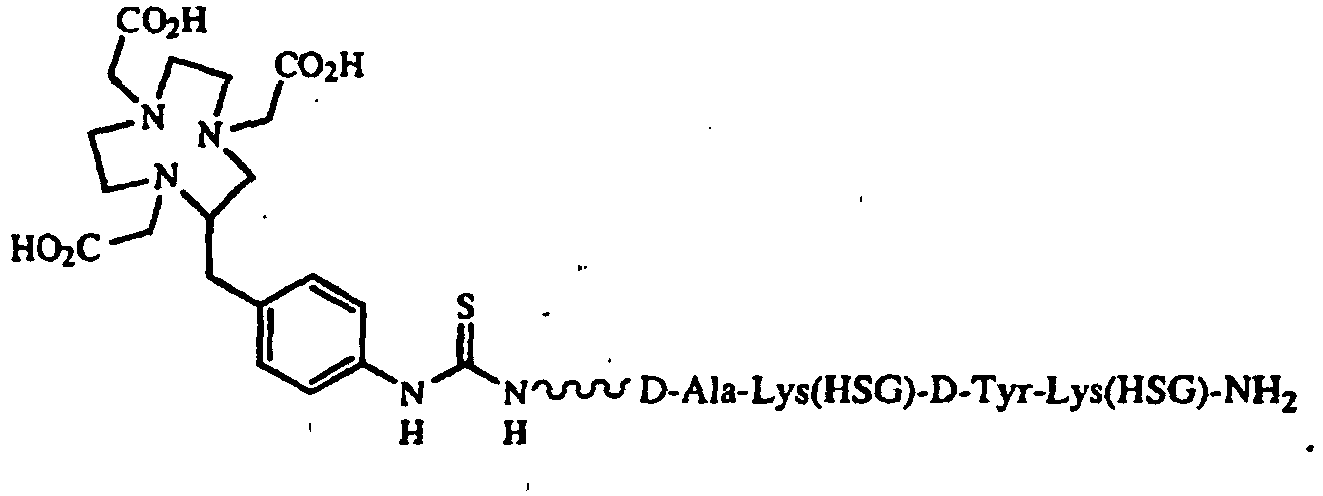
- The chelator-peptide conjugates (d) and (e), above, has been shown to bind 68Ga and is thus useful in positron emission tomography (PET) applications.
- Chelators are coupled to the linker moieties using standard chemistries which are discussed more fully in the working Examples below. Briefly, the synthesis of the peptide Ac-Lys(HSG)D-Tyr-Lys(HSG)-Lys(Tscg-Cys-)-NH2 was accomplished by first attaching Aloc-Lys(Fmoc)-OH to a Rink amide resin on the peptide synthesizer. The protecting group abbreviations "Aloc" and "Fmoc" used herein refer to the groups allyloxycarbonyl and fluorenylmethyloxy carbonyl. The Fmoc-Cys(Trt)-OH and TscG were then added to the side chain of the lysine using standard Fmoc automated synthesis protocols to form the following peptide: Aloc-Lys(Tscg-Cys(Trt)-rink resin. The Aloe group was then removed. The peptide synthesis was then continued on the synthesizer to make the following peptide: (Lys(Aloc)-D-Tyr-Lys(Aloc)-Lys(Tscg-Cys(Trt)-)-rink resin. Following N-terminus acylation, and removal of the side chain Aloc protecting groups. The resulting peptide was then treated with activated N-trityl-HSG-OH until the resin gave a negative test for amines using the Kaiser test. See Karacay et al. Bioconjugate Chem. 11:842-854 (2000). The synthesis of Ac-Lys(HSG)D-Tyr-Lys(HSG)-Lys(Tscg-Cys-)-NH2, as well as the syntheses of DOTA-Phe-Lys(HSG)-D-Tyr-Lys(HSG)-NH2; and DOTA-Phe-Lys(HSG)-Tyr-Lys(HSG)-NH2 are described in greater detail below.
- Chelator-peptide conjugates may be stored for long periods as solids. They may be metered into unit doses for metal-binding reactions, and stored as unit doses either as solids, aqueous or semi-aqueous solutions, frozen solutions or lyophilized preparations. They may be labeled by well-known procedures. Typically, a hard acid cation is introduced as a solution of a convenient salt, and is taken up by the hard acid chelator and possibly by the soft acid chelator. However, later addition of soft acid cations leads to binding thereof by the soft acid chelator, displacing any hard acid cations which may be chelated therein. For example, even in the presence of an excess of cold 111InCl3, labeling with 99m-Tc(V) glucoheptonate or with Tc cations generated in situ with stannous chloride and Na99m-TcO4 proceeds quantitatively on the soft acid chelator. Other soft acid cations such as 186Re, 188Re, 213Bi and divalent or trivalent cations of Mn, Co, Ni, Pb, Cu, Cd, Au, Fe, Ag (monovalent), Zn and Hg, especially 64Cu and 67Cu, and the like, some of which are useful for radioimmunodiagnosis or radioimmunotherapy, can be loaded onto the linker peptide by analogous methods. Re cations also can be generated in situ from perrhenate and stannous ions or a prereduced rhenium glucoheptonate or other transchelator can be used. Because reduction of perrhenate requires more stannous ion (typically above 200 µg/mL final concentration) than is needed for the reduction of Tc, extra care needs to be taken to ensure that the higher levels of stannous ion do not reduce sensitive disulfide bonds such as those present in disulfide-cyclized peptides. During radiolabeling with rhenium, similar procedures are used as are used with the Tc-99m. A preferred method for the preparation of ReO metal complexes of the Tscg-Cys- ligands is by reacting the peptide with ReOCl3(P(Ph3)2 but it is also possible to use other reduced species such as ReO(ethylenediamine)2.
- Antibodies to peptide backbones are generated by well-known methods for Ab production. For example, injection of an immunogen, such as (peptide)n-KLH, wherein KLH is keyhole limpet hemocyanin, and n=1-30, in complete Freund's adjuvant, followed by two subsequent injections of the same immunogen suspended in incomplete Freund's adjuvant into immunocompetent animals, is followed three days after an i.v. boost of antigen, by spleen cell harvesting. Harvested spleen cells are then fused with Sp2/0-Ag14 myeloma cells and culture supernatants of the resulting clones analyzed for anti-peptide reactivity using a direct-binding ELISA. Fine specificity of generated Abs can be analyzed for by using peptide fragments of the original immunogen. These fragments can be prepared readily using an automated peptide synthesizer. For Ab production, enzyme-deficient hybridomas are isolated to enable selection of fused cell lines. This technique also can be used to raise antibodies to one or more of the chelates comprising the linker, e.g., In(III)-DTPA chelates. Monoclonal mouse antibodies to an In(III)-di-DTPA are known (Barbet '395 supra).
- The mutant bispecific antibodies used in the present invention are specific to a variety of cell surface or intracellular tumor-associated antigens as marker substances. These markers may be substances produced by the tumor or may be substances which accumulate at a tumor site, on tumor cell surfaces or within tumor cells, whether in the cytoplasm, the nucleus or in various organelles or sub-cellular structures. Among such tumor-associated markers are those disclosed by Herberman, "Immunodiagnosis of Cancer", in Fleisher ed., "The Clinical Biochemistry of Cancer", page 347 (American Association of Clinical Chemists, 1979) and in
U.S. Patent Nos. 4,150,149 ;4,361,544 ; and4,444,744 . - Tumor-associated markers have been categorized by Herberman, supra, in a number of categories including oncofetal antigens, placental antigens, oncogenic or tumor virus associated antigens, tissue associated antigens, organ associated antigens, ectopic hormones and normal antigens or variants thereof. Occasionally, a sub-unit of a tumor-associated marker is advantageously used to raise antibodies having higher tumor-specificity, e.g., the beta-subunit of human chorionic gonadotropin (HCG) or the gamma region of carcino embryonic antigen (CEA), which stimulate the production of antibodies having a greatly reduced cross-reactivity to non-tumor substances as disclosed in
U.S. Patent Nos. 4,361,644 and4,444,744 . - Another marker of interest is transmembrane activator and CAML-interactor (TACI). See Yu et al. Nat. Immunol. I:252-256 (2000). Briefly, TACI is a marker for B-cell malignancies (e.g., lymphoma). Further it is known that TACI and B cell maturation antigen (BCMA) are bound by the tumor necrosis factor homolog a proliferation-inducing ligand (APRIL). APRIL stimulates in vitro proliferation of primary B and T cells and increases spleen weight due to accumulation of B cells in vivo. APRIL also competes with TALL-1 (also called BLyS or BAFF) for receptor binding. Soluble BCMA and TACI specifically prevent binding of APRIL and block APRIL-stimulated proliferation of primary B cells. BCMA-Fc also inhibits production of antibodies against keyhole limpet hemocyanin and Pneumovax in mice, indicating that APRIL and/or TALL-1 signaling via BCMA and/or TACI are required for generation of humoral immunity. Thus, APRIL-TALL-1 and BCMA-TACI form a two ligand-two receptor pathway involved in stimulation of B and T cell function.
- After the initial raising of antibodies to the immunogen, the antibodies can be sequenced and subsequently prepared by recombinant techniques. Humanization and chimerization of murine antibodies and antibody fragments are well known to those skilled in the art. For example, humanized monoclonal antibodies are produced by transferring mouse complementary determining regions from heavy and light variable chains of the mouse immunoglobulin into a human variable domain, and then, substituting human residues in the framework regions of the murine counterparts. The use of antibody components derived from humanized monoclonal antibodies obviates potential problem associated with the immunogenicity of murine constant regions. General techniques for cloning murine immunoglobulin variable domains are described, for example, by the publication of Orlandi et al., Proc. Nat'l Acad. Sci. USA 86: 3833 (1989) Techniques for producing humanized Mabs are described, for example, by Jones et al., Nature 321: 522 (1986), Riechmann et al., Nature 332: 323 (1988), Verhoeyen et al., Science 239: 1534 (1988), Carter et al., Proc. Nat'l Acad. Sci. USA 89: 4285 (1992), Sandhu, Crit. Rev. Biotech. 12: 437 (1992), and Singer et al., J. Immun. 150: 2844 (1993)
- Alternatively, fully human antibodies can be obtained from transgenic non-human animals. See, e.g., Mendez et al., Nature Genetics, 15: 146-156 (1997);
U.S. Patent No. 5,633,425 . For example, human antibodies can be recovered from transgenic mice possessing human immunoglobulin loci. The mouse humoral immune system is humanized by inactivating the endogenous immunoglobulin genes and introducing human immunoglobulin loci. The human immunoglobulin loci are exceedingly complex and comprise a large number of discrete segments which together occupy almost 0.2% of the human genome. To ensure that transgenic mice are capable of producing adequate repertoires of antibodies, large portions of human heavy- and light-chain loci must be introduced into the mouse genome. This is accomplished in a stepwise process beginning with the formation of yeast artificial chromosomes (YACs) containing either human heavy-or light-chain immunoglobulin loci in germline configuration. Since each insert is approximately 1 Mb in size, YAC construction requires homologous recombination of overlapping fragments of the immunoglobulin loci. The two YACs, one containing the heavy-chain loci and one containing the light-chain loci, are introduced separately into mice via fusion of YAC-containing yeast spheroblasts with mouse embryonic stem cells. Embryonic stem cell clones are then microinjected into mouse blastocysts. Resulting chimeric males are screened for their ability to transmit the YAC through their germline and are bred with mice deficient in murine antibody production. Breeding the two transgenic strains, one containing the human heavy-chain loci and the other containing the human light-chain loci, creates progeny which produce human antibodies in response to immunization. - Unrearranged human immunoglobulin genes also can be introduced into mouse embryonic stem cells via microcell-mediated chromosome transfer (MMCT). See, e.g., Tomizuka et al., Nature Genetics, 16: 133 (1997). In this methodology microcells containing human chromosomes are fused with mouse embryonic stem cells. Transferred chromosomes are stably retained, and adult chimeras exhibit proper tissue-specific expression.
- As an alternative, an antibody or antibody fragment of the present invention may be derived from human antibody fragments isolated from a combinatorial immunoglobulin library. See, e.g., Barbas et al., METHODS: A Companion to Methods in Enzymology 2: 119 (1991), and Winter et al., Ann. Rev. Immunol. 12: 433 (1994) Many of the difficulties associated with generating monoclonal antibodies by B-cell immortalization can be overcome by engineering and expressing antibody fragments in E. coli, using phage display. To ensure the recovery of high affinity, monoclonal antibodies a combinatorial immunoglobulin library must contain a large repertoire size. A typical strategy utilizes mRNA obtained from lymphocytes or spleen cells of immunized mice to synthesize cDNA using reverse transcriptase. The heavy- and light-chain genes are amplified separately by PCR and ligated into phage cloning vectors. Two different libraries are produced, one containing the heavy-chain genes and one containing the light-chain genes. Phage DNA is islolated from each library, and the heavy- and light-chain sequences are ligated together and packaged to form a combinatorial library. Each phage contains a random pair of heavy- and light-chain cDNAs and upon infection of E. coli directs the expression of the antibody chains in infected cells. To identify an antibody that recognizes the antigen of interest, the phage library is plated, and the antibody molecules present in the plaques are transferred to filters. The filters are incubated with radioactively labeled antigen and then washed to remove excess unbound ligand. A radioactive spot on the autoradiogram identifies a plaque that contains an antibody that binds the antigen. Cloning and expression vectors that are useful for producing a human immunoglobulin phage library can be obtained, for example, from STRATAGENE Cloning Systems (La Jolla, CA).
- A similar strategy can be employed to obtain high-affinity scFv. See, e.g., Vaughn et al., Nat. Biotechnol., 14: 309-314 (1996). An scFv library with a large repertoire can be constructed by isolating V-genes from non-immunized human donors using PCR primers corresponding to all known VH, Vκ and Vλ gene families. Following amplification, the Vκ and Vλ pools are combined to form one pool. These fragments are ligated into a phagemid vector. The scFv linker, (Gly4, Ser)3, is then ligated into the phagemid upstream of the VL fragment. The VH and linker-VL fragments are amplified and assembled on the JH region. The resulting VH-linker-VL fragments are ligated into a phagemid vector. The phagemid library can be panned using filters, as described above, or using immunotubes (Nunc; Maxisorp). Similar results can be achieved by constructing a combinatorial immunoglobulin library from lymphocytes or spleen cells of immunized rabbits and by expressing the scFv constructs in P. pastoris. See, e.g., Ridder et al., Biotechnology, 13: 255-260 (1995). Additionally, following isolation of an appropriate scFv, antibody fragments with higher binding affinities and slower dissociation rates can be obtained through affinity maturation processes such as CDR3 mutagenesis and chain shuffling. See, e.g., Jackson et al., Br. J. Cancer, 78: 181-188 (1998); Osbourn et al., Immunotechnology, 2: 181-196 (1996).
- A variety of recombinant methods can be used to produce bi-specific antibodies and antibody fragments. For example, bi-specific antibodies and antibody fragments can be produced in the milk of transgenic livestock. See, e.g., Colman, A., Biochem. Soc. Symp., 63: 141-147, 1998;
U.S. Patent No. 5,827,690 . Two DNA constructs are prepared which contain, respectively, DNA segments encoding paired immunoglobulin heavy and light chains. The fragments are cloned into expression vectors which contain a promoter sequence that is preferentially expressed in mammary epithelial cells. Examples include, but are not limited to, promoters from rabbit, cow and sheep casein genes, the cow α-lactoglobulin gene, the sheep β-lactoglobulin gene and the mouse whey acid protein gene. Preferably, the inserted fragment is flanked on its 3' side by cognate genomic sequences from a mammary-specific gene. This provides a polyadenylation site and transcript-stabilizing sequences. The expression cassettes are coinjected into the pronuclei of fertilized, mammalian eggs, which are then implanted into the uterus of a recipient female and allowed to gestate. After birth, the progeny are screened for the presence of both transgenes by Southern analysis. In order for the antibody to be present, both heavy and light chain genes must be expressed concurrently in the same cell. Milk from transgenic females is analyzed for the presence and functionality of the antibody or antibody fragment using standard immunological methods known in the art. The antibody can be purified from the milk using standard methods known in the art. - A chimeric Ab is constructed by ligating the cDNA fragment encoding the mouse light variable and heavy variable domains to fragment encoding the C domains from a human antibody. Because the C domains do not contribute to antigen binding, the chimeric antibody will retain the same antigen specificity as the original mouse Ab but will be closer to human antibodies in sequence. Chimeric Abs still contain some mouse sequences, however, and may still be immunogenic. A humanized Ab contains only those mouse amino acids necessary to recognize the antigen. This product is constructed by building into a human antibody framework the amino acids from mouse complementarity determining regions.
- Various mutagenesis techniques may be used to construct the mutant bsAb of the present invention. A person of ordinary skill in the art is well acquainted with such techniques. For example, an expression vector for the mutant bsAb may be obtained by constructing a mutated HC fragment, subcloning this fragment into the expression vector for the parent bsAb to replace the corresponding wild type fragment, and transfecting a host cell with the vector.
- In order to obtain an expression vector for the parent bsAb, a person of ordinary skill in the art can use techniques readily available. Some of these techniques are disclosed in
WO 1999/66951 - A bsAbs of IgG-scFv with other specificities and the respective mutant bsAbs can be generated by substitution of only the variable region sequences of the IgG and/or the scFv with those of other Abs. The CDR grafted mutant bsAb can be generated by substitution of only the variable region sequences of the IgG or scFv with those of the CDR grafted Abs. Typically, this "CDR-grafting" technology has been applied to the generation of recombinant, pharmaceutical antibodies consisting of murine CDRs, human variable region frameworks and human constant regions (eg Riechmann, L. et al, (1988) Nature, 332, 323-327). Such "reshaped" or "humanized" antibodies have less murine content than chimeric antibodies and retain the human constant regions necessary for the stimulation of human Fc dependent effector functions. In consequence, CDR grafted antibodies are less likely than chimeric antibodies to evoke a HAMA response when administered to humans, their half-life in circulation should approach that of natural human antibodies and their diagnostic and therapeutic value is enhanced.
- In practice, for the generation of efficacious humanized antibodies retaining the specificity of the original murine antibody, it is not usually sufficient simply to substitute CDRs. In addition there is a requirement for the inclusion of a small number of critical murine antibody residues in the human variable region. The identity of these residues depends on the structure of both the original murine antibody and the acceptor human antibody. British Patent Application Number
9019812.8 - The present invention contemplates the use of the inventive bispecific antibodies and targetable constructs in treating and/or imaging normal tissue and organs using the methods described in
U.S. Patent Nos. 6,126,916 ;6,077,499 ;6,010,680 ;5,776.095 ;5,776,094 ;5,776,093 ;5,772,981 ;5,753,206 ;5,746,996 ;5,697,902 ;5,328,679 ;5,128,119 ;5,101,827 ; and4,735,210 . Additional methods are described inWO 1999/66951 WO 02/082041 WO 00/74718 U.S. Provisional Application 60/138,284 . Exemplary autoimmune diseases are acute idiopathic thrombocytopenic purpura, chronic idiopathic thrombocytopenic purpura, dermatomyositis, Sydenham's chorea, myasthenia gravis, systemic lupus erythematosus, lupus nephritis, rheumatic fever, polyglandular syndromes, bullous pemphigoid, diabetes mellitus, Henoch-Schonlein purpura, poststreptococcalnephritis, erythema nodosurn, Takayasu's arteritis, Addison's disease, rheumatoid arthritis, multiple sclerosis, sarcoidosis, ulcerative colitis, erythema multiforme, IgA nephropathy,polyarteritis nodosa, ankylosing spondylitis. Goodpasture's syndrome, thromboangitisubiterans, Sjogren's syndrome, primary biliary cirrhosis, Hashimoto's thyroiditis, thyrotoxicosis, scleroderma, chronic active hepatitis, polymyositis/dermatomyositis ,polychondritis, parnphigus vulgaris, Wegener's granulomatosis, membranous nephropathy, amyotrophic lateral sclerosis, tabes dorsalis, giant cell arteritis/polymyalgia, perniciousanemia, rapidly progressive glomerulonephritis and fibrosing alveolitis. - The mutant bsAb of the present invention may be used in a pretargeting method as the primary targeting species. In pretargeting methods, the mutant bsAb is administered. Once sufficient accretion of the primary targeting species is achieved, a targetable construct is administered. The targetable construct comprises a binding site which recognizes the available binding site of the primary targeting species and a diagnostic or therapeutic agent. Exemplary targetable constructs are described above. The doses and timing of the reagents can be readily worked out by a skilled artisan, and are dependent on the specific nature of the reagents employed. A pretargeting method may be performed with or without the use of a clearing agent.
- After sufficient time has passed for the bsAb to target to the diseased tissue, the diagnostic agent is administered. Subsequent to administration of the diagnostic agent, imaging can be performed. Tumors can be detected in body cavities by means of directly or indirectly viewing various structures to which light of the appropriate wavelength is delivered and then collected. Lesions at any body site can be viewed so long as nonionizing radiation can be delivered and recaptured from these structures. For example, PET which is a high resolution, non-invasive, imaging technique can be used with the inventive antibodies for the visualization of human disease. In PET, 511 keV gamma photons produced during positron annihilation decay are detected when using F-18 as the positron-emitter.
- The invention generally contemplates the use of diagnostic agents which emit 25-600 keV gamma particles and/or positrons. Examples of such agents include, but are not limited to 18F, 52Fe,62Cu, 64Cu, 67Cu, 67Ga, 68Ga, 86Y, 89Zr, 94mTc, 94Tc, 99mTc, 111In, 123I, 241I, 125I, 131I, 154-158Gd and 175Lu.
- the use of Detection with intraoperative/endoscopic probes is also contemplated in the use of a mutant bsAb of the present invention and a targetable construct which is a peptide labeled with 1-125. Such methods are disclosed in
U.S. Patents 5,716,595 and6,096,289 . -
- In PDT, a photosensitizer, e. g. , a hematoporphyrin derivative such as dihematoporphyrin ether, is administered to a subject. Anti-tumor activity is initiated by the use of light, e.g., 630 nm. Alternate photosensitizers can be utilized, including those useful at longer wavelengths, where skin is less photosensitized by the sun. Examples of such photosensitizers include, but are not limited to, benzoporphyrin monoacid ring A (BPD-MA), tin etiopurpurin (SnET2), sulfonated aluminum phthalocyanine (AlSPc) and lutetium texaphyrin (Lutex).
- Additionally, in PDT, a diagnostic agent is injected, for example, systemically, and laser-induced fluorescence can be used by endoscopes to detect sites of cancer which have accreted the light-activated agent. For example, this has been applied to fluorescence bronchoscopic disclosure of early lung tumors. Doiron et al. Chest 76:32 (1979). In another example, the antibodies and antibody fragments can be used in single photon emission. For example, a Tc-99m-labeled diagnostic agent can be administered to a subject following administration of the inventive antibodies or antibody fragments. The subject is then scanned with a gamma camera which produces single-photon emission computed tomographic images and defines the lesion or tumor site.
- Therapeutically useful immunoconjugates can be obtained by conjugating photoactive agents or dyes to an antibody composite. Fluorescent and other chromogens, or dyes, such as porphyrins sensitive to visible light, have been used to detect and to treat lesions by directing the suitable light to the lesion. In therapy, this has been termed photoradiation, phototherapy, or photodynamic therapy (Jori et al. (eds.), Photodynamic Therapy of Tumors and Other Diseases (Libreria Progetto 1985); van den Bergh, Chem. Britain 22:430 (1986)). Moreover, monoclonal antibodies have been coupled with photoactivated dyes for achieving phototherapy. Mew et al., J. Immunol. 130:1473 (1983); idem., Cancer Res. 45:4380 (1985); Oseroff et al., Proc. Natl. Acad. Sci. USA 83:8744 (1986); idem., Photochem. Photobiol. 46:83 (1987); Hasan et al., Prog. Clin. Biol. Res. 288:471 (1989); Tatsuta et al., Lasers Surg. Med. 9:422 (1989); Pelegrin et al., Cancer 67:2529 (1991). However, these earlier studies did not include use of endoscopic therapy applications, especially with the use of antibody fragments or subfragments. Thus, the present invention contemplates the therapeutic use of immunoconjugates comprising photoactive agents or dyes.
- The linker moiety may also be conjugated to an enzyme capable of activating a prodrug at the target site or improving the efficacy of a normal therapeutic by controlling the body's detoxification pathways. Following administration of the bsAb, an enzyme conjugated to the linker moiety, a low MW hapten recognized by the second arm of the bsAb (the scFv component), is administered. After the enzyme is pretargeted to the target site, a cytotoxic drug is injected, which is known to act at the target site. The drug may be one which is detoxified by the mammal's ordinary detoxification processes. For example, the drug may be converted into the potentially less toxic glucuronide in the liver. The detoxified intermediate can then be reconverted to its more toxic form by the pretargeted enzyme at the target site. Alternatively, an administered prodrug can be converted to an active drug by the pretargeted enzyme. The pretargeted enzyme improves the efficacy of the treatment by recycling the detoxified drug. This approach can be adopted for use with any enzyme-drug pair.
- Certain cytotoxic drugs that are useful for anticancer therapy are relatively insoluble in serum. Some are also quite toxic in an unconjugated form, and their toxicity is considerably reduced by conversion to prodrugs. Conversion of a poorly soluble drug to a more soluble conjugate, e.g., a glucuronide, an ester of a hydrophilic acid or an amide of a hydrophilic amine, will improve its solubility in the aqueous phase of serum and its ability to pass through venous, arterial or capillary cell walls and to reach the interstitial fluid bathing the tumor. Cleavage of the prodrug deposits the less soluble drug at the target site. Many examples of such prodrug-to-drug conversions are disclosed in
Hansen U.S. Patent No. 5,851,527 . - Conversion of certain toxic substances such as aromatic or alicyclic alcohols, thiols, phenols and amines to glucuronides in the liver is the body's method of detoxifying them and making them more easily excreted in the urine. One type of antitumor drug that can be converted to such a substrate is epirubicin, a 4-epimer of doxorubicin (Adriamycin), which is an anthracycline glycoside and has been shown to be a substrate for human beta-D-glucuronidase See, e.g., Arcamone Cancer Res. 45:5995 (1985). Other analogues with fewer polar groups are expected to be more lipophilic and show greater promise for such an approach. Other drugs or toxins with aromatic or alicyclic alcohol, thiol or amine groups are candidates for such conjugate formation. These drugs, or other prodrug forms thereof, are suitable candidates for the site-specific enhancement methods of the present invention.
- The prodrug CPT- 11 (irinotecan) is converted in vivo by carboxylesterase to the active metabolite SN-38. One application of the invention, therefore, is to use a bsAb targeted against a tumor and a hapten (e.g. di-DTPA) followed by injection of a di-DTPA-carboxylesterase conjugate. Once a suitable tumor-to-background localization ratio has been achieved, the CPT-11 is given and the tumor-localized carboxylesterase serves to convert CPT-11 to SN-38 at the tumor. Due to its poor solubility, the active SN-38 will remain in the vicinity of the tumor and, consequently, will exert an effect on adjacent tumor cells that are negative for the antigen being targeted. This is a further advantage of the method. Modified forms of carboxylesterases have been described and are within the scope of the invention. See, e.g., Potter et al., Cancer Res. 58:2646-2651 (1998) and Potter et al., Cancer Res. 58:3627-3632 (1998).
- Etoposide is a widely used cancer drug that is detoxified to a major extent by formation of its glucuronide and is within the scope of the invention. See, e.g., Hande et al. Cancer Res. 48:1829-1834 (1988). Glucuronide conjugates can be prepared from cytotoxic drugs and can be injected as therapeutics for tumors pre-targeted with mAb-glucuronidase conjugates. See, e.g., Wang et al. Cancer Res. 52:4484-4491 (1992). Accordingly, such conjugates also can be used with the pre-targeting approach described here. Similarly, designed prodrugs based on derivatives of daunomycin and doxorubicin have been described for use with carboxylesterases and glucuronidases. See, e.g., Bakina et al. J. Med Chem. 40:4013-4018 (1997). Other examples of prodrug/enzyme pairs that can be used within the present invention include, but are not limited to, glucuronide, prodrugs of hydroxy derivatives of phenol mustards and beta-glucuronidase; phenol mustards or CPT-11 and carboxypeptidase; methotrexate-substituted alpha-amino acids and carboxypeptidase A; penicillin or cephalosporin conjugates of drugs such as 6-mercaptopurine and doxorubicin and beta-lactamase; etoposide phosphate and alkaline phosphatase.
- The enzyme capable of activating a prodrug at the target site or improving the efficacy of a normal therapeutic by controlling the body's detoxification pathways may alternatively be conjugated to the hapten. The enzyme-hapten conjugate is administered to the subject following administration of the pre-targeting bsAb and is directed to the target site. After the enzyme is localized at the target site, a cytotoxic drug is injected, which is known to act at the target site, or a prodrug form thereof which is converted to the drug in situ by the pretargeted enzyme. As discussed above, the drug is one which is detoxified to form an intermediate of lower toxicity, most commonly a glucuronide, using the mammal's ordinary detoxification processes. The detoxified intermediate, e.g., the glucuronide, is reconverted to its more toxic form by the pretargeted enzyme and thus has enhanced cytotoxicity at the target site. This results in a recycling of the drug. Similarly, an administered prodrug can be converted to an active drug through normal biological processess. The pretargeted enzyme improves the efficacy of the treatment by recycling the detoxified drug. This approach can be adopted for use with any enzyme-drug pair.
- The invention further contemplates the use of the inventive bsAb and the diagnostic agent(s) in the context of Boron Neutron Capture Therapy (BNCT) protocols. BNCT is a binary system designed to deliver ionizing radiation to tumor cells by neutron irradiation of tumor-localized 10B atoms. BNCT is based on the nuclear reaction which occurs when a stable isotope, isotopically enriched 10B (present in 19.8% natural abundance), is irradiated with thermal neutrons to produce an alpha particle and a 7Li nucleus. These particles have a path length of about one cell diameter, resulting in high linear energy transfer. Just a few of the short-
range 7 MeV alpha particles produced in this nuclear redaction are sufficient to target the cell nucleus and destroy it. Success with BNCT of cancer requires methods for localizing a high concentration of 10B at tumor sites, while leaving non-target organs essentially boron-free. Compositions and methods for treating tumors in subjects using pre-targeting bsAb for BNCT are described inWO 00/33874 - It should also be noted that scFv component of the mutant bsAb of the present invention may also be specific to an enzyme.
- A clearing agent may be used which is given between doses of the mutant bsAb and the targetable construct. The present inventors have discovered that a clearing agent of novel mechanistic action may be used with the invention, namely a glycosylated anti-idiotypic Fab' fragment targeted against the disease targeting arm(s) of the bsAb. Anti-CEA (MN 14 Ab) x anti-peptide bsAb is given and allowed to accrete in disease targets to its maximum extent. To clear residual bsAb, an anti-idiotypic Ab to MN-14, termed WI2, is given, preferably as a glycosylated Fab' fragment. The clearing agent binds to the bsAb in a monovalent manner, while its appended glycosyl residues direct the entire complex to the liver, where rapid metabolism takes place. Then the therapeutic which is associated with the linker moiety is given to the subject. The WI2 Ab to the MN-14 arm of the bsAb has a high affinity and the clearance mechanism differs from other disclosed mechanisms (see Goodwin et al., ibid), as it does not involve cross-linking, because the WI2-Fab' is a monovalent moiety.
- The present mutant bsAb can also be used in a method of ultrasound imaging. An ultrasound enhancement agent, such as a contrast agent, may be attached to a targetable construct, such as a bivalent DTPA peptide. By way of non-limiting example, an enhancement agent such as a liposome, preferably a gas-filled liposome may be used. In this method, the mutant bsAb would be administered first, followed by administration of the liposome-targetable construct complex. See Maresca, G. et al., Eur J. Radiol. Suppl. 2 S171-178 (1998); Demos, Sm. Et al. ); and Unger, E. et al., Am J. Cardiol. 81 58G-61G (1998).
- The mutant bispecific antibody may be administered as one component of a multicomponent treatment regimen. The mutant bispecific antibody may be administered before, during or after the administration of at least one therapeutic agent used to treat a disease or condition.
- The use of an exemplary mutant bsAb in a pretargeting method, compared to the use of a parent bsAb in a pretargeting method is illustrated in Example 2. The data illustrates the accelerated rate of clearance of a mutant bsAb of the present invention as compared to the parent bsAb. Additionally, the data illustrates that a much larger amount of targetable construct is trapped in the blood when the parent bsAb is used as compared to when the mutant bsAb is used.
-
Figures 5 and6 show data for pretargeting methods involving the parent bsAb, 125I-hMN-14IgG-(734scFv)2.Figure 7 shows data for pretargeting methods involving the mutant bsAb, 125I-hMN-14IgG1253A-(734scFv)2. The 125I-label allows for a determination of the amount of bsAb present in different regions of the body. A comparison of the data inFigures 5 and7 shows that the mutant bsAb cleared the body faster than the parent bsAb. For example, after pretargeting with parent bsAb for 4 days (Figure 5 ), and3 hours post injection of IMP-192, the %ID/g for tumor and blood was 19.21 ± 7.318 and 3.73 ± 0.75, respectively. In contrast, after pretargeting with mutant bsAb for 4 days (Figure 5 ), and3 hours post injection of IMP-192, the %ID/g for tumor and blood was 2.42 ± 0.78 and 0.07 ± 0.01, respectively. - A comparison of the tumor-to-blood ratios of 125I in
Figures 5 and7 (see entry under "Blood" inFigures 5 and7 ) demonstrates that a higher signal-to-background can be achieved with the mutant bsAb. Even after 6 days of pretargeting with parent bsAb (seeFigure 4 ), the tumor-to-blood ratio is much less than after 4 days of pretargeting with mutant bsAb. - The 99mTc-label allows for a determination of the amount of targetable construct present in different regions of the body. A comparison of the %ID/g of IMP-192 (99mTc-labeled targetable construct) shows that the tumor-to-blood ratio is much greater for the pretargeting methods with mutant bsAb. This result illustrates that less targetable construct is trapped in the blood in pretargeting methods involving a mutant bsAb. When the parent bsAb is used (see
Figures 5 and6 ) the 99mTc-labeled targetable construct is trapped in the blood, rather than appearing at the tumor site. Therefore, low tumor-to-blood ratios are observed. For example, the tumor-to-blood ratio of 99mTc-labeled targetable construct is shown inFigure 5 (parent bsAb) in the left hand side, under "Blood". Three hours post injection, the tumor-to-blood ratio is 0.24 ± 0.05. In contrast,Figure 5 (mutant bsAb) shows the tumor to blood ratio three hours post injection is 3.52 ± 1.45. - The present invention encompasses the use of the mutant bsAb and a therapeutic agent associated with the linker moieties discussed above in intraoperative, intravascular, and endoscopic tumor and lesion detection, biopsy and therapy as described in
U.S. Patent Nos. 5,716,595 and6,096,289 . - The mutant bsAb of the present invention can be employed not only for therapeutic or imaging purposes, but also as aids in performing research in vitro. For example, the bsAbs of the present invention can be used in vitro to ascertain if a targetable construct can form a stable complex with one or more bsAbs. Such an assay would aid the skilled artisan in identifying targetable constructs which form stable complexes with bsAbs. This would, in turn, allow the skilled artisan to identify targetable constructs which are likely to be superior as therapeutic and/or imaging agents.
- The assay is advantageously performed by combining the targetable construct in question with at least two molar equivalents of a mutant bsAb. Following incubation, the mixture is analyzed by size-exclusion HPLC to determine whether or not the construct has bound to the bsAb. Alternatively, the assay is performed using standard combinatorial methods wherein solutions of various bsAbs are deposited in a standard 96 well plate. To each well, is added solutions of targetable construct(s). Following incubation and analysis, one can readily determine which construct(s) bind(s) best to which bsAb(s).
- It should be understood that the order of addition of the mutant bsAb to the targetable construct is not crucial; that is, the mutant bsAb may be added to the construct and vice versa. Likewise, neither the mutant bsAb nor the construct needs to be in solution; that is, they may be added either in solution or neat, whichever is most convenient. Lastly, the method of analysis for binding is not crucial as long as binding is established. Thus, one may analyze for binding using standard analytical methods including, but not limited to, FABMS, high-field NMR or other appropriate method in conjunction with, or in place of, size-exclusion HPLC.
- 734scFv was designed to have the configuration of sL-Vλ-L-VH, where sL is a short flexible linker, Gly-Gly-Gly-Ser (Coloma & Morrison, Nat. Biotechnol. 15:159-163 (1997)), serving as the linkage between hMN-14 IgG heavy chain and 734scFv, and L is a long linker between the Vλ and VH of 734 composed of three repeats of Gly-Gly-Gly-Gly-Ser, (Huston, Levinson, et al. PNAS 85:5879-5883 (1988)). Primer pairs 734VLscFv5'(Cys)/734VLscFv3' and 734VHscFv5'/734VHscFv3'(SacI) were used to amplify respective VI and VH sequences of 734. The resulting DNA products were assembled into 734scFv gene by restriction enzyme digestion and ligation and the sequence was confirmed by DNA sequencing.
734VLscFv5'(Cys) 
734VLscFv3' 
734VHscFv5' 5'-CC GGA GGC GGT GGG AGT GAG GTG AAA CTG CAG GAG-3' 734VHscFv3'(SacI) 
- To link 734scFv to the C-terminal end of human heavy constant chain (HC), a new pair of primers, 734scFv2-5' and 734scFv-3', was synthesized and used to amplify the DNA encoding 734scFv. The primer 734scFv2-5' provided the correct sequence for inframe linking 734scFv to the C-terminal end of human HC. The resulting DNA fragment was ligated to human HC sequence, forming a construct encoding HC-734scFv. The DNA fragment encoding normal human HC in the expression vector for hMN-14, hMN-14pdHL2, was then replaced by the HC-734scFv fragment, resulting in the expression vector for the fusion construct, hMN-14IgG-(734scFv)2pdHL2.
734scFv2-5' 5'-TCC CCG GGT AAA GGT GGC GGT TCA CAG CTG-3' 734scFv-3' 5'-GAG CTC GGC CGT CGC AC-3' - Isoleucine 253 is located in the
C H2 domain of human HC chain. To introduce the I253A mutation into hMN-14IgG-(734scFv)2, plasmid vector CH1kbpKS, containing an insert DNAfragment encoding C H1 andpartial C H2 domains was used in oligonucleotide directed site-specific mutagenesis. Anoligonucleotide I253AC H2, which converts the wild type sequence KDTLM253ISRTPE in theC H2 to KDTLM235ASRTPE, was designed and synthesized as the mutagenic primer. The mutagenisis was accomplished by using the Sculptor IVM system (Amersham, Arlington Heights, IL) according to the manufacturer's specifications. After the sequence had been verified by dideoxy DNA sequencing, the mutated HC fragment was subcloned into hMN-14IgG-(734scFv)2pdHL2 to replace the corresponding wild type fragment, resulting in the expression vector for the mutant fusion bsAb, hMN-14IgG(I253A)-( 734scFv)2pdHL2.I253AC H25'-AAG GAC ACC CTC ATG GCT AGC CGG ACC CCT GAG-3' - The expression vectors were transfected into Sp2/0 cells by electroporation 2-5x10⁶ cells were transfected using -30 µg of SalI linearized DNA and plated into 96-well cell culture plates. After 2 days, methotrexate (MTX) at a final concentration of 0.025-0.075 µM was added into the cell culture medium for the selection of transfectants. MTX-resistant colonies emerged in 2-3 weeks and were screened by ELISA for secretion of human IgG. Briefly, cell culture supernatants from the surviving colonies were incubated in microwells of ELISA plate coated with goat anti-human IgG F(ab')2 specific antibody for 1 h. A peroxidase-conjugated goat anti-human IgG Fc fragment specific antibody was then added and incubated in the wells for 1 h. The presence of human IgG in the supernatant was revealed by addition of the substrate solution containing 0.4 mg/ml of o-phenylenediamine dihydrochloride and 0.0125% H2O2. From the positive clones, the best Ab-producers were determined, selected and further expanded. hMN-14IgG-(734scFv)2 and hMN-14IgG(I253A)-(734scFv)2 were purified from cell culture supernatant by affinity chromatography on either Protein A or DTPA column.
- The first amino acid, Aloc-Lys(Fmoc)-OH was attached to 0.21 mmol Rink amide resin on the peptide synthesizer followed by the addition of the Tc-99m ligand binding residues Fmoc-Cys(Trt)-OH and TscG to the side chain of the lysine using standard Fmoc automated synthesis protocols to form the following peptide: Aloc-Lys(TscG-Cys(Trt)-rink resin. The Aloc group was then removed by treatment of the resin with 8 mL of a solution containing 100 mg Pd[P(Ph)3]4 dissolved in 10 mL CH2Cl2, 0.75 mL glacial acetic acid and 2.5 ml diisopropylethyl amine. The resin mixture was then treated with 0.8 ml tributyltin hydride and vortex mixed for 60 min. The peptide synthesis was then continued on the synthesizer to make the following peptide: Lys(Aloc)-Tyr-Lys(Aloc)-Lys(TscG-Cys-)-rink resin. The N-terminus was acetylated by vortex mixing the resin for 60 mm with 8 mL of a solution containing 10 mL DMF, 3 mL acetic anhydride, and 6 mL diisopropylethylamine. The side chain Aloc protecting groups were then removed as described above and the resin treated with piperidine using the standard Fmoc deprotection protocol to remove any acetic acid which may have remained on the resin.
- Activated DTPA and DTPA Addition: The DTPA, 5 g, was dissolved in 40 mL 1.0 M tetrabutylammonium hydroxide in methanol. The methanol was removed under hi-vacuum to obtain a viscous oil. The oil was dissolved in 50 mL DMF and the volatile solvents were removed under hi-vacuum on the rotary evaporator. The DMF treatment was repeated two more times. The viscous oil was then dissolved in 50 ml DMF and mixed with 5 g HBTU. An 8 ml aliquot of the activated DTPA solution was then added to the resin which was vortex mixed for 14 hr. The DTPA treatment was repeated until the resin gave a negative test for amines using the Kaiser test.
- Cleavage and Purification: The peptide was then cleaved from the resin by treatment with 8 ml of a solution made from 30 ml TFA, 1 ml triisopropylsilane, and 1 ml ethanedithiol for 60 mm. The crude cleaved peptide was precipitated by pouring into 30 ml ether and was collected by centrifugation. The peptide was then purified by reverse phase HPLC using a 4 x 30 cm Waters preparative C-18 Delta-Pak column (15 µm, 100Å). The HPLC fractions were collected and lyophilized to obtain a fraction which contained the desired product by ESMS (MH ± 1590).
- Kit Formulation: The peptide was formulated into lyophilized kits which contained 78 µg of the peptide, 0.92 mg non-radioactive InCl3, 100 µg stannous chloride, 3 mg gentisic acid, and HPCD (10 % on reconstitution).
- 60 µg of antibody protein was labeled with I-125 using the chloramine-T method (Greenwood, Hunter, et al., Biochem. J. 89 11-123 (1963)) and purified using NAP-5 disalting column (Pharmacia, Piscataway, NJ).
- To prepare Tc-99m labeled IMP-192, a kit containing 50 µg IMP-192 was reconstituted with 1.5 ml of a saline solution containing 20 mCi pertechnetate. The reconstituted kit was incubated at room temperature for 10 min and then heated for 15 min in a boiling water bath.
- Simple biodistribution patterns of the 125I-hMN-14IgG-(734scFv)2 and 125I-hMN-14IgGI253A-(734scFv)2 were evaluated. Groups of nude female mice bearing GW39 human colonic cancer xenografts received i.v. injections of 20 µg (5 µCi)/mouse of a 125I-labeled parent or mutant bsAb. Mice were euthanized at designed postinjection time points and their organs were removed, weighted and counted for I-125 radioactivity.
- The GW-39 human colonic tumor cell line was propagated as serial, subcutaneous xenografts in nude mice as described elsewhere (Tu, et al. Tumour Biology 9:212-220 (1988)).
- The tumor and normal tissue biodistribution of 125I-labeled hMN-14IgG-(734scFv)2 and hMN-14IgGI253A(734scFv)2 mutant was examined in human colonic tumor-bearing
mice Figures 3 and4 wherein data are expressed as a median percentage of injected dose per gram (%ID/g). - The tumor uptake of hMN-14IgGI253A(734scFv)2 was significantly lower than that of hMN-14IgG-(734scFv)2. This accelerated rate of clearance of hMN-14IgGI253A(734scFv)2 is also seen in normal tissues such as liver, spleen, kidney, lungs, stomach, small intestine, large intestine and blood. See
Figures 3 and4 . The accelerated clearance of hMN-14IgGI253A(734scFv)2 produced higher tumor-to-organ ratios for many normal tissues, such as liver, spleen, kidney, lungs, stomach, small intestine, large intestine and blood. Additionally, the tumor-to-blood ratio for the hMN-14IgGI253A(734scFv)2 mutant increased at a much faster from one to four days postinjection as compared to the tumor/blood ratio for hMN-14IgG-(734scFv)2. - Pretargeting biodistribution patterns of mutant and parent bsAbs were evaluated. Groups of nude female mice bearing GW39 human colonic cancer xenografts received i.v. injections of 20 µg (5 µCi)/mouse of a 125I-labeled mutant or parent bsAb. Following the injection of mutant or parent bsAb, a predetermined clearance time was allowed for bsAb to localize to tumor sites and be removed from circulation. The 99mTc-labeled divalent DTPA peptide, IMP-192, was then administered i.v. The mice were sacrificed at various time points of postinjection of the peptide and their organs were removed, weighted and counted for both I-125 and Tc-99m radioactivities.
- The GW-39 human colonic tumor cell line was propagated as serial, subcutaneous xenografts in nude mice as described elsewhere (Tu, et al. Tumour Biology 9:212-220 (1988)).
- The tumor and normal tissue biodistribution of 125I-labeled hMN-14IgGI253A-(734scFv)2 and 125I-labeled hMN-14IgG-(734scFv)2 was examined in human colonic tumor-bearing
mice Figures 5-7 , wherein data are expressed as a median percentage of injected dose per gram (%ID/g). Additionally, the tumor and normal tissue biodistribution of IMP-192 (99mTc-labeled divalent DTPA peptide) are shown inFigures 5-7 . Accelerated clearance of the mutant bsAb is observed. Additionally, higher tumor-to-blood ratios are observed after pretargeting with mutant bsAb as compared to pretargeting with parent bsAb. It is noted that more DTPA-peptide was trapped in the blood after pretargeting with the parent fusion protein then after pretargeting with the mutant fusion protein. - The binding of In-DTPA peptides to the anti-In-DTPA antibody hMN-14IgG(I253A)-(734scFv)2 was examined by size exclusion HPLC and by affinity blocking studies using the Biacore X:
- An IMP 192 kit was labeled with Tc-99m 20.9 mCi. Aliquots from the kit were diluted and mixed with hMN-14IgG(I253A)-(734scFv)2 in the following molar ratios (Peptide/ab) 1:5, 1:1, and 20:1. The peptide/antibody mixtures, the peptide alone and the antibody alone were examined on a Bio-Sil SEC 250 300 mm x 7.8 mm HPLC column elluted at 1 mL/min with 0.2 M phosphate buffer pH 6.8. The HPLC traces (
Figures 8-12 show essentially only one peptide/antibody complex is formed. A known standard of hMN-14IgGI253A-(734scFv)2 eluted from the column at about 9.41 minutes (Figure 8 ). A known standard of Tc-99m IMP 192 eluted from the column at about 14.85 minutes (Figure 9 ). When a 1:1 mixture of hMN-14IgGI253A-(734scFv)2 to Tc-99m IMP 192 were applied to the column, only one peak was observed at about 9.56 minutes (Fig. 10 ). In contrast, when a 1:5 mixture of hMN-14IgGI253A-(734scFv)2 to Tc-99m IMP 192 was applied to the column, two major peaks were observed, one at about 9.56 minutes (hMN-14IgGI253A-(734scFv)2) and the other at about 14.80 minutes (Tc-99m IMP 192) (Fig. 11 ). When a 20: mixture of hMN-14IgGI253A-(734scFv)2 to Tc-99m IMP 192 was applied to the column, only one peak was observed at 9.56 minutes (Fig. 12 ). - Example 4A. A patient with a colon polyp has the polyp removed, and it is found to be malignant. CAT scan fails to demonstrate any tumor, but the patient after three months has a rising blood CEA level. The patient is given 10 mg of hMN14-IgG[734-scFv]2 by i.v. infusion. Three days later the patient is given the bivalent peptide IMP 192 labeled with 40 mCi of Tc-99m. The next day the patient undergoes radioscintigraphy, and a single locus of activity is observed in a node close to the site of the resected polph. The node is resected, and patient remains free of disease for the next 10 years.
- Example 4B. A patient with colon carcinoma undergoes resection of the primary tumor. Two years later the patient presents with a rising CEA blood level, and CAT scan demonstrates multiple small metastasis in the liver, which cannot be resected. The patient is given 100 mg of hMN14-IgG[734-scFv]2 by i.v. infusion. After 3 days the patient if given the bivalent-DTPA peptide, IMP 156, labeled with 160 mCi of I-131 by i.v. infusion. The CEA blood level slowly drops into the normal range. CAT scan demonstrates resolution of several of the metastasis, and the remaining lesions fail to grow for the next 9 months.
-
- <110> IMMUNOMEDICS, INC.
- <120> BISPECIFIC ANTIBODY POINT MUTATIONS FOR ENHANCING RATE OF CLEARANCE
- <130> 018733-1160
- <140>
PCT/GB03/00871
<141> 2003-03-03 - <150>
60/361,037
<151> 2002-03-01 - <160> 19
- <170> PatentIn Ver. 2.1
- <210> 1
<211> 1407
<212> DNA
<213> Homo sapiens - <220>
<221> CDS
<222> (1) .. (1404) - <400> 1
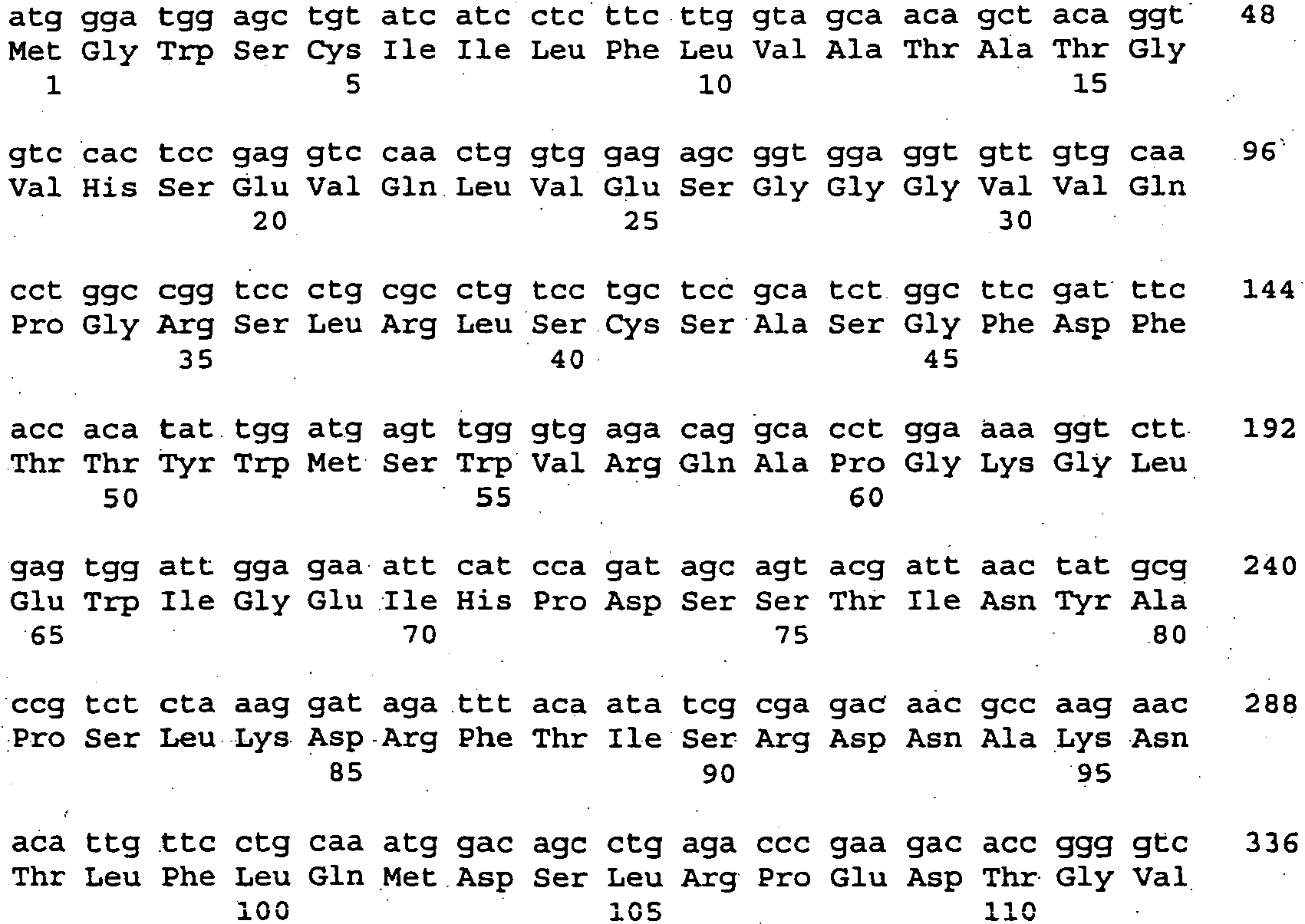

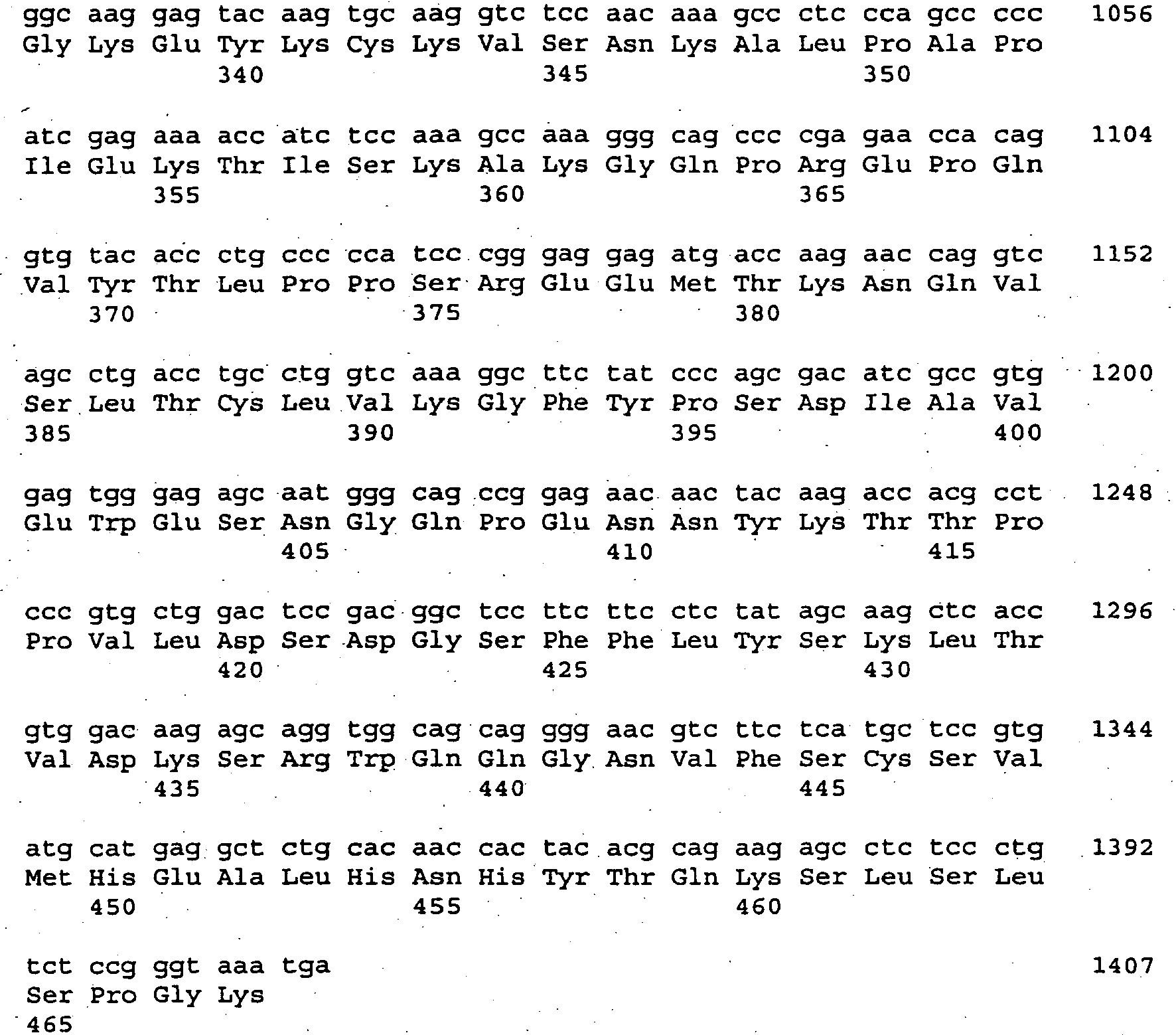
- <210> 2
<211> 468
<212> PRT
<213> Homo sapiens - <400> 2
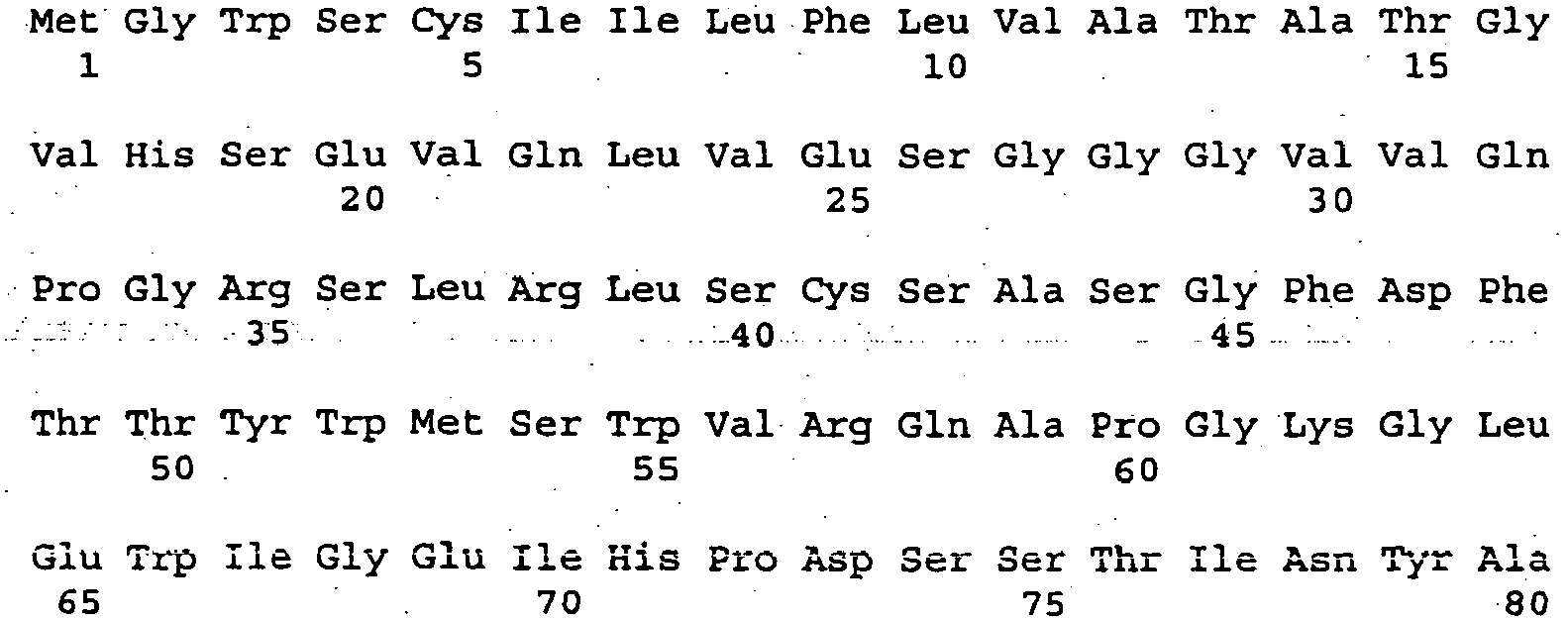
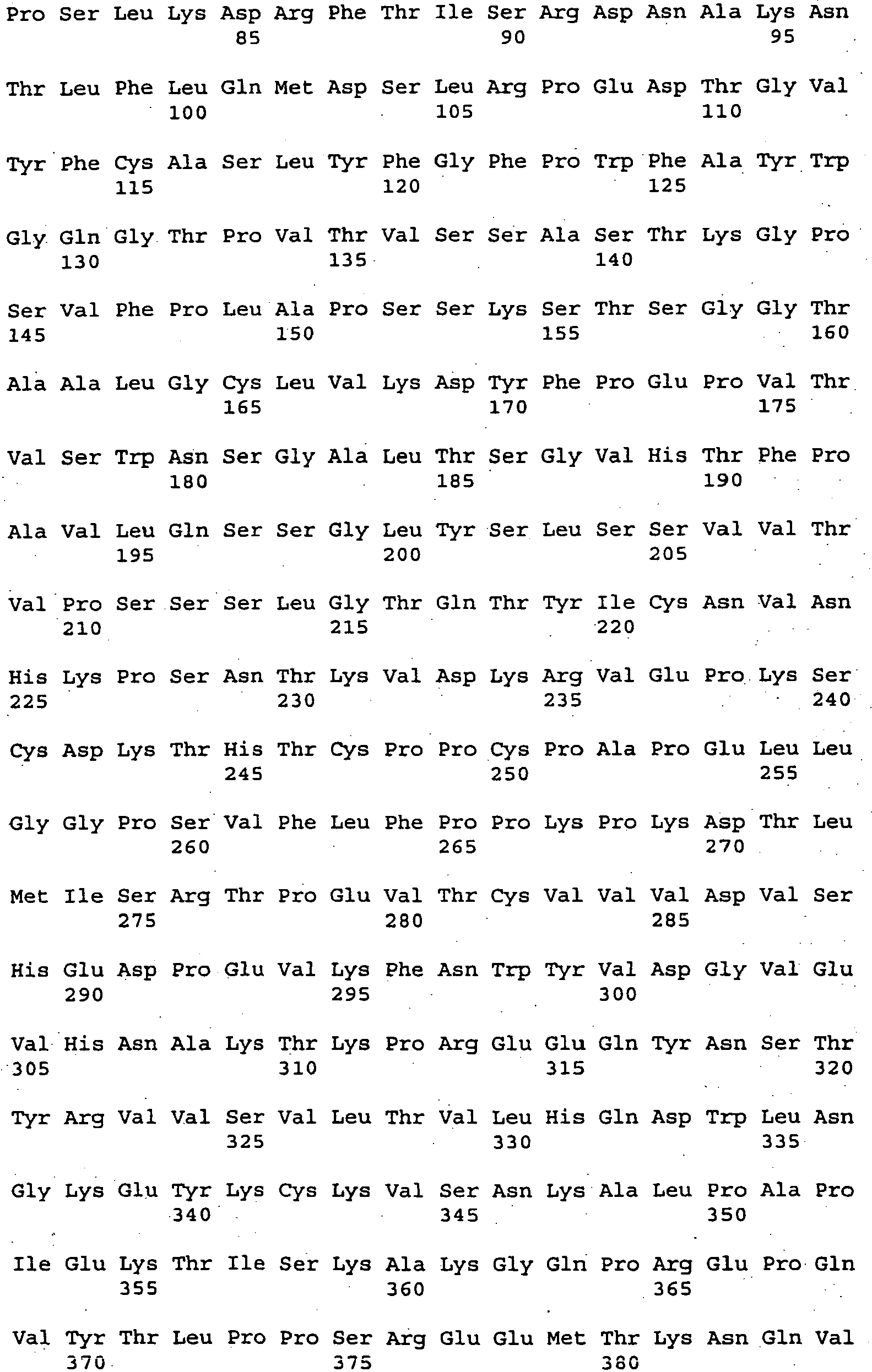
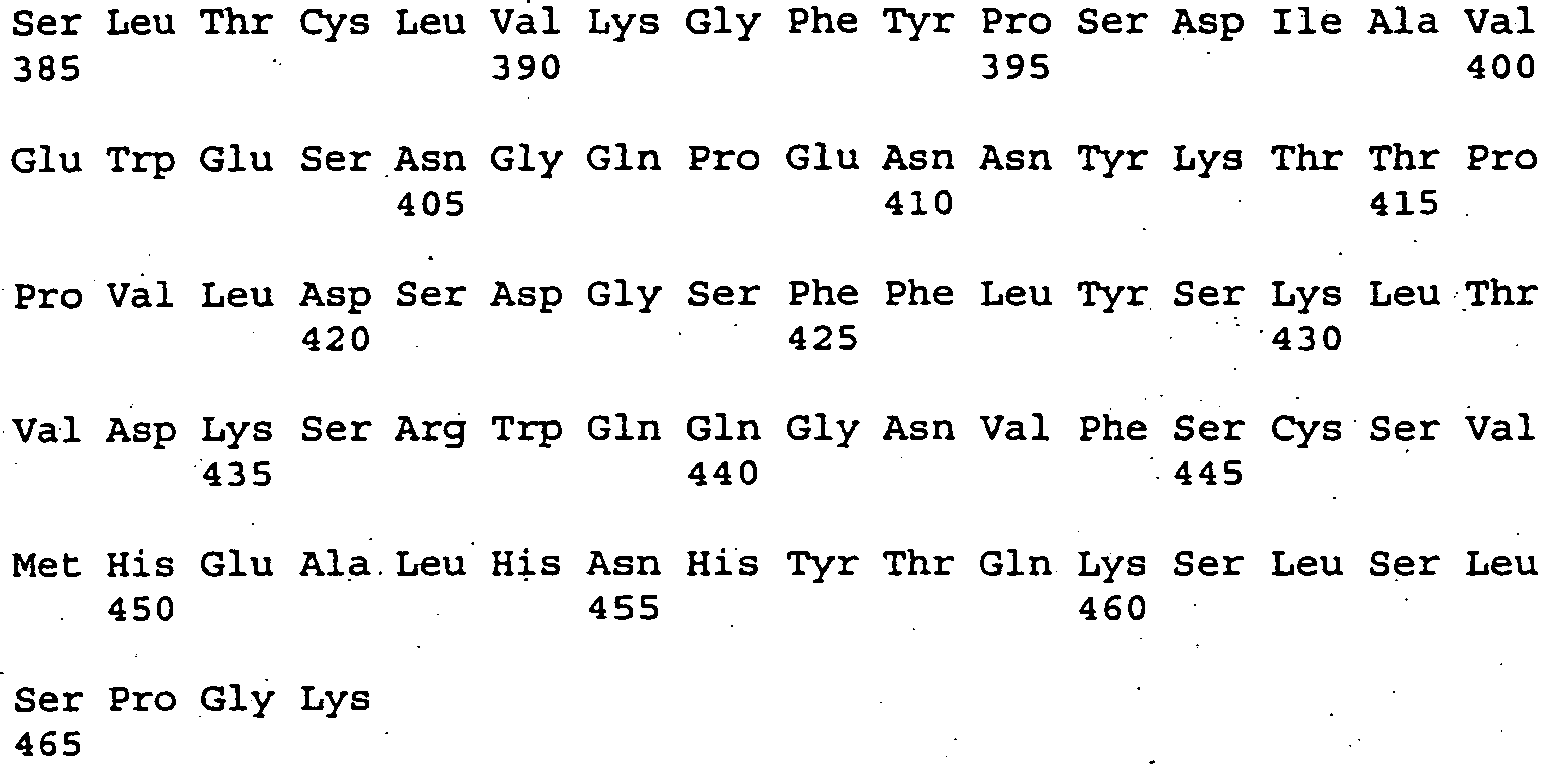
- <210> 3
<211> 699
<212> DNA
<213> Homo sapiens - <220>
<221> CDS
<222> (1)..(696) - <400> 3

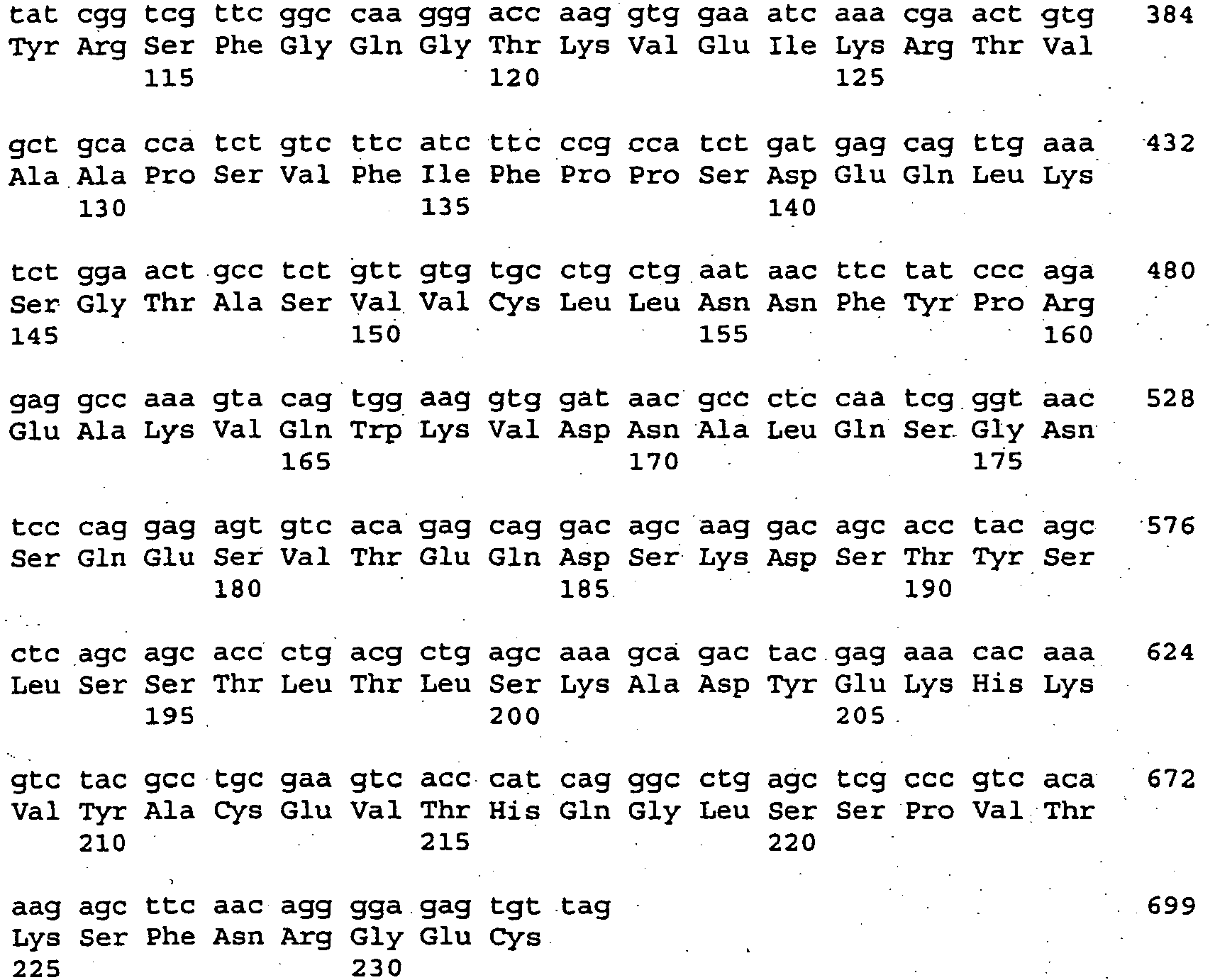
- <210> 4
<211> 232
<212> PRT
<213> Homo sapiens - <400> 4


- <210> 5
<211> 4
<212> PRT
<213> Artificial Sequence - <220>
<223> Description of Artificial Sequence: Synthetic peptide - <220>
<223> C-term amidation - <400> 5

- <210> 6
<211> 4
<212> PRT
<213> Artificial Sequence - <220>
<223> Description of Artificial Sequence: Synthetic peptide - <400> 6

- <210> 7
<211> 4
<212> PRT
<213> Artificial Sequence - <220>
<223> Description of Artificial Sequence: Synthetic peptide - <220>
<223> N-term acetylation - <220>
<223> C-term amidation - <400> 7

- <210> 8
<211> 15
<212> PRT
<213> Artificial Sequence - <220>
<223> Description of Artificial Sequence: Synthetic peptide linker - <400> 8

- <210> 9
<211> 4
<212> PRT
<213> Artificial Sequence - <220>
<223> Description of Artificial Sequence: Synthetic peptide linker - <400> 9

- <210> 10
<211> 56
<212> DNA
<213> Artificial Sequence - <220>
<223> Description of Artificial Sequence: Primer - <400> 10
ttctctctgc agagcccaaa tcttgtggtg gcggttcaca gctggttgtg actcag 56 - <210> 11
<211> 49
<212> DNA
<213> Artificial Sequence - <220>
<223> Description of Artificial Sequence: Primer - <400> 11
agcctccgcc tcctgatccg ccacctccta agatcttcag tttggttcc 49 - <210> 12
<211> 35
<212> DNA
<213> Artificial Sequence - <220>
<223> Description of Artificial Sequence: Primer - <400> 12
ccggaggcgg tgggagtgag gtgaaactgc aggag 35 - <210> 13
<211> 43
<212> DNA
<213> Artificial Sequence - <220>
<223> Description of Artificial Sequence: Primer - <400> 13
aaccttgagc tcggccgtcg cactcatgag gagacggtga ccg 43 - <210> 14
<211> 30
<212> DNA
<213> Artificial Sequence - <220>
<223> Description of Artificial Sequence: Primer - <400> 14
tccccgggta aaggtggcgg ttcacagctg 30 - <210> 15
<211> 17
<212> DNA
<213> Artificial Sequence - <220>
<223> Description of Artificial Sequence: Primer - <400> 15
gagctcggcc gtcgcac 17 - <210> 16
<211> 11
<212> PRT
<213> Homo sapiens - <400> 16

- <210> 17
<211> 11
<212> PRT
<213> Homo sapiens - <400> 17

- <210> 18
<211> 33
<212> DNA
<213> Artificial Sequence - <220>
<223> Description of Artificial Sequence: Primer - <400> 18
aaggacaccc tcatggctag ccggacccct gag 33 - <210> 19
<211> 4
<212> PRT
<213> Artificial Sequence - <220>
<223> Description of Artificial Sequence: Synthetic peptide - <400> 19

Claims (66)
- A mutant bispecific antibody, comprising at least:(a) a human hinge-Fc constant region from IgG;(b) two scFvs that each specifically binds to a binding site on a bivalent targetable construct such that a one to one binding interaction is obtained between the mutant bispecific antibody and the targetable construct; and(c) two Fvs,wherein said constant region contains one or more amino acid mutations in the CH2 domain, wherein said hinge constant region contains a mutation in which isoleucine at position 253 is replaced with alanine, or an amino acid other than leucine, and wherein the amino acid replacement enhances blood clearance equal to, or greater than replacement with alanine.
- The mutant bispecific antibody of claim 1, wherein said scFvs and said Fvs are CDR-grafted murine scFvs and Fvs.
- The mutant bispecific antibody of claim 1, wherein said scFvs and said Fvs are humanized or human.
- The mutant bispecific antibody of claim 1, comprising the Fv regions of hMN14-IgG and 734scFv.
- The mutant bispecific antibody of claim 1, wherein the bivalent targetable construct is conjugated to one or more drugs, toxins, radioisotopes, enzymes or labels.
- The mutant bispecific antibody of claim 1, wherein said Fvs bind to an epitope on a target cell.
- The mutant bispecific antibody of claim 6, wherein said Fvs bind to a tumor associated antigen.
- The mutant bispecific antibody of claim 7, wherein said Fvs bind to CEA (carcinoembryonic antigen).
- The mutant bispecific antibody of claim 1, wherein said mutant bispecific antibody incorporates the Fv of a class III anti-CEA antibody.
- The mutant bispecific antibody of claim 1, wherein said mutant bispecific antibody incorporates the scFv of Mab 679.
- A product comprising:(A) a mutant bispecific antibody of any of claims 1 to 10;(B) optionally, a clearing composition; and(C) a targetable construct comprising a bivalent hapten, wherein both hapten moieties bind to the two scFvs on a single molecule of the mutant bispecific antibody, wherein the targetable construct further comprises a therapeutic cation, and/or one or more chelated or chemically bound therapeutic agents; as a combined preparation for simultaneous, separate or sequential use for treatment or diagnosis of a disease of a subject.
- The product of claim 11, which further comprises at least one therapeutic agent used to treat the disease
- The product of claim 11, wherein said targetable construct comprises an enzyme and which further comprises:a) a prodrug, wherein said enzyme is capable of converting said prodrug to a drug at the target site; orb) a drug which is capable of being detoxified in said subject to form an intermediate of lower toxicity, wherein said enzyme is capable of reconverting said detoxified intermediate to a toxic form, and, increasing the toxicity of said drug at the target site; orc) a prodrug which is activated in said subject through natural processes and is subject to detoxification by conversion to an intermediate of lower toxicity, wherein said enzyme is capable of reconverting said detoxified intermediate to a toxic form, and, increasing the toxicity of said drug at the target site.
- The product of claim 13, wherein said prodrug is selected from the group consisting of epirubicin glucuronide, CPT-11, etoposide glucuronide, daunomicin glucuronide and doxorubicin glucuronide
- The product of claim 11, wherein the therapeutic agent is selected from the group consisting of 18F, 52Fe, 62Cu, 64Cu, 67Cu, 67Ga, 68Ga, 86Y, 89Zr, 94mTc, 94Tc, 99mTc, 111In, 123I, 124I, 125I, 131I, 154-158Gd, 177Lu, 32P, 188Re, and 90Y or a combination thereof.
- The product of claim 15, wherein said radioactive isotope is used to perform positron-emission tomography (PET).
- The product of claim 11, wherein said targetable construct comprises one or more image enhancing agents for use in magnetic resonance imaging (MRI).
- The product of claim 17, wherein said enhancing agent is selected from the group consisting of Mn, Fe and Gd.
- The product of claim 11, wherein said targetable construct comprises one or more image enhancing agents for use in ultrasound imaging.
- The product of claim 19, wherein said targetable construct is a liposome with a bivalent DTPA-peptide covalently attached to the outside surface of the liposome lipid membrane.
- The product of claim 20, wherein said liposome is gas filled.
- The product of claim 11, wherein said targetable construct comprises one or more radioactive isotopes useful for killing diseased tissue.
- The product of claim 22, wherein the energy range of the radioactive isotope is 60 to 700 keV.
- The product of claim 22, wherein said radioactive isotope is selected from the group consisting of 32P, 33P, 47Sc, 64Cu, 67Cu, 67Ga, 90Y, 111Ag, 111In, 125I, 131I, 142Pr, 153Sm, 161Tb, 166Dy, 166Ho, 177Lu, 186Re, 188Re, 189Re, 212Pb, 212Bi, 213Bi, 211At, 223Ra, 225Ac and a combination thereof.
- The product of claim 22, wherein said targetable construct comprises 10B atoms, and said treatment of a disease further comprises the step of irradiating said boron atoms localized at said diseased tissue, thereby effecting BNCT of said diseased tissue.
- The product of claim 11, wherein said therapeutic agent is a drug, toxin, hormone, enzyme, immunomodulator, chelator, boron compound, photoactive agent, dye, or radioisotope.
- The product of claim 11, wherein said targetable construct comprises one or more toxins.
- The product of claim 27, wherein said toxin is selected from the group consisting of ricin, abrin, ribonuclease, DNase 1, Staphylococcal enterotoxin-A, pokeweed antiviral protein, gelonin, diphtherin toxin, Pseudomonas exotoxin, Pseudomonas endotoxin and a combination thereof.
- The product of claim 11, wherein said targetable construct comprises one or more drugs.
- The product of claim 29, wherein said drug is selected from the group consisting of nitrogen mustards, ethylenimine derivatives, alkyl sulfonates, nitrosoureas, triazenes, folic acid analogs, anthracyclines, taxanes, COX-2 inhibitors, pyrimidine analogs, purine analogs, antibiotics, enzymes, epipodophyllotoxins, platinum coordination complexes, vinca alkaloids, substituted ureas, methyl hydrazine derivatives, adrenocortical suppressants, antagonists, endostatin, taxols, camptothecins, doxorubicins and their analogs, and a combination thereof.
- The product of claim 11, wherein the targetable construct comprises one or more agents for photodynamic therapy.
- The product of claim 31, wherein said agent for photodynamic therapy is a photosensitizer.
- The product of claim 32, wherein said photosensitizer is selected from the group consisting of benzoporphyrin monoacid ring A (BPD-MA), tin etiopurpurin (SnET2), sulfonated aluminum phthalocyanine (AlSPc) and lutetium texaphyrin (Lutex).
- The product of claim 11, comprising mutant bispecific antibody of claim 8 wherein said Fvs bind to a marker substance associated with a tumor, and wherein said tumor produces or is associated with antigens selected from the group consisting of colon-specific antigen-p (CSAp), carcinoembryonic antigen (CEA), CD4, CD5, CD8, CD14, CD15, CD19, CD20, CD21, CD22, CD23, CD25, CD33, CD37, CD38, CD40, CD40L, CD46, CD52, CD54, CD66a-e, CD74, CD75, CD80, CD 126, B7, HLA-DR, Ia, Ii, HM1.24, MUC 1, MUC2, MUC3, MUC4,Tag-72, PSMA, EGP-1, EGP-2, PSA, AFP, HCG, HCG-beta, PLAP, PAP, histone, tenascin, VEGF, P1GF, S100, EGFR, insulin-like growth factor, HER2/neu, organotropic hormones, oncogene products, and cytokeratin.
- The product of claims 11 or 13, wherein the mutant bispecific antibody incorporates the Fv of a Class III anti-CEA antibody.
- The product of claims 11 or 13, wherein the mutant bispecific antibody incorporates the scFv of Mab 679.
- The product of claim 11, wherein said disease is an immune dysregulation disease, an autoimmune disease, organ graft rejection, cardiovascular disease, neurological disease or graft vs. host disease.
- The product of claim 37, wherein said autoimmune disease is selected from the group consisting of acute idiopathic thrombocytopenic purpura, chronic idiopathic thrombocytopenic purpura, dermatomyositis, Sydenham's chorea, myasthenia gravis, systemic lupus erythematosus, lupus nephritis, rheumatic fever, polyglandular syndromes, bullous pemphigoid, diabetes mellitus, Henoch-Schonlein purpura, poststreptococcalnephritis, erythema nodosurn, Takayasu's arteritis, Addison's disease, rheumatoid arthritis, multiple sclerosis, sarcoidosis, ulcerative colitis, erythema multiforme, IgA nephropathy, polyarteritis nodosa, ankylosing spondylitis, Goodpasture's syndrome, thromboangitisubiterans, Sjogren's syndrome, primary biliary cirrhosis, Hashimoto's thyroiditis, thyrotoxicosis, scleroderma, chronic active hepatitis, polymyositis/dermatomyositis, polychondritis, parnphigus vulgaris, Wegener's granulomatosis, membranous nephropathy, amyotrophic lateral sclerosis, tabes dorsalis, giant cell arteritis/polymyalgia, pernicious anemia, rapidly progressive glomerulonephritis and fibrosing alveolitis.
- The product of claims 11 or 13, wherein said disease is caused by a fungus, virus, parasite or bacterium, and the Fv of the mutant bispecific antibody targets the fungus, virus, parasite, or bacterium.
- The product of claim 39, wherein said virus is selected from the group consisting of human immunodeficiency virus (HIV), herpes virus, cytomegalovirus, rabies virus, influenza virus, hepatitis B virus, Sendai virus, feline leukemia virus, Reo virus, polio virus, human serum parvo-like virus, simian virus 40, respiratory syncytial virus, mouse mammary tumor virus, Varicella-Zoster virus, Dengue virus, rubella virus, measles virus, adenovirus, human T-cell leukemia viruses, Epstein-Barr virus, murine leukemia virus, mumps virus, vesicular stomatitis virus, Sindbis virus, lymphocytic choriomeningitis virus, wart virus and blue tongue virus.
- The product of claim 39, wherein said bacterium is selected from the group consisting of Anthrax bacillus, Streptococcus agalactiae, Legionella pneumophilia, Streptococcus pyogenes, Escherichia coli, Neisseria gonorrhoeae, Neisseria meningitidis, Pneumococcus, Hemophilis influenzae B, Treponema pallidum, Lyme disease spirochetes, Pseudomonas aeruginosa, Mycobacterium leprae, Brucella abortus, Mycobacterium tuberculosis and Tetanus toxin.
- The product of claim 39, wherein said pathogen is a protozoan.
- The product of claim 42, wherein said protozoan is selected from the group consisting of Plasmodium falciparum, Plasmodium vivax, Toxoplasma gondii, Trypanosoma rangeli, Trypanosoma cruzi, Trypanosoma rhodesiensei, Trypanosoma brucei, Schistosoma mansoni, Schistosoma japanicum, Babesia bovis, Elmeria tenella, Onchocerca volvulus, Leishmania tropica, Trichinella spiralis, Onchocerca volvulus, Theileria parva, Taenia hydatigena, Taenia ovis, Taenia saginata, Echinococcus granulosus and Mesocestoides corti.
- The product of claim 39, wherein said parasite is a helminth or a malarial parasite.
- The product of claim 39, wherein said bacterium is mycoplasma.
- The product of claim 45, wherein said mycoplasina is selected from the group consisting of Mycoplasma arthritidis, M. hyorhinis, M. orale, M. arginini, Acholeplasma laidlawii, M. salivarum, and M. pneumoniae.
- The product of claim 39, wherein the fungus is selected from the group consisting of Histoplasma capsulatum, Blastomyces dermatitidis, Coccidioides immitis, and species of Candida.
- The product of claim 22, wherein the tissue is normal ectopic tissue.
- The product of claim 48, wherein said normal tissue is tissue from the ovary, thymus, parathyroid, bone marrow, or spleen.
- The product of claims 11 or 13, wherein said subject is mammalian.
- The product of claim 50, wherein said mammalian subject is a human or primate.
- The product of claim 50, wherein said mammalian subject is selected from the group consisting of rodents, lagamorphs, bovines, ovines, caprines, porcines, equines, canines, felines, domestic fowl, ungulates, and bear.
- The product of claim 11, for use in intraoperative diagnosis to identify diseased tissues.
- The product of claim 11 for use in endoscopic diagnosis to identify diseased tissues.
- The product of any one of claims 11 to 54, further comprising a second therapeutic agent for administration before, concurrently or after the prescribed diagnosis or treatment.
- The product of claim 55, wherein the second therapeutic agent is a drug, naked antibody, immunomodulator, or antibody conjugate bearing a drug, radioisotope, immunomodulator or toxin.
- A kit useful for treating or identifying diseased tissues in a subject comprising:(A) a mutant bispecific antibody of any of claims 1 to 10;(B) optionally, a clearing composition; and(C) a targetable construct comprising a bivalent hapten, wherein both hapten moieties bind to the two scFvs on a single molecule of the mutant bispecific antibody, wherein the targetable construct further comprises a therapeutic cation, and/or one or more chelated or chemically bound therapeutic agents; and optionally(D) a prodrug as defined in claim 13
- The product of claim 26, wherein said immunomodulator is selected from the group consisting of a cytokine, a stem cell growth factor, a lymphotoxin, a hematopoietic factor, a colony stimulating factor (CSF), an interferon (IFN), erythropoietin, thrombopoietin and a combination thereof.
- The product of claim 58, wherein said lymphotoxin is tumor necrosis factor (TNF).
- The product of claim 58, wherein hematopoietic factor is interleukin (IL).
- The product of claim 58, wherein said colony stimulating factor is granulocytecolony stimulating factor (G-CSF) or granulocyte macrophage-colony stimulating factor (GM-CSF).
- The product of claim 58, wherein said interferon is interferon-α, -ß or -γ.
- The product of claim 58, wherein said stem cell growth factor is S1 factor.
- The product of claim 26, wherein said immunomodulator is IL-1, IL-2, IL-3, IL-6, IL-10, IL-12, IL-18, interferon-γ, TNF-α or a combination thereof.
- The product of claim 37, wherein said neurological disease is Alzheimer's Disease.
- The use of a mutant bispecific antibody of any of claims 1 to 10 in the preparation of an agent for treatment or diagnosis.
Applications Claiming Priority (3)
| Application Number | Priority Date | Filing Date | Title |
|---|---|---|---|
| US36103702P | 2002-03-01 | 2002-03-01 | |
| US361037P | 2002-03-01 | ||
| PCT/GB2003/000871 WO2003074569A2 (en) | 2002-03-01 | 2003-03-03 | Bispecific antibody point mutations for enhancing rate of clearance |
Publications (2)
| Publication Number | Publication Date |
|---|---|
| EP1487879A2 EP1487879A2 (en) | 2004-12-22 |
| EP1487879B1 true EP1487879B1 (en) | 2012-12-26 |
Family
ID=27789060
Family Applications (1)
| Application Number | Title | Priority Date | Filing Date |
|---|---|---|---|
| EP03743416A Expired - Lifetime EP1487879B1 (en) | 2002-03-01 | 2003-03-03 | Bispecific antibody point mutations for enhancing rate of clearance |
Country Status (7)
| Country | Link |
|---|---|
| US (2) | US20040018557A1 (en) |
| EP (1) | EP1487879B1 (en) |
| JP (1) | JP2006502091A (en) |
| KR (1) | KR20040088572A (en) |
| AU (1) | AU2003209446B2 (en) |
| CA (1) | CA2478011C (en) |
| WO (1) | WO2003074569A2 (en) |
Families Citing this family (310)
| Publication number | Priority date | Publication date | Assignee | Title |
|---|---|---|---|---|
| US7829084B2 (en) * | 2001-01-17 | 2010-11-09 | Trubion Pharmaceuticals, Inc. | Binding constructs and methods for use thereof |
| US7754208B2 (en) | 2001-01-17 | 2010-07-13 | Trubion Pharmaceuticals, Inc. | Binding domain-immunoglobulin fusion proteins |
| US20050271663A1 (en) * | 2001-06-28 | 2005-12-08 | Domantis Limited | Compositions and methods for treating inflammatory disorders |
| DE60237282D1 (en) * | 2001-06-28 | 2010-09-23 | Domantis Ltd | DOUBLE-SPECIFIC LIGAND AND ITS USE |
| US9321832B2 (en) * | 2002-06-28 | 2016-04-26 | Domantis Limited | Ligand |
| US7696320B2 (en) * | 2004-08-24 | 2010-04-13 | Domantis Limited | Ligands that have binding specificity for VEGF and/or EGFR and methods of use therefor |
| EP1600459A3 (en) * | 2002-06-28 | 2005-12-07 | Domantis Limited | Ligand |
| US7608429B2 (en) | 2002-10-31 | 2009-10-27 | Genentech, Inc. | Methods and compositions for increasing antibody production |
| DE10303974A1 (en) | 2003-01-31 | 2004-08-05 | Abbott Gmbh & Co. Kg | Amyloid β (1-42) oligomers, process for their preparation and their use |
| ATE517638T1 (en) * | 2003-01-31 | 2011-08-15 | Immunomedics Inc | METHOD AND PREPARATIONS FOR ADMINISTERING THERAPEUTIC AND DIAGNOSTIC AGENTS |
| TWI353991B (en) | 2003-05-06 | 2011-12-11 | Syntonix Pharmaceuticals Inc | Immunoglobulin chimeric monomer-dimer hybrids |
| WO2005004809A2 (en) * | 2003-07-01 | 2005-01-20 | Immunomedics, Inc. | Multivalent carriers of bi-specific antibodies |
| CA2545603A1 (en) | 2003-11-12 | 2005-05-26 | Biogen Idec Ma Inc. | Neonatal fc receptor (fcrn)-binding polypeptide variants, dimeric fc binding proteins and methods related thereto |
| WO2006024038A2 (en) * | 2004-08-27 | 2006-03-02 | Codman & Shurtleff | Light-based implant for treating alzheimer’s disease |
| MX2007002856A (en) * | 2004-09-02 | 2007-09-25 | Genentech Inc | Heteromultimeric molecules. |
| BRPI0607486B8 (en) | 2005-03-03 | 2021-05-25 | Immunomedics Inc | 1243 humanized antibody against hla-dr present in hladr+ cells, pharmaceutical composition, kit and use of said antibodies. |
| US7288108B2 (en) * | 2005-03-14 | 2007-10-30 | Codman & Shurtleff, Inc. | Red light implant for treating Parkinson's disease |
| USRE47266E1 (en) | 2005-03-14 | 2019-03-05 | DePuy Synthes Products, Inc. | Light-based implants for treating Alzheimer's disease |
| US9287158B2 (en) * | 2005-04-19 | 2016-03-15 | Ebara Corporation | Substrate processing apparatus |
| US7351253B2 (en) * | 2005-06-16 | 2008-04-01 | Codman & Shurtleff, Inc. | Intranasal red light probe for treating Alzheimer's disease |
| US10307481B2 (en) | 2005-07-25 | 2019-06-04 | Aptevo Research And Development Llc | CD37 immunotherapeutics and uses thereof |
| US8167920B2 (en) * | 2005-10-31 | 2012-05-01 | Codman & Shurtleff, Inc. | Intranasal delivery of compounds that reduce intrancranial pressure |
| KR101439828B1 (en) | 2005-11-30 | 2014-09-17 | 애브비 인코포레이티드 | Monoclonal antibodies against amyloid beta protein and uses thereof |
| JP5475994B2 (en) | 2005-11-30 | 2014-04-16 | アッヴィ・インコーポレイテッド | Anti-Aβ globulomer antibody, antigen-binding portion thereof, corresponding hybridoma, nucleic acid, vector, host cell, method for producing said antibody, composition comprising said antibody, use of said antibody and method of using said antibody. |
| JP2009519011A (en) * | 2005-12-01 | 2009-05-14 | ドマンティス リミテッド | Non-competitive domain antibody format that binds to interleukin 1 receptor type 1 |
| EP2674440B1 (en) | 2005-12-16 | 2019-07-03 | IBC Pharmaceuticals, Inc. | Multivalent immunoglobulin-based bioactive assemblies |
| HUE043255T2 (en) | 2006-06-07 | 2019-08-28 | Bioalliance Cv | Antibodies that recognize a carbohydrate-containing epitope on CD43 and CEA expressed on cancer cells and methods for their use |
| RU2487888C2 (en) | 2006-06-12 | 2013-07-20 | ЭМЕРДЖЕНТ ПРОДАКТ ДИВЕЛОПМЕНТ СИЭТЛ, ЭлЭлСи | Single-chain multivalent binding proteins with effector function |
| US8455626B2 (en) | 2006-11-30 | 2013-06-04 | Abbott Laboratories | Aβ conformer selective anti-aβ globulomer monoclonal antibodies |
| WO2008104386A2 (en) | 2007-02-27 | 2008-09-04 | Abbott Gmbh & Co. Kg | Method for the treatment of amyloidoses |
| JP5337055B2 (en) * | 2007-02-28 | 2013-11-06 | メルク・シャープ・アンド・ドーム・コーポレーション | Combination therapy for the treatment of immune disorders |
| US9061076B2 (en) * | 2007-05-25 | 2015-06-23 | North Carolina State University | Viral nanoparticle cell-targeted delivery platform |
| JP2010528647A (en) * | 2007-06-06 | 2010-08-26 | ドマンティス リミテッド | Polypeptides, antibody variable domains and antagonists |
| CN101990439A (en) * | 2007-07-06 | 2011-03-23 | 特鲁比昂药品公司 | Binding peptides having a c-terminally disposed specific binding domain |
| JP5568478B2 (en) * | 2007-12-18 | 2014-08-06 | バイオアライアンス セー.フェー. | Antibodies that recognize carbohydrate-containing epitopes of CD-43 and CEA expressed in cancer cells and methods of using the same |
| US9266967B2 (en) | 2007-12-21 | 2016-02-23 | Hoffmann-La Roche, Inc. | Bivalent, bispecific antibodies |
| US20090162359A1 (en) | 2007-12-21 | 2009-06-25 | Christian Klein | Bivalent, bispecific antibodies |
| US9320914B2 (en) | 2008-03-03 | 2016-04-26 | DePuy Synthes Products, Inc. | Endoscopic delivery of red/NIR light to the subventricular zone |
| AU2009228158B2 (en) * | 2008-03-27 | 2014-02-27 | Zymogenetics, Inc. | Compositions and methods for inhibiting PDGFRbeta and VEGF-A |
| NZ603059A (en) | 2008-04-11 | 2014-07-25 | Emergent Product Dev Seattle | Cd37 immunotherapeutic and combination with bifunctional chemotherapeutic thereof |
| WO2010078526A1 (en) | 2008-12-31 | 2010-07-08 | Biogen Idec Ma Inc. | Anti-lymphotoxin antibodies |
| US8716448B2 (en) | 2009-02-03 | 2014-05-06 | Amunix Operating Inc. | Coagulation factor VII compositions and methods of making and using same |
| US20100198316A1 (en) * | 2009-02-04 | 2010-08-05 | Richard Toselli | Intracranial Red Light Treatment Device For Chronic Pain |
| KR101431318B1 (en) * | 2009-04-02 | 2014-08-20 | 로슈 글리카트 아게 | Multispecific antibodies comprising full length antibodies and single chain fab fragments |
| JP5616428B2 (en) | 2009-04-07 | 2014-10-29 | ロシュ グリクアート アクチェンゲゼルシャフト | Trivalent bispecific antibody |
| US9676845B2 (en) | 2009-06-16 | 2017-06-13 | Hoffmann-La Roche, Inc. | Bispecific antigen binding proteins |
| CA2781519A1 (en) | 2009-09-16 | 2011-03-24 | Genentech, Inc. | Coiled coil and/or tether containing protein complexes and uses thereof |
| PL2496691T3 (en) | 2009-11-02 | 2017-09-29 | University Of Washington | Therapeutic nuclease compositions and methods |
| TW201138821A (en) | 2010-03-26 | 2011-11-16 | Roche Glycart Ag | Bispecific antibodies |
| ES2684475T3 (en) | 2010-04-15 | 2018-10-03 | Abbvie Inc. | Proteins that bind to beta amyloid |
| TW201217527A (en) | 2010-07-09 | 2012-05-01 | Biogen Idec Hemophilia Inc | Processable single chain molecules and polypeptides made using same |
| EP3533803B1 (en) | 2010-08-14 | 2021-10-27 | AbbVie Inc. | Anti-amyloid-beta antibodies |
| EP2609111B1 (en) | 2010-08-24 | 2017-11-01 | F. Hoffmann-La Roche AG | Bispecific antibodies comprising a disulfide stabilized-fv fragment |
| MX349057B (en) | 2010-11-30 | 2017-07-07 | Chugai Pharmaceutical Co Ltd | THERAPEUTIC AGENT THAT INDUCES CYTOTOXICITY. |
| JP5766296B2 (en) | 2010-12-23 | 2015-08-19 | エフ.ホフマン−ラ ロシュ アーゲーF. Hoffmann−La Roche Aktiengesellschaft | Polypeptide-polynucleotide complexes and their use in targeted delivery of effector components |
| MX341921B (en) | 2011-02-28 | 2016-09-07 | Hoffmann La Roche | Antigen binding proteins. |
| WO2012116927A1 (en) | 2011-02-28 | 2012-09-07 | F. Hoffmann-La Roche Ag | Monovalent antigen binding proteins |
| AU2012245260B2 (en) | 2011-04-22 | 2016-09-08 | Aptevo Research And Development Llc | Prostate-specific membrane antigen binding proteins and related compositions and methods |
| CA2834626A1 (en) | 2011-04-29 | 2012-11-01 | University Of Washington | Therapeutic nuclease compositions and methods |
| EP2726506A1 (en) * | 2011-05-27 | 2014-05-07 | Dutalys | Removal of monomeric targets |
| CA2838833A1 (en) | 2011-06-10 | 2012-12-13 | Biogen Idec Ma Inc. | Pro-coagulant compounds and methods of use thereof |
| WO2013012733A1 (en) | 2011-07-15 | 2013-01-24 | Biogen Idec Ma Inc. | Heterodimeric fc regions, binding molecules comprising same, and methods relating thereto |
| UY34317A (en) | 2011-09-12 | 2013-02-28 | Genzyme Corp | T cell antireceptor antibody (alpha) / ß |
| US20130108641A1 (en) | 2011-09-14 | 2013-05-02 | Sanofi | Anti-gitr antibodies |
| AU2012347972B2 (en) | 2011-12-05 | 2018-05-10 | X-Body, Inc. | PDGF receptor beta binding polypeptides |
| US11370827B2 (en) | 2012-01-12 | 2022-06-28 | Bioverativ Therapeutics Inc. | Chimeric factor VIII polypeptides and uses thereof |
| EP2812357B1 (en) | 2012-02-10 | 2020-11-04 | F.Hoffmann-La Roche Ag | Single-chain antibodies and other heteromultimers |
| PT3564260T (en) | 2012-02-15 | 2023-01-18 | Bioverativ Therapeutics Inc | Factor viii compositions and methods of making and using same |
| EP2822577B1 (en) | 2012-02-15 | 2019-02-06 | Bioverativ Therapeutics Inc. | Recombinant factor viii proteins |
| KR102367723B1 (en) | 2012-03-28 | 2022-02-28 | 사노피 | Antibodies to bradykinin b1 receptor ligands |
| WO2013169657A1 (en) | 2012-05-07 | 2013-11-14 | Sanofi | Methods for preventing biofilm formation |
| WO2013175276A1 (en) | 2012-05-23 | 2013-11-28 | Argen-X B.V | Il-6 binding molecules |
| AU2013270682A1 (en) | 2012-06-08 | 2014-12-11 | Biogen Ma Inc. | Procoagulant compounds |
| CA2875247A1 (en) | 2012-06-08 | 2013-12-12 | Biogen Idec Ma Inc. | Chimeric clotting factors |
| KR20150030744A (en) | 2012-06-27 | 2015-03-20 | 에프. 호프만-라 로슈 아게 | Method for making antibody fc-region conjugates comprising at least one binding entity that specifically binds to a target and uses thereof |
| RU2639287C2 (en) | 2012-06-27 | 2017-12-20 | Ф. Хоффманн-Ля Рош Аг | Method for selection and obtaining of highly selective and multispecific targeting groups with specified properties, including at least two different binding groups, and their applications |
| EP2870250B2 (en) | 2012-07-06 | 2022-06-29 | Bioverativ Therapeutics Inc. | Cell line expressing single chain factor viii polypeptides and uses thereof |
| CN110054699A (en) | 2012-07-11 | 2019-07-26 | 比奥贝拉蒂治疗公司 | Factor IX compound with XTEN and vWF ELISA albumen, and application thereof |
| US9790268B2 (en) | 2012-09-12 | 2017-10-17 | Genzyme Corporation | Fc containing polypeptides with altered glycosylation and reduced effector function |
| FI3366705T3 (en) | 2012-09-12 | 2023-07-28 | Genzyme Corp | Fc containing polypeptides with altered glycosylation and reduced effector function |
| RS64664B1 (en) | 2013-02-15 | 2023-11-30 | Bioverativ Therapeutics Inc | Optimized factor viii gene |
| EP2774930A1 (en) | 2013-03-07 | 2014-09-10 | Aptenia S.R.L. | Metallocene compounds and labeled molecules comprising the same for in vivo imaging. |
| SG10201809779RA (en) | 2013-03-11 | 2018-12-28 | Genzyme Corp | Site-specific antibody-drug conjugation through glycoengineering |
| US20140271462A1 (en) | 2013-03-13 | 2014-09-18 | Imaginab, Inc. | Antigen binding constructs to cd8 |
| US10588949B2 (en) | 2013-03-15 | 2020-03-17 | Bioverativ Therapeutics Inc. | Factor IX polypeptide formulations |
| AU2014276827B2 (en) * | 2013-06-07 | 2018-11-15 | Nordic Nanovector Asa | Method for upregulating antigen expression |
| US10947269B2 (en) | 2013-08-08 | 2021-03-16 | Bioverativ Therapeutics Inc. | Purification of chimeric FVIII molecules |
| UA118267C2 (en) | 2013-08-13 | 2018-12-26 | Санофі | Antibodies to plasminogen activator inhibitor-1 (pai-1) and uses thereof |
| TW201722994A (en) | 2013-08-13 | 2017-07-01 | 賽諾菲公司 | Antibody to plasminogen activin inhibitor-1 (PAI-1) and use thereof |
| TW202003554A (en) | 2013-08-14 | 2020-01-16 | 美商百歐維拉提夫治療公司 | Factor VIII-XTEN fusions and uses thereof |
| HUE057005T2 (en) | 2013-09-25 | 2022-04-28 | Bioverativ Therapeutics Inc | Column virus inactivation procedures |
| KR20160044060A (en) | 2013-10-11 | 2016-04-22 | 에프. 호프만-라 로슈 아게 | Multispecific domain exchanged common variable light chain antibodies |
| WO2015066550A1 (en) | 2013-10-31 | 2015-05-07 | Resolve Therapeutics, Llc | Therapeutic nuclease-albumin fusions and methods |
| WO2015069430A2 (en) * | 2013-11-05 | 2015-05-14 | Immunomedics, Inc. | Humanized anti-ceacam5 antibody and uses thereof |
| EP3065769A4 (en) | 2013-11-08 | 2017-05-31 | Biogen MA Inc. | Procoagulant fusion compound |
| DK3091997T5 (en) | 2014-01-10 | 2024-10-14 | Bioverativ Therapeutics Inc | CHIMERIC FACTOR VIII PROTEINS AND USES THEREOF |
| JOP20200094A1 (en) | 2014-01-24 | 2017-06-16 | Dana Farber Cancer Inst Inc | Antibody molecules to pd-1 and uses thereof |
| JOP20200096A1 (en) | 2014-01-31 | 2017-06-16 | Children’S Medical Center Corp | TIM-3 Antibody Molecules and Their Uses |
| LT3116909T (en) | 2014-03-14 | 2020-02-10 | Novartis Ag | ANTI-BODY MOLECULES AGAINST LAG-3 AND THEIR USE |
| CN106163547A (en) | 2014-03-15 | 2016-11-23 | 诺华股份有限公司 | Use Chimeric antigen receptor treatment cancer |
| CN106471010A (en) | 2014-03-19 | 2017-03-01 | 建新公司 | Site-specific glycoengineering of targeting modules |
| JP6640181B2 (en) | 2014-03-21 | 2020-02-05 | エックス−ボディ インコーポレイテッド | Bispecific antigen binding polypeptide |
| MY194892A (en) * | 2014-04-07 | 2022-12-22 | Chugai Pharmaceutical Co Ltd | Immunoactivating antigen-binding molecule |
| CN106459954A (en) | 2014-05-13 | 2017-02-22 | 中外制药株式会社 | T cell-redirected antigen-binding molecule for cells having immunosuppression function |
| KR102127644B1 (en) | 2014-06-10 | 2020-06-30 | 삼성전자 주식회사 | Method for fabricating semiconductor device |
| US11008561B2 (en) | 2014-06-30 | 2021-05-18 | Bioverativ Therapeutics Inc. | Optimized factor IX gene |
| WO2016014553A1 (en) | 2014-07-21 | 2016-01-28 | Novartis Ag | Sortase synthesized chimeric antigen receptors |
| EP3172237A2 (en) | 2014-07-21 | 2017-05-31 | Novartis AG | Treatment of cancer using humanized anti-bcma chimeric antigen receptor |
| BR112017001242A2 (en) | 2014-07-21 | 2017-12-05 | Novartis Ag | cancer treatment using a cd33 chimeric antigen receptor |
| WO2016014530A1 (en) | 2014-07-21 | 2016-01-28 | Novartis Ag | Combinations of low, immune enhancing. doses of mtor inhibitors and cars |
| EP3660042B1 (en) | 2014-07-31 | 2023-01-11 | Novartis AG | Subset-optimized chimeric antigen receptor-containing t-cells |
| US10851149B2 (en) | 2014-08-14 | 2020-12-01 | The Trustees Of The University Of Pennsylvania | Treatment of cancer using GFR α-4 chimeric antigen receptor |
| TW202140557A (en) | 2014-08-19 | 2021-11-01 | 瑞士商諾華公司 | Treatment of cancer using a cd123 chimeric antigen receptor |
| MX2017003645A (en) | 2014-09-17 | 2017-05-30 | Novartis Ag | Targeting cytotoxic cells with chimeric receptors for adoptive immunotherapy. |
| AP2017009826A0 (en) | 2014-09-26 | 2017-03-31 | Bayer Pharma AG | Stabilized adrenomedullin derivatives and use thereof |
| EP3799887A1 (en) | 2014-10-09 | 2021-04-07 | Genzyme Corporation | Glycoengineered antibody drug conjugates |
| EA201700181A1 (en) | 2014-10-14 | 2017-09-29 | Галозим, Инк. | COMPOSITIONS OF ADENOSINDEMINASE-2 (ADA-2), THEIR OPTIONS AND METHODS OF USE |
| JP6877339B2 (en) | 2014-10-14 | 2021-05-26 | ノバルティス アーゲー | Antibody molecule against PD-L1 and its use |
| US20180334490A1 (en) | 2014-12-03 | 2018-11-22 | Qilong H. Wu | Methods for b cell preconditioning in car therapy |
| JP6721590B2 (en) | 2014-12-03 | 2020-07-15 | エフ.ホフマン−ラ ロシュ アーゲーF. Hoffmann−La Roche Aktiengesellschaft | Multispecific antibody |
| KR102663073B1 (en) | 2015-01-08 | 2024-05-07 | 젠맵 에이/에스 | Bispecific antibodies against CD3 and CD20 |
| US11000548B2 (en) | 2015-02-18 | 2021-05-11 | Enlivex Therapeutics Ltd | Combination immune therapy and cytokine control therapy for cancer treatment |
| EP3258943B1 (en) | 2015-02-18 | 2021-05-12 | Enlivex Therapeutics Ltd. | Combination immune therapy and cytokine control therapy for cancer treatment |
| US11497767B2 (en) | 2015-02-18 | 2022-11-15 | Enlivex Therapeutics R&D Ltd | Combination immune therapy and cytokine control therapy for cancer treatment |
| US11304976B2 (en) | 2015-02-18 | 2022-04-19 | Enlivex Therapeutics Ltd | Combination immune therapy and cytokine control therapy for cancer treatment |
| US11596652B2 (en) | 2015-02-18 | 2023-03-07 | Enlivex Therapeutics R&D Ltd | Early apoptotic cells for use in treating sepsis |
| US11318163B2 (en) | 2015-02-18 | 2022-05-03 | Enlivex Therapeutics Ltd | Combination immune therapy and cytokine control therapy for cancer treatment |
| WO2016170541A1 (en) | 2015-04-21 | 2016-10-27 | Enlivex Therapeutics Ltd. | Therapeutic pooled blood apoptotic cell preparations and uses thereof |
| IL254817B2 (en) | 2015-04-08 | 2023-12-01 | Novartis Ag | CD20 treatments, CD22 treatments and combined treatments with CD19 chimeric antigen receptor expressing cells |
| EP3286211A1 (en) | 2015-04-23 | 2018-02-28 | Novartis AG | Treatment of cancer using chimeric antigen receptor and protein kinase a blocker |
| EP3313887A2 (en) | 2015-06-26 | 2018-05-02 | MAB Discovery GmbH | Monoclonal anti-il-1racp antibodies |
| EP3878465A1 (en) | 2015-07-29 | 2021-09-15 | Novartis AG | Combination therapies comprising antibody molecules to tim-3 |
| EP3964528A1 (en) | 2015-07-29 | 2022-03-09 | Novartis AG | Combination therapies comprising antibody molecules to lag-3 |
| WO2017019896A1 (en) | 2015-07-29 | 2017-02-02 | Novartis Ag | Combination therapies comprising antibody molecules to pd-1 |
| BR112018002150A2 (en) | 2015-08-03 | 2018-09-18 | Bioverativ Therapeutics Inc | factor ix fusion proteins and methods of manufacturing and using them |
| JP7026613B2 (en) | 2015-08-07 | 2022-02-28 | イマジナブ・インコーポレーテッド | Antigen binding construct for target molecule |
| US20190022092A1 (en) | 2015-09-15 | 2019-01-24 | Acerta Pharma B.V. | Therapeutic Combinations of a BTK Inhibitor and a GITR Binding Molecule, a 4-1BB Agonist, or an OX40 Agonist |
| UA126278C2 (en) | 2015-09-21 | 2022-09-14 | Аптево Рісьорч Енд Девелопмент Ллс | Cd3 binding polypeptides |
| WO2017086367A1 (en) | 2015-11-18 | 2017-05-26 | 中外製薬株式会社 | Combination therapy using t cell redirection antigen binding molecule against cell having immunosuppressing function |
| US11649293B2 (en) | 2015-11-18 | 2023-05-16 | Chugai Seiyaku Kabushiki Kaisha | Method for enhancing humoral immune response |
| EP4424322A3 (en) | 2015-12-17 | 2025-04-16 | Novartis AG | Antibody molecules to pd-1 and uses thereof |
| EP3389713A2 (en) | 2015-12-17 | 2018-10-24 | Novartis AG | Combination of c-met inhibitor with antibody molecule to pd-1 and uses thereof |
| US11413340B2 (en) | 2015-12-22 | 2022-08-16 | Novartis Ag | Mesothelin chimeric antigen receptor (CAR) and antibody against PD-L1 inhibitor for combined use in anticancer therapy |
| ES2847155T3 (en) | 2016-01-21 | 2021-08-02 | Novartis Ag | Multispecific molecules targeting CLL-1 |
| HRP20221089T1 (en) | 2016-02-01 | 2022-11-25 | Bioverativ Therapeutics Inc. | Optimized factor viii genes |
| KR20180110141A (en) | 2016-02-18 | 2018-10-08 | 엔리벡스 테라퓨틱스 리미티드 | Combination of immunotherapy and cytokine regulating therapy to treat cancer |
| AU2017225733A1 (en) | 2016-03-04 | 2018-09-27 | Novartis Ag | Cells expressing multiple chimeric antigen receptor (CAR) molecules and uses therefore |
| US11549099B2 (en) | 2016-03-23 | 2023-01-10 | Novartis Ag | Cell secreted minibodies and uses thereof |
| CA3021027A1 (en) | 2016-04-15 | 2017-10-19 | Novartis Ag | Compositions and methods for selective expression of chimeric antigen receptors |
| US20210177896A1 (en) | 2016-06-02 | 2021-06-17 | Novartis Ag | Therapeutic regimens for chimeric antigen receptor (car)- expressing cells |
| HRP20240603T1 (en) | 2016-07-01 | 2024-07-19 | Resolve Therapeutics, Llc | Optimized binuclease fusions and methods |
| EP3484922A1 (en) | 2016-07-14 | 2019-05-22 | Genmab A/S | Multispecific antibodies against cd40 and cd137 |
| CN110461315B (en) | 2016-07-15 | 2025-05-02 | 诺华股份有限公司 | Treatment and prevention of cytokine release syndrome using chimeric antigen receptors in combination with kinase inhibitors |
| TW201806619A (en) | 2016-07-28 | 2018-03-01 | 瑞士商諾華公司 | Combination therapies of chimeric antigen receptors and PD-1 inhibitors |
| CA3032581A1 (en) | 2016-08-01 | 2018-02-08 | Novartis Ag | Treatment of cancer using a chimeric antigen receptor in combination with an inhibitor of a pro-m2 macrophage molecule |
| MY200337A (en) | 2016-10-07 | 2023-12-20 | Novartis Ag | Nucleic acid molecules encoding chimeric antigen receptors comprising a cd20 binding domain |
| TWI788307B (en) | 2016-10-31 | 2023-01-01 | 美商艾歐凡斯生物治療公司 | Engineered artificial antigen presenting cells for tumor infiltrating lymphocyte expansion |
| MA46952A (en) | 2016-12-01 | 2019-10-09 | Regeneron Pharma | RADIO-MARKED ANTI-PD-L1 ANTIBODIES FOR IMMUNO-PET IMAGING |
| US12257288B2 (en) | 2016-12-02 | 2025-03-25 | Bioverativ Therapeutics Inc. | Methods of inducing immune tolerance to clotting factors |
| IL308416B2 (en) | 2016-12-02 | 2025-08-01 | Bioverativ Therapeutics Inc | Methods for treating hemophilic arthritis using chimeric blood clotting factors |
| AU2018205234B2 (en) | 2017-01-06 | 2024-09-19 | Iovance Biotherapeutics, Inc. | Expansion of tumor infiltrating lymphocytes (TILs) with tumor necrosis factor receptor superfamily (TNFRSF) agonists and therapeutic combinations of TILs and TNFRSF agonists |
| WO2018129336A1 (en) | 2017-01-06 | 2018-07-12 | Iovance Biotherapeutics, Inc. | Expansion of tumor infiltrating lymphocytes with potassium channel agonists and therapeutic uses thereof |
| EP4043485A1 (en) | 2017-01-26 | 2022-08-17 | Novartis AG | Cd28 compositions and methods for chimeric antigen receptor therapy |
| MA47456A (en) | 2017-02-10 | 2019-12-18 | Regeneron Pharma | RADIO-LABELED ANTI-LAG3 ANTIBODIES FOR IMMUNO-PET IMAGING |
| EP3589647A1 (en) | 2017-02-28 | 2020-01-08 | Novartis AG | Shp inhibitor compositions and uses for chimeric antigen receptor therapy |
| IL322509A (en) | 2017-03-09 | 2025-10-01 | Genmab As | Antibodies against pd-l1 |
| US20200270359A1 (en) | 2017-03-31 | 2020-08-27 | Genmab Holding B.V. | Bispecific anti-cd37 antibodies, monoclonal anti-cd37 antibodies and methods of use thereof |
| EP3615055A1 (en) | 2017-04-28 | 2020-03-04 | Novartis AG | Cells expressing a bcma-targeting chimeric antigen receptor, and combination therapy with a gamma secretase inhibitor |
| EP3615068A1 (en) | 2017-04-28 | 2020-03-04 | Novartis AG | Bcma-targeting agent, and combination therapy with a gamma secretase inhibitor |
| MX2019013202A (en) | 2017-05-10 | 2020-01-21 | Iovance Biotherapeutics Inc | Expansion of tumor infiltrating lymphocytes from liquid tumors and therapeutic uses thereof. |
| US11312783B2 (en) | 2017-06-22 | 2022-04-26 | Novartis Ag | Antibody molecules to CD73 and uses thereof |
| KR20200022447A (en) | 2017-06-27 | 2020-03-03 | 노파르티스 아게 | Dosage regimens of anti-TIM-3 antibodies and uses thereof |
| CA3069438A1 (en) | 2017-07-11 | 2019-01-17 | Compass Therapeutics Llc | Agonist antibodies that bind human cd137 and uses thereof |
| KR20200031659A (en) | 2017-07-20 | 2020-03-24 | 노파르티스 아게 | Dosage regimen of anti-LAG-3 antibody and use thereof |
| MX2020000916A (en) | 2017-07-24 | 2020-09-10 | Regeneron Pharma | ANTI-CD8 ANTIBODIES AND THEIR USES. |
| CA3071211A1 (en) | 2017-08-04 | 2019-02-07 | Genmab A/S | Binding agents binding to pd-l1 and cd137 and use thereof |
| TWI904068B (en) | 2017-08-09 | 2025-11-11 | 美商生物化學醫療公司 | Nucleic acid molecules and uses thereof |
| EP3672986A1 (en) | 2017-08-22 | 2020-07-01 | Sanabio, LLC | Soluble interferon receptors and uses thereof |
| WO2019089798A1 (en) | 2017-10-31 | 2019-05-09 | Novartis Ag | Anti-car compositions and methods |
| WO2019089753A2 (en) | 2017-10-31 | 2019-05-09 | Compass Therapeutics Llc | Cd137 antibodies and pd-1 antagonists and uses thereof |
| CN107789631B (en) * | 2017-11-03 | 2021-03-16 | 合肥瀚科迈博生物技术有限公司 | Anti-human ErbB2 double-epitope antibody-drug conjugate and application thereof |
| CA3081602A1 (en) | 2017-11-16 | 2019-05-23 | Novartis Ag | Combination therapies |
| US11851497B2 (en) | 2017-11-20 | 2023-12-26 | Compass Therapeutics Llc | CD137 antibodies and tumor antigen-targeting antibodies and uses thereof |
| CA3083118A1 (en) | 2017-11-22 | 2019-05-31 | Iovance Biotherapeutics, Inc. | Expansion of peripheral blood lymphocytes (pbls) from peripheral blood |
| US20210369775A1 (en) | 2017-12-15 | 2021-12-02 | Iovance Biotherapeutics, Inc. | Systems and methods for determining the beneficial administration of tumor infiltrating lymphocytes, and methods of use thereof and beneficial administration of tumor infiltrating lymphocytes, and methods of use thereof |
| EP3737692A4 (en) | 2018-01-09 | 2021-09-29 | Elstar Therapeutics, Inc. | CALRETICULIN-BINDING CONSTRUCTS AND GENERALLY MODIFIED T-CELLS FOR THE TREATMENT OF DISEASES |
| US20210038659A1 (en) | 2018-01-31 | 2021-02-11 | Novartis Ag | Combination therapy using a chimeric antigen receptor |
| WO2019152692A1 (en) | 2018-02-01 | 2019-08-08 | Bioverativ Therapeutics, Inc. | Use of lentiviral vectors expressing factor viii |
| JP2021512962A (en) | 2018-02-13 | 2021-05-20 | アイオバンス バイオセラピューティクス,インコーポレイテッド | Expansion culture of tumor-infiltrating lymphocytes (TIL) with adenosine A2A receptor antagonist and therapeutic combination of TIL and adenosine A2A receptor antagonist |
| WO2019178362A1 (en) | 2018-03-14 | 2019-09-19 | Elstar Therapeutics, Inc. | Multifunctional molecules that bind to calreticulin and uses thereof |
| TWI853807B (en) | 2018-03-28 | 2024-09-01 | 美商必治妥美雅史谷比公司 | Interleukin-2/interleukin-2 receptor alpha fusion proteins and methods of use |
| US20210147547A1 (en) | 2018-04-13 | 2021-05-20 | Novartis Ag | Dosage Regimens For Anti-Pd-L1 Antibodies And Uses Thereof |
| US20210047405A1 (en) | 2018-04-27 | 2021-02-18 | Novartis Ag | Car t cell therapies with enhanced efficacy |
| BR112020022164A2 (en) | 2018-05-18 | 2021-02-02 | Bioverativ Therapeutics Inc. | methods of treating hemophilia a |
| WO2019226658A1 (en) | 2018-05-21 | 2019-11-28 | Compass Therapeutics Llc | Multispecific antigen-binding compositions and methods of use |
| JP2021525243A (en) | 2018-05-21 | 2021-09-24 | コンパス セラピューティクス リミテッド ライアビリティ カンパニー | Compositions and Methods for Promoting Killing of Target Cells by NK Cells |
| EP3801769A1 (en) | 2018-05-25 | 2021-04-14 | Novartis AG | Combination therapy with chimeric antigen receptor (car) therapies |
| WO2019232244A2 (en) | 2018-05-31 | 2019-12-05 | Novartis Ag | Antibody molecules to cd73 and uses thereof |
| WO2019236417A1 (en) | 2018-06-04 | 2019-12-12 | Biogen Ma Inc. | Anti-vla-4 antibodies having reduced effector function |
| EP3806962A1 (en) | 2018-06-13 | 2021-04-21 | Novartis AG | Bcma chimeric antigen receptors and uses thereof |
| PE20210418A1 (en) | 2018-06-19 | 2021-03-08 | Atarga Llc | COMPLEMENT COMPONENT 5 ANTIBODY MOLECULES AND THEIR USES |
| CA3104686A1 (en) | 2018-07-03 | 2020-01-09 | Bristol-Myers Squibb Company | Fgf-21 formulations |
| CN112955465A (en) | 2018-07-03 | 2021-06-11 | 马伦戈治疗公司 | anti-TCR antibody molecules and uses thereof |
| AR116109A1 (en) | 2018-07-10 | 2021-03-31 | Novartis Ag | DERIVATIVES OF 3- (5-AMINO-1-OXOISOINDOLIN-2-IL) PIPERIDINE-2,6-DIONA AND USES OF THE SAME |
| WO2020021465A1 (en) | 2018-07-25 | 2020-01-30 | Advanced Accelerator Applications (Italy) S.R.L. | Method of treatment of neuroendocrine tumors |
| CA3108799A1 (en) | 2018-08-09 | 2020-02-13 | Bioverativ Therapeutics Inc. | Nucleic acid molecules and uses thereof for non-viral gene therapy |
| TW202031273A (en) | 2018-08-31 | 2020-09-01 | 美商艾歐凡斯生物治療公司 | Treatment of nsclc patients refractory for anti-pd-1 antibody |
| MA53812A (en) | 2018-10-04 | 2021-08-11 | Genmab Holding B V | PHARMACEUTICAL COMPOSITIONS COMPRISING BISPECIFIC ANTI-CD37 ANTIBODIES |
| CA3118634A1 (en) | 2018-11-05 | 2020-05-14 | Iovance Biotherapeutics, Inc. | Treatment of nsclc patients refractory for anti-pd-1 antibody |
| CN113454111A (en) | 2018-11-06 | 2021-09-28 | 健玛保 | Antibody formulation |
| BR112021008795A2 (en) | 2018-11-13 | 2021-08-31 | Compass Therapeutics Llc | MULTISPECIFIC BINDING CONSTRUCTS AGAINST CHECKPOINT MOLECULES AND THEIR USES |
| EP3897637A1 (en) | 2018-12-20 | 2021-10-27 | Novartis AG | Dosing regimen and pharmaceutical combination comprising 3-(1-oxoisoindolin-2-yl)piperidine-2,6-dione derivatives |
| EP3897647B1 (en) | 2018-12-20 | 2023-11-01 | Novartis AG | Combinations of a hdm2-p53 interaction inhibitor and a bcl2 inhibitor and their use for treating cancer |
| KR20210113261A (en) | 2019-01-04 | 2021-09-15 | 리졸브 테라퓨틱스, 엘엘씨 | Treatment of Sjogren's Disease Using Nuclease Fusion Proteins |
| ES2982474T3 (en) | 2019-02-15 | 2024-10-16 | Novartis Ag | Substituted 3-(1-oxoisoindolin-2-yl)piperidine-1,6-dione derivatives and their uses |
| US10871640B2 (en) | 2019-02-15 | 2020-12-22 | Perkinelmer Cellular Technologies Germany Gmbh | Methods and systems for automated imaging of three-dimensional objects |
| CN113490528B (en) | 2019-02-15 | 2024-12-03 | 诺华股份有限公司 | 3-(1-oxo-5-(piperidin-4-yl)isoindolin-2-yl)piperidine-2,6-dione derivatives and uses thereof |
| WO2020172605A1 (en) | 2019-02-21 | 2020-08-27 | Elstar Therapeutics, Inc. | Antibody molecules that bind to nkp30 and uses thereof |
| CN114026122B (en) | 2019-02-21 | 2024-12-31 | 马伦戈治疗公司 | Multifunctional molecules that bind to T cell-associated cancer cells and their uses |
| WO2020172553A1 (en) | 2019-02-22 | 2020-08-27 | Novartis Ag | Combination therapies of egfrviii chimeric antigen receptors and pd-1 inhibitors |
| WO2020180733A1 (en) | 2019-03-01 | 2020-09-10 | Iovance Biotherapeutics, Inc. | Expansion of tumor infiltrating lymphocytes from liquid tumors and therapeutic uses thereof |
| EP3946593A1 (en) | 2019-03-29 | 2022-02-09 | Atarga, LLC | Anti fgf23 antibody |
| MA55529A (en) | 2019-04-03 | 2022-02-09 | Genzyme Corp | REDUCED FRAGMENTATION ANTI-ALPHA BETA TCR BINDING POLYPEPTIDES |
| JP2022537369A (en) | 2019-06-18 | 2022-08-25 | バイエル アクチェンゲゼルシャフト | Adrenomedullin-analogs and their use for long-term stabilization |
| WO2021067389A1 (en) | 2019-09-30 | 2021-04-08 | Bioverativ Therapeutics Inc. | Lentiviral vector formulations |
| BR112022007179A2 (en) | 2019-10-21 | 2022-08-23 | Novartis Ag | TIM-3 INHIBITORS AND USES THEREOF |
| IL292347A (en) | 2019-10-21 | 2022-06-01 | Novartis Ag | Combination therapies with venetoclax and tim-3 inhibitors |
| CA3163104A1 (en) | 2019-11-26 | 2021-06-03 | Novartis Ag | Chimeric antigen receptors and uses thereof |
| IL293889A (en) | 2019-12-20 | 2022-08-01 | Novartis Ag | Uses of antitgf-beta antibodies and checkpoint inhibitors for the treatment of proliferative diseases |
| EP4084823A4 (en) | 2020-01-03 | 2024-05-15 | Marengo Therapeutics, Inc. | Anti-tcr antibody molecules and uses thereof |
| WO2021144657A1 (en) | 2020-01-17 | 2021-07-22 | Novartis Ag | Combination comprising a tim-3 inhibitor and a hypomethylating agent for use in treating myelodysplastic syndrome or chronic myelomonocytic leukemia |
| WO2021146636A1 (en) | 2020-01-17 | 2021-07-22 | Becton, Dickinson And Company | Methods and compositions for single cell secretomics |
| WO2021155916A1 (en) | 2020-02-04 | 2021-08-12 | BioNTech SE | Treatment involving antigen vaccination and binding agents binding to pd-l1 and cd137 |
| JP2023514152A (en) | 2020-02-06 | 2023-04-05 | ブリストル-マイヤーズ スクイブ カンパニー | IL-10 and its uses |
| MX2022010685A (en) | 2020-02-27 | 2022-09-23 | Novartis Ag | Methods of making chimeric antigen receptor-expressing cells. |
| MX2022010538A (en) | 2020-02-28 | 2022-09-21 | Genzyme Corp | Modified binding polypeptides for optimized drug conjugation. |
| AU2021236906A1 (en) | 2020-03-18 | 2022-08-18 | Genmab A/S | Antibodies binding to B7H4 |
| US12435154B2 (en) | 2020-05-08 | 2025-10-07 | Genmab A/S | Bispecific antibodies against CD3 and CD20 |
| WO2021260528A1 (en) | 2020-06-23 | 2021-12-30 | Novartis Ag | Dosing regimen comprising 3-(1-oxoisoindolin-2-yl)piperidine-2,6-dione derivatives |
| EP4171657A1 (en) | 2020-06-24 | 2023-05-03 | Bioverativ Therapeutics Inc. | Methods for the removal of free factor viii from preparations of lentiviral vectors modified to express said protein |
| CA3165342A1 (en) | 2020-06-29 | 2022-01-06 | James Arthur Posada | Treatment of sjogren's syndrome with nuclease fusion proteins |
| MX2023000547A (en) | 2020-07-16 | 2023-02-13 | Novartis Ag | ANTI-BETACELLULIN ANTIBODIES, FRAGMENTS THEREOF, AND MULTI-SPECIFIC BINDING MOLECULES. |
| WO2022026592A2 (en) | 2020-07-28 | 2022-02-03 | Celltas Bio, Inc. | Antibody molecules to coronavirus and uses thereof |
| CN111748040B (en) * | 2020-07-31 | 2021-09-28 | 杭州皓阳生物技术有限公司 | Multivalent antibodies and methods of making same |
| WO2022029573A1 (en) | 2020-08-03 | 2022-02-10 | Novartis Ag | Heteroaryl substituted 3-(1-oxoisoindolin-2-yl)piperidine-2,6-dione derivatives and uses thereof |
| CN116194477A (en) | 2020-08-06 | 2023-05-30 | 生物技术欧洲股份公司 | Binder for coronavirus S protein |
| EP4204020A1 (en) | 2020-08-31 | 2023-07-05 | Advanced Accelerator Applications International S.A. | Method of treating psma-expressing cancers |
| EP4204021A1 (en) | 2020-08-31 | 2023-07-05 | Advanced Accelerator Applications International S.A. | Method of treating psma-expressing cancers |
| CN116437956A (en) | 2020-09-10 | 2023-07-14 | 健玛保 | Bispecific antibodies against CD3 and CD20 for the treatment of chronic lymphocytic leukemia |
| US20240034812A1 (en) | 2020-09-10 | 2024-02-01 | Genmab A/S | Bispecific antibody against cd3 and cd20 in combination therapy for treating diffuse large b-cell lymphoma |
| WO2022076606A1 (en) | 2020-10-06 | 2022-04-14 | Iovance Biotherapeutics, Inc. | Treatment of nsclc patients with tumor infiltrating lymphocyte therapies |
| US20230372397A1 (en) | 2020-10-06 | 2023-11-23 | Iovance Biotherapeutics, Inc. | Treatment of nsclc patients with tumor infiltrating lymphocyte therapies |
| WO2022097065A2 (en) | 2020-11-06 | 2022-05-12 | Novartis Ag | ANTIBODY Fc VARIANTS |
| JP2023549504A (en) | 2020-11-13 | 2023-11-27 | ノバルティス アーゲー | Combination therapy with chimeric antigen receptor (CAR) expressing cells |
| WO2022125941A1 (en) | 2020-12-11 | 2022-06-16 | Iovance Biotherapeutics, Inc. | Treatment of cancer patients with tumor infiltrating lymphocyte therapies in combination with braf inhibitors and/or mek inhibitors |
| US20240123067A1 (en) | 2020-12-17 | 2024-04-18 | Iovance Biotherapeutics, Inc. | Treatment of cancers with tumor infiltrating lymphocyte therapies |
| CA3202483A1 (en) | 2020-12-17 | 2022-06-23 | Maria Fardis | Treatment with tumor infiltrating lymphocyte therapies in combination with ctla-4 and pd-1 inhibitors |
| TW202242085A (en) | 2020-12-31 | 2022-11-01 | 美商艾歐凡斯生物治療公司 | Devices and processes for automated production of tumor infiltrating lymphocytes |
| US20240141060A1 (en) | 2021-01-29 | 2024-05-02 | Novartis Ag | Dosage regimes for anti-cd73 and anti-entpd2 antibodies and uses thereof |
| CA3206549A1 (en) | 2021-01-29 | 2022-08-04 | Frederick G. Vogt | Methods of making modified tumor infiltrating lymphocytes and their use in adoptive cell therapy |
| CN117279506A (en) | 2021-03-05 | 2023-12-22 | 艾欧凡斯生物治疗公司 | Tumor storage and cell culture compositions |
| JP2024510505A (en) | 2021-03-19 | 2024-03-07 | アイオバンス バイオセラピューティクス,インコーポレイテッド | Methods for tumor-infiltrating lymphocyte (TIL) expansion and gene knockout in TILs associated with CD39/CD69 selection |
| WO2022204155A1 (en) | 2021-03-23 | 2022-09-29 | Iovance Biotherapeutics, Inc. | Cish gene editing of tumor infiltrating lymphocytes and uses of same in immunotherapy |
| IL306072A (en) | 2021-03-25 | 2023-11-01 | Iovance Biotherapeutics Inc | Methods and compositions for t-cell coculture potency assays and use with cell therapy products |
| TW202304979A (en) | 2021-04-07 | 2023-02-01 | 瑞士商諾華公司 | USES OF ANTI-TGFβ ANTIBODIES AND OTHER THERAPEUTIC AGENTS FOR THE TREATMENT OF PROLIFERATIVE DISEASES |
| EP4326287A2 (en) | 2021-04-19 | 2024-02-28 | Iovance Biotherapeutics, Inc. | Chimeric costimulatory receptors, chemokine receptors, and the use of same in cellular immunotherapies |
| BR112023021089A2 (en) | 2021-05-07 | 2023-12-12 | Genmab As | PHARMACEUTICAL COMPOSITION, METHOD FOR TREATING A DISEASE, METHOD FOR TREATING CANCER IN AN INDIVIDUAL, USE OF THE PHARMACEUTICAL COMPOSITION, UNIT DOSAGE FORM, KIT OF PARTS, AND, METHOD FOR PREPARING A PHARMACEUTICAL COMPOSITION |
| JP2024519029A (en) | 2021-05-17 | 2024-05-08 | アイオバンス バイオセラピューティクス,インコーポレイテッド | PD-1 gene-edited tumor-infiltrating lymphocytes and their use in immunotherapy |
| AR125874A1 (en) | 2021-05-18 | 2023-08-23 | Novartis Ag | COMBINATION THERAPIES |
| WO2022268740A1 (en) | 2021-06-21 | 2022-12-29 | Genmab A/S | Combination dosage regime of cd137 and pd-l1 binding agents |
| JP2024526898A (en) | 2021-07-22 | 2024-07-19 | アイオバンス バイオセラピューティクス,インコーポレイテッド | Methods for cryopreservation of solid tumor fragments |
| CA3226942A1 (en) | 2021-07-28 | 2023-02-02 | Iovance Biotherapeutics, Inc. | Treatment of cancer patients with tumor infiltrating lymphocyte therapies in combination with kras inhibitors |
| WO2023039488A1 (en) | 2021-09-09 | 2023-03-16 | Iovance Biotherapeutics, Inc. | Processes for generating til products using pd-1 talen knockdown |
| US20250223376A1 (en) | 2021-09-20 | 2025-07-10 | Voyager Therapeutics, Inc. | Compositions and methods for the treatment of her2 positive cancer |
| JP2024534581A (en) | 2021-09-24 | 2024-09-20 | アイオバンス バイオセラピューティクス,インコーポレイテッド | Expansion process and agents for tumor-infiltrating lymphocytes |
| CN118414353A (en) | 2021-10-08 | 2024-07-30 | 根马布股份公司 | Antibodies that bind to CD30 and CD3 |
| EP4423755A2 (en) | 2021-10-27 | 2024-09-04 | Iovance Biotherapeutics, Inc. | Systems and methods for coordinating manufacturing of cells for patient-specific immunotherapy |
| AU2022388729A1 (en) | 2021-11-10 | 2024-05-16 | Iovance Biotherapeutics, Inc. | Methods of expansion treatment utilizing cd8 tumor infiltrating lymphocytes |
| WO2023092004A1 (en) | 2021-11-17 | 2023-05-25 | Voyager Therapeutics, Inc. | Compositions and methods for the treatment of tau-related disorders |
| JP2025504908A (en) | 2022-01-28 | 2025-02-19 | アイオバンス バイオセラピューティクス,インコーポレイテッド | Cytokine-associated tumor infiltrating lymphocyte compositions and methods |
| WO2023147486A1 (en) | 2022-01-28 | 2023-08-03 | Iovance Biotherapeutics, Inc. | Tumor infiltrating lymphocytes engineered to express payloads |
| WO2023150778A1 (en) | 2022-02-07 | 2023-08-10 | Visterra, Inc. | Anti-idiotype antibody molecules and uses thereof |
| WO2023174521A1 (en) | 2022-03-15 | 2023-09-21 | Genmab A/S | Binding agents binding to epcam and cd137 |
| EP4504220A1 (en) | 2022-04-06 | 2025-02-12 | Iovance Biotherapeutics, Inc. | Treatment of nsclc patients with tumor infiltrating lymphocyte therapies |
| EP4507704A1 (en) | 2022-04-15 | 2025-02-19 | Iovance Biotherapeutics, Inc. | Til expansion processes using specific cytokine combinations and/or akti treatment |
| CA3255838A1 (en) | 2022-04-26 | 2023-11-02 | Novartis Ag | Multispecific antibodies targeting il-13 and il-18 |
| EP4522202A1 (en) | 2022-05-10 | 2025-03-19 | Iovance Biotherapeutics, Inc. | Treatment of cancer patients with tumor infiltrating lymphocyte therapies in combination with an il-15r agonist |
| US20250295809A1 (en) | 2022-05-13 | 2025-09-25 | Voyager Therapeutics, Inc. | Compositions and methods for the treatment of her2 positive cancer |
| EP4551681A1 (en) | 2022-07-06 | 2025-05-14 | Iovance Biotherapeutics, Inc. | Devices and processes for automated production of tumor infiltrating lymphocytes |
| EP4565683A1 (en) | 2022-08-01 | 2025-06-11 | Iovance Biotherapeutics, Inc. | Chimeric costimulatory receptors, chemokine receptors, and the use of same in cellular immunotherapies |
| EP4565597A2 (en) | 2022-08-03 | 2025-06-11 | Voyager Therapeutics, Inc. | Compositions and methods for crossing the blood brain barrier |
| EP4590704A1 (en) | 2022-09-21 | 2025-07-30 | Sanofi Biotechnology | Humanized anti-il-1r3 antibody and methods of use |
| AR130869A1 (en) | 2022-10-25 | 2025-01-29 | Ablynx Nv | GLYCOENGINEERED FC VARIANT POLYPEPTIDES WITH INCREASED EFFECTOR FUNCTION |
| WO2024098027A1 (en) | 2022-11-04 | 2024-05-10 | Iovance Biotherapeutics, Inc. | Methods for tumor infiltrating lymphocyte (til) expansion related to cd39/cd103 selection |
| WO2024098024A1 (en) | 2022-11-04 | 2024-05-10 | Iovance Biotherapeutics, Inc. | Expansion of tumor infiltrating lymphocytes from liquid tumors and therapeutic uses thereof |
| EP4623072A2 (en) | 2022-11-21 | 2025-10-01 | Iovance Biotherapeutics, Inc. | Two-dimensional processes for the expansion of tumor infiltrating lymphocytes and therapies therefrom |
| WO2024112711A2 (en) | 2022-11-21 | 2024-05-30 | Iovance Biotherapeutics, Inc. | Methods for assessing proliferation potency of gene-edited t cells |
| WO2024151885A1 (en) | 2023-01-13 | 2024-07-18 | Iovance Biotherapeutics, Inc. | Use of til as maintenance therapy for nsclc patients who achieved pr/cr after prior therapy |
| WO2024168061A2 (en) | 2023-02-07 | 2024-08-15 | Ayan Therapeutics Inc. | Antibody molecules binding to sars-cov-2 |
| WO2024208898A1 (en) | 2023-04-05 | 2024-10-10 | Genmab A/S | Pharmaceutical compositions comprising antibodies binding to cd30 and cd3 |
| AU2024306598A1 (en) | 2023-06-30 | 2025-12-11 | Genmab A/S | Antibodies binding to fibroblast activation protein alpha and death receptor 4 |
| WO2025015318A2 (en) | 2023-07-13 | 2025-01-16 | Iovance Biotherapeutics, Inc. | Cytokine encoding lentiviral vectors and uses thereof for making tumor infiltrating lymphocytes |
| AU2024292473A1 (en) | 2023-07-19 | 2026-01-29 | Iovance Biotherapeutics, Inc. | Treatment of cancer patients with tumor infiltrating lymphocyte therapies in combination with trop-2 targeting adc |
| TW202525845A (en) | 2023-08-23 | 2025-07-01 | 法商賽諾菲公司 | Ctla-4-based lysosomal degraders and uses thereof |
| WO2025056180A1 (en) | 2023-09-15 | 2025-03-20 | BioNTech SE | Methods of treatment using agents binding to epcam and cd137 in combination with pd-1 axis binding antagonists |
| WO2025101484A1 (en) | 2023-11-06 | 2025-05-15 | Iovance Biotherapeutics, Inc. | Treatment of endometrial cancers with tumor infiltrating lymphocyte therapies |
| WO2025122634A1 (en) | 2023-12-05 | 2025-06-12 | Voyager Therapeutics, Inc. | Compositions and methods for the treatment of tau-related disorders |
| WO2025147696A1 (en) | 2024-01-05 | 2025-07-10 | Resolve Therapeutics, Llc | Treatment of symptoms associated with sars-cov viral infection or a prior sars-cov viral infection with nuclease agents |
| WO2025171182A1 (en) | 2024-02-08 | 2025-08-14 | Iovance Biotherapeutics, Inc. | Treatment of cancer patients with tumor infiltrating lymphocyte therapies in combination with cancer vaccine |
| WO2026006784A1 (en) | 2024-06-28 | 2026-01-02 | Iovance Biotherapeutics, Inc. | Methods of making tumor reactive peripheral blood lymphocytes (trpbl) |
Citations (1)
| Publication number | Priority date | Publication date | Assignee | Title |
|---|---|---|---|---|
| US20050100543A1 (en) * | 2003-07-01 | 2005-05-12 | Immunomedics, Inc. | Multivalent carriers of bi-specific antibodies |
Family Cites Families (27)
| Publication number | Priority date | Publication date | Assignee | Title |
|---|---|---|---|---|
| US3927193A (en) | 1973-05-18 | 1975-12-16 | Hoffmann La Roche | Localization of tumors by radiolabelled antibodies |
| US4444744A (en) | 1980-03-03 | 1984-04-24 | Goldenberg Milton David | Tumor localization and therapy with labeled antibodies to cell surface antigens |
| US4331647A (en) | 1980-03-03 | 1982-05-25 | Goldenberg Milton David | Tumor localization and therapy with labeled antibody fragments specific to tumor-associated markers |
| US4361544A (en) | 1980-03-03 | 1982-11-30 | Goldenberg Milton David | Tumor localization and therapy with labeled antibodies specific to intracellular tumor-associated markers |
| US4348376A (en) | 1980-03-03 | 1982-09-07 | Goldenberg Milton David | Tumor localization and therapy with labeled anti-CEA antibody |
| DE3008260A1 (en) | 1980-03-04 | 1981-09-17 | Siemens AG, 1000 Berlin und 8000 München | METHOD FOR RECORDING FLOW LIMIT LAYERS IN LIQUID MEDIA |
| US4818709A (en) | 1983-01-21 | 1989-04-04 | Primus Frederick J | CEA-family antigens, Anti-CEA antibodies and CEA immunoassay |
| US4460459A (en) | 1983-02-16 | 1984-07-17 | Anschutz Mining Corporation | Sequential flotation of sulfide ores |
| US5618920A (en) * | 1985-11-01 | 1997-04-08 | Xoma Corporation | Modular assembly of antibody genes, antibodies prepared thereby and use |
| US5567610A (en) | 1986-09-04 | 1996-10-22 | Bioinvent International Ab | Method of producing human monoclonal antibodies and kit therefor |
| FR2604092B1 (en) * | 1986-09-19 | 1990-04-13 | Immunotech Sa | IMMUNOREACTIVES FOR TARGETING ANIMAL CELLS FOR VISUALIZATION OR DESTRUCTION IN VIVO |
| US5851527A (en) | 1988-04-18 | 1998-12-22 | Immunomedics, Inc. | Method for antibody targeting of therapeutic agents |
| US5530101A (en) * | 1988-12-28 | 1996-06-25 | Protein Design Labs, Inc. | Humanized immunoglobulins |
| US5332567A (en) | 1989-08-24 | 1994-07-26 | Immunomedics | Detection and treatment of infections with immunoconjugates |
| US5229275A (en) | 1990-04-26 | 1993-07-20 | Akzo N.V. | In-vitro method for producing antigen-specific human monoclonal antibodies |
| US5633425A (en) | 1990-08-29 | 1997-05-27 | Genpharm International, Inc. | Transgenic non-human animals capable of producing heterologous antibodies |
| AU4116793A (en) * | 1992-04-24 | 1993-11-29 | Board Of Regents, The University Of Texas System | Recombinant production of immunoglobulin-like domains in prokaryotic cells |
| US6096289A (en) | 1992-05-06 | 2000-08-01 | Immunomedics, Inc. | Intraoperative, intravascular, and endoscopic tumor and lesion detection, biopsy and therapy |
| CA2133580A1 (en) | 1992-05-06 | 1993-11-11 | David M. Goldenberg | Intraoperative, intravascular and endoscopic tumor and lesion detection and therapy |
| US6217869B1 (en) * | 1992-06-09 | 2001-04-17 | Neorx Corporation | Pretargeting methods and compounds |
| ATE306930T1 (en) | 1994-08-12 | 2005-11-15 | Immunomedics Inc | IMMUNE CONJUGATES AND HUMAN ANTIBODIES SPECIFIC FOR B-CELL LYMPHOMA AND LEUKEMIA CELLS |
| US5874540A (en) | 1994-10-05 | 1999-02-23 | Immunomedics, Inc. | CDR-grafted type III anti-CEA humanized mouse monoclonal antibodies |
| CA2223261C (en) * | 1995-06-07 | 2010-05-11 | Immunomedics, Inc. | Improved delivery of diagnostic and therapeutic agents to a target site |
| US7052872B1 (en) * | 1999-06-22 | 2006-05-30 | Immunomedics, Inc. | Bi-specific antibodies for pre-targeting diagnosis and therapy |
| EP1089766B1 (en) * | 1998-06-22 | 2010-03-17 | Immunomedics, Inc. | Use of bi-specific antibodies for pre-targeting diagnosis and therapy |
| JP4286483B2 (en) | 1999-06-09 | 2009-07-01 | イムノメディクス, インコーポレイテッド | Immunotherapy for autoimmune diseases using antibodies targeting B cells |
| PL374426A1 (en) * | 2001-10-15 | 2005-10-17 | Immunomedics, Inc. | Affinity enhancement agents |
-
2003
- 2003-03-03 EP EP03743416A patent/EP1487879B1/en not_active Expired - Lifetime
- 2003-03-03 JP JP2003573034A patent/JP2006502091A/en active Pending
- 2003-03-03 US US10/377,109 patent/US20040018557A1/en not_active Abandoned
- 2003-03-03 CA CA2478011A patent/CA2478011C/en not_active Expired - Fee Related
- 2003-03-03 WO PCT/GB2003/000871 patent/WO2003074569A2/en not_active Ceased
- 2003-03-03 KR KR10-2004-7013663A patent/KR20040088572A/en not_active Withdrawn
- 2003-03-03 AU AU2003209446A patent/AU2003209446B2/en not_active Ceased
-
2009
- 2009-01-13 US US12/352,632 patent/US20090274649A1/en not_active Abandoned
Patent Citations (1)
| Publication number | Priority date | Publication date | Assignee | Title |
|---|---|---|---|---|
| US20050100543A1 (en) * | 2003-07-01 | 2005-05-12 | Immunomedics, Inc. | Multivalent carriers of bi-specific antibodies |
Also Published As
| Publication number | Publication date |
|---|---|
| WO2003074569A3 (en) | 2004-01-22 |
| JP2006502091A (en) | 2006-01-19 |
| US20040018557A1 (en) | 2004-01-29 |
| CA2478011A1 (en) | 2003-09-12 |
| WO2003074569A2 (en) | 2003-09-12 |
| KR20040088572A (en) | 2004-10-16 |
| AU2003209446B2 (en) | 2008-09-25 |
| EP1487879A2 (en) | 2004-12-22 |
| CA2478011C (en) | 2013-05-21 |
| AU2003209446A1 (en) | 2003-09-16 |
| US20090274649A1 (en) | 2009-11-05 |
Similar Documents
| Publication | Publication Date | Title |
|---|---|---|
| EP1487879B1 (en) | Bispecific antibody point mutations for enhancing rate of clearance | |
| AU2010257348B2 (en) | Production and use of novel peptide-based agents for use with bi-specific antibodies | |
| US7560110B2 (en) | Production and use of novel peptide-based agents with bispecific antibodies | |
| US7670804B2 (en) | Chimeric, human and humanized anti-CSAP monoclonal antibodies | |
| AU2002256025A1 (en) | Production and use of novel peptide-based agents for use with bi-specific antibodies |
Legal Events
| Date | Code | Title | Description |
|---|---|---|---|
| PUAI | Public reference made under article 153(3) epc to a published international application that has entered the european phase |
Free format text: ORIGINAL CODE: 0009012 |
|
| 17P | Request for examination filed |
Effective date: 20040928 |
|
| AK | Designated contracting states |
Kind code of ref document: A2 Designated state(s): AT BE BG CH CY CZ DE DK EE ES FI FR GB GR HU IE IT LI LU MC NL PT RO SE SI SK TR |
|
| AX | Request for extension of the european patent |
Extension state: AL LT LV MK |
|
| 17Q | First examination report despatched |
Effective date: 20070214 |
|
| GRAP | Despatch of communication of intention to grant a patent |
Free format text: ORIGINAL CODE: EPIDOSNIGR1 |
|
| RIN1 | Information on inventor provided before grant (corrected) |
Inventor name: HANSEN, HANS Inventor name: GOLDENBERG, DAVID, M. Inventor name: QU, ZHENGXING |
|
| GRAS | Grant fee paid |
Free format text: ORIGINAL CODE: EPIDOSNIGR3 |
|
| GRAA | (expected) grant |
Free format text: ORIGINAL CODE: 0009210 |
|
| AK | Designated contracting states |
Kind code of ref document: B1 Designated state(s): AT BE BG CH CY CZ DE DK EE ES FI FR GB GR HU IE IT LI LU MC NL PT RO SE SI SK TR |
|
| REG | Reference to a national code |
Ref country code: GB Ref legal event code: FG4D |
|
| REG | Reference to a national code |
Ref country code: CH Ref legal event code: EP |
|
| REG | Reference to a national code |
Ref country code: AT Ref legal event code: REF Ref document number: 590433 Country of ref document: AT Kind code of ref document: T Effective date: 20130115 |
|
| REG | Reference to a national code |
Ref country code: DE Ref legal event code: R082 Ref document number: 60342948 Country of ref document: DE Representative=s name: BOHMANN, ARMIN, DIPL.-BIOL.UNIV. DR.RER.NAT., DE |
|
| REG | Reference to a national code |
Ref country code: DE Ref legal event code: R096 Ref document number: 60342948 Country of ref document: DE Effective date: 20130228 |
|
| PG25 | Lapsed in a contracting state [announced via postgrant information from national office to epo] |
Ref country code: FI Free format text: LAPSE BECAUSE OF FAILURE TO SUBMIT A TRANSLATION OF THE DESCRIPTION OR TO PAY THE FEE WITHIN THE PRESCRIBED TIME-LIMIT Effective date: 20121226 Ref country code: SE Free format text: LAPSE BECAUSE OF FAILURE TO SUBMIT A TRANSLATION OF THE DESCRIPTION OR TO PAY THE FEE WITHIN THE PRESCRIBED TIME-LIMIT Effective date: 20121226 |
|
| REG | Reference to a national code |
Ref country code: AT Ref legal event code: MK05 Ref document number: 590433 Country of ref document: AT Kind code of ref document: T Effective date: 20121226 |
|
| REG | Reference to a national code |
Ref country code: NL Ref legal event code: VDEP Effective date: 20121226 |
|
| PG25 | Lapsed in a contracting state [announced via postgrant information from national office to epo] |
Ref country code: SI Free format text: LAPSE BECAUSE OF FAILURE TO SUBMIT A TRANSLATION OF THE DESCRIPTION OR TO PAY THE FEE WITHIN THE PRESCRIBED TIME-LIMIT Effective date: 20121226 Ref country code: GR Free format text: LAPSE BECAUSE OF FAILURE TO SUBMIT A TRANSLATION OF THE DESCRIPTION OR TO PAY THE FEE WITHIN THE PRESCRIBED TIME-LIMIT Effective date: 20130327 |
|
| PG25 | Lapsed in a contracting state [announced via postgrant information from national office to epo] |
Ref country code: ES Free format text: LAPSE BECAUSE OF FAILURE TO SUBMIT A TRANSLATION OF THE DESCRIPTION OR TO PAY THE FEE WITHIN THE PRESCRIBED TIME-LIMIT Effective date: 20130406 Ref country code: SK Free format text: LAPSE BECAUSE OF FAILURE TO SUBMIT A TRANSLATION OF THE DESCRIPTION OR TO PAY THE FEE WITHIN THE PRESCRIBED TIME-LIMIT Effective date: 20121226 Ref country code: AT Free format text: LAPSE BECAUSE OF FAILURE TO SUBMIT A TRANSLATION OF THE DESCRIPTION OR TO PAY THE FEE WITHIN THE PRESCRIBED TIME-LIMIT Effective date: 20121226 Ref country code: CY Free format text: LAPSE BECAUSE OF FAILURE TO SUBMIT A TRANSLATION OF THE DESCRIPTION OR TO PAY THE FEE WITHIN THE PRESCRIBED TIME-LIMIT Effective date: 20121226 Ref country code: BE Free format text: LAPSE BECAUSE OF FAILURE TO SUBMIT A TRANSLATION OF THE DESCRIPTION OR TO PAY THE FEE WITHIN THE PRESCRIBED TIME-LIMIT Effective date: 20121226 Ref country code: CZ Free format text: LAPSE BECAUSE OF FAILURE TO SUBMIT A TRANSLATION OF THE DESCRIPTION OR TO PAY THE FEE WITHIN THE PRESCRIBED TIME-LIMIT Effective date: 20121226 Ref country code: EE Free format text: LAPSE BECAUSE OF FAILURE TO SUBMIT A TRANSLATION OF THE DESCRIPTION OR TO PAY THE FEE WITHIN THE PRESCRIBED TIME-LIMIT Effective date: 20121226 Ref country code: BG Free format text: LAPSE BECAUSE OF FAILURE TO SUBMIT A TRANSLATION OF THE DESCRIPTION OR TO PAY THE FEE WITHIN THE PRESCRIBED TIME-LIMIT Effective date: 20130326 |
|
| PG25 | Lapsed in a contracting state [announced via postgrant information from national office to epo] |
Ref country code: RO Free format text: LAPSE BECAUSE OF FAILURE TO SUBMIT A TRANSLATION OF THE DESCRIPTION OR TO PAY THE FEE WITHIN THE PRESCRIBED TIME-LIMIT Effective date: 20121226 Ref country code: NL Free format text: LAPSE BECAUSE OF FAILURE TO SUBMIT A TRANSLATION OF THE DESCRIPTION OR TO PAY THE FEE WITHIN THE PRESCRIBED TIME-LIMIT Effective date: 20121226 Ref country code: PT Free format text: LAPSE BECAUSE OF FAILURE TO SUBMIT A TRANSLATION OF THE DESCRIPTION OR TO PAY THE FEE WITHIN THE PRESCRIBED TIME-LIMIT Effective date: 20130426 |
|
| PG25 | Lapsed in a contracting state [announced via postgrant information from national office to epo] |
Ref country code: DK Free format text: LAPSE BECAUSE OF FAILURE TO SUBMIT A TRANSLATION OF THE DESCRIPTION OR TO PAY THE FEE WITHIN THE PRESCRIBED TIME-LIMIT Effective date: 20121226 Ref country code: MC Free format text: LAPSE BECAUSE OF NON-PAYMENT OF DUE FEES Effective date: 20130331 |
|
| REG | Reference to a national code |
Ref country code: CH Ref legal event code: PL |
|
| PLBE | No opposition filed within time limit |
Free format text: ORIGINAL CODE: 0009261 |
|
| STAA | Information on the status of an ep patent application or granted ep patent |
Free format text: STATUS: NO OPPOSITION FILED WITHIN TIME LIMIT |
|
| 26N | No opposition filed |
Effective date: 20130927 |
|
| PG25 | Lapsed in a contracting state [announced via postgrant information from national office to epo] |
Ref country code: IT Free format text: LAPSE BECAUSE OF FAILURE TO SUBMIT A TRANSLATION OF THE DESCRIPTION OR TO PAY THE FEE WITHIN THE PRESCRIBED TIME-LIMIT Effective date: 20121226 |
|
| REG | Reference to a national code |
Ref country code: IE Ref legal event code: MM4A |
|
| REG | Reference to a national code |
Ref country code: DE Ref legal event code: R097 Ref document number: 60342948 Country of ref document: DE Effective date: 20130927 |
|
| PG25 | Lapsed in a contracting state [announced via postgrant information from national office to epo] |
Ref country code: LI Free format text: LAPSE BECAUSE OF NON-PAYMENT OF DUE FEES Effective date: 20130331 Ref country code: IE Free format text: LAPSE BECAUSE OF NON-PAYMENT OF DUE FEES Effective date: 20130303 Ref country code: CH Free format text: LAPSE BECAUSE OF NON-PAYMENT OF DUE FEES Effective date: 20130331 |
|
| PG25 | Lapsed in a contracting state [announced via postgrant information from national office to epo] |
Ref country code: TR Free format text: LAPSE BECAUSE OF FAILURE TO SUBMIT A TRANSLATION OF THE DESCRIPTION OR TO PAY THE FEE WITHIN THE PRESCRIBED TIME-LIMIT Effective date: 20121226 |
|
| PG25 | Lapsed in a contracting state [announced via postgrant information from national office to epo] |
Ref country code: HU Free format text: LAPSE BECAUSE OF FAILURE TO SUBMIT A TRANSLATION OF THE DESCRIPTION OR TO PAY THE FEE WITHIN THE PRESCRIBED TIME-LIMIT; INVALID AB INITIO Effective date: 20030303 Ref country code: LU Free format text: LAPSE BECAUSE OF NON-PAYMENT OF DUE FEES Effective date: 20130303 |
|
| REG | Reference to a national code |
Ref country code: FR Ref legal event code: PLFP Year of fee payment: 14 |
|
| PGFP | Annual fee paid to national office [announced via postgrant information from national office to epo] |
Ref country code: GB Payment date: 20160321 Year of fee payment: 14 |
|
| REG | Reference to a national code |
Ref country code: FR Ref legal event code: PLFP Year of fee payment: 15 |
|
| PGFP | Annual fee paid to national office [announced via postgrant information from national office to epo] |
Ref country code: DE Payment date: 20170322 Year of fee payment: 15 Ref country code: FR Payment date: 20170322 Year of fee payment: 15 |
|
| GBPC | Gb: european patent ceased through non-payment of renewal fee |
Effective date: 20170303 |
|
| PG25 | Lapsed in a contracting state [announced via postgrant information from national office to epo] |
Ref country code: GB Free format text: LAPSE BECAUSE OF NON-PAYMENT OF DUE FEES Effective date: 20170303 |
|
| REG | Reference to a national code |
Ref country code: DE Ref legal event code: R119 Ref document number: 60342948 Country of ref document: DE |
|
| PG25 | Lapsed in a contracting state [announced via postgrant information from national office to epo] |
Ref country code: DE Free format text: LAPSE BECAUSE OF NON-PAYMENT OF DUE FEES Effective date: 20181002 |
|
| PG25 | Lapsed in a contracting state [announced via postgrant information from national office to epo] |
Ref country code: FR Free format text: LAPSE BECAUSE OF NON-PAYMENT OF DUE FEES Effective date: 20180331 |