CN116437956A - Bispecific antibodies against CD3 and CD20 for the treatment of chronic lymphocytic leukemia - Google Patents
Bispecific antibodies against CD3 and CD20 for the treatment of chronic lymphocytic leukemia Download PDFInfo
- Publication number
- CN116437956A CN116437956A CN202180069957.XA CN202180069957A CN116437956A CN 116437956 A CN116437956 A CN 116437956A CN 202180069957 A CN202180069957 A CN 202180069957A CN 116437956 A CN116437956 A CN 116437956A
- Authority
- CN
- China
- Prior art keywords
- ser
- dose
- bispecific antibody
- administered
- region
- Prior art date
- Legal status (The legal status is an assumption and is not a legal conclusion. Google has not performed a legal analysis and makes no representation as to the accuracy of the status listed.)
- Pending
Links
Images


Classifications
-
- C—CHEMISTRY; METALLURGY
- C07—ORGANIC CHEMISTRY
- C07K—PEPTIDES
- C07K16/00—Immunoglobulins [IGs], e.g. monoclonal or polyclonal antibodies
- C07K16/18—Immunoglobulins [IGs], e.g. monoclonal or polyclonal antibodies against material from animals or humans
- C07K16/28—Immunoglobulins [IGs], e.g. monoclonal or polyclonal antibodies against material from animals or humans against receptors, cell surface antigens or cell surface determinants
- C07K16/2803—Immunoglobulins [IGs], e.g. monoclonal or polyclonal antibodies against material from animals or humans against receptors, cell surface antigens or cell surface determinants against the immunoglobulin superfamily
- C07K16/2809—Immunoglobulins [IGs], e.g. monoclonal or polyclonal antibodies against material from animals or humans against receptors, cell surface antigens or cell surface determinants against the immunoglobulin superfamily against the T-cell receptor (TcR)-CD3 complex
-
- A—HUMAN NECESSITIES
- A61—MEDICAL OR VETERINARY SCIENCE; HYGIENE
- A61K—PREPARATIONS FOR MEDICAL, DENTAL OR TOILETRY PURPOSES
- A61K39/00—Medicinal preparations containing antigens or antibodies
- A61K39/395—Antibodies; Immunoglobulins; Immune serum, e.g. antilymphocytic serum
-
- A—HUMAN NECESSITIES
- A61—MEDICAL OR VETERINARY SCIENCE; HYGIENE
- A61P—SPECIFIC THERAPEUTIC ACTIVITY OF CHEMICAL COMPOUNDS OR MEDICINAL PREPARATIONS
- A61P35/00—Antineoplastic agents
-
- A—HUMAN NECESSITIES
- A61—MEDICAL OR VETERINARY SCIENCE; HYGIENE
- A61P—SPECIFIC THERAPEUTIC ACTIVITY OF CHEMICAL COMPOUNDS OR MEDICINAL PREPARATIONS
- A61P35/00—Antineoplastic agents
- A61P35/02—Antineoplastic agents specific for leukemia
-
- C—CHEMISTRY; METALLURGY
- C07—ORGANIC CHEMISTRY
- C07K—PEPTIDES
- C07K16/00—Immunoglobulins [IGs], e.g. monoclonal or polyclonal antibodies
- C07K16/18—Immunoglobulins [IGs], e.g. monoclonal or polyclonal antibodies against material from animals or humans
- C07K16/28—Immunoglobulins [IGs], e.g. monoclonal or polyclonal antibodies against material from animals or humans against receptors, cell surface antigens or cell surface determinants
- C07K16/2887—Immunoglobulins [IGs], e.g. monoclonal or polyclonal antibodies against material from animals or humans against receptors, cell surface antigens or cell surface determinants against CD20
-
- C—CHEMISTRY; METALLURGY
- C07—ORGANIC CHEMISTRY
- C07K—PEPTIDES
- C07K16/00—Immunoglobulins [IGs], e.g. monoclonal or polyclonal antibodies
- C07K16/46—Hybrid immunoglobulins
- C07K16/468—Immunoglobulins having two or more different antigen binding sites, e.g. multifunctional antibodies
-
- A—HUMAN NECESSITIES
- A61—MEDICAL OR VETERINARY SCIENCE; HYGIENE
- A61K—PREPARATIONS FOR MEDICAL, DENTAL OR TOILETRY PURPOSES
- A61K39/00—Medicinal preparations containing antigens or antibodies
- A61K2039/505—Medicinal preparations containing antigens or antibodies comprising antibodies
- A61K2039/507—Comprising a combination of two or more separate antibodies
-
- A—HUMAN NECESSITIES
- A61—MEDICAL OR VETERINARY SCIENCE; HYGIENE
- A61K—PREPARATIONS FOR MEDICAL, DENTAL OR TOILETRY PURPOSES
- A61K39/00—Medicinal preparations containing antigens or antibodies
- A61K2039/545—Medicinal preparations containing antigens or antibodies characterised by the dose, timing or administration schedule
-
- C—CHEMISTRY; METALLURGY
- C07—ORGANIC CHEMISTRY
- C07K—PEPTIDES
- C07K2317/00—Immunoglobulins specific features
- C07K2317/20—Immunoglobulins specific features characterized by taxonomic origin
- C07K2317/24—Immunoglobulins specific features characterized by taxonomic origin containing regions, domains or residues from different species, e.g. chimeric, humanized or veneered
-
- C—CHEMISTRY; METALLURGY
- C07—ORGANIC CHEMISTRY
- C07K—PEPTIDES
- C07K2317/00—Immunoglobulins specific features
- C07K2317/30—Immunoglobulins specific features characterized by aspects of specificity or valency
- C07K2317/31—Immunoglobulins specific features characterized by aspects of specificity or valency multispecific
-
- C—CHEMISTRY; METALLURGY
- C07—ORGANIC CHEMISTRY
- C07K—PEPTIDES
- C07K2317/00—Immunoglobulins specific features
- C07K2317/50—Immunoglobulins specific features characterized by immunoglobulin fragments
- C07K2317/56—Immunoglobulins specific features characterized by immunoglobulin fragments variable (Fv) region, i.e. VH and/or VL
- C07K2317/565—Complementarity determining region [CDR]
Landscapes
- Health & Medical Sciences (AREA)
- Chemical & Material Sciences (AREA)
- Immunology (AREA)
- Organic Chemistry (AREA)
- Medicinal Chemistry (AREA)
- Life Sciences & Earth Sciences (AREA)
- General Health & Medical Sciences (AREA)
- Biochemistry (AREA)
- Genetics & Genomics (AREA)
- Molecular Biology (AREA)
- Proteomics, Peptides & Aminoacids (AREA)
- Biophysics (AREA)
- Veterinary Medicine (AREA)
- Public Health (AREA)
- Pharmacology & Pharmacy (AREA)
- Animal Behavior & Ethology (AREA)
- Chemical Kinetics & Catalysis (AREA)
- Nuclear Medicine, Radiotherapy & Molecular Imaging (AREA)
- General Chemical & Material Sciences (AREA)
- Oncology (AREA)
- Hematology (AREA)
- Engineering & Computer Science (AREA)
- Bioinformatics & Cheminformatics (AREA)
- Microbiology (AREA)
- Mycology (AREA)
- Epidemiology (AREA)
- Medicines Containing Antibodies Or Antigens For Use As Internal Diagnostic Agents (AREA)
- Peptides Or Proteins (AREA)
Abstract
提供了使用与CD3和CD20结合的抗体进行受试者的慢性淋巴细胞白血病(CLL)的临床治疗的方法。

Provided are methods of clinically treating chronic lymphocytic leukemia (CLL) in a subject using antibodies that bind to CD3 and CD20.
Description
技术领域Technical Field
本发明涉及针对CD3和CD20的双特异性抗体以及这种抗体在治疗慢性淋巴细胞白血病(CLL)中的用途。还提供了有利的治疗方案。The present invention relates to bispecific antibodies against CD3 and CD20 and the use of such antibodies in the treatment of chronic lymphocytic leukemia (CLL). Advantageous treatment regimens are also provided.
背景技术Background Art
慢性淋巴细胞白血病(CLL)是起源于骨髓中不成熟淋巴细胞的不受控制的增殖,并且涉及在血液中循环肿瘤细胞的B细胞恶性肿瘤。CLL的特征在于克隆性CD5+CD19+CD20+CD23+B细胞在骨髓、血液和淋巴样器官诸如淋巴结和脾脏中的积累(Zenz等人,Nat RevCancer 2010;10:37-50)。CLL通常是缓慢生长的癌症。CLL主要是老年人的疾病,诊断时的中位年龄为70岁。在西方国家中,CLL是成人中最常见的白血病,占美国所有白血病的大约25%至30%,估计有20,720个新病例和3,930例死亡(Siegel等人,CA Cancer J Clin2019;69:7-34)。在世界范围内,每年约有105,000个病例,其中35,000例死亡(Global Burden ofDisease Cancer,Fitzmaurice等人,JAMA Oncol 2018;4:1553-68)。Chronic lymphocytic leukemia (CLL) is an uncontrolled proliferation of immature lymphocytes originating from the bone marrow, and is related to B cell malignancies of circulating tumor cells in the blood. CLL is characterized by the accumulation of clonal CD5+CD19+CD20+CD23+B cells in the bone marrow, blood, and lymphoid organs such as lymph nodes and spleen (Zenz et al., Nat Rev Cancer 2010; 10: 37-50). CLL is usually a slow-growing cancer. CLL is mainly a disease of the elderly, with a median age of 70 years old at diagnosis. In Western countries, CLL is the most common leukemia in adults, accounting for approximately 25% to 30% of all leukemias in the United States, with an estimated 20,720 new cases and 3,930 deaths (Siegel et al., CA Cancer J Clin 2019; 69: 7-34). Worldwide, there are approximately 105,000 cases each year, with 35,000 deaths (Global Burden of Disease Cancer, Fitzmaurice et al., JAMA Oncol 2018; 4: 1553-68).
相反,淋巴瘤起源于骨髓以外器官中淋巴细胞的不受控制的增殖。虽然在一些淋巴瘤中,骨髓也可以具有肿瘤细胞浸润。淋巴瘤细胞通常不会出现在外周血中。据观察,CLL的CD20表达低于正常外周B细胞或其他恶性NHL(Almasri等人,Am J Hematol 1992:40:259-63;Pedersen等人,Blood 2002;99:1314-9;Prevodnik等人,Diagn Pathol 2011;6:33;Olejniczak等人,Immunol Invest 2006;35:93-114;Ginaldi等人,J Clin Pathol1998;51:364-9;D'Arena等人,Am J Hematol 2000;64:275-81)。In contrast, lymphoma originates from the uncontrolled proliferation of lymphocytes in organs other than the bone marrow. Although in some lymphomas, the bone marrow may also have tumor cell infiltration. Lymphoma cells usually do not appear in peripheral blood. It has been observed that the CD20 expression of CLL is lower than that of normal peripheral B cells or other malignant NHL (Almasri et al., Am J Hematol 1992:40:259-63; Pedersen et al., Blood 2002; 99:1314-9; Prevodnik et al., Diagn Pathol 2011; 6:33; Olejniczak et al., Immunol Invest 2006; 35:93-114; Ginaldi et al., J Clin Pathol 1998; 51:364-9; D'Arena et al., Am J Hematol 2000; 64:275-81).
大多数新诊断的CLL患者表现为无症状疾病并且可以不治疗而进行监测。对于有症状或高风险的疾病,护理标准包含细胞毒性化疗(即氟达拉滨(fludarabine)、环磷酰胺(cyclophosphamide)、苯达莫司汀(bendamustine)或瘤可宁(chlorambucil))联合抗CD20单克隆抗体(即利妥昔单抗(rituximab)或奥比妥珠单抗(obinutuzumab))(Goede等人,NEngl J Med 2014;370-1101-10;Hallek等人,Lancet 2010;376:1164-74)。尽管这些化疗免疫疗法已经彻底改革了用于CLL的治疗,但作为这些高毒性和强化方案的替代,具有低毒性概况的新的药剂特别重要。Most newly diagnosed CLL patients show asymptomatic disease and can be monitored without treatment. For symptomatic or high-risk diseases, the standard of care includes cytotoxic chemotherapy (i.e., fludarabine, cyclophosphamide, bendamustine or chlorambucil) combined with anti-CD20 monoclonal antibodies (i.e., rituximab or obinutuzumab) (Goede et al., NEngl J Med 2014; 370-1101-10; Hallek et al., Lancet 2010; 376: 1164-74). Although these chemoimmunotherapy have completely reformed the treatment for CLL, as a substitute for these high toxicity and intensive regimens, new agents with low toxicity profiles are particularly important.
近年来,单独的或与奥比妥珠单抗联合(Khan等人,Future Oncol;2019;15(6):579-89))的无化疗方案,诸如依鲁替尼加利妥昔单抗(Burger等人,Ann Intern Med 2015;163:461-4)、维奈托克(venetoclax)加利妥昔单抗(Seymour等人,N Engl J Med 2018;378:1107-20)、维奈托克加奥比妥珠单抗(Fisher等人N Engl J Med;2019;380(23):2225-36))、依鲁替尼加维奈托克(Niemann等人,Blood 2019;134:4292;Tam等人,2019ASH年会;2019年12月7至10日;Orlando,FL.Abstract 35.bit.ly/2RvawBV),以及阿卡替尼(acalabrutinib),在新诊断的和复发性/难治性CLL两者中显示出有希望的结果。尽管有这些优势,但在干细胞移植的积极疗法之外,CLL仍然是不可治愈的疾病。特别是从依鲁替尼和维奈托克的组合中具有早期复发的患者,或对靶向疗法不耐受的患者,造成了显著的未满足医疗需求。总的来说,CLL患者,特别是那些在接受依鲁替尼或维奈托克治疗时已经早期复发的患者,或对靶向疗法不耐受的患者,具有非常有限的选择。In recent years, chemotherapy-free regimens such as ibrutinib plus rituximab (Burger et al., Ann Intern Med 2015;163:461-4), venetoclax plus rituximab (Seymour et al., N Engl J Med 2018;378:1107-20), venetoclax plus obinutuzumab (Fisher et al., N Engl J Med;2019;380(23):2225-36), ibrutinib plus venetoclax (Niemann et al., Blood 2019;134:4292; Tam et al., 2019 ASH Annual Meeting; Dec 7-10, 2019; Orlando, FL. Abstract 35.bit.ly/2RvawBV), as well as acalabrutinib, have shown promising results in both newly diagnosed and relapsed/refractory CLL. Despite these advantages, CLL remains an incurable disease outside of active therapy with stem cell transplantation. In particular, patients with early relapse from the combination of ibrutinib and venetoclax, or patients who are intolerant to targeted therapies, pose a significant unmet medical need. In general, CLL patients, especially those who have relapsed early while receiving ibrutinib or venetoclax, or patients who are intolerant to targeted therapies, have very limited options.
CLL患者,例如,那些在目前可用的疗法后已复发或对目前可用的疗法不耐受的患者的治疗选择仍未得到满足。There remains an unmet need for treatment options for CLL patients, eg, those who have relapsed following or are intolerant to currently available therapies.
发明概述SUMMARY OF THE INVENTION
本文提供了通过施用与CD3和CD20结合的双特异性抗体治疗患有CLL的人受试者的方法,以及特别是有利的临床治疗方案。Provided herein are methods of treating human subjects suffering from CLL by administering bispecific antibodies that bind to CD3 and CD20, and in particular advantageous clinical treatment regimens.
在一个方面,本文提供了在人受试者中治疗CLL(例如复发性和/或难治性CLL)的方法,该方法包括向受试者施用(例如,皮下)有效量的双特异性抗体(例如,艾可瑞妥单抗(epcoritamab)),该双特异性抗体包含:In one aspect, provided herein is a method of treating CLL (e.g., relapsed and/or refractory CLL) in a human subject, the method comprising administering to the subject (e.g., subcutaneously) an effective amount of a bispecific antibody (e.g., epcoritamab) comprising:
(i)包含第一抗原结合区的第一结合臂,该第一抗原结合区与人CD3ε(epsilon)结合并且包含可变重链(VH)区和可变轻链(VL)区,其中VH区包含SEQ ID NO:6的VH区序列中的CDR1、CDR2和CDR3序列,并且VL区包含SEQ ID NO:7的VL区序列中的CDR1、CDR2和CDR3序列;和(i) a first binding arm comprising a first antigen binding region that binds to human CD3 epsilon (epsilon) and comprises a variable heavy chain (VH) region and a variable light chain (VL) region, wherein the VH region comprises the CDR1, CDR2, and CDR3 sequences in the VH region sequence of SEQ ID NO: 6, and the VL region comprises the CDR1, CDR2, and CDR3 sequences in the VL region sequence of SEQ ID NO: 7; and
(ii)包含第二抗原结合区的第二结合臂,该第二抗原结合区与人CD20结合并且包含VH区和VL区,其中VH区包含SEQ ID NO:13的VH区序列中的CDR1、CDR2和CDR3序列,并且VL区包含SEQ ID NO:14的VL区序列中的CDR1、CDR2和CDR3序列。(ii) a second binding arm comprising a second antigen binding region, which binds to human CD20 and comprises a VH region and a VL region, wherein the VH region comprises the CDR1, CDR2 and CDR3 sequences in the VH region sequence of SEQ ID NO: 13, and the VL region comprises the CDR1, CDR2 and CDR3 sequences in the VL region sequence of SEQ ID NO: 14.
其中双特异性抗体在28天周期中以12-60mg范围的剂量施用。在一些实施方案中,双特异性抗体以12mg、24mg、48mg或60mg的剂量(或约12mg、24mg、48mg或60mg的剂量)施用。在一些实施方案中,双特异性抗体以12mg的剂量(或约12mg的剂量)施用。在一些实施方案中,双特异性抗体以24mg的剂量(或约24mg的剂量)施用。在一些实施方案中,双特异性抗体以48mg的剂量(或约48mg的剂量)施用。在一些实施方案中,双特异性抗体以60mg的剂量(或约60mg的剂量)施用。Wherein bispecific antibody is administered with the dosage of 12-60mg scope in 28 day cycles.In some embodiments, bispecific antibody is administered with the dosage of 12mg, 24mg, 48mg or 60mg (or the dosage of about 12mg, 24mg, 48mg or 60mg).In some embodiments, bispecific antibody is administered with the dosage of 12mg (or the dosage of about 12mg).In some embodiments, bispecific antibody is administered with the dosage of 24mg (or the dosage of about 24mg).In some embodiments, bispecific antibody is administered with the dosage of 48mg (or the dosage of about 48mg).In some embodiments, bispecific antibody is administered with the dosage of 60mg (or the dosage of about 60mg).
在一些实施方案中,双特异性抗体每周施用一次,例如,持续2.5个28天周期(即周期1的第15和22天,以及周期2-3的第1、8、15和22天)。在一些实施方案中,双特异性抗体在每周施用后每两周施用一次,例如,持续6个28天周期。在一些实施方案中,双特异性抗体在两周施用一次后每四周施用一次。在另一个实施方案中,在施用24mg或48mg的每周剂量之前两周,施用双特异性抗体的引发剂量(例如0.05-0.35mg,例如0.16mg或约0.16mg)。在进一步的实施方案中,在中间剂量之前一周施用引发剂量,并且在24mg或48mg的首次每周剂量之前一周施用中间剂量。In some embodiments, the bispecific antibody is administered once a week, for example, for 2.5 28-day cycles (i.e., the 15th and 22nd days of cycle 1, and the 1st, 8th, 15th, and 22nd days of cycle 2-3). In some embodiments, the bispecific antibody is administered once every two weeks after weekly administration, for example, for 6 28-day cycles. In some embodiments, the bispecific antibody is administered once every four weeks after being administered once in two weeks. In another embodiment, a priming dose (e.g., 0.05-0.35 mg, e.g., 0.16 mg or about 0.16 mg) of the bispecific antibody is administered two weeks before the weekly dose of 24 mg or 48 mg. In a further embodiment, a priming dose is administered one week before the intermediate dose, and an intermediate dose is administered one week before the first weekly dose of 24 mg or 48 mg.
在一些实施方案中,双特异性抗体以28天周期施用,其中:In some embodiments, the bispecific antibody is administered in a 28-day cycle, wherein:
a)在周期1中,在第1天施用引发剂量(例如0.05-0.35mg,例如0.16mg或约0.16mg),在第8天施用中间剂量(例如0.6-1.2mg,例如0.8mg或约0.8mg),并且在第15和22天施用12-60mg(例如12mg、24mg、48mg或60mg)的全剂量;a) in cycle 1, a priming dose (e.g., 0.05-0.35 mg, e.g., 0.16 mg or about 0.16 mg) is administered on day 1, an intermediate dose (e.g., 0.6-1.2 mg, e.g., 0.8 mg or about 0.8 mg) is administered on day 8, and a full dose of 12-60 mg (e.g., 12 mg, 24 mg, 48 mg, or 60 mg) is administered on days 15 and 22;
b)在周期2-3中,在第1、8、15和22天施用12-60mg(例如12mg、24mg、48mg或60mg)的全剂量;b) in cycles 2-3, administer a full dose of 12-60 mg (e.g., 12 mg, 24 mg, 48 mg, or 60 mg) on days 1, 8, 15, and 22;
c)在周期4-9中,在第1天和15天施用12-60mg(例如12mg、24mg、48mg或60mg)的全剂量;和c) in cycles 4-9, administering a full dose of 12-60 mg (e.g., 12 mg, 24 mg, 48 mg, or 60 mg) on days 1 and 15; and
d)在周期10和随后的周期中,在第1天施用12-60mg的全剂量(例如12mg、24mg、48mg或60mg)。d) In cycle 10 and subsequent cycles, administer a full dose of 12-60 mg (eg, 12 mg, 24 mg, 48 mg, or 60 mg) on Day 1.
在一些实施方案中,受试者对BTK抑制剂不耐受。在一些实施方案中,受试者已经接受至少两种既往抗赘生疗法线,例如,其中至少两种既往抗赘生疗法线的至少一种包括用BTK抑制剂诸如依鲁替尼治疗。在一些实施方案中,受试者的CLL对于BTK抑制剂(诸如依鲁替尼或阿卡替尼)是难治性的。在另一个实施方案中,受试者的CLL在用BTK抑制剂(依鲁替尼)治疗期间复发。在另一个实施方案中,受试者在接受两种既往抗赘生疗法后具有难治性和/或复发性CLL。In some embodiments, the subject is intolerant to BTK inhibitors. In some embodiments, the subject has received at least two previous anti-neoplastic therapy lines, for example, wherein at least one of at least two previous anti-neoplastic therapy lines includes treatment with a BTK inhibitor such as ibrutinib. In some embodiments, the subject's CLL is refractory to BTK inhibitors (such as ibrutinib or acalabrutinib). In another embodiment, the subject's CLL relapses during treatment with a BTK inhibitor (ibrutinib). In another embodiment, the subject has refractory and/or recurrent CLL after receiving two previous anti-neoplastic therapies.
在一些实施方案中,用针对细胞因子释放综合征(CRS)的防治来治疗受试者。在一些实施方案中,防治包括在例如与双特异性抗体的同一天施用皮质类固醇(例如泼尼松龙(prednisolone),以例如100mg的剂量或其当量,包含口服剂量)。在一些实施方案中,在施用双特异性抗体后的第二、第三和第四天进一步施用皮质类固醇。In some embodiments, the subject is treated with prevention and treatment for cytokine release syndrome (CRS). In some embodiments, prevention and treatment include administration of corticosteroids (e.g., prednisolone, for example, at a dosage of 100 mg or its equivalent, including oral doses) on the same day as the bispecific antibody. In some embodiments, corticosteroids are further administered on the second, third, and fourth days after administration of the bispecific antibody.
在一些实施方案中,对受试者施用前驱用药,诸如抗组胺药(例如苯海拉明(diphenhydramine),以例如50mg的剂量或其当量静脉内或口服)和/或退热药(例如对乙酰氨基酚,以例如560-1000mg的剂量),以减少对注射的反应。在一些实施方案中,在与双特异性抗体的同一天施用前驱用药。In some embodiments, the subject is administered a premedication, such as an antihistamine (e.g., diphenhydramine, for example, at a dose of 50 mg or its equivalent intravenously or orally) and/or an antipyretic (e.g., acetaminophen, for example, at a dose of 560-1000 mg) to reduce the reaction to the injection. In some embodiments, the premedication is administered on the same day as the bispecific antibody.
在一些实施方案中,在周期1期间施用该防治和前驱用药。在一些实施方案中,当在周期1中双特异性抗体的末次施用后受试者经历大于1级的CRS时,在周期2期间施用该防治。在一些实施方案中,当在先前周期的双特异性抗体的末次施用中,受试者经历大于1级的CRS时,在随后的周期中继续该防治。在另一个实施方案中,在周期2期间施用前驱用药。在另一个实施方案中,在随后的周期中施用前驱用药。In some embodiments, the prophylaxis and the premedication are administered during cycle 1. In some embodiments, the prophylaxis is administered during cycle 2 when the subject experiences CRS greater than grade 1 after the last administration of the bispecific antibody in cycle 1. In some embodiments, the prophylaxis is continued in subsequent cycles when the subject experiences CRS greater than grade 1 in the last administration of the bispecific antibody in the previous cycle. In another embodiment, the premedication is administered during cycle 2. In another embodiment, the premedication is administered in subsequent cycles.
在一些实施方案中,如果受试者发展1级CRS,则用退热药和水化治疗受试者。在一些实施方案中,如果受试者发展2级CRS,则用托珠单抗(tocilizumab)和/或地塞米松(dexamethasone)或其甲泼尼龙(methylprednisolone)等效物治疗受试者。在一些实施方案中,如果受试者发展3级CRS,则用托珠单抗和地塞米松(例如,以10-20mg的剂量或其甲泼尼龙当量,例如,每6小时施用一次)治疗受试者。在另一个实施方案中,如果受试者发展4级CRS,则用托珠单抗和甲泼尼龙(例如,以1000mg/天的剂量)治疗受试者。在另一个实施方案中,如果受试者对托珠单抗没有响应,则将托珠单抗换成司妥昔单抗(siltuximab)。In some embodiments, if the subject develops 1 grade CRS, the subject is treated with antipyretics and hydration. In some embodiments, if the subject develops 2 grades of CRS, the subject is treated with tocilizumab (tocilizumab) and/or dexamethasone (dexamethasone) or its methylprednisolone (methylprednisolone) equivalent. In some embodiments, if the subject develops 3 grades of CRS, the subject is treated with tocilizumab and dexamethasone (for example, with a dosage of 10-20mg or its methylprednisolone equivalent, for example, once every 6 hours). In another embodiment, if the subject develops 4 grades of CRS, the subject is treated with tocilizumab and methylprednisolone (for example, with a dosage of 1000mg/ days). In another embodiment, if the subject does not respond to tocilizumab, tocilizumab is replaced with siltuximab (siltuximab).
在一些实施方案中,向受试者施用针对肿瘤溶解综合征(TLS)的防治。在一些实施方案中,针对TLS的防治包括在施用双特异性抗体之前施用一种或多种降尿酸剂。在一些实施方案中,别嘌呤醇和拉布立酶作为降尿酸剂施用。在进一步的实施方案中,在施用双特异性抗体之前至少72小时施用别嘌呤醇。在进一步的实施方案中,在施用别嘌呤醇之后且施用双特异性抗体之前,施用拉布立酶。在一些实施方案中,当受试者表现出TLS的体征时,可以使用支持性疗法,诸如拉布立酶和/或别嘌呤醇。In some embodiments, the subject is administered prevention and treatment for tumor lysis syndrome (TLS). In some embodiments, the prevention and treatment for TLS includes administering one or more uric acid lowering agents before administering the bispecific antibody. In some embodiments, allopurinol and rasburicase are administered as uric acid lowering agents. In a further embodiment, allopurinol is administered at least 72 hours before administering the bispecific antibody. In a further embodiment, rasburicase is administered after administering allopurinol and before administering the bispecific antibody. In some embodiments, when the subject shows signs of TLS, supportive therapy such as rasburicase and/or allopurinol can be used.
在一些实施方案中,用本文所述方法治疗的受试者达到完全响应、部分响应或疾病稳定,例如按照iwCLL响应标准所定义的。In some embodiments, a subject treated with the methods described herein achieves a complete response, partial response, or stable disease, eg, as defined by iwCLL response criteria.
在一些实施方案中,双特异性抗体的第一抗原结合区包含分别包含SEQ ID NO:1、2和3中列出的氨基酸序列的VHCDR1、VHCDR2和VHCDR3,以及分别包含SEQ ID NO:4、序列GTN和SEQ ID NO:5中列出的氨基酸序列的VLCDR1、VLCDR2和VLCDR3;并且第二抗原结合区包含分别包含SEQ ID NO:8、9和10中列出的氨基酸序列的VHCDR1、VHCDR2和VHCDR3,以及分别包含SEQ ID NO:11、序列DAS和SEQ ID NO:12中列出的氨基酸序列的VLCDR1、VLCDR2和VLCDR3。In some embodiments, the first antigen-binding region of the bispecific antibody comprises VHCDR1, VHCDR2, and VHCDR3 comprising the amino acid sequences set forth in SEQ ID NOs: 1, 2, and 3, respectively, and VLCDR1, VLCDR2, and VLCDR3 comprising the amino acid sequences set forth in SEQ ID NOs: 4, sequence GTN, and SEQ ID NO: 5, respectively; and the second antigen-binding region comprises VHCDR1, VHCDR2, and VHCDR3 comprising the amino acid sequences set forth in SEQ ID NOs: 8, 9, and 10, respectively, and VLCDR1, VLCDR2, and VLCDR3 comprising the amino acid sequences set forth in SEQ ID NOs: 11, sequence DAS, and SEQ ID NO: 12, respectively.
在一些实施方案中,双特异性抗体的第一抗原结合区包含VH区和VL区,该VH区包含SEQ ID NO:6的氨基酸序列,该VL区包含SEQ ID NO:7的氨基酸序列;并且第二抗原结合区包含VH区和VL区,该VH区包含SEQ ID NO:13的氨基酸序列,该VL区包含SEQ ID NO:14的氨基酸序列。In some embodiments, the first antigen-binding region of the bispecific antibody comprises a VH region and a VL region, the VH region comprises the amino acid sequence of SEQ ID NO:6, and the VL region comprises the amino acid sequence of SEQ ID NO:7; and the second antigen-binding region comprises a VH region and a VL region, the VH region comprises the amino acid sequence of SEQ ID NO:13, and the VL region comprises the amino acid sequence of SEQ ID NO:14.
在一些实施方案中,双特异性抗体的第一结合臂衍生自人源化抗体,优选衍生自全长的IgG1,λ(lambda)抗体。在一些实施方案中,双特异性抗体的第二结合臂衍生自人抗体,优选衍生自全长的IgG1,κ(kappa)抗体。在一些实施方案中,该双特异性抗体是具有人IgG1恒定区的全长抗体。In some embodiments, the first binding arm of the bispecific antibody is derived from a humanized antibody, preferably derived from a full-length IgG1, λ (lambda) antibody. In some embodiments, the second binding arm of the bispecific antibody is derived from a human antibody, preferably derived from a full-length IgG1, κ (kappa) antibody. In some embodiments, the bispecific antibody is a full-length antibody with a human IgG1 constant region.
在一些实施方案中,该双特异性抗体包含惰性Fc区,例如,其中对应于SEQ ID NO:15的人IgG1重链恒定区中位置L234、L235和D265的位置处的氨基酸分别为F、E和A的Fc区。在一些实施方案中,双特异性抗体包含促进双特异性抗体形成的取代,例如,其中在第一重链中,对应于SEQ ID NO:15的人IgG1重链恒定区中F405的位置处的氨基酸是L,并且在第二重链中,对应于SEQ ID NO:15的人IgG1重链恒定区中K409的位置处的氨基酸是R,或反之亦然。在一些实施方案中,双特异性抗体具有惰性Fc区(例如在L234、L235和D265的取代(例如L234F、L235E和D265A))和促进双特异性抗体形成的取代(例如F405L和K409R)两者。在进一步的实施方案中,该双特异性抗体包含重链恒定区,该重链恒定区包含SEQ ID NO:19和20的氨基酸序列。In some embodiments, the bispecific antibody comprises an inert Fc region, for example, an Fc region in which the amino acids at positions L234, L235, and D265 in the human IgG1 heavy chain constant region corresponding to SEQ ID NO: 15 are F, E, and A, respectively. In some embodiments, the bispecific antibody comprises a substitution that promotes the formation of bispecific antibodies, for example, wherein in the first heavy chain, the amino acid at the position corresponding to F405 in the human IgG1 heavy chain constant region of SEQ ID NO: 15 is L, and in the second heavy chain, the amino acid at the position corresponding to K409 in the human IgG1 heavy chain constant region of SEQ ID NO: 15 is R, or vice versa. In some embodiments, the bispecific antibody has both an inert Fc region (e.g., substitutions at L234, L235, and D265 (e.g., L234F, L235E, and D265A)) and substitutions that promote the formation of bispecific antibodies (e.g., F405L and K409R). In a further embodiment, the bispecific antibody comprises a heavy chain constant region comprising the amino acid sequence of SEQ ID NOs: 19 and 20.
在一些实施方案中,该双特异性抗体包含分别包含SEQ ID NO:24和25中列出的氨基酸序列(或由其组成)的第一重链和第一轻链,以及分别包含SEQ ID NO:26和27中列出的氨基酸序列(或由其组成)的第二重链和第二轻链,其。在一些实施方案中,双特异性抗体是艾可瑞妥单抗或其生物类似物。In some embodiments, the bispecific antibody comprises a first heavy chain and a first light chain comprising (or consisting of) the amino acid sequences set forth in SEQ ID NOs: 24 and 25, respectively, and a second heavy chain and a second light chain comprising (or consisting of) the amino acid sequences set forth in SEQ ID NOs: 26 and 27, respectively. In some embodiments, the bispecific antibody is icoretuzumab or a biosimilar thereof.
附图简述BRIEF DESCRIPTION OF THE DRAWINGS
图1A-1C是一系列图,其显示了在从CLL患者(左小图)和健康供体(右小图)获得的PBMC中,艾可瑞妥单抗对CD4+(图1A)和CD8+(图1B)T细胞活化,以及B细胞存活力(图1C)的作用。显示的数据是来自三个测试供体中的一个代表性供体的重复孔的百分比 SD。左边的小图显示了CLL患者的PBMC(CFSE阴性)的结果,右边的小图是健康供体的PBMC(CFSE阳性)。实心圆代表艾可瑞妥单抗,空心方块代表含有CD3特异性臂和对照(非结合)臂的对照双特异性抗体,并且空心三角形代表含有CD20特异性臂和对照(非结合)臂的对照双特异性抗体。Fig. 1A-1C is a series of figures, which show the effect of icoruituzumab on CD4+ (Fig. 1A) and CD8+ (Fig. 1B) T cell activation, and B cell viability (Fig. 1C) in PBMC obtained from CLL patients (left panel) and healthy donors (right panel). The data shown are the percentage SD of the replicate wells of a representative donor from three test donors. The small figure on the left shows the result of the PBMC (CFSE negative) of CLL patients, and the small figure on the right is the PBMC (CFSE positive) of healthy donors. The solid circle represents icoruituzumab, the hollow square represents the control bispecific antibody containing CD3 specific arms and control (non-binding) arms, and the hollow triangle represents the control bispecific antibody containing CD20 specific arms and control (non-binding) arms.
图2是临床试验设计的示意图。*可以探索额外的剂量水平(更高或更低)。MTD:最大耐受剂量,RP2D:R/R CLL受试者中的推荐2期剂量。Figure 2 is a schematic diagram of the clinical trial design. * Additional dose levels (higher or lower) may be explored. MTD: Maximum Tolerated Dose, RP2D: Recommended Phase 2 Dose in R/R CLL Subjects.
发明详述DETAILED DESCRIPTION OF THE INVENTION
定义definition
如本文所用,术语“免疫球蛋白”是指一类结构相关的糖蛋白,其由两对多肽链组成,一对轻(L)低分子量链和一对重(H)链,所有四条通过二硫键相互连接。免疫球蛋白的结构已被很好地表征(参见例如,Fundamental Immunology Ch.7(Paul,W.编,第2版RavenPress,N.Y.(1989))。简而言之,每条重链通常由重链可变区(本文缩写为VH或VH)和重链恒定区(本文缩写为CH或CH)组成。重链恒定区通常由三个域CH1、CH2和CH3组成。铰链区是重链CH1和CH2域之间的区并且高度柔性。铰链区中的二硫键是IgG分子中两条重链之间相互作用的一部分。每条轻链通常由轻链可变区(本文缩写为VL或VL)和轻链恒定区(本文缩写为CL或CL)组成。轻链恒定区通常由一个域CL组成。VH区和VL区可以进一步细分为高变性区(或高变区,其在序列和/或结构定义环的形式上可以是高变的),也称为互补决定区(CDR),散布有更保守的区,称为框架区(FR)。每个VH和VL通常由三个CDR和四个FR构成,从氨基端到羧基端按以下顺序排列:FR1、CDR1、FR2、CDR2、FR3、CDR3、FR4(另见Chothia和Lesk J MolBiol 1987;196:90117)。除非另有说明或与上下文矛盾,否则本文的CDR序列根据IMGT规则(Brochet X.,Nucl Acids Res2008;36:W503-508;Lefranc MP.,Nucl Acids Res 1999;27:209-12;www.imgt.org/)鉴定。除非另有说明或与上下文矛盾,否则对恒定区中氨基酸位置的引用是根据EU编号(Edelman等人,PNAS.1969;63:78-85;Kabat等人,Sequences ofProteins of Immunological Interest,第五版1991NIH Publication No.91-3242)。例如,根据EU编号,SEQ ID NO:15示出IgG1重链恒定区的氨基酸位置118-447。As used herein, the term "immunoglobulin" refers to a class of structurally related glycoproteins consisting of two pairs of polypeptide chains, a pair of light (L) low molecular weight chains and a pair of heavy (H) chains, all four of which are interconnected by disulfide bonds. The structure of immunoglobulins has been well characterized (see, e.g., Fundamental Immunology Ch.7 (Paul, W. ed., 2nd ed. Raven Press, NY (1989)). In short, each heavy chain is usually composed of a heavy chain variable region (abbreviated herein as VH or VH ) and a heavy chain constant region (abbreviated herein as CH or CH ). The heavy chain constant region is usually composed of three domains CH1, CH2 and CH3. The hinge region is the region between the heavy chain CH1 and CH2 domains and is highly flexible. The disulfide bonds in the hinge region are part of the interaction between the two heavy chains in the IgG molecule. Each light chain is usually composed of a light chain variable region (abbreviated herein as VL or VL ) and a light chain constant region (abbreviated herein as CL or CL ). ). The light chain constant region is usually composed of one domain, CL. The VH region and the VL region can be further subdivided into hypervariable regions (or hypervariable regions, which can be hypervariable in the form of sequence and/or structure-defined loops), also called complementarity determining regions (CDRs), interspersed with more conserved regions, called framework regions (FRs). Each VH and VL is usually composed of three CDRs and four FRs, arranged in the following order from amino terminus to carboxyl terminus: FR1, CDR1, FR2, CDR2, FR3, CDR3, FR4 (see also Chothia and Lesk J Mol Biol 1987; 196: 90117). Unless otherwise stated or contradictory to the context, the CDR sequences herein are according to the IMGT rules (Brochet X., Nucl Acids Res 2008; 36: W503-508; Lefranc MP., Nucl Acids Res 1999; 27: 209-12; www.imgt.org/). Unless otherwise indicated or contradictory to the context, references to amino acid positions in the constant region are according to EU numbering (Edelman et al., PNAS. 1969; 63: 78-85; Kabat et al., Sequences of Proteins of Immunological Interest, Fifth Edition 1991 NIH Publication No. 91-3242). For example, according to EU numbering, SEQ ID NO: 15 shows amino acid positions 118-447 of the IgG1 heavy chain constant region.
如本文所用,术语“对应于位置......的氨基酸”是指人IgG1重链中的氨基酸位置编号。其他免疫球蛋白中的相应氨基酸位置可通过与人IgG1比对发现。因此,一个序列中“对应于”另一序列中的氨基酸或区段的氨基酸或区段是使用标准序列比对程序(诸如ALIGN、ClustalW或类似程序)通常以默认设置与其他氨基酸或区段比对的氨基酸或区段,并且与人IgG1重链具有至少50%、至少80%、至少90%或至少95%的同一性。比对序列或序列中的区段并由此确定序列中与根据本发明的氨基酸位置对应的位置在本领域普通技术人员的能力范围内。As used herein, the term "amino acid corresponding to position ..." refers to the amino acid position number in the human IgG1 heavy chain. Corresponding amino acid positions in other immunoglobulins can be found by comparison with human IgG1. Therefore, an amino acid or segment in one sequence that "corresponds" to an amino acid or segment in another sequence is an amino acid or segment that is aligned with other amino acids or segments using a standard sequence alignment program (such as ALIGN, ClustalW or similar programs), usually with default settings, and has at least 50%, at least 80%, at least 90% or at least 95% identity with the human IgG1 heavy chain. It is within the ability of a person of ordinary skill in the art to align sequences or segments in a sequence and thereby determine the position in the sequence corresponding to the amino acid position according to the present invention.
如本文所用,在本发明的上下文中,术语“抗体”(Ab)是指免疫球蛋白分子,其在典型生理条件下具有特异性结合抗原的能力,具有显著时间段的半衰期,诸如至少约30分钟、至少约45分钟、至少约1小时、至少约2小时、至少约4小时、至少约8小时、至少约12小时、约24小时或更长时间、约48小时或更长时间,约3、4、5、6、7天或更多天等,或任何其他相关的功能定义时期(诸如足以诱导、促进、增强和/或调节与抗体结合抗原相关的生理反应的时间和/或足以使抗体募集效应器活性的时间)。免疫球蛋白分子的重链和轻链的可变区含有与抗原相互作用的结合域。除非另有说明,否则术语抗体还涵盖多克隆抗体、单克隆抗体(mAb)、抗体样多肽、嵌合抗体和人源化抗体。生成的抗体可以拥有任何同种型。As used herein, in the context of the present invention, the term "antibody" (Ab) refers to an immunoglobulin molecule that has the ability to specifically bind to an antigen under typical physiological conditions, with a half-life of a significant time period, such as at least about 30 minutes, at least about 45 minutes, at least about 1 hour, at least about 2 hours, at least about 4 hours, at least about 8 hours, at least about 12 hours, about 24 hours or longer, about 48 hours or longer, about 3, 4, 5, 6, 7 days or more days, or any other relevant functional definition period (such as enough to induce, promote, enhance and/or regulate the physiological response associated with antibody binding antigen and/or enough to make the antibody recruit effector activity). The variable region of the heavy chain and light chain of the immunoglobulin molecule contains a binding domain that interacts with the antigen. Unless otherwise indicated, the term antibody also encompasses polyclonal antibodies, monoclonal antibodies (mAb), antibody-like polypeptides, chimeric antibodies and humanized antibodies. The generated antibody can have any isotype.
如本文所用,术语“抗体片段”或“抗原结合片段”是指保留特异性结合抗原的能力的免疫球蛋白分子的片段,并且可以通过任何已知技术,诸如酶促裂解、肽合成和重组技术生成。抗体片段的实例包括(i)Fab’或Fab片段,由VL、VH、CL和CH1域组成的单价片段,或如WO2007059782(Genmab)中所述的单价抗体;(ii)F(ab’)2片段,包含在铰链区通过二硫键连接的两个Fab片段的二价片段;(iii)Fd片段,基本上由VH和CH1域组成;(iv)Fv片段,基本上由抗体单臂的VL和VH域组成;(v)dAb片段(Ward等人,Nature 1989;341:54446),其基本上由VH域组成并且也称为域抗体(Holt等人;Trends Biotechnol2003;21:484-90);(vi)骆驼科或纳米抗体(Revets等人;Expert Opin Biol Ther2005;5:111-24)和(vii)分离的互补决定区(CDR)。此外,尽管Fv片段的两个域VL和VH由单独的基因编码,但可以使用重组方法通过合成接头连接它们,使它们能够制成单个蛋白质链,其中VL和VH区配对以形成单价分子(称为单链抗体或单链Fv(scFv),参见例如,Bird等人,Science 1988;242:42326以及Huston等人,PNAS 1988;85:587983)。此类单链抗体涵盖在术语抗体片段中,除非另有说明或上下文明确指出。As used herein, the term "antibody fragment" or "antigen-binding fragment" refers to a fragment of an immunoglobulin molecule that retains the ability to specifically bind to an antigen and can be produced by any known technique, such as enzymatic cleavage, peptide synthesis and recombinant technology. Examples of antibody fragments include (i) Fab' or Fab fragments, monovalent fragments consisting of the VL, VH, CL and CH1 domains, or monovalent antibodies as described in WO2007059782 (Genmab); (ii) F(ab') 2 fragments, bivalent fragments comprising two Fab fragments linked by a disulfide bond at the hinge region; (iii) Fd fragments, consisting essentially of the VH and CH1 domains; (iv) Fv fragments, consisting essentially of the VL and VH domains of a single arm of an antibody; (v) dAb fragments (Ward et al., Nature 1989; 341: 54446), which consist essentially of the VH domain and are also called domain antibodies (Holt et al.; Trends Biotechnol 2003; 21: 484-90); (vi) camelid or nanobodies (Revets et al.; Expert Opin Biol Ther 2005; 5: 111-24) and (vii) isolated complementarity determining regions (CDRs). In addition, although the two domains VL and VH of the Fv fragment are encoded by separate genes, they can be connected by synthetic linkers using recombinant methods, so that they can be made into a single protein chain, in which the VL and VH regions are paired to form a monovalent molecule (called a single-chain antibody or single-chain Fv (scFv), see, for example, Bird et al., Science 1988; 242 : 42326 and Huston et al., PNAS 1988; 85: 587983). Such single-chain antibodies are encompassed in the term antibody fragment, unless otherwise specified or the context clearly indicates.
如本文所用,术语“抗体结合区”或“抗原结合区”是指与抗原相互作用并包含VH区和VL区两者的区。当在本文中使用时,术语抗体不仅指单特异性抗体,而且指包含多个,诸如两个或更多个,例如三个或更多个不同的抗原结合区的多特异性抗体。除非另有说明或与上下文明显矛盾,否则术语抗原结合区包括作为抗原结合片段的抗体片段,即保留特异性结合抗原的能力。As used herein, the term "antibody binding region" or "antigen binding region" refers to a region that interacts with an antigen and comprises both a VH region and a VL region. When used herein, the term antibody refers not only to a monospecific antibody, but also to a multispecific antibody comprising a plurality of, such as two or more, for example three or more different antigen binding regions. Unless otherwise indicated or clearly contradictory to the context, the term antigen binding region includes antibody fragments that are antigen binding fragments, i.e., retain the ability to specifically bind to an antigen.
如本文所用,术语“同种型”是指由重链恒定区基因编码的免疫球蛋白类别(例如IgG1、IgG2、IgG3、IgG4、IgD、IgA、IgE或IgM)。当提及特定的同种型例如IgG1时,该术语不限于特定的同种型序列例如特定的IgG1序列,而是用于指示抗体在序列上更接近于该同种型例如IgG1,而不是其他同种型。因此,例如,IgG1抗体可以是天然存在的IgG1抗体的序列变体,其可以包括恒定区中的变异。As used herein, the term "isotype" refers to the immunoglobulin class (e.g., IgG1, IgG2, IgG3, IgG4, IgD, IgA, IgE, or IgM) encoded by the heavy chain constant region gene. When referring to a specific isotype, such as IgG1, the term is not limited to a specific isotype sequence, such as a specific IgG1 sequence, but is used to indicate that the antibody is closer in sequence to that isotype, such as IgG1, than to other isotypes. Thus, for example, an IgG1 antibody may be a sequence variant of a naturally occurring IgG1 antibody, which may include variations in the constant region.
如本文所用,术语“双特异性抗体”或“bs”或“bsAb”是指具有由不同抗体序列定义的两个不同抗原结合区的抗体。双特异性抗体可以是任何形式。As used herein, the term "bispecific antibody" or "bs" or "bsAb" refers to an antibody with two different antigen-binding regions defined by different antibody sequences. The bispecific antibody may be in any format.
如本文所用,术语“半分子”、“Fab-臂”和“臂”是指一个重链-轻链对。As used herein, the terms "half molecule", "Fab-arm" and "arm" refer to one heavy chain-light chain pair.
当双特异性抗体被描述为包含“衍生自”第一亲本抗体的半分子抗体和“衍生自”第二亲本抗体的半分子抗体时,术语“衍生自”表示通过任何已知方法将来自所述第一和第二亲本抗体中的每一个的所述半分子重组为所得双特异性抗体来生成双特异性抗体。在此上下文中,“重组”不旨在受任何特定重组方法的限制,因此包括用于产生本文所述双特异性抗体的所有方法,包括例如通过半分子交换(也称为“受控Fab-臂交换”)重组,以及在核酸水平和/或通过在同一细胞中共表达两个半分子进行重组。When a bispecific antibody is described as comprising a half-molecule antibody "derived from" a first parent antibody and a half-molecule antibody "derived from" a second parent antibody, the term "derived from" means that the bispecific antibody is generated by recombining the half-molecules from each of the first and second parent antibodies into the resulting bispecific antibody by any known method. In this context, "recombinant" is not intended to be limited to any particular recombinant method and thus includes all methods for generating the bispecific antibodies described herein, including, for example, recombination by half-molecule exchange (also known as "controlled Fab-arm exchange"), as well as recombination at the nucleic acid level and/or by co-expression of two half-molecules in the same cell.
如本文所用,在抗体的上下文中,术语“全长”表示抗体不是片段,而是含有通常在自然界中发现的特定同种型的所有域,例如,IgG1抗体的VH、CH1、CH2、CH3、铰链、VL和CL域。全长抗体可以是工程化的。“全长”抗体的实例是艾可瑞妥单抗。As used herein, in the context of antibodies, the term "full length" means that the antibody is not a fragment, but contains all domains of a particular isotype that are usually found in nature, for example, the VH, CH1, CH2, CH3, hinge, VL and CL domains of an IgG1 antibody. Full-length antibodies can be engineered. An example of a "full-length" antibody is icoretuzumab.
如本文所用,术语“Fc区”是指由免疫球蛋白的两条重链的Fc序列组成的抗体区,其中所述Fc序列至少包含铰链区、CH2域和CH3域。As used herein, the term "Fc region" refers to an antibody region consisting of the Fc sequences of two heavy chains of immunoglobulin, wherein the Fc sequences at least include a hinge region, a CH2 domain, and a CH3 domain.
如本文所用,术语“第一和第二CH3区之间的异二聚体相互作用”是指第一CH3/第二CH3异二聚体蛋白中第一CH3区和第二CH3区之间的相互作用。As used herein, the term "heterodimer interaction between the first and second CH3 regions" refers to the interaction between the first CH3 region and the second CH3 region in a first CH3/second CH3 heterodimer protein.
如本文所用,术语“第一和第二CH3区的同二聚体相互作用”是指第一CH3/第一CH3同二聚体蛋白中的第一CH3区和另一个第一CH3区之间的相互作用以及第二CH3/第二CH3同二聚体蛋白中的第二CH3区和另一个第二CH3区之间的相互作用。As used herein, the term "homodimer interaction of the first and second CH3 regions" refers to the interaction between a first CH3 region and another first CH3 region in a first CH3/first CH3 homodimeric protein and the interaction between a second CH3 region and another second CH3 region in a second CH3/second CH3 homodimeric protein.
如本文所用,在抗体与预定抗原结合的上下文中的术语“结合”通常是以对应于当使用作为配体的抗体和作为分析物的抗原,通过例如在OctetHTX仪器中生物层干涉法(BioLayer Interferometry,BLI)技术确定时约10-6M或更小,例如10-7M或更小,如约10-8M或更小,如约10-9M或更小,约10-10M或更小或约10-11M或更小的KD的亲和力的结合,并且其中抗体以对应于KD的亲和力结合预定抗原,该KD比其结合预定抗原或密切相关抗原之外的非特异性抗原(例如BSA、酪蛋白)的KD低至少十倍,诸如低至少100倍,例如低至少1,000倍,诸如低至少10,000倍,例如低至少100,000倍。具有较低结合KD的量取决于抗体的KD,使得当抗体的KD非常低时,那么与抗原结合的KD比与非特异性抗原结合的KD低的量可能至少是10,000倍(即抗体是高度特异的)。As used herein, the term "binding" in the context of binding of an antibody to a predetermined antigen generally refers to binding with an affinity corresponding to a K of about 10-6 M or less, e.g., 10-7 M or less, such as about 10-8 M or less, such as about 10-9 M or less, about 10-10 M or less or about 10-11 M or less, when determined, for example, by the BioLayer Interferometry (BLI) technique in an OctetHTX instrument using the antibody as ligand and the antigen as analyte, and wherein the antibody binds to the predetermined antigen with an affinity corresponding to a K that is at least ten times lower, such as at least 100 times lower, for example at least 1,000 times lower, such as at least 10,000 times lower, for example at least 100,000 times lower, than its K for binding to a non-specific antigen other than the predetermined antigen or a closely related antigen (e.g., BSA, casein). The amount with a lower KD for binding depends on the KD of the antibody, such that when the KD of the antibody is very low, then the amount with a KD for binding to the antigen may be at least 10,000-fold lower than the KD for binding to a nonspecific antigen (i.e., the antibody is highly specific).
如本文所用,术语“KD”(M)是指特定抗体-抗原相互作用的解离平衡常数。如本文所用,亲和力和KD是负相关的,即更高的亲和力旨在指更低的KD,而更低的亲和力旨在指更高的KD。As used herein, the term " KD " (M) refers to the dissociation equilibrium constant for a particular antibody-antigen interaction. As used herein, affinity and KD are inversely correlated, i.e., a higher affinity is intended to refer to a lower KD , and a lower affinity is intended to refer to a higher KD .
如本文所用,术语“分离的抗体”是指基本上不含具有不同抗原特异性的其他抗体的抗体。在优选的实施方案中,与CD20和CD3特异性结合的分离的双特异性抗体另外基本上不含与CD20或CD3特异性结合的单特异性抗体。As used herein, the term "isolated antibody" refers to an antibody that is substantially free of other antibodies with different antigenic specificities. In a preferred embodiment, the isolated bispecific antibody that specifically binds to CD20 and CD3 is also substantially free of monospecific antibodies that specifically bind to CD20 or CD3.
如本文所用,术语“CD3”是指人分化簇3蛋白,其为T细胞共受体蛋白复合物的一部分并且由四个不同的链构成。CD3也存在于其他物种中,因此,术语“CD3”不限于人CD3,除非与上下文相矛盾。在哺乳动物中,复合物含有CD3γ(gamma)链(人CD3γ链UniProtKB/Swiss-Prot No P09693,或食蟹猴CD3γUniProtKB/Swiss-Prot No Q95LI7)、CD3δ(delta)链(人CD3δUniProtKB/Swiss-Prot No P04234,或食蟹猴CD3δUniProtKB/Swiss-Prot NoQ95LI8)、两条CD3ε(epsilon)链(人CD3εUniProtKB/Swiss-Prot No P07766,SEQ ID NO:28);食蟹猴CD3εUniProtKB/Swiss-Prot No Q95LI5;或恒河猴CD3εUniProtKB/Swiss-ProtNo G7NCB9)和CD3ζ链(zeta)链(人CD3ζUniProtKB/Swiss-Prot No P20963,食蟹猴CD3ζUniProtKB/Swiss-Prot No Q09TK0)。这些链与称为T细胞受体(TCR)的分子缔合并在T淋巴细胞中生成激活信号。TCR和CD3分子共同构成TCR复合物。As used herein, the term "CD3" refers to human cluster of differentiation 3 protein, which is part of the T cell co-receptor protein complex and is composed of four different chains. CD3 also exists in other species, therefore, the term "CD3" is not limited to human CD3 unless contradictory to the context. In mammals, the complex contains a CD3γ (gamma) chain (human CD3γ chain UniProtKB/Swiss-Prot No P09693, or cynomolgus monkey CD3γUniProtKB/Swiss-Prot No Q95LI7), a CD3δ (delta) chain (human CD3δUniProtKB/Swiss-Prot No P04234, or cynomolgus monkey CD3δUniProtKB/Swiss-Prot NoQ95LI8), two CD3ε (epsilon) chains (human CD3εUniProtKB/Swiss-Prot No P07766, SEQ ID NO: 28); cynomolgus monkey CD3εUniProtKB/Swiss-Prot No Q95LI5; or rhesus monkey CD3εUniProtKB/Swiss-Prot No G7NCB9) and CD3ζ chain (zeta) chain (human CD3ζ UniProtKB/Swiss-Prot No P20963, cynomolgus monkey CD3ζ UniProtKB/Swiss-Prot No Q09TK0). These chains associate with a molecule called T cell receptor (TCR) and generate activation signals in T lymphocytes. TCR and CD3 molecules together constitute the TCR complex.
如本文所用,术语“CD3抗体”或“抗-CD3抗体”是指特异性结合抗原CD3,特别是人CD3ε(epsilon)的抗体。As used herein, the term "CD3 antibody" or "anti-CD3 antibody" refers to an antibody that specifically binds to the antigen CD3, particularly human CD3 epsilon.
术语“人CD20”或“CD20”是指人CD20(UniProtKB/Swiss-Prot No P11836,SEQ IDNO:29),并包括由细胞(包括肿瘤细胞)天然表达的或在用CD20基因或cDNA转染的细胞上表达的CD20的任何变体、同等型和物种同系物。物种同系物包括恒河猴CD2(恒河猴(macacamulatta);UniProtKB/Swiss-Prot No H9YXP1)和食蟹猴CD20(食蟹猴(macacafascicularis);UniProtKB No G7PQ03)。The term "human CD20" or "CD20" refers to human CD20 (UniProtKB/Swiss-Prot No P11836, SEQ ID NO: 29), and includes any variants, isoforms and species homologs of CD20 naturally expressed by cells (including tumor cells) or expressed on cells transfected with CD20 genes or cDNAs. Species homologs include rhesus CD2 (maca camulatta; UniProtKB/Swiss-Prot No H9YXP1) and cynomolgus CD20 (maca fascicularis; UniProtKB No G7PQ03).
如本文所用,术语“CD20抗体”或“抗CD20抗体”是指特异性结合抗原CD20,特别是人CD20的抗体。As used herein, the term "CD20 antibody" or "anti-CD20 antibody" refers to an antibody that specifically binds to the antigen CD20, particularly human CD20.
如本文所用,术语“CD3xCD20抗体”、“抗CD3xCD20抗体”、“CD20xCD3抗体”或“抗CD20xCD3抗体”是指双特异性抗体,其包含两个不同的抗原结合区,其中一个与抗原CD20特异性结合并且其中一个与CD3特异性结合。As used herein, the terms "CD3xCD20 antibody", "anti-CD3xCD20 antibody", "CD20xCD3 antibody" or "anti-CD20xCD3 antibody" refer to a bispecific antibody that comprises two different antigen binding regions, one of which specifically binds to the antigen CD20 and one of which specifically binds to CD3.
如本文所用,术语“DuoBody-CD3xCD20”是指IgG1双特异性CD3xCD20抗体,其包含分别如SEQ ID NO:24和SEQ ID NO:25所定义的第一重链和轻链对,并且包含如SEQ ID NO:26和SEQ ID NO:27所定义的第二重链和轻链对。第一重链和轻链对包含结合人CD3ε(epsilon)的区,第二重链和轻链对包含结合人CD20的区。第一结合区包含如SEQ ID NO:6和7所定义的VH和VL序列,并且第二结合区包含如SEQ ID NO:13和14所定义的VH和VL序列。这种双特异性抗体可以如WO 2016/110576所述进行制备。As used herein, the term "DuoBody-CD3xCD20" refers to an IgG1 bispecific CD3xCD20 antibody comprising a first heavy chain and light chain pair as defined by SEQ ID NO: 24 and SEQ ID NO: 25, respectively, and comprising a second heavy chain and light chain pair as defined by SEQ ID NO: 26 and SEQ ID NO: 27. The first heavy chain and light chain pair comprises a region that binds to human CD3 epsilon (epsilon), and the second heavy chain and light chain pair comprises a region that binds to human CD20. The first binding region comprises VH and VL sequences as defined by SEQ ID NO: 6 and 7, and the second binding region comprises VH and VL sequences as defined by SEQ ID NO: 13 and 14. Such a bispecific antibody can be prepared as described in WO 2016/110576.
本文还提供抗体,其包含实例的抗体的重链、轻链、VL区、VH区或一个或多个CDR的功能变体。在抗体的上下文中使用的重链、轻链、VL、VH或CDR的功能变体仍然允许抗体保留至少相当大比例(至少约90%、95%或更多)的“参考”和/或“亲本”抗体的功能性特征,包括对CD20和/或CD3的特定表位的亲和力和/或特异性/选择性、Fc惰性和PK参数,诸如半衰期、Tmax、Cmax。此类功能变体通常保留与亲本抗体的显著序列同一性和/或具有基本上相似长度的重链和轻链。两个序列之间的同一性百分比是考虑到为实现两个序列的最佳比对而需要引入的空位的数量和每个空位的长度,序列共享的相同位置数量的函数(即,同源性百分比=相同位置的#/位置的总#x 100)。两个核苷酸或氨基酸序列之间的同一性百分比可以例如使用已纳入ALIGN程序(2.0版)的E.Meyers和W.Miller,Comput.Appl.Biosci 4,11-17(1988)的算法确定,使用PAM120重量残差表,空位长度罚分12和空位罚分4。此外,可以使用Needleman和Wunsch,J.Mol.Biol.48,444-453(1970)算法确定两个氨基酸序列之间的同一性百分比。示例性变体包括与亲本抗体序列的重链和/或轻链、VH和/或VL和/或CDR区主要相差保守取代的变体;例如,变体中的10个,例如9、8、7、6、5、4、3、2或1个取代可以是保守氨基酸残基取代。Also provided herein is an antibody comprising a heavy chain, light chain, VL region, VH region or functional variant of one or more CDRs of an antibody of an example. The functional variants of the heavy chain, light chain, VL, VH or CDR used in the context of an antibody still allow the antibody to retain at least a considerable proportion (at least about 90%, 95% or more) of the functional characteristics of the "reference" and/or "parent" antibody, including affinity and/or specificity/selectivity, Fc inertness and PK parameters to a specific epitope of CD20 and/or CD3, such as half-life, Tmax, Cmax. Such functional variants generally retain significant sequence identity with the parent antibody and/or have heavy and light chains of substantially similar length. The percent identity between the two sequences is a function of the number of identical positions shared by the sequences (i.e., percent homology = # of identical positions/total # of positions x 100) taking into account the number of spaces that need to be introduced to achieve the best alignment of the two sequences and the length of each space. The percent identity between two nucleotide or amino acid sequences can be determined, for example, using the algorithm of E. Meyers and W. Miller, Comput. Appl. Biosci 4, 11-17 (1988), which has been incorporated into the ALIGN program (version 2.0), using a PAM120 weight residual table, a gap length penalty of 12 and a gap penalty of 4. In addition, the percent identity between two amino acid sequences can be determined using the Needleman and Wunsch, J. Mol. Biol. 48, 444-453 (1970) algorithm. Exemplary variants include variants that differ primarily in conservative substitutions from the heavy chain and/or light chain, VH and/or VL and/or CDR regions of the parent antibody sequence; for example, 10, for example 9, 8, 7, 6, 5, 4, 3, 2 or 1 substitution in the variant can be a conservative amino acid residue substitution.
保守取代可以通过下表中反映的氨基酸类别内的取代来定义:Conservative substitutions can be defined by substitutions within the amino acid classes as reflected in the following table:
表1:用于保守取代的氨基酸残基类别Table 1: Amino acid residue categories for conservative substitutions
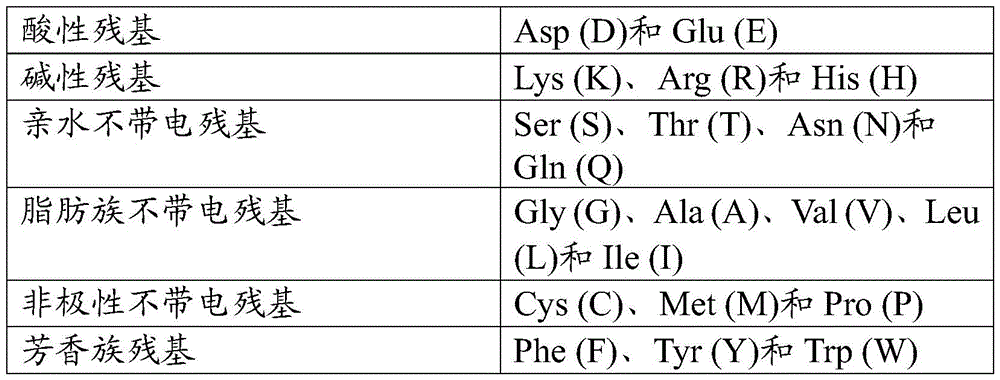
除非另有说明,否则使用以下命名法描述突变:i)给定位置的氨基酸取代被写为例如K409R,其意指用精氨酸取代位置409的赖氨酸;ii)对于特定变体,使用特定的三字母或一字母代码,包括代码Xaa和X以指示任何氨基酸残基。因此,在位置409用精氨酸取代赖氨酸称为:K409R,并且在位置409用任何氨基酸残基取代赖氨酸称为K409X。如果位置409的赖氨酸缺失,则其用K409*表示。Unless otherwise indicated, mutations are described using the following nomenclature: i) amino acid substitutions at a given position are written as, for example, K409R, which means substitution of lysine at position 409 with arginine; ii) for a particular variant, specific three-letter or one-letter codes are used, including the codes Xaa and X to indicate any amino acid residue. Thus, substitution of lysine at position 409 with arginine is referred to as: K409R, and substitution of lysine at position 409 with any amino acid residue is referred to as K409X. If the lysine at position 409 is missing, it is represented by K409*.
如本文所用,术语“人源化抗体”是指遗传工程化改造的非人抗体,其含有人抗体恒定域和经修饰以含有与人可变域的高度序列同源性的非人可变域。这可以通过将一起形成抗原结合位点的六个非人抗体CDR移植到同源人接受体框架区(FR)上来实现(参见WO92/22653和EP0629240)。为了完全重建亲本抗体的结合亲和力和特异性,可能需要将亲本抗体(即非人抗体)的框架残基替换为人框架区(回复突变)。结构同源性建模可能有助于鉴定框架区中对抗体结合特性很重要的氨基酸残基。因此,人源化抗体可以包含非人CDR序列,主要是任选地包含相对于非人氨基酸序列的一个或多个氨基酸回复突变的人框架区,以及完全人恒定区。本文在DuoBody-CD3xCD20中使用的CD3臂的VH和VL代表人源化抗原结合区。任选地,可以应用不一定是回复突变的额外的氨基酸修饰,以获得具有优选特征诸如亲和力和生化特性的人源化抗体。As used herein, the term "humanized antibody" refers to a non-human antibody genetically engineered, containing human antibody constant domains and modified to contain non-human variable domains with a high degree of sequence homology to human variable domains. This can be achieved by transplanting six non-human antibody CDRs that form an antigen binding site together to a homologous human acceptor framework region (FR) (see WO92/22653 and EP0629240). In order to fully rebuild the binding affinity and specificity of the parent antibody, it may be necessary to replace the framework residues of the parent antibody (i.e., non-human antibody) with human framework regions (reverse mutations). Structural homology modeling may help identify amino acid residues that are important to antibody binding properties in the framework region. Therefore, humanized antibodies may include non-human CDR sequences, mainly people's framework regions that optionally include one or more amino acid reverse mutations relative to non-human amino acid sequences, and completely human constant regions. The VH and VL of the CD3 arms used in DuoBody-CD3xCD20 herein represent humanized antigen binding regions. Optionally, additional amino acid modifications, not necessarily back mutations, can be applied to obtain humanized antibodies with preferred characteristics such as affinity and physiochemical properties.
如本文所用,术语“人抗体”是指具有衍生自人种系免疫球蛋白序列的可变区和恒定区的抗体。人抗体可以包括不由人种系免疫球蛋白序列编码的氨基酸残基(例如,通过体外随机或位点特异性诱变或通过体内体细胞突变引入的突变)。然而,如本文所用,术语“人抗体”不旨在包括其中衍生自另一哺乳动物物种(诸如小鼠)的种系的CDR序列已移植到人框架序列上的抗体。DuoBody-CD3xCD20中使用的CD20臂的VH和VL代表人抗原结合区。本发明的人单克隆抗体可以通过多种技术产生,包括常规的单克隆抗体方法,例如Kohler和Milstein,Nature 256:495(1975)的标准体细胞杂交技术。虽然体细胞杂交规程是优选的,但原则上,可以采用其他用于产生单克隆抗体的技术,例如B淋巴细胞的病毒或致癌转化或使用人抗体基因文库的噬菌体展示技术。用于制备分泌人单克隆抗体的杂交瘤的合适动物系统是鼠系统。在小鼠中产生杂交瘤是非常完善的规程。用于分离免疫化脾细胞进行融合的免疫方案和技术是本领域已知的。融合配偶体(例如,鼠骨髓瘤细胞)和融合规程也是已知的。因此,可以使用例如携带部分人免疫系统而不是小鼠或大鼠系统的转基因或转染色体小鼠或大鼠来生成人单克隆抗体。因此,在一个实施方案中,人抗体获得自转基因动物,诸如小鼠或大鼠,其携带人种系免疫球蛋白序列而不是动物免疫球蛋白序列。在此类实施方案中,抗体源自引入动物的人种系免疫球蛋白序列,但最终抗体序列是所述人种系免疫球蛋白序列通过内源性动物抗体机制的体细胞超突变和亲和力成熟进一步修饰的结果(参见例如,Mendez等人Nat Genet 1997;15:146-56)。DuoBody-CD3xCD20中使用的CD20臂的VH区和VL区代表人抗原结合区。As used herein, the term "human antibody" refers to an antibody with a variable region and a constant region derived from a human germline immunoglobulin sequence. Human antibodies may include amino acid residues not encoded by human germline immunoglobulin sequences (e.g., mutations introduced by random or site-specific mutagenesis in vitro or by somatic mutations in vivo). However, as used herein, the term "human antibody" is not intended to include antibodies in which the CDR sequences derived from the germline of another mammalian species (such as mice) have been transplanted to human framework sequences. The VH and VL of the CD20 arms used in DuoBody-CD3xCD20 represent human antigen binding regions. The human monoclonal antibodies of the present invention can be produced by a variety of techniques, including conventional monoclonal antibody methods, such as Kohler and Milstein, Nature 256:495 (1975) standard somatic cell hybridization techniques. Although somatic cell hybridization procedures are preferred, in principle, other techniques for producing monoclonal antibodies can be used, such as viral or oncogenic transformation of B lymphocytes or phage display techniques using human antibody gene libraries. The suitable animal system for preparing the hybridoma of secreting human monoclonal antibody is the mouse system. Producing hybridoma in mice is a very complete procedure. The immune scheme and technology for separating immunized spleen cells for fusion are known in the art. Fusion partners (e.g., mouse myeloma cells) and fusion procedures are also known. Therefore, it is possible to use, for example, transgenic or transchromosomal mice or rats carrying part of the human immune system instead of mouse or rat systems to generate human monoclonal antibodies. Therefore, in one embodiment, human antibodies are obtained from transgenic animals, such as mice or rats, which carry human germline immunoglobulin sequences instead of animal immunoglobulin sequences. In such embodiments, antibodies are derived from human germline immunoglobulin sequences introduced into animals, but the final antibody sequence is the result of the further modification of the human germline immunoglobulin sequences by the somatic hypermutation and affinity maturation of endogenous animal antibody mechanisms (see, e.g., Mendez et al. Nat Genet 1997; 15: 146-56). The VH region and VL region of the CD20 arm used in DuoBody-CD3xCD20 represent human antigen binding regions.
如本文所用,术语(例如,批准的参考产品/生物药物的)“生物类似物”是指基于来自以下的数据与参考产品类似的生物产品:(a)分析研究,其表明生物产品与参考产品高度类似,尽管临床非活性组分存在细微差异;(b)动物研究(包括毒性评估);和/或(c)一项或多项临床研究(包括免疫原性和药代动力学或药效学的评估),其足以证明在参考产品批准使用和将要使用以及寻求批准的一种或多种适当条件下的安全性、纯度和效力(例如,生物制品和参考产品在产品的安全性、纯度和效力方面没有临床上有意义的差异)。在一些实施方案中,生物类似物生物制品和参考产品针对建议标签中规定、推荐或建议的一个或多个使用条件使用相同的一个或多个作用机制,但仅限于参考产品已知的一个或多个作用机制的范围。在一些实施方案中,提议用于生物产品的标签中规定、推荐或建议的一个或多个使用条件先前已被批准用于参考产品。在一些实施方案中,生物产品的施用途径、剂型和/或规格(strength)与参考产品相同。生物类似物可以是,例如,与上市抗体具有相同一级氨基酸序列的目前已知的抗体,但可以在不同的细胞类型中或通过不同的生产、纯化或配制方法制备。As used herein, the term "biosimilar" (e.g., of an approved reference product/biologic drug) refers to a biological product that is similar to the reference product based on data from: (a) analytical studies that show that the biological product is highly similar to the reference product, although there are minor differences in clinically inactive components; (b) animal studies (including toxicity assessments); and/or (c) one or more clinical studies (including assessments of immunogenicity and pharmacokinetics or pharmacodynamics) that are sufficient to demonstrate safety, purity, and efficacy under one or more appropriate conditions for which the reference product is approved for use and will be used and for which approval is sought (e.g., there are no clinically meaningful differences between the biological product and the reference product in terms of safety, purity, and efficacy of the product). In some embodiments, the biosimilar biological product and the reference product use the same one or more mechanisms of action for one or more conditions of use specified, recommended, or suggested in the proposed labeling, but only within the scope of the one or more mechanisms of action known for the reference product. In some embodiments, one or more conditions of use specified, recommended, or suggested in the labeling proposed for the biological product have previously been approved for the reference product. In some embodiments, the route of administration, dosage form, and/or strength of the biological product are the same as those of the reference product. A biosimilar may be, for example, a currently known antibody that has the same primary amino acid sequence as a marketed antibody, but may be produced in a different cell type or by a different production, purification or formulation method.
如本文所用,术语“还原条件”或“还原环境”是指其中底物(此处为抗体铰链区中的半胱氨酸残基)更可能被还原而不是被氧化的条件或环境。As used herein, the term "reducing conditions" or "reducing environment" refers to conditions or environment in which a substrate (here, a cysteine residue in the hinge region of an antibody) is more likely to be reduced than to be oxidized.
如本文所用,术语“重组宿主细胞”(或简称为“宿主细胞”)旨在指已引入表达载体,例如编码本文所述抗体的表达载体的细胞。重组宿主细胞包括,例如转染瘤,诸如CHO、CHO-S、HEK、HEK293、HEK-293F、Expi293F、PER.C6或NSO细胞,以及淋巴细胞。As used herein, the term "recombinant host cell" (or simply "host cell") is intended to refer to a cell into which an expression vector, e.g., an expression vector encoding an antibody described herein, has been introduced. Recombinant host cells include, e.g., transfectomas such as CHO, CHO-S, HEK, HEK293, HEK-293F, Expi293F, PER.C6 or NSO cells, and lymphocytes.
如本文所用,“慢性淋巴细胞白血病”或“CLL”是指形态学上成熟但免疫学上较不成熟的淋巴细胞的病症并且表现为这些细胞在血液、骨髓和淋巴组织中的进行性积累。CLL可以根据WHO分类法进行诊断和分类,其通过引用包含在本文中(Swerdlow SH,Campo E,Harris NL等人WHO Classification of Tumours of Haematopoietic and LymphoidTissues(修订版,第4版).Lyon,France:IARC Press(2017);Swerdlow SH,Campo E,HarrisNL,等人WHO Classification of Tumours of Haematopoietic and Lymphoid Tissues(第4版).Lyon,France:IARC Press(2008))。CLL从骨髓中的淋巴细胞开始,并且最常发生在年龄大于50岁的那些中。其特征在于成熟B淋巴细胞的克隆性增殖和积累,这最终导致单克隆B细胞淋巴细胞增多症(reviewed in Uhm,Blood Res 2020;55:S72-82)。CLL中的单克隆B细胞表达若干成熟活化B淋巴细胞所特有的标志物,包含CD5、CD19、CD20和CD23,以及减少表达IgGM、IgGD和CD79b(Chiorazzi等人,N Engl J Med 2005;352-804-15)。已经报道了该疾病的若干预后标志物,包含IGHV基因中的突变、TP53中的突变、del(17p)和del(11q)(Wierda等人,J Clin Oncol 2011;29:4088-95;Rossi等人,Blood 2013-121:1403-12;CLL-IPI,Lancet Oncol 2016;17:779-90)。针对CLL的治疗包括诸如化疗、BCL2抑制剂、BTK抑制剂、PI3Kδ抑制剂,单独或联合抗CD20抗体(Uhm,2020,同上)。As used herein, "chronic lymphocytic leukemia" or "CLL" refers to a morphologically mature but immunologically less mature lymphocyte disorder and is manifested as the progressive accumulation of these cells in blood, bone marrow and lymphoid tissue. CLL can be diagnosed and classified according to the WHO classification, which is included herein by reference (Swerdlow SH, Campo E, Harris NL et al. WHO Classification of Tumours of Haematopoietic and Lymphoid Tissues (revised edition, 4th edition). Lyon, France: IARC Press (2017); Swerdlow SH, Campo E, Harris NL, et al. WHO Classification of Tumours of Haematopoietic and Lymphoid Tissues (4th edition). Lyon, France: IARC Press (2008)). CLL starts with lymphocytes in the bone marrow, and most often occurs in those aged greater than 50 years old. It is characterized by clonal proliferation and accumulation of mature B lymphocytes, which ultimately leads to monoclonal B-cell lymphocytosis (reviewed in Uhm, Blood Res 2020; 55: S72-82). Monoclonal B cells in CLL express several markers unique to mature activated B lymphocytes, including CD5, CD19, CD20 and CD23, as well as reduced expression of IgGM, IgGD and CD79b (Chiorazzi et al., N Engl J Med 2005; 352-804-15). Several prognostic markers for the disease have been reported, including mutations in the IGHV gene, mutations in TP53, del(17p) and del(11q) (Wierda et al., J Clin Oncol 2011; 29:4088-95; Rossi et al., Blood 2013-121:1403-12; CLL-IPI, Lancet Oncol 2016; 17:779-90). Treatment for CLL includes chemotherapy, BCL2 inhibitors, BTK inhibitors, PI3Kδ inhibitors, alone or in combination with anti-CD20 antibodies (Uhm, 2020, supra).
术语“治疗”是指为了缓解、改善、阻止或根除(治愈)症状或疾病状态诸如CLL的目的而施用有效量的本文所述的治疗活性抗体。治疗可以导致完全响应(CR)、部分响应(PR)或疾病稳定(SD),例如,按照iwCLL响应标准的定义,如表2所示。可以继续治疗,例如直至疾病进展(PD)或不可接受的毒性。The term "treatment" refers to the administration of an effective amount of therapeutically active antibodies described herein for the purpose of alleviating, improving, preventing or eradicating (curing) symptoms or disease states such as CLL. Treatment can result in complete response (CR), partial response (PR) or stable disease (SD), for example, as defined by iwCLL response criteria, as shown in Table 2. Treatment can be continued, for example, until disease progression (PD) or unacceptable toxicity.
如本文所用,术语“施用”是指使用本领域技术人员已知的各种方法和递送系统中的任一种将包含治疗剂的组合物(或配制剂)物理引入受试者。本文所述的抗体的优选施用途径包括静脉内、腹膜内、肌肉内、皮下、脊柱或其他胃肠外施用途径,例如通过注射或输注。如本文所用,短语“胃肠外施用”是指除肠内和表面施用以外的施用方式,通常通过注射,并且包括但不限于静脉内、腹膜内、肌肉内、动脉内、鞘内、淋巴管内、病变内(intralesional)、囊内、眼眶内、心内、皮内、经气管、皮下、表皮下、关节内、囊下、蛛网膜下、脊柱内、硬膜外和胸骨内注射和输注,以及体内电穿孔。替代性地,本文所述的治疗剂可以经由非胃肠外途径,诸如表面、表皮或粘膜施用途径施用,例如鼻内、经口、阴道、直肠、舌下或表面施用。也可以例如一次、多次和/或在一个或多个延长的时期内进行施用。在本文所述的方法中,皮下施用双特异性抗体(例如,艾可瑞妥单抗)。与双特异性抗体联合使用的其他药剂(诸如用于细胞因子释放综合征防治或肿瘤溶解综合征(TLS)防治)可以通过其他途径,诸如静脉内或口服施用。As used herein, the term "administer" refers to the physical introduction of a composition (or formulation) containing a therapeutic agent into a subject using any of the various methods and delivery systems known to those skilled in the art. Preferred routes of administration of antibodies described herein include intravenous, intraperitoneal, intramuscular, subcutaneous, spinal or other parenteral routes of administration, such as by injection or infusion. As used herein, the phrase "parenteral administration" refers to the mode of administration other than enteral and topical administration, usually by injection, and includes but is not limited to intravenous, intraperitoneal, intramuscular, intraarterial, intrathecal, intralymphatic, intralesional, intracapsular, intraorbital, intracardiac, intradermal, transtracheal, subcutaneous, subcutaneous, intraarticular, subcapsular, subarachnoid, intraspinal, epidural and intrasternal injection and infusion, and in vivo electroporation. Alternatively, therapeutic agents described herein can be administered via non-parenteral routes, such as surface, epidermal or mucosal administration routes, such as intranasal, oral, vaginal, rectal, sublingual or topical administration. It can also be administered, for example, once, multiple times and/or over one or more extended periods. In the methods described herein, the bispecific antibody (e.g., icoretuzumab) is administered subcutaneously. Other agents used in combination with the bispecific antibody (such as for cytokine release syndrome prevention or tumor lysis syndrome (TLS) prevention) can be administered by other routes, such as intravenous or oral administration.
术语“有效量”或“治疗有效量”是指在必要的剂量和时间段内有效实现期望治疗结果的量。例如,如本文所定义的用于以12-60mg范围皮下施用的双特异性抗体(例如艾可瑞妥单抗)的剂量可以被定义为此类“有效量”或“治疗有效量”。抗体的治疗有效量可根据诸如个体的疾病状态、年龄、性别和体重以及抗体在个体中引出期望响应的能力等因素而变化。治疗有效量也是其中抗体或抗体部分的任何毒性或有害作用被治疗有益作用抵消的量。在一些实施方案中,用本文所述方法治疗的患者将表现出ECOG表现状态的改善。药物的治疗有效量或剂量包括“防治有效量”或“防治有效剂量”,其是当药物单独或联合另一种治疗剂施用于处于发展疾病或病症(例如,细胞因子释放综合征)的风险或处于患有疾病复发的风险的受试者时,抑制疾病的发展或复发的该药物的任何量。The term "effective amount" or "therapeutically effective amount" refers to the amount that effectively achieves the desired therapeutic outcome within the necessary dosage and time period. For example, the dosage of a bispecific antibody (e.g., icoretuzumab) for subcutaneous administration in the range of 12-60 mg as defined herein can be defined as such an "effective amount" or "therapeutically effective amount". The therapeutically effective amount of an antibody can vary according to factors such as the disease state, age, sex, and weight of an individual and the ability of the antibody to elicit a desired response in an individual. A therapeutically effective amount is also an amount in which any toxic or deleterious effects of an antibody or antibody portion are offset by a therapeutically beneficial effect. In some embodiments, patients treated with the methods described herein will show an improvement in ECOG performance status. The therapeutically effective amount or dosage of a drug includes a "preventive and therapeutic effective amount" or "preventive and therapeutic effective dose", which is any amount of the drug that inhibits the development or recurrence of a disease when the drug is administered alone or in combination with another therapeutic agent to a subject at risk of developing a disease or disorder (e.g., cytokine release syndrome) or at risk of suffering from a recurrence of the disease.
如本文所用,术语“抑制肿瘤生长”包括肿瘤生长的任何可测量的减少,例如将肿瘤生长抑制了至少约10%,例如至少约20%、至少约30%、至少约40%、至少约50%、至少约60%、至少约70%、至少约80%、至少约90%、至少约99%或100%。As used herein, the term "inhibiting tumor growth" includes any measurable reduction in tumor growth, such as inhibiting tumor growth by at least about 10%, such as at least about 20%, at least about 30%, at least about 40%, at least about 50%, at least about 60%, at least about 70%, at least about 80%, at least about 90%, at least about 99%, or 100%.
如本文所用,术语“受试者”是指人患者,例如,患有CLL的人患者。术语“受试者”和“患者”本文中可互换使用。As used herein, the term "subject" refers to a human patient, e.g., a human patient suffering from CLL. The terms "subject" and "patient" are used interchangeably herein.
如本文所用,术语“缓冲液”表示药学上可接受的缓冲液。术语“缓冲液”涵盖将溶液的pH值保持在例如可接受范围内的那些试剂,并且包括但不限于乙酸盐、组氨酸、
如本文所用的“疾病进展”或“PD”是指CLL的一个或多个指数显示尽管进行治疗但疾病仍在进展的情况。在一些实施方案中,疾病进展是根据iwCLL响应标准定义的,如表2所示。As used herein, "disease progression" or "PD" refers to a situation in which one or more indices of CLL show that the disease is still progressing despite treatment. In some embodiments, disease progression is defined according to iwCLL response criteria, as shown in Table 2.
如本文所用,“表面活性剂”是通常用于药物配制剂中以防止药物吸附到表面和/或聚集的化合物。此外,表面活性剂降低两种液体之间或液体与固体之间的表面张力(或界面张力)。例如,当以非常低的浓度(例如,5%w/v或更小,诸如3%w/v或更小,诸如1%w/v或更小,诸如0.4%w/v或更小,诸如低于0.1%w/v或更小,诸如0.04%w/v)存在时,示例性表面活性剂可以显著降低表面张力。表面活性剂是两亲性的,这意味着它们通常由亲水和疏水或亲油基团构成,因此能够在水溶液中形成胶束或类似的自组装结构。已知的药用表面活性剂包括单油酸甘油酯、苄索氯铵、多库酯钠、磷脂、聚乙烯烷基醚(polyethylene alkylethers)、月桂基硫酸钠和三辛精(阴离子表面活性剂);苯扎氯铵、柠檬酰亚胺、氯化十六烷基吡啶(cetylpyridinium chloride)和磷脂(阳离子表面活性剂);和α-生育酚、单油酸甘油酯、肉豆蔻醇、磷脂、泊洛沙姆、聚氧乙烯烷基醚、聚氧乙烯蓖麻油衍生物、聚氧乙烯失水山梨醇脂肪酸酯、聚氧乙烯硬脂酸酯、聚乙二醇羟基硬脂酸酯(polyoxylhydroxystearate)、聚乙二醇甘油酯(polyoxylglyceride)、聚山梨醇酯诸如聚山梨醇酯20或聚山梨醇酯80、丙二醇二月桂酸酯、丙二醇单月桂酸酯、失水山梨糖醇酯蔗糖棕榈酸酯、蔗糖硬脂酸酯、三辛精和TPGS(非离子和两性离子表面活性剂)。As used herein, "surfactant" is a compound commonly used in pharmaceutical formulations to prevent drugs from being adsorbed to surfaces and/or aggregated. In addition, surfactants reduce the surface tension (or interfacial tension) between two liquids or between a liquid and a solid. For example, when present at very low concentrations (e.g., 5% w/v or less, such as 3% w/v or less, such as 1% w/v or less, such as 0.4% w/v or less, such as less than 0.1% w/v or less, such as 0.04% w/v), exemplary surfactants can significantly reduce surface tension. Surfactants are amphiphilic, which means that they are typically composed of hydrophilic and hydrophobic or lipophilic groups and are therefore able to form micelles or similar self-assembled structures in aqueous solution. Known pharmaceutical surfactants include glyceryl monooleate, benzethonium chloride, sodium docusate, phospholipids, polyethylene alkylethers, sodium lauryl sulfate and tricaprylin (anionic surfactants); benzalkonium chloride, citrimide, cetylpyridinium chloride and phospholipids (cationic surfactants); and α-tocopherol, glyceryl monooleate, myristyl alcohol, phospholipids, poloxamers, polyoxyethylene alkyl ethers, polyoxyethylene castor oil derivatives, polyoxyethylene sorbitan fatty acid esters, polyoxyethylene stearates, polyoxylhydroxystearate, polyoxylglyceride, polysorbates such as
如本文所用,“稀释剂”是药学上可接受的(对人施用安全且无毒)并且可用于制备药物组合物或药物配制剂的稀释物(术语“组合物”和“配制剂”在本文中可互换使用)。优选地,组合物的此类稀释物仅稀释抗体浓度而不稀释缓冲液和稳定剂。因此,在一个实施方案中,稀释剂含有与存在于本发明药物组合物中的浓度相同的缓冲液和稳定剂。进一步的示例性稀释剂包括无菌水、注射用抑菌水(BWFI)、pH缓冲溶液(优选为乙酸盐缓冲液)、无菌盐水溶液、林格氏溶液或右旋糖溶液。在一个实施方案中,稀释剂包含乙酸盐缓冲液和山梨糖醇或基本上由乙酸盐缓冲液和山梨糖醇组成。As used herein, a "diluent" is a diluent that is pharmaceutically acceptable (safe and non-toxic to human administration) and can be used to prepare a pharmaceutical composition or pharmaceutical formulation (the terms "composition" and "formulation" are used interchangeably herein). Preferably, such dilutions of the composition dilute only the antibody concentration without diluting the buffer and stabilizer. Therefore, in one embodiment, the diluent contains the same buffer and stabilizer as those present in the pharmaceutical composition of the present invention. Further exemplary diluents include sterile water, bacteriostatic water for injection (BWFI), pH buffer solution (preferably acetate buffer), sterile saline solution, Ringer's solution, or dextrose solution. In one embodiment, the diluent comprises acetate buffer and sorbitol or consists essentially of acetate buffer and sorbitol.
如本文所用,术语“约”是指规定值的±10%。As used herein, the term "about" refers to ±10% of the stated value.
CLL治疗方案CLL treatment options
本文提供了在人受试者中使用与CD3和CD20结合的双特异性抗体(“抗CD3xCD20抗体”),例如与人CD3和人CD20结合的分离的抗CD3xCD20抗体来治疗CLL的方法。该方法也可用于治疗复发性或难治性CLL(R/R CLL)。可以理解的是,本文描述的用与CD3和CD20两者结合的双特异性抗体治疗CLL的方法也涵盖双特异性抗体用于在人受试者中治疗CLL的相应用途。Provided herein are methods for treating CLL in human subjects using bispecific antibodies that bind to CD3 and CD20 ("anti-CD3xCD20 antibodies"), e.g., isolated anti-CD3xCD20 antibodies that bind to human CD3 and human CD20. The methods can also be used to treat relapsed or refractory CLL (R/R CLL). It is understood that the methods described herein for treating CLL with bispecific antibodies that bind to both CD3 and CD20 also encompass the corresponding use of bispecific antibodies for treating CLL in human subjects.
因此,在一个方面,本文提供了在人受试者中治疗CLL的方法,该方法包括向受试者施用(例如,皮下地)有效量的双特异性抗体,该双特异性抗体包含:Thus, in one aspect, provided herein is a method of treating CLL in a human subject, the method comprising administering to the subject (e.g., subcutaneously) an effective amount of a bispecific antibody comprising:
(i)包含第一抗原结合区的第一结合臂,该第一抗原结合区结合人CD3ε(epsilon)并包含可变重链(VH)区和可变轻链(VL)区,其中VH区包含SEQ ID NO:6的VH区序列中的CDR1、CDR2和CDR3序列,并且VL区包含SEQ ID NO:7的VL区序列中的CDR1、CDR2和CDR3序列;和(i) a first binding arm comprising a first antigen binding region that binds to human CD3 epsilon (epsilon) and comprises a variable heavy chain (VH) region and a variable light chain (VL) region, wherein the VH region comprises the CDR1, CDR2, and CDR3 sequences in the VH region sequence of SEQ ID NO: 6, and the VL region comprises the CDR1, CDR2, and CDR3 sequences in the VL region sequence of SEQ ID NO: 7; and
(ii)包含第二抗原结合区的第二结合臂,该第二抗原结合区结合人CD20并包含VH区和VL区,其中VH区包含SEQ ID NO:13的VH区序列中的CDR1、CDR2和CDR3序列,并且VL区包含SEQ ID NO:14的VL区序列中的CDR1、CDR2和CDR3序列;(ii) a second binding arm comprising a second antigen binding region that binds to human CD20 and comprises a VH region and a VL region, wherein the VH region comprises the CDR1, CDR2, and CDR3 sequences in the VH region sequence of SEQ ID NO: 13, and the VL region comprises the CDR1, CDR2, and CDR3 sequences in the VL region sequence of SEQ ID NO: 14;
其中在28天周期中以12-60mg范围的剂量施用双特异性抗体。The bispecific antibody was administered at doses ranging from 12-60 mg in a 28-day cycle.
在一些实施方案中,双特异性抗体是全长抗体。在一些实施方案中,双特异性抗体是具有惰性Fc区的抗体。在一些实施方案中,双特异性抗体是具有惰性Fc区的全长抗体。In some embodiments, the bispecific antibody is a full-length antibody. In some embodiments, the bispecific antibody is an antibody with an inert Fc region. In some embodiments, the bispecific antibody is a full-length antibody with an inert Fc region.
在一些实施方案中,双特异性抗体以12mg的剂量(或约12mg的剂量)施用。在一些实施方案中,双特异性抗体以24mg的剂量(或约24mg的剂量)施用。在一些实施方案中,双特异性抗体以48mg的剂量(或约48mg的剂量)施用。在一些实施方案中,双特异性抗体以60mg的剂量(或约60mg的剂量)施用。In some embodiments, the bispecific antibody is administered at a dose of 12 mg (or a dose of about 12 mg). In some embodiments, the bispecific antibody is administered at a dose of 24 mg (or a dose of about 24 mg). In some embodiments, the bispecific antibody is administered at a dose of 48 mg (or a dose of about 48 mg). In some embodiments, the bispecific antibody is administered at a dose of 60 mg (or a dose of about 60 mg).
关于待施用的双特异性抗体的12-60mg的剂量,或任何其他指定剂量,应理解该量是指代表全长抗体的双特异性抗体的量,诸如实施例部分中定义的艾可瑞妥单抗。因此,可以将施用24mg的双特异性抗体的剂量称为施用本文所述的双特异性抗体的剂量,其中该剂量对应于艾可瑞妥单抗的24mg的剂量。当例如使用的抗体的分子量与全长抗体诸如艾可瑞妥单抗的分子量显著不同时,本领域的普通技术人员可以容易地确定待施用的抗体的量。例如,抗体的量可以通过将抗体的分子量除以全长抗体诸如艾可瑞妥单抗的重量并将其结果乘以特定剂量来计算,如本文所述的。只要双特异性抗体(例如,DuoBody-CD3xCD20的功能变体)与DuoBody-CD3xCD20在血浆半衰期、Fc惰性和/或对CD3和CD20的结合特征方面(即,在CDR和表位结合特征方面)具有高度相似的特征,此类抗体就适合于以对于全长抗体诸如艾可瑞妥单抗描述的剂量用于本文提供的方法。With regard to the dosage of 12-60 mg of the bispecific antibody to be administered, or any other specified dosage, it should be understood that the amount refers to the amount of the bispecific antibody representing the full-length antibody, such as the ixorumab defined in the Examples section. Therefore, the dosage of the bispecific antibody administered with 24 mg can be referred to as the dosage of the bispecific antibody described herein, wherein the dosage corresponds to the dosage of 24 mg of ixorumab. When, for example, the molecular weight of the antibody used is significantly different from the molecular weight of a full-length antibody such as ixorumab, a person of ordinary skill in the art can easily determine the amount of the antibody to be administered. For example, the amount of the antibody can be calculated by dividing the molecular weight of the antibody by the weight of a full-length antibody such as ixorumab and multiplying the result by a specific dosage, as described herein. As long as the bispecific antibodies (e.g., functional variants of DuoBody-CD3xCD20) have highly similar characteristics to DuoBody-CD3xCD20 in terms of plasma half-life, Fc inertness and/or binding characteristics to CD3 and CD20 (i.e., in terms of CDR and epitope binding characteristics), such antibodies are suitable for use in the methods provided herein at the doses described for full-length antibodies such as icoretuzumab.
在一个实施方案中,双特异性抗CD3xCD20抗体以12mg和60mg之间范围的剂量施用。在一些实施方案中,双特异性抗体以12mg或约12mg的剂量施用。在一些实施方案中,双特异性抗体以24mg或约24mg的剂量施用。在一些实施方案中,双特异性抗体以48mg或约48mg的剂量施用。在一些实施方案中,双特异性抗体以60mg或约60mg的剂量施用。In one embodiment, the bispecific anti-CD3xCD20 antibody is administered at a dosage ranging between 12 mg and 60 mg. In some embodiments, the bispecific antibody is administered at a dosage of 12 mg or about 12 mg. In some embodiments, the bispecific antibody is administered at a dosage of 24 mg or about 24 mg. In some embodiments, the bispecific antibody is administered at a dosage of 48 mg or about 48 mg. In some embodiments, the bispecific antibody is administered at a dosage of 60 mg or about 60 mg.
在一些实施方案中,双特异性抗体的剂量以28天周期每周施用一次(每周施用)。在一些实施方案中,每周施用进行2.5个28天周期(即10次)。在一个实施方案中,剂量施用2.5个28天周期(即10次;在周期1的第15和22天,和周期2和3的第1、8、15和22天)。在一些实施方案中,在所述每周施用之后,可以将施用双特异性抗体的间隔降低到每两周施用一次(每两周施用)。在一些实施方案中,此类每两周施用可以进行6个28天周期(即12次)。在一些实施方案中,在所述每两周施用后,施用双特异性抗体的间隔可以进一步降低到每四周一次。在一个实施方案中,每四周一次的施用可以进行较长时间,例如,持续28天周期的至少1个周期、至少2个周期、至少3个周期、至少4个周期、至少5个周期、至少6个周期、至少7个周期、至少8个周期、至少9个周期、至少10个周期、至少11个周期、至少12个周期、至少13个周期、至少14个周期、至少15个周期、至少16个周期、至少17个周期,或1-20个周期之间、1-19个周期之间、1-18个周期之间、1-17个周期之间、1-16个周期之间、1-15个周期之间、1-14个周期之间、1-13个周期之间、1-12个周期之间、1-10个周期之间、1-5个周期之间、5-20个周期之间、5-15个周期之间,或5-10个周期。在一些实施方案中,每四周施用一次艾可瑞妥单抗,直到疾病进展(例如,由iwCLL响应标准所定义,如表2所示)或不可接受的毒性。在一个实施方案中,每周剂量在周期1-3施用(并且可以包含引发和中间剂量,如下所述),两周剂量在周期4-9施用,并且每四周一次的剂量从周期10以后施用。In some embodiments, the dosage of the bispecific antibody is applied once a week in a 28-day cycle (weekly administration). In some embodiments, 2.5 28-day cycles (i.e. 10 times) are applied weekly. In one embodiment, the dosage is applied for 2.5 28-day cycles (i.e. 10 times; on the 15th and 22nd day of cycle 1, and the 1st, 8th, 15th and 22nd day of cycle 2 and 3). In some embodiments, after the weekly application, the interval of applying the bispecific antibody can be reduced to once every two weeks (every two weeks). In some embodiments, such biweekly administration can be carried out for 6 28-day cycles (i.e. 12 times). In some embodiments, after the biweekly administration, the interval of applying the bispecific antibody can be further reduced to once every four weeks. In one embodiment, administration once every four weeks can be performed for a longer period of time, for example, for at least 1 cycle, at least 2 cycles, at least 3 cycles, at least 4 cycles, at least 5 cycles, at least 6 cycles, at least 7 cycles, at least 8 cycles, at least 9 cycles, at least 10 cycles, at least 11 cycles, at least 12 cycles, at least 13 cycles, at least 14 cycles, at least 15 cycles, at least 16 cycles, at least 17 cycles, or between 1-20 cycles, 1-19 cycles, 1-18 cycles, 1-17 cycles, 1-16 cycles, 1-15 cycles, 1-14 cycles, 1-13 cycles, 1-12 cycles, 1-10 cycles, 1-5 cycles, 5-20 cycles, 5-15 cycles, or 5-10 cycles of a 28 day cycle. In some embodiments, icoretuzumab is administered once every four weeks until disease progression (e.g., as defined by iwCLL response criteria, as shown in Table 2) or unacceptable toxicity. In one embodiment, weekly dosing is administered in cycles 1-3 (and may include priming and intermediate doses, as described below), biweekly dosing is administered in cycles 4-9, and once every four weeks dosing is administered from cycle 10 onwards.
应当理解,本文所指的剂量在上述情况下也可称为全剂量或固定剂量(flatdose),其中例如,每周剂量、双周剂量和/或每四周剂量以相同的水平施用。因此,当优选地在每个每周施用,在每个双周施用,和每个每四周施用选择48mg的剂量时,应施用48mg的相同剂量。在施用该剂量之前,可以施用引发或引发和随后的中间(二次引发)剂量。这可能是有利的,因为其可能有助于减轻细胞因子释放综合征(CRS)的风险和严重性,这是可在用本文所述的双特异性抗CD3xCD20抗体治疗期间发生的副作用。与固定剂量或全剂量相比,此类引发或引发和中间剂量处于较低剂量。It should be understood that the dosage referred to herein may also be referred to as a full dose or a fixed dose (flatdose) in the above case, wherein, for example, a weekly dose, a biweekly dose and/or a dose every four weeks are administered at the same level. Therefore, when preferably administered every week, administered every biweekly, and each every four weeks, a dosage of 48 mg is selected, the same dose of 48 mg should be administered. Before administering the dosage, initiation or initiation and subsequent intermediate (secondary initiation) doses may be administered. This may be advantageous because it may contribute to mitigating the risk and severity of cytokine release syndrome (CRS), which is a side effect that may occur during treatment with a bispecific anti-CD3xCD20 antibody as described herein. Compared with a fixed dose or a full dose, such initiation or initiation and intermediate doses are at a lower dose.
因此,在一些实施方案中,在施用12-60mg的每周剂量之前,可以施用双特异性抗体的引发剂量。在一个实施方案中,在周期1中施用12-60mg的首次每周剂量之前两周施用引发剂量。引发剂量可以在20-2000μg(0.02mg-2mg)的范围内,例如在50-1000μg(0.05mg至1mg)的范围内或70-350μg(0.07mg至0.35mg)的范围内。引发剂量可以是例如80、100、120、140、160、180、200、220、240、260、280、300、320、350、400、450、500、600、700、800、900或1000μg,或约80、约100、约120、约140、约160、约180、约200、约220、约240、约260、约280、约300、约320、约350、约400、约450、约500、约600、约700、约800、约900或约1000μg。在优选的实施方案中,引发剂量在50和350μg(分别为0.05和0.35mg)之间。在更优选的实施方案中,引发剂量为160μg(0.16mg)或约160μg(约0.16mg)。在最优选的实施方案中,引发剂量是160μg(0.16mg)或约160μg(约0.16mg)的全长双特异性抗体。Thus, in some embodiments, a priming dose of the bispecific antibody may be administered prior to administration of a weekly dose of 12-60 mg. In one embodiment, a priming dose is administered two weeks prior to administration of the first weekly dose of 12-60 mg in cycle 1. The priming dose may be in the range of 20-2000 μg (0.02 mg-2 mg), for example in the range of 50-1000 μg (0.05 mg to 1 mg) or in the range of 70-350 μg (0.07 mg to 0.35 mg). The initiator amount can be, for example, 80, 100, 120, 140, 160, 180, 200, 220, 240, 260, 280, 300, 320, 350, 400, 450, 500, 600, 700, 800, 900 or 1000 μg, or about 80, about 100, about 120, about 140, about 160, about 180, about 200, about 220, about 240, about 260, about 280, about 300, about 320, about 350, about 400, about 450, about 500, about 600, about 700, about 800, about 900 or about 1000 μg. In a preferred embodiment, the initiator amount is between 50 and 350 μg (0.05 and 0.35 mg, respectively). In a more preferred embodiment, the priming dose is at or about 160 μg (0.16 mg). In a most preferred embodiment, the priming dose is at or about 160 μg (0.16 mg) of the full length bispecific antibody.
在一些实施方案中,在施用引发剂量之后且施用12-60mg的首次每周剂量之前,施用所述双特异性抗体的中间剂量。在一个实施方案中,在周期1的第1天施用引发剂量并且在第8天施用中间剂量,之后是在第15和22天12-60mg的首次每周剂量,即引发剂量在中间剂量之前一周(即周期1的第1天)施用,并且中间剂量在12-60mg的首次每周剂量之前一周(周期1的第8天)施用。中间剂量选自引发剂量与固定(flat)或全剂量之间的范围。例如,中间剂量可以在200-8000μg(0.2-8mg)的范围,例如,在400-4000μg(0.4-4mg)或600-2000μg(0.6-2mg)的范围。中间剂量可以是例如200、300、400、500、600、700、800、900、1000、1100、1200、1300、1400、1500或1600μg,或约200、约300、约400、约500、约600、约700、约800、约900、约1000、约1100、约1200、约1300、约1400、约1500或约1600μg。在优选的实施方案中,中间剂量在600和1200μg(分别是0.6和1.2mg)的范围内。在更优选的实施方案中,中间剂量是800μg(0.8mg)或约800μg(0.8mg)。在最优选的实施方案中,中间剂量是800μg或约800μg(0.8mg)的全长双特异性抗体。In some embodiments, after the initiating dose is administered and before the first weekly dose of 12-60 mg is administered, an intermediate dose of the bispecific antibody is administered. In one embodiment, the initiating dose is administered on the 1st day of cycle 1 and the intermediate dose is administered on the 8th day, followed by the first weekly dose of 12-60 mg on the 15th and 22nd days, i.e., the initiating dose is administered one week before the intermediate dose (i.e., the 1st day of cycle 1), and the intermediate dose is administered one week before the first weekly dose of 12-60 mg (the 8th day of cycle 1). The intermediate dose is selected from the range between the initiating dose and a fixed (flat) or full dose. For example, the intermediate dose can be in the range of 200-8000 μg (0.2-8 mg), for example, in the range of 400-4000 μg (0.4-4 mg) or 600-2000 μg (0.6-2 mg). Intermediate dose can be, for example, 200, 300, 400, 500, 600, 700, 800, 900, 1000, 1100, 1200, 1300, 1400, 1500 or 1600 μ g, or about 200, about 300, about 400, about 500, about 600, about 700, about 800, about 900, about 1000, about 1100, about 1200, about 1300, about 1400, about 1500 or about 1600 μ g. In a preferred embodiment, the intermediate dose is in the range of 600 and 1200 μ g (respectively 0.6 and 1.2 mg). In a more preferred embodiment, the intermediate dose is 800 μ g (0.8 mg) or about 800 μ g (0.8 mg). In a most preferred embodiment, the intermediate dose is at or about 800 μg (0.8 mg) of the full length bispecific antibody.
在一些实施方案中,双特异性抗体以28天周期施用(例如,皮下),其中In some embodiments, the bispecific antibody is administered (e.g., subcutaneously) in a 28-day cycle, wherein
a)在周期1中,在第1天施用引发剂量,在第8天施用中间剂量,并且在第15和22天施用12-60mg的全剂量;a) In cycle 1, a priming dose was administered on day 1, an intermediate dose was administered on day 8, and a full dose of 12-60 mg was administered on days 15 and 22;
b)在周期2-3中,在第1、8、15和22天施用12-60mg的全剂量;b) In cycles 2-3, a full dose of 12-60 mg is administered on days 1, 8, 15, and 22;
c)在周期4-9中,在第1和15天施用12-60mg的全剂量;以及c) in cycles 4-9, a full dose of 12-60 mg on days 1 and 15; and
d)在周期10及随后的周期中,在第1天施用12-60mg的全剂量。d) In Cycle 10 and subsequent cycles, administer a full dose of 12-60 mg on Day 1.
在一些实施方案中,双特异性抗体以28天周期施用(例如,皮下),其中In some embodiments, the bispecific antibody is administered (e.g., subcutaneously) in a 28-day cycle, wherein
a)在周期1中,在第1天施用0.05-0.35范围内的引发剂量,在第8天施用0.6-1.2mg范围内的中间剂量,并且在第15和22天施用12-60mg的全剂量;a) in cycle 1, administer a priming dose in the range of 0.05-0.35 mg on day 1, an intermediate dose in the range of 0.6-1.2 mg on day 8, and a full dose of 12-60 mg on days 15 and 22;
b)在周期2-3中,在第1、8、15和22天施用12-60mg的全剂量;b) In cycles 2-3, a full dose of 12-60 mg is administered on days 1, 8, 15, and 22;
c)在周期4-9中,在第1和15天施用12-60mg的全剂量;以及c) in cycles 4-9, a full dose of 12-60 mg on days 1 and 15; and
d)在周期10及随后的周期中,在第1天施用12-60mg的全剂量。d) In Cycle 10 and subsequent cycles, administer a full dose of 12-60 mg on Day 1.
在一些实施方案中,双特异性抗体以28天周期施用(例如,皮下),其中In some embodiments, the bispecific antibody is administered (e.g., subcutaneously) in a 28-day cycle, wherein
a)在周期1中,在第1天施用160μg的引发剂量,在第8天施用800μg的中间剂量,并且在第15和22天施用12-60mg的全剂量;a) In cycle 1, a priming dose of 160 μg was administered on day 1, an intermediate dose of 800 μg was administered on day 8, and a full dose of 12-60 mg was administered on days 15 and 22;
b)在周期2-3中,在第1、8、15和22天施用12-60mg的全剂量;b) In cycles 2-3, a full dose of 12-60 mg is administered on days 1, 8, 15, and 22;
c)在周期4-9中,在第1和15天施用12-60mg的全剂量;以及c) in cycles 4-9, a full dose of 12-60 mg on days 1 and 15; and
d)在周期10及随后的周期中,在第1天施用12-60mg的全剂量。d) In Cycle 10 and subsequent cycles, administer a full dose of 12-60 mg on Day 1.
在一些实施方案中,双特异性抗体以28天周期施用(例如,皮下),其中In some embodiments, the bispecific antibody is administered (e.g., subcutaneously) in a 28-day cycle, wherein
a)在周期1中,在第1天施用引发剂量,在第8天施用中间剂量,并且在第15和22天施用12mg或约12mg的全剂量;a) in cycle 1, a priming dose on day 1, an intermediate dose on day 8, and a full dose of 12 mg or about 12 mg on days 15 and 22;
b)在周期2-3中,在第1、8、15和22天施用12mg或约12mg的全剂量;b) in cycles 2-3, a full dose of 12 mg or about 12 mg is administered on days 1, 8, 15, and 22;
c)在周期4-9中,在第1和15天施用12mg或约12mg的全剂量;以及c) in cycles 4-9, administer a full dose of 12 mg or about 12 mg on Days 1 and 15; and
d)在周期10及随后的周期中,在第1天施用12mg或约12mg的全剂量。在一些实施方案中,双特异性抗体以28天周期施用(例如,皮下),其中d) in cycle 10 and subsequent cycles, a full dose of 12 mg or about 12 mg is administered on day 1. In some embodiments, the bispecific antibody is administered (e.g., subcutaneously) in a 28-day cycle, wherein
a)在周期1中,在第1天施用0.05-0.35范围内的引发剂量,在第8天施用0.6-1.2mg范围内的中间剂量,并且在第15和22天施用12mg的全剂量;a) in cycle 1, a priming dose in the range of 0.05-0.35 mg was administered on day 1, an intermediate dose in the range of 0.6-1.2 mg was administered on day 8, and a full dose of 12 mg was administered on days 15 and 22;
b)在周期2-3中,在第1、8、15和22天施用12mg的全剂量;b) In cycles 2-3, a full dose of 12 mg was administered on days 1, 8, 15, and 22;
c)在周期4-9中,在第1和15天施用12mg的全剂量;以及c) in cycles 4-9, a full dose of 12 mg on days 1 and 15; and
d)在周期10及随后的周期中,在第1天施用12mg的全剂量。d) In Cycle 10 and subsequent cycles, administer the full dose of 12 mg on Day 1.
在一些实施方案中,双特异性抗体以28天周期施用(例如,皮下),其中In some embodiments, the bispecific antibody is administered (e.g., subcutaneously) in a 28-day cycle, wherein
a)在周期1中,在第1天施用160μg的引发剂量,在第8天施用800μg的中间剂量,并且在第15和22天施用12mg或约12mg的全剂量;a) in cycle 1, a priming dose of 160 μg on day 1, an intermediate dose of 800 μg on day 8, and a full dose of 12 mg or about 12 mg on days 15 and 22;
b)在周期2-3中,在第1、8、15和22天施用12mg或约12mg的全剂量;b) in cycles 2-3, a full dose of 12 mg or about 12 mg is administered on days 1, 8, 15, and 22;
c)在周期4-9中,在第1和15天施用12mg或约12mg的全剂量;以及c) in cycles 4-9, administer a full dose of 12 mg or about 12 mg on Days 1 and 15; and
d)在周期10及随后的周期中,在第1天施用12mg或约12mg的全剂量。在一些实施方案中,双特异性抗体以28天周期施用(例如,皮下),其中d) in cycle 10 and subsequent cycles, a full dose of 12 mg or about 12 mg is administered on day 1. In some embodiments, the bispecific antibody is administered (e.g., subcutaneously) in a 28-day cycle, wherein
a)在周期1中,在第1天施用引发剂量,在第8天施用中间剂量,并且在第15和22天施用24mg或约24mg的全剂量;a) in cycle 1, a priming dose on day 1, an intermediate dose on day 8, and a full dose of 24 mg or about 24 mg on days 15 and 22;
b)在周期2-3中,在第1、8、15和22天施用24mg或约24mg的全剂量;b) in cycles 2-3, a full dose of 24 mg or about 24 mg is administered on days 1, 8, 15, and 22;
c)在周期4-9中,在第1和15天施用24mg或约24mg的全剂量;以及c) in cycles 4-9, administer a full dose of 24 mg or about 24 mg on Days 1 and 15; and
d)在周期10及随后的周期中,在第1天施用24mg或约24mg的全剂量。在一些实施方案中,双特异性抗体以28天周期施用(例如,皮下),其中d) in cycle 10 and subsequent cycles, a full dose of 24 mg or about 24 mg is administered on day 1. In some embodiments, the bispecific antibody is administered (e.g., subcutaneously) in a 28-day cycle, wherein
a)在周期1中,在第1天施用0.05和0.35范围内的引发剂量,在第8天施用0.6和1.2mg范围内的中间剂量,并且在第15和22天施用24mg的全剂量;a) in cycle 1, administer a priming dose ranging between 0.05 and 0.35 mg on day 1, an intermediate dose ranging between 0.6 and 1.2 mg on day 8, and a full dose of 24 mg on days 15 and 22;
b)在周期2-3中,在第1、8、15和22天施用24mg的全剂量;b) In cycles 2-3, a full dose of 24 mg was administered on days 1, 8, 15, and 22;
c)在周期4-9中,在第1和15天施用24mg的全剂量;以及c) in cycles 4-9, a full dose of 24 mg on days 1 and 15; and
d)在周期10及随后的周期中,在第1天施用24mg的全剂量。d) In Cycle 10 and subsequent cycles, administer the full dose of 24 mg on Day 1.
在一些实施方案中,双特异性抗体以28天周期施用(例如,皮下),其中In some embodiments, the bispecific antibody is administered (e.g., subcutaneously) in a 28-day cycle, wherein
a)在周期1中,在第1天施用160μg的引发剂量,在第8天施用800μg的中间剂量,并且在第15和22天施用24mg或约24mg的全剂量;a) in cycle 1, a priming dose of 160 μg on day 1, an intermediate dose of 800 μg on day 8, and a full dose of 24 mg or about 24 mg on days 15 and 22;
b)在周期2-3中,在第1、8、15和22天施用24mg或约24mg的全剂量;b) in cycles 2-3, a full dose of 24 mg or about 24 mg is administered on days 1, 8, 15, and 22;
c)在周期4-9中,在第1和15天施用24mg或约24mg的全剂量;以及c) in cycles 4-9, administer a full dose of 24 mg or about 24 mg on Days 1 and 15; and
d)在周期10及随后的周期中,在第1天施用24mg或约24mg的全剂量。在一些实施方案中,双特异性抗体以28天周期施用(例如,皮下),其中d) in cycle 10 and subsequent cycles, a full dose of 24 mg or about 24 mg is administered on day 1. In some embodiments, the bispecific antibody is administered (e.g., subcutaneously) in a 28-day cycle, wherein
a)在周期1中,在第1天施用引发剂量,在第8天施用中间剂量,并且在第15和22天施用48mg或约48mg的全剂量;a) in cycle 1, administer a priming dose on day 1, an intermediate dose on day 8, and a full dose of 48 mg or about 48 mg on days 15 and 22;
b)在周期2-3中,在第1、8、15和22天施用48mg或约48mg的全剂量;b) in cycles 2-3, administer a full dose of 48 mg or about 48 mg on days 1, 8, 15, and 22;
c)在周期4-9中,在第1和15天施用48mg或约48mg的全剂量;以及c) in Cycles 4-9, administer a full dose of 48 mg or about 48 mg on Days 1 and 15; and
d)在周期10及随后的周期中,在第1天施用48mg或约48mg的全剂量。在一些实施方案中,双特异性抗体以28天周期施用(例如,皮下),其中d) in cycle 10 and subsequent cycles, a full dose of 48 mg or about 48 mg is administered on day 1. In some embodiments, the bispecific antibody is administered (e.g., subcutaneously) in a 28-day cycle, wherein
a)在周期1中,在第1天施用0.05-0.35范围内的引发剂量,在第8天施用0.6-1.2mg范围内的中间剂量,并且在第15和22天施用48mg的全剂量;a) in cycle 1, administer a priming dose in the range of 0.05-0.35 mg on day 1, an intermediate dose in the range of 0.6-1.2 mg on day 8, and a full dose of 48 mg on days 15 and 22;
b)在周期2-3中,在第1、8、15和22天施用48mg的全剂量;b) In cycles 2-3, a full dose of 48 mg was administered on days 1, 8, 15, and 22;
c)在周期4-9中,在第1和15天施用48mg的全剂量;以及c) in cycles 4-9, a full dose of 48 mg on days 1 and 15; and
d)在周期10及随后的周期中,在第1天施用48mg的全剂量。d) In Cycle 10 and subsequent cycles, administer the full dose of 48 mg on Day 1.
在一些实施方案中,双特异性抗体以28天周期施用(例如,皮下),其中In some embodiments, the bispecific antibody is administered (e.g., subcutaneously) in a 28-day cycle, wherein
a)在周期1中,在第1天施用160μg的引发剂量,在第8天施用800μg的中间剂量,并且在第15和22天施用48mg或约48mg的全剂量;a) in cycle 1, a priming dose of 160 μg on day 1, an intermediate dose of 800 μg on day 8, and a full dose of 48 mg or about 48 mg on days 15 and 22;
b)在周期2-3中,在第1、8、15和22天施用48mg或约48mg的全剂量;b) in cycles 2-3, administer a full dose of 48 mg or about 48 mg on days 1, 8, 15, and 22;
c)在周期4-9中,在第1和15天施用48mg或约48mg的全剂量;以及c) in Cycles 4-9, administer a full dose of 48 mg or about 48 mg on Days 1 and 15; and
d)在周期10及随后的周期中,在第1天施用48mg或约48mg的全剂量。在一些实施方案中,双特异性抗体以28天周期施用(例如,皮下),其中d) in cycle 10 and subsequent cycles, a full dose of 48 mg or about 48 mg is administered on day 1. In some embodiments, the bispecific antibody is administered (e.g., subcutaneously) in a 28-day cycle, wherein
a)在周期1中,在第1天施用引发剂量,在第8天施用中间剂量,并且在第15和22天施用60mg或约60mg的全剂量;a) in cycle 1, a priming dose on day 1, an intermediate dose on day 8, and a full dose of 60 mg or about 60 mg on days 15 and 22;
b)在周期2-3中,在第1、8、15和22天施用60mg或约60mg的全剂量;b) in cycles 2-3, a full dose of 60 mg or about 60 mg is administered on days 1, 8, 15, and 22;
c)在周期4-9中,在第1和15天施用60mg或约60mg的全剂量;以及c) in cycles 4-9, administer a full dose of 60 mg or about 60 mg on Days 1 and 15; and
d)在周期10及随后的周期中,在第1天施用60mg或约60mg的全剂量。在一些实施方案中,双特异性抗体以28天周期施用(例如,皮下),其中d) in cycle 10 and subsequent cycles, a full dose of 60 mg or about 60 mg is administered on day 1. In some embodiments, the bispecific antibody is administered (e.g., subcutaneously) in a 28-day cycle, wherein
a)在周期1中,在第1天施用0.05-0.35范围内的引发剂量,在第8天施用0.6-1.2mg范围内的中间剂量,并且在第15和22天施用60mg的全剂量;a) in cycle 1, administer a priming dose in the range of 0.05-0.35 mg on day 1, an intermediate dose in the range of 0.6-1.2 mg on day 8, and a full dose of 60 mg on days 15 and 22;
b)在周期2-3中,在第1、8、15和22天施用60mg的全剂量;b) In cycles 2-3, a full dose of 60 mg was administered on days 1, 8, 15, and 22;
c)在周期4-9中,在第1和15天施用60mg的全剂量;以及c) in cycles 4-9, a full dose of 60 mg on days 1 and 15; and
d)在周期10及随后的周期中,在第1天施用60mg的全剂量。d) In Cycle 10 and subsequent cycles, administer the full dose of 60 mg on Day 1.
在一些实施方案中,双特异性抗体以28天周期施用(例如,皮下),其中In some embodiments, the bispecific antibody is administered (e.g., subcutaneously) in a 28-day cycle, wherein
a)在周期1中,在第1天施用160μg的引发剂量,在第8天施用800μg的中间剂量,并且在第15和22天施用60mg或约60mg的全剂量;a) in cycle 1, a priming dose of 160 μg on day 1, an intermediate dose of 800 μg on day 8, and a full dose of 60 mg or about 60 mg on days 15 and 22;
b)在周期2-3中,在第1、8、15和22天施用60mg或约60mg的全剂量;b) in cycles 2-3, a full dose of 60 mg or about 60 mg is administered on days 1, 8, 15, and 22;
c)在周期4-9中,在第1和15天施用60mg或约60mg的全剂量;以及c) in cycles 4-9, administer a full dose of 60 mg or about 60 mg on Days 1 and 15; and
d)在周期10及随后的周期中,在第1天施用60mg或约60mg的全剂量。在一些实施方案中,双特异性抗体是艾可瑞妥单抗,其以28天周期皮下施用,其中d) in cycle 10 and subsequent cycles, a full dose of 60 mg or about 60 mg is administered on day 1. In some embodiments, the bispecific antibody is icoretuzumab, which is administered subcutaneously in a 28-day cycle, wherein
a)在周期1中,在第1天施用引发剂量,在第8天施用中间剂量,并且在第15和22天施用12-60mg的全剂量;a) In cycle 1, a priming dose was administered on day 1, an intermediate dose was administered on day 8, and a full dose of 12-60 mg was administered on days 15 and 22;
b)在周期2-3中,在第1、8、15和22天施用12-60mg的全剂量;b) In cycles 2-3, a full dose of 12-60 mg is administered on days 1, 8, 15, and 22;
c)在周期4-9中,在第1和15天施用12-60mg的全剂量;以及c) in cycles 4-9, a full dose of 12-60 mg on days 1 and 15; and
d)在周期10及随后的周期中,在第1天施用12-60mg的全剂量。d) In Cycle 10 and subsequent cycles, administer a full dose of 12-60 mg on Day 1.
在一些实施方案中,双特异性抗体是艾可瑞妥单抗,其以28天周期施用(例如,皮下),其中In some embodiments, the bispecific antibody is icoretuzumab, which is administered in a 28-day cycle (e.g., subcutaneously), wherein
a)在周期1中,在第1天施用0.05-0.35范围内的引发剂量,在第8天施用0.6-1.2mg范围内的中间剂量,并且在第15和22天施用12-60mg的全剂量;a) in cycle 1, administer a priming dose in the range of 0.05-0.35 mg on day 1, an intermediate dose in the range of 0.6-1.2 mg on day 8, and a full dose of 12-60 mg on days 15 and 22;
b)在周期2-3中,在第1、8、15和22天施用12-60mg的全剂量;b) In cycles 2-3, a full dose of 12-60 mg is administered on days 1, 8, 15, and 22;
c)在周期4-9中,在第1和15天施用12-60mg的全剂量;以及c) in cycles 4-9, a full dose of 12-60 mg on days 1 and 15; and
d)在周期10及随后的周期中,在第1天施用12-60mg的全剂量。d) In Cycle 10 and subsequent cycles, administer a full dose of 12-60 mg on Day 1.
在一些实施方案中,双特异性抗体是艾可瑞妥单抗,其以28天周期皮下施用,其中In some embodiments, the bispecific antibody is icoretuzumab, which is administered subcutaneously in a 28-day cycle, wherein
a)在周期1中,在第1天施用160μg的引发剂量,在第8天施用800μg的中间剂量,并且在第15和22天施用12-60mg的全剂量;a) In cycle 1, a priming dose of 160 μg was administered on day 1, an intermediate dose of 800 μg was administered on day 8, and a full dose of 12-60 mg was administered on days 15 and 22;
b)在周期2-3中,在第1、8、15和22天施用12-60mg的全剂量;b) In cycles 2-3, a full dose of 12-60 mg is administered on days 1, 8, 15, and 22;
c)在周期4-9中,在第1和15天施用12-60mg的全剂量;以及c) in cycles 4-9, a full dose of 12-60 mg on days 1 and 15; and
d)在周期10及随后的周期中,在第1天施用12-60mg的全剂量。d) In Cycle 10 and subsequent cycles, administer a full dose of 12-60 mg on Day 1.
在一些实施方案中,双特异性抗体是艾可瑞妥单抗,其以28天周期皮下施用,其中In some embodiments, the bispecific antibody is icoretuzumab, which is administered subcutaneously in a 28-day cycle, wherein
a)在周期1中,在第1天施用引发剂量,在第8天施用中间剂量,并且在第15和22天施用12mg或约12mg的全剂量;a) in cycle 1, a priming dose on day 1, an intermediate dose on day 8, and a full dose of 12 mg or about 12 mg on days 15 and 22;
b)在周期2-3中,在第1、8、15和22天施用12mg或约12mg的全剂量;b) in cycles 2-3, a full dose of 12 mg or about 12 mg is administered on days 1, 8, 15, and 22;
c)在周期4-9中,在第1和15天施用12mg或约12mg的全剂量;以及c) in cycles 4-9, administer a full dose of 12 mg or about 12 mg on Days 1 and 15; and
d)在周期10及随后的周期中,在第1天施用12mg或约12mg的全剂量。d) In Cycle 10 and subsequent cycles, administer a full dose of 12 mg or about 12 mg on Day 1.
在一些实施方案中,双特异性抗体是艾可瑞妥单抗,其以28天周期施用(例如,皮下),其中In some embodiments, the bispecific antibody is icoretuzumab, which is administered in a 28-day cycle (e.g., subcutaneously), wherein
a)在周期1中,在第1天施用0.05-0.35范围内的引发剂量,在第8天施用0.6-1.2mg范围内的中间剂量,并且在第15和22天施用12mg的全剂量;a) in cycle 1, a priming dose in the range of 0.05-0.35 mg was administered on day 1, an intermediate dose in the range of 0.6-1.2 mg was administered on day 8, and a full dose of 12 mg was administered on days 15 and 22;
b)在周期2-3中,在第1、8、15和22天施用12mg的全剂量;b) In cycles 2-3, a full dose of 12 mg was administered on days 1, 8, 15, and 22;
c)在周期4-9中,在第1和15天施用12mg的全剂量;以及c) in cycles 4-9, a full dose of 12 mg on days 1 and 15; and
d)在周期10及随后的周期中,在第1天施用12mg的全剂量。d) In Cycle 10 and subsequent cycles, administer the full dose of 12 mg on Day 1.
在一些实施方案中,双特异性抗体是艾可瑞妥单抗,其以28天周期皮下施用,其中In some embodiments, the bispecific antibody is icoretuzumab, which is administered subcutaneously in a 28-day cycle, wherein
a)在周期1中,在第1天施用160μg的引发剂量,在第8天施用800μg的中间剂量,并且在第15和22天施用12mg或约12mg的全剂量;a) in cycle 1, a priming dose of 160 μg on day 1, an intermediate dose of 800 μg on day 8, and a full dose of 12 mg or about 12 mg on days 15 and 22;
b)在周期2-3中,在第1、8、15和22天施用12mg或约12mg的全剂量;b) in cycles 2-3, a full dose of 12 mg or about 12 mg is administered on days 1, 8, 15, and 22;
c)在周期4-9中,在第1和15天施用12mg或约12mg的全剂量;以及c) in cycles 4-9, administer a full dose of 12 mg or about 12 mg on Days 1 and 15; and
d)在周期10及随后的周期中,在第1天施用12mg或约12mg的全剂量。d) In Cycle 10 and subsequent cycles, administer a full dose of 12 mg or about 12 mg on Day 1.
在一些实施方案中,双特异性抗体是艾可瑞妥单抗,其以28天周期皮下施用,其中In some embodiments, the bispecific antibody is icoretuzumab, which is administered subcutaneously in a 28-day cycle, wherein
a)在周期1中,在第1天施用引发剂量,在第8天施用中间剂量,并且在第15和22天施用24mg或约24mg的全剂量;a) in cycle 1, a priming dose on day 1, an intermediate dose on day 8, and a full dose of 24 mg or about 24 mg on days 15 and 22;
b)在周期2-3中,在第1、8、15和22天施用24mg或约24mg的全剂量;b) in cycles 2-3, a full dose of 24 mg or about 24 mg is administered on days 1, 8, 15, and 22;
c)在周期4-9中,在第1和15天施用24mg或约24mg的全剂量;以及c) in cycles 4-9, administer a full dose of 24 mg or about 24 mg on Days 1 and 15; and
d)在周期10及随后的周期中,在第1天施用24mg或约24mg的全剂量。d) In Cycle 10 and subsequent cycles, administer a full dose of 24 mg or about 24 mg on Day 1.
在一些实施方案中,双特异性抗体是艾可瑞妥单抗,其以28天周期施用(例如,皮下),其中In some embodiments, the bispecific antibody is icoretuzumab, which is administered in a 28-day cycle (e.g., subcutaneously), wherein
a)在周期1中,在第1天施用0.05-0.35范围内的引发剂量,在第8天施用0.6-1.2mg范围内的中间剂量,并且在第15和22天施用24mg的全剂量;a) in cycle 1, administer a priming dose in the range of 0.05-0.35 mg on day 1, an intermediate dose in the range of 0.6-1.2 mg on day 8, and a full dose of 24 mg on days 15 and 22;
b)在周期2-3中,在第1、8、15和22天施用24mg的全剂量;b) In cycles 2-3, a full dose of 24 mg was administered on days 1, 8, 15, and 22;
c)在周期4-9中,在第1和15天施用24mg的全剂量;以及c) in cycles 4-9, a full dose of 24 mg on days 1 and 15; and
d)在周期10及随后的周期中,在第1天施用24mg的全剂量。d) In Cycle 10 and subsequent cycles, administer the full dose of 24 mg on Day 1.
在一些实施方案中,双特异性抗体是艾可瑞妥单抗,其以28天周期皮下施用,其中In some embodiments, the bispecific antibody is icoretuzumab, which is administered subcutaneously in a 28-day cycle, wherein
a)在周期1中,在第1天施用160μg的引发剂量,在第8天施用800μg的中间剂量,并且在第15和22天施用24mg或约24mg的全剂量;a) in cycle 1, a priming dose of 160 μg on day 1, an intermediate dose of 800 μg on day 8, and a full dose of 24 mg or about 24 mg on days 15 and 22;
b)在周期2-3中,在第1、8、15和22天施用24mg或约24mg的全剂量;b) in cycles 2-3, a full dose of 24 mg or about 24 mg is administered on days 1, 8, 15, and 22;
c)在周期4-9中,在第1和15天施用24mg或约24mg的全剂量;以及c) in cycles 4-9, administer a full dose of 24 mg or about 24 mg on Days 1 and 15; and
d)在周期10及随后的周期中,在第1天施用24mg或约24mg的全剂量。d) In Cycle 10 and subsequent cycles, administer a full dose of 24 mg or about 24 mg on Day 1.
在一些实施方案中,双特异性抗体是艾可瑞妥单抗,其以28天周期皮下施用,其中In some embodiments, the bispecific antibody is icoretuzumab, which is administered subcutaneously in a 28-day cycle, wherein
a)在周期1中,在第1天施用引发剂量,在第8天施用中间剂量,并且在第15和22天施用48mg或约48mg的全剂量;a) in cycle 1, administer a priming dose on day 1, an intermediate dose on day 8, and a full dose of 48 mg or about 48 mg on days 15 and 22;
b)在周期2-3中,在第1、8、15和22天施用48mg或约48mg的全剂量;b) in cycles 2-3, administer a full dose of 48 mg or about 48 mg on days 1, 8, 15, and 22;
c)在周期4-9中,在第1和15天施用48mg或约48mg的全剂量;以及c) in Cycles 4-9, administer a full dose of 48 mg or about 48 mg on Days 1 and 15; and
d)在周期10及随后的周期中,在第1天施用48mg或约48mg的全剂量。d) In Cycle 10 and subsequent cycles, administer a full dose of 48 mg or about 48 mg on Day 1.
在一些实施方案中,双特异性抗体是艾可瑞妥单抗,其以28天周期施用(例如,皮下),其中In some embodiments, the bispecific antibody is icoretuzumab, which is administered in a 28-day cycle (e.g., subcutaneously), wherein
a)在周期1中,在第1天施用0.05-0.35范围内的引发剂量,在第8天施用0.6-1.2mg范围内的中间剂量,并且在第15和22天施用48mg的全剂量;a) in cycle 1, administer a priming dose in the range of 0.05-0.35 mg on day 1, an intermediate dose in the range of 0.6-1.2 mg on day 8, and a full dose of 48 mg on days 15 and 22;
b)在周期2-3中,在第1、8、15和22天施用48mg的全剂量;b) In cycles 2-3, a full dose of 48 mg was administered on days 1, 8, 15, and 22;
c)在周期4-9中,在第1和15天施用48mg的全剂量;以及c) in cycles 4-9, a full dose of 48 mg on days 1 and 15; and
d)在周期10及随后的周期中,在第1天施用48mg的全剂量。d) In Cycle 10 and subsequent cycles, administer the full dose of 48 mg on Day 1.
在一些实施方案中,双特异性抗体是艾可瑞妥单抗,其以28天周期皮下施用,其中In some embodiments, the bispecific antibody is icoretuzumab, which is administered subcutaneously in a 28-day cycle, wherein
a)在周期1中,在第1天施用160μg的引发剂量,在第8天施用800μg的中间剂量,并且在第15和22天施用48mg或约48mg的全剂量;a) in cycle 1, a priming dose of 160 μg on day 1, an intermediate dose of 800 μg on day 8, and a full dose of 48 mg or about 48 mg on days 15 and 22;
b)在周期2-3中,在第1、8、15和22天施用48mg或约48mg的全剂量;b) in cycles 2-3, administer a full dose of 48 mg or about 48 mg on days 1, 8, 15, and 22;
c)在周期4-9中,在第1和15天施用48mg或约48mg的全剂量;以及c) in Cycles 4-9, administer a full dose of 48 mg or about 48 mg on Days 1 and 15; and
d)在周期10及随后的周期中,在第1天施用48mg或约48mg的全剂量。d) In Cycle 10 and subsequent cycles, administer a full dose of 48 mg or about 48 mg on Day 1.
在一些实施方案中,双特异性抗体是艾可瑞妥单抗,其以28天周期皮下施用,其中In some embodiments, the bispecific antibody is icoretuzumab, which is administered subcutaneously in a 28-day cycle, wherein
a)在周期1中,在第1天施用引发剂量,在第8天施用中间剂量,并且在第15和22天施用60mg或约60mg的全剂量;a) in cycle 1, a priming dose on day 1, an intermediate dose on day 8, and a full dose of 60 mg or about 60 mg on days 15 and 22;
b)在周期2-3中,在第1、8、15和22天施用60mg或约60mg的全剂量;b) in cycles 2-3, a full dose of 60 mg or about 60 mg is administered on days 1, 8, 15, and 22;
c)在周期4-9中,在第1和15天施用60mg或约60mg的全剂量;以及c) in cycles 4-9, administer a full dose of 60 mg or about 60 mg on Days 1 and 15; and
d)在周期10及随后的周期中,在第1天施用60mg或约60mg的全剂量。d) In Cycle 10 and subsequent cycles, administer a full dose of 60 mg or about 60 mg on Day 1.
在一些实施方案中,双特异性抗体是艾可瑞妥单抗,其以28天周期施用(例如,皮下),其中In some embodiments, the bispecific antibody is icoretuzumab, which is administered in a 28-day cycle (e.g., subcutaneously), wherein
a)在周期1中,在第1天施用0.05-0.35范围内的引发剂量,在第8天施用0.6-1.2mg范围内的中间剂量,并且在第15和22天施用60mg的全剂量;a) in cycle 1, administer a priming dose in the range of 0.05-0.35 mg on day 1, an intermediate dose in the range of 0.6-1.2 mg on day 8, and a full dose of 60 mg on days 15 and 22;
b)在周期2-3中,在第1、8、15和22天施用60mg的全剂量;b) In cycles 2-3, a full dose of 60 mg was administered on days 1, 8, 15, and 22;
c)在周期4-9中,在第1和15天施用60mg的全剂量;以及c) in cycles 4-9, a full dose of 60 mg on days 1 and 15; and
d)在周期10及随后的周期中,在第1天施用60mg的全剂量。d) In Cycle 10 and subsequent cycles, administer the full dose of 60 mg on Day 1.
在一些实施方案中,双特异性抗体是艾可瑞妥单抗,其以28天周期皮下施用,其中In some embodiments, the bispecific antibody is icoretuzumab, which is administered subcutaneously in a 28-day cycle, wherein
a)在周期1中,在第1天施用160μg的引发剂量,在第8天施用800μg的中间剂量,并且在第15和22天施用60mg或约60mg的全剂量;a) in cycle 1, a priming dose of 160 μg on day 1, an intermediate dose of 800 μg on day 8, and a full dose of 60 mg or about 60 mg on days 15 and 22;
b)在周期2-3中,在第1、8、15和22天施用60mg或约60mg的全剂量;b) in cycles 2-3, a full dose of 60 mg or about 60 mg is administered on days 1, 8, 15, and 22;
c)在周期4-9中,在第1和15天施用60mg或约60mg的全剂量;以及c) in cycles 4-9, administer a full dose of 60 mg or about 60 mg on Days 1 and 15; and
d)在周期10及随后的周期中,在第1天施用60mg或约60mg的全剂量。d) In Cycle 10 and subsequent cycles, administer a full dose of 60 mg or about 60 mg on Day 1.
在一个实施方案中,在第一周期的第1天和第8天,分别选择80μg的引发剂量和800μg的中间剂量。在一些实施方案中,在第一周期的第1天和第8天,分别选择80μg的引发剂量和1200μg的中间剂量。在一些实施方案中,在第一周期的第1天和第8天,分别选择80μg的引发剂量和1600μg的中间剂量。在一些实施方案中,在第一周期的第1天和第8天,分别选择160μg的引发剂量和1200μg的中间剂量。在一些实施方案中,在第一周期的第1天和第8天,分别选择160μg的引发剂量和1600μg的中间剂量。In one embodiment, on day 1 and day 8 of the first cycle, a priming dose of 80 μg and an intermediate dose of 800 μg are selected, respectively. In some embodiments, on day 1 and day 8 of the first cycle, a priming dose of 80 μg and an intermediate dose of 1200 μg are selected, respectively. In some embodiments, on day 1 and day 8 of the first cycle, a priming dose of 80 μg and an intermediate dose of 1600 μg are selected, respectively. In some embodiments, on day 1 and day 8 of the first cycle, a priming dose of 160 μg and an intermediate dose of 1200 μg are selected, respectively. In some embodiments, on day 1 and day 8 of the first cycle, a priming dose of 160 μg and an intermediate dose of 1600 μg are selected, respectively.
在一个实施方案中,患有需要治疗的活动性CLL的人受试者,满足以下标准中的至少一项:(1)表现为贫血和/或血小板减少的发展或恶化的进行性骨髓衰竭的证据;(2)巨大的(即在左肋缘下≥6cm)或进行性或有症状的脾肿大;(3)巨大的结节(即最长直径≥10cm)或进行性或有症状的淋巴结病;(4)进行性淋巴细胞增多,在2个月期间增加≥50%,或淋巴细胞倍增时间(LDT)<6个月;(5)自身免疫性并发症,包括对皮质类固醇响应性差的贫血或血小板减少;(6)有症状或功能性结节外受累(例如皮肤、肾脏、肺、脊柱);和/或(7)与疾病相关的症状,其由以下中的任一项所定义:过去6个月内非故意的体重下降≥10%、明显的疲乏、发热≥38.0℃(100.5°F)持续2周或更长时间而没有感染的证据,以及夜间盗汗持续≥1个月而没有感染的证据。在一些实施方案中,CLL疾病是复发性和/或难治性CLL。在一些实施方案中,CLL对BTK抑制剂是难治性的。在一些实施方案中,CLL在用BTK抑制剂治疗期间复发。In one embodiment, a human subject with active CLL in need of treatment meets at least one of the following criteria: (1) evidence of progressive bone marrow failure manifested by development or worsening of anemia and/or thrombocytopenia; (2) massive (i.e., ≥6 cm below the left costal margin) or progressive or symptomatic splenomegaly; (3) massive nodules (i.e., ≥10 cm in longest diameter) or progressive or symptomatic lymphadenopathy; (4) progressive lymphocytosis, an increase of ≥50% over a 2-month period, or a decrease in lymphocyte doubling time (LDT); ) < 6 months; (5) autoimmune complications, including anemia or thrombocytopenia that is poorly responsive to corticosteroids; (6) symptomatic or functional extranodal involvement (e.g., skin, kidney, lung, spine); and/or (7) disease-related symptoms defined by any of the following: unintentional weight loss ≥ 10% in the past 6 months, significant fatigue, fever ≥ 38.0°C (100.5°F) for 2 weeks or more without evidence of infection, and night sweats for ≥ 1 month without evidence of infection. In some embodiments, the CLL disease is relapsed and/or refractory CLL. In some embodiments, the CLL is refractory to a BTK inhibitor. In some embodiments, the CLL relapses during treatment with a BTK inhibitor.
在一些实施方案中,人受试者在用本文所述的方法治疗之前,已经接受至少一种治疗线。例如,在一个实施方案中,受试者已经接受一种既往治疗线。在一些实施方案中,受试者已经接受了两种既往治疗线。在一些实施方案中,受试者已经接受了两种既往系统性抗赘生疗法线。在一些实施方案中,受试者已经接受了两种既往系统性抗赘生疗法线,其中至少两种既往系统性抗赘生疗法线的至少一种包括用BTK抑制剂(例如依鲁替尼)治疗(或对其不耐受)。在一些实施方案中,受试者在接受了两种既往抗赘生疗法后患有难治性和/或复发性CLL。复发可以定义为在先前已实现CR或PR至少6个月的受试者中的疾病进展的证据。难治性疾病可以定义为治疗失败(未达到CR或PR)或在末剂疗法起6个月内的进展。在一些实施方案中,受试者已经接受三种既往治疗线。在一些实施方案中,受试者已经接受超过三种既往治疗线。在一些实施方案中,受试者已经接受一种、两种、三种或更多既往治疗线。在一些实施方案中,受试者已经接受至少两种既往治疗线。在一个实施方案中,既往治疗线包含系统性抗赘生疗法。在一个实施方案中,系统性抗赘生疗法包括用BTK抑制剂例如依鲁替尼进行的治疗。在一些实施方案中,受试者对BTK抑制剂例如依鲁替尼不耐受。在其他实施方案中,既往疗法线包括用BCL2抑制剂例如维奈托克进行的治疗。在另外的实施方案中,既往疗法线包括用BTK抑制剂和BCL2抑制剂(例如依鲁替尼和维奈托克)的组合进行的治疗。In some embodiments, human subjects have received at least one treatment line before being treated with the methods described herein. For example, in one embodiment, the subject has received one previous treatment line. In some embodiments, the subject has received two previous treatment lines. In some embodiments, the subject has received two previous systemic anti-neoplastic therapy lines. In some embodiments, the subject has received two previous systemic anti-neoplastic therapy lines, wherein at least one of at least two previous systemic anti-neoplastic therapy lines includes treatment with (or intolerance to) a BTK inhibitor (e.g., ibrutinib). In some embodiments, the subject suffers from refractory and/or recurrent CLL after receiving two previous anti-neoplastic therapies. Relapse can be defined as evidence of disease progression in subjects who have previously achieved CR or PR for at least 6 months. Refractory disease can be defined as treatment failure (not reaching CR or PR) or progression within 6 months of the last dose of therapy. In some embodiments, the subject has received three previous treatment lines. In some embodiments, the subject has received more than three previous treatment lines. In some embodiments, the subject has received one, two, three or more previous treatment lines. In some embodiments, the subject has received at least two previous treatment lines. In one embodiment, the previous line of treatment includes systemic anti-neoplastic therapy. In one embodiment, systemic anti-neoplastic therapy includes treatment with a BTK inhibitor such as ibrutinib. In some embodiments, the subject is intolerant to BTK inhibitors such as ibrutinib. In other embodiments, the previous line of treatment includes treatment with a BCL2 inhibitor such as venetoclax. In another embodiment, the previous line of treatment includes treatment with a combination of a BTK inhibitor and a BCL2 inhibitor (e.g., ibrutinib and venetoclax).
在一些实施方案中,人受试者患有可测量的疾病,其满足以下至少一项:(a)外周血中B淋巴细胞≥5×10⁹/L(5,000/μL)和(b)存在可测量的淋巴结病和/或器官肿大。In some embodiments, the human subject has measurable disease as determined by at least one of: (a) ≥5 x 10⁹ /L (5,000/μL) of B lymphocytes in peripheral blood and (b) the presence of measurable lymphadenopathy and/or organomegaly.
在一些实施方案中,人受试者的ECOG表现状态评分为0或1。有关ECOG表现状态评分的信息可以在例如Oken等人,Am J Clin Oncol 1982Dec;5(6):649-55)中找到。In some embodiments, the human subject has an ECOG performance status score of 0 or 1. Information regarding ECOG performance status scores can be found, for example, in Oken et al., Am J Clin Oncol 1982 Dec;5(6):649-55).
在一些实施方案中,人受试者具有可接受的实验室参数:(1)肌酐清除率或血清肌酐(使用Cockcroft-Gault公式>45mL/min或血清肌酐≤1.5倍正常上限(xULN)),(2)血清丙氨酸转氨酶(≤2.5×ULN),(3)血清天冬氨酸转氨酶(≤2.5×ULN),(4)胆红素(≤1.5×ULN,除非是由于吉尔伯特(Gilbert)综合征),(5)血红蛋白(≥9.0g/dL,除非贫血是由于CLL的骨髓受累),(6)绝对中性粒细胞计数(≥1.0×109/L(1000/μL),除非中性粒细胞减少是由于CLL的骨髓受累)、血小板计数(≥30×109/L(30000/μL))和凝血状态(PT/INR/aPTT≤1.5×ULN)。In some embodiments, the human subject has acceptable laboratory parameters: (1) creatinine clearance or serum creatinine (>45 mL/min using the Cockcroft-Gault formula or serum creatinine ≤1.5 times the upper limit of normal (xULN)), (2) serum alanine aminotransferase (≤2.5×ULN), (3) serum aspartate aminotransferase (≤2.5×ULN), (4) bilirubin (≤1.5×ULN, unless due to Gilbert's syndrome), (5) hemoglobin (≥9.0 g/dL, unless the anemia is due to bone marrow involvement of CLL), (6) absolute neutrophil count (≥1.0×10 9 /L (1000/μL), unless the neutropenia is due to bone marrow involvement of CLL), platelet count (≥30×10 9 /L (30,000/μL)), and coagulation status (PT/INR/aPTT ≤1.5×ULN).
接受本文所述治疗的人受试者可以是具有实施例2中列出的一项或多项纳入标准的患者,或不具有实施例2中列出的一项或多项排除标准的患者。A human subject receiving a treatment described herein can be a patient who has one or more of the inclusion criteria listed in Example 2, or a patient who does not have one or more of the exclusion criteria listed in Example 2.
患有CLL的人受试者被归类为患有CD20阳性癌症。因此,此类人受试者可以接受的既往癌症治疗包括抗CD20单克隆抗体(例如利妥昔单抗)。在此类治疗或任何其他治疗期间,CLL对所述治疗可能是难治性的或已经复发。因此,在一个实施方案中,受试者在用双特异性抗体治疗之前,已经接受使用抗CD20单克隆抗体诸如利妥昔单抗或奥比妥珠单抗的治疗。在一些实施方案中,在使用抗CD20抗体或抗CD20单克隆抗体与一种治疗剂(例如维奈托克(一种Bcl2抑制剂))的组合的所述既往治疗期间,CLL复发或对治疗是难治性的。Human subjects with CLL are classified as having CD20 positive cancers. Therefore, the previous cancer treatments that such human subjects can accept include anti-CD20 monoclonal antibodies (e.g., rituximab). During such treatment or any other treatment, CLL may be refractory to the treatment or has relapsed. Therefore, in one embodiment, the subject has received treatment using anti-CD20 monoclonal antibodies such as rituximab or obituzumab before treatment with the bispecific antibody. In some embodiments, during the previous treatment using an anti-CD20 antibody or an anti-CD20 monoclonal antibody and a therapeutic agent (e.g., venetoclax (a Bcl2 inhibitor)), CLL relapsed or was refractory to treatment.
本文所述的方法对治疗CLL诸如难治性或复发性CLL是有利的。使用例如上述的治疗方案持续不断地维持治疗。然而,当发生疾病进展或出现不可接受的毒性时可以终止治疗。The methods described herein are advantageous for treating CLL such as refractory or recurrent CLL. Treatment is maintained continuously using, for example, the above-mentioned treatment regimen. However, treatment can be terminated when disease progression or unacceptable toxicity occurs.
CLL患者对本文所述方法的响应可以根据iwCLL响应标准进行评估,如表2所示(来源:Hallek等人,Lancet 2018;391:1524-1537)。The response of CLL patients to the methods described herein can be evaluated according to the iwCLL response criteria, as shown in Table 2 (Source: Hallek et al., Lancet 2018; 391: 1524-1537).
表2.对慢性淋巴细胞白血病响应标准的国际研讨会Table 2. International Workshop on Response Criteria for Chronic Lymphocytic Leukemia
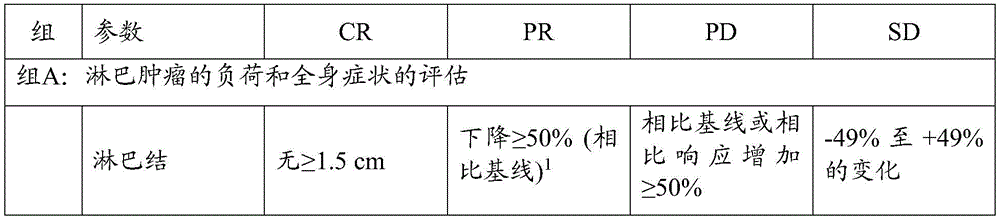
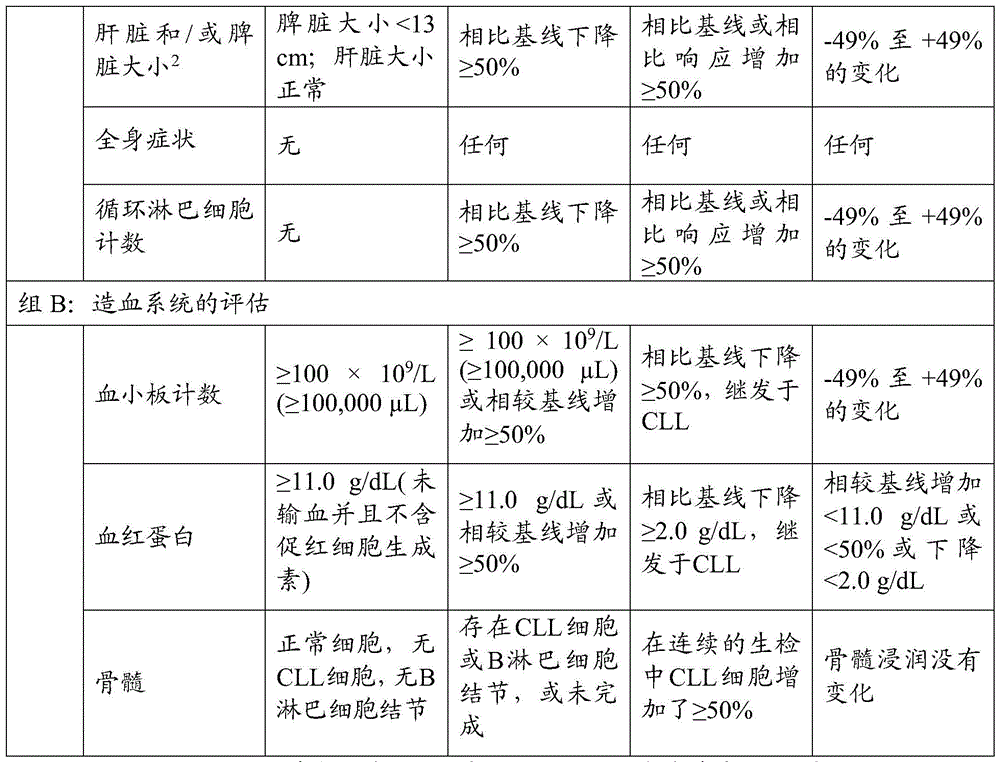
缩写:CLL=慢性淋巴细胞白血病;CR=完全响应;PD=疾病进展;PR=部分响应;SD=疾病稳定。Abbreviations: CLL = chronic lymphocytic leukemia; CR = complete response; PD = progressive disease; PR = partial response; SD = stable disease.
定义:definition:
·CR,完全缓解(必须符合所有标准);CR, complete remission (must meet all criteria);
·PD,疾病进展(要满足A组或B组的标准中的至少一项);PD, progressive disease (meeting at least one of the criteria of group A or group B);
·PR,部分缓解(对于PR,如果先前异常,A组的参数中的至少2个和B组的1个参数需要改良,如果在疗法前A组和B组两者中的仅1个参数异常,则仅1个需要改良);PR, partial response (for PR, at least 2 of the parameters in group A and 1 parameter in group B need to be improved if previously abnormal, if only 1 parameter in both groups A and B was abnormal before therapy, only 1 needs to be improved);
·SD,疾病稳定(必须满足所有的标准;单独的全身症状不定义PD)。SD, stable disease (all criteria must be met; systemic symptoms alone do not define PD).
1.6个或更少的淋巴结的乘积之和(如在临床试验中通过CT扫描和体格检查或在一般实践中通过体格检查所评价)。1. The sum of the products of 6 or fewer lymph nodes (as assessed by CT scan and physical examination in clinical trials or by physical examination in general practice).
2.如果脾脏大小<13cm则认为是正常的。国际上还没有对正常肝脏大小牢固建立共识;因此,肝脏的大小应通过影像学和人工触诊进行评价并记录在eCRF中。2. If the spleen size is <13 cm, it is considered normal. Internationally, there is no firm consensus on normal liver size; therefore, liver size should be evaluated by imaging and manual palpation and recorded in the eCRF.
根据本文所述方法治疗的受试者优选经历CLL的至少一个体征的改善。在一个实施方案中,改善是通过循环淋巴细胞的数量的减少来测量的。在一些实施方案中,改善是通过可测量的肿瘤病变的数量和/或大小的减少来测量的。在一些实施方案中,病变可以在CT或MRI片上测量。在一些实施方案中,可以使用细胞学或组织学来评价对疗法的响应性。在一些实施方案中,可以使用骨髓抽吸物和骨髓生检来评价对疗法的响应。The subject treated according to the methods described herein preferably experiences an improvement in at least one sign of CLL. In one embodiment, the improvement is measured by a reduction in the number of circulating lymphocytes. In some embodiments, the improvement is measured by a reduction in the number and/or size of measurable tumor lesions. In some embodiments, the lesions can be measured on CT or MRI sheets. In some embodiments, cytology or histology can be used to evaluate the responsiveness to therapy. In some embodiments, bone marrow aspirates and bone marrow biopsies can be used to evaluate the response to therapy.
在一个实施方案中,治疗的受试者表现出完全响应(CR)、部分响应(PR)或疾病稳定(SD),如iwCLL响应标准(参见例如表2)所定义。在一些实施方案中,本文所述的方法产生选自延长生存(诸如无进展生存或总体生存)的至少一种治疗效果,任选地与另一种疗法或安慰剂相比。在一些实施方案中,用本文所述的方法治疗受试者,直到疾病进展(PD)或不可接受的毒性。In one embodiment, the treated subject shows a complete response (CR), a partial response (PR) or stable disease (SD), as defined by the iwCLL response criteria (see, e.g., Table 2). In some embodiments, the methods described herein produce at least one therapeutic effect selected from prolonging survival (such as progression-free survival or overall survival), optionally compared to another therapy or placebo. In some embodiments, the subject is treated with the methods described herein until disease progression (PD) or unacceptable toxicity.
当在人受试者中使用方法时,可以发生细胞因子释放综合征(CRS),所述方法利用基于免疫细胞和双特异性抗体的办法,所述办法通过激活免疫效应细胞,例如通过衔接CD3发挥作用(Lee等人,Biol Blood Marrow Transplant2019;25:625-38,其通过引用并入本文)。因此,在一些实施方案中,CRS缓解与本文所述的方法一起进行。作为CRS缓解的一部分,如本文所述,在施用全剂量(例如,12-60mg)之前进行引发剂量和/或中间剂量的选择。CRS可以按照标准实践(例如,如Lee等人,Biol Blood Marrow Transplant.2019Apr;25(4):625-638中的概述,其通过引用并入本文)分类。CRS可以包括细胞因子,例如促炎细胞因子,例如IL-6、TNF-α或IL-8的过度释放,这可能导致不良反应,如发热、恶心、呕吐和寒战。因此,尽管双特异性抗体诸如艾可瑞妥单抗具有独特的抗肿瘤活性,但它们的免疫学作用方式可能触发不必要的“副作用”,即诱导不需要的炎症反应。因此,患者可以进一步经受用例如止痛药、退热药和/或抗炎药的伴随治疗、防治和/或前驱用药以减轻可能的CRS症状。When using the method in a human subject, cytokine release syndrome (CRS) may occur, the method utilizing an approach based on immune cells and bispecific antibodies, which works by activating immune effector cells, for example, by engaging CD3 (Lee et al., Biol Blood Marrow Transplant 2019; 25: 625-38, which is incorporated herein by reference). Therefore, in some embodiments, CRS relief is performed together with the method described herein. As part of CRS relief, as described herein, the selection of initiating doses and/or intermediate doses is performed before administering a full dose (e.g., 12-60 mg). CRS can be classified according to standard practice (e.g., as summarized in Lee et al., Biol Blood Marrow Transplant. 2019Apr; 25 (4): 625-638, which is incorporated herein by reference). CRS may include cytokines, such as proinflammatory cytokines, such as excessive release of IL-6, TNF-α or IL-8, which may lead to adverse reactions such as fever, nausea, vomiting and chills. Therefore, although bispecific antibodies such as ixorituzumab have unique anti-tumor activity, their immunological mode of action may trigger unwanted "side effects", namely inducing unwanted inflammatory responses. Therefore, patients may further undergo concomitant treatment, prevention and/or premedication with, for example, analgesics, antipyretics and/or anti-inflammatory drugs to alleviate possible CRS symptoms.
因此,在一个实施方案中,本文所述方法中的人受试者用对CRS的防治进行治疗。在优选的实施方案中,该防治包括向受试者施用皮质类固醇。在一个实施方案中,该防治(例如皮质类固醇)与双特异性抗体在同一天施用。该防治(例如皮质类固醇)也可以在随后的一天施用。在一些实施方案中,该防治(例如皮质类固醇)在随后的第2、3和4天进一步施用。应当理解,在涉及进一步用药(诸如防治)时,第2、3和4天是相对于在第1天施用的双特异性抗体的施用而言的。例如,当在周期的第15天施用抗体并且还施用防治时,对应于第2、3和4天的防治是该周期的第16、17和18天。在一些实施方案中,防治在施用双特异性抗体的当天和随后的第2-4天施用。当所述防治与双特异性抗体在同一天施用时,优选在所述双特异性抗体施用之前30-120分钟施用防治。适用于本文所述的方法和用途的示例性皮质类固醇为泼尼松龙。在一些实施方案中,皮质类固醇是泼尼松龙。在一些实施方案中,以100mg的静脉注射剂量或其当量(包含口服剂量)施用泼尼松龙。表6中显示了可以用于CRS防治的泼尼松龙的示例性皮质类固醇当量,以及剂量当量。Therefore, in one embodiment, the human subject in the method described herein is treated with the prevention and treatment of CRS. In a preferred embodiment, the prevention and treatment includes administering a corticosteroid to the subject. In one embodiment, the prevention and treatment (e.g., corticosteroid) is administered on the same day as the bispecific antibody. The prevention and treatment (e.g., corticosteroid) can also be administered on a subsequent day. In some embodiments, the prevention and treatment (e.g., corticosteroid) is further administered on the subsequent 2nd, 3rd, and 4th days. It should be understood that when further medication (such as prevention and treatment) is involved, the 2nd, 3rd, and 4th days are relative to the administration of the bispecific antibody administered on the 1st day. For example, when the antibody is administered on the 15th day of the cycle and prevention and treatment is also administered, the prevention and treatment corresponding to the 2nd, 3rd, and 4th days is the 16th, 17th, and 18th day of the cycle. In some embodiments, prevention and treatment is administered on the day of the administration of the bispecific antibody and on the subsequent 2-4th day. When the prevention and treatment is administered on the same day as the bispecific antibody, it is preferably administered 30-120 minutes before the bispecific antibody is administered. An exemplary corticosteroid suitable for the methods and uses described herein is prednisolone. In some embodiments, the corticosteroid is prednisolone. In some embodiments, prednisolone is administered at an intravenous dose of 100 mg or its equivalent (including oral doses). Table 6 shows exemplary corticosteroid equivalents of prednisolone that can be used for CRS prevention and treatment, as well as dosage equivalents.
此外,在一些实施方案中,在本文所述的方法中的人受试者用前驱用药治疗以减少对注射的反应。在一个实施方案中,前驱用药包括抗组胺药的施用。在一些实施方案中,前驱用药包括退热药的施用。在进一步的实施方案中,前驱用药包括抗组胺药和退热药的全身施用。In addition, in some embodiments, the human subject in the methods described herein is treated with premedication to reduce the reaction to the injection. In one embodiment, the premedication includes the administration of an antihistamine. In some embodiments, the premedication includes the administration of an antipyretic. In further embodiments, the premedication includes systemic administration of an antihistamine and an antipyretic.
适合用于前驱用药的示例性抗组胺药是苯海拉明(diphenhydramine)。在一些实施方案中,抗组胺药是苯海拉明。在一个实施方案中,苯海拉明以静脉内或口服剂量50mg或其当量施用。适合用于前驱用药的示例性退热药是对乙酰氨基酚。在一些实施方案中,退热药是对乙酰氨基酚。在一个实施方案中,对乙酰氨基酚以560-1000mg(诸如650-1000mg)的口服剂量或其当量施用。在一些实施方案中,前驱用药与双特异性抗体在同一天施用。在一些实施方案中,前驱用药在注射双特异性抗体之前,例如在双特异性抗体的施用之前的30-120分钟,与双特异性抗体在同一天施用。An exemplary antihistamine suitable for premedication is diphenhydramine. In some embodiments, the antihistamine is diphenhydramine. In one embodiment, diphenhydramine is administered at an intravenous or oral dose of 50 mg or its equivalent. An exemplary antipyretic suitable for premedication is acetaminophen. In some embodiments, the antipyretic is acetaminophen. In one embodiment, acetaminophen is administered at an oral dose of 560-1000 mg (such as 650-1000 mg) or its equivalent. In some embodiments, premedication is administered on the same day as the bispecific antibody. In some embodiments, premedication is administered on the same day as the bispecific antibody before the injection of the bispecific antibody, for example, 30-120 minutes before the administration of the bispecific antibody.
可以至少在治疗的初始阶段施用前驱用药和/或防治。在一些实施方案中,在双特异性抗体的前四次施用期间施用前驱用药和/或防治。例如,可以在双特异性抗体施用的第一个28天周期期间如本文所述施用前驱用药和/或防治。在一些实施方案中,在周期1期间内施用前驱用药。在一些实施方案中,在周期1期间内施用防治。Promedication and/or prevention can be administered at least in the initial stages of treatment. In some embodiments, promedication and/or prevention are administered during the first four administrations of the bispecific antibody. For example, promedication and/or prevention can be administered as described herein during the first 28-day cycle of bispecific antibody administration. In some embodiments, promedication is administered during cycle 1. In some embodiments, prevention is administered during cycle 1.
通常,初始治疗期间反应的风险会在数次施用后消退,例如,在前四次施用(第一周期)后消退。因此,而且当人受试者没有经历CRS时,可以停止针对CRS的防治。然而,当人受试者经历大于1级的CRS时,可以继续CRS防治。同样地,前驱用药也可以任选地继续。CRS分级可以按照表7和表8中所述进行。Typically, the risk of reaction during initial treatment will subside after several administrations, for example, after the first four administrations (first cycle). Therefore, and when the human subject does not experience CRS, the prevention and treatment of CRS can be stopped. However, when the human subject experiences CRS greater than grade 1, CRS prevention and treatment can be continued. Similarly, the pre-medication can also be optionally continued. CRS classification can be performed as described in Tables 7 and 8.
在进一步的实施方案中,在本文所述的方法中,当人受试者在第1周期中双特异性抗体的第四次(即末次)施用后经历大于1级的CRS时,在第二个28天周期(即周期2)期间施用防治。此外,当在前一周期的双特异性抗体的末次施用中人受试者经历大于1级的CRS时,防治可以在随后的周期期间继续进行。在第二个周期期间可以任选地施用任何前驱用药。一些实施方案中,在周期2期间施用防治。也可以在随后的周期中任选地施用进一步的前驱用药。在一些实施方案中,在随后的周期(周期2之后)期间施用前驱用药。In a further embodiment, in the methods described herein, when a human subject experiences a CRS greater than grade 1 after the fourth (i.e., last) administration of a bispecific antibody in cycle 1, prevention and treatment are administered during the second 28-day cycle (i.e., cycle 2). In addition, when a human subject experiences a CRS greater than grade 1 in the last administration of a bispecific antibody in the previous cycle, prevention and treatment can continue during subsequent cycles. Any prodromal medication may be optionally administered during the second cycle. In some embodiments, prevention and treatment are administered during cycle 2. Further prodromal medication may also be optionally administered in subsequent cycles. In some embodiments, prodromal medication is administered during subsequent cycles (after cycle 2).
在一个实施方案中,施用针对CRS的前驱用药和防治,其中该前驱用药包括抗组胺药诸如苯海拉明(例如,以静脉内或口服剂量50mg或其当量),并且该防治包含退热药诸如对乙酰氨基酚(例如,以650-1000mg的口服剂量或其当量),以及皮质类固醇诸如泼尼松龙(例如,以100mg的静脉内剂量或其当量)。在一些实施方案中,在施用双特异性抗体之前30-120分钟施用前驱用药和防治。在随后的第2、3天和任选地第4天,施用进一步的防治,包括全身施用皮质类固醇诸如泼尼松龙(例如,以100mg的静脉内剂量或其当量)。在一些实施方案中,优选在双特异性抗体的前四次施用期间,例如在本文所述的双特异性抗体施用的第一个28天周期期间,施用前驱用药和防治时间表。此外,在先前周期的末次施用期间发生例如大于1级的CRS的情况下,随后的周期可以包括相同的施用时间表,其中作为施用时间表的一部分的前驱用药是任选的。In one embodiment, the prodromal medication and prevention for CRS are administered, wherein the prodromal medication includes an antihistamine such as diphenhydramine (e.g., with an intravenous or oral dose of 50 mg or its equivalent), and the prevention and treatment includes antipyretics such as acetaminophen (e.g., with an oral dose of 650-1000 mg or its equivalent), and corticosteroids such as prednisolone (e.g., with an intravenous dose of 100 mg or its equivalent). In some embodiments, prodromal medication and prevention and treatment are administered 30-120 minutes before the administration of the bispecific antibody. On the subsequent 2nd, 3rd day and optionally the 4th day, further prevention and treatment are administered, including systemic administration of corticosteroids such as prednisolone (e.g., with an intravenous dose of 100 mg or its equivalent). In some embodiments, it is preferred that during the first four administrations of the bispecific antibody, for example, during the first 28-day cycle of the bispecific antibody administration described herein, the prodromal medication and prevention and treatment schedule are administered. Furthermore, in the event that CRS, for example greater than Grade 1, occurs during the last administration of a prior cycle, subsequent cycles may include the same administration schedule, with premedication as part of the administration schedule being optional.
在使用本文所述的剂量和治疗方案治疗患有CLL的人受试者期间,CRS可以得到良好管理,同时有效地控制和/或治疗CLL。如实施例中所述,用本文所述方法治疗的受试者可以经历可管理的CRS。在一些情况下,接受本文所述治疗的受试者可以发展根据标准实践定义的1级的CRS。在其他情况下,受试者可以发展可管理的根据标准实践定义的2级的CRS。因此,接受本文所述治疗的受试者可以具有可管理的根据标准实践定义的1级或2级的CRS。根据CRS的标准分类,1级CRS包括发热至至少38℃、无低血压、无缺氧,并且2级CRS包括发热至至少38℃加不需要血管加压药的低血压和/需要通过低流量鼻套管吸氧或漏气的缺氧。此种可管理的CRS可以在第1周期发生。接受本文所述治疗的人受试者在治疗期间也可以具有根据标准实践定义的大于2级的CRS。因此,接受本文所述治疗的人受试者在所述治疗期间也可以具有根据标准实践定义的3级CRS。此种可管理的CRS可以在第1周期和随后的周期期间进一步发生。During the treatment of human subjects with CLL using the dosage and treatment regimen described herein, CRS can be well managed while effectively controlling and/or treating CLL. As described in the embodiments, subjects treated with the methods described herein can experience manageable CRS. In some cases, subjects receiving treatment described herein can develop CRS of grade 1 defined according to standard practice. In other cases, subjects can develop manageable CRS of grade 2 defined according to standard practice. Therefore, subjects receiving treatment described herein can have manageable CRS of grade 1 or grade 2 defined according to standard practice. According to the standard classification of CRS, grade 1 CRS includes fever to at least 38°C, no hypotension, no hypoxia, and grade 2 CRS includes fever to at least 38°C plus hypotension without vasopressors and/or hypoxia requiring oxygen or leaking through a low-flow nasal cannula. Such manageable CRS can occur in the first cycle. Human subjects receiving treatment described herein may also have CRS greater than grade 2 defined according to standard practice during treatment. Therefore, human subjects receiving treatment described herein may also have grade 3 CRS defined according to standard practice during the treatment. Such manageable CRS may further occur during the first cycle and subsequent cycles.
根据本文所述方法治疗的人受试者也可以经历发热、疲乏和注射部位反应。他们还可以经历神经毒性、部分性癫痫发作、与CRS相关的失写症或与CRS相关的意识模糊状态。Human subjects treated according to the methods described herein may also experience fever, fatigue, and injection site reactions. They may also experience neurotoxicity, partial seizures, agraphia associated with CRS, or confusional states associated with CRS.
如上所述,尽管已接受CRS防治,但受试者可以在用本文所述方法治疗期间发展CRS。CRS分级标准描述于表7和表8。As described above, despite having received CRS prevention and treatment, a subject may develop CRS during treatment with the methods described herein. The CRS grading criteria are described in Tables 7 and 8.
在一个实施方案中,如果受试者发展1级CRS,则向受试者施用抗生素,即发展1级CRS的受试者如果出现感染则用抗生素治疗。在一些实施方案中,继续抗生素直至中性粒细胞减少症(如果存在)消退。在一些实施方案中,表现出全身症状的患有1级CRS的受试者用NSAID治疗。In one embodiment, if the subject develops grade 1 CRS, antibiotics are administered to the subject, i.e., the subject who develops grade 1 CRS is treated with antibiotics if an infection occurs. In some embodiments, antibiotics are continued until neutropenia (if present) subsides. In some embodiments, subjects with grade 1 CRS who exhibit systemic symptoms are treated with NSAIDs.
在一个实施方案中,发展2级CRS的受试者用静脉内液体推注(fluid bolus)和/或补氧治疗。在一些实施方案中,发展2级CRS的受试者用血管加压药治疗。在一些实施方案中,患有2级CRS伴合并症的受试者用托珠单抗(针对IL-6受体的人源化抗体,作为例如
在一个实施方案中,发展3级CRS的受试者用血管加压药(例如,去甲肾上腺素)支持和/或补氧治疗。在一些实施方案中,患有3级CRS的受试者用托珠单抗、或托珠单抗联合类固醇(例如,地塞米松或其甲泼尼龙等效物)治疗。在一些实施方案中,对出现并发ICANS的受试者施用地塞米松。在进一步的实施方案中,如果受试者在三次施用后对托珠单抗难治,则向受试者施用额外的细胞因子疗法,例如抗IL-6抗体(例如,司妥昔单抗)或IL-1R拮抗剂(例如,阿那白滞素)。In one embodiment, the subject of development 3 grade CRS is supported and/or oxygenated. In some embodiments, the subject with 3 grade CRS is treated with tocilizumab or tocilizumab combined with steroids (e.g., dexamethasone or its methylprednisolone equivalent). In some embodiments, dexamethasone is applied to the subject with concurrent ICANS. In a further embodiment, if the subject is refractory to tocilizumab after three applications, additional cytokine therapy, such as anti-IL-6 antibodies (e.g., siltuximab) or IL-1R antagonists (e.g., anakinra) are applied to the subject.
在一个实施方案中,发展4级CRS的受试者用血管加压药支持和/或补氧(例如,经由正压通气,诸如CPAP、BiPAP、插管或机械通气)治疗。在一些实施方案中,如果受试者发展4级CRS,则向受试者施用至少两种血管加压药。在一些实施方案中,向受试者进一步施用类固醇,即向受试者施用托珠单抗和类固醇。在一些实施方案中,类固醇是地塞米松。在一些实施方案中,类固醇是甲泼尼龙。在进一步的实施方案中,对出现并发ICANS的受试者施用地塞米松。在又进一步的实施方案中,如果受试者在三次施用后对托珠单抗难治,则向受试者施用额外的细胞因子疗法,例如抗IL-6抗体(例如,司妥昔单抗)或IL-1R拮抗剂(例如,阿那白滞素)。在一些实施方案中,如果受试者对托珠单抗是难治性的,则将托珠单抗的施用转换为抗IL-6抗体(例如司妥昔单抗)的施用。在一些实施方案中,如果受试者对托珠单抗是难治性的,则将托珠单抗转换为IL-1R拮抗剂(例如阿那白滞素)。In one embodiment, the subject of developing grade 4 CRS is treated with vasopressor support and/or oxygen supplementation (e.g., via positive pressure ventilation, such as CPAP, BiPAP, intubation or mechanical ventilation). In some embodiments, if the subject develops grade 4 CRS, at least two vasopressors are administered to the subject. In some embodiments, steroids are further administered to the subject, i.e., tocilizumab and steroids are administered to the subject. In some embodiments, the steroid is dexamethasone. In some embodiments, the steroid is methylprednisolone. In a further embodiment, dexamethasone is administered to the subject with concurrent ICANS. In a further embodiment, if the subject is refractory to tocilizumab after three administrations, additional cytokine therapy, such as anti-IL-6 antibodies (e.g., siltuximab) or IL-1R antagonists (e.g., anakinra) are administered to the subject. In some embodiments, if the subject is refractory to tocilizumab, the administration of tocilizumab is converted to the administration of anti-IL-6 antibodies (e.g., siltuximab). In some embodiments, if the subject is refractory to tocilizumab, tocilizumab is switched to an IL-1R antagonist (eg, anakinra).
在一些实施方案中,人受试者接受肿瘤溶解综合征(TLS)的防治性治疗,即用针对肿瘤溶解综合征(TLS)的防治来治疗受试者。肿瘤溶解综合征的分类和分级可以使用本领域已知的方法进行,其中该方法例如Howard等人NEngl J Med 2011;364:1844-54,和Coiffier等人,J Clin Oncol 2008;26:2767-78中所描述的。在一些实施方案中,TLS的防治性治疗包括在施用双特异性抗体之前施用一种或多种降尿酸剂,即针对TLS的防治包括在施用双特异性抗体之前施用一种或多种降尿酸剂。示例性降尿酸剂包含别嘌呤醇和拉布立酶。因此,在一个实施方案中,TLS的防治性治疗包括施用别嘌呤醇和/或拉布立酶。在一些实施方案中,TLS的防治治疗包括在施用双特异性抗体之前施用别嘌呤醇和/或拉布立酶。在一个实施方案中,在双特异性抗体前72小时施用别嘌呤醇。在一些实施方案中,在施用别嘌呤醇之后但在施用双特异性抗体之前启动拉布立酶。在双特异性抗体的后续剂量之前,可以进行受试者的TLS风险类别的重新评估。如果所有可测量的淋巴结的最大直径<5cm并且ALC<25×109/L,则认为受试者处于TLS的低风险。如果任何可测量的淋巴结的最大直径≥5cm但<10cm或ALC≥25×109/L,则认为受试者处于TLS的中风险。如果(a)任何可测量的淋巴结的最大直径≥10cm,或(b)ALC≥25×109/L并且任何可测量的淋巴结的最大直径≥5cm但<10cm,则认为受试者处于TLS的高风险。淋巴细胞计数>100×109/L的受试者被认为是高风险。在一些实施方案中,当受试者显示出TLS的体征时,可以使用支持性疗法,诸如拉布立酶和/或别嘌呤醇。In some embodiments, human subjects receive preventive and therapeutic treatment for tumor lysis syndrome (TLS), i.e., treat subjects with prevention and treatment for tumor lysis syndrome (TLS). Classification and grading of tumor lysis syndrome can be performed using methods known in the art, wherein the method is for example Howard et al. N Engl J Med 2011; 364: 1844-54, and Coiffier et al., J Clin Oncol 2008; 26: described in 2767-78. In some embodiments, the preventive and therapeutic treatment of TLS includes administering one or more uric acid lowering agents before administering the bispecific antibody, i.e., the prevention and treatment for TLS includes administering one or more uric acid lowering agents before administering the bispecific antibody. Exemplary uric acid lowering agents include allopurinol and rasburicase. Therefore, in one embodiment, the preventive and therapeutic treatment of TLS includes administering allopurinol and/or rasburicase. In some embodiments, the preventive and therapeutic treatment of TLS includes administering allopurinol and/or rasburicase before administering the bispecific antibody. In one embodiment, allopurinol is administered 72 hours before the bispecific antibody. In some embodiments, rasburicase is initiated after administration of allopurinol but before administration of the bispecific antibody. Before subsequent doses of the bispecific antibody, a reassessment of the subject's TLS risk category may be performed. If the maximum diameter of all measurable lymph nodes is <5 cm and ALC <25×10 9 / L, the subject is considered to be at low risk for TLS. If the maximum diameter of any measurable lymph node is ≥5 cm but <10 cm or ALC ≥25×10 9 / L, the subject is considered to be at medium risk for TLS. If (a) the maximum diameter of any measurable lymph node is ≥10 cm, or (b) ALC ≥25×10 9 / L and the maximum diameter of any measurable lymph node is ≥5 cm but <10 cm, the subject is considered to be at high risk for TLS. Subjects with lymphocyte counts>100×10 9 / L are considered to be at high risk. In some embodiments, when a subject shows signs of TLS, supportive therapy such as rasburicase and/or allopurinol may be used.
在一个实施方案中,本文所述方法中使用的双特异性抗体是皮下施用的,并且因此在药物组合物中配制以使其与皮下(s.c.)施用相容,即具有允许以本文所述的剂量下药学可接受的s.c.施用的配制剂和/或浓度。在一些实施方案中,皮下施用通过注射进行。例如,与皮下配制剂相容并可用于本文所述方法的DuoBody-CD3xCD20的配制剂先前已有描述(参见例如WO2019155008,其通过引用并入本文)。在一些实施方案中,双特异性抗体可以使用三水乙酸钠、乙酸、氢氧化钠、山梨糖醇、聚山梨酯80和注射用水配制,并且具有5.5或约5.5的pH。在一些实施方案中,双特异性抗体作为5mg/mL或60mg/mL浓缩物提供。在其他实施方案中,将期望剂量的双特异性抗体重构至约1mL的体积用于皮下注射。In one embodiment, the bispecific antibody used in the methods described herein is administered subcutaneously, and is therefore formulated in a pharmaceutical composition to make it compatible with subcutaneous (s.c.) administration, i.e., with a formulation and/or concentration that allows pharmaceutically acceptable s.c. administration at a dosage as described herein. In some embodiments, subcutaneous administration is performed by injection. For example, formulations of DuoBody-CD3xCD20 that are compatible with subcutaneous formulations and can be used for methods described herein have been previously described (see, e.g., WO2019155008, which is incorporated herein by reference). In some embodiments, bispecific antibodies can be formulated using sodium acetate trihydrate, acetic acid, sodium hydroxide, sorbitol,
在一个实施方案中,用于双特异性抗体的合适药物组合物可以包含双特异性抗体、20-40mM乙酸盐、140-160mM山梨糖醇和表面活性剂诸如聚山梨酯80,并且具有5.3-5.6的pH。在一些实施方案中,药物配制剂可以包含在5-100mg/mL范围内的抗体浓度,例如48或60mg/mL的双特异性抗体、30mM乙酸盐、150mM山梨糖醇、0.04%w/v聚山梨醇酯80,并且具有5.5的pH。此类配制剂可以用例如配制剂缓冲液稀释以允许适当的给药和皮下施用。In one embodiment, a suitable pharmaceutical composition for a bispecific antibody may comprise a bispecific antibody, 20-40 mM acetate, 140-160 mM sorbitol, and a surfactant such as
适当地选择药物组合物的体积以允许抗体的皮下施用。例如,待施用的体积在约0.3mL至约3mL的范围内,诸如0.3mL至3mL。待施用的体积可以是0.5mL、0.8mL、1mL、1.2mL、1.5mL、1.7mL、2mL或2.5mL,或约0.5mL、约0.8mL、约1mL、约1.2mL、约1.5mL、约1.7mL、约2mL或约2.5mL。因此,在一个实施方案中,待施用的体积是0.5mL或约0.5mL。在一些实施方案中,待施用的体积为0.8mL或约0.8mL。在一些实施方案中,待施用的体积为1mL或约1mL。在一些实施方案中,待施用的体积为1.2mL或约1.2mL。在一些实施方案中,待施用的体积为1.5mL或约1.5mL。在一些实施方案中,待施用的体积为1.7mL或约1.7mL。在一些实施方案中,待施用的体积为2mL或约2mL。在一些实施方案中,待施用的体积为2.5mL或约2.5mL。The volume of the pharmaceutical composition is appropriately selected to allow subcutaneous administration of the antibody. For example, the volume to be administered is in the range of about 0.3mL to about 3mL, such as 0.3mL to 3mL. The volume to be administered can be 0.5mL, 0.8mL, 1mL, 1.2mL, 1.5mL, 1.7mL, 2mL or 2.5mL, or about 0.5mL, about 0.8mL, about 1mL, about 1.2mL, about 1.5mL, about 1.7mL, about 2mL or about 2.5mL. Therefore, in one embodiment, the volume to be administered is 0.5mL or about 0.5mL. In some embodiments, the volume to be administered is 0.8mL or about 0.8mL. In some embodiments, the volume to be administered is 1mL or about 1mL. In some embodiments, the volume to be administered is 1.2mL or about 1.2mL. In some embodiments, the volume to be administered is 1.5mL or about 1.5mL. In some embodiments, the volume to be administered is at or about 1.7 mL. In some embodiments, the volume to be administered is at or about 2 mL. In some embodiments, the volume to be administered is at or about 2.5 mL.
本文所述的方法(或CD3xCD20抗体的用途)是用于治疗患有CLL的人患者。可以理解的是,本文所述的方法可能是提供给此类患者的首次或部分首次治疗。然而,患者可以已经经受针对CLL的既往治疗。既往治疗可以包括但不限于化疗、免疫疗法和靶向治疗中的一种或多种,或其组合。最常见的是,护理标准包含用细胞毒性化疗和抗CD20单克隆抗体的组合进行的治疗。可以理解的是,本文所述的方法也可以与其他治疗联合使用。The methods described herein (or the purposes of CD3xCD20 antibodies) are for treating human patients suffering from CLL. It is understood that the methods described herein may be the first or part of the first treatment provided to such patients. However, the patient may have been subjected to previous treatments for CLL. Previous treatments may include but are not limited to one or more of chemotherapy, immunotherapy and targeted therapy, or a combination thereof. Most commonly, the standard of care comprises the treatment performed with a combination of cytotoxic chemotherapy and anti-CD20 monoclonal antibodies. It is understood that the methods described herein may also be used in conjunction with other treatments.
在一个实施方案中,用于本文所述方法的双特异性抗体包含:In one embodiment, a bispecific antibody for use in the methods described herein comprises:
(i)包含第一抗原结合区的第一结合臂,第一抗原结合区结合人CD3ε(epsilon)并包含可变重链(VH)区和可变轻链(VL)区,其中VH区包含SEQ ID NO:6的氨基酸序列内的CDR1、CDR2和CDR3序列,并且VL区包含SEQ ID NO:7的氨基酸序列内的CDR1、CDR2和CDR3序列;和(i) a first binding arm comprising a first antigen binding region, the first antigen binding region binds to human CD3 epsilon (epsilon) and comprises a variable heavy chain (VH) region and a variable light chain (VL) region, wherein the VH region comprises CDR1, CDR2, and CDR3 sequences within the amino acid sequence of SEQ ID NO: 6, and the VL region comprises CDR1, CDR2, and CDR3 sequences within the amino acid sequence of SEQ ID NO: 7; and
(ii)包含第二抗原结合区的第二结合臂,第二抗原结合区结合人CD20并包含VH区和VL区,其中VH区包含SEQ ID NO:13的氨基酸序列内的CDR1、CDR2和CDR3序列,并且VL区包含SEQ ID NO:14的氨基酸序列内的CDR1、CDR2和CDR3序列。(ii) a second binding arm comprising a second antigen binding region, which binds to human CD20 and comprises a VH region and a VL region, wherein the VH region comprises the CDR1, CDR2 and CDR3 sequences within the amino acid sequence of SEQ ID NO: 13, and the VL region comprises the CDR1, CDR2 and CDR3 sequences within the amino acid sequence of SEQ ID NO: 14.
可以使用本领域已知的方法从可变重链区和可变轻链区鉴定CDR1、CDR2和CDR3区。来自所述可变重链区和可变轻链区的CDR区可以根据IMGT(参见Lefranc等人,NucleicAcids Research 1999;27:209-12和Brochet.Nucl Acids Res 2008;36:W503-8)进行注释。CDR1, CDR2 and CDR3 regions can be identified from the variable heavy chain region and the variable light chain region using methods known in the art. The CDR regions from the variable heavy chain region and the variable light chain region can be annotated according to IMGT (see Lefranc et al., Nucleic Acids Research 1999; 27: 209-12 and Brochet. Nucl Acids Res 2008; 36: W503-8).
在一些实施方案中,双特异性抗体包含:In some embodiments, the bispecific antibody comprises:
(i)包含第一抗原结合区的第一结合臂,第一抗原结合区结合人CD3ε(epsilon)并包含分别包含SEQ ID NO:1、2和3中所示氨基酸序列的VHCDR1、VHCDR2和VHCDR3,以及分别包含SEQ ID NO:4、GTN序列和SEQ ID NO:5中所示氨基酸序列的VLCDR1、VLCDR2和VLCDR3;和(i) a first binding arm comprising a first antigen binding region, the first antigen binding region binds to human CD3 epsilon (epsilon) and comprises VHCDR1, VHCDR2 and VHCDR3 comprising the amino acid sequences shown in SEQ ID NO: 1, 2 and 3, respectively, and VLCDR1, VLCDR2 and VLCDR3 comprising the amino acid sequences shown in SEQ ID NO: 4, GTN sequence and SEQ ID NO: 5, respectively; and
(ii)包含第二抗原结合区的第二结合臂,第二抗原结合区结合人CD20并包含分别包含SEQ ID NO:8、9和10中所示氨基酸序列的VHCDR1、VHCDR2和VHCDR3,以及分别包含SEQID NO:11、序列DAS和SEQ ID NO:12中所示氨基酸序列的VLCDR1、VLCDR2和VLCDR3。(ii) a second binding arm comprising a second antigen binding region, which binds to human CD20 and comprises VHCDR1, VHCDR2 and VHCDR3 comprising the amino acid sequences shown in SEQ ID NO: 8, 9 and 10, respectively, and VLCDR1, VLCDR2 and VLCDR3 comprising the amino acid sequences shown in SEQ ID NO: 11, sequence DAS and SEQ ID NO: 12, respectively.
在一些实施方案中,双特异性抗体包含:In some embodiments, the bispecific antibody comprises:
(i)包含第一抗原结合区的第一结合臂,第一抗原结合区结合人CD3ε(epsilon)并包含含有SEQ ID NO:6的氨基酸序列的VH区和含有SEQ ID NO:7的氨基酸序列的VL区;和(i) a first binding arm comprising a first antigen binding region that binds to human CD3 epsilon (epsilon) and comprises a VH region comprising the amino acid sequence of SEQ ID NO: 6 and a VL region comprising the amino acid sequence of SEQ ID NO: 7; and
(ii)包含第二抗原结合区的第二结合臂,第二抗原结合区结合人CD20并包含含有SEQ ID NO:13的氨基酸序列的VH区和含有SEQ ID NO:14的氨基酸序列的VL区。(ii) a second binding arm comprising a second antigen-binding region, which binds to human CD20 and comprises a VH region comprising the amino acid sequence of SEQ ID NO: 13 and a VL region comprising the amino acid sequence of SEQ ID NO: 14.
在一些实施方案中,双特异性抗体是全长抗体。在一些实施方案中,该双特异性抗体包含惰性Fc区。在一个实施方案中,双特异性抗体是全长抗体并且可以具有惰性Fc区。在一些实施方案中,针对CD3的第一结合臂衍生自人源化抗体,例如衍生自全长IgG1,λ(lambda)抗体,如WO2015001085(其通过引用并入本文)中所述的H1L1,和/或针对CD20的第二结合臂衍生自人抗体,例如衍生自全长IgG1,κ(kappa)抗体,如WO2004035607(其通过引用并入本文)中所述的克隆7D8。双特异性抗体可以由两个半分子抗体产生,其中两个半分子抗体中的每个包含例如SEQ ID NO:24和25以及SEQ ID NO:26和27中所示的相应的第一和第二结合臂。半抗体可以在CHO细胞中产生,并且双特异性抗体可以通过例如Fab臂交换生成。在一个实施方案中,双特异性抗体是DuoBody-CD3xCD20的功能变体。In some embodiments, the bispecific antibody is a full-length antibody. In some embodiments, the bispecific antibody comprises an inert Fc region. In one embodiment, the bispecific antibody is a full-length antibody and may have an inert Fc region. In some embodiments, the first binding arm for CD3 is derived from a humanized antibody, such as H1L1 described in full-length IgG1, lambda (lambda) antibody, such as WO2015001085 (which is incorporated herein by reference), and/or the second binding arm for CD20 is derived from a human antibody, such as cloning 7D8 described in full-length IgG1, kappa (kappa) antibody, such as WO2004035607 (which is incorporated herein by reference). Bispecific antibodies can be produced by two half-molecule antibodies, wherein each of the two half-molecule antibodies comprises, for example, the corresponding first and second binding arms shown in SEQ ID NO: 24 and 25 and SEQ ID NO: 26 and 27. Half antibodies can be produced in CHO cells, and bispecific antibodies can be generated by, for example, Fab arm exchange. In one embodiment, the bispecific antibody is a functional variant of DuoBody-CD3xCD20.
因此,在一些实施方案中,双特异性抗体包含(i)包含第一抗原结合区的第一结合臂,第一抗原结合区结合人CD3ε(epsilon)并包含含有与SEQ ID NO:6至少85%、90%、95%、96%、97%、98%或99%相同的氨基酸序列的VH区或含有SEQ ID NO:6的氨基酸序列但具有1、2或3个突变(例如,氨基酸取代)的VH区,以及含有与SEQ ID NO:7至少85%、90%、95%、96%、97%、98%或99%相同的氨基酸序列的VL区或含有SEQ ID NO:7的氨基酸序列但具有1、2或3个突变(例如,氨基酸取代)的VL区;和Thus, in some embodiments, the bispecific antibody comprises (i) a first binding arm comprising a first antigen binding region, the first antigen binding region binds to human CD3 epsilon (epsilon) and comprises a VH region comprising an amino acid sequence at least 85%, 90%, 95%, 96%, 97%, 98% or 99% identical to SEQ ID NO:6, or a VH region comprising the amino acid sequence of SEQ ID NO:6 but with 1, 2 or 3 mutations (e.g., amino acid substitutions), and a VL region comprising an amino acid sequence at least 85%, 90%, 95%, 96%, 97%, 98% or 99% identical to SEQ ID NO:7, or a VL region comprising the amino acid sequence of SEQ ID NO:7 but with 1, 2 or 3 mutations (e.g., amino acid substitutions); and
(ii)包含第二抗原结合区的第二结合臂,第二抗原结合区结合人CD20并包含含有与SEQ ID NO:13至少85%、90%、95%、98%或99%相同的氨基酸序列的VH区或含有SEQ IDNO:13的氨基酸序列但具有1、2或3个突变(例如,氨基酸取代)的VH区,以及含有与SEQ IDNO:14至少85%、90%、95%、98%或99%相同的氨基酸序列的VL区或含有SEQ ID NO:14的氨基酸序列但具有1、2或3个突变(例如,氨基酸取代)的VL区。(ii) a second binding arm comprising a second antigen binding region, which binds to human CD20 and comprises a VH region comprising an amino acid sequence that is at least 85%, 90%, 95%, 98% or 99% identical to SEQ ID NO: 13, or a VH region comprising the amino acid sequence of SEQ ID NO: 13 but having 1, 2 or 3 mutations (e.g., amino acid substitutions), and a VL region comprising an amino acid sequence that is at least 85%, 90%, 95%, 98% or 99% identical to SEQ ID NO: 14, or a VL region comprising the amino acid sequence of SEQ ID NO: 14 but having 1, 2 or 3 mutations (e.g., amino acid substitutions).
在一个实施方案中,双特异性抗体包含:In one embodiment, the bispecific antibody comprises:
(i)包含第一抗原结合区的第一结合臂,第一抗原结合区结合人CD3ε(epsilon)并包含含有SEQ ID NO:24的氨基酸序列的重链和含有SEQ ID NO:25的氨基酸序列的轻链;和(i) a first binding arm comprising a first antigen binding region that binds to human CD3 epsilon (epsilon) and comprises a heavy chain comprising the amino acid sequence of SEQ ID NO: 24 and a light chain comprising the amino acid sequence of SEQ ID NO: 25; and
(ii)包含第二抗原结合区的第二结合臂,第二抗原结合区结合人CD20并包含含有SEQ ID NO:26的氨基酸序列的VH区和含有SEQ ID NO:27的氨基酸序列的VL区。(ii) a second binding arm comprising a second antigen-binding region, which binds to human CD20 and comprises a VH region comprising the amino acid sequence of SEQ ID NO: 26 and a VL region comprising the amino acid sequence of SEQ ID NO: 27.
在一些实施方案中,双特异性抗体包含(i)包含第一抗原结合区的第一结合臂,第一抗原结合区结合人CD3ε(epsilon)并包含含有与SEQ ID NO:24至少85%、90%、95%、98%或99%相同的氨基酸序列的重链或含有SEQ ID NO:24的氨基酸序列但具有1、2或3个突变(例如,氨基酸取代)的重链,以及含有与SEQ ID NO:25至少85%、90%、95%、98%或99%相同的氨基酸序列的轻链或含有SEQ ID NO:25的氨基酸序列但具有1、2或3个突变(例如,氨基酸取代)的轻链;和In some embodiments, the bispecific antibody comprises (i) a first binding arm comprising a first antigen binding region, the first antigen binding region binds to human CD3 epsilon (epsilon) and comprises a heavy chain comprising an amino acid sequence at least 85%, 90%, 95%, 98% or 99% identical to SEQ ID NO: 24, or a heavy chain comprising the amino acid sequence of SEQ ID NO: 24 but with 1, 2 or 3 mutations (e.g., amino acid substitutions), and a light chain comprising an amino acid sequence at least 85%, 90%, 95%, 98% or 99% identical to SEQ ID NO: 25, or a light chain comprising the amino acid sequence of SEQ ID NO: 25 but with 1, 2 or 3 mutations (e.g., amino acid substitutions); and
(ii)包含第二抗原结合区的第二结合臂,第二抗原结合区结合人CD20并包含含有与SEQ ID NO:26至少85%、90%、95%、98%或99%相同的氨基酸序列的重链或含有SEQ IDNO:26的氨基酸序列但具有1、2或3个突变(例如,氨基酸取代)的重链,以及含有与SEQ IDNO:27至少85%、90%、95%、98%或99%相同的氨基酸序列的轻链或含有SEQ ID NO:27的氨基酸序列但具有1、2或3个突变(例如,氨基酸取代)的轻链。(ii) a second binding arm comprising a second antigen binding region, which binds to human CD20 and comprises a heavy chain comprising an amino acid sequence that is at least 85%, 90%, 95%, 98% or 99% identical to SEQ ID NO: 26, or a heavy chain comprising the amino acid sequence of SEQ ID NO: 26 but having 1, 2 or 3 mutations (e.g., amino acid substitutions), and a light chain comprising an amino acid sequence that is at least 85%, 90%, 95%, 98% or 99% identical to SEQ ID NO: 27, or a light chain comprising the amino acid sequence of SEQ ID NO: 27 but having 1, 2 or 3 mutations (e.g., amino acid substitutions).
各种恒定区或其变体可以用于双特异性抗体。在一个实施方案中,抗体包含IgG恒定区,诸如人IgG1恒定区,例如,如SEQ ID NO:15中定义的人IgG1恒定区,或任何其他合适的IgG1同种异型。在一些实施方案中,双特异性抗体是具有人IgG1恒定区的全长抗体。在一些实施方案中,双特异性抗体的第一结合臂衍生自人源化抗体,优选衍生自全长的IgG1,λ(lambda)抗体。在一个实施方案中,双特异性抗体的第一结合臂衍生自人源化抗体,例如衍生自全长的IgG1,λ(λ)抗体,并且因此包含λ轻链恒定区。在一些实施方案中,第一结合臂包含SEQ ID NO:22中定义的λ轻链恒定区。在一些实施方案中,双特异性抗体的第二结合臂衍生自人抗体,优选来自全长IgG1,κ(kappa)抗体。在一些实施方案中,双特异性抗体的第二结合臂衍生自人抗体,优选衍生自全长IgG1,κ(kappa)抗体,并且因此可以包含κ轻链恒定区域。在一些实施方案中,第二结合臂包含SEQ ID NO:23中定义的κ轻链恒定区。在优选的实施方案中,第一结合臂包含SEQ ID NO:22中定义的λ轻链恒定区并且第二结合臂包含SEQID NO:23中定义的κ轻链恒定区。Various constant regions or variants thereof can be used for bispecific antibodies. In one embodiment, the antibody comprises an IgG constant region, such as a human IgG1 constant region, for example, a human IgG1 constant region as defined in SEQ ID NO: 15, or any other suitable IgG1 allotype. In some embodiments, the bispecific antibody is a full-length antibody with a human IgG1 constant region. In some embodiments, the first binding arm of the bispecific antibody is derived from a humanized antibody, preferably derived from a full-length IgG1, λ (lambda) antibody. In one embodiment, the first binding arm of the bispecific antibody is derived from a humanized antibody, for example, derived from a full-length IgG1, λ (λ) antibody, and thus comprises a λ light chain constant region. In some embodiments, the first binding arm comprises a λ light chain constant region defined in SEQ ID NO: 22. In some embodiments, the second binding arm of the bispecific antibody is derived from a human antibody, preferably from a full-length IgG1, κ (kappa) antibody. In some embodiments, the second binding arm of the bispecific antibody is derived from a human antibody, preferably derived from a full-length IgG1, κ (kappa) antibody, and thus may comprise a κ light chain constant region. In some embodiments, the second binding arm comprises a kappa light chain constant region as defined in SEQ ID NO: 23. In preferred embodiments, the first binding arm comprises a lambda light chain constant region as defined in SEQ ID NO: 22 and the second binding arm comprises a kappa light chain constant region as defined in SEQ ID NO: 23.
应当理解,双特异性抗体的恒定区部分可以包含允许双特异性抗体的高效形成/产生和/或提供惰性Fc区的修饰。此类修饰在本领域中是众所周知的。It will be appreciated that the constant region portion of the bispecific antibody may contain modifications that allow efficient formation/production of bispecific antibodies and/or provide an inert Fc region. Such modifications are well known in the art.
不同格式的双特异性抗体是本领域已知的(由Kontermann,Drug Discov Today2015;20:838-47;MAbs,2012;4:182-97综述)。因此,本文所述的方法和用途中使用的双特异性抗体不限于任何特定的双特异性格式或生产其的方法。例如,双特异性抗体可以包括但不限于具有互补CH3域以强制异二聚化的双特异性抗体、旋钮入孔(Knob-into-Hole)分子(Genentech,WO9850431)、CrossMAb(Roche,WO2011117329)或静电匹配分子(Amgen,EP1870459和WO2009089004;Chugai,US201000155133;Oncomed,WO2010129304)。Bispecific antibodies of different formats are known in the art (reviewed by Kontermann, Drug Discov Today 2015; 20: 838-47; MAbs, 2012; 4: 182-97). Therefore, the bispecific antibodies used in the methods and uses described herein are not limited to any particular bispecific format or method of producing it. For example, bispecific antibodies may include, but are not limited to, bispecific antibodies with complementary CH3 domains to force heterodimerization, Knob-into-Hole molecules (Genentech, WO9850431), CrossMAbs (Roche, WO2011117329), or electrostatic matching molecules (Amgen, EP1870459 and WO2009089004; Chugai, US201000155133; Oncomed, WO2010129304).
优选地,双特异性抗体包含含有第一重链和第二重链的Fc区,第一重链具有包含第一CH3区的第一Fc序列,第二重链具有包含第二CH3区的第二Fc序列,其中第一和第二CH3区的序列是不同的并且使得所述第一和第二CH3区之间的异二聚体相互作用强于所述第一和第二CH3区的同二聚体相互作用中的每一者。有关这些相互作用以及如何实现它们的更多详细信息,提供于例如WO2011131746和WO2013060867(Genmab),其通过引用并入本文。在一个实施方案中,双特异性抗体在第一重链中包含(i)对应于SEQ ID NO:15的人IgG1重链恒定区中的F405的位置中的氨基酸L,并且在第二重链中包含对应于SEQ ID NO:15的人IgG1重链恒定区中的K409的位置中的氨基酸R,或反之亦然。Preferably, the bispecific antibody comprises an Fc region containing a first heavy chain and a second heavy chain, the first heavy chain having a first Fc sequence comprising a first CH3 region, the second heavy chain having a second Fc sequence comprising a second CH3 region, wherein the sequences of the first and second CH3 regions are different and make the heterodimer interaction between the first and second CH3 regions stronger than each of the homodimer interactions of the first and second CH3 regions. More detailed information on these interactions and how to achieve them is provided in, for example, WO2011131746 and WO2013060867 (Genmab), which are incorporated herein by reference. In one embodiment, the bispecific antibody comprises (i) an amino acid L in a position corresponding to F405 in a human IgG1 heavy chain constant region of SEQ ID NO: 15 in the first heavy chain, and an amino acid R in a position corresponding to K409 in a human IgG1 heavy chain constant region of SEQ ID NO: 15 in the second heavy chain, or vice versa.
双特异性抗体可以包含Fc区中的修饰以使Fc区惰性或非活化。因此,在本文公开的双特异性抗体中,可以修饰一条或两条重链,使得相对于没有修饰的双特异性抗体,该抗体诱导Fc介导的效应器功能的程度更小。Fc介导的效应器功能可以通过测定T细胞上Fc介导的CD69表达(即CD3抗体介导的、Fcγ受体依赖性CD3交联导致的CD69表达)、通过结合Fcγ受体、通过结合Clq、或通过诱导Fc介导的FcγR交联来测量。特别地,可以修饰重链恒定区序列,使得在与野生型(未修饰的)抗体相比时,Fc介导的CD69表达降低至少50%、至少60%、至少70%、至少80%、至少90%、至少99%或100%,其中所述Fc介导的CD69表达在基于PBMC的功能测定中测定,例如如WO2015001085的实施例3所述。重链和轻链恒定区序列的修饰也可以导致Clq与所述抗体的结合减少。与未修饰的抗体相比,降低可以是至少70%、至少80%、至少90%、至少95%、至少97%或100%,并且Clq结合可以例如通过ELISA测定。此外,可以修饰Fc区以使得抗体介导与未修饰的抗体相比Fc介导的T细胞增殖降低了至少50%、至少60%、至少70%、至少80%、至少90%、至少99%或100%,其中所述T细胞增殖是在基于PBMC的功能测定中测量的。可以经修饰的氨基酸位置的实例,例如在IgG1同种型抗体中包括位置L234和L235。因此,在一个实施方案中,双特异性抗体可以包含第一重链和第二重链,并且其中在第一重链和第二重链中,对应于根据Eu编号的人IgG1重链中位置L234和L235的位置中的氨基酸残基分别为F和E。此外,D265A氨基酸取代可以降低与所有Fcγ受体的结合并防止ADCC(Shields等人,JBC 2001;276:6591-604)。因此,双特异性抗体可以包含第一重链和第二重链,其中在第一重链和第二重链中,对应于根据Eu编号的人IgG1重链中位置D265的位置中的氨基酸残基为A。Bispecific antibodies may include modifications in the Fc region to make the Fc region inert or non-activated. Therefore, in the bispecific antibodies disclosed herein, one or two heavy chains may be modified so that the antibody induces Fc-mediated effector functions to a lesser extent relative to unmodified bispecific antibodies. Fc-mediated effector functions may be measured by measuring Fc-mediated CD69 expression on T cells (i.e., CD3 antibody-mediated, Fcγ receptor-dependent CD3 cross-linking-induced CD69 expression), by binding to Fcγ receptors, by binding to Clq, or by inducing Fc-mediated FcγR cross-linking. In particular, the heavy chain constant region sequence may be modified so that when compared to a wild-type (unmodified) antibody, Fc-mediated CD69 expression is reduced by at least 50%, at least 60%, at least 70%, at least 80%, at least 90%, at least 99% or 100%, wherein the Fc-mediated CD69 expression is measured in a PBMC-based functional assay, for example as described in Example 3 of WO2015001085. The modification of heavy chain and light chain constant region sequence can also cause C1q to reduce the combination of described antibody.Compared with unmodified antibody, reduction can be at least 70%, at least 80%, at least 90%, at least 95%, at least 97% or 100%, and C1q combination can be measured for example by ELISA.In addition, Fc region can be modified so that antibody mediation compared with unmodified antibody Fc mediated T cell proliferation reduced by at least 50%, at least 60%, at least 70%, at least 80%, at least 90%, at least 99% or 100%, wherein said T cell proliferation is measured in the functional assay based on PBMC.The example of amino acid position that can be modified, for example, includes position L234 and L235 in IgG1 isotype antibody.Therefore, in one embodiment, bispecific antibody can comprise the first heavy chain and the second heavy chain, and wherein in the first heavy chain and the second heavy chain, the amino acid residues in the position corresponding to position L234 and L235 in the human IgG1 heavy chain numbered according to Eu are F and E respectively. In addition, the D265A amino acid substitution can reduce binding to all Fcγ receptors and prevent ADCC (Shields et al., JBC 2001; 276: 6591-604). Thus, the bispecific antibody can comprise a first heavy chain and a second heavy chain, wherein in the first heavy chain and the second heavy chain, the amino acid residue in the position corresponding to position D265 in the human IgG1 heavy chain according to Eu numbering is A.
在一个实施方案中,双特异性抗体的第一重链和第二重链中,对应于人IgG1重链中位置L234、L235和D265的位置中的氨基酸分别为F、E和A。在这些位置具有这些氨基酸的抗体是具有惰性Fc区或非活化Fc区的抗体的实例。In one embodiment, the amino acids in the first and second heavy chains of the bispecific antibody corresponding to positions L234, L235, and D265 in a human IgG1 heavy chain are F, E, and A, respectively. Antibodies with these amino acids at these positions are examples of antibodies with an inert or non-activated Fc region.
在一些实施方案中,该双特异性抗体包含第一重链和第二重链,其中在第一和第二重链两者中,对应于SEQ ID NO:15的人IgG1重链恒定区中位置L234、L235和D265的位置中的氨基酸分别是F、E和A。在一些实施方案中,双特异性抗体包含第一重链和第二重链,其中在第一重链中,对应于SEQ ID NO:15的人IgG1重链恒定区中F405的位置中的氨基酸是L,并且在第二重链中,对应于SEQ ID NO:15的人IgG1重链恒定区中K409的位置中的氨基酸是R,或反之亦然。在优选的实施方案中,双特异性抗体包含第一重链和第二重链,其中(i)在第一和第二重链两者中,对应于SEQ ID NO.15的人IgG1重链恒定区中位置L234、L235和D265的位置中的氨基酸分别是F、E和A,并且(ii)在第一重链中,对应于SEQ ID NO:15的人IgG1重链恒定区中F405的位置中的氨基酸是L,并且其中在第二重链中,对应于SEQ ID NO:15的人IgG1重链恒定区中K409的位置中的氨基酸是R,或反之亦然。In some embodiments, the bispecific antibody comprises a first heavy chain and a second heavy chain, wherein in both the first and second heavy chains, the amino acids in the positions corresponding to positions L234, L235, and D265 in the human IgG1 heavy chain constant region of SEQ ID NO: 15 are F, E, and A, respectively. In some embodiments, the bispecific antibody comprises a first heavy chain and a second heavy chain, wherein in the first heavy chain, the amino acid in the position corresponding to F405 in the human IgG1 heavy chain constant region of SEQ ID NO: 15 is L, and in the second heavy chain, the amino acid in the position corresponding to K409 in the human IgG1 heavy chain constant region of SEQ ID NO: 15 is R, or vice versa. In a preferred embodiment, the bispecific antibody comprises a first heavy chain and a second heavy chain, wherein (i) in both the first and second heavy chains, the amino acids in the positions corresponding to positions L234, L235 and D265 in the human IgG1 heavy chain constant region of SEQ ID NO. 15 are F, E and A, respectively, and (ii) in the first heavy chain, the amino acid in the position corresponding to F405 in the human IgG1 heavy chain constant region of SEQ ID NO: 15 is L, and wherein in the second heavy chain, the amino acid in the position corresponding to K409 in the human IgG1 heavy chain constant region of SEQ ID NO: 15 is R, or vice versa.
关于本文所述的双特异性抗体,那些具有三个氨基酸取代L234F、L235E和D265A的组合以及另外地K409R或F405L突变的双特异性抗体,如上所述,可以分别用后缀“FEAR”或“FEAL”表示。With respect to the bispecific antibodies described herein, those having a combination of the three amino acid substitutions L234F, L235E and D265A and additionally a K409R or F405L mutation, as described above, may be indicated by the suffixes "FEAR" or "FEAL", respectively.
野生型IgG1重链恒定区的氨基酸序列在本文中可以鉴定为SEQ ID NO:15。与上文公开的实施方案一致,双特异性抗体可以包含携带F405L取代的IgG1重链恒定区并且可以具有SEQ ID NO:17中所示的氨基酸序列和/或携带K409R取代的IgG1重链恒定区并且可以具有SEQ ID NO:18中所示的氨基酸序列,并且具有使Fc区惰性或非活化的进一步取代。因此,在一个实施方案中,双特异性抗体包含IgG1重链恒定区的组合,其中IgG1重链恒定区之一的氨基酸序列携带L234F、L235E、D265A和F405L取代(例如,如SEQ ID NO:19中所示)并且另一个IgG1重链恒定区的氨基酸序列携带L234F、L235E、D265A和K409R取代(例如,如SEQID NO:20中所示)。因此,在一些实施方案中,双特异性抗体包括重链恒定区,该重链恒定区包含SEQ ID NO:19和20的氨基酸序列。The amino acid sequence of the wild-type IgG1 heavy chain constant region can be identified herein as SEQ ID NO: 15. Consistent with the embodiments disclosed above, the bispecific antibody can include an IgG1 heavy chain constant region carrying a F405L substitution and can have the amino acid sequence shown in SEQ ID NO: 17 and/or an IgG1 heavy chain constant region carrying a K409R substitution and can have the amino acid sequence shown in SEQ ID NO: 18, and has a further substitution that renders the Fc region inert or non-activating. Thus, in one embodiment, the bispecific antibody comprises a combination of IgG1 heavy chain constant regions, wherein the amino acid sequence of one of the IgG1 heavy chain constant regions carries L234F, L235E, D265A and F405L substitutions (e.g., as shown in SEQ ID NO: 19) and the amino acid sequence of the other IgG1 heavy chain constant region carries L234F, L235E, D265A and K409R substitutions (e.g., as shown in SEQ ID NO: 20). Thus, in some embodiments, the bispecific antibody comprises a heavy chain constant region comprising the amino acid sequence of SEQ ID NOs: 19 and 20.
在优选的实施方案中,用于本文所述的方法和用途的双特异性抗体包含含有分别如SEQ ID NO:24和25中定义的重链和轻链的第一结合臂,以及含有分别如SEQ ID NO:26和27中定义的重链和轻链的第二结合臂。此类抗体也可以本文中称为DuoBody CD3xCD20。此外,此类抗体的变体被考虑用于本文所述的方法和用途。在一些实施方案中,双特异性抗体包含分别由SEQ ID NO:24和25中列出的氨基酸序列组成的重链和轻链,以及包含分别由SEQ ID NO:26和27中列出的氨基酸序列组成的重链和轻链。在一些实施方案中,双特异性抗体是艾可瑞妥单抗(CAS 2134641-34-0)或其生物类似物。In a preferred embodiment, the bispecific antibody for the methods and uses described herein comprises a first binding arm comprising a heavy chain and a light chain as defined in SEQ ID NOs: 24 and 25, respectively, and a second binding arm comprising a heavy chain and a light chain as defined in SEQ ID NOs: 26 and 27, respectively. Such antibodies may also be referred to herein as DuoBody CD3xCD20. In addition, variants of such antibodies are contemplated for the methods and uses described herein. In some embodiments, the bispecific antibody comprises a heavy chain and a light chain consisting of the amino acid sequences listed in SEQ ID NOs: 24 and 25, respectively, and a heavy chain and a light chain consisting of the amino acid sequences listed in SEQ ID NOs: 26 and 27, respectively. In some embodiments, the bispecific antibody is eructuzumab (CAS 2134641-34-0) or a biosimilar thereof.
试剂盒Reagent test kit
本文还提供包括药物组合物的试剂盒,该药物组合物含有以适于在本文所述方法中使用的治疗有效量的根据本发明的与CD3和CD20结合的双特异性抗体,诸如DuoBodyCD3xCD20或艾可瑞妥单抗,以及药学上可接受的载剂。试剂盒任选地还可以包括例如包括施用时间表的说明书,以允许从业者(例如,医师、护士或患者)施用包含在其中的组合物以将组合物施用于患有CLL的患者。试剂盒还可以包括注射器。Also provided herein is a kit comprising a pharmaceutical composition containing a bispecific antibody combined with CD3 and CD20 according to the present invention, such as DuoBodyCD3xCD20 or icoretuzumab, and a pharmaceutically acceptable carrier in a therapeutically effective amount suitable for use in the methods described herein. The kit may optionally further include instructions, such as including an administration schedule, to allow a practitioner (e.g., a physician, a nurse, or a patient) to administer the composition contained therein to administer the composition to a patient suffering from CLL. The kit may also include a syringe.
任选地,试剂盒包括多个包装的单剂量(例如12-60mg之间,诸如12mg、24mg、36mg、48mg或60mg的剂量)药物组合物,其各自含有有效量的双特异性抗体,用于根据本文所述的方法进行单次施用。用于施用药物组合物所必需的仪器或装置也可以包括在试剂盒中。例如,试剂盒可以提供含有一定量双特异性抗体的一个或多个预装填注射器。Optionally, the kit includes a plurality of packaged single doses (e.g., between 12-60 mg, such as 12 mg, 24 mg, 36 mg, 48 mg, or 60 mg doses) of pharmaceutical compositions, each containing an effective amount of a bispecific antibody for single administration according to the methods described herein. Instruments or devices necessary for administering the pharmaceutical composition may also be included in the kit. For example, the kit may provide one or more pre-filled syringes containing a certain amount of a bispecific antibody.
进一步的实施方案Further implementation plans
1.双特异性抗体,其包含:1. A bispecific antibody comprising:
(i)包含第一抗原结合区的第一结合臂,所述第一抗原结合区与人CD3ε(epsilon)结合并且包含可变重链(VH)区和可变轻链(VL)区,其中所述VH区包含SEQ ID NO:6的VH区序列中的CDR1、CDR2和CDR3序列,并且所述VL区包含SEQ ID NO:7的VL区序列中的CDR1、CDR2和CDR3序列;和(i) a first binding arm comprising a first antigen binding region that binds to human CD3 epsilon (epsilon) and comprises a variable heavy chain (VH) region and a variable light chain (VL) region, wherein the VH region comprises the CDR1, CDR2, and CDR3 sequences in the VH region sequence of SEQ ID NO: 6, and the VL region comprises the CDR1, CDR2, and CDR3 sequences in the VL region sequence of SEQ ID NO: 7; and
(ii)包含第二抗原结合区的第二结合臂,所述第二抗原结合区与人CD20结合并且包含VH区和VL区,其中所述VH区包含SEQ ID NO:13的VH区序列中的CDR1、CDR2和CDR3序列,并且所述VL区包含SEQ ID NO:14的VL区序列中的CDR1、CDR2和CDR3序列;(ii) a second binding arm comprising a second antigen binding region that binds to human CD20 and comprises a VH region and a VL region, wherein the VH region comprises the CDR1, CDR2, and CDR3 sequences in the VH region sequence of SEQ ID NO: 13, and the VL region comprises the CDR1, CDR2, and CDR3 sequences in the VL region sequence of SEQ ID NO: 14;
所述双特异性抗体用于治疗人受试者中的慢性淋巴细胞白血病(CLL),其中所述治疗包括在28天周期中以12-60mg范围的剂量向所述人受试者施用所述双特异性抗体。The bispecific antibody is for use in treating chronic lymphocytic leukemia (CLL) in a human subject, wherein the treatment comprises administering the bispecific antibody to the human subject at a dose ranging from 12-60 mg in a 28-day cycle.
2.根据实施方案1所述的双特异性抗体,其中所述双特异性抗体以24mg的剂量施用。2. The bispecific antibody according to embodiment 1, wherein the bispecific antibody is administered at a dose of 24 mg.
3.根据实施方案1所述的双特异性抗体,其中所述双特异性抗体以48mg的剂量施用。3. The bispecific antibody according to embodiment 1, wherein the bispecific antibody is administered at a dose of 48 mg.
4.根据实施方案1-3任一项所述的双特异性抗体,其中所述双特异性抗体每周施用一次(每周施用)。4. The bispecific antibody according to any one of embodiments 1-3, wherein the bispecific antibody is administered once a week (weekly administration).
5.根据实施方案4所述的双特异性抗体,其中所述每周施用进行2.5个28天周期。5. The bispecific antibody according to embodiment 4, wherein the weekly administration is performed for 2.5 28-day cycles.
6.根据实施方案4或5所述的双特异性抗体,其中在所述每周施用之后,所述双特异性抗体每两周施用一次(每两周施用)。6. The bispecific antibody according to embodiment 4 or 5, wherein after said weekly administration, said bispecific antibody is administered once every two weeks (biweekly administration).
7.根据实施方案6所述的双特异性抗体,其中所述每两周施用进行6个28天周期。7. The bispecific antibody of embodiment 6, wherein the biweekly administration is performed for 6 28-day cycles.
8.根据实施方案6或7所述的双特异性抗体,其中在所述每两周施用之后,所述双特异性抗体每四周施用一次。8. The bispecific antibody according to embodiment 6 or 7, wherein after the biweekly administration, the bispecific antibody is administered once every four weeks.
9.根据实施方案1-8任一项所述的双特异性抗体,其中在施用12-60mg的首次每周剂量之前,在28天周期的周期1中施用所述双特异性抗体的引发剂量。9. The bispecific antibody according to any one of embodiments 1-8, wherein a priming dose of the bispecific antibody is administered in cycle 1 of a 28-day cycle prior to administration of a first weekly dose of 12-60 mg.
10.根据实施方案9所述的双特异性抗体,其中所述引发剂量在施用所述12-60mg的首次每周剂量之前两周施用。10. The bispecific antibody of embodiment 9, wherein the priming dose is administered two weeks prior to administration of the first weekly dose of 12-60 mg.
11.根据实施方案9或10所述的双特异性抗体,其中所述引发剂量在0.05-0.35mg的范围内。11. The bispecific antibody according to embodiment 9 or 10, wherein the priming dose is in the range of 0.05-0.35 mg.
12.根据实施方案9-11任一项所述的双特异性抗体,其中所述引发剂量是0.16mg或约0.16mg。12. The bispecific antibody of any one of embodiments 9-11, wherein the priming dose is at or about 0.16 mg.
13.根据实施方案9-12任一项所述的双特异性抗体,其中在施用所述引发剂量之后且施用所述12-60mg的首次每周剂量之前,施用所述双特异性抗体的中间剂量。13. The bispecific antibody according to any one of embodiments 9-12, wherein an intermediate dose of the bispecific antibody is administered after administration of the priming dose and before administration of the first weekly dose of 12-60 mg.
14.根据实施方案13所述的双特异性抗体,其中在周期1的第1天施用所述引发剂量并且在第8天施用所述中间剂量,之后是在第15和22天的所述12-60mg的首次每周剂量。14. The bispecific antibody according to embodiment 13, wherein the priming dose is administered on day 1 of cycle 1 and the intermediate dose is administered on day 8, followed by the first weekly dose of 12-60 mg on days 15 and 22.
15.根据实施方案13或14所述的双特异性抗体,其中所述中间剂量在0.6-1.2mg的范围内。15. The bispecific antibody according to embodiment 13 or 14, wherein the intermediate dose is in the range of 0.6-1.2 mg.
16.根据实施方案13-15任一项所述的双特异性抗体,其中所述中间剂量是0.8mg或约0.8mg。16. The bispecific antibody of any one of embodiments 13-15, wherein the intermediate dose is at or about 0.8 mg.
17.根据实施方案13-16任一项所述的双特异性抗体,其中所述双特异性抗体以28天周期施用,其中:17. The bispecific antibody according to any one of embodiments 13-16, wherein the bispecific antibody is administered in a 28-day cycle, wherein:
a)在周期1中,在第1天施用引发剂量,在第8天施用中间剂量,并且在第15和22天施用12-60mg的全剂量;a) In cycle 1, a priming dose was administered on day 1, an intermediate dose was administered on day 8, and a full dose of 12-60 mg was administered on days 15 and 22;
b)在周期2-3中,在第1、8、15和22天施用12-60mg的全剂量;b) In cycles 2-3, a full dose of 12-60 mg is administered on days 1, 8, 15, and 22;
c)在周期4-9中,在第1和15天施用12-60mg的全剂量;和c) in cycles 4-9, a full dose of 12-60 mg is administered on Days 1 and 15; and
d)在周期10及随后的周期中,在第1天施用12-60mg的全剂量。d) In Cycle 10 and subsequent cycles, administer a full dose of 12-60 mg on Day 1.
18.根据实施方案17所述的双特异性抗体,其中所述全剂量是24mg或约24mg。18. The bispecific antibody of embodiment 17, wherein the full dose is 24 mg or about 24 mg.
19.根据实施方案17所述的双特异性抗体,其中所述全剂量是48mg或约48mg。19. The bispecific antibody of embodiment 17, wherein the full dose is 48 mg or about 48 mg.
20.根据实施方案1-19任一项所述的双特异性抗体,其中所述双特异性抗体在皮下施用。20. The bispecific antibody according to any one of embodiments 1-19, wherein the bispecific antibody is administered subcutaneously.
21.根据实施方案1-20任一项所述的双特异性抗体,其中所述CLL是复发性和/或难治性CLL。21. The bispecific antibody according to any one of embodiments 1-20, wherein the CLL is relapsed and/or refractory CLL.
22.根据实施方案1-21任一项所述的双特异性抗体,其中所述受试者对BTK抑制剂不耐受。22. The bispecific antibody according to any one of embodiments 1-21, wherein the subject is intolerant to a BTK inhibitor.
23.根据实施方案1-22任一项所述的双特异性抗体,其中所述受试者已经接受至少两种既往抗赘生疗法线。23. The bispecific antibody according to any one of embodiments 1-22, wherein the subject has received at least two prior lines of anti-neoplastic therapy.
24.根据实施方案23所述的双特异性抗体,其中所述至少两种既往抗赘生疗法的至少一种包括用BTK抑制剂治疗。24. The bispecific antibody of embodiment 23, wherein at least one of the at least two prior anti-neoplastic therapies comprises treatment with a BTK inhibitor.
25.根据实施方案1-24任一项所述的双特异性抗体,其中所述CLL对BTK抑制剂是难治性的。25. The bispecific antibody of any one of embodiments 1-24, wherein the CLL is refractory to a BTK inhibitor.
26.根据实施方案1-25任一项所述的双特异性抗体,其中所述CLL在用BTK抑制剂治疗期间复发。26. The bispecific antibody according to any one of embodiments 1-25, wherein the CLL relapses during treatment with a BTK inhibitor.
27.根据实施方案21-26任一项所述的双特异性抗体,其中所述受试者在接受所述两种既往抗赘生疗法后患有难治性和/或复发性CLL。27. The bispecific antibody of any one of embodiments 21-26, wherein the subject has refractory and/or relapsed CLL after receiving said two prior anti-neoplastic therapies.
28.根据实施方案1-27任一项所述的双特异性抗体,其中所述受试者用针对细胞因子释放综合征(CRS)的防治来治疗。28. The bispecific antibody of any one of embodiments 1-27, wherein the subject is treated for prophylaxis or prevention of cytokine release syndrome (CRS).
29.根据实施方案28所述的双特异性抗体,其中所述防治包括向受试者施用皮质类固醇。29. The bispecific antibody of embodiment 28, wherein the prevention or treatment comprises administering a corticosteroid to the subject.
30.根据实施方案28或29任一项所述的双特异性抗体,其中所述皮质类固醇与所述双特异性抗体在同一天施用。30. The bispecific antibody according to any one of embodiments 28 or 29, wherein the corticosteroid is administered on the same day as the bispecific antibody.
31.根据实施方案30所述的双特异性抗体,其中在施用所述双特异性抗体后的第二、第三和第四天进一步施用所述皮质类固醇。31. The bispecific antibody of embodiment 30, wherein the corticosteroid is further administered on the second, third and fourth day after administration of the bispecific antibody.
32.根据实施方案29-31任一项所述的双特异性抗体,其中所述皮质类固醇是泼尼松龙。32. The bispecific antibody of any one of embodiments 29-31, wherein the corticosteroid is prednisolone.
33.根据实施方案32所述的双特异性抗体,其中所述泼尼松龙以100mg的静脉内剂量或其当量(包括口服剂量)施用。33. The bispecific antibody of embodiment 32, wherein the prednisolone is administered at an intravenous dose of 100 mg or its equivalent (including oral doses).
34.根据实施方案1-33任一项所述的双特异性抗体,其中向所述受试者施用前驱用药以减少对注射的反应。34. The bispecific antibody according to any one of embodiments 1-33, wherein the subject is administered premedication to reduce the reaction to the injection.
35.根据实施方案34所述的双特异性抗体,其中所述前驱用药包含抗组胺药。35. The bispecific antibody of embodiment 34, wherein the premedication comprises an antihistamine.
36.根据实施方案35所述的双特异性抗体,其中所述抗组胺药是苯海拉明。36. The bispecific antibody of embodiment 35, wherein the antihistamine is diphenhydramine.
37.根据实施方案36所述的双特异性抗体,其中所述苯海拉明以50mg的静脉内或口服剂量,或其当量施用。37. The bispecific antibody of embodiment 36, wherein the diphenhydramine is administered at an intravenous or oral dose of 50 mg, or its equivalent.
38.根据实施方案34-37中任一项所述的双特异性抗体,其中所述前驱用药包含退热药。38. The bispecific antibody of any one of embodiments 34-37, wherein the pro-medication comprises an antipyretic.
39.根据实施方案38所述的双特异性抗体,其中所述退热药是对乙酰氨基酚。39. The bispecific antibody of embodiment 38, wherein the antipyretic is acetaminophen.
40.根据实施方案39所述的双特异性抗体,其中所述对乙酰氨基酚以560至1000mg的口服剂量或其当量施用。40. The bispecific antibody of embodiment 39, wherein the acetaminophen is administered in an oral dose of 560 to 1000 mg or its equivalent.
41.根据实施方案34-40任一项所述的双特异性抗体,其中所述前驱用药与所述双特异性抗体在同一天施用。41. The bispecific antibody according to any one of embodiments 34-40, wherein the promedication is administered on the same day as the bispecific antibody.
42.根据实施方案28-41任一项所述的双特异性抗体,其中所述防治在周期1期间施用。42. The bispecific antibody of any one of embodiments 28-41, wherein the prevention or treatment is administered during cycle 1.
43.根据实施方案34-42任一项所述的双特异性抗体,其中所述前驱用药在周期1期间施用。43. The bispecific antibody of any one of embodiments 34-42, wherein the premedication is administered during cycle 1.
44.根据实施方案42或43所述的双特异性抗体,其中当所述受试者在周期1中所述双特异性抗体的末次施用后经历大于1级的CRS时,在周期2期间施用所述防治。44. The bispecific antibody of embodiment 42 or 43, wherein the prophylaxis is administered during cycle 2 when the subject experiences CRS greater than grade 1 after the last administration of the bispecific antibody in cycle 1.
45.根据实施方案44所述的双特异性抗体,其中当在前一周期的所述双特异性抗体的末次施用中,所述受试者经历大于1级的CRS时,在随后的周期中继续所述防治。45. The bispecific antibody of embodiment 44, wherein said prevention and treatment are continued in subsequent cycles when said subject experienced CRS greater than grade 1 in the last administration of said bispecific antibody in the previous cycle.
46.根据实施方案34-45任一项所述的双特异性抗体,其中所述前驱用药在周期2期间施用。46. The bispecific antibody of any one of embodiments 34-45, wherein the premedication is administered during cycle 2.
47.根据实施方案46所述的双特异性抗体,其中所述前驱用药在随后的周期期间施用。47. The bispecific antibody of embodiment 46, wherein the premedication is administered during a subsequent cycle.
48.根据实施方案1-47任一项所述的双特异性抗体,其中如果所述受试者发展1级CRS,则向所述受试者施用抗生素。48. The bispecific antibody of any one of embodiments 1-47, wherein antibiotics are administered to the subject if the subject develops Grade 1 CRS.
49.根据实施方案1-47任一项所述的双特异性抗体,其中如果所述受试者发展2级或3级CRS,则向所述受试者施用血管加压药。49. The bispecific antibody according to any one of embodiments 1-47, wherein if the subject develops Grade 2 or Grade 3 CRS, a vasopressor is administered to the subject.
50.根据实施方案1-47任一项所述的双特异性抗体,其中如果所述受试者发展4级CRS,则向所述受试者施用至少两种血管加压药。50. The bispecific antibody according to any one of embodiments 1-47, wherein if the subject develops Grade 4 CRS, at least two vasopressors are administered to the subject.
51.根据实施方案1-50任一项所述的双特异性抗体,其中如果所述受试者发展2级、3级或4级CRS,则向所述受试者施用托珠单抗。51. The bispecific antibody of any one of embodiments 1-50, wherein tocilizumab is administered to the subject if the subject develops Grade 2, 3 or 4 CRS.
52.根据实施方案51所述的双特异性抗体,其中向所述受试者进一步施用类固醇。52. The bispecific antibody of embodiment 51, wherein the subject is further administered a steroid.
53.根据实施方案52所述的双特异性抗体,其中所述类固醇是地塞米松。53. The bispecific antibody of embodiment 52, wherein the steroid is dexamethasone.
54.根据实施方案52所述的双特异性抗体,其中所述类固醇是甲泼尼龙。54. The bispecific antibody of embodiment 52, wherein the steroid is methylprednisolone.
55.根据实施方案51-54任一项所述的双特异性抗体,其中如果所述受试者对托珠单抗是难治性的,则将托珠单抗换成抗IL-6抗体(例如司妥昔单抗)。55. The bispecific antibody according to any one of embodiments 51-54, wherein if the subject is refractory to tocilizumab, tocilizumab is switched to an anti-IL-6 antibody (e.g., siltuximab).
56.根据实施方案51-54任一项所述的双特异性抗体,其中如果所述受试者对托珠单抗是难治性的,则将托珠单抗换成IL-1R拮抗剂(例如阿那白滞素)。56. The bispecific antibody according to any one of embodiments 51-54, wherein if the subject is refractory to tocilizumab, tocilizumab is switched to an IL-1R antagonist (eg, anakinra).
57.根据实施方案1-56任一项所述的双特异性抗体,其中所述受试者用针对肿瘤溶解综合征(TLS)的防治来治疗。57. The bispecific antibody of any one of embodiments 1-56, wherein the subject is treated for prophylaxis against tumor lysis syndrome (TLS).
58.根据实施方案57所述的双特异性抗体,其中所述针对TLS的防治包括在施用所述双特异性抗体之前施用一种或多种降尿酸剂。58. The bispecific antibody of embodiment 57, wherein the prevention or treatment of TLS comprises administering one or more uric acid lowering agents prior to administering the bispecific antibody.
59.根据实施方案58所述的双特异性抗体,其中所述一种或多种降尿酸剂包含拉布立酶和/或别嘌呤醇。59. The bispecific antibody of embodiment 58, wherein the one or more uric acid lowering agents comprise rasburicase and/or allopurinol.
60.根据实施方案1-59任一项所述的双特异性抗体,其中所述受试者达到完全响应、部分响应或疾病稳定。60. The bispecific antibody of any one of embodiments 1-59, wherein the subject achieves a complete response, a partial response, or stable disease.
61.根据实施方案1-60任一项所述的双特异性抗体,其中:61. The bispecific antibody according to any one of embodiments 1-60, wherein:
(i)所述第一抗原结合区包含分别包含SEQ ID NO:1、2和3中所列出的氨基酸序列的VHCDR1、VHCDR2和VHCDR3,以及分别包含SEQ ID NO:4、序列GTN和SEQ ID NO:5中列出的氨基酸序列的VLCDR1、VLCDR2和VLCDR3;和(i) the first antigen binding region comprises VHCDR1, VHCDR2 and VHCDR3 comprising the amino acid sequences set forth in SEQ ID NOs: 1, 2 and 3, respectively, and VLCDR1, VLCDR2 and VLCDR3 comprising the amino acid sequences set forth in SEQ ID NO: 4, sequence GTN and SEQ ID NO: 5, respectively; and
(ii)所述第二抗原结合区包含分别包含SEQ ID NO:8、9和10中列出的氨基酸序列的VHCDR1、VHCDR2和VHCDR3,以及分别包含SEQ ID NO:11、序列DAS和SEQ ID NO:12中列出的氨基酸序列的VLCDR1、VLCDR2和VLCDR3。(ii) the second antigen binding region comprises VHCDR1, VHCDR2 and VHCDR3 comprising the amino acid sequences listed in SEQ ID NO: 8, 9 and 10, respectively, and VLCDR1, VLCDR2 and VLCDR3 comprising the amino acid sequences listed in SEQ ID NO: 11, sequence DAS and SEQ ID NO: 12, respectively.
62.根据实施方案1-61任一项所述的双特异性抗体,其中:62. The bispecific antibody according to any one of embodiments 1-61, wherein:
(i)所述第一抗原结合区包含VH区和VL区,所述VH区包含SEQ ID NO:6的氨基酸序列,并且所述VL区包含SEQ ID NO:7的氨基酸序列;和(i) the first antigen-binding region comprises a VH region and a VL region, the VH region comprises the amino acid sequence of SEQ ID NO: 6, and the VL region comprises the amino acid sequence of SEQ ID NO: 7; and
(ii)所述第二抗原结合区包含VH区和VL区,所述VH区包含SEQ ID NO:13的氨基酸序列,并且所述VL区包含SEQ ID NO:14的氨基酸序列。(ii) the second antigen-binding region comprises a VH region and a VL region, the VH region comprises the amino acid sequence of SEQ ID NO: 13, and the VL region comprises the amino acid sequence of SEQ ID NO: 14.
63.根据实施方案1-62任一项所述的双特异性抗体,其中所述双特异性抗体的所述第一结合臂衍生自人源化抗体,优选衍生自全长IgG1,λ(lambda)抗体。63. The bispecific antibody according to any one of embodiments 1-62, wherein the first binding arm of the bispecific antibody is derived from a humanized antibody, preferably derived from a full-length IgG1, λ (lambda) antibody.
64.根据实施方案63所述的双特异性抗体,其中所述双特异性抗体的所述第一结合臂包含λ轻链恒定区,所述λ轻链恒定区包含SEQ ID NO:22中列出的氨基酸序列。64. The bispecific antibody of embodiment 63, wherein the first binding arm of the bispecific antibody comprises a λ light chain constant region, and the λ light chain constant region comprises the amino acid sequence listed in SEQ ID NO:22.
65.根据实施方案1-64任一项所述的双特异性抗体,其中所述双特异性抗体的所述第二结合臂衍生自人抗体,优选衍生自全长IgG,1κ(kappa)抗体。65. The bispecific antibody according to any one of embodiments 1-64, wherein the second binding arm of the bispecific antibody is derived from a human antibody, preferably derived from a full-length IgG, 1κ (kappa) antibody.
66.根据实施方案65所述的双特异性抗体,其中所述第二结合臂包含κ轻链恒定区,所述κ轻链恒定区包含SEQ ID NO:23中列出的氨基酸序列。66. A bispecific antibody according to embodiment 65, wherein the second binding arm comprises a κ light chain constant region, and the κ light chain constant region comprises the amino acid sequence listed in SEQ ID NO:23.
67.根据实施方案1-66中任一项所述的双特异性抗体,其中所述双特异性抗体是具有人IgG1恒定区的全长抗体。67. The bispecific antibody of any one of embodiments 1-66, wherein the bispecific antibody is a full length antibody having a human IgG1 constant region.
68.根据实施方案1-67任一项所述的双特异性抗体,其中所述双特异性抗体包含惰性Fc区。68. The bispecific antibody of any one of embodiments 1-67, wherein the bispecific antibody comprises an inert Fc region.
69.根据实施方案1-68任一项所述的双特异性抗体,其中所述双特异性抗体包含第一重链和第二重链,其中在所述第一和第二重链两者中,对应于SEQ ID NO:15的人IgG1重链恒定区中位置L234、L235和D265的位置处的氨基酸分别是F、E和A。69. The bispecific antibody of any one of embodiments 1-68, wherein the bispecific antibody comprises a first heavy chain and a second heavy chain, wherein in both the first and second heavy chains, the amino acids at positions corresponding to positions L234, L235 and D265 in the human IgG1 heavy chain constant region of SEQ ID NO: 15 are F, E and A, respectively.
70.根据实施方案1-69任一项所述的双特异性抗体,其中所述双特异性抗体包含第一重链和第二重链,其中在所述第一重链中,对应于SEQ ID NO:15的人IgG1重链恒定区中F405的位置处的氨基酸是L,并且其中在所述第二重链中,对应于SEQ ID NO:15的人IgG1重链恒定区中K409的位置处的氨基酸是R,或反之亦然。70. The bispecific antibody according to any one of embodiments 1-69, wherein the bispecific antibody comprises a first heavy chain and a second heavy chain, wherein in the first heavy chain, the amino acid at the position corresponding to F405 in the human IgG1 heavy chain constant region of SEQ ID NO: 15 is L, and wherein in the second heavy chain, the amino acid at the position corresponding to K409 in the human IgG1 heavy chain constant region of SEQ ID NO: 15 is R, or vice versa.
71.根据实施方案1-70任一项所述的双特异性抗体,其中所述双特异性抗体包含第一重链和第二重链,其中71. The bispecific antibody according to any one of embodiments 1-70, wherein the bispecific antibody comprises a first heavy chain and a second heavy chain, wherein
(i)在所述第一和第二重链两者中,对应于SEQ ID NO:15的人IgG1重链恒定区中位置L234、L235和D265的位置处的氨基酸分别是F、E和A,和(i) in both the first and second heavy chains, the amino acids at the positions corresponding to positions L234, L235 and D265 in the human IgG1 heavy chain constant region of SEQ ID NO: 15 are F, E and A, respectively, and
(ii)在所述第一重链中,对应于SEQ ID NO:15的人IgG1重链恒定区中F405的位置处的氨基酸是L,并且其中在所述第二重链中,对应于SEQ ID NO:15的人IgG1重链恒定区中K409的位置处的氨基酸是R,或反之亦然。(ii) in the first heavy chain, the amino acid at the position corresponding to F405 in the human IgG1 heavy chain constant region of SEQ ID NO: 15 is L, and wherein in the second heavy chain, the amino acid at the position corresponding to K409 in the human IgG1 heavy chain constant region of SEQ ID NO: 15 is R, or vice versa.
72.根据实施方案71所述的双特异性抗体,其中所述双特异性抗体包含重链恒定区,所述重链恒定区包含SEQ ID NO:19和20的氨基酸序列。72. The bispecific antibody of embodiment 71, wherein the bispecific antibody comprises a heavy chain constant region comprising the amino acid sequence of SEQ ID NOs: 19 and 20.
73.根据实施方案1-72任一项所述的双特异性抗体,其中所述双特异性抗体包含分别包含SEQ ID NO:24和25中列出的氨基酸序列的重链和轻链,以及分别包含SEQ ID NO:26和27中列出的氨基酸序列的重链和轻链。73. The bispecific antibody of any one of embodiments 1-72, wherein the bispecific antibody comprises a heavy chain and a light chain comprising the amino acid sequences listed in SEQ ID NOs: 24 and 25, respectively, and a heavy chain and a light chain comprising the amino acid sequences listed in SEQ ID NOs: 26 and 27, respectively.
74.根据实施方案1-73任一项所述的双特异性抗体,其中所述双特异性抗体包含分别由SEQ ID NO:24和25的氨基酸序列组成的重链和轻链,以及分别由SEQ ID NO:26和27的氨基酸序列组成的重链和轻链。74. The bispecific antibody according to any one of embodiments 1-73, wherein the bispecific antibody comprises a heavy chain and a light chain consisting of the amino acid sequences of SEQ ID NOs: 24 and 25, respectively, and a heavy chain and a light chain consisting of the amino acid sequences of SEQ ID NOs: 26 and 27, respectively.
75.根据实施方案1-74任一项所述的双特异性抗体,其中所述双特异性抗体是艾可瑞妥单抗或其生物类似物。75. The bispecific antibody according to any one of embodiments 1-74, wherein the bispecific antibody is icoretuzumab or a biosimilar thereof.
本公开由以下实施例进一步说明,不应将这些实施例解释为进一步的限制。本申请中通篇引用的所有附图和所有参考文献、Genbank序列、专利和已公开的专利申请的内容通过引用明确并入本文。The present disclosure is further illustrated by the following examples, which should not be construed as further limiting.The contents of all figures and all references, Genbank sequences, patents and published patent applications cited throughout this application are expressly incorporated herein by reference.
1a.在人受试者中治疗慢性淋巴细胞白血病(CLL)的方法,所述方法包括向所述受试者施用双特异性抗体,所述双特异性抗体包含:1a. A method of treating chronic lymphocytic leukemia (CLL) in a human subject, the method comprising administering to the subject a bispecific antibody comprising:
(i)包含第一抗原结合区的第一结合臂,所述第一抗原结合区与人CD3ε(epsilon)结合并且包含可变重链(VH)区和可变轻链(VL)区,其中所述VH区包含SEQ ID NO:6的VH区序列中的CDR1、CDR2和CDR3序列,并且所述VL区包含SEQ ID NO:7的VL区序列中的CDR1、CDR2和CDR3序列;和(i) a first binding arm comprising a first antigen binding region that binds to human CD3 epsilon (epsilon) and comprises a variable heavy chain (VH) region and a variable light chain (VL) region, wherein the VH region comprises the CDR1, CDR2, and CDR3 sequences in the VH region sequence of SEQ ID NO: 6, and the VL region comprises the CDR1, CDR2, and CDR3 sequences in the VL region sequence of SEQ ID NO: 7; and
(ii)包含第二抗原结合区的第二结合臂,所述第二抗原结合区与人CD20结合并且包含VH区和VL区,其中所述VH区包含SEQ ID NO:13的VH区序列中的CDR1、CDR2和CDR3序列,并且所述VL区包含SEQ ID NO:14的VL区序列中的CDR1、CDR2和CDR3序列;(ii) a second binding arm comprising a second antigen binding region that binds to human CD20 and comprises a VH region and a VL region, wherein the VH region comprises the CDR1, CDR2, and CDR3 sequences in the VH region sequence of SEQ ID NO: 13, and the VL region comprises the CDR1, CDR2, and CDR3 sequences in the VL region sequence of SEQ ID NO: 14;
其中在28天周期中以12-60mg范围的剂量施用所述双特异性抗体。wherein the bispecific antibody is administered at a dose ranging from 12-60 mg in a 28-day cycle.
2a.根据实施方案1a所述的方法,其中所述双特异性抗体以24mg的剂量施用。2a. The method according to embodiment 1a, wherein the bispecific antibody is administered at a dose of 24 mg.
3a.根据实施方案1a所述的方法,其中所述双特异性抗体以48mg的剂量施用。3a. The method according to embodiment 1a, wherein the bispecific antibody is administered at a dose of 48 mg.
4a.根据实施方案1a-3a任一项所述的方法,其中所述双特异性抗体每周施用一次(每周施用)。4a. The method according to any one of embodiments 1a-3a, wherein the bispecific antibody is administered once a week (weekly administration).
5a.根据实施方案4a所述的方法,其中所述每周施用进行2.5个28天周期。5a. The method of embodiment 4a, wherein the weekly administration is for 2.5 28-day cycles.
6a.根据实施方案4a或5a所述的方法,其中在所述每周施用之后,所述双特异性抗体每两周施用一次(每两周施用)。6a. The method according to embodiment 4a or 5a, wherein after the weekly administration, the bispecific antibody is administered once every two weeks (biweekly administration).
7a.根据实施方案6a所述的方法,其中所述每两周施用进行6个28天周期。7a. The method of embodiment 6a, wherein the biweekly administration is performed for 6 28-day cycles.
8a.根据实施方案6a或7a所述的方法,其中在所述每两周施用之后,所述双特异性抗体每四周施用一次。8a. The method according to embodiment 6a or 7a, wherein after said biweekly administration, said bispecific antibody is administered once every four weeks.
9a.根据实施方案1a-8a任一项所述的方法,其中在施用12-60mg的第一每周剂量之前,在28天周期的周期1中施用所述双特异性抗体的引发剂量。9a. The method according to any one of embodiments 1a-8a, wherein a priming dose of the bispecific antibody is administered in cycle 1 of a 28-day cycle prior to administration of a first weekly dose of 12-60 mg.
10a.根据实施方案9a所述的方法,其中所述引发剂量在施用所述12-60mg的第一每周剂量之前两周施用。10a. The method of embodiment 9a, wherein the priming dose is administered two weeks prior to administration of the first weekly dose of 12-60 mg.
11a.根据实施方案9a或10a所述的方法,其中所述引发剂量在0.05-0.35mg的范围内。11a. The method according to embodiment 9a or 10a, wherein the initiator amount is in the range of 0.05-0.35 mg.
12a.根据实施方案9a-11a任一项所述的方法,其中所述引发剂量是0.16mg或约0.16mg。12a. The method according to any one of embodiments 9a-11a, wherein the initiating amount is at or about 0.16 mg.
13a.根据实施方案9a-12a任一项所述的方法,其中在施用所述引发剂量之后且施用所述12-60mg的首次每周剂量之前,施用所述双特异性抗体的中间剂量。13a. The method according to any one of embodiments 9a-12a, wherein an intermediate dose of the bispecific antibody is administered after administration of the priming dose and before administration of the first weekly dose of 12-60 mg.
14a.根据实施方案13a所述的方法,其中在周期1的第1天施用所述引发剂量并且在第8天施用所述中间剂量,之后是在第15和22天的所述12-60mg的首次每周剂量。14a. The method of embodiment 13a, wherein the priming dose is administered on day 1 of cycle 1 and the intermediate dose is administered on day 8, followed by the first weekly dose of 12-60 mg on days 15 and 22.
15a.根据实施方案13a或14a所述的方法,其中所述中间剂量在0.6-1.2mg的范围内。15a. The method according to embodiment 13a or 14a, wherein the intermediate dose is in the range of 0.6-1.2 mg.
16a.根据实施方案13a-15a任一项所述的方法,其中所述中间剂量是0.8mg或约0.8mg。16a. The method according to any one of embodiments 13a-15a, wherein the intermediate dose is at or about 0.8 mg.
17a.根据实施方案13a-16a任一项所述的方法,其中所述双特异性抗体以28天周期施用,其中:17a. The method according to any one of embodiments 13a-16a, wherein the bispecific antibody is administered in a 28-day cycle, wherein:
a)在周期1中,在第1天施用引发剂量,在第8天施用中间剂量,并且在第15和22天施用12-60mg的全剂量;a) In cycle 1, a priming dose was administered on day 1, an intermediate dose was administered on day 8, and a full dose of 12-60 mg was administered on days 15 and 22;
b)在周期2-3中,在第1、8、15和22天施用12-60mg的全剂量;b) In cycles 2-3, a full dose of 12-60 mg is administered on days 1, 8, 15, and 22;
c)在周期4-9中,在第1和15天施用12-60mg的全剂量;和c) in cycles 4-9, a full dose of 12-60 mg is administered on Days 1 and 15; and
d)在周期10及随后的周期中,在第1天施用12-60mg的全剂量。d) In Cycle 10 and subsequent cycles, administer a full dose of 12-60 mg on Day 1.
18a.根据实施方案17a所述的方法,其中所述全剂量是24mg或约24mg。18a. The method of embodiment 17a, wherein the full dose is 24 mg or about 24 mg.
19a.根据实施方案17a所述的方法,其中所述全剂量是48mg或约48mg。19a. The method of embodiment 17a, wherein the full dose is 48 mg or about 48 mg.
20a.根据实施方案1a-19a任一项所述的方法,其中所述双特异性抗体在皮下施用。20a. The method according to any one of embodiments 1a-19a, wherein the bispecific antibody is administered subcutaneously.
21a.根据实施方案1a-20a任一项所述的方法,其中所述CLL是复发性和/或难治性CLL。21a. The method according to any one of embodiments 1a-20a, wherein the CLL is relapsed and/or refractory CLL.
22a.根据实施方案1a-21a任一项所述的方法,其中所述受试者对BTK抑制剂不耐受。22a. The method according to any one of embodiments 1a-21a, wherein the subject is intolerant to a BTK inhibitor.
23a.根据实施方案1a-22a任一项所述的方法,其中所述受试者已经接受至少两种既往抗赘生疗法线。23a. The method according to any one of embodiments 1a-22a, wherein the subject has received at least two prior lines of anti-neoplastic therapy.
24a.根据实施方案23a所述的方法,其中所述至少两种既往抗赘生疗法的至少一种包括用BTK抑制剂治疗。24a. The method of embodiment 23a, wherein at least one of the at least two prior anti-neoplastic therapies comprises treatment with a BTK inhibitor.
25a.根据实施方案1a-24a任一项所述的方法,其中所述CLL对BTK抑制剂是难治性的。25a. The method according to any one of embodiments 1a-24a, wherein the CLL is refractory to a BTK inhibitor.
26a.根据实施方案1a-25任一项所述的方法,其中所述CLL在用BTK抑制剂治疗期间复发。26a. The method according to any one of embodiments 1a-25, wherein the CLL relapses during treatment with a BTK inhibitor.
27a.根据实施方案21a-26a任一项所述的方法,其中所述受试者在接受所述两种既往抗赘生疗法后具有难治性和/或复发性CLL。27a. The method of any one of embodiments 21a-26a, wherein the subject has refractory and/or relapsed CLL after receiving the two prior anti-neoplastic therapies.
28a.根据实施方案1a-27a任一项所述的方法,其中所述受试者用针对细胞因子释放综合征(CRS)的防治来治疗。28a. The method of any one of embodiments 1a-27a, wherein the subject is treated with prophylaxis for cytokine release syndrome (CRS).
29a.根据实施方案28a所述的方法,其中所述防治包括向受试者施用皮质类固醇。29a. The method of embodiment 28a, wherein the prevention or treatment comprises administering a corticosteroid to the subject.
30a.根据实施方案28a或29a任一项所述的方法,其中所述皮质类固醇与所述双特异性抗体在同一天施用。30a. The method according to any one of embodiments 28a or 29a, wherein the corticosteroid is administered on the same day as the bispecific antibody.
31a.根据实施方案30a所述的方法,其中在施用所述双特异性抗体后的第二、第三和第四天进一步施用所述皮质类固醇。31a. The method according to embodiment 30a, wherein the corticosteroid is further administered on the second, third and fourth day after administration of the bispecific antibody.
32a.根据实施方案29a-31a任一项所述的方法,其中所述皮质类固醇是泼尼松龙。32a. The method according to any one of embodiments 29a-31a, wherein the corticosteroid is prednisolone.
33a.根据实施方案32a所述的方法,其中所述泼尼松龙以100mg的静脉内剂量或其当量(包括口服剂量)施用。33a. The method of embodiment 32a, wherein the prednisolone is administered in an intravenous dose of 100 mg or its equivalent (including oral doses).
34a.根据实施方案1a-33a任一项所述的方法,其中向所述受试者施用前驱用药以减少对注射的反应。34a. The method of any one of embodiments 1a-33a, wherein the subject is administered premedication to reduce the reaction to the injection.
35a.根据实施方案34a所述的方法,其中所述前驱用药包含抗组胺药。35a. The method of embodiment 34a, wherein the premedication comprises an antihistamine.
36a.根据实施方案35a所述的方法,其中所述抗组胺药是苯海拉明。36a. The method of embodiment 35a, wherein the antihistamine is diphenhydramine.
37a.根据实施方案36a所述的方法,其中所述苯海拉明以50mg的静脉内或口服剂量,或其当量施用。37a. The method of embodiment 36a, wherein the diphenhydramine is administered at an intravenous or oral dose of 50 mg, or the equivalent thereof.
38a.根据实施方案34a-37a中任一项所述的方法,其中所述前驱用药包含退热药。38a. The method of any one of embodiments 34a-37a, wherein the premedication comprises an antipyretic.
39a.根据实施方案38a所述的方法,其中所述退热药是对乙酰氨基酚。39a. The method of embodiment 38a, wherein the antipyretic is acetaminophen.
40a.根据实施方案39a所述的方法,其中所述对乙酰氨基酚以560至1000mg的口服剂量或其当量施用。40a. The method according to embodiment 39a, wherein the acetaminophen is administered in an oral dose of 560 to 1000 mg or its equivalent.
41a.根据实施方案34a-40a任一项所述的方法,其中所述前驱用药与所述双特异性抗体在同一天施用。41a. The method according to any one of embodiments 34a-40a, wherein the premedication is administered on the same day as the bispecific antibody.
42a.根据实施方案28a-41a任一项所述的方法,其中所述防治在周期1期间施用。42a. The method of any one of embodiments 28a-41a, wherein the control is applied during cycle 1.
43a.根据实施方案34a-42a任一项所述的方法,其中所述前驱用药在周期1期间施用。43a. The method of any one of embodiments 34a-42a, wherein the premedication is administered during cycle 1.
44a.根据实施方案42或43所述的方法,其中当所述受试者在周期1中所述双特异性抗体的末次施用后经历大于1级的CRS时,在周期2期间施用所述防治。44a. The method of embodiment 42 or 43, wherein the prophylaxis is administered during cycle 2 when the subject experiences CRS greater than grade 1 after the last administration of the bispecific antibody in cycle 1.
45a.根据实施方案44a所述的方法,其中当在前一周期的所述双特异性抗体的末次施用中,所述受试者经历大于1级的CRS时,在随后的周期中继续所述防治。45a. The method of embodiment 44a, wherein the prevention and treatment is continued in subsequent cycles when the subject experienced CRS greater than grade 1 in the last administration of the bispecific antibody in the previous cycle.
46a.根据实施方案34a-45a任一项所述的方法,其中所述前驱用药在周期2期间施用。46a. The method of any one of embodiments 34a-45a, wherein the premedication is administered during cycle 2.
47a.根据实施方案46a所述的方法,其中所述前驱用药在随后的周期期间施用。47a. The method of embodiment 46a, wherein the premedication is administered during a subsequent cycle.
48a.根据实施方案1a-47a任一项所述的方法,其中如果所述受试者发展1级CRS,则向所述受试者施用抗生素。48a. The method of any one of embodiments 1a-47a, wherein if the subject develops Grade 1 CRS, antibiotics are administered to the subject.
49a.根据实施方案1a-47a任一项所述的方法,其中如果所述受试者发展2级或3级CRS,则向所述受试者施用血管加压药。49a. The method of any one of embodiments 1a-47a, wherein if the subject develops Grade 2 or 3 CRS, a vasopressor is administered to the subject.
50a.根据实施方案1a-47a任一项所述的方法,其中如果所述受试者发展4级CRS,则向所述受试者施用至少两种血管加压药。50a. The method of any one of embodiments 1a-47a, wherein if the subject develops Grade 4 CRS, at least two vasopressors are administered to the subject.
51a.根据实施方案1a-50a任一项所述的方法,其中如果所述受试者发展2级、3级或4级CRS,则向所述受试者施用托珠单抗。51a. The method of any one of embodiments 1a-50a, wherein tocilizumab is administered to the subject if the subject develops Grade 2, 3, or 4 CRS.
52a.根据实施方案51a所述的方法,其中向所述受试者进一步施用类固醇。52a. The method of embodiment 51a, wherein the subject is further administered a steroid.
53a.根据实施方案52a所述的方法,其中所述类固醇是地塞米松。53a. The method of embodiment 52a, wherein the steroid is dexamethasone.
54a.根据实施方案52a所述的方法,其中所述类固醇是甲泼尼龙。54a. The method of embodiment 52a, wherein the steroid is methylprednisolone.
55a.根据实施方案51a-54a任一项所述的方法,其中如果所述受试者对托珠单抗是难治性的,则将托珠单抗换成抗IL-6抗体(例如司妥昔单抗)。55a. The method of any one of embodiments 51a-54a, wherein if the subject is refractory to tocilizumab, tocilizumab is switched to an anti-IL-6 antibody (eg, siltuximab).
56a.根据实施方案51a-54a任一项所述的方法,其中如果所述受试者对托珠单抗是难治性的,则将托珠单抗换成IL-1R拮抗剂(例如阿那白滞素)。56a. The method of any one of embodiments 51a-54a, wherein if the subject is refractory to tocilizumab, tocilizumab is switched to an IL-1R antagonist (eg, anakinra).
57a.根据实施方案1a-56a任一项所述的方法,其中所述受试者用针对肿瘤溶解综合征(TLS)的防治来治疗。57a. The method of any one of embodiments 1a-56a, wherein the subject is treated with prophylaxis for tumor lysis syndrome (TLS).
58a.根据实施方案57a所述的方法,其中所述针对TLS的防治包括在施用所述双特异性抗体之前施用一种或多种降尿酸剂。58a. The method of embodiment 57a, wherein the prevention or treatment of TLS comprises administering one or more uric acid lowering agents prior to administering the bispecific antibody.
59a.根据实施方案58所述的方法,其中所述一种或多种降尿酸剂包含拉布立酶和/或别嘌呤醇。59a. The method of embodiment 58, wherein the one or more urate-lowering agents comprises rasburicase and/or allopurinol.
60a.根据实施方案1a-59a任一项所述的方法,其中所述受试者达到完全响应、部分响应或疾病稳定。60a. The method of any one of embodiments 1a-59a, wherein the subject achieves a complete response, a partial response, or stable disease.
61a.根据实施方案1a-60a任一项所述的方法,其中:61a. The method according to any one of embodiments 1a-60a, wherein:
(i)所述第一抗原结合区包含分别包含SEQ ID NO:1、2和3中所列出的氨基酸序列的VHCDR1、VHCDR2和VHCDR3,以及分别包含SEQ ID NO:4、序列GTN和SEQ ID NO:5中列出的氨基酸序列的VLCDR1、VLCDR2和VLCDR3;和(i) the first antigen binding region comprises VHCDR1, VHCDR2 and VHCDR3 comprising the amino acid sequences set forth in SEQ ID NOs: 1, 2 and 3, respectively, and VLCDR1, VLCDR2 and VLCDR3 comprising the amino acid sequences set forth in SEQ ID NO: 4, sequence GTN and SEQ ID NO: 5, respectively; and
(ii)所述第二抗原结合区包含分别包含SEQ ID NO:8、9和10中列出的氨基酸序列的VHCDR1、VHCDR2和VHCDR3,以及分别包含SEQ ID NO:11、序列DAS和SEQ ID NO:12中列出的氨基酸序列的VLCDR1、VLCDR2和VLCDR3。(ii) the second antigen binding region comprises VHCDR1, VHCDR2 and VHCDR3 comprising the amino acid sequences listed in SEQ ID NO: 8, 9 and 10, respectively, and VLCDR1, VLCDR2 and VLCDR3 comprising the amino acid sequences listed in SEQ ID NO: 11, sequence DAS and SEQ ID NO: 12, respectively.
62a.根据实施方案1a-61a任一项所述的方法,其中:62a. The method according to any one of embodiments 1a-61a, wherein:
(i)所述第一抗原结合区包含VH区和VL区,所述VH区包含SEQ ID NO:6的氨基酸序列,并且所述VL区包含SEQ ID NO:7的氨基酸序列;和(i) the first antigen-binding region comprises a VH region and a VL region, the VH region comprises the amino acid sequence of SEQ ID NO: 6, and the VL region comprises the amino acid sequence of SEQ ID NO: 7; and
(ii)所述第二抗原结合区包含VH区和VL区,所述VH区包含SEQ ID NO:13的氨基酸序列,并且所述VL区包含SEQ ID NO:14的氨基酸序列。(ii) the second antigen-binding region comprises a VH region and a VL region, the VH region comprises the amino acid sequence of SEQ ID NO: 13, and the VL region comprises the amino acid sequence of SEQ ID NO: 14.
63a.根据实施方案1a-62a任一项所述的方法,其中所述双特异性抗体的所述第一结合臂衍生自人源化抗体,优选衍生自全长IgG1,λ(lambda)抗体。63a. The method according to any one of embodiments 1a-62a, wherein the first binding arm of the bispecific antibody is derived from a humanized antibody, preferably from a full-length IgG1, λ (lambda) antibody.
64a.根据实施方案63a所述的方法,其中所述双特异性抗体的所述第一结合臂包含λ轻链恒定区,所述λ轻链恒定区包含SEQ ID NO:22中列出的氨基酸序列。64a. A method according to embodiment 63a, wherein the first binding arm of the bispecific antibody comprises a λ light chain constant region, and the λ light chain constant region comprises the amino acid sequence listed in SEQ ID NO:22.
65a.根据实施方案1a-64a任一项所述的方法,其中所述双特异性抗体的所述第二结合臂衍生自人抗体,优选衍生自全长IgG,1κ(kappa)抗体。65a. The method according to any one of embodiments 1a-64a, wherein the second binding arm of the bispecific antibody is derived from a human antibody, preferably from a full-length IgG, 1κ (kappa) antibody.
66a.根据实施方案65a所述的方法,其中所述第二结合臂包含κ轻链恒定区,所述κ轻链恒定区包含SEQ ID NO:23中列出的氨基酸序列。66a. A method according to embodiment 65a, wherein the second binding arm comprises a κ light chain constant region, and the κ light chain constant region comprises the amino acid sequence listed in SEQ ID NO:23.
67a.根据实施方案1a-66a中任一项所述的方法,其中所述双特异性抗体是具有人IgG1恒定区的全长抗体。67a. The method of any one of embodiments 1a-66a, wherein the bispecific antibody is a full length antibody having a human IgG1 constant region.
68a.根据实施方案1a-67a任一项所述的方法,其中所述双特异性抗体包含惰性Fc区。68a. The method of any one of embodiments 1a-67a, wherein the bispecific antibody comprises an inert Fc region.
69a.根据实施方案1a-68a任一项所述的方法,其中所述双特异性抗体包含第一重链和第二重链,其中在所述第一和第二重链两者中,对应于SEQ ID NO:15的人IgG1重链恒定区中位置L234、L235和D265的位置处的氨基酸分别是F、E和A。69a. A method according to any one of embodiments 1a-68a, wherein the bispecific antibody comprises a first heavy chain and a second heavy chain, wherein in both the first and second heavy chains, the amino acids at positions corresponding to positions L234, L235 and D265 in the human IgG1 heavy chain constant region of SEQ ID NO: 15 are F, E and A, respectively.
70a.根据实施方案1a-69a任一项所述的方法,其中所述双特异性抗体包含第一重链和第二重链,其中在所述第一重链中,对应于SEQ ID NO:15的人IgG1重链恒定区中F405的位置处的氨基酸是L,并且其中在所述第二重链中,对应于SEQ ID NO:15的人IgG1重链恒定区中K409的位置处的氨基酸是R,或反之亦然。70a. A method according to any one of embodiments 1a-69a, wherein the bispecific antibody comprises a first heavy chain and a second heavy chain, wherein in the first heavy chain, the amino acid at the position corresponding to F405 in the human IgG1 heavy chain constant region of SEQ ID NO: 15 is L, and wherein in the second heavy chain, the amino acid at the position corresponding to K409 in the human IgG1 heavy chain constant region of SEQ ID NO: 15 is R, or vice versa.
71a.根据实施方案1a-70a任一项所述的方法,其中所述双特异性抗体包含第一重链和第二重链,其中71a. The method according to any one of embodiments 1a-70a, wherein the bispecific antibody comprises a first heavy chain and a second heavy chain, wherein
(i)在所述第一和第二重链两者中,对应于SEQ ID NO:15的人IgG1重链恒定区中位置L234、L235和D265的位置处的氨基酸分别是F、E和A,和(i) in both the first and second heavy chains, the amino acids at the positions corresponding to positions L234, L235 and D265 in the human IgG1 heavy chain constant region of SEQ ID NO: 15 are F, E and A, respectively, and
(ii)在所述第一重链中,对应于SEQ ID NO:15的人IgG1重链恒定区中F405的位置处的氨基酸是L,并且其中在所述第二重链中,对应于SEQ ID NO:15的人IgG1重链恒定区中K409的位置处的氨基酸是R,或反之亦然。(ii) in the first heavy chain, the amino acid at the position corresponding to F405 in the human IgG1 heavy chain constant region of SEQ ID NO: 15 is L, and wherein in the second heavy chain, the amino acid at the position corresponding to K409 in the human IgG1 heavy chain constant region of SEQ ID NO: 15 is R, or vice versa.
72a.根据实施方案71a所述的方法,其中所述双特异性抗体包含重链恒定区,所述重链恒定区包含SEQ ID NO:19和20的氨基酸序列。72a. A method according to embodiment 71a, wherein the bispecific antibody comprises a heavy chain constant region, and the heavy chain constant region comprises the amino acid sequence of SEQ ID NO: 19 and 20.
73a.根据实施方案1a-72a任一项所述的方法,其中所述双特异性抗体包含分别包含SEQ ID NO:24和25中列出的氨基酸序列的重链和轻链,以及分别包含SEQ ID NO:26和27中列出的氨基酸序列的重链和轻链。73a. A method according to any one of embodiments 1a-72a, wherein the bispecific antibody comprises a heavy chain and a light chain comprising the amino acid sequences listed in SEQ ID NOs: 24 and 25, respectively, and a heavy chain and a light chain comprising the amino acid sequences listed in SEQ ID NOs: 26 and 27, respectively.
74a.根据实施方案1a-73a任一项所述的方法,其中所述双特异性抗体包含分别由SEQ ID NO:24和25的氨基酸序列组成的重链和轻链,以及分别由SEQ ID NO:26和27的氨基酸序列组成的重链和轻链。74a. A method according to any one of embodiments 1a-73a, wherein the bispecific antibody comprises a heavy chain and a light chain consisting of the amino acid sequences of SEQ ID NOs: 24 and 25, respectively, and a heavy chain and a light chain consisting of the amino acid sequences of SEQ ID NOs: 26 and 27, respectively.
75a.根据实施方案1a-74a任一项所述的方法,其中所述双特异性抗体是艾可瑞妥单抗或其生物类似物。75a. The method according to any one of embodiments 1a-74a, wherein the bispecific antibody is icoretuzumab or a biosimilar thereof.
实施例Example
DuoBody-CD3xCD20DuoBody - CD3xCD20
DuoBody-CD3xCD20是识别T细胞抗原CD3和B细胞抗原CD20的bsAb。DuoBody-CD3xCD20引发有例的T细胞介导的对表达CD20的细胞的杀伤。DuoBody-CD3xCD20具有规则IgG1结构。DuoBody-CD3xCD20 is a bsAb that recognizes the T cell antigen CD3 and the B cell antigen CD20. DuoBody-CD3xCD20 triggers T cell-mediated killing of cells expressing CD20. DuoBody-CD3xCD20 has a regular IgG1 structure.
将两种亲本抗体,IgG1-CD3-FEAL(人源化IgG1λ,CD3ε特异性抗体,其具有分别如SEQ ID NO:24和25中所列的重链和轻链序列)以及IgG1-CD20-FEAR(衍生自具有分别如SEQID NO:26和27中所列的重链和轻链序列的人IgG1κCD20-特异性抗体7D8)制备为单独的生物中间体。每个亲本抗体含有生成DuoBody分子所需的CH3域中的互补突变之一(分别为F405L和K409R)。亲本抗体在Fc区中包含三个额外的突变(L234F、L235E和D265A;FEA)。使用标准悬浮细胞培养和纯化技术在哺乳动物中国仓鼠卵巢(CHO)细胞系中产生亲本抗体。随后,通过受控Fab臂交换(cFAE)过程(Labrijn等人2013,Labrijn等人2014,Gramer等人2013)制备DuoBody-CD3xCD20。将亲本抗体混合并经受受控还原条件。这导致在再氧化下再组装的亲本抗体的分离。通过这种方式,获得高度纯的DuoBody-CD3xCD20制备物(约93-95%)。在进一步的抛光/纯化之后,获得接近100%纯的最终产物。利用理论消光系数ε=1.597mL·mg-1cm-1,通过在280nm处的吸光度测量DuoBody-CD3xCD20浓度。该产品已获得艾可瑞妥单抗的国际专有名称。Two parent antibodies, IgG1-CD3-FEAL (humanized IgG1λ, CD3ε specific antibody having heavy and light chain sequences as listed in SEQ ID NOs: 24 and 25, respectively) and IgG1-CD20-FEAR (derived from human IgG1κCD20-specific antibody 7D8 having heavy and light chain sequences as listed in SEQ ID NOs: 26 and 27, respectively) were prepared as separate biointermediates. Each parent antibody contained one of the complementary mutations in the CH3 domain required to generate the DuoBody molecule (F405L and K409R, respectively). The parent antibody contained three additional mutations in the Fc region (L234F, L235E and D265A; FEA). The parent antibodies were produced in a mammalian Chinese hamster ovary (CHO) cell line using standard suspension cell culture and purification techniques. Subsequently, DuoBody-CD3xCD20 was prepared by a controlled Fab arm exchange (cFAE) process (Labrijn et al. 2013, Labrijn et al. 2014, Gramer et al. 2013). The parent antibodies were mixed and subjected to controlled reducing conditions. This resulted in the separation of the parent antibodies that were reassembled under reoxidation. In this way, a highly pure DuoBody-CD3xCD20 preparation (about 93-95%) was obtained. After further polishing/purification, a nearly 100% pure final product was obtained. The DuoBody-CD3xCD20 concentration was measured by absorbance at 280nm using a theoretical extinction coefficient ε=1.597mL·mg -1 cm -1 . The product has been given the international proprietary name of icoretuzumab.
艾可瑞妥单抗制备为无菌透明无色至淡黄色溶液(5mg/mL或60mg/mL),作为皮下(SC)注射用溶液的浓缩物提供。艾可瑞妥单抗含有缓冲剂和补强剂(tonicifyingagents)。配制产品中的所有赋形剂及其量对于皮下注射产品是药学上可接受的。将合适的剂量重构至约1mL的体积用于皮下注射。Icorituzumab is prepared as a sterile, transparent, colorless to light yellow solution (5 mg/mL or 60 mg/mL) and is provided as a concentrate for subcutaneous (SC) injection. Icorituzumab contains a buffer and a tonicifying agent. All excipients and their amounts in the formulated product are pharmaceutically acceptable for subcutaneous injection products. The appropriate dose is reconstituted to a volume of about 1 mL for subcutaneous injection.
实施例1:艾可瑞妥单抗诱导的从CLL患者获得的CD4+和CD8+T细胞的活化和B细胞的细胞毒性Example 1: Icorituzumab-induced activation of CD4+ and CD8+ T cells and B cell cytotoxicity obtained from CLL patients
CLL患者往往具有固有T细胞免疫功能失调,这可能潜在影响艾可瑞妥单抗的抗肿瘤活性。本实验是为了确定艾可瑞妥单抗是否可以活化CLL患者的T细胞并诱导针对B细胞的细胞毒性。CLL patients often have inherent T cell immune dysfunction, which may potentially affect the antitumor activity of ixokirizumab. This study was designed to determine whether ixokirizumab can activate T cells and induce cytotoxicity against B cells in CLL patients.
简而言之,将商购获得的CLL患者PBMC与健康供体(HD)的PBMC(患者:健康供体细胞比率为1:5)和艾可瑞妥单抗共培养,或与含有CD3臂或CD20臂,以及非结合对照臂的双特异性抗体(分别为bsIgG1-CD3xctrl,和bsIgG1-ctrlxCD20)共培养24小时,其中对照具有与艾可瑞妥单抗相同的格式(即具有惰性的Fc)。添加HD PBMC以改善CLL患者衍生PBMC的存活力并用CFSE标记,以便能够将它们与CLL患者衍生PBMC区分。CD69的表达被用来评价(A)CD4+和(B)CD8+T细胞活化。分析B细胞存活力(%剩余的CD4-CD8-CD22+细胞)作为对艾可瑞妥单抗诱导的细胞毒性的测量。Briefly, commercially available CLL patient PBMCs were co-cultured with PBMCs from healthy donors (HD) (patient: healthy donor cell ratio of 1:5) and ixokarazumab, or with bispecific antibodies containing a CD3 arm or a CD20 arm, and a non-binding control arm (bsIgG1-CD3xctrl, and bsIgG1-ctrlxCD20, respectively) for 24 hours, where the control had the same format as ixokarazumab (i.e., with an inert Fc). HD PBMCs were added to improve the viability of CLL patient-derived PBMCs and labeled with CFSE to enable them to be distinguished from CLL patient-derived PBMCs. CD69 expression was used to evaluate (A) CD4+ and (B) CD8+ T cell activation. B cell viability (% remaining CD4-CD8-CD22+ cells) was analyzed as a measure of ixokarazumab-induced cytotoxicity.
如图1所示,艾可瑞妥单抗诱导CLL和HD CD4+和CD8+T细胞两者的活化(参见小图A和B)。对于CD4+T细胞,HD T细胞比CLL T细胞更高效地活化(参见小图A,比较左边图与右边图,其中与CLL患者衍生PBMC相比,艾可瑞妥单抗在健康供体衍生PBMC中诱导CD4+T细胞活化至更高%的CD69)。艾可瑞妥单抗将CLL和HDD CD8+T细胞两者活化至相似的程度(参见小图B,两张图的上面的线代表艾可瑞妥单抗)。艾可瑞妥单抗诱导CLL和HD B细胞两者的T细胞介导的细胞毒性,表明CLL B细胞易受T细胞介导的细胞毒性的影响(参见小图C,其中艾可瑞妥单抗遵循剂量响应曲线降低B细胞的存活力)。这些数据表明艾可瑞妥单抗活化来自CLL患者的CD4+和CD8+T细胞两者,并且诱导对来自CLL患者的B细胞的杀伤。As shown in Figure 1, icoretuzumab induces activation of both CLL and HD CD4+ and CD8+ T cells (see panels A and B). For CD4+ T cells, HD T cells are more efficiently activated than CLL T cells (see panel A, compare the left panel with the right panel, where icoretuzumab induces CD4+ T cell activation to a higher % CD69 in healthy donor-derived PBMCs compared to CLL patient-derived PBMCs). Icoretuzumab activates both CLL and HDD CD8+ T cells to a similar extent (see panel B, the upper line of the two panels represents icoretuzumab). Icoretuzumab induces T cell-mediated cytotoxicity of both CLL and HD B cells, indicating that CLL B cells are susceptible to T cell-mediated cytotoxicity (see panel C, where icoretuzumab reduces the viability of B cells following a dose-response curve). These data indicate that icoretuzumab activates both CD4+ and CD8+ T cells from CLL patients and induces killing of B cells from CLL patients.
实施例2:艾可瑞妥单抗在复发性/难治性慢性淋巴细胞白血病中的1b/2期、开放标签、安全性和功效研究Example 2: Phase 1b/2, open-label, safety and efficacy study of ixekizumab in relapsed/refractory chronic lymphocytic leukemia
进行开放标签、2部分(剂量递增和扩展)、多中心研究以评估单一药剂艾可瑞妥单抗在患有复发性和/或难治性(R/R)慢性淋巴细胞白血病(CLL)的18岁或更年长的受试者中的安全性、可耐受性、PK、药效学、免疫原性和初步功效。An open-label, 2-part (dose escalation and expansion), multicenter study was conducted to evaluate the safety, tolerability, PK, pharmacodynamics, immunogenicity, and preliminary efficacy of single-agent ixekizumab in subjects 18 years or older with relapsed and/or refractory (R/R) chronic lymphocytic leukemia (CLL).
艾可瑞妥单抗的正在进行的临床试验概述Overview of ongoing clinical trials of ixekizumab
艾可瑞妥单抗目前正处于用于治疗R/R B-NHL的临床试验中(ClinicalTrials.gov Identifier:NCT03625037)。初步数据表明,在R/R B-NHL患者中,该药物在高达至少48mg,包括60mg的剂量下得到耐受,具有良好的安全性概况,没有报告剂量限制性毒性。Icorituzumab is currently in clinical trials for the treatment of R/R B-NHL (ClinicalTrials.gov Identifier: NCT03625037). Preliminary data suggest that the drug is well tolerated at doses up to at least 48 mg, including 60 mg, in patients with R/R B-NHL, with a favorable safety profile, with no dose-limiting toxicities reported.
目标Target
剂量递增Dose escalation
剂量递增部分的主要目标是鉴定艾可瑞妥单抗在R/R CLL患者中的推荐2期剂量(RP2D)和最大耐受剂量(MTD)(终点:剂量限制性毒性(DLT)的发生率),并且评价其安全性和可耐受性(终点:不良事件(AE)、严重不良事件(SAE)、CRS、ICAN和TLS的发生率和严重性,以及剂量中断、剂量延迟和剂量强度的发生率)。The primary objectives of the dose-escalation part were to identify the recommended phase 2 dose (RP2D) and maximum tolerated dose (MTD) of icariotuzumab in patients with R/R CLL (endpoint: incidence of dose-limiting toxicity (DLT)) and to evaluate its safety and tolerability (endpoints: incidence and severity of adverse events (AEs), serious adverse events (SAEs), CRS, ICAN, and TLS, and incidence of dose interruptions, dose delays, and dose intensification).
剂量递增部分的次要目标包括表征艾可瑞妥单抗的PK特性(终点:PK参数,包含清除率、分布体积和AUC0-last和AUC0-x、Cmax、Tmax、给药前值和半衰期),评价与艾可瑞妥单抗的功效和作用机制相关的药效学标志物(终点:血液样品中的药效学标志物),评价艾可瑞妥单抗的免疫原性(终点:艾可瑞妥单抗的抗药物抗体(ADA)的发生率),以及评价艾可瑞妥单抗的初步抗肿瘤活性(终点:总体响应率(ORR)、响应持续时间(DOR)、响应前时间(timeto response,TTR)、无进展生存(PFS)和总体生存(OS))。Secondary objectives of the dose-escalation portion included characterizing the PK properties of icoretumomab (endpoints: PK parameters, including clearance, volume of distribution, and AUC0-last and AUC0-x, Cmax, Tmax, predose values, and half-life), evaluating pharmacodynamic markers related to the efficacy and mechanism of action of icoretumomab (endpoints: pharmacodynamic markers in blood samples), evaluating the immunogenicity of icoretumomab (endpoint: incidence of anti-drug antibodies (ADA) to icoretumomab), and evaluating the preliminary antitumor activity of icoretumomab (endpoints: overall response rate (ORR), duration of response (DOR), time to response (TTR), progression-free survival (PFS), and overall survival (OS)).
剂量递增部分的探索性目标包括评价预测对艾可瑞妥单抗的临床响应的生物标志物(终点:CD20表达,评价免疫群体、表型和功能以及血液),并且评估外周血和骨髓中的微小残留病(MRD)状态(终点:不可检测的MRD的发生率)。Exploratory objectives of the dose-escalation portion included evaluation of biomarkers predictive of clinical response to icariotuzumab (endpoints: CD20 expression, evaluation of immune populations, phenotype and function, and blood), and assessment of minimal residual disease (MRD) status in peripheral blood and bone marrow (endpoint: incidence of undetectable MRD).
扩展Extensions
扩展部分的主要目标是评估艾可瑞妥单抗的初步功效(终点:ORR)。The primary objective of the expansion part is to evaluate the preliminary efficacy of icoretinoic acid (endpoint: ORR).
扩展部分的次要目标包括评价艾可瑞妥单抗的初步功效(终点:DOR、TTR、PFS和OS),评估外周血和骨髓中的MRD状态(终点:不可检测的MRD的发生率),评价艾可瑞妥单抗的安全性和可耐受性(终点:终点:AE、SAE、CRS、ICAN和TLS的发生率和严重性,以及剂量中断、剂量延迟和剂量强度的发生率),建立艾可瑞妥单抗的PK和药效学概况(终点:PK参数和药效学参数),以及评价艾可瑞妥单抗的免疫原性(终点:针对艾可瑞妥单抗的ADA的发生率)。Secondary objectives of the expansion part included evaluating the preliminary efficacy of icoretumomab (endpoints: DOR, TTR, PFS, and OS), assessing MRD status in peripheral blood and bone marrow (endpoint: incidence of undetectable MRD), evaluating the safety and tolerability of icoretumomab (endpoints: incidence and severity of AEs, SAEs, CRS, ICAN, and TLS, and incidence of dose interruptions, dose delays, and dose intensification), establishing the PK and pharmacodynamic profile of icoretumomab (endpoints: PK parameters and pharmacodynamic parameters), and evaluating the immunogenicity of icoretumomab (endpoint: incidence of ADA specific to icoretumomab).
扩展部分的探索性目标包括评价预测对艾可瑞妥单抗的临床响应的生物标志物(终点:CD20的表达和评价免疫群体、表型和功能,以及血液)。Exploratory objectives of the expansion portion include evaluation of biomarkers predictive of clinical response to icoretuzumab (endpoints: expression of CD20 and evaluation of immune populations, phenotype and function, and blood).
研究设计综述Overview of study design
试验分2部分进行:剂量递增(部分1)和扩展(部分2)。整个试验设计的示意图显示在图2中。两部分均由筛查期(周期1第1天之前至多21天)、治疗期(周期1第1天直到艾可瑞妥单抗停用)、安全性随访(艾可瑞妥单抗的末剂之后60天)和生存状态随访。The trial was conducted in 2 parts: dose escalation (Part 1) and expansion (Part 2). A schematic diagram of the overall trial design is shown in Figure 2. Both parts consisted of a screening period (up to 21 days before Cycle 1 Day 1), a treatment period (Cycle 1 Day 1 until ixoratumab discontinuation), a safety follow-up (60 days after the last dose of ixoratumab), and a survival status follow-up.
在部分1和部分2两者中,在4周周期(即28天)中艾可瑞妥单抗作为皮下(SC)注射剂施用,如以下所示,直到满足一个或多个停药标准。In both Part 1 and Part 2, icoretuzumab was administered as a subcutaneous (SC) injection in 4-week cycles (ie, 28 days), as indicated below, until one or more discontinuation criteria were met.
·周期1-3:第1、8、15和22天(QW)Cycles 1-3: Days 1, 8, 15, and 22 (QW)
·周期4-9:第1和15天(Q2W)Cycles 4-9: Days 1 and 15 (Q2W)
·周期10及之后:第1天(Q4W)Cycle 10 and beyond: Day 1 (Q4W)
采用递升给药方法来减轻CRS的可能性:周期1第1天的引发剂量,随后是周期1第8天的中间剂量,然后周期1第15天和第22天的全剂量,以及后续周期中的全剂量。An ascending dosing approach was used to mitigate the potential for CRS: a priming dose on Cycle 1 Day 1, followed by an intermediate dose on Cycle 1 Day 8, then full doses on Cycle 1 Days 15 and 22, and full doses in subsequent cycles.
在部分1(剂量递增)中,使用经修改的3+3设计,在患有R/R CLL的受试者中测试艾可瑞妥单抗。第一个治疗周期(即28天)期间评估DLT。在鉴定RP2D后,单一药剂艾可瑞妥单抗的初步功效与安全性、可耐受性、药代动力学(PK)、药效学和生物标志物共同在部分2(扩展)中评估。In part 1 (dose escalation), icaritumomab was tested in subjects with R/R CLL using a modified 3+3 design. DLTs were assessed during the first treatment cycle (i.e., 28 days). After identification of the RP2D, the preliminary efficacy of single-agent icaritumomab was evaluated in part 2 (expansion) along with safety, tolerability, pharmacokinetics (PK), pharmacodynamics, and biomarkers.
剂量递增(部分1)Dose escalation (part 1)
剂量递增部分实施经修改的3+3设计。以2个全剂量水平:24mg和48mg研究艾可瑞妥单抗。应用递升给药方案:0.16mg/0.8mg/24mg和0.16mg/0.8mg/48mg(引发/中间/全剂量)。可以根据新出现的数据探索额外剂量,包含中间剂量和给药方案。在每个剂量水平,最初有3名受试者接受治疗。根据表3规定的递增规则,在目前的剂量水平上可能需要3个额外的受试者,或者在不同的剂量水平上治疗3个受试者。部分1中将入组至少6个受试者。在第一个治疗周期(即28天)期间监测受试者的DLT。A modified 3+3 design is implemented in the dose escalation part. Icorituzumab is studied at 2 full dose levels: 24 mg and 48 mg. An ascending dosing schedule is applied: 0.16 mg/0.8 mg/24 mg and 0.16 mg/0.8 mg/48 mg (priming/intermediate/full dose). Additional doses, including intermediate doses and dosing schedules, may be explored based on emerging data. At each dose level, 3 subjects will initially be treated. Based on the escalation rules specified in Table 3, 3 additional subjects may be required at the current dose level, or 3 subjects may be treated at a different dose level. A minimum of 6 subjects will be enrolled in Part 1. Subjects will be monitored for DLTs during the first treatment cycle (i.e., 28 days).
表3.基于患有DLT的受试者的数量的递增规则Table 3. Escalation Rules Based on the Number of Subjects with DLTs
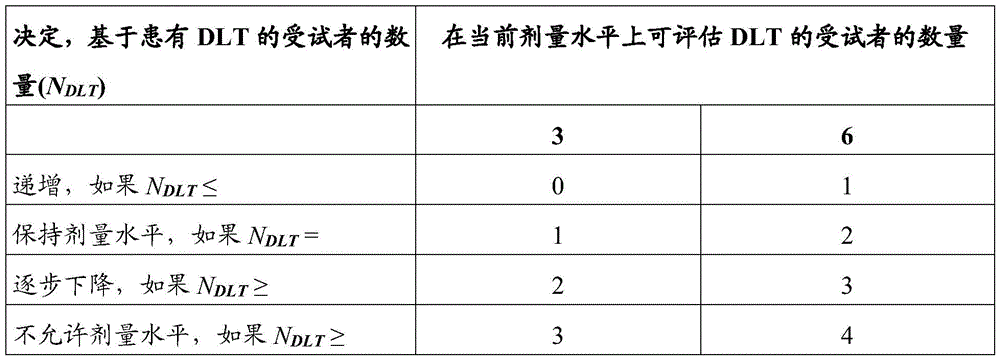
可以替换不可评估DLT的受试者,并且对于鉴定为RP2D的剂量水平,需要至少6名受试者。可以研究低于24mg(例如12mg)或高于48mg(例如60mg)的额外的全剂量水平。Subjects who are not evaluable for DLT may be replaced, and at least 6 subjects are required for a dose level identified as the RP2D. Additional full dose levels below 24 mg (e.g., 12 mg) or above 48 mg (e.g., 60 mg) may be studied.
在剂量水平的所有受试者完成DLT监测期(即周期1;28天)后,将评价所有可用的数据(包括但不限于安全性、PK、药效学和免疫原性数据),以便告知下一剂量水平。After all subjects at a dose level complete the DLT monitoring period (i.e., Cycle 1; 28 days), all available data (including but not limited to safety, PK, pharmacodynamics, and immunogenicity data) will be evaluated to inform the next dose level.
当有下项时停止剂量递增:Stop dose escalation when:
·在待研究的最低剂量水平,根据递增规则,决定将是不允许、逐步下降或保持相同剂量水平。At the lowest dose level to be studied, the decision would be to not allow, to step down, or to maintain the same dose level, based on the escalation rule.
·在待研究的最高剂量水平,根据递增规则,决定将是递增或保持相同剂量水平。At the highest dose level to be studied, the decision will be to escalate or maintain the same dose level, based on the escalation rule.
·在当前的剂量水平,根据递增规则,决定将是递增但已经评价导致剂量逐步下降的更高剂量水平;或者根据递增规则,决定将是逐步下降但已经评价导致剂量递增的更低剂量水平。At the current dose level, according to the escalation rule, the decision would be to escalate but a higher dose level has been evaluated that would result in a dose de-escalation; or according to the escalation rule, the decision would be to de-escalate but a lower dose level has been evaluated that would result in a dose escalation.
MTD定义为在最多三分之一受试者中观察到的DLT的最高研究剂量水平。如果发现该剂量水平是安全和可耐受的,R/R CLL的RP2D将设定为48mg。全体数据,包括安全性(例如不良事件(AE)和安全性实验室值,以及DLT评价期结束后的观察)、药代动力学、药效学和初步功效,将指导扩展的进一步开发。The MTD is defined as the highest study dose level at which DLT is observed in up to one-third of the subjects. If this dose level is found to be safe and tolerable, the RP2D for R/R CLL will be set at 48 mg. Overall data, including safety (e.g., adverse events (AEs) and safety laboratory values, as well as observations after the end of the DLT evaluation period), pharmacokinetics, pharmacodynamics, and preliminary efficacy, will guide further development of the expansion.
扩展(部分II)Extensions (Part II)
一旦RP2D建立,将开始扩展部分。扩展部分入组约20名R/R CLL受试者,这些受试者之前已经用包括BTK抑制剂(例如依鲁替尼)的2种既往系统性抗赘生疗法线治疗或否则对BTK抑制剂不耐受。以部分1中鉴定的RP2D治疗R/R CLL受试者。扩展部分的主要功效终点是如使用iwCLL 2018标准评估的ORR(表2)。ORR是广泛接受的响应终点以评价对R/R CLL受试者的功效。次要功效终点包含DOR、TTR、PFS和OS。MRD阴性状态的发生率也作为次要功效终点进行评价。MRD评估指示在已经实施治疗期间或之后处于缓解的受试者中仍有多少癌细胞。扩展部分中的安全性终点包括AE/SAE的发生率和严重性,肿瘤溶解综合征(TLS)、免疫效应细胞相关的神经毒性综合征(ICANS)和CRS的发生率和严重性,以及治疗中断和延迟的发生率。Once RP2D is established, the expansion part will be started. The expansion part enrolls about 20 R/R CLL subjects who have been treated with 2 previous systemic anti-neoplastic therapy lines including BTK inhibitors (e.g., ibrutinib) or are otherwise intolerant to BTK inhibitors. Treat R/R CLL subjects with the RP2D identified in Part 1. The primary efficacy endpoint of the expansion part is the ORR (Table 2) as assessed using the iwCLL 2018 criteria. ORR is a widely accepted response endpoint to evaluate the efficacy of R/R CLL subjects. Secondary efficacy endpoints include DOR, TTR, PFS, and OS. The incidence of MRD-negative status is also evaluated as a secondary efficacy endpoint. MRD assessments indicate how many cancer cells are still in subjects who are in remission during or after treatment has been implemented. The safety endpoints in the expansion part include the incidence and severity of AE/SAE, the incidence and severity of tumor lysis syndrome (TLS), immune effector cell-related neurotoxicity syndrome (ICANS), and CRS, as well as the incidence of treatment interruptions and delays.
纳入标准Inclusion criteria
1.受试者必须至少18岁。1. Subjects must be at least 18 years old.
2.需要治疗的活动性CLL疾病,满足以下标准的至少1项:2. Active CLL disease requiring treatment, meeting at least one of the following criteria:
a.表现为贫血和/或血小板减少的发展或恶化的进行性骨髓衰竭的证据a. Evidence of progressive bone marrow failure manifested by development or worsening of anemia and/or thrombocytopenia
b.巨大的(即在左肋缘下≥6cm)或进行性或有症状的脾肿大b. Massive (i.e., ≥6 cm below the left costal margin) or progressive or symptomatic splenomegaly
c.巨大的结节(即最长直径≥10cm)或进行性或有症状的淋巴结病c. Large nodules (i.e., longest diameter ≥ 10 cm) or progressive or symptomatic lymphadenopathy
d.进行性淋巴细胞增多,在2个月期间增加≥50%,或淋巴细胞倍增时间(LDT)<6个月d. Progressive lymphocytosis, an increase of ≥50% over a 2-month period, or a lymphocyte doubling time (LDT) < 6 months
e.自身免疫性并发症,包括对皮质类固醇反应差的贫血或血小板减少e. Autoimmune complications, including anemia or thrombocytopenia that is poorly responsive to corticosteroids
f.有症状或功能性结节外受累(例如皮肤、肾脏、肺、脊柱)f. Symptomatic or functional extranodal involvement (e.g., skin, kidney, lung, spine)
g.与疾病相关的症状,其由以下中的任一项所定义:g. Symptoms associated with a disease, as defined by any of the following:
o过去6个月内非故意的体重下降≥10%o Unintentional weight loss ≥ 10% in the past 6 months
o明显的疲乏oNoticeable fatigue
o发热≥38.0℃(100.5°F)持续2周或更长时间而没有感染的证据o Fever ≥ 38.0°C (100.5°F) for 2 weeks or longer without evidence of infection
o夜间盗汗持续≥1个月而没有感染的证据o Night sweats lasting ≥ 1 month without evidence of infection
3.接受至少2种既往系统性抗赘生疗法线后的R/R CLL,包括用BTK抑制剂(例如依鲁替尼)治疗(或对其不耐受)。复发定义为先前已实现CR或PR≥6个月的受试者中的疾病进展的证据。难治性疾病定义为治疗失败(未达到CR或PR)或在末剂疗法起6个月内的进展。3. R/R CLL after receiving at least 2 prior lines of systemic anti-neoplastic therapy, including treatment with (or intolerance to) a BTK inhibitor (e.g., ibrutinib). Relapse is defined as evidence of disease progression in subjects who had previously achieved a CR or PR for ≥6 months. Refractory disease is defined as treatment failure (not achieving a CR or PR) or progression within 6 months of the last dose of therapy.
4.可测量的疾病,具有以下标准中的至少一项:4. Measurable disease with at least one of the following criteria:
a.外周血中B淋巴细胞≥5×10⁹/L(5,000/μL);a. B lymphocytes in peripheral blood ≥5×10 9 /L (5,000/μL);
b.存在可测量的淋巴结病和/或器官肿大b. Presence of measurable lymphadenopathy and/or organomegaly
5.0或1的ECOG表现状态评分ECOG performance status score of 5.0 or 1
6.CD20阳性的筛选流式细胞术证据6. Screening flow cytometric evidence of CD20 positivity
7.具有以下可接受的实验室参数:7. Have the following acceptable laboratory parameters:
表4Table 4
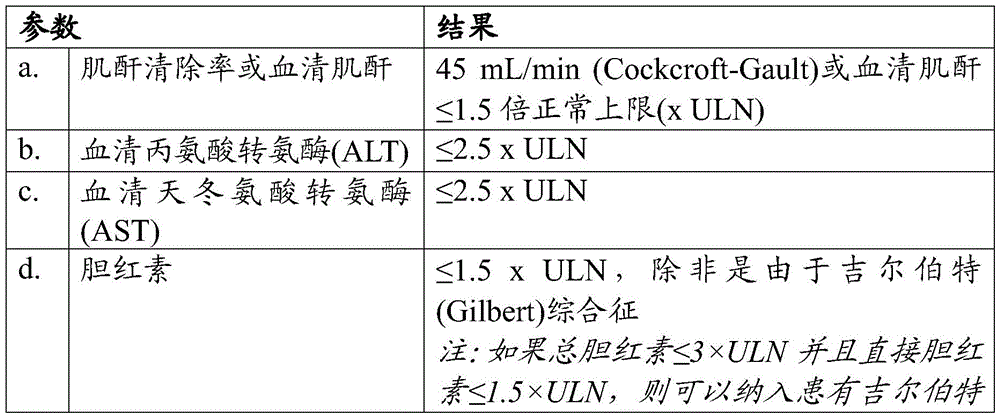
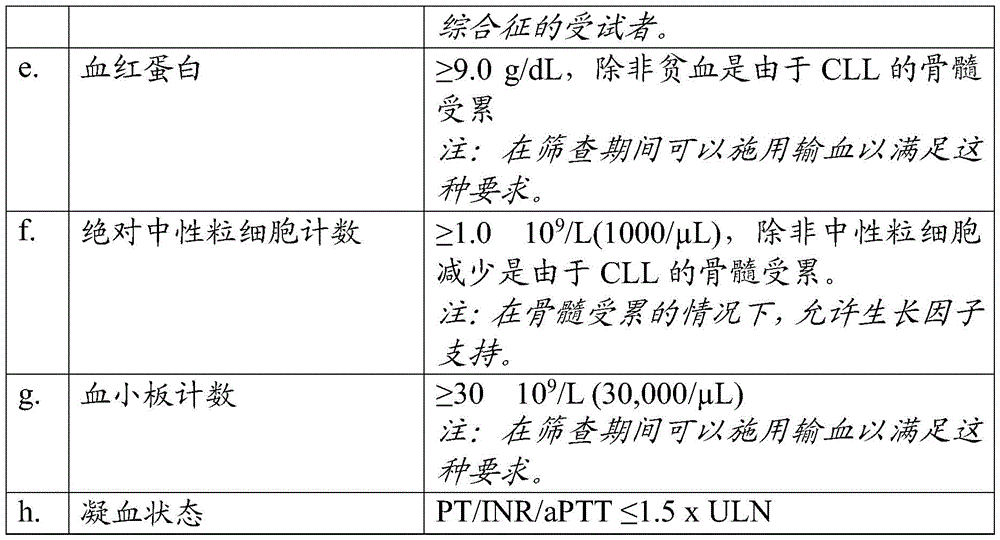
8.在首剂艾可瑞妥单抗之前2周内,接受的皮质类固醇的累积剂量小于250mg的泼尼松(prednisone)当量。8. The cumulative dose of corticosteroids received within 2 weeks before the first dose of icoruxizumab was less than 250 mg of prednisone equivalents.
9.受试者在筛选时必须具有可用的新鲜骨髓材料。9. Subjects must have fresh bone marrow material available at screening.
10.必须采取针对CRS/TLS的防治。10. Preventive measures must be taken against CRS/TLS.
11.受试者必须愿意并能够坚持方案中规定的禁例和限制。11. Subjects must be willing and able to adhere to the prohibitions and restrictions specified in the protocol.
排除标准Exclusion criteria
1.CLL向侵袭性非霍奇金淋巴瘤的转化1. Transformation of CLL to aggressive non-Hodgkin lymphoma
2.受试者接受过CD3×CD20双特异性抗体的既往治疗2. Subjects have received previous treatment with CD3×CD20 bispecific antibodies
3.受试者接受过任何既往同种异体HSCT或实体器官移植3. Subjects have received any previous allogeneic HSCT or solid organ transplantation
4.受试者在首剂艾可瑞妥单抗前4周内或5个半衰期内(以较短者为准)接受过抗癌生物学,包括抗CD20疗法、放射缀合或毒素缀合抗体或CAR T细胞疗法的治疗。4. Subjects have received anti-cancer biologics, including anti-CD20 therapy, radioconjugated or toxin-conjugated antibodies, or CAR T-cell therapy within 4 weeks or 5 half-lives (whichever is shorter) before the first dose of ixekizumab.
5.受试者在首剂艾可瑞妥单抗的2周内接受化疗或放射疗法。5. The subject received chemotherapy or radiotherapy within 2 weeks of the first dose of ixekizumab.
6.受试者在首剂艾可瑞妥单抗前4周内或5个半衰期内(以较短者为准)接受过试验药物或侵入性试验医疗设备的治疗。6. The subject has received treatment with investigational drugs or invasive investigational medical devices within 4 weeks or 5 half-lives (whichever is shorter) before the first dose of ixekizumab.
7.受试者患有自身免疫性疾病或其他需要永久或大剂量免疫抑制疗法的疾病7. Subjects with autoimmune diseases or other diseases that require permanent or high-dose immunosuppressive therapy
8.受试者患有不受控的间发性疾患,包含但不限于:8. The subject suffers from uncontrolled intermittent diseases, including but not limited to:
a.正在进行的或活动性感染,其在入组时或在首剂艾可瑞妥单抗之前先前2周内,需要静脉内抗生素治疗a. Ongoing or active infection requiring intravenous antibiotic treatment at the time of enrollment or within 2 weeks prior to the first dose of ixekizumab
b.有症状的充血性心力衰竭(如纽约心脏协会分类的III或IV级),不稳定型心绞痛或心律失常b. Symptomatic congestive heart failure (eg, New York Heart Association class III or IV), unstable angina, or arrhythmia
c.过去6个月内的心肌梗塞、颅内出血或中风c. Myocardial infarction, intracranial hemorrhage, or stroke within the past 6 months
9.具有筛查时经Fridericia公式校正(QTcF)的基线QT间隔>480msec9. Baseline QT interval corrected by Fridericia formula (QTcF) > 480 msec at screening
10.受试者在首剂艾可瑞妥单抗之前28天内接受过活疫苗的疫苗接种10. Subjects have received vaccination with live vaccines within 28 days before the first dose of ixekizumab
11.受试者具有没有解决到基线水平或1级或以下的来自先前抗癌疗法的毒性,脱发和周围神经病除外11. Subjects have toxicities from previous anticancer therapy that have not resolved to baseline level or grade 1 or lower, except alopecia and peripheral neuropathy
12.受试者在筛选时具有已知的CNS受累12. Subjects with known CNS involvement at screening
13.受试者具有不同于纳入诊断的过去或当前已知恶性肿瘤,以下除外:13. The subject has a past or current known malignancy different from the included diagnosis, except for the following:
a.1B期或以下的宫颈癌a. Cervical cancer stage 1B or below
b.非侵入性基底细胞或鳞状细胞皮肤癌b. Non-invasive basal cell or squamous cell skin cancer
c.非侵入性浅表性膀胱癌c. Non-invasive superficial bladder cancer
d.当前PSA水平<0.1ng/mL的前列腺癌d. Prostate cancer with current PSA level < 0.1 ng/mL
e.CR持续时间>2年的任何可治愈的癌症,e. Any curable cancer with CR duration > 2 years,
14.受试者具有对艾可瑞妥单抗或其赋形剂的疑似变态反应、超敏性或不耐受14. Subjects with suspected allergic reaction, hypersensitivity or intolerance to ixoratumomab or its excipients
15.受试者不能耐受降尿酸药物15. The subject cannot tolerate uric acid-lowering drugs
16.受试者在筛查前3周内已有大手术(例如需要全身麻醉),或将尚未从手术中完全恢复,或已在受试者预期参加试验期间(或在艾可瑞妥单抗的最后剂量后4周内)计划的大手术;注意:计划在局部麻醉下进行手术的受试者可以参加。16. The subject has had major surgery (e.g., requiring general anesthesia) within 3 weeks prior to screening, or will not fully recover from surgery, or has planned major surgery during the subject's expected participation in the trial (or within 4 weeks after the last dose of icoretuzumab); Note: Subjects planned to undergo surgery under local anesthesia can participate.
17.受试者有已知的乙型肝炎B史/血清学阳性(除非因接种疫苗或消退的自然感染的免疫,或除非因免疫球蛋白疗法的被动免疫):17. Subjects with a known history of hepatitis B/positive serology (unless immune due to vaccination or resolved natural infection, or unless passively immune due to immunoglobulin therapy):
a.乙型肝炎B核心抗原抗体(抗-HBc)测试呈阳性,并且a. Hepatitis B core antigen antibody (anti-HBc) test is positive, and
b.乙型肝炎B表面抗原抗体(抗-HBs)测试呈阴性。b. Hepatitis B surface antigen antibody (anti-HBs) test was negative.
18.已知病史或尚未治愈的正在进行的丙型肝炎C感染。18. Known history or ongoing hepatitis C infection that has not been cured.
19.受试者在筛查HIV的测试呈阳性。19. The subject tested positive for HIV in a screening test.
20.受试者为妊娠或正在哺乳,或计划在入组此试验期间或在末剂艾可瑞妥单抗之后12个月内妊娠的女性。20. The subject is pregnant or breastfeeding, or plans to become pregnant during enrollment in this trial or within 12 months after the last dose of icoretuzumab.
21.受试者为计划在入组此试验期间或在末剂艾可瑞妥单抗之后12个月内为人父的男性。21. The subject is a male who plans to become a father during enrollment in this trial or within 12 months after the last dose of icoretuzumab.
22.受试者具有参与不符合受试者最大利益(例如,损害福祉)或可能阻止、限制或混淆方案指定的评估的任何状况。22. The subject has any condition for which participation is not in the subject's best interest (e.g., would impair well-being) or which might prevent, limit, or confound the protocol-specified assessment.
前驱用药和CRS防治Pre-medication and CRS prevention and treatment
进行四天的皮质类固醇、抗组胺药和退热药的施用以减少/预防来自周期1中每剂艾可瑞妥单抗的潜在CRS的症状的严重性。对于周期2及以后的艾可瑞妥单抗的施用,用皮质类固醇进行的CRS防治是任选的。可以以推荐剂量或当量静脉内或口服途径施用皮质类固醇。Four days of administration of corticosteroids, antihistamines, and antipyretics are performed to reduce/prevent the severity of symptoms of potential CRS from each dose of ixorituzumab in cycle 1. For administration of ixorituzumab in cycle 2 and beyond, CRS prevention and treatment with corticosteroids is optional. Corticosteroids may be administered intravenously or orally at recommended doses or equivalents.
表5.艾可瑞妥单抗施用之前或之后的防治性皮质类固醇施用Table 5. Preventive corticosteroid administration before or after icariotuzumab administration
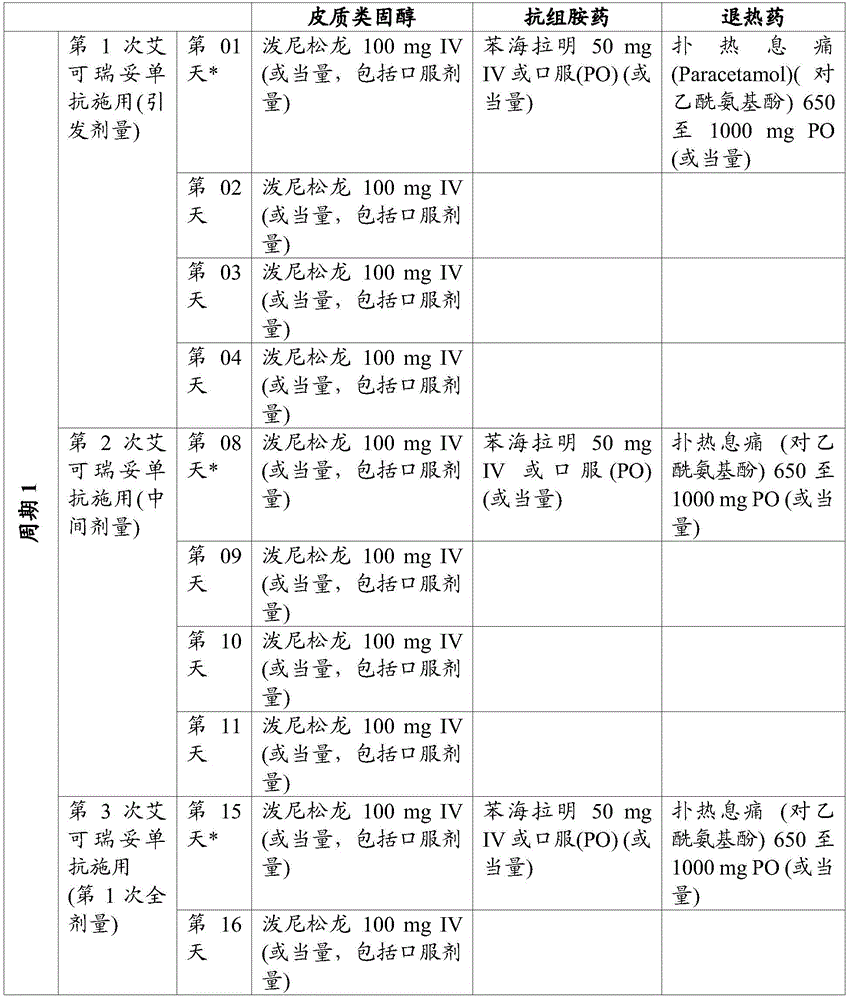
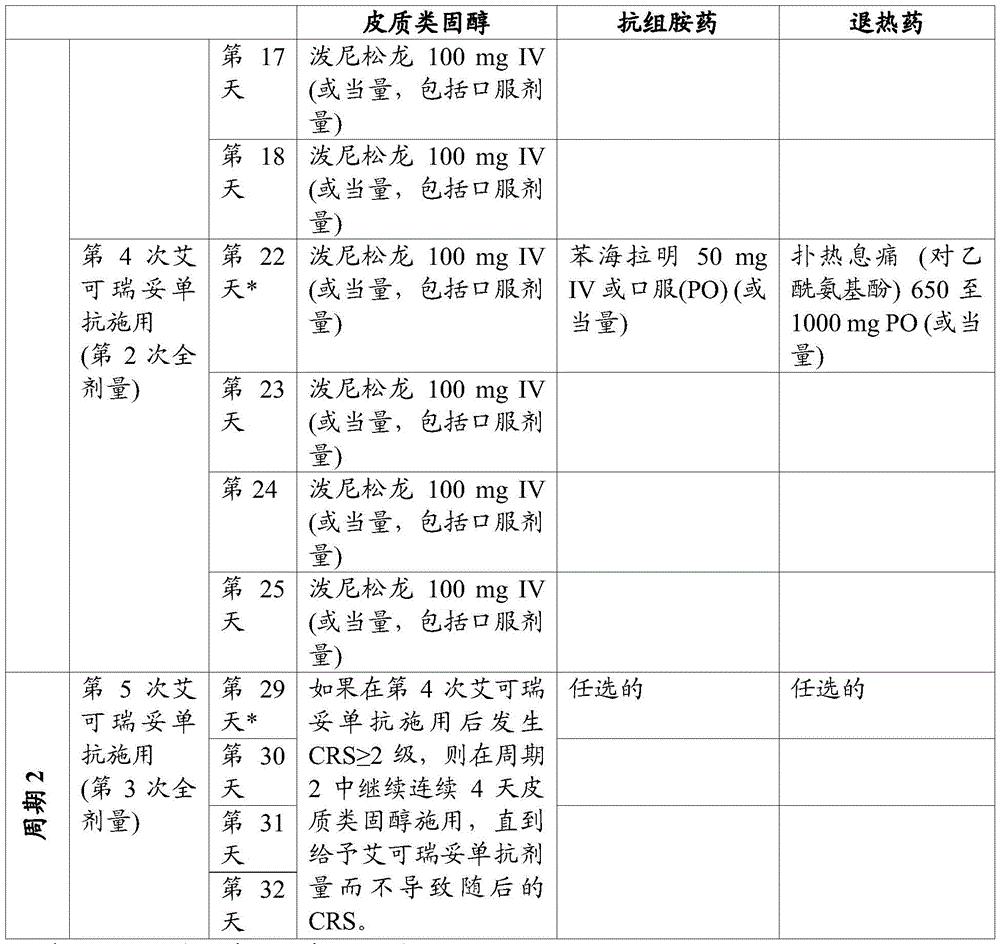
*在施用艾可瑞妥单抗之前30分钟-2小时*30 minutes to 2 hours before administration of ixekizumab
表6:皮质类固醇剂量当量-转换表Table 6: Corticosteroid Dose Equivalents - Conversion Table
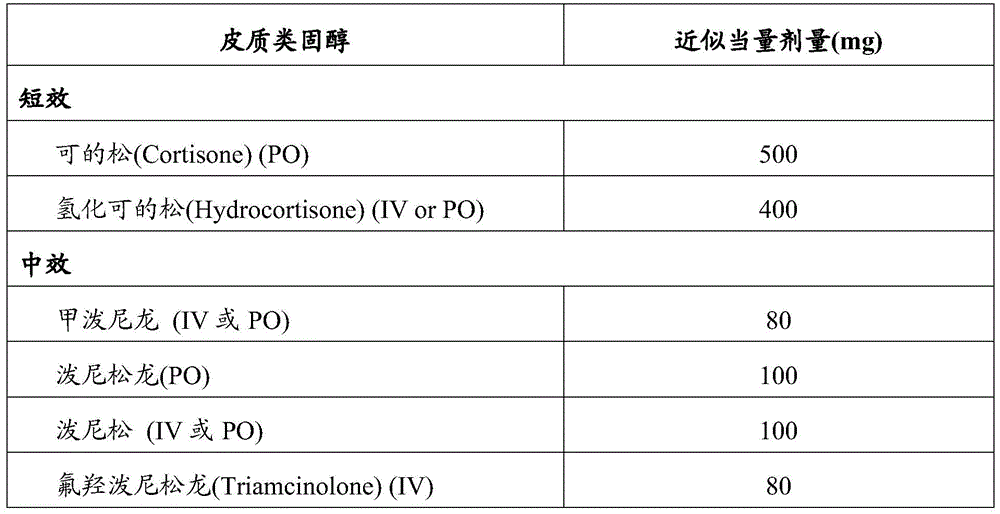

细胞因子释放综合征的支持性护理Supportive Care for Cytokine Release Syndrome
CRS根据对CRS的ASTCT分级进行分级(表7和8),并且对于CRS的治疗,受试者应接受支持性护理。支持性护理可以包括但不限于,CRS is graded according to the ASTCT grading of CRS (Tables 7 and 8), and subjects should receive supportive care for the treatment of CRS. Supportive care may include, but is not limited to,
-盐水输注- Saline infusion
-系统性糖皮质激素、抗组胺药、抗发热剂(antipyrexia)-Systemic glucocorticoids, antihistamines, antipyrexia
-血压支持(血管加压素(vasopressin)、血管加压药(vasopressor))- Blood pressure support (vasopressin, vasopressor)
-低流量和高流量氧和正压通气的支持- Low-flow and high-flow oxygen and positive pressure ventilation support
-针对IL-6R的单克隆抗体,例如托珠单抗的IV施用- Monoclonal antibodies against IL-6R, such as IV administration of tocilizumab
-如果不响应重复的托珠单抗,则是针对IL-6的单克隆抗体,例如IV司妥昔单抗。-If not responding to repeated tocilizumab, a monoclonal antibody against IL-6, such as IV siltuximab
表7:细胞因子释放综合征的分级和管理Table 7: Grading and management of cytokine release syndrome
根据美国移植和细胞疗法学会(ASTCT),先前是美国血液和骨髓移植学会(ASBMT),CRS的统一定义和分级标准呈现如下。According to the American Society for Transplantation and Cellular Therapy (ASTCT), formerly the American Society for Blood and Marrow Transplantation (ASBMT), the uniform definition and grading criteria for CRS are presented below.
细胞因子释放综合征的分级Grading of cytokine release syndrome
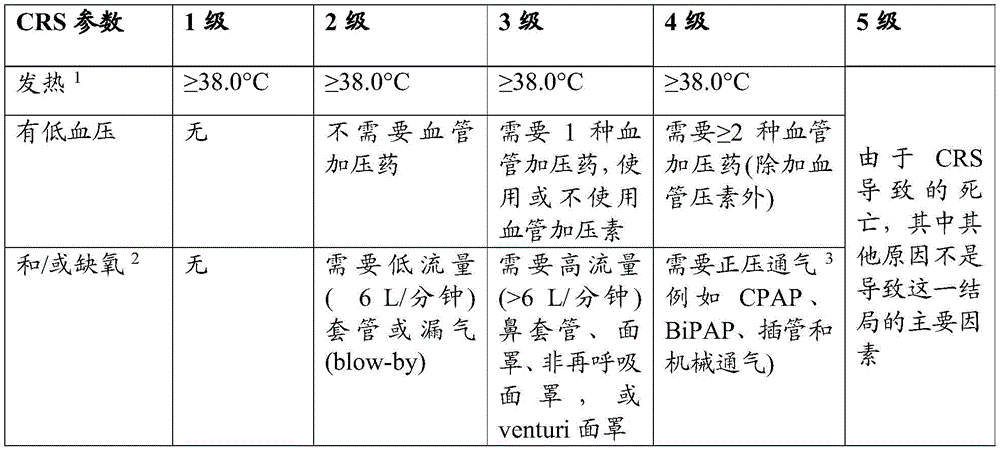
缩略语:BiPAP,双水平气道正压;CPAP,持续气道正压;CRS,细胞因子释放综合征;IV,静脉内。Abbreviations: BiPAP, bilevel positive airway pressure; CPAP, continuous positive airway pressure; CRS, cytokine release syndrome; IV, intravenous.
注:与CRS相关的器官毒性或全身症状可以根据CTCAE进行分级,但它们不影响CRS的分级。Note: Organ toxicity or systemic symptoms associated with CRS can be graded according to CTCAE, but they do not affect the grade of CRS.
1.发热定义为不能归因于任何其他原因的体温≥38.0℃,其伴有或不伴有全身症状(例如,肌痛、关节痛、乏力)。在接受退热药、抗细胞因子疗法和/或皮质类固醇的CRS受试者中,不再需要发热来对后续CRS严重性进行分级。在这种情况下,CRS的分级是由低血压和/或缺氧驱动。1. Fever is defined as a body temperature ≥ 38.0°C that cannot be attributed to any other cause, with or without systemic symptoms (e.g., myalgia, arthralgia, fatigue). In subjects with CRS who receive antipyretics, anti-cytokine therapy, and/or corticosteroids, fever is no longer required to grade the subsequent severity of CRS. In this case, the grading of CRS is driven by hypotension and/or hypoxia.
2.CRS等级由更严重的事件确定:不归因于任何其他原因的低血压或缺氧。例如,具有39.5℃的温度、需要1种血管加压药的低血压、需要低流量鼻套管的缺氧的受试者被分类为3级CRS。收缩压和平均动脉压两者用于测量血压是可接受的。不需要具体的限制,但低血压应考虑到年龄和受试者的个体基线根据具体情况确定,即低于个体在给定环境中预期的正常值的血压。2. CRS grade is determined by the more severe event: hypotension or hypoxia not attributable to any other cause. For example, a subject with a temperature of 39.5°C, hypotension requiring 1 vasopressor, hypoxia requiring a low-flow nasal cannula is classified as Grade 3 CRS. Both systolic and mean arterial pressure are acceptable for measuring blood pressure. No specific restrictions are required, but hypotension should be determined on a case-by-case basis taking into account age and the individual baseline of the subject, i.e., blood pressure below the normal value expected for the individual in a given setting.
3.出于单独的未闭气道的可能神经系统损害或规程,对没有缺氧的受试者进行插管不是根据定义4级CRS。3. Intubation of a subject without hypoxia due to possible neurologic compromise or procedure with an open airway alone is not a Grade 4 CRS by definition.
来源:改编自Lee等人,Biol Blood Marrow Transplant 2019;25:625-638Source: Adapted from Lee et al., Biol Blood Marrow Transplant 2019;25:625-638
表8:细胞因子释放综合征的分级和管理Table 8: Grading and management of cytokine release syndrome
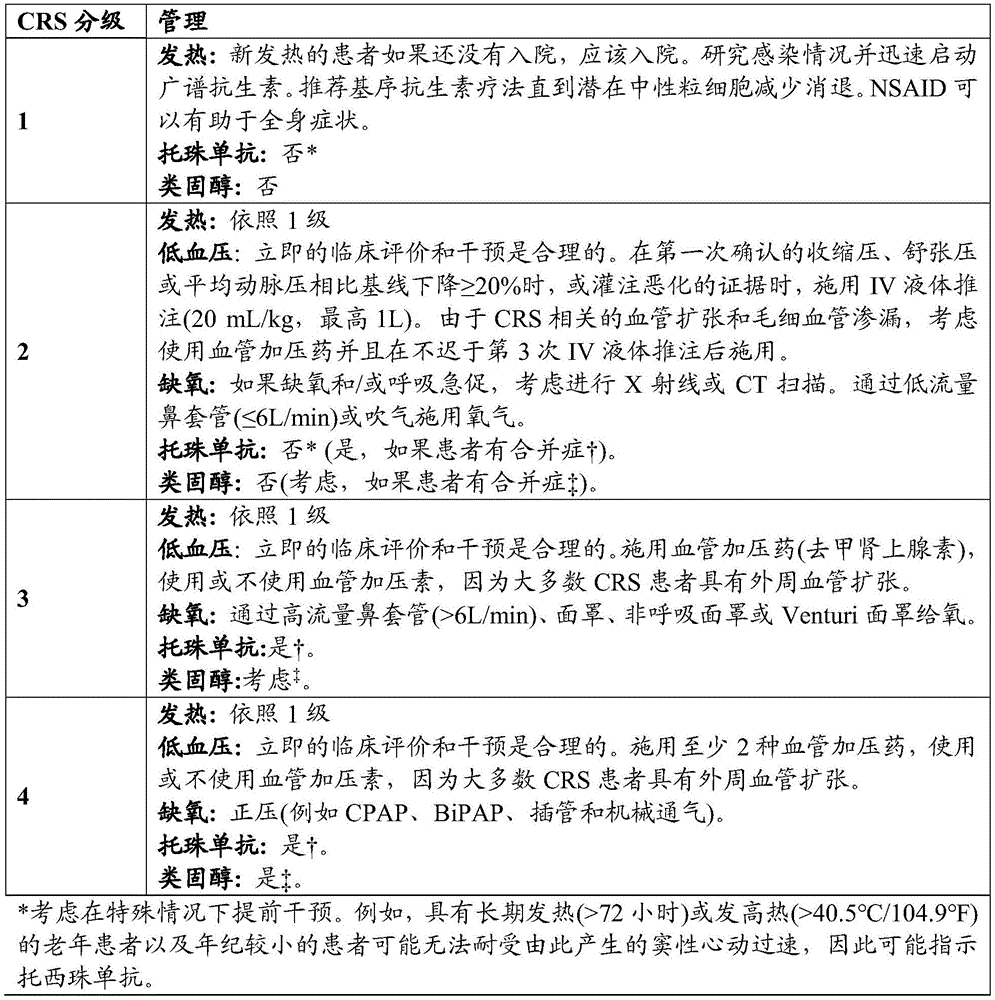

肿瘤溶解综合征的预防和管理Prevention and management of tumor lysis syndrome
对于肿瘤溶解综合征的防治性治疗,受试者施用艾可瑞妥单抗之前接受降尿酸剂,在首剂艾可瑞妥单抗之前至少72小时给予别嘌呤醇,并且在开始艾可瑞妥单抗之前启动拉布立酶。在首剂之前应增加口服水化并且在给药期间维持。在随后的剂量之前对受试者的TLS风险类别进行重新评估。For prophylactic or preventive treatment of tumor lysis syndrome, subjects received a urate-lowering agent prior to icoretumomab administration, allopurinol was administered at least 72 hours prior to the first dose of icoretumomab, and rasburicase was initiated prior to starting icoretumomab. Oral hydration should be increased prior to the first dose and maintained during dosing. Subjects were reassessed for TLS risk category prior to subsequent doses.
研究评估Research Assessment
骨髓评估Bone marrow evaluation
在筛查时(即周期1第1天之前21天内)和完全响应(CR)时或当有临床指征时获得新鲜骨髓抽吸物。在筛查时和CR或结节性部分响应(PR)(nPR)时或当有临床指征时获得新鲜骨髓生检。骨髓评价包括形态学检查以及流式细胞术或免疫组织化学。获得具有抽吸物的骨髓生检,(a)以根据iwCLL指南(Hallek等,Lancet 2018;391:1524-37)确认由体格检查结果、实验室评和放射线照相术评价支持的CR或nPR,和(b)如果仅在1个参数中显示进展,来确认细胞病(cytopenic)进展(即中性粒细胞减少、贫血和/或血小板减少,并且与自身免疫性和治疗相关的血球减少区分)。Obtain fresh bone marrow aspirates at screening (i.e., within 21 days before Cycle 1 Day 1) and at the time of complete response (CR) or when clinically indicated. Obtain fresh bone marrow biopsy at screening and at the time of CR or nodular partial response (PR) (nPR) or when clinically indicated. Bone marrow evaluation includes morphological examination and flow cytometry or immunohistochemistry. Obtain a bone marrow biopsy with an aspirate (a) to confirm CR or nPR supported by physical examination results, laboratory evaluation, and radiographic evaluation according to the iwCLL guidelines (Hallek et al., Lancet 2018; 391: 1524-37), and (b) to confirm cytopenic progression (i.e., neutropenia, anemia, and/or thrombocytopenia, and distinguish between autoimmune and treatment-related cytopenias) if progression is shown in only 1 parameter.
放射线照相术评估Radiographic evaluation
颈部、胸部、腹部和骨盆的成像扫描是在筛查时(即在首剂艾可瑞妥单抗前3周内)和随后的响应评估中进行。用具有造影剂的CT扫描是推荐的成像方式。只有当用具有造影剂的CT是医学禁忌或CT扫描频率超过当地标准时,才可以使用MRI。MRI研究不能替代所需的颈部、胸部、腹部和骨盆CT扫描。必要时可进行额外的成像评估以支持对受试者的功效评价。Imaging scans of the neck, chest, abdomen, and pelvis are performed at screening (i.e., within 3 weeks before the first dose of ixekizumab) and subsequently during response assessments. CT scans with contrast are the recommended imaging modality. MRI should be used only when CT with contrast is medically contraindicated or the frequency of CT scans exceeds local standards. MRI studies are not a substitute for required CT scans of the neck, chest, abdomen, and pelvis. Additional imaging assessments may be performed as necessary to support efficacy evaluations for subjects.
骨髓评估Bone marrow evaluation
在筛查时(即周期1第1天之前21天内)和CR时或当有临床指征时获得新鲜骨髓抽吸物。在筛查时和CR或结节性PR(nPR)时或当有临床指征时获得新鲜骨髓生检。骨髓评价包括形态学检查以及流式细胞术或免疫组织化学。获得具有抽吸物的骨髓生检,(a)以根据iwCLL指南(Hallek等,Lancet2018;391:1524-37)确认由体格检查结果、实验室评和放射线照相术评价支持的CR或nPR,和(b)如果仅在1个参数中显示进展,来确认细胞病(cytopenic)进展(即中性粒细胞减少、贫血和/或血小板减少,并且与自身免疫性和治疗相关的血球减少区分)。Obtain fresh bone marrow aspirates at screening (i.e., within 21 days before cycle 1 day 1) and in CR or when clinically indicated. Obtain fresh bone marrow biopsy at screening and in CR or nodular PR (nPR) or when clinically indicated. Bone marrow evaluation includes morphological examination and flow cytometry or immunohistochemistry. Obtain a bone marrow biopsy with an aspirate (a) to confirm CR or nPR supported by physical examination results, laboratory evaluation, and radiographic evaluation according to the iwCLL guidelines (Hallek et al., Lancet 2018; 391: 1524-37), and (b) to confirm cytopenic progression (i.e., neutropenia, anemia, and/or thrombocytopenia, and distinguish between autoimmune and treatment-related cytopenias) if progression is shown in only 1 parameter.
微小残留病(MRD)评估Minimal residual disease (MRD) assessment
通过流式细胞术和下一代测序评估血液中的MRD。治疗开始后,在固定时间点和CR时请求血样。作为探索性分析,当受试者达到CR时,为确认CR而收集的部分抽吸物被用来评估MRD。MRD was assessed in blood by flow cytometry and next-generation sequencing. Blood samples were requested at fixed time points after treatment initiation and at CR. As an exploratory analysis, partial aspirates collected to confirm CR were used to assess MRD when subjects achieved CR.
疾病响应和疾病进展评估Disease response and disease progression assessment
进行根据影像学评估的肿瘤响应以通知连续治疗的决定。响应评估是根据诊断、治疗适应症、响应评估和CLL支持性管理的修订iwCLL指南完成的,如表2中所述。终点定义如下:Tumor response based on imaging assessment was performed to inform the decision on continued treatment. Response assessment was completed according to the revised iwCLL guidelines for diagnosis, treatment indication, response assessment, and supportive management of CLL, as described in Table 2. Endpoints were defined as follows:
总体响应率(ORR),定义为在开始后续疗法之前达到PR或CR响应的受试者的比例。Overall response rate (ORR), defined as the proportion of subjects who achieved a PR or CR response before starting subsequent therapy.
响应前时间(TTR),在响应者中定义为从首剂艾可瑞妥单抗到PR或CR的初始记录之间的时间。Time to response (TTR), defined in responders as the time from the first dose of ixekizumab to the initial documentation of a PR or CR.
响应持续时间(DOR),在响应者中定义为从PR或CR的最初记录到疾病进展或死亡(以较早发生者为准)日期之间的时间。Duration of response (DOR), defined in responders as the time from the initial documentation of a PR or CR to the date of disease progression or death, whichever occurred earlier.
无进展生存(PFS),定义为从艾可瑞妥单抗的首次给药日期到疾病进展或死亡(以较早发生者为准)日期的时间。Progression-free survival (PFS), defined as the time from the first dose of ixekizumab to the date of disease progression or death, whichever occurred first.
总体生存(OS),定义为从艾可瑞妥单抗的首次给药日期到死亡日期的时间。Overall survival (OS), defined as the time from the first dose of ixekizumab to the date of death.
MRD阴性率,定义为在开始后续疗法之前,根据特定的阈值,至少有一个检测不到的MRD结果的受试者比例。The MRD-negative rate was defined as the proportion of subjects with at least one undetectable MRD result based on a specified threshold before starting subsequent therapy.
临床安全性评估Clinical safety assessment
安全性将通过测量不良事件、实验室测试结果、ECG、生命体征测量、体格检查结果和ECOG表现状态来评估。还将评估免疫效应细胞相关的神经毒性综合征(例如,如Lee等人,Biol Blood Marrow Transplant 2019;25:625-638等所描述)、全身症状(B症状)、肿瘤闪烁(flare)反应和生存。Safety will be assessed by measuring adverse events, laboratory test results, ECG, vital sign measurements, physical examination results, and ECOG performance status. Immune effector cell-related neurotoxicity syndrome (e.g., as described by Lee et al., Biol Blood Marrow Transplant 2019; 25: 625-638, etc.), systemic symptoms (B symptoms), tumor flare reactions, and survival will also be assessed.
免疫表型分析Immunophenotyping
用流式细胞术确定新鲜全血中的绝对B细胞和T细胞计数,以监测与艾可瑞妥单抗治疗有关的变化。使用流式细胞术和标志物评估T细胞活化和耗竭表型,以评价此类标志物与药物靶点接合、治疗功效和/或艾可瑞妥单抗的安全性的关联。使用流式细胞术确定在全血中循环免疫细胞的其他免疫表型(例如,可抑制T细胞功能的调控T细胞的水平),以评估此类标志物与T细胞活化/耗竭表型、受试者响应和艾可瑞妥单抗的MOA的关联。Absolute B cell and T cell counts in fresh whole blood were determined by flow cytometry to monitor changes associated with icariotuzumab treatment. T cell activation and exhaustion phenotypes were assessed using flow cytometry and markers to evaluate the association of such markers with drug target engagement, therapeutic efficacy, and/or safety of icariotuzumab. Other immune phenotypes of circulating immune cells in whole blood (e.g., levels of regulatory T cells that can inhibit T cell function) were determined using flow cytometry to assess the association of such markers with T cell activation/exhaustion phenotypes, subject response, and MOA of icariotuzumab.
细胞因子和内皮细胞活化标志物分析Analysis of cytokines and endothelial cell activation markers
由于初始艾可瑞妥单抗施用后的T细胞活化可以导致细胞因子释放,引起CRS,密切监测细胞因子水平。细胞因子(诸如IL-2、IL15、IL-6、IL-8、IL-10、IFNγ和/或TNFα)的水平使用基于阵列的配体结合测定法在血浆样品中测量。也可以测定其他细胞因子,以评价此类标志物与治疗突发AE及与艾可瑞妥单抗的结局的关联。Since T cell activation after initial ixoretuzumab administration can lead to cytokine release, causing CRS, cytokine levels are closely monitored. The levels of cytokines (such as IL-2, IL15, IL-6, IL-8, IL-10, IFNγ and/or TNFα) are measured in plasma samples using an array-based ligand binding assay. Other cytokines can also be measured to evaluate the association of such markers with treatment-emergent AEs and outcomes with ixoretuzumab.
初步结果:Initial results:
第一位患者于2020年11月30日入组。截至2021年7月1日,7名R/RCLL患者接受2个全剂量水平下皮下施用的艾可瑞妥单抗:24(n=3)和48mg(n=4)。6名患者完成了剂量限制性毒性(DLT)评价期,并且5名患者进行响应评估。患者已接受中位数为4的既往疗法线(范围为2-5)。7名患者中有6名具有del(17p)、TP53突变或两者的差风险特征。7名患者中有3名患者有大面积的疾病。24或48mg时没有发生DLT。最常见的治疗突发AE(>30%)是细胞因子释放综合征(CRS)(100%)、疲乏(71%)、注射部位反应(43%),和恶心(43%)。所有患者在第一个周期经历了CRS,但没有高于2级的CRS事件。没有观察到免疫效应细胞相关的神经毒性综合征(ICANS)的病例。尽管存在循环肿瘤细胞,但没有观察到肿瘤溶解综合征(TLS)。在两个剂量水平上观察到抗白血病活性,5名患者中有3名部分响应。The first patient was enrolled on November 30, 2020. As of July 1, 2021, 7 patients with R/RCLL received subcutaneous administration of icariotuzumab at 2 full dose levels: 24 (n=3) and 48 mg (n=4). Six patients completed the dose-limiting toxicity (DLT) evaluation period, and 5 patients were evaluated for response. Patients had received a median of 4 lines of prior therapy (range 2-5). Six of the 7 patients had a poor risk profile of del(17p), TP53 mutation, or both. Three of the 7 patients had extensive disease. No DLT occurred at 24 or 48 mg. The most common treatment-emergent AEs (>30%) were cytokine release syndrome (CRS) (100%), fatigue (71%), injection site reactions (43%), and nausea (43%). All patients experienced CRS in the first cycle, but there were no CRS events higher than grade 2. No cases of immune effector cell-associated neurotoxicity syndrome (ICANS) were observed. Despite the presence of circulating tumor cells, no tumor lysis syndrome (TLS) was observed. Anti-leukemic activity was observed at both dose levels, with 3 of 5 patients having partial responses.
截至2021年9月8日,共有11名R/R CLL患者接受了24mg(N=3)和48mg(N=8)的艾可瑞妥单抗。As of September 8, 2021, a total of 11 R/R CLL patients received 24 mg (N=3) and 48 mg (N=8) of ixekizumab.
艾可瑞妥单抗在24mg和48mg两者处的耐受性良好,最常见的治疗突发不良事件是CRS、疲乏和注射部位反应。没有出现免疫效应细胞相关的神经毒性综合征(ICANS)。已在这些具有高风险细胞遗传学的重度预处理患者中观察到艾可瑞妥单抗的初步活性。在6名可评估响应的受试者中,24mg时有1名未确认的部分响应(nPR),并且48mg时有2名部分响应(PR)。这些数据是初步的、未经验证的和未清洁的数据,并且响应数据没有通过位置完全输入。Iscoreluzumab was well tolerated at both 24 mg and 48 mg, with the most common treatment-emergent adverse events being CRS, fatigue, and injection site reactions. Immune effector cell-associated neurotoxicity syndrome (ICANS) did not occur. Preliminary activity of icoreluzumab has been observed in these heavily pretreated patients with high-risk cytogenetics. Of the 6 subjects evaluable for response, there was 1 unconfirmed partial response (nPR) at 24 mg and 2 partial responses (PR) at 48 mg. These data are preliminary, unvalidated, and uncleaned data, and the response data are not fully entered by location.
结论:in conclusion:
这些初步数据表明,高达48mg剂量水平的艾可瑞妥单抗在R/R CLL患者中耐受良好,并且在高风险疾病患者中具有令人鼓舞的临床活性。These preliminary data suggest that icoretinoic acid at dose levels up to 48 mg is well tolerated in patients with R/R CLL and has encouraging clinical activity in patients with high-risk disease.
表9:序列列表Table 9: Sequence Listing
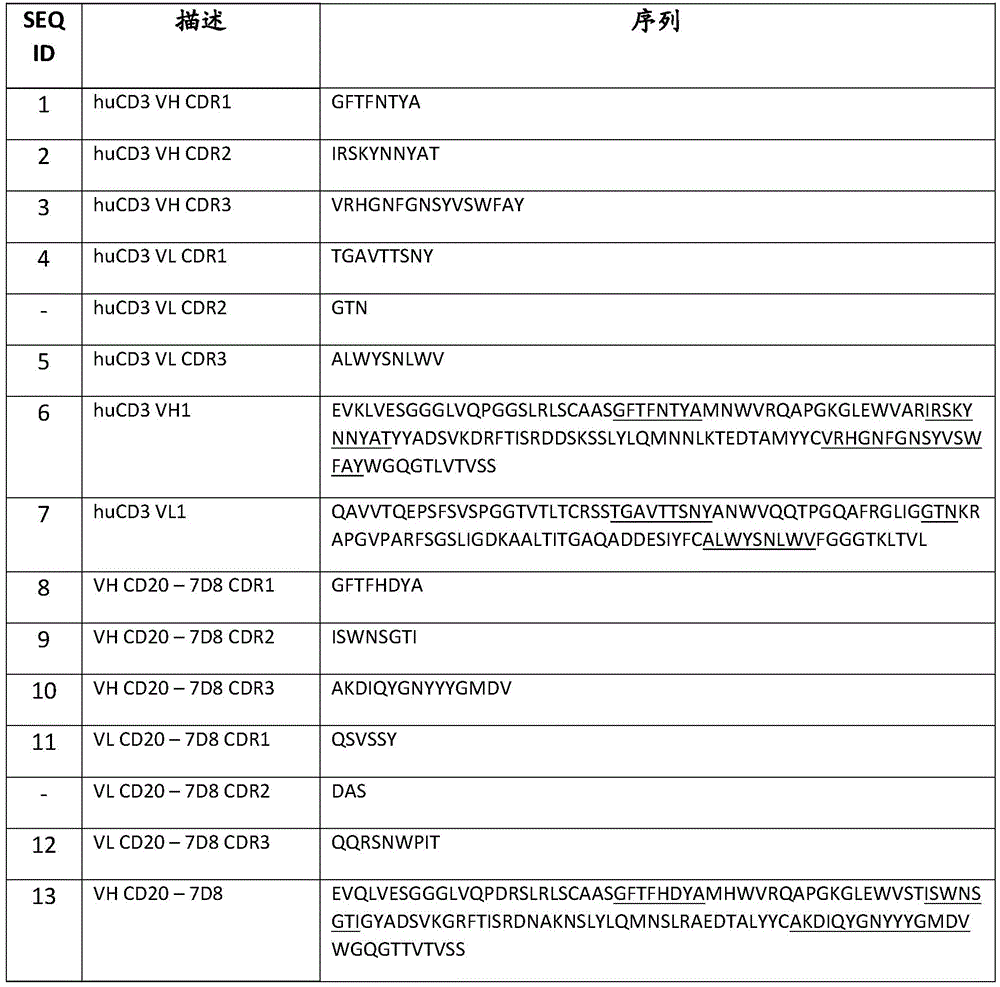


粗体和下划线的是FE;A;L和R,分别对应于位置234和235;265;405和409,所述位置是根据EU编号。在可变区中,按照IMGT的定义的所述CDR区用下划线注释。In bold and underlined are FE; A; L and R, corresponding to positions 234 and 235; 265; 405 and 409, respectively, the positions being numbered according to EU. In the variable region, the CDR regions according to the IMGT definition are annotated with underlining.
序列表Sequence Listing
<110> 健玛保<110> Jianmabao
<120> 用于治疗慢性淋巴细胞白血病的针对CD3和CD20的双特异性抗体<120> Bispecific antibodies targeting CD3 and CD20 for the treatment of chronic lymphocytic leukemia
<130> P/0162-WO-PCT<130> P/0162-WO-PCT
<160> 29<160> 29
<170> PatentIn version 3.5<170> PatentIn version 3.5
<210> 1<210> 1
<211> 8<211> 8
<212> PRT<212> PRT
<213> 人工序列<213> Artificial sequence
<220><220>
<223> CDR序列<223> CDR sequence
<400> 1<400> 1
Gly Phe Thr Phe Asn Thr Tyr AlaGly Phe Thr Phe Asn Thr Tyr Ala
1 51 5
<210> 2<210> 2
<211> 10<211> 10
<212> PRT<212> PRT
<213> 人工序列<213> Artificial sequence
<220><220>
<223> CDR序列<223> CDR sequence
<400> 2<400> 2
Ile Arg Ser Lys Tyr Asn Asn Tyr Ala ThrIle Arg Ser Lys Tyr Asn Asn Tyr Ala Thr
1 5 101 5 10
<210> 3<210> 3
<211> 16<211> 16
<212> PRT<212> PRT
<213> 人工序列<213> Artificial sequence
<220><220>
<223> CDR序列<223> CDR sequence
<400> 3<400> 3
Val Arg His Gly Asn Phe Gly Asn Ser Tyr Val Ser Trp Phe Ala TyrVal Arg His Gly Asn Phe Gly Asn Ser Tyr Val Ser Trp Phe Ala Tyr
1 5 10 151 5 10 15
<210> 4<210> 4
<211> 9<211> 9
<212> PRT<212> PRT
<213> 人工序列<213> Artificial sequence
<220><220>
<223> CDR序列<223> CDR sequence
<400> 4<400> 4
Thr Gly Ala Val Thr Thr Ser Asn TyrThr Gly Ala Val Thr Thr Ser Asn Tyr
1 51 5
<210> 5<210> 5
<211> 9<211> 9
<212> PRT<212> PRT
<213> 人工序列<213> Artificial sequence
<220><220>
<223> CDR序列<223> CDR sequence
<400> 5<400> 5
Ala Leu Trp Tyr Ser Asn Leu Trp ValAla Leu Trp Tyr Ser Asn Leu Trp Val
1 51 5
<210> 6<210> 6
<211> 125<211> 125
<212> PRT<212> PRT
<213> 人工序列<213> Artificial sequence
<220><220>
<223> 重链可变区序列l<223> Heavy chain variable region sequence 1
<400> 6<400> 6
Glu Val Lys Leu Val Glu Ser Gly Gly Gly Leu Val Gln Pro Gly GlyGlu Val Lys Leu Val Glu Ser Gly Gly Gly Leu Val Gln Pro Gly Gly
1 5 10 151 5 10 15
Ser Leu Arg Leu Ser Cys Ala Ala Ser Gly Phe Thr Phe Asn Thr TyrSer Leu Arg Leu Ser Cys Ala Ala Ser Gly Phe Thr Phe Asn Thr Tyr
20 25 3020 25 30
Ala Met Asn Trp Val Arg Gln Ala Pro Gly Lys Gly Leu Glu Trp ValAla Met Asn Trp Val Arg Gln Ala Pro Gly Lys Gly Leu Glu Trp Val
35 40 4535 40 45
Ala Arg Ile Arg Ser Lys Tyr Asn Asn Tyr Ala Thr Tyr Tyr Ala AspAla Arg Ile Arg Ser Lys Tyr Asn Asn Tyr Ala Thr Tyr Tyr Ala Asp
50 55 6050 55 60
Ser Val Lys Asp Arg Phe Thr Ile Ser Arg Asp Asp Ser Lys Ser SerSer Val Lys Asp Arg Phe Thr Ile Ser Arg Asp Asp Ser Lys Ser Ser
65 70 75 8065 70 75 80
Leu Tyr Leu Gln Met Asn Asn Leu Lys Thr Glu Asp Thr Ala Met TyrLeu Tyr Leu Gln Met Asn Asn Leu Lys Thr Glu Asp Thr Ala Met Tyr
85 90 9585 90 95
Tyr Cys Val Arg His Gly Asn Phe Gly Asn Ser Tyr Val Ser Trp PheTyr Cys Val Arg His Gly Asn Phe Gly Asn Ser Tyr Val Ser Trp Phe
100 105 110100 105 110
Ala Tyr Trp Gly Gln Gly Thr Leu Val Thr Val Ser SerAla Tyr Trp Gly Gln Gly Thr Leu Val Thr Val Ser Ser
115 120 125115 120 125
<210> 7<210> 7
<211> 109<211> 109
<212> PRT<212> PRT
<213> 人工序列<213> Artificial sequence
<220><220>
<223> 轻链可变区序列<223> Light chain variable region sequence
<400> 7<400> 7
Gln Ala Val Val Thr Gln Glu Pro Ser Phe Ser Val Ser Pro Gly GlyGln Ala Val Val Thr Gln Glu Pro Ser Phe Ser Val Ser Pro Gly Gly
1 5 10 151 5 10 15
Thr Val Thr Leu Thr Cys Arg Ser Ser Thr Gly Ala Val Thr Thr SerThr Val Thr Leu Thr Cys Arg Ser Ser Thr Gly Ala Val Thr Thr Ser
20 25 3020 25 30
Asn Tyr Ala Asn Trp Val Gln Gln Thr Pro Gly Gln Ala Phe Arg GlyAsn Tyr Ala Asn Trp Val Gln Gln Thr Pro Gly Gln Ala Phe Arg Gly
35 40 4535 40 45
Leu Ile Gly Gly Thr Asn Lys Arg Ala Pro Gly Val Pro Ala Arg PheLeu Ile Gly Gly Thr Asn Lys Arg Ala Pro Gly Val Pro Ala Arg Phe
50 55 6050 55 60
Ser Gly Ser Leu Ile Gly Asp Lys Ala Ala Leu Thr Ile Thr Gly AlaSer Gly Ser Leu Ile Gly Asp Lys Ala Ala Leu Thr Ile Thr Gly Ala
65 70 75 8065 70 75 80
Gln Ala Asp Asp Glu Ser Ile Tyr Phe Cys Ala Leu Trp Tyr Ser AsnGln Ala Asp Asp Glu Ser Ile Tyr Phe Cys Ala Leu Trp Tyr Ser Asn
85 90 9585 90 95
Leu Trp Val Phe Gly Gly Gly Thr Lys Leu Thr Val LeuLeu Trp Val Phe Gly Gly Gly Thr Lys Leu Thr Val Leu
100 105100 105
<210> 8<210> 8
<211> 8<211> 8
<212> PRT<212> PRT
<213> 人工序列<213> Artificial sequence
<220><220>
<223> CDR序列<223> CDR sequence
<400> 8<400> 8
Gly Phe Thr Phe His Asp Tyr AlaGly Phe Thr Phe His Asp Tyr Ala
1 51 5
<210> 9<210> 9
<211> 8<211> 8
<212> PRT<212> PRT
<213> 人工序列<213> Artificial sequence
<220><220>
<223> CDR序列<223> CDR sequence
<400> 9<400> 9
Ile Ser Trp Asn Ser Gly Thr IleIle Ser Trp Asn Ser Gly Thr Ile
1 51 5
<210> 10<210> 10
<211> 15<211> 15
<212> PRT<212> PRT
<213> 人工序列<213> Artificial sequence
<220><220>
<223> CDR序列<223> CDR sequence
<400> 10<400> 10
Ala Lys Asp Ile Gln Tyr Gly Asn Tyr Tyr Tyr Gly Met Asp ValAla Lys Asp Ile Gln Tyr Gly Asn Tyr Tyr Tyr Gly Met Asp Val
1 5 10 151 5 10 15
<210> 11<210> 11
<211> 6<211> 6
<212> PRT<212> PRT
<213> 人工序列<213> Artificial sequence
<220><220>
<223> CDR序列<223> CDR sequence
<400> 11<400> 11
Gln Ser Val Ser Ser TyrGln Ser Val Ser Ser Tyr
1 51 5
<210> 12<210> 12
<211> 9<211> 9
<212> PRT<212> PRT
<213> 人工序列<213> Artificial sequence
<220><220>
<223> CDR序列<223> CDR sequence
<400> 12<400> 12
Gln Gln Arg Ser Asn Trp Pro Ile ThrGln Gln Arg Ser Asn Trp Pro Ile Thr
1 51 5
<210> 13<210> 13
<211> 122<211> 122
<212> PRT<212> PRT
<213> 人工序列<213> Artificial sequence
<220><220>
<223> 重链可变区序列<223> Heavy chain variable region sequence
<400> 13<400> 13
Glu Val Gln Leu Val Glu Ser Gly Gly Gly Leu Val Gln Pro Asp ArgGlu Val Gln Leu Val Glu Ser Gly Gly Gly Leu Val Gln Pro Asp Arg
1 5 10 151 5 10 15
Ser Leu Arg Leu Ser Cys Ala Ala Ser Gly Phe Thr Phe His Asp TyrSer Leu Arg Leu Ser Cys Ala Ala Ser Gly Phe Thr Phe His Asp Tyr
20 25 3020 25 30
Ala Met His Trp Val Arg Gln Ala Pro Gly Lys Gly Leu Glu Trp ValAla Met His Trp Val Arg Gln Ala Pro Gly Lys Gly Leu Glu Trp Val
35 40 4535 40 45
Ser Thr Ile Ser Trp Asn Ser Gly Thr Ile Gly Tyr Ala Asp Ser ValSer Thr Ile Ser Trp Asn Ser Gly Thr Ile Gly Tyr Ala Asp Ser Val
50 55 6050 55 60
Lys Gly Arg Phe Thr Ile Ser Arg Asp Asn Ala Lys Asn Ser Leu TyrLys Gly Arg Phe Thr Ile Ser Arg Asp Asn Ala Lys Asn Ser Leu Tyr
65 70 75 8065 70 75 80
Leu Gln Met Asn Ser Leu Arg Ala Glu Asp Thr Ala Leu Tyr Tyr CysLeu Gln Met Asn Ser Leu Arg Ala Glu Asp Thr Ala Leu Tyr Tyr Cys
85 90 9585 90 95
Ala Lys Asp Ile Gln Tyr Gly Asn Tyr Tyr Tyr Gly Met Asp Val TrpAla Lys Asp Ile Gln Tyr Gly Asn Tyr Tyr Tyr Gly Met Asp Val Trp
100 105 110100 105 110
Gly Gln Gly Thr Thr Val Thr Val Ser SerGly Gln Gly Thr Thr Val Thr Val Ser Ser
115 120115 120
<210> 14<210> 14
<211> 107<211> 107
<212> PRT<212> PRT
<213> 人工序列<213> Artificial sequence
<220><220>
<223> 轻链可变区序列<223> Light chain variable region sequence
<400> 14<400> 14
Glu Ile Val Leu Thr Gln Ser Pro Ala Thr Leu Ser Leu Ser Pro GlyGlu Ile Val Leu Thr Gln Ser Pro Ala Thr Leu Ser Leu Ser Pro Gly
1 5 10 151 5 10 15
Glu Arg Ala Thr Leu Ser Cys Arg Ala Ser Gln Ser Val Ser Ser TyrGlu Arg Ala Thr Leu Ser Cys Arg Ala Ser Gln Ser Val Ser Ser Tyr
20 25 3020 25 30
Leu Ala Trp Tyr Gln Gln Lys Pro Gly Gln Ala Pro Arg Leu Leu IleLeu Ala Trp Tyr Gln Gln Lys Pro Gly Gln Ala Pro Arg Leu Leu Ile
35 40 4535 40 45
Tyr Asp Ala Ser Asn Arg Ala Thr Gly Ile Pro Ala Arg Phe Ser GlyTyr Asp Ala Ser Asn Arg Ala Thr Gly Ile Pro Ala Arg Phe Ser Gly
50 55 6050 55 60
Ser Gly Ser Gly Thr Asp Phe Thr Leu Thr Ile Ser Ser Leu Glu ProSer Gly Ser Gly Thr Asp Phe Thr Leu Thr Ile Ser Ser Leu Glu Pro
65 70 75 8065 70 75 80
Glu Asp Phe Ala Val Tyr Tyr Cys Gln Gln Arg Ser Asn Trp Pro IleGlu Asp Phe Ala Val Tyr Tyr Cys Gln Gln Arg Ser Asn Trp Pro Ile
85 90 9585 90 95
Thr Phe Gly Gln Gly Thr Arg Leu Glu Ile LysThr Phe Gly Gln Gly Thr Arg Leu Glu Ile Lys
100 105100 105
<210> 15<210> 15
<211> 329<211> 329
<212> PRT<212> PRT
<213> 智人<213> Homo sapiens
<400> 15<400> 15
Ala Ser Thr Lys Gly Pro Ser Val Phe Pro Leu Ala Pro Ser Ser LysAla Ser Thr Lys Gly Pro Ser Val Phe Pro Leu Ala Pro Ser Ser Lys
1 5 10 151 5 10 15
Ser Thr Ser Gly Gly Thr Ala Ala Leu Gly Cys Leu Val Lys Asp TyrSer Thr Ser Gly Gly Thr Ala Ala Leu Gly Cys Leu Val Lys Asp Tyr
20 25 3020 25 30
Phe Pro Glu Pro Val Thr Val Ser Trp Asn Ser Gly Ala Leu Thr SerPhe Pro Glu Pro Val Thr Val Ser Trp Asn Ser Gly Ala Leu Thr Ser
35 40 4535 40 45
Gly Val His Thr Phe Pro Ala Val Leu Gln Ser Ser Gly Leu Tyr SerGly Val His Thr Phe Pro Ala Val Leu Gln Ser Ser Gly Leu Tyr Ser
50 55 6050 55 60
Leu Ser Ser Val Val Thr Val Pro Ser Ser Ser Leu Gly Thr Gln ThrLeu Ser Ser Val Val Thr Val Pro Ser Ser Ser Leu Gly Thr Gln Thr
65 70 75 8065 70 75 80
Tyr Ile Cys Asn Val Asn His Lys Pro Ser Asn Thr Lys Val Asp LysTyr Ile Cys Asn Val Asn His Lys Pro Ser Asn Thr Lys Val Asp Lys
85 90 9585 90 95
Arg Val Glu Pro Lys Ser Cys Asp Lys Thr His Thr Cys Pro Pro CysArg Val Glu Pro Lys Ser Cys Asp Lys Thr His Thr Cys Pro Pro Cys
100 105 110100 105 110
Pro Ala Pro Glu Leu Leu Gly Gly Pro Ser Val Phe Leu Phe Pro ProPro Ala Pro Glu Leu Leu Gly Gly Pro Ser Val Phe Leu Phe Pro Pro
115 120 125115 120 125
Lys Pro Lys Asp Thr Leu Met Ile Ser Arg Thr Pro Glu Val Thr CysLys Pro Lys Asp Thr Leu Met Ile Ser Arg Thr Pro Glu Val Thr Cys
130 135 140130 135 140
Val Val Val Asp Val Ser His Glu Asp Pro Glu Val Lys Phe Asn TrpVal Val Val Asp Val Ser His Glu Asp Pro Glu Val Lys Phe Asn Trp
145 150 155 160145 150 155 160
Tyr Val Asp Gly Val Glu Val His Asn Ala Lys Thr Lys Pro Arg GluTyr Val Asp Gly Val Glu Val His Asn Ala Lys Thr Lys Pro Arg Glu
165 170 175165 170 175
Glu Gln Tyr Asn Ser Thr Tyr Arg Val Val Ser Val Leu Thr Val LeuGlu Gln Tyr Asn Ser Thr Tyr Arg Val Val Ser Val Leu Thr Val Leu
180 185 190180 185 190
His Gln Asp Trp Leu Asn Gly Lys Glu Tyr Lys Cys Lys Val Ser AsnHis Gln Asp Trp Leu Asn Gly Lys Glu Tyr Lys Cys Lys Val Ser Asn
195 200 205195 200 205
Lys Ala Leu Pro Ala Pro Ile Glu Lys Thr Ile Ser Lys Ala Lys GlyLys Ala Leu Pro Ala Pro Ile Glu Lys Thr Ile Ser Lys Ala Lys Gly
210 215 220210 215 220
Gln Pro Arg Glu Pro Gln Val Tyr Thr Leu Pro Pro Ser Arg Glu GluGln Pro Arg Glu Pro Gln Val Tyr Thr Leu Pro Pro Ser Arg Glu Glu
225 230 235 240225 230 235 240
Met Thr Lys Asn Gln Val Ser Leu Thr Cys Leu Val Lys Gly Phe TyrMet Thr Lys Asn Gln Val Ser Leu Thr Cys Leu Val Lys Gly Phe Tyr
245 250 255245 250 255
Pro Ser Asp Ile Ala Val Glu Trp Glu Ser Asn Gly Gln Pro Glu AsnPro Ser Asp Ile Ala Val Glu Trp Glu Ser Asn Gly Gln Pro Glu Asn
260 265 270260 265 270
Asn Tyr Lys Thr Thr Pro Pro Val Leu Asp Ser Asp Gly Ser Phe PheAsn Tyr Lys Thr Thr Pro Pro Val Leu Asp Ser Asp Gly Ser Phe Phe
275 280 285275 280 285
Leu Tyr Ser Lys Leu Thr Val Asp Lys Ser Arg Trp Gln Gln Gly AsnLeu Tyr Ser Lys Leu Thr Val Asp Lys Ser Arg Trp Gln Gln Gly Asn
290 295 300290 295 300
Val Phe Ser Cys Ser Val Met His Glu Ala Leu His Asn His Tyr ThrVal Phe Ser Cys Ser Val Met His Glu Ala Leu His Asn His Tyr Thr
305 310 315 320305 310 315 320
Gln Lys Ser Leu Ser Leu Ser Pro GlyGln Lys Ser Leu Ser Leu Ser Pro Gly
325325
<210> 16<210> 16
<211> 329<211> 329
<212> PRT<212> PRT
<213> 人工序列<213> Artificial sequence
<220><220>
<223> 重链恒定区<223> Heavy chain constant region
<400> 16<400> 16
Ala Ser Thr Lys Gly Pro Ser Val Phe Pro Leu Ala Pro Ser Ser LysAla Ser Thr Lys Gly Pro Ser Val Phe Pro Leu Ala Pro Ser Ser Lys
1 5 10 151 5 10 15
Ser Thr Ser Gly Gly Thr Ala Ala Leu Gly Cys Leu Val Lys Asp TyrSer Thr Ser Gly Gly Thr Ala Ala Leu Gly Cys Leu Val Lys Asp Tyr
20 25 3020 25 30
Phe Pro Glu Pro Val Thr Val Ser Trp Asn Ser Gly Ala Leu Thr SerPhe Pro Glu Pro Val Thr Val Ser Trp Asn Ser Gly Ala Leu Thr Ser
35 40 4535 40 45
Gly Val His Thr Phe Pro Ala Val Leu Gln Ser Ser Gly Leu Tyr SerGly Val His Thr Phe Pro Ala Val Leu Gln Ser Ser Gly Leu Tyr Ser
50 55 6050 55 60
Leu Ser Ser Val Val Thr Val Pro Ser Ser Ser Leu Gly Thr Gln ThrLeu Ser Ser Val Val Thr Val Pro Ser Ser Ser Leu Gly Thr Gln Thr
65 70 75 8065 70 75 80
Tyr Ile Cys Asn Val Asn His Lys Pro Ser Asn Thr Lys Val Asp LysTyr Ile Cys Asn Val Asn His Lys Pro Ser Asn Thr Lys Val Asp Lys
85 90 9585 90 95
Arg Val Glu Pro Lys Ser Cys Asp Lys Thr His Thr Cys Pro Pro CysArg Val Glu Pro Lys Ser Cys Asp Lys Thr His Thr Cys Pro Pro Cys
100 105 110100 105 110
Pro Ala Pro Glu Phe Glu Gly Gly Pro Ser Val Phe Leu Phe Pro ProPro Ala Pro Glu Phe Glu Gly Gly Pro Ser Val Phe Leu Phe Pro Pro
115 120 125115 120 125
Lys Pro Lys Asp Thr Leu Met Ile Ser Arg Thr Pro Glu Val Thr CysLys Pro Lys Asp Thr Leu Met Ile Ser Arg Thr Pro Glu Val Thr Cys
130 135 140130 135 140
Val Val Val Ala Val Ser His Glu Asp Pro Glu Val Lys Phe Asn TrpVal Val Val Ala Val Ser His Glu Asp Pro Glu Val Lys Phe Asn Trp
145 150 155 160145 150 155 160
Tyr Val Asp Gly Val Glu Val His Asn Ala Lys Thr Lys Pro Arg GluTyr Val Asp Gly Val Glu Val His Asn Ala Lys Thr Lys Pro Arg Glu
165 170 175165 170 175
Glu Gln Tyr Asn Ser Thr Tyr Arg Val Val Ser Val Leu Thr Val LeuGlu Gln Tyr Asn Ser Thr Tyr Arg Val Val Ser Val Leu Thr Val Leu
180 185 190180 185 190
His Gln Asp Trp Leu Asn Gly Lys Glu Tyr Lys Cys Lys Val Ser AsnHis Gln Asp Trp Leu Asn Gly Lys Glu Tyr Lys Cys Lys Val Ser Asn
195 200 205195 200 205
Lys Ala Leu Pro Ala Pro Ile Glu Lys Thr Ile Ser Lys Ala Lys GlyLys Ala Leu Pro Ala Pro Ile Glu Lys Thr Ile Ser Lys Ala Lys Gly
210 215 220210 215 220
Gln Pro Arg Glu Pro Gln Val Tyr Thr Leu Pro Pro Ser Arg Glu GluGln Pro Arg Glu Pro Gln Val Tyr Thr Leu Pro Pro Ser Arg Glu Glu
225 230 235 240225 230 235 240
Met Thr Lys Asn Gln Val Ser Leu Thr Cys Leu Val Lys Gly Phe TyrMet Thr Lys Asn Gln Val Ser Leu Thr Cys Leu Val Lys Gly Phe Tyr
245 250 255245 250 255
Pro Ser Asp Ile Ala Val Glu Trp Glu Ser Asn Gly Gln Pro Glu AsnPro Ser Asp Ile Ala Val Glu Trp Glu Ser Asn Gly Gln Pro Glu Asn
260 265 270260 265 270
Asn Tyr Lys Thr Thr Pro Pro Val Leu Asp Ser Asp Gly Ser Phe PheAsn Tyr Lys Thr Thr Pro Pro Val Leu Asp Ser Asp Gly Ser Phe Phe
275 280 285275 280 285
Leu Tyr Ser Lys Leu Thr Val Asp Lys Ser Arg Trp Gln Gln Gly AsnLeu Tyr Ser Lys Leu Thr Val Asp Lys Ser Arg Trp Gln Gln Gly Asn
290 295 300290 295 300
Val Phe Ser Cys Ser Val Met His Glu Ala Leu His Asn His Tyr ThrVal Phe Ser Cys Ser Val Met His Glu Ala Leu His Asn His Tyr Thr
305 310 315 320305 310 315 320
Gln Lys Ser Leu Ser Leu Ser Pro GlyGln Lys Ser Leu Ser Leu Ser Pro Gly
325325
<210> 17<210> 17
<211> 329<211> 329
<212> PRT<212> PRT
<213> 人工序列<213> Artificial sequence
<220><220>
<223> 重链恒定区<223> Heavy chain constant region
<400> 17<400> 17
Ala Ser Thr Lys Gly Pro Ser Val Phe Pro Leu Ala Pro Ser Ser LysAla Ser Thr Lys Gly Pro Ser Val Phe Pro Leu Ala Pro Ser Ser Lys
1 5 10 151 5 10 15
Ser Thr Ser Gly Gly Thr Ala Ala Leu Gly Cys Leu Val Lys Asp TyrSer Thr Ser Gly Gly Thr Ala Ala Leu Gly Cys Leu Val Lys Asp Tyr
20 25 3020 25 30
Phe Pro Glu Pro Val Thr Val Ser Trp Asn Ser Gly Ala Leu Thr SerPhe Pro Glu Pro Val Thr Val Ser Trp Asn Ser Gly Ala Leu Thr Ser
35 40 4535 40 45
Gly Val His Thr Phe Pro Ala Val Leu Gln Ser Ser Gly Leu Tyr SerGly Val His Thr Phe Pro Ala Val Leu Gln Ser Ser Gly Leu Tyr Ser
50 55 6050 55 60
Leu Ser Ser Val Val Thr Val Pro Ser Ser Ser Leu Gly Thr Gln ThrLeu Ser Ser Val Val Thr Val Pro Ser Ser Ser Leu Gly Thr Gln Thr
65 70 75 8065 70 75 80
Tyr Ile Cys Asn Val Asn His Lys Pro Ser Asn Thr Lys Val Asp LysTyr Ile Cys Asn Val Asn His Lys Pro Ser Asn Thr Lys Val Asp Lys
85 90 9585 90 95
Arg Val Glu Pro Lys Ser Cys Asp Lys Thr His Thr Cys Pro Pro CysArg Val Glu Pro Lys Ser Cys Asp Lys Thr His Thr Cys Pro Pro Cys
100 105 110100 105 110
Pro Ala Pro Glu Leu Leu Gly Gly Pro Ser Val Phe Leu Phe Pro ProPro Ala Pro Glu Leu Leu Gly Gly Pro Ser Val Phe Leu Phe Pro Pro
115 120 125115 120 125
Lys Pro Lys Asp Thr Leu Met Ile Ser Arg Thr Pro Glu Val Thr CysLys Pro Lys Asp Thr Leu Met Ile Ser Arg Thr Pro Glu Val Thr Cys
130 135 140130 135 140
Val Val Val Asp Val Ser His Glu Asp Pro Glu Val Lys Phe Asn TrpVal Val Val Asp Val Ser His Glu Asp Pro Glu Val Lys Phe Asn Trp
145 150 155 160145 150 155 160
Tyr Val Asp Gly Val Glu Val His Asn Ala Lys Thr Lys Pro Arg GluTyr Val Asp Gly Val Glu Val His Asn Ala Lys Thr Lys Pro Arg Glu
165 170 175165 170 175
Glu Gln Tyr Asn Ser Thr Tyr Arg Val Val Ser Val Leu Thr Val LeuGlu Gln Tyr Asn Ser Thr Tyr Arg Val Val Ser Val Leu Thr Val Leu
180 185 190180 185 190
His Gln Asp Trp Leu Asn Gly Lys Glu Tyr Lys Cys Lys Val Ser AsnHis Gln Asp Trp Leu Asn Gly Lys Glu Tyr Lys Cys Lys Val Ser Asn
195 200 205195 200 205
Lys Ala Leu Pro Ala Pro Ile Glu Lys Thr Ile Ser Lys Ala Lys GlyLys Ala Leu Pro Ala Pro Ile Glu Lys Thr Ile Ser Lys Ala Lys Gly
210 215 220210 215 220
Gln Pro Arg Glu Pro Gln Val Tyr Thr Leu Pro Pro Ser Arg Glu GluGln Pro Arg Glu Pro Gln Val Tyr Thr Leu Pro Pro Ser Arg Glu Glu
225 230 235 240225 230 235 240
Met Thr Lys Asn Gln Val Ser Leu Thr Cys Leu Val Lys Gly Phe TyrMet Thr Lys Asn Gln Val Ser Leu Thr Cys Leu Val Lys Gly Phe Tyr
245 250 255245 250 255
Pro Ser Asp Ile Ala Val Glu Trp Glu Ser Asn Gly Gln Pro Glu AsnPro Ser Asp Ile Ala Val Glu Trp Glu Ser Asn Gly Gln Pro Glu Asn
260 265 270260 265 270
Asn Tyr Lys Thr Thr Pro Pro Val Leu Asp Ser Asp Gly Ser Phe LeuAsn Tyr Lys Thr Thr Pro Pro Val Leu Asp Ser Asp Gly Ser Phe Leu
275 280 285275 280 285
Leu Tyr Ser Lys Leu Thr Val Asp Lys Ser Arg Trp Gln Gln Gly AsnLeu Tyr Ser Lys Leu Thr Val Asp Lys Ser Arg Trp Gln Gln Gly Asn
290 295 300290 295 300
Val Phe Ser Cys Ser Val Met His Glu Ala Leu His Asn His Tyr ThrVal Phe Ser Cys Ser Val Met His Glu Ala Leu His Asn His Tyr Thr
305 310 315 320305 310 315 320
Gln Lys Ser Leu Ser Leu Ser Pro GlyGln Lys Ser Leu Ser Leu Ser Pro Gly
325325
<210> 18<210> 18
<211> 329<211> 329
<212> PRT<212> PRT
<213> 人工序列<213> Artificial sequence
<220><220>
<223> 重链恒定区<223> Heavy chain constant region
<400> 18<400> 18
Ala Ser Thr Lys Gly Pro Ser Val Phe Pro Leu Ala Pro Ser Ser LysAla Ser Thr Lys Gly Pro Ser Val Phe Pro Leu Ala Pro Ser Ser Lys
1 5 10 151 5 10 15
Ser Thr Ser Gly Gly Thr Ala Ala Leu Gly Cys Leu Val Lys Asp TyrSer Thr Ser Gly Gly Thr Ala Ala Leu Gly Cys Leu Val Lys Asp Tyr
20 25 3020 25 30
Phe Pro Glu Pro Val Thr Val Ser Trp Asn Ser Gly Ala Leu Thr SerPhe Pro Glu Pro Val Thr Val Ser Trp Asn Ser Gly Ala Leu Thr Ser
35 40 4535 40 45
Gly Val His Thr Phe Pro Ala Val Leu Gln Ser Ser Gly Leu Tyr SerGly Val His Thr Phe Pro Ala Val Leu Gln Ser Ser Gly Leu Tyr Ser
50 55 6050 55 60
Leu Ser Ser Val Val Thr Val Pro Ser Ser Ser Leu Gly Thr Gln ThrLeu Ser Ser Val Val Thr Val Pro Ser Ser Ser Leu Gly Thr Gln Thr
65 70 75 8065 70 75 80
Tyr Ile Cys Asn Val Asn His Lys Pro Ser Asn Thr Lys Val Asp LysTyr Ile Cys Asn Val Asn His Lys Pro Ser Asn Thr Lys Val Asp Lys
85 90 9585 90 95
Arg Val Glu Pro Lys Ser Cys Asp Lys Thr His Thr Cys Pro Pro CysArg Val Glu Pro Lys Ser Cys Asp Lys Thr His Thr Cys Pro Pro Cys
100 105 110100 105 110
Pro Ala Pro Glu Leu Leu Gly Gly Pro Ser Val Phe Leu Phe Pro ProPro Ala Pro Glu Leu Leu Gly Gly Pro Ser Val Phe Leu Phe Pro Pro
115 120 125115 120 125
Lys Pro Lys Asp Thr Leu Met Ile Ser Arg Thr Pro Glu Val Thr CysLys Pro Lys Asp Thr Leu Met Ile Ser Arg Thr Pro Glu Val Thr Cys
130 135 140130 135 140
Val Val Val Asp Val Ser His Glu Asp Pro Glu Val Lys Phe Asn TrpVal Val Val Asp Val Ser His Glu Asp Pro Glu Val Lys Phe Asn Trp
145 150 155 160145 150 155 160
Tyr Val Asp Gly Val Glu Val His Asn Ala Lys Thr Lys Pro Arg GluTyr Val Asp Gly Val Glu Val His Asn Ala Lys Thr Lys Pro Arg Glu
165 170 175165 170 175
Glu Gln Tyr Asn Ser Thr Tyr Arg Val Val Ser Val Leu Thr Val LeuGlu Gln Tyr Asn Ser Thr Tyr Arg Val Val Ser Val Leu Thr Val Leu
180 185 190180 185 190
His Gln Asp Trp Leu Asn Gly Lys Glu Tyr Lys Cys Lys Val Ser AsnHis Gln Asp Trp Leu Asn Gly Lys Glu Tyr Lys Cys Lys Val Ser Asn
195 200 205195 200 205
Lys Ala Leu Pro Ala Pro Ile Glu Lys Thr Ile Ser Lys Ala Lys GlyLys Ala Leu Pro Ala Pro Ile Glu Lys Thr Ile Ser Lys Ala Lys Gly
210 215 220210 215 220
Gln Pro Arg Glu Pro Gln Val Tyr Thr Leu Pro Pro Ser Arg Glu GluGln Pro Arg Glu Pro Gln Val Tyr Thr Leu Pro Pro Ser Arg Glu Glu
225 230 235 240225 230 235 240
Met Thr Lys Asn Gln Val Ser Leu Thr Cys Leu Val Lys Gly Phe TyrMet Thr Lys Asn Gln Val Ser Leu Thr Cys Leu Val Lys Gly Phe Tyr
245 250 255245 250 255
Pro Ser Asp Ile Ala Val Glu Trp Glu Ser Asn Gly Gln Pro Glu AsnPro Ser Asp Ile Ala Val Glu Trp Glu Ser Asn Gly Gln Pro Glu Asn
260 265 270260 265 270
Asn Tyr Lys Thr Thr Pro Pro Val Leu Asp Ser Asp Gly Ser Phe PheAsn Tyr Lys Thr Thr Pro Pro Val Leu Asp Ser Asp Gly Ser Phe Phe
275 280 285275 280 285
Leu Tyr Ser Arg Leu Thr Val Asp Lys Ser Arg Trp Gln Gln Gly AsnLeu Tyr Ser Arg Leu Thr Val Asp Lys Ser Arg Trp Gln Gln Gly Asn
290 295 300290 295 300
Val Phe Ser Cys Ser Val Met His Glu Ala Leu His Asn His Tyr ThrVal Phe Ser Cys Ser Val Met His Glu Ala Leu His Asn His Tyr Thr
305 310 315 320305 310 315 320
Gln Lys Ser Leu Ser Leu Ser Pro GlyGln Lys Ser Leu Ser Leu Ser Pro Gly
325325
<210> 19<210> 19
<211> 329<211> 329
<212> PRT<212> PRT
<213> 人工序列<213> Artificial sequence
<220><220>
<223> 重链恒定区<223> Heavy chain constant region
<400> 19<400> 19
Ala Ser Thr Lys Gly Pro Ser Val Phe Pro Leu Ala Pro Ser Ser LysAla Ser Thr Lys Gly Pro Ser Val Phe Pro Leu Ala Pro Ser Ser Lys
1 5 10 151 5 10 15
Ser Thr Ser Gly Gly Thr Ala Ala Leu Gly Cys Leu Val Lys Asp TyrSer Thr Ser Gly Gly Thr Ala Ala Leu Gly Cys Leu Val Lys Asp Tyr
20 25 3020 25 30
Phe Pro Glu Pro Val Thr Val Ser Trp Asn Ser Gly Ala Leu Thr SerPhe Pro Glu Pro Val Thr Val Ser Trp Asn Ser Gly Ala Leu Thr Ser
35 40 4535 40 45
Gly Val His Thr Phe Pro Ala Val Leu Gln Ser Ser Gly Leu Tyr SerGly Val His Thr Phe Pro Ala Val Leu Gln Ser Ser Gly Leu Tyr Ser
50 55 6050 55 60
Leu Ser Ser Val Val Thr Val Pro Ser Ser Ser Leu Gly Thr Gln ThrLeu Ser Ser Val Val Thr Val Pro Ser Ser Ser Leu Gly Thr Gln Thr
65 70 75 8065 70 75 80
Tyr Ile Cys Asn Val Asn His Lys Pro Ser Asn Thr Lys Val Asp LysTyr Ile Cys Asn Val Asn His Lys Pro Ser Asn Thr Lys Val Asp Lys
85 90 9585 90 95
Arg Val Glu Pro Lys Ser Cys Asp Lys Thr His Thr Cys Pro Pro CysArg Val Glu Pro Lys Ser Cys Asp Lys Thr His Thr Cys Pro Pro Cys
100 105 110100 105 110
Pro Ala Pro Glu Phe Glu Gly Gly Pro Ser Val Phe Leu Phe Pro ProPro Ala Pro Glu Phe Glu Gly Gly Pro Ser Val Phe Leu Phe Pro Pro
115 120 125115 120 125
Lys Pro Lys Asp Thr Leu Met Ile Ser Arg Thr Pro Glu Val Thr CysLys Pro Lys Asp Thr Leu Met Ile Ser Arg Thr Pro Glu Val Thr Cys
130 135 140130 135 140
Val Val Val Ala Val Ser His Glu Asp Pro Glu Val Lys Phe Asn TrpVal Val Val Ala Val Ser His Glu Asp Pro Glu Val Lys Phe Asn Trp
145 150 155 160145 150 155 160
Tyr Val Asp Gly Val Glu Val His Asn Ala Lys Thr Lys Pro Arg GluTyr Val Asp Gly Val Glu Val His Asn Ala Lys Thr Lys Pro Arg Glu
165 170 175165 170 175
Glu Gln Tyr Asn Ser Thr Tyr Arg Val Val Ser Val Leu Thr Val LeuGlu Gln Tyr Asn Ser Thr Tyr Arg Val Val Ser Val Leu Thr Val Leu
180 185 190180 185 190
His Gln Asp Trp Leu Asn Gly Lys Glu Tyr Lys Cys Lys Val Ser AsnHis Gln Asp Trp Leu Asn Gly Lys Glu Tyr Lys Cys Lys Val Ser Asn
195 200 205195 200 205
Lys Ala Leu Pro Ala Pro Ile Glu Lys Thr Ile Ser Lys Ala Lys GlyLys Ala Leu Pro Ala Pro Ile Glu Lys Thr Ile Ser Lys Ala Lys Gly
210 215 220210 215 220
Gln Pro Arg Glu Pro Gln Val Tyr Thr Leu Pro Pro Ser Arg Glu GluGln Pro Arg Glu Pro Gln Val Tyr Thr Leu Pro Pro Ser Arg Glu Glu
225 230 235 240225 230 235 240
Met Thr Lys Asn Gln Val Ser Leu Thr Cys Leu Val Lys Gly Phe TyrMet Thr Lys Asn Gln Val Ser Leu Thr Cys Leu Val Lys Gly Phe Tyr
245 250 255245 250 255
Pro Ser Asp Ile Ala Val Glu Trp Glu Ser Asn Gly Gln Pro Glu AsnPro Ser Asp Ile Ala Val Glu Trp Glu Ser Asn Gly Gln Pro Glu Asn
260 265 270260 265 270
Asn Tyr Lys Thr Thr Pro Pro Val Leu Asp Ser Asp Gly Ser Phe LeuAsn Tyr Lys Thr Thr Pro Pro Val Leu Asp Ser Asp Gly Ser Phe Leu
275 280 285275 280 285
Leu Tyr Ser Lys Leu Thr Val Asp Lys Ser Arg Trp Gln Gln Gly AsnLeu Tyr Ser Lys Leu Thr Val Asp Lys Ser Arg Trp Gln Gln Gly Asn
290 295 300290 295 300
Val Phe Ser Cys Ser Val Met His Glu Ala Leu His Asn His Tyr ThrVal Phe Ser Cys Ser Val Met His Glu Ala Leu His Asn His Tyr Thr
305 310 315 320305 310 315 320
Gln Lys Ser Leu Ser Leu Ser Pro GlyGln Lys Ser Leu Ser Leu Ser Pro Gly
325325
<210> 20<210> 20
<211> 329<211> 329
<212> PRT<212> PRT
<213> 人工序列<213> Artificial sequence
<220><220>
<223> 重链恒定区<223> Heavy chain constant region
<400> 20<400> 20
Ala Ser Thr Lys Gly Pro Ser Val Phe Pro Leu Ala Pro Ser Ser LysAla Ser Thr Lys Gly Pro Ser Val Phe Pro Leu Ala Pro Ser Ser Lys
1 5 10 151 5 10 15
Ser Thr Ser Gly Gly Thr Ala Ala Leu Gly Cys Leu Val Lys Asp TyrSer Thr Ser Gly Gly Thr Ala Ala Leu Gly Cys Leu Val Lys Asp Tyr
20 25 3020 25 30
Phe Pro Glu Pro Val Thr Val Ser Trp Asn Ser Gly Ala Leu Thr SerPhe Pro Glu Pro Val Thr Val Ser Trp Asn Ser Gly Ala Leu Thr Ser
35 40 4535 40 45
Gly Val His Thr Phe Pro Ala Val Leu Gln Ser Ser Gly Leu Tyr SerGly Val His Thr Phe Pro Ala Val Leu Gln Ser Ser Gly Leu Tyr Ser
50 55 6050 55 60
Leu Ser Ser Val Val Thr Val Pro Ser Ser Ser Leu Gly Thr Gln ThrLeu Ser Ser Val Val Thr Val Pro Ser Ser Ser Leu Gly Thr Gln Thr
65 70 75 8065 70 75 80
Tyr Ile Cys Asn Val Asn His Lys Pro Ser Asn Thr Lys Val Asp LysTyr Ile Cys Asn Val Asn His Lys Pro Ser Asn Thr Lys Val Asp Lys
85 90 9585 90 95
Arg Val Glu Pro Lys Ser Cys Asp Lys Thr His Thr Cys Pro Pro CysArg Val Glu Pro Lys Ser Cys Asp Lys Thr His Thr Cys Pro Pro Cys
100 105 110100 105 110
Pro Ala Pro Glu Phe Glu Gly Gly Pro Ser Val Phe Leu Phe Pro ProPro Ala Pro Glu Phe Glu Gly Gly Pro Ser Val Phe Leu Phe Pro Pro
115 120 125115 120 125
Lys Pro Lys Asp Thr Leu Met Ile Ser Arg Thr Pro Glu Val Thr CysLys Pro Lys Asp Thr Leu Met Ile Ser Arg Thr Pro Glu Val Thr Cys
130 135 140130 135 140
Val Val Val Ala Val Ser His Glu Asp Pro Glu Val Lys Phe Asn TrpVal Val Val Ala Val Ser His Glu Asp Pro Glu Val Lys Phe Asn Trp
145 150 155 160145 150 155 160
Tyr Val Asp Gly Val Glu Val His Asn Ala Lys Thr Lys Pro Arg GluTyr Val Asp Gly Val Glu Val His Asn Ala Lys Thr Lys Pro Arg Glu
165 170 175165 170 175
Glu Gln Tyr Asn Ser Thr Tyr Arg Val Val Ser Val Leu Thr Val LeuGlu Gln Tyr Asn Ser Thr Tyr Arg Val Val Ser Val Leu Thr Val Leu
180 185 190180 185 190
His Gln Asp Trp Leu Asn Gly Lys Glu Tyr Lys Cys Lys Val Ser AsnHis Gln Asp Trp Leu Asn Gly Lys Glu Tyr Lys Cys Lys Val Ser Asn
195 200 205195 200 205
Lys Ala Leu Pro Ala Pro Ile Glu Lys Thr Ile Ser Lys Ala Lys GlyLys Ala Leu Pro Ala Pro Ile Glu Lys Thr Ile Ser Lys Ala Lys Gly
210 215 220210 215 220
Gln Pro Arg Glu Pro Gln Val Tyr Thr Leu Pro Pro Ser Arg Glu GluGln Pro Arg Glu Pro Gln Val Tyr Thr Leu Pro Pro Ser Arg Glu Glu
225 230 235 240225 230 235 240
Met Thr Lys Asn Gln Val Ser Leu Thr Cys Leu Val Lys Gly Phe TyrMet Thr Lys Asn Gln Val Ser Leu Thr Cys Leu Val Lys Gly Phe Tyr
245 250 255245 250 255
Pro Ser Asp Ile Ala Val Glu Trp Glu Ser Asn Gly Gln Pro Glu AsnPro Ser Asp Ile Ala Val Glu Trp Glu Ser Asn Gly Gln Pro Glu Asn
260 265 270260 265 270
Asn Tyr Lys Thr Thr Pro Pro Val Leu Asp Ser Asp Gly Ser Phe PheAsn Tyr Lys Thr Thr Pro Pro Val Leu Asp Ser Asp Gly Ser Phe Phe
275 280 285275 280 285
Leu Tyr Ser Arg Leu Thr Val Asp Lys Ser Arg Trp Gln Gln Gly AsnLeu Tyr Ser Arg Leu Thr Val Asp Lys Ser Arg Trp Gln Gln Gly Asn
290 295 300290 295 300
Val Phe Ser Cys Ser Val Met His Glu Ala Leu His Asn His Tyr ThrVal Phe Ser Cys Ser Val Met His Glu Ala Leu His Asn His Tyr Thr
305 310 315 320305 310 315 320
Gln Lys Ser Leu Ser Leu Ser Pro GlyGln Lys Ser Leu Ser Leu Ser Pro Gly
325325
<210> 21<210> 21
<211> 106<211> 106
<212> PRT<212> PRT
<213> 智人<213> Homo sapiens
<400> 21<400> 21
Gly Gln Pro Arg Glu Pro Gln Val Tyr Thr Leu Pro Pro Ser Arg GluGly Gln Pro Arg Glu Pro Gln Val Tyr Thr Leu Pro Pro Ser Arg Glu
1 5 10 151 5 10 15
Glu Met Thr Lys Asn Gln Val Ser Leu Thr Cys Leu Val Lys Gly PheGlu Met Thr Lys Asn Gln Val Ser Leu Thr Cys Leu Val Lys Gly Phe
20 25 3020 25 30
Tyr Pro Ser Asp Ile Ala Val Glu Trp Glu Ser Asn Gly Gln Pro GluTyr Pro Ser Asp Ile Ala Val Glu Trp Glu Ser Asn Gly Gln Pro Glu
35 40 4535 40 45
Asn Asn Tyr Lys Thr Thr Pro Pro Val Leu Asp Ser Asp Gly Ser PheAsn Asn Tyr Lys Thr Thr Pro Pro Val Leu Asp Ser Asp Gly Ser Phe
50 55 6050 55 60
Phe Leu Tyr Ser Lys Leu Thr Val Asp Lys Ser Arg Trp Gln Gln GlyPhe Leu Tyr Ser Lys Leu Thr Val Asp Lys Ser Arg Trp Gln Gln Gly
65 70 75 8065 70 75 80
Asn Val Phe Ser Cys Ser Val Met His Glu Ala Leu His Asn His TyrAsn Val Phe Ser Cys Ser Val Met His Glu Ala Leu His Asn His Tyr
85 90 9585 90 95
Thr Gln Lys Ser Leu Ser Leu Ser Pro GlyThr Gln Lys Ser Leu Ser Leu Ser Pro Gly
100 105100 105
<210> 22<210> 22
<211> 106<211> 106
<212> PRT<212> PRT
<213> 智人<213> Homo sapiens
<400> 22<400> 22
Gly Gln Pro Lys Ala Ala Pro Ser Val Thr Leu Phe Pro Pro Ser SerGly Gln Pro Lys Ala Ala Pro Ser Val Thr Leu Phe Pro Pro Ser Ser
1 5 10 151 5 10 15
Glu Glu Leu Gln Ala Asn Lys Ala Thr Leu Val Cys Leu Ile Ser AspGlu Glu Leu Gln Ala Asn Lys Ala Thr Leu Val Cys Leu Ile Ser Asp
20 25 3020 25 30
Phe Tyr Pro Gly Ala Val Thr Val Ala Trp Lys Ala Asp Ser Ser ProPhe Tyr Pro Gly Ala Val Thr Val Ala Trp Lys Ala Asp Ser Ser Pro
35 40 4535 40 45
Val Lys Ala Gly Val Glu Thr Thr Thr Pro Ser Lys Gln Ser Asn AsnVal Lys Ala Gly Val Glu Thr Thr Thr Pro Ser Lys Gln Ser Asn Asn
50 55 6050 55 60
Lys Tyr Ala Ala Ser Ser Tyr Leu Ser Leu Thr Pro Glu Gln Trp LysLys Tyr Ala Ala Ser Ser Tyr Leu Ser Leu Thr Pro Glu Gln Trp Lys
65 70 75 8065 70 75 80
Ser His Arg Ser Tyr Ser Cys Gln Val Thr His Glu Gly Ser Thr ValSer His Arg Ser Tyr Ser Cys Gln Val Thr His Glu Gly Ser Thr Val
85 90 9585 90 95
Glu Lys Thr Val Ala Pro Thr Glu Cys SerGlu Lys Thr Val Ala Pro Thr Glu Cys Ser
100 105100 105
<210> 23<210> 23
<211> 107<211> 107
<212> PRT<212> PRT
<213> 智人<213> Homo sapiens
<400> 23<400> 23
Arg Thr Val Ala Ala Pro Ser Val Phe Ile Phe Pro Pro Ser Asp GluArg Thr Val Ala Ala Pro Ser Val Phe Ile Phe Pro Pro Ser Asp Glu
1 5 10 151 5 10 15
Gln Leu Lys Ser Gly Thr Ala Ser Val Val Cys Leu Leu Asn Asn PheGln Leu Lys Ser Gly Thr Ala Ser Val Val Cys Leu Leu Asn Asn Phe
20 25 3020 25 30
Tyr Pro Arg Glu Ala Lys Val Gln Trp Lys Val Asp Asn Ala Leu GlnTyr Pro Arg Glu Ala Lys Val Gln Trp Lys Val Asp Asn Ala Leu Gln
35 40 4535 40 45
Ser Gly Asn Ser Gln Glu Ser Val Thr Glu Gln Asp Ser Lys Asp SerSer Gly Asn Ser Gln Glu Ser Val Thr Glu Gln Asp Ser Lys Asp Ser
50 55 6050 55 60
Thr Tyr Ser Leu Ser Ser Thr Leu Thr Leu Ser Lys Ala Asp Tyr GluThr Tyr Ser Leu Ser Ser Thr Leu Thr Leu Ser Lys Ala Asp Tyr Glu
65 70 75 8065 70 75 80
Lys His Lys Val Tyr Ala Cys Glu Val Thr His Gln Gly Leu Ser SerLys His Lys Val Tyr Ala Cys Glu Val Thr His Gln Gly Leu Ser Ser
85 90 9585 90 95
Pro Val Thr Lys Ser Phe Asn Arg Gly Glu CysPro Val Thr Lys Ser Phe Asn Arg Gly Glu Cys
100 105100 105
<210> 24<210> 24
<211> 454<211> 454
<212> PRT<212> PRT
<213> 人工序列<213> Artificial sequence
<220><220>
<223> 抗体重链<223> Antibody heavy chain
<400> 24<400> 24
Glu Val Lys Leu Val Glu Ser Gly Gly Gly Leu Val Gln Pro Gly GlyGlu Val Lys Leu Val Glu Ser Gly Gly Gly Leu Val Gln Pro Gly Gly
1 5 10 151 5 10 15
Ser Leu Arg Leu Ser Cys Ala Ala Ser Gly Phe Thr Phe Asn Thr TyrSer Leu Arg Leu Ser Cys Ala Ala Ser Gly Phe Thr Phe Asn Thr Tyr
20 25 3020 25 30
Ala Met Asn Trp Val Arg Gln Ala Pro Gly Lys Gly Leu Glu Trp ValAla Met Asn Trp Val Arg Gln Ala Pro Gly Lys Gly Leu Glu Trp Val
35 40 4535 40 45
Ala Arg Ile Arg Ser Lys Tyr Asn Asn Tyr Ala Thr Tyr Tyr Ala AspAla Arg Ile Arg Ser Lys Tyr Asn Asn Tyr Ala Thr Tyr Tyr Ala Asp
50 55 6050 55 60
Ser Val Lys Asp Arg Phe Thr Ile Ser Arg Asp Asp Ser Lys Ser SerSer Val Lys Asp Arg Phe Thr Ile Ser Arg Asp Asp Ser Lys Ser Ser
65 70 75 8065 70 75 80
Leu Tyr Leu Gln Met Asn Asn Leu Lys Thr Glu Asp Thr Ala Met TyrLeu Tyr Leu Gln Met Asn Asn Leu Lys Thr Glu Asp Thr Ala Met Tyr
85 90 9585 90 95
Tyr Cys Val Arg His Gly Asn Phe Gly Asn Ser Tyr Val Ser Trp PheTyr Cys Val Arg His Gly Asn Phe Gly Asn Ser Tyr Val Ser Trp Phe
100 105 110100 105 110
Ala Tyr Trp Gly Gln Gly Thr Leu Val Thr Val Ser Ser Ala Ser ThrAla Tyr Trp Gly Gln Gly Thr Leu Val Thr Val Ser Ser Ala Ser Thr
115 120 125115 120 125
Lys Gly Pro Ser Val Phe Pro Leu Ala Pro Ser Ser Lys Ser Thr SerLys Gly Pro Ser Val Phe Pro Leu Ala Pro Ser Ser Lys Ser Thr Ser
130 135 140130 135 140
Gly Gly Thr Ala Ala Leu Gly Cys Leu Val Lys Asp Tyr Phe Pro GluGly Gly Thr Ala Ala Leu Gly Cys Leu Val Lys Asp Tyr Phe Pro Glu
145 150 155 160145 150 155 160
Pro Val Thr Val Ser Trp Asn Ser Gly Ala Leu Thr Ser Gly Val HisPro Val Thr Val Ser Trp Asn Ser Gly Ala Leu Thr Ser Gly Val His
165 170 175165 170 175
Thr Phe Pro Ala Val Leu Gln Ser Ser Gly Leu Tyr Ser Leu Ser SerThr Phe Pro Ala Val Leu Gln Ser Ser Gly Leu Tyr Ser Leu Ser Ser
180 185 190180 185 190
Val Val Thr Val Pro Ser Ser Ser Leu Gly Thr Gln Thr Tyr Ile CysVal Val Thr Val Pro Ser Ser Ser Leu Gly Thr Gln Thr Tyr Ile Cys
195 200 205195 200 205
Asn Val Asn His Lys Pro Ser Asn Thr Lys Val Asp Lys Arg Val GluAsn Val Asn His Lys Pro Ser Asn Thr Lys Val Asp Lys Arg Val Glu
210 215 220210 215 220
Pro Lys Ser Cys Asp Lys Thr His Thr Cys Pro Pro Cys Pro Ala ProPro Lys Ser Cys Asp Lys Thr His Thr Cys Pro Pro Cys Pro Ala Pro
225 230 235 240225 230 235 240
Glu Phe Glu Gly Gly Pro Ser Val Phe Leu Phe Pro Pro Lys Pro LysGlu Phe Glu Gly Gly Pro Ser Val Phe Leu Phe Pro Pro Lys Pro Lys
245 250 255245 250 255
Asp Thr Leu Met Ile Ser Arg Thr Pro Glu Val Thr Cys Val Val ValAsp Thr Leu Met Ile Ser Arg Thr Pro Glu Val Thr Cys Val Val Val
260 265 270260 265 270
Ala Val Ser His Glu Asp Pro Glu Val Lys Phe Asn Trp Tyr Val AspAla Val Ser His Glu Asp Pro Glu Val Lys Phe Asn Trp Tyr Val Asp
275 280 285275 280 285
Gly Val Glu Val His Asn Ala Lys Thr Lys Pro Arg Glu Glu Gln TyrGly Val Glu Val His Asn Ala Lys Thr Lys Pro Arg Glu Glu Gln Tyr
290 295 300290 295 300
Asn Ser Thr Tyr Arg Val Val Ser Val Leu Thr Val Leu His Gln AspAsn Ser Thr Tyr Arg Val Val Ser Val Leu Thr Val Leu His Gln Asp
305 310 315 320305 310 315 320
Trp Leu Asn Gly Lys Glu Tyr Lys Cys Lys Val Ser Asn Lys Ala LeuTrp Leu Asn Gly Lys Glu Tyr Lys Cys Lys Val Ser Asn Lys Ala Leu
325 330 335325 330 335
Pro Ala Pro Ile Glu Lys Thr Ile Ser Lys Ala Lys Gly Gln Pro ArgPro Ala Pro Ile Glu Lys Thr Ile Ser Lys Ala Lys Gly Gln Pro Arg
340 345 350340 345 350
Glu Pro Gln Val Tyr Thr Leu Pro Pro Ser Arg Glu Glu Met Thr LysGlu Pro Gln Val Tyr Thr Leu Pro Pro Ser Arg Glu Glu Met Thr Lys
355 360 365355 360 365
Asn Gln Val Ser Leu Thr Cys Leu Val Lys Gly Phe Tyr Pro Ser AspAsn Gln Val Ser Leu Thr Cys Leu Val Lys Gly Phe Tyr Pro Ser Asp
370 375 380370 375 380
Ile Ala Val Glu Trp Glu Ser Asn Gly Gln Pro Glu Asn Asn Tyr LysIle Ala Val Glu Trp Glu Ser Asn Gly Gln Pro Glu Asn Asn Tyr Lys
385 390 395 400385 390 395 400
Thr Thr Pro Pro Val Leu Asp Ser Asp Gly Ser Phe Leu Leu Tyr SerThr Thr Pro Pro Val Leu Asp Ser Asp Gly Ser Phe Leu Leu Tyr Ser
405 410 415405 410 415
Lys Leu Thr Val Asp Lys Ser Arg Trp Gln Gln Gly Asn Val Phe SerLys Leu Thr Val Asp Lys Ser Arg Trp Gln Gln Gly Asn Val Phe Ser
420 425 430420 425 430
Cys Ser Val Met His Glu Ala Leu His Asn His Tyr Thr Gln Lys SerCys Ser Val Met His Glu Ala Leu His Asn His Tyr Thr Gln Lys Ser
435 440 445435 440 445
Leu Ser Leu Ser Pro GlyLeu Ser Leu Ser Pro Gly
450450
<210> 25<210> 25
<211> 215<211> 215
<212> PRT<212> PRT
<213> 人工序列<213> Artificial sequence
<220><220>
<223> 抗体轻链<223> Antibody light chain
<400> 25<400> 25
Gln Ala Val Val Thr Gln Glu Pro Ser Phe Ser Val Ser Pro Gly GlyGln Ala Val Val Thr Gln Glu Pro Ser Phe Ser Val Ser Pro Gly Gly
1 5 10 151 5 10 15
Thr Val Thr Leu Thr Cys Arg Ser Ser Thr Gly Ala Val Thr Thr SerThr Val Thr Leu Thr Cys Arg Ser Ser Thr Gly Ala Val Thr Thr Ser
20 25 3020 25 30
Asn Tyr Ala Asn Trp Val Gln Gln Thr Pro Gly Gln Ala Phe Arg GlyAsn Tyr Ala Asn Trp Val Gln Gln Thr Pro Gly Gln Ala Phe Arg Gly
35 40 4535 40 45
Leu Ile Gly Gly Thr Asn Lys Arg Ala Pro Gly Val Pro Ala Arg PheLeu Ile Gly Gly Thr Asn Lys Arg Ala Pro Gly Val Pro Ala Arg Phe
50 55 6050 55 60
Ser Gly Ser Leu Ile Gly Asp Lys Ala Ala Leu Thr Ile Thr Gly AlaSer Gly Ser Leu Ile Gly Asp Lys Ala Ala Leu Thr Ile Thr Gly Ala
65 70 75 8065 70 75 80
Gln Ala Asp Asp Glu Ser Ile Tyr Phe Cys Ala Leu Trp Tyr Ser AsnGln Ala Asp Asp Glu Ser Ile Tyr Phe Cys Ala Leu Trp Tyr Ser Asn
85 90 9585 90 95
Leu Trp Val Phe Gly Gly Gly Thr Lys Leu Thr Val Leu Gly Gln ProLeu Trp Val Phe Gly Gly Gly Thr Lys Leu Thr Val Leu Gly Gln Pro
100 105 110100 105 110
Lys Ala Ala Pro Ser Val Thr Leu Phe Pro Pro Ser Ser Glu Glu LeuLys Ala Ala Pro Ser Val Thr Leu Phe Pro Pro Ser Ser Glu Glu Leu
115 120 125115 120 125
Gln Ala Asn Lys Ala Thr Leu Val Cys Leu Ile Ser Asp Phe Tyr ProGln Ala Asn Lys Ala Thr Leu Val Cys Leu Ile Ser Asp Phe Tyr Pro
130 135 140130 135 140
Gly Ala Val Thr Val Ala Trp Lys Ala Asp Ser Ser Pro Val Lys AlaGly Ala Val Thr Val Ala Trp Lys Ala Asp Ser Ser Pro Val Lys Ala
145 150 155 160145 150 155 160
Gly Val Glu Thr Thr Thr Pro Ser Lys Gln Ser Asn Asn Lys Tyr AlaGly Val Glu Thr Thr Thr Pro Ser Lys Gln Ser Asn Asn Lys Tyr Ala
165 170 175165 170 175
Ala Ser Ser Tyr Leu Ser Leu Thr Pro Glu Gln Trp Lys Ser His ArgAla Ser Ser Tyr Leu Ser Leu Thr Pro Glu Gln Trp Lys Ser His Arg
180 185 190180 185 190
Ser Tyr Ser Cys Gln Val Thr His Glu Gly Ser Thr Val Glu Lys ThrSer Tyr Ser Cys Gln Val Thr His Glu Gly Ser Thr Val Glu Lys Thr
195 200 205195 200 205
Val Ala Pro Thr Glu Cys SerVal Ala Pro Thr Glu Cys Ser
210 215210 215
<210> 26<210> 26
<211> 451<211> 451
<212> PRT<212> PRT
<213> 人工序列<213> Artificial sequence
<220><220>
<223> 抗体重链<223> Antibody heavy chain
<400> 26<400> 26
Glu Val Gln Leu Val Glu Ser Gly Gly Gly Leu Val Gln Pro Asp ArgGlu Val Gln Leu Val Glu Ser Gly Gly Gly Leu Val Gln Pro Asp Arg
1 5 10 151 5 10 15
Ser Leu Arg Leu Ser Cys Ala Ala Ser Gly Phe Thr Phe His Asp TyrSer Leu Arg Leu Ser Cys Ala Ala Ser Gly Phe Thr Phe His Asp Tyr
20 25 3020 25 30
Ala Met His Trp Val Arg Gln Ala Pro Gly Lys Gly Leu Glu Trp ValAla Met His Trp Val Arg Gln Ala Pro Gly Lys Gly Leu Glu Trp Val
35 40 4535 40 45
Ser Thr Ile Ser Trp Asn Ser Gly Thr Ile Gly Tyr Ala Asp Ser ValSer Thr Ile Ser Trp Asn Ser Gly Thr Ile Gly Tyr Ala Asp Ser Val
50 55 6050 55 60
Lys Gly Arg Phe Thr Ile Ser Arg Asp Asn Ala Lys Asn Ser Leu TyrLys Gly Arg Phe Thr Ile Ser Arg Asp Asn Ala Lys Asn Ser Leu Tyr
65 70 75 8065 70 75 80
Leu Gln Met Asn Ser Leu Arg Ala Glu Asp Thr Ala Leu Tyr Tyr CysLeu Gln Met Asn Ser Leu Arg Ala Glu Asp Thr Ala Leu Tyr Tyr Cys
85 90 9585 90 95
Ala Lys Asp Ile Gln Tyr Gly Asn Tyr Tyr Tyr Gly Met Asp Val TrpAla Lys Asp Ile Gln Tyr Gly Asn Tyr Tyr Tyr Gly Met Asp Val Trp
100 105 110100 105 110
Gly Gln Gly Thr Thr Val Thr Val Ser Ser Ala Ser Thr Lys Gly ProGly Gln Gly Thr Thr Val Thr Val Ser Ser Ala Ser Thr Lys Gly Pro
115 120 125115 120 125
Ser Val Phe Pro Leu Ala Pro Ser Ser Lys Ser Thr Ser Gly Gly ThrSer Val Phe Pro Leu Ala Pro Ser Ser Lys Ser Thr Ser Gly Gly Thr
130 135 140130 135 140
Ala Ala Leu Gly Cys Leu Val Lys Asp Tyr Phe Pro Glu Pro Val ThrAla Ala Leu Gly Cys Leu Val Lys Asp Tyr Phe Pro Glu Pro Val Thr
145 150 155 160145 150 155 160
Val Ser Trp Asn Ser Gly Ala Leu Thr Ser Gly Val His Thr Phe ProVal Ser Trp Asn Ser Gly Ala Leu Thr Ser Gly Val His Thr Phe Pro
165 170 175165 170 175
Ala Val Leu Gln Ser Ser Gly Leu Tyr Ser Leu Ser Ser Val Val ThrAla Val Leu Gln Ser Ser Gly Leu Tyr Ser Leu Ser Ser Val Val Thr
180 185 190180 185 190
Val Pro Ser Ser Ser Leu Gly Thr Gln Thr Tyr Ile Cys Asn Val AsnVal Pro Ser Ser Ser Leu Gly Thr Gln Thr Tyr Ile Cys Asn Val Asn
195 200 205195 200 205
His Lys Pro Ser Asn Thr Lys Val Asp Lys Arg Val Glu Pro Lys SerHis Lys Pro Ser Asn Thr Lys Val Asp Lys Arg Val Glu Pro Lys Ser
210 215 220210 215 220
Cys Asp Lys Thr His Thr Cys Pro Pro Cys Pro Ala Pro Glu Phe GluCys Asp Lys Thr His Thr Cys Pro Pro Cys Pro Ala Pro Glu Phe Glu
225 230 235 240225 230 235 240
Gly Gly Pro Ser Val Phe Leu Phe Pro Pro Lys Pro Lys Asp Thr LeuGly Gly Pro Ser Val Phe Leu Phe Pro Pro Lys Pro Lys Asp Thr Leu
245 250 255245 250 255
Met Ile Ser Arg Thr Pro Glu Val Thr Cys Val Val Val Ala Val SerMet Ile Ser Arg Thr Pro Glu Val Thr Cys Val Val Val Ala Val Ser
260 265 270260 265 270
His Glu Asp Pro Glu Val Lys Phe Asn Trp Tyr Val Asp Gly Val GluHis Glu Asp Pro Glu Val Lys Phe Asn Trp Tyr Val Asp Gly Val Glu
275 280 285275 280 285
Val His Asn Ala Lys Thr Lys Pro Arg Glu Glu Gln Tyr Asn Ser ThrVal His Asn Ala Lys Thr Lys Pro Arg Glu Glu Gln Tyr Asn Ser Thr
290 295 300290 295 300
Tyr Arg Val Val Ser Val Leu Thr Val Leu His Gln Asp Trp Leu AsnTyr Arg Val Val Ser Val Leu Thr Val Leu His Gln Asp Trp Leu Asn
305 310 315 320305 310 315 320
Gly Lys Glu Tyr Lys Cys Lys Val Ser Asn Lys Ala Leu Pro Ala ProGly Lys Glu Tyr Lys Cys Lys Val Ser Asn Lys Ala Leu Pro Ala Pro
325 330 335325 330 335
Ile Glu Lys Thr Ile Ser Lys Ala Lys Gly Gln Pro Arg Glu Pro GlnIle Glu Lys Thr Ile Ser Lys Ala Lys Gly Gln Pro Arg Glu Pro Gln
340 345 350340 345 350
Val Tyr Thr Leu Pro Pro Ser Arg Glu Glu Met Thr Lys Asn Gln ValVal Tyr Thr Leu Pro Pro Ser Arg Glu Glu Met Thr Lys Asn Gln Val
355 360 365355 360 365
Ser Leu Thr Cys Leu Val Lys Gly Phe Tyr Pro Ser Asp Ile Ala ValSer Leu Thr Cys Leu Val Lys Gly Phe Tyr Pro Ser Asp Ile Ala Val
370 375 380370 375 380
Glu Trp Glu Ser Asn Gly Gln Pro Glu Asn Asn Tyr Lys Thr Thr ProGlu Trp Glu Ser Asn Gly Gln Pro Glu Asn Asn Tyr Lys Thr Thr Pro
385 390 395 400385 390 395 400
Pro Val Leu Asp Ser Asp Gly Ser Phe Phe Leu Tyr Ser Arg Leu ThrPro Val Leu Asp Ser Asp Gly Ser Phe Phe Leu Tyr Ser Arg Leu Thr
405 410 415405 410 415
Val Asp Lys Ser Arg Trp Gln Gln Gly Asn Val Phe Ser Cys Ser ValVal Asp Lys Ser Arg Trp Gln Gln Gly Asn Val Phe Ser Cys Ser Val
420 425 430420 425 430
Met His Glu Ala Leu His Asn His Tyr Thr Gln Lys Ser Leu Ser LeuMet His Glu Ala Leu His Asn His Tyr Thr Gln Lys Ser Leu Ser Leu
435 440 445435 440 445
Ser Pro GlySer Pro Gly
450450
<210> 27<210> 27
<211> 214<211> 214
<212> PRT<212> PRT
<213> 人工序列<213> Artificial sequence
<220><220>
<223> 抗体轻链<223> Antibody light chain
<400> 27<400> 27
Glu Ile Val Leu Thr Gln Ser Pro Ala Thr Leu Ser Leu Ser Pro GlyGlu Ile Val Leu Thr Gln Ser Pro Ala Thr Leu Ser Leu Ser Pro Gly
1 5 10 151 5 10 15
Glu Arg Ala Thr Leu Ser Cys Arg Ala Ser Gln Ser Val Ser Ser TyrGlu Arg Ala Thr Leu Ser Cys Arg Ala Ser Gln Ser Val Ser Ser Tyr
20 25 3020 25 30
Leu Ala Trp Tyr Gln Gln Lys Pro Gly Gln Ala Pro Arg Leu Leu IleLeu Ala Trp Tyr Gln Gln Lys Pro Gly Gln Ala Pro Arg Leu Leu Ile
35 40 4535 40 45
Tyr Asp Ala Ser Asn Arg Ala Thr Gly Ile Pro Ala Arg Phe Ser GlyTyr Asp Ala Ser Asn Arg Ala Thr Gly Ile Pro Ala Arg Phe Ser Gly
50 55 6050 55 60
Ser Gly Ser Gly Thr Asp Phe Thr Leu Thr Ile Ser Ser Leu Glu ProSer Gly Ser Gly Thr Asp Phe Thr Leu Thr Ile Ser Ser Leu Glu Pro
65 70 75 8065 70 75 80
Glu Asp Phe Ala Val Tyr Tyr Cys Gln Gln Arg Ser Asn Trp Pro IleGlu Asp Phe Ala Val Tyr Tyr Cys Gln Gln Arg Ser Asn Trp Pro Ile
85 90 9585 90 95
Thr Phe Gly Gln Gly Thr Arg Leu Glu Ile Lys Arg Thr Val Ala AlaThr Phe Gly Gln Gly Thr Arg Leu Glu Ile Lys Arg Thr Val Ala Ala
100 105 110100 105 110
Pro Ser Val Phe Ile Phe Pro Pro Ser Asp Glu Gln Leu Lys Ser GlyPro Ser Val Phe Ile Phe Pro Pro Ser Asp Glu Gln Leu Lys Ser Gly
115 120 125115 120 125
Thr Ala Ser Val Val Cys Leu Leu Asn Asn Phe Tyr Pro Arg Glu AlaThr Ala Ser Val Val Cys Leu Leu Asn Asn Phe Tyr Pro Arg Glu Ala
130 135 140130 135 140
Lys Val Gln Trp Lys Val Asp Asn Ala Leu Gln Ser Gly Asn Ser GlnLys Val Gln Trp Lys Val Asp Asn Ala Leu Gln Ser Gly Asn Ser Gln
145 150 155 160145 150 155 160
Glu Ser Val Thr Glu Gln Asp Ser Lys Asp Ser Thr Tyr Ser Leu SerGlu Ser Val Thr Glu Gln Asp Ser Lys Asp Ser Thr Tyr Ser Leu Ser
165 170 175165 170 175
Ser Thr Leu Thr Leu Ser Lys Ala Asp Tyr Glu Lys His Lys Val TyrSer Thr Leu Thr Leu Ser Lys Ala Asp Tyr Glu Lys His Lys Val Tyr
180 185 190180 185 190
Ala Cys Glu Val Thr His Gln Gly Leu Ser Ser Pro Val Thr Lys SerAla Cys Glu Val Thr His Gln Gly Leu Ser Ser Pro Val Thr Lys Ser
195 200 205195 200 205
Phe Asn Arg Gly Glu CysPhe Asn Arg Gly Glu Cys
210210
<210> 28<210> 28
<211> 207<211> 207
<212> PRT<212> PRT
<213> 智人<213> Homo sapiens
<400> 28<400> 28
Met Gln Ser Gly Thr His Trp Arg Val Leu Gly Leu Cys Leu Leu SerMet Gln Ser Gly Thr His Trp Arg Val Leu Gly Leu Cys Leu Leu Ser
1 5 10 151 5 10 15
Val Gly Val Trp Gly Gln Asp Gly Asn Glu Glu Met Gly Gly Ile ThrVal Gly Val Trp Gly Gln Asp Gly Asn Glu Glu Met Gly Gly Ile Thr
20 25 3020 25 30
Gln Thr Pro Tyr Lys Val Ser Ile Ser Gly Thr Thr Val Ile Leu ThrGln Thr Pro Tyr Lys Val Ser Ile Ser Gly Thr Thr Val Ile Leu Thr
35 40 4535 40 45
Cys Pro Gln Tyr Pro Gly Ser Glu Ile Leu Trp Gln His Asn Asp LysCys Pro Gln Tyr Pro Gly Ser Glu Ile Leu Trp Gln His Asn Asp Lys
50 55 6050 55 60
Asn Ile Gly Gly Asp Glu Asp Asp Lys Asn Ile Gly Ser Asp Glu AspAsn Ile Gly Gly Asp Glu Asp Asp Lys Asn Ile Gly Ser Asp Glu Asp
65 70 75 8065 70 75 80
His Leu Ser Leu Lys Glu Phe Ser Glu Leu Glu Gln Ser Gly Tyr TyrHis Leu Ser Leu Lys Glu Phe Ser Glu Leu Glu Gln Ser Gly Tyr Tyr
85 90 9585 90 95
Val Cys Tyr Pro Arg Gly Ser Lys Pro Glu Asp Ala Asn Phe Tyr LeuVal Cys Tyr Pro Arg Gly Ser Lys Pro Glu Asp Ala Asn Phe Tyr Leu
100 105 110100 105 110
Tyr Leu Arg Ala Arg Val Cys Glu Asn Cys Met Glu Met Asp Val MetTyr Leu Arg Ala Arg Val Cys Glu Asn Cys Met Glu Met Asp Val Met
115 120 125115 120 125
Ser Val Ala Thr Ile Val Ile Val Asp Ile Cys Ile Thr Gly Gly LeuSer Val Ala Thr Ile Val Ile Val Asp Ile Cys Ile Thr Gly Gly Leu
130 135 140130 135 140
Leu Leu Leu Val Tyr Tyr Trp Ser Lys Asn Arg Lys Ala Lys Ala LysLeu Leu Leu Val Tyr Tyr Trp Ser Lys Asn Arg Lys Ala Lys Ala Lys
145 150 155 160145 150 155 160
Pro Val Thr Arg Gly Ala Gly Ala Gly Gly Arg Gln Arg Gly Gln AsnPro Val Thr Arg Gly Ala Gly Ala Gly Gly Arg Gln Arg Gly Gln Asn
165 170 175165 170 175
Lys Glu Arg Pro Pro Pro Val Pro Asn Pro Asp Tyr Glu Pro Ile ArgLys Glu Arg Pro Pro Pro Val Pro Asn Pro Asp Tyr Glu Pro Ile Arg
180 185 190180 185 190
Lys Gly Gln Arg Asp Leu Tyr Ser Gly Leu Asn Gln Arg Arg IleLys Gly Gln Arg Asp Leu Tyr Ser Gly Leu Asn Gln Arg Arg Ile
195 200 205195 200 205
<210> 29<210> 29
<211> 297<211> 297
<212> PRT<212> PRT
<213> 智人<213> Homo sapiens
<400> 29<400> 29
Met Thr Thr Pro Arg Asn Ser Val Asn Gly Thr Phe Pro Ala Glu ProMet Thr Thr Pro Arg Asn Ser Val Asn Gly Thr Phe Pro Ala Glu Pro
1 5 10 151 5 10 15
Met Lys Gly Pro Ile Ala Met Gln Ser Gly Pro Lys Pro Leu Phe ArgMet Lys Gly Pro Ile Ala Met Gln Ser Gly Pro Lys Pro Leu Phe Arg
20 25 3020 25 30
Arg Met Ser Ser Leu Val Gly Pro Thr Gln Ser Phe Phe Met Arg GluArg Met Ser Ser Leu Val Gly Pro Thr Gln Ser Phe Phe Met Arg Glu
35 40 4535 40 45
Ser Lys Thr Leu Gly Ala Val Gln Ile Met Asn Gly Leu Phe His IleSer Lys Thr Leu Gly Ala Val Gln Ile Met Asn Gly Leu Phe His Ile
50 55 6050 55 60
Ala Leu Gly Gly Leu Leu Met Ile Pro Ala Gly Ile Tyr Ala Pro IleAla Leu Gly Gly Leu Leu Met Ile Pro Ala Gly Ile Tyr Ala Pro Ile
65 70 75 8065 70 75 80
Cys Val Thr Val Trp Tyr Pro Leu Trp Gly Gly Ile Met Tyr Ile IleCys Val Thr Val Trp Tyr Pro Leu Trp Gly Gly Ile Met Tyr Ile Ile
85 90 9585 90 95
Ser Gly Ser Leu Leu Ala Ala Thr Glu Lys Asn Ser Arg Lys Cys LeuSer Gly Ser Leu Leu Ala Ala Thr Glu Lys Asn Ser Arg Lys Cys Leu
100 105 110100 105 110
Val Lys Gly Lys Met Ile Met Asn Ser Leu Ser Leu Phe Ala Ala IleVal Lys Gly Lys Met Ile Met Asn Ser Leu Ser Leu Phe Ala Ala Ile
115 120 125115 120 125
Ser Gly Met Ile Leu Ser Ile Met Asp Ile Leu Asn Ile Lys Ile SerSer Gly Met Ile Leu Ser Ile Met Asp Ile Leu Asn Ile Lys Ile Ser
130 135 140130 135 140
His Phe Leu Lys Met Glu Ser Leu Asn Phe Ile Arg Ala His Thr ProHis Phe Leu Lys Met Glu Ser Leu Asn Phe Ile Arg Ala His Thr Pro
145 150 155 160145 150 155 160
Tyr Ile Asn Ile Tyr Asn Cys Glu Pro Ala Asn Pro Ser Glu Lys AsnTyr Ile Asn Ile Tyr Asn Cys Glu Pro Ala Asn Pro Ser Glu Lys Asn
165 170 175165 170 175
Ser Pro Ser Thr Gln Tyr Cys Tyr Ser Ile Gln Ser Leu Phe Leu GlySer Pro Ser Thr Gln Tyr Cys Tyr Ser Ile Gln Ser Leu Phe Leu Gly
180 185 190180 185 190
Ile Leu Ser Val Met Leu Ile Phe Ala Phe Phe Gln Glu Leu Val IleIle Leu Ser Val Met Leu Ile Phe Ala Phe Phe Gln Glu Leu Val Ile
195 200 205195 200 205
Ala Gly Ile Val Glu Asn Glu Trp Lys Arg Thr Cys Ser Arg Pro LysAla Gly Ile Val Glu Asn Glu Trp Lys Arg Thr Cys Ser Arg Pro Lys
210 215 220210 215 220
Ser Asn Ile Val Leu Leu Ser Ala Glu Glu Lys Lys Glu Gln Thr IleSer Asn Ile Val Leu Leu Ser Ala Glu Glu Lys Lys Glu Gln Thr Ile
225 230 235 240225 230 235 240
Glu Ile Lys Glu Glu Val Val Gly Leu Thr Glu Thr Ser Ser Gln ProGlu Ile Lys Glu Glu Val Val Gly Leu Thr Glu Thr Ser Ser Gln Pro
245 250 255245 250 255
Lys Asn Glu Glu Asp Ile Glu Ile Ile Pro Ile Gln Glu Glu Glu GluLys Asn Glu Glu Asp Ile Glu Ile Ile Pro Ile Gln Glu Glu Glu Glu
260 265 270260 265 270
Glu Glu Thr Glu Thr Asn Phe Pro Glu Pro Pro Gln Asp Gln Glu SerGlu Glu Thr Glu Thr Asn Phe Pro Glu Pro Pro Gln Asp Gln Glu Ser
275 280 285275 280 285
Ser Pro Ile Glu Asn Asp Ser Ser ProSer Pro Ile Glu Asn Asp Ser Ser Pro
290 295290 295
Claims (42)
Applications Claiming Priority (3)
| Application Number | Priority Date | Filing Date | Title |
|---|---|---|---|
| US202063076733P | 2020-09-10 | 2020-09-10 | |
| US63/076,733 | 2020-09-10 | ||
| PCT/EP2021/075015 WO2022053653A1 (en) | 2020-09-10 | 2021-09-10 | Bispecific antibodies against cd3 and cd20 for treating chronic lymphocytic leukemia |
Publications (1)
| Publication Number | Publication Date |
|---|---|
| CN116437956A true CN116437956A (en) | 2023-07-14 |
Family
ID=77924347
Family Applications (1)
| Application Number | Title | Priority Date | Filing Date |
|---|---|---|---|
| CN202180069957.XA Pending CN116437956A (en) | 2020-09-10 | 2021-09-10 | Bispecific antibodies against CD3 and CD20 for the treatment of chronic lymphocytic leukemia |
Country Status (11)
| Country | Link |
|---|---|
| US (2) | US20230312757A1 (en) |
| EP (1) | EP4210746A1 (en) |
| JP (1) | JP2023541858A (en) |
| KR (1) | KR20230066040A (en) |
| CN (1) | CN116437956A (en) |
| AU (1) | AU2021342342A1 (en) |
| BR (1) | BR112023004327A2 (en) |
| CA (1) | CA3190349A1 (en) |
| IL (1) | IL301096A (en) |
| MX (1) | MX2023002546A (en) |
| WO (1) | WO2022053653A1 (en) |
Families Citing this family (9)
| Publication number | Priority date | Publication date | Assignee | Title |
|---|---|---|---|---|
| DK3016681T5 (en) * | 2013-07-05 | 2020-05-04 | Genmab As | Humanized or chimeric CD3 antibodies |
| US12435154B2 (en) | 2020-05-08 | 2025-10-07 | Genmab A/S | Bispecific antibodies against CD3 and CD20 |
| JP2023542289A (en) | 2020-09-10 | 2023-10-06 | ジェンマブ エー/エス | Bispecific antibodies against CD3 and CD20 in combination therapy to treat follicular lymphoma |
| BR112023004296A2 (en) | 2020-09-10 | 2023-04-04 | Genmab As | METHOD FOR TREATING DIFFERENT GRAND B-CELL LYMPHOMA IN A HUMAN INDIVIDUAL |
| US20240034812A1 (en) | 2020-09-10 | 2024-02-01 | Genmab A/S | Bispecific antibody against cd3 and cd20 in combination therapy for treating diffuse large b-cell lymphoma |
| CA3189883A1 (en) | 2020-09-10 | 2022-03-17 | Brian Elliott | Bispecific antibody against cd3 and cd20 in combination therapy for treating follicular lymphoma |
| JP2025537529A (en) * | 2022-11-02 | 2025-11-18 | ジェンマブ エー/エス | Bispecific antibodies against CD3 and CD20 for treating Richter's syndrome |
| GB202217993D0 (en) * | 2022-11-30 | 2023-01-11 | Petmedix Ltd | Therapeutic antibodies |
| AU2024273274A1 (en) | 2023-05-15 | 2025-11-27 | Genmab A/S | Highly purified epcoritamab compositions |
Family Cites Families (93)
| Publication number | Priority date | Publication date | Assignee | Title |
|---|---|---|---|---|
| US4946778A (en) | 1987-09-21 | 1990-08-07 | Genex Corporation | Single polypeptide chain binding molecules |
| US5703055A (en) | 1989-03-21 | 1997-12-30 | Wisconsin Alumni Research Foundation | Generation of antibodies through lipid mediated DNA delivery |
| JP4124480B2 (en) | 1991-06-14 | 2008-07-23 | ジェネンテック・インコーポレーテッド | Immunoglobulin variants |
| GB9203459D0 (en) | 1992-02-19 | 1992-04-08 | Scotgen Ltd | Antibodies with germ-line variable regions |
| US5736137A (en) | 1992-11-13 | 1998-04-07 | Idec Pharmaceuticals Corporation | Therapeutic application of chimeric and radiolabeled antibodies to human B lymphocyte restricted differentiation antigen for treatment of B cell lymphoma |
| US6077835A (en) | 1994-03-23 | 2000-06-20 | Case Western Reserve University | Delivery of compacted nucleic acid to cells |
| US5731168A (en) | 1995-03-01 | 1998-03-24 | Genentech, Inc. | Method for making heteromultimeric polypeptides |
| US5739277A (en) | 1995-04-14 | 1998-04-14 | Genentech Inc. | Altered polypeptides with increased half-life |
| KR970029803A (en) | 1995-11-03 | 1997-06-26 | 김광호 | Precharge Circuit of Semiconductor Memory Device |
| IL132560A0 (en) | 1997-05-02 | 2001-03-19 | Genentech Inc | A method for making multispecific antibodies having heteromultimeric and common components |
| PT1150918E (en) | 1999-02-03 | 2005-01-31 | Biosante Pharmaceuticals Inc | METHOD OF MANUFACTURE OF CALCIUM PHOSPHATE THERAPEUTIC PARTICLES |
| US6281005B1 (en) | 1999-05-14 | 2001-08-28 | Copernicus Therapeutics, Inc. | Automated nucleic acid compaction device |
| US20100081792A1 (en) | 2001-06-28 | 2010-04-01 | Smithkline Beecham Corporation | Ligand |
| EP1487879B1 (en) | 2002-03-01 | 2012-12-26 | Immunomedics, Inc. | Bispecific antibody point mutations for enhancing rate of clearance |
| CA2872136C (en) | 2002-07-18 | 2017-06-20 | Merus B.V. | Recombinant production of mixtures of antibodies |
| AU2003270426A1 (en) | 2002-09-12 | 2004-04-30 | Avanir Pharmaceuticals | PHENYL-INDOLE COMPOUNDS FOR MODULATING IgE AND INHIBITING CELLULAR PROLIFERATION |
| NZ568769A (en) | 2002-10-17 | 2010-04-30 | Genmab As | Human monoclonal antibodies against CD20 |
| WO2005004809A2 (en) | 2003-07-01 | 2005-01-20 | Immunomedics, Inc. | Multivalent carriers of bi-specific antibodies |
| US7235641B2 (en) | 2003-12-22 | 2007-06-26 | Micromet Ag | Bispecific antibodies |
| JP5848861B2 (en) | 2004-04-20 | 2016-01-27 | ジェンマブ エー/エスGenmab A/S | Human monoclonal antibody against CD20 |
| US7741568B2 (en) | 2005-01-13 | 2010-06-22 | The Wiremold Company | Downward facing receptacle assembly for cable raceway |
| WO2006106905A1 (en) | 2005-03-31 | 2006-10-12 | Chugai Seiyaku Kabushiki Kaisha | Process for production of polypeptide by regulation of assembly |
| WO2008157379A2 (en) | 2007-06-21 | 2008-12-24 | Macrogenics, Inc. | Covalent diabodies and uses thereof |
| US7612181B2 (en) | 2005-08-19 | 2009-11-03 | Abbott Laboratories | Dual variable domain immunoglobulin and uses thereof |
| DK1940881T3 (en) | 2005-10-11 | 2017-02-20 | Amgen Res Munich Gmbh | COMPOSITIONS WITH ARTICLE CROSS-SPECIFIC ANTIBODIES AND APPLICATIONS THEREOF |
| WO2007059782A1 (en) | 2005-11-28 | 2007-05-31 | Genmab A/S | Recombinant monovalent antibodies and methods for production thereof |
| NZ591252A (en) | 2006-03-17 | 2012-06-29 | Biogen Idec Inc | Methods of designing antibody or antigen binding fragments thereof with substituted non-covarying amino acids |
| PT1999154E (en) | 2006-03-24 | 2013-01-24 | Merck Patent Gmbh | Engineered heterodimeric protein domains |
| AT503902B1 (en) | 2006-07-05 | 2008-06-15 | F Star Biotech Forsch & Entw | METHOD FOR MANIPULATING IMMUNE LOBULINS |
| MX2009010282A (en) | 2007-03-29 | 2009-10-12 | Genmab As | Bispecific antibodies and methods for production thereof. |
| CA2682170A1 (en) | 2007-03-30 | 2008-10-09 | Medimmune, Llc | Antibodies with decreased deamidation profiles |
| CN103694350B (en) | 2007-04-03 | 2018-04-24 | 安进研发(慕尼黑)股份有限公司 | Cross-species-specific cd 3-epsilon binding domain |
| US20100291023A1 (en) | 2007-05-31 | 2010-11-18 | Genmab A/S | Method for extending the half-life of exogenous or endogenous soluble molecules |
| ES2667729T3 (en) | 2007-09-26 | 2018-05-14 | Ucb Biopharma Sprl | Fusions of antibodies with double specificity |
| US8227577B2 (en) | 2007-12-21 | 2012-07-24 | Hoffman-La Roche Inc. | Bivalent, bispecific antibodies |
| SI2235064T1 (en) | 2008-01-07 | 2016-04-29 | Amgen Inc. | Method for making antibody fc-heterodimeric molecules using electrostatic steering effects |
| WO2010015792A1 (en) | 2008-08-06 | 2010-02-11 | Argenta Discovery Limited | Nitrogen containing heterocyclic compounds useful as bifunctional modulators of m3 receptors and beta-2 receptors |
| JP5397668B2 (en) | 2008-09-02 | 2014-01-22 | ソニー株式会社 | Storage element and storage device |
| CA2738568C (en) | 2008-10-01 | 2024-02-20 | Micromet Ag | Cross-species-specific single domain bispecific single chain antibody |
| JP5677972B2 (en) | 2008-11-18 | 2015-02-25 | メリマック ファーマシューティカルズ インコーポレーティッド | Human serum albumin linker and its conjugates |
| KR20110104032A (en) | 2008-12-19 | 2011-09-21 | 마크로제닉스, 인크. | Covalently Bonded Diabodies and Their Uses |
| JP2012521768A (en) | 2009-03-27 | 2012-09-20 | ジモジェネティクス・インコーポレイテッド | Compositions and methods for using multispecific binding proteins comprising antibody-receptor combinations |
| WO2010129304A2 (en) | 2009-04-27 | 2010-11-11 | Oncomed Pharmaceuticals, Inc. | Method for making heteromultimeric molecules |
| KR101224468B1 (en) | 2009-05-20 | 2013-01-23 | 주식회사 파멥신 | Bispecific antibody having a novel form and use thereof |
| UY32808A (en) | 2009-07-29 | 2011-02-28 | Abbott Lab | IMMUNOGLOBULINS AS A DUAL VARIABLE DOMAIN AND USES OF THE SAME |
| WO2011028952A1 (en) | 2009-09-02 | 2011-03-10 | Xencor, Inc. | Compositions and methods for simultaneous bivalent and monovalent co-engagement of antigens |
| KR101791430B1 (en) | 2009-11-30 | 2017-10-30 | 얀센 바이오테크 인코포레이티드 | ANTIBODY Fc MUTANTS WITH ABLATED EFFECTOR FUNCTIONS |
| EP3778917A3 (en) | 2009-12-04 | 2021-06-09 | F. Hoffmann-La Roche AG | Multispecific antibodies, antibody analogs, compositions, and methods |
| HUE029257T2 (en) | 2009-12-29 | 2017-02-28 | Aptevo Res And Dev Llc | Heterodimer binding proteins and uses thereof |
| TWI426920B (en) | 2010-03-26 | 2014-02-21 | Hoffmann La Roche | Bispecific, bivalent anti-VEGF/anti-ANG-2 antibody |
| ES2989108T3 (en) | 2010-04-20 | 2024-11-25 | Genmab As | Proteins containing heterodimeric antibody FC and methods for producing the same |
| US9527926B2 (en) | 2010-05-14 | 2016-12-27 | Rinat Neuroscience Corp. | Heterodimeric proteins and methods for producing and purifying them |
| CA2808482C (en) | 2010-08-16 | 2021-10-26 | Novimmune S.A. | Methods for the generation of multispecific and multivalent antibodies |
| EP2609111B1 (en) | 2010-08-24 | 2017-11-01 | F. Hoffmann-La Roche AG | Bispecific antibodies comprising a disulfide stabilized-fv fragment |
| KR101612999B1 (en) | 2010-08-24 | 2016-04-15 | 로슈 글리카트 아게 | Activatable bispecific antibodies |
| AU2011325833C1 (en) | 2010-11-05 | 2017-07-13 | Zymeworks Bc Inc. | Stable heterodimeric antibody design with mutations in the Fc domain |
| MX349057B (en) | 2010-11-30 | 2017-07-07 | Chugai Pharmaceutical Co Ltd | THERAPEUTIC AGENT THAT INDUCES CYTOTOXICITY. |
| CA2832389A1 (en) | 2011-04-20 | 2012-10-26 | Genmab A/S | Bispecific antibodies against her2 and cd3 |
| ES2732213T3 (en) | 2011-05-21 | 2019-11-21 | Macrogenics Inc | Molecules that bind to CD3 capable of binding to human and non-human CD3 |
| CN102250246A (en) | 2011-06-10 | 2011-11-23 | 常州亚当生物技术有限公司 | Bispecific antibody to VEGF/PDGFR beta and application thereof |
| RS56879B1 (en) | 2011-08-23 | 2018-04-30 | Roche Glycart Ag | Bispecific t cell activating antigen binding molecules |
| SG10201805291TA (en) | 2011-10-27 | 2018-08-30 | Genmab As | Production of heterodimeric proteins |
| NZ629204A (en) | 2012-02-16 | 2016-09-30 | Santarus Inc | Anti-vla1 (cd49a) antibody pharmaceutical compositions |
| CN114163530B (en) | 2012-04-20 | 2025-04-29 | 美勒斯公司 | Methods and means for producing immunoglobulin-like molecules |
| ES2758979T3 (en) | 2012-07-06 | 2020-05-07 | Genmab Bv | Dimeric protein with triple mutations |
| BR112015000167B1 (en) | 2012-07-06 | 2021-11-23 | Genmab B.V. | DIMERIC PROTEIN, PROTEIN, COMPOSITION, KIT OF PARTS AND THEIR USES, AS WELL AS A METHOD TO INCREASE THE OLIGOMERIZATION IN SOLUTION OF A DIMERIC PROTEIN COMPRISING A FIRST AND SECOND POLYPEPTIDE, EACH COMPRISING AT LEAST ONE CH2 AND CH3 REGIONS HUMAN AND VARIANT DIMER PROTEIN |
| UA115789C2 (en) | 2012-09-05 | 2017-12-26 | Трейкон Фармасутікалз, Інк. | Antibody formulations and uses thereof |
| JOP20200236A1 (en) | 2012-09-21 | 2017-06-16 | Regeneron Pharma | Anti-cd3 antibodies, bispecific antigen-binding molecules that bind cd3 and cd20, and uses thereof |
| KR101569083B1 (en) | 2012-11-21 | 2015-11-16 | 주식회사 파멥신 | Bispecific Antibody Targeting VEGFR-2 and DLL4, and Pharmaceutical Composition Comprising Thereof |
| MX2015010350A (en) | 2013-02-26 | 2015-10-29 | Roche Glycart Ag | Bispecific t cell activating antigen binding molecules. |
| HK1211299A1 (en) | 2013-02-26 | 2016-05-20 | 罗切格利卡特公司 | Bispecific t cell activating antigen binding molecules |
| DK3016681T5 (en) | 2013-07-05 | 2020-05-04 | Genmab As | Humanized or chimeric CD3 antibodies |
| AU2014287011A1 (en) | 2013-07-12 | 2016-02-25 | Zymeworks Inc. | Bispecific CD3 and CD19 antigen binding constructs |
| EP3192812B1 (en) | 2013-12-17 | 2020-05-27 | Genentech, Inc. | Anti-cd3 antibodies and methods of use |
| WO2015121318A1 (en) | 2014-02-12 | 2015-08-20 | Sanofi | Anti-il-4/anti-il-13 bispecific antibody/polyglutamate formulations |
| TWI754319B (en) | 2014-03-19 | 2022-02-01 | 美商再生元醫藥公司 | Methods and antibody compositions for tumor treatment |
| ES2809455T3 (en) | 2014-11-17 | 2021-03-04 | Regeneron Pharma | Methods for tumor treatment using CD3xCD20 bispecific antibody |
| KR102663073B1 (en) | 2015-01-08 | 2024-05-07 | 젠맵 에이/에스 | Bispecific antibodies against CD3 and CD20 |
| US20160199399A1 (en) | 2015-01-09 | 2016-07-14 | Medical Prognosis Institute A/S | Methods for predicting drug responsiveness in cancer patients |
| CN104922688A (en) | 2015-02-10 | 2015-09-23 | 昆明贵研药业有限公司 | Cyclodextrin compound of oxaliplatin and preparation method |
| CN114989302B (en) | 2015-07-15 | 2025-08-05 | 根马布股份公司 | Humanized or chimeric CD3 antibodies |
| EP3464370A1 (en) | 2016-06-01 | 2019-04-10 | Xencor, Inc. | Bispecific antibodies that bind cd20 and cd3 for use in the treatment of lymphoma |
| CA3042435A1 (en) * | 2016-11-15 | 2018-05-24 | Genentech, Inc. | Dosing for treatment with anti-cd20/anti-cd3 bispecific antibodies |
| TWI774758B (en) | 2017-04-27 | 2022-08-21 | 瑞典商阿斯特捷利康公司 | C5-anilinoquinazoline compounds and their use in treating cancer |
| KR20200119275A (en) | 2018-02-09 | 2020-10-19 | 젠맵 에이/에스 | Pharmaceutical compositions comprising bispecific antibodies directed against CD3 and CD20 and uses thereof |
| WO2020113194A2 (en) | 2018-11-30 | 2020-06-04 | Juno Therapeutics, Inc. | Methods for treatment using adoptive cell therapy |
| MX2022001721A (en) | 2019-08-15 | 2022-03-11 | Genmab As | PHARMACEUTICAL COMPOSITIONS COMPRISING BISPECIFIC ANTIBODIES DIRECTED AGAINST CD3 AND CD20 AND THEIR USES. |
| US12435154B2 (en) | 2020-05-08 | 2025-10-07 | Genmab A/S | Bispecific antibodies against CD3 and CD20 |
| CA3189883A1 (en) | 2020-09-10 | 2022-03-17 | Brian Elliott | Bispecific antibody against cd3 and cd20 in combination therapy for treating follicular lymphoma |
| US20240034812A1 (en) | 2020-09-10 | 2024-02-01 | Genmab A/S | Bispecific antibody against cd3 and cd20 in combination therapy for treating diffuse large b-cell lymphoma |
| JP2023542289A (en) | 2020-09-10 | 2023-10-06 | ジェンマブ エー/エス | Bispecific antibodies against CD3 and CD20 in combination therapy to treat follicular lymphoma |
| AU2021342343A1 (en) | 2020-09-10 | 2023-04-13 | Genmab A/S | Bispecific antibody against cd3 and cd20 in combination therapy for treating diffuse large b-cell lymphoma |
| BR112023004296A2 (en) | 2020-09-10 | 2023-04-04 | Genmab As | METHOD FOR TREATING DIFFERENT GRAND B-CELL LYMPHOMA IN A HUMAN INDIVIDUAL |
-
2021
- 2021-09-10 CN CN202180069957.XA patent/CN116437956A/en active Pending
- 2021-09-10 MX MX2023002546A patent/MX2023002546A/en unknown
- 2021-09-10 IL IL301096A patent/IL301096A/en unknown
- 2021-09-10 JP JP2023515672A patent/JP2023541858A/en active Pending
- 2021-09-10 WO PCT/EP2021/075015 patent/WO2022053653A1/en not_active Ceased
- 2021-09-10 CA CA3190349A patent/CA3190349A1/en active Pending
- 2021-09-10 BR BR112023004327A patent/BR112023004327A2/en unknown
- 2021-09-10 AU AU2021342342A patent/AU2021342342A1/en active Pending
- 2021-09-10 US US18/025,202 patent/US20230312757A1/en active Pending
- 2021-09-10 EP EP21777973.5A patent/EP4210746A1/en active Pending
- 2021-09-10 KR KR1020237011629A patent/KR20230066040A/en active Pending
- 2021-12-22 US US17/559,935 patent/US11858995B2/en active Active
Also Published As
| Publication number | Publication date |
|---|---|
| MX2023002546A (en) | 2023-03-14 |
| EP4210746A1 (en) | 2023-07-19 |
| IL301096A (en) | 2023-05-01 |
| US20230312757A1 (en) | 2023-10-05 |
| AU2021342342A1 (en) | 2023-04-13 |
| CA3190349A1 (en) | 2022-03-17 |
| US11858995B2 (en) | 2024-01-02 |
| JP2023541858A (en) | 2023-10-04 |
| KR20230066040A (en) | 2023-05-12 |
| US20220112287A1 (en) | 2022-04-14 |
| BR112023004327A2 (en) | 2023-04-04 |
| WO2022053653A1 (en) | 2022-03-17 |
Similar Documents
| Publication | Publication Date | Title |
|---|---|---|
| US11858995B2 (en) | Bispecific antibodies against CD3 and CD20 for treating chronic lymphocytic leukemia | |
| US11608383B2 (en) | Bispecific antibody against CD3 and CD20 in combination therapy for treating follicular lymphoma | |
| US11535679B2 (en) | Bispecific antibody against CD3 and CD20 in combination therapy for treating follicular lymphoma | |
| US20230312759A1 (en) | Bispecific antibody against cd3 and cd20 in combination therapy for treating diffuse large b-cell lymphoma | |
| US20230355753A1 (en) | Bispecific antibody against cd3 and cd20 in combination therapy for treating diffuse large b-cell lymphoma | |
| US20240174761A1 (en) | Bispecific antibodies against cd3 and cd20 for treating richter's syndrome | |
| HK40095625A (en) | Bispecific antibodies against cd3 and cd20 for treating chronic lymphocytic leukemia | |
| HK40096702A (en) | Bispecific antibody against cd3 and cd20 in combination therapy for treating follicular lymphoma | |
| HK40096389A (en) | Bispecific antibody against cd3 and cd20 in combination therapy for treating follicular lymphoma | |
| HK40096765A (en) | Bispecific antibody against cd3 and cd20 in combination therapy for treating diffuse large b-cell lymphoma |
Legal Events
| Date | Code | Title | Description |
|---|---|---|---|
| PB01 | Publication | ||
| PB01 | Publication | ||
| SE01 | Entry into force of request for substantive examination | ||
| SE01 | Entry into force of request for substantive examination | ||
| REG | Reference to a national code |
Ref country code: HK Ref legal event code: DE Ref document number: 40095625 Country of ref document: HK |