JP2004501642A - Methods for producing modified glycoproteins - Google Patents
Methods for producing modified glycoproteins Download PDFInfo
- Publication number
- JP2004501642A JP2004501642A JP2002506194A JP2002506194A JP2004501642A JP 2004501642 A JP2004501642 A JP 2004501642A JP 2002506194 A JP2002506194 A JP 2002506194A JP 2002506194 A JP2002506194 A JP 2002506194A JP 2004501642 A JP2004501642 A JP 2004501642A
- Authority
- JP
- Japan
- Prior art keywords
- enzyme
- glcnac
- host
- golgi
- activity
- Prior art date
- Legal status (The legal status is an assumption and is not a legal conclusion. Google has not performed a legal analysis and makes no representation as to the accuracy of the status listed.)
- Pending
Links
- 238000000034 method Methods 0.000 title claims abstract description 98
- 102000003886 Glycoproteins Human genes 0.000 title claims abstract description 79
- 108090000288 Glycoproteins Proteins 0.000 title claims abstract description 79
- 102000004190 Enzymes Human genes 0.000 claims abstract description 110
- 108090000790 Enzymes Proteins 0.000 claims abstract description 110
- 241000282414 Homo sapiens Species 0.000 claims abstract description 86
- 238000006206 glycosylation reaction Methods 0.000 claims abstract description 86
- 230000013595 glycosylation Effects 0.000 claims abstract description 75
- 230000000694 effects Effects 0.000 claims abstract description 51
- 210000004027 cell Anatomy 0.000 claims abstract description 50
- 210000003463 organelle Anatomy 0.000 claims abstract description 15
- 108090000623 proteins and genes Proteins 0.000 claims description 120
- OVRNDRQMDRJTHS-UHFFFAOYSA-N N-acelyl-D-glucosamine Natural products CC(=O)NC1C(O)OC(CO)C(O)C1O OVRNDRQMDRJTHS-UHFFFAOYSA-N 0.000 claims description 84
- MBLBDJOUHNCFQT-LXGUWJNJSA-N N-acetylglucosamine Natural products CC(=O)N[C@@H](C=O)[C@@H](O)[C@H](O)[C@H](O)CO MBLBDJOUHNCFQT-LXGUWJNJSA-N 0.000 claims description 84
- OVRNDRQMDRJTHS-RTRLPJTCSA-N N-acetyl-D-glucosamine Chemical compound CC(=O)N[C@H]1C(O)O[C@H](CO)[C@@H](O)[C@@H]1O OVRNDRQMDRJTHS-RTRLPJTCSA-N 0.000 claims description 83
- 108010054377 Mannosidases Proteins 0.000 claims description 43
- 102000001696 Mannosidases Human genes 0.000 claims description 40
- 210000002472 endoplasmic reticulum Anatomy 0.000 claims description 36
- 235000000346 sugar Nutrition 0.000 claims description 27
- 241000235058 Komagataella pastoris Species 0.000 claims description 25
- 238000004519 manufacturing process Methods 0.000 claims description 24
- 108010087568 Mannosyltransferases Proteins 0.000 claims description 22
- 102000006722 Mannosyltransferases Human genes 0.000 claims description 21
- 108010076504 Protein Sorting Signals Proteins 0.000 claims description 20
- 125000000311 mannosyl group Chemical group C1([C@@H](O)[C@@H](O)[C@H](O)[C@H](O1)CO)* 0.000 claims description 19
- 210000002288 golgi apparatus Anatomy 0.000 claims description 17
- 108700023372 Glycosyltransferases Proteins 0.000 claims description 16
- 150000002482 oligosaccharides Chemical class 0.000 claims description 16
- 239000000758 substrate Substances 0.000 claims description 16
- 239000012634 fragment Substances 0.000 claims description 15
- 210000003412 trans-golgi network Anatomy 0.000 claims description 15
- 230000003197 catalytic effect Effects 0.000 claims description 14
- 230000008685 targeting Effects 0.000 claims description 14
- 238000000338 in vitro Methods 0.000 claims description 13
- 238000001727 in vivo Methods 0.000 claims description 13
- 108090001090 Lectins Proteins 0.000 claims description 12
- 102000004856 Lectins Human genes 0.000 claims description 12
- LFTYTUAZOPRMMI-UHFFFAOYSA-N UNPD164450 Natural products O1C(CO)C(O)C(O)C(NC(=O)C)C1OP(O)(=O)OP(O)(=O)OCC1C(O)C(O)C(N2C(NC(=O)C=C2)=O)O1 LFTYTUAZOPRMMI-UHFFFAOYSA-N 0.000 claims description 12
- SQVRNKJHWKZAKO-UHFFFAOYSA-N beta-N-Acetyl-D-neuraminic acid Natural products CC(=O)NC1C(O)CC(O)(C(O)=O)OC1C(O)C(O)CO SQVRNKJHWKZAKO-UHFFFAOYSA-N 0.000 claims description 12
- 239000002523 lectin Substances 0.000 claims description 12
- LFTYTUAZOPRMMI-CFRASDGPSA-N UDP-N-acetyl-alpha-D-glucosamine Chemical compound O1[C@H](CO)[C@@H](O)[C@H](O)[C@@H](NC(=O)C)[C@H]1OP(O)(=O)OP(O)(=O)OC[C@@H]1[C@@H](O)[C@@H](O)[C@H](N2C(NC(=O)C=C2)=O)O1 LFTYTUAZOPRMMI-CFRASDGPSA-N 0.000 claims description 11
- 108700014210 glycosyltransferase activity proteins Proteins 0.000 claims description 11
- 229920001542 oligosaccharide Polymers 0.000 claims description 11
- 241000235648 Pichia Species 0.000 claims description 10
- 108010009689 mannosyl-oligosaccharide 1,2-alpha-mannosidase Proteins 0.000 claims description 10
- 102100021771 Endoplasmic reticulum mannosyl-oligosaccharide 1,2-alpha-mannosidase Human genes 0.000 claims description 9
- 102000006471 Fucosyltransferases Human genes 0.000 claims description 7
- 108010019236 Fucosyltransferases Proteins 0.000 claims description 7
- 101000972916 Homo sapiens Alpha-1,3-mannosyl-glycoprotein 2-beta-N-acetylglucosaminyltransferase Proteins 0.000 claims description 7
- 102100022622 Alpha-1,3-mannosyl-glycoprotein 2-beta-N-acetylglucosaminyltransferase Human genes 0.000 claims description 6
- 241000351920 Aspergillus nidulans Species 0.000 claims description 6
- SHZGCJCMOBCMKK-UHFFFAOYSA-N D-mannomethylose Natural products CC1OC(O)C(O)C(O)C1O SHZGCJCMOBCMKK-UHFFFAOYSA-N 0.000 claims description 6
- 102000051366 Glycosyltransferases Human genes 0.000 claims description 6
- SHZGCJCMOBCMKK-DHVFOXMCSA-N L-fucopyranose Chemical compound C[C@@H]1OC(O)[C@@H](O)[C@H](O)[C@@H]1O SHZGCJCMOBCMKK-DHVFOXMCSA-N 0.000 claims description 6
- 108010086873 UDP-N-acetylglucosamine transporter Proteins 0.000 claims description 6
- 150000001720 carbohydrates Chemical group 0.000 claims description 6
- 230000002255 enzymatic effect Effects 0.000 claims description 6
- 229930182830 galactose Natural products 0.000 claims description 6
- PNNNRSAQSRJVSB-SLPGGIOYSA-N Fucose Natural products C[C@H](O)[C@@H](O)[C@H](O)[C@H](O)C=O PNNNRSAQSRJVSB-SLPGGIOYSA-N 0.000 claims description 5
- OSKIPPQETUTOMW-YHLOVPAPSA-N N-[(2R,3R,4R,5S,6R)-5-[(2S,3R,4R,5S,6R)-3-Acetamido-5-[(2R,3S,4S,5R,6R)-4-[(2R,3S,4S,5S,6R)-3-[(2S,3S,4S,5S,6R)-4,5-dihydroxy-6-(hydroxymethyl)-3-[(2R,3S,4S,5S,6R)-3,4,5-trihydroxy-6-(hydroxymethyl)oxan-2-yl]oxyoxan-2-yl]oxy-4,5-dihydroxy-6-(hydroxymethyl)oxan-2-yl]oxy-6-[[(2S,3S,4S,5R,6R)-6-[[(2S,3S,4S,5S,6R)-4,5-dihydroxy-6-(hydroxymethyl)-3-[(2R,3S,4S,5S,6R)-3,4,5-trihydroxy-6-(hydroxymethyl)oxan-2-yl]oxyoxan-2-yl]oxymethyl]-3,5-dihydroxy-4-[(2R,3S,4S,5S,6R)-3,4,5-trihydroxy-6-(hydroxymethyl)oxan-2-yl]oxyoxan-2-yl]oxymethyl]-3,5-dihydroxyoxan-2-yl]oxy-4-hydroxy-6-(hydroxymethyl)oxan-2-yl]oxy-2,4-dihydroxy-6-(hydroxymethyl)oxan-3-yl]acetamide Chemical compound O[C@@H]1[C@@H](NC(=O)C)[C@H](O)O[C@H](CO)[C@H]1O[C@H]1[C@H](NC(C)=O)[C@@H](O)[C@H](O[C@@H]2[C@H]([C@@H](O[C@@H]3[C@H]([C@@H](O)[C@H](O)[C@@H](CO)O3)O[C@@H]3[C@H]([C@@H](O)[C@H](O)[C@@H](CO)O3)O[C@@H]3[C@H]([C@@H](O)[C@H](O)[C@@H](CO)O3)O)[C@H](O)[C@@H](CO[C@@H]3[C@H]([C@@H](O[C@@H]4[C@H]([C@@H](O)[C@H](O)[C@@H](CO)O4)O)[C@H](O)[C@@H](CO[C@@H]4[C@H]([C@@H](O)[C@H](O)[C@@H](CO)O4)O[C@@H]4[C@H]([C@@H](O)[C@H](O)[C@@H](CO)O4)O)O3)O)O2)O)[C@@H](CO)O1 OSKIPPQETUTOMW-YHLOVPAPSA-N 0.000 claims description 5
- 241001452677 Ogataea methanolica Species 0.000 claims description 5
- WQZGKKKJIJFFOK-PHYPRBDBSA-N alpha-D-galactose Chemical compound OC[C@H]1O[C@H](O)[C@H](O)[C@@H](O)[C@H]1O WQZGKKKJIJFFOK-PHYPRBDBSA-N 0.000 claims description 5
- 108020001507 fusion proteins Proteins 0.000 claims description 5
- 102000037865 fusion proteins Human genes 0.000 claims description 5
- 102100033787 CMP-sialic acid transporter Human genes 0.000 claims description 4
- 102000005744 Glycoside Hydrolases Human genes 0.000 claims description 4
- 108010031186 Glycoside Hydrolases Proteins 0.000 claims description 4
- 241000699666 Mus <mouse, genus> Species 0.000 claims description 4
- 241000499912 Trichoderma reesei Species 0.000 claims description 4
- 102000035122 glycosylated proteins Human genes 0.000 claims description 4
- 108091005608 glycosylated proteins Proteins 0.000 claims description 4
- SQVRNKJHWKZAKO-OQPLDHBCSA-N sialic acid Chemical compound CC(=O)N[C@@H]1[C@@H](O)C[C@@](O)(C(O)=O)OC1[C@H](O)[C@H](O)CO SQVRNKJHWKZAKO-OQPLDHBCSA-N 0.000 claims description 4
- 150000008163 sugars Chemical class 0.000 claims description 4
- 101710150575 CMP-sialic acid transporter Proteins 0.000 claims description 3
- 241000222122 Candida albicans Species 0.000 claims description 3
- DINOPBPYOCMGGD-VEDJBHDQSA-N Man(a1-2)Man(a1-2)Man(a1-3)[Man(a1-2)Man(a1-3)[Man(a1-2)Man(a1-6)]Man(a1-6)]Man(b1-4)GlcNAc(b1-4)GlcNAc Chemical compound O[C@@H]1[C@@H](NC(=O)C)C(O)O[C@H](CO)[C@H]1O[C@H]1[C@H](NC(C)=O)[C@@H](O)[C@H](O[C@H]2[C@H]([C@@H](O[C@@H]3[C@H]([C@@H](O)[C@H](O)[C@@H](CO)O3)O[C@@H]3[C@H]([C@@H](O)[C@H](O)[C@@H](CO)O3)O[C@@H]3[C@H]([C@@H](O)[C@H](O)[C@@H](CO)O3)O)[C@H](O)[C@@H](CO[C@@H]3[C@H]([C@@H](O[C@@H]4[C@H]([C@@H](O)[C@H](O)[C@@H](CO)O4)O[C@@H]4[C@H]([C@@H](O)[C@H](O)[C@@H](CO)O4)O)[C@H](O)[C@@H](CO[C@@H]4[C@H]([C@@H](O)[C@H](O)[C@@H](CO)O4)O[C@@H]4[C@H]([C@@H](O)[C@H](O)[C@@H](CO)O4)O)O3)O)O2)O)[C@@H](CO)O1 DINOPBPYOCMGGD-VEDJBHDQSA-N 0.000 claims description 3
- 101001009270 Pasteurella multocida N-acetylgalactosaminyl-proteoglycan 3-beta-glucuronosyltransferase Proteins 0.000 claims description 3
- 108010008393 UDP-N-acetylglucosamine N-acetyl-D-glucosaminyl-1-6-(N-acetylglucosaminyl-1-2)mannopyranosyl-1-R(N-acetylglucosamine to mannose)-1,4N-acetylglucosaminyltransferase VI Proteins 0.000 claims description 3
- 102100033782 UDP-galactose translocator Human genes 0.000 claims description 3
- 108010075920 UDP-galactose translocator Proteins 0.000 claims description 3
- 108010067588 nucleotide pyrophosphatase Proteins 0.000 claims description 3
- 101150061302 och1 gene Proteins 0.000 claims description 3
- 101710203794 GDP-fucose transporter Proteins 0.000 claims description 2
- 229940095731 candida albicans Drugs 0.000 claims description 2
- 238000002955 isolation Methods 0.000 claims description 2
- 238000004811 liquid chromatography Methods 0.000 claims description 2
- 238000004949 mass spectrometry Methods 0.000 claims description 2
- 238000002703 mutagenesis Methods 0.000 claims description 2
- 231100000350 mutagenesis Toxicity 0.000 claims description 2
- 230000001131 transforming effect Effects 0.000 claims description 2
- 108020004707 nucleic acids Proteins 0.000 claims 3
- 102000039446 nucleic acids Human genes 0.000 claims 3
- 150000007523 nucleic acids Chemical class 0.000 claims 3
- 241000194110 Bacillus sp. (in: Bacteria) Species 0.000 claims 1
- 241000151861 Barnettozyma salicaria Species 0.000 claims 1
- 101150102398 Galt gene Proteins 0.000 claims 1
- 241000255777 Lepidoptera Species 0.000 claims 1
- 102100021969 Nucleotide pyrophosphatase Human genes 0.000 claims 1
- 241000489470 Ogataea trehalophila Species 0.000 claims 1
- 241000826199 Ogataea wickerhamii Species 0.000 claims 1
- 241000530350 Phaffomyces opuntiae Species 0.000 claims 1
- 241000529953 Phaffomyces thermotolerans Species 0.000 claims 1
- 241000235062 Pichia membranifaciens Species 0.000 claims 1
- 241000370136 Wickerhamomyces pijperi Species 0.000 claims 1
- 239000003054 catalyst Substances 0.000 claims 1
- 230000003013 cytotoxicity Effects 0.000 claims 1
- 231100000135 cytotoxicity Toxicity 0.000 claims 1
- 238000003752 polymerase chain reaction Methods 0.000 claims 1
- 230000002285 radioactive effect Effects 0.000 claims 1
- WQZGKKKJIJFFOK-QTVWNMPRSA-N D-mannopyranose Chemical compound OC[C@H]1OC(O)[C@@H](O)[C@@H](O)[C@@H]1O WQZGKKKJIJFFOK-QTVWNMPRSA-N 0.000 abstract description 54
- 241000206602 Eukaryota Species 0.000 abstract description 21
- 241000233866 Fungi Species 0.000 abstract description 21
- 241000282412 Homo Species 0.000 abstract description 20
- 230000037361 pathway Effects 0.000 abstract description 18
- 238000012545 processing Methods 0.000 abstract description 12
- 230000002538 fungal effect Effects 0.000 abstract description 9
- 102000007056 Recombinant Fusion Proteins Human genes 0.000 abstract description 5
- 108010008281 Recombinant Fusion Proteins Proteins 0.000 abstract description 5
- 238000006911 enzymatic reaction Methods 0.000 abstract description 3
- 230000003278 mimic effect Effects 0.000 abstract description 2
- 229940088598 enzyme Drugs 0.000 description 83
- 102000004169 proteins and genes Human genes 0.000 description 66
- 235000018102 proteins Nutrition 0.000 description 63
- 108020004414 DNA Proteins 0.000 description 36
- 240000004808 Saccharomyces cerevisiae Species 0.000 description 36
- 235000014680 Saccharomyces cerevisiae Nutrition 0.000 description 35
- 241001465754 Metazoa Species 0.000 description 26
- 244000005700 microbiome Species 0.000 description 24
- 230000001225 therapeutic effect Effects 0.000 description 16
- 230000014509 gene expression Effects 0.000 description 15
- -1 mannosyl phosphate sugars Chemical class 0.000 description 15
- 230000015572 biosynthetic process Effects 0.000 description 14
- 239000003550 marker Substances 0.000 description 14
- 230000032258 transport Effects 0.000 description 14
- 230000008569 process Effects 0.000 description 13
- 241000196324 Embryophyta Species 0.000 description 12
- 102000004357 Transferases Human genes 0.000 description 12
- 108090000992 Transferases Proteins 0.000 description 12
- 238000005621 mannosylation reaction Methods 0.000 description 12
- 239000002773 nucleotide Substances 0.000 description 12
- 230000002829 reductive effect Effects 0.000 description 11
- 108010070113 alpha-1,3-mannosyl-glycoprotein beta-1,2-N-acetylglucosaminyltransferase I Proteins 0.000 description 10
- 102000045442 glycosyltransferase activity proteins Human genes 0.000 description 10
- 230000009466 transformation Effects 0.000 description 10
- 230000009471 action Effects 0.000 description 9
- 239000002777 nucleoside Substances 0.000 description 9
- 239000002243 precursor Substances 0.000 description 9
- 238000013459 approach Methods 0.000 description 8
- 125000003729 nucleotide group Chemical group 0.000 description 8
- 239000013598 vector Substances 0.000 description 8
- 108010078791 Carrier Proteins Proteins 0.000 description 7
- HSCJRCZFDFQWRP-ABVWGUQPSA-N UDP-alpha-D-galactose Chemical compound O[C@@H]1[C@@H](O)[C@@H](O)[C@@H](CO)O[C@@H]1OP(O)(=O)OP(O)(=O)OC[C@@H]1[C@@H](O)[C@@H](O)[C@H](N2C(NC(=O)C=C2)=O)O1 HSCJRCZFDFQWRP-ABVWGUQPSA-N 0.000 description 7
- HSCJRCZFDFQWRP-UHFFFAOYSA-N Uridindiphosphoglukose Natural products OC1C(O)C(O)C(CO)OC1OP(O)(=O)OP(O)(=O)OCC1C(O)C(O)C(N2C(NC(=O)C=C2)=O)O1 HSCJRCZFDFQWRP-UHFFFAOYSA-N 0.000 description 7
- 238000007792 addition Methods 0.000 description 7
- 238000006243 chemical reaction Methods 0.000 description 7
- 230000004151 fermentation Effects 0.000 description 7
- 108010083819 mannosyl-oligosaccharide 1,3 - 1,6-alpha-mannosidase Proteins 0.000 description 7
- 102000030902 Galactosyltransferase Human genes 0.000 description 6
- 108060003306 Galactosyltransferase Proteins 0.000 description 6
- 102000003996 Interferon-beta Human genes 0.000 description 6
- 108090000467 Interferon-beta Proteins 0.000 description 6
- 108090000141 Sialyltransferases Proteins 0.000 description 6
- 102000003838 Sialyltransferases Human genes 0.000 description 6
- 238000004113 cell culture Methods 0.000 description 6
- 238000000855 fermentation Methods 0.000 description 6
- 229960001388 interferon-beta Drugs 0.000 description 6
- 230000009261 transgenic effect Effects 0.000 description 6
- 101150053531 MNN1 gene Proteins 0.000 description 5
- 230000004988 N-glycosylation Effects 0.000 description 5
- 241000320412 Ogataea angusta Species 0.000 description 5
- 229910019142 PO4 Inorganic materials 0.000 description 5
- 230000006870 function Effects 0.000 description 5
- 230000012010 growth Effects 0.000 description 5
- 239000001963 growth medium Substances 0.000 description 5
- 239000010452 phosphate Substances 0.000 description 5
- 239000000047 product Substances 0.000 description 5
- 125000005629 sialic acid group Chemical group 0.000 description 5
- 238000003786 synthesis reaction Methods 0.000 description 5
- TXCIAUNLDRJGJZ-UHFFFAOYSA-N CMP-N-acetyl neuraminic acid Natural products O1C(C(O)C(O)CO)C(NC(=O)C)C(O)CC1(C(O)=O)OP(O)(=O)OCC1C(O)C(O)C(N2C(N=C(N)C=C2)=O)O1 TXCIAUNLDRJGJZ-UHFFFAOYSA-N 0.000 description 4
- TXCIAUNLDRJGJZ-BILDWYJOSA-N CMP-N-acetyl-beta-neuraminic acid Chemical compound O1[C@@H]([C@H](O)[C@H](O)CO)[C@H](NC(=O)C)[C@@H](O)C[C@]1(C(O)=O)OP(O)(=O)OC[C@@H]1[C@@H](O)[C@@H](O)[C@H](N2C(N=C(N)C=C2)=O)O1 TXCIAUNLDRJGJZ-BILDWYJOSA-N 0.000 description 4
- 102000000340 Glucosyltransferases Human genes 0.000 description 4
- 108010055629 Glucosyltransferases Proteins 0.000 description 4
- 241000124008 Mammalia Species 0.000 description 4
- 210000004102 animal cell Anatomy 0.000 description 4
- 210000004978 chinese hamster ovary cell Anatomy 0.000 description 4
- 210000005220 cytoplasmic tail Anatomy 0.000 description 4
- 239000001177 diphosphate Substances 0.000 description 4
- 235000011180 diphosphates Nutrition 0.000 description 4
- 239000003814 drug Substances 0.000 description 4
- 230000004927 fusion Effects 0.000 description 4
- 238000011194 good manufacturing practice Methods 0.000 description 4
- 230000010354 integration Effects 0.000 description 4
- 230000004807 localization Effects 0.000 description 4
- 239000000203 mixture Substances 0.000 description 4
- 241000894006 Bacteria Species 0.000 description 3
- LQEBEXMHBLQMDB-UHFFFAOYSA-N GDP-L-fucose Natural products OC1C(O)C(O)C(C)OC1OP(O)(=O)OP(O)(=O)OCC1C(O)C(O)C(N2C3=C(C(N=C(N)N3)=O)N=C2)O1 LQEBEXMHBLQMDB-UHFFFAOYSA-N 0.000 description 3
- LQEBEXMHBLQMDB-JGQUBWHWSA-N GDP-beta-L-fucose Chemical compound O[C@H]1[C@H](O)[C@H](O)[C@H](C)O[C@@H]1OP(O)(=O)OP(O)(=O)OC[C@@H]1[C@@H](O)[C@@H](O)[C@H](N2C3=C(C(NC(N)=N3)=O)N=C2)O1 LQEBEXMHBLQMDB-JGQUBWHWSA-N 0.000 description 3
- 230000025545 Golgi localization Effects 0.000 description 3
- 241000235649 Kluyveromyces Species 0.000 description 3
- OKKJLVBELUTLKV-UHFFFAOYSA-N Methanol Chemical compound OC OKKJLVBELUTLKV-UHFFFAOYSA-N 0.000 description 3
- 108091028043 Nucleic acid sequence Proteins 0.000 description 3
- 101100181264 Saccharomyces cerevisiae (strain ATCC 204508 / S288c) KTR6 gene Proteins 0.000 description 3
- 208000018756 Variant Creutzfeldt-Jakob disease Diseases 0.000 description 3
- 241000700605 Viruses Species 0.000 description 3
- 208000005881 bovine spongiform encephalopathy Diseases 0.000 description 3
- 230000001413 cellular effect Effects 0.000 description 3
- 210000000349 chromosome Anatomy 0.000 description 3
- 238000005516 engineering process Methods 0.000 description 3
- 150000004676 glycans Chemical class 0.000 description 3
- 125000003147 glycosyl group Chemical group 0.000 description 3
- 108010029257 guanosine-diphosphatase Proteins 0.000 description 3
- 238000000099 in vitro assay Methods 0.000 description 3
- 238000010348 incorporation Methods 0.000 description 3
- 210000004962 mammalian cell Anatomy 0.000 description 3
- 230000035800 maturation Effects 0.000 description 3
- 239000012528 membrane Substances 0.000 description 3
- 230000004048 modification Effects 0.000 description 3
- 238000012986 modification Methods 0.000 description 3
- 230000035772 mutation Effects 0.000 description 3
- 229950006780 n-acetylglucosamine Drugs 0.000 description 3
- 108091008146 restriction endonucleases Proteins 0.000 description 3
- 241000894007 species Species 0.000 description 3
- 238000013518 transcription Methods 0.000 description 3
- 230000035897 transcription Effects 0.000 description 3
- CERZMXAJYMMUDR-QBTAGHCHSA-N 5-amino-3,5-dideoxy-D-glycero-D-galacto-non-2-ulopyranosonic acid Chemical compound N[C@@H]1[C@@H](O)CC(O)(C(O)=O)O[C@H]1[C@H](O)[C@H](O)CO CERZMXAJYMMUDR-QBTAGHCHSA-N 0.000 description 2
- 241000228251 Aspergillus phoenicis Species 0.000 description 2
- 241000283707 Capra Species 0.000 description 2
- SRBFZHDQGSBBOR-IOVATXLUSA-N D-xylopyranose Chemical compound O[C@@H]1COC(O)[C@H](O)[C@H]1O SRBFZHDQGSBBOR-IOVATXLUSA-N 0.000 description 2
- 241000588724 Escherichia coli Species 0.000 description 2
- 102000004366 Glucosidases Human genes 0.000 description 2
- 108010056771 Glucosidases Proteins 0.000 description 2
- 101000640779 Homo sapiens CMP-sialic acid transporter Proteins 0.000 description 2
- 102000006992 Interferon-alpha Human genes 0.000 description 2
- 108010047761 Interferon-alpha Proteins 0.000 description 2
- 108010052285 Membrane Proteins Proteins 0.000 description 2
- 241000699670 Mus sp. Species 0.000 description 2
- OVRNDRQMDRJTHS-FMDGEEDCSA-N N-acetyl-beta-D-glucosamine Chemical compound CC(=O)N[C@H]1[C@H](O)O[C@H](CO)[C@@H](O)[C@@H]1O OVRNDRQMDRJTHS-FMDGEEDCSA-N 0.000 description 2
- 108700026244 Open Reading Frames Proteins 0.000 description 2
- 241001494479 Pecora Species 0.000 description 2
- 102000029797 Prion Human genes 0.000 description 2
- 108091000054 Prion Proteins 0.000 description 2
- 241000235347 Schizosaccharomyces pombe Species 0.000 description 2
- VYPSYNLAJGMNEJ-UHFFFAOYSA-N Silicium dioxide Chemical compound O=[Si]=O VYPSYNLAJGMNEJ-UHFFFAOYSA-N 0.000 description 2
- 108010090473 UDP-N-acetylglucosamine-peptide beta-N-acetylglucosaminyltransferase Proteins 0.000 description 2
- 235000001014 amino acid Nutrition 0.000 description 2
- 229940024606 amino acid Drugs 0.000 description 2
- 150000001413 amino acids Chemical class 0.000 description 2
- 125000000613 asparagine group Chemical group N[C@@H](CC(N)=O)C(=O)* 0.000 description 2
- 230000008901 benefit Effects 0.000 description 2
- 108010051210 beta-Fructofuranosidase Proteins 0.000 description 2
- 239000006227 byproduct Substances 0.000 description 2
- 210000002421 cell wall Anatomy 0.000 description 2
- 238000012512 characterization method Methods 0.000 description 2
- 239000013611 chromosomal DNA Substances 0.000 description 2
- 238000010367 cloning Methods 0.000 description 2
- 239000002299 complementary DNA Substances 0.000 description 2
- 238000011109 contamination Methods 0.000 description 2
- 238000012937 correction Methods 0.000 description 2
- 210000000172 cytosol Anatomy 0.000 description 2
- 231100000433 cytotoxic Toxicity 0.000 description 2
- 230000001472 cytotoxic effect Effects 0.000 description 2
- 230000002950 deficient Effects 0.000 description 2
- 238000012217 deletion Methods 0.000 description 2
- 230000037430 deletion Effects 0.000 description 2
- 238000010586 diagram Methods 0.000 description 2
- 238000010353 genetic engineering Methods 0.000 description 2
- 238000004128 high performance liquid chromatography Methods 0.000 description 2
- 238000013537 high throughput screening Methods 0.000 description 2
- 210000005260 human cell Anatomy 0.000 description 2
- 244000052637 human pathogen Species 0.000 description 2
- 150000002430 hydrocarbons Chemical group 0.000 description 2
- 230000002163 immunogen Effects 0.000 description 2
- 230000005847 immunogenicity Effects 0.000 description 2
- 230000005764 inhibitory process Effects 0.000 description 2
- 229910052816 inorganic phosphate Inorganic materials 0.000 description 2
- NOESYZHRGYRDHS-UHFFFAOYSA-N insulin Chemical compound N1C(=O)C(NC(=O)C(CCC(N)=O)NC(=O)C(CCC(O)=O)NC(=O)C(C(C)C)NC(=O)C(NC(=O)CN)C(C)CC)CSSCC(C(NC(CO)C(=O)NC(CC(C)C)C(=O)NC(CC=2C=CC(O)=CC=2)C(=O)NC(CCC(N)=O)C(=O)NC(CC(C)C)C(=O)NC(CCC(O)=O)C(=O)NC(CC(N)=O)C(=O)NC(CC=2C=CC(O)=CC=2)C(=O)NC(CSSCC(NC(=O)C(C(C)C)NC(=O)C(CC(C)C)NC(=O)C(CC=2C=CC(O)=CC=2)NC(=O)C(CC(C)C)NC(=O)C(C)NC(=O)C(CCC(O)=O)NC(=O)C(C(C)C)NC(=O)C(CC(C)C)NC(=O)C(CC=2NC=NC=2)NC(=O)C(CO)NC(=O)CNC2=O)C(=O)NCC(=O)NC(CCC(O)=O)C(=O)NC(CCCNC(N)=N)C(=O)NCC(=O)NC(CC=3C=CC=CC=3)C(=O)NC(CC=3C=CC=CC=3)C(=O)NC(CC=3C=CC(O)=CC=3)C(=O)NC(C(C)O)C(=O)N3C(CCC3)C(=O)NC(CCCCN)C(=O)NC(C)C(O)=O)C(=O)NC(CC(N)=O)C(O)=O)=O)NC(=O)C(C(C)CC)NC(=O)C(CO)NC(=O)C(C(C)O)NC(=O)C1CSSCC2NC(=O)C(CC(C)C)NC(=O)C(NC(=O)C(CCC(N)=O)NC(=O)C(CC(N)=O)NC(=O)C(NC(=O)C(N)CC=1C=CC=CC=1)C(C)C)CC1=CN=CN1 NOESYZHRGYRDHS-UHFFFAOYSA-N 0.000 description 2
- 239000001573 invertase Substances 0.000 description 2
- 235000011073 invertase Nutrition 0.000 description 2
- 230000000670 limiting effect Effects 0.000 description 2
- KWGKDLIKAYFUFQ-UHFFFAOYSA-M lithium chloride Chemical compound [Li+].[Cl-] KWGKDLIKAYFUFQ-UHFFFAOYSA-M 0.000 description 2
- 238000013411 master cell bank Methods 0.000 description 2
- 230000007246 mechanism Effects 0.000 description 2
- 230000000813 microbial effect Effects 0.000 description 2
- 150000004712 monophosphates Chemical class 0.000 description 2
- CERZMXAJYMMUDR-UHFFFAOYSA-N neuraminic acid Natural products NC1C(O)CC(O)(C(O)=O)OC1C(O)C(O)CO CERZMXAJYMMUDR-UHFFFAOYSA-N 0.000 description 2
- 244000052769 pathogen Species 0.000 description 2
- 239000013612 plasmid Substances 0.000 description 2
- 238000003908 quality control method Methods 0.000 description 2
- 230000009467 reduction Effects 0.000 description 2
- 230000004044 response Effects 0.000 description 2
- 230000000717 retained effect Effects 0.000 description 2
- 238000012216 screening Methods 0.000 description 2
- 230000028327 secretion Effects 0.000 description 2
- 238000012163 sequencing technique Methods 0.000 description 2
- 238000010561 standard procedure Methods 0.000 description 2
- 239000006228 supernatant Substances 0.000 description 2
- 238000012360 testing method Methods 0.000 description 2
- 229940124597 therapeutic agent Drugs 0.000 description 2
- 238000012546 transfer Methods 0.000 description 2
- INOZZBHURUDQQR-AJNGGQMLSA-N (2s)-2-[[(2s)-2-[[(2s)-2-[[(2s)-2-amino-3-(1h-imidazol-5-yl)propanoyl]amino]-3-carboxypropanoyl]amino]-4-carboxybutanoyl]amino]-4-methylpentanoic acid Chemical compound CC(C)C[C@@H](C(O)=O)NC(=O)[C@H](CCC(O)=O)NC(=O)[C@H](CC(O)=O)NC(=O)[C@@H](N)CC1=CN=CN1 INOZZBHURUDQQR-AJNGGQMLSA-N 0.000 description 1
- INOVUHVGKQTRHZ-KXGMLXEFSA-N (4S,5R,6R)-2,4-dihydroxy-5-[[(3R,4S,5S,6R)-3,4,5-trihydroxy-6-(hydroxymethyl)oxan-2-yl]amino]-6-[(1R,2R)-1,2,3-trihydroxypropyl]oxane-2-carboxylic acid Chemical compound C1([C@H](O)[C@@H](O)[C@H](O)[C@H](O1)CO)N[C@@H]1[C@H](CC(C(O)=O)(O)O[C@H]1[C@H](O)[C@H](O)CO)O INOVUHVGKQTRHZ-KXGMLXEFSA-N 0.000 description 1
- 101150006240 AOX2 gene Proteins 0.000 description 1
- 108010006533 ATP-Binding Cassette Transporters Proteins 0.000 description 1
- 102000005416 ATP-Binding Cassette Transporters Human genes 0.000 description 1
- 229920000936 Agarose Polymers 0.000 description 1
- 102100036826 Aldehyde oxidase Human genes 0.000 description 1
- 102400000068 Angiostatin Human genes 0.000 description 1
- 108010079709 Angiostatins Proteins 0.000 description 1
- 108090000672 Annexin A5 Proteins 0.000 description 1
- 102000004121 Annexin A5 Human genes 0.000 description 1
- 241000219195 Arabidopsis thaliana Species 0.000 description 1
- DCXYFEDJOCDNAF-UHFFFAOYSA-N Asparagine Natural products OC(=O)C(N)CC(N)=O DCXYFEDJOCDNAF-UHFFFAOYSA-N 0.000 description 1
- 241001203868 Autographa californica Species 0.000 description 1
- 108010039209 Blood Coagulation Factors Proteins 0.000 description 1
- 102000015081 Blood Coagulation Factors Human genes 0.000 description 1
- 241000283690 Bos taurus Species 0.000 description 1
- 108091003079 Bovine Serum Albumin Proteins 0.000 description 1
- 101000918297 Caenorhabditis elegans Exostosin-2 homolog Proteins 0.000 description 1
- 101100074330 Caenorhabditis elegans lec-8 gene Proteins 0.000 description 1
- 101100130886 Candida albicans (strain SC5314 / ATCC MYA-2876) MNT1 gene Proteins 0.000 description 1
- 241000282465 Canis Species 0.000 description 1
- 102000005572 Cathepsin A Human genes 0.000 description 1
- 108010059081 Cathepsin A Proteins 0.000 description 1
- 102100022641 Coagulation factor IX Human genes 0.000 description 1
- 102000008186 Collagen Human genes 0.000 description 1
- 108010035532 Collagen Proteins 0.000 description 1
- 241000699800 Cricetinae Species 0.000 description 1
- 102000004127 Cytokines Human genes 0.000 description 1
- 108090000695 Cytokines Proteins 0.000 description 1
- 102100035149 Cytosolic endo-beta-N-acetylglucosaminidase Human genes 0.000 description 1
- 239000003298 DNA probe Substances 0.000 description 1
- 206010059866 Drug resistance Diseases 0.000 description 1
- 102100039371 ER lumen protein-retaining receptor 1 Human genes 0.000 description 1
- 102100029724 Ectonucleoside triphosphate diphosphohydrolase 4 Human genes 0.000 description 1
- 101710144190 Endo-beta-N-acetylglucosaminidase Proteins 0.000 description 1
- 102400001368 Epidermal growth factor Human genes 0.000 description 1
- 101800003838 Epidermal growth factor Proteins 0.000 description 1
- 108090000394 Erythropoietin Proteins 0.000 description 1
- 102000003951 Erythropoietin Human genes 0.000 description 1
- 108700039887 Essential Genes Proteins 0.000 description 1
- 108010076282 Factor IX Proteins 0.000 description 1
- 108010054218 Factor VIII Proteins 0.000 description 1
- 102000001690 Factor VIII Human genes 0.000 description 1
- 108010049003 Fibrinogen Proteins 0.000 description 1
- 102000008946 Fibrinogen Human genes 0.000 description 1
- 108010058643 Fungal Proteins Proteins 0.000 description 1
- 229920001503 Glucan Polymers 0.000 description 1
- 102100021181 Golgi phosphoprotein 3 Human genes 0.000 description 1
- 108010051696 Growth Hormone Proteins 0.000 description 1
- 102000018997 Growth Hormone Human genes 0.000 description 1
- 101150069554 HIS4 gene Proteins 0.000 description 1
- 101100246753 Halobacterium salinarum (strain ATCC 700922 / JCM 11081 / NRC-1) pyrF gene Proteins 0.000 description 1
- 102000001554 Hemoglobins Human genes 0.000 description 1
- 108010054147 Hemoglobins Proteins 0.000 description 1
- 241000238631 Hexapoda Species 0.000 description 1
- 101000928314 Homo sapiens Aldehyde oxidase Proteins 0.000 description 1
- 101000812437 Homo sapiens ER lumen protein-retaining receptor 1 Proteins 0.000 description 1
- 101001040734 Homo sapiens Golgi phosphoprotein 3 Proteins 0.000 description 1
- 101500025568 Homo sapiens Saposin-D Proteins 0.000 description 1
- 101000640803 Homo sapiens UDP-N-acetylglucosamine transporter Proteins 0.000 description 1
- 108090000144 Human Proteins Proteins 0.000 description 1
- 102000003839 Human Proteins Human genes 0.000 description 1
- 108091006905 Human Serum Albumin Proteins 0.000 description 1
- 102000008100 Human Serum Albumin Human genes 0.000 description 1
- 102000009438 IgE Receptors Human genes 0.000 description 1
- 108010073816 IgE Receptors Proteins 0.000 description 1
- 102000004877 Insulin Human genes 0.000 description 1
- 108090001061 Insulin Proteins 0.000 description 1
- 102000008070 Interferon-gamma Human genes 0.000 description 1
- 108010074328 Interferon-gamma Proteins 0.000 description 1
- 102000014150 Interferons Human genes 0.000 description 1
- 108010050904 Interferons Proteins 0.000 description 1
- 241001138401 Kluyveromyces lactis Species 0.000 description 1
- DCXYFEDJOCDNAF-REOHCLBHSA-N L-asparagine Chemical compound OC(=O)[C@@H](N)CC(N)=O DCXYFEDJOCDNAF-REOHCLBHSA-N 0.000 description 1
- 125000000769 L-threonyl group Chemical group [H]N([H])[C@]([H])(C(=O)[*])[C@](O[H])(C([H])([H])[H])[H] 0.000 description 1
- 101150102717 MNN4 gene Proteins 0.000 description 1
- 229920000057 Mannan Polymers 0.000 description 1
- 241001068914 Melicope knudsenii Species 0.000 description 1
- 102000018697 Membrane Proteins Human genes 0.000 description 1
- 101100003129 Mus musculus Atp8a2 gene Proteins 0.000 description 1
- 101000640778 Mus musculus CMP-sialic acid transporter Proteins 0.000 description 1
- 108010093077 N-Acetylglucosaminyltransferases Proteins 0.000 description 1
- 102000002493 N-Acetylglucosaminyltransferases Human genes 0.000 description 1
- OVRNDRQMDRJTHS-KEWYIRBNSA-N N-acetyl-D-galactosamine Chemical compound CC(=O)N[C@H]1C(O)O[C@H](CO)[C@H](O)[C@@H]1O OVRNDRQMDRJTHS-KEWYIRBNSA-N 0.000 description 1
- MBLBDJOUHNCFQT-UHFFFAOYSA-N N-acetyl-D-galactosamine Natural products CC(=O)NC(C=O)C(O)C(O)C(O)CO MBLBDJOUHNCFQT-UHFFFAOYSA-N 0.000 description 1
- SQVRNKJHWKZAKO-LUWBGTNYSA-N N-acetylneuraminic acid Chemical compound CC(=O)N[C@@H]1[C@@H](O)CC(O)(C(O)=O)O[C@H]1[C@H](O)[C@H](O)CO SQVRNKJHWKZAKO-LUWBGTNYSA-N 0.000 description 1
- 244000061176 Nicotiana tabacum Species 0.000 description 1
- 235000002637 Nicotiana tabacum Nutrition 0.000 description 1
- 102100036518 Nucleoside diphosphate phosphatase ENTPD5 Human genes 0.000 description 1
- 102100039306 Nucleotide pyrophosphatase Human genes 0.000 description 1
- 241000283973 Oryctolagus cuniculus Species 0.000 description 1
- 102000008108 Osteoprotegerin Human genes 0.000 description 1
- 108010035042 Osteoprotegerin Proteins 0.000 description 1
- 102000035195 Peptidases Human genes 0.000 description 1
- 108091005804 Peptidases Proteins 0.000 description 1
- 102000004160 Phosphoric Monoester Hydrolases Human genes 0.000 description 1
- 108090000608 Phosphoric Monoester Hydrolases Proteins 0.000 description 1
- 101100008882 Pichia angusta DAS gene Proteins 0.000 description 1
- 239000004365 Protease Substances 0.000 description 1
- 108700008625 Reporter Genes Proteins 0.000 description 1
- 101150014136 SUC2 gene Proteins 0.000 description 1
- 241000235070 Saccharomyces Species 0.000 description 1
- 101100454113 Saccharomyces cerevisiae (strain ATCC 204508 / S288c) KRE2 gene Proteins 0.000 description 1
- 101100123436 Schizosaccharomyces pombe (strain 972 / ATCC 24843) hap3 gene Proteins 0.000 description 1
- 241000253729 Schizotetranychus saitoi Species 0.000 description 1
- 238000002105 Southern blotting Methods 0.000 description 1
- 241000256251 Spodoptera frugiperda Species 0.000 description 1
- 108700005078 Synthetic Genes Proteins 0.000 description 1
- 208000007536 Thrombosis Diseases 0.000 description 1
- 102000003978 Tissue Plasminogen Activator Human genes 0.000 description 1
- 108090000373 Tissue Plasminogen Activator Proteins 0.000 description 1
- 241000223259 Trichoderma Species 0.000 description 1
- 241000255993 Trichoplusia ni Species 0.000 description 1
- 101710162629 Trypsin inhibitor Proteins 0.000 description 1
- 229940122618 Trypsin inhibitor Drugs 0.000 description 1
- LFTYTUAZOPRMMI-NESSUJCYSA-N UDP-N-acetyl-alpha-D-galactosamine Chemical compound O1[C@H](CO)[C@H](O)[C@H](O)[C@@H](NC(=O)C)[C@H]1O[P@](O)(=O)O[P@](O)(=O)OC[C@@H]1[C@@H](O)[C@@H](O)[C@H](N2C(NC(=O)C=C2)=O)O1 LFTYTUAZOPRMMI-NESSUJCYSA-N 0.000 description 1
- 102100033778 UDP-N-acetylglucosamine transporter Human genes 0.000 description 1
- 101150050575 URA3 gene Proteins 0.000 description 1
- XSQUKJJJFZCRTK-UHFFFAOYSA-N Urea Chemical compound NC(N)=O XSQUKJJJFZCRTK-UHFFFAOYSA-N 0.000 description 1
- 102000003990 Urokinase-type plasminogen activator Human genes 0.000 description 1
- 108090000435 Urokinase-type plasminogen activator Proteins 0.000 description 1
- 208000036142 Viral infection Diseases 0.000 description 1
- 241000157303 Xanthomonas phaseoli pv. manihotis Species 0.000 description 1
- 238000009825 accumulation Methods 0.000 description 1
- 125000000218 acetic acid group Chemical group C(C)(=O)* 0.000 description 1
- 238000004458 analytical method Methods 0.000 description 1
- 244000037640 animal pathogen Species 0.000 description 1
- 230000002337 anti-port Effects 0.000 description 1
- 238000003782 apoptosis assay Methods 0.000 description 1
- 230000006907 apoptotic process Effects 0.000 description 1
- PYMYPHUHKUWMLA-UHFFFAOYSA-N arabinose Natural products OCC(O)C(O)C(O)C=O PYMYPHUHKUWMLA-UHFFFAOYSA-N 0.000 description 1
- 229960001230 asparagine Drugs 0.000 description 1
- 235000009582 asparagine Nutrition 0.000 description 1
- FZCSTZYAHCUGEM-UHFFFAOYSA-N aspergillomarasmine B Natural products OC(=O)CNC(C(O)=O)CNC(C(O)=O)CC(O)=O FZCSTZYAHCUGEM-UHFFFAOYSA-N 0.000 description 1
- 238000003556 assay Methods 0.000 description 1
- LFYJSSARVMHQJB-QIXNEVBVSA-N bakuchiol Chemical compound CC(C)=CCC[C@@](C)(C=C)\C=C\C1=CC=C(O)C=C1 LFYJSSARVMHQJB-QIXNEVBVSA-N 0.000 description 1
- SRBFZHDQGSBBOR-UHFFFAOYSA-N beta-D-Pyranose-Lyxose Natural products OC1COC(O)C(O)C1O SRBFZHDQGSBBOR-UHFFFAOYSA-N 0.000 description 1
- 210000004369 blood Anatomy 0.000 description 1
- 239000008280 blood Substances 0.000 description 1
- 239000003114 blood coagulation factor Substances 0.000 description 1
- 239000004202 carbamide Substances 0.000 description 1
- 235000014633 carbohydrates Nutrition 0.000 description 1
- 230000030570 cellular localization Effects 0.000 description 1
- 239000007795 chemical reaction product Substances 0.000 description 1
- 239000003153 chemical reaction reagent Substances 0.000 description 1
- 239000003795 chemical substances by application Substances 0.000 description 1
- 239000003593 chromogenic compound Substances 0.000 description 1
- 238000003776 cleavage reaction Methods 0.000 description 1
- 229920001436 collagen Polymers 0.000 description 1
- 238000004891 communication Methods 0.000 description 1
- 230000002860 competitive effect Effects 0.000 description 1
- 230000000295 complement effect Effects 0.000 description 1
- 230000009918 complex formation Effects 0.000 description 1
- 150000001875 compounds Chemical class 0.000 description 1
- 230000001143 conditioned effect Effects 0.000 description 1
- 230000016396 cytokine production Effects 0.000 description 1
- 230000001086 cytosolic effect Effects 0.000 description 1
- 230000001419 dependent effect Effects 0.000 description 1
- 238000001514 detection method Methods 0.000 description 1
- 230000001627 detrimental effect Effects 0.000 description 1
- 238000011161 development Methods 0.000 description 1
- 201000010099 disease Diseases 0.000 description 1
- 208000037265 diseases, disorders, signs and symptoms Diseases 0.000 description 1
- 235000006694 eating habits Nutrition 0.000 description 1
- 238000004520 electroporation Methods 0.000 description 1
- 230000003511 endothelial effect Effects 0.000 description 1
- 239000003623 enhancer Substances 0.000 description 1
- 238000001952 enzyme assay Methods 0.000 description 1
- 229940116977 epidermal growth factor Drugs 0.000 description 1
- 229940105423 erythropoietin Drugs 0.000 description 1
- 230000001747 exhibiting effect Effects 0.000 description 1
- 239000013604 expression vector Substances 0.000 description 1
- 229960004222 factor ix Drugs 0.000 description 1
- 229960000301 factor viii Drugs 0.000 description 1
- 239000012894 fetal calf serum Substances 0.000 description 1
- 229940012952 fibrinogen Drugs 0.000 description 1
- 210000002950 fibroblast Anatomy 0.000 description 1
- GNBHRKFJIUUOQI-UHFFFAOYSA-N fluorescein Chemical compound O1C(=O)C2=CC=CC=C2C21C1=CC=C(O)C=C1OC1=CC(O)=CC=C21 GNBHRKFJIUUOQI-UHFFFAOYSA-N 0.000 description 1
- 230000037406 food intake Effects 0.000 description 1
- 235000012631 food intake Nutrition 0.000 description 1
- 210000000167 fungal chromosome Anatomy 0.000 description 1
- 238000003209 gene knockout Methods 0.000 description 1
- 230000030279 gene silencing Effects 0.000 description 1
- 238000012226 gene silencing method Methods 0.000 description 1
- 238000007429 general method Methods 0.000 description 1
- 230000002068 genetic effect Effects 0.000 description 1
- 210000003714 granulocyte Anatomy 0.000 description 1
- 239000000122 growth hormone Substances 0.000 description 1
- 230000023597 hemostasis Effects 0.000 description 1
- 108010041601 histidyl-aspartyl-glutamyl-leucine Proteins 0.000 description 1
- 238000002744 homologous recombination Methods 0.000 description 1
- 230000006801 homologous recombination Effects 0.000 description 1
- 230000007412 host metabolism Effects 0.000 description 1
- 229940100689 human protein c Drugs 0.000 description 1
- 230000000415 inactivating effect Effects 0.000 description 1
- 230000002779 inactivation Effects 0.000 description 1
- 238000009655 industrial fermentation Methods 0.000 description 1
- 239000012678 infectious agent Substances 0.000 description 1
- 208000015181 infectious disease Diseases 0.000 description 1
- 239000003112 inhibitor Substances 0.000 description 1
- 238000002347 injection Methods 0.000 description 1
- 239000007924 injection Substances 0.000 description 1
- 229940125396 insulin Drugs 0.000 description 1
- 102000028416 insulin-like growth factor binding Human genes 0.000 description 1
- 108091022911 insulin-like growth factor binding Proteins 0.000 description 1
- 230000003993 interaction Effects 0.000 description 1
- 229940079322 interferon Drugs 0.000 description 1
- 229960003130 interferon gamma Drugs 0.000 description 1
- 108010045648 interferon omega 1 Proteins 0.000 description 1
- 230000003834 intracellular effect Effects 0.000 description 1
- 210000003734 kidney Anatomy 0.000 description 1
- 231100000518 lethal Toxicity 0.000 description 1
- 230000001665 lethal effect Effects 0.000 description 1
- 210000004185 liver Anatomy 0.000 description 1
- 239000013541 low molecular weight contaminant Substances 0.000 description 1
- 230000014759 maintenance of location Effects 0.000 description 1
- 238000001840 matrix-assisted laser desorption--ionisation time-of-flight mass spectrometry Methods 0.000 description 1
- 239000002609 medium Substances 0.000 description 1
- 235000013336 milk Nutrition 0.000 description 1
- 239000008267 milk Substances 0.000 description 1
- 210000004080 milk Anatomy 0.000 description 1
- 238000010369 molecular cloning Methods 0.000 description 1
- 229940060155 neuac Drugs 0.000 description 1
- 231100001160 nonlethal Toxicity 0.000 description 1
- 108010028546 nucleoside-diphosphatase Proteins 0.000 description 1
- 235000015097 nutrients Nutrition 0.000 description 1
- XXUPLYBCNPLTIW-UHFFFAOYSA-N octadec-7-ynoic acid Chemical compound CCCCCCCCCCC#CCCCCCC(O)=O XXUPLYBCNPLTIW-UHFFFAOYSA-N 0.000 description 1
- 201000008968 osteosarcoma Diseases 0.000 description 1
- 230000001151 other effect Effects 0.000 description 1
- 238000007254 oxidation reaction Methods 0.000 description 1
- 125000002467 phosphate group Chemical group [H]OP(=O)(O[H])O[*] 0.000 description 1
- 150000003014 phosphoric acid esters Chemical class 0.000 description 1
- 229920001282 polysaccharide Polymers 0.000 description 1
- 239000005017 polysaccharide Substances 0.000 description 1
- 230000004481 post-translational protein modification Effects 0.000 description 1
- OXCMYAYHXIHQOA-UHFFFAOYSA-N potassium;[2-butyl-5-chloro-3-[[4-[2-(1,2,4-triaza-3-azanidacyclopenta-1,4-dien-5-yl)phenyl]phenyl]methyl]imidazol-4-yl]methanol Chemical compound [K+].CCCCC1=NC(Cl)=C(CO)N1CC1=CC=C(C=2C(=CC=CC=2)C2=N[N-]N=N2)C=C1 OXCMYAYHXIHQOA-UHFFFAOYSA-N 0.000 description 1
- 230000003389 potentiating effect Effects 0.000 description 1
- 108090000765 processed proteins & peptides Proteins 0.000 description 1
- 230000005522 programmed cell death Effects 0.000 description 1
- 230000035755 proliferation Effects 0.000 description 1
- 230000001737 promoting effect Effects 0.000 description 1
- 238000000159 protein binding assay Methods 0.000 description 1
- 230000012846 protein folding Effects 0.000 description 1
- 238000000164 protein isolation Methods 0.000 description 1
- 230000026447 protein localization Effects 0.000 description 1
- 230000020801 protein mannosylation Effects 0.000 description 1
- 230000017854 proteolysis Effects 0.000 description 1
- 230000002685 pulmonary effect Effects 0.000 description 1
- 108020003175 receptors Proteins 0.000 description 1
- 102000005962 receptors Human genes 0.000 description 1
- 238000011084 recovery Methods 0.000 description 1
- 230000001105 regulatory effect Effects 0.000 description 1
- 108091035233 repetitive DNA sequence Proteins 0.000 description 1
- 102000053632 repetitive DNA sequence Human genes 0.000 description 1
- 230000010076 replication Effects 0.000 description 1
- 238000011160 research Methods 0.000 description 1
- 230000001177 retroviral effect Effects 0.000 description 1
- 238000004366 reverse phase liquid chromatography Methods 0.000 description 1
- 238000012552 review Methods 0.000 description 1
- 150000003839 salts Chemical class 0.000 description 1
- 239000000523 sample Substances 0.000 description 1
- 230000007017 scission Effects 0.000 description 1
- 208000008864 scrapie Diseases 0.000 description 1
- 230000035945 sensitivity Effects 0.000 description 1
- 238000000926 separation method Methods 0.000 description 1
- 230000009450 sialylation Effects 0.000 description 1
- 239000000377 silicon dioxide Substances 0.000 description 1
- 239000007787 solid Substances 0.000 description 1
- 238000002798 spectrophotometry method Methods 0.000 description 1
- 230000010473 stable expression Effects 0.000 description 1
- 238000010186 staining Methods 0.000 description 1
- 239000000126 substance Substances 0.000 description 1
- 238000006467 substitution reaction Methods 0.000 description 1
- 150000003467 sulfuric acid derivatives Chemical class 0.000 description 1
- 210000001519 tissue Anatomy 0.000 description 1
- 229960000187 tissue plasminogen activator Drugs 0.000 description 1
- 231100000419 toxicity Toxicity 0.000 description 1
- 230000001988 toxicity Effects 0.000 description 1
- 238000006276 transfer reaction Methods 0.000 description 1
- 238000013519 translation Methods 0.000 description 1
- 230000007723 transport mechanism Effects 0.000 description 1
- 238000009966 trimming Methods 0.000 description 1
- 239000001226 triphosphate Substances 0.000 description 1
- 235000011178 triphosphate Nutrition 0.000 description 1
- 239000002753 trypsin inhibitor Substances 0.000 description 1
- 241000701447 unidentified baculovirus Species 0.000 description 1
- 108010008924 uridine diphosphatase Proteins 0.000 description 1
- VBEQCZHXXJYVRD-GACYYNSASA-N uroanthelone Chemical compound C([C@@H](C(=O)N[C@H](C(=O)N[C@@H](CS)C(=O)N[C@@H](CC(N)=O)C(=O)N[C@@H](CS)C(=O)N[C@H](C(=O)N[C@@H]([C@@H](C)CC)C(=O)NCC(=O)N[C@@H](CC=1C=CC(O)=CC=1)C(=O)N[C@@H](CO)C(=O)NCC(=O)N[C@@H](CC(O)=O)C(=O)N[C@@H](CCCNC(N)=N)C(=O)N[C@@H](CS)C(=O)N[C@@H](CCC(N)=O)C(=O)N[C@@H]([C@@H](C)O)C(=O)N[C@@H](CCCNC(N)=N)C(=O)N[C@@H](CC(O)=O)C(=O)N[C@@H](CC(C)C)C(=O)N[C@@H](CCCNC(N)=N)C(=O)N[C@@H](CC=1C2=CC=CC=C2NC=1)C(=O)N[C@@H](CC=1C2=CC=CC=C2NC=1)C(=O)N[C@@H](CCC(O)=O)C(=O)N[C@@H](CC(C)C)C(=O)N[C@@H](CCCNC(N)=N)C(O)=O)C(C)C)[C@@H](C)O)NC(=O)[C@H](CO)NC(=O)[C@H](CC(O)=O)NC(=O)[C@H](CC(C)C)NC(=O)[C@H](CO)NC(=O)[C@H](CCC(O)=O)NC(=O)[C@@H](NC(=O)[C@H](CC=1NC=NC=1)NC(=O)[C@H](CCSC)NC(=O)[C@H](CS)NC(=O)[C@@H](NC(=O)CNC(=O)CNC(=O)[C@H](CC(N)=O)NC(=O)[C@H](CC(C)C)NC(=O)[C@H](CS)NC(=O)[C@H](CC=1C=CC(O)=CC=1)NC(=O)CNC(=O)[C@H](CC(O)=O)NC(=O)[C@H](CC=1C=CC(O)=CC=1)NC(=O)[C@H](CO)NC(=O)[C@H](CO)NC(=O)[C@H]1N(CCC1)C(=O)[C@H](CS)NC(=O)CNC(=O)[C@H]1N(CCC1)C(=O)[C@H](CC=1C=CC(O)=CC=1)NC(=O)[C@H](CO)NC(=O)[C@@H](N)CC(N)=O)C(C)C)[C@@H](C)CC)C1=CC=C(O)C=C1 VBEQCZHXXJYVRD-GACYYNSASA-N 0.000 description 1
- 229960005356 urokinase Drugs 0.000 description 1
- 230000002792 vascular Effects 0.000 description 1
- 230000009385 viral infection Effects 0.000 description 1
- 230000000007 visual effect Effects 0.000 description 1
Images


Classifications
-
- C—CHEMISTRY; METALLURGY
- C12—BIOCHEMISTRY; BEER; SPIRITS; WINE; VINEGAR; MICROBIOLOGY; ENZYMOLOGY; MUTATION OR GENETIC ENGINEERING
- C12P—FERMENTATION OR ENZYME-USING PROCESSES TO SYNTHESISE A DESIRED CHEMICAL COMPOUND OR COMPOSITION OR TO SEPARATE OPTICAL ISOMERS FROM A RACEMIC MIXTURE
- C12P21/00—Preparation of peptides or proteins
- C12P21/02—Preparation of peptides or proteins having a known sequence of two or more amino acids, e.g. glutathione
-
- C—CHEMISTRY; METALLURGY
- C12—BIOCHEMISTRY; BEER; SPIRITS; WINE; VINEGAR; MICROBIOLOGY; ENZYMOLOGY; MUTATION OR GENETIC ENGINEERING
- C12P—FERMENTATION OR ENZYME-USING PROCESSES TO SYNTHESISE A DESIRED CHEMICAL COMPOUND OR COMPOSITION OR TO SEPARATE OPTICAL ISOMERS FROM A RACEMIC MIXTURE
- C12P21/00—Preparation of peptides or proteins
- C12P21/005—Glycopeptides, glycoproteins
-
- A—HUMAN NECESSITIES
- A61—MEDICAL OR VETERINARY SCIENCE; HYGIENE
- A61P—SPECIFIC THERAPEUTIC ACTIVITY OF CHEMICAL COMPOUNDS OR MEDICINAL PREPARATIONS
- A61P29/00—Non-central analgesic, antipyretic or antiinflammatory agents, e.g. antirheumatic agents; Non-steroidal antiinflammatory drugs [NSAID]
-
- A—HUMAN NECESSITIES
- A61—MEDICAL OR VETERINARY SCIENCE; HYGIENE
- A61P—SPECIFIC THERAPEUTIC ACTIVITY OF CHEMICAL COMPOUNDS OR MEDICINAL PREPARATIONS
- A61P3/00—Drugs for disorders of the metabolism
- A61P3/08—Drugs for disorders of the metabolism for glucose homeostasis
- A61P3/10—Drugs for disorders of the metabolism for glucose homeostasis for hyperglycaemia, e.g. antidiabetics
-
- A—HUMAN NECESSITIES
- A61—MEDICAL OR VETERINARY SCIENCE; HYGIENE
- A61P—SPECIFIC THERAPEUTIC ACTIVITY OF CHEMICAL COMPOUNDS OR MEDICINAL PREPARATIONS
- A61P37/00—Drugs for immunological or allergic disorders
-
- C—CHEMISTRY; METALLURGY
- C12—BIOCHEMISTRY; BEER; SPIRITS; WINE; VINEGAR; MICROBIOLOGY; ENZYMOLOGY; MUTATION OR GENETIC ENGINEERING
- C12N—MICROORGANISMS OR ENZYMES; COMPOSITIONS THEREOF; PROPAGATING, PRESERVING, OR MAINTAINING MICROORGANISMS; MUTATION OR GENETIC ENGINEERING; CULTURE MEDIA
- C12N1/00—Microorganisms, e.g. protozoa; Compositions thereof; Processes of propagating, maintaining or preserving microorganisms or compositions thereof; Processes of preparing or isolating a composition containing a microorganism; Culture media therefor
- C12N1/14—Fungi; Culture media therefor
-
- C—CHEMISTRY; METALLURGY
- C12—BIOCHEMISTRY; BEER; SPIRITS; WINE; VINEGAR; MICROBIOLOGY; ENZYMOLOGY; MUTATION OR GENETIC ENGINEERING
- C12N—MICROORGANISMS OR ENZYMES; COMPOSITIONS THEREOF; PROPAGATING, PRESERVING, OR MAINTAINING MICROORGANISMS; MUTATION OR GENETIC ENGINEERING; CULTURE MEDIA
- C12N15/00—Mutation or genetic engineering; DNA or RNA concerning genetic engineering, vectors, e.g. plasmids, or their isolation, preparation or purification; Use of hosts therefor
- C12N15/09—Recombinant DNA-technology
- C12N15/63—Introduction of foreign genetic material using vectors; Vectors; Use of hosts therefor; Regulation of expression
- C12N15/79—Vectors or expression systems specially adapted for eukaryotic hosts
-
- C—CHEMISTRY; METALLURGY
- C12—BIOCHEMISTRY; BEER; SPIRITS; WINE; VINEGAR; MICROBIOLOGY; ENZYMOLOGY; MUTATION OR GENETIC ENGINEERING
- C12N—MICROORGANISMS OR ENZYMES; COMPOSITIONS THEREOF; PROPAGATING, PRESERVING, OR MAINTAINING MICROORGANISMS; MUTATION OR GENETIC ENGINEERING; CULTURE MEDIA
- C12N15/00—Mutation or genetic engineering; DNA or RNA concerning genetic engineering, vectors, e.g. plasmids, or their isolation, preparation or purification; Use of hosts therefor
- C12N15/09—Recombinant DNA-technology
- C12N15/63—Introduction of foreign genetic material using vectors; Vectors; Use of hosts therefor; Regulation of expression
- C12N15/79—Vectors or expression systems specially adapted for eukaryotic hosts
- C12N15/80—Vectors or expression systems specially adapted for eukaryotic hosts for fungi
-
- C—CHEMISTRY; METALLURGY
- C12—BIOCHEMISTRY; BEER; SPIRITS; WINE; VINEGAR; MICROBIOLOGY; ENZYMOLOGY; MUTATION OR GENETIC ENGINEERING
- C12N—MICROORGANISMS OR ENZYMES; COMPOSITIONS THEREOF; PROPAGATING, PRESERVING, OR MAINTAINING MICROORGANISMS; MUTATION OR GENETIC ENGINEERING; CULTURE MEDIA
- C12N15/00—Mutation or genetic engineering; DNA or RNA concerning genetic engineering, vectors, e.g. plasmids, or their isolation, preparation or purification; Use of hosts therefor
- C12N15/09—Recombinant DNA-technology
- C12N15/63—Introduction of foreign genetic material using vectors; Vectors; Use of hosts therefor; Regulation of expression
- C12N15/79—Vectors or expression systems specially adapted for eukaryotic hosts
- C12N15/80—Vectors or expression systems specially adapted for eukaryotic hosts for fungi
- C12N15/81—Vectors or expression systems specially adapted for eukaryotic hosts for fungi for yeasts
-
- C—CHEMISTRY; METALLURGY
- C12—BIOCHEMISTRY; BEER; SPIRITS; WINE; VINEGAR; MICROBIOLOGY; ENZYMOLOGY; MUTATION OR GENETIC ENGINEERING
- C12N—MICROORGANISMS OR ENZYMES; COMPOSITIONS THEREOF; PROPAGATING, PRESERVING, OR MAINTAINING MICROORGANISMS; MUTATION OR GENETIC ENGINEERING; CULTURE MEDIA
- C12N9/00—Enzymes; Proenzymes; Compositions thereof; Processes for preparing, activating, inhibiting, separating or purifying enzymes
- C12N9/10—Transferases (2.)
- C12N9/1048—Glycosyltransferases (2.4)
-
- C—CHEMISTRY; METALLURGY
- C12—BIOCHEMISTRY; BEER; SPIRITS; WINE; VINEGAR; MICROBIOLOGY; ENZYMOLOGY; MUTATION OR GENETIC ENGINEERING
- C12N—MICROORGANISMS OR ENZYMES; COMPOSITIONS THEREOF; PROPAGATING, PRESERVING, OR MAINTAINING MICROORGANISMS; MUTATION OR GENETIC ENGINEERING; CULTURE MEDIA
- C12N9/00—Enzymes; Proenzymes; Compositions thereof; Processes for preparing, activating, inhibiting, separating or purifying enzymes
- C12N9/14—Hydrolases (3)
- C12N9/24—Hydrolases (3) acting on glycosyl compounds (3.2)
- C12N9/2402—Hydrolases (3) acting on glycosyl compounds (3.2) hydrolysing O- and S- glycosyl compounds (3.2.1)
- C12N9/2477—Hemicellulases not provided in a preceding group
- C12N9/2488—Mannanases
-
- C—CHEMISTRY; METALLURGY
- C12—BIOCHEMISTRY; BEER; SPIRITS; WINE; VINEGAR; MICROBIOLOGY; ENZYMOLOGY; MUTATION OR GENETIC ENGINEERING
- C12Y—ENZYMES
- C12Y302/00—Hydrolases acting on glycosyl compounds, i.e. glycosylases (3.2)
- C12Y302/01—Glycosidases, i.e. enzymes hydrolysing O- and S-glycosyl compounds (3.2.1)
- C12Y302/01113—Mannosyl-oligosaccharide 1,2-alpha-mannosidase (3.2.1.113), i.e. alpha-1,2-mannosidase
-
- C—CHEMISTRY; METALLURGY
- C07—ORGANIC CHEMISTRY
- C07K—PEPTIDES
- C07K2319/00—Fusion polypeptide
- C07K2319/01—Fusion polypeptide containing a localisation/targetting motif
- C07K2319/04—Fusion polypeptide containing a localisation/targetting motif containing an ER retention signal such as a C-terminal HDEL motif
-
- C—CHEMISTRY; METALLURGY
- C07—ORGANIC CHEMISTRY
- C07K—PEPTIDES
- C07K2319/00—Fusion polypeptide
- C07K2319/01—Fusion polypeptide containing a localisation/targetting motif
- C07K2319/05—Fusion polypeptide containing a localisation/targetting motif containing a GOLGI retention signal
-
- C—CHEMISTRY; METALLURGY
- C12—BIOCHEMISTRY; BEER; SPIRITS; WINE; VINEGAR; MICROBIOLOGY; ENZYMOLOGY; MUTATION OR GENETIC ENGINEERING
- C12Y—ENZYMES
- C12Y302/00—Hydrolases acting on glycosyl compounds, i.e. glycosylases (3.2)
- C12Y302/01—Glycosidases, i.e. enzymes hydrolysing O- and S-glycosyl compounds (3.2.1)
Landscapes
- Health & Medical Sciences (AREA)
- Life Sciences & Earth Sciences (AREA)
- Chemical & Material Sciences (AREA)
- Engineering & Computer Science (AREA)
- Organic Chemistry (AREA)
- Genetics & Genomics (AREA)
- Zoology (AREA)
- Wood Science & Technology (AREA)
- Bioinformatics & Cheminformatics (AREA)
- Biotechnology (AREA)
- General Engineering & Computer Science (AREA)
- General Health & Medical Sciences (AREA)
- Biochemistry (AREA)
- Biomedical Technology (AREA)
- Microbiology (AREA)
- Molecular Biology (AREA)
- Medicinal Chemistry (AREA)
- Chemical Kinetics & Catalysis (AREA)
- General Chemical & Material Sciences (AREA)
- Mycology (AREA)
- Plant Pathology (AREA)
- Biophysics (AREA)
- Physics & Mathematics (AREA)
- Animal Behavior & Ethology (AREA)
- Diabetes (AREA)
- Pharmacology & Pharmacy (AREA)
- Public Health (AREA)
- Nuclear Medicine, Radiotherapy & Molecular Imaging (AREA)
- Veterinary Medicine (AREA)
- Virology (AREA)
- Tropical Medicine & Parasitology (AREA)
- Botany (AREA)
- Pain & Pain Management (AREA)
- Proteomics, Peptides & Aminoacids (AREA)
- Endocrinology (AREA)
- Rheumatology (AREA)
- Immunology (AREA)
- Hematology (AREA)
- Obesity (AREA)
- Emergency Medicine (AREA)
Abstract
ヒトにおける糖タンパク質のプロセシングを模倣する一連の酵素反応を細胞に実行させる遺伝的に改変されたグリコシル化経路を有する細胞株が開発された。これらの操作された宿主において発現される組換えタンパク質は、ヒトの対応物に実質的に同一でない場合、より類似した糖タンパク質を得た。単細胞および多細胞の真菌を含む、N−グリカン含有の高マンノースを通常生成する下等真核生物は、Man5GlcAc2のようなN−グリカンまたはヒトグリコシル化経路に沿った他の構造を生成するために改変される。これは、以下の操作および/または選択の組み合わせを使用して達成される:真菌糖タンパク質の所望でない複合体構造の特徴を生成する特定の酵素を発現しない系統、活性が所望される場合に真菌中に存在する条件下で最適な活性を有するかまたは最適な活性が達成される場合に細胞小器官を標的化するかであるように選択される外因性酵素を発現する系統。Cell lines have been developed with genetically modified glycosylation pathways that allow cells to perform a series of enzymatic reactions that mimic the processing of glycoproteins in humans. Recombinant proteins expressed in these engineered hosts yielded more similar glycoproteins if not substantially identical to their human counterparts. Including fungi unicellular and multicellular, lower eukaryotes to produce normally a high mannose containing N- glycans generate other structure along the N- glycan or human glycosylation pathways such as Man 5 GlcAc 2 Modified to This is accomplished using a combination of the following procedures and / or selections: strains that do not express a particular enzyme that produce the undesired complex structural features of the fungal glycoprotein, fungi where activity is desired. A strain that expresses an exogenous enzyme that is selected to have optimal activity under the conditions present therein or to target an organelle if optimal activity is achieved.
Description
【0001】
(関連出願の相互参照)
米国仮出願第60/214,358号(2000年6月28日出願)、同第60/215,638号(2000年6月30日出願)、および同第60/279,997号(2001年3月30日出願)の優先権を主張する。
【0002】
(発明の分野)
本発明は、真菌または他の真核微生物を遺伝的に改変し、動物細胞(特に、ヒト細胞)により産生される糖タンパク質と同様のグリコシル化パターンを有する、ヒトまたは動物の治療剤として有用なグリコシル化タンパク質(糖タンパク質)を産生させる方法および組成物に関する。
【0003】
(発明の背景)
(グリコシル化経路)
デノボ合成されたタンパク質は、翻訳後修飾として公知の、細胞中でさらなるプロセシングを受け得る。特に、糖残基が酵素的に付加され得る。このプロセスはグリコシル化として公知である。共有結合したオリゴ糖側鎖を有する得られるタンパク質は、グリコシル化タンパク質または糖タンパク質として公知である。細菌は、代表的に、タンパク質をグルコシル化せず;グリコシル化が生じる場合、それは、通常、タンパク質の非特異的な部位で生じる(MoensおよびVanderleyden、Arch.Microbiol.1997 168(3):169−175)。
【0004】
真核生物は、一般的に、タンパク質のアスパラギン残基(特に、配列Asn−Xaa−Ser/Thr/Cys(ここで、Xaaは、任意のアミノ酸を示す)に存在するアスパラギン)の側鎖に特定のオリゴ糖を結合する。糖部分(N−グリカンとして公知である)の結合後、インビボでさらなる修飾がなされ得る。代表的に、これらの修飾は、カスケードとして公知の、酵素反応の順序付けられた系列を通じて生じる。異なる生物は、異なるグリコシル化酵素(グリコシルトランスフェラーゼおよびグリコシダーゼ)および異なるグリコシル基質を提供し、その結果、糖側鎖の最終的な組成は、宿主に依存して顕著に変化し得る。
【0005】
例えば、糸状真菌および酵母(下等真核生物)のような微生物は、代表的に、付加的なマンノースおよび/またはマンノシルリン酸糖を付加する。得られるグリカンは、「高マンノース」型またはマンナンとして公知である。対照的に、動物細胞では、新生のオリゴ糖側鎖が切り詰められて、いくつかのマンノース残基を除去し、そして下等真核生物のN−グリカンにおいて代表的には生じないさらなる糖残基により伸長され得る。例えば、R.K.Bretthauerら、Biotechnology and Applied Biochemistry、1999、30、193−200;W.Martinetら、Biotechnology Letters、1998、20、1171−1177;S.Weikertら、Nature Biotechnology、1999、17、1116−1121;M.Malissardら、Biochemical and Biophysical Research Communications、2000、267、169−173;Jarvisら、1998、Engineering N−glycosylation pathways in the baculovirus−insect cell system、Current Opinion in Biotechnology、9:528−533;およびM.Takeuchi、1997、Trends in Glycoscience and Glycotechnology、1997、9、S29−S35、を参照のこと。
【0006】
ヒトおよび動物において産生されるN−グリカンは、一般的に、複合N−グリカンと呼ばれる。複合N−グリカンは、代表的に、内部コア構造Man3GlcNAc2に連結されたシアリルラクトサミン配列を有する2〜6つの外側分枝を有する構造を意味する。複合N−グリカンは、以下のようなオリゴ糖が終端とGlcNAc残基とガラクトース(Gal)残基とが交互に並ぶ少なくとも1つ(好ましくは少なくとも2つ)の分枝を有する:例えば、NeuNAc−;NeuAcα2−6GalNAcα1−;NeuAcα2−3Galβ1−3GalNAcα1−;NeuAcα2−3/6Galβ1−4GlcNAcβ1−;GlcNAcα1−4Galβ1−(ムチンのみ);Fucα1−2Galβ1−(血液型H群)。硫酸エステルは、ガラクトース、GalNAc、およびGlcNAc残基上に生じ得、そしてリン酸エステルは、マンノース残基上に生じ得る。NeuAc(Neu:ノイラミン酸;Ac:アセチル)は、O−アセチル化され得るか、またはNeuGl(N−グルコシルノイラミン酸)により置換され得る。複合N−グリカンはまた、GlcNAcおよびコアフコース(Fuc)を二等分する鎖内置換を有し得る。
【0007】
ヒトのグリコシル化は、小胞体(ER)において連続する一式の反応により開始し、コアオリゴ糖構造を生じ、配列Asn−Xaa−Ser/Thr中のアスパラギン残基でデノボ合成されたタンパク質上に移される(図1Aを参照のこと)。グルコシダーゼおよびマンノシダーゼによるさらなるプロセシングがERにおいて生じ、その後、未完成の糖タンパク質が初期ゴルジ装置に移され、そこで、さらなるマンノース残基が、ゴルジ特異的1,2−マンノシダーゼにより除去される。プロセシングは、タンパク質がゴルジを通って出て行くまで続く。中間ゴルジにおいて、多くの修飾酵素(N−アセチルグルコサミントランスフェラーゼ(GnT I、GnT II、GnT III、GnT IV、GnT V、GnT VI)、マンノシダーゼII、フコシルトランスフェラーゼを含む)が、特定の糖残基を付加および除去する(図1Bを参照のこと)。最終的にトランスゴルジにおいて、N−グリカンは、ガラクトシルトランスフェラーゼおよびシアリルトランスフェラーゼ(ST)による作用を受け、完成した糖タンパク質は、ゴルジ装置から放出される。動物糖タンパク質のタンパク質N−グリカンは、二触角、三触角、または四触角構造を有し、そして代表的にガラクトース、フコース、およびN−アセチルグルコサミンを含み得る。一般的に、N−グリカンの末端残基は、シアル酸からなる。ヒトN−グリカンの代表的な構造を、図1Bに示す。
【0008】
(糖ヌクレオチド前駆体)
動物糖タンパク質のN−グリカンは、代表的に、ガラクトース、フコース、および末端シアル酸を含む。これらの糖は、一般的に、酵母および糸状真菌において産生される糖タンパク質には見出されない。ヒトにおいては、ヌクレオチド糖前駆体(例えば、UDP−N−アセチルグルコサミン、UDP−N−アセチルガラクトサミン、CMP−N−アセチルノイラミン酸、UDP−ガラクトース、GDP−フコースなど)の全範囲が、一般的に、サイトゾルにおいて合成され、そしてゴルジに輸送され、そこで、これらはグリコシルトランスフェラーゼによりコアオリゴ糖に取り付けられる(SommersおよびHirschberg、1981 J.Cell Biol.91(2):A406−A406;SommersおよびHirschberg 1982 J.Biol.Chem.257(18):811−817;PerezおよびHirschberg 1987 Methods in Enzymolozy 138:709−715)。
【0009】
グリコシル転移反応は、代表的に、副産物(ヌクレオシド二リン酸または一リン酸)を生成する。一リン酸は、交互輸送機構によりヌクレオシド三リン酸糖と交換に直接的に搬出され得、ジホスホヌクレオシド(例えば、GDP)は、排出される前にヌクレオシド一リン酸および無機リン酸塩を生じるように、ホスファターゼ(例えば、GDPase)により切断される必要がある。この反応は、効果的なグリコシル化のために重要である:例えば、S.cerevisiae由来のGDPaseは、マンノシル化に必須であることが見出された。しかし、GDPaseは、UDPに対して90%減少した活性を有する(Berninsoneら、1994 J.Biol.Chem.269(1):207−211α)。下等真核生物は、代表的に、ゴルジにおいてUDP特異的ジホスファターゼ活性を欠く。なぜならそれらは、ゴルジに基づく糖タンパク質合成のためにUDP−糖前駆体を使用しないからである。(UDP−ガラクトースから)細胞壁多糖にガラクトース残基を付加することが見出された酵母、Schizosaccharomyces pombeは、特異的なUDPase活性を有することが見出されており、このことは、このような酵素についての必要条件を示唆する(Berninsoneら、1994)。UDPは、グリコシルトランスフェラーゼの強力なインヒビターであることが公知であり、そしてこのグリコシル化副産物の除去は、ゴルジの内腔におけるグリコシルトランスフェラーゼの阻害を防止するために重要であることが示唆される(Khataraら、1974)。Berninsone、P.ら、1995.J.Biol.Chem.270(24):14564−14567;Beaudet、L.ら、1998 Abc Transporters:Biochemical、Cellular、and Molecular Aspects.292:397−413を参照のこと。
【0010】
(グリコシル化酵素の区画化)
グリコシルトランスフェラーゼおよびマンノシダーゼは、ERおよびゴルジ装置の内部(内腔)表面に並び、それによって、ERおよびゴルジ網を通して進行するにつれて糖タンパク質の連続的なプロセシングを可能にする触媒表面を提供する。シス、中間部、トランスゴルジの複数の区画ならびにトランスゴルジ網(TGN)は、種々の場を提供し、その場において、順序付けられた系列のグリコシル化反応が起こり得る。糖タンパク質は、ERにおける合成から後期ゴルジまたはTGNにおける完全な成熟化に進行するにつれて、種々のグリコシダーゼ、マンノシダーゼ、およびグリコシルトランスフェラーゼに順次曝され、それによって特異的なN−グリカン構造が合成され得る。この酵素は、代表的に、触媒ドメイン、幹領域、膜貫通領域、およびN末端の細胞質テールを含む。後者の3つの構造的要素は、グリコシル化酵素を適切な位置に向かわせる役割を担う。
【0011】
ある生物由来の局在系列は、他の生物において機能し得る。例えば、ラット由来のα−2,6−シアリルトランスフェラーゼ(α−2,6−ST)(ラットトランスゴルジに局在することが公知の酵素)の膜貫通領域は、酵母ゴルジにおいてレポーター遺伝子(インベルターゼ)もまた局在することが示された(Schwientekら、1995)。しかし、全長のα−2,6−シアリルトランスフェラーゼの一部とまさに同一の膜貫通領域が、ERにおいて保持され、そして酵母のゴルジにさらに輸送されなかった(Krezdornら、1994)。ヒト由来の全長GalTは、明らかに高い転写レベルにも関わらず、酵母において合成すらされなかった。他方、インベルターゼレポーターに融合された同一のヒトGalTの膜貫通領域は、低い産生レベルにも関わらず、酵母ゴルジへの局在化を指示し得た。Schwientekおよびその共同研究者は、酵母マンノシルトランスフェラーゼ(Mntl)の28アミノ酸、N末端細胞質テールを含む領域、膜貫通領域、および幹領域の8アミノ酸の、ヒトGalTの触媒ドメインへの融合が、活性なGalTのゴルジ局在化のために十分であることを示した(Schwientekら、1995、J.Biol.Chem.270(10):5483−5489)。他のガラクトシルトランスフェラーゼは、特定のオルガネラに位置する酵素との相互作用に依存するようである。なぜなら、それらの膜貫通領域の除去後、それらは、なお適切に局在し得るからである。
【0012】
グリコシル化酵素の不適切な局在化は、その経路におけるその酵素の適切な機能作用を妨げ得る。例えば、多くのα−1,2−マンノシダーゼを有するAspergillus nidulans(EadesおよびHintz、2000 Gene 255(1):25−34)は、GnTI活性の高い全体的なレベルにも関わらず、ウサギGnTI遺伝子を用いて形質転換された場合、Man5GlcNAc2にGlcNAcを付加しない(Kalsnerら、1995)。GnTIが、活発には発現されないが、不正確に局在化されて、その結果、この酵素は、両方の基質:糖タンパク質の未完成のN−グリカンおよびUDP−GlcNAc、と接触しないものであり得る。あるいは、この宿主生物が、ゴルジにおいて十分なレベルのUDP−GlcNAcを提供しないものであり得る。
【0013】
(治療的に使用される糖タンパク質)
ヒトまたは他の動物から単離されるタンパク質の有意な画分がグリコシル化される。治療的に使用されるタンパク質の中で、約70%がグリコシル化される。しかし、治療タンパク質が微生物宿主(例えば、酵母)で生成され、そして内因性経路を用いてグリコシル化される場合、代表的には、その治療効率が大きく減少する。このような糖タンパク質は、代表的には、ヒトにおいて免疫原性であり、そして投与後にインビボで減少した半減期を示す(Takeuchi、1997)。
【0014】
ヒトおよび動物における特異的レセプターは、末端マンノース残基を認識し得、そして血流からのタンパク質の迅速なクリアランスを促進し得る。さらなる副作用としては、タンパク質のフォールディング、可溶性、プロテアーゼに対する感受性、輸送(trafficking)、輸送(transport)、区画化、分泌、他のタンパク質または因子による認識、抗原性、またはアレルゲン性における変化が挙げられ得る。従って、動物宿主系において治療糖タンパク質を生成して、糖グリコシル化のパターンが、ヒトまたは意図されたレシピエント種におけるパターンと同一であるか、または少なくとも類似するようにすることが必要である。ほとんどの場合、哺乳動物宿主系(例えば、哺乳動物細胞培養物)が使用される。
【0015】
(治療糖タンパク質を生成するためのシステム)
適切な糖形態を有し、そして満足な治療効果を有する治療タンパク質を生成するために、動物または植物に基づく発現系が使用されている。利用可能なシステムとしては、以下が挙げられる:
1.チャイニースハムスター卵巣細胞(CHO)、マウス線維芽細胞およびマウス骨肉腫細胞(Arzneimittelforschung.1998 Aug;48(8):870−880);
2.トランスジェニック動物(例えば、ヤギ、ヒツジ、マウスなど(Dente Prog.Clin.Biol.1989 Res.300:85−98、Rutherら、1988 Cell 53(6):847−856;Ware、J.ら、1993 Thrombosis and Haemostasis 69(6):1194−1194;Cole,E.S.ら、1994 J.Cell.Biochem.265−265);
3.植物(Arabidopsis thaliana、タバコなど)(Staubら、2000、Nature Biotechnology 18(3):333−338)(McGarvey、P.B.ら、1995 Bio−Technology 13(13):1484−1487;Bardor、M.ら、1999 Trends in Plant Science 4(9):376−380);
4.昆虫細胞(組換えバキュロウイルス(例えば、鱗翅類細胞に感染するAutographa californica多発性核多角体病ウイルス)と組み合わせたSpodoptera frugiperda Sf9、Sf21、Trichoplusia niなど)(Altmansら、1999 Glycoconj.J.16(2):109−123)。
【0016】
上記宿主系において発現された組換えヒトタンパク質は、なお、非ヒト糖形態を含み得る(Rajuら、2000 Annals Biochem.283(2):123−132)。特に、N−グリカンの画分は、ヒト糖タンパク質において代表的に見出される末端シアル酸を欠き得る。実質的な試みは、構成がヒト形態に対してできるだけ近いように、または他の治療的利点を有するように糖タンパク質を得るプロセスを開発することに関する。特定の糖形態を有する糖タンパク質が、例えば、治療タンパク質の標的化において特に有用であり得る。例えば、グリカン側鎖への1つ以上のシアル酸残基の付加は、投与後のインビボでの治療糖タンパク質の寿命を増大させ得る。従って、哺乳動物宿主細胞は、細胞において発現される糖タンパク質における末端シアル酸の程度を増大するように遺伝的に操作され得る。あるいは、シアル酸が、シアル酸トランスフェラーゼおよび適切な基質を用いて、投与前にインビトロで目的のタンパク質に結合体化され得る。さらに、増殖培地組成の変更およびヒトグリコシル化に関与する酵素の発現が、ヒト形態により密に似る糖タンパク質を生成するために用いられてきた(S.Weikertら、Nature Biotechnology、1999、17、1116−1121;Werner,Noeら、1998 Arzneimittelforschung、48(8):870−880;Weikert、Paracら、1999:AndersenおよびGoochee 1994 Cur.Opin.Biotechnol.5:546−549;YangおよびButler 2000 Biotechnol.Bioengin.68(4):370−380)。あるいは、培養ヒト細胞が使用され得る。
【0017】
しかし、既存のシステムの全てが、顕著な欠点を有する。特定の治療タンパク質のみが動物または植物系における発現のために適切である(例えば、任意の細胞傷害性効果または増殖に対して有害な他の効果のないもの)。動物および植物細胞培養系は、通常、非常に遅く、しばしば、目的のタンパク質の任意の有用な量を生成するために、注意深く制御された条件下で1週間にわたる増殖を必要とする。それにもかかわらず、タンパク質収量は、微生物発酵プロセス由来の収量と不利に比較される。さらに、細胞培養系は、代表的には、複雑でかつ高価な栄養素および補因子(例えば、ウシ胎仔血清)を必要とする。さらに、増殖は、プログラムされた細胞死(アポトーシス)によって制限され得る。
【0018】
さらに、動物細胞(特に、哺乳動物細胞)はウイルス感染または汚染に非常に感受性である。いくつかの場合、ウイルスまたは他の感染因子は、培養物の増殖を補償し得るが、他の場合では、因子は、治療タンパク質産物をその意図された用途に値しないものとするヒト病原体であり得る。さらに、多くの細胞培養プロセスは、複雑で温度感受性の動物由来の増殖培地成分の使用を必要とし、これらは、病原体(例えば、ウシの海綿状脳症(BSE)プリオン)を保持し得る。このような病原体は、検出するのが困難であり、かつ/または増殖培地を補償することなく除去または滅菌することが困難である。任意の場合において、治療タンパク質を生成するための動物細胞の使用は、産物が安全であることを保証するために高価な質の制御を必要とする。
【0019】
トランスジェニック動物はまた、高い容量の治療タンパク質(例えば、ヒト血清アルブミン、組織プラスミノゲン活性化因子、モノクローナル抗体、ヘモグロビン、コラーゲン、フィブリノーゲンなど)を製造するために使用され得る。トランスジェニックヤギおよび他のトランスジェニック動物(マウス、ヒツジ、雌牛など)は乳汁において高濃度で治療タンパク質を生成するために遺伝的に操作され得るが、このプロセスは、バッチ毎に厳密な質の制御を受けなければならないので高価である。動物は、種々の動物またはヒト病原体(細菌、ウイルス、真菌、およびプリオンを含む)を寄生させ得る。スクラピーおよびウシの海綿状脳症の場合、試験は、感染を除外するために約1年を費やし得る。従って、治療化合物の生成は、好ましくは、十分に制御された滅菌環境(例えば、医薬品の製造管理および品質管理に関する基準(Good Manufactureing Practice)(GMP)条件下)において実施される。しかし、このような環境において動物を維持することは、一般に容易ではない。さらに、発酵槽において増殖した細胞は、1つの十分に特徴付けられたMaster Cell Bank(MCB)に由来するが、トランスジェニック動物技術は、異なる動物に依存し、そして従って、本質的に不均一である。さらに、外因性因子(例えば、異なる食物摂取、疾患、および群内での均一性の欠如)が最終産物のグリコシル化パターンをもたらし得る。例えば、ヒトにおいては、異なる食事習慣が異なるグリコシル化パターンを生じることが知られている。
【0020】
トランスジェニック植物が、治療的に価値のあるタンパク質を得るための潜在的な供給源として開発されている。しかし、植物における高レベルのタンパク質発現は、遺伝子サイレンシング(高度に発現されるタンパク質の遺伝子が続く植物世代においてダウンレギュレートされる機構)を受ける。さらに、植物は、キシロースおよび/またはα−1,3結合フコースをタンパク質N−グリカンに付加し、動物と構造が異なり、哺乳動物において免疫原性である糖タンパク質を生じる(Altmann,Marzら、1995 Glycoconj.J.12(2);150−155)。さらに、滅菌またはGMP環境において植物を生育させることは一般に実際的でなく、そして植物組織からのタンパク質の回収は、発酵微生物からの回収よりも高価である。
【0021】
(真核微生物を用いる糖タンパク質生成)
従って、適切な発現系がないことは、組換えヒト糖タンパク質の低コストでかつ安全な生成のための大きな障害である。微生物の発酵を介する糖タンパク質の生成は、既存の系に比較して多数の利点を与える。例えば、発酵に基づくプロセスは、以下を与え得る:(a)高濃度のタンパク質を迅速に生成する;(b)滅菌された十分に制御された生成条件(例えば、GMP条件)を使用することができる;(c)簡易な化学的に規定された増殖培地を使用することができる;(d)遺伝子操作が容易である;(e)ヒトまたは動物の病原体の汚染がない;(f)広範に種々のタンパク質(毒性などに起因して細胞培養ではあまり発現されないタンパク質を含む)を発現できる;(g)タンパク質回収が容易である(例えば、培地への分泌を介する)。さらに、一般に、発酵設備は、細胞培養設備よりも組み立てるのにずっと費用がかからない。
【0022】
しかし、上述のように、細菌(組換えタンパク質を生成するために一般に使用されるEscherichia coliのような種を含む)は、真核生物のように特定の様式でタンパク質をグリコシル化しない。種々のメタノール資化性酵母(例えば、Pichia pastoris、Pichia methanolica、およびHansenula polymorpha)が、真核生物発現系として特に有用である。なぜなら、高い細胞密度に増殖することができ、かつ/または大量の組換えタンパク質を分泌できるからである。しかし、上述のように、これらの真核微生物において発現される糖タンパク質は、動物における糖タンパク質とはN−グリカン構造において実質的に異なる。このことにより、多くの有用な糖タンパク質の生成のための宿主として酵母または糸状菌を使用することが妨げられていた。
【0023】
いくつかの試みが、真核生物性の微生物のグリコシル化経路を改変して、哺乳動物の治療剤としての用途にさらに適切な糖タンパク質を提供するためになされてきた。例えば、いくつかのグルコシルトランスフェラーゼが、別個にクローン化され、そしてS.cerevisiae(GalT、GnT I)、Aspergillus nidulans(GnT I)および他の真菌類(Yoshidaら、1999、Kalsnerら、1995 Glycoconj.J.12(3):360〜370、Schwientekら、1995)で発現されてきた。しかし、ヒトの特性を有するN−グリカンは、得られていない。
【0024】
酵母は、種々のマンノシルトランスフェラーゼ(例えば、1,3−マンノシルトランスフェラーゼ(例えば、S.cerevisiaeにおけるMNN1)(GrahamおよびEmr、1991 J.Cell.Biol.114(2):207−218)、1,2−マンノシルトランスフェラーゼ(例えば、S.cerevisiae由来のKTR/KREファミリー)、1,6−マンノシルトランスフェラーゼ(S.cerevisiae由来のOCH1)、マンノシルホスフェートトランスフェラーゼ(S.cerevisiae由来のMNN4およびMNN6)および内在性のグリコシル化反応に関与するさらなる酵素)を産生する。これらの遺伝子の多くは、個々に欠失され、変更されたグリコシル化反応プロファイルを有する生存可能な生物を生じる。
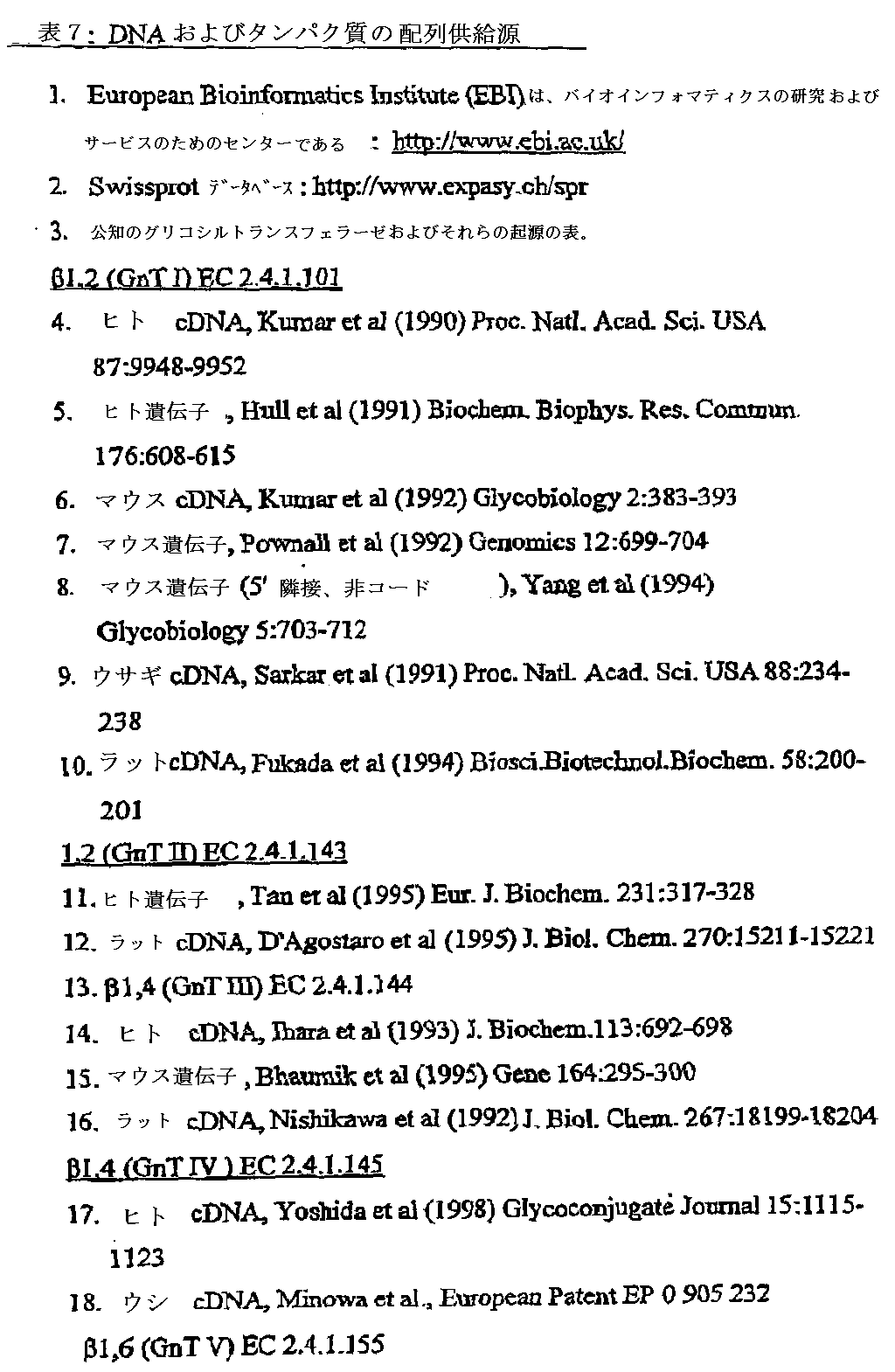
例を、表1に示す。
【0025】
【表1】
【0026】
Martinetら(Biotechnol.Lett.1998,20(12),1171〜1177)は、P.pastoris中でのTrichoderma reesei由来のα−1,2−マンノシダーゼの発現を報告した。モデルタンパク質のN−グリカンからのいくつかのマンノースの切り取りが観察された。しかし、このモデルタンパク質は、N−グリカン複合体の生成についての中間体として必要である構造Man5GlcNAc2を有するN−グリカンを有さなかった。従って、この方法は、ヒトまたは動物のグリコシル化パターンを有するタンパク質の産生については有用ではない。
【0027】
同様に、Chibaら(1998)は、Aspergillus saitoi由来のα−1,2−マンノシダーゼを、酵母Saccharomyces.cerevisiae中で発現させた。シグナルペプチド配列(His−Asp−Glu−Leu)が、外来性マンノシダーゼ中に操作されて、小胞体中での保持が促進される。さらに、この酵母宿主は、タンパク質の高マンノシル化に関連する以下の3つの酵素活性を欠失する変異体である:1,6−マンノシルトランスフェラーゼ(OCH1);1,3−マンノシルトランスフェラーゼ(MNN1);およびマンノシルホスフェートトランスフェラーゼ(MNN4)。従って、この三重変異体宿主のN−グリカンは、野生型S.cerevisiaeにおいてより多く見出される高マンノース形態よりも、むしろMan8GlcNAc2構造からなっていた。操作されたマンノシダーゼの存在下において、モデルタンパク質(カルボキシペプチダーゼY)のN−グリカンを切断し、27モル%Man5GlcNAc2、22モル%Man6GlcNAc2、22モル%Man7GlcNAc2、29モル%Man8GlcNAc2からなる混合物を得た。内在性細胞壁糖タンパク質の切断はそれほど効率的ではなく、N−グリカンの10モル%のみが所望されるMan5GlcNAc2構造を有する。
【0028】
Man5GlcNAc2グリカンのみが、さらなるヒトの糖形態(glycoform)への酵素による変換に対して感受性であり、この方法は、ヒトのグリコシル化パターンを有するタンパク質の産生について効率的ではない。単一のNグリコシル化部位を有するタンパク質において、少なくとも73モル%は、不正確な構造を有する。2つまたは3つのNグリコシル化部位を有するタンパク質において、それぞれ、少なくとも93モル%または98モル%が、不正確な構造を有する。このような低い変換効率は治療剤の産生にとって不充分である。これは、特に、異なる糖形態を有するタンパク質の分離が、典型的には費用がかかり、かつ困難であるからである。
【0029】
真菌類宿主に由来するさらなるヒト様糖タンパク質を産生する目的で、MarasおよびCounterasの米国特許第5,834,251号は、Trichoderma reesei由来のハイブリッド糖タンパク質を産生するための方法を開示する。ハイブリットN−グリカンは、コアのManα1−6アーム上にマンノース残基のみ、およびManα1−3アーム上に1つまたは2つの複合体アンテナを有する。この構造は有用性を有するが、この方法は、多くの酵素的工程がインビトロで実施されなければならず、これにより費用がかかり、そして時間も費やされるとういう不利益を有する。単離された酵素は、調製および維持のために費用がかかり、独特かつ費用のかかる基質(例えば、UDP−GlcNAcを必要とし得、そして使用条件下で活性消失および/またはタンパク質分解される傾向にある。
【0030】
従って、Pichia pastorisおよび他の下等真核生物(例えば、Hansenula polymorpha、Pichia stiptis、Pichia methanolica、Pichia sp、Kluyveromyces sp、Candida albicans、Aspergillus nidulans、およびTrichoderma ressei)において発現される組換え糖タンパク質のグリコシル化のヒト化のための系および方法を提供することが、本発明の目的である。
【0031】
(発明の要旨)
一連の酵素反応(これは、ヒトの糖タンパク質のプロセシングを模倣する)を達成することを可能にする遺伝的に改変されたグリコシル化経路を有する細胞株を開発した。これらの操作された宿主において発現される組換えタンパク質は、ヒトの対応物に対して実質的に同一ではないが、より類似する糖タンパク質を産生する。通常は高マンノース含有N−グリカンを産生する下等真核生物(Pichia stiptis、Hansenula polymorpha、Pichia pastoris、Pichia methanolica、Pichia sp.、Kluyveromyces sp.、Candida albicans、Aspergillus nidulans、およびTrichoderma resseiのような単細胞真菌類および多細胞真菌類を含む)は改変されて、Man5GlcNAc2またはヒトのグリコシル化経路に沿った他の構造のようなN−グリカンを産生する。これは、株の操作および/または選択の組み合わせを使用することによって達成される:真菌類の糖タンパク質の特徴である望まない複雑な構造をつくる特定の酵素を発現しない株、活性が所望される真菌内で存在する条件下で至適な活性を有する異種酵素を発現するようにか、または至適な活性が達成される細胞内小器官に標的化されるように選択された外来性酵素を発現する株、およびその組み合わせ。ここで、この遺伝的に操作された真核生物が、「ヒト様」糖タンパク質を産生するために必要とされる複数の異種酵素を発現する。
【0032】
第1の実施形態において、この微生物は、5.1と8.0との間(好ましくは、5.9と7.5との間)の至適pHを有する外来性α−1,2−マンノシダーゼ酵素を発現するように操作される。代替的に好ましい実施形態において、この外来性酵素は、その宿主生物体の小胞体またはゴルジ装置に標的化され、ここで、これは、例えば、Man8GlcNAc2のようなN−グリカンを切断し、Man5GlcNAc2を産生する。この後者の構造は有用である。なぜならば、これは、哺乳動物(特に、ヒト)で形成される構造と同一であり;これは、インビボおよび/またはインビトロにおける、さらなるグリコシル化反応のための基質であり、これが、哺乳動物(特に、ヒト)で形成されるN−グリカンと類似であるかまたは同一である最終的なN−グリカンを産生し;そして、これは、酵母および他の微生物においてインボで起こり、糖タンパク質に哺乳動物における高い免疫原性を与える高マンノシル化反応の基質ではないからである。
【0033】
第2の実施形態において、真核生物性の微生物のグリコシル化経路が以下によって改変される:(a)外来性グリコシル化酵素をコードする、少なくとも2つの遺伝子を含むDNAライブラリーを構築すること;(b)この微生物を、このライブラリーによって形質転換し、少なくとも2つの別個の異種グリコシル化酵素を発現する遺伝的に混在した集団を生成すること;(c)所望のグリコシル化表現型を有する微生物を、この集団から選択すること。好ましい実施形態において、このDNAライブラリーは、各々がタンパク質局在化配列と、グリコシル化活性に関連する触媒活性とをコードするキメラ遺伝子を含む。この方法を使用して改変された生物は、哺乳動物(特に、ヒト)に類似するか、または同一であるグリコシル化パターンを有する糖タンパク質の産生に有用である。
【0034】
第3の実施形態において、このグリコシル化経路は、改変されて、糖ヌクレオチド輸送因子酵素を発現する。好ましい実施形態において、ヌクレオチドジホスファターゼ酵素がまた発現される。この輸送因子およびジホスファターゼは、適切な区画にグリコシル化酵素に適切な基質を提供し、競合的産物阻害を減少し、そして、ヌクレオシドジホスファターゼの除去を促進することによって、操作されたグリコシル化工程の効率を改善する。
【0035】
(発明の詳細な説明)
本明細書中に記載の、方法および組換え下等真核生物株が使用され、「ヒト化糖タンパク質」が産生される。この組換え下等真核生物は、高次のマンノース構造の産生に関与する1つ以上の酵素を発現しない下等真核生物を操作することによって、産生して、ヒト様の糖を産生するために必要な酵素を発現する。本明細書中で使用される場合、下等真核生物は、単細胞性真菌類または線状菌である。本明細書中で使用される場合、「ヒト化糖タンパク質」とは、4つ未満の残基を含むN−グリカンに結合するタンパク質をいい、そして少なくともの5つのマンノース残基を有するこの合成中間体(これはまた、有用であり、さらにインビトロで操作され得る)をいう。好ましい実施形態において、組換え下等真核生物株で産生される糖タンパク質は、少なくとも27モル%のMan5中間体を含む。これは、より良好なマンノシダーゼ(すなわち、タンパク質がグリコシル化される部位において、この生物中に存在する条件下で至適な活性を有するように選択される酵素)でクローニングすることによってか、または活性が所望される場合に細胞小器官にこの酵素を標的化することによって達成される。
【0036】
好ましい実施形態において、高次のマンノース構造の産生に関与する1つ以上の酵素を発現しない真核生物が使用される。これらの株は、操作され得るか、または、多くのこのような変異体(Pichia pastorisおける高マンノシル化−マイナス(OCH1)変異体)の1つが、酵母においてすでに記載されている。
【0037】
この株が同時に操作された1つの酵素であり得るか、または潜在的に有用な酵素をコードする遺伝子のライブラリーが生成され得、そして至適な活性を伴うかまたは最も「ヒト様」である糖タンパク質を産生する酵素を有するこれらの株が選択され得る。
【0038】
付着されるN−グリカンMan5GlcNAc2を有する糖タンパク質を産生する下等真核生物は、特に有用である。なぜならば(a)これらは高い程度のマンノシル化(例えば、1つのN−グリカン当たり8を超えるマンノース、または特に30〜40のマンノース)を欠失しており、これはヒトにおける免疫原性を減少し;そして(b)このN−グリカンが、さらなるグリコシル化反応の基質であり、(例えば、GlcNAcMan5GlcNAc2を形成するGlcNAcトランスフェラーゼIの作用によって)よりヒト様の糖形態さえも形成するからである。Man5GlcNAc2は、少なくとも一過的に、インビボにて高収率で形成されなければならない。なぜならば、全てのこれに続くグリコシル化反応は、Man5GlcNAc2またはこの誘導体を必要とするからである。従って、高比率のN−グリカンがMan5GlcNAc2を有する、27モル%を超える、より好ましくは、50〜100モル%の糖タンパク質の収率が得られる。従って、例えば、MarasおよびConterasの米国特許第5,834,251号の方法を使用するインビトロでのさらなるグリコシル化反応を実施することが可能である。好ましい実施形態において、少なくとも1つのさらなるグリコシル化反応が、インビボで実施される。その高度に好ましい実施形態において、グリコシル化酵素の活性形態は、小胞体および/またはゴルジ装置において発現される。
【0039】
(宿主微生物)
酵母および線状菌の両方は、細胞内にあり、そして分泌される、組換えタンパク質の産生のために首尾良く使用される(Cereghino、J.L.およびJ.M.Cregg 2000FEMS Microbiology Reviews 24(1)45−66;Harkki,Aら,1989 Bio−Technology 7(6):596;Berka,R.M.ら,1992 Abstr.Papers Amer.Chem.Soc.203:121−BIOT;Svetina,M.ら,2000 J.Biotechnol.76(2−3):245−251。
【0040】
酵母および真菌類におけるグリコシル化は、ヒトにおけるグリコシル化と非常に異なっているが、いくつかの共通のエレメントが共有される。第1の工程、新生のタンパク質へのコアオリゴ糖構造の移入は、酵母、真菌類、植物およびヒトを含む全ての真核生物において高度に保存されている(図1Aおよび図1Bを比較のこと)。しかし、続くこのコアオリゴ糖のプロセシングは、酵母において有意に異なり、そして、いくつかのマンノース糖の付加を含む。この工程は、ゴルジにおいて存在するマンノシルトランスフェラーゼ(例えば、OCH1、MNT1、MNN1など)によって触媒され、マンノース糖をコアオリゴ糖に連続して付加する。この得られた構造は、ヒト類似タンパク質の産生にとって望ましいものではなく、従って、マンノシルトランスフェラーゼ活性を低減するか、またはこれを除去することが所望される。マンノシルトランスフェラーゼ活性が欠損している、S.cerevisiaeの変異体(例えば、och1変異体またはmnn9変異体)が、非致死的であり、そして酵母のオリゴ糖の中で減少したマンノース含有量を提示することが示される。他のオリゴ糖プロセシング酵素(例えば、マンノシルホスフェートトラスフェラーゼ)はまたは、宿主の特定の内因性グリコシル化パターンに依存して、除去され得る。望まない内因性グリコシル化反応の低減後に、N−グリカン複合体の形成は宿主系中へと操作される必要がある。これは、いくつかの酵素および糖ヌクレオチド輸送因子の安定発現を必要とする。さらに、成熟グリコシル化構造の連続的なプロシングを確認するような様式で、これらの酵素を位置付ける必要がある。
【0041】
(標的糖タンパク質)
本明細書中に記載の方法は、糖タンパク質、特に、ヒトにおいて治療的に使用される糖タンパク質の産生に有用である。このような治療タンパク質は、代表的には、注射手段、経口手段、経肺手段、または他の手段によって投与される。
【0042】
適切な標的糖タンパク質の例としては、以下が含まれるが、これらに限定しなされない:エリスロポエチン、サイトカイン(例えば、インターフェロン−α、インターフェロン−β、インターフェロン−γ、インターフェロン−ω、および顆粒球CSF)、凝固因子(例えば、第VIII因子、第IX因子、およびヒトプロテインC)、可溶性IgEレセプターα鎖、IgG、IgM、ウロキナーゼ、チマーゼ、および尿素トリプシンインヒビター、IGF結合タンパク質、表皮増殖因子、成長ホルモン放出因子、アネキシンV融合タンパク質、アンギオスタチン、血管内皮増殖因子−2、骨髄前駆阻害因子−1およびオステオプロテゲリン(osteoprotegerin)。
【0043】
(N−グリカン Man5GlcNAc2を含む、糖タンパク質を産生方法)
第1の工程は、Man5GlcNAc2の特異的な前駆体構造を産生することが可能な下等真核生物の選択または生成を含む。このMan5GlcNAc2は、GlcNAcトランスフェラーゼIの作用によって、インビボGlcNAcを受容することが可能である。この工程は、Man5GlcNAc2の特定の異性体構造の形成を必要とする。この構造は、細胞内にて高収率(30%の余剰)で形成される必要がある。なぜならば、全ての続く操作は、この前駆体の存在を条件とするからである。Man5GlcNAc2構造は、N−グリカン複合体形成に必要であるが、しかし、これらの存在は決して十分ではない。なぜならば、Man5GlcNAc2は、異なる異性体形態で存在し得、これはGlcNAcトランスフェラーゼIに対する基質としての役割を果たしても、果たさなくてもよい。ほとんどの、グリコシル化反応は完全ではなく、従って、特定のタンパク質は、一般にその表面において異なった炭水化物構造(すなわち、糖形態)の範囲を含む。Man5GlcNAc2のような特定の構造の微量(5%未満)の存在のみでは、実際の信頼性はほとんどない。必要とされているものは、高収率(約30%を超える)での特定のGlcNAcトランスフェラーゼI受容中間体(構造I)の形成である。この中間体の形成は必要であり、ついで、N−グリカン複合体のインビボ合成を可能にする。
【0044】
このような下等真核生物を、天然に存在するかあるいは遺伝子操作で生じた真菌または下等真核生物から選択し得、インビトロでこの構造を提供する。下等真核生物が、総N−グリカンのうち1.8%を超えるこのような構造をインビトロで産生することを示されておらず(Marasら、1997)、そして遺伝的に操作された生物体が好ましい。米国特許第5、595、900号に記載の方法のような方法を使用して、目的の標的生物体内で、特定のグリコシルトランスフェラーゼ、マンノシダーゼおよび糖ヌクレオチド輸送因子の存在または非存在を同定し得る。
【0045】
(1,2−αマンノシダーゼのような真菌性グリコシル化酵素の不活性化)
本明細書中に記載の方法を使用して、以下の広範囲の下等真核生物のグリコシル化を操作し得る:例えば、Hansenula polymorpha、Pichia stiptis、Pichia methanolica、Pichia sp、Kluyveromyces sp、Candida albicans、Aspergillus nidulans、Trichoderma resseiなど。Pichia pastorisを使用して、必要とされる操作工程を例示する。他の下等真核生物と同様に、P.pastorisは、そのER中にMan9GlcNAc2構造を保持し、1,2−マンノシダーゼでMan8GlcNAc2を産生する。次いで、いくつかのマンノシルトランスフェラーゼ作用を介して、この構造は、マンナンとして公知の高マンノシル化構造(Man>9GlcNAc2)に変換される。さらに、P.pastorisは、炭水化物構造に対するマンノシルホスフェートトランスフェラーゼの作用を介して非末端リン酸基を付加し得る。これは、哺乳動物細胞で見出された反応とは逆であり、これは、これらの付加とは対照的にマンノース糖の除去を含む。存在するMan8GlcNAc2構造を高マンノシル化する真菌類の能力を除去することは重要である。これは、高マンノシル化しない真菌を選択するか、またはこのような真菌を操作するかのいずれかによって達成され得る。
【0046】
このプロセスに関与する遺伝子が、Pichia pastorisで同定され、そして、変異をこれらの遺伝子の中で生成することによって、「望まない」糖形態の産生を低減し得る。このような遺伝子は、他の下等真核生物(例えば、C.albicans、Pichia angusta、またはS.cerevisiae)において見出される、存在するマンノシルトランスフェラーゼ(例えば、OCH1、MNN4、MNN6、MNN1)に対する相同性によってか、または、宿主株を変異誘発し、減少したマンノシル化を有する表現型ついて選択することによって同定され得る。公知のマンノシルトランスフェラーゼおよびマンノシルフォスファターゼトランスフェラーゼの間の相同性に基づいて、PCRプライマー(この例は、表2に示される)を設計し得るか、または、標的生物のDNAライブラリーにおけるホモログを同定するためのプローブとしてこのような酵素をコードする遺伝子フラグメントを使用し得る。あるいは、関連する生物種において特定の表現型を補完し得る。例えば、P.pastorisにおける1,6−マンノシルトランスフェラーゼ活性をコードする遺伝子を得るために、以下の工程を実施し得る。S.cerevisiaeのOCH1変異体は、温度感性であり、上昇した温度においては遅く増殖する。従って、P.pastorisにおけるOCH1の機能的なホモログを、P.pastorisのDNAまたはcDNAライブラリーを用いて、S.cerevisiaeのOCH1変異体を相補体化することによって同定し得る。S.cerevisiaeのこのような変異体は、http://genome−www.stanford.edu/Saccharomycesで見出され、http://www.resgen.com/products/YEASTD.php3にて市販されている。P.pastoris DNAライブラリーで形質転換された後に、上昇した温度における正常な増殖の表現型を提示する変異体は、P.pastorisのOCH1ホモログを保持し得る。このようなライブラリーは、適切な制限酵素を用いてP.pastorisの染色体DNAを部分的に消化し得、そして、この制限酵素を不活化した後に、この消化されたDNAを適切なベクターに連結することによって生成し得、ここで、このベクターは適合可能な制限酵素で消化されている。適切なベクターは、pRS314またはpFL44Sである。ここで、pRS314は、Trp1マーカー(Sikorski,R.S.およびHieter,P.,1989,Genetics 122,19〜27頁)を含むpBluescriptに基づいた低コピー(CEN6/ARS4)プラスミドであり、pFL44Sは、URA3マーカー(Bonneaud,N.ら、1991、Yeast 7、609−615頁)を含む改変pUC19に基づいた高コピー(2μ)プライスミドである。このようなベクターは、学術的な研究者によって一般的に使用され、また類似のベクターが、多くの異なる供給業者(例えば、Invitorogen(Carlsbad,CA)、Parmacia(Piscataway,NJ)、New England Biolabs(Beverly,MA))から入手可能である。例としては、pYES/GS(Invitorogen製の2μ複製開始点に基づく酵母発現ベクター)またはNew England Biolabs製のYep24クローニングビヒクルである。染色体DNAおよびこのベクターの連結後に、このDNAライブラリーを、特定の変異を有するS.cerevisiaeの株に形質転換し得、対応する表現型の補正について選択し得る。野生型表現型を回復するDNAフラグメントのサブクローニングおよび配列決定の後、このフラグメントを使用して、P.pastorisのOCH1によってコードされる遺伝子産物の活性を除去し得る。
【0047】
あるいは、目的の特定の真菌の完全ゲノム配列が、公知である場合、NCBI、Swissprotなどのようないくつかの供給源から利用可能である、公的に利用可能なDNAデータベースを検索することによって簡単にこのような遺伝子を同定し得る。例えば、S.cerevisiae由来の公知の1,6マンノシルトランスフェラーゼ遺伝子(OCH1)で所定のゲノム配列またはデータベースを検索することによって、このようなゲノムにおいて、高度の確実性で、1,6マンノシルトランスフェラーゼ活性を有する遺伝子をコードする、高い相同性の遺伝子の同定をし得る。P.pastorisにおけるS.cerevisiae由来のいくつかの公知のマンノシルトランスフェラーゼに対するホモログは、これらのアプローチのいずれか1つを使用して同定されている。これらの遺伝子は、S.cerevisiaeにおけるタンパク質のマンノシル化に関与する遺伝子に類似の機能を有し、従って、これらの欠失を使用して、P.pastorisまたは類似のグリコシル化経路を有する任意の他の真菌のグリコシル化パターンを操作し得る。
【0048】
一旦、所定の標的遺伝子配列が、決定されると、遺伝子ノックアウトの作製は、酵母および真菌の分子生物分野において十分に確立された技術であり、そして当業者であれば誰でも実施し得る(R.Rothsteins,(1991)Method in Enzymology,第194巻、281頁)。事実、宿主生物体の選択は、このような宿主に対する良好な形質転換および遺伝子破壊技術の利用可能性によって影響を受け得る。いくつかのマンノシルトランスフェラーゼが、ノックアウトされる必要がある場合、AlaniおよびKlecknerによって開発された方法は、URA3マーカーの反復使用により、全ての所望ではない内因性マンノシルトランスフェラーゼ活性を連続して除去することを可能にする。この技術は、他のものによって洗練されたが、基本的に、対選択マーカーに隣接する、2つの反復DNA配列の使用を含む。例えば:URA3を、マーカーとして使用して、構築物を組み込んだ形質転換体の選択を保証し得る。URA3マーカーを直接反復と隣接させることによって、構築物が組み込まれ、それによって、標的遺伝子を破壊された形質転換体を最初に選択し得る。形質転換体の単離およびこれらの特徴付けの後、5’FOAに耐性である形質転換体を第2ランドで対選択し得る。5’FOAを含むプレート上で生存し得るコロニーは、以前に言及した反復に関与する交差現象を介して再びURA3マーカーを失う。従って、このアプローチは、同じマーカーの反復使用を可能にし、そしてさらなるマーカーを必要とすることなく複数の遺伝子の破壊を容易にする。
【0049】
P.pastoris中の特定のマンノシルトランスフェラーゼ(例えば、1,6マンノシルトランスフェラーゼ(OCH1)、マンノシルリン酸トランスフェラーゼ(MNN4、MNN6、またはlbd変異を相補する遺伝子))の除去は、主にMan8GlcNAc2を合成するこの生物体の操作された株の作製を可能にし、従って、グリコシル化パターンをより複雑なヒト糖形態構造により密に類似するようにさらに改変するために使用され得る。この方法の好ましい実施形態は、既知の生化学的グリコシル化活性をコードする、既知のDNA配列を利用して、P.pastorisにおける類似または同一の生化学的機能を除去し、その結果、得られた遺伝的に改変されたP.pastoris株のグリコシル化構造は、改変される。
【0050】
(表2)
【0051】
【表2】
本明細書中に記載されるプロセスは、複合N−グリカンを生成するために、このような構造を改変する目的でこのような構造を高収率で得ることを可能にする。適切なMan2GlcNAc2構造を得るための首尾よいスキームは、高レベルの適切なMan2GlcNAc2構造を得るための以下の2つの平行したアプローチを含まなければならない:(1)内因性マンノシルトランスフェラーゼ活性の減少および(2)マンノシダーゼによって1,2−α−マンノースの除去。この方法と先行技術を区別するものは、これらの2つの問題を直接的に扱うことである。Chibaおよび共同研究者の研究が、実証するように、A.saitoi由来の真菌マンノシダーゼの存在をERへと操作することによって、S.cerevisiaeにおいてMan8GlcNAc2構造をMan5GlcNAc2異性体に還元し得る。これのアプローチの欠点は、以下の2つの要素である:(1)不十分な量のMan2GlcNAc2が、細胞外糖タンパク質画分に形成される(10%)こと、および(2)インビボで形成されるMan5GlcNAc2構造が、事実、GlcNAcトランスフェラーゼIの作用によってGlcNAcを受け入れ得ることが明らかではないこと。いくつかのグリコシル化部位が、所望のタンパク質に存在する場合、正確な形態でこのようなタンパク質を得る確率(P)は、P=(F)nの関係に従う。ここでnは、グリコシル化部位の数と等価であり、そしてFは、所望の糖形態割合と等価である。3つのグリコシル化部位を有する糖タンパク質は、全てのそのグリコシル化部位における複合N−グリカンおよびハイブリッドN−グリカンのプロセシングについての適切な前駆体を提供する、0.1%の機会を有する(これらは、このようなアプローチの商業的な価値を制限する)。
【0052】
S.cerevisiaeのERおよびゴルジ装置において活性である多くの酵素は、6.5と7.5との間の至適pHを有する(表3を参照のこと)。組換えマンノシダーゼの作用によってマンノシル化を減少させる以前の全てのアプローチは、約pH5.0の至適pHを有する酵素に集中しているが(Martinetら,1998およびChibaら,1998)、これらの酵素の活性は、pH7.0で10%未満に減少し、従って、使用の時点(P.pastorisおよびS.cerevisiaeのERおよび初期ゴルジ)において不十分な活性を提供する可能性がある。好ましいプロセスは、インビボでマンノシダーゼを利用する。ここでマンノシダーゼの至適pHは、同じオルガネラに局在する他の代表的なマーカー酵素の平均至適pHの1.4pH単位内である。特定のオルガネラに標的化される酵素の至適pHは、酵素単位あたり最大の活性が得られるように、同じオルガネラに見出される他の酵素の至適pHと一致されるべきである。表3は、種々の供給源由来のマンノシダーゼの活性およびそれぞれの至適pHを要約する。表4は、それらの位置を要約する。
【0053】
(表3.マンノシダーゼおよびそれらの至適pH)
【0054】
【表3】
【0055】
(ERおよびゴルジにおける1,2−マンノシダーゼ活性)
クローン化された外来性マンノシダーゼの作用によるマンノシル化を減少する以前のアプローチは、構造Man5GlcNAc2を有する十分な割合(例えば、27モル%より多い)のN−グルカンを有する糖タンパク質を得るのに失敗している(Martinetら,1998およびChibaら,1998)。これらの酵素は、新生糖タンパク質を変換するのに効果的であるようにERまたはゴルジ装置において十分に機能するはずである。先行技術において利用される2つのマンノシダーゼ(A.saitoiおよびT.reesei由来)は、5.0の至適pHを有するが、酵母(例えば、S.cerevisiae)のERおよびゴルジ装置において活性である多くの酵素は、6.5と7.5との間の至適pHを有する(表3を参照のこと)。タンパク質のグルコシル化は、非常に進歩して、効率的なプロセスであるので、ERおよびゴルジの内部pHはまた、約6〜8の範囲であることが結論され得る。pH7.0において、先行技術において使用されるマンノシダーゼの活性は、10%未満に減少し、これは、インビボでのMan5GlcNAc2の効果的な産生に不十分である。
【0056】
(表4.S.cerevisiaeの種々のグリコシル化関連酵素の細胞局在および至適pH)
【0057】
【表4】
【0058】
(複合N−グリカンの形成)
プロセスの第2の工程は、ゴルジ装置へのグルコシルトランスフェラーゼの発現を操作することによる、新生炭化水素構造への糖の連続的な付加を含む。このプロセスは、第1に、初期または中間ゴルジ装置におけるGnT Iの機能的な発現およびUDP−GlcNAcの十分な供給を保証することが必要である。
【0059】
(組み込み部位)
この遺伝子操作の努力の最終的な目的は、工業的な発酵プロセスにおいて十分に実施し得る頑強なタンパク質産生株であるので、真菌染色体への複数の遺伝子の組み込みは、注意深い計画が必要である。操作される株は、おそらく、異なる範囲の遺伝子で形質転換されなければならず、そしてこれらの遺伝子は、所望の活性が発酵プロセスを通して維持されることを保証するために安定な様式において形質転換されなければならない。以下の酵素活性の任意の組み合わせが、真菌タンパク質発現宿主に操作される必要がある:シアリルトランスフェラーゼ、マンノシダーゼ、フコシルトランスフェラーゼ、ガラクトシルトランスフェラーゼ、グルコシルトランスフェラーゼ、GlcNAcトランスフェラーゼ、ERおよびゴルジ特異的輸送因子(例えば、UDP−ガラクトースおよび他の前駆体についてのシンポートおよびアンチポート輸送因子)、オリゴ糖のプロセシングに関与する他の酵素ならびにUDP−ガラクトース、CMP−N−アセチルノイラミン酸のような活性化オリゴ糖前駆体の合成に関与する酵素。同時に、非ヒトグリコシル化反応に特徴的であることが公知の酵素をコードする多くの遺伝子は、欠失される必要がある。
【0060】
(特定のオルガネラへのグリコシルトランスフェラーゼの標的化)
グリコシルトランスフェラーゼおよびマンノシダーゼは、ERおよびゴルジ装置の内部(内腔)表面に並び、それによって糖タンパク質が、ERおよびゴルジ装置ネットワークを通って進む場合、糖タンパク質の連続的なプロセシングを可能にする「触媒的な」表面を提供する。事実、シスゴルジ、中間ゴルジおよびトランスゴルジならびにトランスゴルジネットワーク(TGN)の複数の区画は、異なる場を提供し、ここで、順序付けられた連続するグリコシル化反応が生じ得る。糖タンパク質が、ERでの合成から後期ゴルジまたはTGNでの十分な成熟まで進む場合、異なるグルコシダーゼ、マンノシダーゼおよびグリコシルトランスフェラーゼに連続的に曝露され、その結果、特定の炭化水素構造が、合成され得る。これらの酵素が、それぞれのオルガネラに保持および係留される正確な機構を明らかにするために多くの研究がなされてきた。進化した絵(evolving picture)は、複雑であるが、証拠は、幹領域、膜貫通領域および細胞質テイルが、個々にまたは協調して、個々のオルガネラの膜に酵素を指向し、それによってその位置に関連する触媒的ドメインを局在化することを示唆する。
【0061】
標的化配列は、標的化配列および標的化される酵素の選択のためのライブラリーに関して以下にさらに詳細に考察されるように、科学文献および公的データベースにおいて周知であり、そして記載される。
【0062】
(改変されたグリコシル化経路を産生するライブラリーを作製するための方法)
外来性のグリコシル化酵素をコードする少なくとも2つの遺伝子を含むライブラリーは、宿主生物体に形質転換され、遺伝的に混合された集団を作製する。次いで、所望のグリコシル化表現型を有する形質転換体は、混合された集団から選択される。好ましい実施形態において、宿主生物体は、酵母(特に、P.pastoris)であり、そして宿主グリコシル化経路は、1つ以上のヒトまたは動物グリコシル化酵素の作動的な発現によって改変され、ヒト糖形態に類似または同一のタンパク質N−グリカンを生成する。特定の好ましい実施形態において、DNAライブラリーは、グリコシル化に関与する種々の細胞の部位(特に、ER、シスゴルジ、中間ゴルジまたはトランスゴルジ)に対する標的化配列とグリコシル化酵素の融合体をコードする遺伝子構築物を含む。
【0063】
この方法を使用してもたらされ得るグリコシル化に対する改変の例は、以下である:(1)タンパク質N−グリカンとしてMan5GlcNAc2を得るために、Man8GlcNAc2からマンノース残基を切り取るように真核微生物を操作すること;(2)GlcNAcトランスフェラーゼIの作用によってMan5GlcNAc2にN−アセチルグルコサミン(GlcNAc)残基を付加するように真核微生物を操作すること;(3)N−アセチルグルコサミントランスフェラーゼ(GnT I、GnT II、GnT III、GNT IV、GnT V、GnT VI)、マンノシダーゼII、フコシルトランスフェラーゼ、ガラクトシルトランスフェラーゼ(Gal T)またはシアリルトランスフェラーゼ(ST)のような酵素を機能的に発現するように真核微生物を操作すること。
【0064】
この方法を繰り返すことによって、徐々に、複雑なグルコシル化経路が、標的微生物に操作され得る。1つの好ましい実施形態において、宿主生物体は、グルコシル化活性をコードする配列を含むDNAライブラリーを用いて2回またそれより多く形質転換される。所望の表現型の選択は、形質転換の各回の後、あるいは、いくつかの形質転換体が、生じた後、実施され得る。複雑なグリコシル化経路は、この様式において迅速に操作され得る。
【0065】
(DNAライブラリー)
グリコシル化酵素をコードする少なくとも2つの外来性遺伝子を含むDNAライブラリーを構築することが必要であるオープンリーディングフレーム配列に加えて、宿主生物体への形質転換において遺伝子の効果的な転写および翻訳を保証し得るような、プロモーター、転写ターミネーター、エンハンサー、リボソーム結合部位および他の機能的配列を各ライブラリー構築物を提供することが一般に、好ましい。宿主が、Pichia pastorisである場合、適切なプロモーターとしては、例えば、AOX1、AOX2、DASおよびP40プロモーターが挙げられる。各構築物に少なくとも1つの選択マーカー(例えば、薬剤耐性を与える遺伝子または宿主代謝破壊を相補する遺伝子)を提供することもまた好ましい。マーカーの存在は、その後の形質転換体の選択に有用である;例えば、酵母において、URA3、HIS4、SUC2、G418、BLAまたはSHBLE遺伝子が、使用され得る。
【0066】
いくつかの場合において、ライブラリーは、既存の遺伝子または野生型遺伝子から直接的に構築され得る。しかし、好ましい実施形態において、DNAライブラリーは、2つ以上のサブライブラリーの融合体から構築される。サブライブラリーのインフレーム連結によって、有用な標的化されるグリコシル化活性をコードする多数の新規の遺伝的構築物を作製することを可能にする。例えば、1つの有用なサブライブラリーは、シアリルトランスフェラーゼ、マンノシダーゼ、フコシルトランスフェラーゼ、ガラクトシルトランスフェラーゼ、グルコシルトランスフェラーゼおよびGlcNAcトランスフェラーゼのような酵素の任意の組み合わせをコードするDNA配列を含む。好ましくは、この酵素は、ヒト起源であるが、他の哺乳動物、動物または真菌の酵素もまた、有用である。好ましい実施形態において、遺伝子は、短縮化されて、酵素の触媒ドメインをコードするフラグメントを与える。内因性の標的化配列を除去することによって、次いで、この酵素は、他の細胞部位に再指向され得、そして発現され得る。このような触媒ドメインの選択は、その触媒ドメインが、引き続いて活性である、特定の環境の知識によって導かれ得る。例えば、特定のグリコシル化酵素が、後期ゴルジにおいて活性であり、そして後期ゴルジにおける宿主生物体の全ての公知の酵素が、特定の至適pHを有する場合、そのpHにおいて十分な活性を示す触媒ドメインが、選択される。
【0067】
別の有用なサブライブラリーは、ER、ゴルジ、またはトランスゴルジ網内の特定の位置へのタンパク質の局在化を生じるシグナルペプチドをコードするDNA配列を含む。これらのシグナル配列は、宿主生物体および他の関連生物体または非関連生物体から選択され得る。ERまたはゴルジの膜結合タンパク質は、代表的に、例えば、細胞質末尾(ct)、膜貫通ドメイン(tmd)、およびステム領域(sr)をコードするN末端配列を含み得る。ct配列、tmd配列、およびsr配列は、個々に十分であるかまたは細胞小器官の内側(管腔側)の膜に対するアンカータンパク質と組合される。従って、シグナル配列のサブライブラリーの好ましい実施形態は、これらのタンパク質由来のct配列、tmd配列、および/またはsr配列を含む。いくつかの場合において、変動する長さのsr配列を有するサブライブラリーを提供することが望ましい。これは、細胞質領域をコードするDNAの5’末端に結合するプライマーを使用し、そしてステム領域の種々の部分に結合する一連の対向プライマーを利用するPCRによって達成され得る。シグナル配列のなお他の有用な供給源としては、回収シグナルペプチド(例えば、テトラペプチドのHDELまたはKDEL)が挙げられ、これらは、ERまたはゴルジに逆行して輸送されるタンパク質のC末端で代表的に見出される。シグナル配列のなお他の供給源としては、(a)II型膜タンパク質、(b)表3に列挙した酵素、(c)ゴルジに局在化する膜貫通ヌクレオチド糖質輸送因子、および(d)表5に参照される配列、が挙げられる。
【0068】
(表5:有用な区画標的化配列の供給源)
【0069】
【表5】
【0070】
好ましい実施形態において、次いで、DNAライブラリーは、グリコシル化酵素またはその触媒的に活性なフラグメントをコードするDNAを含むサブライブラリーとの、シグナル配列をコードするDNAを含むサブライブラリーのインフレーム連結によって構築される。得られたライブラリーは、融合タンパク質をコードする合成遺伝子を含む。いくつかの場合において、融合タンパク質のN末端にシグナル配列を提供することが望ましいか、または他の場合において、C末端にシグナル配列を提供することが望ましい。いくつかの場合において、シグナル配列は、酵素のオープンリーディングフレーム内に挿入され得、但し、個々の折り畳まれたドメインのタンパク質構造は破壊されない。
【0071】
本方法は、宿主に形質転換されたDNAライブラリーが広い多様性の配列を含む場合、最も有効であり、これによって少なくとも1つの形質転換体が所望の表現型を提示する確率を増加させる。従って、形質転換の前に、DNAライブラリーまたは構成要素のサブライブラリーは、遺伝子シャッフリング、エラー傾向性(error prone)PCR、またはインビトロでの変異誘発に1回以上供され得る。
【0072】
(形質転換)
次いで、DNAライブラリーは、宿主生物体に形質転換される。酵母において、DNA移入の任意の簡便な方法(例えば、エレクトロポレーション、塩化リチウム法、またはスフェロプラスト法)が、用いられ得る。高密度の発酵に適切な安定な株を産生するために、宿主の染色体中にDNAライブラリー構築物を組み込むことが望ましい。好ましい実施形態において、組込みは、当該分野で公知の技術を用いて相同組換えによって生じる。例えば、DNAライブラリーエレメントは、宿主生物体の配列に対して相同な隣接配列とともに提供される。この様式において、組込みは、所望の遺伝子または必須遺伝子の破壊なしに、宿主のゲノム中の規定の部位に生じる。特に好ましい実施形態において、ライブラリーDNAは、宿主染色体中の望ましくない遺伝子の部位に組み込まれ、この遺伝子の破壊または欠失をもたらす。例えば、OCH1遺伝子、MNN1遺伝子、またはMNN4遺伝子の部位中への組込みは、糖タンパク質の酵母の高マンノシル化に関連する酵素の発現を抑制しながら、所望のライブラリーDNAの発現を可能にする。他の実施形態において、ライブラリーDNAは、染色体、プラスミド、レトロウイルスベクター、または宿主ゲノムへのランダムな組込みを介して宿主に導入され得る。いかなる場合においても、安定に形質転換された宿主生物体の迅速な選択を可能にするために、各ライブラリーDNA構築物とともに少なくとも1つの選択マーカー遺伝子を含むことが一般的に望ましい。リサイクル可能なマーカー遺伝子(例えば、ura3)(これは、マーカー遺伝子についてかまたはマーカー遺伝子に対して選択可能である)は、特に適切である。
【0073】
(選択プロセス)
DNAライブラリーを用いた宿主株の形質転換の後、所望のグリコシル化表現型を示す形質転換体が、選択される。選択は、単一工程においてか、またはいずれかの種々のアッセイおよび/もしくは検出方法を用いる、一連の表現型の富化および/または枯渇の工程によって実施され得る。表現型の特徴付けは、手動でかまたは自動化ハイスループットスクリーニング装置を用いて実施され得る。一般に、宿主微生物は、種々の糖タンパク質が局在する細胞表面上のタンパク質N−グリカンを提示する。従って、インタクトな細胞は、これらの細胞を所望のN−グリカンに特異的に結合するレクチンまたは抗体に曝露することによって、所望のグリコシル化表現型についてスクリーニングされ得る。多種多様なオリゴ糖特異的レクチンは、市販されている(EY Laboratories,San Mateo,CA)。あるいは、ヒトまたは動物のN−グリカンに特異的な抗体は、市販されているか、または標準的技術を用いて産生され得る。適切なレクチンまたは抗体は、レポーター分子(例えば、発色団、フルオロフォア、放射性同位体、または色素生産性基質を有する酵素(Guillenら,1998.Proc.Natl.Acad.Sci.USA 95(14):7888−7892))に結合体化され得る。次いで、スクリーニングする工程は、分析方法(例えば、分光光度法、蛍光定量法、蛍光活性セルソーター法(fluorescence activated cell sorting)、またはシンチレーションカウンター法)を用いて実施され得る。他の場合において、形質転換された細胞から単離された糖タンパク質またはN−グリカンを分析する必要性があり得る。タンパク質の単離は、当該分野で公知の技術によって実施され得る。単離されたN−グリカンが必要とされる場合、酵素(例えば、エンド−β−N−アセチルグルコサミニダーゼ(Genzyme Co.,Boston,MA))を用いて、糖タンパク質からN−グリカンを切断し得る。次いで、単離されたタンパク質またはN−グリカンは、液体クロマトグラフィー(例えば、HPLC)、質量分析、または他の適切な手段によって分析され得る。米国特許番号第5,595,900号は、所望の細胞外炭水化物構造を有する細胞を同定し得るいくつかの方法を教示している。所望の形質転換体の選択の前に、望ましくない表現型を有する細胞の形質転換された集団を枯渇させることが望まれ得る。例えば、本方法を用いて、機能的マンノシダーゼ活性を細胞中に操作する場合、所望の形質転換体は、細胞の糖タンパク質において低レベルのマンノースを有する。形質転換された集団を培地中でマンノースの致死的な放射線同位体に曝露することは、望ましくない表現型(すなわち、高レベルで組み込まれたマンノース)を有する形質転換体の集団を枯渇させる。あるいは、望ましくないN−グリカンに対する細胞傷害性レクチンまたは抗体を用いて、望ましくない表現型の形質転換された集団を枯渇させ得る。
【0074】
(ゴルジ装置に糖ヌクレオチド前駆体を提供するための方法)
ゴルジにおいて十分に機能するグリコシルトランスフェラーゼについて、酵素は、十分な濃度の適切なヌクレオチド糖とともに提供される必要があり、新生糖タンパク質に付加された糖部分の高エネルギードナーである。適切な区画へのこれらのヌクレオチド糖は、宿主微生物における糖ヌクレオチド輸送因子をコードする外因性遺伝子を発現することによって提供される。輸送因子酵素の選択は、用いられる外因性グリコシルトランスフェラーゼの性質によって影響される。例えば、GluNAcトランスフェラーゼは、UDP−GlcNAc輸送因子を必要とし得るか、フコシルトランスフェラーゼは、GDPフコース輸送因子を必要とし得るか、ガラクトシルトランスフェラーゼは、UDPガラクトース輸送因子を必要とし得るか、またはシアル酸トランスフェラーゼは、CMPシアル酸輸送因子を必要とし得る。
【0075】
付加された輸送因子タンパク質は、細胞質ゾルからゴルジ装置へとヌクレオチド糖を輸送し、ここで、このヌクレオチド糖は、グリコシルトランスフェラーゼによって、例えば、N−グリカンを伸長するように反応され得る。この反応は、ヌクレオシド二リン酸またはヌクレオシド一リン酸(例えば、UDP、GDP、またはCMP)を遊離する。ヌクレオシド二リン酸の蓄積がグリコシルトランスフェラーゼのさらなる活性を阻害する場合、ヌクレオチドジホスファターゼをコードする遺伝子の発現コピーを提供することもまた、頻繁に望ましい。このジホスファターゼ(適切な場合、UDPまたはGDPに特異的)は、ヌクレオシド一リン酸および無機リン酸を得るために二リン酸ヌクレオシドを加水分解する。ヌクレオシド一リン酸は、グリコトランスフェラーゼを阻害せず、そしていかなる場合でも、内因性細胞系によってゴルジから輸送される。適切な輸送因子酵素(これは、代表的には、哺乳動物起源の輸送因子酵素である)は、以下に記載される。
【0076】
(実施例)
上記の一般方法の使用は、以下の非限定的な実施例を参照することによって理解され得る。好ましい実施形態の例をまた、表6に要約する。
【0077】
(実施例1:インシュリンを産生するためのα−1,2−マンノシダーゼを用いたP.pastorisの操作)
α−1,2−マンノシダーゼは、Man5GlcNAc2(複雑なN−グリカン形成のための必須の中間体)を得るためのMan8GlcNAc2のトリミングのために必要である。P.pastorisのOCH1変異体を、aoxプロモーターの制御下で分泌ヒトインターフェロンαを発現するように操作する。DNAライブラリーを、初期ゴルジ局在化ペプチドをコードする配列を含むサブライブラリーと、ヒトマンノシダーゼIB(α−1,2−マンノシダーゼ)の触媒ドメインとのインフレーム連結によって構築する。次いで、このDNAライブラリーを、宿主生物体に形質転換し、遺伝的に混合された集団を生じ、ここで、個々の形質転換体は、インターフェロンβおよびこのライブラリー由来の合成マンノシダーゼ遺伝子をそれぞれ発現する。個々の形質転換体コロニーを培養し、そしてインターフェロンの産生をメタノールの添加によって誘導する。これらの条件下、90%を超えるこの分泌タンパク質は、インターフェロンβを含む。上清を精製して、塩および低分子量の夾雑物をC18シリカ逆相クロマトグラフィーによって除去する。適切に標的化された活性α−1,2−マンノシダーゼを発現する所望の形質転換体は、構造Man5GlcNAc2のN−グリカンを含むインターフェロンβを産生し、これは、親株のインターフェロンと比較して低減した分子量を有する。インターフェロンβを含む精製した上清を、MALDI−TOF質量分析によって分析し、そして所望の形態のインターフェロンβを発現するコロニーを同定する。
【0078】
(実施例2:GlcNAcトランスフェラーゼIを発現するための株の操作)
GlcNAcトランスフェラーゼI活性は、複雑なN−グリカンの成熟に必要である。Man5GlcNAc2は、GlcNAcトランスフェラーゼIによる末端α−1,3マンノース残基へのGlcNAcの付加後、マンノシダーゼIIによってトリミングのみされ得る(これはヒト糖形態の形成に必要な工程である)(Schachter,1991 Glycobiology 1(5):453−461)。従って、ライブラリーを、適切に標的化するGlcNAcトランスフェラーゼI遺伝子をコードするDNAフラグメントを含むよう調製する。宿主生物体は、株(例えば、高マンノシル化を欠く酵母(例えばOCH1変異体))であり、ゴルジおよび/またはERに基質UDP−GlcNAcを提供し、そしてゴルジおよび/またはERに構造Man5GlcNAc2のN−グリカンを提供する。DNAライブラリーを用いた宿主の形質転換後、形質転換体を、細胞表面上に最高濃度の末端GlcNAcを有するか、あるいは最高の末端GlcNAc含有量を有するタンパク質を分泌する形質転換体についてスクリーニングする。このようなスクリーニングを、視覚的方法(例えば、染色手順)、特異的末端GlcNAc結合抗体、またはレクチンを用いて実施する。あるいは、所望の形質転換体は、末端マンノース残基に特異的な特定のレクチンの低減した結合を示す。
【0079】
(実施例3:マンノシダーゼIIを用いた株の操作)
別の実施例において、微生物におけるヒト糖形態を生成するために、マンノシダーゼIIの作用によって構造GlcNAcMan5GlcNAc2から2つの残っている末端マンノースを除去することが望ましい。シスゴルジおよび中間(medial)ゴルジ局在化シグナルをコードする配列を含むDNAライブラリーを、インフレームでマンノシダーゼII触媒ドメインをコードするライブラリーに融合させる。宿主生物体は、株(例えば、これは、高マンノシル化を欠く酵母(例えば、OCH1変異体))であり、そしてゴルジおよび/またはERにおいて構造GlcNAcMan5GlcNAc2を有するN−グリカンを提供する。形質転換後、所望のグリコシル化表現型を有する生物体を、選択する。インビトロでのアッセイを1つの方法において用いる。所望の構造GlcNAcMan3GlcNAc2(しかし、GlcNAcMan5GlcNAc2は、望ましくない)は、酵素GlcNAcトランスフェラーゼIIのための基質である。したがって、単一コロニーを、この基質(UDP−GlcNAc)存在下でインビトロでこの酵素を用いてアッセイし得る。UDPの遊離を、HPLCまたはUDPについての酵素アッセイのいずれかによって決定する。あるいは、放射性標識化UDP−GlcNAcを用いる。
【0080】
前述のインビトロでのアッセイを、ハイスループットスクリーニング装置を用いて個々のコロニーにおいて好都合に実施する。あるいは、レクチン結合アッセイを用いる。この場合、末端マンノースに特異的なレクチンの低減した結合は、所望の表現型を有する形質転換体の選択を可能にする。例えば、Galantus nivalisレクチンは、末端α−1,3−マンノースに特異的に結合し、この濃度は、作動可能に発現したマンノシダーゼII活性の存在下で低減する。1つの適切な方法において、固体アガロース支持体(Sigma Chemical,St.Louis,MOより利用可能)に接着したG.nivalisレクチンを用いて、高レベルの末端α−1,3マンノースを有する細胞の形質転換された集団を枯渇させる。
【0081】
(実施例4:シアル酸トランスフェラーゼを発現するための生物体の操作)
酵素α2,3−シアル酸トランスフェラーゼおよびα2,6−シアル酸トランスフェラーゼは、末端のシアル酸を、新生ヒトN−グリカン中のガラクトース残基に付加し、成熟糖タンパク質をもたらす。ヒトにおいて、この反応は、トランスゴルジまたはTGNにおいて生じる。従って、DNAライブラリーを、シアル酸トランスフェラーゼの触媒ドメインをコードする配列の、トランスゴルジまたはTGN局在化シグナルをコードする配列とのインフレームの融合によって構築する。宿主生物体は、株(例えば、高マンノース化を欠く酵母(例えば、OCH1変異体))であり、これは、トランスゴルジまたはTGNにおいて末端のガラクトース残基を有するN−グリカンを提供し、そしてトランスゴルジまたはTGNにおける十分な濃度のCMPシアル酸を提供する。形質転換に続いて、所望の表現型を有する形質転換体を、末端にシアル酸を有するN−グリカンに特異的な蛍光抗体を用いて選択する。
【0082】
(実施例5:UDP−GlcNAc輸送因子を発現するために株を操作する方法)
ヒトゴルジUDP−GlcNAc輸送因子のcDNAは、Ishidaおよび共同研究者らによってクローニングされた(Ishida,N.ら,1999 J.Biochem.126(1):68−77)。Guillenおよび共同研究者らは、ゴルジUDP−GlcNAc輸送を欠損したKluyveromyces lactis変異体の表現型補正によって、イヌ腎臓のゴルジUDPGlcNAc輸送因子をクローニングした(Guillen,E.ら,1998)。従って、哺乳動物のゴルジUDP−GlcNAc輸送因子遺伝子は、酵母のゴルジ装置を発現し、そしてこれを機能的に標的化するタンパク質についての全ての必要な情報を有する。
【0083】
(実施例6:GDP−フコース輸送因子を発現するように株を操作する方法)
ラット肝臓のゴルジ膜のGDP−フコース輸送因子は、Puglielli,L.およびC.B.Hirschberg 1999 J.Biol.Chem.274(50):35596−35600によって同定され、そして精製された。対応する遺伝子を、標準的技術(例えば、縮重DNAプローブを用いたN末端の配列決定法およびサザンブロット法)を用いて同定し得る。次いで、インタクトな遺伝子を、フコシルトランスフェラーゼもまた発現する宿主の微生物において発現させ得る。
【0084】
(実施例7:UDP−ガラクトース輸送因子を発現するように株を操作する方法)
ヒトUDP−ガラクトース(UDP−Gal)輸送因子は、クローニングされ、そしてS.cerevisiaeにおいて活性であることが示された(Kainuma,M.ら,1999 Glycobiology 9(2):133−141)。第2のヒトUDP−ガラクトース輸送因子(hUGT1)は、クローニングされ、そしてチャイニーズハムスター卵巣(Chinese Hamster Ovary)細胞において機能的に発現された。Aoki,K.ら,1999 J.Biochem.126(5):940−950。同様に、Segawaおよび共同研究者らは、Schizosaccharomyces pombeからUDP−ガラクトース輸送因子形態をクローニングした(Segawa,H.ら,1999 Febs Letters 451(3):295−298)。
【0085】
(CMP−シアル酸輸送因子)
ヒトCMP−シアル酸輸送因子(hCST)は、Aokiおよび共同研究者ら(1999)によって、クローニングされ、そしてLec 8 CHO細胞において発現された。ハムスターCMP−シアル酸輸送因子の分子クローニングもまた、達成された(EckhardtおよびGerardy Schahn 1997 Eur.J Biochem.248(1):187−192)。マウスのCMP−シアル酸輸送因子の機能的発現は、Saccharomyces cerevisiaeにおいて、Berninsone,P.ら,1997 J.Biol.Chem.272(19):12616−12619によって達成された。
【0086】
(表6.真核微生物(例えば、Pichia pastoris)におけるグリコシル化を改変するための方法の好ましい実施形態の例)
【0087】
【表6】
【表7】
【0089】
適切な酵母発現系は、American Type Culture Collection、Rockville、MDのような供給源から獲得され得る。ベクターは、種々の供給源から市販される。
【図面の簡単な説明】
【図1A】
図1Aは、代表的な真菌性N−グリコシル化経路の概念図である。
【図1B】
図1Bは、ヒトN−グリコシル化経路の概念図である。[0001]
(Cross-reference of related applications)
U.S. Provisional Applications Nos. 60 / 214,358 (filed June 28, 2000), 60 / 215,638 (filed June 30, 2000), and 60 / 279,997 (filed 2001). (Filed on March 30).
[0002]
(Field of the Invention)
The present invention is useful as a therapeutic agent for humans or animals that genetically alters fungi or other eukaryotic microorganisms and has a glycosylation pattern similar to glycoproteins produced by animal cells (particularly human cells). Methods and compositions for producing glycosylated proteins (glycoproteins).
[0003]
(Background of the Invention)
(Glycosylation pathway)
De novo synthesized proteins may undergo further processing in cells, known as post-translational modifications. In particular, sugar residues can be added enzymatically. This process is known as glycosylation. The resulting protein having covalently linked oligosaccharide side chains is known as a glycosylated protein or glycoprotein. Bacteria typically do not glycosylate proteins; when glycosylation occurs, it usually occurs at non-specific sites on the protein (Moens and Vanderleyden, Arch. Microbiol. 1997 168 (3): 169-). 175).
[0004]
Eukaryotes generally identify the side chains of asparagine residues in proteins, particularly asparagine present in the sequence Asn-Xaa-Ser / Thr / Cys (where Xaa represents any amino acid). Of oligosaccharides. After attachment of the sugar moiety (known as N-glycans), further modifications can be made in vivo. Typically, these modifications occur through an ordered series of enzymatic reactions, known as a cascade. Different organisms provide different glycosylation enzymes (glycosyltransferases and glycosidases) and different glycosyl substrates, so that the final composition of the sugar side chains can vary significantly depending on the host.
[0005]
For example, microorganisms such as filamentous fungi and yeast (lower eukaryotes) typically add additional mannose and / or mannosyl phosphate sugars. The resulting glycans are known as "high mannose" types or mannan. In contrast, in animal cells, nascent oligosaccharide side chains are truncated to remove some mannose residues, and additional sugar residues that do not typically occur in lower eukaryotic N-glycans. Can be extended by For example, R. K. Bretthauer et al., Biotechnology and Applied Biochemistry, 1999, 30, 193-200; Martinet et al., Biotechnology Letters, 1998, 20, 1171-1177; Weikert et al., Nature Biotechnology, 1999, 17, 1116-1121; Malissard et al., Biochemical and Biophysical Research Communications, 2000,267,169-173; Jarvis et al., 1998, Engineering N-glycosylation pathways in the baculovirus-insect cell system, Current Opinion in Biotechnology, 9: 528-533; and M. See Takeuchi, 1997, Trends in Glycoscience and Glycotechnology, 1997, 9, S29-S35.
[0006]
N-glycans produced in humans and animals are commonly referred to as complex N-glycans. Complex N-glycans typically have an internal core structure Man 3 GlcNAc 2 Means a structure having 2 to 6 outer branches with a sialyl lactosamine sequence linked to Complex N-glycans have at least one (preferably at least two) branches in which the oligosaccharides are terminally terminated and GlcNAc and galactose (Gal) residues are alternately arranged as follows: for example, NeuNAc- NeuAcα2-6GalNAcα1-; NeuAcα2-3Galβ1-3GalNAcα1-; NeuAcα2-3 / 6Galβ1-4GlcNAcβ1-; GlcNAcα1-4Galβ1- (mucin only); Fucα1-2Galβ1- (blood group H). Sulfate esters can occur on galactose, GalNAc, and GlcNAc residues, and phosphate esters can occur on mannose residues. NeuAc (Neu: neuraminic acid; Ac: acetyl) can be O-acetylated or replaced by NeuGl (N-glucosylneuraminic acid). Complex N-glycans may also have intrachain substitutions that bisect GlcNAc and core fucose (Fuc).
[0007]
Human glycosylation is initiated by a series of reactions in the endoplasmic reticulum (ER), resulting in a core oligosaccharide structure, which is transferred onto a de novo synthesized protein at an asparagine residue in the sequence Asn-Xaa-Ser / Thr. (See FIG. 1A). Further processing by glucosidases and mannosidases occurs in the ER, after which the crude glycoprotein is transferred to the early Golgi apparatus, where additional mannose residues are removed by Golgi-specific 1,2-mannosidase. Processing continues until the protein leaves the Golgi. In the intermediate Golgi, a number of modifying enzymes (including N-acetylglucosamine transferases (including GnT I, GnT II, GnT III, GnT IV, GnTV, GnT VI), mannosidase II, fucosyltransferase) modify specific sugar residues. Add and remove (see FIG. 1B). Finally, in the trans-Golgi, N-glycans are acted upon by galactosyltransferase and sialyltransferase (ST), and the completed glycoprotein is released from the Golgi apparatus. The protein N-glycan of the animal glycoprotein has a biantennary, triantennary, or tetraantennary structure and may typically include galactose, fucose, and N-acetylglucosamine. Generally, the terminal residues of N-glycans consist of sialic acid. A representative structure of human N-glycan is shown in FIG. 1B.
[0008]
(Sugar nucleotide precursor)
The N-glycans of animal glycoproteins typically include galactose, fucose, and terminal sialic acid. These sugars are generally not found on glycoproteins produced in yeast and filamentous fungi. In humans, the entire range of nucleotide sugar precursors (eg, UDP-N-acetylglucosamine, UDP-N-acetylgalactosamine, CMP-N-acetylneuraminic acid, UDP-galactose, GDP-fucose, etc.) is common. In addition, they are synthesized in the cytosol and transported to the Golgi where they are attached to core oligosaccharides by glycosyltransferases (Somers and Hirschberg, 1981 J. Cell Biol. 91 (2): A406-A406; Somemmers and Hirschberg 1982). J. Biol.Chem.257 (18): 811-817; Perez and Hirschberg 1987 Methods in Enzymology 138: 709-715. .
[0009]
Glycosyl transfer reactions typically produce a by-product (nucleoside diphosphate or monophosphate). Monophosphate can be directly exported for exchange with nucleoside triphosphate sugars by an alternating transport mechanism, and diphosphonucleosides (eg, GDP) yield nucleoside monophosphate and inorganic phosphate before being excreted. As such, it needs to be cleaved by a phosphatase (eg, GDPase). This reaction is important for effective glycosylation; cerevisiae-derived GDPase was found to be essential for mannosylation. However, GDPase has a 90% reduced activity on UDP (Berninsone et al., 1994 J. Biol. Chem. 269 (1): 207-211α). Lower eukaryotes typically lack UDP-specific diphosphatase activity in the Golgi. Because they do not use UDP-sugar precursors for Golgi-based glycoprotein synthesis. Schizosaccharomyces pombe, a yeast found to add galactose residues to cell wall polysaccharides (from UDP-galactose), has been found to have specific UDPase activity, indicating that such enzymes (Berninsone et al., 1994). UDP is known to be a potent inhibitor of glycosyltransferases, and removal of this glycosylation by-product is suggested to be important to prevent inhibition of glycosyltransferases in the Golgi lumen (Khatara). Et al., 1974). Berninson, P.M. Et al., 1995. J. Biol. Chem. 270 (24): 14564-14567; Beaudet, L .; Et al., 1998 Abc Transporters: Biochemical, Cellular, and Molecular Aspects. 292: 397-413.
[0010]
(Compartmentation of glycosylation enzyme)
Glycosyltransferases and mannosidases line the inner (lumen) surface of the ER and Golgi apparatus, thereby providing a catalytic surface that allows for continuous processing of glycoproteins as it progresses through the ER and Golgi network. The cis, middle, trans-Golgi compartments and the trans-Golgi network (TGN) provide a variety of sites in which an ordered series of glycosylation reactions can occur. As the glycoprotein progresses from synthesis in the ER to complete maturation in the late Golgi or TGN, it can be sequentially exposed to various glycosidases, mannosidases, and glycosyltransferases, whereby specific N-glycan structures can be synthesized. This enzyme typically contains a catalytic domain, a stem region, a transmembrane region, and an N-terminal cytoplasmic tail. The latter three structural elements play a role in directing the glycosylation enzyme to the proper position.
[0011]
Localized lines from one organism can function in other organisms. For example, the transmembrane region of rat-derived α-2,6-sialyltransferase (α-2,6-ST) (an enzyme known to be localized in rat Golgi) is a reporter gene (invertase) in yeast Golgi. Have also been shown to be localized (Schwitekek et al., 1995). However, exactly the same transmembrane region as part of the full-length α-2,6-sialyltransferase was retained in the ER and was not further transported to the yeast Golgi (Krezdorn et al., 1994). Full-length GalT from humans was not even synthesized in yeast, despite apparently high transcription levels. On the other hand, the same transmembrane region of human GalT fused to the invertase reporter could direct localization to the yeast Golgi despite low production levels. Schwitek and coworkers report that fusion of 28 amino acids of yeast mannosyltransferase (Mntl), a region containing the N-terminal cytoplasmic tail, a transmembrane region, and a stem region to the catalytic domain of human GalT is active It has been shown to be sufficient for Golgi localization of GalT (Schwitekek et al., 1995, J. Biol. Chem. 270 (10): 5483-5489). Other galactosyltransferases appear to depend on interactions with enzymes located in specific organelles. Because after removal of their transmembrane regions, they can still be properly localized.
[0012]
Improper localization of a glycosylation enzyme can prevent the enzyme from functioning properly in its pathway. For example, Aspergillus nidulans with many α-1,2-mannosidases (Eades and Hintz, 2000 Gene 255 (1): 25-34) have shown that the rabbit GnTI gene, despite high overall levels of GnTI activity, When transformed with 5 GlcNAc 2 Does not add GlcNAc (Kalsner et al., 1995). GnTI is not actively expressed but is incorrectly localized so that the enzyme does not contact both substrates: the unfinished N-glycans of glycoproteins and UDP-GlcNAc. obtain. Alternatively, the host organism may not provide sufficient levels of UDP-GlcNAc in the Golgi.
[0013]
(Glycoproteins used therapeutically)
A significant fraction of the proteins isolated from humans or other animals are glycosylated. Of the proteins used therapeutically, about 70% are glycosylated. However, when a therapeutic protein is produced in a microbial host (eg, yeast) and is glycosylated using an endogenous pathway, its therapeutic efficiency is typically greatly reduced. Such glycoproteins are typically immunogenic in humans and show a reduced half-life in vivo after administration (Takeuchi, 1997).
[0014]
Specific receptors in humans and animals can recognize terminal mannose residues and promote rapid clearance of proteins from the bloodstream. Additional side effects can include changes in protein folding, solubility, sensitivity to proteases, trafficking, transport, compartmentalization, secretion, recognition by other proteins or factors, antigenicity, or allergenicity. . Therefore, it is necessary to produce a therapeutic glycoprotein in an animal host system so that the pattern of glycoglycosylation is the same or at least similar to that in humans or the intended recipient species. In most cases, a mammalian host system (eg, a mammalian cell culture) is used.
[0015]
(System for producing therapeutic glycoprotein)
Animal or plant based expression systems have been used to produce therapeutic proteins that have the appropriate glycoform and have a satisfactory therapeutic effect. Available systems include:
1. Chinese hamster ovary cells (CHO), mouse fibroblasts and mouse osteosarcoma cells (Arzneimittelforschung. 1998 August; 48 (8): 870-880);
2. Transgenic animals (for example, goats, sheep, mice, etc. (Dente Prog. Clin. Biol. 1989 Res. 300: 85-98, Ruther et al., 1988 Cell 53 (6): 847-856; Ware, J. et al., 1993). Thrombosis and Haemostasis 69 (6): 1194-1194; Cole, ES, et al., 1994 J. Cell. Biochem. 265-265);
3. Plants (Arabidopsis thaliana, tobacco, etc.) (Staub et al., 2000, Nature Biotechnology 18 (3): 333-338) (McGarvey, P.B. et al., 1995 Bio-Technology 13 (13): 1484-orM; Et al., 1999 Trends in Plant Science 4 (9): 376-380);
4. Spodoptera frugiperda Sf9, Sf21, Trichoplusia ni, and the like in combination with insect cells (eg, recombinant baculovirus (eg, Autographa californica polynucleopolytic virus that infects lepidopteran cells)) (Altmans j. ): 109-123).
[0016]
Recombinant human proteins expressed in the above host systems may still include non-human glycoforms (Raju et al., 2000 Annals Biochem. 283 (2): 123-132). In particular, the fraction of N-glycans may lack terminal sialic acids typically found in human glycoproteins. Substantial attempts have involved developing processes to obtain glycoproteins so that the composition is as close as possible to the human form or has other therapeutic benefits. Glycoproteins having particular glycoforms can be particularly useful, for example, in targeting therapeutic proteins. For example, the addition of one or more sialic acid residues to a glycan side chain can increase the lifetime of a therapeutic glycoprotein in vivo after administration. Accordingly, mammalian host cells can be genetically engineered to increase the degree of terminal sialic acid in glycoproteins expressed in the cells. Alternatively, sialic acid can be conjugated to the protein of interest in vitro using sialic acid transferase and a suitable substrate prior to administration. In addition, changes in growth medium composition and expression of enzymes involved in human glycosylation have been used to produce glycoproteins that more closely resemble the human form (S. Weikert et al., Nature Biotechnology, 1999, 17, 1116). Werner, Noe et al., 1998 Arzneimittelforschung, 48 (8): 870-880; Weikert, Parac et al., 1999: Andersen and Goochee 1994 Cur. Opin. Biotechnol. 5: 546-Biol. .68 (4): 370-380). Alternatively, cultured human cells can be used.
[0017]
However, all of the existing systems have significant disadvantages. Only certain therapeutic proteins are suitable for expression in animal or plant systems (eg, without any cytotoxic or other effects detrimental to growth). Animal and plant cell culture systems are usually very slow and often require one week of growth under carefully controlled conditions to produce any useful amount of the protein of interest. Nevertheless, the protein yield is disadvantageously compared to the yield from the microbial fermentation process. In addition, cell culture systems typically require complex and expensive nutrients and cofactors (eg, fetal calf serum). In addition, proliferation can be limited by programmed cell death (apoptosis).
[0018]
In addition, animal cells, especially mammalian cells, are very susceptible to viral infection or contamination. In some cases, a virus or other infectious agent may compensate for the growth of the culture, but in other cases, the agent is a human pathogen that renders the therapeutic protein product unworthy of its intended use. obtain. In addition, many cell culture processes require the use of growth media components from complex and temperature-sensitive animals, which can carry pathogens such as bovine spongiform encephalopathy (BSE) prions. Such pathogens are difficult to detect and / or difficult to remove or sterilize without compensating the growth medium. In any case, the use of animal cells to produce a therapeutic protein requires expensive quality control to ensure that the product is safe.
[0019]
Transgenic animals can also be used to produce high volumes of therapeutic proteins (eg, human serum albumin, tissue plasminogen activator, monoclonal antibodies, hemoglobin, collagen, fibrinogen, etc.). Although transgenic goats and other transgenic animals (mice, sheep, cows, etc.) can be genetically engineered to produce therapeutic proteins at high concentrations in milk, this process requires strict quality control from batch to batch. It is expensive because it must be received. Animals can infest various animal or human pathogens, including bacteria, viruses, fungi, and prions. In the case of scrapie and bovine spongiform encephalopathy, the test may take about one year to rule out the infection. Thus, the production of the therapeutic compound is preferably carried out in a well-controlled sterile environment (eg, Good Manufacturing Practice (GMP) conditions for pharmaceuticals). However, maintaining animals in such an environment is generally not easy. In addition, cells grown in fermentors are derived from one well-characterized Master Cell Bank (MCB), but transgenic animal technology is dependent on different animals and is therefore essentially heterogeneous. is there. In addition, exogenous factors such as different food intakes, diseases, and lack of uniformity within groups can result in a glycosylation pattern of the end product. For example, in humans, different dietary habits are known to produce different glycosylation patterns.
[0020]
Transgenic plants are being developed as potential sources for obtaining therapeutically valuable proteins. However, high levels of protein expression in plants undergo gene silencing, a mechanism by which genes for highly expressed proteins are down-regulated in plant generations that follow. In addition, plants add xylose and / or α-1,3-linked fucose to protein N-glycans, producing glycoproteins that differ in structure from animals and are immunogenic in mammals (Altmann, Marz et al., 1995). Glycoconj.J.12 (2); 150-155). Further, growing plants in a sterile or GMP environment is generally impractical, and recovering proteins from plant tissue is more expensive than recovering from fermenting microorganisms.
[0021]
(Glycoprotein production using eukaryotic microorganisms)
Thus, the lack of a suitable expression system is a major obstacle for low cost and safe production of recombinant human glycoproteins. The production of glycoproteins via fermentation of microorganisms offers a number of advantages over existing systems. For example, a fermentation-based process can provide: (a) rapidly producing high concentrations of protein; (b) using sterile, well-controlled production conditions (eg, GMP conditions) (C) simple chemically defined growth media can be used; (d) easy genetic manipulation; (e) no human or animal pathogen contamination; (f) extensive A variety of proteins can be expressed, including proteins that are poorly expressed in cell culture due to toxicity, etc .; (g) protein recovery is easy (eg, via secretion into the medium). Furthermore, fermentation equipment is generally much less expensive to assemble than cell culture equipment.
[0022]
However, as mentioned above, bacteria (including species such as Escherichia coli commonly used to produce recombinant proteins) do not glycosylate proteins in a particular manner, as do eukaryotes. A variety of methanol-assimilating yeasts (eg, Pichia pastoris, Pichia methanolica, and Hansenula polymorpha) are particularly useful as eukaryotic expression systems. This is because they can grow to high cell densities and / or can secrete large amounts of recombinant protein. However, as mentioned above, the glycoproteins expressed in these eukaryotic microorganisms differ substantially in N-glycan structure from glycoproteins in animals. This has prevented the use of yeast or filamentous fungi as hosts for the production of many useful glycoproteins.
[0023]
Several attempts have been made to modify the glycosylation pathway of eukaryotic microorganisms to provide glycoproteins more suitable for use as mammalian therapeutics. For example, some glucosyltransferases have been cloned separately and cerevisiae (GalT, GnT I), Aspergillus nidulans (GnT I) and other fungi (Yoshida et al., 1999, Kalsner et al., 1995 Glycoconj. J. 12 (3): 360-370, expressed in Schwienke et al. Have been. However, N-glycans having human characteristics have not been obtained.
[0024]
Yeast can be obtained from various mannosyltransferases (eg, 1,3-mannosyltransferase (eg, MNN1 in S. cerevisiae) (Graham and Emr., 1991 J. Cell. Biol. 114 (2): 207-218), 1,2. -Mannosyltransferases (e.g. the KTR / KRE family from S. cerevisiae), 1,6-mannosyltransferase (OCH1 from S. cerevisiae), mannosyl phosphate transferases (MNN4 and MNN6 from S. cerevisiae) and endogenous glycosyl (An additional enzyme involved in the oxidation reaction). Many of these genes have been individually deleted, resulting in viable organisms with altered glycosylation profiles.
An example is shown in Table 1.
[0025]
[Table 1]
[0026]
Martinet et al. (Biotechnol. Lett. 1998, 20 (12), 1171-1177), The expression of α-1,2-mannosidase from Trichoderma reesei in P. pastoris was reported. Excision of some mannose from N-glycans of the model protein was observed. However, this model protein has the structure Man required as an intermediate for the formation of the N-glycan complex. 5 GlcNAc 2 No N-glycans with Thus, this method is not useful for the production of proteins with human or animal glycosylation patterns.
[0027]
Similarly, Chiba et al. (1998) disclose α-1,2-mannosidase from Aspergillus saitoi to the yeast Saccharomyces. cerevisiae. The signal peptide sequence (His-Asp-Glu-Leu) is engineered into exogenous mannosidase to promote retention in the endoplasmic reticulum. In addition, the yeast host is a mutant that lacks three enzymatic activities associated with high mannosylation of the protein: 1,6-mannosyltransferase (OCH1); 1,3-mannosyltransferase (MNN1); And mannosyl phosphate transferase (MNN4). Thus, the N-glycans of this triple mutant host are wild-type S. aureus. cerevisiae, rather than the high-mannose form found more often in Man. 8 GlcNAc 2 It consisted of a structure. In the presence of the engineered mannosidase, the N-glycans of the model protein (carboxypeptidase Y) are cleaved and 27 mol% Man 5 GlcNAc 2 , 22 mol% Man 6 GlcNAc 2 , 22 mol% Man 7 GlcNAc 2 , 29 mol% Man 8 GlcNAc 2 Was obtained. Cleavage of endogenous cell wall glycoproteins is less efficient and only 10 mol% of N-glycans are desired 5 GlcNAc 2 Having a structure.
[0028]
Man 5 GlcNAc 2 Only glycans are susceptible to enzymatic conversion to additional human glycoforms, and this method is not efficient for the production of proteins with human glycosylation patterns. In proteins having a single N-glycosylation site, at least 73 mol% have an incorrect structure. In proteins having two or three N-glycosylation sites, at least 93 mol% or 98 mol%, respectively, have an incorrect structure. Such low conversion efficiencies are insufficient for the production of therapeutic agents. This is especially because the separation of proteins having different glycoforms is typically expensive and difficult.
[0029]
For the purpose of producing additional human-like glycoproteins from fungal hosts, Maras and Counteras US Pat. No. 5,834,251 discloses methods for producing hybrid glycoproteins from Trichoderma reesei. Hybrid N-glycans have only mannose residues on the Manα1-6 arm of the core and one or two complex antennas on the Manα1-3 arm. Although this structure has utility, this method has the disadvantage that many enzymatic steps must be performed in vitro, which is costly and time consuming. Isolated enzymes are expensive to prepare and maintain, may require unique and costly substrates (eg, UDP-GlcNAc, and are prone to loss of activity and / or proteolysis under the conditions of use) is there.
[0030]
Thus, Pichia pastoris and other lower eukaryotes (e.g., Hansenula polymorpha, Pichia stiptis, Pichia methanolica, Pichia sp, Kluyveromyces reesei, Glyceramica sp., Candida albicans, Glyceramica sp. It is an object of the present invention to provide a system and a method for the humanization of an enzyme.
[0031]
(Summary of the Invention)
A cell line with a genetically modified glycosylation pathway has been developed that allows one to achieve a series of enzymatic reactions, which mimic the processing of human glycoproteins. Recombinant proteins expressed in these engineered hosts produce glycoproteins that are not substantially identical to their human counterparts, but are more similar. Lower eukaryotes that normally produce high mannose-containing N-glycans (Pichia stiptis, Hansenula polymorpha, Pichia pastoris, Pichia methanolica, Pichia sir, Pichia sir, Cluyveromices sp., Kluyveromyces ssp. Fungi and multicellular fungi) have been modified to 5 GlcNAc 2 Or produce N-glycans like other structures along the human glycosylation pathway. This is achieved by using a combination of strain manipulation and / or selection: strains that do not express certain enzymes that create unwanted complex structures that are characteristic of fungal glycoproteins, where activity is desired. An exogenous enzyme selected to express a heterologous enzyme with optimal activity under conditions present in the fungus, or to be targeted to an organelle where optimal activity is achieved Expressing strains and combinations thereof. Here, this genetically engineered eukaryote expresses a number of heterologous enzymes required to produce "human-like" glycoproteins.
[0032]
In a first embodiment, the microorganism is an exogenous α-1,2- having an optimal pH between 5.1 and 8.0 (preferably between 5.9 and 7.5). It is engineered to express the mannosidase enzyme. In an alternative preferred embodiment, the exogenous enzyme is targeted to the endoplasmic reticulum or Golgi apparatus of the host organism, where 8 GlcNAc 2 N-glycans such as 5 GlcNAc 2 To produce This latter structure is useful. Because it is identical to the structure formed in mammals (especially humans); it is a substrate for further glycosylation reactions in vivo and / or in vitro, Produce the final N-glycans that are similar or identical to the N-glycans formed in humans); and this occurs in vivo in yeast and other microorganisms, and is converted into glycoproteins in mammals. It is not a substrate for a high mannosylation reaction that gives high immunogenicity.
[0033]
In a second embodiment, the glycosylation pathway of a eukaryotic microorganism is modified by: (a) constructing a DNA library comprising at least two genes encoding exogenous glycosylation enzymes; (B) transforming the microorganism with the library to produce a genetically mixed population expressing at least two distinct heterologous glycosylation enzymes; (c) a microorganism having a desired glycosylation phenotype From this group. In a preferred embodiment, the DNA library contains chimeric genes, each encoding a protein localization sequence and a catalytic activity associated with glycosylation activity. Organisms modified using this method are useful for producing glycoproteins having a glycosylation pattern similar or identical to mammals, especially humans.
[0034]
In a third embodiment, the glycosylation pathway is modified to express a sugar nucleotide transporter enzyme. In a preferred embodiment, the nucleotide diphosphatase enzyme is also expressed. The transport factor and diphosphatase provide an engineered glycosylation process by providing the appropriate compartments with the appropriate substrate for glycosylation enzymes, reducing competitive product inhibition, and promoting nucleoside diphosphatase removal. Improve efficiency.
[0035]
(Detailed description of the invention)
The methods and recombinant lower eukaryotic strains described herein are used to produce "humanized glycoproteins." The recombinant lower eukaryote is produced by manipulating a lower eukaryote that does not express one or more enzymes involved in the production of higher mannose structures, producing a human-like sugar. To express the necessary enzymes. As used herein, lower eukaryotes are unicellular fungi or filamentous fungi. As used herein, "humanized glycoprotein" refers to a protein that binds to N-glycans containing less than four residues, and this synthetic intermediate having at least five mannose residues. Body, which is also useful and can be manipulated in vitro. In a preferred embodiment, the glycoprotein produced in the recombinant lower eukaryotic strain contains at least 27 mol% of the Man5 intermediate. This may be by cloning with a better mannosidase (ie, an enzyme that is selected to have optimal activity under the conditions present in the organism at the site where the protein is glycosylated), or Is achieved by targeting this enzyme to organelles if desired.
[0036]
In a preferred embodiment, eukaryotes that do not express one or more enzymes involved in the production of higher mannose structures are used. These strains can be engineered or one of many such mutants (high mannosylation-minus (OCH1) mutant in Pichia pastoris) has already been described in yeast.
[0037]
This strain may be one enzyme engineered at the same time, or a library of genes encoding potentially useful enzymes may be generated, and with optimal activity or most "human-like" Those strains having enzymes that produce glycoproteins can be selected.
[0038]
N-glycan Man to be attached 5 GlcNAc 2 Lower eukaryotes that produce glycoproteins with are particularly useful. (A) they lack a high degree of mannosylation (e.g. more than 8 mannoses per N-glycan, or especially 30-40 mannoses), which reduces immunogenicity in humans And (b) the N-glycan is a substrate for further glycosylation reactions (eg, GlcNAcMan 5 GlcNAc 2 Because of the action of GlcNAc transferase I to form even more human-like glycoforms. Man 5 GlcNAc 2 Must be formed at least transiently in high yield in vivo. Because all subsequent glycosylation reactions are 5 GlcNAc 2 Alternatively, this derivative is required. Therefore, a high proportion of N-glycans is Man 5 GlcNAc 2 A yield of glycoprotein of greater than 27 mol%, more preferably 50-100 mol%, is obtained. Thus, for example, it is possible to carry out additional glycosylation reactions in vitro using the method of Maras and Conteras US Pat. No. 5,834,251. In a preferred embodiment, at least one additional glycosylation reaction is performed in vivo. In its highly preferred embodiment, the active form of the glycosylation enzyme is expressed in the endoplasmic reticulum and / or the Golgi apparatus.
[0039]
(Host microorganism)
Both yeast and filamentous fungi are successfully used for the production of recombinant proteins that are intracellular and secreted (Cereghino, JL and JM Cregg 2000 FEMS Microbiology Reviews 24 ( 1) 45-66; Harkki, A et al., 1989 Bio-Technology 7 (6): 596; Berka, RM et al., 1992 Abstr. Papers Amer. Chem. Soc. 203: 121-BIOT; Svetina, M .; Et al., 2000 J. Biotechnol.76 (2-3): 245-251.
[0040]
Glycosylation in yeast and fungi is very different from glycosylation in humans, but shares some common elements. The first step, transfer of the core oligosaccharide structure to the nascent protein, is highly conserved in all eukaryotes including yeast, fungi, plants and humans (compare FIGS. 1A and 1B). . However, subsequent processing of this core oligosaccharide is significantly different in yeast, and involves the addition of some mannose sugars. This step is catalyzed by mannosyltransferases present in the Golgi (eg, OCH1, MNT1, MNN1, etc.) and adds mannose sugars to the core oligosaccharide in a continuous fashion. The resulting structure is not desirable for the production of human analogous proteins, and therefore it is desirable to reduce or eliminate mannosyltransferase activity. S. mannosyltransferase activity is deficient. It is shown that mutants of S. cerevisiae (eg, och1 or mnn9 mutants) are non-lethal and exhibit reduced mannose content in yeast oligosaccharides. Other oligosaccharide processing enzymes, such as mannosyl phosphate transferase, may alternatively be removed, depending on the particular endogenous glycosylation pattern of the host. After reduction of unwanted endogenous glycosylation reactions, formation of the N-glycan complex needs to be manipulated into the host system. This requires stable expression of some enzymes and sugar nucleotide transporters. Furthermore, these enzymes need to be positioned in such a way as to confirm the continuous processing of the mature glycosylation structure.
[0041]
(Target glycoprotein)
The methods described herein are useful for producing glycoproteins, particularly glycoproteins that are used therapeutically in humans. Such therapeutic proteins are typically administered by injection, oral, pulmonary, or other means.
[0042]
Examples of suitable target glycoproteins include, but are not limited to: erythropoietin, cytokines (eg, interferon-α, interferon-β, interferon-γ, interferon-ω, and granulocyte CSF) Clotting factors (eg, factor VIII, factor IX, and human protein C), soluble IgE receptor α-chain, IgG, IgM, urokinase, timase, and urea trypsin inhibitor, IGF binding protein, epidermal growth factor, growth hormone release Factors, annexin V fusion protein, angiostatin, vascular endothelial growth factor-2, myeloid progenitor inhibitor-1 and osteoprotegerin.
[0043]
(N-glycan Man 5 GlcNAc 2 A method for producing glycoproteins)
The first step is Man 5 GlcNAc 2 Or the selection or generation of lower eukaryotes capable of producing specific precursor structures of This Man 5 GlcNAc 2 Can receive GlcNAc in vivo by the action of GlcNAc transferase I. This step is based on Man 5 GlcNAc 2 Requires the formation of a particular isomeric structure. This structure needs to be formed in cells with high yield (30% surplus). Since all subsequent operations are conditioned on the presence of this precursor. Man 5 GlcNAc 2 Structure is required for N-glycan complex formation, but their presence is by no means sufficient. Because, Man 5 GlcNAc 2 May exist in different isomeric forms, which may or may not serve as substrates for GlcNAc transferase I. Most glycosylation reactions are not complete, and thus a particular protein generally contains a range of different carbohydrate structures (ie, glycoforms) on its surface. Man 5 GlcNAc 2 The presence of only a trace (less than 5%) of a particular structure, such as, has little real reliability. What is needed is the formation of a specific GlcNAc transferase I acceptor intermediate (structure I) in high yield (greater than about 30%). The formation of this intermediate is necessary and then allows for the in vivo synthesis of the N-glycan complex.
[0044]
Such lower eukaryotes can be selected from fungi or lower eukaryotes, which are naturally occurring or have been engineered, and provide this structure in vitro. Lower eukaryotes have not been shown to produce more than 1.8% of such structures in vitro of total N-glycans (Maras et al., 1997), and genetically engineered organisms The body is preferred. Methods such as those described in US Pat. No. 5,595,900 can be used to identify the presence or absence of certain glycosyltransferases, mannosidases and sugar nucleotide transporters in a target organism of interest.
[0045]
(Inactivation of fungal glycosylation enzymes such as 1,2-α mannosidase)
The methods described herein can be used to manipulate the glycosylation of a wide range of lower eukaryotes, such as, for example, Hansenula polymorpha, Pichia stiptis, Pichia methanolica, Pichia sp, Kluyveromyces dsp. Aspergillus nidulans, Trichoderma lessei and the like. Pichia pastoris is used to illustrate the required operating steps. Like other lower eukaryotes, P. pastoris has Man in its ER 9 GlcNAc 2 Retain the structure and
[0046]
Genes involved in this process have been identified in Pichia pastoris and mutations can be generated in these genes to reduce the production of “unwanted” glycoforms. Such genes are homologous to existing mannosyltransferases (eg, OCH1, MNN4, MNN6, MNN1) found in other lower eukaryotes (eg, C. albicans, Pichia angusta, or S. cerevisiae). Or by mutagenizing the host strain and selecting for a phenotype with reduced mannosylation. Based on the homology between known mannosyltransferases and mannosylphosphatase transferases, PCR primers (examples of which are shown in Table 2) can be designed or used to identify homologs in the target organism's DNA library. A gene fragment encoding such an enzyme can be used as a probe for. Alternatively, one may complement a particular phenotype in the relevant species. For example, In order to obtain a
[0047]
Alternatively, the complete genomic sequence of the particular fungus of interest, if known, can be easily determined by searching publicly available DNA databases available from several sources such as NCBI, Swissprot, etc. Such a gene can be identified. For example, By searching a given genomic sequence or database for a known 1,6 mannosyltransferase gene (OCH1) from S. cerevisiae, a gene having 1,6 mannosyltransferase activity can be encoded in such a genome with high certainty. High homologous genes can be identified. P. pastoris. Homologs to several known mannosyltransferases from S. cerevisiae have been identified using any one of these approaches. These genes are cerevisiae has a similar function to the genes involved in protein mannosylation, and thus these deletions can be used pastoris or any other fungal glycosylation pattern that has a similar glycosylation pathway.
[0048]
Once a given target gene sequence has been determined, the generation of gene knockouts is a well-established technique in the molecular biology of yeast and fungi, and can be performed by anyone skilled in the art (R Rothsteins, (1991) Method in Enzymology, 194, 281). In fact, the choice of host organism can be influenced by the availability of good transformation and gene disruption techniques for such hosts. If some mannosyltransferases need to be knocked out, the method developed by Alani and Klecker would eliminate successively all unwanted endogenous mannosyltransferase activity by repeated use of the URA3 marker. enable. This technique, refined by others, basically involves the use of two repetitive DNA sequences flanking a paired selectable marker. For example: URA3 may be used as a marker to ensure the selection of transformants that have incorporated the construct. By flanking the URA3 marker directly with the repeat, the construct can be integrated, thereby first selecting for transformants in which the target gene has been disrupted. After isolation of transformants and their characterization, transformants that are resistant to 5'FOA can be pair-selected in a second land. Colonies that can survive on plates containing 5'FOA again lose the URA3 marker via the cross-over events involved in the previously mentioned repeats. Thus, this approach allows for repeated use of the same marker and facilitates disruption of multiple genes without the need for additional markers.
[0049]
P. Removal of certain mannosyltransferases (eg, 1,6 mannosyltransferase (OCH1), mannosylphosphate transferase (MNN4, MNN6, or a gene that complements the lbd mutation)) in P. pastoris is mainly due to Man. 8 GlcNAc 2 Can be used to further engineer the glycosylation pattern to more closely resemble the more complex human glycoform structure. A preferred embodiment of this method utilizes a known DNA sequence that encodes a known biochemical glycosylation activity, and pastoris, eliminating similar or identical biochemical functions and resulting genetically modified P. pastoris. The glycosylation structure of the S. pastoris strain is modified.
[0050]
(Table 2)
[0051]
[Table 2]
The processes described herein allow obtaining such structures in high yields with the purpose of modifying such structures to produce complex N-glycans. Appropriate Man 2 GlcNAc 2 A successful scheme for obtaining the structure is a high level appropriate Man 2 GlcNAc 2 Two parallel approaches to obtaining the structure must be included: (1) reduction of endogenous mannosyltransferase activity and (2) removal of 1,2-α-mannose by mannosidase. What distinguishes this approach from the prior art is that it addresses these two issues directly. As studies by Chiba and coworkers demonstrate, A. By manipulating the presence of a fungal mannosidase from S.saitoi into the ER, Man in cerevisiae 8 GlcNAc 2 Man structure 5 GlcNAc 2 Can be reduced to isomers. The disadvantages of this approach are two factors: (1) Insufficient amount of Man 2 GlcNAc 2 Is formed in the extracellular glycoprotein fraction (10%) and (2) Man formed in vivo 5 GlcNAc 2 It is not clear that the structure is in fact able to accept GlcNAc by the action of GlcNAc transferase I. If several glycosylation sites are present in the desired protein, the probability (P) of obtaining such a protein in the correct form is P = (F) n Follow the relationship. Where n is equivalent to the number of glycosylation sites and F is equivalent to the desired glycoform fraction. Glycoproteins with three glycosylation sites have a 0.1% opportunity to provide a suitable precursor for processing complex N-glycans and hybrid N-glycans at all their glycosylation sites (these are: , Limiting the commercial value of such an approach).
[0052]
S. Many enzymes that are active in the cerevisiae ER and Golgi apparatus have an optimal pH between 6.5 and 7.5 (see Table 3). All previous approaches to reducing mannosylation by the action of recombinant mannosidases have focused on enzymes having an optimal pH of about pH 5.0 (Martinet et al., 1998 and Chiba et al., 1998), but these enzymes have May decrease to less than 10% at pH 7.0, thus providing inadequate activity at the point of use (ER and early Golgi of P. pastoris and S. cerevisiae). A preferred process utilizes mannosidase in vivo. Here, the optimum pH of mannosidase is within 1.4 pH units of the average optimum pH of other representative marker enzymes located in the same organelle. The optimal pH of an enzyme targeted to a particular organelle should be matched to the optimal pH of other enzymes found in the same organelle so as to obtain maximum activity per enzyme unit. Table 3 summarizes the activity of mannosidases from various sources and their respective optimal pH. Table 4 summarizes their locations.
[0053]
(Table 3. Mannosidases and their optimal pH)
[0054]
[Table 3]
[0055]
(1,2-Mannosidase activity in ER and Golgi)
Previous approaches to reducing mannosylation by the action of cloned exogenous mannosidases were based on the structure Man 5 GlcNAc 2 Have failed to obtain glycoproteins with a sufficient proportion (eg, greater than 27 mol%) of N-glucans (Martinet et al., 1998 and Chiba et al., 1998). These enzymes should function well in the ER or Golgi apparatus to be effective in converting nascent glycoproteins. The two mannosidases (from A. saitoi and T. reesei) utilized in the prior art have an optimal pH of 5.0, but many are active in the ER and Golgi apparatus of yeast (eg, S. cerevisiae). Have an optimal pH between 6.5 and 7.5 (see Table 3). Since glucosylation of proteins is a very advanced and efficient process, it can be concluded that the internal pH of the ER and Golgi is also in the range of about 6-8. At pH 7.0, the activity of mannosidase used in the prior art is reduced to less than 10%, which means that 5 GlcNAc 2 Are insufficient for the effective production of
[0056]
(Table 4. Cellular localization and optimal pH of various glycosylation-related enzymes of S. cerevisiae)
[0057]
[Table 4]
[0058]
(Formation of complex N-glycan)
The second step of the process involves the sequential addition of sugars to the nascent hydrocarbon structure by manipulating the expression of glucosyltransferase on the Golgi apparatus. This process firstly requires ensuring functional expression of GnT I in the early or intermediate Golgi apparatus and sufficient supply of UDP-GlcNAc.
[0059]
(Incorporation site)
The integration of multiple genes into the fungal chromosome requires careful planning, as the ultimate goal of this genetic engineering effort is a robust protein producing strain that can be fully implemented in industrial fermentation processes. The engineered strain will probably have to be transformed with a different range of genes, and these genes will be transformed in a stable manner to ensure that the desired activity is maintained throughout the fermentation process. There must be. Any combination of the following enzymatic activities needs to be engineered into a fungal protein expression host: sialyltransferase, mannosidase, fucosyltransferase, galactosyltransferase, glucosyltransferase, GlcNAc transferase, ER and Golgi-specific transporter (eg, UDP -Symport and antiport transporters for galactose and other precursors), other enzymes involved in oligosaccharide processing and activated oligosaccharide precursors such as UDP-galactose, CMP-N-acetylneuraminic acid. Enzymes involved in synthesis. At the same time, many genes encoding enzymes known to be characteristic of non-human glycosylation reactions need to be deleted.
[0060]
(Targeting glycosyltransferase to specific organelles)
Glycosyltransferases and mannosidases line the internal (lumen) surface of the ER and Golgi apparatus, thereby allowing for continuous processing of the glycoprotein as it travels through the ER and Golgi apparatus network. Provides a "natural" surface. In fact, the cis-golgi, intermediate-golgi and trans-Golgi and multiple compartments of the trans-Golgi network (TGN) provide different fields, where ordered and sequential glycosylation reactions can occur. When a glycoprotein goes from synthesis at the ER to full maturation at the late Golgi or TGN, it is continuously exposed to different glucosidases, mannosidases, and glycosyltransferases, so that specific hydrocarbon structures can be synthesized. Much work has been done to elucidate the exact mechanism by which these enzymes are retained and anchored in their respective organelles. The evolving picture is complex, but evidence indicates that the stem, transmembrane, and cytoplasmic tails, individually or in concert, direct enzymes to the membranes of individual organelles, and thereby their location. Suggests that the catalytic domain associated with is localized.
[0061]
Targeting sequences are well known and described in the scientific literature and public databases, as discussed in further detail below with respect to libraries for selection of targeting sequences and targeted enzymes.
[0062]
(Method for Producing a Library Producing a Modified Glycosylation Pathway)
A library containing at least two genes encoding exogenous glycosylation enzymes is transformed into the host organism to create a genetically mixed population. Transformants having the desired glycosylation phenotype are then selected from the mixed population. In a preferred embodiment, the host organism is yeast (especially P. pastoris) and the host glycosylation pathway is modified by operative expression of one or more human or animal glycosylation enzymes, and the human glycoform Produces a protein N-glycan similar or identical to In certain preferred embodiments, the DNA library comprises a gene encoding a fusion of a glycosylation enzyme with a targeting sequence directed to various cellular sites involved in glycosylation, particularly the ER, cis Golgi, intermediate Golgi or trans Golgi. Includes constructs.
[0063]
Examples of modifications to glycosylation that can be effected using this method are: (1) Man as protein N-glycans 5 GlcNAc 2 Man to get 8 GlcNAc 2 Manipulating eukaryotic microorganisms to cut mannose residues from E. coli; (2) Man by the action of GlcNAc transferase I 5 GlcNAc 2 Manipulating eukaryotic microorganisms to add N-acetylglucosamine (GlcNAc) residues to (3) N-acetylglucosamine transferase (GnT I, GnT II, GnT III, GNT IV, GnTV, GnT VI). Engineering a eukaryotic microorganism to functionally express an enzyme such as mannosidase II, fucosyltransferase, galactosyltransferase (Gal T) or sialyltransferase (ST).
[0064]
By repeating this method, increasingly complex glucosylation pathways can be engineered into the target microorganism. In one preferred embodiment, the host organism is transformed twice or more with a DNA library containing sequences encoding glucosylation activity. Selection of the desired phenotype can be performed after each round of transformation, or after several transformants have occurred. Complex glycosylation pathways can be manipulated rapidly in this manner.
[0065]
(DNA library)
In addition to the open reading frame sequences required to construct a DNA library containing at least two foreign genes encoding glycosylation enzymes, efficient transcription and translation of the genes in transformation into the host organism is required. It is generally preferred to provide each library construct with a promoter, transcription terminator, enhancer, ribosome binding site and other functional sequences that can be assured. When the host is Pichia pastoris, suitable promoters include, for example, AOX1, AOX2, DAS and P40 promoters. It is also preferred to provide at least one selectable marker for each construct (eg, a gene that confers drug resistance or complements the disruption of host metabolism). The presence of the marker is useful for subsequent selection of transformants; for example, in yeast, the URA3, HIS4, SUC2, G418, BLA or SHBLE gene may be used.
[0066]
In some cases, libraries can be constructed directly from existing or wild-type genes. However, in a preferred embodiment, a DNA library is constructed from a fusion of two or more sublibraries. In-frame ligation of sub-libraries allows the creation of a number of novel genetic constructs that encode useful targeted glycosylation activities. For example, one useful sub-library includes DNA sequences encoding any combination of enzymes such as sialyltransferase, mannosidase, fucosyltransferase, galactosyltransferase, glucosyltransferase, and GlcNActransferase. Preferably, the enzyme is of human origin, but other mammalian, animal or fungal enzymes are also useful. In a preferred embodiment, the gene is truncated to provide a fragment encoding the catalytic domain of the enzyme. By removing the endogenous targeting sequence, the enzyme can then be redirected to other cellular sites and expressed. The choice of such a catalytic domain can be guided by knowledge of the particular environment in which the catalytic domain is subsequently active. For example, a particular glycosylation enzyme is active in the late Golgi, and a catalytic domain that exhibits sufficient activity at that pH if all known enzymes of the host organism in the late Golgi have a certain pH optimum. Is selected.
[0067]
Another useful sub-library contains DNA sequences encoding signal peptides that result in localization of the protein to specific locations within the ER, Golgi, or trans-Golgi network. These signal sequences may be selected from the host organism and other related or unrelated organisms. The ER or Golgi membrane-associated protein may typically include, for example, an N-terminal sequence encoding a cytoplasmic tail (ct), a transmembrane domain (tmd), and a stem region (sr). The ct, tmd, and sr sequences are individually sufficient or associated with anchor proteins to the inner (lumen) membrane of the organelle. Thus, preferred embodiments of the signal sequence sublibrary include ct, tmd, and / or sr sequences from these proteins. In some cases, it is desirable to provide sub-libraries with sr sequences of varying length. This can be achieved by PCR using primers that bind to the 5 'end of the DNA encoding the cytoplasmic region and utilizing a series of opposing primers that bind to various parts of the stem region. Still other useful sources of signal sequences include recovered signal peptides (eg, the tetrapeptides HDEL or KDEL), which are typical at the C-terminus of proteins transported back to the ER or Golgi. Is found in Still other sources of signal sequences include (a) type II membrane proteins, (b) the enzymes listed in Table 3, (c) Golgi-localized transmembrane nucleotide carbohydrate transport factor, and (d) And the sequences referenced in Table 5.
[0068]
Table 5: Sources of useful compartment targeting sequences
[0069]
[Table 5]
[0070]
In a preferred embodiment, the DNA library is then in-frame ligated to a sublibrary comprising DNA encoding a signal sequence with a sublibrary comprising DNA encoding a glycosylation enzyme or a catalytically active fragment thereof. Is built by The resulting library contains synthetic genes encoding the fusion protein. In some cases, it is desirable to provide a signal sequence at the N-terminus of the fusion protein, or in other cases, it is desirable to provide a signal sequence at the C-terminus. In some cases, the signal sequence may be inserted within the open reading frame of the enzyme, provided that the protein structure of the individual folded domains is not disrupted.
[0071]
The method is most effective when the DNA library transformed into the host contains a wide variety of sequences, thereby increasing the probability that at least one transformant will display the desired phenotype. Thus, prior to transformation, the DNA library or sub-library of components may be subjected to one or more gene shuffling, error prone PCR, or mutagenesis in vitro.
[0072]
(Transformation)
The DNA library is then transformed into a host organism. In yeast, any convenient method of DNA transfer can be used, such as the electroporation, lithium chloride method, or spheroplast method. In order to produce a stable strain suitable for high density fermentation, it is desirable to integrate the DNA library construct into the host chromosome. In a preferred embodiment, integration occurs by homologous recombination using techniques known in the art. For example, DNA library elements are provided with flanking sequences homologous to the sequences of the host organism. In this manner, integration occurs at defined sites in the genome of the host without disruption of the desired or essential genes. In a particularly preferred embodiment, the library DNA integrates at the site of the undesired gene in the host chromosome, resulting in the disruption or deletion of this gene. For example, incorporation of the OCH1 gene, MNN1 gene, or MNN4 gene into a site allows expression of the desired library DNA while suppressing expression of enzymes involved in yeast high mannosylation of glycoproteins. In other embodiments, the library DNA can be introduced into the host via chromosomes, plasmids, retroviral vectors, or via random integration into the host genome. In any case, it is generally desirable to include at least one selectable marker gene with each library DNA construct to allow for the rapid selection of stably transformed host organisms. Recyclable marker genes (eg, ura3), which can be selected for or against a marker gene, are particularly suitable.
[0073]
(Selection process)
After transformation of the host strain with the DNA library, transformants exhibiting the desired glycosylation phenotype are selected. The selection can be performed in a single step or by a series of phenotypic enrichment and / or depletion steps using any of a variety of assays and / or detection methods. Phenotypic characterization can be performed manually or using an automated high-throughput screening device. Generally, host microorganisms display protein N-glycans on the cell surface where various glycoproteins are located. Thus, intact cells can be screened for a desired glycosylation phenotype by exposing these cells to lectins or antibodies that specifically bind to the desired N-glycans. A wide variety of oligosaccharide-specific lectins are commercially available (EY Laboratories, San Mateo, CA). Alternatively, antibodies specific for human or animal N-glycans are commercially available or can be produced using standard techniques. Suitable lectins or antibodies include reporter molecules such as chromophores, fluorophores, radioisotopes, or enzymes with chromogenic substrates (Guillen et al., 1998. Proc. Natl. Acad. Sci. USA 95 (14): 7888-7892)). The screening step can then be performed using an analytical method (eg, spectrophotometry, fluorimetry, fluorescein activated cell sorting, or scintillation counter method). In other cases, it may be necessary to analyze glycoproteins or N-glycans isolated from the transformed cells. Protein isolation may be performed by techniques known in the art. If isolated N-glycans are required, enzymes can be used to cleave N-glycans from glycoproteins, such as endo-β-N-acetylglucosaminidase (Genzyme Co., Boston, Mass.). . The isolated protein or N-glycan can then be analyzed by liquid chromatography (e.g., HPLC), mass spectrometry, or other suitable means. U.S. Patent No. 5,595,900 teaches several methods by which cells with the desired extracellular carbohydrate structure can be identified. Prior to selection of the desired transformants, it may be desirable to deplete the transformed population of cells having the undesirable phenotype. For example, when using this method to engineer functional mannosidase activity into a cell, the desired transformant will have low levels of mannose in the glycoprotein of the cell. Exposing the transformed population to lethal radioisotopes of mannose in the culture medium depletes the population of transformants with an undesirable phenotype (ie, high levels of incorporated mannose). Alternatively, a cytotoxic lectin or antibody to the unwanted N-glycans can be used to deplete the transformed phenotype of the transformed population.
[0074]
(Method for providing sugar nucleotide precursor to Golgi apparatus)
For a glycosyltransferase to function well in the Golgi, the enzyme must be provided with a sufficient concentration of the appropriate nucleotide sugar and is a high energy donor of the sugar moiety added to the nascent glycoprotein. These nucleotide sugars into the appropriate compartment are provided by expressing an exogenous gene encoding a sugar nucleotide transporter in the host microorganism. The choice of transport factor enzyme will be influenced by the nature of the exogenous glycosyltransferase used. For example, a GluNAc transferase may require a UDP-GlcNAc transporter, a fucosyltransferase may require a GDP fucose transporter, a galactosyltransferase may require a UDP galactose transporter, or a sialic acid transferase. , May require a CMP sialic acid transporter.
[0075]
The added transport factor protein transports nucleotide sugars from the cytosol to the Golgi apparatus, where the nucleotide sugars can be reacted by glycosyltransferases, for example, to extend N-glycans. This reaction releases nucleoside diphosphate or nucleoside monophosphate (eg, UDP, GDP, or CMP). Where accumulation of nucleoside diphosphates inhibits further activity of glycosyltransferase, it is also often desirable to provide an expressed copy of the gene encoding nucleotide diphosphatase. This diphosphatase (specific for UDP or GDP where appropriate) hydrolyzes the diphosphate nucleosides to obtain nucleoside monophosphate and inorganic phosphate. Nucleoside monophosphate does not inhibit glycotransferase and is in any case transported from the Golgi by endogenous cell lines. Suitable transport factor enzymes, which are typically of mammalian origin, are described below.
[0076]
(Example)
The use of the above general method can be understood by reference to the following non-limiting examples. Examples of preferred embodiments are also summarized in Table 6.
[0077]
Example 1 Manipulation of P. pastoris with α-1,2-mannosidase to produce insulin
α-1,2-mannosidase is Man- 5 GlcNAc 2 Man to obtain (an essential intermediate for complex N-glycan formation) 8 GlcNAc 2 Necessary for trimming. P. The OCH1 mutant of P. pastoris is engineered to express secreted human interferon alpha under the control of the aox promoter. A DNA library is constructed by in-frame ligation of a sub-library containing the sequence encoding the early Golgi localization peptide with the catalytic domain of human mannosidase IB (α-1,2-mannosidase). This DNA library is then transformed into a host organism, resulting in a genetically mixed population, wherein each transformant expresses interferon beta and the synthetic mannosidase gene from this library, respectively. I do. Individual transformant colonies are cultured and interferon production is induced by the addition of methanol. Under these conditions, more than 90% of this secreted protein contains interferon beta. The supernatant is purified to remove salts and low molecular weight contaminants by C 18 Remove by silica reverse phase chromatography. The desired transformant expressing an appropriately targeted active α-1,2-mannosidase is the structure Man 5 GlcNAc 2 Produce interferon beta, which contains a reduced molecular weight compared to the parental interferon. The purified supernatant containing interferon beta is analyzed by MALDI-TOF mass spectrometry and colonies expressing the desired form of interferon beta are identified.
[0078]
(Example 2: Manipulation of strain to express GlcNAc transferase I)
GlcNAc transferase I activity is required for complex N-glycan maturation. Man 5 GlcNAc 2 Can only be trimmed by mannosidase II after addition of GlcNAc to terminal α-1,3 mannose residues by GlcNAc transferase I (this is a necessary step for the formation of the human glycoform) (Schachter, 1991 Glycobiology 1). (5): 453-461). Accordingly, a library is prepared containing DNA fragments encoding the GlcNAc transferase I gene that is appropriately targeted. The host organism is a strain (eg, a yeast lacking high mannosylation (eg, an OCH1 mutant)), provides the Golgi and / or ER with the substrate UDP-GlcNAc, and provides the Golgi and / or ER with the structural Man. 5 GlcNAc 2 N-glycans are provided. After transformation of the host with the DNA library, transformants are screened for those that have the highest concentration of terminal GlcNAc on the cell surface or that secrete proteins having the highest terminal GlcNAc content. Such screening is performed using visual methods (eg, staining procedures), specific terminal GlcNAc binding antibodies, or lectins. Alternatively, the desired transformants exhibit reduced binding of specific lectins specific for terminal mannose residues.
[0079]
(Example 3: Manipulation of strain using mannosidase II)
In another example, the structure GlcNAcMan is produced by the action of mannosidase II to produce a human glycoform in a microorganism. 5 GlcNAc 2 It is desirable to remove the two remaining terminal mannoses from. A DNA library containing sequences encoding the cis-Golgi and medial Golgi localization signals is fused in-frame to a library encoding the mannosidase II catalytic domain. The host organism is a strain (eg, this is a yeast lacking high mannosylation (eg, an OCH1 mutant)) and has the structure GlcNAcMan in the Golgi and / or ER. 5 GlcNAc 2 N-glycans having the formula: After transformation, organisms having the desired glycosylation phenotype are selected. An in vitro assay is used in one method. Desired structure GlcNAcMan 3 GlcNAc 2 (But GlcNAcMan 5 GlcNAc 2 Is an undesirable substrate for the enzyme GlcNAc transferase II. Thus, a single colony can be assayed with the enzyme in vitro in the presence of the substrate (UDP-GlcNAc). UDP release is determined by either HPLC or an enzyme assay for UDP. Alternatively, radiolabeled UDP-GlcNAc is used.
[0080]
The aforementioned in vitro assays are conveniently performed on individual colonies using a high-throughput screening device. Alternatively, a lectin binding assay is used. In this case, the reduced binding of the lectin specific to the terminal mannose allows for the selection of transformants with the desired phenotype. For example, Galantus nivalis lectin binds specifically to terminal α-1,3-mannose, and this concentration is reduced in the presence of operably expressed mannosidase II activity. In one suitable method, G.A. adhered to a solid agarose support (available from Sigma Chemical, St. Louis, MO). nivalis lectin is used to deplete the transformed population of cells with high levels of terminal α-1,3 mannose.
[0081]
Example 4: Manipulation of an organism to express sialic acid transferase
The enzymes α2,3-sialyltransferase and α2,6-sialyltransferase add terminal sialic acid to galactose residues in nascent human N-glycans, resulting in a mature glycoprotein. In humans, this response occurs in trans Golgi or TGN. Thus, a DNA library is constructed by in-frame fusion of a sequence encoding the catalytic domain of sialic acid transferase with a sequence encoding a trans Golgi or TGN localization signal. The host organism is a strain (eg, a yeast lacking hypermannoseization (eg, an OCH1 mutant)), which provides N-glycans with a terminal galactose residue in trans Golgi or TGN, and Provide a sufficient concentration of CMP sialic acid in the Golgi or TGN. Following transformation, transformants having the desired phenotype are selected using a fluorescent antibody specific for N-glycans having sialic acid at the end.
[0082]
Example 5: Method of engineering a strain to express a UDP-GlcNAc transporter
The cDNA for the human Golgi UDP-GlcNAc transporter was cloned by Ishida and coworkers (Ishida, N. et al., 1999 J. Biochem. 126 (1): 68-77). Guillen and coworkers have cloned the canine kidney Golgi UDPGlcNAc transporter by phenotypic correction of a Kluyveromyces lactis mutant defective in Golgi UDP-GlcNAc transport (Guillen, E. et al., 1998). Thus, the mammalian Golgi UDP-GlcNAc transporter gene has all the necessary information about the protein that expresses and functionally targets the yeast Golgi apparatus.
[0083]
(Example 6: Method of engineering strain to express GDP-fucose transport factor)
The GDP-fucose transport factor of the Golgi membrane of rat liver is described in Puglielli, L. et al. And C.I. B. Hirschberg 1999 J.C. Biol. Chem. 274 (50): 35596-35600 and was purified. The corresponding gene can be identified using standard techniques, such as N-terminal sequencing using degenerate DNA probes and Southern blotting. The intact gene can then be expressed in a host microorganism that also expresses fucosyltransferase.
[0084]
(Example 7: Method of engineering strain to express UDP-galactose transport factor)
The human UDP-galactose (UDP-Gal) transporter has been cloned and transformed into S. aureus. cerevisiae (Kainuma, M. et al., 1999 Glycobiology 9 (2): 133-141). A second human UDP-galactose transport factor (hUGT1) was cloned and functionally expressed in Chinese Hamster Ovary cells. Aoki, K .; Et al., 1999 J. Am. Biochem. 126 (5): 940-950. Similarly, Segawa and coworkers have cloned the UDP-galactose transporter form from Schizosaccharomyces pombe (Segawa, H. et al., 1999 Febs Letters 451 (3): 295-298).
[0085]
(CMP-sialic acid transport factor)
Human CMP-sialic acid transporter (hCST) was cloned and expressed in Lec8 CHO cells by Aoki and coworkers et al. (1999). Molecular cloning of the hamster CMP-sialic acid transporter has also been achieved (Eckhardt and Gerardy Shahn 1997 Eur. J Biochem. 248 (1): 187-192). The functional expression of the mouse CMP-sialic acid transporter is described in Saccharomyces cerevisiae by Berninson, P .; Et al., 1997 J. Am. Biol. Chem. 272 (19): 12616-12619.
[0086]
Table 6. Examples of preferred embodiments of methods for modifying glycosylation in eukaryotic microorganisms (eg, Pichia pastoris)
[0087]
[Table 6]
[Table 7]
[0089]
Suitable yeast expression systems can be obtained from sources such as the American Type Culture Collection, Rockville, MD. Vectors are commercially available from various sources.
[Brief description of the drawings]
FIG. 1A
FIG. 1A is a conceptual diagram of a representative fungal N-glycosylation pathway.
FIG. 1B
FIG. 1B is a conceptual diagram of the human N-glycosylation pathway.
Claims (39)
Applications Claiming Priority (4)
| Application Number | Priority Date | Filing Date | Title |
|---|---|---|---|
| US21435800P | 2000-06-28 | 2000-06-28 | |
| US21563800P | 2000-06-30 | 2000-06-30 | |
| US27999701P | 2001-03-30 | 2001-03-30 | |
| PCT/US2001/020553 WO2002000879A2 (en) | 2000-06-28 | 2001-06-27 | Methods for producing modified glycoproteins |
Related Child Applications (1)
| Application Number | Title | Priority Date | Filing Date |
|---|---|---|---|
| JP2011059620A Division JP2011167194A (en) | 2000-06-28 | 2011-03-17 | Method for producing modified glycoprotein |
Publications (1)
| Publication Number | Publication Date |
|---|---|
| JP2004501642A true JP2004501642A (en) | 2004-01-22 |
Family
ID=27395978
Family Applications (2)
| Application Number | Title | Priority Date | Filing Date |
|---|---|---|---|
| JP2002506194A Pending JP2004501642A (en) | 2000-06-28 | 2001-06-27 | Methods for producing modified glycoproteins |
| JP2011059620A Pending JP2011167194A (en) | 2000-06-28 | 2011-03-17 | Method for producing modified glycoprotein |
Family Applications After (1)
| Application Number | Title | Priority Date | Filing Date |
|---|---|---|---|
| JP2011059620A Pending JP2011167194A (en) | 2000-06-28 | 2011-03-17 | Method for producing modified glycoprotein |
Country Status (15)
| Country | Link |
|---|---|
| US (13) | US7029872B2 (en) |
| EP (5) | EP2322644A1 (en) |
| JP (2) | JP2004501642A (en) |
| KR (1) | KR100787073B1 (en) |
| AT (2) | ATE440959T1 (en) |
| AU (2) | AU2001276842B2 (en) |
| CA (1) | CA2412701A1 (en) |
| CY (1) | CY1109639T1 (en) |
| DE (2) | DE60114830T2 (en) |
| DK (2) | DK1522590T3 (en) |
| ES (2) | ES2330330T3 (en) |
| MX (1) | MXPA03000105A (en) |
| NZ (1) | NZ523476A (en) |
| PT (1) | PT1522590E (en) |
| WO (1) | WO2002000879A2 (en) |
Cited By (10)
| Publication number | Priority date | Publication date | Assignee | Title |
|---|---|---|---|---|
| JP2007529228A (en) * | 2004-03-17 | 2007-10-25 | グライコフィ, インコーポレイテッド | Methods for manipulating the cytidine monophosphate-sialic acid synthesis pathway in fungi and yeast |
| JP2007534330A (en) * | 2004-04-29 | 2007-11-29 | グライコフィ, インコーポレイテッド | Methods for reducing or eliminating alpha-mannosidase resistant glycans in the production of glycoproteins |
| JP2009513131A (en) * | 2005-10-27 | 2009-04-02 | コリア リサーチ インスティテュート オブ バイオサイエンス アンド バイオテクノロジー | A novel gene derived from Hansenula polymorpha encoding dolichol phosphate mannose-dependent α-1,3-mannosyltransferase, and a recombinant glycoprotein production method using a Hansenula polymorpha mutant lacking said gene |
| JP2009528270A (en) * | 2006-01-26 | 2009-08-06 | レコファーマ アーベー | Compositions and methods for inhibiting viral adhesion |
| WO2010038802A1 (en) | 2008-10-01 | 2010-04-08 | 旭硝子株式会社 | Host, transformant, method for producing the transformant, and method for producing heterogeneous protein containing o-glycoside type sugar chain |
| JP2010519930A (en) * | 2007-03-07 | 2010-06-10 | グライコフィ, インコーポレイテッド | Production of glycoproteins using modified fucosylation |
| JP2012503471A (en) * | 2008-05-30 | 2012-02-09 | グライコフィ, インコーポレイテッド | Yeast strain for the production of proteins with terminal alpha-1,3-linked galactose |
| JP2012100664A (en) * | 2004-04-29 | 2012-05-31 | Glycofi Inc | Method for reducing or eliminating alpha-mannosidase-resistant glycan in production of glycoprotein |
| JP2014138616A (en) * | 2011-10-03 | 2014-07-31 | National Institute Of Advanced Industrial & Technology | Complex-type sugar chain hydrolyzing enzyme |
| JP2015532120A (en) * | 2012-10-22 | 2015-11-09 | メルク・シャープ・アンド・ドーム・コーポレーションMerck Sharp & Dohme Corp. | CRZ1 mutant fungal cells |
Families Citing this family (499)
| Publication number | Priority date | Publication date | Assignee | Title |
|---|---|---|---|---|
| US5545553A (en) * | 1994-09-26 | 1996-08-13 | The Rockefeller University | Glycosyltransferases for biosynthesis of oligosaccharides, and genes encoding them |
| DE69942636D1 (en) | 1998-12-09 | 2010-09-09 | Phyton Holdings Llc | PROCESS FOR PREPARING GLYCOPROTEIN WITH HUMAN GLYCOSYLATION PICTURE |
| NZ518532A (en) | 1999-10-26 | 2004-02-27 | Plant Res Internat B | Transgenic plant expressing mammalian beta-1,4- galactosyltransferase |
| ES2328106T3 (en) * | 2000-05-17 | 2009-11-10 | Mitsubishi Tanabe Pharma Corporation | PROCEDURE TO PRODUCE PROTEIN WITH REDUCTION OF MANOSE PHOSPHATE IN THE CHAIN OF SUGAR AND GLICOPROTEIN PRODUCED WITH THE SAME. |
| US7598055B2 (en) | 2000-06-28 | 2009-10-06 | Glycofi, Inc. | N-acetylglucosaminyltransferase III expression in lower eukaryotes |
| US8697394B2 (en) * | 2000-06-28 | 2014-04-15 | Glycofi, Inc. | Production of modified glycoproteins having multiple antennary structures |
| US7863020B2 (en) | 2000-06-28 | 2011-01-04 | Glycofi, Inc. | Production of sialylated N-glycans in lower eukaryotes |
| US7449308B2 (en) * | 2000-06-28 | 2008-11-11 | Glycofi, Inc. | Combinatorial DNA library for producing modified N-glycans in lower eukaryotes |
| US7625756B2 (en) | 2000-06-28 | 2009-12-01 | GycoFi, Inc. | Expression of class 2 mannosidase and class III mannosidase in lower eukaryotic cells |
| US20060034830A1 (en) * | 2000-06-28 | 2006-02-16 | Gerngross Tillman U | Immunoglobulins comprising predominantly a GalGlcNAcMan5GLcNAc2 glycoform |
| US20060029604A1 (en) * | 2000-06-28 | 2006-02-09 | Gerngross Tillman U | Immunoglobulins comprising predominantly a GlcNAc2Man3GlcNAc2 glycoform |
| US20060024304A1 (en) * | 2000-06-28 | 2006-02-02 | Gerngross Tillman U | Immunoglobulins comprising predominantly a Man5GlcNAc2 glycoform |
| US20060034828A1 (en) * | 2000-06-28 | 2006-02-16 | Gerngross Tillman U | Immunoglobulins comprising predominantly a GlcNAcMAN5GLCNAC2 glycoform |
| JP2004501642A (en) | 2000-06-28 | 2004-01-22 | グライコフィ, インコーポレイテッド | Methods for producing modified glycoproteins |
| US7795002B2 (en) | 2000-06-28 | 2010-09-14 | Glycofi, Inc. | Production of galactosylated glycoproteins in lower eukaryotes |
| MXPA02012688A (en) * | 2000-06-30 | 2004-09-10 | Flanders Interuniversity Inst | Protein glycosylation modification in pichia pastoris. |
| JP4986370B2 (en) | 2000-12-22 | 2012-07-25 | マックス−プランク−ゲゼルシャフト・ツア・フェルデルング・デア・ヴィッセンシャフテン・エー・ファオ | Uses of RGM and its modulators |
| BRPI0206546B1 (en) | 2001-01-19 | 2015-07-21 | Phyton Holdings Llc | Method for secretory production of human-type sugar chain glycoprotein using plant cell |
| TWI324181B (en) | 2001-04-16 | 2010-05-01 | Martek Biosciences Corp | Product and process for transformation of thraustochytriales microorganisms |
| US7439043B2 (en) * | 2001-10-10 | 2008-10-21 | Neose Technologies, Inc. | Galactosyl nucleotide sugars |
| US7297511B2 (en) * | 2001-10-10 | 2007-11-20 | Neose Technologies, Inc. | Interferon alpha: remodeling and glycoconjugation of interferon alpha |
| US7173003B2 (en) | 2001-10-10 | 2007-02-06 | Neose Technologies, Inc. | Granulocyte colony stimulating factor: remodeling and glycoconjugation of G-CSF |
| US7179617B2 (en) | 2001-10-10 | 2007-02-20 | Neose Technologies, Inc. | Factor IX: remolding and glycoconjugation of Factor IX |
| US7157277B2 (en) * | 2001-11-28 | 2007-01-02 | Neose Technologies, Inc. | Factor VIII remodeling and glycoconjugation of Factor VIII |
| US7214660B2 (en) | 2001-10-10 | 2007-05-08 | Neose Technologies, Inc. | Erythropoietin: remodeling and glycoconjugation of erythropoietin |
| US7265084B2 (en) * | 2001-10-10 | 2007-09-04 | Neose Technologies, Inc. | Glycopegylation methods and proteins/peptides produced by the methods |
| US7399613B2 (en) * | 2001-10-10 | 2008-07-15 | Neose Technologies, Inc. | Sialic acid nucleotide sugars |
| US7265085B2 (en) * | 2001-10-10 | 2007-09-04 | Neose Technologies, Inc. | Glycoconjugation methods and proteins/peptides produced by the methods |
| ES2466024T3 (en) * | 2001-10-10 | 2014-06-09 | Ratiopharm Gmbh | Remodeling and glycoconjugation of fibroblast growth factor (FGF) |
| US7795210B2 (en) | 2001-10-10 | 2010-09-14 | Novo Nordisk A/S | Protein remodeling methods and proteins/peptides produced by the methods |
| US7226903B2 (en) | 2001-10-10 | 2007-06-05 | Neose Technologies, Inc. | Interferon beta: remodeling and glycoconjugation of interferon beta |
| US7125843B2 (en) | 2001-10-19 | 2006-10-24 | Neose Technologies, Inc. | Glycoconjugates including more than one peptide |
| US7696163B2 (en) | 2001-10-10 | 2010-04-13 | Novo Nordisk A/S | Erythropoietin: remodeling and glycoconjugation of erythropoietin |
| US8008252B2 (en) * | 2001-10-10 | 2011-08-30 | Novo Nordisk A/S | Factor VII: remodeling and glycoconjugation of Factor VII |
| US7473680B2 (en) * | 2001-11-28 | 2009-01-06 | Neose Technologies, Inc. | Remodeling and glycoconjugation of peptides |
| US20060034829A1 (en) * | 2001-12-27 | 2006-02-16 | Gerngross Tillman U | Immunoglobulins comprising predominantly a MAN3GLCNAC2 glycoform |
| NZ569490A (en) | 2001-12-27 | 2008-11-28 | Glycofi Inc | Methods to engineer mammalian-type carbohydrate structures |
| US20060024292A1 (en) * | 2001-12-27 | 2006-02-02 | Gerngross Tillman U | Immunoglobulins comprising predominantly a Gal2GlcNAc2Man3GlcNAc2 glycoform |
| US6964784B2 (en) * | 2002-03-07 | 2005-11-15 | Optigenex, Inc. | Method of preparation and composition of a water soluble extract of the bioactive component of the plant species uncaria for enhancing immune, anti-inflammatory, anti-tumor and dna repair processes of warm blooded animals |
| AU2003219402B2 (en) | 2002-03-19 | 2008-05-08 | Stichting Dienst Landbouwkundig Onderzoek | GnTIII (UDP-n-acethylglucosamine:beta-D mannoside beta (1,4)-N-acethylglucosaminy ltransferase III) expression in plants |
| EP1485486B1 (en) * | 2002-03-19 | 2012-11-21 | Stichting Dienst Landbouwkundig Onderzoek | Optimizing glycan processing in plants |
| ATE420198T1 (en) * | 2002-04-26 | 2009-01-15 | Kirin Pharma Kk | METHYLOTROPHIC YEAST THAT PRODUCES A MAMMAL SUGAR CHAIN |
| DE60336555D1 (en) | 2002-06-21 | 2011-05-12 | Novo Nordisk Healthcare Ag | PEGYLATED GLYCO FORMS OF FACTOR VII |
| IL165717A0 (en) * | 2002-06-26 | 2006-01-15 | Flanders Interuniversity Inst | A strain of methylotrophic yeast for producing proteins |
| AU2003246286A1 (en) * | 2002-06-29 | 2004-01-19 | Korea Research Institute Of Bioscience And Biotechnology | Hansenula polymorpha mutant strains with defect in outer chain biosynthesis and the production of recombinant glycoproteins using the same strains |
| WO2004028545A1 (en) * | 2002-09-25 | 2004-04-08 | Astrazeneca Ab | A COMBINATION OF A LONG-ACTING β2-AGONIST AND A GLUCOCORTICOSTEROID IN THE TREATMENT OF FIBROTIC DISEASES |
| AR042145A1 (en) | 2002-11-27 | 2005-06-08 | Dow Agrociences Llc | IMMUNOGLOBULIN PRODUCTION IN PLANTS WITH A REDUCED FUCOCILATION |
| RU2407796C2 (en) * | 2003-01-22 | 2010-12-27 | Гликарт Биотекнолоджи АГ | FUSION DESIGNS AND THEIR APPLICATION FOR PRODUCING ANTIBODIES WITH HIGH BINDING AFFINITY OF Fc-RECEPTOR AND EFFECTOR FUNCTION |
| NZ582315A (en) | 2003-01-22 | 2011-01-28 | Glycart Biotechnology Ag | Fusion constructs and use of same to produce antibodies with increased Fc receptor binding affinity and effector function |
| DE10303974A1 (en) | 2003-01-31 | 2004-08-05 | Abbott Gmbh & Co. Kg | Amyloid β (1-42) oligomers, process for their preparation and their use |
| AU2012227297B2 (en) * | 2003-02-20 | 2013-11-14 | Glycofi, Inc. | Combinatorial DNA Library for Producing Modified N-Glycans in Lower Eukaryotes |
| US7332299B2 (en) * | 2003-02-20 | 2008-02-19 | Glycofi, Inc. | Endomannosidases in the modification of glycoproteins in eukaryotes |
| NZ542094A (en) | 2003-03-14 | 2008-12-24 | Neose Technologies Inc | Branched polymer conjugates comprising a peptide and water-soluble polymer chains |
| EP1613261A4 (en) * | 2003-04-09 | 2011-01-26 | Novo Nordisk As | INTRACELLULAR FORMATION OF PEPTIDE CONJUGATES |
| US8791070B2 (en) | 2003-04-09 | 2014-07-29 | Novo Nordisk A/S | Glycopegylated factor IX |
| US20070026485A1 (en) | 2003-04-09 | 2007-02-01 | Neose Technologies, Inc. | Glycopegylation methods and proteins/peptides produced by the methods |
| BRPI0410164A (en) | 2003-05-09 | 2006-05-16 | Neose Technologies Inc | compositions and methods for preparing human growth hormone glycosylation mutants |
| WO2005012484A2 (en) | 2003-07-25 | 2005-02-10 | Neose Technologies, Inc. | Antibody-toxin conjugates |
| US9357755B2 (en) * | 2003-10-28 | 2016-06-07 | The University Of Wyoming | Production of human glycosylated proteins in silk worm |
| US20070067855A1 (en) * | 2003-10-28 | 2007-03-22 | Chesapeake Perl, Inc. | Production of human glycosylated proteins in transgenic insects |
| US20050100965A1 (en) | 2003-11-12 | 2005-05-12 | Tariq Ghayur | IL-18 binding proteins |
| US7507573B2 (en) * | 2003-11-14 | 2009-03-24 | Vib, Vzw | Modification of protein glycosylation in methylotrophic yeast |
| EP1694347B1 (en) * | 2003-11-24 | 2013-11-20 | BioGeneriX AG | Glycopegylated erythropoietin |
| US8633157B2 (en) | 2003-11-24 | 2014-01-21 | Novo Nordisk A/S | Glycopegylated erythropoietin |
| US20080305992A1 (en) | 2003-11-24 | 2008-12-11 | Neose Technologies, Inc. | Glycopegylated erythropoietin |
| US7956032B2 (en) * | 2003-12-03 | 2011-06-07 | Novo Nordisk A/S | Glycopegylated granulocyte colony stimulating factor |
| US20080318850A1 (en) * | 2003-12-03 | 2008-12-25 | Neose Technologies, Inc. | Glycopegylated Factor Ix |
| US20060040856A1 (en) | 2003-12-03 | 2006-02-23 | Neose Technologies, Inc. | Glycopegylated factor IX |
| EP1696864B1 (en) * | 2003-12-24 | 2014-11-12 | GlycoFi, Inc. | Methods for eliminating mannosylphosphorylation of glycans in the production of glycoproteins |
| WO2005070138A2 (en) | 2004-01-08 | 2005-08-04 | Neose Technologies, Inc. | O-linked glycosylation of peptides |
| KR100604994B1 (en) | 2004-01-30 | 2006-07-26 | 한국생명공학연구원 | Method for producing recombinant glycoproteins using a novel gene of Hanshenula polymorpha encoding alpha 1,6-mannosyltransferase and Hanshenula polymorpha mutant lacking the gene |
| WO2005089047A2 (en) * | 2004-03-18 | 2005-09-29 | Glycofi, Inc. | Glycosylated glucocerebrosidase expression in fungal hosts |
| AU2005233387B2 (en) * | 2004-04-15 | 2011-05-26 | Glycofi, Inc. | Production of galactosylated glycoproteins in lower eukaryotes |
| ES2339953T5 (en) | 2004-05-04 | 2020-05-06 | Novo Nordisk Healthcare Ag | O-linked factor VII glycoforms and method of manufacture |
| WO2006010143A2 (en) | 2004-07-13 | 2006-01-26 | Neose Technologies, Inc. | Branched peg remodeling and glycosylation of glucagon-like peptide-1 [glp-1] |
| EP1771479A1 (en) * | 2004-07-21 | 2007-04-11 | Glycofi, Inc. | IMMUNOGLOBULINS COMPRISING PREDOMINANTLY A GlCNACMAN5GLCNAC2 GLYCOFORM |
| WO2006026992A1 (en) * | 2004-09-07 | 2006-03-16 | Novozymes A/S | Altered structure of n-glycans in a fungus |
| US8268967B2 (en) | 2004-09-10 | 2012-09-18 | Novo Nordisk A/S | Glycopegylated interferon α |
| JP2008514215A (en) * | 2004-09-29 | 2008-05-08 | ノボ ノルディスク ヘルス ケア アクチェンゲゼルシャフト | Modified protein |
| ES2566670T3 (en) | 2004-10-29 | 2016-04-14 | Ratiopharm Gmbh | Remodeling and glucopegilation of fibroblast growth factor (FGF) |
| WO2006071856A2 (en) * | 2004-12-23 | 2006-07-06 | Glycofi, Inc. | Immunoglobulins comprising predominantly a man5glcnac2 glycoform |
| JP4951527B2 (en) | 2005-01-10 | 2012-06-13 | バイオジェネリックス アーゲー | GlycoPEGylated granulocyte colony stimulating factor |
| AU2006221184B2 (en) * | 2005-03-07 | 2011-03-24 | Stichting Dienst Landbouwkundig Onderzoek | Glycoengineering in mushrooms |
| US20060246544A1 (en) * | 2005-03-30 | 2006-11-02 | Neose Technologies,Inc. | Manufacturing process for the production of peptides grown in insect cell lines |
| US20070154992A1 (en) * | 2005-04-08 | 2007-07-05 | Neose Technologies, Inc. | Compositions and methods for the preparation of protease resistant human growth hormone glycosylation mutants |
| GB0510390D0 (en) | 2005-05-20 | 2005-06-29 | Novartis Ag | Organic compounds |
| WO2006127910A2 (en) | 2005-05-25 | 2006-11-30 | Neose Technologies, Inc. | Glycopegylated erythropoietin formulations |
| EP2975135A1 (en) * | 2005-05-25 | 2016-01-20 | Novo Nordisk A/S | Glycopegylated factor IX |
| CN103146708A (en) * | 2005-06-30 | 2013-06-12 | Abbvie公司 | Il-12/p40 binding proteins |
| EP2500358A3 (en) | 2005-08-19 | 2012-10-17 | Abbott Laboratories | Dual variable domain immunoglobulin and uses thereof |
| CA2619969A1 (en) * | 2005-08-19 | 2007-02-22 | Neose Technologies, Inc. | Glycopegylated factor vii and factor viia |
| US20070105755A1 (en) | 2005-10-26 | 2007-05-10 | Neose Technologies, Inc. | One pot desialylation and glycopegylation of therapeutic peptides |
| MY169746A (en) | 2005-08-19 | 2019-05-14 | Abbvie Inc | Dual variable domain immunoglobulin and uses thereof |
| US7612181B2 (en) * | 2005-08-19 | 2009-11-03 | Abbott Laboratories | Dual variable domain immunoglobulin and uses thereof |
| US20090215992A1 (en) * | 2005-08-19 | 2009-08-27 | Chengbin Wu | Dual variable domain immunoglobulin and uses thereof |
| EP1942935A4 (en) * | 2005-09-02 | 2009-12-23 | Glycofi Inc | IMMUNOGLOBULINS COMPRISING MAINLY A GLYCOFORM GLCNACMAN3GLCNAC2 |
| EP1937305A4 (en) * | 2005-09-09 | 2008-10-08 | Glycofi Inc | IMMUNOGLOBULIN COMPRISING A MAN7GLCNAC2 OR MAN8GLCNAC2 PREDOMINANT GLYCOFORM |
| JP2009509970A (en) * | 2005-09-22 | 2009-03-12 | プロサイ インコーポレイテッド | Glycosylated polypeptides produced in yeast mutants and methods of use thereof |
| CA2624562A1 (en) | 2005-09-30 | 2007-04-12 | Abbott Gmbh & Co. Kg | Binding domains of proteins of the repulsive guidance molecule (rgm) protein family and functional fragments thereof, and their use |
| US20090048440A1 (en) | 2005-11-03 | 2009-02-19 | Neose Technologies, Inc. | Nucleotide Sugar Purification Using Membranes |
| ES2534465T3 (en) | 2005-11-15 | 2015-04-23 | Glycofi, Inc. | Production of glycoproteins with reduced O-glycosylation |
| JP5475994B2 (en) | 2005-11-30 | 2014-04-16 | アッヴィ・インコーポレイテッド | Anti-Aβ globulomer antibody, antigen-binding portion thereof, corresponding hybridoma, nucleic acid, vector, host cell, method for producing said antibody, composition comprising said antibody, use of said antibody and method of using said antibody. |
| KR101439828B1 (en) | 2005-11-30 | 2014-09-17 | 애브비 인코포레이티드 | Monoclonal antibodies against amyloid beta protein and uses thereof |
| US20090060921A1 (en) * | 2006-01-17 | 2009-03-05 | Biolex Therapeutics, Inc. | Glycan-optimized anti-cd20 antibodies |
| US7884264B2 (en) * | 2006-01-17 | 2011-02-08 | Biolex Therapeutics, Inc. | Compositions and methods for inhibition of fucosyltransferase and xylosyltransferase expression in duckweed plants |
| US20070190057A1 (en) | 2006-01-23 | 2007-08-16 | Jian Wu | Methods for modulating mannose content of recombinant proteins |
| US20090181041A1 (en) * | 2006-01-23 | 2009-07-16 | Jan Holgersson | Production of proteins carrying oligomannose or human-like glycans in yeast and methods of use thereof |
| WO2007123801A1 (en) * | 2006-04-05 | 2007-11-01 | Genencor International, Inc. | Filamentous fungi having reduced udp-galactofuranose content |
| BRPI0710482A2 (en) * | 2006-04-21 | 2011-08-16 | Wyeth Corp | methods for selecting high throughput cell lines |
| CN101535340B (en) * | 2006-05-19 | 2013-05-01 | 格利科菲公司 | Erythropoietin compositions |
| JP5406710B2 (en) * | 2006-05-19 | 2014-02-05 | グライコフィ, インコーポレイテッド | Erythropoietin composition |
| DK2019864T3 (en) * | 2006-05-24 | 2011-09-26 | Univ Provence Aix Marseille 1 | Preparation and Uses of Gene Sequences Encoding Chimeric Glycosyltransferases with Optimized Glycosylation Activity |
| AR078117A1 (en) | 2006-06-20 | 2011-10-19 | Protech Pharma S A | A RECOMBINANT MUTEIN OF THE GLICOSILATED HUMAN ALPHA INTERFERON, A CODIFYING GENE FOR SUCH MUTEIN, A METHOD OF PRODUCTION OF SUCH GENE, A METHOD FOR OBTAINING A EUCARIOTE CELL MANUFACTURING THIS MUTEINE, A METHOD FOR A MUTE DIFFERENT PROCEDURE |
| US20080248959A1 (en) * | 2006-07-21 | 2008-10-09 | Neose Technologies, Inc. | Glycosylation of peptides via o-linked glycosylation sequences |
| US7879799B2 (en) * | 2006-08-10 | 2011-02-01 | Institute For Systems Biology | Methods for characterizing glycoproteins and generating antibodies for same |
| CN101512008B (en) * | 2006-09-08 | 2015-04-01 | 艾伯维巴哈马有限公司 | Interleukin-13 binding proteins |
| EP2054521A4 (en) | 2006-10-03 | 2012-12-19 | Novo Nordisk As | METHODS OF PURIFYING CONJUGATES OF POLYPEPTIDES |
| JP5298021B2 (en) | 2006-10-12 | 2013-09-25 | ジェネンテック, インコーポレイテッド | Antibodies against lymphotoxin-α |
| EP1916259A1 (en) | 2006-10-26 | 2008-04-30 | Institut National De La Sante Et De La Recherche Medicale (Inserm) | Anti-glycoprotein VI SCFV fragment for treatment of thrombosis |
| US20080207487A1 (en) * | 2006-11-02 | 2008-08-28 | Neose Technologies, Inc. | Manufacturing process for the production of polypeptides expressed in insect cell-lines |
| US8455626B2 (en) | 2006-11-30 | 2013-06-04 | Abbott Laboratories | Aβ conformer selective anti-aβ globulomer monoclonal antibodies |
| WO2008079849A2 (en) * | 2006-12-22 | 2008-07-03 | Genentech, Inc. | Antibodies to insulin-like growth factor receptor |
| FR2912154B1 (en) | 2007-02-02 | 2012-11-02 | Glycode | GENETICALLY MODIFIED YEASTS FOR THE PRODUCTION OF HOMOGENEOUS GLYCOPROTEINS |
| PL2148691T3 (en) | 2007-02-05 | 2015-12-31 | Apellis Pharmaceuticals Inc | Compstatin analogues for use in the treatment of inflammatory conditions of the respiratory system |
| WO2008104386A2 (en) | 2007-02-27 | 2008-09-04 | Abbott Gmbh & Co. Kg | Method for the treatment of amyloidoses |
| NZ579478A (en) | 2007-03-08 | 2012-08-31 | Kalobios Pharmaceuticals Inc | Epha3 antibodies for the treatment of solid tumors |
| JP5721951B2 (en) | 2007-03-22 | 2015-05-20 | バイオジェン アイデック マサチューセッツ インコーポレイテッド | Binding proteins that specifically bind to CD154, including antibodies, antibody derivatives, and antibody fragments, and uses thereof |
| CA2887752C (en) | 2007-04-03 | 2020-03-24 | Nico Luc Marc Callewaert | Glycosylation of molecules |
| PL2144923T3 (en) | 2007-04-03 | 2013-12-31 | Biogenerix Ag | Methods of treatment using glycopegylated g-csf |
| US20080256056A1 (en) * | 2007-04-10 | 2008-10-16 | Yahoo! Inc. | System for building a data structure representing a network of users and advertisers |
| DK2147108T3 (en) | 2007-04-17 | 2014-06-16 | Stichting Dienst Landbouwkundi | MAMMALIA TYPE OF GLYCOSYLATION IN PLANTS BY EXPRESSION OF NON-MAMMALIA-GLYCOSYL TRANSFER |
| US20080279851A1 (en) | 2007-05-07 | 2008-11-13 | Medlmmune, Llc | Anti-icos antibodies and their use in treatment of oncology, transplantation and autoimmune disease |
| US20090053167A1 (en) * | 2007-05-14 | 2009-02-26 | Neose Technologies, Inc. | C-, S- and N-glycosylation of peptides |
| CA2685222C (en) | 2007-05-14 | 2017-12-19 | Medimmune, Llc | Methods of reducing eosinophil levels |
| PE20090329A1 (en) * | 2007-05-30 | 2009-03-27 | Abbott Lab | HUMANIZED ANTIBODIES AGAINST GLOBULOMER AB (20-42) AND ITS USES |
| US20090232801A1 (en) * | 2007-05-30 | 2009-09-17 | Abbot Laboratories | Humanized Antibodies Which Bind To AB (1-42) Globulomer And Uses Thereof |
| EP2170919B8 (en) | 2007-06-12 | 2016-01-20 | ratiopharm GmbH | Improved process for the production of nucleotide sugars |
| US8207112B2 (en) | 2007-08-29 | 2012-06-26 | Biogenerix Ag | Liquid formulation of G-CSF conjugate |
| US8637435B2 (en) * | 2007-11-16 | 2014-01-28 | Merck Sharp & Dohme Corp. | Eukaryotic cell display systems |
| US9133464B2 (en) | 2007-12-19 | 2015-09-15 | Glycofi, Inc. | Yeast strains for protein production |
| KR101589554B1 (en) | 2008-01-03 | 2016-02-01 | 코넬 리서치 파운데이션 인코포레이티드 | Glycosylated protein expression in prokaryotes |
| CA2714166A1 (en) | 2008-02-20 | 2009-08-27 | Glycofi, Inc. | Vectors and yeast strains for protein production |
| EP2626079A3 (en) | 2008-02-27 | 2014-03-05 | Novo Nordisk A/S | Conjungated factor VIII molecules |
| US8962803B2 (en) | 2008-02-29 | 2015-02-24 | AbbVie Deutschland GmbH & Co. KG | Antibodies against the RGM A protein and uses thereof |
| CA2715212A1 (en) * | 2008-03-03 | 2009-09-11 | Glycofi, Inc. | Surface display of recombinant proteins in lower eukaryotes |
| CN102027009A (en) * | 2008-03-11 | 2011-04-20 | 健泰科生物技术公司 | Antibodies with enhanced ADCC function |
| CN102076355B (en) | 2008-04-29 | 2014-05-07 | Abbvie公司 | Dual varistructure domain immunoglobulins and uses thereof |
| PT2274331E (en) | 2008-05-02 | 2014-02-27 | Novartis Ag | Improved fibronectin-based binding molecules and uses thereof |
| CN104558178A (en) | 2008-05-09 | 2015-04-29 | Abbvie公司 | Antibodies to receptor of advanced glycation end products (rage) and uses thereof |
| TW201008580A (en) | 2008-06-03 | 2010-03-01 | Abbott Lab | Dual variable domain immunoglobulin and uses thereof |
| US9109026B2 (en) | 2008-06-03 | 2015-08-18 | Abbvie, Inc. | Dual variable domain immunoglobulins and uses thereof |
| JP5674654B2 (en) | 2008-07-08 | 2015-02-25 | アッヴィ・インコーポレイテッド | Prostaglandin E2 double variable domain immunoglobulin and use thereof |
| TW201014602A (en) | 2008-07-08 | 2010-04-16 | Abbott Lab | Prostaglandin E2 binding proteins and uses thereof |
| US8067339B2 (en) | 2008-07-09 | 2011-11-29 | Merck Sharp & Dohme Corp. | Surface display of whole antibodies in eukaryotes |
| US8815580B2 (en) | 2008-08-08 | 2014-08-26 | Vib Vzw | Cells producing glycoproteins having altered glycosylation patterns and method and use thereof |
| CA2733567A1 (en) | 2008-08-12 | 2010-02-18 | Glycofi, Inc. | Improved vectors and yeast strains for protein production: ca2+ atpase overexpression |
| CA2738028A1 (en) | 2008-09-25 | 2010-04-01 | Glycosyn, Inc. | Compositions and methods for engineering probiotic yeast |
| CN102438652B (en) | 2008-11-12 | 2014-08-13 | 米迪缪尼有限公司 | Antibody formulation |
| RU2011127198A (en) * | 2008-12-04 | 2013-01-10 | Эбботт Лэборетриз | IMMUNOGLOBULINS WITH DOUBLE VARIABLE DOMAINS AND THEIR APPLICATION |
| US9103821B2 (en) | 2008-12-19 | 2015-08-11 | Momenta Pharmaceuticals, Inc. | Methods related to modified glycans |
| MY183602A (en) | 2008-12-19 | 2021-03-02 | Chr Hansen Hmo Gmbh | Synthesis of fucosylated compounds |
| WO2010075249A2 (en) | 2008-12-22 | 2010-07-01 | Genentech, Inc. | A method for treating rheumatoid arthritis with b-cell antagonists |
| US20110165063A1 (en) * | 2009-01-29 | 2011-07-07 | Abbott Laboratories | Il-1 binding proteins |
| RU2011135768A (en) * | 2009-01-29 | 2013-03-10 | Эбботт Лэборетриз | PROTEINS BINDING IL-1 |
| US8030026B2 (en) | 2009-02-24 | 2011-10-04 | Abbott Laboratories | Antibodies to troponin I and methods of use thereof |
| AU2010218139B2 (en) | 2009-02-25 | 2012-11-01 | Merck Sharp & Dohme Corp. | Metabolic engineering of a galactose assimilation pathway in the glycoengineered yeast Pichia pastoris |
| EP2403531A4 (en) | 2009-03-05 | 2013-02-27 | Abbott Lab | Il-17 binding proteins |
| AU2010221159B2 (en) | 2009-03-06 | 2015-11-26 | Humanigen, Inc. | Treatment of leukemias and chronic myeloproliferative diseases with antibodies to EphA3 |
| US8283162B2 (en) | 2009-03-10 | 2012-10-09 | Abbott Laboratories | Antibodies relating to PIVKAII and uses thereof |
| TWI548648B (en) | 2009-03-16 | 2016-09-11 | Dsm智慧財產有限公司 | Protein production in microorganisms of the phylum labyrinthulomycota |
| KR20110129935A (en) * | 2009-03-16 | 2011-12-02 | 세파론 오스트레일리아 피티와이 엘티디 | Humanized Antibodies with Antitumor Activity |
| JP2012524524A (en) | 2009-04-27 | 2012-10-18 | ノバルティス アーゲー | Composition of therapeutic antibodies specific for IL-12 receptor β1 subunit and methods of use |
| CA2758290C (en) | 2009-04-27 | 2018-04-10 | Novartis Ag | Antagonistic activin receptor iib (actriib) antibodies for increasing muscle growth |
| AU2010254215A1 (en) * | 2009-05-26 | 2011-12-01 | Momenta Pharmaceuticals, Inc. | Production of glycoproteins |
| EP2435476A4 (en) * | 2009-05-27 | 2013-04-17 | Synageva Biopharma Corp | Avian derived antibodies |
| WO2011011495A1 (en) * | 2009-07-24 | 2011-01-27 | Merck Sharp & Dohme Corp. | Recombinant ectodomain expression of herpes simplex virus glycoproteins in yeast |
| TWI465250B (en) | 2009-08-29 | 2014-12-21 | Abbvie Inc | Therapeutic dll4 binding proteins |
| NZ598929A (en) | 2009-09-01 | 2014-05-30 | Abbvie Inc | Dual variable domain immunoglobulins and uses thereof |
| WO2011029823A1 (en) | 2009-09-09 | 2011-03-17 | Novartis Ag | Monoclonal antibody reactive with cd63 when expressed at the surface of degranulated mast cells |
| CN104651428A (en) | 2009-09-29 | 2015-05-27 | 根特大学 | Hydrolysis of mannose-1-phospho-6-mannose linkage to phospho-6-mannose |
| US8664365B2 (en) | 2009-10-14 | 2014-03-04 | Kalobios Pharmaceuticals, Inc. | Antibodies to EphA3 |
| BR112012008833A2 (en) | 2009-10-15 | 2015-09-08 | Abbott Lab | double variable domain immunoglobulins and uses thereof |
| RU2012120102A (en) | 2009-10-16 | 2013-12-10 | Мерк Шарп И Доум Корп. | METHOD FOR PRODUCING PROTEINS IN PICHIA PASTORIS WHICH DOESN'T HAVE REASONABLE DETECTION OF CROSS BINDING ACTIVITY RELATING TO ANTIBODIES AGAINST HOUSING CELL ANTIGENS |
| UY32979A (en) * | 2009-10-28 | 2011-02-28 | Abbott Lab | IMMUNOGLOBULINS WITH DUAL VARIABLE DOMAIN AND USES OF THE SAME |
| WO2011051327A2 (en) | 2009-10-30 | 2011-05-05 | Novartis Ag | Small antibody-like single chain proteins |
| WO2011053541A1 (en) | 2009-10-30 | 2011-05-05 | Merck Sharp & Dohme Corp. | Methods for the production of recombinant proteins with improved secretion efficiencies |
| WO2011053545A1 (en) * | 2009-10-30 | 2011-05-05 | Merck Sharp & Dohme Corp. | Granulocyte-colony stimulating factor produced in glycoengineered pichia pastoris |
| US9528116B2 (en) | 2009-10-30 | 2016-12-27 | Merck Sharp & Dohme Corp. | Method for producing therapeutic proteins in Pichia pastoris lacking dipeptidyl aminopeptidase activity |
| US8420083B2 (en) | 2009-10-31 | 2013-04-16 | Abbvie Inc. | Antibodies to receptor for advanced glycation end products (RAGE) and uses thereof |
| WO2011051466A1 (en) | 2009-11-02 | 2011-05-05 | Novartis Ag | Anti-idiotypic fibronectin-based binding molecules and uses thereof |
| EP2496257A4 (en) | 2009-11-05 | 2013-02-27 | Cephalon Australia Pty Ltd | Treatment of cancer involving mutated kras or braf genes |
| EP2501805B1 (en) | 2009-11-19 | 2019-02-20 | Oxyrane UK Limited | Yeast strains producing mammalian-like complex n-glycans |
| EP2507267B1 (en) | 2009-12-02 | 2016-09-14 | Acceleron Pharma, Inc. | Compositions and methods for increasing serum half-life of fc fusion proteins |
| ES2562832T3 (en) | 2009-12-08 | 2016-03-08 | Abbvie Deutschland Gmbh & Co Kg | Monoclonal antibodies against the RGM protein for use in the treatment of degeneration of the retinal nerve fiber layer |
| CN102939303A (en) | 2009-12-22 | 2013-02-20 | 诺瓦提斯公司 | Tetravalent cd47-antibody constant region fusion protein for use in therapy |
| CN103068984B (en) * | 2009-12-28 | 2017-12-01 | Dsm Ip资产公司 | Production of hemagglutinin‑neuraminidase protein in microalgae |
| CA3153553A1 (en) | 2009-12-28 | 2011-07-28 | Sanofi Vaccine Technologies, S.A.S. | Methods of producing heterologous proteins comprising membrane domains in microalgal extracellular bodies |
| WO2011090730A1 (en) * | 2009-12-28 | 2011-07-28 | Martek Biosciences Corporation | Recombinant thraustochytrids that grow on xylose, and compositions, methods of making, and uses thereof |
| WO2011092233A1 (en) | 2010-01-29 | 2011-08-04 | Novartis Ag | Yeast mating to produce high-affinity combinations of fibronectin-based binders |
| MX2012009802A (en) | 2010-02-24 | 2012-09-12 | Merck Sharp & Dohme | Method for increasing n-glycosylation site occupancy on therapeutic glycoproteins produced in pichia pastoris. |
| EP2542582A4 (en) | 2010-03-02 | 2013-12-04 | Abbvie Inc | Therapeutic dll4 binding proteins |
| EP2556163B1 (en) | 2010-04-07 | 2016-08-10 | Momenta Pharmaceuticals, Inc. | Method for quantifying high mannose containing glycoforms |
| ES2684475T3 (en) | 2010-04-15 | 2018-10-03 | Abbvie Inc. | Proteins that bind to beta amyloid |
| AU2011248625B2 (en) | 2010-04-26 | 2017-01-05 | Pangu Biopharma Limited | Innovative discovery of therapeutic, diagnostic, and antibody compositions related to protein fragments of cysteinyl-tRNA synthetase |
| WO2011139799A2 (en) | 2010-04-27 | 2011-11-10 | Atyr Pharma, Inc. | Innovative discovery of therapeutic, diagnostic, and antibody compositions related to protein fragments of isoleucyl trna synthetases |
| CN103097524B (en) | 2010-04-28 | 2016-08-03 | Atyr医药公司 | The innovation for the treatment of, diagnosis and the antibody compositions relevant to the protein fragments of Alanyl-tRNA synthetase finds |
| CA2797393C (en) | 2010-04-29 | 2020-03-10 | Atyr Pharma, Inc. | Innovative discovery of therapeutic, diagnostic, and antibody compositions related to protein fragments of valyl trna synthetases |
| CN103097523B (en) | 2010-04-29 | 2016-09-28 | Atyr医药公司 | The innovation for the treatment of, diagnosis and the antibody compositions relevant to the protein fragments of Asparaginyl-tRNA synthetase finds |
| US9068177B2 (en) | 2010-04-29 | 2015-06-30 | Atyr Pharma, Inc | Innovative discovery of therapeutic, diagnostic, and antibody compositions related to protein fragments of glutaminyl-tRNA synthetases |
| CN103096925A (en) | 2010-05-03 | 2013-05-08 | Atyr医药公司 | Innovative discovery of therapeutic, diagnostic, and antibody compositions related to protein fragments of arginyl-tRNA synthetases |
| JP6008841B2 (en) | 2010-05-03 | 2016-10-19 | エータイアー ファーマ, インコーポレイテッド | Innovative discovery of therapeutic, diagnostic and antibody compositions related to protein fragments of methionyl tRNA synthetase |
| WO2011140132A2 (en) | 2010-05-03 | 2011-11-10 | Atyr Pharma, Inc. | Innovative discovery of therapeutic, diagnostic, and antibody compositions related to protein fragments of phenylalanyl-alpha-trna synthetases |
| CN102985103A (en) | 2010-05-04 | 2013-03-20 | Atyr医药公司 | Innovative discovery of therapeutic, diagnostic, and antibody compositions related to protein fragments of p38 multi-tRNA synthetase complex |
| US8945541B2 (en) | 2010-05-14 | 2015-02-03 | Atyr Pharma, Inc. | Innovative discovery of therapeutic, diagnostic, and antibody compositions related to protein fragments of phenylalanyl-beta-tRNA synthetases |
| KR101848225B1 (en) | 2010-05-14 | 2018-04-12 | 애브비 인코포레이티드 | Il-1 binding proteins |
| US9187552B2 (en) | 2010-05-27 | 2015-11-17 | Merck Sharp & Dohme Corp. | Method for preparing antibodies having improved properties |
| JP5906237B2 (en) | 2010-06-01 | 2016-04-20 | エータイアー ファーマ, インコーポレイテッド | Innovative discovery of therapeutic, diagnostic and antibody compositions related to protein fragments of lysyl tRNA synthetase |
| US20120009196A1 (en) | 2010-07-08 | 2012-01-12 | Abbott Laboratories | Monoclonal antibodies against hepatitis c virus core protein |
| UY33492A (en) | 2010-07-09 | 2012-01-31 | Abbott Lab | IMMUNOGLOBULINS WITH DUAL VARIABLE DOMAIN AND USES OF THE SAME |
| CN103118695B (en) | 2010-07-12 | 2016-08-03 | Atyr医药公司 | Discovery of therapeutic, diagnostic and antibody compositions related to protein fragments of glycyl-tRNA synthetase |
| US9120862B2 (en) | 2010-07-26 | 2015-09-01 | Abbott Laboratories | Antibodies relating to PIVKA-II and uses thereof |
| WO2012013823A2 (en) * | 2010-07-30 | 2012-02-02 | Glycode | A yeast artificial chromosome carrying the mammalian glycosylation pathway |
| PE20131412A1 (en) | 2010-08-03 | 2014-01-19 | Abbvie Inc | IMMUNOGLOBULINS WITH DUAL VARIABLE DOMAIN AND USES OF THE SAME |
| WO2012020096A1 (en) | 2010-08-13 | 2012-02-16 | Medimmune Limited | Monomeric polypeptides comprising variant fc regions and methods of use |
| EP3533803B1 (en) | 2010-08-14 | 2021-10-27 | AbbVie Inc. | Anti-amyloid-beta antibodies |
| WO2012022734A2 (en) | 2010-08-16 | 2012-02-23 | Medimmune Limited | Anti-icam-1 antibodies and methods of use |
| LT3333188T (en) | 2010-08-19 | 2022-06-10 | Zoetis Belgium S.A. | Anti-ngf antibodies and their use |
| WO2012027611A2 (en) | 2010-08-25 | 2012-03-01 | Atyr Pharma, Inc. | INNOVATIVE DISCOVERY OF THERAPEUTIC, DIAGNOSTIC, AND ANTIBODY COMPOSITIONS RELATED TO PROTEIN FRAGMENTS OF TYROSYL-tRNA SYNTHETASES |
| EP2608803A4 (en) | 2010-08-26 | 2014-01-15 | Abbvie Inc | Dual variable domain immunoglobulins and uses thereof |
| JP6151183B2 (en) | 2010-09-29 | 2017-06-21 | オキシレイン ユーケー リミテッド | Mannosidase capable of uncapping and demannosylating phosphorylated N-glycans from mannose-1-phospho-6-mannose linkages and methods for promoting glycoprotein uptake by mammalian cells |
| KR101979220B1 (en) | 2010-09-29 | 2019-05-16 | 옥시레인 유케이 리미티드 | De-mannosylation of phosphorylated n-glycans |
| EP2625203A1 (en) | 2010-10-05 | 2013-08-14 | Novartis AG | Anti-il12rbeta1 antibodies and their use in treating autoimmune and inflammatory disorders |
| US9365846B2 (en) | 2010-12-01 | 2016-06-14 | Merck Sharp & Dohme Corp. | Surface, anchored Fc-bait antibody display system |
| WO2012076670A2 (en) | 2010-12-10 | 2012-06-14 | Novartis Ag | Antibody formulation |
| US20120275996A1 (en) | 2010-12-21 | 2012-11-01 | Abbott Laboratories | IL-1 Binding Proteins |
| BR112013015944A2 (en) | 2010-12-21 | 2018-06-19 | Abbvie Inc | Bispecific double-domain alpha and beta variable domain immunoglobulins and their uses. |
| EP3470526A3 (en) | 2011-02-08 | 2019-07-17 | Medimmune, LLC | Antibodies that specifically bind staphylococcus aureus alpha toxin and methods of use |
| WO2012115903A2 (en) | 2011-02-25 | 2012-08-30 | Merck Sharp & Dohme Corp. | Yeast strain for the production of proteins with modified o-glycosylation |
| CN103782168B (en) | 2011-03-12 | 2016-03-16 | 动量制药公司 | N-glycans containing N-acetylhexosamine in glycoprotein products |
| EP2895592A1 (en) | 2011-03-23 | 2015-07-22 | Société Industrielle Limousine d'Application Biologique (SILAB) | A yeast recombinant cell capable of producing gdp-fucose |
| WO2012149197A2 (en) | 2011-04-27 | 2012-11-01 | Abbott Laboratories | Methods for controlling the galactosylation profile of recombinantly-expressed proteins |
| PT2707391T (en) | 2011-05-13 | 2018-02-06 | Inserm Institut National De La Santa© Et De La Rech Ma©Dicale | Antibodies against her3 |
| JP2014517846A (en) | 2011-05-25 | 2014-07-24 | メルク・シャープ・アンド・ドーム・コーポレーション | Process for producing Fc-containing polypeptides having improved properties |
| MX2013014789A (en) | 2011-06-16 | 2014-01-20 | Novartis Ag | Soluble proteins for use as therapeutics. |
| AU2012273954A1 (en) | 2011-06-22 | 2014-01-09 | Inserm (Institut National De La Sante Et De La Recherche Medicale) | Anti-Axl antibodies and uses thereof |
| US9409988B2 (en) | 2011-06-22 | 2016-08-09 | Inserm (Institut National De La Sante Et De La Recherche Medicale) | Anti-Axl antibodies and uses thereof |
| FR2976811A1 (en) | 2011-06-22 | 2012-12-28 | Lfb Biotechnologies | USE OF A HIGH ADCC ANTI-CD20 ANTIBODY FOR THE TREATMENT OF WALDENSTROM'S DISEASE |
| PL2726099T3 (en) | 2011-07-01 | 2018-12-31 | Novartis Ag | Method for treating metabolic disorders |
| HK1198328A1 (en) | 2011-07-13 | 2015-04-02 | Abbvie Inc. | Methods and compositions for treating asthma using anti-il-13 antibodies |
| CA2842559A1 (en) | 2011-07-20 | 2013-01-24 | Zepteon, Incorporated | Polypeptide separation methods |
| TW201323440A (en) | 2011-10-24 | 2013-06-16 | Abbvie Inc | Immunobinders directed against sclerostin |
| TW201326207A (en) | 2011-10-24 | 2013-07-01 | Abbvie Inc | anti-TNF immunoconjugate |
| CN104024409A (en) | 2011-10-28 | 2014-09-03 | 默沙东公司 | Engineered lower eukaryotic host strains for recombinant protein expression |
| SG10201603411WA (en) | 2011-10-28 | 2016-07-28 | Teva Pharmaceuticals Australia Pty Ltd | Polypeptide constructs and uses thereof |
| US20140287463A1 (en) * | 2011-10-31 | 2014-09-25 | Merck Sharp & Dohme Corp. | Engineered pichia strains with improved fermentation yield and n-glycosylation quality |
| JP2014533249A (en) | 2011-11-07 | 2014-12-11 | メディミューン,エルエルシー | Multispecific binding proteins with multispecificity and uses thereof |
| KR101457514B1 (en) | 2011-11-21 | 2014-11-03 | 한국생명공학연구원 | Sialyltransferase of Halocynthia rorentzi and a method for synthesis of sialoglycoconjugates using it |
| EP2793932B1 (en) | 2011-12-20 | 2018-10-03 | Indiana University Research and Technology Corporation | Ctp-based insulin analogs for treatment of diabetes |
| UY34558A (en) | 2011-12-30 | 2013-07-31 | Abbvie Inc | DUAL SPECIFIC UNION PROTEINS DIRECTED AGAINST IL-13 AND / OR IL-17 |
| EP2617732A1 (en) | 2012-01-19 | 2013-07-24 | Vib Vzw | Tools and methods for expression of membrane proteins |
| MY194587A (en) | 2012-01-27 | 2022-12-05 | Abbvie Inc | Composition and method for the diagnosis and treatment of diseases associated with neurite degeneration |
| US8835387B2 (en) | 2012-02-16 | 2014-09-16 | Atyr Pharma, Inc. | Histidyl-tRNA synthetases for treating autoimmune and inflammatory diseases |
| JP6194324B2 (en) | 2012-03-15 | 2017-09-06 | オキシレイン ユーケー リミテッド | Methods and materials for the treatment of Pompe disease |
| WO2013158273A1 (en) | 2012-04-20 | 2013-10-24 | Abbvie Inc. | Methods to modulate c-terminal lysine variant distribution |
| US9067990B2 (en) | 2013-03-14 | 2015-06-30 | Abbvie, Inc. | Protein purification using displacement chromatography |
| US9150645B2 (en) | 2012-04-20 | 2015-10-06 | Abbvie, Inc. | Cell culture methods to reduce acidic species |
| EP2847368B1 (en) | 2012-05-11 | 2020-08-19 | Merck Sharp & Dohme Corp. | Surface anchored light chain bait antibody display system |
| US9695454B2 (en) | 2012-05-23 | 2017-07-04 | Glykos Finland Oy | Production of fucosylated glycoproteins |
| WO2013181575A2 (en) | 2012-06-01 | 2013-12-05 | Momenta Pharmaceuticals, Inc. | Methods related to denosumab |
| EP2859018B1 (en) | 2012-06-06 | 2021-09-22 | Zoetis Services LLC | Caninized anti-ngf antibodies and methods thereof |
| US9216219B2 (en) | 2012-06-12 | 2015-12-22 | Novartis Ag | Anti-BAFFR antibody formulation |
| US20140004121A1 (en) | 2012-06-27 | 2014-01-02 | Amgen Inc. | Anti-mesothelin binding proteins |
| UY34905A (en) | 2012-07-12 | 2014-01-31 | Abbvie Inc | IL-1 UNION PROTEINS |
| BR112014032169A2 (en) | 2012-07-18 | 2017-08-01 | Glycotope Gmbh | therapeutic treatments with anti-her2 antibodies having low fucosylation |
| US9512214B2 (en) | 2012-09-02 | 2016-12-06 | Abbvie, Inc. | Methods to control protein heterogeneity |
| JOP20200308A1 (en) | 2012-09-07 | 2017-06-16 | Novartis Ag | IL-18 binding molecules |
| WO2014066479A1 (en) | 2012-10-23 | 2014-05-01 | Research Corporation Technologies, Inc. | Pichia pastoris strains for producing predominantly homogeneous glycan structure |
| WO2014064203A1 (en) | 2012-10-26 | 2014-05-01 | INSERM (Institut National de la Santé et de la Recherche Médicale) | Lyve-1 antagonists for preventing or treating a pathological condition associated with lymphangiogenesis |
| KR20190096459A (en) | 2012-11-01 | 2019-08-19 | 애브비 인코포레이티드 | Anti-vegf/dll4 dual variable domain immunoglobulins and uses thereof |
| EP2733153A1 (en) | 2012-11-15 | 2014-05-21 | INSERM (Institut National de la Santé et de la Recherche Médicale) | Methods for the preparation of immunoconjugates and uses thereof |
| EP2925345B1 (en) | 2012-12-03 | 2018-09-05 | Merck Sharp & Dohme Corp. | Method for making o-glycosylated carboxy terminal portion (ctp) peptide-based insulin and insulin analogues |
| US9764006B2 (en) | 2012-12-10 | 2017-09-19 | The General Hospital Corporation | Bivalent IL-2 fusion toxins |
| WO2014090948A1 (en) | 2012-12-13 | 2014-06-19 | INSERM (Institut National de la Santé et de la Recherche Médicale) | Serpin spn4a and biologically active derivatives thereof for use in the treatment of cancer |
| JP6461808B2 (en) | 2012-12-17 | 2019-01-30 | ラボラトワール フランセ ドゥ フラクションマン エ デ バイオテクノロジーズLaboratoire Francais Du Fractionnement Et Des Biotechnologies | Use of monoclonal antibodies in the treatment of inflammation and bacterial infections |
| WO2014100139A1 (en) | 2012-12-18 | 2014-06-26 | The Rockefeller University | Glycan-modified anti-cd4 antibodies for hiv prevention and therapy |
| US9550986B2 (en) | 2012-12-21 | 2017-01-24 | Abbvie Inc. | High-throughput antibody humanization |
| WO2014106015A2 (en) | 2012-12-28 | 2014-07-03 | Abbvie, Inc. | Multivalent binding protein compositions |
| US9458244B2 (en) | 2012-12-28 | 2016-10-04 | Abbvie Inc. | Single chain multivalent binding protein compositions and methods |
| KR20160002681A (en) | 2013-01-16 | 2016-01-08 | 인썸(인스티튜트 내셔날 드 라 싼테 에 드 라 리셰르셰메디칼르) | A soluble fibroblast growth factor receptor 3 (fgr3) polypeptide for use in the prevention or treatment of skeletal growth retardation disorders |
| EP2948177A1 (en) | 2013-01-22 | 2015-12-02 | AbbVie Inc. | Methods for optimizing domain stability of binding proteins |
| MA38322B1 (en) | 2013-02-08 | 2018-09-28 | Novartis Ag | Anti-il-17a antibodies and their use in the treatment of autoimmune and inflammatory disorders |
| US9534041B2 (en) | 2013-02-12 | 2017-01-03 | The United States Of America, As Represented By The Secretary, Department Of Health And Human Services | Monoclonal antibodies that neutralize a norovirus |
| TW201506041A (en) | 2013-02-13 | 2015-02-16 | Lab Francais Du Fractionnement | highly galactosylated anti-TNF-alpha antibodies and uses thereof |
| WO2014138188A1 (en) | 2013-03-07 | 2014-09-12 | The General Hospital Corporation | Human ctla4 mutants and use thereof |
| EP2830651A4 (en) | 2013-03-12 | 2015-09-02 | Abbvie Inc | Human antibodies that bind human tnf-alpha and methods of preparing the same |
| WO2014160463A1 (en) | 2013-03-13 | 2014-10-02 | The United States Of America, As Represented By The Secretary, Department Of Health & Human Services | Prefusion rsv f proteins and their use |
| WO2014151878A2 (en) | 2013-03-14 | 2014-09-25 | Abbvie Inc. | Methods for modulating protein glycosylation profiles of recombinant protein therapeutics using monosaccharides and oligosacharides |
| WO2014143343A1 (en) | 2013-03-14 | 2014-09-18 | Abbott Laboratories | Hcv core lipid binding domain monoclonal antibodies |
| US9017687B1 (en) | 2013-10-18 | 2015-04-28 | Abbvie, Inc. | Low acidic species compositions and methods for producing and using the same using displacement chromatography |
| BR112015023355A8 (en) | 2013-03-14 | 2018-01-30 | Abbott Lab | hcv ns3 recombinant antigens and mutants thereof for enhanced antibody detection. |
| BR112015023239A8 (en) | 2013-03-14 | 2018-04-17 | Abbott Lab | hcv antibody-antigen combination assay and methods and compositions for use thereof |
| KR20150131213A (en) | 2013-03-14 | 2015-11-24 | 인디애나 유니버시티 리서치 앤드 테크놀로지 코퍼레이션 | Insulin-incretin conjugates |
| US10450361B2 (en) | 2013-03-15 | 2019-10-22 | Momenta Pharmaceuticals, Inc. | Methods related to CTLA4-Fc fusion proteins |
| BR112015023797A2 (en) | 2013-03-15 | 2017-10-24 | Abbvie Inc | dual specificity binding proteins directed against il-1b and / or il-17 |
| JP6397479B2 (en) | 2013-03-15 | 2018-09-26 | エータイアー ファーマ, インコーポレイテッド | Histidyl-tRNA synthetase Fc conjugate |
| WO2014173886A1 (en) | 2013-04-22 | 2014-10-30 | Glycotope Gmbh | Anti-cancer treatments with anti-egfr antibodies having a low fucosylation |
| BR112015027313A2 (en) | 2013-04-29 | 2017-09-26 | Teva Pharmaceuticals Australia Pty Ltd | anti-cd38 antibodies and attenuated interferon alfa-2b fusions |
| US11117975B2 (en) | 2013-04-29 | 2021-09-14 | Teva Pharmaceuticals Australia Pty Ltd | Anti-CD38 antibodies and fusions to attenuated interferon alpha-2B |
| EP3583950A1 (en) | 2013-05-09 | 2019-12-25 | The U.S.A. As Represented By The Secretary, Department Of Health And Human Services | Single-domain vhh antibodies directed to norovirus gi.1 and gii.4 and their use |
| EP2996772B1 (en) | 2013-05-13 | 2018-12-19 | Momenta Pharmaceuticals, Inc. | Methods for the treatment of neurodegeneration |
| AU2014307589A1 (en) | 2013-08-14 | 2016-02-11 | Novartis Ag | Methods of treating sporadic inclusion body myositis |
| AU2014317092B2 (en) | 2013-09-05 | 2018-02-08 | Universiteit Gent | Cells producing Fc containing molecules having altered glycosylation patterns and methods and use thereof |
| WO2015044379A1 (en) | 2013-09-27 | 2015-04-02 | INSERM (Institut National de la Santé et de la Recherche Médicale) | A dyrk1a polypeptide for use in preventing or treating metabolic disorders |
| WO2015050959A1 (en) | 2013-10-01 | 2015-04-09 | Yale University | Anti-kit antibodies and methods of use thereof |
| AU2014329609B2 (en) | 2013-10-02 | 2019-09-12 | Humabs Biomed Sa | Neutralizing anti-influenza A antibodies and uses thereof |
| WO2015051293A2 (en) | 2013-10-04 | 2015-04-09 | Abbvie, Inc. | Use of metal ions for modulation of protein glycosylation profiles of recombinant proteins |
| EP3058084A4 (en) | 2013-10-16 | 2017-07-05 | Momenta Pharmaceuticals, Inc. | Sialylated glycoproteins |
| US9085618B2 (en) | 2013-10-18 | 2015-07-21 | Abbvie, Inc. | Low acidic species compositions and methods for producing and using the same |
| US9181337B2 (en) | 2013-10-18 | 2015-11-10 | Abbvie, Inc. | Modulated lysine variant species compositions and methods for producing and using the same |
| WO2015066550A1 (en) | 2013-10-31 | 2015-05-07 | Resolve Therapeutics, Llc | Therapeutic nuclease-albumin fusions and methods |
| ES2865196T3 (en) | 2013-11-07 | 2021-10-15 | Inst Nat Sante Rech Med | Neuregulin allosteric anti-human HER3 antibodies |
| WO2015073884A2 (en) | 2013-11-15 | 2015-05-21 | Abbvie, Inc. | Glycoengineered binding protein compositions |
| FR3016633B1 (en) | 2014-01-17 | 2018-04-13 | Laboratoire Francais Du Fractionnement Et Des Biotechnologies | IMMUNOGLOBULIN ANTI-TOXIN CARBON |
| US10655133B2 (en) | 2014-01-21 | 2020-05-19 | Synplogen Co., Ltd. | Method for preparing DNA unit composition, and method for creating concatenated DNA |
| KR20220025946A (en) | 2014-03-21 | 2022-03-03 | 애브비 인코포레이티드 | Anti-egfr antibodies and antibody drug conjugates |
| TW201622746A (en) | 2014-04-24 | 2016-07-01 | 諾華公司 | Methods of improving or accelerating physical recovery after surgery for hip fracture |
| UA119352C2 (en) | 2014-05-01 | 2019-06-10 | Тева Фармасьютикалз Острейліа Пті Лтд | COMBINATION OF LENALIDOMIDE OR POMALIDOMIDE AND STRUCTURES OF ANTI-CD38 ANTIBODY-ATHENED INTERPHERONE ALPHA-2B AND METHOD OF TREATMENT38 |
| US20170291939A1 (en) | 2014-06-25 | 2017-10-12 | Novartis Ag | Antibodies specific for il-17a fused to hyaluronan binding peptide tags |
| CN119161468A (en) | 2014-07-15 | 2024-12-20 | 免疫医疗有限责任公司 | Neutralizing anti-influenza B antibodies and uses thereof |
| US10513724B2 (en) | 2014-07-21 | 2019-12-24 | Glykos Finland Oy | Production of glycoproteins with mammalian-like N-glycans in filamentous fungi |
| JO3663B1 (en) | 2014-08-19 | 2020-08-27 | Merck Sharp & Dohme | Anti-lag3 antibodies and antigen-binding fragments |
| SG11201701161QA (en) | 2014-08-19 | 2017-03-30 | Merck Sharp & Dohme | Anti-tigit antibodies |
| ES2822994T3 (en) | 2014-09-24 | 2021-05-05 | Univ Indiana Res & Tech Corp | Incretin-insulin conjugates |
| WO2016050867A1 (en) | 2014-10-01 | 2016-04-07 | Medimmune Limited | Antibodies to ticagrelor and methods of use |
| KR102639037B1 (en) | 2014-10-29 | 2024-02-20 | 테바 파마슈티컬즈 오스트레일리아 피티와이 엘티디 | INTERFERON α2b VARIANTS |
| WO2016069889A1 (en) | 2014-10-31 | 2016-05-06 | Resolve Therapeutics, Llc | Therapeutic nuclease-transferrin fusions and methods |
| EP3217807A4 (en) | 2014-11-11 | 2018-09-12 | Clara Foods Co. | Methods and compositions for egg white protein production |
| US10072070B2 (en) | 2014-12-05 | 2018-09-11 | The United States Of America, As Represented By The Secretary, Department Of Health And Human Services | Potent anti-influenza A neuraminidase subtype N1 antibody |
| US10398774B2 (en) | 2014-12-09 | 2019-09-03 | INSERM (Institut National de la Santé et de la Recherche Médicale) | Human monoclonal antibodies against AXL |
| US10093733B2 (en) | 2014-12-11 | 2018-10-09 | Abbvie Inc. | LRP-8 binding dual variable domain immunoglobulin proteins |
| WO2016135041A1 (en) | 2015-02-26 | 2016-09-01 | INSERM (Institut National de la Santé et de la Recherche Médicale) | Fusion proteins and antibodies comprising thereof for promoting apoptosis |
| WO2016160976A2 (en) | 2015-03-30 | 2016-10-06 | Abbvie Inc. | Monovalent tnf binding proteins |
| EP3091033A1 (en) | 2015-05-06 | 2016-11-09 | Gamamabs Pharma | Anti-human-her3 antibodies and uses thereof |
| CN115109158A (en) | 2015-05-07 | 2022-09-27 | 阿吉纳斯公司 | anti-OX 40 antibodies and methods of use thereof |
| ES2898023T3 (en) | 2015-05-22 | 2022-03-03 | Inst Nat Sante Rech Med | Human monoclonal antibody fragments that inhibit both the catalytic activity of Cath-D and its binding to the LRP1 receptor |
| PE20180193A1 (en) | 2015-05-29 | 2018-01-26 | Abbvie Inc | ANTI-CD40 ANTIBODIES AND THEIR USES |
| BR112017025496A2 (en) | 2015-06-01 | 2018-08-07 | Medimmune, Llc | ANTI-INFLUENCE NEUTRALIZING CONNECTION MOLECULES AND USES OF THE SAME |
| TW201710286A (en) | 2015-06-15 | 2017-03-16 | 艾伯維有限公司 | Binding proteins against VEGF, PDGF, and/or their receptors |
| FR3038517B1 (en) | 2015-07-06 | 2020-02-28 | Laboratoire Francais Du Fractionnement Et Des Biotechnologies | USE OF MODIFIED FC FRAGMENTS IN IMMUNOTHERAPY |
| JP6790057B2 (en) | 2015-07-09 | 2020-11-25 | ブイアイビー ブイゼットダブリュVib Vzw | Cells producing glycoproteins with modified N- and O-glycosylation patterns and methods and uses thereof |
| JP7628764B2 (en) | 2015-09-29 | 2025-02-12 | アムジエン・インコーポレーテツド | mod folkpon edge cargogo search carrier Signalsure procedure always Subaturch curl carrieresert match experiencesch suffer with Japan missed crgoc car |
| JP6758388B2 (en) | 2015-10-12 | 2020-09-23 | アプロゲン・ケーアイシー・インコーポレイテッドAprogen Kic Inc. | Anti-CD43 antibody and its cancer therapeutic use |
| JO3555B1 (en) | 2015-10-29 | 2020-07-05 | Merck Sharp & Dohme | An antibody that inactivates the human pneumonia virus |
| BR112018012352A2 (en) | 2015-12-16 | 2018-12-11 | Merck Sharp & Dohme Corp. | anti-lag3 antibodies and antigen binding fragments |
| WO2017117539A1 (en) | 2015-12-30 | 2017-07-06 | Northwestern University | Cell-free glycoprotein synthesis (cfgps) in prokaryotic cell lysates enriched with components for glycosylation |
| BR112018015259A2 (en) | 2016-01-27 | 2018-12-18 | Medimmune Llc | Methods for preparing antibodies with a defined glycosylation standard |
| WO2017136820A2 (en) | 2016-02-06 | 2017-08-10 | Epimab Biotherapeutics, Inc. | Fabs-in-tandem immunoglobulin and uses thereof |
| AU2017219254B2 (en) | 2016-02-17 | 2019-12-12 | Novartis Ag | TGFbeta 2 antibodies |
| KR102640157B1 (en) | 2016-03-22 | 2024-02-27 | 인쎄름 (엥스띠뛰 나씨오날 드 라 쌍떼 에 드 라 흐쉐르슈 메디깔) | Humanized anti-claudin-1 antibodies and uses thereof |
| CA3019588A1 (en) | 2016-04-20 | 2017-10-26 | Merck Sharp & Dohme Corp. | Cmv neutralizing antigen binding proteins |
| EP3469000A1 (en) | 2016-06-08 | 2019-04-17 | AbbVie Inc. | Anti-b7-h3 antibodies and antibody drug conjugates |
| KR20230035690A (en) | 2016-06-08 | 2023-03-14 | 애브비 인코포레이티드 | Anti-egfr antibody drug conjugates |
| CN109562190A (en) | 2016-06-08 | 2019-04-02 | 艾伯维公司 | Anti-EGFR Antibody Drug Conjugates |
| WO2017214322A1 (en) | 2016-06-08 | 2017-12-14 | Abbvie Inc. | Anti-b7-h3 antibodies and antibody drug conjugates |
| CN109562168A (en) | 2016-06-08 | 2019-04-02 | 艾伯维公司 | Anti-CD98 Antibody and Antibody Drug Conjugate |
| EP3888689A1 (en) | 2016-06-08 | 2021-10-06 | AbbVie Inc. | Anti-egfr antibody drug conjugates |
| AU2017277920A1 (en) | 2016-06-08 | 2019-01-03 | Abbvie Inc. | Anti-CD98 antibodies and antibody drug conjugates |
| EP3835322A3 (en) | 2016-06-08 | 2021-10-06 | AbbVie Inc. | Anti-b7-h3 antibodies and antibody drug conjugates |
| CN109562169A (en) | 2016-06-08 | 2019-04-02 | 艾伯维公司 | Anti-CD98 Antibody and Antibody Drug Conjugate |
| HRP20240603T1 (en) | 2016-07-01 | 2024-07-19 | Resolve Therapeutics, Llc | Optimized binuclease fusions and methods |
| US10829795B2 (en) | 2016-07-14 | 2020-11-10 | Northwestern University | Method for rapid in vitro synthesis of glycoproteins via recombinant production of N-glycosylated proteins in prokaryotic cell lysates |
| US11618784B2 (en) | 2016-07-19 | 2023-04-04 | Teva Pharmaceuticals Australia Pty Ltd. | Anti-CD47 combination therapy |
| NL2017267B1 (en) | 2016-07-29 | 2018-02-01 | Aduro Biotech Holdings Europe B V | Anti-pd-1 antibodies |
| CN109661406A (en) | 2016-07-29 | 2019-04-19 | 国家医疗保健研究所 | Antibodies targeting tumor-associated macrophages and their uses |
| NL2017270B1 (en) | 2016-08-02 | 2018-02-09 | Aduro Biotech Holdings Europe B V | New anti-hCTLA-4 antibodies |
| EP3494143B1 (en) | 2016-08-03 | 2022-10-05 | Cipla USA, Inc. | Plazomicin antibodies and methods of use |
| NZ750001A (en) | 2016-08-16 | 2025-09-26 | Epimab Biotherapeutics Inc | Monovalent asymmetric tandem fab bispecific antibodies |
| US10836819B2 (en) | 2016-08-23 | 2020-11-17 | Medimmune Limited | Anti-VEGF-A and anti-ANG2 antibodies and uses thereof |
| IL264961B2 (en) | 2016-08-23 | 2025-02-01 | Medimmune Ltd | Anti-vegf-a antibodies and uses thereof |
| US20190270821A1 (en) | 2016-09-13 | 2019-09-05 | Humanigen, Inc. | Epha3 antibodies for the treatment of pulmonary fibrosis |
| JOP20190055A1 (en) | 2016-09-26 | 2019-03-24 | Merck Sharp & Dohme | Anti-cd27 antibodies |
| US11186635B2 (en) | 2016-10-25 | 2021-11-30 | Institut National De La Santé Et De La Recherché Médical (Inserm) | Monoclonal antibodies binding to the CD160 transmembrane isoform |
| EP3544628A4 (en) | 2016-11-23 | 2020-11-18 | Immunoah Therapeutics, Inc. | 4-1BB BINDING PROTEINS AND USES THEREOF |
| MA50948A (en) | 2016-12-07 | 2020-10-14 | Agenus Inc | ANTIBODIES AND METHODS OF USING THE SAME |
| MA50134A (en) | 2016-12-16 | 2020-07-29 | Bluefin Biomedicine Inc | ANTI-PROTEIN 1 ANTIBODY CONTAINING AN ANTI-CUB DOMAIN (CDCP1), ANTIBODY-DRUG CONJUGATES AND THEIR METHODS OF USE |
| WO2018146253A1 (en) | 2017-02-10 | 2018-08-16 | INSERM (Institut National de la Santé et de la Recherche Médicale) | Methods and pharmaceutical compositions for the treatment of cancers associated with activation of the mapk pathway |
| EP3589654A1 (en) | 2017-03-02 | 2020-01-08 | INSERM (Institut National de la Santé et de la Recherche Médicale) | Antibodies having specificity to nectin-4 and uses thereof |
| WO2018170332A1 (en) * | 2017-03-15 | 2018-09-20 | Nutech Ventures | Extracellular vesicles and methods of using |
| LT3600415T (en) | 2017-03-24 | 2025-12-29 | Novartis Ag | Antibody against activin receptor type ii receptor for use in treating heart failure |
| EP3609527B1 (en) | 2017-03-29 | 2025-07-30 | Polaris Group | Protein conjugates |
| TWI796329B (en) | 2017-04-07 | 2023-03-21 | 美商默沙東有限責任公司 | Anti-ilt4 antibodies and antigen-binding fragments |
| SG11201908813QA (en) | 2017-04-13 | 2019-10-30 | Aduro Biotech Holdings Europe B V | Anti-sirp alpha antibodies |
| WO2018195302A1 (en) | 2017-04-19 | 2018-10-25 | Bluefin Biomedicine, Inc. | Anti-vtcn1 antibodies and antibody drug conjugates |
| EP3630826A1 (en) | 2017-05-29 | 2020-04-08 | Gamamabs Pharma | Cancer-associated immunosuppression inhibitor |
| CN110997725B (en) | 2017-06-12 | 2024-08-09 | 蓝鳍生物医药公司 | Anti-IL1RAP Antibodies and Antibody Drug Conjugates |
| UY37758A (en) | 2017-06-12 | 2019-01-31 | Novartis Ag | METHOD OF MANUFACTURING OF BIESPECTIFIC ANTIBODIES, BISPECTIFIC ANTIBODIES AND THERAPEUTIC USE OF SUCH ANTIBODIES |
| GB201710838D0 (en) | 2017-07-05 | 2017-08-16 | Ucl Business Plc | Bispecific antibodies |
| WO2019035916A1 (en) | 2017-08-15 | 2019-02-21 | Northwestern University | Design of protein glycosylation sites by rapid expression and characterization of n-glycosyltransferases |
| EP3672986A1 (en) | 2017-08-22 | 2020-07-01 | Sanabio, LLC | Soluble interferon receptors and uses thereof |
| MA49950A (en) | 2017-08-25 | 2020-07-01 | Five Prime Therapeutics Inc | ANTI-B7-H4 ANTIBODIES AND PROCEDURES FOR USE |
| US11230601B2 (en) | 2017-10-10 | 2022-01-25 | Tilos Therapeutics, Inc. | Methods of using anti-lap antibodies |
| WO2019148412A1 (en) | 2018-02-01 | 2019-08-08 | Merck Sharp & Dohme Corp. | Anti-pd-1/lag3 bispecific antibodies |
| WO2019148410A1 (en) | 2018-02-01 | 2019-08-08 | Merck Sharp & Dohme Corp. | Anti-pd-1 antibodies |
| SG11202007821WA (en) | 2018-02-21 | 2020-09-29 | Five Prime Therapeutics Inc | B7-h4 antibody formulations |
| SG11202007820QA (en) | 2018-02-21 | 2020-09-29 | Five Prime Therapeutics Inc | B7-h4 antibody dosing regimens |
| JP2021516051A (en) | 2018-03-02 | 2021-07-01 | ファイブ プライム セラピューティクス, インコーポレイテッド | B7-H4 antibody and how to use it |
| KR20200130696A (en) | 2018-03-12 | 2020-11-19 | 조에티스 서비시즈 엘엘씨 | Anti-NGF antibodies and methods thereof |
| US11530432B2 (en) | 2018-03-19 | 2022-12-20 | Northwestern University | Compositions and methods for rapid in vitro synthesis of bioconjugate vaccines in vitro via production and N-glycosylation of protein carriers in detoxified prokaryotic cell lysates |
| WO2019204346A1 (en) | 2018-04-16 | 2019-10-24 | Northwestern University | METHODS FOR CO-ACTIVATING IN VITRO NON-STANDARD AMINO ACID (nsAA) INCORPORATION AND GLYCOSYLATION IN CRUDE CELLLYSATES |
| CA3097916A1 (en) | 2018-05-03 | 2019-11-07 | Shanghai Epimab Biotherapeutics Co., Ltd. | High affinity antibodies to pd-1 and lag-3 and bispecific binding proteins made therefrom |
| WO2019236873A1 (en) | 2018-06-06 | 2019-12-12 | Board Of Regents Of The University Of Nebraska | Extracellular vesicles and methods of using |
| WO2020072127A2 (en) | 2018-08-03 | 2020-04-09 | Northwestern University | On demand, portable, cell-free molecular sensing platform |
| AU2019325329A1 (en) * | 2018-08-21 | 2021-04-08 | Clara Foods Co. | Modification of protein glycosylation in microorganisms |
| EP3849608B1 (en) | 2018-09-13 | 2023-08-30 | The Board of Regents of The University of Texas System | Novel lilrb4 antibodies and uses thereof |
| WO2020058372A1 (en) | 2018-09-19 | 2020-03-26 | INSERM (Institut National de la Santé et de la Recherche Médicale) | Methods and pharmaceutical composition for the treatment of cancers resistant to immune checkpoint therapy |
| TW202035445A (en) | 2018-10-10 | 2020-10-01 | 美商帝洛斯療法股份有限公司 | Anti-lap antibody variants and uses thereof |
| MA53911A (en) | 2018-10-15 | 2022-01-19 | Five Prime Therapeutics Inc | POLYTHERAPY AGAINST CANCER |
| WO2020094609A1 (en) | 2018-11-06 | 2020-05-14 | INSERM (Institut National de la Santé et de la Recherche Médicale) | Methods and pharmaceutical compositions for the treatment of acute myeloid leukemia by eradicating leukemic stem cells |
| US20220064260A1 (en) | 2018-12-14 | 2022-03-03 | INSERM (Institut National de la Santé et de la Recherche Médicale) | Isolated mhc-derived human peptides and uses thereof for stimulating and activating the suppressive function of cd8+cd45rclow tregs |
| KR20210113261A (en) | 2019-01-04 | 2021-09-15 | 리졸브 테라퓨틱스, 엘엘씨 | Treatment of Sjogren's Disease Using Nuclease Fusion Proteins |
| KR20210116512A (en) | 2019-01-11 | 2021-09-27 | 노쓰웨스턴유니버시티 | Bioconjugate Vaccine Synthesis in Prokaryotic Cell Lysates |
| WO2020148207A1 (en) | 2019-01-14 | 2020-07-23 | INSERM (Institut National de la Santé et de la Recherche Médicale) | Human monoclonal antibodies binding to hla-a2 |
| WO2020185451A2 (en) | 2019-03-04 | 2020-09-17 | Northwestern University | Riboswitch-based fluoride sensing in cell-free extract |
| US20220251232A1 (en) | 2019-05-20 | 2022-08-11 | INSERM (Institut National de la Santé et de la Recherche Médicale) | Novel anti-cd25 antibodies |
| CN113966345B (en) | 2019-06-12 | 2024-12-13 | 诺华股份有限公司 | Natriuretic peptide receptor 1 antibodies and methods of use |
| HRP20250315T1 (en) | 2019-07-11 | 2025-06-06 | Clara Foods Co. | COMPOSITION OF A DRINK CONTAINING RECOMBINANT OVOMUCOID PROTEIN |
| US12096784B2 (en) | 2019-07-11 | 2024-09-24 | Clara Foods Co. | Protein compositions and consumable products thereof |
| JP7753184B2 (en) | 2019-07-16 | 2025-10-14 | インサーム(インスティテュ ナシオナル ドゥ ラ サンテ エ ドゥ ラ ルシェルシェ メディカル) | Antibodies specific to CD38 and uses thereof |
| US10927360B1 (en) | 2019-08-07 | 2021-02-23 | Clara Foods Co. | Compositions comprising digestive enzymes |
| US20220356234A1 (en) | 2019-10-02 | 2022-11-10 | Alexion Pharmaceuticals, Inc. | Complement inhibitors for treating drug-induced complement-mediated response |
| WO2021064184A1 (en) | 2019-10-04 | 2021-04-08 | INSERM (Institut National de la Santé et de la Recherche Médicale) | Methods and pharmaceutical composition for the treatment of ovarian cancer, breast cancer or pancreatic cancer |
| US12226410B2 (en) | 2019-10-18 | 2025-02-18 | Northwestern University | Methods for enhancing cellular clearance of pathological molecules via activation of the cellular protein ykt6 |
| AU2020371793A1 (en) | 2019-10-25 | 2022-06-02 | Northwestern University | Cell-free extract preparation protocol for enrichment of membrane vesicles and increased glycoprotein yields |
| EP4072682A1 (en) | 2019-12-09 | 2022-10-19 | Institut National de la Santé et de la Recherche Médicale (INSERM) | Antibodies having specificity to her4 and uses thereof |
| WO2021148955A1 (en) | 2020-01-21 | 2021-07-29 | Yissum Research Development Company Of The Hebrew University Of Jerusalem Ltd. | Utilization of plant protein homologues in culture media |
| CN115397848A (en) | 2020-02-05 | 2022-11-25 | 拉利玛生物医药公司 | TAT peptide binding proteins and uses thereof |
| KR20220152316A (en) | 2020-03-12 | 2022-11-15 | 이뮨-온크 테라퓨틱스, 인코포레이티드 | Novel anti-LILRB4 antibody and derivative products |
| JP2023518849A (en) | 2020-03-26 | 2023-05-08 | バンダービルト・ユニバーシティ | Human monoclonal antibody against severe acute respiratory syndrome coronavirus 2 (SARS-CoV-2) |
| WO2021207449A1 (en) | 2020-04-09 | 2021-10-14 | Merck Sharp & Dohme Corp. | Affinity matured anti-lap antibodies and uses thereof |
| WO2021219871A2 (en) | 2020-04-30 | 2021-11-04 | Aduro Biotech Holdings, Europe B.V. | Anti-cd103 antibodies |
| CN115551553A (en) | 2020-05-12 | 2022-12-30 | Inserm(法国国家健康医学研究院) | Novel method for treating cutaneous T cell lymphoma and lymphoma of TFH origin |
| CA3182150A1 (en) | 2020-05-17 | 2021-11-25 | Astrazeneca Uk Limited | Sars-cov-2 antibodies and methods of selecting and using the same |
| PE20230840A1 (en) | 2020-06-25 | 2023-05-19 | Merck Sharp And Dohme Llc | HIGH AFFINITY ANTIBODIES DIRECTED TO PHOSPHORYLATED TAU AT SERINE 413 |
| CA3165342A1 (en) | 2020-06-29 | 2022-01-06 | James Arthur Posada | Treatment of sjogren's syndrome with nuclease fusion proteins |
| US20240279328A1 (en) * | 2020-07-02 | 2024-08-22 | The Johns Hopkins University | Methods to glycoengineer proteins |
| EP4189071A1 (en) | 2020-08-03 | 2023-06-07 | Institut National de la Santé et de la Recherche Médicale (INSERM) | Population of treg cells functionally committed to exert a regulatory activity and their use for adoptive therapy |
| IL300257A (en) | 2020-08-10 | 2023-03-01 | Astrazeneca Uk Ltd | Sars-cov-2 antibodies for treatment and prevention of covid-19 |
| JP2023545346A (en) | 2020-08-18 | 2023-10-30 | オンチレス・ファーマ・インコーポレイテッド | Modified porcine pancreatic elastase protein |
| US20240002521A1 (en) | 2020-11-20 | 2024-01-04 | INSERM (Institut National de la Santé et de la Recherche Médicale) | Anti-cd25 antibodies |
| EP4247497A1 (en) | 2020-11-20 | 2023-09-27 | Institut National de la Santé et de la Recherche Médicale (INSERM) | Anti-cd25 antibodies |
| US20240101667A1 (en) | 2020-12-03 | 2024-03-28 | The Board Of Regents Of The University Of Texas System | Methods for identifying lilrb-blocking antibodies |
| EP4259661A1 (en) | 2020-12-14 | 2023-10-18 | Novartis AG | Reversal binding agents for anti-natriuretic peptide receptor 1 (npr1) antibodies and uses thereof |
| KR20230129484A (en) | 2021-01-08 | 2023-09-08 | 베이징 한미 파마슈티컬 컴퍼니 리미티드 | Antibodies and antigen-binding fragments that specifically bind to 4-1BB |
| US20250277031A1 (en) | 2021-01-08 | 2025-09-04 | Beijing Hanmi Pharmaceutical Co., Ltd. | Antibody specifically binding to cd47 and antigen-binding fragment thereof |
| EP4276466A4 (en) | 2021-01-08 | 2024-12-18 | Beijing Hanmi Pharmaceutical Co., Ltd. | Antibody specifically binding with pd-l1 and antigen-binding fragment of antibody |
| WO2022153212A1 (en) | 2021-01-13 | 2022-07-21 | Axon Neuroscience Se | Antibodies neutralizing sars-cov-2 |
| AR124681A1 (en) | 2021-01-20 | 2023-04-26 | Abbvie Inc | ANTI-EGFR ANTIBODY-DRUG CONJUGATES |
| WO2022200303A1 (en) | 2021-03-23 | 2022-09-29 | INSERM (Institut National de la Santé et de la Recherche Médicale) | Methods for the diagnosis and treatment of t cell-lymphomas |
| WO2022214681A1 (en) | 2021-04-09 | 2022-10-13 | INSERM (Institut National de la Santé et de la Recherche Médicale) | Methods for the treatment of anaplastic large cell lymphoma |
| US20240294626A1 (en) | 2021-06-22 | 2024-09-05 | Novartis Ag | Bispecific antibodies for use in treatment of hidradenitis suppurativa |
| AU2022339767A1 (en) | 2021-08-30 | 2024-04-11 | Lassen Therapeutics, Inc. | Anti-il-11rα antibodies |
| TW202342095A (en) | 2021-11-05 | 2023-11-01 | 英商阿斯特捷利康英國股份有限公司 | Composition for treatment and prevention of covid-19 |
| CA3238627A1 (en) | 2021-11-25 | 2023-06-01 | Christine Kohler | Improved antibody-payload conjugates (apcs) prepared by site-specific conjugation utilizing genetic code expansion |
| DK4186529T3 (en) | 2021-11-25 | 2025-08-25 | Veraxa Biotech Gmbh | IMPROVED ANTIBODY-PAYLOAD CONJUGATES (APC) MANUFACTURED BY SITE-SPECIFIC CONJUGATION USING GENETIC CODE EXPANSION |
| WO2023110937A1 (en) | 2021-12-14 | 2023-06-22 | INSERM (Institut National de la Santé et de la Recherche Médicale) | Depletion of nk cells for the treatment of adverse post-ischemic cardiac remodeling |
| EP4472740A1 (en) | 2022-01-31 | 2024-12-11 | INSERM (Institut National de la Santé et de la Recherche Médicale) | Cd38 as a biomarker and biotarget in t-cell lymphomas |
| TW202342510A (en) | 2022-02-18 | 2023-11-01 | 英商Rq生物科技有限公司 | Antibodies |
| WO2023187657A1 (en) | 2022-03-30 | 2023-10-05 | Novartis Ag | Methods of treating disorders using anti-natriuretic peptide receptor 1 (npr1) antibodies |
| EP4508432A1 (en) | 2022-04-11 | 2025-02-19 | Institut National de la Santé et de la Recherche Médicale | Methods for the diagnosis and treatment of t-cell malignancies |
| WO2023198874A1 (en) | 2022-04-15 | 2023-10-19 | Institut National de la Santé et de la Recherche Médicale | Methods for the diagnosis and treatment of t cell-lymphomas |
| CN115386009B (en) * | 2022-04-26 | 2023-12-01 | 江苏靶标生物医药研究所有限公司 | Construction method and application of annexin V and angiogenesis inhibitor fusion protein |
| JP2025514858A (en) | 2022-04-29 | 2025-05-09 | アストラゼネカ・ユーケイ・リミテッド | SARS-CoV-2 antibodies and methods of use thereof |
| WO2023222886A1 (en) | 2022-05-20 | 2023-11-23 | Depth Charge Ltd | Antibody-cytokine fusion proteins |
| WO2024003310A1 (en) | 2022-06-30 | 2024-01-04 | Institut National de la Santé et de la Recherche Médicale | Methods for the diagnosis and treatment of acute lymphoblastic leukemia |
| WO2024017998A1 (en) | 2022-07-21 | 2024-01-25 | Technische Universität Dresden | M-csf for use in the prophylaxis and/or treatment of viral infections in states of immunosuppression |
| EP4309666A1 (en) | 2022-07-21 | 2024-01-24 | Technische Universität Dresden | M-csf for use in the prophylaxis and/or treatment of viral infections in states of immunosuppression |
| EP4558823A1 (en) | 2022-07-22 | 2025-05-28 | Institut National de la Santé et de la Recherche Médicale | Garp as a biomarker and biotarget in t-cell malignancies |
| WO2024023283A1 (en) | 2022-07-29 | 2024-02-01 | Institut National de la Santé et de la Recherche Médicale | Lrrc33 as a biomarker and biotarget in cutaneous t-cell lymphomas |
| WO2024052503A1 (en) | 2022-09-08 | 2024-03-14 | Institut National de la Santé et de la Recherche Médicale | Antibodies having specificity to ltbp2 and uses thereof |
| WO2024079192A1 (en) | 2022-10-12 | 2024-04-18 | Institut National de la Santé et de la Recherche Médicale | Cd81 as a biomarker and biotarget in t-cell malignancies |
| CN115590017B (en) * | 2022-11-04 | 2023-09-12 | 中国农业大学 | A method to improve oocyte freezing effects by lowering mitochondrial temperature |
| WO2024147113A1 (en) | 2023-01-05 | 2024-07-11 | Glycoera Ag | Glycoengineered polypeptides targeting anti-podocyte autoantibodies and uses thereof |
| EP4646440A1 (en) | 2023-01-05 | 2025-11-12 | GlycoEra AG | Glycoengineered polypeptides targeting immunoglobulin a and complexes comprising the same |
| EP4646221A1 (en) | 2023-01-05 | 2025-11-12 | GlycoEra AG | Glycoengineered polypeptides targeting anti-neutrophil autoantibodies and uses thereof |
| JP2026503273A (en) | 2023-01-06 | 2026-01-28 | ラッセン・セラピューティクス・インコーポレイテッド | Anti-IL-18BP antibody |
| EP4646432A1 (en) | 2023-01-06 | 2025-11-12 | Lassen Therapeutics, Inc. | Anti-il-18bp antibodies |
| WO2024170543A1 (en) | 2023-02-14 | 2024-08-22 | Institut National de la Santé et de la Recherche Médicale | Anti-cd44 antibodies and uses thereof |
| WO2024218743A1 (en) | 2023-04-21 | 2024-10-24 | Glycoera Ag | Multi-functional molecules comprising glycans and uses thereof |
| WO2025012417A1 (en) | 2023-07-13 | 2025-01-16 | Institut National de la Santé et de la Recherche Médicale | Anti-neurotensin long fragment and anti-neuromedin n long fragment antibodies and uses thereof |
| WO2025027529A1 (en) | 2023-07-31 | 2025-02-06 | Advesya | Anti-il-1rap antibody drug conjugates and methods of use thereof |
| WO2025068957A1 (en) | 2023-09-29 | 2025-04-03 | Novartis Ag | Bispecific antibodies for use in lowering the risk of cardiovascular disease events in subjects known to be a carrier of clonal expansion of hematopoietic cell lines with somatic mutations |
| WO2025120015A1 (en) | 2023-12-06 | 2025-06-12 | Institut National de la Santé et de la Recherche Médicale | Cd5 targeting antibodies with depleting and t or b-cell activation effects |
| TW202530255A (en) | 2023-12-15 | 2025-08-01 | 法商亞維西亞有限公司 | Anti il-1rap binding domains and antibody-drug conjugates thereof |
| WO2025147696A1 (en) | 2024-01-05 | 2025-07-10 | Resolve Therapeutics, Llc | Treatment of symptoms associated with sars-cov viral infection or a prior sars-cov viral infection with nuclease agents |
| WO2025215516A1 (en) | 2024-04-08 | 2025-10-16 | Glycoera Ag | Glycoengineered polypeptides targeting igg4 autoantibodies and uses thereof |
| WO2025224297A1 (en) | 2024-04-26 | 2025-10-30 | Institut National de la Santé et de la Recherche Médicale | Antibodies having specificity to tgfbi and uses thereof |
| WO2025238052A1 (en) | 2024-05-15 | 2025-11-20 | Institut National de la Santé et de la Recherche Médicale | Depletion of plasmacytoid dendritic cells for the treatment of respiratory viral infections |
| WO2025242732A1 (en) | 2024-05-21 | 2025-11-27 | Institut National de la Santé et de la Recherche Médicale | Pan antibodies against sars-cov-2 spike protein and uses thereof for therapeutical purposes |
| WO2025257181A1 (en) | 2024-06-11 | 2025-12-18 | Institut National de la Santé et de la Recherche Médicale | Antibodies targeting trans-active response dna-binding protein-43 (tdp-43) |
Family Cites Families (124)
| Publication number | Priority date | Publication date | Assignee | Title |
|---|---|---|---|---|
| US513854A (en) * | 1894-01-30 | Clevis | ||
| US4166329A (en) * | 1978-10-10 | 1979-09-04 | Herbig Charles A | Adjustable arch support for shoes |
| US4414329A (en) | 1980-01-15 | 1983-11-08 | Phillips Petroleum Company | Biochemical conversions by yeast fermentation at high cell densities |
| NZ199722A (en) | 1981-02-25 | 1985-12-13 | Genentech Inc | Dna transfer vector for expression of exogenous polypeptide in yeast;transformed yeast strain |
| US4617274A (en) | 1981-10-29 | 1986-10-14 | Phillips Petroleum Company | Biochemical conversions by yeast fermentation at high cell densities |
| US4775622A (en) | 1982-03-08 | 1988-10-04 | Genentech, Inc. | Expression, processing and secretion of heterologous protein by yeast |
| KR850004274A (en) | 1983-12-13 | 1985-07-11 | 원본미기재 | Method for preparing erythropoietin |
| US4655231A (en) * | 1984-01-09 | 1987-04-07 | Advanced Tobacco Products, Inc. | Snuff and preparation thereof |
| US4879231A (en) | 1984-10-30 | 1989-11-07 | Phillips Petroleum Company | Transformation of yeasts of the genus pichia |
| US4837148A (en) | 1984-10-30 | 1989-06-06 | Phillips Petroleum Company | Autonomous replication sequences for yeast strains of the genus pichia |
| US4855231A (en) | 1984-10-30 | 1989-08-08 | Phillips Petroleum Company | Regulatory region for heterologous gene expression in yeast |
| US4808537A (en) | 1984-10-30 | 1989-02-28 | Phillips Petroleum Company | Methanol inducible genes obtained from pichia and methods of use |
| US4885242A (en) | 1984-10-30 | 1989-12-05 | Phillips Petroleum Company | Genes from pichia histidine pathway and uses thereof |
| US4882279A (en) | 1985-10-25 | 1989-11-21 | Phillips Petroleum Company | Site selective genomic modification of yeast of the genus pichia |
| US5166329A (en) | 1985-10-25 | 1992-11-24 | Phillips Petroleum Company | DNA encoding the alcohol oxidase 2 gene of yeast of the genus Pichia |
| US5032516A (en) | 1985-10-25 | 1991-07-16 | Phillips Petroleum Company | Pichia pastoris alcohol oxidase II regulatory region |
| US4818700A (en) | 1985-10-25 | 1989-04-04 | Phillips Petroleum Company | Pichia pastoris argininosuccinate lyase gene and uses thereof |
| US4935349A (en) | 1986-01-17 | 1990-06-19 | Zymogenetics, Inc. | Expression of higher eucaryotic genes in aspergillus |
| US5837518A (en) * | 1986-01-31 | 1998-11-17 | Genetics Institute, Inc. | Thrombolytic proteins |
| US4812405A (en) | 1986-02-18 | 1989-03-14 | Phillips Petroleum Company | Double auxotrophic mutants of Pichia pastoris and methods for preparation |
| US4925796A (en) | 1986-03-07 | 1990-05-15 | Massachusetts Institute Of Technology | Method for enhancing glycoprotein stability |
| US5272066A (en) * | 1986-03-07 | 1993-12-21 | Massachusetts Institute Of Technology | Synthetic method for enhancing glycoprotein stability |
| US4857467A (en) | 1986-07-23 | 1989-08-15 | Phillips Petroleum Company | Carbon and energy source markers for transformation of strains of the genes Pichia |
| US5002876A (en) | 1986-09-22 | 1991-03-26 | Phillips Petroleum Company | Yeast production of human tumor necrosis factor |
| US4683293A (en) | 1986-10-20 | 1987-07-28 | Phillips Petroleum Company | Purification of pichia produced lipophilic proteins |
| US4929555A (en) | 1987-10-19 | 1990-05-29 | Phillips Petroleum Company | Pichia transformation |
| US5135854A (en) | 1987-10-29 | 1992-08-04 | Zymogenetics, Inc. | Methods of regulating protein glycosylation |
| US4816700A (en) * | 1987-12-16 | 1989-03-28 | Intel Corporation | Two-phase non-overlapping clock generator |
| US5004688A (en) | 1988-04-15 | 1991-04-02 | Phillips Petroleum Company | Purification of hepatitis proteins |
| US5047335A (en) | 1988-12-21 | 1991-09-10 | The Regents Of The University Of Calif. | Process for controlling intracellular glycosylation of proteins |
| US5122465A (en) | 1989-06-12 | 1992-06-16 | Phillips Petroleum Company | Strains of pichia pastoris created by interlocus recombination |
| US5032519A (en) | 1989-10-24 | 1991-07-16 | The Regents Of The Univ. Of California | Method for producing secretable glycosyltransferases and other Golgi processing enzymes |
| US5324663A (en) | 1990-02-14 | 1994-06-28 | The Regents Of The University Of Michigan | Methods and products for the synthesis of oligosaccharide structures on glycoproteins, glycolipids, or as free molecules, and for the isolation of cloned genetic sequences that determine these structures |
| US5595900A (en) | 1990-02-14 | 1997-01-21 | The Regents Of The University Of Michigan | Methods and products for the synthesis of oligosaccharide structures on glycoproteins, glycolipids, or as free molecules, and for the isolation of cloned genetic sequences that determine these structures |
| DE4028800A1 (en) | 1990-09-11 | 1992-03-12 | Behringwerke Ag | GENETIC SIALYLATION OF GLYCOPROTEINS |
| CA2058820C (en) | 1991-04-25 | 2003-07-15 | Kotikanyad Sreekrishna | Expression cassettes and vectors for the secretion of human serum albumin in pichia pastoris cells |
| US5962294A (en) | 1992-03-09 | 1999-10-05 | The Regents Of The University Of California | Compositions and methods for the identification and synthesis of sialyltransferases |
| US5602003A (en) | 1992-06-29 | 1997-02-11 | University Of Georgia Research Foundation | N-acetylglucosaminyltransferase V gene |
| WO1994026906A2 (en) | 1993-05-14 | 1994-11-24 | The Upjohn Company | CLONED DNA ENCODING A UDP-GALNAc:POLYPEPTIDE,N-ACETYLGALACTOS AMINYLTRANSFERASE |
| US5484590A (en) | 1993-09-09 | 1996-01-16 | La Jolla Cancer Research Foundation | Expression of the developmental I antigen by a cloned human cDNA encoding a member of a β-1,6-N-acetylglucosaminyltransferase gene family |
| US6300113B1 (en) * | 1995-11-21 | 2001-10-09 | New England Biolabs Inc. | Isolation and composition of novel glycosidases |
| US5683899A (en) * | 1994-02-03 | 1997-11-04 | University Of Hawaii | Methods and compositions for combinatorial-based discovery of new multimeric molecules |
| US6069235A (en) * | 1994-02-23 | 2000-05-30 | Monsanto Company | Method for carbohydrate engineering of glycoproteins |
| US6204431B1 (en) | 1994-03-09 | 2001-03-20 | Abbott Laboratories | Transgenic non-human mammals expressing heterologous glycosyltransferase DNA sequences produce oligosaccharides and glycoproteins in their milk |
| HU221001B1 (en) * | 1994-03-17 | 2002-07-29 | Merck Patent Gmbh. | Anti-egfr single-chain fvs, anti-egfr antibodies |
| DE69531686T2 (en) | 1994-06-13 | 2004-07-15 | Banyu Pharmaceutical Co., Ltd. | GENE ENCODING GLYCOSYL TRANSFERASE AND ITS USE |
| US5545553A (en) | 1994-09-26 | 1996-08-13 | The Rockefeller University | Glycosyltransferases for biosynthesis of oligosaccharides, and genes encoding them |
| EP0784054B1 (en) * | 1994-09-27 | 2001-11-28 | Yamanouchi Pharmaceutical Co. Ltd. | 1,2,3,4-tetrahydroquinoxalinedione derivatives and use as glutamate receptor antagonists |
| DE4439759C1 (en) * | 1994-11-07 | 1996-02-01 | Siemens Ag | Photodiode array |
| US5849904A (en) | 1994-12-22 | 1998-12-15 | Boehringer Mannheim Gmbh | Isolated nucleic acid molecules which hybridize to polysialyl transferases |
| US5834251A (en) | 1994-12-30 | 1998-11-10 | Alko Group Ltd. | Methods of modifying carbohydrate moieties |
| JP2810635B2 (en) | 1995-04-03 | 1998-10-15 | 理化学研究所 | New sugar chain synthase |
| JPH08336387A (en) | 1995-06-12 | 1996-12-24 | Green Cross Corp:The | Sugar chain elongation protein derived from yeast of the genus Pichia and its DNA |
| PL325873A1 (en) * | 1995-09-29 | 1998-08-17 | Glycim Oy | Synthetic multivalent polysaccharide slex containing polylactose amines and methods of obtaining same |
| JP3348336B2 (en) * | 1995-10-26 | 2002-11-20 | 株式会社豊田中央研究所 | Adsorption heat pump |
| US5910570A (en) | 1995-11-13 | 1999-06-08 | Pharmacia & Upjohn Company | Cloned DNA encoding a UDP-GalNAc: polypeptide N-acetylgalactosaminy-ltransferase |
| DE69738177T2 (en) | 1996-08-02 | 2008-07-03 | The Austin Research Institute, Heidelberg | IMPROVED NUCLEIC ACIDS THAT CODE FOR A CHIMERIC GLYCOSYLTRANSFERASE |
| DE69732628T2 (en) | 1996-12-12 | 2005-12-29 | Kirin Beer K.K. | BETA 1-4 N-ACETYLGLUCOSAMINE TRANSFERASE AND THE GENE THAT CODES THEREOF |
| US5945314A (en) | 1997-03-31 | 1999-08-31 | Abbott Laboratories | Process for synthesizing oligosaccharides |
| US20040191256A1 (en) * | 1997-06-24 | 2004-09-30 | Genentech, Inc. | Methods and compositions for galactosylated glycoproteins |
| US7029870B1 (en) * | 1997-07-03 | 2006-04-18 | Human Genome Sciences, Inc. | Gabaa receptor epsilon subunits |
| JP2001515912A (en) * | 1997-09-05 | 2001-09-25 | グリシム オサケ ユキチュア | Synthetic divalent sLex-containing polylactosamines and methods of use |
| JPH11103158A (en) | 1997-09-26 | 1999-04-13 | Olympus Optical Co Ltd | Flip chip mounting method and mounting structure on printed wiring board |
| US7244601B2 (en) | 1997-12-15 | 2007-07-17 | National Research Council Of Canada | Fusion proteins for use in enzymatic synthesis of oligosaccharides |
| JPH11221079A (en) | 1998-02-04 | 1999-08-17 | Kyowa Hakko Kogyo Co Ltd | Glycosyltransferase and DNA encoding the enzyme |
| WO1999040208A1 (en) | 1998-02-05 | 1999-08-12 | The General Hospital Corporation | In vivo construction of dna libraries |
| PT1071700E (en) * | 1998-04-20 | 2010-04-23 | Glycart Biotechnology Ag | Glycosylation engineering of antibodies for improving antibody-dependent cellular cytotoxicity |
| US6324663B1 (en) * | 1998-10-22 | 2001-11-27 | Vlsi Technology, Inc. | System and method to test internal PCI agents |
| US6870565B1 (en) | 1998-11-24 | 2005-03-22 | Micron Technology, Inc. | Semiconductor imaging sensor array devices with dual-port digital readout |
| DE69942636D1 (en) * | 1998-12-09 | 2010-09-09 | Phyton Holdings Llc | PROCESS FOR PREPARING GLYCOPROTEIN WITH HUMAN GLYCOSYLATION PICTURE |
| ES2601882T5 (en) | 1999-04-09 | 2021-06-07 | Kyowa Kirin Co Ltd | Procedure to monitor the activity of an immunofunctional molecule |
| DE60032370T2 (en) * | 1999-08-19 | 2007-10-11 | Kirin Beer K.K. | YEAST VARIANTS AND METHOD FOR THE PRODUCTION OF GLYCOPROTEIN-CONTAINING SUGAR CHAINS FROM THE MAMMALIAN TYPE |
| AU7849200A (en) | 1999-10-01 | 2001-05-10 | University Of Victoria Innovation And Development Corporation | Mannosidases and methods for using same |
| CA2388777A1 (en) | 1999-11-19 | 2001-05-25 | Human Genome Sciences, Inc. | 18 human secreted proteins |
| AU2001241541A1 (en) | 2000-02-17 | 2001-08-27 | Millennium Predictive Medicine, Inc. | Novel genes, compositions, kits, and methods for identification, assessment, prevention, and therapy of human prostate cancer |
| US6410246B1 (en) * | 2000-06-23 | 2002-06-25 | Genetastix Corporation | Highly diverse library of yeast expression vectors |
| US8697394B2 (en) * | 2000-06-28 | 2014-04-15 | Glycofi, Inc. | Production of modified glycoproteins having multiple antennary structures |
| US20060034828A1 (en) * | 2000-06-28 | 2006-02-16 | Gerngross Tillman U | Immunoglobulins comprising predominantly a GlcNAcMAN5GLCNAC2 glycoform |
| US20060257399A1 (en) * | 2000-06-28 | 2006-11-16 | Glycofi, Inc. | Immunoglobulins comprising predominantly a Man5GIcNAc2 glycoform |
| US7598055B2 (en) | 2000-06-28 | 2009-10-06 | Glycofi, Inc. | N-acetylglucosaminyltransferase III expression in lower eukaryotes |
| US7795002B2 (en) * | 2000-06-28 | 2010-09-14 | Glycofi, Inc. | Production of galactosylated glycoproteins in lower eukaryotes |
| US20060024304A1 (en) * | 2000-06-28 | 2006-02-02 | Gerngross Tillman U | Immunoglobulins comprising predominantly a Man5GlcNAc2 glycoform |
| US7863020B2 (en) * | 2000-06-28 | 2011-01-04 | Glycofi, Inc. | Production of sialylated N-glycans in lower eukaryotes |
| JP2004501642A (en) * | 2000-06-28 | 2004-01-22 | グライコフィ, インコーポレイテッド | Methods for producing modified glycoproteins |
| US20060034830A1 (en) * | 2000-06-28 | 2006-02-16 | Gerngross Tillman U | Immunoglobulins comprising predominantly a GalGlcNAcMan5GLcNAc2 glycoform |
| US7625756B2 (en) | 2000-06-28 | 2009-12-01 | GycoFi, Inc. | Expression of class 2 mannosidase and class III mannosidase in lower eukaryotic cells |
| US7449308B2 (en) | 2000-06-28 | 2008-11-11 | Glycofi, Inc. | Combinatorial DNA library for producing modified N-glycans in lower eukaryotes |
| US20060029604A1 (en) * | 2000-06-28 | 2006-02-09 | Gerngross Tillman U | Immunoglobulins comprising predominantly a GlcNAc2Man3GlcNAc2 glycoform |
| MXPA02012688A (en) * | 2000-06-30 | 2004-09-10 | Flanders Interuniversity Inst | Protein glycosylation modification in pichia pastoris. |
| US7064191B2 (en) * | 2000-10-06 | 2006-06-20 | Kyowa Hakko Kogyo Co., Ltd. | Process for purifying antibody |
| US6946292B2 (en) * | 2000-10-06 | 2005-09-20 | Kyowa Hakko Kogyo Co., Ltd. | Cells producing antibody compositions with increased antibody dependent cytotoxic activity |
| JP4655388B2 (en) | 2001-03-05 | 2011-03-23 | 富士レビオ株式会社 | Protein production method |
| WO2002097060A2 (en) | 2001-05-25 | 2002-12-05 | Incyte Genomics Inc. | Carbohydrate-associated proteins |
| EP1423510A4 (en) * | 2001-08-03 | 2005-06-01 | Glycart Biotechnology Ag | ANTIBODY GLYCOSYLATION VARIANTS WITH INCREASED CELL CYTOTOXICITY DEPENDENT OF ANTIBODIES |
| GB0120311D0 (en) * | 2001-08-21 | 2001-10-17 | Immunoporation Ltd | Treating cells |
| CA2460621A1 (en) | 2001-09-19 | 2003-03-27 | Nuvelo, Inc. | Novel nucleic acids and polypeptides |
| HUP0600342A3 (en) * | 2001-10-25 | 2011-03-28 | Genentech Inc | Glycoprotein compositions |
| NZ569490A (en) | 2001-12-27 | 2008-11-28 | Glycofi Inc | Methods to engineer mammalian-type carbohydrate structures |
| US20060024292A1 (en) * | 2001-12-27 | 2006-02-02 | Gerngross Tillman U | Immunoglobulins comprising predominantly a Gal2GlcNAc2Man3GlcNAc2 glycoform |
| US20060034829A1 (en) * | 2001-12-27 | 2006-02-16 | Gerngross Tillman U | Immunoglobulins comprising predominantly a MAN3GLCNAC2 glycoform |
| US7332299B2 (en) * | 2003-02-20 | 2008-02-19 | Glycofi, Inc. | Endomannosidases in the modification of glycoproteins in eukaryotes |
| US7514253B2 (en) * | 2003-05-16 | 2009-04-07 | Glycofi, Inc. | URA5 gene and methods for stable genetic integration in yeast |
| CA2529647C (en) * | 2003-06-16 | 2013-08-13 | Medimmune Vaccines, Inc. | Influenza hemagglutinin and neuraminidase variants |
| EP1696864B1 (en) * | 2003-12-24 | 2014-11-12 | GlycoFi, Inc. | Methods for eliminating mannosylphosphorylation of glycans in the production of glycoproteins |
| US20070154591A1 (en) * | 2003-12-30 | 2007-07-05 | Lone Andersen | Chewing gum comprising biodegradable polymers and having accelerated degradability |
| EP2365089B1 (en) | 2004-03-17 | 2014-05-14 | GlycoFi, Inc. | Method of engineering a cytidine monophosphate-sialic acid synthetic pathway in yeast |
| WO2005089047A2 (en) * | 2004-03-18 | 2005-09-29 | Glycofi, Inc. | Glycosylated glucocerebrosidase expression in fungal hosts |
| AU2005233387B2 (en) | 2004-04-15 | 2011-05-26 | Glycofi, Inc. | Production of galactosylated glycoproteins in lower eukaryotes |
| WO2005106010A2 (en) | 2004-04-29 | 2005-11-10 | Glycofi, Inc. | Methods for reducing or eliminating alpha-mannosidase resistant glycans in the production of glycoproteins |
| CA2573541A1 (en) | 2004-07-21 | 2006-02-09 | Glycofi, Inc. | Immunoglobulins comprising predominantly a man3glcnac2 glycoform |
| EP1771477A2 (en) | 2004-07-21 | 2007-04-11 | Glycofi, Inc. | Immunoglobulins comprising predominantly a gal2glcnac2man3glcnac2 glycoform |
| EP1771479A1 (en) | 2004-07-21 | 2007-04-11 | Glycofi, Inc. | IMMUNOGLOBULINS COMPRISING PREDOMINANTLY A GlCNACMAN5GLCNAC2 GLYCOFORM |
| CA2573554A1 (en) | 2004-07-21 | 2006-02-09 | Glycofi, Inc. | Immunoglobulins comprising predominantly a man5glcnac2 glycoform |
| EP1776385A1 (en) | 2004-07-21 | 2007-04-25 | Glycofi, Inc. | Immunoglobulins comprising predominantly a glcnac2man3glcnac2 glycoform |
| WO2006071280A1 (en) | 2004-12-23 | 2006-07-06 | Glycofi, Inc. | Immunoglobulins comprising predominantly a ga1g1cnacman5glcnac2 glycoform |
| WO2006071856A2 (en) | 2004-12-23 | 2006-07-06 | Glycofi, Inc. | Immunoglobulins comprising predominantly a man5glcnac2 glycoform |
| US7849651B2 (en) * | 2005-05-31 | 2010-12-14 | Kubota Matsushitadenko Exterior Works, Ltd. | Wall materials bracket and insulating wall structure |
| EP1942935A4 (en) | 2005-09-02 | 2009-12-23 | Glycofi Inc | IMMUNOGLOBULINS COMPRISING MAINLY A GLYCOFORM GLCNACMAN3GLCNAC2 |
| EP1937305A4 (en) | 2005-09-09 | 2008-10-08 | Glycofi Inc | IMMUNOGLOBULIN COMPRISING A MAN7GLCNAC2 OR MAN8GLCNAC2 PREDOMINANT GLYCOFORM |
| ES2534465T3 (en) * | 2005-11-15 | 2015-04-23 | Glycofi, Inc. | Production of glycoproteins with reduced O-glycosylation |
| US20080274162A1 (en) * | 2007-05-04 | 2008-11-06 | Jeffrey Nessa | Method, composition, and delivery mode for treatment of prostatitis and other urogenital infections using a probiotic rectal suppository |
| TW201028431A (en) * | 2008-10-31 | 2010-08-01 | Lonza Ag | Novel tools for the production of glycosylated proteins in host cells |
| JP2011039027A (en) * | 2009-07-14 | 2011-02-24 | Pacific Ind Co Ltd | Metallic resin cover, method for producing the same, and door handle for vehicle |
| US9439972B2 (en) * | 2012-09-10 | 2016-09-13 | Ad Lunam Labs, Inc. | Antifungal serum |
-
2001
- 2001-06-27 JP JP2002506194A patent/JP2004501642A/en active Pending
- 2001-06-27 ES ES04025648T patent/ES2330330T3/en not_active Expired - Lifetime
- 2001-06-27 DK DK04025648T patent/DK1522590T3/en active
- 2001-06-27 CA CA002412701A patent/CA2412701A1/en not_active Abandoned
- 2001-06-27 US US09/892,591 patent/US7029872B2/en not_active Expired - Fee Related
- 2001-06-27 AT AT04025648T patent/ATE440959T1/en active
- 2001-06-27 AT AT01954606T patent/ATE309385T1/en not_active IP Right Cessation
- 2001-06-27 EP EP10011297A patent/EP2322644A1/en not_active Withdrawn
- 2001-06-27 MX MXPA03000105A patent/MXPA03000105A/en active IP Right Grant
- 2001-06-27 EP EP01954606A patent/EP1297172B1/en not_active Revoked
- 2001-06-27 AU AU2001276842A patent/AU2001276842B2/en not_active Ceased
- 2001-06-27 ES ES01954606T patent/ES2252261T3/en not_active Expired - Lifetime
- 2001-06-27 DK DK01954606T patent/DK1297172T3/en active
- 2001-06-27 EP EP10012383.5A patent/EP2339013B1/en not_active Expired - Lifetime
- 2001-06-27 WO PCT/US2001/020553 patent/WO2002000879A2/en not_active Ceased
- 2001-06-27 PT PT04025648T patent/PT1522590E/en unknown
- 2001-06-27 EP EP04025648A patent/EP1522590B1/en not_active Revoked
- 2001-06-27 KR KR1020027017911A patent/KR100787073B1/en not_active Expired - Fee Related
- 2001-06-27 DE DE60114830T patent/DE60114830T2/en not_active Revoked
- 2001-06-27 NZ NZ523476A patent/NZ523476A/en not_active IP Right Cessation
- 2001-06-27 EP EP09004758A patent/EP2119793A1/en not_active Withdrawn
- 2001-06-27 AU AU7684201A patent/AU7684201A/en active Pending
- 2001-06-27 DE DE60139720T patent/DE60139720D1/en not_active Expired - Lifetime
-
2005
- 2005-09-30 US US11/240,432 patent/US7326681B2/en not_active Expired - Fee Related
- 2005-10-11 US US11/249,061 patent/US7923430B2/en not_active Expired - Fee Related
- 2005-11-01 US US11/265,444 patent/US20070178551A1/en not_active Abandoned
- 2005-11-10 US US11/271,235 patent/US7629163B2/en not_active Expired - Fee Related
- 2005-11-10 US US11/271,217 patent/US20070105127A1/en not_active Abandoned
-
2007
- 2007-10-30 US US11/981,408 patent/US8211691B2/en not_active Expired - Fee Related
-
2009
- 2009-08-27 US US12/549,062 patent/US7981660B2/en not_active Expired - Fee Related
- 2009-11-25 CY CY20091101214T patent/CY1109639T1/en unknown
-
2010
- 2010-10-11 US US12/901,843 patent/US20110020870A1/en not_active Abandoned
-
2011
- 2011-03-17 JP JP2011059620A patent/JP2011167194A/en active Pending
-
2012
- 2012-05-01 US US13/461,111 patent/US20120322100A1/en not_active Abandoned
-
2013
- 2013-07-03 US US13/934,551 patent/US20130295604A1/en not_active Abandoned
-
2014
- 2014-05-07 US US14/271,475 patent/US20140234902A1/en not_active Abandoned
-
2015
- 2015-10-30 US US14/927,519 patent/US20160068880A1/en not_active Abandoned
Non-Patent Citations (6)
| Title |
|---|
| JPN6010072955, J Biol Chem., 1998, Vol.273, p.26298−26304 * |
| JPN6010072957, Biotechnology Letters, 1998, Vol.20, p.1171−1177 * |
| JPN6010072959, Biochim Biophys Acta., 1999, Vol.1473, p.96−107 * |
| JPN6010072962, 蛋白質 核酸 酵素, 1998, Vol.43, p.2604−2610 * |
| JPN6010072964, Eur J Biochem., 1997, Vol.249, p.701−707 * |
| JPN6010072966, J Biol Chem., 1996, Vol.271, p.3398−3405 * |
Cited By (12)
| Publication number | Priority date | Publication date | Assignee | Title |
|---|---|---|---|---|
| JP2007529228A (en) * | 2004-03-17 | 2007-10-25 | グライコフィ, インコーポレイテッド | Methods for manipulating the cytidine monophosphate-sialic acid synthesis pathway in fungi and yeast |
| JP4932699B2 (en) * | 2004-03-17 | 2012-05-16 | グライコフィ, インコーポレイテッド | Methods for manipulating the cytidine monophosphate-sialic acid synthesis pathway in fungi and yeast |
| JP2007534330A (en) * | 2004-04-29 | 2007-11-29 | グライコフィ, インコーポレイテッド | Methods for reducing or eliminating alpha-mannosidase resistant glycans in the production of glycoproteins |
| JP2012100664A (en) * | 2004-04-29 | 2012-05-31 | Glycofi Inc | Method for reducing or eliminating alpha-mannosidase-resistant glycan in production of glycoprotein |
| JP2009513131A (en) * | 2005-10-27 | 2009-04-02 | コリア リサーチ インスティテュート オブ バイオサイエンス アンド バイオテクノロジー | A novel gene derived from Hansenula polymorpha encoding dolichol phosphate mannose-dependent α-1,3-mannosyltransferase, and a recombinant glycoprotein production method using a Hansenula polymorpha mutant lacking said gene |
| JP2009528270A (en) * | 2006-01-26 | 2009-08-06 | レコファーマ アーベー | Compositions and methods for inhibiting viral adhesion |
| JP2010519930A (en) * | 2007-03-07 | 2010-06-10 | グライコフィ, インコーポレイテッド | Production of glycoproteins using modified fucosylation |
| JP2012503471A (en) * | 2008-05-30 | 2012-02-09 | グライコフィ, インコーポレイテッド | Yeast strain for the production of proteins with terminal alpha-1,3-linked galactose |
| WO2010038802A1 (en) | 2008-10-01 | 2010-04-08 | 旭硝子株式会社 | Host, transformant, method for producing the transformant, and method for producing heterogeneous protein containing o-glycoside type sugar chain |
| US8663948B2 (en) | 2008-10-01 | 2014-03-04 | Asahi Glass Company, Limited | Host, transformant and method for producing the transformant and method for producing O-glycosylated heterologous protein |
| JP2014138616A (en) * | 2011-10-03 | 2014-07-31 | National Institute Of Advanced Industrial & Technology | Complex-type sugar chain hydrolyzing enzyme |
| JP2015532120A (en) * | 2012-10-22 | 2015-11-09 | メルク・シャープ・アンド・ドーム・コーポレーションMerck Sharp & Dohme Corp. | CRZ1 mutant fungal cells |
Also Published As
Similar Documents
| Publication | Publication Date | Title |
|---|---|---|
| KR100787073B1 (en) | Method for preparing modified glycoprotein | |
| AU2001276842A1 (en) | Methods for producing modified glycoproteins | |
| AU2001276842A2 (en) | Methods for producing modified glycoproteins | |
| EP2316963B1 (en) | Combinatorial DNA library for producing modified N-glycans in lower eukaryotes | |
| US8999671B2 (en) | Production of sialylated N-glycans in lower eukaryotes |
Legal Events
| Date | Code | Title | Description |
|---|---|---|---|
| RD03 | Notification of appointment of power of attorney |
Free format text: JAPANESE INTERMEDIATE CODE: A7423 Effective date: 20061226 |
|
| RD04 | Notification of resignation of power of attorney |
Free format text: JAPANESE INTERMEDIATE CODE: A7424 Effective date: 20070118 |
|
| A521 | Request for written amendment filed |
Free format text: JAPANESE INTERMEDIATE CODE: A523 Effective date: 20070215 |
|
| A621 | Written request for application examination |
Free format text: JAPANESE INTERMEDIATE CODE: A621 Effective date: 20080128 |
|
| A131 | Notification of reasons for refusal |
Free format text: JAPANESE INTERMEDIATE CODE: A131 Effective date: 20101221 |
|
| A521 | Request for written amendment filed |
Free format text: JAPANESE INTERMEDIATE CODE: A523 Effective date: 20110317 |
|
| A521 | Request for written amendment filed |
Free format text: JAPANESE INTERMEDIATE CODE: A821 Effective date: 20110322 |
|
| A02 | Decision of refusal |
Free format text: JAPANESE INTERMEDIATE CODE: A02 Effective date: 20110705 |