EP1893759B1 - Methods for increasing the resistance of plants to hypoxic conditions - Google Patents
Methods for increasing the resistance of plants to hypoxic conditions Download PDFInfo
- Publication number
- EP1893759B1 EP1893759B1 EP06754163A EP06754163A EP1893759B1 EP 1893759 B1 EP1893759 B1 EP 1893759B1 EP 06754163 A EP06754163 A EP 06754163A EP 06754163 A EP06754163 A EP 06754163A EP 1893759 B1 EP1893759 B1 EP 1893759B1
- Authority
- EP
- European Patent Office
- Prior art keywords
- plant
- alkyl
- plants
- alkynyl
- alkenyl
- Prior art date
- Legal status (The legal status is an assumption and is not a legal conclusion. Google has not performed a legal analysis and makes no representation as to the accuracy of the status listed.)
- Not-in-force
Links
- 0 **(CI)C(N)=* Chemical compound **(CI)C(N)=* 0.000 description 1
Images


Classifications
-
- C—CHEMISTRY; METALLURGY
- C12—BIOCHEMISTRY; BEER; SPIRITS; WINE; VINEGAR; MICROBIOLOGY; ENZYMOLOGY; MUTATION OR GENETIC ENGINEERING
- C12N—MICROORGANISMS OR ENZYMES; COMPOSITIONS THEREOF; PROPAGATING, PRESERVING, OR MAINTAINING MICROORGANISMS; MUTATION OR GENETIC ENGINEERING; CULTURE MEDIA
- C12N15/00—Mutation or genetic engineering; DNA or RNA concerning genetic engineering, vectors, e.g. plasmids, or their isolation, preparation or purification; Use of hosts therefor
- C12N15/09—Recombinant DNA-technology
- C12N15/63—Introduction of foreign genetic material using vectors; Vectors; Use of hosts therefor; Regulation of expression
- C12N15/79—Vectors or expression systems specially adapted for eukaryotic hosts
- C12N15/82—Vectors or expression systems specially adapted for eukaryotic hosts for plant cells, e.g. plant artificial chromosomes (PACs)
- C12N15/8241—Phenotypically and genetically modified plants via recombinant DNA technology
- C12N15/8261—Phenotypically and genetically modified plants via recombinant DNA technology with agronomic (input) traits, e.g. crop yield
- C12N15/8271—Phenotypically and genetically modified plants via recombinant DNA technology with agronomic (input) traits, e.g. crop yield for stress resistance, e.g. heavy metal resistance
-
- C—CHEMISTRY; METALLURGY
- C12—BIOCHEMISTRY; BEER; SPIRITS; WINE; VINEGAR; MICROBIOLOGY; ENZYMOLOGY; MUTATION OR GENETIC ENGINEERING
- C12N—MICROORGANISMS OR ENZYMES; COMPOSITIONS THEREOF; PROPAGATING, PRESERVING, OR MAINTAINING MICROORGANISMS; MUTATION OR GENETIC ENGINEERING; CULTURE MEDIA
- C12N15/00—Mutation or genetic engineering; DNA or RNA concerning genetic engineering, vectors, e.g. plasmids, or their isolation, preparation or purification; Use of hosts therefor
- C12N15/09—Recombinant DNA-technology
- C12N15/11—DNA or RNA fragments; Modified forms thereof; Non-coding nucleic acids having a biological activity
-
- A—HUMAN NECESSITIES
- A01—AGRICULTURE; FORESTRY; ANIMAL HUSBANDRY; HUNTING; TRAPPING; FISHING
- A01N—PRESERVATION OF BODIES OF HUMANS OR ANIMALS OR PLANTS OR PARTS THEREOF; BIOCIDES, e.g. AS DISINFECTANTS, AS PESTICIDES OR AS HERBICIDES; PEST REPELLANTS OR ATTRACTANTS; PLANT GROWTH REGULATORS
- A01N43/00—Biocides, pest repellants or attractants, or plant growth regulators containing heterocyclic compounds
- A01N43/34—Biocides, pest repellants or attractants, or plant growth regulators containing heterocyclic compounds having rings with one nitrogen atom as the only ring hetero atom
- A01N43/40—Biocides, pest repellants or attractants, or plant growth regulators containing heterocyclic compounds having rings with one nitrogen atom as the only ring hetero atom six-membered rings
-
- C—CHEMISTRY; METALLURGY
- C12—BIOCHEMISTRY; BEER; SPIRITS; WINE; VINEGAR; MICROBIOLOGY; ENZYMOLOGY; MUTATION OR GENETIC ENGINEERING
- C12N—MICROORGANISMS OR ENZYMES; COMPOSITIONS THEREOF; PROPAGATING, PRESERVING, OR MAINTAINING MICROORGANISMS; MUTATION OR GENETIC ENGINEERING; CULTURE MEDIA
- C12N15/00—Mutation or genetic engineering; DNA or RNA concerning genetic engineering, vectors, e.g. plasmids, or their isolation, preparation or purification; Use of hosts therefor
- C12N15/09—Recombinant DNA-technology
- C12N15/63—Introduction of foreign genetic material using vectors; Vectors; Use of hosts therefor; Regulation of expression
- C12N15/79—Vectors or expression systems specially adapted for eukaryotic hosts
- C12N15/82—Vectors or expression systems specially adapted for eukaryotic hosts for plant cells, e.g. plant artificial chromosomes (PACs)
-
- C—CHEMISTRY; METALLURGY
- C12—BIOCHEMISTRY; BEER; SPIRITS; WINE; VINEGAR; MICROBIOLOGY; ENZYMOLOGY; MUTATION OR GENETIC ENGINEERING
- C12N—MICROORGANISMS OR ENZYMES; COMPOSITIONS THEREOF; PROPAGATING, PRESERVING, OR MAINTAINING MICROORGANISMS; MUTATION OR GENETIC ENGINEERING; CULTURE MEDIA
- C12N9/00—Enzymes; Proenzymes; Compositions thereof; Processes for preparing, activating, inhibiting, separating or purifying enzymes
-
- C—CHEMISTRY; METALLURGY
- C12—BIOCHEMISTRY; BEER; SPIRITS; WINE; VINEGAR; MICROBIOLOGY; ENZYMOLOGY; MUTATION OR GENETIC ENGINEERING
- C12N—MICROORGANISMS OR ENZYMES; COMPOSITIONS THEREOF; PROPAGATING, PRESERVING, OR MAINTAINING MICROORGANISMS; MUTATION OR GENETIC ENGINEERING; CULTURE MEDIA
- C12N9/00—Enzymes; Proenzymes; Compositions thereof; Processes for preparing, activating, inhibiting, separating or purifying enzymes
- C12N9/10—Transferases (2.)
- C12N9/1048—Glycosyltransferases (2.4)
- C12N9/1077—Pentosyltransferases (2.4.2)
-
- C—CHEMISTRY; METALLURGY
- C12—BIOCHEMISTRY; BEER; SPIRITS; WINE; VINEGAR; MICROBIOLOGY; ENZYMOLOGY; MUTATION OR GENETIC ENGINEERING
- C12N—MICROORGANISMS OR ENZYMES; COMPOSITIONS THEREOF; PROPAGATING, PRESERVING, OR MAINTAINING MICROORGANISMS; MUTATION OR GENETIC ENGINEERING; CULTURE MEDIA
- C12N9/00—Enzymes; Proenzymes; Compositions thereof; Processes for preparing, activating, inhibiting, separating or purifying enzymes
- C12N9/10—Transferases (2.)
- C12N9/12—Transferases (2.) transferring phosphorus containing groups, e.g. kinases (2.7)
- C12N9/1241—Nucleotidyltransferases (2.7.7)
-
- C—CHEMISTRY; METALLURGY
- C12—BIOCHEMISTRY; BEER; SPIRITS; WINE; VINEGAR; MICROBIOLOGY; ENZYMOLOGY; MUTATION OR GENETIC ENGINEERING
- C12N—MICROORGANISMS OR ENZYMES; COMPOSITIONS THEREOF; PROPAGATING, PRESERVING, OR MAINTAINING MICROORGANISMS; MUTATION OR GENETIC ENGINEERING; CULTURE MEDIA
- C12N9/00—Enzymes; Proenzymes; Compositions thereof; Processes for preparing, activating, inhibiting, separating or purifying enzymes
- C12N9/14—Hydrolases (3)
- C12N9/24—Hydrolases (3) acting on glycosyl compounds (3.2)
- C12N9/2402—Hydrolases (3) acting on glycosyl compounds (3.2) hydrolysing O- and S- glycosyl compounds (3.2.1)
-
- C—CHEMISTRY; METALLURGY
- C12—BIOCHEMISTRY; BEER; SPIRITS; WINE; VINEGAR; MICROBIOLOGY; ENZYMOLOGY; MUTATION OR GENETIC ENGINEERING
- C12N—MICROORGANISMS OR ENZYMES; COMPOSITIONS THEREOF; PROPAGATING, PRESERVING, OR MAINTAINING MICROORGANISMS; MUTATION OR GENETIC ENGINEERING; CULTURE MEDIA
- C12N9/00—Enzymes; Proenzymes; Compositions thereof; Processes for preparing, activating, inhibiting, separating or purifying enzymes
- C12N9/14—Hydrolases (3)
- C12N9/78—Hydrolases (3) acting on carbon to nitrogen bonds other than peptide bonds (3.5)
- C12N9/80—Hydrolases (3) acting on carbon to nitrogen bonds other than peptide bonds (3.5) acting on amide bonds in linear amides (3.5.1)
-
- C—CHEMISTRY; METALLURGY
- C12—BIOCHEMISTRY; BEER; SPIRITS; WINE; VINEGAR; MICROBIOLOGY; ENZYMOLOGY; MUTATION OR GENETIC ENGINEERING
- C12N—MICROORGANISMS OR ENZYMES; COMPOSITIONS THEREOF; PROPAGATING, PRESERVING, OR MAINTAINING MICROORGANISMS; MUTATION OR GENETIC ENGINEERING; CULTURE MEDIA
- C12N9/00—Enzymes; Proenzymes; Compositions thereof; Processes for preparing, activating, inhibiting, separating or purifying enzymes
- C12N9/93—Ligases (6)
-
- C—CHEMISTRY; METALLURGY
- C12—BIOCHEMISTRY; BEER; SPIRITS; WINE; VINEGAR; MICROBIOLOGY; ENZYMOLOGY; MUTATION OR GENETIC ENGINEERING
- C12Y—ENZYMES
- C12Y204/00—Glycosyltransferases (2.4)
- C12Y204/02—Pentosyltransferases (2.4.2)
- C12Y204/02011—Nicotinate phosphoribosyltransferase (2.4.2.11)
-
- C—CHEMISTRY; METALLURGY
- C12—BIOCHEMISTRY; BEER; SPIRITS; WINE; VINEGAR; MICROBIOLOGY; ENZYMOLOGY; MUTATION OR GENETIC ENGINEERING
- C12Y—ENZYMES
- C12Y204/00—Glycosyltransferases (2.4)
- C12Y204/02—Pentosyltransferases (2.4.2)
- C12Y204/0203—NAD+ ADP-ribosyltransferase (2.4.2.30), i.e. tankyrase or poly(ADP-ribose) polymerase
-
- C—CHEMISTRY; METALLURGY
- C12—BIOCHEMISTRY; BEER; SPIRITS; WINE; VINEGAR; MICROBIOLOGY; ENZYMOLOGY; MUTATION OR GENETIC ENGINEERING
- C12Y—ENZYMES
- C12Y207/00—Transferases transferring phosphorus-containing groups (2.7)
- C12Y207/07—Nucleotidyltransferases (2.7.7)
- C12Y207/07018—Nicotinate-nucleotide adenylyltransferase (2.7.7.18)
-
- C—CHEMISTRY; METALLURGY
- C12—BIOCHEMISTRY; BEER; SPIRITS; WINE; VINEGAR; MICROBIOLOGY; ENZYMOLOGY; MUTATION OR GENETIC ENGINEERING
- C12Y—ENZYMES
- C12Y302/00—Hydrolases acting on glycosyl compounds, i.e. glycosylases (3.2)
- C12Y302/01—Glycosidases, i.e. enzymes hydrolysing O- and S-glycosyl compounds (3.2.1)
- C12Y302/01143—Poly(ADP-ribose) glycohydrolase (3.2.1.143)
-
- C—CHEMISTRY; METALLURGY
- C12—BIOCHEMISTRY; BEER; SPIRITS; WINE; VINEGAR; MICROBIOLOGY; ENZYMOLOGY; MUTATION OR GENETIC ENGINEERING
- C12Y—ENZYMES
- C12Y305/00—Hydrolases acting on carbon-nitrogen bonds, other than peptide bonds (3.5)
- C12Y305/01—Hydrolases acting on carbon-nitrogen bonds, other than peptide bonds (3.5) in linear amides (3.5.1)
- C12Y305/01019—Nicotinamidase (3.5.1.19)
-
- C—CHEMISTRY; METALLURGY
- C12—BIOCHEMISTRY; BEER; SPIRITS; WINE; VINEGAR; MICROBIOLOGY; ENZYMOLOGY; MUTATION OR GENETIC ENGINEERING
- C12Y—ENZYMES
- C12Y603/00—Ligases forming carbon-nitrogen bonds (6.3)
- C12Y603/01—Acid-ammonia (or amine)ligases (amide synthases)(6.3.1)
- C12Y603/01005—NAD+ synthase (6.3.1.5)
Definitions
- Methods are provided for increasing the resistance of plants to hypoxic or anoxic conditions. Such methods may be applied to increase the penetrance of plant roots in the growth medium or into soil.
- the methods according to the invention may include applying neonicotinoid compounds, such as but not limited to imidacloprid, nitenpyram, acetamiprid, thiacloprid, thiamethoxam, clothianidin, and dinotefuran, to plants or their habitats, or to cells or seeds thereof.
- neonicotinoid compounds such as but not limited to imidacloprid, nitenpyram, acetamiprid, thiacloprid, thiamethoxam, clothianidin, and dinotefuran
- neonicotinoid compounds which comprise a chloropyridine side chain, such as imidacloprid, nitenpyram, acetamiprid, and thiacloprid, particularly those during the degradation of which in plants 6-chloronicotininc acid (6-CNA) can be set free, like, e.g ., imidacloprid and thiacloprid.
- 6-CNA 6-chloronicotininc acid
- the plants or their habitats can also be treated directly with 6-CNA.
- WO 01/26468 discloses a method of improving the growth of plants comprising applying to the plants or the locus thereof at least one compound selected from the class of the neonicotinoid.
- WO03/096811 describes that the yield and/or the vigor of an agronomic plant can be increased or improved in locations where the level of insect infestation below that indicating the need for the use of an insecticide for insect control purposes by treating a seed of the plant with a neonicotinoid compound.
- the method is deemed useful for non-transgenic plants and for plants having a foreign gene that encodes for the production of a modified Bacillus thuringiensis delta-endotoxin protein..
- a method for increasing the tolerance of plant cells or plants to hypoxic or anoxic conditions comprising applying to the plant cell, plant or seed from which such plant is grown, or to the habitat thereof, an effective amount of a neonicotinoid compound.
- the invention relates to the use of such compounds to increase the penetrance of plant roots in growth medium, including soil.
- the invention further relates to a method for increasing the tolerance of plant cells or plants to hypoxic or anoxic conditions comprising the step of providing cells of said plant with an effective amount of 6-chloronicotinic acid.
- the invention also relates to the use of 6-CNA for increasing the penetrance of plant roots into the growth medium.
- Plants comprising stress tolerance genes such as the chimeric genes encoding dsRNA targeted for silencing the expression of parp 1 or parp2 genes of plants, developed a root system with roots that protruded deeper into the growth medium than the roots of control plants.
- the deeper penetrance of the roots has remained unnoticed with the plants comprising stress tolerance genes as described in the prior art and required the development of a particular assay, as described herein, to analyze statistically the root penetrance into the medium.
- the stress tolerance genes increase the tolerance of plant cells, including the plant cells of roots to hypoxic or anoxic conditions, thereby allowing the roots comprising such a stress tolerance gene to grow in less favourable oxygen conditions, as can be found in the deeper areas of a growth medium or the deeper soil layers, where the oxygen tension is lower.
- the increased penetrance of the root system of plants into the deeper layers of the soil provides a partial explanation for the increased drought resistance under field conditions observed for plants comprising the stress tolerance genes as described herein, such as the dsRNA encoding genes silencing the expression of the endogeneous parp1 or parp2 genes.
- hypoxic or anoxic conditions refer to conditions to which plant cells, plants or parts of such plants are exposed wherein the availability of oxygen is low to very low.
- Anoxic conditions refer to conditions where there is almost no oxygen available.
- hypoxic 0.1 mg/L to 2 mg/L
- hypoxic 0.1 mg/L to 2 mg/L
- hypoxic 0.1 mg/L to 2 mg/L
- hypoxic 0.1 mg/L to 2 mg/L
- hypoxic conditions wherein the dissolved oxygen is below 0.1 mg/L, particularly below 0.05mg/L are indicated as anoxic.
- Normal dissolved oxygen concentration in water is about 8 mg/L.
- Hypoxic conditions in soil refer to those conditions where the oxygen tension is low, particularly where oxygen drops below 5% in the soil atmosphere.
- Hypoxic conditions may occur e.g. upon flooding of the plants or parts of the plants. Hypoxic conditions may also occur where oxygen consumption is high, such as in soil layers comprising a lot of organic debris in the process of metabolization by microorganisms. Furhtermore, hypoxic conditions occur in the deeper layers of a growth medium where diffusion of oxygen occurs from the surface. Hypoxic conditions also occur in the deeper layers of the soil as oxygen diffusion and consequently oxygen tension decreases from the surfaces. The rate of decrease in oxygen depends on the compactness of the soil (whereby the more compact the soil, the less soil atmosphere is present), the presence of decomposing organic material, water content etc.
- protrusion of plant roots or “the penetrance of the roots of a plant into growth medium or soil” refers to the depth of the growth of roots in solid growth medium, including soil, as measured from the surface of the growth medium to the lowest point of the roots (see also figure 1 ).
- an "increase in the protrusion or penetrance of plant roots” means at least a statistically significant increase in the depth of the growth of roots in growth medium as measured from the surface of the medium to the lowest point of root growth, which can be measured either as a difference in a comparison of the root depth of wild-type reference plants versus the root depth of plants engineered to be stress tolerant, or as a difference in a comparison of the root depth of plants treated with particular chemical compounds versus the root depth of untreated plants.
- roots of plants treated according to the invention may be equal in size, volume, weight or even length, yet protrude much deeper below the surface of the growth medium or the soil.
- growth medium is intended to refer to any medium suitable for plant growth including soil.
- Such media may include solidified or gellified liquids, such as water-agar, peat, turf, different types of soil etc.
- the invention is directed towards the use of a compound of the neonicotinoid class to increase the tolerance of a plant cell, plant or seed to hypoxic or anoxic conditions.
- a method is provided to increase the tolerance of a plant cell, plant or seed to hypoxic or anoxic conditions comprising the step of applying an effective amound of a neonicotinoid compound of the formula (I) to the plant cells, plants or seeds or to the habitat of the plants, or to the growth medium.
- Saturated or unsaturated hydrocarbon radicals such as alkyl or alkenyl
- alkyl or alkenyl can in each case be straight-chain or branched as far as this is possible, including in combination with heteroatoms, such as, for example, in alkoxy.
- One compound is imidacloprid of the formula known, for example, from EP A1 0 192 060 .
- Another compound is nitenpyram of the formula known, for example, from EP A2 0 302 389 .
- Another compound is acetamiprid of the formula known, for example, from WO A1 91/04965 .
- Another compound is thiacloprid of the formula known, for example, from EP A2 0 235 725 .
- Another compound is thiamethoxam of the formula known, for example, from EP A2 0 580 553 .
- Another compound is clothianidin of the formula know, for example, from EP A2 0 376 279 .
- Another compound is dinotefuran of the formula known, for example, from EP A 10 649 845 .
- Particularly preferred compounds are imidacloprid and thiacloprid.
- 6-Chloronicotinic acid can be set free during the degradation of the above mentioned neonicotinoids which carry this group, such as imidacloprid, nitenpyram, and thiacloprid.
- imidacloprid is degraded stepwise to the primary metabolite 6-chloronicotinic acid, which eventually breaks down into carbon dioxide. It was found that this metabolite also increases the stress tolerance and health of a plant or plant cell or seed from which such plant is grown and which is engineered to be stress tolerant and can be also be used according to the methods of the current invention.
- a method which is useful to increase the tolerance of plants cells or plants or parts thereof to hypoxic or anoxic conditions comprising the step of providing to said plant, to a plant cell or to seed from which said plants are grown an effective amount of 6-chloronicotinic acid (niacin, CAS NO: 5326-23-8) of the formula (3)
- the effective amound of 6-chloronicotinic acid may be provided to the plant cell, plant or seed by applying directly the compound of the formula (3) to the plant cell, plant, seed and/or the habitat thereof.
- the 6-CNA may also be provided to the plant by providing a compound which can be metabolized by the plant to yield 6-CNA as a metabolite, such as the compounds mentioned above.
- a neonicotinoid compound of the formula (I) such as a neonicotinoid compound of the formula (I) comprising a chloropyridine side chain, particularly those neonicotinoids of the formula I comprising a chloropyridine side chain which can be metabolized in plants to yield 6-CNA, including imidacloprid or thiacloprid or providing 6-CNA to the plant cells, plants or seeds or to the habitat of the plants or to the growth medium.
- compositions comprising said compounds mean that treatment of the seed of plants with these compositions is sufficient to increase the protrusion of the roots of the germinating plant and the resulting plant after emergence.
- a method which is useful to increase the protrusion of the roots of a plant, comprising applying to said plant and/or its habitat, to a plant cell or to seed from which said plants are grown an effective amount of a composition comprising the compounds of the formula (I).
- the invention also relates to compositions comprising the compounds of the formula (I) for the use of such compositions according to the invention.
- the compounds of formula (I) can be used also in a mixture with other active compounds, for example, insecticides, bactericides, miticides, fungicides, etc. in the form of their commercially useful formulations or in the application forms prepared from such formulations. This can be done to obtain compositions which in addition to increasing the protrusion of plant roots according to the invention also to combat pests which may be present.
- active compounds for example, insecticides, bactericides, miticides, fungicides, etc.
- Insecticides which can be used are, for example, organophosphorous agents, carbamate agents, carboxylate type chemicals, chlorinated hydrocarbon type chemicals, insecticidal substances produced by microbes, etc.
- a mixture with other known active compound, such as herbicides, or with safeners, fertilizers and growth regulators is also possible.
- Treatment according to the invention of the plants and plant parts with the active compounds is carried out directly or by allowing the compounds to act on their surroundings, environment or storage space by the customary treatment methods, for example by immersion, spraying, evaporation, fogging, scattering, painting on and, in the case of propagation material, in particular in the case of seed, also by applying one or more coats.
- the active compounds can be converted into the customary formulations, such as solutions, emulsions, wettable powders, suspensions, powders, dusts, pastes, soluble powders, granules, suspension-emulsion concentrates, natural and synthetic materials impregnated with active compound, and microencapsulations in polymeric substances.
- the content of the active compounds of the present invention in a commercially useful formulation or application form can be varied in a wide range.
- the active-compound content of the use forms prepared from the commercial formulations can vary within wide limits.
- formulations are produced in a known manner, for example by mixing the active compounds with extenders, that is liquid solvents and/or solid carriers, optionally with the use of surfactants, that is emulsifiers and/or dispersants, and/or foam-formers.
- suitable liquid solvents are: aromatics such as xylene, toluene or alkylnaphthalenes, chlorinated aromatics or chlorinated aliphatic hydrocarbons such as chlorobenzenes, chloroethylenes or methylene chloride, aliphatic hydrocarbons such as cyclohexane or paraffins, for example petroleum fractions, mineral and vegetable oils, alcohols such as butanol or glycol and also their ethers and esters, ketones such as acetone, methyl ethyl ketone, methyl isobutyl ketone or cyclohexanone, strongly polar solvents such as dimethylformamide and dimethyl sulphoxide, and also water.
- aromatics such as xylene, toluene or alkylnaphthalenes
- chlorinated aromatics or chlorinated aliphatic hydrocarbons such as chlorobenzenes, chloroethylenes or methylene chloride
- aliphatic hydrocarbons
- solid carriers for example ammonium salts and ground natural minerals such as kaolins, clays, talc, chalk, quartz, attapulgite, montmorillonite or diatomaceous earth, and ground synthetic minerals, such as highly disperse silica, alumina and silicates; as solid carriers for granules there are suitable: for example crushed and fractionated natural rocks such as calcite, marble, pumice, sepiolite and dolomite, and also synthetic granules of inorganic and organic meals, and granules of organic material such as sawdust, coconut shells, maize cobs and tobacco stalks; as emulsifiers and/or foam-formers there are suitable: for example nonionic and anionic emulsifiers, such as polyoxyethylene fatty acid esters, polyoxyethylene fatty alcohol ethers, for example alkylaryl polyglycol ethers, alkylsulphonates, alkyl sulphates, arylsul
- Tackifiers such as carboxymethylcellulose and natural and synthetic polymers in the form of powders, granules or latices, such as gum arabic, polyvinyl alcohol and polyvinyl acetate, as well as natural phospholipids such as cephalins and lecithins, and synthetic phospholipids, can be used in the formulations.
- Other additives can be mineral and vegetable oils.
- colorants such as inorganic pigments, for example iron oxide, titanium oxide and Prussian Blue, and organic dyes, such as alizarin dyes, azo dyes and metal phthalocyanine dyes, and trace nutrients such as salts of iron, manganese, boron, copper, cobalt, molybdenum and zinc.
- the formulations generally comprise between 0.1 and 98% by weight of active compound, preferably between 0.1 and 90% and particularly preferably between 0.5 and 70% by weight of active compound.
- the application rates of the active compounds can be varied within relatively wide ranges.
- the rates of applications are from 1 g to 1600 g of the active compound per hectare, preferably from 10 g to 800 g of the active compound per hectare, and particularly preferably from 10 g to 600 g of the active compound per hectare
- the invention relates to methods which are useful to increase the protrusion of the roots of a plant into the growth medium or to increase the tolerance to hypoxia conditions, comprising applying to the plant propagation material including seed from which the plant is grown an effective amount of a composition comprising the compounds of the formula (I).
- the plant propagation material may be treated before planting, for example seed may be dressed before sowing.
- the compounds according to the invention may also be applied to seed grains either by impregnating the grains with a liquid formulation or by coating them with a solid formulation..
- the composition may also be applied to the planting site when the propagation material is being planted, e.g. during sowing.
- favourable rates of application are in general 0,1 to 1000g, in particular 1 to 800g, preferably 10 to 500 g of one of the neonicotinoid compounds or 6-CNA per 100 kg of material to be treated.
- Plant parts are to be understood to mean all above-ground and underground parts and organs of plants, such as shoot, leaf, flower and root, examples which may be mentioned being leaves, needles, stalks, stems, flowers, fruit bodies, fruits, seeds, roots, tubers and rhizomes.
- the plant parts also include harvested material, and vegetative and generative propagation material, for example cuttings, tubers, rhizomes, offsets and seeds.
- plant cells such as may be used or result from the transformation of a plant cell in accordance with the invention. It is also possible to apply the aforementioned compounds onto or into the soil, e.g. before planting or sowing to achieve the effect described, e.g. to enhance the stress tolerance of the plants after planting and the emerging plant which grows from a seed which has been sown into treated soil.
- the method of the current invention may be suitable for any plant, both dicotyledonous and monocotyledonous plants including but not limited to cotton, Brassica vegetables, oilseed rape, wheat, corn or maize, barley, sunflowers, rice, oats, sugarcane, soybean, vegetables (including chicory, lettuce, tomato), tobacco, potato, sugarbeet, papaya, pineapple, mango, Arabidopsis thaliana, but also plants used in horticulture, floriculture or forestry, cereal plants including wheat, oat, barley, rye, rice, turfgrass, sorghum, millet or sugarcane plants.
- dicotyledonous and monocotyledonous plants including but not limited to cotton, Brassica vegetables, oilseed rape, wheat, corn or maize, barley, sunflowers, rice, oats, sugarcane, soybean, vegetables (including chicory, lettuce, tomato), tobacco, potato, sugarbeet, papaya, pineapple, mango, Arabidopsis thaliana
- the methods of the invention can also be applied to any plant including but not limited to cotton, tobacco, canola, oilseed rape, soybean, vegetables, potatoes, Lemna spp., Nicotiana spp., sweet potatoes, Arabidopsis, alfalfa, barley, bean, corn, cotton, flax, pea, rape, rice, rye, safflower, sorghum, soybean, sunflower, tobacco, wheat, asparagus, beet, broccoli, cabbage, carrot, cauliflower, celery, cucumber, eggplant, lettuce, onion, oilseed rape, pepper, potato, pumpkin, radish, spinach, squash, tomato, zucchini, almond, apple, apricot, banana, blackberry, blueberry, cacao, cherry, coconut, cranberry, date, grape, grapefruit, guava, kiwi, lemon, lime, mango, melon, nectarine, orange, papaya, passion fruit, peach, peanut, pear, pineapple, pistachio, plum, raspberry, strawberry,
- nucleic acid or protein comprising a sequence of nucleotides or amino acids
- a transgene comprising a DNA region which is functionally or structurally defined may comprise additional DNA regions etc.
- Example 1 Protocol for measurement of depth of Arabidposis root growth in growth medium.
- Gemination medium Half concentrated Murashige and Skoog salts; B5 vitamins; 1.5% sucrose; pH 5.8; 0.4% Difco agar.
- Plants are grown at 23°C. 30-50 ⁇ gEinstein s -1 m -2 . 12hours light - 12hours dark. (See Figure 1 )
- the root depth is measured from the surface of the medium to the lowest point of root growth. (See Figure 1 ).
- Example 2 Analysis of depth of root growth of Arabidopsis plants comprising a transgene which enhances stress tolerance.
- Arabidopsis thaliana plants comprising a transgene encoding a dsRNA molecule which is capable of reducing the expression of endogenous PARP1 or PARP2 genes, as described in WO 00/04173 A1 , (e.g. in Example 8 thereof) were grown as described in Example 1.
- the depth of the roots of the transgenic plants was measured and compared to the depth of the roots of non-transgenic control plants or to non-transgenic isogenic plants grown in a similar manner.
- Root depth (mm) of Arabidopsis thaliana cv. Col-0 plants comprising a transgene encoding a dsRNA molecule which is capable of reducing the expression of endogenous PARP2 genes as compared to non-transgenic Arabidopsis thaliana cv.
- Col-0 plants Col-0 427-16 427-19 427-20 mean 25.173611 26.388889 27.42 24.942029 Standard dev. 3.64166 3.422548 3.361185 3.69174 Standard error 0.429174 0.46575 0.388116 0.444433 95% Confidence 0.858348 0.94128 0.776233 0.888866 99% Confidence 1.141602 1.259388 1.032389* 1.182192 *p ⁇ 0.01
- a population of transgenic Arabidopsis thaliana cv. Col-0 plants comprising a transgene encoding a dsRNA molecule which is capable of reducing the expression of endogenous PARP2 genes and which which are tolerant to high light stress were compared to a transgenic line containing a similar transgene but which was sensitive to high light stress (line 427-24), as well as to non-transgenic Arabidopsis thaliana cv. Col-0 control plants.
- Col-0 plants comprising a transgene encoding a dsRNA molecule which is capable of reducing the expression of endogenous PARP2 genes as compared to non-transgenic Arabidopsis thaliana cv. Col-0 plants Col-0 427-22 427-24 Mean 18.291339 21.146154 17.384058 Standard dev. 2.928677 5.368981 2.740149 Standard error 0.259878 0.66594 0.329875 95% Confidence 0.514558 1.33188 0.65975 99% Confidence 0.680101 1.771401* 0.877468 * p ⁇ 0.01
- C24 plants comprising a transgene encoding a dsRNA molecule which is capable of reducing the expression of endogenous PARP1 or PARP2 genes as compared to non-transgenic Arabidopsis thaliana cv.
- C24 plants C24 1599 1463 1681 1690 mean 16.18 18.125 17.405063 17.433333 17.897727 Standard dev. 2.192181 2.992481 2.16036.
- transgenic Arabidopsis thaliana cv. Col-0 line comprising a transgene encoding a dsRNA molecule which is capable of reducing the expression of endogenous PARP2 genes and with high tolerance to high light stress, was analyzed. The presence of the transgene was verified by PCR analysis.
- Plants comprising the transgene had roots which protruded deeper into the growth medium than the azygous Arabidopsis thaliana cv. Col-0 plants derived from line 427-19 (see Figure 5 and Table 4)
- Table 4 Root depth (mm) of Arabidopsis thaliana cv. Col-0 plants comprising a transgene encoding a dsRNA molecule which is capable of reducing the expression of endogenous PARP2 genes as compared to the azygous Arabidopsis thaliana cv. Col-0 plants
- Azygous 427-19 Transgenic 427-19 Mean 25.296512 27.38172 Standard dev. 3.573907 3.244894 Standard error 0.385384 0.33648 95% Confidence 0.770769 0.67296 99% Confidence 1.025122 0.895036* * p ⁇ 0.01
- Arabidopsis thaliana cv. C24 plants were grown as described in Example 1 on germination medium (with 0.7% Difco agar in stead of 0.4%) comprising various concentrations of imidacloprid (0, 50, and 100 mg/l). After three weeks, the depth of the roots of the plants treated with 50 and 100 mg/l imidacloprid was measured and compared to the depth of the roots of untreated plants grown in a similar manner.
- Example 4 Analysis of depth of root growth of Arabidopsis plants after application of 6-chloronicotinic acid (6-CNA)
- Arabidopsis thaliana cv. C24 plants were grown as described in Example 1 on germination medium comprising various concentrations of 6-CNA (0, 1, and 5 mg/l). After three weeks, the depth of the roots of the plants treated with 1 and 5 mg/l 6-CNA was measured and compared to the depth of the roots of the plants not treated with 6-CNA grown in a similar manner.
Landscapes
- Health & Medical Sciences (AREA)
- Life Sciences & Earth Sciences (AREA)
- Chemical & Material Sciences (AREA)
- Genetics & Genomics (AREA)
- Organic Chemistry (AREA)
- Engineering & Computer Science (AREA)
- Wood Science & Technology (AREA)
- Zoology (AREA)
- Bioinformatics & Cheminformatics (AREA)
- General Engineering & Computer Science (AREA)
- General Health & Medical Sciences (AREA)
- Biochemistry (AREA)
- Biomedical Technology (AREA)
- Biotechnology (AREA)
- Molecular Biology (AREA)
- Microbiology (AREA)
- Medicinal Chemistry (AREA)
- Plant Pathology (AREA)
- Biophysics (AREA)
- Physics & Mathematics (AREA)
- Cell Biology (AREA)
- Agronomy & Crop Science (AREA)
- Pest Control & Pesticides (AREA)
- Dentistry (AREA)
- Environmental Sciences (AREA)
- Breeding Of Plants And Reproduction By Means Of Culturing (AREA)
- Agricultural Chemicals And Associated Chemicals (AREA)
- Micro-Organisms Or Cultivation Processes Thereof (AREA)
Abstract
Description
- Methods are provided for increasing the resistance of plants to hypoxic or anoxic conditions. Such methods may be applied to increase the penetrance of plant roots in the growth medium or into soil.
- The methods according to the invention may include applying neonicotinoid compounds, such as but not limited to imidacloprid, nitenpyram, acetamiprid, thiacloprid, thiamethoxam, clothianidin, and dinotefuran, to plants or their habitats, or to cells or seeds thereof. Particularly effective neonicotinoid compounds are neonicotinoid compounds which comprise a chloropyridine side chain, such as imidacloprid, nitenpyram, acetamiprid, and thiacloprid, particularly those during the degradation of which in plants 6-chloronicotininc acid (6-CNA) can be set free, like, e.g., imidacloprid and thiacloprid. The plants or their habitats can also be treated directly with 6-CNA.
- The application of compounds of the class of neonicotinoids on plants for purposes other than insect control is also known from the art (
WO 01/26468 WO 03/096811 -
WO 01/26468 -
WO03/096811 - None of these documents however describe the use of compounds of the class of the neonicotinoids on plants for the purpose of increasing the tolerance of plant cells or plants to hypoxic or anoxic conditions or to allow the root system of the plant to penetrate deeper into the growth medium or the soil.
- Thus, the art remains silent on methods to increase the depth of penetration of a root system or roots of a plant into the growth medium or soil, or to increase tolerance of plant cells or plants to hypoxic or anoxic stress conditions by application of a chemical compound of the neonicotinoid class to plants, or cells thereof as described hereinafter in the different embodiments and claims.
- In one embodiment of the invention, a method for increasing the tolerance of plant cells or plants to hypoxic or anoxic conditions is provided comprising applying to the plant cell, plant or seed from which such plant is grown, or to the habitat thereof, an effective amount of a neonicotinoid compound.
- In another embodiment, the invention relates to the use of such compounds to increase the penetrance of plant roots in growth medium, including soil.
- The invention further relates to a method for increasing the tolerance of plant cells or plants to hypoxic or anoxic conditions comprising the step of providing cells of said plant with an effective amount of 6-chloronicotinic acid.
- The invention also relates to the use of 6-CNA for increasing the penetrance of plant roots into the growth medium.
-
-
Figure 1 : Schematic representation of the assay to measure root depth of a plant growing in a agar solution. A container (1) with a seal (2) is filled with a transparent or translucent growth medium (3), such as 0.4% agar-water or 0.7% agar-water, to which additional test-compounds may be added. One pregerminated seed is added to the tube and allowed to grow for three weeks. After three weeks of growth in vertical position, the root depth (5) of the plant (4) is measured from the top of the medium to the lowest point of the roots. -
Figure 2 : Boxplot representation of the root depth (mm) of Arabidopsis thaliana cv. Col-0 plants comprising a transgene encoding a dsRNA molecule capable of reducing the expression of endogenous PARP2 genes compared to non-transgenic Arabidopsis thaliana plants (Col-0).
The following populations were analysed:- Col-0: data points for wild-type Arabidopsis line
- 427-16: data points for A. thaliana transgenic line comprising anti-PARP2 gene with a weak tolerance to high light stress conditions
- 427-20: data points for A. thaliana transgenic line comprising anti-PARP2 gene with a weak tolerance to high light stress conditions
- 427-20: data points for A. thaliana transgenic line comprising anti-PARP2 gene with a moderate tolerance to high light stress conditions
- median
- upper and lower quartiles
- minimum and maximum data values.
The boxplot is interpreted as follows:- the box itself contains the middle 50% of the data. The upper edge (hinge) of the box indicates the 75th percentile of the data set, and the lower hinge indicates the 25th percentile. The range of the middle two quartiles is known as the inter-quartile range.
- The line in the box indicates the median value of the data.
- The ends of the whiskers indicate the minimum and maximum data values, unless outliers are present in which case the whiskers extend to the nearest value points within a range of 1,5 times the interquartile range.
-
Figure 3 : Boxplot representation and standard error of the mean for the measured values for root depth (mm) of Arabidopsis thaliana cv. Col- plants comprising a transgene encoding a dsRNA molecule capable of reducing the expression of endogenous PARP genes.
The following populations were analyzed:- Col-0: data points for wild-type Arabidopsis line
- 427-22: data points for A. thaliana transgenic line comprising anti-PARP2 gene with a high tolerance to high light stress conditions
- 427-24: data points for A. thaliana transgenic line comprising anti-PARP2 gene with a low tolerance to high light stress conditions
-
Figure 4 : Boxplot representation and standard error of the mean for the measured values for root depth (mm) of Arabidopsis thaliana cv. C24- plants comprising a transgene encoding a dsRNA molecule capable of reducing the expression of endogenous PARP genes.
The following populations were analyzed:- C24: data points for wild-type Arabidopsis line
- 1599: data points for A. thaliana transgenic line comprising anti-PARP2 gene with a high tolerance to high light stress conditions
- 1463: data points for A. thaliana transgenic line comprising anti-PARP2 gene with a moderate tolerance to high light stress conditions
- 1681: data points for A. thaliana transgenic line comprising anti-PARP1 gene with a moderate tolerance to high light stress conditions
- 1690: data points for A. thaliana transgenic line comprising anti-PARP1 gene with a moderate tolerance to high light stress conditions
-
Figure 5 : Boxplot representation and standard error of the mean for the measured values for root depth (mm) measured on an A. thaliana Col-0 population segregating for the anti-PARP2 transgene.
The following populations were analyzed:- Azygous: data points for A. thaliana plants from the population which do not contain an anti-PARP2 gene
- Transgenic: data points for A. thaliana plants from the population which contain an anti-PARP2 gene
-
Figure 6 : Boxplot representation and standard error of the mean for the measured values for root depth (mm) of Arabidopsis thaliana cv. C24 plants treated with various concentrations of imidacloprid as compared to untreated Arabidopsis thaliana cv. C24 plants.
The following populations were analyzed:- 0: untreated A. thaliana C24 plants
- 50: A. thaliana C24 plants treated with 50 mg/L imidacloprid
- 100: A. thaliana C24 plants treated with 100 mg/L imidacloprid
-
Figure 7 : Boxplot representation and standard error of the mean for the measured values for root depth (mm) of Arabidopsis thaliana cv. C24 plants treated with various concentrations of 6-chloronicotinic acid as compared to untreated Arabidopsis thaliana cv. C24 plants. The following populations were analyzed: - 0: untreated A. thaliana C24 plants
- 1: A. thaliana C24 plants treated with 1 mg/L 6-chloronicotinic acid
- 5: A. thaliana C24 plants treated with 5 mg/L 6-chloronicotinic acid
- Plants comprising stress tolerance genes, such as the chimeric genes encoding dsRNA targeted for silencing the expression of parp1 or parp2 genes of plants, developed a root system with roots that protruded deeper into the growth medium than the roots of control plants. The deeper penetrance of the roots has remained unnoticed with the plants comprising stress tolerance genes as described in the prior art and required the development of a particular assay, as described herein, to analyze statistically the root penetrance into the medium.
- It is tought that the stress tolerance genes increase the tolerance of plant cells, including the plant cells of roots to hypoxic or anoxic conditions, thereby allowing the roots comprising such a stress tolerance gene to grow in less favourable oxygen conditions, as can be found in the deeper areas of a growth medium or the deeper soil layers, where the oxygen tension is lower. The increased penetrance of the root system of plants into the deeper layers of the soil, provides a partial explanation for the increased drought resistance under field conditions observed for plants comprising the stress tolerance genes as described herein, such as the dsRNA encoding genes silencing the expression of the endogeneous parp1 or parp2 genes.
- A similar effect on the root protrusion could be observed in described assay after addition of compound of the neonicotinoid class or 6-chloronicotinic acid. The effect of the application of neonicotinoids on root growth depth is independent of the presence of insects which are the targets of the above-mentioned neonicotinoids. Accordingly, the effect is also connected with the biochemical improvement of stress tolerance, particularly hypoxia- or anoxia-related stress tolerance, of a plant or plant cell or the seed from which it is grown.
- As used herein, "hypoxic or anoxic conditions" refer to conditions to which plant cells, plants or parts of such plants are exposed wherein the availability of oxygen is low to very low. Anoxic conditions refer to conditions where there is almost no oxygen available. Typically, conditions wherein the dissolved oxygen concentration is below about 2 mg/L, are indicated as hypoxic (0.1 mg/L to 2 mg/L), conditions wherein the dissolved oxygen is below 0.1 mg/L, particularly below 0.05mg/L are indicated as anoxic. Normal dissolved oxygen concentration in water is about 8 mg/L. Hypoxic conditions in soil refer to those conditions where the oxygen tension is low, particularly where oxygen drops below 5% in the soil atmosphere.
- Hypoxic conditions may occur e.g. upon flooding of the plants or parts of the plants. Hypoxic conditions may also occur where oxygen consumption is high, such as in soil layers comprising a lot of organic debris in the process of metabolization by microorganisms. Furhtermore, hypoxic conditions occur in the deeper layers of a growth medium where diffusion of oxygen occurs from the surface. Hypoxic conditions also occur in the deeper layers of the soil as oxygen diffusion and consequently oxygen tension decreases from the surfaces. The rate of decrease in oxygen depends on the compactness of the soil (whereby the more compact the soil, the less soil atmosphere is present), the presence of decomposing organic material, water content etc.
- As used herein, "protrusion of plant roots" or "the penetrance of the roots of a plant into growth medium or soil" refers to the depth of the growth of roots in solid growth medium, including soil, as measured from the surface of the growth medium to the lowest point of the roots (see also
figure 1 ). - As a rule, an "increase in the protrusion or penetrance of plant roots" means at least a statistically significant increase in the depth of the growth of roots in growth medium as measured from the surface of the medium to the lowest point of root growth, which can be measured either as a difference in a comparison of the root depth of wild-type reference plants versus the root depth of plants engineered to be stress tolerant, or as a difference in a comparison of the root depth of plants treated with particular chemical compounds versus the root depth of untreated plants.
- For a correct understanding of the invention, it is important to realize that deeper penetration of a root system of a plant into the growth medium or soil, achieved by the methods according to the invention, is not to be equalled with an increase of the root system in volume or dry or fresh weight. Indeed, the volume of a root system may be increased significantly, while the roots all remain quite superficial below the surface of the growth medium or soil. By contrast, roots of plants treated according to the invention may be equal in size, volume, weight or even length, yet protrude much deeper below the surface of the growth medium or the soil.
- As used herein, "growth medium" is intended to refer to any medium suitable for plant growth including soil. Such media may include solidified or gellified liquids, such as water-agar, peat, turf, different types of soil etc.
- In one embodiment, the invention is directed towards the use of a compound of the neonicotinoid class to increase the tolerance of a plant cell, plant or seed to hypoxic or anoxic conditions. Thus, a method is provided to increase the tolerance of a plant cell, plant or seed to hypoxic or anoxic conditions comprising the step of applying an effective amound of a neonicotinoid compound of the formula (I) to the plant cells, plants or seeds or to the habitat of the plants, or to the growth medium.

- Het
- represents a heterocycle which is in each case optionally mono- or polysubstituted by fluorine, chlorine, methyl or ethyl, which heterocycle is selected from the following group of heterocycles: pyrid-3-yl, pyrid-5-yl, 3-pyridinio, 1-oxido-5-pyridinio; 1-oxido-5-pyridinio, tetrahydrofuran-3-yl, thiazol-5-yl,
- A
- represents C1-C6-alkyl, -N(R1)(R2) or S(R2), in which
R1 represents hydrogen, C1-C6-alkyl, phenyl-C1-C4-alkyl, C3-C6-cycloalkyl, C2-C6-alkenyl or C2-C6-alkynyl, and
R2 represents C1-C6-alkyl, C2-C6-alkenyl, C2-C6-alkynyl, -C(=O)-CH3 or benzyl, - R
- represents hydrogen, C1-C6-alkyl, C2-C6-alkenyl, C2-C6-alkynyl, -C(=O)-CH3 or benzyl or together with R2 represents the groups below: -CH2-CH2-, -CH2-CH2-CH2-, -CH2-O-CH2-, -CH2-S-CH2-, -CH2-NH-CH2-, -CH2-N(CH3)-CH2-, and
- X
- represents N-NO2, N-CN or CH-NO2.
- Saturated or unsaturated hydrocarbon radicals, such as alkyl or alkenyl, can in each case be straight-chain or branched as far as this is possible, including in combination with heteroatoms, such as, for example, in alkoxy.
- These compounds are known to have insecticidal activity (see, for example,
EP-A1-192 606 EP-A2-580 533 EP-A2-376 279 EP-A2-235 725 - Compounds of the formula (I) which may be mentioned are the neonicotinoids listed in "The Pesticide Manual", 13th Edition, 2003 (British Crop Protection Council).
- One compound is imidacloprid of the formula

EP A1 0 192 060 - Another compound is nitenpyram of the formula

EP A2 0 302 389 - Another compound is acetamiprid of the formula
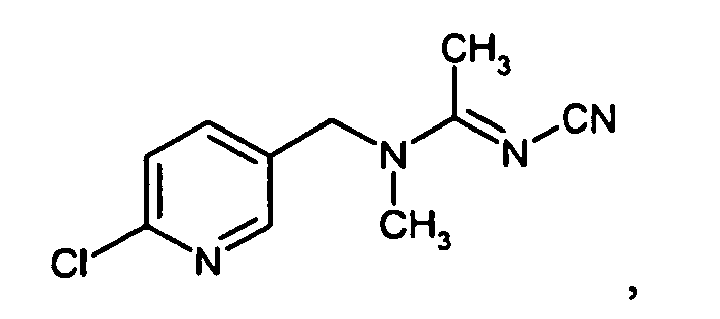
WO A1 91/04965 - Another compound is thiacloprid of the formula

EP A2 0 235 725 - Another compound is thiamethoxam of the formula

EP A2 0 580 553 - Another compound is clothianidin of the formula

EP A2 0 376 279 - Another compound is dinotefuran of the formula

EP A 10 649 845 - Particularly suited for the current inventions are compounds of the formula (1) wherein the substituent "Het" represents chloropyridyl
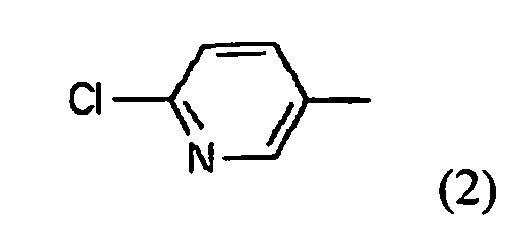
- Particularly preferred compounds are imidacloprid and thiacloprid. 6-Chloronicotinic acid can be set free during the degradation of the above mentioned neonicotinoids which carry this group, such as imidacloprid, nitenpyram, and thiacloprid.
For example, imidacloprid is degraded stepwise to the primary metabolite 6-chloronicotinic acid, which eventually breaks down into carbon dioxide. It was found that this metabolite also increases the stress tolerance and health of a plant or plant cell or seed from which such plant is grown and which is engineered to be stress tolerant and can be also be used according to the methods of the current invention. - One way of determining whether 6-CNA is set free during the degradation of the above mentioned neonicotinoids in plants or in particular plants is described by Placke and Weber (Pflanzenschutz-Nachrichten Bayer 46/1993,2 109-182).
- Thus, in another embodiment of the invention, a method is described which is useful to increase the tolerance of plants cells or plants or parts thereof to hypoxic or anoxic conditions comprising the step of providing to said plant, to a plant cell or to seed from which said plants are grown an effective amount of 6-chloronicotinic acid (niacin, CAS NO: 5326-23-8) of the formula (3)
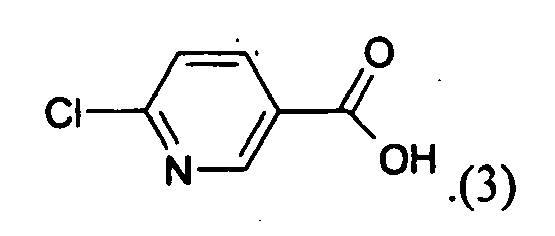
- The effective amound of 6-chloronicotinic acid may be provided to the plant cell, plant or seed by applying directly the compound of the formula (3) to the plant cell, plant, seed and/or the habitat thereof. However, the 6-CNA may also be provided to the plant by providing a compound which can be metabolized by the plant to yield 6-CNA as a metabolite, such as the compounds mentioned above.
- It will be immediately clear that the above described compounds can also be used to increase the penetrance of the roots of a plant into growth medium or soil comprising the step of providing an effective amount of a neonicotinoid compound of the formula (I), such as a neonicotinoid compound of the formula (I) comprising a chloropyridine side chain, particularly those neonicotinoids of the formula I comprising a chloropyridine side chain which can be metabolized in plants to yield 6-CNA, including imidacloprid or thiacloprid or providing 6-CNA to the plant cells, plants or seeds or to the habitat of the plants or to the growth medium.
- One of the advantages of the present invention is that the systemic properties of the compounds according to the invention and compositions comprising said compounds mean that treatment of the seed of plants with these compositions is sufficient to increase the protrusion of the roots of the germinating plant and the resulting plant after emergence.
- In another embodiment of the invention, a method is described which is useful to increase the protrusion of the roots of a plant, comprising applying to said plant and/or its habitat, to a plant cell or to seed from which said plants are grown an effective amount of a composition comprising the compounds of the formula (I).
- Accordingly, the invention also relates to compositions comprising the compounds of the formula (I) for the use of such compositions according to the invention.
- The compounds of formula (I) can be used also in a mixture with other active compounds, for example, insecticides, bactericides, miticides, fungicides, etc. in the form of their commercially useful formulations or in the application forms prepared from such formulations. This can be done to obtain compositions which in addition to increasing the protrusion of plant roots according to the invention also to combat pests which may be present. Insecticides which can be used are, for example, organophosphorous agents, carbamate agents, carboxylate type chemicals, chlorinated hydrocarbon type chemicals, insecticidal substances produced by microbes, etc.
- In many cases, this results in synergistic effects, i.e. the activity of the mixture exceeds the activity of the individual components. Such formulations and application forms are commercially and ecologically especially useful as generally lower amounts of active ingredients can be used. A synergist, however, must not necessarily be active itself, as long as it enhances the action of the active compound.
- A mixture with other known active compound, such as herbicides, or with safeners, fertilizers and growth regulators is also possible.
- Treatment according to the invention of the plants and plant parts with the active compounds is carried out directly or by allowing the compounds to act on their surroundings, environment or storage space by the customary treatment methods, for example by immersion, spraying, evaporation, fogging, scattering, painting on and, in the case of propagation material, in particular in the case of seed, also by applying one or more coats.
- The active compounds can be converted into the customary formulations, such as solutions, emulsions, wettable powders, suspensions, powders, dusts, pastes, soluble powders, granules, suspension-emulsion concentrates, natural and synthetic materials impregnated with active compound, and microencapsulations in polymeric substances.
- The content of the active compounds of the present invention in a commercially useful formulation or application form can be varied in a wide range. The active-compound content of the use forms prepared from the commercial formulations can vary within wide limits.
- These formulations are produced in a known manner, for example by mixing the active compounds with extenders, that is liquid solvents and/or solid carriers, optionally with the use of surfactants, that is emulsifiers and/or dispersants, and/or foam-formers.
- If the extender used is water, it is also possible to employ for example organic solvents as auxiliary solvents. Essentially, suitable liquid solvents are: aromatics such as xylene, toluene or alkylnaphthalenes, chlorinated aromatics or chlorinated aliphatic hydrocarbons such as chlorobenzenes, chloroethylenes or methylene chloride, aliphatic hydrocarbons such as cyclohexane or paraffins, for example petroleum fractions, mineral and vegetable oils, alcohols such as butanol or glycol and also their ethers and esters, ketones such as acetone, methyl ethyl ketone, methyl isobutyl ketone or cyclohexanone, strongly polar solvents such as dimethylformamide and dimethyl sulphoxide, and also water.
- As solid carriers there are suitable: for example ammonium salts and ground natural minerals such as kaolins, clays, talc, chalk, quartz, attapulgite, montmorillonite or diatomaceous earth, and ground synthetic minerals, such as highly disperse silica, alumina and silicates; as solid carriers for granules there are suitable: for example crushed and fractionated natural rocks such as calcite, marble, pumice, sepiolite and dolomite, and also synthetic granules of inorganic and organic meals, and granules of organic material such as sawdust, coconut shells, maize cobs and tobacco stalks; as emulsifiers and/or foam-formers there are suitable: for example nonionic and anionic emulsifiers, such as polyoxyethylene fatty acid esters, polyoxyethylene fatty alcohol ethers, for example alkylaryl polyglycol ethers, alkylsulphonates, alkyl sulphates, arylsulphonates and also protein hydrolysates; as dispersants there are suitable: for example lignin-sulphite waste liquors and methylcellulose.
- Tackifiers such as carboxymethylcellulose and natural and synthetic polymers in the form of powders, granules or latices, such as gum arabic, polyvinyl alcohol and polyvinyl acetate, as well as natural phospholipids such as cephalins and lecithins, and synthetic phospholipids, can be used in the formulations. Other additives can be mineral and vegetable oils.
- It is possible to use colorants such as inorganic pigments, for example iron oxide, titanium oxide and Prussian Blue, and organic dyes, such as alizarin dyes, azo dyes and metal phthalocyanine dyes, and trace nutrients such as salts of iron, manganese, boron, copper, cobalt, molybdenum and zinc.
- The formulations generally comprise between 0.1 and 98% by weight of active compound, preferably between 0.1 and 90% and particularly preferably between 0.5 and 70% by weight of active compound.
- The effect of the neonicotinoid compounds and 6-CNA on root growth depth is particularly strongly pronounced at certain application rates. However, the application rates of the active compounds can be varied within relatively wide ranges. In general, the rates of applications are from 1 g to 1600 g of the active compound per hectare, preferably from 10 g to 800 g of the active compound per hectare, and particularly preferably from 10 g to 600 g of the active compound per hectare
- As mentioned before, the invention relates to methods which are useful to increase the protrusion of the roots of a plant into the growth medium or to increase the tolerance to hypoxia conditions, comprising applying to the plant propagation material including seed from which the plant is grown an effective amount of a composition comprising the compounds of the formula (I). The plant propagation material may be treated before planting, for example seed may be dressed before sowing. The compounds according to the invention may also be applied to seed grains either by impregnating the grains with a liquid formulation or by coating them with a solid formulation.. The composition may also be applied to the planting site when the propagation material is being planted, e.g. during sowing.
- In connection with the treatment of plant propagation material such as seeds, favourable rates of application are in general 0,1 to 1000g, in particular 1 to 800g, preferably 10 to 500 g of one of the neonicotinoid compounds or 6-CNA per 100 kg of material to be treated.
- All plants and plant parts can be treated in accordance with the invention. Plant parts are to be understood to mean all above-ground and underground parts and organs of plants, such as shoot, leaf, flower and root, examples which may be mentioned being leaves, needles, stalks, stems, flowers, fruit bodies, fruits, seeds, roots, tubers and rhizomes. The plant parts also include harvested material, and vegetative and generative propagation material, for example cuttings, tubers, rhizomes, offsets and seeds. They also include plant cells, such as may be used or result from the transformation of a plant cell in accordance with the invention. It is also possible to apply the aforementioned compounds onto or into the soil, e.g. before planting or sowing to achieve the effect described, e.g. to enhance the stress tolerance of the plants after planting and the emerging plant which grows from a seed which has been sown into treated soil.
- The method of the current invention may be suitable for any plant, both dicotyledonous and monocotyledonous plants including but not limited to cotton, Brassica vegetables, oilseed rape, wheat, corn or maize, barley, sunflowers, rice, oats, sugarcane, soybean, vegetables (including chicory, lettuce, tomato), tobacco, potato, sugarbeet, papaya, pineapple, mango, Arabidopsis thaliana, but also plants used in horticulture, floriculture or forestry, cereal plants including wheat, oat, barley, rye, rice, turfgrass, sorghum, millet or sugarcane plants. The methods of the invention can also be applied to any plant including but not limited to cotton, tobacco, canola, oilseed rape, soybean, vegetables, potatoes, Lemna spp., Nicotiana spp., sweet potatoes, Arabidopsis, alfalfa, barley, bean, corn, cotton, flax, pea, rape, rice, rye, safflower, sorghum, soybean, sunflower, tobacco, wheat, asparagus, beet, broccoli, cabbage, carrot, cauliflower, celery, cucumber, eggplant, lettuce, onion, oilseed rape, pepper, potato, pumpkin, radish, spinach, squash, tomato, zucchini, almond, apple, apricot, banana, blackberry, blueberry, cacao, cherry, coconut, cranberry, date, grape, grapefruit, guava, kiwi, lemon, lime, mango, melon, nectarine, orange, papaya, passion fruit, peach, peanut, pear, pineapple, pistachio, plum, raspberry, strawberry, tangerine, walnut and watermelon.
- As used herein "comprising" is to be interpreted as specifying the presence of the stated features, integers, steps or components as referred to, but does not preclude the presence or addition of one or more features, integers, steps or components, or groups thereof. Thus, e.g., a nucleic acid or protein comprising a sequence of nucleotides or amino acids, may comprise more nucleotides or amino acids than the actually cited ones, i.e., be embedded in a larger nucleic acid or protein. A transgene comprising a DNA region which is functionally or structurally defined, may comprise additional DNA regions etc.
- Unless stated otherwise in the Examples, all recombinant DNA techniques are carried out according to standard protocols as described in Sambrook et al. (1989) Molecular Cloning: A Laboratory Manual, Second Edition, Cold Spring Harbor Laboratory Press, NY and in
Volumes - Gemination medium: Half concentrated Murashige and Skoog salts; B5 vitamins; 1.5% sucrose; pH 5.8; 0.4% Difco agar.
- Sterilization of Arabidopsis seeds: 2min. 70% ethanol; 10 min. bleach (6% active chlorine) +
1drop Tween 20 for 20ml solution; wash 5 times with sterile tap water; sterilization is done in 2ml eppendorf tubes. Arabidopsis seeds sink to the bottom of the tube, allowing removal of the liquids by means of a 1 ml pipetman. - Pregermination of seeds: In 9cm Optilux Petridishes (Falcon) containing 10 ml sterile tap water. Low light overnight to 24 hours.
- Growing of Arabidopsis plants: Seeds are sown in 25x150mm glass tubes (Sigma C5916) with natural (transparant) colored closure (Sigma C5791) containing ±34ml germination medium: 1 seed/tube. The tubes are put in the two outer rows of tube holders for 40 tubes (VWR nalg5970-0025) wrapped in aluminium foil so that the roots can grow in the dark.
- Plants are grown at 23°C. 30-50µgEinstein s-1m-2. 12hours light - 12hours dark. (See
Figure 1 ) - After three weeks, the root depth is measured from the surface of the medium to the lowest point of root growth. (See
Figure 1 ). - Arabidopsis thaliana plants comprising a transgene encoding a dsRNA molecule which is capable of reducing the expression of endogenous PARP1 or PARP2 genes, as described in
WO 00/04173 A1 - After three weeks, the depth of the roots of the transgenic plants was measured and compared to the depth of the roots of non-transgenic control plants or to non-transgenic isogenic plants grown in a similar manner.
- In a first experiment, various populations of Arabidopsis thaliana cv. Col-0 plants comprising a transgene encoding a dsRNA molecule which is capable of reducing the expression of endogenous PARP2 genes (with lines 427-16 and 427-20 showing weak tolerance to high light stress and line 427-19 showing a moderate tolerance to high light stress) were compared with a population of non-transgenic Arabidopsis thaliana cv. Col-0 plants.
- The results of the measurements were subjected to statistical analysis, summarized in Table 1, which also represents the mean, standard deviation and confidence intervals.
- The roots of transgenic Arabidopsis thaliana plants with the highest tolerance to high light stress conditions (line 427-19) protruded statistically significant deeper (at 99% confidence level) into the growth medium than non-transgenic Arabidopsis thaliana cv. Col-0 control plants (see
Figure 2 and Table 1)Table 1: Root depth (mm) of Arabidopsis thaliana cv. Col-0 plants comprising a transgene encoding a dsRNA molecule which is capable of reducing the expression of endogenous PARP2 genes as compared to non-transgenic Arabidopsis thaliana cv. Col-0 plants Col-0 427-16 427-19 427-20 mean 25.173611 26.388889 27.42 24.942029 Standard dev. 3.64166 3.422548 3.361185 3.69174 Standard error 0.429174 0.46575 0.388116 0.444433 95% Confidence 0.858348 0.94128 0.776233 0.888866 99% Confidence 1.141602 1.259388 1.032389* 1.182192 *p<0.01 - In a further experiment, a population of transgenic Arabidopsis thaliana cv. Col-0 plants comprising a transgene encoding a dsRNA molecule which is capable of reducing the expression of endogenous PARP2 genes and which which are tolerant to high light stress (line 427-22) were compared to a transgenic line containing a similar transgene but which was sensitive to high light stress (line 427-24), as well as to non-transgenic Arabidopsis thaliana cv. Col-0 control plants.
- The results of the measurements were subjected to statistical analysis, summarized in Table 2, which also represents the mean, standard deviation and confidence intervals.
- The roots of transgenic Arabidopsis thaliana cv. Col-0 plants of the stress tolerant transgenic line (line 427-22) protruded deeper into the growth medium (comprising 0.7% Difco agar instead of 0.4%) than the roots Arabidopsis thaliana cv. Col-0 control plants and than the roots of stress-sensitve transgenic Arabidopsis thaliana cv. Col-0 plant line (line 427-24) (see
Figure 3 and Table 2).Table 2: Root depth (mm) of Arabidopsis thaliana cv. Col-0 plants comprising a transgene encoding a dsRNA molecule which is capable of reducing the expression of endogenous PARP2 genes as compared to non-transgenic Arabidopsis thaliana cv. Col-0 plants Col-0 427-22 427-24 Mean 18.291339 21.146154 17.384058 Standard dev. 2.928677 5.368981 2.740149 Standard error 0.259878 0.66594 0.329875 95% Confidence 0.514558 1.33188 0.65975 99% Confidence 0.680101 1.771401* 0.877468 * p<0.01 - In another experiment, the following populations were analyzed:
- C24: wild-type Arabidopsis line; line 1599: A. thaliana transgenic line comprising anti-PARP2 transgene with a high tolerance to high light stress conditions; line 1463: A. thaliana transgenic line comprising anti-PARP2 transgene with a moderate tolerance to high light stress conditions; line 1681: A. thaliana transgenic line comprising anti-PARP1 gene with a moderate tolerance to high light stress conditions; and line 1690: A. thaliana transgenic line comprising anti-PARP1 gene with a moderate tolerance to high light stress conditions. The stress tolerance of
line 1599 is very high, the stress tolerance oflines - The results of the measurements were subjected to statistical analysis, summarized in Table 3, which represents the mean; standard deviation and confidence intervals.
- The roots of transgenic Arabidopsis thaliana cv. C24 plants comprising a transgene encoding a dsRNA molecule which is capable of reducing the expression of endogenous PARP1 genes (
lines 1681 and 1690) or PARP2 genes (lines 1599 and 1463) protruded deeper in the growth medium than the non-transgenic Arabidopsis thaliana cv. C24 control plants (seeFigure 4 and Table 3)Table 3: Root depth (mm) of Arabidopsis thaliana cv. C24 plants comprising a transgene encoding a dsRNA molecule which is capable of reducing the expression of endogenous PARP1 or PARP2 genes as compared to non-transgenic Arabidopsis thaliana cv. C24 plants C24 1599 1463 1681 1690 mean 16.18 18.125 17.405063 17.433333 17.897727 Standard dev. 2.192181 2.992481 2.16036. 2.112246 1.885007 Standard error 0.219218 0.451133 0.243059 0.27269 0.284175 95% Confidence 0.438436 0.911741 0.486119 0.551106 0.574319 99% Confidence 0.58312 1.219865* 0.646538* 0.737353* 0.76841* * p<0.01 - In a further experiment, a 1:1 segregating population of transgenic Arabidopsis thaliana cv. Col-0 line comprising a transgene encoding a dsRNA molecule which is capable of reducing the expression of endogenous PARP2 genes and with high tolerance to high light stress, was analyzed. The presence of the transgene was verified by PCR analysis.
- Plants comprising the transgene had roots which protruded deeper into the growth medium than the azygous Arabidopsis thaliana cv. Col-0 plants derived from line 427-19 (see
Figure 5 and Table 4)Table 4: Root depth (mm) of Arabidopsis thaliana cv. Col-0 plants comprising a transgene encoding a dsRNA molecule which is capable of reducing the expression of endogenous PARP2 genes as compared to the azygous Arabidopsis thaliana cv. Col-0 plants Azygous 427-19 Transgenic 427-19 Mean 25.296512 27.38172 Standard dev. 3.573907 3.244894 Standard error 0.385384 0.33648 95% Confidence 0.770769 0.67296 99% Confidence 1.025122 0.895036* * p<0.01 - Arabidopsis thaliana cv. C24 plants were grown as described in Example 1 on germination medium (with 0.7% Difco agar in stead of 0.4%) comprising various concentrations of imidacloprid (0, 50, and 100 mg/l). After three weeks, the depth of the roots of the plants treated with 50 and 100 mg/l imidacloprid was measured and compared to the depth of the roots of untreated plants grown in a similar manner.
- The roots of the treated Arabidopsis plants protruded deeper in the growth medium than the roots of the non-treated Arabidopsis plants (see
Figure 6 and Table 5)Table 5: Root depth (mm) of Arabidopsis thaliana cv. C24 plants treated with 50 and 100 mg/l imidacloprid as compared to Arabidopsis thaliana cv. C24 plants not treated with imidacloprid 0 mg/ L 50 mg/ L 100 mg/L Mean 1.9475 2.1875 2.2725 Standard dev. 0.289714 0.353508 0.456072 Standard error 0.037402 0.045638 0.058879 95% Confidence 0.075589 0.092234 0.118994 99% Confidence 0.101135 0.123404* 0.159208* * p<0.01 - Arabidopsis thaliana cv. C24 plants were grown as described in Example 1 on germination medium comprising various concentrations of 6-CNA (0, 1, and 5 mg/l). After three weeks, the depth of the roots of the plants treated with 1 and 5 mg/l 6-CNA was measured and compared to the depth of the roots of the plants not treated with 6-CNA grown in a similar manner.
- The roots of the treated Arabidopsis plants protruded deeper in the growth medium than the roots of the non-treated Arabidopsis plants (see
Figure 7 and Table 6)Table 6: Root depth (mm) of Arabidopsis thaliana cv. C24 plants treated with 1 and 5 mg/l 6-CNA as compared to Arabidopsis thaliana cv. Col-0 plants not treated with 6- CNA 0 mg/ L 1 mg/ L 5 mg/L Mean 2.031034 2.179661 2.118367 Standard dev. 0.189373 0.186418 0.237762 Standard error 0.024866 0.02427 0.033966 95% Confidence 0.050254 0.049049 0.068645** 99% Confidence 0.067237 0.065625* 0.091844 *p<0.01
**p<0.05
Claims (14)
- A method for increasing the tolerance of a plant cell or plant to hypoxic or anoxic conditions, comprising the step of:a) applying an effective amount of a compound of formula (I)wherein

Het represents a heterocycle which is in each case optionally mono- or polysubstituted by fluorine, chlorine, methyl or ethyl, which heterocycle is selected from the following group of heterocycles: pyrid-3-yl, pyrid-5-yl, 3-pyridinio, 1-oxido-5-pyridinio, 1-oxido-5-pyridinio, tetrahydrofuran-3-yl, thiazol-5-yl,
A represents C1-C6-alkyl, -N(R1)(R2) or S(R2), in which
R1 represents hydrogen, C1-C6-alkyl, phenyl-C1-C4-alkyl, C3-C6-cycloalkyl, C2-C6-alkenyl or C2-C6-alkynyl, and
R2 represents C1-C6-alkyl, C2-C6-alkenyl, C2-C6-alkynyl, -C(=O)-CH3 or benzyl,
R represents hydrogen, C1-C6-alkyl, C2-C6-alkenyl, C2-C6-alkynyl, -C(=O)-CH3 or benzyl or together with R2 represents the groups below: -CH2-CH2-, -CH2-CH2-CH2-, -CH2-O-CH2-, -CH2-S-CH2-, -CH2-NH-CH2-, -CH2-N(CH3)-CH2-, and
X represents N-NO2 N-CN or CH-NO2 on said plant or on its locus, or on seeds of said plant. - A method for increasing the penetrance of roots of a plant into a growth medium, comprising the step of:a) applying an effective amount of a compound of formula (I)wherein

Het represents a heterocycle which is in each case optionally mono- or polysubstituted by fluorine, chlorine, methyl or ethyl, which heterocycle is selected from the following group of heterocycles:
pyrid-3-yl, pyrid-5-yl, 3-pyridinio, 1-oxido-5-pyridinio, 1-oxido-5-pyridinio, tetrahydrofuran-3-yl, thiazol-5-yl,
A represents C1-C6-alkyl, -N(R1)(R2) or S(R2), in which
R' represents hydrogen, C1-C6-alkyl, phenyl-C1-C4-alkyl, C3-C6-cycloalkyl, C2-C6-alkenyl or C2-C6-alkynyl, and
R2 represents C1-C6-alkyl, C2-C6-alkenyl, C2-C6-alkynyl, -C(=O)-CH3 or benzyl,
R represents hydrogen, C1-C6-alkyl, C2-C6-alkcnyl, C2-C6-alkynyl, -C(=O)-CH3 or benzyl or together with R2 represents the groups below: -CH2-CH2-, -CH2-CH2-CH2-, -CH2-O-CH2-, -CH2-S-CH2-, -CH2-NH-CH2--CH2-N(CH3)-CH2-, and
X represents N-NO2, N-CN or CH-NO2 on said plant or on its locus, or on seeds of said plant. - The method of claim 1 or claim 2, wherein said compound of formula (I) is a neonicotinoid compound.
- The method of claim 1 or claim 2 wherein said heterocycle represented by Het of said compound of formula (I) is a pyrid-3-yl heterocycle substituted by chlorine.
- The method of claim 4, wherein said compound of formula (I) is imidacloprid, or thiacloprid.
- A method for increasing the tolerance of a plant cell or plant to hypoxic or anoxic conditions, comprising the step of: providing said plant cell or plant with an effective amount of 6-chloronicotinic acid.
- A method for increasing the penetrance of roots of a plant into a growth medium comprising the step of: providing cells of said plant with an effective amount of 6-chloronicotinic acid.
- The method according to claim 6 or claim 7, wherein said 6-chloronicotinic acid is provided to said plant cell or plant by applying an effective amount of a compound of formula (I)

Het represents a heterocycle which is in each case optionally mono- or polysubstituted by chlorine which heterocycle is selected from the following group of heterocycles:
pyrid-3-yl or pyrid-5-yl,
A represents C1-C6-alkyl, -N(R1)(R2) or S(R2), in which
R1 represents hydrogen, C1-C6-alkyl, phenyl-C1-C4-alkyl, C3-C6-cycloalkyl, C2-C6-alkenyl or C2-C6-alkynyl, and
R2 represents C1-C6-alkyl, C2-C6-alkenyl, C2-C6-alkynyl, -C(=O)-CH3 or benzyl,
R represents hydrogen, C1-C6-alkyl, C2-C6-alkcnyl, C2-C6-alkynyl, -C(=O)-CH3 or benzyl or together with R2 represents the groups below: -CH2-CH2-, -CH2-CH2-CH2-, -CH2-O-CH2-, -CH2-S-CH2-, -CH2-NH-CH2-, -CH2-N(CH3)-CH2-, and
X represents N-NO2, N-CN or CH-NO2 on said plant or on its locus, or on seeds of said plant. - The method according to .claim 8, wherein said 6-chloronicotinic acid is set free during the degradation of neonicotinoids comprising a chloropyridine side chain in plants.
- The method of claim 9, wherein said neonicotinoid is imidacloprid or thiacloprid.
- The method according to claim 6 or claim 7, wherein said 6-chloronicotinic acid is applied directly to said plant or said habitat thereof, said plant cell or said seed.
- The use ofa) 6-chloronicotinic acid or a compound of formula (I)wherein

Het represents a heterocycle which is in each case optionally mono- or polysubstituted by fluorine, chlorine, methyl or ethyl, which heterocycle is selected from the following group of heterocycles: pyrid-3-yl, pyrid-5-yl, 3-pyridinio, 1-oxido-5-pyridinio, 1-oxide-5-pyridinio, tetrahydrofuran-3-yl, thiazol-5-yl,
A represents C1-C6-alkyl, -N(R1)(R2) or S(R2), in which
R1 represents hydrogen, C1-C6-alkyl, phenyl-C1-C4-alkyl, C3-C6-cycloalkyl, C2-C6-alkenyl or C2-C6-alkynyl, and
R2 represents C1-C6-alkyl, C2-C6-alkenyl, C2-C6-alkynyl, -C(=O)-CH3 or benzyl,
R represents hydrogen, C1-C6-alkyl, C2-C6-alkcnyl, C2-C6-alkynyl, -C(=O)-CH3 or benzyl or together with R2 represents the groups below: -CH2-CH2-, -CH2-CH2-CH2-, -CH2-O-CH2-, -CH2-S-CH2-, -CH2-NH-CH2-, -CH2-N(CH3)-CH2-, and X represents N-NO2, N-CN or CH-NO2 for increasing the protrusion of the roots of a plant into a growth medium. - The use ofa) 6-chloronicotinic acid or a compound of formula (I)wherein

Het represents a heterocycle which is in each case optionally mono- or polysubstituted by fluorine, chlorine, methyl or ethyl, which heterocycle is selected from the following group of heterocycles: pyrid-3-yl, pyrid-5-yl, 3-pyridinio, 1-oxido-5-pyridinio, 1-oxido-5-pyridinio, tetrahydrofuran-3-yl, thiazol-5-yl,
A represents C1-C6-alkyl, -N(R1)(R2) or S(R2), in which
R1 represents hydrogen, C1-C6-alkyl, phenyl-C1-C4-alkyl, C3-C6-cycloalkyl, C2-C6-alkenyl or C2-C6-alkynyl, and
R2 represents C1-C6-alkyl, C2-C6-alkenyl, C2-C6-alkynyl, -C(=O)-CH3 or benzyl,
R represents hydrogen, C1-C6-alkyl, C2-C6-alkenyl, C2-C6-alkynyl, -C(=O)-CH3 or benzyl or together with R2 represents the groups below: -CH2-CH2-, -CH2-CH2-CH2-, -CH2-O-CH2-, -CH2-S-CH2-, -CH2-NH-CH2-, -CH2-N(CH3)-CH2-, and
X represents N-NO2, N-CN or CH-NO2 for increasing the tolerance of a plant to hypoxic or anoxic conditions. - The use of claim 13, wherein said hypoxic or anoxic conditions are brought on said plant by exposure to waterlogging, submergence or flooding.
Priority Applications (4)
| Application Number | Priority Date | Filing Date | Title |
|---|---|---|---|
| EP09075287A EP2110437A1 (en) | 2005-06-15 | 2006-06-06 | Methods for increasing the resistance of plants to hypoxic conditions |
| EP06754163A EP1893759B1 (en) | 2005-06-15 | 2006-06-06 | Methods for increasing the resistance of plants to hypoxic conditions |
| EP10075507A EP2311963A3 (en) | 2005-06-15 | 2006-06-06 | Methods for increasing the resistance of plants to hypoxic conditions |
| PL06754163T PL1893759T3 (en) | 2005-06-15 | 2006-06-06 | Methods for increasing the resistance of plants to hypoxic conditions |
Applications Claiming Priority (4)
| Application Number | Priority Date | Filing Date | Title |
|---|---|---|---|
| EP05076392 | 2005-06-15 | ||
| US69110305P | 2005-06-16 | 2005-06-16 | |
| EP06754163A EP1893759B1 (en) | 2005-06-15 | 2006-06-06 | Methods for increasing the resistance of plants to hypoxic conditions |
| PCT/EP2006/005393 WO2006133827A2 (en) | 2005-06-15 | 2006-06-06 | Methods for increasing the resistance of plants to hypoxic conditions |
Related Child Applications (1)
| Application Number | Title | Priority Date | Filing Date |
|---|---|---|---|
| EP09075287A Division EP2110437A1 (en) | 2005-06-15 | 2006-06-06 | Methods for increasing the resistance of plants to hypoxic conditions |
Publications (2)
| Publication Number | Publication Date |
|---|---|
| EP1893759A2 EP1893759A2 (en) | 2008-03-05 |
| EP1893759B1 true EP1893759B1 (en) | 2009-08-12 |
Family
ID=37532647
Family Applications (3)
| Application Number | Title | Priority Date | Filing Date |
|---|---|---|---|
| EP06754163A Not-in-force EP1893759B1 (en) | 2005-06-15 | 2006-06-06 | Methods for increasing the resistance of plants to hypoxic conditions |
| EP09075287A Withdrawn EP2110437A1 (en) | 2005-06-15 | 2006-06-06 | Methods for increasing the resistance of plants to hypoxic conditions |
| EP10075507A Withdrawn EP2311963A3 (en) | 2005-06-15 | 2006-06-06 | Methods for increasing the resistance of plants to hypoxic conditions |
Family Applications After (2)
| Application Number | Title | Priority Date | Filing Date |
|---|---|---|---|
| EP09075287A Withdrawn EP2110437A1 (en) | 2005-06-15 | 2006-06-06 | Methods for increasing the resistance of plants to hypoxic conditions |
| EP10075507A Withdrawn EP2311963A3 (en) | 2005-06-15 | 2006-06-06 | Methods for increasing the resistance of plants to hypoxic conditions |
Country Status (16)
| Country | Link |
|---|---|
| US (2) | US8143192B2 (en) |
| EP (3) | EP1893759B1 (en) |
| KR (1) | KR20080036579A (en) |
| CN (1) | CN101218345B (en) |
| AR (1) | AR053906A1 (en) |
| AT (1) | ATE439449T1 (en) |
| AU (2) | AU2006257420B2 (en) |
| BR (1) | BRPI0613145A2 (en) |
| CA (1) | CA2611930A1 (en) |
| DE (1) | DE602006008459D1 (en) |
| ES (1) | ES2331022T3 (en) |
| MX (1) | MX2007016199A (en) |
| PL (1) | PL1893759T3 (en) |
| PT (1) | PT1893759E (en) |
| WO (1) | WO2006133827A2 (en) |
| ZA (1) | ZA200800187B (en) |
Families Citing this family (197)
| Publication number | Priority date | Publication date | Assignee | Title |
|---|---|---|---|---|
| BRPI0518249A2 (en) * | 2004-10-29 | 2008-11-11 | Bayer Bioscience Nv | strain tolerant cotton plants |
| CA2651734A1 (en) | 2006-05-12 | 2007-11-22 | Bayer Bioscience N.V. | Novel stress-related microrna molecules and uses thereof |
| CL2007003743A1 (en) * | 2006-12-22 | 2008-07-11 | Bayer Cropscience Ag | COMPOSITION THAT INCLUDES FENAMIDONA AND AN INSECTICIDE COMPOUND; AND METHOD TO CONTROL FITOPATOGENOS CULTURES AND INSECTS FACING OR PREVENTIVELY. |
| CL2007003744A1 (en) | 2006-12-22 | 2008-07-11 | Bayer Cropscience Ag | COMPOSITION THAT INCLUDES A 2-PYRIDILMETILBENZAMIDE DERIVATIVE AND AN INSECTICIDE COMPOUND; AND METHOD TO CONTROL FITOPATOGENOS CULTURES AND INSECTS FACING OR PREVENTIVELY. |
| EP1969930A1 (en) | 2007-03-12 | 2008-09-17 | Bayer CropScience AG | Phenoxy phenylamidines and their use as fungicides |
| EP1969929A1 (en) | 2007-03-12 | 2008-09-17 | Bayer CropScience AG | Substituted phenylamidines and their use as fungicides |
| EP1969931A1 (en) * | 2007-03-12 | 2008-09-17 | Bayer CropScience Aktiengesellschaft | Fluoroalkyl phenylamidines and their use as fungicides |
| JP2010520899A (en) | 2007-03-12 | 2010-06-17 | バイエル・クロツプサイエンス・アクチエンゲゼルシヤフト | Dihalophenoxyphenylamidine and its use as a fungicide |
| BRPI0808798A2 (en) | 2007-03-12 | 2014-10-07 | Bayer Cropscience Ag | 3,5-DISSUBSTITUTED PHENOXYPHENYLAMIDINS AND THEIR USE AS FUNGICIDES |
| EP1969934A1 (en) * | 2007-03-12 | 2008-09-17 | Bayer CropScience AG | 4-cycloalkyl or 4-aryl substituted phenoxy phenylamidines and their use as fungicides |
| US8168567B2 (en) * | 2007-04-19 | 2012-05-01 | Bayer Cropscience Ag | Thiadiazolyl oxyphenyl amidines and the use thereof as a fungicide |
| US20090234635A1 (en) * | 2007-06-29 | 2009-09-17 | Vipul Bhatt | Voice Entry Controller operative with one or more Translation Resources |
| DE102007045922A1 (en) | 2007-09-26 | 2009-04-02 | Bayer Cropscience Ag | Drug combinations with insecticidal and acaricidal properties |
| DE102007045920B4 (en) | 2007-09-26 | 2018-07-05 | Bayer Intellectual Property Gmbh | Synergistic drug combinations |
| DE102007045953B4 (en) | 2007-09-26 | 2018-07-05 | Bayer Intellectual Property Gmbh | Drug combinations with insecticidal and acaricidal properties |
| DE102007045919B4 (en) | 2007-09-26 | 2018-07-05 | Bayer Intellectual Property Gmbh | Drug combinations with insecticidal and acaricidal properties |
| DE102007045956A1 (en) | 2007-09-26 | 2009-04-09 | Bayer Cropscience Ag | Combination of active ingredients with insecticidal and acaricidal properties |
| WO2009046837A2 (en) * | 2007-10-02 | 2009-04-16 | Bayer Cropscience Ag | Methods of improving plant growth |
| EP2090168A1 (en) | 2008-02-12 | 2009-08-19 | Bayer CropScience AG | Method for improving plant growth |
| EP2072506A1 (en) | 2007-12-21 | 2009-06-24 | Bayer CropScience AG | Thiazolyloxyphenylamidine or thiadiazolyloxyphenylamidine und its use as fungicide |
| JP2010030908A (en) * | 2008-07-25 | 2010-02-12 | Bayer Cropscience Ag | Method of improving growth problem of paddy rice |
| EP2168434A1 (en) | 2008-08-02 | 2010-03-31 | Bayer CropScience AG | Use of azols to increase resistance of plants of parts of plants to abiotic stress |
| AU2009278225B2 (en) | 2008-08-08 | 2014-06-19 | Bayer Cropscience Nv | Methods for plant fiber characterization and identification |
| EP2374791A1 (en) | 2008-08-14 | 2011-10-12 | Bayer CropScience Aktiengesellschaft | Insecticidal 4-phenyl-1H pyrazoles |
| DE102008041695A1 (en) | 2008-08-29 | 2010-03-04 | Bayer Cropscience Ag | Methods for improving plant growth |
| EP2201838A1 (en) | 2008-12-05 | 2010-06-30 | Bayer CropScience AG | Active ingredient-beneficial organism combinations with insecticide and acaricide properties |
| EP2198709A1 (en) | 2008-12-19 | 2010-06-23 | Bayer CropScience AG | Method for treating resistant animal pests |
| EP2381781B1 (en) | 2008-12-29 | 2016-06-08 | Bayer Intellectual Property GmbH | Method for improved use of the production potential of genetically modified plants |
| EP2204094A1 (en) | 2008-12-29 | 2010-07-07 | Bayer CropScience AG | Method for improved utilization of the production potential of transgenic plants Introduction |
| EP2223602A1 (en) | 2009-02-23 | 2010-09-01 | Bayer CropScience AG | Method for improved utilisation of the production potential of genetically modified plants |
| EP2039771A2 (en) | 2009-01-06 | 2009-03-25 | Bayer CropScience AG | Method for improved utilization of the production potential of transgenic plants |
| EP2039770A2 (en) | 2009-01-06 | 2009-03-25 | Bayer CropScience AG | Method for improved utilization of the production potential of transgenic plants |
| EP2039772A2 (en) | 2009-01-06 | 2009-03-25 | Bayer CropScience AG | Method for improved utilization of the production potential of transgenic plants introduction |
| WO2010081689A2 (en) | 2009-01-19 | 2010-07-22 | Bayer Cropscience Ag | Cyclic diones and their use as insecticides, acaricides and/or fungicides |
| EP2227951A1 (en) | 2009-01-23 | 2010-09-15 | Bayer CropScience AG | Application of enaminocarbonyl compounds for combating viruses transmitted by insects |
| WO2010086311A1 (en) | 2009-01-28 | 2010-08-05 | Bayer Cropscience Ag | Fungicide n-cycloalkyl-n-bicyclicmethylene-carboxamide derivatives |
| AR075126A1 (en) | 2009-01-29 | 2011-03-09 | Bayer Cropscience Ag | METHOD FOR THE BEST USE OF THE TRANSGENIC PLANTS PRODUCTION POTENTIAL |
| EP2398770B1 (en) | 2009-02-17 | 2016-12-28 | Bayer Intellectual Property GmbH | Fungicidal n-(phenylcycloalkyl)carboxamide, n-(benzylcycloalkyl)carboxamide and thiocarboxamide derivatives |
| EP2218717A1 (en) | 2009-02-17 | 2010-08-18 | Bayer CropScience AG | Fungicidal N-((HET)Arylethyl)thiocarboxamide derivatives |
| TW201031331A (en) | 2009-02-19 | 2010-09-01 | Bayer Cropscience Ag | Pesticide composition comprising a tetrazolyloxime derivative and a fungicide or an insecticide active substance |
| DE102009001469A1 (en) | 2009-03-11 | 2009-09-24 | Bayer Cropscience Ag | Improving utilization of productive potential of transgenic plant by controlling e.g. animal pest, and/or by improving plant health, comprises treating the transgenic plant with active agent composition comprising prothioconazole |
| DE102009001681A1 (en) | 2009-03-20 | 2010-09-23 | Bayer Cropscience Ag | Improving utilization of production potential of a transgenic plant by controlling animal pests, phytopathogenic fungi, microorganisms and/or improving plant health, comprises treating plant with a drug composition comprising iprovalicarb |
| DE102009001732A1 (en) | 2009-03-23 | 2010-09-30 | Bayer Cropscience Ag | Improving the production potential of transgenic plant, by combating e.g. animal pests and/or microorganism, and/or increasing plant health, comprises treating the plants with active agent composition comprising trifloxystrobin |
| DE102009001728A1 (en) | 2009-03-23 | 2010-09-30 | Bayer Cropscience Ag | Improving the production potential of transgenic plant, by combating e.g. animal pests and/or microorganism, and/or increasing plant health, comprises treating the plants with active agent composition comprising fluoxastrobin |
| DE102009001730A1 (en) | 2009-03-23 | 2010-09-30 | Bayer Cropscience Ag | Improving utilization of production potential of a transgenic plant by controlling animal pests, phytopathogenic fungi and/or microorganisms and/or the plant health, comprises treating plant with a drug composition comprising spiroxamine |
| EP2410849A1 (en) | 2009-03-25 | 2012-02-01 | Bayer CropScience AG | Active ingredient combinations having insecticidal and acaricidal properties |
| NZ595345A (en) | 2009-03-25 | 2014-01-31 | Bayer Cropscience Ag | Active ingredient combinations with insecticidal and acaricidal properties |
| BRPI0924451B1 (en) | 2009-03-25 | 2017-12-26 | Bayer Intellectual Property Gmbh | Combinations of active substances and their uses, as well as methods for the control of animal pests and method for the manufacture of insecticides and acaricides |
| UA104887C2 (en) | 2009-03-25 | 2014-03-25 | Баєр Кропсаєнс Аг | Synergic combinations of active ingredients |
| CN102448304B (en) | 2009-03-25 | 2015-03-11 | 拜尔农作物科学股份公司 | Active ingredient combinations having insecticidal and acaricidal properties |
| EP2232995A1 (en) | 2009-03-25 | 2010-09-29 | Bayer CropScience AG | Method for improved utilisation of the production potential of transgenic plants |
| EP2239331A1 (en) | 2009-04-07 | 2010-10-13 | Bayer CropScience AG | Method for improved utilization of the production potential of transgenic plants |
| BRPI1015543A8 (en) | 2009-05-06 | 2016-05-24 | Bayer Cropscience Ag | CYCLOPENTANEDIONE COMPOUNDS AND THEIR USE AS INSECTICIDES, ACARICIDES AND/OR FUNGICIDES. |
| AR076839A1 (en) | 2009-05-15 | 2011-07-13 | Bayer Cropscience Ag | FUNGICIDE DERIVATIVES OF PIRAZOL CARBOXAMIDAS |
| EP2251331A1 (en) | 2009-05-15 | 2010-11-17 | Bayer CropScience AG | Fungicide pyrazole carboxamides derivatives |
| EP2255626A1 (en) | 2009-05-27 | 2010-12-01 | Bayer CropScience AG | Use of succinate dehydrogenase inhibitors to increase resistance of plants or parts of plants to abiotic stress |
| CN105165832B (en) | 2009-06-02 | 2019-08-13 | 拜耳知识产权有限责任公司 | Application of the succinate dehydrogenase inhibitors in control Sclerotinia fungi |
| AU2010257800A1 (en) * | 2009-06-09 | 2011-12-08 | Bayer Cropscience Nv | High oil content plants |
| WO2011006603A2 (en) | 2009-07-16 | 2011-01-20 | Bayer Cropscience Ag | Synergistic active substance combinations containing phenyl triazoles |
| WO2011015524A2 (en) | 2009-08-03 | 2011-02-10 | Bayer Cropscience Ag | Fungicide heterocycles derivatives |
| EP2292094A1 (en) | 2009-09-02 | 2011-03-09 | Bayer CropScience AG | Active compound combinations |
| EP2343280A1 (en) | 2009-12-10 | 2011-07-13 | Bayer CropScience AG | Fungicide quinoline derivatives |
| US20130012546A1 (en) | 2009-12-28 | 2013-01-10 | Christian Beier | Fungicide hydroximoyl-tetrazole derivatives |
| BR112012012107B1 (en) | 2009-12-28 | 2019-08-20 | Bayer Cropscience Ag | Compound, fungicidal composition and method for controlling plant pathogenic fungi |
| MX336392B (en) | 2009-12-28 | 2016-01-18 | Bayer Cropscience Ag | Fungicide hydroximoyl-heterocycles derivatives. |
| MA33933B1 (en) | 2010-01-22 | 2013-01-02 | Bayer Ip Gmbh | COMBINATIONS OF ACARICIDAL AND / OR INSECTICIDAL ACTIVE INGREDIENTS |
| CN102884054B (en) | 2010-03-04 | 2015-01-14 | 拜耳知识产权有限责任公司 | Fluoroalkyl-substituted 2-amidobenzimidazoles and the use thereof for boosting stress tolerance in plants |
| AR080827A1 (en) | 2010-04-06 | 2012-05-09 | Bayer Cropscience Ag | USE OF ACID 4- PHENYL-BUTIRICO AND / OR ITS SALTS FOR THE INCREASE OF STRESS TOLERANCE IN PLANTS |
| WO2011124553A2 (en) | 2010-04-09 | 2011-10-13 | Bayer Cropscience Ag | Use of derivatives of the (1-cyanocyclopropyl)phenylphosphinic acid, the esters thereof and/or the salts thereof for enhancing the tolerance of plants to abiotic stress |
| BR112012027558A2 (en) | 2010-04-28 | 2015-09-15 | Bayer Cropscience Ag | '' Compound of formula (I), fungicidal composition and method for the control of crop phytogenic fungi '' |
| US20130116287A1 (en) | 2010-04-28 | 2013-05-09 | Christian Beier | Fungicide hydroximoyl-heterocycles derivatives |
| WO2011134911A2 (en) | 2010-04-28 | 2011-11-03 | Bayer Cropscience Ag | Fungicide hydroximoyl-tetrazole derivatives |
| UA110703C2 (en) | 2010-06-03 | 2016-02-10 | Байєр Кропсайнс Аг | Fungicidal n-[(trisubstitutedsilyl)methyl]carboxamide |
| MX2012013896A (en) | 2010-06-03 | 2012-12-17 | Bayer Cropscience Ag | N-[(het)arylalkyl)] pyrazole (thio)carboxamides and their heterosubstituted analogues. |
| EP2576516B1 (en) | 2010-06-03 | 2014-12-17 | Bayer Intellectual Property GmbH | N-[(het)arylethyl)]pyrazole(thio)carboxamides and their heterosubstituted analogues |
| AU2011264075B2 (en) | 2010-06-09 | 2015-01-29 | Bayer Cropscience Nv | Methods and means to modify a plant genome at a nucleotide sequence commonly used in plant genome engineering |
| AU2011264074B2 (en) | 2010-06-09 | 2015-01-22 | Bayer Cropscience Nv | Methods and means to modify a plant genome at a nucleotide sequence commonly used in plant genome engineering |
| RU2013107369A (en) | 2010-07-20 | 2014-08-27 | Байер Кропсайенс Аг | Benzocycloalkenes as an anti-fungal agent |
| PL2611300T3 (en) | 2010-09-03 | 2016-10-31 | Substituted annelated dihydropyrimidinone compounds | |
| WO2012038480A2 (en) | 2010-09-22 | 2012-03-29 | Bayer Cropscience Ag | Use of biological or chemical control agents for controlling insects and nematodes in resistant crops |
| EP2460406A1 (en) | 2010-12-01 | 2012-06-06 | Bayer CropScience AG | Use of fluopyram for controlling nematodes in nematode resistant crops |
| WO2012045798A1 (en) | 2010-10-07 | 2012-04-12 | Bayer Cropscience Ag | Fungicide composition comprising a tetrazolyloxime derivative and a thiazolylpiperidine derivative |
| JP2013541554A (en) | 2010-10-21 | 2013-11-14 | バイエル・インテレクチユアル・プロパテイー・ゲー・エム・ベー・ハー | N-benzyl heterocyclic carboxamides |
| EP2630135B1 (en) | 2010-10-21 | 2020-03-04 | Bayer Intellectual Property GmbH | 1-(heterocyclic carbonyl) piperidines |
| EP2635564B1 (en) | 2010-11-02 | 2017-04-26 | Bayer Intellectual Property GmbH | N-hetarylmethyl pyrazolylcarboxamides |
| WO2012065947A1 (en) | 2010-11-15 | 2012-05-24 | Bayer Cropscience Ag | 5-halogenopyrazolecarboxamides |
| CN103313971B (en) | 2010-11-15 | 2015-12-02 | 拜耳知识产权有限责任公司 | N-Arylpyrazole(thio)carboxamides |
| US20130231303A1 (en) | 2010-11-15 | 2013-09-05 | Bayer Intellectual Property Gmbh | 5-halogenopyrazole(thio)carboxamides |
| AU2011334989A1 (en) | 2010-12-01 | 2013-06-13 | Bayer Intellectual Property Gmbh | Use of fluopyram for controlling nematodes in crops and for increasing yield |
| EP2460407A1 (en) | 2010-12-01 | 2012-06-06 | Bayer CropScience AG | Agent combinations comprising pyridylethyl benzamides and other agents |
| JP2014502611A (en) | 2010-12-29 | 2014-02-03 | バイエル・インテレクチユアル・プロパテイー・ゲー・エム・ベー・ハー | Fungicide hydroxymoyl-tetrazole derivative |
| EP2474542A1 (en) | 2010-12-29 | 2012-07-11 | Bayer CropScience AG | Fungicide hydroximoyl-tetrazole derivatives |
| EP2471363A1 (en) | 2010-12-30 | 2012-07-04 | Bayer CropScience AG | Use of aryl-, heteroaryl- and benzylsulfonamide carboxylic acids, -carboxylic acid esters, -carboxylic acid amides and -carbonitriles and/or its salts for increasing stress tolerance in plants |
| EP2494867A1 (en) | 2011-03-01 | 2012-09-05 | Bayer CropScience AG | Halogen-substituted compounds in combination with fungicides |
| EP2683239A1 (en) | 2011-03-10 | 2014-01-15 | Bayer Intellectual Property GmbH | Use of lipochito-oligosaccharide compounds for safeguarding seed safety of treated seeds |
| JP2014509599A (en) | 2011-03-14 | 2014-04-21 | バイエル・インテレクチユアル・プロパテイー・ゲー・エム・ベー・ハー | Fungicide hydroxymoyl-tetrazole derivative |
| US20140051575A1 (en) | 2011-04-08 | 2014-02-20 | Juergen Benting | Fungicide hydroximoyl-tetrazole derivatives |
| AR090010A1 (en) | 2011-04-15 | 2014-10-15 | Bayer Cropscience Ag | 5- (CICLOHEX-2-EN-1-IL) -PENTA-2,4-DIENOS AND 5- (CICLOHEX-2-EN-1-IL) -PENT-2-EN-4-INOS REPLACED AS ACTIVE PRINCIPLES AGAINST THE ABIOTIC STRESS OF PLANTS, USES AND TREATMENT METHODS |
| EP2511255A1 (en) | 2011-04-15 | 2012-10-17 | Bayer CropScience AG | Substituted prop-2-in-1-ol and prop-2-en-1-ol derivatives |
| AR085568A1 (en) | 2011-04-15 | 2013-10-09 | Bayer Cropscience Ag | 5- (BICYCLE [4.1.0] HEPT-3-EN-2-IL) -PENTA-2,4-DIENOS AND 5- (BICYCLE [4.1.0] HEPT-3-EN-2-IL) -PENT- 2-IN-4-INOS REPLACED AS ACTIVE PRINCIPLES AGAINST ABIOTIC STRESS OF PLANTS |
| AR085585A1 (en) | 2011-04-15 | 2013-10-09 | Bayer Cropscience Ag | VINIL- AND ALQUINILCICLOHEXANOLES SUBSTITUTED AS ACTIVE PRINCIPLES AGAINST STRIPS ABIOTIQUE OF PLANTS |
| JP5870186B2 (en) | 2011-04-22 | 2016-02-24 | バイエル・インテレクチュアル・プロパティ・ゲゼルシャフト・ミット・ベシュレンクテル・ハフツングBayer Intellectual Property GmbH | Active compound combination comprising (thio) carboxamide derivative and fungicidal active compound |
| CN103597082B (en) | 2011-06-06 | 2017-09-15 | 拜尔作物科学公司 | For the ways and means in preselected site modified plant genome |
| US9173395B2 (en) | 2011-07-04 | 2015-11-03 | Bayer Intellectual Property Gmbh | Use of substituted isoquinolinones, isoquinolindiones, isoquinolintriones and dihydroisoquinolinones or in each case salts thereof as active agents against abiotic stress in plants |
| CN103717076B (en) | 2011-08-10 | 2016-04-13 | 拜耳知识产权股份有限公司 | Active compound combinations containing specific tetramic acid derivatives |
| US20140215655A1 (en) | 2011-08-12 | 2014-07-31 | Bayer Cropscience Nv | Guard cell-specific expression of transgenes in cotton |
| CN103981149A (en) | 2011-08-22 | 2014-08-13 | 拜尔作物科学公司 | Methods and means to modify a plant genome |
| EP2748161A1 (en) | 2011-08-22 | 2014-07-02 | Bayer Intellectual Property GmbH | Fungicide hydroximoyl-tetrazole derivatives |
| EP2561759A1 (en) | 2011-08-26 | 2013-02-27 | Bayer Cropscience AG | Fluoroalkyl-substituted 2-amidobenzimidazoles and their effect on plant growth |
| RU2014113760A (en) | 2011-09-09 | 2015-10-20 | Байер Интеллекчуал Проперти Гмбх | Acyl-homoserine lactone derivatives for increasing crop yields |
| BR112014005471A2 (en) | 2011-09-12 | 2017-03-28 | Bayer Ip Gmbh | compounds of formula (i), (v), (vii), fungicidal composition, method for the control of crop phytopathogenic fungi, use of the compounds of formula (i) and process for the production of compositions for the control of phytopathogenic harmful fungi |
| CA2848620C (en) | 2011-09-16 | 2020-03-10 | Bayer Intellectual Property Gmbh | Use of cyprosulfamide for inducing a growth regulating response in useful plants and increasing the yield of harvested plant organs therefrom |
| AU2012307324A1 (en) | 2011-09-16 | 2014-03-06 | Bayer Intellectual Property Gmbh | Use of phenylpyrazolin-3-carboxylates for improving plant yield |
| PH12014500563A1 (en) | 2011-09-16 | 2022-05-02 | Bayer Ip Gmbh | Use of 5-phenyl-or 5-benzyl-2 isoxazoline-3 carboxylates for improving plant yield |
| US9226505B2 (en) | 2011-09-23 | 2016-01-05 | Bayer Intellectual Property Gmbh | 4-substituted 1-phenylpyrazole-3-carboxylic acid derivatives as agents against abiotic plant stress |
| ES2628436T3 (en) | 2011-10-04 | 2017-08-02 | Bayer Intellectual Property Gmbh | RNAi for the control of fungi and oomycetes by the inhibition of the sacropin dehydrogenase gene |
| WO2013050324A1 (en) | 2011-10-06 | 2013-04-11 | Bayer Intellectual Property Gmbh | Combination, containing 4-phenylbutyric acid (4-pba) or a salt thereof (component (a)) and one or more selected additional agronomically active compounds (component(s) (b)), that reduces abiotic plant stress |
| CN103958531B (en) | 2011-11-21 | 2016-12-28 | 拜耳知识产权有限责任公司 | Antifungal N [(trisubstituted silicyl) methyl] carboxamide derivative |
| BR112014013031A2 (en) | 2011-11-30 | 2017-06-13 | Bayer Ip Gmbh | compost, fungicidal composition and method for fungal control |
| CA2859467C (en) | 2011-12-19 | 2019-10-01 | Bayer Cropscience Ag | Use of anthranilic acid diamide derivatives for pest control in transgenic crops |
| US9556158B2 (en) | 2011-12-29 | 2017-01-31 | Bayer Intellectual Property Gmbh | Fungicidal 3-[(pyridin-2-ylmethoxyimino)(phenyl)methyl]-2-substituted-1,2,4-oxadiazol-5(2H)-one derivatives |
| JP5976837B2 (en) | 2011-12-29 | 2016-08-24 | バイエル・インテレクチュアル・プロパティ・ゲゼルシャフト・ミット・ベシュレンクテル・ハフツングBayer Intellectual Property GmbH | Bactericidal 3-[(1,3-thiazol-4-ylmethoxyimino) (phenyl) methyl] -2-substituted-1,2,4-oxadiazol-5 (2H) -one derivatives |
| CN104244714B (en) | 2012-02-22 | 2018-02-06 | 拜耳农作物科学股份公司 | Use of succinate dehydrogenase inhibitors (SDHI) for controlling wood diseases in grapes |
| UA113198C2 (en) | 2012-02-27 | 2016-12-26 | COMBINATIONS OF ACTIVE COMPOUNDS | |
| WO2013139949A1 (en) | 2012-03-23 | 2013-09-26 | Bayer Intellectual Property Gmbh | Compositions comprising a strigolactame compound for enhanced plant growth and yield |
| JP2015517996A (en) | 2012-04-12 | 2015-06-25 | バイエル・クロップサイエンス・アーゲーBayer Cropscience Ag | N-acyl-2- (cyclo) alkylpyrrolidines and piperidines useful as fungicides |
| WO2013156560A1 (en) | 2012-04-20 | 2013-10-24 | Bayer Cropscience Ag | N-cycloalkyl-n-[(trisubstitutedsilylphenyl)methylene]-(thio)carboxamide derivatives |
| EP2838893B1 (en) | 2012-04-20 | 2019-03-13 | Bayer Cropscience AG | N-cycloalkyl-n-[(heterocyclylphenyl)methylene]-(thio)carboxamide derivatives |
| BR112014026203A2 (en) | 2012-04-23 | 2017-07-18 | Bayer Cropscience Nv | plant-directed genome engineering |
| US9375005B2 (en) | 2012-05-09 | 2016-06-28 | Bayer Cropscience Ag | 5-halogenopyrazole indanyl carboxamides |
| EP2662363A1 (en) | 2012-05-09 | 2013-11-13 | Bayer CropScience AG | 5-Halogenopyrazole biphenylcarboxamides |
| EP2662370A1 (en) | 2012-05-09 | 2013-11-13 | Bayer CropScience AG | 5-Halogenopyrazole benzofuranyl carboxamides |
| EP2662364A1 (en) | 2012-05-09 | 2013-11-13 | Bayer CropScience AG | Pyrazole tetrahydronaphthyl carboxamides |
| EP2662361A1 (en) | 2012-05-09 | 2013-11-13 | Bayer CropScience AG | Pyrazol indanyl carboxamides |
| EP2662360A1 (en) | 2012-05-09 | 2013-11-13 | Bayer CropScience AG | 5-Halogenopyrazole indanyl carboxamides |
| EP2662362A1 (en) | 2012-05-09 | 2013-11-13 | Bayer CropScience AG | Pyrazole indanyl carboxamides |
| BR112014027643B1 (en) | 2012-05-09 | 2019-04-24 | Bayer Cropscience Ag | PIRAZOLE-INDANIL-CARBOXAMIDES. |
| AR091104A1 (en) | 2012-05-22 | 2015-01-14 | Bayer Cropscience Ag | COMBINATIONS OF ACTIVE COMPOUNDS THAT INCLUDE A LIPO-CHYTOOLIGOSACARIDE DERIVATIVE AND A NEMATICIDE, INSECTICIDE OR FUNGICIDE COMPOUND |
| AU2013289301A1 (en) | 2012-07-11 | 2015-01-22 | Bayer Cropscience Ag | Use of fungicidal combinations for increasing the tolerance of a plant towards abiotic stress |
| US20150216168A1 (en) | 2012-09-05 | 2015-08-06 | Bayer Cropscience Ag | Use of substituted 2-amidobenzimidazoles, 2-amidobenzoxazoles and 2-amidobenzothiazoles or salts thereof as active substances against abiotic plant stress |
| EP2908639A1 (en) | 2012-10-19 | 2015-08-26 | Bayer Cropscience AG | Active compound combinations comprising carboxamide derivatives |
| AU2013333845B2 (en) | 2012-10-19 | 2017-06-08 | Bayer Cropscience Ag | Method of plant growth promotion using carboxamide derivatives |
| CA2888559C (en) | 2012-10-19 | 2021-03-02 | Bayer Cropscience Ag | Method for enhancing tolerance to abiotic stress in plants using carboxamide or thiocarboxamide derivatives |
| HRP20180540T1 (en) | 2012-10-19 | 2018-05-04 | Bayer Cropscience Ag | Method for treating plants against fungi resistant to fungicides using carboxamide or thiocarboxamide derivatives |
| EP2735231A1 (en) | 2012-11-23 | 2014-05-28 | Bayer CropScience AG | Active compound combinations |
| WO2014079957A1 (en) | 2012-11-23 | 2014-05-30 | Bayer Cropscience Ag | Selective inhibition of ethylene signal transduction |
| WO2014083031A2 (en) | 2012-11-30 | 2014-06-05 | Bayer Cropscience Ag | Binary pesticidal and fungicidal mixtures |
| EA030236B1 (en) | 2012-11-30 | 2018-07-31 | Байер Кропсайенс Акциенгезельшафт | Ternary fungicidal and pesticidal mixtures |
| EP2925134B1 (en) | 2012-11-30 | 2019-12-25 | Bayer CropScience AG | Ternary fungicidal mixtures |
| UA116223C2 (en) | 2012-11-30 | 2018-02-26 | Байєр Кропсайєнс Акцієнгезелльшафт | Binary fungicidal mixtures |
| CN104837351A (en) | 2012-11-30 | 2015-08-12 | 拜耳作物科学股份公司 | Binary fungicidal or pesticidal mixture |
| EP2928296A1 (en) | 2012-12-05 | 2015-10-14 | Bayer CropScience AG | Use of substituted 1-(aryl ethynyl)-, 1-(heteroaryl ethynyl)-, 1-(heterocyclyl ethynyl)- and 1-(cyloalkenyl ethynyl)-cyclohexanols as active agents against abiotic plant stress |
| EP2740356A1 (en) | 2012-12-05 | 2014-06-11 | Bayer CropScience AG | Substituted (2Z)-5(1-Hydroxycyclohexyl)pent-2-en-4-inic acid derivatives |
| EP2740720A1 (en) | 2012-12-05 | 2014-06-11 | Bayer CropScience AG | Substituted bicyclic and tricyclic pent-2-en-4-inic acid derivatives and their use for enhancing the stress tolerance in plants |
| AR093909A1 (en) | 2012-12-12 | 2015-06-24 | Bayer Cropscience Ag | USE OF ACTIVE INGREDIENTS TO CONTROL NEMATODES IN CULTURES RESISTANT TO NEMATODES |
| AR093996A1 (en) | 2012-12-18 | 2015-07-01 | Bayer Cropscience Ag | BACTERICIDAL COMBINATIONS AND BINARY FUNGICIDES |
| BR112015014307A2 (en) | 2012-12-19 | 2017-07-11 | Bayer Cropscience Ag | difluoromethyl nicotinic tetrahydronaphthyl carboxamides |
| US20160016944A1 (en) | 2013-03-07 | 2016-01-21 | Bayer Cropscience Aktiengesellschaft | Fungicidal 3--heterocycle derivatives |
| CN105121650A (en) | 2013-04-02 | 2015-12-02 | 拜尔作物科学公司 | Targeted genome engineering in eukaryotes |
| BR112015025331A2 (en) | 2013-04-12 | 2017-07-18 | Bayer Cropscience Ag | new triazolintiona derivatives |
| EP2984081B1 (en) | 2013-04-12 | 2017-08-09 | Bayer CropScience Aktiengesellschaft | Novel triazole derivatives |
| BR112015025907A2 (en) | 2013-04-19 | 2017-07-25 | Bayer Cropscience Ag | binary insecticide or pesticide mixture |
| US20160058001A1 (en) | 2013-04-19 | 2016-03-03 | Bayer Cropscience Aktiengesellschaft | Method for improved utilization of the production potential of transgenic plants |
| TW201507722A (en) | 2013-04-30 | 2015-03-01 | Bayer Cropscience Ag | N-(2-halogen-2-phenethyl)carboxamides as nematicides and endoparasiticides |
| WO2014177514A1 (en) | 2013-04-30 | 2014-11-06 | Bayer Cropscience Ag | Nematicidal n-substituted phenethylcarboxamides |
| US9770022B2 (en) | 2013-06-26 | 2017-09-26 | Bayer Cropscience Ag | N-cycloalkyl-N-[(bicyclylphenyl)methylene]-(thio)carboxamide derivatives |
| US20160150782A1 (en) | 2013-07-09 | 2016-06-02 | Bayer Cropscience Aktiengesellschaft | Use of selected pyridone carboxamides or salts thereof as active substances against abiotic plant stress |
| EA036403B1 (en) | 2013-09-24 | 2020-11-06 | Басф Се | Protein having cellulose:xyloglucan endotransglucosylase (cxe) activity and use thereof |
| ES2705577T3 (en) | 2013-12-05 | 2019-03-26 | Bayer Cropscience Ag | Derivatives of N-cyclopropyl-N - {[2- (1-cyclopropyl substituted) phenyl] methylene} - (thio) carboxamide |
| US10071967B2 (en) | 2013-12-05 | 2018-09-11 | Bayer Cropscience Aktiengesellschaft | N-cycloalkyl-N-{[2-(1-substitutedcycloalkyl)phenyl]methylene}-(thio)carboxamide derivatives |
| AR101214A1 (en) | 2014-07-22 | 2016-11-30 | Bayer Cropscience Ag | CIANO-CICLOALQUILPENTA-2,4-DIENOS, CIANO-CICLOALQUILPENT-2-EN-4-INAS, CIANO-HETEROCICLILPENTA-2,4-DIENOS AND CYANO-HETEROCICLILPENT-2-EN-4-INAS REPLACED AS ACTIVE PRINCIPLES PLANTS ABIOTIC |
| AR103024A1 (en) | 2014-12-18 | 2017-04-12 | Bayer Cropscience Ag | SELECTED PYRIDONCARBOXAMIDS OR ITS SALTS AS ACTIVE SUBSTANCES AGAINST ABIOTIC PLANTS STRESS |
| BR112017022000A2 (en) | 2015-04-13 | 2018-07-03 | Bayer Cropscience Ag | n-cycloalkyl-n- (biheterocyclylethylene) - (thio) carboxamide derivatives. |
| AU2016279062A1 (en) | 2015-06-18 | 2019-03-28 | Omar O. Abudayyeh | Novel CRISPR enzymes and systems |
| BR112018070695A2 (en) | 2016-04-06 | 2019-02-12 | Bayer Cropscience Aktiengesellschaft | combination of nuclear polyhedrosis viruses and diamides |
| CN109688816A (en) | 2016-07-29 | 2019-04-26 | 拜耳作物科学股份公司 | Active compound combinations and methods for protecting plant propagation material |
| EP3515906A1 (en) | 2016-09-22 | 2019-07-31 | Bayer CropScience Aktiengesellschaft | Novel triazole derivatives and their use as fungicides |
| WO2018054832A1 (en) | 2016-09-22 | 2018-03-29 | Bayer Cropscience Aktiengesellschaft | Novel triazole derivatives |
| WO2018064208A1 (en) | 2016-09-28 | 2018-04-05 | The Broad Institute, Inc. | Systematic screening and mapping of regulatory elements in non-coding genomic regions, methods, compositions, and applications thereof |
| KR101885373B1 (en) | 2016-10-20 | 2018-08-03 | 한남대학교 산학협력단 | A gene analysis method of Intermittent hypoxia exposed mouse liver |
| EP3531833A2 (en) | 2016-10-26 | 2019-09-04 | Bayer CropScience Aktiengesellschaft | Use of pyraziflumid for controlling sclerotinia spp in seed treatment applications |
| CA3046145A1 (en) | 2016-12-08 | 2018-06-14 | Bayer Cropscience Aktiengesellschaft | Use of insecticides for controlling wireworms |
| EP3332645A1 (en) | 2016-12-12 | 2018-06-13 | Bayer Cropscience AG | Use of substituted pyrimidine diones or their salts as agents to combat abiotic plant stress |
| WO2018108627A1 (en) | 2016-12-12 | 2018-06-21 | Bayer Cropscience Aktiengesellschaft | Use of substituted indolinylmethyl sulfonamides, or the salts thereof for increasing the stress tolerance of plants |
| US11591601B2 (en) | 2017-05-05 | 2023-02-28 | The Broad Institute, Inc. | Methods for identification and modification of lncRNA associated with target genotypes and phenotypes |
| WO2018213726A1 (en) | 2017-05-18 | 2018-11-22 | The Broad Institute, Inc. | Systems, methods, and compositions for targeted nucleic acid editing |
| WO2019025153A1 (en) | 2017-07-31 | 2019-02-07 | Bayer Cropscience Aktiengesellschaft | USE OF SUBSTITUTED N-SULFONYL-N'-ARYLDIAMINOALKANES AND N-SULFONYL-N'-HETEROARYL DIAMINOALKANES OR THEIR SALTS TO INCREASE STRESSTOLERANCE IN PLANTS |
| WO2019060746A1 (en) | 2017-09-21 | 2019-03-28 | The Broad Institute, Inc. | Systems, methods, and compositions for targeted nucleic acid editing |
| EP3728575A4 (en) | 2017-12-22 | 2021-11-24 | The Broad Institute, Inc. | CAS12B SYSTEMS, METHODS AND COMPOSITIONS FOR TARGETED DNA BASE EDITING |
| US10968257B2 (en) | 2018-04-03 | 2021-04-06 | The Broad Institute, Inc. | Target recognition motifs and uses thereof |
| BR112020024615A2 (en) | 2018-06-04 | 2021-03-02 | Bayer Aktiengesellschaft | herbicidal bicyclic benzoylpyrazoles |
| UA128698C2 (en) | 2018-07-26 | 2024-10-02 | Баєр Акціенгезельшафт | Use of the succinate dehydrogenase inhibitor fluopyram for controlling root rot complex and/or seedling disease complex caused by rhizoctonia solani, fusarium species and pythium species in brassicaceae species |
| JP2022500459A (en) | 2018-09-17 | 2022-01-04 | バイエル・アクチエンゲゼルシヤフト | Use of the fungicide isofukusiplum for the control of ergot in grains and the reduction of sclerotia |
| CA3112653A1 (en) | 2018-09-17 | 2020-03-26 | Bayer Aktiengesellschaft | Use of the succinate dehydrogenase inhibitor fluopyram for controlling claviceps purpurea and reducing sclerotia in cereals |
| CA3124110A1 (en) | 2018-12-17 | 2020-06-25 | The Broad Institute, Inc. | Crispr-associated transposase systems and methods of use thereof |
| KR102135178B1 (en) | 2019-01-15 | 2020-07-17 | 한남대학교 산학협력단 | A gene analysis method of rat exposed to high gravity |
| CN114015666B (en) * | 2021-11-09 | 2022-08-12 | 广东省农业科学院农业生物基因研究中心 | Application of OsPARP3 gene in regulation and control of plant drought tolerance |
Family Cites Families (34)
| Publication number | Priority date | Publication date | Assignee | Title |
|---|---|---|---|---|
| GB8504609D0 (en) | 1985-02-22 | 1985-03-27 | Sandoz Ltd | Herbicidal chloracetamides |
| EP0192060B1 (en) | 1985-02-04 | 1991-09-18 | Nihon Bayer Agrochem K.K. | Heterocyclic compounds |
| JPH0717621B2 (en) | 1986-03-07 | 1995-03-01 | 日本バイエルアグロケム株式会社 | New heterocyclic compound |
| ATE98955T1 (en) | 1987-08-01 | 1994-01-15 | Takeda Chemical Industries Ltd | ALPHA-UNSATURATED AMINES, THEIR PRODUCTION AND USE. |
| IE960442L (en) | 1988-12-27 | 1990-06-27 | Takeda Chemical Industries Ltd | Guanidine derivatives, their production and insecticides |
| RO112865B1 (en) | 1989-10-06 | 1998-01-30 | Nippon Soda Co | Amine derivatives, processes for preparation and insecticides containing said derivatives |
| TW240163B (en) | 1992-07-22 | 1995-02-11 | Syngenta Participations Ag | Oxadiazine derivatives |
| FR2693928B1 (en) | 1992-07-24 | 1994-09-02 | Pechiney Aluminium | Process for the thermal treatment of spent pot lining from Hall-Héroult electrolysis tanks. |
| US5434181A (en) | 1993-10-26 | 1995-07-18 | Mitsui Toatsu Chemicals, Inc. | Furanyl insecticide |
| US20030233680A1 (en) * | 1996-09-04 | 2003-12-18 | Michael Thomashow | Methods for modifying plant biomass and cell protectant levels |
| GR1008462B (en) * | 1998-01-16 | 2015-04-08 | Novartis Ag, | Use of neonicotinoids in pest control |
| AU745804B2 (en) * | 1998-01-27 | 2002-04-11 | Pioneer Hi-Bred International, Inc. | Poly ADP-ribose polymerase gene and its uses |
| JP5015373B2 (en) | 1998-04-08 | 2012-08-29 | コモンウェルス サイエンティフィック アンド インダストリアル リサーチ オーガニゼイション | Methods and means for obtaining an improved phenotype |
| WO2000000597A2 (en) * | 1998-06-26 | 2000-01-06 | The University Of Manitoba | Non-symbiotic plant hemoglobins to maintain cell energy status |
| US6405019B1 (en) | 1998-06-30 | 2002-06-11 | Ericsson, Inc. | Method and apparatus for controlling a performance characteristic of an electronic device |
| US6693185B2 (en) * | 1998-07-17 | 2004-02-17 | Bayer Bioscience N.V. | Methods and means to modulate programmed cell death in eukaryotic cells |
| BR9913534A (en) * | 1998-09-09 | 2002-07-02 | Northwest Plant Breeding Compa | Process for generating duplicate haploid plants |
| CO5231151A1 (en) * | 1999-10-13 | 2002-12-27 | Novartis Ag | METHOD FOR IMPROVING GROWTH OF PLANTS |
| CA2399137A1 (en) * | 2000-02-18 | 2001-08-23 | Margret Maria Sauter | Alteration of growth and adaptation under hypoxic conditions |
| WO2001085971A2 (en) * | 2000-05-10 | 2001-11-15 | Phycogen, Inc. | Transgenic plants incorporating_genes of zostera marina |
| US7468475B2 (en) * | 2000-06-16 | 2008-12-23 | Schmuelling Thomas | Method for modifying plant morphology, biochemistry and physiology |
| WO2002059294A1 (en) | 2001-01-26 | 2002-08-01 | Commonwealth Scientific And Industrial Research O Rganisation | Methods and means for producing efficient silencing construct using recombinational cloning |
| AU2002250320A1 (en) * | 2001-04-06 | 2002-10-21 | The Regents Of The University Of California | Methods for enhancing a plant stress response |
| EP1402042A2 (en) * | 2001-06-22 | 2004-03-31 | Syngenta Participations AG | Abiotic stress responsive polynucleotides and polypeptides |
| US20040023801A1 (en) * | 2002-05-16 | 2004-02-05 | Monsanto Technology, L.L.C. | Increasing plant yield and/or vigor by seed treatment with a neonicotinoid compound |
| US6602257B1 (en) | 2002-06-24 | 2003-08-05 | Jeffrey J. Thramann | Cervical plate |
| CA2421269A1 (en) * | 2002-08-09 | 2004-02-09 | President And Fellows Of Harvard College | Methods and compositions for extending the life span and increasing the stress resistance of cells and organisms |
| JP4960699B2 (en) | 2003-04-09 | 2012-06-27 | バイエル・バイオサイエンス・エヌ・ヴェー | Methods and means for increasing plant tolerance to stress conditions |
| WO2004095926A2 (en) * | 2003-04-28 | 2004-11-11 | Monsanto Technology, Llc | Treatment of plants and plant propagation materials with an antioxidant to improve plant health and/or yield |
| WO2005033318A2 (en) * | 2003-09-29 | 2005-04-14 | Monsanto Technology Llc | Methods for enhancing stress tolerance in plants and methods thereof |
| US20060041961A1 (en) * | 2004-03-25 | 2006-02-23 | Abad Mark S | Genes and uses for pant improvement |
| EP1753865A2 (en) * | 2004-05-27 | 2007-02-21 | Ceres, Inc. | Nucleotide sequences and polypeptides encoded thereby useful for modifying plant characteristics |
| ATE452199T1 (en) * | 2004-09-24 | 2010-01-15 | Bayer Bioscience Nv | STRESS-RESISTANT PLANTS |
| BRPI0518249A2 (en) | 2004-10-29 | 2008-11-11 | Bayer Bioscience Nv | strain tolerant cotton plants |
-
2006
- 2006-06-06 EP EP06754163A patent/EP1893759B1/en not_active Not-in-force
- 2006-06-06 WO PCT/EP2006/005393 patent/WO2006133827A2/en not_active Ceased
- 2006-06-06 KR KR1020087001064A patent/KR20080036579A/en not_active Ceased
- 2006-06-06 DE DE602006008459T patent/DE602006008459D1/en active Active
- 2006-06-06 AU AU2006257420A patent/AU2006257420B2/en not_active Ceased
- 2006-06-06 CA CA002611930A patent/CA2611930A1/en not_active Abandoned
- 2006-06-06 US US11/917,729 patent/US8143192B2/en not_active Expired - Fee Related
- 2006-06-06 EP EP09075287A patent/EP2110437A1/en not_active Withdrawn
- 2006-06-06 EP EP10075507A patent/EP2311963A3/en not_active Withdrawn
- 2006-06-06 MX MX2007016199A patent/MX2007016199A/en active IP Right Grant
- 2006-06-06 ES ES06754163T patent/ES2331022T3/en active Active
- 2006-06-06 PT PT06754163T patent/PT1893759E/en unknown
- 2006-06-06 ZA ZA200800187A patent/ZA200800187B/en unknown
- 2006-06-06 CN CN200680021382XA patent/CN101218345B/en not_active Expired - Fee Related
- 2006-06-06 BR BRPI0613145-0A patent/BRPI0613145A2/en not_active Application Discontinuation
- 2006-06-06 PL PL06754163T patent/PL1893759T3/en unknown
- 2006-06-06 AT AT06754163T patent/ATE439449T1/en not_active IP Right Cessation
- 2006-06-14 AR ARP060102508A patent/AR053906A1/en not_active Application Discontinuation
-
2011
- 2011-03-29 AU AU2011201424A patent/AU2011201424B2/en not_active Ceased
-
2012
- 2012-02-22 US US13/402,593 patent/US20130065761A1/en not_active Abandoned
Also Published As
| Publication number | Publication date |
|---|---|
| DE602006008459D1 (en) | 2009-09-24 |
| US20090064371A1 (en) | 2009-03-05 |
| ATE439449T1 (en) | 2009-08-15 |
| AU2011201424B2 (en) | 2011-07-07 |
| US20130065761A1 (en) | 2013-03-14 |
| AU2011201424A1 (en) | 2011-04-21 |
| EP2311963A3 (en) | 2011-08-17 |
| PT1893759E (en) | 2009-10-29 |
| ZA200800187B (en) | 2009-08-26 |
| EP1893759A2 (en) | 2008-03-05 |
| WO2006133827A3 (en) | 2007-06-28 |
| KR20080036579A (en) | 2008-04-28 |
| CN101218345A (en) | 2008-07-09 |
| AU2006257420A1 (en) | 2006-12-21 |
| EP2110437A1 (en) | 2009-10-21 |
| AR053906A1 (en) | 2007-05-23 |
| WO2006133827A2 (en) | 2006-12-21 |
| CN101218345B (en) | 2012-05-02 |
| MX2007016199A (en) | 2008-03-11 |
| EP2311963A2 (en) | 2011-04-20 |
| AU2006257420B2 (en) | 2011-05-26 |
| CA2611930A1 (en) | 2006-12-21 |
| BRPI0613145A2 (en) | 2012-01-03 |
| US8143192B2 (en) | 2012-03-27 |
| ES2331022T3 (en) | 2009-12-18 |
| PL1893759T3 (en) | 2010-01-29 |
Similar Documents
| Publication | Publication Date | Title |
|---|---|---|
| EP1893759B1 (en) | Methods for increasing the resistance of plants to hypoxic conditions | |
| US20090270254A1 (en) | Increase of stress tolerance by application of neonicotinoids on plants engineered to be stress tolerant | |
| EP1503624B1 (en) | Increasing plant yield by seed treatment with a neonicotinoid compound | |
| HU218492B (en) | Herbicide compositions with reduced phytotoxicity containing 4-benzoylsoxazole derivatives as active ingredients and method for reducing phytotoxic effect of the same herbicides | |
| CN1286369C (en) | Herbicidal compositions of tetrazolinone herbicides and antidotes therefor | |
| HU200264B (en) | Fungicides containing as active substance derivatives of triasole and piperidine | |
| PL149880B1 (en) | A fungicide | |
| UA124504C2 (en) | Use of insecticides for controlling wireworms | |
| CN102655751A (en) | Composition and method for controlling plant diseases | |
| WO2010009823A2 (en) | A method of improving growth damages of paddy rice | |
| AU2014307933B2 (en) | Use of prothioconazole for increasing root growth of Brassicaceae | |
| US20210137096A1 (en) | Compositions and methods for controlling plant or crop size in a controlled environment | |
| AU2013201202A1 (en) | Increase of stress tolerance by application of neonicotinoids on plants engineered to be stress tolerant | |
| US4000290A (en) | Fungistatic composition for treating seeds using a mixture of a substituted benzimidazole and 2-(thiocyanomethylthio)-benzothiazole | |
| CN102533846A (en) | Method for increasing the resistance of plants to hypoxic conditions | |
| Smiley et al. | Barley yields as related to use of seed treatments in eastern Oregon | |
| Hurdle | Investigation of Peanut Response to Flumioxazin Applications, Polymer Seed Treatment, and Various Storage Regimes | |
| SI9400196A (en) | Process for preparing the vigour and/or health of plants such as cereal by the action of a triazole-type derivate | |
| UA81115C2 (en) | Method of seed treatment with a neonicotinoid compound (variants) | |
| JPH01294604A (en) | Use of agricultural fungicide |
Legal Events
| Date | Code | Title | Description |
|---|---|---|---|
| PUAI | Public reference made under article 153(3) epc to a published international application that has entered the european phase |
Free format text: ORIGINAL CODE: 0009012 |
|
| 17P | Request for examination filed |
Effective date: 20080115 |
|
| AK | Designated contracting states |
Kind code of ref document: A2 Designated state(s): AT BE BG CH CY CZ DE DK EE ES FI FR GB GR HU IE IS IT LI LT LU LV MC NL PL PT RO SE SI SK TR |
|
| DAX | Request for extension of the european patent (deleted) | ||
| 17Q | First examination report despatched |
Effective date: 20080314 |
|
| DAX | Request for extension of the european patent (deleted) | ||
| GRAP | Despatch of communication of intention to grant a patent |
Free format text: ORIGINAL CODE: EPIDOSNIGR1 |
|
| GRAS | Grant fee paid |
Free format text: ORIGINAL CODE: EPIDOSNIGR3 |
|
| GRAA | (expected) grant |
Free format text: ORIGINAL CODE: 0009210 |
|
| AK | Designated contracting states |
Kind code of ref document: B1 Designated state(s): AT BE BG CH CY CZ DE DK EE ES FI FR GB GR HU IE IS IT LI LT LU LV MC NL PL PT RO SE SI SK TR |
|
| REG | Reference to a national code |
Ref country code: GB Ref legal event code: FG4D |
|
| REG | Reference to a national code |
Ref country code: CH Ref legal event code: EP |
|
| REG | Reference to a national code |
Ref country code: IE Ref legal event code: FG4D |
|
| REF | Corresponds to: |
Ref document number: 602006008459 Country of ref document: DE Date of ref document: 20090924 Kind code of ref document: P |
|
| REG | Reference to a national code |
Ref country code: PT Ref legal event code: SC4A Free format text: AVAILABILITY OF NATIONAL TRANSLATION Effective date: 20091022 |
|
| REG | Reference to a national code |
Ref country code: RO Ref legal event code: EPE |
|
| REG | Reference to a national code |
Ref country code: ES Ref legal event code: FG2A Ref document number: 2331022 Country of ref document: ES Kind code of ref document: T3 |
|
| REG | Reference to a national code |
Ref country code: GR Ref legal event code: EP Ref document number: 20090402742 Country of ref document: GR |
|
| LTIE | Lt: invalidation of european patent or patent extension |
Effective date: 20090812 |
|
| PG25 | Lapsed in a contracting state [announced via postgrant information from national office to epo] |
Ref country code: FI Free format text: LAPSE BECAUSE OF FAILURE TO SUBMIT A TRANSLATION OF THE DESCRIPTION OR TO PAY THE FEE WITHIN THE PRESCRIBED TIME-LIMIT Effective date: 20090812 Ref country code: SE Free format text: LAPSE BECAUSE OF FAILURE TO SUBMIT A TRANSLATION OF THE DESCRIPTION OR TO PAY THE FEE WITHIN THE PRESCRIBED TIME-LIMIT Effective date: 20090812 Ref country code: LT Free format text: LAPSE BECAUSE OF FAILURE TO SUBMIT A TRANSLATION OF THE DESCRIPTION OR TO PAY THE FEE WITHIN THE PRESCRIBED TIME-LIMIT Effective date: 20090812 Ref country code: IS Free format text: LAPSE BECAUSE OF FAILURE TO SUBMIT A TRANSLATION OF THE DESCRIPTION OR TO PAY THE FEE WITHIN THE PRESCRIBED TIME-LIMIT Effective date: 20091212 Ref country code: AT Free format text: LAPSE BECAUSE OF FAILURE TO SUBMIT A TRANSLATION OF THE DESCRIPTION OR TO PAY THE FEE WITHIN THE PRESCRIBED TIME-LIMIT Effective date: 20090812 |
|
| REG | Reference to a national code |
Ref country code: PL Ref legal event code: T3 |
|
| PG25 | Lapsed in a contracting state [announced via postgrant information from national office to epo] |
Ref country code: LV Free format text: LAPSE BECAUSE OF FAILURE TO SUBMIT A TRANSLATION OF THE DESCRIPTION OR TO PAY THE FEE WITHIN THE PRESCRIBED TIME-LIMIT Effective date: 20090812 Ref country code: SI Free format text: LAPSE BECAUSE OF FAILURE TO SUBMIT A TRANSLATION OF THE DESCRIPTION OR TO PAY THE FEE WITHIN THE PRESCRIBED TIME-LIMIT Effective date: 20090812 |
|
| REG | Reference to a national code |
Ref country code: HU Ref legal event code: AG4A Ref document number: E006810 Country of ref document: HU |
|
| PG25 | Lapsed in a contracting state [announced via postgrant information from national office to epo] |
Ref country code: DK Free format text: LAPSE BECAUSE OF FAILURE TO SUBMIT A TRANSLATION OF THE DESCRIPTION OR TO PAY THE FEE WITHIN THE PRESCRIBED TIME-LIMIT Effective date: 20090812 Ref country code: EE Free format text: LAPSE BECAUSE OF FAILURE TO SUBMIT A TRANSLATION OF THE DESCRIPTION OR TO PAY THE FEE WITHIN THE PRESCRIBED TIME-LIMIT Effective date: 20090812 Ref country code: CZ Free format text: LAPSE BECAUSE OF FAILURE TO SUBMIT A TRANSLATION OF THE DESCRIPTION OR TO PAY THE FEE WITHIN THE PRESCRIBED TIME-LIMIT Effective date: 20090812 |
|
| PG25 | Lapsed in a contracting state [announced via postgrant information from national office to epo] |
Ref country code: SK Free format text: LAPSE BECAUSE OF FAILURE TO SUBMIT A TRANSLATION OF THE DESCRIPTION OR TO PAY THE FEE WITHIN THE PRESCRIBED TIME-LIMIT Effective date: 20090812 |
|
| PLBE | No opposition filed within time limit |
Free format text: ORIGINAL CODE: 0009261 |
|
| STAA | Information on the status of an ep patent application or granted ep patent |
Free format text: STATUS: NO OPPOSITION FILED WITHIN TIME LIMIT |
|
| PG25 | Lapsed in a contracting state [announced via postgrant information from national office to epo] |
Ref country code: BE Free format text: LAPSE BECAUSE OF FAILURE TO SUBMIT A TRANSLATION OF THE DESCRIPTION OR TO PAY THE FEE WITHIN THE PRESCRIBED TIME-LIMIT Effective date: 20090812 |
|
| 26N | No opposition filed |
Effective date: 20100517 |
|
| PG25 | Lapsed in a contracting state [announced via postgrant information from national office to epo] |
Ref country code: MC Free format text: LAPSE BECAUSE OF NON-PAYMENT OF DUE FEES Effective date: 20100630 |
|
| REG | Reference to a national code |
Ref country code: CH Ref legal event code: PL |
|
| GBPC | Gb: european patent ceased through non-payment of renewal fee |
Effective date: 20100606 |
|
| PG25 | Lapsed in a contracting state [announced via postgrant information from national office to epo] |
Ref country code: IE Free format text: LAPSE BECAUSE OF NON-PAYMENT OF DUE FEES Effective date: 20100606 Ref country code: CH Free format text: LAPSE BECAUSE OF NON-PAYMENT OF DUE FEES Effective date: 20100630 Ref country code: LI Free format text: LAPSE BECAUSE OF NON-PAYMENT OF DUE FEES Effective date: 20100630 |
|
| PG25 | Lapsed in a contracting state [announced via postgrant information from national office to epo] |
Ref country code: GB Free format text: LAPSE BECAUSE OF NON-PAYMENT OF DUE FEES Effective date: 20100606 |
|
| REG | Reference to a national code |
Ref country code: HU Ref legal event code: FH1C Free format text: FORMER REPRESENTATIVE(S): LENGYEL ZSOLT, DANUBIA SZABADALMI ES JOGI IRODA KFT., HU Representative=s name: DANUBIA SZABADALMI ES JOGI IRODA KFT., HU Ref country code: HU Ref legal event code: GB9C Owner name: BAYER CROPSCIENCE N.V., BE Free format text: FORMER OWNER(S): BAYER BIOSCIENCE N.V., BE |
|
| REG | Reference to a national code |
Ref country code: DE Ref legal event code: R082 Ref document number: 602006008459 Country of ref document: DE Representative=s name: HOFFMANN - EITLE, DE |
|
| PGFP | Annual fee paid to national office [announced via postgrant information from national office to epo] |
Ref country code: BG Payment date: 20120622 Year of fee payment: 7 Ref country code: HU Payment date: 20120524 Year of fee payment: 7 Ref country code: TR Payment date: 20120528 Year of fee payment: 7 Ref country code: NL Payment date: 20120626 Year of fee payment: 7 Ref country code: DE Payment date: 20120530 Year of fee payment: 7 |
|
| PG25 | Lapsed in a contracting state [announced via postgrant information from national office to epo] |
Ref country code: CY Free format text: LAPSE BECAUSE OF FAILURE TO SUBMIT A TRANSLATION OF THE DESCRIPTION OR TO PAY THE FEE WITHIN THE PRESCRIBED TIME-LIMIT Effective date: 20090812 |
|
| PGFP | Annual fee paid to national office [announced via postgrant information from national office to epo] |
Ref country code: GR Payment date: 20120521 Year of fee payment: 7 Ref country code: PL Payment date: 20120531 Year of fee payment: 7 Ref country code: FR Payment date: 20120619 Year of fee payment: 7 Ref country code: RO Payment date: 20120529 Year of fee payment: 7 |
|
| REG | Reference to a national code |
Ref country code: DE Ref legal event code: R082 Ref document number: 602006008459 Country of ref document: DE Representative=s name: HOFFMANN - EITLE PATENT- UND RECHTSANWAELTE PA, DE Effective date: 20120717 Ref country code: DE Ref legal event code: R081 Ref document number: 602006008459 Country of ref document: DE Owner name: BAYER CROPSCIENCE NV, BE Free format text: FORMER OWNER: BAYER BIOSCIENCE N.V., GENT, BE Effective date: 20120717 Ref country code: DE Ref legal event code: R082 Ref document number: 602006008459 Country of ref document: DE Representative=s name: HOFFMANN - EITLE, DE Effective date: 20120717 |
|
| PG25 | Lapsed in a contracting state [announced via postgrant information from national office to epo] |
Ref country code: LU Free format text: LAPSE BECAUSE OF NON-PAYMENT OF DUE FEES Effective date: 20100606 |
|
| PGFP | Annual fee paid to national office [announced via postgrant information from national office to epo] |
Ref country code: IT Payment date: 20120525 Year of fee payment: 7 |
|
| PGFP | Annual fee paid to national office [announced via postgrant information from national office to epo] |
Ref country code: ES Payment date: 20120621 Year of fee payment: 7 |
|
| PGFP | Annual fee paid to national office [announced via postgrant information from national office to epo] |
Ref country code: PT Payment date: 20120518 Year of fee payment: 7 |
|
| REG | Reference to a national code |
Ref country code: PT Ref legal event code: MM4A Free format text: LAPSE DUE TO NON-PAYMENT OF FEES Effective date: 20131206 |
|
| REG | Reference to a national code |
Ref country code: NL Ref legal event code: V1 Effective date: 20140101 |
|
| PG25 | Lapsed in a contracting state [announced via postgrant information from national office to epo] |
Ref country code: PT Free format text: LAPSE BECAUSE OF NON-PAYMENT OF DUE FEES Effective date: 20131206 |
|
| REG | Reference to a national code |
Ref country code: GR Ref legal event code: ML Ref document number: 20090402742 Country of ref document: GR Effective date: 20140103 |
|
| PG25 | Lapsed in a contracting state [announced via postgrant information from national office to epo] |
Ref country code: RO Free format text: LAPSE BECAUSE OF NON-PAYMENT OF DUE FEES Effective date: 20130606 |
|
| REG | Reference to a national code |
Ref country code: DE Ref legal event code: R119 Ref document number: 602006008459 Country of ref document: DE Effective date: 20140101 |
|
| REG | Reference to a national code |
Ref country code: FR Ref legal event code: ST Effective date: 20140228 |
|
| PG25 | Lapsed in a contracting state [announced via postgrant information from national office to epo] |
Ref country code: NL Free format text: LAPSE BECAUSE OF NON-PAYMENT OF DUE FEES Effective date: 20140101 Ref country code: HU Free format text: LAPSE BECAUSE OF NON-PAYMENT OF DUE FEES Effective date: 20130607 Ref country code: DE Free format text: LAPSE BECAUSE OF NON-PAYMENT OF DUE FEES Effective date: 20140101 |
|
| PG25 | Lapsed in a contracting state [announced via postgrant information from national office to epo] |
Ref country code: FR Free format text: LAPSE BECAUSE OF NON-PAYMENT OF DUE FEES Effective date: 20130701 Ref country code: IT Free format text: LAPSE BECAUSE OF NON-PAYMENT OF DUE FEES Effective date: 20130606 Ref country code: GR Free format text: LAPSE BECAUSE OF NON-PAYMENT OF DUE FEES Effective date: 20140103 |
|
| REG | Reference to a national code |
Ref country code: ES Ref legal event code: FD2A Effective date: 20140707 |
|
| PG25 | Lapsed in a contracting state [announced via postgrant information from national office to epo] |
Ref country code: BG Free format text: LAPSE BECAUSE OF NON-PAYMENT OF DUE FEES Effective date: 20140630 |
|
| PG25 | Lapsed in a contracting state [announced via postgrant information from national office to epo] |
Ref country code: BG Free format text: LAPSE BECAUSE OF NON-PAYMENT OF DUE FEES Effective date: 20130630 |
|
| REG | Reference to a national code |
Ref country code: PL Ref legal event code: LAPE |
|
| PG25 | Lapsed in a contracting state [announced via postgrant information from national office to epo] |
Ref country code: ES Free format text: LAPSE BECAUSE OF NON-PAYMENT OF DUE FEES Effective date: 20130607 Ref country code: PL Free format text: LAPSE BECAUSE OF NON-PAYMENT OF DUE FEES Effective date: 20130606 |
|
| PG25 | Lapsed in a contracting state [announced via postgrant information from national office to epo] |
Ref country code: TR Free format text: LAPSE BECAUSE OF NON-PAYMENT OF DUE FEES Effective date: 20130606 |