EP1880996A1 - Spiroindolinepiperidine derivatives - Google Patents
Spiroindolinepiperidine derivatives Download PDFInfo
- Publication number
- EP1880996A1 EP1880996A1 EP07019400A EP07019400A EP1880996A1 EP 1880996 A1 EP1880996 A1 EP 1880996A1 EP 07019400 A EP07019400 A EP 07019400A EP 07019400 A EP07019400 A EP 07019400A EP 1880996 A1 EP1880996 A1 EP 1880996A1
- Authority
- EP
- European Patent Office
- Prior art keywords
- alkyl
- optionally substituted
- alkoxy
- halogen
- xxx
- Prior art date
- Legal status (The legal status is an assumption and is not a legal conclusion. Google has not performed a legal analysis and makes no representation as to the accuracy of the status listed.)
- Granted
Links
- 0 Cc(c(*)c1C2(C3)CCN(*)CC2)c(C)c(*)c1N3C(CC(F)(F)F)=O Chemical compound Cc(c(*)c1C2(C3)CCN(*)CC2)c(C)c(*)c1N3C(CC(F)(F)F)=O 0.000 description 4
- NTMRWMKAKGCTDS-NSCUHMNNSA-N COCCNC(N(CC1(CCN(C/C=C/c(cc2)ccc2Cl)CC1)c1c2)c1ccc2F)=O Chemical compound COCCNC(N(CC1(CCN(C/C=C/c(cc2)ccc2Cl)CC1)c1c2)c1ccc2F)=O NTMRWMKAKGCTDS-NSCUHMNNSA-N 0.000 description 1
- FNJDBYRNZWIINK-UHFFFAOYSA-N Clc(cc1C2(C3)CCNCC2)ccc1N3c1cnccn1 Chemical compound Clc(cc1C2(C3)CCNCC2)ccc1N3c1cnccn1 FNJDBYRNZWIINK-UHFFFAOYSA-N 0.000 description 1
- YSVJREIBZDWEOQ-UHFFFAOYSA-N Clc1ccc2NCC3(CCNCC3)c2c1 Chemical compound Clc1ccc2NCC3(CCNCC3)c2c1 YSVJREIBZDWEOQ-UHFFFAOYSA-N 0.000 description 1
- GELVZYOEQVJIRR-UHFFFAOYSA-N Clc1cnccn1 Chemical compound Clc1cnccn1 GELVZYOEQVJIRR-UHFFFAOYSA-N 0.000 description 1
- DISPPDHCSOHOAW-OWOJBTEDSA-N Fc(cc1)cc2c1NCC21CCN(C/C=C/c(cc2)ccc2Cl)CC1 Chemical compound Fc(cc1)cc2c1NCC21CCN(C/C=C/c(cc2)ccc2Cl)CC1 DISPPDHCSOHOAW-OWOJBTEDSA-N 0.000 description 1
Classifications
-
- A—HUMAN NECESSITIES
- A01—AGRICULTURE; FORESTRY; ANIMAL HUSBANDRY; HUNTING; TRAPPING; FISHING
- A01N—PRESERVATION OF BODIES OF HUMANS OR ANIMALS OR PLANTS OR PARTS THEREOF; BIOCIDES, e.g. AS DISINFECTANTS, AS PESTICIDES OR AS HERBICIDES; PEST REPELLANTS OR ATTRACTANTS; PLANT GROWTH REGULATORS
- A01N43/00—Biocides, pest repellants or attractants, or plant growth regulators containing heterocyclic compounds
- A01N43/34—Biocides, pest repellants or attractants, or plant growth regulators containing heterocyclic compounds having rings with one nitrogen atom as the only ring hetero atom
- A01N43/36—Biocides, pest repellants or attractants, or plant growth regulators containing heterocyclic compounds having rings with one nitrogen atom as the only ring hetero atom five-membered rings
- A01N43/38—Biocides, pest repellants or attractants, or plant growth regulators containing heterocyclic compounds having rings with one nitrogen atom as the only ring hetero atom five-membered rings condensed with carbocyclic rings
-
- A—HUMAN NECESSITIES
- A01—AGRICULTURE; FORESTRY; ANIMAL HUSBANDRY; HUNTING; TRAPPING; FISHING
- A01N—PRESERVATION OF BODIES OF HUMANS OR ANIMALS OR PLANTS OR PARTS THEREOF; BIOCIDES, e.g. AS DISINFECTANTS, AS PESTICIDES OR AS HERBICIDES; PEST REPELLANTS OR ATTRACTANTS; PLANT GROWTH REGULATORS
- A01N43/00—Biocides, pest repellants or attractants, or plant growth regulators containing heterocyclic compounds
- A01N43/90—Biocides, pest repellants or attractants, or plant growth regulators containing heterocyclic compounds having two or more relevant hetero rings, condensed among themselves or with a common carbocyclic ring system
-
- A—HUMAN NECESSITIES
- A01—AGRICULTURE; FORESTRY; ANIMAL HUSBANDRY; HUNTING; TRAPPING; FISHING
- A01N—PRESERVATION OF BODIES OF HUMANS OR ANIMALS OR PLANTS OR PARTS THEREOF; BIOCIDES, e.g. AS DISINFECTANTS, AS PESTICIDES OR AS HERBICIDES; PEST REPELLANTS OR ATTRACTANTS; PLANT GROWTH REGULATORS
- A01N43/00—Biocides, pest repellants or attractants, or plant growth regulators containing heterocyclic compounds
- A01N43/34—Biocides, pest repellants or attractants, or plant growth regulators containing heterocyclic compounds having rings with one nitrogen atom as the only ring hetero atom
- A01N43/40—Biocides, pest repellants or attractants, or plant growth regulators containing heterocyclic compounds having rings with one nitrogen atom as the only ring hetero atom six-membered rings
-
- A—HUMAN NECESSITIES
- A01—AGRICULTURE; FORESTRY; ANIMAL HUSBANDRY; HUNTING; TRAPPING; FISHING
- A01N—PRESERVATION OF BODIES OF HUMANS OR ANIMALS OR PLANTS OR PARTS THEREOF; BIOCIDES, e.g. AS DISINFECTANTS, AS PESTICIDES OR AS HERBICIDES; PEST REPELLANTS OR ATTRACTANTS; PLANT GROWTH REGULATORS
- A01N47/00—Biocides, pest repellants or attractants, or plant growth regulators containing organic compounds containing a carbon atom not being member of a ring and having no bond to a carbon or hydrogen atom, e.g. derivatives of carbonic acid
- A01N47/08—Biocides, pest repellants or attractants, or plant growth regulators containing organic compounds containing a carbon atom not being member of a ring and having no bond to a carbon or hydrogen atom, e.g. derivatives of carbonic acid the carbon atom having one or more single bonds to nitrogen atoms
- A01N47/28—Ureas or thioureas containing the groups >N—CO—N< or >N—CS—N<
- A01N47/34—Ureas or thioureas containing the groups >N—CO—N< or >N—CS—N< containing the groups, e.g. biuret; Thio analogues thereof; Urea-aldehyde condensation products
-
- A—HUMAN NECESSITIES
- A01—AGRICULTURE; FORESTRY; ANIMAL HUSBANDRY; HUNTING; TRAPPING; FISHING
- A01N—PRESERVATION OF BODIES OF HUMANS OR ANIMALS OR PLANTS OR PARTS THEREOF; BIOCIDES, e.g. AS DISINFECTANTS, AS PESTICIDES OR AS HERBICIDES; PEST REPELLANTS OR ATTRACTANTS; PLANT GROWTH REGULATORS
- A01N47/00—Biocides, pest repellants or attractants, or plant growth regulators containing organic compounds containing a carbon atom not being member of a ring and having no bond to a carbon or hydrogen atom, e.g. derivatives of carbonic acid
- A01N47/08—Biocides, pest repellants or attractants, or plant growth regulators containing organic compounds containing a carbon atom not being member of a ring and having no bond to a carbon or hydrogen atom, e.g. derivatives of carbonic acid the carbon atom having one or more single bonds to nitrogen atoms
- A01N47/28—Ureas or thioureas containing the groups >N—CO—N< or >N—CS—N<
- A01N47/38—Ureas or thioureas containing the groups >N—CO—N< or >N—CS—N< containing the group >N—CO—N< where at least one nitrogen atom is part of a heterocyclic ring; Thio analogues thereof
-
- A—HUMAN NECESSITIES
- A61—MEDICAL OR VETERINARY SCIENCE; HYGIENE
- A61P—SPECIFIC THERAPEUTIC ACTIVITY OF CHEMICAL COMPOUNDS OR MEDICINAL PREPARATIONS
- A61P5/00—Drugs for disorders of the endocrine system
-
- C—CHEMISTRY; METALLURGY
- C07—ORGANIC CHEMISTRY
- C07D—HETEROCYCLIC COMPOUNDS
- C07D211/00—Heterocyclic compounds containing hydrogenated pyridine rings, not condensed with other rings
- C07D211/04—Heterocyclic compounds containing hydrogenated pyridine rings, not condensed with other rings with only hydrogen or carbon atoms directly attached to the ring nitrogen atom
- C07D211/68—Heterocyclic compounds containing hydrogenated pyridine rings, not condensed with other rings with only hydrogen or carbon atoms directly attached to the ring nitrogen atom having one double bond between ring members or between a ring member and a non-ring member
- C07D211/70—Heterocyclic compounds containing hydrogenated pyridine rings, not condensed with other rings with only hydrogen or carbon atoms directly attached to the ring nitrogen atom having one double bond between ring members or between a ring member and a non-ring member with only hydrogen atoms, hydrocarbon or substituted hydrocarbon radicals, directly attached to ring carbon atoms
-
- C—CHEMISTRY; METALLURGY
- C07—ORGANIC CHEMISTRY
- C07D—HETEROCYCLIC COMPOUNDS
- C07D211/00—Heterocyclic compounds containing hydrogenated pyridine rings, not condensed with other rings
- C07D211/04—Heterocyclic compounds containing hydrogenated pyridine rings, not condensed with other rings with only hydrogen or carbon atoms directly attached to the ring nitrogen atom
- C07D211/68—Heterocyclic compounds containing hydrogenated pyridine rings, not condensed with other rings with only hydrogen or carbon atoms directly attached to the ring nitrogen atom having one double bond between ring members or between a ring member and a non-ring member
- C07D211/72—Heterocyclic compounds containing hydrogenated pyridine rings, not condensed with other rings with only hydrogen or carbon atoms directly attached to the ring nitrogen atom having one double bond between ring members or between a ring member and a non-ring member with hetero atoms or with carbon atoms having three bonds to hetero atoms, with at the most one bond to halogen, directly attached to ring carbon atoms
- C07D211/74—Oxygen atoms
- C07D211/76—Oxygen atoms attached in position 2 or 6
-
- C—CHEMISTRY; METALLURGY
- C07—ORGANIC CHEMISTRY
- C07D—HETEROCYCLIC COMPOUNDS
- C07D471/00—Heterocyclic compounds containing nitrogen atoms as the only ring hetero atoms in the condensed system, at least one ring being a six-membered ring with one nitrogen atom, not provided for by groups C07D451/00 - C07D463/00
- C07D471/02—Heterocyclic compounds containing nitrogen atoms as the only ring hetero atoms in the condensed system, at least one ring being a six-membered ring with one nitrogen atom, not provided for by groups C07D451/00 - C07D463/00 in which the condensed system contains two hetero rings
- C07D471/10—Spiro-condensed systems
-
- C—CHEMISTRY; METALLURGY
- C07—ORGANIC CHEMISTRY
- C07D—HETEROCYCLIC COMPOUNDS
- C07D491/00—Heterocyclic compounds containing in the condensed ring system both one or more rings having oxygen atoms as the only ring hetero atoms and one or more rings having nitrogen atoms as the only ring hetero atoms, not provided for by groups C07D451/00 - C07D459/00, C07D463/00, C07D477/00 or C07D489/00
- C07D491/02—Heterocyclic compounds containing in the condensed ring system both one or more rings having oxygen atoms as the only ring hetero atoms and one or more rings having nitrogen atoms as the only ring hetero atoms, not provided for by groups C07D451/00 - C07D459/00, C07D463/00, C07D477/00 or C07D489/00 in which the condensed system contains two hetero rings
- C07D491/10—Spiro-condensed systems
-
- C—CHEMISTRY; METALLURGY
- C07—ORGANIC CHEMISTRY
- C07B—GENERAL METHODS OF ORGANIC CHEMISTRY; APPARATUS THEREFOR
- C07B2200/00—Indexing scheme relating to specific properties of organic compounds
- C07B2200/11—Compounds covalently bound to a solid support
Definitions
- the present invention relates to spiroindoline derivatives, to processes for preparing them, to insecticidal, acaricidal, molluscicidal and nematicidal compositions comprising them and to methods of using them to combat and control insect, acarine, mollusc and nematode pests.
- Spiroindoline derivatives with pharmaceutical properties are disclosed in for example US5536716 , US4307235 , WO9825605 , WO9429309 , WO9828297 and WO9964002 .
- Synthetic routes to selected compounds with pharmaceutical properties are described in Proc. Natl. Acad. Sci. USA (1995), 92, 7001 , Tetrahedron (1997), 53, 10983 and Tetrahedron Letters (1997), 38, 1497 . It has now surprisingly been found that certain spiroindolines have insecticidal properties.
- the compounds of formula (I) may exist in different geometric or optical isomers or tautomeric forms. This invention covers all such isomers and tautomers and mixtures thereof in all proportions as well as isotopic forms such as deuterated compounds.
- Each alkyl moiety either alone or as part of a larger group is a straight or branched chain and is, for example, methyl, ethyl, n-propyl, n-butyl, n-pentyl, n-hexyl, isopropyl, n-butyl, sec-butyl, iso-butyl, tert-butyl or neo-pentyl.
- the optional substituents on an alkyl moiety include one or more of halogen, nitro, cyano, NCS-, C 3-7 cycloalkyl (itself optionally substituted with C 1-6 alkyl or halogen), C 5-7 cycloalkenyl (itself optionally substituted with C 1-6 alkyl or halogen), hydroxy, C 1-10 alkoxy, C 1-10 alkoxy(C 1-10 )alkoxy, tri(C 1-4 )aIkylsilyl(C 1-6 )alkoxy, C 1-6 alkoxycarbonyl(C 1-10 )alkoxy, C 1-10 haloalkoxy, aryl(C 1-4 )-alkoxy (where the aryl group is optionally substituted), C 3-7 cycloalkyl
- Alkenyl and alkynyl moieties can be in the form of straight or branched chains, and the alkenyl moieties, where appropriate, can be of either the ( E )- or ( Z )-configuration. Examples are vinyl, allyl and propargyl.
- the optional substituents on alkenyl or alkynyl include those optional substituents given above for an alkyl moiety.
- acyl is optionally substituted C 1-6 alkylcarbonyl (for example acetyl), optionally substituted C 2-6 alkenylcarbonyl, optionally substituted C 2-6 alkynylcarbonyl, optionally substituted arylcarbonyl (for example benzoyl) or optionally substituted heteroarylcarbonyl.
- C 1-6 alkylcarbonyl for example acetyl
- C 2-6 alkenylcarbonyl optionally substituted C 2-6 alkynylcarbonyl
- arylcarbonyl for example benzoyl
- heteroarylcarbonyl for example benzoyl
- Halogen is fluorine, chlorine, bromine or iodine.
- Haloalkyl groups are alkyl groups which are substituted with one or more of the same or different halogen atoms and are, for example, CF 3 , CF 2 Cl, CF 3 CH 2 or CHF 2 CH 2 .
- aryl and aromatic ring system refer to ring systems which may be mono-, bi- or tricyclic. Examples of such rings include phenyl, naphthalenyl, anthracenyl, indenyl or phenanthrenyl. A preferred aryl group is phenyl.
- heteroaryl , “heteroaromatic ring” or “heteroaromatic ring system” refer to an aromatic ring system containing at least one heteroatom and consisting either of a single ring or of two or more fused rings.
- single rings will contain up to three and bicyclic systems up to four heteroatoms which will preferably be chosen from nitrogen, oxygen and sulphur.
- groups include furyl, thienyl, pyrrolyl, pyrazolyl, imidazolyl, 1,2,3-triazolyl, 1,2,4-triazolyl, oxazolyl, isoxazolyl, thiazolyl, isothiazolyl, 1,2,3-oxadiazolyl, 1,2,4-oxadiazolyl, 1,3,4-oxadiazolyl, 1,2,5-oxadiazolyl, 1,2,3-thiadiazolyl, 1,2,4-thiadiazolyl, 1,3,4-thiadiazolyl, 1,2,5-thiadiazolyl, pyridyl, pyrimidinyl, pyridazinyl, pyrazinyl, 1,2,3-triazinyl, 1,2,4-triazinyl, 1,3,5-tria
- heterocycle and heterocyclyl refer to a non-aromatic ring containing up to 10 atoms including one or more (preferably one or two) heteroatoms selected from O, S and N.
- examples of such rings include 1,3-dioxolane, tetrahydrofuran and morpholine.
- the optional substituents on heterocyclyl include C 1-6 alkyl and C 1-6 haloalkyl as well as those optional substituents given above for an alkyl moiety.
- Cycloalkyl includes cyclopropyl, cyclopentyl and cyclohexyl.
- Cycloalkenyl includes cyclopentenyl and cyclohexenyl.
- cycloalkyl or cycloalkenyl include C 1-3 alkyl as well as those optional substituents given above for an alkyl moiety.
- Carbocyclic rings include aryl, cycloalkyl and cycloalkenyl groups.
- the optional substituents on aryl or heteroaryl are selected independently, from halogen, nitro, cyano, NCS-, C 1-6 alkyl, C 1-6 haloalkyl, C 1-6 alkoxy-(C 1-6 )alkyl, C 2-6 alkenyl, C 2-6 haloalkenyl, C 2-6 alkynyl, C 3-7 cycloalkyl (itself optionally substituted with C 1-6 alkyl or halogen), C 5-7 cycloalkenyl (itself optionally substituted with C 1-6 alkyl or halogen), hydroxy, C 1-10 alkoxy, C 1-10 alkoxy(C 1-10 )alkoxy, tri(C 1-4 )alkylsilyl(C 1-6 )alkoxy, C 1-6 alkoxycarbonyl(C 1-10 )alkoxy, C 1-10 haloalkoxy, aryl(C 1-4 )alkoxy (where the aryl group is optionally
- aryl or heteroaryl include aryl carbonyl amino (where the aryl group is substituted by C 1-6 alkyl or halogen), (C 1-6 )alkyloxycarbonylamino (C 1-6 )alkyloxycarbonyl-N-(C 1-6 )alkylamino, aryloxycarbonylamino (where the aryl group is substituted by C 1-6 alkyl or halogen), aryloxycarbonyl-N-(C 1-6 )alkylamino, (where the aryl group is substituted by C 1-6 alkyl or halogen), arylsulphonylamino (where the aryl group is substituted by C 1-6 alkyl or halogen), arylsulphonyl-N-(C 1-6 )alkylamino (where the aryl group is substituted by C 1-6 alkyl or halogen), aryl-N-(C 1-6 )alkylamino (where the aryl
- substituents are independently selected from halogen, C 1-6 alkyl, C 1-6 haloalkyl, C 1-6 alkoxy(C 1-6 )alkyl, C 1-6 alkoxy, C 1-6 haloalkoxy, C 1-6 alkylthio, C 1-6 haloalkylthio, C 1-6 alkylsulfinyl, C 1-6 haloalkylsulfinyl, C 1-6 alkylsulfonyl, C 1-6 haloalkylsulfonyl, C 2-6 alkenyl, C 2-6 haloalkenyl, C 2-6 alkynyl, C 3-7 cycloalkyl, nitro, cyano, CO 2 H, C 1-6 alkylcarbonyl, C 1-6 alkoxycarbonyl, R 31 R 32 N or R 33 R 34 NC(O); wherein R 31 R 32 N or R 33 R 34 NC(O); wherein R 31
- Haloalkenyl groups are alkenyl groups which are substituted with one or more of the same or different halogen atoms
- dialkylamino substituents include those where the dialkyl groups together with the N atom to which they are attached form a five, six or seven-membered heterocyclic ring which may contain one or two further heteroatoms selected from O, N or S and which is optionally substituted by one or two independently selected (C 1-6 )alkyl groups.
- heterocyclic rings are formed by joining two groups on an N atom, the resulting rings are suitably pyrrolidine, piperidine, thiomorpholine and morpholine each of which may be substituted by one or two independently selected (C 1-6 ) alkyl groups.
- the optional substituents on an alkyl moiety include one or more of halogen, nitro, cyano, HO 2 C, C 1-10 alkoxy (itself optionally substituted by C 1-10 alkoxy), aryl(C 1-4 )alkoxy, C 1-10 alkylthio, C 1-10 alkylcarbonyl, C 1-10 alkoxycarbonyl, C 1-6 alkylaminocarbonyl, di(C 1-6 alkyl)aminocarbonyl, (C 1-6 )alkylcarbonyloxy, optionally substituted phenyl, heteroaryl, aryloxy, arylcarbonyloxy, heteroaryloxy, heterocyclyl, heterocyclyloxy, C 3-7 cycloalkyl (itself optionally substituted with (C 1-6 )alkyl or halogen), C 3-7 cycloalkyloxy, C 5-7 cycloalkenyl, C 1-6 alkylsulfonyl, C 1-6 alkyl
- the optional substituents on alkenyl or alkynyl include one or more of halogen, C 3-7 cycloalkyl and aryl; the aryl group may be optionally substituted by halogen, C 1-4 alkyl, C 1-4 alkoxy, C 1-4 haloalkyl, C 1-4 haloalkoxy, CN, NO 2 , aryl, heteroaryl, amino or dialkylamino.
- a preferred optional substituent for heterocyclyl is C 1-6 alkyl.
- the optional substituents for cycloalkyl include halogen, cyano and C 1-3 alkyl.
- the optional substituents for cycloalkenyl include C 1-3 alkyl, halogen and cyano.
- R 1 is hydrogen, optionally substituted alkyl, optionally substituted alkoxycarbonyl, optionally substituted alkylcarbonyl, aminocarbonyl, optionally substituted alkylaminocarbonyl, optionally substituted dialkylaminocarbonyl, optionally substituted aryl, optionally substituted heteroaryl, optionally substituted alkoxy, optionally substituted aryloxy, optionally substituted heteroaryloxy, optionally substituted heterocyclyloxy, cyano, optionally substituted alkenyl, optionally substituted alkynyl, optionally substituted cycloalkyl, optionally substituted cycloalkenyl, formyl, optionally substituted heterocyclyl, optionally substituted alkylthio or NR 13 R 14 where R 13 and R 14 are independently hydrogen,
- R 1 is hydrogen, C 1-8 alkyl, C 1-6 haloalkyl, C 1-6 cyanoalkyl, C 3-7 cycloalkyl(C 1-6 )alkyl, C 5-6 cycloalkenyl(C 1-6 )alkyl, C 1-6 alkoxy(C 1-6 )alkyl, C 3-6 alkenyloxy(C 1-6 )alkyl, C 3-6 alkynyloxy(C 1-6 )alkyl, aryloxy(C 1-6 )alkyl, C 1-6 carboxyalkyl, C 1-6 alkylcarbonyl(C 1-6 )alkyl, C 2-6 alkenylcarbonyl-(C 1-6 )alkyl, C 2-6 alkynylcarbonyl(C 1-6
- R 1 is hydrogen, C 1-8 alkyl, C 1-6 haloalkyl, C 1-6 cyanoalkyl, C 3-7 cycloalkyl(C 1-6 )alkyl, C 5-6 cycloalkenyl(C 1-6 )alkyl, C 1-6 alkoxy(C 1-6 )alkyl, C 3-6 alkenyloxy(C 1-6 )alkyl, C 3-6 alkynyloxy(C 1-6 )alkyl, aryloxy(C 1-6 )alkyl, C 1-6 carboxyalkyl, C 1-6 alkylcarbonyl(C 1-6 )alkyl, C 2-6 alkenylcarbonyl-(C 1-6 )alkyl, C 2-6 alkynylcarbonyl(C 1-6
- R 1 is hydrogen, C 1-8 alkyl, C 1-6 haloalkyl, C 1-6 cyanoalkyl, C 3-7 cycloalkyl(C 1-6 )alkyl, C 5-6 cycloalkenyl(C 1-6 )alkyl, C 1-6 alkoxy(C 1-6 )alkyl, C 3-6 alkenyloxy(C 1-6 )alkyl, C 3-6 alkynyloxy(C 1-6 )alkyl, aryloxy(C 1-6 )alkyl, C 1-6 carboxyalkyl, C 1-6 alkylcarbonyl(C 1-6 )alkyl, C 2-6 alkenylcarbonyl-(C 1-6 )alkyl, C 2-6 alkynylcarbonyl(C 1-6 )alkyl, C 1-6 alkoxycarbonyl(
- Yet another group of preferred compounds are those of formula (IE), which are compounds of formula (I) wherein Y, R 1 , R 2 , R 3 , R 4 , R 8 and n are as defined for compounds of formula IC; R 9 and R 10 are independently hydrogen, C 1-2 alkyl or halogen, and preferably all are hydrogen; and salts or N-oxides thereof.
- formula (IE) are compounds of formula (I) wherein Y, R 1 , R 2 , R 3 , R 4 , R 8 and n are as defined for compounds of formula IC; R 9 and R 10 are independently hydrogen, C 1-2 alkyl or halogen, and preferably all are hydrogen; and salts or N-oxides thereof.
- formula (IF) are compounds of formula (I) wherein Y, R 1 , R 4 , R 8 , R 9 , R 10 and n are as defined for compounds of formula (IE) and R 2 and R 3 are independently hydrogen, halogen, C 1-2 alkyl, C 1-2 haloalkyl, C 1-2 alkoxy, cyano, or R 2
- IG are compounds of formula (I) wherein Y, R 1 , R 2 , R 3 , R 8 , R 9 , R 10 and n are as defined for compounds of formula (IF) and each R 4 is independently halogen, nitro, cyano, C 1-8 alkyl, C 1-6 haloalkyl, C 1-6 cyanoalkyl, C 3-7 cycloalkyl(C 1-6 )alkyl, C 1-6 alkoxy(C 1-6 )alkyl, C 1-6 alkoxycarbonyl(C 1-6 )alkyl, C 1-6 alkylcarbonyl(C 1-6 )alkyl, C 1-6 alkylaminocarbonyl(C 1-6 )alkyl, di(C 1-6 )alkylaminocarbonyl(C 1-6 )alkyl, phenyl(C 1-6 )alkyl (wherein the phenyl group is optionally substituted by halogen
- a further group of preferred compounds are those of formula (IG'), which are compounds of formula (I) wherein Y, R 1 , R 2 , R 3 , R 8 , R 9 , R 10 and n are as defined for compounds of formula (IB) and each R 4 is independently halogen, nitro, cyano, C 1-8 alkyl, C 1-6 haloalkyl, C 1-6 cyanoalkyl, C 3-7 cycloalkyl(C 1-6 )alkyl, C 1-6 alkoxy(C 1-6 )alkyl, C 1-6 alkoxycarbonyl(C 1-6 )alkyl, C 1-6 alkylcarbonyl(C 1-6 )alkyl, C 1-6 alkylaminocarbonyl(C 1-6 )alkyl, di(C 1-6 )alkylaminocarbonyl(C 1-6 )alkyl, phenyl(C 1-6 )alkyl (wherein the phenyl group is optionally substituted by
- R 1 is C 1-8 alkyl, C 1-6 haloalkyl, C 1-6 cyanoalkyl, C 3-7 cycloalkyl(C 1-6 )alkyl, C 5-6 cycloalkenyl(C 1-6 )alkyl, C 1-6 alkoxy(C 1-6 )-alkyl, C 3-6 alkenyloxy(C 1-6 )alkyl, C 3-6 alkynyloxy(C 1-6 )alkyl, aryloxy(C 1-6 )alkyl, C 1-6 carboxyalkyl, C 1-6 alkylcarbonyl(C 1-6 )alkyl, C 2-6 alkenylcarbonyl(C 1-6 )alkyl
- R 1 is C 1-8 alkyl, C 1-6 haloalkyl, C 1-6 cyanoalkyl, C 3-7 cycloalkyl(C 1-6 )alkyl, C 5-6 cycloalkenyl(C 1-6 )alkyl, C 1-6 alkoxy(C 1-6 )-alkyl, C 3-6 alkenyloxy(C 1-6 )alkyl, C 3-6 alkynyloxy(C 1-6 )alkyl, aryloxy(C 1-6 )alkyl, C 1-6 carboxyalkyl, C 1-6 alkylcarbonyl(C 1-6 )alkyl, C 2-6 alkenylcarbonyl(C 1-6 )alkyl, C 2-6 alkynylcarbon
- a further group of preferred compounds are those of formula (IJ), which are compounds of formula (I) wherein Y, R 1 , R 2 , R 3 , R 4 , R 9 , R 10 and n are as defined for compounds of formula (IH) and R 8 is C 1-10 alkyl optionally substituted by C 1-6 alkoxy, halogen or phenyl (itself optionally substituted by halogen, C 1-4 alkyl or C 1-4 alkoxy), C 2-6 alkenyl optionally substituted by C 1-6 alkoxy, halogen or phenyl (itself optionally substituted by halogen, C 1-4 alkyl or C 1-4 alkoxy) or C 2-6 alkynyl optionally substituted by C 1-6 alkoxy, halogen or phenyl (itself optionally substituted by halogen, C 1-4 alkyl or C 1-4 alkoxy); and salts or N-oxides thereof.
- R 1 is C 1-8 alkyl, C 1-6 haloalkyl, C 1-6 cyanoalkyl, C 3-7 cycloalkyl(C 1-6 )alkyl, C 1-6 alkoxy(C 1-6 )alkyl, C 3-6 alkenyloxy-(C 1-6 )-alkyl, C 3-6 alkynyloxy(C 1-6 )alkyl, aryloxy(C 1-6 )alkyl, C 1-6 carboxyalkyl, C 1-6 alkylcarbonyl-(C 1-6 )alkyl, C 2-6 alkenylcarbonyl(C 1-6 )alkyl, C 2-6 alkynylcarbonyl(C 1-6 )alkyl, C 1-6 alkoxycarbonyl(C 1-6 )alkyl, C 3-6 alkenyloxycarbon
- R 1 is preferably hydrogen, C 1-6 alkyl, C 1-6 cyanoalkyl, C 1-6 haloalkyl, C 3-7 cycloalkyl(C 1-4 )alkyl, C 1-6 alkoxy(C 1-6 )alkyl, heteroaryl(C 1-6 )alkyl (wherein the heteroaryl group may be optionally substituted by halo, nitro, cyano, C 1-6 alkyl, C 1-6 haloalkyl, C 1-6 alkoxy, C 1-6 haloalkoxy, C 1-6 alkylsulfonyl, C 1-6 alkylsulfinyl, C 1-6 alkylthio, C 1-6 alkoxycarbonyl, C 1-6 alkylcarbonylamino, arylcarbonyl, or two adjacent positions on the heteroaryl system may be cyclised to form a 5, 6 or 7 membered carbocyclic or heterocyclic ring, itself optionally substituted with halogen), ary
- R 1 is hydrogen, C 1-6 alkyl, C 1-6 haloalkyl, C 1-6 alkoxy(C 1-6 )alkyl, heteroaryl(C 1-6 )alkyl (wherein the heteroaryl group may be optionally substituted by halo, nitro, cyano, C 1-6 alkyl, C 1-6 haloalkyl, C 1-6 alkoxy, C 1-6 haloalkoxy, C 1-6 alkylsulfonyl, C 1-6 alkylsulfinyl, C 1-6 alkylthio, C 1-6 alkoxycarbonyl, C 1-6 alkylcarbonylamino, arylcarbonyl, or two adjacent positions on the heteroaryl system may be cyclised to form a 5, 6 or 7 membered carbocyclic or heterocyclic ring, itself optionally substituted with halogen), phenyl(C 1-6 )alkyl (wherein the phenyl group may be optionally substituted by halogen),
- R 1 is C 1-6 alkyl, C 1-6 haloalkyl, C 1-6 alkoxy(C 1-6 )alkyl, heteroaryl(C 1-3 )alkyl (wherein the heteroaryl group may be optionally substituted by halo, nitro, cyano, C 1-6 alkyl, C 1-6 haloalkyl, C 1-6 alkoxy, C 1-6 haloalkoxy, C 1-6 alkylsulfonyl, C 1-6 alkoxycarbonyl, or two adjacent positions on the heteroaryl system may be cyclised to form a 5, 6 or 7 membered carbocyclic or heterocyclic ring, itself optionally substituted with halogen), phenyl(C 1-3 )alkyl (wherein the phenyl group may be optionally substituted by halogen, C 1-4 alkyl, C 1-4 alkoxy, C 1-4 haloalkyl, C 1-4 haloalkoxy, CN, NO 2
- R 1 is C 1-6 alkyl, C 1-6 haloalkyl, heteroaryl(C 1-3 )alkyl (wherein the heteroaryl group may be optionally substituted by halo, cyano, C 1-6 alkyl, C 1-6 haloalkyl) where the heteroaryl group is a pyridine, pyrimidine, pyrazine or pyridazine ring, heteroaryl (optionally substituted by halo, cyano, C 1-6 alkyl, C 1-6 haloalkyl) where the heteroaryl group is a pyridine, pyrimidine, pyrazine or pyridazine ring, C 1-6 alkoxy or heterocyclyl (optionally substituted by halo, cyano, C 1-3 alkyl, C 1-3 haloalkyl, or C 1-3 alkoxy).
- R 1 is pyridyl (optionally substituted by halo, C 1-3 alkyl or C 1-3 haloalkyl) or C 1-6 alkoxy, especially halo-substituted pyridyl.
- R 2 and R 3 are independently hydrogen or C 1-4 alkyl.
- R 2 and R 3 are independently hydrogen or methyl.
- R 2 is hydrogen and R 3 is hydrogen or methyl
- R 2 and R 3 are both hydrogen.
- each R 4 is independently halogen, cyano, C 1-8 alkyl, C 1-8 haloalkyl, C 1-6 cyanoalkyl, C 1-6 alkoxy(C 1-6 )alkyl, C 3-7 cycloalkyl(C 1-6 )alkyl, C 5-6 cycloalkenyl(C 1-6 )alkyl, C 3-6 alkenyloxy(C 1-6 )alkyl, C 3-6 alkynyloxy(C 1-6 )alkyl, aryloxy(C 1-6 )alkyl, C 1-6 carboxyalkyl, C 1-6 alkylcarbonyl(C 1-6 )alkyl, C 2-6 alkenylcarbonyl(C 1-6 )alkyl, C 2-6 alkynylcarbonyl(C 1-6 )-alkyl, C 1-6 alkoxycarbonyl(C 1-6 )alkyl, C 3-6 alkenyloxycarbonyl(C 1-6 )alky
- each R 4 is independently halogen, cyano, C 1-8 alkyl, C 1-8 haloalkyl, C 1-8 cyanoalkyl, C 1-6 alkoxy(C 1-6 )alkyl, C 2-6 alkynyl, trimethylsilyl(C 2-6 )alkynyl, C 1-6 alkoxycarbonyl, C 3-7 cycloalkyl, C 1-3 alkyl (C 3-7 ) cycloalkyl, phenyl (optionally substituted by halogen, C 1-4 alkyl, C 1-4 alkoxy, C 1-4 haloalkyl, C 1-4 haloalkoxy, CN, NO 2 , aryl, heteroaryl, amino or dialkylamino), heterocyclyl (optionally substituted by halo, nitro, cyano, C 1-6 alkyl, C 1-6 haloalkyl, C 1-6 alkoxy or C 1-6 haloalkoxy), C 1-8 alk
- each R 4 is independently halogen, cyano, C 1-8 alkyl, C 1-8 haloalkyl, C 1-8 cyanoalkyl, C 1-6 alkoxy(C 1-6 )alkyl, C 2-6 alkynyl, heterocyclyl (optionally substituted by C 1-6 alkyl), C 1-8 alkoxy, C 1-6 haloalkoxy, phenoxy (optionally substituted by halo, cyano, C 1-3 alkyl or C 1-3 haloalkyl), heteroaryloxy (optionally substituted by halo, cyano, C 1-3 alkyl or C 1-3 haloalkyl), di(C 1-8 )alkylamino or 2 adjacent groups R 4 together with the carbon atoms to which they are attached form a 4, 5, 6,or 7 membered carbocylic or heterocyclic ring which may be optionally substituted by halogen; n is 0, 1, 2, 3 or 4;
- each R 4 is independently fluoro, chloro, bromo, cyano, C 1-4 alkyl, C 1-4 haloalkyl, C 1-4 cyanoalkyl or C 1-3 alkoxy(C 1-3 )alkyl; n is 0, 1 or 2;
- each R 4 is independently fluoro, chloro, bromo, C 1-4 alkyl or C 1-4 haloalkyl; n is 1 or 2.
- R 8 is C 1-10 alkyl, C 1-10 haloalkyl, aryl(C 1-6 )alkyl (wherein the aryl group is optionally substituted by halogen, C 1-4 alkyl, C 1-4 alkoxy, C 1-4 haloalkyl, C 1-4 haloalkoxy, CN, NO 2 , aryl, heteroaryl, amino or dialkylamino), heteroaryl(C 1-6 )alkyl (wherein the heteroaryl group is optionally substituted halogen, C 1-4 alkyl, C 1-4 alkoxy, C 1-4 haloalkyl, C 1-4 haloalkoxy, CN, NO 2 , aryl, heteroaryl, amino or dialkylamino), arylcarbonyl-(C 1-6 )alkyl (wherein the aryl group may be optionally substituted by halogen, C 1-4 alkyl, C 1-4 alkoxy, C 1-4 haloalkyl,
- R 8 is more preferably C 1-6 alkyl, C 1-6 haloalkyl, aryl(C 1-4 )alkyl (wherein the aryl group is optionally substituted by halogen, C 1-4 alkyl, C 1-4 alkoxy, C 1-4 haloalkyl, C 1-4 haloalkoxy, CN, NO 2 , aryl, heteroaryl, amino or dialkylamino), heteroaryl(C 1-6 )alkyl (wherein the heteroaryl group is optionally substituted by halogen, C 1-4 alkyl, C 1-4 alkoxy, C 1-4 haloalkyl, C 1-4 haloalkoxy, CN, NO 2 , aryl, heteroaryl, amino or dialkylamino),C 2-6 alkenyl, aryl(C 2-6 )alkenyl (wherein the aryl group is optionally substituted by halogen, C 1-4 alkyl, C 1-4 alkoxy, C 1-4
- R 8 is phenyl(C 1-4 )alkyl (wherein the phenyl group is optionally substituted by halogen, C 1-4 alkyl, C 1-4 alkoxy, C 1-4 haloalkyl, C 1-4 haloalkoxy, CN, NO 2 , aryl, heteroaryl, amino or dialkylamino), heteroaryl(C 1-6 )alkyl (wherein the heteroaryl group is optionally substituted halogen, C 1-4 alkyl, C 1-4 alkoxy, C 1-4 haloalkyl, C 1-4 haloalkoxy, CN, NO 2 , aryl, heteroaryl, amino or dialkylamino), phenyl(C 2-6 )alkenyl (wherein the phenyl group is optionally substituted by halogen, C 1-4 alkyl, C 1-4 alkoxy, C 1-4 haloalkyl, C 1-4 haloalkoxy, CN, NO 2 , ary
- R 9 and R 10 are both hydrogen.
- R 51 and R 52 are preferably hydrogen.
- R 53 and R 54 are preferably hydrogen or halogen, especially hydrogen.
- R 55 is preferably phenyl substituted with one to three substituents selected from halogen, C 1-4 alkyl, C 1-4 alkoxy, C 1-4 haloalkyl, C 1-4 haloalkoxy, CN, NO 2 , aryl, heteroaryl, amino or dialkylamino
- novel compounds of formula (I) are novel and as such form a further aspect of the invention.
- novel compounds of formula (IK) as defined above and salts or N-oxides thereof provided that R 8 is not methyl and YR 1 is not SO 2 CH 3 , methyl, ethyl, phenyl or fluoro-substituted phenyl.
- R 1 is C 1-6 alkyl, C 1-6 haloalkyl, heteroaryl(C 1-3 )alkyl (wherein the heteroaryl group may be optionally substituted by halogen, C 1-4 alkyl, C 1-4 alkoxy, C 1-4 haloalkyl, C 1-4 haloalkoxy, CN, NO 2 , aryl, heteroaryl, amino or dialkylamino and the heteroaryl group is a pyridine, pyrimidine, pyrazine or pyridazine ring), heteroaryl (optionally substituted by halogen, C 1-4 alkyl, C 1-4 alkoxy, C 1-4 haloalkyl, C 1-4 haloalkoxy, CN, NO 2 , aryl, heteroaryl, amino or dialkylamino and where the heteroaryl group is a pyridine, pyridine, pyridine, pyr
- Y is C(O);
- R 1 is pyridyl (optionally substituted by halo, C 1-3 alkyl or C 1-3 haloalkyl) or C 1-6 alkoxy;
- R 2 , R 3 , R 9 and R 10 are all hydrogen;
- R 4 is fluoro, chloro, bromo, C 1-4 alkyl or C 1-4 haloalkyl;
- n is 1 or 2 and
- R 8 is phenylCH 2 - (wherein the phenyl group is optionally substituted by halogen, C 1-4 alkyl, C 1-4 alkoxy, C 1-4 haloalkyl, C 1-4 haloalkoxy, CN, NO 2 , aryl, heteroaryl, amino or dialkylamino), heteroaryl CH 2 - (wherein the heteroaryl group is a bicyclic group optionally substituted by halo, nitro, cyano, C 1-6 alkyl,
- Table I provides 301 compounds of formula Ia wherein the values of R 8 , R 4a , R 4b , R 4c and R 4d are given in Table 1 Table 1
- Compound R 8 R 4a R 4b R 4c R 4d I-1 Cinnamyl H H H H I-2 4-chlorocinnamyl H H H H I-3 4-fluorocinnamyl H H H H I-4 4-nitrocinnamyl H H H H I-5 4-methoxycinnamyl H H H H H H I-6 4-methylcinnamyl H H H H H I-7 4-trifluoromethylcinnamyl H H H H I-8 4-cyanocinnamyl H H H H I-9 2,4-dichlorocinnamyl H H H H I-10 2,4-difluorocinnamyl H H H H H I-11 cinnamyl Cl H H H H I-12 4-chlorocinnamyl Cl H H H I-13 4-fluorocinnamyl Cl H H H
- Table II provides 301 compounds of formula Ib wherein the values of R 8 , R 4a , R 4b , R 4c and R 4d are given in Table 1
- Table III provides 301 compounds of formula Ic wherein the values of R 8 , R 4a , R 4b , R 4c and R 4d are given in Table 1
- Table IV provides 301 compounds of formula Id wherein the values of R 8 , R 4a , R 4b , R 4c and R 4d are given in Table 1
- Table V provides 301 compounds of formula Ie wherein the values of R 8 , R 4a , R 4b , R 4c and R 4d are given in Table 1
- Table VI provides 301 compounds of formula If wherein the values of R 8 , R 4a , R 4b , R 4c and R 4a are given in Table 1
- Table VII provides 301 compounds of formula Ig wherein the values of R 8 , R 4a , R 4b , R 4c and R 4d are given in Table 1
- Table VIII provides 301 compounds of formula Ih wherein the values of R 8 , R 4a , R 4b , R 4c and R 4d are given in Table 1
- Table IX provides 301 compounds of formula Ii wherein the values of R 8 , R 4a , R 4b , R 4c and R 4d are given in Table 1
- Table X provides 301 compounds of formula Ij wherein the values of R 8 , R 4a , R 4b , R 4c , and R 4d are given in Table 1
- Table XI provides 301 compounds of formula Ik wherein the values of R 8 , R 4a , R 4b , R 4c and R 4d are given in Table 1
- Table XII provides 301 compounds of formula Il wherein the values of R 8 , R 4a , R 4b , R 4c and R 4d are given in Table 1
- Table XIII provides 301 compounds of formula Im wherein the values of R 8 , R 4a , R 4b , R 4c and R 4d are given in Table 1
- Table XIV provides 301 compounds of formula In wherein the values of R 8 , R 4a , R 4b , R 4c and R 4d are given in Table 1
- Table XV provides 301 compounds of formula Io wherein the values of R 8 , R 4a , R 4b , R 4c and R 4d are given in Table 1
- Table XVI provides 301 compounds of formula Ip wherein the values of R 8 , R 4a , R 4b , R 4c and R 4d are given in Table 1
- Table XVII provides 301 compounds of formula Iq wherein the values of R 8 , R 4a , R 4b , R 4c and R 4d are given in Table 1
- Table XVIII provides 301 compounds of formula Ir wherein the values of R 8 , R 4a , R 4b , R 4c and R 4d are given in Table 1
- Table XIX provides 301 compounds of formula Is wherein the values of R 8 , R 4a , R 4b , R 4c and R 4d are given in Table 1
- Table XX provides 301 compounds of formula It wherein the values of R 8 , R 4a , R 4b , R 4c and R 4d are given in Table 1
- Table XXI provides 301 compounds of formula Iu wherein the values of R 8 , R 4a , R 4b , R 4c and R 4d are given in Table 1
- Table XXII provides 301 compounds of formula Iv wherein the values of R 8 , R 4a , R 4b , R 4c and R 4d are given in Table 1
- Table XXIII provides 301 compounds of formula Iw wherein the values of R 8 , R 4a , R 4b , R 4c and R 4d are given in Table 1
- Table XXIV provides 301 compounds of formula Ix wherein the values of R 8 , R 4a , R 4b , R 4c and R 4d are given in Table 1
- Table XXV provides 301 compounds of formula Iy wherein the values of R 8 , R 4a , R 4b , R 4c and R 4d are given in Table 1
- Table XXVI provides 301 compounds of formula Iz wherein the values of R 8 , R 4a , R 4b , R 4c and R 4d are given in Table 1
- Table XXVII provides 301 compounds of formula Iaa wherein the values of R 8 , R 4a , R 4b , R 4c and R 4a are given in Table 1
- Table XXVIII provides 270 compounds of formula Iab wherein the values of R 8 , R 4a , R 4b , R 4c ,R 4d and (R a ) n are given in Table 2 Table 2 Compound R 8 R 4a R 4b R 4c R 4d (R a ) n XXVIII-1 cinnamyl H H H H H 4-SMe XXVIII-2 4-chlorocinnamyl H H H H H H H 4-SMe XXVIII-3 4-fluorocinnamyl H H H H H H 4-SMe XXVIII-4 4-trifluoromethylcinnamyl H H H H H H H 4-SMe XXVIII-5 4-cyanocinnamyl H H H H H H 4-SMe XXVIII-6 cinnamyl H Cl H H H 4-SMe XXVIII-7 4-chlorocinnamyl H Cl H H H 4-SMe XXVIII-8 4-fluorocin
- Table XXIX provides 214 compounds of formula Iac wherein the values of R 8 , R 4a , R 4b , Y and R 1 are given in Table 3 Table 3 R8 R4a R4b Y R1 XXIX-1 2-(benzoxazolyl)methyl H Cl C(O) 2-chloropyrid-4-yl XXIX-2 2-(benzoxazolyl)methyl H F C(O) 2-chloropyrid-4-yl XXIX-3 2-(benzoxazolyl)methyl H Cl bond carbomethoxy XXIX-4 2-(benzoxazolyl)methyl H F bond carbomethoxy XXIX-5 2-(benzoxazolyl)methyl H C1 bond acetyl XXIX-6 2-(benzoxazolyl)methyl H F bond acetyl XIX-7 2-methyl-3-(3',4'-methylenedioxyphen yl)prop-2-enyl H Cl C(
- Table XXX provides 121 compounds of formula Iad R 4 n R53 R54 R s n Y R1 XXX-1 6-OCF 3 H H 4-Cl C(O) Me XXX-2 6-OCF 3 H H 4-Cl C(O) 2-chloropyrid-4-yl XXX-3 4-OCF 3 H H 4-Cl C(O) Me XXX-4 6-OCF 2 CHF 2 H H H 4-Cl C(O) Me XXX-5 4-OCF 2 CHF 2 H H H 4-Cl C(O) Me XXX-6 4-OCF 3 H H H 4-Cl C(O) 2-chloropyrid-4-yl XX-7 6-OCF 2 CHF 2 H H 4-Cl C(O) 2-chloropyrid-4-yl XXX-8 4-OCF 2 CHF 2 H H H 4-Cl C(O) 2-chloropyrid-4-yl XX-9 7-O-Ph H H H 4-Cl
- the compounds of the invention may be made in a variety of ways. For example they may be made by the reactions summarised in Scheme I.
- a compound of formula 1 may be synthesised from compounds of formula 2a or 2b by reaction with an alkylating agent of the formula R8-L, where L is chloride, bromide, iodide or a sulfonate (e.g.
- mesylate or tosylate or similar leaving group at a temperature of between ambient temperature and 100°C, typically 65°C, in an organic solvent such as dichloromethane, chloroform or 1,2-dichloroethane in the presence of a tertiary amine base such as triethylamine or diisopropylethylamine and optionally catalysed by halide salts such as sodium iodide, potassium iodide or tetrabutylammonium iodide.
- organic solvent such as dichloromethane, chloroform or 1,2-dichloroethane
- a tertiary amine base such as triethylamine or diisopropylethylamine
- halide salts such as sodium iodide, potassium iodide or tetrabutylammonium iodide.
- a compound of formula 2a or 2b may be reacted with an aldehyde of the formula RCHO at a temperature between ambient temperature and 100°C in an organic solvent such as tetrahydrofuran or ethanol or mixtures of solvents in the presence of a reducing agent such as borane-pyridine complex, sodium borohydride, sodium (triacetoxy)borohydride, sodium cyanoborohydride or such like, to produce a compound of formula 1 where R8 is CH 2 -R.
- an organic solvent such as tetrahydrofuran or ethanol or mixtures of solvents
- a reducing agent such as borane-pyridine complex, sodium borohydride, sodium (triacetoxy)borohydride, sodium cyanoborohydride or such like
- a compound of formula 2a or 2b may be reacted with paraformaldehyde and a boronic acid of the formula R-B(OH) 2 at a temperature between ambient temperature and 100°C in an organic solvent such as ethanol, 1,4-dioxane or water to produce a compound of formula 1 where R8 is CH 2 -R.
- an organic solvent such as ethanol, 1,4-dioxane or water
- a compound of formula 2a may be obtained from a compound of formula 3 by reaction with an acid such as trifluoroacetic acid at ambient temperature in an organic solvent such as dichloromethane, chloroform or 1,2-dichloroethane followed by neutralisation of the reaction mixture with an aqueous solution of an inorganic base such as sodium carbonate, sodium bicarbonate or similar compound.
- an acid such as trifluoroacetic acid at ambient temperature in an organic solvent such as dichloromethane, chloroform or 1,2-dichloroethane followed by neutralisation of the reaction mixture with an aqueous solution of an inorganic base such as sodium carbonate, sodium bicarbonate or similar compound.
- a compound of formula 2b may be formed by reaction of a compound of formula 3 with an acid such as trifluoroacetic acid at ambient temperature in an organic solvent such as dichloromethane, chloroform or 1,2-dichloroethane followed by evaporation of the solvents and trituration with organic solvents such as ether or hexane.
- an acid such as trifluoroacetic acid
- organic solvent such as dichloromethane, chloroform or 1,2-dichloroethane
- Compounds of formula 3 may be obtained from compounds of formula 4 by reaction with a suitable electrophilic species.
- Compounds of formula 3 where Y is a carbonyl group may be formed by the reaction of compounds of formula 4 with a carboxylic acid derivative of formula R1-C(O)-Z where Z is chloride, hydroxy, alkoxy or acyloxy at a temperature between 0°C and 150°C optionally in an organic solvent such as dichloromethane, chloroform or 1,2-dichloroethane, optionally in the presence of a tertiary amine base such as triethylamine or diisopropylethylamine and optionally in the presence of a coupling agent such as dicyclohexylcarbodiimide.
- Compounds of formula 3 where Y is a group of formula S(O)q may be formed from compounds of formula 4 by treatment with compounds of formula of R1-S(O) q -Cl under similar conditions.
- compounds of formula 3 where Y is a thiocarbonyl group and R1 is a carbon substituent may be formed by treatment of compounds of formula 3 where Y is a carbonyl group and R1 is a carbon substituent with a suitable thionating agent such as Lawesson's reagent.
- Compounds of formula 4 may be obtained by reacting compounds of formula 5 with compounds of formula 6 at a temperature of between 0°C and 100°C in an organic solvent such as dichloromethane, chloroform or 1,2-dichloroethane in the presence of an acid such as hydrochloric acid or trifluoroacetic acid and a co-solvent such as water, methanol or ethanol, or in the presence of a Lewis acidic metal salt such as a zinc(II) dihalide.
- the intermediates formed (compounds of formula 4a) are subsequently treated with a nucleophile R3-M (where M is a metallic species.
- R3-M is for example a Grignard reagent) or, when R3 is hydrogen, a reducing agent such as sodium borohydride, sodium (triacetoxy)borohydride, sodium cyanoborohydride or similar at ambient temperature in organic solvent such as ethanol or chloroform.
- a reducing agent such as sodium borohydride, sodium (triacetoxy)borohydride, sodium cyanoborohydride or similar at ambient temperature in organic solvent such as ethanol or chloroform.
- Compounds of formula 6 may be obtained from compounds of formula 7 by reaction with a 1-alkoxy substituted phosphonium salt such as methoxymethyl(triphenyl)phosphonium chloride and a base such as potassium tert -butoxide at a temperature of 0°C to room temperature in tetrahydrofuran.
- a 1-alkoxy substituted phosphonium salt such as methoxymethyl(triphenyl)phosphonium chloride
- a base such as potassium tert -butoxide
- Compounds of formula 5 and 7 are either known compounds or may be obtained from known compounds by known techniques.
- a compound of formula 1' may be obtained from a compound of formula 8 by reaction with an acid chloride or chloroformate of the formula R1COCl at a temperature between 0 °C and ambient in organic solvent such as dichloromethane, chloroform or 1,2-dichloroethane in the presence of a tertiary amine base such as triethylamine or diisopropylethylamine.
- a compound of formula 1' may be obtained from a compound of formula 8 by reaction with a carboxylic acid of the formula R1COOH and a standard coupling agent such as 2-chloro-1,3-dimethyl-2-imidazolium hexafluorophosphate, or carbodiimide reagents such as dicyclohexylcarbodiimide or 1-(3-dimethylaminopropyl)-3-ethylcarbodiimide hydrochloride at a temperature between 0 °C and ambient in organic solvent such as dichloromethane or tetrahydrofuran in the presence of a tertiary amine base such as triethylamine or diisopropylethylamine.
- a standard coupling agent such as 2-chloro-1,3-dimethyl-2-imidazolium hexafluorophosphate
- carbodiimide reagents such as dicyclohexylcarbodiimide or 1-(
- a compound of formula 1' may alternatively be obtained from a compound of formula 8 by reaction with a isocyanate or isothiocyanate of the formula RNCO or RNCS respectively at a temperature between 0 °C and ambient in organic solvent such as dichloromethane or tetrahydrofuran, optionally in the presence of a tertiary amine base such as triethylamine or diisopropylethylamine.
- a compound of formula 1' may also be obtained from a compound of formula 8 by reaction with a sulfonyl chloride of the formula R1SO 2 Cl at a temperature between 0 °C and ambient in organic solvent such as dichloromethane or tetrahydrofuran, in the presence of a tertiary amine base such as triethylamine or diisopropylethylamine.
- a compound of formula 1' may be obtained from a compound of formula 8 by reaction with an aryl or heteroaryl compound of formula Ar-L where L is a leaving group such as halide (especially fluoride), such as a 2-halopyridine, a 2-halopyrimidine, a 4-halopyridine, a 2-halopyrazine or such like at a temperature between 50 °C and 150 °C in a solvent such as dimethylsulfoxide in the presence of a strong base such as sodium hydride.
- L is a leaving group such as halide (especially fluoride), such as a 2-halopyridine, a 2-halopyrimidine, a 4-halopyridine, a 2-halopyrazine or such like at a temperature between 50 °C and 150 °C in a solvent such as dimethylsulfoxide in the presence of a strong base such as sodium hydride.
- Compounds of formula 8 may be obtained by reacting compounds of formula 9 with compounds of formula 5 (in scheme I) at a temperature of between ambient and 100 °C in organic solvent such as dichloromethane, chloroform or 1,2-dichloroethane in the presence of an acid such as trifluoroacetic acid for typically 4 to 12 hours, followed by addition of a reducing agent such as triethylsilane and reaction at a temperature of ambient to 100 °C until the reaction is complete.
- organic solvent such as dichloromethane, chloroform or 1,2-dichloroethane
- an acid such as trifluoroacetic acid
- a reducing agent such as triethylsilane
- Compounds of formula 8 may be obtained by reacting compounds of formula 9 with compounds of formula 5 at a temperature of between 0 °C and 100 °C in organic solvent such as dichloromethane, chloroform or 1,2-dichloroethane in the presence of an acid such as hydrochloric acid, or trifluoroacetic acid and a co-solvent of either water or methanol or ethanol, or in the presence of a Lewis acidic metal salt such as zinc(II) dihalide.
- organic solvent such as dichloromethane, chloroform or 1,2-dichloroethane
- an acid such as hydrochloric acid, or trifluoroacetic acid
- a co-solvent of either water or methanol or ethanol or in the presence of a Lewis acidic metal salt such as zinc(II) dihalide.
- the intermediates formed are subsequently treated with a reducing agent such as sodium borohydride, sodium (triacetoxy)borohydride, sodium cyanoborohydride or such like at ambient temperature in organic solvent such as ethanol or chloroform.
- a reducing agent such as sodium borohydride, sodium (triacetoxy)borohydride, sodium cyanoborohydride or such like at ambient temperature in organic solvent such as ethanol or chloroform.
- Compounds of formula 8 may also be obtained by the hydrolysis of compounds of formula 1a (which are also a sub-set of compounds of formula 1) preferably with an aqueous acid, typically 6 N hydrochloric acid at reflux temperature.
- Compounds of formula 9 may be obtained from compounds of formula 10 by reaction with methoxymethyl(triphenyl)phosphonium chloride or the corresponding bromide salt and a base such as potassium tert -butoxide at a temperature of 0 °C to ambient in tetrahydrofuran.
- Compounds of formula 10 may be obtained by reacting compounds of formula 11 with an aqueous solution of acid, typically 6 N hydrochloric acid at reflux temperature.
- Compounds of formula 11 may be obtained from compounds of formula 12 by reaction with an electrophile of the formula R8-L, where L is chloride, bromide, iodide or a sulfonate (e.g. mesylate or tosylate) or similar leaving group at between ambient temperature and 100 °C, typically around 60 °C in an organic solvent such as dichloromethane, chloroform or 1,2-dichloroethane in the presence of an excess of a tertiary amine base such as triethylamine or diisopropylethylamine and optionally catalysed by halide salts such as sodium iodide, potassium iodide or tetrabutylammonium iodide.
- L is chloride, bromide, iodide or a sulfonate (e.g. mesylate or tosylate) or similar leaving group at between ambient temperature and 100 °C, typically around 60 °C
- Compounds of formula 12 are known compounds or may be obtained from known compounds by known techniques.
- the compounds of formula (I) can be used to combat and control infestations of insect pests such as Lepidoptera, Diptera, Hemiptera, Thysanoptera, Orthoptera, Dictyoptera, Coleoptera, Siphonaptera, Hymenoptera and Isoptera and also other invertebrate pests, for example, acarine, nematode and mollusc pests. Insects, acarines, nematodes and molluscs are hereinafter collectively referred to as pests.
- the pests which may be combated and controlled by the use of the invention compounds include those pests associated with agriculture (which term includes the growing of crops for food and fibre products), horticulture and animal husbandry, companion animals, forestry and the storage of products of vegetable origin (such as fruit, grain and timber); those pests associated with the damage of man-made structures and the transmission of diseases of man and animals; and also nuisance pests (such as flies).
- pest species which may be controlled by the compounds of formula (I) include: Myzus persicae (aphid), Aphis gossypii (aphid), Aphis fabae (aphid), Lygus spp. (capsids), Dysdercus spp. (capsids), Nilaparvata lugens (planthopper), Nephotettixc incticeps (leafhopper), Nezara spp. (stinkbugs), Euschistus spp. (stinkbugs), Leptocorisa spp. (stinkbugs), Frankliniella occidentalis (thrip), Thrips spp.
- the invention therefore provides a method of combating and controlling insects, acarines, nematodes or molluscs which comprises applying an insecticidally, acaricidally, nematicidally or molluscicidally effective amount of a compound of formula (I), or a composition containing a compound of formula (I), to a pest, a locus of pest, or to a plant susceptible to attack by a pest,
- the compounds of formula (I) are preferably used against insects, acarines or nematodes.
- plant as used herein includes seedlings, bushes and trees.
- a compound of formula (I) is usually formulated into a composition which includes, in addition to the compound of formula (I), a suitable inert diluent or carrier and, optionally, a surface active agent (SFA).
- SFAs are chemicals which are able to modify the properties of an interface (for example, liquid/solid, liquid/air or liquid/liquid interfaces) by lowering the interfacial tension and thereby leading to changes in other properties (for example dispersion, emulsification and wetting).
- compositions both solid and liquid formulations
- the composition is generally used for the control of pests such that a compound of formula (I) is applied at a rate of from 0.1g to 10kg per hectare, preferably from 1g to 6kg per hectare, more preferably from 1g to 1kg per hectare.
- a compound of formula (I) When used in a seed dressing, a compound of formula (I) is used at a rate of 0.0001g to 10g (for example 0.001g or 0.05g), preferably 0.005g to 10g, more preferably 0.005g to 4g, per kilogram of seed.
- the present invention provides an insecticidal, acaricidal, nematicidal or molluscicidal composition
- an insecticidal, acaricidal, nematicidal or molluscicidal composition comprising an insecticidally, acaricidally, nematicidally or molluscicidally effective amount of a compound of formula (I) and a suitable carrier or diluent therefor.
- the composition is preferably an insecticidal, acaricidal, nematicidal or molluscicidal composition.
- the invention provides a method of combating and controlling pests at a locus which comprises treating the pests or the locus of the pests with an insecticidally, acaricidally, nematicidally or molluscicidally effective amount of a composition comprising a compound of formula (I).
- the compounds of formula (I) are preferably used against insects, acarines or nematodes.
- compositions can be chosen from a number of formulation types, including dustable powders (DP), soluble powders (SP), water soluble granules (SG), water dispersible granules (WG), wettable powders (WP), granules (GR) (slow or fast release), soluble concentrates (SL), oil miscible liquids (OL), ultra low volume liquids (UL), emulsifiable concentrates (EC), dispersible concentrates (DC), emulsions (both oil in water (EW) and water in oil (EO)), micro-emulsions (ME), suspension concentrates (SC), aerosols, fogging/smoke formulations, capsule suspensions (CS) and seed treatment formulations.
- the formulation type chosen in any instance will depend upon the particular purpose envisaged and the physical, chemical and biological properties of the compound of formula (I).
- Dustable powders may be prepared by mixing a compound of formula (I) with one or more solid diluents (for example natural clays, kaolin, pyrophyllite, bentonite, alumina, montmorillonite, kieselguhr, chalk, diatomaceous earths, calcium phosphates, calcium and magnesium carbonates, sulphur, lime, flours, talc and other organic and inorganic solid carriers) and mechanically grinding the mixture to a fine powder.
- solid diluents for example natural clays, kaolin, pyrophyllite, bentonite, alumina, montmorillonite, kieselguhr, chalk, diatomaceous earths, calcium phosphates, calcium and magnesium carbonates, sulphur, lime, flours, talc and other organic and inorganic solid carriers
- Soluble powders may be prepared by mixing a compound of formula (I) with one or more water-soluble inorganic salts (such as sodium bicarbonate, sodium carbonate or magnesium sulphate) or one or more water-soluble organic solids (such as a polysaccharide) and, optionally, one or more wetting agents, one or more dispersing agents or a mixture of said agents to improve water dispersibility/solubility. The mixture is then ground to a fine powder. Similar compositions may also be granulated to form water soluble granules (SG).
- water-soluble inorganic salts such as sodium bicarbonate, sodium carbonate or magnesium sulphate
- water-soluble organic solids such as a polysaccharide
- WP Wettable powders
- WG Water dispersible granules
- Granules may be formed either by granulating a mixture of a compound of formula (I) and one or more powdered solid diluents or carriers, or from pre-formed blank granules by absorbing a compound of formula (I) (or a solution thereof, in a suitable agent) in a porous granular material (such as pumice, attapulgite clays, fuller's earth, kieselguhr, diatomaceous earths or ground corn cobs) or by adsorbing a compound of formula (I) (or a solution thereof, in a suitable agent) on to a hard core material (such as sands, silicates, mineral carbonates, sulphates or phosphates) and drying if necessary.
- a hard core material such as sands, silicates, mineral carbonates, sulphates or phosphates
- Agents which are commonly used to aid absorption or adsorption include solvents (such as aliphatic and aromatic petroleum solvents, alcohols, ethers, ketones and esters) and sticking agents (such as polyvinyl acetates, polyvinyl alcohols, dextrins, sugars and vegetable oils).
- solvents such as aliphatic and aromatic petroleum solvents, alcohols, ethers, ketones and esters
- sticking agents such as polyvinyl acetates, polyvinyl alcohols, dextrins, sugars and vegetable oils.
- One or more other additives may also be included in granules (for example an emulsifying agent, wetting agent or dispersing agent).
- DC Dispersible Concentrates
- a compound of formula (I) may be prepared by dissolving a compound of formula (I) in water or an organic solvent, such as a ketone, alcohol or glycol ether.
- organic solvent such as a ketone, alcohol or glycol ether.
- surface active agent for example to improve water dilution or prevent crystallisation in a spray tank.
- Emulsifiable concentrates or oil-in-water emulsions (EW) may be prepared by dissolving a compound of formula (I) in an organic solvent (optionally containing one or more wetting agents, one or more emulsifying agents or a mixture of said agents).
- Suitable organic solvents for use in ECs include aromatic hydrocarbons (such as alkylbenzenes or alkylnaphthalenes, exemplified by SOLVESSO 100, SOLVESSO 150 and SOLVESSO 200; SOLVESSO is a Registered Trade Mark), ketones (such as cyclohexanone or methylcyclohexanone) and alcohols (such as benzyl alcohol, furfuryl alcohol or butanol), N-alkylpyrrolidones (such as N-methylpyrrolidone or N-octylpyrrolidone), dimethyl amides of fatty acids (such as C 8 -C 10 fatty acid dimethylamide) and chlorinated hydrocarbons.
- aromatic hydrocarbons such as alkylbenzenes or alkylnaphthalenes, exemplified by SOLVESSO 100, SOLVESSO 150 and SOLVESSO 200; SOLVESSO is a Registered Trade Mark
- ketones such as cycl
- An EC product may spontaneously emulsify on addition to water, to produce an emulsion with sufficient stability to allow spray application through appropriate equipment.
- Preparation of an EW involves obtaining a compound of formula (I) either as a liquid (if it is not a liquid at room temperature, it may be melted at a reasonable temperature, typically below 70°C) or in solution (by dissolving it in an appropriate solvent) and then emulsifiying the resultant liquid or solution into water containing one or more SFAs, under high shear, to produce an emulsion.
- Suitable solvents for use in EWs include vegetable oils, chlorinated hydrocarbons (such as chlorobenzenes), aromatic solvents (such as alkylbenzenes or alkylnaphthalenes) and other appropriate organic solvents which have a low solubility in water.
- Microemulsions may be prepared by mixing water with a blend of one or more solvents with one or more SFAs, to produce spontaneously a thermodynamically stable isotropic liquid formulation.
- a compound of formula (I) is present initially in either the water or the solvent/SFA blend.
- Suitable solvents for use in MEs include those hereinbefore described for use in in ECs or in EWs.
- An ME may be either an oil-in-water or a water-in-oil system (which system is present may be determined by conductivity measurements) and may be suitable for mixing water-soluble and oil-soluble pesticides in the same formulation.
- An ME is suitable for dilution into water, either remaining as a microemulsion or forming a conventional oil-in-water emulsion.
- SC Suspension concentrates
- SCs may comprise aqueous or non-aqueous suspensions of finely divided insoluble solid particles of a compound of formula (I).
- SCs may be prepared by ball or bead milling the solid compound of formula (I) in a suitable medium, optionally with one or more dispersing agents, to produce a fine particle suspension of the compound.
- One or more wetting agents may be included in the composition and a suspending agent may be included to reduce the rate at which the particles settle.
- a compound of formula (I) may be dry milled and added to water, containing agents hereinbefore described, to produce the desired end product.
- Aerosol formulations comprise a compound of formula (I) and a suitable propellant (for example n-butane).
- a compound of formula (I) may also be dissolved or dispersed in a suitable medium (for example water or a water miscible liquid, such as n -propanol) to provide compositions for use in non-pressurised, hand-actuated spray pumps.
- a compound of formula (I) may be mixed in the dry state with a pyrotechnic mixture to form a composition suitable for generating, in an enclosed space, a smoke containing the compound.
- Capsule suspensions may be prepared in a manner similar to the preparation of EW formulations but with an additional polymerisation stage such that an aqueous dispersion of oil droplets is obtained, in which each oil droplet is encapsulated by a polymeric shell and contains a compound of formula (I) and, optionally, a carrier or diluent therefor.
- the polymeric shell may be produced by either an interfacial polycondensation reaction or by a coacervation procedure.
- the compositions may provide for controlled release of the compound of formula (I) and they may be used for seed treatment.
- a compound of formula (I) may also be formulated in a biodegradable polymeric matrix to provide a slow, controlled release of the compound.
- a composition may include one or more additives to improve the biological performance of the composition (for example by improving wetting, retention or distribution on surfaces; resistance to rain on treated surfaces; or uptake or mobility of a compound of formula (I)).
- additives include surface active agents, spray additives based on oils, for example certain mineral oils or natural plant oils (such as soy bean and rape seed oil), and blends of these with other bio-enhancing adjuvants (ingredients which may aid or modify the action of a compound of formula (I)).
- a compound of formula (I) may also be formulated for use as a seed treatment, for example as a powder composition, including a powder for dry seed treatment (DS), a water soluble powder (SS) or a water dispersible powder for slurry treatment (WS), or as a liquid composition, including a flowable concentrate (FS), a solution (LS) or a capsule suspension (CS).
- DS powder for dry seed treatment
- SS water soluble powder
- WS water dispersible powder for slurry treatment
- CS capsule suspension
- the preparations of DS, SS, WS, FS and LS compositions are very similar to those of, respectively, DP, SP, WP, SC and DC compositions described above.
- Compositions for treating seed may include an agent for assisting the adhesion of the composition to the seed (for example a mineral oil or a film-forming barrier).
- Wetting agents, dispersing agents and emulsifying agents may be surface SFAs of the cationic, anionic, amphoteric or non-ionic type.
- Suitable SFAs of the cationic type include quaternary ammonium compounds (for example cetyltrimethyl ammonium bromide), imidazolines and amine salts.
- Suitable anionic SFAs include alkali metals salts of fatty acids, salts of aliphatic monoesters of sulphuric acid (for example sodium lauryl sulphate), salts of sulphonated aromatic compounds (for example sodium dodecylbenzenesulphonate, calcium dodecylbenzenesulphonate, butylnaphthalene sulphonate and mixtures of sodium di iso propyl- and tri- iso propyl-naphthalene sulphonates), ether sulphates, alcohol ether sulphates (for example sodium laureth-3-sulphate), ether carboxylates (for example sodium laureth-3-carboxylate), phosphate esters (products from the reaction between one or more fatty alcohols and phosphoric acid (predominately mono-esters) or phosphorus pentoxide (predominately di-esters), for example the reaction between lauryl alcohol and tetraphosphoric acid; additionally these
- Suitable SFAs of the amphoteric type include betaines, propionates and glycinates.
- Suitable SFAs of the non-ionic type include condensation products of alkylene oxides, such as ethylene oxide, propylene oxide, butylene oxide or mixtures thereof, with fatty alcohols (such as oleyl alcohol or cetyl alcohol) or with alkylphenols (such as octylphenol, nonylphenol or octylcresol); partial esters derived from long chain fatty acids or hexitol anhydrides; condensation products of said partial esters with ethylene oxide; block polymers (comprising ethylene oxide and propylene oxide); alkanolamides; simple esters (for example fatty acid polyethylene glycol esters); amine oxides (for example lauryl dimethyl amine oxide); and lecithins.
- alkylene oxides such as ethylene oxide, propylene oxide, butylene oxide or mixtures thereof
- fatty alcohols such as oleyl alcohol or cetyl alcohol
- alkylphenols such as octylphenol, nonyl
- Suitable suspending agents include hydrophilic colloids (such as polysaccharides, polyvinylpyrrolidone or sodium carboxymethylcellulose) and swelling clays (such as bentonite or attapulgite).
- hydrophilic colloids such as polysaccharides, polyvinylpyrrolidone or sodium carboxymethylcellulose
- swelling clays such as bentonite or attapulgite
- a compound of formula (I) may be applied by any of the known means of applying pesticidal compounds. For example, it may be applied, formulated or unformulated, to the pests or to a locus of the pests (such as a habitat of the pests, or a growing plant liable to infestation by the pests) or to any part of the plant, including the foliage, stems, branches or roots, to the seed before it is planted or to other media in which plants are growing or are to be planted (such as soil surrounding the roots, the soil generally, paddy water or hydroponic culture systems), directly or it may be sprayed on, dusted on, applied by dipping, applied as a cream or paste formulation, applied as a vapour or applied through distribution or incorporation of a composition (such as a granular composition or a composition packed in a water-soluble bag) in soil or an aqueous environment.
- a locus of the pests such as a habitat of the pests, or a growing plant liable to infestation by the pests
- a compound of formula (I) may also be injected into plants or sprayed onto vegetation using electrodynamic spraying techniques or other low volume methods, or applied by land or aerial irrigation systems.
- compositions for use as aqueous preparations are generally supplied in the form of a concentrate containing a high proportion of the active ingredient, the concentrate being added to water before use.
- These concentrates which may include DCs, SCs, ECs, EWs, MEs SGs, SPs, WPs, WGs and CSs, are often required to withstand storage for prolonged periods and, after such storage, to be capable of addition to water to form aqueous preparations which remain homogeneous for a sufficient time to enable them to be applied by conventional spray equipment.
- Such aqueous preparations may contain varying amounts of a compound of formula (I) (for example 0.0001 to 10%, by weight) depending upon the purpose for which they are to be used.
- a compound of formula (I) may be used in mixtures with fertilisers (for example nitrogen-, potassium- or phosphorus-containing fertilisers).
- fertilisers for example nitrogen-, potassium- or phosphorus-containing fertilisers.
- Suitable formulation types include granules of fertiliser.
- the mixtures suitably contain up to 25% by weight of the compound of formula (I).
- the invention therefore also provides a fertiliser composition comprising a fertiliser and a compound of formula (I).
- compositions of this invention may contain other compounds having biological activity, for example micronutrients or compounds having fungicidal activity or which possess plant growth regulating, herbicidal, insecticidal, nematicidal or acaricidal activity.
- the compound of formula (I) may be the sole active ingredient of the composition or it may be admixed with one or more additional active ingredients such as a pesticide, fungicide, synergist, herbicide or plant growth regulator where appropriate.
- An additional active ingredient may: provide a composition having a broader spectrum of activity or increased persistence at a locus; synergise the activity or complement the activity (for example by increasing the speed of effect or overcoming repellency) of the compound of formula (I); or help to overcome or prevent the development of resistance to individual components.
- suitable pesticides include the following:
- pesticides having particular targets may be employed in the composition, if appropriate for the intended utility of the composition.
- selective insecticides for particular crops for example stemborer specific insecticides (such as cartap) or hopper specific insecticides (such as buprofezin) for use in rice may be employed.
- insecticides or acaricides specific for particular insect species/stages may also be included in the compositions (for example acaricidal ovo-larvicides, such as clofentezine, flubenzimine, hexythiazox or tetradifon; acaricidal motilicides, such as dicofol or propargite; acaricides, such as bromopropylate or chlorobenzilate; or growth regulators, such as hydramethylnon, cyromazine, methoprene, chlorfluazuron or diflubenzuron).
- acaricidal ovo-larvicides such as clofentezine, flubenzimine, hexythiazox or tetradifon
- acaricidal motilicides such as dicofol or propargite
- acaricides such as bromopropylate or chlorobenzilate
- growth regulators such
- fungicidal compounds which may be included in the composition of the invention are ( E )- N -methyl-2-[2-(2,5-dimethylphenoxymethyl)phenyl]-2-methoxyiminoacetamide (SSF-129), 4-bromo-2-cyano- N , N -dimethyl-6-trifluoromethylbenzimidazole-1-sulphonamide, ⁇ -[ N -(3-chloro-2,6-xylyl)-2-methoxyacetamido]- ⁇ -butyrolactone, 4-chloro-2-cyano- N , N -dimethyl-5- p -tolylimidazole-1-sulfonamide (IKF-916, cyamidazosulfamid), 3-5-dichloro- N -(3-chloro-1-ethyl-1-methyl-2-oxopropyl)-4-methylbenzamide (RH-7281, zoxamide), N cyan
- the compounds of formula (I) may be mixed with soil, peat or other rooting media for the protection of plants against seed-borne, soil-borne or foliar fungal diseases.
- synergists for use in the compositions include piperonyl butoxide, sesamex, safroxan and dodecyl imidazole.
- Suitable herbicides and plant-growth regulators for inclusion in the compositions will depend upon the intended target and the effect required.
- An example of a rice selective herbicide which may be included is propanil.
- An example of a plant growth regulator for use in cotton is PIXTM.
- Some mixtures may comprise active ingredients which have significantly different physical, chemical or biological properties such that they do not easily lend themselves to the same conventional formulation type.
- other formulation types may be prepared.
- one active ingredient is a water insoluble solid and the other a water insoluble liquid
- the resultant composition is a suspoemulsion (SE) formulation. '
- Step 1 Preparation of 4-methoxymethylenepiperidine-1-carboxylic acid tert-butyl ester
- Step 2 Preparation of 5-chlorospiro[indoline-3,4'-piperidine]-1'-carboxylic acid tert -butyl ester
- Trifluoroacetic acid (12 ml) was added to a stirred solution of 4-methoxymethylene-piperidine-1-carboxylic acid tert-butyl ester (12.5 g), 4-chlorophenylhydrazine hydrochloide (9.75g) and ethanol (1 ml) in chloroform (1200 ml) at 4 °C under an atmosphere of nitrogen. The mixture was then stirred at 50 °C overnight, turning a dark green colour. The reaction was quenched with concentrated ammonia solution (200 ml) in ice water (500 ml), the organic layer turning orange. The organic layer was separated and the aqueous was further extracted twice with dichloromethane.
- Step 3 Preparation of 1-acetyl-5-chlorospiro[indoline-3,4'-piperidine]-1'-carboxylic acid tert-butyl ester
- Step 4 Preparation of 1-acetyl-5-chlorospiro[indoline-3 4'-piperidine ]
- Trifluoroacetic acid 25 ml was added to a stirred solution of 1-acetyl-5-chlorospiro[indoline-3,4'-piperidine]-1'-carboxylic acid tert-butyl ester (8 g) in anhydrous dichloromethane (250 ml) under an atmosphere of nitrogen. The reaction was left as such for 3 h. The reaction was washed with saturated bicarbonate solution (200 ml) and dried over sodium sulphate and concentrated in vacuo to yield an off white solid.
- Step 5 Preparation of 1-acetyl-5-chloro-1'-[ trans -3-(4-chlorophenyl)allyl]spiro[indoline-3,4'-piperidine]
- Step 1 1-(2-chloropyridin-4-yl)carbonylspiro[indoline-3,4'-piperidine]-1'-carboxylic acid tert -butyl ester
- Step 2 preparation of 1-(2-chloropyridin-4-yl)carbonylspiro[indoline-3,4'-piperidinel ] trifluoroacetic acid salt
- Trifluoroacetic acid (30 ml) was added to a solution of solution of 1-(2-chloropyridin-4-yl)carbonylspiro[indoline-3,4'-piperidine]-1'-carboxylic acid tert -butyl ester (2.3 g) in anhydrous dichloromethane (50 ml), the solution darkening upon addition. The reaction was left as such for 15 min. The reaction mixture was evaporated in vacuo and the dark residue re-suspended in dry ether (100 ml). The residue was triturated until it became a free-flowing beige precipitate.
- Step 3 Preparation of 1-(2-chloropyridin-4-yl)carbonyl-1'-[ trans -3-phenylallyl]spiro[indoline-3,4'-piperidine]
- Step 1 Preparation of 5-chloro-1'-[ trans -3-(4-chlorophenyl)allyl]spiro[indoline-3,4'-piperidine]
- Step 2 Preparation of 1-(pyridin-4-yl)carbonyl-5-chloro-1'-[ trans -3-(4-chlorophenyl)allyl]spiro[indoline-3,4'-piperidinel]
- Step 1 Preparation of 8-[ trans -3-(4-chlorophenyl)allyl]-1,4-dioxa-8-azaspiro[4.5]decane
- 1,4-Dioxa-8-azaspiro[4.5]decane (0.88 g) was dissolved in chloroform (5 ml) and diisopropylethylamine (2.1 ml) was added.
- a solution of 4-chlorocinnamyl chloride (1.2 g) dissolved in chloroform (2 ml) was added and mixture was heated to 70 °C overnight.
- the solvents were evaporated in vacuo and flash chromatography [SiO 2 ; ethyl acetate-hexane-triethylamine (50:50:2)] yielded 1.38 g (76%) of the desired ketal as a yellow oil.
- Step 2 Preparation of 1-[ trans -3-(4-chlorophenyl)allyl]-4-oxopiperidine
- Step 3 Preparation of 1-[ trans -3-(4-chlorophenyl)allyl]-4-methoxymethylenepiperidine
- Methoxymethyltriphenylphosphonium chloride (2.4 g) was dissolved in tetrahydrofuran (20 ml) and was cooled to 4 °C. Potassium tert-butoxide (0.78 g) was added, turning the solution a bright orange colour. The reaction was left as such for 30 min. A solution of 1-[ trans -3-(4-chlorophenyl)allyl]-4-oxopiperidine (0.85 g) dissolved in tetrahydrofuran (10 ml) was added and the mixture was stirred for 10 min. The solvents were evaporated in vacuo and the residue re-suspended in ether. The organics were washed with water and dried over anhydrous magnesium sulfate.
- Step 4 Preparation of 5-methyl-1'-[ trans -3-(4-chlorophenyl)allyl]spiro[indoline-3,4'-piperidine]
- Trifluoroacetic acid (0.75 ml) was added to a stirred solution of 1 - [ trans- 3-(4-chlorophenyl)allyl]-4-methoxymethylenepiperidine-and 4-tolylhydrazine hydrochloride (28 mg) in chloroform (5 ml) and the reaction was heated to 50° C for 5 h.
- Triethylsilane (2 ml) was added and the reaction was heated at 50° C for a further 5 h. The mixture was allowed to cool and was quenched in concentrated ammonia solution / ice chips (20 ml).
- Step 5 Preparation of 1-(4-cyanobenzoyl)-5-methyl-1'-[trans-3-(4-chlorophenyl)allyl]spiro[indoline-3,4'-piperidine]
- This step was achieved using a Zymark XP2 synthetic chemistry robot.
- a solution of 5-methyl-1'-[ trans -3-(4-chlorophenyl)allyl]spiro[indoline-3,4'-piperidine] (2 ml of a solution derived from dissolving 1.43 g in 100 ml of THF) was added to a robot tube and the solvent was removed in vacuo.
- 4-Cyanobenzoic acid 28 mg was weighed into a different robot tube.
- 1-(2-Chloropyridin-4-yl)carbonylspiro[indoline-3,4'-piperidine] trifluoroacetic acid salt (0.25 g) was suspended in dioxane (2 ml) and paraformaldehyde (0.08 g) was added. The mixture was stirred and heated to 90°C for 20 minutes.
- 2-(4-fluorophenyl)vinylboronic acid (0.10 g) was dissolved in dioxane (2 ml) and the resulting solution was added to the salt/paraformaldehyde mixture and the resulting mixture was heated to 90°C for 24 hours. The mixture was allowed to cool and evaporated to dryness in vacuo.
- Step 1 Preparation of (E)-3-(4-trifluoromethyl-phenyl)-acrylic acid ethyl ester
- step 1 To a solution of the ester obtained in step 1 (37.1 g) in toluene (310 ml) at 0°C was added dropwise diisobutylaluminium hydride (1.2M in toluene, 317 ml) and the solution was stirred at 0°C for 1 h. Water (47.6 ml) was carefully added at 0°C followed by sodium hydroxide 2M (47.6 ml) and finally water (95.1 ml). The mixture was allowed to stir at room temperature for 1 h.
- diisobutylaluminium hydride 1.2M in toluene, 317 ml
- step 2 To a solution of the alcohol obtained in step 2 (10 g) in dimethylacetamide (100 ml) at room temperature were added triphenylphosphine (23 g) and carbon tetrabromide (29 g). The resulting solution was stirred at room temperature for 1 h, poured into water and extracted with ethyl acetate. The organic phase was washed with water and brine, dried over sodium sulfate and filtered over silica gel to give 13 g of the desired product as a white solid (95 %) which was characterized by its mass and NMR spectra.
- Step 4 Preparation of 1-(2-chloropyridin-4-yl)carbonyl-5-chloro-1'-[(E)-3-(4-trifluoromethyl-phenyl) allyl]spiro[indolin-3,4'-piperidine]
- Step 1 Preparation of (z)-3-(4-chloro-phenyl)-2-fluoro-acrylic acid methyl ester
- 4-Chlorobenzaldehyde (0.66 g) was added to a suspension of diethylfluorooxalacetate, sodium salt (1 g, prepared from diethyl oxalate, ethylfluoroacetate and sodium hydride according to Alberg et al. J. Am. Chem. Soc. 1992, 3542 ) in tetrahydrofuran (20 ml) at 0°C, and the resulting mixture was stirred 1 h at 0°C then 3 h at 80°C.
- reaction mixture was concentrated in vacuo, diluted with diethyl ether, washed with aqueous sodium bicarbonate, water and brine, dried over sodium sulfate and concentrated in vacuo to afford a crude residue (1.2 g) which was used diretly in the next step.
- Step 4 Preparation of 1-(2-chloropyridin-4-yl)carbonyl-5-chloro-1'-[(Z)-3-(4-chlorophenyl)-2-fluoro-allyl]spiro[indolin-3,4'-piperidine]
- Step 2 to 4 were carried out following the procedure described in Example 8, step 2-4 to give 0.17 g of the desired product (41 %) which was characterized by its mass and NMR spectra. MS (ES+) 530.
- Compound XXX-114 was prepared according to standard procedures analogous to those described in Example 9.
- Step 3 Preparation of 1-(2-chloropyridin-4-yl)carbonyl-5-chloro-1'-[ trans -3-(4-methoxyphenyl)allyl]spiro[indolin-3,4'-piperidine ]
- Step 1 Preparation of (Z)-3-chloro-3-(4-chloro-phenyl)-acrylic acid methyl ester
- step 2 (Z)-3-chloro-3-(4-chloro-phenyl)-acrylic acid methyl ester (462 mg) was converted into the desired product (391 mg, 96%) which was characterized by its mass and NMR spectra.
- Step 4 Preparation of 1-(2-chloropyridin-4-yl)carbonyl-5-chloro,-1'-[(Z)-3-(4-chlorophenyl)-3-chloro-allyl]spiro[indolin-3,4'-piperidine]
- Step 1 Preparation of (Z)-3-(4-Chloro-phenyl)-3-fluoro-acrylic acid methyl ester
- Step 4 Preparation of 1-(2-chloropyridin-4-yl)carbonyl-5-chloro-1'-[(Z)-3-(4-chlorophenyl)-3-fluoro-allyl]spiro[indolin-3,4'-piperidine]
- Step 2 to 4 were carried out following the procedure described in Example 11, step 2-4 to give 163 mg of the desired product (42%) which was characterized by its mass and NMR spectra. MS (ES+) 531.
- Compounds XXX-88 and XXX-90 were prepared according to standard procedures analogous to those described in Example 12.
- Step 1 Preparation of Compound XXX-121, 1-nitroso-5-fluoro-1'-[ trans -3-(4-chlorophenyl)allyl]spiro[indoline-3,4'-piperidine]
- Step 2 Preparation of 1-amino-5-fluoro-1'-[ trans -3-(4-chlorophenyl)allyl]spiro[indoline-3,4'-piperidine]
- Step 3 Preparation of 1-carboxylic acid (4-chloro-phenyl)-amide-5-fluoro-1'-[ trans -3-(4-chlorophenyl)allyl]spiro[indoline-3,4'-piperidine]
- Step A Loading of 4-Formylpiperidine dimethyl acetal onto REM resin (Resin A)
- Step D Preparation of Solid supported 1,2-Dihydro-spiro[3H-indole-3,4'-piperidine] (Resin D)
- Step E Preparation of Solid supported 1,2-Dihydro-1-(4-nitrobenzoyl)-spiro[3H-indole-3,4'-piperidine] (Resin E)
- Resin D (0.5 g, 0.6 mmol) was swollen in anhydrous dichloromethane (5 ml). To the mixture was added 4-nitrobenzoyl chloride (0.33 g, 1.8 mmol) and N,N-diisopropylethylamine (0.42 ml, 2.4 mmol). After shaking at room temperature for 18 hours, the resin was filtered, washed according to the standard wash cycle and dried in vacuo to afford 0.53 g of the desired resin E.
- Step F Quatemization of Solid supported 1,2-Dihydro-1-(4-nitrobenzoyl)-spiro[3H-indole-3,4'-piperidine] (Resin F)
- Step G Preparation of 1,2-Dihydro-1-(4-nitrobenzoyl)-1'-(3-phenyl-2-propenyl)-spiro[3H-indole-3,4'-piperidine]
- Tetranychus urticae (Two-spotted spider mite):
- Aedes aegypti Yellow fever mosquito
Landscapes
- Life Sciences & Earth Sciences (AREA)
- Organic Chemistry (AREA)
- Chemical & Material Sciences (AREA)
- Health & Medical Sciences (AREA)
- General Health & Medical Sciences (AREA)
- Engineering & Computer Science (AREA)
- Dentistry (AREA)
- Plant Pathology (AREA)
- Pest Control & Pesticides (AREA)
- Agronomy & Crop Science (AREA)
- Wood Science & Technology (AREA)
- Zoology (AREA)
- Environmental Sciences (AREA)
- Veterinary Medicine (AREA)
- Diabetes (AREA)
- Public Health (AREA)
- Pharmacology & Pharmacy (AREA)
- Nuclear Medicine, Radiotherapy & Molecular Imaging (AREA)
- Medicinal Chemistry (AREA)
- General Chemical & Material Sciences (AREA)
- Chemical Kinetics & Catalysis (AREA)
- Endocrinology (AREA)
- Animal Behavior & Ethology (AREA)
- Bioinformatics & Cheminformatics (AREA)
- Agricultural Chemicals And Associated Chemicals (AREA)
- Pharmaceuticals Containing Other Organic And Inorganic Compounds (AREA)
- Plural Heterocyclic Compounds (AREA)
- Nitrogen Condensed Heterocyclic Rings (AREA)
- Hydrogenated Pyridines (AREA)
- Heterocyclic Carbon Compounds Containing A Hetero Ring Having Nitrogen And Oxygen As The Only Ring Hetero Atoms (AREA)
- Heterocyclic Carbon Compounds Containing A Hetero Ring Having Oxygen Or Sulfur (AREA)
- Pyridine Compounds (AREA)
- Indole Compounds (AREA)
Abstract

Description
- The present invention relates to spiroindoline derivatives, to processes for preparing them, to insecticidal, acaricidal, molluscicidal and nematicidal compositions comprising them and to methods of using them to combat and control insect, acarine, mollusc and nematode pests.
- Spiroindoline derivatives with pharmaceutical properties are disclosed in for example
US5536716 ,US4307235 ,WO9825605 WO9429309 WO9828297 WO9964002 - The present invention therefore provides a method of combating and controlling insects, acarines, nematodes or molluscs which comprises applying to a pest, to a locus of a pest, or to a plant susceptible to attack by a pest an insecticidally, acaricidally, nematicidally or molluscicidally effective amount of a compound of formula (I):

- The compounds of formula (I) may exist in different geometric or optical isomers or tautomeric forms. This invention covers all such isomers and tautomers and mixtures thereof in all proportions as well as isotopic forms such as deuterated compounds.
- Each alkyl moiety either alone or as part of a larger group (such as alkoxy, alkoxycarbonyl, alkylcarbonyl, alkylaminocarbonyl, dialkylaminocarbonyl) is a straight or branched chain and is, for example, methyl, ethyl, n-propyl, n-butyl, n-pentyl, n-hexyl, isopropyl, n-butyl, sec-butyl, iso-butyl, tert-butyl or neo-pentyl.
- When present, the optional substituents on an alkyl moiety (alone or as part of a larger group such as alkoxy, alkoxycarbonyl, alkylcarbonyl, alkylaminocarbonyl, dialkylaminocarbonyl) include one or more of halogen, nitro, cyano, NCS-, C3-7 cycloalkyl (itself optionally substituted with C1-6 alkyl or halogen), C5-7 cycloalkenyl (itself optionally substituted with C1-6 alkyl or halogen), hydroxy, C1-10 alkoxy, C1-10 alkoxy(C1-10)alkoxy, tri(C1-4)aIkylsilyl(C1-6)alkoxy, C1-6 alkoxycarbonyl(C1-10)alkoxy, C1-10 haloalkoxy, aryl(C1-4)-alkoxy (where the aryl group is optionally substituted), C3-7 cycloalkyloxy (where the cycloalkyl group is optionally substituted with C1-6 alkyl or halogen), C2-10 alkenyloxy, C2-10 alkynyloxy, SH, C1-10 alkylthio, C1-10 haloalkylthio, aryl(C1-4)alkylthio (where the aryl group is optionally substituted), C3-7 cycloalkylthio (where the cycloalkyl group is optionally substituted with C1-6 alkyl or halogen), tri(C1-4)alkylsilyl(C1-6)alkylthio, arylthio (where the aryl group is optionally substituted), C1-6 alkylsulfonyl, C1-6 haloalkylsulfonyl, C1-6 alkylsulfinyl, C1-6 haloalkylsulfinyl, arylsulfonyl (where the aryl group may be optionally substituted), tri(C1-4)alkylsilyl, aryldi(C1-4)alkylsilyl, (C1-4)alkyldiarylsilyl, triarylsilyl, C1-10 alkylcarbonyl, HO2C, C1-10 alkoxycarbonyl, aminocarbonyl, C1-6 alkylaminocarbonyl, di(C1-6 alkyl)aminocarbonyl, N-(C1-3 alkyl)-N-(C1-3 alkoxy)aminocarbonyl, C1-6 alkylcarbonyloxy, arylcarbonyloxy (where the aryl group is optionally substituted), di(C1-6)alkylaminocarbonyloxy, oximes such as =NOalkyl, =NOhaloalkyl and =NOaryl (itself optionally substituted), aryl (itself optionally substituted), heteroaryl (itself optionally substituted), heterocyclyl (itself optionally substituted with C1-6 alkyl or halogen), aryloxy (where the aryl group is optionally substituted), heteroaryloxy, (where the heteroaryl group is optionally substituted), heterocyclyloxy (where the heterocyclyl group is optionally substituted with C1-6 alkyl or halogen), amino, C1-6 alkylamino, di(C1-6)alkylamino, C1-6 alkylcarbonylamino, N-(C1-6)alkylcarbonyl-N-(C1-6)alkylamino, C2-6 alkenylcarbonyl, C2-6 alkynylcarbonyl, C3-6 alkenyloxycarbonyl, C3-6 alkynyloxycarbonyl, aryloxycarbonyl (where the aryl group is optionally substituted) and arylcarbonyl (where the aryl group is optionally substituted).
- Alkenyl and alkynyl moieties can be in the form of straight or branched chains, and the alkenyl moieties, where appropriate, can be of either the (E)- or (Z)-configuration. Examples are vinyl, allyl and propargyl.
- When present, the optional substituents on alkenyl or alkynyl include those optional substituents given above for an alkyl moiety.
- In the context of this specification acyl is optionally substituted C1-6 alkylcarbonyl (for example acetyl), optionally substituted C2-6 alkenylcarbonyl, optionally substituted C2-6 alkynylcarbonyl, optionally substituted arylcarbonyl (for example benzoyl) or optionally substituted heteroarylcarbonyl.
- Halogen is fluorine, chlorine, bromine or iodine.
- Haloalkyl groups are alkyl groups which are substituted with one or more of the same or different halogen atoms and are, for example, CF3, CF2Cl, CF3CH2 or CHF2CH2.
- In the context of the present specification the terms "aryl" and "aromatic ring system" refer to ring systems which may be mono-, bi- or tricyclic. Examples of such rings include phenyl, naphthalenyl, anthracenyl, indenyl or phenanthrenyl. A preferred aryl group is phenyl. In addition, the terms "heteroaryl" , "heteroaromatic ring" or "heteroaromatic ring system" refer to an aromatic ring system containing at least one heteroatom and consisting either of a single ring or of two or more fused rings. Preferably, single rings will contain up to three and bicyclic systems up to four heteroatoms which will preferably be chosen from nitrogen, oxygen and sulphur. Examples of such groups include furyl, thienyl, pyrrolyl, pyrazolyl, imidazolyl, 1,2,3-triazolyl, 1,2,4-triazolyl, oxazolyl, isoxazolyl, thiazolyl, isothiazolyl, 1,2,3-oxadiazolyl, 1,2,4-oxadiazolyl, 1,3,4-oxadiazolyl, 1,2,5-oxadiazolyl, 1,2,3-thiadiazolyl, 1,2,4-thiadiazolyl, 1,3,4-thiadiazolyl, 1,2,5-thiadiazolyl, pyridyl, pyrimidinyl, pyridazinyl, pyrazinyl, 1,2,3-triazinyl, 1,2,4-triazinyl, 1,3,5-triazinyl, benzofuryl, benzisofuryl, benzothienyl, benzisothienyl, indolyl, isoindolyl, indazolyl, benzothiazolyl, benzisothiazolyl, benzoxazolyl, benzisoxazolyl, benzimidazolyl, quinolinyl, isoquinolinyl, cinnolinyl, phthalazinyl, quinazolinyl, quinoxalinyl, naphthyridinyl, benzotriazinyl, purinyl, pteridinyl and indolizinyl. Preferred examples of heteroaromatic radicals include pyridyl, pyrimidyl, triazinyl, thienyl, furyl, oxazolyl, isoxazolyl, and thiazolyl.
- The terms heterocycle and heterocyclyl refer to a non-aromatic ring containing up to 10 atoms including one or more (preferably one or two) heteroatoms selected from O, S and N. Examples of such rings include 1,3-dioxolane, tetrahydrofuran and morpholine.
- When present, the optional substituents on heterocyclyl include C1-6 alkyl and C1-6 haloalkyl as well as those optional substituents given above for an alkyl moiety.
- Cycloalkyl includes cyclopropyl, cyclopentyl and cyclohexyl.
- Cycloalkenyl includes cyclopentenyl and cyclohexenyl.
- When present, the optional substituents on cycloalkyl or cycloalkenyl include C1-3 alkyl as well as those optional substituents given above for an alkyl moiety.
- Carbocyclic rings include aryl, cycloalkyl and cycloalkenyl groups.
- When present, the optional substituents on aryl or heteroaryl are selected independently, from halogen, nitro, cyano, NCS-, C1-6 alkyl, C1-6 haloalkyl, C1-6 alkoxy-(C1-6)alkyl, C2-6 alkenyl, C2-6 haloalkenyl, C2-6 alkynyl, C3-7 cycloalkyl (itself optionally substituted with C1-6 alkyl or halogen), C5-7 cycloalkenyl (itself optionally substituted with C1-6 alkyl or halogen), hydroxy, C1-10 alkoxy, C1-10 alkoxy(C1-10)alkoxy, tri(C1-4)alkylsilyl(C1-6)alkoxy, C1-6 alkoxycarbonyl(C1-10)alkoxy, C1-10 haloalkoxy, aryl(C1-4)alkoxy (where the aryl group is optionally substituted with halogen or C1-6 alkyl), C3-7 cycloalkyloxy (where the cycloalkyl group is optionally substituted with C1-6 alkyl or halogen), C2-10 alkenyloxy, C2-10 alkynyloxy, SH, C1-10 alkylthio, C1-10 haloalkylthio, aryl(C1-4)alkylthio C3-7 cycloalkylthio (where the cycloalkyl group is optionally substituted with C1-6 alkyl or halogen), tri(C1-4)-alkylsilyl(C1-6)alkylthio, arylthio, C1-6 alkylsulfonyl, C1-6 haloalkylsulfonyl, C1-6 alkylsulfinyl, C1-6 haloalkylsulfinyl, arylsulfonyl, tri(C1-4)alkylsilyl, aryldi(C1-4)-alkylsilyl, (C1-4)alkyldiarylsilyl, triarylsilyl, C1-10 alkylcarbonyl, HO2C, C1-10 alkoxycarbonyl, aminocarbonyl, C1-6 alkylaminocarbonyl, di(C1-6 alkyl)-aminocarbonyl, N-(C1-3 alkyl)-N-(C1-3 alkoxy)aminocarbonyl, C1-6 alkylcarbonyloxy, arylcarbonyloxy, di(C1-6)alkylamino-carbonyloxy, aryl (itself optionally substituted with C1-6 alkyl or halogen), heteroaryl (itself optionally substituted with C1-6 alkyl or halogen), heterocyclyl (itself optionally substituted with C1-6 alkyl or halogen), aryloxy (where the aryl group is optionally substituted with C1-6 alkyl or halogen), heteroaryloxy (where the heteroaryl group is optionally substituted with C1-6 alkyl or halogen), heterocyclyloxy (where the heterocyclyl group is optionally substituted with C1-6 alkyl or halogen), amino, C1-6 alkylamino, di(C1-6)alkylamino, C1-6 alkylcarbonylamino, N-(C1-6)alkylcarbonyl-N-(C1-6)alkylamino, arylcarbonyl, (where the aryl group is itself optionally substituted with halogen or C1-6 alkyl) or two adjacent positions on an aryl or heteroaryl system may be cyclised to form a 5, 6 or 7 membered carbocyclic or heterocyclic ring, itself optionally substituted with halogen or C1-6 alkyl. Further substituents for aryl or heteroaryl include aryl carbonyl amino (where the aryl group is substituted by C1-6 alkyl or halogen), (C1-6)alkyloxycarbonylamino (C1-6)alkyloxycarbonyl-N-(C1-6)alkylamino, aryloxycarbonylamino (where the aryl group is substituted by C1-6 alkyl or halogen), aryloxycarbonyl-N-(C1-6)alkylamino, (where the aryl group is substituted by C1-6 alkyl or halogen), arylsulphonylamino (where the aryl group is substituted by C1-6 alkyl or halogen), arylsulphonyl-N-(C1-6)alkylamino (where the aryl group is substituted by C1-6 alkyl or halogen), aryl-N-(C1-6)alkylamino (where the aryl group is substituted by C1-6 alkyl or halogen), arylamino (where the aryl group is substituted by C1-6 alkyl or halogen), heteroaryl amino (where the heteroaryl group is substituted by C1-6 alkyl or halogen), heterocyclylamino (where the heterocyclyl group is substituted by C1-6 alkyl or halogen), aminocarbonylamino, C1-6 alkylaminocarbonyl amino, di(C1-6)alkylaminocarbonyl amino, arylaminocarbonyl amino where the aryl group is substituted by C1-6 alkyl or halogen), aryl-N-(C1-6)alkylaminocarbonylamino where the aryl group is substituted by C1-6 alkyl or halogen), C1-6 alkylaminocarbonyl-N-(C1-6)alkyl amino, di(C1-6)alkylaminocarbonyl-N-(C1-6)alkyl amino, arylaminocarbonyl-N-(C1-6)alkyl amino (where the aryl group is substituted by C1-6 alkyl or halogen) and aryl-N-(C1-6)alkylaminocarbonyl-N-(C1-6)alkyl amino (where the aryl group is substituted by C1-6 alkyl or halogen).
- For substituted phenyl moieties, heterocyclyl and heteroaryl groups it is preferred that one or more substituents are independently selected from halogen, C1-6 alkyl, C1-6 haloalkyl, C1-6 alkoxy(C1-6)alkyl, C1-6 alkoxy, C1-6 haloalkoxy, C1-6 alkylthio, C1-6 haloalkylthio, C1-6 alkylsulfinyl, C1-6 haloalkylsulfinyl, C1-6 alkylsulfonyl, C1-6 haloalkylsulfonyl, C2-6 alkenyl, C2-6 haloalkenyl, C2-6 alkynyl, C3-7 cycloalkyl, nitro, cyano, CO2H, C1-6 alkylcarbonyl, C1-6 alkoxycarbonyl, R31R32N or R33R34NC(O); wherein R31, R32, R33 and R34 are, independently, hydrogen or C1-6 alkyl. Further preferred substituents are amino, dialkylamino, aryl and heteroaryl groups.
- Haloalkenyl groups are alkenyl groups which are substituted with one or more of the same or different halogen atoms
- It is to be understood that dialkylamino substituents include those where the dialkyl groups together with the N atom to which they are attached form a five, six or seven-membered heterocyclic ring which may contain one or two further heteroatoms selected from O, N or S and which is optionally substituted by one or two independently selected (C1-6)alkyl groups. When heterocyclic rings are formed by joining two groups on an N atom, the resulting rings are suitably pyrrolidine, piperidine, thiomorpholine and morpholine each of which may be substituted by one or two independently selected (C1-6) alkyl groups.
- Preferably the optional substituents on an alkyl moiety include one or more of halogen, nitro, cyano, HO2C, C1-10 alkoxy (itself optionally substituted by C1-10 alkoxy), aryl(C1-4)alkoxy, C1-10 alkylthio, C1-10 alkylcarbonyl, C1-10 alkoxycarbonyl, C1-6 alkylaminocarbonyl, di(C1-6 alkyl)aminocarbonyl, (C1-6)alkylcarbonyloxy, optionally substituted phenyl, heteroaryl, aryloxy, arylcarbonyloxy, heteroaryloxy, heterocyclyl, heterocyclyloxy, C3-7 cycloalkyl (itself optionally substituted with (C1-6)alkyl or halogen), C3-7 cycloalkyloxy, C5-7 cycloalkenyl, C1-6 alkylsulfonyl, C1-6 alkylsulfinyl, tri(C1-4)alkylsilyl, tri(C1-4)alkylsilyl(C1-6)alkoxy, aryldi(C1-4)alkylsilyl, (C1-4)alkyldiarylsilyl and triarylsilyl.
- Preferably the optional substituents on alkenyl or alkynyl include one or more of halogen, C3-7 cycloalkyl and aryl; the aryl group may be optionally substituted by halogen, C1-4 alkyl, C1-4 alkoxy, C1-4 haloalkyl, C1-4 haloalkoxy, CN, NO2, aryl, heteroaryl, amino or dialkylamino.
- A preferred optional substituent for heterocyclyl is C1-6 alkyl.
- Preferably the optional substituents for cycloalkyl include halogen, cyano and C1-3 alkyl.
- Preferably the optional substituents for cycloalkenyl include C1-3 alkyl, halogen and cyano.
- One group of preferred compounds are those of formula (IA) which are compounds of formula (I) wherein Y is a single bond, C=O, C=S or S(O)q where q is 0, 1 or 2; R1 is hydrogen, optionally substituted alkyl, optionally substituted alkoxycarbonyl, optionally substituted alkylcarbonyl, aminocarbonyl, optionally substituted alkylaminocarbonyl, optionally substituted dialkylaminocarbonyl, optionally substituted aryl, optionally substituted heteroaryl, optionally substituted alkoxy, optionally substituted aryloxy, optionally substituted heteroaryloxy, optionally substituted heterocyclyloxy, cyano, optionally substituted alkenyl, optionally substituted alkynyl, optionally substituted cycloalkyl, optionally substituted cycloalkenyl, formyl, optionally substituted heterocyclyl, optionally substituted alkylthio or NR13R14 where R13 and R14 are independently hydrogen, optionally substituted alkyl, optionally substituted aryl, optionally substituted heteroaryl or optionally substituted heterocyclyl; R2 and R3 are independently hydrogen, halogen, cyano, optionally substituted alkyl, optionally substituted alkoxy, optionally substituted aryl or C(O)NR15R16 where R15 and R16 are independently hydrogen, optionally substituted alkyl, optionally substituted aryl, optionally substituted heteroaryl or optionally substituted heterocyclyl, or R2 and R3 together are =O, or R2 and R3 together with the atoms to which they are attached form a 4, 5, 6,or 7 membered carbocylic or heterocyclic ring; each R4 is independently halogen, nitro, cyano, optionally substituted C1-8 alkyl, optionally substituted C2-6 alkenyl, optionally substituted C2-6 alkynyl, optionally substituted alkoxycarbonyl, optionally substituted alkylcarbonyl, optionally substituted alkylaminocarbonyl, optionally substituted dialkylaminocarbonyl, optionally substituted C3-7 cycloalkyl, optionally substituted aryl, optionally substituted heteroaryl, optionally substituted heterocyclyl, optionally substituted alkoxy, optionally substituted aryloxy, optionally substituted heteroaryloxy, optionally substituted alkylthio or R19R20N where R19 and R20 are, independently, hydrogen, C1-8 alkyl, C3-7 cycloalkyl, C3-6 alkenyl, C3-6 alkynyl, C3-7 cycloalkyl(C1-4)alkyl, C2-6 haloalkyl, C1-6 alkoxy(C1-6)alkyl, C1-6 alkoxycarbonyl or R19 and R20 together with the N atom to which they are attached form a five, six or seven-membered heterocyclic ring which may contain one or two further heteroatoms selected from O, N or S and which may be optionally substituted by one or two C1-6 alkyl groups, or 2 adjacent groups R4 together with the carbon atoms to which they are attached form a 4, 5, 6,or 7 membered carbocylic or heterocyclic ring which may be optionally substituted by halogen; n is 0, 1, 2, 3 or 4; R8 is optionally substituted alkyl, optionally substituted alkenyl, optionally substituted alkynyl, optionally substituted cycloalkyl, optionally substituted aryl, optionally substituted alkoxy, optionally substituted aryloxy, optionally substituted alkoxycarbonyl, optionally substituted alkylcarbonyl or optionally substituted alkenylcarbonyl; R9 and R10 are independently hydrogen, halogen, optionally substituted alkyl, optionally substituted aryl or R9 and R10 together form a group -CH2-, -CH=CH- or -CH2CH2-; or salts or N-oxides thereof.
- Another group of preferred compounds are those of formula (IB) which are compounds of formula (I) wherein Y is a single bond, C=O or S(O)q where q is 0, 1 or 2; R1 is hydrogen, C1-8 alkyl, C1-6 haloalkyl, C1-6 cyanoalkyl, C3-7 cycloalkyl(C1-6)alkyl, C5-6 cycloalkenyl(C1-6)alkyl, C1-6 alkoxy(C1-6)alkyl, C3-6 alkenyloxy(C1-6)alkyl, C3-6 alkynyloxy(C1-6)alkyl, aryloxy(C1-6)alkyl, C1-6 carboxyalkyl, C1-6 alkylcarbonyl(C1-6)alkyl, C2-6 alkenylcarbonyl-(C1-6)alkyl, C2-6 alkynylcarbonyl(C1-6)alkyl, C1-6 alkoxycarbonyl(C1-6)alkyl, C3-6 alkenyloxycarbonyl(C1-6)alkyl, C3-6 alkynyloxycarbonyl(C1-6)alkyl, aryloxycarbonyl(C1-6)-alkyl, C1-6 alkylthio(C1-6)alkyl, C1-6 alkylsulfinyl(C1-6)alkyl, C1-6 alkylsulfonyl(C1-6)alkyl, aminocarbonyl(C1-6)alkyl, C1-6alkylaminocarbonyl(C1-6)alkyl, di(C1-6)-alkylaminocarbonyl(C1-6)alkyl, phenyl(C1-4)alkyl (wherein the phenyl group may be optionally substituted by halogen, C1-4 alkyl, C1-4 alkoxy, C1-4 haloalkyl, C1-4 haloalkoxy, CN, NO2, aryl, heteroaryl, amino or dialkylamino), heteroaryl(C1-4)alkyl (wherein the heteroaryl group may be substituted by halogen, nitro, cyano, C1-6 alkyl, C1-6 haloalkyl, C1-6 alkoxy or C1-6 haloalkoxy), heterocyclyl(C1-4)alkyl (wherein the heterocyclyl group may be substituted by halogen, cyano, C1-6 alkyl, C1-6 haloalkyl, C1-6 alkoxy or C1-6 haloalkoxy), C1-6 alkoxycarbonyl, C1-6 alkylcarbonyl, aminocarbonyl, C1-6 alkylaminocarbonyl, di(C1-6)alkylaminocarbonyl, phenyl (optionally substituted by halogen, C1-4 alkyl, C1-4 alkoxy, C1-4 haloalkyl, C1-4 haloalkoxy, CN, NO2, aryl, heteroaryl, amino or dialkylamino), heteroaryl (optionally substituted by halogen, nitro, cyano, C1-6 alkyl, C1-6 haloalkyl, C1-6 alkoxy or C1-6 haloalkoxy), C1-6 alkoxy, C1-6 haloalkoxy, aryloxy (wherein the aryl group may be optionally substituted with halogen, C1-4 alkyl, C1-4 alkoxy, C1-4 haloalkyl, C1-4 haloalkoxy, CN, NO2, aryl, heteroaryl, amino or dialkylamino), heteroaryloxy (wherein the heteroaryl group may be optionally substituted with halogen, nitro, cyano, C1-6 alkyl, C1-6 haloalkyl, C1-6 alkoxy or C1-6 haloalkoxy), cyano, C2-6 alkenyl, C2-6 haloalkenyl, C2-6 cyanoalkenyl, aminocarbonyl-(C2-6)alkenyl, C1-6 alkylaminocarbonyl(C2-6)alkenyl, di(C1-6)alkylaminocarbonyl(C2-6)alkenyl, phenyl(C2-4)alkenyl, (wherein the phentl group may be optionally substituted by halogen, C1-4 alkyl, C1-4 alkoxy, C1-4 haloalkyl, C1-4 haloalkoxy, CN, NO2, aryl, heteroaryl, amino or dialkylamino), C2-6 alkynyl, aminocarbonyl(C2-6)-alkynyl, C1-6 alkylaininocarbonyl(C2-6)-alkynyl, di(C1-6)alkylaminocarbonyl(C2-6)alkynyl, C3-7 cycloalkyl, C3-7 halocycloalkyl, C3-7 cyanocycloalkyl, C1-3 alkyl(C3-7)cycloalkyl, C1-3 alkyl-(C3-7)halocycloalkyl, C5-6 cycloalkenyl, formyl, heterocyclyl (optionally substituted by halogen, nitro, cyano, C1-6 alkyl, C1-6 haloalkyl, C1-6 alkoxy or C1-6 haloalkoxy), C1-8 alkylthio, or R13R14N where R13 and R14 are independently hydrogen, COR40, C1-6 alkyl, aryl (optionally substituted by halogen, C1-4 alkyl, C1-4 alkoxy, C1-4 haloalkyl, C1-4 haloalkoxy, CN, NO2, aryl, heteroaryl, amino or dialkylamino), heteroaryl (optionally substituted by halogen or C1-3 alkyl) or R13 and R14 together with the N atom to which they are attached form a group -N=C(R41)-NR42R43 where R41, R42 and R43 are indepenedently H or C1-4 lower alkyl; R2 and R3 are independently hydrogen, C1-6 alkyl, C1-6 haloalkyl, C1-6 alkoxy or cyano; each R4 is independently halogen, nitro, cyano, C1-8 alkyl, C1-6 haloalkyl, C1-6 cyanoalkyl, C3-7 cycloalkyl(C1-6)alkyl, C1-6 alkoxy(C1-6)alkyl, C1-6 alkoxycarbonyl(C1-6)alkyl, C1-6 alkylcarbonyl(C1-6)alkyl, C1-6 alkylaminocarbonyl(C1-6)alkyl, di(C1-6)alkylaminocarbonyl(C1-6)alkyl, phenyl(C1-6)alkyl (wherein the phenyl group may be optionally substituted by halogen, C1-4 alkyl, C1-4 alkoxy, C1-4 haloalkyl, C1-4 haloalkoxy, CN, NO2, aryl, heteroaryl, amino or dialkylamino), heteroaryl(C1-6)alkyl (wherein the heteroaryl group is optionally substituted by halogen, nitro, cyano, C1-6 alkyl, C1-6 haloalkyl, C1-6 alkoxy or C1-6 haloalkoxy), C2-6 alkenyl, C2-6 haloalkenyl, C2-6 alkynyl, C1-6 alkoxycarbonyl, C1-6 alkylcarbonyl, C1-6 alkylaminocarbonyl, di(C1-6)alkylaminocdrbonyl, C3-7 cycloalkyl, phenyl (optionally substituted by halogen, C1-4 alkyl, C1-4 alkoxy, C1-4 haloalkyl, C1-4 haloalkoxy, CN, NO2, aryl, heteroaryl, amino or dialkylamino), heteroaryl (optionally substituted by halogen, nitro, cyano, C1-6 alkyl, C1-6 haloalkyl, C1-6 alkoxy or C1-6 haloalkoxy), C1-8 alkoxy, C1-8 haloalkoxy, aryloxy (where the aryl group is optionally substituted by halogen, C1-4 alkyl, C1-4 alkoxy, C1-4 haloalkyl, C1-4 haloalkoxy, CN, NO2, aryl, heteroaryl, amino or dialkylamino) or heteroaryloxy (where the heteroaryl group is optionally substituted by halogen, C1-4 alkyl, C1-4 alkoxy, C1-4 haloalkyl, C1-4 haloalkoxy, CN, NO2, aryl, heteroaryl, amino or dialkylamino); n is 0, 1, 2, 3 or 4; R8 is C1-10 alkyl optionally substituted by C1-6 alkoxy, halogen, phenyl (itself optionally substituted by optionally substituted by halogen, C1-4 alkyl, C1-4 alkoxy, C1-4 haloalkyl, C1-4 haloalkoxy, CN, NO2, aryl, heteroaryl, amino or dialkylamino), heteroaryl (itself optionally substituted by halogen, C1-4 alkyl or C1-4 alkoxy), C2-6 alkenyl optionally substituted by C1-6 alkoxy, halogen or phenyl (itself optionally substituted by halogen, C1-4 alkyl, C1-4 alkoxy, C1-4 haloalkyl, CN, NO2, artyl, heteroaryl, amino or dialkylamino), C2-6 alkynyl optionally substituted by C1-6 alkoxy, halogen or phenyl (itself optionally substituted by halogen, C1-4 alkyl, C1-4 alkoxy, C1-4 haloalkyl, C1-4 haloalkoxy, CN, NO2, aryl, heteroaryl, amino or dialkylamino) or -C(R51)(R52)-[CR53=CR54]z-R55 where z is 1 or 2, R51 and R52 are each independently H, halo or C1-2 alkyl, R53 and R54 are each independently H, halogen, C1-4 alkyl or C1-4 haloalkyl and R55 is aryl (optionally substituted by halogen, C1-4 alkyl, C1-4 alkoxy, C1-4 haloalkyl, C1-4 haloalkoxy, CN, NO2, aryl, heteroaryl, amino or dialkylamino) or heteroaryl (optionally substituted by halogen, C1-4 alkyl, C1-4 alkoxy, C1-4 haloalkyl, C1-4 haloalkoxy, CN, NO2, aryl, heteroaryl, amino or dialkylamin); R9 and R10 are independently hydrogen, C1-2 alkyl or halogen; R40 is H, C1-6 alkyl, C1-6 haloalkyl, C1-6 alkoxy, C1-6 haloalkoxy, phenoxy (wherein the phenyl group may be optionally substituted by halogen, C1-4 alkyl, C1-4 alkoxy, C1-4 haloalkyl, C1-4 haloalkoxy, CN, NO2, aryl, heteroaryl, amino or dialkylamino), phenyl (optionally substituted by halogen, C1-4 alkyl, C1-4 alkoxy, C1-4 haloalkyl, C1-4 haloalkoxy, CN, NO2, aryl, heteroaryl, amino or dialkylamino), heteroaryl (optionally substituted by halogen, C1-4 alkyl or C1-4 alkoxy), heteroaryloxy (wherein the heteroaryl group may be optionally substituted by halogen, C1-4 alkyl or C1-4 alkoxy) or NR44R45 where R44 and R45 are independently C1-6 alkyl (optionally substituted with halogen, nitro, cyano, C1-6 haloalkyl, C1-6 alkoxy or C1-6 haloalkoxy), phenyl (optionally substituted with halogen, C1-4 alkyl, C1-4 alkoxy, C1-4 haloalkyl, C1-4 haloalkoxy, CN, NO2, aryl, heteroaryl, amino or dialkylamino) or heteroaryl (optionally substituted with halogen, nitro, cyano, C1-6 alkyl, C1-6 haloalkyl, C1-6 alkoxy or C1-6 haloalkoxy) and salts or N-oxides thereof.
- A further group of preferred compounds are those of formula (IC) which are compounds of formula (I) wherein Y is a single bond, C=O or S(O)q where q is 0, 1 or 2; R1 is hydrogen, C1-8 alkyl, C1-6 haloalkyl, C1-6 cyanoalkyl, C3-7 cycloalkyl(C1-6)alkyl, C5-6 cycloalkenyl(C1-6)alkyl, C1-6 alkoxy(C1-6)alkyl, C3-6 alkenyloxy(C1-6)alkyl, C3-6 alkynyloxy(C1-6)alkyl, aryloxy(C1-6)alkyl, C1-6 carboxyalkyl, C1-6 alkylcarbonyl(C1-6)alkyl, C2-6 alkenylcarbonyl-(C1-6)alkyl, C2-6 alkynylcarbonyl(C1-6)alkyl, C1-6 alkoxycarbonyl(C1-6)alkyl, C3-6 alkenyloxycarbonyl(C1-6)alkyl, C3-6 alkynyloxycarbonyl(C1-6)alkyl, aryloxycarbonyl(C1-6)-alkyl, C1-6 alkylthio(C1-6)alkyl, C1-6 alkylsulfinyl(C1-6)alkyl, C1-6 alkylsulfonyl(C1-6)alkyl, aminocarbonyl(C1-6)alkyl, C1-6 alkylaminocarbonyl(C1-6)alkyl, di(C1-6)-alkylaminocarbonyl(C1-6)alkyl, phenyl(C1-4)alkyl (wherein the phenyl group is optionally substituted by halogen, nitro, cyano, C1-6 alkyl, C1-6 haloalkyl, C1-6 alkoxy or C1-6 haloalkoxy), heteroaryl(C1-4)alkyl (wherein the heteroaryl group may be substituted by halogen, nitro, cyano, C1-6 alkyl, C1-6 haloalkyl, C1-6 alkoxy or C1-6 haloalkoxy), heterocyclyl(C1-4)alkyl (wherein the heterocyclyl group may be substituted by halogen, cyano, C1-6 alkyl, C1-6 haloalkyl, C1-6 alkoxy or C1-6 haloalkoxy), C1-6 alkoxycarbonyl, C1-6 alkylcarbonyl, aminocarbonyl, C1-6alkylaminocarbonyl, di(C1-6)alkylaminocarbonyl, phenyl (optionally substituted by halogen, nitro, cyano, C1-6 alkyl, C1-6 haloalkyl, C1-6 alkoxy or C1-6 haloalkoxy), heteroaryl (optionally substituted by halogen, nitro, cyano, C1-6 alkyl, C1-6 haloalkyl, C1-6 alkoxy or C1-6 haloalkoxy), C1-6 alkoxy, C1-6 haloalkoxy, aryloxy (wherein the aryl group may be optionally substituted with halogen, nitro, cyano, C1-6 alkyl, C1-6 haloalkyl, C1-6 alkoxy or C1-6 haloalkoxy),heteroaryloxy (wherein the heteroaryl group may be optionally substituted with halogen, nitro, cyano, C1-6 alkyl, C1-6 haloalkyl, C1-6 alkoxy or C1-6 haloalkoxy),cyano, C2-6 alkenyl, C2-6 haloalkenyl, C2-6 cyanoalkenyl, aminocarbonyl-(C2-6)alkenyl, C1-6 alkylaminocarbonyl(C2-6)alkenyl, di(C1-6)alkylaminocarbonyl(C2-6)alkenyl, phenyl(C2-4)alkenyl, (wherein the phenyl group is optionally substituted by halo, nitro, cyano, C1-6 alkyl, C1-6 haloalkyl, C1-6 alkoxy or C1-6 haloalkoxy), C2-6 alkynyl, aminocarbonyl(C2-6)-alkynyl, C1-6alkylaminocarbonyl(C2-6)alkynyl, di(C1-6)alkylaminocarbonyl(C2-6)alkynyl, C3-7 cycloalkyl, C3-7 halocycloalkyl, C3-7 cyanocycloalkyl, C1-3 alkyl(C3-7)cycloalkyl, C1-3 alkyl-(C3-7)halocycloalkyl, C5-6 cycloalkenyl, formyl, heterocyclyl (optionally substituted by halogen, nitro, cyano, C1-6 alkyl, C1-6 haloalkyl, C1-6 alkoxy or C1-6 haloalkoxy), C1-8 alkylthio, or R13R14N where R13 and R14 are independently hydrogen, C1-6 alkyl, aryl (optionally substituted by halogen, C1,3 alkyl, nitro, cyano, C1-3 haloalkyl, C1-6 alkoxy or C1-6 haloalkoxy) or heteroaryl (optionally substituted by halogen or C1-3 alkyl); R2 and R3 are independently hydrogen; C1-6 alkyl, C1-6 haloalkyl, C1-6 alkoxy or cyano; each R4 is independently halogen, nitro, cyano, C1-8 alkyl, C1-6 haloalkyl, C1-6 cyanoalkyl, C3-7 cycloalkyl(C1-6)alkyl, C1-6 alkoxy(C1-6)alkyl, C1-6 alkoxycarbonyl(C1-6)alkyl, C1-6 alkylcarbonyl(C1-6)alkyl, C1-6 alkylaminocarbonyl(C1-6)alkyl, di(C1-6)alkylaminocarbonyl-(C1-6)alkyl, phenyl(C1-6)alkyl (wherein the phenyl group is optionally substituted by halogen, nitro, cyano, C1-6 alkyl, C1-6 haloalkyl, C1-6 alkoxy or C1-6 haloalkoxy), heteroaryl(C1-6)alkyl (wherein the heteroaryl group is optionally substituted by halogen, nitro, cyano, C1-6 alkyl, C1-6 haloalkyl, C1-6 alkoxy or C1-6 haloalkoxy), C2-6 alkenyl, C2-6 haloalkenyl, C2-6 alkynyl, C1-6 alkoxycarbonyl, C1-6 alkylcarbonyl, C1-6 alkylaminocarbonyl, di(C1-6)alkylaminocarbonyl, C3-7 cycloalkyl, phenyl (optionally substituted by halogen, nitro, cyano, C1-6 alkyl, C1-6 haloalkyl, C1-6 alkoxy or C1-6 haloalkoxy), heteroaryl (optionally substituted by halogen, nitro, cyano, C1-6 alkyl, C1-6 haloalkyl, C1-6 alkoxy or C1-6 haloalkoxy), C1-8 alkoxy, C1-8 haloalkoxy, aryloxy (where the aryl group is optionally substituted by halogen, nitro, cyano, C1-6 alkyl, C1-6 haloalkyl, C1-6 alkoxy or C1-6 haloalkoxy) or heteroaryloxy (where the heteroaryl group is optionally substituted by halogen, nitro, cyano, C1-6 alkyl, C1-6 haloalkyl, C1-6 alkoxy or C1-6 haloalkoxy); n is 0, 1, 2, 3 or 4; R8 is C1-10 alkyl optionally substituted by C1-6 alkoxy, halogen or phenyl (itself optionally substituted by halogen, C1-4 alkyl or C1-4 alkoxy), C2-6 alkenyl optionally substituted by C1-6 alkoxy, halogen or phenyl (itself optionally substituted by halogen, C1-4 alkyl or C1-4 alkoxy) or C2-6 alkynyl optionally substituted by C1-6 alkoxy, halogen or phenyl (itself optionally substituted by halogen, C1-4 alkyl or C1-4 alkoxy); R9 and R10 are independently hydrogen, C1-2 alkyl or halogen; and salts or N-oxides thereof.
- Another group of preferred compounds are those of formula (ID) which are compounds of formula (I) wherein Y is a single bond or C=O; R1 is hydrogen, C1-8 alkyl, C1-6 haloalkyl, C1-6 cyanoalkyl, C3-7 cycloalkyl(C1-6)alkyl, C5-6 cycloalkenyl(C1-6)alkyl, C1-6 alkoxy(C1-6)alkyl, C3-6 alkenyloxy(C1-6)alkyl, C3-6 alkynyloxy(C1-6)alkyl, aryloxy(C1-6)alkyl, C1-6 carboxyalkyl, C1-6 alkylcarbonyl(C1-6)alkyl, C2-6 alkenylcarbonyl-(C1-6)alkyl, C2-6 alkynylcarbonyl(C1-6)alkyl, C1-6 alkoxycarbonyl(C1-6)alkyl, C3-6 alkenyloxycarbonyl(C1-6)alkyl, C3-6 alkynyloxycarbonyl(C1-6)alkyl, aryloxycarbonyl(C1-6)-alkyl, C1-6 alkylthio(C1-6)alkyl, C1-6 alkylsulfinyl(C1-6)alkyl, C1-6 alkylsulfonyl(C1-6)alkyl, aminocarbonyl(C1-6)alkyl, C1-6 alkylaminocarbonyl(C1-6)alkyl, di(C1-6)-alkylaminocarbonyl(C1-6)alkyl, phenyl(C1-4)alkyl (wherein the phenyl group is optionally substituted by halogen, C1-4 alkyl, C1-4 alkoxy, C1-4 haloalkyl, C1-4 haloalkoxy, CN, NO2, aryl, heteroaryl, amino or dialkylamino), heteroaryl (C1-4)alkyl (wherein the heteroaryl group may be substituted by halogen, nitro, cyano, C1-6 alkyl, C1-6 haloalkyl, C1-6 alkoxy or C1-6 haloalkoxy), heterocyclyl(C1-4)alkyl (wherein the heterocyclyl group may be substituted by halogen, cyano, C1-6 alkyl, C1-6 haloalkyl, C1-6 alkoxy or C1-6 haloalkoxy), C1-6 alkoxycarbonyl, C1-6 alkylcarbonyl, aminocarbonyl, C1-6 alkylaminocarbonyl, di(C1-6)alkylaminocarbonyl, phenyl (optionally substituted by halogen, C1-4 alkyl, C1-4 alkoxy, C1-4 haloalkyl, C1-4 haloalkoxy, CN, NO2, aryl, heteroaryl, amino or dialkylamino), heteroaryl (optionally substituted by halogen, nitro, cyano, C1-6 alkyl, C1-6 haloalkyl, C1-6 alkoxy or C1-6 haloalkoxy), C1-6 alkoxy, C1-6 haloalkoxy, aryloxy (wherein the aryl group may be optionally substituted by halogen, C1-4 alkyl, C1-4 alkoxy, C1-4 haloalkyl, C1-4 haloalkoxy, CN, NO2, aryl, heteroaryl, amino or dialkylamino),heteroaryloxy (wherein the heteroaryl group may be optionally substituted with halogen, nitro, cyano, C1-6 alkyl, C1-6 haloalkyl, C1-6 alkoxy or C1-6 haloalkoxy),cyano, C2-6 alkenyl, C2-6 haloalkenyl, C2-6 cyanoalkenyl, aminocarbonyl-(C2-6)alkenyl, C1-6alkylaminocarbonyl(C2-6)alkenyl, di(C1-6)alkylaminocarbonyl(C2-6)alkenyl, phenyl(C2-4)alkenyl, (wherein the phenyl group is optionally substituted by halogen, C1-4 alkyl, C1-4 alkoxy, C1-4 haloalkyl, C1-4 haloalkoxy, CN, NO2, aryl, heteroaryl, amino or dialkylamino), C2-6 alkynyl, aminocarbonyl(C2-6)-alkynyl, C1-6 alkylaminocarbonyl(C2-6)alkynyl, di(C1-6)alkylaminocarbonyl(C2-6)alkynyl, C3-7 cycloalkyl, C3-7 halocycloalkyl, C3-7 cyanocycloalkyl, C1-3 alkyl(C3-7)cycloalkyl, C1-3 alkyl-(C3-7)halocycloalkyl, C5-6 cycloalkenyl, formyl, heterocyclyl (optionally substituted by halogen, nitro, cyano, C1-6 alkyl, C1-6 haloalkyl, C1-6 alkoxy or C1-6 haloalkoxy), C1-8 alkylthio, or R13R14N where R13 and R14 are independently hydrogen, COR40, C1-6 alkyl, aryl (optionally substituted by halogen, C1,3 alkyl, nitro, cyano, C1-3 haloalkyl, C1-6 alkoxy or C1-6 haloalkoxy), heteroaryl (optionally substituted by halogen or C1-3 alkyl); R2 and R3 are independently hydrogen or methyl, preferably both ydrogen; each R4 is independently halogen, nitro, cyano, C1-8 alkyl, C1-6 haloalkyl, C1-6 cyanoalkyl, C3-7 cycloalkyl(C1-6)alkyl, C1-6 alkoxy(C1-6)alkyl, C1-6 alkoxycarbonyl(C1-6)alkyl, C1-6 alkylcarbonyl(C1-6)alkyl, C1-6 alkylaminocarbonyl(C1-6)alkyl, di(C1-6)alkylaminocarbonyl(C1-6)alkyl, phenyl(C1-6)alkyl (wherein the phenyl group is optionally substituted by halogen, C1-4 alkyl, C1-4 alkoxy, C1-4 haloalkyl, C1-4 haloalkoxy, CN, NO2, aryl, heteroaryl, amino or dialkylamino), heteroaryl-(C1-6)alkyl (wherein the heteroaryl group is optionally substituted by halogen, nitro, cyano, C1-6 alkyl, C1-6 haloalkyl, C1-6 alkoxy or C1-6 haloalkoxy), C2-6 alkenyl, C2-6 haloalkenyl, C2-6 alkynyl, C1-6 alkoxycarbonyl, C1-6 alkylcarbonyl, C1-6 alkylaminocarbonyl, di(C1-6)alkylaminocarbonyl, C3-7 cycloalkyl, phenyl (optionally substituted by halogen, C1-4 alkyl, C1_4 alkoxy, C1-4 haloalkyl, C1-4 haloalkoxy, CN, NO2, aryl, heteroaryl, amino or dialkylamino), heteroaryl (optionally substituted by halogen, nitro, cyano, C1-6 alkyl, C1-6 haloalkyl, C1-6 alkoxy or C1-6 haloalkoxy), C1-8 alkoxy, C1-8 haloalkoxy, aryloxy (where the aryl group is optionally substituted by halogen, C1-4 alkyl, C1-4 alkoxy, C1-4 haloalkyl, C1-4 haloalkoxy, CN, NO2, aryl, heteroaryl, amino or dialkylamino) or heteroaryloxy (where the heteroaryl group is optionally substituted by halogen, nitro, cyano, C1-6 alkyl, C1-6 haloalkyl, C1-6 alkoxy or C1-6 haloalkoxy); n is 0,1,2, 3 or 4; R8 is C1-10 alkyl optionally substituted by C1-6 alkoxy, halogen, phenyl (itself optionally substituted by halogen, C1-4 alkyl or C1-4 alkoxy), heteroaryl (itself optionally substituted by halogen, C1-4 alkyl, C1-4 alkoxy, C1-4 haloalkyl, C1-4 haloalkoxy, CN, NO2, aryl, heteroaryl, amino or dialkylamino); or-C(R51)(R52)-[CR53=CR54]z-R55 where z is 1 or 2, R51 and R52 are each independently H, halo or C1-2 alkyl, R53 and R54 are each independently H, halogen, C1-4 alkyl or C1-4 haloalkyl and R55 is aryl (optionally substituted by halogen, C1-4 alkyl, C1-4 alkoxy, C1-4 haloalkyl, C1-4 haloalkoxy, CN, NO2, aryl, heteroaryl, amino or dialkylamino) or heteroaryl (optionally substituted by halogen, C1-4 alkyl, C1-4 alkoxy, C1-4 haloalkyl, C1-4 haloalkoxy, CN, NO2, aryl, heteroaryl, amino or dialkylamino); R9 and R10 are both hydrogen; R40 is H, C1-6 alkyl, C1-6 haloalkyl, C1-6 alkoxy, C1-6 haloalkoxy, phenoxy (wherein the phenyl group may be optionally substituted by halogen, C1-4 alkyl, C1-4 alkoxy, C1-4 haloalkyl, C1-4 haloalkoxy, CN, NO2, aryl, heteroaryl, amino or dialkylamino), phenyl (optionally substituted by halogen, C1-4 alkyl, C1-4 alkoxy, C1-4 haloalkyl, C1-4 haloalkoxy, CN, NO2, aryl, heteroaryl, amino or dialkylamino), heteroaryl (optionally substituted by halogen, C1-4 alkyl, C1-4 alkoxy, C1-4 haloalkyl, C1-4 haloalkoxy, CN, NO2, aryl, heteroaryl, amino or dialkylamino) or heteroaryloxy (optionally substituted by halogen, C1-4 alkyl, C1-4 alkoxy, C1-4 haloalkyl, C1-4 haloalkoxy, CN, NO2, aryl, heteroaryl, amino or dialkylamino) and salts or N-oxides thereof.
- Yet another group of preferred compounds are those of formula (IE), which are compounds of formula (I) wherein Y, R1, R2, R3, R4, R8 and n are as defined for compounds of formula IC; R9 and R10 are independently hydrogen, C1-2 alkyl or halogen, and preferably all are hydrogen; and salts or N-oxides thereof.
- A further group of preferred compounds are those of formula (IF), which are compounds of formula (I) wherein Y, R1, R4, R8, R9, R10 and n are as defined for compounds of formula (IE) and R2 and R3 are independently hydrogen, halogen, C1-2 alkyl, C1-2 haloalkyl, C1-2 alkoxy, cyano, or R2 and R3 together are =O, or R2 and R3 together with the atoms to which they are attached form a 4, 5, 6,or 7 membered carbocylic or heterocyclic ring; and salts or N-oxides thereof.
- Yet another group of preferred compounds are those of formula (IG), which are compounds of formula (I) wherein Y, R1, R2, R3, R8, R9, R10 and n are as defined for compounds of formula (IF) and each R4 is independently halogen, nitro, cyano, C1-8 alkyl, C1-6 haloalkyl, C1-6 cyanoalkyl, C3-7 cycloalkyl(C1-6)alkyl, C1-6 alkoxy(C1-6)alkyl, C1-6 alkoxycarbonyl(C1-6)alkyl, C1-6 alkylcarbonyl(C1-6)alkyl, C1-6 alkylaminocarbonyl(C1-6)alkyl, di(C1-6)alkylaminocarbonyl(C1-6)alkyl, phenyl(C1-6)alkyl (wherein the phenyl group is optionally substituted by halogen, C1-6 alkyl, C1-6 alkoxy, C1-6 haloalkyl, C1-4 haloalkoxy, CN, or NO2), heteroaryl(C1-6)alkyl (wherein the heteroaryl group is optionally substituted by halogen, nitro, cyano, C1-6 alkyl, C1-6 haloalkyl, C1-6 alkoxy or C1-6 haloalkoxy), C2-6 alkenyl, C2-6 haloalkenyl, C2-6 alkynyl, C1-6 alkoxycarbonyl, C1-6 alkylcarbonyl, C1-6 alkylaminocarbonyl, di(C1-6)alkyl-aminocarbonyl, C3-7 cycloalkyl, phenyl (optionally substituted by halogen, C1-6 alkyl, C1-6 alkoxy, C1-6 haloalkyl, C1-4 haloalkoxy, CN, or NO2), heteroaryl (optionally substituted by halogen, nitro, cyano, C1-6 alkyl, C1-6 haloalkyl, C1-6 alkoxy or C1-6 haloalkoxy), C1-8 alkoxy, C1-8 haloalkoxy, aryloxy (where the aryl group is optionally substituted by halogen, C1-6 alkyl, C1-6 alkoxy, C1-6 haloalkyl, C1-4 haloalkoxy, CN, or NO2) or heteroaryloxy (where the heteroaryl group is optionally substituted by halogen, nitro, cyano, C1-6 alkyl, C1-6 haloalkyl, C1-6 alkoxy or C1-6 haloalkoxy); and salts or N-oxides thereof.
- A further group of preferred compounds are those of formula (IG'), which are compounds of formula (I) wherein Y, R1, R2, R3, R8, R9, R10 and n are as defined for compounds of formula (IB) and each R4 is independently halogen, nitro, cyano, C1-8 alkyl, C1-6 haloalkyl, C1-6 cyanoalkyl, C3-7 cycloalkyl(C1-6)alkyl, C1-6 alkoxy(C1-6)alkyl, C1-6 alkoxycarbonyl(C1-6)alkyl, C1-6 alkylcarbonyl(C1-6)alkyl, C1-6 alkylaminocarbonyl(C1-6)alkyl, di(C1-6)alkylaminocarbonyl(C1-6)alkyl, phenyl(C1-6)alkyl (wherein the phenyl group is optionally substituted by halogen, C1-4 alkyl, C1-4 alkoxy, C1-4 haloalkyl, C1-4 haloalkoxy, CN, NO2, aryl, heteroaryl, amino or dialkylamino), heteroaryl(C1-6)alkyl (wherein the heteroaryl group is optionally substituted by halogen, nitro, cyano, C1-6 alkyl, C1-6 haloalkyl, C1-6 alkoxy or C1-6 haloalkoxy), C2-6 alkenyl, C2-6 haloalkenyl, C2-6 alkynyl, C1-6 alkoxycarbonyl, C1-6 alkylcarbonyl, C1-6 alkylaminocarbonyl, di(C1-6)alkyl-aminocarbonyl, C3-7 cycloalkyl, phenyl (optionally substituted by halogen, C1-4 alkyl, C1-4 alkoxy, C1-4 haloalkyl, C1-4 haloalkoxy, CN, NO2, aryl, heteroaryl, amino or dialkylamino), heteroaryl (optionally substituted by halogen, nitro, cyano, C1-6 alkyl, C1-6 haloalkyl, C1-6 alkoxy or C1-6 haloalkoxy), C1-8 alkoxy, C1-8 haloalkoxy, phenoxy (where the phenyl group is optionally substituted by halogen, C1-4 alkyl, C1-4 alkoxy, C1-4 haloalkyl, C1-4 haloalkoxy, CN, NO2, aryl, heteroaryl, amino or dialkylamino) or heteroaryloxy (where the heteroaryl group is optionally substituted by halogen, nitro, cyano, C1-6 alkyl, C1-6 haloalkyl, C1-6 alkoxy or C1-6 haloalkoxy); and salts or N-oxides thereof.
- Another group of preferred compounds are those of formula (IH), which are compounds of formula (I) wherein R2, R3, R4, R8, R9, R10 and n are as defined for compounds of formula (IG) and Y is a single bond or C=O; R1 is C1-8 alkyl, C1-6 haloalkyl, C1-6 cyanoalkyl, C3-7 cycloalkyl(C1-6)alkyl, C5-6 cycloalkenyl(C1-6)alkyl, C1-6 alkoxy(C1-6)-alkyl, C3-6 alkenyloxy(C1-6)alkyl, C3-6 alkynyloxy(C1-6)alkyl, aryloxy(C1-6)alkyl, C1-6 carboxyalkyl, C1-6 alkylcarbonyl(C1-6)alkyl, C2-6 alkenylcarbonyl(C1-6)alkyl, C2-6 alkynylcarbonyl(C1-6)alkyl, C1-6 alkoxycarbonyl(C1-6)alkyl, C3-6 alkenyloxycarbonyl(C1-6)-alkyl, C3-6 alkynyl-oxycarbonyl(C1-6)alkyl, aryloxycarbonyl(C1-6)alkyl, C1-6 alkylthio(C1-6)alkyl, C1-6 alkylsulfinyl(C1-6)alkyl, C1-6 alkylsulfonyl(C1-6)alkyl, aminocarbonyl(C1-6)alkyl, C1-6alkylaminocarbonyl(C1-6)alkyl, di(C1-6)alkylaminocarbonyl(C1-6)alkyl, phenyl(C1-4)alkyl (wherein the phenyl group is optionally substituted by halogen, C1-6 alkyl, C1-6 alkoxy, C1-6 haloalkyl, C1-4 haloalkoxy, CN, or NO2), heteroaryl(C1-4)alkyl (wherein the heteroaryl group may be substituted by halogen, nitro, cyano, C1-6 alkyl, C1-6 haloalkyl, C1-6 alkoxy or C1-6 haloalkoxy), heterocyclyl(C1-4)alkyl (wherein the heterocyclyl group may be substituted by halogen, cyano, C1-6 alkyl, C1-6 haloalkyl, C1-6 alkoxy or C1-6 haloalkoxy), C1-6 alkoxycarbonyl, C1-6 alkylcarbonyl, aminocarbonyl, C1-6 alkylaminocarbonyl, di(C1-6)-alkylaminocarbonyl, phenyl (optionally substituted by halogen, C1-6 alkyl, C1-6 alkoxy, C1-6 haloalkyl, C1-4 haloalkoxy, CN, or NO2), heteroaryl (optionally substituted by halogen, nitro, cyano, C1-6 alkyl, C1-6 haloalkyl, C1-6 alkoxy or C1-6 haloalkoxy), C1-6 alkoxy, C1-6 haloalkoxy, aryloxy (where the arylyl group may be optionally substituted halogen, C1-6 alkyl, C1-6 alkoxy, C1-6 haloalkyl, C1-4 haloalkoxy, CN, or NO2), cyano, C2-6 alkenyl, C2-6 haloalkenyl, C2-6 cyanoalkenyl, aminocarbonyl(C2-6)alkenyl, C1-6 alkylaminocarbonyl(C2-6)-alkenyl, di(C1-6)alkyl-aminocarbonyl(C2-6)alkenyl, phenyl(C2-4)alkenyl, (wherein the phenyl group is optionally substituted halogen, C1-6 alkyl, C1-6 alkoxy, C1-6 haloalkyl, C1-4 haloalkoxy, CN, or NO2), C2-6 alkynyl, aminocarbonyl(C2-6)alkynyl, alkylaminocarbonyl(C2-6)alkynyl, di(C1-6)alkylamino-carbonyl(C2-6)alkynyl, C3-7 cycloalkyl, C3-7 halocycloalkyl, C3-7 cyanocycloalkyl, C1-3 alkyl(C3-7)cycloalkyl, C1-3 alkyl(C3-7)halocycloalkyl, C5-6 cycloalkenyl, formyl, heterocyclyl (optionally substituted by halogen, nitro, cyano, C1-6 alkyl, C1-6 haloalkyl, C1-6 alkoxy or C1-6 haloalkoxy), C1-8 alkylthio or R13R14N where R13 and R14 are independently hydrogen, C1-6 alkyl, aryl (optionally substituted by halogen, C1-6 alkyl, C1-6 alkoxy, C1-6 haloalkyl, C1-4 haloalkoxy, CN, or NO2) or heteroaryl (optionally substituted by halogen or C1-3 alkyl); and salts or N-oxides thereof.
- Another group of preferred compounds are those of formula (IH'), which are compounds of formula (I) wherein R2, R3, R4, R8, R9, R10 and n are as defined for compounds of formula (IG') and R1 is C1-8 alkyl, C1-6 haloalkyl, C1-6 cyanoalkyl, C3-7 cycloalkyl(C1-6)alkyl, C5-6 cycloalkenyl(C1-6)alkyl, C1-6 alkoxy(C1-6)-alkyl, C3-6 alkenyloxy(C1-6)alkyl, C3-6 alkynyloxy(C1-6)alkyl, aryloxy(C1-6)alkyl, C1-6 carboxyalkyl, C1-6 alkylcarbonyl(C1-6)alkyl, C2-6 alkenylcarbonyl(C1-6)alkyl, C2-6 alkynylcarbonyl(C1-6)alkyl, C1-6 alkoxycarbonyl(C1-6)alkyl, C3-6 alkenyloxycarbonyl(C1-6)-alkyl, C3-6 alkynyloxycarbonyl(C1-6)alkyl, aryloxycarbonyl(C1-6)alkyl, C1-6 alkylthio(C1-6)alkyl, C1-6 alkylsulfinyl(C1-6)alkyl, C1-6 alkylsulfonyl(C1-6)alkyl, aminocarbonyl(C1-6)alkyl, C1-6 alkylaminocarbonyl(C1-6)alkyl, di(C1-6)alkylaminocarbonyl(C1-6)alkyl, phenyl(C1-4)alkyl (wherein the phenyl group is optionally substituted by halogen, C1-4 alkyl, C1-4 alkoxy, C1-4 haloalkyl, C1-4 haloalkoxy, CN, NO2, aryl, heteroaryl, amino or dialkylamino), heteroaryl-(C1-4)alkyl (wherein the heteroaryl group may be substituted by halogen, nitro, cyano, C1-6 alkyl, C1-6 haloalkyl, C1-6 alkoxy or C1-6 haloalkoxy), heterocyclyl(C1-4)alkyl (wherein the heterocyclyl group may be substituted by halogen, cyano, C1-6 alkyl, C1-6 haloalkyl, C1-6 alkoxy or C1-6 haloalkoxy), C1-6 alkoxycarbonyl, C1-6 alkylcarbonyl, aminocarbonyl, C1-6 alkylaminocarbonyl, di(C1-6)-alkylaminocarbonyl; phenyl (optionally substituted halogen, C1-4 alkyl, C1-4 alkoxy, C1-4 haloalkyl, C1-4 haloalkoxy, CN, NO2, aryl, heteroaryl, amino or dialkylamino), heteroaryl (optionally substituted by halogen, nitro, cyano, C1-6 alkyl, C1-6 haloalkyl, C1-6 alkoxy or C1-6 haloalkoxy), C1-6 alkoxy, C1-6 haloalkoxy, aryloxy (where the aryl group may be optionally substituted with halogen, nitro, cyano, C1-6 alkyl, C1-6 haloalkyl, C1-6 alkoxy or C1-6 haloalkoxy), cyano, C2-6 alkenyl, C2-6 haloalkenyl, C2-6 cyanoalkenyl, aminocarbonyl(C2-6)alkenyl, C1-6 alkylaminocarbonyl(C2-6)-alkenyl, di(C1-6)alkylaminocarbonyl(C2-6)alkenyl, phenyl(C2-4)alkenyl, (wherein the phenyl group is optionally substituted by halogen, C1-4 alkyl, C1-4 alkoxy, C1-4 haloalkyl, C1-4 haloalkoxy, CN, NO2, aryl, heteroaryl, amino or dialkylamino), C2-6 alkynyl, aminocarbonyl(C2-6)alkynyl, alkylaminocarbonyl(C2-6)alkynyl, di(C1-6)alkylamino-carbonyl(C2-6)alkynyl, C3-7 cycloalkyl, C3-7 halocycloalkyl, C3-7 cyanocycloalkyl, C1-3 alkyl(C3-7)cycloalkyl, C1-3 alkyl(C3-7)halocycloalkyl, C5-6 cycloalkenyl, formyl, heterocyclyl (optionally substituted by halogen, nitro, cyano, C1-6 alkyl, C1-6 haloalkyl, C1-6 alkoxy or C1-6 haloalkoxy), C1-8 alkylthio or R13R14N where R13 and R14 are independently hydrogen, C1-6 alkyl, COR40, where C1-6 alkylcarbonylamino, phenyloxycarbonylamino (wherein the phenyl group is optionally substituted by halogen, C1-4 alkyl, C1-4 alkoxy, C1-4 haloalkyl, C1-4 haloalkoxy, CN, NO2, aryl, heteroaryl, amino or dialkylamino), amino, C1-6 alkylamino, phenylamino (wherein the phenyl group is optionally substituted halogen, C1-4 alkyl, C1-4 alkoxy, C1-4 haloalkyl, C1-4 haloalkoxy, CN, NO2, aryl, heteroaryl, amino or dialkylamino)and salts or N-oxides thereof.
- A further group of preferred compounds are those of formula (IJ), which are compounds of formula (I) wherein Y, R1, R2, R3, R4, R9, R10 and n are as defined for compounds of formula (IH) and R8 is C1-10 alkyl optionally substituted by C1-6 alkoxy, halogen or phenyl (itself optionally substituted by halogen, C1-4 alkyl or C1-4 alkoxy), C2-6 alkenyl optionally substituted by C1-6 alkoxy, halogen or phenyl (itself optionally substituted by halogen, C1-4 alkyl or C1-4 alkoxy) or C2-6 alkynyl optionally substituted by C1-6alkoxy, halogen or phenyl (itself optionally substituted by halogen, C1-4 alkyl or C1-4 alkoxy); and salts or N-oxides thereof.
- A further group of preferred compounds are those of formula (IJ'), which are compounds of formula (I) wherein Y, R1, R2, R3, R4, R9, R10 and n are as defined for compounds of formula (IH') and R8 is C1-6 alkyl optionally substituted by phenyl or heteroaryl (the phenyl and heteroaryl groups being optionally substituted halogen, C1-4 alkyl, C1-4 alkoxy, C1-4 haloalkyl, C1-4 haloalkoxy, CN, NO2, aryl, heteroaryl, amino or dialkylamino); or -C(R51)(R52)-[CR53=CR54]z-R55 where z is 1 or 2, R51 and R52 are each independently H, halo or C1-2 alkyl, R53 and R54 are each independently H, halogen, C1-4 alkyl or C1-4 haloalkyl and R55 is aryl substituted by halogen, C1-4 alkyl, C1-4 alkoxy, C1-4 haloalkyl, C1-4 haloalkoxy, CN, NO2, aryl, heteroaryl, amino or dialkylamino, or heteroaryl substituted by halogen, C1-4 alkyl, C1-4 alkoxy, C1-4 haloalkyl, C1-4 haloalkoxy, CN, NO2, aryl, heteroaryl, amino or dialkylamino.
- Yet another preferred group of compounds are those of formula (IK), which are compounds of formula (I) wherein Y is a single bond, C=O or S(O)q where q is 0, 1 or 2; R1 is C1-8 alkyl, C1-6 haloalkyl, C1-6 cyanoalkyl, C3-7 cycloalkyl(C1-6)alkyl, C1-6 alkoxy(C1-6)alkyl, C3-6 alkenyloxy-(C1-6)alkyl, C3-6 alkynyloxy(C1-6)alkyl, aryloxy(C1-6)alkyl, C1-6 carboxyalkyl, C1-6 alkylcarbonyl(C1-6)alkyl, C2-6 alkenylcarbonyl(C1-6)alkyl, C2-6 alkynylcarbonyl(C1-6)alkyl, C1-6 alkoxycarbonyl(C1-6)alkyl, C3-6 alkenyloxycarbonyl(C1-6)-alkyl, C3-6 alkynyloxycarbonyl(C1-6)alkyl, aryloxycarbonyl(C1-6)alkyl, C1-6 alkylthio(C1-6)-alkyl, C1-6 alkylsulfinyl(C1-6)alkyl, C1-6 alkylsulfonyl(C1-6)alkyl, aminocarbonyl(C1-6)alkyl, C1-6 alkylaminocarbonyl(C1-6)alkyl, di(C1-6)alkylaminocarbonyl(C1-6)alkyl, phenyl(C1-4)alkyl (wherein the phenyl group is optionally substituted by halogen, nitro, cyano, C1-6 alkyl, C1-6 haloalkyl, C1-6 alkoxy or C1-6 haloalkoxy), heteroaryl(C1-4)alkyl (wherein the heteroaryl group may be substituted by halogen, nitro, cyano, C1-6 alkyl, C1-6 haloalkyl, C1-6 alkoxy or C1-6 haloalkoxy), heterocyclyl(C1-4)alkyl (wherein the heterocyclyl group may be substituted by halogen, cyano, C1-6 alkyl, C1-6 haloalkyl, C1-6 alkoxy or C1-6 haloalkoxy), phenyl (optionally substituted by halogen, nitro, cyano, C1-6 alkyl, C1-6 haloalkyl, C1-6 alkoxy or C1-6 haloalkoxy), heteroaryl (optionally substituted by halogen, nitro, cyano, C1-6 alkyl, C1-6 haloalkyl, C1-6 alkoxy or C1-6 haloalkoxy), C1-6 alkoxy, C1-6 haloalkoxy, C2-6 alkenyl, C2-6 haloalkenyl, C2-6 cyanoalkenyl, C2-6 alkynyl, C3-7 cycloalkyl, formyl, heterocyclyl (optionally substituted by halogen, nitro, cyano, C1-6 alkyl, C1-6 haloalkyl, C1-6 alkoxy or C1-6 haloalkoxy) or C1-6 alkylthio; R2 and R3 are independently hydrogen or C1-4 alkyl; each R4 is independently halogen, cyano, C1-10 alkyl optionally substituted by C1-6 alkoxy, halogen, phenyl (itself optionally substituted by halogen, C1-4 alkyl or C1-4 alkoxy), C2-6 alkenyl optionally substituted by C1-6 alkoxy, halogen, phenyl (itself optionally substituted by halogen, C1-4 alkyl or C1-4 alkoxy) or C2-6 alkynyl optionally substituted by C1-6 alkoxy, halogen, phenyl (itself optionally substituted by halogen, C1-4 alkyl or C1-4 alkoxy); n is 0, 1, 2, 3 or 4; R8 is C1-10 alkyl optionally substituted by C1-6 alkoxy, halogen or phenyl (itself optionally substituted by halogen, C1-4 alkyl or C1-4 alkoxy), C2-6 alkenyl optionally substituted by C1-6 alkoxy, halogen or phenyl (itself optionally substituted by halogen, C1-4 alkyl or C1-4 alkoxy) or C2-6 alkynyl optionally substituted by C1-6 alkoxy, halogen or phenyl (itself optionally substituted by halogen, C1-4 alkyl or C1-4 alkoxy); R9 and R10 are both hydrogen; and salts or N-oxides thereof.
- Yet another preferred group of compounds are those of formula (IL), which are compounds of formula (I) wherein Y is a single bond or C=O; R1 is C1-8 alkyl, C1-6 haloalkyl, C1-6 cyanoalkyl, C3-7 cycloalkyl(C1-6)alkyl, C1-6 alkoxy(C1-6)alkyl, C3-6 alkenyloxy-(C1-6)alkyl, C3-6 alkynyloxy(C1-6)alkyl, aryloxy(C1-6)alkyl, C1-6 carboxyalkyl, C1-6 alkylcarbonyl(C1-6)alkyl, C2-6 alkenylcarbonyl(C1-6)alkyl, C2-6 alkynylcarbonyl(C1-6)alkyl, C1-6 alkoxycarbonyl(C1-6)alkyl, C3-6 alkenyloxycarbonyl(C1-6)-alkyl, C3-6 alkynyloxycarbonyl(C1-6)alkyl, aryloxycarbonyl(C1-6)alkyl, C1-6 alkylthio(C1-6)-alkyl, C1-6 alkylsulfinyl(C1-6)alkyl, C1-6 alkylsulfonyl(C1-6)alkyl, aminocarbonyl(C1-6)alkyl, C1-6 alkylaminocarbonyl(C1-6)alkyl, di(C1-6)alkylaminocarbonyl(C1-6)alkyl, phenyl(C1-4)alkyl (wherein the phenyl group is optionally substituted by halogen, C1-4 alkyl, C1-4 alkoxy, C1-4 haloalkyl, C1-4 haloalkoxy, CN, NO2, aryl, heteroaryl, amino or dialkylamino), heteroaryl-(C1-4)alkyl (wherein the heteroaryl group may be substituted by halogen, nitro, cyano, C1-6 alkyl, C1-6 haloalkyl, C1-6 alkoxy or C1-6 haloalkoxy), heterocyclyl(C1-4)alkyl (wherein the heterocyclyl group may be substituted by halogen, cyano, C1-6 alkyl, C1-6 haloalkyl, C1-6 alkoxy or C1-6 haloalkoxy), phenyl (optionally substituted by halogen, C1-4 alkyl, C1-4 alkoxy, C1-4 haloalkyl, C1-4 haloalkoxy, CN, NO2, aryl, heteroaryl, amino or dialkylamino), heteroaryl (optionally substituted by halogen, nitro, cyano, C1-6 alkyl, C1-6 haloalkyl, C1-6 alkoxy or C1-6 haloalkoxy), C1-6 alkoxy, C1-6 haloalkoxy, C2-6 alkenyl, C2-6 haloalkenyl, C2-6 cyanoalkenyl, C2-6 alkynyl, C3-7 cycloalkyl, formyl, heterocyclyl (optionally substituted by halogen, nitro, cyano, C1-6 alkyl, C1-6 haloalkyl, C1-6 alkoxy or C1-6 haloalkoxy) or C1-6 alkylthio, C1-6 alkylcarbonylamino, phenyloxycarbonylamino (wherein the phenyl group is optionally substituted by halogen, C1-4 alkyl, C1-4 alkoxy, C1-4 haloalkyl, C1-4 haloalkoxy, CN, NO2, aryl, heteroaryl, amino or dialkylamino), amino, C1-6 alkylamino, phenylamino (wherein the phenyl group is optionally substituted halogen, C1-4 alkyl, C1-4 alkoxy, C1-4 haloalkyl, C1-4 haloalkoxy, CN, NO2, aryl, heteroaryl, amino or dialkylamino); R2 and R3 are independently hydrogen or C1-4 alkyl; each R4 is independently halogen, cyano, C1-10 alkyl optionally substituted by C1-6 alkoxy, halogen, phenyl (itself optionally substituted by halogen, C1-4 alkyl, C1-4 alkoxy, C1-4 haloalkyl, C1-4 haloalkoxy, CN, NO2, aryl, heteroaryl, amino or dialkylamino), C2-6 alkenyl optionally substituted by C1-6 alkoxy, halogen, phenyl (itself optionally substituted by halogen, C1-4 alkyl, C1-4 alkoxy, C1-4 haloalkyl, C1-4 haloalkoxy, CN, NO2, aryl, heteroaryl, amino or dialkylamino) or C2-6 alkynyl optionally substituted by C1-6 alkoxy, halogen, phenyl (itself optionally substituted by halogen, C1-4 alkyl, C1-4 alkoxy, C1-4 haloalkyl, C1-4 haloalkoxy, CN, NO2, aryl, heteroaryl, amino or dialkylamino); n is 0, 1, 2, 3 or 4; R8 is C1-10 alkyl optionally substituted by C1-6 alkoxy, halogen or phenyl (itself optionally substituted by halogen, C1-4 alkyl, C1-4 alkoxy, C1-4 haloalkyl, C1-4 haloalkoxy, CN, NO2, aryl, heteroaryl, amino or dialkylamino), C2-6 alkenyl optionally substituted by C1-6 alkoxy, halogen or phenyl (itself optionally substituted by halogen, C1-4 alkyl, C1-4 alkoxy, C1-4 haloalkyl, C1-4 haloalkoxy, CN, NO2, aryl, heteroaryl, amino or dialkylamino) or C2-6 alkynyl optionally substituted by C1-6 alkoxy, halogen or phenyl (itself optionally substituted by halogen, C1-4 alkyl, C1-4 alkoxy, C1-4 haloalkyl, C1-4 haloalkoxy, CN, NO2, aryl, heteroaryl, amino or dialkylamino), or -C(R51)(R52)-[CR53=CR54]z-R55 where z is 1 or 2, R51 and R52 are each independently H, halo or C1-2 alkyl, R53 and R54 are each independently H, halogen, C1-4 alkyl or C1-4 haloalkyl and R55 is phenyl substituted by halogen, C1-4 alkyl, C1-4 alkoxy, C1-4 haloalkyl, C1-4 haloalkoxy, CN, NO2 aryl, heteroaryl, amino or dialkylamino or heteraryl substituted by halogen, C1-4 alkyl, C1-4 alkoxy, C1-4 haloalkyl, C1-4 haloalkoxy, CN, NO2, aryl, heteroaryl, amino or dialkylamino; R40 is H, C1-6 alkyl, C1-6 haloalkyl, C1-6 alkoxy, C1-6 haloalkoxy, phenoxy (wherein the phenyl group may be optionally substituted with halogen, C1-4 alkyl, C1-4 alkoxy, C1-4 haloalkyl, C1-4 haloalkoxy, CN, NO2, aryl, heteroaryl, amino or dialkylamino), phenyl (optionally substituted by halogen, C1-4 alkyl, C1-4 alkoxy, C1-4 haloalkyl, C1-4 haloalkoxy, CN, NO2, aryl, heteroaryl, amino or dialkylamino), heteroaryl (optionally substituted by halogen, C1-4 alkyl, C1-4 alkoxy, C1-4 haloalkyl, C1-4 haloalkoxy, CN, NO2, aryl, heteroaryl, amino or dialkylamino) or heteroaryloxy (optionally substituted by halogen, C1-4 alkyl, C1-4 alkoxy, C1-4 haloalkyl, C1-4 haloalkoxy, CN, NO2, aryl, heteroaryl, amino or dialkylamino); R9 and R10 are both hydrogen or methyl; and salts or N-oxides thereof.
- An even more preferred group of compounds are those of formula (IM), which are compounds of formula (I) wherein Y is a single bond or C=O; R1 is C1-8 alkyl, C1-6 haloalkyl, C1-6 cyanoalkyl, C3-7 cycloalkyl(C1-6)alkyl, C1-6 alkoxy(C1-6)alkyl, C3-6 alkenyloxy-(C1-6)-alkyl, C3-6 alkynyloxy(C1-6)alkyl, aryloxy(C1-6)alkyl, C1-6 carboxyalkyl, C1-6 alkylcarbonyl-(C1-6)alkyl, C2-6 alkenylcarbonyl(C1-6)alkyl, C2-6 alkynylcarbonyl(C1-6)alkyl, C1-6 alkoxycarbonyl(C1-6)alkyl, C3-6 alkenyloxycarbonyl(C1-6)-alkyl, C3-6 alkynyloxycarbonyl (C1-6)alkyl, aryloxycarbonyl(C1-6)alkyl, C1-6 alkylthio(C1-6)-alkyl, C1-6 alkylsulfinyl(C1-6)-alkyl, C1-6 alkylsulfonyl(C1-6)alkyl, aminocarbonyl(C1-6)alkyl, C1-6 alkylaminocarbonyl(C1-6)-alkyl, di(C1-6)alkylaminocarbonyl(C1-6)alkyl, phenyl(C1-4)alkyl (wherein the phenyl group is optionally substituted by halogen, C1-4 alkyl, C1-4 alkoxy, C1-4 haloalkyl, C1-4 haloalkoxy, CN, NO2, aryl, heteroaryl, amino or dialkylamino), heteroaryl(C1-4)alkyl (wherein the heteroaryl group may be substituted by halogen, nitro, cyano, C1-6 alkyl, C1-6 haloalkyl, C1-6 alkoxy or C1-6 haloalkoxy), heterocyclyl(C1-4)alkyl (wherein the heterocyclyl group may be substituted by halogen, cyano, C1-6 alkyl, C1-6 haloalkyl, C1-6 alkoxy or C1-6 haloalkoxy), phenyl (optionally substituted by halogen, C1-4 alkyl, C1-4 alkoxy, C1-4 haloalkyl, C1-4 haloalkoxy, CN, NO2, aryl, heteroaryl, amino or dialkylamino), heteroaryl (optionally substituted by halogen, nitro, cyano, C1-6 alkyl, C1-6 haloalkyl, C1-6 alkoxy or C1-6 haloalkoxy), C1-6 alkoxy, C1-6 haloalkoxy, C2-6 alkenyl, C2-6 haloalkenyl, C2-6 cyanoalkenyl, C2-6 alkynyl, C3-7 cycloalkyl, formyl, heterocyclyl (optionally substituted by halogen, nitro, cyano, C1-6 alkyl, C1-6 haloalkyl, C1-6 alkoxy or C1-6 haloalkoxy) or C1-6 alkylthio, C1-6 alkylcarbonylamino, phenyloxycarbonylamino (wherein the phenyl group is optionally substituted by halogen, C1-4 alkyl, C1-4 alkoxy, C1-4 haloalkyl, C1-4 haloalkoxy, CN, NO2, aryl, heteroaryl, amino or dialkylamino), amino, C1-6 alkylamino, phenylamino (wherein the phenyl group is optionally substituted halogen, C1-4 alkyl, C1-4 alkoxy, C1-4 haloalkyl, C1-4 haloalkoxy, CN, NO2, aryl, heteroaryl, amino or dialkylamino); R2 and R3 are independently hydrogen or methyl, preferably both hydrogen; each R4 is independently halogen, cyano, C1-10 alkyl optionally substituted by C1-6 alkoxy, halogen, phenyl (itself optionally substituted by halogen, C1-4 alkyl, C1-4 alkoxy, C1-4 haloalkyl, C1-4 haloalkoxy, CN, NO2, aryl, heteroaryl, amino or dialkylamino), C2-6 alkenyl optionally substituted by C1-6 alkoxy, halogen, phenyl (itself optionally substituted by halogen, C1-4 alkyl, C1-4 alkoxy, C1-4 haloalkyl, C1-4 haloalkoxy, CN, NO2, aryl, heteroaryl, amino or dialkylamino) or C2-6 alkynyl optionally substituted by C1-6 alkoxy, halogen, phenyl (itself optionally substituted by halogen, C1-4 alkyl, C1-4 alkoxy, C1-4 haloalkyl, C1-4 haloalkoxy, CN, NO2, aryl, heteroaryl, amino or dialkylamino); n is 0, 1, 2, 3 or 4; R8 is phenyl(C1-4)alkyl (wherein the phenyl group is optionally substituted halogen, C1-4 alkyl, C1-4 alkoxy, C1-4 haloalkyl, C1-4 haloalkoxy, CN, NO2, aryl, heteroaryl, amino or dialkylamino), heteroaryl(C1-4)alkyl (wherein the heteroaryl group is optionally substituted by halogen, C1-4 alkyl, C1-4 alkoxy, C1-4 haloalkyl, C1-4 haloalkoxy, CN, NO2, aryl, heteroaryl, amino or dialkylamino), -C(R51)(R52)-[CR53=]z-R55
where z is 1 or 2 and more preferably z is 1, R51 and R52 are each independently H, halo or C1-2 alkyl, R53 and R54 are each independently H, halogen, C1-4 alkyl or C1-4 haloalkyl and R55 is phenyl substituted by halogen, C1-4 alkyl, C1-4 alkoxy, C1-4 haloalkyl, C1-4 haloalkoxy, CN, NO2, aryl, heteroaryl, amino or dialkylamino or heteraryl substituted by halogen, C1-4 alkyl, C1-4 alkoxy, C1-4 haloalkyl, C1-4 haloalkoxy, CN, NO2, aryl, heteroaryl, amino or dialkylamino; R40 is H, C1-6 alkyl, C1-6 haloalkyl, C1-6 alkoxy, C1-6 haloalkoxy, phenoxy (wherein the phenyl group may be optionally substituted by halogen, C1-4 alkyl, C1-4 alkoxy, C1-4 haloalkyl, C1-4 haloalkoxy, CN, NO2, aryl, heteroaryl, amino or dialkylamino), phenyl (optionally substituted by halogen, C1-4 alkyl, C1-4 alkoxy, C1-4 haloalkyl, C1-4 haloalkoxy, CN, NO2, aryl, heteroaryl, amino or dialkylamino), heteroaryl (optionally substituted by halogen, C1-4 alkyl, C1-4 alkoxy, C1-4 haloalkyl, C1-4 haloalkoxy, CN, NO2, aryl, heteroaryl, amino or dialkylamino) or heteroaryloxy (optionally substituted by halogen, C1-4 alkyl, C1-4 alkoxy, C1-4 haloalkyl, C1-4 haloalkoxy, CN, NO2, aryl, heteroaryl, amino or dialkylamino) and salts or N-oxides thereof. - It is preferred that Y is a single bond, C=O, C=S or S(O)q where q is 0, 1 or 2.
- More preferably Y is a single bond, C=O or SO2.
- Most preferably Y is a single bond or C=O, especially C=O.
- R1 is preferably hydrogen, C1-6 alkyl, C1-6 cyanoalkyl, C1-6 haloalkyl, C3-7 cycloalkyl(C1-4)alkyl, C1-6 alkoxy(C1-6)alkyl, heteroaryl(C1-6)alkyl (wherein the heteroaryl group may be optionally substituted by halo, nitro, cyano, C1-6 alkyl, C1-6 haloalkyl, C1-6 alkoxy, C1-6 haloalkoxy, C1-6 alkylsulfonyl, C1-6 alkylsulfinyl, C1-6 alkylthio, C1-6 alkoxycarbonyl, C1-6 alkylcarbonylamino, arylcarbonyl, or two adjacent positions on the heteroaryl system may be cyclised to form a 5, 6 or 7 membered carbocyclic or heterocyclic ring, itself optionally substituted with halogen), aryl(C1-6)alkyl (wherein the aryl group may be optionally substituted by halo, nitro, cyano, C1-6 alkyl, C1-6 haloalkyl, C1-6 alkoxy, C1-6 haloalkoxy, C1-6 alkylsulfonyl, C1-6 alkylsulfinyl, C1-6 alkylthio, C1-6 alkoxycarbonyl, C1-6 alkylcarbonylamino, arylcarbonyl, or two adjacent positions on the aryl system may be cyclised to form a 5, 6 or 7 membered carbocyclic or heterocyclic ring, itself optionally substituted with halogen), C1-6 alkylcarbonylamino(C1-6)alkyl, aryl (which may be optionally substituted by halo, nitro, cyano, C1-6 alkyl, C1-6 haloalkyl, C1-6 alkoxy, C1-6 haloalkoxy, C1-6 alkylsulfonyl, C1-6 alkylsulfinyl, C1-6 alkylthio, C1-6 alkoxycarbonyl, C1-6 alkylcarbonylamino, arylcarbonyl, or two adjacent positions on the aryl system may be cyclised to form a 5, 6 or 7 membered carbocyclic or heterocyclic ring, itself optionally substituted with halogen), heteroaryl (which may be optionally substituted by halo, nitro, cyano, C1-6 alkyl, C1-6 haloalkyl, C1-6 alkoxy, C1-6 haloalkoxy, C1-6 alkylsulfonyl, C1-6 alkylsulfinyl, C1-6 alkylthio, C1-6 alkoxycarbonyl, C1-6 alkylcarbonylamino, arylcarbonyl, or two adjacent positions on the heteroaryl system may be cyclised to form a 5, 6 or 7 membered carbocyclic or heterocyclic ring, itself optionally substituted with halogen), C1-6 alkoxy, C1-6 haloalkoxy, phenoxy (wherein the phenyl group is optionally substituted by halogen, C1-4 alkyl, C1-4 alkoxy, C1-4 haloalkyl, C1-4 haloalkoxy, CN, NO2, aryl, heteroaryl, amino or dialkylamino), heteroaryloxy (optionally substituted by halo, nitro, cyano, C1-6 alkyl, C1-6 haloalkyl, C1-6 alkoxy or C1-6 haloalkoxy), heterocycyloxy (optionally substituted by halo, C1-6 alkyl, C1-6 haloalkyl, C1-6 alkoxy or C1-6 haloalkoxy), cyano, C2-6 alkenyl, C2-6 alkynyl, C3-6 cycloalkyl, C5-7 cycloalkenyl, heterocyclyl (optionally substituted by halo, nitro, cyano, C1-6 alkyl, C1-6 haloalkyl, C1-6 alkoxy or C1-6 haloalkoxy), C1-6 alkylthio, C1-6 haloalkylthio or NR13R14
where R13 and R14 are independently hydrogen, C2-6 alkyl, C2-6 haloalkyl, phenyl (which may be optionally substituted by halogen, C1-4 alkyl, C1-4 alkoxy, C1-4 haloalkyl, C1-4 haloalkoxy, CN, NO2, aryl, heteroaryl, amino, dialkylamino or C1-4 alkoxycarbonyl) or heteroaryl (which may be optionally substituted by halo, nitro, cyano, C1-6 alkyl, C1-6 haloalkyl, C1-6 alkoxy or C1-6 haloalkoxy, C1-4 alkoxycarbonyl C1-6 alkylcarbonylamino, phenyloxycarbonylamino (wherein the phenyl group is optionally substituted by halogen, C1-4 alkyl, C1-4 alkoxy, C1-4 haloalkyl, C1-4 haloalkoxy, CN, NO2, aryl, heteroaryl, amino or dialkylamino), amino, C1-6 alkylamino or phenylamino (wherein the phenyl group is optionally substituted halogen, C1-4 alkyl, C1-4 alkoxy, C1-4 haloalkyl, C1-4 haloalkoxy, CN, NO2, aryl, heteroaryl, amino or dialkylamino). - More preferably R1 is hydrogen, C1-6 alkyl, C1-6 haloalkyl, C1-6 alkoxy(C1-6)alkyl, heteroaryl(C1-6)alkyl (wherein the heteroaryl group may be optionally substituted by halo, nitro, cyano, C1-6 alkyl, C1-6 haloalkyl, C1-6 alkoxy, C1-6 haloalkoxy, C1-6 alkylsulfonyl, C1-6 alkylsulfinyl, C1-6 alkylthio, C1-6 alkoxycarbonyl, C1-6 alkylcarbonylamino, arylcarbonyl, or two adjacent positions on the heteroaryl system may be cyclised to form a 5, 6 or 7 membered carbocyclic or heterocyclic ring, itself optionally substituted with halogen), phenyl(C1-6)alkyl (wherein the phenyl group may be optionally substituted by halogen, C1-4 alkyl, C1-4 alkoxy, C1-4 haloalkyl, C1-4 haloalkoxy, CN, NO2, aryl, heteroaryl, amino or dialkylamino, C1-6 alkylsulfonyl, C1-6 alkylsulfinyl, C1-6 alkylthio, C1-6 alkoxycarbonyl, C1-6 alkylcarbonylamino, arylcarbonyl, or two adjacent positions on the phenyl ring may be cyclised to form a 5, 6 or 7 membered carbocyclic or heterocyclic ring, itself optionally substituted with halogen), C1-6 alkylcarbonylamino(C1-6)alkyl, phenyl (which may be optionally substituted by halogen, C1-4 alkyl, C1-4 alkoxy, C1-4 haloalkyl, C1-4 haloalkoxy, CN, NO2, aryl, heteroaryl, amino or dialkylamino, C1-6 alkylsulfonyl, C1-6 alkylsulfinyl, C1-6 alkylthio, C1-6 alkoxycarbonyl, C1-6 alkylcarbonylamino, arylcarbonyl, or two adjacent positions on the phenyl ring may be cyclised to form a 5, 6 or 7 membered carbocyclic or heterocyclic ring, itself optionally substituted with halogen), heteroaryl (which may be optionally substituted by halo, nitro, cyano, C1-6 alkyl, C1-6 haloalkyl, C1-6 alkoxy, C1-6 haloalkoxy, C1-6 alkylsulfonyl, C1-6 alkylsulfinyl, C1-6 alkylthio, C1-6 alkoxycarbonyl, C1-6 alkylcarbonylamino, arylcarbonyl, or two adjacent positions on the heteroaryl system may be cyclised to form a 5, 6 or 7 membered carbocyclic or heterocyclic ring, itself optionally substituted with halogen), C1-6 alkoxy, C1-6 haloalkoxy, phenoxy (wherein the phenyl group is optionally substituted by halogen, C1-4 alkyl, C1-4 alkoxy, C1-4 haloalkyl, C1_4 haloalkoxy, CN, NO2 aryl, heteroaryl, amino or dialkylamino), heteroaryloxy (optionally substituted by halo, nitro, cyano, C1-6 alkyl, C1-6 haloalkyl, C1-6 alkoxy or C1-6 haloalkoxy), heterocycyloxy (optionally substituted by halo, C1-6 alkyl, C1-6 haloalkyl, C1-6 alkoxy or C1-6 haloalkoxy), cyano, C2-6 alkenyl, C3-6 cycloalkyl, C5-7 cycloalkenyl, heterocyclyl (optionally substituted by halo, cyano, C1-6 alkyl, C1-6 haloalkyl, C1-6 alkoxy or C1-6 haloalkoxy), C1-6 alkylthio, C1-6 haloalkylthio, NR13R14 where R13 and R14 are independently hydrogen, COR40, C2-6 alkyl, C2-6 haloalkyl, phenyl (which may be optionally substituted by halogen, C1-4 alkyl, C1-4 alkoxy, C1-4 haloalkyl, C1-4 haloalkoxy, CN, NO2, aryl, heteroaryl, amino, dialkylamino, C1-4 alkoxycarbonyl) or heteroaryl (which may be optionally substituted by halo, nitro, cyano, C1-6 alkyl, C1-6 haloalkyl, C1-6 alkoxy, C1-6 haloalkoxy, C1-4 alkoxycarbonyl); C1-6 alkylcarbonylamino, phenyloxycarbonylamino (wherein the phenyl group is optionally substituted by halogen, C1-4 alkyl, C1-4 alkoxy, C1-4 haloalkyl, C1-4 haloalkoxy, CN, NO2, aryl, heteroaryl, amino or dialkylamino), amino, C1-6 alkylamino, phenylamino (wherein the phenyl group is optionally substituted halogen, C1-4 alkyl, C1-4 alkoxy, C1-4 haloalkyl, C1-4 haloalkoxy, CN, NO2, aryl, heteroaryl, amino or dialkylamino).
- Even more preferably R1 is C1-6 alkyl, C1-6 haloalkyl, C1-6 alkoxy(C1-6)alkyl, heteroaryl(C1-3)alkyl (wherein the heteroaryl group may be optionally substituted by halo, nitro, cyano, C1-6 alkyl, C1-6 haloalkyl, C1-6 alkoxy, C1-6 haloalkoxy, C1-6 alkylsulfonyl, C1-6 alkoxycarbonyl, or two adjacent positions on the heteroaryl system may be cyclised to form a 5, 6 or 7 membered carbocyclic or heterocyclic ring, itself optionally substituted with halogen), phenyl(C1-3)alkyl (wherein the phenyl group may be optionally substituted by halogen, C1-4 alkyl, C1-4 alkoxy, C1-4 haloalkyl, C1-4 haloalkoxy, CN, NO2, aryl, heteroaryl, amino, dialkylamino, C1-6 alkylsulfonyl, C1-6 alkoxycarbonyl, or two adjacent positions on the phenyl ring may be cyclised to form a 5, 6 or 7 membered carbocyclic or heterocyclic ring, itself optionally substituted with halogen), phenyl (which may be optionally substituted by halogen, C1-4 alkyl, C1-4 alkoxy, C1-4 haloalkyl, C1-4 haloalkoxy, CN, NO2, aryl, heteroaryl, amino, dialkylamino, C1-6 alkylsulfonyl, C1-6 alkoxycarbonyl, or two adjacent positions on the phenyl ring may be cyclised to form a 5, 6 or 7 membered carbocyclic or heterocyclic ring, itself optionally substituted with halogen), heteroaryl (which may be optionally substituted by halo, nitro, cyano, C1-6 alkyl, C1-6 haloalkyl, C1-6 alkoxy, C1-6 haloalkoxy, C1-6 alkylsulfonyl, C1-6 alkoxycarbonyl, or two adjacent positions on the heteroaryl system may be cyclised to form a 5, 6 or 7 membered carbocyclic or heterocyclic ring, itself optionally substituted with halogen), C1-6 alkoxy, C1-6 haloalkoxy, C2-6 alkenyl, heterocyclyl (optionally substituted by halo, cyano, C1-6 alkyl, C1-6 haloalkyl, C1-6 alkoxy or C1-6 haloalkoxy), C1-6 alkylthio, C1-6 haloalkylthio or NR13R14 where R13 and R14 are independently hydrogen, C2-6 alkyl or C2-6 haloalkyl, C2-6 alkylcarbonyl or phenylcarbonyl, (where the phenyl is optionally substituted by halogen, C1-4 alkyl, C1-4 alkoxy, C1-4 haloalkyl, C1-4 haloalkoxy, CN, NO2, aryl, heteroaryl, amino or dialkylamino).
- Yet more preferably R1 is C1-6 alkyl, C1-6 haloalkyl, heteroaryl(C1-3)alkyl (wherein the heteroaryl group may be optionally substituted by halo, cyano, C1-6 alkyl, C1-6 haloalkyl)
where the heteroaryl group is a pyridine, pyrimidine, pyrazine or pyridazine ring, heteroaryl (optionally substituted by halo, cyano, C1-6 alkyl, C1-6 haloalkyl) where the heteroaryl group is a pyridine, pyrimidine, pyrazine or pyridazine ring, C1-6 alkoxy or heterocyclyl (optionally substituted by halo, cyano, C1-3 alkyl, C1-3 haloalkyl, or C1-3 alkoxy). - Most preferably R1 is pyridyl (optionally substituted by halo, C1-3 alkyl or C1-3 haloalkyl) or C1-6 alkoxy, especially halo-substituted pyridyl.
- It is preferred that R2 and R3 are independently hydrogen or C1-4 alkyl.
- More preferably R2 and R3 are independently hydrogen or methyl.
- Even more preferably R2 is hydrogen and R3 is hydrogen or methyl;
- Most preferably R2 and R3 are both hydrogen.
- Preferably each R4 is independently halogen, cyano, C1-8 alkyl, C1-8 haloalkyl, C1-6 cyanoalkyl, C1-6 alkoxy(C1-6)alkyl, C3-7 cycloalkyl(C1-6)alkyl, C5-6 cycloalkenyl(C1-6)alkyl, C3-6 alkenyloxy(C1-6)alkyl, C3-6 alkynyloxy(C1-6)alkyl, aryloxy(C1-6)alkyl, C1-6 carboxyalkyl, C1-6 alkylcarbonyl(C1-6)alkyl, C2-6 alkenylcarbonyl(C1-6)alkyl, C2-6 alkynylcarbonyl(C1-6)-alkyl, C1-6 alkoxycarbonyl(C1-6)alkyl, C3-6 alkenyloxycarbonyl(C1-6)alkyl, C3-6 alkynyloxycarbonyl(C1-6)alkyl, aryloxycarbonyl(C1-6)alkyl, C1-6 alkylthio(C1-6)alkyl, C1-6 alkylsulfinyl(C1-6)alkyl, C1-6 alkylsulfonyl(C1-6)alkyl, aminocarbonyl(C1-6)alkyl, C1-6 alkylaminocarbonyl(C1-6)alkyl, di(C1-6)alkylaminocarbonyl(C1-6)alkyl, phenyl(C1-4)alkyl (wherein the phenyl group is optionally substituted by halogen, C1-4 alkyl, C1-4 alkoxy, C1-4 haloalkyl, C1-4 haloalkoxy, CN, NO2, aryl, heteroaryl, amino or dialkylamino), heteroaryl(C1-4)alkyl (wherein the heteroaryl group is optionally substituted by halo, nitro, cyano, C1-6 alkyl, C1-6 haloalkyl, C1-6 alkoxy or C1-6 haloalkoxy), heterocyclyl(C1-4)alkyl (wherein the heterocyclyl group is optionally substituted by halo, nitro, cyano, C1-6 alkyl, C1-6 haloalkyl, C1-6 alkoxy or C1-6 haloalkoxy), C2-6 alkenyl, aminocarbonyl(C2-6)alkenyl, C1-6 alkylaminocarbonyl(C2-6)alkenyl, di(C1-6)alkylaminocarbonyl(C2-6)alkenyl, phenyl(C2-4)-alkenyl, (wherein the phenyl group is optionally substituted by halogen, C1-4 alkyl, C1-4 alkoxy, C1-4 haloalkyl, C1-4 haloalkoxy, CN, NO2, aryl, heteroaryl, amino or dialkylamino), C2-6 alkynyl, trimethylsilyl(C2-6)alkynyl, aminocarbonyl(C2-6)alkynyl, C1-6 alkylaminocarbonyl(C2-6)alkynyl, di(C1-6)alkylaminocarbonyl(C2-6)alkynyl, C1-6 alkoxycarbonyl, C3-7 cycloalkyl, C3-7 halocycloalkyl, C3-7 cyanocycloalkyl, C1-3 alkyl(C3-7)-cycloalkyl, C1-3 alkyl(C3-7)halocycloalkyl,phenyl (optionally substituted by halogen, C1-4 alkyl, C1-4 alkoxy, C1-4 haloalkyl, C1-4 haloalkoxy, CN, NO2, aryl, heteroaryl, amino or dialkylamino), heteroaryl (optionally substituted by halo, nitro, cyano, C1-6 alkyl, C1-6 haloalkyl, C1-6 alkoxy or C1-6 haloalkoxy), heterocyclyl (wherein the heterocyclyl group is optionally substituted by halo, nitro, cyano, C1-6 alkyl, C1-6 haloalkyl, C1-6 alkoxy or C1-6 haloalkoxy), or 2 adjacent groups R4 together with the carbon atoms to which they are attached form a 4, 5, 6,or 7 membered carbocylic or heterocyclic ring which may be optionally substituted by halogen, C1-8 alkoxy, C1-6 haloalkoxy, phenoxy (optionally substituted by halo, nitro, cyano, C1-6 alkyl, C1-6 haloalkyl, C1-6 alkoxy or C1-6 haloalkoxy), heteroaryloxy (optionally substituted by halo, nitro, cyano, C1-6 alkyl, C1-6 haloalkyl, C1-6 alkoxy or C1-6 haloalkoxy), C1-8 alkylthio or R19R20N where R19 and R20 are, independently, hydrogen, C1-8 alkyl, C3-7 cycloalkyl, C3-6 alkenyl, C3-6 alkynyl, C2-6 haloalkyl, C1-6 alkoxycarbonyl or R19 and R20 together with the N atom to which they are attached form a five, six or seven-membered heterocyclic ring which may contain one or two further heteroatoms selected from O, N or S and which may be optionally substituted by one or two C1-6 alkyl groups; n is 0, 1, 2, 3 or 4.
- More preferably each R4 is independently halogen, cyano, C1-8 alkyl, C1-8 haloalkyl, C1-8 cyanoalkyl, C1-6 alkoxy(C1-6)alkyl, C2-6 alkynyl, trimethylsilyl(C2-6)alkynyl, C1-6 alkoxycarbonyl, C3-7 cycloalkyl, C1-3 alkyl (C3-7) cycloalkyl, phenyl (optionally substituted by halogen, C1-4 alkyl, C1-4 alkoxy, C1-4 haloalkyl, C1-4 haloalkoxy, CN, NO2, aryl, heteroaryl, amino or dialkylamino), heterocyclyl (optionally substituted by halo, nitro, cyano, C1-6 alkyl, C1-6 haloalkyl, C1-6 alkoxy or C1-6 haloalkoxy), C1-8 alkoxy, C1-6 haloalkoxy, phenoxy (optionally substituted by halogen, C1-4 alkyl, C1-4 alkoxy, C1-4 haloalkyl, C1-4 haloalkoxy, CN, NO2, aryl, heteroaryl, amino or dialkylamino), heteroaryloxy (optionally substituted by halo, nitro, cyano, C1-3 alkyl, C1-3 haloalkyl, C1-3 alkoxy or C1-3 haloalkoxy), di(C1-8)alkylamino, or 2 adjacent groups R4 together with the carbon atoms to which they are attached form a 4, 5, 6,or 7 membered carbocylic or heterocyclic ring which may be optionally substituted by halogen; n is 0, 1, 2, 3 or 4.
- Even more preferably each R4 is independently halogen, cyano, C1-8 alkyl, C1-8 haloalkyl, C1-8 cyanoalkyl, C1-6 alkoxy(C1-6)alkyl, C2-6 alkynyl, heterocyclyl (optionally substituted by C1-6 alkyl), C1-8 alkoxy, C1-6 haloalkoxy, phenoxy (optionally substituted by halo, cyano, C1-3 alkyl or C1-3 haloalkyl), heteroaryloxy (optionally substituted by halo, cyano, C1-3 alkyl or C1-3 haloalkyl), di(C1-8)alkylamino or 2 adjacent groups R4 together with the carbon atoms to which they are attached form a 4, 5, 6,or 7 membered carbocylic or heterocyclic ring which may be optionally substituted by halogen; n is 0, 1, 2, 3 or 4;
- Yet more preferably each R4 is independently fluoro, chloro, bromo, cyano, C1-4 alkyl, C1-4 haloalkyl, C1-4 cyanoalkyl or C1-3 alkoxy(C1-3)alkyl; n is 0, 1 or 2;
- Most preferably each R4 is independently fluoro, chloro, bromo, C1-4 alkyl or C1-4 haloalkyl; n is 1 or 2.
- Preferably R8 is C1-10 alkyl, C1-10 haloalkyl, aryl(C1-6)alkyl (wherein the aryl group is optionally substituted by halogen, C1-4 alkyl, C1-4 alkoxy, C1-4 haloalkyl, C1-4 haloalkoxy, CN, NO2, aryl, heteroaryl, amino or dialkylamino), heteroaryl(C1-6)alkyl (wherein the heteroaryl group is optionally substituted halogen, C1-4 alkyl, C1-4 alkoxy, C1-4 haloalkyl, C1-4 haloalkoxy, CN, NO2, aryl, heteroaryl, amino or dialkylamino), arylcarbonyl-(C1-6)alkyl (wherein the aryl group may be optionally substituted by halogen, C1-4 alkyl, C1-4 alkoxy, C1-4 haloalkyl, C1-4 haloalkoxy, CN, NO2, aryl, heteroaryl, amino or dialkylamino and the alkyl group may be optionally substituted by aryl), C2-8 alkenyl, C2-8 haloalkenyl, aryl(C2-6)-alkenyl (wherein the aryl group is optionally substituted halogen, C1-4 alkyl, C1-4 alkoxy, C1-4 haloalkyl, C1-4 haloalkoxy, CN, NO2, aryl, heteroaryl, amino or dialkylamino, C1-6 alkoxycarbonyl, or two adjacent substituents can cyclise to form a 5, 6 or 7 membered carbocyclic or heterocyclic ring), C2-6 alkynyl, phenyl(C2-6)alkynyl (wherein the phenyl group is optionally substituted by halogen, C1-4 alkyl, C1-4 alkoxy, C1-4 haloalkyl, C1-4 haloalkoxy, CN, NO2, aryl, heteroaryl, amino or dialkylamino), C3-7 cycloalkyl, C1-6 alkoxycarbonyl, C1-6 alkylcarbonyl, C1-6 haloalkylcarbonyl or aryl(C2-6)alkenylcarbonyl (wherein the aryl group may be optionally substituted halogen, C1-4 alkyl, C1-4 alkoxy, C1-4 haloalkyl, C1-4 haloalkoxy, CN, NO2, aryl, heteroaryl, amino or dialkylamino), or -C(R51)(R52)-[CR53=CR 54]z-R55 where z is 1 or 2, R51 and R52 are each independently H, halo or C1-2 alkyl, R53 and R54 are each independently H, halogen, C1-4 alkyl or C1-4 haloalkyl and R55 is optionally substituted aryl or optionally substituted heteroaryl.
- R8 is more preferably C1-6 alkyl, C1-6 haloalkyl, aryl(C1-4)alkyl (wherein the aryl group is optionally substituted by halogen, C1-4 alkyl, C1-4 alkoxy, C1-4 haloalkyl, C1-4 haloalkoxy, CN, NO2, aryl, heteroaryl, amino or dialkylamino), heteroaryl(C1-6)alkyl (wherein the heteroaryl group is optionally substituted by halogen, C1-4 alkyl, C1-4 alkoxy, C1-4 haloalkyl, C1-4 haloalkoxy, CN, NO2, aryl, heteroaryl, amino or dialkylamino),C2-6 alkenyl, aryl(C2-6)alkenyl (wherein the aryl group is optionally substituted by halogen, C1-4 alkyl, C1-4 alkoxy, C1-4 haloalkyl, C1-4 haloalkoxy, CN, NO2, aryl, heteroaryl, amino or dialkylamino), C2-6 alkynyl, phenyl(C2-6)alkynyl (wherein the phenyl group is optionally substituted by halogen, C1-4 alkyl, C1-4 alkoxy, C1-4 haloalkyl, C1-4 haloalkoxy, CN, NO2, aryl, heteroaryl, amino or dialkylamino); or -C(R51)(R52)-[CR53=CR54]z-R55 where z is 1 or 2, R51 and R52 are each independently H, halo or C1-2 alkyl, R53 and R54 are each independently H, halogen, C1-4 alkyl or C1-4 haloalkyl and R55 is optionally substituted aryl or optionally substituted heteraryl
- Even more preferably R8 is phenyl(C1-4)alkyl (wherein the phenyl group is optionally substituted by halogen, C1-4 alkyl, C1-4 alkoxy, C1-4 haloalkyl, C1-4 haloalkoxy, CN, NO2, aryl, heteroaryl, amino or dialkylamino), heteroaryl(C1-6)alkyl (wherein the heteroaryl group is optionally substituted halogen, C1-4 alkyl, C1-4 alkoxy, C1-4 haloalkyl, C1-4 haloalkoxy, CN, NO2, aryl, heteroaryl, amino or dialkylamino), phenyl(C2-6)alkenyl (wherein the phenyl group is optionally substituted by halogen, C1-4 alkyl, C1-4 alkoxy, C1-4 haloalkyl, C1-4 haloalkoxy, CN, NO2, aryl, heteroaryl, amino or dialkylamino) or phenyl(C2-6)alkynyl (wherein the phenyl group is optionally substituted by halogen, C1-4 alkyl, C1-4 alkoxy, C1-4 haloalkyl, C1-4 haloalkoxy, CN, NO2, aryl, heteroaryl, amino or dialkylamino, or -C(R51)(R52)-[CR53=CR54]z-R55 where z is 1 or 2, R51 and R52 are each independently H, halo or C1-2 alkyl, R53 and R54 are each independently H, halogen, C1-4 alkyl or C1-4 haloalkyl and R55 is optionally substituted aryl or optionally substituted heteraryl
- Even more preferably R8 is phenylCH2- (wherein the phenyl group is optionally substituted by halogen, C1-4 alkyl, C1-4 alkoxy, C1-4 haloalkyl, C1-4 haloalkoxy, CN, NO2, aryl, heteroaryl, amino or dialkylamino), heteroaryl CH2- (wherein the heteroaryl group is a bicyclic group optionally substituted by halogen, C1-4 alkyl, C1-4 alkoxy, C1-4 haloalkyl, C1-4 haloalkoxy, CN, NO2, aryl, heteroaryl, amino or dialkylamino), or -C(R51)(R52)-[CR53=]zR55 where z is 1 or 2, R51 and R52 are each independently H, halo or C1-2 alkyl, R53 and R54 are each independently H, halogen, C1-4 alkyl or C1-4 haloalkyl and R55 is optionally substituted aryl or optionally substituted heteroaryl
- Yet more preferably R8 is phenyl(C2-4)alkenyl (wherein the phenyl group is optionally substituted by halo, nitro, cyano, C1-3 alkyl, C1-3 haloalkyl, C1-3 alkoxy, C1-3 alkoxycarbonyl or C1-3 haloalkoxy) or phenyl(C2-4)alkynyl (wherein the phenyl group is optionally substituted by halo, nitro, cyano, C1-3 alkyl, C1-3 haloalkyl, C1-3 alkoxy, C1-3 alkoxycarbonyl or C1-3 haloalkoxy).; or R8 is -C(R51)(R52)-[CR53=CR54]z-R55 where z is 1 or 2, R51 and R52 are each independently H, halo or C1-2 alkyl, R53 and R54 are each independently H, halogen, C1-4 alkyl or C1-4 haloalkyl and R55 is phenyl substituted by halogen, C1-4 alkyl, C1-4 alkoxy, C1-4 haloalkyl, C1-4 haloalkoxy, CN, NO2, aryl, heteroaryl, amino or dialkylamino or heteroaryl substituted by halogen, C1-4 alkyl, C1-4 alkoxy, C1-4 haloalkyl, C1-4 haloalkoxy, CN, NO2, aryl, heteroaryl, amino or dialkylamino.
- Most preferably R8 is -C(R51)(R52)-[CR53=CR54]z-R55 where z is 1 or 2, preferably 1, R51 and R52 are each independently H, halo or C1-2 alkyl, R53 and R54 are each independently H, halogen, C1-4 alkyl or C1-4 haloalkyl and R55 is phenyl substituted by halogen, C1-4 alkyl, C1-4 alkoxy, C1-4 haloalkyl, C1-4 haloalkoxy, CN, NO2, aryl, heteroaryl, amino or dialkylamino or heteroaryl substituted by halogen, C1-4 alkyl, C1-4 alkoxy, C1-4 haloalkyl, C1-4 haloalkoxy, CN, NO2, aryl, heteroaryl, amino or dialkylamino
- It is preferred that R9 and R10 are both hydrogen.
- R51 and R52 are preferably hydrogen.
- R53 and R54 are preferably hydrogen or halogen, especially hydrogen.
- R55 is preferably phenyl substituted with one to three substituents selected from halogen, C1-4 alkyl, C1-4 alkoxy, C1-4 haloalkyl, C1-4 haloalkoxy, CN, NO2, aryl, heteroaryl, amino or dialkylamino
- Certain compounds of formula (I) are novel and as such form a further aspect of the invention. For example there are provided novel compounds of formula (IK) as defined above and salts or N-oxides thereof provided that R8 is not methyl and YR1 is not SO2CH3, methyl, ethyl, phenyl or fluoro-substituted phenyl.
- Further novel compounds are those of formula IN which are compounds of formual I wherein Y is a single bond or C=O; R1 is C1-6 alkyl, C1-6 haloalkyl, heteroaryl(C1-3)alkyl (wherein the heteroaryl group may be optionally substituted by halogen, C1-4 alkyl, C1-4 alkoxy, C1-4 haloalkyl, C1-4 haloalkoxy, CN, NO2, aryl, heteroaryl, amino or dialkylamino and the heteroaryl group is a pyridine, pyrimidine, pyrazine or pyridazine ring), heteroaryl (optionally substituted by halogen, C1-4 alkyl, C1-4 alkoxy, C1-4 haloalkyl, C1-4 haloalkoxy, CN, NO2, aryl, heteroaryl, amino or dialkylamino and where the heteroaryl group is a pyridine, pyrimidine, pyrazine or pyridazine ring), C1-6 alkoxy or heterocyclyl (optionally substituted by halo, cyano, C1-3 alkyl, C1-3 haloalkyl, or C1-3 alkoxy); R4 is independently fluoro, chloro, bromo, cyano, C1-4 alkyl, C1-4 haloalkyl, C1-4 cyanoalkyl or C1-3 alkoxy(C1-3)alkyl; n is 0, 1 or 2; R8 is phenyl(C2-4)alkenyl (wherein the phenyl group is optionally substituted by halogen, C1-4 alkyl, C1-4 alkoxy, C1-4 haloalkyl, C1-4 haloalkoxy, CN, NO2, aryl, heteroaryl, amino, dialkylamino or C1-3 alkoxycarbonyl) or phenyl(C2-4)alkynyl (wherein the phenyl group is optionally substituted by halogen, C1-4 alkyl, C1-4 alkoxy, C1-4haloalkyl, C1-4 haloalkoxy, CN, NO2 aryl, heteroaryl, amino, dialkylamino or C1-3 alkoxycarbonyl) and R2 R3 R9 and R10 are all hydrogen.
- Further novel compounds are those of formula IP which are compounds of formual I wherein Y is C(O); R1 is pyridyl (optionally substituted by halo, C1-3 alkyl or C1-3 haloalkyl) or C1-6 alkoxy; R2, R3, R9 and R10 are all hydrogen; R4 is fluoro, chloro, bromo, C1-4 alkyl or C1-4 haloalkyl; n is 1 or 2 and R8 is phenylCH2- (wherein the phenyl group is optionally substituted by halogen, C1-4 alkyl, C1-4 alkoxy, C1-4 haloalkyl, C1-4 haloalkoxy, CN, NO2, aryl, heteroaryl, amino or dialkylamino), heteroaryl CH2- (wherein the heteroaryl group is a bicyclic group optionally substituted by halo, nitro, cyano, C1-6 alkyl, C1-6 haloalkyl, C1-6 alkoxy or C1-6 haloalkoxy), or-C(R51)(R52)-[CR53=CR54]Z-R55 where z is 1 or 2, R51 and R52 are each independently H, halo or C1-2 alkyl, R53 and R54 are each independently H, halogen, C1-4 alkyl or C1-4 haloalkyl and R55 is optionally substituted aryl or optionally substituted heteroaryl provided that a) when R4n is 5-fluoro and R1 is 2,6-dichloropyrid-4-yl then R8 is not 4-methylbenzyl, 3-methylbenzyl, 4-trifluormethoxybenzyl, 4-trifluormethybenzyl, 4-cyanobenzyl, 4-methylcarbonylbenzyl or cinnamyl and b) when R4n is 5-fluoro and R1 is 2-chloropyrid-4-yl then R8 is not 3-chlorobenzyl, 3,5-difluorobenzyl, 4-trifluormethoxybenzyl, 4-trifluormethybenzyl, 4-cyanobenzyl or 4-methylcarbonylbenzyl.
- The compounds in Tables I to XXXII below illustrate the compounds of the invention.
- Table I provides 301 compounds of formula Ia

Table 1 Compound R8 R4a R4b R4c R4d I-1 Cinnamyl H H H H I-2 4-chlorocinnamyl H H H H I-3 4-fluorocinnamyl H H H H I-4 4-nitrocinnamyl H H H H I-5 4-methoxycinnamyl H H H H I-6 4-methylcinnamyl H H H H I-7 4-trifluoromethylcinnamyl H H H H I-8 4-cyanocinnamyl H H H H I-9 2,4-dichlorocinnamyl H H H H I-10 2,4-difluorocinnamyl H H H H I-11 cinnamyl Cl H H H I-12 4-chlorocinnamyl Cl H H H I-13 4-fluorocinnamyl Cl H H H I-14 4-nitrocinnamyl Cl H H H I-15 4-methoxycinnamyl Cl H H H I-16 4-methylcinnamyl Cl H H H I-17 4-trifluoromethylcinnamyl Cl H H H I-18 4-cyanocinnamyl Cl H H H I-19 2,4-dichlorocinnamyl Cl H H H I-20 2,4-difluorocinnamyl Cl H H H I-21 cinnamyl. H Cl H H I-22 4-chlorocinnamyl H Cl H H I-23 4-fluorocinnamyl H Cl H H I-24 4-nitrocinnamyl H Cl H H I-25 4-methoxycinnamyl H Cl H H I-26 4-methylcinnamyl H Cl H H I-27 4-trifluoromethylcinnamyl H Cl H H I-28 4-cyanocinnamyl H Cl H H I-29 2,4-dichlorocinnamyl H Cl H H I-30 2,4-difluorocinnamyl H Cl H H I-31 cinnamyl H H Cl H I-32 4-chlorocinnamyl H H Cl H I-33 4-fluorocinnamyl H H Cl H I-34 4-nitrocinnamyl H H Cl H I-35 4-methoxycinnamyl H H Cl H I-36 4-methylcinnamyl H H Cl H I-37 4-trifluoromethylcinnamyl H H Cl H I-38 4-cyanocinnamyl H H Cl H I-39 2,4-dichlorocinnamyl H H Cl H I-40 2,4-difluorocinnamyl H H Cl H I-41 cinnamyl H H H Cl I-42 4-chlorocinnamyl H H H Cl I-43 4-fluorocinnamyl H H H Cl I-44 4-nitrocinnamyl H H H Cl I-45 4-methoxycinnamyl H H H Cl I-46 4-methylcinnamyl H H H Cl I-47 4-trifluoromethylcinnamyl H H H Cl I-48 4-cyanocinnamyl H H H Cl I-49 2,4-dichlorocinnamyl H H H Cl I-50 2,4-difluorocinnamyl H H H Cl 1-51 cinnamyl F H H H I-52 4-chlorocinnamyl F H H H I-53 4-fluorocinnamyl F H H H I-54 4-nitrocinnamyl F H H H I-55 4-methoxycinnamyl F H H H I-56 4-methylcinnamyl F H H H I-57 4-trifluoromethylcinnamyl F H H H I-58 4-cyanocinnamyl F H H H I-59 2,4-dichlorocinnamyl F H H H I-60 2,4-difluorocinnamyl F H H H I-61 cinnamyl H F H H I-62 4-chlorocinnamyl H F H H I-63 4-fluorocinnamyl H F H H I-64 4-nitrocinnamyl H F H H I-65 4-methoxycinnamyl H F H H I-66 4-methylcinnamyl H F H H I-67 4-trifluoromethylcinnamyl H F H H I-68 4-cyanocinnamyl H F H H I-69 2,4-dichlorocinnamyl H F H H I-70 2,4-difluorocinnamyl H F H H I-71 cinnamyl H H F H I-72 4-chlorocinnamyl H H F H I-73 4-fluorocinnamyl H H F H I-74 4-nitrocinnamyl H H F H I-75 4-methoxycinnamyl H H F H I-76 4-methylcinnamyl H H F H I-77 4-trifluoromethylcinnamyl H H F H I-78 4-cyanocinnamyl H H F H I-79 2,4-dichlorocinnamyl H H F H I-80 2,4-difluorocinnamyl H H F H I-81 cinnamyl H H H F I-82 4-chlorocinnamyl H H H F I-83 4-fluorocinnamyl H H H F I-84 4-nitrocinnamyl H H H F I-85 4-methoxycinnamyl H H H F I-86 4-methylcinnamyl H H H F I-87 4-trifluoromethylcinnamyl H H H F I-88 4-cyanocinnamyl H H H F I-89 2,4-dichlorocinnamyl H H H F I-90 2,4-difluorocinnamyl H H H F 1-91 cinnamyl Br H H H I-92 4-chlorocinnamyl Br H H H I-93 4-fluorocinnamyl Br H H H I-94 4-nitrocinnamyl Br H H H I-95 4-methoxycinnamyl Br H H H I-96 4-methylcinnamyl Br H H H I-97 4-trifluoromethylcinnamyl Br H H H I-98 4-cyanocinnamyl Br H H H I-99 2,4-dichlorocinnamyl Br H H H I-100 2,4-difluorocinnamyl Br H H H I-101 cinnamyl H Br H H I-102 4-chlorocinnamyl H Br H H I-103 4-fluorocinnamyl H Br H H I-104 4-nitrocinnamyl H Br H H I-105 4-methoxycinnamyl H Br H H I-106 4-methylcinnamyl H Br H H I-107 4-trifluoromethylcinnamyl H Br H H I-108 4-cyanocinnamyl H Br H H I-109 2,4-dichlorocinnamyl H Br H H I-110 2,4-difluorocinnamyl H Br H H I-111 cinnamyl H H Br H I-112 4-chlorocinnamyl H H Br H I-113 4-fluorocinnamyl H H Br H I-114 4-nitrocinnamyl H H Br H I-115 4-methoxycinnamyl H H Br H I-116 4-methylcinnamyl H H Br H I-117 4-trifluoromethylcinnamyl H H Br H I-118 4-cyanocinnamyl H H Br H I-119 2,4-dichlorocinnamyl H H Br H I-120 2,4-difluorocinnamyl H H Br H I-121 cinnamyl H H H Br I-122 4-chlorocinnamyl H H H Br I-123 4-fluorocinnamyl H H H Br I-124 4-nitrocinnamyl H H H Br I-125 4-methoxycinnamyl H H H Br I-126 4-methylcinnamyl H H H Br I-127 4-trifluoromethylcinnamyl H H H Br I-128 4-cyanocinnamyl H H H Br I-129 2,4-dichlorocinnamyl H H H Br I-130 2,4-difluorocinnamyl H H H Br I-131 cinnamyl H Cl H Cl I-132 4-chlorocinnamyl H Cl H Cl I-133 4-fluorocinnamyl H Cl H Cl I-134 4-nitrocinnamyl H Cl H Cl I-135 4-methoxycinnamyl H Cl H Cl I-136 4-methylcinnamyl H Cl H Cl I-137 4-trifluoromethylcinnamyl H Cl H Cl I-138 4-cyanocinnamyl H Cl H Cl I-139 2,4-dichlorocinnamyl H Cl H Cl I-140 2,4-difluorocinnamyl H Cl H Cl I-141 cinnamyl H F H F I-142 4-chlorocinnamyl H F H F I-143 4-fluorocinnamyl H F H F I-144 4-nitrocinnamyl H F H F I-145 4-methoxycinnamyl H F H F I-146 4-methylcinnamyl H F H F I-147 4-trifluoromethylcinnamyl H F H F I-148 4-cyanocinnamyl H F H F I-149 2,4-dichlorocinnamyl H F H F I-150 2,4-difluorocinnamyl H F H F I-151 cinnamyl Cl F H H I-152 4-chlorocinnamyl Cl F H H I-153 4-fluorocinnamyl Cl F H H I-154 4-nitrocinnamyl Cl F H H I-155 4-methoxycinnamyl Cl F H H I-156 4-methylcinnamyl Cl F H H I-157 4-trifluoromethylcinnamyl Cl F H H I-158 4-cyanocinnamyl Cl F H H I-159 2,4-dichlorocinnamyl Cl F H H I-160 2,4-difluorocinnamyl Cl F H H I-161 cinnamyl H F Cl H I-162 4-chlorocinnamyl H F Cl H I-163 4-fluorocinnamyl H F Cl H I-164 4-nitrocinnamyl H F Cl H I-165 4-methoxycinnamyl H F Cl H I-166 4-methylcinnamyl H F Cl H I-167 4-trifluoromethylcinnamyl H F Cl H I-168 4-cyanocinnamyl H F Cl H I-169 2,4-dichlorocinnamyl H F Cl H I-170 2,4-difluorocinnamyl H F Cl H I-171 cinnamyl H Cl Cl H I-172 4-chlorocinnamyl H Cl Cl H I-173 4-fluorocinnamyl H Cl Cl H I-174 4-nitrocinnamyl H Cl Cl H I-175 4-methoxycinnamyl H Cl Cl H I-176 4-methylcinnamyl H Cl Cl H I-177 4-trifluoromethylcinnamyl H Cl Cl H I-178 4-cyanocinnamyl H Cl Cl H I-179 2,4-dichlorocinnamyl H Cl Cl H I-180 2,4-difluorocinnamyl H Cl Cl H I-181 cinnamyl H I H H I-182 4-chlorocinnamyl H I H H I-183 4-fluorocinnamyl H I H H 1-184 4-nitrocinnamyl H I H H I-185 4-methoxycinnamyl H I H H I-186 4-methylcinnamyl H I H H I-187 4-trifluoromethylcinnamyl H I H H I-188 4-cyanocinnamyl H I H H I-189 2,4-dichlorocinnamyl H I H H I-190 2,4-difluorocinnamyl H I H H I-191 cinnamyl H OMe H H I-192 4-chlorocinnamyl H OMe H H I-193 4-fluorocinnamyl H OMe H H I-194 4-nitrocinnamyl H OMe H H I-195 4-methoxycinnamyl H OMe H H I-196 4-methylcinnamyl H OMe H H I-197 4-trifluoromethylcinnamyl H OMe H H I-198 4-cyanocinnamyl H OMe H H I-199 2,4-dichlorocinnamyl H OMe H H I-200 2,4-difluorocinnamyl H OMe H H I-201 cinnamyl H Me H H I-202 4-chlorocinnamyl H Me H H I-203 4-fluorocinnamyl H Me H H I-204 4-nitrocinnamyl H Me H H I-205 4-methoxycinnamyl H Me H H I-206 4-methylcinnamyl H Me H H I-207 4-trifluoromethylcinnamyl H Me H H I-208 4-cyanocinnamyl H Me H H I-209 2,4-dichlorocinnamyl H Me H H I-210 2,4-difluorocinnamyl H Me H H I-211 cinnamyl H CN H H I-212 4-chlorocinnamyl H CN H H I-213 4-fluorocinnamyl H CN H H I-214 4-nitrocinnamyl H CN H H I-215 4-methoxycinnamyl H CN H H I-216 4-methylcinnamyl H CN H H I-217 4-trifluoromethylcinnamyl H CN H H I-218 4-cyanocinnamyl H CN H H I-219 2,4-dichlorocinnamyl H CN H H I-220 2,4-difluorocinnamyl H CN H H I-221 cinnamyl H CCH H H I-222 4-chlorocinnamyl H CCH H H I-223 4-fluorocinnamyl H CCH H H I-224 4-nitrocinnamyl H CCH H H I-225 4-methoxycinnamyl H CCH H H I-226 4-methylcinnamyl H CCH H H I-227 4-trifluoromethylcinnamyl H CCH H H I-228 4-cyanocinnamyl H CCH H H I-229 2,4-dichlorocinnamyl H CCH H H I-230 2,4-difluorocinnamyl H CCH H H I-231 cinnamyl H COOMe H H I-232 4-chlorocinnamyl H COOMe H H I-233 4-fluorocinnamyl H COOMe H H I-234 4-nitrocinnamyl H COOMe H H I-235 4-methoxycinnamyl H COOMe H H I-236 4-methylcinnamyl H COOMe H H I-237 4-trifluoromethylcinnamyl H COOMe H H I-238 4-cyanocinnamyl H COOMe H H I-239 2,4-dichlorocinnamyl H COOMe H H I-240 2,4-difluorocinnamyl H COOMe H H I-241 cinnamyl H Me Cl H I-242 4-chlorocinnamyl H Me Cl H I-243 4-fluorocinnamyl H Me Cl H I-244 4-nitrocinnamyl H Me Cl H I-245 4-methoxycinnamyl H Me Cl H 1-246 4-methylcinnamyl H Me Cl H I-247 4-trifluoromethylcinnamyl H Me Cl H I-248 4-cyanocinnamyl H Me Cl H I-249 2,4-dichlorocinnamyl H Me Cl H I250 2,4difluorocinnamyl H Me Cl H 1-251 cinnamyl Cl Me H H I-252 4-chlorocinnamyl Cl Me H H I-253 4-fluorocinnamyl Cl Me H H I-254 4-nitrocinnamyl Cl Me H H I-255 4-methoxycinnamyl Cl Me H H I-256 4-methylcinnamyl Cl Me H H I-257 4-trifluoromethylcinnamyl Cl Me H H I-258 4-cyanocinnamyl Cl Me H H I-259 2,4-dichlorocinnamyl Cl Me H H I-260 2,4-difluorocinnamyl Cl Me H H I-261 cinnamyl H C1 H Me I-262 4-chlorocinnamyl H Cl H Me I-263 4-fluorocinnamyl H C1 H Me I-264 4-nitrocinnamyl H Cl H Me I-265 4-methoxycinnamyl H Cl H Me I-266 4-methylcinnamyl H Cl H Me I-267 4-trifluoromethylcinnamyl H Cl H Me I-268 4-cyanocinnamyl H Cl H Me I-269 2,4-dichlorocinnamyl H Cl H Me I-270 2,4-difluorocinnamyl H Cl H Me I-271 cinnamyl H H 4-Cl-PhO H I-272 4-chlorocinnamyl H H 4-Cl-PhO H I-273 4-fluorocinnamyl H H 4-Cl-PhO H I-274 4-nitrocinnamyl H H 4-Cl-PhO H I-275 4-methoxycinnamyl H H 4-Cl-PhO H I-276 4-methylcinnamyl H H 4-Cl-PhO H I-277 4-trifluoromethylcinnamyl H H 4-Cl-PhO H I-278 4-cyanocinnamyl H H 4-Cl-PhO H I-279 2,4-dichlorocinnamyl H H 4-Cl-PhO H I-280 2,4-difluorocinnamyl H H 4-Cl-PhO H I-281 cinnamyl H 4-F-Ph H H I-282 4-chlorocinnamyl H 4-F-Ph H H I-283 4-fluorocinnamyl H 4-F-Ph H H I-284 4-nitrocinnamyl H 4-F-Ph H H I-285 4-methoxycinnamyl H 4-F-Ph H H I-286 4-methylcinnamyl H 4-F-Ph H H I-287 4-trifluoromethylcinnamyl H 4-F-Ph H H I-288 4-cyanocinnamyl H 4-F-Ph H H I-289 2,4-dichlorocinnamyl H 4-F-Ph H H I-290 2,4-difluorocinnamyl H 4-F-Ph H H I-291 cinnamyl H CF3O H H I-292 4-chlorocinnamyl H CF3O H H I-293 4-fluorocinnamyl H CF3O H H I-294 4-nitrocinnamyl H CF3O H H I-295 4-methoxycinnamyl H CF3O H H I-296 4-methylcinnamyl H CF3O H H I-297 4-trifluoromethylcinnamyl H CF3O H H I-298 4-cyanocinnamyl H CF3O H H I-299 2,4-dichlorocinnamyl H CF3O H H I-300 2,4-difluorocinnamyl H CF3O H H I-301 C(O)CH=CH-4-chlorophenyl H 4-CF3-Ph H H - Table II provides 301 compounds of formula Ib
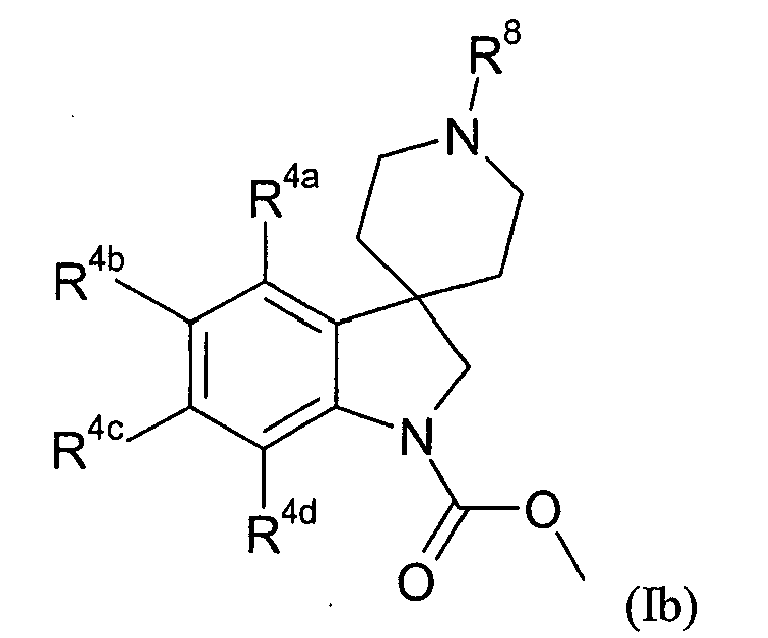
- Table III provides 301 compounds of formula Ic

- Table IV provides 301 compounds of formula Id

- Table V provides 301 compounds of formula Ie

- Table VI provides 301 compounds of formula If
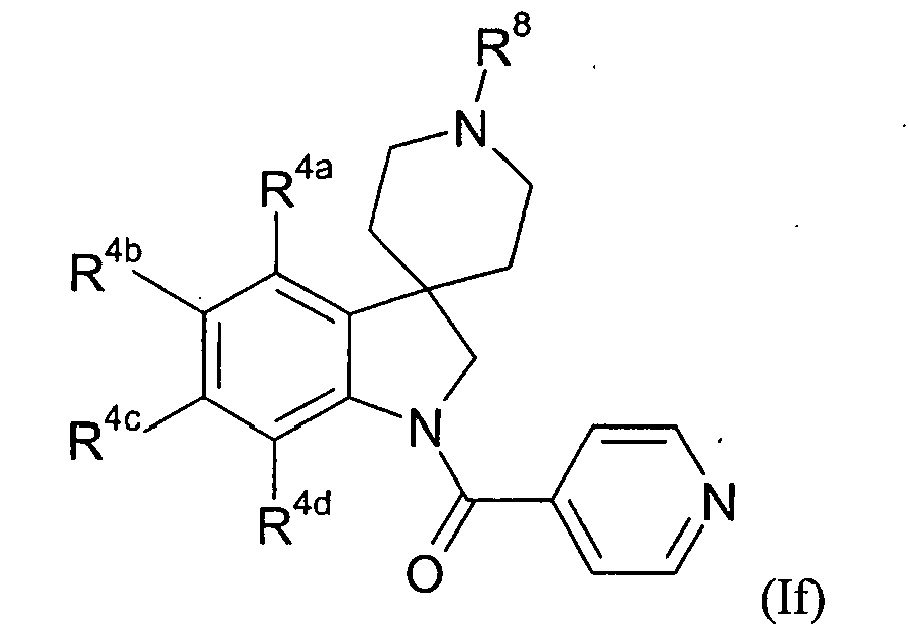
- Table VII provides 301 compounds of formula Ig

- Table VIII provides 301 compounds of formula Ih

- Table IX provides 301 compounds of formula Ii

- Table X provides 301 compounds of formula Ij

- Table XI provides 301 compounds of formula Ik

- Table XII provides 301 compounds of formula Il

- Table XIII provides 301 compounds of formula Im
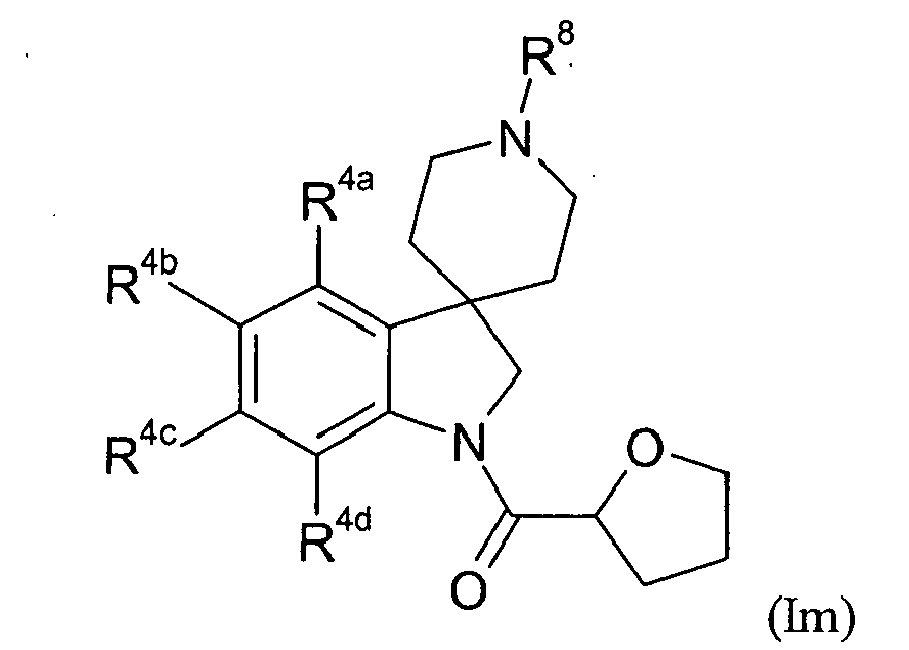
- Table XIV provides 301 compounds of formula In

- Table XV provides 301 compounds of formula Io

- Table XVI provides 301 compounds of formula Ip

- Table XVII provides 301 compounds of formula Iq

- Table XVIII provides 301 compounds of formula Ir

- Table XIX provides 301 compounds of formula Is

- Table XX provides 301 compounds of formula It

- Table XXI provides 301 compounds of formula Iu

- Table XXII provides 301 compounds of formula Iv
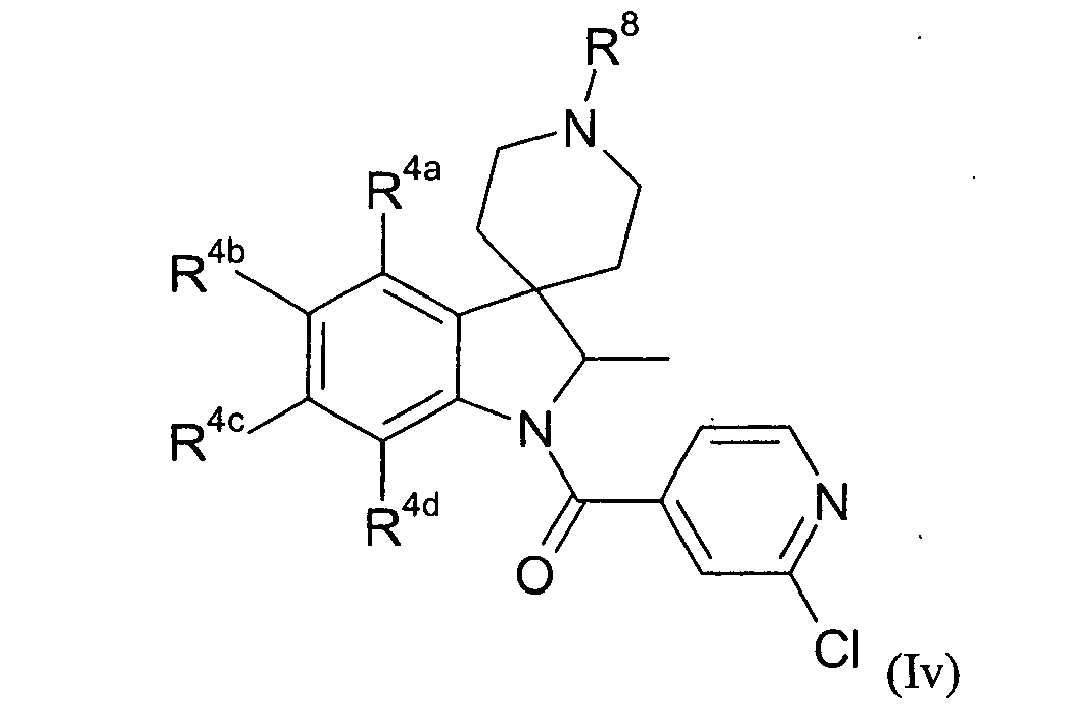
- Table XXIII provides 301 compounds of formula Iw

- Table XXIV provides 301 compounds of formula Ix

- Table XXV provides 301 compounds of formula Iy
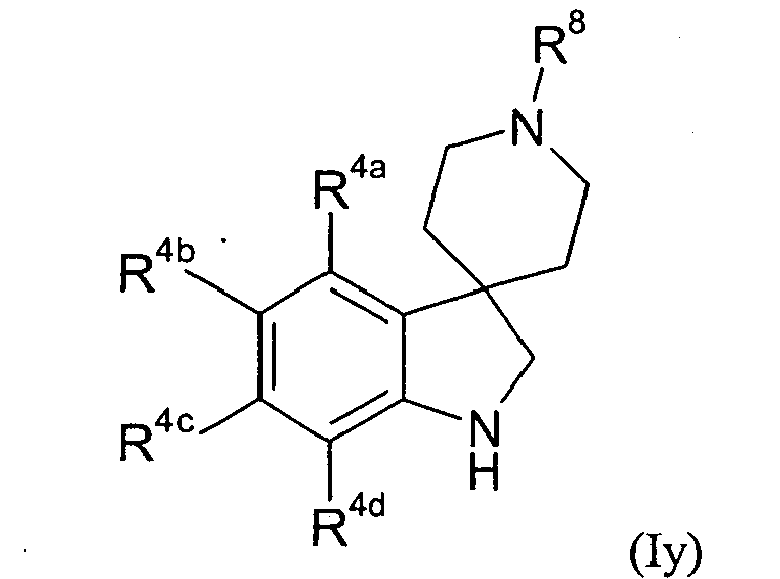
- Table XXVI provides 301 compounds of formula Iz

- Table XXVII provides 301 compounds of formula Iaa

- Table XXVIII provides 270 compounds of formula Iab

Table 2 Compound R8 R4a R4b R4c R4d (Ra)n XXVIII-1 cinnamyl H H H H 4-SMe XXVIII-2 4-chlorocinnamyl H H H H 4-SMe XXVIII-3 4-fluorocinnamyl H H H H 4-SMe XXVIII-4 4-trifluoromethylcinnamyl H H H H 4-SMe XXVIII-5 4-cyanocinnamyl H H H H 4-SMe XXVIII-6 cinnamyl H Cl H H 4-SMe XXVIII-7 4-chlorocinnamyl H Cl H H 4-SMe XXVIII-8 4-fluorocinnamyl H Cl H H 4-SMe XXVIII-9 4-trifluoromethylcinnamyl H Cl H H 4-SMe XXVIII-10 4-cyanocinnamyl H Cl H H 4-SMe XXVIII-11 cinnamyl H F H H 4-SMe XXVIII-12 4-chlorocinnamyl H F H H 4-SMe XXVIII-13 4-fluorocinnamyl H F H H 4-SMe XXVIII-14 4-trifluoromethylcinnamyl H F H H 4-SMe XXVIII-15 4-cyanocinnamyl H F H H 4-SMe XXVIII-16 cinnamyl H H F H 4-SMe XXVIII-17 4-chlorocinnamyl H H F H 4-SMe XXVIII-18 4-fluorocinnamyl H H F H 4-SMe XXVIII-19 4-trifluoromethylcinnamyl H H F H 4-SMe XXVIII-20 4-cyanocinnamyl H H F H 4-SMe XXVIII-21 cinnamyl H F H F 4-SMe XXVIII-22 4-chlorocinnamyl H F H F 4-SMe XXVIII-23 4-fluorocinnamyl H F H F 4-SMe XXVIII-24 4-trifluoromethylcinnamyl H F H F 4-SMe XXVIII-25 4-cyanocinnamyl H F H F 4-SMe XXVIII-26 cinnamyl H OMe H H 4-SMe XXVIII-27 4-chlorocinnamyl H OMe H H 4-SMe XXVIII-28 4-fluorocinnamyl H OMe H H 4-SMe XXVIII-29 4-trifluoromethylcinnamyl H OMe H H 4-SMe XXVIII-30 4-cyanocinnamyl H OMe H H 4-SMe XXVIII-31 cinnamyl H H H H 4-C(O)Ph XXVIII-32 4-chlorocinnamyl H H H H 4-C(O)Ph XXVIll-33 4-fluorocinnamyl H H H H 4-C(O)Ph XXVIII-34 4-trifluoromethylcinnamyl H H H H 4-C(O)Ph XXVIII-35 4-cyanocinnamyl H H H H 4-C(O)Ph XXVIII-36 cinnamyl H Cl H H 4-C(O)Ph XXVIII-37 4-chlorocinnamyl H Cl H H 4-C(O)Ph XXVIII-38 4-fluorocinnamyl H Cl H H 4-C(O)Ph XXVIII-39 4-trifluoromethylcinnamyl H Cl H H 4-C(O)Ph XXVIII-40 4-cyanocinnamyl H Cl H H 4-C(O)Ph XXVIII-41 cinnamyl H F H H 4-C(O)Ph XXVIII-42 4-chlorocinnamyl H F H H 4-C(O)Ph XXVIII-43 4-fluorocinnamyl H F H H 4-C(O)Ph XXVIII-44 4-trifluoromethylcinnamyl H F H H 4-C(O)Ph XXVIII-45 4-cyanocinnamyl H F H H 4-C(O)Ph XXVIII-46 cinnamyl H H F H 4-C(O)Ph XXVIII-47 4-chlorocinnamyl H H F H 4-C(O)Ph XXVIII-48 4-fluorocinnamyl H H F H 4-C(O)Ph XXVIII-49 4-trifluoromethylcinnamyl H H F H 4-C(O)Ph XXVIII-50 4-cyanocinnamyl H H F H 4-C(O)Ph XXVIII-51 cinnamyl H F H F 4-C(O)Ph XXVIII-52 4-chlorocinnamyl H F H F 4-C(O)Ph XXVIII-53 4-fluorocinnamyl H F H F 4-C(O)Ph XXVIII-54 4-trifluoromethylcinnamyl H F H F 4-C(O)Ph XXVIII-55 4-cyanocinnamyl H F H F 4-C(O)Ph XXVIII-56 cinnamyl H OMe H H 4-C(O)Ph XXVIII-57 4-chlorocinnamyl H OMe H H 4-C(O)Ph XXVIII-58 4-fluorocinnamyl H OMe H H 4-C(O)Ph XXVIII-59 4-trifluoromethylcinnamyl H OMe H H 4-C(O)Ph XXVIII-60 4-cyanocinnamyl H OMe H H 4-C(O)Ph XXVIII-61 cinnamyl H H H H 4-F XXVIII-62 4-chlorocinnamyl H H H H 4-F XXVIII-63 4-fluorocinnamyl H H H H 4-F XXVIII-64 4-trifluoromethylcinnamyl H H H H 4-F XXVIII-65 4-cyanocinnamyl H H H H 4-F XXVIII-66 cinnamyl H Cl H H 4-F XXVIII-67 4-chlorocinnamyl H Cl H H 4-F XXVIII-68 4-fluorocinnamyl H Cl H H 4-F XXVIII-69 4-trifluoromethylcinnamyl H Cl H H 4-F XXVIII-70 4-cyanocinnamyl H Cl H H 4-F XXVIII-71 cinnamyl H F H H 4-F XXVIII-72 4-chlorocinnamyl H F H H 4-F XXVIII-73 4-fluorocinnamyl H F H H 4-F XXVIII-74 4-trifluoromethylcinnamyl H F H H 4-F XXVIII-75 4-cyanocinnamyl H F H H 4-F XXVIII-76 cinnamyl H H F H 4-F XXVIII-77 4-chlorocinnamyl H H F H 4-F XXVIII-78 4-fluorocinnamyl H H F H 4-F XXVIII-79 4-trifluoromethylcinnamyl H H F H 4-F XXVIII-80 4-cyanocinnamyl H H F H 4-F XXVIII-81 cinnamyl H F H F 4-F XXVIII-82 4-chlorocinnamyl H F H F 4-F XXVIII-83 4-fluorocinnamyl H F H F 4-F XXVIII-84 4-trifluoromethylcinnamyl H F H F 4-F XXVIII-85 4-cyanocinnamyl H F H F 4-F XXVIII-86 cinnamyl H OMe H H 4-F XXVIII-87 4-chlorocinnamyl H OMe H H 4-F XXVIII-88 4-fluorocinnamyl H OMe H H 4-F XXVIII-89 4-trifluoromethylcinnamyl H OMe H H 4-F XXVIII-90 4-cyanocinnamyl H OMe H H 4-F XXVIII-91 cinnamyl H H H H 3-CN XXVIII-92 4-chlorocinnamyl H H H H 3-CN XXVIII-93 4-fluorocinnamyl H H H H 3-CN XXVIII-94 4-trifluoromethylcinnamyl H H H H 3-CN XXVIII-95 4-cyanocinnamyl H H H H 3-CN XXVIII-96 cinnamyl H Cl H H 3-CN XXVIII-97 4-chlorocinnamyl H Cl H H 3-CN XXVIII-98 4-fluorocinnamyl H Cl H H 3-CN XXVIII-99 4-trifluoromethylcinnamyl H Cl H H 3-CN XXVIII-100 4-cyanocinnamyl H Cl H H 3-CN XXVIII-101 cinnamyl H F H H 3-CN XXVIII-102 4-chlorocinnamyl H F H H 3-CN XXVIII-103 4-fluorocinnamyl H F H H 3-CN XXVIII-104 4-trifluoromethylcinnamyl H F H H 3-CN XXVIII-105 4-cyanocinnamyl H F H H 3-CN XXVIII-106 cinnamyl H H F H 3-CN XXVIII-107 4-chlorocinnamyl H H F H 3-CN XXVIII-108 4-fluorocinnamyl H H F H 3-CN XXVIII-109 4-trifluoromethylcinnamyl H H F H 3-CN XXVIII-110 4-cyanocinnamyl H H F H 3-CN XXVIII-111 cinnamyl H F H F 3-CN XXVIII-112 4-chlorocinnamyl H F H F 3-CN XXVIII-113 4-fluorocinnamyl H F H F 3-CN XXVIII-114 4-trifluoromethylcinnamyl H F H F 3-CN XXVIII-115 4-cyanocinnamyl H F H F 3-CN XXVIII-116 cinnamyl H OMe H H 3-CN XXVIII-117 4-chlorocinnamyl H OMe H H 3-CN XXVIII-118 4-fluorocinnamyl H OMe H H 3-CN XXVIII-119 4-trifluoromethylcinnamyl H OMe H H 3-CN XXVIII-120 4-cyanocinnamyl H OMe H H 3-CN XXVIII-121 cinnamyl H H H H 4-n-Pr XXVIII-122 4-chlorocinnamyl H H H H 4-n-Pr XXVIII-123 4-fluorocinnamyl H H H H 4-n-Pr XXVIII-124 4-trifluoromethylcinnamyl H H H H 4-n-Pr XXVIII-125 4-cyanocinnamyl H H H H 4-n-Pr XXVIII-126 cinnamyl H Cl H H 4-n-Pr XXVIII-127 4-chlorocinnamyl H Cl H H 4-n-Pr XXVIII-128 4-fluorocinnamyl H Cl H H 4-n-Pr XXVIII-129 4-trifluoromethylcinnamyl H Cl H H 4-n-Pr XXVIII-130 4-cyanocinnamyl H Cl H H 4-n-Pr XXVIII-131 cinnamyl H F H H 4-n-Pr XXVIII-132 4-chlorocinnamyl H F H H 4-n-Pr XXVIII-133 4-fluorocinnamyl H F H H 4-n-Pr XXVIII-134 4-trifluoromethylcinnamyl H F H H 4-n-Pr XXVIII-135 4-cyanocinnamyl H F H H 4-n-Pr XXVIII-136 cinnamyl H H F H 4-n-Pr XXVIII-137 4-chlorocinnamyl H H F H 4-n-Pr XXVIII-138 4-fluorocinnamyl H H F H 4-n-Pr XXVIII-139 4-trifluoromethylcinnamyl H H F H 4-n-Pr XXVIII-140 4-cyanocinnamyl H H F H 4-n-Pr XXVIII-141 cinnamyl H F H F 4-n-Pr XXVIII-142 4-chlorocinnamyl H F H F 4-n-Pr XXVIII-143 4-fluorocinnamyl H F H F 4-n-Pr XXVIII-144 4-trifluoromethylcinnamyl H F H F 4-n-Pr XXVIII-145 4-cyanocinnamyl H F H F 4-n-Pr XXVIII-146 cinnamyl H OMe H H 4-n-Pr XXVIII-147 4-chlorocinnamyl H OMe H H 4-n-Pr XXVIII-148 4-fluorocinnamyl H OMe H H 4-n-Pr XXVIII-149 4-trifluoromethylcinnamyl H OMe H H 4-n-Pr XXVIII-150 4-cyanocinnamyl H OMe H H 4-n-Pr XXVIII-151 cinnamyl H H H H 2-OMe-4-SMe XXVIII-152 4-chlorocinnamyl H H H H 2-OMe-4-SMe XXVIII-153 4-fluorocinnamyl H H H H 2-OMe-4-SMe XXVIII-154 4-trifluoromethylcinnamyl H H H H 2-OMe-4-SMe XXVIII-155 4-cyanocinnamyl H H H H 2-OMe-4-SMe XXVIII-156 cinnamyl H Cl H H 2-OMe-4-SMe XXVIII-157 4-chlorocinnamyl H Cl H H 2-OMe-4-SMe XXVIII-158 4-fluorocinnamyl H Cl H H 2-OMe-4-SMe XXVIII-159 4-trifluoromethylcinnamyl H Cl H H 2-OMe-4-SMe XXVIII-160 4-cyanocinnamyl H Cl H H 2-OMe-4-SMe XXVIII-161 cinnamyl H F H H 2-OMe-4-SMe XXVIII-162 4-chlorocinnamyl H F H H 2-OMe-4-SMe XXVIII-163 4-fluorocinnamyl H F H H 2-OMe-4-SMe XXVIII-164 4-trifluoromethylcinnamyl H F H H 2-OMe-4-SMe XXVIII-165 4-cyanocinnamyl H F H H 2-OMe-4-SMe XXVIII-166 cinnamyl H H F H 2-OMe-4-SMe XXVIII-167 4-chlorocinnamyl H H F H 2-OMe-4-SMe XXVIII-168 4-fluorocinnamyl H H F H 2-OMe-4-SMe XXVIII-169 4-trifluoromethylcinnamyl H H F H 2-OMe-4-SMe XXVIII-170 4-cyanocinnamyl H H F H 2-OMe-4-SMe XXVIII-171. cinnamyl H F H F 2-OMe-4-SMe XXVIII-172 4-chlorocinnamyl H F H F 2-OMe-4-SMe XXVIII-173 4-fluorocinnamyl H F H F 2-OMe-4-SMe XXVIII-174 4-trifluoromethylcinnamyl H F H F 2-OMe-4-SMe XXVIII-175 4-cyanocinnamyl H F H F 2-OMe-4-SMe XXVIII-176 cinnamyl H OMe H H 2-OMe-4-SMe XXVIII-177 4-chlorocinnamyl H OMe H H 2-OMe-4-SMe XXVIII-178 4-fluorocinnamyl H OMe H H 2-OMe-4-SMe XXVIII-179 4-trifluoromethylcinnamyl H OMe H H 2-OMe-4-SMe XXVIII-180 4-cyanocinnamyl H OMe H H 2-OMe-4-SMe XXVIII-181 cinnamyl H H H H 2-Cl-4-SO2Me XXVIII-182 4-chlorocinnamyl H H H H 2-Cl-4-SO2Me XXVIII-183 4-fluorocinnamyl H H H H 2-Cl-4-SO2Me XXVIII-184 4-trifluoromethylcinnamyl H H H H 2-Cl-4-SO2Me XXVIII-185 4-cyanocinnamyl H H H H 2-Cl-4-SO2Me XXVIII-186 cinnamyl H Cl H H 2-Cl-4-SO2Me XXVIII-187 4-chlorocinnamyl H Cl H H 2-Cl-4-SO2Me XXVIII-188 4-fluorocinnamyl H Cl H H 2-Cl-4-SO2Me XXVIII-189 4-trifluoromethylcinnamyl H Cl H H 2-Cl-4-SO2Me XXVIII-190 4-cyanocinnamyl H Cl H H 2-Cl-4-SO2Me XXVIII-191 cinnamyl H F H H 2-Cl-4-SO2Me XXVIII-192 4-chlorocinnamyl H F H H 2-Cl-4-SO2Me XXVIII-193 4-fluorocinnamyl H F H H 2-Cl-4-SO2Me XXVIII-194 4-trifluoromethylcinnamyl H F H H 2-Cl-4-SO2Me XXVIII-195 4-cyanocinnamyl H F H H 2-Cl-4-SO2Me XXVIII-196 cinnamyl H H F H 2-Cl-4-SO2Me XXVIII-197 4-chlorocinnamyl H H F H 2-Cl-4-SO2Me XXVIII-198 4-fluorocinnamyl H H F H 2-Cl-4-SO2Me XXVIII-199 4-trifluoromethylcinnamyl H H F H 2-Cl-4-SO2Me XXVIII-200 4-cyanocinnamyl H H F H 2-Cl-4-SO2Me XXVIII-201 cinnamyl H F H F 2-Cl-4-SO2Me XXVIII-202 4-chlorocinnamyl H F H F 2-Cl-4-SO2Me XXVIII-203 4-fluorocinnamyl H F H F 2-Cl-4-SO2Me XXVIII-204 4-trifluoromethylcinnamyl H F H F 2-Cl-4-SO2Me XXVIII-205 4-cyanocinnamyl H F H F 2-Cl-4-SO2Me XXVIII-206 cinnamyl H OMe H H 2-Cl-4-SO2Me XXVIII-207 4-chlorocinnamyl H OMe H H 2-Cl-4-SO2Me XXVIII-208 4-fluorocinnamyl H OMe H H 2-Cl-4-SO2Me XXVIII-209 4-trifluoromethylcinnamyl H OMe H H 2-Cl-4-SO2Me XXVIII-210 4-cyanocinnamyl H OMe H H 2-Cl-4-SO2Me XXVIII-211 cinnamyl H H H H 4-n-PrO XXVIII-212 4-chlorocinnamyl H H H H 4-n-PrO XXVIII-213 4-fluorocinnamyl H H H H 4-n-PrO XXVIII-214 4-trifluoromethylcinnamyl H H H H 4-n-PrO XXVIII-215 4-cyanocinnamyl H H H H 4-n-PrO XXVIII-216 cinnamyl H Cl H H 4-n-PrO XXVIII-217 4-chlorocinnamyl H Cl H H 4-n-PrO XXVIII-218 4-fluorocinnamyl H Cl H H 4-n-PrO XXVIII-219 4-trifluoromethylcinnamyl H Cl H H 4-n-PrO XXVIII-220 4-cyanocinnamyl H Cl H H 4-n-PrO XXVIII-221 cinnamyl H F H H 4-n-PrO XXVIII-222 4-chlorocinnamyl H F H H 4-n-PrO XXVIII-223 4-fluorocinnamyl H F H H 4-n-PrO XXVIII-224 4-trifluoromethylcinnamyl H F H H 4-n-PrO XXVIII-225 4-cyanocinnamyl H F H H 4-n-PrO XXVIII-226 cinnamyl H H F H 4-n-PrO XXVIII-227 4-chlorocinnamyl H H F H 4-n-PrO XXVIII-228 4-fluorocinnamyl H H F H 4-n-PrO XXVIII-229 4-trifluoromethylcinnamyl H H F H 4-n-PrO XXVIII-230 4-cyanocinnamyl H H F H 4-n-PrO XXVIII-231 cinnamyl H F H F 4-n-PrO XXVIII-232 4-chlorocinnamyl H F H F 4-n-PrO XXVIII-233 4-fluorocinnamyl H F H F 4-n-PrO XXVIII-234 4-trifluoromethylcinnamyl H F H F 4-n-PrO XXVIII-235 4-cyanocinnamyl H F H F 4-n-PrO XXVIII-236 cinnamyl H OMe H H 4-n-PrO XXVIII-237 4-chlorocinnamyl H OMe H H 4-n-PrO XXVIII-238 4-fluorocinnamyl H OMe H H 4-n-PrO XXVIII-239 4-trifluoromethylcinnamyl H OMe H H 4-n-PrO XXVIII-240 4-cyanocinnamyl H OMe H H 4-n-PrO XXVIII-241 cinnamyl H H H H 2-Me XXVIII-242 4-chlorocinnamyl H H H H 2-Me XXVIII-243 4-fluorocinnamyl H H H H 2-Me XXVIII-244 4-trifluoromethylcinnamyl H H H H 2-Me XXVIII-245 4-cyanocinnamyl H H H H 2-Me XXVIII-246 cinnamyl H Cl H H 2-Me XXVIII-247 4-chlorocinnamyl H Cl H H 2-Me XXVIII-248 4-fluorocinnamyl H Cl H H 2-Me XXVIII-249 4-trifluoromethylcinnamyl H Cl H H 2-Me XXVIII-250 4-cyanocinnamyl H Cl H H 2-Me XXVIII-251 cinnamyl H F H H 2-Me XXVIII-252 4-chlorocinnamyl H F H H 2-Me XXVIII-253 4-fluorocinnamyl H F H H 2-Me XXVIII-254 4-tri fluoromethylcinnamyl H F H H 2-Me XXVIII-255 4-cyanocinnamyl H F H H 2-Me XXVIII-256 cinnamyl H H F H 2-Me XXVIII-257 4-chlorocinnamyl H H F H 2-Me XXVIII-258 4-fluorocinnamyl H H F H 2-Me XXVIII-259 4-trifluoromethylcinnamyl H H F H 2-Me XXVIII-260 4-cyanocinnamyl H H F H 2-Me XXVIII-261 cinnamyl H F H F 2-Me XXVIII-262 4-chlorocinnamyl H F H F 2-Me XXVIII-263 4-fluorocinnamyl H F H F 2-Me XXVIII-264 4-trifluoromethylcinnamyl H F H F 2-Me XXVIII-265 4-cyanocinnamyl H F H F 2-Me XXVIII-266 cinnamyl H OMe H H 2-Me XXVIII-267 4-chlorocinnamyl H OMe H H 2-Me XXVIII-268 4-fluorocinnamyl H OMe H H 2-Me XXVIII-269 4-trifluoromethylcinnamyl H OMe H H 2-Me XXVIII-270 4-cyanocinnamyl H OMe H H 2-Me - Table XXIX provides 214 compounds of formula Iac
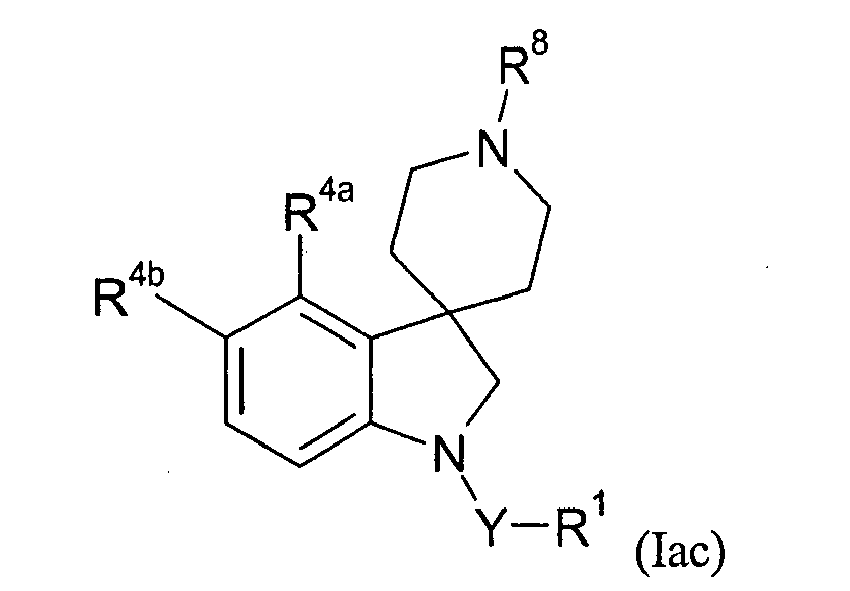
Table 3 R8 R4a R4b Y R1 XXIX-1 2-(benzoxazolyl)methyl H Cl C(O) 2-chloropyrid-4-yl XXIX-2 2-(benzoxazolyl)methyl H F C(O) 2-chloropyrid-4-yl XXIX-3 2-(benzoxazolyl)methyl H Cl bond carbomethoxy XXIX-4 2-(benzoxazolyl)methyl H F bond carbomethoxy XXIX-5 2-(benzoxazolyl)methyl H C1 bond acetyl XXIX-6 2-(benzoxazolyl)methyl H F bond acetyl XXIX-7 2-methyl-3-(3',4'-methylenedioxyphen yl)prop-2-enyl H Cl C(O) 2-chloropyrid-4-yl XXIX-8 2-methyl-3-(3',4'-methylenedioxyphen yl)prop-2-enyl H F C(O) 2-chloropyrid-4-yl XXIX-9 2-methyl-3-(3',4'-methylenedioxyphen yl)prop-2-enyl H Cl bond Carbomethoxy XXIX-10 2-methyl-3-(3',4'-methylenedioxyphen yl)prop-2-enyl H F bond carbomethoxy XXIX-11 2-methyl-3-(3',4'-methylenedioxyphen yl)prop-2-enyl H Cl bond acetyl XXIX-12 2-methyl-3-(3',4'-methylenedioxyphen yl)prop-2-enyl H F bond acetyl XXIX-13 3-phenylprop-2-ynyl H Cl C(O) 2-chloropyrid-4-yl XXIX-14 3-phenylprop-2-ynyl H F C(O) 2-chloropyrid-4-yl XXIX-15 3-phenylprop-2-ynyl H Cl bond carbomethoxy XXIX-16 3-phenylprop-2-ynyl H F bond carbomethoxy XXIX-17 3-phenylprop-2-ynyl H Cl bond acetyl XXIX-18 3-phenylprop-2-ynyl H F bond acetyl XXIX-19 trifluoroacetamido H Cl C(O) 2-chloropyrid-4-yl XXIX-20 trifluoroacetamido H F C(O) 2-chloropyrid-4-yl XXIX-21 trifluoroacetamido H Cl bond carbomethoxy XXIX-22 trifluoroacetamido H F bond carbomethoxy XXIX-23 trifluoroacetamido H Cl bond acetyl XXIX-24 trifluoroacetamido H F bond acetyl XXIX-25 4-chlorocinnamate H C1 C(O) 2-chloropyrid-4-yl XXIX-26 4-chlorocinnamate H F C(O) 2-chloropyrid-4-yl XXIX-27 4-chlorocinnamate H Cl bond carbomethoxy XXIX-28 4-chlorocinnamate H F bond carbomethoxy XXIX-29 4-chlorocinnamate H Cl bond acetyl XXIX-30 4-chlorocinnamate H F bond acetyl XXIX-31 2-oxo-2-(2'-chloro-4'-methylphenyl)ethyl H Cl C(O) 2-chloropyrid-4-yl XXIX-32 2-oxo-2-(2'-chloro-4'-methylphenyl)ethyl H F C(O) 2-chloropyrid-4-yl XXIX-33 2-oxo-2-(2'-chloro-4'-methylphenyl)ethyl H Cl bond carbomethoxy XXIX-34 2-oxo-2-(2'-chloro-4'-methylphenyl)ethyl H F bond carbomethoxy XXIX-35 2-oxo-2-(2'-chloro-4'-methylphenyl)ethyl H Cl bond acetyl XXIX-36 2-oxo-2-(2'-chloro-4'-methylphenyl)ethyl H F bond acetyl XXIX-37 2-oxo-1,2-diphenylethyl H Cl C(O) 2-chloropyrid-4-yl XXIX-38 2-oxo-1,2-diphenylethyl H F C(O) 2-chloropyrid-4-yl XXIX-39 2-oxo-1,2-diphenylethyl H Cl bond carbomethoxy XXIX-40 2-oxo-1,2-diphenylethyl H F bond carbomethoxy XXIX-41 2-oxo-1,2-diphenylethyl H Cl bond acetyl XXIX-42 2-oxo-1,2-diphenylethyl H F bond acetyl XXIX-43 3,3-dichloroallyl H Cl C(O) 2-chloropyrid-4-yl XXIX-44 3,3-dichloroallyl H F C(O) 2-chloropyrid-4-yl XXIX-45 3,3-dichloroallyl H Cl bond carbomethoxy XXIX-46 3,3-dichloroallyl H F bond carbomethoxy XXIX-47 3,3-dichloroallyl H Cl bond acetyl XXIX-48 3,3-dichloroallyl H F bond acetyl XXIX-49 t-butyloxycarbonyl H F bond H XXIX-50 t-butyloxycarbonyl H Cl bond H XXIX-51 t-butyloxycarbonyl H Cl C(O) 2-chloropyrid-4-yl XXIX-52 t-butyloxycarbonyl H F C(O) 2-chloropyrid-4-yl XXIX-53 t-butyloxycarbonyl H Cl bond carbomethoxy XXIX-54 t-butyloxycarbonyl H F bond carbomethoxy XXIX-55 t-butyloxycarbonyl H Cl bond acetyl XXIX-56 t-butyloxycarbonyl H F bond acetyl XXIX-57 4-chlorocinnamyl H Cl bond 5-trifluoromethylpyrid-2-yl XXIX-58 4-chlorocinnamyl H F bond 5-trifluoromethylpyrid-2-yl XXIX-59 4-chlorocinnamyl Br H bond 5-trifluoromethylpyrid-2-yl XXIX-60 4-fluorocinnamyl H C1 bond 5-trifluoromethylpyrid-2-yl XXIX-61 4-fluorocinnamyl H F bond 5-trifluoromethylpyrid-2-yl XXIX-62 4-fluorocinnamyl Br H bond 5-trifluoromethylpyrid-2-yl XXIX-63 4-chlorocinnamyl H Cl bond pyrimidin-2-yl XXIX-64 4-chlorocinnamyl H F bond pyrimidin-2-yl XXIX-65 4-chlorocinnamyl Br H bond pyrimidin-2-yl XXIX-66 4-fluorocinnamyl H C1 bond pyrimidin-2-yl XXIX-67 4-fluorocinnamyl H F bond pyrimidin-2-yl XXIX-68 4-fluorocinnamyl Br H bond pyrimidin-2-yl XXIX-69 4-chlorocinnamyl H Cl C(O) pyrazinyl XXIX-70 4-chlorocinnamyl H F C(O) pyrazinyl XXIX-71 4-chlorocinnamyl Br H C(O) pyrazinyl XXIX-72 4-fluorocinnamyl H Cl C(O) pyrazinyl XXIX-73 4-fluorocinnamyl H F C(O) pyrazinyl XXIX-74 4-fluorocinnamyl Br H C(O) pyrazinyl XXIX-75 4-chlorocinnamyl H Cl C(O) 2-chloropyrid-5-yl XXIX-76 4-chlorocinnamyl H F C(O) 2-chloropyrid-5-yl XXIX-77 4-chlorocinnamyl Br H C(O) 2-chloropyrid-5-yl XXIX-78 4-fluorocinnamyl H Cl C(O) 2-chloropyrid-5-yl XXIX-79 4-fluorocinnamyl H F C(O) 2-chloropyrid-5-yl XXIX-80 4-fluorocinnamyl Br H C(O) 2-chloropyrid-5-yl XXIX-81 4-chlorocinnamyl H Cl C(O) 1,2,3-thiadiazol-4-yl XXIX-82 4-chlorocinnamyl H F C(O) 1,2,3-thiadiazol-4-yl XXIX-83 4-chlorocinnamyl Br H C(O) 1,2,3-thiadiazol-4-yl XXIX-84 4-fluorocinnamyl H Cl C(O) 1,2,3-thiadiazol-4-yl XXIX-85 4-fluorocinnamyl H F C(O) 1,2,3-thiadiazol-4-yl XXIX-86 4-fluorocinnamyl Br H C(O) 1,2,3-thiadiazol-4-yl XXIX-87 4-chlorocinnamyl H Cl C(O) 1-methyl-5-nitro-[1H]-pyrazol-4-yl XXIX-88 4-chlorocinnamyl H F C(O) 1-methyl-5-nitro-[1 H]-pyrazol-4-yl XXIX-89 4-chlorocinnamyl Br H C(O) 1-methyl-5-nitro-[1H]-pyrazol-4-yl XXIX-90 4-fluorocinnamyl H Cl C(O) 1-methyl-5-nitro-[1H]-pyrazol-4-yl XXIX-91 4-fluorocinnamyl H F C(O) 1-methyl-5-nitro-[1H]-pyrazol-4-yl XXIX-92 4-fluorocinnamyl Br H C(O) 1-methyl-5 -nitro-[1H]-pyrazol-4-yl XXIX-93 4-chlorocinnamyl H Cl C(O) 5-carbomethoxypyrid-2-yl XXIX-94 4-chlorocinnamyl H F C(O) 5-carbomethoxypyrid-2-yl XXIX-95 4-chlorocinnamyl Br H C(O) 5-carbomethoxypyrid-2-yl XXIX-96 4-fluorocinnamyl H Cl C(O) 5-carbomethoxypyrid-2-yl XXIX-97 4-fluorocinnamyl H F C(O) 5-carbomethoxypyrid-2-yl XXIX-98 4-fluorocinnamyl Br H C(O) 5-carbomethoxypyrid-2-yl XXIX-99 4-chlorocinnamyl H Cl C(O) 4-chloropyrid-2-yl XXIX-100 4-chlorocinnamyl H F C(O) 4-chloropyrid-2-yl XXIX-101 4-chlorocinnamyl Br H C(O) 4-chloropyrid-2-yl XXIX-102 4-fluorocinnamyl H Cl C(O) 4-chloropyrid-2-yl XXIX-103 4-fluorocinnamyl H F C(O) 4-chloropyrid-2-yl XXIX-104 4-fluorocinnamyl Br H C(O) 4-chloropyrid-2-yl XXIX-105 4-chlorocinnamyl H C1 C(O) 2-methyl-6-trifluoromethylpyrid-3-yl XXIX-106 4-chlorocinnamyl H F C(O) 2-methyl-6-trifluoromethylpyrid-3-yl XXIX-107 4-chlorocinnamyl Br H C(O) 2-methyl-6-trifluoromethylpyrid-3-yl XXIX-108 4-fluorocinnamyl H Cl C(O) 2-methyl-6-trifluoromethylpyrid-3-yl XXIX-109 4-fluorocinnamyl H F C(O) 2-methyl-6-trifluoromethylpyrid-3-yl XXIX-110 4-fluorocinnamyl Br H C(O) 2-methyl-6-trifluoromethylpyrid-3-yl XXIX-111 4-chlorocinnamyl H Cl C(O) 5-methylisoxazol-3-yl XXIX-112 4-chlorocinnamyl H F C(O) 5-methylisoxazol-3-yl XXIX-113 4-chlorocinnamyl Br H C(O) 5-methylisoxazol-3-yl XXIX-114 4-fluorocinnamyl H Cl C(O) 5-methylisoxazol-3-yl XXIX-115 4-fluorocinnamyl H F C(O) 5-methylisoxazol-3-yl XXIX-116 4-fluorocinnamyl Br H C(O) 5-methylisoxazol-3-yl XXIX-117 4-chlorocinnamyl H Cl C(O) (pyrid-4-yl)methyl XXIX-118 4-chlorocinnamyl H F C(O) (pyrid-4-yl)methyl XXIX-119 4-chlorocinnamyl Br H C(O) (pyrid-4-yl)methyl XXIX-120 4-fluorocinnamyl H Cl C(O) (pyrid-4-yl)methyl XXIX-121 4-fluorocinnamyl H F C(O) (pyrid-4-yl)methyl XXIX-122 4-fluorocinnamyl Br H C(O) (pyrid-4-yl)methyl XXIX-123 4-chlorocinnamyl H Cl C(O) (thiophen-2-yl)methyl XXIX-124 4-chlorocinnamyl H F C(O) (thiophen-2-yl)methyl XXIX-125 4-chlorocinnamyl Br H C(O) (thiophen-2-yl)methyl XXIX-126 4-fluorocinnamyl H Cl C(O) (thiophen-2-yl)methyl XXIX-127 4-fluorocinnamyl H F C(O) (thiophen-2-yl)methyl XXIX-128 4-fluorocinnamyl Br H C(O) (thiophen-2-yl)methyl XXIX-129 4-chlorocinnamyl H Cl C(O) cyclopentyl XXIX-130 4-chlorocinnamyl H F C(O) cyclopentyl XXIX-131 4-chlorocinnamyl Br H C(O) cyclopentyl XXIX-132 4-fluorocinnamyl H Cl C(O) cyclopentyl XXIX-133 4-fluorocinnamyl H F C(O) cyclopentyl XXIX-134 4-fluorocinnamyl Br H C(O) cyclopentyl XXIX-135 4-chlorocinnamyl H C1 C(O) acetylaminomethyl XXIX-136 4-chlorocinnamyl H F C(O) acetylaminomethyl XXIX-137 4-chlorocinnamyl Br H C(O) acetylaminomethyl XXIX-138 4-fluorocinnamyl H Cl C(O) acetylaminomethyl XXIX-139 4-fluorocinnamyl H F C(O) acetylaminomethyl XXIX-140 4-fluorocinnamyl Br H C(O) acetylaminomethyl XXIX-141 4-chlorocinnamyl H Cl SO2 4-acetylaminophenyl XXIX-142 4-chlorocinnamyl H F SO2 4-acetylaminophenyl XXIX-143 4-chlorocinnamyl Br H SO2 4-acetylaminophenyl XXIX-144 4-fluorocinnamyl H Cl SO2 4-acetylaminophenyl XXIX-145 4-fluorocinnamyl H F SO2 4-acetylaminophenyl XXIX-146 4-fluorocinnamyl Br H SO2 4-acetylaminophenyl XXIX-147 4-chlorocinnamyl H C1 SO2 3,5-dimethylisoxazol-4-yl XXIX-148 4-chlorocinnamyl H F SO2 3,5-dimethylisoxazol-4-yl XXIX-149 4-chlorocinnamyl Br H SO2 3,5-dimethylisoxazol-4-yl XXIX-150 4-fluorocinnamyl H Cl SO2 3,5-dimethylisoxazol-4-yl XXIX-151 4-fluorocinnamyl H F SO2 3,5-dimethylisoxazol-4-yl XXIX-152 4-fluorocinnamyl Br H SO2 3,5-dimethylisoxazol-4-yl XXIX-153 4-chlorocinnamyl H Cl C(O) (2-methoxyphenyl)amino XXIX-154 4-chlorocinnamyl H F C(O) (2-methoxyphenyl)amino XXIX-155 4-chlorocinriamyl Br H C(O) (2-methoxyphenyl)amino XXIX-156 4-fluorocinnamyl H Cl C(O) (2-methoxyphenyl)amino XXIX-157 4-fluorocinnamyl H F C(O) (2-methoxyphenyl)amino XXIX-15 8 4-fluorocinnamyl Br H C(O) (2-methoxyphenyl)amino XXIX-159 4-chlorocinnamyl H F C(O) cyclohexen-1-yl XXIX-160 4-chlorocinnamyl H Cl C(O) cyclohexen-1-yl XXIX-161 4-chlorocinnamyl Br H C(O) cyclohexen-1-yl XXIX-162 4-fluorocinnamyl H Cl C(O) cyclohexen-1-yl XXIX-163 4-fluorocinnamyl H F C(O) cyclohexen-1-yl XXIX-164 4-fluorociimamyl Br H C(O) cyclohexen-1-yl XXIX-165 4-chlorocinnamyl H F C(O) quinolin-3-yl XXIX-166 4-chlorocinnamyl H Cl C(O) quinolin-3-yl XXIX-167 4-chlorocinnamyl Br H C(O) quinolin-3-yl XXIX-168 4-fluorocinnamyl H Cl C(O) quinolin-3-yl XXIX-169 4-fluorocinnamyl H F C(O) quinolin-3-yl XXIX-170 4-fluorocinnamyl Br H C(O) quinolin-3-yl XXIX-171 4-chlorocinnamyl H F C(O) benzothiophen-2-yl XXIX-172 4-chlorocinnamyl H Cl C(O) benzothiophen-2-yl XXIX-173 4-chlorocinnamyl Br H C(O) benzothiophen-2-yl XXIX-174 4-fluorocinnamyl H Cl C(O) benzothiophen-2-yl XXIX-175 4-fluorocinnamyl H F C(O) benzothiophen-2-yl XXIX-176 4-fluorocinnamyl Br H C(O) benzothiophen-2-yl XXIX-177 4-chlorocinnamyl H F C(O) 5-nitro-[1H]-pyrazol-3-yl XXIX-178 4-chlorocinnamyl H Cl C(O) 5-nitro-[1H]-pyrazol-3-yl XXIX-179 4-chlorocinnamyl Br H C(O) 5-nitro-[1H]-pyrazol-3-yl XXIX-180 4-fluorocinnamyl H Cl C(O) 5-nitro-[1H]-pyrazol-3-yl XXIX-181 4-fluorocinnamyl H F C(O) 5-nitro-[1H]-pyrazol-3-yl XXIX-182 4-fluorocinnamyl Br H C(O) 5-nitro-[1H]-pyrazol-3-yl XXIX-183 4-chlorocinnamyl H F C(O) ([1H]-tetrazol-1-yl)methyl XXIX-184 4-chlorocinnamyl H Cl C(O) ([1H]-tetrazol-1-yl)methyl XXIX-185 4-chlorocinnamyl Br H C(O) ([1H]-tetrazol-1-yl)methyl XXIX-186 4-fluorocinnamyl H Cl C(O) ([1H]-tetrazol-1-yl)methyl XXIX-187 4-fluorocinnamyl H F C(O) ([1H]-tetrazol-1-yl)methyl XXIX-188 4-fluorocinnamyl Br H C(O) ([1H]-tetrazol-1-yl)methyl XXIX-189 4-chlorocinnamyl H Cl bond benzyl XXIX-190 4-chlorocinnamyl H F bond benzyl XXIX-191 4-chlorocinnamyl Br H bond benzyl XXIX-192 4-fluorocinnamyl H Cl bond benzyl XXIX-193 4-fluorocinnamyl H F bond benzyl XXIX-194 4-fluorocinnamyl Br H bond benzyl XXIX-195 4-chlorocinnamyl H F C(O) (4-cyanophenyl)amino XXIX-196 4-chlorocinnamyl H Cl C(O) (4-cyanophenyl)amino XXIX-197 4-chlorocinnamyl Br H C(O) (4-cyanophenyl)amino XXIX-198 4-fluorocinnamyl H Cl C(O) (4-cyanophenyl)amino XXIX-199 4-fluorocirmamyl H F C(O) (4-cyanophenyl)amino XXIX-200 4-fluorocinnamyl Br H C(O) (4-cyanophenyl)amino XXIX-201 4-chlorocinnamyl H Me3Si CC C(O) 2-chloropyrid-4-yl XXIX-202 4-fluorocinnamyl H Me3Si CC C(O) 2-chloropyrid-4-yl XXIX-203 4-chlorocinnamyl H Me3Si CC bond carbomethoxy XXIX-204 4-fluorocinnamyl H Me3Si CC bond carbomethoxy XXIX-205 4-chlorocinnamyl H Me3Si CC bond acetyl XXIX-206 4-fluorocinnamyl H Me3Si CC bond acetyl XXIX-207 4-chlorocinnamyl H OMe SO2 n-butyl XXIX-208 4-chlorocinnamyl H F SO2 n-butyl XXIX-209 4-chlorocinnamyl H Cl SO2 n-butyl XXIX-210 4-chlorocinnamyl Br H SO2 n-butyl XXIX-211 4-fluorocinnamyl H OMe SO2 n-butyl XXIX-212 4-fluorocinnamyl H Cl SO2 n-butyl XXIX-213 4-fluorocinnamyl H F SO2 n-butyl XXIX-214 4-fluorocinnamyl Br H SO2 n-butyl - Table XXX provides 121 compounds of formula Iad

R4n R53 R54 Rsn Y R1 XXX-1 6-OCF3 H H 4-Cl C(O) Me XXX-2 6-OCF3 H H 4-Cl C(O) 2-chloropyrid-4-yl XXX-3 4-OCF3 H H 4-Cl C(O) Me XXX-4 6-OCF2CHF2 H H 4-Cl C(O) Me XXX-5 4-OCF2CHF2 H H 4-Cl C(O) Me XXX-6 4-OCF3 H H 4-Cl C(O) 2-chloropyrid-4-yl XXX-7 6-OCF2CHF2 H H 4-Cl C(O) 2-chloropyrid-4-yl XXX-8 4-OCF2CHF2 H H 4-Cl C(O) 2-chloropyrid-4-yl XXX-9 7-O-Ph H H 4-Cl C(O) Me XXX-10 7-O-Ph H H 4-Cl C(O) 2-chloropyrid-4-yl XXX-11 5-OCH2CH3 H H 4-Cl C(O) 2-chloropyrid-4-yl XXX-12 6-OCF3 H H 4-Cl C(O) 2,6-dibromopyrid-4-yl XXX-13 6-OCF3 H H 4-Cl C(O) 2,6-dichloropyrid-4-yl XXX-14 6-OCF3 H H 4-Cl C(O) pyrid-3-yl XXX-15 4-OCF2CHF2 H H 4-Cl C(O) 2,6-dibromopyrid-4-yl XXX-16 4-OCF2CHF2 H H 4-Cl C(O) 2,6-dichloropyrid-4-yl XXX-17 4-OCF2CHF2 H H 4-Cl C(O) pyrid-3-yl XXX-18 4-OCF3 H H 4-Cl C(O) 2,6-dibromopyrid-4-yl XXX-19 4-OCF3 H H 4-Cl C(O) 2,6-dichloropyrid-4-yl XXX-20 4-OCF3 H H 4-Cl C(O) pyrid-3-yl XXX-21 6-OCF2CHF2 H H 4-Cl C(O) 2,6-dibromopyrid-4-yl XXX-22 6-OCF2CHF2 H H 4-Cl C(O) 3,5-dichloropyrid-4-yl XXX-23 4-OCF3 H H 4-Cl C(O) 4,6-dimethoxy-pyrimidin-2-yl XXX-24 4-OCF2CHF2 H H 4-Cl C(O) 4,6-dimethoxy-pyrimidin-2-yl XXX-25 6-OCF3 H H 4-Cl C(O) 2-chloropyrid-3-yl XXX-26 7-OCF3 H H 4-Cl C(O) 2-chloropyrid-3-yl XXX-27 6-OCF2CHF2 H H 4-Cl C(O) 2-chloropyrid-3-yl XXX-28 4-OCF2CHF2 H H 4-Cl C(O) 2-chloropyrid-3-yl XXX-29 5-O-(4-trifluoromethylphenyl) H H 4-Cl C(O) 2-chloropyrid-4-yl XXX-30 5-OCF3 H H 4-Cl C(O) 2-chloropyrid-4-yl XXX-31 5-F H H 4-F C(O) 2-chloropyrid-4-yl XXX-32 5-Cl H H 2,4-Cl2 C(O) 2-chloropyrid-4-yl XXX-33 5,7-Cl2 H H 4-Cl C(O) Me XXX-34 7-Cl H H 4-Cl C(O) Me XXX-35 7-Cl H H 4-Cl C(O) 2-chloropyrid-4-yl XXX-36 5,7-dimethyl H H 4-Cl C(O) 2-chloropyrid-4-yl XXX-37 4,7-dimethyl H H 4-Cl C(O) 2-chloropyrid-4-yl XXX-38 6-CF3 H H 4-Cl C(O) 2-chloropyrid-4-yl XXX-39 4,6-Cl2 H H 4-Cl C(O) 2-chloropyrid-4-yl XXX-40 4,6-Cl2 H H 4-Cl C(O) 2-chloropyrid-4-yl XXX-41 5-isopropyl H H 4-Cl C(O) 2-chloropyrid-4-yl XXX-42 5-Br H H 4-Cl C(O) 2-chloropyrid-4-yl XXX-43 6,7-dimethyl H H 4-C1 C(O) 2-chloropyrid-4-yl XXX-44 5,6-Cl2 H H 4-Cl C(O) 2-chloropyrid-4-yl XXX-45 4-CF3 H H 4-C1 C(O) 2-chloropyrid-4-yl XXX-46 7-CH2Cl H H 4-Cl C(O) 2-chloropyrid-4-yl XXX-47 7-Br H H 4-C1 C(O) 2-chloropyrid-4-yl XXX-48 5-tert-butyl H H 4-Cl C(O) 2-chloropyrid-4-yl XXX-49 4,6-dimethyl H H 4-Cl C(O) 2-chloropyrid-4-yl XXX-50 4-CF3-7-Cl H H 4-C1 C(O) 2-chloropyrid-4-yl XXX-51 5-Cl H H 4-CF3 C(O) 2-chloropyrid-4-yl XXX-52 5-Cl H H 4-CH=CH2 C(O) 2-chloropyrid-4-yl XXX-53 5-Cl H H 4-CF3 C(O) 2-chloropyrid-4-yl XXX-54 5-Cl H H 4-C1 C(O) 2-chloropyrid-4-yl XXX-55 5-Cl H H 4-NO2 C(O) 2-chloropyrid-4-yl XXX-56 5-Cl H H 3,5-(CF3)2 C(O) 2-chloropyrid-4-yl XXX-57 5-Cl H H 3-Br C(O) 2-chloropyrid-4-yl XXX-58 5-Cl H H 3-ethoxy C(O) 2-chloropyrid-4-yl XXX-59 5-Cl H H 2-Me C(O) 2-chloropyrid-4-yl XXX-60 5-Cl H H 4-Me C(O) 2-chloropyrid-4-yl XXX-61 5-Cl H H 3-Cl,4-F C(O) 2-chloropyrid-4-yl XXX-62 5-Cl H H 3,5-Cl2 C(O) 2-chloropyrid-4-yl XXX-63 5-Cl H H 4-N3 C(O) 2-chloropyrid-4-yl XXX-64 5-Cl H H 2-Br C(O) 2-chloropyrid-4-yl XXX-65 5-Cl H H 2,6-dimethoxy C(O) 2-chloropyrid-4-yl XXX-66 5-Cl H H 4-ethoxy C(O) 2-chloropyrid-4-yl XXX-67 5-Cl H H 3-Cl C(O) 2-chloropyrid-4-yl XXX-68 5-Cl H H 3-Me,4-OMe,5-Cl C(O) 2-chloropyrid-4-yl XXX-69 5-Cl H H 4-OPh C(O) 2-chloropyrid-4-yl XXX-70 5-Cl H H 4-CN C(O) 2-chloropyrid-4-yl XXX-71 5-Cl H H 3-F,4-Ph C(O) 2-chloropyrid-4-yl XXX-72 5-Cl H H 4-SMe C(O) 2-chloropyrid-4-yl XXX-73 5-Cl H H 3-Br C(O) 2-chloropyrid-4-yl XXX-74 5-Cl H H 4-F C(O) 2-chloropyrid-4-yl XXX-75 5-Cl H H 4-Br C(O) 2-chloropyrid-4-yl XXX-76 5-Cl H H 2,4-Cl2 C(O) 2-chloropyrid-4-yl XXX-77 5-Cl H H 2,4-F2 C(O) 2-chloropyrid-4-yl XXX-78 5-Cl H H 3-CF3 C(O) 2-chloropyrid-4-yl XXX-79 5-Cl H H 3,4-diethoxy C(O) 2-chloropyrid-4-yl XXX-80 5-Cl H H 3-Me,4-F C(O) 2-chloropyrid-4-yl XXX-81 5-Cl H H 4-Ph C(O) 2-chloropyrid-4-yl XXX-82 5-Cl H Me 4-Cl C(O) 2-chloropyrid-4-yl XXX-83 5-Cl H Me 4-Cl C(O) Me XXX-84 5-Cl H Me 4-F C(O) 2-chloropyrid-4-yl XXX-85 5-Cl H Me 4-F C(O) Me XXX-86 5-Cl H H 4-OCF3 C(O) 2-chloropyrid-4-yl XXX-87 5-Cl H H 4-OCF3 C(O) Me XXX-88 5-Cl H F H C(O) 2-chloropyrid-4-yl XXX-89 5-Cl H F 4-C1 C(O) 2-chloropyrid-4-yl XXX-90 5-Cl H F 4-C1 C(O) Me XXX-91 5-Cl H CF3 4-C1 C(O) 2-chloropyrid-4-yl XXX-92 5-Cl H CF3 4-C1 C(O) Me XXX-93 5-F H H 4-C1 C(O) imidazol-1-yl XXX-94 5-F H H 4-C1 Bond NH2 XXX-95 5-F H H 4-C1 Bond -NHCO-2-chloropyrid-4-yl XXX-96 5-Cl H H 4-NO2 C(O) Me XXX-97 5-Cl H H 4-C1 Bond NHCO-4-trifluoromethoxyphenyl XXX-98 5-Cl H H 4-C1 Bond -NHCO-pyrid-4-yl XXX-99 5-Cl H H 4-Cl Bond -NHCO-3-chloropyrid-4-yl XXX-100 5-F H H 4-Cl Bond -NHCONH-4-trifluoromethoxyphenyl XXX-101 5-F H H 4-Cl Bond -NHCONH-3-chlorophenyl XXX-102 5-Cl H H 4-Cl Bond -N=C(Me)NMe2 XXX-103 5-Cl H H 4-Cl Bond -NHCONH-4-trifluoromethyl-phenyl XXX-104 5-F H H 4-Cl C(O) -NH-isopropyl XXX-105 5-F H H 4-Cl C(O) -NH(CH2)2OMe XXX-106 5-F H H 4-Cl C(O) -NHCH2-pyrid-3-yl XXX-107 5-F H H 4-Cl C(O) -NH(CH2)2OH XXX-108 5-F H H 4-Cl C(O) -NH(CH2)2-morpholinyl XXX-109 5-F H H 4-Cl C(O) -NHCH2-pyrid-4-yl XXX-110 5-F H H 4-Cl C(O) -NH-ethyl XXX-111 5-F H H 4-Cl C(O) -NH-methyl XXX-112 5-F H H 4-Cl C(O) -NH-benzyl XXX-113 5-Cl F H 4-Cl C(O) 2-chloropyrid-4-yl XXX-114 5-Cl F H 4-CF3 C(O) 2-chloropyrid-4-yl XXX-115 5-Cl H Cl 4-Cl C(O) 2-chloropyrid-4-yl XXX-116 5+6 -O-CF2-O- H H 4-Cl C(O) Me XXX-117 5+6 -O-CF2-O- H H 4-Cl C(O) 2-chloropyrid-4-yl XXX-118 5+6 -O-CH2-O- H H 4-Cl C(O) 2-chloropyrid-4-yl XXX-119 5-F H H 4-Cl Bond -NHCONH-4-chlorophenyl XXX-120 5-F H H 4-Cl Bond Ethyl XXX-121 5-Cl H H 4-Cl Bond NO - Table XXXI provides 8 compounds of formula lae

R4n R53 R54 Rt Y R1 XXXI-1 5-Cl H H 5-trifluoromethylpyrid-2-yl C(O) 2-chloropyrid-4-yl XXXI-2 5-F H H 5-chlorothiophen-2-yl C(O) 2-chloropyrid-4-yl XXXI-3 5-Cl H H thiophen-2-yl C(O) 2-chloropyrid-4-yl XXXI-4 5-Cl H H naphtha-2-yl C(O) 2-chloropyrid-4-yl XXXI-5 5-Cl H H -CH=CH-phenyl C(O) 2-chloropyrid-4-yl XXXI-6 5-Cl H H benzothiophen-2-yl C(O) 2-chloropyrid-4-yl XXXI-7 5-Cl H H -CH=CH-4-chlorophenyl C(O) 2-chloropyrid-4-yl XXXI-8 5-Cl H H Br C(O) 2-chloropyrid-4-yl - Table XXXII provides 10 compounds of formula Iaf

R4n Ru Y R1 XXXII-1 5-Cl 4-F-Ph C(O) 2-chloropyrid-4-yl XXXII-2 5-Cl 4-OCF3-Ph C(O) 2-chloropyrid-4-yl XXXII-3 5-Cl 4-Cl-Ph C(O) 2-chloropyrid-4-yl XXXII-4 5-F 6-F-naphth-2-yl C(O) 2-chloropyrid-4-yl XXXII-5 5-Cl -CH(OH)CH2O-4-Cl-Ph C(O) 2-chloropyrid-4-yl XXXII-6 5-Cl -C(Me)=NO-Ph C(O) 2-chloropyrid-4-yl XXXII-7 5-Cl 5-Cl-benzoxazol-2-yl C(O) 2-chloropyrid-4-yl XXXII-8 5-Cl 4-NHCOOCH(Me)2-Ph C(O) 2-chloropyrid-4-yl XXXII-9 5-Cl 4-NHCOOCH(Me)2-Ph C(O) 2-chloropyrid-4-yl XXXII-10 5-Cl (2-ethyl-terazol-5-yl)-4--Ph C(O) 2-chloropyrid-4-yl - Mass spectra data were obtained for selected compounds of Tables XXX to XXXII using LCMS: LC5: 254nm - gradient 10% A to 100% B A=H2O+0.01%HCOOH B=CH3CN/CH3OH+0.01%HCOOH positive electrospray 150-1000 m/z
- The data are shown in Table 4. Mass spectra data were obtained for selected compounds of Tables I to XXIX on Micromass Platform 2 machines. The data are shown in Table 3.
Table 3 I-23 496 (100%), 498 (75%), 500 (15%) I-112 556 (55%), 558 (100%), 560 (40%) 562 (8%) Compound No MS data I-1 444 (95%), 446 (100%) I-2 478 (100%), 480 (70%), 482 (15%) I-32 512 (90%), 514 (100%), 516 (35%), 518 (5%) I-132 546 (75%), 548 (100%), 550 (40%), 552 (10%) I-3 462 (100%), 464 (95%) I-52 496 (100%), 498 (70%), 500 (15%) I-142 514 (100%), 516 (70%), 518 (15%) I-4 489 (100%), 491 (70%) I-61 462 (100%) 464 (30%) I-5 147 (100%), 474 (30%), 476 (80%) I-62 496 (100%), 498 (80%), 500(20%) I-152 530 (97%), 532 (100%), 534 (40%), 536 (5%) I-12 512 (95%), 514 (100%), 516 (35%), 518(5%) I-72 496 (100%), 498 (70%), 500 (15%) I-162 530 (100%), 532 (97%), 534 (40%), 536 (5%) I-21 478 (100%), 480 (70%), 482 (15%) I-82 496 (100%), 498 (75%), 500 (15%) I-171 512 (98%), 514 (100%), 516 (35%), 518 (5%) I-22 512 (100%), 514 (98%), 516 (35%), 518 (5%) I-92 556 (55%), 558 (100%), 560 (40%), 562 (8%) I-182 604 (100%), 606 (70%), 608 (15%) I-192 508 (100%), 510 (80%), 512 (20%) I-282 572 (100%), 574 (80%), 576 (20%) VI-62 462 (100%), 464 (30%) I-202 492 (100%), 494 (70%), 496 (15%) I-292 562 (100%), 564 (70%), 566 (15%) VI-101 488 (100%), 490 (100%) I-212 503 (100%), 505 (70%), 507 (15%) II-22 431 (100%), 433 (60%), 435 (15%) VI-202 458 (100%), 460 (30%) I-222 502 (100%), 504 (70%), 506 (15%) II-62 415 (100%), 417 (35%) IX-62 435 (100%), 437 (40%) I-232 536 (100%), 538 (70%), 540 (15%) V-21 381 (100%), 383 (35%) X-22 459 (100%), 461 (75%), 463 (15%) I-242 526 (100%), 528 (99%), 530 (35%), 532 (5%) V-22 415 (100%), 417 (70%), 419 (15%) X-62 443 (100%), 445 (40%) V-62 399 (100%), 401 (40%) XI-62 467 (100%), 469 (40%) I-252 526 (100%), 528 (90%), 530 (35%), 532 (5%) V-192 411 (100%), 413 (60%) XII-22 478 (100%), 480 (75%), 482 (35%), 484 (5%) V-202 395 (100%), 397 (80%) XIII-22 471 (100%), 473 (70%), 475 (15%) I-262 526 (95%), 528 (100%), 530 (35%), 532 (5%) VI-1 410 (100%) XIII-62 455 (100%), 457 (35%) VI-22 478 (100%), 480 (70%), 482 (15%) XIV-22 451 (100%), 453 (70%), 455 (15%) XXI-62 541 (100%), 543 (40%) XXVIII-67 495 (100%), 497 (70%), 499 (10%) XV-22 528 (100%), 530 (70%), 532 (10%) XXII-22 526 (100%), 528 (97%), 530 (30%), 532 (5%) XXVIII-97 502 (100%), 504 (70%), 506 (10%) XVII-62 533 (100%), 535 (40%) XXV-62 357 (100%), 359 (55%) XXVIII-132 503 (100%), 505 (40%) XVIII-22 555 (100%), 557 (80%), 559 (20%) XXV-222 363 (100%), 365 (30%) 460 XXVIII-162 537 (100%), 539 (40%) XXVI-1 (100%), 462 (100%) XXVIII-187 589 (95%), 591 (100%), 593 (40%), 595 (5%) XVIII-202 535 (100%), 537 (40%) XXVI-2 494 (100%), 496 (100%), 498 (20%) XXVIII-217 535 (100%), 537 (70%), 539(10%) XIX-22 502 (100%), 504 (70%), 506 (10%) XIX-202 482 (100%), 484(40%) XXVI-22 528 (100%), 530 (97%), 532 (30%), 534(5%) XXVIII-252 475 (100%), 477(40%) XX-22 521 (100%), 523 (75%), 525 (15%) XXVIII-7 523 (100%), 525 (80%), 527 (20%) XXIX-1 492 (100%), 494 (70%), 496 (15%) XX-62 505 (100%), 507 (40%) XXVIII-27 519 (100%), 521 (40%) XXIX-7 536 (100%), 538 (70%), 540 (15%) XXI-22 557 (100%), 559 (70%), 561 (15%) XXVIII-42 565 (100%), 567 (40%) XXIX-13 476 (100%), 478 (80%), 480 (20%) XXIX-81 485 (100%), 487 (75%), 489 (20%) XXIX-123 497 (100%), 499 (75%), 501 (15%) XXIX-19 458 (100%), 460 (85%), 462 (15%) XXIX-87 526 (100%), 528 (70%), 530 (10%) XXIX-129 469 (100%), 471 (75%), 473 (15%) XXIX-31 528 (100%), 530 (97%), 532 (30%) 534 (5%) XXIX-93 536 (100%), 538 (70%), 540 (15%) XXIX-135 472 (100%), 474 (70%), 476 (15%) XXIX-37 556 (100%), 558 (70%), 560 (15%) XXIX-99 512 (95%), 514 (100%), 516 (30%), 518(5%) XXIX-141 570 (100%), 572 (75%), 574 (15%) XXIX-43 470 (100%), 472 (100%), 474 (100%), 476 (30%) XXIX-105 560 (100%), 562 (70%), 564 (15%) 482 XXIX-147 532 (100%), 534 (80%), 536 (20%) XXIX-49 251 (100%), 307 (70%) XXIX-111 (100%), 484 (70%), 486 (15%) XXIX-153 522 (100%), 524 (75%), 526 (15%) XXIX-69 479 (100%), 481 (70%), 483 (15%) XXIX-117 373 (100%), 375 (70%), 377 (15%) 492 (20%) 494 (15%) XXIX-159 465 (100%), 467 (40%) XXIX-165 512 (100%), 514 (40%) XXIX-75 512 (95%), 514 (100%), 516 (40%), 518 (5%) XXIX-171 517 (100%) 519(40%) XXIX-177 427 (100%), 496 (80%), 498 (30%) XXIX-195 501 (100%), 503 (40%) XXIX-207 489 (100%), 491 (40%) XXIX-183 467 (100%), 469 (35%) XXIX-196 517 (100%), 519 (70%), 521 (15%) XXIX-189 463 (100%), 465 (55%), 467 (15%) XXIX-201 574 (100%), 576 (80%), 578 (20%) Table 4 XXX-21 2'68 718 Compound mp (°C) LCMS (Ret. Time, min) LCMS (M+H) XXX-22 2'68 630 XXX-23 2'43 589 XXX-24 2'53 621 XXX-1 2'27 465 XXX-25 2'30 562 XXX-2 2'55 562 XXX-26 2'33 562 XXX-3 2'26 465 XXX-27 2'35 594 XXX-4 2'30 497 XXX-28 2'42 594 XXX-5 2'30 497 XXX-29 2'60 638 XXX-6 2'48 562 XXX-30 562 XXX-7 2'48 594 XXX-31 480 XXX-8 2'51 594 XXX-32 546 XXX-9 2'28 473 XXX-33 171 - 172 2' 27 449 XXX-10 2'43 570 XXX-34 59 - 61 2' 01 415 XXX-11 2'26 522 XXX-35 182 - 184 2' 33 512 XXX-12 2'57 686 XXX-36 158 - 160 2' 43 506 XXX-13 2'56 596 XXX-37 199 - 201 2' 42 506 XXX-14 2'09 528 XXX-38 2' 48 546 XXX-15 2'60 718 XXX-39 157 - 159 2'52 546 XXX-16 2'71 630 XXX-40 2' 46 546 XXX-17 2'22 560 XXX-41 2' 47 520 XXX-18 2'66 686 XXX-42 140-142 2' 37 556 XXX-19 2'64 596 XXX-43 106-110 2' 39 506 XXX-20 2'29 528 XXX-44 2' 53 546 XXX-45 170 - 172 2' 39 546 XXX-95 2'08 511 XXX-46 146 - 148 2' 36 506 XXX-96 1'93 426 XXX-47 196 - 198 2' 31 556 XXX-97 2'57 576 XXX-48 149 - 151 2' 49 534 XXX-98 1'99 493 XXX-49 194 - 196 2' 33 506 XXX-99 2'20 527 XXX-50 165 - 167 2' 48 580 XXX-100 2'55 575 XXX-51 546 XXX-101 2'46 525 XXX-52 504 XXX-53 546 XXX-102 1'45 457 XXX-54 513 XXX-103 2'60 575 XXX-55 523 XXX-104 2'13 442 XXX-56 614 XXX-105 1'96 458 XXX-57 557 XXX-106 1'67 491 XXX-58 522 XXX-107 1'86 444 XXX-59 492 XXX-60 492 XXX-108 1'41 513 XXX-61 531 XXX-109 1'55 491 XXX-62 547 XXX-110 2'00 428 XXX-63 533 XXX-111 1'90 414 XXX-64 557 XXX-112 2'31 490 XXX-65 538 XXX-113 2'74 530 XXX-66 522 XXX-114 2'44 520 XXX-67 513 XXX-115 2'53 548 XXX-68 557 XXX-116 2'20 461 XXX-69 571 XXX-117 2'47 558 XXX-70 503 XXX-118 2'17 522 XXX-71 573 XXX-120 399 XXX-72 525 XXX-73 557 XXX-121 2'05 427 XXX-74 496 XXX-75 557 XXX-76 547 XXX1-1 547 XXX-77 514 XXXI-2 147-148 XXX-78 546 XXXI-3 484 XXX-79 538 XXX1-4 528 XXX-80 510 XXXI-5 504 XXX-81 555 XXXI-6 535 XXX-82 2'45 528 XXXI-7 539 XXX-83 2'22 429 XXXI-8 1'86 482 XXX-84 2'30 510 XXXII-1 470 XXX-85 2'05 413 XXXII-2 536 XXX-86 70 2'40 562 XXXII-3 486 XXX-87 2'27 465 XXXII-4 504 XXXII-5 546 XXX-88 2'22 497 XXXII-6 509 XXX-89 2'44 530 XXXII-7 527 XXX-90 2'15 433 XXXII-8 2'27 XXX-91 XXXII-9 1'96 XXX-92 2'53 483 XXXII-10 2'21 XXX-93 1'93 451 XXX-94 1'74 372 - The compounds of the invention may be made in a variety of ways. For example they may be made by the reactions summarised in Scheme I.

- Thus a compound of formula 1 may be synthesised from compounds of formula 2a or 2b by reaction with an alkylating agent of the formula R8-L, where L is chloride, bromide, iodide or a sulfonate (e.g. mesylate or tosylate) or similar leaving group at a temperature of between ambient temperature and 100°C, typically 65°C, in an organic solvent such as dichloromethane, chloroform or 1,2-dichloroethane in the presence of a tertiary amine base such as triethylamine or diisopropylethylamine and optionally catalysed by halide salts such as sodium iodide, potassium iodide or tetrabutylammonium iodide.
- Alternatively, a compound of formula 2a or 2b may be reacted with an aldehyde of the formula RCHO at a temperature between ambient temperature and 100°C in an organic solvent such as tetrahydrofuran or ethanol or mixtures of solvents in the presence of a reducing agent such as borane-pyridine complex, sodium borohydride, sodium (triacetoxy)borohydride, sodium cyanoborohydride or such like, to produce a compound of formula 1 where R8 is CH2-R.
- Alternatively, a compound of formula 2a or 2b may be reacted with paraformaldehyde and a boronic acid of the formula R-B(OH)2 at a temperature between ambient temperature and 100°C in an organic solvent such as ethanol, 1,4-dioxane or water to produce a compound of formula 1 where R8 is CH2-R.
- A compound of formula 2a may be obtained from a compound of formula 3 by reaction with an acid such as trifluoroacetic acid at ambient temperature in an organic solvent such as dichloromethane, chloroform or 1,2-dichloroethane followed by neutralisation of the reaction mixture with an aqueous solution of an inorganic base such as sodium carbonate, sodium bicarbonate or similar compound.
- Similarly a compound of formula 2b may be formed by reaction of a compound of formula 3 with an acid such as trifluoroacetic acid at ambient temperature in an organic solvent such as dichloromethane, chloroform or 1,2-dichloroethane followed by evaporation of the solvents and trituration with organic solvents such as ether or hexane.
- Compounds of formula 3 may be obtained from compounds of formula 4 by reaction with a suitable electrophilic species. Compounds of formula 3 where Y is a carbonyl group may be formed by the reaction of compounds of formula 4 with a carboxylic acid derivative of formula R1-C(O)-Z where Z is chloride, hydroxy, alkoxy or acyloxy at a temperature between 0°C and 150°C optionally in an organic solvent such as dichloromethane, chloroform or 1,2-dichloroethane, optionally in the presence of a tertiary amine base such as triethylamine or diisopropylethylamine and optionally in the presence of a coupling agent such as dicyclohexylcarbodiimide. Compounds of formula 3 where Y is a carbonyl group and R1 is an.amino substituent of formula R'-NH- may be formed by the reaction of compounds of formula 4 with an isocyanate of formula R'-N=C=O under similar conditions. Compounds of formula 3 where Y is a group of formula S(O)q may be formed from compounds of formula 4 by treatment with compounds of formula of R1-S(O)q-Cl under similar conditions. Compounds of formula 3 where Y is a thiocarbonyl group and R1 is an amino substituent of formula R'-NH- may be formed by the reaction of compounds of formula 3 with an isothiocyanate of formula R'-N=C=S under similar conditions. Alternatively compounds of formula 3 where Y is a thiocarbonyl group and R1 is a carbon substituent may be formed by treatment of compounds of formula 3 where Y is a carbonyl group and R1 is a carbon substituent with a suitable thionating agent such as Lawesson's reagent.
- In the above procedures, acid derivatives of the formula R1-C(O)-Z, isocyanates of formula R'-N=C=O, isothiocyanates of formula R'-N=C=S and sulfur electrophiles of formula R1-S(O)q-Cl are either known compounds or may be formed from known compounds by known methods by a person skilled in the art.
- Compounds of formula 4 may be obtained by reacting compounds of formula 5 with compounds of formula 6 at a temperature of between 0°C and 100°C in an organic solvent such as dichloromethane, chloroform or 1,2-dichloroethane in the presence of an acid such as hydrochloric acid or trifluoroacetic acid and a co-solvent such as water, methanol or ethanol, or in the presence of a Lewis acidic metal salt such as a zinc(II) dihalide. The intermediates formed (compounds of formula 4a) are subsequently treated with a nucleophile R3-M (where M is a metallic species. R3-M is for example a Grignard reagent) or, when R3 is hydrogen, a reducing agent such as sodium borohydride, sodium (triacetoxy)borohydride, sodium cyanoborohydride or similar at ambient temperature in organic solvent such as ethanol or chloroform. The basic procedure is described in Tetrahedron (1997), 53,10983-10992.
- Compounds of formula 6 may be obtained from compounds of formula 7 by reaction with a 1-alkoxy substituted phosphonium salt such as methoxymethyl(triphenyl)phosphonium chloride and a base such as potassium tert-butoxide at a temperature of 0°C to room temperature in tetrahydrofuran.
- Compounds of formula 5 and 7 are either known compounds or may be obtained from known compounds by known techniques.
- Certain compounds of formula 2, 3, 4, 4a and 6 are novel and as such form a further aspect of the invention.
Further procedures for making compounds of formula 1' (compounds of formula I where R2, R3, R9 and R10 are all hydrogen) are illustrated in scheme II below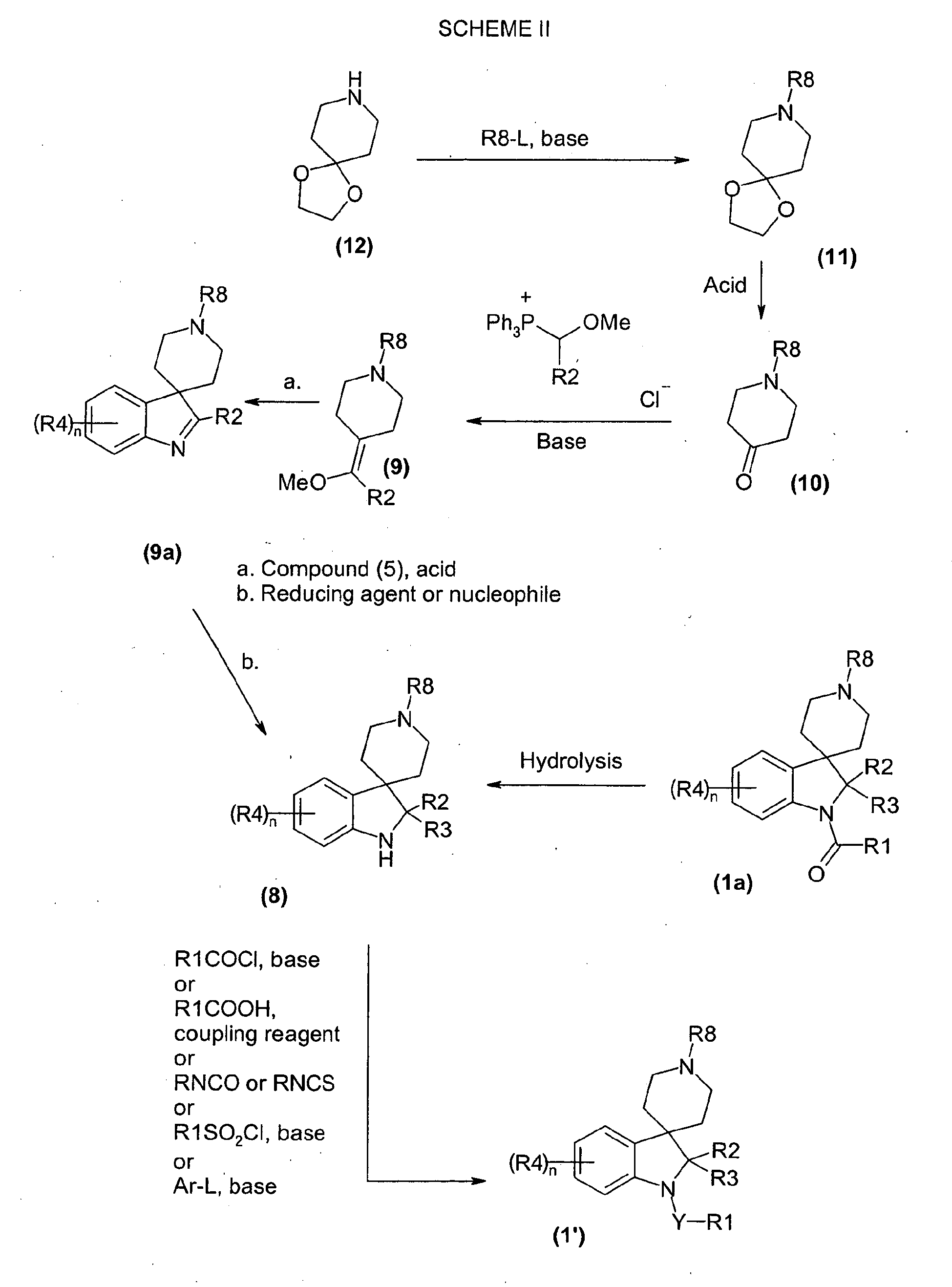
- Thus a compound of formula 1' may be obtained from a compound of formula 8 by reaction with an acid chloride or chloroformate of the formula R1COCl at a temperature between 0 °C and ambient in organic solvent such as dichloromethane, chloroform or 1,2-dichloroethane in the presence of a tertiary amine base such as triethylamine or diisopropylethylamine.
- Alternatively, a compound of formula 1' may be obtained from a compound of formula 8 by reaction with a carboxylic acid of the formula R1COOH and a standard coupling agent such as 2-chloro-1,3-dimethyl-2-imidazolium hexafluorophosphate, or carbodiimide reagents such as dicyclohexylcarbodiimide or 1-(3-dimethylaminopropyl)-3-ethylcarbodiimide hydrochloride at a temperature between 0 °C and ambient in organic solvent such as dichloromethane or tetrahydrofuran in the presence of a tertiary amine base such as triethylamine or diisopropylethylamine.
- A compound of formula 1' may alternatively be obtained from a compound of formula 8 by reaction with a isocyanate or isothiocyanate of the formula RNCO or RNCS respectively at a temperature between 0 °C and ambient in organic solvent such as dichloromethane or tetrahydrofuran, optionally in the presence of a tertiary amine base such as triethylamine or diisopropylethylamine.
- A compound of formula 1' may also be obtained from a compound of formula 8 by reaction with a sulfonyl chloride of the formula R1SO2Cl at a temperature between 0 °C and ambient in organic solvent such as dichloromethane or tetrahydrofuran, in the presence of a tertiary amine base such as triethylamine or diisopropylethylamine.
- Alternatively, a compound of formula 1' may be obtained from a compound of formula 8 by reaction with an aryl or heteroaryl compound of formula Ar-L where L is a leaving group such as halide (especially fluoride), such as a 2-halopyridine, a 2-halopyrimidine, a 4-halopyridine, a 2-halopyrazine or such like at a temperature between 50 °C and 150 °C in a solvent such as dimethylsulfoxide in the presence of a strong base such as sodium hydride.
- Compounds of formula 8 may be obtained by reacting compounds of formula 9 with compounds of formula 5 (in scheme I) at a temperature of between ambient and 100 °C in organic solvent such as dichloromethane, chloroform or 1,2-dichloroethane in the presence of an acid such as trifluoroacetic acid for typically 4 to 12 hours, followed by addition of a reducing agent such as triethylsilane and reaction at a temperature of ambient to 100 °C until the reaction is complete.
- Alternatively, Compounds of formula 8 may be obtained by reacting compounds of formula 9 with compounds of formula 5 at a temperature of between 0 °C and 100 °C in organic solvent such as dichloromethane, chloroform or 1,2-dichloroethane in the presence of an acid such as hydrochloric acid, or trifluoroacetic acid and a co-solvent of either water or methanol or ethanol, or in the presence of a Lewis acidic metal salt such as zinc(II) dihalide. The intermediates formed (compounds of formula (9a)) are subsequently treated with a reducing agent such as sodium borohydride, sodium (triacetoxy)borohydride, sodium cyanoborohydride or such like at ambient temperature in organic solvent such as ethanol or chloroform.
- Compounds of formula 8 may also be obtained by the hydrolysis of compounds of formula 1a (which are also a sub-set of compounds of formula 1) preferably with an aqueous acid, typically 6 N hydrochloric acid at reflux temperature.
- Compounds of formula 9 may be obtained from compounds of formula 10 by reaction with methoxymethyl(triphenyl)phosphonium chloride or the corresponding bromide salt and a base such as potassium tert-butoxide at a temperature of 0 °C to ambient in tetrahydrofuran.
- Compounds of formula 10 may be obtained by reacting compounds of formula 11 with an aqueous solution of acid, typically 6 N hydrochloric acid at reflux temperature.
- Compounds of formula 11 may be obtained from compounds of formula 12 by reaction with an electrophile of the formula R8-L, where L is chloride, bromide, iodide or a sulfonate (e.g. mesylate or tosylate) or similar leaving group at between ambient temperature and 100 °C, typically around 60 °C in an organic solvent such as dichloromethane, chloroform or 1,2-dichloroethane in the presence of an excess of a tertiary amine base such as triethylamine or diisopropylethylamine and optionally catalysed by halide salts such as sodium iodide, potassium iodide or tetrabutylammonium iodide.
- Compounds of formula 12 are known compounds or may be obtained from known compounds by known techniques.
- Certain compounds of formula 8, 9, 9a, 10 and 11 are novel and as such form a further aspect of the invention.
- The skilled person will readily recognise that it is possible to interconvert one compound of formula I to other compounds of formula I and examples of such procedures are given in schemes III, IV, V, Va and VI below.


- Compounds of formula I where R8 is optionally substituted cinnamyl may be prepared by the reactions in scheme VII below where R4, R53, R54 and Rs are as defined above. The scheme is illustrated in Examples 8 - 12.


- Compounds of formula (I) in which R2 and R3 together are an oxo group and R1, R4 and R8 are as defined above may be made by the methods of
WO 0145707 
- Compounds of formula (I) in which R2 and R3 together are an oxo group and and R8 are as defined above may be made from compounds of formula 4a by the methods of scheme IX below.

- The compounds of formula (I) can be used to combat and control infestations of insect pests such as Lepidoptera, Diptera, Hemiptera, Thysanoptera, Orthoptera, Dictyoptera, Coleoptera, Siphonaptera, Hymenoptera and Isoptera and also other invertebrate pests, for example, acarine, nematode and mollusc pests. Insects, acarines, nematodes and molluscs are hereinafter collectively referred to as pests. The pests which may be combated and controlled by the use of the invention compounds include those pests associated with agriculture (which term includes the growing of crops for food and fibre products), horticulture and animal husbandry, companion animals, forestry and the storage of products of vegetable origin (such as fruit, grain and timber); those pests associated with the damage of man-made structures and the transmission of diseases of man and animals; and also nuisance pests (such as flies).
- Examples of pest species which may be controlled by the compounds of formula (I) include: Myzus persicae (aphid), Aphis gossypii (aphid), Aphis fabae (aphid), Lygus spp. (capsids), Dysdercus spp. (capsids), Nilaparvata lugens (planthopper), Nephotettixc incticeps (leafhopper), Nezara spp. (stinkbugs), Euschistus spp. (stinkbugs), Leptocorisa spp. (stinkbugs), Frankliniella occidentalis (thrip), Thrips spp. (thrips), Leptinotarsa decemlineata (Colorado potato beetle), Anthonomus grandis (boll weevil), Aonidiella spp. (scale insects), Trialeurodes spp. (white flies), Bemisia tabaci (white fly), Ostrinia nubilalis (European corn borer), Spodoptera littoralis (cotton leafworm), Heliothis virescens (tobacco budworm), Helicoverpa armigera (cotton bollworm), Helicoverpa zea (cotton bollworm), Sylepta derogata (cotton leaf roller), Pieris brassicae (white butterfly), Plutella xylostella (diamond back moth), Agrotis spp. (cutworms), Chilo suppressalis (rice stem borer), Locusta migratoria (locust), Chortiocetes terminifera (locust), Diabrotica spp. (rootworms), Panonychus ulmi (European red mite), Panonychus citri (citrus red mite), Tetranychus urticae (two-spotted spider mite), Tetranychus cinnabarinus (carmine spider mite), Phyllocoptruta oleivora (citrus rust mite), Polyphagotarsonemus latus (broad mite), Brevipalpus spp. (flat mites), Boophilus microplus (cattle tick), Dermacentor variabilis (American dog tick), Ctenocephalides felis (cat flea), Liriomyza spp. (leafminer), Musca domestica (housefly), Aedes aegypti (mosquito), Anopheles spp. (mosquitoes), Culex spp. (mosquitoes), Lucillia spp. (blowflies), Blattella germanica (cockroach), Periplaneta americana (cockroach), Blatta orientalis (cockroach), termites of the Mastotermitidae (for example Mastotermes spp.), the Kalotermitidae (for example Neotermes spp.), the Rhinotermitidae (for example Coptotermes formosanus, Reticulitermes flavipes, R. speratu, R. virginicus, R. hesperus, and R. santonensis) and the Termitidae (for example Globitermes sulphureus), Solenopsis geminata (fire ant), Monomorium pharaonis (pharaoh's ant), Damalinia spp. and Linognathus spp. (biting and sucking lice), Meloidogyne spp. (root knot nematodes), Globodera spp. and Heterodera spp. (cyst nematodes), Pratylenchus spp. (lesion nematodes), Rhodopholus spp. (banana burrowing nematodes), Tylenchulus spp.(citrus nematodes), Haemonchus contortus (barber pole worm), Caenorhabditis elegans_(vinegar eelworm), Trichostrongylus spp. (gastro intestinal nematodes) and Deroceras reticulatum (slug).
- The invention therefore provides a method of combating and controlling insects, acarines, nematodes or molluscs which comprises applying an insecticidally, acaricidally, nematicidally or molluscicidally effective amount of a compound of formula (I), or a composition containing a compound of formula (I), to a pest, a locus of pest, or to a plant susceptible to attack by a pest, The compounds of formula (I) are preferably used against insects, acarines or nematodes.
- The term "plant" as used herein includes seedlings, bushes and trees.
- In order to apply a compound of formula (I) as an insecticide, acaricide, nematicide or molluscicide to a pest, a locus of pest, or to a plant susceptible to attack by a pest, a compound of formula (I) is usually formulated into a composition which includes, in addition to the compound of formula (I), a suitable inert diluent or carrier and, optionally, a surface active agent (SFA). SFAs are chemicals which are able to modify the properties of an interface (for example, liquid/solid, liquid/air or liquid/liquid interfaces) by lowering the interfacial tension and thereby leading to changes in other properties (for example dispersion, emulsification and wetting). It is preferred that all compositions (both solid and liquid formulations) comprise, by weight, 0.0001 to 95%, more preferably 1 to 85%, for example 5 to 60%, of a compound of formula (I). The composition is generally used for the control of pests such that a compound of formula (I) is applied at a rate of from 0.1g to 10kg per hectare, preferably from 1g to 6kg per hectare, more preferably from 1g to 1kg per hectare.
- When used in a seed dressing, a compound of formula (I) is used at a rate of 0.0001g to 10g (for example 0.001g or 0.05g), preferably 0.005g to 10g, more preferably 0.005g to 4g, per kilogram of seed.
- In another aspect the present invention provides an insecticidal, acaricidal, nematicidal or molluscicidal composition comprising an insecticidally, acaricidally, nematicidally or molluscicidally effective amount of a compound of formula (I) and a suitable carrier or diluent therefor. The composition is preferably an insecticidal, acaricidal, nematicidal or molluscicidal composition.
- In a still further aspect the invention provides a method of combating and controlling pests at a locus which comprises treating the pests or the locus of the pests with an insecticidally, acaricidally, nematicidally or molluscicidally effective amount of a composition comprising a compound of formula (I). The compounds of formula (I) are preferably used against insects, acarines or nematodes.
- The compositions can be chosen from a number of formulation types, including dustable powders (DP), soluble powders (SP), water soluble granules (SG), water dispersible granules (WG), wettable powders (WP), granules (GR) (slow or fast release), soluble concentrates (SL), oil miscible liquids (OL), ultra low volume liquids (UL), emulsifiable concentrates (EC), dispersible concentrates (DC), emulsions (both oil in water (EW) and water in oil (EO)), micro-emulsions (ME), suspension concentrates (SC), aerosols, fogging/smoke formulations, capsule suspensions (CS) and seed treatment formulations. The formulation type chosen in any instance will depend upon the particular purpose envisaged and the physical, chemical and biological properties of the compound of formula (I).
- Dustable powders (DP) may be prepared by mixing a compound of formula (I) with one or more solid diluents (for example natural clays, kaolin, pyrophyllite, bentonite, alumina, montmorillonite, kieselguhr, chalk, diatomaceous earths, calcium phosphates, calcium and magnesium carbonates, sulphur, lime, flours, talc and other organic and inorganic solid carriers) and mechanically grinding the mixture to a fine powder.
- Soluble powders (SP) may be prepared by mixing a compound of formula (I) with one or more water-soluble inorganic salts (such as sodium bicarbonate, sodium carbonate or magnesium sulphate) or one or more water-soluble organic solids (such as a polysaccharide) and, optionally, one or more wetting agents, one or more dispersing agents or a mixture of said agents to improve water dispersibility/solubility. The mixture is then ground to a fine powder. Similar compositions may also be granulated to form water soluble granules (SG).
- Wettable powders (WP) may be prepared by mixing a compound of formula (I) with one or more solid diluents or carriers, one or more wetting agents and, preferably, one or more dispersing agents and, optionally, one or more suspending agents to facilitate the dispersion in liquids. The mixture is then ground to a fine powder. Similar compositions may also be granulated to form water dispersible granules (WG).
- Granules (GR) may be formed either by granulating a mixture of a compound of formula (I) and one or more powdered solid diluents or carriers, or from pre-formed blank granules by absorbing a compound of formula (I) (or a solution thereof, in a suitable agent) in a porous granular material (such as pumice, attapulgite clays, fuller's earth, kieselguhr, diatomaceous earths or ground corn cobs) or by adsorbing a compound of formula (I) (or a solution thereof, in a suitable agent) on to a hard core material (such as sands, silicates, mineral carbonates, sulphates or phosphates) and drying if necessary. Agents which are commonly used to aid absorption or adsorption include solvents (such as aliphatic and aromatic petroleum solvents, alcohols, ethers, ketones and esters) and sticking agents (such as polyvinyl acetates, polyvinyl alcohols, dextrins, sugars and vegetable oils). One or more other additives may also be included in granules (for example an emulsifying agent, wetting agent or dispersing agent).
- Dispersible Concentrates (DC) may be prepared by dissolving a compound of formula (I) in water or an organic solvent, such as a ketone, alcohol or glycol ether. These solutions may contain a surface active agent (for example to improve water dilution or prevent crystallisation in a spray tank).
- Emulsifiable concentrates (EC) or oil-in-water emulsions (EW) may be prepared by dissolving a compound of formula (I) in an organic solvent (optionally containing one or more wetting agents, one or more emulsifying agents or a mixture of said agents). Suitable organic solvents for use in ECs include aromatic hydrocarbons (such as alkylbenzenes or alkylnaphthalenes, exemplified by SOLVESSO 100, SOLVESSO 150 and SOLVESSO 200; SOLVESSO is a Registered Trade Mark), ketones (such as cyclohexanone or methylcyclohexanone) and alcohols (such as benzyl alcohol, furfuryl alcohol or butanol), N-alkylpyrrolidones (such as N-methylpyrrolidone or N-octylpyrrolidone), dimethyl amides of fatty acids (such as C8-C10 fatty acid dimethylamide) and chlorinated hydrocarbons. An EC product may spontaneously emulsify on addition to water, to produce an emulsion with sufficient stability to allow spray application through appropriate equipment. Preparation of an EW involves obtaining a compound of formula (I) either as a liquid (if it is not a liquid at room temperature, it may be melted at a reasonable temperature, typically below 70°C) or in solution (by dissolving it in an appropriate solvent) and then emulsifiying the resultant liquid or solution into water containing one or more SFAs, under high shear, to produce an emulsion. Suitable solvents for use in EWs include vegetable oils, chlorinated hydrocarbons (such as chlorobenzenes), aromatic solvents (such as alkylbenzenes or alkylnaphthalenes) and other appropriate organic solvents which have a low solubility in water.
- Microemulsions (ME) may be prepared by mixing water with a blend of one or more solvents with one or more SFAs, to produce spontaneously a thermodynamically stable isotropic liquid formulation. A compound of formula (I) is present initially in either the water or the solvent/SFA blend. Suitable solvents for use in MEs include those hereinbefore described for use in in ECs or in EWs. An ME may be either an oil-in-water or a water-in-oil system (which system is present may be determined by conductivity measurements) and may be suitable for mixing water-soluble and oil-soluble pesticides in the same formulation. An ME is suitable for dilution into water, either remaining as a microemulsion or forming a conventional oil-in-water emulsion.
- Suspension concentrates (SC) may comprise aqueous or non-aqueous suspensions of finely divided insoluble solid particles of a compound of formula (I). SCs may be prepared by ball or bead milling the solid compound of formula (I) in a suitable medium, optionally with one or more dispersing agents, to produce a fine particle suspension of the compound. One or more wetting agents may be included in the composition and a suspending agent may be included to reduce the rate at which the particles settle. Alternatively, a compound of formula (I) may be dry milled and added to water, containing agents hereinbefore described, to produce the desired end product.
- Aerosol formulations comprise a compound of formula (I) and a suitable propellant (for example n-butane). A compound of formula (I) may also be dissolved or dispersed in a suitable medium (for example water or a water miscible liquid, such as n-propanol) to provide compositions for use in non-pressurised, hand-actuated spray pumps.
- A compound of formula (I) may be mixed in the dry state with a pyrotechnic mixture to form a composition suitable for generating, in an enclosed space, a smoke containing the compound.
- Capsule suspensions (CS) may be prepared in a manner similar to the preparation of EW formulations but with an additional polymerisation stage such that an aqueous dispersion of oil droplets is obtained, in which each oil droplet is encapsulated by a polymeric shell and contains a compound of formula (I) and, optionally, a carrier or diluent therefor. The polymeric shell may be produced by either an interfacial polycondensation reaction or by a coacervation procedure. The compositions may provide for controlled release of the compound of formula (I) and they may be used for seed treatment. A compound of formula (I) may also be formulated in a biodegradable polymeric matrix to provide a slow, controlled release of the compound.
- A composition may include one or more additives to improve the biological performance of the composition (for example by improving wetting, retention or distribution on surfaces; resistance to rain on treated surfaces; or uptake or mobility of a compound of formula (I)). Such additives include surface active agents, spray additives based on oils, for example certain mineral oils or natural plant oils (such as soy bean and rape seed oil), and blends of these with other bio-enhancing adjuvants (ingredients which may aid or modify the action of a compound of formula (I)).
- A compound of formula (I) may also be formulated for use as a seed treatment, for example as a powder composition, including a powder for dry seed treatment (DS), a water soluble powder (SS) or a water dispersible powder for slurry treatment (WS), or as a liquid composition, including a flowable concentrate (FS), a solution (LS) or a capsule suspension (CS). The preparations of DS, SS, WS, FS and LS compositions are very similar to those of, respectively, DP, SP, WP, SC and DC compositions described above. Compositions for treating seed may include an agent for assisting the adhesion of the composition to the seed (for example a mineral oil or a film-forming barrier).
- Wetting agents, dispersing agents and emulsifying agents may be surface SFAs of the cationic, anionic, amphoteric or non-ionic type.
- Suitable SFAs of the cationic type include quaternary ammonium compounds (for example cetyltrimethyl ammonium bromide), imidazolines and amine salts.
- Suitable anionic SFAs include alkali metals salts of fatty acids, salts of aliphatic monoesters of sulphuric acid (for example sodium lauryl sulphate), salts of sulphonated aromatic compounds (for example sodium dodecylbenzenesulphonate, calcium dodecylbenzenesulphonate, butylnaphthalene sulphonate and mixtures of sodium diisopropyl- and tri-isopropyl-naphthalene sulphonates), ether sulphates, alcohol ether sulphates (for example sodium laureth-3-sulphate), ether carboxylates (for example sodium laureth-3-carboxylate), phosphate esters (products from the reaction between one or more fatty alcohols and phosphoric acid (predominately mono-esters) or phosphorus pentoxide (predominately di-esters), for example the reaction between lauryl alcohol and tetraphosphoric acid; additionally these products may be ethoxylated), sulphosuccinamates, paraffin or olefine sulphonates, taurates and lignosulphonates.
- Suitable SFAs of the amphoteric type include betaines, propionates and glycinates.
- Suitable SFAs of the non-ionic type include condensation products of alkylene oxides, such as ethylene oxide, propylene oxide, butylene oxide or mixtures thereof, with fatty alcohols (such as oleyl alcohol or cetyl alcohol) or with alkylphenols (such as octylphenol, nonylphenol or octylcresol); partial esters derived from long chain fatty acids or hexitol anhydrides; condensation products of said partial esters with ethylene oxide; block polymers (comprising ethylene oxide and propylene oxide); alkanolamides; simple esters (for example fatty acid polyethylene glycol esters); amine oxides (for example lauryl dimethyl amine oxide); and lecithins.
- Suitable suspending agents include hydrophilic colloids (such as polysaccharides, polyvinylpyrrolidone or sodium carboxymethylcellulose) and swelling clays (such as bentonite or attapulgite).
- A compound of formula (I) may be applied by any of the known means of applying pesticidal compounds. For example, it may be applied, formulated or unformulated, to the pests or to a locus of the pests (such as a habitat of the pests, or a growing plant liable to infestation by the pests) or to any part of the plant, including the foliage, stems, branches or roots, to the seed before it is planted or to other media in which plants are growing or are to be planted (such as soil surrounding the roots, the soil generally, paddy water or hydroponic culture systems), directly or it may be sprayed on, dusted on, applied by dipping, applied as a cream or paste formulation, applied as a vapour or applied through distribution or incorporation of a composition (such as a granular composition or a composition packed in a water-soluble bag) in soil or an aqueous environment.
- A compound of formula (I) may also be injected into plants or sprayed onto vegetation using electrodynamic spraying techniques or other low volume methods, or applied by land or aerial irrigation systems.
- Compositions for use as aqueous preparations (aqueous solutions or dispersions) are generally supplied in the form of a concentrate containing a high proportion of the active ingredient, the concentrate being added to water before use. These concentrates, which may include DCs, SCs, ECs, EWs, MEs SGs, SPs, WPs, WGs and CSs, are often required to withstand storage for prolonged periods and, after such storage, to be capable of addition to water to form aqueous preparations which remain homogeneous for a sufficient time to enable them to be applied by conventional spray equipment. Such aqueous preparations may contain varying amounts of a compound of formula (I) (for example 0.0001 to 10%, by weight) depending upon the purpose for which they are to be used.
- A compound of formula (I) may be used in mixtures with fertilisers (for example nitrogen-, potassium- or phosphorus-containing fertilisers). Suitable formulation types include granules of fertiliser. The mixtures suitably contain up to 25% by weight of the compound of formula (I).
- The invention therefore also provides a fertiliser composition comprising a fertiliser and a compound of formula (I).
- The compositions of this invention may contain other compounds having biological activity, for example micronutrients or compounds having fungicidal activity or which possess plant growth regulating, herbicidal, insecticidal, nematicidal or acaricidal activity.
- The compound of formula (I) may be the sole active ingredient of the composition or it may be admixed with one or more additional active ingredients such as a pesticide, fungicide, synergist, herbicide or plant growth regulator where appropriate. An additional active ingredient may: provide a composition having a broader spectrum of activity or increased persistence at a locus; synergise the activity or complement the activity (for example by increasing the speed of effect or overcoming repellency) of the compound of formula (I); or help to overcome or prevent the development of resistance to individual components. The particular additional active ingredient will depend upon the intended utility of the composition. Examples of suitable pesticides include the following:
- a) Pyrethroids, such as permethrin, cypermethrin, fenvalerate, esfenvalerate, deltamethrin, cyhalothrin (in particular lambda-cyhalothrin), bifenthrin, fenpropathrin, cyfluthrin, tefluthrin, fish safe pyrethroids (for example ethofenprox), natural pyrethrin, tetramethrin, s-bioallethrin, fenfluthrin, prallethrin or 5-benzyl-3-furylmethyl-(E)-(1R,3S)-2,2-dimethyl-3-(2-oxothiolan-3-ylidenemethyl)cyclopropane carboxylate;
- b) Organophosphates, such as, profenofos, sulprofos, acephate, methyl parathion, azinphos-methyl, demeton-s-methyl, heptenophos, thiometon, fenamiphos, monocrotophos, profenofos, triazophos, methamidophos, dimethoate, phosphamidon, malathion, chlorpyrifos, phosalone, terbufos, fensulfothion, fonofos, phorate, phoxim, pirimiphos-methyl, pirimiphos-ethyl, fenitrothion, fosthiazate or diazinon;
- c) Carbamates (including aryl carbamates), such as pirimicarb, triazamate, cloethocarb, carbofuran, furathiocarb, ethiofencarb, aldicarb, thiofurox, carbosulfan, bendiocarb, fenobucarb, propoxur, methomyl or oxamyl;
- d) Benzoyl ureas, such as diflubenzuron, triflumuron, hexaflumuron, flufenoxuron or chlorfluazuron;
- e) Organic tin compounds, such as cyhexatin, fenbutatin oxide or azocyclotin;
- f) Pyrazoles, such as tebufenpyrad and fenpyroximate;
- g) Macrolides, such as avermectins or milbemycins, for example abamectin, emamectin benzoate, ivermectin, milbemycin, spinosad or azadirachtin;
- h) Hormones or pheromones;
- i) Organochlorine compounds such as endosulfan, benzene hexachloride, DDT, chlordane or dieldrin;
- j) Amidines, such as chlordimeform or amitraz;
- k) Fumigant agents, such as chloropicrin, dichloropropane, methyl bromide or metam;
- l) Chloronicotinyl compounds such as imidacloprid, thiacloprid, acetamiprid; nitenpyram or thiamethoxam;
- m) Diacylhydrazines, such as tebufenozide, chromafenozide or methoxyfenozide;
- n) Diphenyl ethers, such as diofenolan or pyriproxifen;
- o) Indoxacarb;
- p) Chlorfenapyr; or
- q) Pymetrozine.
- In addition to the major chemical classes of pesticide listed above, other pesticides having particular targets may be employed in the composition, if appropriate for the intended utility of the composition. For instance, selective insecticides for particular crops, for example stemborer specific insecticides (such as cartap) or hopper specific insecticides (such as buprofezin) for use in rice may be employed. Alternatively insecticides or acaricides specific for particular insect species/stages may also be included in the compositions (for example acaricidal ovo-larvicides, such as clofentezine, flubenzimine, hexythiazox or tetradifon; acaricidal motilicides, such as dicofol or propargite; acaricides, such as bromopropylate or chlorobenzilate; or growth regulators, such as hydramethylnon, cyromazine, methoprene, chlorfluazuron or diflubenzuron).
- Examples of fungicidal compounds which may be included in the composition of the invention are (E)-N-methyl-2-[2-(2,5-dimethylphenoxymethyl)phenyl]-2-methoxyiminoacetamide (SSF-129), 4-bromo-2-cyano-N,N-dimethyl-6-trifluoromethylbenzimidazole-1-sulphonamide, α-[N-(3-chloro-2,6-xylyl)-2-methoxyacetamido]-γ-butyrolactone, 4-chloro-2-cyano-N,N-dimethyl-5-p-tolylimidazole-1-sulfonamide (IKF-916, cyamidazosulfamid), 3-5-dichloro-N-(3-chloro-1-ethyl-1-methyl-2-oxopropyl)-4-methylbenzamide (RH-7281, zoxamide), N-allyl-4,5,-dimethyl-2-trimethylsilylthiophene-3-carboxamide (MON65500), N-(1-cyano-1,2-dimethylpropyl)-2-(2,4-dichlorophenoxy)propionamide (AC382042), N-(2-methoxy-5-pyridyl)-cyclopropane carboxamide, acibenzolar (CGA245704), alanycarb, aldimorph, anilazine, azaconazole, azoxystrobin, benalaxyl, benomyl, biloxazol, bitertanol, blasticidin S, bromuconazole, bupirimate, captafol, captan, carbendazim, carbendazim chlorhydrate, carboxin, carpropamid, carvone, CGA41396, CGA41397, chinomethionate, chlorothalonil, chlorozolinate, clozylacon, copper containing compounds such as copper oxychloride, copper oxyquinolate, copper sulphate, copper tallate and Bordeaux mixture, cymoxanil, cyproconazole, cyprodinil, debacarb, di-2-pyridyl disulphide 1,1'-dioxide, dichlofluanid, diclomezine, dicloran, diethofencarb, difenoconazole, difenzoquat, diflumetorim, O,O-di-iso-propyl-S-benzyl thiophosphate, dimefluazole, dimetconazole, dimethomorph, dimethirimol, diniconazole, dinocap, dithianon, dodecyl dimethyl ammonium chloride, dodemorph, dodine, doguadine, edifenphos, epoxiconazole, ethirimol, ethyl(Z)-N-benzyl-N([methyl(methyl-thioethylideneaminooxycarbonyl)amino]thio)-β-alaninate, etridiazole, famoxadone, fenamidone (RPA407213), fenarimol, fenbuconazole, fenfuram, fenhexamid (KBR2738), fenpiclonil, fenpropidin, fenpropimorph, fentin acetate, fentin hydroxide, ferbam, ferimzone, fluazinam, fludioxonil, flumetover, fluoroimide, fluquinconazole, flusilazole, flutolanil, flutriafol, folpet, fuberidazole, furalaxyl, furametpyr, guazatine, hexaconazole, hydroxyisoxazole, hymexazole, imazalil, imibenconazole, iminoctadine, iminoctadine triacetate, ipconazole, iprobenfos, iprodione, iprovalicarb (SZX0722), isopropanyl butyl carbamate, isoprothiolane, kasugamycin, kresoxim-methyl, LY186054, LY211795, LY248908, mancozeb, maneb, mefenoxam, mepanipyrim, mepronil, metalaxyl, metconazole, metiram, metiram-zinc, metominostrobin, myclobutanil, neoasozin, nickel dimethyldithiocarbamate, nitrothal-isopropyl, nuarimol, ofurace, organomercury compounds, oxadixyl, oxasulfuron, oxolinic acid, oxpoconazole, oxycarboxin, pefurazoate, penconazole, pencycuron, phenazin oxide, phosetyl-Al, phosphorus acids, phthalide, picoxystrobin (ZA1963), polyoxin D, polyram, probenazole, prochloraz, procymidone, propamocarb, propiconazole, propineb, propionic acid, pyrazophos, pyrifenox, pyrimethanil, pyroquilon, pyroxyfur, pyrrolnitrin, quaternary ammonium compounds, quinomethionate, quinoxyfen, quintozene, sipconazole (F-155), sodium pentachlorophenate, spiroxamine, streptomycin, sulphur, tebuconazole, tecloftalam, tecnazene, tetraconazole, thiabendazole, thifluzamid, 2-(thiocyanomethylthio)benzothiazole, thiophanate-methyl, thiram, timibenconazole, tolclofos-methyl, tolylfluanid, triadimefon, triadimenol, triazbutil, triazoxide, tricyclazole, tridemorph, trifloxystrobin (CGA279202), triforine, triflumizole, triticonazole, validamycin A, vapam, vinclozolin, zineb and ziram.
- The compounds of formula (I) may be mixed with soil, peat or other rooting media for the protection of plants against seed-borne, soil-borne or foliar fungal diseases.
- Examples of suitable synergists for use in the compositions include piperonyl butoxide, sesamex, safroxan and dodecyl imidazole.
- Suitable herbicides and plant-growth regulators for inclusion in the compositions will depend upon the intended target and the effect required.
- An example of a rice selective herbicide which may be included is propanil. An example of a plant growth regulator for use in cotton is PIX™.
- Some mixtures may comprise active ingredients which have significantly different physical, chemical or biological properties such that they do not easily lend themselves to the same conventional formulation type. In these circumstances other formulation types may be prepared. For example, where one active ingredient is a water insoluble solid and the other a water insoluble liquid, it may nevertheless be possible to disperse each active ingredient in the same continuous aqueous phase by dispersing the solid active ingredient as a suspension (using a preparation analogous to that of an SC) but dispersing the liquid active ingredient as an emulsion (using a preparation analogous to that of an EW). The resultant composition is a suspoemulsion (SE) formulation. '
- The invention is illustrated by the following Examples:
- This Example illustrates the preparation of compound V-22, 1-Acetyl-5-chloro-1'-[trans-3-(4-chlorophenyl)allyl]spiro[indoline-3,4'-piperidine]

- Potassium tert-butoxide (21.3 g) was added in portions to a stirred solution of methoxymethyltriphenylphosphonium chloride (65.3 g) in anhydrous THF (500 ml) under an atmosphere of nitrogen at 4 °C. A vivid orange colour was noted and the reaction was left as such for 1 h. 4-Oxopiperidine-1-carboxylic acid tert-butyl ester 1 (25 g) was added slowly not letting the temperature rise above 10°C and the mixture was then allowed to warm to room temperature overnight.
The reaction mixture was poured onto water (150 ml), extracted three times with ethyl acetate (100ml) and the combined organics were washed with brine (300ml), dried over anhydrous sodium sulphate and concentrated in vacuo to yield a brown oil (50g). Flash chromatography [SiO2; hexane, then ethyl acetate-hexane (10:90)] yielded 26.4g (77%) of the desired enol ether. 1H NMR (400 MHz, CDCl3) 1.5 (9H, m), 2.0-2.2 (m, 4H), 3.4 (m, 4H), 3.5 (s, 3H), 5.9 (s, 1H). MS (ES+) 228 (M+H+), 172 (M-ibutene+H+) - Trifluoroacetic acid (12 ml) was added to a stirred solution of 4-methoxymethylene-piperidine-1-carboxylic acid tert-butyl ester (12.5 g), 4-chlorophenylhydrazine hydrochloide (9.75g) and ethanol (1 ml) in chloroform (1200 ml) at 4 °C under an atmosphere of nitrogen. The mixture was then stirred at 50 °C overnight, turning a dark green colour. The reaction was quenched with concentrated ammonia solution (200 ml) in ice water (500 ml), the organic layer turning orange. The organic layer was separated and the aqueous was further extracted twice with dichloromethane. The combined organics were washed with brine (300 ml), dried over anhydrous sodium sulphate and concentrated in vacuo to yield 13 g of the crude imine 5-chlorospiro[3H-indole-3,4'-piperidine]-1'-carboxylic acid tert-butyl ester (purity approximately 80% by NMR). 1H NMR (400 MHz, CDCl3) 1.5 (9H, m), 1.70 (m, 2H), 1.85 (m, 2H), 3.50 (m, 2H), 4.05 (m, 2H), 7.35 (m, 2H), 7.60 (s, 1H), 8.35 (s, 1H). MS (ES+) 321/323 (M+H+), 265/267 (M-ibutene+H+), 221/223 (M-Boc+H+).
Sodium borohydride (6.0g) was added to a stirred solution of crude imine (12g) in absolute ethanol (500 ml) under an atmosphere of nitrogen.The reaction was stirred for 15 min and left to stand overnight. The mixture was concentrated in vacuo and the residue re-dissolved in dichloromethane (100 ml). The organics were washed with water (100 ml) and brine (100 ml), dried over anhydrous sodium sulphate and concentrated in vacuo to yield a brown solid. Flash chromatography [SiO2: ethyl acetate-hexane-triethylamine (25:75:1)] yielded 9.8 g (56%, over both steps) of the desired indoline. M.p. 165-166 °C. 1H NMR (400 MHz, CDCl3) 1.5 (9H, s), 1.70 (m; 4H), 2.9 (m, 2H), 3.50 (s, 2H), 3.75 (br s, 1H), 4.05 (m, 2H), 6.55 (d, J = 6Hz, 1H), 7.00 (m, 2H). MS (ES+) 323/325 (M+H+), 267/269 (M-ibutene+H+), 223/225 (M-Boc+H+). - Acetyl chloride (2.8 ml) was added dropwise to a stirred solution of 5-chlorospiro[indoline-3,4'-piperidine]-1'-carboxylic acid tert-butyl ester (9.8 g) and triethylamine (15 ml) in anhydrous dichloromethane (400 ml) under an atmosphere of nitrogen. The reaction was stirred for 1 h and was then quenched with saturated sodium bicarbonate solution (200 ml). The organic layer was dried over anhydrous sodium sulphate and concentrated in vacuo to yield 9.8 g (87%) of the desired amide as an off-white solid. M.p. 64-66 °C. 1H NMR (400 MHz, CDCl3) a 6:1 mixture of rotamers. Major rotamer 1.5 (9H, s), 1.70 (m, 2H), 1.85 (m, 2H), 2.25 (s, 3H), 2.85 (m, 2H), 3.90 (s, 2H), 4.2 (m, 2H), 6.97 (d, J = 1Hz, 1H), 7.20 (dd, J = 7 & 1Hz, 1H), 8.15 (d, J = 7Hz, 1H). Minor rotamer 1.5 (9H, s), 1.70 (m, 2H), 1.85 (m, 2H), 2.45 (s, 3H), 2.85 (m, 2H), 4.05 (s, 2H), 4.2 (m, 2H), 7.2 (d, J = 1Hz, 1H), 7.25 (dd, J = 7 & 1Hz, 1H), 7.48 (d, J = 7Hz, 1H).
- Trifluoroacetic acid (25 ml) was added to a stirred solution of 1-acetyl-5-chlorospiro[indoline-3,4'-piperidine]-1'-carboxylic acid tert-butyl ester (8 g) in anhydrous dichloromethane (250 ml) under an atmosphere of nitrogen. The reaction was left as such for 3 h. The reaction was washed with saturated bicarbonate solution (200 ml) and dried over sodium sulphate and concentrated in vacuo to yield an off white solid. Flash chromatography [SiO2: methanol-dichloromethane-triethylamine (90:5:5)] yielded 5.6 g (61 %) of the desired 1-Acetyl-5-chlorospiro[indoline-3,4'-piperidine]. 1H NMR (400 MHz, CDCl3) a 6:1 mixture ofrotamers. Major rotamer 1.70 (m, 2H), 1.80 (m, 2H), 2.27 (s, 3H), 2.75 (t, J = 12Hz, 2H), 3.15 (m, 2H), 3.90 (s, 2H), 7.12 (d, J = 1Hz, 1H), 7.18 (dd, J = 7 & 1Hz, 1H), 8.15 (d, J = 7Hz, 1H). Minor rotamer (partial data) 2.44 (s, 3H), 2.86 (m, 2H), 3.10 (m, 2H), 4.05 (s, 2H). MS (ES+) 265/267 (M+H+).
- A solution of 4-chlorocinnamyl chloride (4.0 g) in chloroform (120 ml) was added slowly to a stirred mixture of 1-acetyl-5-chlorospiro[indoline-3,4'-piperidine] (5.3 g) and diisopropylethylamine (6.7 ml) in chloroform (120 ml) under an atmosphere of nitrogen at room. The reaction was heated to 50 °C for 30 h. The reaction mixture was concentrated in vacuo to yield a red oil. Flash chromatography [SiO2; ethyl acetate-hexane-triethylamine (50:50:1)] yielded 5.1 g (68%) of the desired compound. 1H NMR (400 MHz, CDCl3) a 5:1 mixture of rotamers. Major rotamer 1.70 (d, J = 12Hz, 2H), 2.0 (td, J = 12 & 2 Hz), 2.08 (t, J = 12 Hz, 2H), 2.25 (s, 3H), 3.03 (d, J = 12Hz, 2H), 3.20 (d, J = 7Hz, 2H), 3.96 (s, 2H), 6.28 (dt, J = 12 & 5Hz, 1H), 6.50 (d, J = 12Hz, 1H), 7.13 (d, J = 1Hz, 1H), 7.18 (dd, J = 7 & 1Hz, 1H), 7.3 (m, 4H), 8.15 (d, J = 7Hz, 1H). Minor rotamer (partial data) 2.42 (s, 3H), 4.00 (s, 2H). MS (ES+) 415/417/419 (M+H+).
Compounds II-301, V-21, XXIX-49, V-192, V-62, V-202 XXX-1, XXX-11, XXX1-1, XXX-118, XXX-12, XXX-13, XXX-14, XXX-15, XXX-16, XXX-17, XXX-18, XXX-19, XXX-2, XXX-20, XXX-21, XXX-22, XXX-23, XXX-24, XXX-25, XXX-26, XXX-27, XXX-28, XXX-29, XXX-3, XXX-4, XXX-5, XXX-6, XXX-7, XXXII-7, XXX-8, XXXI-2, XXXI-8, XXXII-1, XXXII-10, XXXII-2, XXXII-3, XXXII-4, XXXII-5, XXXII-6, XXXII-8 and XXXII-9 were prepared according to procedures analogous to those described in Example 1. - This Example illustrates the preparation of compound I-1, 1-(2-Chloropyridin-4-yl)carbonyl-1'-[trans-3-phenylallyl]spiro[indoline-3,4'-piperidine]

- Thionyl chloride (20 ml) was added to 2-chloroisonicotinic acid (1.2 g) at room temperature. DMF (2 drops) was added and the mixture was heated to reflux for 1 hour. The excess thionyl chloride was evaporated and the residue was dissolved in dichloromethane (50 ml). Triethylamine (2 ml) was added followed by dropwise addition of a solution of spiro[indoline-3,4'-piperidine]-1'-carboxylic acid tert-butyl ester (1.7 g) dissolved in dichloromethane (20 ml). The mixture was stirred for 48 hours. The reaction mixture was washed with pH 9.4 buffer (100 ml) and the aqueous layer was extracted with dichloromethane. The combined organic layers were dried (magnesium sulfate), filtered and evaporated. The crude product was purified by chromatography [SiO2; ethyl acetate-hexane-triethylamine (50:50:1), increasing polarity to (100:0:1)] to give 2.4 g (94%) of the desired amide. M.p. 212 °C; 1H NMR (400 MHz, d6-DMSO) 1.50 (s, 9H), 1.6-1.8 (m, 4H), 2.8 (br s, 2H), 3.9 (br s, 2H), 4.08 (d, 2H), 7.0-7.2 (m, 3H), 7.30 (d, J = 6Hz, 1H), 8.43 (d, J = 6Hz, 1H), 7.40 (s, 1H), 8.0-8.2 (br m, 1H); MS (ES+) 428/430 (M+H+), 372/374 (M+H+-isobutene).
- Trifluoroacetic acid (30 ml) was added to a solution of solution of 1-(2-chloropyridin-4-yl)carbonylspiro[indoline-3,4'-piperidine]-1'-carboxylic acid tert-butyl ester (2.3 g) in anhydrous dichloromethane (50 ml), the solution darkening upon addition. The reaction was left as such for 15 min. The reaction mixture was evaporated in vacuo and the dark residue re-suspended in dry ether (100 ml). The residue was triturated until it became a free-flowing beige precipitate. The precipitate was collected by filtration and dried in a stream of nitrogen to give 2.28 g (96 %) of the desired amine salt. M.p. 245 °C (decomposition). 1H NMR (400 MHz, d6-DMSO) 1.8 (m, 2H), 1.9 (m, 2H), 2.9 (m, 2H), 3.25 (m, 2H), 3.98 (s, 2H), 7.15-7.3 (m, 2H), 7.24 (d, J = 8Hz, 1H), 7.56 (d, J = 7Hz, 1H), 7.62 (s, 1H), 8.1 (br s, 1H), 8.56 (d, J = 7Hz, 1H), 8.8 (br s, 2H). MS (ES+) 328/330 (M+H+).
- 1-(2-Chloropyridin-4-yl)carbonylspiro[indoline-3,4'-piperidine] trifluoroacetic acid salt (0.44 g) and trans-cinnamaldehyde (0.29 g) were suspended in tetrahydrofuran (8 ml) and ethanol (6 ml). Borane-pyridine complex (0.26 ml) was added and the reaction stirred vigorously overnight at room temperature. The mixture was evaporated and partitioned between dichloromethane and water. The organics were dried over anhydrous magnesium sulfate and evaporated in vacuo. Flash chromatography [SiO2; ethyl acetate-hexane-triethylamine (25:75:1), increasing polarity to (50:50:1)] yielded 0.42 g (94%) of the desired product.
1H NMR (400 MHz, CDCl3) a 3:1 mixture of rotamers. Major rotamer 1.70 (m, 2H), 1.8-2.1 (m, 4H), 3.0 (m, 2H), 3.20 (m, 2H), 3.75 (m, 2H), 6.3 (m, 1H), 6.52 (d, J = 12Hz, 1H), 7.1-7.4 (m, 9H), 7.46 (d, J = 2Hz, 1H), 8.2 (br m, 1H), 8.6 (m, 1H). MS (ES+) 444/446 (M+H+). Compounds I-5, I-4, XXIX-7, XXIX-13, I-182, I-142, I-132, XXII-22, VI-1, VI-101, I-22, XXX-96, XXIX-31 (with an alkylation as the final step), XXIX-37 (with an alkylation as the final step), XXIX-43 (with an alkylation as the final step), XXVII-1 (followed by treatment with HCl in ether), XXVII-2 (followed by treatment with HCl in ether), XXVII-22 (followed by treatment with HCl in ether), XXVI-1 (followed by treatment with hydrogen peroxide in methanol) and XXIX-25 (with an acylation as the final step) were prepared according to procedures analogous to those described in Example 2. - This Example illustrates the preparation of compound VI-22, 1-(Pyridiri-4-yl)-carbonyl-5-chloro-1'-[trans-3-(4-chlorophenyl)allyl]spiro[indoline-3,4'-piperidine]

- 1-Acetyl-5-chloro-1'-[trans-3-(4-chlorophenyl)allyl]spiro[indoline-3,4'-piperidine] (5.0 g) was dissolved in 6 N hydrochloric acid (100 ml) and heated to reflux for 3 hours. The mixture was cooled and the aqueous layer was basified with solid NaOH pellets (CARE! Exotherm) to pH 12 and triethylamine (20 ml) was added. The mixture was extracted three times with chloroform. The organic layers were dried over anhydrous sodium sulfate, filtered and evaporated in vacuo to give a crude brown oil which was purified by column chromatography (Si02, ethyl acetate:hexane: triethylamine, 1:1:0.01) to give 3.94 g (88%) of the desired indoline. MS (ES+) 373/375/377 (M+H+).
- Isonicotinic acid (0.022 g) and DMF (1 drop) were dissolved in thionyl chloride (2 ml) and the mixture was heated to reflux for 1 hour. The mixture was allowed to cool and the excess thionyl chloride was evaporated in vacuo. The residue was dissolved in chloroform (4 ml) and triethylamine (0.1 ml) was added. A solution of 5-chloro-1'-[trans-3-(4-chlorophenyl)allyl]spiro[indoline-3,4'-piperidine] (0.055 g) in chloroform (1 ml) was added and the reaction was allowed to stir at room temperature for 18 hours. Aqueous sodium carbonate solution (1M, 20 ml) was added and the mixture was extracted into chloroform (3 x 20 ml). The combined organic layers were dried (magnesium sulfate), filtered and evaporated in vacuo to give a crude brown oil which was purified by chromatography (SiO2, ethyl acetate:hexaneariethylamirie 0:1:0.01 to 1:0:0.01) to give 0.034 g (49%) of the desired amide. MS (ES+) 478/480/482 (M+H+).
Compounds XXV-62, I-192, I-202, XXIX-189, VI-202 and VI-62 were prepared according to procedures analogous to those described in Example 3. - This Example illustrates the preparation of compound XIX-202, 1-(4-cyanobenzoyl)-5-methyl- l'-[trans-3-(4-chlorophenyl)allyl]spiro[indoline-3,4'-piperidine]
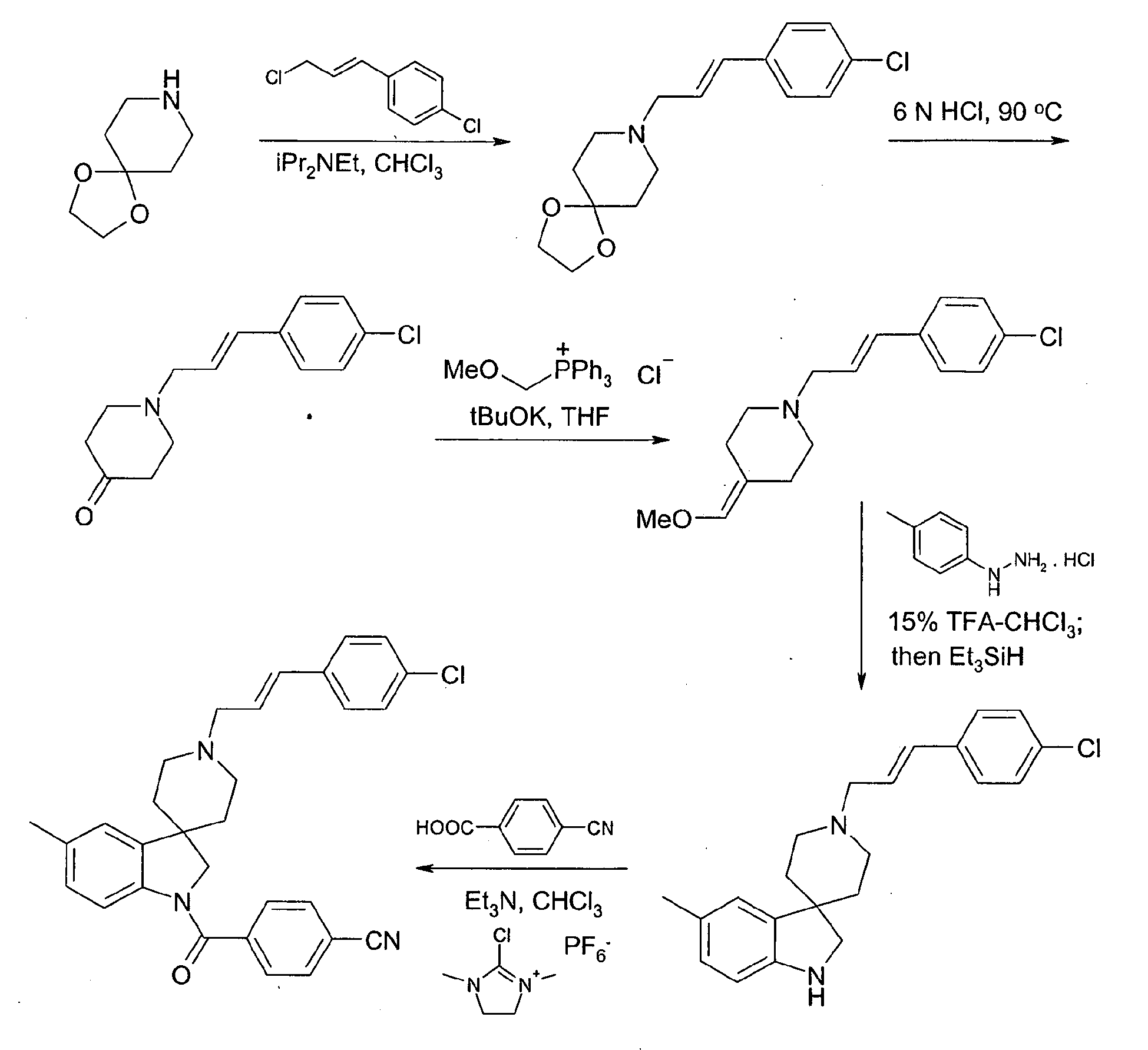
- 1,4-Dioxa-8-azaspiro[4.5]decane (0.88 g) was dissolved in chloroform (5 ml) and diisopropylethylamine (2.1 ml) was added. A solution of 4-chlorocinnamyl chloride (1.2 g) dissolved in chloroform (2 ml) was added and mixture was heated to 70 °C overnight. The solvents were evaporated in vacuo and flash chromatography [SiO2; ethyl acetate-hexane-triethylamine (50:50:2)] yielded 1.38 g (76%) of the desired ketal as a yellow oil. 1H NMR (400 MHz, CDCl3) 1.78 (t, J = 4 Hz, 4H), 2.60 (br s, 4H), 3.18 (d, J = 5 Hz, 2H), 3.96 (s, 4H), 6.27 (dt, J = 12 & 5 Hz, 1H) 6.47 (d, J = 12 Hz, 2H), 7.28, m, 4H). MS (ES+) 294/296 M+H+.
- 8-[trans-3-(4-Chlorophenyl)allyl]-1,4-dioxa-8-azaspiro[4.5]decane (1.38 g) was dissolved in methanol (40 ml) and 6 N hydrochloric acid (120 ml) was added. The mixture was heated to reflux for 4 h. The mixture cooled and was basified to pH 14 with solid sodium hydroxide pellets (CARE! Exotherm), the solution becoming opaque. The aqueous was extracted three times with ether. The organics were washed with brine, dried over anhydrous MgSO4 and evaporated to give 1.17g (100%) of the desired ketone 1H NMR (400 MHz, CDCl3) 2.38 (m, 4H), 2.70 (m, 4H), 3.15 (d, J = 5 Hz, 2H), 3.96 (s, 4H), 6.17 (dt, J = 12 & 5 Hz, 1H), 6.40 (d, J = 12 Hz, 1H), 7.20 (m, 4H). MS (ES+) 250/252 M+H+.
- Methoxymethyltriphenylphosphonium chloride (2.4 g) was dissolved in tetrahydrofuran (20 ml) and was cooled to 4 °C. Potassium tert-butoxide (0.78 g) was added, turning the solution a bright orange colour. The reaction was left as such for 30 min. A solution of 1-[trans-3-(4-chlorophenyl)allyl]-4-oxopiperidine (0.85 g) dissolved in tetrahydrofuran (10 ml) was added and the mixture was stirred for 10 min. The solvents were evaporated in vacuo and the residue re-suspended in ether. The organics were washed with water and dried over anhydrous magnesium sulfate. Flash chromatography [SiO2; ethyl acetate-hexane-triethylamine (50:50:2)] gave 0.85 g (89%) of the desired enol ether. 1H NMR (400 MHz, CDCl3) 2.10 (t, J = 6 Hz, 2H), 2.35 (t, J = 6 Hz, 2H), 2.4 (m, 4H), 3.13 (d, J = 5 Hz, 2H), 3.55 (s, 3H), 5.80 (s, 1H), 6.30 (dt, J = 11 & 5 Hz, 1H), 6.45 (d, J = 11 Hz, 1H), 7.28 (m, 4H). MS (ES+) 278/280 (M+H+).
- Trifluoroacetic acid (0.75 ml) was added to a stirred solution of 1-[trans-3-(4-chlorophenyl)allyl]-4-methoxymethylenepiperidine-and 4-tolylhydrazine hydrochloride (28 mg) in chloroform (5 ml) and the reaction was heated to 50° C for 5 h. Triethylsilane (2 ml) was added and the reaction was heated at 50° C for a further 5 h. The mixture was allowed to cool and was quenched in concentrated ammonia solution / ice chips (20 ml). The aqueous phase was extracted twice with chloroform and the combined organics were dried over anhydrous magnesium sulphate and concentrated in vacuo to yield 0.04 g (63%) of the desired indoline. 1H NMR (400 MHz, CDCl3) 1.75 (d, J = 9 Hz, 2H), 1.96 (td, J = 8 & 2, 2H), 2.13 (t, J = 9 Hz, 2H), 2.25 (s, 3H), 2.95 (d, J = 10 Hz, 2H), 3.19 (d, J = 5 Hz, 2H), 3.42 (s, 2H), 6.30 (dt, J = 11 & 5 Hz, 1H), 6.48 (d, J = 11 Hz, 1H), 6.58 (d, J = 7 Hz, 1H), 6.85 (d, J = 7 Hz, 1H), 6.9 (s, 1H), 7.30 (m, 4H). MS (ES+) 353/355 (M+H+), 203 (M-4-chlorocinnamyl+H+).
- This step was achieved using a Zymark XP2 synthetic chemistry robot. A solution of 5-methyl-1'-[trans-3-(4-chlorophenyl)allyl]spiro[indoline-3,4'-piperidine] (2 ml of a solution derived from dissolving 1.43 g in 100 ml of THF) was added to a robot tube and the solvent was removed in vacuo. 4-Cyanobenzoic acid (28 mg) was weighed into a different robot tube. A solution of 2-chloro-1,3-dimethyl-2-imidazolinium hexafluorophosphate (2 ml of a solution derived from dissolving 4.80 g in 180 ml of chloroform) and a solution of triethylamine (2 ml of a solution derived from dissolving 8.68 ml in 250 ml of chloroform) were added to the acid and the tube was agitated and allowed to stand for 30 minutes. A 2 ml aliquot of the acid solution was added to the tube containing the dry amine. This tube was agitated and allowed to stand overnight. The reaction mixture was washed with 1M aqueous sodium carbonate solution and the solvents were evaporated. The crude mixture was purified by MS directed liquid chromatography to give the desired amide, 2.9 mg. MS (ES+) 482/484 (M+H+).
Compounds I-61, I-171, XXVIII-97, XIX-22, XXVIII-67, XXVIII-7, XX-22, XXIX-69, XXIX-75, XVIII-22, XXVIII-217, XXIX-81, XXIX-87, XV-22, XXIX-93, XXIX-99, XXVIII-187, XXI-22, XXIX-105, XXIX-111, XXIX-117, XXIX-123, XIII-22, XXIX-129, X-22, XXIX-135, XXIX-141, XXIX-147, XXIX-153, XII-22, XXIX-196, II-22, XXIX-159, XXVIII-252, XXVIII-27, XXVIII-42, XVIII-202, XX-62, XXIX-165, XXVIII-162, XXVIII-132, XXIX-171, XXIX-177, XXI-62, XVII-62, XIII-62, X-62, XXIX-183, XI-62, IX-62, XXIX-207, XXIX-195, II-62, I-92, I-112, I-12, I-32, I-52, I-72, I-152, I-162, I-82, I-252, I-242, I-262, I-292, I-62 XXX-10, XXX-116, XXX-117, XXX-30, XXX-33, XXX-34, XXX-35, XXX-36, XXX-37, XXX-38, XXX-39, XXX-40, XXX-41, XXX-42, XXX-43, XXX-44, XXX-45, XXX-46, XXX-47, XXX-48, XXX-49, XXX-50, XXX-9 and XXX-93 were prepared according to procedures analogous to those described in Example 4. - This example illustrates the preparation of compound XIV-22,1-(2-Pyrazinyl)-5-chloro-1'-[trans-3-(4-chlorophenyl)allyl]spiro[indoline-3,4'-piperidine]
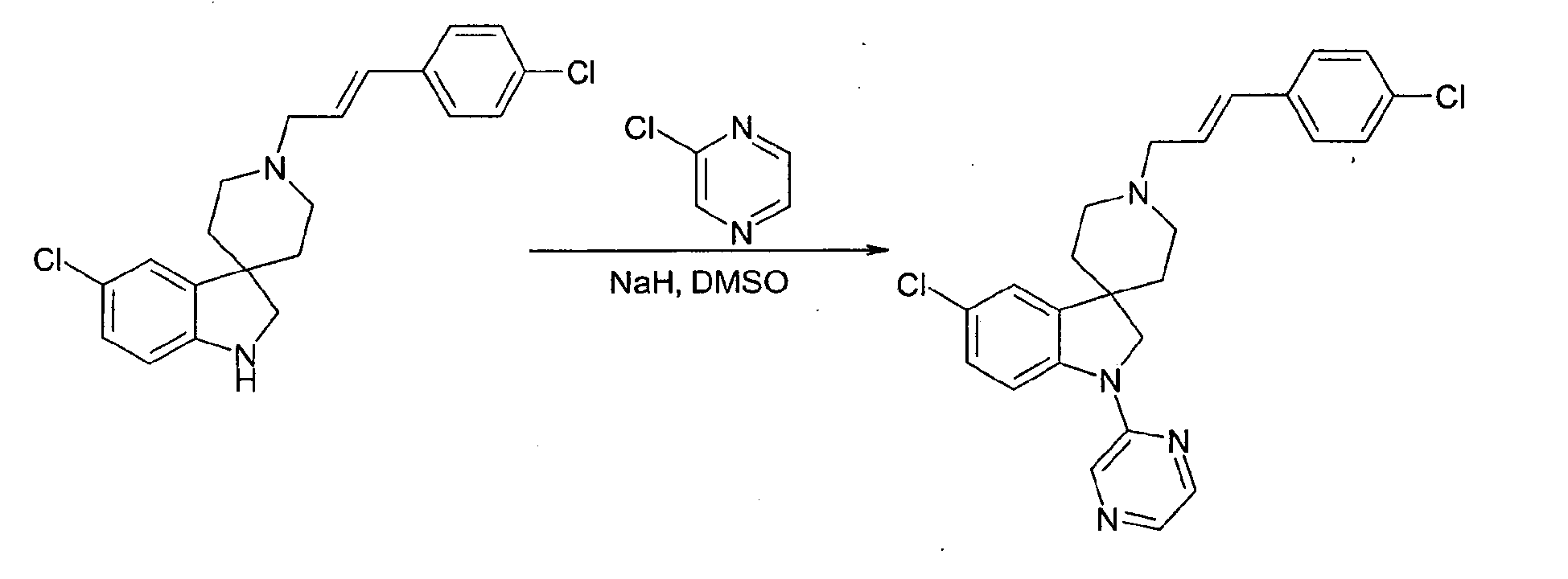
Sodium hydride (50 mg) was added to a stirred solution of 5-chloro-1'-[trans-3-(4-chlorophenyl)allyl]spiro[indoline-3,4'-piperidine] (35 mg) and 2-chloropyrazine (43 mg) in anhydrous DMSO (5 ml) under an atmosphere of nitrogen. The reaction was heated to 60 °C overnight. The reaction mixture was diluted with brine (20 ml) and extracted four times with dichloromethane (20 ml). The combined organics were dried over magnesium sulphate and concentrated in vacuo (1 mmHg) to yield a brown oil. Flash chromatography [SiO2, ethyl acetate-hexane-triethylamine gradient (0:98:2) to (98:0:2)] yielded 25 mg (55%) of the desired product. 1H NMR (400 MHz, CDCl3) 1.75 (m, 2H), 2.05 (td, J = 8 & 2, 2H), 2.18 (t, J = 9 Hz, 2H), 3.05 (d, J = 9 Hz, 2H), 3.22 (d, J = 5 Hz, 2H), 3.94 (s, 2H), 6.30 (dt, J = 11 & 5 Hz, 1H), 6.51 (d, J = 11 Hz, 1 H), 7.18 (m, 2H), 7.30 (m, 4H), 8.05 (d, J = 1Hz, 1H), 8.17 (d, J = 6 Hz, 1H), 8.25 (m, 2H). MS (ES+) 451/453/455 M+H+.
Compounds XXIX-57 and XXIX-63 were prepared according to procedures analogous to those described in Example 5. - This Example illustrates the preparation of compound XXII-3, 1-(2-Chloropyridin-4-yl)carbonyl-1'-[trans-3-(4-fluorophenyl)allyl]spiro[indoline-3,4'-piperidine]

1-(2-Chloropyridin-4-yl)carbonylspiro[indoline-3,4'-piperidine] trifluoroacetic acid salt (0.25 g) was suspended in dioxane (2 ml) and paraformaldehyde (0.08 g) was added. The mixture was stirred and heated to 90°C for 20 minutes. 2-(4-fluorophenyl)vinylboronic acid (0.10 g) was dissolved in dioxane (2 ml) and the resulting solution was added to the salt/paraformaldehyde mixture and the resulting mixture was heated to 90°C for 24 hours. The mixture was allowed to cool and evaporated to dryness in vacuo. The residue was partitioned between dichloromethane and water, and the organic layer was washed with aqueous sodium carbonate solution (1M) and evaporated. The crude product was purified by column chormatography (SiO2, first column in dichloromethane:triethylamine 95:5, then a second column starting with neat dichloromethane, then a gradient from ethyl acetate:hexane: triethylamine 25:75:1 to 95:0:5) to give 0.20 g (76%) of the desired product. MS (ES+) 462/464 M+H+.
Compounds I-23, XXIX-1, I-21, I-2, XXVI-2 (followed by treatment with hydrogen peroxide in methanol) and XXVI-22 (followed by treatment with hydrogen peroxide in methanol), were prepared according to procedures analogous to those described in Example 6. - This Example illustrates the preparation of compound I-212, 5-Cyano-1-(2-chloropyridin-4-yl)carbonyl-1'-[trans-3-(4-chlorophenyl)allyl]spiro[indoline-3,4'-piperidine]

- This example illustrates the preparation of compound XXX-51
-

- Ethyl diethylphosphonoacetate (84 g) in 1,2-dimethoxyethane (100 ml) was added dropwise to a suspension of sodium hydride (55% in oil, 15g) in 1,2-dimethoxyethane (500 ml) at room temperature. 4-Trifluorobenzaldehyde (43.5 g) dissolved in 1,2-dimethoxyethane (100 ml) was then added and the resulting mixture was stirred at room temperature for 4 h. The reaction was quenched by addition of water (400 ml), diluted with diethyl ether (700 ml), the organic phase was separated, washed with brine, dried over sodium sulfate and concentrated in vacuo. The crude product was recrystallised from hexane to give 37 g of the desired product (61 %) which was characterized by its mass and NMR spectra.
- To a solution of the ester obtained in step 1 (37.1 g) in toluene (310 ml) at 0°C was added dropwise diisobutylaluminium hydride (1.2M in toluene, 317 ml) and the solution was stirred at 0°C for 1 h. Water (47.6 ml) was carefully added at 0°C followed by sodium hydroxide 2M (47.6 ml) and finally water (95.1 ml). The mixture was allowed to stir at room temperature for 1 h. After filtration, the solution was washed with hydrochloric acid 2N, water and brine, dried over sodium sulfate and concentrated in vacuo to give 29.5 g of the desired alcohol as a solid (96%) which was characterized by its mass and NMR spectra.
- To a solution of the alcohol obtained in step 2 (10 g) in dimethylacetamide (100 ml) at room temperature were added triphenylphosphine (23 g) and carbon tetrabromide (29 g). The resulting solution was stirred at room temperature for 1 h, poured into water and extracted with ethyl acetate. The organic phase was washed with water and brine, dried over sodium sulfate and filtered over silica gel to give 13 g of the desired product as a white solid (95 %) which was characterized by its mass and NMR spectra.
- To a stirred suspension of -(2-chloropyridin-4-yl)carbonyl-5-chloro-spiro[indolin-3,4'-piperidine] (20 g) and diisopropylethylamine (18.2 ml) in acetonitrile (200 ml) was added the allylic bromide obtained in step 3 (11.6 g) and the reaction mixture was stirred overnight at room temperature. The solution was diluted with ethyl acetate (200 ml), washed with brine (3x100 ml), dried over sodium sulfate and concentrated in vacuo. The residue was purified by column chromatography (SiO2, ethyl acetate:hexane:triethylamine 95:5:0.1 to ethyl acetate:methanol:triethylamine 95:5:0.1) to give 18.9 g of the desired product (82%). Mp = 130°C.
Compounds XXX-82, XXX-83, XXX-84, XXX-85, XXX-86, XXX-87, XXX-91 and XXX-92 were prepared according to standard procedures analogous to those described in Example 8. - This example illustrates the preparation of compound XXX-113
1-(2-chloropyridin-4-yl)carbonyl-5-chloro-1'-[(Z)-3-(4-chlorophenyl)-2-fluoro-allyl]spiro[indolin-3,4'-piperidine]
- 4-Chlorobenzaldehyde (0.66 g) was added to a suspension of diethylfluorooxalacetate, sodium salt (1 g, prepared from diethyl oxalate, ethylfluoroacetate and sodium hydride according to Alberg et al. J. Am. Chem. Soc. 1992, 3542) in tetrahydrofuran (20 ml) at 0°C, and the resulting mixture was stirred 1 h at 0°C then 3 h at 80°C. The reaction mixture was concentrated in vacuo, diluted with diethyl ether, washed with aqueous sodium bicarbonate, water and brine, dried over sodium sulfate and concentrated in vacuo to afford a crude residue (1.2 g) which was used diretly in the next step.
- Step 2 to 4 were carried out following the procedure described in Example 8, step 2-4 to give 0.17 g of the desired product (41 %) which was characterized by its mass and NMR spectra. MS (ES+) 530.
Compound XXX-114 was prepared according to standard procedures analogous to those described in Example 9. - This example illustrates the preparation of I-25
1-(2-chloropyridin-4-yl)carbonyl-5-chloro-1'-[trans-3-(4-methoxyphenyl) allyl]spiro[indolin-3,4'-piperidine]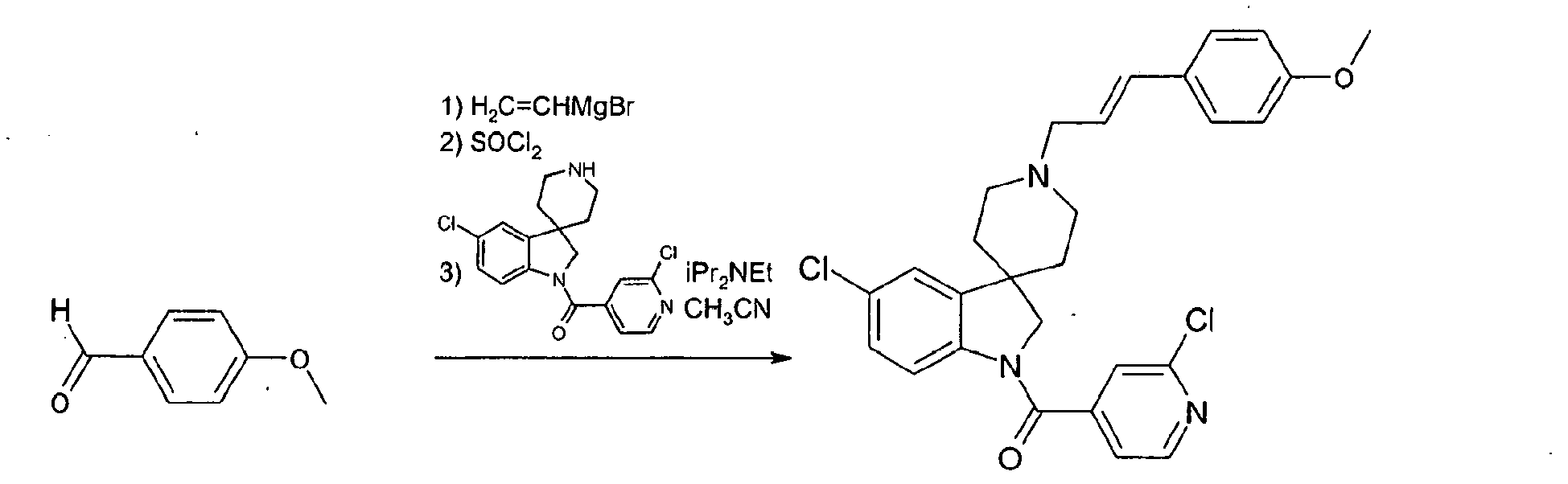
- To a solution of p-anisaldehyde (1.54 ml) in tetrahydrofuran (20 ml) at -10°C under argon was added dropwise vinyl magnesium bromide (1M in THF, 12.5 ml). The solution was stirred overnight at room temperature and quenched by addition of saturated aqueous ammonium chloride (20 ml). The organic phase was separated, dried over sodium sulfate and concentrated in vacuo. The residue was purified by column chromatography (SiO2, ethyl acetate:cyclohexan 7:3) to give 1.05 g of the desired product as a colorless oil (5 1 %) which was characterized by its mass and NMR spectra.
- To a solution of the allylic alcohol obtained in step 1 (200 mg) in diethyl ether (3 ml) was added thionyl chloride (0.087 ml) and the solution was stirred at room temperature for 1 h.
The solution was concentrated in vacuo to give 221 mg of the desired product (100%) as a colorless solid. Mp= 70°C. - Alkylation of 1-(2-chloropyridin-4-yl)carbonyl-5-chloro-spiro[indolin-3,4'-piperidine] (0.43 g) with 1-((E)-3-chloro-propenyl)-4-methoxy -benzene obtained in step 2 (0.22 g) was carried out following the procedure described in example 101, step 4 to afford 0.36 g of the title compound (59%) which was characterized by its mass and NMR spectra. MS (ES+) 509. Mp = 83-85°C.
- This example illustrates the preparation of XXX-115
1-(2-chloropyridin-4-yl)carbonyl-5-chloro-1'-[(Z)-3-(4-chlorophenyl)-3-chloro-allyl]spiro[indolin-3,4'-piperidine]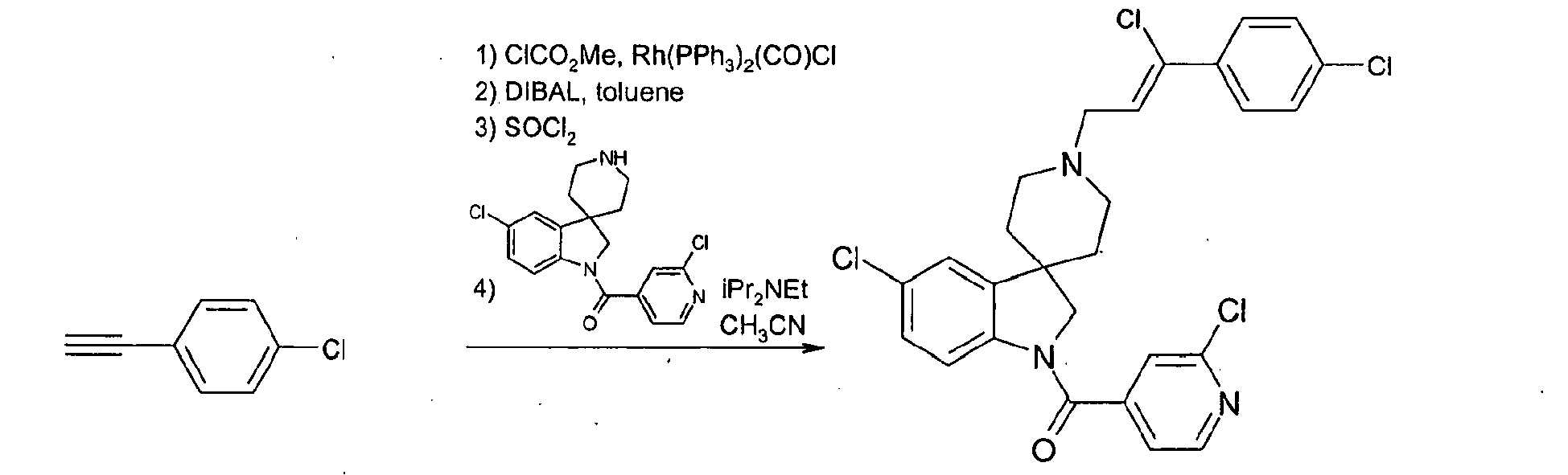
- By analogy with : Tanaka, M. et al. J. Am. Chem. Soc. 1998, 120, 12365 To a solution of 4-chlorophenylacetylene (100 mg) and Rh(CO)(PPh3)2Cl (5 mg) in toluene (3 ml) was added methyl chloroformate (0.17 ml) and the mixture was stirred in a sealed tube at 110°C for 10 h. The reaction mixture was concentrated in vacuo and subjected to column chromatography (SiO2, ethyl acetate:cyclohexan 1:9) to give 104 mg of the desired product as a brown solid (61 %) which was characterized by its mass and NMR spectra. Mp= 40°C.
- Following the procedure described in Example 8, step 2, (Z)-3-chloro-3-(4-chloro-phenyl)-acrylic acid methyl ester (462 mg) was converted into the desired product (391 mg, 96%) which was characterized by its mass and NMR spectra.
- To a solution of (Z)-3-chloro-3-(4-chloro-phenyl)-prop-2-en-1-ol (101 mg) in toluene (3 ml) was added thionyl chloride (0.11 ml) and one drop of dimethylformamide. After 1 h, the solution was concentrated in vacuo to afford 120 mg of the desired allylic chloride (100%) as a colorless oil.
- Alkylation of 1-(2-chloropyridin-4-yl)carbonyl-5-chloro-spiro[indolin-3,4'-piperidine] (0.18 g) with 1-chloro-4-((Z)-1,3-dichloro-propenyl)-benzene obtained in step 3 (0.11 g) was carried out following the procedure described in example 101, step 4 to afford 0.17 g of the title compound (64%) as a foam which was characterized by its mass and NMR spectra. MS (ES+) 548.
- This example illustrates the preparation of XXX-90
1-(2-chloropyridin-4-yl)carbonyl-S-chloro-1'-[(Z)-3-(4-chlorophenyl)-3-fluoro-allyl]spiro[indolin-3,4'-piperidine]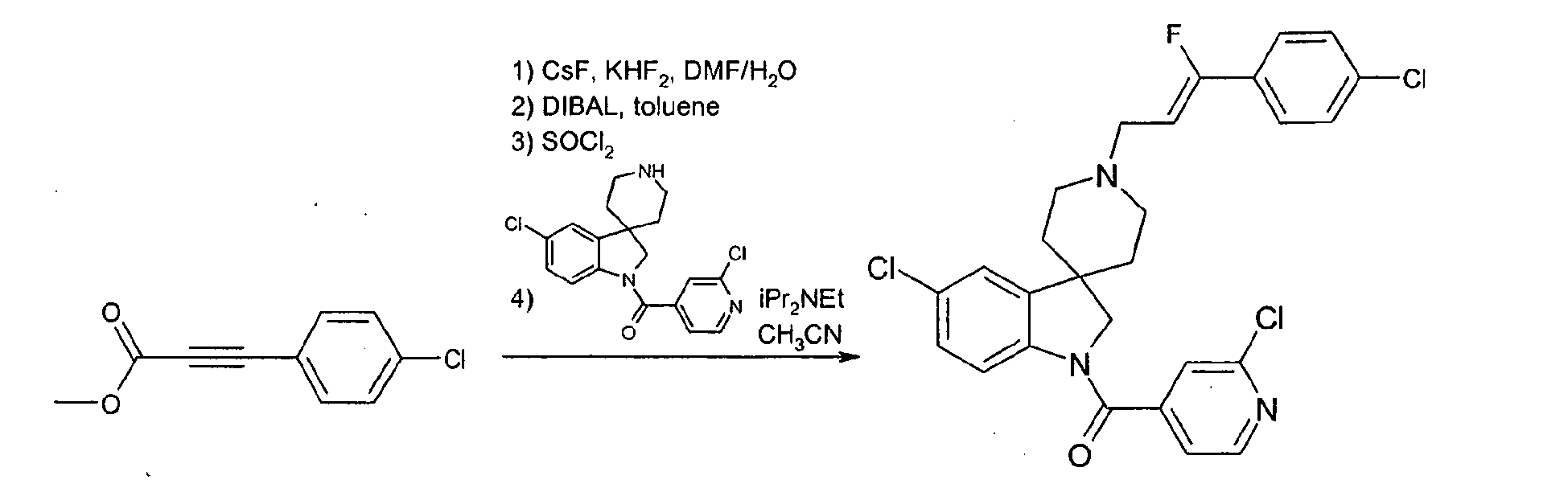
- By analogy with: Cousseau, J. J. Chem. Soc. Chem. Commun. 1989, 1493
- To a solution of (4-chloro-phenyl)-propynoic acid methyl ester (5.36 g) in dimethylformamide (60 ml) was added cesium fluoride (11.4 g) and potassium hydrogen fluoride (2.73 g) in water (5.4 ml) and the mixture was stirred at 80°C for 8 h. The reaction mixture was cooled to room temperature, diluted with ethyl acetate (50 ml), the organic phase washed with water (3x50 ml) and brine (3x20 ml), dried over sodium sulfate and concentrated in vacuo. The residue was purified by column chromatography (SiO2, ethyl acetate:cyclohexan 1:9) to give 1.06 g of the desired product (20%) which was characterized by its mass and NMR spectra.
- Step 2 to 4 were carried out following the procedure described in Example 11, step 2-4 to give 163 mg of the desired product (42%) which was characterized by its mass and NMR spectra. MS (ES+) 531.
Compounds XXX-88 and XXX-90 were prepared according to standard procedures analogous to those described in Example 12. - This example illustrates the preparation of compound XXX-121 and XXX-94, 1-carboxylic acid (4-chloro-phenyl)-amide-5-fluoro-1'-[trans-3-(4-chlorophenyl)allyl]spiro[indoline-3,4'-piperidine].

- A solution of 5-fluoro-1'-[trans-3-(4-chlorophenyl)allyl]spiro[indoline-3,4'-piperidine] (5 g) in dichloromethane (15 ml) was added to a suspension of wet silica gel (50% w/w in water, 2.9 g) and zinc chloride (5.73 g) in dichloromethane (15 ml) and the resulting mixture was stirred for 3.5 hours at room temperature. The reaction mixture was diluted with ethyl acetate and the insoluble residues were removed by filtration. The filtrate was washed with saturated aqueous sodium bicarbonate solution, water and brine, dried over sodium sulfate and the solvents were evaporated in vacuo to afford 5.13 g (95%) of the desired nitroso-amine as a solid. MS (ES+) 386.
- A solution of 1-nitroso-5-fluoro-1'-[trans-3-(4-chlorophenyl)allyl]spiro[indoline-3,4'-piperidine] (5 g) in tetrahydrofuran (60 ml) was added dropwise to a suspension of lithium aluminium hydride (1.47 g) in tetrahydrofuran (60 ml) at 0°C and the resulting mixture was stirred at room temperature for 2.5 hours. Water (4.8 ml) was carefully added, followed by 15 % aqueous sodium hydroxide (4.8 ml), and finally water (14.4 ml). The mixture was stirred for 0.5 hours, diluted with ethyl acetate, dried over sodium sulfate, and filtered. The solvents were evaporated in vacuo to afford 5.1 g (100%) of the desired amino-indoline as a solid. MS (ES+) 372.
- 2-Chloroisonicotinoyl chloride (1.2 g) was added to a stirred solution of 1-amino-5-fluoro-1'-[trans-3-(4-chlorophenyl)allyl]spiro[indoline-3,4'-piperidine] (0.2 g) and triethylamine (0.3 ml) in dichloromethane (4 ml) at room temperature. The mixture was stirred for 2 hours. The reaction mixture was washed with water and the aqueous layer was extracted with dichloromethane. The combined organic layers were dried (sodium sulfate), filtered and evaporated. The crude product was purified by chromatography [SiO2; ethyl acetate-methanol (96:4) to give 0.13 g (48%) of the desired product. MS (ES+) 511.
Compounds XXX-95, XXX-97, XXX-98 and XXX-99 were prepared according to standard procedures analogous to those described in Example 13 - This example illustrates the preparation of compound XXX-119, 1-(4-chloro-phenyl)-urea-5-fluoro-1'-[trans-3-(4-chlorophenyl)allyl]spiro[indoline-3,4'-piperidine].
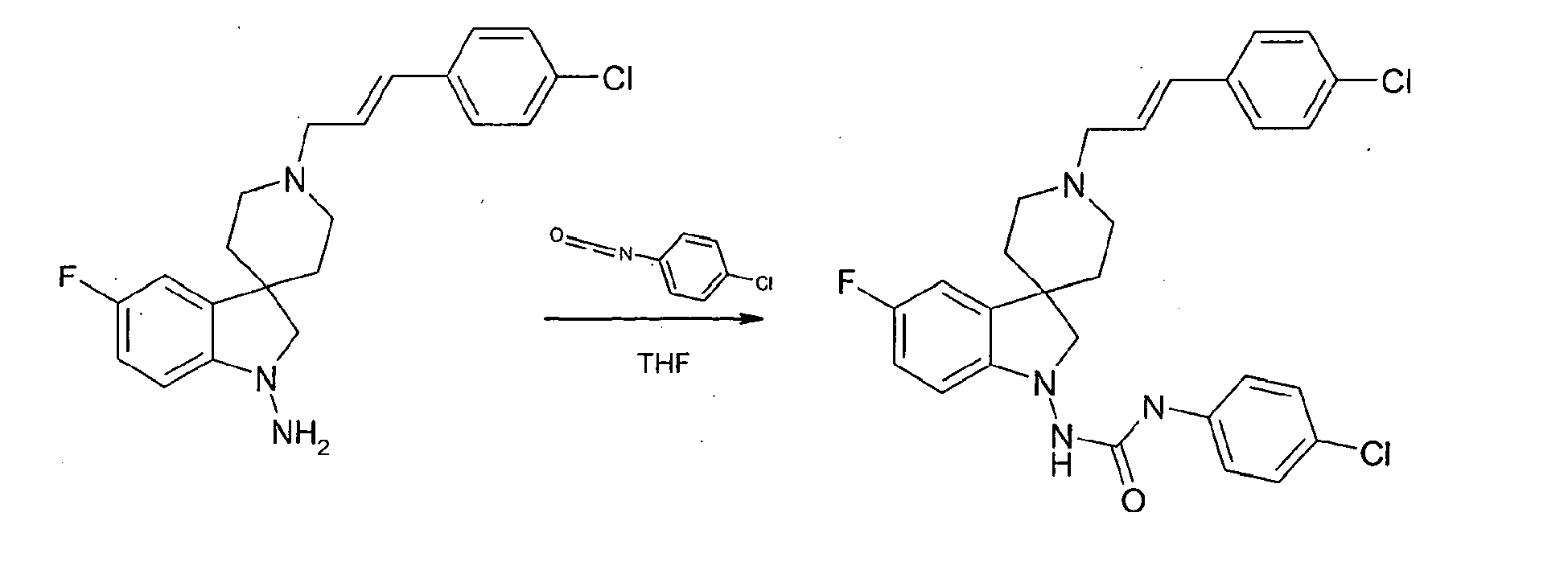
- To a solution of 1-amino-5-fluoro-1'-[trans-3-(4-chlorophenyl)allyl]spiro[indoline-3,4'-piperidine] (0.2 g) in tetrahydrofuran (2 ml) was added 4-chlorophenyl isocyanate (70 mg) and the mixture was stirred at room temperature for 10 min. The solvent was evaporated in vacuo and the residue purified by preparative HPLC to afford the title compound (49%) as a solid. MS (ES+) 525.
Compounds XXX-100, XXX-101, XXX-102 and XXX-103 were prepared according to standard procedures analogous to those described in Example 14. - This example illustrates the preparation of compound XXX-102 N'-[5-chloro-1'-[trans-3-(4-chlorophenyl)allyl]spiro[indoline-3,4'-piperidine]-1-yl]-N,N-dimethylacetamidine
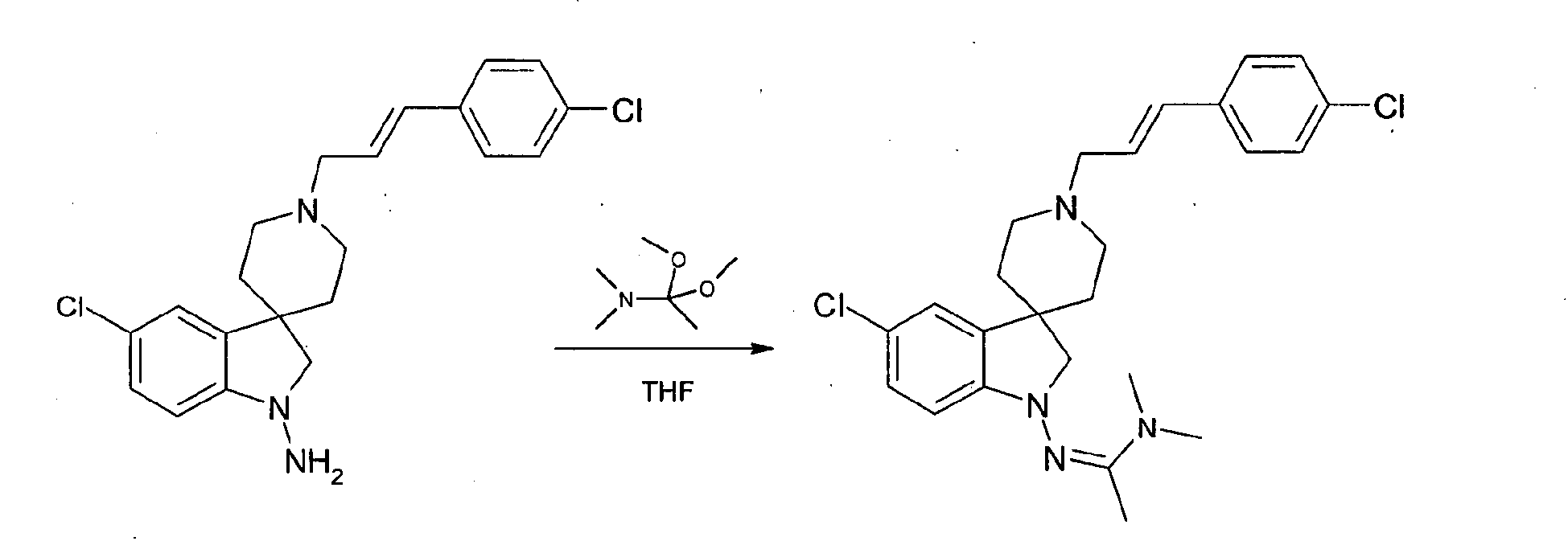
- This example illustrates the preparation of compound XXX-105 1-[carboxylic acid (2-methoxy-ethyl)-amide]-5-chloro-1'-[trans-3-(4-chlorophenyl)allyl]spiro[indoline-3,4'-piperidine].

Compounds XXX-104, XXX-106, XXX-107, XXX-108, XXX-109, XXX-110, XXX-111 and XXX-112 were prepared according to standard procedures analogous to those described in Example 16. - Preparation of compound XXVI-1 - 1,2-Dihydro-1-(4-nitrobenzoyl)-1'-(3-phenyl-2-propenyl)-spiro[3H-indole-3-4'-piperidine]

- REM resin (10 g, 12 mmol) was swollen in dimethylformamide (100 ml). A solution of 4-formylpiperidine dimethyl acetal (2.86 g, 18 mmol) in dimethylformamide (10 ml) was then added. The reaction was left to shake at room temperature for 18 hours. The resulting resin was then filtered, washed according to the standard procedure and dried in vacuo to afford 11.83 g (96% yield) of the desired resin A.
- A 100 ml solution of trifluoroacetic acid / dichloromethane / water (49 : 49 : 2) was added to resin A (10 g, 12 mmol) and the mixture was then shaken at room temperature for 2 hours. The resulting resin was then filtered, washed using dichloromethane (x3), methanol, dichloromethane, methanol, tert-butyl methyl ether (x2) and dried in vacuo to afford 9.48 g of the desired resin B, which was stored at -50°C under nitrogen.
- To resin B (1 g, 1.2 mmol) was added a solution of 5% trifluoroacetic acid in dichloromethane (10 ml) followed by addition of anisole (0.0026 g, 0.024 mmol). The mixture was degassed with nitrogen for 10 minutes, and phenylhydrazine (0.39 g, 3.6 mmol) was added. The reaction mixture was stirred under nitrogen and heated to reflux for 36 hours. The mixture was then filtered, washed according to the standard wash cycle and dried in vacuo to afford 1.09 g of the desired resin C, which was used immediately in Step D.
- To resin C (1 g, 1.2 mmol), swollen in anhydrous dichloromethane (10 ml) was added sodium triacetoxyborohydride (0.51 g, 2.4 mmol) as a solid. The reaction mixture was stirred at room temperature under nitrogen for 2 hours. The resin was then filtered, washed according to the standard wash cycle and dried in vacuo to afford 0.95 g of the desired resin D, which was stored at -50°C under nitrogen.
- Resin D (0.5 g, 0.6 mmol) was swollen in anhydrous dichloromethane (5 ml). To the mixture was added 4-nitrobenzoyl chloride (0.33 g, 1.8 mmol) and N,N-diisopropylethylamine (0.42 ml, 2.4 mmol). After shaking at room temperature for 18 hours, the resin was filtered, washed according to the standard wash cycle and dried in vacuo to afford 0.53 g of the desired resin E.
- To resin E (0.1 g, 0.12 mmol) in anhydrous dimethylformamide (1 ml) was added cinnamyl bromide (0.12 g, 0.6 mmol). The reaction mixture was shaken at room temperature for 48 hours. The resulting resin was then washed according to the standard wash cycle to afford 0.11 g of the desired resin F, which was used immediately in Step G.
- To resin F (0.11 g, 0.132 mmol) in anhydrous dimethylformamide (1.1 ml) was added Amberlite IRA-93 (previously washed with 10% N,N-diisopropylethylamine/dimethylformamide) (0.11 g). The mixture was shaken at room temperature for 36 hours. The dimethylformamide filtrate was then collected and concentrated under reduced pressure. The resin was further washed with dichloromethane and methanol. All filtrates were then combined and concentrated in vacuo to afford 0.052 g (88% yield) of the desired compound as a pale yellow oil.
By an analogous procedure other compounds were prepared including compound XVI-21, 5-Chloro-1,2-dihydro-1-(4-nitrobenzoyl)-1'-(3-phenyl-2-propenyl)-spiro[3H-indole-3-4'-piperidine] - This example illustrates the preparation of compound XXX-72, 1-(2-chloropyridin-4-yl)carbonyl-5-chloro-1'-[(Z)-3-(4-methylthiophenyl) allyl]spiro[indolin-3,4'-piperidine]

- To 13.1 mg 4-thiomethylboronic acid in a "Zisser-block" were added 14.5 mg 1-(2-chloropyridin-4-yl)carbonyl-5-chloro-1'-[(E/Z)-3-bromo-allyl]spiro[indolin-3,4'-piperidine] in 0.05ml dimethoxyethane , 8 mg sodium bicarbonate in 0.3 ml H2O and 2 mg bis-(triphenylphosphin)palladium(II) dichloride. The mixture was stirred at 75°C for 13 hours. The organic layer was separated and evaporated in vacuo and the residue purified by chromatography (H2O-acetonitrile gradient) to yield the desired product MS (ES+) 525. By an analogous procedure other compounds were prepared including compounds XXX1-4, XXX-51, XXX-52, XXX-53, XXX-54, XXX-55, XXX-56, XXX-57, XXX-58, XXX-59, XXX-60, XXX-61, XXX-62, XXX-63, XXX-64, XXX-65, XXX-66, XXX-67, XXX-68, XXX-69, XXX-70, XXX-71, XXX-73, XXX-74, XXX-75, XXX-76, XXX-77, XXX-78, x:XX-79, XXX-80, XXX-81, XXXI-3, XXXI-5, XXXI-6 and XXXI-7.
- This Example illustrates the pesticidal/insecticidal properties of compounds of formula (I). Test against were performed as follows:
- Spodoptera littoralis (Egyptian cotton leafworm)
- Cotton leaf discs were placed on agar in a 24-well microtiter plate and sprayed with test solutions at an application rate of 200 ppm. After drying, the leaf discs were infested with 5 L1 larvae. The samples were checked for mortality, repellent effect, feeding behaviour, and growth regulation 3 days after treatment (DAT). The following compounds gave at least 80% control of Spodoptera littoralis:
- I-2, I-12, I-21, I-22, I-23, I-32, I-52, I-61, I-62, I-72, I-82, I-92, I-112, I-132, I-142, I-152, I-162, I-182, I-192, I-202, I-212, I-222, I-232, I-242, I-252, I-262, I-282, II-62, V-22, VI-22, VI-62, VI-202, X-22, X-62, XI-62, XII-22, XIII-62, XIV-22, XV-22, XVII-62, XVIII-22, XIX-22, XIX-202, XX-22, XX-62, XXI-22, XXI-62, XXII-22, XXVI-2, XXVI-22, XXVII-2, XXVII-22, XXIX-43, XXIX-93, XXIX-195, XXIX-196, XXIX-201, XXX-10, XXX-106, XXX-107, XXX-118, XXX-15, XXX-16, XXX-18, XXX-24, XXX-26, XXX-28, XXX-3, XXX-36, XXX-43, XXX-48, XXX-49, XXX-52, XXX-55, XXX-57, XXX-60, XXX-67, XXX-83, XXX-84, XXX-87, XXX-88, XXX-99, XXXI-8, XXXII-4, XXX-104, XXX-105, XXX-109, XXX-112, XXX-113, XXX-114, XXX-117, XXX-12, XXX-13, XXX1-4, XXX-19, XXX-2, XXX-20, XXX-30, XXX-38, XXX-39, XXX-40, XXX-41, XXX-42, XXX-44, XXX-45, XXX-50, XXX-53, XXX-59, XXX-6, XXX-61, XXX-62, XXX-65, XXX-7, XXX-70, XX-8, XXX-82, XXX-89, XXX-95, XXXI-2, XXXI-7, XXX-11, XXX1-1, XXX-110, XXX-111, XXX-31, XXX-51, XXX-66, XXX-86, XXX-93 and XXXI-5.
- Heliothis virescens (Tobacco budworm):
- Eggs (0-24 h old) were placed in 24-well microtiter plate on artificial diet and treated with test solutions at an application rate of 200 ppm by pipetting. After an incubation period of 4 days, samples were checked for egg mortality, larval mortality, and growth regulation. The following compounds gave at least 80% control of Heliothis virescen:
- I-1, I-2, I-3, I-4, I-5, I-12, I-21, I-22, I-23, I-32, I-52, I-61, I-62, I-72, I-82, I-92, I-112, I-132, I-142, I-152, I-162, I-171, I-182, I-192, I-202, I-212, I-222, I-232, I-242, I-252, I-262, I-282, I-292, II-301, II-22, II-62, V-21, V-22, V-62, V-192, V-202, VI-1, VI-22, VI-62, VI-101, VI-202, IX-62, X-22, X-62, XI-62, XII-22, XIII-22, XIII-62, XIV-22, XV-22, XVII-62, XVIII-22, XVIII-202, XIX-22, XIX-202, XX-22, XX-62, XXI-22, XXI-62, XXII-22, XXV-222, XXVI-2, XXVI-22, XXVII-2, XXVII-22, XXVIII-7, XXVIII-27, XXVIII-42, XXVIII-67, XXVIII-97, XXVIII-132, XXVIII-187, XXVIII-217, XXVIII-252, XXIX-1, XXIX-7, XXIX-13, XXIX-57, XXIX-63, XXIX-75, XXIX-81, XXIX-87, XXIX-93, XXIX-111, XXIX-117, XXIX-123, XXIX-129, XXIX-141, XXIX-147, XXIX-153, XXIX-159, XXIX-165, XXIX-171, XXIX-183, XXIX-195, XXIX-196, XXIX-201, XXX-100, XXX-107, XXX-108, XXX-109, XXX-116, XXX-14, XXX-15, XXX-17, XXX-23, XXX-32, XXX-35, XXX-4, XXX-43, XXX-46, XXX-55, XXX-56, XXX-63, XXX-64, XXX-7, XXX-71, XXX-72, XXX-73, XXX-76, XXX-77, XXX-78, XXX-79, XXX-80, XXX-81, XXX-85, XXX-88, XXX-92, XXX-94, XXX-98, XXXII-1, XXXII-2, XXXII-3, XXXII-5, XXXIII-8, XXXII-9, XXX-1, XXX-10, XXX-105, XXX-106, XXX-112, XXX-115, XXX-118, XXX-12, XXX-16, XXX-18, XXX-19, XXX-21, XXX-22, XXX-24, XXX-26, XXX-28, XXX-29, XXX-33, XXX-34, XXX-37, XXX-50, XXX-54, XXX-58, XXX-60, XXX-65, XXX-67, XXX-68, XXX-74, XXX-75, XXX-83, XXX-87, XXX-9, XXX-91, XXX-93, XXX-96, XXX-99, XXXI-3, XXXI-6, XXXII-10, XXXII-4, XXXII-6, XXX1-1, XXX-110, XXX-111, XXX-113, XXX-114, XXX-117, XXX-13, XXX1-4, XXX-2, XXX-20, XXX-3, XXX-30, XXX-31, XXX-36, XXX-38, XXX-40, XXX-41, XXX-44, XXX-45, XXX-48, XXX-49, XXX-5, XXX-53, XXX-57, XXX-59, XXX-6, XXX-61, XXX-62, XXX-7, XXX-8, XXX-82, XXX-89, XXX90, XXXI-2, XXX-120 and XXXI-7.
- Plutella xylostella (Diamond back moth):
- 24-well microtiter plate (MTP) with artificial diet was treated with test solutions at an application rate of 18.2 ppm by pipetting. After drying, the MTP's were infested with larvae (L2)(10-15 per well). After an incubation period of 5 days, samples were checked for larval mortality, antifeedant and growth regulation. The following compounds gave at least 80% control of Plutella xylostella:
- I-1, I-2, I-3, I-4, I-5, I-12, I-21, I-22, I-23, I-32, I-52, I-61, I-62, I-72, I-82, I-92, I-112, I-132, I-142, I-152, I-162, I-171, I-192, I-202, I-212, I-222, I-242, I-252, I-262, I-282, I-292, II-22, II-62, V-22, V-62, V-202, VI-22, VI-62, IX-62, X-22, X-62, XI-62, XII-22, XIII-62, XIV-22, XV-22, XVII-62, XX-22, XXI-62, XXII-22, XXV-62, XXVI-2, XXVI-22, XXVII-1, XXVII-2, XXVII-22, XXVIII-97, XXVm-187, XXIX-129, XXIX-135, XXIX-159, XXIX-177, XXIX-189, XXIX-195, XXIX-196, XXX-10, XXX-100, XXX-109, XXX-112, XXX-117, XXX-16, XXX-18, XXX-19, XXX-21, XXX-28, XXX-34, XXX-36, XXX-43, XXX-48, XXX-5, XXX-50, XXX-54, XXX-59, XXX-60, XXX-66, XXX-68, XXX-69, XXX-75, XXX-83, XXX-90, XXX-91, XXX-98, XXXI-2, XXXI-7, XXXII-4, XXXII-8, XXXII-9, XXX-101, XXX-104, XXX-107, XXX-110, XXX-111, XXX-118, XXX-12, XXX-13, XXX1-4, XXX-22, XXX-3, XXX-30, XXX-37, XXX-39, XXX-40, XXX-41, XXX-42, XXX-44, XXX-49, XXX-57, XXX-61, XXX-7, XXX-89, XXX-105, XXX-106, XXX1-1, XXX-113, XXX-114, XXX-31, XXX-35, XXX-38, XXX-45, XXX-46, XXX-47, XXX-53, XXX-62, XXX-67, XXX-70, XXX-8, XXX-86, XXXI-5, XXX-2, XXX-120 and XXX-51
- Myzus persicae (Green peach aphid):
- Sunflower leaf discs were placed on agar in a 24-well microtiter plate and sprayed with test solutions at an application rate of 200 ppm. After drying, the leaf discs were infested with an aphid population of mixed ages. After an incubation period of 6 DAT, samples were checked for mortality. The following compounds gave at least 80% control of Myzus persicae:
- I-2, I-21, II-62, XI-62, XXVII-2, XXVIII-162, XXIX-49 XXX-111, XXX-13, XXX-29, XXX-34 and XXX-47.
- Tetranychus urticae (Two-spotted spider mite):
- Bean leaf discs on agar in 24-well microtiter plates wer sprayed with test solutions at an application rate of 200 ppm. After drying, the leaf discs are infested with mite populations of mixed ages. 8 days later, discs are checked for egg mortality, larval mortality, and adult mortality. The following compounds gave at least 80% control of Tetranychus urticae:
- I-202, XIII-22, XIX-202, XXVI-1, XXVIII-162, XXIX-207, XXX-57 and XXXI-2.
- Aedes aegypti (Yellow fever mosquito):
- 10-15 Aedes larvae (L2) together with a nutrition mixture are placed in 96-well microtiter plates. Test solutions at an application rate of 2ppm are pipetted into the wells. 2 days later, insects were checked for mortality and growth inhibition. The following compounds gave at least 80% control of Aedes aegypti
- I-4, I-5, I-12, I-21, I-22, I-23, I-32, I-52, I-61, I-62, I-72, I-82, I-92, I-112, I-132, I-142, I-152, I-162, I-202, I-212, I-222, I-232, I-242, I-252, I-262, I-292, II-22, II-62, V-22, VI-22, VI-62, VI-202, XIV-22, XV-22, XVII-62, XVIII-22, XIX-22, XX-22, XXI-22, XXI-62, XXII-22, XXVI-2, XXVI-22, XXVII-22, XXVIII-7, XXVIII-27, XXVIII-67, XXVIII-97, XXVIII-187, XXIX-13, XXIX-19, XXIX-25, XXIX-31, XXIX-37, XXIX-69, XXIX-75, XXIX-93, XXIX-99, XXIX-105, XXIX-117,XXIX-123, XXIX-129, XXIX-135, XXIX-159, XXIX-183, XXX-102, XXX-105, XXX-11, XXX-110, XXX-117, XXX-24, XXX-28, XXX-31, XXX-34, XXX-4, XXX-48, XXX-49, XXX-52, XXX-57, XXX-59, XXX-60, XXX-61, XXX-67, XXX-68, XXX-7, XXX-70, XXX-75, XXX-78, XXX-79, XXX-82, XXX-83, XXX-84, XXX-87, XXX-88, XXX90, XXX-93, XXX-94, XXX-97, XXXI-2, XXXI-7, XXXI-8, XXXII-10, XXXII-4, XXX-104, XXX-106, XXX1-1, XXX-111, XXX-113, XXX-114, XXX-118, XXX-12, XXX-13, XXX1-4, XXX-16, XXX-17, XXX-18, XXX-19, XXX-2, XXX-20, XXX-22, XXX-26, XXX-3, XXX-30, XXX-35, XXX-38, XXX-39, XXX-44, XXX-46, XXX-47, XXX-5, XXX-50, XXX-53, XXX-62, XXX-86, XXX-98, XXXI-5, XXX-109, XXX-45, XXX-51, XXX-6, XXX-66 XXX-121 and XXX-8.
Claims (10)
- A method of combating and controlling insects, acarines, nematodes or molluscs which comprises applying to a pest, to a locus of a pest, or to a plant susceptible to attack by a pest an insecticidally, acaricidally, nematicidally or molluscicidally effective amount of a compound of formula (1):
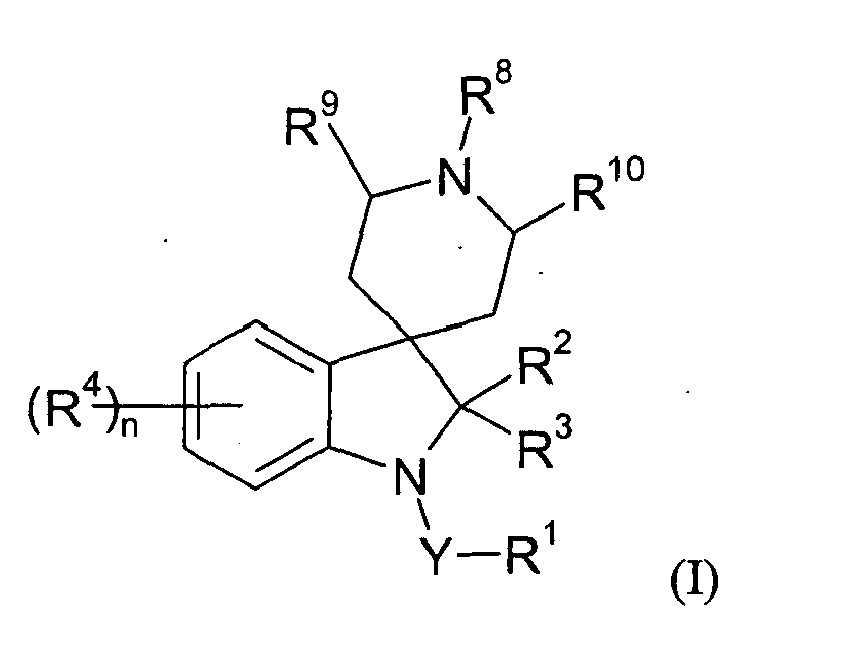
- A method according to claim 1 wherein Y is a bond or is C=O.
- A method according to claim 1 or claim 2 wherein R1 is hydrogen, C1-6 alkyl, C1-6 cyanoalkyl, C1-6 haloalkyl, C3-7 cycloalkyl(C1-4)alkyl, C1-6 alkoxy(C1-6)alkyl, heteroaryl(C1-6)alkyl (wherein the heteroaryl group may be optionally substituted by halo, nitro, cyano, C1-6 alkyl, C1-6 haloalkyl, C1-6 alkoxy, C1-6 haloalkoxy, C1-6 alkylsulfonyl, C1-6 alkylsulfinyl, C1-6 alkylthio, C1-6 alkoxycarbonyl, C1-6 alkylcarbonylamino, arylcarbonyl, or two adjacent positions on the heteroaryl system may be cyclised to form a 5, 6 or 7 membered carbocyclic or heterocyclic ring, itself optionally substituted with halogen), aryl(C1-6)alkyl (wherein the aryl group may be optionally substituted by halo, nitro, cyano, C1-6 alkyl, C1-6 haloalkyl, C1-6 alkoxy, C1-6 haloalkoxy, C1-6 alkylsulfonyl, C1-6 alkylsulfinyl, C1-6 alkylthio, C1-6 alkoxycarbonyl, C1-6 alkylcarbonylamino, arylcarbonyl, or two adjacent positions on the aryl system may be cyclised to form a 5, 6 or 7 membered carbocyclic or heterocyclic ring, itself optionally substituted with halogen), C1-6 alkylcarbonylamino(C1-6)alkyl, aryl (which may be optionally substituted by halo, nitro, cyano, C1-6 alkyl, C1-6 haloalkyl, C1-6 alkoxy, C1-6 haloalkoxy, C1-6 alkylsulfonyl, C1-6 alkylsulfinyl, C1-6 alkylthio, C1-6 alkoxycarbonyl, C1-6 alkylcarbonylamino, arylcarbonyl, or two adjacent positions on the aryl system may be cyclised to form a 5, 6 or 7 membered carbocyclic or heterocyclic ring, itself optionally substituted with halogen), heteroaryl (which may be optionally substituted by halo, nitro, cyano, C1-6 alkyl, C1-6 haloalkyl, C1-6 alkoxy, C1-6 haloalkoxy, C1-6 alkylsulfonyl, C1-6 alkylsulfinyl, C1-6 alkylthio, C1-6 alkoxycarbonyl, C1-6 alkylcarbonylamino, arylcarbonyl, or two adjacent positions on the heteroaryl system may be cyclised to form a 5, 6 or 7 membered carbocyclic or heterocyclic ring, itself optionally substituted with halogen), C1-6 alkoxy, C1-6 haloalkoxy, phenoxy (wherein the phenyl group is optionally substituted by halogen, C1-4 alkyl, C1-4 alkoxy, C1-4 haloalkyl, C1-4 haloalkoxy, CN, NO2, aryl, heteroaryl, amino or dialkylamino), heteroaryloxy (optionally substituted by halo, nitro, cyano, C1-6 alkyl, C1-6 haloalkyl, C1-6 alkoxy or C1-6 haloalkoxy), heterocycyloxy (optionally substituted by halo, C1-6 alkyl, C1-6 haloalkyl, C1-6 alkoxy or C1-6 haloalkoxy), cyano, C2-6 alkenyl, C2-6 alkynyl, C3-6 cycloalkyl, C5-7 cycloalkenyl, heterocyclyl (optionally substituted by halo, nitro, cyano, C1-6 alkyl, C1-6 haloalkyl, C1-6 alkoxy or C1-6 haloalkoxy), C1-6 alkylthio, C1-6 haloalkylthio or NR13R14 where R13 and R14 are independently hydrogen, C2-6 alkyl, C2-6 haloalkyl, phenyl (which may be optionally substituted by halogen, C1-4 alkyl, C1-4 alkoxy, C1-4 haloalkyl, C1-4 haloalkoxy, CN, NO2, aryl, heteroaryl, amino, dialkylamino or C1-4 alkoxycarbonyl) or heteroaryl (which may be optionally substituted by halo, nitro, cyano, C1-6 alkyl, C1-6 haloalkyl, C1-6 alkoxy or C1-6 haloalkoxy, C1-4 alkoxycarbonyl C1-6 alkylcarbonylamino, phenyloxycarbonylamino (wherein the phenyl group is optionally substituted by halogen, C1-4 alkyl, C1-4 alkoxy, C1-4 haloalkyl, C1-4 haloalkoxy, CN, NO2, aryl, heteroaryl, amino or dialkylamino), amino, C1-6 alkylamino or phenylamino (wherein the phenyl group is optionally substituted halogen, C1-4 alkyl, C1-4 alkoxy, C1-4 haloalkyl, C1-4 haloalkoxy, CN, NO2, aryl, heteroaryl, amino or dialkylamino).
- A method according to any preceding claim wherin R2 and R3 are are independently hydrogen or C1-4 alkyl.
- A method according to any preceding claim wherein each R4 is independently halogen, cyano, C1-8 alkyl, C1-8 haloalkyl, C1-6 cyanoalkyl, C1-6 alkoxy(C1-6)alkyl, C3-7 cycloalkyl(C1-6)alkyl, C5-6 cycloalkenyl(C1-6)alkyl, C3-6 alkenyloxy(C1-6)alkyl, C3-6 alkynyloxy(C1-6)alkyl, aryloxy(C1-6)alkyl, C1-6 carboxyalkyl, C1-6 alkylcarbonyl(C1-6)alkyl, C2-6 alkenylcarbonyl(C1-6)alkyl, C2-6 alkynylcarbonyl(C1-6)-alkyl, C1-6 alkoxycarbonyl(C1-6)alkyl, C3-6 alkenyloxycarbonyl(C1-6)alkyl, C3-6 alkynyloxycarbonyl(C1-6)alkyl, aryloxycarbonyl(C1-6)alkyl, C1-6 alkylthio(C1-6)alkyl, C1-6 alkylsulfinyl(C1-6)alkyl, C1-6 alkylsulfonyl(C1-6)alkyl, aminocarbonyl(C1-6)alkyl, C1-6 alkylaminocarbonyl(C1-6)alkyl, di(C1-6)alkylaminocarbonyl(C1-6)alkyl, phenyl(C1-4)alkyl (wherein the phenyl group is optionally substituted by halogen, C1-4 alkyl, C1-4 alkoxy, C1-4 haloalkyl, C1-4 haloalkoxy, CN, NO2, aryl, heteroaryl, amino or dialkylamino), heteroaryl(C1-4)alkyl (wherein the heteroaryl group is optionally substituted by halo, nitro, cyano, C1-6 alkyl, C1-6 haloalkyl, C1-6 alkoxy or C1-6 haloalkoxy), heterocyclyl(C1-4)alkyl (wherein the heterocyclyl group is optionally substituted by halo, nitro, cyano, C1-6 alkyl, C1-6 haloalkyl, C1-6 alkoxy or C1-6 haloalkoxy), C2-6 alkenyl, aminocarbonyl(C2-6)alkenyl, C1-6 alkylaminocarbonyl(C2-6)-alkenyl, di(C1-6)alkylaminocarbonyl(C2-6)alkenyl, phenyl(C2-4)alkenyl, (wherein the phenyl group is optionally substituted by halogen, C1-4 alkyl, C1-4 alkoxy, C1-4 haloalkyl, C1-4 haloalkoxy, CN, NO2, aryl, heteroaryl, amino or dialkylamino), C2-6 alkynyl, trimethylsilyl(C2-6)alkynyl, aminocarbonyl(C2-6)alkynyl, C1-6 alkylaminocarbonyl(C2-6)alkynyl, di(C1-6)alkylaminocarbonyl(C2-6)alkynyl, C1-6 alkoxycarbonyl, C3-7 cycloalkyl, C3-7 halocycloalkyl, C3-7 cyanocycloalkyl, C1-3 alkyl(C3-7)-cycloalkyl, C1-3 alkyl(C3-7)halocycloalkyl,phenyl (optionally substituted by halogen, C1-4 alkyl, C1-4 alkoxy, C1-4 haloalkyl, C1-4 haloalkoxy, CN, NO2, aryl, heteroaryl, amino or dialkylamino), heteroaryl (optionally substituted by halo, nitro, cyano, C1-6 alkyl, C1-6 haloalkyl, C1-6 alkoxy or C1-6 haloalkoxy), heterocyclyl (wherein the heterocyclyl group is optionally substituted by halo, nitro, cyano, C1-6 alkyl, C1-6 haloalkyl, C1-6 alkoxy or C1-6 haloalkoxy), or 2 adjacent groups R4 together with the carbon atoms to which they are attached form a 4, 5, 6,or 7 membered carbocylic or heterocyclic ring which may be optionally substituted by halogen, C1-8 alkoxy, C1-6 haloalkoxy, phenoxy (optionally substituted by halo, nitro, cyano, C1-6 alkyl, C1-6 haloalkyl, C1-6 alkoxy or C1-6 haloalkoxy), heteroaryloxy (optionally substituted by halo, nitro, cyano, C1-6 alkyl, C1-6 haloalkyl, C1-6 alkoxy or C1-6 haloalkoxy), C1-8 alkylthio or R19R20N where R19 and R20 are, independently, hydrogen, C1-8 alkyl, C3-7 cycloalkyl, C3-6 alkenyl, C3-6 alkynyl, C2-6 haloalkyl, C1-6 alkoxycarbonyl or R19 and R20 together with the N atom to which they are attached form a five, six or seven-membered heterocyclic ring which may contain one or two further heteroatoms selected from O, N or S and which may be optionally substituted by one or two C1-6 alkyl groups; n is 0, 1, 2, 3 or 4.
- A method according to any preceding claim wherin R8 is C1-10 alkyl, C1-10 haloalkyl, aryl(C1-6)alkyl (wherein the aryl group is optionally substituted by halogen, C1-4 alkyl, C1-4 alkoxy, C1-4 haloalkyl, C1-4 haloalkoxy, CN, NO2 aryl, heteroaryl, amino or dialkylamino), heteroaryl(C1-6)alkyl (wherein the heteroaryl group is optionally substituted halogen, C1-4 alkyl, C1-4 alkoxy, C1-4 haloalkyl, C1-4 haloalkoxy, CN, NO2 aryl, heteroaryl, amino or dialkylamino), arylcarbonyl-(C1-6)alkyl (wherein the aryl group may be optionally substituted by halogen, C1-4 alkyl, C1-4 alkoxy, C1-4 haloalkyl, C1-4 haloalkoxy, CN, NO2, aryl, heteroaryl, amino or dialkylamino and the alkyl group may be optionally substituted by aryl), C2-8 alkenyl, C2-8 haloalkenyl, aryl(C2-6)alkenyl (wherein the aryl group is optionally substituted halogen, C1-4 alkyl, C1-4 alkoxy, C1-4 haloalkyl, C1-4 haloalkoxy, CN, NO2, aryl, heteroaryl, amino or dialkylamino, C1-6 alkoxycarbonyl, or two adjacent substituents can cyclise to form a 5, 6 or 7 membered carbocyclic or heterocyclic ring), C2-6 alkynyl, phenyl(C2-6)alkynyl (wherein the phenyl group is optionally substituted by halogen, C1-4 alkyl, C1-4 alkoxy, C1-4 haloalkyl, C1-4 haloalkoxy, CN, NO2, aryl, heteroaryl, amino or dialkylamino), C3-7 cycloalkyl, C1-6 alkoxycarbonyl, C1-6 alkylcarbonyl, C1-6 haloalkylcarbonyl or aryl(C2-6)alkenylcarbonyl (wherein the aryl group may be optionally substituted halogen, C1-4 alkyl, C1-4 alkoxy, C1-4 haloalkyl, C1-4 haloalkoxy, CN, NO2, aryl, heteroaryl, amino or dialkylamino), or -C(R51)(R52)-[CR53=CR54]z-R55 where z is 1 or 2, R51 and R52 are each independently H, halo or C1-2 alkyl, R53 and R54 are each independently H, halogen, C1-4 alkyl or C1-4 haloalkyl and R55 is optionally substituted aryl or optionally substituted heteroaryl.
- A method according to any preceding claim wherin R9 and R10 are both hydrogen.
- A compound of formula IK

- A compound of formula (11)

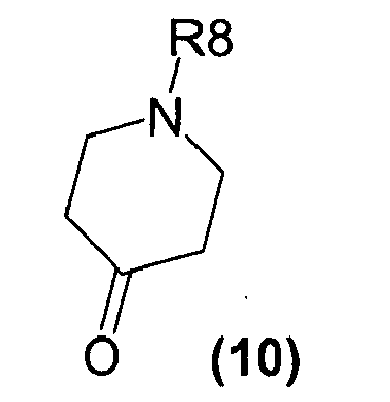


- An insecticidal acaricidal and nematicidal composition comprising an insecticidally, acaricidally or nematicidally effective amount of a compound of formula I as defined in claim 1.
Applications Claiming Priority (2)
| Application Number | Priority Date | Filing Date | Title |
|---|---|---|---|
| GBGB0213715.6A GB0213715D0 (en) | 2002-06-14 | 2002-06-14 | Chemical compounds |
| EP03732685.7A EP1515969B2 (en) | 2002-06-14 | 2003-06-04 | Spiroindolinepiperidine derivatives |
Related Parent Applications (2)
| Application Number | Title | Priority Date | Filing Date |
|---|---|---|---|
| EP03732685.7A Division EP1515969B2 (en) | 2002-06-14 | 2003-06-04 | Spiroindolinepiperidine derivatives |
| EP03732685.7A Division-Into EP1515969B2 (en) | 2002-06-14 | 2003-06-04 | Spiroindolinepiperidine derivatives |
Publications (2)
| Publication Number | Publication Date |
|---|---|
| EP1880996A1 true EP1880996A1 (en) | 2008-01-23 |
| EP1880996B1 EP1880996B1 (en) | 2014-12-24 |
Family
ID=9938602
Family Applications (2)
| Application Number | Title | Priority Date | Filing Date |
|---|---|---|---|
| EP03732685.7A Expired - Lifetime EP1515969B2 (en) | 2002-06-14 | 2003-06-04 | Spiroindolinepiperidine derivatives |
| EP07019400.6A Expired - Lifetime EP1880996B1 (en) | 2002-06-14 | 2003-06-04 | Spiroindolinepiperidine derivatives |
Family Applications Before (1)
| Application Number | Title | Priority Date | Filing Date |
|---|---|---|---|
| EP03732685.7A Expired - Lifetime EP1515969B2 (en) | 2002-06-14 | 2003-06-04 | Spiroindolinepiperidine derivatives |
Country Status (28)
| Country | Link |
|---|---|
| US (3) | US20060106045A1 (en) |
| EP (2) | EP1515969B2 (en) |
| JP (1) | JP4837913B2 (en) |
| KR (1) | KR101013428B1 (en) |
| CN (4) | CN101318958B (en) |
| AP (1) | AP1850A (en) |
| AR (1) | AR040208A1 (en) |
| AT (1) | ATE478870T1 (en) |
| AU (1) | AU2003240071B2 (en) |
| BR (1) | BR0312129B1 (en) |
| CA (1) | CA2487494C (en) |
| CO (1) | CO5621237A2 (en) |
| CY (1) | CY1111822T1 (en) |
| DE (1) | DE60333919D1 (en) |
| DK (1) | DK1515969T3 (en) |
| EA (1) | EA014223B1 (en) |
| ES (1) | ES2351188T3 (en) |
| GB (1) | GB0213715D0 (en) |
| IL (3) | IL165226A0 (en) |
| MA (1) | MA27365A1 (en) |
| MX (1) | MXPA04012349A (en) |
| NZ (1) | NZ536734A (en) |
| PT (1) | PT1515969E (en) |
| SI (1) | SI1515969T1 (en) |
| TW (1) | TWI343784B (en) |
| UA (1) | UA81767C2 (en) |
| WO (1) | WO2003106457A1 (en) |
| ZA (1) | ZA200410058B (en) |
Families Citing this family (396)
| Publication number | Priority date | Publication date | Assignee | Title |
|---|---|---|---|---|
| US6374762B1 (en) * | 1997-10-27 | 2002-04-23 | Correct Craft, Inc. | Water sport towing apparatus |
| GB0213715D0 (en) * | 2002-06-14 | 2002-07-24 | Syngenta Ltd | Chemical compounds |
| GB0328905D0 (en) * | 2003-12-12 | 2004-01-14 | Syngenta Participations Ag | Chemical compounds |
| GB0328907D0 (en) * | 2003-12-12 | 2004-01-14 | Syngenta Participations Ag | Chemical compounds |
| GB0328908D0 (en) * | 2003-12-12 | 2004-01-14 | Syngenta Participations Ag | Chemical compounds |
| JP2007516298A (en) | 2003-12-23 | 2007-06-21 | アリーナ ファーマシューティカルズ, インコーポレイテッド | Novel spiroindoline or spiroisoquinoline compounds, methods of use and compositions thereof |
| WO2006002350A1 (en) * | 2004-06-24 | 2006-01-05 | Incyte Corporation | Amido compounds and their use as pharmaceuticals |
| US20060009471A1 (en) * | 2004-06-24 | 2006-01-12 | Wenqing Yao | Amido compounds and their use as pharmaceuticals |
| CA2569507A1 (en) * | 2004-06-24 | 2006-02-02 | Incyte Corporation | Amido compounds and their use as pharmaceuticals |
| CA2570694A1 (en) * | 2004-06-24 | 2006-02-02 | Incyte Corporation | Amido compounds and their use as pharmaceuticals |
| WO2006012226A2 (en) | 2004-06-24 | 2006-02-02 | Incyte Corporation | N-substituted piperidines and their use as pharmaceuticals |
| JP2008504280A (en) * | 2004-06-24 | 2008-02-14 | インサイト・コーポレイション | 2-methylpropanamide and its pharmaceutical use |
| CN101080226A (en) * | 2004-08-10 | 2007-11-28 | 因塞特公司 | Amido compounds and their use as pharmaceuticals |
| US7786141B2 (en) | 2004-08-19 | 2010-08-31 | Vertex Pharmaceuticals Incorporated | Dihydrospiroindene modulators of muscarinic receptors |
| JP2008510728A (en) | 2004-08-19 | 2008-04-10 | バーテックス ファーマシューティカルズ インコーポレイテッド | Muscarinic receptor modulators |
| US8110581B2 (en) * | 2004-11-10 | 2012-02-07 | Incyte Corporation | Lactam compounds and their use as pharmaceuticals |
| US20060116382A1 (en) * | 2004-11-10 | 2006-06-01 | Wenqing Yao | Lactam compounds and their use as pharmaceuticals |
| KR20070097441A (en) * | 2004-11-18 | 2007-10-04 | 인사이트 산 디에고 인코포레이티드 | Inhibitors of 11-β hydroxyl steroid dehydrogenase type 1 and methods of using the same |
| JP2008521825A (en) * | 2004-11-29 | 2008-06-26 | バーテックス ファーマシューティカルズ インコーポレイテッド | Muscarinic receptor modulators |
| MY144968A (en) | 2005-04-11 | 2011-11-30 | Xenon Pharmaceuticals Inc | Spiro-oxindole compounds and their uses as therapeutic agents |
| AR053710A1 (en) | 2005-04-11 | 2007-05-16 | Xenon Pharmaceuticals Inc | SPIROHETEROCICLIC COMPOUNDS AND THEIR USES AS THERAPEUTIC AGENTS |
| WO2007038138A2 (en) * | 2005-09-21 | 2007-04-05 | Incyte Corporation | Amido compounds and their use as pharmaceuticals |
| EP1957494A2 (en) * | 2005-12-05 | 2008-08-20 | Incyte Corporation | Lactam compounds and methods of using the same |
| CN101374519A (en) * | 2005-12-22 | 2009-02-25 | 弗特克斯药品有限公司 | Modulators of muscarinic receptors |
| US7998959B2 (en) * | 2006-01-12 | 2011-08-16 | Incyte Corporation | Modulators of 11-β hydroxyl steroid dehydrogenase type 1, pharmaceutical compositions thereof, and methods of using the same |
| GB0601402D0 (en) * | 2006-01-24 | 2006-03-08 | Syngenta Participations Ag | Chemical Compounds |
| KR20080091503A (en) * | 2006-01-31 | 2008-10-13 | 인사이트 코포레이션 | Amido Compounds and Uses thereof as Pharmaceuticals |
| JP2009527568A (en) * | 2006-02-22 | 2009-07-30 | バーテックス ファーマシューティカルズ インコーポレイテッド | Modulator of muscarinic receptor |
| TW200808807A (en) * | 2006-03-02 | 2008-02-16 | Incyte Corp | Modulators of 11-β hydroxyl steroid dehydrogenase type 1, pharmaceutical compositions thereof, and methods of using the same |
| US20070208001A1 (en) * | 2006-03-03 | 2007-09-06 | Jincong Zhuo | Modulators of 11- beta hydroxyl steroid dehydrogenase type 1, pharmaceutical compositions thereof, and methods of using the same |
| WO2007130898A1 (en) * | 2006-05-01 | 2007-11-15 | Incyte Corporation | TETRASUBSTITUTED UREAS AS MODULATORS OF 11-β HYDROXYL STEROID DEHYDROGENASE TYPE 1 |
| WO2007137066A2 (en) * | 2006-05-17 | 2007-11-29 | Incyte Corporation | HETEROCYCLIC INHIBITORS OF 11-β HYDROXYL STEROID DEHYDROGENASE TYPE I AND METHODS OF USING THE SAME |
| JP2009537529A (en) * | 2006-05-18 | 2009-10-29 | メルク エンド カムパニー インコーポレーテッド | Aryl fused spiro ring compounds |
| JP2010501561A (en) | 2006-08-18 | 2010-01-21 | バーテックス ファーマシューティカルズ インコーポレイテッド | Modulator of muscarinic receptor |
| AR063280A1 (en) | 2006-10-12 | 2009-01-21 | Xenon Pharmaceuticals Inc | USE OF ESPIRO-OXINDOL COMPOUNDS AS THERAPEUTIC AGENTS |
| CL2008001839A1 (en) * | 2007-06-21 | 2009-01-16 | Incyte Holdings Corp | Compounds derived from 2,7-diazaspirocycles, inhibitors of 11-beta hydroxyl steroid dehydrogenase type 1; pharmaceutical composition comprising said compounds; Useful to treat obesity, diabetes, glucose intolerance, type II diabetes, among other diseases. |
| MX2010003373A (en) * | 2007-10-03 | 2010-04-30 | Vertex Pharma | Modulators of muscarinic receptors. |
| CA2741029A1 (en) | 2008-10-17 | 2010-04-22 | Xenon Pharmaceuticals Inc. | Spiro-oxindole compounds and their use as therapeutic agents |
| CA2741024A1 (en) | 2008-10-17 | 2010-04-22 | Xenon Pharmaceuticals Inc. | Spiro-oxindole compounds and their use as therapeutic agents |
| CA2746394C (en) * | 2008-12-12 | 2017-08-29 | Syngenta Limited | Spiroheterocyclic n-oxypiperidines as pesticides |
| AR077252A1 (en) | 2009-06-29 | 2011-08-10 | Xenon Pharmaceuticals Inc | ESPIROOXINDOL COMPOUND ENANTIOMERS AND THEIR USES AS THERAPEUTIC AGENTS |
| NZ599334A (en) | 2009-10-14 | 2014-03-28 | Xenon Pharmaceuticals Inc | Synthetic methods for spiro-oxindole compounds |
| WO2011095581A1 (en) | 2010-02-05 | 2011-08-11 | Intervet International B.V. | S piroindoline compounds for use as anthelminthi cs |
| RU2596488C2 (en) | 2010-02-26 | 2016-09-10 | Ксенон Фармасьютикалз Инк. | Pharmaceutical compositions of spiro-oxindole compound for local administration and use thereof as therapeutic agents |
| CN102884054B (en) | 2010-03-04 | 2015-01-14 | 拜耳知识产权有限责任公司 | Fluoroalkyl-substituted 2-amidobenzimidazoles and the use thereof for boosting stress tolerance in plants |
| JP5868957B2 (en) | 2010-05-05 | 2016-02-24 | バイエル・インテレクチュアル・プロパティ・ゲゼルシャフト・ミット・ベシュレンクテル・ハフツングBayer Intellectual Property GmbH | Thiazole derivatives as insecticides |
| CN103068235B (en) | 2010-06-18 | 2016-04-20 | 拜耳知识产权有限责任公司 | Combinations of active ingredients with insecticidal and acaricidal properties |
| RU2013103422A (en) | 2010-06-28 | 2014-08-10 | Байер Интеллектчуал Проперти Гмбх | Heteroaryl-Substituted Pyridine Compounds for Use as Pesticides |
| JP2012017289A (en) | 2010-07-08 | 2012-01-26 | Bayer Cropscience Ag | Pesticidal pyrroline derivative |
| WO2012004293A2 (en) | 2010-07-08 | 2012-01-12 | Bayer Cropscience Ag | Insecticide and fungicide active ingredient combinations |
| JP2012082186A (en) | 2010-09-15 | 2012-04-26 | Bayer Cropscience Ag | Insecticidal arylpyrrolidines |
| JP2012062267A (en) | 2010-09-15 | 2012-03-29 | Bayer Cropscience Ag | Pesticidal pyrroline n-oxide derivative |
| WO2012045680A2 (en) | 2010-10-04 | 2012-04-12 | Bayer Cropscience Ag | Insecticidal and fungicidal active substance combinations |
| JP2013541554A (en) | 2010-10-21 | 2013-11-14 | バイエル・インテレクチユアル・プロパテイー・ゲー・エム・ベー・ハー | N-benzyl heterocyclic carboxamides |
| EP2635564B1 (en) | 2010-11-02 | 2017-04-26 | Bayer Intellectual Property GmbH | N-hetarylmethyl pyrazolylcarboxamides |
| CN103313971B (en) | 2010-11-15 | 2015-12-02 | 拜耳知识产权有限责任公司 | N-Arylpyrazole(thio)carboxamides |
| CN103476749A (en) | 2010-11-29 | 2013-12-25 | 拜耳知识产权有限责任公司 | Alpha,beta-unsaturated imines |
| AU2011334989A1 (en) | 2010-12-01 | 2013-06-13 | Bayer Intellectual Property Gmbh | Use of fluopyram for controlling nematodes in crops and for increasing yield |
| TWI667347B (en) | 2010-12-15 | 2019-08-01 | 瑞士商先正達合夥公司 | Soybean event syht0h2 and compositions and methods for detection thereof |
| EP2471363A1 (en) | 2010-12-30 | 2012-07-04 | Bayer CropScience AG | Use of aryl-, heteroaryl- and benzylsulfonamide carboxylic acids, -carboxylic acid esters, -carboxylic acid amides and -carbonitriles and/or its salts for increasing stress tolerance in plants |
| MX347939B (en) | 2011-02-17 | 2017-05-19 | Bayer Ip Gmbh | Use of sdhi fungicides on conventionally bred asr-tolerant, stem canker resistant and/or frog-eye leaf spot resistant soybean varieties. |
| WO2012110519A1 (en) | 2011-02-17 | 2012-08-23 | Bayer Cropscience Ag | Substituted 3-(biphenyl-3-yl)-8,8-difluoro-hydroxy-1-azaspiro[4.5]dec-3-en-2-ones for therapy and halogen-substituted spirocyclic ketoenols |
| WO2012116960A1 (en) | 2011-03-01 | 2012-09-07 | Bayer Cropscience Ag | 2-acyloxy-pyrrolin-4-ones |
| AR085509A1 (en) | 2011-03-09 | 2013-10-09 | Bayer Cropscience Ag | INDOL- AND BENCIMIDAZOLCARBOXAMIDS AS INSECTICIDES AND ACARICIDES |
| EP2683239A1 (en) | 2011-03-10 | 2014-01-15 | Bayer Intellectual Property GmbH | Use of lipochito-oligosaccharide compounds for safeguarding seed safety of treated seeds |
| AU2012230503B2 (en) | 2011-03-18 | 2016-07-07 | Bayer Intellectual Property Gmbh | N-(3-carbamoylphenyl)-1H-pyrazole-5-carboxamide derivatives and the use thereof for controlling animal pests |
| AR085568A1 (en) | 2011-04-15 | 2013-10-09 | Bayer Cropscience Ag | 5- (BICYCLE [4.1.0] HEPT-3-EN-2-IL) -PENTA-2,4-DIENOS AND 5- (BICYCLE [4.1.0] HEPT-3-EN-2-IL) -PENT- 2-IN-4-INOS REPLACED AS ACTIVE PRINCIPLES AGAINST ABIOTIC STRESS OF PLANTS |
| AR085585A1 (en) | 2011-04-15 | 2013-10-09 | Bayer Cropscience Ag | VINIL- AND ALQUINILCICLOHEXANOLES SUBSTITUTED AS ACTIVE PRINCIPLES AGAINST STRIPS ABIOTIQUE OF PLANTS |
| AR090010A1 (en) | 2011-04-15 | 2014-10-15 | Bayer Cropscience Ag | 5- (CICLOHEX-2-EN-1-IL) -PENTA-2,4-DIENOS AND 5- (CICLOHEX-2-EN-1-IL) -PENT-2-EN-4-INOS REPLACED AS ACTIVE PRINCIPLES AGAINST THE ABIOTIC STRESS OF PLANTS, USES AND TREATMENT METHODS |
| CN102246775B (en) * | 2011-05-17 | 2013-05-29 | 德强生物股份有限公司 | Insecticidal synergistic composition |
| EP2535334A1 (en) | 2011-06-17 | 2012-12-19 | Bayer CropScience AG | Crystalline modifications of penflufen |
| EP2540163A1 (en) | 2011-06-30 | 2013-01-02 | Bayer CropScience AG | Nematocide N-cyclopropyl-sulfonylamide derivatives |
| US9173395B2 (en) | 2011-07-04 | 2015-11-03 | Bayer Intellectual Property Gmbh | Use of substituted isoquinolinones, isoquinolindiones, isoquinolintriones and dihydroisoquinolinones or in each case salts thereof as active agents against abiotic stress in plants |
| DK2736327T3 (en) | 2011-07-26 | 2018-04-23 | Clariant Int Ltd | Etherized lactate esters, processes for their preparation and their use in improving the action of plant protection products |
| WO2013014227A1 (en) | 2011-07-27 | 2013-01-31 | Bayer Intellectual Property Gmbh | Seed dressing for controlling phytopathogenic fungi |
| US9096599B2 (en) | 2011-08-04 | 2015-08-04 | Intervet Inc. | Spiroindoline compounds |
| EP2561759A1 (en) | 2011-08-26 | 2013-02-27 | Bayer Cropscience AG | Fluoroalkyl-substituted 2-amidobenzimidazoles and their effect on plant growth |
| PH12014500563A1 (en) | 2011-09-16 | 2022-05-02 | Bayer Ip Gmbh | Use of 5-phenyl-or 5-benzyl-2 isoxazoline-3 carboxylates for improving plant yield |
| CA2848620C (en) | 2011-09-16 | 2020-03-10 | Bayer Intellectual Property Gmbh | Use of cyprosulfamide for inducing a growth regulating response in useful plants and increasing the yield of harvested plant organs therefrom |
| AU2012307324A1 (en) | 2011-09-16 | 2014-03-06 | Bayer Intellectual Property Gmbh | Use of phenylpyrazolin-3-carboxylates for improving plant yield |
| JP2013082632A (en) | 2011-10-05 | 2013-05-09 | Bayer Cropscience Ag | Agrochemical formulation and manufacturing method of the same |
| EP2604118A1 (en) | 2011-12-15 | 2013-06-19 | Bayer CropScience AG | Active ingredient combinations having insecticidal and acaricidal properties |
| CA2859467C (en) | 2011-12-19 | 2019-10-01 | Bayer Cropscience Ag | Use of anthranilic acid diamide derivatives for pest control in transgenic crops |
| US9204645B2 (en) | 2011-12-20 | 2015-12-08 | Bayer Intellectual Property Gmbh | Insecticidal aromatic amides |
| EP2606726A1 (en) | 2011-12-21 | 2013-06-26 | Bayer CropScience AG | N-Arylamidine-substituted trifluoroethylsulfide derivatives as acaricides and insecticides |
| US20150011394A1 (en) | 2012-01-21 | 2015-01-08 | Bayer Intellectual Property Gmbh | Use of host defense inducers for controlling bacterial harmful organisms in useful plants |
| JP2015515454A (en) | 2012-03-14 | 2015-05-28 | バイエル・インテレクチュアル・プロパティ・ゲゼルシャフト・ミット・ベシュレンクテル・ハフツングBayer Intellectual Property GmbH | Pesticide arylpyrrolidines |
| MX365746B (en) | 2012-05-16 | 2019-06-12 | Bayer Cropscience Ag | Insecticidal water-in-oil (w/o) formulation. |
| IN2014DN08358A (en) | 2012-05-16 | 2015-05-08 | Bayer Cropscience Ag | |
| AR091104A1 (en) | 2012-05-22 | 2015-01-14 | Bayer Cropscience Ag | COMBINATIONS OF ACTIVE COMPOUNDS THAT INCLUDE A LIPO-CHYTOOLIGOSACARIDE DERIVATIVE AND A NEMATICIDE, INSECTICIDE OR FUNGICIDE COMPOUND |
| CN104507311A (en) | 2012-05-30 | 2015-04-08 | 拜尔农作物科学股份公司 | Compositions comprising a biological control agent and an insecticide |
| EP2855651B1 (en) | 2012-05-30 | 2016-11-02 | Clariant International Ltd | N-methyl-n-acylglucamine-containing composition |
| ES2599504T3 (en) | 2012-05-30 | 2017-02-02 | Clariant International Ltd | Use of N-methyl-N-acyl-glucamines as solubilizing agents |
| BR112014029906A2 (en) | 2012-05-30 | 2018-04-17 | Bayer Cropscience Ag | compositions comprising a biological control agent and an insecticide. |
| WO2014005982A1 (en) | 2012-07-05 | 2014-01-09 | Bayer Cropscience Ag | Insecticide and fungicide active ingredient combinations |
| CN104602520A (en) | 2012-07-31 | 2015-05-06 | 拜尔农作物科学股份公司 | Compositions comprising a pesticidal terpene mixture and an insecticide |
| US9345247B2 (en) | 2012-08-17 | 2016-05-24 | Bayer Cropscience Ag | Azaindole carboxylic acid amides and azaindole thiocarboxylic acid amides for use as insecticides and acaricides |
| US20150216168A1 (en) | 2012-09-05 | 2015-08-06 | Bayer Cropscience Ag | Use of substituted 2-amidobenzimidazoles, 2-amidobenzoxazoles and 2-amidobenzothiazoles or salts thereof as active substances against abiotic plant stress |
| CR20190436A (en) | 2012-10-02 | 2019-10-29 | Bayer Cropscience Ag | Heterocyclic compounds as pesticides |
| WO2014060381A1 (en) | 2012-10-18 | 2014-04-24 | Bayer Cropscience Ag | Heterocyclic compounds as pesticides |
| WO2014067962A1 (en) | 2012-10-31 | 2014-05-08 | Bayer Cropscience Ag | Novel heterocyclic compounds as pest control agents |
| DE102012021647A1 (en) | 2012-11-03 | 2014-05-08 | Clariant International Ltd. | Aqueous adjuvant compositions |
| UA117816C2 (en) | 2012-11-06 | 2018-10-10 | Байєр Кропсайєнс Акцієнгезелльшафт | Herbicidal combinations for tolerant soybean cultures |
| CN104837351A (en) | 2012-11-30 | 2015-08-12 | 拜耳作物科学股份公司 | Binary fungicidal or pesticidal mixture |
| UA116223C2 (en) | 2012-11-30 | 2018-02-26 | Байєр Кропсайєнс Акцієнгезелльшафт | Binary fungicidal mixtures |
| US20150289518A1 (en) | 2012-12-03 | 2015-10-15 | Bayer Cropscience Ag | Composition comprising a biological control agent and an insecticide |
| MX2015006946A (en) | 2012-12-03 | 2015-09-08 | Bayer Cropscience Ag | Composition comprising biological control agents. |
| WO2014086758A2 (en) | 2012-12-03 | 2014-06-12 | Bayer Cropscience Ag | Composition comprising a biological control agent and an insecticide |
| WO2014086753A2 (en) | 2012-12-03 | 2014-06-12 | Bayer Cropscience Ag | Composition comprising biological control agents |
| PT2925142T (en) | 2012-12-03 | 2018-05-18 | Bayer Cropscience Ag | Composition comprising a biological control agent and an insecticide |
| EP2928296A1 (en) | 2012-12-05 | 2015-10-14 | Bayer CropScience AG | Use of substituted 1-(aryl ethynyl)-, 1-(heteroaryl ethynyl)-, 1-(heterocyclyl ethynyl)- and 1-(cyloalkenyl ethynyl)-cyclohexanols as active agents against abiotic plant stress |
| AR093909A1 (en) | 2012-12-12 | 2015-06-24 | Bayer Cropscience Ag | USE OF ACTIVE INGREDIENTS TO CONTROL NEMATODES IN CULTURES RESISTANT TO NEMATODES |
| AR093996A1 (en) | 2012-12-18 | 2015-07-01 | Bayer Cropscience Ag | BACTERICIDAL COMBINATIONS AND BINARY FUNGICIDES |
| PT2953942T (en) | 2013-02-06 | 2018-01-17 | Bayer Cropscience Ag | Halogen-substituted pyrazole derivatives as pesticides |
| MX2015010259A (en) | 2013-02-11 | 2015-10-29 | Bayer Cropscience Lp | Compositions comprising a streptomyces-based biological control agent and another biological control agent. |
| EP2953466A1 (en) | 2013-02-11 | 2015-12-16 | Bayer Cropscience LP | Compositions comprising gougerotin and an insecticide |
| EP2967068A1 (en) | 2013-03-12 | 2016-01-20 | Bayer CropScience Aktiengesellschaft | Use of dithiine-tetracarboximides for controlling bacterial harmful organisms in useful plants |
| AR095785A1 (en) * | 2013-04-09 | 2015-11-11 | Bayer Pharma AG | DERIVATIVES OF SPIROINDOLINE AND PHARMACEUTICAL COMPOSITIONS OF THE SAME |
| BR112015025907A2 (en) | 2013-04-19 | 2017-07-25 | Bayer Cropscience Ag | binary insecticide or pesticide mixture |
| EP2986121A1 (en) | 2013-04-19 | 2016-02-24 | Bayer CropScience Aktiengesellschaft | Active compound combinations having insecticidal properties |
| BR112015031155A2 (en) | 2013-06-20 | 2017-07-25 | Bayer Cropscience Ag | aryl sulfide derivatives and aryl sulfoxide derivatives as acaricides and insecticides |
| EP3010893B1 (en) | 2013-06-20 | 2019-10-02 | Bayer CropScience Aktiengesellschaft | Arylsulfide and arylsulfoxide derivatives as acaricides and insecticides |
| US9783509B2 (en) | 2013-07-08 | 2017-10-10 | Bayer Cropscience Aktiengesellschaft | Six-membered C-N-linked aryl sulfide derivatives and aryl sulfoxide derivatives as pest conrol agents |
| WO2015055554A1 (en) | 2013-10-14 | 2015-04-23 | Bayer Cropscience Ag | Active substance for treating seed and soil |
| UY35772A (en) | 2013-10-14 | 2015-05-29 | Bayer Cropscience Ag | NEW PESTICIDED COMPOUNDS |
| JP6472444B2 (en) | 2013-10-23 | 2019-02-20 | バイエル・クロップサイエンス・アクチェンゲゼルシャフト | Substituted quinoxaline derivatives as pest control agents |
| CN105829311A (en) * | 2013-12-24 | 2016-08-03 | 硕腾服务有限责任公司 | Spiroindoline antiparasitic derivatives |
| WO2015101622A1 (en) | 2014-01-03 | 2015-07-09 | Bayer Cropscience Ag | Novel pyrazolyl-heteroarylamides as pesticides |
| TW201612161A (en) | 2014-01-20 | 2016-04-01 | Bayer Cropscience Ag | Quinoline derivatives as insecticides and acaricides |
| DE202014008418U1 (en) | 2014-02-19 | 2014-11-14 | Clariant International Ltd. | Low foaming agrochemical compositions |
| DE202014008415U1 (en) | 2014-02-19 | 2014-11-25 | Clariant International Ltd. | Aqueous adjuvant composition for increasing the effectiveness of electrolyte active substances |
| AR099895A1 (en) | 2014-04-02 | 2016-08-24 | Bayer Cropscience Ag | HETEROCYCLIC COMPOUNDS AS AGENTS TO COMBAT PARASITES |
| WO2015160620A1 (en) | 2014-04-16 | 2015-10-22 | Bayer Cropscience Lp | Compositions comprising ningnanmycin and an insecticide |
| WO2015160618A1 (en) | 2014-04-16 | 2015-10-22 | Bayer Cropscience Lp | Compositions comprising ningnanmycin and a biological control agent |
| DE102014005771A1 (en) | 2014-04-23 | 2015-10-29 | Clariant International Ltd. | Use of aqueous drift-reducing compositions |
| US10059706B2 (en) | 2014-05-08 | 2018-08-28 | Bayer Cropscience Aktiengesellschaft | Pyrazolopyridine sulfonamides as nematicides |
| CN106715424B (en) | 2014-06-05 | 2020-07-14 | 拜耳作物科学股份公司 | Bicyclic compounds as pesticides |
| WO2016001119A1 (en) | 2014-07-01 | 2016-01-07 | Bayer Cropscience Aktiengesellschaft | Insecticide and fungicide active ingredient combinations |
| US10208015B2 (en) | 2014-07-15 | 2019-02-19 | Bayer Animal Health Gmbh | Aryl-triazolyl pyridines as pest control agents |
| DE102014012022A1 (en) | 2014-08-13 | 2016-02-18 | Clariant International Ltd. | Organic ammonium salts of anionic pesticides |
| WO2016055096A1 (en) | 2014-10-07 | 2016-04-14 | Bayer Cropscience Ag | Method for treating rice seed |
| AR102942A1 (en) | 2014-12-11 | 2017-04-05 | Bayer Cropscience Ag | DERIVATIVES OF ARILSULFIDE AND ARILSULPHOXIDE OF FIVE C-N-CONNECTED MEMBERS, AS PESTICIDES |
| DE102014018274A1 (en) | 2014-12-12 | 2015-07-30 | Clariant International Ltd. | Sugar surfactants and their use in agrochemical compositions |
| WO2016097178A1 (en) | 2014-12-19 | 2016-06-23 | Clariant International Ltd | Aqueous electrolyte-containing adjuvant compositions, active ingredient-containing compositions and the use thereof |
| EP3240423B1 (en) | 2014-12-22 | 2020-10-21 | Bayer CropScience LP | Method for using a bacillus subtilis or bacillus pumilus strain to treat or prevent pineapple disease |
| EP3081085A1 (en) | 2015-04-14 | 2016-10-19 | Bayer CropScience AG | Method for improving earliness in cotton |
| US9682033B2 (en) | 2015-02-05 | 2017-06-20 | Teva Pharmaceuticals International Gmbh | Methods of treating postherpetic neuralgia with a topical formulation of a spiro-oxindole compound |
| UY36548A (en) | 2015-02-05 | 2016-06-01 | Bayer Cropscience Ag | BICYCLIC CONDENSED HETEROCYCLIC DERIVATIVES REPLACED BY 2- (HET) ARILO AS PESTICIDES |
| UY36547A (en) | 2015-02-05 | 2016-06-01 | Bayer Cropscience Ag | BICYCLIC CONDENSED HETEROCYCLIC DERIVATIVES REPLACED BY 2- (HET) ARILO AS PESTICIDES |
| TWI702212B (en) | 2015-02-09 | 2020-08-21 | 德商拜耳作物科學股份有限公司 | Substituted 2-thioimidazolylcarboxamides as pesticides |
| AU2016231174B2 (en) | 2015-03-10 | 2020-09-10 | Bayer Animal Health Gmbh | Pyrazolyl-derivatives as pest control agents |
| CN107810188B (en) | 2015-04-08 | 2020-09-22 | 拜耳作物科学股份公司 | Fused bicyclic heterocyclic derivatives as pest control agents and intermediate products |
| WO2016174049A1 (en) | 2015-04-30 | 2016-11-03 | Bayer Animal Health Gmbh | Anti-parasitic combinations including halogen-substituted compounds |
| EP2910126A1 (en) | 2015-05-05 | 2015-08-26 | Bayer CropScience AG | Active compound combinations having insecticidal properties |
| CN107835803A (en) | 2015-05-13 | 2018-03-23 | 拜耳作物科学股份公司 | Insecticidal arylpyrrolidines, their preparation and their use as reagents for controlling animal pests |
| US10271552B2 (en) | 2015-07-06 | 2019-04-30 | Bayer Cropscience Aktiengesellschaft | Heterocyclic compounds as pesticides |
| CN118955472A (en) | 2015-08-07 | 2024-11-15 | 拜耳作物科学股份公司 | 2-(Hetero)aryl substituted fused heterocyclic derivatives as pesticides |
| DE102015219651A1 (en) | 2015-10-09 | 2017-04-13 | Clariant International Ltd. | Compositions containing sugar amine and fatty acid |
| DE102015219608B4 (en) | 2015-10-09 | 2018-05-03 | Clariant International Ltd | Universal pigment dispersions based on N-alkylglucamines |
| RU2018119344A (en) | 2015-10-26 | 2019-11-28 | Байер Кропсайенс Акциенгезельшафт | CONDENSED BICYCLIC HETEROCYCLIC DERIVATIVES AS A MEANS FOR COMBATING Pests |
| WO2017093180A1 (en) | 2015-12-01 | 2017-06-08 | Bayer Cropscience Aktiengesellschaft | Condensed bicyclic heterocycle derivatives as pest control agents |
| EP3383874A1 (en) | 2015-12-03 | 2018-10-10 | Bayer CropScience Aktiengesellschaft | Mesoionic halogenated 3-(acetyl)-1-[(1,3-thiazol-5-yl)methyl]-1h-imidazo[1,2-a]pyridin-4-ium-2-olate derivatives and related compounds as insecticides |
| RU2018132172A (en) | 2016-02-11 | 2020-03-11 | Байер Кропсайенс Акциенгезельшафт | SUBSTITUTED 2-OXIIIMIDAZOLYL-CARBOXAMIDES AS MEANS FOR PREVENTING PESTS |
| JP6892865B2 (en) | 2016-02-11 | 2021-06-23 | バイエル・クロップサイエンス・アクチェンゲゼルシャフト | Substitution as a pest control agent 2- (heta) aryl-imidazolyl-carboxamides |
| WO2017144341A1 (en) | 2016-02-23 | 2017-08-31 | Bayer Cropscience Aktiengesellschaft | Condensed bicyclic heterocycle derivatives as pest control agents |
| EP3210468A1 (en) | 2016-02-26 | 2017-08-30 | Bayer CropScience Aktiengesellschaft | Solvent-free formulations of low-melting point agents |
| AU2017233739A1 (en) | 2016-03-15 | 2018-09-20 | Bayer Cropscience Aktiengesellschaft | Substituted sulfonyl amides for controlling animal pests |
| BR112018068681A2 (en) | 2016-03-16 | 2019-01-15 | Bayer Cropscience Ag | n- (cyanobenzyl) -6- (cyclopropylcarbonylamino) -4- (phenyl) pyridine-2-carboxamide derivatives and related compounds as pesticides and plant protection agents |
| WO2017174414A1 (en) | 2016-04-05 | 2017-10-12 | Bayer Cropscience Aktiengesellschaft | Naphthaline-derivatives as pest control agents |
| WO2017178416A1 (en) | 2016-04-15 | 2017-10-19 | Bayer Animal Health Gmbh | Pyrazolopyrimidine derivatives |
| CN109068649A (en) | 2016-04-24 | 2018-12-21 | 拜耳农作物科学股份公司 | Use of fluopyram and/or Bacillus subtilis for preventing and treating Fusarium wilt of Musaceae plants |
| RU2018141218A (en) | 2016-04-25 | 2020-05-26 | Байер Кропсайенс Акциенгезельшафт | SUBSTITUTED 2-ALKYLIMIDAZOLYL-CARBOXAMIDES AS MEANS FOR FIGHTING PESTS |
| EP3241830A1 (en) | 2016-05-04 | 2017-11-08 | Bayer CropScience Aktiengesellschaft | Condensed bicyclic heterocyclic derivatives as pesticides |
| DE202016003070U1 (en) | 2016-05-09 | 2016-06-07 | Clariant International Ltd. | Stabilizers for silicate paints |
| EP3245865A1 (en) | 2016-05-17 | 2017-11-22 | Bayer CropScience Aktiengesellschaft | Method for increasing yield in brassicaceae |
| WO2017198449A1 (en) | 2016-05-15 | 2017-11-23 | Bayer Cropscience Nv | Method for increasing yield in brassicaceae |
| WO2017198450A1 (en) | 2016-05-15 | 2017-11-23 | Bayer Cropscience Nv | Method for increasing yield in maize |
| WO2017198452A1 (en) | 2016-05-16 | 2017-11-23 | Bayer Cropscience Nv | Method for increasing yield in soybean |
| WO2017198453A1 (en) | 2016-05-16 | 2017-11-23 | Bayer Cropscience Nv | Method for increasing yield in potato, tomato or alfalfa |
| WO2017198451A1 (en) | 2016-05-17 | 2017-11-23 | Bayer Cropscience Nv | Method for increasing yield in small grain cereals such as wheat and rice |
| WO2017198455A2 (en) | 2016-05-17 | 2017-11-23 | Bayer Cropscience Nv | Method for increasing yield in beta spp. plants |
| WO2017198454A1 (en) | 2016-05-17 | 2017-11-23 | Bayer Cropscience Nv | Method for increasing yield in cotton |
| US10653136B2 (en) | 2016-07-11 | 2020-05-19 | Covestro Llc | Aqueous compositions for treating seeds, seeds treated therewith, and methods for treating seeds |
| US10750750B2 (en) | 2016-07-11 | 2020-08-25 | Covestro Llc | Aqueous compositions for treating seeds, seeds treated therewith, and methods for treating seeds |
| US10653135B2 (en) | 2016-07-11 | 2020-05-19 | Covestro Llc | Methods for treating seeds with an aqueous composition and seeds treated therewith |
| ES2818608T3 (en) | 2016-07-12 | 2021-04-13 | Bayer Cropscience Ag | Bicyclic compounds as pesticides |
| CN109689662B (en) | 2016-07-19 | 2022-03-15 | 拜耳作物科学股份公司 | Fused bicyclic heterocyclic derivatives as pest control agents |
| BR112019001766B1 (en) | 2016-07-29 | 2022-12-06 | Bayer Cropscience Aktiengesellschaft | TREATED COATED SEED TO IMPROVE ITS GROWTH, ITS TREATMENT METHOD, AND METHOD TO IMPROVE PLANT GROWTH |
| CN109688816A (en) | 2016-07-29 | 2019-04-26 | 拜耳作物科学股份公司 | Active compound combinations and methods for protecting plant propagation material |
| ES2858093T3 (en) | 2016-08-10 | 2021-09-29 | Bayer Cropscience Ag | 2-Heterocyclyl-imidazolyl-substituted carboxamides as pesticides |
| BR112019003158B1 (en) | 2016-08-15 | 2022-10-25 | Bayer Cropscience Aktiengesellschaft | DERIVATIVES OF CONDENSED BICYCLIC HETEROCYCLE, THEIR USE, AGROCHEMICAL FORMULATION, AND METHOD TO CONTROL ANIMAL PESTS |
| CN109963860A (en) | 2016-09-19 | 2019-07-02 | 拜耳作物科学股份公司 | Pyrazolo [1,5-A ] pyridine derivatives and their use as pesticides |
| WO2018065292A1 (en) | 2016-10-06 | 2018-04-12 | Bayer Cropscience Aktiengesellschaft | 2-(het)aryl-substituted condensed bicyclic heterocycle derivatives as pest control agents |
| WO2018065288A1 (en) | 2016-10-07 | 2018-04-12 | Bayer Cropscience Aktiengesellschaft | 2-[2-phenyl-1-(sulfonyl-methyl)-vinyl]-imidazo-[4,5-b] pyridine derivatives and related compounds as pesticides in plant protection |
| JP2019532107A (en) | 2016-10-14 | 2019-11-07 | ピーアイ インダストリーズ リミテッドPi Industries Ltd | 4-Amino-substituted phenylamidine derivatives and their use for protecting crops by combating undesired phytopathogenic microorganisms |
| UA125628C2 (en) | 2016-10-14 | 2022-05-04 | Пі Індастріз Лтд | 4-substituted phenylamine derivatives and their use for the protection of crops from undesired phytopathogenic micoorganisms |
| TW201822637A (en) | 2016-11-07 | 2018-07-01 | 德商拜耳廠股份有限公司 | Substituted sulfonamides for controlling animal pests |
| ES2884073T3 (en) | 2016-11-11 | 2021-12-10 | Bayer Animal Health Gmbh | New anthelmintic derivatives of quinoline-3-carboxamide |
| US10765116B2 (en) | 2016-11-23 | 2020-09-08 | Bayer Cropscience Aktiengesellschaft | 2-[3-(alkylsulfonyl)-2H-indazol-2-yl]-3H-imidazo[4,5-B]pyridine derivatives and similar compounds as pesticides |
| EP3400801A1 (en) | 2017-05-10 | 2018-11-14 | Bayer CropScience Aktiengesellschaft | Plant health effect of purpureocillium lilacinum |
| WO2018108791A1 (en) | 2016-12-16 | 2018-06-21 | Bayer Cropscience Aktiengesellschaft | Thiadiazole derivatives as pesticides |
| EP3555098A1 (en) | 2016-12-16 | 2019-10-23 | Bayer Aktiengesellschaft | Mesoionic imidazopyridines for use as insecticides |
| WO2018116072A1 (en) | 2016-12-20 | 2018-06-28 | Pi Industries Ltd. | Heterocyclic compounds |
| UY37556A (en) | 2017-01-10 | 2018-07-31 | Bayer Ag | HETEROCYCLIC DERIVATIVES AS PESTICIDES |
| EP3568395A1 (en) | 2017-01-10 | 2019-11-20 | Bayer Aktiengesellschaft | Heterocyclene derivatives as pest control agents |
| WO2018138050A1 (en) | 2017-01-26 | 2018-08-02 | Bayer Aktiengesellschaft | Condensed bicyclic heterocyclene derivatives as pest control agents |
| TW201833107A (en) | 2017-02-06 | 2018-09-16 | 德商拜耳廠股份有限公司 | 2-(het)aryl-substituted fused heterocycle derivatives as pesticides |
| EP3369320A1 (en) | 2017-03-02 | 2018-09-05 | Bayer CropScience Aktiengesellschaft | Agent for controlling bugs |
| WO2018177993A1 (en) | 2017-03-31 | 2018-10-04 | Bayer Cropscience Aktiengesellschaft | Pyrazoles for controlling arthropods |
| ES2967215T3 (en) | 2017-03-31 | 2024-05-24 | Elanco Animal Health Gmbh | Tricyclic carboxamides to combat arthropods |
| JP2020516630A (en) | 2017-04-12 | 2020-06-11 | バイエル・アクチエンゲゼルシヤフト | Mesoionic imidazopyridines for use as insecticides |
| CA3059301A1 (en) | 2017-04-20 | 2018-10-25 | Pi Industries Ltd. | Novel phenylamine compounds |
| WO2018192872A1 (en) | 2017-04-21 | 2018-10-25 | Bayer Aktiengesellschaft | Mesoionic imidazopyridines as insecticides |
| EP3615540B1 (en) | 2017-04-24 | 2022-04-27 | Bayer Aktiengesellschaft | Condensed bicyclic heterocycle derivatives as pesticides |
| PH12019502365A1 (en) | 2017-04-27 | 2020-10-26 | Bayer Animal Health Gmbh | New bicyclic pyrazole derivatives |
| TWI782983B (en) | 2017-04-27 | 2022-11-11 | 德商拜耳廠股份有限公司 | Heteroarylphenylaminoquinolines and analogues |
| CN110573513B (en) | 2017-05-02 | 2022-08-09 | 拜耳公司 | 2- (hetero) aryl-substituted fused bicyclic heterocyclic derivatives as pest control agents |
| JP7119004B2 (en) | 2017-05-02 | 2022-08-16 | バイエル・アクチエンゲゼルシヤフト | 2-(Het)aryl Substituted Fused Bicyclic Heterocyclic Derivatives as Pesticides |
| JP2020518589A (en) | 2017-05-03 | 2020-06-25 | バイエル・アクチエンゲゼルシヤフト | Tri-substituted silylbenzylbenzimidazoles and analogs |
| CN110582484A (en) | 2017-05-03 | 2019-12-17 | 拜耳公司 | Trisubstituted silylmethylphenoxyquinolines and their analogues |
| JP2020518592A (en) | 2017-05-03 | 2020-06-25 | バイエル・アクチエンゲゼルシヤフト | Trisubstituted silylheteroaryloxyquinolines and analogs |
| WO2018202524A1 (en) | 2017-05-04 | 2018-11-08 | Bayer Cropscience Aktiengesellschaft | 2-{[2-(phenyloxymethyl)pyridin-5-yl]oxy}-ethanamin-derivatives and related compounds as pest-control agents e.g. for the protection of plants |
| WO2018202525A1 (en) | 2017-05-04 | 2018-11-08 | Bayer Cropscience Aktiengesellschaft | Phenoxyethanamine derivatives for controlling pests |
| KR20200020911A (en) | 2017-06-30 | 2020-02-26 | 바이엘 애니멀 헬스 게엠베하 | New Azaquinoline Derivatives |
| WO2019007888A1 (en) | 2017-07-06 | 2019-01-10 | Bayer Aktiengesellschaft | INSECTICIDES ACTIVE COMPOUNDS |
| WO2019007887A1 (en) | 2017-07-06 | 2019-01-10 | Bayer Aktiengesellschaft | INSECTICIDES AND FUNGICIDES ACTIVE COMPOUNDS |
| WO2019007891A1 (en) | 2017-07-06 | 2019-01-10 | Bayer Aktiengesellschaft | INSECTICIDES ACTIVE COMPOUNDS |
| EP3284739A1 (en) | 2017-07-19 | 2018-02-21 | Bayer CropScience Aktiengesellschaft | Substituted (het) aryl compounds as pesticides |
| AU2018311019B2 (en) | 2017-08-04 | 2022-05-26 | Elanco Animal Health Gmbh | Quinoline derivatives for treating infections with helminths |
| US11849724B2 (en) | 2017-08-17 | 2023-12-26 | Bayer Cropscience Lp | Liquid fertilizer-dispersible compositions and methods thereof |
| BR112020003481B1 (en) | 2017-08-22 | 2023-12-05 | Bayer Aktiengesellschaft | Heterocyclene derivatives, their uses, agrochemical formulation, and methods for controlling animal pests and for protecting seeds or a germinating plant from pests |
| NZ763636A (en) | 2017-09-20 | 2025-12-19 | Mitsui Chemicals Crop & Life Solutions Inc | Prolonged ectoparasite-controlling agent for animal |
| USRE50663E1 (en) | 2017-10-04 | 2025-11-18 | Bayer Aktiengesellschaft | Heterocycle derivatives as pesticides |
| EP3473103A1 (en) | 2017-10-17 | 2019-04-24 | Bayer AG | Aqueous suspension concentrates based on 2- [(2,4-dichlorophenyl) -methyl] -4,4 '-dimethyl-3-isoxazolidinone |
| US11191271B2 (en) | 2017-10-18 | 2021-12-07 | Bayer Aktiengesellschaft | Active compound combinations having insecticidal/acaricidal properties |
| AU2018350614C1 (en) | 2017-10-18 | 2024-03-28 | Bayer Aktiengesellschaft | Active compound combinations having insecticidal/acaricidal properties |
| AU2018350616B2 (en) | 2017-10-18 | 2024-02-01 | Bayer Aktiengesellschaft | Active compound combinations having insecticidal/acaricidal properties |
| TW201930279A (en) | 2017-10-18 | 2019-08-01 | 德商拜耳廠股份有限公司 | Active compound combinations having insecticidal/acaricidal properties |
| EP3473100A1 (en) | 2017-10-18 | 2019-04-24 | Bayer Aktiengesellschaft | Active compound combinations having insecticidal/acaricidal properties |
| MX2020003948A (en) | 2017-10-18 | 2020-08-03 | Bayer Ag | Active compound combinations having insecticidal/acaricidal properties. |
| EP3710432A1 (en) | 2017-11-13 | 2020-09-23 | Bayer Aktiengesellschaft | Tetrazolylpropyl derivatives and their use as fungicides |
| CN111601802A (en) | 2017-11-28 | 2020-08-28 | 拜耳股份有限公司 | Heterocyclic compounds as pesticides |
| AU2018376146A1 (en) | 2017-11-29 | 2020-05-28 | Bayer Aktiengesellschaft | Nitrogenous heterocycles as a pesticide |
| CN111670180A (en) | 2017-12-20 | 2020-09-15 | Pi工业有限公司 | Fluoroalkenyl compound, preparation method and use thereof |
| TW201927768A (en) | 2017-12-21 | 2019-07-16 | 德商拜耳廠股份有限公司 | Trisubstitutedsilylmethylheteroaryloxyquinolines and analogues |
| EP3305786A3 (en) | 2018-01-22 | 2018-07-25 | Bayer CropScience Aktiengesellschaft | Condensed bicyclic heterocycle derivatives as pesticides |
| WO2019150311A1 (en) | 2018-02-02 | 2019-08-08 | Pi Industries Ltd. | 1-3 dithiol compounds and their use for the protection of crops from phytopathogenic microorganisms |
| US20210009541A1 (en) | 2018-02-12 | 2021-01-14 | Bayer Aktiengesellschaft | Fungicidal oxadiazoles |
| WO2019162228A1 (en) | 2018-02-21 | 2019-08-29 | Bayer Aktiengesellschaft | 1-(5-substituted imidazol-1-yl)but-3-en derivatives and their use as fungicides |
| JP2021514949A (en) | 2018-02-21 | 2021-06-17 | バイエル・アクチエンゲゼルシヤフト | Condensed bicyclic heterocyclic derivative as a pest control agent |
| BR112020016946A2 (en) | 2018-03-08 | 2020-12-15 | Bayer Aktiengesellschaft | USE OF HETEROARYL-TRIAZOLE COMPOUNDS AND HETEROARYL-TETRAZOLE AS PESTICIDES IN PLANT PROTECTION |
| CN111836815A (en) | 2018-03-12 | 2020-10-27 | 拜耳公司 | Fused bicyclic heterocyclic derivatives as pest control agents |
| BR112020020663A2 (en) | 2018-04-10 | 2021-01-12 | Bayer Aktiengesellschaft | OXADIAZOLINE DERIVATIVES |
| BR112020018006A2 (en) | 2018-04-12 | 2021-01-12 | Bayer Aktiengesellschaft | N- (CYCLOPROPYLMETHIL) -5- (METHYLSULPHONYL) -N- {1- [1- (PIRIMIDIN-2-IL) -1H-1,2,4-TRIAZOL-5-IL] ETHYL DERIVATIVES BENZAMIDE AND DERIVATIVES CORRESPONDENTS OF PYRIDINE-CARBOXAMIDE AS PESTICIDES |
| EP3772960B1 (en) | 2018-04-13 | 2025-11-12 | Bayer Aktiengesellschaft | Active agent combinations with insecticidal, nematicidal and acaricidal properties |
| WO2019197615A1 (en) | 2018-04-13 | 2019-10-17 | Bayer Aktiengesellschaft | Active ingredient combinations with fungicides, insecticides and acaricidal properties |
| UY38184A (en) | 2018-04-17 | 2019-10-31 | Bayer Ag | HETEROARYL-TRIAZOLE AND HETEROARYL-TETRAZOLE COMPOUNDS NOVELTY AS PESTICIDES |
| US20220002268A1 (en) | 2018-04-20 | 2022-01-06 | Bayer Aktiengesellschaft | Novel heteroaryl-triazole and heteroaryl-tetrazole compounds as pesticides |
| AU2019254499A1 (en) | 2018-04-20 | 2020-12-03 | Bayer Aktiengesellschaft | Heterocyclene derivatives as pest control agents |
| AU2019260016B2 (en) | 2018-04-25 | 2022-11-17 | Bayer Aktiengesellschaft | Novel heteroaryl-triazole and heteroaryl-tetrazole compounds as pesticides |
| EP3790874B1 (en) | 2018-05-09 | 2023-03-15 | Bayer Animal Health GmbH | Anthelmintic quinoline derivatives |
| WO2019224143A1 (en) | 2018-05-24 | 2019-11-28 | Bayer Aktiengesellschaft | Active ingredient combinations with insecticidal, nematicidal and acaricidal properties |
| EP3809844A1 (en) | 2018-06-25 | 2021-04-28 | Bayer CropScience LP | Seed treatment method |
| WO2020002189A1 (en) | 2018-06-27 | 2020-01-02 | Bayer Aktiengesellschaft | Active substance combinations |
| EP3586630A1 (en) | 2018-06-28 | 2020-01-01 | Bayer AG | Active compound combinations having insecticidal/acaricidal properties |
| CR20200641A (en) | 2018-07-05 | 2021-02-16 | Bayer Ag | Substituted thiophenecarboxamides and analogues as antibacterials agents |
| WO2020020813A1 (en) | 2018-07-25 | 2020-01-30 | Bayer Aktiengesellschaft | Fungicidal active compound combinations |
| WO2020020816A1 (en) | 2018-07-26 | 2020-01-30 | Bayer Aktiengesellschaft | Novel triazole derivatives |
| CA3107207A1 (en) | 2018-07-27 | 2020-01-30 | Bayer Aktiengesellschaft | Controlled release formulations for agrochemicals |
| EP3829298A1 (en) | 2018-07-31 | 2021-06-09 | Bayer Aktiengesellschaft | Controlled release formulations with lignin for agrochemicals |
| AR115984A1 (en) | 2018-08-17 | 2021-03-17 | Pi Industries Ltd | 1,2-DITIOLONE COMPOUNDS AND THEIR USES |
| WO2020043650A1 (en) | 2018-08-29 | 2020-03-05 | Bayer Aktiengesellschaft | Active compound combinations having insecticidal/acaricidal properties |
| BR112021003665A2 (en) | 2018-09-13 | 2021-05-18 | Bayer Aktiengesellschaft | heterocyclene derivatives as pest control agents |
| JP2022500459A (en) | 2018-09-17 | 2022-01-04 | バイエル・アクチエンゲゼルシヤフト | Use of the fungicide isofukusiplum for the control of ergot in grains and the reduction of sclerotia |
| WO2020070050A1 (en) | 2018-10-01 | 2020-04-09 | Bayer Aktiengesellschaft | Fungicidal 5-substituted imidazol-1-yl carbinol derivatives |
| EP3636644A1 (en) | 2018-10-11 | 2020-04-15 | Bayer Aktiengesellschaft | Mesoionic imidazopyridines as insecticides |
| WO2020078839A1 (en) | 2018-10-16 | 2020-04-23 | Bayer Aktiengesellschaft | Active substance combinations |
| EP3867241A1 (en) | 2018-10-18 | 2021-08-25 | Bayer Aktiengesellschaft | Pyridylphenylaminoquinolines and analogues |
| MX2021004448A (en) | 2018-10-18 | 2021-07-07 | Bayer Ag | Heteroarylaminoquinolines and analogues. |
| TW202028193A (en) | 2018-10-20 | 2020-08-01 | 德商拜耳廠股份有限公司 | Oxetanylphenoxyquinolines and analogues |
| EP3643711A1 (en) | 2018-10-24 | 2020-04-29 | Bayer Animal Health GmbH | New anthelmintic compounds |
| AR117169A1 (en) | 2018-11-28 | 2021-07-14 | Bayer Ag | (TIO) PYRIDAZINE AMIDES AS FUNGICIDE COMPOUNDS |
| CN111269237B (en) * | 2018-12-04 | 2022-05-24 | 南开大学 | Gem-difluorinated spiro-gamma-lactam indoline compound, preparation method thereof and application thereof in preventing and treating plant diseases and insect pests |
| MY202868A (en) | 2018-12-07 | 2024-05-27 | Bayer Ag | Herbicide compositions |
| EP3890488B1 (en) | 2018-12-07 | 2023-01-04 | Bayer Aktiengesellschaft | Herbicidal combinations |
| EP3620052A1 (en) | 2018-12-12 | 2020-03-11 | Bayer Aktiengesellschaft | Use of phenoxypyridinyl-substituted (1h-1,2,4-triazol-1-yl)alcohols for controlling fungicidal diseases in maize |
| US12342823B2 (en) | 2018-12-18 | 2025-07-01 | Bayer Aktiengesellschaft | Active compound combinations having insecticidal/acaricidal properties |
| AR117461A1 (en) | 2018-12-20 | 2021-08-04 | Bayer Ag | HETEROCYCLYL PYRIDAZINE COMPOUNDS AS FUNGICIDES |
| EP3669652A1 (en) | 2018-12-21 | 2020-06-24 | Bayer AG | Active compound combination |
| EP3897154A1 (en) | 2018-12-21 | 2021-10-27 | Bayer Aktiengesellschaft | 1,3,4-oxadiazoles and their derivatives as new antifungal agents |
| EP3679793A1 (en) | 2019-01-08 | 2020-07-15 | Bayer AG | Active compound combinations |
| EP3679790A1 (en) | 2019-01-08 | 2020-07-15 | Bayer AG | Active compound combinations |
| EP3679791A1 (en) | 2019-01-08 | 2020-07-15 | Bayer AG | Active compound combinations |
| EP3679789A1 (en) | 2019-01-08 | 2020-07-15 | Bayer AG | Active compound combinations |
| EP3679792A1 (en) | 2019-01-08 | 2020-07-15 | Bayer AG | Active compound combinations |
| EP3545764A1 (en) | 2019-02-12 | 2019-10-02 | Bayer AG | Crystal form of 2-({2-fluoro-4-methyl-5-[(r)-(2,2,2-trifluoroethyl)sulfinyl]phenyl}imino)-3-(2,2,2- trifluoroethyl)-1,3-thiazolidin-4-one |
| KR20210133240A (en) | 2019-02-26 | 2021-11-05 | 바이엘 악티엔게젤샤프트 | Fused Bicyclic Heterocycle Derivatives as Pesticides |
| EP3931192B1 (en) | 2019-02-26 | 2024-03-20 | Bayer Aktiengesellschaft | Condensed bicyclic heterocycle derivatives as pesticides |
| WO2020178067A1 (en) | 2019-03-01 | 2020-09-10 | Bayer Aktiengesellschaft | Active compound combinations having insecticidal/acaricidal properties |
| WO2020178307A1 (en) | 2019-03-05 | 2020-09-10 | Bayer Aktiengesellschaft | Active compound combination |
| WO2020182929A1 (en) | 2019-03-13 | 2020-09-17 | Bayer Aktiengesellschaft | Substituted ureas and derivatives as new antifungal agents |
| EP3937639A1 (en) | 2019-03-15 | 2022-01-19 | Bayer Aktiengesellschaft | Active compound combinations having insecticidal/acaricidal properties |
| EP3564225A1 (en) | 2019-03-21 | 2019-11-06 | Bayer Aktiengesellschaft | Crystalline form of spiromesifen |
| EP3725788A1 (en) | 2019-04-15 | 2020-10-21 | Bayer AG | Novel heteroaryl-substituted aminoalkyl azole compounds as pesticides |
| EP3965576A1 (en) | 2019-05-08 | 2022-03-16 | Bayer Aktiengesellschaft | Active compound combination |
| TW202107991A (en) | 2019-05-08 | 2021-03-01 | 德商拜耳廠股份有限公司 | High spreading ulv formulations 2 |
| US12439919B2 (en) | 2019-05-10 | 2025-10-14 | Bayer Cropscience Lp | Active compound combinations |
| WO2020229398A1 (en) | 2019-05-14 | 2020-11-19 | Bayer Aktiengesellschaft | (1-alkenyl)-substituted pyrazoles and triazoles as pest control agents |
| EP3750888A1 (en) | 2019-06-12 | 2020-12-16 | Bayer Aktiengesellschaft | Crystalline form a of 1,4-dimethyl-2-[2-(pyridin-3-yl)-2h-indazol-5-yl]-1,2,4-triazolidine-3,5-dione |
| BR112021025242A2 (en) | 2019-06-21 | 2022-01-25 | Bayer Ag | Hydroxy-isoxazolines and derivatives thereof |
| WO2020254494A1 (en) | 2019-06-21 | 2020-12-24 | Bayer Aktiengesellschaft | Fungicidal oxadiazoles |
| WO2020254490A1 (en) | 2019-06-21 | 2020-12-24 | Bayer Aktiengesellschaft | Phenoxyphenyl hydroxyisoxazolines and analogues as new antifungal agents |
| WO2020254493A1 (en) | 2019-06-21 | 2020-12-24 | Bayer Aktiengesellschaft | Thienylhydroxyisoxazolines and derivatives thereof |
| EP3986874A1 (en) | 2019-06-21 | 2022-04-27 | Bayer Aktiengesellschaft | Benzylphenyl hydroxyisoxazolines and analogues as new antifungal agents |
| WO2020254487A1 (en) | 2019-06-21 | 2020-12-24 | Bayer Aktiengesellschaft | Hydroxyisoxazolines and derivatives thereof |
| BR112021025865A2 (en) | 2019-06-21 | 2022-03-03 | Bayer Ag | Hydroxy-isoxazolines and derivatives thereof |
| WO2020254488A1 (en) | 2019-06-21 | 2020-12-24 | Bayer Aktiengesellschaft | Hydroxyisoxazolines and use thereof as fungicides |
| AR119228A1 (en) | 2019-06-24 | 2021-12-01 | Bayer Cropscience Lp | A STRAIN OF BACILLUS AND METHODS FOR ITS USE IN PROMOTING PLANT GROWTH |
| EP3608311A1 (en) | 2019-06-28 | 2020-02-12 | Bayer AG | Crystalline form a of n-[4-chloro-3-[(1-cyanocyclopropyl)carbamoyl]phenyl]-2-methyl-4-methylsulfonyl-5-(1,1,2,2,2-pentafluoroethyl)pyrazole-3-carboxamide |
| CR20210678A (en) | 2019-07-03 | 2022-02-15 | Bayer Ag | Substituted thiophene carboxamides and derivatives thereof as microbicides |
| FI3993626T3 (en) | 2019-07-04 | 2025-02-05 | Bayer Ag | Herbicidal compositions |
| TWI865563B (en) | 2019-07-30 | 2024-12-11 | 德商拜耳動物保健有限公司 | New isoquinoline derivatives |
| EP3771714A1 (en) | 2019-07-30 | 2021-02-03 | Bayer AG | Nitrogen-containing heterocycles as pesticides |
| EP3701796A1 (en) | 2019-08-08 | 2020-09-02 | Bayer AG | Active compound combinations |
| RU2713902C1 (en) * | 2019-08-27 | 2020-02-10 | Владимир Георгиевич Григулецкий | Organic growth substance |
| CN114615891A (en) | 2019-09-11 | 2022-06-10 | 拜耳公司 | High-potency formulations based on 2- [ (2, 4-dichlorophenyl) methyl ] -4,4' -dimethyl-3-isoxazolidone and a pre-emergent herbicide |
| EP4034656A1 (en) | 2019-09-26 | 2022-08-03 | Bayer Aktiengesellschaft | Rnai-mediated pest control |
| TW202128650A (en) | 2019-10-11 | 2021-08-01 | 德商拜耳動物保健有限公司 | Novel heteroaryl-substituted pyrazine derivatives as pesticides |
| BR112022008883A2 (en) | 2019-11-07 | 2022-08-23 | Bayer Ag | SUBSTITUTED SULFONYL AMIDES FOR ANIMAL PEST CONTROL |
| WO2021097162A1 (en) | 2019-11-13 | 2021-05-20 | Bayer Cropscience Lp | Beneficial combinations with paenibacillus |
| US12492196B2 (en) | 2019-12-20 | 2025-12-09 | Bayer Aktiengesellschaft | Thienyloxazolones and analogues |
| EP4285723A3 (en) | 2019-12-20 | 2024-03-27 | Bayer Aktiengesellschaft | Substituted thiophene carboxamides, thiophene carboxylic acids and derivatives thereof |
| EP3845304A1 (en) | 2019-12-30 | 2021-07-07 | Bayer AG | Capsule suspension concentrates based on polyisocyanates and biodegradable amine based cross-linker |
| US20230148601A1 (en) | 2020-02-18 | 2023-05-18 | Bayer Aktiengesellschaft | Novel heteroaryl-triazole compounds as pesticides |
| EP3868207A1 (en) | 2020-02-24 | 2021-08-25 | Bayer Aktiengesellschaft | Encapsulated pyrethroids with improved activity in soil and leaf applications |
| EP3708565A1 (en) | 2020-03-04 | 2020-09-16 | Bayer AG | Pyrimidinyloxyphenylamidines and the use thereof as fungicides |
| AU2021253168A1 (en) | 2020-04-09 | 2022-11-03 | Elanco Animal Health Gmbh | Substituted condensed azines as anthelmintic compounds |
| WO2021209490A1 (en) | 2020-04-16 | 2021-10-21 | Bayer Aktiengesellschaft | Cyclaminephenylaminoquinolines as fungicides |
| WO2021209366A1 (en) | 2020-04-16 | 2021-10-21 | Bayer Aktiengesellschaft | Active compound combinations and fungicide compositions comprising those |
| WO2021209364A1 (en) | 2020-04-16 | 2021-10-21 | Bayer Aktiengesellschaft | Active compound combinations and fungicide compositions comprising those |
| EP4135519B1 (en) | 2020-04-16 | 2024-09-25 | Bayer Aktiengesellschaft | Active compound combinations and fungicide compositions comprising those |
| CN115551352B (en) | 2020-04-16 | 2024-11-08 | 拜耳公司 | Active compound combinations and fungicide compositions comprising them |
| US20230133087A1 (en) | 2020-04-16 | 2023-05-04 | Bayer Aktiengesellschaft | Active compound combinations and fungicide compositions comprising those |
| EP4146628A1 (en) | 2020-05-06 | 2023-03-15 | Bayer Aktiengesellschaft | Pyridine (thio)amides as fungicidal compounds |
| BR112022023012A2 (en) | 2020-05-12 | 2022-12-20 | Bayer Ag | (THIO)AMIDES OF TRIAZINE AND PYRMIDINE AS FUNGICIDAL COMPOUNDS |
| EP4153566A1 (en) | 2020-05-19 | 2023-03-29 | Bayer CropScience Aktiengesellschaft | Azabicyclic(thio)amides as fungicidal compounds |
| EP4161906A1 (en) | 2020-06-04 | 2023-04-12 | Bayer Aktiengesellschaft | Heterocyclyl pyrimidines and triazines as novel fungicides |
| KR20230024343A (en) | 2020-06-10 | 2023-02-20 | 바이엘 악티엔게젤샤프트 | Azabicyclyl-substituted heterocycles as fungicides |
| JP7735329B2 (en) | 2020-06-18 | 2025-09-08 | バイエル、アクチエンゲゼルシャフト | Oxadiazinylpyridazines as novel fungicides. |
| UY39275A (en) | 2020-06-19 | 2022-01-31 | Bayer Ag | 1,3,4-OXADIAZOLE PYRIMIDINES AS FUNGICIDES, PROCESSES AND INTERMEDIARIES FOR THEIR PREPARATION, METHODS OF USE AND USES OF THE SAME |
| UY39276A (en) | 2020-06-19 | 2022-01-31 | Bayer Ag | USE OF 1,3,4-OXADIAZOL-2-ILPYRIMIDINE COMPOUNDS TO CONTROL PHYTOPATHOGENIC MICROORGANISMS, METHODS OF USE AND COMPOSITIONS. |
| BR112022025692A2 (en) | 2020-06-19 | 2023-02-28 | Bayer Ag | 1,3,4-OXADIAZOLES AND THEIR DERIVATIVES AS FUNGICIDES |
| BR112022025710A2 (en) | 2020-06-19 | 2023-03-07 | Bayer Ag | 1,3,4-OXADIAZOLE PYRIMIDINES AND 1,3,4-OXADIAZOLE PYRIDINES AS FUNGICIDES |
| AU2021298129A1 (en) | 2020-06-26 | 2023-02-02 | Bayer Aktiengesellschaft | Aqueous capsule suspension concentrates comprising biodegradable ester groups |
| WO2022058327A1 (en) | 2020-09-15 | 2022-03-24 | Bayer Aktiengesellschaft | Substituted ureas and derivatives as new antifungal agents |
| EP3915371A1 (en) | 2020-11-04 | 2021-12-01 | Bayer AG | Active compound combinations and fungicide compositions comprising those |
| EP3994989A1 (en) | 2020-11-08 | 2022-05-11 | Bayer AG | Agrochemical composition with improved drift, rainfastness and uptake properties |
| EP3994985A1 (en) | 2020-11-08 | 2022-05-11 | Bayer Aktiengesellschaft | Agrochemical composition with improved drift properties |
| EP3994986A1 (en) | 2020-11-08 | 2022-05-11 | Bayer Aktiengesellschaft | Agrochemical composition with improved drift and spreading properties |
| EP3994987A1 (en) | 2020-11-08 | 2022-05-11 | Bayer AG | Agrochemical composition with improved drift and uptake properties |
| EP3994988A1 (en) | 2020-11-08 | 2022-05-11 | Bayer AG | Agrochemical composition with improved drift, spreading and rainfastness properties |
| EP3994991A1 (en) | 2020-11-08 | 2022-05-11 | Bayer Aktiengesellschaft | Agrochemical composition with improved drift, spreading, uptake and rainfastness properties |
| EP3994990A1 (en) | 2020-11-08 | 2022-05-11 | Bayer AG | Agrochemical composition with improved drift, spreading and uptake properties |
| EP3994993A1 (en) | 2020-11-08 | 2022-05-11 | Bayer Aktiengesellschaft | Low drift, rainfastness, high spreading and ulv tank mix adjuvant formulation |
| EP3994992A1 (en) | 2020-11-08 | 2022-05-11 | Bayer AG | Low drift, rainfastness, high uptake and ulv tank mix adjuvant formulation |
| EP3994994A1 (en) | 2020-11-08 | 2022-05-11 | Bayer Aktiengesellschaft | Low drift, rainfastness, high spreading, high uptake and ulv tank mix adjuvant formulation |
| EP3994995A1 (en) | 2020-11-08 | 2022-05-11 | Bayer Aktiengesellschaft | Low drift, rainfastness, high spreading, high uptake and ulv tank mix adjuvant formulation |
| EP3915971A1 (en) | 2020-12-16 | 2021-12-01 | Bayer Aktiengesellschaft | Phenyl-s(o)n-phenylamidines and the use thereof as fungicides |
| WO2022129190A1 (en) | 2020-12-18 | 2022-06-23 | Bayer Aktiengesellschaft | (hetero)aryl substituted 1,2,4-oxadiazoles as fungicides |
| WO2022129196A1 (en) | 2020-12-18 | 2022-06-23 | Bayer Aktiengesellschaft | Heterobicycle substituted 1,2,4-oxadiazoles as fungicides |
| WO2022129188A1 (en) | 2020-12-18 | 2022-06-23 | Bayer Aktiengesellschaft | 1,2,4-oxadiazol-3-yl pyrimidines as fungicides |
| WO2022152728A1 (en) | 2021-01-15 | 2022-07-21 | Bayer Aktiengesellschaft | Herbicidal compositions |
| EP4284171B1 (en) | 2021-01-28 | 2024-11-13 | Specialty Operations France | Method for treating rice seed with improved retention of agrochemical, micronutrient and colorant |
| JP2024516883A (en) | 2021-05-10 | 2024-04-17 | バイエル・アクチエンゲゼルシヤフト | Herbicide/safener combinations based on safeners of the class of substituted [(1,5-diphenyl-1H-1,2,4-triazol-3-yl)oxy]acetic acids and their salts |
| EP4148052A1 (en) | 2021-09-09 | 2023-03-15 | Bayer Animal Health GmbH | New quinoline derivatives |
| US20250064060A1 (en) | 2021-11-03 | 2025-02-27 | Bayer Aktiengesellschaft | Bis(hetero)aryl thioether (thio)amides as fungicidal compounds |
| WO2023092050A1 (en) | 2021-11-20 | 2023-05-25 | Bayer Cropscience Lp | Beneficial combinations with recombinant bacillus cells expressing a serine protease |
| JP2024543953A (en) | 2021-11-30 | 2024-11-26 | バイエル、アクチエンゲゼルシャフト | Bis(hetero)arylthioether oxadiazines as antifungal compounds |
| CA3242421A1 (en) | 2021-12-15 | 2023-06-22 | Bayer Aktiengesellschaft | Spectroscopic solution for non-destructive quantification of one or more chemical substances in a matrix comprising coating and bulk material in a sample, such as coated seeds, using multivariate data analysis |
| EP4510830A1 (en) | 2022-04-18 | 2025-02-26 | BASF Corporation | High-load agricultural formulations and methods of making same |
| EP4265110A1 (en) | 2022-04-20 | 2023-10-25 | Bayer AG | Water dispersible granules with low melting active ingredients prepared by extrusion |
| US20250275532A1 (en) | 2022-05-07 | 2025-09-04 | Bayer Aktiengesellschaft | Low drift aqueous liquid formulations for low, medium, and high spray volume application |
| WO2024013016A1 (en) | 2022-07-11 | 2024-01-18 | Bayer Aktiengesellschaft | Herbicidal compositions |
| WO2024013015A1 (en) | 2022-07-11 | 2024-01-18 | Bayer Aktiengesellschaft | Herbicidal compositions |
| WO2024068473A1 (en) | 2022-09-27 | 2024-04-04 | Bayer Aktiengesellschaft | Herbicide/safener combination based on safeners from the class of substituted [(1,5-diphenyl-1h-1,2,4-triazol-3-yl)oxy]acetic acids and their salts |
| EP4353082A1 (en) | 2022-10-14 | 2024-04-17 | Bayer Aktiengesellschaft | Herbicidal compositions |
| EP4665151A1 (en) | 2023-02-16 | 2025-12-24 | Bayer Aktiengesellschaft | Herbicidal mixtures |
| WO2024213752A1 (en) | 2023-04-14 | 2024-10-17 | Elanco Animal Health Gmbh | Long-term prevention and/or treatment of a disease by slo-1 inhibitors |
| WO2025032038A1 (en) | 2023-08-09 | 2025-02-13 | Bayer Aktiengesellschaft | Pyridazin-4-yloxadiazines as novel fungicides |
| WO2025031668A1 (en) | 2023-08-09 | 2025-02-13 | Bayer Aktiengesellschaft | Azaheterobiaryl-substituted 4,5-dihydro-1h-2,4,5-oxadiazines as novel fungicides |
| WO2025040520A1 (en) | 2023-08-21 | 2025-02-27 | Bayer Aktiengesellschaft | Herbicide/safener combinations based on safeners from the class of substituted [(1,5-diphenyl-1h-1,2,4-triazol-3-yl)oxy] acetic acids and herbicides from the class of substituted cyclic diones and the salts thereof |
| WO2025040301A1 (en) | 2023-08-21 | 2025-02-27 | Bayer Aktiengesellschaft | Herbicide/safener combinations based on safeners from the class of substituted [(1,5-diphenyl-1h-1,2,4-triazol-3-yl)oxy] acetic acids and herbicides from the class of substituted cyclic diones and the salts thereof |
| WO2025078128A1 (en) | 2023-10-11 | 2025-04-17 | Bayer Aktiengesellschaft | Pyridazin-3-one-4-yloxadiazines as novel fungicides |
| WO2025108865A1 (en) | 2023-11-23 | 2025-05-30 | Bayer Aktiengesellschaft | Herbicidal compositions |
| WO2025132148A1 (en) | 2023-12-21 | 2025-06-26 | Bayer Aktiengesellschaft | Adjuvant compositions for agrochemical applications |
| WO2025168620A1 (en) | 2024-02-07 | 2025-08-14 | Bayer Aktiengesellschaft | Heteroaryl-substituted 4,5-dihydro-1h-2,4,5-oxadiazines as novel fungicides |
Citations (13)
| Publication number | Priority date | Publication date | Assignee | Title |
|---|---|---|---|---|
| US4209625A (en) | 1977-04-21 | 1980-06-24 | American Hoechst Corporation | Spiro[indoline-3,4'-piperidine]s |
| GB1575800A (en) | 1978-05-16 | 1980-10-01 | Sumitomo Chemical Co | Spiro amines their production and compositions containing them |
| US4233307A (en) | 1978-02-13 | 1980-11-11 | Sumitomo Chemical Company, Limited | Spiro-4'-piperidine compounds and their pharmaceutical compositions |
| GB1603030A (en) | 1977-04-21 | 1981-11-18 | Hoechst Ag | Spiro(indoline-3,4'-piperidine)s and related compounds |
| US4307235A (en) | 1978-08-23 | 1981-12-22 | American Hoechst Corporation | Spiro[indoline-3,4'-piperidine]s |
| WO1994029309A1 (en) | 1993-06-07 | 1994-12-22 | Merck & Co., Inc. | Spiro-substituted azacycles as neurokinin antagonists |
| WO1995001358A1 (en) * | 1993-07-02 | 1995-01-12 | Bayer Aktiengesellschaft | Substituted spiroheterocyclic 1h-3-arylpyrrolidine-2,4-dione derivatives, methods of preparing them and their use as pest-control agents |
| JPH0720647B2 (en) | 1987-11-24 | 1995-03-08 | 松下電工株式会社 | Mold sprue bushing |
| WO1995011029A1 (en) | 1993-10-19 | 1995-04-27 | Merck & Co., Inc. | Combination of bisphosphonates and growth hormone secretagogues |
| WO1996007649A1 (en) | 1994-09-02 | 1996-03-14 | Merck Sharp & Dohme Limited | Morpholine derivatives and their use as therapeutic agents |
| WO1998025605A1 (en) | 1996-12-13 | 1998-06-18 | Merck & Co., Inc. | Spiro-substituted azacycles as modulators of chemokine receptor activity |
| WO1998028297A1 (en) | 1996-12-20 | 1998-07-02 | Schering Corporation | Spiro-substituted azacyclic-substituted piperazino derivatives as neurokinin antagonists |
| WO1999064002A1 (en) | 1998-06-11 | 1999-12-16 | Merck & Co., Inc. | Spiropiperidine derivatives as melanocortin receptor agonists |
Family Cites Families (8)
| Publication number | Priority date | Publication date | Assignee | Title |
|---|---|---|---|---|
| US3959475A (en) * | 1973-12-12 | 1976-05-25 | American Hoechst Corporation | Substituted 1,3-dihydrospiro(isobenzofuran)s |
| US5578593A (en) * | 1992-12-11 | 1996-11-26 | Merck & Co., Inc. | Spiro piperidines and homologs promote release of growth hormone |
| JPH0720647A (en) | 1993-07-02 | 1995-01-24 | Mitsubishi Paper Mills Ltd | Electrophotographic photoreceptor |
| US5962462A (en) * | 1996-12-13 | 1999-10-05 | Merck & Co., Inc. | Spiro-substituted azacycles as modulators of chemokine receptor activity |
| AU2002231098A1 (en) | 2000-12-15 | 2002-06-24 | Emory University | Nonpeptide agonists and antagonists of vasopressin receptors |
| ES2340147T3 (en) | 2001-04-12 | 2010-05-31 | Pharmacopeia, Llc | ARILO AND BIARILO PIPERIDINS USED AS MCH ANTAGONISTS. |
| GB0213715D0 (en) * | 2002-06-14 | 2002-07-24 | Syngenta Ltd | Chemical compounds |
| GB0328908D0 (en) * | 2003-12-12 | 2004-01-14 | Syngenta Participations Ag | Chemical compounds |
-
2002
- 2002-06-14 GB GBGB0213715.6A patent/GB0213715D0/en not_active Ceased
-
2003
- 2003-04-06 UA UAA200500282A patent/UA81767C2/en unknown
- 2003-06-04 AU AU2003240071A patent/AU2003240071B2/en not_active Ceased
- 2003-06-04 DK DK03732685.7T patent/DK1515969T3/en active
- 2003-06-04 SI SI200331902T patent/SI1515969T1/en unknown
- 2003-06-04 JP JP2004513289A patent/JP4837913B2/en not_active Expired - Fee Related
- 2003-06-04 CA CA2487494A patent/CA2487494C/en not_active Expired - Fee Related
- 2003-06-04 DE DE60333919T patent/DE60333919D1/en not_active Expired - Lifetime
- 2003-06-04 NZ NZ536734A patent/NZ536734A/en not_active IP Right Cessation
- 2003-06-04 CN CN2008101358704A patent/CN101318958B/en not_active Expired - Fee Related
- 2003-06-04 BR BRPI0312129-1B1A patent/BR0312129B1/en not_active IP Right Cessation
- 2003-06-04 CN CN2009101345821A patent/CN101574084B/en not_active Expired - Fee Related
- 2003-06-04 AP AP2005003198A patent/AP1850A/en active
- 2003-06-04 CN CN038138549A patent/CN1662535B/en not_active Expired - Fee Related
- 2003-06-04 IL IL16522603A patent/IL165226A0/en unknown
- 2003-06-04 US US10/517,957 patent/US20060106045A1/en not_active Abandoned
- 2003-06-04 EP EP03732685.7A patent/EP1515969B2/en not_active Expired - Lifetime
- 2003-06-04 ES ES03732685T patent/ES2351188T3/en not_active Expired - Lifetime
- 2003-06-04 PT PT03732685T patent/PT1515969E/en unknown
- 2003-06-04 WO PCT/GB2003/002424 patent/WO2003106457A1/en not_active Ceased
- 2003-06-04 EP EP07019400.6A patent/EP1880996B1/en not_active Expired - Lifetime
- 2003-06-04 MX MXPA04012349A patent/MXPA04012349A/en active IP Right Grant
- 2003-06-04 CN CNA2006101318981A patent/CN1944431A/en active Pending
- 2003-06-04 AT AT03732685T patent/ATE478870T1/en active
- 2003-06-04 EA EA200401540A patent/EA014223B1/en not_active IP Right Cessation
- 2003-06-04 KR KR1020047020364A patent/KR101013428B1/en not_active Expired - Fee Related
- 2003-06-10 TW TW092115698A patent/TWI343784B/en not_active IP Right Cessation
- 2003-06-11 AR ARP030102100A patent/AR040208A1/en not_active Application Discontinuation
-
2004
- 2004-11-15 IL IL165226A patent/IL165226A/en not_active IP Right Cessation
- 2004-12-13 MA MA27997A patent/MA27365A1/en unknown
- 2004-12-13 ZA ZA2004/10058A patent/ZA200410058B/en unknown
- 2004-12-13 CO CO04124456A patent/CO5621237A2/en not_active Application Discontinuation
-
2010
- 2010-11-25 CY CY20101101066T patent/CY1111822T1/en unknown
-
2011
- 2011-07-07 IL IL213984A patent/IL213984A0/en unknown
- 2011-09-16 US US13/234,793 patent/US9174987B2/en not_active Expired - Fee Related
-
2015
- 2015-09-21 US US14/859,410 patent/US9686990B2/en not_active Expired - Fee Related
Patent Citations (13)
| Publication number | Priority date | Publication date | Assignee | Title |
|---|---|---|---|---|
| GB1603030A (en) | 1977-04-21 | 1981-11-18 | Hoechst Ag | Spiro(indoline-3,4'-piperidine)s and related compounds |
| US4209625A (en) | 1977-04-21 | 1980-06-24 | American Hoechst Corporation | Spiro[indoline-3,4'-piperidine]s |
| US4233307A (en) | 1978-02-13 | 1980-11-11 | Sumitomo Chemical Company, Limited | Spiro-4'-piperidine compounds and their pharmaceutical compositions |
| GB1575800A (en) | 1978-05-16 | 1980-10-01 | Sumitomo Chemical Co | Spiro amines their production and compositions containing them |
| US4307235A (en) | 1978-08-23 | 1981-12-22 | American Hoechst Corporation | Spiro[indoline-3,4'-piperidine]s |
| JPH0720647B2 (en) | 1987-11-24 | 1995-03-08 | 松下電工株式会社 | Mold sprue bushing |
| WO1994029309A1 (en) | 1993-06-07 | 1994-12-22 | Merck & Co., Inc. | Spiro-substituted azacycles as neurokinin antagonists |
| WO1995001358A1 (en) * | 1993-07-02 | 1995-01-12 | Bayer Aktiengesellschaft | Substituted spiroheterocyclic 1h-3-arylpyrrolidine-2,4-dione derivatives, methods of preparing them and their use as pest-control agents |
| WO1995011029A1 (en) | 1993-10-19 | 1995-04-27 | Merck & Co., Inc. | Combination of bisphosphonates and growth hormone secretagogues |
| WO1996007649A1 (en) | 1994-09-02 | 1996-03-14 | Merck Sharp & Dohme Limited | Morpholine derivatives and their use as therapeutic agents |
| WO1998025605A1 (en) | 1996-12-13 | 1998-06-18 | Merck & Co., Inc. | Spiro-substituted azacycles as modulators of chemokine receptor activity |
| WO1998028297A1 (en) | 1996-12-20 | 1998-07-02 | Schering Corporation | Spiro-substituted azacyclic-substituted piperazino derivatives as neurokinin antagonists |
| WO1999064002A1 (en) | 1998-06-11 | 1999-12-16 | Merck & Co., Inc. | Spiropiperidine derivatives as melanocortin receptor agonists |
Non-Patent Citations (10)
| Title |
|---|
| "Ambinter: Exploratory Library", 30 April 2003, AMBINTER, 46 QUAI LOUIS BLERIOT, PARIS F-75016, FRANCE * |
| APPLIED CATALYSIS, A: GENERAL, vol. 203, no. 2, 2000, pages 307 - 310 |
| DATABASE CHEMCATS Chemical Abstract Service, Columbus, Ohio, US; 30 April 2003 (2003-04-30), XP002254514 * |
| DUTTA, ALOKE K. ET AL: "Potent and Selective Ligands for the Dopamine Transporter (DAT): Structure-Activity Relationship Studies of Novel 4-[2-(Diphenylmethoxy)ethyl]-1-(3-phenylpropyl)piperidine Analogs", JOURNAL OF MEDICINAL CHEMISTRY, vol. 41, no. 5, 1989, pages 699 - 705, XP002254513 * |
| HELVETICA CHIMICA ACTA, vol. 35, 1952, pages 520 - 8 |
| JOURNAL OF MEDICINAL CHEMISTRY, vol. 26, no. 7, 1983, pages 981 - 6 |
| JOURNAL OF THE AMERICAN SOCIETY FOR MASS SPECTROMETRY, vol. 13, no. 4, 2002, pages 371 - 377 |
| PROC. NATL. ACAD. SCI. USA, vol. 92, 1995, pages 7001 |
| TETRAHEDRON LETTERS, vol. 38, 1997, pages 1497 |
| TETRAHEDRON, vol. 53, 1997, pages 10983 |
Also Published As
Similar Documents
| Publication | Publication Date | Title |
|---|---|---|
| US9686990B2 (en) | Spiroindolinepiperidine derivatives | |
| US8110593B2 (en) | Phenoxymethyl imidazoline derivatives and their use as pesticides | |
| EP1979354A1 (en) | Diaza-spiro-[4, 5]-decanes useful as pesticides | |
| US7960401B2 (en) | Spiropiperidine derivatives for controlling pests | |
| WO2005058897A1 (en) | Spiroindoline derivatives having insecticidal properties | |
| WO2005058035A1 (en) | Use of (3-(1-(3-phenyl-propenyl)-piperidin-4-yl)-2,3-dihydro-indol-1-yl)-(pyridin-4-yl)-methanone derivatives and related compounds as insecticides | |
| WO2005061512A1 (en) | Spiro-condensed indoline derivates as pesticides | |
| EP1697327A1 (en) | Insecticidal spiroindane derivatives | |
| EP1965651A2 (en) | Chemical compounds | |
| HK1097829B (en) | Spiropiperidine derivatives for controlling pests |
Legal Events
| Date | Code | Title | Description |
|---|---|---|---|
| PUAI | Public reference made under article 153(3) epc to a published international application that has entered the european phase |
Free format text: ORIGINAL CODE: 0009012 |
|
| 17P | Request for examination filed |
Effective date: 20071004 |
|
| AC | Divisional application: reference to earlier application |
Ref document number: 1515969 Country of ref document: EP Kind code of ref document: P |
|
| AK | Designated contracting states |
Kind code of ref document: A1 Designated state(s): AT BE BG CH CY CZ DE DK EE ES FI FR GB GR HU IE IT LI LU MC NL PT RO SE SI SK TR |
|
| AX | Request for extension of the european patent |
Extension state: AL LT LV MK |
|
| 17Q | First examination report despatched |
Effective date: 20080818 |
|
| AKX | Designation fees paid |
Designated state(s): AT BE BG CH CY CZ DE DK EE ES FI FR GB GR HU IE IT LI LU MC NL PT RO SE SI SK TR |
|
| AXX | Extension fees paid |
Extension state: LT Payment date: 20071004 Extension state: MK Payment date: 20071004 Extension state: AL Payment date: 20071004 Extension state: LV Payment date: 20071004 |
|
| GRAP | Despatch of communication of intention to grant a patent |
Free format text: ORIGINAL CODE: EPIDOSNIGR1 |
|
| INTG | Intention to grant announced |
Effective date: 20140915 |
|
| GRAS | Grant fee paid |
Free format text: ORIGINAL CODE: EPIDOSNIGR3 |
|
| GRAA | (expected) grant |
Free format text: ORIGINAL CODE: 0009210 |
|
| AC | Divisional application: reference to earlier application |
Ref document number: 1515969 Country of ref document: EP Kind code of ref document: P |
|
| AK | Designated contracting states |
Kind code of ref document: B1 Designated state(s): AT BE BG CH CY CZ DE DK EE ES FI FR GB GR HU IE IT LI LU MC NL PT RO SE SI SK TR |
|
| AX | Request for extension of the european patent |
Extension state: AL LT LV MK |
|
| REG | Reference to a national code |
Ref country code: GB Ref legal event code: FG4D |
|
| REG | Reference to a national code |
Ref country code: CH Ref legal event code: EP |
|
| REG | Reference to a national code |
Ref country code: IE Ref legal event code: FG4D |
|
| REG | Reference to a national code |
Ref country code: AT Ref legal event code: REF Ref document number: 703050 Country of ref document: AT Kind code of ref document: T Effective date: 20150115 |
|
| REG | Reference to a national code |
Ref country code: DE Ref legal event code: R096 Ref document number: 60347155 Country of ref document: DE Effective date: 20150226 |
|
| REG | Reference to a national code |
Ref country code: NL Ref legal event code: VDEP Effective date: 20141224 |
|
| PG25 | Lapsed in a contracting state [announced via postgrant information from national office to epo] |
Ref country code: FI Free format text: LAPSE BECAUSE OF FAILURE TO SUBMIT A TRANSLATION OF THE DESCRIPTION OR TO PAY THE FEE WITHIN THE PRESCRIBED TIME-LIMIT Effective date: 20141224 |
|
| REG | Reference to a national code |
Ref country code: GB Ref legal event code: 732E Free format text: REGISTERED BETWEEN 20150409 AND 20150415 |
|
| REG | Reference to a national code |
Ref country code: LT Ref legal event code: MG9D |
|
| PG25 | Lapsed in a contracting state [announced via postgrant information from national office to epo] |
Ref country code: SE Free format text: LAPSE BECAUSE OF FAILURE TO SUBMIT A TRANSLATION OF THE DESCRIPTION OR TO PAY THE FEE WITHIN THE PRESCRIBED TIME-LIMIT Effective date: 20141224 Ref country code: GR Free format text: LAPSE BECAUSE OF FAILURE TO SUBMIT A TRANSLATION OF THE DESCRIPTION OR TO PAY THE FEE WITHIN THE PRESCRIBED TIME-LIMIT Effective date: 20150325 |
|
| REG | Reference to a national code |
Ref country code: AT Ref legal event code: MK05 Ref document number: 703050 Country of ref document: AT Kind code of ref document: T Effective date: 20141224 |
|
| PG25 | Lapsed in a contracting state [announced via postgrant information from national office to epo] |
Ref country code: NL Free format text: LAPSE BECAUSE OF FAILURE TO SUBMIT A TRANSLATION OF THE DESCRIPTION OR TO PAY THE FEE WITHIN THE PRESCRIBED TIME-LIMIT Effective date: 20141224 |
|
| PG25 | Lapsed in a contracting state [announced via postgrant information from national office to epo] |
Ref country code: RO Free format text: LAPSE BECAUSE OF FAILURE TO SUBMIT A TRANSLATION OF THE DESCRIPTION OR TO PAY THE FEE WITHIN THE PRESCRIBED TIME-LIMIT Effective date: 20141224 Ref country code: EE Free format text: LAPSE BECAUSE OF FAILURE TO SUBMIT A TRANSLATION OF THE DESCRIPTION OR TO PAY THE FEE WITHIN THE PRESCRIBED TIME-LIMIT Effective date: 20141224 Ref country code: CZ Free format text: LAPSE BECAUSE OF FAILURE TO SUBMIT A TRANSLATION OF THE DESCRIPTION OR TO PAY THE FEE WITHIN THE PRESCRIBED TIME-LIMIT Effective date: 20141224 Ref country code: ES Free format text: LAPSE BECAUSE OF FAILURE TO SUBMIT A TRANSLATION OF THE DESCRIPTION OR TO PAY THE FEE WITHIN THE PRESCRIBED TIME-LIMIT Effective date: 20141224 Ref country code: SK Free format text: LAPSE BECAUSE OF FAILURE TO SUBMIT A TRANSLATION OF THE DESCRIPTION OR TO PAY THE FEE WITHIN THE PRESCRIBED TIME-LIMIT Effective date: 20141224 |
|
| PG25 | Lapsed in a contracting state [announced via postgrant information from national office to epo] |
Ref country code: AT Free format text: LAPSE BECAUSE OF FAILURE TO SUBMIT A TRANSLATION OF THE DESCRIPTION OR TO PAY THE FEE WITHIN THE PRESCRIBED TIME-LIMIT Effective date: 20141224 |
|
| REG | Reference to a national code |
Ref country code: DE Ref legal event code: R097 Ref document number: 60347155 Country of ref document: DE |
|
| PG25 | Lapsed in a contracting state [announced via postgrant information from national office to epo] |
Ref country code: DK Free format text: LAPSE BECAUSE OF FAILURE TO SUBMIT A TRANSLATION OF THE DESCRIPTION OR TO PAY THE FEE WITHIN THE PRESCRIBED TIME-LIMIT Effective date: 20141224 |
|
| PLBE | No opposition filed within time limit |
Free format text: ORIGINAL CODE: 0009261 |
|
| STAA | Information on the status of an ep patent application or granted ep patent |
Free format text: STATUS: NO OPPOSITION FILED WITHIN TIME LIMIT |
|
| 26N | No opposition filed |
Effective date: 20150925 |
|
| PG25 | Lapsed in a contracting state [announced via postgrant information from national office to epo] |
Ref country code: IT Free format text: LAPSE BECAUSE OF FAILURE TO SUBMIT A TRANSLATION OF THE DESCRIPTION OR TO PAY THE FEE WITHIN THE PRESCRIBED TIME-LIMIT Effective date: 20141224 |
|
| PG25 | Lapsed in a contracting state [announced via postgrant information from national office to epo] |
Ref country code: MC Free format text: LAPSE BECAUSE OF FAILURE TO SUBMIT A TRANSLATION OF THE DESCRIPTION OR TO PAY THE FEE WITHIN THE PRESCRIBED TIME-LIMIT Effective date: 20141224 |
|
| PG25 | Lapsed in a contracting state [announced via postgrant information from national office to epo] |
Ref country code: SI Free format text: LAPSE BECAUSE OF FAILURE TO SUBMIT A TRANSLATION OF THE DESCRIPTION OR TO PAY THE FEE WITHIN THE PRESCRIBED TIME-LIMIT Effective date: 20141224 Ref country code: LU Free format text: LAPSE BECAUSE OF FAILURE TO SUBMIT A TRANSLATION OF THE DESCRIPTION OR TO PAY THE FEE WITHIN THE PRESCRIBED TIME-LIMIT Effective date: 20150604 |
|
| REG | Reference to a national code |
Ref country code: IE Ref legal event code: MM4A |
|
| PG25 | Lapsed in a contracting state [announced via postgrant information from national office to epo] |
Ref country code: IE Free format text: LAPSE BECAUSE OF NON-PAYMENT OF DUE FEES Effective date: 20150604 |
|
| PG25 | Lapsed in a contracting state [announced via postgrant information from national office to epo] |
Ref country code: BE Free format text: LAPSE BECAUSE OF FAILURE TO SUBMIT A TRANSLATION OF THE DESCRIPTION OR TO PAY THE FEE WITHIN THE PRESCRIBED TIME-LIMIT Effective date: 20141224 |
|
| REG | Reference to a national code |
Ref country code: FR Ref legal event code: PLFP Year of fee payment: 14 |
|
| REG | Reference to a national code |
Ref country code: FR Ref legal event code: PLFP Year of fee payment: 15 |
|
| PG25 | Lapsed in a contracting state [announced via postgrant information from national office to epo] |
Ref country code: HU Free format text: LAPSE BECAUSE OF FAILURE TO SUBMIT A TRANSLATION OF THE DESCRIPTION OR TO PAY THE FEE WITHIN THE PRESCRIBED TIME-LIMIT; INVALID AB INITIO Effective date: 20030604 Ref country code: BG Free format text: LAPSE BECAUSE OF FAILURE TO SUBMIT A TRANSLATION OF THE DESCRIPTION OR TO PAY THE FEE WITHIN THE PRESCRIBED TIME-LIMIT Effective date: 20141224 |
|
| PG25 | Lapsed in a contracting state [announced via postgrant information from national office to epo] |
Ref country code: CY Free format text: LAPSE BECAUSE OF FAILURE TO SUBMIT A TRANSLATION OF THE DESCRIPTION OR TO PAY THE FEE WITHIN THE PRESCRIBED TIME-LIMIT Effective date: 20141224 |
|
| PG25 | Lapsed in a contracting state [announced via postgrant information from national office to epo] |
Ref country code: TR Free format text: LAPSE BECAUSE OF FAILURE TO SUBMIT A TRANSLATION OF THE DESCRIPTION OR TO PAY THE FEE WITHIN THE PRESCRIBED TIME-LIMIT Effective date: 20141224 |
|
| REG | Reference to a national code |
Ref country code: FR Ref legal event code: PLFP Year of fee payment: 16 |
|
| PG25 | Lapsed in a contracting state [announced via postgrant information from national office to epo] |
Ref country code: PT Free format text: LAPSE BECAUSE OF FAILURE TO SUBMIT A TRANSLATION OF THE DESCRIPTION OR TO PAY THE FEE WITHIN THE PRESCRIBED TIME-LIMIT Effective date: 20141224 |
|
| PGFP | Annual fee paid to national office [announced via postgrant information from national office to epo] |
Ref country code: DE Payment date: 20200518 Year of fee payment: 18 Ref country code: CH Payment date: 20200529 Year of fee payment: 18 Ref country code: FR Payment date: 20200520 Year of fee payment: 18 |
|
| PGFP | Annual fee paid to national office [announced via postgrant information from national office to epo] |
Ref country code: GB Payment date: 20200529 Year of fee payment: 18 |
|
| REG | Reference to a national code |
Ref country code: DE Ref legal event code: R119 Ref document number: 60347155 Country of ref document: DE |
|
| REG | Reference to a national code |
Ref country code: CH Ref legal event code: PL |
|
| GBPC | Gb: european patent ceased through non-payment of renewal fee |
Effective date: 20210604 |
|
| PG25 | Lapsed in a contracting state [announced via postgrant information from national office to epo] |
Ref country code: LI Free format text: LAPSE BECAUSE OF NON-PAYMENT OF DUE FEES Effective date: 20210630 Ref country code: GB Free format text: LAPSE BECAUSE OF NON-PAYMENT OF DUE FEES Effective date: 20210604 Ref country code: DE Free format text: LAPSE BECAUSE OF NON-PAYMENT OF DUE FEES Effective date: 20220101 Ref country code: CH Free format text: LAPSE BECAUSE OF NON-PAYMENT OF DUE FEES Effective date: 20210630 |
|
| PG25 | Lapsed in a contracting state [announced via postgrant information from national office to epo] |
Ref country code: FR Free format text: LAPSE BECAUSE OF NON-PAYMENT OF DUE FEES Effective date: 20210630 |