EP1707632A1 - Phosphorylated waxy potato starch - Google Patents
Phosphorylated waxy potato starch Download PDFInfo
- Publication number
- EP1707632A1 EP1707632A1 EP05090085A EP05090085A EP1707632A1 EP 1707632 A1 EP1707632 A1 EP 1707632A1 EP 05090085 A EP05090085 A EP 05090085A EP 05090085 A EP05090085 A EP 05090085A EP 1707632 A1 EP1707632 A1 EP 1707632A1
- Authority
- EP
- European Patent Office
- Prior art keywords
- starch
- seq
- potato
- gene
- plants
- Prior art date
- Legal status (The legal status is an assumption and is not a legal conclusion. Google has not performed a legal analysis and makes no representation as to the accuracy of the status listed.)
- Withdrawn
Links
- 229920002486 Waxy potato starch Polymers 0.000 title 1
- 229920002472 Starch Polymers 0.000 claims abstract description 232
- 235000019698 starch Nutrition 0.000 claims abstract description 231
- 239000008107 starch Substances 0.000 claims abstract description 190
- 244000061456 Solanum tuberosum Species 0.000 claims abstract description 116
- 229920001592 potato starch Polymers 0.000 claims abstract description 74
- 229910019142 PO4 Inorganic materials 0.000 claims abstract description 67
- 239000010452 phosphate Substances 0.000 claims abstract description 67
- NBIIXXVUZAFLBC-UHFFFAOYSA-K phosphate Chemical compound [O-]P([O-])([O-])=O NBIIXXVUZAFLBC-UHFFFAOYSA-K 0.000 claims abstract description 67
- 241000196324 Embryophyta Species 0.000 claims description 229
- 235000002595 Solanum tuberosum Nutrition 0.000 claims description 90
- 238000000034 method Methods 0.000 claims description 56
- 230000002829 reductive effect Effects 0.000 claims description 33
- 229920000856 Amylose Polymers 0.000 claims description 32
- 238000011160 research Methods 0.000 claims description 16
- 238000006116 polymerization reaction Methods 0.000 abstract description 11
- 239000004382 Amylase Substances 0.000 abstract 1
- 102000013142 Amylases Human genes 0.000 abstract 1
- 108010065511 Amylases Proteins 0.000 abstract 1
- 235000019418 amylase Nutrition 0.000 abstract 1
- 108090000623 proteins and genes Proteins 0.000 description 173
- 230000014509 gene expression Effects 0.000 description 106
- 108010004047 granule-bound starch synthase I Proteins 0.000 description 90
- 210000004027 cell Anatomy 0.000 description 85
- 150000007523 nucleic acids Chemical class 0.000 description 62
- 230000009467 reduction Effects 0.000 description 56
- 230000000694 effects Effects 0.000 description 53
- 102000004169 proteins and genes Human genes 0.000 description 49
- 102000039446 nucleic acids Human genes 0.000 description 43
- 108020004707 nucleic acids Proteins 0.000 description 43
- 239000013612 plasmid Substances 0.000 description 40
- 102000040430 polynucleotide Human genes 0.000 description 38
- 108091033319 polynucleotide Proteins 0.000 description 38
- 239000002157 polynucleotide Substances 0.000 description 38
- 238000003780 insertion Methods 0.000 description 35
- 230000037431 insertion Effects 0.000 description 35
- 230000035772 mutation Effects 0.000 description 34
- 239000002773 nucleotide Substances 0.000 description 33
- 125000003729 nucleotide group Chemical group 0.000 description 33
- 108020004414 DNA Proteins 0.000 description 32
- 229920000945 Amylopectin Polymers 0.000 description 28
- 238000004519 manufacturing process Methods 0.000 description 27
- 150000001413 amino acids Chemical class 0.000 description 25
- 239000013598 vector Substances 0.000 description 24
- 102000004190 Enzymes Human genes 0.000 description 23
- 108090000790 Enzymes Proteins 0.000 description 23
- 230000015572 biosynthetic process Effects 0.000 description 23
- 239000012634 fragment Substances 0.000 description 20
- 239000000047 product Substances 0.000 description 20
- 240000008042 Zea mays Species 0.000 description 18
- 235000002017 Zea mays subsp mays Nutrition 0.000 description 18
- 239000000243 solution Substances 0.000 description 18
- XLYOFNOQVPJJNP-UHFFFAOYSA-N water Substances O XLYOFNOQVPJJNP-UHFFFAOYSA-N 0.000 description 18
- 108091028043 Nucleic acid sequence Proteins 0.000 description 17
- 230000009466 transformation Effects 0.000 description 17
- 108091032973 (ribonucleotides)n+m Proteins 0.000 description 16
- 238000004458 analytical method Methods 0.000 description 16
- 239000002299 complementary DNA Substances 0.000 description 16
- 229920002307 Dextran Polymers 0.000 description 15
- 239000000499 gel Substances 0.000 description 15
- 235000016383 Zea mays subsp huehuetenangensis Nutrition 0.000 description 14
- 235000009973 maize Nutrition 0.000 description 14
- 231100000350 mutagenesis Toxicity 0.000 description 14
- 108020005544 Antisense RNA Proteins 0.000 description 13
- 239000003184 complementary RNA Substances 0.000 description 13
- 238000009826 distribution Methods 0.000 description 13
- 238000007429 general method Methods 0.000 description 13
- 238000002703 mutagenesis Methods 0.000 description 13
- IAZDPXIOMUYVGZ-UHFFFAOYSA-N Dimethylsulphoxide Chemical compound CS(C)=O IAZDPXIOMUYVGZ-UHFFFAOYSA-N 0.000 description 12
- 239000000654 additive Substances 0.000 description 12
- 230000000692 anti-sense effect Effects 0.000 description 12
- 238000012239 gene modification Methods 0.000 description 12
- 230000005017 genetic modification Effects 0.000 description 12
- 235000013617 genetically modified food Nutrition 0.000 description 12
- 108091026890 Coding region Proteins 0.000 description 11
- WQZGKKKJIJFFOK-GASJEMHNSA-N Glucose Natural products OC[C@H]1OC(O)[C@H](O)[C@@H](O)[C@@H]1O WQZGKKKJIJFFOK-GASJEMHNSA-N 0.000 description 11
- 235000013339 cereals Nutrition 0.000 description 10
- 238000005227 gel permeation chromatography Methods 0.000 description 10
- 230000005764 inhibitory process Effects 0.000 description 10
- 238000003752 polymerase chain reaction Methods 0.000 description 10
- 230000009261 transgenic effect Effects 0.000 description 10
- 108090000344 1,4-alpha-Glucan Branching Enzyme Proteins 0.000 description 9
- 102000003925 1,4-alpha-Glucan Branching Enzyme Human genes 0.000 description 9
- 241000209094 Oryza Species 0.000 description 9
- 235000021307 Triticum Nutrition 0.000 description 9
- 241000209140 Triticum Species 0.000 description 9
- 230000000996 additive effect Effects 0.000 description 9
- 238000010828 elution Methods 0.000 description 9
- 238000005516 engineering process Methods 0.000 description 9
- 239000008103 glucose Substances 0.000 description 9
- 125000002791 glucosyl group Chemical group C1([C@H](O)[C@@H](O)[C@H](O)[C@H](O1)CO)* 0.000 description 9
- 102000040650 (ribonucleotides)n+m Human genes 0.000 description 8
- LFQSCWFLJHTTHZ-UHFFFAOYSA-N Ethanol Chemical compound CCO LFQSCWFLJHTTHZ-UHFFFAOYSA-N 0.000 description 8
- 229920001503 Glucan Polymers 0.000 description 8
- 108010039811 Starch synthase Proteins 0.000 description 8
- 235000013305 food Nutrition 0.000 description 8
- 239000000178 monomer Substances 0.000 description 8
- 230000008569 process Effects 0.000 description 8
- 239000000126 substance Substances 0.000 description 8
- 238000003786 synthesis reaction Methods 0.000 description 8
- PEDCQBHIVMGVHV-UHFFFAOYSA-N Glycerine Chemical compound OCC(O)CO PEDCQBHIVMGVHV-UHFFFAOYSA-N 0.000 description 7
- VEXZGXHMUGYJMC-UHFFFAOYSA-N Hydrochloric acid Chemical compound Cl VEXZGXHMUGYJMC-UHFFFAOYSA-N 0.000 description 7
- 235000007164 Oryza sativa Nutrition 0.000 description 7
- 238000006243 chemical reaction Methods 0.000 description 7
- 229920000642 polymer Polymers 0.000 description 7
- 238000002360 preparation method Methods 0.000 description 7
- 238000012545 processing Methods 0.000 description 7
- 235000009566 rice Nutrition 0.000 description 7
- 239000000523 sample Substances 0.000 description 7
- -1 O-allyl ethers Chemical class 0.000 description 6
- VMHLLURERBWHNL-UHFFFAOYSA-M Sodium acetate Chemical compound [Na+].CC([O-])=O VMHLLURERBWHNL-UHFFFAOYSA-M 0.000 description 6
- HEMHJVSKTPXQMS-UHFFFAOYSA-M Sodium hydroxide Chemical compound [OH-].[Na+] HEMHJVSKTPXQMS-UHFFFAOYSA-M 0.000 description 6
- 230000002068 genetic effect Effects 0.000 description 6
- RAXXELZNTBOGNW-UHFFFAOYSA-N imidazole Natural products C1=CNC=N1 RAXXELZNTBOGNW-UHFFFAOYSA-N 0.000 description 6
- 238000001727 in vivo Methods 0.000 description 6
- 238000005259 measurement Methods 0.000 description 6
- 239000006072 paste Substances 0.000 description 6
- 230000037039 plant physiology Effects 0.000 description 6
- 230000032361 posttranscriptional gene silencing Effects 0.000 description 6
- 235000012015 potatoes Nutrition 0.000 description 6
- 239000001632 sodium acetate Substances 0.000 description 6
- 235000017281 sodium acetate Nutrition 0.000 description 6
- 239000004753 textile Substances 0.000 description 6
- 210000001519 tissue Anatomy 0.000 description 6
- 108090000994 Catalytic RNA Proteins 0.000 description 5
- 102000053642 Catalytic RNA Human genes 0.000 description 5
- 229920000881 Modified starch Polymers 0.000 description 5
- 239000002253 acid Substances 0.000 description 5
- 230000008859 change Effects 0.000 description 5
- 239000003245 coal Substances 0.000 description 5
- 238000004590 computer program Methods 0.000 description 5
- 239000003814 drug Substances 0.000 description 5
- 150000002170 ethers Chemical class 0.000 description 5
- 238000000605 extraction Methods 0.000 description 5
- 230000010354 integration Effects 0.000 description 5
- 239000000123 paper Substances 0.000 description 5
- 108091092562 ribozyme Proteins 0.000 description 5
- 239000007858 starting material Substances 0.000 description 5
- 238000003756 stirring Methods 0.000 description 5
- 239000006228 supernatant Substances 0.000 description 5
- 229920001059 synthetic polymer Polymers 0.000 description 5
- ZCYVEMRRCGMTRW-UHFFFAOYSA-N 7553-56-2 Chemical compound [I] ZCYVEMRRCGMTRW-UHFFFAOYSA-N 0.000 description 4
- WFPZSXYXPSUOPY-ROYWQJLOSA-N ADP alpha-D-glucoside Chemical compound C([C@H]1O[C@H]([C@@H]([C@@H]1O)O)N1C=2N=CN=C(C=2N=C1)N)OP(O)(=O)OP(O)(=O)O[C@H]1O[C@H](CO)[C@@H](O)[C@H](O)[C@H]1O WFPZSXYXPSUOPY-ROYWQJLOSA-N 0.000 description 4
- WFPZSXYXPSUOPY-UHFFFAOYSA-N ADP-mannose Natural products C1=NC=2C(N)=NC=NC=2N1C(C(C1O)O)OC1COP(O)(=O)OP(O)(=O)OC1OC(CO)C(O)C(O)C1O WFPZSXYXPSUOPY-UHFFFAOYSA-N 0.000 description 4
- KCXVZYZYPLLWCC-UHFFFAOYSA-N EDTA Chemical compound OC(=O)CN(CC(O)=O)CCN(CC(O)=O)CC(O)=O KCXVZYZYPLLWCC-UHFFFAOYSA-N 0.000 description 4
- 240000005979 Hordeum vulgare Species 0.000 description 4
- 235000007340 Hordeum vulgare Nutrition 0.000 description 4
- 235000007688 Lycopersicon esculentum Nutrition 0.000 description 4
- 108091034117 Oligonucleotide Proteins 0.000 description 4
- 102000001708 Protein Isoforms Human genes 0.000 description 4
- 108010029485 Protein Isoforms Proteins 0.000 description 4
- 240000003768 Solanum lycopersicum Species 0.000 description 4
- 244000062793 Sorghum vulgare Species 0.000 description 4
- 235000005824 Zea mays ssp. parviglumis Nutrition 0.000 description 4
- 239000000853 adhesive Substances 0.000 description 4
- 230000001070 adhesive effect Effects 0.000 description 4
- 238000013459 approach Methods 0.000 description 4
- 239000011230 binding agent Substances 0.000 description 4
- 235000005822 corn Nutrition 0.000 description 4
- 239000012153 distilled water Substances 0.000 description 4
- 229920001971 elastomer Polymers 0.000 description 4
- 230000002255 enzymatic effect Effects 0.000 description 4
- 239000013604 expression vector Substances 0.000 description 4
- 238000010438 heat treatment Methods 0.000 description 4
- 230000006872 improvement Effects 0.000 description 4
- 230000002401 inhibitory effect Effects 0.000 description 4
- 239000011630 iodine Substances 0.000 description 4
- 229910052740 iodine Inorganic materials 0.000 description 4
- 239000000463 material Substances 0.000 description 4
- 239000000203 mixture Substances 0.000 description 4
- 235000019426 modified starch Nutrition 0.000 description 4
- 230000036961 partial effect Effects 0.000 description 4
- 230000005855 radiation Effects 0.000 description 4
- 239000002994 raw material Substances 0.000 description 4
- 230000008929 regeneration Effects 0.000 description 4
- 238000011069 regeneration method Methods 0.000 description 4
- 239000005060 rubber Substances 0.000 description 4
- 239000012146 running buffer Substances 0.000 description 4
- 239000007787 solid Substances 0.000 description 4
- 241000894007 species Species 0.000 description 4
- 238000003860 storage Methods 0.000 description 4
- 230000008961 swelling Effects 0.000 description 4
- 239000008399 tap water Substances 0.000 description 4
- 235000020679 tap water Nutrition 0.000 description 4
- 230000008719 thickening Effects 0.000 description 4
- KRKNYBCHXYNGOX-UHFFFAOYSA-K Citrate Chemical compound [O-]C(=O)CC(O)(CC([O-])=O)C([O-])=O KRKNYBCHXYNGOX-UHFFFAOYSA-K 0.000 description 3
- 102000053602 DNA Human genes 0.000 description 3
- 240000003183 Manihot esculenta Species 0.000 description 3
- 235000016735 Manihot esculenta subsp esculenta Nutrition 0.000 description 3
- 101710140999 Metallocarboxypeptidase inhibitor Proteins 0.000 description 3
- 239000004698 Polyethylene Substances 0.000 description 3
- 108091030071 RNAI Proteins 0.000 description 3
- 235000011684 Sorghum saccharatum Nutrition 0.000 description 3
- 238000010521 absorption reaction Methods 0.000 description 3
- WQZGKKKJIJFFOK-DVKNGEFBSA-N alpha-D-glucose Chemical compound OC[C@H]1O[C@H](O)[C@H](O)[C@@H](O)[C@@H]1O WQZGKKKJIJFFOK-DVKNGEFBSA-N 0.000 description 3
- 238000011088 calibration curve Methods 0.000 description 3
- 238000005119 centrifugation Methods 0.000 description 3
- 239000013043 chemical agent Substances 0.000 description 3
- 239000003795 chemical substances by application Substances 0.000 description 3
- 238000010276 construction Methods 0.000 description 3
- 239000002537 cosmetic Substances 0.000 description 3
- 238000001212 derivatisation Methods 0.000 description 3
- 238000001514 detection method Methods 0.000 description 3
- 235000019621 digestibility Nutrition 0.000 description 3
- 238000010790 dilution Methods 0.000 description 3
- 239000012895 dilution Substances 0.000 description 3
- 239000000945 filler Substances 0.000 description 3
- 239000000706 filtrate Substances 0.000 description 3
- 230000009368 gene silencing by RNA Effects 0.000 description 3
- 239000011521 glass Substances 0.000 description 3
- 239000003292 glue Substances 0.000 description 3
- 229920000578 graft copolymer Polymers 0.000 description 3
- 239000010440 gypsum Substances 0.000 description 3
- 229910052602 gypsum Inorganic materials 0.000 description 3
- 239000007788 liquid Substances 0.000 description 3
- 230000004048 modification Effects 0.000 description 3
- 238000012986 modification Methods 0.000 description 3
- 239000003921 oil Substances 0.000 description 3
- 210000000056 organ Anatomy 0.000 description 3
- 230000035699 permeability Effects 0.000 description 3
- 125000002467 phosphate group Chemical group [H]OP(=O)(O[H])O[*] 0.000 description 3
- 229920000573 polyethylene Polymers 0.000 description 3
- 238000012552 review Methods 0.000 description 3
- 239000002689 soil Substances 0.000 description 3
- LWTDZKXXJRRKDG-KXBFYZLASA-N (-)-phaseollin Chemical compound C1OC2=CC(O)=CC=C2[C@H]2[C@@H]1C1=CC=C3OC(C)(C)C=CC3=C1O2 LWTDZKXXJRRKDG-KXBFYZLASA-N 0.000 description 2
- HNSDLXPSAYFUHK-UHFFFAOYSA-N 1,4-bis(2-ethylhexyl) sulfosuccinate Chemical compound CCCCC(CC)COC(=O)CC(S(O)(=O)=O)C(=O)OCC(CC)CCCC HNSDLXPSAYFUHK-UHFFFAOYSA-N 0.000 description 2
- QKNYBSVHEMOAJP-UHFFFAOYSA-N 2-amino-2-(hydroxymethyl)propane-1,3-diol;hydron;chloride Chemical compound Cl.OCC(N)(CO)CO QKNYBSVHEMOAJP-UHFFFAOYSA-N 0.000 description 2
- CSCPPACGZOOCGX-UHFFFAOYSA-N Acetone Chemical compound CC(C)=O CSCPPACGZOOCGX-UHFFFAOYSA-N 0.000 description 2
- 241000589158 Agrobacterium Species 0.000 description 2
- 241000219195 Arabidopsis thaliana Species 0.000 description 2
- CIWBSHSKHKDKBQ-JLAZNSOCSA-N Ascorbic acid Chemical compound OC[C@H](O)[C@H]1OC(=O)C(O)=C1O CIWBSHSKHKDKBQ-JLAZNSOCSA-N 0.000 description 2
- IJGRMHOSHXDMSA-UHFFFAOYSA-N Atomic nitrogen Chemical compound N#N IJGRMHOSHXDMSA-UHFFFAOYSA-N 0.000 description 2
- 244000075850 Avena orientalis Species 0.000 description 2
- 235000007319 Avena orientalis Nutrition 0.000 description 2
- 239000004484 Briquette Substances 0.000 description 2
- 241000701489 Cauliflower mosaic virus Species 0.000 description 2
- 108020004635 Complementary DNA Proteins 0.000 description 2
- 229920002261 Corn starch Polymers 0.000 description 2
- 102000016928 DNA-directed DNA polymerase Human genes 0.000 description 2
- 108010014303 DNA-directed DNA polymerase Proteins 0.000 description 2
- 108010054576 Deoxyribonuclease EcoRI Proteins 0.000 description 2
- PLUBXMRUUVWRLT-UHFFFAOYSA-N Ethyl methanesulfonate Chemical compound CCOS(C)(=O)=O PLUBXMRUUVWRLT-UHFFFAOYSA-N 0.000 description 2
- DHMQDGOQFOQNFH-UHFFFAOYSA-N Glycine Chemical compound NCC(O)=O DHMQDGOQFOQNFH-UHFFFAOYSA-N 0.000 description 2
- 108010028688 Isoamylase Proteins 0.000 description 2
- 235000010804 Maranta arundinacea Nutrition 0.000 description 2
- PXIPVTKHYLBLMZ-UHFFFAOYSA-N Sodium azide Chemical compound [Na+].[N-]=[N+]=[N-] PXIPVTKHYLBLMZ-UHFFFAOYSA-N 0.000 description 2
- FAPWRFPIFSIZLT-UHFFFAOYSA-M Sodium chloride Chemical compound [Na+].[Cl-] FAPWRFPIFSIZLT-UHFFFAOYSA-M 0.000 description 2
- 235000002634 Solanum Nutrition 0.000 description 2
- 241000207763 Solanum Species 0.000 description 2
- 101100043635 Solanum tuberosum SS2 gene Proteins 0.000 description 2
- QAOWNCQODCNURD-UHFFFAOYSA-N Sulfuric acid Chemical compound OS(O)(=O)=O QAOWNCQODCNURD-UHFFFAOYSA-N 0.000 description 2
- 244000145580 Thalia geniculata Species 0.000 description 2
- 235000012419 Thalia geniculata Nutrition 0.000 description 2
- 240000006677 Vicia faba Species 0.000 description 2
- 235000010749 Vicia faba Nutrition 0.000 description 2
- 230000009471 action Effects 0.000 description 2
- 239000004480 active ingredient Substances 0.000 description 2
- 239000005557 antagonist Substances 0.000 description 2
- 238000003556 assay Methods 0.000 description 2
- 238000009395 breeding Methods 0.000 description 2
- 230000001488 breeding effect Effects 0.000 description 2
- 239000000872 buffer Substances 0.000 description 2
- 239000004566 building material Substances 0.000 description 2
- 239000011111 cardboard Substances 0.000 description 2
- 238000004113 cell culture Methods 0.000 description 2
- 239000003610 charcoal Substances 0.000 description 2
- 238000001311 chemical methods and process Methods 0.000 description 2
- 210000000349 chromosome Anatomy 0.000 description 2
- 230000003247 decreasing effect Effects 0.000 description 2
- 238000003936 denaturing gel electrophoresis Methods 0.000 description 2
- 238000010586 diagram Methods 0.000 description 2
- 230000029087 digestion Effects 0.000 description 2
- 229940079593 drug Drugs 0.000 description 2
- 238000004520 electroporation Methods 0.000 description 2
- 150000002148 esters Chemical class 0.000 description 2
- CCIVGXIOQKPBKL-UHFFFAOYSA-N ethanesulfonic acid Chemical compound CCS(O)(=O)=O CCIVGXIOQKPBKL-UHFFFAOYSA-N 0.000 description 2
- 239000000284 extract Substances 0.000 description 2
- 239000003337 fertilizer Substances 0.000 description 2
- 239000004459 forage Substances 0.000 description 2
- 238000004128 high performance liquid chromatography Methods 0.000 description 2
- 238000009396 hybridization Methods 0.000 description 2
- 230000007062 hydrolysis Effects 0.000 description 2
- 238000006460 hydrolysis reaction Methods 0.000 description 2
- 230000002779 inactivation Effects 0.000 description 2
- 239000003112 inhibitor Substances 0.000 description 2
- 238000004255 ion exchange chromatography Methods 0.000 description 2
- 150000002500 ions Chemical class 0.000 description 2
- 239000002649 leather substitute Substances 0.000 description 2
- 150000002632 lipids Chemical class 0.000 description 2
- 239000000314 lubricant Substances 0.000 description 2
- 229920002521 macromolecule Polymers 0.000 description 2
- YIXJRHPUWRPCBB-UHFFFAOYSA-N magnesium nitrate Chemical compound [Mg+2].[O-][N+]([O-])=O.[O-][N+]([O-])=O YIXJRHPUWRPCBB-UHFFFAOYSA-N 0.000 description 2
- 230000014759 maintenance of location Effects 0.000 description 2
- 239000011159 matrix material Substances 0.000 description 2
- 230000011987 methylation Effects 0.000 description 2
- 238000007069 methylation reaction Methods 0.000 description 2
- 239000003471 mutagenic agent Substances 0.000 description 2
- 231100000707 mutagenic chemical Toxicity 0.000 description 2
- 239000011087 paperboard Substances 0.000 description 2
- 239000008188 pellet Substances 0.000 description 2
- YBYRMVIVWMBXKQ-UHFFFAOYSA-N phenylmethanesulfonyl fluoride Chemical compound FS(=O)(=O)CC1=CC=CC=C1 YBYRMVIVWMBXKQ-UHFFFAOYSA-N 0.000 description 2
- 239000004033 plastic Substances 0.000 description 2
- 229920003023 plastic Polymers 0.000 description 2
- 229920001282 polysaccharide Polymers 0.000 description 2
- SCVFZCLFOSHCOH-UHFFFAOYSA-M potassium acetate Chemical compound [K+].CC([O-])=O SCVFZCLFOSHCOH-UHFFFAOYSA-M 0.000 description 2
- 239000000843 powder Substances 0.000 description 2
- 210000001938 protoplast Anatomy 0.000 description 2
- 108091008146 restriction endonucleases Proteins 0.000 description 2
- 238000007894 restriction fragment length polymorphism technique Methods 0.000 description 2
- YGSDEFSMJLZEOE-UHFFFAOYSA-N salicylic acid Chemical compound OC(=O)C1=CC=CC=C1O YGSDEFSMJLZEOE-UHFFFAOYSA-N 0.000 description 2
- 238000000926 separation method Methods 0.000 description 2
- 230000014639 sexual reproduction Effects 0.000 description 2
- 239000010802 sludge Substances 0.000 description 2
- 239000011734 sodium Substances 0.000 description 2
- 238000001179 sorption measurement Methods 0.000 description 2
- 230000006641 stabilisation Effects 0.000 description 2
- 238000011105 stabilization Methods 0.000 description 2
- 229910001220 stainless steel Inorganic materials 0.000 description 2
- 239000010935 stainless steel Substances 0.000 description 2
- 238000012360 testing method Methods 0.000 description 2
- 239000002562 thickening agent Substances 0.000 description 2
- MGSRCZKZVOBKFT-UHFFFAOYSA-N thymol Chemical compound CC(C)C1=CC=C(C)C=C1O MGSRCZKZVOBKFT-UHFFFAOYSA-N 0.000 description 2
- 230000002103 transcriptional effect Effects 0.000 description 2
- 235000013311 vegetables Nutrition 0.000 description 2
- 238000009941 weaving Methods 0.000 description 2
- 101150025032 13 gene Proteins 0.000 description 1
- AXAVXPMQTGXXJZ-UHFFFAOYSA-N 2-aminoacetic acid;2-amino-2-(hydroxymethyl)propane-1,3-diol Chemical compound NCC(O)=O.OCC(N)(CO)CO AXAVXPMQTGXXJZ-UHFFFAOYSA-N 0.000 description 1
- 102100031126 6-phosphogluconolactonase Human genes 0.000 description 1
- 108010029731 6-phosphogluconolactonase Proteins 0.000 description 1
- QTBSBXVTEAMEQO-UHFFFAOYSA-M Acetate Chemical compound CC([O-])=O QTBSBXVTEAMEQO-UHFFFAOYSA-M 0.000 description 1
- 241000589156 Agrobacterium rhizogenes Species 0.000 description 1
- 241000589155 Agrobacterium tumefaciens Species 0.000 description 1
- 108091093088 Amplicon Proteins 0.000 description 1
- 241000219194 Arabidopsis Species 0.000 description 1
- 108010037365 Arabidopsis Proteins Proteins 0.000 description 1
- 101000642830 Arabidopsis thaliana Starch synthase 3, chloroplastic/amyloplastic Proteins 0.000 description 1
- 235000007558 Avena sp Nutrition 0.000 description 1
- 241000219310 Beta vulgaris subsp. vulgaris Species 0.000 description 1
- 240000002791 Brassica napus Species 0.000 description 1
- 235000004977 Brassica sinapistrum Nutrition 0.000 description 1
- 244000025254 Cannabis sativa Species 0.000 description 1
- 235000012766 Cannabis sativa ssp. sativa var. sativa Nutrition 0.000 description 1
- 235000012765 Cannabis sativa ssp. sativa var. spontanea Nutrition 0.000 description 1
- 244000298479 Cichorium intybus Species 0.000 description 1
- 235000007542 Cichorium intybus Nutrition 0.000 description 1
- RYGMFSIKBFXOCR-UHFFFAOYSA-N Copper Chemical compound [Cu] RYGMFSIKBFXOCR-UHFFFAOYSA-N 0.000 description 1
- 229920000742 Cotton Polymers 0.000 description 1
- NBSCHQHZLSJFNQ-GASJEMHNSA-N D-Glucose 6-phosphate Chemical compound OC1O[C@H](COP(O)(O)=O)[C@@H](O)[C@H](O)[C@H]1O NBSCHQHZLSJFNQ-GASJEMHNSA-N 0.000 description 1
- 108010066133 D-octopine dehydrogenase Proteins 0.000 description 1
- 101150074155 DHFR gene Proteins 0.000 description 1
- 229920001353 Dextrin Polymers 0.000 description 1
- 239000004375 Dextrin Substances 0.000 description 1
- 239000004606 Fillers/Extenders Substances 0.000 description 1
- VFRROHXSMXFLSN-UHFFFAOYSA-N Glc6P Natural products OP(=O)(O)OCC(O)C(O)C(O)C(O)C=O VFRROHXSMXFLSN-UHFFFAOYSA-N 0.000 description 1
- 108010073178 Glucan 1,4-alpha-Glucosidase Proteins 0.000 description 1
- 108010018962 Glucosephosphate Dehydrogenase Proteins 0.000 description 1
- 239000004471 Glycine Substances 0.000 description 1
- 244000068988 Glycine max Species 0.000 description 1
- 235000010469 Glycine max Nutrition 0.000 description 1
- 241000219146 Gossypium Species 0.000 description 1
- 102000002812 Heat-Shock Proteins Human genes 0.000 description 1
- 108010004889 Heat-Shock Proteins Proteins 0.000 description 1
- 244000020551 Helianthus annuus Species 0.000 description 1
- 235000003222 Helianthus annuus Nutrition 0.000 description 1
- 206010020649 Hyperkeratosis Diseases 0.000 description 1
- 108010021625 Immunoglobulin Fragments Proteins 0.000 description 1
- 102000008394 Immunoglobulin Fragments Human genes 0.000 description 1
- 108091092195 Intron Proteins 0.000 description 1
- 244000017020 Ipomoea batatas Species 0.000 description 1
- 235000002678 Ipomoea batatas Nutrition 0.000 description 1
- 101100288095 Klebsiella pneumoniae neo gene Proteins 0.000 description 1
- FBOZXECLQNJBKD-ZDUSSCGKSA-N L-methotrexate Chemical compound C=1N=C2N=C(N)N=C(N)C2=NC=1CN(C)C1=CC=C(C(=O)N[C@@H](CCC(O)=O)C(O)=O)C=C1 FBOZXECLQNJBKD-ZDUSSCGKSA-N 0.000 description 1
- 240000008415 Lactuca sativa Species 0.000 description 1
- 235000003228 Lactuca sativa Nutrition 0.000 description 1
- 241000192130 Leuconostoc mesenteroides Species 0.000 description 1
- 240000006240 Linum usitatissimum Species 0.000 description 1
- 235000004431 Linum usitatissimum Nutrition 0.000 description 1
- 235000019759 Maize starch Nutrition 0.000 description 1
- BGRDGMRNKXEXQD-UHFFFAOYSA-N Maleic hydrazide Chemical compound OC1=CC=C(O)N=N1 BGRDGMRNKXEXQD-UHFFFAOYSA-N 0.000 description 1
- 239000005983 Maleic hydrazide Substances 0.000 description 1
- 239000004594 Masterbatch (MB) Substances 0.000 description 1
- 240000004658 Medicago sativa Species 0.000 description 1
- 235000017587 Medicago sativa ssp. sativa Nutrition 0.000 description 1
- 235000006679 Mentha X verticillata Nutrition 0.000 description 1
- 235000002899 Mentha suaveolens Nutrition 0.000 description 1
- 235000001636 Mentha x rotundifolia Nutrition 0.000 description 1
- 239000004368 Modified starch Substances 0.000 description 1
- FUSGACRLAFQQRL-UHFFFAOYSA-N N-Ethyl-N-nitrosourea Chemical compound CCN(N=O)C(N)=O FUSGACRLAFQQRL-UHFFFAOYSA-N 0.000 description 1
- ZRKWMRDKSOPRRS-UHFFFAOYSA-N N-Methyl-N-nitrosourea Chemical compound O=NN(C)C(N)=O ZRKWMRDKSOPRRS-UHFFFAOYSA-N 0.000 description 1
- 229910002651 NO3 Inorganic materials 0.000 description 1
- 244000061176 Nicotiana tabacum Species 0.000 description 1
- 235000002637 Nicotiana tabacum Nutrition 0.000 description 1
- NHNBFGGVMKEFGY-UHFFFAOYSA-N Nitrate Chemical compound [O-][N+]([O-])=O NHNBFGGVMKEFGY-UHFFFAOYSA-N 0.000 description 1
- 238000000636 Northern blotting Methods 0.000 description 1
- 241000315040 Omura Species 0.000 description 1
- 241000283973 Oryctolagus cuniculus Species 0.000 description 1
- 241001364096 Pachycephalidae Species 0.000 description 1
- 101710091688 Patatin Proteins 0.000 description 1
- 101710163504 Phaseolin Proteins 0.000 description 1
- 108010065084 Phosphorylase a Proteins 0.000 description 1
- 108010065081 Phosphorylase b Proteins 0.000 description 1
- 108010073135 Phosphorylases Proteins 0.000 description 1
- 102000009097 Phosphorylases Human genes 0.000 description 1
- 108010067969 Phytochrome A Proteins 0.000 description 1
- 240000004713 Pisum sativum Species 0.000 description 1
- 235000010582 Pisum sativum Nutrition 0.000 description 1
- 241000209504 Poaceae Species 0.000 description 1
- 229920005830 Polyurethane Foam Polymers 0.000 description 1
- 238000012356 Product development Methods 0.000 description 1
- 108010076504 Protein Sorting Signals Proteins 0.000 description 1
- 101000702488 Rattus norvegicus High affinity cationic amino acid transporter 1 Proteins 0.000 description 1
- 108010003581 Ribulose-bisphosphate carboxylase Proteins 0.000 description 1
- 240000000111 Saccharum officinarum Species 0.000 description 1
- 235000007201 Saccharum officinarum Nutrition 0.000 description 1
- 241000209056 Secale Species 0.000 description 1
- 235000007238 Secale cereale Nutrition 0.000 description 1
- 101100043638 Solanum tuberosum SS3 gene Proteins 0.000 description 1
- 101000642832 Solanum tuberosum Soluble starch synthase 3, chloroplastic/amyloplastic Proteins 0.000 description 1
- 238000002105 Southern blotting Methods 0.000 description 1
- 235000021536 Sugar beet Nutrition 0.000 description 1
- QAOWNCQODCNURD-UHFFFAOYSA-L Sulfate Chemical compound [O-]S([O-])(=O)=O QAOWNCQODCNURD-UHFFFAOYSA-L 0.000 description 1
- NINIDFKCEFEMDL-UHFFFAOYSA-N Sulfur Chemical compound [S] NINIDFKCEFEMDL-UHFFFAOYSA-N 0.000 description 1
- 239000004826 Synthetic adhesive Substances 0.000 description 1
- 239000005844 Thymol Substances 0.000 description 1
- 240000000324 Tradescantia zebrina Species 0.000 description 1
- 241000219793 Trifolium Species 0.000 description 1
- 239000007983 Tris buffer Substances 0.000 description 1
- 235000019714 Triticale Nutrition 0.000 description 1
- 102000044159 Ubiquitin Human genes 0.000 description 1
- 108090000848 Ubiquitin Proteins 0.000 description 1
- 101000662549 Zea mays Sucrose synthase 1 Proteins 0.000 description 1
- 108010055615 Zein Proteins 0.000 description 1
- 238000005299 abrasion Methods 0.000 description 1
- 238000005903 acid hydrolysis reaction Methods 0.000 description 1
- 230000006978 adaptation Effects 0.000 description 1
- 239000002671 adjuvant Substances 0.000 description 1
- 230000032683 aging Effects 0.000 description 1
- 150000005215 alkyl ethers Chemical class 0.000 description 1
- HXXFSFRBOHSIMQ-VFUOTHLCSA-N alpha-D-glucose 1-phosphate Chemical compound OC[C@H]1O[C@H](OP(O)(O)=O)[C@H](O)[C@@H](O)[C@@H]1O HXXFSFRBOHSIMQ-VFUOTHLCSA-N 0.000 description 1
- XAGFODPZIPBFFR-UHFFFAOYSA-N aluminium Chemical compound [Al] XAGFODPZIPBFFR-UHFFFAOYSA-N 0.000 description 1
- 229910052782 aluminium Inorganic materials 0.000 description 1
- 239000011609 ammonium molybdate Substances 0.000 description 1
- APUPEJJSWDHEBO-UHFFFAOYSA-P ammonium molybdate Chemical compound [NH4+].[NH4+].[O-][Mo]([O-])(=O)=O APUPEJJSWDHEBO-UHFFFAOYSA-P 0.000 description 1
- 229940010552 ammonium molybdate Drugs 0.000 description 1
- 235000018660 ammonium molybdate Nutrition 0.000 description 1
- 210000004381 amniotic fluid Anatomy 0.000 description 1
- 230000003321 amplification Effects 0.000 description 1
- 239000007864 aqueous solution Substances 0.000 description 1
- 239000007900 aqueous suspension Substances 0.000 description 1
- 125000003118 aryl group Chemical group 0.000 description 1
- 235000010323 ascorbic acid Nutrition 0.000 description 1
- 229960005070 ascorbic acid Drugs 0.000 description 1
- 239000011668 ascorbic acid Substances 0.000 description 1
- 239000000440 bentonite Substances 0.000 description 1
- 229910000278 bentonite Inorganic materials 0.000 description 1
- SVPXDRXYRYOSEX-UHFFFAOYSA-N bentoquatam Chemical compound O.O=[Si]=O.O=[Al]O[Al]=O SVPXDRXYRYOSEX-UHFFFAOYSA-N 0.000 description 1
- 238000004061 bleaching Methods 0.000 description 1
- 235000009120 camo Nutrition 0.000 description 1
- 239000002775 capsule Substances 0.000 description 1
- 229910052799 carbon Inorganic materials 0.000 description 1
- 125000004432 carbon atom Chemical group C* 0.000 description 1
- 239000000969 carrier Substances 0.000 description 1
- 238000005266 casting Methods 0.000 description 1
- 230000003197 catalytic effect Effects 0.000 description 1
- 235000005607 chanvre indien Nutrition 0.000 description 1
- 238000007385 chemical modification Methods 0.000 description 1
- 239000007795 chemical reaction product Substances 0.000 description 1
- 238000004140 cleaning Methods 0.000 description 1
- 238000003776 cleavage reaction Methods 0.000 description 1
- 238000004891 communication Methods 0.000 description 1
- 230000002860 competitive effect Effects 0.000 description 1
- 230000000295 complement effect Effects 0.000 description 1
- 230000009918 complex formation Effects 0.000 description 1
- 239000002131 composite material Substances 0.000 description 1
- 150000001875 compounds Chemical class 0.000 description 1
- 238000001816 cooling Methods 0.000 description 1
- 239000010949 copper Substances 0.000 description 1
- 229910052802 copper Inorganic materials 0.000 description 1
- 239000008120 corn starch Substances 0.000 description 1
- 239000010779 crude oil Substances 0.000 description 1
- 238000005520 cutting process Methods 0.000 description 1
- 230000001086 cytosolic effect Effects 0.000 description 1
- 238000007405 data analysis Methods 0.000 description 1
- 238000000354 decomposition reaction Methods 0.000 description 1
- 239000007857 degradation product Substances 0.000 description 1
- 238000012217 deletion Methods 0.000 description 1
- 230000037430 deletion Effects 0.000 description 1
- 238000013461 design Methods 0.000 description 1
- 235000019425 dextrin Nutrition 0.000 description 1
- 239000010432 diamond Substances 0.000 description 1
- 238000000113 differential scanning calorimetry Methods 0.000 description 1
- 238000009792 diffusion process Methods 0.000 description 1
- 239000006185 dispersion Substances 0.000 description 1
- 238000005553 drilling Methods 0.000 description 1
- 238000001035 drying Methods 0.000 description 1
- 239000000428 dust Substances 0.000 description 1
- 238000004043 dyeing Methods 0.000 description 1
- 235000013399 edible fruits Nutrition 0.000 description 1
- 238000001962 electrophoresis Methods 0.000 description 1
- 239000000839 emulsion Substances 0.000 description 1
- 230000006862 enzymatic digestion Effects 0.000 description 1
- 238000006911 enzymatic reaction Methods 0.000 description 1
- 230000003628 erosive effect Effects 0.000 description 1
- ZOOODBUHSVUZEM-UHFFFAOYSA-N ethoxymethanedithioic acid Chemical compound CCOC(S)=S ZOOODBUHSVUZEM-UHFFFAOYSA-N 0.000 description 1
- 239000011536 extraction buffer Substances 0.000 description 1
- 230000002349 favourable effect Effects 0.000 description 1
- 238000000855 fermentation Methods 0.000 description 1
- 230000004151 fermentation Effects 0.000 description 1
- 239000000835 fiber Substances 0.000 description 1
- 239000010419 fine particle Substances 0.000 description 1
- 239000004088 foaming agent Substances 0.000 description 1
- 239000011888 foil Substances 0.000 description 1
- 239000003205 fragrance Substances 0.000 description 1
- 238000007710 freezing Methods 0.000 description 1
- 230000008014 freezing Effects 0.000 description 1
- 125000000524 functional group Chemical group 0.000 description 1
- 230000004927 fusion Effects 0.000 description 1
- 238000001879 gelation Methods 0.000 description 1
- 238000010353 genetic engineering Methods 0.000 description 1
- 239000003365 glass fiber Substances 0.000 description 1
- 229950010772 glucose-1-phosphate Drugs 0.000 description 1
- 150000004676 glycans Chemical class 0.000 description 1
- 238000006206 glycosylation reaction Methods 0.000 description 1
- 238000009499 grossing Methods 0.000 description 1
- 229940093915 gynecological organic acid Drugs 0.000 description 1
- 239000011487 hemp Substances 0.000 description 1
- 238000002744 homologous recombination Methods 0.000 description 1
- 230000006801 homologous recombination Effects 0.000 description 1
- 125000002887 hydroxy group Chemical group [H]O* 0.000 description 1
- 230000001900 immune effect Effects 0.000 description 1
- 239000003547 immunosorbent Substances 0.000 description 1
- 238000000338 in vitro Methods 0.000 description 1
- 230000000415 inactivating effect Effects 0.000 description 1
- 238000010348 incorporation Methods 0.000 description 1
- 230000006698 induction Effects 0.000 description 1
- 239000004615 ingredient Substances 0.000 description 1
- 238000002347 injection Methods 0.000 description 1
- 239000007924 injection Substances 0.000 description 1
- 238000002743 insertional mutagenesis Methods 0.000 description 1
- 238000002955 isolation Methods 0.000 description 1
- 235000021374 legumes Nutrition 0.000 description 1
- 230000003902 lesion Effects 0.000 description 1
- 239000012160 loading buffer Substances 0.000 description 1
- 230000007246 mechanism Effects 0.000 description 1
- 230000001404 mediated effect Effects 0.000 description 1
- 238000012269 metabolic engineering Methods 0.000 description 1
- 238000010327 methods by industry Methods 0.000 description 1
- 229960000485 methotrexate Drugs 0.000 description 1
- 244000005700 microbiome Species 0.000 description 1
- 235000019713 millet Nutrition 0.000 description 1
- 239000002557 mineral fiber Substances 0.000 description 1
- 238000005065 mining Methods 0.000 description 1
- 238000002156 mixing Methods 0.000 description 1
- 239000004570 mortar (masonry) Substances 0.000 description 1
- 210000004897 n-terminal region Anatomy 0.000 description 1
- 229910052757 nitrogen Inorganic materials 0.000 description 1
- QJGQUHMNIGDVPM-UHFFFAOYSA-N nitrogen group Chemical group [N] QJGQUHMNIGDVPM-UHFFFAOYSA-N 0.000 description 1
- 108010058731 nopaline synthase Proteins 0.000 description 1
- 238000003199 nucleic acid amplification method Methods 0.000 description 1
- 235000016709 nutrition Nutrition 0.000 description 1
- 230000035764 nutrition Effects 0.000 description 1
- 238000007645 offset printing Methods 0.000 description 1
- 230000003287 optical effect Effects 0.000 description 1
- 238000005457 optimization Methods 0.000 description 1
- 150000007524 organic acids Chemical class 0.000 description 1
- 235000005985 organic acids Nutrition 0.000 description 1
- 238000013021 overheating Methods 0.000 description 1
- 235000013808 oxidized starch Nutrition 0.000 description 1
- 239000003973 paint Substances 0.000 description 1
- FJKROLUGYXJWQN-UHFFFAOYSA-N papa-hydroxy-benzoic acid Natural products OC(=O)C1=CC=C(O)C=C1 FJKROLUGYXJWQN-UHFFFAOYSA-N 0.000 description 1
- 239000002245 particle Substances 0.000 description 1
- 230000035515 penetration Effects 0.000 description 1
- 239000000575 pesticide Substances 0.000 description 1
- LWTDZKXXJRRKDG-UHFFFAOYSA-N phaseollin Natural products C1OC2=CC(O)=CC=C2C2C1C1=CC=C3OC(C)(C)C=CC3=C1O2 LWTDZKXXJRRKDG-UHFFFAOYSA-N 0.000 description 1
- 150000003904 phospholipids Chemical class 0.000 description 1
- 230000026731 phosphorylation Effects 0.000 description 1
- 238000006366 phosphorylation reaction Methods 0.000 description 1
- 230000035479 physiological effects, processes and functions Effects 0.000 description 1
- 239000000049 pigment Substances 0.000 description 1
- 210000000745 plant chromosome Anatomy 0.000 description 1
- 230000008121 plant development Effects 0.000 description 1
- 210000002706 plastid Anatomy 0.000 description 1
- 230000008488 polyadenylation Effects 0.000 description 1
- 229920002959 polymer blend Polymers 0.000 description 1
- 239000005017 polysaccharide Substances 0.000 description 1
- 229920002635 polyurethane Polymers 0.000 description 1
- 239000004814 polyurethane Substances 0.000 description 1
- 239000011496 polyurethane foam Substances 0.000 description 1
- 235000011056 potassium acetate Nutrition 0.000 description 1
- 239000002244 precipitate Substances 0.000 description 1
- 230000002028 premature Effects 0.000 description 1
- 238000002203 pretreatment Methods 0.000 description 1
- 230000002265 prevention Effects 0.000 description 1
- 230000000644 propagated effect Effects 0.000 description 1
- 238000011092 protein amplification Methods 0.000 description 1
- 150000003254 radicals Chemical group 0.000 description 1
- 230000009257 reactivity Effects 0.000 description 1
- 239000011395 ready-mix concrete Substances 0.000 description 1
- 230000000754 repressing effect Effects 0.000 description 1
- 238000003757 reverse transcription PCR Methods 0.000 description 1
- 229940100486 rice starch Drugs 0.000 description 1
- 108010038196 saccharide-binding proteins Proteins 0.000 description 1
- 229960004889 salicylic acid Drugs 0.000 description 1
- 239000004576 sand Substances 0.000 description 1
- 230000007017 scission Effects 0.000 description 1
- 238000013515 script Methods 0.000 description 1
- 238000012163 sequencing technique Methods 0.000 description 1
- 238000009958 sewing Methods 0.000 description 1
- 239000002002 slurry Substances 0.000 description 1
- UMCYUPVKJYJUCD-UHFFFAOYSA-M sodium 2-[[1,3-dihydroxy-2-(hydroxymethyl)propan-2-yl]amino]acetic acid hydroxide Chemical compound [OH-].[Na+].OCC(CO)(CO)NCC(O)=O UMCYUPVKJYJUCD-UHFFFAOYSA-M 0.000 description 1
- 239000011780 sodium chloride Substances 0.000 description 1
- 239000001509 sodium citrate Substances 0.000 description 1
- NLJMYIDDQXHKNR-UHFFFAOYSA-K sodium citrate Chemical compound O.O.[Na+].[Na+].[Na+].[O-]C(=O)CC(O)(CC([O-])=O)C([O-])=O NLJMYIDDQXHKNR-UHFFFAOYSA-K 0.000 description 1
- LDTLADDKFLAYJA-UHFFFAOYSA-L sodium metabisulphite Chemical compound [Na+].[Na+].[O-]S(=O)OS([O-])=O LDTLADDKFLAYJA-UHFFFAOYSA-L 0.000 description 1
- 235000010262 sodium metabisulphite Nutrition 0.000 description 1
- 238000007711 solidification Methods 0.000 description 1
- 230000008023 solidification Effects 0.000 description 1
- 125000006850 spacer group Chemical group 0.000 description 1
- 239000007921 spray Substances 0.000 description 1
- 238000005507 spraying Methods 0.000 description 1
- 239000003381 stabilizer Substances 0.000 description 1
- 238000010186 staining Methods 0.000 description 1
- 238000010561 standard procedure Methods 0.000 description 1
- 238000005728 strengthening Methods 0.000 description 1
- 239000000758 substrate Substances 0.000 description 1
- 239000011593 sulfur Substances 0.000 description 1
- 229910052717 sulfur Inorganic materials 0.000 description 1
- 238000004381 surface treatment Methods 0.000 description 1
- 239000000725 suspension Substances 0.000 description 1
- 230000009747 swallowing Effects 0.000 description 1
- 229920003002 synthetic resin Polymers 0.000 description 1
- 239000000057 synthetic resin Substances 0.000 description 1
- 239000000454 talc Substances 0.000 description 1
- 229910052623 talc Inorganic materials 0.000 description 1
- 238000005979 thermal decomposition reaction Methods 0.000 description 1
- 229920001169 thermoplastic Polymers 0.000 description 1
- 239000004416 thermosoftening plastic Substances 0.000 description 1
- 229960000790 thymol Drugs 0.000 description 1
- 230000036964 tight binding Effects 0.000 description 1
- 239000000606 toothpaste Substances 0.000 description 1
- 229940034610 toothpaste Drugs 0.000 description 1
- 238000013518 transcription Methods 0.000 description 1
- 230000035897 transcription Effects 0.000 description 1
- 238000012546 transfer Methods 0.000 description 1
- 238000005918 transglycosylation reaction Methods 0.000 description 1
- 230000005945 translocation Effects 0.000 description 1
- LENZDBCJOHFCAS-UHFFFAOYSA-N tris Chemical compound OCC(N)(CO)CO LENZDBCJOHFCAS-UHFFFAOYSA-N 0.000 description 1
- 108700026220 vif Genes Proteins 0.000 description 1
- 238000004073 vulcanization Methods 0.000 description 1
- 238000005406 washing Methods 0.000 description 1
- 238000005303 weighing Methods 0.000 description 1
- 238000001262 western blot Methods 0.000 description 1
- 238000001238 wet grinding Methods 0.000 description 1
- 238000009736 wetting Methods 0.000 description 1
- 229940100445 wheat starch Drugs 0.000 description 1
- 241000228158 x Triticosecale Species 0.000 description 1
- 239000012991 xanthate Substances 0.000 description 1
Images

Classifications
-
- C—CHEMISTRY; METALLURGY
- C12—BIOCHEMISTRY; BEER; SPIRITS; WINE; VINEGAR; MICROBIOLOGY; ENZYMOLOGY; MUTATION OR GENETIC ENGINEERING
- C12N—MICROORGANISMS OR ENZYMES; COMPOSITIONS THEREOF; PROPAGATING, PRESERVING, OR MAINTAINING MICROORGANISMS; MUTATION OR GENETIC ENGINEERING; CULTURE MEDIA
- C12N15/00—Mutation or genetic engineering; DNA or RNA concerning genetic engineering, vectors, e.g. plasmids, or their isolation, preparation or purification; Use of hosts therefor
- C12N15/09—Recombinant DNA-technology
- C12N15/63—Introduction of foreign genetic material using vectors; Vectors; Use of hosts therefor; Regulation of expression
- C12N15/79—Vectors or expression systems specially adapted for eukaryotic hosts
- C12N15/82—Vectors or expression systems specially adapted for eukaryotic hosts for plant cells, e.g. plant artificial chromosomes (PACs)
- C12N15/8241—Phenotypically and genetically modified plants via recombinant DNA technology
- C12N15/8242—Phenotypically and genetically modified plants via recombinant DNA technology with non-agronomic quality (output) traits, e.g. for industrial processing; Value added, non-agronomic traits
- C12N15/8243—Phenotypically and genetically modified plants via recombinant DNA technology with non-agronomic quality (output) traits, e.g. for industrial processing; Value added, non-agronomic traits involving biosynthetic or metabolic pathways, i.e. metabolic engineering, e.g. nicotine, caffeine
- C12N15/8245—Phenotypically and genetically modified plants via recombinant DNA technology with non-agronomic quality (output) traits, e.g. for industrial processing; Value added, non-agronomic traits involving biosynthetic or metabolic pathways, i.e. metabolic engineering, e.g. nicotine, caffeine involving modified carbohydrate or sugar alcohol metabolism, e.g. starch biosynthesis
-
- C—CHEMISTRY; METALLURGY
- C12—BIOCHEMISTRY; BEER; SPIRITS; WINE; VINEGAR; MICROBIOLOGY; ENZYMOLOGY; MUTATION OR GENETIC ENGINEERING
- C12N—MICROORGANISMS OR ENZYMES; COMPOSITIONS THEREOF; PROPAGATING, PRESERVING, OR MAINTAINING MICROORGANISMS; MUTATION OR GENETIC ENGINEERING; CULTURE MEDIA
- C12N9/00—Enzymes; Proenzymes; Compositions thereof; Processes for preparing, activating, inhibiting, separating or purifying enzymes
- C12N9/10—Transferases (2.)
- C12N9/1048—Glycosyltransferases (2.4)
- C12N9/1051—Hexosyltransferases (2.4.1)
- C12N9/107—1,4-Alpha-glucan branching enzyme (2.4.1.18)
Definitions
- the present invention relates to potato starches having an amylose content of less than 10% by weight, a phosphate content in the C6 position of between 35 and 100 nmol of phosphate per milligram of starch and an increased content of side chains having a DP of 12 to 19 compared to potato starch corresponding potato wild-type plants.
- the polysaccharide starch is composed of chemically uniform basic building blocks, the glucose molecules, but represents a complex mixture of different molecular forms, which have differences in the degree of polymerization and the degree of branching and thus differ greatly in their physico-chemical properties.
- amylose starch a substantially unbranched polymer of alpha-1,4-glycosidically linked glucose units
- amylopectin starch a branched polymer in which the branching occurs through the appearance of additional alpha-1,6-glycosidic linkages.
- Another major difference between amylose and amylopectin is in molecular weight.
- amylose depending on the origin of the starch, has a molecular weight of 5 ⁇ 10 5 - 10 6 Da
- the molecular weight of the amylopectin is between 10 7 and 10 8 Da.
- the two macromolecules can be differentiated by their molecular weight and their different physicochemical properties, which is most easily visualized by their different iodine-binding properties.
- Amylose has long been considered a linear polymer consisting of alpha-1,4-glycosidically linked alpha-D-glucose monomers. However, in recent studies, the presence was a small proportion of alpha-1,6-glycosidic branching points (about 0.1%) has been detected ( Hizukuri and Takagi, Carbohydr. Res. 134, (1984), 1-10 ; Takeda et al., Carbohydr. Res. 132, (1984), 83-92 ).
- Amylopectin is a complex mixture of differently branched glucose chains. In contrast to amylose, amylopectin is more branched. Side chains linked by ⁇ -1,4-glycosidically linked ⁇ -D-glucose monomers are linked via ⁇ -1,6-glucosidic bonds. According to textbook data ( Voet and Voet, Biochemistry, John Wiley & Sons, 1990 ), the ⁇ -1,6 branches appear on average every 24 to 30 glucose residues. This corresponds to a degree of branching of approx. 3% - 4%. The details of the degree of branching are variable and depend on the origin (eg plant species, plant variety, etc.) of the respective starch. In typical plants used for industrial starch production, such as corn, wheat or potato, the synthesized starch is about 20% - 30% of amylose starch and about 70% - 80% of amylopectin starch.
- the functional properties e.g. the solubility, retrogradation behavior, water binding capacity, film-forming properties, viscosity, gelatinization properties, freeze-thaw stability, acid stability, gel strength, starch size of starches are described i.a. by the amylose / amylopectin ratio, the molecular weight, the pattern of the side chain distribution of amylopectin, the content of ions, the lipid and protein content, the average starch size, the starch grain morphology, etc.
- the functional properties of starch are also influenced by the phosphate content of the starch.
- phosphate which is in the form of monoesters covalently bonded to the glucose molecules of starch (hereinafter also referred to as starch phosphate) and phosphate in the form of associated with the starch phospholipids.
- starch phosphate The content of starch phosphate varies depending on the plant species. For example, certain maize mutants synthesize starch with an increased content of starch phosphate (waxy maize 0.002% and high amylose maize 0.013%), whereas conventional maize varieties only show traces of starch phosphate. Also small amounts of starch phosphate are found in wheat (0.001%) while in oats and sorghum no starch phosphate could be detected. Larger amounts of starch phosphate have previously been detected in tuber or root storage starch such as tapioca (0.008%), sweet potato (0.011%), arrowroot (0.021%) or potato (0.089%).
- starch phosphate content is each based on the dry weight of the starch and are from Jane et al. (1996, Cereal Foods World 41 (11), 827-832 ).
- Starch phosphate can be present in the form of monoesters at the C-2, C-3 or C-6 position of the polymerized glucose monomers ( Takeda and Hizukuri, 1971, Starch / Strength 23, 267-272 ).
- the covalently bound starch phosphate groups are generally found to be about 30% to 40% in the C-3 position and about 60% to 70% in the C-6 position of the glucose monomers ( Blennow et al., 2000, Int. J. of Biological Macromolecules 27, 211-218 ).
- Potato amylopectin starches that is starches with an amylopectin of more than 90% and an amylose content of less than 10% are obtainable from potato plants in which the activity of the starch granule-bound starch synthase GBSS ( "G ranule- B ound S TARCH S ynthase I ") is reduced ( Shure et al., 1983, Cell 35, 225-233 ; Hovenkamp-Hermelink et al., 1987, Theoretical and Applied Genetics 75, 217-221 ; Visser et al., 1991, Mol. Genet. 225, 289-296 ).
- the GBSSI is involved in the formation of amylose.
- the inhibition of GBSSI activity results in a synthesis of starch consisting almost exclusively of amylopectin.
- the corresponding maize GBSSI gene is known by the name "waxy”.
- the amylopectin starches are also referred to as waxy starches.
- Starch from such plants relative to starch isolated from corresponding wild-type plants, exhibits a relative shift of the side chains of amylopectin from longer chains to short chains ( Lloyd et al., 1999, Biochemical Journal 338, 515-521 ), an increased phosphate content, no change in amylose content ( Abel et al., 1996, The Plant Journal 10 (6), 9891-9991 ) and a reduced final viscosity in the RVA analysis ( Abel, 1995, Dissertation, Free University Berl in).
- branching enzyme I BEI
- corresponding potatoes produce a starch with a slightly altered amylose / amylopectin ratio.
- degree of branching of amylopectin is not significantly different from that of a starch isolated from wild-type potatoes.
- starch-bound phosphate content is slightly increased.
- Potato starch with reduced GBSSI, SSII and SSIII activities has lower amylose content, altered swelling and gelatinizing properties, and increased freeze / thaw stability compared to wild-type potato starch.
- WO 01/12782 described plants in which both the GBSSI and the BEI activity is reduced.
- Starch from such potato plants has a reduced amylose content compared to potato starch from wild-type plants and an increased phosphate content and / or a reduced gelatinization temperature in the RVA analysis compared to potato starch from plants of the waxy phenotype.
- the present invention relates to potato starches, characterized in that they have an amylose content measured by the method of Hovenkamp-Hermelink et al. (1988, Potato Research 31, 241-246 ) of less than 10% by weight and a phosphate content in C6 position between 35 and 100 nmol of phosphate per mg of starch (dry weight) and an increased content of side chains with a DP of 12 to 19 compared to potato starch from corresponding potato wild-type Plants.
- Another object of the present invention relates potato starches, characterized in that they have an amylose content measured by the method ("General Methods") of Hovenkamp-Hermelink et al. (1988, Potato Research 31, 241-246 ) of less than 10% by weight, have a phosphate content in C6 position between 35 and 100 nmol of phosphate per mg of starch (dry weight) and a ratio of total phosphate content to phosphate content in C6-position of 1.10-1.60.
- amylose content is used in connection with the present invention according to the method of potato starch described below Hovenkamp-Hermelink et al. (1988, Potato Research 31, 241-246 ) certainly. This method is also applicable to isolated starches of other plant species. Methods for isolating starches are known to the person skilled in the art and are described in detail below in the section "General Methods”.
- phosphate content in C6 position is to be understood as meaning the content of phosphate groups which are covalently bonded to the carbon atom position "6" of the glucose monomers of the starch.
- the positions C2, C3 and C6 of the glucose units can be phosphorylated in vivo in vivo.
- total phosphate content is to be understood as meaning the amount of starch phosphate which is covalently bonded to glucose molecules of starch overall. The determination of the total phosphate content takes place in Connection with the present invention via the method described below ("General Methods: Determination of Total Phosphate Content”).
- the term "increased level of side chains having a DP of 12 to 19" in the context of the present invention means an increase in the amount of side chain starch with a DP (degree of polymerization) from 12 to 19 to 125 to 200 %, preferably 130% -180% and more preferably 140% -160%, compared to the proportion of side chains having a DP of 12 to 19 of potato starch from corresponding potato wild-type plants (100%).
- potato wild type plant cell in connection with the present invention means that it is potato plant cells which served as starting material for the production of the plant cells according to the invention, i. whose genetic information, apart from the introduced genetic modification, corresponds to that of a plant cell according to the invention.
- potato wild-type plant in the context of the present invention means that they are plants which served as starting material for the preparation of the plants of the invention described below, i. their genetic information, apart from the introduced genetic modification corresponding to a plant according to the invention.
- the term “correspondingly” in the context of the present invention means that, when comparing a plurality of articles, the respective articles being compared are kept in the same conditions.
- the term “correspondingly” with respect to wild-type plant cells or wild-type plants means, in particular, that the plant cells or plants which are related to one another are grown, grown under the same culture conditions, and that they have the same (culture) age.
- the potato starches according to the invention have an amylose content measured by the method of Hovenkamp-Hermelink et al. (1988, Potato Research 31, 241-246 ) of less than 5% by weight, more preferably less than 3% by weight.
- the potato starch of the invention has a phosphate content in the C6 position of 40-85 nmol C6-P per mg of starch, more preferably 45-70 nmol C6-P per mg of starch, most preferably 50 - 65 nmol of C6-P per mg of starch.
- the potato starch according to the invention has an increased phosphate content in comparison to potato starch from corresponding potato-wild-type plants.
- increased phosphate content in connection with the present invention means that the phosphate content in the C-6 position of the starch according to the invention is increased, in particular by 415% to 520%, preferably by 430% to 500% and particularly preferably by 440%. - 490% increased compared to starch from corresponding wild-type plant cells or plants.
- the potato starch according to the invention has an "increased content of side chains with a DP ⁇ 12". This means, in connection with the present invention, an increase in the proportion of the sum of side chains of the starch with a DP (degree of polymerization) of less than 12 to 130% -170%, preferably to 140% -160% and particularly preferably to 145%. 155% compared to the proportion of side chains with a DP less than 12 of potato starch from corresponding wild-type potato plants (100%).
- the potato starch according to the invention has an "increased content of side chains with a DP of 20-25".
- a DP degree of polymerization
- the potato starch according to the invention has a "reduced content of side chains with a DP of 63-123".
- the potato starches according to the invention have a "reduced content of side chains with a DP of> 123".
- the potato starches according to the invention have a ratio of total phosphate content to phosphate content in the C6 position of 1.20-1.50, particularly preferably 1.30-1.40.
- the potato starches according to the invention have a high freeze / thaw stability.
- high freeze / thaw stability in the context of the present invention means a freeze / thaw stability of at least 60%, in particular of at least 70%, preferably of at least 80% and particularly preferably of at least 95%.
- the determination The freeze / thaw stability is in the context of the present invention by the method described below ("General Methods").
- the potato starches according to the invention have a high heat stability.
- high heat stability in connection with the present invention means a heat stability of at least 30%, in particular of at least 40% and preferably of at least 50%.
- the determination of heat stability is carried out in the context of the present invention by the method described below ("General Methods").
- potato starches according to the invention exhibit altered viscosity behavior (e.g., gelatinization temperature, final viscosity) compared to potato starch from corresponding potato wild-type plants.
- viscosity behavior e.g., gelatinization temperature, final viscosity
- the determination of the viscosity properties takes place in connection with the present invention by the RVA method described below ("General Methods").
- the potato starches according to the invention have an altered DSC peak temperature compared to potato starch from corresponding potato wild-type plants.
- the DSC peak temperature is determined in the context of the present invention by the method described below ("General Methods").
- the potato starches according to the invention have a reduced gel strength in comparison to potato starch from corresponding potato wild-type plants.
- the gel strength is determined in the context of the present invention by the method described below ("General Methods").
- the potato starches according to the invention are preferably native potato starches.
- native starch in the context of the present invention means that the starch is extracted from plants or starch-storing parts of plants by methods known to those skilled in the art, without chemically modifying the extracted starch after extraction.
- the present invention also potato starches according to the invention having one or more of the properties described above. That is, this specification discloses any combination of the following starch properties: amylose content, amylose / amylopectin ratio, phosphate content, side chain distribution, freeze / thaw stability, and heat stability. As disclosed, all combinations are two, three, four, five, six, seven, eight, nine, and all properties.
- the starches according to the invention have properties which make them particularly suitable for use in processes in which a strong swelling capacity, a high freeze / thaw stability and / or a high charge density are advantageous. These requirements apply, for example, to thickeners in the food industry, especially if they are frozen for storage or processing and / or a particularly high thickening performance is desirable.
- the starches according to the invention are particularly suitable for use in the paper industry because of their unusually high charge density, which is due to the covalently bonded phosphate groups, and their low-viscosity thickening.
- the high charge density is advantageous since it makes possible the generation of frequently used amphoteric starches in a single-stage derivatization reaction and it is largely possible to dispense with additional derivatization reactions for introducing negative charges into the starches.
- the potato starches according to the invention preferably native potato starches, can be chemically and / or physically modified by standard methods known to those skilled in the art after extraction from potato tubers.
- the native potato starches according to the invention are more suitable as a starting material for producing the derivatized potato starches than conventional potato starches (from potato wild-type plants), because it has a higher proportion of reactive functional groups, is more hydrophilic, for example because of the higher content of covalently bound starch phosphate chemical agents is more accessible.
- the present invention therefore also relates to such derivatized potato starches containing the inventive, preferably native, potato starches, and to processes for producing such a derivatized starch, in which inventive, preferably native, potato starch is subsequently, ie after extraction from the potato tuber, preferably in vitro, chemically and / or or is physically modified.
- the derivatized starch of the present invention is, in particular, heat-treated starch.
- the present invention relates to acid-modified starch which has preferably been treated in the aqueous system at temperatures of up to 50 ° C with acid, preferably with hydrochloric acid (in a concentration of up to 1M).
- the present invention relates to derivatized starches which have been obtained by a heat treatment of the inventive, preferably native, potato starch in the dry system, preferably at temperatures of preferably 120 ° C. to 140 ° C.
- the derivatized starches are starch ethers, in particular starch alkyl ethers, O-allyl ethers, hydroxyalkyl ethers, O-carboxylmethyl ethers, nitrogen-containing starch ethers, phosphate-containing starch ethers or sulfur-containing starch ethers.
- the derivatized starches are crosslinked starches.
- the derivatized starches are starch graft polymers.
- the derivatized starches are oxidized starches.
- the derivatized starches are starch esters, in particular starch esters, which have been introduced into the starch using organic acids. Particular preference is given to phosphate, nitrate, sulfate, xanthate, acetate or citrate starches.
- the derivatized starches according to the invention are suitable for various uses in the pharmaceutical industry, in the food and / or non-food sector.
- Processes for the preparation of derivatized starches according to the invention are known to the person skilled in the art and are described in sufficiently described in the general literature. An overview of the preparation of derivatized starches can be found, for example, in Orthoefer (in: Corn, Chemistry and Technology, 1987, eds. Watson and Ramstad, Chapter 16, 479-499 ).
- Derivatized starch obtainable by the process according to the invention for the preparation of a derivatized starch is likewise an object of the present invention.
- inventive, preferably native, potato starches for the production of derivatized potato starch is the subject of the present invention.
- the potato starches according to the invention are suitable in native or derivatized form for various uses in the food or non-food sector.
- the possibility of using the starch can be subdivided into two large areas.
- One area comprises the starch hydrolysis products, mainly glucose and glucan building blocks, obtained via enzymatic or chemical processes. They serve as starting materials for further chemical modifications and processes, such as fermentation.
- the simplicity and cost-effective design of a hydrolysis process can be of importance here.
- it is essentially enzymatic using amyloglucosidase. It would be conceivable to save costs by reducing the use of enzymes.
- a structural change of the strength e.g. Surface enlargement of the grain, easier digestibility due to a lower degree of branching or a steric structure which limits the accessibility of the enzymes used could cause this.
- Starch is a classic additive for many foods, in which it essentially performs the function of binding aqueous additives, causing an increase in viscosity or increased gelation.
- Important Characteristics include the flow and sorption behavior, the swelling and gelatinization temperature, the viscosity and thickening power, the solubility of the starch, the transparency and paste structure, the heat, shear and acid stability, the tendency to retrogradation, the ability to form films, the freezing / Tau stability, digestibility and the ability to complex with eg inorganic or organic ions.
- the starch can be used as an auxiliary for different manufacturing processes or as an additive in technical products.
- the starch serves primarily for retardation (retention of solids), the setting of filler and fine particles, as a solidification material and for drainage.
- the favorable properties of the starch in terms of stiffness, hardness, sound, the handle, the gloss, the smoothness, the gap strength and the surfaces are exploited.
- the requirements for the strength with respect to the surface treatment are essentially a high whiteness, an adapted viscosity, a high viscosity stability, a good film formation and a low dust formation.
- the solids content, an adapted viscosity, a high binding capacity and a high pigment affinity play an important role.
- rapid, uniform, lossless distribution, high mechanical stability and complete restraint in the paper web are important.
- high viscosity and a high binding capacity are important.
- starches A major area of application of the starches is in the adhesives industry, where the applications are divided into four subsections: use as pure starch glue, use in starch glues processed with special chemicals, the use of starch as an additive to synthetic resins and polymer dispersions, and the use of starches as an extender for synthetic adhesives.
- 90% of the starch-based adhesives are used in corrugated board production, paper sack, bag and bag manufacturing, composite materials for paper and aluminum, paperboard and rewet glue for envelopes, stamps, etc.
- starch as a foaming agent, i. as an aid for smoothing and strengthening the Velcro to protect against the tensile forces acting on weaving and to increase the abrasion resistance in weaving
- starch as a means of textile upgrading especially after quality-prone pretreatments such as bleaching, dyeing, etc.
- starch as a thickener in the production of color pastes for the prevention of dye diffusion and starch as an additive to chaining agents for sewing threads.
- the fourth field of application is the use of starches as an additive in building materials.
- One example is the production of gypsum plasterboard, in which the starch mixed in the gypsum slurry is gelatinized with the water, diffused to the surface of the gypsum board and there binds the cardboard to the board. Further areas of application are the admixture to cleaning and mineral fibers. For ready-mix concrete, starch products are used to delay setting.
- starch Another market for starch is in the production of soil stabilizers, which are used for temporary protection of artificial earth movements Soil particles are used against water. Combination products from the starch and polymer emulsions are currently recognized in their erosion and crust-mindendem effect equal to the previously used products, but are priced well below these.
- starch in crop protection products to change the specific properties of the preparations.
- the starch for improving the wetting of pesticides and fertilizers, for metered release of the active ingredients, for the conversion of liquid, volatile and / or malodourous drugs into microcrystalline, stable, moldable substances, for mixing incompatible compounds and for extending the duration of action by reducing the Decomposition can be used.
- starch can be used as a binder for tablets or for binder dilution in capsules. Furthermore, the starch can serve as a disintegrating agent, as it absorbs liquid after swallowing and after a short time swells so far that the active ingredient is released. Medical lubricants and wound powders are based on starch for qualitative reasons.
- starches are used, for example, as carriers of powder additives, such as fragrances and salicylic acid. A relatively large area of application for the starch is toothpaste.
- a field of application offers the starch as an additive to coal and briquette.
- Coal can be quantitatively agglomerated or briquetted quantitatively with a starch additive, which prevents premature disintegration of the briquettes.
- the addition of starch is between 4 and 6% for charcoal and between 0.1 and 0.5% for charcoal.
- starches as binders gain in importance, since their addition to coal and briquette, the emission of harmful substances can be significantly reduced.
- the starch can also be used as flocculant in ore and coal sludge processing.
- starch The purpose of the addition of starch is to increase the flow resistance and improve the bond strength.
- swelling starches can have further production-technical requirements, such as dispersible in cold water, rehydratable, readily miscible in sand and high water-binding capacity.
- the starch can be used to improve the technical and optical quality.
- the reasons for this are the improvement of the surface gloss, the improvement of the grip and the appearance (for this reason starch is sprinkled on the sticky rubberized surfaces of rubber before cold vulcanization), as well as the improvement of the printability of the rubber.
- starches of the invention is in the field of mining of raw materials using drills. So it is e.g. in the extraction of crude oil necessary to use auxiliaries and / or lubricants that prevent overheating of the drill, or the drill string.
- starch as a pure filler is not competitive compared to the other substances such as talc.
- the situation is different when the specific strength properties come into play, which significantly changes the property profile of the end products.
- An example of this is the use of starch products in the processing of thermoplastics, such as polyethylene.
- the starch and the synthetic polymer are combined by coexpression in the ratio of 1: 1 to a "master batch", are made from the granulated polyethylene using conventional processing techniques diverse products.
- starch in polyurethane foams.
- starch derivatives As well as through the process engineering optimization, it is possible to specifically control the reaction between synthetic polymers and the hydroxy groups of the starches.
- the result is polyurethane foils, which obtain the following property profiles by the application of starch: a reduction of the coefficient of thermal expansion, reduction of the shrinkage behavior, improvement of the pressure / tension behavior, increase of the water vapor permeability without change of the water absorption, reduction of the flammability and the Aufriss emphasize, no dripping of combustible parts, Halogen-free and reduced aging. Disadvantages that are still present are reduced compressive strength and reduced impact resistance. In the meantime, product development is no longer limited to films. Also solid plastic products, such as pots, plates and trays, are with a starch content of over 50% manufacture. Furthermore, starch / polymer mixtures are to be judged favorably, since they have a much higher biodegradability.
- starch graft polymers Due to their extreme water-binding capacity, starch graft polymers have also gained extraordinary importance. These are products with a backbone of starch and a side lattice grafted by the principle of the free radical chain mechanism of a synthetic monomer.
- the currently available starch graft polymers are characterized by a better binding and retention capacity of up to 1000 g of water per g of starch at high viscosity.
- the fields of application for these superabsorbents have greatly expanded in recent years and are in the hygiene sector with products such as diapers and underlays as well as in the agricultural sector, e.g. in seed crops.
- Crucial for the use of the new starches are on the one hand the structure, water content, protein content, lipid content, fiber content, ash / phosphate content, amylose / amylopectin ratio, molecular weight distribution, degree of branching, grain size and shape and crystallinity, on the other hand, the properties in flow and sorption behavior, gelatinization temperature, viscosity, thickening power, solubility, paste structure and transparency, heat, shear and acid stability, tendency to retrogradation, gel formation, freeze / thaw stability, complex formation, iodine binding, film formation, adhesive power, enzyme stability, Digestibility and reactivity.
- the potato starch according to the invention preferably native, can be prepared by isolation from genetically modified potato plants, wherein the genetic modification to reduce the GBSSI, SSIII and BEI activities and to reduce the gene expression of SEQ ID NO. 11 or SEQ ID NO. 13 compared to those of corresponding potato-wild-type plant cells or potato wild-type plants.
- the present invention therefore also relates to plant cells and plants which are genetically modified, wherein the genetic modification for reducing the GBSSI, SSIII and BEI activities and for reducing the gene expression of the protein described under SEQ ID NO. 11 or SEQ ID NO. 13 gene leads compared to those of corresponding Wüdtyp plant cells or wild-type plants.
- GBSSI in connection with the present invention means any enzyme belonging to the class of starch-linked starch synthases of isoform I (EC 2.4.1.21).
- GBSSI gene in connection with the present invention is to be understood as meaning a nucleic acid molecule or polynucleotide (cDNA, DNA) which codes for GBSSI.
- Polynucleotides encoding GBSSI are useful for various plant species, e.g. for maize (Genbank Acc Nos AF079260, AF079261), Wheat (Genbank Acc Nos AB019622, AB019623, AB019624), Rice (Genbank Acc Nos AF092443, AF092444, AF031162), Barley (Genbank Acc Nos. X07931, X07932) and potato (Genbank Acc No. X58453).
- the GBSSI gene refers to the coding region of Seq ID. 6 nucleotide sequence has an identity of at least 70%, in particular of at least 80%, of at least 90%, preferably of at least 95%.
- the GBSSI gene in the context of the present invention is a nucleic acid molecule (cDNA, DNA) which codes for GBSSI from potato plants, the SEQ ID NO. 6 indicated GBSSI gene.
- Soluble starch synthases catalyze a glycosylation reaction in which glucose residues of the substrate ADP-glucose are transferred to ⁇ -1,4 linked glucan chains (ADP-glucose + ⁇ (1,4) - ⁇ -D) to form an ⁇ -1,4 linkage -glu
- SSIII is described at Marshall et al. (1996, The Plant Cell 8, 1121-1135 ) Li et al. (2000, Plant Physiology 123, 613-624 ) Abel et al. (1996, The Plant Journal 10 (6), 981-991 ) and in WO 00/66745 , SSIIIs often have a sequence of distinct domains in construction and possess at the N-terminus a signal peptide for transport in plastids. In Direction C-terminus is followed by an N-terminal region, an SSIII-specific region and a catalytic domain ( Li et al., 2000, Plant Physiology 123, 613-624 ).
- an SSIII protein is to be understood as meaning a protein which corresponds to the protein described in Seq. ID. 2 has an identity of at least 70%, preferably of at least 80%, more preferably of at least 90%, most preferably of at least 95%.
- SSIII gene is to be understood as meaning a nucleic acid molecule (DNA, cDNA) which codes for an SSIII protein. Nucleic acid molecules encoding SSIII are useful for various plant species, such as potato ( Abel et al., 1996, The Plant Journal 10 (6), 981-991 ).
- a "SSIII gene” is to be understood as meaning a nucleic acid molecule which belongs to the coding region of the amino acid sequence shown in SEQ ID NO. 1 has an identity of at least 70%, in particular of at least 80%, preferably of at least 90%, very particularly preferably of at least 95%.
- the SSIII gene in the context of the present invention is a nucleic acid molecule (cDNA, DNA) which codes for SSIII from potato plants, the SEQ ID NO. 1 indicated potato SSIII gene.
- BEI in the context of the present invention is a Branching Enzyme (BE) of isoform I ( ⁇ -1,4-glucan: ⁇ -1,4-glucan 6-glycosyltransferase; EC 2.4.1.18 ), which catalyzes a transglycosylation reaction in which ⁇ -1,4 linkages of an ⁇ -1,4-glucan donor are hydrolyzed and the thereby released ⁇ -1,4-glucan chains are transferred to an ⁇ -1,4-glucan acceptor chain
- BEI is derived from potato plants.
- the name of the isoforms is based on the nomenclature proposed by Smith-White and Preiss ( Smith-White and Preiss, 1994, Plant Mol. Biol. Rep. 12, 67-71 ; Larsson et al., 1998, Plant Mol. Biol. 37, 505-511 ). This nomenclature assumes that all enzymes that to BEI from maize (GenBank Acc No. D11081; Baba et al., 1991, Biochem. Biophys. Res. Commun.
- BEI gene is to be understood as meaning a nucleic acid molecule or polynucleotide (cDNA, DNA) which codes for BEI.
- Polynucleotides encoding BEI are described for various plant species, such as corn (Genbank Acc Nos. D11081, AF072724), rice (Genbank Acc No. D11082) and potato.
- Various forms of the BEI gene and the BEI from potato, for example, have been described by Khoshnoodi et al. (1996, Eur. J. Biochem 242 (1), 148-155, Genbank Acc No. Y08786 ) and from Kossmann et al. (1991, Mol. Gen. Genet.
- the BEI gene to the coding region of Seq ID. 4 nucleotide sequence shown an identity of at least 70%, in particular of at least 80%, of at least 90%, preferably of at least 95%.
- the BEI gene in the context of the present invention is a nucleic acid molecule (cDNA, DNA) which codes for BEI from potato plants, the SEQ ID NO. 4 indicated BEI gene.
- the BEI gene is mainly expressed in the tubers and barely in the leaves ( Larsson et al., 1998, Plant Mol. Biol. 37, 505-511 ).
- identity is understood to mean the number of matching amino acids / nucleotides with other proteins / nucleic acids, expressed as a percentage.
- the identity is preferably determined with the aid of computer programs. If sequences that are compared to one another have different lengths, the identity must be determined in such a way that the number of amino acids which the shorter sequence has in common with the longer sequence determines the percentage of the identity.
- the identity is determined using the known and publicly available computer program ClustalW ( Thompson et al., 1994, Nucleic Acids Research 22, 4673-4680 ).
- ClustalW is publicly available from Julie Thompson (Thompson@EMBL-Heidelberg.de) and Toby Gibson (Gibson@EMBL-Heidelberg.de), European Molecular Biology Laboratory, Meyerhofstrasse 1, 69117 Heidelberg, Germany.
- ClustalW can also be found on various websites, including the IGBMC ( Institut de Genetique et de Biologie Molé Diagram et Cellulaire, BP163, 67404 Illkirch Cedex, France; ftp://ftp-igbmc.u-strasbg.fr/pub/ ) and the EBI (ftp://ftp.ebi.ac.uk/pub/software/) and all mirrored websites of the EBI (European Bioinformatics Institute, Wellcome Trust Genome Campus, Hinxton, Cambridge CB10 1SD, UK).
- the Version 1.8 ClustalW computer program is used to determine the identity between proteins described herein and other proteins.
- the ClustalW computer program of version 1.8 is used to determine the identity between the nucleotide sequences of the nucleic acid molecules described herein and the nucleotide sequence of other nucleic acid molecules.
- sequence database searches One way to find similar sequences is to perform sequence database searches.
- query This query sequence is then compared by means of statistical computer programs with sequences contained in the selected databases.
- database queries blast searches
- Such database queries are known to the person skilled in the art and can be carried out by various providers. If such a database query, for example, at NCBI (N ational C enter for B iotechnology information http://www.ncbi.ntm.nih.gov/) is performed, to the standard settings that are preset for the respective comparison query may be used.
- the genetic modification of the plant cells or the plants according to the invention is caused by mutagenesis of one or more genes.
- the type of mutation is irrelevant for this, as long as it leads to a reduction in the GBSSI and / or SSIII and / or BEI activity and to a reduction in the gene expression of the gene given under SEQ ID NO 11 or SEQ ID NO 13.
- mutagenesis in the context of the present invention means any kind of introduced mutations, e.g. Deletions, point mutations (nucleotide exchanges), insertions, inversions, gene conversions or chromosome translocations.
- a mutation leading to the reduction of GBSSI and / or SSIII and / or BEI activity and to a reduction in gene expression of the gene given under SEQ ID NO 11 or SEQ ID NO 13 may occur spontaneously in a plant, and the corresponding plants can be selected and propagated using the methods described below.
- a mutation which leads to the reduction of the GBSSI and / or SSIII and / or BEI activity and to a reduction in the gene expression of the gene given under SEQ ID NO 11 or SEQ ID NO 13 can also be achieved by the use of chemical agents or higher energy Radiation (eg X-ray, neutron, gamma, UV radiation) are generated.
- chemical agents or higher energy Radiation eg X-ray, neutron, gamma, UV radiation
- mutants in plant species which propagate mainly vegetatively was, for example, for potatoes which produce an altered starch (Hovenkamp-Hermelink et al., 1987, supra) and for mint with increased oil yield or altered oil quality ( Dwivedi et al., 2000, Journal of Medicinal and Aromatic Plant Sciences 22, 460-463 ).
- RFLP restriction fragment length polymorphism
- a PCR-based method is, for example, the analysis of amplified fragment length polymorphism (AFLP) ( Castiglioni et al., 1998, Genetics 149, 2039-2056 ; Meksem et al., 2001, Molecular Genetics and Genomics 265, 207-214 ; Meyer et al., 1998, Molecular and General Genetics 259, 150-160 ).
- AFLP amplified fragment length polymorphism
- restriction endonuclease cleaved amplified polymorphic sequences can also be used to identify mutations ( Konieczny and Ausubel, 1993, The Plant Journal 4, 403-410 ; Jarvis et al., 1994, Plant Mol. Biol. 24, 685-687 ; Bachem et al., 1996, The Plant Journal 9 (5), 745-753 ).
- Methods for the determination of SNPs are among others Qi et al. (2001, Nucleic Acids Research 29 (22), el. 16 ) Drenkard et al. (2000, Plant Physiology 124, 1483-1492 ) and Cho et al. (1999, Nature Genetics 23, 203-207 ).
- TILLING Targetting Induced Local Lesions In Genomes
- Hoogkamp et al. (2000, Potato Research 43, 179-189 Have) prepared starting from a solution prepared by chemical mutagenesis potato mutant (amf), stable monoploid mutants. These plants no longer synthesize active GBSSI and therefore produce an amylose-free starch. The obtained monoploid potato plants can be used as starting material for further mutagenesis.
- SEQ ID NO 11 or SEQ ID NO 13 indicated gene can by reducing the expression of one or more genes or genes coding for GBSSI or SSIII or BEI, which have the SEQ ID NO 11 or SEQ ID NO 13 indicated nucleotide sequence and / / or by reducing the amount of enzyme material involved in the plant cells and / or by reducing the enzymatic activity of the proteins concerned in the plant cells.
- the reduction in expression can be determined, for example, by measuring the amount of transcripts coding for the enzymes in question, for example by Northern blot analysis or RT-PCR.
- a reduction here preferably means a reduction of the amount of transcripts compared with that in corresponding wild-type plant cells by at least 50%, in particular by at least 70%, preferably by at least 85% and particularly preferably by at least 95%.
- the reduction of the amount of GBSSI and / or SSIII and / or BEI, which results in a reduction of the relevant enzyme activity (s) in the plant cells can be determined, for example, by immunological methods, such as Western blot analysis, ELISA ("Enzymes Linked Immuno Sorbent Assay ”) or RIA (" Radio Immune Assay ").
- a reduction here preferably means a reduction of the amount of protein concerned compared to that in corresponding wild-type plant cells by at least 50%, in particular by at least 70%, preferably by at least 85% and particularly preferably by at least 95%.
- the genetic modification of the plant cell according to the invention consists in the introduction of one or more foreign nucleic acid molecules / polynucleotides whose presence and / or expression reduce the GBSSI and / or SSIII and / or BEI activity (s). and to a gene expression reduction of the gene given SEQ ID NO 11 or SEQ ID NO 13 compared to that in corresponding wild-type plant cells.
- the term "genetic modification” is understood to mean the introduction of homologous and / or heterologous and / or mutagenized foreign nucleic acid molecules / polynucleotides into a plant cell, said introduction of these molecules being for the purpose of reducing GBSSI and / or SSIII and / or Activity (s) and leads to a reduction in gene expression of the gene given under SEQ ID NO 11 or SEQ ID NO 13. In this way, therefore, the transgenic plant cells according to the invention can be produced.
- transgenic in this context means that the plant cells of the invention differ in their genetic information from corresponding wild-type plant cells due to the introduction of a foreign nucleic acid molecule / polynucleotide or several foreign nucleic acid molecules / polynucleotides into the cell.
- foreign nucleic acid molecule / polynucleotide or “foreign nucleic acid molecules / polynucleotides” in the context of the present invention means such a molecule that either naturally occurs in corresponding wild-type plant cells does not occur, or that does not naturally occur in the actual spatial arrangement in corresponding wild-type plant cells, or that is located at a location in the genome of the plant cell where it does not occur naturally.
- the foreign nucleic acid molecule / polynucleotide is a recombinant molecule consisting of various elements whose combination or specific spatial arrangement does not naturally occur in plant cells.
- the foreign nucleic acid molecule (s) / polynucleotide (s) used for the genetic modification may be an assembled or several separate nucleic acid constructs, in particular so-called single, double, triple or quadruplicate constructs.
- the foreign nucleic acid molecule / polynucleotide may be a so-called "quadruple construct", which is understood to be a single vector for plant transformation that contains both the genetic information to inhibit the expression of one or more endogenous GBSSI genes and to inhibit the expression of one or more SSIII genes as well as for inhibiting the expression of one or more BEI genes and also for inhibiting the gene expression of the gene indicated under SEQ ID NO 11 or SEQ ID NO 13 or its presence or its expression to reduce the GBSSI, SSIII and BEI activities and leads to a reduction in gene expression of the gene given under SEQ ID NO 11 or SEQ ID NO 13.
- the foreign nucleic acid molecule / polynucleotide may be a so-called "double construct", which is understood to be a plant transformation vector carrying the genetic information to inhibit the expression of two of the four target genes (GBSSI, SSIII, BEI gene).
- double construct which is understood to be a plant transformation vector carrying the genetic information to inhibit the expression of two of the four target genes (GBSSI, SSIII, BEI gene).
- e gene with the nucleotide sequence given under SEQ ID NO 11 or SEQ ID NO 13) or its presence or its expression for reducing the activity of two of the four enzymes (GBSSI, SSIII, BEI, protein with the nucleotide sequence shown under SEQ ID NO 12 or SEQ ID NO 14 indicated amino acid sequence) leads.
- the inhibition of the expression of the third and fourth target gene and / or the reduction of the activity of the third and fourth enzyme is carried out in this exemplary embodiment of the invention by means of a separate foreign nucleic acid molecule / polynucleolide which contains the corresponding genetic information for the inhibition of these two further target genes.
- the genome of the plant cell does not become a quadruple construct, but several different foreign nucleic acid molecules / polynucleotides are introduced, one of these foreign nucleic acid molecules being for example a DNA molecule, e.g. is a co-suppressive construct which causes a reduction in the expression of one or more endogenous GBSSI genes and leads to the inhibition of gene expression of the gene given under SEQ ID NO 11 or SEQ ID NO 13, and another foreign nucleic acid molecule is a DNA molecule , eg encoding an antisense RNA that causes a reduction in the expression of one or more endogenous SSIII and / or BEI genes.
- a DNA molecule e.g. is a co-suppressive construct which causes a reduction in the expression of one or more endogenous GBSSI genes and leads to the inhibition of gene expression of the gene given under SEQ ID NO 11 or SEQ ID NO 13
- another foreign nucleic acid molecule is a DNA molecule , e
- the foreign nucleic acid molecules can be used simultaneously (“cotransformation”) or also successively, i. in sequence (“supertransformation”) are introduced into the genome of the plant cell.
- the foreign nucleic acid molecules / polynucleotides can also be introduced into different individual plants of a species.
- plants can be produced in which the activity of one enzyme (eg GBSSI or SSIII or BEI) or two enzymes (eg GBSSI and SSIII or GBSSI and BEI or SSIII and BEI) or three enzymes is reduced.
- Subsequent crossing can then be used to produce plants in which the activity of all three enzymes (GBSSI, SSIII, BEI) is reduced and the gene expression of the gene indicated under SEQ ID NO 11 or SEQ ID NO 13 is reduced.
- a mutant which is characterized in that it already has a reduced activity of one or more enzymes (GBSSI, SSIII, BEI, protein having the amino acid sequence given under SEQ ID NO 12 or SEQ ID NO 14) are used.
- the mutants can be both spontaneously occurring mutants and those produced by the targeted use of mutagens. Possibilities for producing such mutants have been described above.
- the plant cells according to the invention can also be obtained by the use of the so-called insertion mutagenesis (review article: Thorneycroft et al., 2001, Journal of Experimental Botany 52 (361), 1593-1601 ) getting produced.
- insertion mutagenesis is in particular the insertion of transposons or so-called transfer DNA (T-DNA) into a gene coding for GBSSI and / or SSIII and / or BEI and / or with the SEQ ID NO 11 or SEQ ID NO 13 to be understood nucleotide sequence.
- the transposons may be those that occur naturally in a wild-type plant cell (endogenous transposons), as well as those that do not occur naturally in said cell, but by genetic engineering methods, such as transformation of the cell, in the cell are introduced (heterologous transposons).
- endogenous transposons as well as those that do not occur naturally in said cell, but by genetic engineering methods, such as transformation of the cell, in the cell are introduced (heterologous transposons).
- the modification of the expression of genes by means of transposons is known to the person skilled in the art.
- An overview of the use of endogenous and heterologous transposons as tools in plant biotechnology is available from Ramachandran and Sundaresan (2001, Plant Physiology and Biochemistry 39, 234-252 ).
- the ability to identify mutants in which specific genes have been inactivated by transposon insertional mutagenesis is reviewed Maes et al. (1999, Trends in Plant Science 4 (3), 90-96 ).
- the plant cells according to the invention and the plants according to the invention can be produced both with the aid of homologous and heterologous transposons, and by using homologous transposons, those are also to be understood which are already naturally present in the plant genome.
- T-DNA insertion mutagenesis relies on the ability to integrate certain portions (T-DNA) of Ti plasmids from Agrobacterium into the genome of plant cells.
- T-DNA portions of Ti plasmids from Agrobacterium into the genome of plant cells.
- the place of integration into the plant chromosome is not fixed, but can take place at any point. If the T-DNA integrates into a portion of the chromosome that is a gene function, it may alter gene expression and alter the activity of a protein encoded by that gene.
- the integration of a T-DNA into the coding region of a gene frequently leads to the fact that the corresponding protein can no longer or no longer be synthesized in an active form by the relevant cell.
- T-DNA insertions for producing mutants is, for example, for Arabidopsis thaliana ( Krysan et al., 1999, The Plant Cell 11, 2283-2290 ; Atipiroz-Leehan and Feldmann, 1997, Trends in Genetics 13 (4), 152-156 ; Parinov and Sundaresan, 2000, Current Opinion in Biotechnology 11, 157-161 ) and rice ( Jeon and An, 2001, Plant Science 161, 211-219 ; Jeon et al., 2000, The Plant Journal 22 (6), 561-570 ).
- Methods for identifying mutants generated by T-DNA insertion mutagenesis are described, inter alia, by Young et al. (2001, Pl.
- the T-DNA mutagenesis is basically suitable for producing the plant cells according to the invention and the plants according to the invention.
- the presence and / or the expression of one or more foreign nucleic acid molecules / polynucleotides leads to the inhibition of the expression of endogenous genes which code for GBSSI and / or SSIII and / or BEI and / or those listed under SEQ ID NO 11 or SEQ ID NO 13 indicated nucleotide sequence.
- RNA molecules or vectors that mediate a cosupression effect the expression of a suitably engineered ribozyme that specifically cleaves transcripts encoding GBSSI and SSIII, respectively or BEI, or the so-called "in vivo mutagenesis”.
- the reduction in GBSSI and / or SSIII and / or BEI activity (s) and / or the reduction in gene expression of the gene indicated in SEQ ID NO 11 or SEQ ID NO 13 in the plant cells may also be due to the simultaneous expression of Sense and antisense RNA molecules of the respective target gene to be repressed, preferably the GBSSI and / or SSIII and / or BEI gene and / or the gene with the nucleotide sequence given under SEQ ID NO 11 or SEQ ID NO 13, caused become.
- a DNA molecule for inhibiting gene expression by antisense or cosuppression technology, for example, a DNA molecule can be used which comprises the entire sequence coding for GBSSI and / or SSIII and / or BEI and / or those listed under SEQ ID NO 11 or SEQ ID NO 13 as well as DNA molecules which comprise only parts of the coding sequence, which parts must be long enough to cause an antisense effect or co-suppressive effect in the cells.
- sequences with a minimum length of 15 bp preferably with a minimum length of 20-30 bp, particularly preferably with a length of 100-500 bp, are suitable for a very efficient antisense or cosuppression inhibition, in particular sequences with a length above 500 bp.
- polynucleotide sequences which have a high degree of identity to the sequences occurring endogenously in the plant cell, which code for GBSSI or SSIII or BEI, respectively, that under SEQ ID NO 11 or SEQ ID NO 13 are shown.
- the minimum identity should be greater than about 65%.
- sequences with identities of at least 90%, in particular between 95 and 100% is to be preferred.
- introns are also conceivable, i. of non-coding regions of genes which code for GBSSI or SSIII or BEI or which have the nucleotide sequence shown under SEQ ID NO 11 or SEQ ID NO 13.
- ribozymes for reducing the activity of certain enzymes in cells is also known to the person skilled in the art and is described, for example, in US Pat EP-B1 0321201 , The expression of ribozymes in plant cells has been described, for example by Feyter et al. (1996, Mol. Gen. Genet. 250, 329-338 ).
- the reduction in GBSSI and / or SSIII and / or BEI activity (s) and / or the reduction in gene expression of the gene represented by SEQ ID NO 11 or SEQ ID NO 13 in the plant cells may also be due to the so-called " in vivo mutagenesis, in which, by transformation of cells, a hybrid RNA-DNA oligonucleotide ("chimeroplast") is introduced into cells ( Kipp et al., Poster Session at the 5th International Congress of Plant Molecular Biology, 21-27. September 1997, Singapore ; RA Dixon and CJ Amtzen, Meeting Report on Metabolic Engineering at Transgenic Plants, Keystone Symposia, Copper Mountain, CO, USA, 1997 .
- in vivo mutagenesis in which, by transformation of cells, a hybrid RNA-DNA oligonucleotide ("chimeroplast") is introduced into cells ( Kipp et al., Poster Session at the 5th International Congress of Plant Molecular Biology, 21-27.
- a portion of the DNA component of the RNA-DNA oligonucleotide is homologous to a polynucleotide sequence of an endogenous GBSSI and / or SSIII and / or BEI gene and / or a gene represented by SEQ ID NO 11 or SEQ ID NO 13 however, as compared to the polynucleotide sequence of an endogenous GBSSI or SSIII or BEI gene, a mutation or contains a heterologous region enclosed by the homologous regions.
- the mutation or heterologous region contained in the DNA component of the RNA-DNA oligonucleotide can be transferred into the genome of a plant cell. This leads to a reduction in the activity of GBSSI and / or SSIII and / or BEI and / or to reduce the gene expression of the gene given under SEQ ID NO 11 or SEQ ID NO 13.
- the reduction of the GBSSI and / or SSIII and / or BEI activity (s) in the plant cells may also be due to the simultaneous expression of sense and antisense RNA molecules of the respective target gene to be repressed, preferably the GBSSI and / or or SSIII and / or BEI gene and / or of the gene indicated under SEQ ID NO 11 or SEQ ID NO 13.
- RNAi double-stranded RNA molecule
- Sense and antisense sequences of the target gene or of the target genes can also be expressed separately by means of identical or different promoters ( Nap et al, 6th International Congress of Plant Molecular Biology, 18-24. June 2000, Quebec, Poster S7-27, Lecture Session S7 ).
- the reduction of the GBSSI and / or SSIII and / or BEI activity (s) and the reduction in gene expression of the gene indicated under SEQ ID NO 11 or SEQ ID NO 13 in the plant cells can thus also be achieved by the generation of double-stranded RNA Molecules of GBSSI or SSIII or BEI genes or genes can be achieved with the nucleotide sequence shown under SEQ ID NO 11 or SEQ ID NO 13.
- inverted repeats of DNA molecules which are derived from GBSSI or SSIII or BEI genes or genes with the nucleotide sequence or cDNAs shown under SEQ ID NO 11 or SEQ ID NO 13 are preferably introduced into the genome introduced by plants, wherein the DNA molecules to be transcribed are under the control of a promoter which controls the expression of said DNA molecules.
- RNA molecules of promoter DNA molecules in plants in trans can lead to methylation and transcriptional inactivation of homologous copies of these promoters, which will be referred to hereinafter as target promoters ( Mette et al., 2000, EMBO J. 19, 5194-5201 ).
- the DNA molecules comprising the target promoters of the genes to be repressed in this case, in contrast to the original function of promoters in plants, not as controls for the expression of genes or cDNAs, but even as transcribable DNA Used molecules.
- constructs containing "inverted repeats" of the target promoter DNA molecules are preferably used, with the target promoter DNA molecules are under the control of a promoter that directs gene expression of said target promoter DNA molecules. Subsequently, these constructs are introduced into the genome of plants. Expression of the "inverted repeats" of said target promoter DNA molecules results in planta to form double-stranded target promoter RNA molecules ( Mette et al., 2000, EMBO J. 19, 5194-5201 ). As a result, the target promoter can be inactivated.
- the reduction of the GBSSI and / or SSIII and / or BEI activity (s) and the inhibition of gene expression of the gene indicated in SEQ ID NO 11 or SEQ ID NO 13 in the plant cells can thus also by the generation of double-stranded RNA molecules of promoter sequences of GBSSI or SSIII or BEI genes or of genes with the nucleotide sequence shown under SEQ ID NO 11 or SEQ ID NO 13 can be achieved.
- inverted repeats of promoter DNA molecules of GBSSI and / or SSIII and / or BEI promoters are introduced into the genome of plants, wherein the target promoter DNA molecules to be transcribed (GBSSI, SSIII, BEI promoter) are under the control of a promoter which controls the expression of said target promoter Controls DNA molecules.
- Antagonists / inhibitors of the enzymes may be, for example, antibodies, antibody fragments or molecules with similar binding properties.
- a cytoplasmic scFv antibody has been used to modulate the activity of the phytochrome A protein in genetically engineered tobacco plants ( Owen, 1992, Bio / Technology 10, 790-794 ; Review: Franken et al., 1997, Current Opinion in Biotechnology 8, 411-416 ; Whitelam, 1996, Trends Plant Sci. 1, 268-272 ).
- any promoter active in plant cells is suitable.
- the promoter may be chosen so that the expression is constitutive in the plants according to the invention or only in a certain tissue, at a certain time of plant development or at a time determined by external influences. With respect to the plant, the promoter may be homologous or heterologous.
- Useful promoters for the expression of nucleic acids / polynucleotides, which reduce the activity of a target gene are, for example, the promoter of the 35S RNA of Cauliflower Mosaic Virus and the maize ubiquitin promoter for constitutive expression, the patating promoter B33 (FIG. Rocha-Sosa et al., 1989, EMBO J.
- the MCPI promoter of the potato metallocarboxypeptidase inhibitor gene ( HU 9801674 ) or the potato GBSSI promoter ( WO 92/11376 ) for a tuber-specific expression in potatoes or a promoter which ensures expression only in photosynthetically active tissues, eg the ST-LS1 promoter ( Stockhaus et al., 1987, Proc. Natl. Acad. Sci. USA 84, 7943-7947 ; Stockhaus et al., 1989, EMBO J.
- the Ca / b promoter see, for example US 5,656,496 ; US 5,639,952 ; Bansal et al., 1992, Proc. Natl. Acad. Sci. USA 89, 3654-3658
- the Rubisco SSU promoter see, for example US 5,034,322 ; US 4,962,028
- endosperm-specific expression of the Gluteün promoter Leisy et al., 1990, Plant Mol. Biol. 14, 41-50 ; Zheng et al., 1993, Plant J. 4, 357-366 ; Yoshihara et al., 1996, FEBS Lett.
- the Shrunken-1 promoter Werr et al., 1985, EMBO J. 4, 1373-1380
- the HMG promoter from wheat the USP promoter
- the phaseolin promoter or promoters of zein genes from maize Pedersen et al., 1982, Cell 29, 1015-1026 ; Quatroccio et al., 1990, Plant Mol. Biol. 15, 81-93 ).
- Preferred promoters for the expression of the foreign nucleic acid molecule / polynucleotide are the patating gene, the MCPI and the GBSSI promoter from potato.
- the expression of the foreign nucleic acid molecule / polynucleotide is particularly advantageous in those organs of the plant which store starch.
- organs are e.g. the tuber of the potato plant or the grains or the endosperm of maize, wheat or rice plants. Preference is therefore given to using promoters which mediate expression in these organs.
- promoters which are activated only at a time determined by external influences (see, for example, US Pat WO 93/07279 ).
- promoters of heat-shock proteins that allow easy induction.
- seed-specific promoters such as the USP promoter from Vicia faba, which ensures a seed-specific expression in Vicia faba and other Rooert ( Fiedler et al., 1993, Plant Mol. Biol. 22, 669-679 ; Bäumlein et al., 1991, Mol. Genet. 225, 459-467 ) and also fruit-specific promoters are used, such as described in WO 91/01373 ,
- a termination sequence can be present which serves for the correct termination of the transcription and the addition of a poly-A tail to the transcript, which is assigned a function in the stabilization of the transcripts.
- Such elements are in the Literature described (see, for example Gielen et al., 1989, EMBO J. 8, 23-29 ) and are interchangeable.
- EP-A 0465875 EP-A 0292435 ; Fromm et al., 1990, Biotechnology 8, 833-844 ; Gordon-Kamm et al., 1990, Plant Cell 2, 603-618 ; Koziel et al., 1993, Biotechnology 11, 194-200 ; Moroc et al., 1990, Theor. Appl. Genet. 80, 721-726 ).
- the subject of the present invention is also propagation material of any kind of plants according to the invention.
- the plant cells according to the invention can be used for the regeneration of whole plants.
- the plants obtainable by regeneration of the plant cells according to the invention are likewise the subject of the present invention.
- the plants of the invention or the plant cells of the invention may belong to any plant species, i. both monocotyledonous and dicotyledonous plants. They are preferably agricultural crops, i. Plants cultivated by humans for purposes of nutrition or for technical, in particular industrial purposes and their cells.
- the invention relates to fiber-forming (e.g., flax, hemp, cotton), oil storage (e.g., rapeseed, sunflower, soybean), sugar storage (e.g., sugar beet, sugar cane, sorghum), and proteinaceous plants (e.g., legumes) and their cells.
- the invention relates to forage plants, in particular forage and pasture grasses (alfalfa, clover, etc.) and vegetables (for example tomato, lettuce, chicory) and their cells.
- the invention relates to starch-storing plants (e.g., wheat, barley, oat, rye, potato, corn, rice, pea, cassava), more preferably potatoes, and their cells.
- starch-storing plants e.g., wheat, barley, oat, rye, potato, corn, rice, pea, cassava
- potatoes more preferably potatoes, and their cells.
- potato plant or “potato” in the context of the present invention means plant species of the genus Solanum, especially tuber-producing species of the genus Solanum and in particular Solanum tuberosum.
- the genetic modification introduced into the plant cell according to step a it can in principle be any type of modification that reduces the activity of one or more endogenous SSIII proteins found in the plant and one or more endogenous plants occurring BEI proteins and one or more endogenous plant GBSSI proteins and one or more endogenous proteins present in the plant which have at least an 80%, preferably a 90%, more preferably a 95% identity with the amino acid sequence shown under SEQ ID NO 12 or SEQ ID NO 14 leads.
- step (b) The regeneration of the plants according to step (b) can be carried out by methods known to the person skilled in the art (for example described in “ Plant Cell Culture Protocols ", 1999, ed. By RD Hall, Humana Press, ISBN 0-89603-549-2 ).
- step (c) of the method according to the invention can e.g. By vegetative propagation (for example, over cuttings, tubers or callus culture and regeneration of whole plants) or by sexual reproduction.
- sexual reproduction preferably takes place in a controlled manner, i. Selected plants with certain characteristics are crossed and multiplied. The selection preferably takes place in such a way that the further plants obtained after step c) have the genetic modification introduced in step a).
- Starch was isolated from potato plants as described above, and the ratio of amylose to amylopectin was determined after that of Hovenkamp-Hermelink et al. (1988, Potato Research 31, 241-246 ) method.
- the positions C2, C3 and C6 of the glucose units can be phosphorylated.
- 50 mg of starch were hydrolyzed in 500 ⁇ l of 0.7 M HCl at 95 ° C. for 4 hours. Subsequently, the mixtures were centrifuged for 10 min at 15,500 g and the supernatants were removed. 7 ⁇ l of the supernatants were mixed with 193 ⁇ l of imidazole buffer (100 mM imidazole, pH 6.9, 5 mM MgCl 2 , 1 mM EDTA and 0.4 mM NAD). The measurement was carried out in the photometer at 340 nm.
- step 2 This was followed by an increase in the temperature from 50 ° C to 95 ° C with a heating rate of 12 ° C per min at a constant stirring speed (step 2). The temperature was then maintained at 95 ° C. for 2.5 min at constant stirring speed (step 3). Thereafter, the solution was cooled from 95 ° C to 50 ° C at a constant stirring rate, at a heating rate of 12 ° C per minute (step 4). The last step (step 5) keeps the temperature of 50 ° C at a constant stirring speed for 2 min. Throughout the duration, the viscosity was determined.
- the maximum viscosity is the highest viscosity value, measured in cP (centipoise), achieved in step 2 or 3 of the temperature profile.
- the minimum viscosity refers to the lowest viscosity value, measured in cP, which occurs after the maximum viscosity in the temperature profile. Normally this is done in step 3 of the temperature profile.
- the final viscosity is the viscosity value, measured in cP, which occurs at the end of the measurement.
- setback is calculated by subtracting the value of the minimum viscosity from the final viscosity.
- the gelatinization temperature is the time in the temperature profile at which the viscosity first increases by 55 cP over a period of 20 seconds.
- the elution conditions were as follows: Solution A - 0, 15 M NaOH Solution B - 1 M sodium acetate in 0.15 M NaOH t (min) Solution A (%) Solution B (%) 5 0 100 35 30 70 45 32 68 60 100 0 70 100 0 72 0 100 80 0 100 stop
- the determination of the relative proportion of short side chains in the total proportion of all side chains was determined by determining the percentage of a particular side chain in the total proportion of all side chains.
- the total amount of all detectable side chains was determined by determining the total area among the peaks representing the degrees of polymerization of DP6 to 34 in the HPLC chromatogram.
- the percentage of a particular side chain in the total proportion of all side chains was determined by determining the ratio of the area of the peak representing this side chain in the HPLC chromatogram to the total area. To determine the peak areas, the program Chromelion 6.20 Version 6.20 from Dionex, USA, was used.
- the separation was carried out with two columns, which are connected in series. First, a Gram 3000 column (Polymer Standards Service, with appropriate guard column) followed by a Gram 100 column. The detection is carried out by means of refractive index detector (RI 71, Shodex). The column was equilibrated with 90% (v / v) DMSO, 90mM sodium acetate. Elution was with 90% (v / v) DMSO, 90 mM sodium acetate at a flow rate of 0.7 ml / min over a period of 1 h.
- RI 71 refractive index detector
- the total area of the GPC chromatogram was divided into sections representing respective groups of side chains of different lengths.
- the GPC column used is calibrated with dextran standards (Fluka, product # 31430).
- the dextranes used, their molecular weight and the elution volumes are shown in Table 1.
- the resulting calibration curve shows the elution diagram as the molecular weight distribution (FIG. 1).
- a molecular weight of 162 was determined for glucose.
- the total area in the GPC chromatogram is set at 100% and the fraction of the area of each section is calculated and calculated on the proportion of the total area:
- freeze / Thaw stability ( % ) 50 ⁇ 100 ⁇ T S in the weighing bowl ( G ) aliquot part ( G ) ⁇ Strength - T S the sample ( G )
- transgenic plants having reduced BEI, SSIII and GBSSI activity transgenic plants having reduced BEI and SSIII activity were first generated.
- the expression vector pBin33-Kan was first constructed.
- the plasmid pBinAR is a derivative of the vector plasmid pBin19 ( Bevan, 1984, Nucl. Acid Research 12, 8711-8721 ) and was from Höfgen and Willmitzer (1990, Plant Sci. 66, 221-230 ). Subsequently, a 1631 bp HindII fragment containing a partial cDNA coding for BEI from potato ( Kossmann et al., 1991, Mol. Genet.
- tissue samples of potato tubers were digested in 50 mM Tris-HCl pH 7.6, 2 mM DTT, 2.5 mM EDTA, 10% glycerol and 0.4 mM PMSF. Electrophoresis was performed in a MiniProtean II chamber (BioRAD). The monomer concentration of the 1.5 mm thick gels was 7.5% (w / v), as gel and running buffer was 25 mM Tris-glycine pH 8.4. Equal amounts of protein extract were applied and separated for 2 h at 10 mA per gel.
- the activity gels were incubated in 50 mM Tricine-NaOH pH 8.5, 25 mM potassium acetate, 2 mM EDTA, 2 mM DTT, 1 mM ADP-glucose, 0.1% (w / v) amylopectin and 0.5 M sodium citrate. Formed glucans were stained with Lugol's solution.
- the detection of BEI activity was also carried out by means of non-denaturing gel electrophoresis: To isolate proteins from plants, the sample material was ground in liquid nitrogen, in extraction buffer (50 mM Na citrate, pH 6.5, 1 mM EDTA, 4 mM DTT ) and used after centrifugation (10 min, 14000 g, 4 ° C) directly for the measurement of Bradford protein concentration. Then, as required, 5 to 20 ⁇ g of total protein extract were mixed with 4-fold loading buffer (20% glycerol, 125 mM Tris HCl, pH 6.8) and loaded onto a "BE activity gel".
- the gels were dissolved in 25 ml each of "phosphorylase buffer” (25 ml 1M Na citrate pH 7.0, 0.47 g glucose 1-phosphate, 12.5 mg AMP, 2.5 mg phosphorylase a / b from rabbits) overnight at 37 ° C.
- the staining of the gels was carried out with Lugol's solution.
- the plasmid p35SaGBSSI-Met was prepared by constructing a 1921 bp Asp718 / XbaI fragment containing a partial cDNA encoding potato GBSSI (Hergersberg, 1988, supra) in antisense orientation with respect to the 35S promoter in the similarly opened vector pBinAR-Met was inserted.
- the vector pBinAR-Met is based on the plasmid pGPTV-DHFR, which is a derivative of the vector pBin19 ( Becker et al., 1992, Plant Mol. Biol. 20, 1195-1197 ). Instead of the nptII gene, pBinAR-Met contains the dhfr gene, which confers resistance to methotrexate, and instead of the 3'-end of the nopaline synthase gene, the 3 'end of the gene 7 of the T-DNA of the Ti plasmid pTiACH5 (nucleotides 2106-2316; Gielen et al., 1984, EMBO J. 3, 835-846 ).
- the EcoRI-HindIII fragment comprising the 35S promoter, the ocs terminator and the intermediate part of the polylinker was ligated into the appropriately cut plasmid pGPTV-DHFR.
- the resulting vector was designated pBinAR-Met.
- tissue samples were taken from tubers of the independent transformants, stained with iodine solution and examined under a microscope.
- the nucleotide sequence (SEQ ID No. 11 or SEQ ID No. 13) coding for a protein having the amino acid sequence shown in SEQ ID NO. 12 or SEQ ID NO. 14 amino acid sequence from Solanum tuberosum has not yet been described.
- sequence comparisons with different branching enzymes a domain could be identified that screened EST databases.
- Tomato's EST databases were re-screened. Two ESTs from tomato were identified (TIGR database, BG127920 and TC130382), which either showed a high degree of homology to the potato protein protein amplification described above (TC130382) or (BG127920). or to a putative branching enzyme from Arabidopsis (Genbank: GP
- the approximately 1 kb fragment obtained was randomly cloned into the pCR4-TOPO vector from Invitrogen (product number: 45-0030).
- the resulting plasmid was designated AN 46-196.
- the sequence of the inserted fragment in the plasmid AN 46-196 is shown under SEQ ID NO 9.
- sequence information of the nucleic acid sequence shown under SEQ ID NO 13 was obtained by combining the nucleic acid sequences described under SEQ ID NO 9 and SEQ ID NO 10.
- This nucleic acid sequence represents an allelic variant of the nucleic acid sequence described under SEQ ID NO 11, encoding a protein involved in starch biosynthesis (SEQ ID No. 14).
- Example 1 In the potato plants with reduced BEI, SSIII and GBSSI gene expression described in Example 1, which were referred to there as asBEI asSSIII asGBSSI plants, the T-DNA of the plasmid AN 54-196 (see below) using Agrobacteria, as in Rocha-Sosa et al. (EMBO J. 8, (1989), 23-29 ).
- the plants obtained by transformation with the plasmid AN 54-196 were designated asBEBE-asSSIII-asGBSSI-iBE3 and have, in addition to a reduced BEI, SSIII and GBSSI gene expression, a reduction in the gene expression of SEQ ID NO. 11 or SEQ ID NO. 13 designated gene on.
- Tissue samples were taken from tubers of the independent transformants, stained with iodine and microscoped. It was also determined the phosphate content in C6 position.
- AN 54-196 is a derivative of the plasmid pBinB33-Hyg, which is a partial sequence of the coding nucleic acid sequence given under SEQ ID NO 11 or SEQ ID NO 13 as "inverted repeat", (RNAi technology) under the control of the promoter of the patatin gene B33 Solanum tuberosum (Rocha-Sosa et al., 1989).
- PCR product with the primers B1_Asp (GAT GGG TAC CAG CAC TTC TAC TTG GCA GAG G) and B2_Sal (TCA AGT CGA CCA CAA CCA GTC CAT TTC TGG) from a tuber-specific cDNA library of Solanum tuberosum (cv Désirée ), thereby adding the Asp718 and SalI sites .
- the resulting PCR product (625 bp) was cloned via these two sites in "antisense" orientation to the B33 promoter.
- RNAi technology inverted repeat
- the Eco RI- Hind III fragment comprising the B33 promoter, a part of the polylinker and the ocs terminator was cut out and ligated into the appropriately cut vector pBIB-Hyg (Becker, 1990).
- the plasmid pBinB33 was obtained by inserting the promoter of the patanum gene B33 from Solanum tuberosum (Rocha-Sosa et al., 1989) as the Dra I fragment (nucleotides -1512- +14) into the Sst I-cut vector pUC19, the ends thereof were ligated with the aid of T4 DNA polymerase. This resulted in the plasmid pUC19-B33.
- the plasmid pBinAR is a derivative of the vector plasmid pBin19 (Bevan, 1984) and was constructed as follows: A 529 bp fragment containing nucleotides 6909-7437 of the cauliflower mosaic virus 35S RNA promoter ( Pietrzak et al., 1986, Nucleic Acids Research 14, 5857-5868 ) was isolated as an Eco RI / Kpn I fragment from the plasmid pDH51 (Pietrzak et al., 1986) and ligated between the Eco RI and Kpn I sites of the polylinker of pUC18.
- plasmid pAGV40 Herrera-Estrella et al., 1983
- Hind III and Pvu II a 192 bp fragment containing the polyadenylation signal (3 'end) of the octopine synthase gene (gene 3) of T-DNA of Ti plasmid pTiACH5 (Gielen et al., 1984) (nucleotides 11749-11939).
- Ssp I-linkers was added to the Pvu II site the fragment between the Sph I was - and Hind III site ligated by pUC18-35S.
- the table contains strength data from "single” or “double” combinations WO 00/08184 and WO 01/12782 : ⁇ u> Table 2 ⁇ / u> % based on WT strength Phosphate in C6 amylose gel strength asSSIII 197 123 84 cosSSIII 210 - 83 asBEI 170 91 91 asGBSSI 110 ⁇ 18 - asBEI-asSSIII 292 89 100 asGBSSI-asBEI 181 ⁇ 18 21 asBEI-asSSIII-asGBSSI 360 ⁇ 18 16 asBEI-asSSIII-asGBSSI-iBE3 462 ⁇ 18 -
- the starting line (asBEI-asSSIII-asGBSSI) and the asBEI-asSSIII-asGBSSI-iBE3 potato plants the absolute values for the amylose content (determined according to the methods of Hovenkamp-Hermelink) and for the phosphate content in C6 position (method description see above "General Methods") (Table 3): Table 3: Amylose content, phosphate content in C6 position genotype C6 phosphate [nmol / mg] Amylose [% of total strength] Desiree (wild type) 12.1 24.1 asBEI-asSSIII-asGBSSI 43.5 ⁇ 3 asBEI-asSSIII-asGBSSI-iBE3 56.3 ⁇ 3
- Table 4 Distribution of the side chain profile of total strength of the lines asBEI-asSSIII, asBEI-asSSIII-asGBSSI, asBEI-asSSIII-asGBSSI-iBE3 and the corresponding wild-type, divided into groups with different degrees of polymerization Degree of polymerization (dp) % based on WT strength asBEI-asSSIII asBEI-asSSIII-asGBSSI asBEI-asSSIII-asGBSSIiBE3 dp ⁇ 12 119.71 156.57 153.27 dp12-19 103.83 119.00 147.90 dp20-25 120.36 131.79 142.
- the ratio of the total phosphate content to the phosphate content in C6 position was determined: genotype Total phosphate content / C6 phosphate content Desiree (wild type) 1.88 asBEI-asSSIII-asGBSSI 1.62 asBEI-asSSIII-asGBSSI-iBE3 1.37
Landscapes
- Health & Medical Sciences (AREA)
- Life Sciences & Earth Sciences (AREA)
- Genetics & Genomics (AREA)
- Engineering & Computer Science (AREA)
- Chemical & Material Sciences (AREA)
- Organic Chemistry (AREA)
- Bioinformatics & Cheminformatics (AREA)
- Biotechnology (AREA)
- Molecular Biology (AREA)
- Wood Science & Technology (AREA)
- Zoology (AREA)
- Biomedical Technology (AREA)
- General Engineering & Computer Science (AREA)
- Microbiology (AREA)
- Biochemistry (AREA)
- General Health & Medical Sciences (AREA)
- Nutrition Science (AREA)
- Medicinal Chemistry (AREA)
- Cell Biology (AREA)
- Physics & Mathematics (AREA)
- Biophysics (AREA)
- Plant Pathology (AREA)
- Polysaccharides And Polysaccharide Derivatives (AREA)
Abstract
Description
Die vorliegende Erfindung betrifft Kartoffelstärken mit einem Amylosegehalt von weniger als 10 Gew.-%, einem Phosphatgehalt in C6-Position zwischen 35 und 100 nmol Phosphat pro Milligramm Stärke und einem erhöhten Gehalt an Seitenketten mit einem DP von 12 bis 19 im Vergleich zu Kartoffelstärke aus entsprechenden Kartoffel-Wildtyp-Pflanzen.The present invention relates to potato starches having an amylose content of less than 10% by weight, a phosphate content in the C6 position of between 35 and 100 nmol of phosphate per milligram of starch and an increased content of side chains having a DP of 12 to 19 compared to potato starch corresponding potato wild-type plants.
Im Hinblick auf die zunehmende Bedeutung, die pflanzlichen Inhaltsstoffen als emeuerbaren Rohstoffquellen zur Zeit beigemessen wird, ist es eine der Aufgaben der biotechnologischen Forschung, sich um eine Anpassung dieser pflanzlichen Rohstoffe an die Anforderungen der verarbeitenden Industrie zu bemühen. Um eine Anwendung von nachwachsenden Rohstoffen in möglichst vielen Einsatzgebieten zu ermöglichen, ist es darüber hinaus erforderlich, eine große Stoffvielfalt zu erreichen.Given the growing importance of plant-based ingredients as renewable sources of raw materials, one of the tasks of biotechnology research is to seek to adapt these vegetable raw materials to the needs of the processing industry. In order to enable the use of renewable raw materials in as many areas of application, it is also necessary to achieve a large variety of materials.
Das Polysaccharid Stärke ist aus chemisch einheitlichen Grundbausteinen, den Glucosemolekülen, aufgebaut, stellt jedoch ein komplexes Gemisch unterschiedlicher Molekülformen dar, die Unterschiede hinsichtlich des Polymerisations- und des Verzweigungsgrades aufweisen und sich somit in ihren physikalisch-chemischen Eigenschaften stark voneinander unterscheiden. Man differenziert zwischen Amylosestärke, einem im Wesentlichen unverzweigten Polymer aus alpha-1,4-glycosidisch verknüpften Glucoseeinheiten, und der Amylopektinstärke, einem verzweigten Polymer, bei dem die Verzweigungen durch das Auftreten zusätzlicher alpha-1,6-glycosidischer Verknüpfungen zustande kommen. Ein weiterer wesentlicher Unterschied zwischen Amylose und Amylopektin liegt im Molekulargewicht. Während Amylose, je nach Herkunft der Stärke, ein Molekulargewicht von 5x10⁵ - 106 Da besitzt, liegt das Molekulargewicht des Amylopektins zwischen 107 und 108 Da. Die beiden Makromoleküle können durch ihr Molekulargewicht und ihre unterschiedlichen physikochemischen Eigenschaften differenziert werden, was am einfachsten durch ihre unterschiedlichen Jodbindungseigenschaften sichtbar gemacht werden kann.The polysaccharide starch is composed of chemically uniform basic building blocks, the glucose molecules, but represents a complex mixture of different molecular forms, which have differences in the degree of polymerization and the degree of branching and thus differ greatly in their physico-chemical properties. A distinction is made between amylose starch, a substantially unbranched polymer of alpha-1,4-glycosidically linked glucose units, and amylopectin starch, a branched polymer in which the branching occurs through the appearance of additional alpha-1,6-glycosidic linkages. Another major difference between amylose and amylopectin is in molecular weight. While amylose, depending on the origin of the starch, has a molecular weight of 5 × 10 5 - 10 6 Da, the molecular weight of the amylopectin is between 10 7 and 10 8 Da. The two macromolecules can be differentiated by their molecular weight and their different physicochemical properties, which is most easily visualized by their different iodine-binding properties.
Amylose wurde lange als lineares Polymer, bestehend aus alpha-1,4-glycosidisch verknüpften alpha-D-Glucose-Monomeren, angesehen. In neueren Studien wurde jedoch die Anwesenheit eines geringen Anteils alpha-1,6-glycosidischer Verzweigungspunkte (ca. 0,1%) nachgewiesen (
Amylopektin stellt ein komplexes Gemisch aus unterschiedlich verzweigten Glukoseketten dar. Im Gegensatz zur Amylose ist das Amylopektin stärker verzweigt. Mit der aus α-1,4-glycosidisch verknüpften α-D-Glukosemonomeren bestehenden Hauptkette sind Seitenketten über α-1,6-glykosidische Bindungen verknüpft. Nach Lehrbuchangaben (
Die funktionellen Eigenschaften, wie z.B. die Löslichkeit, das Retrogradationsverhalten, das Wasserbindevermögen, die Filmbildungseigenschaften, die Viskosität, die Verkleisterungseigenschaften, die Gefrier-Tau-Stabilität, die Säurestabilität, die Gelfestigkeit, die Stärkekomgröße von Stärken werden u.a. durch das Amylose/Amylopektin-Verhältnis, das Molekulargewicht, das Muster der Seitenkettenverteilung des Amylopektins, den Gehalt an Ionen, den Lipid- und Proteingehalt, die mittlere Stärkekomgröße die Stärkekornmorphologie etc. beeinflusst. Die funktionellen Eigenschaften von Stärke werden auch vom Phosphatgehalt der Stärke beeinflusst. Dabei ist zwischen Phosphat, welches in Form von Monoestern kovalent an die Glucosemoleküle der Stärke gebunden ist (im folgenden auch als Stärkephosphat bezeichnet) und Phosphat in Form von mit der Stärke assoziierten Phospholipiden zu unterscheiden.The functional properties, e.g. the solubility, retrogradation behavior, water binding capacity, film-forming properties, viscosity, gelatinization properties, freeze-thaw stability, acid stability, gel strength, starch size of starches are described i.a. by the amylose / amylopectin ratio, the molecular weight, the pattern of the side chain distribution of amylopectin, the content of ions, the lipid and protein content, the average starch size, the starch grain morphology, etc. The functional properties of starch are also influenced by the phosphate content of the starch. In this case, a distinction between phosphate, which is in the form of monoesters covalently bonded to the glucose molecules of starch (hereinafter also referred to as starch phosphate) and phosphate in the form of associated with the starch phospholipids.
Der Gehalt an Stärkephosphat variiert je nach Pflanzenspezies. So synthetisieren z.B. bestimmte Maismutanten eine Stärke mit erhöhtem Gehalt an Stärkephosphat (waxy-Mais 0,002% und Hoch-Amylose-Mais 0,013%), während herkömmliche Mais-Sorten nur Spuren von Stärkephosphat aufweisen. Ebenfalls geringe Mengen an Stärkephosphat findet man in Weizen (0,001 %) während in Hafer und Sorghum kein Stärkephosphat nachgewiesen werden konnte. Größere Mengen von Stärkephosphat wurden bisher in Knollen- oder Wurzelspeicherstärke wie z.B. Tapioca (0,008%), Süßkartoffel (0,011%), Pfeilwurz (0,021%) oder Kartoffel (0,089%) nachgewiesen. Die im Vorangegangenen zitierten prozentualen Werte für den Stärkephosphatgehalt beziehen sich jeweils auf das Trockengewicht der Stärke und sind von
Kartoffel-Amylopektinstärken, d.h. Stärken mit einem Amylopektinanteil von mehr als 90% und einem Amyloseanteil von weniger als 10%, sind erhältlich aus Kartoffelpflanzen, bei welchen die Aktivität der Stärkekorn-gebundenen Stärkesynthase GBSSI ("Granule-Bound Starch Synthase I") reduziert ist (
Weiterhin sind Pflanzen beschrieben, bei welchen die Aktivität der löslichen Stärkesynthase III (SSIII) reduziert ist (
Weiterhin sind Pflanzen beschrieben, bei welchen die Aktivität des Verzweigungsenzyms I (= Branching Enzyme I = BEI) reduziert ist (
In
In
In
Der vorliegenden Erfindung liegt die Aufgabe zu Grunde, Kartoffel-Amylopektin-Stärken mit neuen Eigenschaften, neue Pflanzenzellen und/oder Pflanzen, die solche Stärken herstellen, sowie Mittel und Verfahren zur Erzeugung besagter Pflanzenzellen und/oder Pflanzen zur Verfügung zu stellen.It is an object of the present invention to provide potato amylopectin starches with novel properties, new plant cells and / or plants producing such starches, as well as means and methods for producing said plant cells and / or plants.
Diese Aufgabe wird durch die Bereitstellung der in den Patentansprüchen bezeichneten Ausführungsformen gelöst.This object is achieved by providing the embodiments described in the claims.
Gegenstand der vorliegenden Erfindung sind Kartoffelstärken, dadurch gekennzeichnet, dass sie einen Amylosegehalt gemessen nach der Methode von
Ein weiterer Gegenstand der vorliegenden Erfindung betrifft Kartoffelstärken, dadurch gekennzeichnet, dass sie einen Amylosegehalt gemessen nach der Methode ("Allgemeine Methoden") von
Der Amylosegehalt wird im Zusammenhang mit der vorliegenden Erfindung nach der weiter unten für Kartoffelstärke beschriebenen Methode von
Unter dem Begriff "Phosphatgehalt in C6-Position" ist im Zusammenhang mit der vorliegenden Erfindung der Gehalt an Phosphatgruppen zu verstehen, die an Kohlenstoffatomposition "6" der Glukosemonomere der Stärke kovalent gebunden sind. Grundsätzlich können in der Stärke in vivo die Positionen C2, C3 und C6 der Glukoseeinheiten phosphoryliert sein. Die Bestimmung des Phosphatgehaltes in C6-Position (= C6-P-Gehalt) erfolgt im Zusammenhang mit der vorliegenden Erfindung über eine Glukose-6-phosphat-Bestimmung mittels des weiter unten ("Allgemeine Methoden: Bestimmung des Phosphatgehaltes in C6-Position") beschriebenen optisch-enzymatischen Tests.In the context of the present invention, the term "phosphate content in C6 position" is to be understood as meaning the content of phosphate groups which are covalently bonded to the carbon atom position "6" of the glucose monomers of the starch. In principle, the positions C2, C3 and C6 of the glucose units can be phosphorylated in vivo in vivo. The determination of the phosphate content in C6 position (= C6-P content) is carried out in the context of the present invention by means of a glucose-6-phosphate determination by means of the below ("General Methods: Determination of the Phosphate Content in C6 Position"). described optical-enzymatic tests.
Unter dem Begriff "Gesamtphosphatgehalt" soll im Zusammenhang mit der vorliegenden Erfindung die Menge an Stärkephosphat verstanden werden, die insgesamt an Glucosemoleküle der Stärke kovalent gebunden ist. Die Bestimmung des Gesamtphosphatgehaltes erfolgt im Zusammenhang mit der vorliegenden Erfindung über die weiter unten beschriebene Methode ("Allgemeine Methoden: Bestimmung des Gesamtphosphatgehaltes").In the context of the present invention, the term "total phosphate content" is to be understood as meaning the amount of starch phosphate which is covalently bonded to glucose molecules of starch overall. The determination of the total phosphate content takes place in Connection with the present invention via the method described below ("General Methods: Determination of Total Phosphate Content").
Der Begriff "erhöhter Gehalt an Seitenketten mit einem DP von 12 bis 19" bedeutet im Zusammenhang mit der vorliegenden Erfindung eine Erhöhung des Anteils der Summe an Seitenketten der Stärke mit einem DP (= Degree of Polymerisation) von 12 bis 19 auf 125%-200%, bevorzugt auf 130%-180% und besonders bevorzugt auf 140%-160% im Vergleich zum Anteil an Seitenketten mit einem DP von 12 bis 19 von Kartoffelstärke aus entsprechenden Kartoffel-Wildtyp-Pflanzen (100%).The term "increased level of side chains having a DP of 12 to 19" in the context of the present invention means an increase in the amount of side chain starch with a DP (degree of polymerization) from 12 to 19 to 125 to 200 %, preferably 130% -180% and more preferably 140% -160%, compared to the proportion of side chains having a DP of 12 to 19 of potato starch from corresponding potato wild-type plants (100%).
Die Bestimmung der Seitenkettenverteilung der Stärke erfolgt im Zusammenhang mit der vorliegenden Erfindung wie weiter unten im Abschnitt "Allgemeine Methoden: Analyse der Seitenkettenverteilung von Gesamtstärke mittels Gelpermeationschromatographie" beschrieben.The determination of the side chain distribution of the starch is carried out in connection with the present invention as described below in the section "General Methods: Analysis of the Side Chain Distribution of Total Strength by Gel Permeation Chromatography".
Der Begriff "Kartoffel-Wildtyp-Pflanzenzelle" bedeutet im Zusammenhang mit der vorliegenden Erfindung, dass es sich um Kartoffel-Pflanzenzellen handelt, die als Ausgangsmaterial für die Herstellung der erfindungsgemäßen Pflanzenzellen dienten, d.h. deren genetische Information, abgesehen von der eingeführten genetischen Modifikation, derjenigen einer erfindungsgemäßen Pflanzenzelle entspricht.The term "potato wild type plant cell" in connection with the present invention means that it is potato plant cells which served as starting material for the production of the plant cells according to the invention, i. whose genetic information, apart from the introduced genetic modification, corresponds to that of a plant cell according to the invention.
Der Begriff "Kartoffel-Wildtyp-Pflanze" bedeutet im Zusammenhang mit der vorliegenden Erfindung, dass es sich um Pflanzen handelt, die als Ausgangsmaterial für die Herstellung der weiter unten beschriebenen erfindungsgemäßen Pflanzen dienten, d.h. deren genetische Information, abgesehen von der eingeführten genetischen Modifikation, der einer erfindungsgemäßen Pflanze entspricht.The term "potato wild-type plant" in the context of the present invention means that they are plants which served as starting material for the preparation of the plants of the invention described below, i. their genetic information, apart from the introduced genetic modification corresponding to a plant according to the invention.
Der Begriff "entsprechend" bedeutet im Zusammenhang mit der vorliegenden Erfindung, dass beim Vergleich von mehreren Gegenständen die betreffenden Gegenstände, die miteinander verglichen werden, unter gleichen Bedingungen gehalten wurden. Im Zusammenhang mit der vorliegenden Erfindung bedeutet der Begriff "entsprechend" in bezug auf Wildtyp-Pflanzenzellen oder Wildtyp-Pflanzen insbesondere, dass die Pflanzenzellen oder Pflanzen, die miteinander verglichen werden, unter gleichen Kulturbedingungen aufgezogen wurden, und dass sie das gleiche (Kultur-) Alter aufweisen.The term "correspondingly" in the context of the present invention means that, when comparing a plurality of articles, the respective articles being compared are kept in the same conditions. In the context of the present invention, the term "correspondingly" with respect to wild-type plant cells or wild-type plants means, in particular, that the plant cells or plants which are related to one another are grown, grown under the same culture conditions, and that they have the same (culture) age.
In einer bevorzugten Ausführungsform der Erfindung weisen die erfindungsgemäßen Kartoffelstärken einen Amylosegehalt gemessen nach der Methode von
In einer weiteren bevorzugten Ausführungsform der Erfindung weist die von den erfindungsgemäße Kartoffelstärke einen Phosphatgehalt in C6-Position von 40 - 85 nmol C6-P pro mg Stärke, besonders bevorzugt von 45 - 70 nmol C6-P pro mg Stärke, ganz besonders bevorzugt von 50 - 65 nmol C6-P pro mg Stärke auf.In a further preferred embodiment of the invention, the potato starch of the invention has a phosphate content in the C6 position of 40-85 nmol C6-P per mg of starch, more preferably 45-70 nmol C6-P per mg of starch, most preferably 50 - 65 nmol of C6-P per mg of starch.
In einer weiteren bevorzugten Ausführungsform der Erfindung weist die erfindungsgemäße Kartoffelstärke einen erhöhten Phosphatgehalt im Vergleich zu Kartoffelstärke aus entsprechenden Kartoffel-Wildtyp-Pflanzen auf. Der Begriff "erhöhter Phosphatgehalt" bedeutet im Zusammenhang mit der vorliegenden Erfindung, dass der Phosphatgehalt in C-6-Position der erfindungsgemäßen Stärke erhöht ist, insbesondere um 415% - 520%, bevorzugt um 430% - 500% und besonders bevorzugt um 440% - 490% erhöht im Vergleich zu Stärke aus entsprechenden Wildtyp-Pflanzenzellen bzw. -Pflanzen.In a further preferred embodiment of the invention, the potato starch according to the invention has an increased phosphate content in comparison to potato starch from corresponding potato-wild-type plants. The term "increased phosphate content" in connection with the present invention means that the phosphate content in the C-6 position of the starch according to the invention is increased, in particular by 415% to 520%, preferably by 430% to 500% and particularly preferably by 440%. - 490% increased compared to starch from corresponding wild-type plant cells or plants.
In einer weiteren Ausführungsform der Erfindung weist die erfindungsgemäße Kartoffelstärke einen "erhöhten Gehalt an Seitenketten mit einem DP<12" auf. Dies bedeutet im Zusammenhang mit der vorliegenden Erfindung eine Erhöhung des Anteils der Summe an Seitenketten der Stärke mit einem DP (= Degree of Polymerisation) kleiner 12 auf 130%-170%, bevorzugt auf 140%-160% und besonders bevorzugt auf 145%-155% im Vergleich zum Anteil an Seitenketten mit einem DP kleiner 12 von Kartoffelstärke aus entsprechenden Kartoffel-Wildtyp-Pflanzen (100%).In a further embodiment of the invention, the potato starch according to the invention has an "increased content of side chains with a DP <12". This means, in connection with the present invention, an increase in the proportion of the sum of side chains of the starch with a DP (degree of polymerization) of less than 12 to 130% -170%, preferably to 140% -160% and particularly preferably to 145%. 155% compared to the proportion of side chains with a DP less than 12 of potato starch from corresponding wild-type potato plants (100%).
In einer weiteren Ausführungsform der Erfindung weist die erfindungsgemäße Kartoffelstärke einen "erhöhten Gehalt an Seitenketten mit einem DP von 20-25" auf. Dies bedeutet im Zusammenhang mit der vorliegenden Erfindung eine Erhöhung des Anteils der Summe an Seitenketten der Stärke mit einem DP (= Degree of Polymerisation) von 20-25 auf 132%-160%, bevorzugt auf 136%-150% und besonders bevorzugt auf 139%-148% im Vergleich zum Anteil an Seitenketten mit einem DP von 20-25 von Kartoffelstärke aus entsprechenden Kartoffel-Wildtyp-Pflanzen (100%).In a further embodiment of the invention, the potato starch according to the invention has an "increased content of side chains with a DP of 20-25". This means, in connection with the present invention, an increase in the proportion of the sum Side chains of starch with a DP (= degree of polymerization) of 20-25 to 132% -160%, preferably to 136% -150% and particularly preferably to 139% -148% compared to the proportion of side chains with a DP of 20 -25 of potato starch from corresponding wild-type potato plants (100%).
In einer weiteren Ausführungsform der Erfindung weist die erfindungsgemäße Kartoffelstärke einen "verringerten Gehalt an Seitenketten mit einem DP von 63-123" auf. Dies bedeutet im Zusammenhang mit der vorliegenden Erfindung eine Verringerung des Anteils der Summe an Seitenketten der Stärke mit einem DP (= Degree of Polymerisation) von 63-123 auf 50%-95%, bevorzugt auf 65%-90% und besonders bevorzugt auf 73%-85% im Vergleich zum Anteil an Seitenketten mit einem DP von 63-123 von Kartoffelstärke aus entsprechenden Kartoffel-Wildtyp-Pflanzen (100%).In a further embodiment of the invention, the potato starch according to the invention has a "reduced content of side chains with a DP of 63-123". In the context of the present invention, this means a reduction in the proportion of side chain starch with a DP (degree of polymerization) from 63-123 to 50% -95%, preferably to 65% -90% and particularly preferably to 73 % -85% compared to the proportion of side chains with a DP of 63-123 of potato starch from corresponding wild-type potato plants (100%).
In einer weiteren Ausführungsform der Erfindung weisen die erfindungsgemäßen Kartoffelstärken einen "verringerten Gehalt an Seitenketten mit einem DP von >123" auf. Dies bedeutet im Zusammenhang mit der vorliegenden Erfindung eine Verringerung des Anteils der Summe an Seitenketten der Stärke mit einem DP (= Degree of Polymerisation) größer als 123 auf 0,1% -3,8%, bevorzugt auf 0,3%-3,0 % und besonders bevorzugt auf 0,5%-2,5% im Vergleich zum Anteil an Seitenketten mit einem DP größer als 123 von Kartoffelstärke aus entsprechenden Kartoffel-Wildtyp-Pflanzen (100%).In a further embodiment of the invention, the potato starches according to the invention have a "reduced content of side chains with a DP of> 123". This means, in the context of the present invention, a reduction in the proportion of the sum of side chains of the starch with a DP (degree of polymerization) greater than 123 to 0.1% -3.8%, preferably to 0.3% -3, 0%, and more preferably 0.5% -2.5%, compared to the proportion of side chains having a DP greater than 123 of potato starch from corresponding potato wild-type plants (100%).
In einer weiteren bevorzugten Ausführungsform der Erfindung weisen die erfindungsgemäßen Kartoffelstärken ein Verhältnis von Gesamtphosphatgehalt zu Phosphatgehalt in C6-Position von 1.20-1.50, besonders bevorzugt von 1,30-1,40 auf.In a further preferred embodiment of the invention, the potato starches according to the invention have a ratio of total phosphate content to phosphate content in the C6 position of 1.20-1.50, particularly preferably 1.30-1.40.
In einer weiteren Ausführungsform der Erfindung weisen die erfindungsgemäßen Kartoffelstärken eine hohe Gefrier/Tau-Stabilität auf.In a further embodiment of the invention, the potato starches according to the invention have a high freeze / thaw stability.
Der Begriff "hohe Gefrier/Tau-Stabilität" bedeutet im Zusammenhang mit der vorliegenden Erfindung eine Gefrier/Tau-Stabilität von mindestens 60%, insbesondere von mindestens 70%, bevorzugt von mindestens 80% und besonders bevorzugt von mindestens 95%. Die Bestimmung der Gefrier/Tau-Stabilität erfolgt im Zusammenhang mit der vorliegenden Erfindung nach der weiter unten beschriebenen Methode ("Allgemeine Methoden").The term "high freeze / thaw stability" in the context of the present invention means a freeze / thaw stability of at least 60%, in particular of at least 70%, preferably of at least 80% and particularly preferably of at least 95%. The determination The freeze / thaw stability is in the context of the present invention by the method described below ("General Methods").
In einer weiteren Ausführungsform der Erfindung weisen die erfindungsgemäßen Kartoffelstärken eine hohe Hitzestabilität auf.In a further embodiment of the invention, the potato starches according to the invention have a high heat stability.
Der Begriff "hohe Hitzestabilität" bedeutet im Zusammenhang mit der vorliegenden Erfindung eine Hitzestabilität von mindestens 30%, insbesondere von mindestens 40% und bevorzugt von mindestens 50%. Die Bestimmung der Hitzestabilität erfolgt im Zusammenhang mit der vorliegenden Erfindung nach der weiter unten beschriebenen Methode ("Allgemeine Methoden").The term "high heat stability" in connection with the present invention means a heat stability of at least 30%, in particular of at least 40% and preferably of at least 50%. The determination of heat stability is carried out in the context of the present invention by the method described below ("General Methods").
In einer weiteren Ausführungsform der Erfindung weisen die erfindungsgemäßen Kartoffelstärken ein verändertes Viskositätsverhalten (z.B. Verkleisterungstemperatur, Endviskosität) auf im Vergleich zu Kartoffelstärke aus entsprechenden Kartoffel-Wildtyp-Pflanzen. Die Bestimmung der Viskositätseigenschaften erfolgt im Zusammenhang mit der vorliegenden Erfindung nach der weiter unten beschriebenen RVA-Methode ("Allgemeine Methoden").In a further embodiment of the invention, potato starches according to the invention exhibit altered viscosity behavior (e.g., gelatinization temperature, final viscosity) compared to potato starch from corresponding potato wild-type plants. The determination of the viscosity properties takes place in connection with the present invention by the RVA method described below ("General Methods").
In einer weiteren Ausführungsform der Erfindung weisen die erfindungsgemäßen Kartoffelstärken eine veränderte DSC-Peaktemperatur auf im Vergleich zu Kartoffelstärke aus entsprechenden Kartoffel-Wildtyp-Pflanzen. Die Bestimmung der DSC Peaktemperatur erfolgt im Zusammenhang mit der vorliegenden Erfindung nach der weiter unten beschriebenen Methode ("Allgemeine Methoden").In a further embodiment of the invention, the potato starches according to the invention have an altered DSC peak temperature compared to potato starch from corresponding potato wild-type plants. The DSC peak temperature is determined in the context of the present invention by the method described below ("General Methods").
In einer weiteren Ausführungsform der Erfindung weisen die erfindungsgemäßen Kartoffelstärken eine verringerte Gelfestigkeit auf im Vergleich zu Kartoffelstärke aus entsprechenden Kartoffel-Wildtyp-Pflanzen. Die Bestimmung der Gelfestigkeit erfolgt im Zusammenhang mit der vorliegenden Erfindung nach der weiter unten beschriebenen Methode ("Allgemeine Methoden").In a further embodiment of the invention, the potato starches according to the invention have a reduced gel strength in comparison to potato starch from corresponding potato wild-type plants. The gel strength is determined in the context of the present invention by the method described below ("General Methods").
Bei den erfindungsgemäßen Kartoffelstärken handelt es sich vorzugsweise um native Kartoffelstärken. Der Begriff "native Stärke" bedeutet im Zusammenhang mit der vorliegenden Erfindung, dass die Stärke nach dem Fachmann bekannten Methoden aus Pflanzen oder stärkespeichemden Teilen von Pflanzen extrahiert wird, ohne dass die extrahierte Stärke nach der Extraktion chemisch modifiziert wird.The potato starches according to the invention are preferably native potato starches. The term "native starch" in the context of the present invention means that the starch is extracted from plants or starch-storing parts of plants by methods known to those skilled in the art, without chemically modifying the extracted starch after extraction.
Verfahren zur Isolierung von Stärke aus Pflanzen oder von Stärke speichernden Teilen von Pflanzen sind dem Fachmann bekannt. Weiterhin sind Verfahren zur Extraktion der Stärke aus verschiedenen Stärke speichernde Pflanzen beschrieben, z. B. in
Gegenstand der vorliegenden Erfindung sind auch erfindungsgemäße Kartoffelstärken mit einer oder mehreren der vorstehend beschriebenen Eigenschaften. D.h., diese Erfindungsbeschreibung offenbart jegliche Kombination der folgenden Stärkeeigenschaften: Amylosegehalt bzw. Amylose/Amylopektin-Verhältnis, Phosphatgehalt, Seitenkettenverteilung, Gefrier/Tau-Stabilität und Hitzestabilität. Als offenbart anzusehen, sind alle Kombinationen aus zwei, drei, vier, fiinf, sechs, sieben, acht, neun und allen Eigenschaften.The present invention also potato starches according to the invention having one or more of the properties described above. That is, this specification discloses any combination of the following starch properties: amylose content, amylose / amylopectin ratio, phosphate content, side chain distribution, freeze / thaw stability, and heat stability. As disclosed, all combinations are two, three, four, five, six, seven, eight, nine, and all properties.
Die erfindungsgemäßen Stärken weisen Eigenschaften auf, die sie besonders geeignet scheinen lassen für den Einsatz bei Prozessen, bei weichen ein starkes Quellvermögen, eine hohe Gefrier/Taustabilität und/oder eine hohe Ladungsdichte von Vorteil sind. Diese Anforderungen treffen beispielsweise auf Dickungsmittel in der Lebensmittelindustrie zu, vor allem, wenn diese zur Lagerung oder der Verarbeitung eingefroren werden und/oder eine besonders hohe Dickungsleistung wünschenswert ist.The starches according to the invention have properties which make them particularly suitable for use in processes in which a strong swelling capacity, a high freeze / thaw stability and / or a high charge density are advantageous. These requirements apply, for example, to thickeners in the food industry, especially if they are frozen for storage or processing and / or a particularly high thickening performance is desirable.
Die erfindungsgemäßen Stärken sind aufgrund ihrer ungewöhnlich hohen Ladungsdichte, die auf die kovalent gebundenen Phosphatgruppen zurückzuführen ist, und ihrer niedrigviskosen Dickung besonders gut zum Einsatz in der Papierindustrie geeignet. Die hohe Ladungsdichte ist von Vorteil, da sie die Erzeugung von häufig eingesetzten amphoterischen Stärken in einer nur einstufigen Derivatisierungsreaktion möglich macht und auf zusätzliche Derivatisierungsreaktionen zum Einbringen negativer Ladungen in die Stärken weitgehend verzichtet werden kann.The starches according to the invention are particularly suitable for use in the paper industry because of their unusually high charge density, which is due to the covalently bonded phosphate groups, and their low-viscosity thickening. The high charge density is advantageous since it makes possible the generation of frequently used amphoteric starches in a single-stage derivatization reaction and it is largely possible to dispense with additional derivatization reactions for introducing negative charges into the starches.
Die erfindungsgemäßen Kartoffelstärken, vorzugsweise native Kartoffelstärken, können mit Hilfe von Standardverfahren, die dem Fachmann bekannt sind, nach der Extraktion aus den Kartoffelknollen chemisch und/oder physikalisch modifiziert werden.The potato starches according to the invention, preferably native potato starches, can be chemically and / or physically modified by standard methods known to those skilled in the art after extraction from potato tubers.
Dem Fachmann ist bekannt, dass die Eigenschaften von nativer Kartoffelstärke durch z.B. physikalische (z.B. thermisch, mechanisch) und/oder chemische Derivatisierung und/oder durch enzymatische, säurehydrolytische oder thermische Zersetzung erhaltene Abbauprodukte der Stärke (z.B. Dextrine) verändert werden können. Die hierbei erhaltenen Stärken, die im Zusammenhang mit der vorliegenden Erfindung als "derivatisierte Kartoffelstärken" bezeichnet werden sollen, sind für verschiedene Anwendungen besonders geeignet. Die erfindungsgemäßen nativen Kartoffelstärken sind als Ausgangssubstanz besser geeignet zur Herstellung der derivatisierten Kartoffelstärken als herkömmliche Kartoffelstärken (aus Kartoffel-Wildtyp-Pflanzen), weil sie beispielsweise durch den höheren Gehalt an kovalent gebundenem Stärkephosphat einen höheren Anteil an reaktiven funktionalen Gruppen aufweist, stärker hydrophil ist und chemischen Agenzien besser zugänglich ist.It is known to those skilled in the art that the properties of native potato starch are reduced by e.g. physical (e.g., thermal, mechanical) and / or chemical derivatization, and / or degradation products of starch (e.g., dextrins) obtained by enzymatic, acid hydrolysis, or thermal decomposition. The starches which are to be referred to as "derivatized potato starches" in the context of the present invention are particularly suitable for various applications. The native potato starches according to the invention are more suitable as a starting material for producing the derivatized potato starches than conventional potato starches (from potato wild-type plants), because it has a higher proportion of reactive functional groups, is more hydrophilic, for example because of the higher content of covalently bound starch phosphate chemical agents is more accessible.
Gegenstand der vorliegenden Erfindung sind daher auch solche derivatisierten Kartoffelstärken enthaltend die erfindungsgemäßen, vorzugsweise nativen, Kartoffelstärken, sowie Verfahren zur Herstellung solcher derivatisierten Stärke, worin erfindungsgemäße, vorzugsweise native, Kartoffelstärke nachträglich, d.h. nach Extraktion aus der Kartoffelknolle, vorzugsweise in vitro, chemisch und/oder physikalisch modifiziert wird.The present invention therefore also relates to such derivatized potato starches containing the inventive, preferably native, potato starches, and to processes for producing such a derivatized starch, in which inventive, preferably native, potato starch is subsequently, ie after extraction from the potato tuber, preferably in vitro, chemically and / or or is physically modified.
Bei der erfindungsgemäßen derivatisierten Stärke handelt es sich insbesondere um mit Hitze behandelte Stärke. Vorzugsweise betrifft die vorliegende Erfindung säuremodifizierte Stärke, die vorzugsweise im wäßrigen System bei Temperaturen von bis zu 50°C mit Säure, vorzugsweise mit Salzsäure (in einer Konzentration von bis zu IM) behandelt wurde.The derivatized starch of the present invention is, in particular, heat-treated starch. Preferably, the present invention relates to acid-modified starch which has preferably been treated in the aqueous system at temperatures of up to 50 ° C with acid, preferably with hydrochloric acid (in a concentration of up to 1M).
In einer weiteren Ausführungsform betrifft die vorliegende Erfindung derivatisierte Stärken, die durch eine Temperaturbehandlung der erfindungsgemäßen, vorzugsweise nativen, Kartoffelstärke im trockenen System, vorzugsweise bei Temperaturen von vorzugsweise 120°C bis 140°C gewonnen wurden.In a further embodiment, the present invention relates to derivatized starches which have been obtained by a heat treatment of the inventive, preferably native, potato starch in the dry system, preferably at temperatures of preferably 120 ° C. to 140 ° C.
In einer weiteren Ausführungsform handelt es sich bei den derivatisierten Stärken um Stärkeether, insbeondere um Stärke-Alkylether, O-Allylether, Hydroxylalkylether, O-Carboxylmethylether, stickstoffhaltige Stärkeether, phosphathaltige Stärkeether oder schwefelhaltige Stärkeether.In a further embodiment, the derivatized starches are starch ethers, in particular starch alkyl ethers, O-allyl ethers, hydroxyalkyl ethers, O-carboxylmethyl ethers, nitrogen-containing starch ethers, phosphate-containing starch ethers or sulfur-containing starch ethers.
In einer weiteren Ausführungsform handelt es sich bei den derivatisierten Stärken um vernetzte Stärken.In another embodiment, the derivatized starches are crosslinked starches.
In einer weiteren Ausführungsform handelt es sich bei den derivatisierten Stärken um Stärke-Pfropf-Polymerisate.In a further embodiment, the derivatized starches are starch graft polymers.
In einer weiteren Ausführungsform handelt es sich bei den derivatisierten Stärken um oxidierte Stärken.In another embodiment, the derivatized starches are oxidized starches.
In einer weiteren Ausführungsform handelt es sich bei den derivatisierten Stärken um Stärkeester, insbesondere um Stärkeester, die unter Verwendung von organischen Säuren in die Stärke eingeführt wurden. Besonders bevorzugt handelt es sich um Phosphat-, Nitrat-, Sulfat-, Xanthat-, Acetat- oder Citratstärken.In a further embodiment, the derivatized starches are starch esters, in particular starch esters, which have been introduced into the starch using organic acids. Particular preference is given to phosphate, nitrate, sulfate, xanthate, acetate or citrate starches.
Die erfindungsgemäßen derivatisierten Stärken eignen sich für verschiedene Verwendungen in der Pharmaindustrie, im Nahrungsmittel- und/oder Nicht-Nahrungsmittelbereich. Verfahren zur Herstellung von erfindungsgemäßen derivatisierten Stärken sind dem Fachmann bekannt und in der allgemeinen Literatur ausreichend beschrieben. Eine Übersicht zur Herstellung von derivatisierten Stärken findet sich z.B. bei Orthoefer (in:
Derivatisierte Stärke, erhältlich nach dem erfindungsgemäßen Verfahren zur Herstellung einer derivatisierten Stärke ist ebenfalls Gegenstand der vorliegenden Erfindung.Derivatized starch obtainable by the process according to the invention for the preparation of a derivatized starch is likewise an object of the present invention.
Ferner ist die Verwendung erfindungsgemäßer, vorzugsweise nativer, Kartoffelstärken zur Herstellung von derivatisierter Kartoffelstärke Gegenstand der vorliegenden Erfindung.Furthermore, the use of inventive, preferably native, potato starches for the production of derivatized potato starch is the subject of the present invention.
Die erfindungsgemäßen Kartoffelstärken eignen sich in nativer oder derivatisierter Form für verschiedene Verwendungen im Nahrungsmittel- oder Nicht-Nahrungsmittelbereich.The potato starches according to the invention are suitable in native or derivatized form for various uses in the food or non-food sector.
Grundsätzlich lässt sich die Einsatzmöglichkeit der Stärke in zwei große Bereiche unterteilen. Der eine Bereich umfasst die Hydrolyseprodukte der Stärke, hauptsächlich Glukose und Glukanbausteine, die über enzymatische oder chemische Verfahren erhalten werden. Sie dienen als Ausgangsstoffe für weitere chemische Modifikationen und Prozesse, wie Fermentation. Für eine Reduktion der Kosten kann hierbei die Einfachheit und kostengünstige Ausführung eines Hydrolyseverfahrens von Bedeutung sein. Gegenwärtig verläuft es im Wesentlichen enzymatisch unter Verwendung von Amyloglucosidase. Vorstellbar wäre eine Kosteneinsparung durch einen geringeren Einsatz von Enzymen. Eine Strukturveränderung der Stärke, z.B. Oberflächenvergrößerung des Korns, leichtere Verdaulichkeit durch geringeren Verzweigungsgrad oder eine sterische Struktur, die die Zugänglichkeit für die eingesetzten Enzyme begrenzt, könnte dies bewirken.Basically, the possibility of using the starch can be subdivided into two large areas. One area comprises the starch hydrolysis products, mainly glucose and glucan building blocks, obtained via enzymatic or chemical processes. They serve as starting materials for further chemical modifications and processes, such as fermentation. For a reduction of the cost, the simplicity and cost-effective design of a hydrolysis process can be of importance here. At present it is essentially enzymatic using amyloglucosidase. It would be conceivable to save costs by reducing the use of enzymes. A structural change of the strength, e.g. Surface enlargement of the grain, easier digestibility due to a lower degree of branching or a steric structure which limits the accessibility of the enzymes used could cause this.
Der andere Bereich, in dem die Stärke wegen ihrer polymeren Struktur als sogenannte native Stärke verwendet wird, gliedert sich in zwei weitere Einsatzgebiete:The other area, where the starch is used as a so-called native starch because of its polymeric structure, is divided into two further fields of application:
Stärke ist ein klassischer Zusatzstoff für viele Nahrungsmittel, bei denen sie im Wesentlichen die Funktion des Bindens von wässrigen Zusatzstoffen übernimmt bzw. eine Erhöhung der Viskosität oder aber eine erhöhte Gelbildung hervorruft. Wichtige Eigenschaftsmerkmale sind das Fließ- und Sorptionsverhalten, die Quell- und Verkleisterungstemperatur, die Viskosität und Dickungsleistung, die Löslichkeit der Stärke, die Transparenz und Kleisterstruktur, die Hitze-, Scher- und Säurestabilität, die Neigung zur Retrogradation, die Fähigkeit zur Filmbildung, die Gefrier/Tau-Stabilität, die Verdaulichkeit sowie die Fähigkeit zur Komplexbildung mit z.B. anorganischen oder organischen Ionen.Starch is a classic additive for many foods, in which it essentially performs the function of binding aqueous additives, causing an increase in viscosity or increased gelation. Important Characteristics include the flow and sorption behavior, the swelling and gelatinization temperature, the viscosity and thickening power, the solubility of the starch, the transparency and paste structure, the heat, shear and acid stability, the tendency to retrogradation, the ability to form films, the freezing / Tau stability, digestibility and the ability to complex with eg inorganic or organic ions.
In diesem großen Bereich kann die Stärke als Hilfsstoff für unterschiedliche Herstellungsprozesse bzw. als Zusatzstoff in technischen Produkten eingesetzt werden. Bei der Verwendung der Stärke als Hilfsstoff ist hier insbesondere die Papier- und Pappeindustrie zu nennen. Die Stärke dient dabei in erster Linie zur Retardation (Zurückhaltung von Feststoffen), der Abbindung von Füllstoff- und Feinstoffteilchen, als Festigungsstoff und zur Entwässerung. Darüber hinaus werden die günstigen Eigenschaften der Stärke in bezug auf die Steifigkeit, die Härte, den Klang, den Griff, den Glanz, die Glätte, die Spaltfestigkeit sowie die Oberflächen ausgenutzt.In this large area, the starch can be used as an auxiliary for different manufacturing processes or as an additive in technical products. When using the starch as an adjuvant, the paper and cardboard industry should be mentioned here in particular. The starch serves primarily for retardation (retention of solids), the setting of filler and fine particles, as a solidification material and for drainage. In addition, the favorable properties of the starch in terms of stiffness, hardness, sound, the handle, the gloss, the smoothness, the gap strength and the surfaces are exploited.
Innerhalb des Papierherstellungsprozesses sind vier Anwendungsbereiche, nämlich Oberfläche, Strich, Masse und Sprühen, zu unterscheiden.Within the papermaking process there are four areas of application: surface, stroke, mass and spraying.
Die Anforderungen an die Stärke in bezug auf die Oberflächenbehandlung sind im Wesentlichen ein hoher Weißegrad, eine angepasste Viskosität, eine hohe Viskositätsstabilität, eine gute Filmbildung sowie eine geringe Staubbildung. Bei der Verwendung im Strich spielt der Feststoffgehalt, eine angepasste Viskosität, ein hohes Bindevermögen sowie eine hohe Pigmentaffinität eine wichtige Rolle. Als Zusatz zur Masse ist eine rasche, gleichmäßige, verlustfreie Verteilung, eine hohe mechanische Stabilität und eine vollständige Zurückhaltung im Papiervlies von Bedeutung. Beim Einsatz der Stärke im Sprühbereich sind ebenfalls ein angepasster Feststoffgehalt, hohe Viskosität sowie ein hohes Bindevermögen von Bedeutung.The requirements for the strength with respect to the surface treatment are essentially a high whiteness, an adapted viscosity, a high viscosity stability, a good film formation and a low dust formation. When used in the line, the solids content, an adapted viscosity, a high binding capacity and a high pigment affinity play an important role. As an additive to the mass, rapid, uniform, lossless distribution, high mechanical stability and complete restraint in the paper web are important. When using the starch in the spray area also an adjusted solids content, high viscosity and a high binding capacity are important.
Ein großer Einsatzbereich der Stärken besteht in der Klebstoffindustrie, wo man die Einsatzmöglichkeiten in vier Teilbereiche gliedert: die Verwendung als reinem Stärkeleim, die Verwendung bei mit speziellen Chemikalien aufbereiteten Stärkeleimen, die Verwendung von Stärke als Zusatz zu synthetischen Harzen und Polymerdispersionen sowie die Verwendung von Stärken als Streckmittel für synthetische Klebstoffe. 90% der Klebstoffe auf Stärkebasis werden in den Bereichen Wellpappenherstellung, Herstellung von Papiersäcken, Beuteln und Tüten, Herstellung von Verbundmaterialien für Papier und Aluminium, Herstellung von Kartonagen und Wiederbefeuchtungsleim für Briefumschläge, Briefmarken usw. eingesetzt.A major area of application of the starches is in the adhesives industry, where the applications are divided into four subsections: use as pure starch glue, use in starch glues processed with special chemicals, the use of starch as an additive to synthetic resins and polymer dispersions, and the use of starches as an extender for synthetic adhesives. 90% of the starch-based adhesives are used in corrugated board production, paper sack, bag and bag manufacturing, composite materials for paper and aluminum, paperboard and rewet glue for envelopes, stamps, etc.
Ein großes Einsatzfeld für die Stärken als Hilfsmittel und Zusatzstoffe ist der Bereich Herstellung von Textilien und Textilpflegemitteln. Innerhalb der Textilindustrie sind die folgenden vier Einsatzbereiche zu unterscheiden: Der Einsatz der Stärke als Schüchtmittel, d.h. als Hilfsstoff zur Glättung und Stärkung des Klettverhaltens zum Schutz gegen die beim Weben angreifenden Zugkräfte sowie zur Erhöhung der Abriebfestigkeit beim Weben, Stärke als Mittel zur Textilaufrüstung vor allem nach qualitätsverschlechternden Vorbehandlungen, wie Bleichen, Färben usw., Stärke als Verdickungsmittel bei der Herstellung von Farbpasten zur Verhinderung von Farbstoffdiffusionen sowie Stärke als Zusatz zu Kettungsmitteln für Nähgarne.A large field of application for the strengths as auxiliaries and additives is the production of textiles and textile care products. Within the textile industry, the following four uses are to be distinguished: The use of starch as a foaming agent, i. as an aid for smoothing and strengthening the Velcro to protect against the tensile forces acting on weaving and to increase the abrasion resistance in weaving, starch as a means of textile upgrading especially after quality-prone pretreatments such as bleaching, dyeing, etc., starch as a thickener in the production of color pastes for the prevention of dye diffusion and starch as an additive to chaining agents for sewing threads.
Der vierte Einsatzbereich ist die Verwendung der Stärken als Zusatz bei Baustoffen. Ein Beispiel ist die Herstellung von Gipskartonplatten, bei der die im Gipsbrei vermischte Stärke mit dem Wasser verkleistert, an die Oberfläche der Gipsplatte diffundiert und dort den Karton an die Platte bindet. Weitere Einsatzbereiche sind die Beimischung zu Putz- und Mineralfasern. Bei Transportbeton werden Stärkeprodukte zur Verzögerung der Abbindung eingesetzt.The fourth field of application is the use of starches as an additive in building materials. One example is the production of gypsum plasterboard, in which the starch mixed in the gypsum slurry is gelatinized with the water, diffused to the surface of the gypsum board and there binds the cardboard to the board. Further areas of application are the admixture to cleaning and mineral fibers. For ready-mix concrete, starch products are used to delay setting.
Ein weiterer Markt für die Stärke bietet sich bei der Herstellung von Mitteln zur Bodenstabilisation an, die bei künstlichen Erdbewegungen zum temporären Schutz der Bodenpartikel gegenüber Wasser eingesetzt werden. Kombinationsprodukte aus der Stärke und Polymeremulsionen sind nach heutiger Kenntnis in ihrer Erosions- und Verkrustungs-mindemden Wirkung den bisher eingesetzten Produkten gleichzusetzen, liegen preislich aber deutlich unter diesen.Another market for starch is in the production of soil stabilizers, which are used for temporary protection of artificial earth movements Soil particles are used against water. Combination products from the starch and polymer emulsions are currently recognized in their erosion and crust-mindendem effect equal to the previously used products, but are priced well below these.
Ein Einsatzbereich liegt bei der Verwendung der Stärke in Pflanzenschutzmitteln zur Veränderung der spezifischen Eigenschaften der Präparate. So kann die Stärke zur Verbesserung der Benetzung von Pflanzenschutz- und Düngemitteln, zur dosierten Freigabe der Wirkstoffe, zur Umwandlung flüssiger, flüchtiger und/oder übelriechender Wirkstoffe in mikrokristalline, stabile, formbare Substanzen, zur Mischung inkompatibler Verbindungen und zur Verlängerung der Wirkdauer durch Verminderung der Zersetzung eingesetzt werden.One field of application is the use of starch in crop protection products to change the specific properties of the preparations. Thus, the starch for improving the wetting of pesticides and fertilizers, for metered release of the active ingredients, for the conversion of liquid, volatile and / or malodourous drugs into microcrystalline, stable, moldable substances, for mixing incompatible compounds and for extending the duration of action by reducing the Decomposition can be used.
Ein weiteres Einsatzgebiet besteht im Bereich der Pharmaka, Medizin und Kosmetikindustrie. In der pharmazeutischen Industrie kann die Stärke als Bindemittel für Tabletten oder zur Bindemittelverdünnung in Kapseln eingesetzt werden. Weiterhin kann die Stärke als Tablettensprengmittel dienen, da sie nach dem Schlucken Flüssigkeit absorbiert und nach kurzer Zeit soweit quellt, dass der Wirkstoff freigesetzt wird. Medizinische Gleit- und Wundpuder basieren aus qualitativen Gründen auf Stärke. Im Bereich der Kosmetik werden Stärken beispielsweise als Träger von Puderzusatzstoffen, wie Düften und Salicylsäure eingesetzt. Ein relativ großer Anwendungsbereich für die Stärke liegt bei Zahnpasta.Another field of application is in the field of pharmaceuticals, medicine and the cosmetics industry. In the pharmaceutical industry, the starch can be used as a binder for tablets or for binder dilution in capsules. Furthermore, the starch can serve as a disintegrating agent, as it absorbs liquid after swallowing and after a short time swells so far that the active ingredient is released. Medical lubricants and wound powders are based on starch for qualitative reasons. In the field of cosmetics, starches are used, for example, as carriers of powder additives, such as fragrances and salicylic acid. A relatively large area of application for the starch is toothpaste.
Einen Einsatzbereich bietet die Stärke als Zusatzstoff zu Kohle und Brikett. Kohle kann mit einem Stärkezusatz quantitativ hochwertig agglomeriert bzw. brikettiert werden, wodurch ein frühzeitiges Zerfallen der Briketts verhindert wird. Der Stärkezusatz liegt bei Grillkohle zwischen 4 und 6%, bei kalorierter Kohle zwischen 0,1 und 0,5%. Des Weiteren gewinnen Stärken als Bindemittel an Bedeutung, da durch ihren Zusatz zu Kohle und Brikett der Ausstoß schädlicher Stoffe deutlich vermindert werden kann.A field of application offers the starch as an additive to coal and briquette. Coal can be quantitatively agglomerated or briquetted quantitatively with a starch additive, which prevents premature disintegration of the briquettes. The addition of starch is between 4 and 6% for charcoal and between 0.1 and 0.5% for charcoal. Furthermore, starches as binders gain in importance, since their addition to coal and briquette, the emission of harmful substances can be significantly reduced.
Die Stärke kann ferner bei der Erz- und Kohleschlammaufbereitung als Flockungsmittel eingesetzt werden.The starch can also be used as flocculant in ore and coal sludge processing.
Ein weiterer Einsatzbereich besteht als Zusatz zu Gießereihilfsstoffen. Bei verschiedenen Gussverfahren werden Kerne benötigt, die aus bindemittelversetzten Sanden hergestellt werden. Als Bindemittel wird heute überwiegend Bentonit eingesetzt, das mit modifizierten Stärken, meist Quellstärken, versetzt ist.Another area of application exists as an additive to foundry auxiliaries. Various casting processes require cores made from binder-added sands. Today, bentonite, which is mixed with modified starches, usually starches, is predominantly used as binder.
Zweck des Stärkezusatzes ist die Erhöhung der Fließfestigkeit sowie die Verbesserung der Bindefestigkeit. Darüber hinaus können die Quellstärken weitere produktionstechnische Anforderungen, wie im kalten Wasser dispergierbar, rehydratisierbar, gut in Sand mischbar und hohes Wasserbindungsvermögen, aufweisen.The purpose of the addition of starch is to increase the flow resistance and improve the bond strength. In addition, the swelling starches can have further production-technical requirements, such as dispersible in cold water, rehydratable, readily miscible in sand and high water-binding capacity.
In der Kautschukindustrie kann die Stärke zur Verbesserung der technischen und optischen Qualität eingesetzt werden. Gründe sind dabei die Verbesserung des Oberflächenglanzes, die Verbesserung des Griffs und des Aussehens (dafür wird Stärke vor der Kaltvulkanisation auf die klebrigen gummierten Flächen von Kautschukstoffen gestreut), sowie die Verbesserung der Bedruckbarkeit des Kautschuks.In the rubber industry, the starch can be used to improve the technical and optical quality. The reasons for this are the improvement of the surface gloss, the improvement of the grip and the appearance (for this reason starch is sprinkled on the sticky rubberized surfaces of rubber before cold vulcanization), as well as the improvement of the printability of the rubber.
Eine weitere Anwendungsmöglichkeit für die erfindungsgemäßen Stärken findet sich auf dem Gebiet der Förderung von Rohstoffen unter Einsatz von Bohrern. So ist es z.B. bei der Förderung von Rohöl notwendig, Hilfsstoffe und/oder Schmiermittel einzusetzen, die eine Überhitzung des Bohrers, bzw. des Bohrgestänges vermeiden.Another application for the starches of the invention is in the field of mining of raw materials using drills. So it is e.g. in the extraction of crude oil necessary to use auxiliaries and / or lubricants that prevent overheating of the drill, or the drill string.
Eine weitere Absatzmögüchkeit der modifizierten Stärken besteht bei der Herstellung von Lederersatzstoffen.Another sales opportunity of the modified starches is in the production of leather substitutes.
Auf dem Kunststoffsektor zeichnen sich folgende Einsatzgebiete ab: die Einbindung von Stärkefolgeprodukten in den Verarbeitungsprozess (Stärke ist nur Füllstoff, es besteht keine direkte Bindung zwischen synthetischem Polymer und Stärke) oder alternativ die Einbindung von Stärkefolgeprodukten in die Herstellung von Polymeren (Stärke und Polymer gehen eine feste Bindung ein).In the plastics sector, the following areas of application stand out: the integration of starch products into the processing process (starch is only filler, there is no direct bond between synthetic polymer and starch) or, alternatively, the incorporation of starch derivatives in the production of polymers (starch and polymer go one tight binding).
Die Verwendung der Stärke als reinem Füllstoff ist, verglichen mit den anderen Stoffen wie Talkum, nicht wettbewerbsfähig. Anders sieht es aus, wenn die spezifischen Stärkeeigenschaften zum Tragen kommen und hierdurch das Eigenschaftsprofil der Endprodukte deutlich verändert wird. Ein Beispiel hierfür ist die Anwendung von Stärkeprodukten bei der Verarbeitung von Thermoplasten, wie Polyethylen. Hierbei werden die Stärke und das synthetische Polymer durch Koexpression im Verhältnis von 1 : 1 zu einem "master batch" kombiniert, aus dem mit granuliertem Polyethylen unter Anwendung herkömmlicher Verfahrenstechniken diverse Produkte hergestellt werden. Durch die Einbindung von Stärke in Polyethylenfolien kann eine erhöhte Stoffdurchlässigkeit bei Hohlkörpern, eine verbesserte Wasserdampfdurchlässigkeit, ein verbessertes Antistatikverhalten, ein verbessertes Antiblockverhalten sowie eine verbesserte Bedruckbarkeit mit wässrigen Farben erreicht werden.The use of the starch as a pure filler is not competitive compared to the other substances such as talc. The situation is different when the specific strength properties come into play, which significantly changes the property profile of the end products. An example of this is the use of starch products in the processing of thermoplastics, such as polyethylene. Here, the starch and the synthetic polymer are combined by coexpression in the ratio of 1: 1 to a "master batch", are made from the granulated polyethylene using conventional processing techniques diverse products. By incorporating starch in polyethylene films, increased permeability of hollow bodies, improved water vapor permeability, improved antistatic behavior, improved antiblocking behavior and improved printability with aqueous paints can be achieved.
Eine andere Möglichkeit ist die Anwendung der Stärke in Polyurethanschäumen. Mit der Adaption der Stärkederivate sowie durch die verfahrenstechnische Optimierung ist es möglich, die Reaktion zwischen synthetischen Polymeren und den Hydroxygruppen der Stärken gezielt zu steuem. Das Ergebnis sind Polyurethanfolien, die durch die Anwendung von Stärke folgende Eigenschaftsprofile erhalten: eine Verringerung des Wärmeausdehnungskoeffizienten, Verringerung des Schrumpfverhaltens, Verbesserung des Druck/Spannungsverhaltens, Zunahme der Wasserdampfdurchlässigkeit ohne Veränderung der Wasseraufnahme, Verringerung der Entflammbarkeit und der Aufrissdichte, kein Abtropfen brennbarer Teile, Halogenfreiheit und verminderte Alterung. Nachteile, die gegenwärtig noch vorhanden sind, sind verringerte Druckfestigkeit sowie eine verringerte Schlagfestigkeit.
Die Produktentwicklung beschränkt sich inzwischen nicht mehr nur auf Folien. Auch feste Kunststoffprodukte, wie Töpfe, Platten und Schalen, sind mit einem Stärkegehalt von über 50 % herzustellen. Des Weiteren sind Stärke/ Polymermischungen günstig zu beurteilen, da sie eine sehr viel höhere biologische Abbaubarkeit aufweisen.Another possibility is the use of starch in polyurethane foams. With the adaptation of the starch derivatives as well as through the process engineering optimization, it is possible to specifically control the reaction between synthetic polymers and the hydroxy groups of the starches. The result is polyurethane foils, which obtain the following property profiles by the application of starch: a reduction of the coefficient of thermal expansion, reduction of the shrinkage behavior, improvement of the pressure / tension behavior, increase of the water vapor permeability without change of the water absorption, reduction of the flammability and the Aufrissdichte, no dripping of combustible parts, Halogen-free and reduced aging. Disadvantages that are still present are reduced compressive strength and reduced impact resistance.
In the meantime, product development is no longer limited to films. Also solid plastic products, such as pots, plates and trays, are with a starch content of over 50% manufacture. Furthermore, starch / polymer mixtures are to be judged favorably, since they have a much higher biodegradability.
Außerordentliche Bedeutung haben weiterhin auf Grund ihres extremen Wasserbindungsvermögens Stärkepfropfpolymerisate gewonnen. Dies sind Produkte mit einem Rückgrat aus Stärke und einer nach dem Prinzip des Radikalkettenmechanismus aufgepfropften Seitengitters eines synthetischen Monomers. Die heute verfügbaren Stärkepfropfpolymerisate zeichnen sich durch ein besseres Binde- und Rückhaltevermögen von bis zu 1000 g Wasser pro g Stärke bei hoher Viskosität aus. Die Anwendungsbereiche für diese Superabsorber haben sich in den letzten Jahren stark ausgeweitet und liegen im Hygienebereich mit Produkten wie Windeln und Unterlagen sowie im landwirtschaftlichen Sektor, z.B. bei Saatgutpillierungen.Due to their extreme water-binding capacity, starch graft polymers have also gained extraordinary importance. These are products with a backbone of starch and a side lattice grafted by the principle of the free radical chain mechanism of a synthetic monomer. The currently available starch graft polymers are characterized by a better binding and retention capacity of up to 1000 g of water per g of starch at high viscosity. The fields of application for these superabsorbents have greatly expanded in recent years and are in the hygiene sector with products such as diapers and underlays as well as in the agricultural sector, e.g. in seed crops.
Entscheidend für den Einsatz der neuen Stärken sind zum einen die Struktur, Wassergehalt, Proteingehalt, Lipidgehalt, Fasergehalt, Asche/Phosphatgehalt, Amylose/Amylopektin-Verhälmis, Molmassenverteilung, Verzweigungsgrad, Korngröße und -form sowie Kristallinität, zum anderen auch die Eigenschaften, die in folgende Merkmale münden: Fließ- und Sorptionsverhalten, Verkleisterungstemperatur, Viskosität, Dickungsleistung, Löslichkeit, Kleisterstruktur und - transparenz, Hitze-, Scher- und Säurestabilität, Retrogradationsneigung, Gelbildung, Gefrier/Tau-Stabilität, Komplexbildung, Jodbindung, Filmbildung, Klebekraft, Enzymstabilität, Verdaulichkeit und Reaktivität.Crucial for the use of the new starches are on the one hand the structure, water content, protein content, lipid content, fiber content, ash / phosphate content, amylose / amylopectin ratio, molecular weight distribution, degree of branching, grain size and shape and crystallinity, on the other hand, the properties in flow and sorption behavior, gelatinization temperature, viscosity, thickening power, solubility, paste structure and transparency, heat, shear and acid stability, tendency to retrogradation, gel formation, freeze / thaw stability, complex formation, iodine binding, film formation, adhesive power, enzyme stability, Digestibility and reactivity.
Die erfindungsgemäße, vorzugsweise native, Kartoffelstärke kann durch Isolierung aus genetisch modifizierten Kartoffel-Pflanzen hergestellt werden, wobei die genetische Modifikation zur Verringerung der GBSSI-, SSIII- und BEI-Aktivitäten und zu einer Verringerung der Genexpression des unter SEQ ID No. 11 oder SEQ ID No. 13 angegebenen Gens führt im Vergleich zu denjenigen entsprechender Kartoffel-Wildtyp-Pflanzenzellen bzw. Kartoffel-Wildtyp-Pflanzen.The potato starch according to the invention, preferably native, can be prepared by isolation from genetically modified potato plants, wherein the genetic modification to reduce the GBSSI, SSIII and BEI activities and to reduce the gene expression of SEQ ID NO. 11 or SEQ ID NO. 13 compared to those of corresponding potato-wild-type plant cells or potato wild-type plants.
Gegenstand der vorliegenden Erfindung sind daher auch Pflanzenzellen und Pflanzen, die genetisch modifiziert sind, wobei die genetische Modifikation zur Verringerung der GBSSI-, SSIII- und BEI-Aktivitäten und zu einer Verringerung der Genexpression des unter SEQ ID No. 11 oder SEQ ID No. 13 angegebenen Gens führt im Vergleich zu denjenigen entsprechender Wüdtyp-Pflanzenzelien bzw. Wildtyp-Pflanzen.The present invention therefore also relates to plant cells and plants which are genetically modified, wherein the genetic modification for reducing the GBSSI, SSIII and BEI activities and for reducing the gene expression of the protein described under SEQ ID NO. 11 or SEQ ID NO. 13 gene leads compared to those of corresponding Wüdtyp plant cells or wild-type plants.
Unter dem Begriff "GBSSI" ist im Zusammenhang mit der vorliegenden Erfindung jedes Enzym zu verstehen, das zur Klasse der Stärkekom-gebundenen Stärkesynthasen der Isoform I (EC 2.4.1.21) gehört.The term "GBSSI" in connection with the present invention means any enzyme belonging to the class of starch-linked starch synthases of isoform I (EC 2.4.1.21).
Unter dem Begriff "GBSSI-Gen" ist im Zusammenhang mit der vorliegenden Erfindung ein Nukleinsäuremolekül oder Polynukleotid (cDNA, DNA) zu verstehen, das für GBSSI codiert. Polynukleotide kodierend für GBSSI sind für verschiedene Pflanzenspezies, wie z.B. für Mais (Genbank Acc. Nos. AF079260, AF079261), Weizen (Genbank Acc. Nos. AB019622, AB019623, AB019624), Reis (Genbank Acc. Nos. AF092443, AF092444, AF031162), Gerste (Genbank Acc. Nos. X07931, X07932) und Kartoffel (Genbank Acc. No. X58453) beschrieben. In einer Ausführungsform der Erfindung weist das GBSSI-Gen zu der kodierenden Region der in Seq ID No. 6 dargestellten Nukleotidsequenz eine Identität von mindestens 70% auf, insbesondere von mindestens 80%, von mindestens 90%, bevorzugt von mindestens 95%. In einer besonders bevorzugten Ausführungsform ist das GBSSI-Gen im Zusammenhang mit der vorliegenden Erfindung ein Nukleinsäuremolekül (cDNA, DNA), das für GBSSI aus Kartoffelpflanzen codiert, besonders bevorzugt ist das unter SEQ ID No. 6 angegebene GBSSI-Gen.The term "GBSSI gene" in connection with the present invention is to be understood as meaning a nucleic acid molecule or polynucleotide (cDNA, DNA) which codes for GBSSI. Polynucleotides encoding GBSSI are useful for various plant species, e.g. for maize (Genbank Acc Nos AF079260, AF079261), Wheat (Genbank Acc Nos AB019622, AB019623, AB019624), Rice (Genbank Acc Nos AF092443, AF092444, AF031162), Barley (Genbank Acc Nos. X07931, X07932) and potato (Genbank Acc No. X58453). In one embodiment of the invention, the GBSSI gene refers to the coding region of Seq ID. 6 nucleotide sequence has an identity of at least 70%, in particular of at least 80%, of at least 90%, preferably of at least 95%. In a particularly preferred embodiment, the GBSSI gene in the context of the present invention is a nucleic acid molecule (cDNA, DNA) which codes for GBSSI from potato plants, the SEQ ID NO. 6 indicated GBSSI gene.
Unter dem Begriff "SSIII" ist im Zusammenhang mit der vorliegenden Erfindung eine bestimmte Klasse von löslichen Stärkesynthasen (ADP-Glukose 1,4-α-D-glukan 4-α-D-glucosyltransferase; EC 2.4.1.21) zu verstehen. Lösliche Stärkesynthasen katalysieren eine Glycosylierungsreaktion, bei der Glukosereste des Substrates ADP-Glukose unter Bildung einer α-1,4-Verknüpfung auf α-1,4-verknüpfte Glukanketten übertragen werden (ADP-Glukose + {(1,4)- α-D-glucosyl}(N) <=> ADP+ {(1,4)-α-D-glucosyl) (N+1)).The term "SSIII" in connection with the present invention means a particular class of soluble starch synthases (ADP-glucose 1,4-α-D-glucan 4-α-D-glucosyltransferase; EC 2.4.1.21). Soluble starch synthases catalyze a glycosylation reaction in which glucose residues of the substrate ADP-glucose are transferred to α-1,4 linked glucan chains (ADP-glucose + {(1,4) -α-D) to form an α-1,4 linkage -glucosyl} (N) <=> ADP + {(1,4) -α-D-glucosyl} (N + 1)).
Beschrieben sind SSIII zum Beispiel bei
Unter dem Begriff "SSIII-Gen" ist im Zusammenhang mit der vorliegenden Erfindung ein Nukleinsäuremolekül (DNA, cDNA) zu verstehen, welches für ein SSIII-Protein codiert. Nukleinsäuremoleküle kodierend für SSIII sind für verschiedene Pflanzenspezies, wie z.B. Kartoffel (
In the context of the present invention, the term "SSIII gene" is to be understood as meaning a nucleic acid molecule (DNA, cDNA) which codes for an SSIII protein. Nucleic acid molecules encoding SSIII are useful for various plant species, such as potato (
Unter dem Begriff "BEI" ist im Zusammenhang mit der vorliegenden Erfindung ein Verzweigungsenzym ("Branching Enzyme" = BE) der Isoform I (α-1,4-Glukan: α-1,4-Glukan 6-Glycosyltransferase; E.C. 2.4.1.18) zu verstehen, das eine Transglycosylierungsreaktion katalysiert, in der α-1,4-Verknüpfungen eines α-1,4-Glukandonors hydrolysiert und die dabei freigesetzten α-1,4-Glukanketten auf eine α-1,4-Glukanakzeptorkette transferiert und dabei in α-1,6-Verknüpfungen überführt werden.Vorzugsweise stammt BEI aus Kartoffelpflanzen.The term "BEI" in the context of the present invention is a Branching Enzyme (BE) of isoform I (α-1,4-glucan: α-1,4-glucan 6-glycosyltransferase; EC 2.4.1.18 ), which catalyzes a transglycosylation reaction in which α-1,4 linkages of an α-1,4-glucan donor are hydrolyzed and the thereby released α-1,4-glucan chains are transferred to an α-1,4-glucan acceptor chain Preferably, BEI is derived from potato plants.
Die Bezeichnung der Isoformen lehnt dabei an der von Smith-White und Preiss vorgeschlagenen Nomenklatur an (
Unter dem Begriff "BEI-Gen" ist im Zusammenhang mit der vorliegenden Erfindung ein Nukleinsäuremolekül oder Polynukleotid (cDNA, DNA) zu verstehen, das für BEI codiert. Polynukleotide kodierend für BEI sind für verschiedene Pflanzenspezies, wie z.B. für Mais (Genbank Acc. Nos. D11081, AF072724), Reis (Genbank Acc. No. D11082) und Kartoffel beschrieben. Verschiedene Formen des BEI-Gens bzw. des BEI aus Kartoffel wurden beispielsweise beschrieben von
In einer Ausführungsform der Erfindung weist das BEI-Gen zu der kodierenden Region der in Seq ID No. 4 dargestellten Nukleotidsequenz eine Identität von mindestens 70% auf, insbesondere von mindestens 80%, von mindestens 90%, bevorzugt von mindestens 95%. In einer besonders bevorzugten Ausführungsform ist das BEI-Gen im Zusammenhang mit der vorliegenden Erfindung ein Nukleinsäuremolekül (cDNA, DNA), das für BEI aus Kartoffelpflanzen codiert, besonders bevorzugt ist das unter SEQ ID No. 4 angegebene BEI-Gen. In Kartoffelpflanzen wird das BEI-Gen hauptsächlich in den Knollen und kaum in den Blättern exprimiert (
In one embodiment of the invention, the BEI gene to the coding region of Seq ID. 4 nucleotide sequence shown an identity of at least 70%, in particular of at least 80%, of at least 90%, preferably of at least 95%. In a particularly preferred embodiment, the BEI gene in the context of the present invention is a nucleic acid molecule (cDNA, DNA) which codes for BEI from potato plants, the SEQ ID NO. 4 indicated BEI gene. In potato plants, the BEI gene is mainly expressed in the tubers and barely in the leaves (
Im Rahmen der Definitionen der Begriffe "GBSSI-Gen", "SSIII-Gen" bzw. "BEI-Gen" wird durch Angabe von "Genbank Acc."-Nummern und Literaturstellen Bezug genommen auf spezifische Polynukleotidsequenzen, die für die entsprechenden Enzyme kodieren. Im Folgenden werden Ausführungsformen der vorliegenden Erfindung beschrieben, bei denen Polynukleotide mit den dort angegebenen Sequenzen verwendet werden können. Dabei ist die Erfindung selbstverständlich nicht auf die Verwendung solcher exakt beschriebenen Sequenzen oder Teilen davon beschränkt. Es können beispielsweise auch Polynukleotide verwendet werden, die zu den angegebenen Sequenzen eine Identität von mindestens 80%, bevorzugt von mindestens 90%, besonders bevorzugt von mindestens 95% und ganz besonders bevorzugt von mindestens 98% aufweisen.Within the definitions of the terms "GBSSI gene", "SSIII gene" and "BEI gene", reference is made to specific polynucleotide sequences that encode the corresponding enzymes by specifying "Genbank Acc." Numbers and references. In the following, embodiments of the present invention are described in which polynucleotides with the sequences given there can be used. Of course, the invention is not limited to the use of such precisely described sequences or parts thereof. For example, it is also possible to use polynucleotides which have an identity of at least 80%, preferably of at least 90%, particularly preferably of at least 95% and very particularly preferably of at least 98%, to the sequences indicated.
Gene, die die unter SEQ ID NO 11 oder SEQ ID NO 13 angegebene Nukleotidsequenz, und deren korrespondierende Proteine, die die unter SEQ ID NO 12 oder SEQ ID NO 14 angegebene Aminosäuresequenz aufweisen, sind an der Stärkebiosynthese in Pflanzen beteiligt. Die Aminosäuresequenzen dieser Proteine weisen eine Homologie zu Proteinen aus Arabidopsis thaliana (GenBank Acc. No: BAB02827) auf, die dort als Verzweigungsenzym-ähnliche Proteine beschrieben werden. Im Zusammenhang mit der vorliegenden Erfindung wurde überraschenderweise gefunden, dass Kartoffel-Pflanzen, die eine verringerte Genexpression des unter SEQ ID NO 11 oder SEQ ID NO 13 angegebenen Gens aufweisen und eine Verringerung der GBSSI-, SSIII- und BEI-Aktivitäten, die erfindungsgemäßen, vorzugsweise nativen, Kartoffelstärken herstellen. Daraus kann geschlossen werden, dass das unter SEQ ID NO 11 oder SEQ ID NO 13 angegebene Gen bzw. das durch dieses Gen codierte Protein mit der unter SEQ ID NO 12 oder SEQ ID NO 14 angegebenen Aminosäuresequenz an der Synthese der Seitenketten des Amylopektins und an der Phosphorylierung von Stärke in Kartoffelpflanzen beteiligt ist.Genes which have the nucleotide sequence given under SEQ ID NO 11 or SEQ ID NO 13 and their corresponding proteins which have the amino acid sequence given under SEQ ID NO 12 or SEQ ID NO 14 are involved in starch biosynthesis in plants. The amino acid sequences of these proteins have homology to Arabidopsis thaliana proteins (GenBank Acc. No: BAB02827), which are described there as branching enzyme-like proteins. In connection with the present invention, it has surprisingly been found that potato plants which have a reduced gene expression of the gene indicated under SEQ ID NO 11 or SEQ ID NO 13 and a reduction of the GBSSI, SSIII and BEI activities, the inventive, preferably native, potato starches. It can be concluded that the gene given under SEQ ID NO 11 or SEQ ID NO 13 or the protein encoded by this gene with the amino acid sequence given under SEQ ID NO 12 or SEQ ID NO 14 in the synthesis of the side chains of amylopectin and involved in the phosphorylation of starch in potato plants.
Unter dem Begriff "Identität" ist im Zusammenhang mit der vorliegenden Erfindung die Anzahl der übereinstimmenden Aminosäuren/Nukleotide mit anderen Proteinen/Nukleinsäuren, ausgedrückt in Prozent, zu verstehen. Bevorzugt wird die Identität mit Hilfe von Computerprogrammen ermittelt. Weisen Sequenzen, die miteinander verglichen werden, unterschiedliche Längen auf, ist die Identität so zu ermitteln, dass die Anzahl an Aminosäuren, welche die kürzere Sequenz mit der längeren Sequenz gemeinsam hat, den prozentualen Anteil der Identität bestimmt. Vorzugsweise wird die Identität mittels des bekannten und der Öffentlichkeit zur Verfügung stehenden Computerprogramms ClustalW (
Vorzugsweise wird das ClustalW Computerprogramm der Version 1.8 benutzt, um die Identität zwischen hierin beschriebenen Proteinen und anderen Proteinen zu bestimmen. Dabei sind folgende Parameter einzustellen: KTUPLE=1, TOPDIAG=5, WINDOW=5, PAIRGAP=3, GAPOPEN=10, GAPEXTEND=0.05, GAPDIST=8, MAXDIV=40, MATRIX=GONNET, ENDGAPS(OFF), NOPGAP, NOHGAP.Preferably, the Version 1.8 ClustalW computer program is used to determine the identity between proteins described herein and other proteins. The following parameters must be set: KTUPLE = 1, TOPDIAG = 5, WINDOW = 5, PAIRGAP = 3, GAPOPEN = 10, GAPEXTEND = 0.05, GAPDIST = 8, MAXDIV = 40, MATRIX = GONNET, ENDGAPS (OFF), NOPGAP, NOHGAP ,
Vorzugsweise wird das ClustalW Computerprogramm der Version 1.8 benutzt, um die Identität zwischen den Nukleotidsequenzen der hierin beschriebenen Nukleinsäuremoleküle und der Nukleotidsequenz von anderen Nukleinsäuremolekülen zu bestimmen. Dabei sind folgende Parameter einzustellen: KTUPLE=2, TOPDIAGS=4, PAIRGAP=5, DNAMATRIX:IUB. GAPOPEN=10, GAPEXT=5, MAXDIV=40, TRANSITIONS: unweighted.Preferably, the ClustalW computer program of version 1.8 is used to determine the identity between the nucleotide sequences of the nucleic acid molecules described herein and the nucleotide sequence of other nucleic acid molecules. The following parameters must be set: KTUPLE = 2, TOPDIAGS = 4, PAIRGAP = 5, DNAMATRIX: IUB. GAPOPEN = 10, GAPEXT = 5, MAXDIV = 40, TRANSITIONS: unweighted.
Eine Möglichkeit zum Auffinden von ähnlichen Sequenzen, ist die Durchführung von Sequenzdatenbankrecherchen. Hierbei wird eine oder werden mehrere Sequenzen als so genannte Abfrage (= query) vorgegeben. Diese Abfragesequenz wird dann mittels statistischer Computerprogramme mit Sequenzen, die in den ausgewählten Datenbanken enthalten sind, verglichen. Solche Datenbankabfragen (blast searches) sind dem Fachmann bekannt und können bei verschiedenen Anbietern durchgeführt werden. Wird eine solche Datenbankabfrage z.B. beim NCBI (National Center for Biotechnology Information, http://www.ncbi.ntm.nih.gov/) durchgeführt, so sollen die Standardeinstellungen, die für die jeweilige Vergleichsanfrage vorgegeben sind, benutzt werden. Für Proteinsequenzvergleiche (blastp) sind dies folgende Einstellungen: Limit entrez = nicht aktiviert; Filter = low compexity aktiviert; Expect value = 10; word size = 3; Matrix = BLOSUM62; Gap costs: Existence = 11, Extension = 1. Als Ergebnis einer solchen Abfrage werden neben anderen Parametern auch der Anteil an Identität zwischen der Abfragesequenz und den in den Datenbanken aufgefundenen ähnlichen Sequenzen dargestellt.One way to find similar sequences is to perform sequence database searches. Here, one or more sequences are specified as so-called query (= query). This query sequence is then compared by means of statistical computer programs with sequences contained in the selected databases. Such database queries (blast searches) are known to the person skilled in the art and can be carried out by various providers. If such a database query, for example, at NCBI (N ational C enter for B iotechnology information http://www.ncbi.ntm.nih.gov/) is performed, to the standard settings that are preset for the respective comparison query may be used. For protein sequence comparisons (blastp) these are the following settings: Limit entrez = not activated; Filter = low compexity enabled; Expect value = 10; word size = 3; Matrix = BLOSUM62; Gap costs: Existence = 11, Extension = 1. As a result of such a query, among other parameters, the proportion of identity between the query sequence and the similar sequences found in the databases is displayed.
In einer Ausführungsform der vorliegenden Erfindung wird die genetische Modifikation der erfindungsgemäßen Pflanzenzellen oder der erfindungsgemäßen Pflanzen durch Mutagenese eines oder mehrerer Gene hervorgerufen. Die Art der Mutation ist dafür unerheblich, solange sie zu einer Verringerung der GBSSI- und/oder SSIII- und/oder BEI-Aktivität und zu einer Verringerung der Genexpression des unter SEQ ID NO 11 oder SEQ ID NO 13 angegebenen Gens führt.In one embodiment of the present invention, the genetic modification of the plant cells or the plants according to the invention is caused by mutagenesis of one or more genes. The type of mutation is irrelevant for this, as long as it leads to a reduction in the GBSSI and / or SSIII and / or BEI activity and to a reduction in the gene expression of the gene given under SEQ ID NO 11 or SEQ ID NO 13.
Unter dem Begriff "Mutagenese" ist im Zusammenhang mit der vorliegenden Erfindung jegliche Art von eingeführten Mutationen zu verstehen, wie z.B. Deletionen, Punktmutationen (Nukleotidaustausche), Insertionen, Inversionen, Genkonversionen oder Chromosomentranslokationen.The term "mutagenesis" in the context of the present invention means any kind of introduced mutations, e.g. Deletions, point mutations (nucleotide exchanges), insertions, inversions, gene conversions or chromosome translocations.
Eine Mutation, die zur Verringerung der GBSSI- und/oder SSIII- und/oder BEI-Aktivität und zu einer Verringerung der Genexpression des unter SEQ ID NO 11 oder SEQ ID NO 13 angegebenen Gens führt, kann spontan in einer Pflanze auftreten, und die entsprechenden Pflanzen können mit Hilfe der unten beschriebenen Methoden selektiert und vermehrt werden.A mutation leading to the reduction of GBSSI and / or SSIII and / or BEI activity and to a reduction in gene expression of the gene given under SEQ ID NO 11 or SEQ ID NO 13 may occur spontaneously in a plant, and the corresponding plants can be selected and propagated using the methods described below.
Eine Mutation, die zur Verringerung der GBSSI- und/oder SSIII- und/oder BEI-Aktivität und zu einer Verringerung der Genexpression des unter SEQ ID NO 11 oder SEQ ID NO 13 angegebenen Gens führt, kann auch durch den Einsatz chemischer Agenzien oder energiereicher Strahlung (z.B. Röntgen-, Neutronen-, Gamma-, UV-Strahlung) erzeugt werden.A mutation which leads to the reduction of the GBSSI and / or SSIII and / or BEI activity and to a reduction in the gene expression of the gene given under SEQ ID NO 11 or SEQ ID NO 13 can also be achieved by the use of chemical agents or higher energy Radiation (eg X-ray, neutron, gamma, UV radiation) are generated.
Agenzien, die zur Erzeugung chemisch induzierter Mutationen eingesetzt werden können und die durch Einwirkung der entsprechenden Mutagene dabei entstehenden Mutationen sind z.B. beschrieben von
Die Herstellung von Mutanten in Pflanzenspezies, die sich hauptsächlich vegetativ vermehren, wurde z.B. für Kartoffeln, die eine veränderte Stärke produzieren (Hovenkamp-Hermelink et al., 1987, supra) und für Minze mit erhöhtem Ölertrag bzw. veränderter Ölqualität (
Alle diese Methoden sind grundsätzlich zur Herstellung der erfindungsgemäßen Pflanzenzellen bzw. der erfindungsgemäßen Pflanzen geeignet.All these methods are basically suitable for the production of the plant cells according to the invention or the plants according to the invention.
Das Auffinden von Mutationen in den entsprechenden Genen, insbesondere in Genen, die GBSSI, SSIII oder BEI kodieren, oder Genen, die die unter SEQ ID NO 11 oder SEQ ID NO 13 angegebene Nukleotidsequenz aufweisen, kann mit Hilfe von dem Fachmann bekannten Methoden geschehen. Insbesondere können hierzu Analysen, basierend auf Hybridisierungen mit Sonden ("Southern Blot"), der Amplifikation mittels Polymerasekettenreaktion (PCR), der Sequenzierung betreffender genomischer Nukleinsäure-Fragmente und die Suche nach einzelnen Nukleotidaustauschen angewandt werden. Eine Methode, um Mutationen anhand von Hybridisierungsmustern zu identifizieren, ist z.B. die Suche nach Restriktionsfragment-Längenunterschieden ("Restriction Fragment Length Polymorphism", RFLP) (
Alle diese Methoden sind grundsätzlich zur Identifizierung erfindungsgemäßer Pflanzenzellen bzw. der erfindungsgemäßer Pflanzen geeignet.All these methods are basically suitable for the identification of plant cells according to the invention or of the plants according to the invention.
Eine Verringerung der GBSSI- und/oder SSIII- und/oder BEI-Aktivität(en) und eine Verringerung der Genexpression des unter SEQ ID No. SEQ ID NO 11 oder SEQ ID NO 13 angegebenen Gens kann durch eine Verringerung der Expression eines oder mehrere für GBSSI bzw. SSIII bzw. BEI kodierender Gene bzw. Genen, die die SEQ ID NO 11 oder SEQ ID NO 13 angegebene Nukleotidsequenz aufweisen und/oder durch eine Verringerung der Menge an betreffendem Enzymmaterial in den Pflanzenzellen und/oder durch eine Verringerung der enzymatischen Aktivität der betreffenden Proteine in den Pflanzenzellen erreicht werden.A reduction in the GBSSI and / or SSIII and / or BEI activity (s) and a reduction in the gene expression of SEQ ID NO. SEQ ID NO 11 or SEQ ID NO 13 indicated gene can by reducing the expression of one or more genes or genes coding for GBSSI or SSIII or BEI, which have the SEQ ID NO 11 or SEQ ID NO 13 indicated nucleotide sequence and / / or by reducing the amount of enzyme material involved in the plant cells and / or by reducing the enzymatic activity of the proteins concerned in the plant cells.
Die Verringerung der Expression kann beispielsweise bestimmt werden durch Messung der Menge an Transkripten, die für die betreffenden Enzyme kodieren, z.B. durch Northem-Blot-Analyse oder RT-PCR. Eine Verringerung bedeutet dabei vorzugsweise eine Verringerung der Menge an Transkripten im Vergleich zu derjenigen in entsprechenden Wildtyp-Pflanzenzellen um mindestens 50%, insbesondere um mindestens 70%, bevorzugt um mindestens 85% und besonders bevorzugt um mindestens 95%.The reduction in expression can be determined, for example, by measuring the amount of transcripts coding for the enzymes in question, for example by Northern blot analysis or RT-PCR. A reduction here preferably means a reduction of the amount of transcripts compared with that in corresponding wild-type plant cells by at least 50%, in particular by at least 70%, preferably by at least 85% and particularly preferably by at least 95%.
Die Verringerung der Menge an GBSSI und/oder SSIII und/oder BEI, die eine Verringerung der betreffenden Enzymaktivität(en) in den Pflanzenzellen zur Folge hat, kann beispielsweise bestimmt werden durch immunologische Methoden, wie Western-Blot-Analyse, ELISA ("Enzyme Linked Immuno Sorbent Assay") oder RIA ("Radio Immune Assay"). Eine Verringerung bedeutet dabei vorzugsweise eine Verringerung der Menge an betreffendem Protein im Vergleich zu derjenigen in entsprechenden Wildtyp-Pflanzenzellen um mindestens 50%, insbesondere um mindestens 70%, bevorzugt um mindestens 85% und besonders bevorzugt um mindestens 95%.The reduction of the amount of GBSSI and / or SSIII and / or BEI, which results in a reduction of the relevant enzyme activity (s) in the plant cells, can be determined, for example, by immunological methods, such as Western blot analysis, ELISA ("Enzymes Linked Immuno Sorbent Assay ") or RIA (" Radio Immune Assay "). A reduction here preferably means a reduction of the amount of protein concerned compared to that in corresponding wild-type plant cells by at least 50%, in particular by at least 70%, preferably by at least 85% and particularly preferably by at least 95%.
In einer weiteren Ausführungsform der vorliegenden Erfindung besteht die genetische Modifikation der erfindungsgemäßen Pflanzenzelle in der Einführung eines oder mehrerer fremder Nukleinsäuremoleküle/Polynukleotide, deren Vorhandensein und/oder Expression zur Verringerung der GBSSI- und/oder SSIII- und/oder BEI-Aktivität(en) und zu einer Verringerung der Genexpression des SEQ ID NO 11 oder SEQ ID NO 13 angegebenen Gens führt im Vergleich zu derjenigen/denjenigen in entsprechenden Wildtyp-Pflanzenzellen. Im Speziellen versteht man unter dem Begriff der genetischen Modifikation das Einbringen von homologen und/oder heterologen und/oder mutagenisierten fremden Nukleinsäuremolekülen/Polynukleotiden in eine Pflanzenzelle, wobei besagtes Einbringen dieser Moleküle zur Verringerung der GBSSI- und/oder SSIII- und/oder BEI-Aktivität(en) und zu einer Verringerung der Genexpression des unter SEQ ID NO 11 oder SEQ ID NO 13 angegebenen Gens führt. Auf diese Weise können also die erfindungsgemäßen, transgenen Pflanzenzellen erzeugt werden.In a further embodiment of the present invention, the genetic modification of the plant cell according to the invention consists in the introduction of one or more foreign nucleic acid molecules / polynucleotides whose presence and / or expression reduce the GBSSI and / or SSIII and / or BEI activity (s). and to a gene expression reduction of the gene given SEQ ID NO 11 or SEQ ID NO 13 compared to that in corresponding wild-type plant cells. In particular, the term "genetic modification" is understood to mean the introduction of homologous and / or heterologous and / or mutagenized foreign nucleic acid molecules / polynucleotides into a plant cell, said introduction of these molecules being for the purpose of reducing GBSSI and / or SSIII and / or Activity (s) and leads to a reduction in gene expression of the gene given under SEQ ID NO 11 or SEQ ID NO 13. In this way, therefore, the transgenic plant cells according to the invention can be produced.
Der Begriff "transgen" bedeutet in diesem Zusammenhang, dass die erfindungsgemäßen Pflanzenzellen aufgrund der Einführung eines fremden Nukleinsäuremoleküls/Polynukleotids oder mehrerer fremder Nukleinsäuremoleküle/Polynukleotide in die Zelle in ihrer genetischen Information von entsprechenden Wildtyp-Pflanzenzellen abweichen.The term "transgenic" in this context means that the plant cells of the invention differ in their genetic information from corresponding wild-type plant cells due to the introduction of a foreign nucleic acid molecule / polynucleotide or several foreign nucleic acid molecules / polynucleotides into the cell.
Unter dem Begriff "fremdes Nukleinsäuremolekül/Polynukleotid" bzw. "fremder Nukleinsäuremoleküle/Polynukleotide" ist im Zusammenhang mit der vorliegenden Erfindung ein solches Molekül zu verstehen, das entweder natürlicherweise in entsprechenden Wildtyp-Pflanzenzellen nicht vorkommt, oder das in der konkreten räumlichen Anordnung nicht natürlicherweise in entsprechenden Wildtyp-Pflanzenzellen vorkommt oder das an einem Ort im Genom der Pflanzenzelle lokalisiert ist, an dem es natürlicherweise nicht vorkommt. Bevorzugt ist das fremde Nukleinsäuremolekül/Polynukleotid ein rekombinantes Molekül, das aus verschiedenen Elementen besteht, deren Kombination oder spezifische räumliche Anordnung natürlicherweise in pflanzlichen Zellen nicht auftritt.The term "foreign nucleic acid molecule / polynucleotide" or "foreign nucleic acid molecules / polynucleotides" in the context of the present invention means such a molecule that either naturally occurs in corresponding wild-type plant cells does not occur, or that does not naturally occur in the actual spatial arrangement in corresponding wild-type plant cells, or that is located at a location in the genome of the plant cell where it does not occur naturally. Preferably, the foreign nucleic acid molecule / polynucleotide is a recombinant molecule consisting of various elements whose combination or specific spatial arrangement does not naturally occur in plant cells.
Bei dem bzw. den zur genetischen Modifikation verwendeten fremden Nukleinsäuremolekül(en)/Polynukleotid(en) kann es sich um ein zusammengefügtes oder mehrere getrennte Nukleinsäurekonstrukte handeln, insbesondere so genannte Einfach-, Zweifach-, Dreifach- oder Vierfachkonstrukte. So kann das fremde Nukleinsäuremolekül/Polynukleotid beispielsweise ein so genanntes "Vierfachkonstrukt" sein, worunter man einen einzigen Vektor zur Pflanzentransformation versteht, der sowohl die genetische Information zur Inhibierung der Expression eines oder mehrerer endogener GBSSI-Gene als auch zur Inhibierung der Expression eines oder mehrerer SSIII-Gene als auch zur Inhibierung der Expression eines oder mehrerer BEI-Gene enthält und als auch zur Inhibierung der Genexpression des unter SEQ ID NO 11 oder SEQ ID NO 13 angegebenen Gens oder dessen Vorhandensein bzw. dessen Expression zur Verringerung der GBSSI-, SSIII- und BEI-Aktivitäten und zu einer Verringerung der Genexpression des unter SEQ ID NO 11 oder SEQ ID NO 13 angegebenen Gens führt.The foreign nucleic acid molecule (s) / polynucleotide (s) used for the genetic modification may be an assembled or several separate nucleic acid constructs, in particular so-called single, double, triple or quadruplicate constructs. For example, the foreign nucleic acid molecule / polynucleotide may be a so-called "quadruple construct", which is understood to be a single vector for plant transformation that contains both the genetic information to inhibit the expression of one or more endogenous GBSSI genes and to inhibit the expression of one or more SSIII genes as well as for inhibiting the expression of one or more BEI genes and also for inhibiting the gene expression of the gene indicated under SEQ ID NO 11 or SEQ ID NO 13 or its presence or its expression to reduce the GBSSI, SSIII and BEI activities and leads to a reduction in gene expression of the gene given under SEQ ID NO 11 or SEQ ID NO 13.
In einer weiteren Ausführungsform kann das fremde Nukleinsäuremolekül/Polynukleotid ein so genanntes "Doppelkonstrukt" sein, worunter man einen Vektor zur Pflanzentransformation versteht, der die genetische Information zur Inhibierung der Expression von zwei der vier Zielgene (GBSSI-, SSIII-, BEI-Gen(e), Gen mit der unter SEQ ID NO 11 oder SEQ ID NO 13 angegebenen Nukleotidsequenz) enthält oder dessen Vorhandensein bzw. dessen Expression zur Verringerung der Aktivität von zwei der vier Enzyme (GBSSI, SSIII, BEI, Protein mit der unter SEQ ID NO 12 oder SEQ ID NO 14 angegebenen Aminosäuresequenz) führt. Die Inhibierung der Expression des dritten und vierten Zielgens und/oder die Verringerung der Aktivität des dritten und vierten Enzyms erfolgt in dieser beispielhaften Ausführungsform der Erfindung mit Hilfe eines gesonderten fremden Nukleinsäuremoleküls/Polynukleolids, das die entsprechende genetische Information zur Inhibierung dieser beiden weiteren Zielgene enthält.In a further embodiment, the foreign nucleic acid molecule / polynucleotide may be a so-called "double construct", which is understood to be a plant transformation vector carrying the genetic information to inhibit the expression of two of the four target genes (GBSSI, SSIII, BEI gene). e), gene with the nucleotide sequence given under SEQ ID NO 11 or SEQ ID NO 13) or its presence or its expression for reducing the activity of two of the four enzymes (GBSSI, SSIII, BEI, protein with the nucleotide sequence shown under SEQ ID NO 12 or SEQ ID NO 14 indicated amino acid sequence) leads. The inhibition of the expression of the third and fourth target gene and / or the reduction of the activity of the third and fourth enzyme is carried out in this exemplary embodiment of the invention by means of a separate foreign nucleic acid molecule / polynucleolide which contains the corresponding genetic information for the inhibition of these two further target genes.
In einer weiteren Ausführungsform der Erfindung wird in das Genom der Pflanzenzelle nicht ein Vierfachkonstrukt, sondern es werden mehrere unterschiedliche fremde Nukleinsäuremoleküle/Polynukleotide eingeführt, wobei eines dieser fremden Nukleinsäuremoleküle beispielsweise ein DNA-Molekül ist, das z.B. ein Cosuppressions-Konstrukt darstellt, das eine Verringerung der Expression von einem oder mehreren endogenen GBSSI-Genen bewirkt und zur Inhibierung der Genexpression des unter SEQ ID NO 11 oder SEQ ID NO 13 angegebenen Gens führt, und ein weiteres fremdes Nukleinsäuremolekül ein DNA-Molekül ist, das z.B. für eine Antisense-RNA codiert, die eine Verringerung der Expression von einem oder mehreren endogenen SSIII- und/oder BEI-Genen bewirkt. Grundsätzlich ist bei der Konstruktion der fremden Nukleinsäuremoleküle aber auch die Verwendung jeder Kombination aus Antisense-, Cosuppressions-, Ribozym- und doppelsträngigen RNA-Konstrukten oder in vivo-Mutagenese geeignet, die zu einer gleichzeitigen Verringerung der Expression endogener Gene führt, die für GBSSI, SSIII und BEI kodieren bzw. die unter SEQ ID NO 11 oder SEQ ID NO 13 angegebenen Nukleotidsequenz aufweisen, oder die zu einer gleichzeitigen Verringerung der GBSSI-, SSIII- und BEI Aktivitäten und zur Inhibierung der Genexpression des unter SEQ ID NO 11 oder SEQ ID NO 13 angegebenen Gens führt.In another embodiment of the invention, the genome of the plant cell does not become a quadruple construct, but several different foreign nucleic acid molecules / polynucleotides are introduced, one of these foreign nucleic acid molecules being for example a DNA molecule, e.g. is a co-suppressive construct which causes a reduction in the expression of one or more endogenous GBSSI genes and leads to the inhibition of gene expression of the gene given under SEQ ID NO 11 or SEQ ID NO 13, and another foreign nucleic acid molecule is a DNA molecule , eg encoding an antisense RNA that causes a reduction in the expression of one or more endogenous SSIII and / or BEI genes. In principle, in the construction of the foreign nucleic acid molecules, however, it is also possible to use any combination of antisense, cosuppression, ribozyme and double-stranded RNA constructs or in vivo mutagenesis which leads to a simultaneous reduction in the expression of endogenous genes which are responsible for GBSSI, Or SEQ ID NO 11 or SEQ ID NO 13 nucleotide sequence, or to a simultaneous reduction of GBSSI, SSIII and BEI activities and for inhibiting the gene expression of SEQ ID NO 11 or SEQ ID NO 13 indicated gene leads.
Die fremden Nukleinsäuremoleküle können hierbei zeitgleich ("Cotransformation") oder auch nacheinander, d.h. zeitlich aufeinanderfolgend ("Supertransformation") in das Genom der Pflanzenzelle eingeführt werden.The foreign nucleic acid molecules can be used simultaneously ("cotransformation") or also successively, i. in sequence ("supertransformation") are introduced into the genome of the plant cell.
Die fremden Nukleinsäuremoleküle/Polynukleotide können auch in verschiedene individuelle Pflanzen einer Spezies eingeführt werden. Es können dabei Pflanzen erzeugt werden, bei welchen die Aktivität von einem Enzym (z.B. GBSSI oder SSIII oder BEI) oder zwei Enzymen (z.B. GBSSI und SSIII bzw. GBSSI und BEI bzw. SSIII und BEI) oder drei Enzymen reduziert ist. Durch anschließendes Kreuzen können dann Pflanzen erzeugt werden, bei welchen die Aktivität aller drei Enzyme (GBSSI, SSIII, BEI) reduziert ist und die Genexpression des unter SEQ ID NO 11 oder SEQ ID NO 13 angegebenen Gens verringert ist.The foreign nucleic acid molecules / polynucleotides can also be introduced into different individual plants of a species. In this case, plants can be produced in which the activity of one enzyme (eg GBSSI or SSIII or BEI) or two enzymes (eg GBSSI and SSIII or GBSSI and BEI or SSIII and BEI) or three enzymes is reduced. Subsequent crossing can then be used to produce plants in which the activity of all three enzymes (GBSSI, SSIII, BEI) is reduced and the gene expression of the gene indicated under SEQ ID NO 11 or SEQ ID NO 13 is reduced.
Weiterhin kann zur Einführung eines fremden Nukleinsäuremoleküls/Polynukleotids bzw. zur Erzeugung der erfindungsgemäßen Pflanzenzellen oder der erfindungsgemäßen Pflanzen anstelle einer Wildtyp-Pflanzenzelle bzw. -Pflanze eine Mutante, die sich dadurch auszeichnet, dass sie bereits eine verminderte Aktivität eines oder mehrerer Enzyme (GBSSI, SSIII, BEI, Protein mit der unter SEQ ID NO 12 oder SEQ ID NO 14 angegebenen Aminosäuresequenz) aufweist, herangezogen werden. Bei den Mutanten kann es sich sowohl um spontan auftretende Mutanten, als auch um solche handeln, die durch den gezielten Einsatz von Mutagenen erzeugt wurden. Möglichkeiten zur Erzeugung von solchen Mutanten sind vorstehend beschrieben worden.Furthermore, in order to introduce a foreign nucleic acid molecule / polynucleotide or to produce the plant cells or the plants according to the invention instead of a wild-type plant cell or plant, a mutant which is characterized in that it already has a reduced activity of one or more enzymes (GBSSI, SSIII, BEI, protein having the amino acid sequence given under SEQ ID NO 12 or SEQ ID NO 14) are used. The mutants can be both spontaneously occurring mutants and those produced by the targeted use of mutagens. Possibilities for producing such mutants have been described above.
Die erfindungsgemäßen Pflanzenzellen können auch durch die Verwendung der so genannten Insertionsmutagenese (Übersichtsartikel:
Bei den Transposons kann es sich dabei sowohl um solche handeln, die in einer Wildtyp-Pflanzenzelle natürlicherweise vorkommen (endogene Transposons), als auch um solche, die natürlicherweise nicht in besagter Zelle vorkommen, sondern mittels gentechnischer Methoden, wie z.B. Transformation der Zelle, in die Zelle eingeführt werden (heterologe Transposons). Die Veränderung der Expression von Genen mittels Transposons ist dem Fachmann bekannt. Eine Übersicht über die Nutzung von endogenen und heterologen Transposons als Werkzeuge in der Pflanzenbiotechnologie ist von
Grundsätzlich können die erfindungsgemäßen Pflanzenzellen und die erfindungsgemäßen Pflanzen sowohl mit Hilfe homologer als auch heterologer Transposons hergestellt werden, wobei unter Verwendung von homologen Transposons auch solche zu verstehen sind, die bereits natürlicherweise im Pflanzengenom vorhanden sind.In principle, the plant cells according to the invention and the plants according to the invention can be produced both with the aid of homologous and heterologous transposons, and by using homologous transposons, those are also to be understood which are already naturally present in the plant genome.
Die T-DNA-Insertionsmutagenese beruht darauf, dass bestimmte Abschnitte (T-DNA) von Ti-Plasmiden aus Agrobacterium in das Genom von pflanzlichen Zellen integrieren können. Der Ort der Integration in das pflanzliche Chromosom ist dabei nicht festgelegt, sondern kann an jeder beliebigen Stelle erfolgen. Integriert die T-DNA in einen Abschnitt des Chromosoms, der eine Genfunktion darstellt, so kann dieses zur Veränderung der Genexpression und damit auch zur Änderung der Aktivität eines durch das betreffende Gen codierten Proteins führen. Insbesondere führt die Integration einer T-DNA in den kodierenden Bereich eines Gens häufig dazu, dass das entsprechende Protein von der betreffenden Zelle gar nicht mehr oder nicht mehr in aktiver Form synthetisiert werden kann. Die Verwendung von T-DNA-Insertionen zur Erzeugung von Mutanten ist z.B. für Arabidopsis thaliana (
Die T-DNA-Mutagenese ist grundsätzlich zur Erzeugung der erfindungsgemäßen Pflanzenzellen und der erfindungsgemäßen Pflanzen geeignet.The T-DNA mutagenesis is basically suitable for producing the plant cells according to the invention and the plants according to the invention.
In einer weiteren Ausführungsform der vorliegenden Erfindung führt das Vorhandensein und/oder die Expression eines oder mehrerer fremder Nukleinsäuremoleküle/Polynukleotide zur Inhibierung der Expression von endogenen Genen, die für GBSSI und/oder SSIII und/oder BEI kodieren und/oder die unter SEQ ID NO 11 oder SEQ ID NO 13 angegebene Nukleotidsequenz aufweisen.In a further embodiment of the present invention, the presence and / or the expression of one or more foreign nucleic acid molecules / polynucleotides leads to the inhibition of the expression of endogenous genes which code for GBSSI and / or SSIII and / or BEI and / or those listed under SEQ ID NO 11 or SEQ ID NO 13 indicated nucleotide sequence.
Dies kann durch verschiedene, dem Fachmann bekannte Verfahren erzielt werden. Hierzu zählen beispielsweise die Expression einer entsprechenden Antisense-RNA, oder eines doppelsträngigen RNA-Konstruktes, die Bereitstellung von Molekülen oder Vektoren, die einen Cosuppressions-Effekt vermitteln, die Expression eines entsprechend konstruierten Ribozyms, das spezifisch Transkripte spaltet, die für GBSSI bzw. SSIII bzw. BEI kodieren, oder die so genannte "in vivo-Mutagenese". Ferner kann die Verringerung der GBSSI- und/oder SSIII- und/oder BEI-Aktivität(en) und/oder die Verringerung der Genexpression des unter SEQ ID NO 11 oder SEQ ID NO 13 angegebenen Gens in den Pflanzenzellen auch durch die simultane Expression von Sense- und Antisense-RNA-Molekülen des jeweiligen zu reprimierenden Zielgens, vorzugsweise des GBSSI- und/oder SSIII- und/oder BEI-Gens und/oder des Gens mit der unter SEQ ID NO 11 oder SEQ ID NO 13 angegebenen Nukleotidsequenz, hervorgerufen werden. Diese Methoden sind dem Fachmann geläufig.This can be achieved by various methods known to the person skilled in the art. These include, for example, the expression of a corresponding antisense RNA, or a double-stranded RNA construct, the provision of molecules or vectors that mediate a cosupression effect, the expression of a suitably engineered ribozyme that specifically cleaves transcripts encoding GBSSI and SSIII, respectively or BEI, or the so-called "in vivo mutagenesis". Furthermore, the reduction in GBSSI and / or SSIII and / or BEI activity (s) and / or the reduction in gene expression of the gene indicated in SEQ ID NO 11 or SEQ ID NO 13 in the plant cells may also be due to the simultaneous expression of Sense and antisense RNA molecules of the respective target gene to be repressed, preferably the GBSSI and / or SSIII and / or BEI gene and / or the gene with the nucleotide sequence given under SEQ ID NO 11 or SEQ ID NO 13, caused become. These methods are familiar to the person skilled in the art.
Darüber hinaus ist bekannt, dass in planta die Bildung von doppelsträngigen RNA-Molekülen von Promotorsequenzen in trans zu einer Methylierung und einer transkriptionellen Inaktivierung homologer Kopien dieses Promotors führen kann (
Zur Inhibierung der Genexpression mittels Antisense- oder Cosuppressions-Technologie kann beispielsweise ein DNA-Molekül verwendet werden, das die gesamte für GBSSI und/oder SSIII und/oder BEI kodierende Sequenz und/oder die unter SEQ ID NO 11 oder SEQ ID NO 13 angegebene Nukleotidsequenz einschließlich eventuell vorhandener flankierender Sequenzen umfasst, als auch DNA-Moleküle, die nur Teile der kodierenden Sequenz umfassen, wobei diese Teile lang genug sein müssen, um in den Zellen einen Antisense-Effekt bzw. Cosuppressions-Effekt zu bewirken. Geeignet sind im Allgemeinen Sequenzen mit einer Mindestlänge von 15 bp, bevorzugt mit einer Mindestlänge von 20-30 bp, besonders bevorzugt mit einer Länge von 100-500 bp, für eine sehr effiziente Antisense- bzw. Cosuppressions-Inhibition insbesondere Sequenzen mit einer Länge über 500 bp.For inhibiting gene expression by antisense or cosuppression technology, for example, a DNA molecule can be used which comprises the entire sequence coding for GBSSI and / or SSIII and / or BEI and / or those listed under SEQ ID NO 11 or SEQ ID NO 13 as well as DNA molecules which comprise only parts of the coding sequence, which parts must be long enough to cause an antisense effect or co-suppressive effect in the cells. In general, sequences with a minimum length of 15 bp, preferably with a minimum length of 20-30 bp, particularly preferably with a length of 100-500 bp, are suitable for a very efficient antisense or cosuppression inhibition, in particular sequences with a length above 500 bp.
Für Antisense- oder Cosuppressions-Ansätze geeignet, ist auch die Verwendung von Polynukleotidsequenzen, die einen hohen Grad an Identität zu den endogen in der Pflanzenzelle vorkommenden Sequenzen haben, die für GBSSI bzw. SSIII bzw. BEI kodieren bzw. die unter SEQ ID NO 11 oder SEQ ID NO 13 dargestellt sind. Die minimale Identität sollte größer als ca. 65% sein. Die Verwendung von Sequenzen mit Identitäten von mindestens 90%, insbesondere zwischen 95 und 100% ist zu bevorzugen.Also suitable for antisense or cosuppression approaches is the use of polynucleotide sequences which have a high degree of identity to the sequences occurring endogenously in the plant cell, which code for GBSSI or SSIII or BEI, respectively, that under SEQ ID NO 11 or SEQ ID NO 13 are shown. The minimum identity should be greater than about 65%. The use of sequences with identities of at least 90%, in particular between 95 and 100% is to be preferred.
Ferner ist zur Erzielung eines Antisense- oder eines Cosuppressions-Effekts auch die Verwendung von Introns denkbar, d.h. von nicht kodierenden Bereichen von Genen, die für GBSSI bzw. SSIII bzw. BEI kodieren, bzw. die die unter SEQ ID NO 11 oder SEQ ID NO 13 dargestelle Nukleotidsequenz aufweisen.Further, to achieve antisense or cosuppression effects, the use of introns is also conceivable, i. of non-coding regions of genes which code for GBSSI or SSIII or BEI or which have the nucleotide sequence shown under SEQ ID NO 11 or SEQ ID NO 13.
Die Verwendung von Intron-Sequenzen zur Inhibierung der Expression von Genen, die für Proteine der Stärkebiosynthese kodieren, wurde beschrieben in
Dem Fachmann ist bekannt, wie er einen Antisense- und einen Cosuppressions-Effekt erzielen kann. Das Verfahren der Cosuppressions-Inhibierung wurde beispielsweise beschrieben von
Auch die Expression von Ribozymen zur Verringerung der Aktivität von bestimmten Enzymen in Zellen ist dem Fachmann bekannt und ist beispielsweise beschrieben in
Ferner kann die Verringerung der GBSSI- und/oder SSIII- und/oder BEI-Aktivität(en) und/oder die Verringerung der Genexpression des unter SEQ ID NO 11 oder SEQ ID NO 13 dargestellten Gens in den Pflanzenzellen auch durch die so genannte "in vivo-Mutagenese" erreicht werden, bei der durch Transformation von Zellen ein hybrides RNA-DNA-Oligonukleotid ("Chimeroplast") in Zellen eingeführt wird (
Ein Teil der DNA-Komponente des RNA-DNA-Oligonukleotids ist homolog zu einer Polynukleotidsequenz eines endogenen GBSSI- und/oder SSIII- und/oder BEI-Gens und/oder eines unter SEQ ID NO 11 oder SEQ ID NO 13 dargestellten Gens, weist jedoch im Vergleich zur Polynukleotidsequenz eines endogenen GBSSI- bzw. SSIII- bzw. BEI-Gens eine Mutation auf oder enthält eine heterologe Region, die von den homologen Regionen umschlossen ist. Durch Basenpaarung der homologen Regionen des RNA-DNA-Oligonukleotids und des endogenen Polynukleotids, gefolgt von homologer Rekombination, kann die in der DNA-Komponente des RNA-DNA-Oligonukleotids enthaltene Mutation oder heterologe Region in das Genom einer Pflanzenzelle übertragen werden. Dies führt zu einer Verringerung der Aktivität von GBSSI und/oder SSIII und/oder BEI und/oder zur Verringerung der Genexpression des unter SEQ ID NO 11 oder SEQ ID NO 13 angegebenen Gens.A portion of the DNA component of the RNA-DNA oligonucleotide is homologous to a polynucleotide sequence of an endogenous GBSSI and / or SSIII and / or BEI gene and / or a gene represented by SEQ ID NO 11 or SEQ ID NO 13 however, as compared to the polynucleotide sequence of an endogenous GBSSI or SSIII or BEI gene, a mutation or contains a heterologous region enclosed by the homologous regions. By base-pairing the homologous regions of the RNA-DNA oligonucleotide and the endogenous polynucleotide, followed by homologous recombination, the mutation or heterologous region contained in the DNA component of the RNA-DNA oligonucleotide can be transferred into the genome of a plant cell. This leads to a reduction in the activity of GBSSI and / or SSIII and / or BEI and / or to reduce the gene expression of the gene given under SEQ ID NO 11 or SEQ ID NO 13.
Ferner kann die Verringerung der GBSSI- und/oder SSIII- und/oder BEI-Aktivität(en) in den Pflanzenzellen auch durch die simultane Expression von Sense- und Antisense-RNA-Molekülen des jeweiligen zu reprimierenden Zielgens, vorzugsweise des GBSSI- und/oder SSIII- und/oder BEI-Gens und/oder des unter SEQ ID NO 11 oder SEQ ID NO 13 angegebenen Gens, hervorgerufen werden.Furthermore, the reduction of the GBSSI and / or SSIII and / or BEI activity (s) in the plant cells may also be due to the simultaneous expression of sense and antisense RNA molecules of the respective target gene to be repressed, preferably the GBSSI and / or or SSIII and / or BEI gene and / or of the gene indicated under SEQ ID NO 11 or SEQ ID NO 13.
Dies kann beispielsweise durch die Verwendung von chimären Konstrukten erreicht werden, die "inverted repeats" des jeweiligen Zielgens oder Teilen des Zielgens enthalten. Hierbei kodieren die chimären Konstrukte für Sense- und Antisense-RNA-Moleküle des jeweiligen Zielgens. Sense- und Antisense-RNA werden in planta gleichzeitig als ein RNA-Molekül synthetisiert, wobei Sense- und Antisense-RNA durch einen Spacer voneinander getrennt sein und ein doppelsträngiges RNA-Molekül bilden können (RNAi-Technologie).This can be achieved, for example, by the use of chimeric constructs containing "inverted repeats" of the particular target gene or parts of the target gene. Here, the chimeric constructs code for sense and antisense RNA molecules of the respective target gene. Sense and antisense RNA are simultaneously synthesized in planta as an RNA molecule, whereby sense and antisense RNA can be separated by a spacer and form a double-stranded RNA molecule (RNAi technology).
Es konnte gezeigt werden, dass die Einführung von inverted-repeat-DNA-Konstrukten in das Genom von Pflanzen eine sehr effiziente Methode ist, um die zu den inverted-repeat-DNA-Konstrukten korrespondierenden Gene zu reprimieren (
Die Verringerung der GBSSI- und/oder SSIII- und/oder BEI-Aktivität(en) und die Verringerung der Genexpression des unter SEQ ID NO 11 oder SEQ ID NO 13 angegebenen Gens.in den Pflanzenzellen kann somit auch durch die Erzeugung doppelsträngiger RNA-Moleküle von GBSSI- bzw. SSIII- bzw. BEI-Genen bzw. Genen mit der unter SEQ ID NO 11 oder SEQ ID NO 13 dargestellten Nukleotidsequenz erreicht werden. Vorzugsweise werden hierzu "inverted repeats" von DNA-Molekülen, die von GBSSI- bzw. SSIII bzw. BEI-Genen bzw. Genen mit der unter SEQ ID NO 11 oder SEQ ID NO 13 dargestellten Nukleotidsequenz oder -cDNAs abgeleitet sind, in das Genom von Pflanzen eingeführt, wobei die zu transkribierenden DNA-Moleküle unter Kontrolle eines Promotors stehen, der die Expression besagter DNA-Moleküle steuert.The reduction of the GBSSI and / or SSIII and / or BEI activity (s) and the reduction in gene expression of the gene indicated under SEQ ID NO 11 or SEQ ID NO 13 in the plant cells can thus also be achieved by the generation of double-stranded RNA Molecules of GBSSI or SSIII or BEI genes or genes can be achieved with the nucleotide sequence shown under SEQ ID NO 11 or SEQ ID NO 13. For this purpose, "inverted repeats" of DNA molecules which are derived from GBSSI or SSIII or BEI genes or genes with the nucleotide sequence or cDNAs shown under SEQ ID NO 11 or SEQ ID NO 13 are preferably introduced into the genome introduced by plants, wherein the DNA molecules to be transcribed are under the control of a promoter which controls the expression of said DNA molecules.
Darüber hinaus ist bekannt, dass die Bildung von doppelsträngigen RNA-Molekülen von Promotor-DNA-Molekülen in Pflanzen in trans zu einer Methylierung und einer transkriptionellen Inaktivierung homologer Kopien dieser Promotoren führen kann, die im Folgenden als Zielpromotoren bezeichnet werden sollen (
Über die Inaktivierung des Zielpromotors ist es somit möglich, die Genexpression eines bestimmten Zielgens (z.B. GBSSI-, SSIII-, BEI-Gen; Gen mit der unter SEQ ID NO 11 oder SEQ ID NO 13 dargestellten Nukleotidsequenz), das natürlicherweise unter der Kontrolle dieses Zielpromotors steht, zu verringern.By inactivating the target promoter, it is thus possible to gene expression of a particular target gene (eg GBSSI, SSIII, BEI gene, gene with the nucleotide sequence shown under SEQ ID NO 11 or SEQ ID NO 13), which is naturally under the control of this Goal promoter is to reduce.
D.h., die DNA-Moleküle, die die Zielpromotoren der zu reprimierenden Gene (Zielgene) umfassen, werden in diesem Fall, im Gegensatz zur ursprünglichen Funktion von Promotoren in Pflanzen, nicht als Steuerelemente zur Expression von Genen oder cDNAs, sondern selbst als transkribierbare DNA-Moleküle verwendet.That is, the DNA molecules comprising the target promoters of the genes to be repressed (target genes), in this case, in contrast to the original function of promoters in plants, not as controls for the expression of genes or cDNAs, but even as transcribable DNA Used molecules.
Zur Erzeugung der doppelsträngigen Zielpromotor-RNA-Moleküle in planta, die dort als RNA-Haamadel-Moleküle ("RNA hairpin") vorliegen können, werden vorzugsweise Konstrukte verwendet, die "inverted repeats" der Zielpromotor-DNA-Moleküle enthalten, wobei die Zielpromotor-DNA-Moleküle unter Kontrolle eines Promotors stehen, der die Genexpression besagter Zielpromotor-DNA-Moleküle steuert. Anschließend werden diese Konstrukte in das Genom von Pflanzen eingeführt. Die Expression der "inverted repeats" besagter Zielpromotor-DNA-Moleküle führt in planta zur Bildung doppelsträngiger Zielpromotor-RNA-Moleküle (
Die Verringerung der GBSSI- und/oder SSIII- und/oder BEI-Aktivität(en) und die Inhibierung der Genexpression des unter SEQ ID NO 11 oder SEQ ID NO 13 angegebenen Gens in den Pflanzenzellen kann somit auch durch die Erzeugung doppelsträngiger RNA-Moleküle von Promotorsequenzen von GBSSI- bzw. SSIII- bzw. BEI-Genen bzw. von Genen mit der unter SEQ ID NO 11 oder SEQ ID NO 13 dargestellten Nukleotidsequenz erreicht werden. Vorzugsweise werden hierzu "inverted repeats" von Promotor-DNA-Molekülen von GBSSI- und/oder SSIII- und/oder BEI-Promotoren in das Genom von Pflanzen eingeführt, wobei die zu transkribierenden Zielpromotor-DNA-Moleküle (GBSSI-, SSIII-, BEI-Promotor) unter Kontrolle eines Promotors stehen, der die Expression besagter Zielpromotor-DNA-Moleküle steuert.The reduction of the GBSSI and / or SSIII and / or BEI activity (s) and the inhibition of gene expression of the gene indicated in SEQ ID NO 11 or SEQ ID NO 13 in the plant cells can thus also by the generation of double-stranded RNA molecules of promoter sequences of GBSSI or SSIII or BEI genes or of genes with the nucleotide sequence shown under SEQ ID NO 11 or SEQ ID NO 13 can be achieved. Preferably, for this purpose, "inverted repeats" of promoter DNA molecules of GBSSI and / or SSIII and / or BEI promoters are introduced into the genome of plants, wherein the target promoter DNA molecules to be transcribed (GBSSI, SSIII, BEI promoter) are under the control of a promoter which controls the expression of said target promoter Controls DNA molecules.
Ferner ist dem Fachmann bekannt, dass er eine Verringerung der GBSSI- und/oder SSIII- und/oder BEI-Aktivität(en) und die Inhibierung der Genexpression des unter SEQ ID No. SEQ ID NO 11 oder SEQ ID NO 13 angegebenen Gens durch die Expression von nicht funktionellen Derivaten, insbesondere trans-dominanten Mutanten, der Enzyme und/oder durch die Expression von Antagonisten/Inhibitoren der Enzyme erreichen kann.Furthermore, it is known to the person skilled in the art that it has a reduction in the GBSSI and / or SSIII and / or BEI activity (s) and the inhibition of gene expression of the gene described under SEQ ID NO. SEQ ID NO 11 or SEQ ID NO 13 indicated by the expression of non-functional derivatives, especially trans-dominant mutants that can reach enzymes and / or by the expression of antagonists / inhibitors of the enzymes.
Antagonisten/Inhibitoren der Enzyme können beispielsweise Antikörper, Antikörperfragmente oder Moleküle mit ähnlichen Bindungseigenschaften sein. Beispielsweise wurde ein cytoplasmatischer scFv-Antikörper eingesetzt, um die Aktivität des Phytochrom A-Proteins in gentechnisch veränderten Tabakpflanzen zu modulieren (
Generell kommt für die Expression des fremden Nukleinsäuremoleküls/Polynukleotids (der fremden Nukleinsäuremoleküle/Polynukleotide) jeder in pflanzlichen Zellen aktive Promotor in Frage. Der Promotor kann dabei so gewählt sein, dass die Expression in den erfindungsgemäßen Pflanzen konstitutiv erfolgt oder nur in einem bestimmten Gewebe, zu einem bestimmten Zeitpunkt der Pflanzenentwicklung oder zu einem durch äußere Einflüsse determinierten Zeitpunkt. In bezug auf die Pflanze kann der Promotor homolog oder heterolog sein.In general, for the expression of the foreign nucleic acid molecule / polynucleotide (the foreign nucleic acid molecules / polynucleotides), any promoter active in plant cells is suitable. The promoter may be chosen so that the expression is constitutive in the plants according to the invention or only in a certain tissue, at a certain time of plant development or at a time determined by external influences. With respect to the plant, the promoter may be homologous or heterologous.
Sinnvolle Promotoren für die Expression von Nukleinsäuren/Polynukleotiden, die die Aktivität eines Zielgens verringern, sind z.B. der Promotor der 35S RNA des Cauliflower Mosaic Virus und der Ubiquitin-Promotor aus Mais für eine konstitutive Expression, der Patatingen-Promotor B33 (
Bevorzugte Promotoren für die Expression des fremden Nukleinsäuremoleküls/Polynukleotids (der fremden Nukleinsäuremoleküle/Polynukleotide) sind der Patatingen-, der MCPI- und der GBSSI-Promotor aus Kartoffel.Preferred promoters for the expression of the foreign nucleic acid molecule / polynucleotide (the foreign nucleic acid molecules / polynucleotides) are the patating gene, the MCPI and the GBSSI promoter from potato.
Die Expression des fremden Nukleinsäuremoleküls/Polynukleotids (der fremden Nukleinsäuremoleküle/Polynukleotide) ist insbesondere in solchen Organen der Pflanze von Vorteil, die Stärke speichern. Solche Organe sind z.B. die Knolle der Kartoffelpflanze oder die Körner bzw. das Endosperm von Mais-, Weizen- oder Reis-Pflanzen. Bevorzugt werden daher Promotoren verwendet, die die Expression in diesen Organen vermitteln.The expression of the foreign nucleic acid molecule / polynucleotide (the foreign nucleic acid molecules / polynucleotides) is particularly advantageous in those organs of the plant which store starch. Such organs are e.g. the tuber of the potato plant or the grains or the endosperm of maize, wheat or rice plants. Preference is therefore given to using promoters which mediate expression in these organs.
Es können jedoch auch Promotoren verwendet werden, die nur zu einem durch äußere Einflüsse determinierten Zeitpunkt aktiviert werden (siehe beispielsweise
Weiterhin kann eine Terminationssequenz vorhanden sein, die der korrekten Beendigung der Transkription dient sowie der Addition eines Poly-A-Schwanzes an das Transkript, dem eine Funktion bei der Stabilisierung der Transkripte beigemessen wird. Derartige Elemente sind in der Literatur beschrieben (siehe beispielsweise
Für die Einführung von DNA in eine pflanzliche Wirtszelle steht eine Vielzahl von Techniken zur Verfügung. Diese Techniken umfassen die Transformation pflanzlicher Zellen mit T-DNA unter Verwendung von Agrobacterium tumefaciens oder Agrobacterium rhizogenes als Transformationsmittel, die Fusion von Protoplasten, die Injektion, die Elektroporation von DNA, die Einbringung der DNA mittels des biolistischen Ansatzes sowie weitere Möglichkeiten.There are a variety of techniques available for introducing DNA into a plant host cell. These techniques include transformation of plant cells with T-DNA using Agrobacterium tumefaciens or Agrobacterium rhizogenes as transformants, fusion of protoplasts, injection, electroporation of DNA, introduction of DNA by the biolistic approach, and other possibilities.
Die Verwendung der Agrobakterien-vermittelten Transformation von Pflanzenzellen ist intensiv untersucht und ausreichend in
Auch die Transformation monokotyledoner Pflanzen mittels auf Agrobakterium-Transformation basierender Vektoren wurde beschrieben (
Auch die erfolgreiche Transformation anderer Getreidearten wurde bereits beschrieben, z.B. für Gerste (Wan und Lemaux, supra; Ritala et al., supra;
Gegenstand der vorliegenden Erfindung ist auch eine Pflanzenzelle, die genetisch modifiziert ist, wobei die genetische Modifikation zur Verringerung der GBSSI-, SSIII- und BEI-Aktivitäten und zur Inhibierung der Genexpression des unter SEQ ID NO 11 oder SEQ ID NO 13 angegebenen Gens führt im Vergleich zu denjenigen entsprechender Wildtyp-Pflanzenzellen bzw. Wildtyp-Pflanzen, und die zumindest eine fremde Nukleinsäure enthält, die ausgewählt ist aus der Gruppe bestehend aus
- a) Polynukleotiden, die für mindestens eine Antisense-RNA kodieren, welche zu einer Verringerung der Expression von mindestens einem endogenen GBSSI-Gen und/oder zu einer Verringerung der Expression von mindestens einem endogenen SSIII-Gen und/oder zu einer Verringerung der Expression von mindestens einem endogenen BEI-Gen und/oder zu einer Verringerung der Expression von mindestens einem Gen mit der unter SEQ ID NO 11 oder SEQ ID NO 13 angegebenen Nukleotidsequenz führt;
- b) Polynukleotiden, die über einen Cosuppressions-Effekt zu einer Verringerung der Expression von mindestens einem endogenen GBSSI-Gen und/oder zu einer Verringerung der Expression von mindestens einem endogenen SSIII-Gen und/oder zu einer Verringerung der Expression von mindestens einem endogenen BEI-Gen und/oder zu einer Verringerung der Expression von mindestens einem Gen mit der unter SEQ ID No. 11 oder SEQ ID No. 13 angegebenen Nukleotidsequenz führt;
- c) Polynukleotiden, die für mindestens ein Ribozym kodieren, das spezifisch Transkripte von mindestens einem endogenen GBSSI-Gen und/oder von mindestens einem SSIII-Gen und/oder von mindestens einem BEI-Gen und/oder von mindestens einem Gen mit der unter SEQ ID No. 11 oder SEQ ID No. 13 angegebenen Nukleotidsequenz spaltet;
- d) mittels in vivo-Mutagenese eingeführte Polynukleotide, die zu einer Mutation oder einer Insertion in mindestens einem endogenen GBSSI-Gen und/oder zu einer Mutation oder einer Insertion in mindestens einem endogenen SSIII-Gen und/oder zu einer Mutation oder einer Insertion in mindestens einem endogenen BEI-Gen und/oder zu einer Mutation oder einer Insertion in mindestens einem Gen mit der unter SEQ ID NO 11 oder SEQ ID NO 13 angegebenen Nukleotidsequenz führen, wobei die Mutation oder Insertion zu eine Verringerung der Expression des besagten Gens oder zur Synthese von inaktiver GBSSI und/oder von inaktiver SSIII und/oder von inaktivem BEI und/oder von einem inaktiven Protein mit der unter SEQ ID NO 12 oder SEQ ID NO 14 angegebenen Aminosäuresequenz führt;
- e) Polynukleotiden, die für mindestens eine Antisense-RNA und mindestens eine Sense-RNA kodieren, wobei besagte Antisense-RNA und besagte Sense-RNA ein doppelsträngiges RNA-Molekül ausbilden können, das zu einer Verringerung der Expression von mindestens einem endogenen GBSSI-Gen und/oder zu einer Verringerung der Expression von mindestens einem endogenen SSIII-Gen und/oder zu einer Verringerung der Expression von mindestens einem endogenen BEI-Gen und/oder zu einer Verringerung der Expression von mindestens einem Gen mit der unter SEQ ID No. 11 oder SEQ ID No. 13 angegebenen Nukleotidsequenz führt;
- f) Polynukleotiden, die Transposons enthalten, wobei die Integration der Transposonsequenzen zu einer Mutation oder einer Insertion in mindestens einem endogenen GBSSI-Gen und/oder zu einer Mutation oder einer Insertion in mindestens einem endogenen SSIII-Gen und/oder zu einer Mutation oder einer Insertion in mindestens einem endogenen BEI-Gen und/oder zu einer Mutation oder einer Insertion in mindestens einem Gen mit der unter SEQ ID NO 11 oder SEQ ID NO 13 angegebenen Nukleotidsequenz führt, wobei die Mutation oder Insertion zu eine Verringerung der Expression des besagten Gens oder zur Synthese von inaktiver GBSSI und/oder von inaktiver SSIII und/oder von inaktivem BEI und/oder von einem inaktiven Protein mit der unter SEQ ID NO 12 oder SEQ ID NO 14 angegebenen Aminosäuresequenz führt; und
- g) T-DNA-Molekülen, die durch Insertion in mindestens einem endogenen GBSSI-Gen und/oder durch Insertion in mindestens einem endogenen SSIII-Gen und/oder durch Insertion in mindestens einem endogenen BEI-Gen und/oder durch Insertion in mindestens einem Gen mit der unter SEQ ID NO 11 oder SEQ ID NO 13 angegebenen Nukleotidsequenz zu einer Verringerung der Expression des besagten Gens oder zur Synthese von inaktiver GBSSI und/oder von inaktiver SSIII und/oder von inaktivem BEI und/oder von einem inaktiven Protein mit der unter SEQ ID NO 12 oder SEQ ID NO 14 angegebenen Aminosäuresequenz führen.
- a) polynucleotides which code for at least one antisense RNA which results in a reduction in the expression of at least one endogenous GBSSI gene and / or a reduction in the expression of at least one endogenous SSIII gene and / or a reduction in the expression of at least one endogenous BEI gene and / or a reduction in the expression of at least one gene with the nucleotide sequence given under SEQ ID NO 11 or SEQ ID NO 13;
- b) polynucleotides having a co-suppression effect on a reduction in the expression of at least one endogenous GBSSI gene and / or a reduction in the expression of at least one endogenous SSIII gene and / or a reduction in the expression of at least one endogenous BEI Gene and / or to a reduction in the expression of at least one gene with the SEQ ID NO. 11 or SEQ ID NO. 13 nucleotide sequence leads;
- c) polynucleotides which code for at least one ribozyme, specifically transcripts of at least one endogenous GBSSI gene and / or of at least one SSIII gene and / or of at least one BEI gene and / or of at least one gene having the sequence shown under SEQ ID No. 11 or SEQ ID NO. 13 nucleotide sequence cleaves;
- d) by in vivo mutagenesis introduced polynucleotides resulting in a mutation or insertion in at least one endogenous GBSSI gene and / or a mutation or insertion in at least one endogenous SSIII gene and / or a mutation or insertion in at least one endogenous BEI gene and / or lead to a mutation or insertion in at least one gene with the nucleotide sequence given under SEQ ID NO 11 or SEQ ID NO 13, wherein the mutation or insertion to a Reducing the expression of said gene or for the synthesis of inactive GBSSI and / or of inactive SSIII and / or of inactive BEI and / or of an inactive protein having the amino acid sequence given under SEQ ID NO 12 or SEQ ID NO 14;
- e) polynucleotides encoding at least one antisense RNA and at least one sense RNA, said antisense RNA and said sense RNA being capable of forming a double-stranded RNA molecule resulting in a reduction in the expression of at least one endogenous GBSSI gene and / or to a reduction in the expression of at least one endogenous SSIII gene and / or to a reduction in the expression of at least one endogenous BEI gene and / or to a reduction in the expression of at least one gene with the SEQ ID NO. 11 or SEQ ID NO. 13 nucleotide sequence leads;
- f) polynucleotides containing transposons, wherein the integration of the transposon sequences to a mutation or insertion in at least one endogenous GBSSI gene and / or to a mutation or insertion in at least one endogenous SSIII gene and / or to a mutation or a Insertion in at least one endogenous BEI gene and / or results in a mutation or insertion in at least one gene with the nucleotide sequence given under SEQ ID NO 11 or SEQ ID NO 13, wherein the mutation or insertion to a reduction in the expression of said gene or for the synthesis of inactive GBSSI and / or of inactive SSIII and / or of inactive BEI and / or of an inactive protein having the amino acid sequence given under SEQ ID NO 12 or SEQ ID NO 14; and
- g) T-DNA molecules obtained by insertion in at least one endogenous GBSSI gene and / or by insertion into at least one endogenous SSIII gene and / or by insertion in at least one endogenous BEI gene and / or by insertion in at least one Gene with the nucleotide sequence given under SEQ ID NO 11 or SEQ ID NO 13 for a reduction in the expression of said gene or for the synthesis of inactive GBSSI and / or inactive SSIII and / or inactive BEI and / or an inactive protein with the under SEQ ID NO 12 or SEQ ID NO 14 indicated amino acid sequence.
Gegenstand der vorliegenden Erfindung ist auch Vermehrungsmaterial jeglicher Art von erfindungsgemäßen Pflanzen.The subject of the present invention is also propagation material of any kind of plants according to the invention.
Die erfindungsgemäßen Pflanzenzellen können zur Regeneration ganzer Pflanzen verwendet werden.The plant cells according to the invention can be used for the regeneration of whole plants.
Die durch Regeneration der erfindungsgemäßen Pflanzenzellen erhältlichen Pflanzen sind ebenfalls Gegenstand der vorliegenden Erfindung.The plants obtainable by regeneration of the plant cells according to the invention are likewise the subject of the present invention.
Die erfindungsgemäßen Pflanzen bzw. die erfindungsgemäßen Pflanzenzellen können zu jeder beliebigen Pflanzenspezies gehören, d.h. sowohl zu monokotyledonen als auch zu dikotyledonen Pflanzen. Bevorzugt handelt es sich um landwirtschaftliche Nutzpflanzen, d.h. Pflanzen, die vom Menschen kultiviert werden für Zwecke der Ernährung oder für technische, insbesondere industrielle Zwecke und deren Zellen. Vorzugsweise betrifft die Erfindung faserbildende (z.B. Flachs, Hanf, Baumwolle), ölspeichemde (z.B. Raps, Sonnenblume, Sojabohne), zuckerspeichemde (z.B. Zuckerrübe, Zuckerrohr, Zuckerhirse) und proteinspeichemde Pflanzen (z.B. Leguminosen) und deren Zellen.The plants of the invention or the plant cells of the invention may belong to any plant species, i. both monocotyledonous and dicotyledonous plants. They are preferably agricultural crops, i. Plants cultivated by humans for purposes of nutrition or for technical, in particular industrial purposes and their cells. Preferably, the invention relates to fiber-forming (e.g., flax, hemp, cotton), oil storage (e.g., rapeseed, sunflower, soybean), sugar storage (e.g., sugar beet, sugar cane, sorghum), and proteinaceous plants (e.g., legumes) and their cells.
In einer weiteren bevorzugten Ausführungsform betrifft die Erfindung Futterpflanzen, insbesondere Futter- und Weidegräser (Alfalfa, Klee etc.) und Gemüsepflanzen (z.B. Tomate, Salat, Chicoree) und deren Zellen.In a further preferred embodiment, the invention relates to forage plants, in particular forage and pasture grasses (alfalfa, clover, etc.) and vegetables (for example tomato, lettuce, chicory) and their cells.
In einer weiteren bevorzugten Ausführungsform betrifft die Erfindung stärkespeichemden Pflanzen (z.B. Weizen, Gerste, Hafer, Roggen, Kartoffel, Mais, Reis, Erbse, Maniok), besonders bevorzugt Kartoffeln, und deren Zellen.In another preferred embodiment, the invention relates to starch-storing plants (e.g., wheat, barley, oat, rye, potato, corn, rice, pea, cassava), more preferably potatoes, and their cells.
Der Begriff "Kartoffelpflanze" oder "Kartoffel" meint im Zusammenhang mit der vorliegenden Erfindung Pflanzenspezies der Gattung Solanum, besonders Knollen produzierende Spezies der Gattung Solanum und insbesondere Solanum tuberosum. The term "potato plant" or "potato" in the context of the present invention means plant species of the genus Solanum, especially tuber-producing species of the genus Solanum and in particular Solanum tuberosum.
Ein weiterer Gegenstand der vorliegenden Erfindung betrifft ein Verfahren zur Herstellung einer erfindungsgemäßen Pflanze, worin
- a) eine Pflanzenzelle genetisch modifiziert wird, wobei die genetische Modifikation in der Einführung eines oder mehrerer fremder Nukleinsäuremoleküle, deren Vorhandensein und/oder Expression zur Verringerung der GBSSI- und/oder SSIII- und/oder BEI-Aktivitäten und zu einer Verringerung der Genexpression des unter SEQ ID NO 11 oder SEQ ID NO 13 angegebenen Gens führt im Vergleich zu denjenigen in entsprechenden Wildtyp-Pflanzenzellen,
- b) aus Pflanzenzellen von Schritt a) eine Pflanze regeneriert wird; und
- c) gegebenenfalls weitere Pflanzen mit Hilfe der Pflanzen nach Schritt b) erzeugt werden.
- a) a plant cell is genetically modified, wherein the genetic modification in the introduction of one or more foreign nucleic acid molecules, their presence and / or expression to reduce the GBSSI and / or SSIII and / or BEI activities and to reduce gene expression of the the gene indicated under SEQ ID NO 11 or SEQ ID NO 13 results in comparison with those in corresponding wild-type plant cells,
- b) from plant cells of step a) a plant is regenerated; and
- c) if appropriate, further plants are produced with the aid of the plants after step b).
Für die laut Schritt a) in die Pflanzenzelle eingeführte genetische Modifikation gilt, dass es sich grundsätzlich um jede Art von Modifikation handeln kann, die zur Verringerung der Aktivität eines oder mehrerer endogen in der Pflanze vorkommenden SSIII-Proteine und eines oder mehrerer endogen in der Pflanze vorkommenden BEI-Proteine und eines oder mehrerer endogen in der Pflanze vorkommenden GBSSI-Proteine und eines oder mehrerer endogen in der Pflanze vorkommenden Proteine, die mindestens eine 80%, vorzugsweise eine 90%, besonders bevorzugt eine 95% Identität mit der unter SEQ ID NO 12 oder SEQ ID NO 14 aufweisen, führt.For the genetic modification introduced into the plant cell according to step a), it can in principle be any type of modification that reduces the activity of one or more endogenous SSIII proteins found in the plant and one or more endogenous plants occurring BEI proteins and one or more endogenous plant GBSSI proteins and one or more endogenous proteins present in the plant which have at least an 80%, preferably a 90%, more preferably a 95% identity with the amino acid sequence shown under SEQ ID NO 12 or SEQ ID NO 14 leads.
Die Regeneration der Pflanzen gemäß Schritt (b) kann nach dem Fachmann bekannten Methoden erfolgen (z.B. beschrieben in "
Die Erzeugung weiterer Pflanzen gemäß Schritt (c) des erfindungsgemäßen Verfahrens kann z.B. erfolgen durch vegetative Vermehrung (beispielsweise über Stecklinge, Knollen oder über Calluskultur und Regeneration ganzer Pflanzen) oder durch sexuelle Vermehrung. Die sexuelle Vermehrung findet dabei vorzugsweise kontrolliert statt, d.h. es werden ausgewählte Pflanzen mit bestimmten Eigenschaften miteinander gekreuzt und vermehrt. Die Auswahl erfolgt dabei bevorzugt in der Weise, dass die weiteren Pflanzen, die nach Schritt c) erhalten werden, die genetische Modifikation, die in Schritt a) eingeführt wurde, aufweisen.The production of further plants according to step (c) of the method according to the invention can e.g. By vegetative propagation (for example, over cuttings, tubers or callus culture and regeneration of whole plants) or by sexual reproduction. Sexual reproduction preferably takes place in a controlled manner, i. Selected plants with certain characteristics are crossed and multiplied. The selection preferably takes place in such a way that the further plants obtained after step c) have the genetic modification introduced in step a).
Der Offenbarungsgehalt sämtlicher in der Patentanmeldung zitierter Dokumente soll in den Offenbarungsgehalt der vorliegenden Beschreibung der Erfindung eingeschlossen werden.The disclosure of all documents cited in the patent application is intended to be included in the disclosure of the present specification of the invention.
In den Beispielen wurden die folgenden Methoden verwendet. Diese Methoden sollen auch im Zusammenhang mit der vorliegenden Erfindung eingesetzt werden:In the examples, the following methods were used. These methods are also to be used in connection with the present invention:
Alle Knollen einer Linie (4 bis 5 kg) werden gemeinsam in einem handelsüblichen Entsafter (Multipress automatic MP80, Braun) aufgearbeitet. Das stärkehaltige Fruchtwasser wird in einem 10 L Eimer (Verhältnis Höhe des Eimers/Durchmesser des Eimers = ca. 1,1), in dem 200 ml Leitungswasser mit einer Löffelspitze (ca. 3-4 g) Natrium-Disulfit vorgelegt wurden, aufgefangen. Im Anschluss wird der Eimer mit Leitungswasser vollständig aufgefüllt. Nach einem 2 stündigen Absetzen der Stärke wird der Überstand abdekantiert, die Stärke erneut in 101 Leitungswasser aufgeschwemmt und über ein Sieb mit 125 µm Maschenweite gegeben. Nach 2 Stunden (Stärke hat sich erneut am Boden des Eimers abgesetzt) wird erneut der wässrige Überstand dekantiert. Dieser Waschvorgang wird noch 3 mal wiederholt, so dass die Stärke insgesamt fünf Mal in frischem Leitungswasser resuspendiert wird. Im Anschluss werden die Stärken bei 37 °C auf einen Wassergehalt von 12 - 17% getrocknet und im Mörser homogenisiert. Die Stärken stehen nun für Analysen zu Verfügung.All tubers of one line (4 to 5 kg) are processed together in a commercial juicer (Multipress automatic MP80, Braun). The starchy amniotic fluid is collected in a 10 L bucket (bucket height / bucket diameter = approx. 1.1), in which 200 ml of tap water were placed with a spoonful (about 3-4 g) of sodium disulphite. Afterwards, the bucket is completely filled with tap water. After a 2-hour settling of the starch, the supernatant is decanted off, the starch is re-floated in 101 tap water and passed through a sieve with 125 microns mesh size. After 2 hours (starch has settled again on the bottom of the bucket), the aqueous supernatant is decanted again. This washing is repeated 3 more times, so that the starch is resuspended a total of five times in fresh tap water. The starches are then dried at 37 ° C. to a water content of 12-17% and homogenized in a mortar. The strengths are now available for analysis.
Stärke wurde, wie oben beschrieben, aus Kartoffelpflanzen isoliert, und das Verhältnis Amylose zu Amylopektin wurde nach der von
In der Stärke können die Positionen C2, C3 und C6 der Glukoseeinheiten phosphoryliert sein. Zur Bestimmung des C6-P-Gehaltes der Stärke wurden 50 mg Stärke in 500 µl 0,7 M HCl 4 h bei 95°C hydrolysiert. Anschließend wurden die Ansätze für 10 min bei 15500 g zentrifugiert und die Überstände abgenommen. Von den Überständen wurden 7 µl mit 193 µl Imidazol-Puffer (100 mM Imidazol, pH 6,9; 5 mM MgCl2, 1 mM EDTA und 0,4 mM NAD) gemischt. Die Messung wurde im Photometer bei 340 nm durchgeführt. Nach der Etablierung einer Basisabsorption wurde die Enzymreaktion durch die Zugabe von 2U Glukose-6-Phosphat-Dehydrogenase (von Leuconostoc mesenteroides, Boehringer Mannheim) gestartet. Die Absorptionsänderung ist direkt proportional zur Konzentration des G-6-P-Gehaltes der Stärke.In strength, the positions C2, C3 and C6 of the glucose units can be phosphorylated. To determine the C6-P content of the starch, 50 mg of starch were hydrolyzed in 500 μl of 0.7 M HCl at 95 ° C. for 4 hours. Subsequently, the mixtures were centrifuged for 10 min at 15,500 g and the supernatants were removed. 7 μl of the supernatants were mixed with 193 μl of imidazole buffer (100 mM imidazole, pH 6.9, 5 mM MgCl 2 , 1 mM EDTA and 0.4 mM NAD). The measurement was carried out in the photometer at 340 nm. After establishing base absorption, the enzyme reaction was started by the addition of 2U glucose-6-phosphate dehydrogenase (from Leuconostoc mesenteroides, Boehringer Mannheim). The absorption change is directly proportional to the concentration of G-6-P content of the starch.
Die Bestimmung der Viskositätseigenschaften wurde in Anlehnung an die Methode, welche in
2 g Stärke (TS) wurden in 25 ml H2O (VE Wasser, Leitfähigkeit von mindestens 15 mega Ohm) aufgenommen und für die Bestimmung der Viskositätseigenschaften in einem Rapid Visco Analyser (Newport Scientific Pty Ltd., Investmet Support Group, Warriewod NSW 2102, Australien) analysiert. Der Betrieb des Gerätes erfolgte nach den Angaben des Herstellers. Zur Bestimmung der Viskosität der wässrigen Lösung der Stärke wurde die Stärkesuspension zunächst für 10 Sekunden mit 960 UpM (Umdrehungen pro Minute) gerührt, um anschließend bei einer Rührgeschwindigkeit von 160 UpM für 1 min auf 50°C erhitzt (Schritt 1) zu werden. Danach erfolgte bei gleich bleibender Rührgeschwindigkeit eine Erhöhung der Temperatur von 50°C auf 95°C mit einer Heizgeschwindigkeit von 12°C pro min (Schritt 2). Anschließend wurde die Temperatur bei gleich bleibender Rührgeschwindigkeit für 2,5 min bei 95°C gehalten (Schritt 3). Danach wurde die Lösung bei gleich bleibender Rührgeschwindigkeit von 95°C auf 50°C abgekühlt, mit einer Heizgeschwindigkeit von 12°C pro min (Schritt 4). Der letzte Schritt (Schritt 5) hält die Temperatur von 50°C bei gleich bleibender Rührgeschwindigkeit für 2 min. Während der gesamten Dauer wurde die Viskosität bestimmt.2 g of starch (TS) were taken up in 25 ml of H 2 O (VE water, conductivity of at least 15 mega ohms) and used to determine the viscosity properties in a Rapid Visco Analyzer (Newport Scientific Pty Ltd., Investmet Support Group, Warriewod NSW 2102 , Australia). The operation of the device was carried out according to the manufacturer's instructions. To determine the viscosity of the aqueous solution of the starch, the starch suspension was first stirred for 10 seconds at 960 rpm (revolutions per minute) and then heated to 50 ° C. for 1 minute at a stirring speed of 160 rpm (step 1). This was followed by an increase in the temperature from 50 ° C to 95 ° C with a heating rate of 12 ° C per min at a constant stirring speed (step 2). The temperature was then maintained at 95 ° C. for 2.5 min at constant stirring speed (step 3). Thereafter, the solution was cooled from 95 ° C to 50 ° C at a constant stirring rate, at a heating rate of 12 ° C per minute (step 4). The last step (step 5) keeps the temperature of 50 ° C at a constant stirring speed for 2 min. Throughout the duration, the viscosity was determined.
Nach Beendigung des Programms wurde der Rührer entfernt und der Becher abgedeckt. Die verkleisterte Stärke stand nun für die Texturanalyse nach 24 h zur Verfügung.After completion of the program, the stirrer was removed and the cup covered. The gelatinized starch was now available for texture analysis after 24 hours.
Im Profil der RVA-Analyse gibt es charakteristische Werte, die zum Vergleich unterschiedlicher Messungen und Substanzen dargestellt werden. Die folgenden Begriffe sind im Zusammenhang mit der vorliegenden Erfindung wie folgt zu verstehen:In the profile of the RVA analysis, there are characteristic values that are presented to compare different measurements and substances. The following terms are to be understood in the context of the present invention as follows:
Unter der maximalen Viskosität versteht man den höchsten Viskositätswert, gemessen in cP (Centipoise), der im Schritt 2 oder 3 des Temperaturprofils erreicht wird.The maximum viscosity is the highest viscosity value, measured in cP (centipoise), achieved in step 2 or 3 of the temperature profile.
Unter der minimalen Viskosität versteht man den geringsten Viskositätswert, gemessen in cP, der nach der Maximalen Viskosität im Temperaturprofil auftritt. Normalerweise erfolgt dieses in Schritt 3 des Temperaturprofils.The minimum viscosity refers to the lowest viscosity value, measured in cP, which occurs after the maximum viscosity in the temperature profile. Normally this is done in step 3 of the temperature profile.
Unter der Finalen Viskosität versteht man den Viskositätswert, gemessen in cP, der am Ende der Messung auftritt.The final viscosity is the viscosity value, measured in cP, which occurs at the end of the measurement.
Der so genannte "Setback" wird berechnet, indem man den Wert der Minimalen Viskosität von der Finalen Viskosität subtrahiert.The so-called "setback" is calculated by subtracting the value of the minimum viscosity from the final viscosity.
Unter der Verkleisterungstemperatur versteht man die Zeit im Temperaturprofil, zu welcher die Viskosität zuerst um 55 cP über eine Periode von 20 sec ansteigt.The gelatinization temperature is the time in the temperature profile at which the viscosity first increases by 55 cP over a period of 20 seconds.
2 g Stärke (TS) wurden in 25 ml einer wässrigen Suspension im RVA-Gerät verkleistert (Temperaturprogramm: siehe unter c) "Bestimmung der Viskositätseigenschaften mittels eines Rapid Visco Analyzers (RVA)") und anschließend für 24 h bei Raumtemperatur in einem geschlossenen Gefäß gelagert.2 g of starch (TS) were gelatinized in 25 ml of an aqueous suspension in the RVA apparatus (temperature program: see c) "Determination of the viscosity properties by means of a Rapid Visco Analyzer (RVA)" and then for 24 h at room temperature in a closed vessel stored.
Die Proben wurden unter der Sonde (zylindrischer Stempel mit planer Oberfläche) eines Texture Analysers TA-XT2 der Firma Stable Micro Systems (Surrey, UK) fixiert und die Gelfestigkeit mit folgenden Parametern bestimmt:
- - Test-Geschwindigkeit
- 0,5 mm/sec
- - Eindringtiefe
- 7 mm
- - Kontaktfläche
- 113 mm2
- - Druck
- 2 g
- - Test speed
- 0.5 mm / sec
- - penetration depth
- 7 mm
- - Contact surface
- 113 mm 2
- 2 g
Zur Trennung von Amylose und Amylopektin wurden 200 mg Stärke in 50 ml-Reaktionsgefäßen mit 12 ml 90% (v/v) DMSO in H2O gelöst. Nach Zugabe von 3 Volumen Ethanol wurde das Präzipitat durch 10-minütige Zentrifugation bei etwa 1800 g bei Raumtemperatur (RT) abgetrennt. Das Pellet wurde dann mit 30 ml Ethanol gewaschen, getrocknet und in 40 ml 1% (w/v) NaCl-Lösung bei 75°C gelöst. Nach Abkühlung der Lösung auf 30°C wurden langsam etwa 90 mg Thymol zugegeben und diese Lösung für mindestens 60 h bei 30°C inkubiert. Anschließend wurde die Lösung für 30 min bei 2000 g (RT) zentrifugiert. Der Überstand wurde mit 3 Volumen Ethanol versetzt und das ausfallende Amylopektin mittels 5-minütiger Zentrifugation bei 2000 g (RT) abgetrennt. Das Pellet (Amylopektin) wurde dann mit Ethanol gewaschen und mittels Aceton getrocknet. Anschließend wurde eine 1% Amylopektin-Lösung in 10 mM Natriumacetat, pH 3,5 hergestellt, wobei das Amylopektin bei 65-95°C für 1-2 h gelöst wurde. Von diese Lösung wurden jeweils 100 µl für den Verdau mit 180 µl 10 mM Natriumacetat, pH 3,5 und 1 µl Isoamylase (Megazyme) versetzt und bei 37°C für etwa 16 h inkubiert. Eine wässrige 1:5 Verdünnung dieses Verdaus wurde anschließend mit einem 0,2 µm Filter filtriert und 100 µl des Filtrats ionenchromatographisch analysiert (HPAEC-PAD, Dionex). Die Separation erfolgte mit einer PA-100 Säule (mit entsprechender Vorsäule), die Detektion amperometrisch.To separate amylose and amylopectin, 200 mg of starch were dissolved in 50 ml reaction vessels with 12 ml of 90% (v / v) DMSO in H 2 O. After adding 3 volumes of ethanol, the precipitate was separated by centrifugation at about 1800 g at room temperature (RT) for 10 minutes. The pellet was then washed with 30 ml of ethanol, dried and dissolved in 40 ml of 1% (w / v) NaCl solution at 75 ° C. After cooling the solution to 30 ° C., about 90 mg of thymol were slowly added, and this solution was incubated at 30 ° C. for at least 60 h. Subsequently, the solution was centrifuged for 30 min at 2000 g (RT). The supernatant was mixed with 3 volumes of ethanol and the precipitated amylopectin was separated by centrifugation at 2000 g (RT) for 5 minutes. The pellet (amylopectin) was then washed with ethanol and dried by acetone. Subsequently, a 1% amylopectin solution in 10 mM sodium acetate, pH 3.5 was prepared, the amylopectin was dissolved at 65-95 ° C for 1-2 h. Of this solution, in each case 100 .mu.l for digestion with 180 .mu.l 10 mM sodium acetate, pH 3.5 and 1 .mu.l isoamylase (Megazyme) were added and incubated at 37 ° C for about 16 h. An aqueous 1: 5 dilution of this digest was subsequently filtered with a 0.2 μm filter and 100 μl of the filtrate were analyzed by ion chromatography (HPAEC-PAD, Dionex). The separation was carried out with a PA-100 column (with appropriate precolumn), the detection amperometrically.
Die Elutionsbedingungen waren wie folgt:
Lösung A - 0, 15 M NaOH
Lösung B - 1 M Natriumacetat in 0,15 M NaOH
Solution A - 0, 15 M NaOH
Solution B - 1 M sodium acetate in 0.15 M NaOH
Die Bestimmung des relativen Anteils an kurzen Seitenketten am Gesamtanteil aller Seitenketten erfolgte über die Bestimmung des prozentualen Anteils einer bestimmten Seitenkette am Gesamtanteil aller Seitenketten. Der Gesamtanteil aller detektierbaren Seitenketten wurde ermittelt über die Bestimmung der Gesamtfläche unter den Peaks, die im HPLC-Chromatogramm die Polymerisationsgrade von DP6 bis 34 repräsentieren.The determination of the relative proportion of short side chains in the total proportion of all side chains was determined by determining the percentage of a particular side chain in the total proportion of all side chains. The total amount of all detectable side chains was determined by determining the total area among the peaks representing the degrees of polymerization of DP6 to 34 in the HPLC chromatogram.
Der prozentuale Anteil einer bestimmten Seitenkette am Gesamtanteil aller Seitenketten wurde ermittelt über die Bestimmung des Verhältnisses der Fläche des Peaks, der diese Seitenkette im HPLC-Chromatogramm repräsentiert, zur Gesamtfläche. Zur Bestimmung der Peakflächen wurde das Programm Chromelion 6.20 Version 6.20 der Firma Dionex, USA, verwendet.The percentage of a particular side chain in the total proportion of all side chains was determined by determining the ratio of the area of the peak representing this side chain in the HPLC chromatogram to the total area. To determine the peak areas, the program Chromelion 6.20 Version 6.20 from Dionex, USA, was used.
Zur Bestimmung der Seitenkettenverteilung von Gesamtstärke mittels Gelpermeationschromatographie wurden 10 mg Stärke in 250 µl 90% (v/v) DMSO bei 60°C für ca. 3 h gelöst. Nach Zugabe von 375 µl H2O (dest.) wurde die Lösung ca. 1 h auf 95°C erhitzt.To determine the side chain distribution of total starch by means of gel permeation chromatography, 10 mg of starch were dissolved in 250 μl of 90% (v / v) DMSO at 60 ° C. for about 3 hours. After addition of 375 ul H 2 O (dist.) The solution was heated to 95 ° C for about 1 h.
Für den enzymatischen Verdau der Stärke wurden 200 µl Stärkelösung zu 300 µl 16,6 mM Natriumacetat, pH 3,5 gegeben und durch Zugabe von 2 µl Isoamylase (Megazyme) bei 37°C für etwa 16 h inkubiert. Eine wässrige 1:4 Verdünnung dieses Verdaus wurde anschließend mit einem 0,2 µm Filter filtriert und 25 µl des Filtrats mittels Gelpermeationschromatographie analysiert.For the enzymatic digestion of the starch, 200 μl of starch solution were added to 300 μl of 16.6 mM sodium acetate, pH 3.5, and by adding 2 μl of isoamylase (Megazyme) at 37 ° C. for incubated for about 16 h. An aqueous 1: 4 dilution of this digestion is then filtered with a 0.2 μ m filter, and 25 μ l of the filtrate analyzed by gel permeation chromatography.
Die Separation erfolgte mit zwei Säulen, welche in Serie verbunden sind. Zuerst eine Gram 3000-Säule (Polymer Standards Service, mit entsprechender Vorsäule) gefolgt von einer Gram 100-Säule. Die Detektion erfolge mittels Refraktionsindex Detektor (RI 71, Shodex). Die Säule wurde mit 90% (v/v) DMSO, 90 mM Natriumacetat äquilibriert. Eluiert wurde mit 90% (v/v) DMSO, 90 mM Natriumacetat bei einer Flussrate von 0,7 ml/min über einen Zeitraum von 1 h.The separation was carried out with two columns, which are connected in series. First, a Gram 3000 column (Polymer Standards Service, with appropriate guard column) followed by a Gram 100 column. The detection is carried out by means of refractive index detector (RI 71, Shodex). The column was equilibrated with 90% (v / v) DMSO, 90mM sodium acetate. Elution was with 90% (v / v) DMSO, 90 mM sodium acetate at a flow rate of 0.7 ml / min over a period of 1 h.
Um das Elutionsvolumen mit der Molmasse zu korrelieren, wurden die verwendeten Säulen mit Dextranstandards kalibriert. Die verwendeten Dextrane, ihre zugehörige Molmasse und die Elutionsvolumina sind in Tabelle 1 dargestellt. Mit der daraus resultierenden Kalibrierungsgeraden wurde das Elutionsdiagramm als Molekulargewichtsverteilutig dargestellt (Figur 1):
Hierbei wurde die Gesamtfläche des GPC-Chromatogramms in einzelne Abschnitte unterteilt, die jeweilige Gruppen von Seitenketten unterschiedlicher Länge repräsentieren. Die gewählten Abschnitte enthalten Seitenketten mit folgendem Polymerisationsgrad (dp = Anzahl der Glukosemonomere innerhalb einer Seitenkette): dp<12, dp12-19, dp20-25, dp26-31, dp32-37. dp38-43, dp44-49, dp50-56, dp57-62, dp63-123 und >dp123. Um das Elutionsvolumen mit der Molmasse zu korrelieren, wird die verwendete GPC-Säule mit Dextranstandards (Fluka, Produkt #31430) kalibriert. Die verwendeten Dextrane, ihre zugehörige Molmasse und die Elutionsvolumina sind in Tab. 1 dargestellt. Mit der daraus resultierenden Kalibrierungsgeraden wird das Elutionsdiagramm als Molekulargewichtsverteilung dargestellt (Fig. 1). Zur Festlegung des Molekulargewichtes der einzelnen Seitenketten wurde für Glukose ein Molekulargewicht von 162 festgelegt. Die gesamte Fläche im GPC-Chromatogramm wird als 100% festgesetzt und der Anteil der Fläche der einzelnen Abschnitte bezogen und auf den Anteil der Gesamtfläche berechnet.:Here, the total area of the GPC chromatogram was divided into sections representing respective groups of side chains of different lengths. The selected sections contain side chains with the following degree of polymerization (dp = number of glucose monomers within a side chain): dp <12, dp12-19, dp20-25, dp26-31, dp32-37. dp38-43, dp44-49, dp50-56, dp57-62, dp63-123 and> dp123. In order to correlate the elution volume with the molecular weight, the GPC column used is calibrated with dextran standards (Fluka, product # 31430). The dextranes used, their molecular weight and the elution volumes are shown in Table 1. The resulting calibration curve shows the elution diagram as the molecular weight distribution (FIG. 1). To establish the molecular weight of the individual side chains, a molecular weight of 162 was determined for glucose. The total area in the GPC chromatogram is set at 100% and the fraction of the area of each section is calculated and calculated on the proportion of the total area:
Zur Bestimmung der Gefrier/Tau-Stabilität wurden jeweils 3,5 g Stärke (Trockengewicht) mit destilliertem Wasser auf 70 ml aufgefüllt und in einem Rotationsviskosimeter (Rotovisko, Haake) bei 90°C für 15 min verkleistert (128 UpM, Schrägflügelrührer). Anschließend wurde der Stärkekleister in einem Glas mit Schraubverschluss für 15 min bei 121°C autoklaviert. Danach wurden jeweils 5 g dieses Kleisters einem 3-maligen Gefrier/Tau-Zyldus (von Raumtemperatur auf -20°C), ebenfalls in einem Glas mit Schraubverschluss, unterzogen. Diese wurden dann mit 25 ml destilliertem Wasser versetzt, in einem Ultra-Turrax mit 8000 UpM für 1 min homogenisiert und anschließend bei 37°C im Trockenschrank auf einem Magnetrührer für 1 h extrahiert. Anschließend wurde die Probe in einen 50 ml-Messkoben überführt, mit destilliertem Wasser auf 50 ml aufgefüllt, bei 2800 g für 5 min zentrifugiert und filtriert. Von diesem Filtrat wurde ein aliquoter Teil über Nacht bei 105°C eingedampft und der Rückstand gewogen. Die Gefrier/Tau-Stabilität ergab sich dann wie folgt: 
Zur Bestimmung der Hitzestabilität wurden jeweils 3,5 g Stärke (Trockengewicht) mit destilliertem Wasser auf 70 ml aufgefüllt und in einem Rotationsviskosimeter (Rotovisko, Haake) bei 90°C für 15 min verkleistert (128 UpM, Schrägflügelrührer). Dann wurde der Stärkekleister in einem Glas mit Schaubverschluss für 15 min bei 121°C autoklaviert und anschließend wieder in den Becher des Rotationsviskosimeters überführt.To determine the heat stability, in each case 3.5 g of starch (dry weight) were made up to 70 ml with distilled water and gelatinized in a rotational viscometer (Rotovisko, Haake) at 90 ° C. for 15 min (128 rpm, inclined blade stirrer). Then the starch paste was autoclaved in a glass with Schaub closure for 15 min at 121 ° C and then transferred back into the cup of the rotary viscometer.
Nach 6 min bei 90°C und 128 UpM des Flügelrührers wurden die Skalenteile abgelesen und mit dem Messwert nach 21 min bei 128 UpM und 90°C, ohne autoklavieren, ins Verhältnis gesetzt. 
Für eine DSC-Messung wurden 10 mg Stärke in einem Edelstahlpfännchen (Volumen 50 µl) mit 30 µl detailliertem Wasser eingewogen. Als Referenz wurde ein leeres Edelstahlpfännchen verwendet. In einem Diamond DSC-Gerät (Perkin Elmer) wurde die Probe mit einer Heizgeschwindigkeit von 10 °C/min von 20 °C bis 120 °C erhitzt. Die Datenanalyse wurde mittels einem Softwareprogramm von Pyres durchgeführt. Dabei wurden T(onset), T(peak) und die freie Enthalpie bestimmt.For a DSC measurement, 10 mg of starch was weighed into a stainless steel pan (volume 50 μl) with 30 μl of detailed water. For reference, an empty stainless steel pan was used. In a Diamond DSC apparatus (Perkin Elmer), the sample was heated at a heating rate of 10 ° C / min from 20 ° C to 120 ° C. The data analysis was carried out using a software program from Pyres. T (onset), T (peak) and free enthalpy were determined.
j) Die Bestimmung des Gesamtphosphatgehaltes erfolgte nach der Methode von
Es werden ca. 50 mg Stärke mit 30 µl ethanolischer Magnesiumnitrat-Lösung versetzt und drei Stunden bei 660°C im Muffelofen verascht. Der Rückstand wird mit 500 µl 0,5 M Salzsäure versetzt und 30 min bei 60°C inkubiert. Anschließend wird ein Aliquot von 10 oder 20 µl (abhängig vom erwarteten Phosphatgehalt) auf 300 µl 0,5 M Salzsäure aufgefüllt, zu einer Mischung aus 100 µl 10%iger Ascorbinsäure und 600 µl 0,42% Ammoniummolybdat in 0,5 M Schwefelsäure gegeben und 20 min bei 45°C inkubiert.
Es folgt eine photometrische Bestimmung bei 820nm unter Berücksichtigung einer Phosphat-Eichreihe als Standard.About 50 mg of starch are mixed with 30 .mu.l of ethanolic magnesium nitrate solution and ashed for 3 hours at 660.degree. C. in a muffle furnace. The residue is mixed with 500 ul of 0.5 M hydrochloric acid and incubated at 60 ° C for 30 min. Subsequently, an aliquot of 10 or 20 .mu.l (depending on the expected phosphate content) is made up to 300 .mu.l of 0.5 M hydrochloric acid, to a Mixture of 100 .mu.l of 10% ascorbic acid and 600 .mu.l 0.42% ammonium molybdate in 0.5 M sulfuric acid and incubated at 45 ° C for 20 min.
This is followed by a photometric determination at 820nm, taking a phosphate calibration series as standard.
- Seq ID 1: Nukleinsäuresequnz der Stärkesynthase SSIII aus Kartoffel (Solanum tuberosum) mit Angabe der Sequenzen, die für das entsprechende SSIII Protein kodieren.Seq ID 1: Nucleic acid sequence of starch synthase SSIII from potato (Solanum tuberosum) indicating the sequences coding for the corresponding SSIII protein.
- Seq ID 2: Aminosäuresequenz eines SSIII Proteins aus Kartoffel.Seq ID 2: Amino acid sequence of a potato SSIII protein.
- Seq ID 3: Aminosäuresequenz der Pfam cbm25 Bindedömäne des SSIII-Proteins aus Kartoffel (Solanum tuberosum). Seq ID 3: Amino Acid Sequence of the Pfam cbm25 Binding Domain of the Potato SSIII Protein (Solanum tuberosum).
- Seq ID 4: Kodierende Nukleinsäuresequenz des Verzweigungsenzyms BEI aus Kartoffel (Solanum tuberosum). Seq ID 4: Coding nucleic acid sequence of the potato branching enzyme BEI (Solanum tuberosum).
- Seq ID 5: Aminosäuresequenz des Verzweigungsenzyms BEI aus Kartoffel (Solanum tuberosum) Seq ID 5: Amino acid sequence of the potato branching enzyme BEI (Solanum tuberosum)
- Seq ID 6: Kodierende Nukleinsäuresequenz des GBSSI-Gens aus Kartoffel (Solanum tuberosum). Seq ID 6: Coding nucleic acid sequence of the GBSSI gene from potato (Solanum tuberosum).
- Seq ID 7: Aminosäuresequenz der GBSSI aus Kartoffel (Solanum tuberosum) Seq ID 7: Amino Acid Sequence of Potato GBSSI (Solanum tuberosum)
- Seq ID 8: Primer B1_AspSeq ID 8: Primer B1_Asp
- SEQ ID NO 9: Nukleinsäuresequenz enthaltend die kodierende Region des 3'-Bereichs eines an der Stärkebiosynthese beteiligten Proteins aus Solanum tuberosum (cv Désirée). Diese Sequenz ist in Plasmid AN 46-196 inseriert.SEQ ID NO 9: Nucleic acid sequence containing the coding region of the 3 'region of a protein from Solanum tuberosum involved in starch biosynthesis (cv Désirée). This sequence is inserted in plasmid AN 46-196.
- SEQ ID NO 10: Nukleinsäuresequenz enthaltend die kodierende Region des 5'-Bereichs eines an der Stärkebiosynthese beteiligten Proteins aus Solanum tuberosum (cv Desiree). Diese Sequenz ist in Plasmid AN 47-196 inseriert.SEQ ID NO 10: Nucleic acid sequence containing the coding region of the 5 'region of a protein from Solanum tuberosum involved in starch biosynthesis (cv Desiree). This sequence is inserted in plasmid AN 47-196.
- SEQ ID NO 11: Nukleinsäuresequenz enthaltend die vollständige kodierende Region eines an der Stärkebiosynthese beteiligten Proteins aus Solanum tuberosum (cv Desiree). Diese Sequenz ist in Plasmid AN 49 inseriert. Dieses Plasmid wurde nach dem Budapester Vertrag hinterlegt am 15. September 2003 unter der Nummer DSM 15926 bei der Deutschen Sammlung von Mikroorganismen und Zellkulturen GmbH, Mascheroder Weg 1b, 38124 Braunschweig, Deutschland.SEQ ID NO 11: Nucleic acid sequence containing the complete coding region of a protein from Solanum tuberosum involved in starch biosynthesis (cv Desiree). This sequence is inserted in plasmid AN 49. This plasmid was deposited under the Budapest Treaty on September 15, 2003 under the number DSM 15926 at the German Collection of Microorganisms and Cell Cultures GmbH, Mascheroder Weg 1b, 38124 Braunschweig, Germany.
- SEQ ID NO 12: Aminosäuresequenz kodierend eine an der Stärkebiosynthese beteiligtes Protein aus Solanum tuberosum (cv Desirée). Diese Sequenz ist von der in Plasmid AN 49 inserierten Nukleinsäuresequenz bzw. von der unter SEQ ID NO 11 beschriebenen Nukleinsäuresequenz ableitbar.SEQ ID NO 12: Amino acid sequence encoding a protein from Solanum tuberosum (cv Desiree) involved in starch biosynthesis. This sequence can be derived from the nucleic acid sequence inserted in plasmid AN 49 or from the nucleic acid sequence described under SEQ ID NO 11.
- SEQ ID NO 13: Nukleinsäuresequenz enthaltend die vollständige kodierende Region eines an der Stärkebiosynthese beteiligten Proteins aus Solanum tuberosum (cv Désirée). Diese Sequenz wurde erhalten durch Zusammenfügen der unter SEQ ID NO 9 und SEQ ID NO 10 beschriebenen Nukleinsäuresequenzen. Diese Nukleinsäuresequenz stellt eine allelische Variante der unter SEQ ID NO 11 beschriebenen Nukleinsäuresequenz, kodierend ein an der Stärkebiosynthese beteiligtes Protein dar.SEQ ID NO 13: Nucleic acid sequence containing the complete coding region of a protein from Solanum tuberosum involved in starch biosynthesis (cv Désirée). This sequence was obtained by combining the nucleic acid sequences described under SEQ ID NO 9 and SEQ ID NO 10. This nucleic acid sequence represents an allelic variant of the nucleic acid sequence described under SEQ ID NO 11, encoding a protein involved in starch biosynthesis.
- SEQ ID NO 14: Aminosäuresequenz kodierend ein an der Stärkebiosynthese beteiligtes Protein aus Solanum tuberosum (cv Désirée). Diese Sequenz ist, von der unter SEQ ID NO 13 beschriebenen Nukleinsäuresequenz ableitbar und stellt die Aminosäuresequenz einer allelischen Variante zu der unter SEQ ID NO 12 beschriebenen Aminosäuresequenz, kodierend ein an der Stärkebiosynthese beteiligtes Protein dar.SEQ ID NO 14: Amino acid sequence encoding a protein from Solanum tuberosum involved in starch biosynthesis (cv Désirée). This sequence can be derived from the nucleic acid sequence described under SEQ ID NO 13 and represents the amino acid sequence of an allelic variant to the amino acid sequence described under SEQ ID NO 12, encoding a protein involved in starch biosynthesis.
- SEQ ID No. 15: Primer B2_Sal (TCA AGT CGA CCA CAA CCA GTC CAT TTC TGG)SEQ ID no. 15: Primer B2_Sal (TCA AGT CGA CCA CAA CCA GTC CAT TTC TGG)
- SEQ ID No. 16 Primem KM2_Spe (5'-TCAAACTAGTCACAACCAGTCCATTTCTGG-3')SEQ ID no. 16 Primem KM2_Spe (5'-TCAAACTAGTCACAACCAGTCCATTTCTGG-3 ')
- SEQ ID No. 17 Primer SoputE (5'-CACTTTAGAAGGTATCAGAGC-3')SEQ ID no. 17 primer SoputE (5'-CACTTTAGAAGGTATCAGAGC-3 ')
- SEQ ID No. 18 Primer So_put5' (5'-GTATTTCTGCGAAGGAACGACC-3')SEQ ID no. 18 primers So_put5 '(5'-GTATTTCTGCGAAGGAACGACC-3')
- SEQ ID No. 19 Primer So_putA (5'- AACAATGCTCTCTCTGTCGG-3')SEQ ID no. 19 primer So_putA (5'-AACAATGCTCTCTCTGTCGG-3 ')
- SEQ ID No. 20 Primer B3_Sa1 (GCT TGT CGA CGG GAG AAT TTT GTC CAG AGG)SEQ ID no. 20 primer B3_Sa1 (GCT TGT CGA CGG GAG AAT TTT GTC CAG AGG)
- SEQ ID No. 21 Primer B4_Sal (GAT CGT CGA CAG CAC TTC TAC TTG GCA GAG G)SEQ ID no. 21 Primer B4_Sal (GAT CGT CGA CAG CAC TTC TAC TTG GCA GAG G)
Fig 1: Kalibrierkurve für GPCFig. 1: Calibration curve for GPC
Zur Erzeugung transgener Pflanzen, die eine verringerte BEI-, SSIII- und GBSSI-Aktivität aufweisen, wurden zunächst transgene Pflanzen erzeugt, die eine verringerte BEI- und SSIII-Aktivität aufweisen. Zu diesem Zwecke wurde die T-DNA des Plasmids pB33-aBEI-aSSIII-Kan mit Hilfe von Agrobakterien, wie bei
Zur Konstruktion des Plasmids pB33-aBEI-aSSIII-Kan wurde zunächst der Expressionsvektor pBin33-Kan konstruiert. Dazu wurde der Promotor des Patatin-Gens B33 aus Solanum tuberosum (Rocha-Sosa et al., 1989, supra) als DraI-Fragment (Nukleotide -1512 bis +14) in den mit SstI geschnittenen Vektor pUC19 (Genbank Acc. No. M77789), dessen Enden mit Hilfe der T4-DNA-Polymerase geglättet worden waren, ligiert. Daraus entstand das Plasmid pUC19-B33.For the construction of the plasmid pB33-aBEI-aSSIII-Kan, the expression vector pBin33-Kan was first constructed. For this purpose, the promoter of the Patanum gene B33 from Solanum tuberosum (Rocha-Sosa et al., 1989, supra) as DraI fragment (nucleotides -1512 to +14) in the SstI-cut vector pUC19 (Genbank Acc No. M77789 ) whose ends had been smoothed by T4 DNA polymerase. This resulted in the plasmid pUC19-B33.
Aus diesem Plasmid wurde der B33-Promotor mit EcoRI und SmaI herausgeschnitten und in den entsprechend geschnittenen Vektor pBinAR ligiert. Hieraus entstand der pflanzliche Expressionsvektor pBin33-Kan. Das Plasmid pBinAR ist ein Derivat des Vektorplasmids pBin19 (
Zum Nachweis der Aktivität löslicher Stärkesynthasen durch nicht denaturierende Gelelektrophorese wurden Gewebeproben von Kartoffelknollen in 50 mM Tris-HCl pH 7,6, 2 mM DTT, 2,5 mM EDTA, 10% Glycerin und 0,4 mM PMSF aufgeschlossen. Die Elektrophorese wurde in einer MiniProtean II Kammer (BioRAD) durchgeführt. Die Monomerkonzentration der 1,5 mm dicken Gele war 7,5% (w/v), als Gel- und Laufpuffer diente 25 mM Tris-Glycin pH 8,4. Gleiche Mengen an Proteinextrakt wurden aufgetragen und für 2 h bei 10 mA je Gel aufgetrennt.To demonstrate the activity of soluble starch synthases by non-denaturing gel electrophoresis, tissue samples of potato tubers were digested in 50 mM Tris-HCl pH 7.6, 2 mM DTT, 2.5 mM EDTA, 10% glycerol and 0.4 mM PMSF. Electrophoresis was performed in a MiniProtean II chamber (BioRAD). The monomer concentration of the 1.5 mm thick gels was 7.5% (w / v), as gel and running buffer was 25 mM Tris-glycine pH 8.4. Equal amounts of protein extract were applied and separated for 2 h at 10 mA per gel.
Anschließend erfolgte die Inkubation der Aktivitätsgele in 50 mM Tricine-NaOH pH 8,5, 25 mM Kaliumacetat, 2 mM EDTA, 2 mM DTT, 1 mM ADP-Glukose, 0,1% (w/v) Amylopektin und 0,5 M Natriumcitrat. Gebildete Glukane wurden mit Lugolscher Lösung angefärbt.Subsequently, the activity gels were incubated in 50 mM Tricine-NaOH pH 8.5, 25 mM potassium acetate, 2 mM EDTA, 2 mM DTT, 1 mM ADP-glucose, 0.1% (w / v) amylopectin and 0.5 M sodium citrate. Formed glucans were stained with Lugol's solution.
Der Nachweis der BEI-Aktivität erfolgte ebenfalls mit Hilfe der nicht denaturierenden Gelelektrophorese: Zur Isolierung von Proteinen aus Pflanzen wurde das Probenmaterial in flüssigem Stickstoff gemörsert, in Extraktionspuffer (50 mM Na-Citrat, pH 6,5; 1 mM EDTA, 4 mM DTT) aufgenommen und nach Zentrifugation (10 min, 14000 g, 4°C) direkt zur Messung der Proteinkonzentration nach Bradford eingesetzt. Anschließend wurde je nach Bedarf 5 bis 20 µg Gesamt-Proteinextrakt mit 4-fach Loading-Buffer (20% Glycerin, 125 mM Tris HCl, pH 6,8) versetzt und auf ein "BE-Aktivitätsgel" geladen. Der Laufpuffer (RB) setzte sich wie folgt zusammen: RB = 30,2 g Tris-Base, pH 8,0, 144 g Glycine auf 11 H2O.The detection of BEI activity was also carried out by means of non-denaturing gel electrophoresis: To isolate proteins from plants, the sample material was ground in liquid nitrogen, in extraction buffer (50 mM Na citrate, pH 6.5, 1 mM EDTA, 4 mM DTT ) and used after centrifugation (10 min, 14000 g, 4 ° C) directly for the measurement of Bradford protein concentration. Then, as required, 5 to 20 μg of total protein extract were mixed with 4-fold loading buffer (20% glycerol, 125 mM Tris HCl, pH 6.8) and loaded onto a "BE activity gel". The running buffer (RB) was composed as follows: RB = 30.2 g Tris base, pH 8.0, 144 g glycine to 11 H 2 O.
Nach Beendigung des Gellaufes wurden die Gele in je 25 ml "Phosphorylase - Puffer" (25 ml 1M Na-Citrat pH 7,0, 0,47 g Glukose-1-Phosphat, 12,5 mg AMP, 2,5 mg Phosphorylase a/b aus Kaninchen) über Nacht bei 37°C inkubiert. Die Färbung der Gele wurde mit Lugolscher Lösung durchgeführt.After completion of the gel run, the gels were dissolved in 25 ml each of "phosphorylase buffer" (25 ml 1M Na citrate pH 7.0, 0.47 g glucose 1-phosphate, 12.5 mg AMP, 2.5 mg phosphorylase a / b from rabbits) overnight at 37 ° C. The staining of the gels was carried out with Lugol's solution.
Es konnten verschiedene Linien transgener Kartoffelpflanzen identifiziert werden, deren Knollen eine deutlich verringerte BEI- und SSIII-Aktivität aufwiesen. Die Linie (asBEI-asSSIII), deren isolierte Stärken den höchsten Phosphatgehalt aller untersuchten unabhängigen Transformanden aufwies, wurden anschließend wie beschrieben bei
Das Plasmid p35SaGBSSI-Met wurde hergestellt, indem ein 1921 Bp langes Asp718/XbaI-Fragment, enthaltend eine partielle cDNA, die für GBSSI aus Kartoffel codiert (Hergersberg, 1988, supra), in "antisense"-Orientierung bezüglich des 35S-Promotors in den ebenso geöffneten Vektor pBinAR-Met eingefügt wurde.The plasmid p35SaGBSSI-Met was prepared by constructing a 1921 bp Asp718 / XbaI fragment containing a partial cDNA encoding potato GBSSI (Hergersberg, 1988, supra) in antisense orientation with respect to the 35S promoter in the similarly opened vector pBinAR-Met was inserted.
Der Vektor pBinAR-Met geht von dem Plasmid pGPTV-DHFR aus, welches ein Derivat des Vektors pBin19 darstellt (
Von den durch Transformation mit dem Plasmid p35SaGBSSI-Met erhaltenen Pflanzen, die als asBEI-asSSIII-asGBSSI-Pflanzen bezeichnet wurden, wurden Gewebeproben von Knollen der unabhängigen Transformanden genommen, mit Jod-Lösung angefärbt und im Mikroskop untersucht. Die Stärken der unabhängigen Linien, deren Körner braun färbten, wurden für eine weitere Analyse der Stärkeeigenschaften herangezogen.Of the plants obtained by transformation with the plasmid p35SaGBSSI-Met, which were designated asBEI-asSSIII-asGBSSI plants, tissue samples were taken from tubers of the independent transformants, stained with iodine solution and examined under a microscope. The starches of the independent lines, whose grains turned brown, were used for further analysis of the starch properties.
Die Nukleotidsequenz (SEQ ID No. 11 oder SEQ ID No. 13) kodierend für ein Protein mit der unter SEQ ID No. 12 oder SEQ ID No. 14 angegebenen Aminosäuresequenz aus Solanum tuberosum ist bisher noch nicht beschrieben worden.
Über Sequenzvergleiche mit verschiedenen Verzweigungsenzymen konnte eine Domäne identifiziert werden, mit deren Hilfe EST-Datenbanken durchmustert wurden. Hierbei konnte der EST TC73137 (TIGR Datenbank; http://www.tigr.org/tigr-scripts/tgi/tc_report.pl?tc=TC73137&species=potato) aus Kartoffel identifiziert werden.
Mit Hilfe der Primer B1_Asp (GAT GGG TAC CAG CAC TTC TAC TTG GCA GAG G = SEQ ID No. 8) und B2_Sal (TCA AGT CGA CCA CAA CCA GTC CAT TTC TGG = SEQ ID No. 15) konnte eine zu dieser EST-Sequenz korrespondierende Sequenz aus einer knollespezifischen cDNA-Bank von Solanum tuberosum (cv. Désirée) amplifiziert werden. Versuche, blattspezifische, "sink"- oder "source"-Gewebe spezifische cDNA-Banken als Template für die PCR Reaktion zu verwenden, führten zu keinem Amplifikat.
Um die gesamte kodierende Sequenz des betreffenden Proteins, die auch bisher unbekannte Sequenzen umfasst, zu amplifizieren, wurden Primer hergestellt, die zu den Enden der bisher bekannten Sequenz und Vektorsequenzen der betreffenden cDNA Banken komplememtär sind. Bei allen mittels dieses Ansatzes verwendeten Primerkombinationen zur Amplifikation einer vollänge Sequenz konnte kein weiterer Bereich amplifiziert werden. Daraufhin wurden EST-Datenbanken von Tomate erneut durchmustert.
Hierbei konnten zwei ESTs aus Tomate identifiziert werden (TIGR Datenbank; BG127920 und TC130382), .die entweder eine hohe Homologie zu dem oben beschriebenen Amplifikat des Proteins aus Kartoffel (TC130382) bzw. (BG127920). oder zu einem putativen Verzweigungsenzym aus Arabidopsis (Genbank: GP|9294564|dbj|BAB02827.1) aufweisen.
Es wurden nun erneut Primer hergestellt, um auch bisher unbekannte Sequenzen des Proteins mit der unter SEQ ID NO 12 oder SEQ ID NO 14 dargestellten Aminosäuresequenz zu amplifizieren. Mittels PCR wurde aus einer cDNA Bank, hergestellt aus Knollen von Solanum tuberosum (cv. Désirée), mit den Primem KM2_Spe (5'-TCAAACTAGTCACAACCAGTCCATTTCTGG-3' = SEQ ID No. 16) und SoputE (5'-CACTTTAGAAGGTATCAGAGC-3' = SEQ ID No.17) der 3'-Bereich des betreffenden Proteins amplifiziert. Das erhaltende ca. 1 kb große Fragment wurde ungerichtet in den pCR4-TOPO Vektor von Invitrogen (Produktnummer: 45-0030) kloniert. Das entstandene Plasmid wurde als AN 46-196 bezeichnet. Die Sequenz des inserierten Fragments im Plasmid AN 46-196 ist unter SEQ ID NO 9 dargestellt.The nucleotide sequence (SEQ ID No. 11 or SEQ ID No. 13) coding for a protein having the amino acid sequence shown in SEQ ID NO. 12 or SEQ ID NO. 14 amino acid sequence from Solanum tuberosum has not yet been described.
Using sequence comparisons with different branching enzymes, a domain could be identified that screened EST databases. Here, the EST TC73137 (TIGR database, http://www.tigr.org/tigr-scripts/tgi/tc_report.pl?tc=TC73137&species=potato) from potato could be identified.
With the aid of the primers B1_Asp (GAT GGG TAC CAG CAC TTC TAC TTG GCA GAG G = SEQ ID No. 8) and B2_Sal (TCA AGT CGA CCA CAA CCA GTC CAT TTC TGG = SEQ ID NO. Sequence corresponding sequence from a tuber-specific cDNA library of Solanum tuberosum (cv Désirée) are amplified. Attempts to use leaf-specific, "sink" or "source" tissue-specific cDNA libraries as templates for the PCR reaction did not result in any amplicon.
In order to amplify the entire coding sequence of the relevant protein, which also comprises previously unknown sequences, primers were produced which are complementary to the ends of the hitherto known sequence and vector sequences of the relevant cDNA banks. For all primer combinations used to amplify a full-length sequence using this approach, no further region could be amplified. As a result, Tomato's EST databases were re-screened.
Two ESTs from tomato were identified (TIGR database, BG127920 and TC130382), which either showed a high degree of homology to the potato protein protein amplification described above (TC130382) or (BG127920). or to a putative branching enzyme from Arabidopsis (Genbank: GP | 9294564 | dbj | BAB02827.1).
Now again primers were prepared to amplify also previously unknown sequences of the protein with the amino acid sequence shown under SEQ ID NO 12 or SEQ ID NO 14. PCR was performed from a cDNA library prepared from tubers of Solanum tuberosum (cv. Désirée) with the primers KM2_Spe (5'-TCAAACTAGTCACAACCAGTCCATTTCTGG-3 '= SEQ ID No. 16) and SoputE (5'-CACTTTAGAAGGTATCAGAGC-3' = SEQ ID No.17) amplifies the 3 'region of the protein in question. The approximately 1 kb fragment obtained was randomly cloned into the pCR4-TOPO vector from Invitrogen (product number: 45-0030). The resulting plasmid was designated AN 46-196. The sequence of the inserted fragment in the plasmid AN 46-196 is shown under SEQ ID NO 9.
Der 5'-Bereich wurde ebenfalls mittels PCR-Technik und unter Verwendung der Primer So_put5' (5'-GTATTTCTGCGAAGGAACGACC-3' = SEQ ID No.18) und So_putA (5'-AACAATGCTCTCTCTGTCGG-3' = SEQ ID No.19) aus der selben cDNA-Bank amplifiziert. Das erhaltende ca. 2 kb große Fragment wurde ungerichtet in den pCR4-TOPO Vektor von Invitrogen (Produktnummer: 45-0030) kloniert. Das entstandene Plasmid wurde als AN 47-196 bezeichnet. Die Sequenz des inserierten Fragments im Plasmid AN 47-196 ist unter SEQ ID NO 10 dargestellt.The 5 'region was also amplified by PCR and using the primers So_put5' (5'-GTATTTCTGCGAAGGAACGACC-3 '= SEQ ID No.18) and So_putA (5'-AACAATGCTCTCTCTGTCGG-3' = SEQ ID No.19). amplified from the same cDNA library. The approximately 2 kb fragment obtained was randomly cloned into the pCR4-TOPO vector from Invitrogen (product number: 45-0030). The resulting plasmid was designated AN 47-196. The sequence of the inserted fragment in the plasmid AN 47-196 is shown under SEQ ID NO 10.
Es wurden nun erneut Primer hergestellt, um eine Vollängensequenz zu amplifizieren.
Folgende Primer wurden verwendet: SOputA (AACAATGCTCTCTCTGTCGG = SEQ ID No.19) und SO_putE (CACTTTAGAAGGTATCAGAGC = SEQ ID No.17). Ein ungefähr 3,2 kb großes PCR-Produkt wurde erhalten und in den pCR2.1-Vektor der Firma Invitrogen (Produktnummer: 45-0030) kloniert. Das erhaltene Plasmid (hinterlegt unter DSM 15926) wurde mit AN 49 bezeichnet. Die Sequenz des inserierten Fragments im Plasmid AN 49 ist unter SEQ ID NO 11 dargestellt.Now again primers were made to amplify a full length sequence.
The following primers were used: SOputA (AACAATGCTCTCTCTGTCGG = SEQ ID No.19) and SO_putE (CACTTTAGAAGGTATCAGAGC = SEQ ID No.17). An approximately 3.2 kb PCR product was obtained and cloned into the pCR2.1 vector from Invitrogen (product number: 45-0030). The resulting plasmid (deposited under DSM 15926) was designated AN49. The sequence of the inserted fragment in the plasmid AN 49 is shown under SEQ ID NO 11.
Die Sequenzinformation der unter SEQ ID NO 13 dargestellten Nukleinsäuresequenz wurde erhalten durch Zusammenfügen der unter SEQ ID NO 9 und SEQ ID NO 10 beschriebenen Nukleinsäuresequenzen. Diese Nukleinsäuresequenz stellt eine allelische Variante der unter SEQ ID NO 11 beschriebenen Nukleinsäuresequenz, kodierend ein an der Stärkebiosynthese beteiligtes Protein (SEQ ID No. 14) dar.The sequence information of the nucleic acid sequence shown under SEQ ID NO 13 was obtained by combining the nucleic acid sequences described under SEQ ID NO 9 and SEQ ID NO 10. This nucleic acid sequence represents an allelic variant of the nucleic acid sequence described under SEQ ID NO 11, encoding a protein involved in starch biosynthesis (SEQ ID No. 14).
In die in Beispiel 1 beschriebenen Kartoffelpflanzen mit verminderter BEI-, SSIII- und GBSSI-Genexpression, die dort als asBEI-asSSIII-asGBSSI-Pflanzen bezeichnet wurden, wurde die T-DNA des Plasmids AN 54-196 (siehe unten) mit Hilfe von Agrobakterien, wie bei
AN 54-196 ist ein Derivat des Plasmides pBinB33-Hyg, welchem eine Teilsequenz der unter SEQ ID NO 11 oder SEQ ID NO 13 angegebenen kodierenden Nukleinsäuresequenz als "inverted repeat" ,(RNAi Technologie) unter der Kontrolle des Promotors des Patatin Gens B33 aus Solanum tuberosum (Rocha-Sosa et al., 1989) eingefügt wurde. Hierzu wurde zuerst ein PCR-Produkt mit den Primem B1_Asp (GAT GGG TAC CAG CAC TTC TAC TTG GCA GAG G) und B2_Sal (TCA AGT CGA CCA CAA CCA GTC CAT TTC TGG) aus einer knollenspezifischen cDNA Bank von Solanum tuberosum (cv. Désirée) amplifiziert, wodurch die Schnittstellen Asp718 und SalI zugefügt wurden. Das erhaltene PCR-Produkt (625 bp) wurde über diese beiden Schnittstellen in "antisense" Orientierung zum B33-Promotor kloniert. Ein zweites PCR-Fragment, welches mit den Primern B3_Sal (GCT TGT CGA CGG GAG AAT TTT GTC CAG AGG = SEQ ID No.20) und B4_Sal (GAT CGT CGA CAG CAC TTC TAC TTG GCA GAG G= SEQ ID No.21) aus einer knollenspezifischen cDNA Bank von Solanum tuberosum (cv. Désirée) amplifiziert wurde und mit dem 301 bp des ersten Fragments identisch ist, wurde über die SalI-Schnittstelle hinter das erste Fragment kloniert, jedoch in "sense"-Orientierung zum B33-Promotor. Diese Anordnung wird als "inverted repeat" (RNAi Technologie) bezeichnet.AN 54-196 is a derivative of the plasmid pBinB33-Hyg, which is a partial sequence of the coding nucleic acid sequence given under SEQ ID NO 11 or SEQ ID NO 13 as "inverted repeat", (RNAi technology) under the control of the promoter of the patatin gene B33 Solanum tuberosum (Rocha-Sosa et al., 1989). For this purpose, first a PCR product with the primers B1_Asp (GAT GGG TAC CAG CAC TTC TAC TTG GCA GAG G) and B2_Sal (TCA AGT CGA CCA CAA CCA GTC CAT TTC TGG) from a tuber-specific cDNA library of Solanum tuberosum (cv Désirée ), thereby adding the Asp718 and SalI sites . The resulting PCR product (625 bp) was cloned via these two sites in "antisense" orientation to the B33 promoter. A second PCR fragment, which with the primers B3_Sal (GCT TGT CGA CGG GAG AAT TTT GTC CAG AGG = SEQ ID No.20) and B4_Sal (GAT CGT CGA CAG CAC TTC TAC TTG GCA GAG G = SEQ ID No.21) was amplified from a tuber-specific cDNA library of Solanum tuberosum (cv Désirée) and amplified with the 301 bp of the first fragment was cloned via the SalI site behind the first fragment, but in "sense" orientation to the B33 promoter. This arrangement is referred to as "inverted repeat" (RNAi technology).
Ausgehend vom Plasmid pBinB33 wurde das EcoRI-HindIII-Fragment umfassend den B33-Promotor, einen Teil des Polylinkers sowie den ocs-Terminator herausgeschnitten und in den entsprechend geschnittenen Vektor pBIB-Hyg ligiert (Becker, 1990).
Das Plasmid pBinB33 wurde erhalten, indem der Promotor des Patatin Gens B33 aus Solanum tuberosum (Rocha-Sosa et al., 1989) als DraI-Fragment (Nukleotide -1512 - +14) in den mit SstI geschnittenen Vektor pUC19, dessen Enden mit Hilfe der T4 DNA-Polymerase geglättet worden waren, ligiert wurde. Daraus entstand das Plasmid pUC19-B33. Aus diesem Plasmid wurde der B33-Promotor mit EcoRI und SmaI herausgeschnitten und in den entsprechend geschnittenen Vektor pBinAR ligiert. Hieraus entstand der pflanzliche Expressionsvektor pBinB33.
Das Plasmid pBinAR ist ein Derivat des Vektorplasmids pBin19 (Bevan, 1984) und wurde folgendermaßen konstruiert:
Ein 529 bp langes Fragment, das die Nukleotide 6909-7437 des 35S RNA-Promotors des Blumenkohl-Mosaik-Virus (
Aus dem Plasmid pAGV40 (Herrera-Estrella et al., 1983) wurde mit Hilfe der Restriktionsendonukleasen HindIII und PvuII ein 192 bp langes Fragment isoliert, welches das Polyadenylierungssignal (3'-Ende) des Octopin Synthase-Gens (Gen 3) der T-DNA des Ti-Plasmids pTiACH5 (Gielen et al., 1984) umfasst (Nukleotide 11749-11939). Nach Addition von SspI-Linkern an die PvuII-Schnittstelle wurde das Fragment zwischen die SphI- und HindIII-Schnittstelle von pUC18-35S ligiert. Daraus resultierte das Plasmid pA7.
Aus pA7 wurde der gesamte Polylinker enthaltend den 35S-Promotor und den ocs-Terminator mit EcoR1 und HindIII herausgeschnitten und in den entsprechend geschnittenen pBin19 ligiert. Dabei entstand der pflanzliche Expressionsvektor pBinAR (Höfgen and Willmitzer, 1990).Starting from the plasmid pBinB33, the Eco RI- Hind III fragment comprising the B33 promoter, a part of the polylinker and the ocs terminator was cut out and ligated into the appropriately cut vector pBIB-Hyg (Becker, 1990).
The plasmid pBinB33 was obtained by inserting the promoter of the patanum gene B33 from Solanum tuberosum (Rocha-Sosa et al., 1989) as the Dra I fragment (nucleotides -1512- +14) into the Sst I-cut vector pUC19, the ends thereof were ligated with the aid of T4 DNA polymerase. This resulted in the plasmid pUC19-B33. From this plasmid, the B33 promoter was excised with EcoR I and Sma I and ligated into the appropriately cut vector pBinAR. This resulted in the plant expression vector pBinB33.
The plasmid pBinAR is a derivative of the vector plasmid pBin19 (Bevan, 1984) and was constructed as follows:
A 529 bp fragment containing nucleotides 6909-7437 of the cauliflower mosaic virus 35S RNA promoter (
From the plasmid pAGV40 (Herrera-Estrella et al., 1983) was isolated using the restriction endonucleases Hind III and Pvu II a 192 bp fragment containing the polyadenylation signal (3 'end) of the octopine synthase gene (gene 3) of T-DNA of Ti plasmid pTiACH5 (Gielen et al., 1984) (nucleotides 11749-11939). After addition of Ssp I-linkers to the Pvu II site the fragment between the Sph I was - and Hind III site ligated by pUC18-35S. This resulted in the plasmid pA7.
From pA7, the entire polylinker containing the 35S promoter and the ocs terminator was excised with EcoR1 and HindIII and ligated into the appropriately cut pBin19. This resulted in the plant expression vector pBinAR (Höfgen and Willmitzer, 1990).
Die Stärke verschiedener unabhängiger Linien der in Beispiel 3 beschriebene Transformation asBEI-asSSIII-asGBSSI-iBE3 wurden aus Kartoffelknollen isoliert. Anschließend wurden die physikalisch-chemischen Eigenschaften dieser Stärke analysiert. Die auf der Grundlage der von den erfindungsgemäßen Pflanzenzellen bzw. -Pflanzen hergestellten Stärken erzielten Ergebnisse sind im Weiteren entweder als absolute Werte oder prozentual bezogen auf Stärke aus entsprechenden Wildtyp-Pflanzenzellen bzw. -Pflanzen (nachfolgend als "WT-Stärke" bezeichnet) angegeben (Tabelle 2). Zusätzlich enthält die Tabelle Stärkedaten von "Einzel" bzw. "Doppel"-Kombinationen aus
Ferner wurden für die Stärken aus den entsprechenden Wildtyppflanzen (Varietät Desiree), der Ausgangslinie (asBEI-asSSIII-asGBSSI) und der asBEI-asSSIII-asGBSSI-iBE3-Kartoffelpflanzen die Absolutwerte für den Amylosegehalt (bestimmt nach der Methoden von Hovenkamp-Hermelink) und für den Phosphatgehalt in C6-Position (Methodenbeschreibung siehe oben "Allgemeine Methoden") ermittelt (Tabelle 3):
Eine Analyse des Seitenkettenprofils der Kartoffelstärke erfolgte über die Bestimmung des prozentualen Anteils einer bestimmten Gruppe von Seitenketten am Gesamtanteil aller Seitenketten im GPC-Chromatogramm (Tabelle 4) (siehe Allgemeine Methoden "Analyse der Seitenkettenverteilung der Gesamtstärke mittels Gelpermeationschromatographie"):
Ferner wurde das Verhältnis des Gesamtphosphatgehalts zum Phosphatgehalt in C6-Position bestimmt:

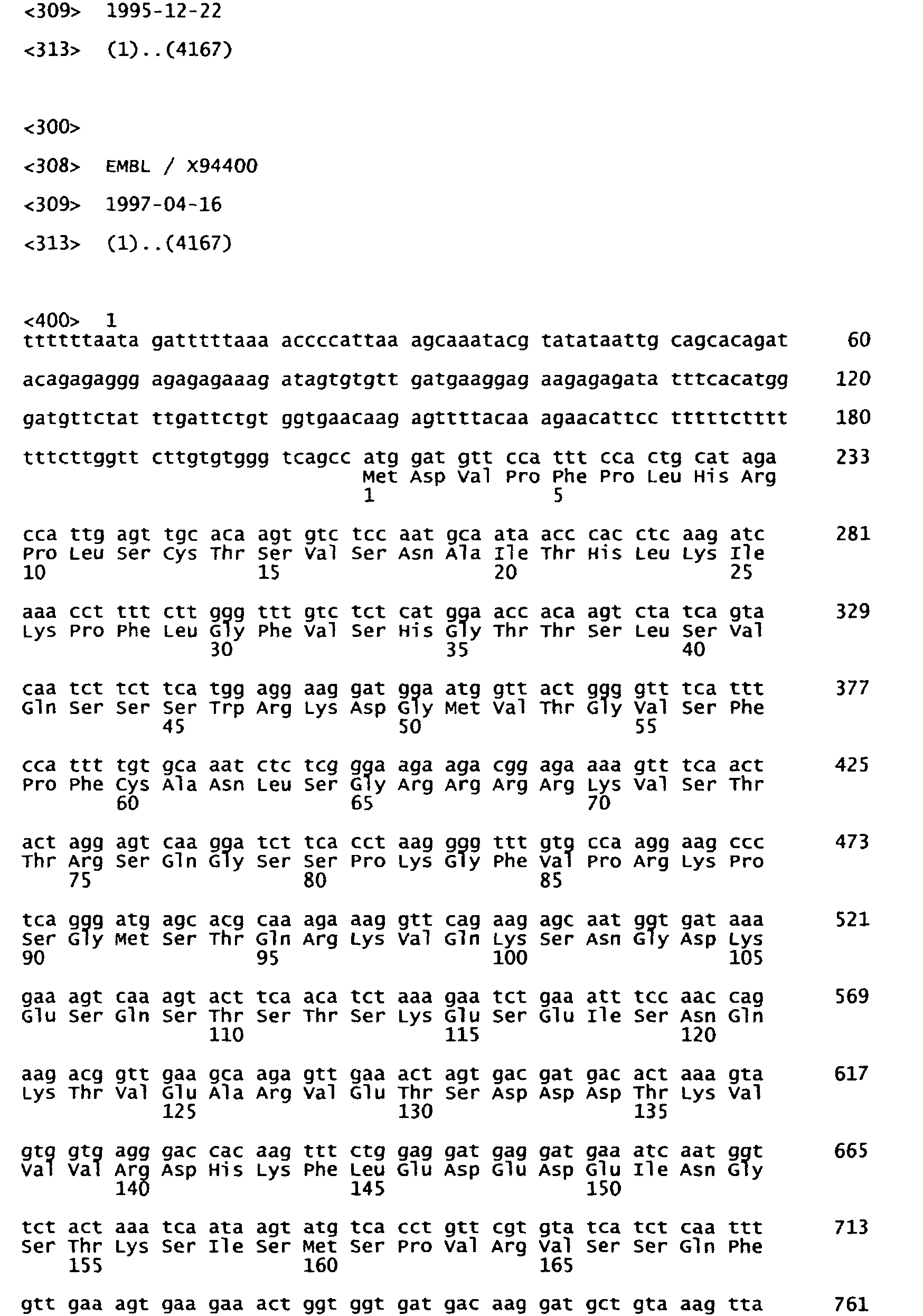

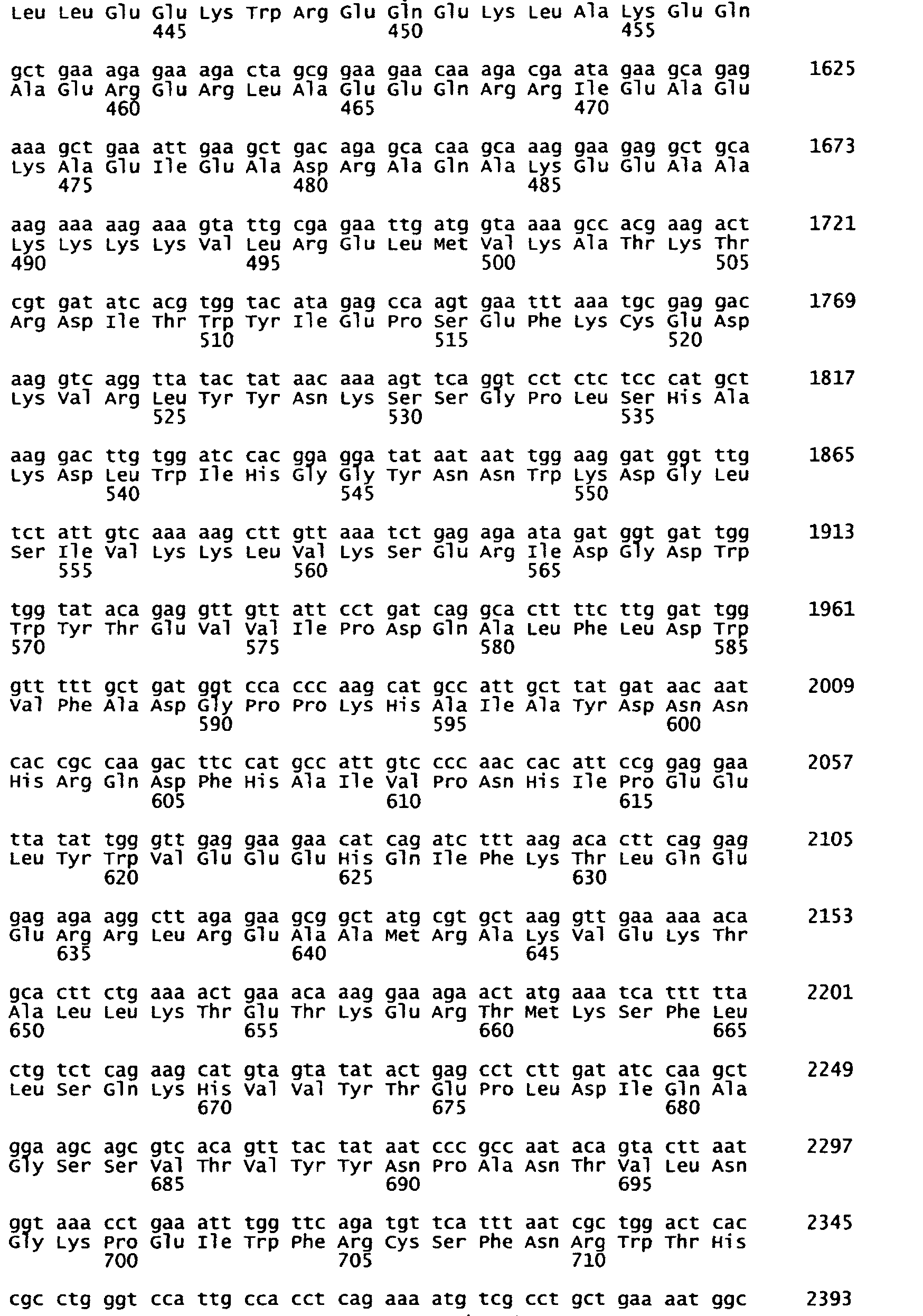
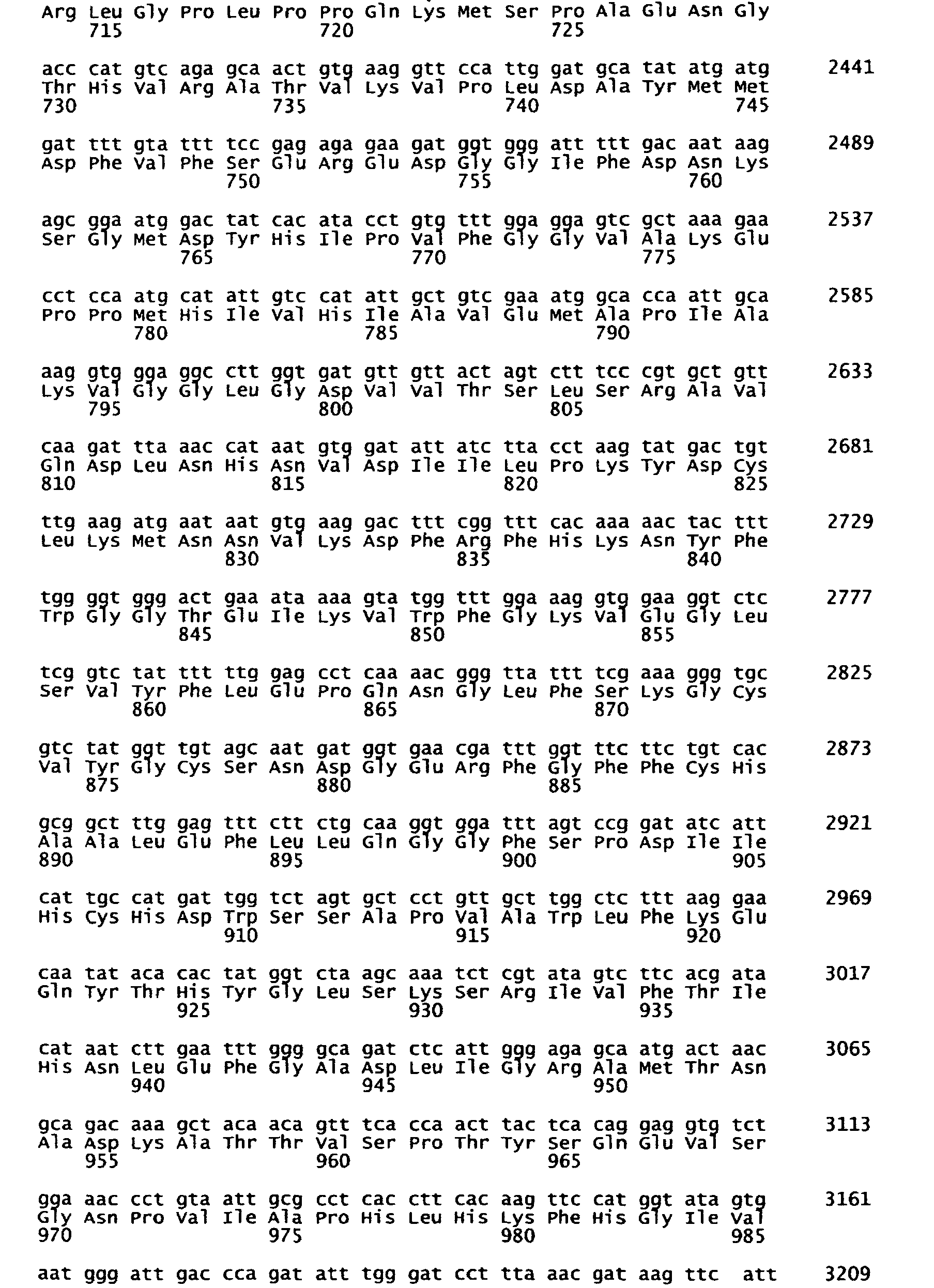


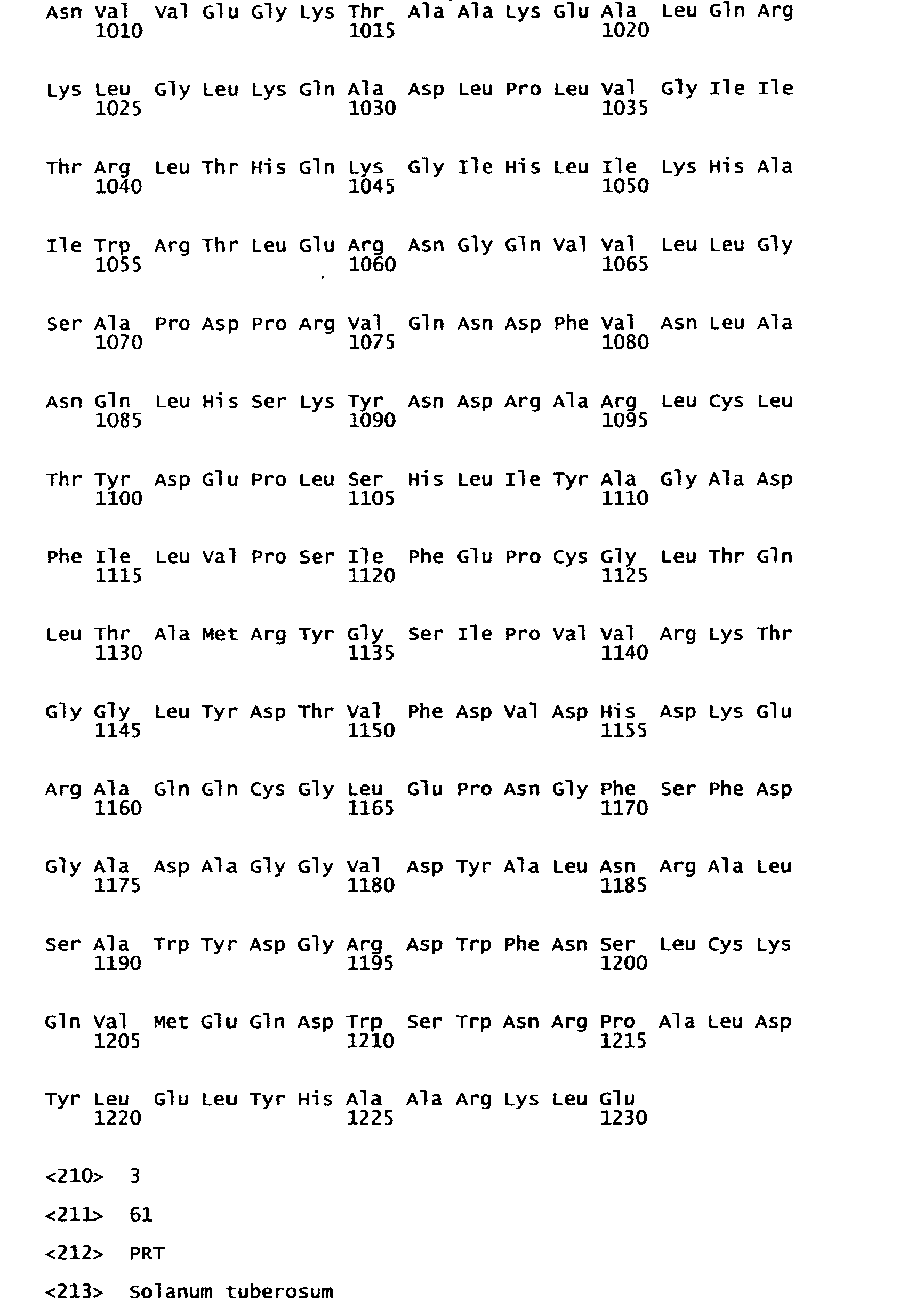


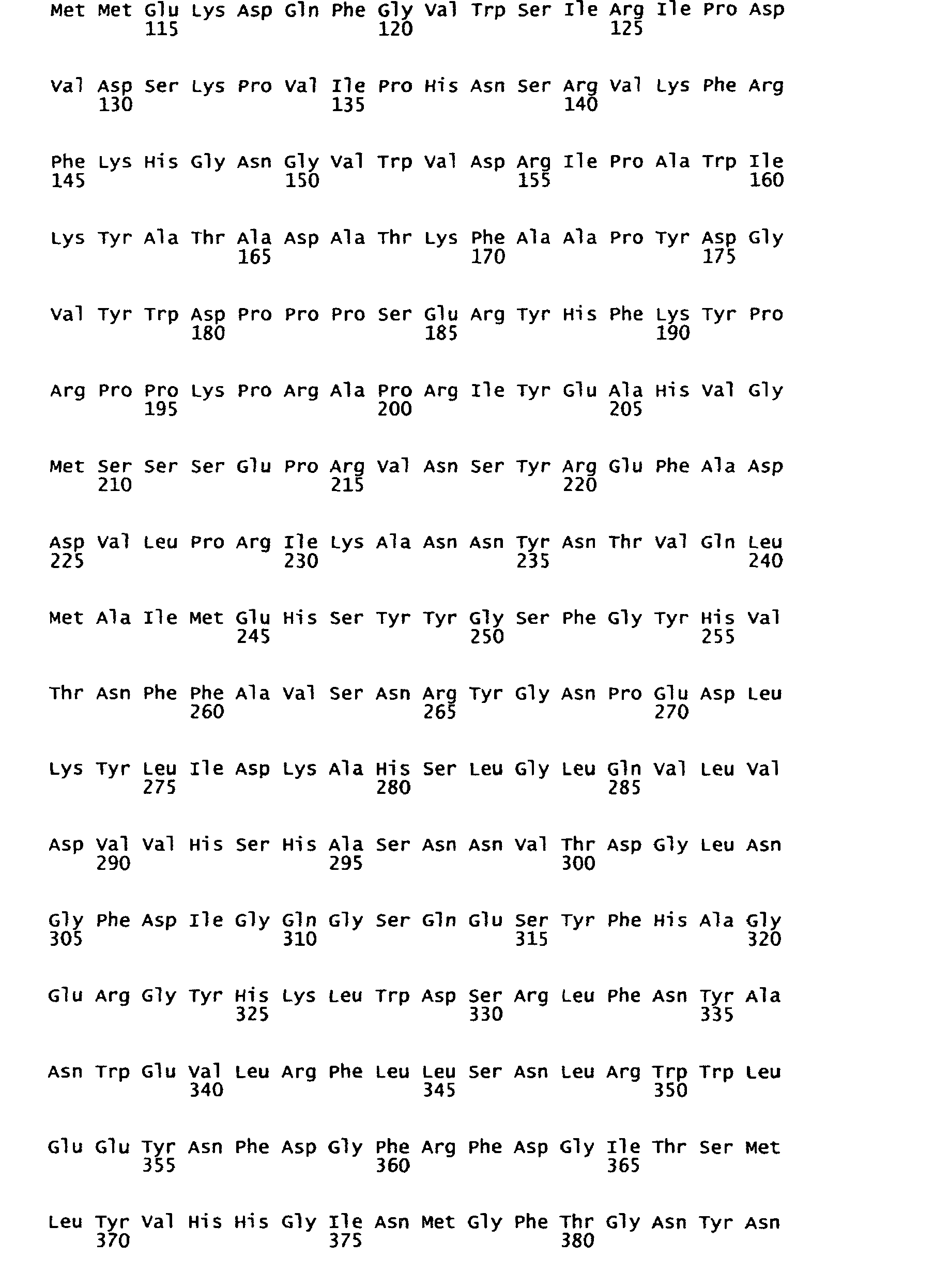


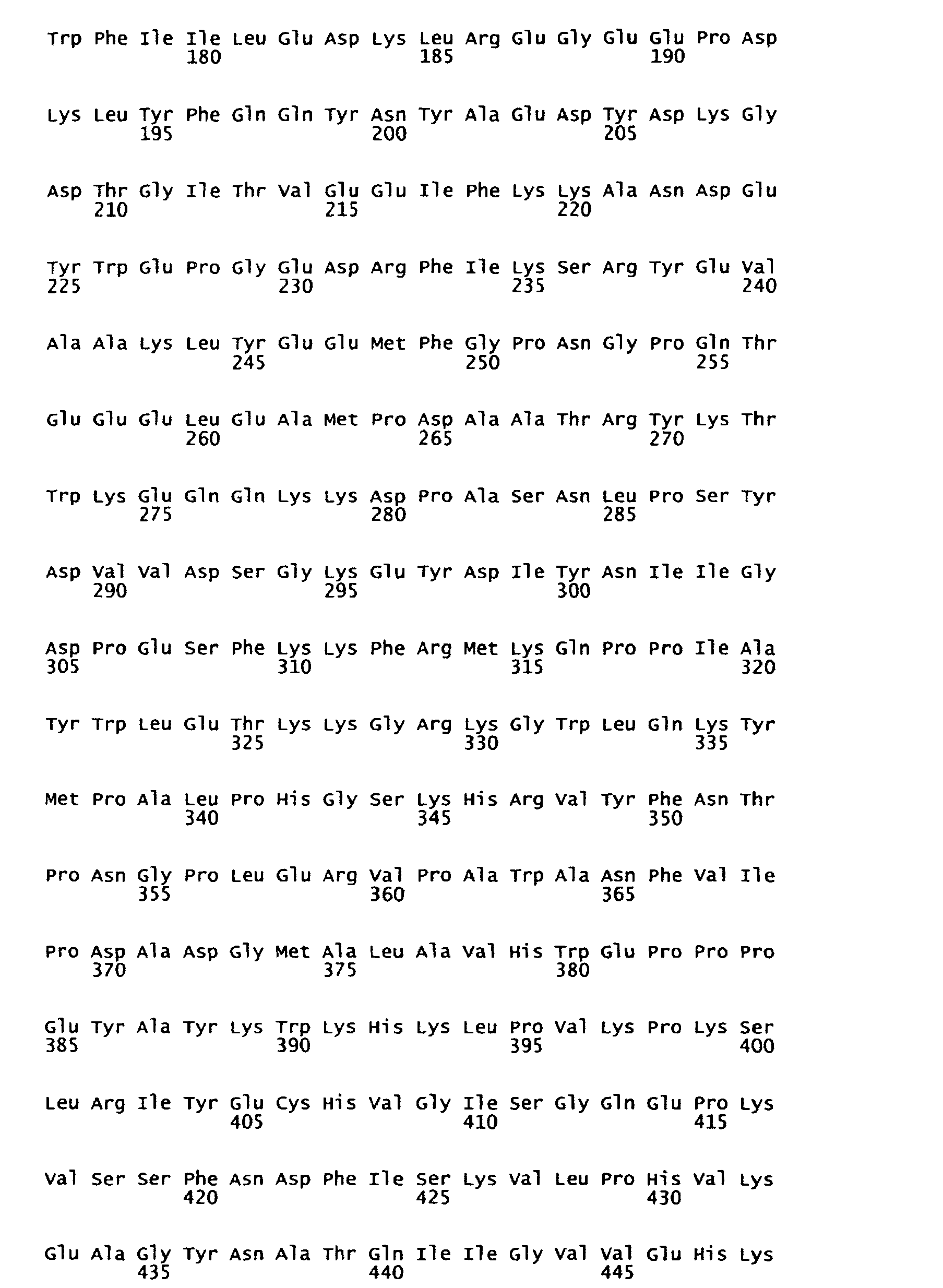
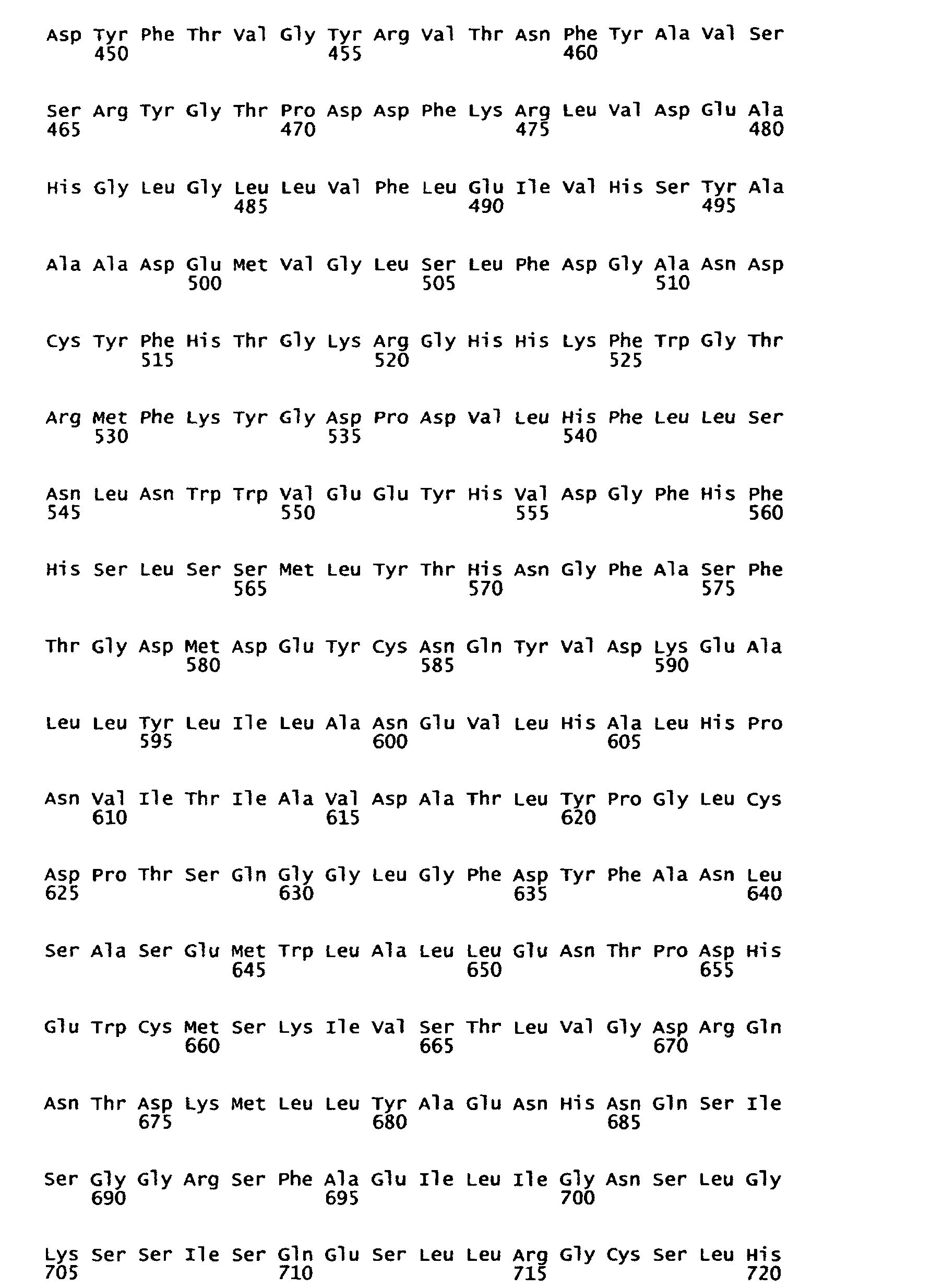


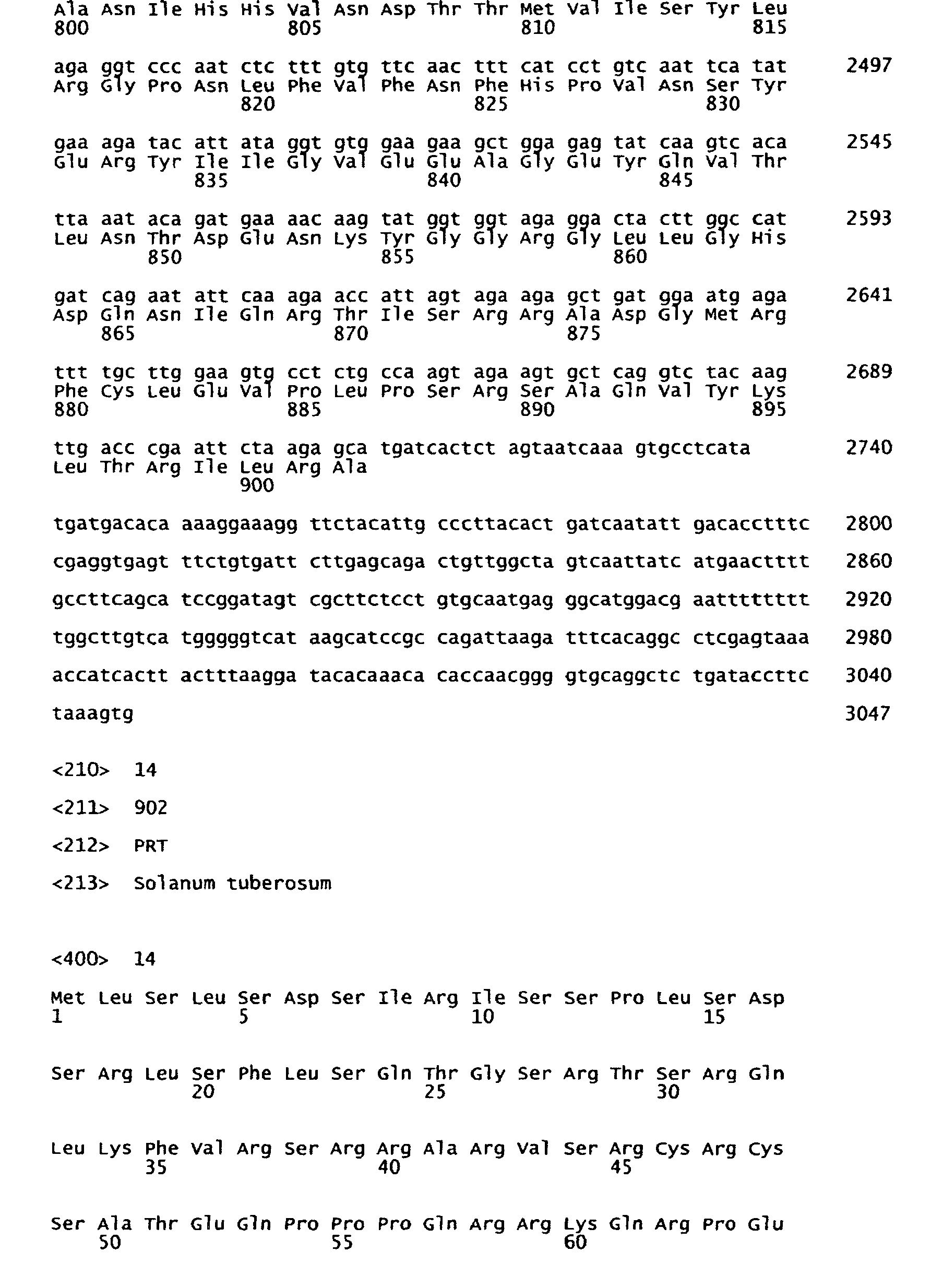
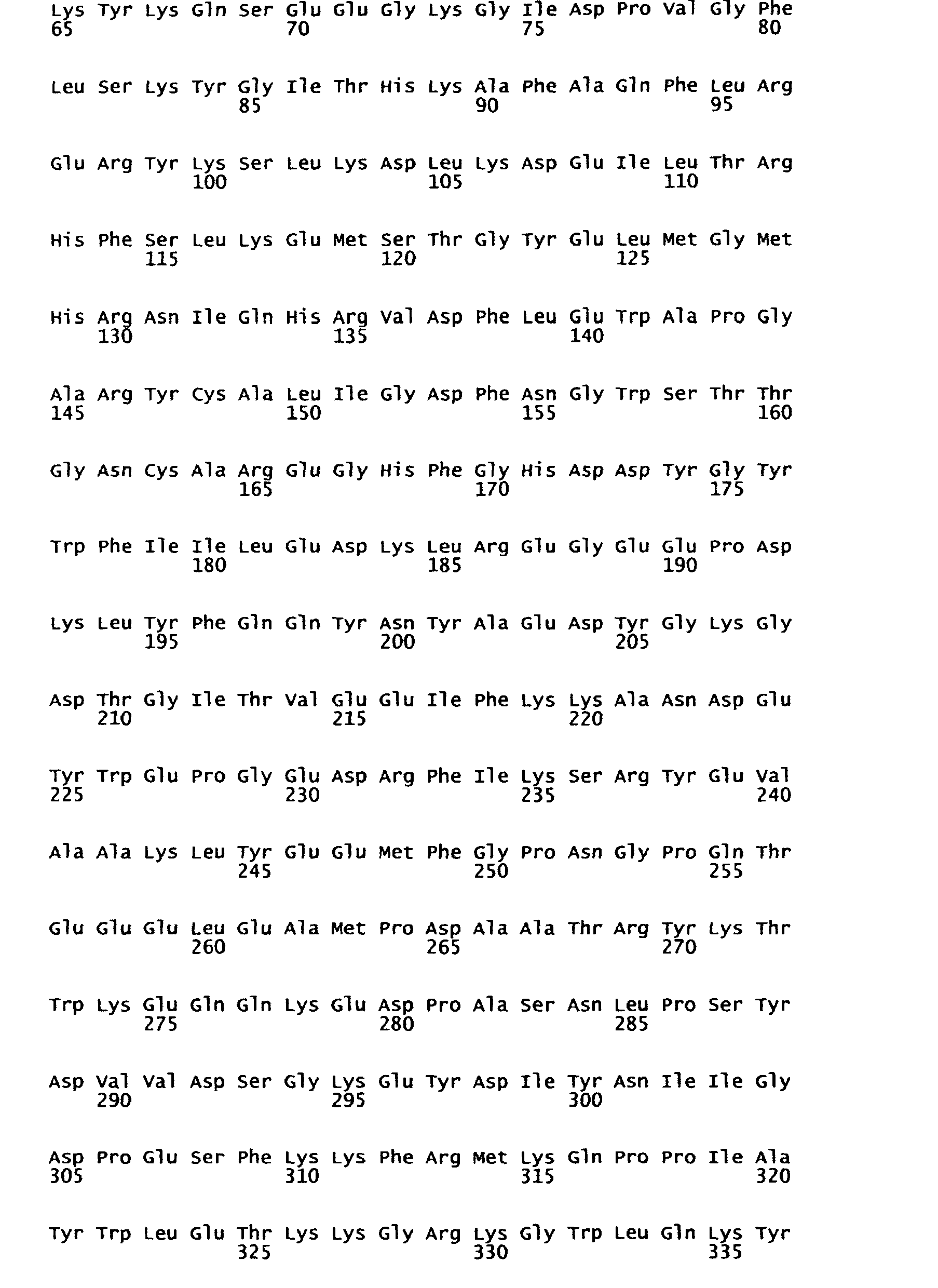




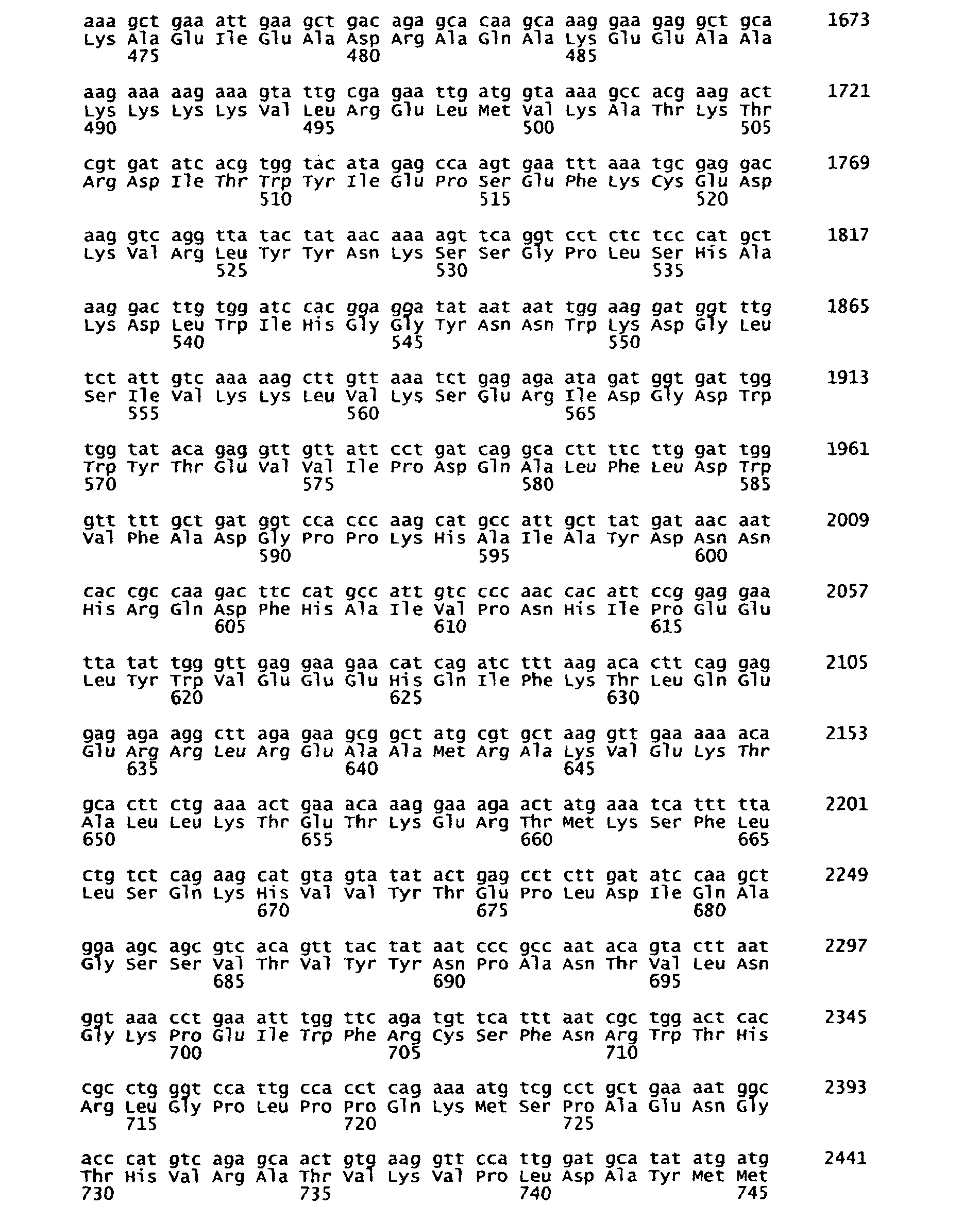


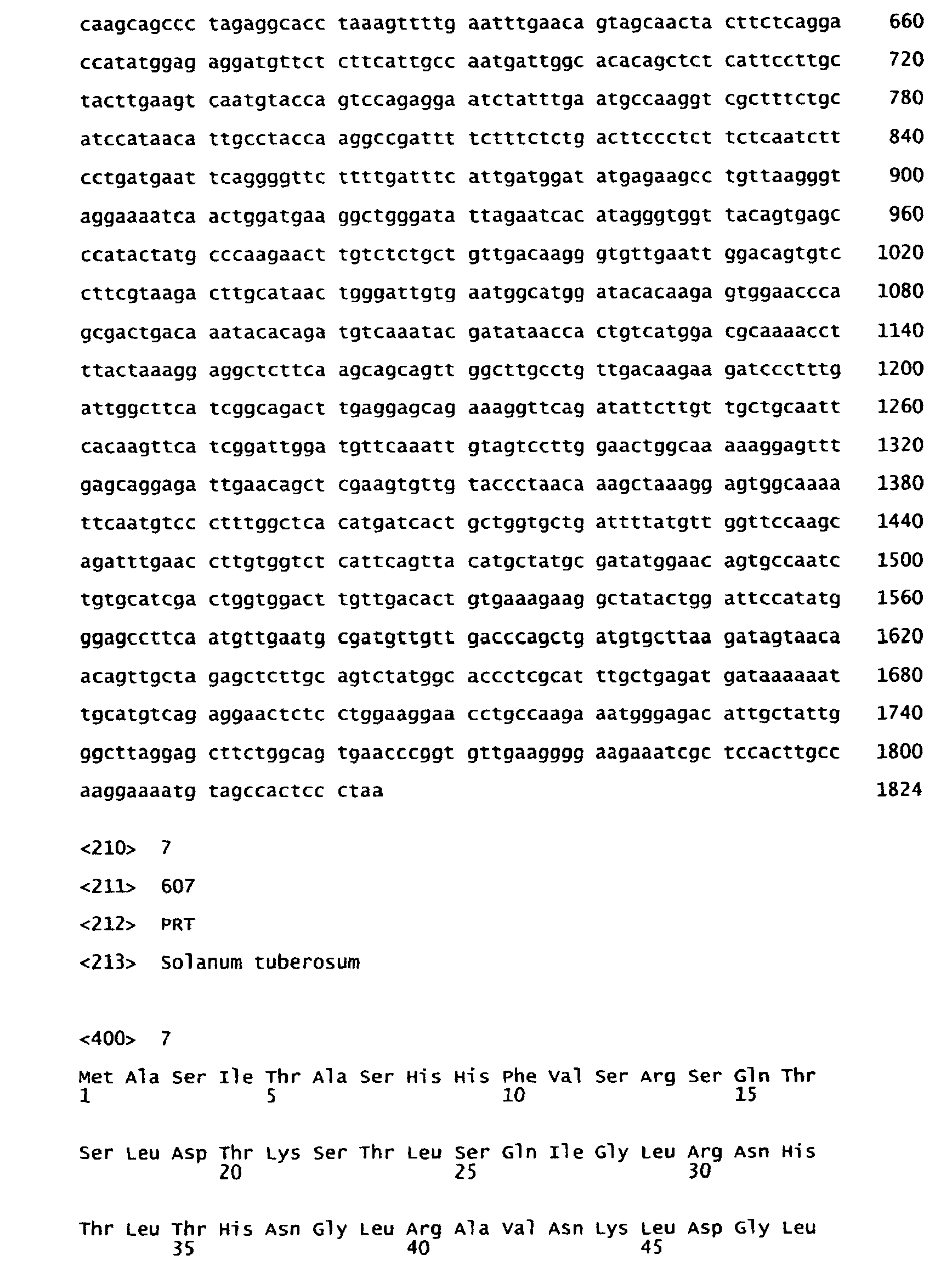

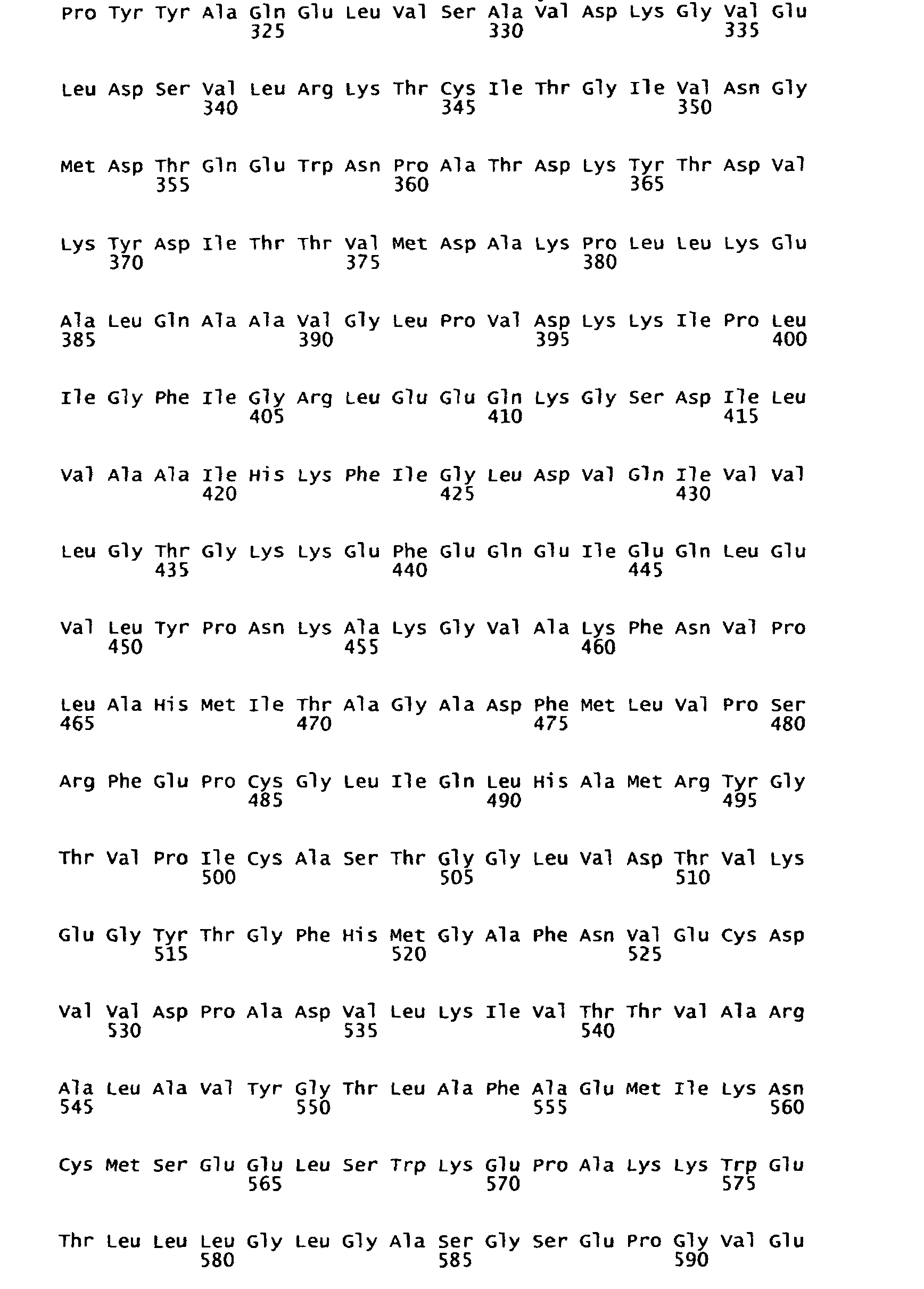

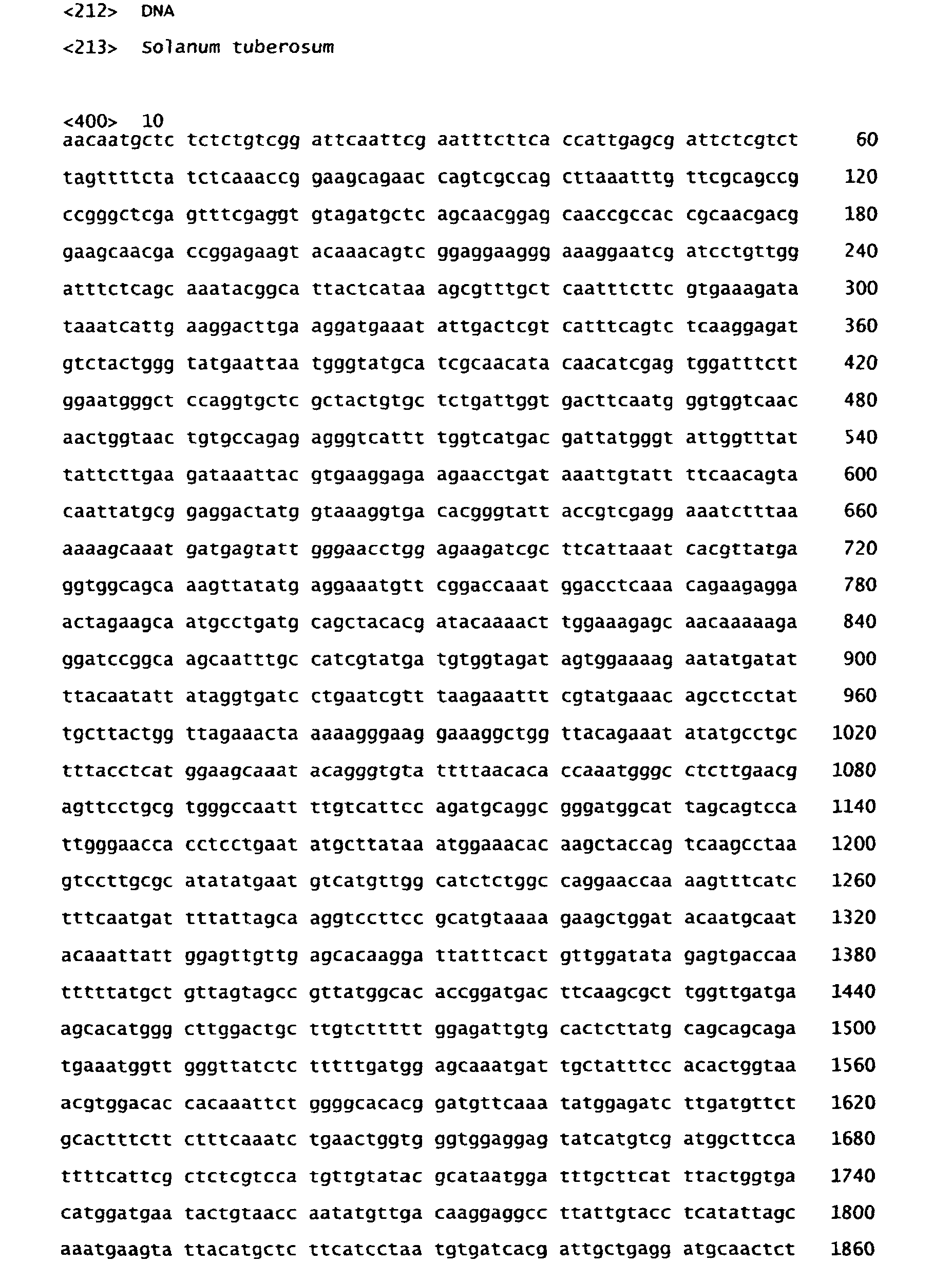
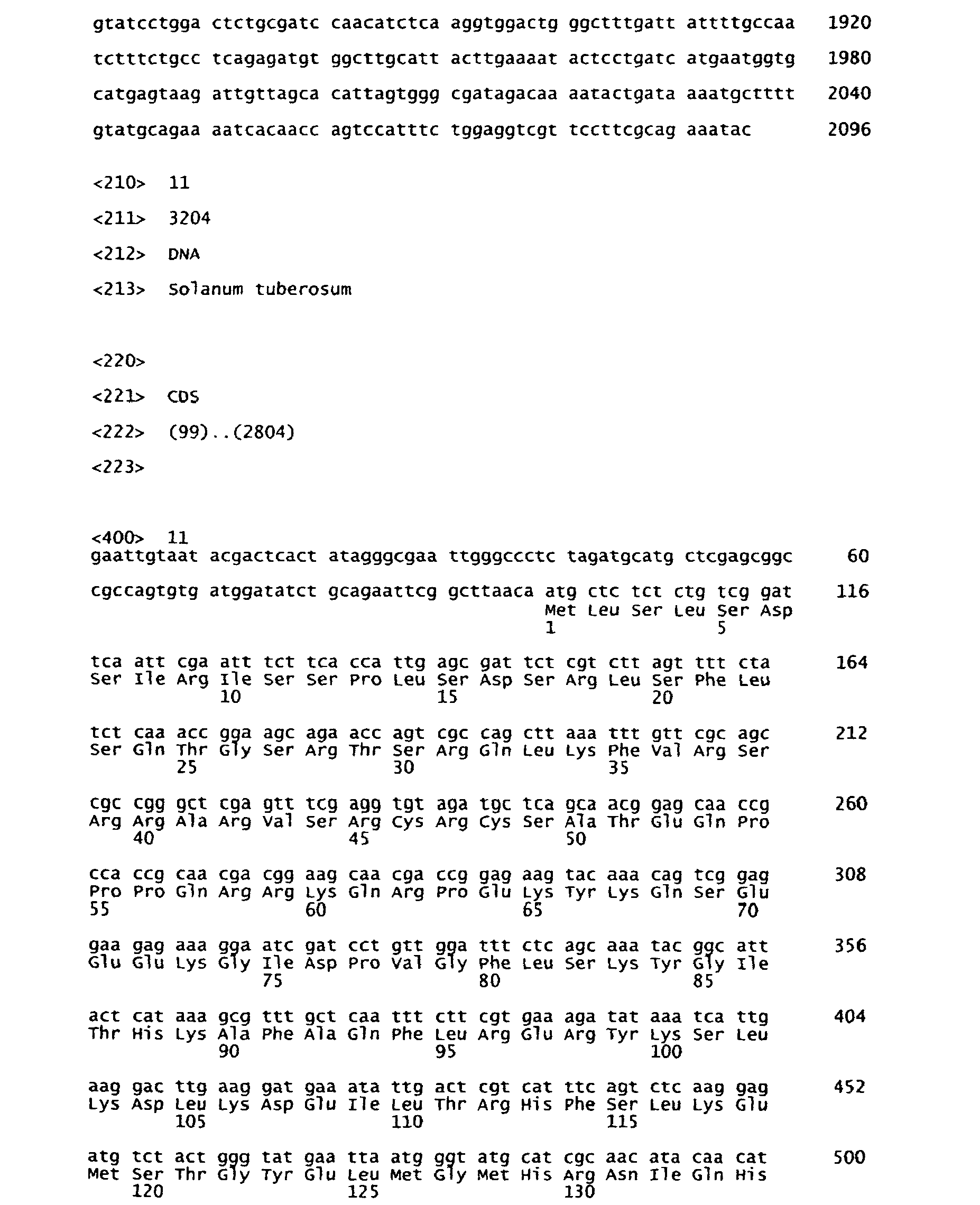
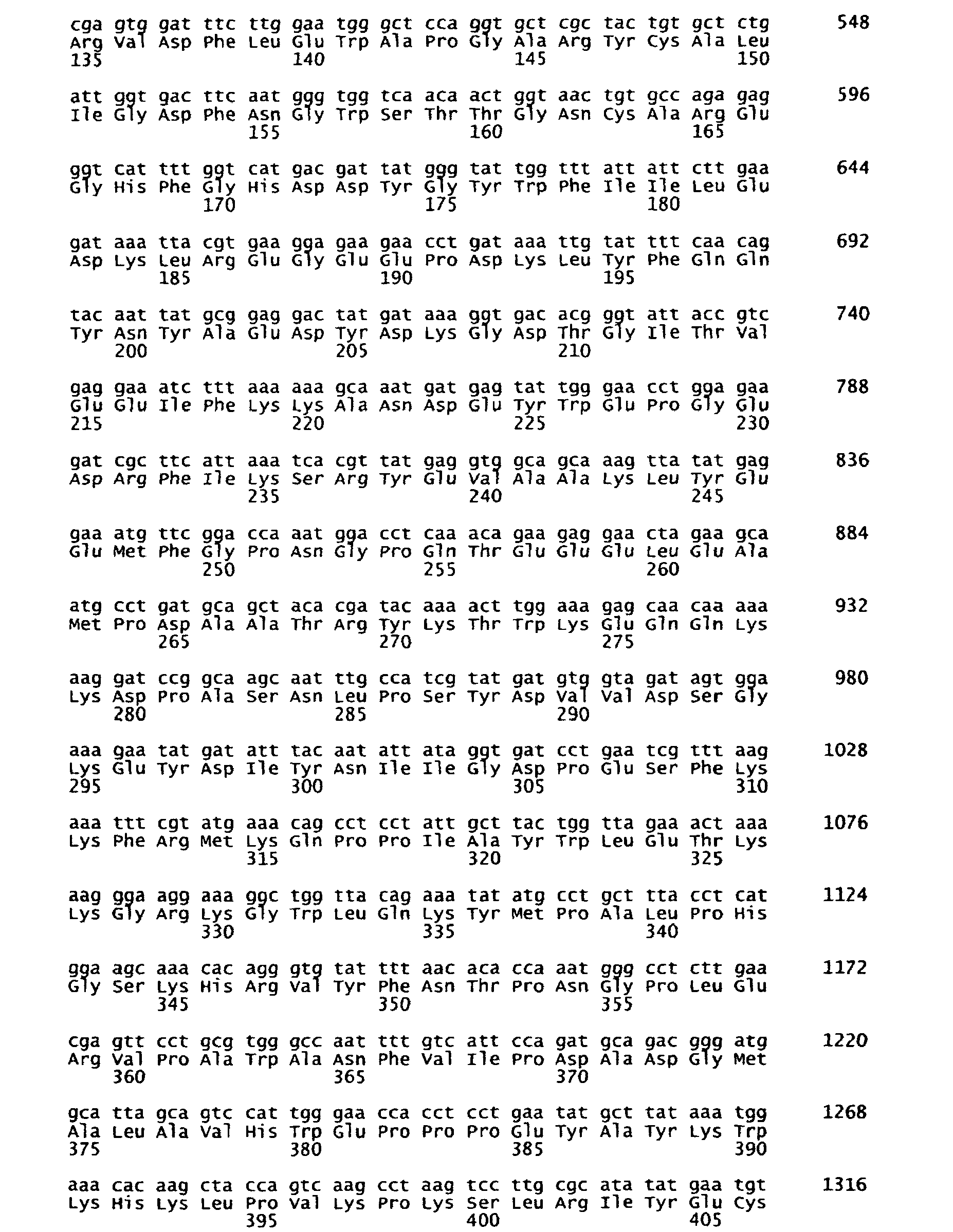


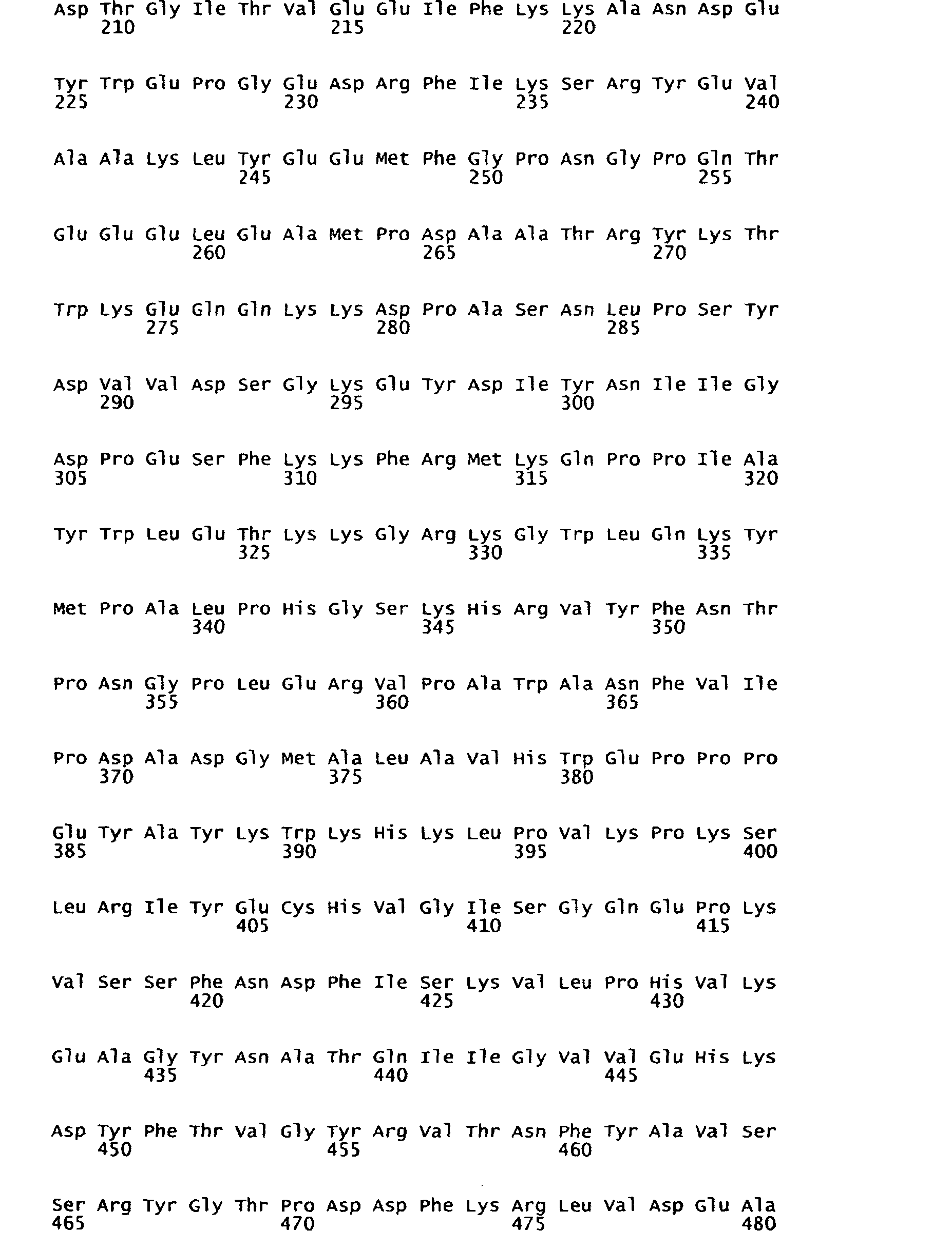
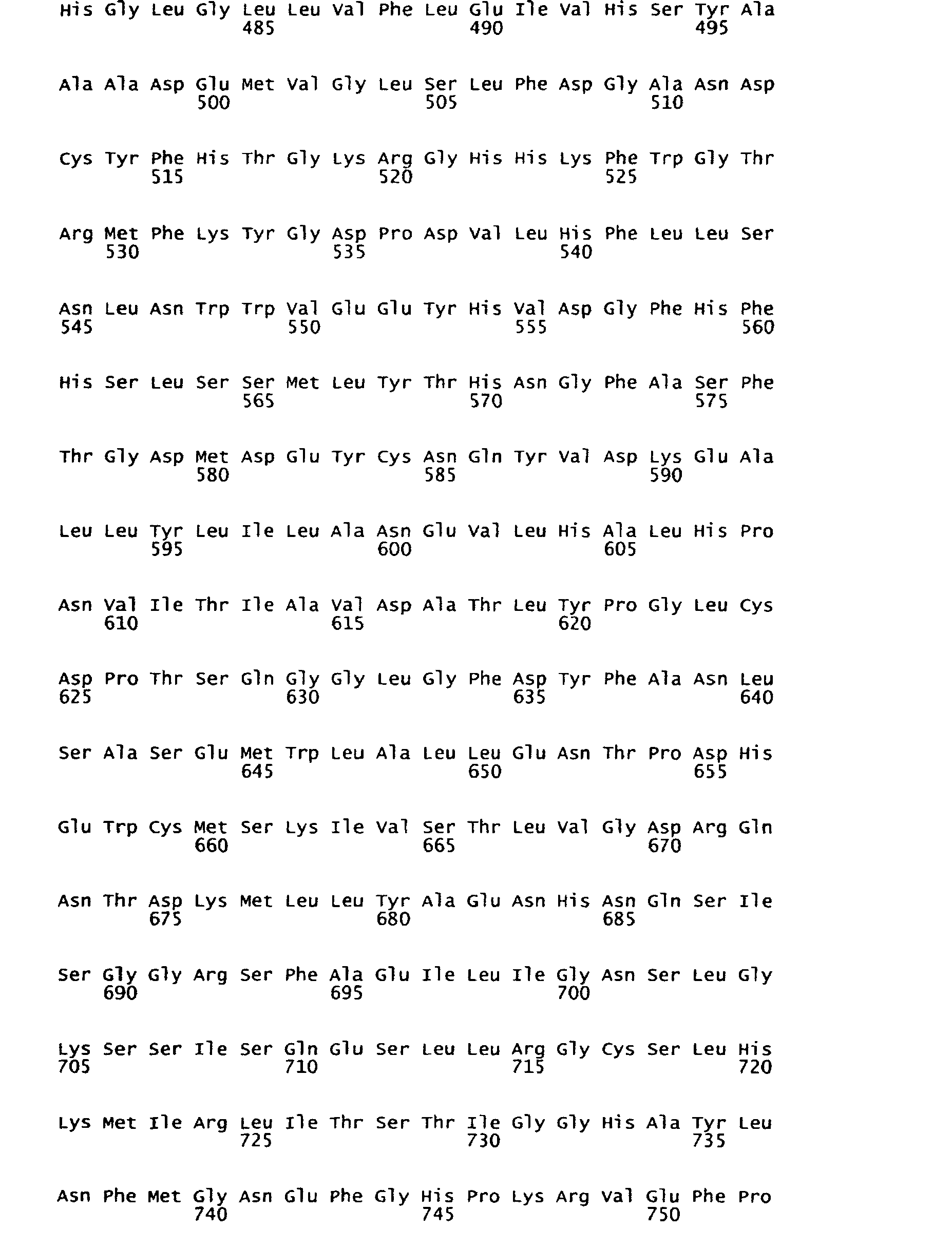

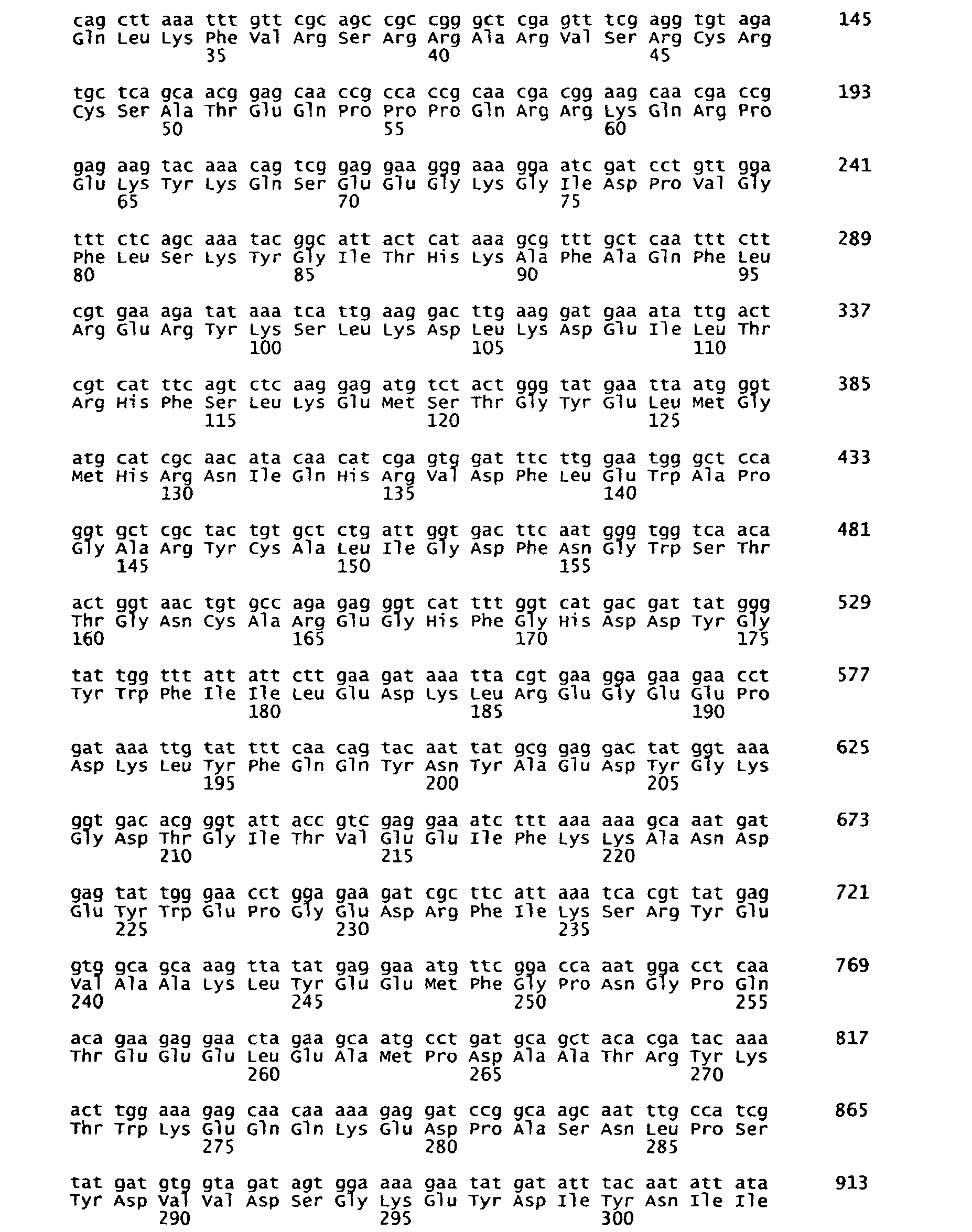


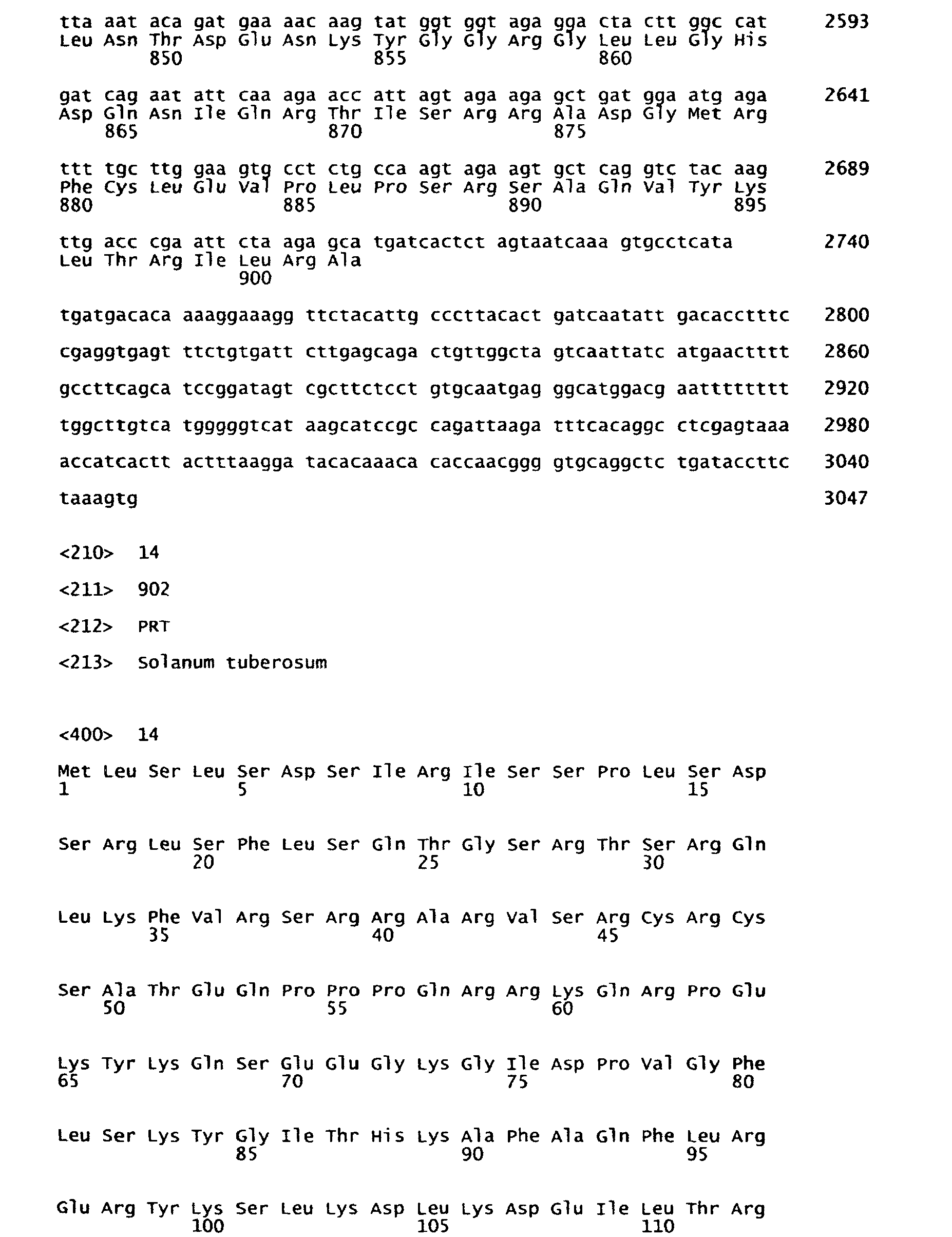
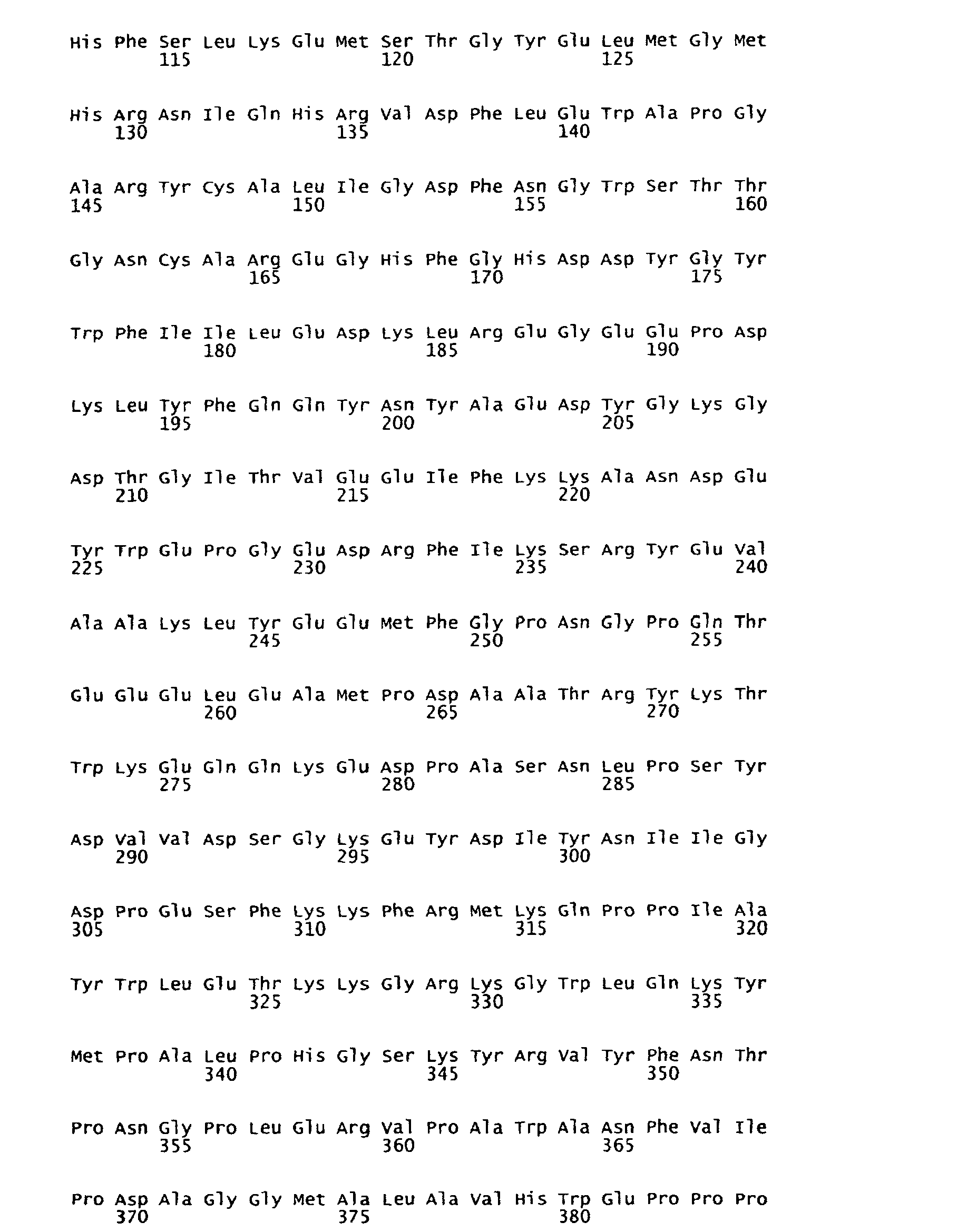


Claims (11)
Priority Applications (6)
| Application Number | Priority Date | Filing Date | Title |
|---|---|---|---|
| EP05090085A EP1707632A1 (en) | 2005-04-01 | 2005-04-01 | Phosphorylated waxy potato starch |
| EP06723985.5A EP1869089B1 (en) | 2005-04-01 | 2006-03-30 | Phosphorylated waxy potato starch |
| US11/909,926 US8148517B2 (en) | 2005-04-01 | 2006-03-30 | Phosphorylated waxy potato starch |
| AU2006228670A AU2006228670B2 (en) | 2005-04-01 | 2006-03-30 | Phosphorylated waxy potato starch |
| PCT/EP2006/003027 WO2006103107A1 (en) | 2005-04-01 | 2006-03-30 | Phosphorylated waxy potato starch |
| CA2600989A CA2600989C (en) | 2005-04-01 | 2006-03-30 | Phosphorylated waxy potato starch |
Applications Claiming Priority (1)
| Application Number | Priority Date | Filing Date | Title |
|---|---|---|---|
| EP05090085A EP1707632A1 (en) | 2005-04-01 | 2005-04-01 | Phosphorylated waxy potato starch |
Publications (1)
| Publication Number | Publication Date |
|---|---|
| EP1707632A1 true EP1707632A1 (en) | 2006-10-04 |
Family
ID=34938422
Family Applications (2)
| Application Number | Title | Priority Date | Filing Date |
|---|---|---|---|
| EP05090085A Withdrawn EP1707632A1 (en) | 2005-04-01 | 2005-04-01 | Phosphorylated waxy potato starch |
| EP06723985.5A Active EP1869089B1 (en) | 2005-04-01 | 2006-03-30 | Phosphorylated waxy potato starch |
Family Applications After (1)
| Application Number | Title | Priority Date | Filing Date |
|---|---|---|---|
| EP06723985.5A Active EP1869089B1 (en) | 2005-04-01 | 2006-03-30 | Phosphorylated waxy potato starch |
Country Status (5)
| Country | Link |
|---|---|
| US (1) | US8148517B2 (en) |
| EP (2) | EP1707632A1 (en) |
| AU (1) | AU2006228670B2 (en) |
| CA (1) | CA2600989C (en) |
| WO (1) | WO2006103107A1 (en) |
Cited By (1)
| Publication number | Priority date | Publication date | Assignee | Title |
|---|---|---|---|---|
| CN113116747A (en) * | 2020-01-14 | 2021-07-16 | 罗盖特公司 | Natural and porous starches as white pigments in toothpaste |
Families Citing this family (183)
| Publication number | Priority date | Publication date | Assignee | Title |
|---|---|---|---|---|
| CL2007003743A1 (en) * | 2006-12-22 | 2008-07-11 | Bayer Cropscience Ag | COMPOSITION THAT INCLUDES FENAMIDONA AND AN INSECTICIDE COMPOUND; AND METHOD TO CONTROL FITOPATOGENOS CULTURES AND INSECTS FACING OR PREVENTIVELY. |
| CL2007003744A1 (en) | 2006-12-22 | 2008-07-11 | Bayer Cropscience Ag | COMPOSITION THAT INCLUDES A 2-PYRIDILMETILBENZAMIDE DERIVATIVE AND AN INSECTICIDE COMPOUND; AND METHOD TO CONTROL FITOPATOGENOS CULTURES AND INSECTS FACING OR PREVENTIVELY. |
| EP1969934A1 (en) | 2007-03-12 | 2008-09-17 | Bayer CropScience AG | 4-cycloalkyl or 4-aryl substituted phenoxy phenylamidines and their use as fungicides |
| EP1969930A1 (en) | 2007-03-12 | 2008-09-17 | Bayer CropScience AG | Phenoxy phenylamidines and their use as fungicides |
| BRPI0808798A2 (en) | 2007-03-12 | 2014-10-07 | Bayer Cropscience Ag | 3,5-DISSUBSTITUTED PHENOXYPHENYLAMIDINS AND THEIR USE AS FUNGICIDES |
| EP1969929A1 (en) | 2007-03-12 | 2008-09-17 | Bayer CropScience AG | Substituted phenylamidines and their use as fungicides |
| JP2010520899A (en) | 2007-03-12 | 2010-06-17 | バイエル・クロツプサイエンス・アクチエンゲゼルシヤフト | Dihalophenoxyphenylamidine and its use as a fungicide |
| BRPI0808846A2 (en) | 2007-03-12 | 2019-09-24 | Bayer Cropscience Ag | 3-substituted phenoxyphenylamidines and their use as fungicides |
| EP1969931A1 (en) | 2007-03-12 | 2008-09-17 | Bayer CropScience Aktiengesellschaft | Fluoroalkyl phenylamidines and their use as fungicides |
| US8168567B2 (en) | 2007-04-19 | 2012-05-01 | Bayer Cropscience Ag | Thiadiazolyl oxyphenyl amidines and the use thereof as a fungicide |
| DE102007045919B4 (en) | 2007-09-26 | 2018-07-05 | Bayer Intellectual Property Gmbh | Drug combinations with insecticidal and acaricidal properties |
| DE102007045922A1 (en) | 2007-09-26 | 2009-04-02 | Bayer Cropscience Ag | Drug combinations with insecticidal and acaricidal properties |
| DE102007045953B4 (en) | 2007-09-26 | 2018-07-05 | Bayer Intellectual Property Gmbh | Drug combinations with insecticidal and acaricidal properties |
| DE102007045920B4 (en) | 2007-09-26 | 2018-07-05 | Bayer Intellectual Property Gmbh | Synergistic drug combinations |
| DE102007045956A1 (en) | 2007-09-26 | 2009-04-09 | Bayer Cropscience Ag | Combination of active ingredients with insecticidal and acaricidal properties |
| WO2009046837A2 (en) * | 2007-10-02 | 2009-04-16 | Bayer Cropscience Ag | Methods of improving plant growth |
| EP2090168A1 (en) | 2008-02-12 | 2009-08-19 | Bayer CropScience AG | Method for improving plant growth |
| EP2072506A1 (en) | 2007-12-21 | 2009-06-24 | Bayer CropScience AG | Thiazolyloxyphenylamidine or thiadiazolyloxyphenylamidine und its use as fungicide |
| EP2168434A1 (en) | 2008-08-02 | 2010-03-31 | Bayer CropScience AG | Use of azols to increase resistance of plants of parts of plants to abiotic stress |
| EP2374791A1 (en) | 2008-08-14 | 2011-10-12 | Bayer CropScience Aktiengesellschaft | Insecticidal 4-phenyl-1H pyrazoles |
| DE102008041695A1 (en) | 2008-08-29 | 2010-03-04 | Bayer Cropscience Ag | Methods for improving plant growth |
| EP2201838A1 (en) | 2008-12-05 | 2010-06-30 | Bayer CropScience AG | Active ingredient-beneficial organism combinations with insecticide and acaricide properties |
| EP2198709A1 (en) | 2008-12-19 | 2010-06-23 | Bayer CropScience AG | Method for treating resistant animal pests |
| EP2223602A1 (en) | 2009-02-23 | 2010-09-01 | Bayer CropScience AG | Method for improved utilisation of the production potential of genetically modified plants |
| EP2381781B1 (en) | 2008-12-29 | 2016-06-08 | Bayer Intellectual Property GmbH | Method for improved use of the production potential of genetically modified plants |
| EP2204094A1 (en) | 2008-12-29 | 2010-07-07 | Bayer CropScience AG | Method for improved utilization of the production potential of transgenic plants Introduction |
| EP2039770A2 (en) | 2009-01-06 | 2009-03-25 | Bayer CropScience AG | Method for improved utilization of the production potential of transgenic plants |
| EP2039772A2 (en) | 2009-01-06 | 2009-03-25 | Bayer CropScience AG | Method for improved utilization of the production potential of transgenic plants introduction |
| EP2039771A2 (en) | 2009-01-06 | 2009-03-25 | Bayer CropScience AG | Method for improved utilization of the production potential of transgenic plants |
| WO2010081689A2 (en) | 2009-01-19 | 2010-07-22 | Bayer Cropscience Ag | Cyclic diones and their use as insecticides, acaricides and/or fungicides |
| EP2227951A1 (en) | 2009-01-23 | 2010-09-15 | Bayer CropScience AG | Application of enaminocarbonyl compounds for combating viruses transmitted by insects |
| WO2010086311A1 (en) | 2009-01-28 | 2010-08-05 | Bayer Cropscience Ag | Fungicide n-cycloalkyl-n-bicyclicmethylene-carboxamide derivatives |
| AR075126A1 (en) | 2009-01-29 | 2011-03-09 | Bayer Cropscience Ag | METHOD FOR THE BEST USE OF THE TRANSGENIC PLANTS PRODUCTION POTENTIAL |
| EP2218717A1 (en) | 2009-02-17 | 2010-08-18 | Bayer CropScience AG | Fungicidal N-((HET)Arylethyl)thiocarboxamide derivatives |
| EP2398770B1 (en) | 2009-02-17 | 2016-12-28 | Bayer Intellectual Property GmbH | Fungicidal n-(phenylcycloalkyl)carboxamide, n-(benzylcycloalkyl)carboxamide and thiocarboxamide derivatives |
| TW201031331A (en) | 2009-02-19 | 2010-09-01 | Bayer Cropscience Ag | Pesticide composition comprising a tetrazolyloxime derivative and a fungicide or an insecticide active substance |
| NZ595345A (en) | 2009-03-25 | 2014-01-31 | Bayer Cropscience Ag | Active ingredient combinations with insecticidal and acaricidal properties |
| EP2232995A1 (en) | 2009-03-25 | 2010-09-29 | Bayer CropScience AG | Method for improved utilisation of the production potential of transgenic plants |
| UA104887C2 (en) | 2009-03-25 | 2014-03-25 | Баєр Кропсаєнс Аг | Synergic combinations of active ingredients |
| CN102448304B (en) | 2009-03-25 | 2015-03-11 | 拜尔农作物科学股份公司 | Active ingredient combinations having insecticidal and acaricidal properties |
| EP2410849A1 (en) | 2009-03-25 | 2012-02-01 | Bayer CropScience AG | Active ingredient combinations having insecticidal and acaricidal properties |
| BRPI0924451B1 (en) | 2009-03-25 | 2017-12-26 | Bayer Intellectual Property Gmbh | Combinations of active substances and their uses, as well as methods for the control of animal pests and method for the manufacture of insecticides and acaricides |
| EP2239331A1 (en) | 2009-04-07 | 2010-10-13 | Bayer CropScience AG | Method for improved utilization of the production potential of transgenic plants |
| BRPI1015543A8 (en) | 2009-05-06 | 2016-05-24 | Bayer Cropscience Ag | CYCLOPENTANEDIONE COMPOUNDS AND THEIR USE AS INSECTICIDES, ACARICIDES AND/OR FUNGICIDES. |
| AR076839A1 (en) | 2009-05-15 | 2011-07-13 | Bayer Cropscience Ag | FUNGICIDE DERIVATIVES OF PIRAZOL CARBOXAMIDAS |
| EP2251331A1 (en) | 2009-05-15 | 2010-11-17 | Bayer CropScience AG | Fungicide pyrazole carboxamides derivatives |
| EP2255626A1 (en) | 2009-05-27 | 2010-12-01 | Bayer CropScience AG | Use of succinate dehydrogenase inhibitors to increase resistance of plants or parts of plants to abiotic stress |
| CN105165832B (en) | 2009-06-02 | 2019-08-13 | 拜耳知识产权有限责任公司 | Application of the succinate dehydrogenase inhibitors in control Sclerotinia fungi |
| WO2011006603A2 (en) | 2009-07-16 | 2011-01-20 | Bayer Cropscience Ag | Synergistic active substance combinations containing phenyl triazoles |
| WO2011015524A2 (en) | 2009-08-03 | 2011-02-10 | Bayer Cropscience Ag | Fungicide heterocycles derivatives |
| JP5768252B2 (en) * | 2009-08-12 | 2015-08-26 | 公立大学法人大阪府立大学 | Antilipidemic and visceral fat prevention food |
| EP2292094A1 (en) | 2009-09-02 | 2011-03-09 | Bayer CropScience AG | Active compound combinations |
| EP2319872A1 (en) | 2009-11-04 | 2011-05-11 | BASF Plant Science GmbH | Amylopectin type starch with enhanced retrogradation stability |
| EP2343280A1 (en) | 2009-12-10 | 2011-07-13 | Bayer CropScience AG | Fungicide quinoline derivatives |
| MX336392B (en) | 2009-12-28 | 2016-01-18 | Bayer Cropscience Ag | Fungicide hydroximoyl-heterocycles derivatives. |
| US20130012546A1 (en) | 2009-12-28 | 2013-01-10 | Christian Beier | Fungicide hydroximoyl-tetrazole derivatives |
| BR112012012107B1 (en) | 2009-12-28 | 2019-08-20 | Bayer Cropscience Ag | Compound, fungicidal composition and method for controlling plant pathogenic fungi |
| MA33933B1 (en) | 2010-01-22 | 2013-01-02 | Bayer Ip Gmbh | COMBINATIONS OF ACARICIDAL AND / OR INSECTICIDAL ACTIVE INGREDIENTS |
| CN102884054B (en) | 2010-03-04 | 2015-01-14 | 拜耳知识产权有限责任公司 | Fluoroalkyl-substituted 2-amidobenzimidazoles and the use thereof for boosting stress tolerance in plants |
| AR080827A1 (en) | 2010-04-06 | 2012-05-09 | Bayer Cropscience Ag | USE OF ACID 4- PHENYL-BUTIRICO AND / OR ITS SALTS FOR THE INCREASE OF STRESS TOLERANCE IN PLANTS |
| WO2011124553A2 (en) | 2010-04-09 | 2011-10-13 | Bayer Cropscience Ag | Use of derivatives of the (1-cyanocyclopropyl)phenylphosphinic acid, the esters thereof and/or the salts thereof for enhancing the tolerance of plants to abiotic stress |
| US20130116287A1 (en) | 2010-04-28 | 2013-05-09 | Christian Beier | Fungicide hydroximoyl-heterocycles derivatives |
| WO2011134911A2 (en) | 2010-04-28 | 2011-11-03 | Bayer Cropscience Ag | Fungicide hydroximoyl-tetrazole derivatives |
| BR112012027558A2 (en) | 2010-04-28 | 2015-09-15 | Bayer Cropscience Ag | '' Compound of formula (I), fungicidal composition and method for the control of crop phytogenic fungi '' |
| MX2012013896A (en) | 2010-06-03 | 2012-12-17 | Bayer Cropscience Ag | N-[(het)arylalkyl)] pyrazole (thio)carboxamides and their heterosubstituted analogues. |
| EP2576516B1 (en) | 2010-06-03 | 2014-12-17 | Bayer Intellectual Property GmbH | N-[(het)arylethyl)]pyrazole(thio)carboxamides and their heterosubstituted analogues |
| UA110703C2 (en) | 2010-06-03 | 2016-02-10 | Байєр Кропсайнс Аг | Fungicidal n-[(trisubstitutedsilyl)methyl]carboxamide |
| AU2011264074B2 (en) | 2010-06-09 | 2015-01-22 | Bayer Cropscience Nv | Methods and means to modify a plant genome at a nucleotide sequence commonly used in plant genome engineering |
| AU2011264075B2 (en) | 2010-06-09 | 2015-01-29 | Bayer Cropscience Nv | Methods and means to modify a plant genome at a nucleotide sequence commonly used in plant genome engineering |
| RU2013107369A (en) | 2010-07-20 | 2014-08-27 | Байер Кропсайенс Аг | Benzocycloalkenes as an anti-fungal agent |
| PL2611300T3 (en) | 2010-09-03 | 2016-10-31 | Substituted annelated dihydropyrimidinone compounds | |
| WO2012038480A2 (en) | 2010-09-22 | 2012-03-29 | Bayer Cropscience Ag | Use of biological or chemical control agents for controlling insects and nematodes in resistant crops |
| EP2460406A1 (en) | 2010-12-01 | 2012-06-06 | Bayer CropScience AG | Use of fluopyram for controlling nematodes in nematode resistant crops |
| WO2012045798A1 (en) | 2010-10-07 | 2012-04-12 | Bayer Cropscience Ag | Fungicide composition comprising a tetrazolyloxime derivative and a thiazolylpiperidine derivative |
| JP2013541554A (en) | 2010-10-21 | 2013-11-14 | バイエル・インテレクチユアル・プロパテイー・ゲー・エム・ベー・ハー | N-benzyl heterocyclic carboxamides |
| EP2630135B1 (en) | 2010-10-21 | 2020-03-04 | Bayer Intellectual Property GmbH | 1-(heterocyclic carbonyl) piperidines |
| EP2635564B1 (en) | 2010-11-02 | 2017-04-26 | Bayer Intellectual Property GmbH | N-hetarylmethyl pyrazolylcarboxamides |
| CN103313971B (en) | 2010-11-15 | 2015-12-02 | 拜耳知识产权有限责任公司 | N-Arylpyrazole(thio)carboxamides |
| WO2012065947A1 (en) | 2010-11-15 | 2012-05-24 | Bayer Cropscience Ag | 5-halogenopyrazolecarboxamides |
| US20130231303A1 (en) | 2010-11-15 | 2013-09-05 | Bayer Intellectual Property Gmbh | 5-halogenopyrazole(thio)carboxamides |
| AU2011334989A1 (en) | 2010-12-01 | 2013-06-13 | Bayer Intellectual Property Gmbh | Use of fluopyram for controlling nematodes in crops and for increasing yield |
| EP2460407A1 (en) | 2010-12-01 | 2012-06-06 | Bayer CropScience AG | Agent combinations comprising pyridylethyl benzamides and other agents |
| JP2014502611A (en) | 2010-12-29 | 2014-02-03 | バイエル・インテレクチユアル・プロパテイー・ゲー・エム・ベー・ハー | Fungicide hydroxymoyl-tetrazole derivative |
| EP2474542A1 (en) | 2010-12-29 | 2012-07-11 | Bayer CropScience AG | Fungicide hydroximoyl-tetrazole derivatives |
| EP2471363A1 (en) | 2010-12-30 | 2012-07-04 | Bayer CropScience AG | Use of aryl-, heteroaryl- and benzylsulfonamide carboxylic acids, -carboxylic acid esters, -carboxylic acid amides and -carbonitriles and/or its salts for increasing stress tolerance in plants |
| EP2494867A1 (en) | 2011-03-01 | 2012-09-05 | Bayer CropScience AG | Halogen-substituted compounds in combination with fungicides |
| EP2683239A1 (en) | 2011-03-10 | 2014-01-15 | Bayer Intellectual Property GmbH | Use of lipochito-oligosaccharide compounds for safeguarding seed safety of treated seeds |
| JP2014509599A (en) | 2011-03-14 | 2014-04-21 | バイエル・インテレクチユアル・プロパテイー・ゲー・エム・ベー・ハー | Fungicide hydroxymoyl-tetrazole derivative |
| US20140051575A1 (en) | 2011-04-08 | 2014-02-20 | Juergen Benting | Fungicide hydroximoyl-tetrazole derivatives |
| AR085585A1 (en) | 2011-04-15 | 2013-10-09 | Bayer Cropscience Ag | VINIL- AND ALQUINILCICLOHEXANOLES SUBSTITUTED AS ACTIVE PRINCIPLES AGAINST STRIPS ABIOTIQUE OF PLANTS |
| EP2511255A1 (en) | 2011-04-15 | 2012-10-17 | Bayer CropScience AG | Substituted prop-2-in-1-ol and prop-2-en-1-ol derivatives |
| AR090010A1 (en) | 2011-04-15 | 2014-10-15 | Bayer Cropscience Ag | 5- (CICLOHEX-2-EN-1-IL) -PENTA-2,4-DIENOS AND 5- (CICLOHEX-2-EN-1-IL) -PENT-2-EN-4-INOS REPLACED AS ACTIVE PRINCIPLES AGAINST THE ABIOTIC STRESS OF PLANTS, USES AND TREATMENT METHODS |
| AR085568A1 (en) | 2011-04-15 | 2013-10-09 | Bayer Cropscience Ag | 5- (BICYCLE [4.1.0] HEPT-3-EN-2-IL) -PENTA-2,4-DIENOS AND 5- (BICYCLE [4.1.0] HEPT-3-EN-2-IL) -PENT- 2-IN-4-INOS REPLACED AS ACTIVE PRINCIPLES AGAINST ABIOTIC STRESS OF PLANTS |
| JP5870186B2 (en) | 2011-04-22 | 2016-02-24 | バイエル・インテレクチュアル・プロパティ・ゲゼルシャフト・ミット・ベシュレンクテル・ハフツングBayer Intellectual Property GmbH | Active compound combination comprising (thio) carboxamide derivative and fungicidal active compound |
| CN103597082B (en) | 2011-06-06 | 2017-09-15 | 拜尔作物科学公司 | For the ways and means in preselected site modified plant genome |
| US9173395B2 (en) | 2011-07-04 | 2015-11-03 | Bayer Intellectual Property Gmbh | Use of substituted isoquinolinones, isoquinolindiones, isoquinolintriones and dihydroisoquinolinones or in each case salts thereof as active agents against abiotic stress in plants |
| CN103717076B (en) | 2011-08-10 | 2016-04-13 | 拜耳知识产权股份有限公司 | Active compound combinations containing specific tetramic acid derivatives |
| CN103981149A (en) | 2011-08-22 | 2014-08-13 | 拜尔作物科学公司 | Methods and means to modify a plant genome |
| EP2748161A1 (en) | 2011-08-22 | 2014-07-02 | Bayer Intellectual Property GmbH | Fungicide hydroximoyl-tetrazole derivatives |
| EP2561759A1 (en) | 2011-08-26 | 2013-02-27 | Bayer Cropscience AG | Fluoroalkyl-substituted 2-amidobenzimidazoles and their effect on plant growth |
| RU2014113760A (en) | 2011-09-09 | 2015-10-20 | Байер Интеллекчуал Проперти Гмбх | Acyl-homoserine lactone derivatives for increasing crop yields |
| BR112014005471A2 (en) | 2011-09-12 | 2017-03-28 | Bayer Ip Gmbh | compounds of formula (i), (v), (vii), fungicidal composition, method for the control of crop phytopathogenic fungi, use of the compounds of formula (i) and process for the production of compositions for the control of phytopathogenic harmful fungi |
| PH12014500563A1 (en) | 2011-09-16 | 2022-05-02 | Bayer Ip Gmbh | Use of 5-phenyl-or 5-benzyl-2 isoxazoline-3 carboxylates for improving plant yield |
| CA2848620C (en) | 2011-09-16 | 2020-03-10 | Bayer Intellectual Property Gmbh | Use of cyprosulfamide for inducing a growth regulating response in useful plants and increasing the yield of harvested plant organs therefrom |
| AU2012307324A1 (en) | 2011-09-16 | 2014-03-06 | Bayer Intellectual Property Gmbh | Use of phenylpyrazolin-3-carboxylates for improving plant yield |
| US9226505B2 (en) | 2011-09-23 | 2016-01-05 | Bayer Intellectual Property Gmbh | 4-substituted 1-phenylpyrazole-3-carboxylic acid derivatives as agents against abiotic plant stress |
| ES2628436T3 (en) | 2011-10-04 | 2017-08-02 | Bayer Intellectual Property Gmbh | RNAi for the control of fungi and oomycetes by the inhibition of the sacropin dehydrogenase gene |
| WO2013050324A1 (en) | 2011-10-06 | 2013-04-11 | Bayer Intellectual Property Gmbh | Combination, containing 4-phenylbutyric acid (4-pba) or a salt thereof (component (a)) and one or more selected additional agronomically active compounds (component(s) (b)), that reduces abiotic plant stress |
| CN103958531B (en) | 2011-11-21 | 2016-12-28 | 拜耳知识产权有限责任公司 | Antifungal N [(trisubstituted silicyl) methyl] carboxamide derivative |
| BR112014013031A2 (en) | 2011-11-30 | 2017-06-13 | Bayer Ip Gmbh | compost, fungicidal composition and method for fungal control |
| CA2859467C (en) | 2011-12-19 | 2019-10-01 | Bayer Cropscience Ag | Use of anthranilic acid diamide derivatives for pest control in transgenic crops |
| US9556158B2 (en) | 2011-12-29 | 2017-01-31 | Bayer Intellectual Property Gmbh | Fungicidal 3-[(pyridin-2-ylmethoxyimino)(phenyl)methyl]-2-substituted-1,2,4-oxadiazol-5(2H)-one derivatives |
| JP5976837B2 (en) | 2011-12-29 | 2016-08-24 | バイエル・インテレクチュアル・プロパティ・ゲゼルシャフト・ミット・ベシュレンクテル・ハフツングBayer Intellectual Property GmbH | Bactericidal 3-[(1,3-thiazol-4-ylmethoxyimino) (phenyl) methyl] -2-substituted-1,2,4-oxadiazol-5 (2H) -one derivatives |
| CN104244714B (en) | 2012-02-22 | 2018-02-06 | 拜耳农作物科学股份公司 | Use of succinate dehydrogenase inhibitors (SDHI) for controlling wood diseases in grapes |
| UA113198C2 (en) | 2012-02-27 | 2016-12-26 | COMBINATIONS OF ACTIVE COMPOUNDS | |
| WO2013139949A1 (en) | 2012-03-23 | 2013-09-26 | Bayer Intellectual Property Gmbh | Compositions comprising a strigolactame compound for enhanced plant growth and yield |
| JP2015517996A (en) | 2012-04-12 | 2015-06-25 | バイエル・クロップサイエンス・アーゲーBayer Cropscience Ag | N-acyl-2- (cyclo) alkylpyrrolidines and piperidines useful as fungicides |
| WO2013156560A1 (en) | 2012-04-20 | 2013-10-24 | Bayer Cropscience Ag | N-cycloalkyl-n-[(trisubstitutedsilylphenyl)methylene]-(thio)carboxamide derivatives |
| EP2838893B1 (en) | 2012-04-20 | 2019-03-13 | Bayer Cropscience AG | N-cycloalkyl-n-[(heterocyclylphenyl)methylene]-(thio)carboxamide derivatives |
| BR112014026203A2 (en) | 2012-04-23 | 2017-07-18 | Bayer Cropscience Nv | plant-directed genome engineering |
| EP2662362A1 (en) | 2012-05-09 | 2013-11-13 | Bayer CropScience AG | Pyrazole indanyl carboxamides |
| US9375005B2 (en) | 2012-05-09 | 2016-06-28 | Bayer Cropscience Ag | 5-halogenopyrazole indanyl carboxamides |
| EP2662361A1 (en) | 2012-05-09 | 2013-11-13 | Bayer CropScience AG | Pyrazol indanyl carboxamides |
| EP2662360A1 (en) | 2012-05-09 | 2013-11-13 | Bayer CropScience AG | 5-Halogenopyrazole indanyl carboxamides |
| EP2662363A1 (en) | 2012-05-09 | 2013-11-13 | Bayer CropScience AG | 5-Halogenopyrazole biphenylcarboxamides |
| EP2662370A1 (en) | 2012-05-09 | 2013-11-13 | Bayer CropScience AG | 5-Halogenopyrazole benzofuranyl carboxamides |
| BR112014027643B1 (en) | 2012-05-09 | 2019-04-24 | Bayer Cropscience Ag | PIRAZOLE-INDANIL-CARBOXAMIDES. |
| EP2662364A1 (en) | 2012-05-09 | 2013-11-13 | Bayer CropScience AG | Pyrazole tetrahydronaphthyl carboxamides |
| AR091104A1 (en) | 2012-05-22 | 2015-01-14 | Bayer Cropscience Ag | COMBINATIONS OF ACTIVE COMPOUNDS THAT INCLUDE A LIPO-CHYTOOLIGOSACARIDE DERIVATIVE AND A NEMATICIDE, INSECTICIDE OR FUNGICIDE COMPOUND |
| AU2013289301A1 (en) | 2012-07-11 | 2015-01-22 | Bayer Cropscience Ag | Use of fungicidal combinations for increasing the tolerance of a plant towards abiotic stress |
| US20150216168A1 (en) | 2012-09-05 | 2015-08-06 | Bayer Cropscience Ag | Use of substituted 2-amidobenzimidazoles, 2-amidobenzoxazoles and 2-amidobenzothiazoles or salts thereof as active substances against abiotic plant stress |
| EP2908639A1 (en) | 2012-10-19 | 2015-08-26 | Bayer Cropscience AG | Active compound combinations comprising carboxamide derivatives |
| HRP20180540T1 (en) | 2012-10-19 | 2018-05-04 | Bayer Cropscience Ag | Method for treating plants against fungi resistant to fungicides using carboxamide or thiocarboxamide derivatives |
| AU2013333845B2 (en) | 2012-10-19 | 2017-06-08 | Bayer Cropscience Ag | Method of plant growth promotion using carboxamide derivatives |
| CA2888559C (en) | 2012-10-19 | 2021-03-02 | Bayer Cropscience Ag | Method for enhancing tolerance to abiotic stress in plants using carboxamide or thiocarboxamide derivatives |
| EP2735231A1 (en) | 2012-11-23 | 2014-05-28 | Bayer CropScience AG | Active compound combinations |
| WO2014079957A1 (en) | 2012-11-23 | 2014-05-30 | Bayer Cropscience Ag | Selective inhibition of ethylene signal transduction |
| WO2014083031A2 (en) | 2012-11-30 | 2014-06-05 | Bayer Cropscience Ag | Binary pesticidal and fungicidal mixtures |
| EA030236B1 (en) | 2012-11-30 | 2018-07-31 | Байер Кропсайенс Акциенгезельшафт | Ternary fungicidal and pesticidal mixtures |
| UA116223C2 (en) | 2012-11-30 | 2018-02-26 | Байєр Кропсайєнс Акцієнгезелльшафт | Binary fungicidal mixtures |
| EP2925134B1 (en) | 2012-11-30 | 2019-12-25 | Bayer CropScience AG | Ternary fungicidal mixtures |
| CN104837351A (en) | 2012-11-30 | 2015-08-12 | 拜耳作物科学股份公司 | Binary fungicidal or pesticidal mixture |
| EP2928296A1 (en) | 2012-12-05 | 2015-10-14 | Bayer CropScience AG | Use of substituted 1-(aryl ethynyl)-, 1-(heteroaryl ethynyl)-, 1-(heterocyclyl ethynyl)- and 1-(cyloalkenyl ethynyl)-cyclohexanols as active agents against abiotic plant stress |
| EP2740356A1 (en) | 2012-12-05 | 2014-06-11 | Bayer CropScience AG | Substituted (2Z)-5(1-Hydroxycyclohexyl)pent-2-en-4-inic acid derivatives |
| EP2740720A1 (en) | 2012-12-05 | 2014-06-11 | Bayer CropScience AG | Substituted bicyclic and tricyclic pent-2-en-4-inic acid derivatives and their use for enhancing the stress tolerance in plants |
| AR093909A1 (en) | 2012-12-12 | 2015-06-24 | Bayer Cropscience Ag | USE OF ACTIVE INGREDIENTS TO CONTROL NEMATODES IN CULTURES RESISTANT TO NEMATODES |
| AR093996A1 (en) | 2012-12-18 | 2015-07-01 | Bayer Cropscience Ag | BACTERICIDAL COMBINATIONS AND BINARY FUNGICIDES |
| BR112015014307A2 (en) | 2012-12-19 | 2017-07-11 | Bayer Cropscience Ag | difluoromethyl nicotinic tetrahydronaphthyl carboxamides |
| US20160016944A1 (en) | 2013-03-07 | 2016-01-21 | Bayer Cropscience Aktiengesellschaft | Fungicidal 3--heterocycle derivatives |
| CN105121650A (en) | 2013-04-02 | 2015-12-02 | 拜尔作物科学公司 | Targeted genome engineering in eukaryotes |
| BR112015025331A2 (en) | 2013-04-12 | 2017-07-18 | Bayer Cropscience Ag | new triazolintiona derivatives |
| EP2984081B1 (en) | 2013-04-12 | 2017-08-09 | Bayer CropScience Aktiengesellschaft | Novel triazole derivatives |
| BR112015025907A2 (en) | 2013-04-19 | 2017-07-25 | Bayer Cropscience Ag | binary insecticide or pesticide mixture |
| US20160058001A1 (en) | 2013-04-19 | 2016-03-03 | Bayer Cropscience Aktiengesellschaft | Method for improved utilization of the production potential of transgenic plants |
| WO2014177514A1 (en) | 2013-04-30 | 2014-11-06 | Bayer Cropscience Ag | Nematicidal n-substituted phenethylcarboxamides |
| TW201507722A (en) | 2013-04-30 | 2015-03-01 | Bayer Cropscience Ag | N-(2-halogen-2-phenethyl)carboxamides as nematicides and endoparasiticides |
| US9770022B2 (en) | 2013-06-26 | 2017-09-26 | Bayer Cropscience Ag | N-cycloalkyl-N-[(bicyclylphenyl)methylene]-(thio)carboxamide derivatives |
| US20160150782A1 (en) | 2013-07-09 | 2016-06-02 | Bayer Cropscience Aktiengesellschaft | Use of selected pyridone carboxamides or salts thereof as active substances against abiotic plant stress |
| US10071967B2 (en) | 2013-12-05 | 2018-09-11 | Bayer Cropscience Aktiengesellschaft | N-cycloalkyl-N-{[2-(1-substitutedcycloalkyl)phenyl]methylene}-(thio)carboxamide derivatives |
| ES2705577T3 (en) | 2013-12-05 | 2019-03-26 | Bayer Cropscience Ag | Derivatives of N-cyclopropyl-N - {[2- (1-cyclopropyl substituted) phenyl] methylene} - (thio) carboxamide |
| AR101214A1 (en) | 2014-07-22 | 2016-11-30 | Bayer Cropscience Ag | CIANO-CICLOALQUILPENTA-2,4-DIENOS, CIANO-CICLOALQUILPENT-2-EN-4-INAS, CIANO-HETEROCICLILPENTA-2,4-DIENOS AND CYANO-HETEROCICLILPENT-2-EN-4-INAS REPLACED AS ACTIVE PRINCIPLES PLANTS ABIOTIC |
| AR103024A1 (en) | 2014-12-18 | 2017-04-12 | Bayer Cropscience Ag | SELECTED PYRIDONCARBOXAMIDS OR ITS SALTS AS ACTIVE SUBSTANCES AGAINST ABIOTIC PLANTS STRESS |
| BR112017022000A2 (en) | 2015-04-13 | 2018-07-03 | Bayer Cropscience Ag | n-cycloalkyl-n- (biheterocyclylethylene) - (thio) carboxamide derivatives. |
| AU2016279062A1 (en) | 2015-06-18 | 2019-03-28 | Omar O. Abudayyeh | Novel CRISPR enzymes and systems |
| SE1650598A1 (en) * | 2016-05-03 | 2017-11-04 | Lyckeby Starch Ab | Amylopectin potato starch with improved stability against retrogradation and improved freeze and thaw stability |
| CN109688816A (en) | 2016-07-29 | 2019-04-26 | 拜耳作物科学股份公司 | Active compound combinations and methods for protecting plant propagation material |
| WO2018054832A1 (en) | 2016-09-22 | 2018-03-29 | Bayer Cropscience Aktiengesellschaft | Novel triazole derivatives |
| EP3515906A1 (en) | 2016-09-22 | 2019-07-31 | Bayer CropScience Aktiengesellschaft | Novel triazole derivatives and their use as fungicides |
| US20190225974A1 (en) | 2016-09-23 | 2019-07-25 | BASF Agricultural Solutions Seed US LLC | Targeted genome optimization in plants |
| WO2018064208A1 (en) | 2016-09-28 | 2018-04-05 | The Broad Institute, Inc. | Systematic screening and mapping of regulatory elements in non-coding genomic regions, methods, compositions, and applications thereof |
| EP3531833A2 (en) | 2016-10-26 | 2019-09-04 | Bayer CropScience Aktiengesellschaft | Use of pyraziflumid for controlling sclerotinia spp in seed treatment applications |
| CA3046145A1 (en) | 2016-12-08 | 2018-06-14 | Bayer Cropscience Aktiengesellschaft | Use of insecticides for controlling wireworms |
| WO2018108627A1 (en) | 2016-12-12 | 2018-06-21 | Bayer Cropscience Aktiengesellschaft | Use of substituted indolinylmethyl sulfonamides, or the salts thereof for increasing the stress tolerance of plants |
| EP3332645A1 (en) | 2016-12-12 | 2018-06-13 | Bayer Cropscience AG | Use of substituted pyrimidine diones or their salts as agents to combat abiotic plant stress |
| US11591601B2 (en) | 2017-05-05 | 2023-02-28 | The Broad Institute, Inc. | Methods for identification and modification of lncRNA associated with target genotypes and phenotypes |
| WO2018213726A1 (en) | 2017-05-18 | 2018-11-22 | The Broad Institute, Inc. | Systems, methods, and compositions for targeted nucleic acid editing |
| WO2019025153A1 (en) | 2017-07-31 | 2019-02-07 | Bayer Cropscience Aktiengesellschaft | USE OF SUBSTITUTED N-SULFONYL-N'-ARYLDIAMINOALKANES AND N-SULFONYL-N'-HETEROARYL DIAMINOALKANES OR THEIR SALTS TO INCREASE STRESSTOLERANCE IN PLANTS |
| WO2019060746A1 (en) | 2017-09-21 | 2019-03-28 | The Broad Institute, Inc. | Systems, methods, and compositions for targeted nucleic acid editing |
| EP3728575A4 (en) | 2017-12-22 | 2021-11-24 | The Broad Institute, Inc. | CAS12B SYSTEMS, METHODS AND COMPOSITIONS FOR TARGETED DNA BASE EDITING |
| US10968257B2 (en) | 2018-04-03 | 2021-04-06 | The Broad Institute, Inc. | Target recognition motifs and uses thereof |
| BR112020024615A2 (en) | 2018-06-04 | 2021-03-02 | Bayer Aktiengesellschaft | herbicidal bicyclic benzoylpyrazoles |
| CA3124110A1 (en) | 2018-12-17 | 2020-06-25 | The Broad Institute, Inc. | Crispr-associated transposase systems and methods of use thereof |
| CN114933661B (en) * | 2022-06-27 | 2022-12-20 | 上海交通大学 | Preparation method of sodium trimetaphosphate crosslinked starch |
Citations (3)
| Publication number | Priority date | Publication date | Assignee | Title |
|---|---|---|---|---|
| WO2000008184A1 (en) * | 1998-07-31 | 2000-02-17 | Aventis Cropscience Gmbh | Plants which synthesize a modified starch, methods for producing the plants, their use, and the modified starch |
| WO2001012782A2 (en) * | 1999-08-12 | 2001-02-22 | Aventis Cropscience Gmbh | Transgenically modified plant cells and plants having modified gbssi- and be-protein activity |
| WO2001019975A2 (en) * | 1999-09-15 | 2001-03-22 | National Starch And Chemical Investment Holding Corporation | Plants having reduced activity in two or more starch-modifying enzymes |
Family Cites Families (25)
| Publication number | Priority date | Publication date | Assignee | Title |
|---|---|---|---|---|
| US2845368A (en) * | 1954-05-27 | 1958-07-29 | Staley Mfg Co A E | Dextrinization process |
| US5034322A (en) | 1983-01-17 | 1991-07-23 | Monsanto Company | Chimeric genes suitable for expression in plant cells |
| NL8300698A (en) | 1983-02-24 | 1984-09-17 | Univ Leiden | METHOD FOR BUILDING FOREIGN DNA INTO THE NAME OF DIABIC LOBAL PLANTS; AGROBACTERIUM TUMEFACIENS BACTERIA AND METHOD FOR PRODUCTION THEREOF; PLANTS AND PLANT CELLS WITH CHANGED GENETIC PROPERTIES; PROCESS FOR PREPARING CHEMICAL AND / OR PHARMACEUTICAL PRODUCTS. |
| US4962028A (en) | 1986-07-09 | 1990-10-09 | Dna Plant Technology Corporation | Plant promotors |
| ES2074999T3 (en) | 1987-05-20 | 1995-10-01 | Ciba Geigy Ag | ZEA MAYS PLANTS AND TRANSGENIC PLANTS REGENERATED FROM PROTOPLASTS OR CELLS DERIVED FROM PROTOPLASTS. |
| RO114469B1 (en) | 1987-12-15 | 1999-04-30 | Gene Shears Pty Ltd | Oligoribonucleotide compound, process for preparation and method of inactivation |
| US5639952A (en) | 1989-01-05 | 1997-06-17 | Mycogen Plant Science, Inc. | Dark and light regulated chlorophyll A/B binding protein promoter-regulatory system |
| IL95132A0 (en) | 1989-07-19 | 1991-06-10 | Calgene Inc | Fruit-specific transcriptional factors |
| US7705215B1 (en) | 1990-04-17 | 2010-04-27 | Dekalb Genetics Corporation | Methods and compositions for the production of stably transformed, fertile monocot plants and cells thereof |
| EP0873682B1 (en) | 1990-06-23 | 2002-09-04 | Aventis CropScience GmbH | Improved zea mays (L.) genotypes with capability of long term, highly efficient plant regeneration |
| SE467358B (en) | 1990-12-21 | 1992-07-06 | Amylogene Hb | GENETIC CHANGE OF POTATISE BEFORE EDUCATION OF AMYLOPECT TYPE STARCH |
| DE4104782B4 (en) | 1991-02-13 | 2006-05-11 | Bayer Cropscience Gmbh | Novel plasmids containing DNA sequences that cause changes in carbohydrate concentration and carbohydrate composition in plants, as well as plants and plant cells containing these plasmids |
| JPH05199877A (en) | 1991-10-03 | 1993-08-10 | Sumitomo Chem Co Ltd | Controlling region for induction type plant protecting gene of potato and rice plant, its use and method for assay |
| JP3585238B2 (en) | 1993-12-09 | 2004-11-04 | トーマス ジェファーソン ユニバーシティー | Compounds and methods for site-directed mutagenesis in eukaryotic cells |
| GB9514437D0 (en) | 1995-07-14 | 1995-09-13 | Danisco | Inhibition of gene expression |
| GB9514435D0 (en) | 1995-07-14 | 1995-09-13 | Danisco | Inhibition of gene expression |
| DE19628705A1 (en) * | 1996-07-08 | 1998-01-15 | Fresenius Ag | New oxygen transport agents, hemoglobin-hydroxyethyl starch conjugates containing them, processes for their preparation and their use as blood substitutes |
| NZ336607A (en) | 1997-02-21 | 2001-06-29 | Danisco | Method of inhibiting gene expression where the nucleotide codes for a Class A SBE intron in the sense direction |
| CA2280230A1 (en) | 1997-02-21 | 1998-08-27 | Danisco A/S | Antisense intron inhibition of starch branching enzyme expression |
| ATE425758T1 (en) * | 1997-12-09 | 2009-04-15 | Biomed Frontiers Inc | MODIFIED POLYSACCHARIDES WITH ALTERED BIOLOGICAL DETECTION |
| JP5015373B2 (en) | 1998-04-08 | 2012-08-29 | コモンウェルス サイエンティフィック アンド インダストリアル リサーチ オーガニゼイション | Methods and means for obtaining an improved phenotype |
| AUPQ005299A0 (en) | 1999-04-29 | 1999-05-27 | Commonwealth Scientific And Industrial Research Organisation | Novel genes encoding wheat starch synthases and uses therefor |
| US7169982B2 (en) * | 2001-10-17 | 2007-01-30 | Basf Plant Science Gmbh | Starch |
| DE602004030613D1 (en) * | 2003-09-30 | 2011-01-27 | Bayer Cropscience Ag | PLANTS WITH REDUCED ACTIVITY OF A CLASS 3 BRANCHING SYSTEM |
| DE102004029763A1 (en) * | 2004-06-21 | 2006-01-05 | Bayer Cropscience Gmbh | Plants that produce amylopectin starch with new properties |
-
2005
- 2005-04-01 EP EP05090085A patent/EP1707632A1/en not_active Withdrawn
-
2006
- 2006-03-30 CA CA2600989A patent/CA2600989C/en active Active
- 2006-03-30 AU AU2006228670A patent/AU2006228670B2/en active Active
- 2006-03-30 WO PCT/EP2006/003027 patent/WO2006103107A1/en not_active Ceased
- 2006-03-30 US US11/909,926 patent/US8148517B2/en active Active
- 2006-03-30 EP EP06723985.5A patent/EP1869089B1/en active Active
Patent Citations (3)
| Publication number | Priority date | Publication date | Assignee | Title |
|---|---|---|---|---|
| WO2000008184A1 (en) * | 1998-07-31 | 2000-02-17 | Aventis Cropscience Gmbh | Plants which synthesize a modified starch, methods for producing the plants, their use, and the modified starch |
| WO2001012782A2 (en) * | 1999-08-12 | 2001-02-22 | Aventis Cropscience Gmbh | Transgenically modified plant cells and plants having modified gbssi- and be-protein activity |
| WO2001019975A2 (en) * | 1999-09-15 | 2001-03-22 | National Starch And Chemical Investment Holding Corporation | Plants having reduced activity in two or more starch-modifying enzymes |
Cited By (1)
| Publication number | Priority date | Publication date | Assignee | Title |
|---|---|---|---|---|
| CN113116747A (en) * | 2020-01-14 | 2021-07-16 | 罗盖特公司 | Natural and porous starches as white pigments in toothpaste |
Also Published As
| Publication number | Publication date |
|---|---|
| US20090105469A1 (en) | 2009-04-23 |
| WO2006103107A1 (en) | 2006-10-05 |
| CA2600989C (en) | 2014-02-04 |
| EP1869089A1 (en) | 2007-12-26 |
| AU2006228670B2 (en) | 2012-05-17 |
| CA2600989A1 (en) | 2006-10-05 |
| US8148517B2 (en) | 2012-04-03 |
| EP1869089B1 (en) | 2014-12-10 |
| AU2006228670A1 (en) | 2006-10-05 |
Similar Documents
| Publication | Publication Date | Title |
|---|---|---|
| EP1707632A1 (en) | Phosphorylated waxy potato starch | |
| DE102004029763A1 (en) | Plants that produce amylopectin starch with new properties | |
| EP1203087B1 (en) | Transgenically modified plant cells and plants having modified gbssi- and be-protein activity | |
| CA2505776C (en) | Plant cells and plants which synthesize a starch with an increased final viscosity | |
| CN101589149B (en) | Genetically modified plants which synthesize a low amylose starch with increased swelling power | |
| AU772364B2 (en) | Plants which synthesize a modified starch, methods for producing the plants, their use, and the modified starch | |
| DE60037191T2 (en) | GENETICALLY MODIFIED PLANT CELLS AND PLANTS WITH INCREASED ACTIVITY OF AN AMYLOSUCRASE PROTEIN AND A BRANCHING SYSTEM | |
| EP1710315A1 (en) | High phosphate starch | |
| WO1996027674A1 (en) | Modified starch from plants, plants synthesizing this starch, and process for its preparation | |
| EP1095152A2 (en) | Nucleic acid molecules which code for enzymes derived from wheat and which are involved in the synthesis of starch | |
| DE19836097A1 (en) | Nucleic acid molecules coding for an alpha-glucosidase, plants that synthesize a modified starch, process for producing the plants, their use and the modified starch | |
| EP1100939A1 (en) | Nucleic acid molecule coding for beta-amylase, plants synthesizing a modified starch, method of production and applications | |
| EP1887079A1 (en) | Genetically modified plants synthesizing starch with increased swelling power | |
| EP1687417A1 (en) | Plants with reduced activity of a class 3 branching enzyme | |
| EP1431393A1 (en) | Plants synthesising starch with increased viscosity |
Legal Events
| Date | Code | Title | Description |
|---|---|---|---|
| PUAI | Public reference made under article 153(3) epc to a published international application that has entered the european phase |
Free format text: ORIGINAL CODE: 0009012 |
|
| AK | Designated contracting states |
Kind code of ref document: A1 Designated state(s): AT BE BG CH CY CZ DE DK EE ES FI FR GB GR HU IE IS IT LI LT LU MC NL PL PT RO SE SI SK TR |
|
| AX | Request for extension of the european patent |
Extension state: AL BA HR LV MK YU |
|
| AKX | Designation fees paid | ||
| STAA | Information on the status of an ep patent application or granted ep patent |
Free format text: STATUS: THE APPLICATION IS DEEMED TO BE WITHDRAWN |
|
| 18D | Application deemed to be withdrawn |
Effective date: 20070404 |
|
| REG | Reference to a national code |
Ref country code: DE Ref legal event code: 8566 |