EP1129064B1 - Transfection reagents - Google Patents
Transfection reagents Download PDFInfo
- Publication number
- EP1129064B1 EP1129064B1 EP99971794A EP99971794A EP1129064B1 EP 1129064 B1 EP1129064 B1 EP 1129064B1 EP 99971794 A EP99971794 A EP 99971794A EP 99971794 A EP99971794 A EP 99971794A EP 1129064 B1 EP1129064 B1 EP 1129064B1
- Authority
- EP
- European Patent Office
- Prior art keywords
- compound
- composition
- group
- cells
- cell
- Prior art date
- Legal status (The legal status is an assumption and is not a legal conclusion. Google has not performed a legal analysis and makes no representation as to the accuracy of the status listed.)
- Expired - Lifetime
Links
- 239000012096 transfection reagent Substances 0.000 title description 9
- 150000001875 compounds Chemical class 0.000 claims abstract description 102
- 150000002632 lipids Chemical class 0.000 claims description 56
- 239000000203 mixture Substances 0.000 claims description 50
- 238000001890 transfection Methods 0.000 claims description 39
- 238000000034 method Methods 0.000 claims description 34
- 108020004707 nucleic acids Proteins 0.000 claims description 29
- 102000039446 nucleic acids Human genes 0.000 claims description 29
- 150000007523 nucleic acids Chemical class 0.000 claims description 29
- 125000002091 cationic group Chemical group 0.000 claims description 27
- RTZKZFJDLAIYFH-UHFFFAOYSA-N Diethyl ether Chemical compound CCOCC RTZKZFJDLAIYFH-UHFFFAOYSA-N 0.000 claims description 23
- 239000002502 liposome Substances 0.000 claims description 19
- HVYWMOMLDIMFJA-DPAQBDIFSA-N cholesterol Chemical compound C1C=C2C[C@@H](O)CC[C@]2(C)[C@@H]2[C@@H]1[C@@H]1CC[C@H]([C@H](C)CCCC(C)C)[C@@]1(C)CC2 HVYWMOMLDIMFJA-DPAQBDIFSA-N 0.000 claims description 18
- XSQUKJJJFZCRTK-UHFFFAOYSA-N Urea Chemical compound NC(N)=O XSQUKJJJFZCRTK-UHFFFAOYSA-N 0.000 claims description 16
- LFQSCWFLJHTTHZ-UHFFFAOYSA-N Ethanol Chemical compound CCO LFQSCWFLJHTTHZ-UHFFFAOYSA-N 0.000 claims description 14
- IJGRMHOSHXDMSA-UHFFFAOYSA-N Atomic nitrogen Chemical compound N#N IJGRMHOSHXDMSA-UHFFFAOYSA-N 0.000 claims description 10
- 125000000217 alkyl group Chemical group 0.000 claims description 10
- 235000012000 cholesterol Nutrition 0.000 claims description 9
- UMGDCJDMYOKAJW-UHFFFAOYSA-N thiourea Chemical compound NC(N)=S UMGDCJDMYOKAJW-UHFFFAOYSA-N 0.000 claims description 9
- 125000003342 alkenyl group Chemical group 0.000 claims description 8
- 239000003623 enhancer Substances 0.000 claims description 8
- 230000007935 neutral effect Effects 0.000 claims description 8
- 229920000447 polyanionic polymer Polymers 0.000 claims description 8
- 125000003118 aryl group Chemical group 0.000 claims description 7
- 229910052739 hydrogen Inorganic materials 0.000 claims description 7
- 150000001412 amines Chemical class 0.000 claims description 6
- SNKAWJBJQDLSFF-NVKMUCNASA-N 1,2-dioleoyl-sn-glycero-3-phosphocholine Chemical compound CCCCCCCC\C=C/CCCCCCCC(=O)OC[C@H](COP([O-])(=O)OCC[N+](C)(C)C)OC(=O)CCCCCCC\C=C/CCCCCCCC SNKAWJBJQDLSFF-NVKMUCNASA-N 0.000 claims description 5
- 239000004952 Polyamide Substances 0.000 claims description 5
- 239000004721 Polyphenylene oxide Substances 0.000 claims description 5
- 125000003917 carbamoyl group Chemical group [H]N([H])C(*)=O 0.000 claims description 5
- 150000002148 esters Chemical class 0.000 claims description 5
- 238000000338 in vitro Methods 0.000 claims description 5
- 229910052757 nitrogen Inorganic materials 0.000 claims description 5
- 229920002647 polyamide Polymers 0.000 claims description 5
- 229920000570 polyether Polymers 0.000 claims description 5
- 238000003151 transfection method Methods 0.000 claims description 5
- LSDPWZHWYPCBBB-UHFFFAOYSA-N Methanethiol Chemical compound SC LSDPWZHWYPCBBB-UHFFFAOYSA-N 0.000 claims description 4
- 150000001408 amides Chemical class 0.000 claims description 4
- 150000001450 anions Chemical class 0.000 claims description 4
- 239000004202 carbamide Substances 0.000 claims description 4
- 239000002609 medium Substances 0.000 claims description 4
- 238000004113 cell culture Methods 0.000 claims description 3
- 239000006143 cell culture medium Substances 0.000 claims description 3
- 150000001793 charged compounds Chemical class 0.000 claims description 2
- 125000000547 substituted alkyl group Chemical group 0.000 claims 2
- 239000013543 active substance Substances 0.000 abstract description 3
- 210000004027 cell Anatomy 0.000 description 92
- -1 pharmaceuticals Chemical class 0.000 description 35
- 108020004414 DNA Proteins 0.000 description 18
- MWRBNPKJOOWZPW-CLFAGFIQSA-N dioleoyl phosphatidylethanolamine Chemical compound CCCCCCCC\C=C/CCCCCCCC(=O)OCC(COP(O)(=O)OCCN)OC(=O)CCCCCCC\C=C/CCCCCCCC MWRBNPKJOOWZPW-CLFAGFIQSA-N 0.000 description 12
- 102000004169 proteins and genes Human genes 0.000 description 12
- 108090000623 proteins and genes Proteins 0.000 description 11
- LDGWQMRUWMSZIU-LQDDAWAPSA-M 2,3-bis[(z)-octadec-9-enoxy]propyl-trimethylazanium;chloride Chemical compound [Cl-].CCCCCCCC\C=C/CCCCCCCCOCC(C[N+](C)(C)C)OCCCCCCCC\C=C/CCCCCCCC LDGWQMRUWMSZIU-LQDDAWAPSA-M 0.000 description 10
- 150000003254 radicals Chemical class 0.000 description 10
- YMWUJEATGCHHMB-UHFFFAOYSA-N Dichloromethane Chemical compound ClCCl YMWUJEATGCHHMB-UHFFFAOYSA-N 0.000 description 9
- 238000005516 engineering process Methods 0.000 description 9
- 230000014509 gene expression Effects 0.000 description 9
- 229920002521 macromolecule Polymers 0.000 description 9
- 239000000243 solution Substances 0.000 description 9
- 0 CCC=C*N(CCN(CC(*)CN)*C=CC)CC(*)C* Chemical compound CCC=C*N(CCN(CC(*)CN)*C=CC)CC(*)C* 0.000 description 8
- 239000003153 chemical reaction reagent Substances 0.000 description 8
- 108090000765 processed proteins & peptides Proteins 0.000 description 8
- 102000004196 processed proteins & peptides Human genes 0.000 description 8
- 239000003814 drug Substances 0.000 description 7
- 238000009472 formulation Methods 0.000 description 7
- ZMXDDKWLCZADIW-UHFFFAOYSA-N N,N-Dimethylformamide Chemical compound CN(C)C=O ZMXDDKWLCZADIW-UHFFFAOYSA-N 0.000 description 6
- 230000015572 biosynthetic process Effects 0.000 description 6
- 239000003795 chemical substances by application Substances 0.000 description 6
- 239000011541 reaction mixture Substances 0.000 description 6
- 238000003786 synthesis reaction Methods 0.000 description 6
- KSXTUUUQYQYKCR-LQDDAWAPSA-M 2,3-bis[[(z)-octadec-9-enoyl]oxy]propyl-trimethylazanium;chloride Chemical compound [Cl-].CCCCCCCC\C=C/CCCCCCCC(=O)OCC(C[N+](C)(C)C)OC(=O)CCCCCCC\C=C/CCCCCCCC KSXTUUUQYQYKCR-LQDDAWAPSA-M 0.000 description 5
- WALUVDCNGPQPOD-UHFFFAOYSA-M 2,3-di(tetradecoxy)propyl-(2-hydroxyethyl)-dimethylazanium;bromide Chemical compound [Br-].CCCCCCCCCCCCCCOCC(C[N+](C)(C)CCO)OCCCCCCCCCCCCCC WALUVDCNGPQPOD-UHFFFAOYSA-M 0.000 description 5
- 241000282472 Canis lupus familiaris Species 0.000 description 5
- 108010005774 beta-Galactosidase Proteins 0.000 description 5
- 230000000694 effects Effects 0.000 description 5
- 239000000543 intermediate Substances 0.000 description 5
- 239000000463 material Substances 0.000 description 5
- 239000000047 product Substances 0.000 description 5
- 239000007787 solid Substances 0.000 description 5
- 108091032973 (ribonucleotides)n+m Proteins 0.000 description 4
- KRSGKJZOVSYJSV-UHFFFAOYSA-N 1-amino-3-[4-[(3-amino-2-hydroxypropyl)-octadec-9-enylamino]butyl-octadec-9-enylamino]propan-2-ol Chemical compound CCCCCCCCC=CCCCCCCCCN(CC(O)CN)CCCCN(CC(O)CN)CCCCCCCCC=CCCCCCCCC KRSGKJZOVSYJSV-UHFFFAOYSA-N 0.000 description 4
- QXYBYRISPUFXGC-UHFFFAOYSA-N CN(CCCN(CCCCN(CCC(N(CCCCCCCCCCCCCCCC)CCCCCCCCCCCCCCCC)(CCCCCCCCCCCCCCCC)CCCCCCCCCCCCCCCC)C)C)C Chemical compound CN(CCCN(CCCCN(CCC(N(CCCCCCCCCCCCCCCC)CCCCCCCCCCCCCCCC)(CCCCCCCCCCCCCCCC)CCCCCCCCCCCCCCCC)C)C)C QXYBYRISPUFXGC-UHFFFAOYSA-N 0.000 description 4
- XULFJDKZVHTRLG-JDVCJPALSA-N DOSPA trifluoroacetate Chemical compound [O-]C(=O)C(F)(F)F.CCCCCCCC\C=C/CCCCCCCCOCC(C[N+](C)(C)CCNC(=O)C(CCCNCCCN)NCCCN)OCCCCCCCC\C=C/CCCCCCCC XULFJDKZVHTRLG-JDVCJPALSA-N 0.000 description 4
- 241000282414 Homo sapiens Species 0.000 description 4
- JGFZNNIVVJXRND-UHFFFAOYSA-N N,N-Diisopropylethylamine (DIPEA) Chemical compound CCN(C(C)C)C(C)C JGFZNNIVVJXRND-UHFFFAOYSA-N 0.000 description 4
- WQZGKKKJIJFFOK-FPRJBGLDSA-N beta-D-galactose Chemical compound OC[C@H]1O[C@@H](O)[C@H](O)[C@@H](O)[C@H]1O WQZGKKKJIJFFOK-FPRJBGLDSA-N 0.000 description 4
- 229940088623 biologically active substance Drugs 0.000 description 4
- 238000006243 chemical reaction Methods 0.000 description 4
- 210000003527 eukaryotic cell Anatomy 0.000 description 4
- 125000000524 functional group Chemical group 0.000 description 4
- 239000001963 growth medium Substances 0.000 description 4
- 229920000768 polyamine Polymers 0.000 description 4
- 125000001436 propyl group Chemical group [H]C([*])([H])C([H])([H])C([H])([H])[H] 0.000 description 4
- 238000011160 research Methods 0.000 description 4
- 239000000126 substance Substances 0.000 description 4
- 239000000725 suspension Substances 0.000 description 4
- MLQBTMWHIOYKKC-KTKRTIGZSA-N (z)-octadec-9-enoyl chloride Chemical compound CCCCCCCC\C=C/CCCCCCCC(Cl)=O MLQBTMWHIOYKKC-KTKRTIGZSA-N 0.000 description 3
- 239000006144 Dulbecco’s modified Eagle's medium Substances 0.000 description 3
- 241000238631 Hexapoda Species 0.000 description 3
- 241001465754 Metazoa Species 0.000 description 3
- HEMHJVSKTPXQMS-UHFFFAOYSA-M Sodium hydroxide Chemical compound [OH-].[Na+] HEMHJVSKTPXQMS-UHFFFAOYSA-M 0.000 description 3
- ZMANZCXQSJIPKH-UHFFFAOYSA-N Triethylamine Chemical compound CCN(CC)CC ZMANZCXQSJIPKH-UHFFFAOYSA-N 0.000 description 3
- 125000004450 alkenylene group Chemical group 0.000 description 3
- 125000002947 alkylene group Chemical group 0.000 description 3
- 125000000304 alkynyl group Chemical group 0.000 description 3
- 125000004419 alkynylene group Chemical group 0.000 description 3
- 125000003368 amide group Chemical group 0.000 description 3
- 125000000129 anionic group Chemical group 0.000 description 3
- 125000000732 arylene group Chemical group 0.000 description 3
- 210000000170 cell membrane Anatomy 0.000 description 3
- 230000006870 function Effects 0.000 description 3
- 238000001727 in vivo Methods 0.000 description 3
- 150000003904 phospholipids Chemical class 0.000 description 3
- 239000013612 plasmid Substances 0.000 description 3
- 108091033319 polynucleotide Proteins 0.000 description 3
- 102000040430 polynucleotide Human genes 0.000 description 3
- 239000002157 polynucleotide Substances 0.000 description 3
- 239000002244 precipitate Substances 0.000 description 3
- 238000010992 reflux Methods 0.000 description 3
- 210000002966 serum Anatomy 0.000 description 3
- 150000003431 steroids Chemical class 0.000 description 3
- 238000012546 transfer Methods 0.000 description 3
- YBJHBAHKTGYVGT-ZKWXMUAHSA-N (+)-Biotin Chemical compound N1C(=O)N[C@@H]2[C@H](CCCCC(=O)O)SC[C@@H]21 YBJHBAHKTGYVGT-ZKWXMUAHSA-N 0.000 description 2
- ILBCSMHIEBDGJY-UHFFFAOYSA-N 3-[4-(3-aminopropylamino)butylamino]propylcarbamic acid Chemical compound NCCCNCCCCNCCCNC(O)=O ILBCSMHIEBDGJY-UHFFFAOYSA-N 0.000 description 2
- 241000251468 Actinopterygii Species 0.000 description 2
- 241000282693 Cercopithecidae Species 0.000 description 2
- OAKJQQAXSVQMHS-UHFFFAOYSA-N Hydrazine Chemical compound NN OAKJQQAXSVQMHS-UHFFFAOYSA-N 0.000 description 2
- 108091005461 Nucleic proteins Proteins 0.000 description 2
- ATUOYWHBWRKTHZ-UHFFFAOYSA-N Propane Chemical compound CCC ATUOYWHBWRKTHZ-UHFFFAOYSA-N 0.000 description 2
- HIHOWBSBBDRPDW-PTHRTHQKSA-N [(3s,8s,9s,10r,13r,14s,17r)-10,13-dimethyl-17-[(2r)-6-methylheptan-2-yl]-2,3,4,7,8,9,11,12,14,15,16,17-dodecahydro-1h-cyclopenta[a]phenanthren-3-yl] n-[2-(dimethylamino)ethyl]carbamate Chemical compound C1C=C2C[C@@H](OC(=O)NCCN(C)C)CC[C@]2(C)[C@@H]2[C@@H]1[C@@H]1CC[C@H]([C@H](C)CCCC(C)C)[C@@]1(C)CC2 HIHOWBSBBDRPDW-PTHRTHQKSA-N 0.000 description 2
- 239000002253 acid Substances 0.000 description 2
- 150000007513 acids Chemical class 0.000 description 2
- 238000003556 assay Methods 0.000 description 2
- 239000001273 butane Substances 0.000 description 2
- 239000013592 cell lysate Substances 0.000 description 2
- ZUOUZKKEUPVFJK-UHFFFAOYSA-N diphenyl Chemical compound C1=CC=CC=C1C1=CC=CC=C1 ZUOUZKKEUPVFJK-UHFFFAOYSA-N 0.000 description 2
- 229940079593 drug Drugs 0.000 description 2
- 230000002255 enzymatic effect Effects 0.000 description 2
- 125000004185 ester group Chemical group 0.000 description 2
- 125000001033 ether group Chemical group 0.000 description 2
- 125000001495 ethyl group Chemical group [H]C([H])([H])C([H])([H])* 0.000 description 2
- 239000003102 growth factor Substances 0.000 description 2
- 125000002887 hydroxy group Chemical group [H]O* 0.000 description 2
- NOESYZHRGYRDHS-UHFFFAOYSA-N insulin Chemical compound N1C(=O)C(NC(=O)C(CCC(N)=O)NC(=O)C(CCC(O)=O)NC(=O)C(C(C)C)NC(=O)C(NC(=O)CN)C(C)CC)CSSCC(C(NC(CO)C(=O)NC(CC(C)C)C(=O)NC(CC=2C=CC(O)=CC=2)C(=O)NC(CCC(N)=O)C(=O)NC(CC(C)C)C(=O)NC(CCC(O)=O)C(=O)NC(CC(N)=O)C(=O)NC(CC=2C=CC(O)=CC=2)C(=O)NC(CSSCC(NC(=O)C(C(C)C)NC(=O)C(CC(C)C)NC(=O)C(CC=2C=CC(O)=CC=2)NC(=O)C(CC(C)C)NC(=O)C(C)NC(=O)C(CCC(O)=O)NC(=O)C(C(C)C)NC(=O)C(CC(C)C)NC(=O)C(CC=2NC=NC=2)NC(=O)C(CO)NC(=O)CNC2=O)C(=O)NCC(=O)NC(CCC(O)=O)C(=O)NC(CCCNC(N)=N)C(=O)NCC(=O)NC(CC=3C=CC=CC=3)C(=O)NC(CC=3C=CC=CC=3)C(=O)NC(CC=3C=CC(O)=CC=3)C(=O)NC(C(C)O)C(=O)N3C(CCC3)C(=O)NC(CCCCN)C(=O)NC(C)C(O)=O)C(=O)NC(CC(N)=O)C(O)=O)=O)NC(=O)C(C(C)CC)NC(=O)C(CO)NC(=O)C(C(C)O)NC(=O)C1CSSCC2NC(=O)C(CC(C)C)NC(=O)C(NC(=O)C(CCC(N)=O)NC(=O)C(CC(N)=O)NC(=O)C(NC(=O)C(N)CC=1C=CC=CC=1)C(C)C)CC1=CN=CN1 NOESYZHRGYRDHS-UHFFFAOYSA-N 0.000 description 2
- 239000012280 lithium aluminium hydride Substances 0.000 description 2
- 239000000693 micelle Substances 0.000 description 2
- 239000002773 nucleotide Substances 0.000 description 2
- 125000003729 nucleotide group Chemical group 0.000 description 2
- 229920001184 polypeptide Polymers 0.000 description 2
- 125000006308 propyl amino group Chemical group 0.000 description 2
- WGYKZJWCGVVSQN-UHFFFAOYSA-N propylamine Chemical compound CCCN WGYKZJWCGVVSQN-UHFFFAOYSA-N 0.000 description 2
- KIDHWZJUCRJVML-UHFFFAOYSA-N putrescine Chemical compound NCCCCN KIDHWZJUCRJVML-UHFFFAOYSA-N 0.000 description 2
- 125000000467 secondary amino group Chemical group [H]N([*:1])[*:2] 0.000 description 2
- 230000008685 targeting Effects 0.000 description 2
- 230000001225 therapeutic effect Effects 0.000 description 2
- 231100000419 toxicity Toxicity 0.000 description 2
- 230000001988 toxicity Effects 0.000 description 2
- 239000013598 vector Substances 0.000 description 2
- 125000004178 (C1-C4) alkyl group Chemical group 0.000 description 1
- SLKDGVPOSSLUAI-PGUFJCEWSA-N 1,2-dihexadecanoyl-sn-glycero-3-phosphoethanolamine zwitterion Chemical compound CCCCCCCCCCCCCCCC(=O)OC[C@H](COP(O)(=O)OCCN)OC(=O)CCCCCCCCCCCCCCC SLKDGVPOSSLUAI-PGUFJCEWSA-N 0.000 description 1
- HANWHVWXFQSQGJ-UHFFFAOYSA-N 1-tetradecoxytetradecane Chemical group CCCCCCCCCCCCCCOCCCCCCCCCCCCCC HANWHVWXFQSQGJ-UHFFFAOYSA-N 0.000 description 1
- YBYIRNPNPLQARY-UHFFFAOYSA-N 1H-indene Natural products C1=CC=C2CC=CC2=C1 YBYIRNPNPLQARY-UHFFFAOYSA-N 0.000 description 1
- ZIIUUSVHCHPIQD-UHFFFAOYSA-N 2,4,6-trimethyl-N-[3-(trifluoromethyl)phenyl]benzenesulfonamide Chemical compound CC1=CC(C)=CC(C)=C1S(=O)(=O)NC1=CC=CC(C(F)(F)F)=C1 ZIIUUSVHCHPIQD-UHFFFAOYSA-N 0.000 description 1
- DUILGEYLVHGSEE-UHFFFAOYSA-N 2-(oxiran-2-ylmethyl)isoindole-1,3-dione Chemical compound O=C1C2=CC=CC=C2C(=O)N1CC1CO1 DUILGEYLVHGSEE-UHFFFAOYSA-N 0.000 description 1
- HZAXFHJVJLSVMW-UHFFFAOYSA-N 2-Aminoethan-1-ol Chemical compound NCCO HZAXFHJVJLSVMW-UHFFFAOYSA-N 0.000 description 1
- MXZROAOUCUVNHX-UHFFFAOYSA-N 2-Aminopropanol Chemical compound CCC(N)O MXZROAOUCUVNHX-UHFFFAOYSA-N 0.000 description 1
- JCBPETKZIGVZRE-UHFFFAOYSA-N 2-aminobutan-1-ol Chemical compound CCC(N)CO JCBPETKZIGVZRE-UHFFFAOYSA-N 0.000 description 1
- KUWPCJHYPSUOFW-YBXAARCKSA-N 2-nitrophenyl beta-D-galactoside Chemical compound O[C@@H]1[C@@H](O)[C@@H](O)[C@@H](CO)O[C@H]1OC1=CC=CC=C1[N+]([O-])=O KUWPCJHYPSUOFW-YBXAARCKSA-N 0.000 description 1
- 241000271566 Aves Species 0.000 description 1
- 241000283690 Bos taurus Species 0.000 description 1
- 238000009010 Bradford assay Methods 0.000 description 1
- 241000282465 Canis Species 0.000 description 1
- 102000053642 Catalytic RNA Human genes 0.000 description 1
- 108090000994 Catalytic RNA Proteins 0.000 description 1
- VEXZGXHMUGYJMC-UHFFFAOYSA-M Chloride anion Chemical compound [Cl-] VEXZGXHMUGYJMC-UHFFFAOYSA-M 0.000 description 1
- 241000699800 Cricetinae Species 0.000 description 1
- 241000699802 Cricetulus griseus Species 0.000 description 1
- 102000052510 DNA-Binding Proteins Human genes 0.000 description 1
- 101710096438 DNA-binding protein Proteins 0.000 description 1
- SNRUBQQJIBEYMU-UHFFFAOYSA-N Dodecane Natural products CCCCCCCCCCCC SNRUBQQJIBEYMU-UHFFFAOYSA-N 0.000 description 1
- 108090000790 Enzymes Proteins 0.000 description 1
- 102000004190 Enzymes Human genes 0.000 description 1
- 241000282326 Felis catus Species 0.000 description 1
- 102000016359 Fibronectins Human genes 0.000 description 1
- 108010067306 Fibronectins Proteins 0.000 description 1
- 241000233866 Fungi Species 0.000 description 1
- JZNWSCPGTDBMEW-UHFFFAOYSA-N Glycerophosphorylethanolamin Natural products NCCOP(O)(=O)OCC(O)CO JZNWSCPGTDBMEW-UHFFFAOYSA-N 0.000 description 1
- UFHFLCQGNIYNRP-UHFFFAOYSA-N Hydrogen Chemical compound [H][H] UFHFLCQGNIYNRP-UHFFFAOYSA-N 0.000 description 1
- AVXURJPOCDRRFD-UHFFFAOYSA-N Hydroxylamine Chemical group ON AVXURJPOCDRRFD-UHFFFAOYSA-N 0.000 description 1
- 102000004877 Insulin Human genes 0.000 description 1
- 108090001061 Insulin Proteins 0.000 description 1
- 241001529936 Murinae Species 0.000 description 1
- 241000699666 Mus <mouse, genus> Species 0.000 description 1
- 241000699670 Mus sp. Species 0.000 description 1
- 206010028980 Neoplasm Diseases 0.000 description 1
- 108091034117 Oligonucleotide Proteins 0.000 description 1
- 229910019142 PO4 Inorganic materials 0.000 description 1
- 241001494479 Pecora Species 0.000 description 1
- 102000015439 Phospholipases Human genes 0.000 description 1
- 108010064785 Phospholipases Proteins 0.000 description 1
- 108010039918 Polylysine Proteins 0.000 description 1
- 239000005700 Putrescine Substances 0.000 description 1
- NINIDFKCEFEMDL-UHFFFAOYSA-N Sulfur Chemical group [S] NINIDFKCEFEMDL-UHFFFAOYSA-N 0.000 description 1
- 102000004338 Transferrin Human genes 0.000 description 1
- 108090000901 Transferrin Proteins 0.000 description 1
- 108700019146 Transgenes Proteins 0.000 description 1
- 239000007983 Tris buffer Substances 0.000 description 1
- 229920004890 Triton X-100 Polymers 0.000 description 1
- 239000013504 Triton X-100 Substances 0.000 description 1
- JLCPHMBAVCMARE-UHFFFAOYSA-N [3-[[3-[[3-[[3-[[3-[[3-[[3-[[3-[[3-[[3-[[3-[[5-(2-amino-6-oxo-1H-purin-9-yl)-3-[[3-[[3-[[3-[[3-[[3-[[5-(2-amino-6-oxo-1H-purin-9-yl)-3-[[5-(2-amino-6-oxo-1H-purin-9-yl)-3-hydroxyoxolan-2-yl]methoxy-hydroxyphosphoryl]oxyoxolan-2-yl]methoxy-hydroxyphosphoryl]oxy-5-(5-methyl-2,4-dioxopyrimidin-1-yl)oxolan-2-yl]methoxy-hydroxyphosphoryl]oxy-5-(6-aminopurin-9-yl)oxolan-2-yl]methoxy-hydroxyphosphoryl]oxy-5-(6-aminopurin-9-yl)oxolan-2-yl]methoxy-hydroxyphosphoryl]oxy-5-(6-aminopurin-9-yl)oxolan-2-yl]methoxy-hydroxyphosphoryl]oxy-5-(6-aminopurin-9-yl)oxolan-2-yl]methoxy-hydroxyphosphoryl]oxyoxolan-2-yl]methoxy-hydroxyphosphoryl]oxy-5-(5-methyl-2,4-dioxopyrimidin-1-yl)oxolan-2-yl]methoxy-hydroxyphosphoryl]oxy-5-(4-amino-2-oxopyrimidin-1-yl)oxolan-2-yl]methoxy-hydroxyphosphoryl]oxy-5-(5-methyl-2,4-dioxopyrimidin-1-yl)oxolan-2-yl]methoxy-hydroxyphosphoryl]oxy-5-(5-methyl-2,4-dioxopyrimidin-1-yl)oxolan-2-yl]methoxy-hydroxyphosphoryl]oxy-5-(6-aminopurin-9-yl)oxolan-2-yl]methoxy-hydroxyphosphoryl]oxy-5-(6-aminopurin-9-yl)oxolan-2-yl]methoxy-hydroxyphosphoryl]oxy-5-(4-amino-2-oxopyrimidin-1-yl)oxolan-2-yl]methoxy-hydroxyphosphoryl]oxy-5-(4-amino-2-oxopyrimidin-1-yl)oxolan-2-yl]methoxy-hydroxyphosphoryl]oxy-5-(4-amino-2-oxopyrimidin-1-yl)oxolan-2-yl]methoxy-hydroxyphosphoryl]oxy-5-(6-aminopurin-9-yl)oxolan-2-yl]methoxy-hydroxyphosphoryl]oxy-5-(4-amino-2-oxopyrimidin-1-yl)oxolan-2-yl]methyl [5-(6-aminopurin-9-yl)-2-(hydroxymethyl)oxolan-3-yl] hydrogen phosphate Polymers Cc1cn(C2CC(OP(O)(=O)OCC3OC(CC3OP(O)(=O)OCC3OC(CC3O)n3cnc4c3nc(N)[nH]c4=O)n3cnc4c3nc(N)[nH]c4=O)C(COP(O)(=O)OC3CC(OC3COP(O)(=O)OC3CC(OC3COP(O)(=O)OC3CC(OC3COP(O)(=O)OC3CC(OC3COP(O)(=O)OC3CC(OC3COP(O)(=O)OC3CC(OC3COP(O)(=O)OC3CC(OC3COP(O)(=O)OC3CC(OC3COP(O)(=O)OC3CC(OC3COP(O)(=O)OC3CC(OC3COP(O)(=O)OC3CC(OC3COP(O)(=O)OC3CC(OC3COP(O)(=O)OC3CC(OC3COP(O)(=O)OC3CC(OC3COP(O)(=O)OC3CC(OC3COP(O)(=O)OC3CC(OC3COP(O)(=O)OC3CC(OC3CO)n3cnc4c(N)ncnc34)n3ccc(N)nc3=O)n3cnc4c(N)ncnc34)n3ccc(N)nc3=O)n3ccc(N)nc3=O)n3ccc(N)nc3=O)n3cnc4c(N)ncnc34)n3cnc4c(N)ncnc34)n3cc(C)c(=O)[nH]c3=O)n3cc(C)c(=O)[nH]c3=O)n3ccc(N)nc3=O)n3cc(C)c(=O)[nH]c3=O)n3cnc4c3nc(N)[nH]c4=O)n3cnc4c(N)ncnc34)n3cnc4c(N)ncnc34)n3cnc4c(N)ncnc34)n3cnc4c(N)ncnc34)O2)c(=O)[nH]c1=O JLCPHMBAVCMARE-UHFFFAOYSA-N 0.000 description 1
- HMNZFMSWFCAGGW-XPWSMXQVSA-N [3-[hydroxy(2-hydroxyethoxy)phosphoryl]oxy-2-[(e)-octadec-9-enoyl]oxypropyl] (e)-octadec-9-enoate Chemical compound CCCCCCCC\C=C\CCCCCCCC(=O)OCC(COP(O)(=O)OCCO)OC(=O)CCCCCCC\C=C\CCCCCCCC HMNZFMSWFCAGGW-XPWSMXQVSA-N 0.000 description 1
- 238000010521 absorption reaction Methods 0.000 description 1
- 125000001389 aceanthrenyl group Chemical group C1(CC2=CC=CC3=CC4=CC=CC=C4C1=C23)* 0.000 description 1
- 150000001263 acyl chlorides Chemical class 0.000 description 1
- 125000002252 acyl group Chemical group 0.000 description 1
- 150000003973 alkyl amines Chemical class 0.000 description 1
- 125000005011 alkyl ether group Chemical group 0.000 description 1
- HSFWRNGVRCDJHI-UHFFFAOYSA-N alpha-acetylene Natural products C#C HSFWRNGVRCDJHI-UHFFFAOYSA-N 0.000 description 1
- 150000001414 amino alcohols Chemical class 0.000 description 1
- 238000004458 analytical method Methods 0.000 description 1
- 210000004102 animal cell Anatomy 0.000 description 1
- 150000001449 anionic compounds Chemical group 0.000 description 1
- 230000000692 anti-sense effect Effects 0.000 description 1
- 239000012736 aqueous medium Substances 0.000 description 1
- 125000001204 arachidyl group Chemical group [H]C([*])([H])C([H])([H])C([H])([H])C([H])([H])C([H])([H])C([H])([H])C([H])([H])C([H])([H])C([H])([H])C([H])([H])C([H])([H])C([H])([H])C([H])([H])C([H])([H])C([H])([H])C([H])([H])C([H])([H])C([H])([H])C([H])([H])C([H])([H])[H] 0.000 description 1
- QVGXLLKOCUKJST-UHFFFAOYSA-N atomic oxygen Chemical compound [O] QVGXLLKOCUKJST-UHFFFAOYSA-N 0.000 description 1
- 125000003828 azulenyl group Chemical group 0.000 description 1
- 125000002511 behenyl group Chemical group [H]C([*])([H])C([H])([H])C([H])([H])C([H])([H])C([H])([H])C([H])([H])C([H])([H])C([H])([H])C([H])([H])C([H])([H])C([H])([H])C([H])([H])C([H])([H])C([H])([H])C([H])([H])C([H])([H])C([H])([H])C([H])([H])C([H])([H])C([H])([H])C([H])([H])C([H])([H])[H] 0.000 description 1
- 102000005936 beta-Galactosidase Human genes 0.000 description 1
- 230000000975 bioactive effect Effects 0.000 description 1
- 230000004071 biological effect Effects 0.000 description 1
- 230000008827 biological function Effects 0.000 description 1
- 229960002685 biotin Drugs 0.000 description 1
- 235000020958 biotin Nutrition 0.000 description 1
- 239000011616 biotin Substances 0.000 description 1
- 235000010290 biphenyl Nutrition 0.000 description 1
- 239000004305 biphenyl Substances 0.000 description 1
- 125000002529 biphenylenyl group Chemical group C1(=CC=CC=2C3=CC=CC=C3C12)* 0.000 description 1
- 239000000872 buffer Substances 0.000 description 1
- 125000004369 butenyl group Chemical group C(=CCC)* 0.000 description 1
- 125000000484 butyl group Chemical group [H]C([*])([H])C([H])([H])C([H])([H])C([H])([H])[H] 0.000 description 1
- 125000000480 butynyl group Chemical group [*]C#CC([H])([H])C([H])([H])[H] 0.000 description 1
- 201000011510 cancer Diseases 0.000 description 1
- 125000005587 carbonate group Chemical group 0.000 description 1
- 125000002915 carbonyl group Chemical group [*:2]C([*:1])=O 0.000 description 1
- 230000001413 cellular effect Effects 0.000 description 1
- 238000005119 centrifugation Methods 0.000 description 1
- 208000019065 cervical carcinoma Diseases 0.000 description 1
- 230000001268 conjugating effect Effects 0.000 description 1
- 244000038559 crop plants Species 0.000 description 1
- 239000013058 crude material Substances 0.000 description 1
- 125000003493 decenyl group Chemical group [H]C([*])=C([H])C([H])([H])C([H])([H])C([H])([H])C([H])([H])C([H])([H])C([H])([H])C([H])([H])C([H])([H])[H] 0.000 description 1
- 125000002704 decyl group Chemical group [H]C([H])([H])C([H])([H])C([H])([H])C([H])([H])C([H])([H])C([H])([H])C([H])([H])C([H])([H])C([H])([H])C([H])([H])* 0.000 description 1
- 125000005070 decynyl group Chemical group [H]C([H])([H])C([H])([H])C([H])([H])C([H])([H])C([H])([H])C([H])([H])C([H])([H])C([H])([H])C#C* 0.000 description 1
- 238000002716 delivery method Methods 0.000 description 1
- 239000000412 dendrimer Substances 0.000 description 1
- 229920000736 dendritic polymer Polymers 0.000 description 1
- 238000013461 design Methods 0.000 description 1
- 239000003599 detergent Substances 0.000 description 1
- 238000003745 diagnosis Methods 0.000 description 1
- 238000002405 diagnostic procedure Methods 0.000 description 1
- 125000005265 dialkylamine group Chemical group 0.000 description 1
- 150000004985 diamines Chemical class 0.000 description 1
- 201000010099 disease Diseases 0.000 description 1
- 208000037265 diseases, disorders, signs and symptoms Diseases 0.000 description 1
- 125000005066 dodecenyl group Chemical group C(=CCCCCCCCCCC)* 0.000 description 1
- 125000003438 dodecyl group Chemical group [H]C([H])([H])C([H])([H])C([H])([H])C([H])([H])C([H])([H])C([H])([H])C([H])([H])C([H])([H])C([H])([H])C([H])([H])C([H])([H])C([H])([H])* 0.000 description 1
- 238000009509 drug development Methods 0.000 description 1
- 239000003797 essential amino acid Substances 0.000 description 1
- 235000020776 essential amino acid Nutrition 0.000 description 1
- 125000002534 ethynyl group Chemical group [H]C#C* 0.000 description 1
- 239000000284 extract Substances 0.000 description 1
- 238000001125 extrusion Methods 0.000 description 1
- 125000005313 fatty acid group Chemical group 0.000 description 1
- 230000003328 fibroblastic effect Effects 0.000 description 1
- 238000001914 filtration Methods 0.000 description 1
- 125000003983 fluorenyl group Chemical group C1(=CC=CC=2C3=CC=CC=C3CC12)* 0.000 description 1
- 235000013305 food Nutrition 0.000 description 1
- 238000007306 functionalization reaction Methods 0.000 description 1
- 238000001415 gene therapy Methods 0.000 description 1
- 238000007429 general method Methods 0.000 description 1
- 150000004676 glycans Chemical class 0.000 description 1
- 125000002795 guanidino group Chemical group C(N)(=N)N* 0.000 description 1
- 210000003958 hematopoietic stem cell Anatomy 0.000 description 1
- 125000006038 hexenyl group Chemical group 0.000 description 1
- 125000004051 hexyl group Chemical group [H]C([H])([H])C([H])([H])C([H])([H])C([H])([H])C([H])([H])C([H])([H])* 0.000 description 1
- 125000005980 hexynyl group Chemical group 0.000 description 1
- 239000005556 hormone Substances 0.000 description 1
- 229940088597 hormone Drugs 0.000 description 1
- 210000005260 human cell Anatomy 0.000 description 1
- 239000001257 hydrogen Substances 0.000 description 1
- 230000002209 hydrophobic effect Effects 0.000 description 1
- 125000000879 imine group Chemical group 0.000 description 1
- 238000011534 incubation Methods 0.000 description 1
- 125000003454 indenyl group Chemical group C1(C=CC2=CC=CC=C12)* 0.000 description 1
- 239000003112 inhibitor Substances 0.000 description 1
- 230000005764 inhibitory process Effects 0.000 description 1
- 229940125396 insulin Drugs 0.000 description 1
- 102000006495 integrins Human genes 0.000 description 1
- 108010044426 integrins Proteins 0.000 description 1
- 230000003993 interaction Effects 0.000 description 1
- 125000000555 isopropenyl group Chemical group [H]\C([H])=C(\*)C([H])([H])[H] 0.000 description 1
- 125000001449 isopropyl group Chemical group [H]C([H])([H])C([H])(*)C([H])([H])[H] 0.000 description 1
- 210000003734 kidney Anatomy 0.000 description 1
- 101150066555 lacZ gene Proteins 0.000 description 1
- 231100001231 less toxic Toxicity 0.000 description 1
- 239000003446 ligand Substances 0.000 description 1
- 108700040422 lipopolylysine Proteins 0.000 description 1
- 210000004962 mammalian cell Anatomy 0.000 description 1
- 238000004519 manufacturing process Methods 0.000 description 1
- 239000012528 membrane Substances 0.000 description 1
- 125000002496 methyl group Chemical group [H]C([H])([H])* 0.000 description 1
- 239000012452 mother liquor Substances 0.000 description 1
- 125000001421 myristyl group Chemical group [H]C([*])([H])C([H])([H])C([H])([H])C([H])([H])C([H])([H])C([H])([H])C([H])([H])C([H])([H])C([H])([H])C([H])([H])C([H])([H])C([H])([H])C([H])([H])C([H])([H])[H] 0.000 description 1
- HKUFIYBZNQSHQS-UHFFFAOYSA-N n-octadecyloctadecan-1-amine Chemical compound CCCCCCCCCCCCCCCCCCNCCCCCCCCCCCCCCCCCC HKUFIYBZNQSHQS-UHFFFAOYSA-N 0.000 description 1
- 125000001624 naphthyl group Chemical group 0.000 description 1
- 230000001537 neural effect Effects 0.000 description 1
- 239000002777 nucleoside Substances 0.000 description 1
- 125000003835 nucleoside group Chemical group 0.000 description 1
- 125000005064 octadecenyl group Chemical group C(=CCCCCCCCCCCCCCCCC)* 0.000 description 1
- 125000004365 octenyl group Chemical group C(=CCCCCCC)* 0.000 description 1
- 125000002347 octyl group Chemical group [H]C([*])([H])C([H])([H])C([H])([H])C([H])([H])C([H])([H])C([H])([H])C([H])([H])C([H])([H])[H] 0.000 description 1
- 125000005069 octynyl group Chemical group [H]C([H])([H])C([H])([H])C([H])([H])C([H])([H])C([H])([H])C([H])([H])C#C* 0.000 description 1
- 125000002811 oleoyl group Chemical group O=C([*])C([H])([H])C([H])([H])C([H])([H])C([H])([H])C([H])([H])C([H])([H])C([H])([H])/C([H])=C([H])\C([H])([H])C([H])([H])C([H])([H])C([H])([H])C([H])([H])C([H])([H])C([H])([H])C([H])([H])[H] 0.000 description 1
- 238000005457 optimization Methods 0.000 description 1
- 210000001672 ovary Anatomy 0.000 description 1
- 239000001301 oxygen Substances 0.000 description 1
- 229910052760 oxygen Inorganic materials 0.000 description 1
- 125000000913 palmityl group Chemical group [H]C([*])([H])C([H])([H])C([H])([H])C([H])([H])C([H])([H])C([H])([H])C([H])([H])C([H])([H])C([H])([H])C([H])([H])C([H])([H])C([H])([H])C([H])([H])C([H])([H])C([H])([H])C([H])([H])[H] 0.000 description 1
- 125000001147 pentyl group Chemical group C(CCCC)* 0.000 description 1
- 125000005561 phenanthryl group Chemical group 0.000 description 1
- 125000001997 phenyl group Chemical group [H]C1=C([H])C([H])=C(*)C([H])=C1[H] 0.000 description 1
- 125000002467 phosphate group Chemical group [H]OP(=O)(O[H])O[*] 0.000 description 1
- 150000008104 phosphatidylethanolamines Chemical class 0.000 description 1
- 229920000729 poly(L-lysine) polymer Polymers 0.000 description 1
- 229920000656 polylysine Polymers 0.000 description 1
- 229920000642 polymer Polymers 0.000 description 1
- 229920001282 polysaccharide Polymers 0.000 description 1
- 239000005017 polysaccharide Substances 0.000 description 1
- 239000002243 precursor Substances 0.000 description 1
- 230000002265 prevention Effects 0.000 description 1
- 239000001294 propane Substances 0.000 description 1
- 125000004368 propenyl group Chemical group C(=CC)* 0.000 description 1
- 230000000069 prophylactic effect Effects 0.000 description 1
- 125000002568 propynyl group Chemical group [*]C#CC([H])([H])[H] 0.000 description 1
- 238000010926 purge Methods 0.000 description 1
- 125000001725 pyrenyl group Chemical group 0.000 description 1
- 210000002345 respiratory system Anatomy 0.000 description 1
- 108091092562 ribozyme Proteins 0.000 description 1
- 238000000527 sonication Methods 0.000 description 1
- PFNFFQXMRSDOHW-UHFFFAOYSA-N spermine Chemical group NCCCNCCCCNCCCN PFNFFQXMRSDOHW-UHFFFAOYSA-N 0.000 description 1
- 230000010473 stable expression Effects 0.000 description 1
- 238000010561 standard procedure Methods 0.000 description 1
- 239000007858 starting material Substances 0.000 description 1
- 125000003696 stearoyl group Chemical group O=C([*])C([H])([H])C([H])([H])C([H])([H])C([H])([H])C([H])([H])C([H])([H])C([H])([H])C([H])([H])C([H])([H])C([H])([H])C([H])([H])C([H])([H])C([H])([H])C([H])([H])C([H])([H])C([H])([H])C([H])([H])[H] 0.000 description 1
- 125000004079 stearyl group Chemical group [H]C([*])([H])C([H])([H])C([H])([H])C([H])([H])C([H])([H])C([H])([H])C([H])([H])C([H])([H])C([H])([H])C([H])([H])C([H])([H])C([H])([H])C([H])([H])C([H])([H])C([H])([H])C([H])([H])C([H])([H])C([H])([H])[H] 0.000 description 1
- 239000000758 substrate Substances 0.000 description 1
- QAOWNCQODCNURD-UHFFFAOYSA-L sulfate group Chemical group S(=O)(=O)([O-])[O-] QAOWNCQODCNURD-UHFFFAOYSA-L 0.000 description 1
- 125000003375 sulfoxide group Chemical group 0.000 description 1
- 229910052717 sulfur Inorganic materials 0.000 description 1
- 239000011593 sulfur Substances 0.000 description 1
- 239000006228 supernatant Substances 0.000 description 1
- 238000001308 synthesis method Methods 0.000 description 1
- 238000012360 testing method Methods 0.000 description 1
- 125000005063 tetradecenyl group Chemical group C(=CCCCCCCCCCCCC)* 0.000 description 1
- 229940124597 therapeutic agent Drugs 0.000 description 1
- 238000002560 therapeutic procedure Methods 0.000 description 1
- 239000012581 transferrin Substances 0.000 description 1
- 230000009261 transgenic effect Effects 0.000 description 1
- 230000010474 transient expression Effects 0.000 description 1
- GETQZCLCWQTVFV-UHFFFAOYSA-N trimethylamine Chemical group CN(C)C GETQZCLCWQTVFV-UHFFFAOYSA-N 0.000 description 1
- LENZDBCJOHFCAS-UHFFFAOYSA-N tris Chemical compound OCC(N)(CO)CO LENZDBCJOHFCAS-UHFFFAOYSA-N 0.000 description 1
- 210000004881 tumor cell Anatomy 0.000 description 1
- 239000002691 unilamellar liposome Substances 0.000 description 1
- 239000003981 vehicle Substances 0.000 description 1
- 125000000391 vinyl group Chemical group [H]C([*])=C([H])[H] 0.000 description 1
- 239000011782 vitamin Substances 0.000 description 1
- 229940088594 vitamin Drugs 0.000 description 1
- 229930003231 vitamin Natural products 0.000 description 1
- 235000013343 vitamin Nutrition 0.000 description 1
- 238000005406 washing Methods 0.000 description 1
- XLYOFNOQVPJJNP-UHFFFAOYSA-N water Substances O XLYOFNOQVPJJNP-UHFFFAOYSA-N 0.000 description 1
Images


Classifications
-
- A—HUMAN NECESSITIES
- A61—MEDICAL OR VETERINARY SCIENCE; HYGIENE
- A61K—PREPARATIONS FOR MEDICAL, DENTAL OR TOILETRY PURPOSES
- A61K9/00—Medicinal preparations characterised by special physical form
- A61K9/14—Particulate form, e.g. powders, Processes for size reducing of pure drugs or the resulting products, Pure drug nanoparticles
- A61K9/16—Agglomerates; Granulates; Microbeadlets ; Microspheres; Pellets; Solid products obtained by spray drying, spray freeze drying, spray congealing,(multiple) emulsion solvent evaporation or extraction
-
- A—HUMAN NECESSITIES
- A61—MEDICAL OR VETERINARY SCIENCE; HYGIENE
- A61K—PREPARATIONS FOR MEDICAL, DENTAL OR TOILETRY PURPOSES
- A61K31/00—Medicinal preparations containing organic active ingredients
- A61K31/13—Amines
- A61K31/14—Quaternary ammonium compounds, e.g. edrophonium, choline
-
- A—HUMAN NECESSITIES
- A61—MEDICAL OR VETERINARY SCIENCE; HYGIENE
- A61K—PREPARATIONS FOR MEDICAL, DENTAL OR TOILETRY PURPOSES
- A61K38/00—Medicinal preparations containing peptides
- A61K38/16—Peptides having more than 20 amino acids; Gastrins; Somatostatins; Melanotropins; Derivatives thereof
- A61K38/17—Peptides having more than 20 amino acids; Gastrins; Somatostatins; Melanotropins; Derivatives thereof from animals; from humans
- A61K38/22—Hormones
- A61K38/28—Insulins
-
- A—HUMAN NECESSITIES
- A61—MEDICAL OR VETERINARY SCIENCE; HYGIENE
- A61K—PREPARATIONS FOR MEDICAL, DENTAL OR TOILETRY PURPOSES
- A61K38/00—Medicinal preparations containing peptides
- A61K38/16—Peptides having more than 20 amino acids; Gastrins; Somatostatins; Melanotropins; Derivatives thereof
- A61K38/17—Peptides having more than 20 amino acids; Gastrins; Somatostatins; Melanotropins; Derivatives thereof from animals; from humans
- A61K38/40—Transferrins, e.g. lactoferrins, ovotransferrins
-
- A—HUMAN NECESSITIES
- A61—MEDICAL OR VETERINARY SCIENCE; HYGIENE
- A61K—PREPARATIONS FOR MEDICAL, DENTAL OR TOILETRY PURPOSES
- A61K47/00—Medicinal preparations characterised by the non-active ingredients used, e.g. carriers or inert additives; Targeting or modifying agents chemically bound to the active ingredient
- A61K47/50—Medicinal preparations characterised by the non-active ingredients used, e.g. carriers or inert additives; Targeting or modifying agents chemically bound to the active ingredient the non-active ingredient being chemically bound to the active ingredient, e.g. polymer-drug conjugates
- A61K47/51—Medicinal preparations characterised by the non-active ingredients used, e.g. carriers or inert additives; Targeting or modifying agents chemically bound to the active ingredient the non-active ingredient being chemically bound to the active ingredient, e.g. polymer-drug conjugates the non-active ingredient being a modifying agent
- A61K47/54—Medicinal preparations characterised by the non-active ingredients used, e.g. carriers or inert additives; Targeting or modifying agents chemically bound to the active ingredient the non-active ingredient being chemically bound to the active ingredient, e.g. polymer-drug conjugates the non-active ingredient being a modifying agent the modifying agent being an organic compound
- A61K47/543—Lipids, e.g. triglycerides; Polyamines, e.g. spermine or spermidine
-
- C—CHEMISTRY; METALLURGY
- C07—ORGANIC CHEMISTRY
- C07C—ACYCLIC OR CARBOCYCLIC COMPOUNDS
- C07C211/00—Compounds containing amino groups bound to a carbon skeleton
- C07C211/01—Compounds containing amino groups bound to a carbon skeleton having amino groups bound to acyclic carbon atoms
- C07C211/20—Compounds containing amino groups bound to a carbon skeleton having amino groups bound to acyclic carbon atoms of an acyclic unsaturated carbon skeleton
- C07C211/21—Monoamines
-
- C—CHEMISTRY; METALLURGY
- C07—ORGANIC CHEMISTRY
- C07C—ACYCLIC OR CARBOCYCLIC COMPOUNDS
- C07C211/00—Compounds containing amino groups bound to a carbon skeleton
- C07C211/62—Quaternary ammonium compounds
- C07C211/63—Quaternary ammonium compounds having quaternised nitrogen atoms bound to acyclic carbon atoms
-
- C—CHEMISTRY; METALLURGY
- C07—ORGANIC CHEMISTRY
- C07C—ACYCLIC OR CARBOCYCLIC COMPOUNDS
- C07C211/00—Compounds containing amino groups bound to a carbon skeleton
- C07C211/62—Quaternary ammonium compounds
- C07C211/64—Quaternary ammonium compounds having quaternised nitrogen atoms bound to carbon atoms of six-membered aromatic rings
-
- C—CHEMISTRY; METALLURGY
- C07—ORGANIC CHEMISTRY
- C07C—ACYCLIC OR CARBOCYCLIC COMPOUNDS
- C07C229/00—Compounds containing amino and carboxyl groups bound to the same carbon skeleton
- C07C229/02—Compounds containing amino and carboxyl groups bound to the same carbon skeleton having amino and carboxyl groups bound to acyclic carbon atoms of the same carbon skeleton
- C07C229/04—Compounds containing amino and carboxyl groups bound to the same carbon skeleton having amino and carboxyl groups bound to acyclic carbon atoms of the same carbon skeleton the carbon skeleton being acyclic and saturated
- C07C229/26—Compounds containing amino and carboxyl groups bound to the same carbon skeleton having amino and carboxyl groups bound to acyclic carbon atoms of the same carbon skeleton the carbon skeleton being acyclic and saturated having more than one amino group bound to the carbon skeleton, e.g. lysine
-
- C—CHEMISTRY; METALLURGY
- C07—ORGANIC CHEMISTRY
- C07D—HETEROCYCLIC COMPOUNDS
- C07D209/00—Heterocyclic compounds containing five-membered rings, condensed with other rings, with one nitrogen atom as the only ring hetero atom
- C07D209/02—Heterocyclic compounds containing five-membered rings, condensed with other rings, with one nitrogen atom as the only ring hetero atom condensed with one carbocyclic ring
- C07D209/44—Iso-indoles; Hydrogenated iso-indoles
- C07D209/48—Iso-indoles; Hydrogenated iso-indoles with oxygen atoms in positions 1 and 3, e.g. phthalimide
-
- C—CHEMISTRY; METALLURGY
- C07—ORGANIC CHEMISTRY
- C07D—HETEROCYCLIC COMPOUNDS
- C07D241/00—Heterocyclic compounds containing 1,4-diazine or hydrogenated 1,4-diazine rings
- C07D241/02—Heterocyclic compounds containing 1,4-diazine or hydrogenated 1,4-diazine rings not condensed with other rings
- C07D241/10—Heterocyclic compounds containing 1,4-diazine or hydrogenated 1,4-diazine rings not condensed with other rings having three double bonds between ring members or between ring members and non-ring members
- C07D241/12—Heterocyclic compounds containing 1,4-diazine or hydrogenated 1,4-diazine rings not condensed with other rings having three double bonds between ring members or between ring members and non-ring members with only hydrogen atoms, hydrocarbon or substituted hydrocarbon radicals, directly attached to ring carbon atoms
-
- C—CHEMISTRY; METALLURGY
- C12—BIOCHEMISTRY; BEER; SPIRITS; WINE; VINEGAR; MICROBIOLOGY; ENZYMOLOGY; MUTATION OR GENETIC ENGINEERING
- C12N—MICROORGANISMS OR ENZYMES; COMPOSITIONS THEREOF; PROPAGATING, PRESERVING, OR MAINTAINING MICROORGANISMS; MUTATION OR GENETIC ENGINEERING; CULTURE MEDIA
- C12N15/00—Mutation or genetic engineering; DNA or RNA concerning genetic engineering, vectors, e.g. plasmids, or their isolation, preparation or purification; Use of hosts therefor
- C12N15/09—Recombinant DNA-technology
- C12N15/87—Introduction of foreign genetic material using processes not otherwise provided for, e.g. co-transformation
- C12N15/88—Introduction of foreign genetic material using processes not otherwise provided for, e.g. co-transformation using microencapsulation, e.g. using amphiphile liposome vesicle
-
- Y—GENERAL TAGGING OF NEW TECHNOLOGICAL DEVELOPMENTS; GENERAL TAGGING OF CROSS-SECTIONAL TECHNOLOGIES SPANNING OVER SEVERAL SECTIONS OF THE IPC; TECHNICAL SUBJECTS COVERED BY FORMER USPC CROSS-REFERENCE ART COLLECTIONS [XRACs] AND DIGESTS
- Y10—TECHNICAL SUBJECTS COVERED BY FORMER USPC
- Y10S—TECHNICAL SUBJECTS COVERED BY FORMER USPC CROSS-REFERENCE ART COLLECTIONS [XRACs] AND DIGESTS
- Y10S435/00—Chemistry: molecular biology and microbiology
- Y10S435/81—Packaged device or kit
Definitions
- the present invention relates to cationic lipids and compositions of cationic lipids having utility in lipid aggregates for delivery of macromolecules and other compounds into cells.
- Lipid aggregates such as liposomes have been found to be useful as agents for delivery to introduce macromolecules, such as DNA, RNA, protein, and small chemical compounds such as pharmaceuticals, to cells.
- lipid aggregates comprising cationic lipid components have been shown to be especially effective for delivering anionic molecules to cells.
- the effectiveness of cationic lipids is thought to result from enhanced affinity for cells, many of which bear a net negative charge.
- the net positive charge on lipid aggregates comprising a cationic lipid enables the aggregate to bind polyanions, such as nucleic acids.
- Lipid aggregates containing DNA are known to be effective agents for efficient transfection of target cells.
- lipid aggregates vary, depending on composition and method of forming the aggregate.
- Such aggregates include liposomes, unilamellar vesicles, multilameller vesicles, micelles and the like, having particular sizes in the nanometer to micrometer range.
- Methods of making lipid aggregates are by now well-known in the art.
- the main drawback to use of conventional phospholipid-containing liposomes for delivery is that the material to be delivered must be encapsulated and the liposome composition has a net negative charge which is not attracted to the negatively charged cell surface.
- cationic lipid compounds By combining cationic lipid compounds with a phospholipid, positively charged vesicles and other types of lipid aggregates can bind DNA, which is negatively charged, can be taken up by target cells, and can transfect target cells.
- a phospholipid By combining cationic lipid compounds with a phospholipid, positively charged vesicles and other types of lipid aggregates can bind DNA, which is negatively charged, can be taken up by target cells, and can transfect target cells.
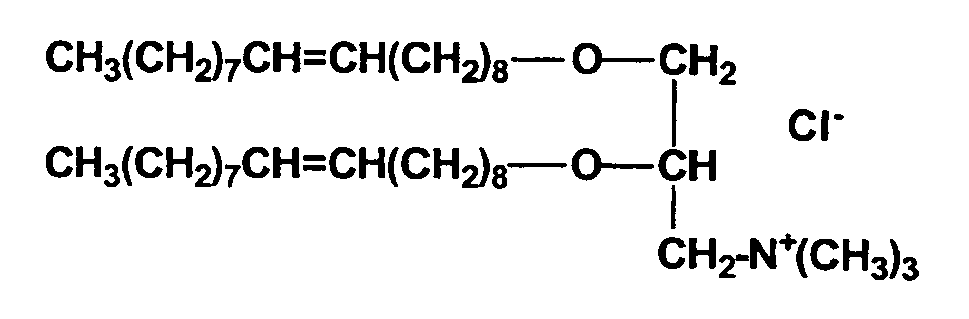
- a well-known cationic lipid is N-[1-(2,3-dioleoyloxy)propyl]-N,N,N-trimethylammonium chloride (DOTMA).
- DOTMA N-[1-(2,3-dioleoyloxy)propyl]-N,N,N-trimethylammonium chloride
- DOPE dioleoylphosphatidylethanolamine
- a DOTMA:DOPE (1:1) formulation is sold under the trade name LIPOFECTIN (Life Technologies, Inc., Rockville, MD).
- DOTAP 1,2-bis(oleoyloxy)-3-3-(trimethylammonia) propane
- DOTAP 1,2-bis(oleoyloxy)-3-3-(trimethylammonia) propane
- a related group of compounds differ from DOTMA and DOTAP in that one of the methyl groups of the trimethylammonium group is replaced by a hydroxyethyl group.
- Compounds of this type are similar to the Rosenthal Inhibitor (RI) of phospholipase A ( Rosenthal, A.F. and Geyer, R.P. (1960) J. Biol. Chem.
- RI stearoyl esters linked to the propylamine core.
- the dioleoyl analogs of RI are commonly abbreviated as DORI-ether and DORI-ester, depending on the linkage of the fatty acid moieties to the propylamine core.
- the hydroxy group can be used as a site for further functionalization.
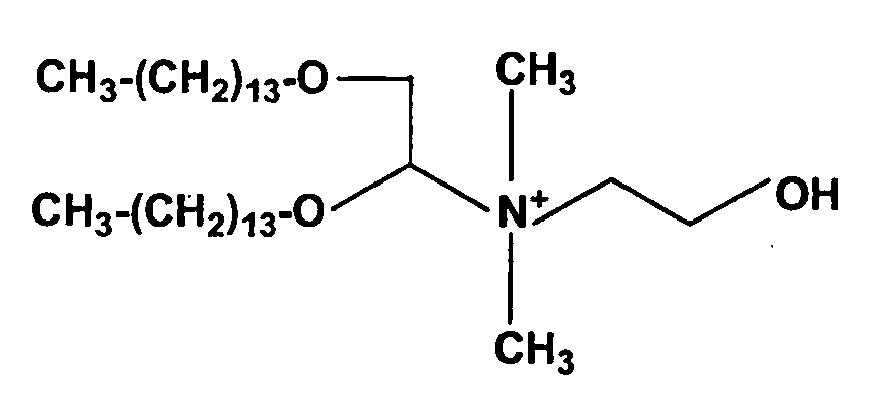
- DMRIE dimyristyloxy analog of RI
- M/M 1:1 DMRIE:cholesterol formulation
- DMRIE-C DMRIE-C
- DOGS DOGS and DPPES have been used to coat plasmids, forming a lipid aggregate complex that provides efficient transfection.
- the compounds are claimed to be more efficient and less toxic than DOTMA for transfection of some cell lines.
- DOGS is available commercially as TRANSFECTAM TM (Promega, Madison, Wis.).
- DOSPA 2,3-di-oleyloxy-N-[2(spermine-carboxamido)ethyl]-N,N-dimethyl-1-propan-aminium
- DOSPA is available as a 3:1 (w/w) formulation with DOPE under the trade name LipofectAMINE (available from Life Technologies, Inc., Rockville, MD).
- DOSPA is available as a 3:1 (w/w) formulation with DOPE under the trade name LipofectAMINE (available from Life Technologies, Inc., Rockville, MD).
- DOSPA 2,3-di-oleyloxy-N-[2(spermine-carboxamido)ethyl]-N,N-dimethyl-1-propan-aminium
- TM-TPS tetramethyltetrapalmityl spermine
- a cationic cholesterol derivative (DC-Chol) has been synthesized and formulated into liposomes in combination with DOPE. ( Gao. X. and Huang, L. (1991) Biochim. Biophys. Res. Comm. 179:280-285 ).
- the compound's structure is: Liposomes formulated with DC-Chol are said to provide more efficient transfection and lower toxicity than DOTMA-containing liposomes for some cell lines.
- Lipopolylysine formed by conjugating polylysine to DOPE, has been reported to be especially effective for transfection in the presence of serum, a condition likely to be encountered in vivo ( Zhou, X. et al. (1991) Biochim. Biophys. Acta 1065: 8-14 ).
- WO 97/42819 describes further types of cationic lipids for transfection of nucleic acids into cells.
- US 5,744,335 describes a method of transfecting a cell with a polynucleotide mixed with one or more amphipathic compounds and a DNA-binding protein such as H1, H2A or H2B.
- Amphipathic compounds described include cationic amphipathic compounds comprising a non-natural polyamine moiety and hydrophobic moiety.
- lipids include tetramethyltetraalkylspermine analogs and DMRIE/cholesterol formulations.
- EP 0846680 describes further cationic lipids for delivery of nucleic acids to cells, particularly guanidino lipids.
- US 5,830,430 describes cationic lipids for delivery of bioactive materials such as nucleic acids and pharmaceuticals to cells, particularly lipids comprising at least two cationic groups.
- WO 98/40502 describes compositions comprising peptides and transfection agents such as cationic lipids and dendrimer polymers for transfecting eukaryotic cells.
- the peptides can be coupled to the transfection agents.
- WO 98/40499 describes methods and compositions for transfecting murine mucosal epithelia with nucleic acid/cationic lipid complexes.
- WO 98/02190 describes cationic amphiphiles that facilitate transport of biologically active molecules, including polynucleotides, into cells.
- the cationic amphiphiles contain lipophilic groups derived from steroids, mono or dialkylamines, alkyl or acyl groups and cationic groups derived from amines, alkylamines or polyalkylamines.
- FR 1567214 describes a detergent for use in washing machines comprising cationic molecules.
- lipid aggregates can be improved by broadening the range of substances which can be delivered to cells.
- the cationic lipid compounds of the present invention have improved function with respect to several of the foregoing attributes.
- the compounds of the invention are useful, either alone or in combination with other lipid aggregate-forming components (e.g., DOPE, DOPC or cholesterol) for formulation into liposomes or other lipid aggregates.
- lipid aggregate-forming components e.g., DOPE, DOPC or cholesterol
- Such aggregates are polycationic, able to form stable complexes with anionic macromolecules, such as nucleic acids.
- anionic macromolecules such as nucleic acids.
- the lipid aggregate macromolecular complex interacts with cells making the polyanionic macromolecule available for absorption and uptake by the cell.
- the present invention provides a lipid aggregate comprising one or more of the compounds of the present invention.
- the lipid aggregate comprises at least one lipid aggregate-forming compound.
- the lipid aggregate-forming compound is selected from the group consisting of DOPE, DOPC and cholesterol.
- the compounds of the present invention may also be conjugated to or mixed with or used in conjunction with a variety of useful molecules and substances such as proteins, peptides, growth factors and the like to enhance cell-targeting, uptake, internalization, nuclear targeting and expression.
- This invention also includes lipid aggregates comprising one or more compounds of the present invention or mixtures thereof. Such lipid aggregates may be combined with one or more aggregrate-forming components and/or transfection enhancers.
- transfection methods disclosed herein employing the compounds or compositions (such as those described above) of the present invention or mixtures thereof can be applied to in vitro transfection of cells, particularly to transfection of eukaryotic cells or tissues including animal cells, human cells, insect cells, plant cells, avian cells, fish cells, mammalian cells and the like.
- the present invention provides a method for introducing a polyanion into a cell or cells, wherein the method comprises forming a liposome from a positively charged compound according to the invention, contacting the liposome with polyanion to form a positively-charged polyanion-liposome complex and incubating the complex with a cell or cells.
- the methods disclosed herein can be used to generate transfected cells or tissues which express useful gene products.
- the methods disclosed herein can also be used as a step in the production of transgenic animals.
- the methods disclosed herein are useful in any therapeutic method requiring introducing of nucleic acids into cells or tissues. In particular, these methods are useful in cancer treatment, in ex vivo gene therapy, and in diagnostic methods. See, for example, U.S. Patent No. 5,589,466 to Felgner, et al..
- the transfection compounds or compositions of this invention can be employed as research reagents in any transfection of cells or tissues done for research purposes.
- Nucleic acids that can be transfected by the methods of this invention include DNA and RNA from any source comprising natural bases or non-natural bases, and include those encoding and capable of expressing therapeutic or otherwise useful proteins in cells or tissues, those which inhibit expression ofnucleic acids in cells or tissues, those which inhibit enzymatic activity or activate enzymes, those which catalyze reactions (ribozymes), and those which function in diagnostic assays.
- nucleic acid vector may be delivered to or into a cell by the present invention.
- a method for introducing a biologically active substance into a cell comprising forming a liposome of a compound according to the invention and a biologically active substance and incubating the liposome with a cell or cell culture.
- the invention also relates to compositions comprising one or more compounds of the invention.
- the invention also relates to compositions comprising one or more compounds of the invention and one or more additional components selected from the group consisting of nucleic acids, a cell, a cell culture, cells, buffers, culture media, biologically active substance, neutral lipids, and transfection enhancers, preferably a nucleic acid.
- transfection kits which include one or more of the compounds or compositions of the present invention or mixtures thereof Particularly, the invention provides a kit comprising one or more of the compounds of the present invention and at least one additional component selected from the group consisting of a cell, cells, a cell culture media, a nucleic acid, a transfection enhancer and instructions fro transfecting a cell or cells.
- the disclosure also relates to intermediates and methods for using such intermediates for making the compounds or compositions of the invention.
- the disclosure also relates to the compositions, compounds or components obtained by the interaction of materials (intermediates, compounds, lipids etc.) used in the synthesis methods of the invention.
- the present invention relates to cationic lipids and compositions of cationic lipids having utility in lipid aggregates for delivery of macromolecules and other compounds into cells.
- the compounds can be used alone or in combination with other compounds to prepare liposomes and other lipid aggregates suitable for transfection or delivery of compounds to target cells in vitro .
- the compounds of the present invention are preferably polycationic and preferably thus form highly stable complexes with various anionic macromolecules, particularlypolyanions such as nucleic acids. These compounds have the property, when dispersed in water, of forming lipid aggregates which associate strongly, via their cationic portion, with polyanions. By using an excess of cationic charges relative to the anionic compound, the polyanion-lipid complexes maybe adsorbed on cell membranes, thereby facilitating uptake of the desired compound by the cells.
- the disclosure also relates to intermediates for preparing the compounds and compositions of the invention.
- the present invention relates to a cationic lipid for transfection which has a greater transfection efficiency than commercially available products in the three most common cell types used in expression research (CHO-K1, COS-7, and HEK293) making it useful for high throughput applications; and which has a simple to use protocol as defined by the fact that no additional reagents are required (e.g., such as LipofectAMINEPLUS Reagent available from Life Technologies, Inc., Rockville, MD), no removal of serum and therefore no media changes are required, and the DNA/lipid complex do not need to be removed from the cells prior to assay.
- a cationic lipid for transfection which has a greater transfection efficiency than commercially available products in the three most common cell types used in expression research (CHO-K1, COS-7, and HEK293) making it useful for high throughput applications; and which has a simple to use protocol as defined by the fact that no additional reagents are required (e.g., such as LipofectAMINEPLUS Reagent available from Life
- the present invention relates to compounds having the hollowing formula: wherein
- the invention provides compounds of the formula : wherein 1 is an integer from 1 to 4 and all other symbols are as defined above.
- the invention provides compounds of the formula : wherein R 7 and R 8 are hydrogen; and all other symbols are as defined above.
- Certain of the compounds of the invention may be insufficiently soluble in physiological media to employ for delivery and transfection methods.
- Those of ordinary skill in the art will appreciate that there are a variety of techniques available in the art to enhance solubility of such compounds in aqueous media. Such methods are readily applicable without undue experimentation to the compounds described herein.
- aryl groups are C 6-24 aryl.
- Typical aryl groups include phenyl, naphthyl, phenanthryl, anthracyl, indenyl, azulenyl, biphenyl, biphenylenyl, fluorenyl, pyrenyl, aceanthrenyl, cholantrenyl and acephenanthrenyl.
- Useful alkyl groups are straight chain or branched C 8-24 alkyl.
- Typical alkyl groups include ethyl, propyl, isopropyl, butyl, sec.-butyl, tert.-butyl, pentyl, hexyl, octyl, decyl, dodecyl, tetradecyl, hexadecyl, octadecyl, eicosyl and docosyl.
- Useful alkenyl groups are straight chain or branched C 8-24 alkenyl.
- Typical alkenyl groups include ethenyl, propenyl, isopropenyl, butenyl, sec.-butenyl, hexenyl, octenyl, decenyl, dodecenyl, especially 9-dodecenyl, tetradecenyl, especially 9-tetradecenyl, hexadecenyl, especially 9-hexadecenyl, octadecenyl, especially 9-octadecenyl, eicosenyl and docosenyl.
- alkynyl groups are straight chain or branched C 8-24 alkynyl.
- Typical alkynyl groups include ethynyl, propynyl, butynyl, hexynyl, octynyl, decynyl, dodecynyl, tetradecynyl, hexadecynyl, octadecynyl, eicosynyl and docosynyl.
- Typical alkyl ether groups include any of the above-mentioned C 2-100 alkyl groups having an ether group.
- An ether group is -O-.
- Typical polyether groups include the -(CHR 14 -CH 2 -O) t -, wherein R 14 is H or a C 1-4 alkyl group and t is an integer as defined above, preferably t is 2 to 5.
- an amide group is an organic radical having -NHC(O)- as a functional group.
- Typical amide groups include alkyl amides, alkenyl amides, alkynyl amides, and aryl amides, wherein alkyl, alkenyl, alkenyl and acryl are as defined above.
- polyamide groups include organic radicals having two or more amide groups as defined above.
- an ester group is an organic radical having -C(O)-O- as a functional group.
- Typical ester groups include R 14 -C(O)-O-R 15 , wherein R 14 and R 15 are alkylene, alkenylene, alkynylene and arylene groups as defined above.
- urea groups are organic radicals having -NH-C(O)-NH- as a functional group.
- Typical urea groups include R 14 NH-C(O)-NHR 14 , R 14 NH-C(O)-NHR 15 , R 14 R 15 N-C(O)-NR 14 R 15 wherein R 14 and R 15 are alkylene, alkenylene, alkynylene and arylene groups as defined above.
- thiourea groups are organic radicals having urea group as defined above wherein the oxygen in the urea group is substituted by sulfur.
- guanidyl groups are organic radicals having -NH-C(NH)-NH- as a functional group.
- Typical guanidyl groups include R 14 NH-C(NH)-NHR 14 , R 14 NH-C(NH)-NHR 15 and R 14 R 15 N-C(NH)-NR 14 R 15 wherein R 14 and R 15 are alkylene, alkenylene, alkynylene and arylene groups as defined above.
- a carbamoyl group is -NH-C(O)-O-.
- carbonate groups typically include organic radicals containing a CO 3 2- radical, i.e., -O-C(O)-O.
- a phosphate group is a PO 4 3- radical.
- a sulfate group is a SO 4 2- radical.
- a sulfoxide group is -S(O)-.
- An imine group is -C(N)-.
- a carbonyl group is -C(O)-.
- a secondary amino group is -NH-.
- aminoalcohol groups are organic radicals having both a secondary amino group as defined above and a hydroxyl group.
- Typical aminoalcohols include aminoethanol, aminopropanol and aminobutanol.
- D is a bond
- Bioly Active Substance refers to any molecule or mixture or complex of molecules that exerts a biological effect in vitro and/or in vivo, including pharmaceuticals, drugs, proteins, peptides, polypeptides, hormones, vitamins, steroids, polyanions, nucleosides, nucleotides, nucleic acids (e.g. DNA or RNA), nucleotides, polynucleotides, etc.
- Cationic Lipids refers to any cationic lipids which may be used for transfection, including but not limited to, DOSPA, DOTMA, DMRIE, DOTAP, DOGS and TM-TPS.
- Cell refers to eukaryotic cells of any type and from any source.
- Types of eukaryotic cells include epithelial, fibroblastic, neuronal, hematopoietic cells and the like from primary cells, tumor cells or immortalized cell lines.
- Sources of such cells include any animal such as human, canine, mouse, hamster, cat, bovine, porcine, monkey, ape, sheep, fish, insect, fungus and any plant including crop plants, ornamentals and trees.
- Delivery is used to denote a process by which a desired compound is transferred to a target cell such that the desired compound is ultimately located inside the target cell or in, or on, the target cell membrane.
- the desired compound is not readily taken up by the target cell and delivery via lipid aggregates is a means for getting the desired compound into the cell.
- delivery to a specific target cell type is preferable and can be facilitated by compounds of the invention.
- Drug refers to any therapeutic or prophylactic agent other than food which is used in the prevention, diagnosis, alleviation, treatment, or cure of disease in man or animal.
- Kit refers to transfection or protein expression kits which include one or more of the compounds of the present invention or mixtures thereof
- kits may comprise a carrying means being compartmentalized to receive in close confinement one or more container means such as vials, test tubes and the like.
- container means such as vials, test tubes and the like.
- Each of such container means comprises components or a mixture of components needed to perform transfection.
- kits may include one or more components selected from nucleic acids (preferably one or more vectors), cells, one or more compounds of the present invention, lipid-aggregate forming compounds, transfection enhancers, biologically active substances, etc.
- Lipid Aggregate is a generic term which includes liposomes of all types both unilamellar and multilameller as well as micelles and more amorphous aggregates of cationic lipids or lipids mixed with amphiphatic lipids such as phospholipids and steroids.
- Lipid Aggregate forming Compounds refers to neutral compounds or lipids such as DOPE, DOPC and cholesterol, etc.
- Target Cell refers to any cell to which a desired compound is delivered, using a lipid aggregate as carrier for the desired compound.
- Transfection is used herein to mean the delivery of nucleic acid, protein or other macromolecule to a target cell, such that the nucleic acid, protein or other macromolecule is expressed or has a biological function in the cell.
- expressible nucleic acid includes both DNA and RNA without regard to molecular weight
- expression means any manifestation of the functional presence of the nucleic acid within the cell including, without limitation, both transient expression and stable expression. Functional aspects include inhibition of expression by oligonucleotides or protein delivery.
- Transfection Enhancers refers generally to molecules and substances such as proteins, peptides, growth factors and the like that enhance cell-targeting, uptake, internalization, nuclear targeting and expression. Such molecules and substances include ligands such as insulin, transferrin, fibronectin that target the cell surface; peptides that target cellular integrin receptors; and other compounds such as Plus Reagent (available from Life Technologies, Inc., Rockville, Maryland). Examples oftransfection enhancers may be found in U.S. Patent No. 5,736,392 and U.S. application Serial No. 09/039,780 filed March 16, 998.
- the invention will be further clarified by the following examples, which are intended to be purely exemplary of the invention.
- the polycationic lipids were prepared by following the general reaction schemes described below.
- Lithium aluminum hydride (8.62 g, 95%, 216 mmol) was carefully added to a suspension of N 1 ,N 4 -dioleoyl-diaminobutane (27.0 g, 43.8 mmol) in 400 ml of anhydrous diethyl ether at 0°C. After addition, the ice bath was removed. The reaction mixture was warmed slowly to room temperature and then heated gently to reflux with an appropriate condensing device and stirred for 16 hours. The reaction mixture was then cooled and quenched carefully at 0°C with 70 mL of a 1 N sodium hydroxide solution. Another 500 mL of diethyl ether was added and the mixture was stirred at room temperature for additional 2 hours.
- the top ether layer turned clear gradually and then separated.
- the aqueous layer was extracted three times with 100 mL of diethyl ether each.
- the combined ether solution was concentrated, and dried on high vacuum overnight. Total of 17.0 g of oily colorless N 1 ,N 4 -dioleyl-diaminobutane was obtained.
- Diisopropylethylamine (11.1 mL, 63.7 mmol) was added to a suspension of N 1 ,N 4 -dioleyl-diaminobutane (15.5 g, 26.3 mmol) and N-(2,3-epoxypropyl)-phthalimide (15.6 g, 76.8 mmol) in 110 mL of dry N,N-dimethylformamide. After purging with nitrogen, the reaction mixture was sealed in a round-bottom flask and heated to around 90°C for 24 hours. N,N-dimethylformamide and diisopropylethylamine were removed and a yellow oil was obtained.
- Polymeric analogs of the present invention can be synthesized by using polymeric amines such as PEI as starting material or dendrimeric polyamines.
- PEI can be acylated with alkyloyl chloride (e.g., oleoyl chloride) and the acylated PEI can then be reduced with lithium aluminum hydride to obtain compounds of the invention.
- alkyloyl chloride e.g., oleoyl chloride
- the compounds of the present invention can be used in the same manner as are prior art compounds such as DOTMA, DOTAP, DOGS, DOSPA and the like.
- Methods for incorporating such cationic lipids into lipid aggregates are well-known in the art. Representative methods are disclosed by Felgner, et al., supra ; Eppstein et al. supra ; Behr et al. supra ; Bangham, A. et al. (1965) M. Mol. Biol. 23:238-252 ; Olson, F. et aL (1979) Biochim. Biophys. Acta 557:9-23 ; Szoka, F. et aL (1978) Proc. Natl. Acad. Sci.
- Microfluidization is used when consistently small (50-204 nm) and relatively uniform aggregates are desired (Mayhew, E., supra ). Aggregates ranging from about 50 nm to about 200 nm diameter are preferred; however, both larger and smaller sized aggregates are functional.
- a number of general parameters are important for optimal efficiency of transfection or delivery. These parameters include, for example, the cationic lipid concentration, the concentration of compound to be delivered, the number of cells transfected, the medium employed for delivery, the length of time the cells are incubated with the polyanion-lipid complex, and the relative amounts of cationic and non-cationic lipid. It may be necessary to optimize these parameters for each particular cell type. Such optimization is routine employing the guidance provided herein and knowledge generally available to the art.
- This example compares transfection of HEK-293 (human embryonic kidney-derived cell line), COS-7 (SV40 transformed monkey cell line), CHO-K1 (Chinese Hamster Ovary-derived cell line), and HeLa (Human cervical carcinoma-derived cell line) cells with the ⁇ -galactosidase reporter plasmid DNA pCMV-SPORT- ⁇ -gal (LifeTechnologies, Rockville, MD) using commercially available cationic lipid transfection reagents and the compounds of the present invention.
- the cells were plated the day before transfection in 24-well tissue culture plates in a total volume of 0.4ml DMEM (Dulbecco's Modified Eagle's Medium, Life Technologies, Rockville, MD) culture medium containing a 1 % non-essential amino acid (NEAA) solution (LifeTechnologies), and 10% FBS.
- DMEM Dulbecco's Modified Eagle's Medium
- NEAA non-essential amino acid
- FBS FBS
- DNA-transfection reagent complexes were prepared as follows:
- the cationic lipid reagents and DNA were diluted separately into 25 ⁇ l aliquots of serum-free DMEM, containing 1% NEAA.
- For LipofectAMINE PLUS 7-14 ⁇ l of PLUS reagent was added to the DNA, mixed, and incubated for 15 minutes at room temperature.
- the diluted DNA was combined with the diluted lipid and incubated at room temperature for at least 15 minutes to allow the DNA and the lipid to form complexes. Following this incubation the complexes were added directly into the culture medium dropwise and mixed by rocking the culture plate back and forth.
- the cells were further incubated at 37°C for a total of 24 hours to allow expression of the lacZ transgene encoded by the reporter plasmid, pCMV-SPORT- ⁇ -gal.
- the growth medium and transfection complexes were removed from the wells, and the cells in each well were rinsed briefly with 1ml of D-PBS (Dulbecco's PBS, Life Technologies, Rockville, MD).
- the cells in each well were lysed by the addition of 0.15 to 2.0 ml of 0.1 % Tris, pH 8.0, containing 0.1 M Triton X-100.
- the plates were frozen at -80°C for a minimum of 2 hours, and thawed at room temperature or 37°C.
- ⁇ -gal activity in transfected cell extracts was calculated against a standard curve and expressed as ng ⁇ -gal per surface area of tissue culture plate (ng/cm 2 ) to reflect total activity per transfection, or as ng ⁇ -gal per ⁇ g of total protein (ng/ ⁇ g) to reflect specific activity.
- HEK-293 ( Figure 1), COS-7 ( Figure 2), CHO-K1 ( Figure 3), and HeLa ( Figure 4) cells were transfected with 0.4 or 0.8 ⁇ g of pCMV•SPORT- ⁇ -gal DNA and 0.2 to 4.0 ⁇ l of transfection reagent.
- the transfection reagents tested were DHDOS (IV) formulated at 2mg/ml with the neutral co-lipid, cholesterol (at a ratio of 1:15 (M/M) DHDOS to cholesterol); DHDOS formulated at 2mg/ml with the neutral co-lipid DOPE (dioleyl phosphatidyl ethanolamine) (at a ratio of 1:1 (M/M)DHDOS to DOPE); LipofectAMINE PLUS (Life Technologies, Rockville MD); and FuGENETM-6 (Boehringer Mannheim, Germany). DHDOS formulations were tested in the range of 0.2 to 1.5 ⁇ l; LipofectAMINE PLUS and FuGENE-6 were tested in the range of 0.2 to 4.0 ⁇ l.
- FuGENE-6 was used according to the manufacturer's recommended protocol.
- DHDOS and LipofectAMINE PLUS were used according to the above protocol.
- the data presented in the Figures are expressed as total activity (ng/cm 2 ) to better compare total expression from the transfected DNA. Only data with 0.8 ⁇ g of DNA is shown, since similar results were obtained with 0.4 and 0.8 ⁇ g of DNA.
Landscapes
- Chemical & Material Sciences (AREA)
- Health & Medical Sciences (AREA)
- Organic Chemistry (AREA)
- Life Sciences & Earth Sciences (AREA)
- Engineering & Computer Science (AREA)
- Bioinformatics & Cheminformatics (AREA)
- General Health & Medical Sciences (AREA)
- Animal Behavior & Ethology (AREA)
- Public Health (AREA)
- Veterinary Medicine (AREA)
- Medicinal Chemistry (AREA)
- Epidemiology (AREA)
- Pharmacology & Pharmacy (AREA)
- Zoology (AREA)
- Genetics & Genomics (AREA)
- Immunology (AREA)
- Gastroenterology & Hepatology (AREA)
- Proteomics, Peptides & Aminoacids (AREA)
- Biotechnology (AREA)
- General Engineering & Computer Science (AREA)
- Biomedical Technology (AREA)
- Wood Science & Technology (AREA)
- Biophysics (AREA)
- Molecular Biology (AREA)
- Endocrinology (AREA)
- Diabetes (AREA)
- Biochemistry (AREA)
- Plant Pathology (AREA)
- Physics & Mathematics (AREA)
- Microbiology (AREA)
- Organic Low-Molecular-Weight Compounds And Preparation Thereof (AREA)
- Medicinal Preparation (AREA)
- Polyamides (AREA)
- Pharmaceuticals Containing Other Organic And Inorganic Compounds (AREA)
- Measuring Or Testing Involving Enzymes Or Micro-Organisms (AREA)
- Micro-Organisms Or Cultivation Processes Thereof (AREA)
- Heterocyclic Carbon Compounds Containing A Hetero Ring Having Nitrogen And Oxygen As The Only Ring Hetero Atoms (AREA)
- Acyclic And Carbocyclic Compounds In Medicinal Compositions (AREA)
- Pyridine Compounds (AREA)
- Hydrogenated Pyridines (AREA)
Abstract
Description
- The present invention relates to cationic lipids and compositions of cationic lipids having utility in lipid aggregates for delivery of macromolecules and other compounds into cells.
- Lipid aggregates such as liposomes have been found to be useful as agents for delivery to introduce macromolecules, such as DNA, RNA, protein, and small chemical compounds such as pharmaceuticals, to cells. In particular, lipid aggregates comprising cationic lipid components have been shown to be especially effective for delivering anionic molecules to cells. In part, the effectiveness of cationic lipids is thought to result from enhanced affinity for cells, many of which bear a net negative charge. Also in part, the net positive charge on lipid aggregates comprising a cationic lipid enables the aggregate to bind polyanions, such as nucleic acids. Lipid aggregates containing DNA are known to be effective agents for efficient transfection of target cells.
- The structure of various types of lipid aggregates varies, depending on composition and method of forming the aggregate. Such aggregates include liposomes, unilamellar vesicles, multilameller vesicles, micelles and the like, having particular sizes in the nanometer to micrometer range. Methods of making lipid aggregates are by now well-known in the art. The main drawback to use of conventional phospholipid-containing liposomes for delivery is that the material to be delivered must be encapsulated and the liposome composition has a net negative charge which is not attracted to the negatively charged cell surface. By combining cationic lipid compounds with a phospholipid, positively charged vesicles and other types of lipid aggregates can bind DNA, which is negatively charged, can be taken up by target cells, and can transfect target cells. (Felgner, P.L. et al. (1987) Proc. Natl. Acad. Sci. USA 84:7413-7417;
Eppstein, D. et al. , U.S. Pat. No. 4,897,355 .) - A well-known cationic lipid is N-[1-(2,3-dioleoyloxy)propyl]-N,N,N-trimethylammonium chloride (DOTMA). The structure of DOTMA is:
- The dimyristyloxy analog of RI is known as DMRIE. A 1:1 (M/M) DMRIE:cholesterol formulation is sold under the tradename DMRIE-C (Life Technologies, Inc., Rockville, MD). The structure of DMRIE is:
- Another class of compounds has been disclosed by Behr et al. (1989) Proc. Natl. Acad. Sci. USA 86:6982-6986;
EPO publication 0 394 111 (Oct. 24, 1990
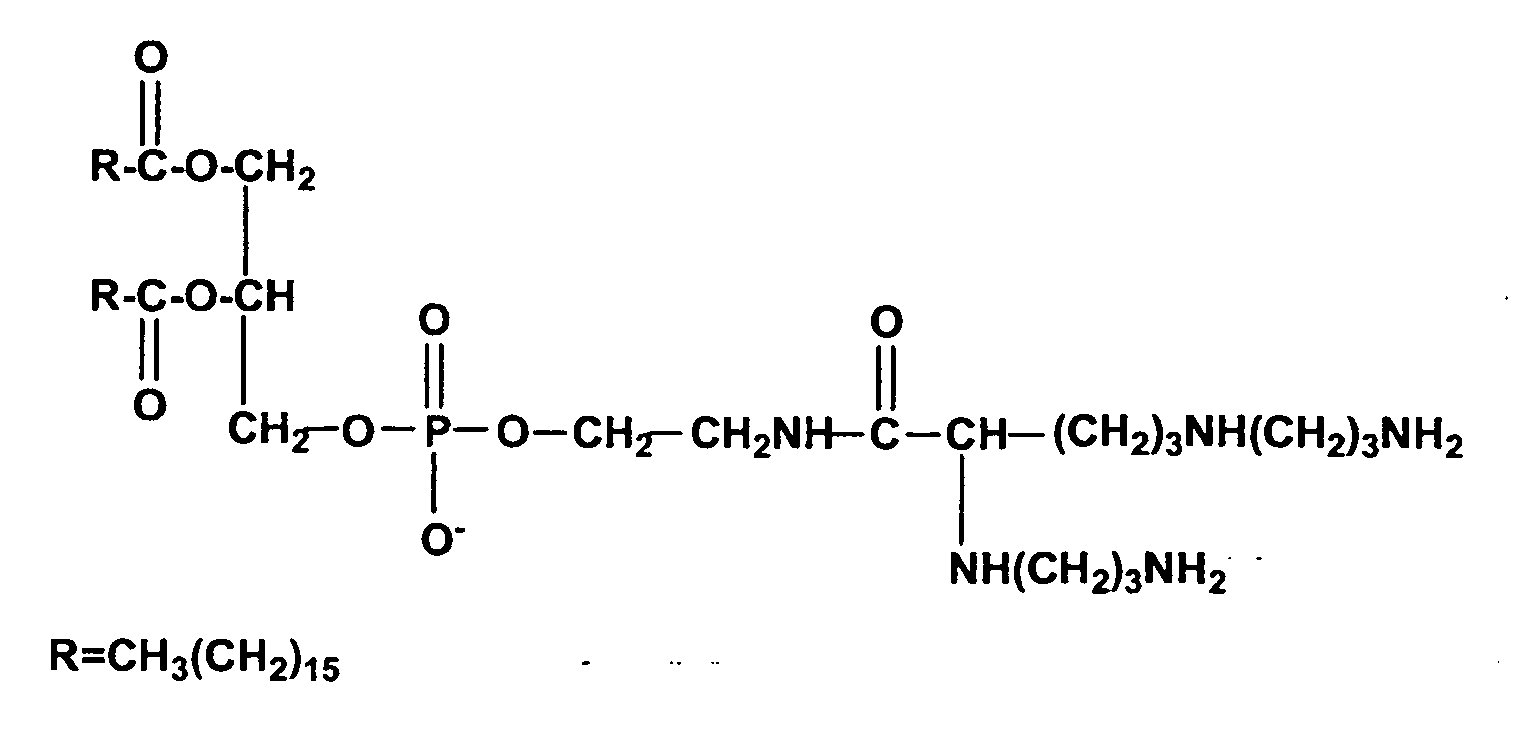
- Both DOGS and DPPES have been used to coat plasmids, forming a lipid aggregate complex that provides efficient transfection. The compounds are claimed to be more efficient and less toxic than DOTMA for transfection of some cell lines. DOGS is available commercially as TRANSFECTAM™ (Promega, Madison, Wis.).
- Another class of compounds has been also described in which carboxy spermine has been conjugated to lipids via an amide bond (
Gebeyehu, G. et al., U.S. Patent No. 5,334,761 ). These compounds are useful for an efficient delivery of nucleic acids into various cells and also are intermediates for making other such lipids. 2,3-di-oleyloxy-N-[2(spermine-carboxamido)ethyl]-N,N-dimethyl-1-propan-aminium (DOSPA) is available as a 3:1 (w/w) formulation with DOPE under the trade name LipofectAMINE (available from Life Technologies, Inc., Rockville, MD). The structure of DOSPA is as follows: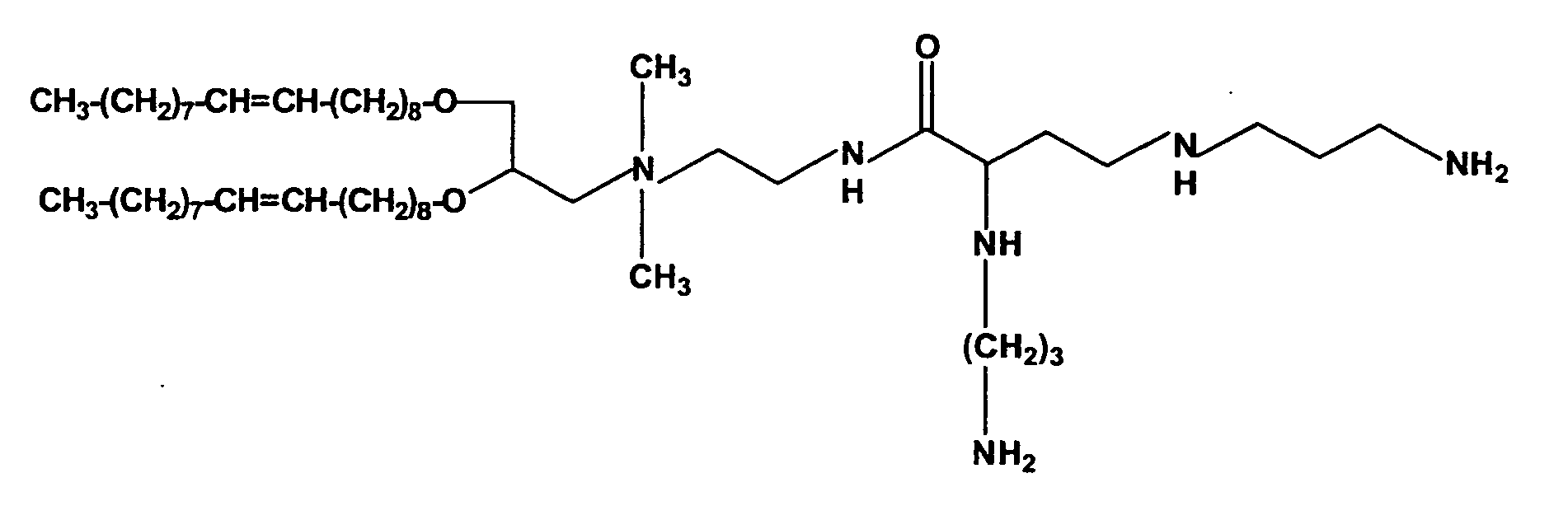
- Lipid compounds with a spermine head group have also been described (
Haces, A., et al., U.S. Patent No. 5,674,908 ). These compounds are especially useful for delivery of nucleic acids into insect cells. A 1:1.5 (M/M) formulation of tetramethyltetrapalmityl spermine (TM-TPS) to DOPE is commercially available under the tradename CellFECTIN (Life-Technologies, Inc., Rockville, MD). The structure of TM-TPS is shown below: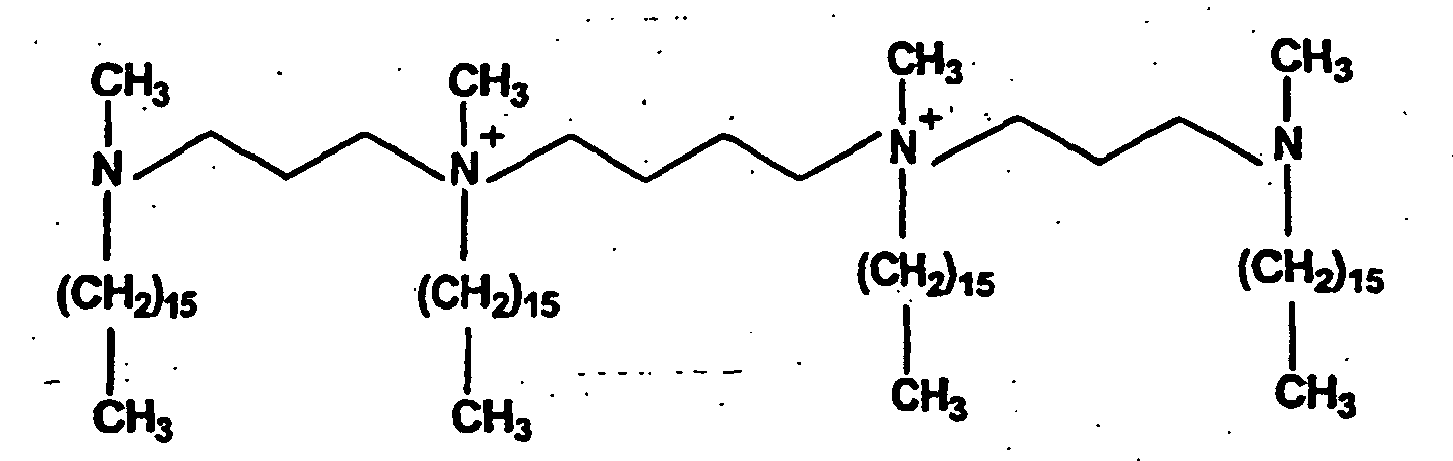
- A cationic cholesterol derivative (DC-Chol) has been synthesized and formulated into liposomes in combination with DOPE. (Gao. X. and Huang, L. (1991) Biochim. Biophys. Res. Comm. 179:280-285). The compound's structure is:
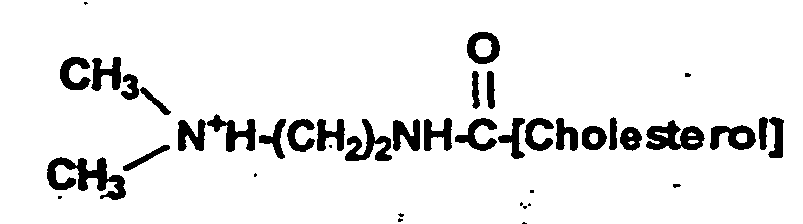
- Lipopolylysine, formed by conjugating polylysine to DOPE, has been reported to be especially effective for transfection in the presence of serum, a condition likely to be encountered in vivo (Zhou, X. et al. (1991) Biochim. Biophys. Acta 1065: 8-14).
-
WO 97/42819 -
US 5,744,335 describes a method of transfecting a cell with a polynucleotide mixed with one or more amphipathic compounds and a DNA-binding protein such as H1, H2A or H2B. Amphipathic compounds described include cationic amphipathic compounds comprising a non-natural polyamine moiety and hydrophobic moiety. - McCluskie et al, Antisense & Nucleic Acid Drug Development (1998), 8(5), pages 401-414, describes direct transfer of DNA into the respiratory system of mice using naked and lipid-formulated DNA. Described lipids include tetramethyltetraalkylspermine analogs and DMRIE/cholesterol formulations.
-
EP 0846680 describes further cationic lipids for delivery of nucleic acids to cells, particularly guanidino lipids. -
US 5,830,430 describes cationic lipids for delivery of bioactive materials such as nucleic acids and pharmaceuticals to cells, particularly lipids comprising at least two cationic groups. -
WO 98/40502 -
WO 98/40499 -
WO 98/02190 -
FR 1567214 - Despite advances in the field, a need remains for a variety of improved cationic lipid compounds. In particular, no single cationic lipid to date has been found to work well with all cell types. Since different cell types differ from one another in membrane composition, it is not surprising that different compositions and types of lipid aggregates are effective for different cell types, either for their ability to contact and fuse with target cell membranes, or for aspects of the transfer process itself. At present these processes are not well understood, consequently the design of effective liposomal precursors is largely empirical. Besides content and transfer, other factors are of importance, for example, ability to form lipid aggregates suited to the intended purpose, the possibility of transfecting cells in the presence of serum, toxicity to the target cell, stability as a carrier for the compound to be delivered, and ability to function in an in vivo environment. In addition, lipid aggregates can be improved by broadening the range of substances which can be delivered to cells. The cationic lipid compounds of the present invention have improved function with respect to several of the foregoing attributes.
- A compound having the formula:
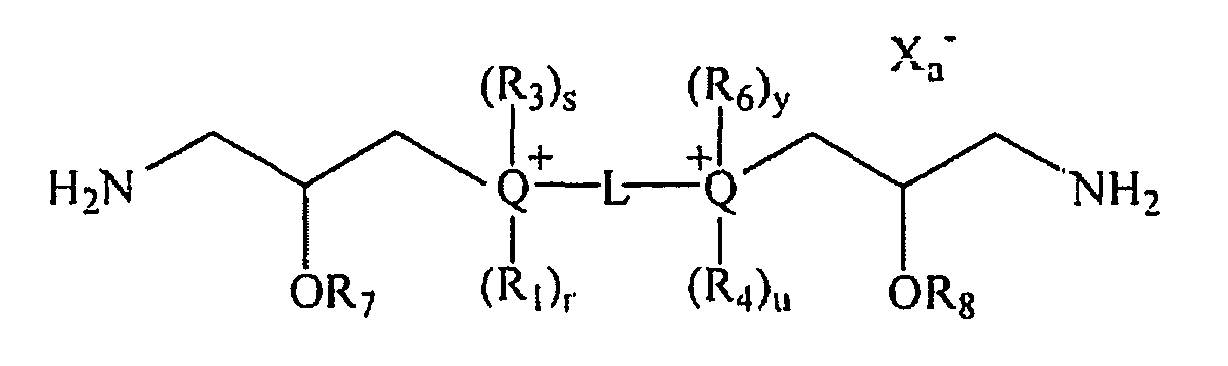
- Q is N;
- L is a bivalent organic radical capable of linking each Q;
- R1, R3, R4 and R6, independently of one another, are selected from the group consisting of H and C8 - C24 alkenyl, C8 - C24 aryl, and C8 - C24 alkyl optionally substituted by one or more of an alcohol, an amine, an amide, an ether, a polyether, a polyamide, an ester, a mercaptan, a urea, a thiourea, a guanidyl, or a carbamoyl group;
- and wherein at least one of R1, R3, R4 and R6 is a straight chain or branched alkyl or aklenyl group or an aryl group;
- X- is a physiologically acceptable anion;
- a is the number of positive charge divided by the valence of X;
- r, s, u and y are 0 or 1, provided that the valency requirements of nitrogen are satisfied; and
- R7 and R8 are H.
- The compounds of the invention are useful, either alone or in combination with other lipid aggregate-forming components (e.g., DOPE, DOPC or cholesterol) for formulation into liposomes or other lipid aggregates. Such aggregates are polycationic, able to form stable complexes with anionic macromolecules, such as nucleic acids. The lipid aggregate macromolecular complex interacts with cells making the polyanionic macromolecule available for absorption and uptake by the cell.
- The present invention provides a lipid aggregate comprising one or more of the compounds of the present invention. Preferably, the lipid aggregate comprises at least one lipid aggregate-forming compound. Preferably, the lipid aggregate-forming compound is selected from the group consisting of DOPE, DOPC and cholesterol.
- The compounds of the present invention may also be conjugated to or mixed with or used in conjunction with a variety of useful molecules and substances such as proteins, peptides, growth factors and the like to enhance cell-targeting, uptake, internalization, nuclear targeting and expression.
- This invention also includes lipid aggregates comprising one or more compounds of the present invention or mixtures thereof. Such lipid aggregates may be combined with one or more aggregrate-forming components and/or transfection enhancers.
- The transfection methods disclosed herein employing the compounds or compositions (such as those described above) of the present invention or mixtures thereof can be applied to in vitro transfection of cells, particularly to transfection of eukaryotic cells or tissues including animal cells, human cells, insect cells, plant cells, avian cells, fish cells, mammalian cells and the like.
- Accordingly, the present invention provides a method for introducing a polyanion into a cell or cells, wherein the method comprises forming a liposome from a positively charged compound according to the invention, contacting the liposome with polyanion to form a positively-charged polyanion-liposome complex and incubating the complex with a cell or cells.
- The methods disclosed herein can be used to generate transfected cells or tissues which express useful gene products. The methods disclosed herein can also be used as a step in the production of transgenic animals. The methods disclosed herein are useful in any therapeutic method requiring introducing of nucleic acids into cells or tissues. In particular, these methods are useful in cancer treatment, in ex vivo gene therapy, and in diagnostic methods. See, for example,
U.S. Patent No. 5,589,466 to Felgner, et al.. - The transfection compounds or compositions of this invention can be employed as research reagents in any transfection of cells or tissues done for research purposes. Nucleic acids that can be transfected by the methods of this invention include DNA and RNA from any source comprising natural bases or non-natural bases, and include those encoding and capable of expressing therapeutic or otherwise useful proteins in cells or tissues, those which inhibit expression ofnucleic acids in cells or tissues, those which inhibit enzymatic activity or activate enzymes, those which catalyze reactions (ribozymes), and those which function in diagnostic assays.
- The compounds, compositions and methods provided herein can also be readily adapted in view of the disclosure herein to introduce biologically active macromolecules or subtances other than nucleic acids, including, among others, polyamines, polyamine acids, polypeptides, proteins, biotin, and polysaccharides into cells. Other useful materials for example, therapeutic agents, diagnostic materials and research reagents, can be introduced into cells by the methods of this disclosure. In a preferred aspect, any nucleic acid vector may be delivered to or into a cell by the present invention.
- Accordingly, there is disclosed a method for introducing a biologically active substance into a cell, wherein the method comprises forming a liposome of a compound according to the invention and a biologically active substance and incubating the liposome with a cell or cell culture.
- The invention also relates to compositions comprising one or more compounds of the invention.
- The invention also relates to compositions comprising one or more compounds of the invention and one or more additional components selected from the group consisting of nucleic acids, a cell, a cell culture, cells, buffers, culture media, biologically active substance, neutral lipids, and transfection enhancers, preferably a nucleic acid.
- This invention also includes transfection kits which include one or more of the compounds or compositions of the present invention or mixtures thereof Particularly, the invention provides a kit comprising one or more of the compounds of the present invention and at least one additional component selected from the group consisting of a cell, cells, a cell culture media, a nucleic acid, a transfection enhancer and instructions fro transfecting a cell or cells.
- The disclosure also relates to intermediates and methods for using such intermediates for making the compounds or compositions of the invention. The disclosure also relates to the compositions, compounds or components obtained by the interaction of materials (intermediates, compounds, lipids etc.) used in the synthesis methods of the invention.
- Other preferred embodiments of the present invention will be apparent to one of ordinary skill in the art in view of the following drawings and description of the invention.
-
- Figure 1 is a graph showing the transfection of HEK-293 cells with cationic transfection reagents.
- Figure 2 is a graph showing transfection ofCOS-7 cells with cationic transfection reagents.
- Figure 3 is a graph showing transfection of CHO-K1 cells with cationic transfection reagents.
- Figure 4 is a graph showing transfection of HeLa cells with cationic transfection reagents.
- The present invention relates to cationic lipids and compositions of cationic lipids having utility in lipid aggregates for delivery of macromolecules and other compounds into cells. The compounds can be used alone or in combination with other compounds to prepare liposomes and other lipid aggregates suitable for transfection or delivery of compounds to target cells in vitro.
- The compounds of the present invention are preferably polycationic and preferably thus form highly stable complexes with various anionic macromolecules, particularlypolyanions such as nucleic acids. These compounds have the property, when dispersed in water, of forming lipid aggregates which associate strongly, via their cationic portion, with polyanions. By using an excess of cationic charges relative to the anionic compound, the polyanion-lipid complexes maybe adsorbed on cell membranes, thereby facilitating uptake of the desired compound by the cells.
- The disclosure also relates to intermediates for preparing the compounds and compositions of the invention.
- More specifically, the present invention relates to a cationic lipid for transfection which has a greater transfection efficiency than commercially available products in the three most common cell types used in expression research (CHO-K1, COS-7, and HEK293) making it useful for high throughput applications; and which has a simple to use protocol as defined by the fact that no additional reagents are required (e.g., such as LipofectAMINEPLUS Reagent available from Life Technologies, Inc., Rockville, MD), no removal of serum and therefore no media changes are required, and the DNA/lipid complex do not need to be removed from the cells prior to assay.
- In one aspect, the present invention relates to compounds having the hollowing formula:

- Q is N;
- L is a bivalent organic radical capable of linking each Q;
- R1, R3, R4, and R6, independently of one another, are selected from the group consisting of H and C8 - C24 alkenyl, C8 - C24 aryl, and C8 - C24 alkyl optionally substituted by one or more of an alcohol, an amine, an amide, an ether, a polyether, a polyamide, an ester, a mercaptan, a urea, a thiourea, a guanidyl, or a carbamoyl group;
- and wherein at least one of R1, R3, R4, and R6 is a straight chain or branched alkyl or alkenyl group or an aryl group;
- r, s, u and y are 0 or 1, provided that the valency requirements of nitrogen are satisfied;
- R7 and R8 are H;
- X- is a physiologically acceptable anion; and
- a is the number of positive charge divided by the valence of X.
- In one embodiment, the invention provides compounds of the formula :

- In a related embodiment, the invention provides compounds of the formula :

- Specific compounds within the scope of the invention include the following examples. R7 and R8 in the formulae H.

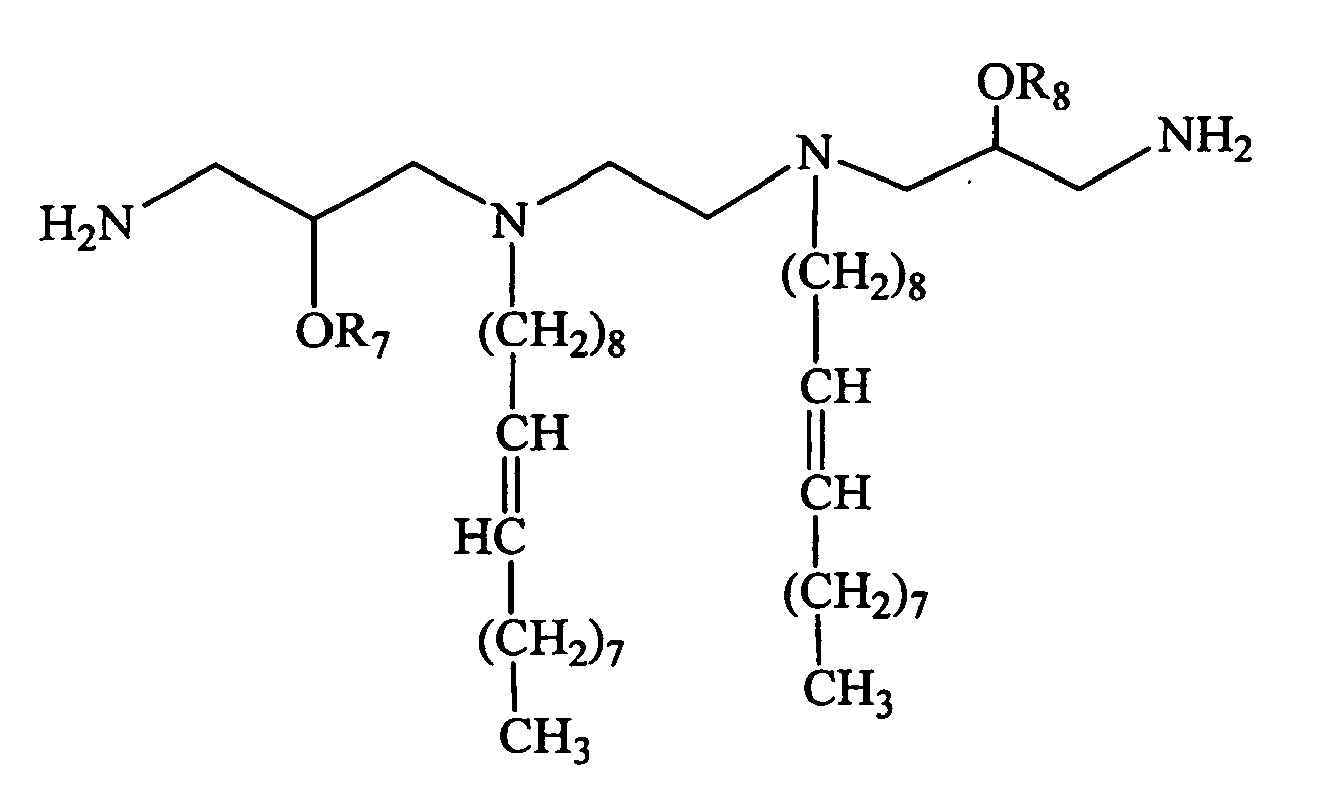
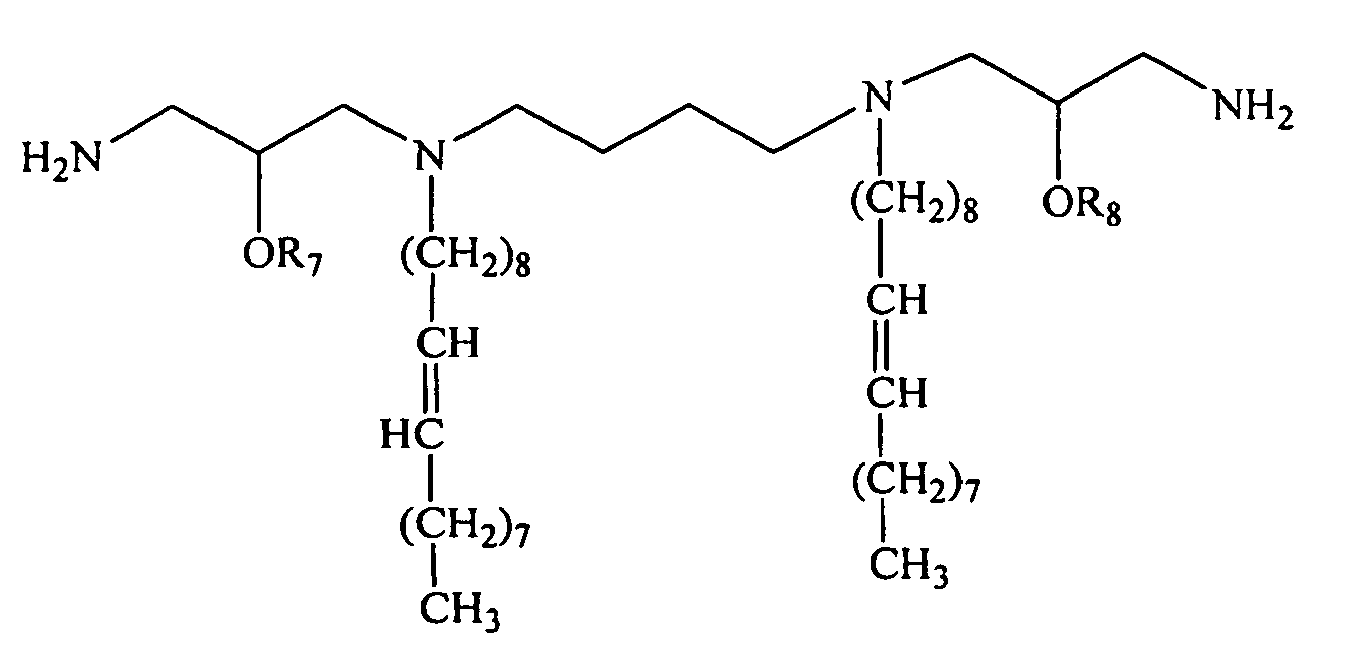
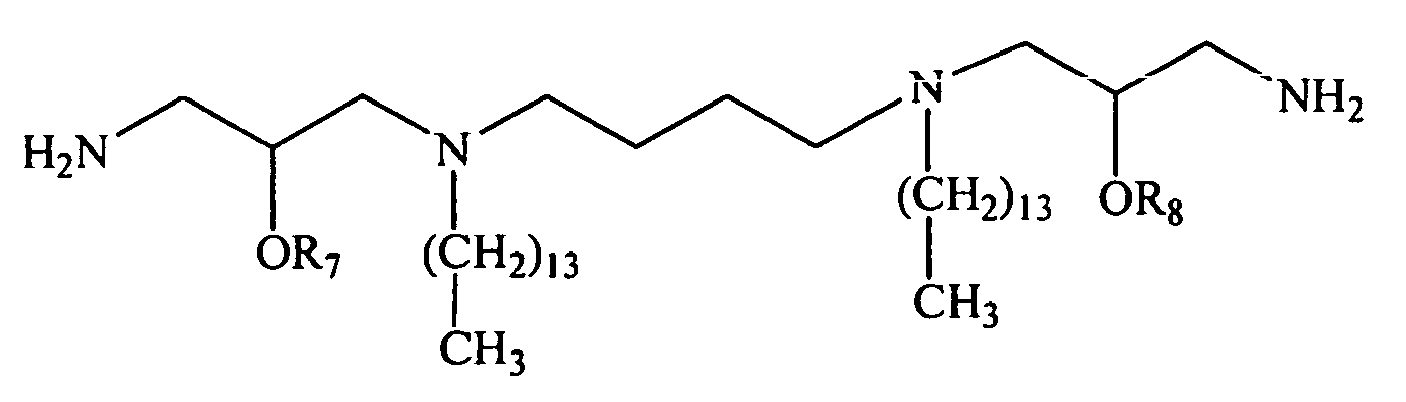
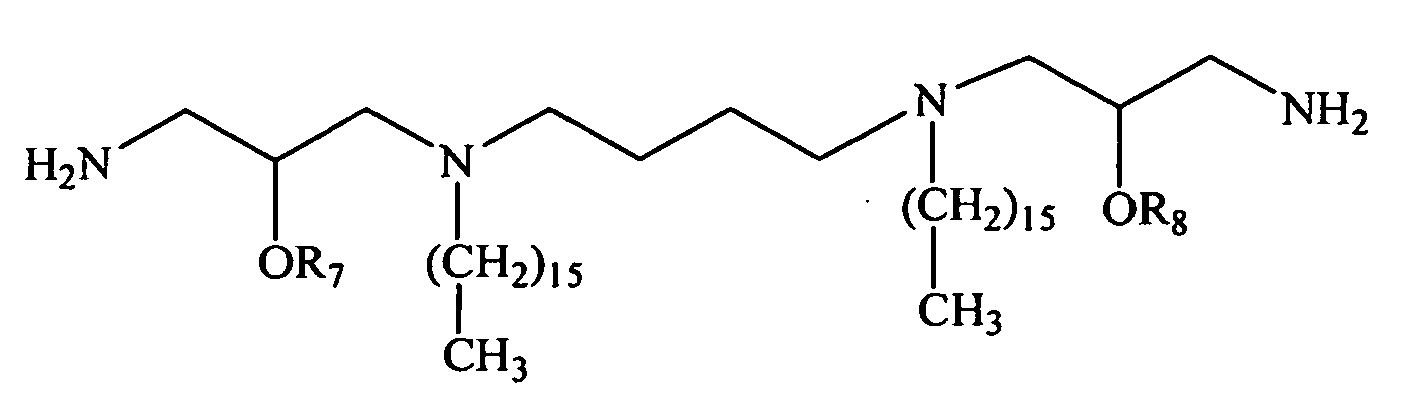

- Certain of the compounds of the invention may be insufficiently soluble in physiological media to employ for delivery and transfection methods. Those of ordinary skill in the art will appreciate that there are a variety of techniques available in the art to enhance solubility of such compounds in aqueous media. Such methods are readily applicable without undue experimentation to the compounds described herein.
- Useful aryl groups are C6-24 aryl. Typical aryl groups include phenyl, naphthyl, phenanthryl, anthracyl, indenyl, azulenyl, biphenyl, biphenylenyl, fluorenyl, pyrenyl, aceanthrenyl, cholantrenyl and acephenanthrenyl.
- Useful alkyl groups are straight chain or branched C8-24 alkyl. Typical alkyl groups include ethyl, propyl, isopropyl, butyl, sec.-butyl, tert.-butyl, pentyl, hexyl, octyl, decyl, dodecyl, tetradecyl, hexadecyl, octadecyl, eicosyl and docosyl.
- Useful alkenyl groups are straight chain or branched C8-24 alkenyl. Typical alkenyl groups include ethenyl, propenyl, isopropenyl, butenyl, sec.-butenyl, hexenyl, octenyl, decenyl, dodecenyl, especially 9-dodecenyl, tetradecenyl, especially 9-tetradecenyl, hexadecenyl, especially 9-hexadecenyl, octadecenyl, especially 9-octadecenyl, eicosenyl and docosenyl.
- Useful alkynyl groups are straight chain or branched C8-24 alkynyl. Typical alkynyl groups include ethynyl, propynyl, butynyl, hexynyl, octynyl, decynyl, dodecynyl, tetradecynyl, hexadecynyl, octadecynyl, eicosynyl and docosynyl.
- Typical alkyl ether groups include any of the above-mentioned C2-100 alkyl groups having an ether group.
- An ether group is -O-.
- Typical polyether groups include the -(CHR14-CH2-O)t-, wherein R14 is H or a C1-4 alkyl group and t is an integer as defined above, preferably t is 2 to 5.
- For the purposes of the invention an amide group is an organic radical having -NHC(O)- as a functional group. Typical amide groups include alkyl amides, alkenyl amides, alkynyl amides, and aryl amides, wherein alkyl, alkenyl, alkenyl and acryl are as defined above.
- Typically polyamide groups include organic radicals having two or more amide groups as defined above.
- Typically an ester group is an organic radical having -C(O)-O- as a functional group. Typical ester groups include R14-C(O)-O-R15, wherein R14 and R15 are alkylene, alkenylene, alkynylene and arylene groups as defined above.
- Typically urea groups are organic radicals having -NH-C(O)-NH- as a functional group. Typical urea groups include R14NH-C(O)-NHR14, R14NH-C(O)-NHR15, R14R15N-C(O)-NR14R15 wherein R14 and R15 are alkylene, alkenylene, alkynylene and arylene groups as defined above.
- Typically thiourea groups are organic radicals having urea group as defined above wherein the oxygen in the urea group is substituted by sulfur.
- Typically guanidyl groups are organic radicals having -NH-C(NH)-NH- as a functional group. Typical guanidyl groups include R14NH-C(NH)-NHR14, R14NH-C(NH)-NHR15 and R14R15N-C(NH)-NR14R15 wherein R14 and R15 are alkylene, alkenylene, alkynylene and arylene groups as defined above.
- A carbamoyl group is -NH-C(O)-O-.
- Typically carbonate groups include organic radicals containing a CO3 2- radical, i.e., -O-C(O)-O.
- A phosphate group is a PO4 3- radical.
- A sulfate group is a SO4 2- radical.
- A sulfoxide group is -S(O)-.
- An imine group is -C(N)-.
- A carbonyl group is -C(O)-.
- A secondary amino group is -NH-.
- Typically aminoalcohol groups are organic radicals having both a secondary amino group as defined above and a hydroxyl group. Typical aminoalcohols include aminoethanol, aminopropanol and aminobutanol.
- The definition "D is a bond" means that when D is not Q there is a single bond between (CH2)p and Z.
- Biologically Active Substance refers to any molecule or mixture or complex of molecules that exerts a biological effect in vitro and/or in vivo, including pharmaceuticals, drugs, proteins, peptides, polypeptides, hormones, vitamins, steroids, polyanions, nucleosides, nucleotides, nucleic acids (e.g. DNA or RNA), nucleotides, polynucleotides, etc.
- Cationic Lipids refers to any cationic lipids which may be used for transfection, including but not limited to, DOSPA, DOTMA, DMRIE, DOTAP, DOGS and TM-TPS.
- Cell refers to eukaryotic cells of any type and from any source. Types of eukaryotic cells include epithelial, fibroblastic, neuronal, hematopoietic cells and the like from primary cells, tumor cells or immortalized cell lines. Sources of such cells include any animal such as human, canine, mouse, hamster, cat, bovine, porcine, monkey, ape, sheep, fish, insect, fungus and any plant including crop plants, ornamentals and trees.
- Delivery is used to denote a process by which a desired compound is transferred to a target cell such that the desired compound is ultimately located inside the target cell or in, or on, the target cell membrane. In many uses of the compounds of the invention, the desired compound is not readily taken up by the target cell and delivery via lipid aggregates is a means for getting the desired compound into the cell. In certain uses delivery to a specific target cell type is preferable and can be facilitated by compounds of the invention.
- Drug refers to any therapeutic or prophylactic agent other than food which is used in the prevention, diagnosis, alleviation, treatment, or cure of disease in man or animal.
- Kit refers to transfection or protein expression kits which include one or more of the compounds of the present invention or mixtures thereof Such kits may comprise a carrying means being compartmentalized to receive in close confinement one or more container means such as vials, test tubes and the like. Each of such container means comprises components or a mixture of components needed to perform transfection. Such kits may include one or more components selected from nucleic acids (preferably one or more vectors), cells, one or more compounds of the present invention, lipid-aggregate forming compounds, transfection enhancers, biologically active substances, etc.
- Lipid Aggregate is a generic term which includes liposomes of all types both unilamellar and multilameller as well as micelles and more amorphous aggregates of cationic lipids or lipids mixed with amphiphatic lipids such as phospholipids and steroids.
- Lipid Aggregate forming Compounds refers to neutral compounds or lipids such as DOPE, DOPC and cholesterol, etc.
- Target Cell refers to any cell to which a desired compound is delivered, using a lipid aggregate as carrier for the desired compound.
- Transfection is used herein to mean the delivery of nucleic acid, protein or other macromolecule to a target cell, such that the nucleic acid, protein or other macromolecule is expressed or has a biological function in the cell. The term "expressible nucleic acid" includes both DNA and RNA without regard to molecular weight, and the term "expression" means any manifestation of the functional presence of the nucleic acid within the cell including, without limitation, both transient expression and stable expression. Functional aspects include inhibition of expression by oligonucleotides or protein delivery.
- Transfection Enhancers refers generally to molecules and substances such as proteins, peptides, growth factors and the like that enhance cell-targeting, uptake, internalization, nuclear targeting and expression. Such molecules and substances include ligands such as insulin, transferrin, fibronectin that target the cell surface; peptides that target cellular integrin receptors; and other compounds such as Plus Reagent (available from Life Technologies, Inc., Rockville, Maryland). Examples oftransfection enhancers may be found in
U.S. Patent No. 5,736,392 andU.S. application Serial No. 09/039,780 filed March 16, 998. - The invention will be further clarified by the following examples, which are intended to be purely exemplary of the invention. The polycationic lipids were prepared by following the general reaction schemes described below.
- A solution of 1,4-diaminobutane (4.28 g, 48.6 mmol) and triethylamine (20.4 ml, 146 mmol) in 10 mL of dry methylene chloride was slowly added to a solution of oleoyl chloride (30.0 g, 99.7 mmol) in 300 ml of anhydrous methylene chloride in an ice bath at 0°C. The reaction mixture was stirred vigorously with a mechanical stirrer. After the addition was complete, the ice bath was removed and the mixture was stirred at room temperature for 2.5 days. TLC analysis confirmed that the reaction had gone to completion and the product had precipitated. The excess oleoyl chloride was removed by filtration. The precipitate was washed twice with 50 ml of methylene chloride. The mother liquor was concentrated and more product precipitated. This precipitate was filtered and combined with the previous precipitate. The resulting solid was vacuum dried for 4 hours. A total of 27.0 g of a white solid of the desired product, N1,N4-dioleoyl-diaminobutane, was obtained.
- Lithium aluminum hydride (8.62 g, 95%, 216 mmol) was carefully added to a suspension of N1,N4-dioleoyl-diaminobutane (27.0 g, 43.8 mmol) in 400 ml of anhydrous diethyl ether at 0°C. After addition, the ice bath was removed. The reaction mixture was warmed slowly to room temperature and then heated gently to reflux with an appropriate condensing device and stirred for 16 hours. The reaction mixture was then cooled and quenched carefully at 0°C with 70 mL of a 1 N sodium hydroxide solution. Another 500 mL of diethyl ether was added and the mixture was stirred at room temperature for additional 2 hours. The top ether layer turned clear gradually and then separated. The aqueous layer was extracted three times with 100 mL of diethyl ether each. The combined ether solution was concentrated, and dried on high vacuum overnight. Total of 17.0 g of oily colorless N1,N4-dioleyl-diaminobutane was obtained.
- Diisopropylethylamine (11.1 mL, 63.7 mmol) was added to a suspension of N1,N4-dioleyl-diaminobutane (15.5 g, 26.3 mmol) and N-(2,3-epoxypropyl)-phthalimide (15.6 g, 76.8 mmol) in 110 mL of dry N,N-dimethylformamide. After purging with nitrogen, the reaction mixture was sealed in a round-bottom flask and heated to around 90°C for 24 hours. N,N-dimethylformamide and diisopropylethylamine were removed and a yellow oil was obtained. This crude material was recrystallized from ethanol A total of 18.6 g of a white solid, N1,N4-dioleyl-N1,N4-di-[2-hydroxy-3-(N-phthalamido)propyl]-diamino-butane was obtained.
- Hydrazine (4.0 mL, 80% aq., 103 mmol) was added to a suspension of N1,N4-dioleyl-N1,N4-di-[2-hydroxy-3-(N-phthalamido)propyl]-diaminobutane (17.0 g, 17.1 mmol) in 250 mL of dry ethanol at room temperature. With an appropriate condensing device, the reaction mixture was heated to a reflux, at which point the suspension turned into a clear solution. The oil bath was set to 85°C. After 45 minutes a white solid precipitated from the solution. The reaction mixture was stirred at reflux for 4 hours before being cooled to -20°C. The white solid settled down to the bottom. The top clear ethanol solution was decanted. The residue was washed twice with cold ethanol. The combined ethanol solution was concentrated and dried overnight over vacuum. 12.4 g of oily N1,N4-dioleyl-N1,N4-di-[2-hydroxy-3-(N-aminopropyl)]-diaminobutane was obtained.
- The following compounds were synthesized by the above method using the corresponding diamine and a long chain acyl chloride:
- N1,N4-dimyristyl-N1,N4-di-[2-hydroxy-3-(N-aminopropyl)]-diaminobutane;
- N1,N4-dipalmityl-N1,N4-di-[2-hydroxy-3-(N-aminopropyl)]-diaminobutane;
- N1,N4-dipalmitolyl-N1,N4-di-[2-hydroxy-3-(N-aminopropyl)]-diaminobutane;
- N1,N4-distearyl-N1,N4-di-[2-hydroxy-3-(N-aminopropyl)]-diaminobutane;
- N1,N4-dilauryl-N1,N4-di-[2-hydroxy-3-(N-aminopropyl)]-diaminobutane;
- N1,N2-dimyristyl-N1,N2-di-[2-hydroxy-3-(N-aminopropyl)]-diaminoethane;
- N1,N2-dipalmityl-N1,N2-di-[2-hydroxy-3-(N-aminopropyl)]-diaminoethane;
- N1,N2-dipalmitoyl-N1,N2-di-[2-hydroxy-3-(N-aminopropyl)]-diaminoethane;
- N1,N2-distearyl-N1,N2-di-[2-hydroxy-3-(N-aminopropyl)]-diaminoethane;
- N1,N2-dilauryl-N1,N2-di-[2-hydroxy-3-(N-aminopropyl)]-diaminoethane;
- N1,N2-dioleyl-N1,N2-di-[2-hydroxy-3-(N-aminopropyl)]-diaminoethane;
- N1,N9-dimyristyl-N1,N9-di-[2-hydroxy-3-(N-aminopropyl)]-Jeffamine;
- N1,N9-dipalmityl-N1,N9-di-[2-hydroxy-3-(N-aminopropyl)]-Jeffamine;
- N1,N9-dipalmitolyl-N1,N9-di-[2-hydroxy-3-(N-aminopropyl)]-Jeffamine;
- N1,N9-distearyl-N1,N9-di-[2-hydroxy-3-(N-aminopropyl)]-Jeffamine;
- N1,N9-dilauryl-N1,N9-di-[2-hydroxy-3-(N-aminopropyl)]-Jeffamine;
- N1,N9-dioleyl-N1,N9-di-[2-hydroxy-3-(N-aminopropyl)]-Jeffamine.
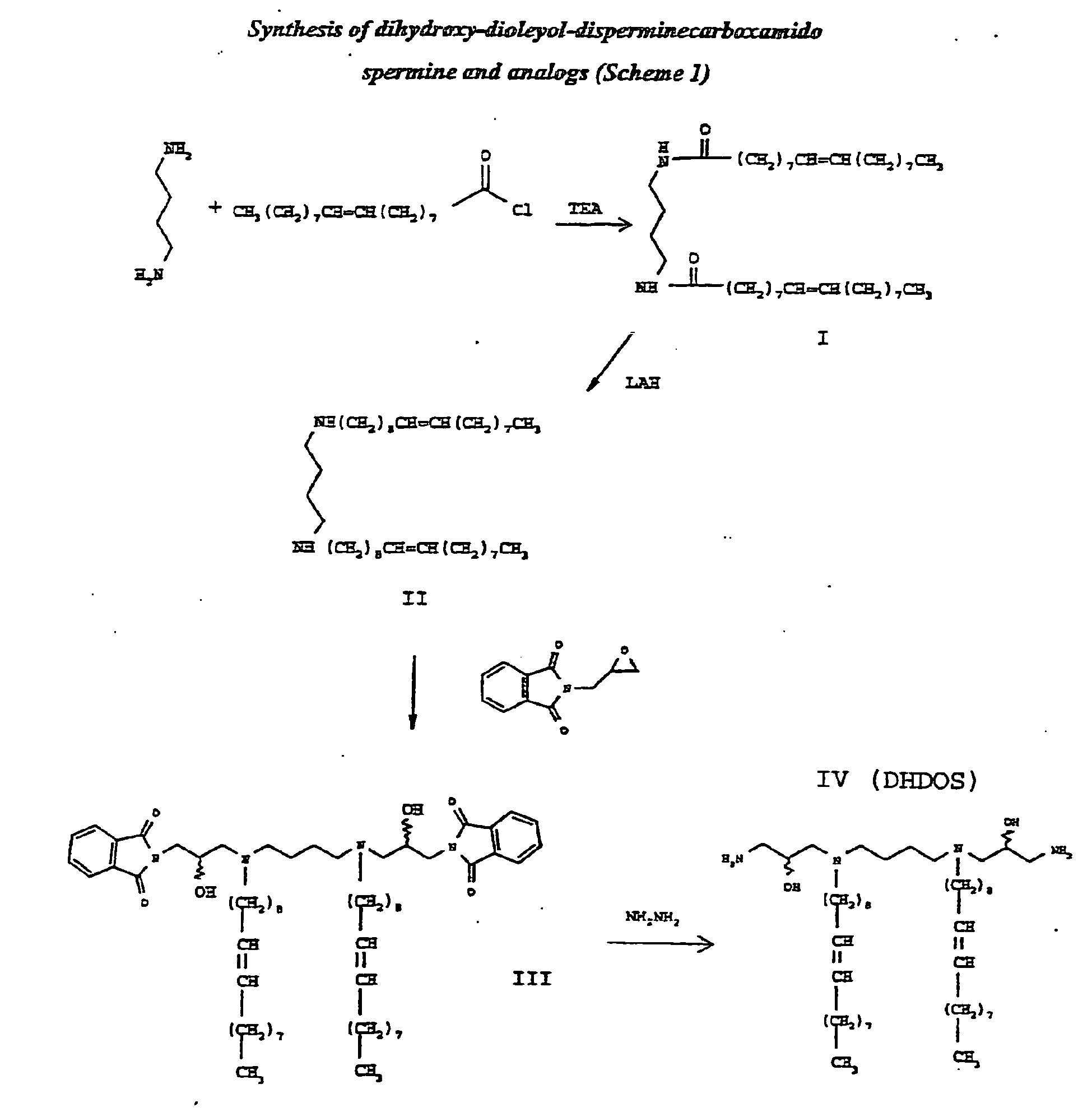
- Polymeric analogs of the present invention can be synthesized by using polymeric amines such as PEI as starting material or dendrimeric polyamines. For example, PEI can be acylated with alkyloyl chloride (e.g., oleoyl chloride) and the acylated PEI can then be reduced with lithium aluminum hydride to obtain compounds of the invention.
- Although the above methods exemplifies the synthesis of specific compounds, the reaction schemes provide a general method for preparing a variety of compounds according to the present invention. Those of ordinary skill in the art will appreciate that alternate methods and reagents other than those specifically detailed herein can be employed or readily adapted to produce compounds of the invention.
- The compounds of the present invention can be used in the same manner as are prior art compounds such as DOTMA, DOTAP, DOGS, DOSPA and the like. Methods for incorporating such cationic lipids into lipid aggregates are well-known in the art. Representative methods are disclosed by Felgner, et al., supra; Eppstein et al. supra; Behr et al. supra; Bangham, A. et al. (1965) M. Mol. Biol. 23:238-252; Olson, F. et aL (1979) Biochim. Biophys. Acta 557:9-23; Szoka, F. et aL (1978) Proc. Natl. Acad. Sci. USA 75:4194-4198; Mayhew, E. et al. (1984) Biochim. Biophys. Acta 775:169-175; Kim, S. et al. (1983) Biochim. Biophys. Acta 728: 339-348; and Fukunaga, M. et al. (1984) Endocrinol. 115:757-761. Techniques for preparing lipid aggregates of appropriate size for use as delivery vehicles include sonication and freeze-thaw plus extrusion as perhaps the most commonly used. See, e.g., Mayer, L. et al. (1986) Biochim. Biophys. Acta 858:161-168. Microfluidization is used when consistently small (50-204 nm) and relatively uniform aggregates are desired (Mayhew, E., supra). Aggregates ranging from about 50 nm to about 200 nm diameter are preferred; however, both larger and smaller sized aggregates are functional.
- Methods of transfection and delivery of other compounds are well-known in the art. The compounds and compositions of the present invention yield lipid aggregates that can be used in the same processes used for other known transfection agents.
- It will be readily apparent to those of ordinary skill in the art that a number of general parameters are important for optimal efficiency of transfection or delivery. These parameters include, for example, the cationic lipid concentration, the concentration of compound to be delivered, the number of cells transfected, the medium employed for delivery, the length of time the cells are incubated with the polyanion-lipid complex, and the relative amounts of cationic and non-cationic lipid. It may be necessary to optimize these parameters for each particular cell type. Such optimization is routine employing the guidance provided herein and knowledge generally available to the art.
- The use of representative compounds of the invention are further detailed by reference to the following examples. All abbreviations used herein are standard abbreviations in the art. Specific procedures not described in detail are either referenced or well-known in the art.
- This example compares transfection of HEK-293 (human embryonic kidney-derived cell line), COS-7 (SV40 transformed monkey cell line), CHO-K1 (Chinese Hamster Ovary-derived cell line), and HeLa (Human cervical carcinoma-derived cell line) cells with the β-galactosidase reporter plasmid DNA pCMV-SPORT-β-gal (LifeTechnologies, Rockville, MD) using commercially available cationic lipid transfection reagents and the compounds of the present invention.
- The cells were plated the day before transfection in 24-well tissue culture plates in a total volume of 0.4ml DMEM (Dulbecco's Modified Eagle's Medium, Life Technologies, Rockville, MD) culture medium containing a 1 % non-essential amino acid (NEAA) solution (LifeTechnologies), and 10% FBS. For the HEK-293 and COS-7 cells, the tissue culture plates were pre-coated with Poly-L-Lysine to enhance cell attachement.
- The next day, DNA-transfection reagent complexes were prepared as follows:
- The cationic lipid reagents and DNA were diluted separately into 25 µl aliquots of serum-free DMEM, containing 1% NEAA. For LipofectAMINE PLUS, 7-14 µl of PLUS reagent was added to the DNA, mixed, and incubated for 15 minutes at room temperature. The diluted DNA was combined with the diluted lipid and incubated at room temperature for at least 15 minutes to allow the DNA and the lipid to form complexes. Following this incubation the complexes were added directly into the culture medium dropwise and mixed by rocking the culture plate back and forth. The cells were further incubated at 37°C for a total of 24 hours to allow expression of the lacZ transgene encoded by the reporter plasmid, pCMV-SPORT-β-gal. At 24 hours post-transfection, the growth medium and transfection complexes were removed from the wells, and the cells in each well were rinsed briefly with 1ml of D-PBS (Dulbecco's PBS, Life Technologies, Rockville, MD). The cells in each well were lysed by the addition of 0.15 to 2.0 ml of 0.1 % Tris, pH 8.0, containing 0.1 M Triton X-100. The plates were frozen at -80°C for a minimum of 2 hours, and thawed at room temperature or 37°C. The thawed cell lysates were cleared by centrifugation and the supernatants were assayed for β-gal activity using the enzymatic substrate ONPG. The concentration of total protein in cell lysates was also determined using a Bradford assay (Bio-Rad Laboratories, Hercules CA). β-gal activity in transfected cell extracts was calculated against a standard curve and expressed as ng β-gal per surface area of tissue culture plate (ng/cm2) to reflect total activity per transfection, or as ng β-gal per µg of total protein (ng/µg) to reflect specific activity.
- HEK-293 (Figure 1), COS-7 (Figure 2), CHO-K1 (Figure 3), and HeLa (Figure 4) cells were transfected with 0.4 or 0.8 µg of pCMV•SPORT-β-gal DNA and 0.2 to 4.0 µl of transfection reagent. The transfection reagents tested were DHDOS (IV) formulated at 2mg/ml with the neutral co-lipid, cholesterol (at a ratio of 1:15 (M/M) DHDOS to cholesterol); DHDOS formulated at 2mg/ml with the neutral co-lipid DOPE (dioleyl phosphatidyl ethanolamine) (at a ratio of 1:1 (M/M)DHDOS to DOPE); LipofectAMINE PLUS (Life Technologies, Rockville MD); and FuGENE™-6 (Boehringer Mannheim, Germany). DHDOS formulations were tested in the range of 0.2 to 1.5 µl; LipofectAMINE PLUS and FuGENE-6 were tested in the range of 0.2 to 4.0 µl. FuGENE-6 was used according to the manufacturer's recommended protocol. DHDOS and LipofectAMINE PLUS were used according to the above protocol. The data presented in the Figures are expressed as total activity (ng/cm2) to better compare total expression from the transfected DNA. Only data with 0.8 µg of DNA is shown, since similar results were obtained with 0.4 and 0.8 µg of DNA.
- All publications, patents and patent applications mentioned in this specification are indicative of the level of skill of those skilled in the art to which this invention pertains.
Claims (35)
- A compound having the formula:
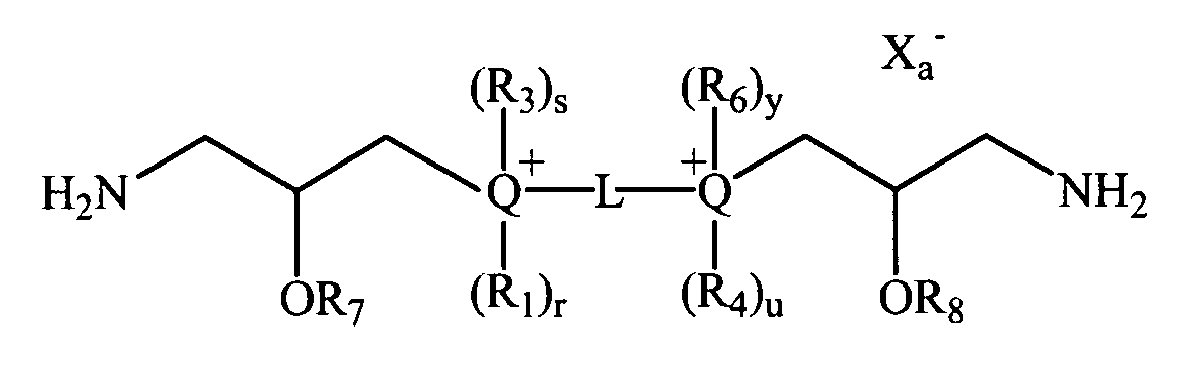 Q is N;L is a bivalent organic radical capable of linking each Q;R1, R3, R4 and R6, independently of one another, are selected from the group consisting of H and C8 - C24 alkenyl, C8 - C24 aryl, and C8 - C24 alkyl optionally substituted by one or more of an alcohol, an amine, an amide, an ether, a polyether, a polyamide, an ester, a mercaptan, a urea, a thiourea, a guanidyl, or a carbamoyl group;and wherein at least one of R1, R3, R4 and R6 is a straight chain or branched alkyl or alkenyl group or an aryl group;X- is a physiologically acceptable anion;a is the number of positive charge divided by the valence of X;r, s, u and y are 0 or 1, provided that the valency requirements of nitrogen are satisfied; andR7 and R8 are H.
 - The compound as claimed in claim 1, wherein said compound has the formula:
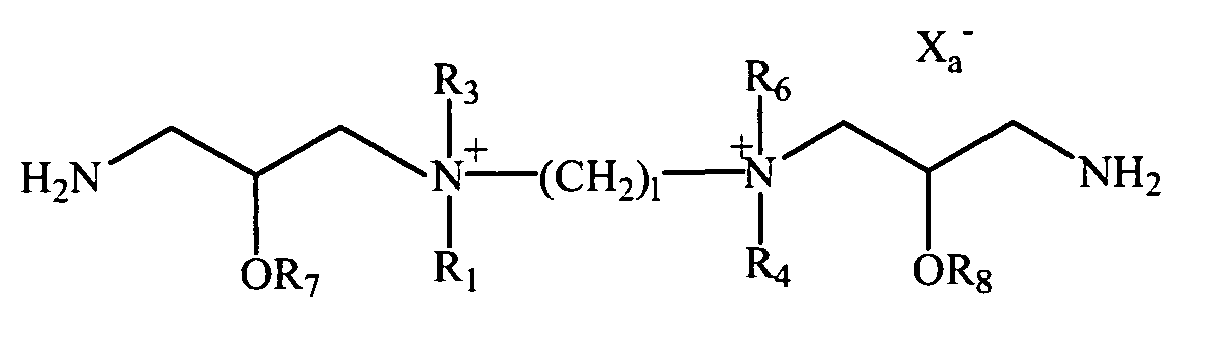
- The compound as claimed in claim 2, which is:

- A compound having the formula:

- The compound as claimed in any of claims 1, 2 and 4 wherein R1, R3, R4 and R6 are selected from said optionally substituted alkyl groups.
- The compound as claimed in claim 4, which is:
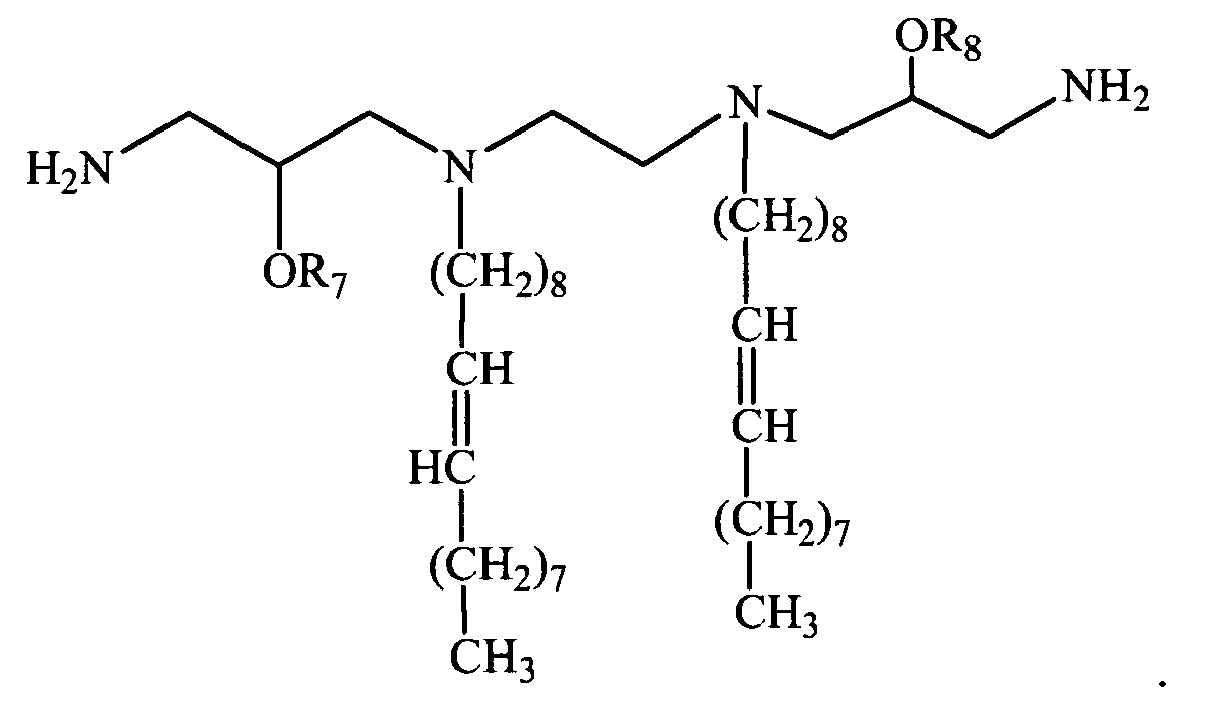
- The compound as claimed in claim 4, which is:
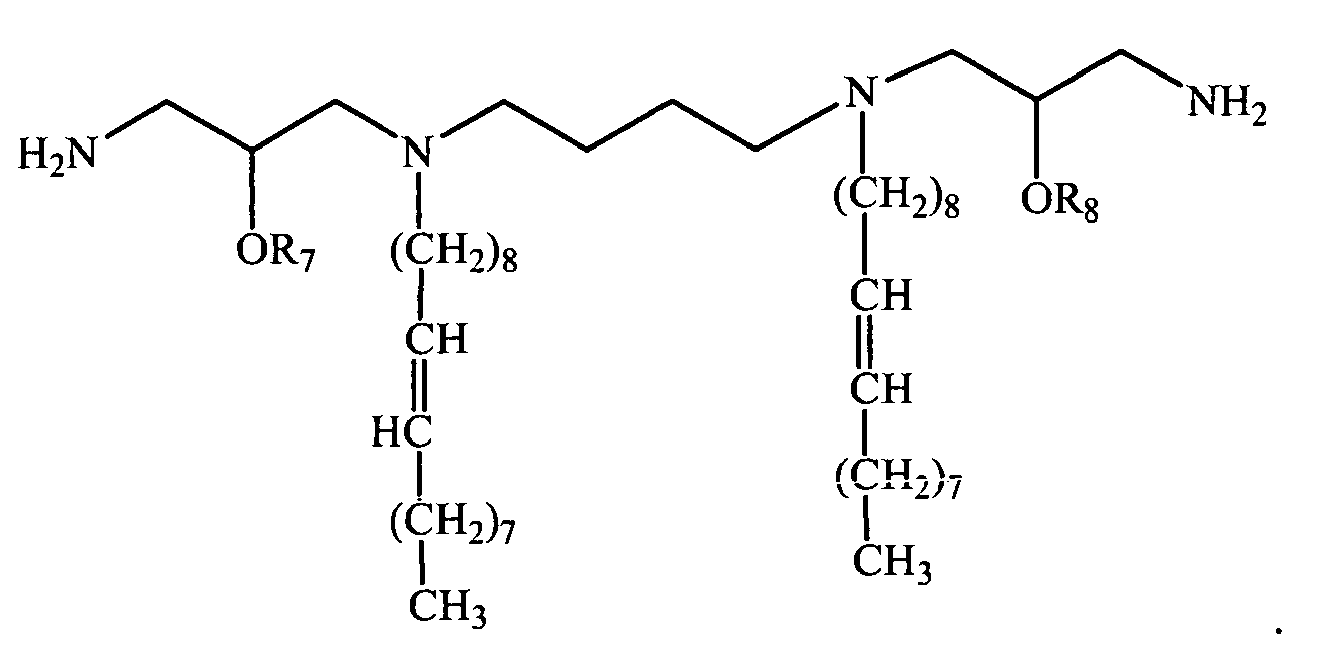
- The compound as claimed in claim 4, which is:
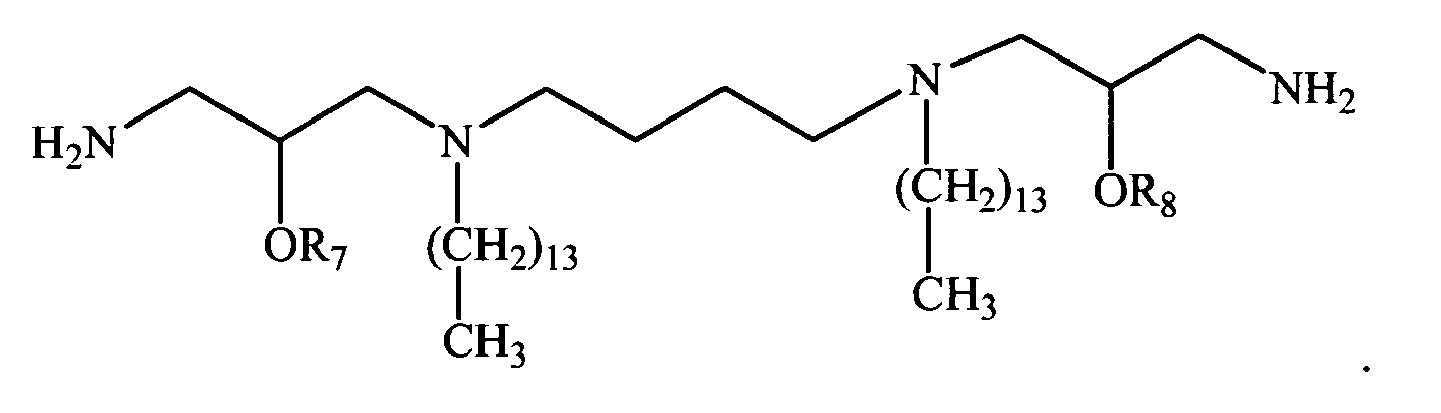
- The compound as claimed in claim 4, which is:
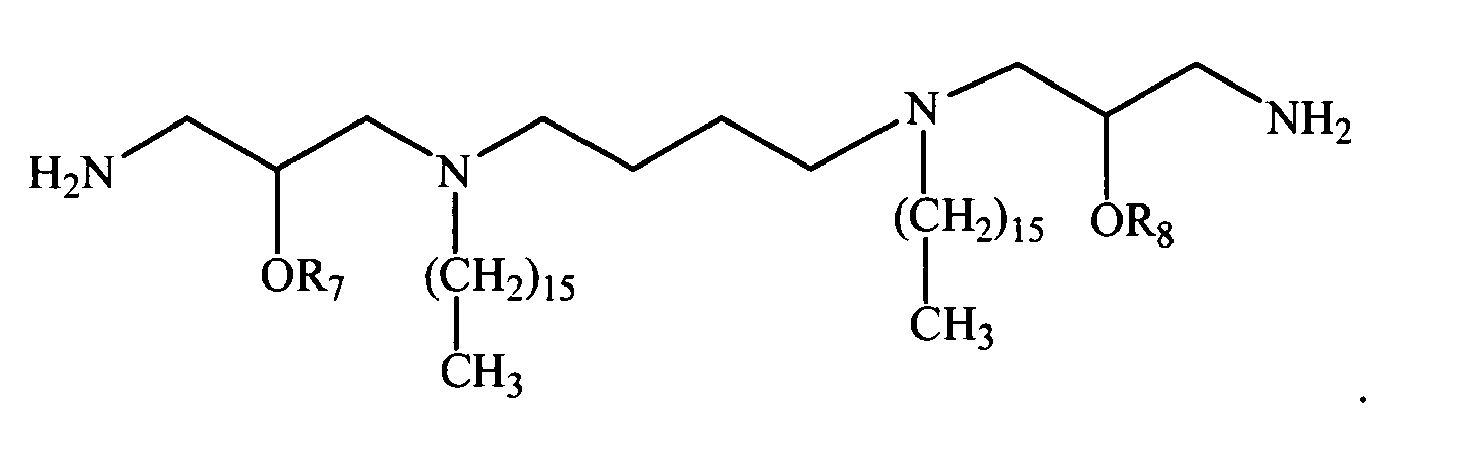
- A compound having the formula
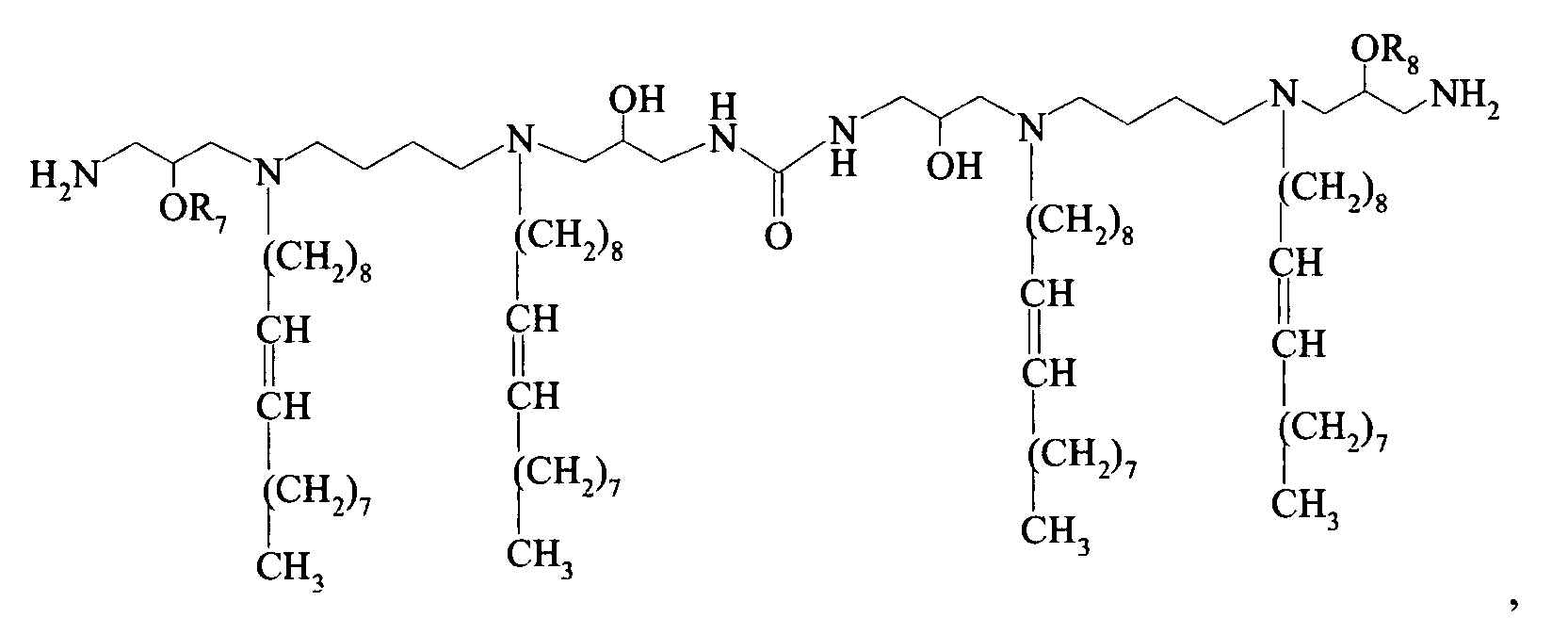
- The compound as claimed in claim 1, claim 2 or claim 4 wherein R1, R3, R4 and R6, independently of one another, are selected from the group consisting of H, C8 to C24 alkenyl and C8-C24 alkyl.
- A composition comprising one or more compounds of any one of claims 1 to 10.
- A composition of claim 12 further comprising at least one additional component selected from the group consisting of a cell, cells, a cell culture, a cell culture media, a neutral lipid, a nucleic acid, and a transfection enhancer.
- The composition of claim 13, which comprises a nucleic acid.
- The composition of claim 13 or claim 14, wherein the at least one additional component is a neutral lipid.
- The composition of claim 15, wherein the neutral lipid is DOPE, DOPC or cholesterol.
- A lipid aggregate comprising one or more compounds of any one of claims 1 to 10.
- The lipid aggregate of claim 17, which comprises at least one neutral lipid.
- The lipid aggregate of claim 18, wherein said lipid aggregate-forming compound is selected from the group consisting of DOPE, DOPC and cholesterol.
- A kit comprising one or more compounds of any of claims 1 to 10 and at least one additional component selected from the group consisting of a cell, cells, a cell culture media, a nucleic acid, a transfection enhancer, and instructions for transfecting a cell or cells.
- A method for introducing a polyanion into a cell or cells in vitro, said method comprising forming a lipid aggregate from a positively charged compound of any one of claims 1 to 10, contacting the lipid aggregate with a polyanion to form a positively-charged polyanion-liposome complex and incubating the complex with a cell or cells.
- The method of claim 21, wherein the polyanion is a nucleic acid.
- The method of claim 21 or claim 22, wherein the lipid aggregate is a liposome.
- A composition for use in transfection methods, comprising
a physiological medium;
a polycationic compound; and
a physiologically acceptable anion in a number appropriate to balance the cationic charges of said compound, the polycationic compound being of the formula: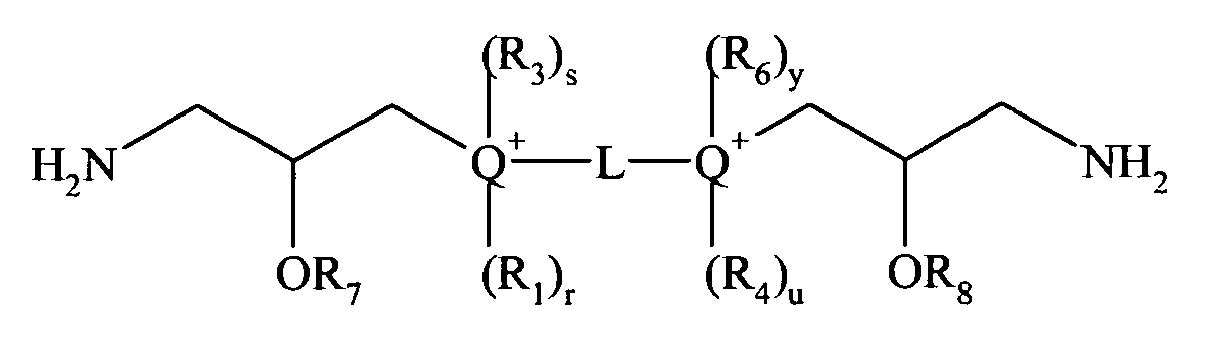 Q is N;L is a bivalent organic radical capable of linking each Q;R1, R3, R4 and R6, independently of one another, are selected from the group consisting of H and C8 - C24 alkenyl, C8 - C24 aryl, and C8 - C24 alkyl optionally substituted by one or more of an alcohol, an amine, an amide, an ether, a polyether, a polyamide, an ester, a mercaptan, a urea, a thiourea, a guanidyl, or a carbamoyl group;and wherein at least one of R1, R3, R4 and R6 is a straight chain or branched alkyl or alkenyl group or an aryl group;r, s, u and y are 0 or 1, provided that the valency requirements of nitrogen are satisfied and the compound is polycationic;R7 and R8 are H.
 - The composition as claimed in claim 24, wherein said compound has the formula:
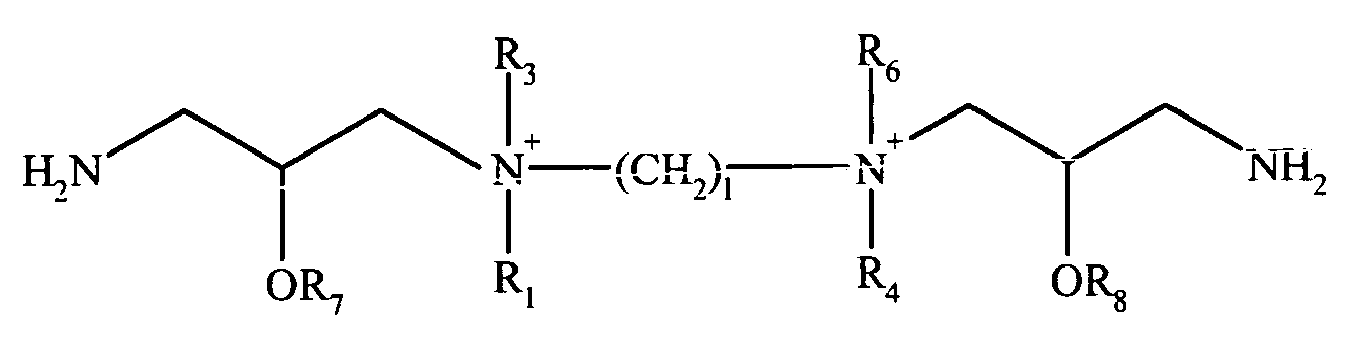
- The composition as claimed in claim 25, wherein said compound is:

- A composition for use in transfection methods, comprising a physiological medium and a compound of the formula:
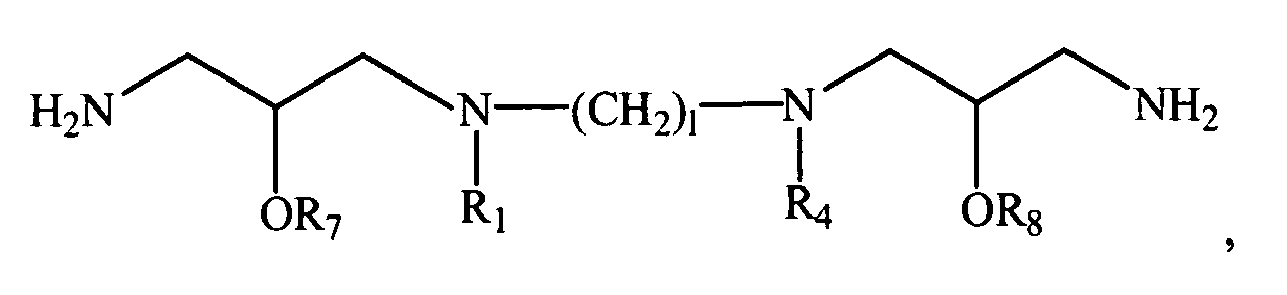
- The composition as claimed in any of claims 24, 25 and 27 wherein R1, R3, R4 and R6 are selected from said optionally substituted alkyl groups.
- The composition as claimed in claim 27, wherein said compound is:
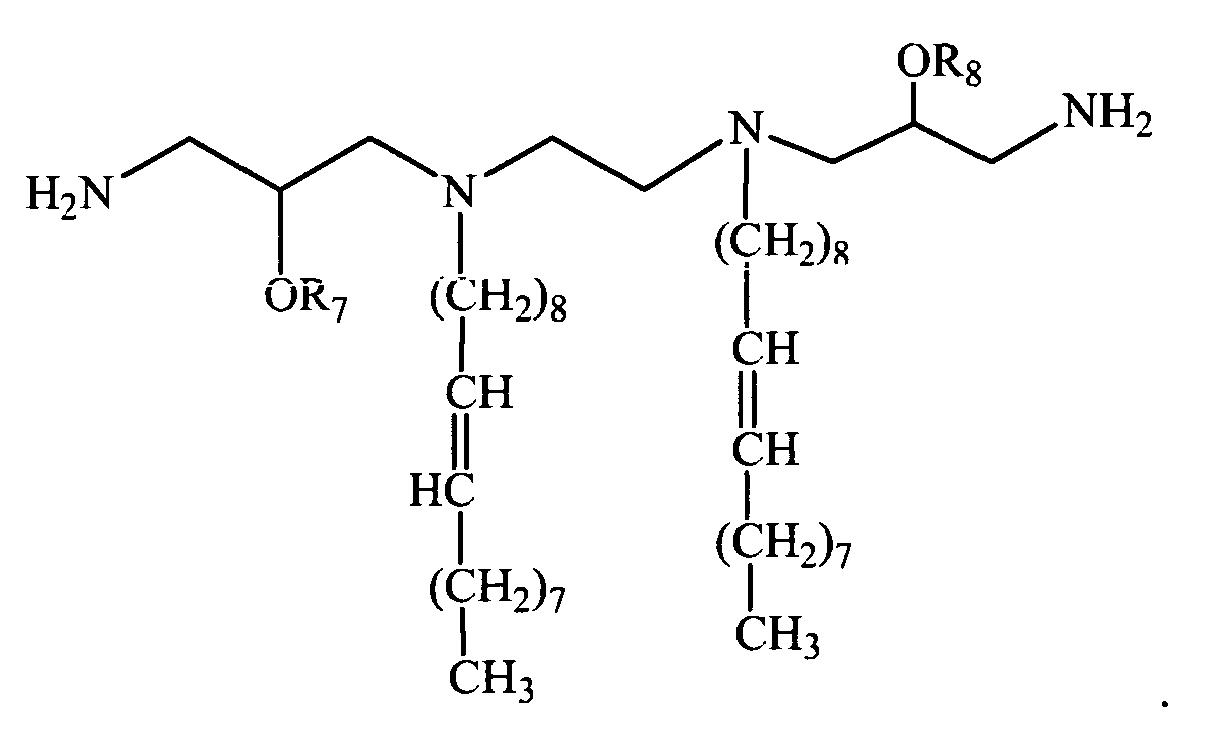
- The composition as claimed in claim 27, wherein said compound is:
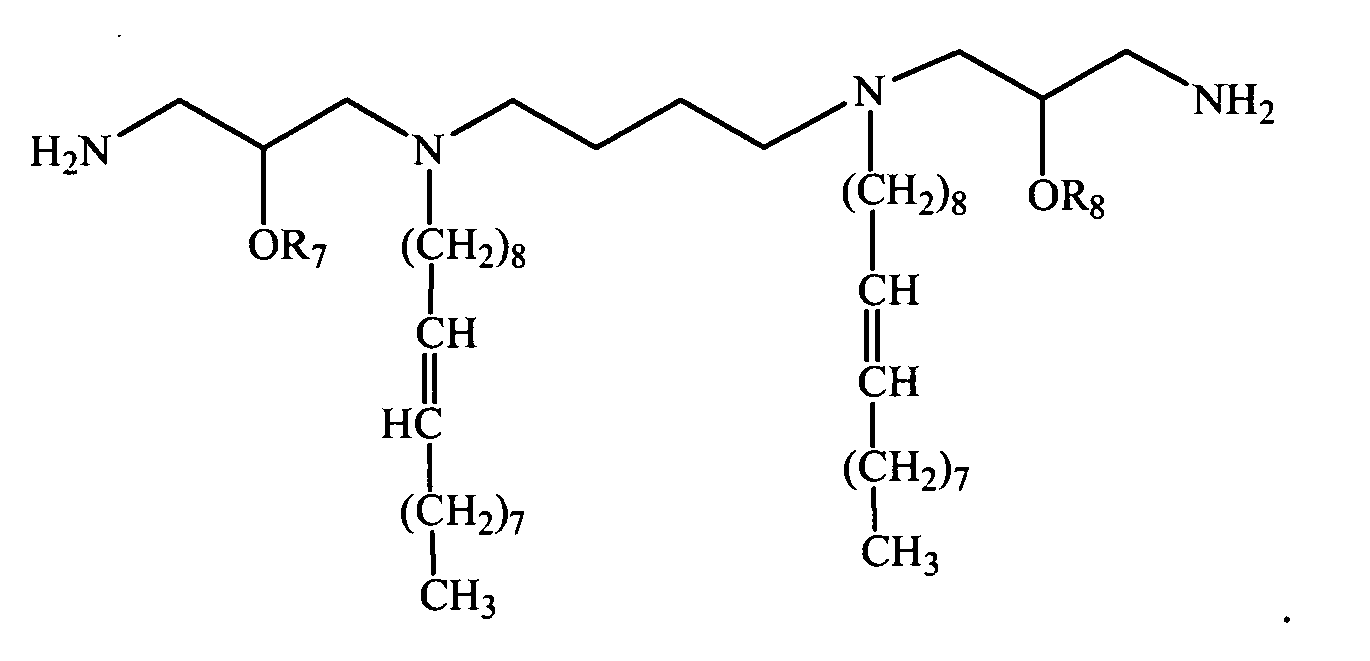
- The composition as claimed in claim 27, wherein said compound:
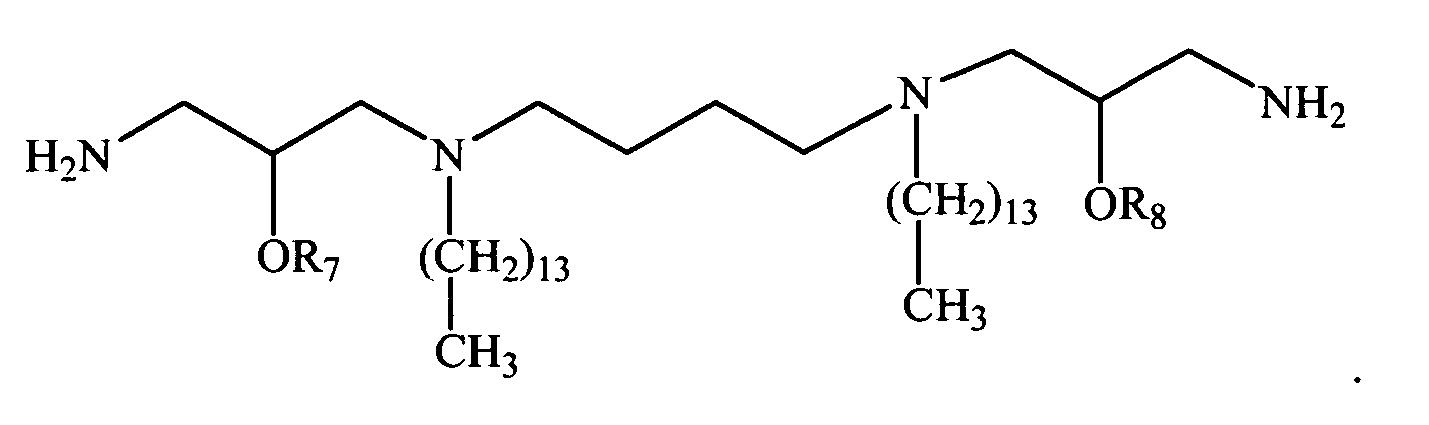
- The composition as claimed in claim 27, wherein said compound is:
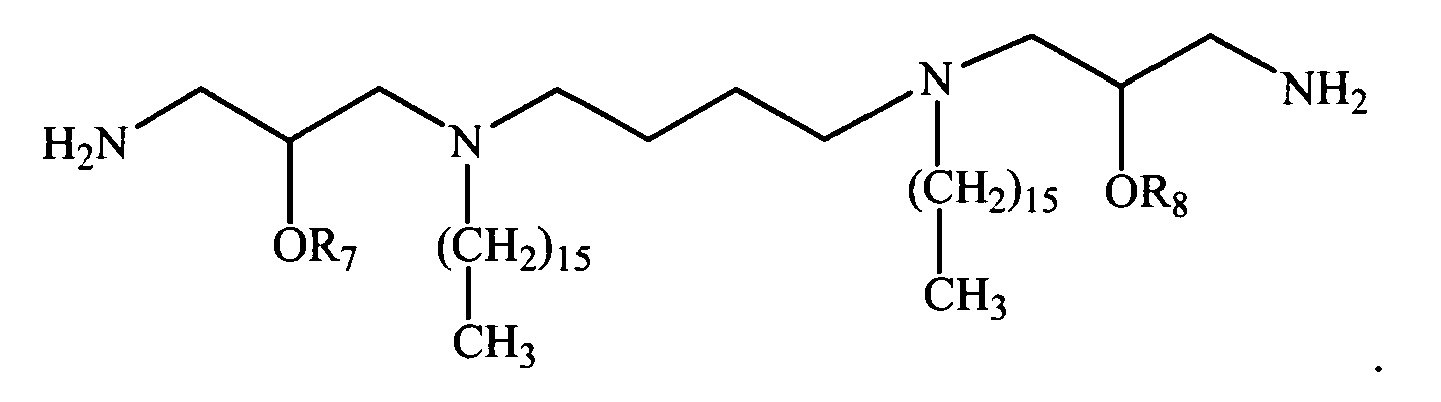
- A composition for use in transfection methods, comprising a physiological medium and a compound of the formula:
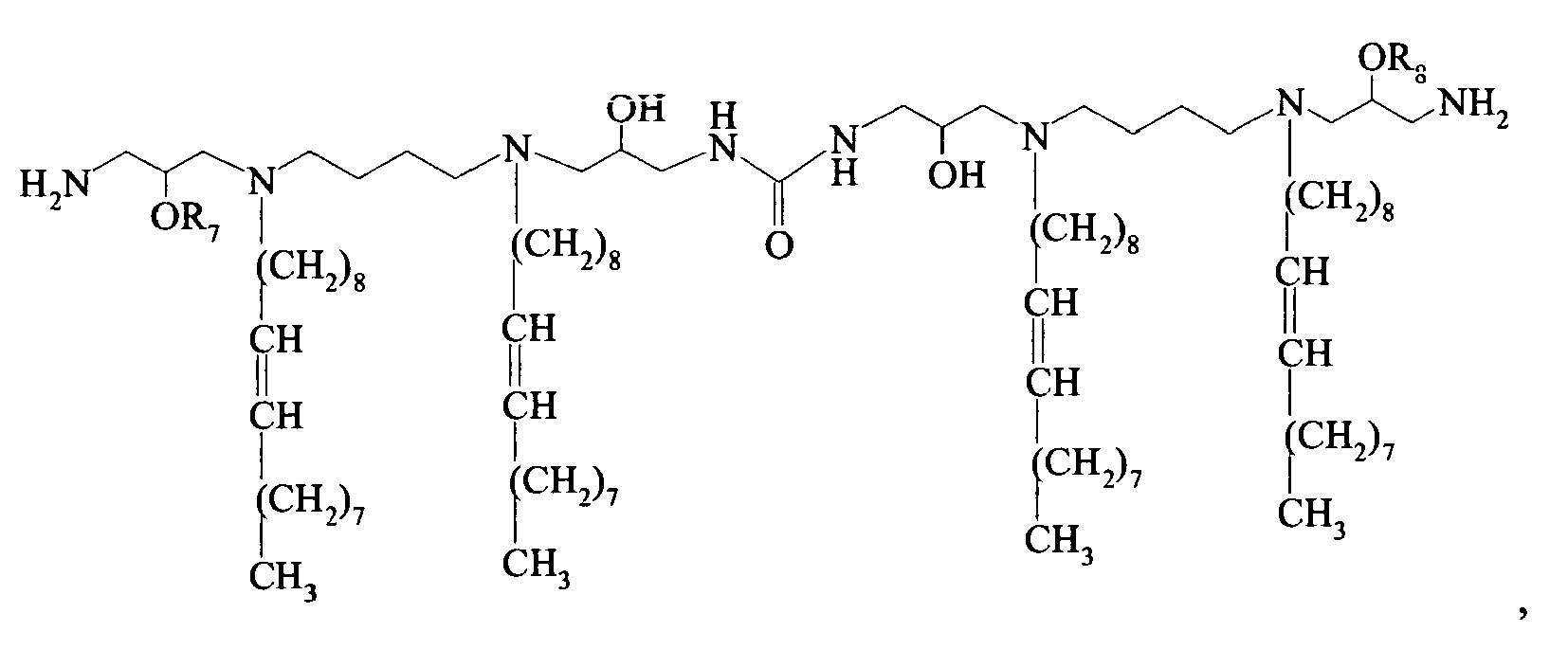
- The composition of claim 24 or claim 25 wherein R1, R3, R4 and R6 are selected from the group consisting of H, C8-C24 alkenyl, C8-C24 aryl and C8-C24 alkyl.
- The use of a composition of any of claims 24 to 34 to transfect a nucleic acid into a cell or cells in vitro.
Priority Applications (3)
| Application Number | Priority Date | Filing Date | Title |
|---|---|---|---|
| EP20070110415 EP1829856A3 (en) | 1998-11-12 | 1999-11-12 | Transfection reagents |
| EP10153820A EP2298728A1 (en) | 1998-11-12 | 1999-11-12 | Transfection reagents |
| CY20081100221T CY1107895T1 (en) | 1998-11-12 | 2008-02-26 | TRANSFER REAGENTS |
Applications Claiming Priority (3)
| Application Number | Priority Date | Filing Date | Title |
|---|---|---|---|
| US10811798P | 1998-11-12 | 1998-11-12 | |
| US108117P | 1998-11-12 | ||
| PCT/US1999/026825 WO2000027795A1 (en) | 1998-11-12 | 1999-11-12 | Transfection reagents |
Related Child Applications (1)
| Application Number | Title | Priority Date | Filing Date |
|---|---|---|---|
| EP20070110415 Division EP1829856A3 (en) | 1998-11-12 | 1999-11-12 | Transfection reagents |
Publications (2)
| Publication Number | Publication Date |
|---|---|
| EP1129064A1 EP1129064A1 (en) | 2001-09-05 |
| EP1129064B1 true EP1129064B1 (en) | 2008-01-09 |
Family
ID=22320415
Family Applications (3)
| Application Number | Title | Priority Date | Filing Date |
|---|---|---|---|
| EP99971794A Expired - Lifetime EP1129064B1 (en) | 1998-11-12 | 1999-11-12 | Transfection reagents |
| EP10153820A Withdrawn EP2298728A1 (en) | 1998-11-12 | 1999-11-12 | Transfection reagents |
| EP20070110415 Withdrawn EP1829856A3 (en) | 1998-11-12 | 1999-11-12 | Transfection reagents |
Family Applications After (2)
| Application Number | Title | Priority Date | Filing Date |
|---|---|---|---|
| EP10153820A Withdrawn EP2298728A1 (en) | 1998-11-12 | 1999-11-12 | Transfection reagents |
| EP20070110415 Withdrawn EP1829856A3 (en) | 1998-11-12 | 1999-11-12 | Transfection reagents |
Country Status (13)
| Country | Link |
|---|---|
| US (12) | US7166745B1 (en) |
| EP (3) | EP1129064B1 (en) |
| JP (2) | JP4854853B2 (en) |
| AT (1) | ATE383331T1 (en) |
| AU (1) | AU772847B2 (en) |
| CA (1) | CA2350882C (en) |
| CY (1) | CY1107895T1 (en) |
| DE (1) | DE69937964T2 (en) |
| DK (1) | DK1129064T3 (en) |
| ES (1) | ES2296419T3 (en) |
| NZ (1) | NZ512244A (en) |
| PT (1) | PT1129064E (en) |
| WO (1) | WO2000027795A1 (en) |
Families Citing this family (151)
| Publication number | Priority date | Publication date | Assignee | Title |
|---|---|---|---|---|
| US5674908A (en) | 1993-12-20 | 1997-10-07 | Life Technologies, Inc. | Highly packed polycationic ammonium, sulfonium and phosphonium lipids |
| US6989434B1 (en) | 1994-02-11 | 2006-01-24 | Invitrogen Corporation | Reagents for intracellular delivery of macromolecules |
| US5795587A (en) * | 1995-01-23 | 1998-08-18 | University Of Pittsburgh | Stable lipid-comprising drug delivery complexes and methods for their production |
| US20030069173A1 (en) * | 1998-03-16 | 2003-04-10 | Life Technologies, Inc. | Peptide-enhanced transfections |
| AU772847B2 (en) | 1998-11-12 | 2004-05-06 | Invitrogen Corporation | Transfection reagents |
| US6696424B1 (en) | 1999-05-28 | 2004-02-24 | Vical Incorporated | Cytofectin dimers and methods of use thereof |
| GB9914085D0 (en) * | 1999-06-16 | 1999-08-18 | Smithkline Beecham Plc | New use |
| GB9914045D0 (en) | 1999-06-16 | 1999-08-18 | Smithkline Beecham Plc | Novel compounds |
| US7294511B2 (en) | 2001-03-22 | 2007-11-13 | Chromos Molecular Systems, Inc. | Methods for delivering nucleic acid molecules into cells and assessment thereof |
| US20030096414A1 (en) | 2001-03-27 | 2003-05-22 | Invitrogen Corporation | Culture medium for cell growth and transfection |
| US6741357B2 (en) * | 2001-08-14 | 2004-05-25 | Seagate Technology Llc | Quadrature phase shift interferometer with unwrapping of phase |
| US20060148734A1 (en) * | 2002-03-27 | 2006-07-06 | Patrick Camilleri | Diaminoacid-aminoacid-polyamine based gemini surfactant compounds |
| EP2338478B1 (en) | 2002-06-28 | 2014-07-23 | Protiva Biotherapeutics Inc. | Method for producing liposomes |
| HK1080087A1 (en) * | 2002-10-16 | 2006-04-21 | Neopharm, Inc. | Cardiolipin molecules and method of synthesis |
| WO2004105697A2 (en) | 2003-05-22 | 2004-12-09 | Molecular Transfer, Inc. | Novel lipids for transfection of nucleic acids |
| US7803397B2 (en) | 2003-09-15 | 2010-09-28 | Protiva Biotherapeutics, Inc. | Polyethyleneglycol-modified lipid compounds and uses thereof |
| CA2542708A1 (en) * | 2003-10-24 | 2005-05-06 | University Of Saskatchewan | Dna delivery with gemini cationic surfactants |
| US7691607B2 (en) * | 2004-02-09 | 2010-04-06 | The Regents Of The University Of California | Expression system of NELL peptide |
| EP1766035B1 (en) * | 2004-06-07 | 2011-12-07 | Protiva Biotherapeutics Inc. | Lipid encapsulated interfering rna |
| GB0413613D0 (en) * | 2004-06-17 | 2004-07-21 | Univ London | Small molecule carriers |
| CA2587411A1 (en) * | 2004-11-17 | 2006-05-26 | Protiva Biotherapeutics, Inc. | Sirna silencing of apolipoprotein b |
| US20070117179A1 (en) * | 2005-09-27 | 2007-05-24 | Invitrogen Corporation | In vitro protein synthesis systems for membrane proteins that include adolipoproteins and phospholipid-adolipoprotein particles |
| TW200800235A (en) * | 2005-10-18 | 2008-01-01 | Otsuka Pharma Co Ltd | Carrier composition for nucleic acid transport |
| CN101346393B (en) | 2005-11-02 | 2015-07-22 | 普洛体维生物治疗公司 | Modified siRNA molecules and uses thereof |
| WO2007053235A1 (en) * | 2005-11-04 | 2007-05-10 | Sachem, Inc. | Cation-exchange displacement chromatography process and cationic organic compounds for use as displacer compounds in cation-exchange displacement chromatography process |
| DE102006008701A1 (en) * | 2006-02-23 | 2007-08-30 | Qiagen Gmbh | Procedure for transferring biomolecules into a cell, comprises preparing a complex from biomolecule and polymer, and transferring the biomolecule into a cell by contacting the cell with the complex |
| EP2604255B1 (en) | 2006-05-05 | 2017-10-25 | Molecular Transfer, Inc. | Novel reagents for transfection of eukaryotic cells |
| US20100035974A1 (en) * | 2006-10-04 | 2010-02-11 | Centre National De La Recherche Scientifique (Cnrs | Compositions comprising a sirna and lipidic 4,5-disubstituted 2-deoxystreptamine ring aminoglycoside derivatives and uses thereof |
| WO2008106660A2 (en) * | 2007-03-01 | 2008-09-04 | Invitrogen Corporation | Isolated phospholipid-protein particles |
| TWI428135B (en) | 2007-03-26 | 2014-03-01 | Hirofumi Takeuchi | And a carrier composition for quick-acting nucleic acid delivery |
| GB0720486D0 (en) * | 2007-10-19 | 2007-11-28 | Univ Edinburgh | Cationic lipids |
| UA97559C2 (en) | 2007-11-08 | 2012-02-27 | Оцука Фармасьютікал Ко., Лтд. | Nucleic acid complex and a nucleic acid delivery composition |
| EP2238251B1 (en) * | 2007-12-27 | 2015-02-11 | Protiva Biotherapeutics Inc. | Silencing of polo-like kinase expression using interfering rna |
| EP3100718B1 (en) * | 2008-01-02 | 2019-11-27 | Arbutus Biopharma Corporation | Improved compositions and methods for the delivery of nucleic acids |
| AU2009238175C1 (en) | 2008-04-15 | 2023-11-30 | Arbutus Biopharma Corporation | Novel lipid formulations for nucleic acid delivery |
| EP2350043B9 (en) | 2008-10-09 | 2014-08-20 | TEKMIRA Pharmaceuticals Corporation | Improved amino lipids and methods for the delivery of nucleic acids |
| WO2010054384A1 (en) * | 2008-11-10 | 2010-05-14 | Alnylam Pharmaceuticals, Inc. | Lipids and compositions for the delivery of therapeutics |
| CN111909020A (en) * | 2008-11-10 | 2020-11-10 | 阿布特斯生物制药公司 | Lipids and compositions for delivery of therapeutic agents |
| CA2750561C (en) | 2009-01-26 | 2017-10-10 | Protiva Biotherapeutics, Inc. | Compositions and methods for silencing apolipoprotein c-iii expression |
| CA2753703A1 (en) | 2009-03-04 | 2010-09-10 | Hirofumi Takeuchi | Nucleic acid complex and nucleic acid-delivering composition |
| WO2011000106A1 (en) | 2009-07-01 | 2011-01-06 | Protiva Biotherapeutics, Inc. | Improved cationic lipids and methods for the delivery of therapeutic agents |
| US9018187B2 (en) | 2009-07-01 | 2015-04-28 | Protiva Biotherapeutics, Inc. | Cationic lipids and methods for the delivery of therapeutic agents |
| EP2449114B9 (en) | 2009-07-01 | 2017-04-19 | Protiva Biotherapeutics Inc. | Novel lipid formulations for delivery of therapeutic agents to solid tumors |
| US8716464B2 (en) | 2009-07-20 | 2014-05-06 | Thomas W. Geisbert | Compositions and methods for silencing Ebola virus gene expression |
| RU2423147C1 (en) * | 2010-03-22 | 2011-07-10 | Учреждение Российской академии наук Институт химической биологии и фундаментальной медицины Сибирского отделения РАН (ИХБФМ СО РАН) | Composition for delivering nucleic acids into cells of mammals |
| US8455455B1 (en) | 2010-03-31 | 2013-06-04 | Protiva Biotherapeutics, Inc. | Compositions and methods for silencing genes involved in hemorrhagic fever |
| US9006417B2 (en) | 2010-06-30 | 2015-04-14 | Protiva Biotherapeutics, Inc. | Non-liposomal systems for nucleic acid delivery |
| US8466122B2 (en) | 2010-09-17 | 2013-06-18 | Protiva Biotherapeutics, Inc. | Trialkyl cationic lipids and methods of use thereof |
| WO2012068176A1 (en) | 2010-11-15 | 2012-05-24 | Life Technologies Corporation | Amine-containing transfection reagents and methods for making and using same |
| NZ611427A (en) | 2010-12-06 | 2015-08-28 | Penn State Res Found | Compositions and methods relating to proliferative diseases |
| US8695618B2 (en) | 2010-12-22 | 2014-04-15 | Carnegie Mellon University | 3D chemical pattern control in 2D fluidics devices |
| WO2012142622A1 (en) | 2011-04-15 | 2012-10-18 | Molecular Transfer, Inc. | Agents for improved delivery of nucleic acids to eukaryotic cells |
| CN102319550B (en) * | 2011-07-08 | 2014-01-22 | 中国林业科学研究院林产化学工业研究所 | Low-concentration viscoelastic surfactant solution and preparation method thereof |
| US10323236B2 (en) | 2011-07-22 | 2019-06-18 | President And Fellows Of Harvard College | Evaluation and improvement of nuclease cleavage specificity |
| EP2781507B1 (en) | 2011-11-18 | 2017-03-22 | Nof Corporation | Cationic lipid having improved intracellular kinetics |
| PL2791160T3 (en) | 2011-12-16 | 2022-06-20 | Modernatx, Inc. | Modified mrna compositions |
| US9035039B2 (en) | 2011-12-22 | 2015-05-19 | Protiva Biotherapeutics, Inc. | Compositions and methods for silencing SMAD4 |
| CN109370980B (en) | 2012-05-02 | 2023-05-09 | 生命技术公司 | High-yield transient expression system |
| US9758606B2 (en) | 2012-07-31 | 2017-09-12 | The Trustees Of Columbia University In The City Of New York | Cyclopropenium polymers and methods for making the same |
| EP4011380A1 (en) * | 2012-10-08 | 2022-06-15 | BioNTech Delivery Technologies GmbH | Carboxylated polyamine derivatives as complexes with rna |
| WO2014070687A2 (en) | 2012-10-29 | 2014-05-08 | Molecular Transfer, Inc. | Polycationic methyl phospholipids for improved delivery of nucleic acids to eukaryotic cells |
| ITRM20130054A1 (en) * | 2013-01-30 | 2014-07-31 | Paolo Gresele | TRANSFECTED PLATES WITH EXOGENOUS GENETIC MATERIAL AND MICROPARTELS DERIVED FROM THOSE TRANSFECTED PLATES, METHOD FOR THEIR PREPARATION AND THEIR USES. |
| EP2968216A1 (en) | 2013-03-15 | 2016-01-20 | The Penn State Research Foundation | Compositions and methods including leelamine and arachidonyl trifluoromethyl ketone relating to treatment of cancer |
| WO2014143031A1 (en) | 2013-03-15 | 2014-09-18 | The Penn State Research Foundation | Compositions and methods including celecoxib and plumbagin relating to treatment of cancer |
| EP3013964B1 (en) | 2013-06-28 | 2020-05-06 | ethris GmbH | Compositions for introducing rna into cells |
| US9163284B2 (en) | 2013-08-09 | 2015-10-20 | President And Fellows Of Harvard College | Methods for identifying a target site of a Cas9 nuclease |
| US9359599B2 (en) | 2013-08-22 | 2016-06-07 | President And Fellows Of Harvard College | Engineered transcription activator-like effector (TALE) domains and uses thereof |
| US9322037B2 (en) | 2013-09-06 | 2016-04-26 | President And Fellows Of Harvard College | Cas9-FokI fusion proteins and uses thereof |
| US9340799B2 (en) | 2013-09-06 | 2016-05-17 | President And Fellows Of Harvard College | MRNA-sensing switchable gRNAs |
| US9526784B2 (en) | 2013-09-06 | 2016-12-27 | President And Fellows Of Harvard College | Delivery system for functional nucleases |
| WO2015070083A1 (en) | 2013-11-07 | 2015-05-14 | Editas Medicine,Inc. | CRISPR-RELATED METHODS AND COMPOSITIONS WITH GOVERNING gRNAS |
| US20150165054A1 (en) | 2013-12-12 | 2015-06-18 | President And Fellows Of Harvard College | Methods for correcting caspase-9 point mutations |
| EP3756690A3 (en) | 2013-12-12 | 2021-03-17 | Life Technologies Corporation | Membrane-penetrating peptides to enhance transfection and compositions and methods for using same |
| EP3169310A1 (en) | 2014-07-15 | 2017-05-24 | Life Technologies Corporation | Compositions with lipid aggregates and methods for efficient delivery of molecules to cells |
| US10077453B2 (en) | 2014-07-30 | 2018-09-18 | President And Fellows Of Harvard College | CAS9 proteins including ligand-dependent inteins |
| US9816080B2 (en) | 2014-10-31 | 2017-11-14 | President And Fellows Of Harvard College | Delivery of CAS9 via ARRDC1-mediated microvesicles (ARMMs) |
| BR112017009505A2 (en) | 2014-11-10 | 2018-02-06 | Ethris Gmbh | pharmaceutical composition, and matrix or support. |
| WO2016112963A1 (en) | 2015-01-13 | 2016-07-21 | Riboxx Gmbh | Delivery of biomolecules into cells |
| WO2016121942A1 (en) * | 2015-01-30 | 2016-08-04 | 日油株式会社 | Cationic lipid |
| EP3543339A1 (en) | 2015-02-13 | 2019-09-25 | Factor Bioscience Inc. | Nucleic acid products and methods of administration thereof |
| CN104876831B (en) * | 2015-04-03 | 2017-05-17 | 苏州圣诺生物医药技术有限公司 | Liposome-modified spermine derivative and liposome prepared by derivative |
| WO2017011598A1 (en) | 2015-07-13 | 2017-01-19 | Life Technologies Corporation | System and method for improved transient protein expression in cho cells |
| WO2017040335A2 (en) | 2015-08-28 | 2017-03-09 | Molecular Transfer, Inc. | Transfection complexes and methods of using the same |
| EP3141582B1 (en) * | 2015-09-10 | 2018-06-13 | Karlsruher Institut für Technologie | Synthesis and use of polyalkylamines |
| EP3362102A1 (en) | 2015-10-14 | 2018-08-22 | Life Technologies Corporation | Ribonucleoprotein transfection agents |
| US10167457B2 (en) | 2015-10-23 | 2019-01-01 | President And Fellows Of Harvard College | Nucleobase editors and uses thereof |
| WO2017151733A1 (en) | 2016-03-01 | 2017-09-08 | Molecular Transfer, Inc. | Plant virus movement proteins and methods of using the same |
| NZ749593A (en) | 2016-06-20 | 2025-10-31 | Univ Leland Stanford Junior | Circular rnas and their use in immunomodulation |
| KR20250103795A (en) | 2016-08-03 | 2025-07-07 | 프레지던트 앤드 펠로우즈 오브 하바드 칼리지 | Adenosine nucleobase editors and uses thereof |
| EP3497214B1 (en) | 2016-08-09 | 2023-06-28 | President and Fellows of Harvard College | Programmable cas9-recombinase fusion proteins and uses thereof |
| JP2019528284A (en) | 2016-08-17 | 2019-10-10 | ファクター バイオサイエンス インコーポレイテッド | Nucleic acid product and method of administration thereof |
| WO2018039438A1 (en) | 2016-08-24 | 2018-03-01 | President And Fellows Of Harvard College | Incorporation of unnatural amino acids into proteins using base editing |
| WO2018067546A1 (en) | 2016-10-03 | 2018-04-12 | President And Fellows Of Harvard College | Delivery of therapeutic rnas via arrdc1-mediated microvesicles |
| AU2017342543B2 (en) | 2016-10-14 | 2024-06-27 | President And Fellows Of Harvard College | AAV delivery of nucleobase editors |
| US10745677B2 (en) | 2016-12-23 | 2020-08-18 | President And Fellows Of Harvard College | Editing of CCR5 receptor gene to protect against HIV infection |
| US12390514B2 (en) | 2017-03-09 | 2025-08-19 | President And Fellows Of Harvard College | Cancer vaccine |
| EP3592853A1 (en) | 2017-03-09 | 2020-01-15 | President and Fellows of Harvard College | Suppression of pain by gene editing |
| US11542496B2 (en) | 2017-03-10 | 2023-01-03 | President And Fellows Of Harvard College | Cytosine to guanine base editor |
| BR112019019655A2 (en) | 2017-03-23 | 2020-04-22 | Harvard College | nucleobase editors comprising nucleic acid programmable dna binding proteins |
| WO2018209320A1 (en) | 2017-05-12 | 2018-11-15 | President And Fellows Of Harvard College | Aptazyme-embedded guide rnas for use with crispr-cas9 in genome editing and transcriptional activation |
| US11732274B2 (en) | 2017-07-28 | 2023-08-22 | President And Fellows Of Harvard College | Methods and compositions for evolving base editors using phage-assisted continuous evolution (PACE) |
| US11236334B2 (en) | 2017-08-22 | 2022-02-01 | National University Corporation Nagoya University | Modified polynucleotide |
| US11319532B2 (en) | 2017-08-30 | 2022-05-03 | President And Fellows Of Harvard College | High efficiency base editors comprising Gam |
| CA3073851A1 (en) * | 2017-08-31 | 2019-03-07 | Life Technologies Corporation | Cationic lipid compositions for tissue-specific delivery |
| AU2018352592C1 (en) | 2017-10-16 | 2025-09-25 | Beam Therapeutics, Inc. | Uses of adenosine base editors |
| US11414661B2 (en) | 2017-12-01 | 2022-08-16 | Suzhou Ribo Life Science Co., Ltd. | Nucleic acid, composition and conjugate containing nucleic acid, preparation method therefor and use thereof |
| CA3083968C (en) | 2017-12-01 | 2024-04-23 | Suzhou Ribo Life Science Co., Ltd. | Double-stranded oligonucleotide, composition and conjugate comprising double-stranded oligonucleotide, preparation method thereof and use thereof |
| EP3719125B1 (en) | 2017-12-01 | 2025-01-08 | Suzhou Ribo Life Science Co., Ltd. | Nucleic acid, composition and conjugate containing same, and preparation method and use |
| EP3718572B1 (en) | 2017-12-01 | 2024-07-31 | Suzhou Ribo Life Science Co., Ltd. | Nucleic acid, composition and conjugate containing nucleic acid, preparation method and use |
| WO2019105419A1 (en) | 2017-12-01 | 2019-06-06 | 苏州瑞博生物技术有限公司 | Nucleic acid, composition and conjugate containing same, preparation method, and use |
| US12406749B2 (en) | 2017-12-15 | 2025-09-02 | The Broad Institute, Inc. | Systems and methods for predicting repair outcomes in genetic engineering |
| KR102617947B1 (en) | 2017-12-29 | 2023-12-27 | 쑤저우 리보 라이프 사이언스 컴퍼니, 리미티드 | Conjugates and their preparation and uses |
| WO2019176079A1 (en) * | 2018-03-16 | 2019-09-19 | 株式会社 東芝 | Biodegradable compound, lipid particle, lipid particle-containing composition, and kit |
| WO2019188867A1 (en) | 2018-03-27 | 2019-10-03 | 日油株式会社 | Novel cationic lipid exhibiting improved intracellular dynamics |
| US11679159B2 (en) | 2018-04-29 | 2023-06-20 | Precision NanoSystems ULC | Compositions for transfecting resistant cell types |
| US11690921B2 (en) | 2018-05-18 | 2023-07-04 | Sangamo Therapeutics, Inc. | Delivery of target specific nucleases |
| US12157760B2 (en) | 2018-05-23 | 2024-12-03 | The Broad Institute, Inc. | Base editors and uses thereof |
| US12522807B2 (en) | 2018-07-09 | 2026-01-13 | The Broad Institute, Inc. | RNA programmable epigenetic RNA modifiers and uses thereof |
| CN111655849B (en) | 2018-08-21 | 2024-05-10 | 苏州瑞博生物技术股份有限公司 | Nucleic acid, pharmaceutical composition and conjugate containing the nucleic acid and use thereof |
| JP6997862B2 (en) * | 2018-08-21 | 2022-02-10 | 株式会社東芝 | Compositions and kits containing biodegradable compounds, lipid particles, lipid particles |
| CN111655297A (en) | 2018-09-30 | 2020-09-11 | 苏州瑞博生物技术有限公司 | siRNA conjugate and preparation method and application thereof |
| WO2020086408A1 (en) | 2018-10-26 | 2020-04-30 | The United States Of America, As Represented By The Secretary, Department Of Health And Human Services | A high-yield perfusion-based transient gene expression bioprocess |
| WO2020092453A1 (en) | 2018-10-29 | 2020-05-07 | The Broad Institute, Inc. | Nucleobase editors comprising geocas9 and uses thereof |
| PL3646854T3 (en) | 2018-10-30 | 2023-01-02 | Polyplus Transfection | Compositions for transfecting mrna into a cell and their applications |
| JP7507495B2 (en) | 2018-12-28 | 2024-06-28 | スーチョウ リボ ライフ サイエンス カンパニー、リミテッド | Nucleic acids, compositions and complexes containing the same, and methods of preparation and use |
| US12351837B2 (en) | 2019-01-23 | 2025-07-08 | The Broad Institute, Inc. | Supernegatively charged proteins and uses thereof |
| CN114127285B (en) | 2019-03-19 | 2024-09-10 | 布罗德研究所股份有限公司 | Methods and compositions for editing nucleotide sequences |
| ES3005085T3 (en) | 2019-04-16 | 2025-03-13 | Genfit | Compositions and methods for the stabilization of micro-rna |
| EP3956349A1 (en) | 2019-04-17 | 2022-02-23 | The Broad Institute, Inc. | Adenine base editors with reduced off-target effects |
| EP3958868A4 (en) | 2019-04-22 | 2023-01-18 | The Penn State Research Foundation | METHODS AND COMPOSITIONS RELATING TO THE INHIBITION OF ALDEHYDE DEHYDROGENASES FOR THE TREATMENT OF CANCER |
| EP3974532A4 (en) | 2019-05-22 | 2024-01-24 | Suzhou Ribo Life Science Co., Ltd. | Nucleic acid, pharmaceutical composition, conjugate, preparation method, and use |
| EP3974530A4 (en) | 2019-05-22 | 2023-07-12 | Suzhou Ribo Life Science Co., Ltd. | Nucleic acid, pharmaceutical composition, conjugate, preparation method, and use |
| CN114450265B (en) * | 2019-07-03 | 2024-12-24 | 菲克特生物科学股份有限公司 | Cationic lipids and their uses |
| JP7769325B2 (en) | 2019-07-23 | 2025-11-13 | 株式会社東芝 | Method for producing CAR-T cells, nucleic acid transfer carrier and kit |
| US10501404B1 (en) | 2019-07-30 | 2019-12-10 | Factor Bioscience Inc. | Cationic lipids and transfection methods |
| KR20220046605A (en) * | 2019-08-05 | 2022-04-14 | 뽈리쁠뤼스-트랑스펙씨옹 (쏘시에떼 아노님) | Compositions for transfecting nucleic acid molecules into cells, comprising heterocyclic compounds grafted to cationic polymers, and applications thereof |
| US12503497B2 (en) | 2019-09-26 | 2025-12-23 | President And Fellows Of Harvard College | Minimal arrestin domain containing protein 1(ARRDC1) constructs |
| US12435330B2 (en) | 2019-10-10 | 2025-10-07 | The Broad Institute, Inc. | Methods and compositions for prime editing RNA |
| DE112021002672T5 (en) | 2020-05-08 | 2023-04-13 | President And Fellows Of Harvard College | METHODS AND COMPOSITIONS FOR EDIT BOTH STRANDS SIMULTANEOUSLY OF A DOUBLE STRANDED NUCLEOTIDE TARGET SEQUENCE |
| WO2021255262A1 (en) | 2020-06-19 | 2021-12-23 | Sylentis Sau | siRNA AND COMPOSITIONS FOR PROPHYLACTIC AND THERAPEUTIC TREATMENT OF VIRUS DISEASES |
| EP3929295A1 (en) | 2020-06-26 | 2021-12-29 | Universitat Pompeu Fabra | Artificial rnas for modulating rna fragments |
| MX2023006056A (en) | 2020-11-25 | 2023-06-06 | Akagera Medicines Inc | Lipid nanoparticles for delivery of nucleic acids, and related methods of use. |
| EP4015634A1 (en) | 2020-12-15 | 2022-06-22 | Sylentis, S.A.U. | Sirna and compositions for prophylactic and therapeutic treatment of virus diseases |
| US20250213718A1 (en) * | 2021-08-12 | 2025-07-03 | Life Technologies Corporation | Lipids for nucleic acid delivery |
| WO2023114897A2 (en) | 2021-12-15 | 2023-06-22 | Homology Medicines, Inc. | Methods and compositions for the production of adeno-associated virus |
| KR20250031230A (en) | 2022-05-25 | 2025-03-06 | 아카제라 메디신즈, 인크. | Lipid nanoparticles for nucleic acid delivery and methods of using the same |
| US20230392188A1 (en) | 2022-06-02 | 2023-12-07 | Perkinelmer Health Sciences, Inc. | Electrophoresis-mediated characterization of dna content of adeno-associated virus capsids |
| CN116444395A (en) * | 2022-06-27 | 2023-07-18 | 上海云沂生物医药科技有限公司 | Amino lipid, synthesis method, particles and application thereof |
| JP2025524562A (en) | 2022-06-30 | 2025-07-30 | ライフ テクノロジーズ コーポレーション | Lipid Compositions for In Vivo Delivery |
| WO2024145435A2 (en) | 2022-12-29 | 2024-07-04 | Life Technologies Corporation | Lipid compositions and methods for delivery to immune cells |
| CN121241044A (en) * | 2024-04-01 | 2025-12-30 | 深圳厚存纳米药业有限公司 | Lipid and lipid nanoparticle formulations |
Citations (1)
| Publication number | Priority date | Publication date | Assignee | Title |
|---|---|---|---|---|
| US2046720A (en) * | 1933-06-09 | 1936-07-07 | Girdler Corp | Nu-hydroxy-aminoalkyl substituted alkylene diamines |
Family Cites Families (291)
| Publication number | Priority date | Publication date | Assignee | Title |
|---|---|---|---|---|
| US204672A (en) * | 1878-06-11 | Improvement in lubricators | ||
| US554307A (en) * | 1896-02-11 | Controller for electric motors | ||
| US2654785A (en) | 1949-02-15 | 1953-10-06 | Ciba Pharm Prod Inc | Quaternated aza-pentane amines |
| US2695314A (en) | 1951-08-25 | 1954-11-23 | Monsanto Chemicals | Hydroxyethylated-n-keryl alkylenediamines |
| US2901461A (en) | 1955-05-05 | 1959-08-25 | Union Carbide Corp | Curable glycidyl polyether-polyamine compositions |
| US2933529A (en) * | 1956-01-09 | 1960-04-19 | Rohm & Haas | Symmetrical diquaternary ammonium compounds |
| FR1146332A (en) * | 1956-03-29 | 1957-11-08 | Hair cleaning products and salts of bitertiary diamines used in the composition of these products | |
| US2867665A (en) | 1956-07-09 | 1959-01-06 | Searle & Co | Alkylenebis [trialkylphosphonium halides] and processes for the manufacture thereof |
| GB892413A (en) | 1957-07-15 | 1962-03-28 | Nat Res Dev | Poly-onium neuromuscular blocking agents |
| NL109859C (en) * | 1957-09-27 | |||
| US3152188A (en) | 1960-11-15 | 1964-10-06 | Nalco Chemical Co | Nu-substituted polyalkylene polyamines having 2-hydroxyethyl and mono-secondary-hydroxyl hydrocarbon substituents |
| US3152168A (en) | 1961-09-05 | 1964-10-06 | Monsanto Co | Haloalkyl pentahalophenyl carbonates |
| US3324182A (en) | 1962-12-26 | 1967-06-06 | Monsanto Res Corp | Penta-alkyldialkylenetriamines |
| US3369905A (en) | 1963-03-19 | 1968-02-20 | Eastman Kodak Co | Photographic silver halide emulsions containing polyamine sensitizing agents |
| DE1617126C3 (en) * | 1967-03-01 | 1975-06-19 | Henkel & Cie Gmbh, 4000 Duesseldorf | Machine detergent |
| IT956228B (en) | 1972-04-15 | 1973-10-10 | Snia Viscosa | METHOD AND ADDITIVES FOR GIVING ANTISTATIC PROPERTIES TO POLYAMIDE COMPOSITION AND POLYAMIDE PRODUCTS OBTAINED ACCORDING TO THIS METHOD AND WITH THE USE OF SUCH ADDITIVES |
| DE2624527A1 (en) | 1976-06-01 | 1977-12-22 | Bayer Ag | PROCESS FOR THE PRODUCTION OF POLYURETHANES |
| GB2041025B (en) * | 1977-07-06 | 1982-08-25 | Procter & Gamble | Concentrated liquid fabric softener containing mixed active system |
| US4235871A (en) | 1978-02-24 | 1980-11-25 | Papahadjopoulos Demetrios P | Method of encapsulating biologically active materials in lipid vesicles |
| US4501728A (en) | 1983-01-06 | 1985-02-26 | Technology Unlimited, Inc. | Masking of liposomes from RES recognition |
| JPS59186943A (en) * | 1983-04-07 | 1984-10-23 | Toyo Soda Mfg Co Ltd | Preparation of bis(beta-(n,n-dimethylamino)ethyl) ether |
| US5428147A (en) | 1983-04-15 | 1995-06-27 | Mycogen Plant Science, Inc. | Octopine T-DNA promoters |
| GB8413911D0 (en) * | 1984-05-31 | 1984-07-04 | British Petroleum Co Plc | Encapsulating organic material |
| US6022950A (en) | 1984-06-07 | 2000-02-08 | Seragen, Inc. | Hybrid molecules having translocation region and cell-binding region |
| DE3421393A1 (en) | 1984-06-08 | 1985-12-12 | Krupp Koppers GmbH, 4300 Essen | METHOD FOR PROCESSING SMOKE GAS FROM WASTE PYROLYSIS |
| US5049386A (en) | 1985-01-07 | 1991-09-17 | Syntex (U.S.A.) Inc. | N-ω,(ω-1)-dialkyloxy)- and N-(ω,(ω-1)-dialkenyloxy)Alk-1-YL-N,N,N-tetrasubstituted ammonium lipids and uses therefor |
| DE3669503D1 (en) | 1985-01-07 | 1990-04-19 | Syntex Inc | SURFACE-ACTIVE N- (OMEGA, OMEGA-1-DIALKOXY) - AND N- (OMEGA, OMEGA-1-DIALKENOXY) -ALK-1-YL-N, N, N-TRISUBSTITUTED AMMONIUM COMPOUNDS, THEIR PRODUCTION AND THEIR CONTAINERS. |
| US4897355A (en) | 1985-01-07 | 1990-01-30 | Syntex (U.S.A.) Inc. | N[ω,(ω-1)-dialkyloxy]- and N-[ω,(ω-1)-dialkenyloxy]-alk-1-yl-N,N,N-tetrasubstituted ammonium lipids and uses therefor |
| US4946787A (en) | 1985-01-07 | 1990-08-07 | Syntex (U.S.A.) Inc. | N-(ω,(ω-1)-dialkyloxy)- and N-(ω,(ω-1)-dialkenyloxy)-alk-1-yl-N,N,N-tetrasubstituted ammonium lipids and uses therefor |
| US5208036A (en) | 1985-01-07 | 1993-05-04 | Syntex (U.S.A.) Inc. | N-(ω, (ω-1)-dialkyloxy)- and N-(ω, (ω-1)-dialkenyloxy)-alk-1-yl-N,N,N-tetrasubstituted ammonium lipids and uses therefor |
| US5550289A (en) | 1985-01-07 | 1996-08-27 | Syntex (U.S.A.) Inc. | N-(1,(1-1)-dialkyloxy)-and N-(1,(1-1)-dialkenyloxy alk-1-yl-N-N,N-tetrasubstituted ammonium lipids and uses therefor |
| US4683195A (en) | 1986-01-30 | 1987-07-28 | Cetus Corporation | Process for amplifying, detecting, and/or-cloning nucleic acid sequences |
| US4683202A (en) | 1985-03-28 | 1987-07-28 | Cetus Corporation | Process for amplifying nucleic acid sequences |
| US4965188A (en) | 1986-08-22 | 1990-10-23 | Cetus Corporation | Process for amplifying, detecting, and/or cloning nucleic acid sequences using a thermostable enzyme |
| US4767699A (en) | 1985-05-02 | 1988-08-30 | Allied Corporation | Diagnostic reagent, kit and method employing polynucleotide displacement, separation, enzymatic cleavage and adenosine phosphate detection |
| AU6408586A (en) | 1985-10-03 | 1987-04-24 | Biotechnology Research Partners Limited | Novel lipoprotein-based drug-delivery systems |
| US4800159A (en) | 1986-02-07 | 1989-01-24 | Cetus Corporation | Process for amplifying, detecting, and/or cloning nucleic acid sequences |
| US4737323A (en) | 1986-02-13 | 1988-04-12 | Liposome Technology, Inc. | Liposome extrusion method |
| US4959217A (en) | 1986-05-22 | 1990-09-25 | Syntex (U.S.A.) Inc. | Delayed/sustained release of macromolecules |
| US4812449A (en) | 1986-07-03 | 1989-03-14 | Scripps Clinic And Research Foundation | In situ active compound assembly |
| JP2561478B2 (en) | 1986-07-22 | 1996-12-11 | 武田薬品工業株式会社 | Glycerin derivative |
| US5338532A (en) | 1986-08-18 | 1994-08-16 | The Dow Chemical Company | Starburst conjugates |
| US5527524A (en) | 1986-08-18 | 1996-06-18 | The Dow Chemical Company | Dense star polymer conjugates |
| US5560929A (en) | 1986-08-18 | 1996-10-01 | The Dow Chemical Company | Structured copolymers and their use as absorbents, gels and carriers of metal ions |
| US5374553A (en) | 1986-08-22 | 1994-12-20 | Hoffmann-La Roche Inc. | DNA encoding a thermostable nucleic acid polymerase enzyme from thermotoga maritima |
| US4889818A (en) | 1986-08-22 | 1989-12-26 | Cetus Corporation | Purified thermostable enzyme |
| WO1992006200A1 (en) | 1990-09-28 | 1992-04-16 | F. Hoffmann-La-Roche Ag | 5' to 3' exonuclease mutations of thermostable dna polymerases |
| US5079352A (en) | 1986-08-22 | 1992-01-07 | Cetus Corporation | Purified thermostable enzyme |
| US4962022A (en) | 1986-09-22 | 1990-10-09 | Becton Dickinson And Company | Storage and use of liposomes |
| US5091576A (en) | 1986-12-02 | 1992-02-25 | University Of Florida | Anti-neoplastic, anti-viral or anti-retroviral spermine derivatives |
| US5342945A (en) | 1986-12-02 | 1994-08-30 | University Of Florida Research Foundation, Inc. | Anti-neoplastic, anti-viral or anti-retroviral spermine derivatives |
| US4837028A (en) | 1986-12-24 | 1989-06-06 | Liposome Technology, Inc. | Liposomes with enhanced circulation time |
| US5276019A (en) | 1987-03-25 | 1994-01-04 | The United States Of America As Represented By The Department Of Health And Human Services | Inhibitors for replication of retroviruses and for the expression of oncogene products |
| US5264423A (en) | 1987-03-25 | 1993-11-23 | The United States Of America As Represented By The Department Of Health And Human Services | Inhibitors for replication of retroviruses and for the expression of oncogene products |
| US5166320A (en) | 1987-04-22 | 1992-11-24 | University Of Connecticut | Carrier system and method for the introduction of genes into mammalian cells |
| US4776288A (en) | 1987-07-31 | 1988-10-11 | Metallgesellschaft Aktiengesellschaft | Method for improving solids distribution in a circulating fluidized bed system |
| US5244797B1 (en) | 1988-01-13 | 1998-08-25 | Life Technologies Inc | Cloned genes encoding reverse transcriptase lacking rnase h activity |
| CA1340807C (en) | 1988-02-24 | 1999-11-02 | Lawrence T. Malek | Nucleic acid amplification process |
| US5498523A (en) | 1988-07-12 | 1996-03-12 | President And Fellows Of Harvard College | DNA sequencing with pyrophosphatase |
| US5135736A (en) | 1988-08-15 | 1992-08-04 | Neorx Corporation | Covalently-linked complexes and methods for enhanced cytotoxicity and imaging |
| US5206036A (en) * | 1988-10-19 | 1993-04-27 | E. I. Du Pont De Nemours And Company | Apparatus for shaping fiber reinforced resin matrix materials |
| US5087617A (en) | 1989-02-15 | 1992-02-11 | Board Of Regents, The University Of Texas System | Methods and compositions for treatment of cancer using oligonucleotides |
| CA2028153A1 (en) | 1989-02-24 | 1990-08-25 | Steven S. Smith | Heterologous block oligomers |
| US5354844A (en) | 1989-03-16 | 1994-10-11 | Boehringer Ingelheim International Gmbh | Protein-polycation conjugates |
| US6214804B1 (en) | 1989-03-21 | 2001-04-10 | Vical Incorporated | Induction of a protective immune response in a mammal by injecting a DNA sequence |
| EP1026253B2 (en) | 1989-03-21 | 2012-12-19 | Vical Incorporated | Expression of exogenous polynucleotide sequences in a vertebrate |
| US5703055A (en) | 1989-03-21 | 1997-12-30 | Wisconsin Alumni Research Foundation | Generation of antibodies through lipid mediated DNA delivery |
| US5328470A (en) | 1989-03-31 | 1994-07-12 | The Regents Of The University Of Michigan | Treatment of diseases by site-specific instillation of cells or site-specific transformation of cells and kits therefor |
| FR2645866B1 (en) | 1989-04-17 | 1991-07-05 | Centre Nat Rech Scient | NEW LIPOPOLYAMINES, THEIR PREPARATION AND THEIR USE |
| US5165925A (en) | 1989-05-02 | 1992-11-24 | State Of Oregon Acting By And Through The State Board Of Higher Education On Behalf Of Oregon State University | Vaccine for immunizing fish against infectious pancreatic necrosis virus |
| US5198423A (en) | 1989-05-26 | 1993-03-30 | Takara Shuzo Co., Ltd. | Functional polypeptide containing a cell binding domain and a heparin binding domain of fibronectin |
| US5514787A (en) | 1989-07-21 | 1996-05-07 | Washington University | DNA sequences encoding human membrane cofactor protein (MCP) |
| US5047342A (en) | 1989-08-10 | 1991-09-10 | Life Technologies, Inc. | Cloning and expression of T5 DNA polymerase |
| US5270179A (en) | 1989-08-10 | 1993-12-14 | Life Technologies, Inc. | Cloning and expression of T5 DNA polymerase reduced in 3'- to-5' exonuclease activity |
| WO1991004753A1 (en) | 1989-10-02 | 1991-04-18 | Cetus Corporation | Conjugates of antisense oligonucleotides and therapeutic uses thereof |
| BE1003510A5 (en) | 1989-10-09 | 1992-04-07 | Fabricom Air Conditioning Sa | DISINFECTANT COMPOSITION AND DISINFECTION METHOD. |
| US5676954A (en) | 1989-11-03 | 1997-10-14 | Vanderbilt University | Method of in vivo delivery of functioning foreign genes |
| EP0594577B1 (en) | 1989-11-14 | 1998-12-30 | Sloan-Kettering Institute For Cancer Research | Novel potent inducers of terminal differentiation and method of use thereof |
| US5457189A (en) | 1989-12-04 | 1995-10-10 | Isis Pharmaceuticals | Antisense oligonucleotide inhibition of papillomavirus |
| EP0504263B1 (en) | 1989-12-05 | 1997-08-13 | Ramsey Foundation | Neurologic agents for nasal administration to the brain |
| US5583198A (en) | 1989-12-22 | 1996-12-10 | Commonwealth Scientific And Industrial Research Organization | Amino acids, peptides or derivatives thereof coupled to fats |
| US5506212A (en) | 1990-01-11 | 1996-04-09 | Isis Pharmaceuticals, Inc. | Oligonucleotides with substantially chirally pure phosphorothioate linkages |
| US5212295A (en) | 1990-01-11 | 1993-05-18 | Isis Pharmaceuticals | Monomers for preparation of oligonucleotides having chiral phosphorus linkages |
| US4967008A (en) | 1990-01-12 | 1990-10-30 | Sherex Chemical Company, Inc. | Polyamines and their preparation |
| US5514577A (en) | 1990-02-26 | 1996-05-07 | Isis Pharmaceuticals, Inc. | Oligonucleotide therapies for modulating the effects of herpes viruses |
| US5279833A (en) | 1990-04-04 | 1994-01-18 | Yale University | Liposomal transfection of nucleic acids into animal cells |
| US5264618A (en) | 1990-04-19 | 1993-11-23 | Vical, Inc. | Cationic lipids for intracellular delivery of biologically active molecules |
| WO1993008130A1 (en) | 1990-05-02 | 1993-04-29 | Laboratoires Mcs-Pharma S.A. | Water disinfection method and compositions therefor |
| WO1991017424A1 (en) | 1990-05-03 | 1991-11-14 | Vical, Inc. | Intracellular delivery of biologically active substances by means of self-assembling lipid complexes |
| US5602240A (en) | 1990-07-27 | 1997-02-11 | Ciba Geigy Ag. | Backbone modified oligonucleotide analogs |
| US5541307A (en) | 1990-07-27 | 1996-07-30 | Isis Pharmaceuticals, Inc. | Backbone modified oligonucleotide analogs and solid phase synthesis thereof |
| AU628690B2 (en) | 1990-08-27 | 1992-09-17 | Pratley Investments (Proprietary) Limited | Adhesive primer |
| US5773527A (en) | 1990-08-27 | 1998-06-30 | Dendritech, Inc. | Non-crosslinked, polybranched polymers |
| US5631329A (en) | 1990-08-27 | 1997-05-20 | Dendritech, Inc. | Process for producing hyper-comb-branched polymers |
| US5187085A (en) | 1990-09-28 | 1993-02-16 | Applied Biosystems, Inc. | Nucleic acid sequence analysis with nucleoside-5'-o-(1-thiotriphosphates) |
| EP0553264A4 (en) | 1990-10-05 | 1994-07-13 | Wayne M Barnes | Thermostable dna polymerase |
| US5186923A (en) | 1990-10-10 | 1993-02-16 | Brigham And Womens Hospital | Enhancement of cellular accumulation of lipophilic cationic organometallic compounds by reduction of intramembrane potential |
| US5589392A (en) | 1991-01-14 | 1996-12-31 | Stratagene | Nucleic acid construct encoding a nuclear transport peptide operatively linked to an inducible promoter |
| DE4102497C1 (en) | 1991-01-29 | 1992-05-07 | Mercedes-Benz Aktiengesellschaft, 7000 Stuttgart, De | |
| US5455166A (en) | 1991-01-31 | 1995-10-03 | Becton, Dickinson And Company | Strand displacement amplification |
| DE4104186A1 (en) | 1991-02-12 | 1992-08-13 | Genentech Inc | NEW COMPLEXES INCLUDING ENDOCYTOSIS IN HIGHER EUKARYOTIC CELLS, NUCLEIC ACID |
| US5977306A (en) | 1991-02-12 | 1999-11-02 | Heska Corporation | Parasitic helminth P39 proteins, and uses thereof |
| US5328984A (en) | 1991-03-04 | 1994-07-12 | The United States As Represented By The Department Of Health & Human Services | Recombinant chimeric proteins deliverable across cellular membranes into cytosol of target cells |
| CA2102804A1 (en) | 1991-05-10 | 1992-11-11 | Sudhir Agrawal | 3'-end blocked oligonucleotides |
| WO1992021752A1 (en) | 1991-05-31 | 1992-12-10 | The United States Of America Represented By The Secretary, Department Of Health And Human Services | Human lactoferrin |
| DE69231385T2 (en) | 1991-06-05 | 2001-04-12 | The Board Of Regents Acting For And On Behalf Of The Unversity Of Michigan, Ann Arbor | TARGETED RELEASE OF GENES ENCODING SECRETORIC PROTEINS |
| CA2066540C (en) * | 1991-06-13 | 1998-01-20 | Edwin A. Kelley | Multiple user digital receiving apparatus and method with time division multiplexing |
| US6251390B1 (en) | 1991-06-17 | 2001-06-26 | Cornell Research Foundation, Inc. | Purified chitinases and use thereof |
| US5179962A (en) | 1991-06-20 | 1993-01-19 | Possis Medical, Inc. | Cardiac lead with retractible fixators |
| JP2902165B2 (en) * | 1991-07-12 | 1999-06-07 | 三菱鉛筆株式会社 | Alcoholic marking pen ink composition |
| DE69207603T2 (en) | 1991-08-16 | 1996-09-12 | Vical Inc | COMPOSITION AND METHOD FOR TREATING CYSTIC FIBROSE |
| US5283185A (en) | 1991-08-28 | 1994-02-01 | University Of Tennessee Research Corporation | Method for delivering nucleic acids into cells |
| US5521291A (en) | 1991-09-30 | 1996-05-28 | Boehringer Ingelheim International, Gmbh | Conjugates for introducing nucleic acid into higher eucaryotic cells |
| IL103059A0 (en) | 1991-09-30 | 1993-02-21 | Boehringer Ingelheim Int | Conjugates for introducing nucleic acid into higher eucaryotic cells |
| NZ244306A (en) | 1991-09-30 | 1995-07-26 | Boehringer Ingelheim Int | Composition for introducing nucleic acid complexes into eucaryotic cells, complex containing nucleic acid and endosomolytic agent, peptide with endosomolytic domain and nucleic acid binding domain and preparation |
| US5242684A (en) * | 1991-10-25 | 1993-09-07 | Isp Investments Inc. | Antimicrobial, low toxicity, non-irritating composition comprising a blend of bis-quaternary ammonium compounds coprecipitated with a copolymer of vinylpyrrolidone and an acrylamido or vinyl quaternary ammonium monomer |
| US5196135A (en) * | 1991-10-07 | 1993-03-23 | Isp Investments Inc. | Antimicrobial, low toxicity, blend composition of bis-quaternary ammonium compounds |
| DE4133484A1 (en) | 1991-10-09 | 1993-04-15 | Teves Gmbh Alfred | BRAKE SYSTEM WITH ANTI-BLOCKING PROTECTION AND SLIP CONTROL |
| EP0562123B1 (en) | 1991-10-16 | 1999-05-19 | Biomaterial Research Institute Co., Ltd. | Novel physiologically active substance epimorphine, gene which codes for same, and antibody against epimorphine |
| DE4139001A1 (en) | 1991-11-27 | 1993-06-03 | Boehringer Mannheim Gmbh | PROCESS FOR INJECTION OF NUCLEAR ACIDS IN CELLS |
| US5338837A (en) | 1991-12-13 | 1994-08-16 | The Trustees Of Princeton University | Glycosylated steroid derivatives for transport across biological membranes and process for making same |
| US5858784A (en) | 1991-12-17 | 1999-01-12 | The Regents Of The University Of California | Expression of cloned genes in the lung by aerosol- and liposome-based delivery |
| US5756353A (en) | 1991-12-17 | 1998-05-26 | The Regents Of The University Of California | Expression of cloned genes in the lung by aerosol-and liposome-based delivery |
| WO1993014778A1 (en) | 1992-01-23 | 1993-08-05 | Vical, Inc. | Ex vivo gene transfer |
| GB9203037D0 (en) | 1992-02-11 | 1992-03-25 | Salutar Inc | Contrast agents |
| EP0643835B1 (en) | 1992-02-24 | 2001-04-18 | Genelabs Technologies, Inc. | Htlv-i/htlv-ii assay and method |
| US5459030A (en) | 1992-03-02 | 1995-10-17 | Steritech, Inc. | Synthetic media compositions for inactivating bacteria and viruses in blood preparations with 8-methoxypsoralen |
| US5543507A (en) | 1992-03-05 | 1996-08-06 | Isis Pharmaceuticals, Inc. | Covalently cross-linked oligonucleotides |
| US5916807A (en) | 1992-03-16 | 1999-06-29 | Isis Pharmaceuticals, Inc. | Antisense oligonucleotides against human protein kinase C |
| US5885970A (en) | 1992-03-16 | 1999-03-23 | Isis Pharmaceuticals, Inc. | Antisense oligonucleotides against human protein kinase C |
| AU682308C (en) | 1992-04-03 | 2006-08-17 | Regents Of The University Of California, The | Self-assembling polynucleotide delivery system |
| US6113946A (en) | 1992-04-03 | 2000-09-05 | The Regents Of The University Of California | Self-assembling polynucleotide delivery system comprising dendrimer polycations |
| CA2094341A1 (en) | 1992-04-28 | 1993-10-29 | Carl W. Porter | Methods for the use of spermidine/spermine n1-acetyltransferase as a prognostic indicator and/or tumor response marker |
| WO1993025673A1 (en) | 1992-06-04 | 1993-12-23 | The Regents Of The University Of California | In vivo gene therapy with intron-free sequence of interest |
| AU4674393A (en) | 1992-07-20 | 1994-02-14 | Isis Pharmaceuticals, Inc. | Pseudo-half-knot rna formation by hybridization of antisense oligonucleotides to target rna's secondary structure |
| WO1994002499A1 (en) | 1992-07-27 | 1994-02-03 | Hybridon, Inc. | Oligonucleotide alkylphosphonothioates |
| EP0656029B1 (en) | 1992-08-20 | 1998-07-22 | E.I. Du Pont De Nemours And Company | Crosslinked polymeric ammonium salts |
| IL106760A (en) | 1992-08-25 | 1999-12-31 | Miles Inc | Protein-nucleic acid hybrid construct for translocating an exogenous nucleic acid into a target cell and nucleus |
| US5334761A (en) | 1992-08-28 | 1994-08-02 | Life Technologies, Inc. | Cationic lipids |
| US5414074A (en) | 1992-09-25 | 1995-05-09 | University Of Michigan | Synthesis of C-glycosylated compounds with the use of a mild, iodine-catalyzed reaction |
| AU5294993A (en) | 1992-10-01 | 1994-04-26 | Board Of Regents, The University Of Texas System | Epidermal surface antigen and uses thereof |
| US5985558A (en) | 1997-04-14 | 1999-11-16 | Isis Pharmaceuticals Inc. | Antisense oligonucleotide compositions and methods for the inibition of c-Jun and c-Fos |
| ES2096343T3 (en) | 1992-10-05 | 1997-03-01 | Hybridon Inc | ANTI-HIV THERAPEUTIC OLIGONUCLEOTIDE AND PHARMACEUTICAL COMPOSITION. |
| US5266106A (en) | 1992-10-22 | 1993-11-30 | Xerox Corporation | Ink compositions with dendrimer grafts |
| FR2697652B1 (en) | 1992-10-30 | 1994-12-16 | Bull Sa | Method for automatically determining the probabilities associated with a Boolean function. |
| US5574142A (en) | 1992-12-15 | 1996-11-12 | Microprobe Corporation | Peptide linkers for improved oligonucleotide delivery |
| WO1994014475A1 (en) | 1992-12-21 | 1994-07-07 | Tanox Biosystems, Inc. | ALLERGEN-SPECIFIC IgA MONOCLONAL ANTIBODIES AND RELATED PRODUCTS FOR ALLERGY TREATMENT |
| US5350672A (en) | 1993-01-22 | 1994-09-27 | Kansas State University Research Foundation | Specific DNA primers and method to use same detect Eperythrozoon suis |
| ATE138384T1 (en) | 1993-01-25 | 1996-06-15 | Hybridon Inc | OLIONUCLEOTIDE ALKYLPHOSPHONATE AND PHOSPHONOTHIOATE |
| US5532142A (en) | 1993-02-12 | 1996-07-02 | Board Of Regents, The University Of Texas System | Method of isolation and purification of fusion polypeptides |
| US5436149A (en) | 1993-02-19 | 1995-07-25 | Barnes; Wayne M. | Thermostable DNA polymerase with enhanced thermostability and enhanced length and efficiency of primer extension |
| US5327176A (en) | 1993-03-01 | 1994-07-05 | Thomson Consumer Electronics, Inc. | Automatic display of closed caption information during audio muting |
| US6103492A (en) | 1993-03-08 | 2000-08-15 | Indiana University | Polynucleotide encoding mu opioid receptor |
| DE4311651A1 (en) | 1993-04-08 | 1994-10-13 | Boehringer Ingelheim Int | Virus for the transport of foreign DNA into higher eukaryotic cells |
| AU6568594A (en) | 1993-04-14 | 1994-11-08 | Boehringer Mannheim Gmbh | Nucleic acid tranfer peptides and their use for injecting nucleic acids into eucaryotic cells |
| EP1300156A3 (en) | 1993-05-18 | 2003-05-07 | The Ohio State University Research Foundation | Otitis media vaccine |
| WO1994027643A1 (en) | 1993-06-01 | 1994-12-08 | Targeted Genetics Corporation | Envelope fusion vectors for use in gene delivery |
| WO1994027435A1 (en) | 1993-06-01 | 1994-12-08 | Life Technologies, Inc. | Genetic immunization with cationic lipids |
| ATE165118T1 (en) | 1993-06-09 | 1998-05-15 | Gamera Bioscience Corp | MAGNETIC CYCLE REACTIONS |
| US5578475A (en) | 1993-07-12 | 1996-11-26 | Life Technologies, Inc. | Composition and methods for transfecting eukaryotic cells |
| ES2211882T3 (en) | 1993-07-14 | 2004-07-16 | The Regents Of The University Of California | AUTOMOTIVE POLINUCLEOTIDE ASSIGNMENT SYSTEM THAT INCLUDES DENDRIMEROS POLICATIONS. |
| US5500356A (en) | 1993-08-10 | 1996-03-19 | Life Technologies, Inc. | Method of nucleic acid sequence selection |
| US5510239A (en) | 1993-10-18 | 1996-04-23 | Isis Pharmaceuticals, Inc. | Oligonucleotide modulation of multidrug resistance-associated protein |
| EP0733103B1 (en) | 1993-11-09 | 2004-03-03 | Targeted Genetics Corporation | Generation of high titers of recombinant aav vectors |
| DE4340467C2 (en) | 1993-11-27 | 2002-03-14 | Bosch Gmbh Robert | Hydraulic vehicle brake system working with external power |
| US5578716A (en) | 1993-12-01 | 1996-11-26 | Mcgill University | DNA methyltransferase antisense oligonucleotides |
| US5556772A (en) | 1993-12-08 | 1996-09-17 | Stratagene | Polymerase compositions and uses thereof |
| WO1995016664A1 (en) | 1993-12-15 | 1995-06-22 | Kao Corporation | Amine derivative and detergent composition containing the same |
| US5674908A (en) | 1993-12-20 | 1997-10-07 | Life Technologies, Inc. | Highly packed polycationic ammonium, sulfonium and phosphonium lipids |
| US5519134A (en) | 1994-01-11 | 1996-05-21 | Isis Pharmaceuticals, Inc. | Pyrrolidine-containing monomers and oligomers |
| US5484702A (en) | 1994-01-27 | 1996-01-16 | Research Foundation Of The State University Of New York At Buffalo | Method for preselecting recombinant clones containing a specific nucleic acid sequence and subsequent transformation with preselected clones |
| DE69515645T2 (en) | 1994-01-28 | 2000-09-21 | Immunex Corp., Seattle | CD69 - TRANSCRIPTION REGULATING ELEMENTS |
| WO1995020682A1 (en) | 1994-01-31 | 1995-08-03 | The Regents Of The University Of California | Methods for the elimination of dna sequencing artifacts |
| US5928944A (en) | 1994-02-04 | 1999-07-27 | The United States Of America As Represented By The Department Of Health And Human Services | Method of adenoviral-medicated cell transfection |
| US6989434B1 (en) * | 1994-02-11 | 2006-01-24 | Invitrogen Corporation | Reagents for intracellular delivery of macromolecules |
| US6075012A (en) | 1994-02-11 | 2000-06-13 | Life Technologies, Inc. | Reagents for intracellular delivery of macromolecules |
| US5512462A (en) | 1994-02-25 | 1996-04-30 | Hoffmann-La Roche Inc. | Methods and reagents for the polymerase chain reaction amplification of long DNA sequences |
| MX9504664A (en) | 1994-03-07 | 1997-05-31 | Dow Chemical Co | CONJUGATES OF BIOACTIVE AND / OR DIRECTED DENDRIMEROS. |
| US5596091A (en) | 1994-03-18 | 1997-01-21 | The Regents Of The University Of California | Antisense oligonucleotides comprising 5-aminoalkyl pyrimidine nucleotides |
| US5651981A (en) | 1994-03-29 | 1997-07-29 | Northwestern University | Cationic phospholipids for transfection |
| DE4411594C1 (en) | 1994-03-30 | 1995-12-14 | Deutsches Rheumaforschungszent | Test kit for detecting HLA gene alleles by PCR amplification |
| DE4411588C1 (en) | 1994-03-30 | 1995-09-28 | Deutsches Rheuma Forschungszen | Buffer, contg. betaine, for RNA- and DNA-polymerase reactions |
| US5648211A (en) | 1994-04-18 | 1997-07-15 | Becton, Dickinson And Company | Strand displacement amplification using thermophilic enzymes |
| FR2719316B1 (en) | 1994-04-28 | 1996-05-31 | Idm | New nucleic acid and polymer complexes, their preparation process and their use for cell transfection. |
| US5670347A (en) | 1994-05-11 | 1997-09-23 | Amba Biosciences Llc | Peptide-mediated gene transfer |
| US5554746A (en) | 1994-05-16 | 1996-09-10 | Isis Pharmaceuticals, Inc. | Lactam nucleic acids |
| US5807746A (en) | 1994-06-13 | 1998-09-15 | Vanderbilt University | Method for importing biologically active molecules into cells |
| US6495518B1 (en) | 1994-06-13 | 2002-12-17 | Vanderbilt University | Method for importing biologically active molecules into cells |
| US5510476A (en) | 1994-07-07 | 1996-04-23 | Isis Pharmaceuticals, Inc. | Carbocation scavenging during oligonucleotide synthesis |
| US5777153A (en) | 1994-07-08 | 1998-07-07 | Gilead Sciences, Inc. | Cationic lipids |
| DE4425015C2 (en) | 1994-07-15 | 1997-01-16 | Winter & Ibe Olympus | Endoscopic electrosurgical device |
| US5908635A (en) | 1994-08-05 | 1999-06-01 | The United States Of America As Represented By The Department Of Health And Human Services | Method for the liposomal delivery of nucleic acids |
| AUPM747694A0 (en) | 1994-08-16 | 1994-09-08 | Commonwealth Scientific And Industrial Research Organisation | Delivery of nucleic acids and peptides |
| DE4432485A1 (en) | 1994-09-13 | 1996-03-14 | Nobis Labordiagnostika Gmbh | Rapid test for the differentiation of erythrocyte characteristics |
| US5892071A (en) | 1994-09-30 | 1999-04-06 | The Reagents Of The University Of California | Cationic transport reagents |
| US5527928A (en) | 1994-09-30 | 1996-06-18 | Nantz; Michael H. | Cationic transport reagents |
| US5837533A (en) * | 1994-09-28 | 1998-11-17 | American Home Products Corporation | Complexes comprising a nucleic acid bound to a cationic polyamine having an endosome disruption agent |
| EP1179340A3 (en) | 1994-09-30 | 2003-05-07 | INEX Pharmaceutical Corp. | Compositions for the introduction of polyanionic materials into cells |
| US5753613A (en) | 1994-09-30 | 1998-05-19 | Inex Pharmaceuticals Corporation | Compositions for the introduction of polyanionic materials into cells |
| US5912155A (en) | 1994-09-30 | 1999-06-15 | Life Technologies, Inc. | Cloned DNA polymerases from Thermotoga neapolitana |
| US5614365A (en) | 1994-10-17 | 1997-03-25 | President & Fellow Of Harvard College | DNA polymerase having modified nucleotide binding site for DNA sequencing |
| US5627159A (en) | 1994-10-27 | 1997-05-06 | Life Technologies, Inc. | Enhancement of lipid cationic transfections in the presence of serum |
| US5587441A (en) | 1994-11-08 | 1996-12-24 | Cornell Research Foundation, Inc. | Hyperbranched polymers from AB monomers |
| JPH10509166A (en) | 1994-11-17 | 1998-09-08 | インペリアル カレッジ オブ サイエンス,テクノロジー アンド メディシン | DNA internalization using a complex of poly-L-lysine and an integrin receptor ligand |
| US5640710A (en) | 1994-11-25 | 1997-06-17 | Doryokuro Kakunenryo Kaihatsu Jigyodan | Method for melt-decontaminating metal contaminated with radioactive substance |
| US5719131A (en) | 1994-12-09 | 1998-02-17 | Genzyme Corporation | Cationic amphiphiles containing dialkylamine lipophilic groups for intracellular delivery of therapeutic molecules |
| US5650096A (en) | 1994-12-09 | 1997-07-22 | Genzyme Corporation | Cationic amphiphiles for intracellular delivery of therapeutic molecules |
| US5948767A (en) | 1994-12-09 | 1999-09-07 | Genzyme Corporation | Cationic amphiphile/DNA complexes |
| US5840710A (en) | 1994-12-09 | 1998-11-24 | Genzyme Corporation | Cationic amphiphiles containing ester or ether-linked lipophilic groups for intracellular delivery of therapeutic molecules |
| US6071890A (en) | 1994-12-09 | 2000-06-06 | Genzyme Corporation | Organ-specific targeting of cationic amphiphile/DNA complexes for gene therapy |
| GB2296302A (en) | 1994-12-22 | 1996-06-26 | Roland Graham Whiteing | A trigger mechanism |
| US5635487A (en) | 1994-12-29 | 1997-06-03 | Wolff; Jon A. | Amphipathic, micellar delivery systems for biologically active polyions |
| ES2150103T3 (en) | 1995-01-19 | 2000-11-16 | Gen Probe Inc | NUCLEIC ACID AMPLIFICATION OLIGONUCLEOTIDES AND BORRELIA PROBES ASSOCIATED WITH LYME DISEASE. |
| US5795587A (en) | 1995-01-23 | 1998-08-18 | University Of Pittsburgh | Stable lipid-comprising drug delivery complexes and methods for their production |
| US5581876A (en) | 1995-01-27 | 1996-12-10 | David Sarnoff Research Center, Inc. | Method of adhering green tape to a metal support substrate with a bonding glass |
| US5830430A (en) * | 1995-02-21 | 1998-11-03 | Imarx Pharmaceutical Corp. | Cationic lipids and the use thereof |
| AU5319396A (en) | 1995-03-23 | 1996-10-08 | Hybridon, Inc. | Thiono triester modified antisense oligodeoxynucleotide phosphorothioates |
| WO1996031549A1 (en) | 1995-04-07 | 1996-10-10 | Mueller Egbert | Dendrimeric graft polymers |
| US6372427B1 (en) | 1995-04-12 | 2002-04-16 | Hybridon, Inc. | Cooperative oligonucleotides |
| US5804376A (en) | 1995-05-02 | 1998-09-08 | Incyte Pharmaceuticals, Inc. | Pancreas-derived serpin |
| WO1996035706A1 (en) | 1995-05-11 | 1996-11-14 | Hybridon, Inc. | Pyrimidine targeting hairpin triplex-forming oligonucleotides |
| JP4335310B2 (en) | 1995-06-07 | 2009-09-30 | ザ ユニバーシティ オブ ブリティッシュ コロンビア | Lipid-nucleic acid particles prepared through hydrophobic lipid-nucleic acid complex intermediates and use for gene transfer |
| US5705385A (en) | 1995-06-07 | 1998-01-06 | Inex Pharmaceuticals Corporation | Lipid-nucleic acid particles prepared via a hydrophobic lipid-nucleic acid complex intermediate and use for gene transfer |
| AU5979296A (en) | 1995-06-07 | 1996-12-30 | Life Technologies, Inc. | Peptide-enhanced cationic lipid transfections |
| US5830878A (en) | 1995-06-07 | 1998-11-03 | Megabios Corporation | Cationic lipid: DNA complexes for gene targeting |
| US6051429A (en) | 1995-06-07 | 2000-04-18 | Life Technologies, Inc. | Peptide-enhanced cationic lipid transfections |
| US5693773A (en) | 1995-06-07 | 1997-12-02 | Hybridon Incorporated | Triplex-forming antisense oligonucleotides having abasic linkers targeting nucleic acids comprising mixed sequences of purines and pyrimidines |
| US20030069173A1 (en) | 1998-03-16 | 2003-04-10 | Life Technologies, Inc. | Peptide-enhanced transfections |
| US5908777A (en) | 1995-06-23 | 1999-06-01 | University Of Pittsburgh | Lipidic vector for nucleic acid delivery |
| DE19523516C1 (en) | 1995-06-30 | 1996-10-31 | Asta Medica Ag | Inhaler for administering medication from blister packs |
| JPH11510386A (en) | 1995-07-28 | 1999-09-14 | マリー キュリー キャンサー ケア | Transport proteins and their uses |
| EP0871775A4 (en) | 1995-09-08 | 2002-07-31 | Life Technologies Inc | Cloned dna polymerases from thermotoga and mutants thereof |
| US5744335A (en) | 1995-09-19 | 1998-04-28 | Mirus Corporation | Process of transfecting a cell with a polynucleotide mixed with an amphipathic compound and a DNA-binding protein |
| US5869715A (en) | 1995-09-27 | 1999-02-09 | The Reagents Of The University Of California | Polyfunctional cationic cytofectins |
| US6086913A (en) | 1995-11-01 | 2000-07-11 | University Of British Columbia | Liposomal delivery of AAV vectors |
| US6126964A (en) * | 1996-01-04 | 2000-10-03 | Mirus Corporation | Process of making a compound by forming a polymer from a template drug |
| US5595096A (en) | 1996-01-04 | 1997-01-21 | Coffman; George L. | English-metric wrench socket or drive |
| AUPN741696A0 (en) | 1996-01-05 | 1996-01-25 | Commonwealth Scientific And Industrial Research Organisation | Delivery of nucleic acids ii |
| US5962533A (en) | 1996-02-06 | 1999-10-05 | University Of Florida Research Foundation, Inc. | Hydroxy polyamines |
| US5783566A (en) | 1996-05-10 | 1998-07-21 | California Institute Of Technology | Method for increasing or decreasing transfection efficiency |
| WO1997042819A1 (en) * | 1996-05-13 | 1997-11-20 | Alberto Haces | Cationic lipids for transfection of negatively charged or neutral molecules into living cells |
| US5935936A (en) | 1996-06-03 | 1999-08-10 | Genzyme Corporation | Compositions comprising cationic amphiphiles and co-lipids for intracellular delivery of therapeutic molecules |
| US6072041A (en) | 1996-06-03 | 2000-06-06 | Case Western Reserve University | Fusion proteins for protein delivery |
| US5871929A (en) | 1996-07-23 | 1999-02-16 | Barnes; Wayne M. | Suppression of pyrophosphorolysis in DNA sequencing and in other applications involving DNA replication |
| US6013488A (en) | 1996-07-25 | 2000-01-11 | The Institute Of Physical And Chemical Research | Method for reverse transcription |
| WO1998006736A1 (en) | 1996-08-14 | 1998-02-19 | Life Technologies, Inc. | Stable compositions for nucleic acid amplification and sequencing |
| US5886165A (en) | 1996-09-24 | 1999-03-23 | Hybridon, Inc. | Mixed backbone antisense oligonucleotides containing 2'-5'-ribonucleotide- and 3'-5'-deoxyribonucleotides segments |
| US5861397A (en) | 1996-10-03 | 1999-01-19 | Vical Incorporated | Piperazine based cytofectins |
| CA2217550A1 (en) | 1996-10-22 | 1998-04-22 | F. Hoffmann-La Roche Ag | Cationic lipids for gene therapy |
| CA2270396C (en) | 1996-11-04 | 2008-03-11 | Qiagen Gmbh | Cationic reagents for transfection |
| US6017735A (en) | 1997-01-23 | 2000-01-25 | Marie Curie Cancer Care | Materials and methods for intracellular transport and their uses |
| FR2760193B1 (en) | 1997-02-28 | 1999-05-28 | Transgene Sa | LIPIDS AND COMPLEXES OF CATIONIC LIPIDS AND ACTIVE SUBSTANCES, IN PARTICULAR FOR THE TRANSFECTION OF CELLS |
| WO1998040499A1 (en) * | 1997-03-10 | 1998-09-17 | Heather Lynn Davis | Gene delivery to mucosal epithelium for immunization or therapeutic purposes |
| US5837283A (en) | 1997-03-12 | 1998-11-17 | The Regents Of The University Of California | Cationic lipid compositions targeting angiogenic endothelial cells |
| US6126965A (en) | 1997-03-21 | 2000-10-03 | Georgetown University School Of Medicine | Liposomes containing oligonucleotides |
| AU7360198A (en) | 1997-04-22 | 1998-11-13 | Life Technologies, Inc. | Methods for the production of aslv reverse transcriptases composed of multiple subunits |
| US5948925A (en) | 1997-05-06 | 1999-09-07 | Genzyme Corporation | Cationic amphiphiles containing linkers derived from neutral or positively charged amino acids |
| AU3659497A (en) | 1997-07-11 | 1999-02-08 | Canji, Inc. | Organ-specific targeting of cationic amphiphile/retinobl astoma encoding dna complexes for gene therapy |
| JP2002511885A (en) | 1997-07-24 | 2002-04-16 | ザ パーキン―エルマー コーポレーション | Membrane permeable constructs for transport across lipid membranes |
| US5877309A (en) | 1997-08-13 | 1999-03-02 | Isis Pharmaceuticals, Inc. | Antisense oligonucleotides against JNK |
| GB9718609D0 (en) | 1997-09-02 | 1997-11-05 | Imp College Innovations Ltd | Fusion protein |
| US6093564A (en) * | 1997-10-03 | 2000-07-25 | V.I. Technologies, Inc. | Methods and compositions for the selective modification of nucleic acids |
| GB9723825D0 (en) | 1997-11-11 | 1998-01-07 | Actinova Ltd | Nuclear targeting by means of bacterial proteins |
| GB9726073D0 (en) * | 1997-12-09 | 1998-02-04 | Smithkline Beecham Plc | Novel compounds |
| US6343516B1 (en) * | 1998-01-16 | 2002-02-05 | Texaco Inc. | Multiphase flow sampling using an autotraversing sample probe |
| IL123256A0 (en) | 1998-02-10 | 1998-09-24 | Yeda Res & Dev | Methods for dna amplification and sequencing |
| US6787305B1 (en) | 1998-03-13 | 2004-09-07 | Invitrogen Corporation | Compositions and methods for enhanced synthesis of nucleic acid molecules |
| WO1999052858A2 (en) | 1998-04-08 | 1999-10-21 | Celltech Therapeutics Limited | Lipids |
| WO2000012454A1 (en) | 1998-08-27 | 2000-03-09 | Alberto Haces | Novel polycationic lipids |
| AT409631B (en) * | 1998-10-28 | 2002-09-25 | Solutia Austria Gmbh | IONICALLY OR NONIONICALLY STABILIZED EPOXY ADDUCTS AS WATER-THINNABLE BASE RESINS FOR 2 K ISOCYANATE SYSTEMS |
| US6333433B1 (en) | 1998-11-09 | 2001-12-25 | Council Of Scientific Industrial Research | Process for synthesis of novel cationic amphiphiles containing N-hydroxyalkl group for intracellular delivery of biologically active molecules |
| AU772847B2 (en) | 1998-11-12 | 2004-05-06 | Invitrogen Corporation | Transfection reagents |
| US6355199B1 (en) * | 1999-02-12 | 2002-03-12 | St. Assembly Test Services Pte Ltd | Method of molding flexible circuit with molded stiffener |
| US7074556B2 (en) | 1999-03-02 | 2006-07-11 | Invitrogen Corporation | cDNA synthesis improvements |
| AU4034100A (en) | 1999-03-26 | 2000-10-16 | International Paper Company | Production of syringyl lignin in gymnosperms |
| JP2002539839A (en) | 1999-03-31 | 2002-11-26 | インヴィトロゲン・コーポレーション | Delivery of functional protein sequences by translocating polypeptides |
| US6773920B1 (en) | 1999-03-31 | 2004-08-10 | Invitrogen Corporation | Delivery of functional protein sequences by translocating polypeptides |
| WO2000059488A2 (en) | 1999-04-02 | 2000-10-12 | Washington State University Research Foundation | Enhanced tissue and subcellular delivery of vitamin e compounds |
| ATE368027T1 (en) | 1999-04-26 | 2007-08-15 | Celltech R&D Ltd | BIPOLAR LIPIDS AND THEIR USE FOR TRANSPORTING BIOACTIVE SUBSTANCES |
| US6830902B1 (en) | 1999-07-02 | 2004-12-14 | Invitrogen Corporation | Compositions and methods for enhanced sensitivity and specificity of nucleic acid synthesis |
| US6211140B1 (en) | 1999-07-26 | 2001-04-03 | The Procter & Gamble Company | Cationic charge boosting systems |
| DE60138273D1 (en) | 2000-04-12 | 2009-05-20 | Dana Farber Cancer Inst Inc | SELF-ERRING RECOMBINOSIS, NUCLEIC ACIDS CODING THEREOF, AND METHOD OF USE THEREOF |
| JP2004521614A (en) | 2000-10-27 | 2004-07-22 | インヴィトロジェン コーポレーション | Methods for introducing antisense oligonucleotides into eukaryotic cells |
| EP1275735A1 (en) | 2001-07-11 | 2003-01-15 | Roche Diagnostics GmbH | Composition and method for hot start nucleic acid amplification |
| US6766777B2 (en) * | 2002-06-14 | 2004-07-27 | Borgwarner, Inc. | Method to ensure robust operation of a pin lock in a vane style cam phaser |
| US6872753B2 (en) | 2002-11-25 | 2005-03-29 | Conocophillips Company | Managing hydrogen and carbon monoxide in a gas to liquid plant to control the H2/CO ratio in the Fischer-Tropsch reactor feed |
| JP2006517790A (en) | 2003-01-09 | 2006-08-03 | インヴィトロジェン コーポレーション | Cellular delivery and activation of polypeptide-nucleic acid complexes |
| WO2004105697A2 (en) | 2003-05-22 | 2004-12-09 | Molecular Transfer, Inc. | Novel lipids for transfection of nucleic acids |
| US7202390B2 (en) | 2003-07-17 | 2007-04-10 | Council Of Scientific And Industrial Research | Process for production of cumene |
| DE102006033091A1 (en) | 2006-07-14 | 2008-01-24 | Bayer Cropscience Ag | Process for preparing alkenylnitrobenzene derivatives which are unbranched in the 1'-position |
| GB2466305B (en) | 2008-12-19 | 2015-06-03 | Autoflame Eng Ltd | Burner installation |
-
1999
- 1999-11-12 AU AU14776/00A patent/AU772847B2/en not_active Expired
- 1999-11-12 US US09/438,365 patent/US7166745B1/en not_active Expired - Lifetime
- 1999-11-12 WO PCT/US1999/026825 patent/WO2000027795A1/en not_active Ceased
- 1999-11-12 ES ES99971794T patent/ES2296419T3/en not_active Expired - Lifetime
- 1999-11-12 EP EP99971794A patent/EP1129064B1/en not_active Expired - Lifetime
- 1999-11-12 NZ NZ512244A patent/NZ512244A/en unknown
- 1999-11-12 DE DE69937964T patent/DE69937964T2/en not_active Expired - Lifetime
- 1999-11-12 JP JP2000580975A patent/JP4854853B2/en not_active Expired - Lifetime
- 1999-11-12 PT PT99971794T patent/PT1129064E/en unknown
- 1999-11-12 EP EP10153820A patent/EP2298728A1/en not_active Withdrawn
- 1999-11-12 AT AT99971794T patent/ATE383331T1/en active
- 1999-11-12 CA CA2350882A patent/CA2350882C/en not_active Expired - Lifetime
- 1999-11-12 DK DK99971794T patent/DK1129064T3/en active
- 1999-11-12 EP EP20070110415 patent/EP1829856A3/en not_active Withdrawn
-
2003
- 2003-07-28 US US10/629,522 patent/US7173154B2/en not_active Expired - Lifetime
-
2005
- 2005-01-21 US US11/040,687 patent/US7479573B2/en not_active Expired - Lifetime
- 2005-01-21 US US11/040,449 patent/US20050164971A1/en not_active Abandoned
- 2005-01-21 US US11/040,562 patent/US7145039B2/en not_active Expired - Lifetime
- 2005-01-21 US US11/040,662 patent/US7601872B2/en not_active Expired - Fee Related
-
2006
- 2006-12-28 US US11/617,625 patent/US7470817B2/en not_active Expired - Fee Related
- 2006-12-28 US US11/617,614 patent/US7323594B2/en not_active Expired - Lifetime
-
2008
- 2008-02-26 CY CY20081100221T patent/CY1107895T1/en unknown
-
2009
- 2009-01-14 US US12/353,371 patent/US8158827B2/en not_active Expired - Fee Related
- 2009-12-15 US US12/638,336 patent/US7915450B2/en not_active Expired - Fee Related
-
2011
- 2011-01-26 JP JP2011013897A patent/JP2011121966A/en active Pending
-
2012
- 2012-03-14 US US13/420,091 patent/US8785200B2/en not_active Expired - Fee Related
-
2014
- 2014-07-21 US US14/336,887 patent/US9358300B2/en not_active Expired - Fee Related
Patent Citations (1)
| Publication number | Priority date | Publication date | Assignee | Title |
|---|---|---|---|---|
| US2046720A (en) * | 1933-06-09 | 1936-07-07 | Girdler Corp | Nu-hydroxy-aminoalkyl substituted alkylene diamines |
Non-Patent Citations (4)
| Title |
|---|
| A. CASAPULLO, J.ORG.CHEM., vol. 61, no. 21, 1996, pages 7415 - 7419 * |
| E.K. BAREFIELD, INORGANIC CHEMISTRY, vol. 15, no. 6, 1976, pages 1370 - 1377 * |
| G.S. JAYATILAKE, TETRAHEDRON LETT., vol. 38, no. 43, 1997, pages 7507 - 7510 * |
| M.L. EDWARDS, J.MED.CHEM., vol. 34, no. 8, 1991, pages 2414 - 2420 * |
Also Published As
Similar Documents
| Publication | Publication Date | Title |
|---|---|---|
| EP1129064B1 (en) | Transfection reagents | |
| US6716882B2 (en) | Highly packed polycationic ammonium, sulfonium and phosphonium lipids | |
| US5334761A (en) | Cationic lipids | |
| US6927213B2 (en) | Cationic cholesteryl derivatives containing cyclic polar groups |
Legal Events
| Date | Code | Title | Description |
|---|---|---|---|
| PUAI | Public reference made under article 153(3) epc to a published international application that has entered the european phase |
Free format text: ORIGINAL CODE: 0009012 |
|
| 17P | Request for examination filed |
Effective date: 20010612 |
|
| AK | Designated contracting states |
Kind code of ref document: A1 Designated state(s): AT BE CH CY DE DK ES FI FR GB GR IE IT LI LU MC NL PT SE |
|
| AX | Request for extension of the european patent |
Free format text: AL PAYMENT 20010612;LT PAYMENT 20010612;LV PAYMENT 20010612;MK PAYMENT 20010612;RO PAYMENT 20010612;SI PAYMENT 20010612 |
|
| 17Q | First examination report despatched |
Effective date: 20030522 |
|
| RIC1 | Information provided on ipc code assigned before grant |
Ipc: A61K 47/18 20060101ALI20070601BHEP Ipc: A61K 31/133 20060101ALI20070601BHEP Ipc: A61K 31/17 20060101ALI20070601BHEP Ipc: A61K 31/14 20060101ALI20070601BHEP Ipc: C07C 275/14 20060101ALI20070601BHEP Ipc: C07C 215/90 20060101ALI20070601BHEP Ipc: C07C 215/18 20060101AFI20070601BHEP |
|
| GRAP | Despatch of communication of intention to grant a patent |
Free format text: ORIGINAL CODE: EPIDOSNIGR1 |
|
| GRAS | Grant fee paid |
Free format text: ORIGINAL CODE: EPIDOSNIGR3 |
|
| GRAA | (expected) grant |
Free format text: ORIGINAL CODE: 0009210 |
|
| AK | Designated contracting states |
Kind code of ref document: B1 Designated state(s): AT BE CH CY DE DK ES FI FR GB GR IE IT LI LU MC NL PT SE |
|
| AX | Request for extension of the european patent |
Extension state: AL LT LV MK RO SI |
|
| REG | Reference to a national code |
Ref country code: GB Ref legal event code: FG4D |
|
| REG | Reference to a national code |
Ref country code: PT Ref legal event code: SC4A Free format text: AVAILABILITY OF NATIONAL TRANSLATION Effective date: 20080121 Ref country code: CH Ref legal event code: EP |
|
| REG | Reference to a national code |
Ref country code: IE Ref legal event code: FG4D |
|
| REF | Corresponds to: |
Ref document number: 69937964 Country of ref document: DE Date of ref document: 20080221 Kind code of ref document: P |
|
| REG | Reference to a national code |
Ref country code: SE Ref legal event code: TRGR |
|
| REG | Reference to a national code |
Ref country code: GR Ref legal event code: EP Ref document number: 20080400726 Country of ref document: GR |
|
| REG | Reference to a national code |
Ref country code: ES Ref legal event code: FG2A Ref document number: 2296419 Country of ref document: ES Kind code of ref document: T3 |
|
| REG | Reference to a national code |
Ref country code: DK Ref legal event code: T3 |
|
| ET | Fr: translation filed | ||
| PLBE | No opposition filed within time limit |
Free format text: ORIGINAL CODE: 0009261 |
|
| STAA | Information on the status of an ep patent application or granted ep patent |
Free format text: STATUS: NO OPPOSITION FILED WITHIN TIME LIMIT |
|
| 26N | No opposition filed |
Effective date: 20081010 |
|
| REG | Reference to a national code |
Ref country code: GB Ref legal event code: 732E Free format text: REGISTERED BETWEEN 20090618 AND 20090624 |
|
| NLT1 | Nl: modifications of names registered in virtue of documents presented to the patent office pursuant to art. 16 a, paragraph 1 |
Owner name: LIFE TECHNOLOGIES CORPORATION |
|
| REG | Reference to a national code |
Ref country code: GB Ref legal event code: 732E Free format text: REGISTERED BETWEEN 20090903 AND 20090909 |
|
| PG25 | Lapsed in a contracting state [announced via postgrant information from national office to epo] |
Ref country code: CY Free format text: LAPSE BECAUSE OF NON-PAYMENT OF DUE FEES Effective date: 20081112 |
|
| PGFP | Annual fee paid to national office [announced via postgrant information from national office to epo] |
Ref country code: MC Payment date: 20091020 Year of fee payment: 11 |
|
| PGFP | Annual fee paid to national office [announced via postgrant information from national office to epo] |
Ref country code: IE Payment date: 20101124 Year of fee payment: 12 Ref country code: DK Payment date: 20101125 Year of fee payment: 12 Ref country code: AT Payment date: 20101020 Year of fee payment: 12 |
|
| PGFP | Annual fee paid to national office [announced via postgrant information from national office to epo] |
Ref country code: PT Payment date: 20101026 Year of fee payment: 12 Ref country code: LU Payment date: 20101130 Year of fee payment: 12 Ref country code: FI Payment date: 20101126 Year of fee payment: 12 |
|
| PGFP | Annual fee paid to national office [announced via postgrant information from national office to epo] |
Ref country code: IT Payment date: 20101124 Year of fee payment: 12 Ref country code: GR Payment date: 20101129 Year of fee payment: 12 Ref country code: SE Payment date: 20101126 Year of fee payment: 12 |
|
| PG25 | Lapsed in a contracting state [announced via postgrant information from national office to epo] |
Ref country code: MC Free format text: LAPSE BECAUSE OF NON-PAYMENT OF DUE FEES Effective date: 20101130 |
|
| REG | Reference to a national code |
Ref country code: PT Ref legal event code: MM4A Free format text: LAPSE DUE TO NON-PAYMENT OF FEES Effective date: 20120514 |
|
| REG | Reference to a national code |
Ref country code: DK Ref legal event code: EBP |
|
| REG | Reference to a national code |
Ref country code: SE Ref legal event code: EUG |
|
| REG | Reference to a national code |
Ref country code: GR Ref legal event code: ML Ref document number: 20080400726 Country of ref document: GR Effective date: 20120605 |
|
| REG | Reference to a national code |
Ref country code: IE Ref legal event code: MM4A |
|
| PG25 | Lapsed in a contracting state [announced via postgrant information from national office to epo] |
Ref country code: GR Free format text: LAPSE BECAUSE OF NON-PAYMENT OF DUE FEES Effective date: 20120605 Ref country code: PT Free format text: LAPSE BECAUSE OF NON-PAYMENT OF DUE FEES Effective date: 20120514 Ref country code: FI Free format text: LAPSE BECAUSE OF NON-PAYMENT OF DUE FEES Effective date: 20111112 Ref country code: IT Free format text: LAPSE BECAUSE OF NON-PAYMENT OF DUE FEES Effective date: 20111112 |
|
| PG25 | Lapsed in a contracting state [announced via postgrant information from national office to epo] |
Ref country code: IE Free format text: LAPSE BECAUSE OF NON-PAYMENT OF DUE FEES Effective date: 20111112 Ref country code: SE Free format text: LAPSE BECAUSE OF NON-PAYMENT OF DUE FEES Effective date: 20111113 Ref country code: DK Free format text: LAPSE BECAUSE OF NON-PAYMENT OF DUE FEES Effective date: 20111130 |
|
| REG | Reference to a national code |
Ref country code: AT Ref legal event code: MM01 Ref document number: 383331 Country of ref document: AT Kind code of ref document: T Effective date: 20111112 |
|
| PG25 | Lapsed in a contracting state [announced via postgrant information from national office to epo] |
Ref country code: AT Free format text: LAPSE BECAUSE OF NON-PAYMENT OF DUE FEES Effective date: 20111112 |
|
| PG25 | Lapsed in a contracting state [announced via postgrant information from national office to epo] |
Ref country code: LU Free format text: LAPSE BECAUSE OF NON-PAYMENT OF DUE FEES Effective date: 20111112 |
|
| PG25 | Lapsed in a contracting state [announced via postgrant information from national office to epo] |
Ref country code: CY Free format text: LAPSE BECAUSE OF NON-PAYMENT OF DUE FEES Effective date: 20101112 |
|
| PGFP | Annual fee paid to national office [announced via postgrant information from national office to epo] |
Ref country code: CY Payment date: 20091111 Year of fee payment: 11 |
|
| REG | Reference to a national code |
Ref country code: FR Ref legal event code: PLFP Year of fee payment: 17 |
|
| REG | Reference to a national code |
Ref country code: FR Ref legal event code: PLFP Year of fee payment: 18 |
|
| REG | Reference to a national code |
Ref country code: FR Ref legal event code: PLFP Year of fee payment: 19 |
|
| REG | Reference to a national code |
Ref country code: FR Ref legal event code: PLFP Year of fee payment: 20 |
|
| PGFP | Annual fee paid to national office [announced via postgrant information from national office to epo] |
Ref country code: NL Payment date: 20181114 Year of fee payment: 20 |
|
| PGFP | Annual fee paid to national office [announced via postgrant information from national office to epo] |
Ref country code: DE Payment date: 20181030 Year of fee payment: 20 |
|
| PGFP | Annual fee paid to national office [announced via postgrant information from national office to epo] |
Ref country code: CH Payment date: 20181115 Year of fee payment: 20 Ref country code: FR Payment date: 20181011 Year of fee payment: 20 Ref country code: BE Payment date: 20181015 Year of fee payment: 20 Ref country code: ES Payment date: 20181203 Year of fee payment: 20 Ref country code: GB Payment date: 20181107 Year of fee payment: 20 |
|
| REG | Reference to a national code |
Ref country code: DE Ref legal event code: R071 Ref document number: 69937964 Country of ref document: DE |
|
| REG | Reference to a national code |
Ref country code: NL Ref legal event code: MK Effective date: 20191111 |
|
| REG | Reference to a national code |
Ref country code: CH Ref legal event code: PL |
|
| REG | Reference to a national code |
Ref country code: GB Ref legal event code: PE20 Expiry date: 20191111 |
|
| REG | Reference to a national code |
Ref country code: BE Ref legal event code: MK Effective date: 20191112 |
|
| PG25 | Lapsed in a contracting state [announced via postgrant information from national office to epo] |
Ref country code: GB Free format text: LAPSE BECAUSE OF EXPIRATION OF PROTECTION Effective date: 20191111 |
|
| REG | Reference to a national code |
Ref country code: ES Ref legal event code: FD2A Effective date: 20200805 |
|
| PG25 | Lapsed in a contracting state [announced via postgrant information from national office to epo] |
Ref country code: ES Free format text: LAPSE BECAUSE OF EXPIRATION OF PROTECTION Effective date: 20191113 |