EP0426638B2 - Addition of aluminium alkyl for improved metallocene catalyst - Google Patents
Addition of aluminium alkyl for improved metallocene catalyst Download PDFInfo
- Publication number
- EP0426638B2 EP0426638B2 EP90870175A EP90870175A EP0426638B2 EP 0426638 B2 EP0426638 B2 EP 0426638B2 EP 90870175 A EP90870175 A EP 90870175A EP 90870175 A EP90870175 A EP 90870175A EP 0426638 B2 EP0426638 B2 EP 0426638B2
- Authority
- EP
- European Patent Office
- Prior art keywords
- metallocene
- recited
- compound
- alkyl
- catalyst
- Prior art date
- Legal status (The legal status is an assumption and is not a legal conclusion. Google has not performed a legal analysis and makes no representation as to the accuracy of the status listed.)
- Expired - Lifetime
Links
Classifications
-
- C—CHEMISTRY; METALLURGY
- C08—ORGANIC MACROMOLECULAR COMPOUNDS; THEIR PREPARATION OR CHEMICAL WORKING-UP; COMPOSITIONS BASED THEREON
- C08F—MACROMOLECULAR COMPOUNDS OBTAINED BY REACTIONS ONLY INVOLVING CARBON-TO-CARBON UNSATURATED BONDS
- C08F4/00—Polymerisation catalysts
-
- C—CHEMISTRY; METALLURGY
- C08—ORGANIC MACROMOLECULAR COMPOUNDS; THEIR PREPARATION OR CHEMICAL WORKING-UP; COMPOSITIONS BASED THEREON
- C08F—MACROMOLECULAR COMPOUNDS OBTAINED BY REACTIONS ONLY INVOLVING CARBON-TO-CARBON UNSATURATED BONDS
- C08F10/00—Homopolymers and copolymers of unsaturated aliphatic hydrocarbons having only one carbon-to-carbon double bond
-
- C—CHEMISTRY; METALLURGY
- C08—ORGANIC MACROMOLECULAR COMPOUNDS; THEIR PREPARATION OR CHEMICAL WORKING-UP; COMPOSITIONS BASED THEREON
- C08F—MACROMOLECULAR COMPOUNDS OBTAINED BY REACTIONS ONLY INVOLVING CARBON-TO-CARBON UNSATURATED BONDS
- C08F4/00—Polymerisation catalysts
- C08F4/42—Metals; Metal hydrides; Metallo-organic compounds; Use thereof as catalyst precursors
- C08F4/44—Metals; Metal hydrides; Metallo-organic compounds; Use thereof as catalyst precursors selected from light metals, zinc, cadmium, mercury, copper, silver, gold, boron, gallium, indium, thallium, rare earths or actinides
- C08F4/60—Metals; Metal hydrides; Metallo-organic compounds; Use thereof as catalyst precursors selected from light metals, zinc, cadmium, mercury, copper, silver, gold, boron, gallium, indium, thallium, rare earths or actinides together with refractory metals, iron group metals, platinum group metals, manganese, rhenium technetium or compounds thereof
- C08F4/62—Refractory metals or compounds thereof
- C08F4/64—Titanium, zirconium, hafnium or compounds thereof
- C08F4/659—Component covered by group C08F4/64 containing a transition metal-carbon bond
- C08F4/65908—Component covered by group C08F4/64 containing a transition metal-carbon bond in combination with an ionising compound other than alumoxane, e.g. (C6F5)4B-X+
-
- C—CHEMISTRY; METALLURGY
- C08—ORGANIC MACROMOLECULAR COMPOUNDS; THEIR PREPARATION OR CHEMICAL WORKING-UP; COMPOSITIONS BASED THEREON
- C08F—MACROMOLECULAR COMPOUNDS OBTAINED BY REACTIONS ONLY INVOLVING CARBON-TO-CARBON UNSATURATED BONDS
- C08F4/00—Polymerisation catalysts
- C08F4/42—Metals; Metal hydrides; Metallo-organic compounds; Use thereof as catalyst precursors
- C08F4/44—Metals; Metal hydrides; Metallo-organic compounds; Use thereof as catalyst precursors selected from light metals, zinc, cadmium, mercury, copper, silver, gold, boron, gallium, indium, thallium, rare earths or actinides
- C08F4/60—Metals; Metal hydrides; Metallo-organic compounds; Use thereof as catalyst precursors selected from light metals, zinc, cadmium, mercury, copper, silver, gold, boron, gallium, indium, thallium, rare earths or actinides together with refractory metals, iron group metals, platinum group metals, manganese, rhenium technetium or compounds thereof
- C08F4/62—Refractory metals or compounds thereof
- C08F4/64—Titanium, zirconium, hafnium or compounds thereof
- C08F4/659—Component covered by group C08F4/64 containing a transition metal-carbon bond
- C08F4/65912—Component covered by group C08F4/64 containing a transition metal-carbon bond in combination with an organoaluminium compound
-
- C—CHEMISTRY; METALLURGY
- C08—ORGANIC MACROMOLECULAR COMPOUNDS; THEIR PREPARATION OR CHEMICAL WORKING-UP; COMPOSITIONS BASED THEREON
- C08F—MACROMOLECULAR COMPOUNDS OBTAINED BY REACTIONS ONLY INVOLVING CARBON-TO-CARBON UNSATURATED BONDS
- C08F4/00—Polymerisation catalysts
- C08F4/42—Metals; Metal hydrides; Metallo-organic compounds; Use thereof as catalyst precursors
- C08F4/44—Metals; Metal hydrides; Metallo-organic compounds; Use thereof as catalyst precursors selected from light metals, zinc, cadmium, mercury, copper, silver, gold, boron, gallium, indium, thallium, rare earths or actinides
- C08F4/60—Metals; Metal hydrides; Metallo-organic compounds; Use thereof as catalyst precursors selected from light metals, zinc, cadmium, mercury, copper, silver, gold, boron, gallium, indium, thallium, rare earths or actinides together with refractory metals, iron group metals, platinum group metals, manganese, rhenium technetium or compounds thereof
- C08F4/62—Refractory metals or compounds thereof
- C08F4/64—Titanium, zirconium, hafnium or compounds thereof
- C08F4/659—Component covered by group C08F4/64 containing a transition metal-carbon bond
- C08F4/6592—Component covered by group C08F4/64 containing a transition metal-carbon bond containing at least one cyclopentadienyl ring, condensed or not, e.g. an indenyl or a fluorenyl ring
- C08F4/65922—Component covered by group C08F4/64 containing a transition metal-carbon bond containing at least one cyclopentadienyl ring, condensed or not, e.g. an indenyl or a fluorenyl ring containing at least two cyclopentadienyl rings, fused or not
Definitions
- This invention relates, in general, to an improved catalyst system and, specifically, to an improved metallocene catalyst system for polymerisation of olefins by addition of an aluminum alkyl and a process for using such a catalyst.
- Olefins especially propylene, may be polymerised to form polyolefins in various forms: isotactic, syndiotactic and atactic.
- Isotactic polypropylene contains principally repeating units with identical configurations and only a few erratic, brief inversions in the chain.
- Isotactic polypropylene may be structurally represented as
- Isotactic polypropylene is capable of being a highly crystalline polymer with a crystalline melting point and other desirable physical properties that are considerably different from the polymer in an amorphous (noncrystalline) state.
- a syndiotactic polymer contains principally units of exactly alternating stereo isomers and is represented by the structure:
- a polymer chain showing no regular order of repeating unit configurations is an atactic polymer.
- a certain percentage of atactic polymer is typically produced with the isotactic form.
- Ziegler-Natta catalysts One family of Ziegler-Natta catalysts is Group IV metallocene compounds with methylaluminoxane as a cocatalyst. It has been demonstrated that a Ziegler-Natta catalyst for olefin polymerization can be formed by combining a Group IV metallocene with an ionic compound.
- the resulting compound is a metallocene cation which acts as catalyst.
- the cation [C] of the ionic compound reacts with the metallocene to generate an ion pair.
- the anion, [A] is not coordinated or is only loosely coordinated with the cationic metallocene.
- European Patent Application 0-277-003 relates to work by Turner on a catalyst prepared by a protonation method.
- a bis(cyclopentadienyl) metal compound is combined with a compound having a cation capable of donating a proton and an anion having a plurality of boron atoms.
- the following reaction illustrates the invention: bis(cyclopentadienyl)hafnium dimethyl + N,N-dimethylanilinium bis(7 8-dicarbaundecaborato) cobaltate(III) ⁇ [Cp 2 HfMe][B] + CH 4 + N,N-dimethylaniline where [B] is 7,8-dicarbaundecaborane.
- European Patent Application 0-277-004 also relates to work by Turner on a catalyst prepared by a protonation method.
- a bis(cyclopentadienyl) metal compound is combined with an ionic compound having a cation which will irreversibly react with a ligand on the metal compound and an anion having a plurality of lipophilic radicals around a metal or metalloid ion.
- the following reaction illustrates the invention: tri(n-butyl)ammonium tetra(pentafluorophenyl) boron + bis(cyclopentadienyl) zirconium dimethyl ⁇ [Cp 2 ZrMe] [BPh 4 ] + CH 4 + tri(n-butyl)N
- a by-product of the protonation reaction is a Lewis base (amine) some of which can coordinate to the cations and thus inhibit catalyst activity. Starting materials must be chosen carefully to avoid generating particular amines which are catalyst poisons.
- Carbonium Ion Chemistry This method is illustrated by "Multiple Metal-Carbon Bonds". R R. Schrock. P R Sharp. J. Am. Chem Soc. p.2389-2399, Vol. 100. No, 8 (April, 2, 1978).
- a problem with both the carbonium ion chemistry method and the protonation method is that they are poisoned by basic impurities found in olefins and solvents, often resulting in runaway reactions.
- the high reaction temperature (over 100° C) and the short duration of the polymerisation results in short chain lengths and low molecular weight.
- Metallocene catalysts are sensitive to poisons in the absence of a scavenging agent such as methylaluminoxane. Polymerisation requires high concentrations of the cations and frequently end up as either runaway reactions or yield no polymer at all.
- methylaluminoxane MAO
- the metallocene catalyst is an ion pair formed from a neutral metallocene compound and an ionizing compound
- the invention is for a process of polymerizing olefins without use of a methylaluminoxane cocatalyst and for a catalyst system for use in such a process.
- An aluminum alkyl is mixed with an olefin and then introduced into the presence of an ionic metallocene catalyst produced by mixing a neutral metallocene compound with an ionizing agent.
- Molar ratios for metallocene:ionizing compound:aluminum alkyl range from 0.5:1:0.5 to 5:1:350 and are preferably from 0.625:1:1.5 to 1.5:1:77 and are most preferably 1:1:1.
- an ionizing ionic compound such as triphenylcarbenium tetrakis(pentafluorophenyl)borate
- a neutral methyl derivatives of metallocene of the general formula Cp 2 MR p is mixed with a neutral methyl derivatives of metallocene of the general formula Cp 2 MR p to produce the following reaction: Cp 2 MR p + [C*][A*] -> [Cp 2 MR p-1 ] + [A*] - + R[C*] where Cp is cyclopentadienyl or substituted cyclopentadienyl.
- M is titanium, zirconium or hafnium
- R is a hydrocarbyl radical
- p is 1 to 4.
- C* is a carbonium, oxonium or sulfonium cation
- A* is an anion which is not coordinated or is only loosely coordinated to the cation of the metallocene
- [C*][A*] is an ionizing agent which does not contain an active proton.
- Each Cp can be the same or different.
- Each R can be the same or different.
- R is preferably an alkyl, aryl, alkenyl, alkylaryl, or arylalkyl radical of up to 20 carbon atoms and is most preferably methyl.
- Cp 2 MR p is preferably ethylene bis(tetrahydroindenyl)zirconium dimethyl, ethylene bis(indenyl)hafnium dimethyl, ethylene is(indenyl)zirconium dimethyl or isopropylidene (cyclopentadienyl-1-fluorenyl)zirconium dimethyl and most preferably ethylenebis(indenyl)zirconium dimethyl.
- Each reactant is placed in a solvent which is not coordinated or is only loosely coordinated with the metallocene cation, such as methylene chloride or toluene.
- the preferred solvent is toluene.
- the two reactants dissolved separately in the same solvents are mixed together at room temperature.
- the ionizing compound ionizes the metallocene and an ion pair is formed in which the metallocene cation acts as a catalyst.
- the mixture is added to an olefin under conditions to effect polymerization.
- the olefin is preferably propylene.
- a neutral derivative of a metallocene such as a cyclopentadienyl metal compound
- a tetraphenylborate metal compound is combined with a tetraphenylborate metal compound.
- the neutral metallocene compound is of the general formula Cp 2 MR" 2 , where Cp is cyclopentadienyl or substituted cyclopentadienyl, M is titanium, zirconium or hafnium and R" is an alkyl.
- the aluminum alkyl is mixed with an olefin and brought to reaction temperature.
- the aluminum alkyl is of the general formula AlR 3 where R is a halogen, oxygen, hydride, alkylalkoxy or aryl, each R being the same or different and at least one R is a alkyl.
- the aluminum alkyl is preferably trimethylaluminum (TMA) or triethylaluminum (TEA1) and is most preferably triethylaluminum.
- TMA trimethylaluminum
- TEA1 triethylaluminum
- the olefin is any of the olefins but is preferably propylene or ethylene and is most preferably propylene.
- the mixture of aluminum alkyl and olefin is brought in contact with a metallocene catalyst.
- the catalyst may be made by any known method, including but not limited to those described above.
- the catalyst system is an ionic metallocene catalyst of the general formula: [Cp 2 MR # p-1 ] + [A] - wherein [Cp 2 MR # p-1 ] + is a metallocene cation wherein Cp is cyclopentadienyl or substituted cyclopentadienyl, each Cp being the same or different, R# is a hydrocarbyl radical, each R# being the same or different, p is from 1 to 4 and [A] - is an anion.
- R# is preferably a hydrocarbyl radical, such as an alkyl, an aryl, an alkenyl, an alkylaryl or an arylalkyl having up to 20 carbon atoms and is most preferably an alkyl or alkoxy of up to six carbon atoms or an aryl of up to 10 carbon atoms.
- M is titanium, zirconium and hafnium and is most preferably zirconium or hafnium.
- the metallocene cation is preferably a cation of ethylenebis(tetrahydroindenyl)zirconium dimethyl, ethylenebis(indenyl)zirconium dimethyl, ethylenebis(indenyl)hafnium dimethyl and isopropylidene (cyclopentadienyl-1-fluorenyl)zirconium dimethyl and is most preferably ethylenebis(tetrahydroindenyl)zirconium dimethyl.
- the anion is preferably tetrakis(pentafluorophenyl)borato.
- the aluminum is as described above and is most preferably TMA or TEA1 and is most preferably TEA1.
- Reactor temperature was set to 50°C and one liter of propylene was pumped into the reactor.
- the catalyst mixture was added to a 40 ml stainless steel bomb equipped with ball valves on each end. 400 ml of propylene was pumped through the bomb into the reactor.
- the reactor temperature remained at 50°C and the contents of the reactor were agitated for sixty minutes.
- the reactor is cooled and the unreacted propylene was vented from the reactor.
- the reaction product was dried under vacuum at approximately 40°C for 12 hours.
- the polymer was then weighed and analysed for melting point.
- the melting point was derived from differential scanning calorimetry (DSC). The results are shown in Table I.
- Example 1 The procedure of Example 1 was repeated with the contents of the reactor being agitated for 30 minutes. The results are shown in Table I.
- Example 1 The procedure of Example 1 was repeated with the contents of the reactor set point temperature being set at 70°C. The results are shown in Table I.
- TMA trimethylaluminum
- the catalyst mixture was added to a 40 ml stainless steel bomb equipped with ball valves on each end. 400 ml of propylene was pumped through the bomb into the reactor. The reactor temperature remained at 70°C and the contents of the reactor were agitated for sixty minutes. At the end of the polymerization, the reactor is cooled and the unreacted propylene was vented from the reactor.
- the reaction product was dried under vacuum at approximately 40°C for 12 hours.
- the polymer was then weighed and analyzed for melting point.
- the melting point was derived from differential scanning calorimetry (DSC). The results are shown in Table I.
- Example II The procedure of Example II was repeated using 0.33 mmol of triethylalumium (TEA1) and agitating the contents of the reactor for 10 minutes. The results are shown in Table I.
- TAA1 triethylalumium
- Example II The procedure of Example II was repeated using 0.33 mmol of triethylaluminum (TEA1), 50 mg of triphenylcarbenium tetrakis(pentafluorophenyl) boronate and 30 mg of Et(lnd) 2 ZrMe 2 . The contents of the reactor were agitated for 5 minutes. The results are shown in Table I.
- Example II The procedure of Example II was repeated using 0.33 mmol of triethylaluminum (TEA1), 16 mg of triphenylcarbenium tetrakis(pentafluorophenyl)boronate and 10 mg of Et(lnd) 2 ZrMe 2 . The contents of the reactor were agitated for ten minutes. The results are shown in Table I.
- Example II The procedure of Example II was repeated using 0.66 mmol of triethylalumium (TEA1), 8 mg of triphenylcarbenium tetrakis(pentafluorophenyl)boronate and 2.5 mg of Et(lnd) 2 ZrMe 2 . The contents of the reactor were agitated for sixty minutes. The results are shown in Table I.
- Example II The procedure of Example II was repeated using 0.66 mmol of triethylaluminum (TEA1), 8 mg of triphenylcarbenium tetrakis(pentafluorophenyl)boronate and 1.25 mg of Et(lnd) 2 ZrMe 2 . The contents of the reactor were agitated for sixty minutes. The results are shown in Table I.
- Example II The procedure of Example II was repeated using 0.66 mmol of triethylaluminum (TEA1), 8 mg of triphenylcarbenium tetrakis(pentafluorophenyl)boronate and 2.5 mg of Et(lnd) 2 ZrMe 2 . The contents of the reactor were agitated for thirty minutes. The results are shown in Table I.
- Example II The procedure of Example II was repeated using 0.66 mmol of triethylaluminum (TEA1), 8 mg of triphenylcarbenium tetrakis(pentafluorophenyl)boronate and 2.5 mg of Et(lnd) 2 ZrMe 2 . The contents of the reactor were agitated for forty minutes. The results are shown in Table I.
- Example II The procedure of Example II was repeated using 0.33 mmol of triethylaluminum (TEA1), 8 mg of triphenylcarbenium tetrakis(pentafluorophenyl)boronate and 5 mg of Ef(lnd) 2 ZrMe 2 . The contents of the reactor were agitated for thirty minutes. The results are shown in Table I.
- Example II The procedure of Example II was repeated with 5 mg of Et(lnd) 2 ZrMe 2 , 8 mg of [Ph 3 C][BPh* 4 ], 0.66 mmol of triethyl aluminum and a run time of 30 minutes. The results are shown in Table I.
- Example II The procedure of Example II was repeated with 2.5 mg of Et(lnd) 2 ZrMe 2 , 8 mg of [Ph 3 C][BPh* 4 ], 0.66 mmol of triethyl aluminum and a run time of 60 minutes. The results are shown in Table I.
- Example II The procedure of Example II was repeated with 2.5 mg of Et(lnd) 2 ZrMe 2 , 4 mg of [Ph 3 C][BPh* 4 ], 0.66 mmol of TEA1 and a run time of 30 minutes. The results are shown in Table I.
- Example II The procedure of Example II was repeated with 2.5 mg of Et(lnd) 2 ZrMe 2 , 4 mg of [Ph 3 C][BPh* 4 ], 0.99 mmol of TEA1 and a run time of 30 minutes. The results are shown in Table I.
- Example II The procedure of Example II was repeated with 2.5 mg of Et(lnd) 2 ZrMe 2 . 24 mg of [Ph 3 C][BPh* 4 ] 0.66 mmol of TEA1 and a run time of 30 minutes. The results are shown in Table I.
- Example II The procedure of Example II was repeated with 2.5 mg Et(lnd) 2 ZrMe 2 24 mg of [Ph 3 C][BPh* 4 ]. 2.00 mmol of TEA1 and a run time of 30 minutes. The results are shown in Table I.
- Example II The procedure of Example II was repeated with 20 mg of Et(lnd) 2 ZrMe 2 , 80 mg of [Ph 3 C][BPh* 4 ], 0.42 mmol of trimethyl aluminum and a run time of 30 minutes. The results are shown in Table I
- Example 1 The procedure of Example 1 was repeated with 2.5 mg of Et(lnd) 2 ZrMe 2 , 7 mg of [Me 2 PhN][BPh* 4 ]. and a run time of 60 minutes The results are shown in Table I.
- Example II The procedure of Example II was repeated with 2.5 mg of Et(lnd) 2 ZrMe 2, 7.0 mg of [Me 2 PhN][BPh*4], 0.66 mmol triethyl aluminum and a run time of 5 minutes. The results are shown in Table I
- Example II The procedure of Example II was repeated using 0 66 mmol of triethylaluminum (TEA1), 7.0 mg of N, N-dimethylanilinium tetrakis(pentafluorophenyl)boronate and 2.5 mg of Et(lnd) 2 Zrme 2 . The contents of the reactor were agitated for twenty-five minutes. The results are shown in Table I.
- Example II The procedure of Example II was repeated using 0.66 mmol of triethylaluminum (TEA1), 3.5 mg of N,N-dimethylanilinium tetrakis(pentafluorophenyl)boronate and 1.25 mg of Et(lnd) 2 ZrMe 2 . The contents of the reactor were agitated for thirty minutes. The results are shown in Table I.
- Example II The procedure of Example II was repeated with 1.25 mg of Et(lnd) 2 ZrMe 2 , 3.5 mg of [Me 2 PhN][BPh* 4 ], 0.66 mmol of triethylaluminum and a run time of 60 minutes. The results are shown in Table I.
- Example II The procedure of Example II was repeated with 0.625 mg of Et(lnd) 2 ZrMe 2 , 1.75 mg of [ME 2 PhN][BPh* 4 ] 0.66 mmol of tnethylaluminum and a run time of 60 minutes The results are shown in Table I.
- Example I The procedure of Example I was repeated with 40 mg of iPr(Cp-1-Flu)ZrMe 2 , 60 mg of [Ph 3 C][BPh* 4 ] and a run time of 60 minutes. The results are shown in Table I.
- Example I The procedure of Example I was repeated with 60 mg of iPr(Cp-1-Flu)ZrMe 2 100 mg of [Ph 3 C][BPh* 4 ]. and a run time of 60 minutes The results are shown in Table I
- Example II The procedure of Example II was repeated with 60 mg of iPr(Cp-1-Flu)ZrMe 2 100 mg of [Ph 3 C][BPh* 4 ] 0.16 mmol of trimethylaluminum and a run time of 60 minutes. The results are shown in Table I.
- Example II The procedure of Example II was repeated using 0.48 mmol of trimethylaluminum (TMA). 100 mg of [Ph 3 C][BPh* 4 ] and 60 mg of iPr(Cp-1-flu)ZrMe 2 , and a run time of 60 minutes. The results are shown in Table I.
- TMA trimethylaluminum
- Example II The procedure of Example II was repeated with 20 mg of iPr(Cp-1-Flu)ZrMe 2 . 60 mg of [Ph 3 C][BPh* 4 ] 0.16 mmol of trimethylaluminum and a run time of 60 minutes. The results are shown in Table I.
- Example 1 The procedure of Example 1 was repeated with 15 mg of Et(H 4 lnd) 2 ZrMe 2 . 30 mg of [Ph 3 C][BPh* 4 ]. and a run time of 60 minutes. The results are shown in Table I.
- Example 1 The procedure of Example 1 was repeated with 20 mg of Et(H 4 lnd) 2 ZrMe 2 , 40 mg of [Ph 3 c][BPh* 4 ], and a run time of 60 minutes. The results are shown in Table I.
- Example 1 The procedure of Example 1 was repeated with 20 mg of Et(H 4 lnd) 2 ZrMe 2 . 40 mg of [Ph 3 C][BPh* 4 ], and a run time of 5 minutes. The results are shown in Table I.
- Example II The procedure of Example II was repeated with 2.5 mg of Et(H 4 lnd) 2 ZrMe 2 8 mg of [Ph 3 C][BPh* 4 ), 0.66 mmol of TEA1 and a run time of 60 minutes. The results are shown in Table I.
- Example 1 The procedure of Example 1 was repeated with 50 mg of Et(H 4 lnd) 2 ZrMe 2 , 40 mg of [Me 2 PhN][BPh* 4 ], and a run time of 120 minutes. The results are shown in Table I.
- Example II The procedure of Example II was repeated with 2.5 mg of Et(H 4 lnd) 2 ZrMe 2 , 9.2 mg of [Me 2 PhN][BPh* 4 ] 0.66 mmol of TEA1 and a run time of 60 minutes. The results are shown in Table I.
- the process described by this invention synthesizes cations which are used as catalysts in olefin polymerization.
- the process of making catalysts with this invention produces catalysts having high activity and reduces the by-products which can inhibit catalyst activity. This new synthesis also reduces the catalyst poisons found in the solvents which can inhibit catalyst activity.
Landscapes
- Chemical & Material Sciences (AREA)
- Health & Medical Sciences (AREA)
- Chemical Kinetics & Catalysis (AREA)
- Medicinal Chemistry (AREA)
- Polymers & Plastics (AREA)
- Organic Chemistry (AREA)
- Engineering & Computer Science (AREA)
- Materials Engineering (AREA)
- Transition And Organic Metals Composition Catalysts For Addition Polymerization (AREA)
- Polymerization Catalysts (AREA)
- Organic Low-Molecular-Weight Compounds And Preparation Thereof (AREA)
- Catalysts (AREA)
Abstract
Description
- This invention relates, in general, to an improved catalyst system and, specifically, to an improved metallocene catalyst system for polymerisation of olefins by addition of an aluminum alkyl and a process for using such a catalyst.
- Olefins, especially propylene, may be polymerised to form polyolefins in various forms: isotactic, syndiotactic and atactic. Isotactic polypropylene contains principally repeating units with identical configurations and only a few erratic, brief inversions in the chain. Isotactic polypropylene may be structurally represented as

- Isotactic polypropylene is capable of being a highly crystalline polymer with a crystalline melting point and other desirable physical properties that are considerably different from the polymer in an amorphous (noncrystalline) state.
- A syndiotactic polymer contains principally units of exactly alternating stereo isomers and is represented by the structure:

- A polymer chain showing no regular order of repeating unit configurations is an atactic polymer. In commercial applications, a certain percentage of atactic polymer is typically produced with the isotactic form.
- Polymerization of olefins is primarily with Zeigler-Natta catalysts. One family of Ziegler-Natta catalysts is Group IV metallocene compounds with methylaluminoxane as a cocatalyst. It has been demonstrated that a Ziegler-Natta catalyst for olefin polymerization can be formed by combining a Group IV metallocene with an ionic compound.Cp - pentamethylcyclopentadienyl

M - Group IV metal
R - alkyl
L - ligand
[C] - cation
[A] - anion
The resulting compound is a metallocene cation which acts as catalyst. The cation [C] of the ionic compound reacts with the metallocene to generate an ion pair. The anion, [A], is not coordinated or is only loosely coordinated with the cationic metallocene. - The following methods have been used to produce the above reaction:
One-Electron Oxidation - This method is illustrated in "Ethylene Polymerisation by a Cationic Dicyclopentadienylzirconium(IV) Alkyl Complex", R.F. Jordan, c.S.Bajgur, R. Willett, B. Scott, J. Am. Chem. Soc., p. 7410-7411, Vol. 108 (1986). These early examples used a Lewis base to make the metal cation less electrophilic and [BPh4]-was the anion where Ph is C6H5. The reaction occurred in a solvent which was coordinated with the cation. These materials were usually of low activity. - Protonation - This method is illustrated by "Synthesis and Insertion Reactions of Cationic Alkylbis(cyclopentadienyl) titanium Complexes", M. Bochmann, L.M.Wilson, J. Chem. Soc. Commun., p. 1610-1611, (1986); Cationic Alkylbis (cyclopentadienyl)titanium Complexes", M. Bochmann, L. Wilson, Organometallics, p. 2556-2563, Vol. 6, (1987); Insertion Reactions of Nitriles in Cationic Alkylbis(cyclopentadienyl)titanium Complexes, M. Bochmann, L. Wilson, Organometallics, p. 1147-1154, Vol. 7 (1987).
- European Patent Application 0-277-003 relates to work by Turner on a catalyst prepared by a protonation method. A bis(cyclopentadienyl) metal compound is combined with a compound having a cation capable of donating a proton and an anion having a plurality of boron atoms. For example, the following reaction illustrates the invention:
bis(7 8-dicarbaundecaborato) cobaltate(III) →
[Cp2HfMe][B] + CH4 + N,N-dimethylaniline - European Patent Application 0-277-004 also relates to work by Turner on a catalyst prepared by a protonation method. A bis(cyclopentadienyl) metal compound is combined with an ionic compound having a cation which will irreversibly react with a ligand on the metal compound and an anion having a plurality of lipophilic radicals around a metal or metalloid ion. For example, the following reaction illustrates the invention:
bis(cyclopentadienyl) zirconium dimethyl → [Cp2ZrMe] [BPh4]
+ CH4 + tri(n-butyl)N - A by-product of the protonation reaction is a Lewis base (amine) some of which can coordinate to the cations and thus inhibit catalyst activity. Starting materials must be chosen carefully to avoid generating particular amines which are catalyst poisons.
- Carbonium Ion Chemistry - This method is illustrated by "Multiple Metal-Carbon Bonds". R R. Schrock. P R Sharp. J. Am. Chem Soc. p.2389-2399, Vol. 100. No, 8 (April, 2, 1978). A problem with both the carbonium ion chemistry method and the protonation method is that they are poisoned by basic impurities found in olefins and solvents, often resulting in runaway reactions. The high reaction temperature (over 100° C) and the short duration of the polymerisation results in short chain lengths and low molecular weight.
- Metallocene catalysts are sensitive to poisons in the absence of a scavenging agent such as methylaluminoxane. Polymerisation requires high concentrations of the cations and frequently end up as either runaway reactions or yield no polymer at all.
- Accordingly, it is an object of this invention to provide a process for improving metallocene catalyst activity in polymerisation of olefins.
- And, it is an object of this invention to use aluminum alkyl as a scavenging agent for poisons which reduce metallocene catalyst activity.
- Also, it is an object of this invention to use aluminum alkyl to improve metallocene catalyst activity of a catalyst made by the carbonium ion chemistry method.
- Further, it is an object of this invention to reduce cost of a metallocene catalyst system.
- Additionally, it is an object of this invention to eliminate methylaluminoxane (MAO) as a cocatalyst in polymerization of propylene.
- As well, it is an object of this invention to produce a metallocene catalyst which effects a controlled polymerization of olefins without a methylaluminoxane cocatalyst.
- These and other objects are accomplished by mixing an aluminum alkyl with an olefin, preparing a metallocene catalyst, then mixing the catalyst with the aluminum alkyl-olefin mixture without a methylaluminoxane cocatatyst. The metallocene catalyst is an ion pair formed from a neutral metallocene compound and an ionizing compound
- The invention is for a process of polymerizing olefins without use of a methylaluminoxane cocatalyst and for a catalyst system for use in such a process. An aluminum alkyl is mixed with an olefin and then introduced into the presence of an ionic metallocene catalyst produced by mixing a neutral metallocene compound with an ionizing agent. Molar ratios for metallocene:ionizing compound:aluminum alkyl range from 0.5:1:0.5 to 5:1:350 and are preferably from 0.625:1:1.5 to 1.5:1:77 and are most preferably 1:1:1.
- In one example of a new synthesis procedure for a metallocene catalyst, an ionizing ionic compound, such as triphenylcarbenium tetrakis(pentafluorophenyl)borate, is mixed with a neutral methyl derivatives of metallocene of the general formula Cp2MRp to produce the following reaction:
- The two reactants dissolved separately in the same solvents are mixed together at room temperature. The ionizing compound ionizes the metallocene and an ion pair is formed in which the metallocene cation acts as a catalyst. After mixing, the mixture is added to an olefin under conditions to effect polymerization. The olefin is preferably propylene. This procedure is covered by European Patent Application No. 90870174.1 which is hereby incorporated by reference into this application.
- In another example of a synthesis procedure for a catalyst, a neutral derivative of a metallocene, such as a cyclopentadienyl metal compound, is combined with a tetraphenylborate metal compound. The neutral metallocene compound is of the general formula Cp2MR"2, where Cp is cyclopentadienyl or substituted cyclopentadienyl, M is titanium, zirconium or hafnium and R" is an alkyl. An R- is abstracted from the metallocene by the metal of the tetraphenylborate metal compound, resulting in an ion pair of the general formula [Cp2MR"]+ [BPh4]- where BPh4 is a tetraphenyl borate anion.
- An aluminum alkyl is mixed with an olefin and brought to reaction temperature. The aluminum alkyl is of the general formula AlR3 where R is a halogen, oxygen, hydride, alkylalkoxy or aryl, each R being the same or different and at least one R is a alkyl. The aluminum alkyl is preferably trimethylaluminum (TMA) or triethylaluminum (TEA1) and is most preferably triethylaluminum. The olefin is any of the olefins but is preferably propylene or ethylene and is most preferably propylene. The mixture of aluminum alkyl and olefin is brought in contact with a metallocene catalyst. The catalyst may be made by any known method, including but not limited to those described above.
- The catalyst system is an ionic metallocene catalyst of the general formula:
- The following metallocene-ionizing agent systems were evaluated with and without addition of an aluminum alkyl:
- 1. Et(lnd)2ZrMe2/[Ph3C][BPh*4]
- 2. Et(lnd)2HfMe2/[Ph3C][BPh*4]
- 3. Et(lnd)2ZrMe2/[Me2PhN][BPh*4] (outside the claimed invention)
- 4. iPr(Cp-1-Flu)ZrMe2/[Ph3C][BPh*4]
- 5. Et(H4lnd)2ZrMe2/[Ph3C][BPh*4]
- 6. Et(H4lnd)2ZrMe2/[Me2PhN][BPh*4] (outside the claimed invention) Et(lnd)2ZrMe2 is ethylene bis(indenyl)zirconium dimethyl, iPr(Cp-1-Flu)ZrMe2 is isopropylidene (cyclopentadienyl-1-fluorenyl)zirconium dimethyl, Et(H4lnd)2ZrMe2 is ethylene bis(tetrahydroindenyl)zirconium dimethyll [Ph3C] [BPh*4] is triphenylcarbenium tetrakis(pentafluorophenyl)boronate, (Me2PhN][BPh*4] is N,N-dimethylanilinium tetrakis(pentafluorphenyl)boronate.
-
- The invention having been generally described, the following examples are given as particular embodiments of the invention and to demonstrate the practice and advantages thereof. It is understood that the examples are given by way of illustration and are not intended to limit the specification or the claims to follow in any manner.
- 100 mg of triphenylcarbenium tetrakis(pentafluorophenyl) boronate was dissolved in 10 ml of toluene. 60 mg of Et(lnd)2ZrMe2 was dissolved in 10 ml of toluene. The two solutions were mixed together for 5 minutes at room temperature.
- Reactor temperature was set to 50°C and one liter of propylene was pumped into the reactor. The catalyst mixture was added to a 40 ml stainless steel bomb equipped with ball valves on each end. 400 ml of propylene was pumped through the bomb into the reactor. The reactor temperature remained at 50°C and the contents of the reactor were agitated for sixty minutes. At the end of the polymerization, the reactor is cooled and the unreacted propylene was vented from the reactor.
- The reaction product was dried under vacuum at approximately 40°C for 12 hours. The polymer was then weighed and analysed for melting point. The melting point was derived from differential scanning calorimetry (DSC). The results are shown in Table I.
- The procedure of Example 1 was repeated with the contents of the reactor being agitated for 30 minutes. The results are shown in Table I.
- The procedure of Example 1 was repeated with the contents of the reactor set point temperature being set at 70°C. The results are shown in Table I.
- 0.32 mmol of trimethylaluminum (TMA) was dissolved in 5 ml of toluene and was added to a 2 liter Zipperclave reactor under 5 psig of nitrogen. Reactor temperature was set to 70°C and one liter of propylene was pumped into the reactor. The mixture was stirred for ten minutes at 1200 rpm.
- 100 mg of triphenylcarbenium tetrakis(pentafluorophenyl) boronate was dissolved in 10 ml of toluene. 60 mg of Et(lnd)2ZrMe2 was dissolved in 10 ml of toluene. The two solutions were mixed together for 5 minutes at room temperature.
- The catalyst mixture was added to a 40 ml stainless steel bomb equipped with ball valves on each end. 400 ml of propylene was pumped through the bomb into the reactor. The reactor temperature remained at 70°C and the contents of the reactor were agitated for sixty minutes. At the end of the polymerization, the reactor is cooled and the unreacted propylene was vented from the reactor.
- The reaction product was dried under vacuum at approximately 40°C for 12 hours. The polymer was then weighed and analyzed for melting point. The melting point was derived from differential scanning calorimetry (DSC). The results are shown in Table I.
- The procedure of Example II was repeated using 0.33 mmol of triethylalumium (TEA1) and agitating the contents of the reactor for 10 minutes. The results are shown in Table I.
- The procedure of Example II was repeated using 0.33 mmol of triethylaluminum (TEA1), 50 mg of triphenylcarbenium tetrakis(pentafluorophenyl) boronate and 30 mg of Et(lnd)2ZrMe2. The contents of the reactor were agitated for 5 minutes. The results are shown in Table I.
- The procedure of Example II was repeated using 0.33 mmol of triethylaluminum (TEA1), 16 mg of triphenylcarbenium tetrakis(pentafluorophenyl)boronate and 10 mg of Et(lnd)2ZrMe2. The contents of the reactor were agitated for ten minutes. The results are shown in Table I.
- The procedure of Example II was repeated using 0.66 mmol of triethylalumium (TEA1), 8 mg of triphenylcarbenium tetrakis(pentafluorophenyl)boronate and 2.5 mg of Et(lnd)2ZrMe2. The contents of the reactor were agitated for sixty minutes. The results are shown in Table I.
- The procedure of Example II was repeated using 0.66 mmol of triethylaluminum (TEA1), 8 mg of triphenylcarbenium tetrakis(pentafluorophenyl)boronate and 1.25 mg of Et(lnd)2ZrMe2. The contents of the reactor were agitated for sixty minutes. The results are shown in Table I.
- The procedure of Example II was repeated using 0.66 mmol of triethylaluminum (TEA1), 8 mg of triphenylcarbenium tetrakis(pentafluorophenyl)boronate and 2.5 mg of Et(lnd)2ZrMe2. The contents of the reactor were agitated for thirty minutes. The results are shown in Table I.
- The procedure of Example II was repeated using 0.66 mmol of triethylaluminum (TEA1), 8 mg of triphenylcarbenium tetrakis(pentafluorophenyl)boronate and 2.5 mg of Et(lnd)2ZrMe2. The contents of the reactor were agitated for forty minutes. The results are shown in Table I.
- The procedure of Example II was repeated using 0.33 mmol of triethylaluminum (TEA1), 8 mg of triphenylcarbenium tetrakis(pentafluorophenyl)boronate and 5 mg of Ef(lnd)2ZrMe2. The contents of the reactor were agitated for thirty minutes. The results are shown in Table I.
- The procedure of Example II was repeated with 5 mg of Et(lnd)2ZrMe2, 8 mg of [Ph3C][BPh*4], 0.66 mmol of triethyl aluminum and a run time of 30 minutes. The results are shown in Table I.
- The procedure of Example II was repeated with 2.5 mg of Et(lnd)2ZrMe2, 8 mg of [Ph3C][BPh*4], 0.66 mmol of triethyl aluminum and a run time of 60 minutes. The results are shown in Table I.
- The procedure of Example II was repeated with 2.5 mg of Et(lnd)2ZrMe2, 4 mg of [Ph3C][BPh*4], 0.66 mmol of TEA1 and a run time of 30 minutes. The results are shown in Table I.
- The procedure of Example II was repeated with 2.5 mg of Et(lnd)2ZrMe2, 4 mg of [Ph3C][BPh*4], 0.99 mmol of TEA1 and a run time of 30 minutes. The results are shown in Table I.
- The procedure of Example II was repeated with 2.5 mg of Et(lnd)2ZrMe2. 24 mg of [Ph3C][BPh*4] 0.66 mmol of TEA1 and a run time of 30 minutes. The results are shown in Table I.
- The procedure of Example II was repeated with 2.5 mg Et(lnd)2ZrMe2 24 mg of [Ph3C][BPh*4]. 2.00 mmol of TEA1 and a run time of 30 minutes. The results are shown in Table I.
- The procedure of Example II was repeated with 20 mg of Et(lnd)2ZrMe2, 80 mg of [Ph3C][BPh*4], 0.42 mmol of trimethyl aluminum and a run time of 30 minutes. The results are shown in Table I
- The procedure of Example 1 was repeated with 2.5 mg of Et(lnd)2ZrMe2, 7 mg of [Me2PhN][BPh*4]. and a run time of 60 minutes The results are shown in Table I.
- The procedure of Example II was repeated with 2.5 mg of Et(lnd)2ZrMe2, 7.0 mg of [Me2PhN][BPh*4], 0.66 mmol triethyl aluminum and a run time of 5 minutes. The results are shown in Table I
- The procedure of Example II was repeated using 0 66 mmol of triethylaluminum (TEA1), 7.0 mg of N, N-dimethylanilinium tetrakis(pentafluorophenyl)boronate and 2.5 mg of Et(lnd)2Zrme2. The contents of the reactor were agitated for twenty-five minutes. The results are shown in Table I.
- The procedure of Example II was repeated using 0.66 mmol of triethylaluminum (TEA1), 3.5 mg of N,N-dimethylanilinium tetrakis(pentafluorophenyl)boronate and 1.25 mg of Et(lnd)2ZrMe2. The contents of the reactor were agitated for thirty minutes. The results are shown in Table I.
- The procedure of Example II was repeated with 1.25 mg of Et(lnd)2ZrMe2, 3.5 mg of [Me2PhN][BPh*4], 0.66 mmol of triethylaluminum and a run time of 60 minutes. The results are shown in Table I.
- The procedure of Example II was repeated with 0.625 mg of Et(lnd)2ZrMe2, 1.75 mg of [ME2PhN][BPh*4] 0.66 mmol of tnethylaluminum and a run time of 60 minutes The results are shown in Table I.
- The procedure of Example I was repeated with 40 mg of iPr(Cp-1-Flu)ZrMe2, 60 mg of [Ph3C][BPh*4] and a run time of 60 minutes. The results are shown in Table I.
- The procedure of Example I was repeated with 60 mg of iPr(Cp-1-Flu)ZrMe2 100 mg of [Ph3C][BPh*4]. and a run time of 60 minutes The results are shown in Table I
- The procedure of Example II was repeated with 60 mg of iPr(Cp-1-Flu)ZrMe2 100 mg of [Ph3C][BPh*4] 0.16 mmol of trimethylaluminum and a run time of 60 minutes. The results are shown in Table I.
- The procedure of Example II was repeated using 0.48 mmol of trimethylaluminum (TMA). 100 mg of [Ph3C][BPh*4] and 60 mg of iPr(Cp-1-flu)ZrMe2, and a run time of 60 minutes. The results are shown in Table I.
- The procedure of Example II was repeated with 20 mg of iPr(Cp-1-Flu)ZrMe2. 60 mg of [Ph3C][BPh*4] 0.16 mmol of trimethylaluminum and a run time of 60 minutes. The results are shown in Table I.
- The procedure of Example 1 was repeated with 15 mg of Et(H4lnd)2ZrMe2. 30 mg of [Ph3C][BPh*4]. and a run time of 60 minutes. The results are shown in Table I.
- The procedure of Example 1 was repeated with 20 mg of Et(H4lnd)2ZrMe2, 40 mg of [Ph3c][BPh*4], and a run time of 60 minutes. The results are shown in Table I.
- The procedure of Example 1 was repeated with 20 mg of Et(H4lnd)2ZrMe2. 40 mg of [Ph3C][BPh*4], and a run time of 5 minutes. The results are shown in Table I.
- The procedure of Example II was repeated with 2.5 mg of Et(H4lnd)2ZrMe2 8 mg of [Ph3C][BPh*4), 0.66 mmol of TEA1 and a run time of 60 minutes. The results are shown in Table I.
- The procedure of Example 1 was repeated with 50 mg of Et(H4lnd)2ZrMe2, 40 mg of [Me2PhN][BPh*4], and a run time of 120 minutes. The results are shown in Table I.
- The procedure of Example II was repeated with 2.5 mg of Et(H4lnd)2ZrMe2, 9.2 mg of [Me2PhN][BPh*4] 0.66 mmol of TEA1 and a run time of 60 minutes. The results are shown in Table I.
- The following results are from the experimental runs described above using the method of the present invention.
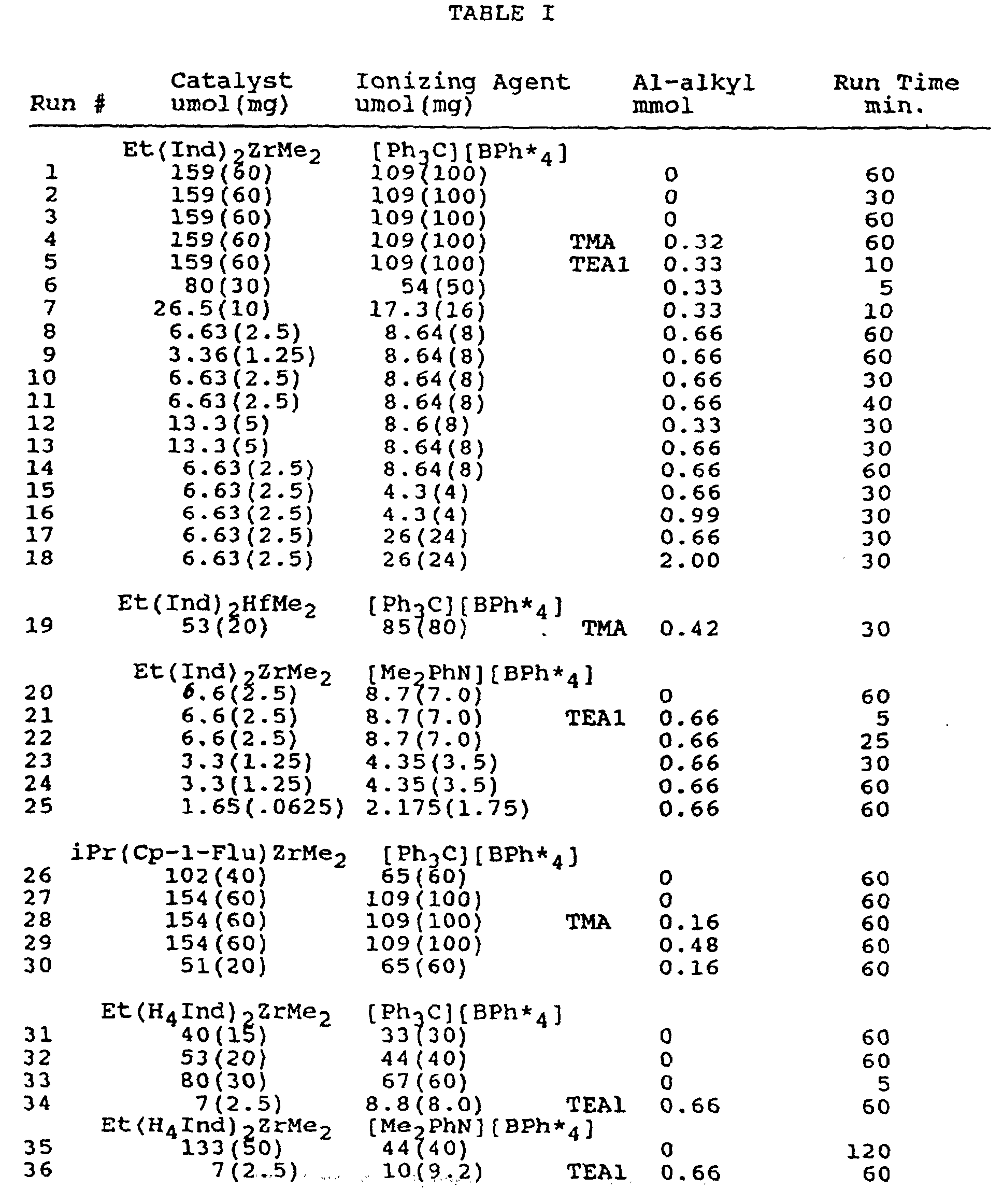

- The process described by this invention synthesizes cations which are used as catalysts in olefin polymerization. The process of making catalysts with this invention produces catalysts having high activity and reduces the by-products which can inhibit catalyst activity. This new synthesis also reduces the catalyst poisons found in the solvents which can inhibit catalyst activity.
- The addition of an aluminum alkyl to ionic metallocene catalyst systems was found to result in reproducible, controllable, high efficiency polymerizations. The addition of an alkyl aluminum provides a scavenging agent for catalyst poisons. The quantity of aluminum alkyl added is relatively small and aluminum alkyls are relatively inexpensive. The metallocene cation/aluminum alkyl combination results in a better catalyst system than the cations alone and give consistently high activities.
Claims (19)
- A process for polymerization of olefins comprising :wherein the aluminum alkyl is of the general formula AlR'3 wherein R' is an alkyl of up to six carbon atoms ;a) mixing an aluminum alkyl with an olefin;b) preparing a metallocene catalyst;c) mixing the catalyst with the aluminium alkyl-olefin mixture ;
wherein the metallocene catalyst is an ion pair formed from a neutral metallocene compound and an ionizing ionic compound and comprises a metallocene cation and an anion from the ionizing ionic compound;
wherein ionizing ionic compound does not contain an active proton and is of the general formula [C][A], wherein [C] contains a carbonium, oxonium or sulfonium cation and the anion [A] is not coordinated or is only loosely coordinated to the metallocene cation; and
wherein the neutral metallocene is of the general formula
M is titanium, zirconium or hafnium, p is 1 to 4 ;
excluding the process wherein(i) the aluminium alkyl is trimethylaluminium ; and(ii) the olefin is propylene; and(iii) the neutral metallocene compound is isopropylidene (cyclopentadienyl-1-fluorenyl) zirconium dimethyl ; and(iv) the ionic ionizing compound is triphenylcarbenium tetrakis (pentafluorophenyl) boronate. - A process as recited in claim1 wherein R* is an alkyl, aryl, alkenyl, alkylaryl, or arylalkyl radical of up to 20 carbon atoms.
- A process as recited in claim 1 wherein the molar ratio for metallocene: ionizing compound: aluminum alkyl ranges from 0.5:1:0.5 to 5:1:350.
- A process as recited in claim 3 wherein the molar ratio for metallocene: ionizing compound: aluminum alkyl ranges from 0.625:1:1.5 to 1.5:1:77.
- A process as recited in claim 4 wherein the molar ratio for metallocene: ionizing compound: aluminum alkyl is 1:1:1.
- A process as recited in claim 1 wherein the aluminum alkyl is selected from the group consisting of triethylaluminum and trimethylaluminum.
- A process as recited in claim 6 wherein the aluminum alkyl is triethylaluminum.
- A process as recited in claim 1 wherein the olefin is propylene.
- A process as recited in claim 1 wherein M is selected from the group consisting of zirconium and hafnium.
- A process as recited in claim 1 wherein the neutral metallocene is chosen from the group consisting of ethylenebis(tetrahydroindenyl) zirconium dimethyl, ethylenebis(indenyl) zirconium dimethyl, ethylenebis(indenyl) hafnium dimethyl, and isopropylidene(cyclopentadienyl-1-fluorenyl) zirconium dimethyl.
- A process as recited in claim 1 wherein the ionic ionizing compound is triphenylcarbenium tetrakis(pentafluorophenyl) boronate.
- A process as recited in claim 1 wherein wherein the catalyst is prepared by the following steps comprising:wherein the neutral metallocene is of the general formulaa) mixing an ionizing ionic compound with a neutral metallocene; andb) allowing contact between the ionizing ionic compound and the neutral metallocene to generate an ion pair in which the metallocene cation acts as a catalyst:
wherein ionizing ionic agent does not contain an active proton and contains a carbonium, oxonium or sulfonium cation and
wherein the anion of the ionizing ionic compound is not coordinated or is only loosely coordinated to the metallocene cation and is chemically unreactive with the metallocene cation. - A catalyst system comprising:wherein the aluminum alkyl is of the general formula AlR'3 wherein R' is an alkyl having up to 6 carbon atoms,a) a metallocene catalyst, andb) an aluminum alkyl
wherein the metallocenecatalyst is an ion pair of the general formula:
wherein the metallocene is an ion pair formed from a neutral metallocene compound and an ionizing ionic compound said ion pair comprising a metallocene cation and an anion from the ionizing compound;
wherein the ionizing ionic compound does not.contain an active proton and is of the formula [C] [A], wherein C contains a carbonium, oxonium or sulfonium cation, and wherein the anion A is not coordinated or is loosely coordinated to the metallocene cation;
excluding the catalyst system wherein(i) the aluminium alkyl is trimethylaluminium ; and(ii) the neutral metallocene compound is isopropylidene (cyclopentadienyl-1-fluorenyl) zirconium dimethyl ; and(iii) the ionic ionizing compound is triphenylcarbenium tetrakis (pentafluorophenyl) boronate. - A catalyst system as recited in claim 13 wherein R* is an alkyl, aryl, alkenyl, alkylaryl, or arylalkyl radical of up to 20 carbon atoms.
- A catalyst system as recited in claim 13 wherein R* is an alkyl having up to six carbon atoms or an aryl having up to 10 carbon atoms.
- A catalyst system as recited in claim 13 wherein the aluminum alkyl is selected from the group consisting of triethylaluminum and trimethylaluminum.
- A catalyst system as recited in claim 16 wherein the aluminum alkyl is triethylaluminum.
- A catalyst system as recited in claim 13 wherein the neutral metallocene is chosen from the group consisting of ethylenebis(tetrahydroindenyl) zirconium dimethyl, ethylenebis(indenyl) zirconium dimethyl, ethylenebis(indenyl) hafnium dimethyl, and isopropylidene(cyclopentadienyl-1-fluorenyl) zirconium dimethyl.
- A catalyst system as recited in claim 13 wherein the anion is tetrakis(pentafluorophenyl) borato anion.
Applications Claiming Priority (2)
| Application Number | Priority Date | Filing Date | Title |
|---|---|---|---|
| US41922289A | 1989-10-30 | 1989-10-30 | |
| US419222 | 1989-10-30 |
Publications (4)
| Publication Number | Publication Date |
|---|---|
| EP0426638A2 EP0426638A2 (en) | 1991-05-08 |
| EP0426638A3 EP0426638A3 (en) | 1991-08-07 |
| EP0426638B1 EP0426638B1 (en) | 1996-04-24 |
| EP0426638B2 true EP0426638B2 (en) | 2005-03-02 |
Family
ID=23661319
Family Applications (1)
| Application Number | Title | Priority Date | Filing Date |
|---|---|---|---|
| EP90870175A Expired - Lifetime EP0426638B2 (en) | 1989-10-30 | 1990-10-09 | Addition of aluminium alkyl for improved metallocene catalyst |
Country Status (9)
| Country | Link |
|---|---|
| US (2) | US5519100A (en) |
| EP (1) | EP0426638B2 (en) |
| JP (1) | JP2939321B2 (en) |
| KR (1) | KR100196613B1 (en) |
| CN (2) | CN1037686C (en) |
| AT (1) | ATE137247T1 (en) |
| CA (1) | CA2027122C (en) |
| DE (1) | DE69026679T3 (en) |
| ES (1) | ES2086397T5 (en) |
Families Citing this family (226)
| Publication number | Priority date | Publication date | Assignee | Title |
|---|---|---|---|---|
| US5153157A (en) * | 1987-01-30 | 1992-10-06 | Exxon Chemical Patents Inc. | Catalyst system of enhanced productivity |
| US5198401A (en) * | 1987-01-30 | 1993-03-30 | Exxon Chemical Patents Inc. | Ionic metallocene catalyst compositions |
| US5241025A (en) * | 1987-01-30 | 1993-08-31 | Exxon Chemical Patents Inc. | Catalyst system of enhanced productivity |
| US5391629A (en) * | 1987-01-30 | 1995-02-21 | Exxon Chemical Patents Inc. | Block copolymers from ionic catalysts |
| US5384299A (en) * | 1987-01-30 | 1995-01-24 | Exxon Chemical Patents Inc. | Ionic metallocene catalyst compositions |
| IE904007A1 (en) * | 1989-11-08 | 1991-05-08 | Mount Isa Mines | Condensation of metal vapours in a fluidized bed |
| US6294625B1 (en) | 1990-03-20 | 2001-09-25 | Exxonmobil Chemical Patents Inc. | Catalyst system of enhanced productivity and its use in polymerization process |
| KR940009020B1 (en) * | 1990-07-24 | 1994-09-29 | 미쓰이 도오아쓰 가가쿠 가부시키가이샤 | CATALYST FOR Ñß-OLEFIN POLYMERIZATION AND PRODUCTION OF POLY Ñß-OLEFIN THEREWITH |
| ATE134658T1 (en) * | 1990-09-14 | 1996-03-15 | Exxon Chemical Patents Inc | IONIC CATALYST FOR PRODUCING POLYALPHAOLEFINS WITH CONTROLLED TACTICITY |
| DE69127811T3 (en) † | 1990-11-30 | 2012-04-26 | Idemitsu Kosan Co., Ltd. | PROCESS FOR THE PRODUCTION OF OLEFIN POLYMERS |
| JP2888648B2 (en) * | 1990-12-28 | 1999-05-10 | 出光興産株式会社 | Method for producing styrenic polymer and catalyst thereof |
| TW300901B (en) | 1991-08-26 | 1997-03-21 | Hoechst Ag | |
| TW309523B (en) * | 1991-11-30 | 1997-07-01 | Hoechst Ag | |
| WO1993014132A1 (en) * | 1992-01-06 | 1993-07-22 | The Dow Chemical Company | Improved catalyst composition |
| US5296433A (en) * | 1992-04-14 | 1994-03-22 | Minnesota Mining And Manufacturing Company | Tris(pentafluorophenyl)borane complexes and catalysts derived therefrom |
| BE1005957A5 (en) * | 1992-06-05 | 1994-04-05 | Solvay | Preparation method of catalyst system, process (co) polymerization of olefins and (co) polymer at least one olefine. |
| US5434116A (en) | 1992-06-05 | 1995-07-18 | Tosoh Corporation | Organic transition metal compound having π-bonding heterocyclic ligand and method of polymerizing olefin by using the same |
| US5710222A (en) | 1992-06-22 | 1998-01-20 | Fina Technology, Inc. | Method for controlling the melting points and molecular weights of syndiotactic polyolefins using metallocene catalyst systems |
| CA2105889A1 (en) * | 1992-09-10 | 1994-03-11 | Yoshio Tajima | Catalyst component for the polymerization of olefins and process for preparing olefin polymers using same |
| US5461127A (en) * | 1992-09-22 | 1995-10-24 | Idemitsu Kosan Co., Ltd. | Polymerization catalysts and process for producing polymers |
| DE69325716T2 (en) * | 1992-10-05 | 2000-04-27 | Exxon Chemical Patents, Inc. | POLYMERIZATION PROCESS USING A CATALYST SYSTEM WITH INCREASED PERFORMANCE |
| US5317036A (en) * | 1992-10-16 | 1994-05-31 | Union Carbide Chemicals & Plastics Technology Corporation | Gas phase polymerization reactions utilizing soluble unsupported catalysts |
| BE1006438A3 (en) * | 1992-12-17 | 1994-08-30 | Solvay | Catalyst system, use of this system catalyst for the (co) polymerization of olefins, method of preparation of this system and method for catalyst (co) polymerization of olefins. |
| GB9226905D0 (en) | 1992-12-24 | 1993-02-17 | Wellcome Found | Pharmaceutical preparation |
| KR100311244B1 (en) * | 1993-02-22 | 2001-12-15 | 가지와라 야스시 | Process for producing ethylene / α-olefin copolymer |
| BE1006880A3 (en) * | 1993-03-01 | 1995-01-17 | Solvay | Precurseur solid system of a catalyst for olefin polymerization, method of preparation, catalytic system including the solid precursor and method for polymerization of olefins in the presence of this system catalyst. |
| EP0629631B1 (en) * | 1993-06-07 | 2002-08-28 | Mitsui Chemicals, Inc. | Novel transition metal compound, and polymerization catalyst containing it |
| EP0812854B2 (en) * | 1993-06-07 | 2011-04-20 | Mitsui Chemicals, Inc. | Novel transition metal compound, olefin polymerization catalyst comprising said compound, process for olefin polymerization using said catalyst and propylene homo- and copolymer |
| JP3189175B2 (en) * | 1993-07-02 | 2001-07-16 | 出光興産株式会社 | Method for producing aromatic vinyl compound copolymer |
| JPH0733812A (en) * | 1993-07-02 | 1995-02-03 | Idemitsu Kosan Co Ltd | Styrene-based polymer production catalyst and method for producing styrene-based polymer using the same |
| US5631202A (en) | 1993-09-24 | 1997-05-20 | Montell Technology Company B.V. | Stereospecific metallocene catalysts with stereolocking α-CP substituents |
| DE4333569A1 (en) * | 1993-10-01 | 1995-04-06 | Hoechst Ag | Process for olefin polymerization |
| FI945959L (en) * | 1993-12-21 | 1995-06-22 | Hoechst Ag | Metallocenes and their use as catalysts |
| JP4024295B2 (en) * | 1994-04-11 | 2007-12-19 | 三井化学株式会社 | Propylene polymer composition production method and propylene polymer composition |
| EP0704463B1 (en) | 1994-04-11 | 1999-07-28 | Mitsui Chemicals, Inc. | Process for producing propylene polymer composition, and propylene polymer composition |
| DE4424227A1 (en) | 1994-07-09 | 1996-01-11 | Hoechst Ag | Organometallic compound |
| TW369547B (en) * | 1994-09-21 | 1999-09-11 | Mitsui Chemicals Inc | Olefin polymerization catalyst and process for olefin polymerization |
| DE4434640C1 (en) | 1994-09-28 | 1996-02-01 | Hoechst Ag | Bridged metallocene prodn. in-situ |
| DE4436113A1 (en) | 1994-10-10 | 1996-04-11 | Hoechst Ag | Metallocene compound |
| EP0710663A1 (en) | 1994-11-01 | 1996-05-08 | Japan Polyolefins Co., Ltd. | Boron-containing compound, its polymer, catalyst comprising the polymer and metallocene compound, and process for producing polyolefin |
| EP0745615B1 (en) * | 1994-12-20 | 2004-07-28 | Mitsui Chemicals, Inc. | Process for the preparation of ethylene polymer and ethylene polymer |
| CN1076282C (en) | 1995-03-02 | 2001-12-19 | 三井化学株式会社 | Polypropylene composite film |
| TW401445B (en) * | 1995-07-13 | 2000-08-11 | Mitsui Petrochemical Ind | Polyamide resin composition |
| US6403772B1 (en) * | 1995-09-11 | 2002-06-11 | Montell Technology Company, Bv | Open-pentadienyl metallocenes, precursors thereof and polymerization catalysts therefrom |
| KR100426080B1 (en) | 1995-09-13 | 2004-07-23 | 미쓰이 가가쿠 가부시키가이샤 | Resin composition and use thereof |
| CN1146586C (en) | 1995-10-18 | 2004-04-21 | 智索股份有限公司 | Olefin homopolymer or copolymer composition and process for producing the same |
| DE19546501A1 (en) | 1995-12-13 | 1997-06-19 | Hoechst Ag | Metallocene compound |
| DE19546500A1 (en) | 1995-12-13 | 1997-06-19 | Hoechst Ag | Production of cyclo-olefin copolymers e.g. for pipes |
| AR005066A1 (en) | 1995-12-15 | 1999-04-07 | Union Carbide Chem Plastic | A PROCEDURE FOR MAKING A POLYETHYLENE HOMOPOLYMER, COPOLYMER OR THERPOLYMER WITH LONG CHAIN BRANCH, A COMPOSITION OF POLYETHYLENE-ASI OBTAINED AND A FILM OR INJECTION MOLDED ARTICLE INCLUDING SUCH COMPOSITION. |
| DE19549352A1 (en) * | 1995-12-22 | 1997-06-26 | Gerhard Edwin Herberich | Metallocene compound, useful for increased catalytic activity |
| DE19622207A1 (en) * | 1996-06-03 | 1997-12-04 | Hoechst Ag | Chemical compound |
| US5959044A (en) * | 1996-07-08 | 1999-09-28 | Villar; Juan Carlos | Method of controlling continuous ethylene-limited metallocene-catalyzed copolymerization systems |
| TW425414B (en) * | 1997-02-18 | 2001-03-11 | Chisso Corp | Preactivated catalyst for olefin (co)polymerization, catalyst for olefin (co)polymerization and olefin (co)polymer composition and their manufacturing method |
| US6231804B1 (en) | 1997-04-02 | 2001-05-15 | Chisso Corporation | Modified olefin (co)polymer composition, process for preparing the same, and modified olefin (co)polymer composition molding |
| US6303696B1 (en) | 1997-04-11 | 2001-10-16 | Chisso Corporation | Propylene (co)polymer composition using metallocene catalyst |
| JP3817015B2 (en) * | 1997-04-14 | 2006-08-30 | 三井化学株式会社 | Cyclic olefin copolymer and use thereof |
| TWI246520B (en) | 1997-04-25 | 2006-01-01 | Mitsui Chemicals Inc | Processes for olefin polymerization |
| US6160072A (en) * | 1997-05-02 | 2000-12-12 | Ewen; John A. | Process for polymerizing tactioselective polyolefins in condensed phase using titanocenes |
| TW504515B (en) | 1997-08-07 | 2002-10-01 | Chisso Corp | Olefin (co)polymer composition |
| US6025407A (en) * | 1997-10-30 | 2000-02-15 | Occidental Chemical Corporation | Photo-polymerization of vinyl chloride using metallocene catalysts |
| FI980342A0 (en) * | 1997-11-07 | 1998-02-13 | Borealis As | Polymerroer och -roerkopplingar |
| TW562810B (en) | 1998-04-16 | 2003-11-21 | Mitsui Chemicals Inc | Catalyst for olefinic polymerization and method for polymerizing olefine |
| US6225427B1 (en) | 1998-10-15 | 2001-05-01 | Uniroyal Chemical Company, Inc. | Olefin polymerization process employing metallocene catalyst provided by cocatalyst activation of a metallocene procatalyst |
| US6486088B1 (en) | 1998-10-23 | 2002-11-26 | Exxonmobil Chemical Patents Inc. | High activity carbenium-activated polymerization catalysts |
| US6300433B1 (en) * | 1998-10-23 | 2001-10-09 | Exxonmobil Chemical Patents Inc. | Olefin copolymerization process with bridged hafnocenes |
| TW576843B (en) | 1998-12-25 | 2004-02-21 | Mitsui Chemicals Inc | Olefin polymerization catalyst and process for olefin polymerization using the olefin polymerization catalyst |
| JP2000351813A (en) | 1999-04-09 | 2000-12-19 | Mitsui Chemicals Inc | ETHYLENE/alpha-OLEFIN COPOLYMER, ITS PRODUCTION, AND ITS USE |
| US6632885B2 (en) | 1999-04-13 | 2003-10-14 | Mitsui Chemicals, Inc. | Soft syndiotactic polypropylene composition and molded product |
| US6291386B1 (en) | 1999-05-25 | 2001-09-18 | Equistar Chemicals, Lp | Process for the in-situ preparation of single-site transition metal catalysts and polymerization process |
| JP3808243B2 (en) | 1999-07-27 | 2006-08-09 | 三井化学株式会社 | Soft resin composition |
| US6559090B1 (en) | 1999-11-01 | 2003-05-06 | W. R. Grace & Co.-Conn. | Metallocene and constrained geometry catalyst systems employing agglomerated metal oxide/clay support-activator and method of their preparation |
| US6399535B1 (en) | 1999-11-01 | 2002-06-04 | W. R. Grace & Co.-Conn. | Coordination catalyst systems employing agglomerated metal oxide/clay support-activator and method of their preparation |
| US6838540B2 (en) | 2000-01-26 | 2005-01-04 | Mitsui Chemicals, Inc. | Olefin polymer and production processes thereof |
| WO2001074920A1 (en) | 2000-03-31 | 2001-10-11 | Mitsui Chemicals, Inc. | Processes for producing polyolefin composition |
| US6635733B2 (en) | 2000-05-23 | 2003-10-21 | Chisso Corporation | Elastomeric polypropylene |
| US6846943B2 (en) | 2000-05-23 | 2005-01-25 | Chisso Corporation | Metallocene compound, olefin polymerization catalyst containing the compound, and method for producing an olefin polymer by use of the catalyst |
| JP2002020417A (en) | 2000-07-04 | 2002-01-23 | Mitsui Chemicals Inc | Method for polymerizing olefin |
| KR100443766B1 (en) | 2000-07-04 | 2004-08-09 | 미쓰이 가가쿠 가부시키가이샤 | Process for producing polar olefin copolymer and polar olefin copolymer obtained thereby |
| EP1296993B1 (en) | 2000-07-06 | 2005-01-26 | Basf Aktiengesellschaft | Metallic compounds and the use thereof in the polymerisation of olefins |
| EP1241194B1 (en) | 2000-07-26 | 2013-09-04 | Mitsui Chemicals, Inc. | Polymer and process for producing the same |
| US6858767B1 (en) | 2000-08-11 | 2005-02-22 | Uniroyal Chemical Company, Inc. | Process for producing liquid polyalphaolefin polymer, metallocene catalyst therefor, the resulting polymer and lubricant containing same |
| DE60124829T2 (en) | 2000-09-07 | 2007-06-28 | Mitsui Chemicals, Inc. | A polar group-containing olefin copolymer, a process for the production thereof, a thermoplastic resin composition containing this copolymer and their use |
| KR100844062B1 (en) | 2001-02-21 | 2008-07-07 | 미쓰이 가가쿠 가부시키가이샤 | Catalyst for olefin polymerizaion and method for producing olefin polymers using the catalyst |
| US6927261B2 (en) | 2001-04-30 | 2005-08-09 | W. R. Grace & Co.-Conn. | Method of making supported transition metal polymerization catalysts and compositions formed therefrom |
| ATE337343T1 (en) | 2001-04-30 | 2006-09-15 | Grace W R & Co | SUPPORTED DUAL TRANSITION METAL CATALYST SYSTEMS |
| EP1401887A1 (en) | 2001-04-30 | 2004-03-31 | W.R. Grace & Co.-Conn. | Heterogeneous chromium catalysts and processes of polymerization of olefins using same |
| US6946420B2 (en) | 2001-04-30 | 2005-09-20 | W. R. Grace & Co.-Conn | Coordination catalyst systems employing chromium support-agglomerate and method of their preparation |
| US6943224B2 (en) | 2001-04-30 | 2005-09-13 | W. R. Grace & Co.-Conn. | Process for preparing supported transition metal catalyst systems and catalyst systems prepared thereby |
| EP1425345A1 (en) | 2001-06-22 | 2004-06-09 | Exxonmobil Chemical Patents Inc. | Metallocene-produced very low density polyethylenes or linear lowdensity polyethylenes as impact modifiers |
| US7019157B2 (en) | 2001-08-06 | 2006-03-28 | Chisso Corporation | Metallocene compounds, production process for olefin polymers using catalysts containing them and olefin polymers produced by the production process |
| WO2003035704A1 (en) | 2001-10-19 | 2003-05-01 | Asahi Kasei Kabushiki Kaisha | Process for polymerization of olefins |
| DE10211386A1 (en) | 2002-03-14 | 2003-09-25 | Basf Ag | Process for oligomerizing olefins using a cycloalkylalkyl-substituted triazacyclohexane |
| AU2003259234A1 (en) | 2002-07-31 | 2004-02-25 | Exxonmobil Chemical Patents Inc. | Silane crosslinkable polyethylene |
| US6995279B2 (en) | 2002-08-02 | 2006-02-07 | Chisso Corporation | Metallocene compounds, processes for the production of olefin polymers using catalysts containing the compounds, and olefin polymers produced by the processes |
| EP1537175B1 (en) | 2002-09-05 | 2008-05-14 | ExxonMobil Chemical Patents Inc. | Shrink film |
| ATE494321T1 (en) | 2002-09-05 | 2011-01-15 | Exxonmobil Chem Patents Inc | STRETCH FILM WRAPPING PROCESS |
| KR100456396B1 (en) * | 2002-09-17 | 2004-11-10 | 삼성전자주식회사 | method for controlling probe tips sanding in semiconductor device testing equipment and sanding control apparatus |
| KR100785840B1 (en) | 2002-09-27 | 2007-12-13 | 미쓰이 가가쿠 가부시키가이샤 | Crosslinked metallocene compound, olefin polymerization catalyst and method of polymerizing olefin |
| JP5221848B2 (en) | 2002-10-23 | 2013-06-26 | 三井化学株式会社 | Support component containing magnesium and its application to olefin polymerization |
| DE10251513A1 (en) | 2002-11-04 | 2004-05-19 | Basf Ag | Compounds with 5-membered heterocycle linked by amino- or phosphino-methyl to a benzene ring with an ortho-hydroxy, alkoxy, thiol or amino group, used as multidentate ligands in olefin polymerization catalysts |
| US7488789B2 (en) | 2003-03-28 | 2009-02-10 | Mitsui Chemicals, Inc. | Propylene copolymer, polypropylene composition, and uses thereof, transition metal compounds and catalyst for olefin polymerization |
| DE602005017243D1 (en) | 2004-01-28 | 2009-12-03 | Idemitsu Kosan Co | INPOLYMERISIERUNG |
| CN100390256C (en) | 2004-11-26 | 2008-05-28 | 三井化学株式会社 | Synthetic lubricating oils and lubricating oil compositions |
| US20080038498A1 (en) * | 2004-12-22 | 2008-02-14 | Keita Itakura | Propylene Polymer, Composition Comprising the Polymer, and Molded Product Obtained Therefrom |
| SG162742A1 (en) | 2005-05-18 | 2010-07-29 | Mitsui Chemicals Inc | Catalyst for olefin polymerization, method for producing olefin polymer, method for producing propylene copolymer, propylene polymer, propylene polymer composition, and use of those |
| JP5438256B2 (en) | 2006-11-17 | 2014-03-12 | 三井化学株式会社 | Polypropylene resin film and use thereof |
| US7282546B2 (en) * | 2005-06-22 | 2007-10-16 | Fina Technology, Inc. | Cocatalysts for reduction of production problems in metallocene-catalyzed polymerizations |
| WO2007011459A1 (en) | 2005-07-19 | 2007-01-25 | Exxonmobil Chemical Patents Inc. | Polyalpha-olefin compositions and processes to produce the same |
| US20070080483A1 (en) * | 2005-10-07 | 2007-04-12 | Mitsui Chemicals, Inc. | Process for producing injection molded product |
| US20070225423A1 (en) * | 2005-10-07 | 2007-09-27 | Mitsui Chemicals, Inc. | Process for producing blow molded product by blow molding |
| RU2426650C2 (en) | 2005-10-26 | 2011-08-20 | Дау Глобал Текнолоджиз Инк. | Multilayer pre-stretched elastic articles |
| US7605208B2 (en) | 2005-10-31 | 2009-10-20 | Mitsui Chemicals, Inc. | Process for producing thermoplastic resin composition |
| CN101003595B (en) | 2006-01-18 | 2010-12-15 | 住友化学株式会社 | Process for preparing ethylene-alpha-olefin-polyene random copolymers |
| CN101384627A (en) * | 2006-02-15 | 2009-03-11 | 三井化学株式会社 | Vinyl resin and blow molded article formed therefrom |
| US20090036584A1 (en) * | 2006-02-15 | 2009-02-05 | Mitsui Chemicals, Inc. | Environmental Stress Cracking Resistance Improver, and Resin Composition With Improved Environmental Stress Cracking Resistance Properties Containing the Same |
| WO2007105483A1 (en) | 2006-03-10 | 2007-09-20 | Mitsui Chemicals, Inc. | Process for production of moldings by the inflation method |
| US20090166911A1 (en) | 2006-03-27 | 2009-07-02 | Mitsui Chemicals, Inc. | Process for Producing Molded Article by T-Die Molding |
| JP2007261201A (en) | 2006-03-29 | 2007-10-11 | Mitsui Chemicals Inc | Method for producing molded body by blow molding |
| WO2007114009A1 (en) | 2006-03-30 | 2007-10-11 | Mitsui Chemicals, Inc. | Process for producing molded object by injection molding |
| US7951873B2 (en) | 2006-05-05 | 2011-05-31 | Exxonmobil Chemical Patents Inc. | Linear low density polymer blends and articles made therefrom |
| KR101096836B1 (en) | 2006-07-31 | 2011-12-22 | 가부시키가이샤 프라임 폴리머 | Film or laminated body consisting of ethylene resin or ethylene resin composition |
| WO2008047878A1 (en) | 2006-10-20 | 2008-04-24 | Mitsui Chemicals, Inc. | Copolymer, lubricating oil viscosity modifier, and lubricating oil composition |
| DE102006057822A1 (en) | 2006-12-06 | 2008-06-26 | Basell Poliolefine Italia S.R.L. | Solvent-free multilayer laminated material for production of, e.g. floor coverings, includes thermoplastic polymers, flexible material, fibrous intermediate layer comprising plastic and adhesive material, and metal, plastic, or wood |
| EP2096126A1 (en) | 2006-12-19 | 2009-09-02 | Mitsui Chemicals, Inc. | Solid catalyst for olefin polymerization, olefin polymerization method, and olefin polymer particle produced by the method |
| DE102006060459A1 (en) * | 2006-12-19 | 2008-06-26 | Basell Poliolefine Italia S.R.L. | Multilayer laminated material for Electrical and electronic component, has glass layer, lower substrate layer of plastic, metal or plastic and metal, intermediate layer, plastic fibrous intermediate layer and glass top layer |
| ATE551392T1 (en) * | 2007-01-16 | 2012-04-15 | Prime Polymer Co Ltd | ETHYLENE RESIN COMPOSITION FOR BLOW MOLDED BODY AND BLOW MOLDED BODY OBTAINED THEREFROM |
| US8063146B2 (en) | 2007-06-14 | 2011-11-22 | Mitsui Chemicals, Inc. | Thermoplastic elastomer composition |
| JP5226973B2 (en) | 2007-06-15 | 2013-07-03 | 三井化学株式会社 | Ethylene-based copolymer, composition containing the copolymer, and use thereof |
| CN101687776B (en) | 2007-07-04 | 2015-07-01 | 三井化学株式会社 | Transition metal complex compound, olefin polymerization catalyst containing the compound, and method for producing olefin polymer performed in the presence of the catalyst |
| WO2009066689A1 (en) | 2007-11-19 | 2009-05-28 | Mitsui Chemicals, Inc. | Bridged metallocene compound, olefin polymerization catalyst using the compound and ethylene polymer obtained by using the catalyst |
| DE102007057606A1 (en) | 2007-11-28 | 2009-06-04 | Basell Polyolefine Gmbh | Modular built rotary drum for electrical and household appliances |
| EP2242838A1 (en) * | 2007-12-17 | 2010-10-27 | GliaMed, Inc. | Stem-like cells and method for reprogramming adult mammalian somatic cells |
| US8609769B2 (en) | 2008-03-27 | 2013-12-17 | Mitsui Chemicals, Inc. | Resin composition and use thereof |
| ES2423287T3 (en) | 2008-03-31 | 2013-09-19 | Mitsui Chemicals, Inc. | Composition of resin and molten bag |
| US8293856B2 (en) | 2008-08-19 | 2012-10-23 | Mitsui Chemicals, Inc. | Process for preparing olefin polymer using mixed catalyst |
| US20100317711A1 (en) * | 2008-12-17 | 2010-12-16 | Gliamed, Inc. | Stem-like cells and method for reprogramming adult mammalian somatic cells |
| US8445609B2 (en) | 2009-04-21 | 2013-05-21 | Mitsui Chemicals, Inc. | Method for producing olefin polymer |
| WO2010144130A1 (en) | 2009-06-11 | 2010-12-16 | W.R. Grace & Co. -Conn. | Process of making aluminoxane and catalysts comprising thus prepared aluminoxane |
| US9017593B2 (en) | 2009-06-16 | 2015-04-28 | Exxonmobil Chemical Patents Inc. | Composite materials comprising propylene-based polymer blend coatings |
| US8791284B2 (en) | 2009-07-01 | 2014-07-29 | Mitsui Chemicals, Inc. | Organometallic compound and production method thereof |
| US20110020619A1 (en) | 2009-07-23 | 2011-01-27 | Van Den Bossche Linda M | Polypropylene-Based Elastomer Coating Compositions |
| US9005739B2 (en) | 2009-07-23 | 2015-04-14 | Exxonmobil Chemical Patents Inc. | Laminated articles and their production |
| US9174417B2 (en) | 2009-08-18 | 2015-11-03 | Basell Polyolefine Gmbh | Housing for electrical power cells in electrically driven automotive vehicles |
| WO2011020582A1 (en) | 2009-08-18 | 2011-02-24 | Basell Polyolefine Gmbh | Plastic fuel container for motor bikes or automotive hybrid cars |
| WO2011053406A1 (en) | 2009-10-29 | 2011-05-05 | Exxonmobil Chemical Patents Inc. | Pressure-sensitive hot melt adhesive compositions |
| SG181837A1 (en) | 2009-12-21 | 2012-08-30 | Mitsui Chemicals Inc | Process for production of syndiotactic a-olefin polymer |
| US20120135903A1 (en) | 2010-05-11 | 2012-05-31 | Mitsui Chemicals, Inc. | Lubricating oil composition |
| JP5688236B2 (en) | 2010-05-25 | 2015-03-25 | 出光興産株式会社 | Catalyst composition and method for producing olefin polymer using the catalyst composition |
| CN103154123B (en) | 2010-10-15 | 2016-01-27 | 埃克森美孚化学专利公司 | polypropylene-based adhesive compositions |
| WO2012097146A1 (en) | 2011-01-14 | 2012-07-19 | W. R. Grace & Co.-Conn. | Process of making modified metallocene catalyst, catalyst produced and use thereof |
| WO2012157709A1 (en) | 2011-05-18 | 2012-11-22 | 三井化学株式会社 | Propylene copolymer and propylene copolymer composition, molding and foam thereof, and processes for producing said molding and foam |
| US9399746B2 (en) | 2011-10-10 | 2016-07-26 | Exxonmobil Chemical Patents Inc. | Poly alpha olefin compositions |
| CN103987779B (en) | 2011-12-27 | 2016-04-06 | 三井化学株式会社 | 4-methyl-1-pentene (being total to) polymer composition, the film comprising said composition and hollow molded body |
| JP5943941B2 (en) | 2011-12-28 | 2016-07-05 | 三井化学株式会社 | Ethylene polymer composition and molded product obtained therefrom |
| US8664461B2 (en) | 2012-03-19 | 2014-03-04 | Exxonmobil Chemical Patents Inc. | Catalysts for producing polyalpha-olefins and processes related thereto |
| KR101609500B1 (en) | 2012-03-21 | 2016-04-05 | 미쓰이 가가쿠 가부시키가이샤 | Method for producing olefin polymer |
| EP2833415B1 (en) | 2012-03-28 | 2018-05-02 | Mitsui Chemicals, Inc. | Solar cell sealing material and solar cell module |
| CN102796008A (en) * | 2012-07-05 | 2012-11-28 | 河南颖泰化工有限责任公司 | Technique for recycling and reutilizing effluent gas in MEA (monoethanolamine) production |
| JP6033322B2 (en) | 2012-09-25 | 2016-11-30 | 三井化学株式会社 | Transition metal compound, catalyst for olefin polymerization, and method for producing olefin polymer |
| WO2014050817A1 (en) | 2012-09-25 | 2014-04-03 | 三井化学株式会社 | Method for producing olefin polymer, and olefin polymer |
| KR101394943B1 (en) | 2012-11-19 | 2014-05-14 | 대림산업 주식회사 | Copolymer of ethylene and alpha-olefin and method for producing the same |
| US10457786B2 (en) | 2013-02-20 | 2019-10-29 | Prime Polymer Co., Ltd. | Biaxially-stretched film and ethylene polymer composition |
| US9616421B2 (en) | 2013-02-27 | 2017-04-11 | Mitsui Chemicals, Inc. | Catalyst for olefin multimerization and method for producing olefin multimer in presence of catalyst for olefin multimerization |
| JP5951108B2 (en) | 2013-03-12 | 2016-07-13 | 三井化学株式会社 | Process for producing olefin polymer and catalyst for olefin polymerization |
| JP6161716B2 (en) | 2013-10-18 | 2017-07-12 | 三井化学株式会社 | Adhesive containing ethylene / α-olefin copolymer |
| EP3106475B1 (en) | 2014-02-13 | 2019-08-28 | Mitsui Chemicals, Inc. | Method for producing ethylene/alpha-olefin copolymer |
| CN109824809B (en) | 2014-02-13 | 2022-06-28 | 三井化学株式会社 | Ethylene-α-olefin-non-conjugated polyene copolymer and use thereof |
| BR112016018537B1 (en) | 2014-02-14 | 2021-09-28 | Mitsui Chemicals, Inc | ETHYLENE/A-OLEFIN/NON-CONJUGATED POLYMER COPOLYMER AND PROCESS FOR THE PRODUCTION OF THEM, THERMOPLASTIC RESIN COMPOSITION, RUBBER COMPOSITION, PRODUCT OBTAINED BY RESTRICULATION OF RUBBER COMPOSITION, RETICULATED MODELED ARTICLE, PROCESS FOR THE PRODUCTION OF THIS ARTICLE, PRODUCT BY USE TEMPLATE, RESIN COMPOSITION AND PRODUCT OBTAINED BY RETICULATION OF THE RESIN COMPOSITION |
| JP6702854B2 (en) | 2014-02-28 | 2020-06-03 | 三井化学株式会社 | CROSSLINKED PRODUCT, PRODUCTION METHOD AND USE THEREOF, AND ETHYLENE COPOLYMER |
| US9714306B2 (en) | 2014-03-28 | 2017-07-25 | Mitsui Chemicals, Inc. | Olefin resin and method for producing same |
| RU2647310C1 (en) | 2014-03-28 | 2018-03-15 | Митсуи Кемикалс, Инк. | Olefin-based resin, process for its production and propylene-based resin composition |
| EP3124505B1 (en) | 2014-03-28 | 2025-03-19 | Mitsui Chemicals, Inc. | Ethylene/alpha-olefin copolymer and lubricating oil |
| WO2016039295A1 (en) | 2014-09-10 | 2016-03-17 | 三井化学株式会社 | Lubricant composition |
| CN106715487B (en) | 2014-09-11 | 2021-02-26 | 三井化学株式会社 | Method for producing olefin (co)polymer containing structural unit derived from 1-butene |
| ES2784518T3 (en) | 2014-12-09 | 2020-09-28 | Mitsui Chemicals Inc | Propylene-based resin composition |
| EP3272805B1 (en) | 2015-03-20 | 2021-08-11 | Mitsui Chemicals, Inc. | Thermoplastic elastomer composition and method for producing same |
| CN107428956B (en) | 2015-03-20 | 2022-05-17 | 三井化学株式会社 | Thermoplastic elastomer composition, use thereof, process for producing the same, ethylene-alpha-olefin-nonconjugated polyene copolymer, and use thereof |
| JP6371900B2 (en) | 2015-03-31 | 2018-08-08 | 三井化学株式会社 | Resin composition and use thereof |
| WO2017082182A1 (en) | 2015-11-09 | 2017-05-18 | 三井化学株式会社 | Viscosity modifier for lubricating oils, additive composition for lubricating oils, and lubricating oil compositions |
| WO2017105614A1 (en) | 2015-12-16 | 2017-06-22 | Exxonmobil Chemical Patents Inc. | Low crystalline polymer compositions |
| EP3424705B1 (en) | 2016-03-04 | 2023-03-22 | Mitsui Chemicals, Inc. | Laminate and application for same |
| CA3018952C (en) | 2016-03-31 | 2023-06-27 | Exxonmobil Chemical Patents Inc. | Low crystalline polymer compositions prepared in a dual reactor |
| JP6741790B2 (en) | 2017-01-16 | 2020-08-19 | 三井化学株式会社 | Lubricating oil composition for automobile gear |
| JP6792649B2 (en) | 2017-02-20 | 2020-11-25 | 三井化学株式会社 | Laminate |
| CN110312618B (en) | 2017-02-20 | 2021-09-07 | 三井化学株式会社 | Laminate |
| EP3642313A1 (en) | 2017-06-22 | 2020-04-29 | ExxonMobil Research and Engineering Company | Low viscosity lubricants based on methyl paraffin containing hydrocarbon fluids |
| KR20220110863A (en) | 2017-07-06 | 2022-08-09 | 미쓰이 가가쿠 가부시키가이샤 | Catalyst for olefin multimerization and method for producing olefin multimer in presence of said catalyst |
| US10988497B2 (en) | 2017-09-28 | 2021-04-27 | Univation Technologies, Llc | Synthesis of cyclic organic compounds and metallocenes |
| CN111868116B (en) | 2018-03-20 | 2022-12-09 | 三井化学株式会社 | Ethylene-α-olefin-non-conjugated polyene copolymer, its production method and use |
| CN113015755B (en) | 2018-09-17 | 2023-09-08 | 埃克森美孚化学专利公司 | Metallocene dimer selective catalyst and process for preparing poly alpha-olefin dimer |
| JP7182644B2 (en) | 2018-12-04 | 2022-12-02 | 三井化学株式会社 | Resin composition containing 4-methyl-1-pentene copolymer, and capacitor film |
| JP7155398B2 (en) | 2019-03-19 | 2022-10-18 | 三井化学株式会社 | PROPYLENE-BASED RESIN COMPOSITION, MOLDED PRODUCT AND PROPYLENE POLYMER |
| CN113574147A (en) | 2019-03-26 | 2021-10-29 | 三井化学株式会社 | Lubricating oil composition for automobile gear and method for producing the same |
| US20220186134A1 (en) | 2019-03-26 | 2022-06-16 | Mitsui Chemicals, Inc. | Lubricating oil composition for internal combustion engines and method for producing the same |
| EP3950902A4 (en) | 2019-03-26 | 2022-08-10 | Mitsui Chemicals, Inc. | Lubricant oil composition for vehicle transmission fluid and method for producing same |
| CN113574145A (en) | 2019-03-26 | 2021-10-29 | 三井化学株式会社 | Lubricating oil composition for compressor oil and method for producing same |
| US20220169938A1 (en) | 2019-03-26 | 2022-06-02 | Mitsui Chemicals, Inc. | Lubrication oil composition and method for producing same |
| KR20210139407A (en) | 2019-03-26 | 2021-11-22 | 미쓰이 가가쿠 가부시키가이샤 | Grease composition and method for preparing the same |
| CN113614208A (en) | 2019-03-26 | 2021-11-05 | 三井化学株式会社 | Lubricating oil composition and method for producing the same |
| ES2985405T3 (en) | 2019-03-26 | 2024-11-05 | Mitsui Chemicals Inc | Composition of lubricating oil for industrial gears and method for producing the same |
| US20220177798A1 (en) | 2019-03-26 | 2022-06-09 | Mitsui Chemicals, Inc. | Lubricating oil composition for hydraulic oil and method for producing the same |
| US20220169942A1 (en) | 2019-03-26 | 2022-06-02 | Mitsui Chemicals, Inc. | Lubricating oil composition for internal combustion engines and method for producing the same |
| WO2020203402A1 (en) | 2019-03-29 | 2020-10-08 | 三井化学株式会社 | Resin composition |
| CN114127169B (en) | 2019-08-08 | 2023-08-01 | 普瑞曼聚合物株式会社 | Propylene polymer composition and molded article |
| WO2021029938A1 (en) | 2019-08-09 | 2021-02-18 | Exxonmobil Chemical Patents Inc. | Processes for producing poly alpha olefins and method of analysis and apparatuses therefor |
| US12091380B2 (en) | 2019-08-09 | 2024-09-17 | Exxonmobil Chemical Patents Inc. | Processes for producing poly alpha olefins and apparatuses therefor |
| US20220411659A1 (en) | 2019-10-07 | 2022-12-29 | Mitsui Chemicals, Inc. | ETHYLENE/alpha-OLEFIN COPOLYMER COMPOSITION AND APPLICATION THEREOF |
| US11661465B2 (en) | 2019-10-28 | 2023-05-30 | Exxonmobil Chemical Patents Inc. | Dimer selective metallocene catalysts, non-aromatic hydrocarbon soluble activators, and processes to produce poly alpha-olefin oligmers therewith |
| EP4053210A4 (en) | 2019-10-29 | 2023-12-06 | Mitsui Chemicals, Inc. | Ethylene-based copolymer composition and use thereof |
| CN115003757B (en) | 2020-01-30 | 2024-05-14 | 三井化学株式会社 | Polyamide composition |
| CN116234836B (en) | 2020-10-06 | 2024-10-29 | 三井化学株式会社 | Resin composition |
| US20240101737A1 (en) | 2021-01-18 | 2024-03-28 | Mitsui Chemicals, Inc. | WATER DISPERSION COMPOSITION, METHOD FOR PRODUCING THE WATER DISPERSION COMPOSITION, AND ETHYLENE alpha-OLEFIN COPOLYMER ACID-MODIFIED SUBSTANCE |
| JP7621455B2 (en) | 2021-03-05 | 2025-01-24 | 三井化学株式会社 | Thermoplastic elastomer composition |
| WO2022210845A1 (en) | 2021-03-31 | 2022-10-06 | 三井化学株式会社 | Ethylene resin composition and molded body |
| JP7681098B2 (en) | 2021-03-31 | 2025-05-21 | 三井化学株式会社 | ETHYLENE-α-OLEFIN COPOLYMER, THERMOPLASTIC RESIN COMPOSITION, AND FILM |
| US20240191067A1 (en) | 2021-03-31 | 2024-06-13 | Mitsui Chemicals, Inc. | ETHYLENE-alpha-OLEFIN COPOLYMER, THERMOPLASTIC RESIN COMPOSITION, FILM, AND LAMINATE |
| EP4342915A1 (en) | 2021-05-20 | 2024-03-27 | Mitsui Chemicals, Inc. | Resin composition, use thereof, and method for producing same |
| CN118251454A (en) | 2021-11-16 | 2024-06-25 | 三井化学株式会社 | Resin composition and use thereof |
| WO2023176788A1 (en) | 2022-03-17 | 2023-09-21 | 三井化学株式会社 | Thermoplastic resin composition |
| CN118891295A (en) | 2022-03-24 | 2024-11-01 | 三井化学株式会社 | Ethylene/α-olefin/5-vinyl-2-norbornene copolymer, composition containing the copolymer and crosslinked body |
| CN119421911A (en) | 2022-06-27 | 2025-02-11 | 三井化学株式会社 | Method for producing cyclic olefin copolymer, cyclic olefin copolymer, crosslinked body, film or sheet, laminate, circuit board, electronic device and prepreg |
| CN119421910A (en) | 2022-06-27 | 2025-02-11 | 三井化学株式会社 | Method for producing varnish-like cyclic olefin copolymer composition, cyclic olefin copolymer composition, crosslinked body, film or sheet, laminate, circuit board, electronic device and prepreg |
| WO2024195445A1 (en) | 2023-03-23 | 2024-09-26 | 三井化学株式会社 | Aqueous lubricant composition |
| KR20250137688A (en) | 2023-03-23 | 2025-09-18 | 미쯔이가가꾸가부시끼가이샤 | Water-based lubricant composition |
| CN121001982A (en) | 2023-05-22 | 2025-11-21 | 埃克森美孚技术与工程公司 | Methods for activating metallocene catalysts in reactors to improve catalyst productivity in PAO production |
| CN119371579A (en) * | 2023-07-26 | 2025-01-28 | 中国石油天然气集团有限公司 | Metallocene catalyst system, polyisobutylene and preparation method thereof |
Family Cites Families (11)
| Publication number | Priority date | Publication date | Assignee | Title |
|---|---|---|---|---|
| US3242099A (en) * | 1964-03-27 | 1966-03-22 | Union Carbide Corp | Olefin polymerization catalysts |
| US3756998A (en) * | 1968-10-14 | 1973-09-04 | Union Carbide Corp | L catalysts polymerization of olefins using supported pi arenechromium tricarbony |
| US3709853A (en) * | 1971-04-29 | 1973-01-09 | Union Carbide Corp | Polymerization of ethylene using supported bis-(cyclopentadienyl)chromium(ii)catalysts |
| CA1238145A (en) * | 1982-09-30 | 1988-06-14 | Kenneth W. Powers | Modified lewis acid catalyzed polymerization |
| US4808561A (en) * | 1985-06-21 | 1989-02-28 | Exxon Chemical Patents Inc. | Supported polymerization catalyst |
| CA1268754A (en) * | 1985-06-21 | 1990-05-08 | Howard Curtis Welborn, Jr. | Supported polymerization catalyst |
| PL276385A1 (en) * | 1987-01-30 | 1989-07-24 | Exxon Chemical Patents Inc | Method for polymerization of olefines,diolefins and acetylene unsaturated compounds |
| IL85097A (en) * | 1987-01-30 | 1992-02-16 | Exxon Chemical Patents Inc | Catalysts based on derivatives of a bis(cyclopentadienyl)group ivb metal compound,their preparation and their use in polymerization processes |
| US5241025A (en) * | 1987-01-30 | 1993-08-31 | Exxon Chemical Patents Inc. | Catalyst system of enhanced productivity |
| US5153157A (en) * | 1987-01-30 | 1992-10-06 | Exxon Chemical Patents Inc. | Catalyst system of enhanced productivity |
| EP0426637B2 (en) * | 1989-10-30 | 2001-09-26 | Fina Technology, Inc. | Preparation of metallocene catalysts for polymerization of olefins |
-
1990
- 1990-10-09 EP EP90870175A patent/EP0426638B2/en not_active Expired - Lifetime
- 1990-10-09 DE DE69026679T patent/DE69026679T3/en not_active Expired - Fee Related
- 1990-10-09 ES ES90870175T patent/ES2086397T5/en not_active Expired - Lifetime
- 1990-10-09 CA CA002027122A patent/CA2027122C/en not_active Expired - Fee Related
- 1990-10-09 AT AT90870175T patent/ATE137247T1/en not_active IP Right Cessation
- 1990-10-10 KR KR1019900016067A patent/KR100196613B1/en not_active Expired - Fee Related
- 1990-10-29 JP JP2288600A patent/JP2939321B2/en not_active Expired - Lifetime
- 1990-10-30 CN CN90108885A patent/CN1037686C/en not_active Expired - Fee Related
-
1992
- 1992-02-04 US US07/830,812 patent/US5519100A/en not_active Expired - Lifetime
-
1994
- 1994-12-28 CN CN94120039A patent/CN1037685C/en not_active Expired - Fee Related
-
1995
- 1995-05-24 US US08/449,197 patent/US5614457A/en not_active Expired - Lifetime
Also Published As
| Publication number | Publication date |
|---|---|
| KR910007974A (en) | 1991-05-30 |
| DE69026679T3 (en) | 2005-10-06 |
| US5519100A (en) | 1996-05-21 |
| DE69026679D1 (en) | 1996-05-30 |
| ATE137247T1 (en) | 1996-05-15 |
| ES2086397T3 (en) | 1996-07-01 |
| KR100196613B1 (en) | 1999-06-15 |
| JPH03207704A (en) | 1991-09-11 |
| JP2939321B2 (en) | 1999-08-25 |
| CN1111641A (en) | 1995-11-15 |
| CN1037686C (en) | 1998-03-11 |
| CN1037685C (en) | 1998-03-11 |
| EP0426638A2 (en) | 1991-05-08 |
| US5614457A (en) | 1997-03-25 |
| EP0426638B1 (en) | 1996-04-24 |
| CN1051365A (en) | 1991-05-15 |
| ES2086397T5 (en) | 2005-07-16 |
| DE69026679T2 (en) | 1996-09-26 |
| CA2027122A1 (en) | 1991-05-01 |
| EP0426638A3 (en) | 1991-08-07 |
| CA2027122C (en) | 2002-12-10 |
Similar Documents
| Publication | Publication Date | Title |
|---|---|---|
| EP0426638B2 (en) | Addition of aluminium alkyl for improved metallocene catalyst | |
| KR0165843B1 (en) | Manufacturing method of metal hosen catalyst for olefin polymerization | |
| US5387568A (en) | Preparation of metallocene catalysts for polymerization of olefins | |
| EP0601830B1 (en) | Catalyst components for polymerization of olefins and use thereof | |
| EP0573403B1 (en) | Cationic metallocene catalysts based on triphenylcarbenium aluminum | |
| EP0841349B1 (en) | Catalyst for alpha-olefin polymerization and production of poly-alpha-olefin therewith | |
| KR100270838B1 (en) | Process for preparing olefin polymer | |
| EP1060198B1 (en) | Noncoordinating anions for olefin polymerization | |
| EP0498675B1 (en) | Production of alpha-olefin polymers | |
| JPWO1992001723A1 (en) | α-olefin polymerization catalyst and method for producing poly-α-olefin using the same | |
| JP3258702B2 (en) | Solid catalyst for olefin polymerization and method for producing polyolefin using the same | |
| JP3070257B2 (en) | Method for producing olefin polymer | |
| JP3427488B2 (en) | Novel organic transition metal compound and method for producing polyolefin using the same | |
| JPH05239140A (en) | Catalyst for olefin polymerization and production of polyolefin using the catalyst | |
| JPH0649122A (en) | Olefin polymerization catalyst and method of polymerizing olefin | |
| JPH05320241A (en) | Production of olefin polymer | |
| JPH05320242A (en) | Process for producing olefin polymer |
Legal Events
| Date | Code | Title | Description |
|---|---|---|---|
| PUAI | Public reference made under article 153(3) epc to a published international application that has entered the european phase |
Free format text: ORIGINAL CODE: 0009012 |
|
| 17P | Request for examination filed |
Effective date: 19901022 |
|
| AK | Designated contracting states |
Kind code of ref document: A2 Designated state(s): AT BE CH DE DK ES FR GB GR IT LI LU NL SE |
|
| PUAL | Search report despatched |
Free format text: ORIGINAL CODE: 0009013 |
|
| AK | Designated contracting states |
Kind code of ref document: A3 Designated state(s): AT BE CH DE DK ES FR GB GR IT LI LU NL SE |
|
| 17Q | First examination report despatched |
Effective date: 19930924 |
|
| GRAH | Despatch of communication of intention to grant a patent |
Free format text: ORIGINAL CODE: EPIDOS IGRA |
|
| GRAA | (expected) grant |
Free format text: ORIGINAL CODE: 0009210 |
|
| AK | Designated contracting states |
Kind code of ref document: B1 Designated state(s): AT BE CH DE DK ES FR GB GR IT LI LU NL SE |
|
| PG25 | Lapsed in a contracting state [announced via postgrant information from national office to epo] |
Ref country code: AT Effective date: 19960424 Ref country code: GR Free format text: LAPSE BECAUSE OF FAILURE TO SUBMIT A TRANSLATION OF THE DESCRIPTION OR TO PAY THE FEE WITHIN THE PRESCRIBED TIME-LIMIT Effective date: 19960424 Ref country code: LI Effective date: 19960424 Ref country code: CH Effective date: 19960424 Ref country code: DK Effective date: 19960424 |
|
| REF | Corresponds to: |
Ref document number: 137247 Country of ref document: AT Date of ref document: 19960515 Kind code of ref document: T |
|
| REF | Corresponds to: |
Ref document number: 69026679 Country of ref document: DE Date of ref document: 19960530 |
|
| ET | Fr: translation filed | ||
| REG | Reference to a national code |
Ref country code: ES Ref legal event code: FG2A Ref document number: 2086397 Country of ref document: ES Kind code of ref document: T3 |
|
| ITF | It: translation for a ep patent filed | ||
| PG25 | Lapsed in a contracting state [announced via postgrant information from national office to epo] |
Ref country code: SE Effective date: 19960724 |
|
| PG25 | Lapsed in a contracting state [announced via postgrant information from national office to epo] |
Ref country code: LU Free format text: LAPSE BECAUSE OF NON-PAYMENT OF DUE FEES Effective date: 19961031 |
|
| REG | Reference to a national code |
Ref country code: CH Ref legal event code: PL |
|
| PLBQ | Unpublished change to opponent data |
Free format text: ORIGINAL CODE: EPIDOS OPPO |
|
| PLBI | Opposition filed |
Free format text: ORIGINAL CODE: 0009260 |
|
| PLBF | Reply of patent proprietor to notice(s) of opposition |
Free format text: ORIGINAL CODE: EPIDOS OBSO |
|
| 26 | Opposition filed |
Opponent name: THE DOW CHEMICAL COMPANY Effective date: 19970123 |
|
| NLR1 | Nl: opposition has been filed with the epo |
Opponent name: THE DOW CHEMICAL COMPANY |
|
| PLBF | Reply of patent proprietor to notice(s) of opposition |
Free format text: ORIGINAL CODE: EPIDOS OBSO |
|
| PLBF | Reply of patent proprietor to notice(s) of opposition |
Free format text: ORIGINAL CODE: EPIDOS OBSO |
|
| PLBQ | Unpublished change to opponent data |
Free format text: ORIGINAL CODE: EPIDOS OPPO |
|
| PLAB | Opposition data, opponent's data or that of the opponent's representative modified |
Free format text: ORIGINAL CODE: 0009299OPPO |
|
| R26 | Opposition filed (corrected) |
Opponent name: THE DOW CHEMICAL COMPANY Effective date: 19970123 |
|
| NLR1 | Nl: opposition has been filed with the epo |
Opponent name: THE DOW CHEMICAL COMPANY |
|
| RAP2 | Party data changed (patent owner data changed or rights of a patent transferred) |
Owner name: FINA TECHNOLOGY, INC. |
|
| NLT2 | Nl: modifications (of names), taken from the european patent patent bulletin |
Owner name: FINA TECHNOLOGY, INC. |
|
| REG | Reference to a national code |
Ref country code: GB Ref legal event code: IF02 |
|
| PLBC | Reply to examination report in opposition received |
Free format text: ORIGINAL CODE: EPIDOSNORE3 |
|
| PUAH | Patent maintained in amended form |
Free format text: ORIGINAL CODE: 0009272 |
|
| STAA | Information on the status of an ep patent application or granted ep patent |
Free format text: STATUS: PATENT MAINTAINED AS AMENDED |
|
| 27A | Patent maintained in amended form |
Effective date: 20050302 |
|
| AK | Designated contracting states |
Kind code of ref document: B2 Designated state(s): AT BE CH DE DK ES FR GB GR IT LI LU NL SE |
|
| NLR2 | Nl: decision of opposition |
Effective date: 20050302 |
|
| NLR3 | Nl: receipt of modified translations in the netherlands language after an opposition procedure | ||
| REG | Reference to a national code |
Ref country code: ES Ref legal event code: DC2A Date of ref document: 20050421 Kind code of ref document: T5 |
|
| ET3 | Fr: translation filed ** decision concerning opposition | ||
| PGFP | Annual fee paid to national office [announced via postgrant information from national office to epo] |
Ref country code: NL Payment date: 20061024 Year of fee payment: 17 |
|
| PGFP | Annual fee paid to national office [announced via postgrant information from national office to epo] |
Ref country code: GB Payment date: 20061025 Year of fee payment: 17 |
|
| PGFP | Annual fee paid to national office [announced via postgrant information from national office to epo] |
Ref country code: ES Payment date: 20061026 Year of fee payment: 17 |
|
| PGFP | Annual fee paid to national office [announced via postgrant information from national office to epo] |
Ref country code: IT Payment date: 20061031 Year of fee payment: 17 |
|
| PGFP | Annual fee paid to national office [announced via postgrant information from national office to epo] |
Ref country code: BE Payment date: 20061124 Year of fee payment: 17 |
|
| PGFP | Annual fee paid to national office [announced via postgrant information from national office to epo] |
Ref country code: DE Payment date: 20061130 Year of fee payment: 17 |
|
| BERE | Be: lapsed |
Owner name: *FINA TECHNOLOGY INC. Effective date: 20071031 |
|
| GBPC | Gb: european patent ceased through non-payment of renewal fee |
Effective date: 20071009 |
|
| NLV4 | Nl: lapsed or anulled due to non-payment of the annual fee |
Effective date: 20080501 |
|
| PG25 | Lapsed in a contracting state [announced via postgrant information from national office to epo] |
Ref country code: DE Free format text: LAPSE BECAUSE OF NON-PAYMENT OF DUE FEES Effective date: 20080501 |
|
| PG25 | Lapsed in a contracting state [announced via postgrant information from national office to epo] |
Ref country code: BE Free format text: LAPSE BECAUSE OF NON-PAYMENT OF DUE FEES Effective date: 20071031 |
|
| REG | Reference to a national code |
Ref country code: FR Ref legal event code: ST Effective date: 20080630 |
|
| PG25 | Lapsed in a contracting state [announced via postgrant information from national office to epo] |
Ref country code: NL Free format text: LAPSE BECAUSE OF NON-PAYMENT OF DUE FEES Effective date: 20080501 |
|
| PGFP | Annual fee paid to national office [announced via postgrant information from national office to epo] |
Ref country code: FR Payment date: 20061017 Year of fee payment: 17 |
|
| PG25 | Lapsed in a contracting state [announced via postgrant information from national office to epo] |
Ref country code: GB Free format text: LAPSE BECAUSE OF NON-PAYMENT OF DUE FEES Effective date: 20071009 |
|
| REG | Reference to a national code |
Ref country code: ES Ref legal event code: FD2A Effective date: 20071010 |
|
| PG25 | Lapsed in a contracting state [announced via postgrant information from national office to epo] |
Ref country code: FR Free format text: LAPSE BECAUSE OF NON-PAYMENT OF DUE FEES Effective date: 20071031 Ref country code: ES Free format text: LAPSE BECAUSE OF NON-PAYMENT OF DUE FEES Effective date: 20071010 |
|
| PG25 | Lapsed in a contracting state [announced via postgrant information from national office to epo] |
Ref country code: IT Free format text: LAPSE BECAUSE OF NON-PAYMENT OF DUE FEES Effective date: 20071009 |