JP5951108B2 - Process for producing olefin polymer and catalyst for olefin polymerization - Google Patents
Process for producing olefin polymer and catalyst for olefin polymerization Download PDFInfo
- Publication number
- JP5951108B2 JP5951108B2 JP2015505485A JP2015505485A JP5951108B2 JP 5951108 B2 JP5951108 B2 JP 5951108B2 JP 2015505485 A JP2015505485 A JP 2015505485A JP 2015505485 A JP2015505485 A JP 2015505485A JP 5951108 B2 JP5951108 B2 JP 5951108B2
- Authority
- JP
- Japan
- Prior art keywords
- group
- olefin
- olefin polymer
- hydrocarbon group
- general formula
- Prior art date
- Legal status (The legal status is an assumption and is not a legal conclusion. Google has not performed a legal analysis and makes no representation as to the accuracy of the status listed.)
- Active
Links
- 0 **(ONC*N)ON(*)* Chemical compound **(ONC*N)ON(*)* 0.000 description 1
Classifications
-
- C—CHEMISTRY; METALLURGY
- C08—ORGANIC MACROMOLECULAR COMPOUNDS; THEIR PREPARATION OR CHEMICAL WORKING-UP; COMPOSITIONS BASED THEREON
- C08F—MACROMOLECULAR COMPOUNDS OBTAINED BY REACTIONS ONLY INVOLVING CARBON-TO-CARBON UNSATURATED BONDS
- C08F10/00—Homopolymers and copolymers of unsaturated aliphatic hydrocarbons having only one carbon-to-carbon double bond
- C08F10/04—Monomers containing three or four carbon atoms
- C08F10/06—Propene
-
- C—CHEMISTRY; METALLURGY
- C08—ORGANIC MACROMOLECULAR COMPOUNDS; THEIR PREPARATION OR CHEMICAL WORKING-UP; COMPOSITIONS BASED THEREON
- C08F—MACROMOLECULAR COMPOUNDS OBTAINED BY REACTIONS ONLY INVOLVING CARBON-TO-CARBON UNSATURATED BONDS
- C08F4/00—Polymerisation catalysts
- C08F4/42—Metals; Metal hydrides; Metallo-organic compounds; Use thereof as catalyst precursors
- C08F4/44—Metals; Metal hydrides; Metallo-organic compounds; Use thereof as catalyst precursors selected from light metals, zinc, cadmium, mercury, copper, silver, gold, boron, gallium, indium, thallium, rare earths or actinides
- C08F4/60—Metals; Metal hydrides; Metallo-organic compounds; Use thereof as catalyst precursors selected from light metals, zinc, cadmium, mercury, copper, silver, gold, boron, gallium, indium, thallium, rare earths or actinides together with refractory metals, iron group metals, platinum group metals, manganese, rhenium technetium or compounds thereof
- C08F4/62—Refractory metals or compounds thereof
- C08F4/64—Titanium, zirconium, hafnium or compounds thereof
- C08F4/659—Component covered by group C08F4/64 containing a transition metal-carbon bond
- C08F4/65912—Component covered by group C08F4/64 containing a transition metal-carbon bond in combination with an organoaluminium compound
-
- C—CHEMISTRY; METALLURGY
- C07—ORGANIC CHEMISTRY
- C07F—ACYCLIC, CARBOCYCLIC OR HETEROCYCLIC COMPOUNDS CONTAINING ELEMENTS OTHER THAN CARBON, HYDROGEN, HALOGEN, OXYGEN, NITROGEN, SULFUR, SELENIUM OR TELLURIUM
- C07F7/00—Compounds containing elements of Groups 4 or 14 of the Periodic Table
-
- C—CHEMISTRY; METALLURGY
- C08—ORGANIC MACROMOLECULAR COMPOUNDS; THEIR PREPARATION OR CHEMICAL WORKING-UP; COMPOSITIONS BASED THEREON
- C08F—MACROMOLECULAR COMPOUNDS OBTAINED BY REACTIONS ONLY INVOLVING CARBON-TO-CARBON UNSATURATED BONDS
- C08F4/00—Polymerisation catalysts
- C08F4/42—Metals; Metal hydrides; Metallo-organic compounds; Use thereof as catalyst precursors
- C08F4/44—Metals; Metal hydrides; Metallo-organic compounds; Use thereof as catalyst precursors selected from light metals, zinc, cadmium, mercury, copper, silver, gold, boron, gallium, indium, thallium, rare earths or actinides
- C08F4/60—Metals; Metal hydrides; Metallo-organic compounds; Use thereof as catalyst precursors selected from light metals, zinc, cadmium, mercury, copper, silver, gold, boron, gallium, indium, thallium, rare earths or actinides together with refractory metals, iron group metals, platinum group metals, manganese, rhenium technetium or compounds thereof
- C08F4/62—Refractory metals or compounds thereof
- C08F4/64—Titanium, zirconium, hafnium or compounds thereof
- C08F4/659—Component covered by group C08F4/64 containing a transition metal-carbon bond
- C08F4/6592—Component covered by group C08F4/64 containing a transition metal-carbon bond containing at least one cyclopentadienyl ring, condensed or not, e.g. an indenyl or a fluorenyl ring
- C08F4/65922—Component covered by group C08F4/64 containing a transition metal-carbon bond containing at least one cyclopentadienyl ring, condensed or not, e.g. an indenyl or a fluorenyl ring containing at least two cyclopentadienyl rings, fused or not
- C08F4/65927—Component covered by group C08F4/64 containing a transition metal-carbon bond containing at least one cyclopentadienyl ring, condensed or not, e.g. an indenyl or a fluorenyl ring containing at least two cyclopentadienyl rings, fused or not two cyclopentadienyl rings being mutually bridged
-
- C—CHEMISTRY; METALLURGY
- C08—ORGANIC MACROMOLECULAR COMPOUNDS; THEIR PREPARATION OR CHEMICAL WORKING-UP; COMPOSITIONS BASED THEREON
- C08F—MACROMOLECULAR COMPOUNDS OBTAINED BY REACTIONS ONLY INVOLVING CARBON-TO-CARBON UNSATURATED BONDS
- C08F110/00—Homopolymers of unsaturated aliphatic hydrocarbons having only one carbon-to-carbon double bond
- C08F110/04—Monomers containing three or four carbon atoms
- C08F110/06—Propene
Landscapes
- Chemical & Material Sciences (AREA)
- Organic Chemistry (AREA)
- Health & Medical Sciences (AREA)
- Chemical Kinetics & Catalysis (AREA)
- Medicinal Chemistry (AREA)
- Polymers & Plastics (AREA)
- Crystallography & Structural Chemistry (AREA)
- Engineering & Computer Science (AREA)
- Materials Engineering (AREA)
- Transition And Organic Metals Composition Catalysts For Addition Polymerization (AREA)
Description
本発明は、オレフィン重合体の製造方法およびオレフィン重合用触媒に関する。 The present invention relates to a method for producing an olefin polymer and a catalyst for olefin polymerization.
近年、オレフィン重合用の均一系触媒として、メタロセン化合物がよく知られている。メタロセン化合物を用いてオレフィンを重合する方法(特に、α−オレフィンを重合する方法)に関しては、W.Kaminskyらによってアイソタクチック重合が報告されて以来、立体規則性や重合活性の更なる向上という視点から、多くの改良研究が行なわれている(非特許文献1)。 In recent years, metallocene compounds are well known as homogeneous catalysts for olefin polymerization. Regarding the method for polymerizing olefins using metallocene compounds (particularly, the method for polymerizing α-olefins), W.W. Since the report of isotactic polymerization by Kaminsky et al., Many improvement studies have been conducted from the viewpoint of further improving stereoregularity and polymerization activity (Non-patent Document 1).
メタロセン化合物を用いたα−オレフィンの重合では、メタロセン化合物の配位子のシクロペンタジエニル環に置換基を導入したり、2個のシクロペンタジエニル環を架橋させることにより、得られるオレフィン重合体の立体規則性や分子量が大きく変化することが知られている。 In the polymerization of α-olefins using metallocene compounds, the olefin weight obtained by introducing a substituent into the cyclopentadienyl ring of the ligand of the metallocene compound or crosslinking two cyclopentadienyl rings. It is known that the stereoregularity and molecular weight of the coalesce change greatly.
例えば、シクロペンタジエニル環とフルオレニル環が架橋された配位子を有するメタロセン化合物をプロピレンの重合触媒に用いた場合、重合体の立体規則性の観点からみると、ジメチルメチレン(シクロペンタジエニル)(フルオレニル)ジルコニウムジクロリドではシンジオタクチックポリプロピレンが(非特許文献2)、シクロペンタジエニル環の3 位にメチル基を導入したジメチルメチレン(3−メチルシクロペンタジエニル)(フルオレニル)ジルコニウムジクロリドではヘミアイソタクチックポリプロピレンが(特許文献1)、同様に、tert−ブチル基を導入したジメチルメチレン(3−tert−ブチルシクロペンタジエニル)(フルオレニル)ジルコニウムジクロリドではアイソタクチックポリプロピレンが得られる(特許文献2)。 For example, when a metallocene compound having a ligand in which a cyclopentadienyl ring and a fluorenyl ring are bridged is used as a propylene polymerization catalyst, from the viewpoint of the stereoregularity of the polymer, dimethylmethylene (cyclopentadienyl) ) (Fluorenyl) zirconium dichloride is syndiotactic polypropylene (Non-Patent Document 2), and dimethylmethylene (3-methylcyclopentadienyl) (fluorenyl) zirconium dichloride in which a methyl group is introduced at the 3-position of the cyclopentadienyl ring is Hemiisotactic polypropylene is (Patent Document 1). Similarly, dimethylmethylene (3-tert-butylcyclopentadienyl) (fluorenyl) zirconium dichloride into which a tert-butyl group has been introduced provides isotactic polypropylene ( Patent Document 2).
これらのメタロセン化合物の改良の試みから、重合体の立体規則性の指標である融点について、比較的高いのもが得られるようになっており、また重合体の分子量についても充分に高いものが得られるようになっている。さらには充分に高い分子量をもち、かつ高い融点をもつ重合体も得られるようになっている。 From attempts to improve these metallocene compounds, it has become possible to obtain a relatively high melting point, which is an index of the stereoregularity of the polymer, and a sufficiently high molecular weight of the polymer. It is supposed to be. Furthermore, a polymer having a sufficiently high molecular weight and a high melting point can be obtained.
しかしながら、必要充分に高い分子量をもち、かつ高い融点をもつ重合体を、高い重合活性で生成する重合触媒の開発は未だ十分とはいえない。そのため融点がある程度高く、分子量が高い重合体を高い生産性で得る製造方法が強く望まれてきた。 However, the development of a polymerization catalyst that produces a polymer having a sufficiently high molecular weight and a high melting point with a high polymerization activity is still not sufficient. Therefore, a production method for obtaining a polymer having a high melting point and a high molecular weight with high productivity has been strongly desired.
さらに、これらのオレフィン重合体の工業的な製造を可能とするには、常温以上の温度、好ましくは常温を超える高い温度で、前記特徴を有するオレフィン重合体が製造できることが望まれているが、それらが可能な重合触媒はこれまでは存在しなかった。 Furthermore, in order to enable industrial production of these olefin polymers, it is desired that an olefin polymer having the above characteristics can be produced at a temperature higher than ordinary temperature, preferably higher than ordinary temperature. There has never been a polymerization catalyst capable of doing so.
本発明は、上記課題を解決するためになされたものであって、その目的は、工業的製法において有利な高温条件下においても高分子量かつ高融点のオレフィン重合体を効率よく製造する方法およびオレフィン重合用触媒を提供することにある。 The present invention has been made in order to solve the above-mentioned problems, and an object of the present invention is to provide a method for efficiently producing a high-molecular-weight and high-melting olefin polymer even under high temperature conditions advantageous in an industrial production method, It is to provide a polymerization catalyst.
本発明者は、上記課題を解決すべく鋭意検討を行った結果、特定の構造を有する新規なメタロセン化合物を含むオレフィン重合用触媒を用いたオレフィン重合体の製造方法により解決できることを見出し、本発明を完成させた。 As a result of intensive studies to solve the above problems, the present inventor has found that the present invention can be solved by a method for producing an olefin polymer using a catalyst for olefin polymerization containing a novel metallocene compound having a specific structure. Was completed.
上記課題を解決するための本発明に係るオレフィン重合体の製造方法は、
(A)下記一般式[I]で表される架橋メタロセン化合物と、
(B)(b−1)有機アルミニウムオキシ化合物、
(b−2)架橋メタロセン化合物(A)と反応してイオン対を形成する化合物、
(b−3)有機アルミニウム化合物、
から選択される少なくとも1種の化合物と、
を含むオレフィン重合用触媒存在下に、50℃以上200℃以下の重合温度条件下において、炭素数3以上20以下のα−オレフィンから選択される少なくとも1種を重合することを特徴とする。The method for producing an olefin polymer according to the present invention for solving the above-described problems is
(A) a bridged metallocene compound represented by the following general formula [I];
(B) (b-1) an organoaluminum oxy compound,
(B-2) a compound that reacts with the bridged metallocene compound (A) to form an ion pair,
(B-3) an organoaluminum compound,
At least one compound selected from:
And at least one selected from α-olefins having 3 to 20 carbon atoms in a polymerization temperature condition of 50 ° C. or higher and 200 ° C. or lower in the presence of an olefin polymerization catalyst.
本発明に係るオレフィン重合体の製造方法は、前記一般式[I]において、R1が1−アダマンチル基であることが好ましい。
In the method for producing an olefin polymer according to the present invention, in the general formula [I], R 1 is preferably a 1-adamantyl group.
本発明に係るオレフィン重合体の製造方法は、前記一般式[I]において、R2およびR7が炭素数4〜10の炭化水素基であることが好ましい。In the method for producing an olefin polymer according to the present invention, in the general formula [I], R 2 and R 7 are preferably hydrocarbon groups having 4 to 10 carbon atoms.
本発明に係るオレフィン重合体の製造方法は、前記一般式[I]において、R4およびR5が水素原子であることが好ましい。In the method for producing an olefin polymer according to the present invention, in the general formula [I], R 4 and R 5 are preferably hydrogen atoms.
本発明に係るオレフィン重合体の製造方法は、前記一般式[I]において、R12が炭素数1〜20の炭化水素基であることが好ましい。In the method for producing an olefin polymer according to the present invention, in the general formula [I], R 12 is preferably a hydrocarbon group having 1 to 20 carbon atoms.
本発明に係るオレフィン重合体の製造方法は、前記一般式[I]において、R8〜R11が水素原子または炭素数1〜20の炭化水素基であることが好ましい。In the method for producing an olefin polymer according to the present invention, in the general formula [I], R 8 to R 11 are preferably a hydrogen atom or a hydrocarbon group having 1 to 20 carbon atoms.
本発明に係るオレフィン重合体の製造方法は、前記一般式[I]において、R10およびR11が水素原子であることが好ましい。In the method for producing an olefin polymer according to the present invention, in the general formula [I], R 10 and R 11 are preferably hydrogen atoms.
本発明に係るオレフィン重合体の製造方法は、前記一般式[I]において、R8およびR9が炭素数1〜20の炭化水素基であることが好ましい。In the method for producing an olefin polymer according to the present invention, in the general formula [I], R 8 and R 9 are preferably hydrocarbon groups having 1 to 20 carbon atoms.
本発明に係るオレフィン重合体の製造方法は、前記一般式[I]において、nが1であることが好ましい。 In the method for producing an olefin polymer according to the present invention, n is preferably 1 in the general formula [I].
本発明に係るオレフィン重合体の製造方法は、前記炭素数3以上のα−オレフィンの少なくとも1種が、プロピレンであることが好ましい。 In the method for producing an olefin polymer according to the present invention, it is preferable that at least one of the α-olefins having 3 or more carbon atoms is propylene.
本発明に係るオレフィン重合体の製造方法は、無水素条件下におけるオレフィン重合活性が、50kg/mmol-M/h以上1000000kg/mmol-M/h以下であり、かつオレフィン重合体が下記要件(i)および(iii)を同時に満たすことが好ましい。 In the method for producing an olefin polymer according to the present invention, the olefin polymerization activity under hydrogen-free conditions is 50 kg / mmol-M / h or more and 1000000 kg / mmol-M / h or less, and the olefin polymer satisfies the following requirements (i ) And (iii) are preferably satisfied simultaneously.
(i)プロピレン含量(P)が51mol%≦P≦100mol%
(iii)135℃デカリン中における極限粘度[η]が1.0(dl/g)≦[η] ≦10(dl/g)
本発明に係るオレフィン重合体の製造方法は、オレフィン重合体の示差走査型熱量計(DSC)により求められる融点ピーク(A)が130℃≦A≦155℃であることが好ましい。(I) Propylene content (P) is 51 mol% ≦ P ≦ 100 mol%
(Iii) The intrinsic viscosity [η] in 135 ° C. decalin is 1.0 (dl / g) ≦ [η] ≦ 10 (dl / g)
In the method for producing an olefin polymer according to the present invention, the melting point peak (A) obtained by a differential scanning calorimeter (DSC) of the olefin polymer is preferably 130 ° C. ≦ A ≦ 155 ° C.
本発明に係るオレフィン重合体の製造方法は、オレフィン重合活性が、1000kg/mmol-M/h以上1000000kg/mmol-M/h以下であり、かつ前記オレフィン重合体が下記要件(i)および(iii)を同時に満たすことが好ましい。
(i)エチレン含量(E)が1mol%≦E≦10mol%、かつプロピレン含量(P)が90mol%≦P≦99mol% (ただし(E)+(P)=100mol%とする)
(iii)ASTM D1238条件下で測定されたメルトマスフローレイト(MFR)(g/10分)が0.1≦MFR≦150
本発明に係るオレフィン重合体の製造方法は、オレフィン重合体の示差走査型熱量計(DSC)により求められる融点ピーク(A)が110℃≦A≦135℃であることが好ましい。In the method for producing an olefin polymer according to the present invention, the olefin polymerization activity is 1,000 kg / mmol-M / h or more and 1,000,000 kg / mmol-M / h or less, and the olefin polymer has the following requirements (i) and (iii) ) Are preferably satisfied at the same time.
(I) The ethylene content (E) is 1 mol% ≦ E ≦ 10 mol% and the propylene content (P) is 90 mol% ≦ P ≦ 99 mol% (provided that (E) + (P) = 100 mol%)
(Iii) Melt mass flow rate (MFR) (g / 10 min) measured under ASTM D1238 conditions is 0.1 ≦ MFR ≦ 150
In the method for producing an olefin polymer according to the present invention, the melting point peak (A) obtained by a differential scanning calorimeter (DSC) of the olefin polymer is preferably 110 ° C. ≦ A ≦ 135 ° C.
本発明に係るオレフィン重合体の製造方法は、前記オレフィン重合用触媒が、さらに担体(C)を含むことが好ましい。 In the method for producing an olefin polymer according to the present invention, it is preferable that the olefin polymerization catalyst further includes a carrier (C).
また、本発明に係るオレフィン重合用触媒(A)は、下記一般式[I]で表される: The olefin polymerization catalyst (A) according to the present invention is represented by the following general formula [I]:
本発明のオレフィン重合用触媒は、前記一般式[I]において、R1が1−アダマンチル基であることが好ましい。
In the olefin polymerization catalyst of the present invention, in the general formula [I], R 1 is preferably a 1-adamantyl group.
本発明のオレフィン重合用触媒は、前記一般式[I]において、R2およびR7が炭素数4〜10の炭化水素基であることが好ましい。In the olefin polymerization catalyst of the present invention, in the general formula [I], R 2 and R 7 are preferably hydrocarbon groups having 4 to 10 carbon atoms.
本発明のオレフィン重合用触媒は、前記一般式[I]において、R4およびR5が水素原子であることが好ましい。In the olefin polymerization catalyst of the present invention, in the general formula [I], R 4 and R 5 are preferably hydrogen atoms.
本発明のオレフィン重合用触媒は、前記一般式[I]において、R12が炭素数1〜20の炭化水素基であることが好ましい。In the olefin polymerization catalyst of the present invention, in the general formula [I], R 12 is preferably a hydrocarbon group having 1 to 20 carbon atoms.
本発明のオレフィン重合用触媒は、前記一般式[I]において、R8〜R11が水素原子または炭素数1〜20の炭化水素基であることが好ましい。In the general formula [I], the catalyst for olefin polymerization of the present invention is preferably such that R 8 to R 11 are a hydrogen atom or a hydrocarbon group having 1 to 20 carbon atoms.
本発明のオレフィン重合用触媒は、前記一般式[I]において、R10およびR11が水素原子であることが好ましい。In the olefin polymerization catalyst of the present invention, in the general formula [I], R 10 and R 11 are preferably hydrogen atoms.
本発明のオレフィン重合用触媒は、前記一般式[I]において、R8およびR9が炭素数1〜20の炭化水素基であることが好ましい。In the catalyst for olefin polymerization of the present invention, in the general formula [I], R 8 and R 9 are preferably hydrocarbon groups having 1 to 20 carbon atoms.
本発明のオレフィン重合用触媒は、前記一般式[I]において、nが1であることが好ましい。 In the olefin polymerization catalyst of the present invention, n is preferably 1 in the general formula [I].
本発明によれば、特定の構造を有する有用かつ新規なメタロセン化合物を含むオレフィン重合用触媒を用いることにより、オレフィン重合体を効率よく製造することができる。また、本発明は、オレフィン重合体を高い重合活性で生成するオレフィン重合用触媒をも提供する。 According to the present invention, an olefin polymer can be efficiently produced by using an olefin polymerization catalyst containing a useful and novel metallocene compound having a specific structure. The present invention also provides an olefin polymerization catalyst that produces an olefin polymer with high polymerization activity.
以下、本発明に係るオレフィン重合体の製造方法について説明する。本発明の一般式[I]で表される架橋メタロセン化合物(以下、「メタロセン化合物(A)」ともいう。)、好ましいメタロセン化合物(A)の例示、メタロセン化合物(A)の製造方法、メタロセン化合物(A)をオレフィン重合用触媒に供する際の好ましい形態、メタロセン化合物(A)を含むオレフィン重合用触媒の存在下でオレフィン重合体を製造する方法について、順に説明する。なお、本発明の技術的範囲は以下の実施形態に限定解釈されるものではない。 Hereinafter, the manufacturing method of the olefin polymer which concerns on this invention is demonstrated. Bridged metallocene compound represented by general formula [I] of the present invention (hereinafter also referred to as “metallocene compound (A)”), preferred metallocene compound (A), method for producing metallocene compound (A), metallocene compound A preferred form when (A) is used for an olefin polymerization catalyst, and a method for producing an olefin polymer in the presence of an olefin polymerization catalyst containing a metallocene compound (A) will be described in order. The technical scope of the present invention is not limited to the following embodiments.
〔メタロセン化合物(A)〕
本発明のメタロセン化合物(A)は、下記一般式[1]で表される。[Metalocene Compound (A)]
The metallocene compound (A) of the present invention is represented by the following general formula [1].
本発明のメタロセン化合物(A)を含むオレフィン重合用触媒を用いることにより、例えばプロピレン等のα−オレフィンを重合する場合、オレフィン重合体を効率よく製造することができる。すなわち、本発明のメタロセン化合物(A)は、オレフィン重合体、特にプロピレン(共)重合体を製造するためのオレフィン重合用の触媒成分として好適に用いることができる。 By using the olefin polymerization catalyst containing the metallocene compound (A) of the present invention, for example, when an α-olefin such as propylene is polymerized, an olefin polymer can be produced efficiently. That is, the metallocene compound (A) of the present invention can be suitably used as a catalyst component for olefin polymerization for producing an olefin polymer, particularly a propylene (co) polymer.
R2、R4、R5、R7〜R12の炭化水素基の炭素数は、1〜40が好ましく、1〜20がより好ましい。炭化水素基としては、炭素数1〜20のアルキル基、炭素数3〜20の飽和脂環式基、炭素数6〜20のアリール基、炭素数7〜20のアラルキル基が例示される。 R 2, R 4, R 5 , number of carbon atoms of the hydrocarbon group of R 7 to R 12 is 1 to 40 preferably 1 to 20 is more preferable. Examples of the hydrocarbon group include an alkyl group having 1 to 20 carbon atoms, a saturated alicyclic group having 3 to 20 carbon atoms, an aryl group having 6 to 20 carbon atoms, and an aralkyl group having 7 to 20 carbon atoms.
炭素数1〜20のアルキル基としては、メチル基、エチル基、n−プロピル基、n−ブチル基、n−ペンチル基、n−ヘキシル基、n−ヘプチル基、n−オクチル基、n−ノニル基、n−デカニル基等の直鎖状アルキル基;iso−プロピル基、tert−ブチル基、アミル基、3−メチルペンチル基、1,1−ジエチルプロピル基、1,1−ジメチルブチル基、1−メチル−1−プロピルブチル基、1,1−プロピルブチル基、1,1−ジメチル−2−メチルプロピル基、1−メチル−1−イソプロピル−2−メチルプロピル基等の分岐状アルキル基が例示される。 Examples of the alkyl group having 1 to 20 carbon atoms include methyl group, ethyl group, n-propyl group, n-butyl group, n-pentyl group, n-hexyl group, n-heptyl group, n-octyl group, and n-nonyl. Group, a linear alkyl group such as n-decanyl group; iso-propyl group, tert-butyl group, amyl group, 3-methylpentyl group, 1,1-diethylpropyl group, 1,1-dimethylbutyl group, 1 -Branched alkyl groups such as methyl-1-propylbutyl, 1,1-propylbutyl, 1,1-dimethyl-2-methylpropyl, 1-methyl-1-isopropyl-2-methylpropyl Is done.
炭素数3〜20の飽和脂環式基としては、シクロペンチル基、シクロヘキシル基、シクロヘプチル基、シクロオクチル基等のシクロアルキル基;ノルボルニル基、アダマンチル基等の脂環式多環基が例示される。 Examples of the saturated alicyclic group having 3 to 20 carbon atoms include cycloalkyl groups such as cyclopentyl group, cyclohexyl group, cycloheptyl group, and cyclooctyl group; alicyclic polycyclic groups such as norbornyl group and adamantyl group. .
炭素数6〜20のアリール基としては、フェニル基、ナフチル基、フェナントリル基、アントラセニル基、ビフェニル基等の非置換アリール基;o−トリル基、m−トリル基、p−トリル基、エチルフェニル基、n−プロピルフェニル基、iso−プロピルフェニル基、n−ブチルフェニル基、sec−ブチルフェニル基、tert−ブチルフェニル基、キシリル基等のアルキルアリール基が例示される。 Examples of the aryl group having 6 to 20 carbon atoms include unsubstituted aryl groups such as a phenyl group, a naphthyl group, a phenanthryl group, an anthracenyl group, and a biphenyl group; an o-tolyl group, an m-tolyl group, a p-tolyl group, and an ethylphenyl group. And alkylaryl groups such as n-propylphenyl group, iso-propylphenyl group, n-butylphenyl group, sec-butylphenyl group, tert-butylphenyl group and xylyl group.
炭素数7〜20のアラルキル基としては、ベンジル基、クミル基、α−フェネチル基、β−フェネチル基、ジフェニルメチル基、ナフチルメチル基、ネオフィル基等の非置換アラルキル基;o−メチルベンジル基、m−メチルベンジル基、p−メチルベンジル基、エチルベンジル基、n−プロピルベンジル基、iso−プロピルベンジル基、n−ブチルベンジル基、sec−ブチルベンジル基、tert−ブチルベンジル基等のアルキルアラルキル基が例示される。 Examples of the aralkyl group having 7 to 20 carbon atoms include unsubstituted aralkyl groups such as benzyl group, cumyl group, α-phenethyl group, β-phenethyl group, diphenylmethyl group, naphthylmethyl group, and neophyll group; o-methylbenzyl group, alkylaralkyl groups such as m-methylbenzyl group, p-methylbenzyl group, ethylbenzyl group, n-propylbenzyl group, iso-propylbenzyl group, n-butylbenzyl group, sec-butylbenzyl group, tert-butylbenzyl group, etc. Is exemplified.
炭化水素基の炭素数は、1〜10が特に好ましい。 As for carbon number of a hydrocarbon group, 1-10 are especially preferable.
ケイ素含有基としては、メチルシリル基、ジメチルシリル基、トリメチルシリル基、エチルシリル基、ジエチルシリル基、トリエチルシリル基、ジメチル−tert−ブチルシリル基等のアルキルシリル基;ジメチルフェニルシリル基、ジフェニルメチルシリル基、トリフェニルシリル基等のアリールシリル基が例示される。 Examples of the silicon-containing group include methylsilyl group, dimethylsilyl group, trimethylsilyl group, ethylsilyl group, diethylsilyl group, triethylsilyl group, dimethyl-tert-butylsilyl group and the like; dimethylphenylsilyl group, diphenylmethylsilyl group, trimethyl group An arylsilyl group such as a phenylsilyl group is exemplified.
ハロゲン含有炭化水素基としては、上記炭化水素基が有する少なくとも1つの水素原子をハロゲン原子で置換してなる基が例示され、具体的には、
トリフルオロメチル基等のフルオロアルキル基などのハロゲン置換アルキル基;ペンタフルオロフェニル基等のフルオロアリール基、o−クロロフェニル基、m−クロロフェニル基、p−クロロフェニル基、クロロナフチル基等のクロロアリール基、o−ブロモフェニル基、m−ブロモフェニル基、p−ブロモフェニル基、ブロモナフチル基等のブロモアリール基、o−ヨードフェニル基、m−ヨードフェニル基、p−ヨードフェニル基、ヨードナフチル基等のヨードアリール基などの上記非置換アリール基のハロゲン置換基;トリフルオロメチルフェニル基等のフルオロアルキルアリール基、ブロモメチルフェニル基、ジブロモメチルフェニル基等のブロモアルキルアリール基、ヨードメチルフェニル基、ジヨードメチルフェニル基等のヨードアルキルアリール基などの上記アルキルアリール基のハロゲン置換基;などのハロゲン置換アリール基;o−クロロベンジル基、m−クロロベンジル基、p−クロロベンジル基、クロロフェネチル基等のクロロアラルキル基、o−ブロモベンジル基、m−ブロモベンジル基、p−ブロモベンジル基、ブロモフェネチル基等のブロモアラルキル基、o−ヨードベンジル基、m−ヨードベンジル基、p−ヨードベンジル基、ヨードフェネチル基等のヨードアラルキル基などの上記非置換アラルキル基のハロゲン置換基などのハロゲン置換アラルキル基;が例示される。Examples of the halogen-containing hydrocarbon group include groups formed by substituting at least one hydrogen atom of the hydrocarbon group with a halogen atom. Specifically,
A halogen-substituted alkyl group such as a fluoroalkyl group such as a trifluoromethyl group; a fluoroaryl group such as a pentafluorophenyl group; a chloroaryl group such as an o-chlorophenyl group, an m-chlorophenyl group, a p-chlorophenyl group and a chloronaphthyl group; bromoaryl groups such as o-bromophenyl group, m-bromophenyl group, p-bromophenyl group, bromonaphthyl group, o-iodophenyl group, m-iodophenyl group, p-iodophenyl group, iodonaphthyl group, etc. Halogen substituents of the above-mentioned unsubstituted aryl groups such as iodoaryl groups; fluoroalkylaryl groups such as trifluoromethylphenyl groups; bromoalkylaryl groups such as bromomethylphenyl groups and dibromomethylphenyl groups; iodomethylphenyl groups and diiodos Such as methylphenyl group Halogen-substituted aryl groups such as the above-mentioned alkylaryl groups such as dealkylaryl groups; chloroaralkyl groups such as o-chlorobenzyl group, m-chlorobenzyl group, p-chlorobenzyl group, chlorophenethyl group, o -Iodo such as bromoaralkyl group such as bromobenzyl group, m-bromobenzyl group, p-bromobenzyl group, bromophenethyl group, o-iodobenzyl group, m-iodobenzyl group, p-iodobenzyl group, iodophenethyl group And a halogen-substituted aralkyl group such as a halogen substituent of the above-mentioned unsubstituted aralkyl group such as an aralkyl group.
一般式[I]において、R1は1−アダマンチル基、2−アダマンチル基、3,5−ジメチル−1−アダマンチル基、または、3,5、7−トリメチル−1−アダマンチル基であることが好ましく、1−アダマンチル基、3,5−ジメチル−1−アダマンチル基、または3,5、7−トリメチル−1−アダマンチル基であることがより好ましく、1−アダマンチル基が特に好ましい。R1が上記基であることにより、生成するオレフィン重合体を効率的に得る観点から好ましい。R1の立体的な嵩高さにより、活性種と推定される、一般式[I]に由来するメタロセンカチオンに対アニオンが近づきにくくなると考えられる。このため、(1) メタロセンカチオンの配位空間が広がることでモノマーがメタロセンカチオンに近づきやすくなる、(2) メタロセンカチオンのルイス酸性が向上することによりオレフィンとの反応性が上がるため、触媒活性が向上すると考えられる。In the general formula [I], R 1 is preferably a 1 -adamantyl group, a 2-adamantyl group, a 3,5-dimethyl-1-adamantyl group, or a 3,5,7-trimethyl-1-adamantyl group. 1-adamantyl group, 3,5-dimethyl-1-adamantyl group, or 3,5,7-trimethyl-1-adamantyl group is more preferable, and 1-adamantyl group is particularly preferable. R 1 is preferably the above group from the viewpoint of efficiently obtaining the olefin polymer to be produced. The steric bulk of R 1 is considered to make it difficult for the counter anion to approach the metallocene cation derived from the general formula [I], which is presumed to be an active species. For this reason, (1) the coordination space of the metallocene cation is widened so that the monomer can easily approach the metallocene cation. (2) The Lewis acidity of the metallocene cation is improved, so that the reactivity with olefins is increased. It is thought to improve.
一般式[I]において、フルオレニル部の1,8位が水素原子であることにより、生成するオレフィン重合体を効率的に得る観点から好ましい。フルオレニル部の3,6位が水素原子であることにより、生成するオレフィン重合体の溶融流動性の観点から好ましい。 In the general formula [I], the 1st and 8th positions of the fluorenyl moiety are hydrogen atoms, which is preferable from the viewpoint of efficiently obtaining the produced olefin polymer. It is preferable from the viewpoint of the melt fluidity of the resulting olefin polymer that the 3,6-position of the fluorenyl moiety is a hydrogen atom.
R2およびR7は、それぞれ独立に炭素数4〜10の炭化水素基であることが好ましい。炭素数4〜10の炭化水素基としては、イソブチル基、tert−ブチル基、tert−アミル基、フェニル基、1−メチルシクロヘキシル基、または1−アダマンチル基であることが好ましく、tert−ブチル基、tert−ペンチル基、1−メチルシクロヘキシル基、または、1−アダマンチル基がより好ましく、tert−ブチル基が特に好ましい。R2およびR7が上記基であることにより、生成するオレフィン重合体を効率的に得る観点から好ましい。R 2 and R 7 are preferably each independently a hydrocarbon group having 4 to 10 carbon atoms. The hydrocarbon group having 4 to 10 carbon atoms is preferably an isobutyl group, a tert-butyl group, a tert-amyl group, a phenyl group, a 1-methylcyclohexyl group, or a 1-adamantyl group, a tert-butyl group, A tert-pentyl group, 1-methylcyclohexyl group, or 1-adamantyl group is more preferable, and a tert-butyl group is particularly preferable. R 2 and R 7 are preferably the above groups from the viewpoint of efficiently obtaining the produced olefin polymer.
ケイ素含有基としては、メチルシリル基、ジメチルシリル基、トリメチルシリル基、エチルシリル基、ジエチルシリル基、トリエチルシリル基、ジメチル−tert−ブチルシリル基等のアルキルシリル基;ジメチルフェニルシリル基、ジフェニルメチルシリル基、トリフェニルシリル基等のアリールシリル基が例示される。 Examples of the silicon-containing group include methylsilyl group, dimethylsilyl group, trimethylsilyl group, ethylsilyl group, diethylsilyl group, triethylsilyl group, dimethyl-tert-butylsilyl group and the like; dimethylphenylsilyl group, diphenylmethylsilyl group, trimethyl group An arylsilyl group such as a phenylsilyl group is exemplified.
ハロゲン原子としては、フッ素原子、塩素原子、臭素原子、ヨウ素原子等が例示される。ハロゲン含有炭化水素基としては、上記炭化水素基が有する少なくとも1つの水素原子をハロゲン原子で置換してなる基が例示され、具体的には、トリフルオロメチル基等のフルオロアルキル基などのハロゲン置換アルキル基;ペンタフルオロフェニル基等のフルオロアリール基、o−クロロフェニル基、m−クロロフェニル基、p−クロロフェニル基、クロロナフチル基等のクロロアリール基、o−ブロモフェニル基、m−ブロモフェニル基、p−ブロモフェニル基、ブロモナフチル基等のブロモアリール基、o−ヨードフェニル基、m−ヨードフェニル基、p−ヨードフェニル基、ヨードナフチル基等のヨードアリール基などの上記非置換アリール基のハロゲン置換基;トリフルオロメチルフェニル基等のフルオロアルキルアリール基、ブロモメチルフェニル基、ジブロモメチルフェニル基等のブロモアルキルアリール基、ヨードメチルフェニル基、ジヨードメチルフェニル基等のヨードアルキルアリール基などの上記アルキルアリール基のハロゲン置換基;などのハロゲン置換アリール基;o−クロロベンジル基、m−クロロベンジル基、p−クロロベンジル基、クロロフェネチル基等のクロロアラルキル基、o−ブロモベンジル基、m−ブロモベンジル基、p−ブロモベンジル基、ブロモフェネチル基等のブロモアラルキル基、o−ヨードベンジル基、m−ヨードベンジル基、p−ヨードベンジル基、ヨードフェネチル基等のヨードアラルキル基などの上記非置換アラルキル基のハロゲン置換基などのハロゲン置換アラルキル基;等が例示される。 Examples of the halogen atom include a fluorine atom, a chlorine atom, a bromine atom, and an iodine atom. Examples of the halogen-containing hydrocarbon group include groups formed by substituting at least one hydrogen atom of the hydrocarbon group with a halogen atom. Specifically, halogen substitution such as a fluoroalkyl group such as a trifluoromethyl group Alkyl group; fluoroaryl group such as pentafluorophenyl group, o-chlorophenyl group, m-chlorophenyl group, p-chlorophenyl group, chloroaryl group such as chloronaphthyl group, o-bromophenyl group, m-bromophenyl group, p -Halogen substitution of the above-mentioned unsubstituted aryl groups such as iodoaryl groups such as bromoaryl groups such as bromophenyl group and bromonaphthyl group, o-iodophenyl group, m-iodophenyl group, p-iodophenyl group and iodonaphthyl group A group; a fluoroalkylaryl group such as a trifluoromethylphenyl group, Halogen substituted aryl groups such as bromoalkylaryl groups such as lomomethylphenyl group and dibromomethylphenyl group, halogen substituents of the above alkylaryl groups such as iodoalkylaryl groups such as iodomethylphenyl group and diiodomethylphenyl group; chloroaralkyl groups such as o-chlorobenzyl group, m-chlorobenzyl group, p-chlorobenzyl group, chlorophenethyl group, o-bromobenzyl group, m-bromobenzyl group, p-bromobenzyl group, bromophenethyl group, etc. Halogen-substituted aralkyl groups such as halogen substituents of the above-mentioned unsubstituted aralkyl groups, such as bromoaralkyl groups, o-iodobenzyl groups, m-iodobenzyl groups, p-iodobenzyl groups, iodophenethyl groups and the like. Illustrated.
一般式[I]において、R3およびR6は水素原子である。R3およびR6が水素原子であることにより、生成するオレフィン重合体を効率的に得る観点から好ましい。In the general formula [I], R 3 and R 6 are hydrogen atoms. R 3 and R 6 are preferably hydrogen atoms from the viewpoint of efficiently obtaining the olefin polymer to be produced.
一般式[I]において、R4およびR5は、それぞれ独立に水素原子、炭素数1〜10の炭化水素基、または、ハロゲン原子であることが好ましい。中でも水素原子、メチル基、エチル基、クロロ基、ブロモ基またはフルオロ基がより好ましく、水素原子が特に好ましい。R4およびR5が上記基であることにより、生成するオレフィン重合体を効率的に得る観点から好ましい。In the general formula [I], R 4 and R 5 are preferably each independently a hydrogen atom, a hydrocarbon group having 1 to 10 carbon atoms, or a halogen atom. Among them, a hydrogen atom, a methyl group, an ethyl group, a chloro group, a bromo group or a fluoro group is more preferable, and a hydrogen atom is particularly preferable. R 4 and R 5 are preferably the above groups from the viewpoint of efficiently obtaining the produced olefin polymer.
一般式[I]において、R8、R9、R10およびR11はそれぞれ独立に水素原子、炭化水素基であることが好ましい。中でも水素原子、メチル基、エチル基、イソプロピル基、シクロへキシル基であることがより好ましく、水素原子、メチル基、イソプロピル基であることが特に好ましい。ここで本発明における好ましい態様において、R8およびR9は炭化水素基であり、炭素数1〜20の炭化水素基であることがより好ましい。また、本発明における好ましい態様の1つにおいて、R10およびR11は水素原子である。また、本発明における別の好ましい態様において、R9およびR10が互いに結合し互いにシクロペンタン環を形成する基または、R9およびR10が互いに結合し互いにシクロヘキサン環を形成する基であることがより好ましく、R9およびR10が互いに結合し互いにシクロヘキサン環を形成する基であることが特に好ましい。In the general formula [I], R 8 , R 9 , R 10 and R 11 are preferably each independently a hydrogen atom or a hydrocarbon group. Of these, a hydrogen atom, a methyl group, an ethyl group, an isopropyl group, and a cyclohexyl group are more preferable, and a hydrogen atom, a methyl group, and an isopropyl group are particularly preferable. Here, in a preferred embodiment of the present invention, R 8 and R 9 are hydrocarbon groups, and more preferably hydrocarbon groups having 1 to 20 carbon atoms. In one preferred embodiment of the present invention, R 10 and R 11 are hydrogen atoms. In another preferred embodiment of the present invention, R 9 and R 10 may be a group that is bonded to each other to form a cyclopentane ring, or R 9 and R 10 are a group that are bonded to each other to form a cyclohexane ring. More preferably, R 9 and R 10 are particularly preferably groups that are bonded to each other to form a cyclohexane ring.
一般式[I]において、R12は炭素数1〜20の炭化水素基であることが好ましく、炭素数1〜10の炭化水素基であることがより好ましい。メチル基、エチル、n−プロピル、n−ブチル基、またはフェニル基がより好ましく、メチル基が特に好ましい。R12が上記基であることにより、生成するオレフィン重合体を効率的に得る観点から好ましい。In the general formula [I], R 12 is preferably a hydrocarbon group having 1 to 20 carbon atoms, and more preferably a hydrocarbon group having 1 to 10 carbon atoms. A methyl group, ethyl, n-propyl, n-butyl group or phenyl group is more preferred, and a methyl group is particularly preferred. R 12 is preferably the above group from the viewpoint of efficiently obtaining the produced olefin polymer.
〈M、Q、nおよびjについて〉
Mは第4族遷移金属、すなわちTi、ZrまたはHfであり、好ましくはZrまたはHfであり、特に好ましくはZrである。<About M, Q, n, and j>
M is a Group 4 transition metal, that is, Ti, Zr or Hf, preferably Zr or Hf, particularly preferably Zr.
Qはハロゲン原子(例:フッ素原子、塩素原子、臭素原子、ヨウ素原子)、炭化水素基、炭素数10以下の中性の共役もしくは非共役ジエン、アニオン配位子または孤立電子対で配位可能な中性配位子を示す。 Q can be coordinated by a halogen atom (eg, fluorine atom, chlorine atom, bromine atom, iodine atom), hydrocarbon group, neutral conjugated or nonconjugated diene having 10 or less carbon atoms, anionic ligand, or lone electron pair A neutral ligand.
Qにおける炭化水素基としては、炭素数1〜10のアルキル基、炭素数3〜10のシクロアルキル基が好ましい。炭素数1〜10のアルキル基としては、メチル基、エチル基、n−プロピル基、iso−プロピル基、2−メチルプロピル基、1,1−ジメチルプロピル基、2,2−ジメチルプロピル基、1,1−ジエチルプロピル基、1−エチル−1−メチルプロピル基、1,1,2,2−テトラメチルプロピル基、sec−ブチル基、tert−ブチル基、1,1−ジメチルブチル基、1,1,3−トリメチルブチル基、ネオペンチル基が例示され;炭素数3〜10のシクロアルキル基としては、シクロヘキシルメチル基、シクロヘキシル基、1−メチル−1−シクロヘキシル基が例示される。炭化水素基の炭素数は、5以下であることがより好ましい。 As a hydrocarbon group in Q, a C1-C10 alkyl group and a C3-C10 cycloalkyl group are preferable. Examples of the alkyl group having 1 to 10 carbon atoms include methyl group, ethyl group, n-propyl group, iso-propyl group, 2-methylpropyl group, 1,1-dimethylpropyl group, 2,2-dimethylpropyl group, 1 , 1-diethylpropyl group, 1-ethyl-1-methylpropyl group, 1,1,2,2-tetramethylpropyl group, sec-butyl group, tert-butyl group, 1,1-dimethylbutyl group, 1, Examples include a 1,3-trimethylbutyl group and a neopentyl group; examples of the cycloalkyl group having 3 to 10 carbon atoms include a cyclohexylmethyl group, a cyclohexyl group, and a 1-methyl-1-cyclohexyl group. More preferably, the hydrocarbon group has 5 or less carbon atoms.
炭素数10以下の中性の共役または非共役ジエンとしては、s−シス−またはs−トランス−η4−1,3−ブタジエン、s−シス−またはs−トランス−η4−1,4−ジフェニル−1,3−ブタジエン、s−シス−またはs−トランス−η4−3−メチル−1,3−ペンタジエン、s−シス−またはs−トランス−η4−1,4−ジベンジル−1,3−ブタジエン、s−シス−またはs−トランス−η4−2,4−ヘキサジエン、s−シス−またはs−トランス−η4−1,3−ペンタジエン、s−シス−またはs−トランス−η4−1,4−ジトリル−1,3−ブタジエン、s−シス−またはs−トランス−η4−1,4−ビス(トリメチルシリル)−1,3−ブタジエンが例示される。Neutral conjugated or nonconjugated dienes having 10 or less carbon atoms include s-cis- or s-trans-η 4 -1,3-butadiene, s-cis- or s-trans-η 4 -1,4- Diphenyl-1,3-butadiene, s-cis- or s-trans-η 4 -3-methyl-1,3-pentadiene, s-cis- or s-trans-η 4 -1,4-dibenzyl-1, 3-butadiene, s-cis- or s-trans-η 4 -2,4-hexadiene, s-cis- or s-trans-η 4 -1,3-pentadiene, s-cis- or s-trans-η 4 -1,4-ditolyl-1,3-butadiene, s- cis - or s- trans eta 4 -1,4-bis (trimethylsilyl) -1,3-butadiene and the like.
アニオン配位子としては、メトキシ、tert−ブトキシ等のアルコキシ基;フェノキシ等のアリールオキシ基;アセテート、ベンゾエート等のカルボキシレート基;メシレート、トシレート等のスルホネート基が例示される。 Examples of the anionic ligand include alkoxy groups such as methoxy and tert-butoxy; aryloxy groups such as phenoxy; carboxylate groups such as acetate and benzoate; sulfonate groups such as mesylate and tosylate.
孤立電子対で配位可能な中性配位子としては、トリメチルホスフィン、トリエチルホスフィン、トリフェニルホスフィン、ジフェニルメチルホスフィン等の有機リン化合物;テトラヒドロフラン(THF)、ジエチルエーテル、ジオキサン、1,2−ジメトキシエタン等のエーテル類が例示される。 Neutral ligands that can be coordinated by lone electron pairs include organophosphorus compounds such as trimethylphosphine, triethylphosphine, triphenylphosphine, diphenylmethylphosphine; tetrahydrofuran (THF), diethyl ether, dioxane, 1,2-dimethoxy Examples are ethers such as ethane.
Qの好ましい態様は、ハロゲン原子または炭素数1〜5のアルキル基である。 A preferred embodiment of Q is a halogen atom or an alkyl group having 1 to 5 carbon atoms.
nは1〜3の整数であり、好ましくは1または2であり、さらに好ましくは1である。nが上記値であることにより、生成するオレフィン重合体を効率的に得る観点から好ましい。 n is an integer of 1 to 3, preferably 1 or 2, and more preferably 1. It is preferable from a viewpoint of obtaining efficiently the olefin polymer to produce | generate because n is the said value.
jは1〜4の整数であり、好ましくは2である。 j is an integer of 1 to 4, preferably 2.
(メタロセン化合物(A)の例示)
本発明のメタロセン化合物(A)の具体例を示すが、特にこれによって本発明の範囲が限定されるものではない。なお、本発明においてメタロセン化合物(A)は、1種単独で用いてもよく2種以上を併用して用いてもよい。(Example of metallocene compound (A))
Although the specific example of the metallocene compound (A) of this invention is shown, the range of this invention is not specifically limited by this. In the present invention, the metallocene compound (A) may be used alone or in combination of two or more.
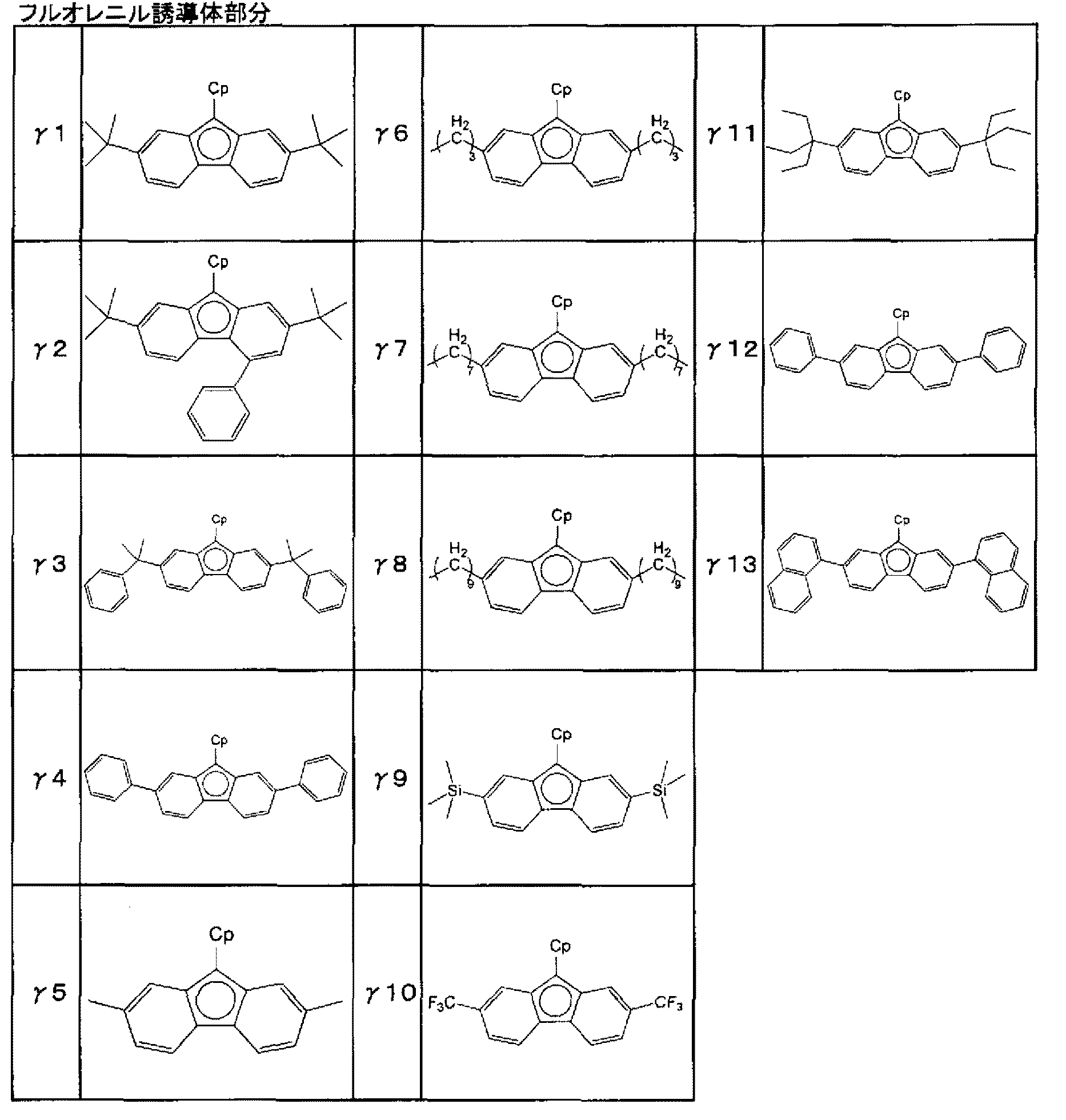
説明する際の便宜上、メタロセン化合物のMQj(金属部分)を除いたリガンド構造を、シクロペンタジエニル誘導体部分とフルオレニル部分との2つに分け、フルオレニル部分をFluで表すと、シクロペンタジエニル誘導体部分は、以下の構造(i)(n=1)、構造(ii)(n=2)、構造(iii)(n=3)となる。For the convenience of explanation, the ligand structure excluding MQ j (metal part) of the metallocene compound is divided into two parts, a cyclopentadienyl derivative part and a fluorenyl part. When the fluorenyl part is represented by Flu, cyclopentadienyl The derivative portion has the following structure (i) (n = 1), structure (ii) (n = 2), and structure (iii) (n = 3).
上記例示の化合物の「ジルコニウム」を「ハフニウム」や「チタニウム」に代えた化合物や、「ジクロリド」を「ジメチル」や「メチルエチル」に代えたメタロセン化合物なども同様に、本発明のメタロセン化合物(A)に含まれる。 Similarly, the compounds of the above-mentioned compounds in which “zirconium” is replaced by “hafnium” or “titanium”, metallocene compounds in which “dichloride” is replaced by “dimethyl” or “methylethyl”, etc. A).
[化合物(B)]
本発明では、オレフィン重合用触媒の成分として、化合物(B)が用いられる。化合物(B)は、(b−1)有機アルミニウムオキシ化合物、(b−2)メタロセン化合物(A)と反応してイオン対を形成する化合物、および(b−3)有機アルミニウム化合物から選択される少なくとも1種である。これらの中では、有機アルミニウムオキシ化合物(b−1)が好ましい。有機アルミニウムオキシ化合物(b−1)は生成するオレフィン重合体を効率的に得る観点から好ましい。[Compound (B)]
In the present invention, the compound (B) is used as a component of the olefin polymerization catalyst. The compound (B) is selected from (b-1) an organoaluminum oxy compound, (b-2) a compound that reacts with the metallocene compound (A) to form an ion pair, and (b-3) an organoaluminum compound. At least one. In these, an organoaluminum oxy compound (b-1) is preferable. The organoaluminum oxy compound (b-1) is preferable from the viewpoint of efficiently obtaining the produced olefin polymer.
(有機アルミニウムオキシ化合物(b−1))
有機アルミニウムオキシ化合物(b−1)としては、一般式[B1]で表される化合物および一般式[B2]で表される化合物等の従来公知のアルミノキサン、一般式[B3]で表される構造を有する修飾メチルアルミノキサン、一般式[B4]で表されるボロン含有有機アルミニウムオキシ化合物が例示される。(Organic aluminum oxy compound (b-1))
As the organoaluminum oxy compound (b-1), a conventionally represented aluminoxane such as a compound represented by the general formula [B1] and a compound represented by the general formula [B2], a structure represented by the general formula [B3] And a modified methylaluminoxane having boron, and a boron-containing organoaluminum oxy compound represented by the general formula [B4].
また、東ソー・ファインケム社等からも、トリメチルアルミニウムとトリイソブチルアルミニウムとを用いて調製された(すなわち、一般式[B3]においてRがイソブチル基である)修飾メチルアルミノキサンが、MMAOやTMAOという商品名で商業的に生産されている。 In addition, modified methylaluminoxanes prepared by using trimethylaluminum and triisobutylaluminum from Tosoh Finechem Co., Ltd. (that is, R is an isobutyl group in the general formula [B3]) are trade names such as MMAO and TMAO. Is produced commercially.
MMAOは各種溶媒への溶解性および保存安定性が改善されたアルミノキサンである。具体的には一般式[B1]または[B2]で表される化合物等のようなベンゼンに対して不溶性または難溶性の化合物とは異なり、MMAOは脂肪族炭化水素、脂環族炭化水素および芳香族炭化水素に溶解するものである。 MMAO is an aluminoxane with improved solubility in various solvents and storage stability. Specifically, unlike a compound that is insoluble or hardly soluble in benzene such as a compound represented by the general formula [B1] or [B2], MMAO is an aliphatic hydrocarbon, alicyclic hydrocarbon, and aromatic. It is soluble in group hydrocarbons.
なお、上記の「ベンゼン不溶性または難溶性の」有機アルミニウムオキシ化合物とは、60℃のベンゼンに溶解する当該化合物の溶解量が、Al原子換算で通常は10重量%以下、好ましくは5重量%以下、特に好ましくは2重量%以下である、ベンゼンに対して不溶性または難溶性である有機アルミニウムオキシ化合物をいう。 The above-mentioned “benzene insoluble or hardly soluble” organoaluminum oxy compound means that the amount of the compound dissolved in benzene at 60 ° C. is usually 10% by weight or less, preferably 5% by weight or less in terms of Al atom. An organoaluminum oxy compound that is insoluble or hardly soluble in benzene, particularly preferably 2% by weight or less.
本発明において、上記例示の有機アルミニウムオキシ化合物(b−1)は、1種単独で用いてもよく2種以上を併用して用いてもよい。 In the present invention, the organoaluminum oxy compound (b-1) exemplified above may be used alone or in combination of two or more.
(架橋メタロセン化合物(A)と反応してイオン対を形成する化合物(b−2))
架橋メタロセン化合物(A)と反応してイオン対を形成する化合物(b−2)(以下、「イオン性化合物(b−2)」ともいう。)としては、特開平1−501950号公報、特開平1−502036号公報、特開平3−179005号公報、特開平3−179006号公報、特開平3−207703号公報、特開平3−207704号公報、特開2004−51676号公報、米国特許第5321106号等に記載された、ルイス酸、イオン性化合物、ボラン化合物およびカルボラン化合物が例示される。さらに、ヘテロポリ化合物およびイソポリ化合物も例示される。これらの中では、イオン性化合物(b−2)としては、一般式[B5]で表される化合物が好ましい。(Compound (b-2) which forms an ion pair by reacting with the bridged metallocene compound (A))
As compound (b-2) (hereinafter also referred to as “ionic compound (b-2)”) which reacts with the bridged metallocene compound (A) to form an ion pair, JP-A-1-501950, Kaihei 1-502036, JP-A-3-179005, JP-A-3-179006, JP-A-3-207703, JP-A-3-207704, JP-A-2004-51676, US Patent No. Examples thereof include Lewis acids, ionic compounds, borane compounds and carborane compounds described in No. 5321106. Furthermore, heteropoly compounds and isopoly compounds are also exemplified. In these, as an ionic compound (b-2), the compound represented by general formula [B5] is preferable.
上記カルベニウムカチオンとしては、トリフェニルカルベニウムカチオン、トリス(メチルフェニル)カルベニウムカチオン、トリス(ジメチルフェニル)カルベニウムカチオン等の三置換カルベニウムカチオンが例示される。 Examples of the carbenium cation include trisubstituted carbenium cations such as a triphenyl carbenium cation, a tris (methylphenyl) carbenium cation, and a tris (dimethylphenyl) carbenium cation.
アンモニウムカチオンとしては、トリメチルアンモニウムカチオン、トリエチルアンモニウムカチオン、トリ(n−プロピル)アンモニウムカチオン、トリイソプロピルアンモニウムカチオン、トリ(n−ブチル)アンモニウムカチオン、トリイソブチルアンモニウムカチオン等のトリアルキルアンモニウムカチオン;N,N−ジメチルアニリニウムカチオン、N,N−ジエチルアニリニウムカチオン、N,N,2,4,6−ペンタメチルアニリニウムカチオン等のN,N−ジアルキルアニリニウムカチオン;ジイソプロピルアンモニウムカチオン、ジシクロヘキシルアンモニウムカチオン等のジアルキルアンモニウムカチオンが例示される。 Examples of ammonium cations include trialkylammonium cations, triethylammonium cations, tri (n-propyl) ammonium cations, triisopropylammonium cations, tri (n-butyl) ammonium cations, triisobutylammonium cations, and the like; N, N -N, N-dialkylanilinium cations such as dimethylanilinium cation, N, N-diethylanilinium cation, N, N, 2,4,6-pentamethylanilinium cation; diisopropylammonium cation, dicyclohexylammonium cation, etc. Examples include dialkylammonium cations.
ホスホニウムカチオンとしては、トリフェニルホスホニウムカチオン、トリス(メチルフェニル)ホスホニウムカチオン、トリス(ジメチルフェニル)ホスホニウムカチオン等のトリアリールホスホニウムカチオンが例示される。Re+としては、上記例示の中では、カルベニウムカチオン、アンモニウムカチオンが好ましく、トリフェニルカルベニウムカチオン、N,N−ジメチルアニリニウムカチオン、N,N−ジエチルアニリニウムカチオンが特に好ましい。Examples of the phosphonium cation include triarylphosphonium cations such as triphenylphosphonium cation, tris (methylphenyl) phosphonium cation, and tris (dimethylphenyl) phosphonium cation. In the above examples, R e + is preferably a carbenium cation or an ammonium cation, and particularly preferably a triphenylcarbenium cation, an N, N-dimethylanilinium cation, or an N, N-diethylanilinium cation.
1.R e+ がカルベニウムカチオンの場合(カルベニウム塩)
カルベニウム塩としては、トリフェニルカルベニウムテトラフェニルボレート、トリフェニルカルベニウムテトラキス(ペンタフルオロフェニル)ボレート、トリフェニルカルベニウムテトラキス(3,5−ジトリフルオロメチルフェニル)ボレート、トリス(4−メチルフェニル)カルベニウムテトラキス(ペンタフルオロフェニル)ボレート、トリス(3,5−ジメチルフェニル)カルベニウムテトラキス(ペンタフルオロフェニル)ボレートが例示される。 1. When R e + is a carbenium cation (carbenium salt)
Examples of the carbenium salt include triphenylcarbenium tetraphenylborate, triphenylcarbeniumtetrakis (pentafluorophenyl) borate, triphenylcarbeniumtetrakis (3,5-ditrifluoromethylphenyl) borate, tris (4-methylphenyl) carbe. Examples thereof include nium tetrakis (pentafluorophenyl) borate and tris (3,5-dimethylphenyl) carbenium tetrakis (pentafluorophenyl) borate.
2.R e+ がアンモニウムカチオンの場合(アンモニウム塩)
アンモニウム塩としては、トリアルキルアンモニウム塩、N,N−ジアルキルアニリニウム塩、ジアルキルアンモニウム塩が例示される。 2. When R e + is an ammonium cation (ammonium salt)
Examples of ammonium salts include trialkylammonium salts, N, N-dialkylanilinium salts, and dialkylammonium salts.
トリアルキルアンモニウム塩としては、具体的には、トリエチルアンモニウムテトラフェニルボレート、トリプロピルアンモニウムテトラフェニルボレート、トリ(n−ブチル)アンモニウムテトラフェニルボレート、トリメチルアンモニウムテトラキス(p−トリル)ボレート、トリメチルアンモニウムテトラキス(o−トリル)ボレート、トリ(n−ブチル)アンモニウムテトラキス(ペンタフルオロフェニル)ボレート、トリエチルアンモニウムテトラキス(ペンタフルオロフェニル)ボレート、トリプロピルアンモニウムテトラキス(ペンタフルオロフェニル)ボレート、トリプロピルアンモニウムテトラキス(2,4−ジメチルフェニル)ボレート、トリ(n−ブチル)アンモニウムテトラキス(3,5−ジメチルフェニル)ボレート、トリ(n−ブチル)アンモニウムテトラキス(4−トリフルオロメチルフェニル)ボレート、トリ(n−ブチル)アンモニウムテトラキス(3,5−ジトリフルオロメチルフェニル)ボレート、トリ(n−ブチル)アンモニウムテトラキス(o−トリル)ボレート、ジオクタデシルメチルアンモニウムテトラフェニルボレート、ジオクタデシルメチルアンモニウムテトラキス(p−トリル)ボレート、ジオクタデシルメチルアンモニウムテトラキス(o−トリル)ボレート、ジオクタデシルメチルアンモニウムテトラキス(ペンタフルオロフェニル)ボレート、ジオクタデシルメチルアンモニウムテトラキス(2,4−ジメチルフェニル)ボレート、ジオクタデシルメチルアンモニウムテトラキス(3,5−ジメチルフェニル)ボレート、ジオクタデシルメチルアンモニウムテトラキス(4−トリフルオロメチルフェニル)ボレート、ジオクタデシルメチルアンモニウムテトラキス(3,5−ジトリフルオロメチルフェニル)ボレート、ジオクタデシルメチルアンモニウムが例示される。 Specific examples of the trialkylammonium salt include triethylammonium tetraphenylborate, tripropylammonium tetraphenylborate, tri (n-butyl) ammonium tetraphenylborate, trimethylammonium tetrakis (p-tolyl) borate, trimethylammonium tetrakis ( o-tolyl) borate, tri (n-butyl) ammonium tetrakis (pentafluorophenyl) borate, triethylammonium tetrakis (pentafluorophenyl) borate, tripropylammonium tetrakis (pentafluorophenyl) borate, tripropylammonium tetrakis (2,4 -Dimethylphenyl) borate, tri (n-butyl) ammonium tetrakis (3,5-dimethylphenyl) bore Tri (n-butyl) ammonium tetrakis (4-trifluoromethylphenyl) borate, tri (n-butyl) ammonium tetrakis (3,5-ditrifluoromethylphenyl) borate, tri (n-butyl) ammonium tetrakis (o -Tolyl) borate, dioctadecylmethylammonium tetraphenylborate, dioctadecylmethylammonium tetrakis (p-tolyl) borate, dioctadecylmethylammonium tetrakis (o-tolyl) borate, dioctadecylmethylammonium tetrakis (pentafluorophenyl) borate, di Octadecylmethylammonium tetrakis (2,4-dimethylphenyl) borate, dioctadecylmethylammonium tetrakis (3,5-dimethylphenyl) borate , Dioctadecyl methyl ammonium tetrakis (4-trifluoromethylphenyl) borate, dioctadecyl methyl ammonium tetrakis (3,5-ditrifluoromethylphenyl) borate, dioctadecyl methyl ammonium and the like.
N,N−ジアルキルアニリニウム塩としては、具体的には、N,N−ジメチルアニリニウムテトラフェニルボレート、N,N−ジメチルアニリニウムテトラキス(ペンタフルオロフェニル)ボレート、N,N−ジメチルアニリニウムテトラキス(3,5−ジトリフルオロメチルフェニル)ボレート、N,N−ジエチルアニリニウムテトラフェニルボレート、N,N−ジエチルアニリニウムテトラキス(ペンタフルオロフェニル)ボレート、N,N−ジエチルアニリニウムテトラキス(3,5−ジトリフルオロメチルフェニル)ボレート、N,N,2,4,6−ペンタメチルアニリニウムテトラフェニルボレート、N,N,2,4,6−ペンタメチルアニリニウムテトラキス(ペンタフルオロフェニル)ボレートが例示される。 Specific examples of N, N-dialkylanilinium salts include N, N-dimethylanilinium tetraphenylborate, N, N-dimethylaniliniumtetrakis (pentafluorophenyl) borate, and N, N-dimethylaniliniumtetrakis. (3,5-ditrifluoromethylphenyl) borate, N, N-diethylanilinium tetraphenylborate, N, N-diethylanilinium tetrakis (pentafluorophenyl) borate, N, N-diethylanilinium tetrakis (3,5 -Ditrifluoromethylphenyl) borate, N, N, 2,4,6-pentamethylanilinium tetraphenylborate, N, N, 2,4,6-pentamethylanilinium tetrakis (pentafluorophenyl) borate The
ジアルキルアンモニウム塩としては、具体的には、ジイソプロピルアンモニウムテトラキス(ペンタフルオロフェニル)ボレート、ジシクロヘキシルアンモニウムテトラフェニルボレートが例示される。 Specific examples of the dialkylammonium salt include diisopropylammonium tetrakis (pentafluorophenyl) borate and dicyclohexylammonium tetraphenylborate.
イオン性化合物(b−2)は、1種単独で用いてもよく2種以上を併用して用いてもよい。 An ionic compound (b-2) may be used individually by 1 type, and may be used in combination of 2 or more type.
(有機アルミニウム化合物(b−3))
有機アルミニウム化合物(b−3)としては、一般式[B6]で表される有機アルミニウム化合物、一般式[B7]で表される周期律表第1族金属とアルミニウムとの錯アルキル化物が例示される。(Organic aluminum compound (b-3))
Examples of the organoaluminum compound (b-3) include an organoaluminum compound represented by the general formula [B6] and a complex alkylated product of a group 1 metal of the periodic table represented by the general formula [B7] and aluminum. The
Ra mAl(ORb)nHpXq …[B6]
式[B6]において、RaおよびRbはそれぞれ独立に炭素数1〜15、好ましくは1〜4の炭化水素基であり、Xはハロゲン原子であり、mは0<m≦3、nは0≦n<3、pは0≦p<3、qは0≦q<3の数であり、かつm+n+p+q=3である。R a m Al (OR b ) n H p X q ... [B6]
In the formula [B6], R a and R b are each independently a hydrocarbon group having 1 to 15 carbon atoms, preferably 1 to 4 carbon atoms, X is a halogen atom, m is 0 <m ≦ 3, and n is 0 ≦ n <3, p is a number 0 ≦ p <3, q is a number 0 ≦ q <3, and m + n + p + q = 3.
M2AlRa 4 …[B7]
式[B7]において、M2はLi、NaまたはKであり、複数あるRaはそれぞれ独立に炭素数1〜15、好ましくは1〜4の炭化水素基である。M 2 AlR a 4 [B7]
In the formula [B7], M 2 is Li, Na or K, and a plurality of R a are each independently a hydrocarbon group having 1 to 15 carbon atoms, preferably 1 to 4 carbon atoms.
有機アルミニウム化合物[B6]としては、トリメチルアルミニウム、トリエチルアルミニウム、トリn−ブチルアルミニウム、トリヘキシルアルミニウム、トリオクチルアルミニウム等のトリn−アルキルアルミニウム;トリイソプロピルアルミニウム、トリイソブチルアルミニウム、トリsec−ブチルアルミニウム、トリtert−ブチルアルミニウム、トリ2−メチルブチルアルミニウム、トリ3−メチルヘキシルアルミニウム、トリ2−エチルヘキシルアルミニウム等のトリ分岐鎖アルキルアルミニウム;トリシクロヘキシルアルミニウム、トリシクロオクチルアルミニウム等のトリシクロアルキルアルミニウム;トリフェニルアルミニウム、トリトリルアルミニウム等のトリアリールアルミニウム; ジイソプロピルアルミニウムハイドライド、ジイソブチルアルミニウムハイドライド等のジアルキルアルミニウムハイドライド;一般式(i−C4H9)xAly(C5H10)z(式中、x、yおよびzは正の数であり、z≦2xである。)などで表されるイソプレニルアルミニウム等のアルケニルアルミニウム;イソブチルアルミニウムメトキシド、イソブチルアルミニウムエトキシド等のアルキルアルミニウムアルコキシド;ジメチルアルミニウムメトキシド、ジエチルアルミニウムエトキシド、ジブチルアルミニウムブトキシド等のジアルキルアルミニウムアルコキシド;エチルアルミニウムセスキエトキシド、ブチルアルミニウムセスキブトキシド等のアルキルアルミニウムセスキアルコキシド;一般式Ra 2.5Al(ORb)0.5(式中、RaおよびRbは式[B6]中のRaおよびRbと同義である。)で表される平均組成を有する部分的にアルコキシ化されたアルキルアルミニウム;ジエチルアルミニウムフェノキシド、ジエチルアルミニウム(2,6−ジtert−ブチル−4−メチルフェノキシド)等のアルキルアルミニウムアリーロキシド;ジメチルアルミニウムクロリド、ジエチルアルミニウムクロリド、ジブチルアルミニウムクロリド、ジエチルアルミニウムブロミド、ジイソブチルアルミニウムクロリド等のジアルキルアルミニウムハライド;エチルアルミニウムセスキクロリド、ブチルアルミニウムセスキクロリド、エチルアルミニウムセスキブロミド等のアルキルアルミニウムセスキハライド;エチルアルミニウムジクロリド等のアルキルアルミニウムジハライド等の部分的にハロゲン化されたアルキルアルミニウム;ジエチルアルミニウムヒドリド、ジブチルアルミニウムヒドリド等のジアルキルアルミニウムヒドリド、エチルアルミニウムジヒドリド、プロピルアルミニウムジヒドリド等のアルキルアルミニウムジヒドリド等の部分的に水素化されたアルキルアルミニウム;エチルアルミニウムエトキシクロリド、ブチルアルミニウムブトキシクロリド、エチルアルミニウムエトキシブロミド等の部分的にアルコキシ化およびハロゲン化されたアルキルアルミニウム;が例示される。Examples of the organoaluminum compound [B6] include tri-n-alkylaluminum such as trimethylaluminum, triethylaluminum, tri-n-butylaluminum, trihexylaluminum, and trioctylaluminum; triisopropylaluminum, triisobutylaluminum, trisec-butylaluminum, Tri-branched alkylaluminum such as tri-tert-butylaluminum, tri-2-methylbutylaluminum, tri-3-methylhexylaluminum, tri-2-ethylhexylaluminum; tricycloalkylaluminum such as tricyclohexylaluminum and tricyclooctylaluminum; triphenyl Triarylaluminum such as aluminum and tolylylaluminum; diisopropylaluminum Hydride, diisobutyl aluminum dialkyl hydride such as hydride; formula (i-C 4 H 9) x Al y (C 5 H 10) z ( wherein, x, y and z are positive numbers, z ≦ 2x Alkenyl aluminum alkoxides such as isoprenylaluminum and the like; alkylaluminum alkoxides such as isobutylaluminum methoxide and isobutylaluminum ethoxide; dialkylaluminum alkoxides such as dimethylaluminum methoxide, diethylaluminum ethoxide and dibutylaluminum butoxide ; ethylaluminum sesquichloride ethoxide, alkyl aluminum sesqui alkoxides such as butyl sesquichloride butoxide; in the general formula R a 2.5 Al (oR b) 0.5 ( wherein R a and R b wherein [ . 6 is the same meaning as R a and R b in the alkylaluminum partially alkoxylated with an average composition represented by); diethylaluminum phenoxide, diethylaluminum (2,6-di-tert- butyl-4 -Alkyl aluminum aryloxides such as methylphenoxide); dialkylaluminum halides such as dimethylaluminum chloride, diethylaluminum chloride, dibutylaluminum chloride, diethylaluminum bromide, diisobutylaluminum chloride; ethylaluminum sesquichloride, butylaluminum sesquichloride, ethylaluminum sesquichloride Alkyl aluminum sesquihalides such as bromide; partially halo such as alkyl aluminum dihalides such as ethylaluminum dichloride Alkylated alkylaluminum; Dialkylaluminum hydride such as diethylaluminum hydride and dibutylaluminum hydride; Partially hydrogenated alkylaluminum such as alkylaluminum dihydride such as ethylaluminum dihydride and propylaluminum dihydride; Ethylaluminum ethoxy Illustrative examples include partially alkoxylated and halogenated alkylaluminums such as chloride, butylaluminum butoxychloride, ethylaluminum ethoxybromide;
錯アルキル化物[B7]としては、LiAl(C2H5)4、LiAl(C7H15)4が例示される。また、錯アルキル化物[B7]に類似する化合物も使用することができ、窒素原子を介して2以上のアルミニウム化合物が結合した有機アルミニウム化合物が例示される。このような化合物としては、(C2H5)2AlN(C2H5)Al(C2H5)2が例示される。Examples of the complex alkylated product [B7] include LiAl (C 2 H 5 ) 4 and LiAl (C 7 H 15 ) 4 . A compound similar to the complex alkylated product [B7] can also be used, and an organic aluminum compound in which two or more aluminum compounds are bonded through a nitrogen atom is exemplified. An example of such a compound is (C 2 H 5 ) 2 AlN (C 2 H 5 ) Al (C 2 H 5 ) 2 .
有機アルミニウム化合物(b−3)としては、入手が容易な点から、トリメチルアルミニウム、トリイソブチルアルミニウムが好ましい。また、有機アルミニウム化合物(b−3)は、1種で用いてもよく2種以上を併用してもよい。 As the organoaluminum compound (b-3), trimethylaluminum and triisobutylaluminum are preferable because they are easily available. Moreover, an organoaluminum compound (b-3) may be used by 1 type, and may use 2 or more types together.
[担体(C)]
本発明では、オレフィン重合用触媒の成分として、担体(C)を用いてもよい。担体(C)は、無機化合物または有機化合物であって、顆粒状または微粒子状の固体である。[Carrier (C)]
In the present invention, the carrier (C) may be used as a component of the olefin polymerization catalyst. The carrier (C) is an inorganic compound or an organic compound, and is a granular or particulate solid.
(無機化合物)
無機化合物としては、多孔質酸化物、無機ハロゲン化物、粘土鉱物、粘土(通常は該粘土鉱物を主成分として構成される。)、イオン交換性層状化合物(大部分の粘土鉱物はイオン交換性層状化合物である。)が例示される。多孔質酸化物としては、SiO2、Al2O3、MgO、ZrO、TiO2、B2O3、CaO、ZnO、BaO、ThO2;これらの酸化物を含む複合物または混合物が例示される。複合物または混合物としては、天然または合成ゼオライト、SiO2−MgO、SiO2−Al2O3、SiO2−TiO2、SiO2−V2O5、SiO2−Cr2O3、SiO2−TiO2−MgOが例示される。これらの中では、SiO2およびAl2O3の何れか一方または双方の成分を主成分とする多孔質酸化物が好ましい。(Inorganic compounds)
Inorganic compounds include porous oxides, inorganic halides, clay minerals, clay (usually composed of the clay mineral as a main component), ion-exchange layered compounds (most clay minerals are ion-exchange layered) A compound)). Examples of the porous oxide include SiO 2 , Al 2 O 3 , MgO, ZrO, TiO 2 , B 2 O 3 , CaO, ZnO, BaO, ThO 2 ; a composite or a mixture containing these oxides. . The composite or mixture includes natural or synthetic zeolite, SiO 2 —MgO, SiO 2 —Al 2 O 3 , SiO 2 —TiO 2 , SiO 2 —V 2 O 5 , SiO 2 —Cr 2 O 3 , SiO 2 —. An example is TiO 2 —MgO. Among these, porous oxides containing as a main component one or both of SiO 2 and Al 2 O 3 are preferable.
多孔質酸化物は、種類および製法によりその性状は異なるが、粒径が好ましくは10〜300μm、より好ましくは20〜200μmの範囲にあり;比表面積が好ましくは50〜1000m2/g、より好ましくは100〜700m2/gの範囲にあり;細孔容積が好ましくは0.3〜3.0cm3/gの範囲にある。このような多孔質酸化物は、必要に応じて100〜1000℃、好ましくは150〜700℃で焼成して使用される。無機ハロゲン化物としては、MgCl2、MgBr2、MnCl2、MnBr2が例示される。無機ハロゲン化物は、そのまま用いてもよいし、ボールミル、振動ミルにより粉砕した後に用いてもよい。また、アルコール等の溶媒に上記無機ハロゲン化物を溶解させた後、析出剤によって微粒子状に析出させた成分を用いることもできる。The properties of the porous oxide vary depending on the type and production method, but the particle size is preferably 10 to 300 μm, more preferably 20 to 200 μm; the specific surface area is preferably 50 to 1000 m 2 / g, more preferably. Is in the range of 100 to 700 m 2 / g; the pore volume is preferably in the range of 0.3 to 3.0 cm 3 / g. Such a porous oxide is used after being calcined at 100 to 1000 ° C., preferably 150 to 700 ° C., if necessary. Examples of inorganic halides include MgCl 2 , MgBr 2 , MnCl 2 , and MnBr 2 . The inorganic halide may be used as it is or after being pulverized by a ball mill or a vibration mill. Moreover, after dissolving the said inorganic halide in solvents, such as alcohol, the component made to deposit into a fine particle form with a depositing agent can also be used.
粘土、粘土鉱物、イオン交換性層状化合物としては、天然産のものに限らず、人工合成物を使用することもできる。なお、イオン交換性層状化合物は、イオン結合などによって構成される面が互いに弱い結合力で平行に積み重なった結晶構造を有する化合物であり、含有されるイオンが交換可能な化合物である。 The clay, clay mineral, and ion-exchange layered compound are not limited to natural products, and artificial synthetic products can also be used. The ion-exchangeable layered compound is a compound having a crystal structure in which planes formed by ionic bonds and the like are stacked in parallel with a weak binding force, and the contained ions can be exchanged.
具体的には、粘土、粘土鉱物としては、カオリン、ベントナイト、木節粘土、ガイロメ粘土、アロフェン、ヒシンゲル石、パイロフィライト、合成雲母等のウンモ群、モンモリロナイト群、バーミキュライト、リョクデイ石群、パリゴルスカイト、カオリナイト、ナクライト、ディッカイト、ヘクトライト、テニオライト、ハロイサイトが例示され;イオン交換性層状化合物としては、六方最密パッキング型、アンチモン型、CdCl2型、CdI2型等の層状の結晶構造を有するイオン結晶性化合物が例示される。具体的には、イオン交換性層状化合物としては、α−Zr(HAsO4)2・H2O、α−Zr(HPO4)2、α−Zr(KPO4)2・3H2O、α−Ti(HPO4)2、α−Ti(HAsO4)2・H2O、α−Sn(HPO4)2・H2O、γ−Zr(HPO4)2、γ−Ti(HPO4)2、γ−Ti(NH4PO4)2・H2O等の多価金属の結晶性酸性塩が例示される。Specifically, as clay and clay minerals, kaolin, bentonite, kibushi clay, gyrome clay, allophane, hysinger gel, pyrophyllite, synthetic mica and other ummo groups, montmorillonite group, vermiculite, ryokdeite group, palygorskite, Examples include kaolinite, nacrite, dickite, hectorite, teniolite, halloysite; examples of ion-exchangeable layered compounds include ions having a layered crystal structure such as hexagonal close-packed type, antimony type, CdCl 2 type, and CdI 2 type Examples include crystalline compounds. Specifically, as the ion exchange layered compound, α-Zr (HAsO 4 ) 2 .H 2 O, α-Zr (HPO 4 ) 2 , α-Zr (KPO 4 ) 2 .3H 2 O, α- Ti (HPO 4 ) 2 , α-Ti (HAsO 4 ) 2 .H 2 O, α-Sn (HPO 4 ) 2 .H 2 O, γ-Zr (HPO 4 ) 2 , γ-Ti (HPO 4 ) 2 And crystalline acid salts of polyvalent metals such as γ-Ti (NH 4 PO 4 ) 2 .H 2 O.
粘土、粘土鉱物には、化学処理を施すことも好ましい。化学処理としては、表面に付着している不純物を除去する表面処理、粘土の結晶構造に影響を与える処理など、何れも使用できる。化学処理としては、具体的には、酸処理、アルカリ処理、塩類処理、有機物処理が例示される。 It is also preferable to subject the clay and clay mineral to chemical treatment. As the chemical treatment, any of a surface treatment that removes impurities adhering to the surface and a treatment that affects the crystal structure of clay can be used. Specific examples of the chemical treatment include acid treatment, alkali treatment, salt treatment, and organic matter treatment.
また、イオン交換性層状化合物は、そのイオン交換性を利用し、層間の交換性イオンを別の大きな嵩高いイオンと交換することにより、層間が拡大した層状化合物としてもよい。このような嵩高いイオンは、層状構造を支える支柱的な役割を担っており、通常はピラーと呼ばれる。例えば、層状化合物の層間に下記金属水酸化物イオンをインターカレーションした後に加熱脱水することにより、層間に酸化物支柱(ピラー)を形成することができる。なお、このように層状化合物の層間に別の物質を導入することをインターカレーションという。 In addition, the ion-exchangeable layered compound may be a layered compound in which the interlayer is expanded by exchanging the exchangeable ions between the layers with another large bulky ion using the ion-exchangeability. Such bulky ions play a role of supporting pillars to support the layered structure and are usually called pillars. For example, an oxide column (pillar) can be formed between layers by intercalating the following metal hydroxide ions between layers of the layered compound and then heat-dehydrating. The introduction of another substance between the layers of the layered compound is called intercalation.
インターカレーションするゲスト化合物としては、TiCl4、ZrCl4等の陽イオン性無機化合物;Ti(OR)4、Zr(OR)4、PO(OR)3、B(OR)3等の金属アルコキシド(Rは炭化水素基など);[Al13O4(OH)24]7+、[Zr4(OH)14]2+、[Fe3O(OCOCH3)6]+等の金属水酸化物イオンが例示される。これらのゲスト化合物は、1種単独で用いてもよく2種以上を併用して用いてもよい。Examples of guest compounds to be intercalated include cationic inorganic compounds such as TiCl 4 and ZrCl 4 ; metal alkoxides such as Ti (OR) 4 , Zr (OR) 4 , PO (OR) 3 and B (OR) 3 ( R is a hydrocarbon group); metal hydroxide ions such as [Al 13 O 4 (OH) 24 ] 7+ , [Zr 4 (OH) 14 ] 2+ , [Fe 3 O (OCOCH 3 ) 6 ] + Is exemplified. These guest compounds may be used alone or in combination of two or more.
また、ゲスト化合物をインターカレーションする際に、Si(OR)4、Al(OR)3、Ge(OR)4等の金属アルコキシド(Rは炭化水素基など)を加水分解および重縮合して得た重合物、SiO2等のコロイド状無機化合物などを共存させることもできる。 無機化合物の中では、粘土鉱物および粘土が好ましく、モンモリロナイト群、バーミキュライト、ヘクトライト、テニオライトおよび合成雲母が特に好ましい。In addition, when intercalating a guest compound, it is obtained by hydrolysis and polycondensation of a metal alkoxide (R is a hydrocarbon group, etc.) such as Si (OR) 4 , Al (OR) 3 , Ge (OR) 4. In addition, a polymer, a colloidal inorganic compound such as SiO 2 can be coexisted. Among inorganic compounds, clay minerals and clays are preferable, and montmorillonite group, vermiculite, hectorite, teniolite and synthetic mica are particularly preferable.
(有機化合物)
有機化合物としては、粒径が10〜300μmの範囲にある顆粒状または微粒子状の固体が例示される。具体的には、エチレン、プロピレン、1−ブテン、4−メチル−1−ペンテン等の炭素数2〜14のα−オレフィンを主成分として合成される(共)重合体;ビニルシクロヘキサン、スチレンを主成分として合成される(共)重合体;これら(共)重合体の変成体が例示される。(Organic compounds)
Examples of the organic compound include a granular or particulate solid having a particle size in the range of 10 to 300 μm. Specifically, a (co) polymer synthesized mainly from an α-olefin having 2 to 14 carbon atoms such as ethylene, propylene, 1-butene and 4-methyl-1-pentene; mainly vinylcyclohexane and styrene. (Co) polymers synthesized as components; modified examples of these (co) polymers are exemplified.
[有機化合物成分(D)]
本発明では、オレフィン重合用触媒の成分として、有機化合物成分(D)を用いてもよい。有機化合物成分(D)は、必要に応じて、α−オレフィンの重合反応における重合性能およびオレフィン重合体の物性を向上させる目的で使用される。有機化合物成分(D)としては、アルコール類、フェノール性化合物、カルボン酸、リン化合物、スルホン酸塩が例示される。[Organic compound component (D)]
In the present invention, the organic compound component (D) may be used as a component of the olefin polymerization catalyst. The organic compound component (D) is used for the purpose of improving the polymerization performance in the polymerization reaction of α-olefin and the physical properties of the olefin polymer, if necessary. Examples of the organic compound component (D) include alcohols, phenolic compounds, carboxylic acids, phosphorus compounds, and sulfonates.
〈各成分の使用法および添加順序〉
オレフィン重合の際には、各成分の使用法、添加順序は任意に選ばれるが、以下のような方法が例示される。以下では、遷移金属化合物(A)、化合物(B)、担体(C)および有機化合物成分(D)を、それぞれ「成分(A)〜(D)」ともいう。 <Usage and order of addition of each component>
In the case of olefin polymerization, the method of using each component and the order of addition are arbitrarily selected, and the following methods are exemplified. Hereinafter, the transition metal compound (A), the compound (B), the carrier (C), and the organic compound component (D) are also referred to as “components (A) to (D)”, respectively.
(1)成分(A)を単独で重合器に添加する方法。 (1) A method of adding the component (A) alone to the polymerization vessel.
(2)成分(A)および成分(B)を任意の順序で重合器に添加する方法。 (2) A method of adding the component (A) and the component (B) to the polymerization vessel in an arbitrary order.
(3)成分(A)を成分(C)に担持した触媒成分と、
成分(B)とを任意の順序で重合器に添加する方法。(3) a catalyst component having component (A) supported on component (C);
A method of adding the component (B) to the polymerization vessel in an arbitrary order.
(4)成分(B)を成分(C)に担持した触媒成分と、
成分(A)とを任意の順序で重合器に添加する方法。(4) a catalyst component carrying component (B) on component (C);
A method of adding the component (A) to the polymerization vessel in an arbitrary order.
(5)成分(A)と成分(B)とを成分(C)に担持した触媒成分を
重合器に添加する方法。(5) A method in which a catalyst component in which component (A) and component (B) are supported on component (C) is added to a polymerization vessel.
上記(2)〜(5)の各方法においては、各触媒成分の少なくとも2種は予め接触されていてもよい。成分(B)が担持されている上記(4)、(5)の各方法においては、必要に応じて担持されていない成分(B)を、任意の順序で添加してもよい。この場合、成分(B)は、同一でも異なっていてもよい。また、成分(C)に成分(A)が担持された固体触媒成分、成分(C)に成分(A)および成分(B)が担持された固体触媒成分は、オレフィンが予備重合されていてもよく、予備重合された固体触媒成分上に、さらに触媒成分が担持されていてもよい。 In each of the above methods (2) to (5), at least two of the catalyst components may be contacted in advance. In the above methods (4) and (5) in which the component (B) is supported, the component (B) that is not supported may be added in any order as necessary. In this case, the component (B) may be the same or different. Further, the solid catalyst component in which the component (C) is supported on the component (C) and the solid catalyst component in which the component (A) and the component (B) are supported on the component (C) In addition, a catalyst component may be further supported on the prepolymerized solid catalyst component.
〔オレフィン重合体の製造方法〕
本発明のオレフィン重合体の製造方法は、本発明のオレフィン重合用触媒の存在下で、50℃以上200℃以下の重合温度条件下において、1種または2種以上のオレフィンを重合する工程を有する。ここで「重合」とは、単独重合および共重合を総称する意味で用いる。また「オレフィン重合用触媒の存在下でオレフィンを重合する」とは、上記(1)〜(5)の各方法のように、任意の方法でオレフィン重合用触媒の各成分を重合器に添加してオレフィンを重合する態様を包含する。 [Olefin polymer production method]
The method for producing an olefin polymer of the present invention comprises a step of polymerizing one or more olefins in the presence of the olefin polymerization catalyst of the present invention under a polymerization temperature condition of 50 ° C. or higher and 200 ° C. or lower. . Here, “polymerization” is used as a generic term for homopolymerization and copolymerization. In addition, “polymerize olefin in the presence of olefin polymerization catalyst” means that each component of the olefin polymerization catalyst is added to the polymerization vessel by any method as in the above methods (1) to (5). And an embodiment of polymerizing olefins.
好ましくは、本発明のオレフィン重合用触媒の存在下で、炭素数3〜20のα−オレフィンから選ばれる少なくとも1種のオレフィンを含むモノマーを重合することにより、オレフィン重合体を製造する。 Preferably, an olefin polymer is produced by polymerizing a monomer containing at least one olefin selected from α-olefins having 3 to 20 carbon atoms in the presence of the olefin polymerization catalyst of the present invention.
本発明では、重合は、溶液重合、懸濁重合等の液相重合法または気相重合法のいずれにおいても実施できる。液相重合法において用いられる不活性炭化水素媒体としては、例えば、プロパン、ブタン、ペンタン、ヘキサン、ヘプタン、オクタン、デカン、ドデカン、灯油等の脂肪族炭化水素;シクロペンタン、シクロヘキサン、メチルシクロペンタン等の脂環族炭化水素;ベンゼン、トルエン、キシレン等の芳香族炭化水素;エチレンクロリド、クロルベンゼン、ジクロロメタン等のハロゲン化炭化水素が挙げられる。不活性炭化水素媒体は1種単独で用いてもよく、2種以上を混合して用いてもよい。また、重合に供給されうる液化オレフィン自身を溶媒として用いる、いわゆるバルク重合法を用いることもできる。 In the present invention, the polymerization can be carried out by either a liquid phase polymerization method such as solution polymerization or suspension polymerization or a gas phase polymerization method. Examples of the inert hydrocarbon medium used in the liquid phase polymerization method include aliphatic hydrocarbons such as propane, butane, pentane, hexane, heptane, octane, decane, dodecane, and kerosene; cyclopentane, cyclohexane, methylcyclopentane, and the like. And alicyclic hydrocarbons; aromatic hydrocarbons such as benzene, toluene and xylene; and halogenated hydrocarbons such as ethylene chloride, chlorobenzene and dichloromethane. An inert hydrocarbon medium may be used individually by 1 type, and 2 or more types may be mixed and used for it. In addition, a so-called bulk polymerization method in which liquefied olefin itself that can be supplied to the polymerization is used as a solvent can also be used.
本発明のオレフィン重合用触媒を用いてオレフィンの重合を行うに際して、オレフィン重合用触媒を構成しうる各成分の使用量は以下のとおりである。また、本発明のオレフィン重合用触媒において、各成分の含有量を以下のとおりに設定することができる。 When the olefin polymerization is performed using the olefin polymerization catalyst of the present invention, the amount of each component that can constitute the olefin polymerization catalyst is as follows. In the olefin polymerization catalyst of the present invention, the content of each component can be set as follows.
(1)オレフィン重合用触媒を用いて、オレフィンの重合を行うに際して、メタロセン化合物(A)は、反応容積1リットル当り、通常は10-9〜10-1モル、好ましくは10-8〜10-2モルとなるような量で用いられる。(1) When performing olefin polymerization using an olefin polymerization catalyst, the metallocene compound (A) is usually 10 −9 to 10 −1 mol, preferably 10 −8 to 10 − , per liter of reaction volume. It is used in such an amount that it becomes 2 mol.
(2)オレフィン重合用触媒の成分として有機アルミニウムオキシ化合物(b−1)を用いる場合には、化合物(b−1)は、化合物(b−1)中のアルミニウム原子(Al)とメタロセン化合物(A)中の全遷移金属原子(M)とのモル比〔Al/M〕が、通常は0.01〜5000、好ましくは0.05〜2000となるような量で用いられる。 (2) When the organoaluminum oxy compound (b-1) is used as a component of the olefin polymerization catalyst, the compound (b-1) is composed of an aluminum atom (Al) in the compound (b-1) and a metallocene compound ( The molar ratio [Al / M] to all transition metal atoms (M) in A) is usually 0.01 to 5000, preferably 0.05 to 2000.
(3)オレフィン重合用触媒の成分としてイオン性化合物(b−2)を用いる場合には、化合物(b−2)は、化合物(b−2)とメタロセン化合物(A)中の全遷移金属原子(M)とのモル比〔(b−2)/M〕が、通常は1〜10、好ましくは1〜5となるような量で用いられる。 (3) When the ionic compound (b-2) is used as a component of the olefin polymerization catalyst, the compound (b-2) is composed of all transition metal atoms in the compound (b-2) and the metallocene compound (A). The molar ratio [(b-2) / M] to (M) is usually 1 to 10, preferably 1 to 5.
(4)オレフィン重合用触媒の成分として有機アルミニウム化合物(b−3)を用いる場合には、化合物(b−3)は、化合物(b−3)とメタロセン化合物(A)中の全遷移金属原子(M)とのモル比〔(b−3)/M〕が、通常は10〜5000、好ましくは20〜2000となるような量で用いられる。 (4) When the organoaluminum compound (b-3) is used as a component of the olefin polymerization catalyst, the compound (b-3) is composed of all transition metal atoms in the compound (b-3) and the metallocene compound (A). The molar ratio [(b-3) / M] to (M) is usually 10 to 5000, preferably 20 to 2000.
(5)オレフィン重合用触媒の成分として有機化合物成分(D)を用いる場合には、化合物(B)が有機アルミニウムオキシ化合物(b−1)であるときは、有機化合物成分(D)と化合物(b−1)とのモル比〔(D)/(b−1)〕が、通常は0.01〜10、好ましくは0.1〜5となるような量で;化合物(B)がイオン性化合物(b−2)であるときは、有機化合物成分(D)と化合物(b−2)とのモル比〔(D)/(b−2)〕が、通常は0.01〜10、好ましくは0.1〜5となるような量で;化合物(B)が有機アルミニウム化合物(b−3)であるときは、有機化合物成分(D)と化合物(b−3)とのモル比〔(D)/(b−3)〕が、通常は0.01〜2、好ましくは0.005〜1となるような量で用いられる。 (5) When the organic compound component (D) is used as a component of the olefin polymerization catalyst, when the compound (B) is the organoaluminum oxy compound (b-1), the organic compound component (D) and the compound ( the molar ratio [(D) / (b-1)] to b-1) is usually 0.01 to 10, preferably 0.1 to 5; compound (B) is ionic. When it is the compound (b-2), the molar ratio [(D) / (b-2)] of the organic compound component (D) and the compound (b-2) is usually 0.01 to 10, preferably Is an amount such that 0.1 to 5; when the compound (B) is an organoaluminum compound (b-3), the molar ratio of the organic compound component (D) to the compound (b-3) [( D) / (b-3)] is usually used in such an amount that it is 0.01 to 2, preferably 0.005 to 1.
本発明の製造方法において、オレフィンの重合温度は、通常50〜200℃、好ましくは50〜180℃であり、特に好ましくは50〜150℃(換言すれば、特に好ましくは工業化可能な温度である。);重合圧力は、通常常圧〜10MPaゲージ圧、好ましくは常圧〜5MPaゲージ圧である。重合反応は、回分式、半連続式、連続式のいずれの方法においても行うことができる。さらに重合を反応条件の異なる二段以上に分けて行うこともできる。得られるオレフィン重合体の分子量は、重合系に水素等を存在させるか、重合温度を変化させるか、または成分(B)の使用量により調節することができる。 In the production method of the present invention, the polymerization temperature of the olefin is usually 50 to 200 ° C., preferably 50 to 180 ° C., particularly preferably 50 to 150 ° C. (in other words, particularly preferably an industrializable temperature. ); The polymerization pressure is usually normal pressure to 10 MPa gauge pressure, preferably normal pressure to 5 MPa gauge pressure. The polymerization reaction can be carried out in any of batch, semi-continuous and continuous methods. Furthermore, the polymerization can be carried out in two or more stages having different reaction conditions. The molecular weight of the resulting olefin polymer can be adjusted by allowing hydrogen or the like to exist in the polymerization system, changing the polymerization temperature, or using the component (B).
本発明の製造方法は、工業的製法において有利な高温条件下であっても、高い触媒活性を維持しつつ、高い分子量を有するプロピレン重合体等のオレフィン重合体を製造することが可能である。 The production method of the present invention can produce an olefin polymer such as a propylene polymer having a high molecular weight while maintaining high catalytic activity even under high temperature conditions advantageous in an industrial production method.
特に水素は、触媒の重合活性を向上させる効果や、重合体の分子量を増加または低下させる効果が得られることがあり、好ましい添加物であるといえる。系内に水素を添加する場合、その量はオレフィン1モルあたり0.00001〜100NL程度が適当である。系内の水素濃度は、水素の供給量を調整する以外にも、水素を生成または消費する反応を系内で行う方法や、膜を利用して水素を分離する方法、水素を含む一部のガスを系外に放出することによっても調整することができる。 In particular, hydrogen can be said to be a preferable additive because it can improve the polymerization activity of the catalyst and increase or decrease the molecular weight of the polymer. When hydrogen is added to the system, the amount is suitably about 0.00001 to 100 NL per mole of olefin. In addition to adjusting the amount of hydrogen supplied, the hydrogen concentration in the system is not limited to the method of generating or consuming hydrogen in the system, the method of separating hydrogen using a membrane, It can also be adjusted by releasing the gas out of the system.
本発明の製造方法で得られたオレフィン重合体に対しては、上記方法で合成した後に、必要に応じて公知の触媒失活処理工程、触媒残渣除去工程、乾燥工程等の後処理工程を行ってよい。 For the olefin polymer obtained by the production method of the present invention, after synthesis by the above method, a post-treatment step such as a known catalyst deactivation treatment step, a catalyst residue removal step, and a drying step is performed as necessary. It's okay.
〈オレフィン〉
本発明の製造方法において、重合反応に供給されるオレフィンは、炭素数3〜20のα−オレフィンから選ばれる少なくとも1種のオレフィンである。 <Olefin>
In the production method of the present invention, the olefin supplied to the polymerization reaction is at least one olefin selected from α-olefins having 3 to 20 carbon atoms.
炭素数3〜20のα−オレフィンとしては、直鎖状または分岐状のα−オレフィンが挙げられる。直鎖状または分岐状のα−オレフィンとしては、例えば、プロピレン、1−ブテン、1−ペンテン、3−メチル−1−ブテン、1−ヘキセン、4−メチル−1−ペンテン、3−メチル−1−ペンテン、1−オクテン、1−デセン、1−ドデセン、1−テトラデセン、1−ヘキサデセン、1−オクタデセン、1−イコセンが挙げられる。炭素数3〜10のα−オレフィンから選ばれる少なくとも1種が好ましく、プロピレンが特に好ましい。α−オレフィンは1種単独で用いてもよく、2種以上を併用してもよい。 Examples of the α-olefin having 3 to 20 carbon atoms include linear or branched α-olefins. Examples of the linear or branched α-olefin include propylene, 1-butene, 1-pentene, 3-methyl-1-butene, 1-hexene, 4-methyl-1-pentene, and 3-methyl-1. -Pentene, 1-octene, 1-decene, 1-dodecene, 1-tetradecene, 1-hexadecene, 1-octadecene, 1-icocene. At least one selected from α-olefins having 3 to 10 carbon atoms is preferable, and propylene is particularly preferable. The α-olefin may be used alone or in combination of two or more.
α−オレフィンとしてプロピレンを用いる場合、必要に応じてエチレンおよび炭素数4〜20のα−オレフィンから選ばれる少なくとも1種のオレフィンAを併用することができる。プロピレンとともに用いることのできるオレフィンAは、エチレンおよび炭素数4〜10のα−オレフィンから選ばれる少なくとも1種が好ましく、例えば、エチレン、1−ブテン、1−ペンテン、3−メチル−1−ブテン、1−ヘキセン、4−メチル−1−ペンテン、3−メチル−1−ペンテン、1−オクテン、1−デセンが挙げられる。中でも、エチレン、1−ブテン、1−ヘキセン、4−メチル−1−ペンテンおよび1−オクテンから選ばれる少なくとも1種であることがより好ましく、エチレンであることがさらに好ましい。共重合の場合は、プロピレンとエチレンとの共重合が最も好ましい。 When using propylene as the α-olefin, at least one olefin A selected from ethylene and an α-olefin having 4 to 20 carbon atoms can be used in combination as necessary. The olefin A that can be used together with propylene is preferably at least one selected from ethylene and an α-olefin having 4 to 10 carbon atoms, such as ethylene, 1-butene, 1-pentene, 3-methyl-1-butene, Examples include 1-hexene, 4-methyl-1-pentene, 3-methyl-1-pentene, 1-octene, and 1-decene. Among these, at least one selected from ethylene, 1-butene, 1-hexene, 4-methyl-1-pentene and 1-octene is more preferable, and ethylene is more preferable. In the case of copolymerization, the copolymerization of propylene and ethylene is most preferred.
α−オレフィンとしてプロピレンを用いる場合、プロピレンと、必要に応じて用いられるエチレンおよび炭素数4〜20のα−オレフィンから選ばれる少なくとも1種のオレフィンAとの使用量比は、プロピレン:オレフィンA(モル比)で、通常1:10〜5000:1、好ましくは1:5〜1000:1である。 When propylene is used as the α-olefin, the amount ratio of propylene and at least one olefin A selected from ethylene and an α-olefin having 4 to 20 carbon atoms as required is propylene: olefin A ( The molar ratio is usually 1:10 to 5000: 1, preferably 1: 5 to 1000: 1.
また、環状オレフィン、極性基を有するオレフィン、末端水酸基化ビニル化合物、および芳香族ビニル化合物から選ばれる少なくとも1種を反応系に共存させて重合を進めることもできる。また、ポリエンを併用することも可能である。また、本発明の趣旨を逸脱しない範囲で、ビニルシクロヘキサン等のその他の成分を共重合してもよい。 Moreover, at least 1 sort (s) chosen from the cyclic olefin, the olefin which has a polar group, a terminal hydroxylated vinyl compound, and an aromatic vinyl compound can coexist in a reaction system, and polymerization can also be advanced. It is also possible to use polyene in combination. Further, other components such as vinylcyclohexane may be copolymerized without departing from the spirit of the present invention.
環状オレフィンとしては、例えば、シクロペンテン、シクロヘプテン、ノルボルネン、5−メチル−2−ノルボルネン、テトラシクロドデセン、2−メチル−1,4,5,8−ジメタノ−1,2,3,4,4a,5,8,8a−オクタヒドロナフタレンが挙げられる。 Examples of the cyclic olefin include cyclopentene, cycloheptene, norbornene, 5-methyl-2-norbornene, tetracyclododecene, 2-methyl-1,4,5,8-dimethano-1,2,3,4,4a, 5,8,8a-octahydronaphthalene.
極性基を有するオレフィンとしては、例えば、
アクリル酸、メタクリル酸、フマル酸、無水マレイン酸、イタコン酸、無水イタコン酸、ビシクロ(2,2,1)−5−ヘプテン−2,3−ジカルボン酸無水物等のα,β−不飽和カルボン酸、およびこれらのナトリウム塩、カリウム塩、リチウム塩、亜鉛塩、マグネシウム塩、カルシウム塩、アルミニウム塩等の金属塩;
アクリル酸メチル、アクリル酸エチル、アクリル酸n−プロピル、アクリル酸イソプロピル、アクリル酸n−ブチル、アクリル酸イソブチル、アクリル酸tert−ブチル、アクリル酸2−エチルヘキシル、メタクリル酸メチル、メタクリル酸エチル、メタクリル酸n−プロピル、メタクリル酸イソプロピル、メタクリル酸n−ブチル、メタクリル酸イソブチル等のα,β−不飽和カルボン酸エステル;
酢酸ビニル、プロピオン酸ビニル、カプロン酸ビニル、カプリン酸ビニル、ラウリン酸ビニル、ステアリン酸ビニル、トリフルオロ酢酸ビニル等のビニルエステル類;アクリル酸グリシジル、メタクリル酸グリシジル、イタコン酸モノグリシジルエステル等の不飽和グリシジル;
が挙げられる。As the olefin having a polar group, for example,
Α, β-unsaturated carboxylic acids such as acrylic acid, methacrylic acid, fumaric acid, maleic anhydride, itaconic acid, itaconic anhydride, bicyclo (2,2,1) -5-heptene-2,3-dicarboxylic anhydride Acids and their metal salts such as sodium, potassium, lithium, zinc, magnesium, calcium, and aluminum salts;
Methyl acrylate, ethyl acrylate, n-propyl acrylate, isopropyl acrylate, n-butyl acrylate, isobutyl acrylate, tert-butyl acrylate, 2-ethylhexyl acrylate, methyl methacrylate, ethyl methacrylate, methacrylic acid α, β-unsaturated carboxylic acid esters such as n-propyl, isopropyl methacrylate, n-butyl methacrylate, and isobutyl methacrylate;
Vinyl esters such as vinyl acetate, vinyl propionate, vinyl caproate, vinyl caprate, vinyl laurate, vinyl stearate, vinyl trifluoroacetate; unsaturated glycidyl acrylate, glycidyl methacrylate, monoglycidyl itaconate, etc. Glycidyl;
Is mentioned.
末端水酸基化ビニル化合物としては、例えば、水酸化−1−ブテン、水酸化−1−ペンテン、水酸化−1−ヘキセン、水酸化−1−オクテン、水酸化−1−デセン、水酸化−1−ウンデセン、水酸化−1−ドデセン、水酸化−1−テトラデセン、水酸化−1−ヘキサデセン、水酸化−1−オクタデセン、水酸化−1−エイコセン等の直鎖状の末端水酸基化ビニル化合物;水酸化−3−メチル−1−ブテン、水酸化−3−メチル−1−ペンテン、水酸化−4−メチル−1−ペンテン、水酸化−3−エチル−1−ペンテン、水酸化−4,4−ジメチル−1−ペンテン、水酸化−4−メチル−1−ヘキセン、水酸化−4,4−ジメチル−1−ヘキセン、水酸化−4−エチル−1−ヘキセン、水酸化−3−エチル−1−ヘキセン等の分岐状の末端水酸基化ビニル化合物が挙げられる。 Examples of the terminal hydroxylated vinyl compound include hydroxyl-1-butene, hydroxyl-1-pentene, hydroxyl-1-hexene, hydroxyl-1-octene, hydroxyl-1-decene, hydroxyl-1- Linear terminal hydroxylated vinyl compounds such as undecene, hydroxylated 1-dodecene, hydroxylated 1-tetradecene, hydroxylated 1-hexadecene, hydroxylated 1-octadecene, hydroxylated 1-eicocene; -3-methyl-1-butene, hydroxyl-3-methyl-1-pentene, hydroxyl-4-methyl-1-pentene, hydroxyl-3-ethyl-1-pentene, hydroxyl-4,4-dimethyl -1-pentene, hydroxyl-4-methyl-1-hexene, hydroxyl-4,4-dimethyl-1-hexene, hydroxyl-4-ethyl-1-hexene, hydroxyl-3-ethyl-1-hexene Branched terminal hydroxyl acid such as Vinyl compounds.
芳香族ビニル化合物としては、例えば、スチレン;o−メチルスチレン、m−メチルスチレン、p−メチルスチレン、o,p−ジメチルスチレン、o−エチルスチレン、m−エチルスチレン、p−エチルスチレン等のモノもしくはポリアルキルスチレン;メトキシスチレン、エトキシスチレン、ビニル安息香酸、ビニル安息香酸メチル、ビニルベンジルアセテート、ヒドロキシスチレン、o−クロロスチレン、p−クロロスチレン、ジビニルベンゼン等の官能基含有スチレン誘導体;3−フェニルプロピレン、4−フェニルプロピレン、α−メチルスチレンが挙げられる。 Examples of the aromatic vinyl compound include styrene; o-methyl styrene, m-methyl styrene, p-methyl styrene, o, p-dimethyl styrene, o-ethyl styrene, m-ethyl styrene, p-ethyl styrene, and the like. Or polyalkylstyrene; methoxystyrene, ethoxystyrene, vinyl benzoic acid, methyl vinyl benzoate, vinyl benzyl acetate, hydroxystyrene, o-chlorostyrene, p-chlorostyrene, divinylbenzene, and other functional group-containing styrene derivatives; 3-phenyl Examples include propylene, 4-phenylpropylene, and α-methylstyrene.
ポリエンとしては、ジエンおよびトリエンから選ばれることが好ましい。重合反応に供給される全オレフィンに対して、ポリエンを0.0001〜1モル%の範囲内で用いることも好ましい態様である。 The polyene is preferably selected from diene and triene. It is also a preferred embodiment that polyene is used in the range of 0.0001 to 1 mol% with respect to the total olefin supplied to the polymerization reaction.
ジエンとしては、例えば、1,4-ペンタジエン、1,5-ヘキサジエン、1,4-ヘキサジエン、1,4-オクタジエン、1,5-オクタジエン、1,6-オクタジエン、1,7-オクタジエン、1,9-デカジエン等のα,ω−非共役ジエン;エチリデンノルボルネン、ビニルノルボルネン、ジシクロペンタジエン、7-メチル-1,6-オクタジエン、4-エチリデン-8-メチル-1,7-ノナジエン等の非共役ジエン;ブタジエン、イソプレン等の共役ジエンが挙げられる。これらの中でも、α,ω−非共役ジエンや、ノルボルネン骨格を有するジエンが好ましい。 Examples of the dienes include 1,4-pentadiene, 1,5-hexadiene, 1,4-hexadiene, 1,4-octadiene, 1,5-octadiene, 1,6-octadiene, 1,7-octadiene, 1, Α, ω-non-conjugated dienes such as 9-decadiene; non-conjugated such as ethylidene norbornene, vinyl norbornene, dicyclopentadiene, 7-methyl-1,6-octadiene, 4-ethylidene-8-methyl-1,7-nonadiene Diene; conjugated dienes such as butadiene and isoprene are exemplified. Among these, α, ω-nonconjugated dienes and dienes having a norbornene skeleton are preferable.
トリエンとしては、例えば、6,10-ジメチル-1,5,9-ウンデカトリエン、4,8-ジメチル-1,4,8-デカトリエン、5,9-ジメチル-1,4,8-デカトリエン、6,9-ジメチル-1,5,8-デカトリエン、6,8,9-トリメチル-1,5,8-デカトリエン、6-エチル-10-メチル-1,5,9-ウンデカトリエン、4-エチリデン-1,6,-オクタジエン、7-メチル-4-エチリデン-1,6-オクタジエン、4-エチリデン-8-メチル-1,7-ノナジエン(EMND)、7-メチル-4-エチリデン-1,6-ノナジエン、7-エチル-4-エチリデン-1,6-ノナジエン、6,7-ジメチル-4-エチリデン-1,6-オクタジエン、6,7-ジメチル-4-エチリデン-1,6-ノナジエン、4-エチリデン-1,6-デカジエン、7-メチル-4-エチリデン-1,6-デカジエン、7-メチル-6-プロピル-4-エチリデン-1,6-オクタジエン、4-エチリデン-1,7-ノナジエン、8-メチル-4-エチリデン-1,7-ノナジエン、4-エチリデン-1,7-ウンデカンジエン等の非共役トリエン;1,3,5-ヘキサトリエン等の共役トリエンが挙げられる。これらの中でも、末端に二重結合を有する非共役トリエン、4,8-ジメチル-1,4,8-デカトリエン、4-エチリデン-8-メチル-1,7-ノナジエン(EMND)が好ましい。 Examples of the triene include 6,10-dimethyl-1,5,9-undecatriene, 4,8-dimethyl-1,4,8-decatriene, 5,9-dimethyl-1,4,8-decatriene, 6,9-dimethyl-1,5,8-decatriene, 6,8,9-trimethyl-1,5,8-decatriene, 6-ethyl-10-methyl-1,5,9-undecatriene, 4- Ethylidene-1,6, -octadiene, 7-methyl-4-ethylidene-1,6-octadiene, 4-ethylidene-8-methyl-1,7-nonadiene (EMND), 7-methyl-4-ethylidene-1, 6-nonadiene, 7-ethyl-4-ethylidene-1,6-nonadiene, 6,7-dimethyl-4-ethylidene-1,6-octadiene, 6,7-dimethyl-4-ethylidene-1,6-nonadiene, 4-ethylidene-1,6-decadiene, 7-methyl-4-ethylidene-1,6-decadiene, 7-methyl-6-propyl-4-ethylidene-1,6-octadiene, 4-ethylidene-1,7- Nonadiene, 8-methyl-4-ethylidene-1,7-nonadiene, 4-ethylidene-1,7-undecane Nonconjugated trienes such as ene; include trienes such as 1,3,5-hexatriene. Among these, non-conjugated triene having a double bond at the terminal, 4,8-dimethyl-1,4,8-decatriene, 4-ethylidene-8-methyl-1,7-nonadiene (EMND) is preferable.
ジエンまたはトリエンはそれぞれ1種単独で用いてもよく、2種以上を併用してもよい。また、ジエンとトリエンとを組み合わせて用いてもよい。ポリエンの中でも、特にα,ω−非共役ジエンや、ノルボルネン骨格を有するポリエンが好ましい。
〔オレフィン重合体〕
本発明によれば、上述した特定の構造を有する新規なメタロセン化合物を含むオレフィン重合用触媒の存在下で、1種または2種以上の炭素数3〜20のオレフィンを含むモノマーを重合することで;好ましくは、プロピレンと、必要に応じてエチレンおよび炭素数4〜20のα−オレフィンから選ばれる少なくとも1種のオレフィンAとを重合することにより、オレフィン重合体を効率よく製造することができる。Each of the diene or triene may be used alone or in combination of two or more. A combination of diene and triene may also be used. Among the polyenes, α, ω-nonconjugated dienes and polyenes having a norbornene skeleton are particularly preferable.
[Olefin polymer]
According to the present invention, in the presence of an olefin polymerization catalyst containing a novel metallocene compound having the specific structure described above, a monomer containing one or more types of olefins having 3 to 20 carbon atoms is polymerized. Preferably, an olefin polymer can be efficiently produced by polymerizing propylene and, if necessary, at least one olefin A selected from ethylene and an α-olefin having 4 to 20 carbon atoms.
本発明のオレフィン重合体の一態様としては、プロピレン由来の構成単位の含量と、プロピレン以外のモノマー由来の構成単位、特に、前記オレフィンA由来の構成単位の含量との合計を100モル%としたときに、プロピレン由来の構成単位を50〜100モル%の範囲で含み、プロピレン以外のモノマー由来の構成単位、特に、上述のプロピレン以外のオレフィンA由来の構成単位を合計0〜50モル%の範囲で含むプロピレン重合体が挙げられる。ここで、本発明のオレフィン重合体の具体的な態様の1つとして、プロピレン単独重合体が好ましく挙げられる。また、本発明のオレフィン重合体の別の具体的な態様として、プロピレンと、プロピレン以外のモノマー、特に、上述のプロピレン以外のオレフィンAとの共重合体も好ましく挙げられる。ここで、本発明のオレフィン重合体がそのような共重合体である場合、プロピレン由来の構成単位を、好ましくは80〜99.5モル%、より好ましくは90〜99モル%の範囲で含むプロピレン重合体が挙げられる。この場合において、前記プロピレン重合体は、プロピレン以外のモノマー由来の構成単位、特に、上述のプロピレン以外のオレフィンA由来の構成単位を、好ましくは0.5〜20モル%、より好ましくは1〜10モル%の範囲で含んでいる。プロピレン以外のモノマー由来の構成単位、特に、前記オレフィンA由来の構成単位が前記範囲にあるオレフィン共重合体は、成型加工性に優れる。また、本発明の趣旨を逸脱しない範囲で、その他の構成単位を含んでいてもよい。これらの含量は、核磁気共鳴分光法や、基準となる物質がある場合には赤外分光法等により測定することができる。 As one aspect of the olefin polymer of the present invention, the total of the content of structural units derived from propylene and the structural units derived from monomers other than propylene, in particular, the content of structural units derived from olefin A is 100 mol%. Sometimes, propylene-derived constituent units are included in the range of 50 to 100 mol%, and constituent units derived from monomers other than propylene, in particular, constituent units derived from olefin A other than propylene described above are in the range of 0 to 50 mol% in total. The propylene polymer contained in is mentioned. Here, a propylene homopolymer is preferably mentioned as one of the specific embodiments of the olefin polymer of the present invention. As another specific embodiment of the olefin polymer of the present invention, a copolymer of propylene and a monomer other than propylene, particularly, an olefin A other than the above-mentioned propylene is also preferably exemplified. Here, when the olefin polymer of the present invention is such a copolymer, the propylene-containing structural unit is preferably 80 to 99.5 mol%, more preferably 90 to 99 mol%. A polymer is mentioned. In this case, the propylene polymer preferably contains 0.5 to 20 mol%, more preferably 1 to 10 mol% of a structural unit derived from a monomer other than propylene, particularly a structural unit derived from the olefin A other than propylene. It is included in the range of mol%. The olefin copolymer in which the structural unit derived from a monomer other than propylene, particularly the structural unit derived from the olefin A is in the above range, is excellent in molding processability. Further, other structural units may be included without departing from the spirit of the present invention. These contents can be measured by nuclear magnetic resonance spectroscopy or, if there is a reference substance, infrared spectroscopy.
これらの重合体の中でも、プロピレン単独重合体、プロピレン/エチレン共重合体、プロピレン/1−ブテン共重合体、プロピレン/エチレン/1−ブテン共重合体、プロピレン/1−オクテン重合体、プロピレン/1−ヘキセン重合体、プロピレン/4−メチル−1−ペンテン重合体、プロピレン/エチレン/1−オクテン重合体、プロピレン/エチレン/1−ヘキセン重合体、プロピレン/エチレン/4−メチル−1−ペンテン重合体が特に好ましい。また、これらの重合体から選ばれる2種以上を混合または連続的に製造することによって得られる、いわゆるブロック共重合体(インパクトコポリマー)でもよい。 Among these polymers, propylene homopolymer, propylene / ethylene copolymer, propylene / 1-butene copolymer, propylene / ethylene / 1-butene copolymer, propylene / 1-octene polymer, propylene / 1 -Hexene polymer, propylene / 4-methyl-1-pentene polymer, propylene / ethylene / 1-octene polymer, propylene / ethylene / 1-hexene polymer, propylene / ethylene / 4-methyl-1-pentene polymer Is particularly preferred. Moreover, what is called a block copolymer (impact copolymer) obtained by mixing or manufacturing continuously 2 or more types chosen from these polymers may be sufficient.
本発明のオレフィン重合体は、上記で述べた構成単位を有する重合体の中でも、実質的にプロピレン由来の構成単位のみからなるプロピレン重合体、実質的にプロピレン由来の構成単位とエチレン由来の構成単位とのみからなるプロピレン/エチレン共重合体が最も好ましい。「実質的に」とは、プロピレン重合体ではプロピレン由来の構成単位の割合が95重量%以上であり、プロピレン/エチレン共重合体ではプロピレン由来の構成単位とエチレン由来の構成単位との合計割合が95重量%以上であることを意味する。 Among the polymers having the structural units described above, the olefin polymer of the present invention is a propylene polymer consisting essentially only of a structural unit derived from propylene, a structural unit derived substantially from propylene and a structural unit derived from ethylene. A propylene / ethylene copolymer consisting only of and is most preferred. “Substantially” means that the proportion of the structural unit derived from propylene is 95% by weight or more in the propylene polymer, and the total proportion of the structural unit derived from propylene and the structural unit derived from ethylene in the propylene / ethylene copolymer is It means 95% by weight or more.
オレフィン共重合体のDSCにより求められる融点(Tm)は、100℃以上150℃未満が好ましく、より好ましくは105〜140℃、110〜135℃であることが特に好ましい。融点(Tm)が前記範囲にあるオレフィン共重合体をフィルム等の成形体に応用した場合は、低温ヒートシール性に優れる。 The melting point (Tm) determined by DSC of the olefin copolymer is preferably 100 ° C. or higher and lower than 150 ° C., more preferably 105 to 140 ° C., and 110 to 135 ° C. is particularly preferable. When an olefin copolymer having a melting point (Tm) in the above range is applied to a molded article such as a film, the low temperature heat sealability is excellent.
本発明のオレフィン共重合体において、分子量には特に制限は無いが、ASTM D1238(230℃、荷重2.16kg)に従って測定したメルトマスフローレイト(MFR)は0.1≦MFR≦150の範囲が好ましく、より好ましくは0.1≦MFR≦100の範囲である。前記範囲にあるオレフィン共重合体は、成型加工性に優れる。 In the olefin copolymer of the present invention, the molecular weight is not particularly limited, but the melt mass flow rate (MFR) measured according to ASTM D1238 (230 ° C., load 2.16 kg) is preferably in the range of 0.1 ≦ MFR ≦ 150. More preferably, the range is 0.1 ≦ MFR ≦ 100. The olefin copolymer within the above range is excellent in molding processability.
本発明のオレフィン重合体において、135℃デカリン中における極限粘度[η]は、好ましくは0.5〜20dl/g、より好ましくは1.0〜20dl/g、さらに好ましくは1.5〜20dl/gである。 In the olefin polymer of the present invention, the intrinsic viscosity [η] in 135 ° C. decalin is preferably 0.5 to 20 dl / g, more preferably 1.0 to 20 dl / g, still more preferably 1.5 to 20 dl / g. g.
本発明に係るオレフィン重合体の製造方法は、無水素条件下におけるオレフィン重合活性が、50kg/mmol-M/h以上1000000kg/mmol-M/h以下であり、かつオレフィン重合体が下記要件(i)および(iii)を同時に満たすことが好ましく、さらに(ii)を満たすとより好ましい。 In the method for producing an olefin polymer according to the present invention, the olefin polymerization activity under hydrogen-free conditions is 50 kg / mmol-M / h or more and 1000000 kg / mmol-M / h or less, and the olefin polymer satisfies the following requirements (i ) And (iii) are preferably satisfied at the same time, more preferably (ii) is satisfied.
(i)プロピレン含量(P)が51mol%≦P≦100mol%
(ii)示差走査型熱量計(DSC)により求められる融点ピーク(Tm)が130℃≦Tm≦155℃
(iii)135℃デカリン中における極限粘度[η]が1.0(dl/g)≦[η] ≦10(dl/g)
また、本発明における別の態様において、オレフィン重合体の製造方法は、
オレフィン重合活性が、1000kg/mmol-M/h以上1000000kg/mmol-M/h以下であり、かつ前記オレフィン重合体が下記要件(i)および(iii)を同時に満たすことが好ましく、さらに(ii)を満たすとより好ましい。(I) Propylene content (P) is 51 mol% ≦ P ≦ 100 mol%
(Ii) The melting point peak (Tm) determined by a differential scanning calorimeter (DSC) is 130 ° C. ≦ Tm ≦ 155 ° C.
(Iii) The intrinsic viscosity [η] in 135 ° C. decalin is 1.0 (dl / g) ≦ [η] ≦ 10 (dl / g)
In another embodiment of the present invention, the method for producing an olefin polymer comprises:
Preferably, the olefin polymerization activity is 1000 kg / mmol-M / h or more and 1000000 kg / mmol-M / h or less, and the olefin polymer satisfies the following requirements (i) and (iii) at the same time, and (ii) It is more preferable to satisfy
(i)エチレン含量(E)が1mol%≦E≦10mol%、かつプロピレン含量(P)が90mol%≦P≦99mol% (ただし(E)+(P)=100mol%とする)
(ii)示差走査型熱量計(DSC)により求められる融点ピーク(Tm)が110℃≦Tm≦135℃
(iii)ASTM D1238条件下で測定されたメルトマスフローレイト(MFR)(g/10分)が0.1≦MFR≦150
ここで、この態様においては、オレフィン重合用触媒が、上記担体(C)を含むことが特に好ましい。(I) The ethylene content (E) is 1 mol% ≦ E ≦ 10 mol% and the propylene content (P) is 90 mol% ≦ P ≦ 99 mol% (provided that (E) + (P) = 100 mol%)
(Ii) The melting point peak (Tm) obtained by a differential scanning calorimeter (DSC) is 110 ° C. ≦ Tm ≦ 135 ° C.
(Iii) Melt mass flow rate (MFR) (g / 10 min) measured under ASTM D1238 conditions is 0.1 ≦ MFR ≦ 150
Here, in this embodiment, it is particularly preferable that the olefin polymerization catalyst contains the carrier (C).
以下、本発明を実施例に基づいて更に具体的に説明するが、本発明はこれら実施例に何ら限定されるものではない。 EXAMPLES Hereinafter, although this invention is demonstrated more concretely based on an Example, this invention is not limited to these Examples at all.
まず、オレフィン重合体の物性・性状を測定する方法について述べる。 First, a method for measuring physical properties and properties of an olefin polymer will be described.
〔融点(Tm)、結晶化温度(Tc)〕
オレフィン重合体の融点(Tm)あるいは結晶化温度(Tc)は、パーキンエルマー社製DSC Pyris1またはDSC7を用い、以下のようにして測定した。 窒素雰囲気下(20mL/min)、試料(約5mg)を(1)230℃まで昇温して230℃で10分間保持し、(2)10℃/分で30℃まで冷却して30℃で1分間保持した後、(3)10℃/分で230℃まで昇温させた。前記(3)の昇温過程における結晶溶融ピークのピーク頂点から融点(Tm)を、前記(2)の降温過程における結晶化ピークのピーク頂点から結晶化温度(Tc)を算出した。なお、実施例および比較例に記載したオレフィン重合体において、複数の結晶溶融ピークが観測された場合(例えば、低温側ピークTm1、高温側ピークTm2)には、高温側ピークをオレフィン重合体の融点(Tm)と定義した。[Melting point (Tm), crystallization temperature (Tc)]
The melting point (Tm) or crystallization temperature (Tc) of the olefin polymer was measured as follows using DSC Pyris 1 or DSC 7 manufactured by Perkin Elmer. Under a nitrogen atmosphere (20 mL / min), the sample (about 5 mg) was (1) heated to 230 ° C. and held at 230 ° C. for 10 minutes, and (2) cooled to 30 ° C. at 10 ° C./min at 30 ° C. After holding for 1 minute, (3) the temperature was raised to 230 ° C. at 10 ° C./min. The melting point (Tm) was calculated from the peak vertex of the crystal melting peak in the temperature raising process (3), and the crystallization temperature (Tc) was calculated from the peak vertex of the crystallization peak in the temperature lowering process (2). In the olefin polymers described in Examples and Comparative Examples, when a plurality of crystal melting peaks are observed (for example, the low temperature side peak Tm1 and the high temperature side peak Tm2), the high temperature side peak is regarded as the melting point of the olefin polymer. (Tm).
〔極限粘度[η]〕
オレフィン重合体の極限粘度[η]は、デカリン溶媒を用いて、135℃で測定される値である。すなわち、オレフィン重合体の造粒ペレット(約20mg)をデカリン溶媒(15mL)に溶解し、135℃のオイルバス中で比粘度ηspを測定する。このデカリン溶液にデカリン溶媒(5mL)を追加して希釈した後、前記と同様に比粘度ηspを測定する。この希釈操作をさらに2回繰り返し、オレフィン重合体の濃度(C)を0に外挿したときのηsp/Cの値をオレフィン重合体の極限粘度[η]とする。[Intrinsic viscosity [η]]
The intrinsic viscosity [η] of the olefin polymer is a value measured at 135 ° C. using a decalin solvent. That is, granulated pellets (about 20 mg) of an olefin polymer are dissolved in a decalin solvent (15 mL), and the specific viscosity ηsp is measured in an oil bath at 135 ° C. After the decalin solution (5 mL) is added to the decalin solution for dilution, the specific viscosity ηsp is measured in the same manner as described above. This dilution operation is further repeated twice, and the value of ηsp / C when the concentration (C) of the olefin polymer is extrapolated to 0 is defined as the intrinsic viscosity [η] of the olefin polymer.
極限粘度[η]=lim(ηsp/C) (C→0)
〔MFR(メルトフローレート)〕
MFR は、ASTM D1238(230℃、荷重2.16kg)に従って測定した。Intrinsic viscosity [η] = lim (ηsp / C) (C → 0)
[MFR (melt flow rate)]
MFR was measured according to ASTM D1238 (230 ° C., load 2.16 kg).
〔重量平均分子量(Mw)、数平均分子量(Mn)、分子量分布(Mw/Mn)〕
重量平均分子量(Mw)、数平均分子量(Mn)、分子量分布(Mw/Mn)は、Waters社製ゲル浸透クロマトグラフAlliance GPC-2000型を用い、以下のようにして測定した。分離カラムはTSKgel GNH6-HT:2本およびTSKgel GNH6-HTL:2本であり、カラムサイズはいずれも直径7.5mm、長さ300mmであり、カラム温度は140℃とし、移動相にはo−ジクロロベンゼン(和光純薬工業)と酸化防止剤としてBHT(武田薬品)0.025重量%とを用い、前記移動相は1.0mL/分で移動させ、試料濃度は15mg/10mLとし、試料注入量は500マイクロリットルとし、検出器として示差屈折計を用いた。標準ポリスチレンは、分子量がMw<1000およびMw>4×106については東ソー社製を用い、1000≦Mw≦4×106についてはプレッシャーケミカル社製を用いた。分子量分布および各種平均分子量は、汎用校正の手順に従い、ポリプロピレン分子量換算として計算した。[Weight average molecular weight (Mw), number average molecular weight (Mn), molecular weight distribution (Mw / Mn)]
The weight average molecular weight (Mw), number average molecular weight (Mn), and molecular weight distribution (Mw / Mn) were measured as follows using a gel permeation chromatograph Alliance GPC-2000 manufactured by Waters. The separation columns were TSKgel GNH6-HT: 2 and TSKgel GNH6-HTL: 2; both column sizes were 7.5 mm in diameter and 300 mm in length, the column temperature was 140 ° C., and the mobile phase was o- Using dichlorobenzene (Wako Pure Chemical Industries) and 0.025% by weight of BHT (Takeda Pharmaceutical) as an antioxidant, the mobile phase was moved at 1.0 mL / min, the sample concentration was 15 mg / 10 mL, and sample injection The amount was 500 microliters, and a differential refractometer was used as a detector. The standard polystyrene used was manufactured by Tosoh Corporation for molecular weights of Mw <1000 and Mw> 4 × 10 6 , and used by Pressure Chemical Co. for 1000 ≦ Mw ≦ 4 × 10 6 . The molecular weight distribution and various average molecular weights were calculated in terms of polypropylene molecular weight according to the general calibration procedure.
〔エチレン含量(E)、プロピレン含量(P)の測定〕
日本分光社製フーリエ変換赤外分光光度計FT/IR−610を用い、プロピレンのメチル基に基づく横揺れ振動1155cm-1付近の面積とC−H伸縮振動による倍音吸収4325cm-1 付近の吸光度を求め、その比から検量線(13C−NMR にて標定した標準試料を用い作成)により算出した。[Measurement of ethylene content (E) and propylene content (P)]
Using a Fourier transform infrared spectrophotometer FT / IR-610 manufactured by JASCO Corporation, the area near the rolling vibration of 1155 cm −1 based on the methyl group of propylene and the absorbance near the overtone absorption of 4325 cm −1 due to the C—H stretching vibration It calculated | required by the analytical curve (it created using the standard sample standardized by < 13 > C-NMR) from the ratio.
〔担持触媒中のジルコニウム含有量の測定〕
島津製作所社製のICP 発光分光分析装置(ICPS−8100 型)を用いて測定を行った。サンプルは硫酸および硝酸にて湿式分解後、定容(必要に応じてろ過及び希釈含む)したものを検液とし、濃度既知の標準試料を用いて作成した検量線から定量を行った。[Measurement of zirconium content in supported catalyst]
Measurement was performed using an ICP emission spectroscopic analyzer (ICPS-8100 type) manufactured by Shimadzu Corporation. The sample was subjected to wet digestion with sulfuric acid and nitric acid, and then a constant volume (including filtration and dilution as necessary) was used as a test solution, and quantification was performed from a calibration curve prepared using a standard sample with a known concentration.
〔目的物の同定〕
合成例で得られたメタロセン化合物の構造は、270MHz 1H−NMR(日本電子GSH−270)およびFD−MS(日本電子SX−102A)を用いて決定した。(Identification of target)
The structure of the metallocene compound obtained in the synthesis example was determined using 270 MHz 1 H-NMR (JEOL GSH-270) and FD-MS (JEOL SX-102A).
〔メタロセン化合物の合成例〕
本実施例で用いる触媒は、以下の特許公報に記載された方法でも合成できる。具体的には、特開2000−212194号公報、特開2004−168744号公報、特開2004−189666号公報、特開2004−161957号公報、特開2007−302854号公報、特開2007−302853号公報、国際公開第01/027124号パンフレット等である。[Synthesis examples of metallocene compounds]
The catalyst used in this example can also be synthesized by the method described in the following patent publication. Specifically, JP 2000-212194 A, JP 2004-168744 A, JP 2004-189666 A, JP 2004-161957 A, JP 2007-302854 A, and JP 2007-302853 A. No. publication, WO 01/027124 pamphlet, and the like.
[合成例1]
触媒(a)の合成:[Synthesis Example 1]
Synthesis of catalyst (a):
配位子(a−1)の合成
窒素雰囲気下、2,7-ジ-tert-ブチルフルオレン (2.0g、7.18mmol)をtBuOMe (150mL)に溶解させ、氷浴で-10℃に冷却した。ここに1.65Mのn-ブチルリチウムヘキサン溶液(4.80mL、7.92mmol)をゆっくり加え、50℃まで徐々に昇温し、2時間攪拌した。再び−10℃に冷却後、(3r,5r,7r)-1-(8-メチル-3b,4,5,6,7,7a-ヘキサヒドロシクロペンタ[a]インデン-2-イル)アダマンタン(2.45g、8.6mmol)を添加し、室温まで徐々に昇温後、50℃で2時間攪拌した。反応容器を氷浴で冷却し、飽和塩化アンモニウム水溶液を加え、ヘキサンで2回、有機物を抽出した。有機層を飽和炭酸水素ナトリウム水溶液、飽和食塩水で洗浄後、無水硫酸マグネシウムで乾燥、ろ過した。有機層を濃縮し、塩化メチレン3mlを加え、これを撹拌したメタノール250ml中に滴下した。生じた沈殿を桐山フィルターにてろ取し、ろ取物をメタノールで洗浄した。得られた粉体を40℃下、減圧乾燥し、目的物を1.3g(収率31%)で得た。1H−NMR(CDCl3)、FD-MS測定での生成を確認し、得られた目的物を配位子(a−1)とした。
Synthesis of Ligand (a-1) 2,7-Di-tert-butylfluorene (2.0 g, 7.18 mmol) was dissolved in tBuOMe (150 mL) and cooled to −10 ° C. in an ice bath under a nitrogen atmosphere. did. A 1.65M n-butyllithium hexane solution (4.80 mL, 7.92 mmol) was slowly added thereto, and the temperature was gradually raised to 50 ° C., followed by stirring for 2 hours. After cooling again to −10 ° C., (3r, 5r, 7r) -1- (8-methyl-3b, 4,5,6,7,7a-hexahydrocyclopenta [a] inden-2-yl) adamantane ( 2.45 g, 8.6 mmol) was added, the temperature was gradually raised to room temperature, and the mixture was stirred at 50 ° C. for 2 hours. The reaction vessel was cooled in an ice bath, saturated aqueous ammonium chloride solution was added, and organic substances were extracted twice with hexane. The organic layer was washed with a saturated aqueous sodium hydrogen carbonate solution and saturated brine, dried over anhydrous magnesium sulfate, and filtered. The organic layer was concentrated, 3 ml of methylene chloride was added, and this was added dropwise to 250 ml of stirred methanol. The resulting precipitate was collected by filtration with a Kiriyama filter, and the filtered product was washed with methanol. The obtained powder was dried under reduced pressure at 40 ° C. to obtain 1.3 g (yield 31%) of the desired product. 1 H-NMR (CDCl 3) , confirmed the formation of at FD-MS measurement, the resulting desired compound as a ligand (a-1).
FD−MS:M/Z=584(M+)
[合成例1−2]
触媒(a)の合成
窒素雰囲気下、合成例1−1で得た配位子(a−1) (0.5g、0.85mmol)、トルエン (40mL)、THF (1mL)を入れ、−78℃に冷却した。ここに1.63Mのn-ブチルリチウムヘキサン溶液(1.1mL、1.80mmol)をゆっくり加え、50℃、4時間攪拌した。室温まで冷却後、減圧下で反応溶媒を留去し、ヘキサン(40mL)を加え、−78℃に冷却した。ここにZrCl4(0.20g、0.85mmol)を加え、室温まで徐々に昇温後、終夜攪拌した。反応溶液を濃縮後、残渣にヘキサンを加え、不溶物をセライトろ過して除いた。ろ液を濃縮後、再度ヘキサンを加えて溶解させ、-30℃に冷却して静置した。得られた沈殿物をろ別し、ヘキサンで洗浄、乾燥を行い、目的物を収量90mg、収率12%で得た。1H−NMR(CDCl3)、FD-MS測定で目的物の生成を確認し、得られた目的物を触媒(a)とした。FD-MS: M / Z = 584 (M + )
[Synthesis Example 1-2]
Synthesis of catalyst (a) Under a nitrogen atmosphere, the ligand (a-1) (0.5 g, 0.85 mmol) obtained in Synthesis Example 1-1, toluene (40 mL), THF (1 mL) were added, and -78 Cooled to ° C. A 1.63 M n-butyllithium hexane solution (1.1 mL, 1.80 mmol) was slowly added thereto, followed by stirring at 50 ° C. for 4 hours. After cooling to room temperature, the reaction solvent was distilled off under reduced pressure, hexane (40 mL) was added, and the mixture was cooled to -78 ° C. ZrCl 4 (0.20 g, 0.85 mmol) was added thereto, and the mixture was gradually warmed to room temperature and stirred overnight. The reaction solution was concentrated, hexane was added to the residue, and the insoluble material was removed by Celite filtration. After the filtrate was concentrated, hexane was added again to dissolve it, cooled to −30 ° C. and allowed to stand. The resulting precipitate was filtered off, washed with hexane and dried to obtain the desired product in a yield of 90 mg and a yield of 12%. The production of the target product was confirmed by 1 H-NMR (CDCl 3 ) and FD-MS measurement, and the obtained target product was used as catalyst (a).
1H−NMR(ppm、CDCl3): 7.8−6.0(6H)、4.1−3.4(2H)、2.3−1.0(46H)、FD−MS:M/Z=742(M+)
[合成例2]
触媒(b)の合成: 1 H-NMR (ppm, CDCl 3 ): 7.8-6.0 (6H), 4.1-3.4 (2H), 2.3-1.0 (46H), FD-MS: M / Z = 742 (M + )
[Synthesis Example 2]
Synthesis of catalyst (b):
配位子(b−1)の合成
窒素雰囲気下、2,7−ジ−tert−ブチルフルオレン (1.66g、5.96mmol)をtBuOMe (150mL)に溶解させ、氷浴で-10℃に冷却した。ここに1.63M のn-ブチルリチウムヘキサン溶液(3.84mL、6.26mmol)をゆっくり加え、50℃まで徐々に昇温し、2時間攪拌した。再び-10℃に冷却後、5-アダマンチル-1,1-ジメチル-3-メチル-1,2-ジヒドロペンタレン(1.87g、6.67mmol)を添加し、室温まで徐々に昇温後、50℃で4時間攪拌した。反応容器を氷浴で冷却し、飽和塩化アンモニウム水溶液を加え、ヘキサンで2回、有機物を抽出した。有機層を飽和炭酸水素ナトリウム水溶液、飽和食塩水で洗浄後、無水硫酸マグネシウムで乾燥、ろ過した。有機層を濃縮し、塩化メチレン3mlを加え、これを撹拌したメタノール250ml中に滴下した。生じた沈殿を桐山フィルターにてろ取し、ろ取物をメタノールで洗浄した。得られた粉体を40℃下、減圧乾燥し、目的物を2.64 g(収率79%)で得た。1H−NMR(CDCl3)、FD-MS測定で目的物の生成を確認し、得られた目的物を配位子(b−1)とした。
Synthesis of Ligand (b-1) Under a nitrogen atmosphere, 2,7-di-tert-butylfluorene (1.66 g, 5.96 mmol) was dissolved in tBuOMe (150 mL) and cooled to −10 ° C. with an ice bath. did. A 1.63 M n-butyllithium hexane solution (3.84 mL, 6.26 mmol) was slowly added thereto, and the temperature was gradually raised to 50 ° C., followed by stirring for 2 hours. After cooling again to −10 ° C., 5-adamantyl-1,1-dimethyl-3-methyl-1,2-dihydropentalene (1.87 g, 6.67 mmol) was added, and the temperature was gradually raised to room temperature. The mixture was stirred at 50 ° C. for 4 hours. The reaction vessel was cooled in an ice bath, saturated aqueous ammonium chloride solution was added, and organic substances were extracted twice with hexane. The organic layer was washed with a saturated aqueous sodium hydrogen carbonate solution and saturated brine, dried over anhydrous magnesium sulfate, and filtered. The organic layer was concentrated, 3 ml of methylene chloride was added, and this was added dropwise to 250 ml of stirred methanol. The resulting precipitate was collected by filtration with a Kiriyama filter, and the filtered product was washed with methanol. The obtained powder was dried under reduced pressure at 40 ° C. to obtain 2.64 g (yield 79%) of the desired product. The production of the target product was confirmed by 1 H-NMR (CDCl 3 ) and FD-MS measurement, and the obtained target product was used as the ligand (b-1).
FD−MS:m/Z=558(M+)
[合成例2−2]
触媒(b)の合成
窒素雰囲気下、合成例2−1で得た配位子(b−1)(2.64g、4.72mmol)、トルエン (156mL)、THF (4mL)を入れ、-78℃に冷却した。ここに1.63Mのn-ブチルリチウムヘキサン溶液(6.09mL、9.91mmol)をゆっくり加え、室温まで徐々に昇温し、終夜攪拌した。終夜撹拌後、50℃まで昇温し、更に4時間攪拌した。室温まで冷却後、減圧下で反応溶媒を留去し、ヘキサン(160mL)を加え、-78℃に冷却した。ここにZrCl4(1.10g、4.72mmol)を加え、室温まで徐々に昇温後、終夜攪拌した。反応溶液を濃縮後、残渣にヘキサンを加え、不溶物をセライトろ過して除いた。ろ液を濃縮後、再度ヘキサンを加えて溶解させ、-30℃に冷却して静置した。得られた沈殿物をろ別し、ヘキサンで洗浄、乾燥を行い、目的物を収量1.15g、収率34%で得た。1H−NMR(CDCl3)、FD-MS測定で目的物の生成を確認し、得られた目的物を触媒(b)とした。FD-MS: m / Z = 558 (M + )
[Synthesis Example 2-2]
Synthesis of catalyst (b) Under a nitrogen atmosphere, the ligand (b-1) obtained in Synthesis Example 2-1 (2.64 g, 4.72 mmol), toluene (156 mL), THF (4 mL) were added, and -78 Cooled to ° C. A 1.63 M n-butyllithium hexane solution (6.09 mL, 9.91 mmol) was slowly added thereto, the temperature was gradually raised to room temperature, and the mixture was stirred overnight. After stirring overnight, the temperature was raised to 50 ° C., and the mixture was further stirred for 4 hours. After cooling to room temperature, the reaction solvent was distilled off under reduced pressure, hexane (160 mL) was added, and the mixture was cooled to -78 ° C. ZrCl 4 (1.10 g, 4.72 mmol) was added thereto, and the mixture was gradually warmed to room temperature and stirred overnight. The reaction solution was concentrated, hexane was added to the residue, and the insoluble material was removed by Celite filtration. After the filtrate was concentrated, hexane was added again to dissolve it, cooled to −30 ° C. and allowed to stand. The resulting precipitate was filtered off, washed with hexane and dried to obtain the desired product in a yield of 1.15 g and a yield of 34%. Formation of the target product was confirmed by 1 H-NMR (CDCl 3 ) and FD-MS measurement, and the obtained target product was used as catalyst (b).
1H−NMR(ppm、CDCl3): 7.9−7.3(6H)、6.0(1H)、5.2(1H)、4.0−3.9(1H)、2.6−2.5(1H)、2.3(3H)、1.8−1.2(39H), FD−MS:m/Z=716(M+)
[合成例3]
触媒(c)の合成: 1 H-NMR (ppm, CDCl 3 ): 7.9-7.3 (6H), 6.0 (1H), 5.2 (1H), 4.0-3.9 (1H), 2.6 −2.5 (1H), 2.3 (3H), 1.8-1.2 (39H), FD-MS: m / Z = 716 (M + )
[Synthesis Example 3]
Synthesis of catalyst (c):
1H−NMR(ppm、CDCl3): 7.9−7.3(6H)、6.0(1H)、5.0(1H)、4.0−3.4(1H)、2.6−1.2(43H)、−1.1〜−1.6(6H)
[合成例4]
触媒(d)の合成: 1 H-NMR (ppm, CDCl 3 ): 7.9-7.3 (6H), 6.0 (1H), 5.0 (1H), 4.0-3.4 (1H), 2.6 -1.2 (43H), -1.1 to -1.6 (6H)
[Synthesis Example 4]
Synthesis of catalyst (d):
配位子(d−1)の合成
窒素雰囲気下、100mL三口フラスコに2,7−ジ−tert−ブチルフルオレン682mg、tert−ブチルメチルエ-テル25mLを装入した。氷水浴下、1.63Mのn-ブチルリチウムヘキサン溶液1.58mLを5分間かけて滴下した。室温で15分、50℃で30分攪拌した。室温に戻した後、5-アダマンチル-1-イソプロピル-3-メチル-1,2-ジヒドロペンタレン793mgを加えた。50℃で17時間攪拌した後、飽和塩化アンモニウム水溶液を加えて、有機層を分離し、水層をジエチルエーテルで抽出した。先の有機層と合わせて飽和炭酸水素ナトリウム水溶液、水、飽和塩化ナトリウム水溶液で洗浄した。硫酸マグネシウムで乾燥後、溶媒を留去した。得られた固体をメタノールで洗浄することにより目的物を757mg(収率54%)得た。1H−NMR(CDCl3)、FD−MS測定で目的物の生成を確認し、得られた目的物を配位子(d−1)とした。
Synthesis of Ligand (d-1) Under a nitrogen atmosphere, 682 mg of 2,7-di-tert-butylfluorene and 25 mL of tert-butylmethyl ether were charged into a 100 mL three-necked flask. In an ice water bath, 1.58 mL of 1.63 M n-butyllithium hexane solution was added dropwise over 5 minutes. The mixture was stirred at room temperature for 15 minutes and at 50 ° C. for 30 minutes. After returning to room temperature, 793 mg of 5-adamantyl-1-isopropyl-3-methyl-1,2-dihydropentalene was added. After stirring at 50 ° C. for 17 hours, a saturated aqueous ammonium chloride solution was added, the organic layer was separated, and the aqueous layer was extracted with diethyl ether. The organic layer was washed with a saturated aqueous sodium hydrogen carbonate solution, water, and a saturated aqueous sodium chloride solution. After drying with magnesium sulfate, the solvent was distilled off. The obtained solid was washed with methanol to obtain 757 mg (yield 54%) of the desired product. The production of the target product was confirmed by 1 H-NMR (CDCl 3 ) and FD-MS measurement, and the obtained target product was used as the ligand (d-1).
FD−MS:M/Z=572(M+)
[合成例4−2]
触媒(d)の合成
窒素雰囲気下、100mLシュレンクフラスコに配位子(d−1)750mg、トルエン40mL、THF1mLを装入した。氷水浴下、1.63Mのn-ブチルリチウムヘキサン溶液1.64mLを5分間かけて滴下した。50℃で2時間攪拌した。溶媒を留去し、ヘキサンを55mL挿入した。ドライアイス−メタノール浴下、ZrCl4を286mg装入し、徐々に室温に戻しながら21時間撹拌した。ろ過により不溶分を取り除き、ヘキサン、ジクロロメタンで可溶分を抽出した。得られた溶液を濃縮し、ヘキサンで洗浄した後、シクロヘキサンで抽出した。溶媒を留去し、減圧下で乾燥させることで目的物を得た。FD-MS: M / Z = 572 (M + )
[Synthesis Example 4-2]
Synthesis of catalyst (d) Under a nitrogen atmosphere, 750 mg of ligand (d-1), 40 mL of toluene, and 1 mL of THF were charged into a 100 mL Schlenk flask. In an ice water bath, 1.64 mL of a 1.63 M n-butyllithium hexane solution was added dropwise over 5 minutes. The mixture was stirred at 50 ° C. for 2 hours. The solvent was distilled off and 55 mL of hexane was inserted. In a dry ice-methanol bath, 286 mg of ZrCl 4 was charged and stirred for 21 hours while gradually returning to room temperature. The insoluble matter was removed by filtration, and the soluble matter was extracted with hexane and dichloromethane. The resulting solution was concentrated, washed with hexane, and extracted with cyclohexane. The target product was obtained by distilling off the solvent and drying under reduced pressure.
収量72.9g、収率8.1%。1H−NMRとFD−MSの測定結果により、目的物を同定し、得られた目的物を触媒(d)とした。Yield 72.9 g, Yield 8.1%. The target product was identified from the measurement results of 1 H-NMR and FD-MS, and the obtained target product was used as the catalyst (d).
1H−NMR(ppm、CDCl3):8.0(1H),7.9(1H),7.7(1H),7.6(2H),7.5(1H),6.3(1H),5.3(1H),3.8−3.7(1H),3.0−2.9(1H),2.6(1H),2.4(3H),1.9−1.6(16H),1.4(9H),1.3(9H),1.1−1.0(6H), FD−MS:m/Z=730(M+)
[合成例5]
触媒(e)の合成: 1 H-NMR (ppm, CDCl 3 ): 8.0 (1H), 7.9 (1H), 7.7 (1H), 7.6 (2H), 7.5 (1H), 6.3 ( 1H), 5.3 (1H), 3.8-3.7 (1H), 3.0-2.9 (1H), 2.6 (1H), 2.4 (3H), 1.9- 1.6 (16H), 1.4 (9H), 1.3 (9H), 1.1-1.0 (6H), FD-MS: m / Z = 730 (M + )
[Synthesis Example 5]
Synthesis of catalyst (e):
配位子(e−1)の合成
窒素雰囲気下、100mL三口フラスコにフルオレン1.73g、tert−ブチルメチルエ−テル150mLを装入した。氷水浴下、1.63Mのn−ブチルリチウムヘキサン溶液4.0mLを5分間かけて滴下し、50℃で30分攪拌した。室温に戻した後、氷水浴下、5−アダマンチル−1,1−ジメチル−3−メチル−1,2−ジヒドロペンタレン2.00gを加えた。50℃で7時間攪拌した後、飽和塩化アンモニウム水溶液を加えて、有機層を分離し、水層をジエチルエーテルで抽出した。先の有機層と合わせて飽和炭酸水素ナトリウム水溶液、水、飽和塩化ナトリウム水溶液で洗浄した。硫酸マグネシウムで乾燥後、溶媒を留去した。得られた固体をメタノールとアセトンで洗浄することにより目的物を1.58g(収率57%)得た。1H−NMRとFD−MSの測定結果により、目的物を同定し、得られた目的物を配位子(e−1)とした。
Synthesis of Ligand (e-1) Under a nitrogen atmosphere, a 100 mL three-necked flask was charged with 1.73 g of fluorene and 150 mL of tert-butylmethyl ether. In an ice-water bath, 4.0 mL of a 1.63 M n-butyllithium hexane solution was added dropwise over 5 minutes, and the mixture was stirred at 50 ° C. for 30 minutes. After returning to room temperature, 2.00 g of 5-adamantyl-1,1-dimethyl-3-methyl-1,2-dihydropentalene was added in an ice water bath. After stirring at 50 ° C. for 7 hours, a saturated aqueous ammonium chloride solution was added, the organic layer was separated, and the aqueous layer was extracted with diethyl ether. The organic layer was washed with a saturated aqueous sodium hydrogen carbonate solution, water, and a saturated aqueous sodium chloride solution. After drying with magnesium sulfate, the solvent was distilled off. The obtained solid was washed with methanol and acetone to obtain 1.58 g of the desired product (yield 57%). The target product was identified from the measurement results of 1 H-NMR and FD-MS, and the obtained target product was defined as the ligand (e-1).
FD−MS:M/Z=446(M+)
[合成例5−2]
触媒(e)の合成
窒素雰囲気下、100mLシュレンクフラスコに配位子(e−1)750mg、トルエン40mL、THF1mLを装入した。氷水浴下、1.63Mのn−ブチルリチウムヘキサン溶液2.16mLを5分間かけて滴下した。50℃で4時間攪拌した。溶媒を留去し、ヘキサンを50mL挿入した。ドライアイス−メタノール浴下、ZrCl4を336mg装入し、徐々に室温に戻しながら16時間撹拌した。溶媒を留去し、ヘキサン、ジクロロメタンで可溶分を抽出した。得られた溶液を濃縮し、シクロヘキサンで可溶分を抽出した。溶媒を留去し、減圧下で乾燥させることで目的物を得た。FD-MS: M / Z = 446 (M + )
[Synthesis Example 5-2]
Synthesis of catalyst (e) Under a nitrogen atmosphere, 750 mg of ligand (e-1), 40 mL of toluene, and 1 mL of THF were charged into a 100 mL Schlenk flask. 2.16 mL of 1.63 M n-butyllithium hexane solution was added dropwise over 5 minutes in an ice water bath. The mixture was stirred at 50 ° C. for 4 hours. The solvent was distilled off and 50 mL of hexane was inserted. In a dry ice-methanol bath, 336 mg of ZrCl 4 was charged and stirred for 16 hours while gradually returning to room temperature. The solvent was distilled off, and the soluble component was extracted with hexane and dichloromethane. The resulting solution was concentrated and the soluble component was extracted with cyclohexane. The target product was obtained by distilling off the solvent and drying under reduced pressure.
収量213.5mg、収率21%。1H−NMRとFD−MSの測定結果により、目的物を同定し、得られた目的物を触媒(e)とした。Yield 213.5 mg, yield 21%. The target product was identified from the measurement results of 1 H-NMR and FD-MS, and the obtained target product was used as the catalyst (e).
1H−NMR(ppm、CDCl3):8.1−7.2(8H),6.1(1H),5.3(1H),4.0(1H),2.7(1H),2.4(3H),2.1−1.6(15H),1.5−1.4(6H), FD−MS:m/Z=604(M+)
[その他の触媒]
触媒(f): 1 H-NMR (ppm, CDCl 3 ): 8.1-7.2 (8H), 6.1 (1H), 5.3 (1H), 4.0 (1H), 2.7 (1H), 2.4 (3H), 2.1-1.6 (15H), 1.5-1.4 (6H), FD-MS: m / Z = 604 (M + )
[Other catalysts]
Catalyst (f):
[実施例1A]
窒素雰囲気下、シュレンク管にメタロセン化合物として触媒(a)1.8mg(2.4μmol)を入れ、トルエン9.0mLに溶解させた後、修飾メチルアルミノキサン(商品名:TMAO341、東ソー・ファインケム株式会社製)の懸濁液0.40mL(n−ヘキサン溶媒、アルミニウム原子換算で2.96M、1.18mmol)を加え、室温で1時間攪拌を行い、0.00025Mの触媒溶液を調製した。[Example 1A]
Under a nitrogen atmosphere, 1.8 mg (2.4 μmol) of the catalyst (a) as a metallocene compound was placed in a Schlenk tube, dissolved in 9.0 mL of toluene, and then modified methylaluminoxane (trade name: TMAO341, manufactured by Tosoh Finechem Corporation). ) 0.40 mL (n-hexane solvent, 2.96 M in terms of aluminum atom, 1.18 mmol) was added, and the mixture was stirred at room temperature for 1 hour to prepare a 0.00025 M catalyst solution.
充分に窒素置換した内容積15mLのSUS製オートクレーブに、トリイソブチルアルミニウムのn−ヘプタン溶液0.4mL(0.05M、20μmol)と重合溶媒としてn−ヘプタン2.5mLを入れ、600回転/分にて攪拌を行った。この溶液を60℃に昇温し、次いでプロピレンで全圧が7barになるまで加圧した。 In an SUS autoclave with an internal volume of 15 mL sufficiently purged with nitrogen, 0.4 mL (0.05 M, 20 μmol) of an n-heptane solution of triisobutylaluminum and 2.5 mL of n-heptane as a polymerization solvent were put at 600 rpm. And stirred. The solution was heated to 60 ° C. and then pressurized with propylene until the total pressure was 7 bar.
上記オートクレーブに、上記触媒溶液0.2mL(0.05μmol)、およびn−ヘプタン0.7mLを加え、重合を開始した。60℃で10分間重合した後、少量のイソブチルアルコールを加えて重合を停止した。得られたプロピレン重合体を含むスラリーにメタノール50mL、少量の塩酸水溶液を加え、室温にて1時間攪拌を行った。その後、ろ過によって回収したプロピレン重合体を減圧乾燥し、0.69gのアイソタクチックポリプロピレンを得た。 Polymerization was started by adding 0.2 mL (0.05 μmol) of the catalyst solution and 0.7 mL of n-heptane to the autoclave. After polymerization at 60 ° C. for 10 minutes, a small amount of isobutyl alcohol was added to terminate the polymerization. 50 mL of methanol and a small amount of hydrochloric acid aqueous solution were added to the resulting slurry containing the propylene polymer, and the mixture was stirred at room temperature for 1 hour. Thereafter, the propylene polymer recovered by filtration was dried under reduced pressure to obtain 0.69 g of isotactic polypropylene.
重合時間1時間あたり、触媒1mmolあたりの重合活性は131.0kg/mmol-M/hであり、得られたポリマーの融点(Tm)は149.3℃、結晶化温度(Tc)は109.1℃、[η]は1.70dl/gであった。 The polymerization activity per 1 hour of the catalyst per polymerization time is 131.0 kg / mmol-M / h, the melting point (Tm) of the obtained polymer is 149.3 ° C., and the crystallization temperature (Tc) is 109.1. C. and [η] were 1.70 dl / g.
[実施例2A〜4A、比較例1A]
実施例2A〜4A、比較例1Aにおいて、触媒として使用したメタロセン化合物、トリイソブチルアルミニウムの量および重合時間を表5Aに記載のとおりに変更したこと以外は実施例1と同様に行った。結果を表5Aに示す。[Examples 2A to 4A, Comparative Example 1A]
In Examples 2A to 4A and Comparative Example 1A, the same procedure as in Example 1 was performed except that the amount of metallocene compound used as a catalyst, the amount of triisobutylaluminum, and the polymerization time were changed as shown in Table 5A. The results are shown in Table 5A.
窒素雰囲気下、シュレンク管にメタロセン化合物として触媒(b)0.2μmolを入れ、トルエンに溶解させた後、修飾メチルアルミノキサン(商品名:TMAO341、東ソー・ファインケム株式会社製)の懸濁液(n−ヘキサン溶媒、アルミニウム原子換算で2.96M、0.05mmol)を加え、室温で1時間攪拌を行い、触媒溶液を作成した。
Under a nitrogen atmosphere, 0.2 μmol of catalyst (b) as a metallocene compound was placed in a Schlenk tube, dissolved in toluene, and then a suspension of modified methylaluminoxane (trade name: TMAO341, manufactured by Tosoh Finechem Co., Ltd.) (n- A hexane solvent, 2.96 M in terms of aluminum atom, 0.05 mmol) was added, and the mixture was stirred at room temperature for 1 hour to prepare a catalyst solution.
充分に窒素置換した内容積15mLのSUS製オートクレーブに、トリイソブチルアルミニウムのn−ヘプタン溶液0.04mmolと重合溶媒としてn−ヘプタン2.5mLを入れ、600回転/分にて攪拌を行った。この溶液を60℃に昇温し、次いでエチレンで全圧が4barになるまで加圧し、その後プロピレンで全圧が7barになるまで加圧した。 In an autoclave made of SUS with an internal volume of 15 mL sufficiently purged with nitrogen, 0.04 mmol of an n-heptane solution of triisobutylaluminum and 2.5 mL of n-heptane as a polymerization solvent were added and stirred at 600 rpm. The solution was heated to 60 ° C. and then pressurized with ethylene until the total pressure reached 4 bar, and then with propylene until the total pressure reached 7 bar.
上記オートクレーブに、上記触媒溶液およびn−ヘプタン0.7mLを加え、重合を開始した。60℃で10分間重合した後、少量のイソブチルアルコールを加えて重合を停止した。得られたプロピレン重合体を含むスラリーにメタノール50mL、少量の塩酸水溶液を加え、室温にて1時間攪拌を行った。その後、ろ過によって回収したエチレン−プロピレン共重合体を減圧乾燥し目的物を得た。 The catalyst solution and 0.7 mL of n-heptane were added to the autoclave to initiate polymerization. After polymerization at 60 ° C. for 10 minutes, a small amount of isobutyl alcohol was added to terminate the polymerization. 50 mL of methanol and a small amount of hydrochloric acid aqueous solution were added to the resulting slurry containing the propylene polymer, and the mixture was stirred at room temperature for 1 hour. Thereafter, the ethylene-propylene copolymer recovered by filtration was dried under reduced pressure to obtain the desired product.
重合時間1時間あたり、触媒1mmolあたりの重合活性は60kg/mmol-M/hであり、[η]は1.51dl/gであり、エチレン含量は37モル%であった。結果を表5Bに示す。 The polymerization activity per 1 mmol of the catalyst per 1 hour of the polymerization time was 60 kg / mmol-M / h, [η] was 1.51 dl / g, and the ethylene content was 37 mol%. The results are shown in Table 5B.
充分に窒素置換した100mlの3口フラスコに攪拌棒を装着し、これにシリカ担持メチルアルミノキサンを添加した。ここに室温でトルエン30mlを加え、攪拌しながら遷移金属化合物として触媒(a) のトルエン溶液4mlを加え、1時間撹拌した。得られたスラリーをフィルター濾過し、フィルター上の粉体をトルエン10mlで1回、次いでヘキサン10mlで3回洗浄した。洗浄後の粉体を2時間減圧乾燥して粉体を得たので、これをミネラルオイルと混合して10.0wt%スラリーとした。担持触媒中のジルコニウム濃度は表6のとおりとなった。なお、シリカ担持メチルアルミノキサンの濃度、シリカ担持メチルアルミノキサンの添加量、触媒種、触媒量は表6に従った。
A stirring bar was attached to a 100 ml three-necked flask thoroughly purged with nitrogen, and silica-supported methylaluminoxane was added thereto. 30 ml of toluene was added thereto at room temperature, 4 ml of a toluene solution of the catalyst (a) was added as a transition metal compound while stirring, and the mixture was stirred for 1 hour. The obtained slurry was filtered, and the powder on the filter was washed once with 10 ml of toluene and then 3 times with 10 ml of hexane. The washed powder was dried under reduced pressure for 2 hours to obtain a powder, which was mixed with mineral oil to obtain a 10.0 wt% slurry. The zirconium concentration in the supported catalyst was as shown in Table 6. The concentration of the silica-supported methylaluminoxane, the addition amount of the silica-supported methylaluminoxane, the catalyst type, and the catalyst amount were in accordance with Table 6.
(担持触媒の調製2〜6)
表6に示した条件に従ったほかは、担持触媒の調製1と同様にして調製した。(Preparation of supported catalyst 2-6)
A supported catalyst was prepared in the same manner as Preparation 1 except that the conditions shown in Table 6 were followed.
充分に窒素置換した50mlの枝付きフラスコに磁気攪拌子を入れ、これに前記「担持触媒の調製1」で調製した担持触媒のスラリーとトリイソブチルアルミニウムのヘキサン溶液(Al=1.0M)1.5mmolおよびヘキサン5.0mlを加え、充分に窒素置換した。内容量3,400mlのSUS製オートクレーブに導入した。その後、液体プロピレン750g、水素を装入し、70℃で重合を行った後、オートクレーブを冷却およびプロピレンをパージして重合を停止した。ポリマーは80℃で10時間、減圧乾燥を行った。スラリー量、水素量、結果を表7にまとめた。
A magnetic stirrer was placed in a 50 ml branch flask thoroughly purged with nitrogen, and a slurry of the supported catalyst prepared in “Preparation of supported catalyst 1” and a hexane solution of triisobutylaluminum (Al = 1.0 M) 1. 5 mmol and 5.0 ml of hexane were added, and the atmosphere was sufficiently replaced with nitrogen. It was introduced into a SUS autoclave having an internal volume of 3,400 ml. Thereafter, 750 g of liquid propylene and hydrogen were charged and polymerization was performed at 70 ° C., and then the polymerization was stopped by cooling the autoclave and purging propylene. The polymer was dried under reduced pressure at 80 ° C. for 10 hours. The amount of slurry, the amount of hydrogen, and the results are summarized in Table 7.
[実施例2C〜5C、比較例1C〜2C]
触媒種、スラリー量、水素量、重合時間を表7に示す条件に変更した以外は実施例1Cと同様に実施した。[Examples 2C to 5C, Comparative Examples 1C to 2C]
The same procedure as in Example 1C was performed except that the catalyst type, the slurry amount, the hydrogen amount, and the polymerization time were changed to the conditions shown in Table 7.
充分に窒素置換した50mlの枝付きフラスコに磁気攪拌子を入れ、これに調整例1で調製した担持触媒のスラリーとトリイソブチルアルミニウムのヘキサン溶液(Al=1.0M)1.5mmolおよびヘキサン5.0mlを加え、充分に窒素置換した。内容量3,400mlのSUS 製オートクレーブに導入した。その後、液体プロピレン750g、エチレン、水素を装入し、60℃で重合を行った後、オートクレーブを冷却およびプロピレンをパージして重合を停止した。ポリマーは80℃で10時間、減圧乾燥を行った。スラリー量、水素量、結果を表8にまとめた。
A magnetic stirring bar was placed in a 50 ml branch flask thoroughly purged with nitrogen, and the slurry of the supported catalyst prepared in Preparation Example 1, 1.5 mmol of triisobutylaluminum in hexane (Al = 1.0 M) and hexane of 5. 0 ml was added and the atmosphere was sufficiently replaced with nitrogen. It was introduced into a SUS autoclave having an internal volume of 3,400 ml. Thereafter, 750 g of liquid propylene, ethylene and hydrogen were charged, and polymerization was performed at 60 ° C., and then the polymerization was stopped by cooling the autoclave and purging with propylene. The polymer was dried under reduced pressure at 80 ° C. for 10 hours. The amount of slurry, the amount of hydrogen, and the results are summarized in Table 8.
[実施例2D〜5D、比較例1D〜2D]
触媒種、スラリー量、エチレン、水素量、重合時間を表8に示す条件に変更した以外は実施例1Dと同様に実施した。[Examples 2D to 5D, Comparative Examples 1D to 2D]
The same procedure as in Example 1D was performed except that the catalyst type, slurry amount, ethylene, hydrogen amount, and polymerization time were changed to the conditions shown in Table 8.
Claims (24)
(B)(b−1)有機アルミニウムオキシ化合物、
(b−2)架橋メタロセン化合物(A)と反応してイオン対を形成する化合物、
(b−3)有機アルミニウム化合物、
から選択される少なくとも1種の化合物と、
を含むオレフィン重合用触媒存在下に、50℃以上200℃以下の重合温度条件下において、少なくとも1種の炭素数3以上のα−オレフィンを含むモノマーを重合することを特徴とするオレフィン重合体の製造方法。
(B) (b-1) an organoaluminum oxy compound,
(B-2) a compound that reacts with the bridged metallocene compound (A) to form an ion pair,
(B-3) an organoaluminum compound,
At least one compound selected from:
An olefin polymer characterized by polymerizing at least one monomer containing an α-olefin having 3 or more carbon atoms in the presence of an olefin polymerization catalyst containing Production method.
(i)プロピレン含量(P)が51mol%≦P≦100mol%
(iii)135℃デカリン中における極限粘度[η]が1.0(dl/g)≦[η]≦10(dl/g)The olefin polymerization activity under hydrogen-free conditions is 50 kg / mmol-M / h or more and 1000000 kg / mmol-M / h or less, and the olefin polymer satisfies the following requirements (i) and (iii) at the same time: The method for producing an olefin polymer according to any one of claims 1 to 10.
(I) Propylene content (P) is 51 mol% ≦ P ≦ 100 mol%
(Iii) Intrinsic viscosity [η] in decalin at 135 ° C. is 1.0 (dl / g) ≦ [η] ≦ 10 (dl / g)
The method for producing an olefin polymer according to claim 11, wherein a melting point peak (Tm) obtained by a differential scanning calorimeter (DSC) of the olefin polymer satisfies 130 ° C≤Tm≤155 ° C.
(i)エチレン含量(E)が1mol%≦E≦10mol%、かつプロピレン含量(P)が90mol%≦P≦99mol%(ただし(E)+(P)=100mol%とする)
(iii)ASTM D1238条件下で測定されたメルトマスフローレイト(MFR)(g/10分)が0.1≦MFR≦150The olefin polymerization activity is 1000 kg / mmol-M / h or more and 1000000 kg / mmol-M / h or less, and the olefin polymer satisfies the following requirements (i) and (iii) simultaneously: The manufacturing method of the olefin polymer as described in any one of 10-10.
(I) The ethylene content (E) is 1 mol% ≦ E ≦ 10 mol% and the propylene content (P) is 90 mol% ≦ P ≦ 99 mol% (provided that (E) + (P) = 100 mol%)
(Iii) Melt mass flow rate (MFR) (g / 10 min) measured under ASTM D1238 conditions is 0.1 ≦ MFR ≦ 150
The method for producing an olefin polymer according to any one of claims 1 to 14, wherein the olefin polymerization catalyst further contains a carrier (C).
Applications Claiming Priority (3)
| Application Number | Priority Date | Filing Date | Title |
|---|---|---|---|
| JP2013049092 | 2013-03-12 | ||
| JP2013049092 | 2013-03-12 | ||
| PCT/JP2014/056294 WO2014142111A1 (en) | 2013-03-12 | 2014-03-11 | Method for producing olefin polymer and catalyst for olefin polymerization |
Publications (2)
| Publication Number | Publication Date |
|---|---|
| JP5951108B2 true JP5951108B2 (en) | 2016-07-13 |
| JPWO2014142111A1 JPWO2014142111A1 (en) | 2017-02-16 |
Family
ID=51536765
Family Applications (1)
| Application Number | Title | Priority Date | Filing Date |
|---|---|---|---|
| JP2015505485A Active JP5951108B2 (en) | 2013-03-12 | 2014-03-11 | Process for producing olefin polymer and catalyst for olefin polymerization |
Country Status (8)
| Country | Link |
|---|---|
| US (1) | US9540459B2 (en) |
| EP (1) | EP2975069B1 (en) |
| JP (1) | JP5951108B2 (en) |
| KR (1) | KR101699658B1 (en) |
| CN (1) | CN105143279B (en) |
| SG (1) | SG11201507471PA (en) |
| TW (1) | TWI598353B (en) |
| WO (1) | WO2014142111A1 (en) |
Families Citing this family (13)
| Publication number | Priority date | Publication date | Assignee | Title |
|---|---|---|---|---|
| CN106715487B (en) * | 2014-09-11 | 2021-02-26 | 三井化学株式会社 | Method for producing olefin (co)polymer containing structural unit derived from 1-butene |
| US10442921B2 (en) | 2017-04-19 | 2019-10-15 | Nova Chemicals (International) S.A. | Means for increasing the molecular weight and decreasing the density employing mixed homogeneous catalyst formulations |
| US10442920B2 (en) | 2017-04-19 | 2019-10-15 | Nova Chemicals (International) S.A. | Means for increasing the molecular weight and decreasing the density of ethylene interpolymers employing homogeneous and heterogeneous catalyst formulations |
| JP2019172946A (en) * | 2017-05-26 | 2019-10-10 | 三井化学株式会社 | Method for producing propylene-based polymer |
| JP2019172944A (en) * | 2017-05-26 | 2019-10-10 | 三井化学株式会社 | METHOD FOR PRODUCING PROPYLENE/α-OLEFIN COPOLYMER |
| US10995166B2 (en) | 2017-11-07 | 2021-05-04 | Nova Chemicals (International) S.A. | Ethylene interpolymer products and films |
| US10683376B2 (en) | 2017-11-07 | 2020-06-16 | Nova Chemicals (International) S.A. | Manufacturing ethylene interpolymer products at higher production rate |
| US10882987B2 (en) | 2019-01-09 | 2021-01-05 | Nova Chemicals (International) S.A. | Ethylene interpolymer products having intermediate branching |
| JP7155398B2 (en) | 2019-03-19 | 2022-10-18 | 三井化学株式会社 | PROPYLENE-BASED RESIN COMPOSITION, MOLDED PRODUCT AND PROPYLENE POLYMER |
| US11046843B2 (en) | 2019-07-29 | 2021-06-29 | Nova Chemicals (International) S.A. | Ethylene copolymers and films with excellent sealing properties |
| JP2025075105A (en) * | 2022-03-30 | 2025-05-15 | 三井化学株式会社 | Method for producing olefin polymer |
| WO2025025413A1 (en) * | 2023-08-01 | 2025-02-06 | 中国石油化工股份有限公司 | Metallocene compound, catalyst composition, olefin polymerization method, and ethylene-cycloolefin copolymer and preparation method therefor |
| CN119490542B (en) * | 2023-08-16 | 2025-12-02 | 中国石油化工股份有限公司 | Metallocene compounds, catalyst compositions, olefin polymerization methods and applications |
Citations (6)
| Publication number | Priority date | Publication date | Assignee | Title |
|---|---|---|---|---|
| JP2004523618A (en) * | 2001-01-16 | 2004-08-05 | エクソンモービル・ケミカル・パテンツ・インク | Polymerization method using mixed catalyst composition |
| WO2006068308A1 (en) * | 2004-12-22 | 2006-06-29 | Mitsui Chemicals, Inc. | Propylene polymer, composition containing the polymer, and molded objects obtained from these |
| WO2007116709A1 (en) * | 2006-03-29 | 2007-10-18 | Mitsui Chemicals, Inc. | Propylene random block copolymer, resin compositions containing the copolymer, and moldings of both |
| JP2007332065A (en) * | 2006-06-14 | 2007-12-27 | Japan Polypropylene Corp | Metallocene compound and olefin polymerization catalyst using the same |
| JP2009500371A (en) * | 2005-06-30 | 2009-01-08 | バーゼル・ポリオレフィン・ゲーエムベーハー | Metallocene compounds |
| JP2012236994A (en) * | 2011-04-28 | 2012-12-06 | Sumitomo Chemical Co Ltd | Method for producing olefin block polymer |
Family Cites Families (35)
| Publication number | Priority date | Publication date | Assignee | Title |
|---|---|---|---|---|
| IL85097A (en) | 1987-01-30 | 1992-02-16 | Exxon Chemical Patents Inc | Catalysts based on derivatives of a bis(cyclopentadienyl)group ivb metal compound,their preparation and their use in polymerization processes |
| PL276385A1 (en) | 1987-01-30 | 1989-07-24 | Exxon Chemical Patents Inc | Method for polymerization of olefines,diolefins and acetylene unsaturated compounds |
| JPH0224701A (en) | 1988-07-13 | 1990-01-26 | Sekisui Chem Co Ltd | Drive control device for electric apparatus |
| US5225500A (en) | 1988-07-15 | 1993-07-06 | Fina Technology, Inc. | Process and catalyst for producing syndiotactic polyolefins |
| US5155080A (en) | 1988-07-15 | 1992-10-13 | Fina Technology, Inc. | Process and catalyst for producing syndiotactic polyolefins |
| KR930002411B1 (en) | 1988-09-14 | 1993-03-30 | 미쓰이세끼유 가가꾸고오교오 가부시끼가이샤 | Benzene-insoluble organoalumium oxy-compounds and process for preparing same |
| JP2741893B2 (en) | 1988-09-14 | 1998-04-22 | 三井化学株式会社 | Method for producing benzene-insoluble organoaluminum oxy compound |
| JP2693517B2 (en) | 1988-09-14 | 1997-12-24 | 三井石油化学工業株式会社 | Method for producing benzene-insoluble organoaluminum oxy compound |
| US5041584A (en) | 1988-12-02 | 1991-08-20 | Texas Alkyls, Inc. | Modified methylaluminoxane |
| US4960878A (en) | 1988-12-02 | 1990-10-02 | Texas Alkyls, Inc. | Synthesis of methylaluminoxanes |
| JPH03103407A (en) | 1989-09-18 | 1991-04-30 | Idemitsu Kosan Co Ltd | Preparation of olefinic polymer |
| US5036034A (en) | 1989-10-10 | 1991-07-30 | Fina Technology, Inc. | Catalyst for producing hemiisotactic polypropylene |
| EP0427697B1 (en) | 1989-10-10 | 1996-05-08 | Fina Technology, Inc. | Metallocene catalysts with Lewis acids and aluminum alkyls |
| EP0426638B2 (en) | 1989-10-30 | 2005-03-02 | Fina Technology, Inc. | Addition of aluminium alkyl for improved metallocene catalyst |
| EP0426637B2 (en) | 1989-10-30 | 2001-09-26 | Fina Technology, Inc. | Preparation of metallocene catalysts for polymerization of olefins |
| US5387568A (en) | 1989-10-30 | 1995-02-07 | Fina Technology, Inc. | Preparation of metallocene catalysts for polymerization of olefins |
| JP2545006B2 (en) | 1990-07-03 | 1996-10-16 | ザ ダウ ケミカル カンパニー | Addition polymerization catalyst |
| US5416228A (en) | 1991-10-07 | 1995-05-16 | Fina Technology, Inc. | Process and catalyst for producing isotactic polyolefins |
| SG64939A1 (en) | 1995-07-17 | 2002-02-19 | Mitsui Chemicals Inc | Olefin polymerization catalyst, process for preparing olefin polymer, and olefin polymer |
| DE19850898A1 (en) | 1998-11-05 | 2000-05-11 | Bayer Ag | Process for the preparation of EP (D) M |
| JP2000212194A (en) | 1999-01-25 | 2000-08-02 | Mitsui Chemicals Inc | Metallocene compound, catalyst for olefin polymerization and polymerization of olefin |
| KR100746676B1 (en) * | 1999-10-08 | 2007-08-06 | 미쓰이 가가쿠 가부시키가이샤 | Metallocene compound, method for producing metallocene compound, olefin polymerization catalyst, and method for producing polyolefin |
| JP2004051676A (en) | 2002-07-16 | 2004-02-19 | Mitsui Chemicals Inc | Production method for ethylene copolymer |
| KR100785840B1 (en) | 2002-09-27 | 2007-12-13 | 미쓰이 가가쿠 가부시키가이샤 | Crosslinked metallocene compound, olefin polymerization catalyst and method of polymerizing olefin |
| JP4367686B2 (en) | 2002-11-22 | 2009-11-18 | 三井化学株式会社 | Bridged metallocene compound for olefin polymerization and olefin polymerization method using the same |
| JP4205402B2 (en) | 2002-11-15 | 2009-01-07 | 三井化学株式会社 | Propylene copolymer production method |
| JP4367689B2 (en) | 2002-12-11 | 2009-11-18 | 三井化学株式会社 | Bridged metallocene compound for olefin polymerization and olefin polymerization method using the same |
| SG162742A1 (en) | 2005-05-18 | 2010-07-29 | Mitsui Chemicals Inc | Catalyst for olefin polymerization, method for producing olefin polymer, method for producing propylene copolymer, propylene polymer, propylene polymer composition, and use of those |
| JP2007302853A (en) | 2005-05-18 | 2007-11-22 | Mitsui Chemicals Inc | Method for producing propylene-based copolymer |
| JP5105772B2 (en) | 2005-07-25 | 2012-12-26 | 三井化学株式会社 | Method for producing syndiotactic α-olefin polymer |
| WO2008018409A1 (en) | 2006-08-11 | 2008-02-14 | Mitsui Chemicals, Inc. | Propylene resin composition for packaging material |
| JP5260846B2 (en) | 2006-08-11 | 2013-08-14 | 三井化学株式会社 | Propylene resin composition for packaging materials |
| EP2196483B1 (en) | 2007-09-28 | 2012-10-24 | Mitsui Chemicals, Inc. | Polypropylene resin for syringe, syringe obtained by using the same as raw material, and pre-filled syringe preparation |
| WO2014050817A1 (en) * | 2012-09-25 | 2014-04-03 | 三井化学株式会社 | Method for producing olefin polymer, and olefin polymer |
| JP6033322B2 (en) * | 2012-09-25 | 2016-11-30 | 三井化学株式会社 | Transition metal compound, catalyst for olefin polymerization, and method for producing olefin polymer |
-
2014
- 2014-03-11 JP JP2015505485A patent/JP5951108B2/en active Active
- 2014-03-11 WO PCT/JP2014/056294 patent/WO2014142111A1/en not_active Ceased
- 2014-03-11 EP EP14762956.2A patent/EP2975069B1/en active Active
- 2014-03-11 SG SG11201507471PA patent/SG11201507471PA/en unknown
- 2014-03-11 CN CN201480023882.1A patent/CN105143279B/en active Active
- 2014-03-11 KR KR1020157028107A patent/KR101699658B1/en active Active
- 2014-03-11 US US14/773,638 patent/US9540459B2/en active Active
- 2014-03-12 TW TW103108970A patent/TWI598353B/en active
Patent Citations (6)
| Publication number | Priority date | Publication date | Assignee | Title |
|---|---|---|---|---|
| JP2004523618A (en) * | 2001-01-16 | 2004-08-05 | エクソンモービル・ケミカル・パテンツ・インク | Polymerization method using mixed catalyst composition |
| WO2006068308A1 (en) * | 2004-12-22 | 2006-06-29 | Mitsui Chemicals, Inc. | Propylene polymer, composition containing the polymer, and molded objects obtained from these |
| JP2009500371A (en) * | 2005-06-30 | 2009-01-08 | バーゼル・ポリオレフィン・ゲーエムベーハー | Metallocene compounds |
| WO2007116709A1 (en) * | 2006-03-29 | 2007-10-18 | Mitsui Chemicals, Inc. | Propylene random block copolymer, resin compositions containing the copolymer, and moldings of both |
| JP2007332065A (en) * | 2006-06-14 | 2007-12-27 | Japan Polypropylene Corp | Metallocene compound and olefin polymerization catalyst using the same |
| JP2012236994A (en) * | 2011-04-28 | 2012-12-06 | Sumitomo Chemical Co Ltd | Method for producing olefin block polymer |
Also Published As
| Publication number | Publication date |
|---|---|
| EP2975069B1 (en) | 2018-09-05 |
| US20160039952A1 (en) | 2016-02-11 |
| KR101699658B1 (en) | 2017-01-24 |
| SG11201507471PA (en) | 2015-10-29 |
| US9540459B2 (en) | 2017-01-10 |
| CN105143279B (en) | 2017-10-27 |
| TW201444857A (en) | 2014-12-01 |
| JPWO2014142111A1 (en) | 2017-02-16 |
| WO2014142111A1 (en) | 2014-09-18 |
| EP2975069A4 (en) | 2016-10-26 |
| KR20150131123A (en) | 2015-11-24 |
| CN105143279A (en) | 2015-12-09 |
| TWI598353B (en) | 2017-09-11 |
| EP2975069A1 (en) | 2016-01-20 |
Similar Documents
| Publication | Publication Date | Title |
|---|---|---|
| JP5951108B2 (en) | Process for producing olefin polymer and catalyst for olefin polymerization | |
| JP6568082B2 (en) | Process for producing olefin (co) polymer containing structural unit derived from 1-butene | |
| JP2015137352A (en) | Method of producing olefin polymer | |
| JP2016164264A (en) | Olefin polymer production method and olefin polymerization catalyst | |
| JP5979920B2 (en) | Olefin polymerization catalyst and process for producing olefin polymer using the same | |
| JP2011122118A (en) | Method of manufacturing olefin polymer | |
| JP2015157925A (en) | Method of producing ethylenic polymer | |
| JP5261163B2 (en) | Method for producing high molecular weight olefin polymer | |
| JP6679345B2 (en) | Process for producing olefin (co) polymer containing constitutional unit derived from 1-butene | |
| JP2015137353A (en) | Method of producing olefin polymer | |
| JP2015157924A (en) | Method of producing olefin polymer and cross-linked metallocene compound | |
| JP2025102652A (en) | Transition metal compound, catalyst for olefin polymerization, and method for producing olefin polymer | |
| JP2025102370A (en) | Transition metal compound, catalyst for olefin polymerization, and method for producing olefin polymer | |
| JP2016147965A (en) | Process for producing olefin (co)polymer containing 1-butene derived constitutional unit | |
| JP5972056B2 (en) | Process for producing olefin polymer | |
| JP2014073983A (en) | Novel metallocene compound, olefin polymerization catalyst, and production process of olefin polymer | |
| JP2013060518A (en) | Method for producing olefin polymer | |
| JP2018065958A (en) | Method for producing olefin polymer | |
| JP2010144036A (en) | Method of manufacturing high melting point olefin polymer | |
| JP2010047630A (en) | Preparation for high molecular weight olefin polymer | |
| JP2021059673A (en) | Method for producing olefin polymer | |
| JP2010047628A (en) | Manufacturing method for olefin polymer by highly active catalyst | |
| JP2010047629A (en) | Manufacturing method for high melting point olefin polymer | |
| JP2011102366A (en) | Method for producing olefin polymer |
Legal Events
| Date | Code | Title | Description |
|---|---|---|---|
| TRDD | Decision of grant or rejection written | ||
| A01 | Written decision to grant a patent or to grant a registration (utility model) |
Free format text: JAPANESE INTERMEDIATE CODE: A01 Effective date: 20160531 |
|
| A61 | First payment of annual fees (during grant procedure) |
Free format text: JAPANESE INTERMEDIATE CODE: A61 Effective date: 20160607 |
|
| R150 | Certificate of patent or registration of utility model |
Ref document number: 5951108 Country of ref document: JP Free format text: JAPANESE INTERMEDIATE CODE: R150 |
|
| R250 | Receipt of annual fees |
Free format text: JAPANESE INTERMEDIATE CODE: R250 |
|
| R250 | Receipt of annual fees |
Free format text: JAPANESE INTERMEDIATE CODE: R250 |
|
| R250 | Receipt of annual fees |
Free format text: JAPANESE INTERMEDIATE CODE: R250 |
|
| R250 | Receipt of annual fees |
Free format text: JAPANESE INTERMEDIATE CODE: R250 |
|
| R250 | Receipt of annual fees |
Free format text: JAPANESE INTERMEDIATE CODE: R250 |
|
| R250 | Receipt of annual fees |
Free format text: JAPANESE INTERMEDIATE CODE: R250 |
|
| R250 | Receipt of annual fees |
Free format text: JAPANESE INTERMEDIATE CODE: R250 |