JP2004523618A - Polymerization method using mixed catalyst composition - Google Patents
Polymerization method using mixed catalyst composition Download PDFInfo
- Publication number
- JP2004523618A JP2004523618A JP2002561524A JP2002561524A JP2004523618A JP 2004523618 A JP2004523618 A JP 2004523618A JP 2002561524 A JP2002561524 A JP 2002561524A JP 2002561524 A JP2002561524 A JP 2002561524A JP 2004523618 A JP2004523618 A JP 2004523618A
- Authority
- JP
- Japan
- Prior art keywords
- group
- catalyst
- halogen
- composition
- polymerization
- Prior art date
- Legal status (The legal status is an assumption and is not a legal conclusion. Google has not performed a legal analysis and makes no representation as to the accuracy of the status listed.)
- Granted
Links
- 239000003054 catalyst Substances 0.000 title claims abstract description 294
- 239000000203 mixture Substances 0.000 title claims abstract description 99
- 238000006116 polymerization reaction Methods 0.000 title claims abstract description 91
- 238000000034 method Methods 0.000 title claims description 53
- 239000012190 activator Substances 0.000 claims abstract description 36
- 239000000178 monomer Substances 0.000 claims abstract description 34
- 229920000642 polymer Polymers 0.000 claims abstract description 32
- 230000003213 activating effect Effects 0.000 claims abstract description 9
- 239000007795 chemical reaction product Substances 0.000 claims abstract description 7
- 150000002902 organometallic compounds Chemical class 0.000 claims abstract description 6
- 238000003780 insertion Methods 0.000 claims abstract 2
- 230000037431 insertion Effects 0.000 claims abstract 2
- -1 dimethylsilanediylbis (2-methyl-indenyl) Chemical group 0.000 claims description 90
- 150000001875 compounds Chemical class 0.000 claims description 54
- 239000002243 precursor Substances 0.000 claims description 52
- 229910052736 halogen Inorganic materials 0.000 claims description 51
- 125000005843 halogen group Chemical group 0.000 claims description 45
- 150000002367 halogens Chemical class 0.000 claims description 40
- NFHFRUOZVGFOOS-UHFFFAOYSA-N palladium;triphenylphosphane Chemical compound [Pd].C1=CC=CC=C1P(C=1C=CC=CC=1)C1=CC=CC=C1.C1=CC=CC=C1P(C=1C=CC=CC=1)C1=CC=CC=C1.C1=CC=CC=C1P(C=1C=CC=CC=1)C1=CC=CC=C1.C1=CC=CC=C1P(C=1C=CC=CC=1)C1=CC=CC=C1 NFHFRUOZVGFOOS-UHFFFAOYSA-N 0.000 claims description 40
- 150000001450 anions Chemical class 0.000 claims description 39
- 125000005018 aryl alkenyl group Chemical group 0.000 claims description 22
- 125000004432 carbon atom Chemical group C* 0.000 claims description 22
- 229910052723 transition metal Inorganic materials 0.000 claims description 22
- 125000002877 alkyl aryl group Chemical group 0.000 claims description 21
- 125000001183 hydrocarbyl group Chemical group 0.000 claims description 21
- 125000004435 hydrogen atom Chemical group [H]* 0.000 claims description 21
- 125000003710 aryl alkyl group Chemical group 0.000 claims description 20
- 239000003446 ligand Substances 0.000 claims description 20
- 150000003624 transition metals Chemical class 0.000 claims description 20
- 125000000008 (C1-C10) alkyl group Chemical group 0.000 claims description 17
- 230000000737 periodic effect Effects 0.000 claims description 16
- 150000002738 metalloids Chemical class 0.000 claims description 15
- QQONPFPTGQHPMA-UHFFFAOYSA-N propylene Natural products CC=C QQONPFPTGQHPMA-UHFFFAOYSA-N 0.000 claims description 15
- 125000004805 propylene group Chemical group [H]C([H])([H])C([H])([*:1])C([H])([H])[*:2] 0.000 claims description 15
- 229910052751 metal Inorganic materials 0.000 claims description 13
- 239000000047 product Substances 0.000 claims description 13
- LWNGJAHMBMVCJR-UHFFFAOYSA-N (2,3,4,5,6-pentafluorophenoxy)boronic acid Chemical compound OB(O)OC1=C(F)C(F)=C(F)C(F)=C1F LWNGJAHMBMVCJR-UHFFFAOYSA-N 0.000 claims description 12
- 239000002184 metal Substances 0.000 claims description 12
- 125000000058 cyclopentadienyl group Chemical group C1(=CC=CC1)* 0.000 claims description 11
- 125000005842 heteroatom Chemical group 0.000 claims description 11
- 230000008569 process Effects 0.000 claims description 11
- 125000004104 aryloxy group Chemical group 0.000 claims description 10
- IMFACGCPASFAPR-UHFFFAOYSA-O tributylazanium Chemical compound CCCC[NH+](CCCC)CCCC IMFACGCPASFAPR-UHFFFAOYSA-O 0.000 claims description 10
- 125000000027 (C1-C10) alkoxy group Chemical group 0.000 claims description 9
- BTBUEUYNUDRHOZ-UHFFFAOYSA-N Borate Chemical compound [O-]B([O-])[O-] BTBUEUYNUDRHOZ-UHFFFAOYSA-N 0.000 claims description 9
- 125000006374 C2-C10 alkenyl group Chemical group 0.000 claims description 9
- 239000000463 material Substances 0.000 claims description 9
- 125000003342 alkenyl group Chemical group 0.000 claims description 8
- 229910052752 metalloid Inorganic materials 0.000 claims description 8
- 229910052710 silicon Inorganic materials 0.000 claims description 8
- 239000010703 silicon Substances 0.000 claims description 8
- 125000004429 atom Chemical group 0.000 claims description 7
- VGGSQFUCUMXWEO-UHFFFAOYSA-N Ethene Chemical compound C=C VGGSQFUCUMXWEO-UHFFFAOYSA-N 0.000 claims description 6
- 239000005977 Ethylene Substances 0.000 claims description 6
- XUIMIQQOPSSXEZ-UHFFFAOYSA-N Silicon Chemical compound [Si] XUIMIQQOPSSXEZ-UHFFFAOYSA-N 0.000 claims description 6
- ZSWFCLXCOIISFI-UHFFFAOYSA-N endo-cyclopentadiene Natural products C1C=CC=C1 ZSWFCLXCOIISFI-UHFFFAOYSA-N 0.000 claims description 6
- 229910052732 germanium Inorganic materials 0.000 claims description 6
- GNPVGFCGXDBREM-UHFFFAOYSA-N germanium atom Chemical compound [Ge] GNPVGFCGXDBREM-UHFFFAOYSA-N 0.000 claims description 6
- 125000001424 substituent group Chemical group 0.000 claims description 6
- 125000006736 (C6-C20) aryl group Chemical group 0.000 claims description 5
- YBYIRNPNPLQARY-UHFFFAOYSA-N 1H-indene Natural products C1=CC=C2CC=CC2=C1 YBYIRNPNPLQARY-UHFFFAOYSA-N 0.000 claims description 5
- CTHVANIJLPQARV-UHFFFAOYSA-N N-(1,2,3,4-tetramethylcyclopenta-2,4-dien-1-yl)adamantan-1-amine Chemical compound CC1=CC(C(=C1C)C)(C)NC23CC4CC(C2)CC(C4)C3 CTHVANIJLPQARV-UHFFFAOYSA-N 0.000 claims description 5
- ATJFFYVFTNAWJD-UHFFFAOYSA-N Tin Chemical compound [Sn] ATJFFYVFTNAWJD-UHFFFAOYSA-N 0.000 claims description 5
- JLTDJTHDQAWBAV-UHFFFAOYSA-O dimethyl(phenyl)azanium Chemical group C[NH+](C)C1=CC=CC=C1 JLTDJTHDQAWBAV-UHFFFAOYSA-O 0.000 claims description 5
- 125000003709 fluoroalkyl group Chemical group 0.000 claims description 5
- 125000004407 fluoroaryl group Chemical group 0.000 claims description 5
- 125000003454 indenyl group Chemical group C1(C=CC2=CC=CC=C12)* 0.000 claims description 5
- 229910052718 tin Inorganic materials 0.000 claims description 5
- 239000004711 α-olefin Substances 0.000 claims description 5
- 239000004215 Carbon black (E152) Substances 0.000 claims description 3
- 125000003983 fluorenyl group Chemical group C1(=CC=CC=2C3=CC=CC=C3CC12)* 0.000 claims description 3
- 230000003647 oxidation Effects 0.000 claims description 3
- 238000007254 oxidation reaction Methods 0.000 claims description 3
- YFTHZRPMJXBUME-UHFFFAOYSA-N tripropylamine Chemical compound CCCN(CCC)CCC YFTHZRPMJXBUME-UHFFFAOYSA-N 0.000 claims description 3
- 229930195733 hydrocarbon Natural products 0.000 claims description 2
- 125000002524 organometallic group Chemical group 0.000 claims description 2
- 125000000041 C6-C10 aryl group Chemical group 0.000 claims 16
- 125000003837 (C1-C20) alkyl group Chemical group 0.000 claims 4
- 125000003860 C1-C20 alkoxy group Chemical group 0.000 claims 4
- 125000003358 C2-C20 alkenyl group Chemical group 0.000 claims 4
- 125000001511 cyclopentyl group Chemical group [H]C1([H])C([H])([H])C([H])([H])C([H])(*)C1([H])[H] 0.000 claims 3
- DMEGYFMYUHOHGS-UHFFFAOYSA-N heptamethylene Natural products C1CCCCCC1 DMEGYFMYUHOHGS-UHFFFAOYSA-N 0.000 claims 3
- 239000007791 liquid phase Substances 0.000 claims 3
- RGSFGYAAUTVSQA-UHFFFAOYSA-N pentamethylene Natural products C1CCCC1 RGSFGYAAUTVSQA-UHFFFAOYSA-N 0.000 claims 3
- 229910052799 carbon Inorganic materials 0.000 claims 1
- GBXQPDCOMJJCMJ-UHFFFAOYSA-M trimethyl-[6-(trimethylazaniumyl)hexyl]azanium;bromide Chemical compound [Br-].C[N+](C)(C)CCCCCC[N+](C)(C)C GBXQPDCOMJJCMJ-UHFFFAOYSA-M 0.000 claims 1
- 150000001336 alkenes Chemical class 0.000 abstract description 14
- JRZJOMJEPLMPRA-UHFFFAOYSA-N olefin Natural products CCCCCCCC=C JRZJOMJEPLMPRA-UHFFFAOYSA-N 0.000 abstract description 12
- 239000002685 polymerization catalyst Substances 0.000 abstract 1
- 239000004743 Polypropylene Substances 0.000 description 24
- 229920001155 polypropylene Polymers 0.000 description 22
- UHOVQNZJYSORNB-UHFFFAOYSA-N Benzene Chemical compound C1=CC=CC=C1 UHOVQNZJYSORNB-UHFFFAOYSA-N 0.000 description 21
- VYPSYNLAJGMNEJ-UHFFFAOYSA-N Silicium dioxide Chemical compound O=[Si]=O VYPSYNLAJGMNEJ-UHFFFAOYSA-N 0.000 description 19
- 125000000217 alkyl group Chemical group 0.000 description 19
- IJGRMHOSHXDMSA-UHFFFAOYSA-N Atomic nitrogen Chemical compound N#N IJGRMHOSHXDMSA-UHFFFAOYSA-N 0.000 description 18
- VLKZOEOYAKHREP-UHFFFAOYSA-N n-Hexane Chemical compound CCCCCC VLKZOEOYAKHREP-UHFFFAOYSA-N 0.000 description 18
- 239000000243 solution Substances 0.000 description 16
- 238000006243 chemical reaction Methods 0.000 description 12
- 229920002959 polymer blend Polymers 0.000 description 12
- 229920001577 copolymer Polymers 0.000 description 11
- 125000002496 methyl group Chemical group [H]C([H])([H])* 0.000 description 10
- 229910052757 nitrogen Inorganic materials 0.000 description 10
- 239000011148 porous material Substances 0.000 description 10
- YXFVVABEGXRONW-UHFFFAOYSA-N Toluene Chemical compound CC1=CC=CC=C1 YXFVVABEGXRONW-UHFFFAOYSA-N 0.000 description 9
- 150000001768 cations Chemical class 0.000 description 9
- 229920006125 amorphous polymer Polymers 0.000 description 8
- 229920001198 elastomeric copolymer Polymers 0.000 description 8
- 239000007789 gas Substances 0.000 description 8
- 238000002360 preparation method Methods 0.000 description 8
- 239000000377 silicon dioxide Substances 0.000 description 8
- AQZWEFBJYQSQEH-UHFFFAOYSA-N 2-methyloxaluminane Chemical compound C[Al]1CCCCO1 AQZWEFBJYQSQEH-UHFFFAOYSA-N 0.000 description 7
- 229910052801 chlorine Inorganic materials 0.000 description 7
- 239000012954 diazonium Substances 0.000 description 7
- IJGRMHOSHXDMSA-UHFFFAOYSA-O diazynium Chemical compound [NH+]#N IJGRMHOSHXDMSA-UHFFFAOYSA-O 0.000 description 7
- HQQADJVZYDDRJT-UHFFFAOYSA-N ethene;prop-1-ene Chemical group C=C.CC=C HQQADJVZYDDRJT-UHFFFAOYSA-N 0.000 description 7
- 150000003623 transition metal compounds Chemical class 0.000 description 7
- OLFPYUPGPBITMH-UHFFFAOYSA-N tritylium Chemical compound C1=CC=CC=C1[C+](C=1C=CC=CC=1)C1=CC=CC=C1 OLFPYUPGPBITMH-UHFFFAOYSA-N 0.000 description 7
- ZAMOUSCENKQFHK-UHFFFAOYSA-N Chlorine atom Chemical compound [Cl] ZAMOUSCENKQFHK-UHFFFAOYSA-N 0.000 description 6
- 239000000460 chlorine Substances 0.000 description 6
- OJOSABWCUVCSTQ-UHFFFAOYSA-N cyclohepta-2,4,6-trienylium Chemical compound C1=CC=C[CH+]=C[CH]1 OJOSABWCUVCSTQ-UHFFFAOYSA-N 0.000 description 6
- 229920000098 polyolefin Polymers 0.000 description 6
- 239000002841 Lewis acid Substances 0.000 description 5
- 125000003118 aryl group Chemical group 0.000 description 5
- 150000007517 lewis acids Chemical class 0.000 description 5
- 230000007935 neutral effect Effects 0.000 description 5
- 239000007787 solid Substances 0.000 description 5
- 229910052726 zirconium Inorganic materials 0.000 description 5
- PXGOKWXKJXAPGV-UHFFFAOYSA-N Fluorine Chemical compound FF PXGOKWXKJXAPGV-UHFFFAOYSA-N 0.000 description 4
- 125000003545 alkoxy group Chemical group 0.000 description 4
- PNEYBMLMFCGWSK-UHFFFAOYSA-N aluminium oxide Inorganic materials [O-2].[O-2].[O-2].[Al+3].[Al+3] PNEYBMLMFCGWSK-UHFFFAOYSA-N 0.000 description 4
- 229910052731 fluorine Inorganic materials 0.000 description 4
- 239000011737 fluorine Substances 0.000 description 4
- 229910052735 hafnium Inorganic materials 0.000 description 4
- 239000007788 liquid Substances 0.000 description 4
- 239000012968 metallocene catalyst Substances 0.000 description 4
- 238000002156 mixing Methods 0.000 description 4
- 239000002245 particle Substances 0.000 description 4
- 239000000126 substance Substances 0.000 description 4
- 239000010936 titanium Substances 0.000 description 4
- OJJVPGJEBAZOIF-UHFFFAOYSA-N (2,3,4,5-tetrafluorophenoxy)boronic acid Chemical compound OB(O)OC1=CC(F)=C(F)C(F)=C1F OJJVPGJEBAZOIF-UHFFFAOYSA-N 0.000 description 3
- FWUHUNUOUDQTFG-UHFFFAOYSA-N (3,4,5-trifluorophenoxy)boronic acid Chemical compound OB(O)OC1=CC(F)=C(F)C(F)=C1 FWUHUNUOUDQTFG-UHFFFAOYSA-N 0.000 description 3
- 125000006273 (C1-C3) alkyl group Chemical group 0.000 description 3
- 125000006656 (C2-C4) alkenyl group Chemical group 0.000 description 3
- BNUHTPCULLFDEA-UHFFFAOYSA-N 1,2,2-trifluoroethenoxyboronic acid Chemical compound OB(O)OC(F)=C(F)F BNUHTPCULLFDEA-UHFFFAOYSA-N 0.000 description 3
- 125000004361 3,4,5-trifluorophenyl group Chemical group [H]C1=C(F)C(F)=C(F)C([H])=C1* 0.000 description 3
- 229910018516 Al—O Inorganic materials 0.000 description 3
- QCWXUUIWCKQGHC-UHFFFAOYSA-N Zirconium Chemical compound [Zr] QCWXUUIWCKQGHC-UHFFFAOYSA-N 0.000 description 3
- 238000005804 alkylation reaction Methods 0.000 description 3
- 150000004645 aluminates Chemical class 0.000 description 3
- 229910052782 aluminium Inorganic materials 0.000 description 3
- 239000011324 bead Substances 0.000 description 3
- 230000008901 benefit Effects 0.000 description 3
- 239000006227 byproduct Substances 0.000 description 3
- 239000000919 ceramic Substances 0.000 description 3
- 238000007334 copolymerization reaction Methods 0.000 description 3
- 239000003517 fume Substances 0.000 description 3
- 229920001519 homopolymer Polymers 0.000 description 3
- 229910052809 inorganic oxide Inorganic materials 0.000 description 3
- 239000011949 solid catalyst Substances 0.000 description 3
- 238000003756 stirring Methods 0.000 description 3
- 229910052719 titanium Inorganic materials 0.000 description 3
- VOITXYVAKOUIBA-UHFFFAOYSA-N triethylaluminium Chemical compound CC[Al](CC)CC VOITXYVAKOUIBA-UHFFFAOYSA-N 0.000 description 3
- OUHOZBRDLAZZLQ-UHFFFAOYSA-N (2,3,5,6-tetrafluorophenoxy)boronic acid Chemical compound OB(O)OC1=C(F)C(F)=CC(F)=C1F OUHOZBRDLAZZLQ-UHFFFAOYSA-N 0.000 description 2
- HTGQCLJTWPSFNL-UHFFFAOYSA-N (2-methylphenoxy)boronic acid Chemical compound CC1=CC=CC=C1OB(O)O HTGQCLJTWPSFNL-UHFFFAOYSA-N 0.000 description 2
- 229910019975 (NH4)2SiF6 Inorganic materials 0.000 description 2
- 239000007848 Bronsted acid Substances 0.000 description 2
- CPLXHLVBOLITMK-UHFFFAOYSA-N Magnesium oxide Chemical compound [Mg]=O CPLXHLVBOLITMK-UHFFFAOYSA-N 0.000 description 2
- XVNLPVFGEORIDM-UHFFFAOYSA-N N-(1,2,3,4-tetramethylcyclopenta-2,4-dien-1-yl)cyclododecanamine Chemical compound CC1=CC(C(=C1C)C)(C)NC2CCCCCCCCCCC2 XVNLPVFGEORIDM-UHFFFAOYSA-N 0.000 description 2
- OAICVXFJPJFONN-UHFFFAOYSA-N Phosphorus Chemical compound [P] OAICVXFJPJFONN-UHFFFAOYSA-N 0.000 description 2
- 239000004698 Polyethylene Substances 0.000 description 2
- PPBRXRYQALVLMV-UHFFFAOYSA-N Styrene Chemical compound C=CC1=CC=CC=C1 PPBRXRYQALVLMV-UHFFFAOYSA-N 0.000 description 2
- GWEVSGVZZGPLCZ-UHFFFAOYSA-N Titan oxide Chemical compound O=[Ti]=O GWEVSGVZZGPLCZ-UHFFFAOYSA-N 0.000 description 2
- RTAQQCXQSZGOHL-UHFFFAOYSA-N Titanium Chemical compound [Ti] RTAQQCXQSZGOHL-UHFFFAOYSA-N 0.000 description 2
- MCMNRKCIXSYSNV-UHFFFAOYSA-N Zirconium dioxide Chemical compound O=[Zr]=O MCMNRKCIXSYSNV-UHFFFAOYSA-N 0.000 description 2
- 230000004913 activation Effects 0.000 description 2
- 230000029936 alkylation Effects 0.000 description 2
- AZDRQVAHHNSJOQ-UHFFFAOYSA-N alumane Chemical class [AlH3] AZDRQVAHHNSJOQ-UHFFFAOYSA-N 0.000 description 2
- 238000004458 analytical method Methods 0.000 description 2
- 125000000129 anionic group Chemical group 0.000 description 2
- 125000002091 cationic group Chemical group 0.000 description 2
- 230000000052 comparative effect Effects 0.000 description 2
- GGSUCNLOZRCGPQ-UHFFFAOYSA-N diethylaniline Chemical compound CCN(CC)C1=CC=CC=C1 GGSUCNLOZRCGPQ-UHFFFAOYSA-N 0.000 description 2
- 238000002474 experimental method Methods 0.000 description 2
- 239000012530 fluid Substances 0.000 description 2
- 239000000499 gel Substances 0.000 description 2
- 239000011521 glass Substances 0.000 description 2
- VBJZVLUMGGDVMO-UHFFFAOYSA-N hafnium atom Chemical compound [Hf] VBJZVLUMGGDVMO-UHFFFAOYSA-N 0.000 description 2
- 125000002887 hydroxy group Chemical group [H]O* 0.000 description 2
- 238000010348 incorporation Methods 0.000 description 2
- 239000013067 intermediate product Substances 0.000 description 2
- 238000004519 manufacturing process Methods 0.000 description 2
- LXPCOISGJFXEJE-UHFFFAOYSA-N oxifentorex Chemical compound C=1C=CC=CC=1C[N+](C)([O-])C(C)CC1=CC=CC=C1 LXPCOISGJFXEJE-UHFFFAOYSA-N 0.000 description 2
- 239000011236 particulate material Substances 0.000 description 2
- 229910052698 phosphorus Inorganic materials 0.000 description 2
- 239000011574 phosphorus Substances 0.000 description 2
- BASFCYQUMIYNBI-UHFFFAOYSA-N platinum Chemical compound [Pt] BASFCYQUMIYNBI-UHFFFAOYSA-N 0.000 description 2
- 229920000573 polyethylene Polymers 0.000 description 2
- 230000000379 polymerizing effect Effects 0.000 description 2
- 238000010926 purge Methods 0.000 description 2
- 239000000741 silica gel Substances 0.000 description 2
- 229910002027 silica gel Inorganic materials 0.000 description 2
- 239000002002 slurry Substances 0.000 description 2
- 239000002904 solvent Substances 0.000 description 2
- 230000000707 stereoselective effect Effects 0.000 description 2
- 238000006467 substitution reaction Methods 0.000 description 2
- GETQZCLCWQTVFV-UHFFFAOYSA-N trimethylamine Chemical compound CN(C)C GETQZCLCWQTVFV-UHFFFAOYSA-N 0.000 description 2
- OBAJXDYVZBHCGT-UHFFFAOYSA-N tris(pentafluorophenyl)borane Chemical compound FC1=C(F)C(F)=C(F)C(F)=C1B(C=1C(=C(F)C(F)=C(F)C=1F)F)C1=C(F)C(F)=C(F)C(F)=C1F OBAJXDYVZBHCGT-UHFFFAOYSA-N 0.000 description 2
- NMLGKEDSNASIHM-UHFFFAOYSA-N (2,3,4,5,6,7,8-heptafluoronaphthalen-1-yl)oxyboronic acid Chemical compound FC1=C(F)C(F)=C2C(OB(O)O)=C(F)C(F)=C(F)C2=C1F NMLGKEDSNASIHM-UHFFFAOYSA-N 0.000 description 1
- JWZGJDATMFMKIO-UHFFFAOYSA-N (2,3,4-trifluorophenoxy)boronic acid Chemical compound OB(O)OC1=CC=C(F)C(F)=C1F JWZGJDATMFMKIO-UHFFFAOYSA-N 0.000 description 1
- DQVXWCCLFKMJTQ-UHFFFAOYSA-N (4-methylphenoxy)boronic acid Chemical compound CC1=CC=C(OB(O)O)C=C1 DQVXWCCLFKMJTQ-UHFFFAOYSA-N 0.000 description 1
- 125000004178 (C1-C4) alkyl group Chemical group 0.000 description 1
- VCHQGHCBFOFZJK-UHFFFAOYSA-N 1-cyclopenta-1,3-dien-1-ylcyclopenta-1,3-diene Chemical group C1C=CC=C1C1=CC=CC1 VCHQGHCBFOFZJK-UHFFFAOYSA-N 0.000 description 1
- DPNODNPIXASWQY-RPIYSHSISA-N 11-[[(1s,5r)-8-methyl-8-azabicyclo[3.2.1]octan-3-yl]oxy]-11h-benzo[1,2]cyclohepta[3,4-b]pyridine Chemical compound C12=CC=CC=C2C=CC2=NC=CC=C2C1OC(C1)C[C@H]2CC[C@@H]1N2C DPNODNPIXASWQY-RPIYSHSISA-N 0.000 description 1
- ZOXJGFHDIHLPTG-UHFFFAOYSA-N Boron Chemical compound [B] ZOXJGFHDIHLPTG-UHFFFAOYSA-N 0.000 description 1
- WKBOTKDWSSQWDR-UHFFFAOYSA-N Bromine atom Chemical compound [Br] WKBOTKDWSSQWDR-UHFFFAOYSA-N 0.000 description 1
- RFSGCBNRDZHAPI-UHFFFAOYSA-N C1C2CC3CC1CC(C2)(C3)NC4C=CC=C4 Chemical compound C1C2CC3CC1CC(C2)(C3)NC4C=CC=C4 RFSGCBNRDZHAPI-UHFFFAOYSA-N 0.000 description 1
- SUPMXOIFONAXAF-UHFFFAOYSA-N CC(C)(C)C1=CC(C=C1)NC23CC4CC(C2)CC(C4)C3 Chemical compound CC(C)(C)C1=CC(C=C1)NC23CC4CC(C2)CC(C4)C3 SUPMXOIFONAXAF-UHFFFAOYSA-N 0.000 description 1
- VYZAMTAEIAYCRO-UHFFFAOYSA-N Chromium Chemical compound [Cr] VYZAMTAEIAYCRO-UHFFFAOYSA-N 0.000 description 1
- 229920000089 Cyclic olefin copolymer Polymers 0.000 description 1
- 239000007818 Grignard reagent Substances 0.000 description 1
- UFHFLCQGNIYNRP-UHFFFAOYSA-N Hydrogen Chemical compound [H][H] UFHFLCQGNIYNRP-UHFFFAOYSA-N 0.000 description 1
- WHXSMMKQMYFTQS-UHFFFAOYSA-N Lithium Chemical compound [Li] WHXSMMKQMYFTQS-UHFFFAOYSA-N 0.000 description 1
- ZOKXTWBITQBERF-UHFFFAOYSA-N Molybdenum Chemical compound [Mo] ZOKXTWBITQBERF-UHFFFAOYSA-N 0.000 description 1
- 229910017971 NH4BF4 Inorganic materials 0.000 description 1
- 239000004793 Polystyrene Substances 0.000 description 1
- NINIDFKCEFEMDL-UHFFFAOYSA-N Sulfur Chemical compound [S] NINIDFKCEFEMDL-UHFFFAOYSA-N 0.000 description 1
- 229910010068 TiCl2 Inorganic materials 0.000 description 1
- HCIMXTXCDVBLOA-UHFFFAOYSA-N [4-(trifluoromethyl)phenoxy]boronic acid Chemical compound OB(O)OC1=CC=C(C(F)(F)F)C=C1 HCIMXTXCDVBLOA-UHFFFAOYSA-N 0.000 description 1
- 125000005234 alkyl aluminium group Chemical group 0.000 description 1
- 125000001118 alkylidene group Chemical group 0.000 description 1
- XAGFODPZIPBFFR-UHFFFAOYSA-N aluminium Chemical compound [Al] XAGFODPZIPBFFR-UHFFFAOYSA-N 0.000 description 1
- 150000001408 amides Chemical class 0.000 description 1
- 150000003863 ammonium salts Chemical class 0.000 description 1
- 150000001449 anionic compounds Chemical class 0.000 description 1
- 239000012683 anionic precursor Substances 0.000 description 1
- QVGXLLKOCUKJST-UHFFFAOYSA-N atomic oxygen Chemical compound [O] QVGXLLKOCUKJST-UHFFFAOYSA-N 0.000 description 1
- 230000015572 biosynthetic process Effects 0.000 description 1
- 229910052796 boron Inorganic materials 0.000 description 1
- GDTBXPJZTBHREO-UHFFFAOYSA-N bromine Substances BrBr GDTBXPJZTBHREO-UHFFFAOYSA-N 0.000 description 1
- 229910052794 bromium Inorganic materials 0.000 description 1
- 125000001246 bromo group Chemical group Br* 0.000 description 1
- 239000000969 carrier Substances 0.000 description 1
- 150000001804 chlorine Chemical class 0.000 description 1
- 125000001309 chloro group Chemical group Cl* 0.000 description 1
- 229910052804 chromium Inorganic materials 0.000 description 1
- 239000011651 chromium Substances 0.000 description 1
- 229910052681 coesite Inorganic materials 0.000 description 1
- 238000010924 continuous production Methods 0.000 description 1
- 150000004696 coordination complex Chemical class 0.000 description 1
- 238000012718 coordination polymerization Methods 0.000 description 1
- 230000008878 coupling Effects 0.000 description 1
- 238000010168 coupling process Methods 0.000 description 1
- 238000005859 coupling reaction Methods 0.000 description 1
- 229910052906 cristobalite Inorganic materials 0.000 description 1
- BOXSCYUXSBYGRD-UHFFFAOYSA-N cyclopenta-1,3-diene;iron(3+) Chemical compound [Fe+3].C=1C=C[CH-]C=1.C=1C=C[CH-]C=1 BOXSCYUXSBYGRD-UHFFFAOYSA-N 0.000 description 1
- PESYEWKSBIWTAK-UHFFFAOYSA-N cyclopenta-1,3-diene;titanium(2+) Chemical compound [Ti+2].C=1C=C[CH-]C=1.C=1C=C[CH-]C=1 PESYEWKSBIWTAK-UHFFFAOYSA-N 0.000 description 1
- 230000009849 deactivation Effects 0.000 description 1
- 238000013461 design Methods 0.000 description 1
- 125000005131 dialkylammonium group Chemical group 0.000 description 1
- UAOMVDZJSHZZME-UHFFFAOYSA-N diisopropylamine Chemical compound CC(C)NC(C)C UAOMVDZJSHZZME-UHFFFAOYSA-N 0.000 description 1
- 239000006185 dispersion Substances 0.000 description 1
- 230000000694 effects Effects 0.000 description 1
- SUPCQIBBMFXVTL-UHFFFAOYSA-N ethyl 2-methylprop-2-enoate Chemical compound CCOC(=O)C(C)=C SUPCQIBBMFXVTL-UHFFFAOYSA-N 0.000 description 1
- BFMKFCLXZSUVPI-UHFFFAOYSA-N ethyl but-3-enoate Chemical compound CCOC(=O)CC=C BFMKFCLXZSUVPI-UHFFFAOYSA-N 0.000 description 1
- 125000001495 ethyl group Chemical group [H]C([H])([H])C([H])([H])* 0.000 description 1
- 239000012634 fragment Substances 0.000 description 1
- 125000000524 functional group Chemical group 0.000 description 1
- PCHJSUWPFVWCPO-UHFFFAOYSA-N gold Chemical compound [Au] PCHJSUWPFVWCPO-UHFFFAOYSA-N 0.000 description 1
- 229910052737 gold Inorganic materials 0.000 description 1
- 239000010931 gold Substances 0.000 description 1
- 150000004795 grignard reagents Chemical class 0.000 description 1
- 238000010438 heat treatment Methods 0.000 description 1
- 125000000623 heterocyclic group Chemical group 0.000 description 1
- 239000008240 homogeneous mixture Substances 0.000 description 1
- 150000004678 hydrides Chemical class 0.000 description 1
- 150000002430 hydrocarbons Chemical class 0.000 description 1
- 229910052739 hydrogen Inorganic materials 0.000 description 1
- 239000001257 hydrogen Substances 0.000 description 1
- 230000006872 improvement Effects 0.000 description 1
- 229910001504 inorganic chloride Inorganic materials 0.000 description 1
- 230000003993 interaction Effects 0.000 description 1
- 239000011872 intimate mixture Substances 0.000 description 1
- PNDPGZBMCMUPRI-UHFFFAOYSA-N iodine Chemical compound II PNDPGZBMCMUPRI-UHFFFAOYSA-N 0.000 description 1
- 150000008040 ionic compounds Chemical class 0.000 description 1
- 150000002500 ions Chemical class 0.000 description 1
- 229910052744 lithium Inorganic materials 0.000 description 1
- 239000000395 magnesium oxide Substances 0.000 description 1
- 230000007246 mechanism Effects 0.000 description 1
- 238000002844 melting Methods 0.000 description 1
- 230000008018 melting Effects 0.000 description 1
- 229910044991 metal oxide Inorganic materials 0.000 description 1
- 150000004706 metal oxides Chemical class 0.000 description 1
- 150000002739 metals Chemical class 0.000 description 1
- 230000004048 modification Effects 0.000 description 1
- 238000012986 modification Methods 0.000 description 1
- 229910052750 molybdenum Inorganic materials 0.000 description 1
- 239000011733 molybdenum Substances 0.000 description 1
- 238000006386 neutralization reaction Methods 0.000 description 1
- 238000003947 neutron activation analysis Methods 0.000 description 1
- 229910052758 niobium Inorganic materials 0.000 description 1
- 239000010955 niobium Substances 0.000 description 1
- GUCVJGMIXFAOAE-UHFFFAOYSA-N niobium atom Chemical compound [Nb] GUCVJGMIXFAOAE-UHFFFAOYSA-N 0.000 description 1
- 125000001181 organosilyl group Chemical group [SiH3]* 0.000 description 1
- 230000001590 oxidative effect Effects 0.000 description 1
- 229910052760 oxygen Inorganic materials 0.000 description 1
- 239000001301 oxygen Substances 0.000 description 1
- 150000004714 phosphonium salts Chemical class 0.000 description 1
- 230000000704 physical effect Effects 0.000 description 1
- 238000004375 physisorption Methods 0.000 description 1
- 229910052697 platinum Inorganic materials 0.000 description 1
- 229920005606 polypropylene copolymer Polymers 0.000 description 1
- 229920002223 polystyrene Polymers 0.000 description 1
- 239000000843 powder Substances 0.000 description 1
- XOJVVFBFDXDTEG-UHFFFAOYSA-N pristane Chemical compound CC(C)CCCC(C)CCCC(C)CCCC(C)C XOJVVFBFDXDTEG-UHFFFAOYSA-N 0.000 description 1
- 238000002407 reforming Methods 0.000 description 1
- 239000012260 resinous material Substances 0.000 description 1
- 150000003839 salts Chemical class 0.000 description 1
- 229920006395 saturated elastomer Polymers 0.000 description 1
- 229910052706 scandium Inorganic materials 0.000 description 1
- SIXSYDAISGFNSX-UHFFFAOYSA-N scandium atom Chemical compound [Sc] SIXSYDAISGFNSX-UHFFFAOYSA-N 0.000 description 1
- 238000000926 separation method Methods 0.000 description 1
- 230000006641 stabilisation Effects 0.000 description 1
- 238000011105 stabilization Methods 0.000 description 1
- 230000000087 stabilizing effect Effects 0.000 description 1
- 229910001220 stainless steel Inorganic materials 0.000 description 1
- 239000010935 stainless steel Substances 0.000 description 1
- 229910052682 stishovite Inorganic materials 0.000 description 1
- 238000003860 storage Methods 0.000 description 1
- 239000000758 substrate Substances 0.000 description 1
- 229910052717 sulfur Inorganic materials 0.000 description 1
- 239000011593 sulfur Substances 0.000 description 1
- 239000006228 supernatant Substances 0.000 description 1
- 239000000725 suspension Substances 0.000 description 1
- 239000000454 talc Substances 0.000 description 1
- 229910052623 talc Inorganic materials 0.000 description 1
- 229910052715 tantalum Inorganic materials 0.000 description 1
- GUVRBAGPIYLISA-UHFFFAOYSA-N tantalum atom Chemical compound [Ta] GUVRBAGPIYLISA-UHFFFAOYSA-N 0.000 description 1
- 238000010998 test method Methods 0.000 description 1
- IMFACGCPASFAPR-UHFFFAOYSA-N tributylamine Chemical compound CCCCN(CCCC)CCCC IMFACGCPASFAPR-UHFFFAOYSA-N 0.000 description 1
- 229910052905 tridymite Inorganic materials 0.000 description 1
- MCULRUJILOGHCJ-UHFFFAOYSA-N triisobutylaluminium Chemical compound CC(C)C[Al](CC(C)C)CC(C)C MCULRUJILOGHCJ-UHFFFAOYSA-N 0.000 description 1
- RIOQSEWOXXDEQQ-UHFFFAOYSA-O triphenylphosphanium Chemical compound C1=CC=CC=C1[PH+](C=1C=CC=CC=1)C1=CC=CC=C1 RIOQSEWOXXDEQQ-UHFFFAOYSA-O 0.000 description 1
- WFKWXMTUELFFGS-UHFFFAOYSA-N tungsten Chemical compound [W] WFKWXMTUELFFGS-UHFFFAOYSA-N 0.000 description 1
- 229910052721 tungsten Inorganic materials 0.000 description 1
- 239000010937 tungsten Substances 0.000 description 1
- 229910052720 vanadium Inorganic materials 0.000 description 1
- GPPXJZIENCGNKB-UHFFFAOYSA-N vanadium Chemical compound [V]#[V] GPPXJZIENCGNKB-UHFFFAOYSA-N 0.000 description 1
- XLYOFNOQVPJJNP-UHFFFAOYSA-N water Substances O XLYOFNOQVPJJNP-UHFFFAOYSA-N 0.000 description 1
Classifications
-
- C—CHEMISTRY; METALLURGY
- C08—ORGANIC MACROMOLECULAR COMPOUNDS; THEIR PREPARATION OR CHEMICAL WORKING-UP; COMPOSITIONS BASED THEREON
- C08F—MACROMOLECULAR COMPOUNDS OBTAINED BY REACTIONS ONLY INVOLVING CARBON-TO-CARBON UNSATURATED BONDS
- C08F10/00—Homopolymers and copolymers of unsaturated aliphatic hydrocarbons having only one carbon-to-carbon double bond
-
- C—CHEMISTRY; METALLURGY
- C08—ORGANIC MACROMOLECULAR COMPOUNDS; THEIR PREPARATION OR CHEMICAL WORKING-UP; COMPOSITIONS BASED THEREON
- C08F—MACROMOLECULAR COMPOUNDS OBTAINED BY REACTIONS ONLY INVOLVING CARBON-TO-CARBON UNSATURATED BONDS
- C08F2420/00—Metallocene catalysts
- C08F2420/02—Cp or analog bridged to a non-Cp X anionic donor
-
- C—CHEMISTRY; METALLURGY
- C08—ORGANIC MACROMOLECULAR COMPOUNDS; THEIR PREPARATION OR CHEMICAL WORKING-UP; COMPOSITIONS BASED THEREON
- C08F—MACROMOLECULAR COMPOUNDS OBTAINED BY REACTIONS ONLY INVOLVING CARBON-TO-CARBON UNSATURATED BONDS
- C08F4/00—Polymerisation catalysts
- C08F4/42—Metals; Metal hydrides; Metallo-organic compounds; Use thereof as catalyst precursors
- C08F4/44—Metals; Metal hydrides; Metallo-organic compounds; Use thereof as catalyst precursors selected from light metals, zinc, cadmium, mercury, copper, silver, gold, boron, gallium, indium, thallium, rare earths or actinides
- C08F4/60—Metals; Metal hydrides; Metallo-organic compounds; Use thereof as catalyst precursors selected from light metals, zinc, cadmium, mercury, copper, silver, gold, boron, gallium, indium, thallium, rare earths or actinides together with refractory metals, iron group metals, platinum group metals, manganese, rhenium technetium or compounds thereof
- C08F4/62—Refractory metals or compounds thereof
- C08F4/64—Titanium, zirconium, hafnium or compounds thereof
- C08F4/659—Component covered by group C08F4/64 containing a transition metal-carbon bond
- C08F4/65908—Component covered by group C08F4/64 containing a transition metal-carbon bond in combination with an ionising compound other than alumoxane, e.g. (C6F5)4B-X+
-
- C—CHEMISTRY; METALLURGY
- C08—ORGANIC MACROMOLECULAR COMPOUNDS; THEIR PREPARATION OR CHEMICAL WORKING-UP; COMPOSITIONS BASED THEREON
- C08F—MACROMOLECULAR COMPOUNDS OBTAINED BY REACTIONS ONLY INVOLVING CARBON-TO-CARBON UNSATURATED BONDS
- C08F4/00—Polymerisation catalysts
- C08F4/42—Metals; Metal hydrides; Metallo-organic compounds; Use thereof as catalyst precursors
- C08F4/44—Metals; Metal hydrides; Metallo-organic compounds; Use thereof as catalyst precursors selected from light metals, zinc, cadmium, mercury, copper, silver, gold, boron, gallium, indium, thallium, rare earths or actinides
- C08F4/60—Metals; Metal hydrides; Metallo-organic compounds; Use thereof as catalyst precursors selected from light metals, zinc, cadmium, mercury, copper, silver, gold, boron, gallium, indium, thallium, rare earths or actinides together with refractory metals, iron group metals, platinum group metals, manganese, rhenium technetium or compounds thereof
- C08F4/62—Refractory metals or compounds thereof
- C08F4/64—Titanium, zirconium, hafnium or compounds thereof
- C08F4/659—Component covered by group C08F4/64 containing a transition metal-carbon bond
- C08F4/65912—Component covered by group C08F4/64 containing a transition metal-carbon bond in combination with an organoaluminium compound
-
- C—CHEMISTRY; METALLURGY
- C08—ORGANIC MACROMOLECULAR COMPOUNDS; THEIR PREPARATION OR CHEMICAL WORKING-UP; COMPOSITIONS BASED THEREON
- C08F—MACROMOLECULAR COMPOUNDS OBTAINED BY REACTIONS ONLY INVOLVING CARBON-TO-CARBON UNSATURATED BONDS
- C08F4/00—Polymerisation catalysts
- C08F4/42—Metals; Metal hydrides; Metallo-organic compounds; Use thereof as catalyst precursors
- C08F4/44—Metals; Metal hydrides; Metallo-organic compounds; Use thereof as catalyst precursors selected from light metals, zinc, cadmium, mercury, copper, silver, gold, boron, gallium, indium, thallium, rare earths or actinides
- C08F4/60—Metals; Metal hydrides; Metallo-organic compounds; Use thereof as catalyst precursors selected from light metals, zinc, cadmium, mercury, copper, silver, gold, boron, gallium, indium, thallium, rare earths or actinides together with refractory metals, iron group metals, platinum group metals, manganese, rhenium technetium or compounds thereof
- C08F4/62—Refractory metals or compounds thereof
- C08F4/64—Titanium, zirconium, hafnium or compounds thereof
- C08F4/659—Component covered by group C08F4/64 containing a transition metal-carbon bond
- C08F4/65916—Component covered by group C08F4/64 containing a transition metal-carbon bond supported on a carrier, e.g. silica, MgCl2, polymer
-
- C—CHEMISTRY; METALLURGY
- C08—ORGANIC MACROMOLECULAR COMPOUNDS; THEIR PREPARATION OR CHEMICAL WORKING-UP; COMPOSITIONS BASED THEREON
- C08F—MACROMOLECULAR COMPOUNDS OBTAINED BY REACTIONS ONLY INVOLVING CARBON-TO-CARBON UNSATURATED BONDS
- C08F4/00—Polymerisation catalysts
- C08F4/42—Metals; Metal hydrides; Metallo-organic compounds; Use thereof as catalyst precursors
- C08F4/44—Metals; Metal hydrides; Metallo-organic compounds; Use thereof as catalyst precursors selected from light metals, zinc, cadmium, mercury, copper, silver, gold, boron, gallium, indium, thallium, rare earths or actinides
- C08F4/60—Metals; Metal hydrides; Metallo-organic compounds; Use thereof as catalyst precursors selected from light metals, zinc, cadmium, mercury, copper, silver, gold, boron, gallium, indium, thallium, rare earths or actinides together with refractory metals, iron group metals, platinum group metals, manganese, rhenium technetium or compounds thereof
- C08F4/62—Refractory metals or compounds thereof
- C08F4/64—Titanium, zirconium, hafnium or compounds thereof
- C08F4/659—Component covered by group C08F4/64 containing a transition metal-carbon bond
- C08F4/6592—Component covered by group C08F4/64 containing a transition metal-carbon bond containing at least one cyclopentadienyl ring, condensed or not, e.g. an indenyl or a fluorenyl ring
-
- C—CHEMISTRY; METALLURGY
- C08—ORGANIC MACROMOLECULAR COMPOUNDS; THEIR PREPARATION OR CHEMICAL WORKING-UP; COMPOSITIONS BASED THEREON
- C08F—MACROMOLECULAR COMPOUNDS OBTAINED BY REACTIONS ONLY INVOLVING CARBON-TO-CARBON UNSATURATED BONDS
- C08F4/00—Polymerisation catalysts
- C08F4/42—Metals; Metal hydrides; Metallo-organic compounds; Use thereof as catalyst precursors
- C08F4/44—Metals; Metal hydrides; Metallo-organic compounds; Use thereof as catalyst precursors selected from light metals, zinc, cadmium, mercury, copper, silver, gold, boron, gallium, indium, thallium, rare earths or actinides
- C08F4/60—Metals; Metal hydrides; Metallo-organic compounds; Use thereof as catalyst precursors selected from light metals, zinc, cadmium, mercury, copper, silver, gold, boron, gallium, indium, thallium, rare earths or actinides together with refractory metals, iron group metals, platinum group metals, manganese, rhenium technetium or compounds thereof
- C08F4/62—Refractory metals or compounds thereof
- C08F4/64—Titanium, zirconium, hafnium or compounds thereof
- C08F4/659—Component covered by group C08F4/64 containing a transition metal-carbon bond
- C08F4/6592—Component covered by group C08F4/64 containing a transition metal-carbon bond containing at least one cyclopentadienyl ring, condensed or not, e.g. an indenyl or a fluorenyl ring
- C08F4/65922—Component covered by group C08F4/64 containing a transition metal-carbon bond containing at least one cyclopentadienyl ring, condensed or not, e.g. an indenyl or a fluorenyl ring containing at least two cyclopentadienyl rings, fused or not
- C08F4/65927—Component covered by group C08F4/64 containing a transition metal-carbon bond containing at least one cyclopentadienyl ring, condensed or not, e.g. an indenyl or a fluorenyl ring containing at least two cyclopentadienyl rings, fused or not two cyclopentadienyl rings being mutually bridged
-
- Y—GENERAL TAGGING OF NEW TECHNOLOGICAL DEVELOPMENTS; GENERAL TAGGING OF CROSS-SECTIONAL TECHNOLOGIES SPANNING OVER SEVERAL SECTIONS OF THE IPC; TECHNICAL SUBJECTS COVERED BY FORMER USPC CROSS-REFERENCE ART COLLECTIONS [XRACs] AND DIGESTS
- Y10—TECHNICAL SUBJECTS COVERED BY FORMER USPC
- Y10S—TECHNICAL SUBJECTS COVERED BY FORMER USPC CROSS-REFERENCE ART COLLECTIONS [XRACs] AND DIGESTS
- Y10S526/00—Synthetic resins or natural rubbers -- part of the class 520 series
- Y10S526/943—Polymerization with metallocene catalysts
Landscapes
- Chemical & Material Sciences (AREA)
- Health & Medical Sciences (AREA)
- Chemical Kinetics & Catalysis (AREA)
- Medicinal Chemistry (AREA)
- Polymers & Plastics (AREA)
- Organic Chemistry (AREA)
- Transition And Organic Metals Composition Catalysts For Addition Polymerization (AREA)
Abstract
本出願は混合オレフィン重合触媒組成物に関する。該組成物は担体,少なくとも1の第1の有機金属化合物及び挿入重合に対して活性な第1の有機金属化合物を提供し得る第1の活性化剤の反応生成物、及び少なくとも1の第2の化合物からなる反応生成物を含み、その活性化剤はモノマー重合に対して第2の有機金属化合物を活性化することが不可能である。混合触媒組成物は、第1重合反応器工程において第1のポリマー成分を調製するために用いら得、その後、効果的な活性化剤を第2の有機金属化合物に対して添加される時に、触媒成分は第1ポリマー成分と均一にブレンドされる第2ポリマー成分を調製するために用いられる。The present application relates to mixed olefin polymerization catalyst compositions. The composition comprises a reaction product of a carrier, at least one first organometallic compound, and a first activator capable of providing a first organometallic compound active for insertion polymerization, and at least one second activator. Wherein the activator is not capable of activating the second organometallic compound for monomer polymerization. The mixed catalyst composition can be used to prepare a first polymer component in a first polymerization reactor step, after which when an effective activator is added to the second organometallic compound, The catalyst component is used to prepare a second polymer component that is uniformly blended with the first polymer component.
Description
【0001】
発明の分野
本発明は混合触媒組成物、その調製法及び多工程重合法でのその使用に関する。本発明は特に、ポリマーブレンドの調整に適した多工程重合法で混合触媒を使用することに関する。
【0002】
発明の背景
多工程重合法は、反応器ポリマーブレンドとして公知の2以上のポリマー成分からなるブレンドを生成するために用いられてきた。例えば、米国特許第4,740,550号及び第4,740,551号を参照のこと。一般的な多工程重合法は、1)第1工程において、第1ポリマー成分を重合するために活性触媒を用いモノマーを重合すること;及び2)第1工程の内容物を第2工程へ移送する(第2工程では第1工程の活性触媒が第2ポリマー成分を生成するために用いられる)ことを含む。例えば、米国特許第5,280,074号,5,322,902号及び5,684,097号を参照のこと。これらの特許では結晶質ポリオレフィン成分が第1バルクスラリー工程で液体モノマー中で調製され、コポリマーは第2気相工程で調製されることが開示されている。一般に、用いられる触媒組成物は該プロセスにおいて終始、触媒を含み、この触媒は特に、該ポリマー成分の1を生成するのに適しているが、他のポリマー成分を生成するには適してはいないことが多い。
【0003】
本問題を解決する別の方法として、第1重合工程で用いた触媒と異なる触媒を第2重合で添加することである。第1ポリマー成分を生成するのに有利な触媒は第1重合工程で添加され、第2ポリマー成分を生成するのに有利な第2触媒は第2工程で添加される。例えば米国特許第5,648,422号を参照のこと。該特許は、結晶質ポリプロピレンの調製に特に適した触媒の使用は、第1工程又は、最終ブレンドのために選択されるコポリマーを生成するために特に適した第2触媒を導入する工程にあることを開示する。第1の遷移金属触媒は不活性化され、第2番目の遷移金属触媒が活性化剤と共に添加されるが、一般にアルモキサン活性化剤とあらかじめ接触させたメタロセンがある。この解決策の欠点は、更なる触媒及び活性化剤を添加すること及び第2コポリマー成分が第1ポリマー成分内で本質的に均一な分散で調製されるような第1ポリマー成分内で均一に分散された第2触媒を有効に有することの面倒な工程があることである。
【0004】
本問題を解決する他のものとしては、各重合工程の間終始、用いる2の触媒を含む混合触媒組成物を用いることである。2の触媒のうち1は反応器ブレンドの第1ポリマー成分を生成するために有利であり、第2触媒は第2ポリマー成分を生成するのに有利である。例えば、WO98/10016を参照のこと。他の関連した技術分野として米国特許第5,714,427号を包含する。このような解決策の欠点は、両触媒が重合プロセスの任意の工程で終始、活性であり、異なる重合ポリマー成分に対して上記2つ触媒の特に有利な点が消滅され得る。触媒の1を選択的に不活性化する努力がなされてきたが、このような工程は面倒であり好ましくない。
【0005】
上記方法は、最終反応器ブレンドの調整が上記のように制限されるため、好ましくない。そのため、反応器ブレンドの第1ポリマー成分の生成及び反応器ブレンドの少なくとも1の他のポリマー成分の生成の両方に特に適したプロセスを設計することが望まれる。
【0006】
本発明の要旨
本発明は、ポリオレフィンブレンドを調製するために適したオレフィン重合法に関し、該方法は、A)第1重合工程で1以上のオレフィンを多孔質不活性粒状物質に担持した混合触媒組成物と接触することで、該触媒が重合のために非配位性アニオン前駆体化合物と反応することにより活性化されるa)少なくとも1の遷移金属触媒化合物及びb)前記非配位性アニオン前駆体化合物により活性化されることが不可能なb)少なくとも1の不活性遷移金属触媒化合物を含み;B)A)の生成物を、未反応モノマー、副生成物、又は他の不要な物質を任意に除去した後に第2工程に移送すること;C)第2工程に、b)遷移金属触媒化合物に対して効果的なアルキル化合物を添加することによりA)の混合触媒システムを変更すること;及びD)該第2工程で1以上のオレフィン−A)のオレフィンと同一又は異なる−を、C)の変更された混合触媒システムと接触することを含む。
【0007】
本発明の中間生成物は、第1工程にて調製されるが、オレフィン重合に対して活性な少なくとも1の遷移金属触媒化合物とオレフィン重合に対して不活性な少なくとも1の遷移金属触媒を有し、両触媒は予備重合された不活性担体上に含まれる。この予備重合及び、担持された混合触媒組成物は、アルキル化改質を受け、挿入される重合可能なモノマーと共に重合媒体中に誘導される場合、貯蔵、輸送およびその後の使用に適している。
【0008】
混合触媒組成物は少なくとも2の異なる触媒を含み、モノマーと共に第1重合工程に誘導され得る。混合触媒組成は選択され、重合が第1工程で起こる場合、少なくとも1の触媒が重合で活性であるが、少なくとも1の他の触媒は重合中で不活性である。重合後、第1重合工程の内容物は後の重合工程の支配下にあるが、混合触媒組成物中の第1重合工程で不活性であった触媒は重合のために活性化される。上記のものの他にさらなる工程が幾つかあり、不要な副生成物と未反応のモノマーを回収することを含み得る。本発明の利点は、選択的に混合触媒組成物を活性化し、第1重合工程後に、さらなる触媒の添加又は触媒の不活性化なしに特別な目的に合わせて生成する有用な、反応器ポリマーブレンドを含む。中間生成物は第1工程ポリマー中の混合触媒の緊密な混合物であり、第2工程で不活性触媒を活性化し得るが、第1工程及び第2工程ポリマーの好適な均質の混合又はブレンドを成す試みのために、独立に該触媒を導入し、ブレンドされるか、厳格な混合プロセスを受ける必要はない。
【0009】
発明の詳細な説明
一般に、本発明は、選択的に活性化され得る少なくとも2の異なる触媒を含む混合触媒組成物に関する。混合触媒組成物は多工程重合法で用いられ、少なくとも2のポリマー成分を含む反応器ポリマーブレンドを生成する。混合触媒化合物は一般に、種々のオレフィンポリマーに用い得るメタロセンにより説明されるが、イオン化のメカニズムにより非配位性アニオン前駆体化合物で活性可能なi)不安定なヒドロカルビル配位子、及びアルキル化されるまで又はアルキル化されないならば、非配位性アニオン前駆体化合物により一般に活性化されないii)ハロゲン、アルコキシ、又はアミドの不安定な配位子を含むために選択的に活性化可能である。本技術分野において公知であり、オレフィン重合に対して非配位性アニオン前駆体で活性可能な非メタロセン遷移金属化合物は活性触媒として工程A)において適切である。これらは一般に、アルキルアルミニウム化合物(アルキルアルモキサン化合物を含む)でのみ活性化され、工程A)の不活性触媒として適切である。工程A)の不活性触媒によるその後のアルキル化は、該不活性触媒をオレフィン重合に対して本願非配位性アニオン前駆体化合物で活性可能にさせ、その後、工程C)の改質触媒化合物と接触させたオレフィンの重合を可能にさせる。
【0010】
担持物質
本発明のプロセスで用いる混合触媒組成物は好ましくは、多孔質の粒状物質(例えば、タルク、無機酸化物、塩化無機物及び樹脂物質(ポリオレフィン又はポリマー化合物等))を用いて担持される。
【0011】
好ましい担持物質は多孔質無機酸化物であり、元素周期表の第2,3,4,5,13,又は14金属酸化物からなるものを含む。シリカ、アルミナ、シリカ−アルミナ、及びそれらの混合物が特に好ましい。単独で又はシリカ、アルミナ又はシリカ−アルミナと組み合わせて用いられ得る他の無機酸化物はマグネシア、チタニア、ジルコニア等がある。
【0012】
一般に、無機酸化担持物質は多孔質シリカであり、表面積が10乃至700m2/gの範囲、全細孔容積が0.1乃至4.0cc/g及び粒子の平均寸法は10乃至500μmの範囲にある。さらに好ましくは、表面積が50乃至500m2/gの範囲、全細孔の容積が0.5乃至.3.5cc/g及び粒子の平均寸法は20乃至200μmの範囲にある。最も好ましくは、表面積が100乃至400m2/gの範囲、細孔容積が0.8乃至3.0cc/g及び粒子の平均寸法は30乃至100μmの範囲にある。一般的な多孔質担持物質の細孔の平均寸法は10乃至1000Åである。好ましくは担持物質は細孔の平均寸法が50乃至500Å、及び最も好ましくは75乃至350Åである。100℃乃至800℃の温度で、3乃至24時間でシリカを脱水することが特に好ましい。
【0013】
好ましいポリマー担体は一般に、基本的に炭化水素ポリマー化合物を含み、好ましくは該化合物は過剰のモノマーを活性触媒サイトに接近させることを回避するために表面積の十分小さく、該サイトは担体を構成するポリマー鎖にあるランダムに組み込まれた官能基のために多数の担体の至る所に基本的に均一に分布されている。表面積が小さいという用語は、単一点窒素B.E.T.(Brunauer,S.,Emmett,P.H.,Teller,E.,JACS 1938,60,309)を測定する場合、表面積が50m2以下を意味し、ポリスチレン系のビーズ又はゲルの使用により例証され得る。これらのビーズ又はゲルは容易に架橋され、ランダムにアンモニウム塩の化合物と共に官能基化される。これらの触媒担持化合物の重要な特徴は担持触媒を調製するために用いる溶媒中で又はモノマーを重合するために使用する溶媒中で不溶性であり、流動床反応器中での使用に効果的な粒子径、及び温度圧及び負荷要件に対する全ての耐破砕性である。その結果、担体は通常の重合操作条件下、不溶性でなければならない。好ましくはビーズは均一の寸法で球形であり、通常の大きさが400乃至100US メッシュの寸法(30乃至100μm)である。
【0014】
遷移金属触媒化合物、活性化剤及び担体物質はあらゆる方法において担持触媒を調製するために組み合され得る。適切な担体技術は米国特許第4,701,432号及び4,808,561号に記載されている。好ましい遷移金属化合物及び活性化剤は組み合わされ、それらの反応生成物は米国特許第5,240,894号及びEP 705 281,EP 766 700,EP 766 702に記載のような多孔質の担持物質上で担持される。その他では、遷移金属化合物は別個に予備活性化され得、その後、少なくとも1のメタロセンが本発明の混合メタロセン組成物中で不活性なままである限り、別々に又は共に担持物質と組合される。遷移金属化合物および活性化剤が別個に担持されるならば、その後好ましくは該化合物は乾燥され粉末として組み合わされた後に重合に用いられる。好ましくは工程A)の活性触媒は活性化され、その後、潜在的な妨げである相互作用を避けるために工程A)の不活性触媒と混合される。従って、活性触媒は一部の内部担持物質上に存在し、さらなる非配位性アニオン共触媒活性化剤が不活性触媒と共に、他の一部の内部担持物質上で存在し、各々別個に調製され、工程A)に先立って組合される。
【0015】
遷移金属化合物及び活性化剤が別個に予備接触されるか、遷移金属化合物及び活性化剤が1度組み合わされるかに関わらず、多孔質担体に用いられる反応溶液の全容積は好ましくは、多孔質担体の全細孔容積の4倍未満、より好ましくは多孔質担体の全細孔容積の3倍未満である。
【0016】
メタロセンカチオン及び非配位性アニオンを含むイオン性触媒を担持する方法は例えば、WO98/55518,EP 507 876,EP702 700及び米国特許第5,427,991号及び5,643,847号に記載されている。該方法は一般に、主に脱水及び脱ヒドロキシ化される従来のポリマーの又は無機担体上での物理吸着を含み、カップリング基を非配位性アニオン又は前駆化合物が担体に共有結合するような担体基質へ導入するか、ルイス酸が共有結合となり、ヒドロキシ基の水素がメタロセン化合物をプロトン化するのに用いることが可能であるような単体中のヒドロキシ基を活性化するのに十分に強いルイス酸である中性アニオン前駆体を用いる。
【0017】
担体混合触媒組成物は重合反応器に直接用いられるか触媒組成物は重合で引き続き用いるために当該技術分野で周知の方法を用いて重合され得る。重合に関する詳細は米国特許第4,923,833号及び第4,921,825号、EP 279 863及びEP 354 893を参照のこと。
【0018】
メタロセン化合物
本明細書で用いられる“メタロセン”及び“メタロセン化合物”は一般に
式:CpmMRnXq
で示される化合物に当てはまり、式中、Cpは置換又は無置換シクロペンタジエン又は置換又は無置換のそれらの誘導体、Mは第3,4,5,又は6遷移金属、例えばスカンジウム,チタン,ジルコニウム,ハフニウム,バナジウム,ニオブ,タンタル,クロム,モリブデン及びタングステン、Rは1乃至20の炭素原子を有するヒドロカルビル基又はヒドロカルボキシ基、Xは独立してハロゲン原子、C1−C10アルキル基、好ましくはC1−C3アルキル基、C1−C10アルコキシ基、好ましくはC1−C3アルコキシ基、C6−C10アリール基、好ましくはC6−C8アリール基、C6−C10アリールオキシ基、好ましくはC6−C8アリールオキシ基、C2−C10アルケニル基、好ましくはC2−C4アルケニル基、C7−C40アリールアルキル基、好ましくはC7−C10アリールアルキル基、C7−C40アルキルアリール基、好ましくはC7−C12アルキルアリール基、C8−C40アリールアルケニル基、好ましくはC8−C12アリールアルケニル基、好ましくはC3−C10有機メタロイド基から選択され、又はハロゲン原子、好ましくは塩素であり、及びm=1−3、n=0−3、q=0−3であり、m+n+qの合計が遷移金属の酸化状態に等しい。
【0019】
メタロセンの製造及び使用法は本技術分野で著名である。例えば,メタロセンは米国特許第4,530,914号;4,542,199号;4,769,910号;4,808,561号;4,871,705号;4,933,403号;4,937,299号;5,017,714号;5,026,798号;5,057,475号;5,120,867号;5,278,119号;5,304,614号;5,324,800号;5,350,723号;及び5,391,790号に記載されている。メタロセンの調製に関する種々の方法は全て文献に記載されており、例えばJournal of Organometallic Chem.,volume 288,(1985年),63−67頁,及びEP−A−320762を参照のこと。
【0020】
活性化剤
メタロセンは一般に、オレフィン重合に対して効果的である共触媒活性化剤との組み合わせで用いられる。“活性化剤”という用語は本明細書中で、任意の化合物又は成分、化合物又は成分の組み合わせになると定義され、1以上のメタロセンによりオレフィンを重合しポリオレフィンを生成させることが可能である。Xが式;CpmMRnXqにより示されるメタロセンでハロゲンである場合、本明細書では不安定なハロゲン置換のメタロセンとして当てはまる。Xがハロゲンでない場合、本明細書では不安定な非ハロゲン置換のメタロセンとして当てはまる。一般に、不安定なハロゲン置換メタロセンは有機アルミニウムアルキル化合物(アルモキサン等)により活性化され得るが、単独で用いられる場合又はアルキル化合物が存在しない場合又はかなり少量でしか存在しない場合、特定の種類の非配位性アニオン(NCA)前駆化合物により活性化され得ない。
【0021】
非配位性アニオン
非配位性アニオン(NCA)前駆体は本発明の混合触媒を選択的に活性化するために有用である。NCA前駆体は、アルキル化合物と共に用いられない場合、単独で不安定なハロゲン置換のメタロセンと共に活性触媒を形成することが可能であると一般に信じられてはいなく、それ故に混合物中で不安定ハロゲン置換メタロセンと共に存在する不安定非ハロゲン置換のメタロセンを選択的に活性化するのに有用である。NCA前駆体はメタロセン化合物の少なくとも1の非ハロゲン配位子と反応する化合物であり、カチオン性メタロセン化合物とアニオン性化合物を含む安定なイオン対を生成する。カチオン性メタロセン錯体は遷移金属カチオンとして言及される。アニオン性錯体は非配位性アニオンとして言及される。
【0022】
“非配位性アニオン”(NCA)という用語は、前記遷移金属カチオンに対して配位しない、又は、前記カチオンに対してほんの僅かしか配位しないアニオンであって、そのために、中性のルイス塩基によって置き換えられるほどに不安定であり続けるアニオンを意味する。“相互に併存する”非配位性アニオンとは、始めに形成された錯体が分解しても、衰えて中性になることのないアニオンである。更に、このアニオンは、アニオン性置換体又は断片をカチオンに送り、中性の4配位性メタロセン化合物及び中性の副生成物を形成させるようなことはしない。本発明において有用な非配位性アニオンは、相互に併存可能であり、メタロセンカチオンをそのイオン電荷を+1の状態でバランスを保つという意味で安定化し、それでいて重合反応の間、エチレン性に又はアセチレン性に不飽和なモノマーによる置換を許容するほどに十分な活性を保持する。更に、本発明に有用なアニオンは、重合プロセスにおいて存在し得る重合可能なモノマー以外のルイス酸によりメタロセンカチオンの中性化を主として禁じるか妨げる程に分子の大きさが十分という意味において大きく又はかさ高くなる。一般にアニオンは約4Å以上の分子の大きさを有する。
【0023】
非配位性アニオンにより活性化されるメタロセンカチオンを含む配位重合に対するイオン性触媒の説明は、EP−A−0277003,EP−A−0277004,米国特許第5,198,401号及び5,278,119号,及びW092/00333の初期の研究に示される。これらは好適な調製法を教授し、メタロセンはアルキル基が遷移金属により引き抜かれ、非配位性アニオンによりカチオン化と電荷平衡の双方がなされるような非配位性アニオン前駆体によりプロトン化される。活性化プロトンを含むのではなく活性化メタロンセンカチオンと非配位性アニオンの双方を生成することが可能なイオン化合物をイオン化するために用いることはまた公知でもある。EP−A0426637,EP−A−0573403及び米国特許第5,387,568号を参照のこと。メタロセン化合物をイオン化することが可能なブレンステッド酸以外の反応性カチオンはフェロセニウム、トリフェニルカルボニウム及びトリエチルシリリウム カチオンを含む。水(他のブレンステッド酸又はルイス酸)により分解されにくい配位錯体を生成することが可能な任意の金属またはメタロイドは、第2の活性化化合物のアニオンに用いられまたは含まれ得る。適切な金属はアルミニウム、金、プラチナ等のを含むがこれらに制限されるわけではない。適切なメタロイドは硼素、燐、珪素等が含まれるがこれらに制限されるわけではない。
【0024】
イオン性触媒を生成するさらなる方法はイオン性非配位性アニオン前駆体を用い、該アニオン前駆体は初期には中性のルイス酸であるがメタロセン化合物とのイオン化反応においてカチオンとアニオンを形成する。例えば、トリス(ペンタフルオロフェニル)ボロンがアルキル、ヒドリド又はシリル配位子を引き抜く働きをすることで、メタロセンカチオンを得、非配位性アニオンを安定化する。EP−A−0 427 697及びEP−A−0 520 732を参照のこと。更なる重合に対するイオン性触媒はまた、アニオン基と共に金属酸化性基を含むアニオン性前駆体により遷移金属化合物の金属中心を酸化することにより調製され得る。EP―A−0 495 375を参照のこと。
【0025】
イオン性カチオン化、及び得られた非配位性アニオンでのその後の安定化を介して不安定な非ハロゲン置換メタロセン化合物を活性化することが可能な適切なNCAは例えば下記のトリアルキル置換のアンモニウム塩を含む。
【0026】
トリメチルアンモニウム テトラキス(p−トリル)ボラート,
トリメチルアンモニウム テトラキス(o−トリル)ボラート,
トリブチルアンモニウム テトラキス(ペンタフルオロフェニル)ボラート,
トリプロピルアンモニウム テトラキス(o,p−ジメチルフェニル)ボラート,
トリブチルアンモニウム テトラキス(m,m−ジメチルフェニル)ボラート,
トリブチルアンモニウム テトラキス(p−トリフルオロメチルフェニル)ボラート,
トリブチルアンモニウム テトラキス(ペンタフルオロフェニル)ボラート,
トリ(n−ブチル)アンモニウム テトラキス(o−トリル)ボラート等;
N,N−ジアルキル アニリニウム塩 等:
N,N−ジメチルアニリニウム テトラキス(ペンタフルオロフェニル)ボラート,
N,N−ジメチルアニリニウムテトラキス(ヘプタフルオロナフチル)ボラート,
N,N−ジメチルアニリニウム テトラキス(ペルフルオロ−4−ビフェニル)ボラート 等;
ジアルキル アンモニウム塩 等:
ジ−(イソプロピル)アンモニウム テトラキス(ペンタフルオロフェニル)ボラート 等;
及びトリアリール ホスホニウム 塩:
トリフェニルホスホニウム テトラフルオロフェニルボラート,
トリ(メチルフェニル)ホスホニウム テトラフェニルボラート,
トリ(ジメチルフェニル)ホスホニウム テトラフェニルボラート 等
適切なNCA前駆体のさらなる例は安定なカルボニウムイオン及び相互に並存する非配位性アニオンを含有するものを含む。これらは下記の化合物を含む。
【0027】
トリフェニルカルベニウム テトラキス(トリフルオロフェニル)ボラート
トロピリウム テトラキス(ペンタフルオロフェニル)ボラート,
トリフェニルメチリウム テトラキス(ペンタフルオロフェニル)ボラート,
ベンゼン(ジアゾニウム)テトラキス(ペンタフルオロフェニル)ボラート,
トロピリウム フェニルトリス(ペンタフルオロフェニル)ボラート,
トリフェニルメチリウム フェニル−(トリスペンタフルオロフェニル)ボラート,
ベンゼン(ジアゾニウム)フェニル−トリス(ペンタフルオロフェニル)ボラート,
トロピリウム テトラキス(2,3,5,6−テトラフルオロフェニル)ボラート,
トリフェニルメチリウム テトラキス(2,3,5,6−テトラフルオロフェニル)ボラート,
ベンゼン(ジアゾニウム)テトラキス(3,4,5−トリフルオロフェニル)ボラート,
トロピリウム テトラキス(3,4,5−トリフルオロフェニル)ボラート,
ベンゼン(ジアゾニウム)テトラキス(3,4,5−トリフルオロフェニル)ボラート,
トロピリウム テトラキス(3,4,5−トリフルオロフェニル)アルミナート,
トリフェニルメチリウム テトラキス(3,4,5−トリフルオロフェニル)アルミナート,
ベンゼン(ジアゾニウム)テトラキス(3,4,5−トリフルオロフェニル)アルミナート,
トロピリヌム テトラキス(1,2,2−トリフルオロエテニル)ボラート,
トリフェニルメチリウム テトラキス(1,2,2−トリフルオロエテニル)ボラート,
ベンゼン(ジアゾニウム)テトラキス(1,2,2−トリフルオロエテニル)ボラート,
トロピリウム テトラキス(2,3,4,5−テトラフルオロフェニル)ボラート,
トリフェニルメチリウム テトラキス(2,3,4,5−テトラフルオロフェニル)ボラート,
ベンゼン(ジアゾニウム)テトラキス(2,3,4,5−テトラフルオロフェニル)ボラート等である。
【0028】
アルモキサン
好適な実施態様において、第1工程の重合後、少なくとも1の活性触媒と不活性触媒を含む混合触媒組成物が不活性触媒を活性化するためにアルキルアルモキサン等のアルモキサン活性化剤と接触させ得る。アルキルアルモキサンは好ましくは、活性化剤(最も好ましくはメチルアルモキサン(MAO))として用いられる。触媒活性化剤として有用なアルモキサン成分は一般に、一般式(R−Al−O)nの環状化合物であるか、R(R−Al−O)nAlR2の線状化合物により示されるオリゴマーのアルミニウム化合物である。一般に、オレフィン重合にて好適に用いられるアルキルアルモキサンは、5乃至40の繰返し単位(R−Al−O)を含み、Rは独立で、混合されたアルキルを含むC1−C8アルキルである。特に好ましくは、Rがメチル又はエチル等の炭素数の少ないアルキルである化合物である。アルモキサン溶液は、特にメチルアルモキサン溶液であり、種々の濃度を有する溶液として供給メーカーから得られ得る。アルモキサンを調製する方法は種々あるが、その非限定的な例として、米国特許第4,665,208号、4,952,540号、5,091,352号、5,206,199号、5,204,419号、4,874,734号、4,924,018号、4,908,463号、4,968,827号、5,308,815号、5,329,032号、5,248,801号、5,235,081号、5,157,137号、5,103,031号、及び、EP−A−0 561 476、EP−B1−0 279 586、EP−A−0 594−218、及びWO94/10180に記載されている(本明細書で用いられる場合、他に記載されない限り、“溶液”は懸濁を含む任意の混合物に当てはまる)。
【0029】
混合触媒組成物
本発明の混合触媒組成物は好ましくは、少なくとも2の触媒:少なくともの1の触媒A(NCA前駆体で活性化され得る)及び少なくとも1の触媒B(NCA前駆体のみで活性化されることは不可能)を含む。好ましくは触媒Bはアルモキサン(好ましくはMAO)で後に活性化される。触媒Bはまた、NCA前駆体で後に活性化され得る化合物に転化され得、第2工程中に、有機アルミニウムアルキル化合物(トリイソブチル アルミニウム等)を添加すること等により、任意に第1工程から存在するNCA前駆体に添加される多量のNCA前駆体を伴う。複数の工程にて活性化される場合、触媒が多工程重合法で用いられる混合反応器ポリマーブレンドを生成する。
【0030】
触媒化合物は、活性化前に、反応器ポリマーブレンドを調製するために選択される。反応器ポリマーブレンドは一般に少なくとも2成分(成分−1及び成分−2)を含む。触媒Aは好ましくは、成分−1を生成するために効果的なメタロセン化合物である。触媒Bは好ましくは、成分−2を生成するために効果的なメタロセン化合物である。混合触媒組成物中の各メタロセン化合物の中心金属での活性化剤の選択及び不安定な配位子の選択により、実施者が重合に対して触媒A又は触媒Bを選択的に活性化し得る。触媒Aに対して好適な活性化合物は上記の非配位性アニオン(NCA)前駆体である。一般に、NCA前駆体が非ハロゲン(活性な、非ハロゲンの置換メタロセン)、例えばジアルキル置換メタロセンである不安定な配位子を有するメタロセン化合物を有する活性触媒を生成する。
【0031】
その結果、本発明のある実施態様においては混合メタロセン触媒組成物であり、1の触媒、触媒Bがメタロセン化合物であり、その不安定な配位子はハロゲンではない(不安定な非ハロゲン置換メタロセンである)。混合メタロセンは第1重合工程で又はそれに先立ちNCA前駆体と接触される場合、触媒B(不安定なハロゲン置換メタロセン)はNCA前駆体を有する活性触媒を生成するとは信じられない。触媒A(活性化非ハロゲン置換メタロセン、例えばヒドリジル又はアルキル置換)は、NCAを有する活性触媒を形成する。その後、第1工程重合は、触媒A及びNCA前駆体に触媒Bを加えたものがなる反応生成物を含む触媒組成物と共に生ずる。触媒AはNCA前駆体を介して活性化されるが、触媒B(不安定なハロゲン置換メタロセン)は、第1工程後、活性化合物(好ましくはアルモキサン)で活性化される不活性ユニットのままである。
【0032】
本発明の最も好ましい実施態様において、混合触媒組成物は、触媒A及び触媒Bを含み、触媒Aは非ハロゲン置換のメタロセンであり、立体特異的なポリプロピレンを生成することが可能であり、触媒Bはメタロセンであり、好ましくは不安定なハロゲン置換メタロセンであり、半結晶質のアモルファス又はエラストマーコポリマー(好ましくはエチレンプロピレンコポリマー)を生成することが可能である。
【0033】
触媒A
触媒Aの好ましいメタロセンは、下記の構造式により示されるビスシクロペンタジエニル メタロセンである。
【0034】
【化1】
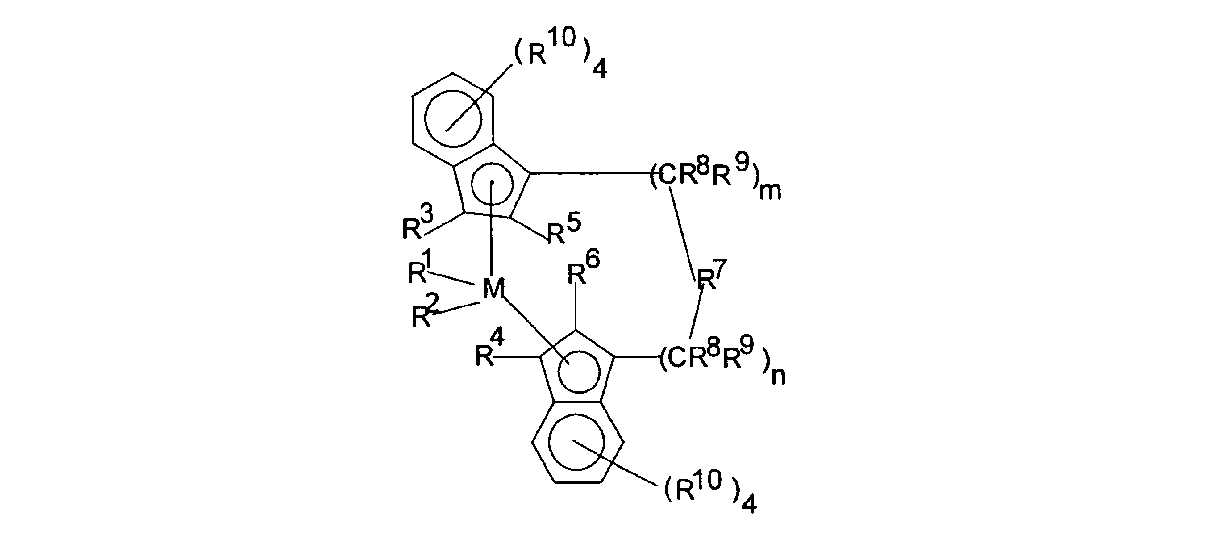
【0035】
R1及びR2は同一又は異なり、好ましくは同一であり、水素原子、C1−C10アルキル基、好ましくはC1−C3アルキル基、C1−C10アルコキシ基、好ましくはC1−C3アルコキシ基、C6−C10アリール基、好ましくはC6−C8アリール基、C6−C10アリールオキシ基、好ましくはC6−C8アリールオキシ基、C2−C10アルケニル基、好ましくはC2−C4アルケニル基、C7−C40アリールアルキル基、好ましくはC7−C10アリールアルキル基、C7−C40アルキルアリール基、好ましくはC7−C12アルキルアリール基、C8−C40アリールアルケニル基、好ましくはC8−C12アリールアルケニル基、又はハロゲン、好ましくは塩素、及びC4−C20有機メタロイド基のうちの1である。
【0036】
R5及びR6は同一又は異なり、好ましくは同一であり、ハロゲン原子、好ましくは弗素、塩素又は臭素原子、C1−C10アルキル基(好ましくはC1−C4アルキル基)でありハロゲン化され得、C6−C10アリール基(好ましくはC6−C8アリール基)でありハロゲン化され得る、C2−C10アルケニル基(好ましくはC2−C4アルケニル基)、C7−C40アリールアルキル基(好ましくはC7−C10アリールアルキル基)、C7−C40アルキルアリール基(好ましくはC7−C12アルキルアリール基)、C8−C40アリールアルケニル基(好ましくはC8−C12アリールアルケニル基)、−NR2 15、−SR15、−OR15、−OSiR3 15又は−PR2 15基(R15はハロゲン原子(好ましくは塩素原子)、C1−C10アルキル基(好ましくはC1−C3アルキル基)、又はC6−C10アリール基(好ましくはC6−C9アリール基)のうちの1である)のうちの1である。
【0037】
R7は−B(R11)−、Al(R11)−、−Ge−、−Sn−、−O−、−S−、−SO−、−SO2−、−N(R11)−、−CO−、−P(R11)−、又は−P(O)(R11)−である。
【0038】
【化2】
R11、R12及びR13は同一又は異なり、水素原子、ハロゲン原子、C1−C20アルキル基、好ましくはC1−C10アルキル基、C1−C20フルオロアルキル基、好ましくはC1−C10フルオロアルキル基、C6−C30アリール基、好ましくはC6−C20アリール基、C6−C30フルオロアリール基、好ましくはC6−C20フルオロアリール基、C1−C20アルコキシ基、好ましくはC1−C10アルコキシ基、C2−C20アルケニル基、好ましくはC2−C10アルケニル基、C7−C40アリールアルキル基、好ましくはC7−C20アリールアルキル基、C8−C40アリールアルケニル基、好ましくはC8−C22アリールアルケニル基、C7−C40アルキルアリール基、好ましくはC7−C20アルキルアリール基のうちの1であり、又はR11及びR12、又はR11及びR13であり、それらに結合する原子と共に環構造を形成する。
【0040】
M2は珪素、ゲルマニウム又は錫であり、好ましくは珪素又はゲルマニウム、最も好ましくは珪素である。R8及びR9は同一又は異なり、R11に対する記載の意味を有する。m及びnの値は同一又は異なり、0、1又は2であり好ましくは0又は1である。m+nは0、1又は2となり、好ましくは0又は1である。最後に、R3、R4、及びR10は同一又は異なりR11,R12及びR13に対する記載の意味を有する。2の隣接R10基は互いに結合し、環構造、好ましくは4−6の炭素原子を含む環構造を形成する。
【0041】
アルキルは直鎖又は分岐鎖の置換基に当てはまる。ハロゲン(ハロゲン化)は弗素、塩素、臭素又はヨウ素、好ましくは弗素又は塩素が当てはまる。
【0042】
触媒Aに対して最も好ましいメタロセンは、立体規則性ポリプロピレン、好ましくはアイソタクチックポリプロピレンを生成する利点があり、構造式(A)及び(B)により示される。
【0043】
【化3】
【0044】
これらのキラルメタロセンはラセミ混合物として高アイソタクチックポリプロピレンコポリマーの調製に用いられ得る。純粋なR及びS体を用いることも可能である。光学活性なポリマーはこれらの純粋な立体異性体で調製され得る。好ましくは、メタロセンのメソ体は、中心(即ち金属原子)が立体規則的な重合を与えることを保証するために取り除かれる。立体異性体の分別は公知の文献にある技術でなされ得る。特定の生成物の場合、ラセミ/メソ混合物を用いることも可能である。
【0045】
好適なメタロセンの具体的な非限定的な例は以下の化合物を含む。
【0046】
ジメチルシランジイルビス(2−メチル−4−フェニル−1−インデニル)ZrX2
ジメチルシランジイルビス(2−メチル−4,5−ベンゾインデニル)ZrX2;
ジメチルシランジイルビス(2−メチル−4,6−ジイソプロピルインデニル)ZrX2;
ジメチルシランジイルビス(2−エチル−4−フェニル−1−インデニル)ZrX2;
ジメチルシランジイルビス(2−エチル−4−ナフチル−1−インデニル)ZrX2,
フェニル(メチル)シランジイルビス(2−メチル−4−フェニル−1−インデニル)ZrX2,
ジメチルシランジイルビス(2−メチル−4−(l−ナフチル)−1−インデニル)ZrX2,
ジメチルシランジイルビス(2−メチル−4−(2−ナフチル)−1−インデニル)ZrX2,
ジメチルシランジイルビス(2−メチル−インデニル)ZrX2,
ジメチルシランジイルビス(2−メチル−4,5−ジイソプロピル−1−インデニル)ZrX2,
ジメチルシランジイルビス(2,4,6−トリメチル−1−インデニル)ZrX2,
フェニル(メチル)シランジイルビス(2−メチル−4,6−ジイソプロピル−1−インデニル)ZrX2,
1,2−エタンジイルビス(2−メチル−4,6−ジイソプロピル−1−インデニル)ZrX2,
1,2−ブタンジイルビス(2−メチル−4,6−ジイソプロピル−1−インデニル)ZrX2,
ジメチルシランジイルビス(2−メチル−4−エチル−1−インデニル)ZrX2,
ジメチルシランジイルビス(2−メチル−4−イソプロピル−1−インデニル)ZrX2,
ジメチルシランジイルビス(2−メチル−4−t−ブチル−1−インデニル)ZrX2,
フェニル(メチル)シランジイルビス(2−メチル−4−イソプロピル−1−インデニル)ZrX2,
ジメチルシランジイルビス(2−エチル−4−メチル−1−インデニル)ZrX2,
ジメチルシランジイルビス(2,4−ジメチル−1−インデニル)ZrX2,
ジメチルシランジイルビス(2−メチル−4−エチル−1−インデニル)ZrX2,
ジメチルシランジイルビス(2−メチル−α−アセナフト−1−インデニル)ZrX2,
フェニル(メチル)シランジイルビス(2−メチル−4,5−ベンゾ−1−インデニル)ZrX2,
フェニル(メチル)シランジイルビス(2−メチル−4,5−(メチルベンゾ)−1−インデニル)ZrX2,
フェニル(メチル)シランジイルビス(2−メチル−4,5−(テトラメチルベンゾ)−1−インデニル)ZrX2,
フェニル(メチル)シランジイルビス(2−メチル−α−アセナフト−1−インデニル)ZrX2,
1,2−エタンジイルビス(2−メチル−4,5−ベンゾ−1−インデニル)ZrX2,
1,2−ブタンジイルビス(2−メチル−4,5−ベンゾ−1−インデニル)ZrX2,
ジメチルシランジイルビス(2−メチル−4,5−ベンゾ−1−インデニル)ZrX2,
1,2−エタンジイルビス(2,4,7−トリメチル−1−インデニル)ZrX2,
ジメチルシランジイルビス(2−メチル−1−インデニル)ZrX2,
1,2−エタンジイルビス(2−メチル−1−インデニル)ZrX2,
フェニル(メチル)シランジイルビス(2−メチル−1−インデニル)ZrX2,
ジフェニルシランジイルビス(2−メチル−1−インデニル)ZrX2,
1,2−ブタンジイルビス(2−メチル−1−インデニル)ZrX2,
ジメチルシランジイルビス(2−エチル−1−インデニル)ZrX2,
ジメチルシランジイルビス(2−メチル−5−イソブチル−1−インデニル)ZrX2,
フェニル(メチル)シランジイルビス(2−メチル−5−イソブチル−1−インデニル)ZrX2,
ジメチルシランジイルビス(2−メチル−5−t−ブチル−1−インデニル)ZrX2,
ジメチルシランジイルビス(2,5,6−トリメチル−1−インデニル)ZrX2等である。
【0047】
Xはハロゲン又はアルキルであり、触媒Aを用いる場合、好ましくはアルキル又はアルキリデンである。
【0048】
これらの好適なメタロセン触媒成分は米国特許第5,145,819号;5,243,001号;5,239,022号;5,329,033号;5,296,434号;5,276,208号;5,672,668号,5,304,614号及び5,374,752号;及びEP549 900及び576 970;及びWO98/22486に詳細に記載されている。さらに、米国特許第5,510,502号及び5,527,929号に記載のようなメタロセンもある。
【0049】
他には、シンジオタクチックプロピレンを生成する及び非ハロゲンの不安定な配位子を有することが可能なメタロセンは触媒Aとして効果的に用いられ得る。このようなメタロセンは、本技術分野において公知であり、メタロセンを生成する方法も同様である。例えば、米国特許第4,892,851号,5,132,381号,及び5,155,080号を参照のこと。
【0050】
触媒B
触媒Bはオレフィン重合に適した公知の任意のメタロセンとなり、特に触媒Aにより生成されるポリマー成分と異なる成分を生成するために効果的である。効果的なブレンド(ポリプロピレンブレンドのような明白な変化を含む)により、さらなる混合またはブレンドなしに最終反応器から直接によくブレンドされる意味において、調製され得る、2以上の成分が本質的に結晶質であるが、分子量及び結晶質のような1以上のポリマーの特性において異なる。この結果、触媒Aに対する上記触媒は、触媒Aとして特別に選択されたものよりも異なって選択される限り、及びその上それらの不安定な配位子において異なる限り、触媒Bとして効果的に用いることができる。
【0051】
触媒Bに対する特に好適なメタロセンの種類は、
式;(Cp1R1 m)R3 n(ErR2)MXs
により示される。
【0052】
式中、Cpは置換され得るシクロペンタジエニル環であり置換され得るそれらの誘導体であり、R1は各々独立して、ハロゲンまたは20炭素原子まで含む、ヒドロカルビル、ハロカルビル、ヒドロカルビル置換の有機メタロイドまたはハロカルビル置換の有機メタロイド基であり、“m”は0乃至5、及びそこで結合されたシクロペンタジエニル環の隣接炭素原子における2のR1置換基は互いに結合され、4乃至20炭素原子からなる環を形成し、R3は架橋基であり、“n”は0乃至3であり、Mは3乃至6の原子価を有する遷移金属であり、好ましくは元素周期表の第4,5、または6族及び好ましくは最も高い酸化状態にあり、Eはヘテロ原子含有基であり、ヘテロ原子は第VA族の配位数3を有するまたは第VIA族の配位数2を有する元素(好ましくは窒素、燐、酸素、または硫黄)であり、R2はC1乃至C20の炭化水素基、置換C1乃至C20の炭化水素基からなる群から選択される基であり、1以上の水素原子がハロゲン原子で置換され、Eが3配位で未架橋の場合に、Eには2つのR2基が存在し、各独立した基はC1乃至C20ヒドロカルビル基、置換C1乃至C20ヒドロカルビル基から選択される基であり、1以上の水素はハロゲン原子と置換され、各Xはシクロペンタジエニル配位子ではなく、独立して、ハロゲン又は20までの炭素原子を含む、ヒドロカルビル、オキシヒドロカルビル、ハロカルビル、ヒドロカルビル置換の有機メタロイド、オキソヒドロカルビル置換の有機メタロイドまたはハロカルビル置換の有機メタロイド基であり、“s”はMから2を引いた原子価に等しい。
【0053】
Xがハロゲンである場合、本明細書では不安定なハロゲンの置換メタロセンとして当てはまる。Xがハロゲンでない場合、本明細書では不安定な非ハロゲンの置換メタロセンとして当てはまる。ある実施態様において、Xが触媒A、触媒Bが共に用いられる場合、Xは触媒Bでハロゲンであり、Xは触媒Aではハロゲンではない。
【0054】
触媒Bは好ましくは上記のような配位子としてCp環成分のみを有するメタロセンであり、モノシクロペンタジエニルメタロセンとして当てはまる。Cp配位子が金属と共にハーフサンドイッチ型錯体を形成し、自由に回転でき(未架橋の)または架橋基からへテロ原子含有配位子(E)を介して堅固な配座に固定される。Cp環配位子は無置換、置換、または置換され得るヘテロ環組成のようなそれらの誘導体となり得、その置換基は縮合され、テトラヒドロインデニル、インデニル、またはフルオレニル環組成等の他の飽和または不飽和環組成を形成する。ヘテロ原子含有配位子(E)は、架橋基を介し、金属と任意にCp配位子の双方に結合する。ヘテロ原子はそれ自体、元素周期表の第VA又はVIA族の配位数3を有する原子である。
【0055】
本発明の混合触媒組成物の触媒Bに用いるための適切なモノシクロペンタジエンメタロセンの例は米国特許第5,026,798号;5,057,475号;5,350,723号;5,264,405号;5,055,438号及び、発行されたWO96/002244に記載されている。
【0056】
触媒Bに対する最も好ましいメタロセンはアモルファス又はエラストマーコポリマー特にエチレンプロピレンコポリマーを生成するために有利であるメタロセンである。これによりモノシクロペンタジエニルメタロセンがより好ましい。
【0057】
本発明の混合触媒組成物に用いる好適なモノシクロペンタジエニルメタロセンの具体的な非限定的な例は以下の化合物である。
【0058】
μ−(CH3)2Si(シクロペンタジエニル)(1−アダマンチルアミド)M(R)2
μ−(CH3)2Si(3−テルトブチルシクロペンタジエニル)(1−アダマンチルアミド)M(R)2
μ−(CH2(テトラメチルシクロペンタジエニル)(1−アダマンチルアミド)M(R)2
μ−(CH3)2Si(テトラメチルシクロペンタジエニル)(1−アダマンチルアミド)M(R)2
μ−(CH3)2C(テトラメチルシクロペンタジエニル)(1−アダマンチルアミド)M(R)2
μ−(CH3)2Si(テトラメチルシクロペンタジエニル)(1−テルトブチルアミド)M(R)2,
μ−(CH3)2Si(フルオレニル)(1−テルトブチルアミド)M(R)2
μ−(CH3)2Si(テトラメチルシクロペンタジエニル)(1−シクロドデシルアミド)M(R)2
μ−(C6H5)2C(テトラメチルシクロペンタジエニル)(1−シクロドデシルアミド)M(R)2
式中、MはTi、Zr、及びHfからなる群から選択され、Rはある実施態様においてハロゲン、又はC1乃至C5アルキル、メチル基から選択さるれる。
【0059】
触媒Bはまた、半結晶質の、エラストマー又はアモルファスコポリマー、特にエチレン プロピレンコポリマーを生成するために有利である場合、ビスシクロペンタジエニルメタロセンも含むが、好ましくは触媒Bはビシクロペンタジエニルメタロセンのみを含む。このようなメタロセンの例は、上記のビスシクロペンタジエニルメタロセンのメソ異性体である。触媒Bとして用いる他の適切な触媒はWO96/23010において見出され得る。
【0060】
混合触媒組成物の使用法
本発明の混合触媒組成物は、多工程重合法により生成される反応器ポリマーブレンドを生成するために用いられ、該方法は第1工程を含み、第1番目にセットされたモノマーは混合触媒組成物で重合される。混合触媒組成物は上記に定義されたような触媒A及び触媒Bを含む。第1工程の間、触媒Aは重合において活性であり、触媒Bは不活性である。多工程法はさらにその後の工程を含み、さらなるモノマーは第1工程の内容物に添加されるが、その後も添加され、重合は1以上のさらなる工程で行なわれ、この場合、触媒Bは重合において活性となる。
【0061】
上記詳細な説明において、好ましくは触媒Aは不安定な非ハロゲン置換メタロセン、好ましくはジアルキル置換であり、触媒Bは不安定なハロゲン置換のメタロセン、好ましくは塩素2置換である。第1重合工程の前又はその間に、NCA前駆体は好ましくは活性剤として添加される。重合が第1工程で行なわれる場合、NCA前駆体は触媒Aのみを活性化し、触媒Bを不活性のままにする。触媒Bが不安定なハロゲン置換メタロセンとなることが好ましいが、触媒BはNCA前駆体単独で活性化されることが不可能である任意の触媒となるが、他の手段により活性可能であり得る。第2重合工程の間、活性化剤は好ましくはアルモキサン、より好ましくはMAOであり、触媒Bを活性化するために添加される。
【0062】
他には、触媒Bは、触媒BがNCA前駆体で活性可能となるために、次の工程前に改質され得る。触媒Bが不活性で不安定なハロゲン置換メタロセンである場合である場合、ハロゲン配位子を、NCA前駆体と共にイオン化の引き抜きを可能にする配位子で置換することにより活性化され得る。これは、下記の、不活性触媒の転化に当てはまる。転化は公知のアルキル化反応を介して、有機金属化合物(リチウム又はアルミニウムヒドリド又はアルキル、アルキルアルモキサン、グリニャール試薬等)で行なわれる。EP−A−0 500 944,EP−A1−0 570 982及びEP−A1−0 612 768を参照のこと。これらは、活性化アニオン化合物の添加前又は添加と共にアルキルアルミニウム化合物の、不安定なハロゲン置換メタロセン化合物との反応を記載する。例えば、アルミニウムアルキル化合物は混合メタロセン触媒組成物及び第1工程重合における他の内容物と混合され得る。これは不活性で不安定なハロゲン置換メタロセン(触媒B)をNCA前駆体を有する活性触媒を生成するのが可能な化合物に転化する。第1工程で存在するNCA前駆体は転化された触媒を活性化するために用いられるか、より多くのNCA前駆体が添加され得る。しかし、触媒Bを未改質のままにすることがより好ましく、そのため活性化化合物(MAO等)がその後の重合工程で添加される。
【0063】
本発明の混合触媒組成物は、任意の重合法(溶液、スラリー、気相、及びそれらの組み合わせからなる周知の方法等)に用いられ得る。これらの周知の方法は、混合触媒を用いた任意の重合工程で用いられ得る。該混合触媒組成物はバッチ式、連続又は半連続法において用いられ得る。
【0064】
好ましい実施態様において、混合触媒組成物は多工程重合法にて用いられ、ここでモノマーは、少なくとも2成分(一般に互いに不混和性である)の関連のある混合物を含む反応器ポリマーブレンドを生成するために各工程で選択される。これらの反応器ポリマーブレンドの例は、例えば、1)半結晶質、アモルファス又はエラストマーエチレン/高α−オレフィンコポリマーを伴う結晶質ポリプロピレン又はポリエチレン、2)アモルファスポリプロピレンを伴う結晶質ポリプロピレン、3)スチレンを伴う結晶質ポリプロピレン又はポリエチレン、及び4)エチルビニルアセテート又はエチルメチルアクリレートを伴う結晶質ポリプロピレン又はポリエチレンのブレンドである。
【0065】
混合触媒組成物を用いる1の好適な方法は反応器ポリマーブレンドを生成することであり、立体規則性のポリプロピレン、好ましくはアイソタクチックポリプロピレン及びアモルファス又はエラストマーコポリマー、好ましくはエチレンプロピレンコポリマー(コポリマー中に20−85モル%のエチレン含有量である)を含む。アイソタクチックポリプロピレンは、第1工程で生成され、アモルファス又は弾性エチレン プロピレンコポリマーはその後の工程において生成される場合、改質インパクトポリプロピレンは生成される。
【0066】
本発明の混合触媒組成物により改質インパクトポリプロピレンを生成する好適な多工程法は、第1工程において優位を占める立体特異なプロピレン、好ましくはアイソタクチックポリプロピレンが液体モノマーから重合され、及びその後の工程において、アモルファス又はエラストマーコポリマー、好ましくはエチレン−プロピレンが、気相中で重合される。中間の第2工程が好ましくは行なわれ、液体モノマーからより独占的に立体規則性のポリプロピレンを生成する。好ましくは触媒Bは同様に中間工程を経て不活性化されるが、その後の工程で活性化される。本発明に準拠した選択に適した中間工程のプロセスの例は米国特許第5,280,074号で見出される。
【0067】
改質されたインパクトポリプロピレンを生成するための好適な混合触媒組成物は、ポリプロピレンの生成に有利な触媒A(即ちプロピレンを立体特異的に重合する時、好ましくはアイソタクチックポリプロピレン重合時に特に効果的な触媒)及びアモルファス又はエラストマーコポリマーの生成に有利な触媒B(即ちアモルファス又はエラストマーコポリマー、特にエチレン−プロピレン生成時に特に効果的な触媒)を含む。独占的な立体規則性のポリプロピレンが生成される第1工程及びさらなる任意の工程において、好ましくは触媒Aのみが重合で活性であり、触媒Bは重合において不活性のままである。アモルファス又はエラストマーコポリマーが生成される任意のその後の工程において、触媒Bは好ましくは重合において活性となる。
【0068】
独占的な立体規則性のポリプロピレンは好ましくは、1以上の工程で、液体プロピレン中で、15乃至400分の滞留時間で、5乃至100バールの圧力下、0乃至100℃の温度で生成され、混合触媒の触媒Aか触媒Bのどちらかのみが重合において活性化される。アモルファス又はエラストマーコポリマーは、その後の工程で、エチレン存在下、気相中で10乃至180分の滞留時間で、5乃至100バールの圧力下、0乃至100℃の温度で調製され、混合触媒の触媒Bは重合において活性となる。
【0069】
下記の実施例は上記記述を説明するために存在する。部、割合、百分率は全て、他に示されなければ単位は重量である。周囲の温度は、他に記載がなければ、重合実施例にて用いれた。実施例は本発明の特定の実施態様に関するが、それらは任意の特定の事項に本発明を制限するように示されるわけではない。
【0070】
実施例
1.担持触媒の調製(方法1)
窒素パージされたグローブボックス中で、394g のDavison 952のシリカ(1.55 cc/gの細孔容積、600℃で、少なくとも1乃至10時間乾燥)をオーバーヘッドスターラーを装備した3首の4Lの反応器に量り取る。2Lの乾燥トルエンを添加し混合物を激しく撹拌する。27.6mlのN,N−ジエチルアニリンをシリンジを介して添加し、さらに86.0gの固形トリス(ペルフルオロフェニル)ボロンを添加した。この混合物を1時間撹拌する。その後、5.99gのジメチルシリルビス(2−メチルー4−フェニルインデニル)ジルコニウム ジメチルを添加し、この混合物をさらに2時間撹拌する。撹拌を停止し、固形物を静置する。上澄み液をデカントし、固形物を室温で一晩真空乾燥する。担持触媒の収量は約423gであり、最終的な触媒のgに対し約0.02mmolの遷移金属の配合量となる。
【0071】
2.担持触媒の調製(方法2)
48.5gのSiO2(Grace Davison, W. R.Grace Co.−Conn.の子会社からSYLOPOL(登録商標)952(“952シリカゲル”)として入手可能であり、N2の細孔容積が1.63cc/g及び表面積が312m2/gである)を、1.5gのアンモニウム ヘキサフルオロシリケート((NH4)2SiF6)(Aldrich Chemical Company,Milwaukee WIから入手可能)と共にドライミックスさせた。シリカゲル1gに対し1.05mmolのFに対応するアンモニウム ヘキサフルオロシリケートを添加した。混合物を、一端から3.8cmにある中位のフリット プラグを有する50cmのビーカガラスチューブにより5cmのIDに移送した。チューブは環状炉に挿入しN2の流れ(220cc/分)をフリットを通じて流し、シリカ床を流動化させた。環状炉を下記の計画の下、加熱した。
【0072】
5時間以上で25から150℃に昇温
150℃で4時間ホールド
2時間以上で150から500℃に昇温
500℃で4時間ホールド
N2下、加熱を止め冷却
冷却される場合、流動化シリカをN2下で貯蔵した。Neutron Activation Analysis,Nuclear Analytical Services(オースティンのテキサス大学)は、1.68±0.06重量%の弗素を示した。また、下記の化合物は(NH4)2SiF6:NH4BF4,(NH4)2PF6,NH4F3と共に及び置換して用いられる。
【0073】
3.触媒Bの担持触媒への添加
マグネチック スターラー バーを装備したガラスバイアル中に、76.7mgの化合物(Me4Cp)SiMe2(N−tBu)TiCl2を15mlのトルエンに溶解した。この溶液を30分間混合する。同時に、実施例1又は2において調製した10gの担持触媒固形物を、ボトムミキサーを装備したステンレス鋼ブレンダーカップに装入する。チタノセンの溶液を、ブレンダーカップで継続して撹拌している間、担持触媒に滴下した。担持触媒に添加したTi触媒溶液の全容積は、97%の細孔容積の使用を達成するのに必要な容積である。湿った固形物をロートエバポレーターに移し、室温で少なくとも4時間真空乾燥した。
【0074】
4.実施例1の触媒を用いるホモポリマーアイソタクチックポリプロピレンの重合(比較例)
予め窒素でフラッシュされた2Lのオートクレーブ反応器にトリエチルアルミニウム(0.25mlの1Mへキサン溶液)及び1000mlのプロピレンを装入し、70℃の温度まで加熱する。実施例1に準じ調製された75mgの流動性固体触媒サンプルを2mlのヘキサンにて撹拌し,反応器中に250mlのさらなるプロピレンと共にフラッシュし、反応を開始する。1時間後、反応器を冷却し、通風し、20分間窒素パージした後に開口し、ホモポリマーPP生成物を回収した。生成物をセラミック容器に移し、1時間、ヒューム・フードで乾燥する。その後容器を真空オーブン中に置き、さらに1時間、真空中、75℃で乾燥する。
【0075】
5.実施例3の触媒を用いるホモポリマーアイソタクチックポリオレフィン(i−PP)の調製
実施例4で用いる同一の重合法を用いたが、用いる触媒は実施例3で生成した同一の触媒である。
【0076】
生成物の収量、分子量、融点に関し重合実験の結果及び実施例4との比較の分析は、第2触媒成分が本重合工程の過程において終始、休眠状態であることを示す。
【0077】
6.実施例3の触媒を用いる共重合
予め窒素でフラッシュされた2Lのオートクレーブ反応器にトリエチルアルミニウム(0.25mlの1Mへキサン溶液)及び1000mlのプロピレンを装入し、70℃の温度まで加熱する。実施例3に準じ調製された75mgの流動性固体触媒サンプルを2mlのヘキサンにて撹拌し、反応器中に250mlのさらなるプロピレンと共にフラッシュし、反応を開始する。1時間後、反応器を170psigの圧まで通風し、未反応のプロピレンモノマーを回収する。その後、30重量%のメチルアルモキサントルエン溶液(Albemarle Corporationから入手可能)0.5乃至3.0ccのアリコートを反応に添加し、触媒Bの活性化のために10分間撹拌する。この場合、エチレン/プロピレンガス混合物(80重量%エチレン)の一定の流れを反応器に起こす。反応器圧を、反応器ベントの背圧調整弁を用いて200psigに維持する。エチレン/プロピレンガス流れをもう1時間維持し、その後流れを停止し、反応器を冷却した。反応器を窒素で20分間パージした後、開口し生成物を回収した。反応物をセラミック容器に移し、1時間、ヒューム・フードで乾燥する。その後容器を真空オーブン中に置き、さらに1時間、真空中、75℃で乾燥する。
【0078】
7. 実施例1の触媒を用いる共重合(比較例)
予め窒素でフラッシュされた2Lのオートクレーブ反応器にトリエチルアルミニウム(0.25mlの1Mへキサン溶液)及び1000mlのプロピレンを装入し、70℃の温度まで加熱する。実施例1に準じ調製し75mgの流動性固体触媒サンプルを2mlのヘキサン中で撹拌し、反応器中に250mlのさらなるプロピレンと共にフラッシュし、反応を開始する。1時間後、反応器を170psigの圧まで通風し、未反応のプロピレンモノマーを回収する。活性化剤はさらに添加しない。この場合、エチレン/プロピレンガス混合物(80重量%エチレン)の一定の流れを反応器に起こす。反応器圧を、反応器ベントの背圧調整弁を用いて200psigに維持する。エチレン/プロピレンガス流れをもう1時間維持し、その後流れを停止し、反応器を冷却した。反応器を窒素で20分間パージした後、開口し生成物を回収した。反応物をセラミック容器に移し、1時間、ヒューム・フードで乾燥する。その後容器を真空オーブン中に置き、さらに1時間、真空中、75℃で乾燥する。
【0079】
共重合実験6及び7(エチレン−プロピレンコモノマ成分ーの収量、分子量、及び曲げモジュラス)の結果分析は本発明の触媒が実施例1の触媒よりも物理的性質のバランスが良いコポリマー組成物を生成し、これは大部分で第2触媒種により分配される高分子量のフラクションによるものであり、触媒Aが単独で第2工程又は最終工程で存在する場合に観察されるものとは相反する。ポリマーの性質を改良することはまた、第2触媒種が第2又はそれに続く反応器に添加される場合に、本発明のプロセスと共に達成されるポリマー混合の同質性がより良いという観点から、達成される性質以上に改良もなされる。
【0080】
全ての先行文献は、そのような取り込みが法律的に許容される範囲において、引用により本明細書中に完全に取り込まれる。更に、本明細書で引用される、試験手順を含む全ての文献は、そのような取り込みが法律的に許容される範囲内において、引用により本明細書中に完全に取り込まれる。[0001]
Field of the invention
The present invention relates to mixed catalyst compositions, their preparation and their use in multi-stage polymerization processes. The invention particularly relates to the use of mixed catalysts in multi-stage polymerization processes suitable for preparing polymer blends.
[0002]
Background of the Invention
Multi-stage polymerization methods have been used to produce blends of two or more polymer components known as reactor polymer blends. See, for example, U.S. Patent Nos. 4,740,550 and 4,740,551. Typical multi-step polymerization methods include: 1) in the first step, polymerizing the monomer using an active catalyst to polymerize the first polymer component; and 2) transferring the contents of the first step to the second step. (In the second step, the active catalyst of the first step is used to produce the second polymer component). See, for example, U.S. Patent Nos. 5,280,074, 5,322,902 and 5,684,097. These patents disclose that the crystalline polyolefin component is prepared in a liquid monomer in a first bulk slurry step and the copolymer is prepared in a second gas phase step. Generally, the catalyst composition used will comprise a catalyst throughout the process, the catalyst being particularly suitable for producing one of the polymer components, but not suitable for producing the other polymer component Often.
[0003]
Another method of solving this problem is to add a catalyst different from the catalyst used in the first polymerization step in the second polymerization. A catalyst that is advantageous for producing the first polymer component is added in a first polymerization step, and a second catalyst that is advantageous for producing a second polymer component is added in a second step. See, for example, U.S. Patent No. 5,648,422. The patent states that the use of a catalyst particularly suitable for the preparation of crystalline polypropylene is in the first step or a step of introducing a second catalyst which is particularly suitable for producing the copolymer selected for the final blend. Is disclosed. The first transition metal catalyst is deactivated and a second transition metal catalyst is added with the activator, but generally there is a metallocene previously contacted with the alumoxane activator. Disadvantages of this solution are the addition of additional catalyst and activator and uniformity in the first polymer component such that the second copolymer component is prepared with an essentially uniform dispersion in the first polymer component. There is a tedious process of effectively having a dispersed second catalyst.
[0004]
Another solution to this problem is to use a mixed catalyst composition containing the two catalysts used throughout the polymerization steps. One of the two catalysts is advantageous for producing the first polymer component of the reactor blend, and the second catalyst is advantageous for producing the second polymer component. See, for example, WO 98/10016. Other related arts include U.S. Patent No. 5,714,427. The disadvantage of such a solution is that both catalysts are active at any stage of the polymerization process, and the particular advantage of the two catalysts with respect to different polymerized polymer components can be eliminated. Efforts have been made to selectively deactivate one of the catalysts, but such steps are cumbersome and undesirable.
[0005]
The above method is not preferred because adjustment of the final reactor blend is limited as described above. It is therefore desirable to design a process that is particularly suitable for both producing the first polymer component of the reactor blend and producing at least one other polymer component of the reactor blend.
[0006]
Summary of the invention
The present invention relates to an olefin polymerization method suitable for preparing a polyolefin blend, comprising: A) contacting a mixed catalyst composition having one or more olefins supported on a porous inert particulate material in a first polymerization step. Whereby the catalyst is activated by reacting with a non-coordinating anion precursor compound for polymerization a) at least one transition metal catalyst compound and b) more active by said non-coordinating anion precursor compound B) comprising at least one inert transition metal catalyst compound which is not capable of being reacted; B) the product of A) is optionally freed of unreacted monomers, by-products or other unwanted substances C) modifying the mixed catalyst system of A) by adding to the second step b) adding an alkyl compound effective against the transition metal catalyst compound in the second step; and D) Second step one or more olefins -A) of olefin and the same or different - a, comprising contacting the modified mixed catalyst system C).
[0007]
The intermediate product of the present invention is prepared in the first step and comprises at least one transition metal catalyst compound active for olefin polymerization and at least one transition metal catalyst inert for olefin polymerization. , Both catalysts are contained on a prepolymerized inert support. This pre-polymerized and supported mixed catalyst composition is suitable for storage, transport and subsequent use if it undergoes alkylation modification and is derived into a polymerization medium with an intercalable polymerizable monomer.
[0008]
The mixed catalyst composition comprises at least two different catalysts and may be directed to a first polymerization step with the monomers. A mixed catalyst composition is selected, where the polymerization occurs in the first step, at least one catalyst is active in the polymerization, while at least one other catalyst is inactive in the polymerization. After the polymerization, the contents of the first polymerization step are subject to the subsequent polymerization step, but the catalyst in the mixed catalyst composition that was inactive in the first polymerization step is activated for polymerization. There are several additional steps besides those described above, which may include recovering unwanted by-products and unreacted monomers. An advantage of the present invention is that a useful reactor polymer blend that selectively activates the mixed catalyst composition and is tailored after the first polymerization step without further catalyst addition or catalyst deactivation. including. The intermediate product is an intimate mixture of the mixed catalyst in the first step polymer, which can activate the inert catalyst in the second step, but forms a suitable homogeneous mixture or blend of the first and second step polymers. It is not necessary to independently introduce the catalyst and blend or undergo a rigorous mixing process for an attempt.
[0009]
DETAILED DESCRIPTION OF THE INVENTION
In general, the present invention relates to a mixed catalyst composition comprising at least two different catalysts that can be selectively activated. The mixed catalyst composition is used in a multi-step polymerization process to produce a reactor polymer blend that includes at least two polymer components. Mixed catalyst compounds are generally described by metallocenes that can be used for various olefin polymers, but i) labile hydrocarbyl ligands that can be activated by non-coordinating anion precursor compounds by an ionization mechanism, and alkylated Unless otherwise alkylated, it is not generally activated by non-coordinating anion precursor compounds. Ii) It can be selectively activated to include labile ligands of halogen, alkoxy, or amide. Non-metallocene transition metal compounds which are known in the art and are active with non-coordinating anion precursors for olefin polymerization are suitable in step A) as active catalysts. They are generally activated only with alkylaluminum compounds (including alkylalumoxane compounds) and are suitable as inert catalysts in step A). Subsequent alkylation with the inert catalyst of step A) allows the inert catalyst to become active with the present non-coordinating anion precursor compound for olefin polymerization, followed by the reforming catalyst compound of step C) Enables the polymerization of the contacted olefin.
[0010]
Support substance
The mixed catalyst composition used in the process of the present invention is preferably supported using a porous particulate material (eg, talc, inorganic oxides, inorganic chlorides, and resinous materials such as polyolefins or polymer compounds).
[0011]
Preferred support materials are porous inorganic oxides, including those comprising the second, third, fourth, fifth, thirteenth, or fourteenth metal oxide of the Periodic Table of the Elements. Silica, alumina, silica-alumina, and mixtures thereof are particularly preferred. Other inorganic oxides that can be used alone or in combination with silica, alumina or silica-alumina include magnesia, titania, zirconia, and the like.
[0012]
Generally, the inorganic oxidized support material is porous silica and has a surface area of 10 to 700 m.2/ G, the total pore volume is in the range of 0.1 to 4.0 cc / g and the average particle size is in the range of 10 to 500 µm. More preferably, the surface area is 50 to 500 m2/ G, the total pore volume is 0.5 to. 3.5 cc / g and the average size of the particles are in the range of 20 to 200 μm. Most preferably, the surface area is between 100 and 400 m2/ G, pore volume from 0.8 to 3.0 cc / g and average particle size from 30 to 100 µm. The average size of the pores of a typical porous carrier is between 10 and 1000 °. Preferably, the support material has an average pore size of 50-500 °, and most preferably 75-350 °. It is particularly preferred to dehydrate the silica at a temperature of 100 ° C. to 800 ° C. for 3 to 24 hours.
[0013]
Preferred polymeric supports generally comprise essentially a hydrocarbon polymer compound, preferably the compound has a small surface area to avoid allowing excess monomer to access active catalyst sites, the sites comprising the polymer comprising the support. Due to the randomly incorporated functional groups in the chains, they are distributed essentially uniformly throughout many carriers. The term low surface area refers to single point nitrogen B.I. E. FIG. T. (Brunauer, S., Emmett, PH, Teller, E., JACS 1938, 60, 309), the surface area is 50 m.2The following means can be illustrated by the use of polystyrene-based beads or gels. These beads or gels are easily cross-linked and randomly functionalized with ammonium salt compounds. An important feature of these catalyst supported compounds is that the particles are insoluble in the solvent used to prepare the supported catalyst or in the solvent used to polymerize the monomer and are effective for use in fluidized bed reactors. All crush resistance to diameter, and temperature pressure and load requirements. As a result, the support must be insoluble under normal polymerization operating conditions. Preferably, the beads are uniform in size and spherical, with a typical size of 400 to 100 US mesh (30 to 100 μm).
[0014]
The transition metal catalyst compound, activator and support material can be combined in any manner to prepare the supported catalyst. Suitable carrier techniques are described in U.S. Patent Nos. 4,701,432 and 4,808,561. Preferred transition metal compounds and activators are combined, and their reaction products are deposited on a porous support material as described in US Pat. No. 5,240,894 and EP 705 281, EP 766 700, EP 766 702. It is carried by. Alternatively, the transition metal compounds can be separately preactivated, and then combined separately or together with the support material, so long as at least one metallocene remains inert in the mixed metallocene compositions of the present invention. If the transition metal compound and the activator are loaded separately, then the compound is preferably used for polymerization after being dried and combined as a powder. Preferably, the active catalyst of step A) is activated and then mixed with the inert catalyst of step A) to avoid potential hindering interactions. Thus, the active catalyst is present on some internal supports, and the additional non-coordinating anion cocatalyst activator is present on the other internal supports along with the inert catalyst, each prepared separately. And combined prior to step A).
[0015]
Regardless of whether the transition metal compound and the activator are separately pre-contacted or the transition metal compound and the activator are combined once, the total volume of the reaction solution used for the porous support is preferably porous. It is less than four times the total pore volume of the carrier, more preferably less than three times the total pore volume of the porous carrier.
[0016]
Methods for supporting ionic catalysts containing metallocene cations and non-coordinating anions are described, for example, in WO 98/55518, EP 507 876, EP 702 700 and US Pat. Nos. 5,427,991 and 5,643,847. ing. The method generally involves physisorption of a conventional polymer, mainly dehydrated and dehydroxylated, or on an inorganic support, wherein the coupling group is a non-coordinating anion or a carrier in which the precursor compound is covalently bonded to the support. A Lewis acid that is strong enough to activate the hydroxy group in a simple substance such that it can be introduced into the substrate or the Lewis acid becomes a covalent bond and the hydrogen of the hydroxy group can be used to protonate the metallocene compound. Is used.
[0017]
The supported mixed catalyst composition can be used directly in the polymerization reactor or the catalyst composition can be polymerized using methods well known in the art for subsequent use in the polymerization. See U.S. Pat. Nos. 4,923,833 and 4,921,825, EP 279 863 and EP 354 893 for details regarding polymerization.
[0018]
Metallocene compounds
As used herein, “metallocene” and “metallocene compound” generally refer to
Formula: CpmMRnXq
Wherein Cp is a substituted or unsubstituted cyclopentadiene or a substituted or unsubstituted derivative thereof, and M is a third, fourth, fifth or sixth transition metal such as scandium, titanium, zirconium, hafnium. , Vanadium, niobium, tantalum, chromium, molybdenum and tungsten, R is a hydrocarbyl or hydrocarboxy group having 1 to 20 carbon atoms, X is a halogen atom,1-C10An alkyl group, preferably C1-C3Alkyl group, C1-C10An alkoxy group, preferably C1-C3Alkoxy group, C6-C10An aryl group, preferably C6-C8Aryl group, C6-C10An aryloxy group, preferably C6-C8Aryloxy group, C2-C10An alkenyl group, preferably C2-C4Alkenyl group, C7-C40An arylalkyl group, preferably C7-C10Arylalkyl group, C7-C40An alkylaryl group, preferably C7-C12Alkylaryl group, C8-C40An arylalkenyl group, preferably C8-C12An arylalkenyl group, preferably C3-C10Selected from organic metalloid groups, or a halogen atom, preferably chlorine, and m = 1-3, n = 0-3, q = 0-3, the sum of m + n + q being equal to the oxidation state of the transition metal.
[0019]
The manufacture and use of metallocenes is well known in the art. For example, metallocenes are disclosed in U.S. Patents 4,530,914; 4,542,199; 4,769,910; 4,808,561; 4,871,705; 4,933,403; 5,937,714; 5,017,714; 5,026,798; 5,057,475; 5,120,867; 5,278,119; 5,304,614; Nos. 324,800; 5,350,723; and 5,391,790. Various methods for the preparation of metallocenes are all described in the literature, see for example Journal of Organometallic Chem. , Volume 288, (1985), pp. 63-67, and EP-A-320762.
[0020]
Activator
The metallocene is generally used in combination with a cocatalyst activator that is effective for olefin polymerization. The term "activator" is defined herein to be any compound or component, or combination of compounds or components, capable of polymerizing an olefin with one or more metallocenes to form a polyolefin. Where X is a halogen in the metallocene represented by the formula; CpmMRnXq, it applies herein to an unstable halogen-substituted metallocene. If X is not halogen, it applies herein to an unstable, non-halogen substituted metallocene. Generally, labile halogen-substituted metallocenes can be activated by organoaluminum alkyl compounds (such as alumoxanes), but when used alone or in the absence or very small amounts of alkyl compounds, certain types of non-aluminum compounds can be activated. It cannot be activated by a coordinating anion (NCA) precursor compound.
[0021]
Non-coordinating anion
Non-coordinating anion (NCA) precursors are useful for selectively activating the mixed catalysts of the present invention. It is not generally believed that the NCA precursor, when not used with an alkyl compound, is capable of forming an active catalyst alone with an labile halogen substituted metallocene, and therefore is not labile in the mixture. It is useful for selectively activating unstable non-halogen substituted metallocenes that are present with the metallocene. An NCA precursor is a compound that reacts with at least one non-halogen ligand of a metallocene compound and produces a stable ion pair comprising a cationic metallocene compound and an anionic compound. Cationic metallocene complexes are referred to as transition metal cations. Anionic complexes are referred to as non-coordinating anions.
[0022]
The term "non-coordinating anion" (NCA) refers to an anion that does not or only slightly coordinates to the transition metal cation, and is therefore a neutral Lewis An anion that remains unstable enough to be replaced by a base. Non-coordinating anions that are "coexisting with each other" are anions that do not decay and become neutral when the initially formed complex decomposes. Furthermore, the anion does not send the anionic substituent or fragment to the cation, forming a neutral four-coordinate metallocene compound and neutral by-products. The non-coordinating anions useful in the present invention are compatible with each other and stabilize the metallocene cation in the sense of keeping its ionic charge in the +1 state, yet remain ethylenically or acetylenically during the polymerization reaction. Retains sufficient activity to allow substitution by sex-unsaturated monomers. Further, the anions useful in the present invention are large or bulky in the sense that the molecular size is sufficient to primarily inhibit or prevent the neutralization of the metallocene cation by Lewis acids other than polymerizable monomers that may be present in the polymerization process. Get higher. Generally, anions have a molecular size of about 4 ° or more.
[0023]
Descriptions of ionic catalysts for coordination polymerization involving metallocene cations activated by non-coordinating anions are described in EP-A-0277703, EP-A-02770704, US Pat. Nos. 5,198,401 and 5,278. , 119, and earlier work in WO92 / 00333. These teach a preferred method of preparation, where the metallocene is protonated by a non-coordinating anion precursor such that the alkyl group is abstracted by the transition metal and both cationization and charge balance are achieved by the non-coordinating anion. You. It is also known to use ionic compounds capable of forming both an activated metallon cation and a non-coordinating anion rather than containing an activated proton. See EP-A 0 426 637, EP-A-0573403 and U.S. Pat. No. 5,387,568. Reactive cations other than Bronsted acids capable of ionizing metallocene compounds include ferrocenium, triphenylcarbonium and triethylsilylium cations. Any metal or metalloid capable of forming a coordination complex that is difficult to decompose by water (other Bronsted or Lewis acids) can be used or included in the anion of the second activating compound. Suitable metals include, but are not limited to, aluminum, gold, platinum, and the like. Suitable metalloids include, but are not limited to, boron, phosphorus, silicon, and the like.
[0024]
A further method of producing an ionic catalyst uses an ionic non-coordinating anion precursor, which is initially a neutral Lewis acid but forms an anion with a cation in an ionization reaction with a metallocene compound . For example, tris (pentafluorophenyl) boron acts to extract an alkyl, hydride or silyl ligand, thereby obtaining a metallocene cation and stabilizing a non-coordinating anion. See EP-A-0 427 697 and EP-A-0 520 732. Ionic catalysts for further polymerization can also be prepared by oxidizing the metal center of the transition metal compound with an anionic precursor containing a metal oxidizable group with an anionic group. See EP-A-0 495 375.
[0025]
Suitable NCAs capable of activating labile non-halogen substituted metallocene compounds via ionic cationization and subsequent stabilization with the resulting non-coordinating anion include, for example, trialkyl substituted Contains ammonium salts.
[0026]
Trimethylammonium tetrakis (p-tolyl) borate,
Trimethylammonium tetrakis (o-tolyl) borate,
Tributylammonium tetrakis (pentafluorophenyl) borate,
Tripropylammonium tetrakis (o, p-dimethylphenyl) borate,
Tributylammonium tetrakis (m, m-dimethylphenyl) borate,
Tributylammonium tetrakis (p-trifluoromethylphenyl) borate,
Tributylammonium tetrakis (pentafluorophenyl) borate,
Tri (n-butyl) ammonium tetrakis (o-tolyl) borate and the like;
N, N-dialkylanilinium salt, etc .:
N, N-dimethylanilinium tetrakis (pentafluorophenyl) borate,
N, N-dimethylanilinium tetrakis (heptafluoronaphthyl) borate,
N, N-dimethylanilinium tetrakis (perfluoro-4-biphenyl) borate and the like;
Dialkyl ammonium salt, etc .:
Di- (isopropyl) ammonium tetrakis (pentafluorophenyl) borate and the like;
And triaryl phosphonium salts:
Triphenylphosphonium tetrafluorophenylborate,
Tri (methylphenyl) phosphonium tetraphenylborate,
Tri (dimethylphenyl) phosphonium tetraphenylborate, etc.
Further examples of suitable NCA precursors include those containing stable carbonium ions and mutually co-locating non-coordinating anions. These include the following compounds:
[0027]
Triphenylcarbenium tetrakis (trifluorophenyl) borate
Tropylium tetrakis (pentafluorophenyl) borate,
Triphenylmethylium tetrakis (pentafluorophenyl) borate,
Benzene (diazonium) tetrakis (pentafluorophenyl) borate,
Tropylium phenyltris (pentafluorophenyl) borate,
Triphenylmethylium phenyl- (trispentafluorophenyl) borate,
Benzene (diazonium) phenyl-tris (pentafluorophenyl) borate,
Tropylium tetrakis (2,3,5,6-tetrafluorophenyl) borate,
Triphenylmethylium tetrakis (2,3,5,6-tetrafluorophenyl) borate,
Benzene (diazonium) tetrakis (3,4,5-trifluorophenyl) borate,
Tropylium tetrakis (3,4,5-trifluorophenyl) borate,
Benzene (diazonium) tetrakis (3,4,5-trifluorophenyl) borate,
Tropylium tetrakis (3,4,5-trifluorophenyl) aluminate,
Triphenylmethylium tetrakis (3,4,5-trifluorophenyl) aluminate,
Benzene (diazonium) tetrakis (3,4,5-trifluorophenyl) aluminate,
Tropirinum tetrakis (1,2,2-trifluoroethenyl) borate,
Triphenylmethylium tetrakis (1,2,2-trifluoroethenyl) borate,
Benzene (diazonium) tetrakis (1,2,2-trifluoroethenyl) borate,
Tropylium tetrakis (2,3,4,5-tetrafluorophenyl) borate,
Triphenylmethylium tetrakis (2,3,4,5-tetrafluorophenyl) borate,
And benzene (diazonium) tetrakis (2, 3, 4, 5-tetrafluorophenyl) borate.
[0028]
Alumoxane
In a preferred embodiment, after the polymerization of the first step, a mixed catalyst composition comprising at least one active catalyst and an inert catalyst is contacted with an alumoxane activator such as an alkylalumoxane to activate the inert catalyst. obtain. Alkyl alumoxanes are preferably used as activators, most preferably methyl alumoxane (MAO). Alumoxane components useful as catalyst activators generally have the general formula (R-Al-O)nOr R (R-Al-O)nAlR2Is an aluminum compound of an oligomer represented by the linear compound of Generally, alkyl alumoxanes that are suitably used in olefin polymerization contain from 5 to 40 repeating units (R-Al-O), where R is independent and contains mixed alkyl.1-C8Alkyl. Particularly preferred are compounds wherein R is alkyl having a small number of carbon atoms such as methyl or ethyl. The alumoxane solution is in particular a methylalumoxane solution, which can be obtained from the supplier as a solution having various concentrations. There are various methods for preparing alumoxanes, but non-limiting examples include U.S. Patent Nos. 4,665,208, 4,952,540, 5,091,352, 5,206,199, No. 4,204,419, 4,874,734, 4,924,018, 4,908,463, 4,968,827, 5,308,815, 5,329,032, 5, Nos. 248,801, 5,235,081, 5,157,137, 5,103,031, and EP-A-0 561 476, EP-B1-0 279 586, and EP-A-0 594. -218, and WO94 / 10180 (as used herein, unless otherwise stated, "solution" refers to any mixture, including suspensions).
[0029]
Mixed catalyst composition
The mixed catalyst composition of the present invention preferably comprises at least two catalysts: at least one catalyst A (which can be activated with an NCA precursor) and at least one catalyst B (which can be activated only with an NCA precursor). Impossible). Preferably catalyst B is later activated with alumoxane, preferably MAO. Catalyst B can also be converted to a compound that can be subsequently activated with an NCA precursor, optionally present from the first step, such as by adding an organoaluminum alkyl compound (such as triisobutylaluminum) during the second step. With a large amount of NCA precursor added to the NCA precursor. When activated in multiple steps, the catalyst produces a mixed reactor polymer blend used in a multi-step polymerization process.
[0030]
The catalyst compound is selected to prepare the reactor polymer blend prior to activation. The reactor polymer blend generally contains at least two components (component-1 and component-2). Catalyst A is preferably a metallocene compound effective to produce component-1. Catalyst B is preferably a metallocene compound effective to form component-2. The choice of activator at the central metal of each metallocene compound in the mixed catalyst composition and the choice of the unstable ligand allows the practitioner to selectively activate catalyst A or catalyst B for polymerization. Suitable active compounds for catalyst A are the non-coordinating anion (NCA) precursors described above. Generally, the NCA precursor produces an active catalyst having a metallocene compound having a labile ligand that is non-halogen (active, non-halogen substituted metallocene), for example, a dialkyl-substituted metallocene.
[0031]
As a result, in one embodiment of the present invention is a mixed metallocene catalyst composition, wherein one catalyst, Catalyst B, is a metallocene compound and the unstable ligand is not a halogen (an unstable non-halogen substituted metallocene catalyst). Is). When the mixed metallocene is contacted with the NCA precursor in or prior to the first polymerization step, it is not believed that Catalyst B (unstable halogen substituted metallocene) produces an active catalyst with the NCA precursor. Catalyst A (activated non-halogen substituted metallocene, such as hydridyl or alkyl substitution) forms an active catalyst with NCA. Thereafter, the first step polymerization occurs with the catalyst composition comprising the reaction product of Catalyst A and NCA precursor plus Catalyst B. Catalyst A is activated via the NCA precursor, while catalyst B (unstable halogen-substituted metallocene) remains after the first step in an inactive unit activated by the active compound (preferably alumoxane). is there.
[0032]
In a most preferred embodiment of the present invention, the mixed catalyst composition comprises catalyst A and catalyst B, wherein catalyst A is a non-halogen substituted metallocene, capable of producing stereospecific polypropylene, Is a metallocene, preferably an unstable halogen-substituted metallocene, capable of producing a semi-crystalline amorphous or elastomeric copolymer, preferably an ethylene propylene copolymer.
[0033]
Catalyst A
A preferred metallocene for Catalyst A is biscyclopentadienyl metallocene represented by the following structural formula.
[0034]
Embedded image
[0035]
R1And R2Are the same or different, are preferably the same, and represent a hydrogen atom, C1-C10An alkyl group, preferably C1-C3Alkyl group, C1-C10An alkoxy group, preferably C1-C3Alkoxy group, C6-C10An aryl group, preferably C6-C8Aryl group, C6-C10An aryloxy group, preferably C6-C8Aryloxy group, C2-C10An alkenyl group, preferably C2-C4Alkenyl group, C7-C40An arylalkyl group, preferably C7-C10Arylalkyl group, C7-C40An alkylaryl group, preferably C7-C12Alkylaryl group, C8-C40An arylalkenyl group, preferably C8-C12An arylalkenyl group, or halogen, preferably chlorine, and C4-C20One of the organic metalloid groups.
[0036]
R5And R6Are the same or different and are preferably the same, and are halogen atoms, preferably fluorine, chlorine or bromine atoms, C1-C10An alkyl group (preferably C1-C4Alkyl group) and can be halogenated;6-C10An aryl group (preferably C6-C8Aryl group) and can be halogenated,2-C10An alkenyl group (preferably C2-C4Alkenyl group), C7-C40An arylalkyl group (preferably C7-C10Arylalkyl group), C7-C40An alkylaryl group (preferably C7-C12Alkylaryl group), C8-C40An arylalkenyl group (preferably C8-C12Arylalkenyl group), -NR2 Fifteen, -SRFifteen, -ORFifteen, -OSiR3 FifteenOr -PR2 FifteenGroup (RFifteenIs a halogen atom (preferably a chlorine atom), C1-C10An alkyl group (preferably C1-C3Alkyl group) or C6-C10An aryl group (preferably C6-C9Aryl group).
[0037]
R7Is -B (R11)-, Al (R11)-, -Ge-, -Sn-, -O-, -S-, -SO-, -SO2-, -N (R11)-, -CO-, -P (R11)-Or -P (O) (R11)-.
[0038]
Embedded image
R11, R12And RThirteenAre the same or different and are a hydrogen atom, a halogen atom, C1-C20An alkyl group, preferably C1-C10Alkyl group, C1-C20A fluoroalkyl group, preferably C1-C10Fluoroalkyl group, C6-C30An aryl group, preferably C6-C20Aryl group, C6-C30A fluoroaryl group, preferably C6-C20Fluoroaryl group, C1-C20An alkoxy group, preferably C1-C10Alkoxy group, C2-C20An alkenyl group, preferably C2-C10Alkenyl group, C7-C40An arylalkyl group, preferably C7-C20Arylalkyl group, C8-C40An arylalkenyl group, preferably C8-C22Arylalkenyl group, C7-C40An alkylaryl group, preferably C7-C20One of the alkylaryl groups, or R11And R12Or R11And RThirteenAnd form a ring structure with the atoms bonded to them.
[0040]
M2Is silicon, germanium or tin, preferably silicon or germanium, most preferably silicon. R8And R9Are the same or different and R11Has the meaning described. The values of m and n are the same or different and are 0, 1 or 2, and preferably 0 or 1. m + n is 0, 1 or 2, and is preferably 0 or 1. Finally, R3, R4, And R10Are the same or different R11, R12And RThirteenHas the meaning described. 2 adjacent R10The groups are linked together to form a ring structure, preferably a ring structure containing 4-6 carbon atoms.
[0041]
Alkyl applies to straight or branched chain substituents. Halogen (halogenated) applies to fluorine, chlorine, bromine or iodine, preferably fluorine or chlorine.
[0042]
The most preferred metallocenes for Catalyst A have the advantage of producing stereoregular polypropylene, preferably isotactic polypropylene, and are represented by structural formulas (A) and (B).
[0043]
Embedded image
[0044]
These chiral metallocenes can be used in the preparation of highly isotactic polypropylene copolymers as a racemic mixture. It is also possible to use pure R and S forms. Optically active polymers can be prepared with these pure stereoisomers. Preferably, the meso form of the metallocene is removed to ensure that the center (ie, the metal atom) provides stereoregular polymerization. Separation of stereoisomers can be accomplished by techniques in the known literature. For certain products, it is also possible to use a racemic / meso mixture.
[0045]
Specific, non-limiting examples of suitable metallocenes include the following compounds.
[0046]
Dimethylsilanediylbis (2-methyl-4-phenyl-1-indenyl) ZrX2
Dimethylsilanediylbis (2-methyl-4,5-benzoindenyl) ZrX2;
Dimethylsilanediylbis (2-methyl-4,6-diisopropylindenyl) ZrX2;
Dimethylsilanediylbis (2-ethyl-4-phenyl-1-indenyl) ZrX2;
Dimethylsilanediylbis (2-ethyl-4-naphthyl-1-indenyl) ZrX2,
Phenyl (methyl) silanediylbis (2-methyl-4-phenyl-1-indenyl) ZrX2,
Dimethylsilanediylbis (2-methyl-4- (1-naphthyl) -1-indenyl) ZrX2,
Dimethylsilanediylbis (2-methyl-4- (2-naphthyl) -1-indenyl) ZrX2,
Dimethylsilanediylbis (2-methyl-indenyl) ZrX2,
Dimethylsilanediylbis (2-methyl-4,5-diisopropyl-1-indenyl) ZrX2,
Dimethylsilanediylbis (2,4,6-trimethyl-1-indenyl) ZrX2,
Phenyl (methyl) silanediylbis (2-methyl-4,6-diisopropyl-1-indenyl) ZrX2,
1,2-ethanediylbis (2-methyl-4,6-diisopropyl-1-indenyl) ZrX2,
1,2-butanediylbis (2-methyl-4,6-diisopropyl-1-indenyl) ZrX2,
Dimethylsilanediylbis (2-methyl-4-ethyl-1-indenyl) ZrX2,
Dimethylsilanediylbis (2-methyl-4-isopropyl-1-indenyl) ZrX2,
Dimethylsilanediylbis (2-methyl-4-t-butyl-1-indenyl) ZrX2,
Phenyl (methyl) silanediylbis (2-methyl-4-isopropyl-1-indenyl) ZrX2,
Dimethylsilanediylbis (2-ethyl-4-methyl-1-indenyl) ZrX2,
Dimethylsilanediylbis (2,4-dimethyl-1-indenyl) ZrX2,
Dimethylsilanediylbis (2-methyl-4-ethyl-1-indenyl) ZrX2,
Dimethylsilanediylbis (2-methyl-α-acenaphth-1-indenyl) ZrX2,
Phenyl (methyl) silanediylbis (2-methyl-4,5-benzo-1-indenyl) ZrX2,
Phenyl (methyl) silanediylbis (2-methyl-4,5- (methylbenzo) -1-indenyl) ZrX2,
Phenyl (methyl) silanediylbis (2-methyl-4,5- (tetramethylbenzo) -1-indenyl) ZrX2,
Phenyl (methyl) silanediylbis (2-methyl-α-acenaphth-1-indenyl) ZrX2,
1,2-ethanediylbis (2-methyl-4,5-benzo-1-indenyl) ZrX2,
1,2-butanediylbis (2-methyl-4,5-benzo-1-indenyl) ZrX2,
Dimethylsilanediylbis (2-methyl-4,5-benzo-1-indenyl) ZrX2,
1,2-ethanediylbis (2,4,7-trimethyl-1-indenyl) ZrX2,
Dimethylsilanediylbis (2-methyl-1-indenyl) ZrX2,
1,2-ethanediylbis (2-methyl-1-indenyl) ZrX2,
Phenyl (methyl) silanediylbis (2-methyl-1-indenyl) ZrX2,
Diphenylsilanediylbis (2-methyl-1-indenyl) ZrX2,
1,2-butanediylbis (2-methyl-1-indenyl) ZrX2,
Dimethylsilanediylbis (2-ethyl-1-indenyl) ZrX2,
Dimethylsilanediylbis (2-methyl-5-isobutyl-1-indenyl) ZrX2,
Phenyl (methyl) silanediylbis (2-methyl-5-isobutyl-1-indenyl) ZrX2,
Dimethylsilanediylbis (2-methyl-5-t-butyl-1-indenyl) ZrX2,
Dimethylsilanediylbis (2,5,6-trimethyl-1-indenyl) ZrX2And so on.
[0047]
X is a halogen or an alkyl. When the catalyst A is used, X is preferably an alkyl or an alkylidene.
[0048]
These suitable metallocene catalyst components are described in U.S. Patent Nos. 5,145,819; 5,243,001; 5,239,022; 5,329,033; 5,296,434; 5,276. No. 208; 5,672,668, 5,304,614 and 5,374,752; and EP 549 900 and 576 970; and WO 98/22486. Further, there are metallocenes as described in U.S. Patent Nos. 5,510,502 and 5,527,929.
[0049]
Alternatively, metallocenes that can produce syndiotactic propylene and have a non-halogen labile ligand can be used effectively as catalyst A. Such metallocenes are known in the art, as are methods for producing metallocenes. See, for example, U.S. Patent Nos. 4,892,851, 5,132,381, and 5,155,080.
[0050]
Catalyst B
Catalyst B can be any known metallocene suitable for olefin polymerization, and is particularly effective for producing components different from the polymer components produced by Catalyst A. By effective blending (including obvious changes such as a polypropylene blend), two or more components that can be prepared in the sense of being well blended directly from the final reactor without further mixing or blending are essentially crystalline But different in the properties of one or more polymers such as molecular weight and crystalline. As a result, the catalyst for Catalyst A is effectively used as Catalyst B as long as it is selected differently than that specifically selected for Catalyst A, and as long as it differs in its unstable ligand. be able to.
[0051]
A particularly preferred type of metallocene for catalyst B is
Formula; (Cp1R1 m) R3 n(ErR2) MXs
Is indicated by
[0052]
Wherein Cp is a cyclopentadienyl ring which may be substituted and their derivatives which may be substituted;1Is independently a halogen or a hydrocarbyl, halocarbyl, hydrocarbyl-substituted organic metalloid or halocarbyl-substituted organic metalloid group containing up to 20 carbon atoms, wherein "m" is from 0 to 5 and cyclopentadienyl attached thereto. Two R's on adjacent carbon atoms of the ring1The substituents are linked together to form a ring of 4 to 20 carbon atoms,3Is a bridging group, “n” is 0 to 3, M is a transition metal having a valence of 3 to 6, preferably Group 4, 5, or 6 of the Periodic Table of the Elements, and preferably the highest In the oxidized state, E is a heteroatom-containing group, wherein the heteroatom has a group VA coordination number 3 or a group VIA coordination number 2 element (preferably nitrogen, phosphorus, oxygen, or sulfur). ) And R2Is C1Or C20Hydrocarbon group, substituted C1Or C20Is a group selected from the group consisting of a hydrocarbon group represented by the formula: wherein one or more hydrogen atoms are replaced by halogen atoms, and when E is three-coordinate and uncrosslinked, E has two R2Groups are present and each independent group is C1Or C20Hydrocarbyl group, substituted C1Or C20A hydrocarbyl group, wherein one or more hydrogens are replaced by halogen atoms and each X is not a cyclopentadienyl ligand, but independently comprises halogen or up to 20 carbon atoms. An oxyhydrocarbyl, halocarbyl, hydrocarbyl-substituted organic metalloid, oxohydrocarbyl-substituted organic metalloid or halocarbyl-substituted organic metalloid group, wherein “s” is equal to M minus two valences.
[0053]
Where X is a halogen, it applies herein as a substituted halogeno substituted metallocene. Where X is not halogen, it applies herein as a labile non-halogen substituted metallocene. In certain embodiments, when X is used together with catalyst A and catalyst B, X is halogen with catalyst B and X is not halogen with catalyst A.
[0054]
Catalyst B is preferably a metallocene having only a Cp ring component as a ligand as described above, and applies as a monocyclopentadienyl metallocene. The Cp ligand forms a half-sandwich complex with the metal and can be freely rotated (unbridged) or fixed in a rigid conformation via a heteroatom-containing ligand (E) from a bridging group. Cp ring ligands can be unsubstituted, substituted, or derivatives thereof, such as heterocyclic compositions that can be substituted, the substituents of which are fused and other saturated or substituted, such as tetrahydroindenyl, indenyl, or fluorenyl ring compositions. Forms an unsaturated ring composition. The heteroatom containing ligand (E) binds to both the metal and optionally the Cp ligand via a bridging group. A heteroatom is itself an atom having a coordination number 3 of group VA or VIA of the periodic table of the elements.
[0055]
Examples of suitable monocyclopentadiene metallocenes for use in Catalyst B of the mixed catalyst composition of the present invention are U.S. Patent Nos. 5,026,798; 5,057,475; 5,350,723; 5,264. No. 5,405,438 and published WO 96/002244.
[0056]
The most preferred metallocenes for Catalyst B are metallocenes that are advantageous for producing amorphous or elastomeric copolymers, especially ethylene propylene copolymers. Thereby, monocyclopentadienyl metallocene is more preferred.
[0057]
Specific non-limiting examples of suitable monocyclopentadienyl metallocenes for use in the mixed catalyst composition of the present invention are the following compounds.
[0058]
μ- (CH3)2Si (cyclopentadienyl) (1-adamantylamide) M (R)2
μ- (CH3)2Si (3-tert-butylcyclopentadienyl) (1-adamantylamide) M (R)2
μ- (CH2(Tetramethylcyclopentadienyl) (1-adamantylamide) M (R)2
μ- (CH3)2Si (tetramethylcyclopentadienyl) (1-adamantylamide) M (R)2
μ- (CH3)2C (tetramethylcyclopentadienyl) (1-adamantylamide) M (R)2
μ- (CH3)2Si (tetramethylcyclopentadienyl) (1-tert-butyramide) M (R)2,
μ- (CH3)2Si (fluorenyl) (1-tert-butyramide) M (R)2
μ- (CH3)2Si (tetramethylcyclopentadienyl) (1-cyclododecylamide) M (R)2
μ− (C6H5)2C (tetramethylcyclopentadienyl) (1-cyclododecylamide) M (R)2
Wherein M is selected from the group consisting of Ti, Zr, and Hf, and R is halogen, in some embodiments,1Or C5It is selected from alkyl and methyl groups.
[0059]
Catalyst B also comprises biscyclopentadienyl metallocene if it is advantageous to produce a semi-crystalline, elastomeric or amorphous copolymer, especially ethylene propylene copolymer, but preferably catalyst B comprises only bicyclopentadienyl metallocene including. An example of such a metallocene is the meso isomer of biscyclopentadienyl metallocene described above. Other suitable catalysts for use as catalyst B can be found in WO 96/23010.
[0060]
How to use the mixed catalyst composition
The mixed catalyst composition of the present invention is used to produce a reactor polymer blend produced by a multi-step polymerization process, the method comprising a first step, wherein the first set of monomers comprises a mixed catalyst composition. Polymerized in the product. The mixed catalyst composition comprises catalyst A and catalyst B as defined above. During the first step, catalyst A is active in the polymerization and catalyst B is inactive. The multi-step process further comprises a subsequent step, wherein the further monomer is added to the contents of the first step, but is still added, and the polymerization is carried out in one or more further steps, wherein the catalyst B is Be active.
[0061]
In the above detailed description, preferably catalyst A is an labile non-halogen substituted metallocene, preferably dialkyl substituted, and catalyst B is an labile halogen substituted metallocene, preferably dichlorinated chlorine. Before or during the first polymerization step, the NCA precursor is preferably added as an activator. If the polymerization is performed in the first step, the NCA precursor activates only catalyst A, leaving catalyst B inactive. It is preferred that catalyst B be an unstable halogen-substituted metallocene, but catalyst B can be any catalyst that cannot be activated with the NCA precursor alone, but may be activatable by other means. . During the second polymerization step, the activator is preferably alumoxane, more preferably MAO, and is added to activate catalyst B.
[0062]
Alternatively, catalyst B may be reformed before the next step so that catalyst B can be activated with the NCA precursor. If catalyst B is an inert and unstable halogen-substituted metallocene, it can be activated by replacing the halogen ligand with a ligand that allows ionization abstraction with the NCA precursor. This applies to the conversion of inert catalysts described below. The conversion is carried out with an organometallic compound (lithium or aluminum hydride or alkyl, alkylalumoxane, Grignard reagent, etc.) via a known alkylation reaction. See EP-A-0 500 944, EP-A1-0 570 982 and EP-A1-0 612 768. These describe the reaction of an alkylaluminum compound with an unstable halogen-substituted metallocene compound before or with the addition of the activating anion compound. For example, the aluminum alkyl compound can be mixed with the mixed metallocene catalyst composition and other contents in the first step polymerization. This converts an inert and unstable halogen-substituted metallocene (Catalyst B) into a compound capable of producing an active catalyst with an NCA precursor. The NCA precursor present in the first step can be used to activate the converted catalyst, or more NCA precursor can be added. However, it is more preferred that catalyst B be left unmodified, so that an activating compound (such as MAO) is added in a subsequent polymerization step.
[0063]
The mixed catalyst composition of the present invention can be used in any polymerization method (a well-known method comprising a solution, a slurry, a gas phase, and a combination thereof). These well-known methods can be used in any polymerization step using a mixed catalyst. The mixed catalyst composition can be used in a batch, continuous or semi-continuous process.
[0064]
In a preferred embodiment, the mixed catalyst composition is used in a multi-step polymerization process, wherein the monomers form a reactor polymer blend that includes a related mixture of at least two components, which are generally immiscible with each other. Is selected in each step. Examples of these reactor polymer blends include, for example, 1) crystalline polypropylene or polyethylene with a semi-crystalline, amorphous or elastomeric ethylene / high α-olefin copolymer, 2) crystalline polypropylene with amorphous polypropylene, 3) styrene. And 4) a blend of crystalline polypropylene or polyethylene with ethyl vinyl acetate or ethyl methyl acrylate.
[0065]
One preferred method of using the mixed catalyst composition is to produce a reactor polymer blend, comprising stereoregular polypropylene, preferably isotactic polypropylene, and an amorphous or elastomeric copolymer, preferably an ethylene propylene copolymer (in the copolymer). 20-85 mol% ethylene content). If the isotactic polypropylene is produced in a first step and the amorphous or elastic ethylene propylene copolymer is produced in a subsequent step, a modified impact polypropylene is produced.
[0066]
A preferred multi-step process for producing modified impact polypropylene with the mixed catalyst composition of the present invention is that the stereospecific propylene, preferably isotactic polypropylene, which predominates in the first step, is polymerized from a liquid monomer, and thereafter In the process, an amorphous or elastomeric copolymer, preferably ethylene-propylene, is polymerized in the gas phase. An intermediate second step is preferably performed to produce more exclusively stereoregular polypropylene from the liquid monomer. Preferably, catalyst B is likewise deactivated via an intermediate step, but is activated in a subsequent step. An example of an intermediate process suitable for selection in accordance with the present invention is found in US Pat. No. 5,280,074.
[0067]
Suitable mixed catalyst compositions for producing the modified impact polypropylene are particularly effective when the catalyst A, which favors the production of polypropylene (ie when propylene is stereospecifically polymerized, preferably when isotactic polypropylene is polymerized). Catalyst B) which favors the formation of amorphous or elastomeric copolymers (i.e., catalysts which are particularly effective at producing amorphous or elastomeric copolymers, especially ethylene-propylene). In the first step and in any further steps where a proprietary stereoregular polypropylene is produced, preferably only catalyst A is active in the polymerization and catalyst B remains inactive in the polymerization. In any subsequent step where an amorphous or elastomeric copolymer is formed, catalyst B is preferably active in the polymerization.
[0068]
The exclusive stereoregular polypropylene is preferably produced in one or more steps in liquid propylene with a residence time of 15 to 400 minutes, at a pressure of 5 to 100 bar, at a temperature of 0 to 100 ° C., Only one of the mixed catalysts, catalyst A or catalyst B, is activated in the polymerization. The amorphous or elastomeric copolymer is prepared in a subsequent step in the presence of ethylene in the gas phase with a residence time of 10 to 180 minutes, at a pressure of 5 to 100 bar, at a temperature of 0 to 100 ° C. B becomes active in the polymerization.
[0069]
The following examples are provided to illustrate the above description. All parts, percentages, and percentages are by weight unless otherwise indicated. Ambient temperatures were used in the polymerization examples unless otherwise noted. While the examples relate to particular embodiments of the invention, they are not meant to limit the invention to any particular matter.
[0070]
Example
1.Preparation of supported catalyst (method 1)
Three-necked 4 L reaction of 394 g of Davison 952 silica (1.55 cc / g pore volume, dried at 600 ° C. for at least 1 to 10 hours) in a nitrogen purged glove box with an overhead stirrer Weigh in a container. Add 2 L of dry toluene and stir the mixture vigorously. 27.6 ml of N, N-diethylaniline were added via syringe, followed by 86.0 g of solid tris (perfluorophenyl) boron. The mixture is stirred for one hour. Thereafter, 5.99 g of dimethylsilylbis (2-methyl-4-phenylindenyl) zirconium dimethyl are added and the mixture is stirred for a further 2 hours. Stop stirring and allow the solid to settle. The supernatant is decanted and the solid is vacuum dried at room temperature overnight. The yield of the supported catalyst is about 423 g, which is about 0.02 mmol of the transition metal per g of the final catalyst.
[0071]
2.Preparation of supported catalyst (method 2)
48.5g SiO2(SYLOPOL® 952 (“952 silica gel”) from a subsidiary of Grace Davison, WR Grace Co.-Conn.2Has a pore volume of 1.63 cc / g and a surface area of 312 m2/ G) with 1.5 g of ammonium hexafluorosilicate ((NH4)2SiF6) (Available from Aldrich Chemical Company, Milwaukee WI). 1.05 mmol of ammonium hexafluorosilicate corresponding to F was added to 1 g of silica gel. The mixture was transferred to a 5 cm ID via a 50 cm beaker glass tube with a medium frit plug located 3.8 cm from one end. The tube was inserted into a tube furnace and a stream of N2 (220 cc / min) was flowed through the frit to fluidize the silica bed. The ring furnace was heated under the following schedule.
[0072]
Temperature rise from 25 to 150 ° C over 5 hours
Hold at 150 ° C for 4 hours
Temperature rise from 150 to 500 ° C in 2 hours or more
Hold at 500 ° C for 4 hours
Stop heating and cool down under N2
When cooled, the fluidized silica is2Stored below. Neutron Activation Analysis, Nuclear Analytical Services (University of Texas at Austin) showed 1.68 ± 0.06 wt% fluorine. Further, the following compound is represented by (NH4)2SiF6: NH4BF4, (NH4)2PF6, NH4F3Used together with and substituted for.
[0073]
3.Addition of catalyst B to supported catalyst
In a glass vial equipped with a magnetic stirrer bar, 76.7 mg of the compound (Me4Cp) SiMe2(N-tBu) TiCl2Was dissolved in 15 ml of toluene. This solution is mixed for 30 minutes. At the same time, 10 g of the supported catalyst solid prepared in Example 1 or 2 are charged to a stainless steel blender cup equipped with a bottom mixer. The titanocene solution was added dropwise to the supported catalyst while continuously stirring with a blender cup. The total volume of Ti catalyst solution added to the supported catalyst is the volume required to achieve 97% pore volume usage. The wet solid was transferred to a funnel evaporator and vacuum dried at room temperature for at least 4 hours.
[0074]
4.Polymerization of homopolymer isotactic polypropylene using the catalyst of Example 1 (Comparative Example)
A 2 L autoclave reactor, previously flushed with nitrogen, is charged with triethylaluminum (0.25 ml of 1 M hexane solution) and 1000 ml of propylene and heated to a temperature of 70 ° C. 75 mg of a fluid solid catalyst sample prepared according to Example 1 is stirred with 2 ml of hexane, flushed with 250 ml of additional propylene into the reactor and the reaction is started. One hour later, the reactor was cooled, ventilated, and purged with nitrogen for 20 minutes before opening to recover the homopolymer PP product. The product is transferred to a ceramic container and dried in a fume hood for 1 hour. The container is then placed in a vacuum oven and dried at 75 ° C. in vacuum for another hour.
[0075]
5.Preparation of Homopolymer Isotactic Polyolefin (i-PP) Using Catalyst of Example 3
The same polymerization method used in Example 4 was used, but the catalyst used was the same catalyst produced in Example 3.
[0076]
Analysis of the results of the polymerization experiments with respect to product yield, molecular weight and melting point and comparison with Example 4 shows that the second catalyst component is dormant throughout the course of the polymerization process.
[0077]
6.Copolymerization using the catalyst of Example 3
A 2 L autoclave reactor, previously flushed with nitrogen, is charged with triethylaluminum (0.25 ml of 1 M hexane solution) and 1000 ml of propylene and heated to a temperature of 70 ° C. 75 mg of a fluid solid catalyst sample prepared according to Example 3 is stirred with 2 ml of hexane and flushed with 250 ml of additional propylene into the reactor to start the reaction. One hour later, the reactor is ventilated to a pressure of 170 psig to recover unreacted propylene monomer. Thereafter, an aliquot of 0.5 to 3.0 cc of a 30% by weight solution of methylalumoxane in toluene (available from Albemarle Corporation) is added to the reaction and stirred for 10 minutes for activation of catalyst B. In this case, a constant stream of an ethylene / propylene gas mixture (80% by weight ethylene) is created in the reactor. Reactor pressure is maintained at 200 psig using a back pressure regulator on the reactor vent. The ethylene / propylene gas stream was maintained for another hour, after which the stream was stopped and the reactor was cooled. After purging the reactor with nitrogen for 20 minutes, it was opened and the product was collected. The reaction is transferred to a ceramic container and dried on a fume hood for 1 hour. The container is then placed in a vacuum oven and dried at 75 ° C. in vacuum for another hour.
[0078]
7. Copolymerization using the catalyst of Example 1 (Comparative Example)
A 2 L autoclave reactor, previously flushed with nitrogen, is charged with triethylaluminum (0.25 ml of 1 M hexane solution) and 1000 ml of propylene and heated to a temperature of 70 ° C. A 75 mg sample of the mobile solid catalyst prepared according to Example 1 is stirred in 2 ml of hexane, flushed with 250 ml of additional propylene into the reactor and the reaction is started. One hour later, the reactor is ventilated to a pressure of 170 psig to recover unreacted propylene monomer. No further activator is added. In this case, a constant stream of an ethylene / propylene gas mixture (80% by weight ethylene) is created in the reactor. Reactor pressure is maintained at 200 psig using a back pressure regulator on the reactor vent. The ethylene / propylene gas stream was maintained for another hour, after which the stream was stopped and the reactor was cooled. After purging the reactor with nitrogen for 20 minutes, it was opened and the product was collected. The reaction is transferred to a ceramic container and dried on a fume hood for 1 hour. The container is then placed in a vacuum oven and dried for an additional hour at 75 ° C. in vacuum.
[0079]
Analysis of the results of copolymerization experiments 6 and 7 (yield, molecular weight, and flexural modulus of the ethylene-propylene comonomer component) showed that the catalyst of the present invention showed a copolymer composition having a better balance of physical properties than the catalyst of Example 1. Formed, largely due to the high molecular weight fraction distributed by the second catalyst species, which is contrary to what is observed when catalyst A is present alone in the second or final step. Improving the properties of the polymer is also achieved in view of the better homogeneity of the polymer mixture achieved with the process of the present invention when the second catalyst species is added to the second or subsequent reactor. Improvements are made beyond the properties provided.
[0080]
All prior references are fully incorporated herein by reference to the extent that such incorporation is legally permissible. Moreover, all references cited herein, including test procedures, are fully incorporated herein by reference to the extent that such incorporation is legally permissible.
Claims (36)
式:CpmMRnXq
により示されるメタロセンを含み、
式中、Cpは置換され得るシクロペンタジエニル環、又は置換され得るそれらの誘導体、Mは周期表の第4,5,又は6族の遷移金属、Rは1乃至20の炭素原子を有するヒドロカルビル基又はヒドロカルボキシ基、Xは独立して、水素原子、C1−C10アルキル基、C1−C10アルコキシ基、C6−C10アリール基、C6−C10アリールオキシ基、C2−C10アルケニル基、C7−C40アリールアルキル基、C7−C40アルキルアリール基、C8−C40アリールアルケニル基、又はハロゲン原子から選択され、m=1−3、n=0−3、q=0−3であり、m+n+qの合計が遷移金属の酸化状態に等しく、
触媒Aに対してXはハロゲンではなく、触媒Bに対してXはハロゲンである、
該触媒組成物。Catalyst A, Catalyst B, a catalyst composition comprising the reaction product of an activator comprising at least one NCA precursor, catalyst A and catalyst B of the formula formula: Cp m MR n X q
Comprising a metallocene represented by
Wherein Cp is a cyclopentadienyl ring which may be substituted, or a derivative thereof which may be substituted, M is a transition metal belonging to Group 4, 5, or 6 of the periodic table, and R is a hydrocarbyl having 1 to 20 carbon atoms. A group or a hydrocarboxy group, X is independently a hydrogen atom, a C 1 -C 10 alkyl group, a C 1 -C 10 alkoxy group, a C 6 -C 10 aryl group, a C 6 -C 10 aryloxy group, a C 2 -C 10 alkenyl group, selected C 7 -C 40 arylalkyl group, C 7 -C 40 alkylaryl group, C 8 -C 40 arylalkenyl group, or a halogen atom, m = 1-3, n = 0- 3, q = 0-3, and the sum of m + n + q is equal to the oxidation state of the transition metal;
X is not halogen for catalyst A, X is halogen for catalyst B,
The catalyst composition.
R1及びR2は同一又は異なり、水素原子、C1−C10アルキル基、C1−C10アルコキシ基、C6−C10アリール基、C6−C10アリールオキシ基、C2−C10アルケニル基、C7−C40アリールアルキル基、C7−C40アルキルアリール基、C8−C40アリールアルケニル基、又はハロゲン原子のうちの1であり、
R5及びR6は同一又は異なり、ハロゲン原子、C1−C10アルキル基(ハロゲン化され得る)、C6−C10アリール基(ハロゲン化され得る)、C2−C10アルケニル基、C7−C40アリールアルキル基、C7−C40アルキルアリール基、C8−C40アリールアルケニル基、−NR2 15、−SR15、−OR15、−OSiR3 15又は−PR2 15基(R15はハロゲン原子、C1−C10アルキル基、又はC6−C10アリール基のうちの1である)のうちの1であり、
R7は、
−B(R11)−、Al(R11)−、−Ge−、−Sn−、−O−、−S−、−SO−、−SO2−、−N(R11)−、−CO−、−P(R11)−、又は−P(O)(R11)−であり、
M2は珪素、ゲルマニウム又は錫であり、
R8及びR9は同一又は異なり、R11に対する記載の意味を有し、
m及びnの値は同一又は異なり、0、1又は2であり、m+nは0、1又は2であり、
R3、R4、及びR10基は同一又は異なり、R11,R12及びR13に対する記載の意味を有し、2の隣接したR10基は互いに結合され環構造(好ましくは4−6の炭素原子を含む環構造)を形成する、該組成物。9. The composition of claim 8, wherein catalyst A comprises a metallocene represented by the following formula:
R 1 and R 2 are the same or different and are a hydrogen atom, a C 1 -C 10 alkyl group, a C 1 -C 10 alkoxy group, a C 6 -C 10 aryl group, a C 6 -C 10 aryloxy group, a C 2 -C One of a 10 alkenyl group, a C 7 -C 40 arylalkyl group, a C 7 -C 40 alkylaryl group, a C 8 -C 40 arylalkenyl group, or a halogen atom,
R 5 and R 6 are the same or different and are a halogen atom, a C 1 -C 10 alkyl group (which can be halogenated), a C 6 -C 10 aryl group (which can be halogenated), a C 2 -C 10 alkenyl group, 7 -C 40 arylalkyl group, C 7 -C 40 alkylaryl group, C 8 -C 40 arylalkenyl group, -NR 2 15, -SR 15, -OR 15, -OSiR 3 15 or -PR 2 15 radical ( R 15 is one of a halogen atom, a C 1 -C 10 alkyl group, or a C 6 -C 10 aryl group),
R 7 is
-B (R 11) -, Al (R 11) -, - Ge -, - Sn -, - O -, - S -, - SO -, - SO 2 -, - N (R 11) -, - CO —, —P (R 11 ) —, or —P (O) (R 11 ) —,
M 2 is silicon, germanium or tin;
R 8 and R 9 are the same or different and have the meanings given for R 11 ;
the values of m and n are the same or different and are 0, 1 or 2; m + n is 0, 1 or 2;
The R 3 , R 4 and R 10 groups are the same or different and have the meanings given for R 11 , R 12 and R 13 and two adjacent R 10 groups are linked together to form a ring structure (preferably 4-6 A ring structure containing a carbon atom of the formula (I).
式;(Cp1R1 m)R3 n(ErR2)MXs
式中、Cpは置換され得るシクロペンタジエニル環であり、又は置換され得るそれらの誘導体であり、
R1は各々独立して、ハロゲンまたは20炭素原子まで含む、ヒドロカルビル、ハロカルビル、ヒドロカルビル置換の有機メタロイドまたはハロカルビル置換の有機メタロイド基であり、“m”は0乃至5、及びそこで結合されたシクロペンタジエニル環の隣接炭素原子における2のR1置換基が互いに結合され、4乃至20炭素原子からなる環を形成し得、
R3は架橋基であり、“n”は0乃至3であり、Mは元素周期表の第4,5、または6族の3乃至6の原子価を有する遷移金属であり、
Eはヘテロ原子含有基であり、この基においてヘテロ原子は周期表の第VA族の配位数3を有するまたは第VIA族の配位数2を有する元素であり、R2はC1乃至C20の炭化水素基、置換C1乃至C20の炭化水素基からなる群から選択される基であり、1以上の水素原子がハロゲン原子で置換され、Eが3配位で未架橋であり、Eには2つのR2基が存在し得、R2は各々独立して、C1乃至C20ヒドロカルビル基、置換C1乃至C20ヒドロカルビル基からなる基から選択される基であり、1以上の水素原子がハロゲン原子と置換され、
及び、各Xはシクロペンタジエニル配位子ではなく、独立して、水素原子、C1−C10アルキル基、C1−C10アルコキシ基、C6−C10アリール基、C6−C10アリールオキシ基、C2−C10アルケニル基、C7−C40アリールアルキル基、C7−C40アルキルアリール基、C8−C40アリールアルケニル基、又はハロゲン原子であり、“s”はMから2を引いた原子価に等しい、該式により示されるメタロセンを含む、請求項8記載の組成物。Catalyst B formula formula; (Cp 1 R 1 m) R 3 n (E r R 2) MX s
Wherein Cp is a cyclopentadienyl ring which may be substituted, or a derivative thereof which may be substituted;
R 1 is each independently a halogen or a hydrocarbyl, halocarbyl, hydrocarbyl-substituted organic metalloid or halocarbyl-substituted organic metalloid group containing up to 20 carbon atoms, wherein “m” is from 0 to 5 and the cyclopentane bonded thereto; Two R 1 substituents on adjacent carbon atoms of the dienyl ring may be joined together to form a ring of 4 to 20 carbon atoms;
R 3 is a bridging group, “n” is 0 to 3, M is a transition metal having a valence of 3 to 6 in Groups 4, 5, or 6 of the periodic table;
E is a heteroatom-containing group, wherein the heteroatom is an element having a coordination number 3 of group VA or a coordination number 2 of group VIA of the periodic table, and R 2 is a C 1 to C 1 20 hydrocarbon groups, a group selected from the group consisting of substituted C 1 to C 20 hydrocarbon groups, wherein one or more hydrogen atoms are substituted with halogen atoms, E is three-coordinate and uncrosslinked, obtained there are two R 2 groups in E, R 2 are each independently, C 1 to C 20 hydrocarbyl group, a group selected from the group consisting of substituted C 1 to C 20 hydrocarbyl group, one or more Is replaced with a halogen atom,
And each X is not a cyclopentadienyl ligand, independently, a hydrogen atom, C 1 -C 10 alkyl group, C 1 -C 10 alkoxy groups, C 6 -C 10 aryl group, C 6 -C A 10 aryloxy group, a C 2 -C 10 alkenyl group, a C 7 -C 40 arylalkyl group, a C 7 -C 40 alkylaryl group, a C 8 -C 40 arylalkenyl group, or a halogen atom, and “s” is 9. The composition of claim 8, comprising a metallocene represented by the formula equal to the valency of M minus 2.
(b)(i)第1番目にセットされたモノマーを供給すること
(ii)第1番目にセットされたモノマーに混合触媒を接触させること
(iii)第1ポリマーを含む混合触媒組成生成物(触媒Aは重合の際、活性であり、触媒Bは重合の際、不活性である)の存在下で第1重合を行うこと
を含む、第1重合工程、
(c)(i)後にセットされたモノマーを供給すること
(ii)後にセットされたモノマーを混合触媒組成物に接触させること
(iii)混合触媒組成物の存在下、後の重合を行なうことにより、ポリマーを含む生成物となり、ここで触媒Bが重合の際、活性であること
を含む、後の重合工程、及び
(d)ポリマー生成物を回収すること
を含む、重合方法。(A) providing a mixed catalyst composition comprising at least two different catalysts (Catalyst A and Catalyst B);
(B) (i) supplying the first set monomer (ii) contacting the mixed catalyst with the first set monomer (iii) a mixed catalyst composition product containing the first polymer ( Catalyst A is active during the polymerization, and catalyst B is inert during the polymerization).
(C) supplying the monomer set after (i), (ii) contacting the monomer set afterward with the mixed catalyst composition, and (iii) performing the subsequent polymerization in the presence of the mixed catalyst composition. A polymerization method comprising: a polymerization step comprising: producing a polymer-containing product, wherein the catalyst B is active during the polymerization; and (d) recovering the polymer product.
(a)第2番目にセットされたモノマーを供給する工程
(b)第2番目にセットされたモノマーを混合触媒組成物に接触させる工程
(c)混合触媒組成物の存在下で第2番目の重合を行なうことによりポリマーを含む生成物を与える工程であって、ここで触媒Aが重合の際、活性であり、触媒Bが重合の際、不活性である工程
を含む、第2番目の重合をさらに含む、請求項17記載の方法。18. The method of claim 17, further comprising a second polymerization step.
(A) supplying the second set of monomers; (b) contacting the second set of monomers with the mixed catalyst composition; and (c) providing the second set of monomers in the presence of the mixed catalyst composition. Providing a product comprising a polymer by performing the polymerization, wherein the catalyst A is active during the polymerization and the catalyst B is inactive during the polymerization, the second polymerization comprising: 18. The method of claim 17, further comprising:
式:CpmMRnXq
式中、Cpは置換され得るシクロペンタジエニル環、又は置換され得るそれらの誘導体であり、Mは周期表の第4,5,又は6族の遷移金属、Rは1乃至20の炭素原子を有するヒドロカルビル基又はヒドロカルボキシ基、Xは独立して、水素原子、C1−C10アルキル基、C1−C10アルコキシ基、C6−C10アリール基、C6−C10アリールオキシ基、C2−C10アルケニル基、C7−C40アリールアルキル基、C7−C40アルキルアリール基、C8−C40アリールアルケニル基、又はハロゲン原子から選択され、m=1−3、n=0−3、q=0−3であり、m+n+qの合計が遷移金属の酸化状態に等しく、
(a)触媒Aに対してXはハロゲンではなく、触媒Bに対してXはハロゲンであり、
又は
(b)触媒Aに対してXはハロゲンであり、触媒Bに対してXはハロゲンでない、
該式により示されるメタロセンを含む、請求項17記載の方法。At least one of the catalyst A and catalyst B of the formula formula: Cp m MR n X q
Wherein Cp is a cyclopentadienyl ring which may be substituted, or a derivative thereof which may be substituted, M is a transition metal of Group 4, 5, or 6 of the periodic table, and R is 1 to 20 carbon atoms. A hydrocarbyl group or a hydrocarboxy group, X is independently a hydrogen atom, a C 1 -C 10 alkyl group, a C 1 -C 10 alkoxy group, a C 6 -C 10 aryl group, a C 6 -C 10 aryloxy group, C 2 -C 10 alkenyl groups, selected C 7 -C 40 arylalkyl group, C 7 -C 40 alkylaryl group, C 8 -C 40 arylalkenyl group, or a halogen atom, m = 1-3, n = 0-3, q = 0-3, and the sum of m + n + q is equal to the oxidation state of the transition metal;
(A) X is not halogen for catalyst A, X is halogen for catalyst B,
Or (b) X is halogen for catalyst A and X is not halogen for catalyst B;
18. The method of claim 17, comprising a metallocene represented by the formula.
(a)後の重合工程の前又は間にアルモキサンを添加するか
又は
(b)触媒Bが非配位性アニオン前駆体と共に活性化され、非配位性アニオン前駆体に接触させることにより触媒Bを活性化し得るために触媒BのXを非ハロゲンと置換すること
により、後に活性化される、請求項19記載の方法。X is not halogen for catalyst A, and X is halogen for catalyst B;
(A) adding alumoxane before or during the subsequent polymerization step or (b) activating the catalyst B together with the non-coordinating anion precursor and contacting the non-coordinating anion precursor with the catalyst B 20. The process according to claim 19, wherein the catalyst is subsequently activated by replacing X of catalyst B with a non-halogen so as to be able to activate.
R1及びR2は同一又は異なり、水素原子、C1−C10アルキル基、C1−C10アルコキシ基、C6−C10アリール基、C6−C10アリールオキシ基、C2−C10アルケニル基、C7−C40アリールアルキル基、C7−C40アルキルアリール基、C8−C40アリールアルケニル基、又はハロゲン原子のうちの1であり、
R5及びR6は同一又は異なり、ハロゲン原子、C1−C10アルキル基(ハロゲン化され得る)、C6−C10アリール基(ハロゲン化され得る)、C2−C10アルケニル基、C7−C40アリールアルキル基、C7−C40アルキルアリール基、C8−C40アリールアルケニル基、−NR2 15、−SR15、−OR15、−OSiR3 15又は−PR2 15基(R15はハロゲン原子、C1−C10アルキル基、又はC6−C10アリール基のうちの1である)のうちの1であり、
R7は、
−B(R11)−、Al(R11)−、−Ge−、−Sn−、−O−、−S−、−SO−、−SO2−、−N(R11)−、−CO−、−P(R11)−、又は−P(O)(R11)−であり、
M2は珪素、ゲルマニウム又は錫であり、
R8及びR9は同一又は異なり、R11に対する記載の意味を有し、
m及びnの値は、同一又は異なり、0、1又は2であり、m+nは0、1又は2であり、
R3、R4、及びR10基は同一又は異なり、R11,R12及びR13に対する記載の意味を有し、2の隣接したR10基は互いに結合され環構造(好ましくは4−6の炭素原子を含む環構造)を形成し得る、
該式により示されるメタロセンを含む、該方法18. The method of claim 17, wherein at least one catalyst A or catalyst B has the formula:
R 1 and R 2 are the same or different and are a hydrogen atom, a C 1 -C 10 alkyl group, a C 1 -C 10 alkoxy group, a C 6 -C 10 aryl group, a C 6 -C 10 aryloxy group, a C 2 -C One of a 10 alkenyl group, a C 7 -C 40 arylalkyl group, a C 7 -C 40 alkylaryl group, a C 8 -C 40 arylalkenyl group, or a halogen atom,
R 5 and R 6 are the same or different and are a halogen atom, a C 1 -C 10 alkyl group (which can be halogenated), a C 6 -C 10 aryl group (which can be halogenated), a C 2 -C 10 alkenyl group, 7 -C 40 arylalkyl group, C 7 -C 40 alkylaryl group, C 8 -C 40 arylalkenyl group, -NR 2 15, -SR 15, -OR 15, -OSiR 3 15 or -PR 2 15 radical ( R 15 is one of a halogen atom, a C 1 -C 10 alkyl group, or a C 6 -C 10 aryl group),
R 7 is
-B (R 11) -, Al (R 11) -, - Ge -, - Sn -, - O -, - S -, - SO -, - SO 2 -, - N (R 11) -, - CO —, —P (R 11 ) —, or —P (O) (R 11 ) —,
M 2 is silicon, germanium or tin;
R 8 and R 9 are the same or different and have the meanings given for R 11 ;
the values of m and n are the same or different and are 0, 1 or 2; m + n is 0, 1 or 2;
The R 3 , R 4 and R 10 groups are the same or different and have the meanings given for R 11 , R 12 and R 13 and two adjacent R 10 groups are linked together to form a ring structure (preferably 4-6 A ring structure containing carbon atoms of
The method comprising a metallocene represented by the formula:
式;(Cp1R1 m)R3 n(ErR2)MXs
式中、Cpは置換され得るシクロペンタジエニル環であり、又は置換され得るそれらの誘導体であり、
R1は各々独立して、ハロゲンまたは20炭素原子まで含む、ヒドロカルビル、ハロカルビル、ヒドロカルビル置換の有機メタロイドまたはハロカルビル置換の有機メタロイド基であり、“m”は0乃至5、及びそこで結合されたシクロペンタジエニル環の隣接炭素原子における2のR1置換基は互いに結合され、4乃至20炭素原子からなる環を形成し得、
R3は架橋基であり、“n”は0乃至3であり、Mは元素周期表の第4,5、または6族の3乃至6の原子価を有する遷移金属であり、
Eはヘテロ原子含有基であり、この基においてヘテロ原子は周期表の第VA族の配位数3を有しまたは第VIA族の配位数2を有する元素であり、R2はC1乃至C20の炭化水素基、置換C1乃至C20の炭化水素基からなる群から選択される基であり、1以上の水素原子がハロゲン原子で置換され、Eが3配位で未架橋であり、Eには2つのR2基が存在し得、R2は各々独立して、C1乃至C20ヒドロカルビル基、置換C1乃至C20ヒドロカルビル基からなる基から選択される基であり、1以上の水素原子はハロゲン原子と置換され、
及び各Xはシクロペンタジエニル配位子ではなく、独立して、水素原子、C1−C10アルキル基、C1−C10アルコキシ基、C6−C10アリール基、C6−C10アリールオキシ基、C2−C10アルケニル基、C7−C40アリールアルキル基、C7−C40アルキルアリール基、C8−C40アリールアルケニル基、又はハロゲン原子であり、“s”はMから2を引いた原子価に等しい、
該式により示されるメタロセンを含む、請求項22記載の方法。The at least one catalyst A or catalyst B has the formula: (Cp 1 R 1 m ) R 3 n ( ErR 2 ) MX s
Wherein Cp is a cyclopentadienyl ring which may be substituted, or a derivative thereof which may be substituted;
R 1 is each independently a halogen or a hydrocarbyl, halocarbyl, hydrocarbyl-substituted organic metalloid or halocarbyl-substituted organic metalloid group containing up to 20 carbon atoms, wherein “m” is from 0 to 5 and the cyclopentane bonded thereto Two R 1 substituents on adjacent carbon atoms of the dienyl ring may be joined together to form a ring of 4 to 20 carbon atoms;
R 3 is a bridging group, “n” is 0 to 3, M is a transition metal having a valence of 3 to 6 in Groups 4, 5, or 6 of the periodic table;
E is a heteroatom-containing group in which the heteroatom is an element having a coordination number 3 of group VA or a coordination number 2 of group VIA of the periodic table, and R 2 is a C 1 to C 1 hydrocarbon group C 20, is a group selected from the group consisting of hydrocarbon radicals substituted C 1 to C 20, 1 or more hydrogen atoms is replaced with a halogen atom, E is located in the non-cross-linked with 3 coordinating , E may have two R 2 groups, each R 2 independently being a group selected from the group consisting of a C 1 to C 20 hydrocarbyl group and a substituted C 1 to C 20 hydrocarbyl group; The above hydrogen atoms are replaced by halogen atoms,
And each X is not a cyclopentadienyl ligand, but is independently a hydrogen atom, a C 1 -C 10 alkyl group, a C 1 -C 10 alkoxy group, a C 6 -C 10 aryl group, a C 6 -C 10 An aryloxy group, a C 2 -C 10 alkenyl group, a C 7 -C 40 arylalkyl group, a C 7 -C 40 alkylaryl group, a C 8 -C 40 arylalkenyl group, or a halogen atom; Valence equal to 2 minus
23. The method of claim 22, comprising a metallocene represented by the formula.
(b)触媒Aに対してR1及びR2が同一でハロゲンであり、及び触媒Bに対してXはハロゲンでない、
ことを条件とする、請求項23記載の方法。(A) for catalyst A, R 1 and R 2 are the same but not halogen, and for catalyst B, X is halogen;
(B) for catalyst A, R 1 and R 2 are the same and are halogen, and for catalyst B, X is not halogen;
The method of claim 23, provided that:
(a)後の重合工程の前又は間にアルモキサンを添加し、
または
(b)触媒Bが非配位性アニオン前駆体と共に活性化され得、非配位性アニオン前駆体に接触することにより触媒Bを活性化し得る触媒BのXを非ハロゲンと置換すること、
により活性化される、請求項26記載の方法。R 1 and R 2 are the same but not halogen for catalyst A, and X is halogen for catalyst B, wherein catalyst A is non-coordinating before or during the first polymerization step Activated by contact with the precursor, catalyst B comprises:
(A) adding alumoxane before or during the subsequent polymerization step,
Or (b) replacing X of catalyst B with a non-halogen, wherein catalyst B can be activated with a non-coordinating anion precursor and can activate catalyst B by contacting the non-coordinating anion precursor;
27. The method of claim 26, wherein the method is activated by:
からなる群から選択される、請求項17記載の方法、及び
触媒Bがμ−Me2Si(インデニル)2HfMe2,μ−(CH3)2Si(インデニル)2HfCl2,μ−(CH3)2Si[テトラメチルシクロペンタジエニル][アダマンチルアミド]TiCl2又はμ−(C6H5)2Si[シクロペンタジエニル][フルオレニル]HfCl2から選択される群から選択される、請求項17記載の方法。Catalyst A is dimethylsilanediylbis (2-methyl - indenyl) ZrMe 2, dimethylsilanediylbis (2-methyl-4-phenyl-1-indenyl) ZrMe 2, dimethylsilanediylbis (2-methyl-4- (1 -Naphthyl) -1-indenyl) ZrMe 2
It is selected from the group consisting of The method of claim 17, and catalyst B is μ-Me 2 Si (indenyl) 2 HfMe 2, μ- (CH 3) 2 Si ( indenyl) 2 HfCl 2, μ- (CH 3) is selected from 2 Si [tetramethylcyclopentadienyl] [adamantylamide] TiCl 2 or μ- (C 6 H 5) 2 Si [ cyclopentadienyl] group selected from the fluorenyl] HfCl 2, The method of claim 17.
(b)第2番目にセットされたモノマーが少なくとも80重量%のプロピレンを含み、その残余がC2−C10のα−オレフィン、及び
(c)その後にセットされたモノマーが30−60重量%のプロピレン及び30−60重量%のC2−C10のα−オレフィンを含む、
請求項25記載の方法。(A) the first set of monomers comprises at least 80% by weight of propylene, the balance being a C 2 -C 10 α-olefin;
(B) a second set monomers comprises at least 80 wt% propylene, alpha-olefins of the remainder C 2 -C 10, and (c) subsequently set the monomer 30-60 wt% including of propylene and 30-60 wt% of C 2 -C 10 alpha-olefin,
26. The method of claim 25.
(b)第2番目にセットされたモノマーが液相に存在する間、第2番目の重合が行なわれ、
(c)その後にセットされたモノマーが液相に存在する間、その後の重合が行なわれる、
請求項30記載の方法。(A) the first polymerization is performed while the first set monomer is in the liquid phase;
(B) a second polymerization is performed while the second set monomer is in the liquid phase;
(C) subsequent polymerization takes place while the subsequently set monomer is in the liquid phase;
The method of claim 30.
触媒Aは式−I
R1及びR2は同一又は異なり、水素原子、C1−C10アルキル基、C1−C10アルコキシ基、C6−C10アリール基、C6−C10アリールオキシ基、C2−C10アルケニル基、C7−C40アリールアルキル基、C7−C40アルキルアリール基、C8−C40アリールアルケニル基のうちの1であり、
R5及びR6は同一又は異なり、ハロゲン原子、C1−C10アルキル基(ハロゲン化され得る)、C6−C10アリール基(ハロゲン化され得る)、C2−C10アルケニル基、C7−C40アリールアルキル基、C7−C40アルキルアリール基、C8−C40アリールアルケニル基、−NR2 15、−SR15、−OR15、−OSiR3 15又は−PR2 15基(R15はハロゲン原子、C1−C10アルキル基、又はC6−C10アリール基のうちの1である)のうちの1であり、
R7は、
−B(R11)−、Al(R11)−、−Ge−、−Sn−、−O−、−S−、−SO−、−SO2−、−N(R11)−、−CO−、−P(R11)−、又は−P(O)(R11)−であり、
M2は珪素、ゲルマニウム又は錫であり、
R8及びR9は同一又は異なり、R11に対する記載の意味を有し、
m及びnの値は、同一又は異なり、0、1又は2であり、m+nは0、1又は2であり、
R3、R4、及びR10基は同一又は異なり、R11,R12及びR13に対する記載の意味を有し、2の隣接したR10基は互いに結合され環構造(好ましくは4−6の炭素原子を含む環構造)を形成し得る、
該式により示されるメタロセンを含み、
触媒Bは下記の式、
式;(Cp1R1 m)R3 n(ErR2)MXs
式中、Cpは置換され得るシクロペンタジエニル環であり、又は置換され得るそれらの誘導体であり、
R1は各々独立して、ハロゲンまたは20炭素原子まで含む、ヒドロカルビル、ハロカルビル、ヒドロカルビル置換の有機メタロイドまたはハロカルビル置換の有機メタロイド基であり、“m”は0乃至5、及びそこで結合されたシクロペンタジエニル環の隣接炭素原子における2のR1置換基が互いに結合され、4乃至20炭素原子からなる環を形成し得、
R3は架橋基であり、“n”は0乃至3であり、Mは元素周期表の第4,5、または6族の3乃至6の原子価を有する遷移金属であり、
Eはヘテロ原子含有基であり、この基においてヘテロ原子は周期表の第VA族の配位数3を有するまたは第VIA族の配位数2を有する元素であり、R2はC1乃至C20の炭化水素基、置換C1乃至C20の炭化水素基からなる群から選択される基であり、1以上の水素原子がハロゲン原子で置換され、Eが3配位で未架橋であり、Eには2つのR2基が存在し得、Eは各々独立して、C1乃至C20ヒドロカルビル基、置換C1乃至C20ヒドロカルビル基からなる基から選択される基であり、1以上の水素原子がハロゲン原子と置換され、及び
及び、各Xはハロゲン原子であり、“s”はMから2を引いた原子価に等しい、
該式により示されるメタロセンを含むものである、触媒生成物。A catalyst composition comprising a reaction product comprising catalyst A, catalyst B, and an activator comprising at least one NCA precursor,
Catalyst A has the formula -I
R 1 and R 2 are the same or different and are a hydrogen atom, a C 1 -C 10 alkyl group, a C 1 -C 10 alkoxy group, a C 6 -C 10 aryl group, a C 6 -C 10 aryloxy group, a C 2 -C A alkenyl group, a C 7 -C 40 arylalkyl group, a C 7 -C 40 alkylaryl group, a C 8 -C 40 arylalkenyl group,
R 5 and R 6 are the same or different and are a halogen atom, a C 1 -C 10 alkyl group (which can be halogenated), a C 6 -C 10 aryl group (which can be halogenated), a C 2 -C 10 alkenyl group, 7 -C 40 arylalkyl group, C 7 -C 40 alkylaryl group, C 8 -C 40 arylalkenyl group, -NR 2 15, -SR 15, -OR 15, -OSiR 3 15 or -PR 2 15 radical ( R 15 is one of a halogen atom, a C 1 -C 10 alkyl group, or a C 6 -C 10 aryl group),
R 7 is
-B (R 11) -, Al (R 11) -, - Ge -, - Sn -, - O -, - S -, - SO -, - SO 2 -, - N (R 11) -, - CO —, —P (R 11 ) —, or —P (O) (R 11 ) —,
M 2 is silicon, germanium or tin;
R 8 and R 9 are the same or different and have the meanings given for R 11 ;
the values of m and n are the same or different and are 0, 1 or 2; m + n is 0, 1 or 2;
The R 3 , R 4 and R 10 groups are the same or different and have the meanings given for R 11 , R 12 and R 13 and two adjacent R 10 groups are linked together to form a ring structure (preferably 4-6 A ring structure containing carbon atoms of
Comprising a metallocene represented by the formula,
Catalyst B has the following formula:
Formula; (Cp 1 R 1 m) R 3 n (E r R 2) MX s
Wherein Cp is a cyclopentadienyl ring which may be substituted, or a derivative thereof which may be substituted;
R 1 is each independently a halogen or a hydrocarbyl, halocarbyl, hydrocarbyl-substituted organic metalloid or halocarbyl-substituted organic metalloid group containing up to 20 carbon atoms, wherein “m” is from 0 to 5 and the cyclopentane bonded thereto; Two R 1 substituents on adjacent carbon atoms of the dienyl ring may be joined together to form a ring of 4 to 20 carbon atoms;
R 3 is a bridging group, “n” is 0 to 3, M is a transition metal having a valence of 3 to 6 in Groups 4, 5, or 6 of the periodic table;
E is a heteroatom-containing group, wherein the heteroatom is an element having a coordination number 3 of group VA or a coordination number 2 of group VIA in the periodic table, and R 2 is a C 1 to C 1 20 hydrocarbon groups, a group selected from the group consisting of substituted C 1 to C 20 hydrocarbon groups, wherein one or more hydrogen atoms are substituted with halogen atoms, E is three-coordinate and uncrosslinked, E may have two R 2 groups, each independently being a group selected from a group consisting of a C 1 to C 20 hydrocarbyl group, a substituted C 1 to C 20 hydrocarbyl group, A hydrogen atom is replaced by a halogen atom, and each X is a halogen atom, and "s" is equal to M minus 2 valency;
A catalyst product comprising a metallocene represented by the formula.
触媒A及び触媒Bが下記の式、
R1及びR2は同一又は異なり、水素原子、C1−C10アルキル基、C1−C10アルコキシ基、C6−C10アリール基、C6−C10アリールオキシ基、C2−C10アルケニル基、C7−C40アリールアルキル基、C7−C40アルキルアリール基、C8−C40アリールアルケニル基、又はハロゲン原子のうちの1であり、
R5及びR6は同一又は異なり、ハロゲン原子、C1−C10アルキル基(ハロゲン化され得る)、C6−C10アリール基(ハロゲン化され得る)、C2−C10アルケニル基、C7−C40アリールアルキル基、C7−C40アルキルアリール基、C8−C40アリールアルケニル基、−NR2 15、−SR15、−OR15、−OSiR3 15又は−PR2 15基(R15はハロゲン原子、C1−C10アルキル基、又はC6−C10アリール基のうちの1である)のうちの1であり、
R7は、
−B(R11)−、Al(R11)−、−Ge−、−Sn−、−O−、−S−、−SO−、−SO2−、−N(R11)−、−CO−、−P(R11)−、又は−P(O)(R11)−であり、
M2は珪素、ゲルマニウム又は錫であり、
R8及びR9は同一又は異なり、R11に対する記載の意味を有し、
m及びnの値は、同一又は異なり、0、1又は2であり、m+nは0、1又は2であり、
R3、R4、及びR10基は同一又は異なり、R11,R12及びR13に対する記載の意味を有し、2の隣接したR10基は互いに結合され環構造(好ましくは4−6の炭素原子を含む環構造)を形成し得、
R1およびR2は触媒Aに対してハロゲンではなく、及び
R1及びR2は触媒Bに対してハロゲンである、
該式により示されるメタロセンを含む、触媒組成物。A catalyst composition comprising a reaction product comprising a catalyst A, a catalyst B, and an activator comprising at least one NCA precursor,
Catalyst A and catalyst B have the following formula:
R 1 and R 2 are the same or different and are a hydrogen atom, a C 1 -C 10 alkyl group, a C 1 -C 10 alkoxy group, a C 6 -C 10 aryl group, a C 6 -C 10 aryloxy group, a C 2 -C One of a 10 alkenyl group, a C 7 -C 40 arylalkyl group, a C 7 -C 40 alkylaryl group, a C 8 -C 40 arylalkenyl group, or a halogen atom,
R 5 and R 6 are the same or different and are a halogen atom, a C 1 -C 10 alkyl group (which can be halogenated), a C 6 -C 10 aryl group (which can be halogenated), a C 2 -C 10 alkenyl group, 7 -C 40 arylalkyl group, C 7 -C 40 alkylaryl group, C 8 -C 40 arylalkenyl group, -NR 2 15, -SR 15, -OR 15, -OSiR 3 15 or -PR 2 15 radical ( R 15 is one of a halogen atom, a C 1 -C 10 alkyl group, or a C 6 -C 10 aryl group),
R 7 is
-B (R 11) -, Al (R 11) -, - Ge -, - Sn -, - O -, - S -, - SO -, - SO 2 -, - N (R 11) -, - CO —, —P (R 11 ) —, or —P (O) (R 11 ) —,
M 2 is silicon, germanium or tin;
R 8 and R 9 are the same or different and have the meanings given for R 11 ;
the values of m and n are the same or different and are 0, 1 or 2; m + n is 0, 1 or 2;
The R 3 , R 4 and R 10 groups are the same or different and have the meanings given for R 11 , R 12 and R 13 and two adjacent R 10 groups are linked together to form a ring structure (preferably 4-6 A ring structure containing carbon atoms of
R 1 and R 2 are not halogen for catalyst A, and R 1 and R 2 are halogen for catalyst B;
A catalyst composition comprising the metallocene represented by the formula.
Applications Claiming Priority (3)
| Application Number | Priority Date | Filing Date | Title |
|---|---|---|---|
| US26189601P | 2001-01-16 | 2001-01-16 | |
| US60/261,896 | 2001-01-16 | ||
| PCT/US2001/043540 WO2002060957A2 (en) | 2001-01-16 | 2001-11-16 | Catalysts with at least two transition metal compounds and polymerization processes using them |
Publications (3)
| Publication Number | Publication Date |
|---|---|
| JP2004523618A true JP2004523618A (en) | 2004-08-05 |
| JP2004523618A5 JP2004523618A5 (en) | 2005-12-22 |
| JP4837879B2 JP4837879B2 (en) | 2011-12-14 |
Family
ID=22995345
Family Applications (1)
| Application Number | Title | Priority Date | Filing Date |
|---|---|---|---|
| JP2002561524A Expired - Fee Related JP4837879B2 (en) | 2001-01-16 | 2001-11-16 | Polymerization method with mixed catalyst composition |
Country Status (5)
| Country | Link |
|---|---|
| US (1) | US7192902B2 (en) |
| EP (1) | EP1368119A4 (en) |
| JP (1) | JP4837879B2 (en) |
| AU (1) | AU2002246517A1 (en) |
| WO (1) | WO2002060957A2 (en) |
Cited By (1)
| Publication number | Priority date | Publication date | Assignee | Title |
|---|---|---|---|---|
| JP5951108B2 (en) * | 2013-03-12 | 2016-07-13 | 三井化学株式会社 | Process for producing olefin polymer and catalyst for olefin polymerization |
Families Citing this family (35)
| Publication number | Priority date | Publication date | Assignee | Title |
|---|---|---|---|---|
| US7041617B2 (en) | 2004-01-09 | 2006-05-09 | Chevron Phillips Chemical Company, L.P. | Catalyst compositions and polyolefins for extrusion coating applications |
| KR101113341B1 (en) | 2002-10-15 | 2012-09-27 | 엑손모빌 케미칼 패턴츠 인코포레이티드 | Multiple catalyst system for olefin polymerization and polymers produced therefrom |
| US7550528B2 (en) | 2002-10-15 | 2009-06-23 | Exxonmobil Chemical Patents Inc. | Functionalized olefin polymers |
| US7700707B2 (en) | 2002-10-15 | 2010-04-20 | Exxonmobil Chemical Patents Inc. | Polyolefin adhesive compositions and articles made therefrom |
| US7119153B2 (en) * | 2004-01-21 | 2006-10-10 | Jensen Michael D | Dual metallocene catalyst for producing film resins with good machine direction (MD) elmendorf tear strength |
| CN1328310C (en) * | 2004-11-05 | 2007-07-25 | 中国科学院化学研究所 | Polyolefin composite material and preparation method |
| CA2694425C (en) * | 2009-12-30 | 2013-12-31 | Amir A. Mirzaei | Viscosifying polymers and methods of use |
| WO2012097146A1 (en) | 2011-01-14 | 2012-07-19 | W. R. Grace & Co.-Conn. | Process of making modified metallocene catalyst, catalyst produced and use thereof |
| WO2013028283A1 (en) * | 2011-08-19 | 2013-02-28 | Univation Technologies, Llc | Catalyst systems and methods for using same to produce polyolefin products |
| CN106714967B (en) | 2014-08-19 | 2020-07-17 | 尤尼威蒂恩技术有限责任公司 | Fluorination catalyst supports and catalyst systems |
| SG11201701260WA (en) * | 2014-08-19 | 2017-03-30 | Univation Tech Llc | Fluorinated catalyst supports and catalyst systems |
| BR112017003314A2 (en) | 2014-08-19 | 2018-01-23 | Univation Tech Llc | fluorinated catalyst supports and catalyst systems |
| US9796795B2 (en) | 2015-01-14 | 2017-10-24 | Exxonmobil Chemical Patents Inc. | Tetrahydroindacenyl catalyst composition, catalyst system, and processes for use thereof |
| EP3274380B1 (en) | 2015-04-20 | 2020-08-19 | ExxonMobil Chemical Patents Inc. | Catalyst composition comprising fluorided support and processes for use thereof |
| EP3286231B1 (en) | 2015-04-20 | 2019-10-09 | ExxonMobil Chemical Patents Inc. | Catalyst composition comprising fluorided support and processes for use thereof |
| US10618989B2 (en) | 2015-04-20 | 2020-04-14 | Exxonmobil Chemical Patents Inc. | Polyethylene composition |
| US9803037B1 (en) | 2016-05-03 | 2017-10-31 | Exxonmobil Chemical Patents Inc. | Tetrahydro-as-indacenyl catalyst composition, catalyst system, and processes for use thereof |
| CN109312015B (en) | 2016-05-03 | 2021-10-26 | 埃克森美孚化学专利公司 | Tetrahydroindacenyl catalyst compositions, catalyst systems, and methods of use thereof |
| US10662262B2 (en) | 2016-12-02 | 2020-05-26 | Exxonmobil Chemical Patents, Inc. | Olefin polymerization catalyst systems and methods for making the same |
| KR102271789B1 (en) | 2017-02-20 | 2021-06-30 | 엑손모빌 케미칼 패턴츠 인코포레이티드 | Supported catalyst systems and methods of use thereof |
| US10723819B2 (en) | 2017-02-20 | 2020-07-28 | Exxonmobil Chemical Patents, Inc. | Supported catalyst systems and processes for use thereof |
| EP3697822B1 (en) | 2017-08-04 | 2025-07-30 | ExxonMobil Chemical Patents Inc. | Mixed catalysts with unbridged hafnocenes with -ch2-sime3 moieties |
| US10844150B2 (en) | 2017-08-04 | 2020-11-24 | Exxonmobil Chemical Patents Inc. | Mixed catalysts with 2,6-bis(imino)pyridyl iron complexes and bridged hafnocenes |
| US10703838B2 (en) | 2017-10-31 | 2020-07-07 | Exxonmobil Chemical Patents Inc. | Mixed catalyst systems with four metallocenes on a single support |
| US10926250B2 (en) | 2017-12-01 | 2021-02-23 | Exxonmobil Chemical Patents Inc. | Catalyst systems and polymerization processes for using the same |
| KR102405495B1 (en) | 2017-12-01 | 2022-06-08 | 엑손모빌 케미칼 패턴츠 인코포레이티드 | Catalyst system and polymerization method for using same |
| US10851187B2 (en) | 2018-01-31 | 2020-12-01 | Exxonmobil Chemical Patents Inc. | Bridged metallocene catalysts with a pendant group 13 element, catalyst systems containing same, processes for making a polymer product using same, and products made from same |
| US10865258B2 (en) | 2018-01-31 | 2020-12-15 | Exxonmobil Chemical Patents Inc. | Mixed catalyst systems containing bridged metallocenes with a pendant group 13 element, processes for making a polymer product using same, and products made from same |
| US11053329B2 (en) | 2018-03-19 | 2021-07-06 | Exxonmobil Chemical Patents Inc. | Multiple non-coordinating anion activators for propylene-ethylene-diene monomer polymerization reactions |
| WO2019194959A1 (en) | 2018-04-06 | 2019-10-10 | Exxonmobil Chemical Patents Inc. | Compatibilized thermoplastic vulcanizate compositions |
| CN109046465B (en) * | 2018-07-25 | 2021-03-26 | 华东师范大学 | Preparation and application of a chiral gold catalyst supported by mesoporous silicon material |
| CN114423838B (en) | 2019-07-17 | 2023-11-24 | 埃克森美孚化学专利公司 | Pressure sensitive adhesive comprising propylene-ethylene (-diene) copolymer |
| US11472828B2 (en) | 2019-10-11 | 2022-10-18 | Exxonmobil Chemical Patents Inc. | Indacene based metallocene catalysts useful in the production of propylene polymers |
| KR102765045B1 (en) * | 2020-08-04 | 2025-02-06 | 주식회사 엘지화학 | Hybride supported metallocene catalyst and method for preparing polypropylene using the same |
| WO2022155026A1 (en) | 2021-01-12 | 2022-07-21 | Exxonmobil Chemical Patents Inc. | Asymmetric constrained geometry catalysts |
Citations (5)
| Publication number | Priority date | Publication date | Assignee | Title |
|---|---|---|---|---|
| JPH10338703A (en) * | 1997-04-09 | 1998-12-22 | Fina Technol Inc | Metallocene catalyst for producing polypropylene blend material of isotactic and syndiotactic polypropylene and catalyst system |
| JPH11500474A (en) * | 1995-01-31 | 1999-01-12 | エクソン・ケミカル・パテンツ・インク | Thermoplastic elastomers and methods for producing them |
| JPH11292912A (en) * | 1998-04-08 | 1999-10-26 | Idemitsu Petrochem Co Ltd | Olefin polymerization catalyst and production of polyolefin |
| JP2000095808A (en) * | 1998-07-24 | 2000-04-04 | Idemitsu Petrochem Co Ltd | Production of propylene-based polymer |
| JP2002515521A (en) * | 1998-05-15 | 2002-05-28 | ユニベーション・テクノロジーズ・エルエルシー | Mixed catalysts and their use in polymerization processes |
Family Cites Families (23)
| Publication number | Priority date | Publication date | Assignee | Title |
|---|---|---|---|---|
| US4937299A (en) * | 1983-06-06 | 1990-06-26 | Exxon Research & Engineering Company | Process and catalyst for producing reactor blend polyolefins |
| US4740551A (en) * | 1986-06-18 | 1988-04-26 | Shell Oil Company | Multistage copolymerization process |
| US4740550A (en) * | 1986-06-18 | 1988-04-26 | Shell Oil Company | Multistage copolymerization process |
| US5077255A (en) * | 1986-09-09 | 1991-12-31 | Exxon Chemical Patents Inc. | New supported polymerization catalyst |
| US5155080A (en) | 1988-07-15 | 1992-10-13 | Fina Technology, Inc. | Process and catalyst for producing syndiotactic polyolefins |
| US4892851A (en) | 1988-07-15 | 1990-01-09 | Fina Technology, Inc. | Process and catalyst for producing syndiotactic polyolefins |
| DE3907964A1 (en) | 1989-03-11 | 1990-09-13 | Hoechst Ag | METHOD FOR PRODUCING A SYNDIOTACTIC POLYOLEFIN |
| DE3942363A1 (en) * | 1989-12-21 | 1991-06-27 | Hoechst Ag | METHOD FOR PRODUCING A POLYPROPYLENE MOLDING MATERIAL |
| US5280074A (en) * | 1989-12-21 | 1994-01-18 | Hoechst Ag | Process for the preparation of a polypropylene molding composition |
| US5237025A (en) * | 1990-10-09 | 1993-08-17 | Phillips Petroleum Company | Process for making bimodal polyolefins using two independent particulate catalysts |
| ES2087339T3 (en) | 1991-05-27 | 1996-07-16 | Hoechst Ag | PROCEDURE FOR THE PREPARATION OF POLYOLEFINS WITH WIDE DISTRIBUTION OF MOLECULAR MASSES. |
| IT1270125B (en) * | 1994-10-05 | 1997-04-28 | Spherilene Srl | PROCESS FOR THE (CO) POLYMERIZATION OF OLEFINE |
| FI96216C (en) * | 1994-12-16 | 1996-05-27 | Borealis Polymers Oy | Process for the production of polyethylene |
| EP1348723A3 (en) | 1995-01-24 | 2004-09-29 | E.I. Du Pont De Nemours And Company | Alpha-olefins and olefin polymers and processes for their preparation |
| BE1009186A3 (en) * | 1995-03-13 | 1996-12-03 | Solvay | Solid catalyst for the (co) polymerization of ethylene, preparation process for system catalyst for the (co) polymerization of ethylene and method (co) polymerization of ethylene. |
| US5723399A (en) * | 1995-09-14 | 1998-03-03 | Showa Denko K.K. | Ethylenic polymerization catalyst |
| HU223533B1 (en) | 1996-06-17 | 2004-08-30 | Exxonmobil Chemical Patents Inc. | Mixed transition metal catalyst systems for olefin polymerization |
| EP0912244A4 (en) * | 1996-07-15 | 2001-09-12 | Mobil Oil Corp | BIMETALLIC CATALYST PRE-PROCESSED BY COMONOMER FOR BLOW MOLDING AND FOR FILM APPLICATIONS |
| JP4195095B2 (en) | 1996-09-04 | 2008-12-10 | エクソンモービル・ケミカル・パテンツ・インク | Improved propylene polymer for drawn films. |
| US6051525A (en) * | 1997-07-14 | 2000-04-18 | Mobil Corporation | Catalyst for the manufacture of polyethylene with a broad or bimodal molecular weight distribution |
| US6787617B1 (en) * | 1999-05-10 | 2004-09-07 | Japan As Represented By Director General Of The Agency Of Industrial Science And Technology | Process for producing olefin living polymer |
| MY126752A (en) | 1999-10-22 | 2006-10-31 | Univation Tech Llc | Mixed catalyst compounds, catalyst systems and their use in a polymerization process |
| US6656866B2 (en) * | 2000-12-04 | 2003-12-02 | Univation Technologies, Llc | Catalyst preparation method |
-
2001
- 2001-11-16 JP JP2002561524A patent/JP4837879B2/en not_active Expired - Fee Related
- 2001-11-16 EP EP01994086A patent/EP1368119A4/en not_active Withdrawn
- 2001-11-16 US US10/250,926 patent/US7192902B2/en not_active Expired - Fee Related
- 2001-11-16 WO PCT/US2001/043540 patent/WO2002060957A2/en not_active Ceased
- 2001-11-16 AU AU2002246517A patent/AU2002246517A1/en not_active Abandoned
Patent Citations (5)
| Publication number | Priority date | Publication date | Assignee | Title |
|---|---|---|---|---|
| JPH11500474A (en) * | 1995-01-31 | 1999-01-12 | エクソン・ケミカル・パテンツ・インク | Thermoplastic elastomers and methods for producing them |
| JPH10338703A (en) * | 1997-04-09 | 1998-12-22 | Fina Technol Inc | Metallocene catalyst for producing polypropylene blend material of isotactic and syndiotactic polypropylene and catalyst system |
| JPH11292912A (en) * | 1998-04-08 | 1999-10-26 | Idemitsu Petrochem Co Ltd | Olefin polymerization catalyst and production of polyolefin |
| JP2002515521A (en) * | 1998-05-15 | 2002-05-28 | ユニベーション・テクノロジーズ・エルエルシー | Mixed catalysts and their use in polymerization processes |
| JP2000095808A (en) * | 1998-07-24 | 2000-04-04 | Idemitsu Petrochem Co Ltd | Production of propylene-based polymer |
Cited By (1)
| Publication number | Priority date | Publication date | Assignee | Title |
|---|---|---|---|---|
| JP5951108B2 (en) * | 2013-03-12 | 2016-07-13 | 三井化学株式会社 | Process for producing olefin polymer and catalyst for olefin polymerization |
Also Published As
| Publication number | Publication date |
|---|---|
| JP4837879B2 (en) | 2011-12-14 |
| US7192902B2 (en) | 2007-03-20 |
| EP1368119A4 (en) | 2010-11-03 |
| WO2002060957A3 (en) | 2003-02-13 |
| WO2002060957A2 (en) | 2002-08-08 |
| AU2002246517A1 (en) | 2002-08-12 |
| US20040048990A1 (en) | 2004-03-11 |
| EP1368119A2 (en) | 2003-12-10 |
Similar Documents
| Publication | Publication Date | Title |
|---|---|---|
| JP4837879B2 (en) | Polymerization method with mixed catalyst composition | |
| US6667272B2 (en) | Highly active supported catalyst compositions | |
| JP4860819B2 (en) | Branched semicrystalline ethylene-propylene composition | |
| JP5027353B2 (en) | Propylene polymer incorporating macromer | |
| US7468416B2 (en) | Catalyst composition for olefin polymerization | |
| EP0878486B1 (en) | A process for the preparation of supported metallocene catalyst | |
| US20040014596A1 (en) | Activator solid support for metallocene catalysts in the polymerization of olefins, a process for preparing such a support, and the corresponding catalytic system and polymerization process | |
| JP2001525461A (en) | Vinyl-containing stereospecific polypropylene macromer | |
| JPH09503250A (en) | Multi-step process for (co) polymerization of olefins | |
| JP2002523575A (en) | Branched polypropylene composition | |
| CN101827866A (en) | Multi-component catalyst system and polymerization process for in situ formation of heterophasic copolymers and/or modification of xylene solubles content of polyolefins | |
| WO2005003184A1 (en) | Polymerization processes using antistatic agents | |
| JPH10279619A (en) | Selective activation of metallocene catalyst for production of isotactic poly-alpha-olefin | |
| JPH1057815A (en) | Supported catalyst system, production thereof, and use for polymerization of olefin | |
| CN100528914C (en) | Preparation of supported cocatalyst | |
| JPH06345817A (en) | Solid catalyst component and method for polymerizing olefin using the same | |
| JPH06345808A (en) | Method for producing solid catalyst component for olefin polymerization and method for producing polyolefin using the same | |
| KR101203772B1 (en) | Activating supports for metallocene catalysis | |
| MXPA01002024A (en) | Highly active supported catalyst compositions | |
| MXPA00005268A (en) | Vinyl-containing stereospecific polypropylene macromers |
Legal Events
| Date | Code | Title | Description |
|---|---|---|---|
| A521 | Request for written amendment filed |
Free format text: JAPANESE INTERMEDIATE CODE: A523 Effective date: 20041115 |
|
| A621 | Written request for application examination |
Free format text: JAPANESE INTERMEDIATE CODE: A621 Effective date: 20041115 |
|
| A977 | Report on retrieval |
Free format text: JAPANESE INTERMEDIATE CODE: A971007 Effective date: 20071023 |
|
| A131 | Notification of reasons for refusal |
Free format text: JAPANESE INTERMEDIATE CODE: A131 Effective date: 20071030 |
|
| RD13 | Notification of appointment of power of sub attorney |
Free format text: JAPANESE INTERMEDIATE CODE: A7433 Effective date: 20080124 |
|
| A601 | Written request for extension of time |
Free format text: JAPANESE INTERMEDIATE CODE: A601 Effective date: 20080130 |
|
| A602 | Written permission of extension of time |
Free format text: JAPANESE INTERMEDIATE CODE: A602 Effective date: 20080206 |
|
| A521 | Request for written amendment filed |
Free format text: JAPANESE INTERMEDIATE CODE: A523 Effective date: 20080218 |
|
| A521 | Request for written amendment filed |
Free format text: JAPANESE INTERMEDIATE CODE: A821 Effective date: 20080124 |
|
| A02 | Decision of refusal |
Free format text: JAPANESE INTERMEDIATE CODE: A02 Effective date: 20080603 |
|
| A521 | Request for written amendment filed |
Free format text: JAPANESE INTERMEDIATE CODE: A523 Effective date: 20080901 |
|
| A521 | Request for written amendment filed |
Free format text: JAPANESE INTERMEDIATE CODE: A523 Effective date: 20080930 |
|
| A911 | Transfer to examiner for re-examination before appeal (zenchi) |
Free format text: JAPANESE INTERMEDIATE CODE: A911 Effective date: 20081126 |
|
| A912 | Re-examination (zenchi) completed and case transferred to appeal board |
Free format text: JAPANESE INTERMEDIATE CODE: A912 Effective date: 20090109 |
|
| A01 | Written decision to grant a patent or to grant a registration (utility model) |
Free format text: JAPANESE INTERMEDIATE CODE: A01 |
|
| A61 | First payment of annual fees (during grant procedure) |
Free format text: JAPANESE INTERMEDIATE CODE: A61 Effective date: 20110929 |
|
| FPAY | Renewal fee payment (event date is renewal date of database) |
Free format text: PAYMENT UNTIL: 20141007 Year of fee payment: 3 |
|
| R150 | Certificate of patent or registration of utility model |
Free format text: JAPANESE INTERMEDIATE CODE: R150 |
|
| LAPS | Cancellation because of no payment of annual fees |