JP4024295B2 - Propylene polymer composition production method and propylene polymer composition - Google Patents
Propylene polymer composition production method and propylene polymer composition Download PDFInfo
- Publication number
- JP4024295B2 JP4024295B2 JP51610495A JP51610495A JP4024295B2 JP 4024295 B2 JP4024295 B2 JP 4024295B2 JP 51610495 A JP51610495 A JP 51610495A JP 51610495 A JP51610495 A JP 51610495A JP 4024295 B2 JP4024295 B2 JP 4024295B2
- Authority
- JP
- Japan
- Prior art keywords
- propylene
- bis
- group
- carbon atoms
- ethylene
- Prior art date
- Legal status (The legal status is an assumption and is not a legal conclusion. Google has not performed a legal analysis and makes no representation as to the accuracy of the status listed.)
- Expired - Lifetime
Links
- 239000000203 mixture Substances 0.000 title claims description 71
- 238000004519 manufacturing process Methods 0.000 title claims description 25
- 229920001155 polypropylene Polymers 0.000 title description 28
- -1 and R 5 Chemical compound 0.000 claims description 170
- 150000001875 compounds Chemical class 0.000 claims description 90
- 150000003623 transition metal compounds Chemical class 0.000 claims description 79
- 238000006116 polymerization reaction Methods 0.000 claims description 70
- 229920000642 polymer Polymers 0.000 claims description 69
- QQONPFPTGQHPMA-UHFFFAOYSA-N propylene Natural products CC=C QQONPFPTGQHPMA-UHFFFAOYSA-N 0.000 claims description 68
- 125000004805 propylene group Chemical group [H]C([H])([H])C([H])([*:1])C([H])([H])[*:2] 0.000 claims description 67
- 125000004432 carbon atom Chemical group C* 0.000 claims description 56
- VGGSQFUCUMXWEO-UHFFFAOYSA-N Ethene Chemical compound C=C VGGSQFUCUMXWEO-UHFFFAOYSA-N 0.000 claims description 48
- 239000005977 Ethylene Substances 0.000 claims description 48
- 150000002430 hydrocarbons Chemical group 0.000 claims description 47
- 229920001577 copolymer Polymers 0.000 claims description 37
- 150000001336 alkenes Chemical class 0.000 claims description 36
- VXNZUUAINFGPBY-UHFFFAOYSA-N 1-Butene Chemical compound CCC=C VXNZUUAINFGPBY-UHFFFAOYSA-N 0.000 claims description 32
- 238000000034 method Methods 0.000 claims description 32
- JRZJOMJEPLMPRA-UHFFFAOYSA-N olefin Natural products CCCCCCCC=C JRZJOMJEPLMPRA-UHFFFAOYSA-N 0.000 claims description 30
- 239000001257 hydrogen Substances 0.000 claims description 24
- 229910052739 hydrogen Inorganic materials 0.000 claims description 24
- 150000008282 halocarbons Chemical group 0.000 claims description 23
- XUIMIQQOPSSXEZ-UHFFFAOYSA-N Silicon Chemical compound [Si] XUIMIQQOPSSXEZ-UHFFFAOYSA-N 0.000 claims description 20
- 229920001038 ethylene copolymer Polymers 0.000 claims description 20
- 229910052736 halogen Inorganic materials 0.000 claims description 18
- 150000002367 halogens Chemical class 0.000 claims description 18
- QVGXLLKOCUKJST-UHFFFAOYSA-N atomic oxygen Chemical compound [O] QVGXLLKOCUKJST-UHFFFAOYSA-N 0.000 claims description 17
- 125000000058 cyclopentadienyl group Chemical group C1(=CC=CC1)* 0.000 claims description 17
- 239000001301 oxygen Substances 0.000 claims description 17
- 229910052760 oxygen Inorganic materials 0.000 claims description 17
- 229910052710 silicon Inorganic materials 0.000 claims description 17
- 239000010703 silicon Substances 0.000 claims description 17
- NINIDFKCEFEMDL-UHFFFAOYSA-N Sulfur Chemical compound [S] NINIDFKCEFEMDL-UHFFFAOYSA-N 0.000 claims description 16
- 229910052717 sulfur Inorganic materials 0.000 claims description 16
- 239000011593 sulfur Substances 0.000 claims description 16
- 229910052726 zirconium Inorganic materials 0.000 claims description 15
- 239000000155 melt Substances 0.000 claims description 14
- 229910052782 aluminium Inorganic materials 0.000 claims description 13
- 238000002844 melting Methods 0.000 claims description 13
- 230000008018 melting Effects 0.000 claims description 13
- 239000003446 ligand Substances 0.000 claims description 12
- QCWXUUIWCKQGHC-UHFFFAOYSA-N Zirconium Chemical compound [Zr] QCWXUUIWCKQGHC-UHFFFAOYSA-N 0.000 claims description 11
- NNBZCPXTIHJBJL-UHFFFAOYSA-N decalin Chemical compound C1CCCC2CCCCC21 NNBZCPXTIHJBJL-UHFFFAOYSA-N 0.000 claims description 10
- OAICVXFJPJFONN-UHFFFAOYSA-N Phosphorus Chemical compound [P] OAICVXFJPJFONN-UHFFFAOYSA-N 0.000 claims description 9
- QJGQUHMNIGDVPM-UHFFFAOYSA-N nitrogen group Chemical group [N] QJGQUHMNIGDVPM-UHFFFAOYSA-N 0.000 claims description 9
- 229910052698 phosphorus Inorganic materials 0.000 claims description 9
- 239000011574 phosphorus Substances 0.000 claims description 9
- 125000003118 aryl group Chemical group 0.000 claims description 7
- 229910052732 germanium Inorganic materials 0.000 claims description 7
- GNPVGFCGXDBREM-UHFFFAOYSA-N germanium atom Chemical compound [Ge] GNPVGFCGXDBREM-UHFFFAOYSA-N 0.000 claims description 7
- 125000004435 hydrogen atom Chemical class [H]* 0.000 claims description 6
- 239000010936 titanium Substances 0.000 claims description 6
- RTAQQCXQSZGOHL-UHFFFAOYSA-N Titanium Chemical compound [Ti] RTAQQCXQSZGOHL-UHFFFAOYSA-N 0.000 claims description 5
- VBJZVLUMGGDVMO-UHFFFAOYSA-N hafnium atom Chemical compound [Hf] VBJZVLUMGGDVMO-UHFFFAOYSA-N 0.000 claims description 5
- 229910052719 titanium Inorganic materials 0.000 claims description 5
- PXXNTAGJWPJAGM-UHFFFAOYSA-N vertaline Natural products C1C2C=3C=C(OC)C(OC)=CC=3OC(C=C3)=CC=C3CCC(=O)OC1CC1N2CCCC1 PXXNTAGJWPJAGM-UHFFFAOYSA-N 0.000 claims description 5
- 229910052735 hafnium Inorganic materials 0.000 claims description 4
- 238000009826 distribution Methods 0.000 claims description 3
- RTZKZFJDLAIYFH-UHFFFAOYSA-N Diethyl ether Chemical compound CCOCC RTZKZFJDLAIYFH-UHFFFAOYSA-N 0.000 description 34
- YXFVVABEGXRONW-UHFFFAOYSA-N Toluene Chemical compound CC1=CC=CC=C1 YXFVVABEGXRONW-UHFFFAOYSA-N 0.000 description 30
- 150000003624 transition metals Chemical group 0.000 description 27
- IMFACGCPASFAPR-UHFFFAOYSA-N tributylamine Chemical compound CCCCN(CCCC)CCCC IMFACGCPASFAPR-UHFFFAOYSA-N 0.000 description 27
- 230000003213 activating effect Effects 0.000 description 25
- 229910052723 transition metal Inorganic materials 0.000 description 23
- 125000004429 atom Chemical group 0.000 description 22
- DIOQZVSQGTUSAI-UHFFFAOYSA-N decane Chemical compound CCCCCCCCCC DIOQZVSQGTUSAI-UHFFFAOYSA-N 0.000 description 22
- VLKZOEOYAKHREP-UHFFFAOYSA-N n-Hexane Chemical compound CCCCCC VLKZOEOYAKHREP-UHFFFAOYSA-N 0.000 description 20
- 229920001384 propylene homopolymer Polymers 0.000 description 20
- UHOVQNZJYSORNB-UHFFFAOYSA-N monobenzene Natural products C1=CC=CC=C1 UHOVQNZJYSORNB-UHFFFAOYSA-N 0.000 description 19
- 239000012074 organic phase Substances 0.000 description 19
- 239000011949 solid catalyst Substances 0.000 description 19
- XLYOFNOQVPJJNP-UHFFFAOYSA-N water Substances O XLYOFNOQVPJJNP-UHFFFAOYSA-N 0.000 description 19
- YMWUJEATGCHHMB-UHFFFAOYSA-N Dichloromethane Chemical compound ClCCl YMWUJEATGCHHMB-UHFFFAOYSA-N 0.000 description 18
- OKKJLVBELUTLKV-UHFFFAOYSA-N Methanol Chemical compound OC OKKJLVBELUTLKV-UHFFFAOYSA-N 0.000 description 18
- 239000002904 solvent Substances 0.000 description 18
- 229930195733 hydrocarbon Natural products 0.000 description 17
- 125000004108 n-butyl group Chemical group [H]C([H])([H])C([H])([H])C([H])([H])C([H])([H])* 0.000 description 17
- 239000007787 solid Substances 0.000 description 17
- 239000000243 solution Substances 0.000 description 17
- IJGRMHOSHXDMSA-UHFFFAOYSA-N Atomic nitrogen Chemical compound N#N IJGRMHOSHXDMSA-UHFFFAOYSA-N 0.000 description 16
- 238000006243 chemical reaction Methods 0.000 description 16
- 239000004215 Carbon black (E152) Substances 0.000 description 14
- 239000003054 catalyst Substances 0.000 description 14
- QGZKDVFQNNGYKY-UHFFFAOYSA-O Ammonium Chemical compound [NH4+] QGZKDVFQNNGYKY-UHFFFAOYSA-O 0.000 description 13
- UFHFLCQGNIYNRP-UHFFFAOYSA-N Hydrogen Chemical group [H][H] UFHFLCQGNIYNRP-UHFFFAOYSA-N 0.000 description 13
- 125000001997 phenyl group Chemical group [H]C1=C([H])C([H])=C(*)C([H])=C1[H] 0.000 description 13
- 239000000047 product Substances 0.000 description 11
- 229910052757 nitrogen Inorganic materials 0.000 description 10
- XPPWLXNXHSNMKC-UHFFFAOYSA-N phenylboron Chemical compound [B]C1=CC=CC=C1 XPPWLXNXHSNMKC-UHFFFAOYSA-N 0.000 description 10
- ZOXJGFHDIHLPTG-UHFFFAOYSA-N Boron Chemical compound [B] ZOXJGFHDIHLPTG-UHFFFAOYSA-N 0.000 description 9
- ZMANZCXQSJIPKH-UHFFFAOYSA-N Triethylamine Chemical compound CCN(CC)CC ZMANZCXQSJIPKH-UHFFFAOYSA-N 0.000 description 9
- XAGFODPZIPBFFR-UHFFFAOYSA-N aluminium Chemical compound [Al] XAGFODPZIPBFFR-UHFFFAOYSA-N 0.000 description 9
- 238000002360 preparation method Methods 0.000 description 9
- MCULRUJILOGHCJ-UHFFFAOYSA-N triisobutylaluminium Chemical compound CC(C)C[Al](CC(C)C)CC(C)C MCULRUJILOGHCJ-UHFFFAOYSA-N 0.000 description 9
- 239000002841 Lewis acid Substances 0.000 description 8
- 230000015572 biosynthetic process Effects 0.000 description 8
- 238000001816 cooling Methods 0.000 description 8
- 239000010419 fine particle Substances 0.000 description 8
- 239000007789 gas Substances 0.000 description 8
- 150000002431 hydrogen Chemical class 0.000 description 8
- 150000007517 lewis acids Chemical class 0.000 description 8
- 229910052751 metal Inorganic materials 0.000 description 8
- 239000002184 metal Substances 0.000 description 8
- 125000002496 methyl group Chemical group [H]C([H])([H])* 0.000 description 8
- 238000002156 mixing Methods 0.000 description 8
- 239000000843 powder Substances 0.000 description 8
- 150000003839 salts Chemical class 0.000 description 8
- 238000003786 synthesis reaction Methods 0.000 description 8
- YBYIRNPNPLQARY-UHFFFAOYSA-N 1H-indene Chemical group C1=CC=C2CC=CC2=C1 YBYIRNPNPLQARY-UHFFFAOYSA-N 0.000 description 7
- 125000001495 ethyl group Chemical group [H]C([H])([H])C([H])([H])* 0.000 description 7
- 150000008040 ionic compounds Chemical class 0.000 description 7
- 150000002500 ions Chemical class 0.000 description 7
- 239000007788 liquid Substances 0.000 description 7
- 239000007791 liquid phase Substances 0.000 description 7
- 230000000704 physical effect Effects 0.000 description 7
- 239000002685 polymerization catalyst Substances 0.000 description 7
- 238000003756 stirring Methods 0.000 description 7
- KWKAKUADMBZCLK-UHFFFAOYSA-N 1-octene Chemical compound CCCCCCC=C KWKAKUADMBZCLK-UHFFFAOYSA-N 0.000 description 6
- QGJOPFRUJISHPQ-UHFFFAOYSA-N Carbon disulfide Chemical compound S=C=S QGJOPFRUJISHPQ-UHFFFAOYSA-N 0.000 description 6
- KWYUFKZDYYNOTN-UHFFFAOYSA-M Potassium hydroxide Chemical compound [OH-].[K+] KWYUFKZDYYNOTN-UHFFFAOYSA-M 0.000 description 6
- HEMHJVSKTPXQMS-UHFFFAOYSA-M Sodium hydroxide Chemical compound [OH-].[Na+] HEMHJVSKTPXQMS-UHFFFAOYSA-M 0.000 description 6
- 150000001338 aliphatic hydrocarbons Chemical class 0.000 description 6
- 150000004945 aromatic hydrocarbons Chemical class 0.000 description 6
- 229910052796 boron Inorganic materials 0.000 description 6
- 229920006395 saturated elastomer Polymers 0.000 description 6
- 229910001220 stainless steel Inorganic materials 0.000 description 6
- 239000010935 stainless steel Substances 0.000 description 6
- SNRUBQQJIBEYMU-UHFFFAOYSA-N Dodecane Natural products CCCCCCCCCCCC SNRUBQQJIBEYMU-UHFFFAOYSA-N 0.000 description 5
- OFBQJSOFQDEBGM-UHFFFAOYSA-N Pentane Chemical compound CCCCC OFBQJSOFQDEBGM-UHFFFAOYSA-N 0.000 description 5
- 239000008346 aqueous phase Substances 0.000 description 5
- 239000007795 chemical reaction product Substances 0.000 description 5
- 239000000706 filtrate Substances 0.000 description 5
- 238000001914 filtration Methods 0.000 description 5
- WSSSPWUEQFSQQG-UHFFFAOYSA-N 4-methyl-1-pentene Chemical compound CC(C)CC=C WSSSPWUEQFSQQG-UHFFFAOYSA-N 0.000 description 4
- MGBKOYNAJGBNCS-UHFFFAOYSA-N 9-(2-propyl-1h-inden-4-yl)phenanthrene Chemical compound C1=CC=C2C(C3=CC=CC4=C3C=C(C4)CCC)=CC3=CC=CC=C3C2=C1 MGBKOYNAJGBNCS-UHFFFAOYSA-N 0.000 description 4
- NLXLAEXVIDQMFP-UHFFFAOYSA-N Ammonia chloride Chemical compound [NH4+].[Cl-] NLXLAEXVIDQMFP-UHFFFAOYSA-N 0.000 description 4
- RGSFGYAAUTVSQA-UHFFFAOYSA-N Cyclopentane Chemical compound C1CCCC1 RGSFGYAAUTVSQA-UHFFFAOYSA-N 0.000 description 4
- LFQSCWFLJHTTHZ-UHFFFAOYSA-N Ethanol Chemical compound CCO LFQSCWFLJHTTHZ-UHFFFAOYSA-N 0.000 description 4
- MZRVEZGGRBJDDB-UHFFFAOYSA-N N-Butyllithium Chemical compound [Li]CCCC MZRVEZGGRBJDDB-UHFFFAOYSA-N 0.000 description 4
- IMNFDUFMRHMDMM-UHFFFAOYSA-N N-Heptane Chemical compound CCCCCCC IMNFDUFMRHMDMM-UHFFFAOYSA-N 0.000 description 4
- UFWIBTONFRDIAS-UHFFFAOYSA-N Naphthalene Chemical group C1=CC=CC2=CC=CC=C21 UFWIBTONFRDIAS-UHFFFAOYSA-N 0.000 description 4
- 239000004743 Polypropylene Substances 0.000 description 4
- UIIMBOGNXHQVGW-UHFFFAOYSA-M Sodium bicarbonate Chemical compound [Na+].OC([O-])=O UIIMBOGNXHQVGW-UHFFFAOYSA-M 0.000 description 4
- QAOWNCQODCNURD-UHFFFAOYSA-N Sulfuric acid Chemical compound OS(O)(=O)=O QAOWNCQODCNURD-UHFFFAOYSA-N 0.000 description 4
- WYURNTSHIVDZCO-UHFFFAOYSA-N Tetrahydrofuran Chemical compound C1CCOC1 WYURNTSHIVDZCO-UHFFFAOYSA-N 0.000 description 4
- 229910021536 Zeolite Inorganic materials 0.000 description 4
- CWRYPZZKDGJXCA-UHFFFAOYSA-N acenaphthene Chemical group C1=CC(CC2)=C3C2=CC=CC3=C1 CWRYPZZKDGJXCA-UHFFFAOYSA-N 0.000 description 4
- 150000001412 amines Chemical class 0.000 description 4
- 150000001450 anions Chemical group 0.000 description 4
- 238000007334 copolymerization reaction Methods 0.000 description 4
- HNPSIPDUKPIQMN-UHFFFAOYSA-N dioxosilane;oxo(oxoalumanyloxy)alumane Chemical compound O=[Si]=O.O=[Al]O[Al]=O HNPSIPDUKPIQMN-UHFFFAOYSA-N 0.000 description 4
- ZUOUZKKEUPVFJK-UHFFFAOYSA-N diphenyl Chemical compound C1=CC=CC=C1C1=CC=CC=C1 ZUOUZKKEUPVFJK-UHFFFAOYSA-N 0.000 description 4
- 238000012685 gas phase polymerization Methods 0.000 description 4
- 125000003454 indenyl group Chemical group C1(C=CC2=CC=CC=C12)* 0.000 description 4
- 125000001449 isopropyl group Chemical group [H]C([H])([H])C([H])(*)C([H])([H])[H] 0.000 description 4
- CPOFMOWDMVWCLF-UHFFFAOYSA-N methyl(oxo)alumane Chemical compound C[Al]=O CPOFMOWDMVWCLF-UHFFFAOYSA-N 0.000 description 4
- GDOPTJXRTPNYNR-UHFFFAOYSA-N methylcyclopentane Chemical compound CC1CCCC1 GDOPTJXRTPNYNR-UHFFFAOYSA-N 0.000 description 4
- 125000001181 organosilyl group Chemical class [SiH3]* 0.000 description 4
- 239000002245 particle Substances 0.000 description 4
- HPALAKNZSZLMCH-UHFFFAOYSA-M sodium;chloride;hydrate Chemical class O.[Na+].[Cl-] HPALAKNZSZLMCH-UHFFFAOYSA-M 0.000 description 4
- FYSNRJHAOHDILO-UHFFFAOYSA-N thionyl chloride Chemical compound ClS(Cl)=O FYSNRJHAOHDILO-UHFFFAOYSA-N 0.000 description 4
- UORVGPXVDQYIDP-UHFFFAOYSA-N trihydridoboron Substances B UORVGPXVDQYIDP-UHFFFAOYSA-N 0.000 description 4
- GETQZCLCWQTVFV-UHFFFAOYSA-N trimethylamine Chemical compound CN(C)C GETQZCLCWQTVFV-UHFFFAOYSA-N 0.000 description 4
- 239000010457 zeolite Substances 0.000 description 4
- LWNGJAHMBMVCJR-UHFFFAOYSA-N (2,3,4,5,6-pentafluorophenoxy)boronic acid Chemical compound OB(O)OC1=C(F)C(F)=C(F)C(F)=C1F LWNGJAHMBMVCJR-UHFFFAOYSA-N 0.000 description 3
- 125000005234 alkyl aluminium group Chemical group 0.000 description 3
- 125000000217 alkyl group Chemical group 0.000 description 3
- AZDRQVAHHNSJOQ-UHFFFAOYSA-N alumane Chemical group [AlH3] AZDRQVAHHNSJOQ-UHFFFAOYSA-N 0.000 description 3
- 229940077388 benzenesulfonate Drugs 0.000 description 3
- SRSXLGNVWSONIS-UHFFFAOYSA-M benzenesulfonate Chemical compound [O-]S(=O)(=O)C1=CC=CC=C1 SRSXLGNVWSONIS-UHFFFAOYSA-M 0.000 description 3
- 229920001400 block copolymer Polymers 0.000 description 3
- 238000009835 boiling Methods 0.000 description 3
- 229910000085 borane Inorganic materials 0.000 description 3
- 125000000484 butyl group Chemical group [H]C([*])([H])C([H])([H])C([H])([H])C([H])([H])[H] 0.000 description 3
- 150000001768 cations Chemical class 0.000 description 3
- ZCDOYSPFYFSLEW-UHFFFAOYSA-N chromate(2-) Chemical compound [O-][Cr]([O-])(=O)=O ZCDOYSPFYFSLEW-UHFFFAOYSA-N 0.000 description 3
- 239000011651 chromium Substances 0.000 description 3
- 238000004581 coalescence Methods 0.000 description 3
- 125000000113 cyclohexyl group Chemical group [H]C1([H])C([H])([H])C([H])([H])C([H])(*)C([H])([H])C1([H])[H] 0.000 description 3
- UAOMVDZJSHZZME-UHFFFAOYSA-N diisopropylamine Chemical compound CC(C)NC(C)C UAOMVDZJSHZZME-UHFFFAOYSA-N 0.000 description 3
- 238000001035 drying Methods 0.000 description 3
- 229910052731 fluorine Inorganic materials 0.000 description 3
- 230000009477 glass transition Effects 0.000 description 3
- 150000004820 halides Chemical class 0.000 description 3
- 239000005457 ice water Substances 0.000 description 3
- 125000000654 isopropylidene group Chemical group C(C)(C)=* 0.000 description 3
- 239000012778 molding material Substances 0.000 description 3
- TVMXDCGIABBOFY-UHFFFAOYSA-N n-Octanol Natural products CCCCCCCC TVMXDCGIABBOFY-UHFFFAOYSA-N 0.000 description 3
- 125000001624 naphthyl group Chemical group 0.000 description 3
- 239000010955 niobium Substances 0.000 description 3
- 239000003921 oil Substances 0.000 description 3
- 150000002894 organic compounds Chemical class 0.000 description 3
- 230000000737 periodic effect Effects 0.000 description 3
- 125000005561 phenanthryl group Chemical group 0.000 description 3
- 125000001436 propyl group Chemical group [H]C([*])([H])C([H])([H])C([H])([H])[H] 0.000 description 3
- 238000010898 silica gel chromatography Methods 0.000 description 3
- 239000011734 sodium Substances 0.000 description 3
- IMFACGCPASFAPR-UHFFFAOYSA-O tributylazanium Chemical compound CCCC[NH+](CCCC)CCCC IMFACGCPASFAPR-UHFFFAOYSA-O 0.000 description 3
- JLTRXTDYQLMHGR-UHFFFAOYSA-N trimethylaluminium Chemical compound C[Al](C)C JLTRXTDYQLMHGR-UHFFFAOYSA-N 0.000 description 3
- YFTHZRPMJXBUME-UHFFFAOYSA-N tripropylamine Chemical compound CCCN(CCC)CCC YFTHZRPMJXBUME-UHFFFAOYSA-N 0.000 description 3
- ZOICEQJZAWJHSI-UHFFFAOYSA-N (2,3,4,5,6-pentafluorophenyl)boron Chemical compound [B]C1=C(F)C(F)=C(F)C(F)=C1F ZOICEQJZAWJHSI-UHFFFAOYSA-N 0.000 description 2
- FLLBREYBZNMYRG-UHFFFAOYSA-N (2-methylphenyl)boron Chemical compound [B]C1=CC=CC=C1C FLLBREYBZNMYRG-UHFFFAOYSA-N 0.000 description 2
- FYGHSUNMUKGBRK-UHFFFAOYSA-N 1,2,3-trimethylbenzene Chemical compound CC1=CC=CC(C)=C1C FYGHSUNMUKGBRK-UHFFFAOYSA-N 0.000 description 2
- AFFLGGQVNFXPEV-UHFFFAOYSA-N 1-decene Chemical compound CCCCCCCCC=C AFFLGGQVNFXPEV-UHFFFAOYSA-N 0.000 description 2
- CRSBERNSMYQZNG-UHFFFAOYSA-N 1-dodecene Chemical compound CCCCCCCCCCC=C CRSBERNSMYQZNG-UHFFFAOYSA-N 0.000 description 2
- GQEZCXVZFLOKMC-UHFFFAOYSA-N 1-hexadecene Chemical compound CCCCCCCCCCCCCCC=C GQEZCXVZFLOKMC-UHFFFAOYSA-N 0.000 description 2
- LIKMAJRDDDTEIG-UHFFFAOYSA-N 1-hexene Chemical compound CCCCC=C LIKMAJRDDDTEIG-UHFFFAOYSA-N 0.000 description 2
- HFDVRLIODXPAHB-UHFFFAOYSA-N 1-tetradecene Chemical compound CCCCCCCCCCCCC=C HFDVRLIODXPAHB-UHFFFAOYSA-N 0.000 description 2
- QYFQAZVESLEGEC-UHFFFAOYSA-N 2-[(2-bromophenyl)methyl]pentanoic acid Chemical compound CCCC(C(O)=O)CC1=CC=CC=C1Br QYFQAZVESLEGEC-UHFFFAOYSA-N 0.000 description 2
- NGNBDVOYPDDBFK-UHFFFAOYSA-N 2-[2,4-di(pentan-2-yl)phenoxy]acetyl chloride Chemical class CCCC(C)C1=CC=C(OCC(Cl)=O)C(C(C)CCC)=C1 NGNBDVOYPDDBFK-UHFFFAOYSA-N 0.000 description 2
- VSYZXASVWVQEMR-UHFFFAOYSA-N 2-methylbuta-1,3-dienylalumane Chemical compound CC(=C[AlH2])C=C VSYZXASVWVQEMR-UHFFFAOYSA-N 0.000 description 2
- VHYFNPMBLIVWCW-UHFFFAOYSA-N 4-Dimethylaminopyridine Chemical compound CN(C)C1=CC=NC=C1 VHYFNPMBLIVWCW-UHFFFAOYSA-N 0.000 description 2
- CPELXLSAUQHCOX-UHFFFAOYSA-M Bromide Chemical compound [Br-] CPELXLSAUQHCOX-UHFFFAOYSA-M 0.000 description 2
- 0 CCCCCCCC(CC)(C1)C2C1(**)C(**)C(C)C(C)C2P Chemical compound CCCCCCCC(CC)(C1)C2C1(**)C(**)C(C)C(C)C2P 0.000 description 2
- ZAMOUSCENKQFHK-UHFFFAOYSA-N Chlorine atom Chemical compound [Cl] ZAMOUSCENKQFHK-UHFFFAOYSA-N 0.000 description 2
- VYZAMTAEIAYCRO-UHFFFAOYSA-N Chromium Chemical compound [Cr] VYZAMTAEIAYCRO-UHFFFAOYSA-N 0.000 description 2
- ROSDSFDQCJNGOL-UHFFFAOYSA-N Dimethylamine Chemical compound CNC ROSDSFDQCJNGOL-UHFFFAOYSA-N 0.000 description 2
- QUSNBJAOOMFDIB-UHFFFAOYSA-N Ethylamine Chemical compound CCN QUSNBJAOOMFDIB-UHFFFAOYSA-N 0.000 description 2
- VEXZGXHMUGYJMC-UHFFFAOYSA-N Hydrochloric acid Chemical compound Cl VEXZGXHMUGYJMC-UHFFFAOYSA-N 0.000 description 2
- BAVYZALUXZFZLV-UHFFFAOYSA-N Methylamine Chemical compound NC BAVYZALUXZFZLV-UHFFFAOYSA-N 0.000 description 2
- ZOKXTWBITQBERF-UHFFFAOYSA-N Molybdenum Chemical compound [Mo] ZOKXTWBITQBERF-UHFFFAOYSA-N 0.000 description 2
- CTQNGGLPUBDAKN-UHFFFAOYSA-N O-Xylene Chemical compound CC1=CC=CC=C1C CTQNGGLPUBDAKN-UHFFFAOYSA-N 0.000 description 2
- ATUOYWHBWRKTHZ-UHFFFAOYSA-N Propane Chemical compound CCC ATUOYWHBWRKTHZ-UHFFFAOYSA-N 0.000 description 2
- UIIMBOGNXHQVGW-DEQYMQKBSA-M Sodium bicarbonate-14C Chemical compound [Na+].O[14C]([O-])=O UIIMBOGNXHQVGW-DEQYMQKBSA-M 0.000 description 2
- PPBRXRYQALVLMV-UHFFFAOYSA-N Styrene Chemical compound C=CC1=CC=CC=C1 PPBRXRYQALVLMV-UHFFFAOYSA-N 0.000 description 2
- 239000007983 Tris buffer Substances 0.000 description 2
- HXGDTGSAIMULJN-UHFFFAOYSA-N acetnaphthylene Chemical group C1=CC(C=C2)=C3C2=CC=CC3=C1 HXGDTGSAIMULJN-UHFFFAOYSA-N 0.000 description 2
- 125000003342 alkenyl group Chemical group 0.000 description 2
- VSCWAEJMTAWNJL-UHFFFAOYSA-K aluminium trichloride Chemical compound Cl[Al](Cl)Cl VSCWAEJMTAWNJL-UHFFFAOYSA-K 0.000 description 2
- 235000019270 ammonium chloride Nutrition 0.000 description 2
- 125000002178 anthracenyl group Chemical group C1(=CC=CC2=CC3=CC=CC=C3C=C12)* 0.000 description 2
- 239000007864 aqueous solution Substances 0.000 description 2
- JEHKKBHWRAXMCH-UHFFFAOYSA-M benzenesulfinate Chemical group [O-]S(=O)C1=CC=CC=C1 JEHKKBHWRAXMCH-UHFFFAOYSA-M 0.000 description 2
- HQMRIBYCTLBDAK-UHFFFAOYSA-M bis(2-methylpropyl)alumanylium;chloride Chemical compound CC(C)C[Al](Cl)CC(C)C HQMRIBYCTLBDAK-UHFFFAOYSA-M 0.000 description 2
- SIPUZPBQZHNSDW-UHFFFAOYSA-N bis(2-methylpropyl)aluminum Chemical compound CC(C)C[Al]CC(C)C SIPUZPBQZHNSDW-UHFFFAOYSA-N 0.000 description 2
- 239000000460 chlorine Substances 0.000 description 2
- 229910052801 chlorine Inorganic materials 0.000 description 2
- MVPPADPHJFYWMZ-UHFFFAOYSA-N chlorobenzene Chemical compound ClC1=CC=CC=C1 MVPPADPHJFYWMZ-UHFFFAOYSA-N 0.000 description 2
- 230000000052 comparative effect Effects 0.000 description 2
- 238000002425 crystallisation Methods 0.000 description 2
- 230000008025 crystallization Effects 0.000 description 2
- RWGFKTVRMDUZSP-UHFFFAOYSA-N cumene Chemical compound CC(C)C1=CC=CC=C1 RWGFKTVRMDUZSP-UHFFFAOYSA-N 0.000 description 2
- 238000010908 decantation Methods 0.000 description 2
- JQVDAXLFBXTEQA-UHFFFAOYSA-N dibutylamine Chemical compound CCCCNCCCC JQVDAXLFBXTEQA-UHFFFAOYSA-N 0.000 description 2
- HJXBDPDUCXORKZ-UHFFFAOYSA-N diethylalumane Chemical compound CC[AlH]CC HJXBDPDUCXORKZ-UHFFFAOYSA-N 0.000 description 2
- YNLAOSYQHBDIKW-UHFFFAOYSA-M diethylaluminium chloride Chemical compound CC[Al](Cl)CC YNLAOSYQHBDIKW-UHFFFAOYSA-M 0.000 description 2
- JLTDJTHDQAWBAV-UHFFFAOYSA-O dimethyl(phenyl)azanium Chemical compound C[NH+](C)C1=CC=CC=C1 JLTDJTHDQAWBAV-UHFFFAOYSA-O 0.000 description 2
- JGHYBJVUQGTEEB-UHFFFAOYSA-M dimethylalumanylium;chloride Chemical compound C[Al](C)Cl JGHYBJVUQGTEEB-UHFFFAOYSA-M 0.000 description 2
- WEHWNAOGRSTTBQ-UHFFFAOYSA-N dipropylamine Chemical compound CCCNCCC WEHWNAOGRSTTBQ-UHFFFAOYSA-N 0.000 description 2
- ZSWFCLXCOIISFI-UHFFFAOYSA-N endo-cyclopentadiene Natural products C1C=CC=C1 ZSWFCLXCOIISFI-UHFFFAOYSA-N 0.000 description 2
- HQQADJVZYDDRJT-UHFFFAOYSA-N ethene;prop-1-ene Chemical group C=C.CC=C HQQADJVZYDDRJT-UHFFFAOYSA-N 0.000 description 2
- GCPCLEKQVMKXJM-UHFFFAOYSA-N ethoxy(diethyl)alumane Chemical compound CCO[Al](CC)CC GCPCLEKQVMKXJM-UHFFFAOYSA-N 0.000 description 2
- 125000001153 fluoro group Chemical group F* 0.000 description 2
- 238000010438 heat treatment Methods 0.000 description 2
- DMEGYFMYUHOHGS-UHFFFAOYSA-N heptamethylene Natural products C1CCCCCC1 DMEGYFMYUHOHGS-UHFFFAOYSA-N 0.000 description 2
- DCAYPVUWAIABOU-UHFFFAOYSA-N hexadecane Chemical compound CCCCCCCCCCCCCCCC DCAYPVUWAIABOU-UHFFFAOYSA-N 0.000 description 2
- 125000004051 hexyl group Chemical group [H]C([H])([H])C([H])([H])C([H])([H])C([H])([H])C([H])([H])C([H])([H])* 0.000 description 2
- 150000004678 hydrides Chemical class 0.000 description 2
- 125000002887 hydroxy group Chemical group [H]O* 0.000 description 2
- 125000000959 isobutyl group Chemical group [H]C([H])([H])C([H])(C([H])([H])[H])C([H])([H])* 0.000 description 2
- 238000005304 joining Methods 0.000 description 2
- 239000003350 kerosene Substances 0.000 description 2
- 239000011777 magnesium Substances 0.000 description 2
- BQBCXNQILNPAPX-UHFFFAOYSA-N methoxy(dimethyl)alumane Chemical compound [O-]C.C[Al+]C BQBCXNQILNPAPX-UHFFFAOYSA-N 0.000 description 2
- 239000000178 monomer Substances 0.000 description 2
- VAMFXQBUQXONLZ-UHFFFAOYSA-N n-alpha-eicosene Natural products CCCCCCCCCCCCCCCCCCC=C VAMFXQBUQXONLZ-UHFFFAOYSA-N 0.000 description 2
- 229910052758 niobium Inorganic materials 0.000 description 2
- GUCVJGMIXFAOAE-UHFFFAOYSA-N niobium atom Chemical compound [Nb] GUCVJGMIXFAOAE-UHFFFAOYSA-N 0.000 description 2
- CCCMONHAUSKTEQ-UHFFFAOYSA-N octadec-1-ene Chemical compound CCCCCCCCCCCCCCCCC=C CCCMONHAUSKTEQ-UHFFFAOYSA-N 0.000 description 2
- RZJRJXONCZWCBN-UHFFFAOYSA-N octadecane Chemical compound CCCCCCCCCCCCCCCCCC RZJRJXONCZWCBN-UHFFFAOYSA-N 0.000 description 2
- OXUCOTSGWGNWGC-UHFFFAOYSA-N octane Chemical compound CCCCCCC[CH2-] OXUCOTSGWGNWGC-UHFFFAOYSA-N 0.000 description 2
- 125000002347 octyl group Chemical group [H]C([*])([H])C([H])([H])C([H])([H])C([H])([H])C([H])([H])C([H])([H])C([H])([H])C([H])([H])[H] 0.000 description 2
- NFHFRUOZVGFOOS-UHFFFAOYSA-N palladium;triphenylphosphane Chemical compound [Pd].C1=CC=CC=C1P(C=1C=CC=CC=1)C1=CC=CC=C1.C1=CC=CC=C1P(C=1C=CC=CC=1)C1=CC=CC=C1.C1=CC=CC=C1P(C=1C=CC=CC=1)C1=CC=CC=C1.C1=CC=CC=C1P(C=1C=CC=CC=1)C1=CC=CC=C1 NFHFRUOZVGFOOS-UHFFFAOYSA-N 0.000 description 2
- YWAKXRMUMFPDSH-UHFFFAOYSA-N pentene Chemical compound CCCC=C YWAKXRMUMFPDSH-UHFFFAOYSA-N 0.000 description 2
- WGYKZJWCGVVSQN-UHFFFAOYSA-N propylamine Chemical compound CCCN WGYKZJWCGVVSQN-UHFFFAOYSA-N 0.000 description 2
- 238000000746 purification Methods 0.000 description 2
- 238000010992 reflux Methods 0.000 description 2
- 239000002002 slurry Substances 0.000 description 2
- 229910000030 sodium bicarbonate Inorganic materials 0.000 description 2
- 235000017557 sodium bicarbonate Nutrition 0.000 description 2
- 125000001424 substituent group Chemical group 0.000 description 2
- 239000010414 supernatant solution Substances 0.000 description 2
- 239000000725 suspension Substances 0.000 description 2
- 238000010557 suspension polymerization reaction Methods 0.000 description 2
- GUVRBAGPIYLISA-UHFFFAOYSA-N tantalum atom Chemical compound [Ta] GUVRBAGPIYLISA-UHFFFAOYSA-N 0.000 description 2
- YLQBMQCUIZJEEH-UHFFFAOYSA-N tetrahydrofuran Natural products C=1C=COC=1 YLQBMQCUIZJEEH-UHFFFAOYSA-N 0.000 description 2
- 125000003944 tolyl group Chemical group 0.000 description 2
- YGRHYJIWZFEDBT-UHFFFAOYSA-N tridecylaluminum Chemical compound CCCCCCCCCCCCC[Al] YGRHYJIWZFEDBT-UHFFFAOYSA-N 0.000 description 2
- VOITXYVAKOUIBA-UHFFFAOYSA-N triethylaluminium Chemical compound CC[Al](CC)CC VOITXYVAKOUIBA-UHFFFAOYSA-N 0.000 description 2
- ITMCEJHCFYSIIV-UHFFFAOYSA-M triflate Chemical compound [O-]S(=O)(=O)C(F)(F)F ITMCEJHCFYSIIV-UHFFFAOYSA-M 0.000 description 2
- 125000000026 trimethylsilyl group Chemical group [H]C([H])([H])[Si]([*])(C([H])([H])[H])C([H])([H])[H] 0.000 description 2
- LFXVBWRMVZPLFK-UHFFFAOYSA-N trioctylalumane Chemical compound CCCCCCCC[Al](CCCCCCCC)CCCCCCCC LFXVBWRMVZPLFK-UHFFFAOYSA-N 0.000 description 2
- OBAJXDYVZBHCGT-UHFFFAOYSA-N tris(pentafluorophenyl)borane Chemical compound FC1=C(F)C(F)=C(F)C(F)=C1B(C=1C(=C(F)C(F)=C(F)C=1F)F)C1=C(F)C(F)=C(F)C(F)=C1F OBAJXDYVZBHCGT-UHFFFAOYSA-N 0.000 description 2
- WFKWXMTUELFFGS-UHFFFAOYSA-N tungsten Chemical compound [W] WFKWXMTUELFFGS-UHFFFAOYSA-N 0.000 description 2
- 229910052721 tungsten Inorganic materials 0.000 description 2
- 239000010937 tungsten Substances 0.000 description 2
- LEONUFNNVUYDNQ-UHFFFAOYSA-N vanadium atom Chemical compound [V] LEONUFNNVUYDNQ-UHFFFAOYSA-N 0.000 description 2
- 239000008096 xylene Substances 0.000 description 2
- DLUYGYPPEMTCPL-UHFFFAOYSA-N (4-bromo-2-propyl-2,3-dihydro-1h-inden-1-yl)oxy-trimethylsilane Chemical compound C[Si](C)(C)OC1C(CCC)CC2=C1C=CC=C2Br DLUYGYPPEMTCPL-UHFFFAOYSA-N 0.000 description 1
- YGGMQWSJXSNGDT-UHFFFAOYSA-N (4-fluorophenyl)boron Chemical compound [B]C1=CC=C(F)C=C1 YGGMQWSJXSNGDT-UHFFFAOYSA-N 0.000 description 1
- VKMQKNJWQNCEQV-UHFFFAOYSA-N (4-methylphenyl)boron Chemical compound [B]C1=CC=C(C)C=C1 VKMQKNJWQNCEQV-UHFFFAOYSA-N 0.000 description 1
- KZPYGQFFRCFCPP-UHFFFAOYSA-N 1,1'-bis(diphenylphosphino)ferrocene Chemical compound [Fe+2].C1=CC=C[C-]1P(C=1C=CC=CC=1)C1=CC=CC=C1.C1=CC=C[C-]1P(C=1C=CC=CC=1)C1=CC=CC=C1 KZPYGQFFRCFCPP-UHFFFAOYSA-N 0.000 description 1
- WSLDOOZREJYCGB-UHFFFAOYSA-N 1,2-Dichloroethane Chemical compound ClCCCl WSLDOOZREJYCGB-UHFFFAOYSA-N 0.000 description 1
- 125000004955 1,4-cyclohexylene group Chemical group [H]C1([H])C([H])([H])C([H])([*:1])C([H])([H])C([H])([H])C1([H])[*:2] 0.000 description 1
- LZSYGJNFCREHMD-UHFFFAOYSA-N 1-bromo-2-(bromomethyl)benzene Chemical compound BrCC1=CC=CC=C1Br LZSYGJNFCREHMD-UHFFFAOYSA-N 0.000 description 1
- 229940106006 1-eicosene Drugs 0.000 description 1
- FIKTURVKRGQNQD-UHFFFAOYSA-N 1-eicosene Natural products CCCCCCCCCCCCCCCCCC=CC(O)=O FIKTURVKRGQNQD-UHFFFAOYSA-N 0.000 description 1
- WXTAHNGYXUGGTE-UHFFFAOYSA-N 2,3,4,5,6-pentafluorobenzenesulfinic acid Chemical group OS(=O)C1=C(F)C(F)=C(F)C(F)=C1F WXTAHNGYXUGGTE-UHFFFAOYSA-N 0.000 description 1
- IKMBXKGUMLSBOT-UHFFFAOYSA-M 2,3,4,5,6-pentafluorobenzenesulfonate Chemical group [O-]S(=O)(=O)C1=C(F)C(F)=C(F)C(F)=C1F IKMBXKGUMLSBOT-UHFFFAOYSA-M 0.000 description 1
- GVCBZKLCRIRKKA-UHFFFAOYSA-N 2,3,4-trimethylbenzenesulfinic acid Chemical group CC1=CC=C(S(O)=O)C(C)=C1C GVCBZKLCRIRKKA-UHFFFAOYSA-N 0.000 description 1
- YDBTUMKORQJEKU-UHFFFAOYSA-N 2-[(2-bromophenyl)methyl]pentanoyl chloride Chemical compound CCCC(C(Cl)=O)CC1=CC=CC=C1Br YDBTUMKORQJEKU-UHFFFAOYSA-N 0.000 description 1
- STWBNOBMOCQPLR-UHFFFAOYSA-N 2-bromo-n-(2-hydroxy-5-nitrophenyl)acetamide Chemical compound OC1=CC=C([N+]([O-])=O)C=C1NC(=O)CBr STWBNOBMOCQPLR-UHFFFAOYSA-N 0.000 description 1
- 125000006276 2-bromophenyl group Chemical group [H]C1=C([H])C(Br)=C(*)C([H])=C1[H] 0.000 description 1
- CMAOLVNGLTWICC-UHFFFAOYSA-N 2-fluoro-5-methylbenzonitrile Chemical compound CC1=CC=C(F)C(C#N)=C1 CMAOLVNGLTWICC-UHFFFAOYSA-N 0.000 description 1
- ZHSOTLOTTDYIIK-UHFFFAOYSA-N 3,5-Diiodothyronine Chemical compound IC1=CC(CC(N)C(O)=O)=CC(I)=C1OC1=CC=C(O)C=C1 ZHSOTLOTTDYIIK-UHFFFAOYSA-N 0.000 description 1
- FXJVNINSOKCNJP-UHFFFAOYSA-M 4-methylbenzenesulfinate Chemical group CC1=CC=C(S([O-])=O)C=C1 FXJVNINSOKCNJP-UHFFFAOYSA-M 0.000 description 1
- WBGJXNLILNRVBB-UHFFFAOYSA-N BBBBBBCBC Chemical compound BBBBBBCBC WBGJXNLILNRVBB-UHFFFAOYSA-N 0.000 description 1
- HWZIDDHMYAUTKH-UHFFFAOYSA-N BBBBBBCCBBB Chemical compound BBBBBBCCBBB HWZIDDHMYAUTKH-UHFFFAOYSA-N 0.000 description 1
- FOJJREBLHNCKQL-UHFFFAOYSA-N BBBBBCBBB Chemical compound BBBBBCBBB FOJJREBLHNCKQL-UHFFFAOYSA-N 0.000 description 1
- WKBOTKDWSSQWDR-UHFFFAOYSA-N Bromine atom Chemical compound [Br] WKBOTKDWSSQWDR-UHFFFAOYSA-N 0.000 description 1
- VCFVRHAQERGNFA-UHFFFAOYSA-L C1=CC2=CC=CC=C2C1[Zr](Cl)(Cl)(=[Si](C)C)C1C2=CC=CC=C2C=C1 Chemical compound C1=CC2=CC=CC=C2C1[Zr](Cl)(Cl)(=[Si](C)C)C1C2=CC=CC=C2C=C1 VCFVRHAQERGNFA-UHFFFAOYSA-L 0.000 description 1
- CNFJPYDITUAQJT-UHFFFAOYSA-L C[Si](C)=[Zr](Cl)(Cl)(C1(C=CC2=CC=CC=C12)C1C=CC=C1)C1(C=CC2=CC=CC=C12)C1C=CC=C1 Chemical compound C[Si](C)=[Zr](Cl)(Cl)(C1(C=CC2=CC=CC=C12)C1C=CC=C1)C1(C=CC2=CC=CC=C12)C1C=CC=C1 CNFJPYDITUAQJT-UHFFFAOYSA-L 0.000 description 1
- USMMBBTWBBGJBS-UHFFFAOYSA-L C[Si](C)=[Zr](Cl)(Cl)(C1=CCC2=CC=C3C=CC=CC3=C12)C1=CCC2=CC=C3C=CC=CC3=C12 Chemical compound C[Si](C)=[Zr](Cl)(Cl)(C1=CCC2=CC=C3C=CC=CC3=C12)C1=CCC2=CC=C3C=CC=CC3=C12 USMMBBTWBBGJBS-UHFFFAOYSA-L 0.000 description 1
- OKTJSMMVPCPJKN-UHFFFAOYSA-N Carbon Chemical compound [C] OKTJSMMVPCPJKN-UHFFFAOYSA-N 0.000 description 1
- XDTMQSROBMDMFD-UHFFFAOYSA-N Cyclohexane Chemical compound C1CCCCC1 XDTMQSROBMDMFD-UHFFFAOYSA-N 0.000 description 1
- PXGOKWXKJXAPGV-UHFFFAOYSA-N Fluorine Chemical compound FF PXGOKWXKJXAPGV-UHFFFAOYSA-N 0.000 description 1
- FYYHWMGAXLPEAU-UHFFFAOYSA-N Magnesium Chemical compound [Mg] FYYHWMGAXLPEAU-UHFFFAOYSA-N 0.000 description 1
- AFVFQIVMOAPDHO-UHFFFAOYSA-M Methanesulfonate Chemical compound CS([O-])(=O)=O AFVFQIVMOAPDHO-UHFFFAOYSA-M 0.000 description 1
- AFVFQIVMOAPDHO-UHFFFAOYSA-N Methanesulfonic acid Chemical compound CS(O)(=O)=O AFVFQIVMOAPDHO-UHFFFAOYSA-N 0.000 description 1
- 239000012359 Methanesulfonyl chloride Substances 0.000 description 1
- SECXISVLQFMRJM-UHFFFAOYSA-N N-Methylpyrrolidone Chemical compound CN1CCCC1=O SECXISVLQFMRJM-UHFFFAOYSA-N 0.000 description 1
- KKCBUQHMOMHUOY-UHFFFAOYSA-N Na2O Inorganic materials [O-2].[Na+].[Na+] KKCBUQHMOMHUOY-UHFFFAOYSA-N 0.000 description 1
- 229910002666 PdCl2 Inorganic materials 0.000 description 1
- 229910020413 SiO2—MgO Inorganic materials 0.000 description 1
- 229910020442 SiO2—TiO2 Inorganic materials 0.000 description 1
- 229910004369 ThO2 Inorganic materials 0.000 description 1
- 229910007926 ZrCl Inorganic materials 0.000 description 1
- MCMNRKCIXSYSNV-UHFFFAOYSA-N ZrO2 Inorganic materials O=[Zr]=O MCMNRKCIXSYSNV-UHFFFAOYSA-N 0.000 description 1
- DXQXWMYUGOTNGJ-UHFFFAOYSA-N [4-(trifluoromethyl)phenyl]boron Chemical compound [B]C1=CC=C(C(F)(F)F)C=C1 DXQXWMYUGOTNGJ-UHFFFAOYSA-N 0.000 description 1
- XIJUVHNVVSRFHS-UHFFFAOYSA-L [Cl-].[Cl-].C(C(C)(C)C)C1(C=CC=C1)[Zr+2]C1(C=CC=C1)CC(C)(C)C Chemical compound [Cl-].[Cl-].C(C(C)(C)C)C1(C=CC=C1)[Zr+2]C1(C=CC=C1)CC(C)(C)C XIJUVHNVVSRFHS-UHFFFAOYSA-L 0.000 description 1
- BURUBEGPJDKBJV-UHFFFAOYSA-L [Cl-].[Cl-].C(C)(C)(C)C1(C=CC=C1)[Zr+2]C1(C=CC=C1)C(C)(C)C Chemical compound [Cl-].[Cl-].C(C)(C)(C)C1(C=CC=C1)[Zr+2]C1(C=CC=C1)C(C)(C)C BURUBEGPJDKBJV-UHFFFAOYSA-L 0.000 description 1
- VURCTGFXLUQKKK-UHFFFAOYSA-L [Cl-].[Cl-].C(C)(C)=[Zr+2]C1C2=CC=CC=C2C=2C=CC=C(C1=2)C1C=C(C=C1)C Chemical compound [Cl-].[Cl-].C(C)(C)=[Zr+2]C1C2=CC=CC=C2C=2C=CC=C(C1=2)C1C=C(C=C1)C VURCTGFXLUQKKK-UHFFFAOYSA-L 0.000 description 1
- QVCQCRILMCYNOY-UHFFFAOYSA-L [Cl-].[Cl-].C(C)(C)=[Zr+2]C1C2=CC=CC=C2C=2C=CC=C(C1=2)C1C=CC=C1 Chemical compound [Cl-].[Cl-].C(C)(C)=[Zr+2]C1C2=CC=CC=C2C=2C=CC=C(C1=2)C1C=CC=C1 QVCQCRILMCYNOY-UHFFFAOYSA-L 0.000 description 1
- LAMYMDFMKXSYRD-UHFFFAOYSA-L [Cl-].[Cl-].C[Si](C)=[Zr++](C1=CC=CC1)C1=CC=CC1 Chemical compound [Cl-].[Cl-].C[Si](C)=[Zr++](C1=CC=CC1)C1=CC=CC1 LAMYMDFMKXSYRD-UHFFFAOYSA-L 0.000 description 1
- 125000004062 acenaphthenyl group Chemical group C1(CC2=CC=CC3=CC=CC1=C23)* 0.000 description 1
- 239000002253 acid Substances 0.000 description 1
- 125000005073 adamantyl group Chemical group C12(CC3CC(CC(C1)C3)C2)* 0.000 description 1
- 238000004220 aggregation Methods 0.000 description 1
- 230000002776 aggregation Effects 0.000 description 1
- 150000004703 alkoxides Chemical class 0.000 description 1
- 125000003545 alkoxy group Chemical group 0.000 description 1
- 125000003282 alkyl amino group Chemical group 0.000 description 1
- 125000004947 alkyl aryl amino group Chemical group 0.000 description 1
- 125000002947 alkylene group Chemical group 0.000 description 1
- 125000003277 amino group Chemical group 0.000 description 1
- 150000003863 ammonium salts Chemical class 0.000 description 1
- 150000001449 anionic compounds Chemical class 0.000 description 1
- 125000000129 anionic group Chemical group 0.000 description 1
- 125000001204 arachidyl group Chemical group [H]C([*])([H])C([H])([H])C([H])([H])C([H])([H])C([H])([H])C([H])([H])C([H])([H])C([H])([H])C([H])([H])C([H])([H])C([H])([H])C([H])([H])C([H])([H])C([H])([H])C([H])([H])C([H])([H])C([H])([H])C([H])([H])C([H])([H])C([H])([H])[H] 0.000 description 1
- 125000002102 aryl alkyloxo group Chemical group 0.000 description 1
- 125000001769 aryl amino group Chemical group 0.000 description 1
- 125000004104 aryloxy group Chemical group 0.000 description 1
- 229910052788 barium Inorganic materials 0.000 description 1
- 238000005452 bending Methods 0.000 description 1
- 125000001797 benzyl group Chemical group [H]C1=C([H])C([H])=C(C([H])=C1[H])C([H])([H])* 0.000 description 1
- 235000010290 biphenyl Nutrition 0.000 description 1
- 239000004305 biphenyl Substances 0.000 description 1
- TVBISCWBJBKUDP-UHFFFAOYSA-N borate Chemical compound [O-]B([O-])[O-].[O-]B([O-])[O-].[O-]B([O-])[O-].[O-]B([O-])[O-].[O-]B([O-])[O-].[O-]B([O-])[O-].[O-]B([O-])[O-].[O-]B([O-])[O-].[O-]B([O-])[O-].[O-]B([O-])[O-].[O-]B([O-])[O-].[O-]B([O-])[O-] TVBISCWBJBKUDP-UHFFFAOYSA-N 0.000 description 1
- 150000001639 boron compounds Chemical class 0.000 description 1
- WTEOIRVLGSZEPR-UHFFFAOYSA-N boron trifluoride Chemical compound FB(F)F WTEOIRVLGSZEPR-UHFFFAOYSA-N 0.000 description 1
- GDTBXPJZTBHREO-UHFFFAOYSA-N bromine Substances BrBr GDTBXPJZTBHREO-UHFFFAOYSA-N 0.000 description 1
- 229910052794 bromium Inorganic materials 0.000 description 1
- HQABUPZFAYXKJW-UHFFFAOYSA-N butan-1-amine Chemical compound CCCCN HQABUPZFAYXKJW-UHFFFAOYSA-N 0.000 description 1
- 239000001273 butane Substances 0.000 description 1
- 125000004106 butoxy group Chemical group [*]OC([H])([H])C([H])([H])C(C([H])([H])[H])([H])[H] 0.000 description 1
- OCFSGVNHPVWWKD-UHFFFAOYSA-N butylaluminum Chemical compound [Al].[CH2]CCC OCFSGVNHPVWWKD-UHFFFAOYSA-N 0.000 description 1
- 229910052791 calcium Inorganic materials 0.000 description 1
- 229910052799 carbon Inorganic materials 0.000 description 1
- 150000004649 carbonic acid derivatives Chemical class 0.000 description 1
- 150000001767 cationic compounds Chemical class 0.000 description 1
- SMKFCFKIYPLYNY-UHFFFAOYSA-K cerium(3+);trichloride;hydrate Chemical compound O.Cl[Ce](Cl)Cl SMKFCFKIYPLYNY-UHFFFAOYSA-K 0.000 description 1
- HYZXMVILOKSUKA-UHFFFAOYSA-K chloro(dimethyl)alumane;dichloro(methyl)alumane Chemical compound C[Al](C)Cl.C[Al](Cl)Cl HYZXMVILOKSUKA-UHFFFAOYSA-K 0.000 description 1
- LKRBKNPREDAJJQ-UHFFFAOYSA-M chloro-di(propan-2-yl)alumane Chemical compound [Cl-].CC(C)[Al+]C(C)C LKRBKNPREDAJJQ-UHFFFAOYSA-M 0.000 description 1
- 125000000068 chlorophenyl group Chemical group 0.000 description 1
- IJOOHPMOJXWVHK-UHFFFAOYSA-N chlorotrimethylsilane Chemical compound C[Si](C)(C)Cl IJOOHPMOJXWVHK-UHFFFAOYSA-N 0.000 description 1
- 229910052804 chromium Inorganic materials 0.000 description 1
- 229910052681 coesite Inorganic materials 0.000 description 1
- 235000008504 concentrate Nutrition 0.000 description 1
- 239000012141 concentrate Substances 0.000 description 1
- 239000000470 constituent Substances 0.000 description 1
- DOBRDRYODQBAMW-UHFFFAOYSA-N copper(i) cyanide Chemical compound [Cu+].N#[C-] DOBRDRYODQBAMW-UHFFFAOYSA-N 0.000 description 1
- CYKLGTUKGYURDP-UHFFFAOYSA-L copper;hydrogen sulfate;hydroxide Chemical compound O.[Cu+2].[O-]S([O-])(=O)=O CYKLGTUKGYURDP-UHFFFAOYSA-L 0.000 description 1
- 239000006071 cream Substances 0.000 description 1
- 229910052906 cristobalite Inorganic materials 0.000 description 1
- 239000012043 crude product Substances 0.000 description 1
- GSQKXUNYYCYYKT-UHFFFAOYSA-N cyclo-trialuminium Chemical compound [Al]1[Al]=[Al]1 GSQKXUNYYCYYKT-UHFFFAOYSA-N 0.000 description 1
- 125000000753 cycloalkyl group Chemical group 0.000 description 1
- 125000000596 cyclohexenyl group Chemical group C1(=CCCCC1)* 0.000 description 1
- WJTCGQSWYFHTAC-UHFFFAOYSA-N cyclooctane Chemical compound C1CCCCCCC1 WJTCGQSWYFHTAC-UHFFFAOYSA-N 0.000 description 1
- 239000004914 cyclooctane Substances 0.000 description 1
- BOXSCYUXSBYGRD-UHFFFAOYSA-N cyclopenta-1,3-diene;iron(3+) Chemical compound [Fe+3].C=1C=C[CH-]C=1.C=1C=C[CH-]C=1 BOXSCYUXSBYGRD-UHFFFAOYSA-N 0.000 description 1
- QRUYYSPCOGSZGQ-UHFFFAOYSA-L cyclopentane;dichlorozirconium Chemical compound Cl[Zr]Cl.[CH]1[CH][CH][CH][CH]1.[CH]1[CH][CH][CH][CH]1 QRUYYSPCOGSZGQ-UHFFFAOYSA-L 0.000 description 1
- 125000001511 cyclopentyl group Chemical group [H]C1([H])C([H])([H])C([H])([H])C([H])(*)C1([H])[H] 0.000 description 1
- JJQHEAPVGPSOKX-UHFFFAOYSA-L cyclopentyl(trimethyl)silane;dichlorozirconium Chemical compound Cl[Zr]Cl.C[Si](C)(C)[C]1[CH][CH][CH][CH]1.C[Si](C)(C)[C]1[CH][CH][CH][CH]1 JJQHEAPVGPSOKX-UHFFFAOYSA-L 0.000 description 1
- 229930007927 cymene Natural products 0.000 description 1
- 238000000151 deposition Methods 0.000 description 1
- 238000001514 detection method Methods 0.000 description 1
- 125000005265 dialkylamine group Chemical group 0.000 description 1
- 125000005131 dialkylammonium group Chemical group 0.000 description 1
- BUACSMWVFUNQET-UHFFFAOYSA-H dialuminum;trisulfate;hydrate Chemical compound O.[Al+3].[Al+3].[O-]S([O-])(=O)=O.[O-]S([O-])(=O)=O.[O-]S([O-])(=O)=O BUACSMWVFUNQET-UHFFFAOYSA-H 0.000 description 1
- JGFBRKRYDCGYKD-UHFFFAOYSA-N dibutyl(oxo)tin Chemical compound CCCC[Sn](=O)CCCC JGFBRKRYDCGYKD-UHFFFAOYSA-N 0.000 description 1
- FLFGMNFGOKXUQY-UHFFFAOYSA-L dichloro(propan-2-yl)alumane Chemical compound [Cl-].[Cl-].CC(C)[Al+2] FLFGMNFGOKXUQY-UHFFFAOYSA-L 0.000 description 1
- HLEXTMGMJVVHSM-UHFFFAOYSA-L dichlorozirconium(2+);1,9-dihydrofluoren-1-ide Chemical compound Cl[Zr+2]Cl.C1=C[C-]=C2CC3=CC=CC=C3C2=C1.C1=C[C-]=C2CC3=CC=CC=C3C2=C1 HLEXTMGMJVVHSM-UHFFFAOYSA-L 0.000 description 1
- IVTQDRJBWSBJQM-UHFFFAOYSA-L dichlorozirconium;indene Chemical compound C1=CC2=CC=CC=C2C1[Zr](Cl)(Cl)C1C2=CC=CC=C2C=C1 IVTQDRJBWSBJQM-UHFFFAOYSA-L 0.000 description 1
- XBPCUCUWBYBCDP-UHFFFAOYSA-O dicyclohexylazanium Chemical compound C1CCCCC1[NH2+]C1CCCCC1 XBPCUCUWBYBCDP-UHFFFAOYSA-O 0.000 description 1
- GRRSDGHTSMJICM-UHFFFAOYSA-N diethyl 2-propylpropanedioate Chemical compound CCOC(=O)C(CCC)C(=O)OCC GRRSDGHTSMJICM-UHFFFAOYSA-N 0.000 description 1
- UWAMTZZJXXCIOH-UHFFFAOYSA-M diethyl(phenoxy)alumane Chemical compound CC[Al+]CC.[O-]C1=CC=CC=C1 UWAMTZZJXXCIOH-UHFFFAOYSA-M 0.000 description 1
- GGSUCNLOZRCGPQ-UHFFFAOYSA-O diethyl(phenyl)azanium Chemical compound CC[NH+](CC)C1=CC=CC=C1 GGSUCNLOZRCGPQ-UHFFFAOYSA-O 0.000 description 1
- JJSGABFIILQOEY-UHFFFAOYSA-M diethylalumanylium;bromide Chemical compound CC[Al](Br)CC JJSGABFIILQOEY-UHFFFAOYSA-M 0.000 description 1
- HPNMFZURTQLUMO-UHFFFAOYSA-N diethylamine Chemical compound CCNCC HPNMFZURTQLUMO-UHFFFAOYSA-N 0.000 description 1
- 229940043279 diisopropylamine Drugs 0.000 description 1
- WNVQCJNZEDLILP-UHFFFAOYSA-N dimethyl(oxo)tin Chemical compound C[Sn](C)=O WNVQCJNZEDLILP-UHFFFAOYSA-N 0.000 description 1
- ZGMHEOLLTWPGQX-UHFFFAOYSA-M dimethylalumanylium;bromide Chemical compound C[Al](C)Br ZGMHEOLLTWPGQX-UHFFFAOYSA-M 0.000 description 1
- LIKFHECYJZWXFJ-UHFFFAOYSA-N dimethyldichlorosilane Chemical compound C[Si](C)(Cl)Cl LIKFHECYJZWXFJ-UHFFFAOYSA-N 0.000 description 1
- KPUWHANPEXNPJT-UHFFFAOYSA-N disiloxane Chemical class [SiH3]O[SiH3] KPUWHANPEXNPJT-UHFFFAOYSA-N 0.000 description 1
- 238000004821 distillation Methods 0.000 description 1
- 229940069096 dodecene Drugs 0.000 description 1
- 125000003438 dodecyl group Chemical group [H]C([H])([H])C([H])([H])C([H])([H])C([H])([H])C([H])([H])C([H])([H])C([H])([H])C([H])([H])C([H])([H])C([H])([H])C([H])([H])C([H])([H])* 0.000 description 1
- 230000000694 effects Effects 0.000 description 1
- LDLDYFCCDKENPD-UHFFFAOYSA-N ethenylcyclohexane Chemical compound C=CC1CCCCC1 LDLDYFCCDKENPD-UHFFFAOYSA-N 0.000 description 1
- 150000002170 ethers Chemical class 0.000 description 1
- MGDOJPNDRJNJBK-UHFFFAOYSA-N ethylaluminum Chemical compound [Al].C[CH2] MGDOJPNDRJNJBK-UHFFFAOYSA-N 0.000 description 1
- JFICPAADTOQAMU-UHFFFAOYSA-L ethylaluminum(2+);dibromide Chemical compound CC[Al](Br)Br JFICPAADTOQAMU-UHFFFAOYSA-L 0.000 description 1
- UAIZDWNSWGTKFZ-UHFFFAOYSA-L ethylaluminum(2+);dichloride Chemical compound CC[Al](Cl)Cl UAIZDWNSWGTKFZ-UHFFFAOYSA-L 0.000 description 1
- 238000000434 field desorption mass spectrometry Methods 0.000 description 1
- 125000003983 fluorenyl group Chemical group C1(=CC=CC=2C3=CC=CC=C3CC12)* 0.000 description 1
- 239000011737 fluorine Substances 0.000 description 1
- 239000011521 glass Substances 0.000 description 1
- 125000005843 halogen group Chemical group 0.000 description 1
- 230000002140 halogenating effect Effects 0.000 description 1
- 125000005842 heteroatom Chemical group 0.000 description 1
- UQEAIHBTYFGYIE-UHFFFAOYSA-N hexamethyldisiloxane Chemical compound C[Si](C)(C)O[Si](C)(C)C UQEAIHBTYFGYIE-UHFFFAOYSA-N 0.000 description 1
- 239000012456 homogeneous solution Substances 0.000 description 1
- 229920001519 homopolymer Polymers 0.000 description 1
- 125000001183 hydrocarbyl group Chemical group 0.000 description 1
- DOUHZFSGSXMPIE-UHFFFAOYSA-N hydroxidooxidosulfur(.) Chemical group [O]SO DOUHZFSGSXMPIE-UHFFFAOYSA-N 0.000 description 1
- 150000002484 inorganic compounds Chemical group 0.000 description 1
- 229910052809 inorganic oxide Inorganic materials 0.000 description 1
- PNDPGZBMCMUPRI-UHFFFAOYSA-N iodine Chemical compound II PNDPGZBMCMUPRI-UHFFFAOYSA-N 0.000 description 1
- JJWLVOIRVHMVIS-UHFFFAOYSA-N isopropylamine Chemical compound CC(C)N JJWLVOIRVHMVIS-UHFFFAOYSA-N 0.000 description 1
- 150000002576 ketones Chemical class 0.000 description 1
- 210000003734 kidney Anatomy 0.000 description 1
- 235000014666 liquid concentrate Nutrition 0.000 description 1
- 238000011068 loading method Methods 0.000 description 1
- 229910052749 magnesium Inorganic materials 0.000 description 1
- DHRRIBDTHFBPNG-UHFFFAOYSA-L magnesium dichloride hexahydrate Chemical compound O.O.O.O.O.O.[Mg+2].[Cl-].[Cl-] DHRRIBDTHFBPNG-UHFFFAOYSA-L 0.000 description 1
- LBSANEJBGMCTBH-UHFFFAOYSA-N manganate Chemical compound [O-][Mn]([O-])(=O)=O LBSANEJBGMCTBH-UHFFFAOYSA-N 0.000 description 1
- XNEFVTBPCXGIRX-UHFFFAOYSA-N methanesulfinic acid Chemical group CS(O)=O XNEFVTBPCXGIRX-UHFFFAOYSA-N 0.000 description 1
- QARBMVPHQWIHKH-UHFFFAOYSA-N methanesulfonyl chloride Chemical compound CS(Cl)(=O)=O QARBMVPHQWIHKH-UHFFFAOYSA-N 0.000 description 1
- PQYRGTGTFRXFEN-UHFFFAOYSA-N methoxy-bis(2-methylpropyl)alumane Chemical compound CC(C)C[Al](OC)CC(C)C PQYRGTGTFRXFEN-UHFFFAOYSA-N 0.000 description 1
- YSTQWZZQKCCBAY-UHFFFAOYSA-L methylaluminum(2+);dichloride Chemical compound C[Al](Cl)Cl YSTQWZZQKCCBAY-UHFFFAOYSA-L 0.000 description 1
- 239000002808 molecular sieve Substances 0.000 description 1
- 229910052750 molybdenum Inorganic materials 0.000 description 1
- 239000011733 molybdenum Substances 0.000 description 1
- IJDNQMDRQITEOD-UHFFFAOYSA-N n-butane Chemical compound CCCC IJDNQMDRQITEOD-UHFFFAOYSA-N 0.000 description 1
- 125000004123 n-propyl group Chemical group [H]C([H])([H])C([H])([H])C([H])([H])* 0.000 description 1
- CATWEXRJGNBIJD-UHFFFAOYSA-N n-tert-butyl-2-methylpropan-2-amine Chemical compound CC(C)(C)NC(C)(C)C CATWEXRJGNBIJD-UHFFFAOYSA-N 0.000 description 1
- LKNLEKUNTUVOML-UHFFFAOYSA-L nickel(2+);sulfate;hydrate Chemical compound O.[Ni+2].[O-]S([O-])(=O)=O LKNLEKUNTUVOML-UHFFFAOYSA-L 0.000 description 1
- 150000002823 nitrates Chemical class 0.000 description 1
- 125000001400 nonyl group Chemical group [H]C([*])([H])C([H])([H])C([H])([H])C([H])([H])C([H])([H])C([H])([H])C([H])([H])C([H])([H])C([H])([H])[H] 0.000 description 1
- 125000002868 norbornyl group Chemical group C12(CCC(CC1)C2)* 0.000 description 1
- 229940038384 octadecane Drugs 0.000 description 1
- 125000002524 organometallic group Chemical group 0.000 description 1
- XSXHWVKGUXMUQE-UHFFFAOYSA-N osmium dioxide Inorganic materials O=[Os]=O XSXHWVKGUXMUQE-UHFFFAOYSA-N 0.000 description 1
- 125000003854 p-chlorophenyl group Chemical group [H]C1=C([H])C(*)=C([H])C([H])=C1Cl 0.000 description 1
- HFPZCAJZSCWRBC-UHFFFAOYSA-N p-cymene Chemical compound CC(C)C1=CC=C(C)C=C1 HFPZCAJZSCWRBC-UHFFFAOYSA-N 0.000 description 1
- 125000001037 p-tolyl group Chemical group [H]C1=C([H])C(=C([H])C([H])=C1*)C([H])([H])[H] 0.000 description 1
- 239000003208 petroleum Substances 0.000 description 1
- 125000001828 phenalenyl group Chemical group C1(C=CC2=CC=CC3=CC=CC1=C23)* 0.000 description 1
- PAYRUJLWNCNPSJ-UHFFFAOYSA-O phenylazanium Chemical compound [NH3+]C1=CC=CC=C1 PAYRUJLWNCNPSJ-UHFFFAOYSA-O 0.000 description 1
- 125000000109 phenylethoxy group Chemical group [H]C1=C([H])C([H])=C(C([H])=C1[H])C([H])([H])C([H])([H])O* 0.000 description 1
- 125000000286 phenylethyl group Chemical group [H]C1=C([H])C([H])=C(C([H])=C1[H])C([H])([H])C([H])([H])* 0.000 description 1
- NIXKBAZVOQAHGC-UHFFFAOYSA-N phenylmethanesulfonic acid Chemical compound OS(=O)(=O)CC1=CC=CC=C1 NIXKBAZVOQAHGC-UHFFFAOYSA-N 0.000 description 1
- XMGMFRIEKMMMSU-UHFFFAOYSA-N phenylmethylbenzene Chemical group C=1C=CC=CC=1[C]C1=CC=CC=C1 XMGMFRIEKMMMSU-UHFFFAOYSA-N 0.000 description 1
- 125000004344 phenylpropyl group Chemical group 0.000 description 1
- XYFCBTPGUUZFHI-UHFFFAOYSA-O phosphonium Chemical compound [PH4+] XYFCBTPGUUZFHI-UHFFFAOYSA-O 0.000 description 1
- 230000000379 polymerizing effect Effects 0.000 description 1
- 239000011148 porous material Substances 0.000 description 1
- 229910052700 potassium Inorganic materials 0.000 description 1
- LPNYRYFBWFDTMA-UHFFFAOYSA-N potassium tert-butoxide Chemical compound [K+].CC(C)(C)[O-] LPNYRYFBWFDTMA-UHFFFAOYSA-N 0.000 description 1
- ZYTJPPRBIGGXRO-UHFFFAOYSA-N propan-2-ylalumane Chemical compound C(C)(C)[AlH2] ZYTJPPRBIGGXRO-UHFFFAOYSA-N 0.000 description 1
- 239000001294 propane Substances 0.000 description 1
- 125000004368 propenyl group Chemical group C(=CC)* 0.000 description 1
- 125000001725 pyrenyl group Chemical group 0.000 description 1
- 239000011541 reaction mixture Substances 0.000 description 1
- 239000012066 reaction slurry Substances 0.000 description 1
- VSZWPYCFIRKVQL-UHFFFAOYSA-N selanylidenegallium;selenium Chemical compound [Se].[Se]=[Ga].[Se]=[Ga] VSZWPYCFIRKVQL-UHFFFAOYSA-N 0.000 description 1
- VYPSYNLAJGMNEJ-UHFFFAOYSA-N silicon dioxide Inorganic materials O=[Si]=O VYPSYNLAJGMNEJ-UHFFFAOYSA-N 0.000 description 1
- 239000000377 silicon dioxide Substances 0.000 description 1
- 238000001577 simple distillation Methods 0.000 description 1
- 229910052708 sodium Inorganic materials 0.000 description 1
- 229910000033 sodium borohydride Inorganic materials 0.000 description 1
- 239000012279 sodium borohydride Substances 0.000 description 1
- 230000002269 spontaneous effect Effects 0.000 description 1
- 229910052682 stishovite Inorganic materials 0.000 description 1
- 125000001273 sulfonato group Chemical group [O-]S(*)(=O)=O 0.000 description 1
- 150000003467 sulfuric acid derivatives Chemical class 0.000 description 1
- 229910052715 tantalum Inorganic materials 0.000 description 1
- 125000000999 tert-butyl group Chemical group [H]C([H])([H])C(*)(C([H])([H])[H])C([H])([H])[H] 0.000 description 1
- AHRSCNGWSKJKAW-UHFFFAOYSA-N tert-butylaluminum Chemical compound [Al].C[C](C)C AHRSCNGWSKJKAW-UHFFFAOYSA-N 0.000 description 1
- YBRBMKDOPFTVDT-UHFFFAOYSA-N tert-butylamine Chemical compound CC(C)(C)N YBRBMKDOPFTVDT-UHFFFAOYSA-N 0.000 description 1
- GWEVSGVZZGPLCZ-UHFFFAOYSA-N titanium dioxide Inorganic materials O=[Ti]=O GWEVSGVZZGPLCZ-UHFFFAOYSA-N 0.000 description 1
- JOXIMZWYDAKGHI-UHFFFAOYSA-N toluene-4-sulfonic acid Chemical compound CC1=CC=C(S(O)(=O)=O)C=C1 JOXIMZWYDAKGHI-UHFFFAOYSA-N 0.000 description 1
- NDUUEFPGQBSFPV-UHFFFAOYSA-N tri(butan-2-yl)alumane Chemical compound CCC(C)[Al](C(C)CC)C(C)CC NDUUEFPGQBSFPV-UHFFFAOYSA-N 0.000 description 1
- URNNTTSIHDDFIB-UHFFFAOYSA-N tri(cyclooctyl)alumane Chemical compound C1CCCCCCC1[Al](C1CCCCCCC1)C1CCCCCCC1 URNNTTSIHDDFIB-UHFFFAOYSA-N 0.000 description 1
- 125000005270 trialkylamine group Chemical group 0.000 description 1
- SQBBHCOIQXKPHL-UHFFFAOYSA-N tributylalumane Chemical compound CCCC[Al](CCCC)CCCC SQBBHCOIQXKPHL-UHFFFAOYSA-N 0.000 description 1
- ZIYNWDQDHKSRCE-UHFFFAOYSA-N tricyclohexylalumane Chemical compound C1CCCCC1[Al](C1CCCCC1)C1CCCCC1 ZIYNWDQDHKSRCE-UHFFFAOYSA-N 0.000 description 1
- 229910052905 tridymite Inorganic materials 0.000 description 1
- ZMANZCXQSJIPKH-UHFFFAOYSA-O triethylammonium ion Chemical compound CC[NH+](CC)CC ZMANZCXQSJIPKH-UHFFFAOYSA-O 0.000 description 1
- 125000002023 trifluoromethyl group Chemical group FC(F)(F)* 0.000 description 1
- ORYGRKHDLWYTKX-UHFFFAOYSA-N trihexylalumane Chemical compound CCCCCC[Al](CCCCCC)CCCCCC ORYGRKHDLWYTKX-UHFFFAOYSA-N 0.000 description 1
- JOJQVUCWSDRWJE-UHFFFAOYSA-N tripentylalumane Chemical compound CCCCC[Al](CCCCC)CCCCC JOJQVUCWSDRWJE-UHFFFAOYSA-N 0.000 description 1
- MXSVLWZRHLXFKH-UHFFFAOYSA-N triphenylborane Chemical compound C1=CC=CC=C1B(C=1C=CC=CC=1)C1=CC=CC=C1 MXSVLWZRHLXFKH-UHFFFAOYSA-N 0.000 description 1
- RIOQSEWOXXDEQQ-UHFFFAOYSA-O triphenylphosphanium Chemical compound C1=CC=CC=C1[PH+](C=1C=CC=CC=1)C1=CC=CC=C1 RIOQSEWOXXDEQQ-UHFFFAOYSA-O 0.000 description 1
- CNWZYDSEVLFSMS-UHFFFAOYSA-N tripropylalumane Chemical compound CCC[Al](CCC)CCC CNWZYDSEVLFSMS-UHFFFAOYSA-N 0.000 description 1
- GIIXTFIYICRGMZ-UHFFFAOYSA-N tris(2,3-dimethylphenyl)phosphane Chemical compound CC1=CC=CC(P(C=2C(=C(C)C=CC=2)C)C=2C(=C(C)C=CC=2)C)=C1C GIIXTFIYICRGMZ-UHFFFAOYSA-N 0.000 description 1
- FHAOCGKAMRAFMM-UHFFFAOYSA-N tris(2-ethylhexyl)alumane Chemical compound CCCCC(CC)C[Al](CC(CC)CCCC)CC(CC)CCCC FHAOCGKAMRAFMM-UHFFFAOYSA-N 0.000 description 1
- YFDAMRSZJLWUSQ-UHFFFAOYSA-N tris(2-methylphenyl)borane Chemical compound CC1=CC=CC=C1B(C=1C(=CC=CC=1)C)C1=CC=CC=C1C YFDAMRSZJLWUSQ-UHFFFAOYSA-N 0.000 description 1
- COIOYMYWGDAQPM-UHFFFAOYSA-N tris(2-methylphenyl)phosphane Chemical compound CC1=CC=CC=C1P(C=1C(=CC=CC=1)C)C1=CC=CC=C1C COIOYMYWGDAQPM-UHFFFAOYSA-N 0.000 description 1
- AGOOAFIKKUZTEB-UHFFFAOYSA-N tris(3,5-difluorophenyl)borane Chemical compound FC1=CC(F)=CC(B(C=2C=C(F)C=C(F)C=2)C=2C=C(F)C=C(F)C=2)=C1 AGOOAFIKKUZTEB-UHFFFAOYSA-N 0.000 description 1
- OHSAEOPCBBOWPU-UHFFFAOYSA-N tris(3,5-dimethylphenyl)borane Chemical compound CC1=CC(C)=CC(B(C=2C=C(C)C=C(C)C=2)C=2C=C(C)C=C(C)C=2)=C1 OHSAEOPCBBOWPU-UHFFFAOYSA-N 0.000 description 1
- YPVVTWIAXFPZLS-UHFFFAOYSA-N tris(4-fluorophenyl)borane Chemical compound C1=CC(F)=CC=C1B(C=1C=CC(F)=CC=1)C1=CC=C(F)C=C1 YPVVTWIAXFPZLS-UHFFFAOYSA-N 0.000 description 1
- LEIHCYASDULBKZ-UHFFFAOYSA-N tris(4-methylphenyl)borane Chemical compound C1=CC(C)=CC=C1B(C=1C=CC(C)=CC=1)C1=CC=C(C)C=C1 LEIHCYASDULBKZ-UHFFFAOYSA-N 0.000 description 1
- OLFPYUPGPBITMH-UHFFFAOYSA-N tritylium Chemical compound C1=CC=CC=C1[C+](C=1C=CC=CC=1)C1=CC=CC=C1 OLFPYUPGPBITMH-UHFFFAOYSA-N 0.000 description 1
- 238000005292 vacuum distillation Methods 0.000 description 1
- 229910052720 vanadium Inorganic materials 0.000 description 1
- 125000000391 vinyl group Chemical group [H]C([*])=C([H])[H] 0.000 description 1
- 229920002554 vinyl polymer Polymers 0.000 description 1
- VPGLGRNSAYHXPY-UHFFFAOYSA-L zirconium(2+);dichloride Chemical compound Cl[Zr]Cl VPGLGRNSAYHXPY-UHFFFAOYSA-L 0.000 description 1
- 239000004711 α-olefin Substances 0.000 description 1
Images

Classifications
-
- C—CHEMISTRY; METALLURGY
- C08—ORGANIC MACROMOLECULAR COMPOUNDS; THEIR PREPARATION OR CHEMICAL WORKING-UP; COMPOSITIONS BASED THEREON
- C08F—MACROMOLECULAR COMPOUNDS OBTAINED BY REACTIONS ONLY INVOLVING CARBON-TO-CARBON UNSATURATED BONDS
- C08F297/00—Macromolecular compounds obtained by successively polymerising different monomer systems using a catalyst of the ionic or coordination type without deactivating the intermediate polymer
- C08F297/06—Macromolecular compounds obtained by successively polymerising different monomer systems using a catalyst of the ionic or coordination type without deactivating the intermediate polymer using a catalyst of the coordination type
- C08F297/08—Macromolecular compounds obtained by successively polymerising different monomer systems using a catalyst of the ionic or coordination type without deactivating the intermediate polymer using a catalyst of the coordination type polymerising mono-olefins
- C08F297/083—Macromolecular compounds obtained by successively polymerising different monomer systems using a catalyst of the ionic or coordination type without deactivating the intermediate polymer using a catalyst of the coordination type polymerising mono-olefins the monomers being ethylene or propylene
-
- C—CHEMISTRY; METALLURGY
- C08—ORGANIC MACROMOLECULAR COMPOUNDS; THEIR PREPARATION OR CHEMICAL WORKING-UP; COMPOSITIONS BASED THEREON
- C08F—MACROMOLECULAR COMPOUNDS OBTAINED BY REACTIONS ONLY INVOLVING CARBON-TO-CARBON UNSATURATED BONDS
- C08F10/00—Homopolymers and copolymers of unsaturated aliphatic hydrocarbons having only one carbon-to-carbon double bond
- C08F10/04—Monomers containing three or four carbon atoms
- C08F10/06—Propene
-
- C—CHEMISTRY; METALLURGY
- C08—ORGANIC MACROMOLECULAR COMPOUNDS; THEIR PREPARATION OR CHEMICAL WORKING-UP; COMPOSITIONS BASED THEREON
- C08F—MACROMOLECULAR COMPOUNDS OBTAINED BY REACTIONS ONLY INVOLVING CARBON-TO-CARBON UNSATURATED BONDS
- C08F297/00—Macromolecular compounds obtained by successively polymerising different monomer systems using a catalyst of the ionic or coordination type without deactivating the intermediate polymer
- C08F297/06—Macromolecular compounds obtained by successively polymerising different monomer systems using a catalyst of the ionic or coordination type without deactivating the intermediate polymer using a catalyst of the coordination type
- C08F297/08—Macromolecular compounds obtained by successively polymerising different monomer systems using a catalyst of the ionic or coordination type without deactivating the intermediate polymer using a catalyst of the coordination type polymerising mono-olefins
-
- C—CHEMISTRY; METALLURGY
- C08—ORGANIC MACROMOLECULAR COMPOUNDS; THEIR PREPARATION OR CHEMICAL WORKING-UP; COMPOSITIONS BASED THEREON
- C08F—MACROMOLECULAR COMPOUNDS OBTAINED BY REACTIONS ONLY INVOLVING CARBON-TO-CARBON UNSATURATED BONDS
- C08F4/00—Polymerisation catalysts
- C08F4/42—Metals; Metal hydrides; Metallo-organic compounds; Use thereof as catalyst precursors
- C08F4/44—Metals; Metal hydrides; Metallo-organic compounds; Use thereof as catalyst precursors selected from light metals, zinc, cadmium, mercury, copper, silver, gold, boron, gallium, indium, thallium, rare earths or actinides
- C08F4/60—Metals; Metal hydrides; Metallo-organic compounds; Use thereof as catalyst precursors selected from light metals, zinc, cadmium, mercury, copper, silver, gold, boron, gallium, indium, thallium, rare earths or actinides together with refractory metals, iron group metals, platinum group metals, manganese, rhenium technetium or compounds thereof
-
- C—CHEMISTRY; METALLURGY
- C08—ORGANIC MACROMOLECULAR COMPOUNDS; THEIR PREPARATION OR CHEMICAL WORKING-UP; COMPOSITIONS BASED THEREON
- C08L—COMPOSITIONS OF MACROMOLECULAR COMPOUNDS
- C08L23/00—Compositions of homopolymers or copolymers of unsaturated aliphatic hydrocarbons having only one carbon-to-carbon double bond; Compositions of derivatives of such polymers
- C08L23/02—Compositions of homopolymers or copolymers of unsaturated aliphatic hydrocarbons having only one carbon-to-carbon double bond; Compositions of derivatives of such polymers not modified by chemical after-treatment
- C08L23/04—Homopolymers or copolymers of ethene
- C08L23/08—Copolymers of ethene
-
- C—CHEMISTRY; METALLURGY
- C08—ORGANIC MACROMOLECULAR COMPOUNDS; THEIR PREPARATION OR CHEMICAL WORKING-UP; COMPOSITIONS BASED THEREON
- C08L—COMPOSITIONS OF MACROMOLECULAR COMPOUNDS
- C08L23/00—Compositions of homopolymers or copolymers of unsaturated aliphatic hydrocarbons having only one carbon-to-carbon double bond; Compositions of derivatives of such polymers
- C08L23/02—Compositions of homopolymers or copolymers of unsaturated aliphatic hydrocarbons having only one carbon-to-carbon double bond; Compositions of derivatives of such polymers not modified by chemical after-treatment
- C08L23/10—Homopolymers or copolymers of propene
-
- C—CHEMISTRY; METALLURGY
- C08—ORGANIC MACROMOLECULAR COMPOUNDS; THEIR PREPARATION OR CHEMICAL WORKING-UP; COMPOSITIONS BASED THEREON
- C08L—COMPOSITIONS OF MACROMOLECULAR COMPOUNDS
- C08L23/00—Compositions of homopolymers or copolymers of unsaturated aliphatic hydrocarbons having only one carbon-to-carbon double bond; Compositions of derivatives of such polymers
- C08L23/02—Compositions of homopolymers or copolymers of unsaturated aliphatic hydrocarbons having only one carbon-to-carbon double bond; Compositions of derivatives of such polymers not modified by chemical after-treatment
- C08L23/04—Homopolymers or copolymers of ethene
- C08L23/08—Copolymers of ethene
- C08L23/0807—Copolymers of ethene with unsaturated hydrocarbons only containing four or more carbon atoms
- C08L23/0815—Copolymers of ethene with unsaturated hydrocarbons only containing four or more carbon atoms with aliphatic 1-olefins containing one carbon-to-carbon double bond
-
- Y—GENERAL TAGGING OF NEW TECHNOLOGICAL DEVELOPMENTS; GENERAL TAGGING OF CROSS-SECTIONAL TECHNOLOGIES SPANNING OVER SEVERAL SECTIONS OF THE IPC; TECHNICAL SUBJECTS COVERED BY FORMER USPC CROSS-REFERENCE ART COLLECTIONS [XRACs] AND DIGESTS
- Y10—TECHNICAL SUBJECTS COVERED BY FORMER USPC
- Y10S—TECHNICAL SUBJECTS COVERED BY FORMER USPC CROSS-REFERENCE ART COLLECTIONS [XRACs] AND DIGESTS
- Y10S526/00—Synthetic resins or natural rubbers -- part of the class 520 series
- Y10S526/943—Polymerization with metallocene catalysts
Landscapes
- Chemical & Material Sciences (AREA)
- Organic Chemistry (AREA)
- Health & Medical Sciences (AREA)
- Chemical Kinetics & Catalysis (AREA)
- Medicinal Chemistry (AREA)
- Polymers & Plastics (AREA)
- Inorganic Chemistry (AREA)
- Engineering & Computer Science (AREA)
- Materials Engineering (AREA)
- Transition And Organic Metals Composition Catalysts For Addition Polymerization (AREA)
- Polymerisation Methods In General (AREA)
- Compositions Of Macromolecular Compounds (AREA)
- Addition Polymer Or Copolymer, Post-Treatments, Or Chemical Modifications (AREA)
- Graft Or Block Polymers (AREA)
Description
技術分野
本発明は、プロピレン系重合体組成物の製造方法およびこの方法により製造されるプロピレン系重合体組成物に関し、さらに詳しくは、多段重合によるプロピレン系重合体組成物の製造方法およびこの方法により製造されるプロピレン系重合体組成物に関するものである。
背景技術
プロピレン重合体は、剛性、耐熱性、耐衝撃性などに優れているため、各種成形体用など種々の分野に用いられている。
このようなプロピレン重合体の耐衝撃強度をさらに改良する方法として、プロピレンを単独重合した後に、プロピレンとエチレンとを共重合してブロック共重合体を製造する方法が知られている。
たとえば、特開平4−337308号公報には、シリレン基で橋架けしたシクロペンタジエニルを配位子とする遷移金属化合物と有機アルミニウム化合物の存在下に、まずプロピレン単独重合体あるいはエチレン単位を6重量%未満の割合で含有するプロピレン共重合体を最終的に得られる全重合体の40〜95重量%になるまで重合し、次いで、エチレンとプロピレンとを10/90〜95/5の重量比で、最終的に得られる全重合体の60〜5重量%となるように重合するブロック共重合体の製造方法が開示されている。そしてこの方法により得られたブロック共重合体は、耐衝撃性と剛性とのバランスに優れると記載されている。
また、特開平5−202152号公報には、(1)プロピレン単位の含有量が95重量%以上の結晶質ポリマー20〜99重量%、(2)エチレン単位の含有量が20〜90重量%の非結晶質エチレン−プロピレン−コポリマー1〜80重量%より成るポリプロピレン成形材料を、遷移金属化合物と有機アルミニウム化合物とより成る触媒の存在下に製造するに当たり、非結晶質エチレン−プロピレン−コポリマーの重合を特定の架橋型メタロセン化合物とアルミノキサンを用いて実施することを特徴とするポリプロピレン成形材料の製造方法が開示されている。そしてこの方法により得られたポリプロピレン成形材料は、特に低温衝撃強度に優れると記載されている。
しかしながら近年、ポリプロピレン系組成物に対する物性の要求は益々厳しくなってきており、さらに剛性、耐熱性および耐衝撃性のバランスに優れたプロピレン系重合体組成物およびこのようなプロピレン系重合体組成物の製造方法の出現が望まれている。
発明の開示
本発明に係るプロピレン系重合体組成物の製造方法は、
(A)シクロペンタジエニル骨格を有する配位子を含む遷移金属化合物、および
(B)前記(A)遷移金属化合物を活性化させる化合物
の存在下に下記工程(a)および工程(b)を含む多段重合を任意の順序で、かつ、2段目の重合工程は1段目の重合工程で得られた重合体の存在下に行い、工程(a)で得られたプロピレン(共)重合体(a)を20〜90重量%の割合で含有し、工程(b)で得られたエチレン共重合体(b)を10〜80重量%の割合で含有し、230℃、荷重2.16kgで測定したメルトフローレートが0.01〜500g/10分の範囲にあるプロピレン系重合体組成物を製造している;
工程(a)
▲1▼プロピレンを単独重合させるか、または、▲2▼プロピレンと、エチレンおよび炭素原子数4〜20のオレフィンから選ばれる少なくとも1種のオレフィンとを共重合させてプロピレンから導かれる構成単位を80モル%以上の割合で含有するプロピレン(共)重合体(a)を製造する工程:ここで、該プロピレン(共)重合体(a)は、示差走査型熱量計で測定した融点が100℃以上であり、230℃、荷重2.16kgで測定したメルトフローレートが0.01〜1000g/10分の範囲にある
工程(b)
エチレンと炭素原子数4〜20のオレフィンから選ばれる少なくとも1種のオレフィンとを共重合させて、エチレンから導かれる構成単位を50モル%を超える割合で含有するエチレン共重合体(b)を製造する工程:ここで該エチレン共重合体(b)は、135℃デカリン中で測定した極限粘度[η]が0.1〜20dl/gの範囲にある。
本発明では、前記工程(b)で製造されるエチレン共重合体(b)は、135℃デカリン中で測定した極限粘度[η]が0.1〜20dl/gの範囲にあり、密度が0.85〜0.91g/cm3の範囲にあり、分子量分布を示すMw/Mnの値が1.4〜3.5の範囲にあり、メルトフローレートが0.1〜45g/10分の範囲にあることが好ましい。
本発明では、前記多段重合は、工程(a)、工程(b)の順序で行われることが好ましい。
また、工程(a)ではプロピレンが単独重合され、工程(b)ではエチレンと1-ブテンが共重合されることが好ましい。
本発明では、前記シクロペンタジエニル骨格を有する配位子を含む遷移金属化合物として、下記式(II)で表される化合物、好ましくは、下記式(III)で表される化合物が用いられる。
R1、R2、R3およびR4は、水素、ハロゲン、炭素原子数1〜20の炭化水素基、炭素原子数1〜20のハロゲン化炭化水素基、ケイ素含有基、酸素含有基、イオウ含有基、窒素含有基またはリン含有基を示し、また互いに隣接する基の一部が結合してそれらの基が結合する炭素原子とともに環を形成していてもよい。なお、R1ないしR4が2ヶ所に表示されているが、それぞれ例えばR1とR1などは、同一の基でもよくまた相異なる基でもよい。Rで示される基のうち同一のサフィックスのものは、それらを継いで環を形成する場合の好ましい組み合せを示している。
Y1は、炭素原子数1〜20の2価の炭化水素基、炭素原子数1〜20の2価のハロゲン化炭化水素基、2価のケイ素含有基、2価のゲルマニウム含有基を示し、
X1およびX2は、水素、ハロゲン、炭素原子数1〜20の炭化水素基、炭素原子数1〜20のハロゲン化炭化水素基、酸素含有基またはイオウ含有基を示す。)
R5、R6およびR8〜R10は、互いに同一でも異なっていてもよく、水素、ハロゲン、炭素原子数1〜20の炭化水素基、炭素原子数1〜20のハロゲン化炭化水素基、ケイ素含有基、酸素含有基、イオウ含有基、窒素含有基またはリン含有基を示し、
R7は、炭素原子数6〜16のアリール基を示し、
Y2は、炭素原子数1〜20の2価の炭化水素基、炭素原子数1〜20の2価のハロゲン化炭化水素基、2価のケイ素含有基、2価のゲルマニウム含有基を示し、
X3およびX4は、水素、ハロゲン、炭素原子数1〜20の炭化水素基、炭素原子数1〜20のハロゲン化炭化水素基、酸素含有基またはイオウ含有基を示す。)。
本発明では、前記(B)前記(A)遷移金属化合物を活性化させる化合物として、たとえば下記成分(B-1)〜(B-3)から選ばれる少なくとも1種の化合物が用いられる。
(B-1)有機アルミニウム化合物、
(B-2)有機アルミニウムオキシ化合物、
(B-3)前記遷移金属化合物(A)と反応してイオン対を形成する化合物。
本発明の製造方法によれば、剛性、耐熱性および耐衝撃性のバランスに優れたプロピレン系重合体組成物が得られる。
本発明に係るプロピレン系重合体組成物は、前記の方法によって製造されるプロピレン系重合体組成物である。
本発明のプロピレン系重合体組成物は、剛性、耐熱性および耐衝撃性のバランスに優れている。
【図面の簡単な説明】
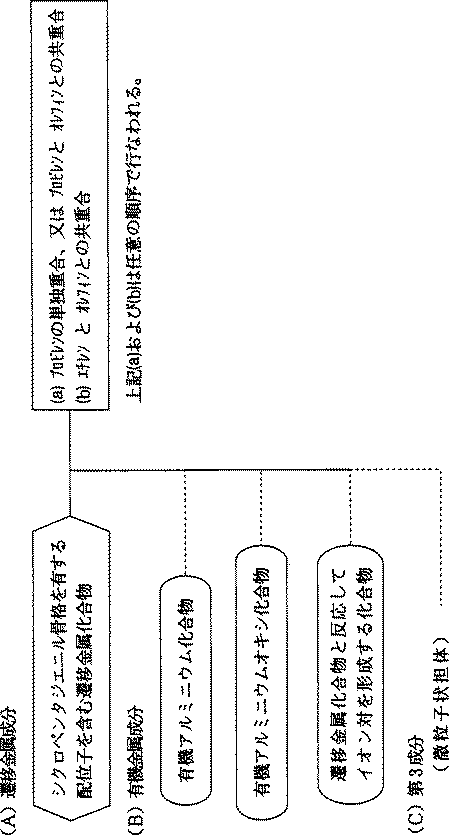
図1は、本発明で用いられるオレフィン重合触媒の調製工程を示す説明図である。
発明を実施するための最良の形態
以下、本発明に係るプロピレン系重合体組成物の製造方法およびプロピレン系重合体組成物について具体的に説明する。
なお、本明細書において「重合」という語は、単独重合だけでなく、共重合をも包含した意味で用いられることがあり、「重合体」という語は、単独重合体だけでなく、共重合体をも包含した意味で用いられることがある。
本発明に係るプロピレン系重合体組成物の製造方法は、
(A)シクロペンタジエニル骨格を有する配位子を含む遷移金属化合物、および
(B)前記(A)遷移金属化合物を活性化させる化合物
の存在下にプロピレン(共)重合体(a)およびエチレン共重合体(b)を製造している。
まず、本発明で用いられる(A)シクロペンタジエニル骨格を有する配位子を含む遷移金属化合物、および(B)前記(A)遷移金属化合物を活性化させる化合物について説明する。
(A)シクロペンタジエニル骨格を有する配位子を含む遷移金属化合物は、具体的には、次式(I)で表わされる遷移金属化合物である。
MLx … (I)
式中、Mは、周期律表第IV〜VIB族の遷移金属であり、具体的には、ジルコニウム(Zr)、チタニウム(Ti)、ハフニウム(Hf)、バナジウム(V)、ニオブ(Nb)、タンタル(Ta)、クロム(Cr)、モリブデン(Mo)およびタングステン(W)であり、xは遷移金属の原子価である。
Lは、遷移金属に配位する配位子であり、少なくとも1個のLはシクロペンタジエニル骨格を有する配位子であり、少なくとも2個のLがシクロペンタジエニル骨格を有する配位子であることが好ましい。
また、このシクロペンタジエニル骨格を有する配位子は、ベンゼン環、ナフタレン環、アセナフテン環、インゲン環などと縮環していてもよい。
シクロペンタジエニル骨格を有する配位子としては、たとえば、シクロペンタジエニル基、インデニル基、4,5,6,7-テトラヒドロインデニル基、4,5,6,6a-テトラヒドロペンタレニル基、7,8-ジヒドロ-3H,6H-as-インダセニル基、フルオレニル基などを例示することができる。これらの基は、ハロゲン、炭化水素基、ハロゲン化炭化水素基、ケイ素含有基、酸素含有基、イオウ含有基、窒素含有基またはリン含有基などで置換されていてもよい。
上記式(I)で表される遷移金属化合物がシクロペンタジエニル骨格を有する基を2個以上含む場合には、そのうち2個のシクロペンタジエニル骨格を有する基同士は、炭化水素基、ハロゲン化炭化水素基、ケイ素含有基、酸素含有基、イオウ含有基、窒素含有基またはリン含有基などを介して結合されていることが好ましい。
シクロペンタジエニル骨格を有する配位子以外のLは、水素、ハロゲン、炭化水素基、ハロゲン化炭化水素基、ケイ素含有基、酸素含有基、イオウ含有基、窒素含有基またはリン含有基などである。
本発明で遷移金属化合物(A)として下記式(II)で表される化合物が好ましく、下記式(III)で表される化合物が特に好ましい。
R1、R2、R3およびR4は、水素、ハロゲン、炭素原子数1〜20の炭化水素基、炭素原子数1〜20のハロゲン化炭化水素基、ケイ素含有基、酸素含有基、イオウ含有基、窒素含有基またはリン含有基を示し、また互いに隣接する基の一部が結合してそれらの基が結合する炭素原子とともに環を形成していてもよい。なお、R1ないしR4が2ヶ所に表示されているが、それぞれ例えばR1とR1などは、同一の基でもよくまた相異なる基でもよい。Rで示される基のうち同一のサフィックスのものは、それらを継いで環を形成する場合の好ましい組み合せを示している。
具体的には、ハロゲンとしてはフッ素、塩素、臭素、ヨウ素などが挙げられ、
炭素原子数1〜20の炭化水素基としてはメチル、エチル、プロピル、ブチル、ヘキシル、シクロヘキシル、オクチル、ノニル、ドデシル、アイコシル、ノルボルニル、アダマンチルなどのアルキル基、ビニル、プロペニル、シクロヘキセニルなどのアルケニル基、ベンジル、フェニルエチル、フェニルプロピルなどのアリールアルキル基、フェニル、トリル、ジメチルフェニル、トリメチルフェニル、エチルフェニル、プロピルフェニル、ビフェニル、ナフチル、メチルナフチル、アントラセニル、フェナントリルなどのアリール基などが挙げられ、
これらの炭化水素基が結合して形成する環としてはベンゼン環、ナフタレン環、アセナフテン環、インデン環などの縮環基、ベンゼン環、ナフタレン環、アセナフテン環、インデン環などの縮環基上の水素原子がメチル、エチル、プロピル、ブチルなどのアルキル基で置換された基が挙げられ、
ハロゲン化炭化水素基としては、前記炭化水素基にハロゲンが置換したハロゲン化炭化水素基が挙げられ、
ケイ素含有基としてはメチルシリル、フェニルシリルなどのモノ炭化水素置換シリル、ジメチルシリル、ジフェニルシリルなどのジ炭化水素置換シリル、トリメチルシリル、トリエチルシリル、トリプロピルシリル、トリシクロヘキシルシリル、トリフェニルシリル、ジメチルフェニルシリル、メチルジフェニルシリル、トリトリルシリル、トリナフチルシリルなどのトリ炭化水素置換シリル、
トリメチルシリルエーテルなどの炭化水素置換シリルのシリルエーテル、
トリメチルシリルメチルなどのケイ素置換アルキル基、トリメチルフェニルなどのケイ素置換アリール基などが挙げられ、
酸素含有基としてはヒドロキシ基、メトキシ、エトキシ、プロポキシ、ブトキシなどのアルコキシ基、フェノキシ、メチルフェノキシ、ジメチルフェノキシ、ナフトキシなどのアリロキシ基、フェニルメトキシ、フェニルエトキシなどのアリールアルコキシ基などが挙げられ、
イオウ含有基としては前記含酸素化合物の酸素がイオウに置換した置換基などが挙げられ、
窒素含有基としてはアミノ基、メチルアミノ、ジメチルアミノ、ジエチルアミノ、ジプロピルアミノ、ジブチルアミノ、ジシクロヘキシルアミノなどのアルキルアミノ基、フェニルアミノ、ジフェニルアミノ、ジトリルアミノ、ジナフチルアミノ、メチルフェニルアミノなどのアリールアミノ基またはアルキルアリールアミノ基などが挙げられ、
リン含有基としてはジメチルフォスフィノ、ジフェニルフォスフィノなどのフォスフィノ基などが挙げられる。
これらのうち炭化水素基であることが好ましく、特にメチル、エチル、プロピル、ブチルの炭素原子数1〜4の炭化水素基、炭化水素基が結合して形成されたベンゼン環、または炭化水素基が結合して形成されたベンゼン環上の水素原子がメチル、エチル、n-プロピル、iso-プロピル、n-ブチル、iso-ブチル、tert-ブチルなどのアルキル基で置換された基であることが好ましい。
Y1は、炭素原子数1〜20の2価の炭化水素基、炭素原子数1〜20の2価のハロゲン化炭化水素基、2価のケイ素含有基、2価のゲルマニウム含有基を示す。
具体的には、メチレン、ジメチルメチレン、1,2-エチレン、ジメチル-1,2-エチレン、1,3-トリメチレン、1,4-テトラメチレン、1,2-シクロヘキシレン、1,4-シクロヘキシレンなどのアルキレン基、ジフェニルメチレン、ジフェニル-1,2-エチレンなどのアリールアルキレン基などの炭素原子数1〜20の2価の炭化水素基;
クロロメチレンなどの上記炭素原子数1〜20の2価の炭化水素基をハロゲン化したハロゲン化炭化水素基;
メチルシリレン、ジメチルシリレン、ジエチルシリレン、ジ(n-プロピル)シリレン、ジ(i-プロピル)シリレン、ジ(シクロヘキシル)シリレン、メチルフェニルシリレン、ジフェニルシリレン、ジ(p-トリル)シリレン、ジ(p-クロロフェニル)シリレンなどのアルキルシリレン、アルキルアリールシリレン、アリールシリレン基、テトラメチル-1,2-ジシリレン、テトラフェニル-1,2-ジシリレンなどのアルキルジシリレン、アルキルアリールジシリレン、アリールジシリレン基などの2価のケイ素含有基;
上記2価のケイ素含有基のケイ素をゲルマニウムに置換した2価のゲルマニウム含有基などである。
これらの中では、ジメチルシリレン基、ジフェニルシリレン基、メチルフェニルシリレン基などの置換シリレン基が特に好ましい。
X1およびX2は、水素、ハロゲン、炭素原子数1〜20の炭化水素基、炭素原子数1〜20のハロゲン化炭化水素基、酸素含有基またはイオウ含有基を示し、具体的には、
R1、R2、R3およびR4と同様のハロゲン、炭素原子数1〜20の炭化水素基、炭素原子数1〜20のハロゲン化炭化水素基、酸素含有基が例示できる。イオウ含有基としては、R1、R2、R3およびR4と同様の基、ならびにメチルスルフォネート、トリフルオロメタンスルフォネート、フェニルスルフォネート、ベンジルスルフォネート、p-トルエンスルフォネート、トリメチルベンゼンスルフォネート、トリイソブチルベンゼンスルフォネート、p-クロルベンゼンスルフォネート、ペンタフルオロベンゼンスルフォネートなどのスルフォネート基、メチルスルフィネート、フェニルスルフィネート、ベンゼンスルフィネート、p-トルエンスルフィネート、トリメチルベンゼンスルフィネート、ペンタフルオロベンゼンスルフィネートなどのスルフィネート基が例示できる。
これらのうち、ハロゲン、炭素原子数1〜20の炭化水素基またはスルフォネート基であることが好ましい。
本発明で遷移金属化合物(A)として特に好ましく用いられる遷移金属化合物は下記式(III)で表される化合物である。
R5、R6およびR8〜R10は、互いに同一でも異なっていてもよく、前記式(II)におけるR1、R2、R3およびR4と同様の水素、ハロゲン、炭素原子数1〜20の炭化水素基、炭素原子数1〜20のハロゲン化炭化水素基、ケイ素含有基、酸素含有基、イオウ含有基、窒素含有基またはリン含有基を示す。
R6は、炭素原子数6〜16のアリール基を示し、具体的には、フェニル、α-ナフチル、β-ナフチル、アントラセニル、フェナントリル、ピレニル、アセナフチル、フェナレニル、アセアントリレニルなどである。これらのうちフェニル、ナフチル、フェナントリルであることが好ましい。これらのアリール基は、前記式(II)におけるR1、R2、R3およびR4と同様のハロゲン、炭素原子数1〜20の炭化水素基、炭素原子数1〜20のハロゲン化炭化水素基で置換されていてもよい。
Y2は、前記式(II)におけるY1と同様の、炭素原子数1〜20の2価の炭化水素基、炭素原子数1〜20の2価のハロゲン化炭化水素基、2価のケイ素含有基、2価のゲルマニウム含有基を示す。
X3およびX4は、前記式(II)におけるX1およびX2と同様の、水素、ハロゲン、炭素原子数1〜20の炭化水素基、炭素原子数1〜20のハロゲン化炭化水素基、酸素含有基またはイオウ含有基を示す。
このような本発明で用いられる(A)シクロペンタジエニル骨格を有する配位子を含む遷移金属化合物として具体的には、
ビス(シクロペンタジエニル)ジルコニウムジクロリド、
ビス(インデニル)ジルコニウムジクロリド、
ビス(フルオレニル)ジルコニウムジクロリド、
ビス(n-プロピルシクロペンタジエニル)ジルコニウムジクロリド、
ビス(t-ブチルシクロペンタジエニル)ジルコニウムジクロリド、
ビス(トリメチルシリルシクロペンタジエニル)ジルコニウムジクロリド、
ビス(ネオペンチルシクロペンタジエニル)ジルコニウムジクロリド、
rac-エチレン-ビス(1-インデニル)ジルコニウムジクロリド、
rac-エチレン-ビス(1-インデニル)ジルコニウムジブロミド、
rac-エチレン-ビス(1-インデニル)ジメチルジルコニウム、
rac-エチレン-ビス(1-インデニル)ジフェニルジルコニウム、
rac-エチレン-ビス(1-インデニル)メチルジルコニウムモノクロリド、
rac-エチレン-ビス(1-インデニル)ジルコニウムビス(メタンスルホナト)、
rac-エチレン-ビス(1-インデニル)ジルコニウムビス(p-トルエンスルホナト)、
rac-エチレン-ビス(1-インデニル)ジルコニウムビス(トリフルオロメタンスルホナト)、
rac-エチレン-ビス{1-(4,5,6,7-テトラヒドロインデニル)}ジルコニウムジクロリド、
イソプロピリデン{1-シクロペンタジエニル-1-(3-メチルシクロペンタジエニル)}ジルコニウムジクロリド、
イソプロピリデン{1-(3-t-ブチルシクロペンタジエニル)-1-(3-t-ブチルインデニル)}ジルコニウムジクロリド、
イソプロピリデン(1-シクロペンタジエニル-9-フルオレニル)ジルコニウムジクロリド、
イソプロピリデン{1-シクロペンタジエニル-9-(2,7-ジ(t-ブチル)フルオレニル)}ジルコニウムジクロリド、
イソプロピリデン{1-(3-メチルシクロペンタジエニル)-9-フルオレニル}ジルコニウムジクロリド、
rac-ジメチルシリレン-ビス(1-シクロペンタジエニル)ジルコニウムジクロリド、
rac-ジメチルシリレン-ビス{1-(3-メチルシクロペンタジエニル)}ジルコニウムジクロリド、
rac-ジメチルシリレン-ビス{1-(2,4-ジメチルシクロペンタジエニル)}ジルコニウムジクロリド、
rac-ジメチルシリレン-ビス{1-(2,3,5-トリメチルシクロペンタジエニル)}ジルコニウムジクロリド、
rac-ジメチルシリレン-ビス(1-インデニル)ジルコニウムジクロリド、
rac-ジメチルシリレン-ビス{1-(2-メチルインデニル)}ジルコニウムジクロリド、
rac-ジメチルシリレン-ビス{1-(2-メチル-4-i-プロピルインデニル)}ジルコニウムジクロリド、
rac-ジメチルシリレン-ビス{1-(2,7-ジメチル-4-i-プロピルインデニル)}ジルコニウムジクロリド、
rac-ジフェニルシリレン-ビス{1-(2,7-ジメチル-4-i-プロピルインデニル)}ジルコニウムジクロリド、
rac-ジメチルシリレン-ビス{1-(2-メチル-4,6-(ジi-プロピル)インデニル)}ジルコニウムジクロリド、
ジメチルシリレン-ビス(1-シクロペンタジエニル-1-インデニル)ジルコニウムジクロリド、
rac-ジメチルシリレン-ビス(1,2-ジヒドロアセナフチロ[4,5-b]シクロペンタジエニル)ジルコニウムジクロリド、
rac-ジメチルシリレン-ビス(ベンゾ[e]インデニル)ジルコニウムジクロリド、
rac-ジメチルシリレン-ビス{1-(4-フェニルインデニル)}ジルコニウムジクロリド、
rac-ジメチルシリレン-ビス{1-(2-メチル-4-フェニルインデニル)}ジルコニウムジクロリド、
rac-ジメチルシリレン-ビス{1-(2-メチル-4-(α-ナフチル)インデニル)}ジルコニウムジクロリド、
rac-ジメチルシリレン-ビス{1-(2-メチル-4-(β-ナフチル)インデニル)}ジルコニウムジクロリド、
rac-ジメチルシリレン-ビス{1-(2-メチル-4-(1-アントラセニル)インデニル)}ジルコニウムジクロリド、
rac-ジメチルシリレン-ビス{1-(2-メチル-4-(2-アントラセニル)インデニル)}ジルコニウムジクロリド、
rac-ジメチルシリレン-ビス{1-(2-メチル-4-(9-アントラセニル)インデニル)}ジルコニウムジクロリド、
rac-ジメチルシリレン-ビス{1-(2-メチル-4-(9-フェナントリル)インデニル)}ジルコニウムジクロリド、
rac-ジメチルシリレン-ビス{1-(2-メチル-4-(p-フルオロフェニル)インデニル)}ジルコニウムジクロリド、
rac-ジメチルシリレン-ビス{1-(2-メチル-4-(ペンタフルオロフェニル)インデニル)}ジルコニウムジクロリド、
rac-ジメチルシリレン-ビス{1-(2-メチル-4-(p-クロロフェニル)インデニル)}ジルコニウムジクロリド、
rac-ジメチルシリレン-ビス{1-(2-メチル-4-(m-クロロフェニル)インデニル)}ジルコニウムジクロリド、
rac-ジメチルシリレン-ビス{1-(2-メチル-4-(o-クロロフェニル)インデニル)}ジルコニウムジクロリド、
rac-ジメチルシリレン-ビス{1-(2-メチル-4-(o,p-ジクロロフェニル)フェニルインデニル)}ジルコニウムジクロリド、
rac-ジメチルシリレン-ビス{1-(2-メチル-4-(p-ブロモフェニル)インデニル)}ジルコニウムジクロリド、
rac-ジメチルシリレン-ビス{1-(2-メチル-4-(p-トリル)インデニル)}ジルコニウムジクロリド、
rac-ジメチルシリレン-ビス{1-(2-メチル-4-(m-トリル)インデニル)}ジルコニウムジクロリド、
rac-ジメチルシリレン-ビス{1-(2-メチル-4-(o-トリル)インデニル)}ジルコニウムジクロリド、
rac-ジメチルシリレン-ビス{1-(2-メチル-4-(o,o'-ジメチルフェニル)インデニル)}ジルコニウムジクロリド、
rac-ジメチルシリレン-ビス{1-(2-メチル-4-(p-エチルフェニル)インデニル)}ジルコニウムジクロリド、
rac-ジメチルシリレン-ビス{1-(2-メチル-4-(p-i-プロピルフェニル)インデニル)}ジルコニウムジクロリド、
rac-ジメチルシリレン-ビス{1-(2-メチル-4-(p-ベンジルフェニル)インデニル)}ジルコニウムジクロリド、
rac-ジメチルシリレン-ビス{1-(2-メチル-4-(p-ビフェニル)インデニル)}ジルコニウムジクロリド、
rac-ジメチルシリレン-ビス{1-(2-メチル-4-(m-ビフェニル)インデニル)}ジルコニウムジクロリド、
rac-ジメチルシリレン-ビス{1-(2-メチル-4-(p-トリメチルシリルフェニル)インデニル)}ジルコニウムジクロリド、
rac-ジメチルシリレン-ビス{1-(2-メチル-4-(m-トリメチルシリルフェニル)インデニル)}ジルコニウムジクロリド、
rac-ジメチルシリレン-ビス{1-(2-エチル-4-フェニルインデニル)}ジルコニウムジクロリド、
rac-ジメチルシリレン-ビス{1-(2-エチル-4-(α-ナフチル)インデニル)}ジルコニウムジクロリド、
rac-ジメチルシリレン-ビス{1-(2-エチル-4-(β-ナフチル)インデニル)}ジルコニウムジクロリド、
rac-ジメチルシリレン-ビス{1-(2-エチル-4-(1-アントラセニル)インデニル)}ジルコニウムジクロリド、
rac-ジメチルシリレン-ビス{1-(2-エチル-4-(2-アントラセニル)インデニル)}ジルコニウムジクロリド、
rac-ジメチルシリレン-ビス{1-(2-エチル-4-(9-アントラセニル)インデニル)}ジルコニウムジクロリド、
rac-ジメチルシリレン-ビス{1-(2-メチル-4-(9-フェナントリル)インデニル)}ジルコニウムジクロリド、
rac-ジフェニルシリレン-ビス{1-(2-エチル-4-フェニルインデニル)}ジルコニウムジクロリド、
rac-ジメチルシリレン-ビス{1-(2-フェニル-4-フェニルインデニル)}ジルコニウムジクロリド、
rac-ジメチルシリレン-ビス{1-(2-n-プロピル-4-フェニルインデニル)}ジルコニウムジクロリド、
rac-ジメチルシリレン-ビス{1-(2-n-プロピル-4-(α-ナフチル)インデニル)}ジルコニウムジクロリド、
rac-ジメチルシリレン-ビス{1-(2-n-プロピル-4-(β-ナフチル)インデニル)}ジルコニウムジクロリド、
rac-ジメチルシリレン-ビス{1-(2-n-プロピル-4-(1-アントラセニル)インデニル)}ジルコニウムジクロリド、
rac-ジメチルシリレン-ビス{1-(2-n-プロピル-4-(2-アントラセニル)インデニル)}ジルコニウムジクロリド、
rac-ジメチルシリレン-ビス{1-(2-n-プロピル-4-(9-アントラセニル)インデニル)}ジルコニウムジクロリド、
rac-ジメチルシリレン-ビス{1-(2-n-プロピル-4-(9-フェナントリル)インデニル)}ジルコニウムジクロリド、
rac-ジメチルシリレン-ビス{1-(2-i-ブチル-4-フェニルインデニル)}ジルコニウムジクロリド、
rac-ジメチルシリレン-ビス{1-(2-i-ブチル-4-(α-ナフチル)インデニル)}ジルコニウムジクロリド、
rac-ジメチルシリレン-ビス{1-(2-i-ブチル-4-(β-ナフチル)インデニル)}ジルコニウムジクロリド、
rac-ジメチルシリレン-ビス{1-(2-i-ブチル-4-(1-アントラセニル)インデニル)}ジルコニウムジクロリド、
rac-ジメチルシリレン-ビス{1-(2-i-ブチル-4-(2-アントラセニル)インデニル)}ジルコニウムジクロリド、
rac-ジメチルシリレン-ビス{1-(2-i-ブチル-4-(9-アントラセニル)インデニル)}ジルコニウムジクロリド、
rac-ジメチルシリレン-ビス{1-(2-i-ブチル-4-(9-フェナントリル)インデニル)}ジルコニウムジクロリド、
rac-ジエチルシリレン-ビス{1-(2-メチル-4-フェニルインデニル)}ジルコニウムジクロリド、
rac-ジ-(i-プロピル)シリレン-ビス{1-(2-メチル-4-フェニルインデニル)}ジルコニウムジクロリド、
rac-ジ-(n-ブチル)シリレン-ビス{1-(2-メチル-4-フェニルインデニル)}ジルコニウムジクロリド、
rac-ジシクロヘキシルシリレン-ビス{1-(2-メチル-4-フェニルインデニル)}ジルコニウムジクロリド、
rac-メチルフェニルシリレン-ビス{1-(2-メチル-4-フェニルインデニル)}ジルコニウムジクロリド、
rac-ジフェニルシリレン-ビス{1-(2-メチル-4-フェニルインデニル)}ジルコニウムジクロリド、
rac-ジ(p-トリル)シリレン-ビス{1-(2-メチル-4-フェニルインデニル)}ジルコニウムジクロリド、
rac-ジ(p-クロロフェニル)シリレン-ビス{1-(2-メチル-4-フェニルインデニル)}ジルコニウムジクロリド、
rac-メチレン-ビス{1-(2-メチル-4-フェニルインデニル)}ジルコニウムジクロリド、
rac-エチレン-ビス{1-(2-メチル-4-フェニルインデニル)}ジルコニウムジクロリド、
rac-ジメチルゲルミレン-ビス{1-(2-メチル-4-フェニルインデニル)}ジルコニウムジクロリド、
rac-ジメチルシリレン-ビス{1-(2-メチル-4-フェニルインデニル)}ジルコニウムジブロミド、
rac-ジメチルシリレン-ビス{1-(2-メチル-4-フェニルインデニル)}ジルコニウムジメチル、
rac-ジメチルシリレン-ビス{1-(2-メチル-4-フェニルインデニル)}ジルコニウムメチルクロリド、
rac-ジメチルシリレン-ビス{1-(2-メチル-4-フェニルインデニル)}ジルコニウムクロリドSO2Me、
rac-ジメチルシリレン-ビス{1-(2-メチル-4-フェニルインデニル)}ジルコニウムクロリドOSO2Me、
rac-ジメチルシリレン-ビス{1-(2-メチル-4-フェニルインデニル)}チタニウムジクロリド、
rac-ジメチルシリレン-ビス{1-(2-メチル-4-フェニルインデニル)}ハフニウムジクロリドなどが挙げられる。
さらに、上記のような化合物においてジルコニウム金属、チタニウム金属、ハフニウム金属を、バナジウム金属、ニオブ金属、タンタル金属、クロム金属、モリブデン金属、タングステン金属に置き換えた遷移金属化合物を挙げることができる。
本発明に係るプロピレン系重合体組成物の製造に用いられる(B)前記(A)を活性化させる化合物〔以下「活性化化合物」ということがある〕としては、
(B-1)有機アルミニウム化合物〔成分(B-1)〕、
(B-2)有機アルミニウムオキシ化合物〔成分(B-2)〕、および、
(B-3)前記遷移金属化合物(A)と反応してイオン対を形成する化合物〔成分(B-3)〕
からなる群より選ばれる化合物が挙げられる。
活性化化合物(B)は、成分(B-1)〜(B-3)から選ばれる2種以上の成分を組み合わせて用いることができ、その場合、成分(B-1)と成分(B-2)とを組み合わせて用いることが好ましい。
遷移金属化合物(A)と共にプロピレン系重合体組成物の製造に用いられる(B-1)有機アルミニウム化合物としては、たとえば下記式(IV)で表される有機アルミニウム化合物を例示することができる。
Ra nAlX3-n … (IV)
(式中、Raは炭素原子数1〜12の炭化水素基を示し、Xはハロゲン原子または水素原子を示し、nは1〜3である。)
上記式(IV)において、Raは炭素原子数1〜12の炭化水素基、たとえばアルキル基、シクロアルキル基またはアリール基であるが、具体的には、メチル基、エチル基、n-プロピル基、イソプロピル基、イソブチル基、ペンチル基、ヘキシル基、オクチル基、シクロペンチル基、シクロヘキシル基、フェニル基、トリル基などである。
このような有機アルミニウム化合物(B-1)として具体的には、以下のような化合物が挙げられる。
トリメチルアルミニウム、トリエチルアルミニウム、トリイソプロピルアルミニウム、トリイソブチルアルミニウム、トリオクチルアルミニウム、トリ(2-エチルヘキシル)アルミニウム、トリデシルアルミニウムなどのトリアルキルアルミニウム;
イソプレニルアルミニウムなどのアルケニルアルミニウム;
ジメチルアルミニウムクロリド、ジエチルアルミニウムクロリド、ジイソプロピルアルミニウムクロリド、ジイソブチルアルミニウムクロリド、ジメチルアルミニウムブロミドなどのジアルキルアルミニウムハライド;
メチルアルミニウムセスキクロリド、エチルアルミニウムセスキクロリド、イソプロピルアルミニウムセスキクロリド、ブチルアルミニウムセスキクロリド、エチルアルミニウムセスキブロミドなどのアルキルアルミニウムセスキハライド;
メチルアルミニウムジクロリド、エチルアルミニウムジクロリド、イソプロピルアルミニウムジクロリド、エチルアルミニウムジブロミドなどのアルキルアルミニウムジハライド;
ジエチルアルミニウムハイドライド、ジイソブチルアルミニウムハイドライドなどのアルキルアルミニウムハイドライドなど。
また有機アルミニウム化合物(B-1)として、下記式(V)で表される化合物を用いることもできる。
Ra nAlY3-n … (V)
(式中、Raは上記と同様であり、Yは−ORb基、−OSiRc 3基、−OAlRd 2基、−NRe 2基、−SiRf 3基または−N(Rg)AlRh 2基を示し、nは1〜2であり、Rb、Rc、RdおよびRhはメチル基、エチル基、イソプロピル基、イソブチル基、シクロヘキシル基、フェニル基などであり、Reは水素原子、メチル基、エチル基、イソプロピル基、フェニル基、トリメチルシリル基などであり、RfおよびRgはメチル基、エチル基などである。)
このような有機アルミニウム化合物として具体的には、以下のような化合物が挙げられる。
(1)Ra nAl(ORb)3-nで表される化合物、たとえば
ジメチルアルミニウムメトキシド、ジエチルアルミニウムエトキシド、ジイソブチルアルミニウムメトキシドなど、
(2)Ra nAl(OSiRc 3)3-nで表される化合物、たとえば
Et2Al(OSiMe3)、
(iso-Bu)2Al(OSiMe3)、
(iso-Bu)2Al(OSiEt3)など;
(3)Ra nAl(OAlRd 2)3-nで表される化合物、たとえば
Et2AlOAlEt2、
(iso-Bu)2AlOAl(iso-Bu)2など;
(4)Ra nAl(NRe 2)3-nで表される化合物、たとえば
Me2AlNEt2、
Et2AlNHMe、
Me2AlNHEt、
Et2AlN(SiMe3)2、
(iso-Bu)2AlN(SiMe3)2など;
(5)Ra nAl(SiRf 3)3-nで表される化合物、たとえば
(iso-Bu)2AlSiMe3など;
(6)Ra nAl(N(Rg)AlRh 2)3-nで表される化合物、たとえば
Et2AlN(Me)AlEt2、
(iso-Bu)2AlN(Et)Al(iso-Bu)2など。
上記式(IV)または(V)で表される有機アルミニウム化合物の中では、式Ra 3Alで表される化合物が好ましく、特にRaがイソアルキル基である化合物が好ましい。
このような有機アルミニウム化合物(B-1)は、単独でまたは2種以上組み合わせて用いることができる。
遷移金属化合物(A)と共にプロピレン系重合体組成物の製造に用いられる(B-2)有機アルミニウムオキシ化合物は、従来公知のアルミノキサンであってもよく、また特開平2-78687号公報に例示されているようなベンゼン不溶性の有機アルミニウムオキシ化合物であってもよい。
従来公知のアルミノキサンは、たとえば下記のような方法によって調製することができる。
(1)吸着水を含有する化合物あるいは結晶水を含有する塩類、たとえば塩化マグネシウム水和物、硫酸銅水和物、硫酸アルミニウム水和物、硫酸ニッケル水和物、塩化第1セリウム水和物などの炭化水素媒体懸濁液に、トリアルキルアルミニウムなどの有機アルミニウム化合物を添加して反応させる方法。
(2)ベンゼン、トルエン、エチルエーテル、テトラヒドロフランなどの媒体中で、トリアルキルアルミニウムなどの有機アルミニウム化合物に直接水や氷や水蒸気を作用させる方法。
(3)デカン、ベンゼン、トルエンなどの媒体中でトリアルキルアルミニウムなどの有機アルミニウム化合物に、ジメチルスズオキシド、ジブチルスズオキシドなどの有機スズ酸化物を反応させる方法。
なお、該アルミノキサンは、少量の有機金属成分を含有してもよい。また回収された上記のアルミノキサンの溶液から溶媒あるいは未反応の有機アルミニウム化合物を蒸留して除去した後、溶媒に再溶解あるいはアルミノキサンの貧溶媒に懸濁させてもよい。
アルミノキサンを調製する際に用いられる有機アルミニウム化合物としては、具体的には、トリメチルアルミニウム、トリエチルアルミニウム、トリプロピルアルミニウム、トリイソプロピルアルミニウム、トリn-ブチルアルミニウム、トリイソブチルアルミニウム、トリsec-ブチルアルミニウム、トリtert-ブチルアルミニウム、トリペンチルアルミニウム、トリヘキシルアルミニウム、トリオクチルアルミニウム、トリデシルアルミニウムなどのトリアルキルアルミニウム;トリシクロヘキシルアルミニウム、トリシクロオクチルアルミニウムなどのトリシクロアルキルアルミニウム;
ジメチルアルミニウムクロリド、ジエチルアルミニウムクロリド、ジエチルアルミニウムブロミド、ジイソブチルアルミニウムクロリドなどのジアルキルアルミニウムハライド;
ジエチルアルミニウムハイドライド、ジイソブチルアルミニウムハイドライドなどのジアルキルアルミニウムハイドライド;
ジメチルアルミニウムメトキシド、ジエチルアルミニウムエトキシドなどのジアルキルアルミニウムアルコキシド;
ジエチルアルミニウムフェノキシドなどのジアルキルアルミニウムアリーロキシドなどが挙げられる。
これらのうち、トリアルキルアルミニウム、トリシクロアルキルアルミニウムが好ましく、トリメチルアルミニウムが特に好ましい。
また、アルミノキサンを調製する際に用いられる有機アルミニウム化合物として、下記式(VI)で表されるイソプレニルアルミニウムを挙げることもできる。
(i-C4H9)xAly(C5H10)z … (VI)
(式中、x、y、zは正の数であり、z≧2xである。)
上記のような有機アルミニウム化合物は、単独であるいは組合せて用いられる。
アルミノキサンの調製に用いられる溶媒としては、ベンゼン、トルエン、キシレン、クメン、シメンなどの芳香族炭化水素、ペンタン、ヘキサン、ヘプタン、オクタン、デカン、ドデカン、ヘキサデカン、オクタデカンなどの脂肪族炭化水素、シクロペンタン、シクロヘキサン、シクロオクタン、メチルシクロペンタンなどの脂環族炭化水素、ガソリン、灯油、軽油などの石油留分あるいは上記芳香族炭化水素、脂肪族炭化水素、脂環族炭化水素のハロゲン化物とりわけ、塩素化物、臭素化物などの炭化水素溶媒が挙げられる。その他、エチルエーテル、テトラヒドロフランなどのエーテル類を用いることもできる。これらの溶媒のうち特に芳香族炭化水素または脂肪族炭化水素が好ましい。
このような有機アルミニウムオキシ化合物(B-2)は、単独でまたは2種以上組み合わせて用いることができる。
遷移金属化合物(A)と共にプロピレン系重合体組成物の製造に用いられる(B-3)前記遷移金属化合物(A)と反応してイオン対を形成する化合物としては、特表平1−501950号公報、特表平1−502036号公報、特開平3−179005号公報、特開平3−179006号公報、特開平3−207703号公報、特開平3−207704号公報、US−547718号公報などに記載されたルイス酸、イオン性化合物およびカルボラン化合物を挙げることができる。
ルイス酸としてはマグネシウム含有ルイス酸、アルミニウム含有ルイス酸、ホウ素含有ルイス酸などが挙げられ、こられのうちホウ素含有ルイス酸が好ましい。
ホウ素原子を含有するルイス酸として具体的には、下記式(VII)で表される化合物が例示できる。
BRiRjRk … (VII)
(式中、Ri、RjおよびRkは、それぞれ独立して、フッ素原子、メチル基、トリフルオロメチル基などの置換基を有していてもよいフェニル基、またはフッ素原子を示す。)
上記式(VII)で表される化合物として具体的には、トリフルオロボロン、トリフェニルボロン、トリス(4-フルオロフェニル)ボロン、トリス(3,5-ジフルオロフェニル)ボロン、トリス(4-フルオロメチルフェニル)ボロン、トリス(ペンタフルオロフェニル)ボロン、トリス(p-トリル)ボロン、トリス(o-トリル)ボロン、トリス(3,5-ジメチルフェニル)ボロンなどが挙げられる。これらのうちではトリス(ペンタフルオロフェニル)ボロンが特に好ましい。
本発明で用いられるイオン性化合物は、カチオン性化合物とアニオン性化合物とからなる塩である。アニオンは前記遷移金属化合物(A)と反応することにより遷移金属化合物(A)をカチオン化し、イオン対を形成することにより遷移金属カチオン種を安定化させる働きがある。そのようなアニオンとしては、有機ホウ素化合物アニオン、有機ヒ素化合物アニオン、有機アルミニウム化合物アニオンなどがあり、比較的嵩高で遷移金属カチオン種を安定化させるものが好ましい。カチオンとしては、金属カチオン、有機金属カチオン、カルボニウムカチオン、トリピウムカチオン、オキソニウムカチオン、スルホニウムカチオン、ホスホニウムカチオン、アンモニウムカチオンなどが挙げられる。さらに詳しくはトリフェニルカルベニウムカチオン、トリブチルアンモニウムカチオン、N,N-ジメチルアンモニウムカチオン、フェロセニウムカチオンなどである。
これらのうち、アニオンとしてホウ素化合物を含有するイオン性化合物が好ましく、具体的には、トリアルキル置換アンモニウム塩としては、たとえばトリエチルアンモニウムテトラ(フェニル)ホウ素、トリプロピルアンモニウムテトラ(フェニル)ホウ素、トリ(n-ブチル)アンモニウムテトラ(フェニル)ホウ素、トリメチルアンモニウムテトラ(p-トリル)ホウ素、トリメチルアンモニウムテトラ(o-トリル)ホウ素、トリブチルアンモニウムテトラ(ペンタフルオロフェニル)ホウ素、トリプロピルアンモニウムテトラ(o,p-ジメチルフェニル)ホウ素、トリブチルアンモニウムテトラ(m,m-ジメチルフェニル)ホウ素、トリブチルアンモニウムテトラ(p-トリフルオロメチルフェニル)ホウ素、トリ(n-ブチル)アンモニウムテトラ(o-トリル)ホウ素、トリ(n-ブチル)アンモニウムテトラ(4-フルオロフェニル)ホウ素などが挙げられ、
N,N-ジアルキルアニリニウム塩としては、たとえばN,N-ジメチルアニリニウムテトラ(フェニル)ホウ素、N,N-ジエチルアニリニウムテトラ(フェニル)ホウ素、N,N-2,4,6-ペンタメチルアニリニウムテトラ(フェニル)ホウ素などが挙げられ、
ジアルキルアンモニウム塩としては、たとえばジ(n-プロピル)アンモニウムテトラ(ペンタフルオロフェニル)ホウ素、ジシクロヘキシルアンモニウムテトラ(フェニル)ホウ素などが挙げられ、
トリアリールホスフォニウム塩、たとえばトリフェニルホスフォニウムテトラ(フェニル)ホウ素、トリ(メチルフェニル)ホスフォニウムテトラ(フェニル)ホウ素、トリ(ジメチルフェニル)ホスフォニウムテトラ(フェニル)ホウ素などが挙げられる。
さらにホウ素原子を含有するイオン性化合物として、トリフェニルカルベニウムテトラキス(ペンタフルオロフェニル)ボレート、N,N-ジメチルアニリニウムテトラキス(ペンタフルオロフェニル)ボレート、フェロセニウムテトラ(ペンタフルオロフェニル)ボレートも挙げることができる。
また以下のような化合物も例示できる。(なお、以下に列挙するイオン性化合物において対向イオンはトリ(n-ブチル)アンモニウムであるがこれに限定されない。)
アニオンの塩、たとえばビス[トリ(n-ブチル)アンモニウム]ノナボレート、ビス[トリ(n-ブチル)アンモニウム]デカボレート、ビス[トリ(n-ブチル)アンモニウム]ウンデカボレート、ビス[トリ(n-ブチル)アンモニウム]ドデカボレート、ビス[トリ(n-ブチル)アンモニウム]デカクロロデカボレート、ビス[トリ(n-ブチル)アンモニウム]ドデカクロロドデカボレート、トリ(n-ブチル)アンモニウム-1-カルバデカボレート、トリ(n-ブチル)アンモニウム-1-カルバウンデカボレート、トリ(n-ブチル)アンモニウム-1-カルバドデカボレート、トリ(n-ブチル)アンモニウム-1-トリメチルシリル-1-カルバデカボレート、トリ(n-ブチル)アンモニウムブロモ-1-カルバドデカボレートなど;
さらにボラン化合物、カルボラン化合物などを挙げることができる。これらの化合物はルイス酸、イオン性化合物として用いられる。
ボランおよびカルボラン錯化合物およびカルボランアニオンの塩、たとえばデカボラン(14)、7,8-ジカルバウンデカボラン(13)、2,7-ジカルバウンデカボラン(13)、ウンデカハイドライド-7,8-ジメチル-7,8-ジカルバウンデカボラン、ドデカハイドライド-11-メチル-2,7-ジカルバウンデカボラン、トリ(n-ブチル)アンモニウム6-カルバデカボレート(14)、トリ(n-ブチル)アンモニウム6-カルバデカボレート(12)、トリ(n-ブチル)アンモニウム7-カルバウンデカボレート(13)、トリ(n-ブチル)アンモニウム7,8-ジカルバウンデカボレート(12)、トリ(n-ブチル)アンモニウム2,9-ジカルバウンデカボレート(12)、トリ(n-ブチル)アンモニウムドデカハイドライド-8-メチル7,9-ジカルバウンデカボレート、トリ(n-ブチル)アンモニウムウンデカハイドライド8-エチル-7,9-ジカルバウンデカボレート、トリ(n-ブチル)アンモニウムウンデカハイドライド-8-ブチル-7,9-ジカルバウンデカボレート、トリ(n-ブチル)アンモニウムウンデカハイドライド-8-アリル-7,9-ジカルバウンデカボレート、トリ(n-ブチル)アンモニウムウンデカハイドライド-9-トリメチルシリル-7,8-ジカルバウンデカボレート、トリ(n-ブチル)アンモニウムウンデカハイドライド-4,6-ジブロモ-7-カルバウンデカボレートなど;
カルボランおよびカルボランの塩、たとえば4-カルバノナボラン(14)、1,3-ジカルバノナボラン(13)、6,9-ジカルバデカボラン(14)、ドデカハイドライド-1-フェニル-1,3-ジカルバノナボラン、ドデカハイドライド-1-メチル1,3-ジカルバノナボラン、ウンデカハイドライド-1,3-ジメチル-1,3-ジカルバノナボランなど、
さらに以下のような化合物も例示できる。(なお、以下に列挙するイオン性化合物において対向イオンはトリ(n-ブチル)アンモニウムであるがこれに限定されない。)
金属カルボランの塩および金属ボランアニオン、たとえばトリ(n-ブチル)アンモニウムビス(ノナハイドライド-1,3-ジカルバノナボレート)コバルテート(III)、トリ(n-ブチル)アンモニウムビス(ウンデカハイドライド-7,8-ジカルバウンデカボレート)フェレート(鉄酸塩)(III)、トリ(n-ブチル)アンモニウムビス(ウンデカハイドライド-7,8-ジカルバウンデカボレート)コバルテート(III)、トリ(n-ブチル)アンモニウムビス(ウンデカハイドライド-7,8-ジカルバウンデカボレート)ニッケレート(III)、トリ(n-ブチル)アンモニウムビス(ウンデカハイドライド-7,8-ジカルバウンデカボレート)キュブレート(銅酸塩)(III)、トリ(n-ブチル)アンモニウムビス(ウンデカハイドライド-7,8-ジカルバウンデカボレート)アウレート(金属塩)(III)、トリ(n-ブチル)アンモニウムビス(ノナハイドライド-7,8-ジメチル-7,8-ジカルバウンデカボレート)フェレート(III)、トリ(n-ブチル)アンモニウムビス(ノナハイドライド-7,8-ジメチル-7,8-ジカルバウンデカボレート)クロメート(クロム酸塩)(III)、トリ(n-ブチル)アンモニウムビス(トリブロモオクタハイドライド-7,8-ジカルバウンデカボレート)コバルテート(III)、トリ(n-ブチル)アンモニウムビス(ドデカハイドライドジカルバドデカボレート)コバルテート(III)、ビス[トリ(n-ブチル)アンモニウム]ビス(ドデカハイドライドドデカボレート)ニッケレート(III)、トリス[トリ(n-ブチル)アンモニウム]ビス(ウンデカハイドライド-7-カルバウンデカボレート)クロメート(III)、ビス[トリ(n-ブチル)アンモニウム]ビス(ウンデカハイドライド-7-カルバウンデカボレート)マンガネート(IV)、ビス[トリ(n-ブチル)アンモニウム]ビス(ウンデカハイドライド-7-カルバウンデカボレート)コバルテート(III)、ビス[トリ(n-ブチル)アンモニウム]ビス(ウンデカハイドライド-7-カルバウンデカボレート)ニッケレート(IV)などが挙げられる。
このような前記遷移金属化合物(A)と反応してイオン対を形成する化合物(B-3)は、単独でまたは2種以上組み合わせて用いることができる。
本発明では(A)遷移金属化合物および(B)活性化化合物の少なくとも一方を微粒子状担体に担持させて用いることができる。
このような微粒子状担体は、無機あるいは有機の化合物であって、粒径が10〜300μm、好ましくは20〜200μmの顆粒状ないしは微粒子状の固体である。
このうち無機担体としては多孔質酸化物が好ましく、具体的にはSiO2、Al2O3、MgO、ZrO2、TiO2、B2O3、CaO、ZnO、BaO、ThO2など、またはこれらの混合物、たとえばSiO2-MgO、SiO2-Al2O3、SiO2-TiO2、SiO2-V2O5、SiO2-Cr2O3、SiO2-TiO2-MgOなどを例示することができる。これらの中でSiO2およびAl2O3からなる群から選ばれた少なくとも1種の成分を主成分とするものが好ましい。
なお、上記無機酸化物には少量のNa2CO3、K2CO3、CaCO3、MgCO3、Na2SO4、Al2(SO4)3、BaSO4、KNO3、Mg(NO3)2、Al(NO3)3、Na2O、K2O、Li2Oなどの炭酸塩、硫酸塩、硝酸塩、酸化物成分を含有していても差しつかえない。
このような微粒子状担体はその種類および製法により性状は異なるが、本発明に好ましく用いられる微粒子状担体は、比表面積が50〜1000m2/g、好ましくは100〜700m2/gであり、細孔容積が0.3〜2.5cm3/gであることが望ましい。該微粒子状担体は、必要に応じて100〜1000℃、好ましくは150〜700℃の温度で焼成して用いられる。
さらに、本発明に用いることのできる微粒子状担体としては、粒径が10〜300μmである有機化合物の顆粒状ないしは微粒子状固体を挙げることができる。これら有機化合物としては、エチレン、プロピレン、1-ブテン、4-メチル-1-ペンテンなどの炭素原子数2〜14のα-オレフィンを主成分として生成される(共)重合体あるいはビニルシクロヘキサン、スチレンを主成分として生成される重合体もしくは共重合体を例示することができる。
このような微粒子状担体は、表面水酸基および/または水を含有していてもよい。
本発明で用いられるオレフィン重合用触媒は、(A)遷移金属化合物が担持した微粒子状担体と(B)活性化化合物とからなる触媒であってもよく、(A)遷移金属化合物および(B)活性化化合物が微粒子状担体に担持された固体触媒であってもよく、(A)遷移金属化合物、(B)活性化化合物および微粒子状担体の存在下にオレフィンを予備重合して得られた予備重合触媒であってもよい。
固体触媒は、(A)遷移金属化合物、(B)活性化化合物および微粒子状担体を不活性炭化水素媒体中またはオレフィン媒体中で混合接触させることにより調製することができる。
オレフィン重合用触媒の調製に用いられる不活性炭化水素媒体として具体的には、プロパン、ブタン、ペンタン、ヘキサン、ヘプタン、オクタン、デカン、ドデカン、灯油などの脂肪族炭化水素;
シクロペンタン、シクロヘキサン、メチルシクロペンタンなどの脂環族炭化水素;
ベンゼン、トルエン、キシレンなどの芳香族炭化水素;
エチレンクロリド、クロルベンゼン、ジクロロメタンなどのハロゲン化炭化水素あるいはこれらの混合物などを挙げることができる。
上記各成分を混合接触させる順序は任意に選ばれるが、好ましくは
微粒子状担体と活性化化合物(B)とを混合接触させ、次いで遷移金属化合物(A)を混合接触させるか、
活性化化合物(B)と遷移金属化合物(A)との混合物と、微粒子状担体とを混合接触させるか、あるいは、
微粒子状担体と活性化化合物(B)と水とを混合接触させ、次いで遷移金属化合物(A)を混合接触させることが選ばれる。
前記遷移金属化合物(A)を微粒子状担体に担持する方法としては、通常、炭化水素媒体中で遷移金属化合物(A)と微粒子状担体とを混合接触させる方法が用いられる。
より具体的には、下記のような方法が挙げられる。
(1)炭化水素媒体中に懸濁させた微粒子状担体に活性化化合物(B)を加え、混合した後、媒体を濾過により除去し、得られた固体成分に炭化水素溶媒に懸濁または溶解させた遷移金属化合物(A)を接触させる方法。
(2)芳香族炭化水素媒体中に懸濁させた微粒子状担体に活性化化合物(B)を加え、混合した後、さらに脂肪族炭化水素を加え、減圧下に芳香族炭化水素を除去する。この操作により微粒子状担体上に有機アルミニウムオキシ化合物が析出する。次に、脂肪族炭化水素を濾過により除去して得られた固体成分と、炭化水素媒体に懸濁または溶解された遷移金属化合物(A)とを接触させる方法。
(3)炭化水素媒体中に懸濁させた微粒子状担体に活性化化合物(B)と遷移金属化合物(A)とを加え、混合した後、濾過またはエバポレーターにより炭化水素媒体を除去する方法。
上記各成分を混合するに際して、遷移金属化合物(A)は、微粒子状担体1g当たり、通常10-6〜5×10⁻³モル、好ましくは3×10⁻⁶〜10-3モルの量で用いられ、遷移金属化合物(A)の濃度は、約5×10⁻⁶〜2×10⁻²モル/l、好ましくは10-5〜10-2モル/lの範囲である。活性化化合物(B)として成分(B-1)を用いる場合、成分(B-1)中のアルミニウムと、遷移金属化合物(A)中の遷移金属との原子比(Al/遷移金属)は、通常10〜3000、好ましくは20〜2000である。成分(B-2)を用いる場合、成分(B-2)中のアルミニウムと、遷移金属化合物(A)中の遷移金属との原子比(Al/遷移金属)は、通常10〜3000、好ましくは20〜2000である。成分(B-3)を用いる場合、遷移金属化合物(A)と成分(B-3)とのモル比(遷移金属化合物(A)/成分(B-3))は、通常0.01〜10、好ましくは0.1〜5の範囲である。
上記各成分を混合する際の混合温度は、通常−50〜150℃、好ましくは−20〜120℃であり、接触時間は1〜1000分間、好ましくは5〜600分間である。また、混合接触時には混合温度を変化させてもよい。
遷移金属化合物(A)を微粒子状担体に担持する際には、ゼオライトまたは有機アミンの共存下で行うことができる。
ゼオライトとしては、たとえば下記一般式
M2/nO・Al2O3・xSiO2・yH2O
(式中MはNa、K、CaまたはBaを示し、nはMの価数を示し、xは2〜10であり、yは2〜7である。)で表される化合物が挙げられ、モレキュラーシーブTMが好ましい。
有機アミンとしては、メチルアミン、エチルアミン、n-プロピルアミン、イソプロピルアミン、n-ブチルアミン、t-ブチルアミンなどのモノアルキルアミン;ジメチルアミン、ジエチルアミン、ジn-プロピルアミン、ジイソプロピルアミン、ジn-ブチルアミン、ジt-ブチルアミンなどのジアルキルアミン;トリメチルアミン、トリエチルアミン、トリn-プロピルアミン、トリn-ブチルアミンなどのトリアルキルアミンなどが挙げられる。
ゼオライトは、微粒子状担体1g当たり、通常、1×10⁻²〜1×10²g、好ましくは1×10⁻¹〜10gの量で用いられることが望ましい。また有機アミンは、微粒子状担体1g当たり、通常、1×10⁻⁷〜2×10⁻²モル、好ましくは1×10⁻⁵〜1×10⁻²モルの量で用いられることが望ましい。
固体触媒を調製する際にゼオライトまたは有機アミンを用いると高い担持率で遷移金属化合物(A)が担持された固体触媒を調製することができる。
上記のようにして得られた固体触媒は、微粒子状担体1g当たり10-6〜10-3グラム原子、好ましくは2×10⁻⁶〜3×10⁻⁴グラム原子の遷移金属原子が担持され、約10-3〜10-1グラム原子、好ましくは2×10⁻³〜5×10⁻²グラム原子の成分(B-1)〔または成分(B-2)〕に由来するアルミニウム原子が担持されていることが望ましい。また成分(B-3)は、微粒子状担体1g当たり成分(B-3)に由来するホウ素原子として10-7〜0.1グラム原子、好ましくは2×10⁻⁷〜3×10⁻²グラム原子の量で担持されていることが望ましい。
予備重合触媒は、(A)遷移金属化合物、(B)活性化化合物および微粒子状担体の存在下、不活性炭化水素媒体中またはオレフィン媒体中で少量のオレフィンを予備重合することにより調製することができる。なお、遷移金属化合物(A)、活性化化合物(B)および微粒子状担体は前記固体触媒を形成していることが好ましい。
予備重合触媒の調製に用いられる不活性炭化水素溶媒としては、前記と同様のものが挙げられる。
予備重合触媒を調製するに際して、遷移金属化合物(A)は、微粒子状担体1g当たり通常10-6〜5×10⁻³モル、好ましくは3×10⁻⁶〜10-3モルの量で用いられ、遷移金属化合物(A)の濃度は約5×10⁻⁶〜2×10⁻²モル/l(媒体)、好ましくは10-5〜10-2モル/l(媒体)の範囲である。活性化化合物(B)として成分(B-1)を用いる場合、成分(B-1)中のアルミニウムと、遷移金属化合物(A)中の遷移金属との原子比(Al/遷移金属)は、通常10〜3000、好ましくは20〜2000である。成分(B-2)を用いる場合、成分(B-2)中のアルミニウムと、遷移金属化合物(A)中の遷移金属との原子比(Al/遷移金属)は、通常10〜3000、好ましくは20〜2000である。成分(B-3)を用いる場合、遷移金属化合物(A)と成分(B-3)とのモル比(遷移金属化合物(A)/成分(B-3))は、通常0.01〜10、好ましくは0.1〜5の範囲である。
予備重合温度は−20〜80℃、好ましくは0〜60℃であり、また予備重合時間は0.5〜100時間、好ましくは1〜50時間程度である。
予備重合に用いられるオレフィンとしては、重合に用いられるオレフィンの中から選ばれるが、好ましくは重合と同じモノマーまたは重合と同じモノマーとオレフィンの混合物である。
上記のようにして得られた予備重合触媒は、微粒子状担体1g当たり10-6〜10-3グラム原子、好ましくは2×10⁻⁶〜3×10⁻⁴グラム原子の遷移金属原子が担持され、約10-3〜10-1グラム原子、好ましくは2×10⁻³〜5×10⁻²グラム原子の成分(B-1)〔または成分(B-2)〕に由来するアルミニウム原子が担持されていることが望ましい。また成分(B-3)は、成分(B-3)に由来するホウ素原子として10-7〜0.1グラム原子、好ましくは2×10⁻⁷〜3×10⁻²グラム原子の量で担持されていることが望ましい。さらに予備重合によって生成する重合体量は、微粒子状担体1g当たり約0.1〜500g、好ましくは0.3〜300g、特に好ましくは1〜100gの範囲であることが望ましい。
本発明では上記のような(A)遷移金属化合物および(B)活性化化合物を含むオレフィン重合用触媒の存在下に下記工程(a)および工程(b)を含む多段重合を行いプロピレン系重合体組成物を製造する。この際、各重合工程は任意の順序で行い、かつ、2段目の重合工程は1段目の重合工程で製造した重合体の存在下に行われる。
工程(a)では、(A)遷移金属化合物および(B)活性化化合物を含むオレフィン重合用触媒の存在下に▲1▼プロピレンを単独重合させるか、または、▲2▼プロピレンと、エチレンおよび炭素原子数4〜20のオレフィンから選ばれる少なくとも1種のオレフィンとを共重合させてプロピレン(共)重合体(a)を製造する。
ここで炭素原子数4〜20のオレフィンとしては、1-ブテン、1-ペンテン、1-ヘキセン、4-メチル-1-ペンテン、1-オクテン、1-デセン、1-ドデセン、1-テトラデセン、1-ヘキサデセン、1-オクタデセン、1-エイコセンなどが挙げられる。
プロピレンとの共重合に用いられるオレフィンとしては、エチレンまたは1-ブテンが好ましい。エチレンまたは1-ブテンを用いるとプロピレン(共)重合体(a)のガラス転移温度が低くなり、得られる重合体組成物の耐衝撃性が向上する。
工程(a)は、重合は懸濁重合などの液相重合法あるいは気相重合法いずれにおいても実施できる。
液相重合法では、上述した触媒調製の際に用いた不活性炭化水素と同じものを用いることができ、オレフィン自身を媒体として用いることもできる。
重合を行うに際して遷移金属化合物(A)は、重合系内の遷移金属化合物(A)に由来する遷移金属原子の濃度として、通常10-8〜10-3グラム原子/l、好ましくは10-7〜10-4グラム原子/lの量で用いられることが望ましい。活性化化合物(B)として成分(B-1)を用いる場合、成分(B-1)中のアルミニウムと、遷移金属化合物(A)中の遷移金属との原子比(Al/遷移金属)は、通常5〜10000、好ましくは10〜5000の範囲である。成分(B-2)を用いる場合、成分(B-2)中のアルミニウムと、遷移金属化合物(A)中の遷移金属との原子比(Al/遷移金属)は、通常5〜10000、好ましくは10〜5000の範囲である。成分(B-3)を用いる場合、遷移金属化合物(A)と成分(B-3)とのモル比(遷移金属化合物(A)/成分(B-3))は、通常0.01〜10、好ましくは0.5〜5の範囲である。
なお固体触媒または予備重合触媒を用いる場合は、微粒子状担体に担持されている活性化化合物(B)に加えて、さらに担持されていない成分(B-1)、成分(B-2)および成分(B-3)からなる群より選ばれる化合物を用いることができる。
重合温度は、スラリー重合法を実施する際には、通常−50〜100℃、好ましくは0〜90℃の範囲であることが望ましく、液相重合法を実施する際には、通常0〜250℃、好ましくは20〜200℃の範囲であることが望ましい。また、気相重合法を実施する際には、重合温度は通常0〜120℃、好ましくは20〜100℃の範囲であることが望ましい。重合圧力は、通常、常圧〜100kg/cm2、好ましくは常圧〜50kg/cm2である。
得られるプロピレン(共)重合体(a)の分子量は、重合系に水素を存在させるか、あるいは重合温度を変化させることによって調節することができる。
工程(a)は、通常1段で行われるが、重合操作を複数段に分けて分子量が大きく異なる2成分以上の複数成分を含む重合体を得ることもできる。たとえば、工程(a)の前段で得られる重合体のメルトフローレートと、後段で得られる重合体のメルトフローレートとの比が20以上、さらには30以上とすることも行われる。
この工程(a)で製造されるプロピレン(共)重合体(a)は、プロピレンから誘導される構成単位を80モル%以上、好ましくは90モル%以上、より好ましくは95モル%以上の割合で含有するプロピレン共重合体であり、特に好ましくはプロピレン単独重合体である。このプロピレン(共)重合体(a)は、示差走査型熱量計で測定した融点が100℃以上、好ましくは110℃以上、より好ましくは120℃以上、特に好ましくは130〜167℃の範囲にあることが望ましい。融点が100℃未満の場合は、耐熱性が低下しプロピレン系ポリマーとしての特長が失われる。また、230℃、荷重2.16kgで測定したメルトフローレートが0.01〜1000g/10分、好ましくは0.1〜500g/10分の範囲にある。メルトフローレートが0.01g/10分未満であると得られる重合体組成物の成形性が低下し、1000g/10分を超えると得られる重合体組成物の機械的強度が低下する。また、プロピレン(共)重合体(a)は、その曲げ弾性率(FM)が5000kg/cm2以上であることが望ましい。
なお融点は、島津製作所製DSC−50を用い、試料を一日溶融、冷却後、10℃/分で測定される。メルトフローレートは、ASTM D1238−T65に準じて、230℃、荷重2.16kgの条件で測定される。
工程(b)では、(A)遷移金属化合物および(B)活性化化合物を含むオレフィン重合用触媒の存在下にエチレンと炭素原子数4〜20のオレフィンから選ばれる少なくとも1種のオレフィンとを共重合させてエチレン共重合体(b)を製造する。
ここで炭素原子数4〜20のオレフィンとしては、前記と同様の炭素原子数4〜20のオレフィンが挙げられる。
エチレンとの共重合に用いられるオレフィンとしては、1-ブテンが好ましい。1-ブテンを用いるとエチレン共重合体(b)ガラス転移温度が低下し、得られる重合体組成物の耐衝撃性が向上する。
工程(b)は、重合は懸濁重合などの液相重合法あるいは気相重合法いずれにおいても実施できる。
液相重合法では上述した触媒調製の際に用いた不活性炭化水素と同じものを用いることができ、オレフィン自身を媒体として用いることもできる。
重合を行うに際して遷移金属化合物(A)は、重合系内の遷移金属化合物(A)に由来する遷移金属原子の渡度として、通常10-8〜10-3グラム原子/l、好ましくは10-7〜10-4グラム原子/lの量で用いられることが望ましい。活性化化合物(B)として成分(B-1)を用いる場合、成分(B-1)中のアルミニウムと、遷移金属化合物(A)中の遷移金属との原子比(Al/遷移金属)は、通常5〜10000、好ましくは10〜5000の範囲である。成分(B-2)を用いる場合、成分(B-2)中のアルミニウムと、遷移金属化合物(A)中の遷移金属との原子比(Al/遷移金属)は、通常5〜10000、好ましくは10〜5000の範囲である。成分(B-3)を用いる場合、遷移金属化合物(A)と成分(B-3)とのモル比(遷移金属化合物(A)/成分(B-3))は、通常0.01〜10、好ましくは0.5〜5の範囲である。
なお固体触媒または予備重合触媒を用いる場合は、微粒子状担体に担持されている活性化化合物(B)に加えて、さらに担持されていない成分(B-1)、成分(B-2)および成分(B-3)からなる群より選ばれる化合物を用いることができる。
重合温度は、スラリー重合法を実施する際には、通常−50〜100℃、好ましくは0〜90℃の範囲であることが望ましく、液相重合法を実施する際には、通常0〜250℃、好ましくは20〜200℃の範囲であることが望ましい。また、気相重合法を実施する際には、重合温度は通常0〜120℃、好ましくは20〜100℃の範囲であることが望ましい。重合圧力は、通常、常圧〜100kg/cm2、好ましくは常圧〜50kg/cm2である。
得られるエチレン共重合体(b)の分子量は、重合系に水素を存在させるか、あるいは重合温度を変化させることによって調節することができる。
この工程(b)で製造されるエチレン共重合体(b)は、エチレンから導かれる構成単位を50モル%を超え、好ましくは55〜90モル%、より好ましくは70〜85モル%の割合で含有している。エチレン含量が50モル%以下であると、得られる重合体組成物の耐衝撃性が劣る。
このエチレン共重合体(b)は、135℃デカリン中で測定した極限粘度[η]が0.1〜20dl/g、好ましくは1〜10dl/g、さらに好ましくは2〜5dl/gの範囲にある。[η]が0.1dl/g未満であると、得られる重合体組成物の耐衝撃性が劣り、また20dl/gを超えると得られる重合体組成物の成形性が低下する。また、エチレン共重合体(b)は、そのガラス転移温度が−80℃を超え、−10℃以下であることが望ましい。
さらにエチレン共重合体(b)は、密度が0.85〜0.91g/cm3、好ましくは0.86〜0.90g/cm3の範囲にあり、分子量分布を示すMw/Mnの値が1.4〜3.5、好ましくは2.0〜3.0の範囲にあり、メルトフローレートが1.0〜45g/10分、好ましくは0.5〜10g/10分の範囲にあることが望ましい。
本発明では前記(A)遷移金属化合物および(B)活性化化合物の存在下に、前記工程(a)および工程(b)を含む多段重合を任意の順序で、かつ、2段目の重合工程は1段目の重合工程で得られた重合体の存在下に行ってプロピレン系重合体組成物を製造している。
すなわち、下記のように行う。
(1) (A)遷移金属化合物および(B)活性化化合物の存在下に、まず工程(a)を行いプロピレン(共)重合体(a)を重合し、
次いで、(A)遷移金属化合物、(B)活性化化合物および前記プロピレン(共)重合体(a)の存在下に工程(b)を行いエチレン共重合体(b)を重合してプロピレン系重合体組成物を製造する。
(2) (A)遷移金属化合物および(B)活性化化合物の存在下に、まず工程(b)を行いエチレン共重合体(b)を重合し、
次いで、(A)遷移金属化合物、(B)活性化化合物および前記エチレン共重合体(b)の存在下に工程(a)を行いプロピレン(共)重合体(a)を重合してプロピレン系重合体組成物を製造する。
本発明では、まず工程(a)を行い、次いで、工程(b)を行うことが好ましい。この順序でプロピレン系重合体組成物の製造を行うと、生成する重合体の粒子性状が優れるため、重合体粒子同士の凝集や反応器壁への付着が少なく、安定してプロピレン系重合体組成物を製造することができる。
各工程は、得られるプロピレン系重合体組成物が、工程(a)で得られたプロピレン(共)重合体(a)を20〜90重量%、好ましくは30〜80重量%の割合で含有し、工程(b)で得られたエチレン共重合体(b)を10〜80重量%、好ましくは20〜70重量%の割合で含有するように行われる。また、得られたプロピレン系重合体組成物は、230℃、荷重2.16kgで測定したメルトフローレートが0.01〜500g/10分、好ましくは0.1〜200g/10分の範囲である。メルトフローレートが0.01g/10分未満であると得られる重合体組成物の成形性が低下し、500g/10分を超えると得られる重合体組成物の機械的性質が低下する。
次に、本発明のプロピレン系重合体組成物の製造方法として、特に好ましい例を示す。
(1) 式(II)で表される遷移金属化合物(A)および有機アルミニウムオキシ化合物(B-2)、必要に応じて有機アルミニウム化合物(B-1)を含むオレフィン重合用触媒の存在下に、工程(a)を行いプロピレン単独重合体を重合し、次いで、前記オレフィン重合用触媒および前記プロピレン単独重合体の存在下に、工程(b)を行いエチレンから導かれる構成単位を55〜90モル%の割合含有するエチレン・1-ブテン共重合体を重合してプロピレン系重合体組成物を製造する方法。
(2) 式(III)で表される遷移金属化合物(A)および有機アルミニウムオキシ化合物(B-2)、必要に応じて有機アルミニウム化合物(B-1)を含むオレフィン重合用触媒の存在下に、工程(a)を行いプロピレン単独重合体を重合し、
次いで、前記オレフイン重合用触媒および前記プロピレン単独重合体の存在下に、工程(b)を行いエチレンから導かれる構成単位を55〜90モル%の割合で含有するエチレン・1-ブテン共重合体を重合してプロピレン系重合体組成物を製造する方法。
本発明の製造方法により得られたプロピレン系重合体組成物は、剛性、耐熱性および耐衝撃性のバランスに優れている。このようなプロピレン系重合体組成物は、各種成形体用、フィルム、シートなど種々の分野に好適に用いられる。
発明の効果
本発明に係るプロピレン系重合体組成物の製造方法は、剛性、耐熱性および耐衝撃性のバランスに優れたプロピレン系重合体組成物を製造することができる。
本発明に係るプロピレン系重合体組成物は、剛性、耐熱性および耐衝撃性のバランスに優れている。
実施例
以下、実施例に基づいて本発明をさらに具体的に説明するが、本発明はこれら実施例に限定されるものではない。
なお本実施例においてプロピレン系重合体組成物の物性は下記の方法により測定した。
曲げ弾性率(FM)
ASTM D790に準拠して測定した
試験片:12.7mm(幅)×6.4mm(厚さ)×127mm(長さ)
スパン間:100mm
曲げ速度:2mm/分
アイゾット衝撃値(IZ)
ASTM D256に準拠して測定した
温度:−30℃、23℃
試験片:12.7mm(幅)×6.4mm(厚さ)×64mm(長さ)
ノッチは機械加工
引張り破断伸び(EL)
ASTM D638に準拠して測定した
温度:23℃
熱変形温度(HDT)
ASTM D648に準拠して測定した
試験片:12.7mm(幅)×6.4mm(厚さ)×127mm(長さ)
ヘイズ(Haze)
ASTM D1003−61に準拠して測定した。
製造例1
rac-ジメチルシリレン-ビス{1-(2-n-プロピル-4-(9-フェナントリル)インデニル)}ジルコニウムジクロリドの合成
[3-(2-ブロモフェニル)-2-n-プロピルプロピオン酸の合成]
1l−4つ口丸底フラスコ(攪拌器、ジムロートコンデンサー、滴下ロート、温度計付)にカリウム-t-ブトキシド37g(330ミリモル)、N-メチルピロリドン32ml(334ミリモル)、トルエン400mlを加え、氷浴中、攪拌下で、n-プロピルマロン酸ジエチル60.7g(300ミリモル)をトルエン50mlに溶解した溶液を滴下した(滴下時間:30分、反応温度5〜10℃)。滴下終了後、45℃で30分間攪拌し、さらに65℃で1時間攪拌した。得られた溶液は、加熱開始後すぐにクリーム色ヘテロ状態となった。
次に氷浴中で、2-ブロモベンジルブロミド75g(300ミリモル)を50mlのトルエンに溶解した溶液を滴下した(滴下時間:30分、反応温度5〜15℃)。滴下終了後、65℃で30分間反応させ、さらに昇温して1時間還流した。反応物の色は、次第に灰色へ変化した。放冷後、反応物を水500mlに注ぎ、10%硫酸水溶液を加えてpH=1とした。有機相を分離し、水相をトルエン100mlでさらに5回抽出して有機相を合わせた。合わせた有機相を飽和食塩水200mlで4回洗浄して、無水MgSO4で乾燥した。溶媒を留去して、茶褐色液体の濃縮物114gを得た。
2l−4つ口丸底フラスコ(攪拌器、ジムロートコンデンサー、滴下ロート、温度計付)に上記濃縮物とメタノール200mlを入れて攪拌し、水酸化カリウム237g(水酸化カリウム含有率85%、3.59モル)をメタノール520mlと水180mlに溶かした溶液を加えた。次に、このフラスコを90℃の油浴につけ、5時間還流させた後、エバポレーターでメタノールの大部分を留去し、水500mlを加えて均一溶液とした。氷冷下、10%硫酸水溶液を加えpH=1とし、析出した白色固体を濾別した。その後、濾液の有機相を分離し、水相をエーテル200mlで6回抽出して有機相を合わせて、無水MgSO4で乾燥した。溶媒を留去して、黄白色セミソリッド94gを得た。
次に、1l−丸底フラスコに上記セミソリッドを入れ、油浴温度180℃で10分間加熱した。加熱後、冷却して目的物を茶褐色透明液体として78.0g得た(収率:96%)。得られた生成物の物性を下記に示す。
FD−MS:270(M+)、272(M++2)
NMR(CDCl3、90MHz):
δ=0.95(t、J=7.0Hz、3H、CH3);
1.10〜2.00(m、4H);
2.60〜3.25(m、3H);
6.90〜7.80(m、4H);
[3-(ブロモフェニル)-2-n-プロピルプロピオニルクロリドの合成]
500ml−3つ口丸底フラスコ(スターラーチップ、ジムロートコンデンサー、温度計、NaOHトラップ付)に3-(2-ブロモフェニル)-2-n-プロピルプロピオン酸277ミリモルと塩化チオニル200mlを加え、2時間加熱還流させた。次に、単蒸留で塩化チオニルを留去した後、減圧蒸留を行い、沸点が130〜135℃/1mmHgである薄褐色透明液体の粗生成物77.4gを得た。この酸クロリドはこれ以上精製せず、次の反応に用いた。
[4-ブロモ-2-n-プロピル-1-インダノンの合成]
1l−4つ口丸底フラスコ(スターラーチップ、ジムロートコンデンサー、滴下ロート、温度計、NaOHトラップ付)に無水塩化アルミニウム74.5g(559ミリモル)と二硫化炭素400mlを加え、氷冷下、前記で得られた酸クロリドを二硫化炭素100mlに溶解した溶液をゆっくり滴下した。滴下終了後、氷冷下でさらに3時間反応させた。次に、反応溶液を氷水600mlに注ぎ、有機相を分離して、水相をエーテル200mlで4回抽出し、有機相を合わせた。合わせた有機相を飽和重曹水300mlで4回洗浄の後、無水MgSO4で乾燥し、溶媒を留去して、褐色液体66.7を得た。このケトンは、これ以上精製せず、次の反応に用いた。
[4-ブロモ-2-n-プロピル-1-トリメチルシリルオキシインダンの合成]
1l−4つ口丸底フラスコ(スターラーチップ、ジムロートコンデンサー、滴下ロート、温度計付)に水素化ホウ素ナトリウム4.96g(131ミリモル)とエタノール300mlを加え、氷冷下、上記で得られた4-ブロモ-2-n-プロピル-1-インダノンを200mlのエタノールに溶解させた溶液を滴下した。滴下終了後、室温でさらに3時間反応させた。反応後、氷水200mlを加え、エバポレーターでメタノールの大部分を留去した。残渣をエーテル300mlを用いて分液ロートに移し、有機相を分離した後、水相をエーテル200mlで3回抽出して有機相を合わせた。合わせた有機相を無水MgSO4で乾燥でした後、溶媒を留去して、黄白色パウダー66.50gを得た。
次に、1l−4つ口丸底フラスコに上記で得られた黄白色パウダー、エーテル200ml、トリエチルアミン47ml(337ミリモル)を入れ、氷冷下でトリメチルシリルクロリド39ml(307ミリモル)をエーテル50mlに溶かしたものをゆっくり滴下した。7時間反応後、反応物を飽和重曹水400mlに注いで、有機相を分離し、水相をエーテル200mlで3回抽出して有機相を合わせた。合わせた有機相を飽和食塩水400mlで洗浄し、無水MgSO4で乾燥でした後、溶媒を留去して、黄褐色液体を得た。これを減圧蒸留して、沸点が120〜125℃/2mmHgである目的物を薄黄白色透明液体として76.00g得た。3-(2-ブロモフェニル)-2-n-プロピルプロピオン酸からの通算収率は81%であった。
[2-n-プロピル-4-(9-フェナントリル)インデンの合成]
300ml−4つ口丸底フラスコ(スターラーチップ、滴下ロート、温度計付)に前記4-ブロモ-2-n-プロピル-1-トリメチルシリルオキシインダン10g(30.5ミリモル)、無水エーテル50ml、PdCl2(dppf)112mg(0.153ミリモル)を入れ、室温で攪拌下、1.45M濃度の9-フェナントリルマグネシウムブロミドのエーテル/ベンゼン溶液42ml(61ミリモル)をゆっくりと滴下した。次に、内温42℃に昇温し、10時間還流させた後、反応物を飽和塩化アンモニウム水溶液300mlに注ぎ、エーテル200mlで4回抽出し、有機相を合わせた。合わせた有機相を飽和食塩水で洗浄の後、無水MgSO4で乾燥した。溶媒を留去して、褐色液体20.32gを得た。
300ml−4つ口丸底フラスコに上記褐色液体、エーテル50mlを入れ、室温で、5規定塩酸水溶液60mlを滴下した後、激しく攪拌した。6.5時間後、分液ロートに移してエーテル50mlで4回抽出し、有機相を合わせて飽和重曹水100mlで2回洗浄し、無水MgSO4で乾燥でした。溶媒を留去して得られた褐色セミソリッドを、シリカゲルクロマトグラフィーで精製し、黄色パウダー10.75gを得た。
次に、200ml−4つ口丸底フラスコに上記で得られた黄色パウダー、無水塩化メチレン80ml、トリエチルアミン12.8ml(92.0ミリモル)、4-ジメチルアミノピリジン187ml(1.53ミリモル)を入れ、氷冷下、メタンスルホニルクロリド4.72ml(61.0ミリモル)を無水塩化メチレン20mlに溶かした溶液をゆっくりと滴下した。滴下後、室温に昇温して4時間反応させた後、反応物を氷水100mlに注ぎ、塩化メチレン100mlで3回抽出した。抽出した有機相を合わせ、飽和重曹水100mlで3回洗浄の後、無水MgSO4で乾燥させた。溶媒を除去して得られた赤褐色セミソリッドをシリカゲルクロマトグラフィーで精製し、目的物を黄白色パウダーとして7.20g得た(収率:71%)。得られた生成物の物性を下記に示す。
NMR(CDCl3、90MHz):
δ=0.92(t、J=7.0Hz、3H、CH3);
1.50(m、2H);
2.36(t、J=7.0Hz、2H);
3.02(bd、2H);
6.60(s、1H);
7.05〜9.00(m、12H)
[ジメチルシリレン-ビス{1-(2-n-プロピル-4-(9-フェナントリル)インデン)}の合成]
300ml−4つ口丸底フラスコ(スターラーチップ、ジムロートコンデンサー、滴下ロート、温度計付)に2-n-プロピル-4-(9-フェナントリル)インデン6.20g(18.5ミリモル)、無水エーテル120ml、シアン化銅50mgを加え、氷冷下、1.63M濃度のn-ブチルリチウムのヘキサン溶液12.5ml(20.4ミリモル)を滴下した。滴下終了後、1.5時間還流し、次に、氷冷下、ジメチルジクロロシラン1.34ml(11.1ミリモル)を無水エーテル10mlに溶解した溶液をゆっくり滴下した。滴下終了後、室温で終夜反応させ、続いて反応混合物を飽和塩化アンモニウム水溶液200mlに注いだ。自然濾過の後、濾液をエーテル100mlで3回抽出し、有機相を飽和食塩水200mlで洗浄し、無水MgSO4で乾燥した。溶媒を留去して得られた黄白色パウダーを、シリカゲルクロマトグラフィーで精製し、目的物を黄白色パウダーとして3.80g得た(収率:54%)。得られた生成物の物性を下記に示す。
NMR(CDCl3、90MHz):
δ=−0.17、−0.15(それぞれs、合わせて6H、Si−CH3);
0.65〜2.75(m、14H);
3.86〜4.25(m、2H、−CH−Si);
6.25、6.34(それぞれ6d、2H);
7.05〜9.05(m、24H)
[rac-ジメチルシリレン-ビス{1-(2-n-プロピル-4-(9-フェナントリル)インデニル)}ジルコニウムジクロリドの合成]
200ml−4つ口丸底フラスコ(スターラーチップ、玉入コンデンサー、滴下ロート、温度計付)にジメチルシリレン-ビス{1-(2-n-プロピル-4-(9-フェナントリル)インデン)}2.9g(4.00ミリモル)と無水エーテル60mlを加え、氷冷下、1.63M濃度のn-ブチルリチウムのヘキサン溶液5.15ml(8.40ミリモル)をゆっくり滴下した。滴下終了後、室温で一夜間攪拌し、次に−78℃でZrCl41.00g(4.29ミリモル)をゆっくりと添加した。添加終了後、一夜間かけて自然昇温した。得られたオレンジ色の反応スラリーを濾過し、濾物を無水塩化メチレン100mlで洗浄した。濾液を濃縮乾固させた後、無水塩化メチレン100mlを加えて再溶解させ、次に無水エーテルを加えて晶析を行った。析出した固体を濾過後、無水エーテル15mlで洗浄し、減圧下で乾燥させて目的物を黄色粉末として0.10g得た(収率:2.8%)。得られた生成物の物性を下記に示す。
NMR(CDCl3、90MHz):
δ=0.80(t、J=7.4Hz、6H、CH3);
1.39(s、6H、Si−CH3);
1.10〜3.00(m,8H);
6.61(s、2H、3-H-Ind);
7.00〜9.10(m、24H)
実施例1
[固体アルミノキサン成分(a)の調製]
300mlの減圧可能な攪拌機付反応器、100ミリモルのアルミニウム原子に相当するメチルアルミノキサンを含む67mlのトルエン溶液(シェリング社製メチルアルミノキサン)を加えた後、室温で攪拌下100mlの精製n-デカンを約0.5時間かけて加えることによりメチルアルミノキサンを析出させた。次いで真空ポンプを用い反応器内を4Torrに減圧しつつ反応器内の温度を約3時間かけて35℃に昇温することにより、反応器内のトルエンを除去し、メチルアルミノキサンを更に析出させた。この反応液をフィルターを用い濾過し、液相部を除去した後、固体部をn-デカンに再懸濁して0.18ミリモル−Al/mlのアルミノキサン懸濁液〔固体アルミノキサン成分(a)〕を得た。
[固体触媒成分(b-1)の調製]
充分に窒素置換した400mlの反応器にn-ヘキサン100mlを仕込み、上記で得た固体アルミノキサン成分(a)をAl原子に換算して10.5ミリモル、rac-ジメチルシリレン-ビス{1-(2-n-プロピル-4-(9-フェナントリル)インデニル)}ジルコニウムジクロリドをZr原子に換算して0.07ミリモルを加え20分間攪拌した。n-ヘキサン100mlを加え、続いてトリイソブチルアルミニウムを0.9ミリモル加えて10分間攪拌した後、プロピレンガス(2.2l/hr)を4時間、20℃で流通させ、プロピレンの予備重合を行った。上澄み溶液をデカンテーションによって取り除き、デカン150mlで3回洗浄した。この結果、固体触媒1g当たりZr;0.010ミリモル、Al;4.3ミリモルが担持された固体触媒成分(b-1)を得た。
[重 合]
内容積2lのステンレス製オートクレーブに、室温でプロピレンを500g、水素を4.5l装入し、40℃まで昇温した後、トリイソブチルアルミニウムを0.5ミリモル、上記固体触媒成分(b-1)をジリコニウム原子に換算して0.004ミリモル添加し、50℃にて25分間重合を行った。
次に、大気圧となるまで系内を脱圧し、さらに窒素を約10分間流通させることによって系内をパージした。この間、特別に工夫した採取器により系内の重合体を5.1g採取した。次いで、水素を150ml、エチレン/1-ブテン混合ガス(エチレン:32モル%、1-ブテン:68モル%)を装入して全圧を7kg/cm2にした。前記混合ガスを系内に連続的に供給することにより全圧を7kg/cm2に保ちながら、50℃で20分間重合を行った。反応終了後、大気圧となるまで脱圧し、132gの白色粉末状重合体を得た。
1段目で得られたプロピレン単独重合体の融点は161℃であり、MFRは24g/10分であり、2段目で得られたエチレン・1-ブテン共重合体のエチレン含有量は78モル%であり、極限粘度[η]は2.5dl/gであった。
得られたプロピレン系重合体組成物は、プロピレン単独重合体を72重量%、エチレン・1-ブテン共重合体を28重量%の割合で含有し、MFRは16g/10分であり、23℃におけるIZは35kg・cm/cmであり、FMは11300kg/cm2であり、ELは350%であり、HDTは105℃であった。
ここで、各段で得られた重合体の量および組成などの同定は、次のようにして行った。まず、1段目で得られたプロピレン単独重合体(P−1)の融点とMFRは、1段目の重合終了後に採取した重合体(A−1)についてそのまま測定した。また、2段目の重合終了後に採取した重合体(A−2)について、沸騰n-デカン200ml中に5時間浸漬して溶解した後、室温まで冷却し、析出した固体部をグラスフィルターで濾過後、乾燥してその重量を測定した。このものをNMRにて分析した結果、エチレンの含有量は検出下限以下であった。したがってこの重量の重合体(A−2)の重量に対する比率(室温n-デカン不溶部比率)がプロピレン単独重合体(P−1)の重量%である。なお、重合体(A−1)のn-デカン可溶部の比率は0.1重量%以下であった。一方、上記の濾液を大量のメタノールに加え、析出した固体部をメタノールで洗浄後、乾燥して得たn-デカン可溶部を2段目で得られたエチレン・1-ブテン重合体(P−2)とした。このものについて極限粘度および組成を常法のNMR法によって測定した。
下記実施例2ないし実施例5、および比較例1についても上記と同様にして各段で製造した重合体の物性、組成等を測定した。
実施例2
[重 合]
内容積2lのステンレス製オートクレーブに、室温でプロピレンを400g、水素を0.6l、エチレンを16l装入し、50℃まで昇温した後、トリイソブチルアルミニウムを0.5ミリモル、実施例1で調製した固体触媒成分(b-1)をジルコニウム原子に換算して0.004ミリモル添加し、60℃にて25分間重合を行った。
次に、大気圧となるまで系内を脱圧し、さらに窒素を約10分間流通させることによって系内をパージした。この間、特別に工夫した採取器により系内の重合体を5.1g採取した。次いで、水素を200ml、エチレン/1-ブテン混合ガス(エチレン:38モル%、1-ブテン:62モル%)を装入して全圧を5kg/cm2にした。前記混合ガスを系内に連続的に供給することにより全圧を5kg/cm2に保ちながら、50℃で20分間重合を行った。反応終了後、大気圧となるまで脱圧し、136gの白色粉末状重合体を得た。
1段目で得られたプロピレン単独重合体の融点は128℃であり、MFRは6g/10分であり、2段目で得られたエチレン・1-ブテン共重合体のエチレン含有量は85モル%であり、極限粘度[η]は1.8dl/gであった。
得られたプロピレン系重合体組成物は、プロピレン単独重合体を69重量%、エチレン・1-ブテン共重合体を31重量%の割合で含有し、MFRは3.5g/10分であり、23℃におけるIZは58kg・cm/cmであり、−30℃におけるIZは11kg・cm/cmであり、FMは5300kg/cm2であり、ELは800%であり、HDTは85℃であり、1mm厚角板でのヘイズは41%であった。
実施例3
[重 合]
内容積2lのステンレス製オートクレーブに、室温でプロピレンを400g、水素を0.6l、エチレンを16l装入し、50℃まで昇温した後、トリイソブチルアルミニウムを0.5ミリモル、実施例1で調製した固体触媒成分(b-1)をジルコニウム原子に換算して0.004ミリモル添加し、60℃にて25分間重合を行った。
次に、大気圧となるまで系内を脱圧し、さらに窒素を約10分間流通させることによって系内をパージした。この間、特別に工夫した採取器により系内の重合体を5.1g採取した。次いで、水素を90ml、1-オクテンを200ml装入し、全圧が8kg/cm2になるようにエチレンを装入した。エチレンを系内に連続的に供給することにより全圧を8kg/cm2に保ちながら、60℃で30分間重合を行った。反応終了後、大気圧となるまで脱圧し、減圧下で乾燥することにより130gの白色粉末状重合体を得た。
1段目で得られたプロピレン単独重合体の融点は128℃であり、MFRは6g/10分であり、2段目で得られたエチレン・1-オクテン共重合体のエチレン含有量は85モル%であり、極限粘度[η]は1.9ml/gであった。
得られたプロピレン系重合体組成物は、プロピレン単独重合体を72重量%、エチレン・1-オクテン共重合体を28重量%の割合で含有し、MFRは3.4g/10分であり、23℃におけるIZは60kg・cm/cmであり、−30℃におけるIZは12kg・cm/cmであり、FMは5500kg/cm2であり、ELは1000%であり、HDTは85℃であり、1mm厚角板でのヘイズは40%であった。
比較例1
[重 合]
内容積2lのステンレス製オートクレーブに、室温でプロピレンを400g、水素を0.6l、エチレンを16l装入し、50℃まで昇温した後、トリイソブチルアルミニウムを0.5ミリモル、実施例1で調製した固体触媒成分(b-1)をジルコニウム原子に換算して0.004ミリモル添加し、60℃にて25分間重合を行った。
次に、大気圧となるまで系内を脱圧し、さらに窒素を約10分間流通させることによって系内をパージした。この間、特別に工夫した採取器により系内の重合体を5.1g採取した。次いで、水素を150ml、エチレン/プロピレン混合ガス(エチレン:30モル%、プロピレン:70モル%)を装入して全圧を8kg/cm2にした。前記混合ガスを系内に連続的に供給することにより全圧を8kg/cm2に保ちながら、50℃で30分間重合を行った。反応終了後、大気圧となるまで脱圧し、168gの白色粉末状重合体を得た。
1段目で得られたプロピレン単独重合体の融点は128℃であり、MFRは6g/10分であり、2段目で得られたエチレン・プロピレン共重合体のエチレン含有量は86モル%であり、極限粘度[η]は1.8dl/gであった。
得られたプロピレン系重合体組成物は、プロピレン単独重合体を67重量%、エチレン・プロピレン共重合体を33重量%の割合で含有し、MFRは3.4g/10分であり、23℃におけるIZは50kg・cm/cmであり、−30℃におけるIZは6kg・cm/cmであり、FMは5500kg/cm2であり、ELは600%であり、HDTは85℃であり、1mm厚角板でのヘイズは80%であった。
実施例4
[固体触媒成分(b-2)の調製]
充分に窒素置換した400mlの反応器にn-ヘキサン100mlを仕込み、実施例1で得た固体アルミノキサン成分(a)をAl原子に換算して10.5ミリモル、rac-ジメチルシリル-ビス{1-(2-メチル-4-(フェニル)インデニル)}ジルコニウムジクロリドをZr原子に換算して0.07ミリモルを加え20分間攪拌した。n-ヘキサン100mlを加え、続いてトリイソブチルアルミニウムを0.9ミリモル加えて10分間攪拌した後、プロピレンガス(2.2l/hr)を4時間、20℃で流通させ、プロピレンの予備重合を行った。上澄み溶液をデカンテーションによって取り除き、デカン150mlで3回洗浄した。この結果、固体触媒1g当たりZr;0.010ミリモル、Al;4.3ミリモルが担持された固体触媒成分(b-2)を得た。
[重 合]
内容積2lのステンレス製オートクレーブに、室温でプロピレンを500g、水素を0.8l装入し、40℃まで昇温した後、トリイソブチルアルミニウムを0.5ミリモル、上記固体触媒成分(b-2)をジルコニウム原子に換算して0.002ミリモル添加し、50℃にて25分間重合を行った。
次に、大気圧となるまで系内を脱圧し、さらに窒素を約10分間流通させることによって系内をパージした。この間、特別に工夫した採取器により系内の重合体を5.1g採取した。次いで、1-ブテン60mlを装入し、エチレンを供給して全圧を8kg/cm2にした。エチレンを系内に連続的に供給することにより全圧を8kg/cm2に保ちながら、80℃で20分間重合を行った。反応終了後、大気圧となるまで脱圧し、145gの白色粉末状重合体を得た。
1段目で得られたプロピレン単独重合体の融点は156℃であり、MFRは6.0g/10分であり、2段目で得られたエチレン・1-ブテン共重合体のエチレン含有量は85モル%であり、極限粘度[η]は3.0dl/gであった。
得られたプロピレン系重合体組成物は、プロピレン単独重合体を71重量%、エチレン・1-ブテン共重合体を29重量%の割合で含有し、MFRは1.8g/10分であり、23℃におけるIZは35kg・cm/cmであり、FMは10200kg/cm2であり、ELは400%であり、HDTは98℃であった。
実施例5
[重 合]
内容積2lのステンレス製オートクレーブに、室温でプロピレンを500g、水素を0.8l装入し、40℃まで昇温した後、トリイソブチルアルミニウムを0.5ミリモル、上記固体触媒成分(b-2)をジルコニウム原子に換算して0.002ミリモル添加し、50℃にて25分間重合を行った。
次に、大気圧となるまで系内を脱圧し、さらに窒素を約10分間流通させることによって系内をパージした。この間、特別に工夫した採取器により系内の重合体を4.8g採取した。次いで、1-オクテン140mlを装入し、エチレンを供給して全圧を8kg/cm2にした。エチレンを連続的に供給することにより全圧を8kg/cm2に保ちながら、80℃で30分間重合を行った。反応終了後、大気圧となるまで脱圧し、133gの白色粉末状重合体を得た。
1段目で得られたプロピレン単独重合体の融点は156℃であり、MFRは6.0g/10分であり、2段目で得られたエチレン・1-オクテン共重合体のエチレン含有量は82モル%であり、極限粘度[η]は2.4dl/gであった。
得られたプロピレン系重合体組成物は、プロピレン単独重合体を78重量%、エチレン・1-オクテン共重合体を12重量%の割合で含有し、MFRは45g/10分であり、23℃におけるIZは13kg・cm/cmであり、FMは13900kg/cm2であり、ELは180%であり、HDTは118℃であった。 Technical field
The present invention relates to a method for producing a propylene polymer composition and a propylene polymer composition produced by the method, and more specifically, a method for producing a propylene polymer composition by multistage polymerization and the method. The propylene-based polymer composition.
Background art
Propylene polymers are excellent in rigidity, heat resistance, impact resistance and the like, and thus are used in various fields such as for various molded products.
As a method for further improving the impact strength of such a propylene polymer, a method of producing a block copolymer by homopolymerizing propylene and then copolymerizing propylene and ethylene is known.
For example, JP-A-4-337308 discloses a propylene homopolymer or ethylene unit in the presence of a transition metal compound having a cyclopentadienyl bridged by a silylene group and an organoaluminum compound. The propylene copolymer containing less than wt% is polymerized to 40 to 95 wt% of the total polymer finally obtained, and then the ethylene / propylene weight ratio of 10/90 to 95/5 Thus, a method for producing a block copolymer that is polymerized so as to be 60 to 5% by weight of the total polymer finally obtained is disclosed. And it is described that the block copolymer obtained by this method is excellent in the balance between impact resistance and rigidity.
JP-A-5-202152 discloses that (1) 20 to 99% by weight of a crystalline polymer having a propylene unit content of 95% by weight or more, and (2) 20 to 90% by weight of an ethylene unit. In producing a polypropylene molding material comprising 1 to 80% by weight of an amorphous ethylene-propylene copolymer in the presence of a catalyst comprising a transition metal compound and an organoaluminum compound, the polymerization of the amorphous ethylene-propylene copolymer is carried out. A method for producing a polypropylene molding material is disclosed, which is carried out using a specific bridged metallocene compound and an aluminoxane. The polypropylene molding material obtained by this method is described as being particularly excellent in low-temperature impact strength.
However, in recent years, physical property requirements for polypropylene-based compositions have become more and more severe. Further, propylene-based polymer compositions having an excellent balance of rigidity, heat resistance and impact resistance, and such propylene-based polymer compositions are becoming increasingly difficult. The advent of manufacturing methods is desired.
Disclosure of the invention
The method for producing a propylene-based polymer composition according to the present invention includes:
(A) a transition metal compound containing a ligand having a cyclopentadienyl skeleton, and
(B) Compound that activates the transition metal compound (A)
In the presence of, the multi-stage polymerization including the following steps (a) and (b) is performed in an arbitrary order, and the second polymerization step is performed in the presence of the polymer obtained in the first polymerization step. The propylene (co) polymer (a) obtained in the step (a) is contained in a proportion of 20 to 90% by weight, and the ethylene copolymer (b) obtained in the step (b) is 10 to 80% by weight. %, And a melt flow rate measured at 230 ° C. and a load of 2.16 kg is in the range of 0.01 to 500 g / 10 minutes;
Step (a)
(1) Propylene is homopolymerized, or (2) A structural unit derived from propylene is copolymerized with propylene and at least one olefin selected from ethylene and an olefin having 4 to 20 carbon atoms. Step of producing propylene (co) polymer (a) contained in a proportion of mol% or more: Here, the propylene (co) polymer (a) has a melting point of 100 ° C. or higher measured by a differential scanning calorimeter. The melt flow rate measured at 230 ° C. and a load of 2.16 kg is in the range of 0.01 to 1000 g / 10 min.
Step (b)
Ethylene copolymer (b) containing ethylene and at least one olefin selected from olefins having 4 to 20 carbon atoms and containing structural units derived from ethylene in a proportion exceeding 50 mol% is produced. Step: The ethylene copolymer (b) has an intrinsic viscosity [η] measured in decalin at 135 ° C. in the range of 0.1 to 20 dl / g.
In the present invention, the ethylene copolymer (b) produced in the step (b) has an intrinsic viscosity [η] measured in decalin at 135 ° C. in the range of 0.1 to 20 dl / g and a density of 0. .85 to 0.91 g / cmThreeIt is preferable that the value of Mw / Mn indicating the molecular weight distribution is in the range of 1.4 to 3.5 and the melt flow rate is in the range of 0.1 to 45 g / 10 minutes.
In the present invention, the multistage polymerization is preferably performed in the order of step (a) and step (b).
In step (a), propylene is preferably homopolymerized, and in step (b), ethylene and 1-butene are preferably copolymerized.
In the present invention, as the transition metal compound containing a ligand having a cyclopentadienyl skeleton, a compound represented by the following formula (II), preferably a compound represented by the following formula (III) is used.
R1, R2, RThreeAnd RFourIs hydrogen, halogen, hydrocarbon group having 1 to 20 carbon atoms, halogenated hydrocarbon group having 1 to 20 carbon atoms, silicon-containing group, oxygen-containing group, sulfur-containing group, nitrogen-containing group or phosphorus-containing group. Or a part of the groups adjacent to each other may be bonded to form a ring together with the carbon atoms to which these groups are bonded. R1Or RFourAre displayed in two places.1And R1These may be the same group or different groups. Of the groups represented by R, those having the same suffix represent preferred combinations in the case of forming a ring by joining them.
Y1Represents a divalent hydrocarbon group having 1 to 20 carbon atoms, a divalent halogenated hydrocarbon group having 1 to 20 carbon atoms, a divalent silicon-containing group, a divalent germanium-containing group,
X1And X2Represents hydrogen, halogen, a hydrocarbon group having 1 to 20 carbon atoms, a halogenated hydrocarbon group having 1 to 20 carbon atoms, an oxygen-containing group or a sulfur-containing group. )
RFive, R6And R8~ RTenMay be the same as or different from each other, and may be hydrogen, halogen, a hydrocarbon group having 1 to 20 carbon atoms, a halogenated hydrocarbon group having 1 to 20 carbon atoms, a silicon-containing group, an oxygen-containing group, or a sulfur-containing group. Represents a nitrogen-containing group or a phosphorus-containing group,
R7Represents an aryl group having 6 to 16 carbon atoms;
Y2Represents a divalent hydrocarbon group having 1 to 20 carbon atoms, a divalent halogenated hydrocarbon group having 1 to 20 carbon atoms, a divalent silicon-containing group, a divalent germanium-containing group,
XThreeAnd XFourRepresents hydrogen, halogen, a hydrocarbon group having 1 to 20 carbon atoms, a halogenated hydrocarbon group having 1 to 20 carbon atoms, an oxygen-containing group or a sulfur-containing group. ).
In the present invention, as the compound that activates the (B) transition metal compound (B), for example, at least one compound selected from the following components (B-1) to (B-3) is used.
(B-1) an organoaluminum compound,
(B-2) organoaluminum oxy compounds,
(B-3) A compound that reacts with the transition metal compound (A) to form an ion pair.
According to the production method of the present invention, a propylene-based polymer composition having an excellent balance of rigidity, heat resistance and impact resistance can be obtained.
The propylene polymer composition according to the present invention is a propylene polymer composition produced by the above method.
The propylene polymer composition of the present invention has an excellent balance of rigidity, heat resistance and impact resistance.
[Brief description of the drawings]
FIG. 1 is an explanatory view showing a process for preparing an olefin polymerization catalyst used in the present invention.
BEST MODE FOR CARRYING OUT THE INVENTION
Hereinafter, the method for producing a propylene polymer composition and the propylene polymer composition according to the present invention will be specifically described.
In the present specification, the term “polymerization” is sometimes used in the meaning including not only homopolymerization but also copolymerization, and the term “polymer” refers not only to homopolymer but also to copolymerization. It may be used in the meaning that also includes coalescence.
The method for producing a propylene-based polymer composition according to the present invention includes:
(A) a transition metal compound containing a ligand having a cyclopentadienyl skeleton, and
(B) Compound that activates the transition metal compound (A)
Propylene (co) polymer (a) and ethylene copolymer (b) are produced in the presence of.
First, (A) the transition metal compound containing a ligand having a cyclopentadienyl skeleton and (B) the compound that activates the (A) transition metal compound used in the present invention will be described.
(A) The transition metal compound containing a ligand having a cyclopentadienyl skeleton is specifically a transition metal compound represented by the following formula (I).
MLx (I)
In the formula, M is a transition metal of groups IV to VIB of the periodic table, specifically, zirconium (Zr), titanium (Ti), hafnium (Hf), vanadium (V), niobium (Nb), Tantalum (Ta), chromium (Cr), molybdenum (Mo) and tungsten (W), where x is the valence of the transition metal.
L is a ligand coordinated to a transition metal, at least one L is a ligand having a cyclopentadienyl skeleton, and at least two L have a cyclopentadienyl skeleton It is preferable that
Further, the ligand having a cyclopentadienyl skeleton may be condensed with a benzene ring, a naphthalene ring, an acenaphthene ring, an kidney ring, or the like.
Examples of the ligand having a cyclopentadienyl skeleton include a cyclopentadienyl group, an indenyl group, a 4,5,6,7-tetrahydroindenyl group, and a 4,5,6,6a-tetrahydropentalenyl group. 7,8-dihydro-3H, 6H-as-indacenyl group, fluorenyl group and the like. These groups may be substituted with a halogen, a hydrocarbon group, a halogenated hydrocarbon group, a silicon-containing group, an oxygen-containing group, a sulfur-containing group, a nitrogen-containing group or a phosphorus-containing group.
When the transition metal compound represented by the above formula (I) includes two or more groups having a cyclopentadienyl skeleton, the groups having two cyclopentadienyl skeletons are each a hydrocarbon group, a halogen It is preferably bonded via a hydrocarbyl group, silicon-containing group, oxygen-containing group, sulfur-containing group, nitrogen-containing group or phosphorus-containing group.
L other than the ligand having a cyclopentadienyl skeleton is hydrogen, halogen, hydrocarbon group, halogenated hydrocarbon group, silicon-containing group, oxygen-containing group, sulfur-containing group, nitrogen-containing group or phosphorus-containing group. is there.
In the present invention, the transition metal compound (A) is preferably a compound represented by the following formula (II), and particularly preferably a compound represented by the following formula (III).
R1, R2, RThreeAnd RFourIs hydrogen, halogen, hydrocarbon group having 1 to 20 carbon atoms, halogenated hydrocarbon group having 1 to 20 carbon atoms, silicon-containing group, oxygen-containing group, sulfur-containing group, nitrogen-containing group or phosphorus-containing group. Or a part of the groups adjacent to each other may be bonded to form a ring together with the carbon atoms to which these groups are bonded. R1Or RFourAre displayed in two places.1And R1These may be the same group or different groups. Of the groups represented by R, those having the same suffix represent preferred combinations in the case of forming a ring by joining them.
Specifically, the halogen includes fluorine, chlorine, bromine, iodine, etc.
Examples of the hydrocarbon group having 1 to 20 carbon atoms include methyl, ethyl, propyl, butyl, hexyl, cyclohexyl, octyl, nonyl, dodecyl, eicosyl, norbornyl, adamantyl and other alkenyl groups, vinyl, propenyl, cyclohexenyl and other alkenyl groups. Aryl groups such as benzyl, phenylethyl, phenylpropyl, aryl groups such as phenyl, tolyl, dimethylphenyl, trimethylphenyl, ethylphenyl, propylphenyl, biphenyl, naphthyl, methylnaphthyl, anthracenyl, phenanthryl, and the like,
Rings formed by combining these hydrocarbon groups include condensed rings such as benzene, naphthalene, acenaphthene and indene, and hydrogen on condensed rings such as benzene, naphthalene, acenaphthene and indene. Groups in which the atom is substituted with an alkyl group such as methyl, ethyl, propyl, butyl, etc.,
Examples of the halogenated hydrocarbon group include a halogenated hydrocarbon group in which a halogen is substituted for the hydrocarbon group,
Silicon-containing groups include monohydrocarbon-substituted silyl such as methylsilyl and phenylsilyl, dihydrocarbon-substituted silyl such as dimethylsilyl and diphenylsilyl, trimethylsilyl, triethylsilyl, tripropylsilyl, tricyclohexylsilyl, triphenylsilyl, dimethylphenylsilyl , Trihydrocarbon-substituted silyls such as methyldiphenylsilyl, tolylsilylsilyl, trinaphthylsilyl,
Silyl ethers of hydrocarbon-substituted silyls such as trimethylsilyl ether,
Examples include silicon-substituted alkyl groups such as trimethylsilylmethyl, silicon-substituted aryl groups such as trimethylphenyl,
Examples of oxygen-containing groups include hydroxy groups, alkoxy groups such as methoxy, ethoxy, propoxy, and butoxy, aryloxy groups such as phenoxy, methylphenoxy, dimethylphenoxy, and naphthoxy, and arylalkoxy groups such as phenylmethoxy and phenylethoxy.
Examples of the sulfur-containing group include a substituent in which oxygen of the oxygen-containing compound is substituted with sulfur, and the like.
Nitrogen-containing groups include amino groups, alkylamino groups such as methylamino, dimethylamino, diethylamino, dipropylamino, dibutylamino, and dicyclohexylamino, and arylaminos such as phenylamino, diphenylamino, ditolylamino, dinaphthylamino, and methylphenylamino. Group or alkylarylamino group, etc.,
Examples of the phosphorus-containing group include phosphino groups such as dimethylphosphino and diphenylphosphino.
Of these, a hydrocarbon group is preferable, and in particular, a hydrocarbon group having 1 to 4 carbon atoms, such as methyl, ethyl, propyl, and butyl, a benzene ring formed by combining hydrocarbon groups, or a hydrocarbon group The hydrogen atom on the benzene ring formed by bonding is preferably a group substituted with an alkyl group such as methyl, ethyl, n-propyl, iso-propyl, n-butyl, iso-butyl, tert-butyl, etc. .
Y1Represents a divalent hydrocarbon group having 1 to 20 carbon atoms, a divalent halogenated hydrocarbon group having 1 to 20 carbon atoms, a divalent silicon-containing group, or a divalent germanium-containing group.
Specifically, methylene, dimethylmethylene, 1,2-ethylene, dimethyl-1,2-ethylene, 1,3-trimethylene, 1,4-tetramethylene, 1,2-cyclohexylene, 1,4-cyclohexylene A divalent hydrocarbon group having 1 to 20 carbon atoms such as an alkylene group such as diphenylmethylene and an arylalkylene group such as diphenyl-1,2-ethylene;
A halogenated hydrocarbon group obtained by halogenating the above divalent hydrocarbon group having 1 to 20 carbon atoms such as chloromethylene;
Methylsilylene, dimethylsilylene, diethylsilylene, di (n-propyl) silylene, di (i-propyl) silylene, di (cyclohexyl) silylene, methylphenylsilylene, diphenylsilylene, di (p-tolyl) silylene, di (p- Such as alkylsilylene such as chlorophenyl) silylene, alkylarylsilylene, arylsilylene group, alkyldisilylene such as tetramethyl-1,2-disilylene, tetraphenyl-1,2-disilylene, alkylaryldisilylene, aryldisilylene group A divalent silicon-containing group;
And a divalent germanium-containing group obtained by substituting germanium for silicon of the divalent silicon-containing group.
Among these, substituted silylene groups such as dimethylsilylene group, diphenylsilylene group, and methylphenylsilylene group are particularly preferable.
X1And X2Represents hydrogen, halogen, a hydrocarbon group having 1 to 20 carbon atoms, a halogenated hydrocarbon group having 1 to 20 carbon atoms, an oxygen-containing group or a sulfur-containing group, specifically,
R1, R2, RThreeAnd RFourAnd the same halogen, hydrocarbon groups having 1 to 20 carbon atoms, halogenated hydrocarbon groups having 1 to 20 carbon atoms, and oxygen-containing groups. As the sulfur-containing group, R1, R2, RThreeAnd RFourAs well as methyl sulfonate, trifluoromethane sulfonate, phenyl sulfonate, benzyl sulfonate, p-toluene sulfonate, trimethyl benzene sulfonate, triisobutyl benzene sulfonate, p-chloro Sulfonate groups such as benzene sulfonate and pentafluorobenzene sulfonate, methyl sulfinate, phenyl sulfinate, benzene sulfinate, p-toluene sulfinate, trimethylbenzene sulfinate, pentafluorobenzene sulfinate And sulfinate groups such as
Among these, a halogen, a hydrocarbon group having 1 to 20 carbon atoms, or a sulfonate group is preferable.
The transition metal compound particularly preferably used as the transition metal compound (A) in the present invention is a compound represented by the following formula (III).
RFive, R6And R8~ RTenMay be the same or different from each other, and R in the formula (II)1, R2, RThreeAnd RFourHydrogen, halogen, hydrocarbon group having 1 to 20 carbon atoms, halogenated hydrocarbon group having 1 to 20 carbon atoms, silicon-containing group, oxygen-containing group, sulfur-containing group, nitrogen-containing group or phosphorus-containing group Indicates.
R6Represents an aryl group having 6 to 16 carbon atoms, and specifically includes phenyl, α-naphthyl, β-naphthyl, anthracenyl, phenanthryl, pyrenyl, acenaphthyl, phenalenyl, aceanthrylenyl and the like. Of these, phenyl, naphthyl, and phenanthryl are preferable. These aryl groups are R in the above formula (II).1, R2, RThreeAnd RFourMay be substituted by the same halogen, a hydrocarbon group having 1 to 20 carbon atoms, or a halogenated hydrocarbon group having 1 to 20 carbon atoms.
Y2Is Y in the formula (II)1And a divalent hydrocarbon group having 1 to 20 carbon atoms, a divalent halogenated hydrocarbon group having 1 to 20 carbon atoms, a divalent silicon-containing group, and a divalent germanium-containing group.
XThreeAnd XFourX in the formula (II)1And X2And hydrogen, halogen, a hydrocarbon group having 1 to 20 carbon atoms, a halogenated hydrocarbon group having 1 to 20 carbon atoms, an oxygen-containing group, or a sulfur-containing group, as described above.
Specifically, as the transition metal compound containing a ligand having a cyclopentadienyl skeleton (A) used in the present invention,
Bis (cyclopentadienyl) zirconium dichloride,
Bis (indenyl) zirconium dichloride,
Bis (fluorenyl) zirconium dichloride,
Bis (n-propylcyclopentadienyl) zirconium dichloride,
Bis (t-butylcyclopentadienyl) zirconium dichloride,
Bis (trimethylsilylcyclopentadienyl) zirconium dichloride,
Bis (neopentylcyclopentadienyl) zirconium dichloride,
rac-ethylene-bis (1-indenyl) zirconium dichloride,
rac-ethylene-bis (1-indenyl) zirconium dibromide,
rac-ethylene-bis (1-indenyl) dimethylzirconium,
rac-ethylene-bis (1-indenyl) diphenylzirconium,
rac-ethylene-bis (1-indenyl) methylzirconium monochloride,
rac-ethylene-bis (1-indenyl) zirconium bis (methanesulfonate),
rac-ethylene-bis (1-indenyl) zirconium bis (p-toluenesulfonate),
rac-ethylene-bis (1-indenyl) zirconium bis (trifluoromethanesulfonate),
rac-ethylene-bis {1- (4,5,6,7-tetrahydroindenyl)} zirconium dichloride,
Isopropylidene {1-cyclopentadienyl-1- (3-methylcyclopentadienyl)} zirconium dichloride,
Isopropylidene {1- (3-t-butylcyclopentadienyl) -1- (3-t-butylindenyl)} zirconium dichloride,
Isopropylidene (1-cyclopentadienyl-9-fluorenyl) zirconium dichloride,
Isopropylidene {1-cyclopentadienyl-9- (2,7-di (t-butyl) fluorenyl)} zirconium dichloride,
Isopropylidene {1- (3-methylcyclopentadienyl) -9-fluorenyl} zirconium dichloride,
rac-dimethylsilylene-bis (1-cyclopentadienyl) zirconium dichloride,
rac-dimethylsilylene-bis {1- (3-methylcyclopentadienyl)} zirconium dichloride,
rac-dimethylsilylene-bis {1- (2,4-dimethylcyclopentadienyl)} zirconium dichloride,
rac-dimethylsilylene-bis {1- (2,3,5-trimethylcyclopentadienyl)} zirconium dichloride,
rac-dimethylsilylene-bis (1-indenyl) zirconium dichloride,
rac-dimethylsilylene-bis {1- (2-methylindenyl)} zirconium dichloride,
rac-dimethylsilylene-bis {1- (2-methyl-4-i-propylindenyl)} zirconium dichloride,
rac-dimethylsilylene-bis {1- (2,7-dimethyl-4-i-propylindenyl)} zirconium dichloride,
rac-diphenylsilylene-bis {1- (2,7-dimethyl-4-i-propylindenyl)} zirconium dichloride,
rac-dimethylsilylene-bis {1- (2-methyl-4,6- (dii-propyl) indenyl)} zirconium dichloride,
Dimethylsilylene-bis (1-cyclopentadienyl-1-indenyl) zirconium dichloride,
rac-dimethylsilylene-bis (1,2-dihydroacenaphthyro [4,5-b] cyclopentadienyl) zirconium dichloride,
rac-dimethylsilylene-bis (benzo [e] indenyl) zirconium dichloride,
rac-dimethylsilylene-bis {1- (4-phenylindenyl)} zirconium dichloride,
rac-dimethylsilylene-bis {1- (2-methyl-4-phenylindenyl)} zirconium dichloride,
rac-dimethylsilylene-bis {1- (2-methyl-4- (α-naphthyl) indenyl)} zirconium dichloride,
rac-dimethylsilylene-bis {1- (2-methyl-4- (β-naphthyl) indenyl)} zirconium dichloride,
rac-dimethylsilylene-bis {1- (2-methyl-4- (1-anthracenyl) indenyl)} zirconium dichloride,
rac-dimethylsilylene-bis {1- (2-methyl-4- (2-anthracenyl) indenyl)} zirconium dichloride,
rac-dimethylsilylene-bis {1- (2-methyl-4- (9-anthracenyl) indenyl)} zirconium dichloride,
rac-dimethylsilylene-bis {1- (2-methyl-4- (9-phenanthryl) indenyl)} zirconium dichloride,
rac-dimethylsilylene-bis {1- (2-methyl-4- (p-fluorophenyl) indenyl)} zirconium dichloride,
rac-dimethylsilylene-bis {1- (2-methyl-4- (pentafluorophenyl) indenyl)} zirconium dichloride,
rac-dimethylsilylene-bis {1- (2-methyl-4- (p-chlorophenyl) indenyl)} zirconium dichloride,
rac-dimethylsilylene-bis {1- (2-methyl-4- (m-chlorophenyl) indenyl)} zirconium dichloride,
rac-dimethylsilylene-bis {1- (2-methyl-4- (o-chlorophenyl) indenyl)} zirconium dichloride,
rac-dimethylsilylene-bis {1- (2-methyl-4- (o, p-dichlorophenyl) phenylindenyl)} zirconium dichloride,
rac-dimethylsilylene-bis {1- (2-methyl-4- (p-bromophenyl) indenyl)} zirconium dichloride,
rac-dimethylsilylene-bis {1- (2-methyl-4- (p-tolyl) indenyl)} zirconium dichloride,
rac-dimethylsilylene-bis {1- (2-methyl-4- (m-tolyl) indenyl)} zirconium dichloride,
rac-dimethylsilylene-bis {1- (2-methyl-4- (o-tolyl) indenyl)} zirconium dichloride,
rac-dimethylsilylene-bis {1- (2-methyl-4- (o, o'-dimethylphenyl) indenyl)} zirconium dichloride,
rac-dimethylsilylene-bis {1- (2-methyl-4- (p-ethylphenyl) indenyl)} zirconium dichloride,
rac-dimethylsilylene-bis {1- (2-methyl-4- (p-i-propylphenyl) indenyl)} zirconium dichloride,
rac-dimethylsilylene-bis {1- (2-methyl-4- (p-benzylphenyl) indenyl)} zirconium dichloride,
rac-dimethylsilylene-bis {1- (2-methyl-4- (p-biphenyl) indenyl)} zirconium dichloride,
rac-dimethylsilylene-bis {1- (2-methyl-4- (m-biphenyl) indenyl)} zirconium dichloride,
rac-dimethylsilylene-bis {1- (2-methyl-4- (p-trimethylsilylphenyl) indenyl)} zirconium dichloride,
rac-dimethylsilylene-bis {1- (2-methyl-4- (m-trimethylsilylphenyl) indenyl)} zirconium dichloride,
rac-dimethylsilylene-bis {1- (2-ethyl-4-phenylindenyl)} zirconium dichloride,
rac-dimethylsilylene-bis {1- (2-ethyl-4- (α-naphthyl) indenyl)} zirconium dichloride,
rac-dimethylsilylene-bis {1- (2-ethyl-4- (β-naphthyl) indenyl)} zirconium dichloride,
rac-dimethylsilylene-bis {1- (2-ethyl-4- (1-anthracenyl) indenyl)} zirconium dichloride,
rac-dimethylsilylene-bis {1- (2-ethyl-4- (2-anthracenyl) indenyl)} zirconium dichloride,
rac-dimethylsilylene-bis {1- (2-ethyl-4- (9-anthracenyl) indenyl)} zirconium dichloride,
rac-dimethylsilylene-bis {1- (2-methyl-4- (9-phenanthryl) indenyl)} zirconium dichloride,
rac-diphenylsilylene-bis {1- (2-ethyl-4-phenylindenyl)} zirconium dichloride,
rac-dimethylsilylene-bis {1- (2-phenyl-4-phenylindenyl)} zirconium dichloride,
rac-dimethylsilylene-bis {1- (2-n-propyl-4-phenylindenyl)} zirconium dichloride,
rac-dimethylsilylene-bis {1- (2-n-propyl-4- (α-naphthyl) indenyl)} zirconium dichloride,
rac-dimethylsilylene-bis {1- (2-n-propyl-4- (β-naphthyl) indenyl)} zirconium dichloride,
rac-dimethylsilylene-bis {1- (2-n-propyl-4- (1-anthracenyl) indenyl)} zirconium dichloride,
rac-dimethylsilylene-bis {1- (2-n-propyl-4- (2-anthracenyl) indenyl)} zirconium dichloride,
rac-dimethylsilylene-bis {1- (2-n-propyl-4- (9-anthracenyl) indenyl)} zirconium dichloride,
rac-dimethylsilylene-bis {1- (2-n-propyl-4- (9-phenanthryl) indenyl)} zirconium dichloride,
rac-dimethylsilylene-bis {1- (2-i-butyl-4-phenylindenyl)} zirconium dichloride,
rac-dimethylsilylene-bis {1- (2-i-butyl-4- (α-naphthyl) indenyl)} zirconium dichloride,
rac-dimethylsilylene-bis {1- (2-i-butyl-4- (β-naphthyl) indenyl)} zirconium dichloride,
rac-dimethylsilylene-bis {1- (2-i-butyl-4- (1-anthracenyl) indenyl)} zirconium dichloride,
rac-dimethylsilylene-bis {1- (2-i-butyl-4- (2-anthracenyl) indenyl)} zirconium dichloride,
rac-dimethylsilylene-bis {1- (2-i-butyl-4- (9-anthracenyl) indenyl)} zirconium dichloride,
rac-dimethylsilylene-bis {1- (2-i-butyl-4- (9-phenanthryl) indenyl)} zirconium dichloride,
rac-diethylsilylene-bis {1- (2-methyl-4-phenylindenyl)} zirconium dichloride,
rac-di- (i-propyl) silylene-bis {1- (2-methyl-4-phenylindenyl)} zirconium dichloride,
rac-di- (n-butyl) silylene-bis {1- (2-methyl-4-phenylindenyl)} zirconium dichloride,
rac-dicyclohexylsilylene-bis {1- (2-methyl-4-phenylindenyl)} zirconium dichloride,
rac-methylphenylsilylene-bis {1- (2-methyl-4-phenylindenyl)} zirconium dichloride,
rac-diphenylsilylene-bis {1- (2-methyl-4-phenylindenyl)} zirconium dichloride,
rac-di (p-tolyl) silylene-bis {1- (2-methyl-4-phenylindenyl)} zirconium dichloride,
rac-di (p-chlorophenyl) silylene-bis {1- (2-methyl-4-phenylindenyl)} zirconium dichloride,
rac-methylene-bis {1- (2-methyl-4-phenylindenyl)} zirconium dichloride,
rac-ethylene-bis {1- (2-methyl-4-phenylindenyl)} zirconium dichloride,
rac-dimethylgermylene-bis {1- (2-methyl-4-phenylindenyl)} zirconium dichloride,
rac-dimethylsilylene-bis {1- (2-methyl-4-phenylindenyl)} zirconium dibromide,
rac-dimethylsilylene-bis {1- (2-methyl-4-phenylindenyl)} zirconium dimethyl,
rac-dimethylsilylene-bis {1- (2-methyl-4-phenylindenyl)} zirconium methyl chloride,
rac-Dimethylsilylene-bis {1- (2-methyl-4-phenylindenyl)} zirconium chloride SO2Me,
rac-Dimethylsilylene-bis {1- (2-methyl-4-phenylindenyl)} zirconium chloride OSO2Me,
rac-dimethylsilylene-bis {1- (2-methyl-4-phenylindenyl)} titanium dichloride,
rac-dimethylsilylene-bis {1- (2-methyl-4-phenylindenyl)} hafnium dichloride and the like.
Further, transition metal compounds in which zirconium metal, titanium metal, and hafnium metal are replaced with vanadium metal, niobium metal, tantalum metal, chromium metal, molybdenum metal, and tungsten metal in the above compounds can be given.
(B) used in the production of the propylene-based polymer composition according to the present invention (B) as a compound for activating the above (A) [hereinafter sometimes referred to as “activating compound”]
(B-1) Organoaluminum compound [component (B-1)],
(B-2) an organoaluminum oxy compound [component (B-2)], and
(B-3) Compound that reacts with the transition metal compound (A) to form an ion pair [component (B-3)]
And a compound selected from the group consisting of:
The activating compound (B) can be used in combination of two or more components selected from the components (B-1) to (B-3). In this case, the component (B-1) and the component (B- 2) is preferably used in combination.
Examples of the organoaluminum compound (B-1) used in the production of the propylene-based polymer composition together with the transition metal compound (A) include an organoaluminum compound represented by the following formula (IV).
Ra nAlX3-n … (IV)
(Wherein RaRepresents a hydrocarbon group having 1 to 12 carbon atoms, X represents a halogen atom or a hydrogen atom, and n is 1 to 3. )
In the above formula (IV), RaIs a hydrocarbon group having 1 to 12 carbon atoms, such as an alkyl group, a cycloalkyl group or an aryl group. Hexyl group, octyl group, cyclopentyl group, cyclohexyl group, phenyl group, tolyl group and the like.
Specific examples of such an organoaluminum compound (B-1) include the following compounds.
Trialkylaluminums such as trimethylaluminum, triethylaluminum, triisopropylaluminum, triisobutylaluminum, trioctylaluminum, tri (2-ethylhexyl) aluminum, tridecylaluminum;
Alkenyl aluminum such as isoprenyl aluminum;
Dialkylaluminum halides such as dimethylaluminum chloride, diethylaluminum chloride, diisopropylaluminum chloride, diisobutylaluminum chloride, dimethylaluminum bromide;
Alkylaluminum sesquichlorides such as methylaluminum sesquichloride, ethylaluminum sesquichloride, isopropylaluminum sesquichloride, butylaluminum sesquichloride, ethylaluminum sesquibromide;
Alkylaluminum dihalides such as methylaluminum dichloride, ethylaluminum dichloride, isopropylaluminum dichloride, ethylaluminum dibromide;
Alkyl aluminum hydrides such as diethyl aluminum hydride and diisobutyl aluminum hydride.
Further, as the organoaluminum compound (B-1), a compound represented by the following formula (V) can also be used.
Ra nAlY3-n ... (V)
(Wherein RaIs the same as above, and Y is -OR.bGroup, -OSiRc ThreeGroup, -OAlRd 2Group, -NRe 2Group, -SiRf ThreeGroup or -N (Rg) AlRh 2Represents a group, n is 1-2, Rb, Rc, RdAnd RhIs a methyl group, an ethyl group, an isopropyl group, an isobutyl group, a cyclohexyl group, a phenyl group or the like;eIs a hydrogen atom, a methyl group, an ethyl group, an isopropyl group, a phenyl group, a trimethylsilyl group, etc., and RfAnd RgIs a methyl group, an ethyl group or the like. )
Specific examples of such an organoaluminum compound include the following compounds.
(1) Ra nAl (ORb)3-nA compound represented by
Dimethylaluminum methoxide, diethylaluminum ethoxide, diisobutylaluminum methoxide, etc.
(2) Ra nAl (OSiRc Three)3-nA compound represented by
Et2Al (OSiMeThree),
(Iso-Bu)2Al (OSiMeThree),
(Iso-Bu)2Al (OSiEtThree)Such;
(3) Ra nAl (OAlRd 2)3-nA compound represented by
Et2AlOAlEt2,
(Iso-Bu)2AlOAl (iso-Bu)2Such;
(4) Ra nAl (NRe 2)3-nA compound represented by
Me2AlNEt2,
Et2AlNHMe,
Me2AlNHEt,
Et2AlN (SiMeThree)2,
(Iso-Bu)2AlN (SiMeThree)2Such;
(5) Ra nAl (SiRf Three)3-nA compound represented by
(Iso-Bu)2AlSiMeThreeSuch;
(6) Ra nAl (N (Rg) AlRh 2)3-nA compound represented by
Et2AlN (Me) AlEt2,
(Iso-Bu)2AlN (Et) Al (iso-Bu)2Such.
Among the organoaluminum compounds represented by the above formula (IV) or (V), the formula Ra ThreeA compound represented by Al is preferable, particularly RaA compound in which is an isoalkyl group is preferred.
Such organoaluminum compounds (B-1) can be used alone or in combination of two or more.
The organoaluminum oxy compound (B-2) used in the production of the propylene polymer composition together with the transition metal compound (A) may be a conventionally known aluminoxane, and is exemplified in JP-A-2-78687. It may be a benzene-insoluble organoaluminum oxy compound.
The conventionally known aluminoxane can be prepared, for example, by the following method.
(1) Compounds containing adsorbed water or salts containing water of crystallization, such as magnesium chloride hydrate, copper sulfate hydrate, aluminum sulfate hydrate, nickel sulfate hydrate, first cerium chloride hydrate, etc. A method in which an organoaluminum compound such as trialkylaluminum is added to and reacted with a suspension of the above hydrocarbon medium.
(2) A method of allowing water, ice or water vapor to act directly on an organoaluminum compound such as trialkylaluminum in a medium such as benzene, toluene, ethyl ether or tetrahydrofuran.
(3) A method in which an organotin oxide such as dimethyltin oxide or dibutyltin oxide is reacted with an organoaluminum compound such as trialkylaluminum in a medium such as decane, benzene, or toluene.
The aluminoxane may contain a small amount of an organometallic component. Further, after removing the solvent or the unreacted organoaluminum compound from the recovered aluminoxane solution by distillation, it may be redissolved in a solvent or suspended in a poor aluminoxane solvent.
Specific examples of organoaluminum compounds used in the preparation of aluminoxane include trimethylaluminum, triethylaluminum, tripropylaluminum, triisopropylaluminum, tri-n-butylaluminum, triisobutylaluminum, trisec-butylaluminum, trialuminum. trialkylaluminums such as tert-butylaluminum, tripentylaluminum, trihexylaluminum, trioctylaluminum, tridecylaluminum; tricycloalkylaluminums such as tricyclohexylaluminum, tricyclooctylaluminum;
Dialkylaluminum halides such as dimethylaluminum chloride, diethylaluminum chloride, diethylaluminum bromide, diisobutylaluminum chloride;
Dialkylaluminum hydrides such as diethylaluminum hydride, diisobutylaluminum hydride;
Dialkylaluminum alkoxides such as dimethylaluminum methoxide and diethylaluminum ethoxide;
Examples thereof include dialkylaluminum aryloxides such as diethylaluminum phenoxide.
Of these, trialkylaluminum and tricycloalkylaluminum are preferable, and trimethylaluminum is particularly preferable.
Moreover, as an organoaluminum compound used when preparing an aluminoxane, the isoprenyl aluminum represented by following formula (VI) can also be mentioned.
(I-CFourH9)xAly(CFiveHTen)z … (VI)
(In the formula, x, y, and z are positive numbers, and z ≧ 2x.)
The above organoaluminum compounds are used alone or in combination.
Solvents used for the preparation of aluminoxane include aromatic hydrocarbons such as benzene, toluene, xylene, cumene, and cymene, aliphatic hydrocarbons such as pentane, hexane, heptane, octane, decane, dodecane, hexadecane, and octadecane, and cyclopentane. , Cycloaliphatic hydrocarbons such as cyclooctane and methylcyclopentane, petroleum fractions such as gasoline, kerosene and light oil, or halides of the above aromatic hydrocarbons, aliphatic hydrocarbons and alicyclic hydrocarbons, especially chlorine And hydrocarbon solvents such as bromide and bromide. In addition, ethers such as ethyl ether and tetrahydrofuran can also be used. Of these solvents, aromatic hydrocarbons or aliphatic hydrocarbons are particularly preferable.
Such organoaluminum oxy compounds (B-2) can be used alone or in combination of two or more.
(B-3) A compound that reacts with the transition metal compound (A) to form an ion pair together with the transition metal compound (A) is used in the production of a propylene-based polymer composition. Japanese Patent Laid-Open No. 1-502036, Japanese Patent Laid-Open No. 3-179005, Japanese Patent Laid-Open No. 3-179006, Japanese Patent Laid-Open No. 3-207703, Japanese Patent Laid-Open No. 3-207704, US-547718, etc. Mention may be made of the Lewis acids, ionic compounds and carborane compounds described.
Examples of the Lewis acid include magnesium-containing Lewis acid, aluminum-containing Lewis acid, and boron-containing Lewis acid. Among these, boron-containing Lewis acid is preferable.
Specific examples of the Lewis acid containing a boron atom include compounds represented by the following formula (VII).
BRiRjRk … (VII)
(Wherein Ri, RjAnd RkEach independently represents a fluorine atom, a phenyl group which may have a substituent such as a methyl group or a trifluoromethyl group, or a fluorine atom. )
Specific examples of the compound represented by the formula (VII) include trifluoroboron, triphenylboron, tris (4-fluorophenyl) boron, tris (3,5-difluorophenyl) boron, and tris (4-fluoromethyl). Phenyl) boron, tris (pentafluorophenyl) boron, tris (p-tolyl) boron, tris (o-tolyl) boron, tris (3,5-dimethylphenyl) boron and the like. Of these, tris (pentafluorophenyl) boron is particularly preferred.
The ionic compound used in the present invention is a salt composed of a cationic compound and an anionic compound. The anion functions to cationize the transition metal compound (A) by reacting with the transition metal compound (A) and stabilize the transition metal cation species by forming an ion pair. Examples of such anions include organoboron compound anions, organoarsenic compound anions, organoaluminum compound anions, and the like, which are relatively bulky and stabilize the transition metal cation species. Examples of the cation include a metal cation, an organometallic cation, a carbonium cation, a tripium cation, an oxonium cation, a sulfonium cation, a phosphonium cation, and an ammonium cation. More specifically, there are triphenylcarbenium cation, tributylammonium cation, N, N-dimethylammonium cation, ferrocenium cation and the like.
Among these, an ionic compound containing a boron compound as an anion is preferable. Specifically, as the trialkyl-substituted ammonium salt, for example, triethylammonium tetra (phenyl) boron, tripropylammonium tetra (phenyl) boron, tri ( n-butyl) ammonium tetra (phenyl) boron, trimethylammonium tetra (p-tolyl) boron, trimethylammonium tetra (o-tolyl) boron, tributylammonium tetra (pentafluorophenyl) boron, tripropylammonium tetra (o, p- Dimethylphenyl) boron, tributylammonium tetra (m, m-dimethylphenyl) boron, tributylammonium tetra (p-trifluoromethylphenyl) boron, tri (n-butyl) ammonium tetra (o -Tolyl) boron, tri (n-butyl) ammonium tetra (4-fluorophenyl) boron, etc.
Examples of N, N-dialkylanilinium salts include N, N-dimethylanilinium tetra (phenyl) boron, N, N-diethylanilinium tetra (phenyl) boron, and N, N-2,4,6-pentamethyl. Anilinium tetra (phenyl) boron, etc.
Examples of the dialkyl ammonium salt include di (n-propyl) ammonium tetra (pentafluorophenyl) boron, dicyclohexylammonium tetra (phenyl) boron,
Examples include triarylphosphonium salts such as triphenylphosphonium tetra (phenyl) boron, tri (methylphenyl) phosphonium tetra (phenyl) boron, tri (dimethylphenyl) phosphonium tetra (phenyl) boron, and the like. .
Further examples of ionic compounds containing boron atoms include triphenylcarbenium tetrakis (pentafluorophenyl) borate, N, N-dimethylanilinium tetrakis (pentafluorophenyl) borate, and ferrocenium tetra (pentafluorophenyl) borate. be able to.
Moreover, the following compounds can also be illustrated. (In the ionic compounds listed below, the counter ion is tri (n-butyl) ammonium, but is not limited thereto.)
Anionic salts such as bis [tri (n-butyl) ammonium] nonaborate, bis [tri (n-butyl) ammonium] decaborate, bis [tri (n-butyl) ammonium] undecaborate, bis [tri (n-butyl) ) Ammonium] dodecaborate, bis [tri (n-butyl) ammonium] decachlorodecaborate, bis [tri (n-butyl) ammonium] dodecachlorododecaborate, tri (n-butyl) ammonium-1-carbadecaborate, Tri (n-butyl) ammonium-1-carbaundecaborate, tri (n-butyl) ammonium-1-carbadodecaborate, tri (n-butyl) ammonium-1-trimethylsilyl-1-carbadecaborate, tri (n -Butyl) ammonium bromo-1-carbadodecaborate and the like;
Further examples include a borane compound and a carborane compound. These compounds are used as Lewis acids and ionic compounds.
Borane and carborane complexes and salts of carborane anions, such as decaborane (14), 7,8-dicarbaundecaborane (13), 2,7-dicarboundecaborane (13), undecahydride-7,8-dimethyl -7,8-dicarbaound decaborane, dodecahydride-11-methyl-2,7-dicarbound decaborane, tri (n-butyl) ammonium 6-carbadecaborate (14), tri (n-butyl) ammonium 6 -Carbadecaborate (12), Tri (n-butyl) ammonium 7-Carbaundecaborate (13), Tri (n-butyl) ammonium 7,8-Dicarboundeborate (12), Tri (n-butyl) Ammonium 2,9-dicarbaundecaborate (12), tri (n-butyl) ammonium dodecahydride-8-methyl 7,9-dicarbaundecaborate, tri (n-butyl) ammonium unde Hydride 8-ethyl-7,9-dicarbaundecaborate, tri (n-butyl) ammonium undecahydride-8-butyl-7,9-dicarbaundecaborate, tri (n-butyl) ammonium undecahydride-8 -Allyl-7,9-dicarbaundecaborate, tri (n-butyl) ammonium undecahydride-9-trimethylsilyl-7,8-dicarbaundecaborate, tri (n-butyl) ammonium undecahydride-4,6 -Dibromo-7-carbaoundecaborate etc .;
Carboranes and salts of carboranes, such as 4-carbanonaborane (14), 1,3-dicarbanonaborane (13), 6,9-dicarbadecarborane (14), dodecahydride-1-phenyl-1,3-di Carbanonaborane, dodecahydride-1-methyl 1,3-dicarbanonaborane, undecahydride-1,3-dimethyl-1,3-dicarbanonaborane, etc.
Furthermore, the following compounds can also be illustrated. (In the ionic compounds listed below, the counter ion is tri (n-butyl) ammonium, but is not limited thereto.)
Metal carborane salts and metal borane anions such as tri (n-butyl) ammonium bis (nonahydride-1,3-dicarbanonaborate) cobaltate (III), tri (n-butyl) ammonium bis (undecahydride-7 , 8-Dicarbaundecaborate) ferrate (ferrate) (III), tri (n-butyl) ammonium bis (undecahydride-7,8-dicarbundecaborate) cobaltate (III), tri (n-butyl) ) Ammonium bis (undecahydride-7,8-dicarbaundecaborate) nickelate (III), tri (n-butyl) ammonium bis (undecahydride-7,8-dicarbaundecaborate) cuvate (cuprate) ) (III), tri (n-butyl) ammonium bis (undecahydride-7,8-dicarbaoundecaborate) auree (Metal salt) (III), tri (n-butyl) ammonium bis (nonahydride-7,8-dimethyl-7,8-dicarboundeborate) ferrate (III), tri (n-butyl) ammonium bis (nona Hydride-7,8-dimethyl-7,8-dicarboundeborate) chromate (chromate) (III), tri (n-butyl) ammonium bis (tribromooctahydride-7,8-dicarboundeborate) Cobaltate (III), tri (n-butyl) ammonium bis (dodecahydride dicarbadodecaborate) cobaltate (III), bis [tri (n-butyl) ammonium] bis (dodecahydridododecaborate) nickelate (III), tris [Tri (n-butyl) ammonium] bis (undecahydride-7-carbaundecaborate) chromate (III), bis [to (N-Butyl) ammonium] bis (undecahydride-7-carbaundecaborate) manganate (IV), bis [tri (n-butyl) ammonium] bis (undecahydride-7-carbaundecaborate) cobaltate (III), bis [tri (n-butyl) ammonium] bis (undecahydride-7-carbaundecaborate) nickelate (IV) and the like.
Such a compound (B-3) which reacts with the transition metal compound (A) to form an ion pair can be used alone or in combination of two or more.
In the present invention, at least one of (A) a transition metal compound and (B) an activating compound can be used by being supported on a particulate carrier.
Such a particulate carrier is an inorganic or organic compound, and is a granular or particulate solid having a particle size of 10 to 300 μm, preferably 20 to 200 μm.
Of these, porous oxides are preferred as the inorganic carrier, specifically, SiO.2, Al2OThree, MgO, ZrO2TiO2, B2OThree, CaO, ZnO, BaO, ThO2Or mixtures thereof, such as SiO2-MgO, SiO2-Al2OThree, SiO2-TiO2, SiO2-V2OFive, SiO2-Cr2OThree, SiO2-TiO2-MgO etc. can be illustrated. Among these, SiO2And Al2OThreeThe main component is at least one component selected from the group consisting of:
The inorganic oxide contains a small amount of Na.2COThree, K2COThree, CaCOThree, MgCOThree, Na2SOFour, Al2(SOFour)Three, BaSOFour, KNOThree, Mg (NOThree)2, Al (NOThree)Three, Na2O, K2O, Li2Even if it contains carbonates such as O, sulfates, nitrates and oxide components, there is no problem.
Such a particulate carrier has different properties depending on the type and production method, but the particulate carrier preferably used in the present invention has a specific surface area of 50 to 1000 m.2/ G, preferably 100-700m2/ G and pore volume of 0.3 to 2.5 cmThree/ G is desirable. The fine particle carrier is used after being calcined at a temperature of 100 to 1000 ° C., preferably 150 to 700 ° C., if necessary.
Furthermore, examples of the particulate carrier that can be used in the present invention include granular or particulate solids of organic compounds having a particle size of 10 to 300 μm. These organic compounds include (co) polymers made mainly of α-olefins having 2 to 14 carbon atoms such as ethylene, propylene, 1-butene, 4-methyl-1-pentene, vinylcyclohexane, styrene. Examples thereof include a polymer or a copolymer produced by using as a main component.
Such a particulate carrier may contain surface hydroxyl groups and / or water.
The catalyst for olefin polymerization used in the present invention may be a catalyst comprising (A) a particulate carrier supported by a transition metal compound and (B) an activating compound. (A) a transition metal compound and (B) A solid catalyst in which the activating compound is supported on a particulate carrier may be used, and a preliminary obtained by prepolymerizing an olefin in the presence of (A) a transition metal compound, (B) an activating compound and a particulate carrier. It may be a polymerization catalyst.
The solid catalyst can be prepared by mixing and contacting (A) the transition metal compound, (B) the activating compound and the particulate support in an inert hydrocarbon medium or an olefin medium.
Specific examples of the inert hydrocarbon medium used for the preparation of the catalyst for olefin polymerization include aliphatic hydrocarbons such as propane, butane, pentane, hexane, heptane, octane, decane, dodecane, and kerosene;
Cycloaliphatic hydrocarbons such as cyclopentane, cyclohexane, methylcyclopentane;
Aromatic hydrocarbons such as benzene, toluene, xylene;
Examples thereof include halogenated hydrocarbons such as ethylene chloride, chlorobenzene and dichloromethane, and mixtures thereof.
The order of mixing and contacting the above components is arbitrarily selected, but preferably
The fine particle carrier and the activating compound (B) are mixed and contacted, and then the transition metal compound (A) is mixed and contacted,
A mixture of the activating compound (B) and the transition metal compound (A) and the particulate carrier are mixed and contacted, or
It is selected that the particulate carrier, the activating compound (B), and water are mixed and contacted, and then the transition metal compound (A) is mixed and contacted.
As a method for supporting the transition metal compound (A) on the fine particle carrier, a method in which the transition metal compound (A) and the fine particle carrier are mixed and contacted in a hydrocarbon medium is usually used.
More specifically, the following methods are mentioned.
(1) The activated compound (B) is added to a particulate carrier suspended in a hydrocarbon medium, mixed, and then the medium is removed by filtration. The resulting solid component is suspended or dissolved in a hydrocarbon solvent. A method of bringing the transition metal compound (A) into contact with each other.
(2) The activated compound (B) is added to and mixed with the particulate carrier suspended in the aromatic hydrocarbon medium. After mixing, the aliphatic hydrocarbon is further added to remove the aromatic hydrocarbon under reduced pressure. By this operation, an organoaluminum oxy compound is deposited on the particulate carrier. Next, a method of bringing a solid component obtained by removing aliphatic hydrocarbons by filtration and a transition metal compound (A) suspended or dissolved in a hydrocarbon medium.
(3) A method in which the activated compound (B) and the transition metal compound (A) are added to and mixed with the particulate carrier suspended in the hydrocarbon medium, and then the hydrocarbon medium is removed by filtration or an evaporator.
In mixing the above components, the transition metal compound (A) is usually 10 per gram of the fine particle carrier.-6~ 5x10⁻³Mole, preferably 3 × 10⁻⁶-10-3Used in molar amounts, the concentration of the transition metal compound (A) is about 5 × 10⁻⁶~ 2x10⁻²Mol / l, preferably 10-Five-10-2The range is mol / l. When the component (B-1) is used as the activating compound (B), the atomic ratio (Al / transition metal) between the aluminum in the component (B-1) and the transition metal in the transition metal compound (A) is: Usually, it is 10-3000, Preferably it is 20-2000. When the component (B-2) is used, the atomic ratio (Al / transition metal) of the aluminum in the component (B-2) and the transition metal in the transition metal compound (A) is usually 10 to 3000, preferably 20-2000. When component (B-3) is used, the molar ratio of transition metal compound (A) to component (B-3) (transition metal compound (A) / component (B-3)) is usually from 0.01 to 10 The range is preferably from 0.1 to 5.
The mixing temperature at the time of mixing each said component is -50-150 degreeC normally, Preferably it is -20-120 degreeC, and contact time is 1-1000 minutes, Preferably it is 5-600 minutes. Further, the mixing temperature may be changed during the mixing contact.
When the transition metal compound (A) is supported on the fine particle carrier, it can be carried out in the presence of zeolite or an organic amine.
As zeolite, for example, the following general formula
M2 / nO ・ Al2OThree・ XSiO2・ YH2O
(Wherein M represents Na, K, Ca or Ba, n represents the valence of M, x is 2 to 10, and y is 2 to 7). Molecular sieveTMIs preferred.
Examples of organic amines include monoalkylamines such as methylamine, ethylamine, n-propylamine, isopropylamine, n-butylamine, and t-butylamine; dimethylamine, diethylamine, di-n-propylamine, diisopropylamine, di-n-butylamine, Examples thereof include dialkylamines such as di-t-butylamine; trialkylamines such as trimethylamine, triethylamine, tri-n-propylamine, and tri-n-butylamine.
Zeolite is usually 1 x 10 per gram of particulate carrier.-2~ 1x10²g, preferably 1 × 10⁻¹It is desirable to be used in an amount of -10 g. The organic amine is usually 1 × 10 6 per gram of the fine particle carrier.-7~ 2x10⁻²Moles, preferably 1 × 10-Five~ 1x10⁻²It is desirable to be used in molar amounts.
When zeolite or an organic amine is used in preparing the solid catalyst, a solid catalyst on which the transition metal compound (A) is supported at a high loading rate can be prepared.
The solid catalyst obtained as described above was obtained in an amount of 10 / g of particulate carrier.-6-10-3Gram atoms, preferably 2 × 10⁻⁶~ 3x10-FourA transition metal atom of gram atoms is supported and about 10-3-10-1Gram atoms, preferably 2 × 10⁻³~ 5x10⁻²It is desirable that aluminum atoms derived from the gram atom component (B-1) [or component (B-2)] are supported. Component (B-3) is 10 boron atoms derived from component (B-3) per gram of particulate carrier.-7~ 0.1 gram atom, preferably 2 x 10⁻⁷~ 3x10⁻²It is preferably supported in the amount of gram atoms.
The prepolymerization catalyst can be prepared by prepolymerizing a small amount of olefin in an inert hydrocarbon medium or olefin medium in the presence of (A) a transition metal compound, (B) an activating compound and a particulate support. it can. In addition, it is preferable that the transition metal compound (A), the activating compound (B), and the particulate carrier form the solid catalyst.
Examples of the inert hydrocarbon solvent used for the preparation of the prepolymerization catalyst include the same solvents as described above.
In preparing the prepolymerization catalyst, the transition metal compound (A) is usually 10 per gram of the particulate carrier.-6~ 5x10⁻³Mole, preferably 3 × 10⁻⁶-10-3Used in molar amounts, the concentration of the transition metal compound (A) is about 5 × 10⁻⁶~ 2x10⁻²Mol / l (medium), preferably 10-Five-10-2The range is mol / l (medium). When the component (B-1) is used as the activating compound (B), the atomic ratio (Al / transition metal) between the aluminum in the component (B-1) and the transition metal in the transition metal compound (A) is: Usually, it is 10-3000, Preferably it is 20-2000. When the component (B-2) is used, the atomic ratio (Al / transition metal) of the aluminum in the component (B-2) and the transition metal in the transition metal compound (A) is usually 10 to 3000, preferably 20-2000. When component (B-3) is used, the molar ratio of transition metal compound (A) to component (B-3) (transition metal compound (A) / component (B-3)) is usually from 0.01 to 10 The range is preferably from 0.1 to 5.
The prepolymerization temperature is -20 to 80 ° C, preferably 0 to 60 ° C, and the prepolymerization time is 0.5 to 100 hours, preferably about 1 to 50 hours.
The olefin used for the prepolymerization is selected from olefins used for the polymerization, and is preferably the same monomer as the polymerization or a mixture of the same monomer and olefin as the polymerization.
The prepolymerized catalyst obtained as described above was obtained in an amount of 10 per gram of fine particle carrier.-6-10-3Gram atoms, preferably 2 × 10⁻⁶~ 3x10-FourA transition metal atom of gram atoms is supported and about 10-3-10-1Gram atoms, preferably 2 × 10⁻³~ 5x10⁻²It is desirable that aluminum atoms derived from the gram atom component (B-1) [or component (B-2)] are supported. In addition, the component (B-3) contains 10 boron atoms derived from the component (B-3).-7~ 0.1 gram atom, preferably 2 x 10⁻⁷~ 3x10⁻²It is preferably supported in the amount of gram atoms. Further, the amount of polymer produced by the prepolymerization is desirably in the range of about 0.1 to 500 g, preferably 0.3 to 300 g, particularly preferably 1 to 100 g, per 1 g of the particulate carrier.
In the present invention, a propylene-based polymer is obtained by performing multistage polymerization including the following steps (a) and (b) in the presence of an olefin polymerization catalyst containing (A) a transition metal compound and (B) an activating compound as described above. A composition is produced. At this time, the polymerization steps are performed in an arbitrary order, and the second-stage polymerization step is performed in the presence of the polymer produced in the first-stage polymerization step.
In step (a), (1) propylene is homopolymerized in the presence of an olefin polymerization catalyst containing (A) a transition metal compound and (B) an activating compound, or (2) propylene, ethylene and carbon. A propylene (co) polymer (a) is produced by copolymerizing at least one olefin selected from olefins having 4 to 20 atoms.
Examples of the olefin having 4 to 20 carbon atoms include 1-butene, 1-pentene, 1-hexene, 4-methyl-1-pentene, 1-octene, 1-decene, 1-dodecene, 1-tetradecene, 1 -Hexadecene, 1-octadecene, 1-eicosene and the like.
The olefin used for copolymerization with propylene is preferably ethylene or 1-butene. When ethylene or 1-butene is used, the glass transition temperature of the propylene (co) polymer (a) is lowered, and the impact resistance of the resulting polymer composition is improved.
In step (a), the polymerization can be carried out by either a liquid phase polymerization method such as suspension polymerization or a gas phase polymerization method.
In the liquid phase polymerization method, the same inert hydrocarbon used in the catalyst preparation described above can be used, and the olefin itself can be used as a medium.
In carrying out the polymerization, the transition metal compound (A) is usually 10% as the concentration of transition metal atoms derived from the transition metal compound (A) in the polymerization system.-8-10-3Gram atom / l, preferably 10-7-10-FourIt is preferably used in an amount of gram atoms / l. When the component (B-1) is used as the activating compound (B), the atomic ratio (Al / transition metal) between the aluminum in the component (B-1) and the transition metal in the transition metal compound (A) is: Usually, it is 5 to 10000, preferably 10 to 5000. When the component (B-2) is used, the atomic ratio (Al / transition metal) of the aluminum in the component (B-2) and the transition metal in the transition metal compound (A) is usually 5 to 10,000, preferably It is in the range of 10 to 5000. When component (B-3) is used, the molar ratio of transition metal compound (A) to component (B-3) (transition metal compound (A) / component (B-3)) is usually from 0.01 to 10 , Preferably in the range of 0.5-5.
In the case of using a solid catalyst or a prepolymerized catalyst, in addition to the activated compound (B) supported on the particulate carrier, the unsupported component (B-1), component (B-2) and component A compound selected from the group consisting of (B-3) can be used.
The polymerization temperature is usually in the range of −50 to 100 ° C., preferably 0 to 90 ° C. when the slurry polymerization method is carried out, and is usually 0 to 250 when the liquid phase polymerization method is carried out. It is desirable that the temperature be in the range of 20 ° C., preferably 20 to 200 ° C. In carrying out the gas phase polymerization method, the polymerization temperature is usually 0 to 120 ° C., preferably 20 to 100 ° C. The polymerization pressure is usually normal pressure to 100 kg / cm.2, Preferably normal pressure to 50 kg / cm2It is.
The molecular weight of the resulting propylene (co) polymer (a) can be adjusted by allowing hydrogen to be present in the polymerization system or changing the polymerization temperature.
Step (a) is usually carried out in one stage, but it is also possible to obtain a polymer comprising two or more components having greatly different molecular weights by dividing the polymerization operation into a plurality of stages. For example, the ratio of the melt flow rate of the polymer obtained in the former stage of the step (a) to the melt flow rate of the polymer obtained in the latter stage is 20 or more, and further 30 or more.
The propylene (co) polymer (a) produced in this step (a) has a constitutional unit derived from propylene of 80 mol% or more, preferably 90 mol% or more, more preferably 95 mol% or more. It is a propylene copolymer contained, and a propylene homopolymer is particularly preferable. This propylene (co) polymer (a) has a melting point measured by a differential scanning calorimeter of 100 ° C. or higher, preferably 110 ° C. or higher, more preferably 120 ° C. or higher, particularly preferably 130 to 167 ° C. It is desirable. When the melting point is less than 100 ° C., the heat resistance is lowered and the characteristics as a propylene-based polymer are lost. The melt flow rate measured at 230 ° C. and a load of 2.16 kg is in the range of 0.01 to 1000 g / 10 minutes, preferably 0.1 to 500 g / 10 minutes. When the melt flow rate is less than 0.01 g / 10 minutes, the moldability of the resulting polymer composition is lowered, and when it exceeds 1000 g / 10 minutes, the mechanical strength of the obtained polymer composition is lowered. The propylene (co) polymer (a) has a flexural modulus (FM) of 5000 kg / cm.2The above is desirable.
The melting point is measured at 10 ° C./min after melting and cooling the sample for one day using DSC-50 manufactured by Shimadzu Corporation. The melt flow rate is measured under the conditions of 230 ° C. and a load of 2.16 kg according to ASTM D1238-T65.
In the step (b), ethylene and at least one olefin selected from olefins having 4 to 20 carbon atoms are co-presented in the presence of an olefin polymerization catalyst containing (A) a transition metal compound and (B) an activating compound. Polymerize to produce an ethylene copolymer (b).
Here, examples of the olefin having 4 to 20 carbon atoms include the same olefins having 4 to 20 carbon atoms as described above.
The olefin used for copolymerization with ethylene is preferably 1-butene. When 1-butene is used, the glass transition temperature of the ethylene copolymer (b) is lowered, and the impact resistance of the resulting polymer composition is improved.
In the step (b), the polymerization can be carried out by either a liquid phase polymerization method such as suspension polymerization or a gas phase polymerization method.
In the liquid phase polymerization method, the same inert hydrocarbon used in the catalyst preparation described above can be used, and the olefin itself can be used as a medium.
In carrying out the polymerization, the transition metal compound (A) is usually 10% as the transition metal atom derived from the transition metal compound (A) in the polymerization system.-8-10-3Gram atom / l, preferably 10-7-10-FourIt is preferably used in an amount of gram atoms / l. When the component (B-1) is used as the activating compound (B), the atomic ratio (Al / transition metal) between the aluminum in the component (B-1) and the transition metal in the transition metal compound (A) is: Usually, it is 5 to 10000, preferably 10 to 5000. When the component (B-2) is used, the atomic ratio (Al / transition metal) of the aluminum in the component (B-2) and the transition metal in the transition metal compound (A) is usually 5 to 10,000, preferably It is in the range of 10 to 5000. When component (B-3) is used, the molar ratio of transition metal compound (A) to component (B-3) (transition metal compound (A) / component (B-3)) is usually from 0.01 to 10 , Preferably in the range of 0.5-5.
In the case of using a solid catalyst or a prepolymerized catalyst, in addition to the activated compound (B) supported on the particulate carrier, the unsupported component (B-1), component (B-2) and component A compound selected from the group consisting of (B-3) can be used.
The polymerization temperature is usually in the range of −50 to 100 ° C., preferably 0 to 90 ° C. when the slurry polymerization method is carried out, and is usually 0 to 250 when the liquid phase polymerization method is carried out. It is desirable that the temperature be in the range of 20 ° C., preferably 20 to 200 ° C. In carrying out the gas phase polymerization method, the polymerization temperature is usually 0 to 120 ° C., preferably 20 to 100 ° C. The polymerization pressure is usually normal pressure to 100 kg / cm.2, Preferably normal pressure to 50 kg / cm2It is.
The molecular weight of the resulting ethylene copolymer (b) can be adjusted by allowing hydrogen to be present in the polymerization system or changing the polymerization temperature.
In the ethylene copolymer (b) produced in this step (b), the structural unit derived from ethylene exceeds 50 mol%, preferably 55 to 90 mol%, more preferably 70 to 85 mol%. Contains. When the ethylene content is 50 mol% or less, the impact resistance of the resulting polymer composition is inferior.
This ethylene copolymer (b) has an intrinsic viscosity [η] measured in decalin at 135 ° C. of 0.1 to 20 dl / g, preferably 1 to 10 dl / g, more preferably 2 to 5 dl / g. is there. If [η] is less than 0.1 dl / g, the impact resistance of the resulting polymer composition is inferior, and if it exceeds 20 dl / g, the moldability of the resulting polymer composition is lowered. Moreover, as for an ethylene copolymer (b), it is desirable that the glass transition temperature exceeds -80 degreeC and is -10 degrees C or less.
Further, the ethylene copolymer (b) has a density of 0.85 to 0.91 g / cm.Three, Preferably 0.86-0.90 g / cmThreeThe value of Mw / Mn indicating the molecular weight distribution is in the range of 1.4 to 3.5, preferably in the range of 2.0 to 3.0, and the melt flow rate is 1.0 to 45 g / 10 min. Preferably it is in the range of 0.5 to 10 g / 10 min.
In the present invention, in the presence of the (A) transition metal compound and the (B) activating compound, the multistage polymerization including the steps (a) and (b) is performed in an arbitrary order, and the second stage polymerization step. Is carried out in the presence of the polymer obtained in the first polymerization step to produce a propylene polymer composition.
That is, it is performed as follows.
(1) In the presence of (A) a transition metal compound and (B) an activating compound, step (a) is first performed to polymerize propylene (co) polymer (a),
Next, step (b) is carried out in the presence of (A) a transition metal compound, (B) an activating compound and the propylene (co) polymer (a) to polymerize the ethylene copolymer (b) to produce a propylene-based polymer. A coalescence composition is produced.
(2) In the presence of (A) a transition metal compound and (B) an activating compound, step (b) is first performed to polymerize the ethylene copolymer (b),
Next, step (a) is carried out in the presence of (A) a transition metal compound, (B) an activating compound and the ethylene copolymer (b) to polymerize the propylene (co) polymer (a) to produce a propylene-based polymer. A coalescence composition is produced.
In the present invention, it is preferable to perform step (a) first and then perform step (b). Propylene polymer composition produced in this order is excellent in particle properties of the polymer produced, so that there is little aggregation between the polymer particles and adhesion to the reactor wall, and the propylene polymer composition is stable. Can be manufactured.
In each step, the resulting propylene polymer composition contains 20 to 90% by weight, preferably 30 to 80% by weight, of the propylene (co) polymer (a) obtained in step (a). The ethylene copolymer (b) obtained in the step (b) is contained in an amount of 10 to 80% by weight, preferably 20 to 70% by weight. The resulting propylene polymer composition has a melt flow rate measured at 230 ° C. and a load of 2.16 kg of 0.01 to 500 g / 10 minutes, preferably 0.1 to 200 g / 10 minutes. . When the melt flow rate is less than 0.01 g / 10 minutes, the moldability of the resulting polymer composition is lowered, and when it exceeds 500 g / 10 minutes, the mechanical properties of the obtained polymer composition are lowered.
Next, an especially preferable example is shown as a manufacturing method of the propylene-type polymer composition of this invention.
(1) In the presence of a catalyst for olefin polymerization containing a transition metal compound (A) represented by formula (II) and an organoaluminum oxy compound (B-2), and optionally an organoaluminum compound (B-1). The step (a) is performed to polymerize the propylene homopolymer, and then in the presence of the olefin polymerization catalyst and the propylene homopolymer, the step (b) is performed to add 55 to 90 mol of structural units derived from ethylene. % Is a method for producing a propylene polymer composition by polymerizing an ethylene / 1-butene copolymer.
(2) In the presence of a catalyst for olefin polymerization containing a transition metal compound (A) represented by formula (III) and an organoaluminum oxy compound (B-2), and optionally an organoaluminum compound (B-1). Step (a) is performed to polymerize the propylene homopolymer,
Next, in the presence of the olefin polymerization catalyst and the propylene homopolymer, an ethylene / 1-butene copolymer containing a constituent unit derived from ethylene at a ratio of 55 to 90 mol% by performing step (b) is prepared. A method for producing a propylene polymer composition by polymerization.
The propylene-based polymer composition obtained by the production method of the present invention has an excellent balance of rigidity, heat resistance and impact resistance. Such a propylene-based polymer composition is suitably used in various fields such as for various molded articles, films and sheets.
The invention's effect
The method for producing a propylene polymer composition according to the present invention can produce a propylene polymer composition having an excellent balance of rigidity, heat resistance and impact resistance.
The propylene polymer composition according to the present invention is excellent in the balance of rigidity, heat resistance and impact resistance.
Example
EXAMPLES Hereinafter, although this invention is demonstrated further more concretely based on an Example, this invention is not limited to these Examples.
In this example, the physical properties of the propylene polymer composition were measured by the following methods.
Flexural modulus (FM)
Measured according to ASTM D790
Test piece: 12.7 mm (width) x 6.4 mm (thickness) x 127 mm (length)
Between spans: 100mm
Bending speed: 2mm / min
Izod impact value (IZ)
Measured according to ASTM D256
Temperature: -30 ° C, 23 ° C
Test piece: 12.7 mm (width) x 6.4 mm (thickness) x 64 mm (length)
Notch machined
Tensile elongation at break (EL)
Measured according to ASTM D638
Temperature: 23 ° C
Thermal deformation temperature (HDT)
Measured according to ASTM D648
Test piece: 12.7 mm (width) x 6.4 mm (thickness) x 127 mm (length)
Haze
Measured according to ASTM D1003-61.
Production Example 1
Synthesis of rac-dimethylsilylene-bis {1- (2-n-propyl-4- (9-phenanthryl) indenyl)} zirconium dichloride
[Synthesis of 3- (2-bromophenyl) -2-n-propylpropionic acid]
To a 11-four-necked round bottom flask (stirrer, Dimroth condenser, dropping funnel, equipped with thermometer) was added 37 g (330 mmol) of potassium tert-butoxide, 32 ml (334 mmol) of N-methylpyrrolidone, 400 ml of toluene, and ice. A solution prepared by dissolving 60.7 g (300 mmol) of diethyl n-propylmalonate in 50 ml of toluene was added dropwise with stirring in a bath (dropping time: 30 minutes, reaction temperature 5 to 10 ° C.). After completion of dropping, the mixture was stirred at 45 ° C. for 30 minutes, and further stirred at 65 ° C. for 1 hour. The obtained solution became a cream color hetero state immediately after the start of heating.
Next, a solution of 75 g (300 mmol) of 2-bromobenzyl bromide dissolved in 50 ml of toluene was added dropwise in an ice bath (dropping time: 30 minutes, reaction temperature of 5 to 15 ° C.). After completion of the dropwise addition, the mixture was reacted at 65 ° C. for 30 minutes, further heated and refluxed for 1 hour. The color of the reaction product gradually changed to gray. After allowing to cool, the reaction product was poured into 500 ml of water, and 10% aqueous sulfuric acid solution was added to adjust to pH = 1. The organic phase was separated and the aqueous phase was extracted five more times with 100 ml of toluene and the organic phases were combined. The combined organic phases are washed 4 times with 200 ml of saturated brine and dried over anhydrous MgSO.FourAnd dried. The solvent was distilled off to obtain 114 g of a brown liquid concentrate.
Into a 2 l-4 neck round bottom flask (stirrer, Dimroth condenser, dropping funnel, equipped with thermometer), the above concentrate and 200 ml of methanol were added and stirred, and 237 g of potassium hydroxide (potassium hydroxide content 85%, 3. 59 mol) in 520 ml methanol and 180 ml water was added. Next, this flask was placed in a 90 ° C. oil bath and refluxed for 5 hours, and then most of methanol was distilled off with an evaporator, and 500 ml of water was added to obtain a homogeneous solution. Under ice cooling, 10% sulfuric acid aqueous solution was added to adjust to pH = 1, and the precipitated white solid was separated by filtration. Thereafter, the organic phase of the filtrate is separated, the aqueous phase is extracted 6 times with 200 ml of ether, the organic phases are combined, and anhydrous MgSO 4 is added.FourAnd dried. The solvent was distilled off to obtain 94 g of a yellowish white semi-solid.
Next, the semi-solid was placed in a 1 l-round bottom flask and heated at an oil bath temperature of 180 ° C. for 10 minutes. After heating, the mixture was cooled to obtain 78.0 g of the target product as a brownish brown transparent liquid (yield: 96%). The physical properties of the obtained product are shown below.
FD-MS: 270 (M+), 272 (M++2)
NMR (CDClThree, 90 MHz):
δ = 0.95 (t, J = 7.0 Hz, 3H, CHThree);
1.10 to 2.00 (m, 4H);
2.60-3.25 (m, 3H);
6.90-7.80 (m, 4H);
[Synthesis of 3- (bromophenyl) -2-n-propylpropionyl chloride]
Add 277 mmol of 3- (2-bromophenyl) -2-n-propylpropionic acid and 200 ml of thionyl chloride to a 500 ml 3-neck round bottom flask (stirrer tip, Dimroth condenser, thermometer, NaOH trap) for 2 hours. Heated to reflux. Next, after distilling off thionyl chloride by simple distillation, vacuum distillation was performed to obtain 77.4 g of a crude product of a light brown transparent liquid having a boiling point of 130 to 135 ° C./1 mmHg. This acid chloride was used for the next reaction without further purification.
[Synthesis of 4-bromo-2-n-propyl-1-indanone]
To a 1 l-4 neck round bottom flask (stirrer tip, Dimroth condenser, dropping funnel, thermometer, NaOH trap) was added 74.5 g (559 mmol) of anhydrous aluminum chloride and 400 ml of carbon disulfide. A solution obtained by dissolving the resulting acid chloride in 100 ml of carbon disulfide was slowly added dropwise. After completion of the dropwise addition, the reaction was further continued for 3 hours under ice cooling. Next, the reaction solution was poured into 600 ml of ice water, the organic phase was separated, the aqueous phase was extracted four times with 200 ml of ether, and the organic phases were combined. The combined organic phases were washed 4 times with 300 ml of saturated aqueous sodium bicarbonate and then anhydrous MgSO.FourAnd the solvent was distilled off to obtain a brown liquid 66.7. This ketone was used in the next reaction without further purification.
[Synthesis of 4-bromo-2-n-propyl-1-trimethylsilyloxyindane]
4. Add 496 g (131 mmol) of sodium borohydride and 300 ml of ethanol to a 1 l-4 neck round bottom flask (stirrer tip, Dimroth condenser, dropping funnel, equipped with thermometer). A solution of -bromo-2-n-propyl-1-indanone dissolved in 200 ml of ethanol was added dropwise. After completion of the dropwise addition, the reaction was further continued at room temperature for 3 hours. After the reaction, 200 ml of ice water was added, and most of methanol was distilled off with an evaporator. The residue was transferred to a separatory funnel with 300 ml of ether, the organic phase was separated, and the aqueous phase was extracted with 200 ml of ether three times to combine the organic phases. The combined organic phases are anhydrous MgSOFourAfter drying, the solvent was distilled off to obtain 66.50 g of yellowish white powder.
Next, the yellowish white powder obtained above, 200 ml of ether and 47 ml (337 mmol) of triethylamine were placed in a 1 l-4 neck round bottom flask, and 39 ml (307 mmol) of trimethylsilyl chloride was dissolved in 50 ml of ether under ice cooling. Things were dripped slowly. After reacting for 7 hours, the reaction product was poured into 400 ml of saturated aqueous sodium hydrogen carbonate, the organic phase was separated, the aqueous phase was extracted three times with 200 ml of ether, and the organic phases were combined. The combined organic phases are washed with 400 ml of saturated brine and dried over anhydrous MgSOFourAfter drying, the solvent was distilled off to obtain a tan liquid. This was distilled under reduced pressure to obtain 76.00 g of a target product having a boiling point of 120 to 125 ° C./2 mmHg as a pale yellowish white transparent liquid. The overall yield from 3- (2-bromophenyl) -2-n-propylpropionic acid was 81%.
[Synthesis of 2-n-propyl-4- (9-phenanthryl) indene]
Into a 300 ml 4-neck round bottom flask (stirrer tip, dropping funnel, equipped with thermometer), 10 g (30.5 mmol) of 4-bromo-2-n-propyl-1-trimethylsilyloxyindane, 50 ml of anhydrous ether, PdCl2112 mg (0.153 mmol) of (dppf) was added, and 42 ml (61 mmol) of an ether / benzene solution of 9-phenanthrylmagnesium bromide having a concentration of 1.45 M was slowly added dropwise with stirring at room temperature. Next, after raising the internal temperature to 42 ° C. and refluxing for 10 hours, the reaction product was poured into 300 ml of saturated aqueous ammonium chloride solution, extracted four times with 200 ml of ether, and the organic phases were combined. The combined organic phases were washed with saturated brine, and then anhydrous MgSOFourAnd dried. The solvent was distilled off to obtain 20.32 g of a brown liquid.
The above brown liquid and 50 ml of ether were placed in a 300 ml 4-neck round bottom flask, and 60 ml of 5N hydrochloric acid aqueous solution was added dropwise at room temperature, followed by vigorous stirring. After 6.5 hours, transfer to a separatory funnel and extract 4 times with 50 ml of ether, combine the organic phases and wash twice with 100 ml of saturated aqueous sodium bicarbonate, anhydrous MgSOFourIt was dry. The brown semi-solid obtained by distilling off the solvent was purified by silica gel chromatography to obtain 10.75 g of a yellow powder.
Next, put the yellow powder obtained above, 80 ml of anhydrous methylene chloride, 12.8 ml (92.0 mmol) of triethylamine, and 187 ml (1.53 mmol) of 4-dimethylaminopyridine into a 200 ml 4-neck round bottom flask. Under ice cooling, a solution of 4.72 ml (61.0 mmol) of methanesulfonyl chloride dissolved in 20 ml of anhydrous methylene chloride was slowly added dropwise. After dropping, the mixture was warmed to room temperature and reacted for 4 hours, and then the reaction product was poured into 100 ml of ice water and extracted three times with 100 ml of methylene chloride. The extracted organic phases were combined, washed 3 times with 100 ml of saturated aqueous sodium bicarbonate, and then anhydrous MgSO.FourAnd dried. The reddish brown semi-solid obtained by removing the solvent was purified by silica gel chromatography to obtain 7.20 g of the desired product as a yellowish white powder (yield: 71%). The physical properties of the obtained product are shown below.
NMR (CDClThree, 90 MHz):
δ = 0.92 (t, J = 7.0 Hz, 3H, CHThree);
1.50 (m, 2H);
2.36 (t, J = 7.0 Hz, 2H);
3.02 (bd, 2H);
6.60 (s, 1H);
7.05 to 9.00 (m, 12H)
[Synthesis of dimethylsilylene-bis {1- (2-n-propyl-4- (9-phenanthryl) indene)}]
300 ml-4-neck round bottom flask (stirrer tip, Dimroth condenser, dropping funnel, equipped with thermometer), 2-n-propyl-4- (9-phenanthryl) indene 6.20 g (18.5 mmol), anhydrous ether 120 ml Then, 50 mg of copper cyanide was added, and 12.5 ml (20.4 mmol) of a hexane solution of n-butyllithium having a concentration of 1.63 M was added dropwise under ice cooling. After completion of the dropwise addition, the mixture was refluxed for 1.5 hours, and then a solution of 1.34 ml (11.1 mmol) of dimethyldichlorosilane dissolved in 10 ml of anhydrous ether was slowly added dropwise under ice cooling. After completion of the dropwise addition, the reaction was allowed to proceed overnight at room temperature, and then the reaction mixture was poured into 200 ml of saturated aqueous ammonium chloride solution. After spontaneous filtration, the filtrate was extracted with 100 ml of ether three times, the organic phase was washed with 200 ml of saturated brine, and anhydrous MgSOFourAnd dried. The yellowish white powder obtained by distilling off the solvent was purified by silica gel chromatography to obtain 3.80 g of the desired product as a yellowish white powder (yield: 54%). The physical properties of the obtained product are shown below.
NMR (CDClThree, 90 MHz):
δ = −0.17, −0.15 (s, 6H in total, Si—CHThree);
0.65 to 2.75 (m, 14H);
3.86-4.25 (m, 2H, -CH-Si);
6.25, 6.34 (6d, 2H respectively);
7.05 to 9.05 (m, 24H)
[Synthesis of rac-dimethylsilylene-bis {1- (2-n-propyl-4- (9-phenanthryl) indenyl)} zirconium dichloride]
1. 200 ml 4-neck round bottom flask (stirrer tip, ball-filled condenser, dropping funnel, with thermometer) and dimethylsilylene-bis {1- (2-n-propyl-4- (9-phenanthryl) indene)} 9 g (4.00 mmol) and 60 ml of anhydrous ether were added, and 5.15 ml (8.40 mmol) of a 1.63M n-butyllithium hexane solution was slowly added dropwise under ice cooling. After the addition is complete, stir overnight at room temperature, then ZrCl at -78 ° C.Four1.00 g (4.29 mmol) was added slowly. After completion of the addition, the temperature was naturally increased over night. The resulting orange reaction slurry was filtered and the filtrate was washed with 100 ml of anhydrous methylene chloride. After the filtrate was concentrated to dryness, 100 ml of anhydrous methylene chloride was added and redissolved, and then anhydrous ether was added for crystallization. The precipitated solid was filtered, washed with 15 ml of anhydrous ether, and dried under reduced pressure to obtain 0.10 g of the desired product as a yellow powder (yield: 2.8%). The physical properties of the obtained product are shown below.
NMR (CDClThree, 90 MHz):
δ = 0.80 (t, J = 7.4 Hz, 6H, CHThree);
1.39 (s, 6H, Si-CHThree);
1.10 to 3.00 (m, 8H);
6.61 (s, 2H, 3-H-Ind);
7.00 to 9.10 (m, 24H)
Example 1
[Preparation of Solid Aluminoxane Component (a)]
After adding 300 ml of a reactor equipped with a stirrer capable of depressurization and 67 ml of a toluene solution containing methylaluminoxane corresponding to 100 mmol of aluminum atoms (methylaluminoxane manufactured by Schering), about 100 ml of purified n-decane was stirred at room temperature with stirring. Methylaluminoxane was precipitated by adding over 0.5 hour. Next, while the pressure inside the reactor was reduced to 4 Torr using a vacuum pump, the temperature in the reactor was raised to 35 ° C. over about 3 hours, thereby removing toluene in the reactor and further depositing methylaluminoxane. . This reaction solution was filtered using a filter, the liquid phase portion was removed, the solid portion was resuspended in n-decane, and a 0.18 mmol-Al / ml aluminoxane suspension [solid aluminoxane component (a)]. Got.
[Preparation of solid catalyst component (b-1)]
Into a 400 ml reactor sufficiently purged with nitrogen, 100 ml of n-hexane was charged, and the solid aluminoxane component (a) obtained above was converted to Al atom, 10.5 mmol, rac-dimethylsilylene-bis {1- (2 -n-Propyl-4- (9-phenanthryl) indenyl)} zirconium dichloride was converted to Zr atom, 0.07 mmol was added, and the mixture was stirred for 20 minutes. After adding 100 ml of n-hexane and subsequently adding 0.9 mmol of triisobutylaluminum and stirring for 10 minutes, propylene gas (2.2 l / hr) was circulated for 4 hours at 20 ° C. to carry out prepolymerization of propylene. It was. The supernatant solution was removed by decantation and washed 3 times with 150 ml of decane. As a result, a solid catalyst component (b-1) on which Zr: 0.010 mmol and Al: 4.3 mmol were supported per 1 g of the solid catalyst was obtained.
[Polymerization]
A stainless steel autoclave with an internal volume of 2 liters was charged with 500 g of propylene and 4.5 liters of hydrogen at room temperature, heated to 40 ° C., 0.5 mmol of triisobutylaluminum, and the solid catalyst component (b-1) Was converted to a zirconium atom, and 0.004 mmol was added, and polymerization was carried out at 50 ° C. for 25 minutes.
Next, the inside of the system was depressurized until atmospheric pressure was reached, and the inside of the system was purged by flowing nitrogen for about 10 minutes. During this time, 5.1 g of the polymer in the system was sampled by a specially devised collector. Next, 150 ml of hydrogen and an ethylene / 1-butene mixed gas (ethylene: 32 mol%, 1-butene: 68 mol%) were charged, and the total pressure was 7 kg / cm.2I made it. By continuously supplying the mixed gas into the system, the total pressure is 7 kg / cm.2The polymerization was carried out at 50 ° C. for 20 minutes. After completion of the reaction, the pressure was released until atmospheric pressure was reached to obtain 132 g of a white powdery polymer.
The melting point of the propylene homopolymer obtained in the first stage is 161 ° C., the MFR is 24 g / 10 minutes, and the ethylene content of the ethylene / 1-butene copolymer obtained in the second stage is 78 mol. %, And the intrinsic viscosity [η] was 2.5 dl / g.
The resulting propylene-based polymer composition contains 72% by weight of a propylene homopolymer and 28% by weight of an ethylene / 1-butene copolymer, has an MFR of 16 g / 10 min at 23 ° C. IZ is 35 kg · cm / cm, FM is 11300 kg / cm2EL was 350% and HDT was 105 ° C.
Here, the amount and composition of the polymer obtained in each stage were identified as follows. First, the melting point and MFR of the propylene homopolymer (P-1) obtained in the first stage were directly measured for the polymer (A-1) collected after completion of the first stage polymerization. The polymer (A-2) collected after completion of the second stage polymerization was dissolved in 200 ml of boiling n-decane for 5 hours, then cooled to room temperature, and the precipitated solid portion was filtered with a glass filter. Thereafter, it was dried and its weight was measured. As a result of analyzing this thing by NMR, ethylene content was below the detection minimum. Therefore, the ratio of this weight to the weight of the polymer (A-2) (room temperature n-decane insoluble part ratio) is the weight percent of the propylene homopolymer (P-1). In addition, the ratio of the n-decane soluble part of a polymer (A-1) was 0.1 weight% or less. On the other hand, the above filtrate was added to a large amount of methanol, and the precipitated solid part was washed with methanol and dried to obtain an n-decane soluble part obtained in the second stage (P -2). The intrinsic viscosity and composition of this product were measured by a conventional NMR method.
For the following Examples 2 to 5 and Comparative Example 1, the physical properties, compositions, etc. of the polymers produced at each stage were measured in the same manner as described above.
Example 2
[Polymerization]
A stainless steel autoclave with an internal volume of 2 liters was charged with 400 g of propylene, 0.6 liters of hydrogen and 16 liters of ethylene at room temperature, heated to 50 ° C., and 0.5 mmol of triisobutylaluminum prepared in Example 1. The solid catalyst component (b-1) thus obtained was added in an amount of 0.004 mmol in terms of zirconium atom, and polymerization was carried out at 60 ° C. for 25 minutes.
Next, the inside of the system was depressurized until atmospheric pressure was reached, and the inside of the system was purged by flowing nitrogen for about 10 minutes. During this time, 5.1 g of the polymer in the system was sampled by a specially devised collector. Next, 200 ml of hydrogen and an ethylene / 1-butene mixed gas (ethylene: 38 mol%, 1-butene: 62 mol%) were charged, and the total pressure was 5 kg / cm.2I made it. The total pressure is 5 kg / cm by continuously supplying the mixed gas into the system.2The polymerization was carried out at 50 ° C. for 20 minutes. After completion of the reaction, the pressure was reduced to atmospheric pressure to obtain 136 g of a white powdery polymer.
The melting point of the propylene homopolymer obtained in the first stage is 128 ° C., the MFR is 6 g / 10 minutes, and the ethylene content of the ethylene / 1-butene copolymer obtained in the second stage is 85 mol. % And the intrinsic viscosity [η] was 1.8 dl / g.
The resulting propylene-based polymer composition contains 69% by weight of propylene homopolymer and 31% by weight of ethylene / 1-butene copolymer, and has an MFR of 3.5 g / 10 min. IZ at 58 ° C. is 58 kg · cm / cm, IZ at −30 ° C. is 11 kg · cm / cm, and FM is 5300 kg / cm2EL was 800%, HDT was 85 ° C., and haze with a 1 mm thick square plate was 41%.
Example 3
[Polymerization]
A stainless steel autoclave with an internal volume of 2 liters was charged with 400 g of propylene, 0.6 liters of hydrogen and 16 liters of ethylene at room temperature, heated to 50 ° C., and 0.5 mmol of triisobutylaluminum prepared in Example 1. The solid catalyst component (b-1) thus obtained was added in an amount of 0.004 mmol in terms of zirconium atom, and polymerization was carried out at 60 ° C. for 25 minutes.
Next, the inside of the system was depressurized until atmospheric pressure was reached, and the inside of the system was purged by flowing nitrogen for about 10 minutes. During this time, 5.1 g of the polymer in the system was sampled by a specially devised collector. Next, 90 ml of hydrogen and 200 ml of 1-octene were charged, and the total pressure was 8 kg / cm.2Ethylene was charged so that The total pressure is 8 kg / cm by continuously supplying ethylene into the system.2The polymerization was carried out at 60 ° C. for 30 minutes. After completion of the reaction, the pressure was reduced to atmospheric pressure, and drying was performed under reduced pressure to obtain 130 g of a white powdery polymer.
The melting point of the propylene homopolymer obtained in the first stage is 128 ° C., the MFR is 6 g / 10 minutes, and the ethylene content of the ethylene / 1-octene copolymer obtained in the second stage is 85 mol. % And the intrinsic viscosity [η] was 1.9 ml / g.
The resulting propylene-based polymer composition contained 72% by weight of a propylene homopolymer and 28% by weight of an ethylene / 1-octene copolymer, and had an MFR of 3.4 g / 10 min. IZ at 60 ° C. is 60 kg · cm / cm, IZ at −30 ° C. is 12 kg · cm / cm, and FM is 5500 kg / cm2EL was 1000%, HDT was 85 ° C., and haze with a 1 mm thick square plate was 40%.
Comparative Example 1
[Polymerization]
A stainless steel autoclave with an internal volume of 2 liters was charged with 400 g of propylene, 0.6 liters of hydrogen and 16 liters of ethylene at room temperature, heated to 50 ° C., and 0.5 mmol of triisobutylaluminum prepared in Example 1. The solid catalyst component (b-1) thus obtained was added in an amount of 0.004 mmol in terms of zirconium atom, and polymerization was carried out at 60 ° C. for 25 minutes.
Next, the inside of the system was depressurized until atmospheric pressure was reached, and the inside of the system was purged by flowing nitrogen for about 10 minutes. During this time, 5.1 g of the polymer in the system was sampled by a specially devised collector. Next, 150 ml of hydrogen and an ethylene / propylene mixed gas (ethylene: 30 mol%, propylene: 70 mol%) were charged and the total pressure was 8 kg / cm.2I made it. The total pressure is 8 kg / cm by continuously supplying the mixed gas into the system.2The polymerization was carried out at 50 ° C. for 30 minutes. After completion of the reaction, the pressure was reduced to atmospheric pressure to obtain 168 g of a white powdery polymer.
The melting point of the propylene homopolymer obtained in the first stage is 128 ° C., the MFR is 6 g / 10 minutes, and the ethylene content of the ethylene / propylene copolymer obtained in the second stage is 86 mol%. The intrinsic viscosity [η] was 1.8 dl / g.
The obtained propylene-based polymer composition contains 67% by weight of a propylene homopolymer and 33% by weight of an ethylene / propylene copolymer, has an MFR of 3.4 g / 10 min at 23 ° C. IZ is 50 kg · cm / cm, IZ at −30 ° C. is 6 kg · cm / cm, and FM is 5500 kg / cm.2EL was 600%, HDT was 85 ° C., and haze with a 1 mm thick square plate was 80%.
Example 4
[Preparation of solid catalyst component (b-2)]
100 ml of n-hexane was charged into a 400 ml reactor sufficiently purged with nitrogen, and the solid aluminoxane component (a) obtained in Example 1 was converted to Al atom, 10.5 mmol, rac-dimethylsilyl-bis {1- 0.07 mmol of (2-methyl-4- (phenyl) indenyl)} zirconium dichloride in terms of Zr atom was added and stirred for 20 minutes. After adding 100 ml of n-hexane and subsequently adding 0.9 mmol of triisobutylaluminum and stirring for 10 minutes, propylene gas (2.2 l / hr) was circulated for 4 hours at 20 ° C. to carry out prepolymerization of propylene. It was. The supernatant solution was removed by decantation and washed 3 times with 150 ml of decane. As a result, a solid catalyst component (b-2) on which Zr: 0.010 mmol and Al: 4.3 mmol were supported per 1 g of the solid catalyst was obtained.
[Polymerization]
A stainless steel autoclave having an internal volume of 2 liters was charged with 500 g of propylene and 0.8 liters of hydrogen at room temperature, heated to 40 ° C., 0.5 mmol of triisobutylaluminum, and the solid catalyst component (b-2) Was converted to zirconium atom and 0.002 mmol was added, and polymerization was carried out at 50 ° C. for 25 minutes.
Next, the inside of the system was depressurized until atmospheric pressure was reached, and the inside of the system was purged by flowing nitrogen for about 10 minutes. During this time, 5.1 g of the polymer in the system was sampled by a specially devised collector. Next, 60 ml of 1-butene was charged, ethylene was supplied, and the total pressure was 8 kg / cm.2I made it. The total pressure is 8 kg / cm by continuously supplying ethylene into the system.2The polymerization was carried out at 80 ° C. for 20 minutes. After completion of the reaction, the pressure was reduced to atmospheric pressure to obtain 145 g of a white powdery polymer.
The melting point of the propylene homopolymer obtained in the first stage is 156 ° C., the MFR is 6.0 g / 10 minutes, and the ethylene content of the ethylene / 1-butene copolymer obtained in the second stage is The intrinsic viscosity [η] was 3.0 dl / g.
The resulting propylene-based polymer composition contains 71% by weight of propylene homopolymer and 29% by weight of ethylene / 1-butene copolymer, and has an MFR of 1.8 g / 10 min. IZ at 35 ° C. is 35 kg · cm / cm, FM is 10200 kg / cm2EL was 400% and HDT was 98 ° C.
Example 5
[Polymerization]
A stainless steel autoclave with an internal volume of 2 liters was charged with 500 g of propylene and 0.8 liters of hydrogen at room temperature. Was converted to zirconium atom and 0.002 mmol was added, and polymerization was carried out at 50 ° C. for 25 minutes.
Next, the inside of the system was depressurized until atmospheric pressure was reached, and the inside of the system was purged by flowing nitrogen for about 10 minutes. During this period, 4.8 g of the polymer in the system was collected with a specially devised collector. Next, 140 ml of 1-octene is charged, ethylene is supplied, and the total pressure is 8 kg / cm.2I made it. The total pressure is 8 kg / cm by continuously supplying ethylene.2The polymerization was carried out at 80 ° C. for 30 minutes. After completion of the reaction, the pressure was released until atmospheric pressure was reached to obtain 133 g of a white powdery polymer.
The melting point of the propylene homopolymer obtained in the first stage is 156 ° C., the MFR is 6.0 g / 10 min, and the ethylene content of the ethylene / 1-octene copolymer obtained in the second stage is The intrinsic viscosity [η] was 2.4 dl / g.
The obtained propylene-based polymer composition contains 78% by weight of propylene homopolymer and 12% by weight of ethylene / 1-octene copolymer, and has an MFR of 45 g / 10 min at 23 ° C. IZ is 13 kg · cm / cm, FM is 13900 kg / cm2EL was 180% and HDT was 118 ° C.
Claims (4)
(B)有機アルミニウム化合物および/または有機アルミニウムオキシ化合物
の存在下に下記工程(a)および工程(b)を含む多段重合を、工程(a)、工程(b)の順序で、かつ、2段目の重合工程は1段目の重合工程で得られた重合体の存在下に行い、工程(a)で得られたプロピレン(共)重合体(a)を20〜90重量%の割合で含有し、工程(b)で得られたエチレン共重合体(b)を10〜80重量%の割合で含有し、230℃、荷重2.16kgで測定したメルトフローレートが0.01〜500g/10分の範囲にあるプロピレン系重合体組成物を製造することを特徴とするプロピレン系重合体組成物の製造方法;
工程(a)
<1>プロピレンを単独重合させるか、または、<2>プロピレンと、エチレンおよび炭素原子数4〜20のオレフィンから選ばれる少なくとも1種のオレフィンとを共重合させてプロピレンから導かれる構成単位を80モル%以上の割合で含有するプロピレン(共)重合体(a)を製造する工程:ここで、該プロピレン(共)重合体(a)は、示差走査型熱量計で測定した融点が100℃以上であり、230℃。荷重2.16kgで測定したメルトフローレートが0.01〜1000g/10分の範囲にある
工程(b)
エチレンと炭素原子数4〜20のオレフィンから選ばれる少なくとも1種のオレフィンとを共重合させて、エチレンから導かれる構成単位を50モル%を超える割合で含有するエチレン共重合体(b)を製造する工程:ここで該エチレン共重合体(b)は、135℃デカリン中で測定した極限粘度[η]が0.1〜20dl/gの範囲にある。(A) Transition metal compound containing a ligand having a cyclopentadienyl skeleton represented by formula (III)
Step (a)
80 is a structural unit derived from propylene by homopolymerizing <1> propylene or copolymerizing <2> propylene with at least one olefin selected from ethylene and an olefin having 4 to 20 carbon atoms. Step of producing propylene (co) polymer (a) contained in a proportion of mol% or more: Here, the propylene (co) polymer (a) has a melting point of 100 ° C. or higher measured by a differential scanning calorimeter. It is 230 degreeC. Step (b) in which the melt flow rate measured at a load of 2.16 kg is in the range of 0.01 to 1000 g / 10 min.
Ethylene copolymer (b) containing ethylene and at least one olefin selected from olefins having 4 to 20 carbon atoms and containing structural units derived from ethylene in a proportion exceeding 50 mol% is produced. Step of: Here, the ethylene copolymer (b) has an intrinsic viscosity [η] measured in decalin at 135 ° C. in the range of 0.1 to 20 dl / g.
Applications Claiming Priority (3)
| Application Number | Priority Date | Filing Date | Title |
|---|---|---|---|
| JP7227394 | 1994-04-11 | ||
| JP6-72273 | 1994-04-11 | ||
| PCT/JP1995/000707 WO1995027740A1 (en) | 1994-04-11 | 1995-04-11 | Process for producing propylene polymer composition, and propylene polymer composition |
Publications (2)
| Publication Number | Publication Date |
|---|---|
| JPWO1995027740A1 JPWO1995027740A1 (en) | 1996-05-28 |
| JP4024295B2 true JP4024295B2 (en) | 2007-12-19 |
Family
ID=13484520
Family Applications (1)
| Application Number | Title | Priority Date | Filing Date |
|---|---|---|---|
| JP51610495A Expired - Lifetime JP4024295B2 (en) | 1994-04-11 | 1995-04-11 | Propylene polymer composition production method and propylene polymer composition |
Country Status (8)
| Country | Link |
|---|---|
| US (1) | US5854354A (en) |
| EP (1) | EP0704462B1 (en) |
| JP (1) | JP4024295B2 (en) |
| KR (1) | KR100388331B1 (en) |
| CN (1) | CN1104443C (en) |
| CA (1) | CA2157400C (en) |
| DE (1) | DE69506821T2 (en) |
| WO (1) | WO1995027740A1 (en) |
Families Citing this family (44)
| Publication number | Priority date | Publication date | Assignee | Title |
|---|---|---|---|---|
| US6005034A (en) * | 1995-08-31 | 1999-12-21 | Chisso Corpoation | Propylene-ethylene copolymer composition and process for producing the same |
| CN1146586C (en) | 1995-10-18 | 2004-04-21 | 智索股份有限公司 | Olefin homopolymer or copolymer composition and process for producing the same |
| TW452586B (en) | 1996-08-09 | 2001-09-01 | Chisso Corp | Polypropylene composition, process for preparing the same and catalyst for polymerization |
| DE19635503A1 (en) * | 1996-09-02 | 1998-03-05 | Basf Ag | Low-whitening, tough modified propylene polymers |
| JP4195095B2 (en) | 1996-09-04 | 2008-12-10 | エクソンモービル・ケミカル・パテンツ・インク | Improved propylene polymer for drawn films. |
| US6583227B2 (en) | 1996-09-04 | 2003-06-24 | Exxonmobil Chemical Patents Inc. | Propylene polymers for films |
| US6576306B2 (en) | 1996-09-04 | 2003-06-10 | Exxonmobil Chemical Patents Inc. | Propylene polymers for films |
| JPH10182899A (en) * | 1996-12-27 | 1998-07-07 | Mitsui Chem Inc | Biaxially oriented polypropylene film |
| TW425414B (en) * | 1997-02-18 | 2001-03-11 | Chisso Corp | Preactivated catalyst for olefin (co)polymerization, catalyst for olefin (co)polymerization and olefin (co)polymer composition and their manufacturing method |
| US6231804B1 (en) | 1997-04-02 | 2001-05-15 | Chisso Corporation | Modified olefin (co)polymer composition, process for preparing the same, and modified olefin (co)polymer composition molding |
| US6303696B1 (en) | 1997-04-11 | 2001-10-16 | Chisso Corporation | Propylene (co)polymer composition using metallocene catalyst |
| TW504515B (en) | 1997-08-07 | 2002-10-01 | Chisso Corp | Olefin (co)polymer composition |
| WO1999009076A1 (en) * | 1997-08-15 | 1999-02-25 | Chisso Corporation | Polydisperse propylene polymer and process for producing the same |
| US6197886B1 (en) * | 1997-10-24 | 2001-03-06 | Union Carbide Chemicals & Plastics Technology Corporation | Compositions containing impact copolymers made from a blend of a homopolymer phase and a rubber phase having a high ethylene content |
| DE19754061A1 (en) * | 1997-12-05 | 1999-06-10 | Borealis Polymere Holding Gmbh | Propylene copolymer-based resin composition for forming molded articles of improved surface condition |
| US6197910B1 (en) * | 1997-12-10 | 2001-03-06 | Exxon Chemical Patents, Inc. | Propylene polymers incorporating macromers |
| US6319998B1 (en) * | 1998-03-04 | 2001-11-20 | Exxon Mobil Chemical Patents Inc. | Method for making polymer blends by using series reactors |
| US6331593B1 (en) * | 1998-06-17 | 2001-12-18 | Sumitomo Chemical Limited., Co. | Resin composition pellet |
| BE1012775A3 (en) | 1999-07-06 | 2001-03-06 | Solvay | Flexible polymer compositions propylene. |
| US6582762B2 (en) | 1999-12-22 | 2003-06-24 | Exxonmobil Chemical Patents Inc. | Sprayable hot melt adhesives |
| AU2001232855A1 (en) | 2000-01-21 | 2001-07-31 | U.S. Borax Inc. | Nonaborate compositions and their preparation |
| CA2398529A1 (en) * | 2000-02-08 | 2001-08-16 | Exxonmobil Chemical Patents Inc. | Method of preparing group 14 bridged biscyclopentadienyl ligands |
| US6492465B1 (en) | 2000-02-08 | 2002-12-10 | Exxonmobil Chemical Patents, Inc. | Propylene impact copolymers |
| AU2003223188A1 (en) * | 2002-03-22 | 2003-10-13 | Exxonmobil Chemical Patents Inc. | Adhesives |
| AU2003260432A1 (en) * | 2002-09-06 | 2004-03-29 | Basell Polyolefine Gmbh | Process for the copolymerization of ethylene |
| US7223822B2 (en) | 2002-10-15 | 2007-05-29 | Exxonmobil Chemical Patents Inc. | Multiple catalyst and reactor system for olefin polymerization and polymers produced therefrom |
| US7541402B2 (en) | 2002-10-15 | 2009-06-02 | Exxonmobil Chemical Patents Inc. | Blend functionalized polyolefin adhesive |
| US7700707B2 (en) | 2002-10-15 | 2010-04-20 | Exxonmobil Chemical Patents Inc. | Polyolefin adhesive compositions and articles made therefrom |
| KR101113341B1 (en) | 2002-10-15 | 2012-09-27 | 엑손모빌 케미칼 패턴츠 인코포레이티드 | Multiple catalyst system for olefin polymerization and polymers produced therefrom |
| US7550528B2 (en) | 2002-10-15 | 2009-06-23 | Exxonmobil Chemical Patents Inc. | Functionalized olefin polymers |
| JP2006523745A (en) * | 2003-04-17 | 2006-10-19 | バセル ポリオレフィン ジーエムビーエイチ | Method for producing porous polymer and polymer thereof |
| WO2005023890A1 (en) * | 2003-09-11 | 2005-03-17 | Basell Polyolefine Gmbh | Multistep process for preparing heterophasic propylene copolymers |
| JP2007505175A (en) * | 2003-09-11 | 2007-03-08 | バセル ポリオレフィン ジーエムビーエイチ | Multi-stage process for producing heterophasic propylene copolymers |
| BRPI0413958A (en) * | 2003-09-11 | 2006-10-31 | Basell Polyolefine Gmbh | multi-step process for preparing propylene heterophasic copolymers |
| US20070276095A1 (en) * | 2003-09-11 | 2007-11-29 | Basell Polyolefine Gmbh | Multistep Process for Preparing Heterophasic Propylene Copolymers |
| US7717897B2 (en) | 2004-12-23 | 2010-05-18 | Hospira, Inc. | Medical fluid container with concave side weld |
| AU2005322136B2 (en) | 2004-12-23 | 2011-01-06 | Hospira, Inc. | Port closure system for intravenous fluid container |
| EP2009017B1 (en) | 2006-04-19 | 2013-06-26 | Japan Polypropylene Corporation | Novel transition metal compound, catalyst for olefin polymerization containing the same, and method for producing propylene/ethylene-alpha -olefin block copolymer by using the catalyst |
| CN101641406B (en) * | 2007-01-19 | 2012-12-26 | 东丽电池隔膜株式会社 | Polymeric material and its manufacture and use |
| US7872086B2 (en) | 2008-01-17 | 2011-01-18 | Tonen Chemical Corporation | Polymeric material and its manufacture and use |
| JP2009035725A (en) * | 2007-07-11 | 2009-02-19 | Japan Polypropylene Corp | Propylene-based block copolymer production method |
| JP5201943B2 (en) * | 2007-10-24 | 2013-06-05 | 日本ポリプロ株式会社 | Thermoplastic resin polymer particles |
| JP5201944B2 (en) * | 2007-10-24 | 2013-06-05 | 日本ポリプロ株式会社 | Thermoplastic resin polymer particles |
| EP2488583B1 (en) * | 2009-10-13 | 2014-01-15 | Basell Poliolefine Italia S.r.l. | Propylene polymer compositions |
Family Cites Families (26)
| Publication number | Priority date | Publication date | Assignee | Title |
|---|---|---|---|---|
| JPS61151202A (en) * | 1984-12-26 | 1986-07-09 | Toa Nenryo Kogyo Kk | Production of propylene polymer |
| PL276385A1 (en) * | 1987-01-30 | 1989-07-24 | Exxon Chemical Patents Inc | Method for polymerization of olefines,diolefins and acetylene unsaturated compounds |
| IL85097A (en) * | 1987-01-30 | 1992-02-16 | Exxon Chemical Patents Inc | Catalysts based on derivatives of a bis(cyclopentadienyl)group ivb metal compound,their preparation and their use in polymerization processes |
| US5391629A (en) * | 1987-01-30 | 1995-02-21 | Exxon Chemical Patents Inc. | Block copolymers from ionic catalysts |
| US5155080A (en) * | 1988-07-15 | 1992-10-13 | Fina Technology, Inc. | Process and catalyst for producing syndiotactic polyolefins |
| US5225500A (en) * | 1988-07-15 | 1993-07-06 | Fina Technology, Inc. | Process and catalyst for producing syndiotactic polyolefins |
| KR930002411B1 (en) * | 1988-09-14 | 1993-03-30 | 미쓰이세끼유 가가꾸고오교오 가부시끼가이샤 | Benzene-insoluble organoalumium oxy-compounds and process for preparing same |
| EP0427697B1 (en) * | 1989-10-10 | 1996-05-08 | Fina Technology, Inc. | Metallocene catalysts with Lewis acids and aluminum alkyls |
| US5387568A (en) * | 1989-10-30 | 1995-02-07 | Fina Technology, Inc. | Preparation of metallocene catalysts for polymerization of olefins |
| EP0426638B2 (en) * | 1989-10-30 | 2005-03-02 | Fina Technology, Inc. | Addition of aluminium alkyl for improved metallocene catalyst |
| DE3942363A1 (en) * | 1989-12-21 | 1991-06-27 | Hoechst Ag | METHOD FOR PRODUCING A POLYPROPYLENE MOLDING MATERIAL |
| DE3942365A1 (en) * | 1989-12-21 | 1991-06-27 | Hoechst Ag | METHOD FOR PRODUCING A POLYPROPYLENE MOLDING MATERIAL |
| US5280074A (en) * | 1989-12-21 | 1994-01-18 | Hoechst Ag | Process for the preparation of a polypropylene molding composition |
| DE3942364A1 (en) * | 1989-12-21 | 1991-06-27 | Hoechst Ag | METHOD FOR PRODUCING A POLYPROPYLENE MOLDING MATERIAL |
| DE69128028T2 (en) * | 1990-02-09 | 1998-06-10 | Exxon Chemical Patents Inc | BLOCK COPOLYMERS OF IONIC CATALYSTS |
| JP2545006B2 (en) * | 1990-07-03 | 1996-10-16 | ザ ダウ ケミカル カンパニー | Addition polymerization catalyst |
| JPH0717832B2 (en) * | 1990-08-31 | 1995-03-01 | 東レ株式会社 | Thermoplastic resin composition |
| JP3076619B2 (en) * | 1991-05-14 | 2000-08-14 | 三井化学株式会社 | Method for producing block copolymer |
| EP0593221B1 (en) * | 1992-10-15 | 1998-08-05 | Mitsubishi Chemical Corporation | Propylene resin compositions |
| IT1256663B (en) * | 1992-12-15 | 1995-12-12 | Himont Inc | POLYPROPYLENE COMPOSITIONS WITH GOOD TRANSPARENCY AND IMPROVED IMPACT RESISTANCE. |
| JP2618169B2 (en) * | 1992-12-22 | 1997-06-11 | 三井石油化学工業株式会社 | Polypropylene composition |
| DE4317655A1 (en) * | 1993-05-27 | 1994-12-01 | Basf Ag | Multi-phase block copolymers of propylene |
| EP0812854B2 (en) * | 1993-06-07 | 2011-04-20 | Mitsui Chemicals, Inc. | Novel transition metal compound, olefin polymerization catalyst comprising said compound, process for olefin polymerization using said catalyst and propylene homo- and copolymer |
| JP3423378B2 (en) * | 1993-11-12 | 2003-07-07 | 三井化学株式会社 | Novel transition metal compound, olefin polymerization catalyst component comprising the transition metal compound, olefin polymerization catalyst containing the olefin polymerization catalyst component, and olefin polymerization method |
| JP3095177B2 (en) * | 1994-02-04 | 2000-10-03 | エクソン・ケミカル・パテンツ・インク | Dual donor catalyst system for olefin polymerization. |
| US5608008A (en) * | 1995-02-03 | 1997-03-04 | Tosoh Corporation | Polypropylene resin composition and molded product |
-
1995
- 1995-04-11 JP JP51610495A patent/JP4024295B2/en not_active Expired - Lifetime
- 1995-04-11 DE DE69506821T patent/DE69506821T2/en not_active Expired - Lifetime
- 1995-04-11 WO PCT/JP1995/000707 patent/WO1995027740A1/en not_active Ceased
- 1995-04-11 CN CN95190009A patent/CN1104443C/en not_active Expired - Lifetime
- 1995-04-11 CA CA002157400A patent/CA2157400C/en not_active Expired - Lifetime
- 1995-04-11 KR KR1019950704626A patent/KR100388331B1/en not_active Expired - Lifetime
- 1995-04-11 EP EP95914558A patent/EP0704462B1/en not_active Expired - Lifetime
- 1995-04-11 US US08/448,570 patent/US5854354A/en not_active Expired - Lifetime
Also Published As
| Publication number | Publication date |
|---|---|
| US5854354A (en) | 1998-12-29 |
| DE69506821D1 (en) | 1999-02-04 |
| CN1104443C (en) | 2003-04-02 |
| CN1122140A (en) | 1996-05-08 |
| EP0704462B1 (en) | 1998-12-23 |
| CA2157400A1 (en) | 1995-10-12 |
| WO1995027740A1 (en) | 1995-10-19 |
| CA2157400C (en) | 2003-07-29 |
| DE69506821T2 (en) | 1999-06-10 |
| EP0704462A4 (en) | 1996-08-07 |
| EP0704462A1 (en) | 1996-04-03 |
| KR960701942A (en) | 1996-03-28 |
| KR100388331B1 (en) | 2003-10-11 |
Similar Documents
| Publication | Publication Date | Title |
|---|---|---|
| JP4024295B2 (en) | Propylene polymer composition production method and propylene polymer composition | |
| JP4026846B2 (en) | Propylene polymer composition production method and propylene polymer composition | |
| JPWO1995027741A1 (en) | Method for producing propylene polymer composition and propylene polymer composition | |
| JPWO1995027740A1 (en) | Method for producing propylene polymer composition and propylene polymer composition | |
| US5959046A (en) | Processes for producing propylene polymer utilizing bis (1-(4-isopropyl-7-methyl-indenyl) zirconium halide-base catalyst components | |
| US5705584A (en) | Propylene homopolymer and propylene copolymer prepared using novel bridged indenyl-containing metallocene | |
| JPH07138312A (en) | Novel transition metal compound, olefin polymerization catalyst component comprising the transition metal compound, olefin polymerization catalyst containing the olefin polymerization catalyst component, and olefin polymerization method | |
| JP3939464B2 (en) | Coating agent | |
| JPH07216011A (en) | Novel transition metal compound, olefin polymerization catalyst component comprising the transition metal compound, olefin polymerization catalyst containing the olefin polymerization catalyst component, and olefin polymerization method | |
| JP3432020B2 (en) | Propylene homopolymer and propylene copolymer | |
| JPH07286005A (en) | Novel transition metal compound, olefin polymerization catalyst component comprising the transition metal compound, olefin polymerization catalyst containing the olefin polymerization catalyst component, and olefin polymerization method | |
| JP3704205B2 (en) | Transition metal compound and catalyst component for olefin polymerization comprising the transition metal compound | |
| JP3598314B2 (en) | High melting point polypropylene and method for producing the same | |
| JP3506536B2 (en) | Graft-modified propylene polymer | |
| KR100332502B1 (en) | Propylene elastomer | |
| JPH10193379A (en) | Polyethylene injection molded body |
Legal Events
| Date | Code | Title | Description |
|---|---|---|---|
| A131 | Notification of reasons for refusal |
Free format text: JAPANESE INTERMEDIATE CODE: A131 Effective date: 20050222 |
|
| A521 | Request for written amendment filed |
Free format text: JAPANESE INTERMEDIATE CODE: A523 Effective date: 20050425 |
|
| A02 | Decision of refusal |
Free format text: JAPANESE INTERMEDIATE CODE: A02 Effective date: 20050830 |
|
| A521 | Request for written amendment filed |
Free format text: JAPANESE INTERMEDIATE CODE: A523 Effective date: 20051031 |
|
| A911 | Transfer to examiner for re-examination before appeal (zenchi) |
Free format text: JAPANESE INTERMEDIATE CODE: A911 Effective date: 20051117 |
|
| A131 | Notification of reasons for refusal |
Free format text: JAPANESE INTERMEDIATE CODE: A131 Effective date: 20051221 |
|
| A912 | Re-examination (zenchi) completed and case transferred to appeal board |
Free format text: JAPANESE INTERMEDIATE CODE: A912 Effective date: 20070118 |
|
| A521 | Request for written amendment filed |
Free format text: JAPANESE INTERMEDIATE CODE: A523 Effective date: 20070820 |
|
| A61 | First payment of annual fees (during grant procedure) |
Free format text: JAPANESE INTERMEDIATE CODE: A61 Effective date: 20071003 |
|
| R150 | Certificate of patent or registration of utility model |
Free format text: JAPANESE INTERMEDIATE CODE: R150 |
|
| FPAY | Renewal fee payment (event date is renewal date of database) |
Free format text: PAYMENT UNTIL: 20101012 Year of fee payment: 3 |
|
| FPAY | Renewal fee payment (event date is renewal date of database) |
Free format text: PAYMENT UNTIL: 20101012 Year of fee payment: 3 |
|
| FPAY | Renewal fee payment (event date is renewal date of database) |
Free format text: PAYMENT UNTIL: 20111012 Year of fee payment: 4 |
|
| FPAY | Renewal fee payment (event date is renewal date of database) |
Free format text: PAYMENT UNTIL: 20121012 Year of fee payment: 5 |
|
| FPAY | Renewal fee payment (event date is renewal date of database) |
Free format text: PAYMENT UNTIL: 20121012 Year of fee payment: 5 |
|
| FPAY | Renewal fee payment (event date is renewal date of database) |
Free format text: PAYMENT UNTIL: 20131012 Year of fee payment: 6 |
|
| FPAY | Renewal fee payment (event date is renewal date of database) |
Free format text: PAYMENT UNTIL: 20131012 Year of fee payment: 6 |
|
| R250 | Receipt of annual fees |
Free format text: JAPANESE INTERMEDIATE CODE: R250 |
|
| EXPY | Cancellation because of completion of term |