CN107428956B - Thermoplastic elastomer composition, use thereof, process for producing the same, ethylene-alpha-olefin-nonconjugated polyene copolymer, and use thereof - Google Patents
Thermoplastic elastomer composition, use thereof, process for producing the same, ethylene-alpha-olefin-nonconjugated polyene copolymer, and use thereof Download PDFInfo
- Publication number
- CN107428956B CN107428956B CN201680016771.7A CN201680016771A CN107428956B CN 107428956 B CN107428956 B CN 107428956B CN 201680016771 A CN201680016771 A CN 201680016771A CN 107428956 B CN107428956 B CN 107428956B
- Authority
- CN
- China
- Prior art keywords
- olefin
- ethylene
- alpha
- copolymer
- structural unit
- Prior art date
- Legal status (The legal status is an assumption and is not a legal conclusion. Google has not performed a legal analysis and makes no representation as to the accuracy of the status listed.)
- Active
Links
Classifications
-
- C—CHEMISTRY; METALLURGY
- C08—ORGANIC MACROMOLECULAR COMPOUNDS; THEIR PREPARATION OR CHEMICAL WORKING-UP; COMPOSITIONS BASED THEREON
- C08L—COMPOSITIONS OF MACROMOLECULAR COMPOUNDS
- C08L23/00—Compositions of homopolymers or copolymers of unsaturated aliphatic hydrocarbons having only one carbon-to-carbon double bond; Compositions of derivatives of such polymers
- C08L23/02—Compositions of homopolymers or copolymers of unsaturated aliphatic hydrocarbons having only one carbon-to-carbon double bond; Compositions of derivatives of such polymers not modified by chemical after-treatment
- C08L23/04—Homopolymers or copolymers of ethene
- C08L23/08—Copolymers of ethene
- C08L23/0807—Copolymers of ethene with unsaturated hydrocarbons only containing four or more carbon atoms
- C08L23/083—Copolymers of ethene with unsaturated hydrocarbons only containing four or more carbon atoms with aliphatic polyenes, i.e. containing two or more carbon-to-carbon double bonds
-
- C—CHEMISTRY; METALLURGY
- C08—ORGANIC MACROMOLECULAR COMPOUNDS; THEIR PREPARATION OR CHEMICAL WORKING-UP; COMPOSITIONS BASED THEREON
- C08L—COMPOSITIONS OF MACROMOLECULAR COMPOUNDS
- C08L23/00—Compositions of homopolymers or copolymers of unsaturated aliphatic hydrocarbons having only one carbon-to-carbon double bond; Compositions of derivatives of such polymers
- C08L23/02—Compositions of homopolymers or copolymers of unsaturated aliphatic hydrocarbons having only one carbon-to-carbon double bond; Compositions of derivatives of such polymers not modified by chemical after-treatment
- C08L23/16—Ethene-propene or ethene-propene-diene copolymers
-
- C—CHEMISTRY; METALLURGY
- C08—ORGANIC MACROMOLECULAR COMPOUNDS; THEIR PREPARATION OR CHEMICAL WORKING-UP; COMPOSITIONS BASED THEREON
- C08F—MACROMOLECULAR COMPOUNDS OBTAINED BY REACTIONS ONLY INVOLVING CARBON-TO-CARBON UNSATURATED BONDS
- C08F2/00—Processes of polymerisation
- C08F2/38—Polymerisation using regulators, e.g. chain terminating agents, e.g. telomerisation
-
- C—CHEMISTRY; METALLURGY
- C08—ORGANIC MACROMOLECULAR COMPOUNDS; THEIR PREPARATION OR CHEMICAL WORKING-UP; COMPOSITIONS BASED THEREON
- C08F—MACROMOLECULAR COMPOUNDS OBTAINED BY REACTIONS ONLY INVOLVING CARBON-TO-CARBON UNSATURATED BONDS
- C08F210/00—Copolymers of unsaturated aliphatic hydrocarbons having only one carbon-to-carbon double bond
- C08F210/16—Copolymers of ethene with alpha-alkenes, e.g. EP rubbers
-
- C—CHEMISTRY; METALLURGY
- C08—ORGANIC MACROMOLECULAR COMPOUNDS; THEIR PREPARATION OR CHEMICAL WORKING-UP; COMPOSITIONS BASED THEREON
- C08F—MACROMOLECULAR COMPOUNDS OBTAINED BY REACTIONS ONLY INVOLVING CARBON-TO-CARBON UNSATURATED BONDS
- C08F4/00—Polymerisation catalysts
- C08F4/42—Metals; Metal hydrides; Metallo-organic compounds; Use thereof as catalyst precursors
- C08F4/44—Metals; Metal hydrides; Metallo-organic compounds; Use thereof as catalyst precursors selected from light metals, zinc, cadmium, mercury, copper, silver, gold, boron, gallium, indium, thallium, rare earths or actinides
- C08F4/60—Metals; Metal hydrides; Metallo-organic compounds; Use thereof as catalyst precursors selected from light metals, zinc, cadmium, mercury, copper, silver, gold, boron, gallium, indium, thallium, rare earths or actinides together with refractory metals, iron group metals, platinum group metals, manganese, rhenium technetium or compounds thereof
- C08F4/62—Refractory metals or compounds thereof
- C08F4/64—Titanium, zirconium, hafnium or compounds thereof
- C08F4/659—Component covered by group C08F4/64 containing a transition metal-carbon bond
- C08F4/65908—Component covered by group C08F4/64 containing a transition metal-carbon bond in combination with an ionising compound other than alumoxane, e.g. (C6F5)4B-X+
-
- C—CHEMISTRY; METALLURGY
- C08—ORGANIC MACROMOLECULAR COMPOUNDS; THEIR PREPARATION OR CHEMICAL WORKING-UP; COMPOSITIONS BASED THEREON
- C08F—MACROMOLECULAR COMPOUNDS OBTAINED BY REACTIONS ONLY INVOLVING CARBON-TO-CARBON UNSATURATED BONDS
- C08F4/00—Polymerisation catalysts
- C08F4/42—Metals; Metal hydrides; Metallo-organic compounds; Use thereof as catalyst precursors
- C08F4/44—Metals; Metal hydrides; Metallo-organic compounds; Use thereof as catalyst precursors selected from light metals, zinc, cadmium, mercury, copper, silver, gold, boron, gallium, indium, thallium, rare earths or actinides
- C08F4/60—Metals; Metal hydrides; Metallo-organic compounds; Use thereof as catalyst precursors selected from light metals, zinc, cadmium, mercury, copper, silver, gold, boron, gallium, indium, thallium, rare earths or actinides together with refractory metals, iron group metals, platinum group metals, manganese, rhenium technetium or compounds thereof
- C08F4/62—Refractory metals or compounds thereof
- C08F4/64—Titanium, zirconium, hafnium or compounds thereof
- C08F4/659—Component covered by group C08F4/64 containing a transition metal-carbon bond
- C08F4/65912—Component covered by group C08F4/64 containing a transition metal-carbon bond in combination with an organoaluminium compound
-
- C—CHEMISTRY; METALLURGY
- C08—ORGANIC MACROMOLECULAR COMPOUNDS; THEIR PREPARATION OR CHEMICAL WORKING-UP; COMPOSITIONS BASED THEREON
- C08F—MACROMOLECULAR COMPOUNDS OBTAINED BY REACTIONS ONLY INVOLVING CARBON-TO-CARBON UNSATURATED BONDS
- C08F4/00—Polymerisation catalysts
- C08F4/42—Metals; Metal hydrides; Metallo-organic compounds; Use thereof as catalyst precursors
- C08F4/44—Metals; Metal hydrides; Metallo-organic compounds; Use thereof as catalyst precursors selected from light metals, zinc, cadmium, mercury, copper, silver, gold, boron, gallium, indium, thallium, rare earths or actinides
- C08F4/60—Metals; Metal hydrides; Metallo-organic compounds; Use thereof as catalyst precursors selected from light metals, zinc, cadmium, mercury, copper, silver, gold, boron, gallium, indium, thallium, rare earths or actinides together with refractory metals, iron group metals, platinum group metals, manganese, rhenium technetium or compounds thereof
- C08F4/62—Refractory metals or compounds thereof
- C08F4/64—Titanium, zirconium, hafnium or compounds thereof
- C08F4/659—Component covered by group C08F4/64 containing a transition metal-carbon bond
- C08F4/6592—Component covered by group C08F4/64 containing a transition metal-carbon bond containing at least one cyclopentadienyl ring, condensed or not, e.g. an indenyl or a fluorenyl ring
- C08F4/65922—Component covered by group C08F4/64 containing a transition metal-carbon bond containing at least one cyclopentadienyl ring, condensed or not, e.g. an indenyl or a fluorenyl ring containing at least two cyclopentadienyl rings, fused or not
-
- C—CHEMISTRY; METALLURGY
- C08—ORGANIC MACROMOLECULAR COMPOUNDS; THEIR PREPARATION OR CHEMICAL WORKING-UP; COMPOSITIONS BASED THEREON
- C08J—WORKING-UP; GENERAL PROCESSES OF COMPOUNDING; AFTER-TREATMENT NOT COVERED BY SUBCLASSES C08B, C08C, C08F, C08G or C08H
- C08J3/00—Processes of treating or compounding macromolecular substances
- C08J3/24—Crosslinking, e.g. vulcanising, of macromolecules
-
- C—CHEMISTRY; METALLURGY
- C08—ORGANIC MACROMOLECULAR COMPOUNDS; THEIR PREPARATION OR CHEMICAL WORKING-UP; COMPOSITIONS BASED THEREON
- C08L—COMPOSITIONS OF MACROMOLECULAR COMPOUNDS
- C08L23/00—Compositions of homopolymers or copolymers of unsaturated aliphatic hydrocarbons having only one carbon-to-carbon double bond; Compositions of derivatives of such polymers
-
- C—CHEMISTRY; METALLURGY
- C08—ORGANIC MACROMOLECULAR COMPOUNDS; THEIR PREPARATION OR CHEMICAL WORKING-UP; COMPOSITIONS BASED THEREON
- C08L—COMPOSITIONS OF MACROMOLECULAR COMPOUNDS
- C08L23/00—Compositions of homopolymers or copolymers of unsaturated aliphatic hydrocarbons having only one carbon-to-carbon double bond; Compositions of derivatives of such polymers
- C08L23/02—Compositions of homopolymers or copolymers of unsaturated aliphatic hydrocarbons having only one carbon-to-carbon double bond; Compositions of derivatives of such polymers not modified by chemical after-treatment
- C08L23/04—Homopolymers or copolymers of ethene
- C08L23/08—Copolymers of ethene
-
- C—CHEMISTRY; METALLURGY
- C08—ORGANIC MACROMOLECULAR COMPOUNDS; THEIR PREPARATION OR CHEMICAL WORKING-UP; COMPOSITIONS BASED THEREON
- C08L—COMPOSITIONS OF MACROMOLECULAR COMPOUNDS
- C08L23/00—Compositions of homopolymers or copolymers of unsaturated aliphatic hydrocarbons having only one carbon-to-carbon double bond; Compositions of derivatives of such polymers
- C08L23/02—Compositions of homopolymers or copolymers of unsaturated aliphatic hydrocarbons having only one carbon-to-carbon double bond; Compositions of derivatives of such polymers not modified by chemical after-treatment
- C08L23/04—Homopolymers or copolymers of ethene
- C08L23/08—Copolymers of ethene
- C08L23/0807—Copolymers of ethene with unsaturated hydrocarbons only containing four or more carbon atoms
- C08L23/0815—Copolymers of ethene with unsaturated hydrocarbons only containing four or more carbon atoms with aliphatic 1-olefins containing one carbon-to-carbon double bond
-
- C—CHEMISTRY; METALLURGY
- C08—ORGANIC MACROMOLECULAR COMPOUNDS; THEIR PREPARATION OR CHEMICAL WORKING-UP; COMPOSITIONS BASED THEREON
- C08L—COMPOSITIONS OF MACROMOLECULAR COMPOUNDS
- C08L61/00—Compositions of condensation polymers of aldehydes or ketones; Compositions of derivatives of such polymers
- C08L61/04—Condensation polymers of aldehydes or ketones with phenols only
- C08L61/06—Condensation polymers of aldehydes or ketones with phenols only of aldehydes with phenols
-
- C—CHEMISTRY; METALLURGY
- C08—ORGANIC MACROMOLECULAR COMPOUNDS; THEIR PREPARATION OR CHEMICAL WORKING-UP; COMPOSITIONS BASED THEREON
- C08F—MACROMOLECULAR COMPOUNDS OBTAINED BY REACTIONS ONLY INVOLVING CARBON-TO-CARBON UNSATURATED BONDS
- C08F2810/00—Chemical modification of a polymer
- C08F2810/20—Chemical modification of a polymer leading to a crosslinking, either explicitly or inherently
-
- C—CHEMISTRY; METALLURGY
- C08—ORGANIC MACROMOLECULAR COMPOUNDS; THEIR PREPARATION OR CHEMICAL WORKING-UP; COMPOSITIONS BASED THEREON
- C08J—WORKING-UP; GENERAL PROCESSES OF COMPOUNDING; AFTER-TREATMENT NOT COVERED BY SUBCLASSES C08B, C08C, C08F, C08G or C08H
- C08J2323/00—Characterised by the use of homopolymers or copolymers of unsaturated aliphatic hydrocarbons having only one carbon-to-carbon double bond; Derivatives of such polymers
- C08J2323/02—Characterised by the use of homopolymers or copolymers of unsaturated aliphatic hydrocarbons having only one carbon-to-carbon double bond; Derivatives of such polymers not modified by chemical after treatment
- C08J2323/04—Homopolymers or copolymers of ethene
- C08J2323/08—Copolymers of ethene
-
- C—CHEMISTRY; METALLURGY
- C08—ORGANIC MACROMOLECULAR COMPOUNDS; THEIR PREPARATION OR CHEMICAL WORKING-UP; COMPOSITIONS BASED THEREON
- C08J—WORKING-UP; GENERAL PROCESSES OF COMPOUNDING; AFTER-TREATMENT NOT COVERED BY SUBCLASSES C08B, C08C, C08F, C08G or C08H
- C08J2423/00—Characterised by the use of homopolymers or copolymers of unsaturated aliphatic hydrocarbons having only one carbon-to-carbon double bond; Derivatives of such polymers
- C08J2423/02—Characterised by the use of homopolymers or copolymers of unsaturated aliphatic hydrocarbons having only one carbon-to-carbon double bond; Derivatives of such polymers not modified by chemical after treatment
- C08J2423/10—Homopolymers or copolymers of propene
- C08J2423/12—Polypropene
-
- C—CHEMISTRY; METALLURGY
- C08—ORGANIC MACROMOLECULAR COMPOUNDS; THEIR PREPARATION OR CHEMICAL WORKING-UP; COMPOSITIONS BASED THEREON
- C08J—WORKING-UP; GENERAL PROCESSES OF COMPOUNDING; AFTER-TREATMENT NOT COVERED BY SUBCLASSES C08B, C08C, C08F, C08G or C08H
- C08J2461/00—Characterised by the use of condensation polymers of aldehydes or ketones; Derivatives of such polymers
- C08J2461/04—Condensation polymers of aldehydes or ketones with phenols only
- C08J2461/06—Condensation polymers of aldehydes or ketones with phenols only of aldehydes with phenols
-
- C—CHEMISTRY; METALLURGY
- C08—ORGANIC MACROMOLECULAR COMPOUNDS; THEIR PREPARATION OR CHEMICAL WORKING-UP; COMPOSITIONS BASED THEREON
- C08L—COMPOSITIONS OF MACROMOLECULAR COMPOUNDS
- C08L2205/00—Polymer mixtures characterised by other features
- C08L2205/02—Polymer mixtures characterised by other features containing two or more polymers of the same C08L -group
- C08L2205/025—Polymer mixtures characterised by other features containing two or more polymers of the same C08L -group containing two or more polymers of the same hierarchy C08L, and differing only in parameters such as density, comonomer content, molecular weight, structure
-
- C—CHEMISTRY; METALLURGY
- C08—ORGANIC MACROMOLECULAR COMPOUNDS; THEIR PREPARATION OR CHEMICAL WORKING-UP; COMPOSITIONS BASED THEREON
- C08L—COMPOSITIONS OF MACROMOLECULAR COMPOUNDS
- C08L2205/00—Polymer mixtures characterised by other features
- C08L2205/03—Polymer mixtures characterised by other features containing three or more polymers in a blend
-
- C—CHEMISTRY; METALLURGY
- C08—ORGANIC MACROMOLECULAR COMPOUNDS; THEIR PREPARATION OR CHEMICAL WORKING-UP; COMPOSITIONS BASED THEREON
- C08L—COMPOSITIONS OF MACROMOLECULAR COMPOUNDS
- C08L2207/00—Properties characterising the ingredient of the composition
- C08L2207/04—Thermoplastic elastomer
-
- C—CHEMISTRY; METALLURGY
- C08—ORGANIC MACROMOLECULAR COMPOUNDS; THEIR PREPARATION OR CHEMICAL WORKING-UP; COMPOSITIONS BASED THEREON
- C08L—COMPOSITIONS OF MACROMOLECULAR COMPOUNDS
- C08L2312/00—Crosslinking
- C08L2312/04—Crosslinking with phenolic resin
Landscapes
- Chemical & Material Sciences (AREA)
- Health & Medical Sciences (AREA)
- Chemical Kinetics & Catalysis (AREA)
- Medicinal Chemistry (AREA)
- Polymers & Plastics (AREA)
- Organic Chemistry (AREA)
- Crystallography & Structural Chemistry (AREA)
- Engineering & Computer Science (AREA)
- Materials Engineering (AREA)
- Compositions Of Macromolecular Compounds (AREA)
- Processes Of Treating Macromolecular Substances (AREA)
- Transition And Organic Metals Composition Catalysts For Addition Polymerization (AREA)
Abstract
Description
技术领域technical field
本发明(1)涉及一种热塑性弹性体组合物,更详细而言,涉及一种可提供轻量、高强度、耐油性和机械物性优异的成型体的热塑性弹性体组合物。The present invention (1) relates to a thermoplastic elastomer composition, and more specifically, to a thermoplastic elastomer composition that can provide a molded body having light weight, high strength, oil resistance, and mechanical properties.
本发明(2)涉及乙烯-α-烯烃-非共轭多烯共聚物及其用途。The present invention (2) relates to an ethylene-α-olefin-non-conjugated polyene copolymer and its use.
背景技术Background technique
烯烃系热塑性弹性体由于轻量且容易回收,因此作为节能、低耗型的热塑性弹性体,尤其作为硫化橡胶的代替而被广泛用于汽车用的软管、管线及防尘套(吹塑成型品)等汽车部件等中(例如,专利文献1和2)。Olefin-based thermoplastic elastomers are widely used as energy-saving and low-consumption thermoplastic elastomers, especially as a substitute for vulcanized rubber, for automotive hoses, pipes, and boots (blow-molded products) due to their light weight and easy recycling. ) and the like in automobile parts and the like (for example, Patent Documents 1 and 2).
然而,这些汽车部件中,为了改善油耗,常常要求轻量化,但所使用的热塑性弹性体由于大量含有填料,因此比重时常变大,阻碍部件轻量化。此外,这些汽车部件用于与润滑油、润滑脂等接触的部位,一般而言,烯烃系热塑性弹性体对于石蜡系的工艺油的耐油性低,因此就包含烯烃系热塑性弹性体而得的这些汽车部件而言,耐油性低,要求进一步改良。However, among these automotive parts, weight reduction is often required in order to improve fuel consumption. However, since the thermoplastic elastomer used contains a large amount of filler, the specific gravity is often increased, which hinders the weight reduction of parts. In addition, these automotive parts are used for parts that come into contact with lubricating oils, greases, etc. Generally, olefin-based thermoplastic elastomers have low oil resistance to paraffin-based process oils, so these products including olefin-based thermoplastic elastomers For automotive parts, oil resistance is low, and further improvement is required.
此外,乙烯-丙烯共聚物橡胶(EPR)及乙烯-丙烯-二烯共聚物橡胶(EPDM)等乙烯-α-烯烃橡胶在其分子结构的主链中没有不饱和键,因此与通用的共轭二烯橡胶相比,耐热老化性、耐候性、耐臭氧性优异,广泛地用于汽车用部件、电线用材料、电气电子部件、建筑土木材料、工业材部件等用途。In addition, ethylene-α-olefin rubbers such as ethylene-propylene copolymer rubber (EPR) and ethylene-propylene-diene copolymer rubber (EPDM) have no unsaturated bond in the main chain of their molecular structure, so they are conjugated with general-purpose Compared with diene rubber, it has excellent heat aging resistance, weather resistance, and ozone resistance, and is widely used in automotive parts, wire materials, electrical and electronic parts, construction and civil engineering materials, and industrial materials.
近年来,作为发挥了乙烯-α-烯烃橡胶的优异的耐热性、耐候性及柔软性的需求,针对透明交联片的原材料开发、制品开发盛行。In recent years, development of raw materials and development of products for transparent cross-linked sheets has been in vogue as a demand to take advantage of the excellent heat resistance, weather resistance, and flexibility of ethylene-α-olefin rubber.
作为EPDM的用途,已知例如,使用乙烯-丙烯-二烯共聚物橡胶(EPDM)来作为软管形成用组合物的橡胶成分(专利文献3)。由于软管所使用的用途、例如汽车等也被设想在寒冷地区使用,因此除了常温下的机械物性(抗拉强度等)以外,还要求低温下的橡胶特性(橡胶弹性等)。As a use of EPDM, it is known to use, for example, ethylene-propylene-diene copolymer rubber (EPDM) as a rubber component of a composition for forming a hose (Patent Document 3). Since the application of the hose, such as automobiles, is also envisaged to be used in cold regions, in addition to mechanical properties (tensile strength, etc.) at room temperature, rubber properties (rubber elasticity, etc.) at low temperature are also required.
作为改良乙烯-丙烯-二烯共聚物橡胶(EPDM)的低温柔软性、耐热老化性的方法,提出了使用碳原子数4~10的α‐烯烃作为α‐烯烃,乙烯与α‐烯烃的无规性优异的乙烯-α-烯烃-非共轭多烯共聚物(专利文献4)。专利文献4的实施例4中记载了:获得了作为表示无规性好坏的指标的下述式所示的B值最大为1.12的乙烯-1-丁烯-ENB共聚物。As a method for improving the low-temperature flexibility and heat aging resistance of ethylene-propylene-diene copolymer rubber (EPDM), it has been proposed to use an α-olefin having 4 to 10 carbon atoms as the α-olefin, and a combination of ethylene and an α-olefin has been proposed. An ethylene-α-olefin-non-conjugated polyene copolymer excellent in randomness (Patent Document 4). In Example 4 of Patent Document 4, it is described that an ethylene-1-butene-ENB copolymer having a B value of at most 1.12, which is an index showing the quality of randomness, is obtained.
B值=[EX]/(2[E]×[X])···(i)B value=[EX]/(2[E]×[X])...(i)
(式(i)中,[E]和[X]分别表示乙烯-α―烯烃-非共轭多烯共聚物中的乙烯和碳原子数4~20的α-烯烃的摩尔分率,[EX]表示乙烯-碳原子数4~20的α-烯烃的二单元组链分率。)(In formula (i), [E] and [X] represent the mole fractions of ethylene and α-olefin having 4 to 20 carbon atoms in the ethylene-α-olefin-non-conjugated polyene copolymer, respectively, [EX] ] represents the diad chain fraction of ethylene-α-olefin having 4 to 20 carbon atoms.)
另一方面,专利文献5的实施例中公开了,使用特定的过渡金属化合物(交联金属茂化合物),获得了表示无规性的B值(但是,与专利文献2中记载的B值,定义稍微不同)为1.11~1.24的乙烯-丙烯-ENB共聚物。另外,专利文献5中并未记载该乙烯-丙烯-ENB共聚物的机械物性。On the other hand, the examples of Patent Document 5 disclose that a specific transition metal compound (a cross-linked metallocene compound) is used to obtain a B value indicating randomness (however, unlike the B value described in Patent Document 2, A slightly different definition) is an ethylene-propylene-ENB copolymer of 1.11 to 1.24. In addition, Patent Document 5 does not describe the mechanical properties of the ethylene-propylene-ENB copolymer.
〔B值=(c+d)/[2×a×(e+f)]‥[IV][B value=(c+d)/[2×a×(e+f)]‥[IV]
(式[IV]中,a、e和f分别为上述乙烯/α-烯烃/非共轭多烯共聚物中的乙烯摩尔分率、α-烯烃摩尔分率和非共轭多烯摩尔分率,c为乙烯-α-烯烃二单元组摩尔分率,d为乙烯-非共轭多烯二单元组摩尔分率。)(In formula [IV], a, e and f are the mole fraction of ethylene, the mole fraction of α-olefin, and the mole fraction of non-conjugated polyene in the above-mentioned ethylene/α-olefin/non-conjugated polyene copolymer, respectively , c is the molar fraction of ethylene-α-olefin diad, and d is the molar fraction of ethylene-non-conjugated polyene diad.)
此外,烯烃系热塑性弹性体由于轻量且容易回收,因此作为节能、低耗型的热塑性弹性体,尤其作为硫化橡胶的代替而被广泛用于汽车用的软管、管线及防尘套(吹塑成型品)等汽车部件等中(例如,专利文献6和7)。In addition, olefin-based thermoplastic elastomers are widely used as energy-saving and low-consumption thermoplastic elastomers, especially as a substitute for vulcanized rubber, for hoses, pipes, and boots (blow molding) for automobiles because they are lightweight and easy to recycle. molded articles) and other automotive parts (for example, Patent Documents 6 and 7).
然而,这些汽车部件中,为了改善油耗,常常要求轻量化,但所使用的热塑性弹性体由于大量含有填料,因此比重时常变大,阻碍部件轻量化。此外,这些汽车部件用于与润滑油、润滑脂等接触的部位,但一般而言,烯烃系热塑性弹性体对于石蜡系的工艺油的耐油性低,因此就包含烯烃系热塑性弹性体而得的这些汽车部件而言,耐油性低,要求进一步改良。However, among these automotive parts, weight reduction is often required in order to improve fuel consumption. However, since the thermoplastic elastomer used contains a large amount of filler, the specific gravity is often increased, which hinders the weight reduction of parts. In addition, these automotive parts are used in parts that come into contact with lubricating oils, greases, etc., but generally, olefin-based thermoplastic elastomers have low oil resistance to paraffin-based process oils, so olefin-based thermoplastic elastomers are included. These automotive parts have low oil resistance and require further improvement.
现有技术文献prior art literature
专利文献Patent Literature
专利文献1:日本特开2001-294714号公报Patent Document 1: Japanese Patent Laid-Open No. 2001-294714
专利文献2:日本特开2011-202136号公报Patent Document 2: Japanese Patent Laid-Open No. 2011-202136
专利文献3:日本特开平9-67485号公报Patent Document 3: Japanese Patent Application Laid-Open No. 9-67485
专利文献4:日本特开平9-71617号公报Patent Document 4: Japanese Patent Application Laid-Open No. 9-71617
专利文献5:国际公开第2009/081794号Patent Document 5: International Publication No. 2009/081794
专利文献6:日本特开2001-294714号公报Patent Document 6: Japanese Patent Laid-Open No. 2001-294714
专利文献7:日本特开2011-202136号公报Patent Document 7: Japanese Patent Laid-Open No. 2011-202136
发明内容SUMMARY OF THE INVENTION
发明所要解决的课题The problem to be solved by the invention
本发明(1)是为了解决上述课题而提出的,其目的在于,提供一种可成为轻量,与以往的交联型热塑性弹性体相比具有优异的耐油性,并且具有与以往的交联型热塑性弹性体同等以上的硬度和抗拉强度及拉伸伸长率等机械物性的成型体的热塑性弹性体组合物。The present invention (1) was made in order to solve the above-mentioned problems, and its object is to provide a cross-linked thermoplastic elastomer which can be made lightweight, has excellent oil resistance compared with the conventional cross-linked thermoplastic elastomer, and A thermoplastic elastomer composition of a molded body having mechanical properties such as hardness, tensile strength, and tensile elongation equal to or higher than that of a thermoplastic elastomer.
目的在于,提供包含该热塑性弹性体组合物而得的具有更良好的耐油性的成型体,特别是汽车用的软管、管线及防尘套(吹塑成型品)等汽车部件。An object is to provide a molded body containing the thermoplastic elastomer composition and having better oil resistance, in particular, automotive parts such as hoses, pipes, and boots (blow molded products) for automobiles.
此外,本发明(2)的课题在于,获得与已经提出的乙烯-α-烯烃-非共轭多烯共聚物相比,低温下的压缩永久变形小,并且具有柔软性,低温下的橡胶弹性和常温下的抗拉强度的平衡优异的乙烯-α-烯烃-非共轭多烯共聚物。In addition, the present invention (2) aims to obtain a low-temperature compression set smaller than that of the proposed ethylene-α-olefin-non-conjugated polyene copolymer, as well as flexibility and rubber elasticity at low temperature. An ethylene-α-olefin-non-conjugated polyene copolymer having an excellent balance of tensile strength at room temperature.
如果考虑在寒冷地区也使用软管的可能性,则期望兼顾低温特性和机械物性的软管。已知例如,如果使用包含乙烯含量被抑制得低的EPDM的软管形成用组合物,则所得的软管的低温特性改善,但抗拉强度降低。Considering the possibility of using the hose even in cold regions, a hose that has both low-temperature properties and mechanical properties is desired. It is known that, for example, when a composition for forming a hose containing EPDM in which the ethylene content is suppressed is used, the low-temperature properties of the resulting hose are improved, but the tensile strength is lowered.
本发明(2)的另一课题在于,提供能够形成低温特性和机械物性优异的软管的软管形成用组合物、和由上述组合物形成的软管。Another subject of the present invention (2) is to provide a hose-forming composition capable of forming a hose excellent in low-temperature characteristics and mechanical properties, and a hose formed from the above-mentioned composition.
此外,本发明(2)的目的在于,提供可成为轻量,与以往的交联型热塑性弹性体相比具有优异的耐油性,并且具有与以往的交联型热塑性弹性体同等以上的硬度和抗拉强度及拉伸伸长率等机械物性的成型体的热塑性弹性体组合物。进一步,目的在于,提供包含该热塑性弹性体组合物而得的具有更良好的耐油性的成型体,特别是汽车用的软管及防尘套(吹塑成型品)等汽车部件。In addition, the present invention (2) aims to provide a lightweight, oil-resistant, cross-linked thermoplastic elastomer that is superior to conventional cross-linked thermoplastic elastomers, and has hardness and hardness equal to or greater than that of conventional cross-linked thermoplastic elastomers. A thermoplastic elastomer composition of a molded product with mechanical properties such as tensile strength and tensile elongation. Further, the object is to provide a molded body containing the thermoplastic elastomer composition and having better oil resistance, in particular, automotive parts such as a hose for an automobile and a boot (blow-molded product).
用于解决课题的方法methods for solving problems
本发明人等为了解决上述课题而进行了深入研究。其结果发现,通过将包含结晶性烯烃系聚合物、特定的乙烯-α-烯烃-非共轭多烯共聚物和酚醛树脂系交联剂的混合物动态交联而获得的热塑性弹性体组合物能够解决上述课题,从而完成了本发明(1)。The inventors of the present invention have conducted intensive studies in order to solve the above-mentioned problems. As a result, it was found that a thermoplastic elastomer composition obtained by dynamically crosslinking a mixture containing a crystalline olefin-based polymer, a specific ethylene-α-olefin-non-conjugated polyene copolymer, and a phenolic resin-based crosslinking agent can This invention (1) was completed by solving the said subject.
本发明(1)的热塑性弹性体组合物(本发明中,也称为组合物(I))的特征在于,将包含结晶性烯烃系聚合物(A)、满足下述要件(1)和(2)的乙烯-α-烯烃(碳原子数4~20)-非共轭多烯共聚物(1B)和酚醛树脂系交联剂(C)的混合物动态交联而获得。The thermoplastic elastomer composition of the present invention (1) (also referred to as the composition (I) in the present invention) is characterized in that it contains a crystalline olefin-based polymer (A) and satisfies the following requirements (1) and ( 2) The mixture of the ethylene-α-olefin (carbon number 4-20)-non-conjugated polyene copolymer (1B) and the phenolic resin type crosslinking agent (C) is obtained by dynamic crosslinking.
(1)下述式(i)所表示的B值为1.20~1.80。(1) The B value represented by the following formula (i) is 1.20 to 1.80.
B值=([EX]+2[Y])/〔2×[E]×([X]+[Y])〕···(i)B value=([EX]+2[Y])/[2×[E]×([X]+[Y])]...(i)
这里[E]、[X]和[Y]分别表示来源于乙烯的结构单元的摩尔分率、来源于碳原子数4~20的α-烯烃的结构单元的摩尔分率、来源于非共轭多烯的结构单元的摩尔分率,[EX]表示来源于乙烯的结构单元-来源于碳原子数4~20的α-烯烃的结构单元的二单元组链分率。Here, [E], [X], and [Y] represent the molar fraction of ethylene-derived structural units, the molar fraction of structural units derived from α-olefins having 4 to 20 carbon atoms, and the non-conjugation-derived structural units, respectively. The molar fraction of the structural unit of the polyene, [EX] represents the diad chain fraction of the structural unit derived from ethylene - the structural unit derived from an α-olefin having 4 to 20 carbon atoms.
(2)共聚物(1B)的、来源于乙烯的结构单元与来源于α-烯烃(碳原子数4~20)的结构单元的摩尔比为40/60~90/10。(2) The molar ratio of the structural unit derived from ethylene and the structural unit derived from α-olefin (4 to 20 carbon atoms) in the copolymer (1B) is 40/60 to 90/10.
上述乙烯-α-烯烃-非共轭多烯共聚物(1B)的α-烯烃优选为1-丁烯。The α-olefin of the above-mentioned ethylene-α-olefin-non-conjugated polyene copolymer (1B) is preferably 1-butene.
上述混合物中,优选相对于上述结晶性烯烃系聚合物(A)和上述共聚物(1B)的合计100重量份,进一步包含2~100重量份的软化剂(D)。In the said mixture, it is preferable to further contain 2-100 weight part of softeners (D) with respect to the total 100 weight part of the said crystalline olefin type polymer (A) and the said copolymer (1B).
上述酚醛树脂系交联剂(C)优选为卤代酚醛树脂系交联剂。The above-mentioned phenolic resin-based crosslinking agent (C) is preferably a halogenated phenolic resin-based crosslinking agent.
上述混合物中,优选以(A)/(1B)=90/10~10/90的重量比含有结晶性烯烃系聚合物(A)和乙烯-α-烯烃-非共轭多烯共聚物(1B),相对于乙烯-α-烯烃-非共轭多烯共聚物(1B)100重量份含有0.1~20重量份的酚醛树脂系交联剂(C)。In the above-mentioned mixture, the crystalline olefin-based polymer (A) and the ethylene-α-olefin-non-conjugated polyene copolymer (1B) are preferably contained in a weight ratio of (A)/(1B)=90/10 to 10/90. ), containing 0.1 to 20 parts by weight of the phenolic resin-based crosslinking agent (C) with respect to 100 parts by weight of the ethylene-α-olefin-non-conjugated polyene copolymer (1B).
本发明(1)的成型体的特征在于,包含本发明(1)的热塑性弹性体组合物而获得。The molded article of the present invention (1) is characterized by being obtained by including the thermoplastic elastomer composition of the present invention (1).
本发明(1)的汽车部件的特征在于,包含本发明(1)的热塑性弹性体组合物而获得。The automobile part of the present invention (1) is characterized by being obtained by including the thermoplastic elastomer composition of the present invention (1).
本发明(1)的汽车用软管的特征在于,包含本发明(1)的热塑性弹性体组合物而获得。The automobile hose of the present invention (1) is characterized by being obtained by including the thermoplastic elastomer composition of the present invention (1).
本发明(1)的汽车用防尘套的特征在于,包含本发明(1)的热塑性弹性体组合物而获得。The boot for automobiles of the present invention (1) is characterized by being obtained by including the thermoplastic elastomer composition of the present invention (1).
本发明的热塑性弹性体组合物(I)的制造方法的特征在于,包括将包含结晶性烯烃系聚合物(A)、上述乙烯-α-烯烃(碳原子数4~20)-非共轭多烯共聚物(1B)和酚醛树脂系交联剂(C)的混合物动态交联的工序。The method for producing a thermoplastic elastomer composition (I) of the present invention is characterized by comprising mixing a crystalline olefin-based polymer (A), the above-mentioned ethylene-α-olefin (4 to 20 carbon atoms)-non-conjugated polyolefin The step of dynamically crosslinking the mixture of the olefin copolymer (1B) and the phenolic resin-based crosslinking agent (C).
本发明人等为了解决上述课题而进行了深入研究。其结果发现了与已经提出的乙烯-α-烯烃-非共轭多烯共聚物相比,低温下的压缩永久变形更小,并且具有柔软性,低温下的橡胶弹性与常温下的抗拉强度的平衡更优异的特定的乙烯-α-烯烃-非共轭多烯共聚物以及包含该共聚物的组合物(本发明中,也称为组合物(IIA)),从而完成了本发明(2)。The inventors of the present invention have conducted intensive studies in order to solve the above-mentioned problems. As a result, it was found that compared with the ethylene-α-olefin-non-conjugated polyene copolymer that has been proposed, the compression set at low temperature is smaller, and it has flexibility, rubber elasticity at low temperature and tensile strength at normal temperature. A specific ethylene-α-olefin-non-conjugated polyene copolymer having a more excellent balance and a composition comprising the same (in the present invention, also referred to as composition (IIA)), the present invention (2) has been completed. ).
此外,发现通过使用特定的乙烯-α-烯烃-非共轭多烯共聚物,从而能够提供可形成低温特性及机械物性优异的软管的软管形成用组合物(本发明中,也称为组合物(IIB))和由上述组合物形成的软管,从而完成了本发明(2)。In addition, it was found that by using a specific ethylene-α-olefin-non-conjugated polyene copolymer, a hose-forming composition (also referred to as the present invention, also referred to as a hose having excellent low-temperature properties and mechanical properties) can be provided. The composition (IIB)) and the hose formed from the above-mentioned composition have completed the present invention (2).
进一步,发现通过将包含结晶性烯烃系聚合物、特定的乙烯-α-烯烃-非共轭多烯共聚物和酚醛树脂系交联剂的混合物动态交联而获得的热塑性弹性体组合物(本发明中,也称为组合物(IIC))可形成与以往的交联型热塑性弹性体相比具有优异的耐油性,并且具有与以往的交联型热塑性弹性体同等以上的硬度和抗拉强度及拉伸伸长率等机械物性的成型体,此外,发现上述热塑性弹性体组合物(IIC)能够提供具有更良好的耐油性的成型体,特别是汽车用软管及防尘套(吹塑成型品)等汽车部件,从而完成了本发明(2)。Further, a thermoplastic elastomer composition (this In the invention, also referred to as composition (IIC)) can be formed to have excellent oil resistance compared with the conventional cross-linked thermoplastic elastomer, and have hardness and tensile strength equal to or higher than the conventional cross-linked thermoplastic elastomer and mechanical properties such as tensile elongation, in addition, it was found that the thermoplastic elastomer composition (IIC) described above can provide molded articles with better oil resistance, especially automotive hoses and boots (blow molding). A molded product) and other automotive parts, thereby completing the present invention (2).
本发明(2)涉及例如以下的[1]~[18]。The present invention (2) relates to, for example, the following [1] to [18].
[1]一种乙烯-α-烯烃-非共轭多烯共聚物(2B),其包含来源于乙烯[A]的结构单元、来源于碳原子数4~20的α-烯烃[B]的结构单元、和来源于非共轭多烯[C]的结构单元,并且满足下述(1)~(4)。[1] An ethylene-α-olefin-non-conjugated polyene copolymer (2B) comprising a structural unit derived from ethylene [A] and a structural unit derived from α-olefin [B] having 4 to 20 carbon atoms. The structural unit and the structural unit derived from the non-conjugated polyene [C] satisfy the following (1) to (4).
(1)来源于乙烯[A]的结构单元与来源于α-烯烃[B]的结构单元的摩尔比〔[A]/[B]〕为40/60~90/10,(1) The molar ratio [[A]/[B]] of the structural unit derived from ethylene [A] to the structural unit derived from α-olefin [B] is 40/60 to 90/10,
(2)将[A]、[B]和[C]的结构单元的合计设为100摩尔%时,来源于非共轭多烯[C]的结构单元的含量为0.1~6.0摩尔%,(2) The content of the structural units derived from the non-conjugated polyene [C] is 0.1 to 6.0 mol % when the total of the structural units of [A], [B] and [C] is 100 mol %,
(3)125℃时的门尼粘度ML(1+4)125℃大于100且为200以下,(3) Mooney viscosity ML (1+4) at 125°C is greater than 100 and less than 200 at 125°C,
(4)下述式(i)所表示的B值为1.20~1.80。(4) The B value represented by the following formula (i) is 1.20 to 1.80.
B值=([EX]+2[Y])/〔2×[E]×([X]+[Y])〕··(i)B value=([EX]+2[Y])/[2×[E]×([X]+[Y])]··(i)
[这里[E]、[X]和[Y]分别表示乙烯[A]、碳原子数4~20的α-烯烃[B]、和非共轭多烯[C]的摩尔分率,[EX]表示乙烯[A]-碳原子数4~20的α-烯烃[B]二单元组链分率。][Here [E], [X] and [Y] represent the mole fractions of ethylene [A], α-olefin [B] having 4 to 20 carbon atoms, and non-conjugated polyene [C], respectively, [EX ] represents the ethylene [A]-C 4-20 α-olefin [B] diad chain fraction. ]
[2]如[1]所述的乙烯-α―烯烃-非共轭多烯共聚物(2B),其特征在于,碳原子数4~20的α-烯烃[B]为1-丁烯。[2] The ethylene-α-olefin-non-conjugated polyene copolymer (2B) according to [1], wherein the α-olefin [B] having 4 to 20 carbon atoms is 1-butene.
[3]如[1]或[2]所述的乙烯-α-烯烃-非共轭多烯共聚物(2B),其通过在烯烃聚合催化剂的存在下,将乙烯、碳原子数4~20的α-烯烃和非共轭多烯共聚而获得,所述烯烃聚合催化剂包含:[3] The ethylene-α-olefin-non-conjugated polyene copolymer (2B) according to [1] or [2], which is obtained by mixing ethylene, 4-20 carbon atoms in the presence of an olefin polymerization catalyst obtained by copolymerizing α-olefin and non-conjugated polyene, the olefin polymerization catalyst comprises:
(a)下述通式[VII]所表示的过渡金属化合物,和(a) a transition metal compound represented by the following general formula [VII], and
(b)选自(b-1)有机金属化合物、(b-2)有机铝氧化合物和(b-3)与过渡金属化合物(a)反应而形成离子对的化合物中的至少一种化合物,(b) at least one compound selected from the group consisting of (b-1) an organometallic compound, (b-2) an organoaluminum oxy compound, and (b-3) a compound that reacts with the transition metal compound (a) to form an ion pair,
[化1][hua 1]

(式[VII]中,(In formula [VII],
M为钛原子、锆原子或铪原子,M is titanium atom, zirconium atom or hafnium atom,
R5和R6为将芳基的一个以上氢原子用哈米特法则的取代基常数σ为-0.2以下的给电子性取代基取代而成的取代芳基,在具有多个该给电子性取代基的情况下,各个该给电子性取代基可以相同也可以不同,取代芳基可以具有该给电子性取代基以外的选自碳原子数1~20的烃基、含硅基团、含氮基团、含氧基团、卤素原子和含卤素基团中的取代基,在具有多个该取代基的情况下,各个取代基可以相同也可以不同,R 5 and R 6 are substituted aryl groups obtained by substituting one or more hydrogen atoms of the aryl group with electron-donating substituents having a Hammett's law substituent constant σ of -0.2 or less, and having a plurality of such electron-donating groups In the case of a substituent, each of the electron-donating substituents may be the same or different, and the substituted aryl group may have a hydrocarbon group with 1 to 20 carbon atoms, a silicon-containing group, a nitrogen-containing group other than the electron-donating substituent. Group, oxygen-containing group, halogen atom and substituent in halogen-containing group, in the case of having a plurality of such substituents, each substituent may be the same or different,
Q从卤素原子、碳原子数1~20的烃基、阴离子配体和能够以孤电子对配位的中性配体中以相同或不同的组合来选择,Q is selected in the same or different combinations from halogen atoms, hydrocarbon groups having 1 to 20 carbon atoms, anionic ligands, and neutral ligands capable of coordinating with a lone electron pair,
j为1~4的整数。)j is an integer of 1-4. )
[4]一种组合物,其含有[1]~[3]中任一项所述的乙烯-α-烯烃-非共轭多烯共聚物(2B)。[4] A composition comprising the ethylene-α-olefin-non-conjugated polyene copolymer (2B) according to any one of [1] to [3].
[5]一种成型体,其是将[4]所述的组合物交联处理而形成的。[5] A molded body obtained by crosslinking the composition according to [4].
[6]一种软管形成用组合物,其含有[1]~[3]中任一项所述的乙烯-α-烯烃-非共轭多烯共聚物(2B)。[6] A composition for forming a hose comprising the ethylene-α-olefin-non-conjugated polyene copolymer (2B) according to any one of [1] to [3].
[7]一种软管,其具有将[6]所述的软管形成用组合物交联处理而形成的层。[7] A hose having a layer formed by crosslinking the hose-forming composition according to [6].
[8]如[7]所述的软管,其用于汽车、摩托车、工业机械、建设机械或农业机械中的任一用途。[8] The hose according to [7], which is used in any of automobiles, motorcycles, industrial machinery, construction machinery, or agricultural machinery.
[9]一种热塑性弹性体组合物,其将包含结晶性烯烃系聚合物(A)、乙烯-α-烯烃-非共轭多烯共聚物(2B)、和酚醛树脂系交联剂(C)的混合物动态交联而获得,[9] A thermoplastic elastomer composition comprising a crystalline olefin-based polymer (A), an ethylene-α-olefin-non-conjugated polyene copolymer (2B), and a phenolic resin-based crosslinking agent (C) ) is obtained by dynamic crosslinking of the mixture,
乙烯-α―烯烃-非共轭多烯共聚物(2B)为[1]~[3]中任一项所述的乙烯-α―烯烃-非共轭多烯共聚物。The ethylene-α-olefin-non-conjugated polyene copolymer (2B) is the ethylene-α-olefin-non-conjugated polyene copolymer according to any one of [1] to [3].
[10]如[9]所述的热塑性弹性体组合物,上述混合物中,相对于上述结晶性烯烃系聚合物(A)和上述共聚物(2B)的合计100重量份,进一步包含2~100重量份的软化剂(D)。[10] The thermoplastic elastomer composition according to [9], wherein the mixture further contains 2 to 100 parts by weight relative to 100 parts by weight of the total of the crystalline olefin-based polymer (A) and the copolymer (2B). Parts by weight of softener (D).
[11]如[9]或[10]所述的热塑性弹性体组合物,酚醛树脂系交联剂(C)为卤代酚醛树脂系交联剂。[11] The thermoplastic elastomer composition according to [9] or [10], wherein the phenolic resin-based crosslinking agent (C) is a halogenated phenolic resin-based crosslinking agent.
[12]如[9]~[11]中任一项所述的热塑性弹性体组合物,其以(A)/(2B)=90/10~10/90的质量比含有结晶性烯烃系聚合物(A)和乙烯-α-烯烃-非共轭多烯共聚物(2B),[12] The thermoplastic elastomer composition according to any one of [9] to [11], which contains a crystalline olefin polymer in a mass ratio of (A)/(2B)=90/10 to 10/90 compound (A) and ethylene-α-olefin-non-conjugated polyene copolymer (2B),
相对于乙烯-α-烯烃-非共轭多烯共聚物(2B)100重量份含有0.1~20重量份的酚醛树脂系交联剂(C)。The phenolic resin-based crosslinking agent (C) is contained in an amount of 0.1 to 20 parts by weight with respect to 100 parts by weight of the ethylene-α-olefin-non-conjugated polyene copolymer (2B).
[13]一种成型体,其包含[9]~[12]中任一项所述的热塑性弹性体组合物而获得。[13] A molded body obtained by including the thermoplastic elastomer composition according to any one of [9] to [12].
[14]一种汽车部件,其包含[9]~[12]中任一项所述的热塑性弹性体组合物而获得。[14] An automobile part obtained by including the thermoplastic elastomer composition according to any one of [9] to [12].
[15]一种汽车用软管,其包含[9]~[12]中任一项所述的热塑性弹性体组合物而获得。[15] An automobile hose obtained by including the thermoplastic elastomer composition according to any one of [9] to [12].
[16]一种汽车用防尘套,其包含[9]~[12]中任一项所述的热塑性弹性体组合物而获得。[16] A boot for automobiles obtained by including the thermoplastic elastomer composition according to any one of [9] to [12].
[17]一种乙烯-α-烯烃-非共轭多烯共聚物(2B)的制造方法,其包括在烯烃聚合催化剂的存在下,将乙烯、碳原子数4~20的α-烯烃和非共轭多烯共聚的工序,该烯烃聚合催化剂包含:[17] A method for producing an ethylene-α-olefin-non-conjugated polyene copolymer (2B), which comprises mixing ethylene, an α-olefin having 4 to 20 carbon atoms, and a non-conjugated polyene in the presence of an olefin polymerization catalyst. Conjugated polyene copolymerization process, the olefin polymerization catalyst comprises:
(a)上述通式[VII]所表示的过渡金属化合物、和(a) a transition metal compound represented by the above-mentioned general formula [VII], and
(b)选自(b-1)有机金属化合物、(b-2)有机铝氧化合物、和(b-3)与过渡金属化合物(a)反应而形成离子对的化合物中的至少一种化合物。(b) at least one compound selected from the group consisting of (b-1) an organometallic compound, (b-2) an organoaluminum oxy compound, and (b-3) a compound that reacts with the transition metal compound (a) to form an ion pair .
[18]一种热塑性弹性体组合物的制造方法,其特征在于,包括将包含结晶性烯烃系聚合物(A)、上述乙烯-α-烯烃(碳原子数4~20)-非共轭多烯共聚物(2B)和酚醛树脂系交联剂(C)的混合物动态交联的工序。[18] A method for producing a thermoplastic elastomer composition, comprising mixing a crystalline olefin-based polymer (A), the above-mentioned ethylene-α-olefin (4 to 20 carbon atoms)-non-conjugated polyolefin A step of dynamically crosslinking the mixture of the olefin copolymer (2B) and the phenolic resin-based crosslinking agent (C).
发明的效果effect of invention
根据本发明(1),能够获得可形成轻量、与以往的交联型热塑性弹性体相比具有优异的耐油性、并且具有与以往的交联型热塑性弹性体同等以上的硬度和抗拉强度及拉伸伸长率等机械物性的成型体的热塑性弹性体组合物。According to the present invention (1), it is possible to obtain a light-weight, oil resistance superior to that of a conventional cross-linked thermoplastic elastomer, and hardness and tensile strength equal to or higher than those of a conventional cross-linked thermoplastic elastomer. Thermoplastic elastomer composition of molded articles with mechanical properties such as tensile elongation.
本发明(2)的乙烯-α-烯烃-非共轭多烯共聚物的低温下的压缩永久变形小,并且具有柔软性,低温下的橡胶弹性与常温下的抗拉强度的平衡优异,因此含有乙烯-α-烯烃-非共轭多烯共聚物的组合物能够发挥这样的特性,适合用于各种各样的用途。The ethylene-α-olefin-non-conjugated polyene copolymer of the present invention (2) has a small compression set at low temperature, has flexibility, and is excellent in the balance between rubber elasticity at low temperature and tensile strength at room temperature. A composition containing an ethylene-α-olefin-non-conjugated polyene copolymer can exhibit such properties and is suitable for various applications.
根据本发明(2),能够提供可形成低温下的橡胶弹性等低温特性和常温下的抗拉强度等机械物性优异的软管的软管形成用组合物、和由上述组合物形成的软管。According to the present invention (2), it is possible to provide a hose-forming composition capable of forming a hose excellent in low-temperature properties such as rubber elasticity at low temperature and mechanical properties such as tensile strength at normal temperature, and a hose formed from the above-mentioned composition .
根据本发明(2),能够获得可形成轻量、与以往的交联型热塑性弹性体相比具有优异的耐油性、并且具有与以往的交联型热塑性弹性体同等以上的硬度和抗拉强度及拉伸伸长率等机械物性的成型体的热塑性弹性体组合物。According to the present invention (2), it is possible to obtain a light-weight, oil resistance superior to that of a conventional cross-linked thermoplastic elastomer, and hardness and tensile strength equal to or higher than those of a conventional cross-linked thermoplastic elastomer. Thermoplastic elastomer composition of molded articles with mechanical properties such as tensile elongation.
具体实施方式Detailed ways
<结晶性烯烃系聚合物(A)><Crystalline olefin polymer (A)>
结晶性烯烃系聚合物(A)(本发明中也称为聚合物(A))只要是可由烯烃获得的结晶性聚合物就没有特别限制,优选为由将一种以上的单烯烃利用高压法或低压法中的任一方法聚合而得的结晶性的高分子量固体生成物构成的聚合物。作为这样的聚合物,可以举出全同立构单烯烃聚合物、间同立构单烯烃聚合物等。The crystalline olefin-based polymer (A) (also referred to as polymer (A) in the present invention) is not particularly limited as long as it is a crystalline polymer obtainable from an olefin, and is preferably obtained by applying one or more monoolefins by a high pressure method. A polymer composed of a crystalline high-molecular-weight solid product obtained by polymerizing by any of the low-pressure methods. As such a polymer, an isotactic monoolefin polymer, a syndiotactic monoolefin polymer, etc. are mentioned.
聚合物(A)可以通过以往公知的方法来合成而获得,也可以使用市售品。The polymer (A) can be synthesized and obtained by a conventionally known method, or a commercial item can be used.
聚合物(A)可以单独使用一种,也可以将两种以上组合使用。A polymer (A) may be used individually by 1 type, and may be used in combination of 2 or more types.
作为成为聚合物(A)的原料的单烯烃,可以举出乙烯、丙烯、1-丁烯、1-戊烯、1-己烯、1-辛烯、1-癸烯、2-甲基-1-丙烯、3-甲基-1-戊烯、4-甲基-1-戊烯、5-甲基-1-己烯等。这些烯烃可以单独使用一种,也可以将两种以上混合使用。Examples of the monoolefin used as a raw material for the polymer (A) include ethylene, propylene, 1-butene, 1-pentene, 1-hexene, 1-octene, 1-decene, 2-methyl- 1-Propene, 3-methyl-1-pentene, 4-methyl-1-pentene, 5-methyl-1-hexene, etc. These olefins may be used alone or in combination of two or more.
聚合物(A)中,从耐热性、耐油性的观点考虑,优选作为由以丙烯为主的单烯烃获得的丙烯均聚物或丙烯共聚物的丙烯系(共)聚合物。另外,在丙烯共聚物的情况下,来源于丙烯的结构单元的含量优选为40摩尔%以上,更优选为50摩尔%以上,作为成为来源于丙烯以外的单体的结构单元的单烯烃,优选为丙烯以外的上述单烯烃,更优选为乙烯、丁烯。Among the polymers (A), from the viewpoint of heat resistance and oil resistance, a propylene-based (co)polymer that is a propylene homopolymer or a propylene copolymer obtained from a monoolefin mainly containing propylene is preferable. In addition, in the case of a propylene copolymer, the content of the structural unit derived from propylene is preferably 40 mol% or more, more preferably 50 mol% or more, and the monoolefin serving as the structural unit derived from a monomer other than propylene is preferably The above-mentioned monoolefins other than propylene are more preferably ethylene and butene.
聚合方式可以为无规型也可以为嵌段型,只要能够获得结晶性的树脂状物,采用任何聚合方式均可。The polymerization method may be random or block, and any polymerization method may be employed as long as a crystalline resinous product can be obtained.
上述结晶性烯烃系聚合物(A)的MFR(ASTM D1238-65T、230℃、2.16kg载荷)通常为0.01~100(g/10分钟),优选为0.05~50(g/10分钟)。The MFR (ASTM D1238-65T, 230°C, 2.16 kg load) of the crystalline olefin-based polymer (A) is usually 0.01 to 100 (g/10 minutes), preferably 0.05 to 50 (g/10 minutes).
聚合物(A)的利用差示扫描量热分析(DSC)得到的熔点(Tm)通常为100℃以上,优选为105℃以上。差示扫描量热测定例如如下进行。将试样5mg左右放入专用铝盘,使用(株)PerkinElmer公司制DSCPyris1或DSC7,以320℃/min从30℃升温至200℃,在200℃保持5分钟后,以10℃/min从200℃降温至30℃,在30℃进一步保持5分钟,然后以10℃/min升温,由此时的吸热曲线求出熔点。另外,DSC测定时,在检测出多个峰的情况下,将在最高温侧检测出的峰温度定义为熔点(Tm)。The melting point (Tm) of the polymer (A) by differential scanning calorimetry (DSC) is usually 100°C or higher, preferably 105°C or higher. Differential scanning calorimetry is performed, for example, as follows. About 5 mg of the sample was put into a dedicated aluminum pan, and the temperature was raised from 30°C to 200°C at 320°C/min using DSCPyris1 or DSC7 manufactured by PerkinElmer Co., Ltd. The temperature was lowered to 30°C, the temperature was further maintained at 30°C for 5 minutes, and then the temperature was increased at 10°C/min, and the melting point was obtained from the endothermic curve at that time. In addition, when a plurality of peaks are detected in the DSC measurement, the peak temperature detected on the highest temperature side is defined as the melting point (Tm).
聚合物(A)起到使热塑性弹性体组合物的流动性和耐热性提高的作用。The polymer (A) serves to improve the fluidity and heat resistance of the thermoplastic elastomer composition.
<乙烯-α-烯烃-非共轭多烯共聚物(1B)><Ethylene-α-olefin-non-conjugated polyene copolymer (1B)>
本发明(1)中所使用的乙烯-α-烯烃-非共轭多烯共聚物(1B)(本发明中也称为共聚物(1B))是包含来源于乙烯的结构单元、来源于至少一种碳原子数4~20的α-烯烃的结构单元、和来源于至少一种非共轭多烯的结构单元的乙烯-α-烯烃-非共轭多烯共聚物,The ethylene-α-olefin-non-conjugated polyene copolymer (1B) (also referred to as copolymer (1B) in the present invention) used in the present invention (1) contains a structural unit derived from ethylene and is derived from at least A structural unit of an α-olefin having 4 to 20 carbon atoms, and an ethylene-α-olefin-non-conjugated polyene copolymer derived from a structural unit of at least one non-conjugated polyene,
(1)下述式(i)所表示的B值为1.20~1.80,(1) The B value represented by the following formula (i) is 1.20 to 1.80,
B值=([EX]+2[Y])/〔2×[E]×([X]+[Y])〕···(i)B value=([EX]+2[Y])/[2×[E]×([X]+[Y])]...(i)
(这里[E]、[X]和[Y]分别表示来源于乙烯的结构单元的摩尔分率、来源于碳原子数4~20的α-烯烃的结构单元的摩尔分率、来源于非共轭多烯的结构单元的摩尔分率,[EX]表示来源于乙烯的结构单元-来源于碳原子数4~20的α-烯烃的结构单元的二单元组链分率),(Here, [E], [X] and [Y] represent the mole fraction of ethylene-derived structural units, the mole fraction of structural units derived from α-olefins having 4 to 20 carbon atoms, and the The molar fraction of the structural unit of the conjugated polyene, [EX] represents the structural unit derived from ethylene - the structural unit derived from α-olefin having 4 to 20 carbon atoms in the diad chain fraction),
(2)共聚物(1B)的来源于乙烯的结构单元和来源于α-烯烃(碳原子数4~20)的结构单元的摩尔比为40/60~90/10。(2) The molar ratio of the structural unit derived from ethylene and the structural unit derived from α-olefin (4 to 20 carbon atoms) in the copolymer (1B) is 40/60 to 90/10.
作为碳原子数4~20的α-烯烃,可以举出1-丁烯(碳原子数4)、1-壬烯(碳原子数9)、1-癸烯(碳原子数10)、1-十九碳烯(碳原子数19)、1-二十碳烯(碳原子数20)等没有侧链的直链状的α-烯烃;具有侧链的4-甲基-1-戊烯、9-甲基-1-癸烯、11-甲基-1-十二碳烯、12-乙基-1-十四碳烯等具有侧链的α-烯烃等。这些α-烯烃可以单独使用一种,也可以将两种以上组合使用。其中,优选为碳原子数4~10的α-烯烃,更优选为1-丁烯、1-己烯、1-辛烯,由于1-丁烯除了本发明的效果以外,尤其还能够提高所得的成型体的耐油性、特别是较高温下的耐油性、柔软性以及耐冲击性,因此进一步优选。Examples of α-olefins having 4 to 20 carbon atoms include 1-butene (4 carbon atoms), 1-nonene (9 carbon atoms), 1-decene (10 carbon atoms), 1- Linear α-olefins without side chains such as nonadecene (19 carbon atoms) and 1-eicosene (20 carbon atoms); 4-methyl-1-pentene having side chains, α-olefins having side chains, such as 9-methyl-1-decene, 11-methyl-1-dodecene, 12-ethyl-1-tetradecene, and the like. These α-olefins may be used alone or in combination of two or more. Among them, α-olefins having 4 to 10 carbon atoms are preferable, and 1-butene, 1-hexene, and 1-octene are more preferable. In addition to the effects of the present invention, 1-butene can especially improve the yield. The oil resistance of the molded article, especially the oil resistance at relatively high temperature, flexibility and impact resistance, is more preferable.
作为非共轭多烯,可以举出1,4-己二烯、1,6-辛二烯、2-甲基-1,5-己二烯、6-甲基-1,5-庚二烯、7-甲基-1,6-辛二烯等链状非共轭二烯;环己二烯、二环戊二烯、甲基四氢茚、5-乙烯基-2-降冰片烯、5-亚乙基-2-降冰片烯、5-亚甲基-2-降冰片烯、5-异亚丙基-2-降冰片烯、6-氯甲基-5-异丙烯基-2-降冰片烯等环状非共轭二烯;2,3-二异亚丙基-5-降冰片烯、2-亚乙基-3-异亚丙基-5-降冰片烯、2-丙烯基-2,5-降冰片二烯、1,3,7-辛三烯、1,4,9-癸三烯、4,8-二甲基-1,4,8-癸三烯、4-亚乙基-8-甲基-1,7-壬二烯等三烯等。这些非共轭多烯可以单独使用一种,也可以将两种以上组合使用。其中,优选为1,4-己二烯等环状非共轭二烯、5-亚乙基-2-降冰片烯、5-乙烯基-2-降冰片烯、5-亚乙基-2-降冰片烯和5-乙烯基-2-降冰片烯的混合物,更优选为5-亚乙基-2-降冰片烯、5-乙烯基-2-降冰片烯。Examples of non-conjugated polyenes include 1,4-hexadiene, 1,6-octadiene, 2-methyl-1,5-hexadiene, 6-methyl-1,5-heptadiene Chain non-conjugated dienes such as alkene, 7-methyl-1,6-octadiene; cyclohexadiene, dicyclopentadiene, methyltetrahydroindene, 5-vinyl-2-norbornene , 5-ethylidene-2-norbornene, 5-methylene-2-norbornene, 5-isopropylidene-2-norbornene, 6-chloromethyl-5-isopropenyl- Cyclic non-conjugated dienes such as 2-norbornene; 2,3-diisopropylidene-5-norbornene, 2-ethylidene-3-isopropylidene-5-norbornene, 2 -Propenyl-2,5-norbornadiene, 1,3,7-octatriene, 1,4,9-decatriene, 4,8-dimethyl-1,4,8-decatriene , 4-ethylene-8-methyl-1,7-nonadiene and other trienes, etc. These non-conjugated polyenes may be used alone or in combination of two or more. Among them, cyclic non-conjugated dienes such as 1,4-hexadiene, 5-ethylidene-2-norbornene, 5-vinyl-2-norbornene, and 5-ethylidene-2 are preferred. - a mixture of norbornene and 5-vinyl-2-norbornene, more preferably 5-ethylidene-2-norbornene, 5-vinyl-2-norbornene.
作为共聚物(1B),可以举出乙烯-1-丁烯-1,4-己二烯共聚物、乙烯-1-戊烯-1,4-己二烯共聚物、乙烯-1-己烯-1,4-己二烯共聚物、乙烯-1-庚烯-1,4-己二烯共聚物、乙烯-1-辛烯-1,4-己二烯共聚物、乙烯-1-壬烯-1,4-己二烯共聚物、乙烯-1-癸烯-1,4-己二烯共聚物、乙烯-1-丁烯-1-辛烯-1,4-己二烯共聚物、乙烯-1-丁烯-5-亚乙基-2-降冰片烯共聚物、乙烯-1-戊烯-5-亚乙基-2-降冰片烯共聚物、乙烯-1-己烯-5-亚乙基-2-降冰片烯共聚物、乙烯-1-庚烯-5-亚乙基-2-降冰片烯共聚物、乙烯-1-辛烯-5-亚乙基-2-降冰片烯共聚物、乙烯-1-壬烯-5-亚乙基-2-降冰片烯共聚物、乙烯-1-癸烯-5-亚乙基-2-降冰片烯共聚物、乙烯-1-丁烯-1-辛烯-5-亚乙基-2-降冰片烯共聚物、乙烯-1-丁烯-5-亚乙基-2-降冰片烯-5-乙烯基-2-降冰片烯共聚物、乙烯-1-戊烯-5-亚乙基-2-降冰片烯-5-乙烯基-2-降冰片烯共聚物、乙烯-1-己烯-5-亚乙基-2-降冰片烯-5-乙烯基-2-降冰片烯共聚物、乙烯-1-庚烯-5-亚乙基-2-降冰片烯-5-乙烯基-2-降冰片烯共聚物、乙烯-1-辛烯-5-亚乙基-2-降冰片烯-5-乙烯基-2-降冰片烯共聚物、乙烯-1-壬烯-5-亚乙基-2-降冰片烯-5-乙烯基-2-降冰片烯共聚物、乙烯-1-癸烯-5-亚乙基-2-降冰片烯-5-乙烯基-2-降冰片烯共聚物、乙烯-1-丁烯-1-辛烯-5-亚乙基-2-降冰片烯-5-乙烯基-2-降冰片烯共聚物等。Examples of the copolymer (1B) include ethylene-1-butene-1,4-hexadiene copolymer, ethylene-1-pentene-1,4-hexadiene copolymer, and ethylene-1-hexene copolymer. -1,4-hexadiene copolymer, ethylene-1-heptene-1,4-hexadiene copolymer, ethylene-1-octene-1,4-hexadiene copolymer, ethylene-1-nonane Ethylene-1,4-hexadiene copolymer, ethylene-1-decene-1,4-hexadiene copolymer, ethylene-1-butene-1-octene-1,4-hexadiene copolymer , ethylene-1-butene-5-ethylene-2-norbornene copolymer, ethylene-1-pentene-5-ethylene-2-norbornene copolymer, ethylene-1-hexene- 5-Ethylene-2-norbornene copolymer, ethylene-1-heptene-5-ethylidene-2-norbornene copolymer, ethylene-1-octene-5-ethylene-2- Norbornene Copolymer, Ethylene-1-Nonene-5-Ethylene-2-Norbornene Copolymer, Ethylene-1-Decene-5-Ethylene-2-Norbornene Copolymer, Ethylene- 1-Butene-1-octene-5-ethylidene-2-norbornene copolymer, ethylene-1-butene-5-ethylidene-2-norbornene-5-vinyl-2- Norbornene copolymer, ethylene-1-pentene-5-ethylidene-2-norbornene-5-vinyl-2-norbornene copolymer, ethylene-1-hexene-5-ethylidene -2-norbornene-5-vinyl-2-norbornene copolymer, ethylene-1-heptene-5-ethylidene-2-norbornene-5-vinyl-2-norbornene copolymer compound, ethylene-1-octene-5-ethylidene-2-norbornene-5-vinyl-2-norbornene copolymer, ethylene-1-nonene-5-ethylidene-2-norbornene bornene-5-vinyl-2-norbornene copolymer, ethylene-1-decene-5-ethylidene-2-norbornene-5-vinyl-2-norbornene copolymer, ethylene- 1-Butene-1-octene-5-ethylidene-2-norbornene-5-vinyl-2-norbornene copolymer, etc.
共聚物(1B)可以单独使用一种,也可以将两种以上组合使用。Copolymer (1B) may be used individually by 1 type, and may be used in combination of 2 or more types.
共聚物(1B)的(1)上述式(i)所表示的B值处于1.20以上的范围,优选处于1.20~1.80的范围,特别优选处于1.22~1.40的范围。The B value represented by the formula (i) in (1) of the copolymer (1B) is in the range of 1.20 or more, preferably in the range of 1.20 to 1.80, particularly preferably in the range of 1.22 to 1.40.
B值小于1.20的共聚物(1B)存在压缩永久变形变大、无法获得橡胶弹性和抗拉强度的平衡优异的热塑性弹性体组合物的担忧。The copolymer (1B) having a B value of less than 1.20 has a large compression set, and there is a concern that a thermoplastic elastomer composition having an excellent balance between rubber elasticity and tensile strength cannot be obtained.
另外,B值是表示共聚物(1B)中的共聚单体链分布的无规性的指标,上述式(i)中的[E]、[X]、[Y]、[EX]可以通过测定13C-NMR光谱,并基于J.C.Randall[Macromolecules,15,353(1982)]、J.Ray[Macromolecules,10,773(1977)]等人的报告而求出。In addition, the B value is an index showing the randomness of the comonomer chain distribution in the copolymer (1B), and [E], [X], [Y], and [EX] in the above formula (i) can be measured by measuring The 13 C-NMR spectrum was obtained based on the reports of JCR andall [Macromolecules, 15, 353 (1982)], J.Ray [Macromolecules, 10, 773 (1977)] and others.
乙烯-α-烯烃-非共轭多烯共聚物(1B)的(2)来源于乙烯的结构单元[A]与来源于α-烯烃的结构单元[B]的摩尔比〔[A]/[B]〕处于40/60~90/10的范围。作为摩尔比[A]/[B]的下限,优选为45/55,更优选为50/50,特别优选为55/45。此外,作为摩尔比[A]/[B]的上限,优选为80/20,更优选为75/25,进一步优选为70/30,特别优选为65/35。Molar ratio of (2) ethylene-derived structural unit [A] to α-olefin-derived structural unit [B] in ethylene-α-olefin-nonconjugated polyene copolymer (1B) [[A]/[ B]] is in the range of 40/60 to 90/10. The lower limit of the molar ratio [A]/[B] is preferably 45/55, more preferably 50/50, and particularly preferably 55/45. Moreover, as an upper limit of the molar ratio [A]/[B], 80/20 is preferable, 75/25 is more preferable, 70/30 is still more preferable, and 65/35 is especially preferable.
如果来源于乙烯的结构单元[A]与来源于α-烯烃的结构单元[B]的摩尔比处于上述范围,则可以获得耐油性、特别是较高温下的耐油性优异、橡胶弹性和常温下的抗拉强度的平衡优异的热塑性弹性体组合物(I)。If the molar ratio of the ethylene-derived structural unit [A] to the α-olefin-derived structural unit [B] is in the above-mentioned range, oil resistance, particularly excellent oil resistance at relatively high temperature, rubber elasticity and normal temperature can be obtained The thermoplastic elastomer composition (I) is excellent in the balance of tensile strength.
共聚物(1B)期望满足以下要件(3)和(4)中的至少一个。The copolymer (1B) desirably satisfies at least one of the following requirements (3) and (4).
共聚物(1B)的(3)根据JIS K6300(1994)测定而得的125℃时的门尼粘度ML(1+4)(125℃)只要起到本发明的效果就没有特别限定,优选处于5~100的范围,更优选处于20~95的范围,进一步优选处于50~90的范围。The Mooney viscosity ML (1+4) (125°C) at 125°C measured in accordance with JIS K6300 (1994) of (3) of the copolymer (1B) is not particularly limited as long as the effect of the present invention is exhibited, but it is preferably within The range of 5-100 is more preferable in the range of 20-95, and the range of 50-90 is still more preferable.
如果门尼粘度处于上述范围,则存在显示良好的后处理性(带操作性)并且具有优异的橡胶物性的倾向。When the Mooney viscosity is in the above range, there is a tendency to exhibit good post-processing properties (tape handling properties) and to have excellent rubber physical properties.
共聚物(1B)的(4)来源于非共轭多烯的结构单元[C]的含量相对于[A]、[B]和[C]的结构单元的合计100摩尔%,优选处于0.1~6.0摩尔%的范围,更优选处于0.5~4.0摩尔%的范围,进一步优选处于0.5~3.5摩尔%的范围,特别优选处于0.5~3.0摩尔%的范围。如果来源于非共轭多烯的结构单元[C]的含量处于上述范围,则存在可以获得具有充分的交联性及柔软性的乙烯系共聚物的倾向。The content of the structural unit [C] derived from the non-conjugated polyene (4) of the copolymer (1B) is preferably 0.1 to 100 mol % of the total of the structural units of [A], [B] and [C]. The range of 6.0 mol % is more preferably the range of 0.5 to 4.0 mol %, the range of 0.5 to 3.5 mol % is still more preferable, and the range of 0.5 to 3.0 mol % is particularly preferable. When the content of the structural unit [C] derived from the non-conjugated polyene is in the above range, there is a tendency to obtain an ethylene-based copolymer having sufficient crosslinkability and flexibility.
<乙烯-α-烯烃-非共轭多烯共聚物(2B)><Ethylene-α-olefin-non-conjugated polyene copolymer (2B)>
本发明(2)的乙烯-α-烯烃-非共轭多烯共聚物(2B)(本发明中也称为共聚物(2B))包含来源于乙烯[A]的结构单元、来源于碳原子数4~20的α-烯烃[B]的结构单元、和来源于非共轭多烯[C]的结构单元,并且满足下述(1)~(4)。另外,也将这样的特定的乙烯-α-烯烃-非共轭多烯共聚物称为“乙烯系共聚物2A”。The ethylene-α-olefin-non-conjugated polyene copolymer (2B) (also referred to as the copolymer (2B) in the present invention) of the present invention (2) includes a structural unit derived from ethylene [A] and a carbon atom derived The structural unit of the α-olefin [B] of numbers 4 to 20 and the structural unit derived from the non-conjugated polyene [C] satisfy the following (1) to (4). In addition, such a specific ethylene-α-olefin-non-conjugated polyene copolymer is also referred to as "ethylene-based copolymer 2A".
另外,本发明(1)和(2)中,作为碳原子数4~20的α-烯烃[B]和非共轭多烯[C],各自可以仅使用一种,也可以使用两种以上。共聚物(1B)或(2B)包含来源于乙烯[A]的结构单元、来源于至少一种碳原子数4~20的α-烯烃[B]的结构单元、和来源于至少一种非共轭多烯[C]的结构单元。In addition, in the present invention (1) and (2), each of the α-olefin [B] and the non-conjugated polyene [C] having 4 to 20 carbon atoms may be used alone, or two or more kinds may be used. . The copolymer (1B) or (2B) contains a structural unit derived from ethylene [A], a structural unit derived from at least one kind of α-olefin [B] having 4 to 20 carbon atoms, and at least one kind of non-copolymer Structural unit of conjugated polyene [C].
(1)来源于乙烯[A]的结构单元与来源于α-烯烃[B]的结构单元的摩尔比〔[A]/[B]〕为40/60~90/10,(1) The molar ratio [[A]/[B]] of the structural unit derived from ethylene [A] to the structural unit derived from α-olefin [B] is 40/60 to 90/10,
(2)将[A]、[B]和[C]的结构单元的合计设为100摩尔%时,来源于非共轭多烯[C]的结构单元的含量为0.1~6.0摩尔%,(2) The content of the structural units derived from the non-conjugated polyene [C] is 0.1 to 6.0 mol % when the total of the structural units of [A], [B] and [C] is 100 mol %,
(3)125℃时的门尼粘度ML(1+4)125℃大于100且为200以下,(3) Mooney viscosity ML (1+4) at 125°C is greater than 100 and less than 200 at 125°C,
(4)上述式(i)所表示的B值为1.20以上。(4) The B value represented by the above formula (i) is 1.20 or more.
式(i)与共聚物(1B)的式(i)相同。The formula (i) is the same as the formula (i) of the copolymer (1B).
作为碳原子数4~20的α-烯烃[B],可以参照上述共聚物(1B)中的碳原子数4~20的α-烯烃的例示。共聚物(2B)中,作为α-烯烃[B],优选为碳原子数4~10的α-烯烃,特别优选为1-丁烯、1-己烯、1-辛烯等,1-丁烯是特别合适的。As the α-olefin [B] having 4 to 20 carbon atoms, the examples of the α-olefin having 4 to 20 carbon atoms in the above-mentioned copolymer (1B) can be referred to. In the copolymer (2B), the α-olefin [B] is preferably an α-olefin having 4 to 10 carbon atoms, particularly preferably 1-butene, 1-hexene, 1-octene, etc., and 1-butene Alkenes are particularly suitable.
α-烯烃为丙烯的乙烯-丙烯-非共轭多烯共聚物存在低温下的橡胶弹性不充分的倾向,有时用途受到限定。另一方面,共聚物(2B)由于具有来源于碳原子数4~20的α-烯烃[B]的结构单元,因此低温下的橡胶弹性优异。The ethylene-propylene-non-conjugated polyene copolymer in which the α-olefin is propylene tends to have insufficient rubber elasticity at low temperature, and the use thereof may be limited. On the other hand, since the copolymer (2B) has a structural unit derived from the α-olefin [B] having 4 to 20 carbon atoms, it is excellent in rubber elasticity at low temperature.
作为非共轭多烯[C],可以参照上述共聚物(1B)中的非共轭多烯的例示。共聚物(2B)中,作为非共轭多烯[C],优选为1,4-己二烯等链状非共轭二烯;5-亚乙基-2-降冰片烯、5-亚乙基-2-降冰片烯、5-乙烯基-2-降冰片烯等环状非共轭二烯,其中,优选为环状非共轭二烯,特别优选为5-亚乙基-2-降冰片烯、5-乙烯基-2-降冰片烯。As the non-conjugated polyene [C], the examples of the non-conjugated polyene in the above-mentioned copolymer (1B) can be referred to. In the copolymer (2B), the non-conjugated polyene [C] is preferably a chain non-conjugated diene such as 1,4-hexadiene; 5-ethylidene-2-norbornene, 5-ethylene Cyclic non-conjugated dienes such as ethyl-2-norbornene and 5-vinyl-2-norbornene, among which cyclic non-conjugated dienes are preferred, and 5-ethylene-2 is particularly preferred - norbornene, 5-vinyl-2-norbornene.
作为共聚物(2B),可以参照上述共聚物(1B)的例示。共聚物(2B)根据需要可以使用一种或两种以上。As the copolymer (2B), the examples of the above-mentioned copolymer (1B) can be referred to. Copolymer (2B) can be used 1 type or 2 or more types as needed.
共聚物(2B)中的(1)来源于乙烯[A]的结构单元与来源于α-烯烃[B]的结构单元的摩尔比〔[A]/[B]〕与上述共聚物(1B)中的要件(2)的摩尔比〔[A]/[B]〕以及该摩尔比的优选范围均相同。The molar ratio [[A]/[B]] of the (1) structural unit derived from ethylene [A] and the structural unit derived from α-olefin [B] in the copolymer (2B) and the above copolymer (1B) The molar ratio [[A]/[B]] of the requirement (2) and the preferable range of the molar ratio are the same.
共聚物(2B)中,如果来源于乙烯[A]的结构单元与来源于α-烯烃[B]的结构单元的摩尔比处于上述范围,则可以获得低温下的橡胶弹性和常温下的抗拉强度的平衡优异的乙烯系共聚物。In the copolymer (2B), if the molar ratio of the structural unit derived from ethylene [A] to the structural unit derived from α-olefin [B] is in the above range, rubber elasticity at low temperature and tensile strength at normal temperature can be obtained An ethylene-based copolymer with an excellent balance of strength.
共聚物(2B)中的(2)来源于非共轭多烯[C]的结构单元的含量与上述共聚物(1B)中的要件(4)的含量以及优选范围均相同。The content of the structural unit derived from the (2) non-conjugated polyene [C] in the copolymer (2B) is the same as the content and preferable range of the requirement (4) in the above-mentioned copolymer (1B).
共聚物(2B)中,如果来源于非共轭多烯[C]的结构单元的含量处于上述范围,则可以获得具有充分的交联性及柔软性的乙烯系共聚物。In the copolymer (2B), when the content of the structural unit derived from the non-conjugated polyene [C] is within the above range, an ethylene-based copolymer having sufficient crosslinkability and flexibility can be obtained.
共聚物(2B)的(3)125℃时的门尼粘度ML(1+4)125℃大于100且为200以下的范围,优选大于100且为150以下的范围,特别优选大于100且为120以下的范围。(3) Mooney viscosity ML (1+4) at 125°C of the copolymer (2B) is more than 100 and 200 or less at 125°C, preferably more than 100 and 150 or less, particularly preferably more than 100 and 120 the following range.
如果门尼粘度处于上述范围,则包含共聚物(2B)的组合物(2)的密封性及低温特性会变得良好,因此优选。If the Mooney viscosity is in the above-mentioned range, the sealing properties and low-temperature characteristics of the composition (2) containing the copolymer (2B) become favorable, which is preferable.
共聚物(2B)的(4)B值与上述共聚物(1B)中的要件(1)的B值以及优选范围均相同。The (4) B value of the copolymer (2B) is the same as the B value and preferable range of the requirement (1) in the above-mentioned copolymer (1B).
共聚物(2B)中,B值小于1.20的共聚物存在低温下的压缩永久变形变大,无法获得低温下的橡胶弹性和常温下的抗拉强度的平衡优异的乙烯系共聚物的担忧。Among the copolymers (2B), a copolymer having a B value of less than 1.20 may have a large compression set at low temperature, and may not be able to obtain an ethylene-based copolymer excellent in the balance of rubber elasticity at low temperature and tensile strength at room temperature.
另外,如上述共聚物(1B)中详述的那样,B值是表示共聚物(2B)中的共聚合单体链分布的无规性的指标。共聚物(1B)和(2B)中,来源于乙烯[A]的结构单元、来源于α-烯烃[B]的结构单元和来源于非共轭多烯[C]的结构单元的摩尔量可以通过利用1H-NMR光谱测量仪的强度测定来求出。In addition, as described in detail in the above-mentioned copolymer (1B), the B value is an index showing the randomness of the distribution of comonomer chains in the copolymer (2B). In the copolymers (1B) and (2B), the molar amount of the structural unit derived from ethylene [A], the structural unit derived from α-olefin [B], and the structural unit derived from non-conjugated polyene [C] may be It was calculated|required by intensity measurement using a 1 H-NMR spectrometer.
(共聚物(1B)和(2B)的制造方法)(Production method of copolymers (1B) and (2B))
共聚物(1B)和(2B)例如可以通过以下的制造方法来获得。Copolymers (1B) and (2B) can be obtained, for example, by the following production methods.
具体而言,可以通过在包含(a-3)下述通式[VII]所表示的过渡金属化合物(以下说明中,有时也简称为“交联金属茂化合物”。)、以及(b)选自由(b-1)有机金属化合物、(b-2)有机铝氧化合物和(b-3)与过渡金属化合物(a-3)反应而形成离子对的化合物所组成的组中的至少一种化合物的烯烃聚合催化剂的存在下,将乙烯、碳原子数4~20的α-烯烃和非共轭多烯共聚而制造。在包含该交联金属茂化合物的烯烃聚合催化剂的存在下将乙烯和碳原子数为4以上的α-烯烃和非共轭多烯共聚的情况下,可以获得所生成的共聚物(1B)或(2B)能够进一步高分子量化这样的优点。Specifically, by including (a-3) a transition metal compound represented by the following general formula [VII] (in the following description, it may be abbreviated as "crosslinked metallocene compound" in some cases), and (b) selected At least one selected from the group consisting of (b-1) an organometallic compound, (b-2) an organoaluminum oxy compound, and (b-3) a compound that reacts with a transition metal compound (a-3) to form an ion pair The compound is produced by copolymerizing ethylene, an α-olefin having 4 to 20 carbon atoms, and a non-conjugated polyene in the presence of an olefin polymerization catalyst. In the case of copolymerizing ethylene with an α-olefin having 4 or more carbon atoms and a non-conjugated polyene in the presence of an olefin polymerization catalyst containing the crosslinked metallocene compound, the resulting copolymer (1B) or (2B) There is an advantage that the molecular weight can be further increased.
[化2][hua 2]
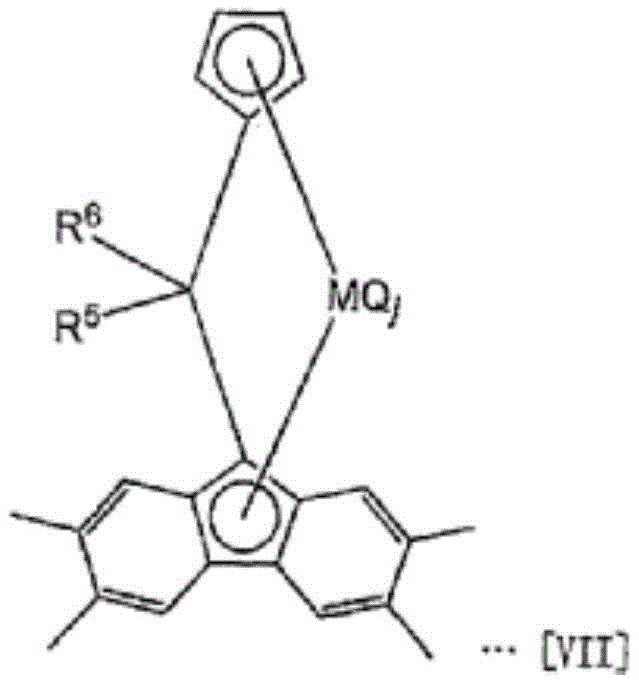
以下对式[VII]中的M、R5、R6、Q和j进行说明。M, R 5 , R 6 , Q and j in formula [VII] will be described below.
上述M为钛原子、锆原子或铪原子,优选为铪原子。The above-mentioned M is a titanium atom, a zirconium atom or a hafnium atom, preferably a hafnium atom.
上述R5和R6为将芳基的一个以上氢原子用哈米特法则的取代基常数σ为-0.2以下的给电子性取代基取代而成的取代芳基,在具有多个该给电子性取代基的情况下,各个该给电子性取代基可以相同也可以不同,取代芳基可以具有除了该给电子性取代基以外的选自由碳原子数1~20的烃基、含硅基团、含氮基团、含氧基团、卤素原子和含卤素基团所组成的组中的取代基,在具有多个该取代基的情况下,各个取代基可以相同也可以不同(以下也称为“含有给电子性基团的取代芳基”。)。The above-mentioned R 5 and R 6 are substituted aryl groups obtained by substituting one or more hydrogen atoms of the aryl group with an electron-donating substituent having a Hammett's law substituent constant σ of -0.2 or less, and in the case of having a plurality of the electron-donating groups. In the case of an electron-donating substituent, each of the electron-donating substituents may be the same or different, and the substituted aryl group may have a hydrocarbon group with 1 to 20 carbon atoms, a silicon-containing group, a substituted aryl group other than the electron-donating substituent. Substituents in the group consisting of nitrogen-containing groups, oxygen-containing groups, halogen atoms and halogen-containing groups, in the case of having a plurality of such substituents, each substituent may be the same or different (hereinafter also referred to as "Substituted aryl group containing electron donating group".).
作为芳基,可以举出苯基、1-萘基、2-萘基、蒽基、菲基、并四苯基、

哈米特法则的取代基常数σ为-0.2以下的给电子性基团的定义和例示如下。哈米特法则是为了定量地讨论取代基对于苯衍生物的反应或平衡产生的影响而在1935年由L.P.Hammett提出的经验法则,其在现如今被广泛确认了妥当性。通过哈米特法则求出的取代基常数中包括在苯环的对位取代时的σp和在间位取代时的σm,这些值可以在大量的一般文献中找到。例如,在Hansch和Taft的文献[Chem.Rev.,91,165(1991)]中对非常广泛的取代基进行了详细的记载。但是,这些文献中所记载的σp和σm有时即使是相同取代基也因文献而使值略微不同。本发明中为了避免因这样的状况而产生的混乱,对于只要有记载的取代基,就将Hansch和Taft的文献[Chem.Rev.,91,165(1991)]的表1(168-175页)中所记载的值定义为哈米特法则的取代基常数σp和σm。本发明中所谓哈米特法则的取代基常数σ为-0.2以下的给电子性基团,在该给电子性基团在苯基的对位(4位)取代的情况下是σp为-0.2以下的给电子性基团,在苯基的间位(3位)取代的情况下是σm为-0.2以下的给电子性基团。此外,在该给电子性基团在苯基的邻位(2位)取代的情况下,或在苯基以外的芳基的任意位置取代的情况下,是σp为-0.2以下的给电子性基团。Definitions and examples of electron-donating groups whose substituent constant σ of Hammett's Law is -0.2 or less are as follows. Hammett's rule is an empirical rule proposed by L.P.Hammett in 1935 to quantitatively discuss the influence of substituents on the reaction or equilibrium of benzene derivatives, and its validity is widely recognized today. Substituent constants obtained by Hammett's law include σp at the para position of the benzene ring and σm at the meta position, and these values can be found in a large number of general literatures. A very wide range of substituents is described in detail, for example, in Hansch and Taft [Chem. Rev., 91, 165 (1991)]. However, σp and σm described in these documents may have slightly different values depending on the documents even if they are the same substituent. In the present invention, in order to avoid confusion caused by such a situation, as long as the substituents are described, Table 1 (pp. 168-175) of the literature of Hansch and Taft [Chem. Rev., 91, 165 (1991)] is used. The stated values are defined as the substituent constants σp and σm of Hammett's Law. In the present invention, the substituent constant σ of the so-called Hammett's law is an electron-donating group whose constant σ is -0.2 or less, and when the electron-donating group is substituted at the para position (4-position) of the phenyl group, σp is -0.2 The following electron-donating groups are electron-donating groups whose σm is −0.2 or less when substituted at the meta-position (3-position) of the phenyl group. In addition, when the electron-donating group is substituted at the ortho position (2-position) of the phenyl group, or when it is substituted at any position of the aryl group other than the phenyl group, the electron-donating group has σp of -0.2 or less. group.
作为哈米特法则的取代基常数σp或σm为-0.2以下的给电子性取代基,可以举出对氨基(4-氨基)、对二甲基氨基(4-二甲基氨基)、对二乙基氨基(4-二乙基氨基)、间二乙基氨基(3-二乙基氨基)等含氮基团、对甲氧基(4-甲氧基)、对乙氧基(4-乙氧基)等含氧基团、对叔丁基(4-叔丁基)等叔烃基、对三甲基甲硅烷氧基(4-三甲基甲硅烷氧基)等含硅基团等。另外,本发明中所定义的哈米特法则的取代基常数σp或σm为-0.2以下的给电子性取代基不限定于Hansch和Taft的文献[Chem.Rev.,91,165(1991)]的表1(168-175页)中所记载的取代基。即使是该文献未记载的取代基,只要是基于哈米特法则测定时的取代基常数σp或σm为该范围的取代基,就包含在本发明中定义的哈米特法则的取代基常数σp或σm为-0.2以下的给电子性基团中。作为这样的取代基,可以举出对-N-吗啉基(4-N-吗啉基)、间-N-吗啉基(3-N-吗啉基)等。Examples of electron donating substituents whose substituent constants σp or σm of Hammett's Law are -0.2 or less include p-amino (4-amino), p-dimethylamino (4-dimethylamino), p-diamino Nitrogen-containing groups such as ethylamino (4-diethylamino), m-diethylamino (3-diethylamino), p-methoxy (4-methoxy), p-ethoxy (4- Oxygen-containing groups such as ethoxy), tertiary hydrocarbon groups such as p-tert-butyl (4-tert-butyl), silicon-containing groups such as p-trimethylsilyloxy (4-trimethylsilyloxy), etc. . In addition, the electron-donating substituents whose substituent constants σp or σm of Hammett's law defined in the present invention are -0.2 or less are not limited to the table in the literature of Hansch and Taft [Chem. Rev., 91, 165 (1991)] Substituents described in 1 (pp. 168-175). Even for a substituent not described in this document, as long as the substituent constant σp or σm measured by Hammett's law falls within this range, the substituent constant σp of Hammett's law defined in the present invention is included. Or in an electron donating group whose σm is -0.2 or less. As such a substituent, p-N-morpholinyl (4-N-morpholinyl), m-N-morpholinyl (3-N-morpholinyl), etc. are mentioned.
在含有给电子性基团的取代芳基中,在取代有多个该给电子性取代基的情况下,各个给电子性取代基可以相同也可以不同,除了该给电子性取代基以外,可以取代选自由碳原子数1~20的烃基、含硅基团、含氮基团、含氧基团、卤素原子和含卤素基团所组成的组中的取代基,在取代有多个该取代基的情况下,各个取代基可以相同也可以不同,优选一个取代芳基中所含的该给电子性取代基和该取代基各自的哈米特法则的取代基常数σ的总和为-0.15以下。作为这样的取代芳基,可以举出间,对-二甲氧基苯基(3,4-二甲氧基苯基)、对-(二甲基氨基)-间-甲氧基苯基(4-(二甲基氨基)-3-甲氧基苯基)、对-(二甲基氨基)-间-甲基苯基(4-(二甲基氨基)-3-甲基苯基)、对-甲氧基-间-甲基苯基(4-甲氧基-3-甲基苯基)、对-甲氧基-间,间-二甲基苯基(4-甲氧基-3,5-二甲基苯基)等。In the electron-donating group-containing substituted aryl group, when a plurality of the electron-donating substituents are substituted, the respective electron-donating substituents may be the same or different, and other than the electron-donating substituents, may be Substitute a substituent selected from the group consisting of a hydrocarbon group having 1 to 20 carbon atoms, a silicon-containing group, a nitrogen-containing group, an oxygen-containing group, a halogen atom and a halogen-containing group. In the case of a substituted aryl group, each substituent may be the same or different, but the electron-donating substituent contained in a substituted aryl group and the total of the substituent constants σ of the Hammett's law of each of the substituents are preferably -0.15 or less. . Examples of such substituted aryl groups include m,p-dimethoxyphenyl (3,4-dimethoxyphenyl), p-(dimethylamino)-m-methoxyphenyl ( 4-(dimethylamino)-3-methoxyphenyl), p-(dimethylamino)-m-methylphenyl (4-(dimethylamino)-3-methylphenyl) , p-methoxy-m-methylphenyl (4-methoxy-3-methylphenyl), p-methoxy-m, m-dimethylphenyl (4-methoxy- 3,5-dimethylphenyl) and so on.
作为含有给电子性基团的取代芳基可以具有的碳原子数1~20的烃基,可以举出碳原子数1~20的烷基、碳原子数3~20的环状饱和烃基、碳原子数2~20的链状不饱和烃基、碳原子数3~20的环状不饱和烃基等。此外,在具有多个碳原子数1~20的烃基的情况下,且该碳原子数1~20的烃基相邻的情况下,可以相互结合而形成环。作为此时的基团,可以例示碳原子数1~20的亚烷基、碳原子数6~20的亚芳基等。Examples of the hydrocarbon group having 1 to 20 carbon atoms that the electron-donating group-containing substituted aryl group may have include an alkyl group having 1 to 20 carbon atoms, a cyclic saturated hydrocarbon group having 3 to 20 carbon atoms, and a carbon atom group. A chain unsaturated hydrocarbon group having 2 to 20 carbon atoms, a cyclic unsaturated hydrocarbon group having 3 to 20 carbon atoms, and the like. In addition, in the case of having a plurality of hydrocarbon groups having 1 to 20 carbon atoms, and when the hydrocarbon groups having 1 to 20 carbon atoms are adjacent to each other, they may be bonded to each other to form a ring. As the group in this case, an alkylene group having 1 to 20 carbon atoms, an arylene group having 6 to 20 carbon atoms, and the like can be exemplified.
作为碳原子数1~20的烷基,可以举出甲基、乙基、正丙基、正丁基、正戊基、正己基、正庚基、正辛基、正壬基、正癸基等直链状饱和烃基;异丙基、异丁基、仲丁基、叔丁基、叔戊基、新戊基、3-甲基戊基、1,1-二乙基丙基、1,1-二甲基丁基、1-甲基-1-丙基丁基、1,1-二丙基丁基、1,1-二甲基-2-甲基丙基、1-甲基-1-异丙基-2-甲基丙基、环丙基甲基等支链状饱和烃基等。上述烷基的碳原子数优选为1~6。Examples of the alkyl group having 1 to 20 carbon atoms include methyl, ethyl, n-propyl, n-butyl, n-pentyl, n-hexyl, n-heptyl, n-octyl, n-nonyl, and n-decyl Isopropyl, isobutyl, sec-butyl, tert-butyl, tert-amyl, neopentyl, 3-methylpentyl, 1,1-diethylpropyl, 1, 1-dimethylbutyl, 1-methyl-1-propylbutyl, 1,1-dipropylbutyl, 1,1-dimethyl-2-methylpropyl, 1-methyl- Branched saturated hydrocarbon groups such as 1-isopropyl-2-methylpropyl, cyclopropylmethyl, etc. The number of carbon atoms in the alkyl group is preferably 1 to 6.
作为碳原子数3~20的环状饱和烃基,可以举出环丙基、环丁基、环戊基、环己基、环庚基、环辛基、降冰片烯基、1-金刚烷基、2-金刚烷基等非取代的环状饱和烃基;3-甲基环戊基、3-甲基环己基、4-甲基环己基、4-环己基环己基、4-苯基环己基等非取代的环状饱和烃基的氢原子被碳原子数1~17的烃基取代了的基团等。上述环状饱和烃基的碳原子数优选为5~11。Examples of the cyclic saturated hydrocarbon group having 3 to 20 carbon atoms include cyclopropyl, cyclobutyl, cyclopentyl, cyclohexyl, cycloheptyl, cyclooctyl, norbornenyl, 1-adamantyl, Unsubstituted cyclic saturated hydrocarbon groups such as 2-adamantyl; 3-methylcyclopentyl, 3-methylcyclohexyl, 4-methylcyclohexyl, 4-cyclohexylcyclohexyl, 4-phenylcyclohexyl, etc. A group in which a hydrogen atom of an unsubstituted cyclic saturated hydrocarbon group is substituted with a hydrocarbon group having 1 to 17 carbon atoms. The number of carbon atoms in the cyclic saturated hydrocarbon group is preferably 5 to 11.
作为碳原子数2~20的链状不饱和烃基,可以举出乙烯基(乙烯基vinyl)、1-丙烯基、2-丙烯基(烯丙基)、1-甲基乙烯基(异丙烯基)等烯基;作为炔基的乙炔基、1-丙炔基、2-丙炔基(炔丙基)等。上述链状不饱和烃基的碳原子数优选为2~4。Examples of the chain unsaturated hydrocarbon group having 2 to 20 carbon atoms include vinyl (vinyl vinyl), 1-propenyl, 2-propenyl (allyl), 1-methylvinyl (isopropenyl) ) and other alkenyl groups; ethynyl, 1-propynyl, 2-propynyl (propargyl) and the like as alkynyl groups. The number of carbon atoms in the chain unsaturated hydrocarbon group is preferably 2 to 4.
作为碳原子数3~20的环状不饱和烃基,可以举出环戊二烯基、降冰片烷基、苯基、萘基、茚基、薁基、菲基、蒽基等非取代的环状不饱和烃基;3-甲基苯基(间-甲苯基)、4-甲基苯基(对-甲苯基)、4-乙基苯基、4-叔丁基苯基、4-环己基苯基、联苯基、3,4-二甲基苯基、3,5-二甲基苯基、2,4,6-三甲基苯基(
作为碳原子数1~20的亚烷基,可以例示亚甲基、亚乙基、二甲基亚甲基(异亚丙基)、乙基亚甲基、1-甲基亚乙基、2-甲基亚乙基、1,1-二甲基亚乙基、1,2-二甲基亚乙基、正亚丙基等。亚烷基的碳原子数优选为1~6。Examples of the alkylene group having 1 to 20 carbon atoms include methylene, ethylene, dimethylmethylene (isopropylene), ethylmethylene, 1-methylethylene, 2 -Methylethylene, 1,1-dimethylethylene, 1,2-dimethylethylene, n-propylene, etc. The number of carbon atoms of the alkylene group is preferably 1-6.
作为碳原子数6~20的亚芳基,可以例示邻-亚苯基、间-亚苯基、对-亚苯基、4,4’-亚联苯基等。亚芳基的碳原子数优选为6~12。Examples of the arylene group having 6 to 20 carbon atoms include o-phenylene group, m-phenylene group, p-phenylene group, 4,4'-biphenylene group, and the like. The number of carbon atoms in the arylene group is preferably 6-12.
作为含有给电子性基团的取代芳基可以具有的含硅基团,可以举出三甲基甲硅烷基、三乙基甲硅烷基、叔丁基二甲基甲硅烷基、三异丙基甲硅烷基等烷基甲硅烷基;二甲基苯基甲硅烷基、甲基二苯基甲硅烷基、叔丁基二苯基甲硅烷基等芳基甲硅烷基;五甲基二硅烷基、三甲基甲硅烷基甲基等碳原子数1~20的烃基中碳原子被硅原子取代了的基团等。烷基甲硅烷基的碳原子数优选为1~10,芳基甲硅烷基的碳原子数优选为6~18。Examples of silicon-containing groups that the electron-donating group-containing substituted aryl group may have include trimethylsilyl, triethylsilyl, t-butyldimethylsilyl, and triisopropyl. Alkylsilyl groups such as silyl; arylsilyl groups such as dimethylphenylsilyl, methyldiphenylsilyl, tert-butyldiphenylsilyl, etc.; pentamethyldisilyl , trimethylsilylmethyl and other hydrocarbon groups having 1 to 20 carbon atoms in which carbon atoms are substituted by silicon atoms, and the like. The number of carbon atoms of the alkylsilyl group is preferably 1-10, and the number of carbon atoms of the arylsilyl group is preferably 6-18.
作为含有给电子性基团的取代芳基可以具有的含氮基团,可以举出氨基、硝基、N-吗啉基、作为上述碳原子数1~20的烃基或含硅基团中=CH-结构单元被氮原子取代了的基团、-CH2-结构单元被碳原子数1~20的烃基所结合的氮原子取代了的基团、或-CH3结构单元被碳原子数1~20的烃基所结合的氮原子或腈基取代了的基团的二甲基氨基、二乙基氨基、二甲基氨基甲基、氰基、吡咯烷基、哌啶基、吡啶基等。作为含氮基团,优选为二甲基氨基、N-吗啉基。Examples of nitrogen-containing groups that the electron-donating group-containing substituted aryl group may have include amino groups, nitro groups, N-morpholino groups, and among the above-mentioned hydrocarbon groups having 1 to 20 carbon atoms or silicon-containing groups= A group in which the CH- structural unit is substituted by a nitrogen atom, a group in which the -CH 2 - structural unit is substituted by a nitrogen atom to which a hydrocarbon group having 1 to 20 carbon atoms is bonded, or a -CH 3 structural unit by a carbon atom 1 dimethylamino, diethylamino, dimethylaminomethyl, cyano, pyrrolidinyl, piperidinyl, pyridyl, etc., to which a nitrogen atom or a nitrile group is substituted with a hydrocarbon group of ~20. As the nitrogen-containing group, a dimethylamino group and an N-morpholino group are preferable.
作为含有给电子性基团的取代芳基可以具有的含氧基团,可以举出羟基、作为上述碳原子数1~20的烃基、含硅基团或含氮基团中-CH2-结构单元被氧原子或羰基取代了的基团、或-CH3结构单元被碳原子数1~20的烃基所结合的氧原子取代了的基团的甲氧基、乙氧基、叔丁氧基、苯氧基、三甲基甲硅烷氧基、甲氧基乙氧基、羟基甲基、甲氧基甲基、乙氧基甲基、叔丁氧基甲基、1-羟基乙基、1-甲氧基乙基、1-乙氧基乙基、2-羟基乙基、2-甲氧基乙基、2-乙氧基乙基、正-2-氧杂丁烯基、正-2-氧杂戊烯基、正-3-氧杂戊烯基、醛基、乙酰基、丙酰基、苯甲酰基、三甲基甲硅烷基羰基、氨基甲酰基、甲基氨基羰基、羧基、甲氧基羰基、羧基甲基、乙氧羧基甲基、氨基甲酰基甲基、呋喃基、吡喃基等。作为含氧基团,优选为甲氧基。Examples of the oxygen-containing group that the electron-donating group-containing substituted aryl group may have include a hydroxyl group, a -CH 2 - structure in the above-mentioned hydrocarbon group having 1 to 20 carbon atoms, a silicon-containing group, or a nitrogen-containing group. Methoxy, ethoxy, tert-butoxy of a group in which the unit is substituted by an oxygen atom or a carbonyl group, or a group in which the -CH3 structural unit is substituted by an oxygen atom to which a hydrocarbon group having 1 to 20 carbon atoms is bonded , phenoxy, trimethylsilyloxy, methoxyethoxy, hydroxymethyl, methoxymethyl, ethoxymethyl, tert-butoxymethyl, 1-hydroxyethyl, 1 -Methoxyethyl, 1-ethoxyethyl, 2-hydroxyethyl, 2-methoxyethyl, 2-ethoxyethyl, n-2-oxabutenyl, n-2 -oxolyl, n-3-oxolenyl, aldehyde, acetyl, propionyl, benzoyl, trimethylsilylcarbonyl, carbamoyl, methylaminocarbonyl, carboxyl, methyl Oxycarbonyl, carboxymethyl, ethoxycarboxymethyl, carbamoylmethyl, furanyl, pyranyl and the like. As the oxygen-containing group, a methoxy group is preferable.
作为含有给电子性基团的取代芳基可以具有的卤素原子,可以举出作为第17族元素的氟、氯、溴、碘等。As the halogen atom which the electron-donating group-containing substituted aryl group may have, fluorine, chlorine, bromine, iodine, etc., which are Group 17 elements, can be mentioned.
作为含有给电子性基团的取代芳基可以具有的含卤素基团,可以举出作为上述碳原子数1~20的烃基、含硅基团、含氮基团或含氧基团中氢原子被卤素原子取代了的基团的三氟甲基、三溴甲基、五氟乙基、五氟苯基等。Examples of halogen-containing groups that the electron-donating group-containing substituted aryl group may have include hydrogen atoms in the above-mentioned hydrocarbon groups having 1 to 20 carbon atoms, silicon-containing groups, nitrogen-containing groups, or oxygen-containing groups. Trifluoromethyl, tribromomethyl, pentafluoroethyl, pentafluorophenyl, etc. of the group substituted with a halogen atom.
Q为选自由卤素原子、碳原子数1~20的烃基、阴离子配体和能够以孤电子对配位的中性配体所组成的组中的原子、取代基或配体,在存在多个Q的情况下,可以相同也可以不同。Q is an atom, substituent or ligand selected from the group consisting of a halogen atom, a hydrocarbon group having 1 to 20 carbon atoms, an anionic ligand, and a neutral ligand capable of coordinating with a lone electron pair. In the case of Q, they may be the same or different.
成为Q的卤素原子和碳原子数1~20的烃基的具体例与上述含有给电子性基团的取代芳基可以具有的卤素原子和碳原子数1~20的烃基同样。在Q为卤素原子的情况下,优选为氯原子。在Q为碳原子数1~20的烃基的情况下,该烃基的碳原子数优选为1~7。Specific examples of the halogen atom and the hydrocarbon group having 1 to 20 carbon atoms used as Q are the same as the halogen atom and the hydrocarbon group having 1 to 20 carbon atoms that the above-mentioned electron-donating group-containing substituted aryl group may have. When Q is a halogen atom, it is preferably a chlorine atom. When Q is a hydrocarbon group having 1 to 20 carbon atoms, the hydrocarbon group preferably has 1 to 7 carbon atoms.
作为阴离子配体,可以举出甲氧基、叔丁氧基、苯氧基等烷氧基;乙酸酯、苯甲酸酯等的羧酸酯基;甲磺酸酯、甲苯磺酸酯等的磺酸酯基等。Examples of the anionic ligand include alkoxy groups such as methoxy, tert-butoxy, and phenoxy; carboxylate groups such as acetate and benzoate; methanesulfonate, tosylate, and the like. sulfonate group, etc.
作为能够以孤电子对配位的中性配体,可以举出三甲基膦、三乙基膦、三苯基膦、二苯基甲基膦等有机磷化合物;四氢呋喃、乙醚、二
j为1~4的整数,优选为2。j is an integer of 1 to 4, preferably 2.
上述通式[VII]所表示的交联金属茂化合物(a)中所含的2,3,6,7-四甲基芴基由于在2、3、6和7位具有四个取代基,因此电子效应大,由此推测生成高聚合活性且高分子量的乙烯系共聚物。另一方面,大体上非共轭多烯与α-烯烃相比体积变大,因此推测将其聚合的聚合催化剂、特别是成为聚合活性点的金属茂化合物的中心金属附近体积不大的催化剂与非共轭多烯的共聚性能提高有关。2,3,6,7-四甲基芴基中所含的四个甲基与其他烃基等相比体积不大,因此认为这有助于高的非共轭多烯共聚性能。综上,推测特别是包含2,3,6,7-四甲基芴基的上述通式[VII]所表示的交联金属茂化合物同时以高水平且平衡良好地实现生成的乙烯系共聚物的高分子量、高的非共轭多烯共聚性能和高聚合活性。Since the 2,3,6,7-tetramethylfluorenyl group contained in the crosslinked metallocene compound (a) represented by the general formula [VII] has four substituents at the 2, 3, 6 and 7 positions, Therefore, the electron effect is large, and it is presumed that an ethylene-based copolymer with high polymerization activity and high molecular weight is produced. On the other hand, since non-conjugated polyenes are generally bulkier than α-olefins, it is presumed that a polymerization catalyst for polymerizing this, especially a catalyst that is not bulky near the central metal of the metallocene compound serving as a polymerization active site, is a The copolymerization performance of non-conjugated polyenes is improved. The four methyl groups contained in the 2,3,6,7-tetramethylfluorenyl group are not bulky compared to other hydrocarbon groups and the like, so this is considered to contribute to the high copolymerization performance of the non-conjugated polyene. From the above, it is presumed that the crosslinked metallocene compound represented by the above-mentioned general formula [VII] containing a 2,3,6,7-tetramethylfluorenyl group in particular can achieve a high level and a well-balanced ethylene-based copolymer at the same time. high molecular weight, high non-conjugated polyene copolymerization performance and high polymerization activity.
交联金属茂化合物(a-3)能够通过例如下式[VIII]那样的简便的方法来合成。The crosslinked metallocene compound (a-3) can be synthesized by a simple method such as the following formula [VIII].
[化3][hua 3]

(式[VIII]中,M、R5、R6的定义具体例和优选例与式[VII]的情况相同。)(In formula [VIII], specific examples and preferred examples of the definitions of M, R 5 and R 6 are the same as in the case of formula [VII].)
上述式[VIII]中,R5和R6如上,但由于通式R5-C(=O)-R6所表示的、满足这样的条件的各种酮由一般的试剂制造商市售,因此该交联金属茂化合物(a-3)的原料容易获得。此外,即使是这样的酮未被市售的情况下,也能够通过例如Olah等人的方法[Heterocycles,40,79(1995)]等而容易地合成该酮。这样,该交联金属茂化合物(a-3)可以获得制造工序相对简单且容易,制造成本进一步减低,进而通过使用该交联金属茂化合物而乙烯系共聚物的制造成本降低这样的优点。进一步,在包含该交联金属茂化合物(a-3)的烯烃聚合催化剂的存在下将乙烯和碳原子数为4以上的α-烯烃和非共轭多烯共聚的情况下,也可以获得所生成的共聚物能够进一步高分子量化这样的优点。In the above formula [VIII], R 5 and R 6 are as described above, but since various ketones represented by the general formula R 5 -C(=O)-R 6 and satisfying such conditions are commercially available from general reagent manufacturers, Therefore, the raw material of the crosslinked metallocene compound (a-3) is easily obtained. Furthermore, even when such a ketone is not commercially available, the ketone can be easily synthesized by, for example, the method of Olah et al. [Heterocycles, 40, 79 (1995)] or the like. In this way, the crosslinked metallocene compound (a-3) has the advantages that the production process is relatively simple and easy, the production cost is further reduced, and the production cost of the ethylene-based copolymer is further reduced by using the crosslinked metallocene compound. Furthermore, in the case of copolymerizing ethylene, an α-olefin having 4 or more carbon atoms, and a non-conjugated polyene in the presence of an olefin polymerization catalyst containing the crosslinked metallocene compound (a-3), the obtained The resulting copolymer has the advantage that the molecular weight can be further increased.
上述通式[VII]所表示的交联金属茂化合物(a-3)中,R5和R6优选为选自由芳基和取代芳基所组成的组中的基团。在包含该交联金属茂化合物的烯烃聚合催化剂的存在下将乙烯和碳原子数为4以上的α-烯烃和非共轭多烯共聚的情况下,可以获得聚合活性进一步提高以及所生成的共聚物能够进一步高分子量化这样的优点。而且同时,也可获得非共轭多烯的共聚性能提高(例如,提高共聚物中的非共轭多烯单元的含量,共聚物中非共轭多烯单元容易被均匀分散)这样的优点。In the crosslinked metallocene compound (a-3) represented by the general formula [VII], R 5 and R 6 are preferably groups selected from the group consisting of an aryl group and a substituted aryl group. When ethylene is copolymerized with an α-olefin having 4 or more carbon atoms and a non-conjugated polyene in the presence of an olefin polymerization catalyst containing the crosslinked metallocene compound, a further improvement in polymerization activity and the resulting copolymerization can be obtained. It has the advantage that the compound can be further molecularized. Moreover, at the same time, the advantages of improving the copolymerization performance of the non-conjugated polyene (for example, increasing the content of the non-conjugated polyene unit in the copolymer, the non-conjugated polyene unit in the copolymer can be easily dispersed uniformly) can be obtained.
上述通式[VII]所表示的交联金属茂化合物(a-3)中,R5和R6进一步优选为相同基团。通过这样选择R5和R6,可以获得该交联金属茂化合物的合成工序被简化,进一步降低制造成本,进而通过使用该交联金属茂化合物而共聚物的制造成本降低这样的优点。此外,在包含该交联金属茂化合物的烯烃聚合催化剂的存在下将乙烯和碳原子数为4以上的α-烯烃和非共轭多烯共聚的情况下,可以获得所生成的共聚物能够进一步高分子量化这样的优点。In the crosslinked metallocene compound (a-3) represented by the general formula [VII], R 5 and R 6 are more preferably the same group. By selecting R 5 and R 6 in this way, the synthesis process of the cross-linked metallocene compound can be simplified, the production cost can be further reduced, and the production cost of the copolymer can be reduced by using the cross-linked metallocene compound. In addition, in the case of copolymerizing ethylene with an α-olefin having 4 or more carbon atoms and a non-conjugated polyene in the presence of an olefin polymerization catalyst containing the crosslinked metallocene compound, the resulting copolymer can be further Such advantages as high molecular weight.
本申请人对各种交联金属茂化合物(a)进行了深入研究,结果首次发现:上述通式[VII]所表示的交联金属茂化合物(a-3)中,将R5和R6设为上述基团的情况下,特别是通过设为取代有一个以上哈米特法则的取代基常数σ为-0.2以下的给电子性取代基的含有给电子性基团的取代芳基,从而在包含该交联金属茂化合物(a-3)的烯烃聚合催化剂的存在下将乙烯和碳原子数为4以上的α-烯烃和非共轭多烯共聚时,所生成的共聚物的分子量能够进一步提高。The applicant has conducted intensive research on various cross-linked metallocene compounds (a), and found for the first time that: in the cross-linked metallocene compound (a-3) represented by the general formula [VII], R 5 and R 6 In the case of the above-mentioned group, in particular, by using an electron-donating group-containing substituted aryl group substituted with one or more electron-donating substituents having a Hammett's law substituent constant σ of -0.2 or less, When ethylene, an α-olefin having 4 or more carbon atoms and a non-conjugated polyene are copolymerized in the presence of an olefin polymerization catalyst containing the crosslinked metallocene compound (a-3), the molecular weight of the resulting copolymer can be Further improve.
已知在由本发明的交联金属茂化合物(a-3)那样的有机金属配位化合物催化剂引起的烯烃的配位聚合中,通过在催化剂的中心金属上反复聚合烯烃,从而所生成的烯烃聚合物的分子链生长(生长反应),该烯烃聚合物的分子量增大。另一方面,也已知在被称为链转移的反应中,通过使烯烃聚合物的分子链从催化剂的中心金属解离,从而该分子链的生长反应停止,因此该烯烃聚合物的分子量的增大也停止。综上,烯烃聚合物的分子量通过生成其的有机金属配位化合物催化剂所固有的、生长反应的频率与链转移反应的频率的比率而带有特征。即,为如下关系:生长反应的频率与链转移反应的频率之比越大,所生成的烯烃聚合物的分子量变得越高,相反生长反应的频率与链转移反应的频率之比越小,所生成的烯烃聚合物的分子量变得越低。这里,认为各个反应的频率可以从各个反应的活化能来估计,活化能低的反应其频率高,相反活化能高的反应其频率低。一般而言,已知烯烃聚合中的生长反应的频率与链转移反应的频率相比充分高,即生长反应的活化能与链转移反应的活化能相比充分低。因此,从链转移反应的活化能减去生长反应的活化能而得的值(以下,ΔEc)为正,该值越大,与链转移反应的频率相比生长反应的频率变得越大,推定所生成的烯烃聚合物的分子量变得越高。这样进行的烯烃聚合物的分子量的推定的妥当性也通过例如Laine等人的计算结果得到证实[Organometallics,30,1350(2011)]。推测上述通式[VII]所表示的交联金属茂化合物(a-3)中,尤其是将R5和R6设为取代有一个以上哈米特法则的取代基常数σ为-0.2以下的给电子性取代基的含有给电子性基团的取代芳基的情况下,上述ΔEc增大,在包含该交联金属茂化合物(a-3)的烯烃聚合催化剂的存在下将乙烯和碳原子数为4以上的α-烯烃和非共轭多烯共聚时,所生成的共聚物的分子量变高。It is known that in the coordination polymerization of olefins by an organometallic complex catalyst such as the crosslinked metallocene compound (a-3) of the present invention, by repeating the polymerization of olefins on the central metal of the catalyst, the resulting olefins are polymerized The molecular chain of the olefin polymer grows (growth reaction), and the molecular weight of the olefin polymer increases. On the other hand, it is also known that in a reaction called chain transfer, the molecular chain of the olefin polymer is dissociated from the central metal of the catalyst, so that the growth reaction of the molecular chain is stopped. The increase also stops. In summary, the molecular weight of an olefin polymer is characterized by the ratio of the frequency of growth reactions to the frequency of chain transfer reactions inherent to the organometallic complex catalyst from which it is produced. That is, the relationship is as follows: the larger the ratio of the frequency of the growth reaction to the frequency of the chain transfer reaction, the higher the molecular weight of the generated olefin polymer, and the smaller the ratio of the frequency of the growth reaction to the frequency of the chain transfer reaction, The molecular weight of the resulting olefin polymer becomes lower. Here, it is considered that the frequency of each reaction can be estimated from the activation energy of each reaction, and a reaction with a low activation energy has a high frequency, and conversely, a reaction with a high activation energy has a low frequency. In general, it is known that the frequency of the growth reaction in olefin polymerization is sufficiently higher than the frequency of the chain transfer reaction, that is, the activation energy of the growth reaction is sufficiently lower than the activation energy of the chain transfer reaction. Therefore, the value obtained by subtracting the activation energy of the growth reaction from the activation energy of the chain transfer reaction (hereinafter, ΔEc) is positive, and the larger the value, the greater the frequency of the growth reaction than the frequency of the chain transfer reaction. It is estimated that the molecular weight of the produced olefin polymer becomes higher. The validity of the estimation of the molecular weight of the olefin polymer thus carried out is also confirmed by, for example, the calculation results of Laine et al. [Organometallics, 30, 1350 (2011)]. In the crosslinked metallocene compound (a-3) represented by the above-mentioned general formula [VII], in particular, R 5 and R 6 are substituted with one or more Hammett's law substituent constants σ of -0.2 or less. In the case of the electron-donating group-containing substituted aryl group of the electron-donating group, the above-mentioned ΔEc increases, and ethylene and carbon atoms are combined in the presence of the olefin polymerization catalyst containing the cross-linked metallocene compound (a-3). When an α-olefin having a number of 4 or more and a non-conjugated polyene are copolymerized, the molecular weight of the resulting copolymer becomes high.
上述通式[VII]所表示的交联金属茂化合物(a-3)中,R5和R6中所含的给电子性取代基进一步优选为选自由含氮基团和含氧基团所组成的组中的基团。这些取代基的哈米特法则中的σ特别低,能够使乙烯-α-烯烃-非共轭多烯共聚物的分子量变高,特别是在通常导致分子量降低的高温聚合中也能够使分子量变高。In the crosslinked metallocene compound (a-3) represented by the general formula [VII], the electron-donating substituents contained in R 5 and R 6 are more preferably selected from nitrogen-containing groups and oxygen-containing groups. The groups that make up the group. These substituents have a particularly low σ in Hammett's Law and can increase the molecular weight of the ethylene-α-olefin-non-conjugated polyene copolymer, especially in high temperature polymerization, which usually leads to molecular weight reduction. high.
上述通式[VII]所表示的交联金属茂化合物(a-3)中,R5和R6进一步优选为包含作为上述给电子性取代基的选自由含氮基团和含氧基团所组成的组中的基团的取代苯基。在根据例如上述式[VIII]那样的方法进行合成的情况下,成为原料的各种二苯甲酮由一般的试剂制造商市售,因此原料的获得变得容易,制造工序被简化,进一步制造成本降低,进而可以获得通过使用该交联金属茂化合物而上述共聚物(1B)或(2B)的制造成本降低这样的优点。In the crosslinked metallocene compound (a-3) represented by the general formula [VII], it is further preferable that R 5 and R 6 contain, as the electron-donating substituent, a group selected from a nitrogen-containing group and an oxygen-containing group. The group consisting of substituted phenyl groups. For example, in the case of synthesis according to the method of the above-mentioned formula [VIII], various benzophenones serving as raw materials are commercially available from general reagent manufacturers, so that the raw materials can be easily obtained, the production process can be simplified, and further production can be achieved. The cost is reduced, and the advantage that the production cost of the above-mentioned copolymer (1B) or (2B) is reduced by using the cross-linked metallocene compound can be obtained.
这里,作为包含作为上述给电子性取代基的选自由含氮基团和含氧基团所组成的组中的基团的取代苯基,可以举出邻-氨基苯基(2-氨基苯基)、对-氨基苯基(4-氨基苯基)、邻-(二甲基氨基)苯基(2-(二甲基氨基)苯基)、对-(二甲基氨基)苯基(4-(二甲基氨基)苯基)、邻-(二乙基氨基)苯基(2-(二乙基氨基)苯基)、对-(二乙基氨基)苯基(4-(二乙基氨基)苯基)、间-(二乙基氨基)苯基(3-(二乙基氨基)苯基)、邻-甲氧基苯基(2-甲氧基苯基)、对-甲氧基苯基(4-甲氧基苯基)、邻-乙氧基苯基(2-乙氧基苯基)、对-乙氧基苯基(4-乙氧基苯基)、邻-N-吗啉基苯基(2-N-吗啉基苯基)、对-N-吗啉基苯基(4-N-吗啉基苯基)、间-N-吗啉基苯基(3-N-吗啉基苯基)、邻,对-二甲氧基苯基(2,4-二甲氧基苯基)、间,对-二甲氧基苯基(3,4-二甲氧基苯基)、对-(二甲基氨基)-间-甲氧基苯基(4-(二甲基氨基)-3-甲氧基苯基)、对-(二甲基氨基)-间-甲基苯基(4-(二甲基氨基)-3-甲基苯基)、对-甲氧基-间-甲基苯基(4-甲氧基-3-甲基苯基)、对-甲氧基-间,间-二甲基苯基(4-甲氧基-3,5-二甲基苯基)等。Here, as the substituted phenyl group containing a group selected from the group consisting of a nitrogen-containing group and an oxygen-containing group as the above-mentioned electron-donating substituent, o-aminophenyl (2-aminophenyl group) can be exemplified. ), p-aminophenyl (4-aminophenyl), o-(dimethylamino)phenyl (2-(dimethylamino)phenyl), p-(dimethylamino)phenyl (4 -(Dimethylamino)phenyl), o-(diethylamino)phenyl(2-(diethylamino)phenyl), p-(diethylamino)phenyl(4-(diethylamino)phenyl) amino)phenyl), m-(diethylamino)phenyl (3-(diethylamino)phenyl), o-methoxyphenyl (2-methoxyphenyl), p-methyl Oxyphenyl (4-methoxyphenyl), o-ethoxyphenyl (2-ethoxyphenyl), p-ethoxyphenyl (4-ethoxyphenyl), o- N-morpholinylphenyl (2-N-morpholinylphenyl), p-N-morpholinylphenyl (4-N-morpholinylphenyl), m-N-morpholinylphenyl ( 3-N-morpholinyl phenyl), o, p-dimethoxyphenyl (2,4-dimethoxyphenyl), m, p-dimethoxyphenyl (3,4-dimethoxyphenyl) methoxyphenyl), p-(dimethylamino)-m-methoxyphenyl (4-(dimethylamino)-3-methoxyphenyl), p-(dimethylamino) - m-methylphenyl (4-(dimethylamino)-3-methylphenyl), p-methoxy-m-methylphenyl (4-methoxy-3-methylphenyl) ), p-methoxy-m, m-dimethylphenyl (4-methoxy-3,5-dimethylphenyl), etc.
上述通式[VII]所表示的交联金属茂化合物(a-3)中,R5和R6进一步优选为在间位和/或对位包含作为上述给电子性取代基的选自由含氮基团和含氧基团所组成的组中的基团的取代苯基。在根据例如上述式[VIII]那样的方法进行合成的情况下,与该基团在邻位取代的情况相比合成变得容易,制造工序被简化,进一步制造成本减低,进而可以获得通过使用该交联金属茂化合物而乙烯系共聚物的制造成本降低这样的优点。In the crosslinked metallocene compound (a-3) represented by the general formula [VII], it is more preferable that R 5 and R 6 contain a nitrogen-containing substituent selected from the group consisting of nitrogen-containing substituents at the meta position and/or the para position. A substituted phenyl group of a group of radicals and oxygen-containing groups. For example, in the case of synthesis according to the method of the above formula [VIII], the synthesis becomes easier compared with the case where the group is substituted at the ortho position, the production process is simplified, and the production cost is further reduced, and further, it is possible to obtain by using the The advantage of crosslinking the metallocene compound and reducing the production cost of the ethylene-based copolymer.
上述通式[VII]所表示的交联金属茂化合物(a-3)中,在R5和R6为在间位和/或对位包含作为上述给电子性取代基的含氮基团的取代苯基的情况下,该含氮基团进一步优选为下述通式[II]所表示的基团。In the cross-linked metallocene compound (a-3) represented by the above general formula [VII], R 5 and R 6 are those containing a nitrogen-containing group as the electron-donating substituent at the meta-position and/or the para-position. In the case of a substituted phenyl group, the nitrogen-containing group is more preferably a group represented by the following general formula [II].
[化4][hua 4]

(式[II]中,R7和R8为选自由氢原子、碳原子数1~20的烃基、含硅基团、含氧基团和含卤素基团所组成的组中的原子或取代基,各自可以相同也可以不同,可以相互结合而形成环,在N的右侧画出的线表示与苯基结合的键。)(In formula [II], R 7 and R 8 are atoms or substitutions selected from the group consisting of a hydrogen atom, a hydrocarbon group having 1 to 20 carbon atoms, a silicon-containing group, an oxygen-containing group and a halogen-containing group The groups may be the same or different, and may be combined with each other to form a ring, and the line drawn to the right of the N represents the bond to the phenyl group.)
作为R7和R8的碳原子数1~20的烃基、含硅基团、含氧基团和含卤素基团的具体例及优选例与上述式[VII]的情况相同。Specific examples and preferred examples of the hydrocarbon group having 1 to 20 carbon atoms, silicon-containing group, oxygen-containing group and halogen-containing group as R 7 and R 8 are the same as in the case of the above formula [VII].
这样的交联金属茂化合物(a-4)由下述通式[IX]表示。Such a crosslinked metallocene compound (a-4) is represented by the following general formula [IX].
[化5][hua 5]

(式[IX]中,M、Q和j的定义、具体例及优选例与式[VII]的情况相同。R7、R8和R10为选自由氢原子、碳原子数1~20的烃基、含硅基团、含氮基团、含氧基团、卤素原子和含卤素基团所组成的组中的取代基,各自可以相同也可以不同,R7、R8和R10中的相邻的取代基可以相互结合而形成环,NR7R8为哈米特法则的取代基常数σ为-0.2以下的含氮基团,在存在多个该含氮基团的情况下,各个含氮基团相互可以相同也可以不同,n为1~3的整数,m为0~4的整数。)(In the formula [IX], the definitions, specific examples and preferred examples of M, Q and j are the same as in the case of the formula [VII]. R 7 , R 8 and R 10 are selected from hydrogen atoms and carbon atoms of 1 to 20. Substituents in the group consisting of hydrocarbon groups, silicon-containing groups, nitrogen-containing groups, oxygen-containing groups, halogen atoms and halogen-containing groups may be the same or different, and the substituents in R 7 , R 8 and R 10 Adjacent substituents can combine with each other to form a ring. NR 7 R 8 is a nitrogen-containing group whose substituent constant σ of Hammett's law is -0.2 or less. The nitrogen-containing groups may be the same or different from each other, n is an integer of 1-3, and m is an integer of 0-4.)
关于作为R10的碳原子数1~20的烃基、含硅基团、含氧基团和含卤素基团,可以举出上述的这些取代基的具体例。Specific examples of the above-mentioned substituents can be given as a hydrocarbon group having 1 to 20 carbon atoms, a silicon-containing group, an oxygen-containing group, and a halogen-containing group as R 10 .
关于该通式[IX]所表示的交联金属茂化合物(过渡金属化合物),由于上述通式[II]所表示的NR7R8的哈米特法则中的σ特别低,因此能够使乙烯-α-烯烃-非共轭多烯共聚物的分子量变高,特别是在通常导致分子量降低的高温聚合中也能够使分子量变高。Regarding the crosslinked metallocene compound (transition metal compound) represented by the general formula [IX], since σ in the Hammett's law of NR 7 R 8 represented by the general formula [II] is particularly low, ethylene can be The molecular weight of the -α-olefin-non-conjugated polyene copolymer is increased, and the molecular weight can be increased particularly in high-temperature polymerization, which usually leads to a decrease in molecular weight.
上述通式[VII]所表示的交联金属茂化合物(a-3)中,在R5和R6为在间位和/或对位包含作为上述给电子性取代基的含氧基团的取代苯基的情况下,该含氧基团进一步优选为下述通式[III]所表示的基团。In the cross-linked metallocene compound (a-3) represented by the general formula [VII], R 5 and R 6 are those containing an oxygen-containing group as the electron-donating substituent at the meta position and/or the para position. In the case of a substituted phenyl group, the oxygen-containing group is more preferably a group represented by the following general formula [III].
[化6][hua 6]
R9-O-…[III]R 9 -O-…[III]
(式[III]中,R9为选自由氢原子、碳原子数1~20的烃基、含硅基团、含氮基团和含卤素基团所组成的组中的原子或取代基,在O的右侧画出的线表示与苯基结合的键。)(in formula [III], R 9 is an atom or a substituent selected from the group consisting of a hydrogen atom, a hydrocarbon group having 1 to 20 carbon atoms, a silicon-containing group, a nitrogen-containing group and a halogen-containing group, and in The line drawn to the right of the O represents the bond to the phenyl group.)
作为R9的碳原子数1~20的烃基、含硅基团、含氮基团和含卤素基团的具体例及优选例与式[VII]的情况相同。Specific examples and preferred examples of the hydrocarbon group having 1 to 20 carbon atoms, silicon-containing group, nitrogen-containing group, and halogen-containing group as R 9 are the same as in the case of formula [VII].
这样的交联金属茂化合物(a-5)由下述通式[X]表示。Such a crosslinked metallocene compound (a-5) is represented by the following general formula [X].
[化7][hua 7]

(式[X]中,M、Q和j的定义、具体例及优选例与式[VII]的情况相同。R9和R10为选自由氢原子、碳原子数1~20的烃基、含硅基团、含氮基团、含氧基团、卤素原子和含卤素基团所组成的组中的原子或取代基,各自可以相同也可以不同,R10的相邻的取代基可以相互结合而形成环,OR9为哈米特法则的取代基常数σ为-0.2以下的含氧基团,在存在多个该含氧基团的情况下,各个含氧基团相互可以相同也可以不同,n为1~3的整数,m为0~4的整数。)(In formula [X], the definitions, specific examples and preferred examples of M, Q and j are the same as in the case of formula [VII]. R 9 and R 10 are selected from hydrogen atoms, hydrocarbon groups having 1 to 20 carbon atoms, containing The atoms or substituents in the group consisting of silicon group, nitrogen-containing group, oxygen-containing group, halogen atom and halogen-containing group may be the same or different, and the adjacent substituents of R 10 may be combined with each other In order to form a ring, OR 9 is an oxygen-containing group whose substituent constant σ of Hammett's law is -0.2 or less. When a plurality of such oxygen-containing groups exist, the oxygen-containing groups may be the same or different from each other. , where n is an integer from 1 to 3, and m is an integer from 0 to 4.)
作为R10的碳原子数1~20的烃基、含硅基团、含氧基团和含卤素基团,可以举出上述的这些取代基的具体例。Specific examples of the above-mentioned substituents can be mentioned as the hydrocarbon group having 1 to 20 carbon atoms, silicon-containing group, oxygen-containing group, and halogen-containing group for R 10 .
关于该通式[X]所表示的交联金属茂化合物(过渡金属化合物),由于上述通式[III]所表示的OR9的哈米特法则中的σ进一步低,因此能够使乙烯-α-烯烃-非共轭多烯共聚物的分子量变高,特别是在通常导致分子量降低的高温聚合中也能够使分子量变高。With regard to the crosslinked metallocene compound (transition metal compound) represented by the general formula [X], since the σ in the Hammett's law of OR 9 represented by the general formula [III] is further lower, ethylene-α can be -The molecular weight of the olefin-non-conjugated polyene copolymer is increased, and the molecular weight can be increased especially in high temperature polymerization which usually leads to a decrease in molecular weight.
上述通式[VII]所表示的本发明的交联金属茂化合物(a-3)、上述通式[IX]所表示的本发明的交联金属茂化合物(a-4)或上述通式[X]所表示的本发明的交联金属茂化合物(a-5)中,M进一步优选为铪原子。在包含M为铪原子的上述交联金属茂化合物的烯烃聚合催化剂的存在下将乙烯和碳原子数为4以上的α-烯烃和非共轭多烯共聚的情况下,可获得所生成的共聚物能够进一步高分子量化,非共轭多烯的共聚性能提高这样的优点。The crosslinked metallocene compound (a-3) of the present invention represented by the general formula [VII], the crosslinked metallocene compound (a-4) of the present invention represented by the general formula [IX], or the general formula [ In the crosslinked metallocene compound (a-5) of the present invention represented by X], M is more preferably a hafnium atom. In the case of copolymerizing ethylene with an α-olefin having 4 or more carbon atoms and a non-conjugated polyene in the presence of an olefin polymerization catalyst containing the above-mentioned cross-linked metallocene compound in which M is a hafnium atom, the resulting copolymer can be obtained The polymer can be further molecularized, and the copolymerization performance of the non-conjugated polyene is improved.
作为这样的交联金属茂化合物(a),可以举出:Examples of such a crosslinked metallocene compound (a) include:
[二甲基亚甲基(η5-环戊二烯基)(η5-2,3,6,7-四甲基芴基)]二氯化铪、[二乙基亚甲基(η5-环戊二烯基)(η5-2,3,6,7-四甲基芴基)]二氯化铪、[二-正丁基亚甲基(η5-环戊二烯基)(η5-2,3,6,7-四甲基芴基)]二氯化铪、[二环戊基亚甲基(η5-环戊二烯基)(η5-2,3,6,7-四甲基芴基)]二氯化铪、[二环己基亚甲基(η5-环戊二烯基)(η5-2,3,6,7-四甲基芴基)]二氯化铪、[Dimethylmethylene (n 5 -cyclopentadienyl) (n 5 -2,3,6,7-tetramethylfluorenyl)] hafnium dichloride, [diethylmethylene (n 5 -cyclopentadienyl) (n 5 -2,3,6,7-tetramethylfluorenyl)] hafnium dichloride, [di-n-butyl methylene (n 5 -cyclopentadienyl) ) (n 5 -2,3,6,7-tetramethylfluorenyl)] hafnium dichloride, [dicyclopentyl methylene (n 5 -cyclopentadienyl) (n 5 -2,3 ,6,7-tetramethylfluorenyl)] hafnium dichloride, [dicyclohexylmethylene (n 5 -cyclopentadienyl) (n 5 -2,3,6,7-tetramethylfluorene) base)] hafnium dichloride,
[亚环戊基(η5-环戊二烯基)(η5-2,3,6,7-四甲基芴基)]二氯化铪、[亚环己基(η5-环戊二烯基)(η5-2,3,6,7-四甲基芴基)]二氯化铪、[Cyclopentylene (n 5 -cyclopentadienyl) (n 5 -2,3,6,7-tetramethylfluorenyl)] hafnium dichloride, [cyclohexylene (n 5 -cyclopentadienyl) alkenyl) (n 5 -2,3,6,7-tetramethylfluorenyl)] hafnium dichloride,
[二苯基亚甲基(η5-环戊二烯基)(η5-2,3,6,7-四甲基芴基)]二氯化铪、[二-1-萘基亚甲基(η5-环戊二烯基)(η5-2,3,6,7-四甲基芴基)]二氯化铪、[二-2-萘基亚甲基(η5-环戊二烯基)(η5-2,3,6,7-四甲基芴基)]二氯化铪、[diphenylmethylene (n 5 -cyclopentadienyl) (n 5 -2,3,6,7-tetramethylfluorenyl)] hafnium dichloride, [di-1-naphthylmethylene base (n 5 -cyclopentadienyl) (n 5 -2,3,6,7-tetramethylfluorenyl)] hafnium dichloride, [di-2-naphthylmethylene (n 5 -ring pentadienyl) (n 5 -2,3,6,7-tetramethylfluorenyl)] hafnium dichloride,
[双(3-甲基苯基)亚甲基(η5-环戊二烯基)(η5-2,3,6,7-四甲基芴基)]二氯化铪、[双(4-甲基苯基)亚甲基(η5-环戊二烯基)(η5-2,3,6,7-四甲基芴基)]二氯化铪、[双(3,4-二甲基苯基)亚甲基(η5-环戊二烯基)(η5-2,3,6,7-四甲基芴基)]二氯化铪、[双(4-正己基苯基)亚甲基(η5-环戊二烯基)(η5-2,3,6,7-四甲基芴基)]二氯化铪、[双(4-环己基苯基)亚甲基(η5-环戊二烯基)(η5-2,3,6,7-四甲基芴基)]二氯化铪、[双(4-叔丁基苯基)亚甲基(η5-环戊二烯基)(η5-2,3,6,7-四甲基芴基)]二氯化铪、[Bis(3-methylphenyl)methylene(n 5 -cyclopentadienyl)(n 5 -2,3,6,7-tetramethylfluorenyl)] hafnium dichloride, [bis( 4-methylphenyl) methylene (n 5 -cyclopentadienyl) (n 5 -2,3,6,7-tetramethylfluorenyl)] hafnium dichloride, [bis(3,4 -Dimethylphenyl) methylene(n 5 -cyclopentadienyl)(n 5 -2,3,6,7-tetramethylfluorenyl)] hafnium dichloride, [bis(4-n-hexyl) (n 5 -cyclopentadienyl) (n 5 -2,3,6,7-tetramethylfluorenyl)] hafnium dichloride, [bis(4-cyclohexylphenyl) ) methylene (n 5 -cyclopentadienyl) (n 5 -2,3,6,7-tetramethylfluorenyl)] hafnium dichloride, [bis(4-tert-butylphenyl)idene Methyl (n 5 -cyclopentadienyl) (n 5 -2,3,6,7-tetramethylfluorenyl)] hafnium dichloride,
[双(3-甲氧基苯基)亚甲基(η5-环戊二烯基)(η5-2,3,6,7-四甲基芴基)]二氯化铪、[双(4-甲氧基苯基)亚甲基(η5-环戊二烯基)(η5-2,3,6,7-四甲基芴基)]二氯化铪、[双(3,4-二甲氧基苯基)亚甲基(η5-环戊二烯基)(η5-2,3,6,7-四甲基芴基)]二氯化铪、[双(4-甲氧基-3-甲基苯基)亚甲基(η5-环戊二烯基)(η5-2,3,6,7-四甲基芴基)]二氯化铪、[双(4-甲氧基-3,4-二甲基苯基)亚甲基(η5-环戊二烯基)(η5-2,3,6,7-四甲基芴基)]二氯化铪、[双(4-乙氧基苯基)亚甲基(η5-环戊二烯基)(η5-2,3,6,7-四甲基芴基)]二氯化铪、[双(4-苯氧基苯基)亚甲基(η5-环戊二烯基)(η5-2,3,6,7-四甲基芴基)]二氯化铪、[双{4-(三甲基甲硅烷氧基)苯基}亚甲基(η5-环戊二烯基)(η5-2,3,6,7-四甲基芴基)]二氯化铪、[Bis(3-methoxyphenyl)methylene(n 5 -cyclopentadienyl)(n 5 -2,3,6,7-tetramethylfluorenyl)] hafnium dichloride, [bis (4-methoxyphenyl) methylene (n 5 -cyclopentadienyl) (n 5 -2,3,6,7-tetramethylfluorenyl)] hafnium dichloride, [bis(3 ,4-dimethoxyphenyl) methylene (n 5 -cyclopentadienyl) (n 5 -2,3,6,7-tetramethylfluorenyl)] hafnium dichloride, [bis( 4-methoxy-3-methylphenyl) methylene (n 5 -cyclopentadienyl) (n 5 -2,3,6,7-tetramethylfluorenyl)] hafnium dichloride, [Bis(4-methoxy-3,4-dimethylphenyl)methylene(n 5 -cyclopentadienyl)(n 5 -2,3,6,7-tetramethylfluorenyl) ] Hafnium dichloride, [bis (4-ethoxyphenyl) methylene (n 5 -cyclopentadienyl) (n 5 -2,3,6,7-tetramethylfluorenyl)] two Hafnium chloride, [bis(4-phenoxyphenyl)methylene(n 5 -cyclopentadienyl)(n 5 -2,3,6,7-tetramethylfluorenyl)]dichloride Hafnium, [bis{4-(trimethylsiloxy)phenyl}methylene (n 5 -cyclopentadienyl) (n 5 -2,3,6,7-tetramethylfluorenyl) ] Hafnium dichloride,
[双{3-(二甲基氨基)苯基}亚甲基(η5-环戊二烯基)(η5-2,3,6,7-四甲基芴基)]二氯化铪、[双{4-(二甲基氨基)苯基}亚甲基(η5-环戊二烯基)(η5-2,3,6,7-四甲基芴基)]二氯化铪、[双(4-N-吗啉基苯基)(η5-环戊二烯基)(η5-2,3,6,7-四甲基芴基)]二氯化铪、[Bis{3-(dimethylamino)phenyl}methylene(n 5 -cyclopentadienyl)(n 5 -2,3,6,7-tetramethylfluorenyl)] hafnium dichloride , [bis{4-(dimethylamino)phenyl}methylene (n 5 -cyclopentadienyl) (n 5 -2,3,6,7-tetramethylfluorenyl)] dichloride Hafnium, [bis(4-N-morpholinylphenyl)(n 5 -cyclopentadienyl)(n 5 -2,3,6,7-tetramethylfluorenyl)] hafnium dichloride,
[双{4-(三甲基甲硅烷基)苯基}亚甲基(η5-环戊二烯基)(η5-2,3,6,7-四甲基芴基)]二氯化铪、[Bis{4-(trimethylsilyl)phenyl}methylene(n 5 -cyclopentadienyl)(n 5 -2,3,6,7-tetramethylfluorenyl)]dichloro hafnium,
[双(3-氯苯基)亚甲基(η5-环戊二烯基)(η5-2,3,6,7-四甲基芴基)]二氯化铪、[双(4-氯苯基)亚甲基(η5-环戊二烯基)(η5-2,3,6,7-四甲基芴基)]二氯化铪、[双(3-氟苯基)亚甲基(η5-环戊二烯基)(η5-2,3,6,7-四甲基芴基)]二氯化铪、[双(4-氟苯基)亚甲基(η5-环戊二烯基)(η5-2,3,6,7-四甲基芴基)]二氯化铪、[双{3-(三氟甲基)苯基}亚甲基(η5-环戊二烯基)(η5-2,3,6,7-四甲基芴基)]二氯化铪、[双{4-(三氟甲基)苯基}亚甲基(η5-环戊二烯基)(η5-2,3,6,7-四甲基芴基)]二氯化铪、[Bis(3-chlorophenyl)methylene(n 5 -cyclopentadienyl)(n 5 -2,3,6,7-tetramethylfluorenyl)] hafnium dichloride, [bis(4 -Chlorophenyl) methylene (n 5 -cyclopentadienyl) (n 5 -2,3,6,7-tetramethylfluorenyl)] hafnium dichloride, [bis(3-fluorophenyl) ) methylene (n 5 -cyclopentadienyl) (n 5 -2,3,6,7-tetramethylfluorenyl)] hafnium dichloride, [bis(4-fluorophenyl) methylene (n 5 -cyclopentadienyl)(n 5 -2,3,6,7-tetramethylfluorenyl)] hafnium dichloride, [bis{3-(trifluoromethyl)phenyl}methylene (n 5 -cyclopentadienyl)(n 5 -2,3,6,7-tetramethylfluorenyl)] hafnium dichloride, [bis{4-(trifluoromethyl)phenyl}idene Methyl (n 5 -cyclopentadienyl) (n 5 -2,3,6,7-tetramethylfluorenyl)] hafnium dichloride,
[甲基苯基亚甲基(η5-环戊二烯基)(η5-2,3,6,7-四甲基芴基)]二氯化铪、[甲基(4-甲基苯基)亚甲基(η5-环戊二烯基)(η5-2,3,6,7-四甲基芴基)]二氯化铪、[甲基(4-甲氧基苯基)亚甲基(η5-环戊二烯基)(η5-2,3,6,7-四甲基芴基)]二氯化铪、[甲基{4-(二甲基氨基)苯基}亚甲基(η5-环戊二烯基)(η5-2,3,6,7-四甲基芴基)]二氯化铪、[甲基(4-N-吗啉基苯基)亚甲基(η5-环戊二烯基)(η5-2,3,6,7-四甲基芴基)]二氯化铪、[methylphenylmethylene (n 5 -cyclopentadienyl) (n 5 -2,3,6,7-tetramethylfluorenyl)] hafnium dichloride, [methyl (4-methyl) Phenyl) methylene (n 5 -cyclopentadienyl) (n 5 -2,3,6,7-tetramethylfluorenyl)] hafnium dichloride, [methyl (4-methoxybenzene) base) methylene (n 5 -cyclopentadienyl) (n 5 -2,3,6,7-tetramethylfluorenyl)] hafnium dichloride, [methyl{4-(dimethylamino) ) phenyl} methylene (n 5 -cyclopentadienyl) (n 5 -2,3,6,7-tetramethylfluorenyl)] hafnium dichloride, [methyl (4-N- olinyl phenyl) methylene (n 5 -cyclopentadienyl) (n 5 -2,3,6,7-tetramethylfluorenyl)] hafnium dichloride,
[二甲基亚甲硅基(η5-环戊二烯基)(η5-2,3,6,7-四甲基芴基)]二氯化铪、[二乙基亚甲硅基(η5-环戊二烯基)(η5-2,3,6,7-四甲基芴基)]二氯化铪、[二环己基亚甲硅基(η5-环戊二烯基)(η5-2,3,6,7-四甲基芴基)]二氯化铪、[二苯基亚甲硅基(η5-环戊二烯基)(η5-2,3,6,7-四甲基芴基)]二氯化铪、[二(4-甲基苯基)亚甲硅基(η5-环戊二烯基)(η5-2,3,6,7-四甲基芴基)]二氯化铪、[Dimethylsilylene (n 5 -cyclopentadienyl) (n 5 -2,3,6,7-tetramethylfluorenyl)] hafnium dichloride, [diethylsilylene (n 5 -cyclopentadienyl)(n 5 -2,3,6,7-tetramethylfluorenyl)] hafnium dichloride, [dicyclohexylsilylene (n 5 -cyclopentadiene) base) (n 5 -2,3,6,7-tetramethylfluorenyl)] hafnium dichloride, [diphenylsilylene (n 5 -cyclopentadienyl) (n 5 -2, 3,6,7-tetramethylfluorenyl)] hafnium dichloride, [bis(4-methylphenyl)silylene (n 5 -cyclopentadienyl) (n 5 -2,3, 6,7-tetramethylfluorenyl)] hafnium dichloride,
[二甲基亚锗烷基(η5-环戊二烯基)(η5-2,3,6,7-四甲基芴基)]二氯化铪、[二苯基亚锗烷基(η5-环戊二烯基)(η5-2,3,6,7-四甲基芴基)]二氯化铪、[Dimethylgermanyl (n 5 -cyclopentadienyl) (n 5 -2,3,6,7-tetramethylfluorenyl)] hafnium dichloride, [diphenylgermanyl (n 5 -cyclopentadienyl)(n 5 -2,3,6,7-tetramethylfluorenyl)] hafnium dichloride,
[1-(η5-环戊二烯基)-2-(η5-2,3,6,7-四甲基芴基)亚乙基]二氯化铪、[1-(η5-环戊二烯基)-3-(η5-2,3,6,7-四甲基芴基)亚丙基]二氯化铪、[1-(η5-环戊二烯基)-2-(η5-2,3,6,7-四甲基芴基)-1,1,2,2-四甲基亚甲硅基]二氯化铪、[1-(η5-环戊二烯基)-2-(η5-2,3,6,7-四甲基芴基)亚苯基]二氯化铪、和将这些化合物的铪原子置换成锆原子的化合物或将氯配体置换成甲基的化合物等。这些催化剂中,优选为[双(4-甲基苯基)亚甲基(η5-环戊二烯基)(η5-2,3,6,7-四甲基芴基)]二氯化铪。[1-(n 5 -cyclopentadienyl)-2-(n 5 -2,3,6,7-tetramethylfluorenyl) ethylene] hafnium dichloride, [1-(n 5 - Cyclopentadienyl)-3-(n 5 -2,3,6,7-tetramethylfluorenyl) propylene] hafnium dichloride, [1-(n 5 -cyclopentadienyl)- 2-(η 5 -2,3,6,7-tetramethylfluorenyl)-1,1,2,2-tetramethylsilylidene] hafnium dichloride, [1-(η 5 -ring pentadienyl)-2-(n 5 -2,3,6,7-tetramethylfluorenyl) phenylene] hafnium dichloride, and compounds in which the hafnium atom of these compounds is replaced by a zirconium atom, or the Compounds in which chlorine ligands are replaced by methyl groups, etc. Among these catalysts, [bis(4-methylphenyl)methylene(n 5 -cyclopentadienyl)(n 5 -2,3,6,7-tetramethylfluorenyl)]dichloro hafnium.
上述共聚物(1B)或(2B)的制造中所使用的交联金属茂化合物可以通过公知的方法来制造,制造方法没有特别限定。作为制造方法,例如,可以举出J.Organomet.Chem.,63,509(1996)、作为本申请人申请的公报的WO2006/123759号公报、WO01/27124号公报、日本特开2004-168744号公报、日本特开2004-175759号公报、日本特开2000-212194号公报等记载的制造方法等。The crosslinked metallocene compound used for the production of the copolymer (1B) or (2B) can be produced by a known method, and the production method is not particularly limited. As a production method, for example, J. Organomet. Chem., 63, 509 (1996), WO2006/123759, WO01/27124, JP 2004-168744, which are publications of the applicant's application, can be mentioned, for example. The production methods described in Japanese Patent Laid-Open No. 2004-175759, Japanese Patent Laid-Open No. 2000-212194, and the like.
接下来,对将上述交联金属茂化合物用作乙烯-α-烯烃-非共轭多烯共聚物(1B)或(2B)的制造用催化剂(烯烃聚合催化剂)时的优选方式进行说明。Next, a preferred embodiment when the above-mentioned crosslinked metallocene compound is used as a catalyst (olefin polymerization catalyst) for producing the ethylene-α-olefin-non-conjugated polyene copolymer (1B) or (2B) will be described.
将交联金属茂化合物用作烯烃聚合催化剂成分的情况下,催化剂由如下物质构成:(a)上述通式[VII]所表示的交联金属茂化合物;(b)选自由(b-1)有机金属化合物、(b-2)有机铝氧化合物和(b-3)与交联金属茂化合物(a)反应而形成离子对的化合物所组成的组中的至少一种化合物;和根据需要的(c)粒子状载体。When a cross-linked metallocene compound is used as an olefin polymerization catalyst component, the catalyst is composed of (a) a cross-linked metallocene compound represented by the above-mentioned general formula [VII]; (b) selected from (b-1) at least one compound selected from the group consisting of an organometallic compound, (b-2) an organoaluminum oxy compound, and (b-3) a compound that reacts with the crosslinked metallocene compound (a) to form an ion pair; and as required (c) Particulate carrier.
以下,对各成分进行具体说明。Hereinafter, each component is demonstrated concretely.
〈(b-1)有机金属化合物〉<(b-1) Organometallic compound>
作为上述共聚物(1B)或(2B)的制造中所使用的(b-1)有机金属化合物,具体而言可使用下述通式[X]~[XII]那样的元素周期表第1、2族和第12、13族的有机金属化合物。As the organometallic compound (b-1) used in the production of the above-mentioned copolymer (1B) or (2B), specifically, the periodic table 1, Organometallic compounds of Group 2 and Groups 12 and 13.
(b-1a)通式Ra mAl(ORb)nHpXq···[X](b-1a) General formula R a m Al(OR b ) n H p X q ... [X]
(式[X]中,Ra和Rb相互可以相同也可以不同,表示碳原子数为1~15、优选为1~4的烃基,X表示卤素原子,m为0<m≤3的数,n为0≤n<3的数,p为0≤p<3的数,q为0≤q<3的数,并且m+n+p+q=3。)所表示的有机铝化合物。(In formula [X], R a and R b may be the same or different from each other, represent a hydrocarbon group having 1 to 15 carbon atoms, preferably 1 to 4, X represents a halogen atom, and m is a number of 0<m≤3 , n is a number of 0≦n<3, p is a number of 0≦p<3, q is a number of 0≦q<3, and m+n+p+q=3.) represents an organoaluminum compound.
作为上述通式[X]所表示的化合物,可以举出三甲基铝、三乙基铝、三异丁基铝、三正辛基铝等三烷基铝;三环烷基铝、异丁基二氯化铝、二乙基氯化铝、乙基二氯化铝、乙基倍半氯化铝、甲基二氯化铝、二甲基氯化铝、二异丁基氢化铝等。Examples of the compound represented by the general formula [X] include trialkylaluminums such as trimethylaluminum, triethylaluminum, triisobutylaluminum, and tri-n-octylaluminum; tricycloalkylaluminum, isobutylaluminum Aluminum dichloride, diethyl aluminum chloride, ethyl aluminum dichloride, ethyl aluminum sesquichloride, methyl aluminum dichloride, dimethyl aluminum chloride, diisobutyl aluminum hydride, etc.
(b-1b)通式M2AlRa 4···[XI](b-1b) General formula M 2 AlR a 4 ···[XI]
(式[XI]中,M2表示Li、Na或K,Ra为碳原子数1~15、优选为1~4的烃基。)所表示的元素周期表第1族金属与铝的络合烷基化物。(In formula [XI], M 2 represents Li, Na, or K, and R a is a hydrocarbon group having 1 to 15 carbon atoms, preferably 1 to 4.) Complexation of a Group 1 metal of the periodic table represented by aluminum and aluminum Alkylate.
作为上述通式[XI]所表示的化合物,可以举出LiAl(C2H5)4、LiAl(C7H15)4等。As a compound represented by the said general formula [XI], LiAl( C2H5 ) 4 , LiAl ( C7H15 ) 4 , etc. are mentioned .
(b-1c)通式RaRbM3···[XII](b-1c) General formula R a R b M 3 ... [XII]
(式[XII]中,Ra和Rb相互可以相同也可以不同,表示碳原子数1~15、优选为1~4的烃基,M3为Mg、Zn或Cd。)所表示的具有元素周期表第2族或第12族金属的二烷基化合物。(In formula [XII], R a and R b may be the same or different from each other, represent a hydrocarbon group having 1 to 15 carbon atoms, preferably 1 to 4, and M 3 is Mg, Zn, or Cd.) Dialkyl compounds of metals of Group 2 or Group 12 of the Periodic Table.
上述有机金属化合物(b-1)中,优选为三乙基铝、三异丁基铝、三正辛基铝等有机铝化合物。此外,这些有机金属化合物(b-1)可以单独使用一种,也可以将两种以上组合使用。Among the above-mentioned organometallic compounds (b-1), organoaluminum compounds such as triethylaluminum, triisobutylaluminum, and tri-n-octylaluminum are preferable. Moreover, these organometallic compounds (b-1) may be used individually by 1 type, and may be used in combination of 2 or more types.
〈(b-2)有机铝氧化合物〉<(b-2) Organoaluminum oxide compound>
上述共聚物(1B)或(2B)的制造中所使用的(b-2)有机铝氧化合物可以为以往公知的铝氧烷,此外,也可以为日本特开平2-78687号公报中例示的那样的苯不溶性的有机铝氧化合物。(b-2)有机铝氧化合物可以单独使用一种,也可以将两种以上组合使用。The (b-2) organoaluminum oxy compound used in the production of the above-mentioned copolymer (1B) or (2B) may be a conventionally known aluminoxane, or may be exemplified in Japanese Patent Laid-Open No. 2-78687 Such a benzene-insoluble organoaluminum oxy compound. (b-2) Organoaluminum oxy compound may be used individually by 1 type, and may be used in combination of 2 or more types.
以往公知的铝氧烷可以通过例如下述那样的方法来制造,通常,作为烃溶剂的溶液而获得。(1)在含有吸附水的化合物或含有结晶水的盐类、例如氯化镁水合物、硫酸铜水合物、硫酸铝水合物、硫酸镍水合物、氯化亚铈水合物等烃介质悬浮液中,添加三烷基铝等有机铝化合物,使吸附水或结晶水与有机铝化合物反应的方法。(2)在苯、甲苯、乙醚、四氢呋喃等介质中,使水、冰或水蒸气直接作用于三烷基铝等有机铝化合物的方法。(3)在癸烷、苯、甲苯等介质中使二甲基氧化锡、二丁基氧化锡等有机锡氧化物与三烷基铝等有机铝化合物反应的方法。A conventionally known aluminoxane can be produced, for example, by the following method, and is usually obtained as a solution in a hydrocarbon solvent. (1) In a hydrocarbon medium suspension containing a compound containing adsorbed water or a salt containing crystal water, such as magnesium chloride hydrate, copper sulfate hydrate, aluminum sulfate hydrate, nickel sulfate hydrate, ceria chloride hydrate, etc., A method in which an organoaluminum compound such as trialkylaluminum is added, and adsorbed water or crystal water is reacted with the organoaluminum compound. (2) A method in which water, ice or water vapor is directly acted on an organoaluminum compound such as trialkylaluminum in a medium such as benzene, toluene, diethyl ether, and tetrahydrofuran. (3) A method of reacting organotin oxides such as dimethyltin oxide and dibutyltin oxide with organoaluminum compounds such as trialkylaluminum in a medium such as decane, benzene, and toluene.
另外,该铝氧烷也可以含有少量的有机金属成分。此外,也可以在从回收的上述铝氧烷的溶液中蒸馏去除溶剂或未反应有机铝化合物后,使其再溶解于溶剂或悬浮于铝氧烷的不良溶剂。In addition, the aluminoxane may contain a small amount of an organometallic component. In addition, after the solvent or the unreacted organoaluminum compound is distilled off from the recovered solution of the aluminoxane, it may be redissolved in the solvent or suspended in a poor solvent of the alumoxane.
作为调制铝氧烷时所使用的有机铝化合物,具体而言,可以举出与作为属于上述(b-1a)的有机铝化合物而例示的化合物同样的有机铝化合物。Specific examples of the organoaluminum compound used for preparing the aluminoxane include the same organoaluminum compounds as those exemplified as the organoaluminum compounds belonging to the above (b-1a).
其中,优选为三烷基铝、三环烷基铝,其中特别优选为三甲基铝、三异丁基铝。Among them, trialkylaluminum and tricycloalkylaluminum are preferred, and among them, trimethylaluminum and triisobutylaluminum are particularly preferred.
上述那样的有机铝化合物可以单独使用一种,也可以将两种以上组合使用。The above-mentioned organoaluminum compounds may be used alone or in combination of two or more.
此外,作为(b-2)有机铝氧化合物的一方式的苯不溶性的有机铝氧化合物,优选为如下化合物:溶解于60℃的苯的Al成分以Al原子换算计相对于苯100重量%通常为10重量%以下,优选为5重量%以下,特别优选为2重量%以下的化合物,即,对于苯为不溶性或难溶性的化合物。In addition, the benzene-insoluble organoaluminum oxy compound as one form of the organoaluminum oxy compound (b-2) is preferably a compound in which the Al component dissolved in benzene at 60° C. is usually 100 wt % relative to benzene in terms of Al atom. The compound is 10% by weight or less, preferably 5% by weight or less, particularly preferably 2% by weight or less, that is, a compound that is insoluble or poorly soluble in benzene.
作为(b-2)有机铝氧化合物,也可以举出下述通式[X]所表示的包含硼的有机铝氧化合物。As (b-2) organoaluminum oxy compound, the organoaluminum oxy compound containing boron represented by following general formula [X] is also mentioned.
[化8][hua 8]

〔式[X]中,R1表示碳原子数为1~10的烃基,R2~R5相互可以相同也可以不同,表示氢原子、卤素原子、碳原子数为1~10的烃基。〕[In formula [X], R 1 represents a hydrocarbon group having 1 to 10 carbon atoms, and R 2 to R 5 may be the same or different from each other, and represent a hydrogen atom, a halogen atom, or a hydrocarbon group having 1 to 10 carbon atoms. ]
上述通式[X]所表示的包含硼的有机铝氧化合物可以通过将下述通式[XI]所表示的烷基硼酸和有机铝化合物在非活性气体气氛下在非活性溶剂中,在-80℃~室温的温度反应1分钟~24小时而制造。The boron-containing organoaluminum oxy compound represented by the above general formula [X] can be obtained by mixing an alkylboronic acid represented by the following general formula [XI] and an organoaluminum compound in an inert solvent in an inert gas atmosphere in- It is produced by reacting at a temperature of 80° C. to room temperature for 1 minute to 24 hours.
R1-B(OH)2…[XI]R 1 -B(OH) 2 …[XI]
(式[XI]中,R1表示与上述通式[X]中的R1相同的基团。)(In formula [XI], R 1 represents the same group as R 1 in the above-mentioned general formula [X].)
作为上述通式[XI]所表示的烷基硼酸的具体化合物,可以举出甲基硼酸、乙基硼酸、异丙基硼酸、正丙基硼酸、正丁基硼酸、异丁基硼酸、正己基硼酸、环己基硼酸、苯基硼酸、3,5-二氟苯基硼酸、五氟苯基硼酸、3,5-双(三氟甲基)苯基硼酸等。Examples of specific compounds of the alkylboronic acid represented by the general formula [XI] include methylboronic acid, ethylboric acid, isopropylboronic acid, n-propylboronic acid, n-butylboronic acid, isobutylboronic acid, and n-hexylboronic acid. Boric acid, cyclohexylboronic acid, phenylboronic acid, 3,5-difluorophenylboronic acid, pentafluorophenylboronic acid, 3,5-bis(trifluoromethyl)phenylboronic acid, and the like.
其中,优选为甲基硼酸、正丁基硼酸、异丁基硼酸、3,5-二氟苯基硼酸、五氟苯基硼酸。它们可以单独使用一种或将两种以上组合使用。Among them, methylboronic acid, n-butylboronic acid, isobutylboronic acid, 3,5-difluorophenylboronic acid, and pentafluorophenylboronic acid are preferred. These may be used alone or in combination of two or more.
作为与这样的烷基硼酸反应的有机铝化合物,具体而言,可以举出与作为属于上述(b-1a)的有机铝化合物而例示的化合物同样的有机铝化合物。Specific examples of the organoaluminum compound to be reacted with such an alkylboronic acid include the same organoaluminum compounds as those exemplified as the organoaluminum compounds belonging to the above (b-1a).
其中,优选为三烷基铝、三环烷基铝,特别优选为三甲基铝、三乙基铝、三异丁基铝。它们可以单独使用一种或将两种以上组合使用。上述那样的(b-2)有机铝氧化合物可以单独使用一种或将两种以上组合使用。Among them, trialkylaluminum and tricycloalkylaluminum are preferable, and trimethylaluminum, triethylaluminum, and triisobutylaluminum are particularly preferable. These may be used alone or in combination of two or more. The above-mentioned (b-2) organoaluminum oxy compound can be used individually by 1 type or in combination of 2 or more types.
〈(b-3)与过渡金属化合物(a)反应而形成离子对的化合物〉<(b-3) The compound which reacts with the transition metal compound (a) to form an ion pair>
作为与上述共聚物(1B)或(2B)的制造中所使用的交联金属茂化合物(a)反应而形成离子对的化合物(b-3)(以下,称为“离子化离子性化合物”。),可以举出日本特开平1-501950号公报、日本特开平1-502036号公报、日本特开平3-179005号公报、日本特开平3-179006号公报、日本特开平3-207703号公报、日本特开平3-207704号公报、USP-5321106号等中记载的路易斯酸、离子性化合物、硼烷化合物和碳硼烷化合物等。进一步,也可以举出杂多化合物和同多化合物。这样的离子化离子性化合物(b-3)可以单独使用一种或将两种以上组合使用。Compound (b-3) (hereinafter, referred to as "ionized ionic compound") that forms an ion pair by reacting with the crosslinked metallocene compound (a) used in the production of the above-mentioned copolymer (1B) or (2B) ), Japanese Patent Laid-Open No. 1-501950, Japanese Patent Laid-Open No. 1-502036, Japanese Patent Laid-Open No. 3-179005, Japanese Patent Laid-Open No. 3-179006, and Japanese Patent Laid-Open No. 3-207703 , Lewis acids, ionic compounds, borane compounds, carborane compounds and the like described in Japanese Patent Laid-Open No. 3-207704, USP-5321106 and the like. Furthermore, heteropoly compounds and homopoly compounds can also be mentioned. Such an ionized ionic compound (b-3) may be used alone or in combination of two or more.
具体而言,作为路易斯酸,可以举出BR3(R为可以具有氟、甲基、三氟甲基等取代基的苯基或氟)所示的化合物,可以举出例如三氟硼、三苯基硼、三(4-氟苯基)硼、三(3,5-二氟苯基)硼、三(4-氟甲基苯基)硼、三(五氟苯基)硼、三(对甲苯基)硼、三(邻甲苯基)硼、三(3,5-二甲基苯基)硼等。Specifically, examples of the Lewis acid include compounds represented by BR 3 (R is a phenyl group or fluorine which may have a substituent such as fluorine, methyl, or trifluoromethyl), and examples thereof include boron trifluoro, trifluoroboron, and trifluoroboron. Phenyl boron, tris(4-fluorophenyl) boron, tris(3,5-difluorophenyl) boron, tris(4-fluoromethylphenyl) boron, tris(pentafluorophenyl) boron, tris( p-tolyl) boron, tris (o-tolyl) boron, tris (3,5-dimethylphenyl) boron, etc.
作为离子性化合物,可以举出例如下述通式[XII]所表示的化合物。As an ionic compound, the compound represented by following general formula [XII] is mentioned, for example.
[化9][Chemical 9]

(式[XII]中,作为R1+,可以举出H+、碳


作为上述碳


作为上述铵阳离子,具体而言,可以举出:三甲基铵阳离子、三乙基铵阳离子、三丙基铵阳离子、三丁基铵阳离子、三(正丁基)铵阳离子等三烷基铵阳离子;Specific examples of the ammonium cations include trialkylammonium cations such as trimethylammonium cations, triethylammonium cations, tripropylammonium cations, tributylammonium cations, and tri(n-butyl)ammonium cations. cation;
N,N-二甲基苯胺阳离子、N,N-二乙基苯胺阳离子、N,N,2,4,6-五甲基苯胺阳离子等N,N-二烷基苯胺阳离子;N,N-dialkylaniline cations such as N,N-dimethylaniline cation, N,N-diethylaniline cation, N,N,2,4,6-pentamethylaniline cation;
二(异丙基)铵阳离子、二环己基铵阳离子等二烷基铵阳离子等。Dialkylammonium cations such as di(isopropyl)ammonium cations, dicyclohexylammonium cations, and the like.
作为上述


作为R1+,优选为碳

此外作为离子性化合物,也可以举出三烷基取代铵盐、N,N-二烷基苯胺盐、二烷基铵盐、三芳基
作为三烷基取代铵盐,具体而言,可以举出例如三乙基铵四(苯基)硼、三丙基铵四(苯基)硼、三(正丁基)铵四(苯基)硼、三甲基铵四(对甲苯基)硼、三甲基铵四(邻甲苯基)硼、三(正丁基)铵四(五氟苯基)硼、三丙基铵四(邻,对二甲基苯基)硼、三(正丁基)铵四(N,N-二甲基苯基)硼、三(正丁基)铵四(对三氟甲基苯基)硼、三(正丁基)铵四(3,5-二三氟甲基苯基)硼、三(正丁基)铵四(邻甲苯基)硼等。Specific examples of the trialkyl-substituted ammonium salt include triethylammonium tetra(phenyl)boron, tripropylammonium tetra(phenyl)boron, and tri(n-butyl)ammonium tetra(phenyl)boron. Boron, trimethylammonium tetra(p-tolyl) boron, trimethylammonium tetra(o-tolyl) boron, tri(n-butyl) ammonium tetra(pentafluorophenyl) boron, tripropylammonium tetra(o-, p-dimethylphenyl) boron, tri(n-butyl) ammonium tetra(N,N-dimethylphenyl) boron, tri(n-butyl) ammonium tetra(p-trifluoromethylphenyl) boron, trifluoromethyl phenyl) boron (n-butyl)ammonium tetrakis (3,5-ditrifluoromethylphenyl) boron, tri (n-butyl) ammonium tetrakis (o-tolyl) boron and the like.
作为N,N-二烷基苯胺盐,具体而言,可以举出例如N,N-二甲基苯胺四(苯基)硼、N,N-二乙基苯胺四(苯基)硼、N,N,2,4,6-五甲基苯胺四(苯基)硼等。Specific examples of N,N-dialkylaniline salts include N,N-dimethylanilinetetrakis(phenyl)boron, N,N-diethylanilinetetrakis(phenyl)boron, N,N-diethylanilinetetrakis(phenyl)boron, , N,2,4,6-pentamethylaniline tetrakis (phenyl) boron, etc.
作为二烷基铵盐,具体而言,可以举出例如二(1-丙基)铵四(五氟苯基)硼、二环己基铵四(苯基)硼等。Specific examples of the dialkylammonium salt include di(1-propyl)ammoniumtetrakis(pentafluorophenyl)boron, dicyclohexylammoniumtetrakis(phenyl)boron, and the like.
进一步,作为离子性化合物,也可以举出三苯基碳


[化10][Chemical 10]
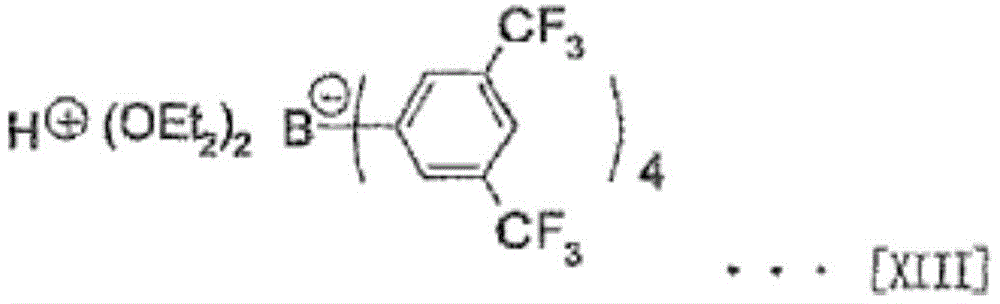
(式[XIII]中,Et表示乙基。)(In formula [XIII], Et represents an ethyl group.)
[化11][Chemical 11]

(式[XIV]中,Et表示乙基。)(In formula [XIV], Et represents an ethyl group.)
作为硼烷化合物,具体而言,可以举出例如癸硼烷;双〔三(正丁基)铵〕壬硼酸盐、双〔三(正丁基)铵〕癸硼酸盐、双〔三(正丁基)铵〕十一硼酸盐、双〔三(正丁基)铵〕十二硼酸盐、双〔三(正丁基)铵〕十氯癸硼酸盐、双〔三(正丁基)铵〕十二氯十二硼酸盐等阴离子的盐;三(正丁基)铵双(十二氢十二硼酸盐)钴酸盐(III)、双〔三(正丁基)铵〕双(十二氢十二硼酸盐)镍酸盐(III)等金属硼烷阴离子的盐等。Specific examples of the borane compound include decaborane; bis[tri(n-butyl)ammonium]nonaneborate, bis[tri(n-butyl)ammonium]decaborate, bis[tri(n-butyl)ammonium]decaborate (n-butyl)ammonium]undecaborate, bis[tri(n-butyl)ammonium]dodecaborate, bis[tri(n-butyl)ammonium]decachlorodecaborate, bis[tri(n-butyl)ammonium]decaborate n-Butyl) ammonium] salts of anions such as dodecachlorododecaborate; salts of metal borane anions such as bis(dodecahydrododecaborate) nickelate (III) and the like.
作为碳硼烷化合物,具体而言,可以举出例如4-碳代壬硼烷、1,3-二碳代壬硼烷、6,9-二碳代癸硼烷、十二氢-1-苯基-1,3-二碳代壬硼烷、十二氢-1-甲基-1,3-二碳代壬硼烷、十一氢-1,3-二甲基-1,3-二碳代壬硼烷、7,8-二碳代十一硼烷、2,7-二碳代十一硼烷、十一氢-7,8-二甲基-7,8-二碳代十一硼烷、十二氢-11-甲基-2,7-二碳代十一硼烷、三(正丁基)铵1-碳代癸硼酸盐、三(正丁基)铵-1-碳代十一硼酸盐、三(正丁基)铵-1-碳代十二硼酸盐、三(正丁基)铵-1-三甲基甲硅烷基-1-碳代癸硼酸盐、三(正丁基)铵溴-1-碳代十二硼酸盐、三(正丁基)铵-6-碳代癸硼酸盐、三(正丁基)铵-7-碳代十一硼酸盐、三(正丁基)铵-7,8-二碳代十一硼酸盐、三(正丁基)铵-2,9-二碳代十一硼酸盐、三(正丁基)铵十二氢-8-甲基-7,9-二碳代十一硼酸盐、三(正丁基)铵十一氢-8-乙基-7,9-二碳代十一硼酸盐、三(正丁基)铵十一氢-8-丁基-7,9-二碳代十一硼酸盐、三(正丁基)铵十一氢-8-烯丙基-7,9-二碳代十一硼酸盐、三(正丁基)铵十一氢-9-三甲基甲硅烷基-7,8-二碳代十一硼酸盐、三(正丁基)铵十一氢-4,6-二溴-7-碳代十一硼酸盐等阴离子的盐;三(正丁基)铵双(九氢-1,3-二碳代壬硼酸盐)钴酸盐(III)、三(正丁基)铵双(十一氢-7,8-二碳代十一硼酸盐)铁酸盐(III)、三(正丁基)铵双(十一氢-7,8-二碳代十一硼酸盐)钴酸盐(III)、三(正丁基)铵双(十一氢-7,8-二碳代十一硼酸盐)镍酸盐(III)、三(正丁基)铵双(十一氢-7,8-二碳代十一硼酸盐)铜酸盐(III)、三(正丁基)铵双(十一氢-7,8-二碳代十一硼酸盐)金酸盐(III)、三(正丁基)铵双(九氢-7,8-二甲基-7,8-二碳代十一硼酸盐)铁酸盐(III)、三(正丁基)铵双(九氢-7,8-二甲基-7,8-二碳代十一硼酸盐)铬酸盐(III)、三(正丁基)铵双(三溴八氢-7,8-二碳代十一硼酸盐)钴酸盐(III)、三〔三(正丁基)铵〕双(十一氢-7-碳代十一硼酸盐)铬酸盐(III)、双〔三(正丁基)铵〕双(十一氢-7-碳代十一硼酸盐)锰酸盐(IV)、双〔三(正丁基)铵〕双(十一氢-7-碳代十一硼酸盐)钴酸盐(III)、双〔三(正丁基)铵〕双(十一氢-7-碳代十一硼酸盐)镍酸盐(IV)等金属碳硼烷阴离子的盐等。Specific examples of the carborane compound include 4-carbononaborane, 1,3-dicarbononaborane, 6,9-dicarboborane, and dodecahydro-1- Phenyl-1,3-dicarbononaborane, dodecahydro-1-methyl-1,3-dicarbononaborane, undecahydro-1,3-dimethyl-1,3- Dicarbononaborane, 7,8-Dicarboundecaborane, 2,7-Dicarboundecaborane, Undecahydro-7,8-dimethyl-7,8-dicarboborane Undecaborane, dodecahydro-11-methyl-2,7-dicarboundecaborane, tri(n-butyl)ammonium 1-carbodecaborate, tris(n-butyl)ammonium- 1-Carboundecaborate, Tri(n-butyl)ammonium-1-Carbododecaborate, Tris(n-butyl)ammonium-1-trimethylsilyl-1-carbodecane Borate, Tri(n-butyl)ammonium bromo-1-carbodidecaborate, tri(n-butyl)ammonium-6-carbodecaborate, tri(n-butyl)ammonium-7- Carboundecaborate, Tris(n-butyl)ammonium-7,8-dicarbonundedecaborate, Tris(n-butyl)ammonium-2,9-dicarbonundedecaborate, Tri(n-butyl)ammonium dodecahydro-8-methyl-7,9-dicarboundecaborate, tri(n-butyl)ammonium undecahydro-8-ethyl-7,9-di Carboundecaborate, tri(n-butyl)ammonium undecahydro-8-butyl-7,9-dicarboundecaborate, tri(n-butyl)ammonium undecahydro-8- Allyl-7,9-dicarboundecaborate, tri(n-butyl)ammonium undecahydro-9-trimethylsilyl-7,8-dicarboundecaborate, Salts of anions such as tri(n-butyl)ammonium undecahydro-4,6-dibromo-7-carboundecaborate; tri(n-butyl)ammonium bis(nonahydro-1,3-dicarbonate) Denonyl borate) cobaltate (III), tris(n-butyl)ammonium bis(undecahydro-7,8-dicarboundecaborate) ferrite (III), tris(n-butyl) base) ammonium bis(undecahydro-7,8-dicarbonoundecaborate) cobaltate (III), tri(n-butyl)ammonium bis(undecahydro-7,8-dicarbonodecaborate) Monoborate) Nickelate(III), Tris(n-butyl)ammonium Bis(undecahydro-7,8-dicarboundecaborate)cuprate(III), Tris(n-butyl) ) ammonium bis(undecahydro-7,8-dicarboundecaborate) aurate (III), tri(n-butyl)ammonium bis(nonahydro-7,8-dimethyl-7, 8-Dicarboundecaborate) ferrite (III), tri(n-butyl)ammonium bis(nonahydro-7,8-dimethyl-7,8-dicarboundecaborate) ) chromate (III), tris(n-butyl)ammonium bis(tribromoctahydro-7,8-dicarboundecaborate) cobaltate (III), tris[tri(n-butyl) Ammonium] bis(undecahydro-7-carbon undecaborate) chromate (III), bis[tri(n-butyl)ammonium] bis(undecahydro-7-carbon undecaborate) ) manganate (IV), bis[tri(n-butyl)ammonium] bis(undecahydro-7-carboundecaborate) cobaltate (III), bis[tri(n-butyl)ammonium] ] bis(undecahydro-7-carboundecaborate ) salts of metal carborane anions such as nickelate (IV), etc.
杂多化合物包含选自硅、磷、钛、锗、砷和锡中的原子、以及选自钒、铌、钼和钨中的一种或两种以上原子。具体而言,可以使用磷钒酸、锗钒酸、砷钒酸、磷铌酸、锗铌酸、硅钼酸、磷钼酸、钛钼酸、锗钼酸、砷钼酸、锡钼酸、磷钨酸、锗钨酸、锡钨酸、磷钼钒酸、磷钨钒酸、锗钨钒酸、磷钼钨钒酸、锗钼钨钒酸、磷钼钨酸、磷钼铌酸、和这些酸的盐例如与周期表第1族或2族的金属具体为锂、钠、钾、铷、铯、铍、镁、钙、锶、钡等的盐、三苯基乙基盐等有机盐,但不限于此。The heteropoly compound contains atoms selected from silicon, phosphorus, titanium, germanium, arsenic, and tin, and one or more atoms selected from vanadium, niobium, molybdenum, and tungsten. Specifically, phosphovanadic acid, germanium vanadic acid, arsenic vanadic acid, phosphoniobic acid, germanium niobic acid, silicomolybdic acid, phosphomolybdic acid, titanium molybdic acid, germanium molybdic acid, arsenomolybdic acid, tin molybdic acid, Phosphotungstic acid, germanium tungstic acid, tin tungstic acid, phosphomolybdovanadic acid, phosphotungstic vanadic acid, germanium tungstovanadic acid, phosphomolybdotungstic acid, germanium molybdenum tungstovanadic acid, phosphomolybdotungstic acid, phosphomolybdoniobic acid, and The salts of these acids are, for example, salts with metals of Group 1 or Group 2 of the periodic table, specifically lithium, sodium, potassium, rubidium, cesium, beryllium, magnesium, calcium, strontium, barium, etc., and organic salts such as triphenylethyl salts. , but not limited to this.
(b-3)离子化离子性化合物中,优选为上述离子性化合物,其中更优选为三苯基碳
在将上述通式[VII]所表示的过渡金属化合物(a)设为催化剂的情况下,如果并用三异丁基铝等有机金属化合物(b-1)、甲基铝氧烷等有机铝氧化合物(b-2)或三苯基碳
此外,共聚物(1B)或(2B)的制造中所使用的烯烃聚合用催化剂也可以与上述过渡金属化合物(a)和选自由(b-1)有机金属化合物、(b-2)有机铝氧化合物和(b-3)离子化离子性化合物所组成的组中的至少一种化合物(b)一起,根据需要使用载体(c)。In addition, the catalyst for olefin polymerization used in the production of the copolymer (1B) or (2B) may be combined with the transition metal compound (a) and the catalyst selected from the group consisting of (b-1) organometallic compounds, (b-2) organoaluminum The oxygen compound is used together with at least one compound (b) in the group of (b-3) ionized ionic compounds, and a carrier (c) is used if necessary.
〈(c)载体〉<(c) Carrier>
上述载体(c)是无机化合物或有机化合物,是颗粒状或微粒状的固体。The above-mentioned carrier (c) is an inorganic compound or an organic compound, and is a granular or particulate solid.
上述无机化合物中,优选为多孔质氧化物、无机卤化物、粘土、粘土矿物或离子交换性层状化合物。Among the above-mentioned inorganic compounds, porous oxides, inorganic halides, clays, clay minerals or ion-exchangeable layered compounds are preferable.
作为多孔质氧化物,可以举出以SiO2、Al2O3、MgO、ZrO、TiO2、B2O3、CaO、ZnO、BaO、ThO2等无机氧化物或包含这些无机氧化物的复合物或混合物为主成分的多孔质材,作为多孔质氧化物,具体而言,可以举出天然或合成沸石;以SiO2-MgO、SiO2-Al2O3、SiO2-TiO2、SiO2-V2O5、SiO2-Cr2O3、SiO2-TiO2-MgO等为主成分的多孔质氧化物。其中,优选为以SiO2和/或Al2O3为主成分的多孔质氧化物。这样的多孔质氧化物根据种类以及制法而其性状不同,本发明中优选使用的载体期望粒径为10~300μm,优选为20~200μm,比表面积通常处于50~1000m2/g、优选处于100~700m2/g的范围,细孔容积处于0.3~3.0cm3/g的范围。这样的载体根据需要在100~1000℃、优选在150~700℃烧成后使用。Examples of the porous oxide include inorganic oxides such as SiO 2 , Al 2 O 3 , MgO, ZrO, TiO 2 , B 2 O 3 , CaO, ZnO, BaO, and ThO 2 , or composites containing these inorganic oxides. A porous material whose main component is a compound or a mixture. As the porous oxide, specifically, natural or synthetic zeolite can be mentioned; SiO 2 -MgO, SiO 2 -Al 2 O 3 , SiO 2 -TiO 2 , SiO Porous oxides mainly composed of 2 -V 2 O 5 , SiO 2 -Cr 2 O 3 , SiO 2 -TiO 2 -MgO, and the like. Among them, a porous oxide mainly composed of SiO 2 and/or Al 2 O 3 is preferable. Such porous oxides have different properties depending on the type and production method. The desired particle size of the carrier preferably used in the present invention is 10 to 300 μm, preferably 20 to 200 μm, and the specific surface area is usually 50 to 1000 m 2 /g, preferably 50 to 1000 m 2 /g. In the range of 100 to 700 m 2 /g, the pore volume is in the range of 0.3 to 3.0 cm 3 /g. Such a carrier is used after being fired at 100 to 1000°C, preferably at 150 to 700°C, if necessary.
作为无机卤化物,可以举出MgCl2、MgBr2、MnCl2、MnBr2等。无机卤化物可以直接使用,也可以利用球磨机、振动磨机粉碎后使用。此外,也可以使用使无机卤化物溶解于醇等溶剂中后,利用析出剂而析出成微粒状的无机卤化物。Examples of the inorganic halide include MgCl 2 , MgBr 2 , MnCl 2 , MnBr 2 and the like. The inorganic halide may be used as it is, or may be used after being pulverized by a ball mill or a vibration mill. In addition, after dissolving an inorganic halide in a solvent such as alcohol, it is also possible to use an inorganic halide which is precipitated into fine particles by a precipitation agent.
用作上述载体(c)的粘土通常以粘土矿物作为主成分而构成。此外,本发明中所使用的离子交换性层状化合物是具有通过离子键等而构成的面相互以弱的结合力平行地层叠而得的晶体结构的化合物,含有的离子能够交换。大部分的粘土矿物为离子交换性层状化合物。此外,作为这些粘土、粘土矿物、离子交换性层状化合物,不限于天然产的,也可以使用人工合成物。The clay used as the above-mentioned carrier (c) is usually composed of a clay mineral as a main component. In addition, the ion-exchangeable layered compound used in the present invention is a compound having a crystal structure in which planes constituted by ionic bonds or the like are stacked in parallel with each other with weak bonding force, and the ions contained therein can be exchanged. Most clay minerals are ion-exchangeable layered compounds. In addition, as these clays, clay minerals, and ion-exchangeable layered compounds, not only those produced in nature, but also synthetic ones may be used.
此外,作为粘土、粘土矿物或离子交换性层状化合物,可以举出粘土、粘土矿物、以及六方细密填充型、锑型、CdCl2型、CdI2型等具有层状的晶体结构的离子结晶性化合物等。In addition, examples of clays, clay minerals or ion-exchangeable layered compounds include clays, clay minerals, and ionic crystallinity having a layered crystal structure such as hexagonal finely packed, antimony, CdCl 2 type, and CdI 2 type. compounds, etc.
作为粘土和粘土矿物,可以举出高岭土、膨润土、木节土、蛙目粘土、水铝英石、硅铁土、叶蜡石、云母群、蒙脱石群、蛭石、绿泥石群、坡缕石、高岭石、珍珠陶土、迪开石、埃洛石等。Examples of clays and clay minerals include kaolin, bentonite, konjac, frog clay, allophane, ferrosilicon, pyrophyllite, mica group, montmorillonite group, vermiculite, chlorite group, Palygorskite, kaolinite, pearl clay, dicey stone, halloysite, etc.
作为离子交换性层状化合物,可以举出α-Zr(HAsO4)2·H2O、α-Zr(HPO4)2、α-Zr(KPO4)2·3H2O、α-Ti(HPO4)2、α-Ti(HAsO4)2·H2O、α-Sn(HPO4)2·H2O、γ-Zr(HPO4)2、γ-Ti(HPO4)2、γ-Ti(NH4PO4)2·H2O等多价金属的结晶性酸性盐等。Examples of the ion-exchangeable layered compound include α-Zr(HAsO 4 ) 2 ·H 2 O, α-Zr(HPO 4 ) 2 , α-Zr(KPO 4 ) 2 ·3H 2 O, α-Ti( HPO 4 ) 2 , α-Ti(HAsO 4 ) 2 ·H 2 O, α-Sn(HPO 4 ) 2 ·H 2 O, γ-Zr(HPO 4 ) 2 , γ-Ti(HPO 4 ) 2 , γ -Crystalline acid salts of polyvalent metals such as Ti(NH 4 PO 4 ) 2 ·H 2 O, etc.
这样的粘土、粘土矿物或离子交换性层状化合物优选为通过水银压入法测定的半径

在将半径
也优选对用作上述载体(c)的粘土、粘土矿物实施化学处理。作为化学处理,将附着于表面的杂质除去的表面处理、对粘土的晶体结构产生影响的处理等均可以使用。作为化学处理,具体而言,可以举出酸处理、碱处理、盐类处理、有机物处理等。酸处理除了除去表面的杂质以外,通过使晶体结构中的Al、Fe、Mg等阳离子溶出而使表面积增大。碱处理中,粘土的晶体结构被破坏,导致粘土结构的变化。此外,盐类处理、有机物处理中,形成离子复合体、分子复合体、有机衍生物等,可以改变表面积、层间距离。It is also preferable to chemically treat the clay and clay minerals used as the above-mentioned carrier (c). As the chemical treatment, any of a surface treatment for removing impurities adhering to the surface, a treatment for affecting the crystal structure of clay, and the like can be used. Specific examples of the chemical treatment include acid treatment, alkali treatment, salt treatment, organic matter treatment, and the like. In addition to removing impurities on the surface, acid treatment increases the surface area by elution of cations such as Al, Fe, and Mg in the crystal structure. In the alkali treatment, the crystal structure of the clay is destroyed, resulting in a change in the clay structure. In addition, in salt treatment and organic matter treatment, ionic complexes, molecular complexes, organic derivatives, etc. are formed, and the surface area and interlayer distance can be changed.
用作上述载体(c)的离子交换性层状化合物可以是通过利用离子交换性,将层间的交换性离子与其他大的蓬松离子交换,从而层间扩大的状态的层状化合物。这样的蓬松离子担负支撑层状结构的支柱性的作用,通常,被称为立柱。此外,将这样在层状化合物的层间导入其他物质称为插层。作为插层的客体化合物,可以举出TiCl4、ZrCl4等阳离子性无机化合物;Ti(OR)4、Zr(OR)4、PO(OR)3、B(OR)3等金属醇盐(R为烃基等);[Al13O4(OH)24]7+、[Zr4(OH)14]2+、[Fe3O(OCOCH3)6]+等金属氢氧化物离子等。这些化合物可以单独使用一种,也可以将两种以上组合使用。此外,在将这些化合物插层时,也可以使Si(OR)4、Al(OR)3、Ge(OR)4等金属醇盐(R为烃基等)等水解而得的聚合物、SiO2等胶体状无机化合物等共存。此外,作为立柱,可以举出在将上述金属氢氧化物离子插层至层间后加热脱水而生成的氧化物等。The ion-exchangeable layered compound used as the above-mentioned carrier (c) may be a layered compound in a state in which the interlayers are expanded by exchanging the exchangeable ions between the layers with other large bulky ions by utilizing the ion-exchangeability. Such fluffy ions play the role of pillars supporting the layered structure, and are generally referred to as pillars. In addition, the introduction of other substances between the layers of the layered compound in this way is called intercalation. Examples of intercalated guest compounds include cationic inorganic compounds such as TiCl 4 and ZrCl 4 ; metal alkoxides (R) such as Ti(OR) 4 , Zr(OR) 4 , PO(OR) 3 , and B(OR) 3 . [Al 13 O 4 (OH) 24 ] 7+ , [Zr 4 (OH) 14 ] 2+ , [Fe 3 O(OCOCH 3 ) 6 ] + and other metal hydroxide ions, etc. These compounds may be used alone or in combination of two or more. In addition, when these compounds are intercalated, polymers obtained by hydrolyzing metal alkoxides (R is a hydrocarbon group, etc.), such as Si(OR) 4 , Al(OR) 3 , Ge(OR) 4 , etc., and SiO 2 may also be used. Coexistence of colloidal inorganic compounds, etc. Moreover, the oxide etc. which generate|occur|produce after heating and dehydration after intercalation of the said metal hydroxide ion as a pillar are mentioned.
上述粘土、粘土矿物、离子交换性层状化合物可以直接使用,此外可以在进行了球磨机、筛分等的处理后使用。此外,也可以重新使水添加吸附后或加热脱水处理后使用。成为这些载体(c)的物质可以单独使用一种,也可以将两种以上组合使用。The above-mentioned clays, clay minerals, and ion-exchangeable layered compounds can be used as they are, or they can be used after being subjected to a ball mill, sieving, or the like. In addition, it can also be used after adding and adsorbing water again or after heating and dehydration treatment. The substance used as these carrier (c) may be used individually by 1 type, and may be used in combination of 2 or more types.
其中,优选的是粘土或粘土矿物,特别优选的是蒙脱石、蛭石、锂蒙脱石、带云母和合成云母。Of these, clays or clay minerals are preferable, and montmorillonite, vermiculite, hectorite, band mica, and synthetic mica are particularly preferable.
作为有机化合物,可以举出粒径处于10~300μm的范围的颗粒状或微粒状固体。具体而言,可以举出以乙烯、丙烯、1-丁烯、4-甲基-1-戊烯等碳原子数为2~14的α-烯烃作为主成分而生成的(共)聚合物;以乙烯基环己烷、苯乙烯为主成分而生成的(共)聚合物;和它们的改性体。Examples of the organic compound include particulate or particulate solids having a particle diameter in the range of 10 to 300 μm. Specifically, (co)polymers produced by using α-olefins having 2 to 14 carbon atoms, such as ethylene, propylene, 1-butene, and 4-methyl-1-pentene, as main components; (co)polymers with vinylcyclohexane and styrene as main components; and their modifications.
上述共聚物(1B)和(2B)的制造中所使用的烯烃聚合用催化剂也可以包含交联金属茂化合物(a)、选自由(b-1)有机金属化合物、(b-2)有机铝氧化合物和(b-3)离子化离子性化合物所组成的组中的至少一种化合物(b)、和根据需要使用的载体(c)。The catalyst for olefin polymerization used in the production of the above-mentioned copolymers (1B) and (2B) may contain a crosslinked metallocene compound (a), a compound selected from the group consisting of (b-1) organometallic compounds, and (b-2) organoaluminum At least one compound (b) selected from the group consisting of an oxygen compound and (b-3) an ionized ionic compound, and a carrier (c) used as needed.
〈在乙烯-α-烯烃-非共轭多烯共聚物用催化剂的存在下将单体类聚合的方法〉<Method for polymerizing monomers in presence of catalyst for ethylene-α-olefin-non-conjugated polyene copolymer>
在使乙烯、α-烯烃和非共轭多烯共聚时,构成聚合催化剂的各成分的使用方法、添加顺序可以任意选择,可以例示以下那样的方法。When copolymerizing ethylene, an α-olefin, and a non-conjugated polyene, the method of use and the order of addition of each component constituting the polymerization catalyst can be arbitrarily selected, and the following methods can be exemplified.
(1)将上述化合物(a)单独添加到聚合器中的方法。(1) A method of adding the above-mentioned compound (a) alone to a polymerizer.
(2)将上述化合物(a)和上述化合物(b)以任意的顺序添加到聚合器中的方法。(2) A method of adding the above-mentioned compound (a) and the above-mentioned compound (b) to a polymerizer in an arbitrary order.
(3)将在上述载体(c)上担载有上述化合物(a)的催化剂成分、上述化合物(b)以任意的顺序添加到聚合器中的方法。(3) A method in which the catalyst component in which the compound (a) is supported on the carrier (c) and the compound (b) are added to a polymerizer in an arbitrary order.
(4)将在上述载体(c)上担载有上述化合物(b)的催化剂成分、上述化合物(a)以任意的顺序添加到聚合器中的方法。(4) A method in which the catalyst component in which the compound (b) is supported on the carrier (c) and the compound (a) are added to a polymerizer in an arbitrary order.
(5)将在上述载体(c)上担载有上述化合物(a)和上述化合物(b)的催化剂成分添加到聚合器中的方法。(5) A method of adding a catalyst component in which the above-mentioned compound (a) and the above-mentioned compound (b) are supported on the above-mentioned carrier (c) into a polymerizer.
在上述(2)~(5)的各方法中,化合物(a)、化合物(b)、载体(c)中的至少2个可以预先接触。In each of the methods (2) to (5) above, at least two of the compound (a), the compound (b), and the carrier (c) may be contacted in advance.
在担载了化合物(b)的上述(4)、(5)的各方法中,根据需要可以将未被担载的化合物(b)以任意的顺序添加。在该情况下,化合物(b)与担载于载体(c)的化合物(b)可以相同也可以不同。In each method of the above (4) and (5) in which the compound (b) is supported, the compound (b) which is not supported may be added in an arbitrary order as necessary. In this case, the compound (b) and the compound (b) supported on the carrier (c) may be the same or different.
此外,关于上述的在载体(c)上担载有化合物(a)的固体催化剂成分、在载体(c)上担载有化合物(a)和化合物(b)的固体催化剂成分,烯烃可以被预聚合,也可以在预聚合后的固体催化剂成分上进一步担载催化剂成分。In addition, with regard to the above-mentioned solid catalyst component in which the compound (a) is supported on the carrier (c), and the solid catalyst component in which the compound (a) and the compound (b) are supported on the carrier (c), olefins may be pre-prepared. During the polymerization, the catalyst component may be further supported on the prepolymerized solid catalyst component.
乙烯-α-烯烃-非共轭多烯共聚物(1B)或(2B)可以通过在上述那样的乙烯-α-烯烃-非共轭多烯共聚物用催化剂的存在下,将乙烯、α-烯烃和非共轭多烯共聚而制造。The ethylene-α-olefin-non-conjugated polyene copolymer (1B) or (2B) can be obtained by mixing ethylene, α- Manufactured by copolymerizing olefins and non-conjugated polyenes.
上述共聚物(1B)或(2B)的制造也可以利用溶液(溶解)聚合、悬浮聚合等液相聚合法或气相聚合法中的任一方法。For the production of the above-mentioned copolymer (1B) or (2B), any of a liquid phase polymerization method or a gas phase polymerization method such as solution (dissolution) polymerization and suspension polymerization can be used.
作为液相聚合法中所使用的非活性烃介质,可以举出丙烷、丁烷、戊烷、己烷、庚烷、辛烷、癸烷、十二烷、煤油等脂肪族烃;环戊烷、环己烷、甲基环戊烷等脂环族烃;苯、甲苯、二甲苯等芳香族烃;氯化乙烯、氯苯、二氯甲烷等卤代烃等。上述非活性烃介质可以单独使用一种,也可以将两种以上组合使用。此外,也可以将烯烃本身作为溶剂使用。Examples of the inert hydrocarbon medium used in the liquid phase polymerization method include aliphatic hydrocarbons such as propane, butane, pentane, hexane, heptane, octane, decane, dodecane, and kerosene; cyclopentane , cyclohexane, methylcyclopentane and other alicyclic hydrocarbons; benzene, toluene, xylene and other aromatic hydrocarbons; chlorinated ethylene, chlorobenzene, methylene chloride and other halogenated hydrocarbons, etc. The above-mentioned inactive hydrocarbon medium may be used alone or in combination of two or more. In addition, the olefin itself can also be used as a solvent.
在使用上述那样的共聚物用催化剂进行乙烯等的聚合时,交联金属茂化合物(a)以反应容积每1升,通常成为10-12~10-2摩尔,优选成为10-10~10-8摩尔那样的量使用。When polymerizing ethylene or the like using the above-mentioned catalyst for copolymers, the amount of the crosslinked metallocene compound (a) is usually 10 -12 to 10 -2 mol, preferably 10 -10 to 10 - mol per liter of reaction volume. It is used in such an amount as 8 moles.
有机金属化合物(b-1)以该化合物(b-1)与交联金属茂化合物(a)中的全部过渡金属原子(M)的摩尔比〔(b-1)/M〕通常成为0.01~50000、优选成为0.05~10000那样的量使用。有机铝氧化合物(b-2)以该化合物(b-2)中的铝原子与化合物(a)中的全部过渡金属原子(M)的摩尔比〔(b-2)/M〕通常成为10~50000、优选成为20~10000那样的量使用。离子化离子性化合物(b-3)以化合物(b-3)与化合物(a)中的过渡金属原子(M)的摩尔比〔(b-3)/M〕通常成为1~20、优选成为1~15那样的量使用。The molar ratio [(b-1)/M] of the organometallic compound (b-1) to all transition metal atoms (M) in the crosslinked metallocene compound (a) is usually 0.01 to 0.01 to 50,000, preferably in an amount of 0.05 to 10,000. In the organoaluminum oxy compound (b-2), the molar ratio [(b-2)/M] of the aluminum atom in the compound (b-2) to all transition metal atoms (M) in the compound (a) is usually 10 To 50,000, preferably in an amount of 20 to 10,000. The molar ratio of the ionized ionic compound (b-3) to the transition metal atom (M) in the compound (a) [(b-3)/M] is usually 1 to 20, preferably 1 to 20. Use as much as 1 to 15.
上述共聚物(1B)或(2B)的聚合温度通常为-50~+200℃的范围,优选为0~+200℃的范围,更优选为+80~+200℃的范围。虽然与目标的到达分子量、所使用的催化剂的聚合活性有关,但从生产率的观点考虑,聚合温度期望为更高温(+80℃以上)。The polymerization temperature of the said copolymer (1B) or (2B) is the range of -50-+200 degreeC normally, Preferably it is the range of 0-+200 degreeC, More preferably, it is the range of +80-+200 degreeC. The polymerization temperature is desirably higher (+80°C or higher) from the viewpoint of productivity, although it is related to the target molecular weight and the polymerization activity of the catalyst used.
上述共聚物(1B)或(2B)的聚合压力通常为常压~10MPa表压,优选为常压~5MPa表压的范围。此外,上述共聚物(1B)或(2B)的聚合反应形式可以为间歇式、半连续式、连续式中的任一方式。进一步也可以使聚合分成反应条件不同的2个阶段以上进行。The polymerization pressure of the said copolymer (1B) or (2B) is normal pressure - 10 MPa gauge pressure normally, Preferably it is the range of normal pressure - 5 MPa gauge pressure. In addition, the polymerization reaction form of the above-mentioned copolymer (1B) or (2B) may be any of a batch type, a semi-continuous type, and a continuous type. Furthermore, the polymerization may be carried out in two or more stages with different reaction conditions.
所得的共聚物(1B)或(2B)的分子量例如可以通过使聚合体系内存在氢、或使聚合温度变化来调整。在通过使氢存在于聚合体系内而调整分子量的情况下,关于氢的添加量,烯烃每1kg,0.001~100NL程度是适当的。此外,在将化合物(b)(例如,三异丁基铝、甲基铝氧烷、二乙基锌等)用作催化剂成分的情况下,共聚物的分子量可以通过化合物(b)的使用量来调节。The molecular weight of the obtained copolymer (1B) or (2B) can be adjusted, for example, by allowing hydrogen to exist in the polymerization system or by changing the polymerization temperature. When the molecular weight is adjusted by allowing hydrogen to exist in the polymerization system, the amount of hydrogen added is appropriately about 0.001 to 100 NL per 1 kg of olefin. In addition, in the case where compound (b) (for example, triisobutylaluminum, methylaluminoxane, diethylzinc, etc.) is used as a catalyst component, the molecular weight of the copolymer can be determined by the amount of compound (b) used to adjust.
<酚醛树脂系交联剂(C)><Phenolic resin-based crosslinking agent (C)>
作为酚醛树脂系交联剂(C)(本发明中也称为交联剂(C)),可以举出卤代酚醛树脂系交联剂。Examples of the phenolic resin-based crosslinking agent (C) (also referred to as a crosslinking agent (C) in the present invention) include halogenated phenolic resin-based crosslinking agents.
作为交联剂(C),优选为可溶性酚醛树脂,且通过烷基取代酚或非取代酚在碱介质中被醛缩合优选被甲醛缩合、或二官能性酚二醇类的缩合而制造。烷基取代酚优选为1~10个碳原子的烷基取代体。进一步,优选为对位被具有1~10个碳原子的烷基取代的二羟甲基苯酚类或酚醛树脂。酚醛树脂系固化树脂典型地为热交联性树脂,也称为酚醛树脂系交联剂或酚醛树脂。The crosslinking agent (C) is preferably a resol resin, and is produced by aldehyde condensation of an alkyl-substituted phenol or a non-substituted phenol, preferably formaldehyde condensation, or condensation of bifunctional phenolic diols in an alkaline medium. The alkyl-substituted phenol is preferably an alkyl-substituted product of 1 to 10 carbon atoms. Further, the para-position is preferably a dimethylol phenol or phenol resin substituted with an alkyl group having 1 to 10 carbon atoms. The phenolic resin-based cured resin is typically a thermally crosslinkable resin, and is also referred to as a phenolic resin-based crosslinking agent or a phenolic resin.
作为酚醛树脂系固化树脂(酚醛树脂系交联剂)的例子,可以举出下述通式(I)。The following general formula (I) is mentioned as an example of a phenolic resin type curable resin (phenolic resin type crosslinking agent).
[化12][Chemical 12]

(式中,Q为选自由-CH2-和-CH2-O-CH2-所组成的组中的二价基团,m为0或1~20的正整数,R’为有机基团)。(in the formula, Q is a divalent group selected from the group consisting of -CH 2 - and -CH 2 -O-CH 2 -, m is 0 or a positive integer from 1 to 20, and R' is an organic group ).
优选的是,Q为二价基团-CH2-O-CH2-,m为0或1~10的正整数,R’为具有小于20个碳原子的有机基团。更优选的是,m为0或1~5的正整数,R’为具有4~12个碳原子的有机基团。具体而言,可以举出烷基酚甲醛树脂、羟甲基化烷基酚醛树脂、卤代烷基酚醛树脂等,优选为卤代烷基酚醛树脂,进一步优选将末端的羟基溴化了的树脂。酚醛树脂系固化树脂中,下述通式(II)示出末端被溴化的树脂的一例。Preferably, Q is a divalent group -CH 2 -O-CH 2 -, m is 0 or a positive integer of 1-10, and R' is an organic group having less than 20 carbon atoms. More preferably, m is 0 or a positive integer of 1-5, and R' is an organic group having 4-12 carbon atoms. Specifically, alkylphenol formaldehyde resins, methylolated alkylphenol resins, haloalkylphenol resins, etc. are exemplified, and halogenated alkylphenol resins are preferable, and resins in which terminal hydroxyl groups are brominated are more preferable. Among the phenolic resin-based cured resins, the following general formula (II) shows an example of a resin whose terminal is brominated.
[化13][Chemical 13]

式中,n为0~10的整数,R为碳原子数1~15的饱和烃基。In the formula, n is an integer of 0 to 10, and R is a saturated hydrocarbon group having 1 to 15 carbon atoms.
作为上述酚醛树脂系固化树脂的制品例,可以举出Tackirol(注册商标)201(烷基酚甲醛树脂、田冈化学工业(株)公司制)、Tackirol(注册商标)250-I(溴化率4%的溴代烷基酚甲醛树脂、田冈化学工业(株)公司制)、Tackirol(注册商标)250-III(溴代烷基酚甲醛树脂、田冈化学工业(株)公司制)、PR-4507(群荣化学工业(株)公司制)、Vulkaresat 510E(Hoechst公司制)、Vulkaresat 532E(Hoechst公司制)、Vulkaresen E(Hoechst公司制)、Vulkaresen 105E(Hoechst公司制)、Vulkaresen 130E(Hoechst公司制)、Vulkaresol 315E(Hoechst公司制)、Amberol ST 137X(Rohm & Haas公司制)、Sumilite Resin(注册商标)PR-22193(住友Durez(株)公司制)、Symphorm-C-100(Anchor Chem.公司制)、Symphorm-C-1001(Anchor Chem.公司制)、Tamanol(注册商标)531(荒川化学(株)公司制)、SchenectadySP1059(Schenectady Chem.公司制)、Schenectady SP1045(SchenectadyChem.公司制)、CRR-0803(U.C.C公司制)、Schenectady SP1055F(Schenectady Chem.公司制、溴代烷基酚-甲醛树脂)、Schenectady SP1056(Schenectady Chem.公司制)、CRM-0803(昭和Union合成(株)公司制)、Vulkadur A(Bayer公司制)。其中,优选为卤代酚醛树脂系交联剂,更优选使用Tackirol(注册商标)250-I、Tackirol(注册商标)250-III、Schenectady SP1055F等溴代烷基酚-甲醛树脂。Examples of products of the above-mentioned phenolic resin-based cured resins include Tackirol (registered trademark) 201 (alkylphenol formaldehyde resin, manufactured by Tagoka Chemical Industry Co., Ltd.), Tackirol (registered trademark) 250-I (bromination rate) 4% bromoalkylphenol formaldehyde resin, manufactured by Tagoka Chemical Industry Co., Ltd.), Tackirol (registered trademark) 250-III (bromoalkylphenol formaldehyde resin, manufactured by Tagoka Chemical Industry Co., Ltd.), PR-4507 (manufactured by Kunyo Chemical Industry Co., Ltd.), Vulkaresat 510E (manufactured by Hoechst Co., Ltd.), Vulkaresat 532E (manufactured by Hoechst Co., Ltd.), Vulkaresen E (manufactured by Hoechst Co., Ltd.), Vulkaresen 105E (manufactured by Hoechst Co., Ltd.), Vulkaresen 130E ( Hoechst Corporation), Vulkaresol 315E (Hoechst Corporation), Amberol ST 137X (Rohm & Haas Corporation), Sumilite Resin (registered trademark) PR-22193 (Sumitomo Durez Corporation), Symphorm-C-100 (Anchor Chem. Co., Ltd.), Symphorm-C-1001 (made by Anchor Chem. Co., Ltd.), Tamanol (registered trademark) 531 (made by Arakawa Chemical Co., Ltd.), Schenectady SP1059 (made by Schenectady Chem. Co., Ltd.), Schenectady SP1045 (Schenectady Chem. Co., Ltd. (manufactured by U.C.C.), CRR-0803 (manufactured by U.C.C.), Schenectady SP1055F (manufactured by Schenectady Chem., bromoalkylphenol-formaldehyde resin), Schenectady SP1056 (manufactured by Schenectady Chem.), CRM-0803 (Showa Union Synthetic Co., Ltd. ) company), Vulkadur A (Bayer company). Among them, halogenated phenolic resin-based crosslinking agents are preferred, and bromoalkylphenol-formaldehyde resins such as Tackirol (registered trademark) 250-I, Tackirol (registered trademark) 250-III, and Schenectady SP1055F are more preferably used.
此外,作为热塑性硫化橡胶的利用酚醛树脂进行交联的具体例,已记载于美国专利第4,311,628号、美国专利第2,972,600号和美国专利第3,287,440号中,这些技术也可以在本发明中使用。Further, specific examples of crosslinking of thermoplastic vulcanizates with phenolic resins are described in US Pat. No. 4,311,628, US Pat. No. 2,972,600, and US Pat. No. 3,287,440, and these techniques can also be used in the present invention.
在美国专利第4,311,628号中,公开了包含酚系固化性树脂(phenolic curingresin)和硫化活性剂(cure activator)的酚系硫化剂体系(phenolic curative system)。该体系的基本成分是通过碱介质中的取代酚(例如,卤素取代酚、C1-C2烷基取代酚)或非取代酚与醛、优选与甲醛的缩合、或通过二官能性酚二醇类(优选为对位被C5-C10烷基取代的二羟甲基苯酚类)的缩合而制造的酚醛树脂系交联剂。通过烷基取代酚醛树脂系交联剂的卤化而制造的卤化的烷基取代酚醛树脂系交联剂特别合适。可以特别推荐包含羟甲基苯酚固化性树脂、卤素供体和金属化合物的酚醛树脂系交联剂,其详细内容记载于美国专利第3,287,440号和美国专利第3,709,840号各说明书中。非卤代酚醛树脂系交联剂与卤素供体同时优选与卤代氢清除剂一起使用。通常,卤代酚醛树脂系交联剂优选含有2~10重量%的溴的溴化酚醛树脂系交联剂不需要卤素供体,但与例如氧化铁、氧化钛、氧化镁、硅酸镁、二氧化硅和氧化锌优选氧化锌那样的金属氧化物一样的卤代氢清除剂同时使用。这些氧化锌等卤代氢清除剂相对于酚醛树脂系交联剂100重量份,通常使用1~20重量份。这样的清除剂的存在促进酚醛树脂系交联剂的交联作用,但在不容易被酚醛树脂系交联剂硫化的橡胶的情况下,期望将卤素供体和氧化锌共用。卤代酚系固化性树脂的制法以及使用氧化锌的硫化剂体系中的这些应用已记载于美国专利第2,972,600号和美国专利第3,093,613号各说明书中,其公开内容与上述美国专利第3,287,440号和美国专利第3,709,840号说明书的公开内容一起作为参考而引入本说明书中。作为适当的卤素供体的例子,例如,可以举出氯化亚锡、氯化铁、或氯化石蜡、氯化聚乙烯、氯磺化聚乙烯和聚氯丁二烯(氯丁橡胶)那样的供卤素性聚合物。本说明书中所使用的“硫化促进剂”这一用语的意思是,使酚醛树脂系交联剂的交联效率实质上增加的一切物质,并且包含金属氧化物和卤素供体,它们可以单独使用或组合使用。关于酚系硫化剂体系的更详细内容,请参照“硫化和硫化剂(Vulcanization and Vulcanizing Agents)”(W.Hoffman,Palmerton PublishingCompany)。适当的酚醛树脂系交联剂和溴化酚醛树脂系交联剂可以商业地获得,例如这样的交联剂可以从Schenectady Chemicals,Inc.以商品名“SP-1045”、“CRJ-352”、“SP-1055F”和“SP-1056”购入。同样作用的等价的酚醛树脂系交联剂还可以由其他提供者获得。In US Pat. No. 4,311,628, a phenolic curative system comprising a phenolic curing resin and a cure activator is disclosed. The essential components of this system are the condensation of substituted phenols (eg, halogen-substituted phenols, C1 - C2 alkyl-substituted phenols) or unsubstituted phenols with aldehydes, preferably formaldehyde, in alkaline media, or by difunctional phenolic di- A phenolic resin-based crosslinking agent produced by condensation of alcohols (preferably dimethylol phenols substituted with a C 5 -C 10 alkyl group at the para position). A halogenated alkyl-substituted phenolic resin-based crosslinking agent produced by halogenation of an alkyl-substituted phenolic resin-based crosslinking agent is particularly suitable. A phenolic resin-based crosslinking agent containing a methylol phenol curable resin, a halogen donor, and a metal compound can be particularly recommended, the details of which are described in each of US Pat. No. 3,287,440 and US Pat. No. 3,709,840. The non-halogenated phenolic resin-based crosslinking agent is preferably used together with the halogenated hydrogen scavenger simultaneously with the halogenated donor. In general, the halogenated phenolic resin-based crosslinking agent preferably contains 2 to 10% by weight of bromine. The brominated phenolic resin-based crosslinking agent does not require a halogen donor, but is compatible with, for example, iron oxide, titanium oxide, magnesium oxide, magnesium silicate, Silica and zinc oxide are preferably used together with a halogenated hydrogen scavenger like a metal oxide such as zinc oxide. These halogenated hydrogen scavengers such as zinc oxide are usually used in 1 to 20 parts by weight based on 100 parts by weight of the phenolic resin-based crosslinking agent. The presence of such a scavenger promotes the crosslinking action of the phenolic resin-based crosslinking agent, but in the case of rubber that is not easily vulcanized by the phenolic resin-based crosslinking agent, it is desirable to use a halogen donor and zinc oxide in common. The production method of halogenated phenol-based curable resins and the application of these in curing agent systems using zinc oxide are described in each specification of US Pat. No. 2,972,600 and US Pat. No. 3,093,613, the disclosures of which are the same as those of the above-mentioned US Pat. No. 3,287,440 The disclosure of US Pat. No. 3,709,840 is incorporated herein by reference. Examples of suitable halogen donors include, for example, stannous chloride, ferric chloride, or chlorinated paraffin, chlorinated polyethylene, chlorosulfonated polyethylene, and polychloroprene (chloroprene rubber). of halogen-donating polymers. The term "vulcanization accelerator" used in this specification means any substance that substantially increases the crosslinking efficiency of a phenolic resin-based crosslinking agent, and includes metal oxides and halogen donors, which may be used alone or used in combination. For more details on the phenolic vulcanizing agent system, please refer to "Vulcanization and Vulcanizing Agents" (W. Hoffman, Palmerton Publishing Company). Suitable phenolic resin based crosslinking agents and brominated phenolic resin based crosslinking agents are commercially available, for example such crosslinking agents are available from Schenectady Chemicals, Inc. under the trade names "SP-1045", "CRJ-352", Purchased "SP-1055F" and "SP-1056". Equivalent phenolic resin-based crosslinking agents with the same function are also available from other suppliers.
交联剂(C)由于分解物的产生少,因此从防止雾化的观点考虑是合适的硫化剂。交联剂(C)以使橡胶实现本质上完全硫化的充分的量来使用。The crosslinking agent (C) is a suitable vulcanizing agent from the viewpoint of preventing fogging because the generation of decomposition products is small. The crosslinking agent (C) is used in an amount sufficient to achieve substantially complete vulcanization of the rubber.
本发明(1)或(2)中,在利用交联剂(C)进行动态交联时,可以配合硫、对醌二肟、p,p’-二苯甲酰醌二肟、N-甲基-N-4-二亚硝基苯胺、亚硝基苯、二苯基胍、三羟甲基丙烷-N,N’-间亚苯基二马来酰亚胺那样的过氧交联助剂、二乙烯基苯、氰脲酸三烯丙酯、乙二醇二甲基丙烯酸酯、二乙二醇二甲基丙烯酸酯、聚乙二醇二甲基丙烯酸酯、三羟甲基丙烷三甲基丙烯酸酯、甲基丙烯酸烯丙酯等多官能性甲基丙烯酸酯单体、丁酸乙烯酯、硬脂酸乙烯酯等多官能性乙烯基单体等助剂。In the present invention (1) or (2), when dynamically crosslinking with the crosslinking agent (C), sulfur, p-quinonedioxime, p,p'-dibenzoylquinonedioxime, N-formaldehyde may be blended. Peroxygen crosslinking aids such as yl-N-4-dinitrosoaniline, nitrosobenzene, diphenylguanidine, trimethylolpropane-N,N'-m-phenylene dimaleimide Agent, Divinylbenzene, Triallyl Cyanurate, Ethylene Glycol Dimethacrylate, Diethylene Glycol Dimethacrylate, Polyethylene Glycol Dimethacrylate, Trimethylolpropane Trimethacrylate Auxiliary agents such as polyfunctional methacrylate monomers such as methacrylate and allyl methacrylate, and polyfunctional vinyl monomers such as vinyl butyrate and vinyl stearate.
通过使用上述助剂,可以期待均匀且稳定的交联反应。作为上述助剂,优选为二乙烯基苯。二乙烯基苯容易操作,与组合物(I)或(IIC)中作为主成分而含有的聚合物(A)、以及共聚物(1B)或共聚物(2B)的相容性良好,并且具有使交联剂(C)可溶化的作用,作为交联剂(C)的分散剂起作用,因此可以获得热处理后的交联效果均质,取得了流动性和物性的平衡的热塑性弹性体组合物(I)或(IIC)。By using the above-mentioned auxiliary agent, a uniform and stable crosslinking reaction can be expected. As said auxiliary agent, divinylbenzene is preferable. Divinylbenzene is easy to handle, has good compatibility with the polymer (A) and the copolymer (1B) or the copolymer (2B) contained as the main component in the composition (I) or (IIC), and has The function of solubilizing the cross-linking agent (C) acts as a dispersant for the cross-linking agent (C), so that the cross-linking effect after heat treatment can be homogeneous, and a thermoplastic elastomer combination with a balance of fluidity and physical properties can be obtained. Substance (I) or (IIC).
上述助剂相对于共聚物(1B)或(2B)100重量份,通常以成为2重量份以下、优选以成为0.3~1重量份的量使用。The above-mentioned auxiliary agent is usually used in an amount of 2 parts by weight or less, preferably 0.3 to 1 part by weight, based on 100 parts by weight of the copolymer (1B) or (2B).
此外,为了促进交联剂(C)的分解,可以使用分解促进剂。作为分解促进剂,可以举出:三乙胺、三丁胺、2,4,6-三(二甲基氨基)苯酚等叔胺;Furthermore, in order to promote the decomposition of the crosslinking agent (C), a decomposition accelerator can be used. Examples of the decomposition accelerator include tertiary amines such as triethylamine, tributylamine, and 2,4,6-tris(dimethylamino)phenol;
铝、钴、钒、铜、钙、锆、锰、镁、铅、汞等、环烷酸与各种金属(例如,Pb、Co、Mn、Ca、Cu、Ni、Fe、Zn、稀土类)的环烷酸盐等。Aluminum, cobalt, vanadium, copper, calcium, zirconium, manganese, magnesium, lead, mercury, etc., naphthenic acid and various metals (eg, Pb, Co, Mn, Ca, Cu, Ni, Fe, Zn, rare earths) naphthenates, etc.
<其他成分><Other ingredients>
本发明的组合物(I)或(IIC)中,除了聚合物(A)、共聚物(1B)或共聚物(2B)、以及交联剂(C)以外,在不损害本发明的效果的范围内,可以配合添加剂。作为添加剂,没有特别限定,可以举出软化剂(D)、无机填充剂(E)等。此外,作为添加剂,可以举出共聚物(1B)或共聚物(2B)以外的橡胶(例如,聚异丁烯、丁基橡胶、丙烯-乙烯共聚物橡胶、丙烯-丁烯共聚物橡胶和丙烯-丁烯-乙烯共聚物橡胶等丙烯系弹性体、乙烯-丙烯共聚物橡胶等乙烯系弹性体、苯乙烯-丁二烯-苯乙烯嵌段聚合物、苯乙烯-异戊二烯-苯乙烯嵌段聚合物、苯乙烯-异丁烯-苯乙烯嵌段聚合物和它们的氢化物等苯乙烯系弹性体);热固性树脂、聚烯烃等热塑性树脂等结晶性烯烃系聚合物(A)以外的树脂;紫外线吸收剂;抗氧化剂;耐热稳定剂;防老剂;耐光稳定剂、耐候稳定剂;抗静电剂;金属皂;脂肪族酰胺;蜡等润滑剂等在聚烯烃领域中使用的公知的添加剂。In the composition (I) or (IIC) of the present invention, in addition to the polymer (A), the copolymer (1B) or the copolymer (2B), and the crosslinking agent (C), the effects of the present invention are not impaired. Within the range, additives can be blended. Although it does not specifically limit as an additive, A softener (D), an inorganic filler (E), etc. are mentioned. In addition, as additives, rubbers other than the copolymer (1B) or the copolymer (2B) (for example, polyisobutylene, butyl rubber, propylene-ethylene copolymer rubber, propylene-butylene copolymer rubber, and propylene-butylene rubber) can be mentioned. Propylene-based elastomers such as ethylene-ethylene copolymer rubber, ethylene-based elastomers such as ethylene-propylene copolymer rubber, styrene-butadiene-styrene block polymer, styrene-isoprene-styrene block styrene-based elastomers such as polymers, styrene-isobutylene-styrene block polymers and their hydrides); thermosetting resins, thermoplastic resins such as polyolefins and other resins other than crystalline olefin-based polymers (A); ultraviolet rays Absorbents; antioxidants; heat-resistant stabilizers; antioxidants; light-resistant stabilizers, weather-resistant stabilizers; antistatic agents; metal soaps; aliphatic amides;
这些添加剂各自可以单独使用一种,也可以将两种以上组合使用。Each of these additives may be used alone or in combination of two or more.
此外,本说明书中特别提及的添加剂以外的添加剂的配合量只要起到本发明的效果就没有特别限定,相对于聚合物(A)和、共聚物(1B)或(2B)的合计100重量份,各自通常为0.0001~10重量份,优选为0.01~5重量份程度。In addition, the compounding quantity of additives other than the additives specifically mentioned in this specification is not particularly limited as long as the effect of the present invention is achieved, and is based on 100 weight of the total of the polymer (A) and the copolymer (1B) or (2B). parts, each is usually 0.0001 to 10 parts by weight, preferably about 0.01 to 5 parts by weight.
作为软化剂(D),可以使用通常在橡胶中使用的软化剂。作为软化剂(D),可以举出工艺油、润滑油、石蜡油、液体石蜡、石油沥青、凡士林等石油系软化剂;煤焦油、煤焦油沥青等煤焦油系软化剂;蓖麻油、亚麻籽油、菜籽油、大豆油、椰子油等脂肪油系软化剂;妥尔油;代替品(油膏);蜜蜡、巴西棕榈蜡、羊毛脂等蜡类;蓖麻油酸、棕榈酸、硬脂酸、硬脂酸钡、硬脂酸钙、月桂酸锌等脂肪酸或脂肪酸盐;环烷酸;松油、松香或其衍生物;萜烯树脂、石油树脂、无规立构聚丙烯、苯并呋喃茚树脂等合成高分子物质;邻苯二甲酸二辛酯、己二酸二辛酯、癸二酸二辛酯等酯系软化剂;微晶蜡、液态聚丁二烯、改性液态聚丁二烯、液态聚硫橡胶、烃系合成润滑油等。As the softener (D), those generally used in rubber can be used. Examples of the softener (D) include petroleum-based softeners such as process oil, lubricating oil, paraffin oil, liquid paraffin, petroleum pitch, and petrolatum; coal tar-based softeners such as coal tar and coal tar pitch; castor oil, linseed Oil, rapeseed oil, soybean oil, coconut oil and other fatty oil-based softeners; tall oil; substitutes (ointments); waxes such as beeswax, carnauba wax, lanolin, etc.; ricinoleic acid, palmitic acid, hard oil fatty acid, barium stearate, calcium stearate, zinc laurate and other fatty acids or fatty acid salts; naphthenic acid; pine oil, rosin or its derivatives; terpene resin, petroleum resin, atactic polypropylene, Synthetic macromolecular substances such as benzofuran indene resin; ester softeners such as dioctyl phthalate, dioctyl adipate, dioctyl sebacate; microcrystalline wax, liquid polybutadiene, modified Liquid polybutadiene, liquid polysulfide rubber, hydrocarbon-based synthetic lubricating oil, etc.
这些软化剂(D)只要起到本发明的效果就没有特别限定,相对于聚合物(A)和、共聚物(1B)或(2B)的合计量100重量份,通常以2~100重量份、优选以5~80重量份的量使用。如果以这样的量使用软化剂(D),则组合物(I)或(IIC)在制作时以及成型时的流动性优异,使炭黑等的分散性提高,不易使所得的成型体的机械物性降低,此外,所得的成型体的耐热性、耐热老化性优异。These softeners (D) are not particularly limited as long as they exhibit the effects of the present invention, and are usually 2 to 100 parts by weight relative to 100 parts by weight of the total amount of the polymer (A) and the copolymer (1B) or (2B). , It is preferably used in an amount of 5 to 80 parts by weight. When the softening agent (D) is used in such an amount, the composition (I) or (IIC) has excellent fluidity during production and molding, improves the dispersibility of carbon black and the like, and does not easily degrade the mechanical properties of the resulting molded body. The physical properties decreased, and the obtained molded body was excellent in heat resistance and heat aging resistance.
作为无机填充剂(E),可以举出碳酸钙、硅酸钙、粘土、高岭土、滑石、二氧化硅、硅藻土、云母粉、石棉、氧化铝、硫酸钡、硫酸铝、硫酸钙、碱式碳酸镁、二硫化钼、石墨、炭黑、玻璃纤维、玻璃球、含硅球(silas balloons)、碱式硫酸镁晶须、钛酸钙晶须、硼酸铝晶须等。Examples of the inorganic filler (E) include calcium carbonate, calcium silicate, clay, kaolin, talc, silica, diatomaceous earth, mica powder, asbestos, alumina, barium sulfate, aluminum sulfate, calcium sulfate, alkali Formula magnesium carbonate, molybdenum disulfide, graphite, carbon black, glass fiber, glass balls, silicon-containing balls (silas balloons), basic magnesium sulfate whiskers, calcium titanate whiskers, aluminum borate whiskers, etc.
这些无机填充剂(E)相对于聚合物(A)和、共聚物(1B)或(2B)的合计量100重量份,通常以1~100重量份、优选以1~50重量份的量使用。These inorganic fillers (E) are usually used in an amount of 1 to 100 parts by weight, preferably 1 to 50 parts by weight with respect to 100 parts by weight of the total amount of the polymer (A) and the copolymer (1B) or (2B). .
作为防老剂,可以参照后述的组合物(2B)的例示。As an antioxidant, the example of the composition (2B) mentioned later can be referred.
在使用共聚物(1B)或(2B)以外的橡胶的情况下,该橡胶相对于聚合物(A)和、共聚物(1B)或(2B)的合计量100重量份,通常以2~200重量份、优选以5~150重量份的量使用。In the case of using a rubber other than the copolymer (1B) or (2B), the rubber is usually 2 to 200 parts by weight relative to the total amount of the polymer (A) and the copolymer (1B) or (2B) 100 parts by weight. It is preferably used in an amount of 5 to 150 parts by weight.
[本发明(1)或(2)中的组合物、它们的制造方法及成型体][The composition in the present invention (1) or (2), the method for producing the same, and the molded body]
〔热塑性弹性体组合物(I)或热塑性弹性体组合物(IIC)〕[Thermoplastic Elastomer Composition (I) or Thermoplastic Elastomer Composition (IIC)]
本发明(1)的热塑性弹性体组合物(I)可通过将包含聚合物(A)、共聚物(1B)和交联剂(C)的混合物动态交联而获得。组合物(I)是至少聚合物(A)、共聚物(1B)和交联剂(C)被动态交联而成的。The thermoplastic elastomer composition (I) of the present invention (1) can be obtained by dynamically crosslinking a mixture comprising the polymer (A), the copolymer (1B) and the crosslinking agent (C). The composition (I) is obtained by dynamically crosslinking at least the polymer (A), the copolymer (1B) and the crosslinking agent (C).
组合物(I)可通过将包含聚合物(A)、共聚物(1B)、根据需要配合的添加剂的混合物在交联剂(C)的存在下进行动态热处理并交联(动态交联)而获得。The composition (I) can be obtained by dynamically heat-treating and crosslinking a mixture containing a polymer (A), a copolymer (1B), and an additive compounded as necessary in the presence of a crosslinking agent (C) (dynamic crosslinking). get.
通过将聚合物(A)和共聚物(1B)利用交联剂(C)进行动态交联,首次获得轻量且高强度,具有优异的耐油性,进一步机械物性也优异的组合物(I)。By dynamically crosslinking the polymer (A) and the copolymer (1B) with the crosslinking agent (C), a composition (I) that is lightweight and high strength, has excellent oil resistance, and is also excellent in mechanical properties is obtained for the first time .
本发明(2)的热塑性弹性体组合物(IIC)可通过将包含聚合物(A)、共聚物(2B)和交联剂(C)的混合物动态交联而获得。组合物(IIC)是至少聚合物(A)、共聚物(2B)和交联剂(C)被动态交联而成的。The thermoplastic elastomer composition (IIC) of the present invention (2) can be obtained by dynamically crosslinking a mixture comprising the polymer (A), the copolymer (2B) and the crosslinking agent (C). The composition (IIC) is obtained by dynamically crosslinking at least the polymer (A), the copolymer (2B) and the crosslinking agent (C).
组合物(IIC)可通过将包含聚合物(A)、共聚物(2B)、根据需要配合的添加剂的混合物在交联剂(C)的存在下进行动态热处理并交联(动态交联)而获得。The composition (IIC) can be obtained by dynamically heat-treating a mixture containing the polymer (A), the copolymer (2B), and an additive compounded as necessary in the presence of the crosslinking agent (C) and crosslinking (dynamic crosslinking). get.
通过将聚合物(A)和共聚物(2B)利用交联剂(C)进行动态交联,首次获得轻量且高强度,具有优异的耐油性,进一步机械物性也优异的组合物(IIC)。By dynamically crosslinking the polymer (A) and the copolymer (2B) with the crosslinking agent (C), a composition (IIC) with light weight and high strength, excellent oil resistance, and further excellent mechanical properties is obtained for the first time .
本发明中,“动态热处理”是指,在交联剂(C)的存在下,将上述混合物以熔融状态混炼。此外,“动态交联”是指,一边对混合物施加剪切力一边进行交联。In the present invention, "dynamic heat treatment" means kneading the above-mentioned mixture in a molten state in the presence of a crosslinking agent (C). In addition, "dynamic crosslinking" means crosslinking while applying shear force to the mixture.
组合物(I)或(IIC)可以是包含聚合物(A)和、共聚物(1B)或(2B)的聚合物成分部分交联的组合物,也可以是完全交联的组合物。Composition (I) or (IIC) may be a partially crosslinked composition comprising polymer (A) and the polymer component of copolymer (1B) or (2B), or a fully crosslinked composition.
组合物(I)或(IIC)中,聚合物(A)与共聚物(1B)或(2B)的重量比(A)/(1B)或重量比(A)/(2B)优选为90/10~10/90,更优选为60/40~20/80。如果重量比(A)/(1B)或重量比(A)/(2B)在上述范围,则可获得机械物性、成型性优异的成型体。In the composition (I) or (IIC), the weight ratio (A)/(1B) or the weight ratio (A)/(2B) of the polymer (A) to the copolymer (1B) or (2B) is preferably 90/ 10 to 10/90, more preferably 60/40 to 20/80. When the weight ratio (A)/(1B) or the weight ratio (A)/(2B) is within the above range, a molded body excellent in mechanical properties and moldability can be obtained.
组合物(I)或(IIC)中,交联剂(C)相对于共聚物(1B)或(2B)100重量份,通常以成为0.1~20重量份、优选以成为1~10重量份的量使用。通过使交联剂(C)的配合量成为上述范围,从而可获得成型性优异的组合物,此外,所得的成型体为高强度,具有优异的耐油性,具有充分的耐热性及机械物性。In the composition (I) or (IIC), the crosslinking agent (C) is usually 0.1 to 20 parts by weight, preferably 1 to 10 parts by weight, based on 100 parts by weight of the copolymer (1B) or (2B). amount used. By making the compounding amount of the crosslinking agent (C) into the above range, a composition excellent in moldability can be obtained, and the obtained molded body has high strength, excellent oil resistance, and sufficient heat resistance and mechanical properties. .
动态热处理优选在非开放型的装置中进行,而且优选在氮气、二氧化碳等非活性气体气氛下进行。热处理的温度通常为聚合物(A)的熔点至300℃的范围,优选为150~280℃,更优选为170~270℃。混炼时间通常为1~20分钟,优选为1~10分钟。此外,所施加的剪切力以最高剪切速度计通常为10~100,000sec-1、优选为100~50,000sec-1、更优选为1,000~10,000sec-1、进一步优选为2,000~7,000sec-1的范围。The dynamic heat treatment is preferably performed in a closed-type apparatus, and is preferably performed in an inert gas atmosphere such as nitrogen and carbon dioxide. The temperature of the heat treatment is usually in the range of the melting point of the polymer (A) to 300°C, preferably 150 to 280°C, and more preferably 170 to 270°C. The kneading time is usually 1 to 20 minutes, preferably 1 to 10 minutes. In addition, the shear force to be applied is usually 10 to 100,000 sec −1 , preferably 100 to 50,000 sec −1 , more preferably 1,000 to 10,000 sec −1 , and further preferably 2,000 to 7,000 sec −1 , in terms of the maximum shear rate . 1 range.
作为混炼时的混炼装置,可以举出研磨辊、强力混合机(例如班伯里密炼机、捏合机)、单螺杆挤出机、双螺杆挤出机等。另外,作为这些混炼装置,优选为非开放型的装置。As a kneading apparatus at the time of kneading, grinding rolls, intensive mixers (for example, Banbury mixers, kneaders), single-screw extruders, twin-screw extruders, etc. are mentioned. Moreover, as these kneading apparatuses, a non-open type apparatus is preferable.
将组合物(I)或(IIC)以及将该组合物(I)或(IIC)利用以往公知的方法成型而得的成型体是轻量的,与以往的交联型热塑性弹性体相比具有优异的耐油性,并且具有与以往的交联型热塑性弹性体同等以上的硬度和抗拉强度及拉伸伸长率等机械物性。The composition (I) or (IIC) and the molded article obtained by molding the composition (I) or (IIC) by a conventionally known method are lightweight and have advantages compared with conventional cross-linked thermoplastic elastomers. It has excellent oil resistance, and has mechanical properties such as hardness, tensile strength, and tensile elongation that are equal to or higher than conventional cross-linked thermoplastic elastomers.
〔本发明(1)的成型体或本发明(2)的成型体〕[The molded body of the present invention (1) or the molded body of the present invention (2)]
本发明(1)的成型体通过包含本发明(1)的组合物(I)而获得。The molded body of the present invention (1) is obtained by containing the composition (I) of the present invention (1).
本发明(2)的成型体通过包含本发明(2)的组合物(IIC)而获得。The molded body of the present invention (2) is obtained by containing the composition (IIC) of the present invention (2).
组合物(I)和(IIC)由于具有与以往的交联型热塑性弹性体同等以上的硬度和机械特性(抗拉强度、伸长率等),因此能够用于各种用途。此外,组合物(I)和(IIC)由于与以往的交联型热塑性弹性体相比具有优异的耐油性,特别是在难以使用以往的交联型热塑性弹性体的领域,例如由于与润滑脂、润滑油接触,因此能够适合用于要求更优异的耐油性的、汽车用的软管、管线及防尘套(吹塑成型品)等汽车部件。Since the compositions (I) and (IIC) have hardness and mechanical properties (tensile strength, elongation, etc.) equal to or higher than those of conventional crosslinked thermoplastic elastomers, they can be used in various applications. In addition, the compositions (I) and (IIC) have excellent oil resistance compared with the conventional cross-linked thermoplastic elastomers, especially in the fields where it is difficult to use the conventional cross-linked thermoplastic elastomers, for example, due to the combination with grease , lubricating oil contact, so it can be suitable for automotive parts such as hoses, pipes, and boots (blow-molded products) for automobiles that require better oil resistance.
组合物(I)和(IIC)的轻量性、耐热性、柔软性、橡胶弹性、成型加工性、耐候性、相容性也优异。Compositions (I) and (IIC) are also excellent in light weight, heat resistance, flexibility, rubber elasticity, moldability, weather resistance, and compatibility.
组合物(I)和(IIC)由于成型加工性优异,因此能够通过各种各样的成型法来成型。作为上述成型,可以举出挤出成型、注射成型、压缩成型、压延成型、真空成型、加压成型、冲压成型、吹塑成型等。另外,作为吹塑成型,可以举出加压吹塑成型、直接吹塑成型、注射吹塑成型等。Since the compositions (I) and (IIC) are excellent in moldability, they can be molded by various molding methods. As said molding, extrusion molding, injection molding, compression molding, calender molding, vacuum molding, press molding, press molding, blow molding, etc. are mentioned. Moreover, as blow molding, pressure blow molding, direct blow molding, injection blow molding, etc. are mentioned.
本发明(1)或(2)的成型体可通过将组合物(I)或(IIC)成型而获得。例如,可通过将组合物(I)或(IIC)利用挤出成型、注射成型、压缩成型等以往的塑料成型法来成型而获得。此外,也可以将通过这样的成型法产生的碎渣、毛边回收后进行再利用。The molded body of the present invention (1) or (2) can be obtained by molding the composition (I) or (IIC). For example, it can be obtained by molding the composition (I) or (IIC) by conventional plastic molding methods such as extrusion molding, injection molding, and compression molding. In addition, slag and burrs generated by such a molding method may be recovered and reused.
作为本发明(1)或(2)的成型体,可以举出例如保险杠部件、车身钣金件、侧护板、车门窗玻璃导槽、仪表板表皮、车门表皮、车顶表皮、挡风雨条材、软管、方向盘、防尘套、电线束罩、座椅调节器罩等汽车部件;电线被覆材、连接器、盖塞等电气部件;鞋底、凉鞋等鞋类;游泳用蹼、水中眼镜、高尔夫球杆握把、棒球棍握把等休闲用品、垫圈、防水布、带、花园浇水软管;土木建筑用各种垫圈及片等。作为成型体,特别适合于要求耐油性的用途,可以举出汽车用的软管、防尘套、电线束罩、座椅调节器罩等汽车部件作为特别优选的用途。Examples of the molded body of (1) or (2) of the present invention include bumper parts, body sheet metal parts, side panels, door glass run channels, instrument panel skins, door skins, roof skins, weather shields Auto parts such as strips, hoses, steering wheels, dust jackets, wire harness covers, seat adjuster covers; electrical components such as wire coverings, connectors, and cover plugs; soles, sandals and other footwear; swimming webs, water Glasses, golf club grips, baseball bat grips and other leisure products, gaskets, tarps, belts, garden watering hoses; various gaskets and sheets for civil construction, etc. The molded body is particularly suitable for applications requiring oil resistance, and automotive parts such as hoses for automobiles, boots, harness covers, and seat adjuster covers are mentioned as particularly preferred applications.
作为成型体,如上所述优选为汽车部件,作为汽车部件的更详细的例子,可以举出机构构件、内装构件、外装构件、其他构件。The molded body is preferably an automobile part as described above, and more detailed examples of the automobile part include a mechanism member, an interior member, an exterior member, and other members.
作为机构构件,可以举出CVJ防尘套、悬架防尘套、齿条与齿轮防尘套、转向传动套、AT缓冲垫、AT滑动盖板、钢板弹簧衬套、球接头支撑座、正时带、V型带、发动机室内软管、风道、气囊罩、传动轴盖材等。Examples of mechanical components include CVJ boots, suspension boots, rack and pinion boots, steering gears, AT cushions, AT slide covers, leaf spring bushes, ball joint supports, positive Time belt, V-belt, engine room hose, air duct, airbag cover, drive shaft cover, etc.
作为内装构件,可以举出各种表皮材(仪表板、门饰条、顶棚、后立柱)、扶手箱、肘靠、气囊箱盖、换挡手把、扶手、侧踏板衬面(side Step mat)、座椅罩、后背箱内片、安全带卡扣、控制杆滑板(reverse ride)、门锁扣、安全带部件、开关类等。Examples of interior components include various skin materials (instrument panel, door trim, ceiling, rear pillar), armrest box, armrest, airbag cover, shift handle, armrest, side step mat ), seat cover, back box inner sheet, seat belt buckle, lever slide (reverse ride), door lock, seat belt parts, switches, etc.
作为外装构件,可以举出各种饰带材(内/外窗饰带、车顶饰带、带饰带、侧装饰饰带)、车门密封条、车体密封条、车门窗玻璃导槽、挡泥板、车门下框(kicking plate)、踏板垫(step mat)、车号牌架、无声齿轮、控制电缆罩、车标等。Exterior members include various trim strips (interior/exterior window trims, roof trims, belt trims, side trims), door weatherstrips, body weatherstrips, window glass run channels, Fenders, kicking plates, step mats, license plate holders, silent gears, control cable covers, car logos, etc.
作为其他构件,可以举出风道衬垫、风道软管、风道罩、进气管线、气堰裙板(airdam skirt)、正时带罩密封条、开口密封条/后背箱密封条构件、发动机罩缓冲垫、燃料箱带、电缆等。Other components include air duct gaskets, air duct hoses, air duct covers, intake lines, airdam skirts, timing belt cover seals, opening seals/trunk seals Components, hood bumpers, fuel tank straps, cables, etc.
作为本发明(1)或(2)的成型体,可以为杂货、日用品或它们的构件。作为杂货、日用品或它们的构件,可以举出握柄(例如,圆珠笔、自动铅笔、牙刷、杯子、一次性剃须刀、栏杆、刀具、电动工具、螺丝刀、电源电缆、门等的握柄)、扶手、换挡手把、玩具、笔记本表皮、垫圈(例如餐具、龙头(tapper)等的垫圈)、各种橡胶脚垫、体育用品(例如,鞋底、双板滑雪靴、双板滑雪板、双板滑雪板固定器、双板滑雪板底、高尔夫球、护目镜构件、单板滑雪板构件、单板滑雪靴、单板滑雪板固定器、冲浪板构件、卧板、香蕉艇、风筝冲浪板、潜水构件、滑水构件、帆伞构件、花式滑水板构件等体育用品)、带(例如,表用带、时尚带等带)、发梳、浴槽板按钮片、盖、鞋的鞋垫、健康器械构件等。As the molded body of the present invention (1) or (2), miscellaneous goods, daily necessities, or their components may be used. Examples of miscellaneous goods, daily necessities, or their components include grips (for example, grips for ballpoint pens, mechanical pencils, toothbrushes, cups, disposable razors, railings, knives, power tools, screwdrivers, power cables, doors, etc.) , armrests, shift knobs, toys, notebook skins, gaskets (eg, gaskets for tableware, tappers, etc.), various rubber feet, sporting goods (eg, soles, ski boots, skis, double Snowboard bindings, snowboard soles, golf balls, goggle components, snowboard components, snowboard boots, snowboard bindings, surfboard components, sleeping boards, banana boats, kite surfing boards, diving components, Water ski components, parasailing components, wakeboard components and other sporting goods), belts (for example, watch belts, fashion belts and other belts), hair brushes, bath board button pieces, covers, shoe insoles, health equipment components Wait.
〔本发明(2)的含有乙烯-α-烯烃-非共轭多烯共聚物(2B)的组合物(IIA)〕[The composition (IIA) containing the ethylene-α-olefin-non-conjugated polyene copolymer (2B) of the present invention (2)]
关于本发明(2)的共聚物(2B),一般作为含有该共聚物以外的成分的组合物而使用,可以通过成型、交联而获得期望的成型体。The copolymer (2B) of the present invention (2) is generally used as a composition containing components other than the copolymer, and a desired molded body can be obtained by molding and crosslinking.
对于组合物(IIA)中所含有的共聚物(2B)以外的成分,没有特别限定,根据组合物、由该组合物形成的成型体的用途、目的,可以适当配合共聚物(2B)以外的成分。作为共聚物(2B)以外的成分,可以举出软化剂、无机填充剂、交联剂、加工助剂、活性剂、吸湿剂、耐热稳定剂、耐候稳定剂、抗静电剂、着色剂、润滑剂和增稠剂等。Components other than the copolymer (2B) contained in the composition (IIA) are not particularly limited, and components other than the copolymer (2B) may be appropriately blended according to the use and purpose of the composition and the molded article formed from the composition. Element. Examples of components other than the copolymer (2B) include softeners, inorganic fillers, crosslinking agents, processing aids, active agents, moisture absorbing agents, heat-resistant stabilizers, weather-resistant stabilizers, antistatic agents, colorants, Lubricants and thickeners, etc.
在配合软化剂、填充剂的情况下,其配合量相对于共聚物(2B)和根据需要配合的其他聚合物(弹性体、橡胶等)的合计100重量份,一般而言软化剂为0.1~200重量份,填充剂为1~300重量份。When blending a softener and a filler, the blending amount is generally 0.1 to 100 parts by weight of the total of the copolymer (2B) and other polymers (elastomers, rubber, etc.) blended as needed. 200 parts by weight, the filler is 1-300 parts by weight.
在将组合物(IIA)用作橡胶组合物的情况下,根据需要也可以配合其他弹性体、橡胶等。When the composition (IIA) is used as a rubber composition, other elastomers, rubbers, etc. may be blended as necessary.
在用作橡胶组合物的情况下,橡胶组合物中的共聚物(2B)的比例一般为20重量%以上,优选为30~90重量%。When used as a rubber composition, the ratio of the copolymer (2B) in the rubber composition is generally 20% by weight or more, preferably 30 to 90% by weight.
组合物(IIA)可以通过将共聚物(2B)和根据需要配合的其他成分使用例如混合机、捏合机、辊等混炼机在期望的温度进行混炼而调制。共聚物(2B)由于混炼性优异,因此能够良好地进行组合物的调制。The composition (IIA) can be prepared by kneading the copolymer (2B) and other components blended as necessary using a kneader such as a mixer, a kneader, and a roll at a desired temperature. Since the copolymer (2B) is excellent in kneading properties, the composition can be prepared favorably.
作为软化剂、无机填充剂、交联剂、加工助剂、活性剂、吸湿剂等其他成分,例如,可以将对于后述的软管形成用组合物的说明中例示的物质以例示的量来使用。As other components such as softeners, inorganic fillers, cross-linking agents, processing aids, active agents, and moisture absorbents, for example, those exemplified in the description of the composition for forming a hose described later can be used in the exemplified amounts. use.
〔本发明(2)的成型体〕[The molded body of the present invention (2)]
关于本发明(2)的共聚物(2B),可以作为由该共聚物形成的成型体、将共聚物(2B)交联处理而形成的成型体、将共聚物(2B)交联而成的成型体、由含有共聚物(2B)的组合物形成的成型体、将含有共聚物(2B)的组合物交联处理而形成的成型体、或将含有共聚物(2B)的组合物交联而成的成型体以用于各种各样的用途。The copolymer (2B) of the present invention (2) can be used as a molded body formed of the copolymer, a molded body obtained by crosslinking the copolymer (2B), or a polymer obtained by crosslinking the copolymer (2B). Molded body, molded body formed from composition containing copolymer (2B), molded body formed by crosslinking treatment of composition containing copolymer (2B), or crosslinked composition containing copolymer (2B) The formed body can be used for various applications.
作为成型体,优选为将含有共聚物(2B)的组合物(IIA)交联处理而形成的成型体。此外,作为成型体,优选为交联成型体、交联发泡体(交联发泡成型体)。The molded body is preferably a molded body formed by crosslinking the composition (IIA) containing the copolymer (2B). Moreover, as a molded object, a crosslinked molded object and a crosslinked foamed body (crosslinked foamed molded object) are preferable.
作为成型体,具体而言,可以例示轮胎用橡胶、O-环、工业用辊、衬垫(例如电容器衬垫)、垫圈、带(例如,绝热带、复印机带)、软管(例如,水软管、制动液储罐软管、散热器软管)、防止橡胶(prevention rubber)、海绵(例如,密封条海绵、绝热海绵、保护海绵、微发泡海绵)、电缆(点火电缆、橡皮绝缘电缆、高压电缆)、电线被覆材(高压电线被覆材、低电压电线被覆材、船用电线被覆材)、窗导槽密封条、彩色表皮材料、送纸辊、屋顶板材等。As the molded body, specifically, rubber for tires, O-rings, industrial rollers, gaskets (eg, capacitor gaskets), gaskets, belts (eg, insulating tapes, copier belts), hoses (eg, water Hose, brake fluid reservoir hose, radiator hose), prevention rubber, sponge (eg, seal sponge, thermal insulation sponge, protection sponge, micro-foam sponge), cable (ignition cable, rubber Insulated cables, high-voltage cables), wire coverings (high-voltage wire coverings, low-voltage wire coverings, marine wire coverings), window guide groove sealing strips, colored skin materials, paper feed rollers, roofing panels, etc.
关于共聚物(2B),可以作为含有共聚物(2B)的软管形成用组合物(IIB)、以及将含有共聚物(2B)、聚合物(A)和交联剂(C)的混合物动态交联而得的热塑性弹性体组合物(IIC)来适当使用。The copolymer (2B) can be used as a composition (IIB) for forming a hose containing the copolymer (2B), or a dynamic mixture containing the copolymer (2B), the polymer (A) and the crosslinking agent (C). A thermoplastic elastomer composition (IIC) obtained by crosslinking is appropriately used.
〔本发明(2)的软管形成用组合物(IIB)〕[The composition for forming a tube (IIB) of the present invention (2)]
本发明的软管形成用组合物(IIB)含有共聚物(2B)。将含有共聚物(2B)的软管形成用组合物也记为软管形成用组合物。The hose-forming composition (IIB) of the present invention contains the copolymer (2B). The composition for tube formation containing the copolymer (2B) is also referred to as the composition for tube formation.
共聚物(2B)由于低温下的压缩永久变形小,而且低温下的扭转试验的结果良好,因此具有低温下的柔软性,低温下的橡胶弹性和常温下的抗拉强度的平衡优异。因此,含有共聚物(2B)的软管形成用组合物能够适合用于在寒冷地区可以使用的汽车、摩托车、工业机械、建设机械、农业机械等用途。Since the copolymer (2B) has a small compression set at low temperature and good results of a torsion test at low temperature, it has flexibility at low temperature and is excellent in the balance between rubber elasticity at low temperature and tensile strength at normal temperature. Therefore, the composition for forming a hose containing the copolymer (2B) can be suitably used for applications such as automobiles, motorcycles, industrial machinery, construction machinery, and agricultural machinery that can be used in cold regions.
组合物(IIB)中,该组合物中的共聚物(2B)的含有比例通常为20质量%以上,优选为20~50质量%,更优选为25~40质量%。In the composition (IIB), the content ratio of the copolymer (2B) in the composition is usually 20% by mass or more, preferably 20 to 50% by mass, and more preferably 25 to 40% by mass.
《其他成分》"Other Ingredients"
本发明的组合物(IIB)除了共聚物(2B)以外,优选含有交联剂。The composition (IIB) of the present invention preferably contains a crosslinking agent in addition to the copolymer (2B).
组合物(IIB)除了共聚物(2B)以外,可以含有其他聚合物。作为需要交联的其他聚合物,可以举出例如,天然橡胶、异戊二烯橡胶、丁二烯橡胶、丁苯橡胶、氯丁橡胶、腈橡胶、丁基橡胶、丙烯酸类橡胶、硅橡胶、氟橡胶、氨基甲酸酯橡胶等交联性橡胶。作为不需要交联的其他聚合物,可以举出例如,苯乙烯与丁二烯的嵌段共聚物(SBS)、聚苯乙烯-聚(乙烯-丁烯)-聚苯乙烯(SEBS)、聚苯乙烯-聚(乙烯-丙烯)-聚苯乙烯(SEPS)等苯乙烯系热塑性弹性体(TPS)、烯烃系热塑性弹性体(TPO)、氯乙烯系弹性体(TPVC)、酯系热塑性弹性体(TPC)、酰胺系热塑性弹性体(TPA)、氨基甲酸酯系热塑性弹性体(TPU)、其他热塑性弹性体(TPZ)等弹性体。其他聚合物相对于共聚物(2B)100质量份,通常以100质量份以下、优选以80质量份以下的量配合。The composition (IIB) may contain other polymers in addition to the copolymer (2B). Examples of other polymers requiring crosslinking include natural rubber, isoprene rubber, butadiene rubber, styrene-butadiene rubber, neoprene rubber, nitrile rubber, butyl rubber, acrylic rubber, silicone rubber, Cross-linkable rubber such as fluorine rubber and urethane rubber. Examples of other polymers that do not require crosslinking include block copolymers of styrene and butadiene (SBS), polystyrene-poly(ethylene-butylene)-polystyrene (SEBS), polystyrene Styrene-poly(ethylene-propylene)-polystyrene (SEPS) and other styrene-based thermoplastic elastomers (TPS), olefin-based thermoplastic elastomers (TPO), vinyl chloride-based elastomers (TPVC), and ester-based thermoplastic elastomers (TPC), amide-based thermoplastic elastomer (TPA), urethane-based thermoplastic elastomer (TPU), other thermoplastic elastomers (TPZ) and other elastomers. The other polymer is usually blended in an amount of 100 parts by mass or less, preferably 80 parts by mass or less, based on 100 parts by mass of the copolymer (2B).
组合物(IIB)根据目的可以含有其他添加剂,例如,选自交联助剂、硫化促进剂、硫化助剂、软化剂、无机填充剂、增强剂、防老剂、加工助剂、活性剂、吸湿剂、耐热稳定剂、耐候稳定剂、抗静电剂、着色剂、润滑剂、增稠剂和发泡剂中的至少一种。此外,各个添加剂可以单独使用一种,也可以并用两种以上。The composition (IIB) may contain other additives according to the purpose, for example, selected from the group consisting of cross-linking aids, vulcanization accelerators, vulcanization aids, softeners, inorganic fillers, reinforcing agents, antioxidants, processing aids, active agents, hygroscopic agents At least one of an agent, a heat-resistant stabilizer, a weather-resistant stabilizer, an antistatic agent, a colorant, a lubricant, a thickener and a foaming agent. Moreover, each additive may be used individually by 1 type, and may use 2 or more types together.
组合物(IIB)可以通过将共聚物(2B)和根据需要配合的其他成分,使用例如混合机、捏合机、辊等混炼机在期望的温度混炼而调制。共聚物(2B)由于混炼性优异,因此能够良好地进行组合物(IIB)的调制。The composition (IIB) can be prepared by kneading the copolymer (2B) and other components blended as necessary at a desired temperature using, for example, a mixer, a kneader, or a kneader such as a roll. Since the copolymer (2B) is excellent in kneading properties, the composition (IIB) can be favorably prepared.
具体而言,通过使用混合机、捏合机等以往公知的混炼机,将共聚物(2B)和根据需要的其他成分1在预定的温度和时间、例如在80~200℃混炼3~30分钟后,在所得的混炼物中根据需要添加交联剂等其他成分2,使用辊在预定的温度和时间、例如在辊温度30~80℃混炼1~30分钟,从而能够调制组合物(IIB)。Specifically, by using a conventionally known kneader such as a mixer or a kneader, the copolymer (2B) and other components 1 as needed are kneaded at a predetermined temperature and time, for example, at 80 to 200° C. for 3 to 30 minutes. After 2 minutes, other components 2 such as a crosslinking agent are added to the obtained kneaded product as necessary, and the composition can be prepared by kneading at a predetermined temperature and time using a roll, for example, at a roll temperature of 30 to 80° C. for 1 to 30 minutes. (IIB).
作为其他成分1,可以举出选自例如其他聚合物、交联助剂、硫化促进剂、硫化助剂、软化剂、无机填充剂、增强剂、防老剂、加工助剂、活性剂、吸湿剂、耐热稳定剂、耐候稳定剂、抗静电剂、着色剂、润滑剂和增稠剂中的至少一种。作为其他成分2,可以举出选自例如交联剂(硫化剂)、交联助剂、硫化促进剂、硫化助剂、软化剂、无机填充剂、增强剂、防老剂、加工助剂、活性剂、吸湿剂、耐热稳定剂、耐候稳定剂、抗静电剂、着色剂、润滑剂、增稠剂和发泡剂中的至少一种。As the other component 1, there may be mentioned, for example, other polymers, crosslinking aids, vulcanization accelerators, vulcanization aids, softeners, inorganic fillers, reinforcing agents, antioxidants, processing aids, active agents, and moisture absorbents. , at least one of heat-resistant stabilizers, weather-resistant stabilizers, antistatic agents, colorants, lubricants and thickeners. As the other component 2, for example, a crosslinking agent (vulcanizing agent), a crosslinking aid, a vulcanization accelerator, a vulcanization aid, a softener, an inorganic filler, a reinforcing agent, an antiaging agent, a processing aid, a reactive At least one of an agent, a hygroscopic agent, a heat-resistant stabilizer, a weather-resistant stabilizer, an antistatic agent, a colorant, a lubricant, a thickener and a foaming agent.
〈交联剂、交联助剂、硫化促进剂和硫化助剂〉<Crosslinking agent, crosslinking aid, vulcanization accelerator and vulcanization aid>
组合物(IIB)中,作为交联剂,可以举出有机过氧化物、酚醛树脂、硫系化合物、氢有机硅系化合物、氨基树脂、醌或其衍生物、胺系化合物、偶氮系化合物、环氧系化合物、异氰酸酯系化合物等将橡胶交联时一般所使用的交联剂。其中,有机过氧化物、硫系化合物(以下也称为“硫化剂”)是合适的。In the composition (IIB), examples of the crosslinking agent include organic peroxides, phenolic resins, sulfur-based compounds, hydrogen organosilicon-based compounds, amino resins, quinones or derivatives thereof, amine-based compounds, and azo-based compounds , epoxy-based compounds, isocyanate-based compounds and other cross-linking agents generally used to cross-link rubber. Among them, organic peroxides and sulfur-based compounds (hereinafter also referred to as "vulcanizing agents") are suitable.
作为有机过氧化物,可以举出例如,二枯基过氧化物、二-叔丁基过氧化物、2,5-二-(叔丁基过氧化)己烷、2,5-二甲基-2,5-二-(叔丁基过氧化)己烷、2,5-二甲基-2,5-二-(叔丁基过氧化)己炔-3、1,3-双(叔丁基过氧化异丙基)苯、1,1-双(叔丁基过氧化)-3,3,5-三甲基环己烷、正丁基-4,4-双(叔丁基过氧化)戊酸酯、苯甲酰过氧化物、对氯苯甲酰过氧化物、2,4-二氯苯甲酰过氧化物、叔丁基过氧化苯甲酸酯、叔丁基过氧化异丙基碳酸酯、二乙酰过氧化物、月桂酰过氧化物、叔丁基枯基过氧化物。Examples of organic peroxides include dicumyl peroxide, di-tert-butyl peroxide, 2,5-di-(tert-butylperoxy)hexane, 2,5-dimethyl peroxide -2,5-di-(tert-butylperoxy)hexane, 2,5-dimethyl-2,5-di-(tert-butylperoxy)hexyn-3, 1,3-bis(tert-butylperoxy) Butylperoxyisopropyl)benzene, 1,1-bis(tert-butylperoxy)-3,3,5-trimethylcyclohexane, n-butyl-4,4-bis(tert-butylperoxy) oxy) valerate, benzoyl peroxide, p-chlorobenzoyl peroxide, 2,4-dichlorobenzoyl peroxide, tert-butyl peroxybenzoate, tert-butyl peroxide Isopropyl carbonate, diacetyl peroxide, lauroyl peroxide, tert-butyl cumyl peroxide.
其中,优选为2,5-二-(叔丁基过氧化)己烷、2,5-二甲基-2,5-二-(叔丁基过氧化)己烷、2,5-二甲基-2,5-二-(叔丁基过氧化)己炔-3、1,3-双(叔丁基过氧化异丙基)苯、1,1-双(叔丁基过氧化)-3,3,5-三甲基环己烷、正丁基-4,4-双(叔丁基过氧化)戊酸酯等2官能性有机过氧化物,最优选为2,5-二-(叔丁基过氧化)己烷、2,5-二甲基-2,5-二-(叔丁基过氧化)己烷。Among them, 2,5-di-(tert-butylperoxy)hexane, 2,5-dimethyl-2,5-di-(tert-butylperoxy)hexane, 2,5-dimethyl Base-2,5-bis-(tert-butylperoxy)hexyn-3, 1,3-bis(tert-butylperoxyisopropyl)benzene, 1,1-bis(tert-butylperoxy)- Bifunctional organic peroxides such as 3,3,5-trimethylcyclohexane, n-butyl-4,4-bis(tert-butylperoxy)valerate, etc., most preferably 2,5-di- (tert-butylperoxy)hexane, 2,5-dimethyl-2,5-di-(tert-butylperoxy)hexane.
在使用有机过氧化物作为交联剂的情况下,组合物(IIB)中的有机过氧化物的配合量相对于共聚物(2B)和根据需要配合的需要交联的其他聚合物(交联性橡胶等)的合计100质量份,通常为0.1~20质量份,优选为0.2~15质量份,进一步优选为0.5~10质量份。如果有机过氧化物的配合量在上述范围内,则所得的软管的表面不会起霜,组合物(IIB)显示优异的交联特性。In the case of using an organic peroxide as a crosslinking agent, the compounding amount of the organic peroxide in the composition (IIB) is relative to the copolymer (2B) and other polymers (crosslinking) to be crosslinked as needed. It is usually 0.1 to 20 parts by mass, preferably 0.2 to 15 parts by mass, and more preferably 0.5 to 10 parts by mass of a total of 100 parts by mass of rubber etc.). When the compounding quantity of an organic peroxide is in the said range, the surface of the obtained hose does not bloom, and the composition (IIB) shows excellent crosslinking characteristics.
在使用有机过氧化物作为交联剂的情况下,优选并用交联助剂。When using an organic peroxide as a crosslinking agent, it is preferable to use a crosslinking auxiliary agent together.
作为交联助剂,可以举出例如,硫;对醌二肟等醌二肟系交联助剂;乙二醇二甲基丙烯酸酯、三羟甲基丙烷三甲基丙烯酸酯等丙烯酸系交联助剂;邻苯二甲酸二烯丙酯、异氰脲酸三烯丙酯等烯丙基系交联助剂;马来酰亚胺系交联助剂;二乙烯基苯;氧化锌(例如,ZnO#1·氧化锌两种,HAKUSUI TECH(株)制)、氧化镁、锌白(例如,“META-Z102”(商品名;井上石灰工业(株)制)等氧化锌)等金属氧化物。Examples of crosslinking aids include sulfur; quinonedioxime-based crosslinking aids such as p-quinonedioxime; and acrylic crosslinking aids such as ethylene glycol dimethacrylate and trimethylolpropane trimethacrylate. Linking auxiliaries; allyl-based cross-linking auxiliaries such as diallyl phthalate and triallyl isocyanurate; maleimide-based cross-linking auxiliaries; divinylbenzene; zinc oxide ( For example, there are two types of ZnO#1 and zinc oxide, metals such as HAKUSUI TECH Co., Ltd.), magnesium oxide, and zinc white (eg, "META-Z102" (trade name; Inoue Lime Industries Co., Ltd.) and other zinc oxides). oxide.
在使用交联助剂的情况下,组合物(IIB)中的交联助剂的配合量相对于有机过氧化物1摩尔,通常为0.5~10摩尔,优选为0.5~7摩尔,更优选为1~5摩尔。When a crosslinking aid is used, the compounding amount of the crosslinking aid in the composition (IIB) is usually 0.5 to 10 moles, preferably 0.5 to 7 moles, more preferably 1 mole of the organic peroxide. 1 to 5 moles.
作为硫系化合物(硫化剂),可以举出例如,硫、氯化硫、二氯化硫、二硫化吗啉、二硫化烷基酚、二硫化四甲基秋兰姆、二硫代氨基甲酸硒。Examples of sulfur-based compounds (vulcanizing agents) include sulfur, sulfur chloride, sulfur dichloride, morpholine disulfide, alkylphenol disulfide, tetramethylthiuram disulfide, and dithiocarbamic acid. selenium.
在使用硫系化合物作为交联剂的情况下,组合物(IIB)中的硫系化合物的配合量相对于共聚物(2B)和根据需要配合的需要交联的其他聚合物(交联性橡胶等)的合计100质量份,通常为0.3~10质量份,优选为0.5~7.0质量份,进一步优选为0.7~5.0质量份。如果硫系化合物的配合量在上述范围内,则所得的软管的表面不会起霜,组合物(IIB)显示优异的交联特性。When a sulfur-based compound is used as a cross-linking agent, the compounding amount of the sulfur-based compound in the composition (IIB) is relative to the copolymer (2B) and other polymers (cross-linkable rubber) that need to be cross-linked as needed. etc.) in total of 100 parts by mass, usually 0.3 to 10 parts by mass, preferably 0.5 to 7.0 parts by mass, and more preferably 0.7 to 5.0 parts by mass. When the compounding quantity of a sulfur-type compound is in the said range, the surface of the obtained hose does not bloom, and the composition (IIB) shows excellent crosslinking characteristics.
在使用硫系化合物作为交联剂的情况下,优选并用硫化促进剂。When a sulfur-based compound is used as a crosslinking agent, it is preferable to use a vulcanization accelerator together.
作为硫化促进剂,可以举出例如,N-环己基-2-苯并噻唑亚磺酰胺、N-氧基二亚乙基-2-苯并噻唑亚磺酰胺、N,N’-二异丙基-2-苯并噻唑亚磺酰胺、2-巯基苯并噻唑(例如,Sanceler M(商品名;三新化学工业公司制))、2-(4-吗啉代二硫代)苯并噻唑(例如,Nocceler MDB-P(商品名;大内新兴化学工业公司制))、2-(2,4-二硝基苯基)巯基苯并噻唑、2-(2,6-二乙基-4-吗啉代硫代)苯并噻唑和二硫化二苯并噻唑(例如,Sanceler DM(商品名;三新化学工业公司制))等噻唑系硫化促进剂;二苯基胍、三苯基胍和二邻甲苯基胍等胍系硫化促进剂;乙醛-苯胺缩合物和丁醛-苯胺缩合物等醛胺系硫化促进剂;2-巯基咪唑啉等咪唑啉系硫化促进剂;单硫化四甲基秋兰姆(例如,Sanceler TS(商品名;三新化学工业公司制))、二硫化四甲基秋兰姆(例如,Sanceler TT(商品名;三新化学工业公司制))、二硫化四乙基秋兰姆(例如,Sanceler TET(商品名;三新化学工业公司制))、二硫化四丁基秋兰姆(例如,Sanceler TBT(商品名;三新化学工业公司制))和四硫化双五亚甲基秋兰姆(例如,Sanceler TRA(商品名;三新化学工业公司制))等秋兰姆系硫化促进剂;二甲基二硫代氨基甲酸锌、二乙基二硫代氨基甲酸锌、二丁基二硫代氨基甲酸锌(例如,Sanceler PZ、Sanceler BZ和SancelerEZ(商品名;三新化学工业公司制))和二乙基二硫代氨基甲酸碲等二硫代酸盐系硫化促进剂;亚乙基硫脲(例如,Sanceler BUR(商品名;三新化学工业公司制)、Sanceler 22-C(商品名;三新化学工业公司制))、N,N’-二乙基硫脲和N,N’-二丁基硫脲等硫脲系硫化促进剂;二丁基黄原酸锌等黄原酸盐系硫化促进剂。Examples of the vulcanization accelerator include N-cyclohexyl-2-benzothiazole sulfenamide, N-oxydiethylene-2-benzothiazole sulfenamide, N,N'-diisopropyl yl-2-benzothiazole sulfenamide, 2-mercaptobenzothiazole (for example, Sanceler M (trade name; manufactured by Sanshin Chemical Industry Co., Ltd.)), 2-(4-morpholinodithio)benzothiazole (For example, Nocceler MDB-P (trade name; manufactured by Ouchi Shinshin Chemical Industry Co., Ltd.)), 2-(2,4-dinitrophenyl)mercaptobenzothiazole, 2-(2,6-diethyl- Thiazole-based vulcanization accelerators such as 4-morpholinothio)benzothiazole and dibenzothiazole disulfide (for example, Sanceler DM (trade name; manufactured by Sanshin Chemical Industry Co., Ltd.)); diphenylguanidine, triphenylene Guanidine-based vulcanization accelerators such as guanidine and di-o-tolylguanidine; aldehyde-amine-based vulcanization accelerators such as acetaldehyde-aniline condensate and butyraldehyde-aniline condensate; imidazoline-based vulcanization accelerators such as 2-mercaptoimidazoline; monosulfide Tetramethylthiuram (for example, Sanceler TS (trade name; manufactured by Sanshin Chemical Industry Co., Ltd.)), tetramethylthiuram disulfide (for example, Sanceler TT (trade name; manufactured by Sanshin Chemical Industry Co., Ltd.)), Tetraethylthiuram disulfide (for example, Sanceler TET (trade name; manufactured by Sanshin Chemical Industry Co., Ltd.)), tetrabutylthiuram disulfide (for example, Sanceler TBT (trade name; manufactured by Sanshin Chemical Industry Co., Ltd.) ) and bispentamethylenethiuram tetrasulfide (for example, Sanceler TRA (trade name; manufactured by Sanshin Chemical Industry Co., Ltd.)) and other thiuram-based vulcanization accelerators; zinc dimethyldithiocarbamate, diethyl Zinc dithiocarbamate, zinc dibutyl dithiocarbamate (for example, Sanceler PZ, Sanceler BZ, and Sanceler EZ (trade names; manufactured by Sanshin Chemical Industry Co., Ltd.)), tellurium diethyldithiocarbamate, and the like Dithioate-based vulcanization accelerator; ethylene thiourea (eg, Sanceler BUR (trade name; manufactured by Sanshin Chemical Industry Co., Ltd.), Sanceler 22-C (trade name; manufactured by Sanshin Chemical Industry Co., Ltd.)), N ,N'-diethylthiourea and N,N'-dibutylthiourea and other thiourea-based vulcanization accelerators; dibutylxanthate and other xanthate-based vulcanization accelerators.
在使用硫化促进剂的情况下,组合物(IIB)中的硫化促进剂的配合量相对于共聚物(2B)和根据需要配合的需要交联的其他聚合物(交联性橡胶等)的合计100质量份,通常为0.1~20质量份,优选为0.2~15质量份,进一步优选为0.5~10质量份。如果硫化促进剂的配合量在上述范围内,则所得的软管的表面不会起霜,组合物(IIB)显示优异的交联特性。In the case of using a vulcanization accelerator, the compounding amount of the vulcanization accelerator in the composition (IIB) is based on the total of the copolymer (2B) and other polymers (crosslinkable rubber, etc.) that need to be crosslinked as needed. 100 parts by mass, usually 0.1 to 20 parts by mass, preferably 0.2 to 15 parts by mass, and more preferably 0.5 to 10 parts by mass. When the compounding quantity of a vulcanization accelerator is in the said range, the surface of the obtained hose does not bloom, and the composition (IIB) shows excellent crosslinking characteristics.
在使用硫系化合物作为交联剂的情况下,可以并用硫化助剂。When a sulfur-based compound is used as a crosslinking agent, a vulcanization aid may be used in combination.
作为硫化助剂,可以举出例如,氧化锌(例如,ZnO#1·氧化锌两种,HAKUSUI TECH(株)制)、氧化镁、锌白(例如,“META-Z102”(商品名;井上石灰工业(株)制)等氧化锌)。Examples of vulcanization aids include zinc oxide (for example, two types of ZnO#1 and zinc oxide, manufactured by HAKUSUI TECH Co., Ltd.), magnesium oxide, and zinc white (for example, "META-Z102" (trade name; Inoue). Lime Industry Co., Ltd.) and other zinc oxide).
在使用硫化助剂的情况下,组合物(IIB)中的硫化助剂的配合量相对于共聚物(2B)和根据需要配合的需要交联的其他聚合物(交联性橡胶等)的合计100质量份,通常为1~20质量份。When a vulcanization aid is used, the compounding amount of the vulcanization aid in the composition (IIB) is relative to the total of the copolymer (2B) and other polymers (crosslinkable rubber, etc.) that need to be crosslinked as needed. 100 parts by mass, usually 1 to 20 parts by mass.
〈软化剂〉<softener>
作为软化剂,例如,可以举出上述软化剂(D)的例示。组合物(IIB)中,软化剂优选为石油系软化剂,特别优选为工艺油。As a softener, the example of the said softener (D) is mentioned, for example. In the composition (IIB), the softener is preferably a petroleum-based softener, particularly preferably a process oil.
在组合物(IIB)含有软化剂的情况下,软化剂的配合量相对于共聚物(2B)和根据需要配合的其他聚合物(弹性体、交联性橡胶等)的合计100质量份,通常为2~100质量份,优选为10~100质量份。When the composition (IIB) contains a softening agent, the compounding amount of the softening agent is usually 100 parts by mass in total of the copolymer (2B) and other polymers (elastomer, cross-linkable rubber, etc.) compounded as needed. It is 2-100 mass parts, Preferably it is 10-100 mass parts.
〈无机填充剂〉<Inorganic filler>
作为无机填充剂,可以举出轻质碳酸钙、重质碳酸钙、滑石、粘土等,其中,优选为“WHITON SB”(商品名;白石calcium株式会社)等重质碳酸钙。Examples of the inorganic filler include light calcium carbonate, heavy calcium carbonate, talc, clay, and the like, and among them, heavy calcium carbonate such as "WHITON SB" (trade name; Shiroishi Calcium Co., Ltd.) is preferable.
在组合物(IIB)含有无机填充剂的情况下,无机填充剂的配合量相对于共聚物(2B)和根据需要配合的其他聚合物(弹性体、交联性橡胶等)的合计100质量份,通常为2~100质量份,优选为5~100质量份。如果无机填充剂的配合量在上述范围内,则组合物(IIB)的混炼加工性优异,可以获得机械特性优异的软管。When the composition (IIB) contains an inorganic filler, the compounding amount of the inorganic filler is based on 100 parts by mass in total of the copolymer (2B) and other polymers (elastomer, cross-linkable rubber, etc.) compounded as needed , usually 2 to 100 parts by mass, preferably 5 to 100 parts by mass. When the compounding quantity of an inorganic filler is in the said range, the kneading processability of a composition (IIB) is excellent, and the hose excellent in mechanical properties can be obtained.
〈增强剂〉<Enhancer>
作为增强剂,可以举出炭黑、用硅烷偶联剂进行了表面处理的炭黑、二氧化硅、碳酸钙、活化碳酸钙、微粉滑石、微粉硅酸等。Examples of the reinforcing agent include carbon black, carbon black surface-treated with a silane coupling agent, silica, calcium carbonate, activated calcium carbonate, fine powder talc, fine powder silicic acid, and the like.
在组合物(IIB)含有增强剂的情况下,增强剂的配合量相对于共聚物(2B)和根据需要配合的其他聚合物(弹性体、交联性橡胶等)的合计100质量份,通常为30~200质量份,优选为50~180质量份。When the composition (IIB) contains a reinforcing agent, the compounding amount of the reinforcing agent is usually 100 parts by mass based on the total of 100 parts by mass of the copolymer (2B) and other polymers (elastomer, cross-linkable rubber, etc.) compounded as needed. It is 30-200 mass parts, Preferably it is 50-180 mass parts.
〈防老剂(稳定剂)〉<Anti-aging agent (stabilizer)>
组合物(IIB)中通过配合防老剂(稳定剂),从而能够延长由其形成的软管的寿命。作为这样的防老剂,包括以往公知的防老剂,例如,胺系防老剂、酚系防老剂、硫系防老剂等。By blending an anti-aging agent (stabilizer) with the composition (IIB), the life of the hose formed therefrom can be prolonged. Such antioxidants include conventionally known antioxidants, for example, amine-based antioxidants, phenol-based antioxidants, sulfur-based antioxidants, and the like.
作为防老剂,包括例如,苯基丁基胺、N,N-二-2-萘基-对苯二胺等芳香族仲胺系防老剂;二丁基羟基甲苯、四[亚甲基(3,5-二-叔丁基-4-羟基)氢肉桂酸酯]甲烷等酚系防老剂;双[2-甲基-4-(3-正烷基硫代丙酰氧基)-5-叔丁基苯基]硫醚等硫醚系防老剂;二丁基二硫代氨基甲酸镍等二硫代氨基甲酸盐系防老剂;2-巯基苯甲酰咪唑、2-巯基苯并咪唑的锌盐、硫代二丙酸二月桂基酯、硫代二丙酸二硬脂基酯等硫系防老剂。As antioxidants, for example, aromatic secondary amine-based antioxidants such as phenylbutylamine, N,N-di-2-naphthyl-p-phenylenediamine; dibutylhydroxytoluene, tetrakis[methylene (3 ,5-di-tert-butyl-4-hydroxy)hydrocinnamate]methane and other phenolic antioxidants; bis[2-methyl-4-(3-n-alkylthiopropionyloxy)-5- Sulfide-based antioxidants such as tert-butylphenyl]sulfide; dithiocarbamate-based antioxidants such as nickel dibutyldithiocarbamate; 2-mercaptobenzimidazole, 2-mercaptobenzimidazole Zinc salt, dilauryl thiodipropionate, distearyl thiodipropionate and other sulfur-based antioxidants.
在组合物(IIB)含有防老剂的情况下,防老剂的配合量相对于共聚物(2B)和根据需要配合的其他聚合物(弹性体、交联性橡胶等)的合计100质量份,通常为0.3~10质量份,优选为0.5~7.0质量份。如果防老剂的配合量在上述范围内,则所得的软管的表面不会起霜,进一步可以抑制硫化障碍的发生。When the composition (IIB) contains an anti-aging agent, the blending amount of the anti-aging agent is usually 100 parts by mass based on the total of 100 parts by mass of the copolymer (2B) and other polymers (elastomer, cross-linkable rubber, etc.) blended as needed. It is 0.3-10 mass parts, Preferably it is 0.5-7.0 mass parts. When the compounding quantity of an antioxidant is in the said range, the surface of the obtained hose will not bloom, and the generation|occurence|production of a vulcanization disturbance can be suppressed further.
〈加工助剂〉<Processing aids>
作为加工助剂,可以广泛使用一般作为加工助剂而配合在橡胶中的加工助剂。作为加工助剂,例如,可以举出蓖麻油酸、硬脂酸、棕榈酸、月桂酸等脂肪酸、硬脂酸钡、硬脂酸锌、硬脂酸钙等脂肪酸盐、蓖麻油酸酯、硬脂酸酯、棕榈酸酯、月桂酸酯类等脂肪酸酯类、N-取代脂肪酸酰胺等脂肪酸衍生物。其中,优选为硬脂酸。As processing aids, those generally blended in rubber as processing aids can be widely used. Examples of processing aids include fatty acids such as ricinoleic acid, stearic acid, palmitic acid, and lauric acid, fatty acid salts such as barium stearate, zinc stearate, and calcium stearate, ricinoleic acid esters, Fatty acid esters such as stearic acid esters, palmitic acid esters, and lauric acid esters, and fatty acid derivatives such as N-substituted fatty acid amides. Among them, stearic acid is preferable.
在组合物(IIB)含有加工助剂的情况下,加工助剂的配合量相对于共聚物(2B)和根据需要配合的其他聚合物(弹性体、交联性橡胶等)的合计100质量份,通常为10质量份以下,优选为8.0质量份以下。When the composition (IIB) contains a processing aid, the compounding amount of the processing aid is 100 parts by mass in total with respect to the copolymer (2B) and other polymers (elastomer, cross-linkable rubber, etc.) compounded as needed , usually 10 parts by mass or less, preferably 8.0 parts by mass or less.
〈活性剂〉<active agent>
作为活性剂,可以举出例如,二-正丁基胺、二环己基胺、单乙醇胺等胺类;二乙二醇、聚乙二醇、卵磷脂、1,2,4-苯三甲酸三烯丙酯、脂肪族羧酸或芳香族羧酸的锌化合物等活性剂;过氧化锌调整物;十八烷基三甲基溴化铵、合成水滑石、特殊季铵化合物。Examples of the active agent include amines such as di-n-butylamine, dicyclohexylamine, and monoethanolamine; diethylene glycol, polyethylene glycol, lecithin, 1,2,4-benzenetricarboxylic acid tris Active agents such as allyl esters, zinc compounds of aliphatic carboxylic acids or aromatic carboxylic acids; zinc peroxide modifiers; octadecyltrimethylammonium bromide, synthetic hydrotalcite, special quaternary ammonium compounds.
在组合物(IIB)含有活性剂的情况下,活性剂的配合量相对于共聚物(2B)和根据需要配合的其他聚合物(弹性体、交联性橡胶等)的合计100质量份,通常为0.2~10质量份,优选为0.3~5质量份。When the composition (IIB) contains an active agent, the compounding amount of the active agent is usually 100 parts by mass in total of the copolymer (2B) and other polymers (elastomer, cross-linkable rubber, etc.) compounded as necessary. It is 0.2-10 mass parts, Preferably it is 0.3-5 mass parts.
〈吸湿剂〉<Hygroscopic agent>
作为吸湿剂,可以举出例如,氧化钙、硅胶、硫酸钠、分子筛、沸石、白炭墨。Examples of the hygroscopic agent include calcium oxide, silica gel, sodium sulfate, molecular sieves, zeolite, and white carbon.
在组合物(IIB)含有吸湿剂的情况下,吸湿剂的配合量相对于共聚物(2B)和根据需要配合的其他聚合物(弹性体、交联性橡胶等)的合计100质量份,通常为0.5~15质量份,优选为1.0~12质量份。When the composition (IIB) contains a hygroscopic agent, the blending amount of the hygroscopic agent is usually 100 parts by mass in total of the copolymer (2B) and other polymers (elastomer, cross-linkable rubber, etc.) blended as needed. It is 0.5-15 mass parts, Preferably it is 1.0-12 mass parts.
〈发泡剂〉<foaming agent>
由组合物(IIB)构成的软管可以为非发泡体,也可以为发泡体。可以在发泡体形成时使用发泡剂,可以举出例如,碳酸氢钠、碳酸钠、碳酸氢铵、碳酸铵、亚硝酸铵等无机系发泡剂;N,N’-二亚硝基对苯二甲酰胺、N,N’-二亚硝基五亚甲基四胺等亚硝基化合物;偶氮二碳酰胺、偶氮二异丁腈、偶氮环己基腈、偶氮二氨基苯、偶氮二甲酸钡等偶氮化合物;苯磺酰肼、甲苯磺酰肼、对,对’-氧基双(苯磺酰肼)二苯基砜-3,3’-二磺酰肼等磺酰肼化合物;叠氮化钙、4,4’-二苯基磺酰叠氮化物、对甲苯磺酰基叠氮化物等叠氮化合物。The hose composed of the composition (IIB) may be a non-foamed body or a foamed body. A foaming agent can be used when forming a foam, for example, inorganic foaming agents such as sodium bicarbonate, sodium carbonate, ammonium bicarbonate, ammonium carbonate, and ammonium nitrite; N,N'-dinitroso Nitroso compounds such as terephthalamide, N,N'-dinitrosopentamethylenetetramine; azodicarbonamide, azobisisobutyronitrile, azocyclohexyl nitrile, azodiamino Azo compounds such as benzene, barium azodicarboxylate; and other sulfonyl hydrazide compounds; calcium azide, 4,4'-diphenylsulfonyl azide, p-toluenesulfonyl azide and other azide compounds.
在组合物(IIB)含有发泡剂的情况下,发泡剂的配合量可以以交联发泡后的发泡体的比重通常成为0.01~0.9的方式适当选择。发泡剂的配合量相对于共聚物(2B)和根据需要配合的其他聚合物(弹性体、交联性橡胶等)的合计100质量份,通常为0.5~30质量份,优选为1~20质量份。When the composition (IIB) contains a foaming agent, the blending amount of the foaming agent can be appropriately selected so that the specific gravity of the foam after crosslinking and foaming is usually 0.01 to 0.9. The blending amount of the foaming agent is usually 0.5 to 30 parts by mass, preferably 1 to 20 parts by mass, based on 100 parts by mass in total of the copolymer (2B) and other polymers (elastomer, cross-linkable rubber, etc.) blended as needed parts by mass.
[软管形成用组合物(IIB)的物性][Properties of the composition for forming a tube (IIB)]
通过使用组合物(IIB),从而可以形成常温下的机械特性和低温特性优异的软管。例如,可以获得常温下的抗拉强度也优异,并且低温下的压缩永久变形小,而且低温下的扭转试验结果良好的软管。By using the composition (IIB), a hose excellent in mechanical properties at normal temperature and low-temperature properties can be formed. For example, it is possible to obtain a hose having excellent tensile strength at room temperature, small compression set at low temperature, and good results of torsion test at low temperature.
[软管][hose]
本发明(2)的软管具有由组合物(IIB)形成的层。软管可以为仅包含由组合物(IIB)形成的层的1层或2层以上的软管,也可以具有其他层,例如选自由天然橡胶形成的层、布帛层、热塑性树脂层和热固性树脂层中的1层或2层以上的层。The hose of the present invention (2) has a layer formed of the composition (IIB). The hose may be one layer or two or more layers including only the layer formed of the composition (IIB), and may have other layers such as layers selected from natural rubber, fabric layers, thermoplastic resin layers, and thermosetting resins One or more of the layers.
作为由组合物(IIB)制造软管的方法,可以举出例如,将上述组合物(未交联型组合物)成型为期望的软管形状,与该成型同时或成型后,将上述组合物进行交联处理的方法。As a method for producing a hose from the composition (IIB), for example, the above-mentioned composition (uncrosslinked type composition) is formed into a desired hose shape, and the above-mentioned composition is formed simultaneously with or after the forming. A method of performing cross-linking treatment.
例如,可以举出(I)使用包含交联剂的组合物(IIB),成型为期望形状,并进行加热处理并交联的方法;(II)将组合物(IIB)成型为期望形状,并照射电子射线而交联的方法。For example, (I) a method of molding the composition (IIB) containing a crosslinking agent into a desired shape, and performing heat treatment and crosslinking; (II) molding the composition (IIB) into a desired shape, and A method of crosslinking by irradiation with electron beams.
上述成型中,使用挤出成型机、压延辊、加压成型机、注射成型机、传递成型机等,将本发明的软管形成用组合物成型为具有中空部的软管形状。In the above molding, the composition for forming a hose of the present invention is molded into a hose shape having a hollow portion using an extrusion molding machine, a calender roll, a pressure molding machine, an injection molding machine, a transfer molding machine, or the like.
上述(I)的方法中,与成型同时或成型后,将该成型体例如在50~200℃加热1~120分钟。通过该加热,进行交联处理,或与交联处理一起进行发泡处理。作为交联槽,可以举出例如蒸汽硫化罐、热空气硫化槽、玻璃珠流化床、熔融盐硫化槽、微波槽。这些交联槽可以单独使用一种,或将两种以上组合使用。In the method of the above (I), simultaneously with or after molding, the molded body is heated, for example, at 50 to 200° C. for 1 to 120 minutes. By this heating, a crosslinking treatment is performed, or a foaming treatment is performed together with the crosslinking treatment. As a crosslinking tank, a steam vulcanization tank, a hot air vulcanization tank, a glass bead fluidized bed, a molten salt vulcanization tank, and a microwave tank are mentioned, for example. These crosslinking grooves may be used alone or in combination of two or more.
上述(II)的方法中,与成型同时或成型后,对该成型体照射具有0.1~10MeV的能量的电子射线,使得吸收射线量通常成为0.5~35Mrad,优选成为0.5~20Mrad。In the method of (II) above, simultaneously with or after molding, the molded body is irradiated with electron beams having energy of 0.1 to 10 MeV so that the absorbed radiation dose is usually 0.5 to 35 Mrad, preferably 0.5 to 20 Mrad.
进一步,也可以进行在如上得到的软管的中空部插入芯棒而加热的赋形处理。赋形处理后,冷却软管。赋形处理中,在交联后的软管中插入芯棒后,进行最终赋形,因此可以防止芯棒插入时的表面损伤、端部的崩溃,减少不良品的产生,即使是复杂形状的软管,也可以高效率地制造软管。Furthermore, the shaping|molding process which inserts a mandrel into the hollow part of the hose obtained as above, and heats it may be performed. After shaping, the hose is cooled. In the shaping process, after inserting the mandrel into the cross-linked hose, the final shaping is carried out, so the surface damage and the collapse of the end when the mandrel is inserted can be prevented, and the generation of defective products can be reduced, even in complex shapes. Hose can also be manufactured efficiently.
本发明(2)的软管可以作为汽车用、摩托车用、工业机械用、建设机械用、农业机械用等中所使用的软管而适当利用。具体而言,可以作为用于冷却发动机的散热器软管、散热器溢流用排水软管、室内取暖用加热器软管、空调排水软管、刮水器送水软管、车顶排水软管、保护软管等各种软管而适当利用。The hose of the present invention (2) can be suitably used as a hose used for automobiles, motorcycles, industrial machines, construction machines, agricultural machines, and the like. Specifically, it can be used as a radiator hose for cooling the engine, a drain hose for radiator overflow, a heater hose for indoor heating, an air conditioner drain hose, a wiper water supply hose, a roof drain hose, Use it appropriately to protect various hoses such as hoses.
实施例Example
接下来,对于本发明,示出实施例进一步详细地说明,但本发明不限定于这些实施例。以下实施例等的记载中,只要没有特别提及,则“份”表示“重量份”或“质量份”。本发明中,重量份和质量份按照相同含义对待。Next, the present invention will be described in more detail by showing examples, but the present invention is not limited to these examples. In the description of the following Examples and the like, unless otherwise specified, "parts" means "parts by weight" or "parts by mass". In the present invention, parts by weight and parts by mass are treated with the same meaning.
〔测定方法〕〔test methods〕
[乙烯-α-烯烃-非共轭多烯共聚物][Ethylene-α-olefin-non-conjugated polyene copolymer]
〔各结构单元的摩尔量和质量〕[Molar amount and mass of each structural unit]
来源于乙烯[A]的结构单元、来源于α-烯烃[B]的结构单元和来源于非共轭多烯[C]的结构单元的摩尔量和质量通过利用1H-NMR光谱测量仪的强度测定而求出。The molar amounts and masses of the structural unit derived from ethylene [A], the structural unit derived from α-olefin [B], and the structural unit derived from non-conjugated polyene [C] were determined by measurement using a 1 H-NMR spectrometer. obtained by measuring the strength.
〔门尼粘度〕[Mooney viscosity]
门尼粘度ML(1+4)125℃和门尼粘度ML(1+4)150℃使用门尼粘度计((株)岛津制作所制SMV202型),根据JIS K6300(1994)来测定。Mooney viscosity ML (1+4) 125°C and Mooney viscosity ML (1+4) 150°C were measured according to JIS K6300 (1994) using a Mooney viscometer (Model SMV202, manufactured by Shimadzu Corporation).
[碘值][Iodine value]
下述合成例中得到的共聚物的碘值是通过滴定法求出的值。具体而言,通过以下方法来进行。The iodine value of the copolymer obtained in the following synthesis example is a value determined by a titration method. Specifically, it is performed by the following method.
将所得的共聚物0.5g溶解于四氯化碳60ml中,加入少量的韦氏试剂(Wijsreagent)和20%碘化钾溶液,利用0.1mol/L硫代硫酸钠溶液进行滴定。加入淀粉指示剂直至终点附近,一边均匀搅拌一边滴定至浅紫色消失,作为对于试样100g所消耗的卤素的量而算出碘的克数。0.5 g of the obtained copolymer was dissolved in 60 ml of carbon tetrachloride, a small amount of Wijs reagent and 20% potassium iodide solution were added, and titration was performed with a 0.1 mol/L sodium thiosulfate solution. A starch indicator was added to the vicinity of the end point, and the mixture was titrated until the light purple color disappeared while stirring uniformly, and the number of grams of iodine was calculated as the amount of halogen consumed for 100 g of the sample.
〔B值〕[B value]
将邻二氯苯-d4/苯-d6(4/1[v/v])设为测定溶剂,在测定温度120℃,测定13C-NMR光谱(100MHz、日本电子制ECX400P),基于下述式(i)算出B值。Using o-dichlorobenzene-d 4 /benzene-d 6 (4/1 [v/v]) as the measurement solvent, at a measurement temperature of 120° C., the 13 C-NMR spectrum (100 MHz, ECX400P manufactured by JEOL Ltd.) was measured based on The B value is calculated by the following formula (i).
B值=([EX]+2[Y])/〔2×[E]×([X]+[Y])〕···(i)B value=([EX]+2[Y])/[2×[E]×([X]+[Y])]...(i)
这里[E]、[X]和[Y]分别表示乙烯[A]、碳原子数4~20的α-烯烃[B]和非共轭多烯[C]的摩尔分率,[EX]表示乙烯[A]-碳原子数4~20的α-烯烃[B]二单元组链分率。Here, [E], [X], and [Y] represent the mole fractions of ethylene [A], α-olefin having 4 to 20 carbon atoms [B], and non-conjugated polyene [C], respectively, and [EX] represents Ethylene [A]-C 4-20 α-olefin [B] diad chain fraction.
〔特性粘度〕[Intrinsic Viscosity]
乙烯-α-烯烃-非共轭多烯共聚物的特性粘度[η]是使用十氢化萘溶剂在135℃测定的值。The intrinsic viscosity [η] of the ethylene-α-olefin-non-conjugated polyene copolymer is a value measured at 135° C. using a decalin solvent.
具体而言,将乙烯-α-烯烃-非共轭多烯共聚物约20mg溶解于十氢化萘15ml,在135℃的油浴中测定比粘度ηsp。在该十氢化萘溶液中追加十氢化萘溶剂5ml而稀释后,同样地操作测定比粘度ηsp。将该稀释操作进一步重复2次,将浓度(C)外推至0时的ηsp/C的值作为特性粘度而求出(参照下式)。Specifically, about 20 mg of the ethylene-α-olefin-non-conjugated polyene copolymer was dissolved in 15 ml of decalin, and the specific viscosity ηsp was measured in an oil bath at 135°C. After adding 5 ml of decalin solvent to this decalin solution and diluting, the specific viscosity ηsp was measured in the same manner. This dilution operation was further repeated twice, and the value of ηsp/C when the concentration (C) was extrapolated to 0 was obtained as the intrinsic viscosity (refer to the following formula).
[η]=lim(ηsp/C)(C→0)[η]=lim(ηsp/C)(C→0)
[热塑性弹性体组合物(I)、(IIC)及成型体的物性][Physical properties of thermoplastic elastomer compositions (I), (IIC) and molded articles]
下述实施例和比较例中的热塑性弹性体组合物(I)、(IIC)以及成型体的物性的评价方法如下。The methods for evaluating the physical properties of the thermoplastic elastomer compositions (I) and (IIC) and molded articles in the following Examples and Comparative Examples are as follows.
[肖氏D硬度][Shore D hardness]
使用100t电热自动压力机(SHOJI公司制),将所得的热塑性弹性体组合物(I)的颗粒在230℃加压成型6分钟,之后,在室温冷却加压5分钟而制作厚度3mm的压片。使用该片,根据JIS K6253,利用肖氏D硬度计测定5秒后的值。Using a 100t electric heating automatic press (manufactured by SHOJI), the pellets of the obtained thermoplastic elastomer composition (I) were press-molded at 230° C. for 6 minutes, and then cooled and pressurized at room temperature for 5 minutes to prepare a tablet having a thickness of 3 mm. . Using this sheet, the value after 5 seconds was measured with a Shore D hardness tester in accordance with JIS K6253.
[肖氏A硬度][Shore A hardness]
使用100t电热自动压力机(SHOJI公司制),将所得的热塑性弹性体组合物(IIC)的颗粒在230℃加压成型6分钟,之后,在室温冷却加压5分钟而制作厚度3mm的压片。使用该片,根据JIS K6253,使用A型测定仪,压针接触后立即读取刻度。Using a 100t electrothermal automatic press (manufactured by SHOJI), the pellets of the obtained thermoplastic elastomer composition (IIC) were press-molded at 230° C. for 6 minutes, and then cooled and pressurized at room temperature for 5 minutes to prepare a tablet with a thickness of 3 mm. . Using this sheet, according to JIS K6253, using a type A measuring instrument, the scale was read immediately after the indenter made contact.
[MFR(g/10分钟)][MFR(g/10min)]
根据JIS K6721,在230℃以10kgf的载荷进行测定。According to JIS K6721, the measurement was performed at 230°C with a load of 10 kgf.
[压缩永久变形(CS)][Compression Set (CS)]
使用100t电热自动压力机(SHOJI公司制),将所得的热塑性弹性体组合物(I)或(IIC)的颗粒在230℃加压成型6分钟,之后,在室温冷却加压5分钟而制作厚度2mm的压片。Using a 100t electrothermal automatic press (manufactured by SHOJI), the obtained pellets of thermoplastic elastomer composition (I) or (IIC) were press-molded at 230° C. for 6 minutes, and then cooled and pressurized at room temperature for 5 minutes to prepare a thickness 2mm tablet.
根据JIS K6250,将如上制作的厚度2mm的压片层叠,根据JIS K6262进行压缩永久变形试验。In accordance with JIS K6250, the thus-produced press sheets having a thickness of 2 mm were laminated, and a compression set test was performed in accordance with JIS K6262.
关于试验条件,使用厚度12mm(将4张厚度3mm片重叠)的层叠后的片,以25%压缩、-30℃、23℃或70℃分别为22小时的条件进行压缩,此外,以125℃、72小时的条件进行压缩,在各自除去变形(压缩)后并经过30分钟后进行测定。Regarding the test conditions, using laminated sheets with a thickness of 12 mm (four sheets with a thickness of 3 mm are stacked), compression was performed at 25% compression, -30° C., 23° C., or 70° C. for 22 hours, respectively, and at 125° C. Compression was carried out under the conditions of 72 hours and 30 minutes after each deformation (compression) was removed.
[拉伸特性][tensile properties]
根据JIS K6301的方法进行测定。Measured according to the method of JIS K6301.
另外,关于试验片,从厚度2mm的压片冲裁出3号哑铃片而使用。In addition, the test piece was used by punching out a No. 3 dumbbell piece from a press piece having a thickness of 2 mm.
测定温度:23℃Measurement temperature: 23℃
M25:25%伸长率时的应力(MPa)M25: Stress at 25% elongation (MPa)
M50:50%伸长率时的应力(MPa)M50: Stress at 50% elongation (MPa)
M100:100%伸长率时的应力(MPa)M100: Stress at 100% elongation (MPa)
M200:200%伸长率时的应力(MPa)M200: Stress at 200% elongation (MPa)
M300:300%伸长率时的应力(MPa)M300: Stress at 300% elongation (MPa)
TB:拉伸断裂强度(MPa)TB: Tensile breaking strength (MPa)
EB:拉伸断裂点伸长率(%)EB: tensile elongation at break point (%)
[重量变化率][weight change rate]
作为试验油,使用液态石蜡(软质)(Nacalai Tesque公司制代码编号:26132-35),将2mm压片浸渍80℃×24小时。之后,擦拭样品表面,以n数=2测定重量变化率。As the test oil, liquid paraffin (soft) (code number: 26132-35, manufactured by Nacalai Tesque) was used, and a 2 mm tablet was immersed at 80°C for 24 hours. After that, the surface of the sample was wiped, and the weight change rate was measured at n number=2.
比较例1和7中,测定组合物中所含的填料率,使用从组合物的全部重量减去该填料量的值算出修正重量变化率。填料率使用热重量测定装置(TGA)利用以下的方法来测定。In Comparative Examples 1 and 7, the filler content contained in the composition was measured, and the corrected weight change rate was calculated using the value obtained by subtracting the filler content from the total weight of the composition. The filler ratio was measured by the following method using a thermogravimetric measuring apparatus (TGA).
<填料率的测定><Measurement of filler ratio>
为了将TGA装置(TA Instruments日本(株)公司制TGA Q50001R)的体系内充分置换成氮气气氛,使用铝盘将样品(样品重量:约5mg)放置后在40℃保持20分钟。之后,以下面的测定条件升温至1000℃,将此时的残留成分设为对于对象样品量(约5mg)的填料率。A sample (sample weight: about 5 mg) was placed on an aluminum pan and then kept at 40° C. for 20 minutes in order to sufficiently replace the inside of the system of the TGA apparatus (TGA Q50001R manufactured by TA Instruments Japan Co., Ltd.) with a nitrogen atmosphere. After that, the temperature was raised to 1000° C. under the following measurement conditions, and the residual component at this time was defined as the filler ratio with respect to the target sample amount (about 5 mg).
(测定条件)(measurement conditions)
·40℃(20分钟)→600℃→400℃[氮气气氛]・40°C (20 minutes)→600°C→400°C [nitrogen atmosphere]
→400℃(20分钟)→1000℃[空气(Air)气氛]→400°C (20 minutes) →1000°C [Air (Air) atmosphere]
·括号内表示保持时间。• Hold time is indicated in parentheses.
·以升温速度10℃/分钟、降温速度10℃/分钟进行。·It was performed at a temperature increase rate of 10°C/min and a temperature decrease rate of 10°C/min.
·关于样品用净化(purge)气体,氮气以25ml/分钟进行,空气以25ml/分钟进行。天平平衡用净化气体以氮气10ml/分钟进行。炉体内的净化气体量设为样品用和天平平衡用的合计35ml/分钟。• As for the purge gas for the sample, the nitrogen gas was carried out at 25 ml/min, and the air was carried out at 25 ml/min. Balance equilibration was performed with a purge gas of nitrogen at 10 ml/min. The amount of purge gas in the furnace was set to a total of 35 ml/min for samples and balances.
[比重][proportion]
实施例的比重利用各树脂成分以及软化剂的比重、和它们的配合份数进行算出。比较例的比重为目录值。The specific gravity of the Example was calculated using the specific gravity of each resin component and softener, and their compounding parts. The specific gravity of the comparative example is a catalog value.
[软管形成用组合物(IIB)及硫化物的物性][Physical properties of the hose-forming composition (IIB) and sulfide]
下述比较例中使用的橡胶的详细内容、实施例和比较例中的软管形成用组合物(IIB)及硫化物的物性的评价方法如下。Details of the rubbers used in the following comparative examples, and methods for evaluating the properties of the hose-forming composition (IIB) and vulcanized compounds in the examples and comparative examples are as follows.
比较例中使用的橡胶的详细内容如下。Details of the rubbers used in the comparative examples are as follows.
3090EM:三井化学(株)制、EPDM、乙烯含量=48wt%、二烯含量=5.2wt%、门尼粘度ML(1+4)125℃=59、充油量=10(PHR)3090EM: Mitsui Chemicals Co., Ltd., EPDM, ethylene content=48wt%, diene content=5.2wt%, Mooney viscosity ML (1+4) 125°C=59, oil extension=10 (PHR)
3072EM:三井化学(株)制、EPDM、乙烯含量=64wt%、二烯含量=5.4wt%、门尼粘度ML(1+4)125℃=51、充油量=40(PHR)3072EM: manufactured by Mitsui Chemicals Co., Ltd., EPDM, ethylene content = 64 wt%, diene content = 5.4 wt%, Mooney viscosity ML (1+4) 125°C = 51, oil extension = 40 (PHR)
上述制品的物性值为目录值。The physical property values of the above-mentioned products are catalog values.
〔未硫化物物性试验1:最低粘度(Vm)及焦烧时间(min)〕[Unsulfide Physical Properties Test 1: Minimum Viscosity (Vm) and Scorch Time (min)]
未硫化组合物的物性试验根据JIS K6300来进行。具体而言,使用门尼粘度计((株)岛津制作所制SMV202型),测定实施例、比较例中所得的配合物2在125℃时的门尼粘度的变化,从测定开始求出最低粘度(Vm),进一步求出从最低粘度Vm上升5个单位(point)或35个单位的时间,将其设为焦烧时间(t5、min)和焦烧时间(t35、min)。The physical property test of the unvulcanized composition was performed according to JIS K6300. Specifically, using a Mooney viscometer (Model SMV202 manufactured by Shimadzu Corporation), the change in Mooney viscosity at 125° C. of the compounds 2 obtained in the examples and comparative examples was measured, and obtained from the start of the measurement. For the minimum viscosity (Vm), the time taken to increase by 5 points or 35 points from the minimum viscosity Vm was further obtained, and set it as the scorch time (t5, min) and the scorch time (t35, min).
〔未硫化物物性试验2:硫化特性评价〕[Unsulfide Physical Properties Test 2: Evaluation of Vulcanization Properties]
使用实施例、比较例中得到的配合物2,通过硫化测定装置:MDR2000(ALPHATECHNOLOGIES公司制)如下测定硫化速度(TC90)。The vulcanization rate (TC90) was measured as follows with the vulcanization measuring apparatus: MDR2000 (manufactured by ALPHATECHNOLOGIES) using the compound 2 obtained in the examples and comparative examples.
测定在一定的温度和一定的剪切速度的条件下所得的转矩变化。将直至达到转矩的最大值(S’Max)与转矩的最小值(S’Min)之差的90%的转矩的时间设为TC90(min)。测定条件设为温度160℃、时间50分钟。该TC90越小,则表示硫化速度越快。The torque change obtained under the conditions of a certain temperature and a certain shear rate is measured. Let the time until the torque reaches 90% of the difference between the maximum torque value (S'Max) and the minimum torque value (S'Min) is TC90 (min). The measurement conditions were set at a temperature of 160° C. and a time of 50 minutes. The smaller the TC90, the faster the vulcanization rate.
〔硬度试验(Durometer-A)〕[Hardness test (Durometer-A)]
将实施例、比较例中所得的厚度2mm的硫化橡胶片的平坦的部分重叠而设为厚度12mm的片,根据JIS K6253,测定硬度(JIS-A)。The flat parts of the 2 mm-thick vulcanized rubber sheets obtained in Examples and Comparative Examples were overlapped to form a 12-mm-thick sheet, and hardness (JIS-A) was measured in accordance with JIS K6253.
〔拉伸试验〕〔Stretching test〕
对于实施例、比较例中所得的厚度2mm的硫化橡胶片,根据JIS K6251,以测定温度23℃、拉伸速度500mm/分钟的条件进行拉伸试验,测定伸长率为25%时的拉伸应力(25%模量(M25))、伸长率为50%时的拉伸应力(50%模量(M50))、伸长率为100%时的拉伸应力(100%模量(M100))、伸长率为200%时的拉伸应力(200%模量(M200))、伸长率为300%时的拉伸应力(300%模量(M300))、断裂时强度(TB)及断裂伸长率(EB)。The vulcanized rubber sheets with a thickness of 2 mm obtained in the examples and comparative examples were subjected to a tensile test according to JIS K6251 under the conditions of a measurement temperature of 23° C. and a tensile speed of 500 mm/min, and the tensile stress at an elongation of 25% was measured. (25% modulus (M25)), tensile stress at 50% elongation (50% modulus (M50)), and tensile stress at 100% elongation (100% modulus (M100) ), tensile stress at 200% elongation (200% modulus (M200)), tensile stress at 300% elongation (300% modulus (M300)), strength at break (TB) and elongation at break (EB).
〔压缩永久变形试验〕[Compression Set Test]
对于压缩永久变形(CS)测定用试验片,根据JIS K6262(1997),测定70℃、0℃、-20℃或-40℃×22小时处理后的压缩永久变形。About the test piece for compression set (CS) measurement, according to JIS K6262 (1997), the compression set after 70 degreeC, 0 degreeC, -20 degreeC, or -40 degreeC x 22 hours was measured.
<低温扭转试验(古门扭转试验)><Low-temperature torsion test (Gurmon torsion test)>
低温扭转试验中,根据JIS K6261(1993),使用古门扭转试验机,对于实施例、比较例中所得的厚度2mm的硫化橡胶片,测定T2(℃)、T5(℃)、T10(℃)和Tg(℃)。这些温度成为硫化橡胶的低温下的柔软性的指标。例如T2越低,则低温下的柔软性越良好。 In the low temperature torsion test, T2 ( °C), T5 (°C), T10 ( °C) and Tg (°C). These temperatures are indicators of the flexibility of the vulcanized rubber at low temperatures. For example, the lower T 2 is, the better the flexibility at low temperature is.
〔合成方法〕〔resolve resolution〕
〔过渡金属化合物的合成〕[Synthesis of transition metal compounds]
[双(4-甲氧基苯基)亚甲基(η5-环戊二烯基)(η5-2,3,6,7-四甲基芴基)]二氯化铪(催化剂-a1)的合成[bis(4-methoxyphenyl)methylene(n 5 -cyclopentadienyl)(n 5 -2,3,6,7-tetramethylfluorenyl)] hafnium dichloride (catalyst- Synthesis of a1)
(i)6,6-双(4-甲氧基苯基)亚甲基环戊二烯的合成(i) Synthesis of 6,6-bis(4-methoxyphenyl)methylenecyclopentadiene
在氮气气氛下,在500ml三口烧瓶中加入环戊二烯锂8.28g(115mmol)和脱水THF(四氢呋喃)200ml。一边在冰浴中冷却一边添加DMI(1,3-二甲基-2-咪唑啉酮)13.6g(119mmol),在室温搅拌30分钟。之后,加入4,4’-二甲氧基二苯甲酮25.3g(105mol),在加热回流下搅拌1周。一边在冰浴中冷却一边缓慢添加水100ml,进一步加入二氯甲烷200ml并在室温搅拌30分钟。将所得的二层溶液移至500ml分液漏斗中,将有机层用水200ml洗涤3次。用无水硫酸镁干燥30分钟后,在减压下将溶剂蒸馏除去而获得橙褐色固体。进行利用硅胶色谱(700g,己烷:乙酸乙酯=4:1)的分离,获得红色溶液。在减压下将溶剂蒸馏除去,以橙色固体获得6,6-双(4-甲氧基苯基)亚甲基环戊二烯9.32g(32.1mmol,30.7%)。6,6-双(4-甲氧基苯基)亚甲基环戊二烯的鉴定利用1HNMR光谱进行。以下示出其测定值。Under a nitrogen atmosphere, 8.28 g (115 mmol) of lithium cyclopentadiene and 200 ml of dehydrated THF (tetrahydrofuran) were added to a 500 ml three-necked flask. While cooling in an ice bath, 13.6 g (119 mmol) of DMI (1,3-dimethyl-2-imidazolidinone) was added, and the mixture was stirred at room temperature for 30 minutes. After that, 25.3 g (105 mol) of 4,4′-dimethoxybenzophenone was added, and the mixture was stirred with heating under reflux for one week. While cooling in an ice bath, 100 ml of water was slowly added, and 200 ml of dichloromethane was further added, followed by stirring at room temperature for 30 minutes. The obtained two-layer solution was transferred to a 500 ml separatory funnel, and the organic layer was washed three times with 200 ml of water. After drying with anhydrous magnesium sulfate for 30 minutes, the solvent was distilled off under reduced pressure to obtain an orange-brown solid. Separation by silica gel chromatography (700 g, hexane:ethyl acetate=4:1) was performed to obtain a red solution. The solvent was distilled off under reduced pressure to obtain 9.32 g (32.1 mmol, 30.7%) of 6,6-bis(4-methoxyphenyl)methylenecyclopentadiene as an orange solid. The identification of 6,6-bis(4-methoxyphenyl)methylenecyclopentadiene was performed using 1 HNMR spectroscopy. The measured values are shown below.
1H NMR光谱(270MHz,CDCl3):δ/ppm 7.28-7.23(m,4H),6.92-6.87(m,4H),6.59-6.57(m,2H),6.30-6.28(m,2H),3.84(s,6H) 1 H NMR spectrum (270 MHz, CDCl 3 ): δ/ppm 7.28-7.23 (m, 4H), 6.92-6.87 (m, 4H), 6.59-6.57 (m, 2H), 6.30-6.28 (m, 2H), 3.84(s,6H)
(ii)双(4-甲氧基苯基)(环戊二烯基)(2,3,6,7-四甲基芴基)甲烷的合成(ii) Synthesis of bis(4-methoxyphenyl)(cyclopentadienyl)(2,3,6,7-tetramethylfluorenyl)methane
在氮气气氛下,在100ml三口烧瓶中添加2,3,6,7-四甲基芴500mg(2.25mmol)和脱水叔丁基甲基醚40ml。一边在冰浴中冷却一边缓慢添加正丁基锂/己烷溶液(1.63M)1.45ml(2.36mmol),在室温搅拌18小时。添加6,6-双(4-甲氧基苯基)亚甲基环戊二烯591mg(2.03mmol)后,进行3天加热回流。一边在冰浴中冷却一边缓慢添加水50ml,将所得的溶液移至300ml分液漏斗中。加入二氯甲烷50ml而振荡数次后将水层分离,将有机层用水50ml洗涤3次。用无水硫酸镁干燥30分钟后,在减压下将溶剂蒸馏除去。将所得的固体用少量的乙醚洗涤,获得白色固体。进一步,将洗涤液的溶剂在减压下蒸馏除去,将所得的固体用少量的乙醚洗涤并采集白色固体,与先前得到的白色固体合并。将该固体在减压下干燥,获得双(4-甲氧基苯基)(环戊二烯基)(2,3,6,7-四甲基芴基)甲烷793mg(1.55mmol,76.0%)。双(4-甲氧基苯基)(环戊二烯基)(2,3,6,7-四甲基芴基)甲烷的鉴定利用FD-MS光谱进行。以下示出其测定值。Under a nitrogen atmosphere, 500 mg (2.25 mmol) of 2,3,6,7-tetramethylfluorene and 40 ml of dehydrated tert-butyl methyl ether were added to a 100 ml three-necked flask. While cooling in an ice bath, 1.45 ml (2.36 mmol) of an n-butyllithium/hexane solution (1.63 M) was gradually added, and the mixture was stirred at room temperature for 18 hours. After adding 591 mg (2.03 mmol) of 6,6-bis(4-methoxyphenyl)methylenecyclopentadiene, the mixture was heated under reflux for 3 days. While cooling in an ice bath, 50 ml of water was slowly added, and the obtained solution was transferred to a 300 ml separatory funnel. After adding 50 ml of dichloromethane and shaking several times, the aqueous layer was separated, and the organic layer was washed three times with 50 ml of water. After drying with anhydrous magnesium sulfate for 30 minutes, the solvent was distilled off under reduced pressure. The resulting solid was washed with a small amount of diethyl ether to obtain a white solid. Further, the solvent of the washing liquid was distilled off under reduced pressure, the obtained solid was washed with a small amount of diethyl ether, and a white solid was collected and combined with the previously obtained white solid. The solid was dried under reduced pressure to obtain 793 mg (1.55 mmol, 76.0%) of bis(4-methoxyphenyl)(cyclopentadienyl)(2,3,6,7-tetramethylfluorenyl)methane ). The identification of bis(4-methoxyphenyl)(cyclopentadienyl)(2,3,6,7-tetramethylfluorenyl)methane was performed using FD-MS spectroscopy. The measured values are shown below.
FD-MS光谱:M/z 512(M+)FD-MS spectrum: M/z 512 (M + )
(iii)[双(4-甲氧基苯基)亚甲基(η5-环戊二烯基)(η5-2,3,6,7-四甲基芴基)]二氯化铪的合成(iii) [bis(4-methoxyphenyl)methylene(n 5 -cyclopentadienyl)(n 5 -2,3,6,7-tetramethylfluorenyl)] hafnium dichloride Synthesis
在氮气气氛下,在100ml舒伦克管中依次添加双(4-甲氧基苯基)(环戊二烯基)(2,3,6,7-四甲基芴基)甲烷272mg(0.531mmol)、脱水甲苯20ml和THF90μl(1.1mmol)。一边在冰浴中冷却一边缓慢添加正丁基锂/己烷溶液(1.63M)0.68ml(1.1mmol),在45℃搅拌5小时,结果获得红色溶液。在减压下将溶剂蒸馏除去,添加脱水乙醚20ml而再次成为红色溶液。一边在甲醇/干冰浴中冷却一边添加四氯化铪164mg(0.511mmol),一边缓慢升温至室温一边搅拌16小时,结果获得黄色浆料。在减压下将溶剂蒸馏除去并将所得的固体送入手套箱内,用己烷洗涤后用二氯甲烷提取。在减压下将溶剂蒸馏除去并将所得的固体溶解于少量的二氯甲烷中,加入己烷在-20℃再结晶。采集析出的固体,用己烷洗涤后在减压下干燥,从而以黄色固体获得[双(4-甲氧基苯基)亚甲基(η5-环戊二烯基)(η5-2,3,6,7-四甲基芴基)]二氯化铪275mg(0.362mmol,70.8%)(催化剂-a1)。[双(4-甲氧基苯基)亚甲基(η5-环戊二烯基)(η5-2,3,6,7-四甲基芴基)]二氯化铪的鉴定利用1H NMR光谱和FD-MS光谱进行。以下示出其测定值。Under a nitrogen atmosphere, 272 mg (0.531 mg of bis(4-methoxyphenyl)(cyclopentadienyl)(2,3,6,7-tetramethylfluorenyl)methane) were sequentially added to a 100 ml Schlenk tube. mmol), 20 ml of dehydrated toluene and 90 μl of THF (1.1 mmol). While cooling in an ice bath, 0.68 ml (1.1 mmol) of an n-butyllithium/hexane solution (1.63 M) was slowly added, and the mixture was stirred at 45° C. for 5 hours to obtain a red solution. The solvent was distilled off under reduced pressure, and 20 ml of dehydrated ether was added to make a red solution again. While cooling in a methanol/dry ice bath, 164 mg (0.511 mmol) of hafnium tetrachloride was added, and the mixture was stirred for 16 hours while the temperature was gradually raised to room temperature to obtain a yellow slurry. The solvent was distilled off under reduced pressure, and the obtained solid was put into a glove box, washed with hexane, and extracted with dichloromethane. The solvent was distilled off under reduced pressure, the obtained solid was dissolved in a small amount of dichloromethane, and hexane was added to recrystallize at -20°C. The precipitated solid was collected, washed with hexane, and dried under reduced pressure to obtain [bis(4-methoxyphenyl)methylene(n 5 -cyclopentadienyl)(n 5 -2) as a yellow solid , 3,6,7-tetramethylfluorenyl)] hafnium dichloride 275 mg (0.362 mmol, 70.8%) (catalyst-a1). [Bis(4-methoxyphenyl)methylene(n 5 -cyclopentadienyl)(n 5 -2,3,6,7-tetramethylfluorenyl)] hafnium dichloride 1 H NMR spectroscopy and FD-MS spectroscopy were performed. The measured values are shown below.
1H NMR光谱(270MHz,CDCl3):δ/ppm 7.87(s,2H),7.80-7.66(m,4H),6.94-6.83(m,4H),6.24(t,J=2.6Hz,2H),6.15(s,2H),5.65(t,J=2.6Hz,2H),3.80(s,6H),2.47(s,6H),2.05(s,6H) 1 H NMR spectrum (270 MHz, CDCl 3 ): δ/ppm 7.87 (s, 2H), 7.80-7.66 (m, 4H), 6.94-6.83 (m, 4H), 6.24 (t, J=2.6 Hz, 2H) ,6.15(s,2H),5.65(t,J=2.6Hz,2H),3.80(s,6H),2.47(s,6H),2.05(s,6H)
FD-MS光谱:M/z 760(M+)FD-MS spectrum: M/z 760 (M + )
以下示出所得的催化剂-a1的化学式。The chemical formula of the obtained catalyst-a1 is shown below.
[化14][Chemical 14]

(1B)乙烯-1-丁烯-5-亚乙基-2-降冰片烯共聚物(EBDM-1(1B))(1B) Ethylene-1-butene-5-ethylene-2-norbornene copolymer (EBDM-1(1B))
〔合成例1〕[Synthesis Example 1]
使用具备搅拌桨的容积300L的聚合器,连续地在95℃进行乙烯、1-丁烯、5-亚乙基-2-降冰片烯(ENB)的聚合反应。The polymerization reaction of ethylene, 1-butene, and 5-ethylene-2-norbornene (ENB) was continuously performed at 95° C. using a polymerizer having a volume of 300 L provided with a stirring blade.
作为聚合溶剂,使用己烷(进料量:32L/h),连续地以乙烯进料量成为3.2kg/h、1-丁烯进料量成为12kg/h、ENB进料量成为520g/h和氢进料量成为0.0NL(标升)/h的方式向聚合器中连续供给。As the polymerization solvent, hexane (feed amount: 32 L/h) was used, and the feed amount of ethylene was 3.2 kg/h, the feed amount of 1-butene was 12 kg/h, and the feed amount of ENB was 520 g/h. The amount of hydrogen and hydrogen feed was continuously supplied to the polymerizer so that the amount of feed became 0.0 NL (standard liter)/h.
将聚合压力保持在1.6MPaG,将聚合温度保持在95℃,并且作为主催化剂,使用上述催化剂-a1,以进料量成为0.030mmol/h的方式向聚合器中连续供给。此外,将作为共催化剂的(C6H5)3CB(C6F5)4(CB-3)以进料量成为0.15mmol/h的方式,将作为有机铝化合物的三异丁基铝(TIBA)以进料量成为10mmol/h的方式,分别向聚合器中连续供给。The polymerization pressure was maintained at 1.6 MPaG and the polymerization temperature was maintained at 95°C, and the above-mentioned catalyst-a1 was used as the main catalyst, and was continuously supplied to the polymerization vessel so that the feed amount was 0.030 mmol/h. In addition, (C 6 H 5 ) 3 CB(C 6 F 5 ) 4 (CB-3) as a co-catalyst was added to triisobutylaluminum as an organoaluminum compound so that the feed amount was 0.15 mmol/h. (TIBA) was continuously supplied to the polymerizer so that the feed amount would be 10 mmol/h.
如此,获得包含15重量%由乙烯、1-丁烯和ENB形成的乙烯-1-丁烯-ENB共聚物的溶液。在从聚合器下部抽出的聚合反应液中添加少量的甲醇而使聚合反应停止,通过蒸汽脱附处理将乙烯-1-丁烯-ENB共聚物与溶剂分离后,在80℃减压干燥一昼夜。In this way, a solution containing 15% by weight of an ethylene-1-butene-ENB copolymer formed from ethylene, 1-butene and ENB was obtained. A small amount of methanol was added to the polymerization reaction liquid extracted from the lower part of the polymerizer to stop the polymerization reaction, and the ethylene-1-butene-ENB copolymer was separated from the solvent by steam desorption, and then dried under reduced pressure at 80°C for one day and night.
通过以上的操作,以每小时5.4kg的速度获得由乙烯、1-丁烯和ENB形成的乙烯-1-丁烯-ENB共聚物(EBDM-1(1B))。Through the above operation, an ethylene-1-butene-ENB copolymer (EBDM-1(1B)) composed of ethylene, 1-butene and ENB was obtained at a rate of 5.4 kg per hour.
通过上述记载的方法测定所得的EBDM-1(1B)的物性。将结果示于表1中。The physical properties of the obtained EBDM-1 (1B) were measured by the methods described above. The results are shown in Table 1.
[表1][Table 1]
表1 EBDM-1(1B)的物性Table 1 Physical properties of EBDM-1(1B)
《热塑性弹性体组合物(I)及成型体》"Thermoplastic Elastomer Composition (I) and Molded Body"
〔实施例1〕[Example 1]
将合成例1中得到的EBDM-1(1B)100重量份、熔体流动速率(ASTM-D-1238-65T;230℃、2.16kg载荷)为2.0g/10分钟的聚丙烯(商品名:Prime Polypro(商标)E-200GP、PrimePolymer公司制)40重量份、软化剂(Diana Process PW-100、石蜡油、出光兴产公司制)10份利用班伯里密炼机充分混合而获得母料颗粒。100 parts by weight of EBDM-1(1B) obtained in Synthesis Example 1, polypropylene (trade name: 40 parts by weight of Prime Polypro (trademark) E-200GP, manufactured by Prime Polymer Co., Ltd., and 10 parts by weight of softener (Diana Process PW-100, paraffin oil, manufactured by Idemitsu Kosan Co., Ltd.) were thoroughly mixed with a Banbury mixer to obtain a master batch particles.
将母料颗粒与作为酚醛树脂系交联剂的溴代烷基酚-甲醛树脂(商品名:SP-1055F、Schenectady公司制)8.0份、作为抗氧化剂的酚系抗氧化剂(Irganox 1010、BASF日本(株)制)0.20重量份、苯并三唑系紫外线吸收剂(商品名:Tinuvin 326FL、BASF日本(株)公司制)0.20重量份、受阻胺(HALS)系耐候稳定剂(商品名:Sanol LS-770、三共LIFETECH公司制)0.10重量份、氧化锌(氧化锌两种、HAKUSUI TECH公司制)0.80重量份、炭黑母料(PE4993、Cabot公司制)4.0重量份、软化剂(Diana Process PW-100、石蜡油)105份、熔体流动速率(ASTM-D-1238-65T;230℃、2.16kg载荷)为2.0g/10分钟的聚丙烯(商品名:PrimePolypro(商标)E-200GP、Prime Polymer公司制)50重量份和熔体流动速率(ASTM-D-1238-65T;230℃、2.16kg载荷)为0.5g/10分钟的聚丙烯(商品名:Prime Polypro(商标)E-111G、Prime Polymer公司制)140重量份利用挤出机(型号KTX-30、神户制钢(株)制、料筒温度:C1:50℃、C2:90℃、C3:100℃、C4:120℃、C5:180℃、C6:200℃、C7~C14:200℃、模头温度:200℃、螺杆转速:500rpm、挤出量:40kg/h)混合,并进行所得的混合物的动态交联,获得热塑性弹性体组合物的颗粒。将配合示于表2中,将结果示于表3中。The master batch pellets were mixed with 8.0 parts of a brominated alkylphenol-formaldehyde resin (trade name: SP-1055F, manufactured by Schenectady Corporation) as a phenolic resin-based crosslinking agent, and a phenolic antioxidant (Irganox 1010, BASF Japan) as an antioxidant. Co., Ltd.) 0.20 parts by weight, benzotriazole-based ultraviolet absorber (trade name: Tinuvin 326FL, manufactured by BASF Japan Co., Ltd.) 0.20 weight part, hindered amine (HALS)-based weathering stabilizer (trade name: Sanol) LS-770, manufactured by Sankyo Lifetech Co., Ltd.) 0.10 parts by weight, zinc oxide (two types of zinc oxides, manufactured by Hakusui Tech Co., Ltd.) 0.80 parts by weight, carbon black masterbatch (PE4993, manufactured by Cabot Co., Ltd.) 4.0 parts by weight, softener (Diana Process Co., Ltd.) 105 parts of PW-100, paraffin oil), polypropylene (trade name: PrimePolypro (trademark) E-200GP) having a melt flow rate (ASTM-D-1238-65T; 230°C, 2.16 kg load) of 2.0 g/10 minutes , Prime Polymer Co., Ltd.) 50 parts by weight and a polypropylene (trade name: Prime Polypro (trademark) E- 111G, manufactured by Prime Polymer Co., Ltd.) 140 parts by weight Extruder (model KTX-30, manufactured by Kobe Steel Co., Ltd.), barrel temperature: C1: 50°C, C2: 90°C, C3: 100°C, C4: 120 °C, C5: 180 °C, C6: 200 °C, C7-C14: 200 °C, die temperature: 200 °C, screw speed: 500 rpm, extrusion rate: 40 kg/h) mixing, and dynamic crosslinking of the resulting mixture , to obtain pellets of the thermoplastic elastomer composition. The compounding is shown in Table 2, and the results are shown in Table 3.
〔实施例2〕[Example 2]
在实施例1中,在母料制成工序和动态交联工序中变更软化剂(Diana ProcessPW-100、石蜡油)的配合比率,除此以外,与实施例1同样地操作,制造热塑性弹性体组合物的颗粒。In Example 1, a thermoplastic elastomer was produced in the same manner as in Example 1, except that the mixing ratio of the softener (Diana Process PW-100, paraffin oil) was changed in the master batch preparation step and the dynamic crosslinking step. Granules of the composition.
使用该颗粒进行物性评价。将配合示于表2中,将结果示于表3中。Physical property evaluation was performed using this particle. The compounding is shown in Table 2, and the results are shown in Table 3.
〔实施例3〕[Example 3]
在实施例1中,将母料制成工序中配合的聚丙烯由E-200GP变更为熔体流动速率(ASTM-D-1238-65T;230℃、2.16kg载荷)为2.0g/10分钟的聚丙烯(商品名:Prime Polypro(商标)B241、Prime Polymer公司制),除此以外,与实施例1同样地操作,制造热塑性弹性体组合物的颗粒。In Example 1, the polypropylene blended in the master batch preparation process was changed from E-200GP to one having a melt flow rate (ASTM-D-1238-65T; 230°C, 2.16 kg load) of 2.0 g/10 minutes Except for polypropylene (trade name: Prime Polypro (trade mark) B241, manufactured by Prime Polymer Corporation), it carried out similarly to Example 1, and produced the pellet of a thermoplastic elastomer composition.
使用该颗粒进行物性评价。将配合示于表2中,将结果示于表3中。Physical property evaluation was performed using this particle. The compounding is shown in Table 2, and the results are shown in Table 3.
〔比较例1〕[Comparative Example 1]
作为热塑性弹性体组合物,使用Santoprene(商标)103-40(ExxonMobil公司制、比重:0.95g/cm3(目录值)、将EPDM和PP(聚丙烯)动态交联而成的交联型热塑性弹性体)进行物性评价。将结果示于表3中。[表2]As the thermoplastic elastomer composition, Santoprene (trademark) 103-40 (manufactured by ExxonMobil, specific gravity: 0.95 g/cm 3 (catalog value), a cross-linked thermoplastic obtained by dynamically cross-linking EPDM and PP (polypropylene) was used Elastomers) were evaluated for physical properties. The results are shown in Table 3. [Table 2]

[表3][table 3]

(2B)乙烯-1-丁烯-5-亚乙基-2-降冰片烯共聚物(EBDM-1(2B)~EBDM-3(2B)和EBDM-4)(2B) Ethylene-1-butene-5-ethylene-2-norbornene copolymers (EBDM-1(2B) to EBDM-3(2B) and EBDM-4)
〔实施例4〕[Example 4]
使用具备搅拌桨的容积300L的聚合器,连续地在95℃进行乙烯、1-丁烯、5-亚乙基-2-降冰片烯(ENB)的聚合反应。The polymerization reaction of ethylene, 1-butene, and 5-ethylene-2-norbornene (ENB) was continuously performed at 95° C. using a polymerizer having a volume of 300 L provided with a stirring blade.
作为聚合溶剂,使用己烷(进料量:41L/h),连续地,以乙烯进料量成为4.7kg/h、1-丁烯进料量成为4.3kg/h、ENB进料量成为530g/h和氢进料量成为5.5NL/h的方式向聚合器中连续供给。As the polymerization solvent, hexane (feed amount: 41 L/h) was used, and the feed amount of ethylene was 4.7 kg/h, the feed amount of 1-butene was 4.3 kg/h, and the feed amount of ENB was 530 g continuously. /h and the hydrogen feed amount were continuously supplied to the polymerizer so that the amount of the hydrogen feed became 5.5 NL/h.
将聚合压力保持在1.6MPaG,将聚合温度保持在95℃,并且作为主催化剂,使用上述催化剂-a1,以进料量成为0.018mmol/h的方式向聚合器中连续供给。此外,将作为共催化剂的(C6H5)3CB(C6F5)4(CB-3)以进料量成为0.09mmol/h的方式、将作为有机铝化合物的三异丁基铝(TIBA)以进料量成为5mmol/h的方式分别向聚合器中连续供给。The polymerization pressure was maintained at 1.6 MPaG, and the polymerization temperature was maintained at 95°C, and the above-mentioned catalyst-a1 was used as the main catalyst, and was continuously supplied to the polymerization vessel so that the feed amount was 0.018 mmol/h. In addition, (C 6 H 5 ) 3 CB(C 6 F 5 ) 4 (CB-3) as a co-catalyst was used as a feed amount of 0.09 mmol/h, and triisobutylaluminum as an organoaluminum compound (TIBA) was continuously supplied to the polymerizer so that the feed amount would be 5 mmol/h.
如此,获得包含15质量%由乙烯、1-丁烯和ENB形成的乙烯-1-丁烯-ENB共聚物的溶液。在从聚合器下部抽出的聚合反应液中添加少量的甲醇而使聚合反应停止,通过蒸汽脱附处理将乙烯-1-丁烯-ENB共聚物与溶剂分离后,在80℃减压干燥一昼夜。In this way, a solution containing 15% by mass of an ethylene-1-butene-ENB copolymer formed of ethylene, 1-butene and ENB was obtained. A small amount of methanol was added to the polymerization reaction liquid extracted from the lower part of the polymerizer to stop the polymerization reaction, and the ethylene-1-butene-ENB copolymer was separated from the solvent by steam desorption, and then dried under reduced pressure at 80°C for one day and night.
通过以上操作,以每小时5.3kg的速度获得由乙烯、1-丁烯和ENB形成的乙烯-1-丁烯-ENB共聚物(EBDM-1(2B))。Through the above operation, an ethylene-1-butene-ENB copolymer (EBDM-1(2B)) formed from ethylene, 1-butene and ENB was obtained at a rate of 5.3 kg per hour.
通过上述记载的方法测定所得的EBDM-1(2B)的物性。将结果示于表4中。The physical properties of the obtained EBDM-1 (2B) were measured by the methods described above. The results are shown in Table 4.
〔实施例5、6〕[Examples 5 and 6]
将聚合条件变更为如表4中所记载,除此以外,与实施例4同样地操作,获得实施例5的乙烯-1-丁烯-ENB共聚物(EBDM-2(2B))、实施例6的乙烯-1-丁烯-ENB共聚物(EBDM-3(2B))。将结果示于表4中。Except having changed the polymerization conditions as described in Table 4, it carried out similarly to Example 4, and obtained the ethylene-1-butene-ENB copolymer (EBDM-2(2B)) of Example 5, Example 6's ethylene-1-butene-ENB copolymer (EBDM-3(2B)). The results are shown in Table 4.
〔比较例2〕[Comparative Example 2]
将聚合条件变更为如表4中所记载,除此以外,与实施例4同样地操作,获得比较例2的乙烯-1-丁烯-ENB共聚物(EBDM-4)。将结果示于表4中。Except having changed the polymerization conditions as described in Table 4, it carried out similarly to Example 4, and obtained the ethylene-1-butene-ENB copolymer (EBDM-4) of the comparative example 2. The results are shown in Table 4.
[表4][Table 4]

《软管形成用组合物(IIB)》"Hose forming composition (IIB)"
[实施例7][Example 7]
使用MIXTRON BB混合机(神户制钢所公司制、BB-2型、容积1.7L、转子2WH),以相对于实施例6中得到的乙烯-1-丁烯-ENB共聚物(EBDM-3(2B))100份,作为交联助剂的氧化锌(ZnO#1·氧化锌两种(JIS标准(K-1410))、HAKUSUI TECH(株)制)5份、作为加工助剂的硬脂酸1份、作为增强剂的炭黑(FEF碳)“旭#60G”(商品名;旭CARBON(株)制)80份、作为软化剂的石蜡系工艺油“Diana Process oil PS-430”(商品名;出光兴产株式会社制)50份的配合量进行配合后混炼,获得配合物1。Using a MIXTRON BB mixer (manufactured by Kobe Steel, BB-2 type, volume 1.7 L, rotor 2WH), the ethylene-1-butene-ENB copolymer (EBDM-3 (EBDM-3 ( 2B)) 100 parts, 5 parts of zinc oxide (ZnO#1, two kinds of zinc oxide (JIS standard (K-1410)), HAKUSUI TECH Co., Ltd.) as a cross-linking aid, stearin as a processing aid 1 part of acid, 80 parts of carbon black (FEF carbon) "Asahi #60G" (trade name; manufactured by Asahi CARBON Co., Ltd.) as a reinforcing agent, and a paraffin-based process oil "Diana Process oil PS-430" ( Product name: Idemitsu Kosan Co., Ltd.) The compounding amount of 50 parts was compounded and kneaded, and the compound 1 was obtained.
关于混炼条件,以转子转速为40rpm、浮重压为3kg/cm2、混炼时间为5分钟进行,混炼排出温度为144℃。The kneading conditions were carried out at a rotor rotation speed of 40 rpm, a floating weight of 3 kg/cm 2 , a kneading time of 5 minutes, and a kneading discharge temperature of 144°C.
接着,确认配合物1达到温度40℃后,使用6英寸辊,在配合物1中以0.5份、1.0份、1.5份的配合量分别添加作为硫化促进剂的2-巯基苯并噻唑“Sanceler M”(商品名;三新化学工业株式会社制)、二硫化四甲基秋兰姆“Sanceler TT”(商品名;三新化学工业株式会社制)和硫并混炼,获得配合物2。Next, after confirming that the compound 1 reached a temperature of 40° C., using a 6-inch roll, 2-mercaptobenzothiazole “Sanceler M” as a vulcanization accelerator was added to the compound 1 in the compounding amounts of 0.5 parts, 1.0 parts, and 1.5 parts, respectively. ” (trade name; manufactured by Sanshin Chemical Industry Co., Ltd.), tetramethylthiuram disulfide “Sanceler TT” (trade name; manufactured by Sanshin Chemical Industry Co., Ltd.), and sulfur were kneaded to obtain Complex 2.
关于混炼条件,将辊温度设为前辊/后辊=50℃/50℃,将辊圆周速度设为前辊/后辊=18rpm/15rpm,将辊间隙设为3mm,通过混炼时间8分钟进行射出,获得配合物2。Regarding the kneading conditions, the roll temperature was set to front roll/rear roll=50°C/50°C, the roll peripheral speed was set to front roll/rear roll=18 rpm/15 rpm, the roll gap was set to 3 mm, and the kneading time was 8 The injection was carried out within minutes to obtain complex 2.
此外,对配合物2使用加压成型机在160℃进行20分钟硫化,获得厚度2mm的硫化橡胶片。In addition, compound 2 was vulcanized at 160° C. for 20 minutes using a press molding machine to obtain a vulcanized rubber sheet having a thickness of 2 mm.
此外,由配合物2使用圆柱状模具制成厚度12.7mm、直径29mm的直圆柱形的试验片,在160℃硫化25分钟,获得压缩永久变形(CS)试验用试验片。Also, a straight cylindrical test piece with a thickness of 12.7 mm and a diameter of 29 mm was produced from Compound 2 using a cylindrical mold, and vulcanized at 160° C. for 25 minutes to obtain a test piece for compression set (CS) test.
对于所得的未硫化物(未硫化橡胶),通过上述方法进行未硫化物物性试验。此外,对于所得的硫化物(硫化橡胶),通过上述方法进行硬度试验、拉伸试验、低温扭转试验、压缩永久变形试验。将结果示于表5中。About the obtained unvulcanized compound (unvulcanized rubber), the unvulcanized compound physical property test was performed by the above-mentioned method. Further, the obtained sulfide (vulcanized rubber) was subjected to a hardness test, a tensile test, a low-temperature torsion test, and a compression set test by the above-mentioned methods. The results are shown in Table 5.
[实施例8、9、比较例3~5][Examples 8 and 9, Comparative Examples 3 to 5]
如表5所记载变更配合组成,除此以外,与实施例7同样地操作,对于各实施例8、9和比较例3~5,获得配合物1~配合物2。与实施例7同样地操作制成片、试验片,进行各种评价。将结果示于表5中。Except having changed the compounding composition as described in Table 5, it carried out similarly to Example 7, and about each Example 8, 9 and Comparative Examples 3-5, the compound 1 - the compound 2 were obtained. In the same manner as in Example 7, pieces and test pieces were prepared, and various evaluations were performed. The results are shown in Table 5.
[表5][table 5]
关于乙烯-α-烯烃-非共轭多烯共聚物的低温特性,由于共聚物的结晶化率受到乙烯含量的影响大,因此以乙烯含量接近的共聚物比较实施例与比较例,即,比较实施例7与比较例5,比较实施例8与比较例3,比较实施例9与比较例4。从表4、表5中记载的结果可知,通过使用ML(1+4)125℃高的聚合物作为乙烯-α-烯烃-非共轭多烯共聚物,从而密封性和低温特性的平衡优异。另外,密封性可以由高温下的压缩永久变形(70℃×22h)来评价,低温特性可以由低温下的压缩永久变形(-40℃×22h)来评价。此外,可知机械物性也优异。由于具有这样的特性,因此使用实施例的上述软管形成用组合物(IIB),能够制造密封性、低温特性和机械物性的平衡优异的软管。Regarding the low-temperature characteristics of the ethylene-α-olefin-non-conjugated polyene copolymer, since the crystallization rate of the copolymer is greatly affected by the ethylene content, the Examples and the Comparative Examples were compared with copolymers having a similar ethylene content, that is, the comparison Example 7 is compared with Comparative Example 5, Example 8 is compared with Comparative Example 3, and Example 9 is compared with Comparative Example 4. As can be seen from the results described in Tables 4 and 5, by using a polymer with a high ML (1+4) of 125°C as the ethylene-α-olefin-non-conjugated polyene copolymer, the balance between sealing properties and low-temperature properties is excellent. . In addition, the sealing property can be evaluated by the compression set at high temperature (70°C×22h), and the low-temperature characteristic can be evaluated by the compression set at low temperature (-40°C×22h). In addition, it was found that the mechanical properties were also excellent. Since it has such a characteristic, using the said composition for hose formation (IIB) of an Example, the hose excellent in the balance of sealing property, a low temperature characteristic, and a mechanical property can be manufactured.
《热塑性弹性体组合物(IIC)及成型体》"Thermoplastic Elastomer Composition (IIC) and Molded Body"
〔实施例10〕[Example 10]
将实施例4中得到的EBDM-1(2B)100重量份、熔体流动速率(ASTM-D-1238-65T;230℃、2.16kg载荷)为2.0g/10分钟的聚丙烯(商品名:Prime Polypro(商标)B241、PrimePolymer公司制)40重量份、软化剂(Diana Process PW-100、石蜡油、出光兴产公司制)40重量份利用班伯里密炼机充分混合而获得母料颗粒。100 parts by weight of EBDM-1(2B) obtained in Example 4, polypropylene (trade name: 40 parts by weight of Prime Polypro (trademark) B241, manufactured by Prime Polymer Co., Ltd., and 40 parts by weight of softener (Diana Process PW-100, paraffin oil, manufactured by Idemitsu Kosan Co., Ltd.) were thoroughly mixed with a Banbury mixer to obtain master batch particles .
将所得的母料颗粒、和作为酚醛树脂系交联剂的溴代烷基酚-甲醛树脂(商品名:SP-1055F、Schenectady公司制)8.0重量份、作为抗氧化剂的酚系抗氧化剂(IRGANOX 1010、BASF日本(株)制)0.16重量份、苯并三唑系紫外线吸收剂(商品名:Tinuvin 326FL、BASF日本(株)公司制)0.16重量份、受阻胺(HALS)系耐候稳定剂(商品名:Sanol LS-770、三共LIFETECH公司制)0.08重量份、氧化锌(氧化锌两种、HAKUSUI TECH公司制)0.80重量份、炭黑母料(PE4993、Cabot公司制)4.0重量份、软化剂(Diana Process PW-100、石蜡油)75重量份、熔体流动速率(ASTM-D-1238-65T;230℃、2.16kg载荷)为5g/10分钟的聚丙烯(商品名:EL-ProTM P440J、SCG Chemicals Co.,Ltd.制)18重量份以及熔体流动速率(ASTM-D-1238-65T;230℃、2.16kg载荷)为9.0g/10分钟的聚丙烯(商品名:Prime Polypro(商标)J105P、Prime Polymer公司制)16重量份利用挤出机(型号KTX-30、神户制钢(株)制、料筒温度:C1:50℃、C2:90℃、C3:100℃、C4:120℃、C5:180℃、C6:200℃、C7~C14:200℃、模头温度:200℃、螺杆转速:500rpm、挤出量:40kg/h)混合并进行所得的混合物的动态交联,获得热塑性弹性体组合物(IIC)的颗粒。The obtained master batch pellets, 8.0 parts by weight of a bromoalkylphenol-formaldehyde resin (trade name: SP-1055F, manufactured by Schenectady) as a phenolic resin-based crosslinking agent, and a phenolic antioxidant (IRGANOX) as an antioxidant were prepared. 1010, 0.16 parts by weight of BASF Japan Co., Ltd., 0.16 parts by weight of a benzotriazole-based ultraviolet absorber (trade name: Tinuvin 326FL, manufactured by BASF Japan Co., Ltd.), 0.16 parts by weight of a hindered amine (HALS) weather stabilizer ( Brand name: Sanol LS-770, manufactured by Sankyo Lifetech Co., Ltd.) 0.08 parts by weight, zinc oxide (two types of zinc oxides, manufactured by Hakusui Tech Co., Ltd.) 0.80 parts by weight, carbon black masterbatch (PE4993, manufactured by Cabot Co., Ltd.) 4.0 parts by weight, softened Polypropylene (trade name: EL-Pro) having a melt flow rate (ASTM-D-1238-65T; 230° C., 2.16kg load) of 5g/10min in 75 parts by weight of an agent (Diana Process PW-100, paraffin oil) TM P440J, manufactured by SCG Chemicals Co., Ltd.) 18 parts by weight and a polypropylene (trade name: Prime) having a melt flow rate (ASTM-D-1238-65T; 230° C., 2.16 kg load) of 9.0 g/10 minutes Polypro (trademark) J105P, manufactured by Prime Polymer Co., Ltd.) 16 parts by weight Extruder (model KTX-30, manufactured by Kobe Steel Co., Ltd.), barrel temperature: C1: 50°C, C2: 90°C, C3: 100°C , C4: 120°C, C5: 180°C, C6: 200°C, C7-C14: 200°C, die temperature: 200°C, screw speed: 500rpm, extrusion rate: 40kg/h) and mix and carry out the resulting mixture. Dynamic crosslinking to obtain particles of thermoplastic elastomer composition (IIC).
使用该颗粒进行物性评价。将配合示于表6中,将物性的评价结果示于表7中。Physical property evaluation was performed using this particle. The compounding is shown in Table 6, and the evaluation results of physical properties are shown in Table 7.
〔实施例11〕[Example 11]
将母料和所混合的软化剂(Diana Process PW-100、石蜡油)的量从75重量份变更为73重量份,将EL-ProTM P440J的量从18重量份变更为23重量份,除此以外,与实施例10同样地操作,制造热塑性弹性体组合物(IIC)的颗粒。The amount of the master batch and the softening agent (Diana Process PW-100, paraffin oil) to be mixed was changed from 75 parts by weight to 73 parts by weight, and the amount of EL-Pro ™ P440J was changed from 18 parts by weight to 23 parts by weight, except Otherwise, it carried out similarly to Example 10, and produced the pellet of a thermoplastic elastomer composition (IIC).
使用该颗粒进行物性评价。将配合示于表6中,将物性的评价结果示于表7中。Physical property evaluation was performed using this particle. The compounding is shown in Table 6, and the evaluation results of physical properties are shown in Table 7.
〔实施例12〕[Example 12]
将EBDM-1(2B)变更为EBDM-2(2B),除此以外,与实施例10同样地操作,制造热塑性弹性体组合物(IIC)的颗粒。Except having changed EBDM-1 (2B) to EBDM-2 (2B), it carried out similarly to Example 10, and produced the pellet of a thermoplastic elastomer composition (IIC).
使用该颗粒进行物性评价。将配合示于表6中,将物性的评价结果示于表7中。Physical property evaluation was performed using this particle. The compounding is shown in Table 6, and the evaluation results of physical properties are shown in Table 7.
〔比较例6〕[Comparative Example 6]
作为热塑性弹性体组合物,使用Sarlink(商标)4175(Teknor Apex公司制、比重:0.96g/cm3(目录值)、包含EPDM而成的交联型热塑性弹性体)进行物性评价。As the thermoplastic elastomer composition, Sarlink (trademark) 4175 (manufactured by Teknor Apex, specific gravity: 0.96 g/cm 3 (catalog value), cross-linked thermoplastic elastomer containing EPDM) was used to evaluate physical properties.
将物性的评价结果示于表7中。Table 7 shows the evaluation results of physical properties.
〔比较例7〕[Comparative Example 7]
作为热塑性弹性体组合物,使用Santoprene(商标)121-73W175(ExxonMobil公司制、比重:0.97g/cm3(目录值)、将EPDM和PP(聚丙烯)动态交联而成的交联型热塑性弹性体)进行物性评价。As the thermoplastic elastomer composition, Santoprene (trademark) 121-73W175 (manufactured by ExxonMobil, specific gravity: 0.97 g/cm 3 (catalog value), a cross-linked thermoplastic obtained by dynamically cross-linking EPDM and PP (polypropylene) was used Elastomers) were evaluated for physical properties.
将物性的评价结果示于表7中。Table 7 shows the evaluation results of physical properties.
[表6][Table 6]
表6配合比率Table 6 Mixing ratio

[表7][Table 7]

Claims (18)
Applications Claiming Priority (5)
| Application Number | Priority Date | Filing Date | Title |
|---|---|---|---|
| JP2015-057728 | 2015-03-20 | ||
| JP2015057728 | 2015-03-20 | ||
| JP2015-081744 | 2015-04-13 | ||
| JP2015081744 | 2015-04-13 | ||
| PCT/JP2016/058469 WO2016152711A1 (en) | 2015-03-20 | 2016-03-17 | THERMOPLASTIC ELASTOMER COMPOSITION, USE THEREOF, METHOD FOR PRODUCING SAME, ETHYLENE/α-OLEFIN/UNCONJUGATED POLYENE COPOLYMER AND USE THEREOF |
Publications (2)
| Publication Number | Publication Date |
|---|---|
| CN107428956A CN107428956A (en) | 2017-12-01 |
| CN107428956B true CN107428956B (en) | 2022-05-17 |
Family
ID=56978993
Family Applications (1)
| Application Number | Title | Priority Date | Filing Date |
|---|---|---|---|
| CN201680016771.7A Active CN107428956B (en) | 2015-03-20 | 2016-03-17 | Thermoplastic elastomer composition, use thereof, process for producing the same, ethylene-alpha-olefin-nonconjugated polyene copolymer, and use thereof |
Country Status (8)
| Country | Link |
|---|---|
| US (1) | US11078352B2 (en) |
| EP (1) | EP3272790B1 (en) |
| JP (1) | JP6439039B2 (en) |
| KR (1) | KR101840993B1 (en) |
| CN (1) | CN107428956B (en) |
| BR (1) | BR112017020142B1 (en) |
| TW (1) | TWI683847B (en) |
| WO (1) | WO2016152711A1 (en) |
Families Citing this family (22)
| Publication number | Priority date | Publication date | Assignee | Title |
|---|---|---|---|---|
| JP6855288B2 (en) * | 2017-03-08 | 2021-04-07 | 三井化学株式会社 | Thermoplastic elastomer compositions, molded articles thereof and methods for producing them |
| JP6806881B2 (en) * | 2017-03-27 | 2021-01-06 | 三井化学株式会社 | Thermoplastic elastomer composition, molded article thereof and method for producing the same |
| JP6938000B2 (en) * | 2017-03-31 | 2021-09-22 | 三井化学株式会社 | Thermoplastic elastomer composition |
| JP6839597B2 (en) * | 2017-04-17 | 2021-03-10 | 三井化学株式会社 | Thermoplastic elastomer composition, its use and manufacturing method |
| WO2019157688A1 (en) * | 2018-02-14 | 2019-08-22 | Dow Global Technologies Llc | Ethylene/alpha-olefin interpolymer compositions with improved continuous high temperature resistance |
| WO2019188338A1 (en) * | 2018-03-28 | 2019-10-03 | Nok株式会社 | Rubber composition |
| EP3778752A4 (en) * | 2018-03-30 | 2022-04-13 | Zeon Corporation | Uncrosslinked elastomer composition and crosslinked product of same |
| JP7100498B2 (en) * | 2018-05-30 | 2022-07-13 | 三井化学株式会社 | A polymer composition and a molded product composed of the polymer composition. |
| JP7421307B2 (en) * | 2018-11-29 | 2024-01-24 | 三井化学株式会社 | Composition for power transmission belts |
| DE102018131917A1 (en) | 2018-12-12 | 2020-06-18 | Veritas Ag | Fluid line for conducting a fluid |
| CN109796655B (en) * | 2018-12-24 | 2021-11-30 | 浙江万里新材料科技有限公司 | Irradiation crosslinking polyethylene foam material and preparation method thereof |
| JP7083957B2 (en) * | 2019-02-22 | 2022-06-13 | 三井化学株式会社 | Olefin-based polymer composition and its molded product |
| WO2020189633A1 (en) * | 2019-03-18 | 2020-09-24 | 三井化学株式会社 | Thermoplastic elastomer composition and molded body of same |
| JP7340958B2 (en) * | 2019-05-28 | 2023-09-08 | 三井化学株式会社 | Composition for power transmission belts |
| KR102757868B1 (en) | 2019-06-12 | 2025-01-21 | 현대자동차주식회사 | Composition of thermoplastic elastomer |
| JP7356863B2 (en) * | 2019-10-28 | 2023-10-05 | Nok株式会社 | Organic peroxide crosslinkable rubber composition |
| KR102337085B1 (en) * | 2021-03-25 | 2021-12-08 | (주)제이아이테크 | Mooring Rope for Floating Structure |
| KR102387168B1 (en) * | 2021-12-01 | 2022-04-15 | (주)제이아이테크 | Mooring Apparatus Comprising Rope and Casing Element |
| JP2023093156A (en) * | 2021-12-22 | 2023-07-04 | 住友ゴム工業株式会社 | Rubber composition for sheet conveying roller and sheet conveying roller |
| CN116410546B (en) * | 2021-12-31 | 2025-02-11 | 中国石油天然气股份有限公司 | A kind of polypropylene resin and preparation method thereof |
| CN117859995B (en) * | 2024-03-11 | 2024-05-07 | 晋江市鑫铭鞋材科技有限公司 | Anti-skid sole made of modified rubber and preparation method thereof |
| CN120531214B (en) * | 2025-07-28 | 2025-09-26 | 石狮佳南热熔胶有限公司 | Waterproof sock cover for shoes, non-woven fabric heat-sealing adhesive tape and production process thereof |
Citations (1)
| Publication number | Priority date | Publication date | Assignee | Title |
|---|---|---|---|---|
| CN105980420A (en) * | 2014-02-13 | 2016-09-28 | 三井化学株式会社 | Ethylene-α-olefin-non-conjugated polyene copolymer, its use, and its production method |
Family Cites Families (75)
| Publication number | Priority date | Publication date | Assignee | Title |
|---|---|---|---|---|
| US3093613A (en) | 1957-06-12 | 1963-06-11 | Exxon Research Engineering Co | Vulcanization of synthetic rubber with polyhalomethyl phenol substances |
| US2972600A (en) | 1957-09-27 | 1961-02-21 | Schenectady Varnish Company In | Substituted phenols |
| NL134120C (en) | 1961-11-24 | 1900-01-01 | ||
| US3709840A (en) | 1970-10-08 | 1973-01-09 | Vanderbilt Co R T | Curing agent for epoxy resin comprising a cyclic anhydride treated with an amino alcohol |
| JPS5641817A (en) | 1979-09-06 | 1981-04-18 | Mitsubishi Chem Ind Ltd | Manufacture of molded carbon material |
| US5391629A (en) | 1987-01-30 | 1995-02-21 | Exxon Chemical Patents Inc. | Block copolymers from ionic catalysts |
| PL276385A1 (en) | 1987-01-30 | 1989-07-24 | Exxon Chemical Patents Inc | Method for polymerization of olefines,diolefins and acetylene unsaturated compounds |
| US5153157A (en) | 1987-01-30 | 1992-10-06 | Exxon Chemical Patents Inc. | Catalyst system of enhanced productivity |
| US5241025A (en) | 1987-01-30 | 1993-08-31 | Exxon Chemical Patents Inc. | Catalyst system of enhanced productivity |
| US7163907B1 (en) | 1987-01-30 | 2007-01-16 | Exxonmobil Chemical Patents Inc. | Aluminum-free monocyclopentadienyl metallocene catalysts for olefin polymerization |
| US5264405A (en) | 1989-09-13 | 1993-11-23 | Exxon Chemical Patents Inc. | Monocyclopentadienyl titanium metal compounds for ethylene-α-olefin-copolymer production catalysts |
| IL85097A (en) | 1987-01-30 | 1992-02-16 | Exxon Chemical Patents Inc | Catalysts based on derivatives of a bis(cyclopentadienyl)group ivb metal compound,their preparation and their use in polymerization processes |
| US5621126A (en) | 1987-01-30 | 1997-04-15 | Exxon Chemical Patents Inc. | Monocyclopentadienyl metal compounds for ethylene-α-olefin-copolymer production catalysts |
| US5384299A (en) | 1987-01-30 | 1995-01-24 | Exxon Chemical Patents Inc. | Ionic metallocene catalyst compositions |
| US5408017A (en) | 1987-01-30 | 1995-04-18 | Exxon Chemical Patents Inc. | High temperature polymerization process using ionic catalysts to produce polyolefins |
| US5055438A (en) | 1989-09-13 | 1991-10-08 | Exxon Chemical Patents, Inc. | Olefin polymerization catalysts |
| US5096867A (en) | 1990-06-04 | 1992-03-17 | Exxon Chemical Patents Inc. | Monocyclopentadienyl transition metal olefin polymerization catalysts |
| US5223467A (en) | 1988-07-15 | 1993-06-29 | Fina Technology, Inc. | Process and catalyst for producing syndiotactic polymers |
| US5243002A (en) | 1988-07-15 | 1993-09-07 | Fina Technology, Inc. | Process and catalyst for producing syndiotactic polymers |
| US5225500A (en) | 1988-07-15 | 1993-07-06 | Fina Technology, Inc. | Process and catalyst for producing syndiotactic polyolefins |
| US5292838A (en) | 1988-07-15 | 1994-03-08 | Fina Technology, Inc. | Process and catalyst for producing syndiotactic polymers |
| US4892851A (en) | 1988-07-15 | 1990-01-09 | Fina Technology, Inc. | Process and catalyst for producing syndiotactic polyolefins |
| US5158920A (en) | 1988-07-15 | 1992-10-27 | Fina Technology, Inc. | Process for producing stereospecific polymers |
| US5162278A (en) | 1988-07-15 | 1992-11-10 | Fina Technology, Inc. | Non-bridged syndiospecific metallocene catalysts and polymerization process |
| US5223468A (en) | 1988-07-15 | 1993-06-29 | Fina Technology, Inc. | Process and catalyst for producing syndiotactic polymers |
| US5155080A (en) | 1988-07-15 | 1992-10-13 | Fina Technology, Inc. | Process and catalyst for producing syndiotactic polyolefins |
| US5304523A (en) | 1988-07-15 | 1994-04-19 | Fina Technology, Inc. | Process and catalyst for producing crystalline polyolefins |
| US5057475A (en) | 1989-09-13 | 1991-10-15 | Exxon Chemical Patents Inc. | Mono-Cp heteroatom containing group IVB transition metal complexes with MAO: supported catalyst for olefin polymerization |
| US5026798A (en) | 1989-09-13 | 1991-06-25 | Exxon Chemical Patents Inc. | Process for producing crystalline poly-α-olefins with a monocyclopentadienyl transition metal catalyst system |
| US5420217A (en) | 1989-09-13 | 1995-05-30 | Exxon Chemical Patents Inc. | Process for producing amorphous poly-α-olefins with a monocyclopentadienyl transition metal catalyst system |
| US5547675A (en) | 1989-09-13 | 1996-08-20 | Exxon Chemical Patents Inc. | Modified monocyclopentadienyl transition metal/alumoxane catalyst system for polymerization of olefins |
| US5227440A (en) | 1989-09-13 | 1993-07-13 | Exxon Chemical Patents Inc. | Mono-Cp heteroatom containing Group IVB transition metal complexes with MAO: supported catalysts for olefin polymerization |
| US6265338B1 (en) | 1989-09-13 | 2001-07-24 | Exxon Chemical Patents, Inc. | Monocyclopentadienyl titanium metal compounds for ethylene-α-olefin copolymer production catalysts |
| US5504169A (en) | 1989-09-13 | 1996-04-02 | Exxon Chemical Patents Inc. | Process for producing amorphous poly-α-olefins with a monocyclopentadienyl transition metal catalyst system |
| US7041841B1 (en) | 1989-09-13 | 2006-05-09 | Exxonmobil Chemical Patents Inc. | Process for producing crystalline poly-α-olefins with a monocyclopentadienyl transition metal catalyst system |
| EP0427697B1 (en) | 1989-10-10 | 1996-05-08 | Fina Technology, Inc. | Metallocene catalysts with Lewis acids and aluminum alkyls |
| US5763549A (en) | 1989-10-10 | 1998-06-09 | Fina Technology, Inc. | Cationic metallocene catalysts based on organoaluminum anions |
| EP0426638B2 (en) | 1989-10-30 | 2005-03-02 | Fina Technology, Inc. | Addition of aluminium alkyl for improved metallocene catalyst |
| EP0426637B2 (en) | 1989-10-30 | 2001-09-26 | Fina Technology, Inc. | Preparation of metallocene catalysts for polymerization of olefins |
| US5387568A (en) | 1989-10-30 | 1995-02-07 | Fina Technology, Inc. | Preparation of metallocene catalysts for polymerization of olefins |
| US6294625B1 (en) | 1990-03-20 | 2001-09-25 | Exxonmobil Chemical Patents Inc. | Catalyst system of enhanced productivity and its use in polymerization process |
| FR2662756B1 (en) | 1990-06-05 | 1992-08-14 | Snecma | WATERPROOF TRANSMISSION DEVICE BETWEEN TWO COAXIAL SHAFTS MOUNTED IN BOXES FIXED TO EACH OTHER, ALLOWING QUICK INTERVENTION, PARTICULARLY IN THE EVENT OF LEAKAGE. |
| US5801113A (en) | 1990-06-22 | 1998-09-01 | Exxon Chemical Patents, Inc. | Polymerization catalyst systems, their production and use |
| JP2545006B2 (en) | 1990-07-03 | 1996-10-16 | ザ ダウ ケミカル カンパニー | Addition polymerization catalyst |
| JP3483176B2 (en) | 1994-12-20 | 2004-01-06 | 三井化学株式会社 | Ethylene / α-olefin / non-conjugated polyene random copolymer and use of the copolymer |
| TW383313B (en) | 1994-12-20 | 2000-03-01 | Mitsui Petrochemical Ind | Preparation of ethylene-alpha-olefin-nonconjugate polyene random copolymers, the copolymers obtaining which, and the use of the copolymers |
| MY114719A (en) * | 1995-06-29 | 2002-12-31 | Mitsui Chemicals Inc | Olefin thermoplastic elastomer compositions |
| JP3344183B2 (en) | 1995-08-30 | 2002-11-11 | 豊田合成株式会社 | Ethylene propylene rubber compound and hose using the same |
| US6417120B1 (en) | 1998-12-31 | 2002-07-09 | Kimberly-Clark Worldwide, Inc. | Particle-containing meltblown webs |
| JP2001172335A (en) * | 1999-01-21 | 2001-06-26 | Jsr Corp | Ethylene-1-butene random copolymer and polypropylene resin composition using the same |
| JP2000212194A (en) | 1999-01-25 | 2000-08-02 | Mitsui Chemicals Inc | Metallocene compound, catalyst for olefin polymerization and polymerization of olefin |
| JP3907859B2 (en) * | 1999-02-08 | 2007-04-18 | 三井化学株式会社 | Propylene resin composition and molded article thereof |
| KR100575121B1 (en) | 1999-06-28 | 2006-05-03 | 미쓰이 가가쿠 가부시키가이샤 | Processes of producing olefinic thermoplastic elastomer compositions, and compositions obtainable thereby |
| JP2001011247A (en) * | 1999-06-28 | 2001-01-16 | Mitsui Chemicals Inc | Automotive seal member |
| JP2001011246A (en) * | 1999-06-28 | 2001-01-16 | Mitsui Chemicals Inc | Automotive interior skin material |
| KR100746676B1 (en) | 1999-10-08 | 2007-08-06 | 미쓰이 가가쿠 가부시키가이샤 | Metallocene compound, method for producing metallocene compound, olefin polymerization catalyst, and method for producing polyolefin |
| US20020155776A1 (en) | 1999-10-15 | 2002-10-24 | Mitchler Patricia Ann | Particle-containing meltblown webs |
| JP2001294714A (en) | 2000-02-09 | 2001-10-23 | Mitsui Chemicals Inc | Low mist thermoplastic elastomer composition and its production method and use |
| DE60127477T2 (en) | 2000-02-09 | 2007-07-12 | Mitsui Chemicals, Inc. | Thermoplastic elastomer composition with fogging poor properties, their use and manufacturing process |
| DE60124829T2 (en) | 2000-09-07 | 2007-06-28 | Mitsui Chemicals, Inc. | A polar group-containing olefin copolymer, a process for the production thereof, a thermoplastic resin composition containing this copolymer and their use |
| KR100785840B1 (en) | 2002-09-27 | 2007-12-13 | 미쓰이 가가쿠 가부시키가이샤 | Crosslinked metallocene compound, olefin polymerization catalyst and method of polymerizing olefin |
| JP4367686B2 (en) | 2002-11-22 | 2009-11-18 | 三井化学株式会社 | Bridged metallocene compound for olefin polymerization and olefin polymerization method using the same |
| JP4367688B2 (en) | 2002-11-28 | 2009-11-18 | 三井化学株式会社 | Bridged metallocene compound for olefin polymerization and olefin polymerization method using the same |
| WO2005066263A1 (en) * | 2003-12-26 | 2005-07-21 | Jsr Corporation | Thermoplastic elastomer composition and molded article thereof |
| SG162742A1 (en) | 2005-05-18 | 2010-07-29 | Mitsui Chemicals Inc | Catalyst for olefin polymerization, method for producing olefin polymer, method for producing propylene copolymer, propylene polymer, propylene polymer composition, and use of those |
| US20080064805A1 (en) * | 2005-10-07 | 2008-03-13 | Mitsui Chemicals, Inc. | Process for producing injection molded product |
| CN101443393B (en) * | 2006-05-17 | 2012-10-31 | 三井化学株式会社 | Foam, composition for foam and use thereof |
| JPWO2008059746A1 (en) * | 2006-11-17 | 2010-03-04 | 三井化学株式会社 | PROPYLENE RESIN COMPOSITION, PROPYLENE RESIN COMPOSITION MANUFACTURING METHOD, PROPYLENE POLYMER COMPOSITION, MOLDED ARTICLE COMPRISING THE PROPYLENE RESIN COMPOSITION, AND ELECTRIC WIRE |
| US8063146B2 (en) * | 2007-06-14 | 2011-11-22 | Mitsui Chemicals, Inc. | Thermoplastic elastomer composition |
| WO2009081794A1 (en) | 2007-12-21 | 2009-07-02 | Mitsui Chemicals, Inc. | Method for producing ethylene/α-olefin/nonconjugated polyene copolymer |
| WO2009081792A1 (en) * | 2007-12-21 | 2009-07-02 | Mitsui Chemicals, Inc. | Method for producing ethylene/α-olefin/nonconjugated polyene copolymer |
| JP5204727B2 (en) | 2009-06-19 | 2013-06-05 | 三井化学株式会社 | Rubber composition and use thereof |
| JP5357635B2 (en) * | 2009-06-19 | 2013-12-04 | 三井化学株式会社 | Rubber composition and use thereof |
| JP2011202136A (en) | 2010-03-26 | 2011-10-13 | Mitsui Chemicals Inc | Thermoplastic elastomer and production method therefor |
| JP6349092B2 (en) * | 2014-01-22 | 2018-06-27 | 三井化学株式会社 | Polymer composition and thermoplastic elastomer composition |
-
2016
- 2016-03-17 CN CN201680016771.7A patent/CN107428956B/en active Active
- 2016-03-17 US US15/559,366 patent/US11078352B2/en active Active
- 2016-03-17 TW TW105108244A patent/TWI683847B/en active
- 2016-03-17 KR KR1020177026298A patent/KR101840993B1/en active Active
- 2016-03-17 JP JP2017508284A patent/JP6439039B2/en active Active
- 2016-03-17 WO PCT/JP2016/058469 patent/WO2016152711A1/en not_active Ceased
- 2016-03-17 EP EP16768614.6A patent/EP3272790B1/en active Active
- 2016-03-17 BR BR112017020142-9A patent/BR112017020142B1/en active IP Right Grant
Patent Citations (1)
| Publication number | Priority date | Publication date | Assignee | Title |
|---|---|---|---|---|
| CN105980420A (en) * | 2014-02-13 | 2016-09-28 | 三井化学株式会社 | Ethylene-α-olefin-non-conjugated polyene copolymer, its use, and its production method |
Also Published As
| Publication number | Publication date |
|---|---|
| KR20170118196A (en) | 2017-10-24 |
| TWI683847B (en) | 2020-02-01 |
| EP3272790A1 (en) | 2018-01-24 |
| KR101840993B1 (en) | 2018-03-21 |
| JP6439039B2 (en) | 2018-12-19 |
| US20180072877A1 (en) | 2018-03-15 |
| JPWO2016152711A1 (en) | 2017-12-21 |
| US11078352B2 (en) | 2021-08-03 |
| WO2016152711A1 (en) | 2016-09-29 |
| CN107428956A (en) | 2017-12-01 |
| EP3272790A4 (en) | 2018-10-24 |
| BR112017020142B1 (en) | 2022-04-12 |
| EP3272790B1 (en) | 2023-07-05 |
| BR112017020142A2 (en) | 2018-07-03 |
| TW201641563A (en) | 2016-12-01 |
Similar Documents
| Publication | Publication Date | Title |
|---|---|---|
| CN107428956B (en) | Thermoplastic elastomer composition, use thereof, process for producing the same, ethylene-alpha-olefin-nonconjugated polyene copolymer, and use thereof | |
| EP4043500B1 (en) | Ethylene·alpha-olefin·non-conjugated polyene copolymer, use thereof, and manufacturing method thereof | |
| JP6806881B2 (en) | Thermoplastic elastomer composition, molded article thereof and method for producing the same | |
| CN107429011B (en) | Thermoplastic elastomer composition and method for producing the same | |
| JP6859153B2 (en) | Ethylene copolymer composition for packing and packing applications | |
| JP2019127543A (en) | Bellows-like molding composed of thermoplastic elastomer composition | |
| JP6709641B2 (en) | Seal packing | |
| WO1998031540A1 (en) | Vulcanized molding having surface decorative layer, painted thermoplastic resin composition, and painted elastomer composition | |
| JP6859032B2 (en) | Anti-vibration rubber composition and its uses | |
| JP6938000B2 (en) | Thermoplastic elastomer composition | |
| JP3633060B2 (en) | Low crystalline ethylene random copolymer and composition thereof | |
| JP7033457B2 (en) | Bellows-shaped molded product made of a thermoplastic elastomer composition | |
| JPH11286568A (en) | Rubber composition for sponge | |
| JP2006193753A (en) | Oil-extended rubber and method for producing the same | |
| JP3852174B2 (en) | Rubber composition for anti-vibration rubber | |
| JPH10175440A (en) | Rubber composition for weatherstrip | |
| JP2000072935A (en) | Rubber composition for weather strip |
Legal Events
| Date | Code | Title | Description |
|---|---|---|---|
| PB01 | Publication | ||
| PB01 | Publication | ||
| SE01 | Entry into force of request for substantive examination | ||
| GR01 | Patent grant | ||
| GR01 | Patent grant |