CN100390256C - Synthetic lubricating oils and lubricating oil compositions - Google Patents
Synthetic lubricating oils and lubricating oil compositions Download PDFInfo
- Publication number
- CN100390256C CN100390256C CNB2005101290500A CN200510129050A CN100390256C CN 100390256 C CN100390256 C CN 100390256C CN B2005101290500 A CNB2005101290500 A CN B2005101290500A CN 200510129050 A CN200510129050 A CN 200510129050A CN 100390256 C CN100390256 C CN 100390256C
- Authority
- CN
- China
- Prior art keywords
- oil
- cyclopentadienyl
- compound
- group
- alpha
- Prior art date
- Legal status (The legal status is an assumption and is not a legal conclusion. Google has not performed a legal analysis and makes no representation as to the accuracy of the status listed.)
- Expired - Lifetime
Links
Classifications
-
- C—CHEMISTRY; METALLURGY
- C10—PETROLEUM, GAS OR COKE INDUSTRIES; TECHNICAL GASES CONTAINING CARBON MONOXIDE; FUELS; LUBRICANTS; PEAT
- C10M—LUBRICATING COMPOSITIONS; USE OF CHEMICAL SUBSTANCES EITHER ALONE OR AS LUBRICATING INGREDIENTS IN A LUBRICATING COMPOSITION
- C10M169/00—Lubricating compositions characterised by containing as components a mixture of at least two types of ingredient selected from base-materials, thickeners or additives, covered by the preceding groups, each of these compounds being essential
- C10M169/04—Mixtures of base-materials and additives
-
- C—CHEMISTRY; METALLURGY
- C08—ORGANIC MACROMOLECULAR COMPOUNDS; THEIR PREPARATION OR CHEMICAL WORKING-UP; COMPOSITIONS BASED THEREON
- C08F—MACROMOLECULAR COMPOUNDS OBTAINED BY REACTIONS ONLY INVOLVING CARBON-TO-CARBON UNSATURATED BONDS
- C08F110/00—Homopolymers of unsaturated aliphatic hydrocarbons having only one carbon-to-carbon double bond
- C08F110/14—Monomers containing five or more carbon atoms
-
- C—CHEMISTRY; METALLURGY
- C10—PETROLEUM, GAS OR COKE INDUSTRIES; TECHNICAL GASES CONTAINING CARBON MONOXIDE; FUELS; LUBRICANTS; PEAT
- C10M—LUBRICATING COMPOSITIONS; USE OF CHEMICAL SUBSTANCES EITHER ALONE OR AS LUBRICATING INGREDIENTS IN A LUBRICATING COMPOSITION
- C10M107/00—Lubricating compositions characterised by the base-material being a macromolecular compound
- C10M107/02—Hydrocarbon polymers; Hydrocarbon polymers modified by oxidation
- C10M107/10—Hydrocarbon polymers; Hydrocarbon polymers modified by oxidation containing aliphatic monomer having more than 4 carbon atoms
-
- C—CHEMISTRY; METALLURGY
- C10—PETROLEUM, GAS OR COKE INDUSTRIES; TECHNICAL GASES CONTAINING CARBON MONOXIDE; FUELS; LUBRICANTS; PEAT
- C10M—LUBRICATING COMPOSITIONS; USE OF CHEMICAL SUBSTANCES EITHER ALONE OR AS LUBRICATING INGREDIENTS IN A LUBRICATING COMPOSITION
- C10M111/00—Lubrication compositions characterised by the base-material being a mixture of two or more compounds covered by more than one of the main groups C10M101/00 - C10M109/00, each of these compounds being essential
- C10M111/04—Lubrication compositions characterised by the base-material being a mixture of two or more compounds covered by more than one of the main groups C10M101/00 - C10M109/00, each of these compounds being essential at least one of them being a macromolecular organic compound
-
- C—CHEMISTRY; METALLURGY
- C08—ORGANIC MACROMOLECULAR COMPOUNDS; THEIR PREPARATION OR CHEMICAL WORKING-UP; COMPOSITIONS BASED THEREON
- C08F—MACROMOLECULAR COMPOUNDS OBTAINED BY REACTIONS ONLY INVOLVING CARBON-TO-CARBON UNSATURATED BONDS
- C08F210/00—Copolymers of unsaturated aliphatic hydrocarbons having only one carbon-to-carbon double bond
- C08F210/14—Monomers containing five or more carbon atoms
-
- C—CHEMISTRY; METALLURGY
- C10—PETROLEUM, GAS OR COKE INDUSTRIES; TECHNICAL GASES CONTAINING CARBON MONOXIDE; FUELS; LUBRICANTS; PEAT
- C10M—LUBRICATING COMPOSITIONS; USE OF CHEMICAL SUBSTANCES EITHER ALONE OR AS LUBRICATING INGREDIENTS IN A LUBRICATING COMPOSITION
- C10M2203/00—Organic non-macromolecular hydrocarbon compounds and hydrocarbon fractions as ingredients in lubricant compositions
- C10M2203/10—Petroleum or coal fractions, e.g. tars, solvents, bitumen
- C10M2203/1006—Petroleum or coal fractions, e.g. tars, solvents, bitumen used as base material
-
- C—CHEMISTRY; METALLURGY
- C10—PETROLEUM, GAS OR COKE INDUSTRIES; TECHNICAL GASES CONTAINING CARBON MONOXIDE; FUELS; LUBRICANTS; PEAT
- C10M—LUBRICATING COMPOSITIONS; USE OF CHEMICAL SUBSTANCES EITHER ALONE OR AS LUBRICATING INGREDIENTS IN A LUBRICATING COMPOSITION
- C10M2205/00—Organic macromolecular hydrocarbon compounds or fractions, whether or not modified by oxidation as ingredients in lubricant compositions
- C10M2205/02—Organic macromolecular hydrocarbon compounds or fractions, whether or not modified by oxidation as ingredients in lubricant compositions containing acyclic monomers
- C10M2205/022—Ethene
- C10M2205/0225—Ethene used as base material
-
- C—CHEMISTRY; METALLURGY
- C10—PETROLEUM, GAS OR COKE INDUSTRIES; TECHNICAL GASES CONTAINING CARBON MONOXIDE; FUELS; LUBRICANTS; PEAT
- C10M—LUBRICATING COMPOSITIONS; USE OF CHEMICAL SUBSTANCES EITHER ALONE OR AS LUBRICATING INGREDIENTS IN A LUBRICATING COMPOSITION
- C10M2205/00—Organic macromolecular hydrocarbon compounds or fractions, whether or not modified by oxidation as ingredients in lubricant compositions
- C10M2205/02—Organic macromolecular hydrocarbon compounds or fractions, whether or not modified by oxidation as ingredients in lubricant compositions containing acyclic monomers
- C10M2205/028—Organic macromolecular hydrocarbon compounds or fractions, whether or not modified by oxidation as ingredients in lubricant compositions containing acyclic monomers containing aliphatic monomers having more than four carbon atoms
- C10M2205/0285—Organic macromolecular hydrocarbon compounds or fractions, whether or not modified by oxidation as ingredients in lubricant compositions containing acyclic monomers containing aliphatic monomers having more than four carbon atoms used as base material
-
- C—CHEMISTRY; METALLURGY
- C10—PETROLEUM, GAS OR COKE INDUSTRIES; TECHNICAL GASES CONTAINING CARBON MONOXIDE; FUELS; LUBRICANTS; PEAT
- C10M—LUBRICATING COMPOSITIONS; USE OF CHEMICAL SUBSTANCES EITHER ALONE OR AS LUBRICATING INGREDIENTS IN A LUBRICATING COMPOSITION
- C10M2207/00—Organic non-macromolecular hydrocarbon compounds containing hydrogen, carbon and oxygen as ingredients in lubricant compositions
- C10M2207/28—Esters
- C10M2207/2805—Esters used as base material
-
- C—CHEMISTRY; METALLURGY
- C10—PETROLEUM, GAS OR COKE INDUSTRIES; TECHNICAL GASES CONTAINING CARBON MONOXIDE; FUELS; LUBRICANTS; PEAT
- C10M—LUBRICATING COMPOSITIONS; USE OF CHEMICAL SUBSTANCES EITHER ALONE OR AS LUBRICATING INGREDIENTS IN A LUBRICATING COMPOSITION
- C10M2207/00—Organic non-macromolecular hydrocarbon compounds containing hydrogen, carbon and oxygen as ingredients in lubricant compositions
- C10M2207/28—Esters
- C10M2207/282—Esters of (cyclo)aliphatic oolycarboxylic acids
- C10M2207/2825—Esters of (cyclo)aliphatic oolycarboxylic acids used as base material
-
- C—CHEMISTRY; METALLURGY
- C10—PETROLEUM, GAS OR COKE INDUSTRIES; TECHNICAL GASES CONTAINING CARBON MONOXIDE; FUELS; LUBRICANTS; PEAT
- C10N—INDEXING SCHEME ASSOCIATED WITH SUBCLASS C10M RELATING TO LUBRICATING COMPOSITIONS
- C10N2020/00—Specified physical or chemical properties or characteristics, i.e. function, of component of lubricating compositions
- C10N2020/01—Physico-chemical properties
- C10N2020/02—Viscosity; Viscosity index
-
- C—CHEMISTRY; METALLURGY
- C10—PETROLEUM, GAS OR COKE INDUSTRIES; TECHNICAL GASES CONTAINING CARBON MONOXIDE; FUELS; LUBRICANTS; PEAT
- C10N—INDEXING SCHEME ASSOCIATED WITH SUBCLASS C10M RELATING TO LUBRICATING COMPOSITIONS
- C10N2020/00—Specified physical or chemical properties or characteristics, i.e. function, of component of lubricating compositions
- C10N2020/01—Physico-chemical properties
- C10N2020/04—Molecular weight; Molecular weight distribution
-
- C—CHEMISTRY; METALLURGY
- C10—PETROLEUM, GAS OR COKE INDUSTRIES; TECHNICAL GASES CONTAINING CARBON MONOXIDE; FUELS; LUBRICANTS; PEAT
- C10N—INDEXING SCHEME ASSOCIATED WITH SUBCLASS C10M RELATING TO LUBRICATING COMPOSITIONS
- C10N2030/00—Specified physical or chemical properties which is improved by the additive characterising the lubricating composition, e.g. multifunctional additives
- C10N2030/02—Pour-point; Viscosity index
-
- C—CHEMISTRY; METALLURGY
- C10—PETROLEUM, GAS OR COKE INDUSTRIES; TECHNICAL GASES CONTAINING CARBON MONOXIDE; FUELS; LUBRICANTS; PEAT
- C10N—INDEXING SCHEME ASSOCIATED WITH SUBCLASS C10M RELATING TO LUBRICATING COMPOSITIONS
- C10N2030/00—Specified physical or chemical properties which is improved by the additive characterising the lubricating composition, e.g. multifunctional additives
- C10N2030/06—Oiliness; Film-strength; Anti-wear; Resistance to extreme pressure
-
- C—CHEMISTRY; METALLURGY
- C10—PETROLEUM, GAS OR COKE INDUSTRIES; TECHNICAL GASES CONTAINING CARBON MONOXIDE; FUELS; LUBRICANTS; PEAT
- C10N—INDEXING SCHEME ASSOCIATED WITH SUBCLASS C10M RELATING TO LUBRICATING COMPOSITIONS
- C10N2030/00—Specified physical or chemical properties which is improved by the additive characterising the lubricating composition, e.g. multifunctional additives
- C10N2030/10—Inhibition of oxidation, e.g. anti-oxidants
-
- C—CHEMISTRY; METALLURGY
- C10—PETROLEUM, GAS OR COKE INDUSTRIES; TECHNICAL GASES CONTAINING CARBON MONOXIDE; FUELS; LUBRICANTS; PEAT
- C10N—INDEXING SCHEME ASSOCIATED WITH SUBCLASS C10M RELATING TO LUBRICATING COMPOSITIONS
- C10N2030/00—Specified physical or chemical properties which is improved by the additive characterising the lubricating composition, e.g. multifunctional additives
- C10N2030/68—Shear stability
-
- C—CHEMISTRY; METALLURGY
- C10—PETROLEUM, GAS OR COKE INDUSTRIES; TECHNICAL GASES CONTAINING CARBON MONOXIDE; FUELS; LUBRICANTS; PEAT
- C10N—INDEXING SCHEME ASSOCIATED WITH SUBCLASS C10M RELATING TO LUBRICATING COMPOSITIONS
- C10N2040/00—Specified use or application for which the lubricating composition is intended
- C10N2040/04—Oil-bath; Gear-boxes; Automatic transmissions; Traction drives
-
- C—CHEMISTRY; METALLURGY
- C10—PETROLEUM, GAS OR COKE INDUSTRIES; TECHNICAL GASES CONTAINING CARBON MONOXIDE; FUELS; LUBRICANTS; PEAT
- C10N—INDEXING SCHEME ASSOCIATED WITH SUBCLASS C10M RELATING TO LUBRICATING COMPOSITIONS
- C10N2040/00—Specified use or application for which the lubricating composition is intended
- C10N2040/04—Oil-bath; Gear-boxes; Automatic transmissions; Traction drives
- C10N2040/042—Oil-bath; Gear-boxes; Automatic transmissions; Traction drives for automatic transmissions
-
- C—CHEMISTRY; METALLURGY
- C10—PETROLEUM, GAS OR COKE INDUSTRIES; TECHNICAL GASES CONTAINING CARBON MONOXIDE; FUELS; LUBRICANTS; PEAT
- C10N—INDEXING SCHEME ASSOCIATED WITH SUBCLASS C10M RELATING TO LUBRICATING COMPOSITIONS
- C10N2040/00—Specified use or application for which the lubricating composition is intended
- C10N2040/04—Oil-bath; Gear-boxes; Automatic transmissions; Traction drives
- C10N2040/044—Oil-bath; Gear-boxes; Automatic transmissions; Traction drives for manual transmissions
-
- C—CHEMISTRY; METALLURGY
- C10—PETROLEUM, GAS OR COKE INDUSTRIES; TECHNICAL GASES CONTAINING CARBON MONOXIDE; FUELS; LUBRICANTS; PEAT
- C10N—INDEXING SCHEME ASSOCIATED WITH SUBCLASS C10M RELATING TO LUBRICATING COMPOSITIONS
- C10N2040/00—Specified use or application for which the lubricating composition is intended
- C10N2040/04—Oil-bath; Gear-boxes; Automatic transmissions; Traction drives
- C10N2040/045—Oil-bath; Gear-boxes; Automatic transmissions; Traction drives for continuous variable transmission [CVT]
-
- C—CHEMISTRY; METALLURGY
- C10—PETROLEUM, GAS OR COKE INDUSTRIES; TECHNICAL GASES CONTAINING CARBON MONOXIDE; FUELS; LUBRICANTS; PEAT
- C10N—INDEXING SCHEME ASSOCIATED WITH SUBCLASS C10M RELATING TO LUBRICATING COMPOSITIONS
- C10N2040/00—Specified use or application for which the lubricating composition is intended
- C10N2040/04—Oil-bath; Gear-boxes; Automatic transmissions; Traction drives
- C10N2040/046—Oil-bath; Gear-boxes; Automatic transmissions; Traction drives for traction drives
-
- C—CHEMISTRY; METALLURGY
- C10—PETROLEUM, GAS OR COKE INDUSTRIES; TECHNICAL GASES CONTAINING CARBON MONOXIDE; FUELS; LUBRICANTS; PEAT
- C10N—INDEXING SCHEME ASSOCIATED WITH SUBCLASS C10M RELATING TO LUBRICATING COMPOSITIONS
- C10N2040/00—Specified use or application for which the lubricating composition is intended
- C10N2040/08—Hydraulic fluids, e.g. brake-fluids
-
- C—CHEMISTRY; METALLURGY
- C10—PETROLEUM, GAS OR COKE INDUSTRIES; TECHNICAL GASES CONTAINING CARBON MONOXIDE; FUELS; LUBRICANTS; PEAT
- C10N—INDEXING SCHEME ASSOCIATED WITH SUBCLASS C10M RELATING TO LUBRICATING COMPOSITIONS
- C10N2040/00—Specified use or application for which the lubricating composition is intended
- C10N2040/25—Internal-combustion engines
Landscapes
- Chemical & Material Sciences (AREA)
- Chemical Kinetics & Catalysis (AREA)
- Organic Chemistry (AREA)
- General Chemical & Material Sciences (AREA)
- Oil, Petroleum & Natural Gas (AREA)
- Health & Medical Sciences (AREA)
- Medicinal Chemistry (AREA)
- Polymers & Plastics (AREA)
- Transition And Organic Metals Composition Catalysts For Addition Polymerization (AREA)
- Addition Polymer Or Copolymer, Post-Treatments, Or Chemical Modifications (AREA)
- Lubricants (AREA)
- Production Of Liquid Hydrocarbon Mixture For Refining Petroleum (AREA)
Abstract
Disclosed is a synthetic lubricating oil comprising an olefin (co)polymer defined by the following features (i) to (v): (i) said (co)polymer contains constituent units derived from (a) at least one monomer selected from +--olefins of 8 to 20 carbon atoms in amounts of 90 to 100% by mol and contains constituent units derived from (b) ethylene in amounts of 0 to 10% by mol, (ii) the dynamic viscosity at 100 DEG C is in the range of 8 to 500 mm 2 /s, (iii) the number-average molecular weight (Mn), as measured by gel permeation chromatography, is in the range of 500 to 15,000, (iv) said (co)polymer satisfies the following formulas (I) and (II): A 24.0Exp(-0.0239K) (I) B 0.0775K (II) wherein A is a content (%) of a (co)polymer having a molecular weight, as measured by gel permeation chromatography, of not more than 1,000, B is a content (%) of a (co)polymer having a molecular weight of not less than 20,000, and K is a dynamic viscosity (mm 2 /s) at 100 DEG C, and (v) the molecular weight distribution (Mw/Mn) is in the range of 1.1 to 1.8. Also disclosed is a lubricating oil composition comprising the above-mentioned synthetic lubricating oil and a low-viscosity base oil.
Description
Technical field
The present invention relates to have high heat-resisting oxidative stability, and good ucon oil and the lubricating oil composition of high viscosity index (HVI), low temperature viscosity characteristic and shear stability.
Background technology
Lubricate and require multiple performance with lubricating oil, engine oil, gear oil, work wet goods, and, require the oil engine each several part to have wear resistance, thermotolerance, oil resistant mud, lubrication oil consumption characteristic, fuel oil saving property equal altitudes performance in recent years along with the harshnessization of the high performance of oil engine, high outputization, operating condition etc.Therefore long-actingization of special requirement (long lifetime) must further reduce the vaporization losses of lubricating oil and shearing and the lowering viscousity that causes.On the other hand.Advance wide rangeization for fuel saving consumption expense reliably, need the low temperature viscosity proterties of good lubrication oil.Therefore,, for lubricating oil, engine oil, gear oil, work wet goods, require to have promptly low vapo(u)rability of long lifetime, and have good temperature-viscosity characteristic for lubricated.
As making the ucon oil that automobile is used with gear oil, engine oil or industrial lubricating oil, work wet goods lubricant base, industrial most use poly-alpha-olefin (PAO).This PAO is as communique records such as United States Patent (USP) No. 3780128, No. 4032591, spy open flat 1-163136 number, by with acid catalyst the high alpha-olefin oligomerisation being obtained.
On the other hand, as the spy open the record of clear 57-117595 communique, the known ucon oil that can use ethene-alpha-olefin copolymer as viscosity index, oxidative stability, shear stability, excellent heat resistance.
As the manufacture method of the ethene-alpha-olefin copolymer that can use as ucon oil, the method for the vanadium series catalyst that the sort of, the use of special fair 2-1163 number and special fair 2-7998 communique record of can adopting over is made up of vanadium compound and organo-aluminium compound.Especially can use ethylene-propylene copolymer as this ethene-alpha-olefin copolymer.
And as the method for making multipolymer with high polymerization activity, known have use special open clear 61-221207 number and special fair 7-121969 communique on the method etc. of the catalyzer formed of aromatic ring alkene metal derivative such as the sort of zirconium alkene put down in writing and Organoaluminoxy compound (aluminoxane), a kind of manufacture method of the ucon oil of being made up of ethene-alpha-olefin copolymer that adopts that catalyzer that specific aromatic ring alkene metal derivative catalyzer and aluminoxane combination are obtained obtains is disclosed on No. 2796376 patent gazette.
The continuous harshnessization of lubricating oil environment for use on the one hand in recent years, consider to have the trend of requirement long lifetime from environmental problem, needs for low temperature viscosity characteristic and ucon oil such as heat-resisting, that oxidative stability is good PAO or ethene-alpha-olefin copolymer have the tendency of continuous increase, from low fuel cost and saving viewpoint of energy, require further to improve viscosity index and low temperature viscosity characteristic.
No. 3780128 communique of [patent documentation 1] United States Patent (USP)
No. 4032591 communique of [patent documentation 2] United States Patent (USP)
[patent documentation 2] spy opens flat 1-163136 communique
[patent documentation 4] spy opens clear 57-117595 communique
[patent documentation 5] special fair 2-1163 communique
[patent documentation 6] special fair 2-7998 communique
[patent documentation 7] spy opens clear 61-221207 communique
[patent documentation 8] special fair 7-121969 communique
[patent documentation 9] No. 2796376 patent gazette
Summary of the invention
The problem that the present invention will solve relates to and has high heat-resisting oxidative stability, and good ucon oil and the lubricating oil composition of high sticking coefficient, low temperature viscosity characteristic and shear stability.
Carried out found that of further investigation for solving above-mentioned problem, by alpha-olefin homopolymerization that makes the particular carbon atomicity or the low-molecular weight polymer that obtains with ethylene copolymer, have the specified molecular weight distribution, demonstrate good heat-resisting oxidative stability, viscosity index and low temperature viscosity characteristic as ucon oil, thereby finished the present invention.
That is to say, the invention provides by following note (i)~(ucon oil that alpha-olefin (being total to) polymkeric substance of regulation is formed v), and the lubricating oil composition that contains above-mentioned ucon oil and low viscosity base oil, wherein:
(i) contain the structural unit that 90~100 moles of % (a) come out by at least a monomer derived of selecting from the alpha-olefin of 8~20 carbon atoms, and contain the structural unit that 0~10 mole of % (b) come out by ethylene derivative,
(ii) be in 8~500mm 100 ℃ of following kinematic viscosity
2In/s the scope,
(iii) utilize the number-average molecular weight (Mn) of gel permeation chromatography to be in 500~15,000 scope,
(iv) satisfy the formula (I) and the formula (II) of note down:
A≤24.0×Exp (-0.0239×K)…(I)
B≤0.0775×K …(II)
(in the formula, A represents that the molecular weight with gel permeation chromatography is (being total to) polymer content (%) below 1000, and B represents that molecular weight is in (being total to) polymer content (%) more than 20,000, and K is illustrated in the kinematic viscosity (mm under 100 ℃
2/ s).)
(v) molecular weight distribution (Mw/Mn) is in 1.1~1.8 scopes.
Ucon oil of the present invention is compared with existing mineral oil or synthetic oil, has low vapo(u)rability under the high temperature and good heat-resisting oxidative stability, and high viscosity index (HVI), low temperature viscosity characteristic good.Therefore, by being mixed and made into lubricating oil separately or with other base oils of mineral oil, alpha-olefin low polymers and so on, have good temperature-viscosity characteristic and shear stability, and can significantly improve heat-resisting oxidative stability.
Embodiment
Ucon oil of the present invention is made up of following alpha-olefin (being total to) polymkeric substance.
Conduct constitutes the monomer of (a) 8~20 carbon atoms of alpha-olefin (being total to) polymkeric substance among the present invention, can enumerate linear alpha-olefins such as 1-octene, 1-nonene, 1-decene, 1-undecylene, 1-dodecylene, 1-tridecylene, tetradecene, 1-15 carbenes, cetene, 1-heptadecene, 1-vaccenic acid, 1-19 carbenes, 1-eicosylene, with 8-methyl isophthalic acid-nonene, 7-methyl isophthalic acid-decene, 6-methyl isophthalic acid-undecylene, 6,8-dimethyl-1-decene etc. has the alpha-olefin of side chain.The linear alpha-olefin of wherein preferred 8~20 carbon atoms, preferred especially 1-decene.
The content of the structural unit that goes out from the monomer derived of forming by the alpha-olefin of (a) 8~20 carbon atoms, be in 90~100 moles of % scopes, preferably be in 95~100 moles of % scopes, the alpha-olefin of described (a) 8~20 carbon atoms constitutes alpha-olefin (being total to) polymkeric substance.
And the structural unit content that is gone out by (b) ethylene derivative that constitutes alpha-olefin (being total to) polymkeric substance is in 0~10 mole of % scope, preferably is in 0~5 mole of % scope.
In addition, the alpha-olefin derived structural unit content that goes out by (c) 3~6 carbon atoms that add as required preferably is in 0~30 mole of % scope.
Alpha-olefin (being total to) polymkeric substance is the polymer of monomers of being made up of more than one the alpha-olefin of above-mentioned (a) 8~20 carbon atoms at least (alpha-olefin content 100%), or with the multipolymer of (b).The alpha-olefin that also can contain in addition in case of necessity, (c) 3~6 carbon atoms as copolymer composition.As the alpha-olefin of this 3~6 carbon atoms, can enumerate the alpha-olefin that linear alpha-olefins such as propylene, 1-butylene, 1-amylene, 1-hexene and 4-methyl isophthalic acid-butylene etc. have side chain.These alpha-olefins can be used alone or be used in combination.
The kinematic viscosity of alpha-olefin among the present invention (being total to) polymkeric substance under 100 ℃ is in 8~500mm
2In/s the scope, preferably be in 20~150mm
2In/s the scope.
And the number-average molecular weight (Mn) of alpha-olefin (being total to) polymkeric substance is in 500~15,000 scope among the present invention, preferably is in 1500~4300 scopes.
Number-average molecular weight can adopt with the corrected gel permeation chromatography of the known reference material of molecular weight (monodisperse polystyrene (PSt)).
In addition, alpha-olefin among the present invention (being total to) polymkeric substance, the content that adopts the molecular weight of gel permeation chromatography to be in below 1000 is in the scope of formula (I), and molecular weight is that content more than 20,000 is in the scope of formula (II):
A≤24.0×Exp (-0.0239×K)…(I)
B≤0.0775×K …(II)
(in the formula, A represents that the molecular weight with gel permeation chromatography is the content (%) below 1000, and B represents that molecular weight is in the content (%) more than 20,000, and K represents the kinematic viscosity (mm under 100 ℃
2/ s).)
And the molecular weight distribution (Mw/Mn) of alpha-olefin (being total to) polymkeric substance is in 1.1~1.8 scopes among the present invention, preferably is in 1.2~1.7 scopes.
About the content of unsaturated group in molecule one end, can be by utilization
1The peak area of the proton of the unsaturated group part that H-NMR obtains and the ratio of the peak area of whole protons, obtain counting N with respect to the unsaturated group of whole proton numbers, and adopt absolute molecular weight M, can calculate the content of molecule one terminal unsaturation group with N * M * 2/14.Among the present invention, the content of molecule one terminal unsaturation group is in 0.001~10% scope, preferably is in 0.05~8% scope.
(manufacturing of alpha-olefin (being total to) polymkeric substance)
When making above-mentioned alpha-olefin (being total to) polymkeric substance, can open flat 2-41303 with reference to the spy, Te Kaiping 2-41305, Te Kaiping 2-274703, Te Kaiping 2-274704, Te Kaiping 3-179005, Te Kaiping 3-179006, Te Kaiping 3-193796, Te Kaiping 4-69394, Te Kaiping 5-17589, Te Kaiping 6-122718, Te Kaiping 8-120127, Te Kaiping 8-239414, Te Kaiping 10-087716, the spy opens the 2000-212194 communique, and perhaps WO 01/27124, WO 02/074855, WO 04/029062, EP 0881236, the catalyzer manufacturing of using during manufacturing alpha-olefin (being total to) polymkeric substance put down in writing in EP 1416000 documents such as grade.
Specifically, when making alpha-olefin (being total to) polymkeric substance, for example contain (A) and catalyst for olefines polymerizing (B) in the presence of, make the alpha-olefin homopolymerization of 8~20 carbon atoms, perhaps make the alpha-olefin of 8~20 carbon atoms and ethene, in case of necessity with the alpha-olefin copolymer of 3~6 carbon atoms, can access homopolymer or multipolymer.Described (A) is that transition metal is the transistion metal compound of periodictable the 4th family's metal, and described (B) is by being selected from
(B-1) organometallic compound,
(B-2) organo-aluminium compound,
(B-3) the Organoaluminoxy compound,
(B-4) with the right compound of above-mentioned the 4th group transition metal compound (A) reacting forming ion at least a above compound composition.
If will further say in detail, then (A) of this use, (B) are as follows.
(A) transistion metal compound
The transistion metal compound that can use in the present invention (A), just can use so long as have periodictable 4~6 group transition metal compounds of known olefinic polymerization ability, for example can enumerate transition metal halide, transition-metal-alkyl thing, magnesium/transition metal alkoxide thing, non-crosslinked or the bridging property aromatic ring alkene metal derivative etc. of periodictable 4~6 families.
The transition metal halide of preferred cycle table 4 family, transition-metal-alkyl thing, magnesium/transition metal alkoxide thing, non-crosslinked or bridging property aromatic ring alkene metal derivative etc.Below, the preferred configuration of these transistion metal compounds (A) is described.
Transition metal halide, transition-metal-alkyl thing, magnesium/transition metal alkoxide thing can specifically be enumerated titanium tetrachloride, dimethyl titanium dichloride, tetrabenzyl titanium, tetrabenzyl zirconium, four titanium butoxide etc.
Non-crosslinked or bridging property aromatic ring alkene metal derivative, can enumerate have cyclopentadienyi skeleton, as periodictable the 4th group transition metal compound, by the compound of remembering general formula (1) expression down.
MLx ……(1)
M represents a kind of transition metal atoms of selecting from periodictable the 4th family in the formula, preferred zirconium, titanium or hafnium.X represents the valence of transition metal, the number of expression L.L represents dentate or the group with transition-metal coordination, at least one L is the dentate with cyclopentadienyi skeleton, is from neutrality, conjugation or non-conjugated diene below the carbon atom of the alkyl of halogen atom and hydrogen atom, 1~10 carbon atom or 10, anion binding base or can be by a kind of atom or the group selected with identical or different array mode the lone electron pair coordinate neutral dentate and have L beyond the dentate of this cyclopentadienyi skeleton.
Dentate with cyclopentadienyi skeleton for example can be enumerated the indenyl, 4,5,6 that cyclopentadienyl, indenyl, alkyl that cyclopentadienyl, alkyl replace replace, the fluorenyl that 7-tetrahydro indenyl, fluorenyl, alkyl replace etc.These groups also can be by replacements such as halogen atom, trialkylsilkls.
The compound of last note general formula (1) expression, comprise under the situation of the dentate that has cyclopentadienyi skeleton more than two, wherein can also be between two dentates with cyclopentadienyi skeleton by means of the combinations such as silicylene of the alkylidene group of alkylidene group, replacement, silicylene, replacement.(in the following description, sometimes this compound is called " bridging property aromatic ring alkene metal derivative ", and the compound beyond this compound is called " non-crosslinked aromatic ring alkene metal derivative ".)
Wherein preferably can enumerate compound by last note general formula (2) expression.
M L
aX
b ……(2)
(in the formula, M is the transition metal of periodictable the 4th family, specifically be zirconium, titanium or hafnium, L is the dentate with transition-metal coordination, a is the integer more than 1, the number of expression L, X is from combining halogen atom with transition metal, and following neutrality, conjugation or the non-conjugated diene of the alkyl of hydrogen atom, 1~10 carbon atom or 10 carbon atoms, anion binding base or can be by a kind of group or the atom selected with identical or different array mode in the lone electron pair coordinate neutral dentate, b is the integer more than 1, the number of expression X.)
L is and the dentate of transition-metal coordination that wherein at least one is the dentate with cyclopentadienyi skeleton in the last note general formula (2).As dentate with cyclopentadienyi skeleton, for example can enumerate the cyclopentadienyl that alkyl such as cyclopentadienyl, methyl cyclopentadienyl, dimethyl cyclopentadienyl, trimethylammonium cyclopentadienyl, tetramethyl-ring pentadienyl, pentamethyl-cyclopentadienyl, ethyl cyclopentadienyl, methylethyl cyclopentadienyl, propyl group cyclopentadienyl, methyl-propyl cyclopentadienyl, butyl cyclopentadienyl, methyl butyl cyclopentadienyl, hexyl cyclopentadienyl replace, indenyl, 4,5,6, the 7-tetrahydro indenyl, and fluorenyl etc.These groups also can be by replacements such as halogen atom, trialkylsilkls.
In the last note general formula (2), a represents the integer more than 1, the number of expression L.In the last note general formula (2), M represents zirconium, titanium or hafnium.X represent from neutrality, conjugation or non-conjugated diene below the carbon atom of the alkyl of transition metal bonded halogen atom and hydrogen atom, 1~10 carbon atom or 10, anion binding base or can be by a kind of group or the atom selected with identical or different array mode the lone electron pair coordinate neutral dentate.Specific examples as halogen atom has fluorine, chlorine, bromine, iodine; Specific examples as alkyl, can enumerate methyl, ethyl, n-propyl, sec.-propyl, 2-methyl-propyl, 1,1-dimethyl propyl, 2,2-dimethyl propyl, 1,1-diethyl propyl group, 1-ethyl-1-methyl-propyl, 1,1,2,2-tetramethyl-propyl group, sec-butyl, the tertiary butyl, 1,1-dimethylbutyl, 1,1,3-trimethylammonium butyl, neo-pentyl, cyclohexyl methyl, cyclohexyl, 1-methyl isophthalic acid-cyclohexyl etc.As the specific examples of 10 neutrality, conjugation or non-conjugated dienes below the carbon atom, can enumerate the s-cis-or s-trans-η
4-1,3-butadiene, s-cis-or s-trans-η
4-1,4-phenylbenzene-1,3-butadiene, s-cis-or s-trans-η
4-3-methyl isophthalic acid, 3-pentadiene, s-cis-or s-trans-η
4-1,4-dibenzyl-1,3-butadiene, s-cis-or s-trans-η
4-2,4-hexadiene, s-cis-or s-trans-η
4-1,3-pentadiene, s-cis-or s-trans-η
4-1,4-xylyl-1,3-butadiene, s-cis-or s-trans-η
4-1, two (the trimethyl silyl)-1,3-butadienes of 4-etc.As the specific examples of anion binding base, can enumerate alkoxyl groups such as methoxyl group, tert.-butoxy, phenoxy group, carboxylic acid ester groups such as acetic ester, benzoic ether, sulfonate groups such as methanesulfonates, tosylate etc.As can be by the specific examples of lone electron pair coordinate neutral dentate, can enumerate organo phosphorous compoundss such as trimethyl-phosphine, triethyl phosphine, triphenylphosphine, phenylbenzene dimethyl phosphine, perhaps tetrahydrofuran (THF), diethyl ether, dioxane, 1, ethers such as 2-glycol dimethyl ether.In these materials, X can be identical or different combination.In the last note general formula (2), b is the integer more than 1, the number of expression X.
Compound in above-mentioned general formula (2) expression comprises under the situation of the dentate that has cyclopentadienyi skeleton more than two, wherein two have cyclopentadiene solidified dentate, can also be by means of alkylidene groups such as ethylidene, propylidene, the alkylidene group that phenylbenzene methylene radical etc. replace, alkylidene groups such as isopropylidene, silicylene, the combinations such as silicylene that dimethyl silicylene, phenylbenzene silicylene, aminomethyl phenyl silicylene etc. replace.And, can be identical or different between the plural dentate with cyclopentadienyi skeleton.
When the compound of last note general formula (2) expression is to have under the situation of dentate of two cyclopentadienyi skeleton, more specifically say by following general formula (3) or (4) expression.
[changing 1]

(in the formula, M represents zirconium, titanium or hafnium, R
1, R
2, R
3, R
4, R
5, R
6, R
7, R
8, R
9, R
10The group that expression is selected from hydrogen, alkyl, hydrocarbyl silyl can be identical or different respectively, from R
1To R
10Till adjacent substituting group also can interosculate and form ring.X represents from halogen atom, and following neutrality, conjugation or the non-conjugated diene of the alkyl of hydrogen atom, 1~10 carbon atom or 10 carbon atoms, anion binding base or can be by a kind of group or the atom selected with identical or different array mode in the lone electron pair coordinate neutral dentate.N represents 1 or 2, the number of expression X.)
[changing 2]
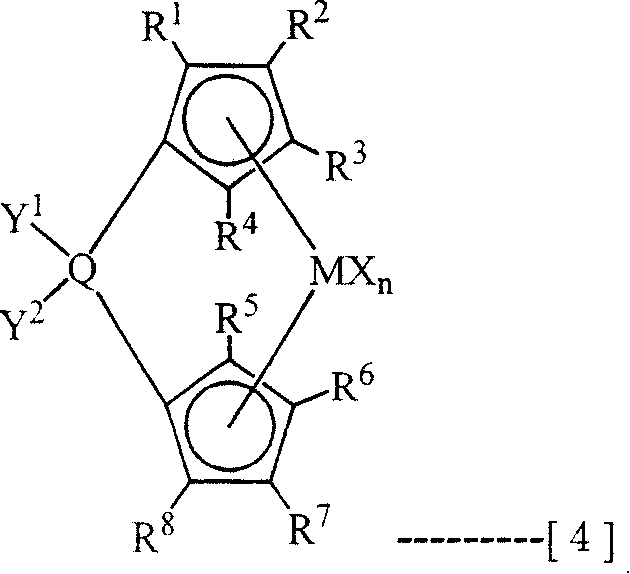
(in the formula, M represents zirconium, titanium or hafnium, R
1, R
2, R
3, R
4, R
5, R
6, R
7, R
8The group that expression is selected from hydrogen, alkyl, hydrocarbyl silyl respectively can be identical or different, from R
1To R
8Till adjacent substituting group also can interosculate into ring.X represents from halogen atom, and following neutrality, conjugation or the non-conjugated diene of the alkyl of hydrogen atom, 1~10 carbon atom or 10 carbon atoms, anion binding base or can be by a kind of group or the atom selected with identical or different array mode in the lone electron pair coordinate neutral dentate.N represents 1 or 2, the number of expression X.Q is the element of selecting from carbon, silicon or germanium, Y
1And Y
2Be the group of from hydrogen, alkyl, hydrocarbyl silyl, selecting, can be identical or different respectively, can also interosculate into ring.)
In last note general formula (3) or (4),, also can contain an above ring structure as preferred 1~20 carbon atom alkyl of alkyl, 7~20 carbon atom aryl alkyl, 6~20 carbon atom aryl or 7~20 carbon atom alkyl aryl.As its specific examples, can enumerate methyl, ethyl, n-propyl, sec.-propyl, the 2-methyl-propyl, 1, the 1-dimethyl propyl, 2, the 2-dimethyl propyl, 1,1-diethyl propyl group, 1-ethyl-1-methyl-propyl, 1,1,2,2-tetramethyl-propyl group, sec-butyl, the tertiary butyl, 1, the 1-dimethylbutyl, 1,1,3-trimethylammonium butyl, neo-pentyl, cyclohexyl methyl, cyclohexyl, 1-methyl isophthalic acid-cyclohexyl, the 1-adamantyl, the 2-adamantyl, 2-methyl-2-adamantyl, Meng Ji, the norborneol alkyl, benzyl, the 2-phenylethyl, the 1-tetralyl, 1-methyl isophthalic acid-tetralyl, phenyl, naphthyl, tolyl etc.
In last note general formula (3) or (4), as hydrocarbyl silyl, the alkyl or aryl silyl of 1~4 silicon and 3~20 carbon atoms preferably, its specific examples can be enumerated trimethyl silyl, t-butyldimethylsilyl, triphenyl silyl etc.
Among the present invention, the R in the above-mentioned general formula (3)
1, R
2, R
3, R
4, R
5, R
6, R
7, R
8, R
9, R
10The group that expression is selected from hydrogen, alkyl, hydrocarbyl silyl can be identical or different respectively.As the specific examples of preferred alkyl, hydrocarbyl silyl, can enumerate and above-mentioned same group.And the R in the last note general formula (4)
1, R
2, R
3, R
4, R
5, R
6, R
7, R
8The group that expression is selected from hydrogen, alkyl, hydrocarbyl silyl respectively can be identical or different.As the specific examples of preferred alkyl, hydrocarbyl silyl, can enumerate and above-mentioned same group.
On the cyclopentadienyl rings of above-mentioned general formula (3) from R
1To R
10Adjacent substituting group also can interosculate into ring.Cyclopentadienyl as this replacement, can enumerate indenyl, 2-methyl indenyl, tetrahydro indenyl, 2-methyl tetrahydro indenyl, 2,4,4-trimethylammonium tetrahydro indenyl, fluorenyl, benzo fluorenyl, dibenzo fluorenyl, octahydro dibenzo fluorenyl, prestox octahydro dibenzo fluorenyl etc.And on the cyclopentadienyl rings of above-mentioned general formula (4) from R
1To R
8Adjacent substituting group also can interosculate into ring.Cyclopentadienyl as this replacement, can enumerate indenyl, 2-methyl indenyl, tetrahydro indenyl, 2-methyl tetrahydro indenyl, 2,4,4-trimethylammonium tetrahydro indenyl, fluorenyl, benzo fluorenyl, dibenzo fluorenyl, octahydro dibenzo fluorenyl, prestox octahydro dibenzo fluorenyl etc.
Among the present invention, the M in general formula (3) or (4) is zirconium, titanium or hafnium.
X is from halogen atom, and following neutrality, conjugation or the non-conjugated diene of the alkyl of hydrogen atom, 1~10 carbon atom or 10 carbon atoms, anion binding base or can be by a kind of group or the atom selected with identical or different array mode in the lone electron pair coordinate neutral dentate.Specific examples as halogen atom has fluorine, chlorine, bromine, iodine; Specific examples as alkyl, can enumerate methyl, ethyl, n-propyl, sec.-propyl, 2-methyl-propyl, 1,1-dimethyl propyl, 2,2-dimethyl propyl, 1,1-diethyl propyl group, 1-ethyl-1-methyl-propyl, 1,1,2,2-tetramethyl-propyl group, sec-butyl, the tertiary butyl, 1,1-dimethylbutyl, 1,1,3-trimethylammonium butyl, neo-pentyl, cyclohexyl methyl, cyclohexyl, 1-methyl isophthalic acid-cyclohexyl etc.As the specific examples of 10 neutrality, conjugation or non-conjugated dienes below the carbon atom, can enumerate the s-cis-or s-trans-η
4-1,3-butadiene, s-cis-or s-trans-η
4-1,4-phenylbenzene-1,3-butadiene, s-cis-or s-trans-η
4-3-methyl isophthalic acid, 3-pentadiene, s-cis-or s-trans-η
4-1,4-dibenzyl-1,3-butadiene, s-cis-or s-trans-η
4-2,4-hexadiene, s-cis-or s-trans-η
4-1,3-pentadiene, s-cis-or s-trans-η
4-1,4-xylyl-1,3-butadiene, s-cis-or s-trans-η
4-1, two (the trimethyl silyl)-1,3-butadienes of 4-etc.As the specific examples of anion binding base, can enumerate alkoxyl groups such as methoxyl group, tert.-butoxy, phenoxy group, sulfonate groups such as carboxylic acid ester groups such as acetic ester, benzoic ether, methanesulfonates, tosylate etc.As can be by the specific examples of lone electron pair coordinate neutral dentate, can enumerate organo phosphorous compoundss such as trimethyl-phosphine, triethyl phosphine, triphenylphosphine, phenylbenzene dimethyl phosphine, perhaps tetrahydrofuran (THF), diethyl ether, dioxane, 1, ethers such as 2-glycol dimethyl ether.In these materials, X can be identical or different.N is 1 or 2, the number of expression X.
As the preferred embodiment in the compound of last note general formula (4) expression, can enumerate structure with following general formula (5) or (6) expression.
[changing 3]
(in the formula, R
1, R
2, R
3, R
4, R
5, R
6, R
7, R
8, R
9, R
10, R
11, R
12, R
13, R
14The group that expression is selected from hydrogen, alkyl, hydrocarbyl silyl can be identical or different respectively, from R
1To R
14Till adjacent substituting group also can interosculate into ring.M is zirconium, titanium or hafnium.Y is the 14th family's atom.Q can be from neutrality, conjugation or non-conjugated diene below the carbon atom of the alkyl of halogen atom, 1~10 carbon atom or 10, anion binding base or can be by selecting with identical or different array mode the lone electron pair coordinate neutral dentate.N represents 2 or 3 integer, and j represents 1~4 integer.)
[changing 4]
(in the formula, R
1, R
2, R
3, R
4, R
5, R
6, R
7, R
8, R
9, R
10, R
11, R
12, R
13, R
14, R
15, R
16The group that expression is selected from hydrogen, alkyl, hydrocarbyl silyl respectively can be identical or different, and adjacent substituting group also can interosculate into ring.R
6And R
11Be from hydrogen, alkyl, contain and select same atoms or identical group silica-based, also can interosculate into ring.R
7And R
10Be from hydrogen, alkyl, contain and select same atoms or identical group silica-based, also can interosculate into ring.R
6, R
7, R
10And R
11Can not be hydrogen atom simultaneously.R
15And R
16Can be identical or different mutually.M is zirconium, titanium or hafnium, preferred zirconium or hafnium.Y is carbon or silicon, and Q represents can be from halogen atom, alkyl, anion binding base or can be by selecting with identical or different array mode the lone electron pair coordinate neutral dentate.J represents 1~4 integer.)
Below just as the cyclopentadienyl of the chemical structure characteristic of crosslinked aromatic ring alkene metal derivative, fluorenyl, crosslink part, and after other features are illustrated successively, illustrate the preferred crosslinked aromatic ring alkene metal derivative and the example that have these features simultaneously.
Cyclopentadienyl
Cyclopentadienyl can be substituted or not replace.The R that the cyclopentadiene base section is possessed in described can be substituted or unsubstituted cyclopentadienyl is meant, above-mentioned general formula (5) or (6)
1, R
2, R
3And R
4All be hydrogen atom, perhaps R
1, R
2, R
3And R
4In be alkyl (f1) more than one, the alkyl of preferred total carbon atom number 1~20 (f1 '), perhaps silicon-containing group (f2), the preferably cyclopentadienyl that is replaced by the silicon-containing group of total carbon atom number 1~20 (f2 ').And the alkyl of described 1~20 carbon atom is the alkyl that only is made of carbon and hydrogen, alkenyl, alkynyl, aryl etc.It is alicyclic or aromatic ring to comprise also that wherein adjacent any two hydrogen atoms are substituted formation simultaneously.As the alkyl of total carbon atom number 1~20 (f1 '), except the alkyl that only constitutes, alkenyl, alkynyl, aryl etc. by carbon and hydrogen, also comprise hydrogen atom that a part directly is connected with these carbon atoms by the heteroatomic alkyl that comprises of halogen atom, oxy radical, nitrogen-containing group, silicon-containing group replacement, and adjacent any two hydrogen atoms form alicyclic.As this group (f1 '), can enumerate methyl, ethyl, n-propyl, allyl group, normal-butyl, n-pentyl, n-hexyl, n-heptyl, n-octyl, n-nonyl, straight-chain alkyls such as positive decyl, sec.-propyl, the tertiary butyl, amyl group, the 3-methyl amyl, 1,1-diethyl propyl group, 1, the 1-dimethylbutyl, 1-methyl isophthalic acid-propyl group butyl, 1,1-propyl group butyl, 1,1-dimethyl-2-methyl-propyl, 1-methyl isophthalic acid-sec.-propyl-branched hydrocarbyls such as 2-methyl-propyl, cyclopentyl, cyclohexyl, suberyl, the ring octyl group, the norborneol alkyl, adamantyl cyclic saturated hydrocarbon base, phenyl, naphthyl, xenyl, phenanthryl, ring-type unsaturated alkyl and these cycloalkyl substituted things such as anthryl, benzyl, the saturated hydrocarbyl that aryl such as cumyl replace, methoxyl group, oxyethyl group, phenoxy group, the N-methylamino, trifluoromethyl, trisbromomethyl, pentafluoroethyl group, pentafluorophenyl groups etc. contain heteroatomic alkyl.
Silicon-containing group (f2 ') for example be the ring carbon atom and the direct covalently bound group of Siliciumatom of cyclopentadienyl, alkyl silyl and aryl silyl are specifically arranged.As the silicon-containing group of total carbon atom number 1~20 (f2 '), can enumerate trimethyl silyl, triphenyl silyl etc.
Fluorenyl
Fluorenyl in the last note general formula (5) also can be substituted.Can be substituted or unsubstituted fluorenyl, be meant the R that fluorenyl partly has in the note general formula (5)
5, R
6, R
7, R
8, R
9, R
10, R
11, R
12All be hydrogen atom, perhaps at R
5, R
6, R
7, R
8, R
9, R
10, R
11, R
12In an above alkyl (f1) is arranged, the alkyl of preferred total carbon atom number 1~20 (f1 '), perhaps silicon-containing group (f2), the preferably cyclopentadienyl that is replaced by the silicon-containing group of total carbon atom number 1~20 (f2 ').With regard to regard to the main points of fluorenyl part in the chemical structural formula that adopts in the polymerization process of the present invention, can represent by above-mentioned general formula (5), from the synthetic viewpoint of alpha-olefin of the present invention (being total to) polymkeric substance, the R in the above-mentioned general formula (5)
6And R
11Be same atoms or the identical group of selecting from hydrogen, alkyl (f1), silicon-containing group (f2), can interosculate forms ring, R
7And R
10Be same atoms or the identical group of selecting from hydrogen, alkyl (f1), silicon-containing group (f2), can interosculate forms ring, but R
6, R
7, R
10And R
11Can not be hydrogen atom simultaneously.More preferably R wherein
6With R
7, R
10With R
11Be combined into ring respectively.So, when synthetic alpha-olefin of the present invention (being total to) polymkeric substance, can obtain narrow molecular weight distributions and reduce the molecule one terminal content of going up unsaturated group.The preferred group of alkyl (f1) is the alkyl (f1 ') of above-mentioned total carbon atom number 1~20, and the preferred embodiment of silicon-containing group (f2) is the silicon-containing group (f2 ') of above-mentioned total carbon atom number 1~20.
Fluorenyl part vital point in the chemical structural formula of last note general formula (6) expression is the R in the above-mentioned general formula (6)
6And R
11Be same atoms or the identical group of selecting from hydrogen, alkyl (f1), silicon-containing group (f2), can interosculate forms ring, R
7And R
10Be same atoms or the identical group of selecting from hydrogen, alkyl (f1), silicon-containing group (f2), can interosculate forms ring, but R
6, R
7, R
10And R
11Can not be hydrogen atom simultaneously.Wherein from synthetic alpha-olefin of the present invention (being total to) polymkeric substance, R
6, R
7, R
10And R
11Can not all be hydrogen atom simultaneously preferably.More preferably R wherein
6With R
7, R
10With R
11Be combined into ring respectively.So, when synthetic alpha-olefin of the present invention (being total to) polymkeric substance, can obtain narrow molecular weight distributions and reduce the content of molecule one terminal unsaturation group.The preferred group of alkyl (f1) is the alkyl (f1 ') of above-mentioned total carbon atom number 1~20, and the preferred embodiment of silicon-containing group (f2) is the silicon-containing group (f2 ') of above-mentioned total carbon atom number 1~20.
Fluorenes specifically is a unsubstituted fluorenes, 3,6-two substituted fluorenes, 2,7-two substituted fluorenes or 2,3,6,7-four substituted fluorenes.R on the fluorenes ring
5To R
12Adjacent substituting group interosculates into the fluorenyl example of ring, can enumerate benzofluorene, dibenzo fluorenes, octahydro dibenzo fluorenes, prestox octahydro dibenzo fluorenes etc.Wherein 2 on the fluorenes ring, 3,6 and 7 respectively with R
6, R
7, R
10And R
11Corresponding.
Covalently cross-linked
The main chain part of the key that cyclopentadienyl is connected with fluorenyl, crosslinked atom Y is the 14th family's atom in general formula (5) or (6), preferred carbon and silicon.
N is 2 or 3 integer in the general formula (5), more preferably 2.Main points of the present invention are: crosslinked atom Y can be identical or different mutually, has R
13With R
14R
13With R
14Can enumerate the alkyl (f1 ') of hydrogen atom, above-mentioned total carbon atom number 1~20, the silicon-containing group of above-mentioned total carbon atom number 1~20 (f2 '), halogen atom.
Can obtain the content of narrow molecular weight distributions and reduction molecule one terminal unsaturation group when so, synthesizing alpha-olefin of the present invention (being total to) polymkeric substance.
Crosslinked atom Y can be identical or different mutually in the last note general formula (6), has R
15With R
16R
15With R
16Can enumerate the alkyl (f1 ') of above-mentioned total carbon atom number 1~20, the silicon-containing group of above-mentioned total carbon atom number 1~20 (f2 '), halogen atom.
Main points among the present invention are: the crosslinked atom Y of covalently cross-linked part is that have can identical or different mutually group (R
15With R
16).The aryl of aryl or replacement preferably wherein.The example can be enumerated phenyl, naphthyl, anthryl and these aromatic hydrocarbons (sp
2Type hydrogen) have in and be substituted the group that base replaces more than one.Wherein as substituting group, can enumerate the alkyl (f1 ') of above-mentioned total carbon atom number 1~20, the silicon-containing group of above-mentioned total carbon atom number 1~20 (f2 '), halogen atom.As aryl, more preferably phenyl, tolyl, tert-butyl-phenyl, 3,5-dimethylphenyl, xenyl, cyclohexyl phenyl, (trifluoromethyl) phenyl, two (trifluoromethyl) phenyl, chloro-phenyl-and dichlorophenyl etc. import halogen atom in substituting group, and preferred especially these substituting groups are at the substituted-phenyl of a position and/or para-orientation.Wherein in the crosslinked aromatic ring alkene metal derivative relevant,, preferably use R from its property easy to manufacture with the present invention
15With R
16Mutual identical material.
Just as described later, with regard to the constituent of the olefin polymerization catalysis relevant with the present invention, when with the transistion metal compound of above-mentioned general formula (6) during, preferably use (B-1) organometallic compound and/or (B-2) organo-aluminium compound and/or (B-4) and the right compound of above-mentioned the 4th group transition metal compound (A) reacting forming ion as (B) compound as the transistion metal compound (A) of periodictable the 4th family.Particularly as the middle R of above-mentioned general formula (6)
15With R
16Be under the situation of phenyl, (B) compound as the olefin polymerization catalysis constituent relevant with the present invention, can use (B-1) organometallic compound and/or (B-2) organo-aluminium compound and/or (B-4) and the right compound of above-mentioned the 4th group transition metal compound (A) reacting forming ion, and not use (B-3) Organoaluminoxy compound.
Other features of crosslinked aromatic ring alkene metal derivative
In above-mentioned general formula (5) or (6), Q is from neutrality, conjugation or the non-conjugated diene of the alkyl of halogen atom, 1~10 carbon atom or 10 following carbon atoms, anion binding base or can be by selecting with identical or different array mode the lone electron pair coordinate neutral dentate.Specific examples as halogen atom has fluorine, chlorine, bromine, iodine.Can enumerate methyl, ethyl, n-propyl, sec.-propyl, 2-methyl-propyl, 1 as the specific examples of alkyl, 1-dimethyl propyl, 2,2-dimethyl propyl, 1,1-diethyl propyl group, 1-ethyl-1-methyl-propyl, 1,1,2,2-tetramethyl-propyl group, sec-butyl, the tertiary butyl, 1,1-dimethylbutyl, 1,1,3-trimethylammonium butyl, neo-pentyl, cyclohexyl methyl, cyclohexyl, 1-methyl isophthalic acid-cyclohexyl etc.As the specific examples of neutrality, conjugation or the non-conjugated diene of 10 following carbon atoms, can enumerate the s-cis-or s-trans-η
4-1,3-butadiene, s-cis-or s-trans-η
4-1,4-phenylbenzene-1,3-butadiene, s-cis-or s-trans-η
4-3-methyl isophthalic acid, 3-pentadiene, s-cis-or s-trans-η
4-1,4-dibenzyl-1,3-butadiene, s-cis-or s-trans-η
4-2,4-hexadiene, s-cis-or s-trans-η
4-1,3-pentadiene, s-cis-or s-trans-η
4-1,4-xylyl-1,3-butadiene, s-cis-or s-trans-η
4-1, two (the trimethyl silyl)-1,3-butadienes of 4-etc.As the specific examples of anion binding base, can enumerate alkoxyl groups such as methoxyl group, tert.-butoxy, phenoxy group, carboxylic acid ester groups such as acetic ester, benzoic ether, sulfonate groups such as methanesulfonates, tosylate etc.As can be by the specific examples of lone electron pair coordinate neutral dentate, can enumerate organo phosphorous compoundss such as trimethyl-phosphine, triethyl phosphine, triphenylphosphine, diphenyl methyl phosphine, perhaps tetrahydrofuran (THF), diethyl ether, dioxane, 1, ethers such as 2-glycol dimethyl ether.J is 1~4 integer, when j is that 2 Q when above can be identical or different mutually.
The preferred crosslinked aromatic ring alkene metal derivative and the example
Below explanation is by the specific examples of the 4th group transition metal compound of above-mentioned general formula (3), (4), (5), (6) expression, and still scope of the present invention is not subjected to the restriction of these examples.
As above-mentioned general formula (3), can specifically enumerate the cyclopentadiene trichloride, cyclopentadiene zirconium trichloride, two (cyclopentadienyl) titanium dichloride, two (cyclopentadienyl) zirconium dichloride, two (pentamethyl-cyclopentadienyl) zirconium dichloride, (cyclopentadienyl) (pentamethyl-cyclopentadienyl) zirconium dichloride, two (methyl cyclopentadienyl) zirconium dichloride, two (ethyl cyclopentadienyl) zirconium dichloride, two (propyl group cyclopentadienyl) zirconium dichloride, two (butyl cyclopentadienyl) the zirconium dichloride that comprise two (n-butyl cyclopentadienyl) zirconium dichloride, comprise two (1,3-dimethyl cyclopentadienyl) two (dimethyl cyclopentadienyl) zirconium dichloride of zirconium dichloride etc., two (diethyl cyclopentadienyl) the zirconium dichloride that comprise two (1,3-diethyl cyclopentadienyl) zirconium dichloride etc., two (methylethyl cyclopentadienyl) zirconium dichloride, two (methyl-propyl cyclopentadienyl) the zirconium dichloride that comprise two (1-methyl-3-n-propyl cyclopentadienyl) zirconium dichloride etc., comprise two (methyl butyl cyclopentadienyl) zirconium dichloride of two (1-methyl-3-n-butyl cyclopentadienyl) zirconium dichloride etc. etc.
As above-mentioned general formula (4), can specifically enumerate two (indenyl) zirconium dichloride of ethene, two (1-indenyl) the titanium dichloride of ethene, ethene two (4,5,6, the 7-tetrahydro indenyl) zirconium dichloride, two (methyl cyclopentadienyl) zirconium dichloride of dimethyl silicylene, two (dimethyl cyclopentadienyl) the zirconium dichloride of dimethyl silicylene, two (di-t-butyl cyclopentadienyl) the zirconium dichloride of dimethyl silicylene, two (indenyl) zirconium dichloride of dimethyl silicylene, two (2-methyl indenyl) the zirconium dichloride of dimethyl silicylene, two (the 2-methyl-4 of dimethyl silicylene, 5-benzo indenyl) zirconium dichloride, two (2-methyl-4-phenyl indenyl) the zirconium dichloride of dimethyl silicylene, two (2-methyl-4-naphthyl indenyl) the zirconium dichloride of dimethyl silicylene, dimethyl ethylenebis (2-methyl indenyl) zirconium dichloride, dimethyl ethylenebis (2-methyl-4,5-benzo indenyl) zirconium dichloride, dimethyl ethylenebis (2-methyl-4-phenyl indenyl) zirconium dichloride, dimethyl ethylenebis (2-methyl-4-naphthyl indenyl) zirconium dichloride.
As above-mentioned general formula (5), can specifically enumerate ethylidene (cyclopentadienyl) (fluorenyl) zirconium dichloride, ethylidene (cyclopentadienyl) (3,6-di-t-butyl fluorenyl) zirconium dichloride, ethylidene (cyclopentadienyl) (2,7-di-t-butyl fluorenyl) zirconium dichloride, ethylidene (cyclopentadienyl) (prestox octahydro dibenzo fluorenyl) zirconium dichloride, ethylidene (cyclopentadienyl) (benzo fluorenyl) zirconium dichloride, ethylidene (cyclopentadienyl) (dibenzo fluorenyl) zirconium dichloride, ethylidene (cyclopentadienyl) (octahydro dibenzo fluorenyl) zirconium dichloride, ethylidene (cyclopentadienyl) (2,7-phenylbenzene-3,6-di-t-butyl fluorenyl) zirconium dichloride, ethylidene (cyclopentadienyl) (2,7-dimethyl-3,6-di-t-butyl fluorenyl) zirconium dichloride, ethylidene (cyclopentadienyl) (1,1 ', 3,6,8,8 '-hexamethyl-2,7-dihydro two rings five fluorenyls) zirconium dichloride, ethylidene (cyclopentadienyl) (1,3,3 ', 6,6 ', 8,-hexamethyl-2,7-dihydro two rings five fluorenyls) zirconium dichloride, ethylidene (cyclopentadienyl) (2,7-(trimethylphenyl)-3.6-di-t-butyl fluorenyl) zirconium dichloride, ethylidene (cyclopentadienyl) (2,7-(3,5-dimethylphenyl)-3.6-di-t-butyl fluorenyl) zirconium dichloride, ethylidene (cyclopentadienyl) (2,3,6,7-tetra-tert fluorenyl) zirconium dichloride, propylidene (cyclopentadienyl) (fluorenyl) zirconium dichloride, propylidene (cyclopentadienyl) (3,6-di-t-butyl fluorenyl) zirconium dichloride, propylidene (cyclopentadienyl) (2,7-di-t-butyl fluorenyl) zirconium dichloride, propylidene (cyclopentadienyl) (prestox octahydro dibenzo fluorenyl) zirconium dichloride, propylidene (cyclopentadienyl) (benzo fluorenyl) zirconium dichloride, propylidene (cyclopentadienyl) (benzo fluorenyl) zirconium dichloride, propylidene (cyclopentadienyl) (dibenzo fluorenyl) zirconium dichloride, propylidene (cyclopentadienyl) (octahydro dibenzo fluorenyl) zirconium dichloride, propylidene (cyclopentadienyl) (2,7-phenylbenzene-3,6-di-t-butyl fluorenyl) zirconium dichloride, propylidene (cyclopentadienyl) (2,7-dimethyl-3,6-di-t-butyl fluorenyl) zirconium dichloride, tetramethyl-two silicylene (cyclopentadienyl) (fluorenyl) zirconium dichloride, tetramethyl-two silicylene (cyclopentadienyl) (3,6-di-t-butyl fluorenyl) zirconium dichloride, tetramethyl-two silicylene (cyclopentadienyl) (2,7-di-t-butyl fluorenyl) zirconium dichloride, tetramethyl-two silicylene (cyclopentadienyl) (prestox octahydro benzo fluorenyl) zirconium dichloride, tetramethyl-two silicylene (cyclopentadienyl) (benzo fluorenyl) zirconium dichloride, tetramethyl-two silicylene (cyclopentadienyl) (dibenzo fluorenyl) zirconium dichloride, tetramethyl-two silicylene (cyclopentadienyl) (octahydro dibenzo fluorenyl) zirconium dichloride, tetramethyl-two silicylene (cyclopentadienyl) (2,7-phenylbenzene-3,6-di-t-butyl fluorenyl) zirconium dichloride, tetramethyl-two silicylene (cyclopentadienyl) (2,7-dimethyl-3,6-di-t-butyl fluorenyl) zirconium dichloride, ethylidene (methyl tertbutyl cyclopentadienyl) (fluorenyl) zirconium dichloride, ethylidene (methyl tertbutyl cyclopentadienyl) (3,6-di-t-butyl fluorenyl) zirconium dichloride, ethylidene (methyl tertbutyl cyclopentadienyl) (2,7-di-t-butyl fluorenyl) zirconium dichloride, ethylidene (methyl tertbutyl cyclopentadienyl) (prestox octahydro dibenzo fluorenyl) zirconium dichloride, ethylidene (methyl tertbutyl cyclopentadienyl) (benzo fluorenyl) zirconium dichloride, ethylidene (methyl tertbutyl cyclopentadienyl) (dibenzo fluorenyl) zirconium dichloride, ethylidene (methyl tertbutyl cyclopentadienyl) (octahydro dibenzo fluorenyl) zirconium dichloride, ethylidene (methyl tertbutyl cyclopentadienyl) (2,7-phenylbenzene-3,6-di-t-butyl fluorenyl) zirconium dichloride, ethylidene (methyl tertbutyl cyclopentadienyl) (2,7-dimethyl-3,6-di-t-butyl fluorenyl) zirconium dichloride, ethylidene (tertiary butyl cyclopentadienyl) (fluorenyl) zirconium dichloride, ethylidene (tertiary butyl cyclopentadienyl) (3,6-di-t-butyl fluorenyl) zirconium dichloride, ethylidene (tertiary butyl cyclopentadienyl) (2,7-di-t-butyl fluorenyl) zirconium dichloride, ethylidene (tertiary butyl cyclopentadienyl) (prestox octahydro dibenzo fluorenyl) zirconium dichloride, ethylidene (tertiary butyl cyclopentadienyl) (benzo fluorenyl) zirconium dichloride, ethylidene (tertiary butyl cyclopentadienyl) (dibenzo fluorenyl) zirconium dichloride, ethylidene (tertiary butyl cyclopentadienyl) (octahydro dibenzo fluorenyl) zirconium dichloride, ethylidene (tertiary butyl cyclopentadienyl) (2,7-phenylbenzene-3,6-di-t-butyl fluorenyl) zirconium dichloride, ethylidene (tertiary butyl cyclopentadienyl) (2,7-dimethyl-3,6-di-t-butyl fluorenyl) the zirconium dichloride.
And titanium compound and hafnium compound with same three-dimensional arrangement, and bromide, iodide etc., for example can enumerate and be documented in the spy and open flat 3-9913 number, spy and open flat 2-131488 number, spy and open flat 3-21607 number, spy and open flat 3-106907 number, spy and open flat 3-188092 number, spy and open flat 4-69394 number, spy and open transistion metal compound in flat 4-300887 number, WO01/27124A1 equal sign communique.
Prestox octahydro dibenzo fluorenes wherein described here is meant the compound of structure shown in the formula (7), and described prestox tetrahydrochysene two rings five fluorenes are meant the compound of structure shown in the formula (8), described 1,1 ', 3,6,8,8 '-hexamethyl-2,7-dihydro two rings five fluorenyls are meant the compound of structure shown in the formula (10), described 1,3,3 ', 6,6 ', 8,-hexamethyl-2,7-dihydro two rings five fluorenyls are meant the compound of structure shown in the formula (11).
[changing 5]
[changing 6]
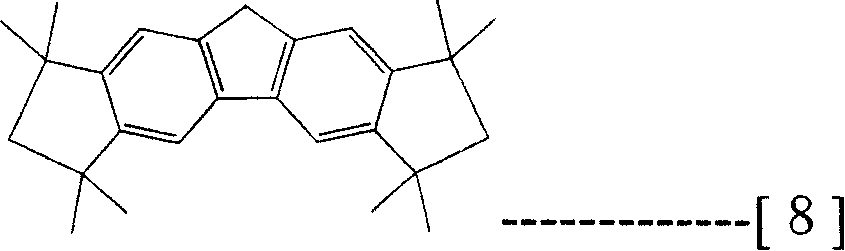
[changing 7]
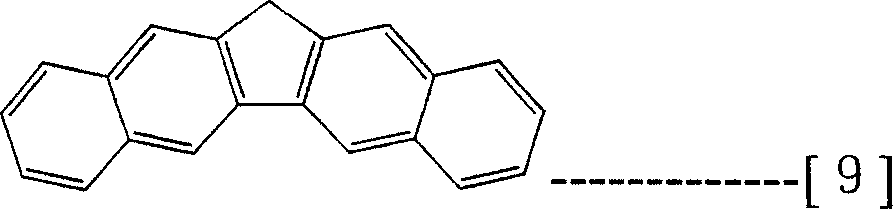
[changing 8]
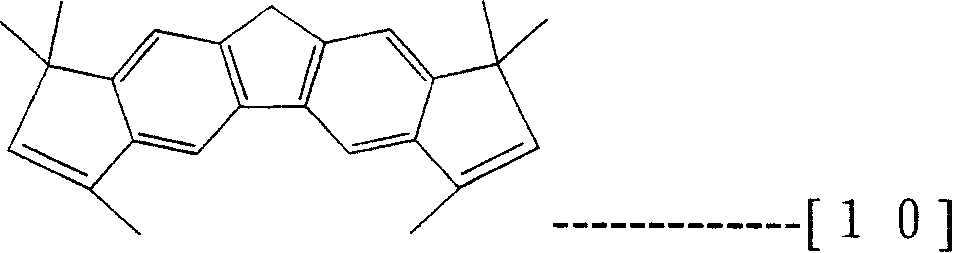
[changing 9]
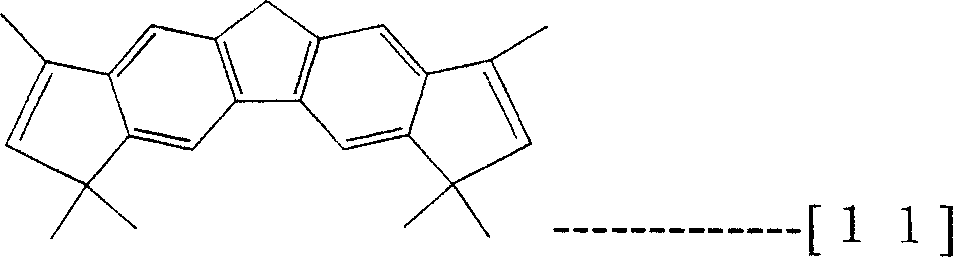
The transistion metal compound (A) that present embodiment uses specifically be following formula (12), (13), (14), (15), (16), (17), (18) and (19), but the present invention is not limited to these compounds.
[changing 10]

[changing 11]

[changing 12]
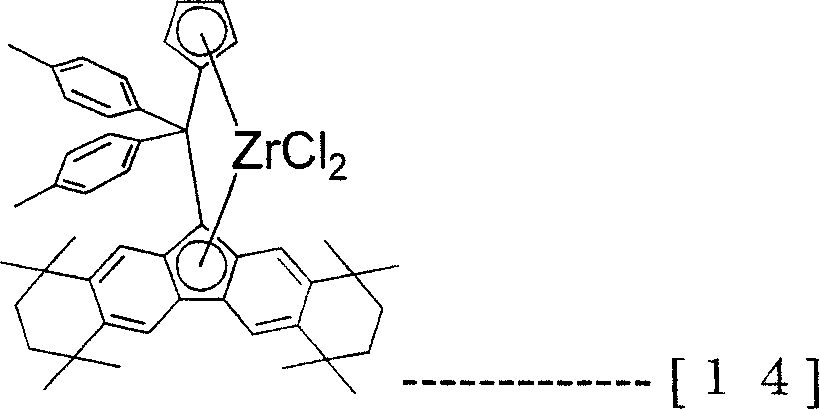
[changing 13]
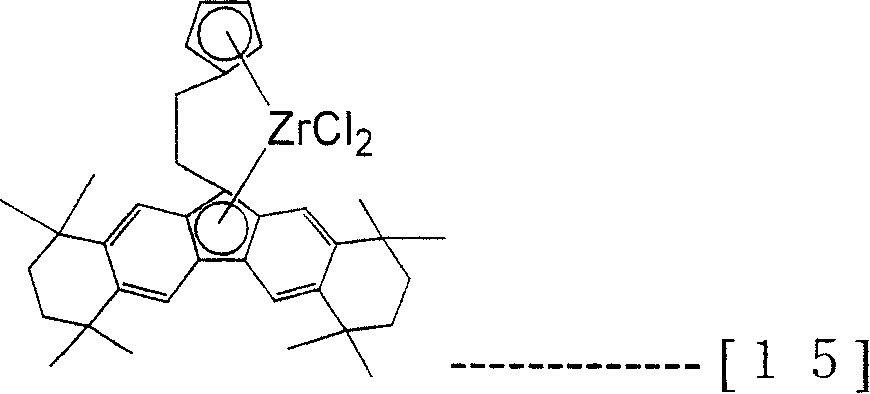
[changing 14]
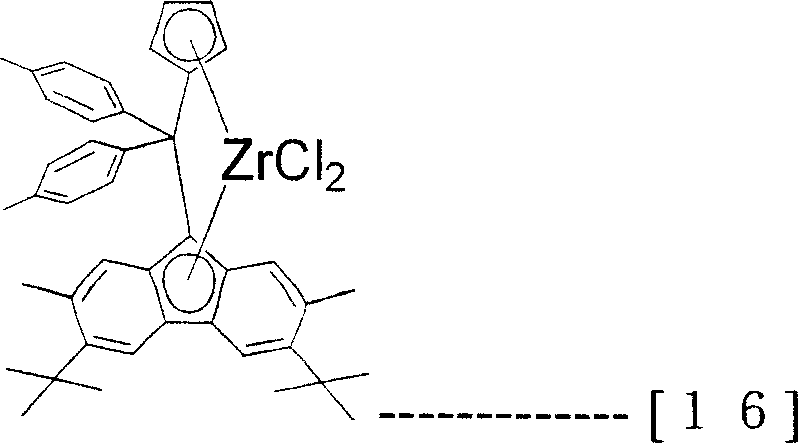
[changing 15]

[changing 16]
[changing 17]

The structure of resulting transistion metal compound can be utilized 2.70MHz
1H-NMR (NEC GSH-270), FD mass spectroscopy (NEC SX-102A) are determined.
Do under the situation of olefin polymerization catalysis with crosslinked aromatic ring alkene metal derivative of the present invention, catalyst component can by from (A) above-mentioned general formula (1), (2), (3), the crosslinked aromatic ring alkene metal derivative compound of (4), (5) and (6) expression, and at least a compound of (B) selecting in (B-1) organometallic compound, (B-2) organo-aluminium compound, (B-3) Organoaluminoxy compound, (B-4) and the right compound of above-mentioned the 4th group transition metal compound (A) reacting forming ion constitutes.
Below specify (B) composition
(B-1) organometallic compound
(B-1) organometallic compound as using among the present invention can specifically use following organometallic compound.By general formula
R
aR
bM
3…………(20)
(R in the formula
aAnd R
bCan be identical or different, represent the alkyl of 1~15 carbon atom, preferred 1~4 carbon atom; M
3Expression Mg, Zn or Cd.) expression periodictable the 2nd family or the dialkyl compound of the 12nd family's metal.
And this organometallic compound (B-1), can be used alone or be used in combination.
(B-2) organo-aluminium compound
As (B-2) organo-aluminium compound that forms catalyst for olefines polymerizing, for example can enumerate the complexing alkylide of the 1st family's metal of remembering general formula (22) expression by the organo-aluminium compound of following general formula (21) expression, down and aluminum compound or Organoaluminoxy compound etc.By general formula
R
a mAl(OR
b)
nH
pX
q…………(21)
(R in the formula
aAnd R
bCan be identical or different, represent the alkyl of 1~15 carbon atom, preferred 1~4 carbon atom; X represents halogen atom, and m is 0<m≤3, and n is 0≤n<3, and p is 0≤p<3, and q is the number of 0≤q<3, and m+n+p+q=3.) expression organo-aluminium compound.This examples for compounds can be enumerated trimethyl aluminium, triethyl aluminum, triisopropylaluminiuand, diisobutyl alanate.
By general formula
M
2AlR
a 4…………(22)
(M in the formula
2Expression Li, Na or K, R
aThe alkyl of representing 1~15 carbon atom, preferred 1~4 carbon atom.) expression periodictable the 1st family's metal and the complexing alkylide of aluminium.This compound can be enumerated LiAl (C
2H
5)
4, LiAl (C
7H
15)
4Deng.
By the organo-aluminium compound of above-mentioned general formula (21) expression, for example can enumerate by the compound of remembering general formula (23), (24), (25) or (26) expression down etc.
R
a mAl(OR
b)
3-m…………(23)
(R in the formula
aAnd R
bCan be identical or different, represent the alkyl of 1~15 carbon atom, preferred 1~4 carbon atom; The number of the preferred 1.5≤m of m≤3.)
R
a mAlX
3-m…………(24)
(R in the formula
aThe alkyl of representing 1~15 carbon atom, preferred 1~4 carbon atom; X represents halogen atom, the preferred 0<m of m<3.)
R
a mAlH
3-m…………(25)
(R in the formula
aThe alkyl of representing 1~15 carbon atom, preferred 1~4 carbon atom; Preferred 2≤the m of m<3.)
R
a mAl(OR
b)
nX
q…………(26)
(R in the formula
aAnd R
bCan be identical or different, represent the alkyl of 1~15 carbon atom, preferred 1~4 carbon atom; X represents halogen atom, and m is 0<m≤3, and n is 0≤n<3, and q is the number of 0≤q<3, and m+n+q=3.)
As by above-mentioned general formula (23), (24), (25) or (26) expression compound, more specifically say and to enumerate trimethyl aluminium, triethyl aluminum, three n-butylaluminum, tri-propyl aluminum, three amyl group aluminium, three hexyl aluminium, trioctylaluminum, three positive aluminum alkylss such as three decyl aluminium, triisopropylaluminiuand, triisobutyl aluminium, three sec-butyl aluminium, tri-tert aluminium, three 2-methyl butyl aluminium, three 3-methyl butyl aluminium, three 2-methyl amyl aluminium, three 3-methyl amyl aluminium, three 4-methyl amyl aluminium, three 2-methyl hexyl aluminium, three 3-methyl hexyl aluminium, three branched-chain alkyl aluminium such as three 2-methyl hexyl aluminium, thricyclohexyl aluminium, tricyclic alkyl aluminium such as three ring octyl group aluminium, triphenyl aluminum, triaryl aluminums such as trimethylphenyl aluminium, the di-isopropyl alanate, dialkyl aluminum hydrides such as diisobutyl alanate are by general formula (i-C
4H
9)
xAl
y(C
5H
10)
z(x, y, z are positive number in the formula, z≤2x.) expression alkenyl aluminium such as prenyl aluminium, alkoxyalkyl aluminium such as methoxyl group aluminium isobutyl, oxyethyl group aluminium isobutyl, isopropoxy aluminium isobutyl, alkoxyl group aluminum dialkyls such as methoxyl group dimethyl aluminium, oxyethyl group diethyl aluminum, butoxy dibutyl aluminium, sesquialter alkoxyalkyl aluminium such as sesquialter ethoxyethyl group aluminium, sesquialter butoxy butyl aluminium are by general formula R
a 2.5Al (OR
b)
0.5Part alkoxylated alkyl group aluminium Deng expression with average composition, the phenoxy group diethyl aluminum, (2,6-di-t-butyl-4-methylphenoxy) diethyl aluminum, two (2,6-di-t-butyl-4-methylphenoxy) aluminium triethyl, (2,6-di-t-butyl-4-methylphenoxy) diisobutyl aluminum, two (2,6-di-t-butyl-4-methylphenoxy) aryloxy alkyl aluminium such as aluminium isobutyl, chlorodimethylalumiu, diethylaluminum chloride, chlorination dibutyl aluminium, the bromination diethyl aluminum, aluminum dialkyl monohalides such as di-isobutyl aluminum chloride, the sesquialter ethylaluminium chloride, sesquialter chlorinated butyl aluminium, sesquialter alkyl aluminum halides such as sesquialter bromination aluminium triethyl, ethylaluminium dichloride, dichloride propyl group aluminium, dihalide aluminum alkylss such as dibrominated butyl aluminium etc. are by partially halogenated aluminum alkyls, diethyl aluminium hydride, hydrogenation aluminum dialkyls such as hydrogenation dibutyl aluminium, dibydroethyl aluminium, the aluminum alkyls that other parts such as dihydro aluminum alkyls such as dihydro propyl group aluminium are hydrogenated, aluminium triethyl oxyethyl group muriate, butyl aluminium butoxy muriate, aluminium triethyl oxyethyl group bromides etc. are by part alkoxylate and halogenated aluminum alkyls etc.
But also can use the compound similar compounds of representing with above-mentioned general formula (21), for example can enumerate by nitrogen-atoms two above aluminum compound bonded organo-aluminium compounds.As this compound, can specifically enumerate (C
2H
5)
2AlN (C
2H
5) Al (C
2H
5) etc.
As compound, for example can enumerate LiAl (C by general formula (22) expression
2H
5)
4, LiAl (C
7H
15)
4Deng.
And can in polymerization system, form the compound of above-mentioned organo-aluminium compound, for example can use the combination of aluminum halide and lithium alkylide, perhaps the combination of aluminum halide and alkyl magnesium.
Preferably have machine aluminium compound in these materials.
The 1st family's metal of the organo-aluminium compound of last note general formula (21) expression or upward note general formula (22) expression and the alkyl-complexes of aluminium can be used alone or be used in combination.
(B-3) Organoaluminoxy compound
(B-3) Organoaluminoxy compound that can use in the present invention can directly use over known Lv oxane.Specifically, can enumerate by following general formula (27)
[changing 18]
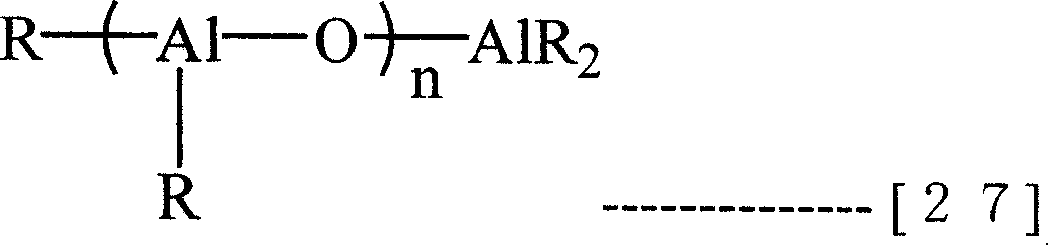
And/or by general formula (28)
[changing 19]

(in the formula, R represents the alkyl of 1~10 carbon atom, and n represents the integer more than 2.) expression compound, particularly use R to be in more than 3 as n in the methyl Lv oxane of methyl, preferably be in more than 10.In these Lv oxane classes, also can sneak into some organo-aluminium compounds.In high temperature solution polymerization of the present invention, its characteristic properties is also can use the spy to open the insoluble organo-aluminium compound of illustrative the sort of benzene in the flat 2-78687 communique.And preferred the use the spy opened the Organoaluminoxy compound put down in writing in the flat 2-167305 communique, opened the aluminium oxane with two or more alkyl put down in writing in flat 2-24701 and the flat 3-103407 communique of Te Kai etc. the spy.Wherein, " benzene is insoluble " Organoaluminoxy compound that can in high temperature solution polymerization of the present invention, use, be meant that dissolved Al composition is in below 10% after converting through the aluminium atom usually in 60 ℃ benzene, preferably be in below 5%, especially preferably be in the compound of below 2%, insoluble or insoluble benzene.
And, can also enumerate down the adorned methyl Lv oxane of note general formula (29) etc. as the Organoaluminoxy compound that can use in the present invention.
[changing 20]

(R represents the alkyl of 1~10 carbon atom in the formula, and m, n represent the integer more than 2.)
This adorned methyl Lv oxane is to adopt the aluminum alkyls preparation in addition of trimethyl aluminium and trimethyl aluminium.This compound (29) generally is called MMAO.This MMAO can adopt method preparation cited in No. 4960878, U.S. Pat and No. 5041584 patents of US.And eastern レ Off ア イ Application ケ system Co., Ltd. etc. also to adopt trimethyl aluminium and triisobutyl aluminium to prepare R be the product of isobutyl-, its commodity MMAO by name and TMAO.This MMAO is that solvability and the storage stability in all kinds of SOLVENTS obtains improveing De Lv oxane.
In addition, the Organoaluminoxy compound that can use in the present invention can also be enumerated the Organoaluminoxy compound by the boracic of remembering general formula (30) expression down.
[changing 21]
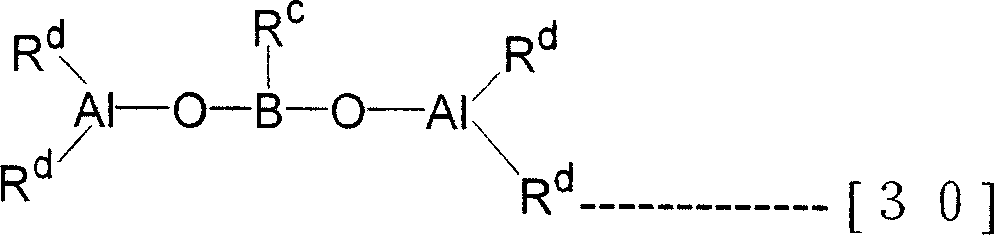
(R in the formula
CThe alkyl of 1~10 carbon atom of expression.R
CCan be identical or different, the alkyl of expression hydrogen atom, halogen atom or 1~10 carbon atom.)
Organoaluminoxy compound by the boracic of general formula (30) expression, can be by remembering the alkylboronic acids and the organo-aluminium compound of general formula (31) expression down, under inert gas atmosphere, in inert solvent, under-80 ℃~room temperature, react 1 minute~24 hours method manufacturing.
R
CB(OH)
2……………(31)
(R in the formula
CRepresent the group identical with last note.)
Specific examples as the alkylboronic acids of representing by above-mentioned general formula (31), can enumerate methyl-boron-dihydroxide, ethyl-boron dihydroxide, sec.-propyl boric acid, n-propyl boric acid, normal-butyl boric acid, isobutyl-boric acid, n-hexyl boric acid, cyclohexyl boric acid, phenyl-boron dihydroxide, 3,5-difluorophenyl boric acid, pentafluorophenyl group boric acid, 3, two (trifluoromethyl) phenyl-boron dihydroxides of 5-etc.Wherein preferable methyl boric acid, normal-butyl boric acid, isobutyl-boric acid, 3,5-difluorophenyl boric acid, pentafluorophenyl group boric acid.These boric acid can be used alone or be used in combination.
As can with the organo-aluminium compound of this alkylboronic acids reaction, can specifically enumerate the same organo-aluminium compound of enumerating as organo-aluminium compound of compound by last note general formula (21) or (22) expression.
In these compounds, preferably use trialkylaluminium, tricyclic alkyl aluminium, preferred especially trimethyl aluminium, triethyl aluminum, triisobutyl aluminium.These alkylaluminium cpds can be used alone or be used in combination.
With the right compound of (B-4) above-mentioned the 4th group transition metal compound (A) reacting forming ion
As the compound (B-4) right (following abbreviate as sometimes " ionic compound "), can enumerate and open flat 1-501950 number, spy the spy and open flat 1-502036 number, spy and open flat 3-179005 number, spy and open flat 3-179006 number, spy and open flat 3-207703 number, spy and open Lewis acid, ionic compound, borane compound and the carborane compound of putting down in writing on the communiques such as flat 3-207704 number, USP5321106 number etc. with aromatic ring alkene metal derivative compound (A) reacting forming ion.Can enumerate heteroatoms polymerizable compound and isomerization polymerization compound etc. in addition.
The preferred ionic compound that adopts is by the compound of remembering general formula (32) expression down among the present invention
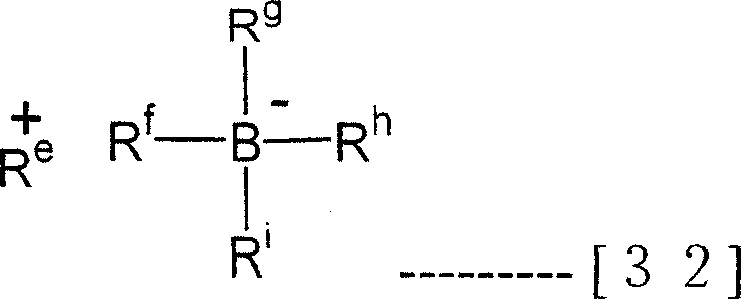
In the formula, as R
E+, can enumerate H
+, carbocation, oxygen positively charged ion, ammonium cation, phosphorus positively charged ion, suberyl trialkenyl positively charged ion, have the ferrocene cation of transition metal etc.R
fAnd R
iCan be identical or different, be organic group, preferred aryl groups.
As above-mentioned carbocation, specifically can enumerate trisubstituted carbocations such as triphenylcarbenium positively charged ion, three (aminomethyl phenyl) carbocation, three (3,5-dimethylphenyl) carbocation etc.
As above-mentioned ammonium cation, specifically can enumerate trialkyl ammonium positively charged ions such as TMA (TriMethylAmine) positively charged ion, three second ammonium cations, three (n-propyl) ammonium cation, triisopropyl ammonium cation, three (normal-butyl) ammonium cation, triisobutyl ammonium cation, N, accelerine positively charged ion, N, N-Diethyl Aniline positively charged ion, N, N-2,4, N such as 6-pentamethylaminobenzene positively charged ion, N-dialkyl aniline positively charged ion, dialkyl ammonium positively charged ions such as di-isopropyl ammonium cation, dicyclohexyl ammonium cation etc.
As above-mentioned phosphorus positively charged ion, specifically can enumerate triaryl phosphorus positively charged ions such as triphenyl phosphine positively charged ion, three (aminomethyl phenyl) phosphorus positively charged ion, three (3,5-dimethylphenyl) phosphorus positively charged ion.
In above-mentioned, as R
E+Preferred carbocation, ammonium cation etc., preferred especially triphenylcarbenium positively charged ion, N, accelerine positively charged ion, N, N-Diethyl Aniline positively charged ion.
As carbon salt, specifically can enumerate triphenylcarbenium tetraphenyl borate salts, triphenylcarbenium four (pentafluorophenyl group) borate, triphenylcarbenium four (3,5-two trifluoromethyls) borate, three (4-aminomethyl phenyl) carbon four (pentafluorophenyl group) borate, three (3, the 5-3,5-dimethylphenyl) carbon four (pentafluorophenyl group) borate etc.
Ammonium salt can be enumerated ammonium salt, the N that trialkyl replaces, N-dialkyl benzene ammonium salt, dialkyl ammonium salt etc.
Ammonium salt as the trialkyl replacement, specifically can enumerate for example triethyl ammonium tetraphenyl borate salts, tripropyl ammonium tetraphenyl borate salts, three (normal-butyl) ammonium tetraphenyl borate salts, trimethyl ammonium four (p-methylphenyl) borate, trimethyl ammonium four (o-tolyl) borate, three normal-butyl ammonium four (pentafluorophenyl group) borates, triethyl ammonium four (pentafluorophenyl group) borate, tripropyl ammonium four (pentafluorophenyl group) borate, tripropyl ammonium four (2, the 4-3,5-dimethylphenyl) borate, three normal-butyl ammoniums four (3, the 5-3,5-dimethylphenyl) borate, three normal-butyl ammonium four (trifluoromethyl) borates, three normal-butyl ammoniums four (3,5-two trifluoromethyls) borate, three normal-butyl ammonium four (o-tolyl) borates, two (octadecyl) ammonium methyl tetraphenyl borate salts, two (octadecyl) ammonium methyl four (p-methylphenyl) borate, two (octadecyl) ammonium methyl four (o-tolyl) borate, two (octadecyl) ammonium methyl four (pentafluorophenyl group) borate, two (octadecyl) ammonium methyl four (2, the 4-3,5-dimethylphenyl) borate, two (octadecyl) ammonium methyl four (3, the 5-3,5-dimethylphenyl) borate, two (octadecyl) ammonium methyl four (4-trifluoromethyl) borate, two (octadecyl) ammonium methyl four (3,5-two trifluoromethyls) borate, two (octadecyl) ammonium methyl etc.
As N, N-dialkyl benzene ammonium salt, for example can specifically enumerate N, N-dimethyl puratized agricultural spray tetraphenyl borate salts, N, N-dimethyl puratized agricultural spray four (pentafluorophenyl group) borate, N, N-dimethyl puratized agricultural spray four (3,5-two trifluoromethyls) borate, N, N-dimethyl puratized agricultural spray tetraphenyl borate salts, N, N-diethyl puratized agricultural spray four (pentafluorophenyl group) borate, N, N-diethyl puratized agricultural spray four (3,5-two trifluoromethyls) borate, N, N-2,4,6-pentamethyl-puratized agricultural spray tetraphenyl borate salts, N, N-2,4,6-pentamethyl-puratized agricultural spray four (pentafluorophenyl group) borate etc.
As the specific examples of dialkyl ammonium salt, for example can enumerate two (1-propyl group) ammonium four (pentafluorophenyl group) borates, dicyclohexyl ammonium tetraphenyl borate salts etc.
In addition, the ionic compound by the applicant's open (spy opens the 2004-51676 communique) can use without restriction.
And above-mentioned ionic compound (B-4) can use in two or more mixing.
As the composition (B) that present embodiment uses, be under the situation of last note general formula (12) when transition metallic compound (A), used (B-3) Organoaluminoxy compound shown in the last note.Specifically, be the MAO/ toluene solution that commercially available Nippon Aluminum Alkyls Ltd. makes.And transistion metal compound (A) is under the situation of last note general formula (13), (14), (15), (16), (17), (18) and (19), (B-2) organo-aluminium compound shown in above having used and (B-4) with the right compound of above-mentioned the 4th group transition metal compound (A) reacting forming ion in two compounds.Specifically, be triisopropylaluminiuand and N, N-dimethyl puratized agricultural spray tetraphenyl borate salts.
In so far cited compound, what be suitable for most making alpha-olefin of the present invention (being total to) polymkeric substance is compound by general formula (5) or (6) expression, as (B) compound that uses in this case, preferred (B-1) organometallic compound and/or (B-2) organo-aluminium compound and/or (B-4) and the right compound of above-mentioned the 4th group transition metal compound (A) reacting forming ion of adopting.Especially for (6), R
15And R
16Be under the situation of phenyl, in order to make alpha-olefin of the present invention (being total to) polymkeric substance, (B) compound as the olefin polymerization catalyst component relevant with the present invention, can use (B-1) organometallic compound and/or (B-2) organo-aluminium compound and/or (B-4) and the right compound of above-mentioned the 4th group transition metal compound (A) reacting forming ion, not use (B-3) Organoaluminoxy compound.
And the preparation can use in the present invention catalyst for olefines polymerizing the time, can use carrier as required.Carrier normally inorganic or organic compound, particulate state and even microgranular solid.Wherein can enumerate porous oxides, butter, clay, clay mineral or ion exchangeable lamellar compound etc. as mineral compound.
As porous oxides, specifically can use SiO
2, Al
2O
3, MgO, ZrO, TiO
2, B
2O
3, CaO, ZnO, BaO, ThO
2Deng, perhaps contain the mixture or the mixture of these materials, for example natural or synthetic zeolite, SiO
2-MgO, SiO
2-Al
2O
3, SiO
2-TiO
2, SiO
2-V
2O
5, SiO
2-Cr
2O
3, SiO
2-TiO
2-MgO etc.
Among the present invention, in the presence of above-mentioned the sort of catalyst for olefines polymerizing, make the alpha-olefin homopolymerization of 6~20 carbon atoms, perhaps copolymerization between alkene, thus make the low molecular weight olefin polymerization thing.
Wherein as the alpha-olefin of 6~20 carbon atoms, can enumerate 6~20 carbon atoms such as 1-hexene, 4-methyl-1-pentene, 3-Methyl-1-pentene, 1-octene, 1-nonene, 1-decene, 1-undecylene, 1-dodecylene, tetradecene, cetene, 1-vaccenic acid, 1-eicosylene, the alpha-olefin of preferred 6~16 carbon atoms.And under the situation of multipolymer, two or more arbitrary combination are used in the alpha-olefin with the alkene of 6~20 carbon atoms and 2~20 carbon atoms.
Wherein, can enumerate ethene, propylene, 1-butylene, 1-amylene, 1-hexene, 4-methyl-1-pentene, 3-Methyl-1-pentene, 1-octene, 1-nonene, 1-decene, 1-undecylene, 1-dodecylene, tetradecene, cetene, 1-vaccenic acid, 1-eicosylene etc. as the alpha-olefin of 2~20 carbon atoms.Wherein particularly preferably be the alpha-olefin of 2~16 carbon atoms.
The preferred configuration of alkene is to be 1-octene, 1-decene, 1-dodecylene or tetradecene one of at least in the alkene.Particularly preferably be the homopolymerization of 1-octene, the homopolymerization of 1-decene, the homopolymerization of 1-dodecylene or the homopolymerization of tetradecene, and adopt their multipolymers as principal monomer.
Below describe the embodiment of making as the low molecular weight olefin polymerization thing of alpha-olefin (being total to) polymkeric substance that can use in the present invention in detail.
The present invention carries out polyreaction in varsol.As this varsol, can specifically enumerate aliphatic hydrocarbons such as propane, butane, pentane, hexane, heptane, octane, decane, 12 carbon alkane, kerosene, alicyclic hydro carbons such as pentamethylene, hexanaphthene, methylcyclopentane, benzene,toluene,xylenes etc. are aromatic hydrocarbon based, halogenated hydrocarbons such as chloro ethene, chlorobenzene, trichloromethane, petroleum fractionss such as gasoline, kerosene, light oil etc.The alkene that can use polymerization to use in addition.
Though be in the presence of above-mentioned the sort of catalyst for olefines polymerizing, to carry out polymerization among the present invention, but this moment is for above-mentioned the 4th group transition metal compound (A), as the concentration of the transition metal atoms that in polymerization reaction system, exists, calculate according to every liter of reaction volume, be generally 10
-9~10
-1Mole is preferably 10
-8~10
-2Mole.
The consumption of composition (B-1) in whole mol ratio between the transition metal atoms (M) ((B-1)/M) in composition (B-1) and the composition (A), is generally 1~5000, preferred 10~2000.The consumption of composition (B-2) in the mol ratio between the transition metal atoms (M) in composition (B-2) and the composition (A) ((B-2)/M), is generally 100~25000, preferred 200~10000.The consumption of composition (B-3) in whole mol ratio between the transition metal atoms (M) ((B-3)/M) in composition (B-3) and the composition (A), is generally 10~5000, preferred 20~2000.The consumption of composition (B-4) in whole mol ratio between the transition metal atoms (M) ((B-4)/M) in composition (B-4) and the composition (A), is generally 1~1000, and is preferred 1.5~500, and more preferably 2~200.
And use the olefinic polymerization temperature of this olefin polymerization catalysis, and be in usually in-50~+ 200 ℃ of scopes, preferably be in 0~180 ℃ of scope.Polymerization pressure is in normal pressure~10MPa gauge pressure usually, preferably is under normal pressure~5MPa gauge pressure condition, and polyreaction can adopt that any way carries out in intermittent type, semi continuous, the continous way.In addition, polymerization can be by different separately the carrying out more than 2 sections of reaction conditions.The molecular weight of resulting olefin polymer can adopt the method that has hydrogen in the polymerization system or change polymerization temperature is regulated.
Lubricating oil composition of the present invention is made of following composition:
(A) the above-mentioned alpha-olefin of 15~90 weight parts (being total to) polymkeric substance,
(B) 10~85 weight parts are made up of at least a base oil of selecting from mineral oil, synthetic hydrocarbon oil and ester oil, and the kinematic viscosity under 100 ℃ is in 2~10mm
2The low viscosity base oil of/s scope and
(C) at least a additive of from purify dispersion agent, viscosity index rising agent, antioxidant, sanitas, wear-resistant dose, friction modifier, yield point depressant, rust-preventive agent, defoamer and extreme pressure additive, selecting.
As the low viscosity base oil that can in lubricating oil composition of the present invention, use, can use from the kinematic viscosity under 100 ℃ to be in 2~10mm
2At least a base oil of selecting in known mineral oil of past, synthetic hydrocarbon oil and the ester oil in/the s scope.
Mineral oil generally is divided into several grades according to the purified method, but the general mineral oil that contains 0.5~10% paraffin composition that uses.For example can use the highly refined oil of forming as main body by the isomerization alkanes low with yield point, that viscosity index is high of hydrogen decomposition method for refining manufacturing.
Synthetic hydrocarbon oil for example can be enumerated alpha-olefin low polymers, alkyl benzene, alkylnaphthalene class etc., and these materials can be used alone or be used in combination.Wherein, can use the low-molecular-weight oligopolymer of at least a alkene of from 8~twelve carbon atom alkene, selecting as alpha-olefin low polymers.This alpha-olefin low polymers can adopt Z-type catalyst,, radical polymerization manufactured legal as cationic polymerization, the hot polymerization of catalyzer with Lewis acid.
Alkyl benzene, the common major part of alkylnaphthalene class are that alkyl chain length is the dialkyl benzene or the dialkyl group naphthalene of 6~14 carbon atoms, and this alkyl benzene or alkylnaphthalene class can adopt the Knut Fridell grafting alkylated reaction manufacturing of benzene or naphthalene and alkene.The alkylation alkene that uses in the manufacturing of alkyl benzene or alkylnaphthalene class also can be straight chain shape or catenate alkene or its combination.These manufacture method for example are documented among No. 3909432 United States Patent (USP).
As ester oil, can enumerate the monoesters of making by monoprotic acid and alcohol, by diprotic acid and alcohol or the diester made by dibasic alcohol and monoprotic acid or acid mixture, by the polyol ester of dibasic alcohol, trivalent alcohol (for example TriMethylolPropane(TMP)), tetravalent alcohol (for example tetramethylolmethane), hexavalent alcohol (for example Dipentaerythritol) etc. and monoprotic acid or sour mixture reaction manufacturing etc.As the example of these ester classes, can enumerate n-nonanoic acid tridecyl ester, two-2-ethylhexyl adipic acid ester, two-2-ethylhexyl azelate, trimethylolpropane tri-heptanoate, pentaerythritol tetraheptanoate etc.
As the additive that can in lubricating oil composition of the present invention, use, can use following illustrative material, these additives can separately or be used in combination.
Purify dispersion agent: can enumerate metal sulfonate, metal phenates, metal phosphate, succinic diamide etc., in 0~15 weight % scope, use usually.
Yield point depressant: can enumerate polymethacrylate, alkylnaphthalene etc., in 0~3 weight % scope, use usually.
Extreme pressure additive: for example can enumerate sulfur-bearings such as sulfide (sulfides) class, sulfoxide class, sulfone class, thiophosphinic acid ester class, thiocarbonic ester class, sulfuration grease, olefine sulfide class is extreme pressure additive, phosphoric acid classes such as phosphoric acid ester, phosphorous acid ester, phosphate amine salt, phosphorous acid ester amine, halide-containings such as chlorinated hydrocarbon etc.Extreme pressure additive can use in 0~15 weight % scope in case of necessity.
Wear-resistant dose: can enumerate inorganic or organoboron compounds such as organic molybdenum, alkyl thiol borate such as molybdenumdisulphide, graphite, antimony sulfide, boron compound, tetrafluoroethylene etc.The agent that prevents to wear and tear can be used in 0~3 weight % scope in case of necessity.
Antioxidant: can enumerate phenol system and amine compounds such as 2,6 di tert butyl 4 methyl phenol.Antioxidant can use in 0~3 weight % scope in case of necessity.
Rust-preventive agent: can enumerate compounds such as various amine compound, carboxylic metallic salt, polyol ester, phosphide, phosphoric acid salt.Rust-preventive agent can use in 0~3 weight % scope in case of necessity.
Defoamer: can enumerate polysiloxane based compounds such as dimethyl siloxane, silica gel dispersion, alcohol system or ester based compound etc.Defoamer can use in 0~0.2 weight % scope in case of necessity.
Except that above-mentioned additive, can also use non-emulsifying agent, tinting material, oiliness improver (oiliness rising agent) etc. in case of necessity.
[embodiment]
Ucon oil of the present invention can be used as lubricating oil (engine oil, transmitting gear oil, ATF, CVT-F, differential gear oil) and industrial lubricating oil (gear oil, work oil) and lubricates and use with base oil.Below further describe the present invention based on embodiment, but the present invention is not subjected to a bit restriction of these embodiment.
Molecular-weight average and molecular weight distribution
Number-average molecular weight (Mn) and molecular weight distribution (Mw/Mn), the GPC (Network ロ マ ト パ Star Network C-R4A) that adopts Shimadzu Seisakusho Ltd. to make measures in such a way.Use TSK, G6000H XL, G4000HXL, G3000H XL, G2000H XL as separator column, column temperature fixes on 40 ℃, adopt tetrahydrofuran (THF) (with the light pharmacy) as moving phase, development rate is decided to be 0.8 ml/min, sample concentration is 0.2 weight %, the sample injection rate is 20 microlitres, adopts differential refractometer as analyzer.The polystyrene that uses eastern ソ-Co., Ltd.'s manufacturing is as polystyrene standard.
The unsaturated group mass contg of molecule one end
The unsaturated group mass contg of molecule one end is to adopt the EX400 type nuclear magnetic resonance device of NEC manufacturing to measure in such a way.
1H-NMR is in sample hose, after (ア Le De リ Star チ, 99.8atom%D) adjusts to 2 weight % in the deuterated chloroform as the Roc solvent with polymkeric substance, measures at normal temperatures.The peak of each hydrogen is known through observation in this polymkeric substance: based on the peak (A) of the saturated methyl of end be 0.65~0.85ppm, based on the peak (B) of vinylidene for 4.70ppm~4.80ppm, based on the peak (C) of vinyl and (D) be respectively 4.85~5.0ppm and 5.7~5.9ppm, be 5.10~5.30ppm, be 0.90~2.00ppm based on the peak (E) of inner alkene based on the peak (F) of methylene radical.If represent each peak (A), (B), (C), (D), (E) and peak area (F) respectively with SA, SB, SC, SD, SE and SF, the number N of then suitable unsaturated link(age) with whole proton numbers, can use (A), (B), (C), (D), (E) and peak intensity (F), calculate by following formula (33).

A: methyl 0.65~0.85ppm
B: vinylidene 4.70~4.80ppm
C: vinyl 4.85~5.00ppm
D: vinyl 5.70~5.90ppm
E: inner alkene (three substituents) 5.1~5.3ppm
F: methylene radical 0.9~2.0ppm
Molecule one terminal unsaturation group content, the absolute molecular-weight average M that utilizes the N that is obtained by following formula (33) and utilize VPO to measure can calculate with following formula (34).
Molecule one terminal unsaturation group content (%)=N * M * 2/14 ... (34)
N: unsaturated group number (individual/whole protons)
M: absolute molecular weight
Viscosity characteristics
Kinematic viscosity and the viscosity index of polymkeric substance under 100 ℃ and 40 ℃ is to measure with the method for JIS K2283 record to calculate.
And cooperate the oil viscosity characteristic, be to reach 14mm with 100 ℃ of following kinematic viscosity
2The ratio of/s, with polymkeric substance and PAO-6 (Nippon Steel Chemical Co., Ltd, シ Application Off Le-De 601), ester oil (Daihachi Chemical Industry Co., Ltd., DIDA) 15%, extreme pressure additive (LUBRIZOLL company, ア Application グ ラ モ Le 98A) 6.5% mixes, utilize the method for JIS K 2283 record, measure, calculate resultant oil kinematic viscosity and the viscosity index under 100 ℃ and 40 ℃ that cooperate.
The yield point that cooperates oil is to measure according to the method for JIS K 2269 records.
Cooperating the low temperature viscosity of oil, is according to ASTM D 2983, utilizes the viscosity of Brookfield Viscometer under having measured-40 ℃.
Shear stability
The shear stability that cooperates oil is to adopt KRL shear stability test machine, estimates according to the method for DIN52350-6 record.Under 60 ℃, will cooperate oil to place 20 hours shearing (1450rpm) conditions, estimate the decrement of the kinematic viscosity under 100 ℃ before and after the test.
Heat-resisting oxidative stability
Heat-resisting oxidation stability test carries out as follows.30 gram samples are put into the glass culture dish of 55 millimeters of diameters, in the recirculating air drying machine that remains on 180 ℃ under, leave standstill 24 hours after, take out, place cool to room temperature, the quality of determination test front and back sample utilizes following formula (35) to obtain steam output.
Decrement ratio (weight %)=(W1-W2)/W1 * 100 ... (35)
In the formula
W1: weight before the test
W2: test back weight
And the method for utilizing JIS K2283 record measured the kinematic viscosity under 100 ℃ before and after the test, utilizes following formula (36) to calculate the increase of viscosity.
Kinematic viscosity velocity of variation (%)=V2/V1 * 100 ... (36)
In the formula
V1: the kinematic viscosity before the test
V2: the kinematic viscosity after the test
Measure the total acid value of sample before and after the test according to the method for JIS K2501 record, utilized following formula (37) to calculate the increased value of total acid value.
Total acid value before total acid value increased value (milligram KOH/ gram)=test back total acid value-test ... (37)
[embodiment 1]
On the glass autoclave of 1 liter of abundant metathetical internal volume, thermometer, gas inlet pipe and glass stirring rake are installed, are fully replaced with nitrogen with nitrogen.Pack into then 250 milliliters of n-decanes and 250 milliliters of 1-decene, with 50 liter/hour speed feed nitrogen on one side, temperature is risen to 100 ℃ on one side.On the other hand, in fully by the flask of 30 milliliters of bands of the internal volume of nitrogen replacement arm, add the magnetic agitation sheet, to the 0.002 mmole ethylidene (cyclopentadienyl) (2 that wherein adds as transistion metal compound, 7-di-t-butyl fluorenyl) toluene solution of zirconium dichloride, with the toluene solution (Al=1.53M) of 2 mmole methyl Lv oxanes, stirred 30 minutes.Stop in glass autoclave, to feed nitrogen, feed hydrogen with 20 liters/hour speed then, and after feeding ethene with 5 liters/hour speed, add above-mentioned solution, will stir revolution and be decided to be 650rpm, begin polymerization.In the polymerization process, continuously with 20 liters of/hour hydrogen supplies, with 5 liters of/hour supply ethene, 100 ℃ of polymerizations were added a small amount of Virahol and are stopped polymerization after 60 minutes under normal pressure.Polymers soln is added in 300 milliliters of 1N hydrochloric acid, with its stirring.This solution is transferred in the separating funnel, tell organic layer after, the washing organic layer, (1mmHg) distillation removes and to desolvate and unreacted 1-decene under 175 ℃ of decompressions.
The transparent liquid polymkeric substance that obtains is 81.07 grams, and polymerization activity is 40.5 kilograms-polymkeric substance/mmole-Zrhr.The result of polymer analysis, Mn=1950, Mw/Mn=1.70.、
The kinematic viscosity of resultant transparent liquid polymkeric substance, viscosity index, press molecular weight (Mn) that the silica gel permeation chromatography measures among the content more than 20,000, content below 1,000 and heat-resisting oxidative stability are shown in table 1.And cooperate the temperature-viscosity and the shear stability of oil to be shown among the table 2.
[embodiment 2]
In the stainless steel autoclave of 1 liter of abundant metathetical internal volume, pack into 300 milliliters of normal heptanes and 200 milliliters of 1-decene with nitrogen, and then add 0.0015 mmole ethylidene (cyclopentadienyl) (2,7-di-t-butyl fluorenyl) toluene solution of zirconium dichloride, toluene solution (Al=1.53M) with 1.5 mmole methyl Lv oxanes, with hydrogen autoclave is forced into 0.785MPa-G then, to stir revolution and be decided to be 350rpm, at 63 ℃ down stir 60 minute on one side polymerization on one side.Decompress(ion) after the polymerization adds a small amount of Virahol and stops polymerization.Polymers soln is joined in 300 milliliters of 1N hydrochloric acid, with its stirring.This solution is transferred in the separating funnel, tell organic layer after, the washing organic layer, (1mmHg) distillation removes and to desolvate and unreacted 1-decene under 175 ℃ of decompressions.
The transparent liquid polymkeric substance that obtains (1-decene polymkeric substance) is 34.18 grams, and polymerization activity is 22.8 kilograms-polymkeric substance/mmole-Zrhr.The result of polymer analysis, Mn=2080, Mw/Mn=1.80.
The kinematic viscosity of resultant transparent liquid polymkeric substance, viscosity index, the molecular weight (Mn) measured with the silica gel permeation chromatography are among the content more than 20,000, content below 1,000 and heat-resisting oxidative stability are shown in table 1.And cooperate the temperature-viscosity and the shear stability of oil to be shown among the table 2.
[embodiment 3]
In the stainless steel autoclave of 1 liter of abundant metathetical internal volume, pack into 630 milliliters of normal heptanes and 70 milliliters of 1-decene with nitrogen, and then add the toluene solution of 0.2 mmole triisobutyl aluminium, 0.0021 mmole phenylbenzene silicylene (cyclopentadienyl) (prestox octahydro dibenzo fluorenyl) zirconium dichloride, add 0.0084 mmole N at last, the toluene solution of N-dimethyl puratized agricultural spray four (pentafluorophenyl group) boric acid ester, with hydrogen autoclave is forced into 0.785MPa-G then, to stir revolution and be decided to be 350rpm, at 63 ℃ down stir 180 minute on one side polymerization on one side.Decompress(ion) after the polymerization adds a small amount of Virahol and stops polymerization.Polymers soln is joined in 300 milliliters of 1N hydrochloric acid, with its stirring.This solution is transferred in the separating funnel, tell organic layer after, the washing organic layer, (1mmHg) distillation removes and to desolvate and unreacted 1-decene under 175 ℃ of decompressions.
The transparent liquid polymkeric substance that obtains (1-decene polymkeric substance) is 15.29 grams, and polymerization activity is 2.4 kilograms-polymkeric substance/mmole-Zrhr.The result of polymer analysis, Mn=2130, Mw/Mn=1.51.
The kinematic viscosity of resultant transparent liquid polymkeric substance, viscosity index, the molecular weight (Mn) measured with the silica gel permeation chromatography are among the content more than 20,000, content below 1,000 and heat-resisting oxidative stability are shown in table 1.And cooperate the temperature-viscosity and the shear stability of oil to be shown among the table 2.
[embodiment 4]
In the stainless steel autoclave of 1 liter of abundant metathetical internal volume, pack into 630 milliliters of normal heptanes and 70 milliliters of 1-decene with nitrogen, and then add the toluene solution of 0.2 mmole triisobutyl aluminium, 0.002 mmole two (p-methylphenyl) methylene radical (cyclopentadienyl) (prestox octahydro dibenzo fluorenyl) zirconium dichloride, add 0.008 mmole N at last, the toluene solution of N-dimethyl puratized agricultural spray four (pentafluorophenyl group) boric acid ester, with hydrogen autoclave is forced into 0.785MPa-G then, to stir revolution and be decided to be 350rpm, at 90 ℃ down stir 60 minute on one side polymerization on one side.Decompress(ion) after the polymerization adds a small amount of Virahol and stops polymerization.Polymers soln is joined in 300 milliliters of 1N hydrochloric acid, with its stirring.This solution is transferred in the separating funnel, tell organic layer after, the washing organic layer, (1mmHg) distillation removes and to desolvate and unreacted 1-decene under 175 ℃ of decompressions.
The transparent liquid polymkeric substance that obtains (1-decene polymkeric substance) is 40.03 grams, and polymerization activity is 20.0 kilograms-polymkeric substance/mmole-Zrhr.The result of polymer analysis, Mn=3850, Mw/Mn=1.58.
The kinematic viscosity of resultant transparent liquid polymkeric substance, viscosity index, the molecular weight (Mn) measured with the silica gel permeation chromatography are among the content more than 20,000, content below 1,000 and heat-resisting oxidative stability are shown in table 1.And cooperate the temperature-viscosity and the shear stability of oil to be shown among the table 2.
[embodiment 5]
In the stainless steel autoclave of 2 liters of abundant metathetical internal volumes, pack into 850 milliliters of normal heptanes and 150 milliliters of 1-decene with nitrogen, the temperature of system is warming up to 85 ℃ after, make total pressure reach 4MPa-G by hydrogen supply.Be pressed into 0.4 mmole triisobutyl aluminium, 0.004 mmole two (p-methylphenyl) methylene radical (cyclopentadienyl) (prestox octahydro dibenzo fluorenyl) zirconium dichloride and 0.016 mmole N with nitrogen then, N-dimethyl puratized agricultural spray four (pentafluorophenyl group) boric acid ester, to stir revolution and be decided to be 400rpm, at 90 ℃ down stir 60 minute on one side polymerization on one side.In system, add a small amount of Virahol and stop polymerization.Polymers soln is joined in 300 milliliters of 1N hydrochloric acid, with its stirring.This solution is transferred in the separating funnel, tell organic layer after, the washing organic layer, (1mmHg) distillation removes and to desolvate and unreacted 1-decene under 175 ℃ of decompressions.
The transparent liquid polymkeric substance that obtains (1-decene polymkeric substance) is 83.00 grams, and polymerization activity is 20.8 kilograms-polymkeric substance/mmole-Zrhr.The result of polymer analysis, Mn=2110, Mw/Mn=1.52.
The kinematic viscosity of resultant transparent liquid polymkeric substance, viscosity index, the molecular weight (Mn) measured with the silica gel permeation chromatography are among the content more than 20,000, content below 1,000 and heat-resisting oxidative stability are shown in table 1.And cooperate the temperature-viscosity and the shear stability of oil to be shown among the table 2.
[embodiment 6]
In the stainless steel autoclave of 1 liter of abundant metathetical internal volume, pack into 400 milliliters of normal heptanes and 100 milliliters of 1-decene with nitrogen, and then add the toluene solution of 0.2 mmole triisobutyl aluminium, 0.0025 mmole ethylidene (cyclopentadienyl) (prestox octahydro dibenzo fluorenyl) zirconium dichloride, add 0.01 mmole N at last, the toluene solution of N-dimethyl puratized agricultural spray four (pentafluorophenyl group) boric acid ester, with hydrogen autoclave is forced into 0.785MPa-G then, to stir revolution and be decided to be 350rpm, at 65 ℃ down stir 60 minute on one side polymerization on one side.Decompress(ion) after the polymerization adds a small amount of Virahol and stops polymerization.Polymers soln is joined in 300 milliliters of 1N hydrochloric acid, with its stirring.This solution is transferred in the separating funnel, tell organic layer after, the washing organic layer, (1mmHg) distillation removes and to desolvate and unreacted 1-decene under 175 ℃ of decompressions.
The transparent liquid polymkeric substance that obtains (1-decene polymkeric substance) is 28.44 grams, and polymerization activity is 11.4 kilograms-polymkeric substance/mmole-Zrhr.The result of polymer analysis, Mn=2180, Mw/Mn=1.46.
The kinematic viscosity of resultant transparent liquid polymkeric substance, viscosity index, the molecular weight (Mn) measured with the silica gel permeation chromatography are among the content more than 20,000, content below 1,000 and heat-resisting oxidative stability are shown in table 1.And cooperate the temperature-viscosity and the shear stability of oil to be shown among the table 2.
[embodiment 7]
In the stainless steel autoclave of 1 liter of abundant metathetical internal volume, pack into 630 milliliters of normal heptanes and 70 milliliters of 1-decene with nitrogen, and then add 0.2 mmole triisobutyl aluminium, 0.002 mmole two (p-methylphenyl) methylene radical (cyclopentadienyl) (2,7-dimethyl-3,6-di-t-butyl fluorenyl) toluene solution of zirconium dichloride, add 0.008 mmole N at last, the toluene solution of N-dimethyl puratized agricultural spray four (pentafluorophenyl group) boric acid ester, with hydrogen autoclave is forced into 0.785MPa-G then, to stir revolution and be decided to be 350rpm, 90 ℃ following stir 60 minute on one side carry out polymerization on one side.Decompress(ion) after the polymerization adds a small amount of Virahol and stops polymerization.Polymers soln is joined in 300 milliliters of 1N hydrochloric acid, with its stirring.This solution is transferred in the separating funnel, tell organic layer after, the washing organic layer, (1mmHg) distillation removes and to desolvate and unreacted 1-decene under 175 ℃ of decompressions.
The transparent liquid polymkeric substance that obtains (1-decene polymkeric substance) is 39.97 grams, and polymerization activity is 20.0 kilograms-polymkeric substance/mmole-Zrhr.The result of polymer analysis, Mn=4740, Mw/Mn=1.60.
The kinematic viscosity of resultant transparent liquid polymkeric substance, viscosity index, the molecular weight (Mn) measured with the silica gel permeation chromatography are among the content more than 20,000, content below 1,000 and heat-resisting oxidative stability are shown in table 1.And cooperate the temperature-viscosity and the shear stability of oil to be shown among the table 2.
[embodiment 8]
Except two (p-methylphenyl) methylene radical (cyclopentadienyl) (2 that will use among the embodiment 7,7-dimethyl-3,6-di-t-butyl fluorenyl) zirconium dichloride, change over beyond two (rubigan) methylene radical (cyclopentadienyl) (prestox octahydro dibenzo fluorenyl) the zirconium dichloride, operate similarly to Example 7.
The transparent liquid polymkeric substance that obtains (1-decene polymkeric substance) is 43.07 grams, and polymerization activity is 21.5 kilograms-polymkeric substance/mmole-Zrhr.The result of polymer analysis, Mn=4240, Mw/Mn=1.60.
Content, content 1,000 below and the heat-resisting oxidative stability of molecular weight (Mn) more than 20,000 that the kinematic viscosity of resultant transparent liquid polymkeric substance, viscosity index, usefulness silica gel permeation chromatography are measured is shown among the table 1.And cooperate the temperature-viscosity and the shear stability of oil to be shown among the table 2.
[embodiment 9]
Except two (p-methylphenyl) methylene radical (cyclopentadienyl) (2 that will use among the embodiment 7,7-dimethyl-3,6-di-t-butyl fluorenyl) zirconium dichloride, change over two (rubigan) methylene radical (cyclopentadienyl) (2,7-phenylbenzene-3,6-di-t-butyl fluorenyl) beyond the zirconium dichloride, operates similarly to Example 7.
The transparent liquid polymkeric substance that obtains (1-decene polymkeric substance) is 43.95 grams, and polymerization activity is 22.0 kilograms-polymkeric substance/mmole-Zrhr.The result of polymer analysis, Mn=8150, Mw/Mn=1.71.
The kinematic viscosity of resultant transparent liquid polymkeric substance, viscosity index, the molecular weight (Mn) measured with the silica gel permeation chromatography are among the content more than 20,000, content below 1,000 and heat-resisting oxidative stability are shown in table 1.And cooperate the temperature-viscosity and the shear stability of oil to be shown among the table 2.
[embodiment 10]
Except two (p-methylphenyl) methylene radical (cyclopentadienyl) (2 that will use among the embodiment 7,7-dimethyl-3,6-di-t-butyl fluorenyl) zirconium dichloride, change over two (rubigan) methylene radical (cyclopentadienyl) (2,7-dimethyl-3,6-di-t-butyl fluorenyl) beyond the zirconium dichloride, operates similarly to Example 7.
The transparent liquid polymkeric substance that obtains (1-decene polymkeric substance) is 42.72 grams, and polymerization activity is 21.4 kilograms-polymkeric substance/mmole-Zrhr.The result of polymer analysis, Mn=5130, Mw/Mn=1.64.
The kinematic viscosity of resultant transparent liquid polymkeric substance, viscosity index, the molecular weight (Mn) measured with the silica gel permeation chromatography are among the content more than 20,000, content below 1,000 and heat-resisting oxidative stability are shown in table 1.And cooperate the temperature-viscosity and the shear stability of oil to be shown among the table 2.
[reference examples 1]
In the stainless steel autoclave of 1 liter of abundant metathetical internal volume, pack into 300 milliliters of normal heptanes and 200 milliliters of 1-decene with nitrogen, and then add the toluene solution of 0.002 mmole two (phenyl) methylene radical (cyclopentadienyl) (fluorenyl) zirconium dichloride, toluene solution (Al=1.53M) with 2 mmole methyl Lv oxanes, with hydrogen autoclave is forced into 0.785MPa-G then, to stir revolution and be decided to be 350rpm, 90 ℃ following stir 60 minute on one side carry out polymerization on one side.Decompress(ion) after the polymerization adds a small amount of Virahol and stops polymerization.Polymers soln is joined in 300 milliliters of 1N hydrochloric acid, with its stirring.This solution is transferred in the separating funnel, tell organic layer after, the washing organic layer, (1mmHg) distillation removes and to desolvate and unreacted 1-decene under 175 ℃ of decompressions.
The transparent liquid polymkeric substance that obtains (1-decene polymkeric substance) is 28.89 grams, and polymerization activity is 14.4 kilograms-polymkeric substance/mmole-Zrhr.The result of polymer analysis, Mn=6800, Mw/Mn=2.02.
Content, content 1,000 below and the heat-resisting oxidative stability of molecular weight (Mn) more than 20,000 that the kinematic viscosity of resultant transparent liquid polymkeric substance, viscosity index, usefulness silica gel permeation chromatography are measured is shown among the table 1.And cooperate the temperature-viscosity and the shear stability of oil to be shown among the table 2.
[reference examples 2]
The 1000 milliliters of 1-decene of in the stainless steel autoclave of 2 liters of abundant metathetical internal volumes, packing into nitrogen, temperature in the system is warming up to 145 ℃ after, hydrogen supply makes total pressure reach 2.5MPa-G.And then add 0.005 mmole two (phenyl) methylene radical (cyclopentadienyl) (2,7-di-t-butyl fluorenyl) toluene solution of zirconium dichloride, with the toluene solution (Al=1.53M) of 2.0 mmole aluminium trimethide oxanes, will stir revolution and be decided to be 400rpm and under 150 ℃, carry out polymerization in 60 minutes.Add a small amount of Virahol and stop polymerization.Polymers soln is joined in 300 milliliters of 1N hydrochloric acid, with its stirring.This solution is transferred in the separating funnel, tell organic layer after, the washing organic layer, (1mmHg) distillation removes and to desolvate and unreacted 1-decene under 175 ℃ of decompressions.
The transparent liquid polymkeric substance that obtains (1-decene polymkeric substance) is 305.40 grams, and polymerization activity is 61.1 kilograms-polymkeric substance/mmole-Zrhr.The result of polymer analysis, Mn=4280, Mw/Mn=1.62.
Content, content 1,000 below and the heat-resisting oxidative stability of molecular weight (Mn) more than 20,000 that the kinematic viscosity of resultant transparent liquid polymkeric substance, viscosity index, usefulness silica gel permeation chromatography are measured is shown among the table 1.And cooperate the temperature-viscosity and the shear stability of oil to be shown among the table 2.
[reference examples 3]
100 milliliters of toluene and two (1,3-dimethyl cyclopentadienyl) the zirconium dichloride of 3 mmoles are packed into in 100 milliliters of glass flask of nitrogen replacement, carry out the modulation of catalyzer.
Adopt continuous polymerization reactor, supply with refined toluene continuously and supply with refining 1-decene continuously with 1 liter of/hour speed with 1 liter of/hour speed, simultaneously in 11 mmoles/liter supply with continuously aluminium trimethide oxane and in pick with 0.02 mmole/liter ratio supply with above-mentioned synthetic Zr catalyst continuously, in polymerizer, supply with ethene, supply with nitrogen and, under 45 ℃ of polymerization temperatures, normal pressure and the condition of 1.0 hours residence times, carry out polymerization with 50 liters of/hour speed continuously simultaneously with 30 liters of/hour speed hydrogen supplies with 120 liters of/hour speed.In polymerizer, discharge polymers soln continuously, add a small amount of Virahol and stop polymerization.In this polymers soln, add 1 premium on currency and a little hydrochloric acid (about 20 milliliters), stir and leave standstill after 15 minutes, separate water layer.Add 2 premium on currency then and stir after 10 minutes, leave standstill, separate water layer.This operation is repeated twice.From polymers soln, remove toluene then, obtained water white transparency liquid polymer (ethene-1-decene multipolymer).And then with this liquid polymers dry 1 hour in 180 ℃ of decompressions (15mmHg).
The activity of per unit zirconium is 1.02 kilograms-polymkeric substance/mmole-Zrhr.The result of polymer analysis, Mw=4310, Mn=2890, Mw/Mn=1.49.
The kinematic viscosity of resultant transparent liquid polymkeric substance, viscosity index, the molecular weight (Mn) measured with the silica gel permeation chromatography are among the content more than 20,000, content below 1,000 and heat-resisting oxidative stability are shown in table 1.And cooperate the temperature-viscosity and the shear stability of oil to be shown among the table 2.
[reference examples 4]
In embodiment 1,, estimate similarly to Example 1 except adopting commercially available ethylene-propylene copolymer (Mitsui Chemicals, Inc's manufacturing) Le-カ Application ト HC-40 as the liquid polymer.The results are shown among table 1 and the table 2.
Table 1

Table 2
PAO-6: poly-alpha olefins (Nippon Steel Chemical Co., Ltd, シ Application Off Le-De 601)
Ester oil: DIDA (the industrial formula of big eight chemical strains commercial firm, diiso decyl adipic acid ester)
Additive: extreme pressure additive (Lubrizol company produces, ア Application グ ラ モ Le 98A)
As mentioned above, alpha-olefin of the present invention (being total to) polymkeric substance has high heat-resisting oxidative stability, and has good viscosity index, low temperature viscosity and shear stability.
The possibility of utilizing on industry
The lubricating oil that is formed by alpha-olefin of the present invention (being total to) polymer, compare with mineral oil or the artificial oil in past, have low vapo(u)rability, good heat-resisting oxidation stability under high temperature, and have high viscosity index (VI), low temperature viscosity characteristic and shear stability are also good.
Therefore, by independent use or with mineral oil, alpha-olefin low polymer and so on or with the base oil beyond these, be mixed and made into lubricating base oil, a kind of temperature-viscosity characteristic, shear stability and the good lubricating oil of heat-resisting oxidation stability can be provided.
Claims (6)
1. ucon oil, by following (i)~(vi) Gui Ding alpha-olefinic polymer is formed:
(i) described alpha-olefinic polymer contains the structural unit that 90~100 moles of % (a) come out by at least a monomer derived of selecting from the alpha-olefin of 8~20 carbon atoms, and contains the structural unit that 0~10 mole of % (b) come out by ethylene derivative,
(ii) 100 ℃ of following kinematic viscosity are in 8~500mm
2In/s the scope,
(iii) utilize the number-average molecular weight Mn of gel permeation chromatography to be in 500~15, in 000 scope,
(iv) satisfy note formula (I) and formula (II) down:
A≤24.0×Exp(-0.0239×K)…(I)
B≤0.0775×K …(II)
In the formula, A represents that the molecular weight with gel permeation chromatography is the content of the polymkeric substance below 1000, and B represents that molecular weight is in 20, the content of the polymkeric substance more than 000, K represents the kinematic viscosity under 100 ℃, and the unit of described content is %, and the unit of described kinematic viscosity is mm
2/ s,
(v) molecular weight distribution mw/mn is in 1.1~1.8 scopes,
(vi) the unsaturated group mass contg of molecule one end is in 0.001~10% scope.
2. according to the described ucon oil of claim 1, wherein said alpha-olefinic polymer satisfies following formula (III):
C≥0.3178×K+140…(III)
In the formula, the viscosity index that C represents to utilize the method for JIS K 2283 to measure, wherein K represents the kinematic viscosity under 100 ℃, the unit of described kinematic viscosity is mm
2/ s.
3. according to claim 1 or 2 described ucon oils, wherein the kinematic viscosity under 100 ℃ is in 20~150mm
2In/s the scope, number-average molecular weight Mn is in 1500~4300 scopes.
4. according to claim 1 or 2 described ucon oils, wherein said alpha-olefin is a 1-decene.
5. lubricating oil composition, wherein contain:
(A) any described ucon oil in the claim 1~4 of 15~90 weight parts,
(B) at least a base oil by selecting from mineral oil, synthetic hydrocarbon oil and ester oil of 10~85 weight parts is formed, is in 2~10mm 100 ℃ of following kinematic viscosity
2Low viscosity base oil in the/s scope.
6. lubricating oil composition according to claim 5 wherein also contains at least a additive that (C) selects from purify dispersion agent, viscosity index rising agent, antioxidant, sanitas, wear-resistant dose, friction modifier, yield point depressant, rust-preventive agent, defoamer and extreme pressure additive.
Applications Claiming Priority (2)
| Application Number | Priority Date | Filing Date | Title |
|---|---|---|---|
| JP2004341840 | 2004-11-26 | ||
| JP2004341840 | 2004-11-26 |
Publications (2)
| Publication Number | Publication Date |
|---|---|
| CN1782044A CN1782044A (en) | 2006-06-07 |
| CN100390256C true CN100390256C (en) | 2008-05-28 |
Family
ID=35809680
Family Applications (1)
| Application Number | Title | Priority Date | Filing Date |
|---|---|---|---|
| CNB2005101290500A Expired - Lifetime CN100390256C (en) | 2004-11-26 | 2005-11-25 | Synthetic lubricating oils and lubricating oil compositions |
Country Status (4)
| Country | Link |
|---|---|
| US (1) | US7795194B2 (en) |
| EP (1) | EP1661921B1 (en) |
| JP (2) | JP5424590B2 (en) |
| CN (1) | CN100390256C (en) |
Families Citing this family (48)
| Publication number | Priority date | Publication date | Assignee | Title |
|---|---|---|---|---|
| SG162742A1 (en) * | 2005-05-18 | 2010-07-29 | Mitsui Chemicals Inc | Catalyst for olefin polymerization, method for producing olefin polymer, method for producing propylene copolymer, propylene polymer, propylene polymer composition, and use of those |
| WO2007011462A1 (en) | 2005-07-19 | 2007-01-25 | Exxonmobil Chemical Patents Inc. | Lubricants from mixed alpha-olefin feeds |
| WO2007011459A1 (en) | 2005-07-19 | 2007-01-25 | Exxonmobil Chemical Patents Inc. | Polyalpha-olefin compositions and processes to produce the same |
| US8535514B2 (en) * | 2006-06-06 | 2013-09-17 | Exxonmobil Research And Engineering Company | High viscosity metallocene catalyst PAO novel base stock lubricant blends |
| US20070289897A1 (en) * | 2006-06-06 | 2007-12-20 | Carey James T | Novel base stock lubricant blends |
| US8921290B2 (en) | 2006-06-06 | 2014-12-30 | Exxonmobil Research And Engineering Company | Gear oil compositions |
| US20080207475A1 (en) * | 2006-06-06 | 2008-08-28 | Haigh Heather M | High viscosity novel base stock lubricant viscosity blends |
| US8299007B2 (en) | 2006-06-06 | 2012-10-30 | Exxonmobil Research And Engineering Company | Base stock lubricant blends |
| US8501675B2 (en) * | 2006-06-06 | 2013-08-06 | Exxonmobil Research And Engineering Company | High viscosity novel base stock lubricant viscosity blends |
| US8834705B2 (en) | 2006-06-06 | 2014-09-16 | Exxonmobil Research And Engineering Company | Gear oil compositions |
| JP4480748B2 (en) * | 2007-09-13 | 2010-06-16 | 株式会社椿本チエイン | Lubricating oil and oil-free chain |
| US7943807B2 (en) * | 2008-02-06 | 2011-05-17 | Chemtura Corporation | Controlling branch level and viscosity of polyalphaolefins with propene addition |
| EP2243795B1 (en) * | 2008-02-14 | 2012-09-19 | Mitsui Chemicals, Inc. | Copolymer production process |
| US7880047B2 (en) * | 2008-05-06 | 2011-02-01 | Chemtura Corporation | Polyalphaolefins and processes for forming polyalphaolefins |
| US8394746B2 (en) * | 2008-08-22 | 2013-03-12 | Exxonmobil Research And Engineering Company | Low sulfur and low metal additive formulations for high performance industrial oils |
| US8476205B2 (en) | 2008-10-03 | 2013-07-02 | Exxonmobil Research And Engineering Company | Chromium HVI-PAO bi-modal lubricant compositions |
| EP2380918B1 (en) | 2008-12-26 | 2019-07-24 | Idemitsu Kosan Co., Ltd. | Process for producing alpha-olefin polymer, alpha-olefin polymer, and lubricating oil composition |
| WO2010084966A1 (en) * | 2009-01-23 | 2010-07-29 | 出光興産株式会社 | Lubricant for gears |
| RU2510404C2 (en) * | 2009-06-16 | 2014-03-27 | Шеврон Филлипс Кемикал Компани Лп | Oligomerisation of alpha-olefins using metallocene-tsk catalyst systems and use of obtained poly-alpha-olefins to produce lubricating mixtures |
| US8067652B2 (en) * | 2009-08-13 | 2011-11-29 | Chemtura Corporation | Processes for controlling the viscosity of polyalphaolefins |
| US8716201B2 (en) * | 2009-10-02 | 2014-05-06 | Exxonmobil Research And Engineering Company | Alkylated naphtylene base stock lubricant formulations |
| CA2782873C (en) * | 2009-12-24 | 2016-06-28 | Exxonmobil Chemical Patents Inc. | Process for producing novel synthetic basestocks |
| US8728999B2 (en) | 2010-02-01 | 2014-05-20 | Exxonmobil Research And Engineering Company | Method for improving the fuel efficiency of engine oil compositions for large low and medium speed engines by reducing the traction coefficient |
| US8642523B2 (en) * | 2010-02-01 | 2014-02-04 | Exxonmobil Research And Engineering Company | Method for improving the fuel efficiency of engine oil compositions for large low and medium speed engines by reducing the traction coefficient |
| US8748362B2 (en) | 2010-02-01 | 2014-06-10 | Exxonmobile Research And Engineering Company | Method for improving the fuel efficiency of engine oil compositions for large low and medium speed gas engines by reducing the traction coefficient |
| US8759267B2 (en) | 2010-02-01 | 2014-06-24 | Exxonmobil Research And Engineering Company | Method for improving the fuel efficiency of engine oil compositions for large low and medium speed engines by reducing the traction coefficient |
| US8598103B2 (en) * | 2010-02-01 | 2013-12-03 | Exxonmobil Research And Engineering Company | Method for improving the fuel efficiency of engine oil compositions for large low, medium and high speed engines by reducing the traction coefficient |
| JP5638256B2 (en) * | 2010-02-09 | 2014-12-10 | 出光興産株式会社 | Lubricating oil composition |
| JP5787484B2 (en) * | 2010-02-25 | 2015-09-30 | 出光興産株式会社 | Lubricating oil composition |
| US20120135903A1 (en) * | 2010-05-11 | 2012-05-31 | Mitsui Chemicals, Inc. | Lubricating oil composition |
| US8431729B2 (en) * | 2011-08-04 | 2013-04-30 | Chevron Phillips Chemical Company Lp | High activity catalyst compositions containing silicon-bridged metallocenes with bulky substituents |
| US8664461B2 (en) * | 2012-03-19 | 2014-03-04 | Exxonmobil Chemical Patents Inc. | Catalysts for producing polyalpha-olefins and processes related thereto |
| BR112014026599A2 (en) | 2012-04-26 | 2017-07-18 | Mitsui Chemicals Inc | process for the production of olefin polymer |
| KR101394943B1 (en) * | 2012-11-19 | 2014-05-14 | 대림산업 주식회사 | Copolymer of ethylene and alpha-olefin and method for producing the same |
| CA2905271C (en) | 2013-03-14 | 2021-03-09 | Idemitsu Kosan Co., Ltd. | Methods for producing a-olefin polymer and hydrogenated a-olefin polymer |
| EP3124505B1 (en) | 2014-03-28 | 2025-03-19 | Mitsui Chemicals, Inc. | Ethylene/alpha-olefin copolymer and lubricating oil |
| JP6087860B2 (en) * | 2014-03-28 | 2017-03-01 | Jxエネルギー株式会社 | Lubricating oil composition |
| US10059898B2 (en) | 2015-08-21 | 2018-08-28 | Exxonmobil Chemical Patents Inc. | High-viscosity metallocene polyalpha-olefins with high electrohydrodynamic performance |
| JP2018523746A (en) | 2015-08-21 | 2018-08-23 | エクソンモービル・ケミカル・パテンツ・インク | Lubricating base oil blend |
| US10611980B2 (en) | 2015-10-15 | 2020-04-07 | Exxonmobil Chemical Patents Inc. | Lubricant containing high-viscosity metallocene polyalpha-olefins |
| US10351488B2 (en) | 2016-08-02 | 2019-07-16 | Exxonmobil Chemical Patents Inc. | Unsaturated polyalpha-olefin materials |
| WO2018108917A1 (en) * | 2016-12-15 | 2018-06-21 | Borealis Ag | New catalyst system for producing polyethylene copolymers in a high temperature solution polymerization process |
| KR102534541B1 (en) | 2016-12-15 | 2023-05-18 | 보레알리스 아게 | Catalyst system for producing polyethylene copolymers by high temperature solution polymerization process |
| JP6741790B2 (en) * | 2017-01-16 | 2020-08-19 | 三井化学株式会社 | Lubricating oil composition for automobile gear |
| JP6518815B1 (en) | 2018-05-01 | 2019-05-22 | 第三化成株式会社 | Ester compounds and lubricating base oils |
| CN110078753A (en) * | 2019-04-18 | 2019-08-02 | 镇江巨杰新材料技术研发中心(有限合伙) | A kind of synthetic method of metallocene catalyst assistant and its application in 1-decene polymerization process |
| JP2023173003A (en) * | 2022-05-25 | 2023-12-07 | 花王株式会社 | Lubricant base oil |
| CN116731227B (en) * | 2023-06-01 | 2025-09-09 | 大连理工大学 | Preparation method of alpha-olefin oligomer for synthetic lubricating oil base oil |
Citations (4)
| Publication number | Priority date | Publication date | Assignee | Title |
|---|---|---|---|---|
| US4956122A (en) * | 1982-03-10 | 1990-09-11 | Uniroyal Chemical Company, Inc. | Lubricating composition |
| US5017279A (en) * | 1988-12-29 | 1991-05-21 | Exxon Research And Engineering Company | Multistep process for the manufacture of novel polyolefin lubricants from sulfur containing thermally cracked petroleum residua |
| US20020143113A1 (en) * | 2000-05-30 | 2002-10-03 | Idemitsu Petrochemical Co., Ltd. | Process for producing a polymer of an alpha-olefin and lubricant |
| US20040147693A1 (en) * | 2002-06-04 | 2004-07-29 | Crompton Corporation, A Corporation Of The State Of Delaware | Process for the oligomerization of alpha-olefins having low unsaturation |
Family Cites Families (61)
| Publication number | Priority date | Publication date | Assignee | Title |
|---|---|---|---|---|
| US4014A (en) * | 1845-04-26 | Improvement in machines for skimming liquids | ||
| US3780128A (en) | 1971-11-03 | 1973-12-18 | Ethyl Corp | Synthetic lubricants by oligomerization and hydrogenation |
| US3909432A (en) | 1973-11-26 | 1975-09-30 | Continental Oil Co | Preparation of synthetic hydrocarbon lubricants |
| US4032591A (en) | 1975-11-24 | 1977-06-28 | Gulf Research & Development Company | Preparation of alpha-olefin oligomer synthetic lubricant |
| JPS57117595A (en) | 1981-01-13 | 1982-07-22 | Mitsui Petrochem Ind Ltd | Synthetic lubricating oil |
| JPS57123205A (en) | 1981-01-13 | 1982-07-31 | Mitsui Petrochem Ind Ltd | Production of low-molecular weight copolymer |
| CA1208196A (en) | 1982-03-10 | 1986-07-22 | Raymond F. Watts | Lubricating composition |
| JP2500262B2 (en) | 1985-03-26 | 1996-05-29 | 三井石油化学工業 株式会社 | Method for producing liquid α-olefin copolymer |
| US4668834B1 (en) | 1985-10-16 | 1996-05-07 | Uniroyal Chem Co Inc | Low molecular weight ethylene-alphaolefin copolymer intermediates |
| IL85097A (en) | 1987-01-30 | 1992-02-16 | Exxon Chemical Patents Inc | Catalysts based on derivatives of a bis(cyclopentadienyl)group ivb metal compound,their preparation and their use in polymerization processes |
| PL276385A1 (en) | 1987-01-30 | 1989-07-24 | Exxon Chemical Patents Inc | Method for polymerization of olefines,diolefins and acetylene unsaturated compounds |
| US5055438A (en) | 1989-09-13 | 1991-10-08 | Exxon Chemical Patents, Inc. | Olefin polymerization catalysts |
| FI80891C (en) | 1987-11-12 | 1990-08-10 | Neste Oy | Process for the preparation of polyolefin-type lubricants |
| JP2755592B2 (en) | 1988-02-23 | 1998-05-20 | 株式会社東芝 | Semiconductor memory device and method of manufacturing the same |
| IL89525A0 (en) | 1988-03-21 | 1989-09-10 | Exxon Chemical Patents Inc | Silicon-bridged transition metal compounds |
| US4990711A (en) | 1988-06-23 | 1991-02-05 | Mobil Oil Corporation | Synthetic polyolefin lubricant blends having high viscosity indices |
| US5105038A (en) * | 1988-06-23 | 1992-04-14 | Mobil Oil Corporation | Synthetic polyolefin lubricant blends |
| JPH0796079B2 (en) | 1988-06-28 | 1995-10-18 | 三菱重工業株式会社 | Distillation method of dry cleaner |
| JPH0224701A (en) | 1988-07-13 | 1990-01-26 | Sekisui Chem Co Ltd | Drive control device for electric apparatus |
| KR100197327B1 (en) | 1988-07-15 | 1999-06-15 | 치어즈 엠. 노우드 | Syndiotactic Polypropylene |
| US5155080A (en) | 1988-07-15 | 1992-10-13 | Fina Technology, Inc. | Process and catalyst for producing syndiotactic polyolefins |
| US4892851A (en) | 1988-07-15 | 1990-01-09 | Fina Technology, Inc. | Process and catalyst for producing syndiotactic polyolefins |
| JP2693517B2 (en) | 1988-09-14 | 1997-12-24 | 三井石油化学工業株式会社 | Method for producing benzene-insoluble organoaluminum oxy compound |
| JP2741893B2 (en) | 1988-09-14 | 1998-04-22 | 三井化学株式会社 | Method for producing benzene-insoluble organoaluminum oxy compound |
| JPH0637629B2 (en) | 1988-10-04 | 1994-05-18 | 新日鐵化学株式会社 | Gear oil composition |
| US5041584A (en) | 1988-12-02 | 1991-08-20 | Texas Alkyls, Inc. | Modified methylaluminoxane |
| US4960878A (en) | 1988-12-02 | 1990-10-02 | Texas Alkyls, Inc. | Synthesis of methylaluminoxanes |
| CA2004494A1 (en) | 1988-12-29 | 1990-06-29 | Alexis A. Oswald | Multistep process for the manufacture of novel polyolefin lubricants from sulfur containing thermally cracked petroleum residua |
| DE3907965A1 (en) | 1989-03-11 | 1990-09-13 | Hoechst Ag | METHOD FOR PRODUCING A SYNDIOTACTIC POLYOLEFIN |
| DE3907964A1 (en) | 1989-03-11 | 1990-09-13 | Hoechst Ag | METHOD FOR PRODUCING A SYNDIOTACTIC POLYOLEFIN |
| DE3916555A1 (en) | 1989-05-20 | 1990-11-22 | Hoechst Ag | PROCESS FOR THE PRODUCTION OF ETHYLENE POLYMERS |
| DE3916553A1 (en) | 1989-05-20 | 1990-11-22 | Hoechst Ag | SYNDIO ISO BLOCK POLYMER AND METHOD FOR THE PRODUCTION THEREOF |
| DE3927257A1 (en) | 1989-08-18 | 1991-02-21 | Hoechst Ag | METHOD FOR PRODUCING A POLYOLEFIN |
| JPH03103407A (en) | 1989-09-18 | 1991-04-30 | Idemitsu Kosan Co Ltd | Preparation of olefinic polymer |
| EP0427697B1 (en) | 1989-10-10 | 1996-05-08 | Fina Technology, Inc. | Metallocene catalysts with Lewis acids and aluminum alkyls |
| US5036034A (en) | 1989-10-10 | 1991-07-30 | Fina Technology, Inc. | Catalyst for producing hemiisotactic polypropylene |
| JP2796376B2 (en) | 1989-10-18 | 1998-09-10 | 出光興産株式会社 | Manufacturing method of synthetic lubricating oil |
| EP0426637B2 (en) | 1989-10-30 | 2001-09-26 | Fina Technology, Inc. | Preparation of metallocene catalysts for polymerization of olefins |
| EP0426638B2 (en) | 1989-10-30 | 2005-03-02 | Fina Technology, Inc. | Addition of aluminium alkyl for improved metallocene catalyst |
| JP2545006B2 (en) | 1990-07-03 | 1996-10-16 | ザ ダウ ケミカル カンパニー | Addition polymerization catalyst |
| JPH0469394A (en) | 1990-07-09 | 1992-03-04 | Mitsui Toatsu Chem Inc | New transition metal compound and production of syndiotactic poly-alpha-olefin using the same compound |
| DE59104869D1 (en) | 1990-11-12 | 1995-04-13 | Hoechst Ag | 2-Substituted bisindenyl metallocenes, process for their preparation and their use as catalysts in olefin polymerization. |
| JP3251607B2 (en) | 1991-07-12 | 2002-01-28 | 三井化学株式会社 | Impact resistant polypropylene molding |
| US5416228A (en) | 1991-10-07 | 1995-05-16 | Fina Technology, Inc. | Process and catalyst for producing isotactic polyolefins |
| JPH07121969A (en) | 1993-10-22 | 1995-05-12 | Funai Techno Syst Kk | Disk reproduction device |
| JPH08120127A (en) | 1994-10-20 | 1996-05-14 | Mitsui Toatsu Chem Inc | Thermoplastic elastomer composition |
| JPH08239414A (en) | 1995-03-03 | 1996-09-17 | Mitsui Petrochem Ind Ltd | Method for producing ethylene wax |
| JP2000501126A (en) | 1995-11-03 | 2000-02-02 | エクソン・ケミカル・パテンツ・インク | Automatic transmission fluid with improved transmission behavior |
| JP3704211B2 (en) | 1996-09-20 | 2005-10-12 | 三井化学株式会社 | Olefin polymerization catalyst and olefin polymerization method |
| JP3505343B2 (en) | 1997-02-24 | 2004-03-08 | 株式会社石野製作所 | Food and drink counter with a mounting table |
| EP0881236A1 (en) | 1997-05-26 | 1998-12-02 | Fina Research S.A. | Metallocene catalyst component for use in producing isotactic polyolefins |
| DE19827323A1 (en) | 1998-06-19 | 1999-12-23 | Basf Ag | Oligodecenes used as components of lubricants |
| JP2002519448A (en) | 1998-06-30 | 2002-07-02 | シェブロン フィリップス ケミカル カンパニーエルピー | Polyalpha-olefin having improved oxidative stability and process for producing the same |
| JP2000212194A (en) | 1999-01-25 | 2000-08-02 | Mitsui Chemicals Inc | Metallocene compound, catalyst for olefin polymerization and polymerization of olefin |
| KR100746676B1 (en) | 1999-10-08 | 2007-08-06 | 미쓰이 가가쿠 가부시키가이샤 | Metallocene compound, method for producing metallocene compound, olefin polymerization catalyst, and method for producing polyolefin |
| US7081493B2 (en) | 2001-03-15 | 2006-07-25 | Mitsui Chemicals, Inc. | Automotive part made of polypropylene resin composition |
| US6713439B2 (en) * | 2002-06-05 | 2004-03-30 | Infineum International Ltd. | Energy conserving power transmission fluids |
| JP2004051676A (en) | 2002-07-16 | 2004-02-19 | Mitsui Chemicals Inc | Production method for ethylene copolymer |
| KR100785840B1 (en) | 2002-09-27 | 2007-12-13 | 미쓰이 가가쿠 가부시키가이샤 | Crosslinked metallocene compound, olefin polymerization catalyst and method of polymerizing olefin |
| JP2004149673A (en) | 2002-10-30 | 2004-05-27 | Mitsui Chemicals Inc | Method for producing ethylene-based wax |
| JP7121969B2 (en) | 2018-02-23 | 2022-08-19 | 株式会社北里コーポレーション | Liquid for protection of culture medium |
-
2005
- 2005-11-25 CN CNB2005101290500A patent/CN100390256C/en not_active Expired - Lifetime
- 2005-11-25 EP EP05025767.4A patent/EP1661921B1/en not_active Expired - Lifetime
- 2005-11-25 US US11/286,412 patent/US7795194B2/en active Active
-
2008
- 2008-07-22 JP JP2008188559A patent/JP5424590B2/en not_active Expired - Lifetime
-
2012
- 2012-08-22 JP JP2012183285A patent/JP5642745B2/en not_active Expired - Fee Related
Patent Citations (4)
| Publication number | Priority date | Publication date | Assignee | Title |
|---|---|---|---|---|
| US4956122A (en) * | 1982-03-10 | 1990-09-11 | Uniroyal Chemical Company, Inc. | Lubricating composition |
| US5017279A (en) * | 1988-12-29 | 1991-05-21 | Exxon Research And Engineering Company | Multistep process for the manufacture of novel polyolefin lubricants from sulfur containing thermally cracked petroleum residua |
| US20020143113A1 (en) * | 2000-05-30 | 2002-10-03 | Idemitsu Petrochemical Co., Ltd. | Process for producing a polymer of an alpha-olefin and lubricant |
| US20040147693A1 (en) * | 2002-06-04 | 2004-07-29 | Crompton Corporation, A Corporation Of The State Of Delaware | Process for the oligomerization of alpha-olefins having low unsaturation |
Also Published As
| Publication number | Publication date |
|---|---|
| JP2008297555A (en) | 2008-12-11 |
| JP5424590B2 (en) | 2014-02-26 |
| US7795194B2 (en) | 2010-09-14 |
| EP1661921A1 (en) | 2006-05-31 |
| JP2013028809A (en) | 2013-02-07 |
| US20060116303A1 (en) | 2006-06-01 |
| EP1661921B1 (en) | 2019-07-17 |
| JP5642745B2 (en) | 2014-12-17 |
| CN1782044A (en) | 2006-06-07 |
Similar Documents
| Publication | Publication Date | Title |
|---|---|---|
| CN100390256C (en) | Synthetic lubricating oils and lubricating oil compositions | |
| US6583239B2 (en) | Process for producing a polymer of an α-olefin and lubricant | |
| CN101939346B (en) | Adding Propylene to Control the Branching Degree and Viscosity of Polyalphaolefin | |
| US9023960B2 (en) | Process for producing α-olefin polymer, α-olefin polymer, and lubricating oil composition | |
| EP2532688A1 (en) | Alpha-olefin (co)polymer, hydrogenated alpha-olefin (co)polymer and lubricating oil composition containing the same | |
| CN103555403A (en) | Lubricating oil for gears | |
| US20140309151A1 (en) | 1-octene/1-decene copolymer and lubricating-oil composition containing same | |
| JP2006176760A (en) | Synthetic lubricating oil and lubricating oil composition | |
| KR20000071607A (en) | ETHYLENE/α-OLEFIN COPOLYMER, METHOD FOR PRODUCING THE SAME, AND USE THEREOF | |
| KR20010053003A (en) | Metallocene-catalyzed oligodecenes, their production and their use as component in lubricants | |
| US20140256997A1 (en) | 1-octene, 1-decene, 1-dodecene ternary copolymer and lubricant composition containing same | |
| JP2005200454A (en) | alpha-OLEFIN (CO)POLYMER AND ITS USE | |
| US20140235909A1 (en) | 1-decene/1-dodecene copolymer and lubricating-oil composition containing same | |
| JP5357605B2 (en) | Method for producing α-olefin polymer and lubricating oil | |
| US20030087773A1 (en) | Ethylene-base copolymers, process for producing the same and lubricating oil compositions containing the same | |
| CN109369835A (en) | For the cyclopentadienyl rare-earth metal carbon monoxide-olefin polymeric of alpha-olefine polymerizing and its application | |
| WO2024080214A1 (en) | METHOD FOR PRODUCING α-OLEFIN POLYMER |
Legal Events
| Date | Code | Title | Description |
|---|---|---|---|
| C06 | Publication | ||
| PB01 | Publication | ||
| C10 | Entry into substantive examination | ||
| SE01 | Entry into force of request for substantive examination | ||
| C14 | Grant of patent or utility model | ||
| GR01 | Patent grant | ||
| CX01 | Expiry of patent term | ||
| CX01 | Expiry of patent term |
Granted publication date: 20080528 |