DE60006100T2 - LONG-LASTING INSULINOTROPE PEPTIDES - Google Patents
LONG-LASTING INSULINOTROPE PEPTIDES Download PDFInfo
- Publication number
- DE60006100T2 DE60006100T2 DE60006100T DE60006100T DE60006100T2 DE 60006100 T2 DE60006100 T2 DE 60006100T2 DE 60006100 T DE60006100 T DE 60006100T DE 60006100 T DE60006100 T DE 60006100T DE 60006100 T2 DE60006100 T2 DE 60006100T2
- Authority
- DE
- Germany
- Prior art keywords
- fmoc
- lys
- peptide
- glp
- seq
- Prior art date
- Legal status (The legal status is an assumption and is not a legal conclusion. Google has not performed a legal analysis and makes no representation as to the accuracy of the status listed.)
- Expired - Lifetime
Links
Classifications
-
- C—CHEMISTRY; METALLURGY
- C07—ORGANIC CHEMISTRY
- C07K—PEPTIDES
- C07K14/00—Peptides having more than 20 amino acids; Gastrins; Somatostatins; Melanotropins; Derivatives thereof
- C07K14/005—Peptides having more than 20 amino acids; Gastrins; Somatostatins; Melanotropins; Derivatives thereof from viruses
-
- A—HUMAN NECESSITIES
- A61—MEDICAL OR VETERINARY SCIENCE; HYGIENE
- A61P—SPECIFIC THERAPEUTIC ACTIVITY OF CHEMICAL COMPOUNDS OR MEDICINAL PREPARATIONS
- A61P25/00—Drugs for disorders of the nervous system
- A61P25/08—Antiepileptics; Anticonvulsants
-
- A—HUMAN NECESSITIES
- A61—MEDICAL OR VETERINARY SCIENCE; HYGIENE
- A61P—SPECIFIC THERAPEUTIC ACTIVITY OF CHEMICAL COMPOUNDS OR MEDICINAL PREPARATIONS
- A61P25/00—Drugs for disorders of the nervous system
- A61P25/14—Drugs for disorders of the nervous system for treating abnormal movements, e.g. chorea, dyskinesia
-
- A—HUMAN NECESSITIES
- A61—MEDICAL OR VETERINARY SCIENCE; HYGIENE
- A61P—SPECIFIC THERAPEUTIC ACTIVITY OF CHEMICAL COMPOUNDS OR MEDICINAL PREPARATIONS
- A61P25/00—Drugs for disorders of the nervous system
- A61P25/18—Antipsychotics, i.e. neuroleptics; Drugs for mania or schizophrenia
-
- A—HUMAN NECESSITIES
- A61—MEDICAL OR VETERINARY SCIENCE; HYGIENE
- A61P—SPECIFIC THERAPEUTIC ACTIVITY OF CHEMICAL COMPOUNDS OR MEDICINAL PREPARATIONS
- A61P25/00—Drugs for disorders of the nervous system
- A61P25/20—Hypnotics; Sedatives
-
- A—HUMAN NECESSITIES
- A61—MEDICAL OR VETERINARY SCIENCE; HYGIENE
- A61P—SPECIFIC THERAPEUTIC ACTIVITY OF CHEMICAL COMPOUNDS OR MEDICINAL PREPARATIONS
- A61P25/00—Drugs for disorders of the nervous system
- A61P25/22—Anxiolytics
-
- A—HUMAN NECESSITIES
- A61—MEDICAL OR VETERINARY SCIENCE; HYGIENE
- A61P—SPECIFIC THERAPEUTIC ACTIVITY OF CHEMICAL COMPOUNDS OR MEDICINAL PREPARATIONS
- A61P25/00—Drugs for disorders of the nervous system
- A61P25/24—Antidepressants
-
- A—HUMAN NECESSITIES
- A61—MEDICAL OR VETERINARY SCIENCE; HYGIENE
- A61P—SPECIFIC THERAPEUTIC ACTIVITY OF CHEMICAL COMPOUNDS OR MEDICINAL PREPARATIONS
- A61P25/00—Drugs for disorders of the nervous system
- A61P25/28—Drugs for disorders of the nervous system for treating neurodegenerative disorders of the central nervous system, e.g. nootropic agents, cognition enhancers, drugs for treating Alzheimer's disease or other forms of dementia
-
- A—HUMAN NECESSITIES
- A61—MEDICAL OR VETERINARY SCIENCE; HYGIENE
- A61P—SPECIFIC THERAPEUTIC ACTIVITY OF CHEMICAL COMPOUNDS OR MEDICINAL PREPARATIONS
- A61P3/00—Drugs for disorders of the metabolism
- A61P3/04—Anorexiants; Antiobesity agents
-
- A—HUMAN NECESSITIES
- A61—MEDICAL OR VETERINARY SCIENCE; HYGIENE
- A61P—SPECIFIC THERAPEUTIC ACTIVITY OF CHEMICAL COMPOUNDS OR MEDICINAL PREPARATIONS
- A61P3/00—Drugs for disorders of the metabolism
- A61P3/08—Drugs for disorders of the metabolism for glucose homeostasis
-
- A—HUMAN NECESSITIES
- A61—MEDICAL OR VETERINARY SCIENCE; HYGIENE
- A61P—SPECIFIC THERAPEUTIC ACTIVITY OF CHEMICAL COMPOUNDS OR MEDICINAL PREPARATIONS
- A61P3/00—Drugs for disorders of the metabolism
- A61P3/08—Drugs for disorders of the metabolism for glucose homeostasis
- A61P3/10—Drugs for disorders of the metabolism for glucose homeostasis for hyperglycaemia, e.g. antidiabetics
-
- A—HUMAN NECESSITIES
- A61—MEDICAL OR VETERINARY SCIENCE; HYGIENE
- A61P—SPECIFIC THERAPEUTIC ACTIVITY OF CHEMICAL COMPOUNDS OR MEDICINAL PREPARATIONS
- A61P35/00—Antineoplastic agents
-
- A—HUMAN NECESSITIES
- A61—MEDICAL OR VETERINARY SCIENCE; HYGIENE
- A61P—SPECIFIC THERAPEUTIC ACTIVITY OF CHEMICAL COMPOUNDS OR MEDICINAL PREPARATIONS
- A61P41/00—Drugs used in surgical methods, e.g. surgery adjuvants for preventing adhesion or for vitreum substitution
-
- C—CHEMISTRY; METALLURGY
- C07—ORGANIC CHEMISTRY
- C07K—PEPTIDES
- C07K14/00—Peptides having more than 20 amino acids; Gastrins; Somatostatins; Melanotropins; Derivatives thereof
- C07K14/435—Peptides having more than 20 amino acids; Gastrins; Somatostatins; Melanotropins; Derivatives thereof from animals; from humans
- C07K14/575—Hormones
- C07K14/605—Glucagons
-
- A—HUMAN NECESSITIES
- A61—MEDICAL OR VETERINARY SCIENCE; HYGIENE
- A61K—PREPARATIONS FOR MEDICAL, DENTAL OR TOILETRY PURPOSES
- A61K38/00—Medicinal preparations containing peptides
-
- C—CHEMISTRY; METALLURGY
- C12—BIOCHEMISTRY; BEER; SPIRITS; WINE; VINEGAR; MICROBIOLOGY; ENZYMOLOGY; MUTATION OR GENETIC ENGINEERING
- C12N—MICROORGANISMS OR ENZYMES; COMPOSITIONS THEREOF; PROPAGATING, PRESERVING, OR MAINTAINING MICROORGANISMS; MUTATION OR GENETIC ENGINEERING; CULTURE MEDIA
- C12N2740/00—Reverse transcribing RNA viruses
- C12N2740/00011—Details
- C12N2740/10011—Retroviridae
- C12N2740/16011—Human Immunodeficiency Virus, HIV
- C12N2740/16111—Human Immunodeficiency Virus, HIV concerning HIV env
- C12N2740/16122—New viral proteins or individual genes, new structural or functional aspects of known viral proteins or genes
Landscapes
- Health & Medical Sciences (AREA)
- Chemical & Material Sciences (AREA)
- Life Sciences & Earth Sciences (AREA)
- Organic Chemistry (AREA)
- General Health & Medical Sciences (AREA)
- Medicinal Chemistry (AREA)
- Engineering & Computer Science (AREA)
- Bioinformatics & Cheminformatics (AREA)
- Chemical Kinetics & Catalysis (AREA)
- General Chemical & Material Sciences (AREA)
- Nuclear Medicine, Radiotherapy & Molecular Imaging (AREA)
- Veterinary Medicine (AREA)
- Pharmacology & Pharmacy (AREA)
- Animal Behavior & Ethology (AREA)
- Public Health (AREA)
- Biomedical Technology (AREA)
- Neurology (AREA)
- Neurosurgery (AREA)
- Diabetes (AREA)
- Genetics & Genomics (AREA)
- Gastroenterology & Hepatology (AREA)
- Proteomics, Peptides & Aminoacids (AREA)
- Molecular Biology (AREA)
- Biophysics (AREA)
- Endocrinology (AREA)
- Biochemistry (AREA)
- Hematology (AREA)
- Psychiatry (AREA)
- Obesity (AREA)
- Virology (AREA)
- Zoology (AREA)
- Emergency Medicine (AREA)
- Pain & Pain Management (AREA)
- Toxicology (AREA)
- Psychology (AREA)
- Anesthesiology (AREA)
- Hospice & Palliative Care (AREA)
- Surgery (AREA)
- Child & Adolescent Psychology (AREA)
- Peptides Or Proteins (AREA)
Abstract
Description
Gebiet der ErfindungField of the Invention
Die Erfindung betrifft modifizierte insulinotrope Peptide. Insbesondere betrifft die Erfindung modifizierte, glucagonartige Peptide und Exendinpeptide mit langer Wirkungsdauer zur Behandlung von Diabetes und anderen, mit insulinotropen Peptiden in Zusammenhang stehenden Krankheiten, gastrointestinalen Funktionen und mit dem Glucagonspiegel im Zusammenhang stehenden Aktivitäten.The invention relates to modified insulinotropic peptides. In particular, the invention relates to modified, Glucagon-like peptides and exendin peptides with a long duration of action for the treatment of diabetes and others, with insulinotropic peptides related diseases, gastrointestinal functions and activities related to glucagon levels.
Hintergrund der ErfindungBackground of the Invention
Das insulinotrope Peptidhormon "glucagonartiges Peptid" (GLP-1) wird als mögliches therapeutisches Mittel zur Behandlung des nichtinsulinabhängigen Diabetes mellitus vom Typ II sowie von damit in Zusammenhang stehenden Stoffwechselstörungen, wie Fettleibigkeit, in Verbindung gebracht. Zu weiteren wertvollen insulinotropen Peptiden gehören Exendin-3 und Exendin-4. Obgleich GLP-1, Exendin-3 und Exendin-4 wertvolle Mittel darstellen, sind sie mit dem Nachteil einer begrenzten Wirkungsdauer in Verbindung mit kurzen in vivo-Plasmahalbwertszeiten behaftet, hauptsächlich aufgrund der raschen Serum-Clearance und des proteolytischen Abbaus. Das für den Abbau von GLP-1 verantwortliche Enzym, nämlich Dipeptidyl-peptidase IV, wurde identifiziert. Es wurden eingehende Forschungsarbeiten mit dem Ziel durchgeführt, die Peptidase zu hemmen oder GLP-1 so zu modifizieren, dass sein Abbau unter Aufrechterhaltung seiner biologischen Aktivität verlangsamt wird. Trotz dieser umfangreichen Anstrengungen konnte bisher kein aktives GLP-1 mit langer Wirkungsdauer hergestellt werden. Unter Diabetikern besteht ein enormes Bedürfnis nach verbesserten GLP-1-, Exendin-3- und Exendin-4-Peptiden.The insulinotropic peptide hormone "glucagon-like peptide" (GLP-1) is called potential therapeutic agent for the treatment of non-insulin-dependent diabetes type II mellitus and related metabolic disorders, like obesity. To other valuable ones include insulinotropic peptides Exendin-3 and Exendin-4. Although GLP-1, Exendin-3 and Exendin-4 represent valuable resources, they are with the disadvantage of a limited Duration of action combined with short in vivo plasma half-lives afflicted, mainly due to rapid serum clearance and proteolytic degradation. That for enzyme responsible for the degradation of GLP-1, namely dipeptidyl peptidase IV was identified. There has been in-depth research carried out with the aim to inhibit the peptidase or to modify GLP-1 so that its Degradation slows down while maintaining its biological activity becomes. Despite these extensive efforts, none has so far active GLP-1 can be produced with a long duration of action. Under Diabetics have an enormous need for improved GLP-1, Exendin-3 and Exendin-4 peptides.
Es besteht somit ein Bedürfnis, GLP-1, Exendin-3, Exendin-4 und andere insulinotrope Peptide so zu modifizieren, dass sie eine längere in vivo-Wirkungsdauer aufweisen, während ihre geringe Toxizität und ihre therapeutischen Vorteile beibehalten werden.So there is a need for GLP-1, To modify exendin-3, exendin-4 and other insulinotropic peptides so that they're a longer one have in vivo duration of action, while their low toxicity and their therapeutic Benefits are maintained.
Zusammenfassende Darstellung der ErfindungSummary presentation the invention
Zur Befriedigung dieser Bedürfnisse ist die vorliegende Erfindung auf modifizierte insulinotrope Peptide (ITPs) abgestellt. Die Erfindung betrifft neuartige, chemisch reaktive Derivate von insulinotropen Peptiden, die mit verfügbaren funktionellen Gruppen an zellulären Trägern, einschließlich mobilen Blutproteinen, unter Ausbildung von kovalenten Bindungen reagieren können. Speziell betrifft die Erfindung neuartige, chemisch reaktive Derivate von insulinotropen Peptiden, wie dem glucagonartigen Peptid (GLP) und Exendin-3 und Exendin-4, die mit verfügbaren funktionellen Gruppen an mobilen Blutproteinen unter Bildung von kovalenten Bindungen reagieren können. Die Erfindung betrifft ferner neuartige, chemisch reaktive Derivate oder Analoge von insulinotropen Peptiden, die mit verfügbaren funktionellen Gruppen an mobilen Blutproteinen unter Bildung von kovalenten Bindungen reagieren können.To meet these needs is the present invention on modified insulinotropic peptides (ITPs) turned off. The invention relates to novel, chemically reactive Derivatives of insulinotropic peptides with functional available Groups of cellular carriers, including mobile ones Blood proteins react to form covalent bonds can. In particular, the invention relates to novel, chemically reactive derivatives of insulinotropic peptides such as the glucagon-like peptide (GLP) and Exendin-3 and Exendin-4, which have available functional groups on mobile blood proteins with the formation of covalent bonds can react. The invention further relates to novel, chemically reactive derivatives or analogs of insulinotropic peptides available with functional Groups of mobile blood proteins to form covalent bonds can react.
Die vorliegende Erfindung betrifft modifizierte insulinotrope Peptide, die eine reaktive Gruppe umfassen, die mit Aminogruppen, Hydroxylgruppen oder Thiolgruppen an Blutverbindungen unter Bildung von stabilen kovalenten Bindungen reagiert.The present invention relates to modified insulinotropic peptides that comprise a reactive group, those with amino groups, hydroxyl groups or thiol groups on blood compounds reacted to form stable covalent bonds.
Ferner betrifft die vorliegende Erfindung ein insulinotropes Hormon, das ein modifiziertes Fragment von GLP-1 umfasst, und Derivate davon, insbesondere GLP-1(7-36)-Amid. Ferner betrifft die Erfindung die therapeutische Verwendung derartiger Verbindungen und insbesondere die Verwendung von modifiziertem GLP-1(7-36)-Amid zur Behandlung von im reifen Alter einsetzenden Diabetes mellitus (Typ II-Diabetes).The present invention further relates to an insulinotropic hormone that is a modified fragment of GLP-1 comprises, and derivatives thereof, in particular GLP-1 (7-36) amide. Further The invention relates to the therapeutic use of such Compounds and in particular the use of modified GLP-1 (7-36) amide for the treatment of diabetes mellitus which begins at a mature age (Type II diabetes).
Die vorliegende Erfindung betrifft ferner modifizierte Exendin-3- und Exendin-4-Fragmente und die therapeutische Verwendung derartiger Verbindungen.The present invention relates to further modified exendin-3 and Exendin-4 fragments and the therapeutic use of such Links.
Insbesondere ist die Erfindung abgestellt auf: GLP-1(1-36)-Lys37(ε-MPA)-NH2; GLP-1(1-36)-Lys37(ε-AAEA-AEEA-MPA)-NH2; GLP-1(7-36)-Lys37(ε-MPA)-NH2; GLP-1(7-36)-Lys37(ε-AEEA-AEEA-MPA)-NH2; D-Ala8-GLP-1(7-36)-Lys37(ε-MPA)-NH2; Exendin-4(1-39)-Lys40(ε-MPA)-NH2; Exendin-4(1-39)-Lys40(ε-AEEA-AEEA-MPA)-NH2; Exendin-3(1-39)-Lys40(ε-MPA)-NH2; Exendin-3(1-39)-Lys40(ε-AEEA-AEEA-MPA)-NH2; Lys26(ε-MPA)GLP-1(7-36)-NH2; GLP-1(7-36)-EDA-MPA; und Exendin-4(1-39)-EDA-MPA.In particular, the invention is based on: GLP-1 (1-36) -Lys 37 (ε-MPA) -NH 2 ; GLP-1 (1-36) -Lys 37 (ε-AAEA-AEEA-MPA) -NH 2 ; GLP-1 (7-36) -Lys 37 (ε-MPA) -NH 2 ; GLP-1 (7-36) -Lys 37 (ε-AEEA-AEEA-MPA) -NH 2 ; D-Ala 8 -GLP-1 (7-36) -Lys 37 (ε-MPA) -NH 2 ; Exendin-4 (1-39) -Lys 40 (ε-MPA) -NH 2 ; Exendin-4 (1-39) -Lys 40 (ε-AEEA-AEEA-MPA) -NH 2 ; Exendin-3 (1-39) -Lys 40 (ε-MPA) -NH 2 ; Exendin-3 (1-39) -Lys 40 (ε-AEEA-AEEA-MPA) -NH 2 ; Lys 26 (ε-MPA) GLP-1 (7-36) -NH 2 ; GLP-1 (7-36) -EDA-MPA; and Exendin-4 (1-39) EDA-MPA.
Die Erfindung betrifft ferner Zusammensetzungen, die die Derivate der insulinotropen Peptide enthalten, und die Verwendung der Zusammensetzungen zur Behandlung von Diabetes beim Menschen.The invention further relates to compositions which contain the derivatives of the insulinotropic peptides and the use of human diabetes compositions.
Die Erfindung betrifft ferner ein Verfahren zur Verstärkung der Expression von Insulin, das die Versorgung einer Säugetier-Pankreas-Inselzelle vom Betatyp mit einer wirksamen Menge der vorstehend beschriebenen modifizierten, insulinotropen Peptide umfasst.The invention further relates to a Reinforcement procedures the expression of insulin, which is the supply of a mammalian pancreatic islet cell of the beta type with an effective amount of the modified, described above, includes insulinotropic peptides.
Die Erfindung betrifft ferner ein Verfahren zur Behandlung von in reifem Alter einsetzenden Diabetes mellitus, das die Verabreichung einer wirksamen Menge der vorstehend beschriebenen insulinotropen Peptide an einen Patienten, der einer derartigen Behandlung bedarf, umfasst.The invention further relates to a method for the treatment of diabetes mellitus which begins at a mature age, which comprises the administration of an effective amount of the insulinotropic peptides described above to a patient in need of such treatment.
Die Erfindung betrifft ferner die Behandlung weiterer, mit insulinotropem Peptid in Zusammenhang stehenden Krankheiten und Zustände mit den erfindungsgemäßen modifizierten, insulinotropen Peptiden.The invention further relates to the Treatment of other insulinotropic peptides Diseases and conditions with the modified, insulinotropic peptides.
Ausführliche Beschreibung der ErfindungDetailed description of the invention
Definitionendefinitions
Um ein volles Verständnis der Erfindung zu gewährleisten, werden die folgenden Definitionen gegeben.To have a full understanding of the To ensure invention the following definitions are given.
Insulinotrope Peptide: Insulinotrope Peptide (ITPs) sind Peptide mit insulinotroper Aktivität. Insulinotrope Peptide stimulieren (oder bewirken die Stimulation) die Synthese oder Expression des Hormons Insulin. Zu derartigen Peptiden gehören Vorläufer, Analoge und Fragmente von Peptiden, die glucagonartiges Peptid, Exendin-3 und Exendin-4 und andere Peptide mit insulinotroper Aktivität umfassen.Insulinotropic peptides: insulinotropic Peptides (ITPs) are peptides with insulinotropic activity. insulinotropic Peptides stimulate (or stimulate) synthesis or expression of the hormone insulin. Such peptides include precursors, analogs and fragments of peptides, the glucagon-like peptide, exendin-3 and include exendin-4 and other peptides with insulinotropic activity.
Glucagonartiges Peptid: Glucagonartiges Peptid (GLP) und GLP-Derivate sind intestinale Hormone, die im allgemeinen die Insulinsekretion während der Hyperglykämie stimulieren, die Glucagonsekretion unterdrücken, die Biosynthese von (Pro)-insulin stimulieren und die gastrische Entleerung und Säuresekretion verlangsamen. Einige GLPs und GLP-Derivate fördern die Glucoseaufnahme durch Zellen, stimulieren jedoch nicht die Insulinexpression, wie im US-Patent 5 574 008 (auf das hier Bezug genommen wird) ausgeführt ist.Glucagon-like peptide: Glucagon-like Peptide (GLP) and GLP derivatives are intestinal hormones that generally control insulin while hyperglycemia stimulate, suppress glucagon secretion, the biosynthesis of (pro) -insulin stimulate and slow gastric emptying and acid secretion. Promote some GLPs and GLP derivatives the glucose uptake by cells but does not stimulate insulin expression, as in the U.S. patent 5 574 008 (referred to here).
Exendin-3- und Exendin-4-Peptide: Exendin-3- und Exendin-4-Peptide und Peptidderivate sind Peptide mit 39 Aminosäuren, die zu etwa 53% homolog zu GLP-1 sind und eine insulinotrope Aktivität besitzen.Exendin-3 and Exendin-4 peptides: Exendin-3 and Exendin-4 peptides and peptide derivatives are peptides with 39 amino acids, which are approximately 53% homologous to GLP-1 and have insulinotropic activity.
Reaktive Gruppen: Reaktive Gruppen sind chemische Gruppen, die zur Bildung einer kovalenten Bindung befähigt sind. Derartige reaktive Mittel gehen mit einem insulinotropen Peptid von Interesse eine Kupplung oder Bindung unter Bildung eines modifizierten, insulinotropen Peptids ein. Reaktive Gruppen sind im allgemeinen in wässriger Umgebung stabil. Üblicherweise handelt es sich um Carboxyl-, Phosphoryl- oder geeignete Acylgruppen, entweder in Form von Estern oder gemischten Anhydriden, oder um eine Imidatgruppe, wobei die Möglichkeit zur Bildung einer kovalenten Bindung mit funktionellen Gruppen, wie Aminogruppen, Hydroxylgruppen oder Thiolgruppen, an der Zielstelle von mobilen Blutkomponenten besteht. Größtenteils beinhalten die Ester Phenolverbindungen oder es handelt sich um Thiolester, Alkylester, Phosphatester oder dergl. Zu reaktiven Gruppen gehören Succinimidyl- und Maleinimidogruppen.Reactive groups: reactive groups are chemical groups that form a covalent bond capable are. Such reactive agents work with an insulinotropic peptide of interest a coupling or bond to form a modified, insulinotropic peptide. Reactive groups are general in watery Environment stable. Usually are carboxyl, phosphoryl or suitable acyl groups, either in the form of esters or mixed anhydrides, or um an imidate group, being the possibility to form a covalent bond with functional groups, such as amino groups, hydroxyl groups or thiol groups, at the target site of mobile blood components. Mostly contain the esters Phenol compounds or thiol esters, alkyl esters, Phosphate esters or the like. Reactive groups include succinimidyl and maleimido groups.
Funktionelle Gruppen: Funktionelle Gruppen sind Gruppen an Blutkomponenten, mit denen reaktive Gruppen an modifizierten, insulinotropen Peptiden unter Bildung von kovalenten Bindungen reagieren. Zu funktionellen Gruppen gehören Hydroxylgruppen zur Bindung an reaktive Esterreste; Thiolgruppen zur Bindung an Maleinimide und Maleinimidogruppen, Imidate und Thioestergruppen; Aminogruppen zur Bindung an Carboxyl-, Phosphoryl- oder Acylgruppen an reaktiven Resten und Carboxylgruppen zur Bindung an Aminogruppen. Zu derartigen Blutkomponenten gehören Blutproteine.Functional groups: Functional Groups are groups of blood components with which reactive groups on modified, insulinotropic peptides to form covalent Bonds react. Functional groups include hydroxyl groups for binding to reactive ester residues; Thiol groups for binding to Maleimides and maleimido groups, imidates and thioester groups; Amino groups for binding to carboxyl, phosphoryl or acyl groups on reactive radicals and carboxyl groups for binding to amino groups. Such blood components include blood proteins.
Verknüpfende Gruppen: Verknüpfende Gruppen sind chemische Reste, die reaktive Gruppen mit ITPS verknüpfen oder verbinden. Verknüpfende Gruppen können einen oder mehrere Alkylgruppen, wie Methyl, Ethyl, Propyl, Butyl und dergl., Alkoxygruppen, Alkenylgruppen, Alkinylgruppen oder Aminogruppen umfassen, die durch Alkylgruppen, Cycloalkylgruppen, polycyclische Gruppen, Arylgruppen, Polyarylgruppen, substituierte Arylgruppen, heterocyclische Gruppen und substituierte heterocyclische Gruppen substituiert sind. Verknüpfende Gruppen können auch Polyethoxyaminosäuren umfassen, wie AEA ((2-Amino)-ethoxyessigsäure) oder die bevorzugte verknüpfende Gruppe AEEA ([2-(2-Amino)-ethoxy]-ethoxyessigsäure).Linking groups: Linking groups are chemical residues that link reactive groups with ITPS or connect. linking Groups can one or more alkyl groups, such as methyl, ethyl, propyl, butyl and the like., alkoxy groups, alkenyl groups, alkynyl groups or amino groups include by alkyl groups, cycloalkyl groups, polycyclic Groups, aryl groups, polyaryl groups, substituted aryl groups, heterocyclic groups and substituted heterocyclic groups are substituted. linking Groups can also polyethoxyamino acids such as AEA ((2-amino) ethoxyacetic acid) or the preferred linking group AEEA ([2- (2-amino) ethoxy] ethoxyacetic acid).
Blutkomponenten: Blutkomponenten können entweder fixiert oder mobil sein. Fixierte Blutkomponenten sind nicht-mobile Blutkomponenten. Hierzu gehören Gewebe, Membranrezeptoren, interstitielle Proteine, Fibrinproteine, Kollagene, Blutplättchen, Endothelzellen, Epithelzellen und deren assoziierte Membran- und membranartige Rezeptoren, somatische Körperzellen, Skelett- und glatte Muskelzellen, neuronale Komponenten, Osteozyten und Osteoklasten sowie sämtliche Körpergewebe, insbesondere solche, die mit zirkulatorischen und lymphatischen Systemen assoziiert sind. Mobile Blutkomponenten sind Blutkomponenten, die keinen, für einen längeren Zeitraum hinweg (im allgemeinen von nicht mehr als 5 Minuten und üblicherweise nicht mehr als 1 Minute) fixierten Aufenthaltsort aufweisen. Diese Blutkomponenten sind nicht membranassoziiert und im Blut über längere Zeitspannen hinweg vorhanden. Ihre Minimalkonzentration beträgt mindestens 0,1 μg/ml. Zu mobilen Blutkomponenten gehören Serumalbumin, Transferrin, Ferritin und Immunoglobuline, wie IgM und IgG.Blood components: blood components can either fixed or mobile. There are fixed blood components non-mobile blood components. These include tissues, membrane receptors, interstitial proteins, fibrin proteins, collagens, platelets, Endothelial cells, epithelial cells and their associated membrane and membrane-like Receptors, somatic body cells, Skeletal and smooth muscle cells, neuronal components, osteocytes and osteoclasts and all Body tissue especially those with circulatory and lymphatic Systems are associated. Mobile blood components are blood components, the none for a longer one Period of time (generally not more than 5 minutes and usually have a fixed whereabouts of no more than 1 minute). This Blood components are not membrane-associated and remain in the blood for long periods of time away. Your minimum concentration is at least 0.1 μg / ml. To belong to mobile blood components Serum albumin, transferrin, ferritin and immunoglobulins such as IgM and IgG.
Die Halbwertszeit von mobilen Blutkomponenten beträgt mindestens etwa 12 Stunden.The half-life of mobile blood components is at least about 12 hours.
Schutzgruppen: Schutzgruppen sind chemische Reste, die zum Schutz von Peptidderivaten gegen eine Reaktion der Derivate untereinander verwendet werden. Verschiedene Schutzgruppen sind hier und im US-Patent 5 493 007 (auf das durch Verweis Bezug genommen wird) beschrieben. Derartige Schutzgruppen umfassen Acetyl, Fluorenylmethyloxycarbonyl (FMOC), tert.-Butyloxycarbonyl (BOC), Benzyloxycarbonyl (CBZ) und dergl. Spezielle geschützte Aminosäuren sind in Tabelle 1 aufgeführt.Protection groups: protection groups are chemical residues used to protect peptide derivatives against a reaction of derivatives are used among themselves. Different protection groups are here and in U.S. Patent 5,493,007 (referred to by reference is described). Such protecting groups include acetyl, Fluorenylmethyloxycarbonyl (FMOC), tert-butyloxycarbonyl (BOC), Benzyloxycarbonyl (CBZ) and the like. Special protected amino acids are listed in Table 1.
Tabelle
1
Natürliche
Aminosäuren
und deren Abkürzungen 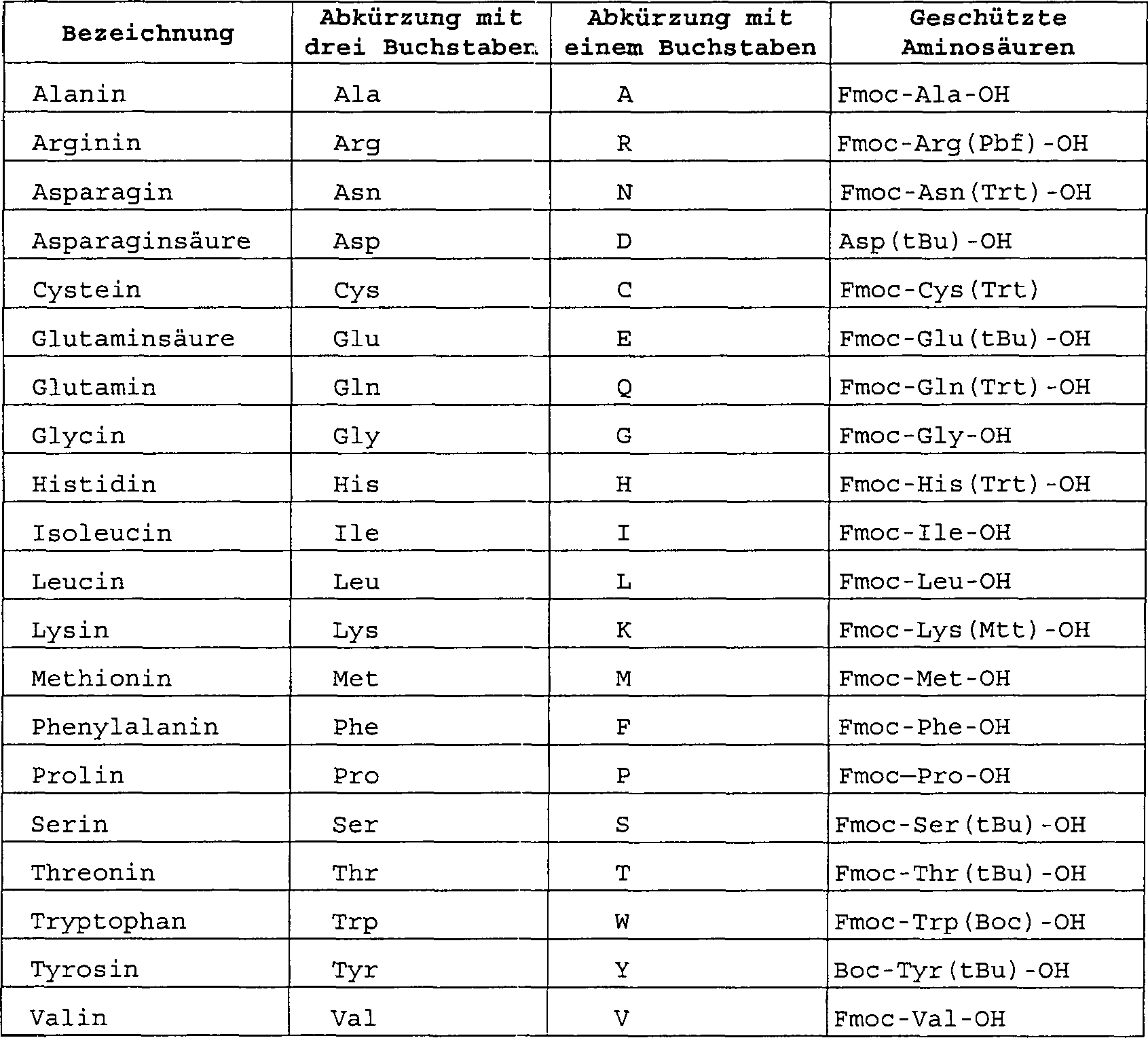
Empfindliche funktionelle Gruppen: Bei einer empfindlichen funktionellen Gruppe handelt es sich um eine Gruppe von Atomen, die eine potentielle Reaktionsstelle an einem ITP-Peptid darstellt. Falls vorhanden, kann eine empfindliche funktionelle Gruppe als Befestigungsstelle für die Linker-reaktive Gruppenmodifikation gewählt werden. Zu empfindlichen funktionellen Gruppen gehören (ohne Beschränkung hierauf) Carboxyl-, Amino-, Thiol- und Hydroxylgruppen.Sensitive functional groups: A sensitive functional group is a Group of atoms that have a potential reaction site at a Represents ITP peptide. If present, it can be a sensitive functional Group as an attachment point for the linker-reactive group modification can be selected. Too sensitive functional groups (without limitation thereupon) carboxyl, amino, thiol and hydroxyl groups.
Modifizierte Peptide: Ein modifiziertes ITP ist ein Peptid, das durch Anbringen einer reaktiven Gruppe modifiziert worden ist und das zur Bildung eines Peptidase-stabilisierten Peptids befähigt ist, und zwar durch Konjugation mit Blutkomponenten. Die reaktive Gruppe kann am therapeutischen Peptid entweder über eine verknüpfende Gruppe oder gegebenenfalls ohne eine verknüpfende Gruppe angebracht sein. Es kommt ferner in Betracht, dass eine oder mehrere zusätzliche Aminosäuren an das therapeutische Peptid addiert sind, um das Anbringen der reaktiven Gruppe zu erleichtern.Modified Peptides: A Modified ITP is a peptide that is modified by attaching a reactive group and that to form a peptidase-stabilized peptide capable by conjugation with blood components. The reactive The group can be linked to the therapeutic peptide either via a linking group or may be appropriate without a linking group. It is also contemplated that one or more additional amino acids are added to the therapeutic peptide in order to attach the to facilitate reactive group.
Modifizierte Peptide können in vivo verabreicht werden, so dass die Konjugation mit Blutkomponenten in vivo erfolgt, oder sie können zunächst in vitro mit Blutkomponenten konjugiert werden und das erhaltene Peptidase-stabilisierte Peptid (gemäß der nachstehenden Definition) kann in vivo verabreicht werden. Die Ausdrücke "modifiziertes therapeutisches Peptid" und "modifiziertes Peptid" können in der vorliegenden Anmeldung in austauschbarer Weise verwendet werden.Modified peptides can be found in be administered in vivo so that the conjugation with blood components in in vivo, or they can first be conjugated in vitro with blood components and the peptidase stabilized obtained Peptide (according to the below Definition) can be administered in vivo. The terms "modified therapeutic Peptide "and" modified peptide "can be found in of the present application can be used interchangeably.
Peptidase-stabilisiertes ITP: Ein Peptidase-stabilisiertes ITP ist ein modifiziertes Peptid, das mit einer Blutkomponente konjugiert worden ist, und zwar über eine kovalente Bindung, die zwischen der reaktiven Gruppe des modifizierten Peptids und den funktionellen Gruppen der Blutkomponente mit oder ohne eine verknüpfende Gruppe gebildet worden ist. Peptidase-stabilisierte Peptide sind in vivo in Gegenwart von Peptidasen stabiler als ein nicht-stabilisiertes Peptid. Ein Peptidase-stabilisiertes therapeutisches Peptid weist im allgemeinen eine um mindestens 10–50% verlängerte Halbwertszeit auf, verglichen mit einem nicht-stabilisierten Peptid von identischer Sequenz. Die Peptidase-Stabilität wird bestimmt, indem man die Halbwertszeit des unmodifizierten ITP in Serum oder Blut mit der Halbwertszeit eines als Gegenstück verwendeten modifizierten therapeutischen Peptids in Serum oder Blut vergleicht. Die Halbwertszeit wird bestimmt, indem man nach Verabreichung der modifizierten und nicht-modifizierten Peptide Proben von Serum oder Blut gewinnt und die Aktivität des Peptids bestimmt. Zusätzlich zur Bestimmung der Aktivität kann auch die Länge des ITP durch HPLC und Massenspektrometrie bestimmt werden.Peptidase-Stabilized ITP: A peptidase-stabilized ITP is a modified peptide that has been conjugated to a blood component, via a covalent bond, between the reactive group of the modified peptide and the functional groups of the blood component with or without a linking group has been formed. Peptidase-stabilized peptides are more stable in vivo in the presence of peptidases than an unstabilized peptide. A peptidase-stabilized therapeutic peptide generally has a half-life prolonged by at least 10-50% compared to a non-stabilized peptide of identical sequence. Peptidase stability is determined by comparing the half-life of the unmodified ITP in serum or blood with the half-life of a modified therapeutic peptide in serum or blood used as a counterpart. The half-life is determined by collecting samples of serum or blood after administration of the modified and unmodified peptides and the Ak activity of the peptide determined. In addition to determining the activity, the length of the ITP can also be determined by HPLC and mass spectrometry.
Ausführliche Beschreibung der ErfindungDetailed description of the invention
Unter Berücksichtigung dieser Definitionen konzentriert sich die vorliegende Erfindung auf die Modifikation von insulinotropen Peptiden zur Verbesserung ihrer biologischen Verfügbarkeit, zur Verlängerung ihrer Halbwertszeit und zur Erweiterung ihrer Verteilung durch selektive Konjugation mit einem Proteinträger, ohne dass ihre bemerkenswerten therapeutischen Eigenschaften modifiziert werden. Beim Träger der Wahl handelt es sich erfindungsgemäß (ohne Beschränkung hierauf) um Albumin, das über freies Thiol mit einem insulinotropen Peptid, das mit einem Maleinimidrest derivatisiert ist, konjugiert ist.Taking these definitions into account the present invention focuses on the modification of insulinotropic peptides to improve their biological Availability, for extension their half-life and to expand their distribution through selective Conjugation with a protein carrier, without modifying their remarkable therapeutic properties become. At the carrier the choice is according to the invention (without limitation) about albumin that over free thiol with an insulinotropic peptide containing a maleimide residue is derivatized, conjugated.
1. Insulinotrope Peptide1. Insulinotropic peptides
A. GLP-1 und dessen DerivateA. GLP-1 and its derivatives
Bekanntlich wird das Hormon Glucagon als hochmolekulares Vorläufermolekül synthetisiert, das anschließend proteolytisch in drei Peptide gespalten wird: Glucagon, glucagonartiges Peptid 1 (GLP-1) und glucagonartiges Peptid 2 (GLP-2). GLP-1 weist in seiner unprozessierten Form 37 Aminosäuren auf, wie in SEQ ID NO: 1 dargestellt ist.As is known, the hormone glucagon synthesized as a high molecular precursor, that afterwards is proteolytically split into three peptides: glucagon, glucagon-like Peptide 1 (GLP-1) and glucagon-like peptide 2 (GLP-2). GLP-1 points 37 amino acids in its unprocessed form, as in SEQ ID NO: 1 is shown.
Unprozessiertes GLP-1 ist im wesentlichen unfähig zur Vermittlung der Einleitung der Insulin-Biosynthese. Das unprozessierte GLP-1-Peptid wird jedoch in der Natur in ein 31 Aminosäuren langes Peptid (7-37-Peptid) mit den Aminosäuren 7-37 von GLP-1 umgewandelt ("GLP-1(7-37)"); SEQ ID NO: 2. GLP-1(7-37) kann einer zusätzlichen Prozessierung durch proteolytische Entfernung des C-terminalen Glycins unterliegen, wodurch GLP-1(7-36) gebildet wird, das ebenfalls vorwiegend mit dem C-terminalen Rest Arginin in amidierter Form als Argininamid vorliegt (GLP-1(7-36)-Amid). Diese Prozessierung erfolgt im Darm und in wesentlich geringerem Umfang im Pankreas und führt zu einem Polypeptid mit der insulinotropen Aktivität von GLP-1(7-37).Unprocessed GLP-1 is essentially unable to mediate the initiation of insulin biosynthesis. The unprocessed However, GLP-1 peptide is naturally 31 amino acids long Peptide (7-37 peptide) with amino acids 7-37 converted from GLP-1 ( "GLP-1 (7-37)"); SEQ ID NO: 2. GLP-1 (7-37) can an additional Subject to processing by proteolytic removal of the C-terminal glycine, whereby GLP-1 (7-36) is formed, which is also predominantly with the C-terminal residue arginine in amidated form as argininamide is present (GLP-1 (7-36) amide). This processing takes place in the intestine and to a much lesser extent in the pancreas and leads to one Polypeptide with the insulinotropic activity of GLP-1 (7-37).
Bei einer Verbindung wird von einer "insulinotropen Aktivität" gesprochen, wenn sie befähigt ist, die Synthese oder Expression des Hormons Insulin zu stimulieren oder diese Stimulierung hervorzurufen. Die hormonelle Aktivität von GLP-1(7-37) und GLP-1(7-36) scheint spezifisch für die pankreatischen Betazellen zu sein, wo offensichtlich die Biosynthese von Insulin induziert wird. Das erfindungsgemäße glucagonartige Peptidhormon eignet sich zur Untersuchung der Pathogenese von im reifen Alter einsetzendem Diabetes mellitus, einem Zustand, der durch Hyperglykämie gekennzeichnet ist, bei dem die Dynamik der Insulinsekretion abnormal ist. Außerdem eignet sich das glucagonartige Peptid bei der Therapie und der Behandlung dieser Krankheit und bei der Therapie und der Behandlung von Hyperglykämie.A compound is said to have "insulinotropic activity" if empowers them is to stimulate the synthesis or expression of the hormone insulin or to induce this stimulation. The hormonal activity of GLP-1 (7-37) and GLP-1 (7-36) appears to be specific for pancreatic beta cells to be where obviously the insulin biosynthesis is induced becomes. The glucagon-like according to the invention Peptide hormone is suitable for studying the pathogenesis of im mature age-onset diabetes mellitus, a condition that through hyperglycemia is characterized in which the dynamics of insulin secretion is abnormal is. Moreover the glucagon-like peptide is suitable for therapy and treatment this disease and in the therapy and treatment of hyperglycemia.
Peptidreste (Fragmente), die aus der ermittelten Aminosäuresequenz von humanem GLP-1 ausgewählt sind, stellen den Ausgangspunkt bei der Entwicklung im Rahmen der vorliegenden Erfindung dar. Die gegenseitig austauschbaren Ausdrücke "Peptidfragment" und "Peptidrest" sollen sowohl synthetische als auch natürlich vorkommende Aminosäuresequenzen umfassen, die sich von einer natürlich vorkommenden Aminosäuresequenz ableiten.Peptide residues (fragments) resulting from the amino acid sequence determined selected from human GLP-1 are the starting point for development in the context of present invention. The mutually interchangeable terms "peptide fragment" and "peptide residue" are intended to be both synthetic as well of course occurring amino acid sequences include that is different from a natural one occurring amino acid sequence derived.
Die Aminosäuresequenz für GLP-1 wurde von verschiedenen Arbeitsgruppen angegeben (L. C. Lopez et al., Proc. Natl. Acad. Sci. USA, Bd. 80 (1983), S. 5485–5489; G. I. Bell et al., Nature, Bd. 302 (1983), S. 716–718; G. Heinrich et al., Endocrinol., Bd. 115 (1984), S. 2176–2181). Die Struktur der Präproglucagon-mRNA und die entsprechende Aminosäuresequenz davon sind bekannt. Die proteolytische Prozessierung des Vorläufer-Genprodukts Proglucagon zu Glucagon und die beiden insulinotropen Peptide wurden charakterisiert. Die hier verwendete Bezeichnung GLP-1(1-37) bezieht sich auf ein GLP-1-Polypeptid mit sämtlichen Aminosäuren von 1 (N-Terminus) bis 37 (C-Terminus). Gleichermaßen bezieht sich der Ausdruck GLP-1(7-37) auf ein GLP-1-Polypeptid mit sämtlichen Aminosäuren von 7 (N-Terminus) bis 37 (C-Terminus). Gleichermaßen bezieht sich der Ausdruck GLP-1(7-36) auf ein GLP-1-Polypeptid mit sämtlichen Aminosäuren von 7 (N-Terminus) bis 36 (C-Terminus).The amino acid sequence for GLP-1 was indicated by various working groups (L.C. Lopez et al., Proc. Natl. Acad. Sci. USA, Vol. 80 (1983), pp. 5485-5489; G. I. Bell et al., Nature, 1983, 302: 716-718; G. Heinrich et al., Endocrinol., Vol. 115 (1984), pp. 2176-2181). The structure of the preproglucagon mRNA and the corresponding amino acid sequence of which are known. The proteolytic processing of the precursor gene product Proglucagon to glucagon and the two insulinotropic peptides were characterized. The term GLP-1 (1-37) used here refers refer to a GLP-1 polypeptide with all amino acids from 1 (N-terminus) to 37 (C-terminus). Similarly, the expression GLP-1 (7-37) refers for a GLP-1 polypeptide with all amino acids from 7 (N-terminus) to 37 (C-terminus). Likewise relates the term GLP-1 (7-36) refers to a GLP-1 polypeptide with all Amino acids of 7 (N-terminus) to 36 (C-terminus).
Gemäß einer Ausführungsform werden GLP-1(7-36) und dessen Peptidfragmente durch herkömmliche Maßnahmen entsprechend den nachstehenden Ausführungen synthetisiert, z. B. durch die bekannte Festphasen-Peptidsynthese nach J. M. Merrifield (Chem. Soc., Bd. 85 (1962), S. 2149) und nach Stewart und Young (Solid Phase Peptide Synthesis, Freeman, San Francisco, (1969), S. 27–66) (auf diese Druckschriften wird durch Verweis Bezug genommen). Jedoch ist es auch möglich, Fragmente des Proglucagon-Polypeptids oder von GLP-1 durch Fragmentierung der natürlich auftretenden Aminosäuresequenz zu erhalten, beispielsweise unter Verwendung eines proteolytischen Enzyms. Ferner ist es möglich, die gewünschten Fragmente des Proglucagon-Peptids oder von GLP-1 unter Anwendung von rekombinanter DNA-Technik gemäß den Angaben von T. Maniatis et al. zu erhalten (Molecular Biology: A Laboratory Manual, Cold Spring Habor, New York (1982) (auf diese Druckschrift wird durch Verweis Bezug genommen).According to one embodiment, GLP-1 (7-36) and its peptide fragments are synthesized by conventional means in accordance with the explanations below, e.g. B. by the known solid phase peptide synthesis according to JM Merrifield (Chem. Soc., Vol. 85 (1962), p. 2149) and according to Stewart and Young (Solid Phase Peptide Synthesis, Freeman, San Francisco, (1969), p. 27-66) (reference is made to these publications by reference). However, it is also possible to obtain fragments of the proglucagon polypeptide or of GLP-1 by fragmenting the naturally occurring amino acid sequence, for example using a proteolytic enzyme. It is also possible to obtain the desired fragments of the proglucagon peptide or of GLP-1 using recombinant DNA technology as described by T. Maniatis et al. (Molecular Biology: A Laboratory Manual, Cold Spring Habor, New York (1982) (reference is made to this document by reference).
Die vorliegende Erfindung umfasst Peptide, die von GLP-1 ableitbar sind, z. B. GLP-1(1-37) und GLP-1(7-36). Ein Peptid wird als "von einer natürlich vorkommenden Aminosäuresequenz ableitbar" bezeichnet, wenn es durch Fragmentierung einer natürlich vorkommenden Sequenz erhalten werden kann oder wenn es auf der Grundlage der Kenntnis der Sequenz der natürlich vorkommenden Aminosäuresequenz oder des genetischen Materials (DNA oder RNA), das für diese Sequenz kodiert, erhalten werden kann.The present invention encompasses Peptides derived from GLP-1, e.g. B. GLP-1 (1-37) and GLP-1 (7-36). A peptide is called "from one of course occurring amino acid sequence derivable " if it's by fragmentation of a naturally occurring sequence can be obtained or if it is based on knowledge the sequence of course occurring amino acid sequence or the genetic material (DNA or RNA) that is used for this Coded sequence, can be obtained.
Unter den Umfang der Erfindung fallen auch die Moleküle, die als "Derivate" von GLP-1 bezeichnet werden, wie GLP-1(1-37) und insbesondere GLP-1(7-36). Ein derartiges "Derivat" weist die folgenden Eigenschaften auf: (1) es weist eine wesentliche Homologie mit GLP-1 oder einem Fragment von GLP-1 mit ähnlicher Größe auf; (2) es ist dazu befähigt, als ein insulinotropes Hormon zu wirken; und (3) bei Anwendung von mindestens einem der hier vorgelegten Tests weist das Derivat entweder (i) eine insulinotrope Aktivität auf, die die insulinotrope Aktivität von GLP-1 übersteigt oder vorzugsweise (ii) eine insulinotrope Aktivität, die selbst dann nachgewiesen werden kann, wenn das Derivat in einer Konzentration von 10–10 M vorhanden ist, oder insbesondere (iii) es weist eine insulinotrope Aktivität auf, die auch dann nachgewiesen werden kann, wenn das Derivat in einer Konzentration von 10–11 M vorhanden ist.Also within the scope of the invention are the molecules referred to as "derivatives" of GLP-1, such as GLP-1 (1-37) and especially GLP-1 (7-36). Such a "derivative" has the following properties: (1) it has substantial homology with GLP-1 or a fragment of GLP-1 of similar size; (2) it is capable of acting as an insulinotropic hormone; and (3) when using at least one of the tests presented here, the derivative has either (i) an insulinotropic activity that exceeds the insulinotropic activity of GLP-1 or, preferably, (ii) an insulinotropic activity that can be detected even then, when the derivative is present at a concentration of 10-10 M, or in particular (iii) it has an insulinotropic activity which can be detected even when the derivative is present at a concentration of 10-11 M.
Bei einem Derivat von GLP-1 wird von einer "wesentlichen Homologie mit GLP-1" gesprochen, wenn die Aminosäuresequenz des Derivats zu mindestens 80%, vorzugsweise zu mindestens 90% und insbesondere zu mindestens 95% gleich mit der Sequenz von GLP-1(1-37) ist.With a derivative of GLP-1 of an "essential Homology spoken with GLP-1 ", if the amino acid sequence at least 80% of the derivative, preferably at least 90% and in particular at least 95% identical to the sequence of GLP-1 (1-37) is.
Die erfindungsgemäßen Derivate umfassen GLP-1-Fragmente, die zusätzlich zum Gehalt an einer Sequenz, die im wesentlichen homolog mit der Sequenz des natürlich vorkommenden GLP-1-Peptids ist, eine oder mehrere zusätzliche Aminosäuresequenzen an ihren Amino- und/oder Carboxy-Termini aufweisen können. Somit bezieht sich die Erfindung auf Polypeptidfragmente von GLP-1, die eine oder mehrere Aminosäuren enthalten können, die in der natürlich vorkommenden GLP-1-Sequenz nicht vorhanden sind, vorausgesetzt, dass derartige Polypeptide eine insulinotrope Aktivität besitzen, die die von GLP-1 übersteigt. Bei den zusätzlichen Aminosäuren kann es sich um D-Aminosäuren oder L-Aminosäuren oder um Kombinationen davon handeln.The derivatives according to the invention comprise GLP-1 fragments, the additional on the content of a sequence which is essentially homologous to the Sequence of course occurring GLP-1 peptide is one or more additional amino acid sequences on their amino and / or carboxy termini can have. Thus the invention relates to polypeptide fragments of GLP-1, the one or more amino acids can contain which in the course occurring GLP-1 sequence are not provided, provided that such polypeptides have an insulinotropic activity, that exceeds that of GLP-1. With the additional amino acids can be D-amino acids or L-amino acids or combinations of these.
Die Erfindung umfasst auch GLP-1-Fragmente, die trotz ihres Gehalts an einer Sequenz, die im wesentlichen homolog mit der von natürlich vorkommendem GLP-1-Peptid ist, einen Mangel an einer oder mehreren zusätzlichen Aminosäuren an ihren Amino- und/oder Carboxy-Termini, die natürlicherweise bei einem GLP-1-Peptid auftreten, aufweisen. Somit bezieht sich die Erfindung auf Polypeptidfragmente von GLP-1, dem eine oder mehrere Aminosäuren, die normalerweise in einer natürlich vorkommenden GLP-1-Sequenz vorhanden sind, fehlen, vorausgesetzt, dass derartige Polypeptide eine insulinotrope Aktivität besitzen, die die von GLP-1 übersteigt.The invention also includes GLP-1 fragments, which despite their content of a sequence that is essentially homologous with that of course occurring GLP-1 peptide is deficient in one or more additional amino acids on their amino and / or carboxy termini, which are natural occur with a GLP-1 peptide. Thus relates the invention on polypeptide fragments of GLP-1, the one or more Amino acids, which is usually in a natural existing GLP-1 sequence are missing, provided that such polypeptides have an insulinotropic activity, that exceeds that of GLP-1.
Die Erfindung umfasst ferner die offensichtlichen oder trivialen Varianten der vorstehend beschriebenen Fragmente, die nicht-konsequenzielle Aminosäuresubstitutionen aufweisen (und somit Aminosäuresequenzen besitzen, die sich von denen der natürlichen Sequenz unterscheiden), vorausgesetzt, dass derartige Varianten eine insulinotrope Aktivität besitzen, die im wesentlichen identisch mit derjenigen der vorstehend beschriebenen GLP-1-Derivate ist. Zu Beispielen für offensichtliche oder triviale Substitutionen gehören die Substitution eines basischen Restes mit einem anderen basischen Rest (z. B. Arg anstelle von Lys), die Substitution von einem hydrophoben Rest anstelle eines anderen hydrophoben Restes (z. B. Leu anstelle von Ile) oder die Substitution eines aromatischen Restes durch einen anderen aromatischen Rest (z. B. Phe anstelle von Tyr) und dergl.The invention also includes obvious or trivial variants of the ones described above Fragments that are non-consequential amino acid substitutions have (and thus amino acid sequences possess that differ from those of the natural sequence), provided that such variants have insulinotropic activity, which are substantially identical to that of those described above Is GLP-1 derivatives. For examples of obvious or trivial Substitutions include the substitution of a basic residue with another basic residue Rest (e.g. Arg instead of Lys), the substitution of a hydrophobic Residue instead of another hydrophobic residue (e.g. Leu instead von Ile) or the substitution of an aromatic residue by a other aromatic residue (e.g. Phe instead of Tyr) and the like.
Zusätzlich zu diesen GLP-1-Derivaten mit insulinotroper Aktivität fallen GLP-1-Derivate, die die Glucose-Aufnahme durch Zellen stimulieren, jedoch nicht die Insulin-Expression oder -Sekretion stimulieren, unter den Umfang der Erfindung. Derartige GLP-1-Derivate sind im US-Patent 5 574 008 beschrieben.In addition to these GLP-1 derivatives with insulinotropic activity fall GLP-1 derivatives that stimulate glucose uptake by cells, but do not stimulate insulin expression or secretion, within the scope of the invention. Such GLP-1 derivatives are in U.S. Patent 5,574,008.
sZu GLP-1-Derivaten, die die Aufnahme
von Glucose durch Zellen, jedoch nicht die Expression oder Sekretion
von Insulin stimulieren, die erfindungsgemäß Anwendung finden, gehören:
R1-Ser-Tyr-Leu-Glu-Gly-Gln-Ala-Ala-Lys-Glu-Phe-Ile-Ala-Trp-Leu-Val-Xaa-Gly-Arg-R2 (SEQ ID NO: 3), worin R1 ausgewählt ist
unter a) H2N; b) H2N-Ser;
c) H2N-Val-Ser; d) H2N-Asp-Val-Ser;
e) H2N-Ser-Asp-Val-Ser (SEQ ID NO: 4); f)
H2N-Thr-Ser-Asp-Val-Ser (SEQ ID NO: 5);
g) H2N-Phe-Thr-Ser-Asp-Val-Ser (SEQ ID NO: 6); h) H2N-Thr-Phe-Thr-Ser-ASp-Val-Ser (SEQ ID NO:
7); i) H2N-Gly-Thr-Phe-Thr-Ser-Asp-Val-Ser
(SEQ ID NO: 8); j) H2N-Glu-Gly-Thr-Phe-Thr-Ser-Asp-Val-Ser
(SEQ ID NO: 9); oder k) H2N-Ala-Glu-Gly-Thr-Phe-Thr-Ser-ASp-Val-Ser
(SEQ ID NO: 10). In diesem Peptid wird X unter Lys oder Arg und
R2 unter NH2, OH,
Gly-NH2 oder Gly-OH ausgewählt. Bei
diesen Peptiden handelt es sich um C-terminale GLP-1-Fragmente,
die keine insulinotrope Aktivität
besitzen, sich aber trotzdem zur Behandlung von Diabetes und hyperglykämischen
Zuständen
gemäß US-Patent
5 574 008 eignen.GLP-1 derivatives which stimulate the uptake of glucose by cells, but not the expression or secretion of insulin, which are used according to the invention include:
R 1 -Ser-Tyr-Leu-Glu-Gly-Gln-Ala-Ala-Lys-Glu-Phe-Ile-Ala-Trp-Leu-Val-Xaa-Gly-Arg-R 2 (SEQ ID NO: 3) , wherein R 1 is selected from a) H 2 N; b) H 2 N-Ser; c) H 2 N-Val-Ser; d) H 2 N Asp Asp-Ser; e) H 2 N-Ser-Asp-Val-Ser (SEQ ID NO: 4); f) H 2 N-Thr-Ser-Asp-Val-Ser (SEQ ID NO: 5); g) H 2 N-Phe-Thr-Ser-Asp-Val-Ser (SEQ ID NO: 6); h) H 2 N-Thr-Phe-Thr-Ser-ASp-Val-Ser (SEQ ID NO: 7); i) H 2 N-Gly-Thr-Phe-Thr-Ser-Asp-Val-Ser (SEQ ID NO: 8); j) H 2 N-Glu-Gly-Thr-Phe-Thr-Ser-Asp-Val-Ser (SEQ ID NO: 9); or k) H 2 N-Ala-Glu-Gly-Thr-Phe-Thr-Ser-ASp-Val-Ser (SEQ ID NO: 10). In this peptide, X is selected from Lys or Arg and R 2 from NH 2 , OH, Gly-NH 2 or Gly-OH. These peptides are C-terminal GLP-1 fragments which have no insulinotropic activity, but are nevertheless suitable for the treatment of diabetes and hyperglycemic conditions according to US Pat. No. 5,574,008.
B. Exendin-3- und Exendin-4-PeptideB. Exendin-3 and Exendin-4 peptides
Exendin-3 und Exendin-4 sind Peptide mit 39 Aminosäuren (Unterschied an den Resten 2 und 3) mit einer Homologie von etwa 53 $ zu GLP-1 und finden Anwendung als insulinotrope Mittel.Exendin-3 and Exendin-4 are peptides with 39 amino acids (difference on residues 2 and 3) with approximately $ 53 homology to GLP-1 and are used as insulinotropic agents.
Die Sequenz von Exendin-3 (SEQ ID No: 11) ist HSDGTFTSDLSKQMEEEAVRLFIEWLKNGG PSSGAPPPS.The sequence of Exendin-3 (SEQ ID No: 11) is HSDGTFTSDLSKQMEEEAVRLFIEWLKNGG PSSGAPPPS.
Die Sequenz von Exendin-4 (SEQ ID No: 12) ist HGEGTFTSDLSKQMEEEAVRLFIEWLKNGG PSSGAPPPS.The sequence of Exendin-4 (SEQ ID No: 12) is HGEGTFTSDLSKQMEEEAVRLFIEWLKNGG PSSGAPPPS.
Die Erfindung umfasst ferner die insulinotropen Fragmente von Exendin-4, die die folgenden Aminosäuresequenzen umfassen: Exendin-4(1-31) (SEQ ID No: 13) HGEGTFTSDLSKQMEEAVR LFIEWLKNGGPY und Exendin-4(1-31) (SEQ ID No: 14) HGEGTFTSDLSKQMEEEAVRLFIEWLKNGGY.The invention also includes insulinotropic fragments of exendin-4 that have the following amino acid sequences include: Exendin-4 (1-31) (SEQ ID No: 13) HGEGTFTSDLSKQMEEAVR LFIEWLKNGGPY and Exendin-4 (1-31) (SEQ ID No: 14) HGEGTFTSDLSKQMEEEAVRLFIEWLKNGGY.
Die Erfindung umfasst ferner das Inhibitorfragment von Exendin-4 mit der folgenden Aminosäuresequenz: Exendin-4(9-39) (SEQ ID No: 15) DLSKQMEEEAVRLFIEWLKNGGPSSGAPPPS.The invention further includes that Inhibitor fragment of exendin-4 with the following amino acid sequence: Exendin-4 (9-39) (SEQ ID No: 15) DLSKQMEEEAVRLFIEWLKNGGPSSGAPPPS.
Weitere insulinotrope Peptide sind in den Beispielen als SEQ ID NO: 16-22 aufgeführt.Other insulinotropic peptides are listed in the examples as SEQ ID NO: 16-22.
Die vorliegende Erfindung umfasst Peptide, die von den natürlich vorkommenden Exendin-3- und Exendin-4-Peptiden ableitbar sind. Ein Peptid wird als "von einer natürlich vorkommenden Aminosäuresequenz ableitbar" bezeichnet, wenn es durch Fragmentierung einer natürlich vorkommenden Sequenz erhalten werden kann oder wenn es aufgrund der Kenntnis der Sequenz der natürlich vorkommenden Aminosäuresequenz oder des genetischen Materials (DNA oder RNA), die für diese Sequenz kodiert, synthetisiert werden kann.The present invention encompasses Peptides made by the natural occurring exendin-3 and exendin-4 peptides can be derived. On Peptide is called "by one of course occurring amino acid sequence derivable " if it's by fragmentation of a naturally occurring sequence can be obtained or if it is based on knowledge of the sequence the of course occurring amino acid sequence or the genetic material (DNA or RNA) necessary for this Sequence encoded, can be synthesized.
Unter den Umfang der vorliegenden Erfindung fallen Moleküle, die als "Derivate" von Exendin-3 und Exendin-4 bezeichnet werden. Ein derartiges "Derivat" weist die folgenden Eigenschaften auf: (1) es weist eine wesentliche Homologie mit Exendin-3 oder Exendin-4 oder einem Fragment von Exendin-3 oder Exendin-4 von ähnlicher Größe auf; (2) es ist befähigt, als insulinotropes Hormon zu wirken; und (3) unter Anwendung mindestens einer der hier bereitgestellten Tests weist das Derivat entweder (i) eine insulinotrope Aktivität auf, die die insulinotrope Aktivität von Exendin-3 oder Exendin-4 übersteigt oder es weist vorzugsweise (ii) eine insulinotrope Aktivität auf, die auch dann nachgewiesen werden kann, wenn das Derivat in einer Konzentration von 10–10 M vorliegt, oder es weist insbesondere (iii) eine insulinotrope Aktivität auf, die auch dann nachgewiesen werden kann, wenn das Derivat in einer Konzentration von 10–11 M vorliegt.Molecules referred to as "derivatives" of exendin-3 and exendin-4 are within the scope of the present invention. Such a "derivative" has the following properties: (1) it has substantial homology with exendin-3 or exendin-4 or a fragment of exendin-3 or exendin-4 of similar size; (2) it is able to act as an insulinotropic hormone; and (3) using at least one of the tests provided herein, the derivative has either (i) an insulinotropic activity that exceeds the insulinotropic activity of Exendin-3 or Exendin-4, or preferably (ii) an insulinotropic activity that can also be detected when the derivative is in a concentration of 10-10 M, or in particular (iii) has an insulinotropic activity which can also be detected when the derivative is in a concentration of 10-11 M ,
Bei einem Derivat von Exendin-3 und Exendin-4 wird von einer "wesentlichen Homologie" mit Exendin-3 und Exendin-4 gesprochen, wenn die Aminosäuresequenzen des Derivats zu mindestens 80%, vorzugsweise zu mindestens 90% und insbesondere zu mindestens 95% gleich mit der Sequenz von Exendin-3 oder -4 oder einem Fragment von Exendin-3 oder -4 mit der gleichen Anzahl von Aminosäureresten wie das Derivat sind Die erfindungsgemäßen Derivate umfassen Exendin-3- oder Exendin-4-Fragmente, die zusätzlich zu der Tatsache, dass sie eine Sequenz enthalten, die im wesentlichen homolog mit der Sequenz eines natürlich vorkommenden Exendin-3- oder Exendin-4-Peptids ist, eine oder mehrere zusätzliche Aminosäuren an ihren Amino- und/oder Carboxy-Termini enthalten. Somit betrifft die Erfindung Polypeptidfragmente von Exendin-3- oder Exendin-4, die eine oder mehrere Aminosäuren enthalten können, die möglicherweise in natürlich vorkommenden Exendin-3- oder Exendin-4-Sequenzen nicht vorhanden sind, vorausgesetzt, dass diese Polypeptide eine insulinotrope Aktivität besitzen, die die Aktivität von Exendin-3 oder Exendin-4 übertrifft.For a derivative of Exendin-3 and Exendin-4 is of an "essential Homology "with Exendin-3 and Exendin-4 spoken when the amino acid sequences of the derivative increase at least 80%, preferably at least 90% and in particular at least 95% same as the sequence of Exendin-3 or -4 or a fragment of Exendin-3 or -4 with the same number of amino acid residues as the derivative are The derivatives of the invention include exendin-3 or exendin-4 fragments, the additional to the fact that they contain a sequence that is essentially homologous to the sequence of a naturally occurring exendin-3 or exendin-4 peptide, one or more additional amino acids contained on their amino and / or carboxy termini. Thus concerns the invention polypeptide fragments of exendin-3 or exendin-4, which are one or more amino acids can contain the possibly in of course existing Exendin 3 or Exendin 4 sequences are not provided, provided that these polypeptides have insulinotropic activity, the the activity of Exendin-3 or Exendin-4.
Gleichermaßen umfasst die Erfindung Exendin-3- oder Exendin-4-Fragmente, die trotz der Tatsache, dass sie eine Sequenz enthalten, die im wesentlichen homolog mit der Sequenz eines natürlich vorkommenden Exendin-3- oder Exendin-4-Peptids ist, einen Mangel an einer oder mehreren zusätzlichen Aminosäuren an ihren Amino- und/oder Carboxy-Termini, die natürlicherweise an einem Exendin-3- oder Exendin-4-Peptid auftreten, aufweisen können. Somit betrifft die Erfindung Polypeptidfragmente von Exendin-3 oder Exendin-4, denen eine oder mehrere Aminosäuren, die normalerweise in einer natürlich vorkommenden Exendin-3- oder Exendin-4-Sequenz vorhanden sind, fehlen können, vorausgesetzt, dass diese Polypeptide eine insulinotrope Aktivität besitzen, die die Aktivität von Exendin-3 oder Exendin-4 übertrifft.Likewise, the invention includes exendin-3- or exendin-4 fragments, that despite the fact that they contain a sequence that is in the essentially homologous to the sequence of a naturally occurring exendin-3 or exendin-4 peptide is deficient in one or more additional Amino acids their amino and / or carboxy termini, the natural can occur on an exendin-3 or exendin-4 peptide. Consequently The invention relates to polypeptide fragments of Exendin-3 or Exendin-4, which one or more amino acids, which is usually in a natural occurring Exendin-3 or Exendin-4 sequence are present, may be missing, provided that these polypeptides have insulinotropic activity, the the activity of Exendin-3 or Exendin-4.
Die Erfindung betrifft ferner die offensichtlichen oder trivialen Varianten der vorstehend beschriebenen Fragmente, die nicht-konsequenzielle Aminosäuresubstitutionen aufweisen (und somit Aminosäuresequenzen aufweisen, die von der natürlichen Sequenz abweichen), vorausgesetzt, dass derartige Varianten eine insulinotrope Aktivität besitzen, die im wesentlichen identisch mit der Aktivität der vorstehend beschriebenen Exendin-3- oder Exendin-4-Derivate ist.The invention further relates to the obvious or trivial variants of the fragments described above, the non-consequential amino acid substitutions have (and thus have amino acid sequences, that of the natural Sequence), provided that such variants have a insulinotropic activity possess that are essentially identical to the activity of the above Exendin-3 or Exendin-4 derivatives described.
Zu Beispielen für offensichtliche oder triviale Substitutionen gehören die Substitution von einem basischen Rest durch einen anderen basischen Rest (z. B. Arg anstelle von Lys), die Substitution von einem hydrophoben Rest durch einen anderen hydrophoben Rest (z. B. Leu anstelle von Ile) oder die Substitution von einem aromatischen Rest durch einen anderen aromatischen Rest (z. B. Phe anstelle von Tyr) und dergl.For examples of obvious or trivial Substitutions include the substitution of one basic residue by another basic residue Rest (e.g. Arg instead of Lys), the substitution of a hydrophobic Residue by another hydrophobic residue (e.g. Leu instead of Ile) or the substitution of an aromatic residue by one other aromatic residue (e.g. Phe instead of Tyr) and the like.
2. Modifizierte insulinotrope Peptide2. Modified insulinotropic peptides
Die Erfindung betrifft modifizierte insulinotrope Peptide und deren Derivate. Die erfindungsgemäßen modifizierten, insulinotropen Peptide umfassen reaktive Gruppen, die mit verfügbaren reaktiven funktionellen Gruppen an Blutkomponenten unter Bildung von kovalenten Bindungen reagieren können. Die Erfindung betrifft ferner derartige Modifikationen, derartige Kombinationen mit Blutkomponenten und Verfahren zu ihrer Verwendung. Diese Verfahren umfassen die Verlängerung der wirksamen therapeutischen in vivo-Halbwertszeit der modifizierten insulinotropen Peptide.The invention relates to modified insulinotropic peptides and their derivatives. The modified, insulinotropic peptides according to the invention comprise reactive groups which can react with available reactive functional groups on blood components to form covalent bonds. The invention be also makes such modifications, such combinations with blood components, and methods of using them. These methods include extending the effective therapeutic in vivo half-life of the modified insulinotropic peptides.
Zur Bildung von kovalenten Bindungen mit der funktionellen Gruppe an einem Protein kann man als chemisch reaktive Gruppe (reaktiver Rest) eine Vielzahl von aktiven Carboxylgruppen, insbesondere Estern, verwenden, wobei der Hydroxylrest in den Konzentrationen, die zur Modifikation der insulinotropen Peptide erforderlich sind, physiologisch verträglich ist. Obgleich eine Anzahl von unterschiedlichen Hydroxylgruppen in diesen Verknüpfungsmitteln verwendet werden kann, handelt es sich beim zweckmäßigsten Mittel um N-Hydroxysuccinimid (NHS), N-Hydroxysulfosuccinimid (Sulfo-NHS), Maleinimidbenzoylsuccinimid (MBS), gamma-Maleinimidobutyryloxysuccinimidester (GMBS) und Maleinimidopropionsäure (MPA).For the formation of covalent bonds with the functional group on a protein can be considered chemical reactive group (reactive radical) a large number of active carboxyl groups, use esters in particular, the hydroxyl radical in the concentrations which are required to modify the insulinotropic peptides, physiologically compatible is. Although a number of different hydroxyl groups in these linking means can be used, it is the most appropriate Agents for N-hydroxysuccinimide (NHS), N-hydroxysulfosuccinimide (Sulfo-NHS), Maleinimidbenzoylsuccinimid (MBS), gamma-Maleinimidobutyryloxysuccinimidester (GMBS) and maleimidopropionic acid (MPA).
Primäre Amine stellen die hauptsächlichen
Ziele der NHS-Ester dar, wie aus dem nachstehenden Schema hervorgeht.
Zugängliche α-Aminogruppen,
die an den N-Termini von Proteinen vorhanden sind, reagieren mit
NHS-Estern. Jedoch
sind α-Aminogruppen
an einem Protein für
die NHS-Kupplung nicht erwünscht oder
verfügbar.
Obgleich 5-Aminosäuren
in ihren Seitenketten Stickstoff aufweisen, reagiert nur das ε-Amin von
Lysin in signifikantem Umfang mit NHS-Estern. Eine Amidbindung wird
gebildet, wenn die NHS-Esterkonjugationsreaktion mit primären Aminen
unter Freisetzung von N-Hydroxysuccinimid abläuft, wie im nachstehenden Schema
dargestellt ist. Diese Succinimid enthaltenden reaktiven Gruppen
werden hier als Succinimidylgruppen bezeichnet. 
In den bevorzugten Ausführungsformen der Erfindung handelt es sich bei der funktionellen Gruppe am Protein um eine Thiolgruppe und bei der chemisch reaktiven Gruppe um eine Maleinimido enthaltende Gruppe, wie GMBA oder MPA). GMBA bedeutet gamma-Maleinimidbutyrylamid. Derartige Maleinimid enthaltende Gruppen werden hier als Maleinimidogruppen bezeichnet.In the preferred embodiments the invention is the functional group on the protein by a thiol group and by a chemically reactive group Maleinimido containing group, such as GMBA or MPA). GMBA means gamma Maleinimidbutyrylamid. Such groups containing maleimide are referred to here as maleimido groups.
Die Maleinimidogruppe ist besonders
selektiv für
Sulfhydrylgruppen an Peptiden, wenn der pH-Wert des Reaktionsgemisches
auf 6,5 bis 7,4 gehalten wird. Beim pH-Wert 7,0 ist die Reaktionsgeschwindigkeit
von Maleinimidogruppen mit Sulfhydrylen 1000-fach schneller als
mit Aminen. Eine stabile Thioetherverknüpfung zwischen der Maleinimidogruppe
und dem Sulfhydryl wird gebildet, die unter physiologischen Bedingungen nicht
gespalten werden kann. 
Die erfindungsgemäßen insulinotropen Peptide und Peptidderivate können für eine spezifische Markierung und nicht-spezifische Markierung von Blutkomponenten modifiziert werden.The insulinotropic peptides according to the invention and peptide derivatives can for one specific labeling and non-specific labeling of blood components be modified.
A. Spezifische MarkierungA. Specific marking
Vorzugsweise werden die erfindungsgemäßen modifizierten, insulinotropen Peptide (ITP) so konzipiert, dass sie spezifisch mit Thiolgruppen an mobilen Blutproteinen reagieren. Eine derartige Reaktion wird vorzugsweise durch eine kovalente Bindung eines therapeutischen Peptids, das mit einer Maleinimidverknüpfung (z. B. hergestellt aus GMBS, MPA oder anderen Maleinimiden) an eine Thiolgruppe an einem mobilen Blutprotein, wie Serumalbumin oder IgG, modifiziert ist, erreicht.The modified insulinotropic peptides (ITP) according to the invention are preferably designed such that they react specifically with thiol groups on mobile blood proteins. Such a reaction is preferably accomplished by covalently attaching a therapeutic peptide linked to a maleimide linkage (e.g., made from GMBS, MPA, or other maleimides) to a thiol group on a mobile Blood protein, such as serum albumin or IgG, is modified.
Unter bestimmten Umständen bietet eine spezifische Markierung mit Maleinimiden mehrere Vorteile gegenüber einer nicht-spezifischen Markierung von mobilen Proteinen mit Gruppen, wie NHS oder Sulfo-NHS. Thiolgruppen kommen in vivo weniger häufig vor als Aminogruppen. Daher gehen die erfindungsgemäßen Maleinimidderivate eine kovalente Bindung mit weniger Proteinen ein. Beispielsweise liegt in Albumin (das häufigste Blutprotein) nur eine einzige Thiolgruppe vor. Somit besteht bei ITP-Maleinimid-Albumin-Konjugaten die Tendenz, dass sie ein Molverhältnis von etwa 1:1 von ITP zu Albumin aufweisen. Zusätzlich zu Albumin weisen auch IgG-Moleküle (Klasse II) freie Thiole auf. Da IgG-Moleküle und Serumalbumin den Großteil des löslichen Proteins im Blut ausmachen, machen sie auch den Großteil der freien Thiolgruppen im Blut aus, die zur kovalenten Bindung an mit Maleinimid modifizierte ITPs verfügbar sind.Offers under certain circumstances Specific labeling with maleimides has several advantages over one non-specific labeling of mobile proteins with groups, like NHS or Sulfo-NHS. Thiol groups are less common in vivo as amino groups. The maleimide derivatives according to the invention therefore go into one covalent bond with fewer proteins. For example, lies in albumin (the most common Blood protein) only a single thiol group. Thus at ITP-maleimide-albumin conjugates the tendency that they have a molar ratio of about 1: 1 from ITP to have albumin. additionally IgG molecules also point to albumin (Class II) free thiols. Since IgG molecules and serum albumin do most of the soluble protein in the blood, they also make up the majority of the free thiol groups in the blood, which modified for covalent binding to with maleimide ITPs available are.
Ferner führt auch unter freie Thiolgruppen enthaltenden Blutproteinen eine spezifische Markierung mit Maleinimiden zur bevorzugten Bildung von ITP-Maleinimid-Albumin-Konjugaten, und zwar aufgrund der besonderen Eigenschaften von Albumin selbst. Die einzige freie Thiolgruppe von Albumin, die von Spezies zu Spezies hochgradig konserviert ist, befindet sich am Aminosäurerest 34 (Cys34). Es wurde kürzlich gezeigt, dass das Cys34 von Albumin eine erhöhte Reaktivität in Bezug zu freien Thiolgruppen an anderen, freie Thiolgruppen enthaltenden Proteinen aufweist. Dies ist teilweise auf den sehr niedrigen pK-Wert von 5,5 für das Cys34 von Albumin zurückzuführen. Dieser Wert ist wesentlich niedriger als typische pK-Werte für Cysteinreste im allgemeinen, die typischerweise etwa 8 betragen. Aufgrund dieses niedrigen pK-Werts liegt unter normalen physiologischen Bedingungen Cys34 von Albumin vorwiegend in der ionisierten Form vor, was dessen Reaktivität erheblich steigert, wie hier ausgeführt wird. Zusätzlich zu dem niedrigen pK-Wert von Cys34 besteht ein weiterer Faktor, der die Reaktivität von Cys34 steigert, in dessen Position, d. h. in einer Spalte in der Nähe der Oberfläche einer Schleife der v-Region von Albumin. Diese Position macht Cys34 in hohem Maße gegenüber sämtlichen Arten von Liganden zugänglich und stellt einen wichtigen Faktor in der biologischen Rolle von Cys34 als Fänger von freien Radikalen und Fänger von freien Thiolgruppen dar. Aufgrund dieser Eigenschaften ist Cys34 hochgradig reaktiv mit ITP-Maleinimiden. Die Beschleunigung der Reaktionsgeschwindigkeit kann 1000-fach sein, bezogen auf die Reaktionsgeschwindigkeiten von ITP-Maleinimiden mit anderen, freie Thiolgruppen enthaltenden Proteinen.Also, among blood proteins containing free thiol groups, specific labeling with maleimides leads to the preferred formation of ITP-maleimide-albumin conjugates, because of the special properties of albumin itself. The only free thiol group of albumin that is highly conserved from species to species , is located on amino acid residue 34 (Cys 34 ). The Cys 34 of albumin has recently been shown to have increased reactivity with respect to free thiol groups on other proteins containing free thiol groups. This is partly due to the very low pK value of 5.5 for the Cys 34 of albumin. This value is much lower than typical pK values for cysteine residues in general, which are typically around 8. Due to this low pK value, under normal physiological conditions, Cys 34 of albumin is predominantly in the ionized form, which increases its reactivity considerably, as is explained here. In addition to the low pK of Cys 34, there is another factor that increases the reactivity of Cys 34 in its position, ie in a column near the surface of a loop of the v-region of albumin. This position makes Cys 34 highly accessible to all types of ligands and represents an important factor in the biological role of Cys 34 as free radical scavenger and free thiol group scavenger. Because of these properties, Cys34 is highly reactive with ITP-maleimides. The acceleration of the reaction rate can be 1000 times, based on the reaction rates of ITP-maleimides with other proteins containing free thiol groups.
Ein weiterer Vorteil von ITP-Maleinimid-Albumin-Konjugaten besteht in der Reproduzierbarkeit in Verbindung mit der 1:1-Beladung von Albumin mit Peptid, spezifisch an Cys34. Weitere Techniken, z. B. Glutaraldehyd, DCC, EDC und andere chemische Aktivierungen, beispielsweise von freien Aminen, weisen diese Selektivität nicht auf. Beispielsweise enthält Albumin 52 Lysinreste, von denen sich 25 bis 30 an der Oberfläche von Albumin befinden und für die Konjugation zugänglich sind. Eine Aktivierung dieser Lysinreste oder alternativ eine Modifikation von Peptiden unter Kupplung über diese Lysinreste führt zu einer heterogenen Population von Konjugaten. Auch bei Anwendung eines 1:1-Molverhältnisses von Peptid zu Albumin besteht das Ergebnis in mehrfachen Konjugationsprodukten, von denen einige 0, 1, 2 oder mehr Peptide pro Albumin enthalten und wobei jedes Produkt Peptide aufweist, die in willkürlicher Weise an einer der 25 bis 30 verfügbaren Lysinstellen gekuppelt ist. Aufgrund der zahlreichen möglichen Kombinationen wird eine Charakterisierung der genauen Zusammensetzung und der Art der einzelnen Ansätze schwierig und eine Reproduzierbarkeit von Ansatz zu Ansatz ist praktisch unmöglich, was die Verwendung derartiger Konjugate als Therapeutika weniger erstrebenswert macht. Obgleich es ferner den Anschein hat, dass eine Konjugation über Lysinreste von Albumin zumindest den Vorteil der Abgabe größerer Mengen des therapeutischen Mittels pro Albuminmolekül aufweisen sollte, haben Untersuchungen gezeigt, dass ein 1:1-Verhältnis von therapeutischem Mittel zu Albumin bevorzugt ist. In einem Artikel von Stehle et al., "The Loading Rate Determines Tumor Targeting Properties of Methotrexate-Albumin Conjugates in Rats", Anti-Cancer Drugs, Bd. 8 (1997), S. 677–685 (auf diese Druckschrift wird hier durch Verweis Bezug genommen), berichten die Autoren, dass ein 1:1-Verhältnis des Antikrebsmittels Methotrexat zu Albumin, das über Glutaraldehyd gekuppelt ist, zu den vielversprechendsten Ergebnissen führte. Diese Konjugate wurden von Tumorzellen aufgenommen, während Konjugate, die 5:1 bis 20:1 Methotrexatmoleküle trugen, veränderte HPLC- Profile aufwiesen und in vivo rasch von der Leber aufgenommen wurden. Es wird angenommen, dass bei diesen höheren Verhältnissen Konformationsänderungen an Albumin dessen Wirksamkeit als therapeutischer Träger vermindern.Another advantage of ITP-maleimide-albumin conjugates is their reproducibility in connection with the 1: 1 loading of albumin with peptide, specifically on Cys 34 . Other techniques, e.g. B. glutaraldehyde, DCC, EDC and other chemical activations, for example of free amines, do not have this selectivity. For example, albumin contains 52 lysine residues, 25 to 30 of which are on the surface of albumin and are accessible for conjugation. Activation of these lysine residues or alternatively a modification of peptides with coupling via these lysine residues leads to a heterogeneous population of conjugates. Even when using a 1: 1 molar ratio of peptide to albumin, the result is multiple conjugation products, some of which contain 0, 1, 2 or more peptides per albumin, and each product contains peptides that are randomly assigned to one of the 25 to 30 available lysine sites is coupled. Due to the numerous possible combinations, it is difficult to characterize the exact composition and the type of the individual batches and reproducibility from batch to batch is practically impossible, which makes the use of such conjugates as therapeutic agents less desirable. Furthermore, although it appears that conjugation via lysine residues of albumin should have at least the benefit of delivering larger amounts of the therapeutic agent per albumin molecule, studies have shown that a 1: 1 ratio of therapeutic agent to albumin is preferred. In an article by Stehle et al., "The Loading Rate Determines Tumor Targeting Properties of Methotrexate-Albumin Conjugates in Rats", Anti-Cancer Drugs, Vol. 8 (1997), pp. 677-685 (this document is referred to here By reference), the authors report that a 1: 1 ratio of the anticancer drug methotrexate to albumin, which is coupled via glutaraldehyde, led to the most promising results. These conjugates were taken up by tumor cells, while conjugates carrying 5: 1 to 20: 1 methotrexate molecules had altered HPLC profiles and were rapidly absorbed by the liver in vivo. At these higher ratios, conformational changes to albumin are believed to decrease its effectiveness as a therapeutic carrier.
Durch eine kontrollierte in vivo-Verabreichung von Maleinimid-ITPs kann man in vivo die spezifische Markierung von Albumin und IgG steuern. Bei typischen Verabreichungen markieren 80–90% der verabreichten Maleinimid-ITPs Albumin, während weniger als 5% IgG markieren. Ferner kommt es zu einer Spurenmarkierung von freien Thiolen, wie Glutathion. Eine derartige spezifische Markierung wird für eine in vivo-Anwendung bevorzugt, da sie eine genaue Berechnung der geschätzten Halbwertszeit des verabreichten Mittels ermöglicht.Through controlled in vivo administration The specific labeling of maleimide ITPs can be carried out in vivo control of albumin and IgG. Mark for typical administrations 80-90% of the administered maleimide ITPs labeled albumin while less than 5% IgG. There is also a trace marking of free thiols, such as Glutathione. Such a specific marking is used for an in Vivo application is preferred because it provides an accurate calculation of the estimated half-life of the agent administered.
Zusätzlich zur Erzielung einer kontrollierten spezifischen in vivo-Markierung können Maleinimid-ITPs eine spezifische ex vivo-Markierung von Serumalbumin und IgG bewerkstelligen. Eine derartige ex vivo-Markierung beinhaltet die Addition von Maleinimid-ITPs an Blut, Serum oder Kochsalzlösung mit einem Gehalt an Serumalbumin und/oder IgG. Nach Vornahme einer ex vivo-Modifikation mit Maleinimid-ITPs können das Blut, das Serum oder die Kochsalzlösung wieder dem Blut für eine in vivo-Behandlung zugeführt werden.In addition to achieving a controlled specific in vivo labeling, maleimide ITPs can accomplish specific ex vivo labeling of serum albumin and IgG. Such ex vivo labeling involves the addition of maleimide ITPs to blood, serum or saline containing serum albumin and / or IgG. After performing an ex vivo modification with maleimide ITPs, the blood, the serum or saline is returned to the blood for in vivo treatment.
Im Gegensatz zu NHS-Peptiden sind Maleinimid-ITPs im allgemeinen in Gegenwart von wässrigen Lösungen und in Gegenwart von freien Aminen recht stabil. Da Maleinimid-ITPs nur mit freien Thiolen reagieren, sind Schutzgruppen im allgemeinen nicht erforderlich, um eine Reaktion von Maleinimid-ITPs mit sich selbst zu verhindern. Außerdem ermöglicht die erhöhte Stabilität des Peptids die Anwendung weiterer Reinigungsstufen, wie HPLC, um hochgradig gereinigte Produkte, die sich zur in vivo-Anwendung eignen, herzustellen. Schließlich ergibt die erhöhte chemische Stabilität ein Produkt mit längerer Lagerbeständigkeit.Unlike NHS peptides Maleimide ITPs generally in the presence of aqueous solutions and quite stable in the presence of free amines. Because maleimide ITPs Reacting only with free thiols are protective groups in general not required to react with maleinimide ITPs prevent yourself. Moreover allows the elevated stability of the peptide using additional purification steps such as HPLC highly purified products suitable for in vivo use manufacture. Finally results in the increased chemical stability a product with a longer life Shelf life.
B. Nicht-spezifische MarkierungB. Non-specific labeling
Die erfindungsgemäßen ITPs können auch für eine nicht-spezifische Markierung von Blutkomponenten modifiziert werden. Bindungen an Aminogruppen werden im allgemeinen für eine nicht-spezifische Bindung, insbesondere unter Bildung von Amidbindungen, herangezogen. Zur Bildung derartiger Bindungen kann man als chemisch reaktive Gruppe, die mit dem ITP gekuppelt ist, eine Vielzahl von aktiven Carboxylgruppen, insbesondere Ester, verwenden, wobei der Hydroxylrest in den erforderlichen Konzentrationen physiologisch verträglich ist. Obgleich eine Anzahl von verschiedenen Hydroxylgruppen in diesen Verknüpfungsmitteln verwendet werden kann, besteht das zweckmäßigste Produkt in N-Hydroxysuccinimid (NHS) und N-Hydroxysulfosuccinimid (Sulfo-NHS).The ITPs according to the invention can also be used for non-specific labeling be modified by blood components. Bonds to amino groups are generally for a non-specific bond, especially with the formation of amide bonds, used. To form such bonds can be considered chemical reactive group that is coupled to the ITP, a variety of active carboxyl groups, especially esters, use, the Hydroxyl radical in the required concentrations is physiologically compatible. Although a number of different hydroxyl groups in these linking agents the most convenient product is N-hydroxysuccinimide (NHS) and N-hydroxysulfosuccinimide (sulfo-NHS).
Weitere Verknüpfungsmittel, die verwendet werden können, sind im US-Patent 5 612 034 (auf das hier durch Verweis Bezug genommen wird) beschrieben.Other linking agents used can be are in the US patent 5,612,034 (to which reference is made here).
Die verschiedenen Stellen, mit denen die chemisch reaktiven Gruppen der nicht-spezifischen ITPs in vivo reagieren können, umfassen Zellen, insbesondere rote Blutkörperchen (Erythrozyten) und Blutplättchen, sowie Proteine, wie Immunoglobuline, einschließlich IgG und IgM, Serumalbumin, Ferritin, steroidbindende Proteine, Transferrin, thyroxinbindendes Protein, α-2-Makroglobulin und dergl. Derartige Rezeptoren, mit denen die derivatisierten ITPs reagieren und die nicht langlebig sind, werden im allgemeinen vom menschlichen Wirt innerhalb von etwa 3 Tagen beseitigt. Die vorstehend aufgeführten Proteine (einschließlich der Proteine der Zellen) verbleiben mindestens 3 Tage im Blutkreislauf und können 5 Tage oder mehr (üblicherweise nicht mehr als 60 Tage, im allgemeinen nicht mehr als 30 Tage) besonders bis zum Erreichen der Halbwertszeit, auf der Basis der Konzentration im Blut verbleiben.The different bodies with which the chemically reactive groups of the non-specific ITPs in vivo can react include cells, especially red blood cells (erythrocytes) and Platelets, as well Proteins such as immunoglobulins including IgG and IgM, serum albumin, Ferritin, steroid binding proteins, transferrin, thyroxine binding Protein, α-2 macroglobulin and the like. Such receptors with which the derivatized ITPs react and which are not long lasting are generally from human host eliminated within about 3 days. The above listed Proteins (including of the proteins of the cells) remain in the bloodstream for at least 3 days and can 5 days or more (usually not more than 60 days, generally not more than 30 days) especially until reaching the half-life, based on the concentration remain in the blood.
Größtenteils erfolgt die Umsetzung mit mobilen Komponenten im Blut, insbesondere mit Blutproteinen und Zellen, ganz besonders mit Blutproteinen und Erythrozyten. Unter "mobil" ist zu verstehen, dass es für die Komponente keinen festen Ort gibt, an dem sie über einen längeren Zeitraum hinweg verbleibt, im allgemeinen nicht mehr als 5 Minuten und insbesondere nicht mehr als 1 Minute, obgleich einige der Blutkomponenten über längere Zeiträume hinweg relativ stationär sein können. Zu Beginn liegt eine relativ heterogene Population von markierten Proteinen und Zellen vor. Jedoch verändert sich größtenteils die Population innerhalb einiger Tage nach Verabreichung in erheblichem Maße im Vergleich zur anfänglichen Population, und zwar in Abhängigkeit von der Halbwertszeit der markierten Proteine im Blutkreislauf. Somit wird üblicherweise innerhalb von etwa 3 Tagen oder mehr IgG zum überwiegenden markierten Protein im Blutkreislauf. Üblicherweise machen 5 Tage nach der Verabreichung IgG, Serumalbumin und Erythrozyten mindestens etwa 60 Mol-% und insbesondere mindestens etwa 75 Mol-% der konjugierten Komponenten im Blut aus, wobei IgG, IgM (in einem erheblich geringerem Ausmaß) und Serumalbumin mindestens etwa 50 Mol-%, üblicherweise etwa 75 Mol-% und insbesondere mindestens etwa 80 Mol-% der nicht-zellulären konjugierten Komponenten ausmachen.Most of the implementation takes place with mobile components in the blood, especially with blood proteins and Cells, especially with blood proteins and erythrocytes. "Mobile" means that it is for the component does not have a fixed location where it has a longer Time period remains, generally no more than 5 minutes and especially not more than 1 minute, although some of the blood components last for extended periods relatively stationary could be. At the beginning there is a relatively heterogeneous population of labeled Proteins and cells. However, largely changes the population significantly within a few days of administration Dimensions in Compared to the initial Population, depending on the half-life of the labeled proteins in the bloodstream. Consequently is usually to the predominantly labeled protein within about 3 days or more of IgG in the bloodstream. Usually make IgG, serum albumin and erythrocytes 5 days after administration at least about 60 mol% and in particular at least about 75 mol% of the conjugated components in the blood, whereby IgG, IgM (in one considerably smaller extent) and serum albumin at least about 50 mol%, usually about 75 mol% and especially at least about 80 mole percent of the non-cellular conjugated Identify components.
Die erwünschten Konjugate von nicht-spezifischen ITPs an Blutkomponenten lassen sich in vivo durch direkte Verabreichung der ITPs an den Patienten, bei dem es sich um einen Menschen oder um einen anderen Säuger handeln kann, herstellen. Die Verabreichung kann in Form eines Bolus erfolgen oder langsam innerhalb einer bestimmten Zeitspanne durch Infusion unter Verwendung eines dosierten Stroms oder dergl. erfolgen.The desired conjugates of non-specific ITPs on blood components can be administered in vivo by direct administration the ITPs to the patient who is human or around another mammal can act, produce. Administration can take the form of a bolus take place or slowly within a certain period of time Infusion using a metered stream or the like.
Gegebenenfalls können die vorliegenden Konjugate auch ex vivo hergestellt werden, indem man Blut mit erfindungsgemäßen derivatisierten ITPs vereinigt, eine kovalente Bindung der modifizierten ITPs an reaktiven funktionellen Gruppen von Blutkomponenten ermöglicht und sodann das konjugierte Blut in den Wirt zurückleitet oder diesem verabreicht. Der vorstehende Vorgang kann ferner durchgeführt werden, indem man zunächst eine individuelle Blutkomponente oder eine begrenzte Anzahl an Komponenten, wie rote Blutkörperchen, Immunoglobuline, Serumalbumin oder dergl., reinigt und die Komponente oder Komponenten ex vivo mit den chemisch reaktiven ITPs vereinigt. Das markierte Blut oder die, markierte Blutkomponente können sodann wieder dem Wirt zugeführt werden, um das Subjekt in vivo mit therapeutisch wirksamen Konjugaten zu versorgen. Das Blut kann ferner während der ex vivo-Handhabung einer Behandlung zur Verhinderung einer Koagulation unterzogen werden.If necessary, the present conjugates can also be produced ex vivo by derivatizing blood with the invention ITPs united, a covalent binding of the modified ITPs reactive functional groups of blood components and then the conjugated blood returns to or is administered to the host. The above process can also be carried out by first making a individual blood component or a limited number of components, like red blood cells, Immunoglobulins, serum albumin or the like, cleans and the component or components combined ex vivo with the chemically reactive ITPs. The marked blood or the marked blood component can then again fed to the host to the subject in vivo with therapeutically effective conjugates to supply. The blood can also be used during ex vivo handling undergo treatment to prevent coagulation.
3. Synthese von modifizierten ITPs3. Synthesis of modified ITPs
A. ITP-SyntheseA. ITP synthesis
ITP-Fragmente lassen sich nach üblichen Verfahren der Festphasen-Peptidchemie, die dem Fachmann geläufig sind, synthetisieren. Beispielsweise lassen sich ITP-Fragmente durch chemische Festphasentechniken gemäß Steward und Young (J. M. Steward, und J. D. Young, Solid Phase Peptide Synthesis, 2. Auflg., Pierce Chemical Company, Rockford, Ill., (1984)) unter Verwendung eines Applied Biosystem-Synthesegeräts herstellen. Gleichermaßen lassen sich mehrere Fragmente herstellen und sodann unter Bildung von größeren Fragmenten miteinander verknüpfen. Diese synthetischen Peptidfragmente können auch mit Aminosäuresubstitutionen an speziellen Positionen hergestellt werden.ITP fragments can be broken down according to usual Solid-phase peptide chemistry, those familiar to the expert are synthesizing. For example, ITP fragments can be passed through chemical solid phase techniques according to Steward and Young (J. M. Steward, and J.D. Young, Solid Phase Peptide Synthesis, 2nd Ed., Pierce Chemical Company, Rockford, Ill., (1984)) using an Applied Biosystem Synthesizer. equally several fragments can be produced and then with formation of larger fragments link with each other. These synthetic peptide fragments can also be substituted with amino acids be manufactured at special positions.
Bezüglich der Festphasen-Peptidsynthese findet sich eine Zusammenfassung der zahlreichen Techniken bei J. M. Stewart und J. D. Young, Solid Phase Peptide Synthesis, W. H. Freeman Co. (San Francisco), (1963), und bei J. Meienhofer, Hormonal Proteins and Peptides, Academic Press (New York), Bd. 2 (1973), S. 46. Bezüglich einer klassischen Synthese in Lösung wird auf G. Schroder und K. Lupke, The Peptides, Acacemic Press (New York), Bd. 1, verwiesen. Im allgemeinen umfassen diese Verfahren die sequenzielle Addition von einer oder mehreren Aminosäuren oder von in geeigneter Weise geschützten Aminosäuren an eine wachsende Peptidkette. Normalerweise wird entweder die Amino- oder die Carboxylgruppe der ersten Aminosäure durch eine geeignete Schutzgruppe geschützt. Die geschützte oder derivatisierte Aminosäure wird sodann an einem inerten festen Träger angebracht oder in Lösung verwendet, wobei man die nächste Aminosäure in der Sequenz mit der komplementären, in geeigneter Weise geschützten Amino- oder Carboxylgruppe unter Bedingungen, die zur Bildung der Amidbindung geeignet sind, addiert. Anschließend wird die Schutzgruppe von diesem neu addierten Aminosäurerest entfernt und die nächste Aminosäure (in geeigneter Weise geschützt) wird addiert usw.Regarding solid phase peptide synthesis A summary of the numerous techniques can be found in J. M. Stewart and J.D. Young, Solid Phase Peptide Synthesis, W.H. Freeman Co. (San Francisco), (1963), and J. Meienhofer, Hormonal Proteins and Peptides, Academic Press (New York), Vol. 2 (1973), P. 46. Regarding a classic synthesis in solution is published on G. Schroder and K. Lupke, The Peptides, Acacemic Press (New York), Vol. 1. Generally these procedures include the sequential addition of one or more amino acids or from properly protected amino acids to a growing peptide chain. Usually either the amino or the carboxyl group of the first amino acid through a suitable protecting group protected. The protected or derivatized amino acid is then attached to an inert solid support or used in solution, being the next amino acid in sequence with the complementary, suitably protected amino or carboxyl group under conditions necessary to form the amide bond are suitable, added. Then the protection group from this newly added amino acid residue removed and the next amino acid (appropriately protected) is added, etc.
Nachdem sämtliche erwünschten Aminosäuren in der richtigen Reihenfolge verknüpft sind, werden etwaige verbleibende Schutzgruppen (und gegebenenfalls der feste Träger) sequenziell oder gleichzeitig entfernt, wodurch man das endgültige Polypeptid erhält. Durch eine einfache Modifikation des allgemeinen Verfahrens ist es möglich, gleichzeitig mehr als eine Aminosäure an eine wachsende Kette zu addieren, indem man beispielsweise (unter Bedingungen, die nicht zur Razemisierung von chiralen Zentren führen) ein geschütztes Tripeptid mit einem in geeigneter Weise geschützten Dipeptid kuppelt, wodurch man nach Schutzgruppenentfernung ein Pentapeptid erhält.After all the desired amino acids in linked in the correct order any remaining protecting groups (and, if applicable the solid carrier) removed sequentially or simultaneously, resulting in the final polypeptide receives. By simply modifying the general procedure it possible simultaneously more than one amino acid on a growing chain to add, for example (under conditions that are not lead to racemization of chiral centers) a protected tripeptide couples with a suitably protected dipeptide, whereby a pentapeptide is obtained after deprotection.
Ein besonders bevorzugtes Verfahren zur Herstellung der erfindungsgemäßen Verbindungen beinhaltet die Festphasen-Peptidsynthese, bei dem die Aminosäure am α-N-Terminus durch eine säure- oder basenempfindliche Gruppe geschützt ist. Derartige Schutzgruppen sollen unter den Bedingungen der Bildung der Peptidverknüpfung stabil sein, wobei sie leicht ohne Zerstörung der wachsenden Peptidkette oder ohne Razemisierung von etwaigen, darin enthaltenen chiralen Zentren entfernbar sind. Zu geeigneten Schutzgruppen gehören 9-Fluorenylmethyloxycarbonyl (Fmoc), tert.-Butyloxycarbonyl (Boc), Benzyloxycarbonyl (Cbz), Biphenylisopropyloxycarbonyl, tert.-Amyloxycarbonyl, Isobornyloxycarbonyl, α,α-Dimethyl-3,5-dimethoxybenzyloxycarbonyl, o-Nitrophenylsulfenyl, 2-Cyano-tert.-butyloxycarbonyl und dergl. Die 9-Fluorenylmethyloxycarbonyl (Fmoc)-Schutzgruppe wird für die Synthese von ITP-Fragmenten besonders bevorzugt. Zu weiteren bevorzugten Seitenketten-Schutzgruppen gehören für Seitenketten-Aminogruppen, wie Lysin und Arginin, 2,2,5,7,8-Pentamethylchroman-6-sulfonyl (pmc), Nitro, p-Toluolsulfonyl, 4-Methoxybenzolsulfonyl, Cbz, Boc und Adamantyloxycarbonyl; für Tyrosin Benzyl, o-Brombenzyloxycarbonyl, 2,6-Dichlorbenzyl, Isopropyl, tert.-Butyl (t-Bu), Cyclohexyl, Cyclopentyl und Acetyl (Ac); für Serin tert.-Butyl, Benzyl und Tetrahydropyranyl; für Histidin Trityl, Benzyl, Cbz, p-Toluolsulfonyl und 2,4-Dinitrophenyl; für Tryptophan Formyl; für Asparaginsäure und Glutaminsäure Benzyl und tert.-Butyl; und für Cystein Triphenylmethyl (Trityl).A particularly preferred method for the preparation of the compounds according to the invention solid phase peptide synthesis, in which the amino acid at the α-N terminus through an acid or base sensitive group is protected. Such protecting groups are said to be stable under the conditions of formation of the peptide linkage be easy without destroying the growing peptide chain or without racemization of any chiral contained therein Centers are removable. Suitable protecting groups include 9-fluorenylmethyloxycarbonyl (Fmoc), tert-butyloxycarbonyl (Boc), benzyloxycarbonyl (Cbz), biphenylisopropyloxycarbonyl, tert-amyloxycarbonyl, isobornyloxycarbonyl, α, α-dimethyl-3,5-dimethoxybenzyloxycarbonyl, o -nitrophenylsulfenyl, 2-cyano-tert-butyloxycarbonyl and the like. The 9-fluorenylmethyloxycarbonyl (Fmoc) protecting group is for the synthesis of ITP fragments is particularly preferred. To further preferred side chain protecting groups belong for side chain amino groups, such as lysine and arginine, 2,2,5,7,8-pentamethylchroman-6-sulfonyl (pmc), Nitro, p-toluenesulfonyl, 4-methoxybenzenesulfonyl, Cbz, Boc and adamantyloxycarbonyl; for tyrosine Benzyl, o-bromobenzyloxycarbonyl, 2,6-dichlorobenzyl, isopropyl, tert-butyl (t-Bu), cyclohexyl, cyclopentyl and acetyl (Ac); for serine tert-butyl, benzyl and tetrahydropyranyl; for histidine trityl, benzyl, Cbz, p-toluenesulfonyl and 2,4-dinitrophenyl; for tryptophan formyl; for aspartic acid and glutamic acid Benzyl and tert-butyl; and for Cysteine triphenylmethyl (trityl).
Beim Festphasen-Peptidsyntheseverfahren wird die α-C-terminale Aminosäure an einen geeigneten festen Träger oder Harz gebunden. Zu geeigneten festen Trägern, die sich bei der vorstehenden Synthese eignen, gehören Materialien, die gegenüber den Reagenzien und bei den Reaktionsbedingungen der stufenweisen Kondensations-Schutzgruppenentfernungs-Reaktionen inert sind und ferner im verwendeten Medium unlöslich sind. Ein bevorzugter fester Träger für die Synthese von α-C-terminalen Carboxypeptiden ist 4-Hydroxymethylphenoxymethyl-Copoly(styrol; 1 % Divinylbenzol). Ein bevorzugter fester Träger für α-C-terminale Amidpeptide ist das von der Fa. Applied Biosystems (Foster City, Calif.), erhältliche 4-(2',4'-Dimethoxyphenyl-Fmoc-aminomethyl)phenoxyacetamidoethyl-Harz. Die α-C-terminale Aminosäure wird an das Harz mittels N,N'-Dicyclohexylcarbodiimid (DCC), N,N'-Diisopropylcarbodiimid (DIC) oder O-Benzotriazol-1-yl-N,N,N',N'-tetramethyluroniumhexafluorphosphat (HBTU) mit oder ohne 4-Dimethylaminopyridin (DMAP), 1-Hydroxybenzotriazol (HOBT), Benzotriazol-1-yloxy-tris-(dimethylamino)phosphoniumhexafluorphosphat (BOP) oder Bis-(2-oxo-3-oxazolidinyl)phosphinchlorid (BOPCl), etwa 1 bis etwa 24 Stunden bei einer Temperatur von 10 bis 50°C in einem Lösungsmittel, wie Dichlormethan oder DMF, gekuppelt.In the solid phase peptide synthesis process becomes the α-C terminal amino acid to a suitable solid support or resin bound. To suitable solid supports, which are in the above Synthesis are appropriate Materials opposite the reagents and the reaction conditions of the stepwise Condensation deprotection reactions are inert and are also insoluble in the medium used. A preferred one solid support for the Synthesis of α-C-terminal Carboxypeptides is 4-hydroxymethylphenoxymethyl copoly (styrene; 1% divinylbenzene). A preferred solid support for α-C-terminal amide peptides is that of Applied Biosystems (Foster City, Calif.) 4- (2 ', 4'-dimethoxyphenyl-Fmoc-aminomethyl) phenoxyacetamidoethyl resin. The α-C terminal amino acid is attached to the resin by means of N, N'-dicyclohexylcarbodiimide (DCC), N, N'-diisopropylcarbodiimide (DIC) or O-benzotriazol-1-yl-N, N, N ', N'-tetramethyluronium hexafluorophosphate (HBTU) with or without 4-dimethylaminopyridine (DMAP), 1-hydroxybenzotriazole (HOBT), benzotriazol-1-yloxy-tris- (dimethylamino) phosphonium hexafluorophosphate (BOP) or bis (2-oxo-3-oxazolidinyl) phosphine chloride (BOPCl), e.g. 1 to about 24 hours at a temperature of 10 to 50 ° C in one Solvent, such as dichloromethane or DMF.
Wenn es sich beim festen Träger um 4-(2',4'-Dimethoxyphenyl-Fmocaminomethyl)-phenoxyacetamidoethyl-Harz handelt, wird die Fmoc-Gruppe mit einem sekundären Amin, vorzugsweise Piperidin, abgespalten, bevor die Kupplung mit der α-C-terminalen Aminosäure auf die vorstehend beschriebene Weise erfolgt. Das bevorzugte Verfahren zur Kupplung des von Schutzgruppen befreiten 4-(2',4'-Dimethoxyphenyl-Fmoc-aminomethyl)phenoxyacetamidoethyl-Harzes besteht in der Verwendung von O-Benzotriazol-1-yl-N,N,N',N'-tetramethyluroniumhexafluorophosphat (HBTU, 1 Äquivalent) und 1-Hydroxybenzotriazol (HOBT, 1 Äquivalent) in DMF. Die Kupplung der nachfolgenden geschützten Aminosäuren kann in einem aus dem Stand der Technik bekannten Polypeptid-Syntheseautomaten erfolgen. Bei einer bevorzugten Ausführungsform werden die α-N-terminalen Aminosäuren der wachsenden Peptidkette mit Fmoc geschützt. Die Entfernung der Fmoc-Schutzgruppe von der α-N-terminalen Seite des wachsenden Peptids wird durch Behandlung mit einem sekundären Amin, vorzugsweise Piperidin, vorgenommen. Die einzelnen geschützten Aminosäuren werden sodann in einem 3-fachen molaren Überschuss eingeführt. Die Kupplung erfolgt vorzugsweise in DMF. Beim Kupplungsmittel handelt es sich normalerweise um O-Benzotriazol-1-yl-N,N,N',N'-tetramethyluroniumhexafluorophosphat (HBTU, 1 Äquivalent) und 1-Hydroxybenzotriazol (HOBT, 1 Äquivalent).If the solid support is 4- (2 ', 4'-dimethoxyphenyl-Fmocaminomethyl) -phenoxyacetami is doethyl resin, the Fmoc group is split off with a secondary amine, preferably piperidine, before the coupling with the α-C-terminal amino acid takes place in the manner described above. The preferred method for coupling the deprotected 4- (2 ', 4'-dimethoxyphenyl-Fmoc-aminomethyl) phenoxyacetamidoethyl resin is to use O-benzotriazol-1-yl-N, N, N', N'- tetramethyluronium hexafluorophosphate (HBTU, 1 equivalent) and 1-hydroxybenzotriazole (HOBT, 1 equivalent) in DMF. The subsequent protected amino acids can be coupled in a polypeptide synthesizer known from the prior art. In a preferred embodiment, the α-N-terminal amino acids of the growing peptide chain are protected with Fmoc. The Fmoc protecting group is removed from the α-N-terminal side of the growing peptide by treatment with a secondary amine, preferably piperidine. The individual protected amino acids are then introduced in a 3-fold molar excess. The coupling is preferably done in DMF. The coupling agent is usually O-benzotriazol-1-yl-N, N, N ', N'-tetramethyluronium hexafluorophosphate (HBTU, 1 equivalent) and 1-hydroxybenzotriazole (HOBT, 1 equivalent).
Am Ende der Festphasensynthese wird das Polypeptid vom Harz entfernt und von Schutzgruppen befreit, entweder nacheinander oder in einem einzigen Vorgang. Die Entfernung des Polypeptids und die Schutzgruppenentfernung kann in einem einzigen Vorgang erfolgen, indem man das an das Harz gebundene Polypeptid mit einem Spaltungsreagenz, das Thioanisol, Wasser, Ethandithiol und Trifluoressigsäure umfasst, behandelt. In Fällen, bei denen es sich bei der α-C-terminalen Gruppe des Polypeptids um ein Alkylamid handelt, wird das Harz durch Aminolyse mit einem Alkylamin gespalten. Alternativ kann das Peptid durch Umesterung, z. B. mit Methanol, unter anschließender Aminolyse oder durch direkte Umamidierung entfernt werden. Das geschützte Peptid kann an dieser Stelle gereinigt oder direkt in der nächsten Stufe eingesetzt werden. Die Entfernung der Seitenketten-Schutzgruppen wird unter Verwendung des vorstehend beschriebenen Spaltungscocktails erreicht. Das vollständig von Schutzgruppen befreite Peptid wird durch eine Folge von chromatographischen Stufen gereinigt, wobei beliebige oder sämtliche der folgenden Typen herangezogen werden: Innenaustausch an einem schwach basischen Harz (Acetatform); hydrophobe Adsorptionschromatographie an nicht-derivatisiertem Polystyrol-Divinylbenzol (z. B. Amberlite XAD); Kieselgel-Adsorptionschromatographie; Ionenaustauschchromatographie an Carboxymethylcellulose; Verteilungschromatographie, z. B. an Sephadex G-25, LH-20 oder Gegenstromverteilung; Hochleistungs-Flüssigchromatographie (HPLC), insbesondere Umkehrphasen-HPLC an einer Säulenpackung mit einer Octyl- oder Octadecylsilyl-Siliciumdioxid-gebundenen Phase.At the end of the solid phase synthesis the polypeptide is removed from the resin and deprotected, either sequentially or in a single operation. The distance of the polypeptide and deprotection can be done in a single Operation is done by removing the polypeptide bound to the resin with a cleavage reagent, the thioanisole, water, ethanedithiol and trifluoroacetic acid includes, treated. In cases which are the α-C-terminal Group of the polypeptide is an alkyl amide, the resin is passed through Cleave aminolysis with an alkylamine. Alternatively, the peptide by transesterification, e.g. B. with methanol, followed by aminolysis or removed by direct re-amidation. The protected peptide can be cleaned at this point or directly in the next stage be used. The removal of the side chain protecting groups using the cleavage cocktail described above reached. That completely deprotected peptide is determined by a sequence of chromatographic Stages cleaned, using any or all of the following types are used: Internal exchange on a weakly basic resin (Acetate form); Hydrophobic adsorption chromatography on non-derivatized Polystyrene divinylbenzene (e.g. Amberlite XAD); Silica gel adsorption chromatography; Ion Exchange on carboxymethyl cellulose; Distribution chromatography, e.g. B. on Sephadex G-25, LH-20 or counterflow distribution; High performance liquid chromatography (HPLC), especially reverse phase HPLC on a column packing with an octyl or octadecylsilyl-silica bound phase.
Die Molekulargewichte dieser ITPs werden durch Fast Atom Bombardment (FAB)-Massenspektroskopie ermittelt.The molecular weights of these ITPs are determined by Fast Atom Bombardment (FAB) mass spectroscopy.
Die erfindungsgemäßen ITPs lassen sich zur Verwendung als Proarzneistoffe mit N- und C-terminalen Schutzgruppen synthetisieren.The ITPs according to the invention can be used synthesize as prodrugs with N- and C-terminal protecting groups.
1. N-terminale Schutzgruppen1. N-terminal protecting groups
Wie vorstehend erörtert, bezieht sich der Ausdruck "N-Schutzgruppe" auf Gruppen, die zum Schutz des α-N-Terminus einer Aminosäure oder eines Peptids oder zum anderweitigen Schutz der Aminogruppe einer Aminosäure oder eines Peptids gegen unerwünschte Reaktionen während synthetischer Vorgänge vorgesehen sind. Üblicherweise verwendete N-Schutzgruppen sind in Greene, "Protective Groups in Organic Synthesis" (John Wiley & Sons, New York (1981)) (auf diese Druckschrift wird durch Verweis Bezug genommen) beschrieben. Ferner können Schutzgruppen als Proarzneistoffe verwendet werden, die in vivo, beispielsweise durch enzymatische Hydrolyse, leicht unter Freisetzung des biologisch aktiven Ausgangsprodukts gespalten werden können. Zu α-N-Schutzgruppen gehören niedere Alkanoylgruppen, wie Formyl, Acetyl ("AC"), Propionyl, Pivaloyl, tert.-Butylacetyl und dergl.; zu weiteren Acylgruppen gehören 2-Chloracetyl, 2-Bromacetyl, Trifluoracetyl, Trichloracetyl, Phthalyl, o-Nitrophenoxyacetyl, -Chlorbutyryl, Benzoyl, 4-Chlorbenzoyl, 4-Brombenzoyl, 4-Nitrobenzoyl und dergl.; Sulfonylgruppen, wie Benzolsulfonyl, p-Toluolsulfonyl und dergl.; Carbamat bildende Gruppen, wie Benzyloxycarbonyl, p-Chlorbenzyloxycarbonyl, p-Methoxybenzyloxycarbonyl, p-Nitrobenzyloxycarbonyl, 2-Nitrobenzyloxycarbonyl, p-Brombenzyloxycarbonyl, 3,4-Dimethoxybenzyloxycarbonyl, 3,5-Dimethoxybenzyloxycarbonyl, 2,4-Dimethoxybenzyloxycarbonyl, 4-Ethoxybenzyloxycarbonyl, 2-Nitro-4,5-dimethoxybenzyloxycarbonyl, 3,4,5-Trimethoxybenzyloxycarbonyl, 1-(p-Biphenylyl)-1-methylethoxycarbonyl, α,α-Dimethyl-3,5-dimethoxybenzyloxycarbonyl, Benzhydryloxycarbonyl, tert.-Butyloxycarbonyl, Diisopropylmethoxycarbonyl, Isopropyloxycarbonyl, Ethoxycarbonyl, Methoxycarbonyl, Allyloxycarbonyl, 2,2,2,-Trichlorethoxycarbonyl, Phenoxycarbonyl, 4-Nitrophenoxycarbonyl, Fluorenyl-9-methoxycarbonyl, Cyclopentyloxycarbonyl, Adamantyloxycarbonyl, Cyclohexyloxycarbonyl, Phenylthiocarbonyl und dergl.; Arylalkylgruppen, wie Benzyl, Triphenylmethyl, Benzyloxymethyl, 9-Fluorenylmethyloxycarbonyl (Fmoc) und dergl.; und Silylgruppen, wie Trimethylsilyl und dergl.As discussed above, the term "N-protecting group" refers to groups that to protect the α-N terminus an amino acid or a peptide or for other protection of the amino group an amino acid or a peptide against unwanted Reactions during synthetic processes are provided. Usually N-protecting groups used are in Greene, "Protective Groups in Organic Synthesis" (John Wiley & Sons, New York (1981)) (reference is made to this document). Can also Protecting groups are used as prodrugs that are used in vivo, for example by enzymatic hydrolysis, easily with release of the biologically active starting product can be split. About α-N protecting groups belong lower alkanoyl groups, such as formyl, acetyl ("AC"), Propionyl, pivaloyl, tert-butylacetyl and the like; to further acyl groups belong 2-chloroacetyl, 2-bromoacetyl, Trifluoroacetyl, trichloroacetyl, phthalyl, o-nitrophenoxyacetyl, chlorobutyryl, benzoyl, 4-chlorobenzoyl, 4-bromobenzoyl, 4-nitrobenzoyl and the like; Sulfonyl groups such as benzenesulfonyl, p-toluenesulfonyl and the like; Carbamate-forming groups, such as benzyloxycarbonyl, p-chlorobenzyloxycarbonyl, p-methoxybenzyloxycarbonyl, p-nitrobenzyloxycarbonyl, 2-nitrobenzyloxycarbonyl, p-bromobenzyloxycarbonyl, 3,4-dimethoxybenzyloxycarbonyl, 3,5-dimethoxybenzyloxycarbonyl, 2,4-dimethoxybenzyloxycarbonyl, 4-ethoxybenzyloxycarbonyl, 2-nitro-4,5-dimethoxybenzyloxycarbonyl, 3,4,5-trimethoxybenzyloxycarbonyl, 1- (p-biphenylyl) -1-methylethoxycarbonyl, α, α-dimethyl-3,5-dimethoxybenzyloxycarbonyl, Benzhydryloxycarbonyl, tert-butyloxycarbonyl, Diisopropylmethoxycarbonyl, isopropyloxycarbonyl, ethoxycarbonyl, Methoxycarbonyl, allyloxycarbonyl, 2,2,2, -Trichlorethoxycarbonyl, phenoxycarbonyl, 4-nitrophenoxycarbonyl, fluorenyl-9-methoxycarbonyl, cyclopentyloxycarbonyl, Adamantyloxycarbonyl, cyclohexyloxycarbonyl, phenylthiocarbonyl and the like; Arylalkyl groups, such as benzyl, triphenylmethyl, benzyloxymethyl, 9-fluorenylmethyloxycarbonyl (Fmoc) and the like; and silyl groups, such as trimethylsilyl and the like.
2. Carboxy-Schutzgruppen2. Carboxy protecting groups
Wie vorstehend erörtert, bezieht sich der Ausdruck "Carboxy-Schutzgruppe" auf eine Ester- oder Amidgruppe zum Schutz einer Carbonsäure, die zum Blockieren oder Schützen der funktionellen Carbonsäuregruppe verwendet wird, während Reaktionen an anderen funktionellen Stellen der Verbindung durchgeführt werden. Carboxy-Schutzgruppen werden in Greene, "Protective Groups in Organic Synthesis", (1981), S. 152–186 (auf diese Druckschrift wird durch Verweis Bezug genommen) beschrieben.As discussed above, the term "carboxy protecting group" refers to an ester or amide group to protect a carboxylic acid which is used for blocking or Protect the functional carboxylic acid group used while Reactions can be performed at other functional sites on the compound. Carboxy-protecting groups are in Greene, "Protective Groups in Organic Synthesis ", (1981), pp. 152-186 (this document is referred to by reference).
Ferner kann eine Carboxy-Schutzgruppe als Proarzneistoff verwendet werden, wobei die Carboxy-Schutzgruppe in vivo leicht abgespalten werden kann, beispielsweise durch enzymatische Hydrolyse, um die biologisch aktive Ausgangsverbindung freizusetzen. Derartige Carboxy-Schutzgruppen sind dem Fachmann geläufig und werden in starkem Umfang beim Schutz von Carboxylgruppen auf dem Gebiet der Penicilline und Cephalosporine verwendet, wie es in den US-Patenten 3 840 556 und 3 719 667 (auf diese Druckschriften wird durch Verweis Bezug genommen) beschrieben ist. Repräsentative Carboxy-Schutzgruppen sind C1-C8-Niederalkyl (z. B. Methyl, Ethyl oder tert.-Butyl und dergl.); Arylalkyl, wie Phenethyl oder Benzyl und substituierte Derivate davon, wie Alkoxybenzyl- oder Nitrobenzylgruppen und dergl.; Arylalkenyl, wie Phenylethenyl und dergl.; Aryl und substituierte Derivate davon, wie 5-Indanyl und dergl.; Dialkylaminoalkyl, wie Dimethylaminoethyl und dergl.; Alkanoyloxyalkylgruppen, wie Acetoxymethyl, Butyryloxymethyl, Valeryloxymethyl, Isobutyryloxymethyl, Isovaleryloxymethyl, 1-(Propionyloxy)-1-ethyl, 1-(Pivaloyloxy)-1-ethyl, 1-Methyl-1-(propionyloxy)-1-ethyl, Pivaloyloxymethyl, Propionyloxymethyl und dergl.; Cycloalkanoyloxyalkylgruppen, wie Cyclopropylcarbonyloxymethyl, Cyclobutylcarbonyloxymethyl, Cyclopentylcarbonyloxymethyl, Cyclohexylcarbonyloxymethyl und dergl.; Aroyloxyalkyl, wie Benzoyloxymethyl, Benzoyloxyethyl und dergl.; Arylalkylcarbonyloxyakyl, wie Benzylcarbonyloxymethyl, 2-Benzylcarbonyloxyethyl und dergl.; Alkoxycarbonylalkyl oder Cycloalkyloxycarbonylalkyl, wie Methoxycarbonylmethyl, Cyclohexyloxycarbonylmethyl, 1-Methoxycarbonyl-1-ethyl und dergl.; Alkoxycarbonyloxyalkyl oder Cycloalkyloxycarbonyloxyalkyl, wie Methoxycarbonyloxymethyl, tert.-Butyloxycarbonyloxymethyl, 1-Ethoxycarbonyloxy-1-ethyl, 1-Cyclohexyloxycarbonyloxy-1-ethyl und dergl.; Aryloxycarbonyloxyalkyl, wie 2-(Phenoxycarbonyloxy)-ethyl, 2-(5-Indanyloxycarbonyloxy)-ethyl und dergl.; Alkoxyalkylcarbonyloxyalkyl, wie 2-(1-Methoxy-2-methylpropan-2-oyloxy)-ethyl und dergl.; Arylalkyloxycarbonyloxyalkyl, wie 2-(Benzyloxycarbonyloxy)-ethyl und dergl.; Arylalkenyloxycarbonyloxyalkyl, wie 2-(3-Phenylpropen-2-yloxycarbonyloxy)-ethyl und dergl.; Alkoxycarbonylaminoalkyl, wie tert.-Butyloxycarbonylaminomethyl und dergl.; Alkylaminocarbonylaminoalkyl, wie Methylaminocarbonylaminomethyl und dergl.; Alkanoylaminoalkyl, wie Acetylaminomethyl und dergl.; Heterocyclocarbonyloxyalkyl, wie 4-Methylpiperazinylcarbonyloxymethyl und dergl.; Dialkylaminocarbonylalkyl, wie Dimethylaminocarbonylmethyl, Diethylaminocarbonylmethyl und dergl.; (5-(Niederalkyl)-2-oxo-1,3-dioxolen-4-yl)-alkyl, wie (5-tert.-Butyl-2-oxo-1,3-dioxolen-4-yl)-methyl und dergl.; und (5-Phenyl-2-oxo-1,3-dioxolen-4-yl)-alkyl, wie (5-Phenyl-2-oxo-1,3-dioxo1en-4-yl)-methyl und dergl.Furthermore, a carboxy protective group can be used as the prodrug, the carboxy protective group being easily cleaved in vivo, for example by enzymatic hydrolysis, to release the biologically active starting compound. Such carboxy protecting groups are well known to those skilled in the art and are used extensively in the protection of carboxyl groups in the field of penicillins and cephalosporins, as described in U.S. Patents 3,840,556 and 3,719,667 (reference is made to these references) is described. Representative carboxy protecting groups are C 1 -C 8 lower alkyl (e.g. methyl, ethyl or tert-butyl and the like); Arylalkyl such as phenethyl or benzyl and substituted derivatives thereof such as alkoxybenzyl or nitrobenzyl groups and the like; Arylalkenyl such as phenylethenyl and the like; Aryl and substituted derivatives thereof such as 5-indanyl and the like; Dialkylaminoalkyl such as dimethylaminoethyl and the like; Alkanoyloxyalkyl groups such as acetoxymethyl, butyryloxymethyl, valeryloxymethyl, isobutyryloxymethyl, isovaleryloxymethyl, 1- (propionyloxy) -1-ethyl, 1- (pivaloyloxy) -1-ethyl, 1-methyl-1- (propionyloxy) -1-ethyl, pivaloyloxymethyl, propionyloxymethyl and the like; Cycloalkanoyloxyalkyl groups such as cyclopropylcarbonyloxymethyl, cyclobutylcarbonyloxymethyl, cyclopentylcarbonyloxymethyl, cyclohexylcarbonyloxymethyl and the like; Aroyloxyalkyl such as benzoyloxymethyl, benzoyloxyethyl and the like; Arylalkylcarbonyloxyakyl such as benzylcarbonyloxymethyl, 2-benzylcarbonyloxyethyl and the like; Alkoxycarbonylalkyl or cycloalkyloxycarbonylalkyl such as methoxycarbonylmethyl, cyclohexyloxycarbonylmethyl, 1-methoxycarbonyl-1-ethyl and the like; Alkoxycarbonyloxyalkyl or cycloalkyloxycarbonyloxyalkyl such as methoxycarbonyloxymethyl, tert-butyloxycarbonyloxymethyl, 1-ethoxycarbonyloxy-1-ethyl, 1-cyclohexyloxycarbonyloxy-1-ethyl and the like; Aryloxycarbonyloxyalkyl such as 2- (phenoxycarbonyloxy) ethyl, 2- (5-indanyloxycarbonyloxy) ethyl and the like; Alkoxyalkylcarbonyloxyalkyl such as 2- (1-methoxy-2-methylpropane-2-oyloxy) ethyl and the like; Arylalkyloxycarbonyloxyalkyl such as 2- (benzyloxycarbonyloxy) ethyl and the like; Arylalkenyloxycarbonyloxyalkyl such as 2- (3-phenylpropen-2-yloxycarbonyloxy) ethyl and the like; Alkoxycarbonylaminoalkyl such as tert-butyloxycarbonylaminomethyl and the like; Alkylaminocarbonylaminoalkyl such as methylaminocarbonylaminomethyl and the like; Alkanoylaminoalkyl such as acetylaminomethyl and the like; Heterocyclocarbonyloxyalkyl such as 4-methylpiperazinylcarbonyloxymethyl and the like; Dialkylaminocarbonylalkyl such as dimethylaminocarbonylmethyl, diethylaminocarbonylmethyl and the like; (5- (lower alkyl) -2-oxo-1,3-dioxolen-4-yl) alkyl, such as (5-tert-butyl-2-oxo-1,3-dioxolen-4-yl) methyl and etc .; and (5-phenyl-2-oxo-1,3-dioxolen-4-yl) alkyl such as (5-phenyl-2-oxo-1,3-dioxo1en-4-yl) methyl and the like.
Repräsentative Amidcarboxy-Schutzgruppen sind Aminocarbonyl- und Niederalkylaminocarbonylgruppen.Representative amide carboxy protecting groups are aminocarbonyl and lower alkylaminocarbonyl groups.
Bei bevorzugten erfindungsgemäßen carboxygeschützten Verbindungen handelt es sich um Verbindungen, bei denen folgende Carboxy-Schutzgruppen vorliegen: Niederalkyl-, Cycloalkyl- oder Arylalkylester, z. B. Methylester, Ethylester, Propylester, Isopropylester, Butylester, sec.-Butylester, Isobutylester, Amylester, Isoamylester, Octylester, Cyclohexylester, Phenylethylester und dergl., oder ein Alkanoyloxyalkyl-, Cycloalkanoyloxyalkyl-, Aroyloxyalkyl- oder Arylalkylcarbonyloxyalkylester. Bevorzugte Amidcarboxy-Schutzgruppen sind Niederalkylaminocarbonylgruppen. Beispielsweise kann Asparaginsäure am α-C-Terminus durch eine säurelabile Gruppe (z. B. tert.-Butyl) und am β-C-Terminus durch eine gegenüber einer Hydrierung labile Gruppe (z. B. Benzyl) geschützt sein und anschließend während der Synthese selektiv einer Schutzgruppenentfernung unterzogen werden.In preferred carboxy-protected compounds according to the invention are compounds in which the following carboxy protective groups are present: lower alkyl, cycloalkyl or arylalkyl esters, e.g. B. Methyl ester, ethyl ester, propyl ester, isopropyl ester, butyl ester, sec-butyl, Isobutyl ester, amyl ester, isoamyl ester, octyl ester, cyclohexyl ester, Phenylethyl ester and the like, or an alkanoyloxyalkyl, cycloalkanoyloxyalkyl, Aroyloxyalkyl or arylalkylcarbonyloxyalkyl esters. Preferred amide carboxy protecting groups are Loweralkylaminocarbonyl. For example, aspartic acid can pass through at the α-C terminus an acid labile Group (e.g. tert-butyl) and at the β-C terminus by one versus one Hydrogen labile group (e.g. benzyl) and then be protected during the Synthesis can be selectively subjected to deprotection.
B. Modifikation von ITPsB. Modification of ITPs
Die Art der Herstellung der erfindungsgemäßen modifizierten ITPs kann stark variieren, und zwar je nach der Art der verschiedenen Elemente, die das ITP umfassen. Die Syntheseverfahren werden so gewählt, dass sie einfach ablaufen, hohe Ausbeuten ergeben und zu einem hochgereinigten Produkt führen. Normalerweise wird die chemisch reaktive Gruppe in der letzten Synthesestufe erzeugt, beispielsweise bei einer Carboxylgruppe unter Veresterung zur Bildung eines aktiven Esters. Nachstehend sind spezielle Verfahren zur Herstellung von erfindungsgemäßen modifizierten ITPs beschrieben.The way of producing the modified according to the invention ITPs can vary widely, depending on the type of different Elements that comprise the ITP. The synthetic procedures are like this chosen that they just run off, give high yields and become a highly purified one Lead product. Usually the chemically reactive group is in the last stage of synthesis generated, for example in the case of a carboxyl group under esterification to form an active ester. The following are special procedures described for the production of modified ITPs according to the invention.
Jedes ausgewählte ITP, das einer Modifikation mit einem Linker und einem reaktiven Mittel unterzogen werden soll, wird gemäß den folgenden Kriterien modifiziert: wenn eine Carboxylgruppe, die für die Beibehaltung der pharmakologischen Aktivität nicht kritisch ist, am ursprünglichen ITP verfügbar ist und keine weitere reaktive funktionelle Gruppe am ITP vorhanden ist, so wird die Carbonsäuregruppe als Verknüpfungsstelle für die Modifikation der Linker-reaktiven Einheit ausgewählt. wenn keine Carbonsäuren verfügbar sind, so werden andere funktionelle Gruppen, die für die Beibehaltung der pharmakologischen Aktivität nicht kritisch sind, als Verknüpfungspunkt für die Modifikation der Linker-reaktiven Einheit ausgewählt. Wenn mehrere funktionelle Gruppen an einem ITP verfügbar sind, so wird eine Kombination von Schutzgruppen in der Weise herangezogen, dass nach Addition der Linker-reaktiven Einheit und Schutzgruppenentfernung sämtlicher geschützter funktioneller Gruppen immer noch eine Beibehaltung der pharmakologischen Aktivität erreicht wird. Wenn am ITP keine funktionellen Gruppen verfügbar sind, so ermöglichen Synthesebemühungen eine Modifikation des ursprünglichen ITP auf solche Weise, dass eine Beibehaltung der biologischen Aktivität und eine Beibehaltung des Rezeptors oder der Zielspezifität erreicht werden.Each selected ITP to be modified with a linker and a reactive agent will be modified according to the following criteria: if a carboxyl group, which is not critical for maintaining pharmacological activity, is available on the original ITP and no other reactive functional Group is present at the ITP, the carboxylic acid group is selected as a linking point for the modification of the linker-reactive unit. if no carboxylic acids are available, so other functional groups, which are not critical for the maintenance of the pharmacological activity, are selected as the point of attachment for the modification of the linker-reactive unit. If several functional groups are available at an ITP, a combination of protective groups is used in such a way that, after addition of the linker-reactive unit and removal of all protected functional groups, the pharmacological activity is still retained. If no functional groups are available at the ITP, synthetic efforts allow modification of the original ITP in such a way that retention of biological activity and retention of the receptor or target specificity are achieved.
Die chemisch reaktive Einheit wird so platziert, dass bei Bindung des ITP an die Blutkomponente das ITP einen wesentlichen Anteil der Aktivität des unmodifizierten ITP beibehält.The chemically reactive unit will placed so that when the ITP binds to the blood component, the ITP maintains a significant portion of the activity of the unmodified ITP.
In noch spezifischerer Weise werden die einzelnen ITPs, die für die Derivatisierung mit einem Linker und einer reaktiven Einheit ausgewählt sind, gemäß den folgenden Kriterien modifiziert: wenn eine terminale Carboxylgruppe am therapeutischen Peptid verfügbar ist und für die Beibehaltung der pharmakologischen Aktivität nicht kritisch ist und keine weiteren empfindlichen funktionellen Gruppen am ITP vorhanden sind, so wird die Carbonsäure als Verknüpfungspunkt für die Modifikation der Linker-reaktiven Einheit gewählt. Wenn die terminale Carboxylgruppe an der pharmakologischen Aktivität beteiligt ist oder wenn keine Carbonsäuren verfügbar sind, so werden beliebige andere empfindliche funktionelle Gruppen, die für die Beibehaltung der pharmakologischen Aktivität nicht kritisch sind, als Verknüpfungspunkt für die Modifikation der Linker-reaktiven Einheit ausgewählt. Wenn mehrere empfindliche funktionelle Gruppen an einem ITP verfügbar sind, so wird eine Kombination von Schutzgruppen in der Weise herangezogen, dass nach Addition der Linker-reaktiven Einheit und Schutzgruppenentfernung von sämtlichen geschützten empfindlichen funktionellen Gruppen immer noch eine Beibehaltung der pharmakologischen Aktivität erreicht wird. Wenn keine empfindlichen funktionellen Gruppen am therapeutischen Peptid verfügbar sind, so ermöglichen es Synthesebemühungen, eine Modifikation des ursprünglichen Peptids in der weise vorzunehmen, dass ein Weg für die Beibehaltung der biologischen Aktivität und für die Beibehaltung der Rezeptor- oder Zielspezifität gefunden wird. In diesem Fall erfolgt die Modifikation am gegenüberliegenden Ende des Peptids.In a more specific way the individual ITPs responsible for the derivatization with a linker and a reactive unit selected according to the following Modified criteria: when a terminal carboxyl group at the therapeutic Peptide available is and for the maintenance of pharmacological activity is not critical and none there are other sensitive functional groups at the ITP, so the carboxylic acid as a connection point for the Modification of the linker-reactive unit chosen. If the terminal carboxyl group on pharmacological activity is involved or if no carboxylic acids are available, any other sensitive functional groups necessary for the maintenance of pharmacological activity are not critical as a tie point for the Modification of the linker-reactive unit selected. If several sensitive functional groups are available at an ITP, so a combination used by protecting groups in such a way that after addition the linker-reactive entity and deprotection of all protected sensitive functional groups still maintaining the pharmacological activity is achieved. If there are no sensitive functional groups on the therapeutic peptide available are so enable there synthesis efforts, a modification of the original Peptides in ways that make a way for maintaining biological activity and for maintaining the receptor or target specificity Is found. In this case, the modification is made on the opposite End of peptide.
Ein NHS-Derivat kann aus einer Carbonsäure in Abwesenheit von weiteren empfindlichen funktionellen Gruppen im therapeutischen Peptid synthetisiert werden. Speziell wird ein derartiges therapeutisches Peptid mit N-Hydroxysuccinimid in wasserfreiem CH2Cl2 und mit EDC umgesetzt. Das Produkt wird durch Chomatographie gereinigt oder aus dem entsprechenden Lösungsmittelsystem umkristallisiert, wodurch man das NHS-Derivat erhält.An NHS derivative can be synthesized from a carboxylic acid in the absence of other sensitive functional groups in the therapeutic peptide. Such a therapeutic peptide is specifically reacted with N-hydroxysuccinimide in anhydrous CH 2 Cl 2 and with EDC. The product is purified by chromatography or recrystallized from the appropriate solvent system to give the NHS derivative.
Alternativ kann ein NHS-Derivat aus einem ITP, das eine Amino- und/oder Thiolgruppe und eine Carbonsäure enthält, synthetisiert werden. Wenn im Molekül eine freie Amino- oder Thiolgruppe vorhanden ist, so ist es bevorzugt, diese empfindlichen funktionellen Gruppen vor Durchführung der Addition des NHS-Derivats zu schützen. Wenn beispielsweise das Molekül eine freie Aminogruppe enthält, ist eine Umwandlung des Amins in ein mit Fmoc geschütztes Amin oder vorzugsweise in ein mit tBoc geschütztes Amin erforderlich, um die vorstehend beschriebenen chemischen Reaktionen durchzuführen. Die Aminfunktionalität wird nach Herstellung des NHS-Derivats nicht einer Schutzgruppenentfernung unterzogen. Daher gilt dieses Verfahren nur für eine Verbindung, deren Amingruppe zur Herbeiführung einer angestrebten pharmakologischen Wirkung freigelegt werden muss. Zusätzlich kann ein NHS-Derivat aus einem therapeutischen Peptid, das eine Amino- oder eine Thiolgruppe und keine Carbonsäure enthält, synthetisiert werden. Wenn das gewählte Molekül keine Carbonsäure enthält, kann eine Reihe von bifunktionellen Linkem zur Umwandlung des Moleküls in ein reaktives NHS-Derivat verwendet werden. Beispielsweise erhält man durch Lösen von Ethylenglykol-bis-(succinimidylsuccinat) (EGS) und Triethylamin in DMF und durch Zugabe zu dem eine freie Aminogruppe enthaltenden Molekül (in einem Verhältnis von 10:1 zugunsten von EGS) das Mono-NHS-Derivat. Zur Bildung eines NHS-Derivats aus einem mit Thiol derivatisierten Molekül kann man N-[y-Maleinimidobutyryloxy]-succinimidester (GMBS) und Triethylamin in DMF verwenden. Die Maleinimidogruppe reagiert mit dem freien Thiol und das NHS-Derivat wird aus dem Reaktionsgemisch durch Chromatographie an Siliciumdioxid oder durch HPLC gereinigt.Alternatively, an NHS derivative can be made an ITP that has an amino and / or Thiol group and a carboxylic acid contains be synthesized. If there is a free amino or thiol group in the molecule is present, it is preferred to use this sensitive functional Groups before performing to protect the addition of the NHS derivative. For example, if that molecule contains a free amino group, is a conversion of the amine into an amine protected with Fmoc or, preferably, in a tBoc protected amine required to achieve the perform chemical reactions described above. The amine functionality does not deprotect after the NHS derivative is made subjected. Therefore, this procedure only applies to a compound whose amine group to bring about a desired pharmacological effect must be exposed. additionally can be an NHS derivative from a therapeutic peptide that is a Contains amino or a thiol group and no carboxylic acid can be synthesized. If the chosen one molecule no carboxylic acid contains can use a number of bifunctional linkers to convert the molecule into a reactive NHS derivative can be used. For example, you get through To solve Ethylene glycol bis (succinimidyl succinate) (EGS) and triethylamine in DMF and by adding a free one Amino group containing molecule (in a relationship of 10: 1 in favor of EGS) the mono-NHS derivative. To form an NHS derivative from a molecule derivatized with thiol one can use N- [y-maleimidobutyryloxy] succinimide ester Use (GMBS) and triethylamine in DMF. The Maleinimido group reacts with the free thiol and the NHS derivative is made from the reaction mixture purified by chromatography on silica or by HPLC.
Ein NHS-Derivat kann auch aus einem ITP mit einem Gehalt an mehreren empfindlichen funktionellen Gruppen synthetisiert werden. Jeder Einzelfall ist zu analysieren und unterschiedlich zu lösen. Jedoch ist die Erfindung dank der Tatsache, dass eine große Reihe von Schutzgruppen und bifunktionellen Linkern handelsüblich sind, auf beliebige therapeutische Peptide anwendbar, wobei vorzugsweise nur eine einzige chemische Stufe zur Derivatisierung des ITP oder zwei Stufen, wobei zunächst eine empfindliche Gruppe geschützt wird, oder drei Stufen (Einführung der Schutzgruppe, Aktivierung und Schutzgruppenentfernung) erforderlich sind. In Ausnahmefällen ist eine Synthese unter Anwendung von zahlreichen Stufen (über drei Stufen hinaus) erforderlich, um ein therapeutisches Peptid in ein aktives NHS- oder Maleinimid-Derivat umzuwandeln.An NHS derivative can also consist of one ITP containing several sensitive functional groups be synthesized. Each individual case is to be analyzed and different to solve. However, the invention is thanks to the fact that a large number protection groups and bifunctional linkers are commercially available, applicable to any therapeutic peptides, preferably just a single chemical step to derivatize the ITP or two stages, being initially protected a sensitive group or three stages (introduction the protecting group, activation and protecting group removal) are. In exceptional cases is a synthesis using numerous stages (over three Stages beyond) required to incorporate a therapeutic peptide into one convert active NHS or maleimide derivative.
Ein Maleinimid-Derivat kann auch aus einem ITP mit einem Gehalt an einer freien Aminogruppe und einer freien Carbonsäure synthetisiert werden. Zur Herstellung eines Maleinimid-Derivats aus einem aminoderivatisierten Molekül kann man N-[γ-Maleinimidobutyryloxy]-succinimidester (GMBS) und Triethylamin in DMF verwenden. Die Succinimidestergruppe reagiert mit der freien Aminogruppe und das Maleinimid-Derivat wird aus dem Reaktionsgemisch durch Kristallisation oder durch Chromatographie an Siliciumdioxid oder durch HPLC gereinigt.A maleimide derivative can also be synthesized from an ITP containing a free amino group and a free carboxylic acid. To prepare a maleimide derivative from an amino-derivatized molecule, one can use N- [γ-maleimidobutyryloxy] succinimide ester (GMBS) and triethylamine in DMF use. The succinimide ester group reacts with the free amino group and the maleimide derivative is purified from the reaction mixture by crystallization or by chromatography on silica or by HPLC.
Schließlich lässt sich ein Maleinimid-Derivat aus einem therapeutischen Peptid, das zahlreiche weitere empfindliche funktionelle Gruppen und keine freien Carboxylgruppen enthält, synthetisieren. Wenn das gewählte Molekül keine Carbonsäure enthält, kann eine Reihe von bifunktionellen Vernetzungsmitteln dazu verwendet werden, das Molekül in ein reaktives NHS-Derivat umzuwandeln. Beispielsweise kann Maleinimidopropionsäure (MPA) an das freie Amin unter Bildung eines Maleinimid-Derivats durch eine Umsetzung des freien Amins mit der Carbonsäuregruppe von MPA unter Anwendung einer HBTU/HOBt/DIEA-Aktivierung in DMF gekuppelt werden.Finally, a maleimide derivative from a therapeutic peptide that contains numerous other sensitive synthesize functional groups and no free carboxyl groups. If the chosen one molecule no carboxylic acid contains a number of bifunctional crosslinking agents can be used become the molecule convert into a reactive NHS derivative. For example, maleimidopropionic acid (MPA) to the free amine to form a maleimide derivative a reaction of the free amine with the carboxylic acid group of MPA using HBTU / HOBt / DIEA activation be coupled in DMF.
Alternativ können zahlreiche andere handelsübliche, heterobifunktionelle Vernetzungsmittel je nach Bedarf verwendet werden. Eine große Anzahl von bifunktionellen Verbindungen sind für die Verknüpfung mit Einheiten verfügbar. Zu beispielhaften Reagenzien gehören: Azidobenzoylhydrazid, N-[4-(p-Azidosalicylamino)-butyl]-3'-(2'- pyridyldithio)-propionamid, Bis-sulfosuccinimidylsuberat, Dimethyladipimidat, Disuccinimidyltartrat, N-y-Maleinimidobutyryloxysuccinimidester, N-Hydroxysulfosuccinimidyl-4-azidobenzoat, N-Succinimidyl-(4-azidophenyl]-1,3'-dithiopropionat, N-Succinimidyl-(4-iodacetyl]-aminobenzoat, Glutaraldehyd und Succinimidyl-4-(N-maleinimidomethyl]-cyclohexan-1-carboxylat.Alternatively, numerous other commercial, heterobifunctional crosslinking agents used as needed become. A big Number of bifunctional connections are available for linking to units. To exemplary reagents include: Azidobenzoyl hydrazide, N- [4- (p-azidosalicylamino) butyl] -3 '- (2'-pyridyldithio) propionamide, bis-sulfosuccinimidyl suberate, Dimethyl adipimidate, disuccinimidyl tartrate, N-y-maleimidobutyryloxysuccinimide ester, N-Hydroxysulfosuccinimidyl-4-azidobenzoate, N-succinimidyl- (4-azidophenyl] -1,3'-dithiopropionate, N-succinimidyl- (4-iodoacetyl] aminobenzoate, Glutaraldehyde and succinimidyl 4- (N-maleimidomethyl] cyclohexane-1-carboxylate.
4. Anwendungsmöglichkeiten von modifizierten ITP4. Possible uses from modified ITP
Die erfindungsgemäßen modifizierten ITPs finden zahlreiche Anwendungsmöglichkeiten, einschließlich: Verwendung zur Behandlung von Diabetes, als Sedativum, zur Behandlung von Störungen des Nervensystems, zur Herbeiführung einer anxiolytischen Wirkung am ZNS, Zur Aktivierung des ZNS, zur postoperativen Behandlung und zur Behandlung von Insulin-Resistenz.Find the modified ITPs of the invention numerous applications, including: Use for the treatment of diabetes, as a sedative, for treatment of disorders of the nervous system, to bring about an anxiolytic effect on the CNS, for activating the CNS, for postoperative treatment and to treat insulin resistance.
A. Diabetes-BehandlungenA. Diabetes treatments
Die erfindungsgemäßen modifizierten ITPs bewirken im allgemeinen eine Normalisierung von Hyperglykämie über glucoseabhängige, insulinabhängige und insulinunabhängige Mechanismen. Als solche sind die modifizierten ITPs wertvoll als primäre Mittel zur Behandlung von Diabetes mellitus vom Typ II und als unterstützende Mittel zur Behandlung von Diabetes mellitus vom Typ I.The modified ITPs according to the invention bring about in general a normalization of hyperglycemia via glucose dependent, insulin dependent and insulin-dependent Mechanisms. As such, the modified ITPs are valuable as primary Agents for the treatment of type II diabetes mellitus and as supportive agents for the treatment of type I diabetes mellitus
Die Verwendung einer wirksamen Menge von modifizierten ITPs zur Behandlung von Diabetes mellitus hat den Vorteil, dass diese Produkte wirksamer als unmodifizierte ITPs sind. Da die modifizierten ITPs in vivo stabiler sind, können für eine wirksame Behandlung geringere Mengen des Moleküls verabreicht werden. Die vorliegende Erfindung eignet sich insbesondere zur Behandlung von Patienten mit Diabetes sowohl vom Typ I als auch vom Typ II insofern, als die Wirkung des Peptids von der Glucosekonzentration im Blut abhängig ist und somit das Risiko von hyperglykämischen Nebenwirkungen im Vergleich zu den Risiken bei Anwendung der derzeitigen Behandlungsverfahren stark verringert ist.The use of an effective amount of modified ITPs for the treatment of diabetes mellitus the advantage that these products are more effective than unmodified ITPs are. Since the modified ITPs are more stable in vivo, they can be effective Treatment smaller amounts of the molecule can be administered. The The present invention is particularly suitable for the treatment of Patients with type I and type II diabetes in that than the effect of the peptide on blood glucose concentration is dependent and thus the risk of hyperglycemic side effects in comparison on the risks of using current treatment methods is greatly reduced.
Die vorliegende Erfindung stellt auch ein Verfahren zur Behandlung von Diabetes mellitus bei einer Person bereit, wobei das Verfahren die Bereitstellung einer Menge an modifiziertem ITP, die zur Behandlung von Diabetes ausreicht, umfasst, wobei die Zusammensetzung ein modifiziertes ITP enthält.The present invention provides also a method of treating diabetes mellitus in a person ready, the method providing an amount of modified ITP, which is sufficient to treat diabetes, includes the Composition contains a modified ITP.
B. Behandlung von Störungen des NervensystemsB. Treatment of disorders nervous system
Die erfindungsgemäßen modifizierten ITPs finden auch als Sedativa Anwendung. Gemäß einem Aspekt der Erfindung wird ein Verfahren zum Sedieren eines Säugetiersubjekts mit einer Abnormalität, die zu einer verstärkten Aktivierung des zentralen oder peripheren Nervensystems führt, unter Verwendung der modifizierten ITPs bereitgestellt. Das Verfahren umfasst die Verabreichung eines modifizierten ITP an das Subjekt in einer ausreichenden Menge, um bei dem Subjekt eine sedative oder anxiolytische Wirkung herbeizuführen. Das modifizierte ITP kann intrazerebroventrikulär, oral, subkutan, intramuskulär, oder intravenös verabreicht werden. Derartige Verfahren eignen sich zur Behandlung oder Besserung von Zuständen des Nervensystems, wie Angstzustände, Bewegungsstörungen, Aggression, Psychosen, Anfällen, panischen Attacken, Hysterie und Schlafstörungen.Find the modified ITPs of the invention also as sedative application. According to one Aspect of the invention will be a method of sedating a mammalian subject with an abnormality, which to a reinforced Activation of the central or peripheral nervous system leads, under Use of the modified ITPs provided. The procedure involves administering a modified ITP to the subject in a sufficient amount to give the subject a sedative or bring about anxiolytic effects. The Modified ITP can be intracerebroventricular, oral, subcutaneous, intramuscular, or intravenous be administered. Such methods are suitable for treatment or improvement of conditions of the nervous system, like anxiety, Movement disorders, Aggression, psychoses, seizures, panic attacks, hysteria and sleep disorders.
Gemäß einem verwandten Aspekt umfasst die Erfindung ein Verfahren zur Verstärkung der Aktivität eines Säugetiersubjekts, wobei das Verfahren die Verabreichung eines modifizierten ITP an das Subjekt in einer Menge, die zur Herbeiführung einer Aktivierungswirkung bei dem Subjekt ausreicht, umfasst. Vorzugsweise befindet sich das Subjekt in einem Zustand, der zu einer verminderten Aktivierung des zentralen oder peripheren Nervensystems führt. Die modifizierten ITPs finden insbesondere Anwendung bei der Behandlung oder Besserung von Depressionen, schizoaffektiven Störungen, Schlafapnoe, Aufmerksamkeitsdefizitsyndromen mit geringer Konzentrationsfähigkeit, Gedächtnisverlust, Vergesslichkeit und Narkolepsie, um nur einige Zustände aufzuführen, bei denen ein Arousal des Zentralnervensystems vorteilhaft sein kann. Die erfindungsgemäßen modifizierten ITPs können zur Herbeiführung eines Arousals zur Behandlung oder Besserung von Depressionen, schizoaffektiven Störungen, Schlafapnoe, Aufmerksamkeitsdefizitsyndromen mit geringer Konzentrationsfähigkeit, Gedächtnisverlust, Vergesslichkeit und Narkolepsie verwendet werden. Die therapeutische Wirksamkeit der Behandlung mit dem modifizierten ITP kann durch Befragung des Patienten zur Bestimmung von dessen Zustand, durch psychologisch/neurologische Tests oder aufgrund der Besserung der mit diesen Zuständen verbundenen Symptomen verfolgt werden. Beispielsweise kann die Behandlung von Narkolepsie durch Überwachung des Auftretens von narkoleptischen Anfällen verfolgt werden. Als weiteres Beispiel können die Einflüsse von modifizierten ITPs auf die Konzentrationsfähigkeit oder auf die Gedächtniskapazität eines Patienten unter Anwendung zahlreicher diagnostischer Tests, die dem Fachmann geläufig sind, getestet werden.In a related aspect, the invention includes a method of enhancing the activity of a mammalian subject, the method comprising administering a modified ITP to the subject in an amount sufficient to produce an activating effect on the subject. The subject is preferably in a state which leads to a reduced activation of the central or peripheral nervous system. The modified ITPs are used in particular in the treatment or improvement of depression, schizoaffective disorders, sleep apnea, attention deficit disorder syndromes with low concentration, memory loss, forgetfulness and narcolepsy, to name just a few stalls where an arousal of the central nervous system can be beneficial. The modified ITPs according to the invention can be used to bring about an arousal for the treatment or improvement of depression, schizoaffective disorders, sleep apnea, attention deficit disorder with poor concentration, memory loss, forgetfulness and narcolepsy. The therapeutic efficacy of treatment with the modified ITP can be tracked by interviewing the patient to determine their condition, by psychological / neurological tests or by improving the symptoms associated with these conditions. For example, the treatment of narcolepsy can be followed by monitoring the occurrence of narcoleptic seizures. As another example, the effects of modified ITPs on a patient's ability to concentrate or on memory capacity can be tested using numerous diagnostic tests known to those skilled in the art.
C. Postoperative BehandlungC. Postoperative treatment
Die erfindungsgemäßen modifizierten ITPs können für postoperative Behandlungen herangezogen werden. Ein Patient benötigt die erfindungsgemäßen modifizierten ITPs etwa 1 bis 16 Stunden vor Durchführung eines chirurgischen Eingriffs, während des Eingriffs am Patienten und nach dem Eingriff für eine Zeitspanne von nicht mehr als etwa 5 Tage.The modified ITPs according to the invention can be used for postoperative Treatments can be used. A patient needs that modified according to the invention ITPs about 1 to 16 hours before surgery, while the procedure on the patient and after the procedure for a period of time of no more than about 5 days.
Die erfindungsgemäßen modifizierten ITPs werden in einem Zeitraum von etwa 16 Stunden bis etwa 1 Stunde vor Beginn der Operation verabreicht. Der Zeitpunkt vor der Operation, an dem die erfindungsgemäßen Verbindungen zur Verringerung von katabolischen Effekten und der Insulin-Resistenz zu verabreichen sind, hängt von einer Anzahl von Faktoren ab. Diese Faktoren sind dem Arzt mit üblicher Erfahrung im allgemeinen bekannt. Hierzu gehören insbesondere die Tatsache, ob der Patient nüchtern ist oder eine Glucoseinfusion, ein Getränk oder eine beliebige andere Form einer Unterstützung während der Vorbereitungsperiode vor der Operation erhalten hat. Zu weiteren wichtigen Faktoren gehören das Geschlecht, das Gewicht und das Alter des Patienten, die Ursachen, die einer etwaigen Unfähigkeit zur Regulierung der Blutglucose zugrunde liegen, das zu erwartende Ausmaß des durch die Operation verursachten Traumas, die Verabreichungswege und die biologische Verfügbarkeit, die Beständigkeit im Körper, die Zubereitungsart und die Wirkungsstärke der verabreichten Verbindung. Eine bevorzugte Zeitspanne, innerhalb der die Verabreichung der erfindungsgemäßen modifizierten ITPs beginnen soll, beträgt etwa 1 bis etwa 10 Stunden vor Operationsbeginn. Eine besonders bevorzugte Zeitspanne für den Beginn der Verabreichung beträgt 2 bis 8 Stunden vor Operationsbeginn.The modified ITPs according to the invention are from about 16 hours to about 1 hour before the start administered during the operation. The time before the operation on which the compounds of the invention to reduce catabolic effects and insulin resistance to be administered depends depends on a number of factors. These factors are more common with the doctor Experience generally known. This includes in particular the fact whether the patient is sober or is a glucose infusion, a drink, or any other Form of support while the preparatory period before the operation. To further important factors the gender, weight and age of the patient, the causes, that of a possible inability to regulate blood glucose, the expected Extent of trauma caused by surgery, routes of administration and the biological availability, the durability in the body, the method of preparation and the potency of the compound administered. A preferred period of time within which the administration of the modified according to the invention ITPs should start is about 1 to about 10 hours before the start of surgery. A special one preferred time period for Administration begins 2 to 8 hours before the start of the operation.
Eine Insulin-Resistenz im Anschluss an einen bestimmten Operationstyp, einer selektiven Bauchoperation, ist am ersten Tag nach der Operation besonders intensiv, dauert mindestens 5 Tage und kann bis zur Normalisierung bis zu 3 Wochen benötigen. Der postoperative Patient benötigt möglicherweise eine Verabreichung der erfindungsgemäß verwendeten ITPs für eine Zeitspanne im Anschluss an das Operationstrauma, die von Faktoren abhängt, die der Arzt mit üblicher Erfahrung erkennt und festlegen kann. Hierzu gehören die Tatsache, ob der Patient nüchtern ist oder eine Glucoseinfusion, ein Getränk oder eine beliebige andere Form einer Unterstützung im Anschluss an die Operation erhalten hat, sowie ferner (ohne Beschränkung hierauf) das Geschlecht, das Gewicht und das Alter des Patienten, die Ursachen, die einer etwaigen Unfähigkeit zur Regulierung der Blutglucose zugrunde liegen, das zu erwartende Ausmaß des durch die Operation verursachten Traumas, der Verabreichungsweg und die biologische Verfügbarkeit, die Beständigkeit im Körper, die Zubereitungsart und die Wirkungsstärke der verabreichten Verbindung. Die bevorzugte Verabreichungsdauer der erfindungsgemäß verwendeten Verbindungen beträgt nicht mehr als 5 Tage im Anschluss an die Operation.Insulin resistance afterwards to a certain type of surgery, a selective abdominal surgery, is particularly intense on the first day after the operation, lasts at least 5 days and can take up to 3 weeks to normalize need. The postoperative patient needs possibly administration of the ITPs used according to the invention for a period of time following the surgical trauma, which depends on factors that the doctor with usual Experience recognizes and can determine. This includes the fact that the patient sober or is a glucose infusion, a drink, or any other Form of support received after the operation, as well as (without limitation) the Gender, weight and age of the patient, the causes, that of a possible inability to regulate blood glucose, the expected Extent of trauma caused by the operation, the route of administration and bioavailability, the durability in the body, the method of preparation and the potency of the compound administered. The preferred administration time for those used in the present invention Connections no more than 5 days after the operation.
D. Behandlung von Insulin-ResistenzD. Treatment of insulin resistance
Die erfindungsgemäßen modifizierten ITPs können zur Behandlung von Insulin-Resistenz unabhängig von ihrer Verwendung bei der postoperativen Behandlung eingesetzt werden. Eine Insulin-Resistenz kann auf eine Verringerung der Bindung von Insulin an Zelloberflächenrezeptoren oder auf Veränderungen im intrazellulären Stoffwechsel zurückzuführen sein. Der erste Typ, der durch eine Verringerung der Insulinempfindlichkeit charakterisiert ist, kann typischerweise durch eine erhöhte Insulinkonzentration überwunden werden. Der zweite Typ, der durch eine Verringerung der Insulin-Reaktionsfähigkeit charakterisiert ist, kann nicht durch große Mengen an Insulin überwunden werden. Eine Insulin-Resistenz im Anschluss an ein Trauma kann durch Insulindosen überwunden werden, die proportional zum Grad der Insulin-Resistenz sind. Sie ist somit offensichtlich durch eine Verringerung der Insulin-Empfindlichkeit hervorgerufen.The modified ITPs according to the invention can be used for Treatment of insulin resistance regardless of its use of postoperative treatment. Insulin resistance may be due to a reduction in the binding of insulin to cell surface receptors or changes in the intracellular Metabolism. The first type is due to a reduction in insulin sensitivity characterized, can typically be overcome by an increased insulin concentration become. The second type is due to a decrease in insulin responsiveness characterized, cannot be overcome by large amounts of insulin become. Insulin resistance following trauma can be overcome by insulin doses that are proportional to the level of insulin resistance. she is therefore evident from a decrease in insulin sensitivity caused.
Die Dosis von modifizierten ITPs, die eine Normalisierung des Blutglucosespiegels eines Patienten bewirken, hängt von einer Anzahl von Faktoren ab, wozu (ohne Beschränkung hierauf) folgende Faktoren gehören: Geschlecht, Gewicht und Alter des Patienten, die Schwere der Unfähigkeit zur Regulierung der Blutglucose die Ursachen, die einer Unfähigkeit zur Regulierung der Blutglucose, zugrunde liegen, die Tatsache, ob Glucose oder eine andere Kohlenhydratquelle gleichzeitig verabreicht wird, der Verabreichungsweg und die biologische Verfügbarkeit, die Beständigkeit im Körper, die Zubereitungsart und die Wirkungsstärke.The dose of modified ITPs that normalize a patient's blood glucose level depends on a number of factors, including, but not limited to, the patient's gender, weight, and age, the severity of inability to regulate blood glucose Causes underlying an inability to regulate blood glucose, whether glucose or another carbohydrate source is administered concurrently, the route of administration and the bio logical availability, the constancy in the body, the method of preparation and the potency.
5. Verabreichung der modifizierten ITPs5. Administration of the modified ITPs
Die modifizierten ITPs werden in einem physiologisch verträglichen Medium verabreicht, z. B. in entionisiertem Wasser, phosphatgepufferter Kochsalzlösung (PBS), Kochsalzlösung, wässrigem Ethanol oder einem anderen Alkohol, Plasma, proteinartigen Lösungen, Mannit, wässriger Glucose, Alkohol, Pflanzenölen oder dergl. Zu weiteren Additiven, die zugesetzt werden können, gehören Puffer, wobei die Medien im allgemeinen auf einen pH-Wert im Bereich von etwa 5 bis 10 gepuffert werden, wobei der Puffer im allgemeinen eine Konzentration von etwa 50 bis 250 mM aufweist, wobei die Salzkonzentration im allgemeinen im Bereich von etwa 5 bis 500 mM liegt. Ferner sind physiologisch verträgliche Stabilisatoren und dergl. enthalten. Die Zusammensetzungen können aus Zweckmäßigkeitsgründen für die Lagerung und den Transport lyophilisiert werden.The modified ITPs are in a physiologically acceptable one Medium administered, e.g. B. in deionized water, phosphate buffered Saline (PBS), saline, aqueous Ethanol or other alcohol, plasma, proteinaceous solutions, Mannitol, watery Glucose, alcohol, vegetable oils or The like. Other additives that can be added include buffers, the media generally having a pH in the range of about 5 to 10 are buffered, the buffer being generally one Concentration of about 50 to 250 mM, the salt concentration generally in the range of about 5 to 500 mM. Furthermore are physiologically acceptable Stabilizers and the like included. The compositions can be made from Convenience reasons for storage and lyophilized the transport.
Die modifizierten ITPs werden großenteils oral, parenteral, z. B. intravaskulär (IV), intraarteriell (IA), intramuskulär (IM), subkutan (SC) oder dergl. verabreicht. Die Verabreihung kann in geeigneten Situationen durch Transfusion erfolgen. In einigen Fällen, bei denen die Reaktion der funktionellen Gruppe relativ langsam ist, kann die Verabreichung oral, nasal, rektal, transdermal oder über ein Aerosol erfolgen, wobei die Natur des Konjugats eine Übertragung auf das vaskuläre System ermöglicht. Üblicherweise wird eine einzige Injektion angewandt, obgleich gegebenenfalls auch mehr als eine Injektion angewandt werden kann. Die modifizierten ITPs werden mit beliebigen zweckmäßigen Mitteln, z. B. Spritzen, Trokars, Katheter oder dergl., verabreicht. Die spezielle Verabreichungsart hängt von der zu verabreichenden Menge, der Tatsache, ob ein einziger Bolus gegeben oder eine kontinuierliche Verabreichung durchgeführt werden soll, oder dergl. ab. Vorzugsweise erfolgt die Verabreichung intravaskulär, wobei die Zufuhrstelle für die Erfindung nicht kritisch ist und die Zufuhr vorzugsweise an einer Stelle erfolgt, wo eine rasche Durchblutung vorliegt, z. B. an einer intravenösen, peripheren oder zentralen Vene. Weitere Verabreichungswege finden dann Anwendung, wenn die Verabreichung mit Techniken mit langsamer Wirkstofffreisetzung oder einer Schutzmatrix gekuppelt sind. Es ist beabsichtigt, die ITPs wirksam im Blut zu verteilen, so dass sie zu einer Reaktion mit den Blutkomponenten befähigt sind. Die Konzentration des Konjugats variiert in breitem Umfang und reicht im allgemeinen von etwa 1 pg/ml bis 50 mg/ml. Die intravaskulär verabreichte Gesamtmenge liegt im allgemeinen im Bereich von etwa 0,1 mg/ml bis etwa 10 mg/ml und insbesondere von etwa 1 mg/ml bis etwa 5 mg/ml.The modified ITPs are largely administered orally, parenterally, e.g. B. intravascular (IV), intraarterial (IA), intramuscular (IM), subcutaneously (SC) or the like. The induction can be done by transfusion in suitable situations. In some cases where the reaction of the functional group is relatively slow, administration can be oral, nasal, rectal, transdermal or via an aerosol, the nature of the conjugate allowing transmission to the vascular system. A single injection is usually used, although more than one injection may be used if necessary. The modified ITPs are created using any convenient means, e.g. B. syringes, trocars, catheters or the like. The particular mode of administration depends on the amount to be administered, whether a single bolus is to be administered or continuous administration is to be carried out, or the like. Administration is preferably intravascular, the delivery site not being critical to the invention and delivery preferably at a site where there is rapid blood flow, e.g. B. on an intravenous, peripheral or central vein. Other routes of administration are used when the administration is coupled with slow-release techniques or a protective matrix. The ITPs are intended to be effectively distributed in the blood so that they are capable of reacting with the blood components. The concentration of the conjugate varies widely and generally ranges from about 1 pg / ml to 50 mg / ml. The total amount administered intravascularly generally ranges from about 0.1 mg / ml to about 10 mg / ml, and particularly from about 1 mg / ml to about 5 mg / ml.
Aufgrund der Bindung an langlebige Komponenten des Bluts, wie Immunoglobulin, Serumalbumin, rote Blutkörperchen und Blutplättchen, ergibt sich eine Reihe von Vorteilen. Die Aktivität der modifizierten ITP-Verbindung wird auf Tage bis Wochen verlängert. Während dieser Zeitspanne braucht nur eine einzige Verabreichung zu erfolgen. Es lässt sich eine höhere Spezifität erreichen, da der Wirkstoff vorwiegend an große Moleküle gebunden wird, wo die Wahrscheinlichkeit geringer ist, dass er intrazellulär aufgenommen wird und andere physiologische Vorgänge stört.Because of the bond to durable Components of the blood, such as immunoglobulin, serum albumin, red blood cells and platelets, there are a number of advantages. The activity of the modified ITP connection is extended to days to weeks. While only a single administration is required during this period. It leaves yourself a higher one specificity achieve, since the active substance is mainly bound to large molecules, where the probability less is that it is taken up intracellularly and others physiological processes disturbs.
Die Bildung der kovalenten Bindung zwischen der Blutkomponente kann in vivo oder ex vivo erfolgen. Zur ex vivo-Bildung einer kovalenten Bindung wird das modifizierte ITP zu Blut, Serum oder Kochsalzlösung mit einem Gehalt an humanem Serumalbumin oder IgG gegeben, um die Ausbildung einer kovalenten Bindung zwischen dem modifiziertem ITP und der Blutkomponente zu ermöglichen. Gemäß einer bevorzugten Ausführungsform wird das ITP mit Maleinimid modifiziert und mit Humanserumalbumin in Kochsalzlösung umgesetzt. Nachdem das modifizierte ITP mit der Blutkomponente unter Bildung eines ITP-Protein-Konjugats reagiert hat, kann das Konjugat dem Patienten verabreicht werden.The formation of the covalent bond between the blood component can take place in vivo or ex vivo. to ex vivo formation of a covalent bond becomes the modified ITP with blood, serum or saline a level of human serum albumin or IgG given to the training a covalent bond between the modified ITP and the To allow blood component. According to one preferred embodiment the ITP is modified with maleimide and with human serum albumin in saline implemented. After the modified ITP with the blood component under Formation of an ITP-protein conjugate has reacted, the conjugate can administered to the patient.
Alternativ kann das modifizierte ITP dem Patienten direkt verabreicht werden, so dass die kovalente Bindung zwischen dem modifizierten ITP und der Blutkomponente in vivo entsteht.Alternatively, the modified ITP can be administered to the patient directly, so that the covalent bond arises between the modified ITP and the blood component in vivo.
6. Überwachung der Anwesenheit von modifizierten ITPs6. Monitoring presence of modified ITPs
Das Blut des Säugetier-Wirts kann in Bezug auf die Aktivität der ITPs und/oder das Vorliegen der modifizierten ITPs überwacht werden. Entnimmt man einen Teil oder eine Probe des Bluts des Wirts zu verschiedenen Zeitpunkten, so lässt sich feststellen, ob das ITP eine Bindung mit den langlebigen Blutkomponenten in ausreichender Menge eingegangen ist, um eine therapeutische Wirkung zu erzielen. Anschließend wird der Spiegel der ITP-Verbindung im Blut bestimmt. Gegebenenfalls kann man auch feststellen, an welche Blutkomponenten die ITP-Moleküle gebunden sind. Dies ist bei Anwendung nicht-spezifischer ITPs von besonderer Bedeutung. Für spezifische Maleinimid-ITPs ist es wesentlich einfacher, die Halbwertszeit von Serumalbumin und IgG zu berechnen.The blood of the mammalian host can be related on the activity monitors the ITPs and / or the presence of the modified ITPs become. A part or a sample of the blood of the host is taken at different times, so it can be determined whether that ITP binds with the long-lived blood components in sufficient A lot has been received to achieve a therapeutic effect. Subsequently the level of the ITP connection in the blood is determined. Possibly you can also determine to which blood components the ITP molecules are bound are. This is particularly important when using non-specific ITPs. For specific Maleimide ITPs make it much easier to understand the half-life of Calculate serum albumin and IgG.
Die modifizierten GLPS können unter Anwendung von Tests auf insulinotrope Aktivität, HPLC-MS oder von gegen ITPs gerichtete Antikörper überwacht werden.The modified GLPS can be found at Use of tests for insulinotropic activity, HPLC-MS or against ITPs targeted antibodies monitored become.
A. Test auf insulinotrope AktivitätA. Insulinotropic test activity
Die vorliegende Erfindung betrifft modifizierte ITP-Derivate, deren insulinotrope Aktivität größer oder gleich groß wie die insulinotrope Aktivität der nicht-modifizierten ITPs ist. Die insulinotrope Beschaffenheit einer Verbindung lässt sich bestimmen, indem man diese Verbindung Säugetierzellen zur Verfügung stellt oder die Verbindung Tieren injiziert und die Freisetzung von immunoreaktivem Insulin (IRI) in das Medium bzw. in das Kreislaufsystem des Tiers überwacht. Die Anwesenheit von IRI wird durch Anwendung eines Radioimmunoassay, der spezifisch Insulin nachweisen kann, erfasst.The present invention relates to modified ITP derivatives whose insulinotropic activity is greater or equal as big as the insulinotropic activity of the unmodified ITPs. The insulinotropic nature leaves a connection determine by providing this compound to mammalian cells or the compound injected animals and the release of immunoreactive Insulin (IRI) is monitored in the animal's medium or circulatory system. The presence of IRI is checked using a radioimmunoassay, which can specifically detect insulin.
Obgleich beliebige Radioimmunoassays, die zum Nachweis der Anwesenheit von IRI befähigt sind, herangezogen werden können, ist es bevorzugt, eine Modifikation des Testverfahrens von J. D. M. Albano et al. (Acta Endocrinol., Bd. 70 (1972), S. 487–509) heranzuziehen. Bei dieser Modifikation wird ein Phosphat/Albumin-Puffer mit einem pH-Wert von 7,4 verwendet. Das Inkubationsgemisch wird hergestellt, indem man nacheinander 500 μl Phosphatpuffer, 50 μl Perfusatprobe oder Ratten-Insulinstandard in Perfusat, 100 μl anti-Insulin-Antiserum (Wellcome Laboratories, Verdünnung 1:40 000) und 100 μl [125I]-Insulin unter Bildung eines Gesamtvolumens von 750 μl in ein Einmal-Glasröhrchen der Abmessungen 10 × 75 mm gibt. Nach 2- bis 3-tägiger Inkubation bei 4°C wird freies Insulin durch Aktivkohletrennung von dem an Antikörper gebundenem Insulin getrennt. Die Testempfindlichkeit beträgt im allgemeinen 1–2 μU/ml. Um die Freisetzung von IRI in das Zellkulturmedium von gezüchteten Zellen in einer Gewebekultur zu messen, baut man vorzugsweise eine radioaktive Markierung in das Proinsulin ein. Obgleich man beliebige radioaktive Markierungen, die zur Markierung eines Polypeptids befähigt sind, verwenden kann, ist es bevorzugt, [3H]-Leucin zu verwenden, um eine Markierung von Proinsulin zu erreichen. Die Markierung kann für eine beliebige Zeitspanne durchgeführt werden, die ausreicht, einen nachweisbar markierten Pool von Proinsulinmolekülen zu bilden. Es ist jedoch bevorzugt, Zellen in Gegenwart einer radioaktiven Markierung während einer 60-minütigen Zeitspanne zu inkubieren. Obgleich beliebige Zellen, die zur Expression von Insulin befähigt sind, herangezogen werden können, um festzustellen, ob eine Verbindung eine insulinotrope Wirkung besitzt, ist es bevorzugt, Ratten-Insulinomzellen und insbesondere RIN-38-Ratten-Insulinomzellen zu verwenden. Derartige Zellen können in beliebigen geeigneten Medien gezüchtet werden. Jedoch ist die Züchtung unter Verwendung von DME-Medium mit einem Gehalt an 0,1 % BSA und 25 mM Glucose bevorzugt.Although any radioimmunoassay capable of detecting the presence of IRI can be used, it is preferred to modify the test method of JDM Albano et al. (Acta Endocrinol., Vol. 70 (1972), pp. 487-509). This modification uses a phosphate / albumin buffer with a pH of 7.4. The incubation mixture is prepared by sequentially adding 500 ul phosphate buffer, 50 ul perfusate sample or rat insulin standard in perfusate, 100 ul anti-insulin antiserum (Wellcome Laboratories, 1:40 000 dilution) and 100 ul [ 125 I] insulin to form a total volume of 750 μl in a single-use glass tube measuring 10 × 75 mm. After 2 to 3 days of incubation at 4 ° C., free insulin is separated from the insulin bound to antibodies by separating activated carbon. The test sensitivity is generally 1–2 μU / ml. In order to measure the release of IRI into the cell culture medium from cultured cells in a tissue culture, a radioactive label is preferably built into the proinsulin. Although any radioactive label capable of labeling a polypeptide can be used, it is preferred to use [ 3 H] leucine to achieve labeling of proinsulin. The labeling can be carried out for any period of time sufficient to form a detectably labeled pool of proinsulin molecules. However, it is preferred to incubate cells in the presence of a radioactive label for a 60 minute period. Although any cells capable of expressing insulin can be used to determine whether a compound has an insulinotropic effect, it is preferred to use rat insulinoma cells, and in particular RIN-38 rat insulinoma cells. Such cells can be grown in any suitable media. However, cultivation using DME medium containing 0.1% BSA and 25 mM glucose is preferred.
Die insulinotrope Beschaffenheit eines modifizierten ITP kann auch durch pankreatische Infusion bestimmt werden. Das in situ isolierte, perfundierte Ratten-Pankreaspräparat stellt eine Modifikation des Verfahrens von J. C. Penhos et al. (Diabetes, Bd. 18 (1969), S. 733–738) dar. Gemäß einem derartigen Verfahren werden Ratten in nüchternem Zustand (vorzugsweise männliche Albino-Ratten von Charles River-Stamm) mit einem Gewicht von 350–600 g mit einer intraperitonealen Injektion von Amytal-Natrium (Eli Lilly and Co., 160 ng/kg) betäubt. Renale, adrenale, gastrische und untere Colon-Blutgefäße werden abgebunden. Der gesamte Dünndarm wird einer Resektion unterworfen, ausgenommen etwa 4 cm des Duodenums und das Kolon descendens und das Rektum. Somit wird nur ein geringer Teil des Dünndarms perfundiert, wodurch eine mögliche Störung durch enterische Substanzen mit insulinotroper Immunoreaktivität auf ein Minimum beschränkt wird. Beim Perfusat handelt es sich vorzugsweise um einen modifizierten Krebs-Ringer-Bicarbonatpuffer mit 4 % Dextran T70 und 0,2 % Rinderserumalbumin (Fraktion V). Vorzugsweise wird ein Gemisch aus 95 % O2 und 5 % CO2 eingeleitet. Eine Vierkanal-Walzenlagerpumpe mit nicht-pulsierendem Strom (Buchler polystatic, Buchler Instruments Division, Nuclear-Chicago Corp.) wird vorzugsweise verwendet. Ein Übergang von einer Perfusatquelle auf eine andere wird vorzugsweise durch Schalten eines Dreiweghahns erreicht. Die Art und Weise der Durchführung, Modifikation und Analyse der Perfusion erfolgt vorzugsweise gemäß den Verfahren von G. C. Weir et al. (J. Clin. Invest., Bd. 54 (1974), S. 1403–1412 (auf diese Druckschrift wird durch Verweis Bezug genommen).The insulinotropic nature of a modified ITP can also be determined by pancreatic infusion. The in situ isolated, perfused rat pancreatic preparation is a modification of the method by JC Penhos et al. (Diabetes, Vol. 18 (1969), pp. 733-738). According to such a method, rats are fasted (preferably male Charles River strain albino rats) weighing 350-600 g with an intraperitoneal Anesthetic injection of Amytal sodium (Eli Lilly and Co., 160 ng / kg). Renal, adrenal, gastric and lower colon blood vessels are tied off. The entire small intestine is resected, except about 4 cm of the duodenum and descending colon and rectum. Thus, only a small part of the small intestine is perfused, whereby a possible disturbance by enteric substances with insulinotropic immunoreactivity is kept to a minimum. The perfusate is preferably a modified Krebs-Ringer bicarbonate buffer with 4% dextran T70 and 0.2% bovine serum albumin (fraction V). A mixture of 95% O 2 and 5% CO 2 is preferably introduced. A four-channel non-pulsating flow roller bearing pump (Buchler polystatic, Buchler Instruments Division, Nuclear-Chicago Corp.) is preferably used. A transition from one perfusate source to another is preferably achieved by switching a three-way valve. The manner in which the perfusion is carried out, modified and analyzed is preferably carried out in accordance with the methods of GC Weir et al. (J. Clin. Invest., Vol. 54 (1974), pp. 1403-1412 (reference is made to this document by reference).
B. HPLC-MSB. HPLC-MS
Mit Massenspektrometrie (MS) gekuppelte HPLC kann zum Test auf die Anwesenheit von Peptiden und modifizierten Peptiden herangezogen werden, wie es dem Fachmann geläufig ist. Typischerweise werden zwei mobile Phasen verwendet: 0,1 % TFA/Wasser und 0,1 % TFA/Acetonitril. Die Säulentemperaturen sowie die Gradientenbedingungen können variiert werden. Spezielle Einzelheiten hierzu finden sich im nachstehenden Beispielteil.Coupled with mass spectrometry (MS) HPLC can be used to test for the presence of peptides and modified Peptides are used, as is known to those skilled in the art. Two mobile phases are typically used: 0.1% TFA / water and 0.1% TFA / acetonitrile. The column temperatures and the gradient conditions can be varied. Specific Details can be found in the example section below.
C. AntikörperC. Antibodies
Ein weiterer Aspekt der Erfindung betrifft Verfahren zur Bestimmung der Konzentration der ITPs oder von deren Konjugaten in biologischen Proben (z. B. Blut), unter Verwendung von für die ITPS spezifischen Antikörpern sowie die Verwendung derartiger Antikörper zur Behandlung von Toxizität, die potentiell mit derartigen ITPs oder Konjugaten verbunden ist. Dies ist vorteilhaft, weil die erhöhte Stabilität und Lebensdauer der ITPs in vivo im Patienten zu neuen Schwierigkeiten während der Behandlung, einschließlich einer erhöhten Toxizitätsgefahr, führen kann.A further aspect of the invention relates to methods for determining the concentration of the ITPs or their conjugates in biological samples (eg blood), using antibodies specific for the ITPS and the use of such antibodies for the treatment of toxicity, which are potentially associated with such ITPs or conjugates. This is advantageous because of the increased stability and lifespan of the In vivo ITPs in patients can lead to new difficulties during treatment, including an increased risk of toxicity.
Die Verwendung von anti-ITP-Antikörpern, entweder monoklonal oder polyklonal, mit Spezifität für bestimmte ITPs kann zur Lösung derartiger Probleme beitragen. Der Antikörper kann von einem Wirt, der mit dem speziellen, modifizierten ITP oder mit einem immunogenen Fragment des Mittels oder einem synthetisierten Immunogen, das einer antigenen Determinante des Mittels entspricht, immunisiert worden ist, erzeugt oder abgeleitet werden. Bevorzugte Antikörper weisen eine hohe Spezifität und Affinität für die nativen, derivatisierten und konjugierten Formen des modifizierten ITP auf. Derartige Antikörper können auch mit Enzymen, Fluorochromen oder radioaktiven Markierungen markiert sein.The use of anti-ITP antibodies, either monoclonal or polyclonal, with specificity for certain ITPs can help solve such Contribute problems. The antibody can be from a host with the special, modified ITP or with an immunogenic fragment of the agent or a synthesized immunogen, which corresponds to an antigenic determinant of the agent has been generated, or derived. Preferred antibodies have high specificity and affinity for the native, derivatized and conjugated forms of the modified ITP on. Such antibodies can also labeled with enzymes, fluorochromes or radioactive labels his.
Für modifizierte ITPs spezifische Antikörper lassen sich unter Verwendung von gereinigten ITPs zur Induktion von derivatisierten, ITP-spezifischen Antikörpern erzeugen. Unter "Induktion von Antikörpern" sind nicht nur die Stimulation einer Immunantwort durch Injektion an Tiere zu verstehen, sondern auch analoge Stufen bei der Herstellung von synthetischen Antikörpern oder anderen spezifisch bindenden Molekülen, z. B. ein Screening von rekombinanten Immunoglobulin-Bibliotheken. Sowohl monoklonale als auch polyklonale Antikörper können gemäß aus dem Stand der Technik bekannten Verfahren erzeugt werden.For modified ITPs specific antibodies can be used of purified ITPs for the induction of derivatized, ITP-specific antibodies. Under "Induction of antibodies "are not just that Understand stimulation of an immune response by injection into animals, but also analog stages in the manufacture of synthetic antibodies or other specifically binding molecules, e.g. B. a screening of recombinant immunoglobulin libraries. Both monoclonal also polyclonal antibodies can according to the Methods known in the art can be generated.
Die Antikörper können zur Überwachung der Anwesenheit von ITP-Peptiden im Blutstrom verwendet werden. Blut- und/oder Serumproben können durch SDS-PAGE und Western-Blotting analysiert werden. Derartige Techniken ermöglichen die Analyse von Blut oder Serum zur Bestimmung der Bindung der modifizierten ITPs an Blutkomponenten.The antibodies can be used to monitor the presence of ITP peptides used in the bloodstream. Blood and / or serum samples can be taken through SDS-PAGE and Western blotting are analyzed. Such techniques enable analysis of blood or serum to determine the binding of the modified ITPs of blood components.
Die Antikörper gegen das therapeutische Mittel können auch zur Behandlung einer Toxizität, die durch die Verabreichung des modifizierten ITP herbeigeführt worden ist, verwendet werden. Sie können ex vivo oder in vivo verwendet werden. Ex vivo-Verfahren umfassen eine Immunodialyse-Behandlung von Toxizität unter Verwendung von Antikörpern gegen das therapeutische Mittel, die an festen Trägern fixiert sind. In vivo-Verfahren umfassen die Verabreichung von Antikörpern gegen das therapeutische Mittel in Mengen, die die Herbeiführung einer Clearance von Antikörper-Mittel-Komplexen bewirken.The antibodies against the therapeutic Means can also to treat toxicity caused by administration of the modified ITP has been used. They can be used ex vivo or in vivo become. Ex vivo procedures include using immunodialysis treatment for toxicity of antibodies against the therapeutic agent that is fixed to solid supports are. In vivo procedure include the administration of antibodies to the therapeutic Agents in amounts that cause clearance of antibody-agent complexes cause.
Die Antikörper können zur Entfernung der modifizierten ITPs und von Konjugaten hiervon aus dem Blut eines Patienten unter ex vivo-Kontakt des Bluts mit den Antikörpern unter sterilen Bedingungen entfernt werden. Beispielsweise können die Antikörper an einer Säulenmatrix fixiert oder anderweitig immobilisiert werden und das Blut kann dem Patienten entnommen und über die Matrix geleitet werden. Die modifizierten ITPs binden an die Antikörper. Das Blut, das eine geringe Konzentration an dem ITP enthält, kann sodann in das Kreislaufsystem des Patienten zurückgeleitet werden. Die Menge des entfernten modifizierten ITP kann durch Einstellen von Druck und Strömungsgeschwindigkeit gesteuert werden. Eine bevorzugte Entfernung der modifizierten ITPs aus der Plasmakomponente von Patientenblut kann beispielsweise unter Verwendung einer semipermeablen Membran erreicht werden oder indem man zunächst die Plasmakomponente von der zellulären Komponente durch aus dem Stand der Technik bekannte Maßnahmen abtrennt, bevor man die Plasmakomponente über eine Matrix, die die antitherapeutischen Antikörper enthält, leitet. Alternativ kann die bevorzugte Entfernung von ITP-konjugierten Blutzellen, einschließlich roten Blutkörperchen, durchgeführt werden, indem man die Blutzellen gewinnt und im Patientenblut einengt und diese Zellen mit fixierten anti-ITP-Antikörpern kontaktiert, um die Serumkomponente des Patientenbluts auszuschließen.The antibodies can be used to remove the modified ITPs and conjugates thereof from a patient's blood ex vivo contact of the blood with the antibodies under sterile conditions be removed. For example, the antibodies can a column matrix fixed or otherwise immobilized and the blood can taken from the patient and over the matrix are directed. The modified ITPs bind to the Antibody. The blood, which contains a low concentration of the ITP, can then be returned to the patient's circulatory system. The amount the removed modified ITP can be adjusted by setting pressure and flow velocity to be controlled. A preferred removal of the modified ITPs from the plasma component of patient blood can, for example, under Can be achieved using a semipermeable membrane or by one first the plasma component from the cellular component through from the Measures known in the prior art before separating the plasma component over a matrix, which is the anti-therapeutic antibody contains passes. Alternatively, the preferred removal of ITP-conjugated Blood cells, including red blood cells, carried out by collecting the blood cells and concentrating them in the patient's blood and contacted these cells with fixed anti-ITP antibodies to the serum component to exclude the patient's blood.
Die anti-ITP-Antikörper können in vivo parenteral einem Patienten verabreicht werden, der eine Behandlung mit dem modifizierten ITP oder Konjugaten davon erhalten hat. Die Antikörper binden die ITP-Verbindungen und Konjugate hiervon. Nach erfolgter Bindung wird die ITP-Aktivität behindert, wenn nicht sogar vollständig blockiert, wodurch die biologisch wirksame Konzentration der ITP-Verbindung im Blutkreislauf des Patienten verringert und schädliche Nebenwirkungen auf ein Minimum begrenzt werden. Außerdem erleichtert der gebundene Antikörper-ITP-Komplex die Clearance der ITP-Verbindungen und der Konjugate hiervon aus dem Blutkreislauf des Patienten.The anti-ITP antibodies can be found in Vivo to be administered parenterally to a patient receiving treatment with the modified ITP or conjugates thereof. The antibody bind the ITP compounds and conjugates thereof. After done Binding becomes the ITP activity hindered, if not completely blocked, causing the biologically effective concentration of the ITP compound in the bloodstream reduced and harmful to the patient Side effects are kept to a minimum. In addition, the bound antibody-ITP complex the clearance of the ITP compounds and the conjugates thereof from the Blood circulation of the patient.
Nachstehend wird die Erfindung durch die folgenden nicht-beschränkenden Beispiele erläutert.In the following the invention is accomplished by the following non-limiting Examples explained.
BeispieleExamples
AllgemeinesGeneral
Festphasen-Peptidsynthesen der insulinotropen
Peptide im 100 μmol-Maßstab wurden
unter Anwendung einer Festphasensynthese und eines manuellen Symphony
Peptide Synthesizer-Geräts
mit Fmoc-geschütztem
Rink Amide MBHA-Harz, Fmoc-geschützten
Aminosäuren,
O-Benzotriazol-1-yl-N,N,N',N'-tetramethyluronium-hexafluorphosphat
(HBTU) in N,N-Dimethylformamid
(DMF)-Lösung
und Aktivierung mit N-Methylmorpholin (NMM) und Entfernung der Fmoc-Schutzgruppen
mit Piperidin durchgeführt
(Stufe 1). Falls erforderlich, wurde eine selektive Schutzgruppenentfernung
der Lys(Aloc)-Gruppe manuell durchgeführt und erreicht, indem man
das Harz mit einer Lösung
von 3 Äquivalenten
Pd(PPh3)4 in Lösung in
5 ml CHCl3:NMM:HOAc (18:1:0,5) 2 Stunden
lang behandelte (Stufe 2). Sodann wurde das Harz mit CHCl3 (6 × 5
ml), 20 % HOAc in DCM (6 × 5
ml), DCM (6 × 5
ml) und DMF (6 × 5
ml) gewaschen. In einigen Fällen
wurde sodann die Synthese für
die Addition einer AEEA-Gruppe (Aminoethoxyethoxyessigsäure-Gruppe), für die Addition
von Essigsäure
oder für
die Addition von 3-Maleinimidopropionsäure (MPA)
reautomatisiert (Stufe 3). Die Spaltung vom Harz und die Isolierung
des Produkts wurden unter Verwendung von 85 % TFA/5 % TIS/5 % Thioanisol
und 5 % Phenol durchgeführt,
wonach die Fällung
mit eiskaltem Et2O erfolgte (Stufe 4). Die
Produkte wurden durch präparative
Umkehrphasen-HPLC unter Verwendung eines präparativen binären Varian
(Rainin)-HPLC-Systems gereinigt: Gradientenelution mit 30–55 % B
(0,045 % TFA in H2O (A) und 0,045 % TFA
in CH3CN (B)) innerhalb von 180 Minuten
mit 9,5 ml/min unter Verwendung einer Phenomex Luna 10 μ-Phenyl-Hexyl (21 mm × 25 cm)-Säule und
eines UV-Detektors (Varian Dynamax UVD II) bei λ 214 und 254 nm. Die Reinheit
des Produkts wurde durch RP-HPLC-Massenspektrometrie
unter Verwendung eines Hewlett Packard LCMS-1100-Spektrometers, der mit einem Diodenfelddetektor
ausgerüstet
war, unter Anwendung einer "Elektro-spray"-Ionisierung zu 95
% bestimmt. Beispiel
1
Herstellung von Tyr32-Exendin-4(1-32)-NH2 
Die Festphasen-Peptidsynthese des
Analogen im 100 μmol-Maßstab wird
unter Anwendung der manuellen Festphasensynthese und eines Symphony
Peptide Synthesizer-Geräts
unter Verwendung von Fmoc-geschütztem
Rink Amide MBHA-Harz, Fmoc-geschützten
Aminosäuren,
O-Benzotriazol-1-yl-N,N,N',N'-tetramethyluronium-hexafluorphosphat
(HBTU) in N,N-Dimethylformamidlösung (DMF-Lösung) und
Aktivierung mit N-Methylmorpholin (NMM) und Entfernung von Fmoc-Schutzgruppen
mit Piperidin durchgeführt
(Stufe 1). Die Abspaltung vom Harz und die Isolierung des Produkts
werden unter Verwendung von 85 % TFA/5 % TIS/5 % Thioanisol und
5 % Phenol und durch anschließende
Fällung
mit Trockeneis-gekühltem
Et2O durchgeführt (Stufe 2). Das Produkt
wird durch präparative
Umkehrphasen-HPLC unter Verwendung eines präparativen binären Varian
(Rainin)-HPLC-Systems gereinigt: Gradientenelution mit 30–55 % B (0,045
% TFA in H2O (A) und 0,045 % TFA in CH3CN
(B)) innerhalb von 180 Minuten mit 9,5 ml/min unter Verwendung einer
Phenomenex Luna 10 μ Phenyl-Hexyl-Säule der
Abmessungen 21 mm × 25
cm und eines UV-Detektors (Varian Dynamax UVD II) bei λ 214 und
254 nm durchgeführt.
Man erhält
das gewünschte
Peptid in einer durch RP-HPLC bestimmten Reinheit von >95 %. Beispiel
2
Herstellung von Tyr31-Exendin-4(1-31) 
Die Festphasen-Peptidsynthese des
Analogen im 100 μmol-Maßstab wird
unter Anwendung der manuellen Festphasensynthese und eines Symphony
Peptide Synthesizer-Geräts
unter Verwendung von Fmoc-geschütztem
Rink Amide MBHA-Harz, Fmoc-geschützten
Aminosäuren,
O-Benzotriazol-1-yl-N,N,N',N'-tetramethyluronium-hexafluorphosphat
(HBTU) in N,N-Dimethylformamidlösung (DMF-Lösung) und
Aktivierung mit N-Methylmorpholin (NMM) und Entfernung von Fmoc-Schutzgruppen
mit Piperidin durchgeführt
(Stufe 1). Die Abspaltung vom Harz und die Isolierung des Produkts
werden unter Verwendung von 85 % TFA/5 % TIS/5 % Thioanisol und
5 % Phenol und durch anschließende
Fällung
mit Trockeneis-gekühltem
Et2O durchgeführt (Stufe 2). Das Produkt
wird durch präparative
Umkehrphasen-HPLC unter Verwendung eines präparativen binären Varian
(Rainin)-HPLC-Systems gereinigt: Gradientenelution mit 30–55 % B (0,045
% TFA in H2O (A) und 0,045 % TFA in CH3CN
(B)) innerhalb von 180 Minuten mit 9,5 ml/min unter Verwendung einer
Phenomenex Luna 10 μ Phenyl-Hexyl-Säule der
Abmessungen 21 mm × 25
cm und eines UV-Detektors (Varian Dynamax UVD II) bei λ 214 und
254 nm durchgeführt.
Man erhält
das gewünschte
Peptid in einer durch RP-HPLC bestimmten Reinheit von >95 %. Beispiel
3
Herstellung von Exendin-4(9-39)-NH2 
Die Festphasen-Peptidsynthese des Analogen im 100 μmol-Maßstab wird unter Anwendung der manuellen Festphasensynthese und eines Symphony Peptide Synthesizer-Geräts unter Verwendung von Fmoc-geschütztem Rink Amide MBHA-Harz, Fmoc-geschützten Aminosäuren, O-Benzotriazol-1-yl-N,N,N',N'-tetramethyluronium-hexafluorphosphat (HBTU) in N,N-Dimethylformamidlösung (DMF-Lösung) und Aktivierung mit N-Methylmorpholin (NMM) und Entfernung von Fmoc-Schutzgruppen mit Piperidin durchgeführt (Stufe 1). Die Abspaltung vom Harz und die Isolierung des Produkts werden unter Verwendung von 85 % TFA/5 % TIS/5 % Thioanisol und 5 % Phenol und durch anschließende Fällung mit Trockeneis-gekühltem Et2O durchgeführt (Stufe 2). Das Produkt wird durch präparative Umkehrphasen-HPLC unter Verwendung eines präparativen binären Varian (Rainin)-HPLC-Systems gereinigt: Gradientenelution mit 30–55 % B (0,045 % TFA in H2O (A) und 0,045 % TFA in CH3CN (B)) innerhalb von 180 Minuten mit 9,5 ml/min unter Verwendung einer Phenomenex Luna 10 μ Phenyl-Hexyl-Säule der Abmessungen 21 mm × 25 cm und eines UV-Detektors (Varian Dynamax UVD II) bei λ 214 und 254 nm durchgeführt. Man erhält das gewünschte Peptid in einer durch RP-HPLC bestimmten Reinheit von >95 %.Solid-phase peptide synthesis of the analogue on a 100 μmol scale is carried out using manual solid-phase synthesis and a Symphony Peptide synthesizer using Fmoc-protected Rink Amide MBHA resin, Fmoc-protected amino acids, O-benzotriazol-1-yl-N , N, N ', N'-tetramethyluronium hexafluorophosphate (HBTU) in N, N-dimethylformamide solution (DMF sol solution) and activation with N-methylmorpholine (NMM) and removal of Fmoc protective groups with piperidine (step 1). Cleavage from the resin and isolation of the product are carried out using 85% TFA / 5% TIS / 5% thioanisole and 5% phenol and subsequent precipitation with dry ice-cooled Et 2 O (step 2). The product is purified by preparative reverse phase HPLC using a preparative binary Varian (Rainin) HPLC system: gradient elution with 30-55% B (0.045% TFA in H 2 O (A) and 0.045% TFA in CH 3 CN ( B)) within 180 minutes at 9.5 ml / min using a Phenomenex Luna 10 μ phenyl-hexyl column measuring 21 mm × 25 cm and a UV detector (Varian Dynamax UVD II) at λ 214 and 254 nm carried out. The desired peptide is obtained in a purity of> 95% determined by RP-HPLC.
Beispiel 4Example 4
Herstellung von GLP-1(1-36)-Lys37(ε-MPA)-NH2 · 5TFA;Preparation of GLP-1 (1-36) -Lys 37 (ε-MPA) -NH 2 · 5TFA;
His-Asp-Glu-Phe-Glu-Arg-His-Ala-Glu-Gly-Thr-Phe-Thr-Ser-Asp-Val-Ser-Ser-Tyr-Leu-Glu-Gly-Gln-A1a-Ala-Lys-Glu-Phe-Ile-Ala-Trp-Leu-Val-Lys-Gly-Arg-Lys (ε-MPA) -NH2 · 5TFAHis-Asp-Glu-Phe-Glu-Arg-His-Ala-Glu-Gly-Thr-Phe-Thr-Ser-Asp-Val-Ser-Ser-Tyr-Leu-Glu-Gly-Gln-A1a-Ala Lys-Glu-Phe-Ile-Ala-Trp-Leu-Val-Lys-Gly-Arg-Lys (ε-MPA) -NH2 · 5TFA
Das modifizierte GLP-1-Peptid wird
durch Entknüpfen
der Aminogruppe des addierten Lysinrestes gemäß dem nachstehenden Schema
synthetisiert. 
Unter automatisierter Peptidsynthese wurden die folgenden geschützten Aminosäuren nacheinander an Rink Amide MBHA-Harz addiert: Fmoc-Lys(Aloc)-OH, Fmoc-Arg(Pbf)-OH, Fmoc-Gly-OH, Fmoc-Lys(tBoc)-OH, Fmoc-Val-OH, Fmoc-Leu-OH, Fmoc-Trp-OH, Fmoc-Ala-OH, Fmoc-Ile-OH, Fmoc-Phe-OH, Fmoc-Glu(OtBu)-OH, Fmoc-Lys(tBoc)-OH, Fmoc-Ala-OH, Fmoc-Ala-OH, Fmoc-Gln(Trt)-OH, Fmoc-Gly-OH, Fmoc-Glu(OtBu)-OH, Fmoc-Leu-OH, Fmoc- Tyr(Pbf)-OH, Fmoc-Ser(tBu)-OH, Fmoc-Ser(tBu)-OH, Fmoc-Val-OH, Fmoc-Asp(OtBu)-OH, Fmoc-Ser(tBU)-OH, Fmoc-Thr(tBu)-OH, Fmoc-Phe-OH, Fmoc-Thr(tBu)-OH, Fmoc-Gly-OH, Fmoc-Glu(OtBu)-OH, Fmoc-Ala-OH, Boc-His(N-Trt)-OH, Fmoc-Arg(Pbf)-OH, Fmoc-Glu(OtBu)-OH, Fmoc-Phe-OH, Fmoc-Glu(OtBu)-OH, Fmoc-Asp(OtBu)-OH, Boc-His(N-Trt)-OH (Stufe 1).Under automated peptide synthesis were protected the following amino acids successively added to Rink Amide MBHA resin: Fmoc-Lys (Aloc) -OH, Fmoc-Arg (Pbf) -OH, Fmoc-Gly-OH, Fmoc-Lys (tBoc) -OH, Fmoc-Val-OH, Fmoc-Leu-OH, Fmoc-Trp-OH, Fmoc-Ala-OH, Fmoc-Ile-OH, Fmoc-Phe-OH, Fmoc-Glu (OtBu) -OH, Fmoc-Lys (tBoc) -OH, Fmoc-Ala-OH, Fmoc-Ala-OH, Fmoc-Gln (Trt) -OH, Fmoc-Gly-OH, Fmoc-Glu (OtBu) -OH, Fmoc-Leu-OH, Fmoc-Tyr (Pbf) -OH, Fmoc-Ser (tBu) -OH, Fmoc-Ser (tBu) -OH, Fmoc-Val-OH, Fmoc-Asp (OtBu) -OH, Fmoc-Ser (tBU) -OH, Fmoc-Thr (tBu) -OH, Fmoc-Phe-OH, Fmoc-Thr (tBu) -OH, Fmoc-Gly-OH, Fmoc-Glu (OtBu) -OH, Fmoc-Ala-OH, Boc-His (N-Trt) -OH, Fmoc-Arg (Pbf) -OH, Fmoc-Glu (OtBu) -OH, Fmoc-Phe-OH, Fmoc-Glu (OtBu) -OH, Fmoc-Asp (OtBu) -OH, Boc-His (N-Trt) -OH (Step 1).
Die selektive Entfernung der Lys(Aloc)-Schutzgruppe wurde manuell durchgeführt und durch Behandlung des Harzes mit einer Lösung von 3 Äquivalenten Pd(PPh3)4 in Lösung in 5 ml CHCl3:NMM:HOAc (18:1:0,5) für 2 Stunden erreicht (Stufe 2). Das Harz wurde sodann mit CHCl3 (6 × 5 ml), 20 % HOAc in DCM (6 × 5 ml), DCM (6 × 5 ml) und DMF (6 × 5 ml) gewaschen. Die Synthese wurde sodann für die Addition von 3-Maleinimidopropionsäure reautomatisiert (Stufe 3). Die Abspaltung vom Harz und die Isolierung des Produkts wurden unter Verwendung von 85 % TFA/5 % TIS/5 % Thioanisol und 5 % Phenol und durch anschließende Fällung mit Trockeneis-gekühltem Et2O durchgeführt (Stufe 4). Das Produkt wurde durch präparative Umkehrphasen-HPLC unter Verwendung eines präparativen binären Varian (Rainin)-HPLC-Systems gereinigt: Gradientenelution mit 30–55 % B (0,045 % TFA in H2O (A) und 0,045 % TFA in CH3CN (B)) innerhalb von 180 Minuten mit 9,5 ml/min unter Verwendung einer Phenomenex Luna 10 μ Phenyl-Hexyl-Säule der Abmessungen 21 mm × 25 cm und eines UV-Detektors (Varian Dynamax UVD II) bei λ 214 und 254 nm. Die Reinheit des Produkts wurde durch RP-HPLC-Massenspektrometrie unter Verwendung eines Hewlett Packard LCMS-1100-Spektrometers, der mit einem Diodenfelddetektor ausgerüstet war, unter Anwendung einer "Elektrospray"-Ionisierung zu >95 % bestimmt.The selective removal of the Lys (Aloc) protecting group was carried out manually and by treating the resin with a solution of 3 equivalents of Pd (PPh 3 ) 4 in solution in 5 ml of CHCl 3 : NMM: HOAc (18: 1: 0.5) reached for 2 hours (level 2). The resin was then washed with CHCl 3 (6 x 5 ml), 20% HOAc in DCM (6 x 5 ml), DCM (6 x 5 ml) and DMF (6 x 5 ml). The synthesis was then re-automated for the addition of 3-maleimidopropionic acid (step 3). The separation from the resin and the isolation of the Pro ducts were carried out using 85% TFA / 5% TIS / 5% thioanisole and 5% phenol and subsequent precipitation with dry ice-cooled Et 2 O (step 4). The product was purified by reverse phase preparative HPLC using a preparative binary Varian (Rainin) HPLC system: gradient elution with 30-55% B (0.045% TFA in H 2 O (A) and 0.045% TFA in CH3CN (B) ) within 180 minutes at 9.5 ml / min using a Phenomenex Luna 10 μ phenyl-hexyl column measuring 21 mm × 25 cm and a UV detector (Varian Dynamax UVD II) at λ 214 and 254 nm Product purity was determined to be> 95% by RP-HPLC mass spectrometry using a Hewlett Packard LCMS-1100 spectrometer equipped with a diode field detector using "electrospray" ionization.
Beispiel 5Example 5
Herstellung von GLP-1(1-36)-Lys37(ε-AEEA-AEEA-MPA)-NH2 · 5TFA;Preparation of GLP-1 (1-36) -Lys 37 (ε-AEEA-AEEA-MPA) -NH 2 · 5TFA;
His-Asp-Glu-Phe-Glu-Arg-His-Ala-Glu-Gly-Thr-Phe-Thr-Ser-Asp-Val-Ser-Ser-Tyr-Leu-Glu-Gly-Gln-Ala-Ala-Lys-Glu-Phe-Ile-Ala-Trp-Leu-Val-Lys-Gly-Arg-Lys(ε-AEEA-AEEA-MPA)-NH2 · 5TFAHis-Asp-Glu-Phe-Glu-Arg-His-Ala-Glu-Gly-Thr-Phe-Thr-Ser-Asp-Val-Ser-Ser-Tyr-Leu-Glu-Gly-Gln-Ala-Ala- Lys-Glu-Phe-Ile-Ala-Trp-Leu-Val-Lys-Gly-Arg-Lys (ε-AEEA-AEEA-MPA) -NH 2 · 5TFA
Das modifizierte GLP-1-Peptid wird
durch Entknüpfen
des ε-N-Terminus
des addierten Lysinrestes gemäß dem nachstehenden
Schema synthetisiert.

Unter automatisierter Peptidsynthese wurden die folgenden geschützten Aminosäuren nacheinander an Rink Amide MBHA-Harz addiert: Fmoc-Lys(Aloc)-OH, Fmoc-Arg(Pbf)-OH, Fmoc-Gly-OH, Fmoc-Lys(tBoc)-OH, Fmoc-Val-OH, Fmoc-Leu-OH, Fmoc-Trp-OH, Fmoc-Ala-OH, Fmoc-Ile-OH, Fmoc-Phe-OH, Fmoc-Glu(OtBU)-OH, Fmoc-Lys(tBoc)-OH, Fmoc-Ala-OH, Fmoc-Ala-OH, Fmoc-Gln(Trt)-OH, Fmoc-Gly-OH, Fmoc-Glu(OtBu)-OH, Fmoc-Leu-OH, Fmoc-Tyr(Pbf)-OH, Fmoc-Ser(tBu)-OH, Fmoc-Ser(tBu)-OH, Fmoc-Val-OH, Fmoc-Asp(OtBu)-OH, Fmoc-Ser(tBu)-OH, Fmoc-Thr(tBu)-OH, Fmoc-Phe-OH, Fmoc-Thr(tBu)-OH, Fmoc-Gly-OH, Fmoc-Glu(OtBu)-OH, Fmoc-Ala-OH, Boc-His(N-Trt)-OH, Fmoc-Arg(Pbf)-OH, Fmoc-Glu(OtBu)-OH, Fmoc-Phe-OH, Fmoc-Glu(OtBu)-OH, Fmoc-Asp(OtBu)-OH, Boc-His(N-Trt)-OH (Stufe 1).Under automated peptide synthesis were protected the following amino acids successively added to Rink Amide MBHA resin: Fmoc-Lys (Aloc) -OH, Fmoc-Arg (Pbf) -OH, Fmoc-Gly-OH, Fmoc-Lys (tBoc) -OH, Fmoc-Val-OH, Fmoc-Leu-OH, Fmoc-Trp-OH, Fmoc-Ala-OH, Fmoc-Ile-OH, Fmoc-Phe-OH, Fmoc-Glu (OtBU) -OH, Fmoc-Lys (tBoc) -OH, Fmoc-Ala-OH, Fmoc-Ala-OH, Fmoc-Gln (Trt) -OH, Fmoc-Gly-OH, Fmoc-Glu (OtBu) -OH, Fmoc-Leu-OH, Fmoc-Tyr (Pbf) -OH, Fmoc-Ser (tBu) -OH, Fmoc-Ser (tBu) -OH, Fmoc-Val-OH, Fmoc-Asp (OtBu) -OH, Fmoc-Ser (tBu) -OH, Fmoc-Thr (tBu) -OH, Fmoc-Phe-OH, Fmoc-Thr (tBu) -OH, Fmoc-Gly-OH, Fmoc-Glu (OtBu) -OH, Fmoc-Ala-OH, Boc-His (N-Trt) -OH, Fmoc-Arg (Pbf) -OH, Fmoc-Glu (OtBu) -OH, Fmoc-Phe-OH, Fmoc-Glu (OtBu) -OH, Fmoc-Asp (OtBu) -OH, Boc-His (N-Trt) -OH (Step 1).
Die selektive Entfernung der Lys(Aloc)-Schutzgruppe wurde manuell durchgeführt und durch Behandlung des Harzes mit einer Lösung von 3 Äquivalenten Pd(PPh3)4 in Lösung in 5 ml CHCl3:NMM:HOAc (18:1:0,5) für 2 Stunden erreicht (Stufe 2). Das Harz wurde sodann mit CHCl3 (6 × 5 ml), 20 % HOAc in DCM (6 × 5 ml), DCM (6 × 5 ml) und DMF (6 × 5 ml) gewaschen. Die Synthese wurde sodann für die Addition der zwei AEEA-Gruppen (Aminoethoxyethoxyessigsäuregruppen) und für die Addition der 3-Maleinimidopropionsäure reautomatisiert (Stufe 3). Die Abspaltung vom Harz und die Isolierung des Produkts wurden unter Verwendung von 85 % TFA/5 % TIS/5 % Thioanisol und 5 % Phenol und durch anschließende Fällung mit Trockeneis-gekühltem Et2O durchgeführt (Stufe 4). Das Produkt wurde durch präparative Umkehrphasen-HPLC unter Verwendung eines präparativen binären Varian (Rainin)-HPLC-Systems gereinigt: Gradientenelution mit 30–55 % B (0,045 % TFA in H2O (A) und 0,045 % TFA in CH3CN (B)) innerhalb von 180 Minuten mit 9,5 ml/min unter Verwendung einer Phenomenex Luna 10 μ Phenyl-Hexyl-Säule der Abmessungen 21 mm × 25 cm und eines UV-Detektors (Varian Dynamax UVD II) bei λ 214 und 254 nm. Die Reinheit des Produkts wurde durch RP-HPLC-Massenspektrometrie unter Verwendung eines Hewlett Packard LCMS-1100-Spektrometers, der mit einem Diodenfelddetektor ausgerüstet war, unter Anwendung einer "Elektrospray"-Ionisierung zu >95 % bestimmt. ESI-MS m/z für C174H265N44O56 (MH+), ber. 3868, gef. [M+H2)2+ 1934, [M+H3)3+ 1290, [M+H4]4+ 967.The selective removal of the Lys (Aloc) protecting group was carried out manually and by treating the resin with a solution of 3 equivalents of Pd (PPh 3 ) 4 in solution in 5 ml of CHCl 3 : NMM: HOAc (18: 1: 0.5) reached for 2 hours (level 2). The resin was then washed with CHCl 3 (6 x 5 ml), 20% HOAc in DCM (6 x 5 ml), DCM (6 x 5 ml) and DMF (6 x 5 ml). The synthesis was then re-automated for the addition of the two AEEA groups (aminoethoxyethoxyacetic acid groups) and for the addition of 3-maleimidopropionic acid (step 3). Cleavage from the resin and isolation of the product were carried out under Ver 85% TFA / 5% TIS / 5% thioanisole and 5% phenol and then precipitated with dry ice-cooled Et 2 O (step 4). The product was purified by reverse phase preparative HPLC using a preparative binary Varian (Rainin) HPLC system: gradient elution with 30-55% B (0.045% TFA in H2O (A) and 0.045% TFA in CH3CN (B)) within of 180 minutes at 9.5 ml / min using a Phenomenex Luna 10 μ phenyl-hexyl column measuring 21 mm × 25 cm and a UV detector (Varian Dynamax UVD II) at λ 214 and 254 nm. The purity of the Product was determined to be> 95% by RP-HPLC mass spectrometry using a Hewlett Packard LCMS-1100 spectrometer equipped with a diode field detector using "electrospray" ionization. ESI-MS m / z for C 174 H 265 N 44 O 56 (MH + ), calc. 3868, found. [M + H 2 ) 2+ 1934, [M + H 3 ) 3+ 1290, [M + H 4 ] 4+ 967.
Beispiel 6Example 6
Herstellung von GLP-1(7-36)-Lys37(ε-MPA)-NH2 · 4TFA;Preparation of GLP-1 (7-36) -Lys 37 (ε-MPA) -NH 2 · 4TFA;
His-Ala-Glu-Gly-Thr-Phe-Thr-Ser-Asp-Val-Ser-Ser-Tyr-Leu-Glu-Gly-Gln-Ala-Ala-Lys-Glu-Phe-Ile-Ala-Trp-Leu-Val-Lys-Gly-Arg-Lys(ε-MPA)-NH2 · 4TFAHis-Ala-Glu-Gly-Thr-Phe-Thr-Ser-Asp-Val-Ser-Ser-Tyr-Leu-Glu-Gly-Gln-Ala-Ala-Lys-Glu-Phe-Ile-Ala-Trp Leu-Val-Lys-Gly-Arg-Lys (ε-MPA) -NH 2 · 4TFA
Das modifizierte GLP-1-Peptid wird durch Entknüpfen des ε-N-Terminus des addierten Lysinrestes auf die nachstehend beschriebene Weise synthetisiert.The modified GLP-1 peptide is by untying of the ε-N terminus the added lysine residue in the manner described below synthesized.
Unter Anwendung einer automatisierten Peptidsynthese wurden die folgenden geschützten Aminosäuren sequenziell an Rink Amide MBHA-Harz addiert: Fmoc-Lys(Aloc)-OH, Fmoc-Arg(Pbf)-OH, Fmoc-Gly-OH, Fmoc-Lys(tBoc)-OH, Fmoc-Val-OH, Fmoc-Leu-OH, Fmoc-Trp-OH, Fmoc-Ala-OH, Fmoc-Ile-OH, Fmoc-Phe-OH, Fmoc-Glu(OtBu)-OH, Fmoc-Lys(tBoc)-OH, Fmoc-Ala-OH, Fmoc-Ala-OH, Fmoc-Gln(Trt)-OH, Fmoc-Gly-OH, Fmoc-Glu(OtBu)-OH, Fmoc-Leu-OH, Fmoc-Tyr(Pbf)-OH, Fmoc-Ser(tBu)-OH, Fmoc-Ser(tBu)-OH, Fmoc-Val-OH, Fmoc-Asp(OtBu)-OH, Fmoc-Ser(tBu)-OH, Fmoc-Thr(tBu)-OH, Fmoc-Phe-OH, Fmoc-Thr(tBu)-OH, Fmoc-Gly-OH, Fmoc-Glu(OtBu)-OH, Fmoc-Ala-OH, Boc-His(N-Trt)-OH (Stufe 1).Using an automated The following protected amino acids were sequenced peptide synthesis added to Rink Amide MBHA resin: Fmoc-Lys (Aloc) -OH, Fmoc-Arg (Pbf) -OH, Fmoc-Gly-OH, Fmoc-Lys (tBoc) -OH, Fmoc-Val-OH, Fmoc-Leu-OH, Fmoc-Trp-OH, Fmoc-Ala-OH, Fmoc-Ile-OH, Fmoc-Phe-OH, Fmoc-Glu (OtBu) -OH, Fmoc-Lys (tBoc) -OH, Fmoc-Ala-OH, Fmoc-Ala-OH, Fmoc-Gln (Trt) -OH, Fmoc-Gly-OH, Fmoc-Glu (OtBu) -OH, Fmoc-Leu-OH, Fmoc-Tyr (Pbf) -OH, Fmoc-Ser (tBu) -OH, Fmoc-Ser (tBu) -OH, Fmoc-Val-OH, Fmoc-Asp (OtBu) -OH, Fmoc-Ser (tBu) -OH, Fmoc-Thr (tBu) -OH, Fmoc-Phe-OH, Fmoc-Thr (tBu) -OH, Fmoc-Gly-OH, Fmoc-Glu (OtBu) -OH, Fmoc-Ala-OH, Boc-His (N-Trt) -OH (level 1).
Die selektive Entfernung der Lys(Aloc)-Schutzgruppe wurde manuell durchgeführt und durch Behandlung des Harzes mit einer Lösung von 3 Äquivalenten Pd(PPh3)4 in Lösung in 5 ml CHCl3:NMM:HOAc (18:1:0,5) für 2 Stunden erreicht (Stufe 2). Das Harz wurde sodann mit CHCl3 (6 × 5 ml), 20 % HOAc in DCM (6 × 5 ml), DCM (6 × 5 ml) und DMF (6 × 5 ml) gewaschen. Die Synthese wurde sodann für die Addition von 3-Maleinimidopropionsäure reautomatisiert (Stufe 3). Die Abspaltung vom Harz und die Isolierung des Produkts wurden unter Verwendung von 85 % TFA/5 % TIS/5 % Thioanisol und 5 % Phenol und durch anschließende Fällung mit Trockeneis-gekühltem Et2O durchgeführt (Stufe 4). Das Produkt wurde durch präparative Umkehrphasen-HPLC unter Verwendung eines präparativen binären Varian (Rainin)-HPLC-Systems gereinigt: Gradientenelution mit 30–55 % B (0,045 % TFA in H2O (A) und 0,045 % TFA in CH3CN (B)) innerhalb von 180 Minuten mit 9,5 ml/min unter Verwendung einer Phenomenex Luna 10 u Phenyl-Hexyl-Säule der Abmessungen 21 mm × 25 cm und eines UV-Detektors (Varian Dynamax UVD II) bei λ 214 und 254 nm. Die Reinheit des Produkts wurde durch RP-HPLC-Massenspektrometrie unter Verwendung eines Hewlett Packard LCMS-1100-Spektrometers, der mit einem Diodenfelddetektor ausgerüstet war, unter Anwendung einer "Elektrospray"-Ionisierung zu >95 % bestimmt.The selective removal of the Lys (Aloc) protecting group was carried out manually and by treating the resin with a solution of 3 equivalents of Pd (PPh 3 ) 4 in solution in 5 ml of CHCl 3 : NMM: HOAc (18: 1: 0.5) reached for 2 hours (level 2). The resin was then washed with CHCl 3 (6 x 5 ml), 20% HOAc in DCM (6 x 5 ml), DCM (6 x 5 ml) and DMF (6 x 5 ml). The synthesis was then re-automated for the addition of 3-maleimidopropionic acid (step 3). Cleavage from the resin and isolation of the product were carried out using 85% TFA / 5% TIS / 5% thioanisole and 5% phenol and subsequent precipitation with dry ice-cooled Et 2 O (step 4). The product was purified by preparative reverse phase HPLC using a preparative binary Varian (Rainin) HPLC system: gradient elution with 30-55% B (0.045% TFA in H 2 O (A) and 0.045% TFA in CH 3 CN ( B)) within 180 minutes at 9.5 ml / min using a Phenomenex Luna 10 u phenyl-hexyl column measuring 21 mm × 25 cm and a UV detector (Varian Dynamax UVD II) at λ 214 and 254 nm The purity of the product was determined to be> 95% by RP-HPLC mass spectrometry using a Hewlett Packard LCMS-1100 spectrometer equipped with a diode field detector using "electrospray" ionization.
Beispiel 7Example 7
Herstellung von GLP-1(7-36)-Lys37(ε-AEEA-AEEA-MPA)-NH2 · 4TFA;Preparation of GLP-1 (7-36) -Lys 37 (ε-AEEA-AEEA-MPA) -NH 2 · 4TFA;
His-Ala-Glu-Gly-Thr-Phe-Thr-Ser-Asp-Val-Ser-Ser-Tyr-Leu-Glu-Gly-Gln-Ala-Ala-Ala-Lys-Glu-Phe-Ile-Ala-Trp-Leu-Val-Lys-Gly-Arg-Lys(ε-AEEA-AEEA-MPA)-NH2 · 4TFAHis-Ala-Glu-Gly-Thr-Phe-Thr-Ser-Asp-Val-Ser-Ser-Tyr-Leu-Glu-Gly-Gln-Ala-Ala-Ala-Lys-Glu-Phe-Ile-Ala- Trp-Leu-Val-Lys-Gly-Arg-Lys (ε-AEEA-AEEA-MPA) -NH 2 · 4TFA
Das modifizierte GLP-1-Peptid wird durch Entknüpfen des ε-N-Terminus des addierten Lysinrestes auf die nachstehend beschriebene weise synthetisiert.The modified GLP-1 peptide is by untying of the ε-N terminus the added lysine residue in the manner described below synthesized.
Unter Anwendung einer automatisierten Peptidsynthese wurden die folgenden geschützten Aminosäuren sequenziell an Rink Amide MBHA-Harz addiert: Fmoc-Lys(Aloc)-OH, Fmoc-Arg(Pbf)-OH, Fmoc-Gly-OH, Fmoc-Lys(tBoc)-OH, Fmoc-Val-OH, Fmoc-Leu-OH, Fmoc-Trp-OH, Fmoc-Ala-OH, Fmoc-Ile-OH, Fmoc-Phe-OH, Fmoc-Glu(OtBu)-OH, Fmoc-Lys(tBoc)-OH, Fmoc-Ala-OH, Fmoc-Ala-OH, Fmoc-Gln(Trt)-OH, Fmoc-Gly-OH, Fmoc-Glu(OtBu)-OH, Fmoc-Leu-OH, Fmoc-Tyr(Pbf)-OH, Fmoc-Ser(tBu)-OH, Fmoc-Ser(tBu)-OH, Fmoc-Val-OH, Fmoc-Asp(OtBu)-OH, Fmoc-Ser(tBu)-OH, Fmoc-Thr(tBu)-OH, Fmoc-Phe-OH, Fmoc-Thr(tBu)-OH, Fmoc-Gly-OH, Fmoc-Glu(OtBu)-OH, Fmoc-Ala-OH, Boc-His(N-Trt)-OH (Stufe 1).Using an automated The following protected amino acids were sequenced peptide synthesis added to Rink Amide MBHA resin: Fmoc-Lys (Aloc) -OH, Fmoc-Arg (Pbf) -OH, Fmoc-Gly-OH, Fmoc-Lys (tBoc) -OH, Fmoc-Val-OH, Fmoc-Leu-OH, Fmoc-Trp-OH, Fmoc-Ala-OH, Fmoc-Ile-OH, Fmoc-Phe-OH, Fmoc-Glu (OtBu) -OH, Fmoc-Lys (tBoc) -OH, Fmoc-Ala-OH, Fmoc-Ala-OH, Fmoc-Gln (Trt) -OH, Fmoc-Gly-OH, Fmoc-Glu (OtBu) -OH, Fmoc-Leu-OH, Fmoc-Tyr (Pbf) -OH, Fmoc-Ser (tBu) -OH, Fmoc-Ser (tBu) -OH, Fmoc-Val-OH, Fmoc-Asp (OtBu) -OH, Fmoc-Ser (tBu) -OH, Fmoc-Thr (tBu) -OH, Fmoc-Phe-OH, Fmoc-Thr (tBu) -OH, Fmoc-Gly-OH, Fmoc-Glu (OtBu) -OH, Fmoc-Ala-OH, Boc-His (N-Trt) -OH (level 1).
Die selektive Entfernung der Lys(Aloc)-Schutzgruppe wurde manuell durchgeführt und durch Behandlung des Harzes mit einer Lösung von 3 Äquivalenten Pd(PPh3)4 in Lösung in 5 ml CHCl3:NMM:HOAc (18:1:0,5) für 2 Stunden erreicht (Stufe 2). Das Harz wurde sodann mit CHCl3 (6 × 5 ml), 20 % HOAc in DCM (6 × 5 ml), DCM (6 × 5 ml) und DMF (6 × 5 ml) gewaschen. Die Synthese wurde sodann für die Addition der zwei AEEA-Gruppen (Aminoethoxyethoxyessigsäuregruppen) und für die Addition von 3-Maleinimidopropionsäure reautomatisiert (Stufe 3). Die Abspaltung vom Harz und die Isolierung des Produkts wurden unter Verwendung von 85 % TFA/5 % TIS/5 % Thioanisol und 5 % Phenol und durch anschließende Fällung mit Trockeneis-gekühltem Et2O durchgeführt (Stufe 4). Das Produkt wurde durch präparative Umkehrphasen-HPLC unter Verwendung eines präparativen binären Varian (Rainin)-HPLC-Systems gereinigt: Gradientenelution mit 30–55 % B (0,045 % TFA in H2O (A) und 0,045 % TFA in CH3CN (B)) innerhalb von 180 Minuten mit 9,5 ml/min unter Verwendung einer Phenomenex Luna 10 μ Phenyl-Hexyl-Säule der Abmessungen 21 mm × 25 cm und eines UV-Detektors (Varian Dynamax UVD II) bei λ 214 und 254 nm. Die Reinheit des Produkts wurde durch RP-HPLC-Massenspektrometrie unter Verwendung eines Hewlett Packard LCMS-1100-Spektrometers, der mit einem Diodenfelddetektor ausgerüstet war, unter Anwendung einer "Elektrospray"-Ionisierung zu >95 % bestimmt.The selective removal of the Lys (Aloc) protecting group was carried out manually and by treating the resin with a solution of 3 equivalents of Pd (PPh 3 ) 4 in solution in 5 ml of CHCl 3 : NMM: HOAc (18: 1: 0.5) reached for 2 hours (level 2). The resin was then washed with CHCl 3 (6 x 5 ml), 20% HOAc in DCM (6 x 5 ml), DCM (6 x 5 ml) and DMF (6 x 5 ml). The synthesis was then re-automated for the addition of the two AEEA groups (aminoethoxyethoxyacetic acid groups) and for the addition of 3-maleimidopropionic acid (step 3). Cleavage from the resin and isolation of the product were carried out using 85% TFA / 5% TIS / 5% thioanisole and 5% phenol and subsequent precipitation with dry ice-cooled Et 2 O (step 4). The product was purified by preparative reverse phase HPLC using a preparative binary Varian (Rainin) HPLC system: gradient elution with 30-55% B (0.045% TFA in H 2 O (A) and 0.045% TFA in CH 3 CN ( B)) within 180 minutes at 9.5 ml / min using a Phenomenex Luna 10 μ phenyl-hexyl column measuring 21 mm × 25 cm and a UV detector (Varian Dynamax UVD II) at λ 214 and 254 nm The purity of the product was determined to be> 95% by RP-HPLC mass spectrometry using a Hewlett Packard LCMS-1100 spectrometer equipped with a diode field detector using "electrospray" ionization.
Beispiel 8Example 8
Herstellung von D-Ala8 GLP-1(7-36)-Lys37(ε-MPA)-NHZ · 4TFA;Preparation of D-Ala 8 GLP-1 (7-36) -Lys 37 (ε-MPA) -NHZ · 4TFA;
His-D-Ala-Glu-Gly-Thr-Phe-Thr-Ser-Asp-Val-Ser-Ser-Tyr-Leu-Glu-Gly-Gln-Ala-Ala-Lys-Glu-Phe-Ile-Ala-Trp-Leu-Val-Lys-Gly-Arg-Lys(ε-MPA)-NH2 · 4TFAHis-D-Ala-Glu-Gly-Thr-Phe-Thr-Ser-Asp-Val-Ser-Ser-Tyr-Leu-Glu-Gly-Gln-Ala-Ala-Lys-Glu-Phe-Ile-Ala- Trp-Leu-Val-Lys-Gly-Arg-Lys (ε-MPA) -NH 2 · 4TFA
D-Ala8 GLP-1(7-36)-Amid
wurde gemäß dem nachstehenden
Schema synthetisiert. A.
Herstellung von D-Ala8-GLP-1(7-36)-Amid 
Die Festphasen-Peptidsynthese des GLP-1-Analogen im 100 μmol-Maßstab wird unter Anwendung der manuellen Festphasensynthese und eines Symphony Peptide Synthesizer-Geräts unter Verwendung von Fmoc-geschütztem Rink Amide MBHA-Harz, Fmoc-geschützten Aminosäuren, O-Benzotriazol-1-yl-N,N,N',N'-tetramethyluronium-hexafluorphosphat (HBTU) in N,N-Dimethylformamidlösung (DMF-Lösung) und Aktivierung mit N-Methylmorpholin (NMM) und Entfernung von Fmoc-Schutzgruppen mit Piperidin durchgeführt (Stufe 1). Die Abspaltung vom Harz und die Isolierung des Produkts werden unter Verwendung von 85 % TFA/5 % TIS/5 % Thioanisol und 5 % Phenol und durch anschließende Fällung mit Trockeneis-gekühltem Et2O durchgeführt (Stufe 2). Das Produkt wird durch präparative Umkehrphasen-HPLC unter Verwendung eines präparativen binären Varian (Rainin)-HPLC-Systems gereinigt: Gradientenelution mit 30–55 % B (0,045 % TFA in H2O (A) und 0,045 % TFA in CH3CN (B)) innerhalb von 180 Minuten mit 9,5 ml/min unter Verwendung einer Phenomenex Luna 10 μ Phenyl-Hexyl-Säule der Abmessungen 21 mm × 25 cm und eines UV-Detektors (Varian Dynamax UVD II) bei λ 214 und 254 nm durchgeführt. Man erhält das gewünschte Peptid in einer durch RP-HPLC bestimmten Reinheit von >95 %.Solid-phase peptide synthesis of the GLP-1 analog on a 100 μmol scale is carried out using manual solid-phase synthesis and a Symphony Peptide Synthesizer using Fmoc-protected Rink Amide MBHA resin, Fmoc-protected amino acids, O-benzotriazole-1 -yl-N, N, N ', N'-tetramethyluronium hexafluorophosphate (HBTU) in N, N-dimethylformamide solution (DMF solution) and activation with N-methylmorpholine (NMM) and removal of Fmoc protective groups with piperidine (step 1). Cleavage from the resin and isolation of the product are carried out using 85% TFA / 5% TIS / 5% thioanisole and 5% phenol and subsequent precipitation with dry ice-cooled Et 2 O (step 2). The product is purified by preparative reverse phase HPLC using a preparative binary Varian (Rainin) HPLC system: gradient elution with 30-55% B (0.045% TFA in H 2 O (A) and 0.045% TFA in CH3CN (B) ) within 180 minutes at 9.5 ml / min using a Phenomenex Luna 10 μ phenyl-hexyl column measuring 21 mm × 25 cm and a UV detector (Varian Dynamax UVD II) at λ 214 and 254 nm. The desired peptide is obtained in a purity of> 95% determined by RP-HPLC.
Das modifizierte GLP-1-Peptid wird
durch Entknüpfen
des ε-N-Terminus
des addierten Lysinrestes gemäß dem nachstehenden
Schema synthetisiert. B.
Herstellung von D-Ala8-GLP-1(7-36)-Lys37(ε-MPA)-Amid 
Die selektive Entfernung der Lys(Aloc)-Schutzgruppe wurde manuell durchgeführt und durch Behandlung des Harzes mit einer Lösung von 3 Äquivalenten Pd(PPh3)4 in Lösung in 5 ml CHCl3:NMM:HOAc (18:1:0,5) für 2 Stunden erreicht (Stufe 2). Das Harz wurde sodann mit CHCl3 (6 × 5 ml), 20 % HOAc in DCM (6 × 5 ml), DCM (6 × 5 ml) und DMF (6 × 5 ml) gewaschen. Die Synthese wurde sodann für die Addition von 3-Maleinimidopropionsäure reautomatisiert (Stufe 3). Die Abspaltung vom Harz und die Isolierung des Produkts wurden unter Verwendung von 85 % TFA/5 % TIS/5 % Thioanisol und 5 % Phenol und durch anschließende Fällung mit Trockeneis-gekühltem Et2O durchgeführt (Stufe 4). Das Produkt wurde durch präparative Umkehrphasen-HPLC unter Verwendung eines präparativen binären Varian (Rainin)-HPLC-Systems gereinigt: Gradientenelution mit 30–55 % B (0,045 % TFA in H2O (A) und 0,045 % TFA in CH3CN (B)) innerhalb von 180 Minuten mit 9,5 ml/min unter Verwendung einer Phenomenex Luna 10 μ Phenyl-Hexyl-Säule der Abmessungen 21 mm × 25 cm und eines UV-Detektors (Varian Dynamax UVD II) bei λ 214 und 254 nm. Die Reinheit des Produkts wurde durch RP-HPLC-Massenspektrometrie unter Verwendung eines Hewlett Packard LCMS-1100-Spektrometers, der mit einem Diodenfelddetektor ausgerüstet war, unter Anwendung einer "Elektrospray"-Ionisierung zu >95 % bestimmt.The selective removal of the Lys (Aloc) protecting group was carried out manually and by treating the resin with a solution of 3 equivalents of Pd (PPh3) 4 in solution in 5 ml of CHCl 3 : NMM: HOAc (18: 1: 0.5) for 2 hours reached (level 2). The resin was then washed with CHCl 3 (6 x 5 ml), 20% HOAc in DCM (6 x 5 ml), DCM (6 x 5 ml) and DMF (6 x 5 ml). The synthesis was then re-automated for the addition of 3-maleimidopropionic acid (step 3). Cleavage from the resin and isolation of the product were carried out using 85% TFA / 5% TIS / 5% thioanisole and 5% phenol and subsequent precipitation with dry ice-cooled Et 2 O (step 4). The product was purified by preparative reverse phase HPLC using a preparative binary Varian (Rainin) HPLC system: gradient elution with 30-55% B (0.045% TFA in H 2 O (A) and 0.045% TFA in CH 3 CN ( B)) within 180 minutes at 9.5 ml / min using a Phenomenex Luna 10 μ phenyl-hexyl column measuring 21 mm × 25 cm and a UV detector (Varian Dynamax UVD II) at λ 214 and 254 nm The purity of the product was determined to be> 95% by RP-HPLC mass spectrometry using a Hewlett Packard LCMS-1100 spectrometer equipped with a diode field detector using "electrospray" ionization.
Beispiel 9Example 9
Herstellung von D-Ala8-GLP-1(7-36)-Lys37(ε-AEEA-AEEA-MPA)-NH2 · 4TFA;Preparation of D-Ala 8 -GLP-1 (7-36) -Lys 37 (ε-AEEA-AEEA-MPA) -NH 2 · 4TFA;
His-D-Ala-Glu-Gly-Thr-Phe-Thr-Ser-Asp-Val-Ser-Ser-Tyr-Leu-Glu-Gly-Gln-Ala-Ala-Lys-Glu-Phe-Ile-Ala-Trp-Leu-Val-Lys-Gly-Arg-Lys(ε-AEEA-AEEA-MPA)-NH2 · 4TFAHis-D-Ala-Glu-Gly-Thr-Phe-Thr-Ser-Asp-Val-Ser-Ser-Tyr-Leu-Glu-Gly-Gln-Ala-Ala-Lys-Glu-Phe-Ile-Ala- Trp-Leu-Val-Lys-Gly-Arg-Lys (ε-AEEA-AEEA-MPA) -NH 2 · 4TFA
Das modifizierte GLP-1-Peptid wird durch Entknüpfen des ε-N-Terminus des addierten Lysinrestes gemäß dem nachstehenden Schema synthetisiert.The modified GLP-1 peptide is by untying of the ε-N terminus of the added lysine residue according to the following Scheme synthesized.

Unter Anwendung einer automatisierten Peptidsynthese wurden die folgenden geschützten Aminosäuren sequenziell an Rink Amide MBHA-Harz addiert: Fmoc-Lys(Aloc)-OH, Fmoc-Arg(Pbf)-OH, Fmoc-Gly-OH, Fmoc-Lys(tBoc)-OH, Fmoc-Val-OH, Fmoc-Leu-OH, Fmoc-Trp-OH, Fmoc-Ala-OH, Fmoc-Ile-OH, Fmoc-Phe-OH, Fmoc-Glu(OtBu)-OH, Fmoc-Lys(tBoc)-OH, Fmoc-Ala-OH, Fmoc-Ala-OH, Fmoc-Gln(Trt)-OH, Fmoc-Gly-OH, Fmoc-Glu(OtBu)-OH, Fmoc-Leu-OH, Fmoc-Tyr(Pbf)-OH, Fmoc-Ser(tBu)-OH, Fmoc-Ser(tBu)-OH, Fmoc-Val-OH, Fmoc-Asp(OtBu)-OH, Fmoc-Ser(tBu)-OH, Fmoc-Thr(tBu)-OH, Fmoc-Phe-OH, Fmoc-Thr(tBu)-OH, Fmoc-Gly-OH, Fmoc-Glu(OtBU)-OH, Fmoc-d-Ala-OH, Boc-His(N-Trt)-OH (Stufe 1).Using an automated The following protected amino acids were sequenced peptide synthesis added to Rink Amide MBHA resin: Fmoc-Lys (Aloc) -OH, Fmoc-Arg (Pbf) -OH, Fmoc-Gly-OH, Fmoc-Lys (tBoc) -OH, Fmoc-Val-OH, Fmoc-Leu-OH, Fmoc-Trp-OH, Fmoc-Ala-OH, Fmoc-Ile-OH, Fmoc-Phe-OH, Fmoc-Glu (OtBu) -OH, Fmoc-Lys (tBoc) -OH, Fmoc-Ala-OH, Fmoc-Ala-OH, Fmoc-Gln (Trt) -OH, Fmoc-Gly-OH, Fmoc-Glu (OtBu) -OH, Fmoc-Leu-OH, Fmoc-Tyr (Pbf) -OH, Fmoc-Ser (tBu) -OH, Fmoc-Ser (tBu) -OH, Fmoc-Val-OH, Fmoc-Asp (OtBu) -OH, Fmoc-Ser (tBu) -OH, Fmoc-Thr (tBu) -OH, Fmoc-Phe-OH, Fmoc-Thr (tBu) -OH, Fmoc-Gly-OH, Fmoc-Glu (OtBU) -OH, Fmoc-d-Ala-OH, Boc-His (N-Trt) -OH (level 1).
Die selektive Entfernung der Lys(Aloc)-Schutzgruppe wurde manuell durchgeführt und durch Behandlung des Harzes mit einer Lösung von 3 Äquivalenten Pd(PPh3)4 in Lösung in 5 ml CHCl3:NMM:HOAc (18:1:0,5) für 2 Stunden erreicht (Stufe 2). Das Harz wurde sodann mit CHCl3 (6 × 5 ml), 20 % HOAC in DCM (6 × 5 ml), DCM (6 × 5 ml) und DMF (6 × 5 ml) gewaschen. Die Synthese wurde sodann für die Addition der zwei AEEA-Gruppen (Aminoethoxyethoxyessigsäuregruppen) und für die Addition von 3-Maleinimidopropionsäure reautomatisiert (Stufe 3). Die Abspaltung vom Harz und die Isolierung des Produkts wurden unter Verwendung von 85 % TFA/5 % TIS/5 % Thioanisol und 5 % Phenol und durch anschließende Fällung mit Trockeneis-gekühltem Et2O durchgeführt (Stufe 4). Das Produkt wurde durch präparative Umkehrphasen-HPLC unter Verwendung eines präparativen binären Varian (Rainin)-HPLC-Systems gereinigt: Gradientenelution mit 30–55 % B (0,045 % TFA in H2O (A) und 0,045 % TFA in CH3CN (B)) innerhalb von 180 Minuten mit 9,5 ml/min unter Verwendung einer Phenomenex Luna 10 μ Phenyl-Hexyl-Säule der Abmessungen 21 mm × 25 cm und eines UV-Detektors (Varian Dynamax UVD II) bei λ 214 und 254 nm. Die Reinheit des Produkts wurde durch RP-HPLC-Massenspektrometrie unter Verwendung eines Hewlett Packard LCMS-1100-Spektrometers, der mit einem Diodenfelddetektor ausgerüstet war, unter Anwendung einer "Elektrospray"-Ionisierung zu >95 % bestimmt.The selective removal of the Lys (Aloc) protecting group was carried out manually and by treating the resin with a solution of 3 equivalents of Pd (PPh 3 ) 4 in solution in 5 ml of CHCl 3 : NMM: HOAc (18: 1: 0.5) reached for 2 hours (level 2). The resin was then washed with CHCl 3 (6 x 5 ml), 20% HOAC in DCM (6 x 5 ml), DCM (6 x 5 ml) and DMF (6 x 5 ml). The synthesis was then re-automated for the addition of the two AEEA groups (aminoethoxyethoxyacetic acid groups) and for the addition of 3-maleimidopropionic acid (step 3). Cleavage from the resin and isolation of the product were carried out using 85% TFA / 5% TIS / 5% thioanisole and 5% phenol and subsequent precipitation with dry ice-cooled Et 2 O (step 4). The product was purified by preparative reverse phase HPLC using a preparative binary Varian (Rainin) HPLC system: gradient elution with 30-55% B (0.045% TFA in H 2 O (A) and 0.045% TFA in CH 3 CN ( B)) within 180 minutes at 9.5 ml / min using a Phenomenex Luna 10 μ phenyl-hexyl column measuring 21 mm × 25 cm and a UV detector (Varian Dynamax UVD II) at λ 214 and 254 nm The purity of the product was determined to be> 95% by RP-HPLC mass spectrometry using a Hewlett Packard LCMS-1100 spectrometer equipped with a diode field detector using "electrospray" ionization.
Beispiel 10Example 10
Herstellung von Exendin-4(1-39)-Lys40(ε-MPA)-NH2 Preparation of Exendin-4 (1-39) -Lys 40 (ε-MPA) -NH 2
His-Gly-Glu-Gly-Thr-Phe-Thr-Ser-Asp-Leu-Ser-Lys-Gln-Met-Glu-Glu-Glu-Ala-Val-Arg-Leu-Phe-Ile-Glu-Trp-Leu-Lys-Asn-Gly-Gly-Pro-Ser-Ser-Gly-Ala-Pro-Pro-Pro-Ser-Lys(ε-MPA)-NH2 · 5TFAHis-Gly-Glu-Gly-Thr-Phe-Thr-Ser-Asp-Leu-Ser-Lys-Gln-Met-Glu-Glu-Glu-Ala-Val-Arg-Leu-Phe-Ile-Glu-Trp Leu-Lys-Asn-Gly-Gly-Pro-Ser-Ser-Gly-Ala-Pro-Pro-Pro-Ser-Lys (ε-MPA) -NH 2 · 5TFA
Exendin-4 wird gemäß dem nachstehenden
Schema synthetisiert. A.
Herstellung von Exendin-4 
Eine Festphasen-Peptidsynthese von Exendin-4 im 100 μmol-Maßstab wird unter Anwendung der manuellen Festphasensynthese und eines Symphony Peptide Synthesizer-Geräts unter Verwendung von Fmoc geschütztem Rink Amide MBHA-Harz durchgeführt. Die folgenden geschützten Aminosäuren werden sequenziell an das Harz addiert: Fmoc-Ser(tBu)-OH, Fmoc-Pro-OH, Fmoc-Pro-OH, Fmoc-Pro-OH, Fmoc-Ala-OH, Fmoc-Gly-OH, Fmoc-Ser(tBu)-OH, Fmoc-Ser(tBu)-OH, Fmoc-Pro-OH, Fmoc-Gly-OH, Fmoc-Gly-OH, Fmoc-Asn(Trt)-OH, Fmoc-Lys(Boc)-OH, Fmoc-Leu-OH, Fmoc-Trp(Boc)-OH, Fmoc-Glu(OtBu)-OH, Fmoc-Ile-OH, Fmoc-Phe-OH, Fmoc-Leu-OH, Fmoc-Arg(Pbf)-OH, Fmoc-Val-OH, Fmoc-Ala-OH, Fmoc-Glu(OtBu)-OH, Fmoc-Glu(OtBu)-OH, Fmoc-Glu(OtBu)-OH, Fmoc-Met-OH, Fmoc-Gln(Trt)-OH, Fmoc-Lys(Boc)-OH, Fmoc-Ser(tBu)-OH, Fmoc-Leu-OH, Fmoc-Asp(OtBu)-OH, Fmoc-Ser(tBu)-OH, Fmoc-Thr(tBu)-OH, Fmoc-Phe-OH, Fmoc-Thr(tBu)-OH, Fmoc-Gly-OH, Fmoc-Glu(OtBu)-OH, Fmoc-Gly-OH, Boc-His(Trt)-OH. Die Bestandteile werden in N,N-Dimethylformamid (DMF) gelöst und entsprechend der Sequenz unter Verwendung von O-Benzotriazol-1-yl-N,N,N',N'-tetramethyluronium-hexafluorphosphat (HBTU) und Diisopropylethylamin (DIEA) aktiviert. Die Entfernung der Fmoc-Schutzgruppe wird unter Verwendung einer Lösung von 20 % (Vol./Vol.) Piperidin in N,N-Dimethylformamid (DMF) für eine Zeitspanne von 20 Minuten erreicht (Stufe 1). Die Spaltung vom Harz und die Isolierung des Produkts wird unter Verwendung von 85 % TFA/5 % TIS/5 % Thioanisol und 5 % Phenol unter anschließender Fällung mit eiskaltem Et2O durchgeführt (Stufe 2). Das Produkt wird durch präparative Umkehrphasen-HPLC unter Verwendung eines präparativen binären Varian (Rainin)-HPLC-Systems gereinigt: Gradientenelution mit 30–55 % B (0,045 % TFA in H2O (A) und 0,045 % TFA in CH3CN (B)) innerhalb von 180 Minuten mit 9,5 ml/min unter Verwendung einer Phenomenex Luna 10 μ Phenyl-Hexyl-Säule der Abmessungen 21 mm × 25 cm und eines UV-Detektors (Varian Dynamax UVD II) bei λ 214 und 254 nm durchgeführt. Man erhält das gewünschte Peptid in einer durch RP-HPLC bestimmten Reinheit von >95 %.Solid phase peptide synthesis of exendin-4 on a 100 μmol scale is performed using manual solid phase synthesis and a Symphony Peptide Synthesizer using Fmoc protected Rink Amide MBHA resin. The following protected amino acids are added sequentially to the resin: Fmoc-Ser (tBu) -OH, Fmoc-Pro-OH, Fmoc-Pro-OH, Fmoc-Pro-OH, Fmoc-Ala-OH, Fmoc-Gly-OH, Fmoc-Ser (tBu) -OH, Fmoc-Ser (tBu) -OH, Fmoc-Pro-OH, Fmoc-Gly-OH, Fmoc-Gly-OH, Fmoc-Asn (Trt) -OH, Fmoc-Lys (Boc ) -OH, Fmoc-Leu-OH, Fmoc-Trp (Boc) -OH, Fmoc-Glu (OtBu) -OH, Fmoc-Ile-OH, Fmoc-Phe-OH, Fmoc-Leu-OH, Fmoc-Arg ( Pbf) -OH, Fmoc-Val-OH, Fmoc-Ala-OH, Fmoc-Glu (OtBu) -OH, Fmoc-Glu (OtBu) -OH, Fmoc-Glu (OtBu) -OH, Fmoc-Met-OH, Fmoc-Gln (Trt) -OH, Fmoc-Lys (Boc) -OH, Fmoc-Ser (tBu) -OH, Fmoc-Leu-OH, Fmoc-Asp (OtBu) -OH, Fmoc-Ser (tBu) -OH , Fmoc-Thr (tBu) -OH, Fmoc-Phe-OH, Fmoc-Thr (tBu) -OH, Fmoc-Gly-OH, Fmoc-Glu (OtBu) -OH, Fmoc-Gly-OH, Boc-His ( Trt) -OH. The ingredients are dissolved in N, N-dimethylformamide (DMF) and activated according to the sequence using O-benzotriazol-1-yl-N, N, N ', N'-tetramethyluronium hexafluorophosphate (HBTU) and diisopropylethylamine (DIEA) , The removal of the Fmoc protecting group is achieved using a solution of 20% (v / v) piperidine in N, N-dimethylformamide (DMF) for a period of 20 minutes (step 1). Resin cleavage and isolation of the product is carried out using 85% TFA / 5% TIS / 5% thioanisole and 5% phenol followed by precipitation with ice cold Et 2 O (step 2). The product is purified by preparative reverse phase HPLC using a preparative binary Varian (Rainin) HPLC system: gradient elution with 30-55% B (0.045% TFA in H 2 O (A) and 0.045% TFA in CH 3 CN ( B)) within 180 minutes at 9.5 ml / min using a Phenomenex Luna 10 μ phenyl-hexyl column measuring 21 mm × 25 cm and a UV detector (Varian Dynamax UVD II) at λ 214 and 254 nm carried out. The desired peptide is obtained in a purity of> 95% determined by RP-HPLC.
B. Herstellung von modifiziertem Exendin-4 (SEQ ID NO: 18)B. Manufacture of modified Exendin-4 (SEQ ID NO: 18)
Das modifizierte Exendin-4-Peptid
wird durch Entknüpfen
des ε-N-Terminus des addierten
Lysinrestes gemäß dem nachstehenden
Schema synthetisiert. 
Unter Anwendung einer automatisierten Peptidsynthese wurden die folgenden geschützten Aminosäuren sequenziell an Rink Amide MBHA-Harz addiert: Fmoc-Lys(Aloc)-OH, Fmoc-Ser(tBu)-OH, Fmoc-Pro-OH, Fmoc-Pro-OH, Fmoc-5 Pro-OH, Fmoc-Ala-OH, Fmoc-Gly-OH, Fmoc-Ser-OH, Fmoc-Ser(tBu)-OH, Fmoc-Pro-OH, Fmoc-Gly-OH, Fmoc-Gly-OH, Fmoc-Asn(Trt)-OH, Fmoc-Lys(Boc)-OH, Fmoc-Leu-OH, Fmoc-Trp-OH, Fmoc-Glu(OtBu)-OH, Fmoc-Ile-OH, Fmoc-Phe-OH, Fmoc-Leu-OH, Fmoc-Arg(Bpf)-OH, Fmoc-Val-OH, Fmoc-Ala-OH, Fmoc-Glu(OtBu)-OH, Fmoc-Glu(OtBu)-OH, Fmoc-Glu(OtBu)-OH, Fmoc-Met-OH, Fmoc-Gln(Trt)-OH, Fmoc-Lys(Boc)-OH, Fmoc-Ser(tBu)-OH, Fmoc-Leu-OH, Fmoc-Asp(OtBu)-OH, Fmoc-Ser(tBu)-OH, Fmoc-Thr(tBu)-OH, Fmoc-Phe-OH, Fmoc-Thr(tBu)-OH, Fmoc-Gly-OH, Fmoc-Glu(OtBu)-OH, Fmoc-Gly-OH, Boc-His(Trt)-OH (Stufe 1).Using an automated The following protected amino acids were sequenced peptide synthesis added to Rink Amide MBHA resin: Fmoc-Lys (Aloc) -OH, Fmoc-Ser (tBu) -OH, Fmoc-Pro-OH, Fmoc-Pro-OH, Fmoc-5 Pro-OH, Fmoc-Ala-OH, Fmoc-Gly-OH, Fmoc-Ser-OH, Fmoc-Ser (tBu) -OH, Fmoc-Pro-OH, Fmoc-Gly-OH, Fmoc-Gly-OH, Fmoc-Asn (Trt) -OH, Fmoc-Lys (Boc) -OH, Fmoc-Leu-OH, Fmoc-Trp-OH, Fmoc-Glu (OtBu) -OH, Fmoc-Ile-OH, Fmoc-Phe-OH, Fmoc-Leu-OH, Fmoc-Arg (Bpf) -OH, Fmoc-Val-OH, Fmoc-Ala-OH, Fmoc-Glu (OtBu) -OH, Fmoc-Glu (OtBu) -OH, Fmoc-Glu (OtBu) -OH, Fmoc-Met-OH, Fmoc-Gln (Trt) -OH, Fmoc-Lys (Boc) -OH, Fmoc-Ser (tBu) -OH, Fmoc-Leu-OH, Fmoc-Asp (OtBu) -OH, Fmoc-Ser (tBu) -OH, Fmoc-Thr (tBu) -OH, Fmoc-Phe-OH, Fmoc-Thr (tBu) -OH, Fmoc-Gly-OH, Fmoc-Glu (OtBu) -OH, Fmoc-Gly-OH, Boc-His (Trt) -OH (level 1).
Die selektive Entfernung der Lys(Aloc)-Schutzgruppe wurde manuell durchgeführt und durch Behandlung des Harzes mit einer Lösung von 3 Äquivalenten Pd(PPh3)4 in Lösung in 5 ml CHCl3:NMM:HOAc (18:1:0,5) für 2 Stunden erreicht (Stufe 2). Das Harz wurde sodann mit CHCl3 (6 × 5 ml), 20 % HOAc in DCM (6 × 5 ml), DCM (6 × 5 ml) und DMF (6 × 5 ml) gewaschen. Die Synthese wurde sodann für die Addition von 3-Maleinimidopropionsäure reautomatisiert (Stufe 3). Die Abspaltung vom Harz und die Isolierung des Produkts wurden unter Verwendung von 85 % TFA/5 % TIS/5 % Thioanisol und 5 % Phenol und durch anschließende Fällung mit Trockeneis-gekühltem Et2O durchgeführt (Stufe 4). Das Produkt wurde durch präparative Umkehrphasen-HPLC unter Verwendung eines präparativen binären Varian (Rainin)-HPLC-Systems gereinigt: Gradientenelution mit 30–55 % B (0,045 % TFA in H2O (A) und 0,045 % TFA in CH3CN (B)) innerhalb von 180 Minuten mit 9,5 ml/min unter Verwendung einer Phenomenex Luna 10 μ Phenyl-Hexyl-Säule der Abmessungen 21 mm × 25 cm und eines UV-Detektors (Varian Dynamax UVD II) bei λ 214 und 254 nm. Die Reinheit des Produkts wurde durch RP-HPLC-Massenspektrometrie unter Verwendung eines Hewlett Packard LCMS-1100-Spektrometers, der mit einem Diodenfelddetektor ausgerüstet war, unter Anwendung einer "Elektrospray"-Ionisierung zu >95 % bestimmt.The selective removal of the Lys (Aloc) protecting group was carried out manually and by treating the resin with a solution of 3 equivalents of Pd (PPh 3 ) 4 in solution in 5 ml of CHCl 3 : NMM: HOAc (18: 1: 0.5) reached for 2 hours (level 2). The resin was then washed with CHCl 3 (6 x 5 ml), 20% HOAc in DCM (6 x 5 ml), DCM (6 x 5 ml) and DMF (6 x 5 ml). The synthesis was then re-automated for the addition of 3-maleimidopropionic acid (step 3). Cleavage from the resin and isolation of the product were carried out using 85% TFA / 5% TIS / 5% thioanisole and 5% phenol and subsequent precipitation with dry ice-cooled Et 2 O (step 4). The product was purified by reverse phase preparative HPLC using a preparative binary Varian (Rainin) HPLC system: gradient elution with 30-55% B (0.045% TFA in H 2 O (A) and 0.045% TFA in CH3CN (B) ) within 180 minutes at 9.5 ml / min using a Phenomenex Luna 10 μ phenyl-hexyl column measuring 21 mm × 25 cm and a UV detector (Varian Dynamax UVD II) at λ 214 and 254 nm Product purity was determined to be> 95% by RP-HPLC mass spectrometry using a Hewlett Packard LCMS-1100 spectrometer equipped with a diode field detector using "electrospray" ionization.
Beispiel 11Example 11
Herstellung von modifiziertem Exendin-4(1-39)-Lys40(ε-AEEA-AEEA-MPA)-NH2 · 5TFA;Preparation of Modified Exendin-4 (1-39) -Lys 40 (ε-AEEA-AEEA-MPA) -NH 2 · 5TFA;
His-Gly-Glu-Gly-Thr-Phe-Thr-Ser-Asp-Leu-Ser-Lys-Gln-Met-Glu-Glu-Glu-Ala-Val-Arg-Leu-Phe-Ile-Glu-Trp-Leu-Lys-Asn-Gly-Gly-Pro-Ser-Ser-Gly-Ala-Pro-Pro-Pro-Ser-Lys(ε-AEEA-AEEA-MPA)-NH2 · 5TFAHis-Gly-Glu-Gly-Thr-Phe-Thr-Ser-Asp-Leu-Ser-Lys-Gln-Met-Glu-Glu-Glu-Ala-Val-Arg-Leu-Phe-Ile-Glu-Trp Leu-Lys-Asn-Gly-Gly-Pro-Ser-Ser-Gly-Ala-Pro-Pro-Pro-Ser-Lys (ε-AEEA-AEEA-MPA) -NH 2 · 5TFA
Das modifizierte Exendin-4-Peptid wird durch Entknüpfen des ε-N-Terminus des addierten Lysinrestes gemäß dem nachstehenden Schema synthetisiert.The modified exendin-4 peptide is obtained by decoupling the ε-N terminus of the added lysine residue synthesized according to the scheme below.

Unter Anwendung einer automatisierten Peptidsynthese wurden die folgenden geschützten Aminosäuren sequenziell an Rink Amide MBHA-Harz addiert: Fmoc-Lys(Aloc)-OH, Fmoc-Ser(tBu)-OH, Fmoc-Pro-OH, Fmoc-Pro-OH, Fmoc-Pro-OH, Fmoc-Ala-OH, Fmoc-Gly-OH, Fmoc-Ser-OH, Fmoc-Ser(tBu)-OH, Fmoc-Pro-OH, Fmoc-Gly-OH, Fmoc-Gly-OH, Fmoc-Asn(Trt)-OH, Fmoc-Lys(Boc)-OH, Fmoc-Leu-OH, Fmoc-Trp-OH, Fmoc-Glu(OtBu)-OH, Fmoc-Ile-OH, Fmoc-Phe-OH, Fmoc-Leu-OH, Fmoc-Arg(Bpf)-OH, Fmoc-Val-OH, Fmoc-Ala-OH, Fmoc-Glu(OtBu)-OH, Fmoc-Glu(OtBu)-OH, Fmoc-Glu(OtBu)-OH, Fmoc-Met-OH, Fmoc-Gln(Trt)-OH, Fmoc-Lys(Boc)-OH, Fmoc-Ser(tBu)-OH, Fmoc-Leu-OH, Fmoc-Asp(OtBu)-OH, Fmoc-Ser(tBu)-OH, Fmoc-Thr(tBu)-OH, Fmoc-Phe-OH, Fmoc-Thr(tBu)-OH, Fmoc-Gly-OH, Fmoc-Glu(OtBu)-OH, Fmoc-Gly-OH, Boc-His(Trt)-OH (Stufe 1).Using an automated The following protected amino acids were sequenced peptide synthesis added to Rink Amide MBHA resin: Fmoc-Lys (Aloc) -OH, Fmoc-Ser (tBu) -OH, Fmoc-Pro-OH, Fmoc-Pro-OH, Fmoc-Pro-OH, Fmoc-Ala-OH, Fmoc-Gly-OH, Fmoc-Ser-OH, Fmoc-Ser (tBu) -OH, Fmoc-Pro-OH, Fmoc-Gly-OH, Fmoc-Gly-OH, Fmoc-Asn (Trt) -OH, Fmoc-Lys (Boc) -OH, Fmoc-Leu-OH, Fmoc-Trp-OH, Fmoc-Glu (OtBu) -OH, Fmoc-Ile-OH, Fmoc-Phe-OH, Fmoc-Leu-OH, Fmoc-Arg (Bpf) -OH, Fmoc-Val-OH, Fmoc-Ala-OH, Fmoc-Glu (OtBu) -OH, Fmoc-Glu (OtBu) -OH, Fmoc-Glu (OtBu) -OH, Fmoc-Met-OH, Fmoc-Gln (Trt) -OH, Fmoc-Lys (Boc) -OH, Fmoc-Ser (tBu) -OH, Fmoc-Leu-OH, Fmoc-Asp (OtBu) -OH, Fmoc-Ser (tBu) -OH, Fmoc-Thr (tBu) -OH, Fmoc-Phe-OH, Fmoc-Thr (tBu) -OH, Fmoc-Gly-OH, Fmoc-Glu (OtBu) -OH, Fmoc-Gly-OH, Boc-His (Trt) -OH (level 1).
Die selektive Schutzgruppenentfernung der Lys(Aloc)-Gruppe wurde manuell durchgeführt und unter Behandlung des Harzes mit einer Lösung von 3 Äquivalenten Pd(PPh3)4 in 5 ml CHCl3:NMM:HOAc (18:1:0,5) für eine Zeitspanne von 2 Stunden erreicht (Stufe 2). Das Harz wurde sodann mit CHCl3 (6 × 5 ml), 20 % HOAc in DCM (6 × 5 ml), DCM (6 × 5 ml) und DMF (6 × 5 ml) gewaschen. Die Synthese wurde sodann für die Addition der zwei AEEA-Gruppen (Aminoethoxyethoxyessigsäuregruppen) und für die Addition von 3-Maleinimidopropionsäure reautomatisiert (Stufe 3). Die Abspaltung vom Harz und die Isolierung des Produkts wurden unter Verwendung von 85 % TFA/5 % TIS/5 % Thioanisol und 5 % Phenol und durch anschließende Fällung mit Trockeneis-gekühltem Et2O durchgeführt (Stufe 4). Das Produkt wurde durch präparative Umkehrphasen-HPLC unter Verwendung eines präparativen binären Varian (Rainin)-HPLC-Systems gereinigt: Gradientenelution mit 30–55 % B (0,045 % TFA in H2O (A) und 0,045 % TFA in CH3CN (B)) innerhalb von 180 Minuten mit 9,5 ml/min unter Verwendung einer Phenomenex Luna 10 μ Phenyl-Hexyl-Säule der Abmessungen 21 mm × 25 cm und eines W-Detektors (Varian Dynamax UVD II) bei λ 214 und 254 nm. Die Reinheit des Produkts wurde durch RP-HPLC-Massenspektrometrie unter Verwendung eines Hewlett Packard LCMS-1100-Spektrometers, der mit einem Diodenfelddetektor ausgerüstet war, unter Anwendung einer "Elektrospray"-Ionisierung zu >95 % bestimmt.The selective deprotection of the Lys (Aloc) group was performed manually and by treating the resin with a solution of 3 equivalents of Pd (PPh 3 ) 4 in 5 ml CHCl 3 : NMM: HOAc (18: 1: 0.5) for one Time span of 2 hours reached (level 2). The resin was then washed with CHCl 3 (6 x 5 ml), 20% HOAc in DCM (6 x 5 ml), DCM (6 x 5 ml) and DMF (6 x 5 ml). The synthesis was then re-automated for the addition of the two AEEA groups (aminoethoxyethoxyacetic acid groups) and for the addition of 3-maleimidopropionic acid (step 3). Cleavage from the resin and isolation of the product were carried out using 85% TFA / 5% TIS / 5% thioanisole and 5% phenol and subsequent precipitation with dry ice-cooled Et 2 O (step 4). The product was purified by preparative reverse phase HPLC using a preparative binary Varian (Rainin) HPLC system: gradient elution with 30-55% B (0.045% TFA in H 2 O (A) and 0.045% TFA in CH 3 CN ( B)) within 180 minutes at 9.5 ml / min using a Phenomenex Luna 10 μ phenyl-hexyl column measuring 21 mm × 25 cm and a W detector (Varian Dynamax UVD II) at λ 214 and 254 nm The purity of the product was determined by RP-HPLC mass spectrometry using a Hewlett Packard LCMS-1100 spectrometer equipped with a diode field detector using "electrospray"ionization> 95%.
Beispiel 12Example 12
Herstellung von Exendin-3(1-39)-Lys40(ε-MPA)-NH2 · 5TFAPreparation of Exendin-3 (1-39) -Lys 40 (ε-MPA) -NH 2 · 5TFA
His-Ser-ASp-Gly-Thr-Phe-Thr-Ser-Asp-Leu-Ser-Lys-Gln-Met-Glu-Glu-Glu-Ala-Val-Arg-Leu-Phe-Ile-Glu-Trp-Leu-Lys-Asn-Gly-Gly-Pro-Ser-Ser-Gly-Ala-Pro-Pro-Pro-Ser-Lys(ε-MPA)-NH2 · 5TFAHis-Ser-Asp-Gly-Thr-Phe-Thr-Ser-Asp-Leu-Ser-Lys-Gln-Met-Glu-Glu-Glu-Ala-Val-Arg-Leu-Phe-Ile-Glu-Trp Leu-Lys-Asn-Gly-Gly-Pro-Ser-Ser-Gly-Ala-Pro-Pro-Pro-Ser-Lys (ε-MPA) -NH 2 · 5TFA
A. Herstellung von Exendin-3A. Preparation of Exendin-3
Zunächst wird das Exendin-3-Peptid gemäß dem nachstehenden Schema synthetisiert.First, the exendin-3 peptide according to the following Scheme synthesized.

Die Festphasen-Peptidsynthese von Exendin-3 im 100 μmol-Maßstab wird unter Anwendung einer manuellen Festphasensynthese und eines Symphony Peptide Synthesizer-Geräts unter Verwendung von Fmoc-geschütztem Rink Amide MBHA-Harz durchgeführt. Die folgenden geschützten Aminosäuren werden sequenziell an das Harz addiert: Fmoc-Ser(tBu)-OH, Fmoc-Pro-OH, Fmoc-Pro-OH, Fmoc-Pro-OH, Fmoc-Ala-OH, Fmoc-Gly-OH, Fmoc-Ser(tBu)-OH, Fmoc-Ser(tBu)-OH Fmoc-Pro-OH, Fmoc-Gly-OH, Fmoc-Gly-OH, Fmoc-Asn(Trt)-OH, Fmoc-Lys(Boc)-OH, Fmoc-Leu-OH, Fmoc-Trp(Boc)-OH, Fmoc-Glu(OtBu)-OH, Fmoc-Ile-OH, Fmoc-Phe-OH, Fmoc-Leu-OH, Fmoc-Arg(Pbf)-OH, Fmoc-Val-OH, Fmoc-Ala-OH, Fmoc-Glu(OtBu)-OH, Fmoc-Glu(OtBu)-OH, Fmoc-Glu(OtBu)-OH, Fmoc-Met-OH, Fmoc-Gln(Trt)-OH, Fmoc-Lys(Boc)-OH, Fmoc-Ser(tBu)-OH, Fmoc-Leu-OH, Fmoc-Asp(OtBu)-OH, Fmoc-Ser(tBu)-OH, Fmoc-Thr(tBu)-OH, Fmoc-Phe-OH, Fmoc-Thr(tBu)-OH, Fmoc-Gly-OH, Fmoc-Asp(OtBu)-OH, Fmoc-Ser(tBu)-OH, Boc-His(Trt)-OH. Die Bestandteile werden in N,N-Dimethylformamid (DMF) gelöst und entsprechend der Sequenz unter Verwendung von O-Benzotriazol-1-yl-N,N,N',N'-tetramethyluronium-hexafluorphosphat (HBTU) und Diisopropylethylamin (DIEA) aktiviert.Solid phase peptide synthesis of Exendin-3 on a 100 μmol scale using manual solid phase synthesis and a symphony Peptide synthesizer device using Fmoc-protected Rink Amide MBHA resin performed. The following protected amino acids are added sequentially to the resin: Fmoc-Ser (tBu) -OH, Fmoc-Pro-OH, Fmoc-Pro-OH, Fmoc-Pro-OH, Fmoc-Ala-OH, Fmoc-Gly-OH, Fmoc-Ser (tBu) -OH, Fmoc-Ser (tBu) -OH Fmoc-Pro-OH, Fmoc-Gly-OH, Fmoc-Gly-OH, Fmoc-Asn (Trt) -OH, Fmoc-Lys (Boc) -OH, Fmoc-Leu-OH, Fmoc-Trp (Boc) -OH, Fmoc-Glu (OtBu) -OH, Fmoc-Ile-OH, Fmoc-Phe-OH, Fmoc-Leu-OH, Fmoc-Arg (Pbf) -OH, Fmoc-Val-OH, Fmoc-Ala-OH, Fmoc-Glu (OtBu) -OH, Fmoc-Glu (OtBu) -OH, Fmoc-Glu (OtBu) -OH, Fmoc-Met-OH, Fmoc-Gln (Trt) -OH, Fmoc-Lys (Boc) -OH, Fmoc-Ser (tBu) -OH, Fmoc-Leu-OH, Fmoc-Asp (OtBu) -OH, Fmoc-Ser (tBu) -OH, Fmoc-Thr (tBu) -OH, Fmoc-Phe-OH, Fmoc-Thr (tBu) -OH, Fmoc-Gly-OH, Fmoc-Asp (OtBu) -OH, Fmoc-Ser (tBu) -OH, Boc-His (Trt) -OH. The Components are dissolved in N, N-dimethylformamide (DMF) and accordingly the sequence using O-benzotriazol-1-yl-N, N, N ', N'-tetramethyluronium hexafluorophosphate (HBTU) and diisopropylethylamine (DIEA) activated.
Die Entfernung der Fmoc-Schutzgruppe wird unter Verwendung einer Lösung von 20 % (Vol./Vol.) Piperidin in N,N-Dimethylformamid (DMF) für eine Zeitspanne von 20 Minuten erreicht (Stufe 1). Die Abspaltung vom Harz und die Isolierung des Produkts werden unter Verwendung von 85 % TFA/5 % TIS/5 % Thioanisol und 5 % Phenol und durch anschließende Fällung mit Trockeneis-gekühltem Et2O durchgeführt (Stufe 2). Das Produkt wird durch präparative Umkehrphasen-HPLC unter Verwendung eines präparativen binären Varian (Rainin)-HPLC-Systems gereinigt: Gradientenelution mit 30–55 % B (0,045 % TFA in H2O (A) und 0,045 % TFA in CH3CN (B)) innerhalb von 180 Minuten mit 9,5 ml/min unter Verwendung einer Phenomenex Luna 10 μ Phenyl-Hexyl-Säule der Abmessungen 21 mm × 25 cm und eines UV-Detektors (Varian Dynamax UVD II) bei λ 214 und 254 nm. Die Reinheit des Produkts wird durch RP-HPLC-Massenspektrometrie unter Verwendung eines Hewlett Packard LCMS-1100-Spektrometers, der mit einem Diodenfelddetektor ausgerüstet war, unter Anwendung einer "Elektrospray"-Ionisierung zu >95 % bestimmt.The removal of the Fmoc protecting group is achieved using a solution of 20% (v / v) piperidine in N, N-dimethylformamide (DMF) for a period of 20 minutes (step 1). Cleavage from the resin and isolation of the product are carried out using 85% TFA / 5% TIS / 5% thioanisole and 5% phenol and subsequent precipitation with dry ice-cooled Et 2 O (step 2). The product is purified by preparative reverse phase HPLC using a preparative binary Varian (Rainin) HPLC system: gradient elution with 30-55% B (0.045% TFA in H 2 O (A) and 0.045% TFA in CH 3 CN ( B)) within 180 minutes at 9.5 ml / min using a Phenomenex Luna 10 μ phenyl-hexyl column measuring 21 mm × 25 cm and a UV detector (Varian Dynamax UVD II) at λ 214 and 254 nm The purity of the product is determined by RP-HPLC mass spectrometry using a Hewlett Packard LCMS-1100 spectrometer equipped with a diode field detector using> electrospray ionization> 95%.
B. Herstellung von modifiziertem Exendin-3B. Manufacture of modified Exendin-3
Unter Anwendung einer automatisierten Peptidsynthese wurden die folgenden geschützten Aminosäuren sequenziell an Rink Amide MBHA-Harz addiert: Fmoc-Lys(Aloc)-OH, Fmoc-Ser(tBu)-OH, Fmoc-Pro-OH, Fmoc-Pro-OH, Fmoc-Pro-OH, Fmoc-Ala-OH, Fmoc-Gly-OH, Fmoc-Ser-OH, Fmoc-Ser(tBu)-OH, Fmoc-Pro-OH, Fmoc-Gly-OH, Fmoc-Gly-OH, Fmoc-Asn(Trt)-OH, Fmoc-Lys(Boc)-OH Fmoc-Leu-OH, Fmoc-Trp-OH, Fmoc-Glu(OtBu)-OH, Fmoc-Ile-OH, Fmoc-Phe-OH, Fmoc-Leu-OH, Fmoc-Arg(Bpf)-OH, Fmoc-Val-OH, Fmoc-Ala-OH, Fmoc-Glu(OtBu)-OH, Fmoc-Glu(OtBu)-OH, Fmoc-Glu(OtBu)-OH, Fmoc-Met-OH, Fmoc-Gln(Trt)-OH, Fmoc-Lys(Boc)-OH, Fmoc-Ser(tBu)-OH, Fmoc-Leu-OH, Fmoc-Asp(OtBu)-OH, Fmoc- Ser(tBu)-OH, Fmoc-Thr(tBu)-OH, Fmoc-Phe-OH, Fmoc-Thr(tBu)-OH, Fmoc-Gly-OH, Fmoc-Asp(OtBu)-OH, Fmoc-Ser(OtBu)-OH, Boc-His(Trt)-OH (Stufe 1). Das modifizierte Exendin-3 wird durch Entknüpfen des ε-N-Terminus des addierten Lysinrestes synthetisiert.Using an automated peptide synthesis, the following protected amino acids were added sequentially to Rink Amide MBHA resin: Fmoc-Lys (Aloc) -OH, Fmoc-Ser (tBu) -OH, Fmoc-Pro-OH, Fmoc-Pro-OH, Fmoc -Pro-OH, Fmoc-Ala-OH, Fmoc-Gly-OH, Fmoc-Ser-OH, Fmoc-Ser (tBu) -OH, Fmoc-Pro-OH, Fmoc-Gly-OH, Fmoc-Gly-OH, Fmoc-Asn (Trt) -OH, Fmoc-Lys (Boc) -OH Fmoc-Leu-OH, Fmoc-Trp-OH, Fmoc-Glu (OtBu) -OH, Fmoc-Ile-OH, Fmoc-Phe-OH, Fmoc-Leu-OH, Fmoc-Arg (Bpf) -OH, Fmoc-Val-OH, Fmoc-Ala-OH, Fmoc-Glu (OtBu) -OH, Fmoc-Glu (OtBu) -OH, Fmoc-Glu (OtBu ) -OH, Fmoc-Met-OH, Fmoc-Gln (Trt) -OH, Fmoc-Lys (Boc) -OH, Fmoc-Ser (tBu) -OH, Fmoc-Leu-OH, Fmoc-Asp (OtBu) - OH, Fmoc-Ser (tBu) -OH, Fmoc-Thr (tBu) -OH, Fmoc-Phe-OH, Fmoc-Thr (tBu) -OH, Fmoc-Gly-OH, Fmoc-Asp (OtBu) -OH, Fmoc-Ser (OtBu) -OH, Boc-His (Trt) -OH (level 1). The modified exendin-3 is synthesized by unlinking the ε-N terminus of the added lysine residue.
Die selektive Entfernung der Lys(Aloc)-Schutzgruppe wurde manuell durchgeführt und durch Behandlung des Harzes mit einer Lösung von 3 Äquivalenten Pd(PPh3)4 in Lösung in 5 ml CHCl3:NMM:HOAc (18:1:0,5) für 2 Stunden erreicht (Stufe 2). Das Harz wurde sodann mit CHCl3 (6 × 5 ml), 20 % HOAc in DCM (6 × 5 ml), DCM (6 × 5 ml) und DMF (6 × 5 ml) gewaschen. Die Synthese wurde sodann für die Addition von 3-Maleinimidopropionsäure reautomatisiert (Stufe 3). Die Abspaltung vom Harz und die Isolierung des Produkts wurden unter Verwendung von 85 % TFA/5 % TIS/5 % Thioanisol und 5 % Phenol und durch anschließende Fällung mit Trockeneis-gekühltem Et2O durchgeführt (Stufe 4). Das Produkt wurde durch präparative Umkehrphasen-HPLC unter Verwendung eines präparativen binären Varian (Rainin)-HPLC-Systems gereinigt: Gradientenelution mit 30–55 % B (0,045 % TFA in H2O (A) und 0,045 % TFA in CH3CN (B)) innerhalb von 180 Minuten mit 9,5 ml/min unter Verwendung einer Phenomenex Luna 10 μ Phenyl-Hexyl-Säule der Abmessungen 21 mm × 25 cm und eines UV-Detektors (Varian Dynamax UVD II) bei λ 214 und 254 nm. Die Reinheit des Produkts wurde durch RP-HPLC-Massenspektrometrie unter Verwendung eines Hewlett Packard LCMS-1100-Spektrometers, der mit einem Diodenfelddetektor ausgerüstet war, unter Anwendung einer "Elektrospray"-Ionisierung zu >95 % bestimmt.The selective removal of the Lys (Aloc) protecting group was carried out manually and by treating the resin with a solution of 3 equivalents of Pd (PPh 3 ) 4 in solution in 5 ml of CHCl 3 : NMM: HOAc (18: 1: 0.5) reached for 2 hours (level 2). The resin was then washed with CHCl 3 (6 x 5 ml), 20% HOAc in DCM (6 x 5 ml), DCM (6 x 5 ml) and DMF (6 x 5 ml). The synthesis was then re-automated for the addition of 3-maleimidopropionic acid (step 3). Cleavage from the resin and isolation of the product were carried out using 85% TFA / 5% TIS / 5% thioanisole and 5% phenol and subsequent precipitation with dry ice-cooled Et 2 O (step 4). The product was purified by preparative reverse phase HPLC using a preparative binary Varian (Rainin) HPLC system: gradient elution with 30-55% B (0.045% TFA in H 2 O (A) and 0.045% TFA in CH 3 CN ( B)) within 180 minutes at 9.5 ml / min using a Phenomenex Luna 10 μ phenyl-hexyl column measuring 21 mm × 25 cm and a UV detector (Varian Dynamax UVD II) at λ 214 and 254 nm The purity of the product was determined to be> 95% by RP-HPLC mass spectrometry using a Hewlett Packard LCMS-1100 spectrometer equipped with a diode field detector using "electrospray" ionization.
Beispiel 13Example 13
Herstellung von Exendin-3(1-39)-Lys4 0(ε-AEEA-AEEA-MPA)-NH2 · 5TFA;Preparation of Exendin-3 (1-39) -Lys 4 0 (ε-AEEA-AEEA-MPA) -NH 2 · 5TFA;
His-Ser-Asp-Gly-Thr-Phe-Thr-Ser-Asp-Leu-Ser-Lys-Gln-Met-Glu-Glu-Glu-Ala-Val-Arg-Leu-Phe-Ile-Glu-Trp-Leu-Lys-Asn-Gly-Gly-Pro-Ser-Ser-Gly-Ala-Pro-Pro-Pro-Ser-Lys(ε-AEEA-AEEA-MPA)-NH2 · 5TFAHis-Ser-Asp-Gly-Thr-Phe-Thr-Ser-Asp-Leu-Ser-Lys-Gln-Met-Glu-Glu-Glu-Ala-Val-Arg-Leu-Phe-Ile-Glu-Trp Leu-Lys-Asn-Gly-Gly-Pro-Ser-Ser-Gly-Ala-Pro-Pro-Pro-Ser-Lys (ε-AEEA-AEEA-MPA) -NH 2 · 5TFA
Das modifizierte Exendin-3-Peptid wird durch Entknüpfen des ε-N-Terminus des addierten Lysinrestes gemäß den nachstehenden Angaben synthetisiert.The modified exendin-3 peptide is by untying of the ε-N terminus of the added Lysine residues according to the following Information synthesized.
Unter Anwendung einer automatisierten Peptidsynthese wurden die folgenden geschützten Aminosäuren sequenziell an Rink Amide MBHA-Harz addiert: Fmoc-Lys(Aloc)-OH, Fmoc-Ser(tBu)-OH, Fmoc-Pro-OH, Fmoc-Pro-OH, Fmoc-Pro-OH, Fmoc-Ala-OH, Fmoc-Gly-OH, Fmoc-Ser-OH, Fmoc-Ser(tBu)-OH, Fmoc-Pro-OH, Fmoc-Gly-OH, Fmoc-Gly-OH, Fmoc-Asn(Trt)-OH, Fmoc-Lys(Boc)-OH, Fmoc-Leu-OH, Fmoc-Trp-OH, Fmoc-Glu(OtBu)-OH, Fmoc-Ile-OH, Fmoc-Phe-OH, Fmoc-Leu-OH, Fmoc-Arg(Bpf)-OH, Fmoc-Val-OH, Fmoc-Ala-OH, Fmoc- Glu(OtBu)-OH, Fmoc-Glu(OtBu)-OH, Fmoc-Glu(OtBu)-OH, Fmoc-Met-OH, Fmoc-Gln(Trt)-OH, Fmoc-Lys(Boc)-OH, Fmoc-Ser(tBu)-OH, Fmoc-Leu-OH, Fmoc-Asp(OtBu)-OH, Fmoc-Ser(tBu)-OH, Fmoc-Thr(tBu)-OH, Fmoc-Phe-OH, Fmoc-Thr(tBu)-OH, Fmoc-Gly-OH, Fmoc-Asp(OtBu)-OH, Fmoc-Ser(OtBu)-OH, Boc-His(Trt)-OH (Stufe 1).Using an automated The following protected amino acids were sequenced peptide synthesis added to Rink Amide MBHA resin: Fmoc-Lys (Aloc) -OH, Fmoc-Ser (tBu) -OH, Fmoc-Pro-OH, Fmoc-Pro-OH, Fmoc-Pro-OH, Fmoc-Ala-OH, Fmoc-Gly-OH, Fmoc-Ser-OH, Fmoc-Ser (tBu) -OH, Fmoc-Pro-OH, Fmoc-Gly-OH, Fmoc-Gly-OH, Fmoc-Asn (Trt) -OH, Fmoc-Lys (Boc) -OH, Fmoc-Leu-OH, Fmoc-Trp-OH, Fmoc-Glu (OtBu) -OH, Fmoc-Ile-OH, Fmoc-Phe-OH, Fmoc-Leu-OH, Fmoc-Arg (Bpf) -OH, Fmoc-Val-OH, Fmoc-Ala-OH, Fmoc-Glu (OtBu) -OH, Fmoc-Glu (OtBu) -OH, Fmoc-Glu (OtBu) -OH, Fmoc-Met-OH, Fmoc-Gln (Trt) -OH, Fmoc-Lys (Boc) -OH, Fmoc-Ser (tBu) -OH, Fmoc-Leu-OH, Fmoc-Asp (OtBu) -OH, Fmoc-Ser (tBu) -OH, Fmoc-Thr (tBu) -OH, Fmoc-Phe-OH, Fmoc-Thr (tBu) -OH, Fmoc-Gly-OH, Fmoc-Asp (OtBu) -OH, Fmoc-Ser (OtBu) -OH, Boc-His (Trt) -OH (level 1).
Die selektive Entfernung der Lys(Aloc)-Schutzgruppe
wurde manuell durchgeführt
und durch Behandlung des Harzes mit einer Lösung von 3 Äquivalenten Pd(PPh3)4 in Lösung
in 5 ml CHCl3:NMM:HOAc (18:1:0,5) für 2 Stunden
erreicht (Stufe 2). Das Harz wurde sodann mit CHCl3 (6 × 5 ml),
20 % HOAc in DCM (6 × 5
ml), DCM (6 × 5
ml) und DMF (6 × 5
ml) gewaschen. Die Synthese wurde sodann für die Addition der zwei AEEA-Gruppen
(Aminoethoxyethoxyessigsäuregruppen)
und für
die Addition von 3-Maleinimidopropionsäure reautomatisiert
(Stufe 3). Die Abspaltung vom Harz und die Isolierung des Produkts
wurden unter Verwendung von 85 % TFA/5 % TIS/5 % Thioanisol und
5 % Phenol und durch anschließende
Fällung
mit Trockeneis-gekühltem
Et2O durchgeführt (Stufe 4). Das Produkt
wurde durch präparative
Umkehrphasen-HPLC unter Verwendung eines präparativen binären Varian
(Rainin)-HPLC-Systems gereinigt: Gradientenelution mit 30–55 % B
(0,045 % TFA in H2O (A) und 0,045 % TFA
in CH3CN (B)) innerhalb von 180 Minuten
mit 9,5 ml/min unter Verwendung einer Phenomenex Luna 10 μ Phenyl-Hexyl-Säule der
Abmessungen 21 mm × 25
cm und eines UV-Detektors
(Varian Dynamax UVD II) bei λ 214
und 254 nm. Die Reinheit des Produkts wurde durch RP-HPLC-Massenspektrometrie
unter Verwendung eines Hewlett Packard LCMS-1100-Spektrometers,
der mit einem Diodenfelddetektor ausgerüstet war, unter Anwendung einer "Elektrospray"-Ionisierung zu >95 % bestimmt. Beispiel
14
Herstellung von Lys26(ε-MPA)GLP-1(7-36)-NH2 
Eine Festphasen-Peptidsynthese des DAC:GLP-1-Analogen im 100 μmol-Maßstab wird manuell und an einem Symphony Peptide Synthesizer-Gerät unter Verwendung von Fmoc-geschütztem Rink Amide MBHA-Harz durchgeführt. Die folgenden geschützten Aminosäuren werden sequenziell an das Harz addiert: Fmoc-Arg(Pbf)-OH, Fmoc-Gly-OH, Fmoc-Lys(Boc)-OH, Fmoc-Val-OH, Fmoc-Leu-OH, Fmoc-Trp(Boc)-OH, Fmoc-Ala-OH, Fmoc-Ile-OH, Fmoc-Phe-OH, Fmoc-Glu(OtBu)-OH, Fmoc-Lys(Aloc)-OH, Fmoc-Ala-OH, Fmoc-Ala-OH, Fmoc-Gln(Trt)-OH, Fmoc-Gly-OH, Fmoc-Glu(OtBu)-OH, Fmoc-Leu-OH, Fmoc-Tyr(tBu)-OH, Fmoc-Ser(tBu)-OH, Fmoc-Ser(tBu)-OH, Fmoc-Val-OH, Fmoc-Asp(tBu)-OH, Fmoc-Ser(tBu)-OH, Fmoc-Thr(tBu)-OH, Fmoc-Phe-OH, Fmoc-Thr(tBu)-OH, Fmoc-Gly-OH, Fmoc-Glu(OtBu)-OH, Fmoc-Ala-OH, Boc-His(Trt)-OH. Die Bestandteile werden in N,N-Dimethylformamid (DMF) gelöst und entsprechend der Sequenz unter Verwendung von O-Benzotriazol-1-yl-N,N,N',N'-tetramethyluroniumhexafluorphosphat (HBTU) und Diisopropylethylamin (DIEA) aktiviert. Die Entfernung der Fmoc-Schutzgruppe wird unter Verwendung einer Lösung von 20 % (Vol./Vol.) Piperidin in N,N-Dimethylformamid (DMF) für eine Zeitspanne von 20 Minuten erreicht (Stufe 1). Die selektive Entfernung der Lys(Aloc)-Schutzgruppe wird manuell durchgeführt und durch Behandlung des Harzes mit einer Lösung von 3 Äquivalenten Pd(PPh3)4 in Lösung in 5 ml CHCl3:NMM:HOAc (18:1:0,5) für 2 Stunden erreicht (Stufe 2). Das Harz wird sodann mit CHCl3 (6 × 5 ml), 20 % HOAc in DCM (6 × 5 ml), DCM (6 × 5 ml) und DMF (6 × 5 ml) gewaschen. Die Synthese wird sodann für die Addition von 3-Maleinimidopropionsäure reautomatisiert (Stufe 3). Die Abspaltung vom Harz und die Isolierung des Produkts werden unter Verwendung von 86 % TFA/5 % TIS/5 % H2O/2 % Thioanisol und 2 % Phenol und durch anschließende Fällung mit Trockeneis-gekühltem Et2O durchgeführt (Stufe 4). Das Produkt wird durch präparative Umkehrphasen-HPLC unter Verwendung eines präparativen binären Varian (Rainin)-HPLC-Systems mit einer Dynamax C18, 60Ȧ, 8 mμ, 21 mm × 25 cm-Säule, die mit einem Dynamax C18, 60Ȧ , 8 μm Guard-Modul (21 mm × 25 cm-Säule) und einem UV-Detektor (Varian Dynamax UVD II) ausgerüstet ist, bei λ 214 und 254 nm gereinigt. Man erhält das angestrebte DAC in einer durch RP-HPLC bestimmten Reinheit von >95 %.Solid phase peptide synthesis of the DAC: GLP-1 analog on a 100 μmol scale is carried out manually and on a Symphony Peptide Synthesizer using Fmoc-protected Rink Amide MBHA resin. The following protected amino acids are sequentially added to the resin: Fmoc-Arg (Pbf) -OH, Fmoc-Gly-OH, Fmoc-Lys (Boc) -OH, Fmoc-Val-OH, Fmoc-Leu-OH, Fmoc-Trp (Boc) -OH, Fmoc-Ala-OH, Fmoc-Ile-OH, Fmoc-Phe-OH, Fmoc-Glu (OtBu) -OH, Fmoc-Lys (Aloc) -OH, Fmoc-Ala-OH, Fmoc- Ala-OH, Fmoc-Gln (Trt) -OH, Fmoc-Gly-OH, Fmoc-Glu (OtBu) -OH, Fmoc-Leu-OH, Fmoc-Tyr (tBu) -OH, Fmoc-Ser (tBu) - OH, Fmoc-Ser (tBu) -OH, Fmoc-Val-OH, Fmoc-Asp (tBu) -OH, Fmoc-Ser (tBu) -OH, Fmoc-Thr (tBu) -OH, Fmoc-Phe-OH, Fmoc-Thr (tBu) -OH, Fmoc-Gly-OH, Fmoc-Glu (OtBu) -OH, Fmoc-Ala-OH, Boc-His (Trt) -OH. The ingredients are dissolved in N, N-dimethylformamide (DMF) and activated according to the sequence using O-benzotriazol-1-yl-N, N, N ', N'-tetramethyluronium hexafluorophosphate (HBTU) and diisopropylethylamine (DIEA). The removal of the Fmoc protecting group is achieved using a solution of 20% (v / v) piperidine in N, N-dimethylformamide (DMF) for a period of 20 minutes (step 1). The selective removal of the Lys (Aloc) protecting group is carried out manually and by treating the resin with a solution of 3 equivalents of Pd (PPh3) 4 in solution in 5 ml of CHCl 3 : NMM: HOAc (18: 1: 0.5) for 2 hours reached (level 2). The resin is then washed with CHCl 3 (6 x 5 ml), 20% HOAc in DCM (6 x 5 ml), DCM (6 x 5 ml) and DMF (6 x 5 ml). The synthesis is then re-automated for the addition of 3-maleimidopropionic acid (step 3). Cleavage from the resin and isolation of the product are carried out using 86% TFA / 5% TIS / 5% H 2 O / 2% thioanisole and 2% phenol and subsequent precipitation with dry ice-cooled Et 2 O (step 4) , The product is prepared by preparative reverse phase HPLC using a preparative binary Varian (Rainin) HPLC system with a Dynamax C 18 , 60Ȧ, 8 mμ, 21 mm × 25 cm column, which is operated with a Dynamax C 18 , 60Ȧ, 8 μm guard module (21 mm × 25 cm column) and a UV detector (Varian Dynamax UVD II) is equipped, cleaned at λ 214 and 254 nm. The desired DAC is obtained in a purity of> 95% determined by RP-HPLC.

Beispiel 15Example 15
Herstellung von GLP-1(7-36)-EDA-MPAPreparation of GLP-1 (7-36) EDA-MPA
Eine Festphasen-Peptidsynthese des modifizierten GLP-1-Analogen im 100 μmol-Maßstab wird manuell und an einem Symphony Peptide Synthesizer- Gerät mit SASRIN (supersäureempfindliches Harz) durchgeführt. Die folgenden geschützten Aminosäuren werden sequenziell an das Harz addiert: Fmoc-Arg(Pbf)-OH, Fmoc-Gly-OH, Fmoc-Lys(Boc)-OH, Fmoc-Val-OH, Fmoc-Leu-OH, Fmoc-Trp(Boc)-OH, Fmoc-Ala-OH, Fmoc-Ile-OH, Fmoc-Phe-OH, Fmoc-Glu(OtBu)-OH, Fmoc-Lys(Boc)-OH, Fmoc-Ala-OH, Fmoc-Ala-OH, Fmoc-Gln(Trt)-OH, Fmoc-Gly-OH, Fmco-Glu(OtBu)-OH, Fmoc-Leu-OH, Fmoc-Tyr(tBu)-OH, Fmoc-Ser(tBu)-OH, Fmoc-Ser(tBu)-OH, Fmoc-Val-OH, Fmoc-Asp(tBu)-OH, Fmoc-Ser(tBu)-OH, Fmoc-Thr(tBu)-OH, Fmoc-Phe-OH, Fmoc-Thr(tBu)-OH, Fmoc-Gly-OH, Fmoc-Glu(OtBu)-OH, Fmoc-Ala-OH, Boc-His(Trt)-OH. Die Bestandteile werden in N,N-Dimethylformamid (DMF) gelöst und entsprechend der Sequenz unter Verwendung von O-Benzotriazol-1-yl-N,N,N',N'-tetramethyluroniumhexafluorphosphat (HBTU) und Diisopropylethylamin (DIEA) aktiviert. Die Entfernung der Fmoc-Schutzgruppe wird unter Verwendung einer Lösung von 20 % (Vol./Vol.) Piperidin in N,N-Dimethylformamid (DMF) für eine Zeitspanne von 20 Minuten erreicht (Stufe 1). Das vollständig geschützte Peptid wird vom Harz durch Behandlung mit 1 % TFA/DCM abgespalten (Stufe 2). Ethylendiamin und 3-Maleinimidopropionsäure werden sodann sequenziell an den freien C-Terminus addiert (Stufe 3). Die Schutzgruppen werden unter Verwendung von 86 % TFA/ 5 % TIS/5 % H2O/2 % Thioanisol und 2 % Phenol abgespalten und das Produkt durch Fällung mit Trockeneis-gekühltem Et2O isoliert (Stufe 4). Das Produkt wird durch präparative Umkehrphasen-HPLC unter Verwendung eines präparativen binären Varian (Rainin)-HPLC-Systems mit einer Dynamax C18, 60Ȧ, 8 mμ, 21 mm × 25 cm-Säule, die mit einem Dynamax C18, 60Ȧ , 8 μm Guard-Modul (21 mm × 25 cm-Säule) und einem UV-Detektor (Varian Dynamax UVD II) ausgerüstet ist, bei λ 214 und 254 nm gereinigt. Man erhält das angestrebte DAC in einer durch RP-HPLC bestimmten Reinheit von >95 %.A solid phase peptide synthesis of the modified GLP-1 analog on a 100 μmol scale is carried out manually and on a Symphony Peptide Synthesizer using SASRIN (super acid sensitive resin). The following protected amino acids are sequentially added to the resin: Fmoc-Arg (Pbf) -OH, Fmoc-Gly-OH, Fmoc-Lys (Boc) -OH, Fmoc-Val-OH, Fmoc-Leu-OH, Fmoc-Trp (Boc) -OH, Fmoc-Ala-OH, Fmoc-Ile-OH, Fmoc-Phe-OH, Fmoc-Glu (OtBu) -OH, Fmoc-Lys (Boc) -OH, Fmoc-Ala-OH, Fmoc- Ala-OH, Fmoc-Gln (Trt) -OH, Fmoc-Gly-OH, Fmco-Glu (OtBu) -OH, Fmoc-Leu-OH, Fmoc-Tyr (tBu) -OH, Fmoc-Ser (tBu) - OH, Fmoc-Ser (tBu) -OH, Fmoc-Val-OH, Fmoc-Asp (tBu) -OH, Fmoc-Ser (tBu) -OH, Fmoc-Thr (tBu) -OH, Fmoc-Phe-OH, Fmoc-Thr (tBu) -OH, Fmoc-Gly-OH, Fmoc-Glu (OtBu) -OH, Fmoc-Ala-OH, Boc-His (Trt) -OH. The ingredients are dissolved in N, N-dimethylformamide (DMF) and activated according to the sequence using O-benzotriazol-1-yl-N, N, N ', N'-tetramethyluronium hexafluorophosphate (HBTU) and diisopropylethylamine (DIEA). The removal of the Fmoc protecting group is achieved using a solution of 20% (v / v) piperidine in N, N-dimethylformamide (DMF) for a period of 20 minutes (step 1). The fully protected peptide is cleaved from the resin by treatment with 1% TFA / DCM (level 2). Ethylene diamine and 3-maleimidopropionic acid are then added sequentially to the free C-terminus (step 3). The protecting groups are removed using 86% TFA / 5% TIS / 5% H 2 O / 2% thioanisole and 2% phenol and the product is isolated by precipitation with dry ice-cooled Et 2 O (step 4). The product is prepared by preparative reverse phase HPLC using a preparative binary Varian (Rainin) HPLC system with a Dynamax C 18 , 60Ȧ, 8 mμ, 21 mm × 25 cm column, which is used with a Dynamax C 18 , 60Ȧ, 8 μm guard module (21 mm × 25 cm column) and a UV detector (Varian Dynamax UVD II) is equipped, cleaned at λ 214 and 254 nm. The desired DAC is obtained in a purity of> 95% determined by RP-HPLC.
Beispiel 16Example 16
Herstellung von Exendin-4(1-39)-EDA-MPAPreparation of Exendin-4 (1-39) EDA-MPA
Das nachstehende Schema erläutert die
Synthese von Exendin-4(1-39)-EDA-MPA. 
Eine Festphasen-Peptidsynthese des
modifizierten Exendin-4-Analogen im 100 μmol-Maßstab wird manuell und an Symphony
Peptide Synthesizer-SASRIN
(supersäureempfindliches
Harz) durchgeführt.
Die folgenden geschützten
Aminosäuren
werden sequenziell an das Harz addiert: Fmoc-Ser(tBu)-OH, Fmoc-Pro-OH, Fmoc-Pro-OH,
Fmoc-Pro-OH, Fmoc-Ala-OH, Fmoc-Gly-OH,
Fmoc-Ser(tBu)-OH, Fmoc-Ser(tBu)-OH, Fmoc-Pro-OH, Fmoc-Gly-OH Fmoc-Gly-OH,
Fmoc-ASn(Trt)-OH, Fmoc-Lys(Boc)OH, Fmoc-Leu-OH, Fmoc-Trp(Boc)-OH, Fmoc-Glu(OtBu)-OH,
Fmoc-Ile-OH, Fmoc-Phe-OH, Fmoc-Leu-OH, Fmoc-Arg(Pbf)-OH, Fmoc-Val-OH,
Fmoc-Ala-OH, Fmoc-Glu(OtBu)-OH, Fmoc-Glu(OtBu)-OH, Fmoc-Glu(OtBu)-OH, Fmoc-Met-OH,
Fmoc-Gln(Trt)-OH, Fmoc-Lys(Boc)-OH,
Fmoc-Ser(tBu)-OH, Fmoc-Leu-OH, Fmoc-Asp(OtBu)-OH, Fmoc-Ser(tBu)-OH, Fmoc-Thr(tBu)-OH,
Fmoc-Phe-OH, Fmoc-Thr(tBu)-OH, Fmoc-Gly-OH, Fmoc-Glu(OtBu)-OH, Fmoc-Gly-OH,
Boc-His(Trt)-OH. Die Bestandteile werden in N,N-Dimethylformamid
(DMF) gelöst
und entsprechend der Sequenz unter Verwendung von O-Benzotriazol-1-yl-N,N,N',N'-tetramethyluroniumhexafluorphosphat
(HBTU) und Diisopropylethylamin (DIEA) aktiviert. Die Entfernung
der Fmoc-Schutzgruppe wird unter Verwendung einer Lösung von
20 % (Vol./Vol.) Piperidin in N,N-Dimethylformamid (DMF) für eine Zeitspanne
von 20 Minuten erreicht (Stufe 1). Das vollständig geschützte Peptid wird vom Harz durch
Behandlung mit 1 % TFA/DCM abgespalten (Stufe 2). Ethylendiamin
und 3-Maleinimidopropionsäure
werden sodann sequenziell an den freien C-Terminus addiert (Stufe
3). Die Schutzgruppen werden unter Verwendung von 86 % TFA/ 5 %
TIS/5 % H2O/2 % Thioanisol und 2 % Phenol
abgespalten und das Produkt durch Fällung mit Trockeneis-gekühltem Et2O isoliert (Stufe 4). Das Produkt wird durch
präparative
Umkehrphasen-HPLC
unter Verwendung eines präparativen
binären
Varian (Rainin)-HPLC-Systems mit
einer Dynamax C18, 60Ȧ, 8 mμ, 21 mm × 25 cm-Säule, die
mit einem Dynamax C18, 60Ȧ , B μm Guard-Modul
(21 mm × 25
cm-Säule)
und einem UV-Detektor (Varian Dynamax UVD II) ausgerüstet ist,
bei λ 214
und 254 nm gereinigt. Man erhält
das angestrebte DAC in einer durch RP-HPLC bestimmten Reinheit von >95 %. SEQUENZLISTS 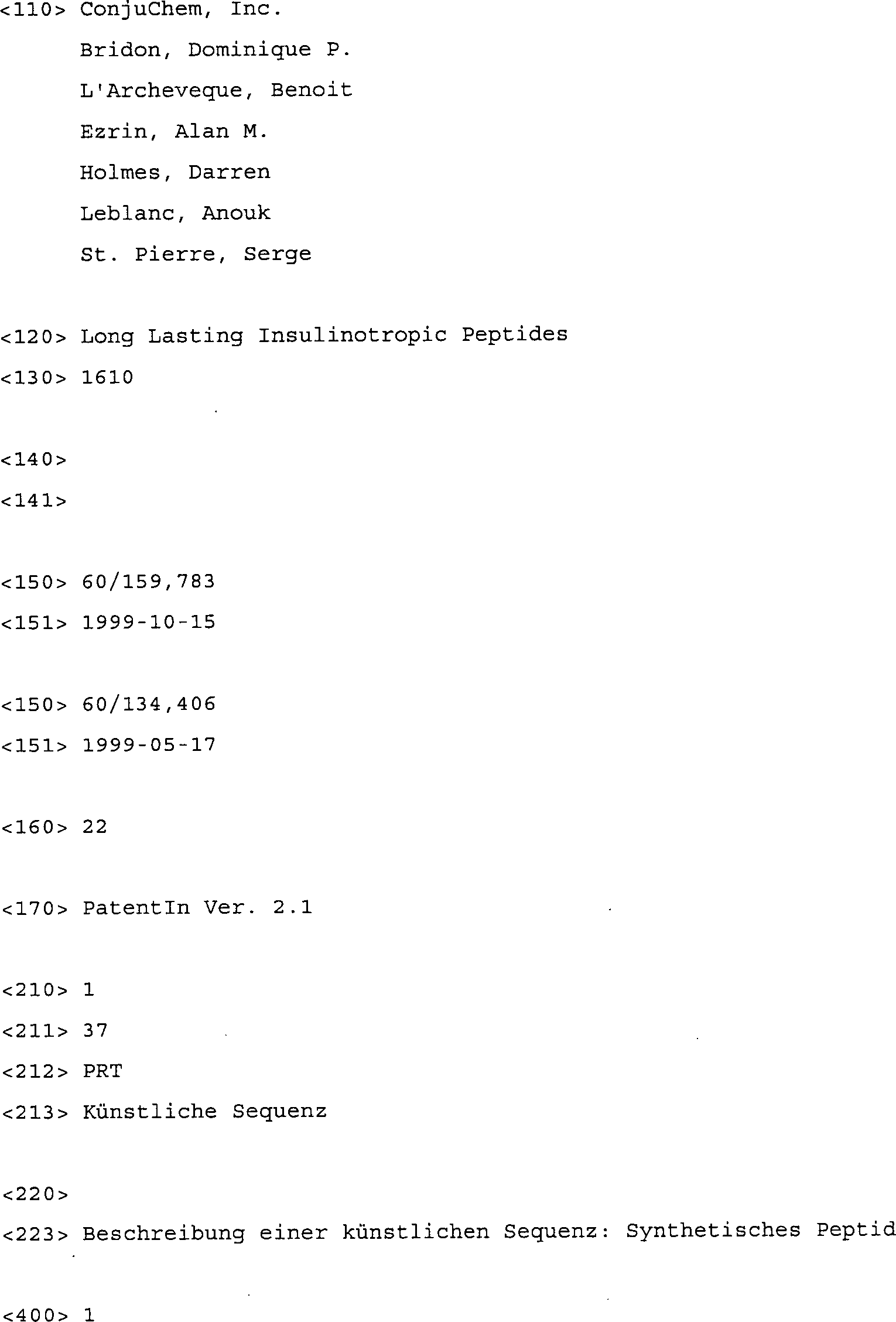
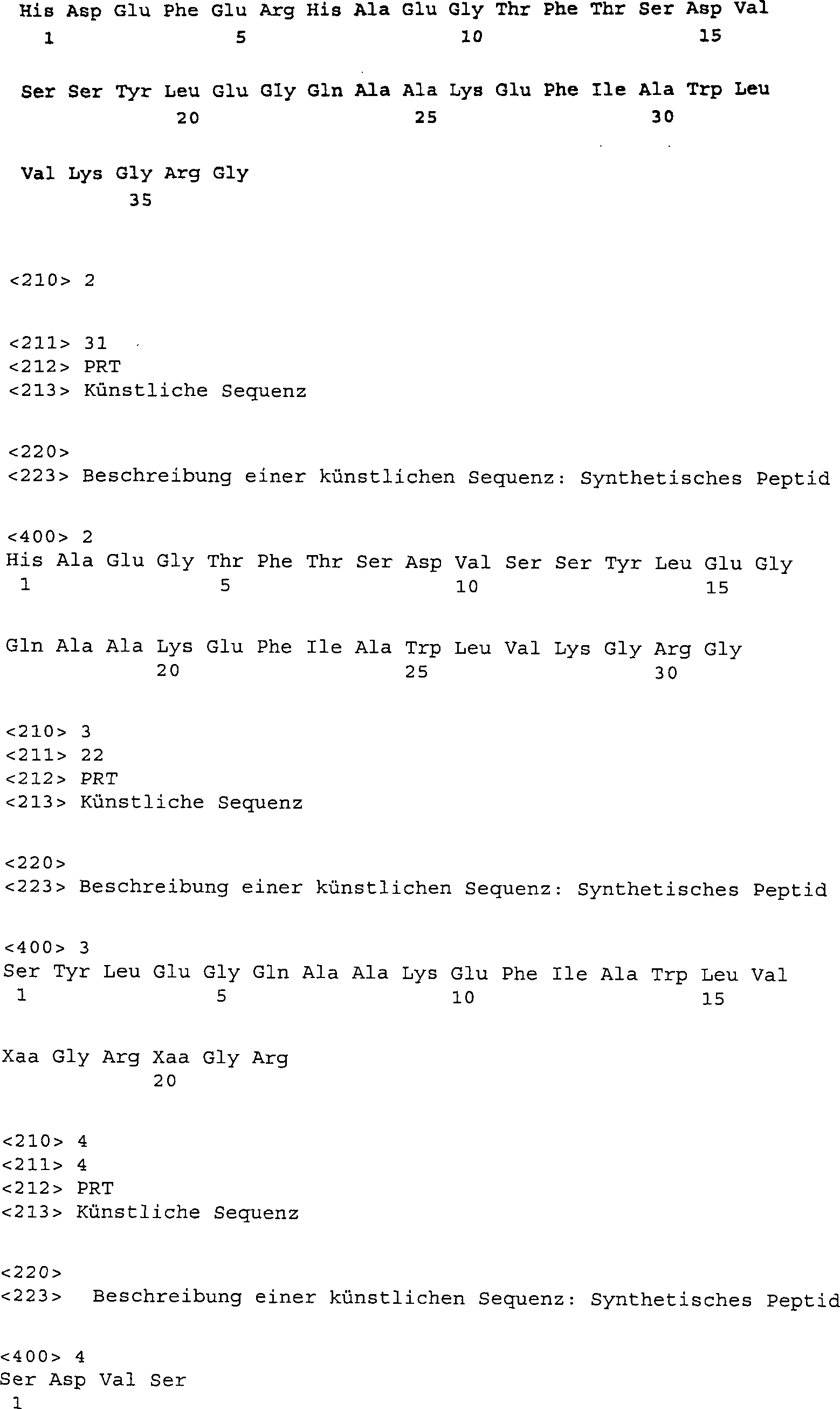

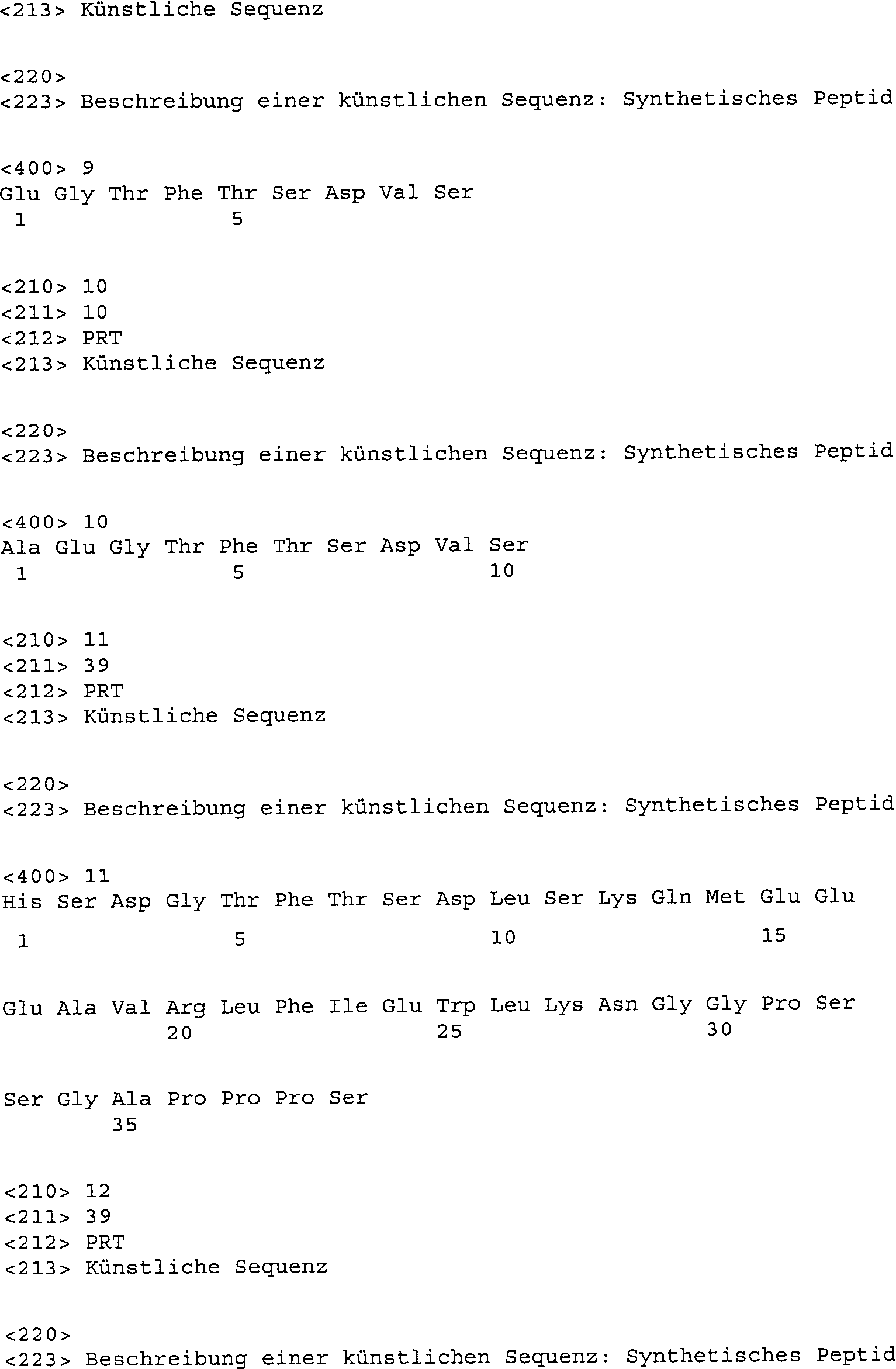
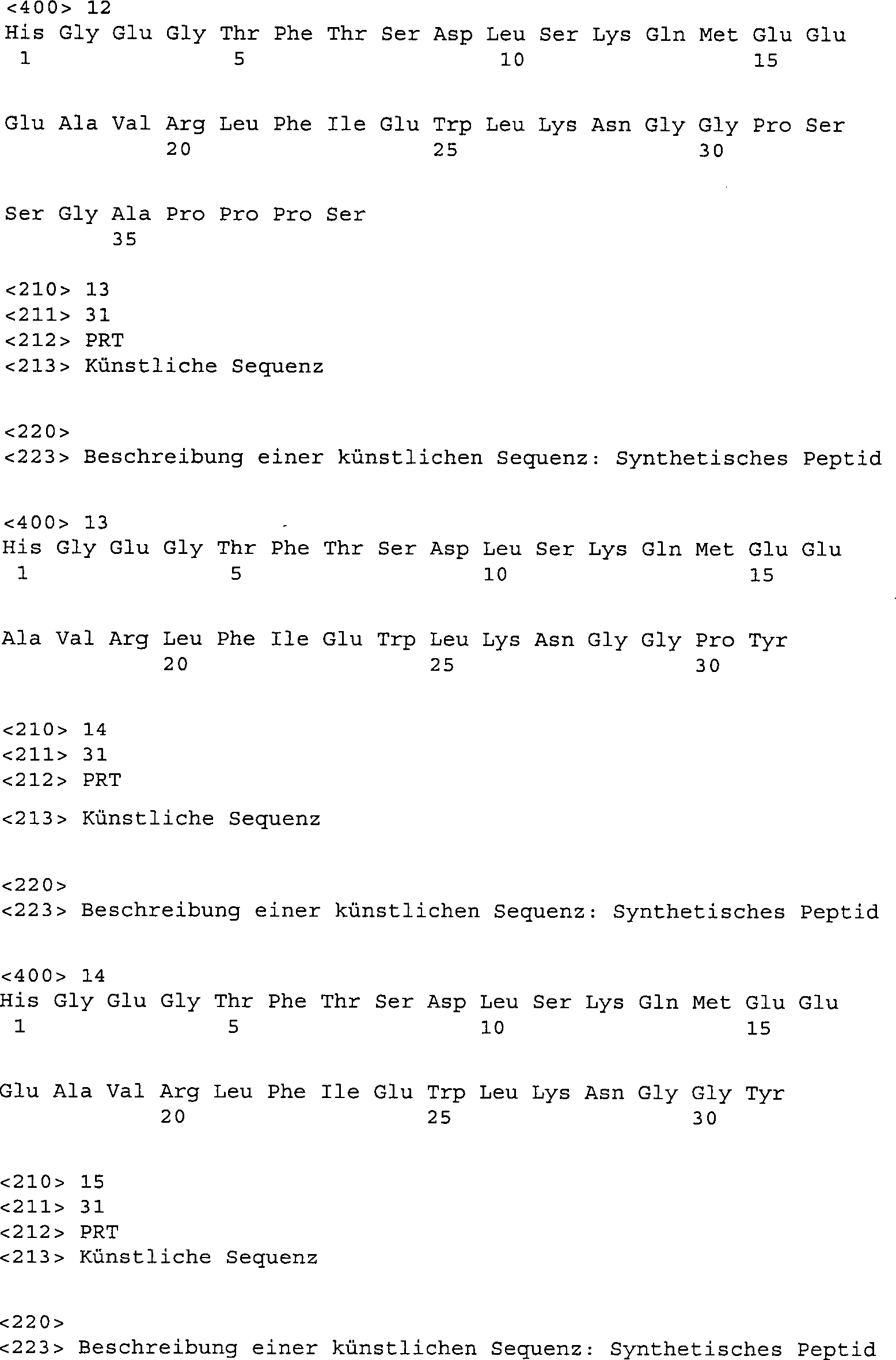

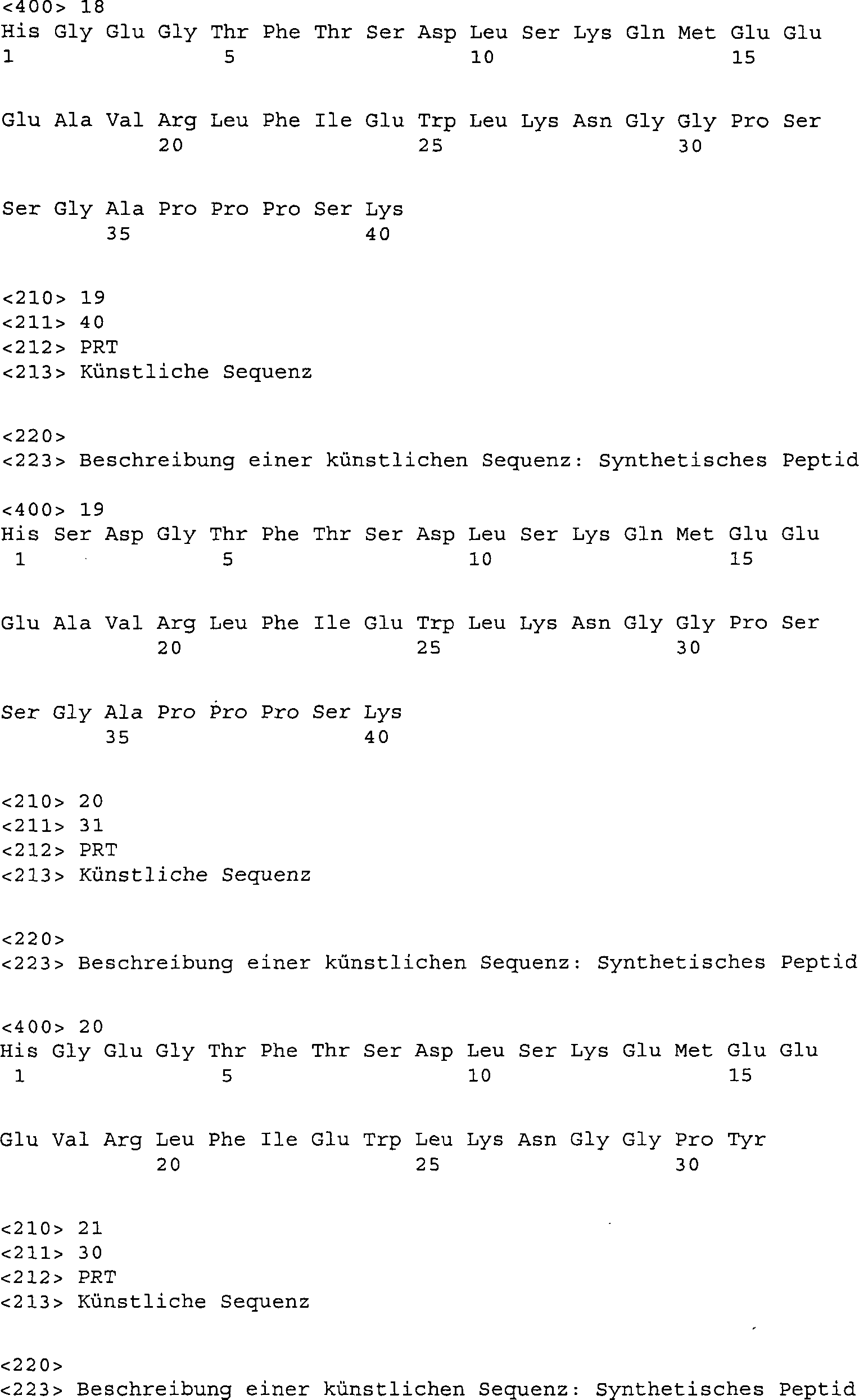

Claims (24)
Applications Claiming Priority (5)
| Application Number | Priority Date | Filing Date | Title |
|---|---|---|---|
| US13440699P | 1999-05-17 | 1999-05-17 | |
| US134406P | 1999-05-17 | ||
| US15978399P | 1999-10-15 | 1999-10-15 | |
| US159783P | 1999-10-15 | ||
| PCT/US2000/013563 WO2000069911A1 (en) | 1999-05-17 | 2000-05-17 | Long lasting insulinotropic peptides |
Publications (2)
| Publication Number | Publication Date |
|---|---|
| DE60006100D1 DE60006100D1 (en) | 2003-11-27 |
| DE60006100T2 true DE60006100T2 (en) | 2004-07-01 |
Family
ID=26832298
Family Applications (1)
| Application Number | Title | Priority Date | Filing Date |
|---|---|---|---|
| DE60006100T Expired - Lifetime DE60006100T2 (en) | 1999-05-17 | 2000-05-17 | LONG-LASTING INSULINOTROPE PEPTIDES |
Country Status (16)
| Country | Link |
|---|---|
| US (4) | US6329336B1 (en) |
| EP (1) | EP1180121B9 (en) |
| JP (5) | JP4115671B2 (en) |
| CN (1) | CN1191273C (en) |
| AT (1) | ATE252601T1 (en) |
| AU (1) | AU754770B2 (en) |
| BR (1) | BR0010750A (en) |
| CA (2) | CA2363712C (en) |
| DE (1) | DE60006100T2 (en) |
| DK (1) | DK1180121T3 (en) |
| EA (1) | EA003922B1 (en) |
| ES (1) | ES2209885T3 (en) |
| NO (1) | NO20015584L (en) |
| PT (1) | PT1180121E (en) |
| SI (1) | SI1180121T1 (en) |
| WO (1) | WO2000069911A1 (en) |
Families Citing this family (246)
| Publication number | Priority date | Publication date | Assignee | Title |
|---|---|---|---|---|
| FR2686899B1 (en) | 1992-01-31 | 1995-09-01 | Rhone Poulenc Rorer Sa | NOVEL BIOLOGICALLY ACTIVE POLYPEPTIDES, THEIR PREPARATION AND PHARMACEUTICAL COMPOSITIONS CONTAINING THEM. |
| WO2001077137A1 (en) | 2000-04-12 | 2001-10-18 | Human Genome Sciences, Inc. | Albumin fusion proteins |
| US6605648B1 (en) * | 1999-04-06 | 2003-08-12 | Phillips Plastics Corporation | Sinterable structures and method |
| SI1180121T1 (en) * | 1999-05-17 | 2004-04-30 | Conjuchem, Inc. | Long lasting insulinotropic peptides |
| US7601691B2 (en) * | 1999-05-17 | 2009-10-13 | Conjuchem Biotechnologies Inc. | Anti-obesity agents |
| US20090175821A1 (en) * | 1999-05-17 | 2009-07-09 | Bridon Dominique P | Modified therapeutic peptides with extended half-lives in vivo |
| US20040266673A1 (en) * | 2002-07-31 | 2004-12-30 | Peter Bakis | Long lasting natriuretic peptide derivatives |
| US6887470B1 (en) * | 1999-09-10 | 2005-05-03 | Conjuchem, Inc. | Protection of endogenous therapeutic peptides from peptidase activity through conjugation to blood components |
| US6514500B1 (en) * | 1999-10-15 | 2003-02-04 | Conjuchem, Inc. | Long lasting synthetic glucagon like peptide {GLP-!} |
| US6849714B1 (en) * | 1999-05-17 | 2005-02-01 | Conjuchem, Inc. | Protection of endogenous therapeutic peptides from peptidase activity through conjugation to blood components |
| US7087411B2 (en) | 1999-06-08 | 2006-08-08 | Regeneron Pharmaceuticals, Inc. | Fusion protein capable of binding VEGF |
| US6447772B1 (en) * | 1999-10-01 | 2002-09-10 | Klaire Laboratories, Inc. | Compositions and methods relating to reduction of symptoms of autism |
| BR0116024A (en) * | 2000-12-07 | 2005-12-13 | Lilly Co Eli | Heterologous Fusion Protein and Use thereof |
| WO2002062844A2 (en) | 2001-02-02 | 2002-08-15 | Conjuchem Inc. | Long lasting growth hormone releasing factor derivatives |
| EP1360202B1 (en) * | 2001-02-16 | 2008-05-21 | ConjuChem Biotechnologies Inc. | Long lasting glucagon-like peptide 2 (glp-2) for the treatment of gastrointestinal diseases and disorders |
| CN1162446C (en) | 2001-05-10 | 2004-08-18 | 上海华谊生物技术有限公司 | Insulinotropic hormone secretion peptide derivative |
| DE60229677D1 (en) | 2001-05-31 | 2008-12-11 | Conjuchem Biotechnologies Inc | Long acting fusion peptide inhibitors against HIV infection |
| DE60228972D1 (en) | 2001-07-31 | 2008-10-30 | Us Gov Health & Human Serv | GLP 1 EXENDIN 4 PEPTIDE ANALOG AND THEIR USES |
| US6642003B2 (en) | 2001-08-02 | 2003-11-04 | Cedars-Sinai Medical Center | Human glucose-dependent insulin-secreting cell line |
| US20070031440A1 (en) * | 2001-08-30 | 2007-02-08 | Prior Christopher P | Modified transferin-antibody fusion proteins |
| US7176278B2 (en) * | 2001-08-30 | 2007-02-13 | Biorexis Technology, Inc. | Modified transferrin fusion proteins |
| DK1427750T3 (en) * | 2001-08-30 | 2011-02-14 | Biorexis Pharmaceutical Corp | Modified transferrin fusion proteins |
| US8129504B2 (en) | 2001-08-30 | 2012-03-06 | Biorexis Technology, Inc. | Oral delivery of modified transferrin fusion proteins |
| US20030226155A1 (en) * | 2001-08-30 | 2003-12-04 | Biorexis Pharmaceutical Corporation | Modified transferrin-antibody fusion proteins |
| HRP20040343A2 (en) * | 2001-10-18 | 2005-08-31 | Bristol-Myers Squibb Company | Human glucagon-like-peptide-1 mimics and their use in the treatment of diabetes and related conditions |
| EP2277889B1 (en) | 2001-12-21 | 2014-07-09 | Human Genome Sciences, Inc. | Fusion proteins of albumin and interferon beta |
| CA2484556A1 (en) * | 2001-12-21 | 2003-07-24 | Human Genome Sciences, Inc. | Albumin fusion proteins |
| AU2003213047A1 (en) * | 2002-02-13 | 2003-09-04 | Medbridge, Inc. | Protein carrier system for therapeutic oligonucleotides |
| JP4417113B2 (en) * | 2002-02-20 | 2010-02-17 | エミスフェアー・テクノロジーズ・インク | Administration method of GLP-1 molecule |
| US7141240B2 (en) * | 2002-03-12 | 2006-11-28 | Cedars-Sinai Medical Center | Glucose-dependent insulin-secreting cells transfected with a nucleotide sequence encoding GLP-1 |
| AU2003239478A1 (en) * | 2002-06-04 | 2003-12-22 | Eli Lilly And Company | Modified glucagon-like peptide-1 analogs |
| EP1837031B1 (en) * | 2002-06-07 | 2009-10-14 | Waratah Pharmaceuticals, Inc. | Compositions and methods for treating diabetes |
| ATE432289T1 (en) | 2002-07-04 | 2009-06-15 | Zealand Pharma As | GLP-1 AND TREATMENT METHOD FOR DIABETES |
| AU2003262886A1 (en) * | 2002-08-30 | 2004-03-19 | Biorexis Pharmaceutical Corporation | Modified transferrin fusion proteins comprising duplicate transferrin amino or carboxy terminal domains |
| EP1542718B1 (en) * | 2002-09-24 | 2015-11-11 | Dong Xie | Peptide derivative fusion inhibitors of hiv infection |
| AU2003268621B2 (en) | 2002-10-02 | 2009-01-15 | Zealand Pharma A/S | Stabilized exendin-4 compounds |
| US20040229810A1 (en) * | 2002-10-22 | 2004-11-18 | Antonio Cruz | Gastrin compositions and formulations, and methods of use and preparation |
| US7790681B2 (en) | 2002-12-17 | 2010-09-07 | Amylin Pharmaceuticals, Inc. | Treatment of cardiac arrhythmias with GLP-1 receptor ligands |
| US20040209803A1 (en) * | 2002-12-19 | 2004-10-21 | Alain Baron | Compositions for the treatment and prevention of nephropathy |
| US7731947B2 (en) | 2003-11-17 | 2010-06-08 | Intarcia Therapeutics, Inc. | Composition and dosage form comprising an interferon particle formulation and suspending vehicle |
| CA2509755A1 (en) * | 2002-12-27 | 2004-07-22 | Diobex, Inc. | Compositions and methods for the prevention and control of insulin-induced hypoglycemia |
| US7655618B2 (en) * | 2002-12-27 | 2010-02-02 | Diobex, Inc. | Compositions and methods for the prevention and control of insulin-induced hypoglycemia |
| EP1594530A4 (en) | 2003-01-22 | 2006-10-11 | Human Genome Sciences Inc | Albumin fusion proteins |
| US20070060512A1 (en) * | 2003-03-04 | 2007-03-15 | Homayoun Sadeghi | Dipeptidyl-peptidase protected protein |
| US20040242566A1 (en) * | 2003-03-25 | 2004-12-02 | Syrrx, Inc. | Dipeptidyl peptidase inhibitors |
| BRPI0408978B8 (en) * | 2003-04-08 | 2021-07-27 | Novo Nordisk As | processes for regenerating a chromatographic stationary phase |
| WO2004089985A1 (en) * | 2003-04-11 | 2004-10-21 | Novo Nordisk A/S | Stable pharmaceutical compositions |
| WO2004094823A2 (en) | 2003-04-23 | 2004-11-04 | Biovalve Technologies, Inc. | Hydraulically actuated pump for long duration medicament administration |
| CN1812983A (en) | 2003-05-30 | 2006-08-02 | 兰贝克赛实验室有限公司 | Substituted pyrrole derivatives and their use as hmg-co inhibitors |
| ATE525395T1 (en) | 2003-06-12 | 2011-10-15 | Lilly Co Eli | FUSION PROTEINS OF GLP-1 ANALOGS |
| CN1964989B (en) * | 2003-07-25 | 2012-02-01 | 康久化学生物技术公司 | Long-acting insulin derivatives and methods thereof |
| US20060241019A1 (en) * | 2003-07-25 | 2006-10-26 | Bridon Dominique P | Long lasting insulin derivatives and methods thereof |
| CA2535619A1 (en) * | 2003-08-13 | 2005-02-24 | Takeda Pharmaceutical Company Limited | 4-pyrimidone derivatives and their use as peptidyl peptidase inhibitors |
| EP1663278A4 (en) * | 2003-08-28 | 2009-07-29 | Biorexis Pharmaceutical Corp | Epo mimetic peptides and fusion proteins |
| US20060205037A1 (en) * | 2003-08-28 | 2006-09-14 | Homayoun Sadeghi | Modified transferrin fusion proteins |
| WO2005021026A2 (en) * | 2003-08-29 | 2005-03-10 | Amylin Pharmaceuticals, Inc. | Methods for treating or ameliorating ghrelin-associated diseases and disorders |
| JP2007505121A (en) * | 2003-09-08 | 2007-03-08 | 武田薬品工業株式会社 | Dipeptidyl peptidase inhibitor |
| US7214190B1 (en) | 2003-09-09 | 2007-05-08 | Kitchener Clark Wilson | Apparatus and method for noninvasive monitoring of analytes in body fluids |
| AU2004298425A1 (en) | 2003-12-18 | 2005-06-30 | Novo Nordisk A/S | Novel GLP-1 analogues linked to albumin-like agents |
| US20060286129A1 (en) * | 2003-12-19 | 2006-12-21 | Emisphere Technologies, Inc. | Oral GLP-1 formulations |
| AU2005207870B2 (en) * | 2004-01-30 | 2010-08-19 | Waratah Pharmaceuticals, Inc. | The combined use of GLP-1 agonists and gastrin for regulating blood glucose levels |
| CA2554089C (en) | 2004-02-09 | 2013-10-22 | Human Genome Sciences, Inc. | Albumin fusion proteins |
| US8076288B2 (en) | 2004-02-11 | 2011-12-13 | Amylin Pharmaceuticals, Inc. | Hybrid polypeptides having glucose lowering activity |
| GEP20094679B (en) * | 2004-03-15 | 2009-05-10 | Takeda Pharmaceuticals Co | Dipeptidyl peptidase inhibitors |
| PT2100904E (en) * | 2004-04-23 | 2010-09-24 | Conjuchem Biotechnologies Inc | Solid phase for use in a method for the purification of albumin conjugates |
| CN1318587C (en) * | 2004-04-30 | 2007-05-30 | 成都芝田生物工程有限公司 | Recombination preparation method of amidating Exendin-4 polypeptide |
| US9089636B2 (en) | 2004-07-02 | 2015-07-28 | Valeritas, Inc. | Methods and devices for delivering GLP-1 and uses thereof |
| AU2012202855B2 (en) * | 2004-09-03 | 2015-02-26 | Philipps-Universitat Marburg | GLP-1 and exendin related invention |
| DE102004043153B4 (en) * | 2004-09-03 | 2013-11-21 | Philipps-Universität Marburg | Invention relating to GLP-1 and exendin |
| JP5107713B2 (en) * | 2004-10-07 | 2012-12-26 | ノヴォ ノルディスク アー/エス | Delayed exendin-4 compound |
| EP1799710A2 (en) | 2004-10-07 | 2007-06-27 | Novo Nordisk A/S | Protracted glp-1 compounds |
| US20080125361A1 (en) * | 2004-11-12 | 2008-05-29 | Novo Nordisk A/S | Stable Formulations Of Peptides |
| US7872124B2 (en) * | 2004-12-21 | 2011-01-18 | Takeda Pharmaceutical Company Limited | Dipeptidyl peptidase inhibitors |
| US8716221B2 (en) * | 2005-01-14 | 2014-05-06 | Wuxi Grandchamp Pharmaceutical Technology Co., Ltd. | Modified exendins and uses thereof |
| TWI376234B (en) * | 2005-02-01 | 2012-11-11 | Msd Oss Bv | Conjugates of a polypeptide and an oligosaccharide |
| US11246913B2 (en) | 2005-02-03 | 2022-02-15 | Intarcia Therapeutics, Inc. | Suspension formulation comprising an insulinotropic peptide |
| WO2006083761A2 (en) | 2005-02-03 | 2006-08-10 | Alza Corporation | Solvent/polymer solutions as suspension vehicles |
| BRPI0608516A2 (en) | 2005-03-18 | 2010-11-16 | Novo Nordisk As | glp-1 analog, method for increasing the time of action in a patient of a glp-1 analog, pharmaceutical composition, and use of a compound |
| TWI372629B (en) | 2005-03-18 | 2012-09-21 | Novo Nordisk As | Acylated glp-1 compounds |
| AU2006279680B2 (en) * | 2005-08-11 | 2012-12-06 | Amylin Pharmaceuticals, Llc | Hybrid polypeptides with selectable properties |
| CN101309689B (en) * | 2005-09-14 | 2012-10-10 | 武田药品工业株式会社 | Dipeptidyl peptidase inhibitors for the treatment of diabetes |
| PE20070622A1 (en) * | 2005-09-14 | 2007-08-22 | Takeda Pharmaceutical | ADMINISTRATION OF DIPEPTIDYL PEPTIDASE INHIBITORS |
| ME02005B (en) | 2005-09-14 | 2012-08-31 | Takeda Pharmaceuticals Co | Dipeptidyl peptidase inhibitors for treating diabetes |
| TW200745079A (en) * | 2005-09-16 | 2007-12-16 | Takeda Pharmaceuticals Co | Polymorphs of benzoate salt of 2-[[6-[(3R)-3-amino-1-piperidinyl]-3,4-dihydro-3-methyl-2,4-dioxo-1(2H)-pyrimidinyl]methyl]-benzonitrile and methods of use therefor |
| TW200745080A (en) * | 2005-09-16 | 2007-12-16 | Takeda Pharmaceuticals Co | Polymorphs of tartrate salt of 2-[2-(3-(R)-amino-piperidin-1-yl)-5-fluoro-6-oxo-6H-pyrimidin-1-ylmethyl]-benzonitrile and methods of use therefor |
| CN101360723A (en) * | 2005-09-16 | 2009-02-04 | 武田药品工业株式会社 | Process for preparing pyrimidinedione derivatives |
| WO2007051987A1 (en) * | 2005-11-01 | 2007-05-10 | Activotec Spp Limited | Insulinotropic compounds and uses thereof |
| SG166829A1 (en) | 2005-11-08 | 2010-12-29 | Ranbaxy Lab Ltd | Process for (3r, 5r)-7-[2-(4-fluorophenyl)-5-isopropyl-3-phenyl-4- [(4-hydroxy methyl phenyl amino) carbonyl]-pyrrol-1-yl]-3, 5-dihydroxy-heptanoic acid hemi calcium salt |
| WO2007053946A1 (en) * | 2005-11-09 | 2007-05-18 | Conjuchem Biotechnologies Inc. | Method of treating diabetes and/or obesity with reduced nausea side effects using an insulinotropic peptide conjugated to albumin |
| US20080280328A1 (en) * | 2005-11-18 | 2008-11-13 | Novozymes A/S | Glucoamylase Variants |
| JP2009520469A (en) * | 2005-12-22 | 2009-05-28 | コンジュクヘム ビオテクフノロギエス インコーポレイテッド | Method for the production of preformed conjugates of albumin and therapeutic agents |
| EP1816201A1 (en) | 2006-02-06 | 2007-08-08 | CSL Behring GmbH | Modified coagulation factor VIIa with extended half-life |
| EP1987052B1 (en) * | 2006-02-08 | 2011-04-27 | Lonza AG | Synthesis of glucagon-like peptides |
| JP2009531456A (en) * | 2006-03-28 | 2009-09-03 | 武田薬品工業株式会社 | Preparation of (R) -3-aminopiperidine dihydrochloride |
| ES2566058T3 (en) | 2006-03-30 | 2016-04-08 | Valeritas, Inc. | Multi-cartridge fluid supply device |
| JP5143131B2 (en) | 2006-05-30 | 2013-02-13 | インターシア セラピューティクス,インコーポレイティド | Two-piece internal channel flow modulator for osmotic delivery system |
| KR100886783B1 (en) | 2006-06-12 | 2009-03-04 | 성균관대학교산학협력단 | PEG-TRAIL conjugate modified with N-terminus, preparation method thereof and use thereof |
| WO2008011446A2 (en) | 2006-07-18 | 2008-01-24 | Centocor, Inc. | Human glp-1 mimetibodies, compositions, methods and uses |
| CA2658654A1 (en) * | 2006-07-24 | 2008-01-31 | Biorexis Pharmaceutical Corporation | Exendin fusion proteins |
| AU2007284759B2 (en) | 2006-08-09 | 2010-10-28 | Intarcia Therapeutics, Inc. | Osmotic delivery systems and piston assemblies |
| US8324383B2 (en) | 2006-09-13 | 2012-12-04 | Takeda Pharmaceutical Company Limited | Methods of making polymorphs of benzoate salt of 2-[[6-[(3R)-3-amino-1-piperidinyl]-3,4-dihydro-3-methyl-2,4-dioxo-1(2H)-pyrimidinyl]methyl]-benzonitrile |
| PE20080840A1 (en) * | 2006-09-13 | 2008-08-27 | Smithkline Beecham Corp | METHODS FOR ADMINISTERING LONG-LIVED HYPOGLYCEMIANT AGENTS |
| DK2073810T3 (en) * | 2006-09-13 | 2011-10-31 | Takeda Pharmaceutical | Use of 2-6- (3-amino-piperidin-1-yl) -3-methyl-2,4-dioxo-3,4-dihydro-2H-pyrimidin-1-ylmethyl-4-fluoro-benzonitrile in the treatment of diabetes, cancer, autoimmune diseases and HIV infection |
| TW200838536A (en) * | 2006-11-29 | 2008-10-01 | Takeda Pharmaceutical | Polymorphs of succinate salt of 2-[6-(3-amino-piperidin-1-yl)-3-methyl-2,4-dioxo-3,4-dihydro-2H-pyrimidin-1-ylmethy]-4-fluor-benzonitrile and methods of use therefor |
| AU2011254001B2 (en) * | 2007-01-05 | 2012-08-02 | Covx Technologies Ireland Limited | Glucagon-like protein-1 receptor (GLP-1R) agonist compounds |
| US20090098130A1 (en) * | 2007-01-05 | 2009-04-16 | Bradshaw Curt W | Glucagon-like protein-1 receptor (glp-1r) agonist compounds |
| US20090099074A1 (en) * | 2007-01-10 | 2009-04-16 | Conjuchem Biotechnologies Inc. | Modulating food intake |
| AU2008216265B2 (en) | 2007-02-15 | 2014-04-03 | Indiana University Research And Technology Corporation | Glucagon/GLP-1 receptor co-agonists |
| US8093236B2 (en) | 2007-03-13 | 2012-01-10 | Takeda Pharmaceuticals Company Limited | Weekly administration of dipeptidyl peptidase inhibitors |
| CN101715340A (en) | 2007-04-23 | 2010-05-26 | 精达制药公司 | Suspension formulation of insulinotropic peptide and application thereof |
| WO2008154619A1 (en) * | 2007-06-12 | 2008-12-18 | Smithkline Beecham Corporation | Methods for detecting protein in plasma |
| US20090054332A1 (en) * | 2007-06-21 | 2009-02-26 | Conjuchem Biotechnologies, Inc. | Thombopoietin peptide conjugates |
| US7960336B2 (en) * | 2007-08-03 | 2011-06-14 | Pharmain Corporation | Composition for long-acting peptide analogs |
| WO2009030738A1 (en) | 2007-09-05 | 2009-03-12 | Novo Nordisk A/S | Glucagon-like peptide-1 derivatives and their pharmaceutical use |
| JP2010538049A (en) | 2007-09-05 | 2010-12-09 | ノボ・ノルデイスク・エー/エス | Cleaved GLP-1 derivatives and therapeutic uses thereof |
| ES2532116T3 (en) | 2007-09-05 | 2015-03-24 | Novo Nordisk A/S | Peptides derived with A-B-C-D and their therapeutic uses |
| DK2205624T3 (en) * | 2007-10-27 | 2017-01-02 | Corden Pharma Colorado Inc | Insulinotropic peptide synthesis using solid state and solution phase combination techniques |
| JP2011506442A (en) * | 2007-12-11 | 2011-03-03 | コンジュケム バイオテクノロジーズ インコーポレイテッド | Formulation of insulinotropic peptide conjugate |
| US8343140B2 (en) | 2008-02-13 | 2013-01-01 | Intarcia Therapeutics, Inc. | Devices, formulations, and methods for delivery of multiple beneficial agents |
| US20110263496A1 (en) | 2008-05-21 | 2011-10-27 | Amylin Pharmaceuticals, Inc. | Exendins to lower cholesterol and triglycerides |
| MX337038B (en) | 2008-06-17 | 2016-02-10 | Univ Indiana Res & Tech Corp | Glucagon/glp-1 receptor co-agonists. |
| EP2300035B1 (en) | 2008-06-17 | 2015-08-12 | Indiana University Research and Technology Corporation | Gip-based mixed agonists for treatment of metabolic disorders and obesity |
| WO2009158704A2 (en) | 2008-06-27 | 2009-12-30 | Duke University | Therapeutic agents comprising elastin-like peptides |
| KR20110039348A (en) | 2008-08-06 | 2011-04-15 | 노보 노르디스크 헬스 케어 악티엔게젤샤프트 | Conjugated Proteins with Extended In Vivo Efficacy |
| TW201012829A (en) * | 2008-09-22 | 2010-04-01 | Ipsen Mfg Ireland Ltd | Process for the synthesis of (Aib8,35)hGLP-1(7-36)-NH2 |
| AU2009304560A1 (en) | 2008-10-15 | 2010-04-22 | Angiochem Inc. | Conjugates of GLP-1 agonists and uses thereof |
| PT2349324T (en) | 2008-10-17 | 2017-12-06 | Sanofi Aventis Deutschland | Combination of an insulin and a glp-1 agonist |
| US9914754B2 (en) | 2008-12-05 | 2018-03-13 | Angiochem Inc. | Conjugates of neurotensin or neurotensin analogs and uses thereof |
| EP2373681B1 (en) | 2008-12-10 | 2017-01-18 | Glaxosmithkline LLC | Pharmaceutical compositions of albiglutide |
| WO2010084173A1 (en) | 2009-01-22 | 2010-07-29 | Novo Nordisk Health Care Ag | Stable growth hormone compounds |
| AU2010218139B2 (en) | 2009-02-25 | 2012-11-01 | Merck Sharp & Dohme Corp. | Metabolic engineering of a galactose assimilation pathway in the glycoengineered yeast Pichia pastoris |
| EP2416797A4 (en) | 2009-04-10 | 2013-04-24 | Amylin Pharmaceuticals Llc | AMYLINE AGONIST COMPOUNDS FOR MAMMALS WITH STROGEN DEFICIENCY |
| MX2011013625A (en) | 2009-06-16 | 2012-01-20 | Univ Indiana Res & Tech Corp | Gip receptor-active glucagon compounds. |
| JP5932642B2 (en) * | 2009-07-02 | 2016-06-08 | アンジオケム インコーポレーテッド | Multimeric peptide conjugates and uses thereof |
| CN101987868B (en) * | 2009-07-30 | 2013-09-04 | 江苏豪森医药集团有限公司 | Derivative or pharmaceutically acceptable salt of GLP-1 analogue and application of derivative or pharmaceutically-acceptable salt of a GLP-1 analogue |
| WO2011015649A1 (en) | 2009-08-06 | 2011-02-10 | Novo Nordisk Health Care Ag | Growth hormones with prolonged in-vivo efficacy |
| KR102093612B1 (en) | 2009-09-28 | 2020-03-26 | 인타르시아 세라퓨틱스 인코포레이티드 | Rapid establishment and/or termination of substantial steady-state drug delivery |
| KR101525473B1 (en) * | 2009-09-30 | 2015-06-03 | 고쿠리츠 다이가쿠 호진 교토 다이가쿠 | Molecular probe for pancreatic islet imaging and use of said probe |
| US20120264685A1 (en) | 2009-10-22 | 2012-10-18 | Rajesh Bahekar | Short chain peptidomimetics based orally active glp 1 agonist and glucagon receptor antagonist |
| SG10201500871TA (en) | 2009-11-13 | 2015-04-29 | Sanofi Aventis Deutschland | Pharmaceutical composition comprising a glp-1 agonist and methionine |
| WO2011058083A1 (en) | 2009-11-13 | 2011-05-19 | Sanofi-Aventis Deutschland Gmbh | Pharmaceutical composition comprising a glp-1 agonist, an insulin, and methionine |
| AU2010321587A1 (en) | 2009-11-23 | 2012-06-07 | Amylin Pharmaceuticals, Inc. | Polypeptide Conjugate |
| KR101813595B1 (en) | 2010-01-22 | 2017-12-29 | 노보 노르디스크 헬스 케어 악티엔게젤샤프트 | Growth hormones with prolonged in-vivo efficacy |
| US9211342B2 (en) | 2010-01-22 | 2015-12-15 | Novo Nordisk Healthcare Ag | Stable growth hormone compounds resistant to proteolytic degradation |
| JP2013518115A (en) | 2010-01-27 | 2013-05-20 | インディアナ ユニバーシティー リサーチ アンド テクノロジー コーポレーション | Glucagon antagonist-GIP agonist conjugates and compositions for the treatment of metabolic disorders and obesity |
| MX2012009802A (en) | 2010-02-24 | 2012-09-12 | Merck Sharp & Dohme | Method for increasing n-glycosylation site occupancy on therapeutic glycoproteins produced in pichia pastoris. |
| RU2559320C2 (en) * | 2010-03-26 | 2015-08-10 | Ново Нордиск А/С | Novel glucagon analogues |
| WO2011123943A1 (en) | 2010-04-09 | 2011-10-13 | Mount Sinai Hospital | Methods for treating disorders of the gastrointestinal tract using a glp-1 agonist |
| AU2011247452B2 (en) | 2010-04-27 | 2016-03-17 | Zealand Pharma A/S | Peptide conjugates of GLP-1 receptor agonists and gastrin and their use |
| WO2011140176A1 (en) | 2010-05-04 | 2011-11-10 | Glaxosmithkline Llc | Methods for treating or preventing cardiovascular disorders and providing cardiovascular protection |
| ES2661228T3 (en) | 2010-05-13 | 2018-03-28 | Indiana University Research And Technology Corporation | Glucagon superfamily peptides that show nuclear hormone receptor activity |
| RU2012153753A (en) | 2010-05-13 | 2014-06-20 | Индиана Юниверсити Рисерч Энд Текнолоджи Корпорейшн | Glucagon superfamily peptides with activity in relation to G-protein-coupled receptors |
| RS55378B1 (en) | 2010-08-30 | 2017-03-31 | Sanofi Aventis Deutschland | USE OF AVE0010 FOR MANUFACTURE OF TREATMENT OF DIABETES MELLITUS TYPE 2 |
| RS56998B1 (en) | 2010-12-16 | 2018-05-31 | Novo Nordisk As | Solid compositions comprising a glp-1 agonist and a salt of n-(8-(2-hydroxybenzoyl)amino)caprylic acid |
| EA201390941A1 (en) | 2010-12-22 | 2013-12-30 | Индиана Юниверсити Рисерч Энд Текнолоджи Корпорейшн | GLUCAGON ANALOGUES, EXPERIENCING ACTIVITY ON GIP RECEPTOR |
| US20120208755A1 (en) | 2011-02-16 | 2012-08-16 | Intarcia Therapeutics, Inc. | Compositions, Devices and Methods of Use Thereof for the Treatment of Cancers |
| EP3450568A3 (en) * | 2011-03-04 | 2019-04-24 | Intrexon Corporation | Vectors conditionally expressing protein |
| RU2602601C2 (en) | 2011-04-12 | 2016-11-20 | Ново Нордиск А/С | Double acylated glp-1 derivatives |
| US9821032B2 (en) | 2011-05-13 | 2017-11-21 | Sanofi-Aventis Deutschland Gmbh | Pharmaceutical combination for improving glycemic control as add-on therapy to basal insulin |
| ME02816B (en) | 2011-06-22 | 2018-01-20 | Univ Indiana Res & Tech Corp | Glucagon/glp-1 receptor co-agonists |
| MX2013015168A (en) | 2011-06-22 | 2014-03-31 | Univ Indiana Res & Tech Corp | Glucagon/glp-1 receptor co-agonists. |
| KR101357117B1 (en) * | 2011-06-28 | 2014-02-06 | 비앤엘델리팜 주식회사 | PEGylated Exendin-4 analogues or its derivatives, preparation method thereof and pharmaceutical composition containing the same for preventing and treating a diabetes |
| HRP20151068T1 (en) | 2011-08-29 | 2016-01-01 | Sanofi-Aventis Deutschland Gmbh | Pharmaceutical combination for use in glycemic control in diabetes type 2 patients |
| AR087744A1 (en) | 2011-09-01 | 2014-04-16 | Sanofi Aventis Deutschland | PHARMACEUTICAL COMPOSITION FOR USE IN THE TREATMENT OF A NEURODEGENERATIVE DISEASE |
| WO2013029279A1 (en) * | 2011-09-03 | 2013-03-07 | 深圳市健元医药科技有限公司 | Novel glp-i analogue, preparation method and use thereof |
| CN102286092B (en) | 2011-09-14 | 2014-01-01 | 深圳翰宇药业股份有限公司 | Solid-phase synthesis method of liraglutide |
| MY167234A (en) | 2011-09-23 | 2018-08-14 | Novo Nordisk As | Novel glucagon analogues |
| MX2014005351A (en) | 2011-11-03 | 2014-05-28 | Zealand Pharma As | Glp-1 receptor agonist peptide gastrin conjugates. |
| WO2013112548A1 (en) | 2012-01-23 | 2013-08-01 | University Of South Florida | Gamma-aapeptides with potent and broad-spectrum antimicrobial activity |
| CN104203266B (en) | 2012-03-22 | 2017-12-26 | 诺和诺德股份有限公司 | GLP-1 peptide composition and its preparation |
| TR201903918T4 (en) | 2012-03-22 | 2019-04-22 | Novo Nordisk As | Compositions containing a dispersing agent and their preparation. |
| WO2013163162A1 (en) * | 2012-04-24 | 2013-10-31 | Amylin Pharmaceuticals, Llc | Site-specific enzymatic modification of exendins and analogs thereof |
| CN108524919A (en) | 2012-05-17 | 2018-09-14 | 延伸生物科学股份有限公司 | carrier for improved drug delivery |
| EP2863895B1 (en) | 2012-06-20 | 2021-04-14 | Novo Nordisk A/S | Tablet formulation comprising a peptide and a delivery agent |
| CN104583232B (en) | 2012-06-21 | 2018-04-13 | 印第安纳大学研究及科技有限公司 | Show the glucagon analogs of GIP receptor actives |
| US20140051834A1 (en) | 2012-06-21 | 2014-02-20 | Hoffmann-La Roche, Inc. | Incretin Receptor Ligand Polypeptide Fc-Region Fusion Polypeptides And Conjugates With Altered Fc-Effector Function |
| IN2015DN00544A (en) | 2012-07-23 | 2015-06-26 | Zealand Pharma As | |
| TWI608013B (en) | 2012-09-17 | 2017-12-11 | 西蘭製藥公司 | Glucagon analog |
| UA116217C2 (en) | 2012-10-09 | 2018-02-26 | Санофі | Exendin-4 derivatives as dual glp1/glucagon agonists |
| SG11201503526UA (en) | 2012-12-21 | 2015-06-29 | Sanofi Sa | Dual glp1/gip or trigonal glp1/gip/glucagon agonists |
| TWI641381B (en) | 2013-02-04 | 2018-11-21 | 法商賽諾菲公司 | Stabilized pharmaceutical formulations of insulin analogs and/or insulin derivatives |
| SI2956476T1 (en) | 2013-02-18 | 2020-03-31 | Vegenics Pty Limited | Molecules for binding to ligands and using them |
| KR20150131213A (en) | 2013-03-14 | 2015-11-24 | 인디애나 유니버시티 리서치 앤드 테크놀로지 코퍼레이션 | Insulin-incretin conjugates |
| CN104650212A (en) * | 2013-03-15 | 2015-05-27 | 深圳君圣泰生物技术有限公司 | A kind of polypeptide, polypeptide derivative, pharmaceutically acceptable salt of polypeptide, pharmaceutical composition and application thereof |
| CN104592380A (en) * | 2013-03-15 | 2015-05-06 | 深圳君圣泰生物技术有限公司 | Polypeptide, derivative of polypeptide, pharmaceutical salt of polypeptide, pharmaceutical composition and application of polypeptide or derivative of polypeptide |
| WO2014161835A1 (en) * | 2013-04-03 | 2014-10-09 | Sanofi | Modified blood glucose regulating proteins with altered pharmacological activity profile and preparation thereof |
| US11045523B2 (en) | 2013-04-05 | 2021-06-29 | Novo Nordisk Healthcare Ag | Formulation of growth hormone albumin-binder conjugate |
| WO2014170496A1 (en) | 2013-04-18 | 2014-10-23 | Novo Nordisk A/S | Stable, protracted glp-1/glucagon receptor co-agonists for medical use |
| RU2671406C2 (en) | 2013-05-02 | 2018-10-31 | Ново Нордиск А/С | Oral dosing of glucagon-like peptide-1 compounds |
| US9988429B2 (en) | 2013-10-17 | 2018-06-05 | Zealand Pharma A/S | Glucagon analogues |
| ES2688708T3 (en) | 2013-10-17 | 2018-11-06 | Zealand Pharma A/S | Acylated glucagon analogs |
| EP3065767B1 (en) | 2013-11-06 | 2020-12-30 | Zealand Pharma A/S | Gip-glp-1 dual agonist compounds and methods |
| US10131702B2 (en) | 2013-11-06 | 2018-11-20 | Zealand Pharma A/S | Glucagon-GLP-1-GIP triple agonist compounds |
| WO2015086733A1 (en) | 2013-12-13 | 2015-06-18 | Sanofi | Dual glp-1/glucagon receptor agonists |
| WO2015086730A1 (en) | 2013-12-13 | 2015-06-18 | Sanofi | Non-acylated exendin-4 peptide analogues |
| EP3080150B1 (en) | 2013-12-13 | 2018-08-01 | Sanofi | Exendin-4 peptide analogues as dual glp-1/gip receptor agonists |
| WO2015086729A1 (en) | 2013-12-13 | 2015-06-18 | Sanofi | Dual glp-1/gip receptor agonists |
| EP3082847A1 (en) | 2013-12-20 | 2016-10-26 | Indiana University Research and Technology Corporation | Lipidated incretin receptor ligand human immunoglobulin fc-region fusion polypeptides |
| SG11201604708VA (en) | 2014-01-09 | 2016-07-28 | Sanofi Sa | Stabilized glycerol free pharmaceutical formulations of insulin analogues and/or insulin derivatives |
| SG11201604710XA (en) | 2014-01-09 | 2016-07-28 | Sanofi Sa | Stabilized pharmaceutical formulations of insulin analogues and/or insulin derivatives |
| RU2016132340A (en) | 2014-01-09 | 2018-02-14 | Санофи | STABILIZED PHARMACEUTICAL COMPOSITIONS BASED ON INSULIN ASPART |
| WO2015138638A1 (en) | 2014-03-11 | 2015-09-17 | Theraly Pharmaceuticals, Inc. | Long acting trail receptor agonists for treatment of autoimmune diseases |
| TW201625669A (en) | 2014-04-07 | 2016-07-16 | 賽諾菲公司 | Peptidic dual GLP-1/glucagon receptor agonists derived from Exendin-4 |
| TW201625670A (en) | 2014-04-07 | 2016-07-16 | 賽諾菲公司 | Dual GLP-1/glucagon receptor agonists derived from EXENDIN-4 |
| TW201625668A (en) | 2014-04-07 | 2016-07-16 | 賽諾菲公司 | Exendin-4 derivatives as peptidic dual GLP-1/glucagon receptor agonists |
| WO2015185640A1 (en) | 2014-06-04 | 2015-12-10 | Novo Nordisk A/S | Glp-1/glucagon receptor co-agonists for medical use |
| US9932381B2 (en) | 2014-06-18 | 2018-04-03 | Sanofi | Exendin-4 derivatives as selective glucagon receptor agonists |
| GB201415598D0 (en) | 2014-09-03 | 2014-10-15 | Univ Birmingham | Elavated Itercranial Pressure Treatment |
| ES2822994T3 (en) | 2014-09-24 | 2021-05-05 | Univ Indiana Res & Tech Corp | Incretin-insulin conjugates |
| US9889085B1 (en) | 2014-09-30 | 2018-02-13 | Intarcia Therapeutics, Inc. | Therapeutic methods for the treatment of diabetes and related conditions for patients with high baseline HbA1c |
| WO2016065052A1 (en) | 2014-10-22 | 2016-04-28 | Extend Biosciences, Inc. | Insulin vitamin d conjugates |
| WO2016065042A1 (en) | 2014-10-22 | 2016-04-28 | Extend Biosciences, Inc. | Therapeutic vitamin d conjugates |
| US9789197B2 (en) | 2014-10-22 | 2017-10-17 | Extend Biosciences, Inc. | RNAi vitamin D conjugates |
| US10253078B2 (en) | 2014-10-29 | 2019-04-09 | Zealand Pharma A/S | GIP agonist compounds and methods |
| TWI758239B (en) | 2014-12-12 | 2022-03-21 | 德商賽諾菲阿凡提斯德意志有限公司 | Insulin glargine/lixisenatide fixed ratio formulation |
| TWI748945B (en) | 2015-03-13 | 2021-12-11 | 德商賽諾菲阿凡提斯德意志有限公司 | Treatment type 2 diabetes mellitus patients |
| TW201705975A (en) | 2015-03-18 | 2017-02-16 | 賽諾菲阿凡提斯德意志有限公司 | Treatment of type 2 diabetes mellitus patients |
| PL3283507T3 (en) | 2015-04-16 | 2020-05-18 | Zealand Pharma A/S | Acylated glucagon analogue |
| AU2016270984B2 (en) | 2015-06-03 | 2021-02-25 | Intarcia Therapeutics, Inc. | Implant placement and removal systems |
| AR105319A1 (en) | 2015-06-05 | 2017-09-27 | Sanofi Sa | PROPHARMS THAT INCLUDE A DUAL AGONIST GLU-1 / GLUCAGON CONJUGATE HIALURONIC ACID CONNECTOR |
| EP3307326B9 (en) | 2015-06-15 | 2021-02-24 | Angiochem Inc. | Methods for the treatment of leptomeningeal carcinomatosis |
| TW201706291A (en) | 2015-07-10 | 2017-02-16 | 賽諾菲公司 | New EXENDIN-4 derivatives as selective peptidic dual GLP-1/glucagon receptor agonists |
| AU2016371021B2 (en) | 2015-12-17 | 2020-04-09 | The Johns Hopkins University | Ameliorating systemic sclerosis with death receptor agonists |
| ES2968038T3 (en) | 2015-12-23 | 2024-05-06 | Univ Johns Hopkins | Long-acting GLP-1R agonist as therapy for neurological and neurodegenerative conditions |
| JP7281795B2 (en) | 2016-04-07 | 2023-05-26 | ザ・ジョンズ・ホプキンス・ユニバーシティー | Compositions and methods for treating pancreatitis and pain with death receptor agonists |
| RU2760007C2 (en) | 2016-05-16 | 2021-11-22 | Интарсия Терапьютикс, Инк. | Polypeptides selective to glucagon receptors and their application methods |
| USD840030S1 (en) | 2016-06-02 | 2019-02-05 | Intarcia Therapeutics, Inc. | Implant placement guide |
| USD860451S1 (en) | 2016-06-02 | 2019-09-17 | Intarcia Therapeutics, Inc. | Implant removal tool |
| CN108070030B (en) * | 2016-11-17 | 2023-06-23 | 江苏豪森药业集团有限公司 | Preparation method of loxenapeptide and analogue thereof |
| SG11201903938XA (en) | 2016-12-09 | 2019-05-30 | Zealand Pharma As | Acylated glp-1/glp-2 dual agonists |
| CA3049034A1 (en) | 2017-01-03 | 2018-07-12 | Intarcia Therapeutics, Inc. | Methods comprising continuous administration of a glp-1 receptor agonist and co-adminstration of a drug |
| JOP20180028A1 (en) | 2017-03-31 | 2019-01-30 | Takeda Pharmaceuticals Co | Polypeptide compound |
| CN109503700A (en) * | 2017-09-14 | 2019-03-22 | 南京安吉生物科技有限公司 | The blood vessel formation inhibitor IIM 3-1 of maleimide base group modification and its application |
| US10905750B2 (en) | 2017-11-10 | 2021-02-02 | Donald J. Davidson | GRP78 antagonist that block binding of receptor tyrosine kinase orphan receptors as immunotherapy anticancer agents |
| BR112020014624A2 (en) | 2018-02-02 | 2020-12-08 | Novo Nordisk A/S | SOLID COMPOSITIONS UNDERSTANDING GLP-1 AGONIST, CAPRILIC AND LUBRICANT N- (8- (2-HYDROXYBENZOIL) AMINO ACID SALT) |
| WO2019200594A1 (en) | 2018-04-19 | 2019-10-24 | 杭州先为达生物科技有限公司 | Acylated glp-1 derivative |
| IL320142A (en) | 2018-10-11 | 2025-06-01 | Intarcia Therapeutics Inc | Human amylin analog polypeptides and methods of use |
| CN109400695B (en) | 2018-10-31 | 2020-06-30 | 中南大学湘雅医院 | Polypeptide modification method and application |
| CN110183531A (en) * | 2019-05-17 | 2019-08-30 | 河北常山生化药业股份有限公司 | A kind of preparation method of Ai Benna peptide precursor |
| CN111333714A (en) * | 2020-03-05 | 2020-06-26 | 成都奥达生物科技有限公司 | Long-acting GLP-1 compound |
| US20230158165A1 (en) * | 2020-03-27 | 2023-05-25 | Epivax, Inc. | Tregitope constructs useful in the prevention and treatment of type 1 diabetes |
| AU2023353057A1 (en) | 2022-09-30 | 2025-05-01 | Extend Biosciences, Inc. | Long-acting parathyroid hormone |
| CN115819493A (en) * | 2022-11-16 | 2023-03-21 | 河北常山生化药业股份有限公司 | A kind of polypeptide solid-phase synthesis method |
| WO2024123812A1 (en) | 2022-12-05 | 2024-06-13 | Shattuck Labs, Inc. | Fusion proteins for the treatment of cardiometabolic diseases |
| KR102743491B1 (en) | 2023-08-01 | 2024-12-17 | (주)인벤티지랩 | Microparticles containing semaglutide or pharmaceutically acceptable and method for producing the same |
| WO2025069009A1 (en) | 2023-09-29 | 2025-04-03 | Graviton Bioscience Bv | Rock2 inhibitors in the treatment of obesity |
Family Cites Families (86)
| Publication number | Priority date | Publication date | Assignee | Title |
|---|---|---|---|---|
| US4206199A (en) * | 1977-07-22 | 1980-06-03 | Takeda Chemical Industries, Ltd. | Novel glucagon fragment and its derivatives |
| US4423034A (en) * | 1980-10-16 | 1983-12-27 | Toyo Jozo Kabushiki Kaisha | Process for the preparation of antibodies |
| US4462941A (en) | 1982-06-10 | 1984-07-31 | The Regents Of The University Of California | Dynorphin amide analogs |
| US5120712A (en) | 1986-05-05 | 1992-06-09 | The General Hospital Corporation | Insulinotropic hormone |
| US5118666A (en) | 1986-05-05 | 1992-06-02 | The General Hospital Corporation | Insulinotropic hormone |
| US5614492A (en) | 1986-05-05 | 1997-03-25 | The General Hospital Corporation | Insulinotropic hormone GLP-1 (7-36) and uses thereof |
| DK608589D0 (en) | 1989-12-01 | 1989-12-01 | Holm Arne | CHEMICAL PROCEDURE |
| US5116944A (en) * | 1989-12-29 | 1992-05-26 | Neorx Corporation | Conjugates having improved characteristics for in vivo administration |
| US5545618A (en) | 1990-01-24 | 1996-08-13 | Buckley; Douglas I. | GLP-1 analogs useful for diabetes treatment |
| ATE164852T1 (en) | 1990-01-24 | 1998-04-15 | Douglas I Buckley | GLP-1 ANALOGUE USABLE IN DIABETES TREATMENT |
| US5843440A (en) | 1990-10-03 | 1998-12-01 | Redcell Canada, Inc. | Cellular and serum protein anchors for modulating pharmacokinetics |
| US5612034A (en) * | 1990-10-03 | 1997-03-18 | Redcell, Inc. | Super-globuling for in vivo extended lifetimes |
| EP0578728B1 (en) | 1991-04-05 | 1998-07-01 | Genentech, Inc. | PLATELET AGGREGATION INHIBITORS HAVING HIGH SPECIFICITY FOR GP IIbIIIa |
| CZ315594A3 (en) | 1992-06-15 | 1995-07-12 | Pfizer | Peptide of glucagon type, insulinotropic derivatives, process of their preparation, pharmaceutical composition containing such compounds and use |
| EP0602290B1 (en) | 1992-12-04 | 1999-08-25 | ConjuChem, Inc. | Antibody-conjugated Hepatitis B surface antigen and use thereof |
| US5424286A (en) | 1993-05-24 | 1995-06-13 | Eng; John | Exendin-3 and exendin-4 polypeptides, and pharmaceutical compositions comprising same |
| US5614487A (en) | 1993-05-28 | 1997-03-25 | Genentech, Inc. | Sustained release pharmaceutical composition |
| US5705483A (en) | 1993-12-09 | 1998-01-06 | Eli Lilly And Company | Glucagon-like insulinotropic peptides, compositions and methods |
| US5580853A (en) | 1994-03-22 | 1996-12-03 | New England Deaconess Hospital | Modified polypeptides with increased biological activity |
| US5837682A (en) | 1996-03-08 | 1998-11-17 | The Children's Medical Center Corporation | Angiostatin fragments and method of use |
| US5639725A (en) | 1994-04-26 | 1997-06-17 | Children's Hospital Medical Center Corp. | Angiostatin protein |
| MX9605109A (en) | 1994-04-26 | 1997-08-30 | Childrens Medical Center | Angiostatin and method of use for inhibition of angiogenesis. |
| US5945403A (en) | 1997-05-30 | 1999-08-31 | The Children's Medical Center Corporation | Angiostatin fragments and method of use |
| US5574008A (en) | 1994-08-30 | 1996-11-12 | Eli Lilly And Company | Biologically active fragments of glucagon-like insulinotropic peptide |
| US5654276A (en) | 1995-06-07 | 1997-08-05 | Affymax Technologies N.V. | Peptides and compounds that bind to the IL-5 receptor |
| US5854221A (en) | 1996-12-12 | 1998-12-29 | The Children's Medical Center Corporation | Endothelial cell proliferation inhibitor and method of use |
| CZ298612B6 (en) | 1995-12-13 | 2007-11-21 | The Children's Medical Center Corporation | Inhibitor of endothelium cell proliferation and the use thereof |
| WO1997025074A2 (en) | 1996-01-12 | 1997-07-17 | Redcell Canada, Inc. | Cellular and serum protein anchors for diagnostic imaging |
| US6277583B1 (en) | 1996-02-07 | 2001-08-21 | Conjuchem, Inc. | Affinity labeling libraries and applications thereof |
| ID17252A (en) | 1996-04-29 | 1997-12-11 | Akzo Nobel Nv | THE PROCESS OF MAKING OBJECTS MADE FROM CELLULOSE |
| HU224827B1 (en) | 1996-05-03 | 2006-02-28 | Abbott Lab | Novel antiangiogenic peptides polynucleotides encoding same and methods for inhibiting angiogenesis |
| US5801146A (en) | 1996-05-03 | 1998-09-01 | Abbott Laboratories | Compound and method for inhibiting angiogenesis |
| JP2000516912A (en) | 1996-06-05 | 2000-12-19 | ロシュ ダイアグノスティクス ゲゼルシャフト ミット ベシュレンクテル ハフツング | Exendin analogs, methods for their preparation and formulations containing them |
| US5840733A (en) | 1996-07-01 | 1998-11-24 | Redcell, Canada, Inc. | Methods and compositions for producing novel conjugates of thrombin inhibitors and endogenous carriers resulting in anti-thrombins with extended lifetimes |
| ATE417622T1 (en) | 1996-08-08 | 2009-01-15 | Amylin Pharmaceuticals Inc | REGULATION OF GASTROINTESTINAL MOBILITY |
| US6277819B1 (en) | 1996-08-30 | 2001-08-21 | Eli Lilly And Company | Use of GLP-1 or analogs in treatment of myocardial infarction |
| KR100556067B1 (en) | 1996-08-30 | 2006-03-07 | 노보 노르디스크 에이/에스 | Glp-1 derivatives |
| US6006753A (en) | 1996-08-30 | 1999-12-28 | Eli Lilly And Company | Use of GLP-1 or analogs to abolish catabolic changes after surgery |
| WO1998011437A1 (en) | 1996-09-16 | 1998-03-19 | Conjuchem, Inc. | Affinity labeling libraries with tagged leaving groups |
| UA65549C2 (en) * | 1996-11-05 | 2004-04-15 | Елі Ліллі Енд Компані | Use of glucagon-like peptides such as glp-1, glp-1 analog, or glp-1 derivative in methods and compositions for reducing body weight |
| US5864372A (en) | 1996-12-10 | 1999-01-26 | United Microelectronics Corporation | Apparatus for implementing a block matching algorithm for motion estimation in video image processing |
| US6723530B1 (en) | 1997-02-05 | 2004-04-20 | Amylin Pharmaceuticals, Inc. | Polynucleotides encoding proexendin, and methods and uses thereof |
| WO1998043658A1 (en) | 1997-03-31 | 1998-10-08 | Eli Lilly And Company | Glucagon-like peptide-1 analogs |
| CA2283834A1 (en) | 1997-03-31 | 1998-10-08 | James Arthur Hoffmann | Glucagon-like peptide-1 analogs |
| CA2295925A1 (en) | 1997-06-26 | 1999-01-07 | Karolinska Innovations Ab | Kringle domains 1-5 of plasminogen, capable of modulating angiogenesis in vivo |
| PT1019077E (en) | 1997-08-08 | 2008-02-21 | Amylin Pharmaceuticals Inc | Novel exendin agonist compounds |
| US6437092B1 (en) | 1998-11-06 | 2002-08-20 | Conjuchem, Inc. | Conjugates of opioids and endogenous carriers |
| EP1056474B1 (en) | 1997-11-07 | 2002-06-12 | ConjuChem, Inc. | Affinity markers for human serum albumin |
| WO1999024462A2 (en) | 1997-11-07 | 1999-05-20 | Conjuchem, Inc. | Novel conjugates of rgd-containing peptides and endogenous carriers |
| ES2230727T3 (en) | 1997-11-12 | 2005-05-01 | Alza Corporation | PROCEDURE FOR DERMAL POLIPEPTIDE ADMINISTRATION. |
| EP1032587B2 (en) | 1997-11-14 | 2013-03-13 | Amylin Pharmaceuticals, Inc. | Novel exendin agonist compounds |
| DE69838916T2 (en) | 1997-11-14 | 2008-12-18 | Amylin Pharmaceuticals, Inc., San Diego | NOVEL EXENDIN AGONISTS |
| CA2312190A1 (en) | 1997-12-05 | 1999-06-17 | Eli Lilly And Company | Glp-1 formulations |
| NZ506839A (en) | 1998-03-09 | 2003-05-30 | Zealand Pharma As | Pharmacologically active peptide conjugates having a reduced tendency towards enzymatic hydrolysis |
| US6107489A (en) | 1998-03-17 | 2000-08-22 | Conjuchem, Inc. | Extended lifetimes in vivo renin inhibitors |
| US20030170250A1 (en) | 1998-03-23 | 2003-09-11 | Ezrin Alan M. | Local delivery of long lasting therapeutic agents |
| JP2002512640A (en) * | 1998-03-23 | 2002-04-23 | コンジュケム,インコーポレーテッド | Local delivery of sustained therapeutics |
| GB9815505D0 (en) | 1998-07-16 | 1998-09-16 | Adprotech Plc | Polypeptide derivatives |
| CA2343207A1 (en) | 1998-09-09 | 2000-03-16 | U.S. Army Institute Of Surgical Research | Nasopharyngeal airway with reflectance pulse oximeter sensor |
| US6284725B1 (en) | 1998-10-08 | 2001-09-04 | Bionebraska, Inc. | Metabolic intervention with GLP-1 to improve the function of ischemic and reperfused tissue |
| US6440417B1 (en) | 1998-11-06 | 2002-08-27 | Conjuchem, Inc. | Antibodies to argatroban derivatives and their use in therapeutic and diagnostic treatments |
| AU2990300A (en) | 1999-02-10 | 2000-08-29 | Children's Medical Center Corporation | Deglycosylated kringle 1-5 region fragments of plasminogen and methods of use |
| US6465424B1 (en) | 1999-02-17 | 2002-10-15 | Bristol-Myers Squibb Company | Anti-angiogenic agent and method for inhibiting angiogenesis |
| US6451974B1 (en) | 1999-03-17 | 2002-09-17 | Novo Nordisk A/S | Method of acylating peptides and novel acylating agents |
| AU771755B2 (en) | 1999-03-18 | 2004-04-01 | Children's Medical Center Corporation | Novel antiangiogenic peptides |
| WO2000061179A1 (en) | 1999-04-14 | 2000-10-19 | Karolinska Innovations Ab | Kringle domains of plasminogen, capable of modulating angiogenesis in vivo |
| EP1598365A1 (en) | 1999-05-17 | 2005-11-23 | ConjuChem Inc. | Protection of endogenous therapeutic peptides |
| US7144854B1 (en) * | 1999-09-10 | 2006-12-05 | Conjuchem, Inc. | Long lasting anti-angiogenic peptides |
| ES2334106T3 (en) | 1999-05-17 | 2010-03-05 | Conjuchem Biotechnologies Inc. | LONG-LIFE FUSION PEPTID INHIBITORS AGAINST VIRAL INFECTIONS. |
| SI1180121T1 (en) | 1999-05-17 | 2004-04-30 | Conjuchem, Inc. | Long lasting insulinotropic peptides |
| US20040266673A1 (en) | 2002-07-31 | 2004-12-30 | Peter Bakis | Long lasting natriuretic peptide derivatives |
| US6849714B1 (en) | 1999-05-17 | 2005-02-01 | Conjuchem, Inc. | Protection of endogenous therapeutic peptides from peptidase activity through conjugation to blood components |
| US6887470B1 (en) * | 1999-09-10 | 2005-05-03 | Conjuchem, Inc. | Protection of endogenous therapeutic peptides from peptidase activity through conjugation to blood components |
| US6514500B1 (en) | 1999-10-15 | 2003-02-04 | Conjuchem, Inc. | Long lasting synthetic glucagon like peptide {GLP-!} |
| US7601691B2 (en) | 1999-05-17 | 2009-10-13 | Conjuchem Biotechnologies Inc. | Anti-obesity agents |
| DE19926154A1 (en) | 1999-06-09 | 2000-12-14 | Ktb Tumorforschungs Gmbh | Process for the preparation of an injectable pharmaceutical preparation |
| DE19926475A1 (en) | 1999-06-10 | 2000-12-14 | Ktb Tumorforschungs Gmbh | Carrier-drug conjugates |
| US6706892B1 (en) | 1999-09-07 | 2004-03-16 | Conjuchem, Inc. | Pulmonary delivery for bioconjugation |
| US7090851B1 (en) | 1999-09-10 | 2006-08-15 | Conjuchem Inc. | Long lasting fusion peptide inhibitors of viral infection |
| WO2002062844A2 (en) | 2001-02-02 | 2002-08-15 | Conjuchem Inc. | Long lasting growth hormone releasing factor derivatives |
| EP1360202B1 (en) | 2001-02-16 | 2008-05-21 | ConjuChem Biotechnologies Inc. | Long lasting glucagon-like peptide 2 (glp-2) for the treatment of gastrointestinal diseases and disorders |
| DE60229677D1 (en) | 2001-05-31 | 2008-12-11 | Conjuchem Biotechnologies Inc | Long acting fusion peptide inhibitors against HIV infection |
| US20060241019A1 (en) | 2003-07-25 | 2006-10-26 | Bridon Dominique P | Long lasting insulin derivatives and methods thereof |
| PT2100904E (en) | 2004-04-23 | 2010-09-24 | Conjuchem Biotechnologies Inc | Solid phase for use in a method for the purification of albumin conjugates |
| WO2007053946A1 (en) | 2005-11-09 | 2007-05-18 | Conjuchem Biotechnologies Inc. | Method of treating diabetes and/or obesity with reduced nausea side effects using an insulinotropic peptide conjugated to albumin |
| JP2009520469A (en) | 2005-12-22 | 2009-05-28 | コンジュクヘム ビオテクフノロギエス インコーポレイテッド | Method for the production of preformed conjugates of albumin and therapeutic agents |
-
2000
- 2000-05-17 SI SI200030286T patent/SI1180121T1/en unknown
- 2000-05-17 EA EA200100939A patent/EA003922B1/en not_active IP Right Cessation
- 2000-05-17 CN CNB008065489A patent/CN1191273C/en not_active Expired - Lifetime
- 2000-05-17 AU AU48555/00A patent/AU754770B2/en not_active Ceased
- 2000-05-17 US US09/623,618 patent/US6329336B1/en not_active Expired - Fee Related
- 2000-05-17 PT PT00930796T patent/PT1180121E/en unknown
- 2000-05-17 DK DK00930796T patent/DK1180121T3/en active
- 2000-05-17 BR BR0010750-6A patent/BR0010750A/en not_active Application Discontinuation
- 2000-05-17 CA CA2363712A patent/CA2363712C/en not_active Expired - Fee Related
- 2000-05-17 ES ES00930796T patent/ES2209885T3/en not_active Expired - Lifetime
- 2000-05-17 CA CA002501421A patent/CA2501421A1/en not_active Abandoned
- 2000-05-17 AT AT00930796T patent/ATE252601T1/en active
- 2000-05-17 EP EP00930796A patent/EP1180121B9/en not_active Expired - Lifetime
- 2000-05-17 DE DE60006100T patent/DE60006100T2/en not_active Expired - Lifetime
- 2000-05-17 WO PCT/US2000/013563 patent/WO2000069911A1/en not_active Ceased
- 2000-05-17 JP JP2000618327A patent/JP4115671B2/en not_active Expired - Fee Related
-
2001
- 2001-06-06 US US09/876,388 patent/US6593295B2/en not_active Expired - Fee Related
- 2001-11-15 NO NO20015584A patent/NO20015584L/en not_active Application Discontinuation
-
2005
- 2005-05-24 JP JP2005151458A patent/JP4116016B2/en not_active Expired - Fee Related
- 2005-12-14 JP JP2005361126A patent/JP2006151986A/en not_active Withdrawn
-
2006
- 2006-02-08 US US11/350,703 patent/US7741286B2/en not_active Expired - Fee Related
-
2008
- 2008-07-18 JP JP2008187967A patent/JP2009001583A/en active Pending
- 2008-07-18 JP JP2008187966A patent/JP2009007371A/en active Pending
-
2010
- 2010-04-13 US US12/759,153 patent/US20110071082A1/en not_active Abandoned
Also Published As
Similar Documents
| Publication | Publication Date | Title |
|---|---|---|
| DE60006100T2 (en) | LONG-LASTING INSULINOTROPE PEPTIDES | |
| US8080516B2 (en) | Long lasting synthetic exendin-4 peptide conjugates | |
| DE60000665T3 (en) | LONG-ACTING PEPTIDINHIBITORS OF VIRUS FUSION WITH BODY CELLS IN VIRAL INFECTIONS | |
| EP1360202B1 (en) | Long lasting glucagon-like peptide 2 (glp-2) for the treatment of gastrointestinal diseases and disorders | |
| DE60216151T2 (en) | Long acting fusion peptide inhibitors against HIV infection | |
| US20030073630A1 (en) | Long lasting growth hormone releasing factor derivatives | |
| AU2002233082A1 (en) | Long lasting growth hormone releasing factor derivatives | |
| ZA200106676B (en) | Long lasting insulinotropic peptides. | |
| AU2005218012A1 (en) | Long lasting growth hormone releasing factor derivatives |
Legal Events
| Date | Code | Title | Description |
|---|---|---|---|
| 8364 | No opposition during term of opposition | ||
| 8327 | Change in the person/name/address of the patent owner |
Owner name: CONJUCHEM BIOTECHNOLOGIES INC., MONTREAL, QUEBEC, |