WO2015138638A1 - Long acting trail receptor agonists for treatment of autoimmune diseases - Google Patents
Long acting trail receptor agonists for treatment of autoimmune diseases Download PDFInfo
- Publication number
- WO2015138638A1 WO2015138638A1 PCT/US2015/020015 US2015020015W WO2015138638A1 WO 2015138638 A1 WO2015138638 A1 WO 2015138638A1 US 2015020015 W US2015020015 W US 2015020015W WO 2015138638 A1 WO2015138638 A1 WO 2015138638A1
- Authority
- WO
- WIPO (PCT)
- Prior art keywords
- trail
- conjugate
- peg
- administered
- inflammatory
- Prior art date
- Legal status (The legal status is an assumption and is not a legal conclusion. Google has not performed a legal analysis and makes no representation as to the accuracy of the status listed.)
- Ceased
Links
Classifications
-
- C—CHEMISTRY; METALLURGY
- C07—ORGANIC CHEMISTRY
- C07K—PEPTIDES
- C07K14/00—Peptides having more than 20 amino acids; Gastrins; Somatostatins; Melanotropins; Derivatives thereof
- C07K14/435—Peptides having more than 20 amino acids; Gastrins; Somatostatins; Melanotropins; Derivatives thereof from animals; from humans
- C07K14/705—Receptors; Cell surface antigens; Cell surface determinants
- C07K14/70575—NGF/TNF-superfamily, e.g. CD70, CD95L, CD153, CD154
-
- A—HUMAN NECESSITIES
- A61—MEDICAL OR VETERINARY SCIENCE; HYGIENE
- A61K—PREPARATIONS FOR MEDICAL, DENTAL OR TOILETRY PURPOSES
- A61K38/00—Medicinal preparations containing peptides
- A61K38/16—Peptides having more than 20 amino acids; Gastrins; Somatostatins; Melanotropins; Derivatives thereof
- A61K38/17—Peptides having more than 20 amino acids; Gastrins; Somatostatins; Melanotropins; Derivatives thereof from animals; from humans
- A61K38/177—Receptors; Cell surface antigens; Cell surface determinants
-
- A—HUMAN NECESSITIES
- A61—MEDICAL OR VETERINARY SCIENCE; HYGIENE
- A61K—PREPARATIONS FOR MEDICAL, DENTAL OR TOILETRY PURPOSES
- A61K39/00—Medicinal preparations containing antigens or antibodies
- A61K39/395—Antibodies; Immunoglobulins; Immune serum, e.g. antilymphocytic serum
- A61K39/39533—Antibodies; Immunoglobulins; Immune serum, e.g. antilymphocytic serum against materials from animals
- A61K39/3955—Antibodies; Immunoglobulins; Immune serum, e.g. antilymphocytic serum against materials from animals against proteinaceous materials, e.g. enzymes, hormones, lymphokines
-
- A—HUMAN NECESSITIES
- A61—MEDICAL OR VETERINARY SCIENCE; HYGIENE
- A61K—PREPARATIONS FOR MEDICAL, DENTAL OR TOILETRY PURPOSES
- A61K45/00—Medicinal preparations containing active ingredients not provided for in groups A61K31/00 - A61K41/00
- A61K45/06—Mixtures of active ingredients without chemical characterisation, e.g. antiphlogistics and cardiaca
-
- A—HUMAN NECESSITIES
- A61—MEDICAL OR VETERINARY SCIENCE; HYGIENE
- A61K—PREPARATIONS FOR MEDICAL, DENTAL OR TOILETRY PURPOSES
- A61K47/00—Medicinal preparations characterised by the non-active ingredients used, e.g. carriers or inert additives; Targeting or modifying agents chemically bound to the active ingredient
- A61K47/50—Medicinal preparations characterised by the non-active ingredients used, e.g. carriers or inert additives; Targeting or modifying agents chemically bound to the active ingredient the non-active ingredient being chemically bound to the active ingredient, e.g. polymer-drug conjugates
- A61K47/51—Medicinal preparations characterised by the non-active ingredients used, e.g. carriers or inert additives; Targeting or modifying agents chemically bound to the active ingredient the non-active ingredient being chemically bound to the active ingredient, e.g. polymer-drug conjugates the non-active ingredient being a modifying agent
- A61K47/56—Medicinal preparations characterised by the non-active ingredients used, e.g. carriers or inert additives; Targeting or modifying agents chemically bound to the active ingredient the non-active ingredient being chemically bound to the active ingredient, e.g. polymer-drug conjugates the non-active ingredient being a modifying agent the modifying agent being an organic macromolecular compound, e.g. an oligomeric, polymeric or dendrimeric molecule
- A61K47/59—Medicinal preparations characterised by the non-active ingredients used, e.g. carriers or inert additives; Targeting or modifying agents chemically bound to the active ingredient the non-active ingredient being chemically bound to the active ingredient, e.g. polymer-drug conjugates the non-active ingredient being a modifying agent the modifying agent being an organic macromolecular compound, e.g. an oligomeric, polymeric or dendrimeric molecule obtained otherwise than by reactions only involving carbon-to-carbon unsaturated bonds, e.g. polyureas or polyurethanes
- A61K47/60—Medicinal preparations characterised by the non-active ingredients used, e.g. carriers or inert additives; Targeting or modifying agents chemically bound to the active ingredient the non-active ingredient being chemically bound to the active ingredient, e.g. polymer-drug conjugates the non-active ingredient being a modifying agent the modifying agent being an organic macromolecular compound, e.g. an oligomeric, polymeric or dendrimeric molecule obtained otherwise than by reactions only involving carbon-to-carbon unsaturated bonds, e.g. polyureas or polyurethanes the organic macromolecular compound being a polyoxyalkylene oligomer, polymer or dendrimer, e.g. PEG, PPG, PEO or polyglycerol
-
- A—HUMAN NECESSITIES
- A61—MEDICAL OR VETERINARY SCIENCE; HYGIENE
- A61P—SPECIFIC THERAPEUTIC ACTIVITY OF CHEMICAL COMPOUNDS OR MEDICINAL PREPARATIONS
- A61P19/00—Drugs for skeletal disorders
- A61P19/02—Drugs for skeletal disorders for joint disorders, e.g. arthritis, arthrosis
-
- A—HUMAN NECESSITIES
- A61—MEDICAL OR VETERINARY SCIENCE; HYGIENE
- A61P—SPECIFIC THERAPEUTIC ACTIVITY OF CHEMICAL COMPOUNDS OR MEDICINAL PREPARATIONS
- A61P29/00—Non-central analgesic, antipyretic or antiinflammatory agents, e.g. antirheumatic agents; Non-steroidal antiinflammatory drugs [NSAID]
-
- C—CHEMISTRY; METALLURGY
- C07—ORGANIC CHEMISTRY
- C07K—PEPTIDES
- C07K2319/00—Fusion polypeptide
-
- C—CHEMISTRY; METALLURGY
- C07—ORGANIC CHEMISTRY
- C07K—PEPTIDES
- C07K2319/00—Fusion polypeptide
- C07K2319/70—Fusion polypeptide containing domain for protein-protein interaction
- C07K2319/73—Fusion polypeptide containing domain for protein-protein interaction containing coiled-coiled motif (leucine zippers)
Definitions
- the invention is generally directed to compositions and methods for treating autoimmune diseases, in particular long-lasting ligands and agonists of TRAIL receptor and method of their use for treating autoimmune diseases such as rheumatoid arthritis.
- RA Rheumatoid arthritis
- FLS fibroblast-like synoviocytes
- TRAIL is expressed by many cell types including activated T cells, natural killer cells and activated macrophages. It is a type-II membrane protein that binds to four membrane receptors, TRAIL-Rl (DR4), -R2
- DR5 DR5
- -R3 DcRl
- -R4 DcR2
- DR4 and DR5 have a death domain, allowing them to trigger caspase-3 activation and apoptosis via recruitment of adaptor molecules and the formation of a Death Inducing Signaling Complex (DISC) when bound to TRAIL.
- DISC Death Inducing Signaling Complex
- TRAIL production also decreased arthritis symptoms in IL- 1 ⁇ -induced arthritis in rabbits with human TRAIL genes (Yao, et al, Gene therapy, 10(12): 1055-60 (2003)).
- the role of TRAIL in RA was also demonstrated using a mouse model deficient of TRAIL (TRAIL-/-).
- mice did not develop spontaneous autoimmune disease but did show a significant hypersensitivity to CIA (Lamhamedi- Cherradi, et al, Nature immunology 4(3):255-60 (2003)). Arthritis scores were nearly 8 times higher in TRAIL -/- mice than TRAIL +/+ mice 54 days after being immunized with chicken type II collagen due to a significantly increased cellular and humoral immune response to collagen (Lamhamedi- Cherradi, et al, Nature immunology 4(3):255-60 (2003)). Based on cells grown from the synovial fluid and membrane of RA patients, fibroblasts were shown to specifically express functionally active DR5.
- DR5 positive cells were susceptible to apopiosis when induced by a mouse monoclonal antibody (mAb) against human TRAIL-DR5 (Miranda- Carus, et al, Arthritis and rheumatism 50(9):2786-93 (2004)).
- mAb mouse monoclonal antibody
- a daily injected anti-DR5 mAb can ameliorate arthritic symptoms in vivo by regulating the mRNA expression of DR5 and apoptosis-related genes along with prolonging the duration of the cell cycle (Li, et al, Experimental biology and medicine (Maywood, NJ), 234(12): 1468-76 (2009)).
- Another strategy for a TRAIL- based therapy uses dendritic cells transfected with an adenovirus to express inducible TRAIL in collagen II-induced arthritis-susceptible DBA/lj mice (Liu, et al, The Journal of clinical investigation, 112(9): 1332-41 (2003)).
- TRAIL and the DR4 and DR5 receptors have been identified in therapeutic strategies for treatment of RA (Anel A, et al, Frontiers in bioscience : a journal and virtual library, 12:2074-84 (2007)).
- TRAIL has potent apoptotic activity on activated lymphocytes and anti-inflammatory activity, its rapid inactivation, low stability and solubility, fast renal clearance, and side-effects that include hepatotoxicity (Jo, et al, Nature medicine 6(5):564-7 (2000)) after systemic delivery are obstacles to its clinical application. Reformulation of TRAIL to improve its biological half-life and bioactivity for RA treatment has been explored in animal models.
- LUV-modified TRAIL showed a 62% improvement as a percentage of the maximal disease, while unmodified soluble TRAIL exhibited an improvement of 30% in the right knee. The improvement was marked by almost complete elimination of synovial hyperplasia and decrease in inflammatory infiltrate and vascularity.
- the treatment lacked systemic toxicity and was not hepatotoxic (Martinez-Lostao, et al, Arthritis &
- TRAIL systemically administered recombinant TRAIL
- the approach required daily injections, which is also clinically undesirable.
- a subsequent study utilized a systemically injectable formulation of TRAIL complexed with hyaluronic acid, a naturally occurring biomaterial, to form a nanocomplex (Kim, et al, Biomaterials, 31(34): 9057-64 (2010)).
- the formulation stabilized TRAIL for prolonged blood circulation during RA therapy.
- 5K-PEG-TRAIL alone at a low dose did not demonstrate positive efficacy when treated at one-week intervals, and stability and efficacy of TRAIL was dependent on hyaluronic acid.
- TRAIL-based formulations and dosage regimens thereof for treatment of autoimmune diseases, particularly rheumatoid arthritis.
- Methods of treating an autoimmune disease such as rheumatoid arthritis, methods of increasing apoptosis of pro-inflammatory immune cells or synoviocytes, methods of increasing the quantity of the anti- inflammatory regulatory T cells (Treg), and methods of slowing the progression of inflammation in a subject are provided.
- the methods typically include systemically administering a pharmaceutical composition including an effective amount of TRAIL-conjugate.
- the pharmaceutical composition is formulated for administration no more than twice weekly, and preferably no more than once weekly.
- the TRAIL-conjugate is effective in alleviating the autoimmune disorder for at least three days, preferably at least seven days, optionally, at least 10 day.
- the TRAIL- conjugate typically includes a TRAIL polypeptide including a fragment of human TRAIL effective to bind to and induce apoptotic signaling through TRAIL-Rl or TRAIL-R2 linked to polyethylene glycol or a derivative thereof.
- the TRAIL polypeptide is a fusion protein including a trimerization domain.
- the TRAIL conjugate includes an isoleucine zipper domain including amino acids 1 14-281 of SEQ ID NO: 1 conjugated to 5 kilodalton polyethylene glycol.
- the dosage of the TRAIL- conjugate is typically 0.01-1,000 mg/kg, 1-100 mg/kg, 5-50 mg/kg, or 10-20 mg/kg; or 1-1,000 mg/m 2 , 10-100 mg/m 2 , 25-75 mg/m 2 , or 40-60 mg/m 2 .
- the conjugate does not include other proteins such as hyaluronic acid or being part of a nanocomplex that modulates the circulation half-life or release kinetics of the TRAIL-conjugate.
- the methods can reduce, or prevent an increase, in joint swelling, erythema, joint rigidity, inflammatory cell infiltration into the joint(s), synovitis, pannus formation, destruction of articular cartilage, bone erosion, elevated erythrocyte sedimentation rates (ESR), or anaemia; reduce, or prevent an increase, in expression or circulating levels of one or more inflammatory molecules such as ICAM-1, COX-2, iNOS and pro-inflammatory molecules such as TNF-a, IL- ⁇ , IFN- ⁇ , IL-2, IL-6, and IL-17; increase in expression or circulating levels of anti- inflammatory molecules such as TGF- ⁇ , IL-10; reduce, or prevent an increase, in expression or circulating levels of autoantibodies; or combinations thereof.
- inflammatory molecules such as ICAM-1, COX-2, iNOS and pro-inflammatory molecules
- pro-inflammatory molecules such as TNF-a, IL- ⁇ , IFN- ⁇ , IL-2, IL-6, and IL-17
- Combination therapies include administering a second active agent.
- the second active agent is an agent used to treat rheumatoid arthritis, and most preferably a type of DMARD (disease modifying antirheumatic drugs) or a TNF-a inhibitor.
- DMARDs include, but are not limited to, methotrexate, sulfasalazine,
- TNF-a inhibitors include, but are not limited to, etanercept, infliximab, adalimumab, golimumab, and certolizumab pegol.
- the effect of the combination is greater than the additive effect of the two agents administered as monotherapies.
- the TRAIL-conjugate and the second active agent can be co-administered as part of the same pharmaceutical composition or coadministered in different pharmaceutical compositions.
- the TRAIL- conjugate and the second active agent can be administered separately but simultaneously, or sequentially.
- composition dosage units including a TRAIL- conjugate and a TNF-a inhibitor in an effective amount for a single once weekly dose for treatment of rheumatoid arthritis are also provided.
- Figure 1A is a line graph showing the apoptotic effect (Relative Cell Viability (%)) of increasing concentration (ng/ml) of TRAIL and PEG- TRAIL analogs (5K-, 3 OK-PEG-TRAIL) on Jurkat cells.
- Figure IB is a bar graph showing time-dependent (hours) Jurkat cell apoptosis (Apoptotic Effect (%)) after treatment with 3 OK-PEG-TRAIL at 500 ng/mL as determined by Annexin-V-FLUOS staining. Data are expressed as means ⁇ SEMs of triplicate cultures. *p ⁇ 0.05 or **p ⁇ 0.0 ⁇ versus apoptotic cells at time 0.
- Figure 2A is a schematic showing an assay designed to test the effect of TRAIL and TRAIL analog dosing interval on the development and progression of experimental RA (collagen-induced arthritis (CIA) in DBA/IJ mice).
- Figure 2B is a line graph showing the effect of vehicle, or daily, or every third day administration of 300 ⁇ g/mouse/day of TRAIL on the clinical score of CIA over time (days after immunization).
- Figure 3A is a schematic showing an assay designed to test the effect of PEG molecular weight of 5K-PEG and 30K-PEG TRAIL analogs on the development and progression of experimental RA (collagen-induced arthritis (CIA) in DBA/IJ mice).
- Figure 3B is a line graph showing the effect of weekly administration of 300 ⁇ g/mouse/day of vehicle, 5K-PEG or 30K- PEG TRAIL analogs on the clinical score of CIA over time (days after immunization).
- Figures 4A and 4B are bar graphs showing effects of vehicle, 5K-
- PEG, and 30K-PEG TRAIL analog treatment on the production of bovine type II collagen (Cll)-specific antibodies IgGl (A) and IgG2a (B) in the sera of CIA mice, and compared to sera of normal mice.
- Figure 5A is a line graph showing change in clinical score over time (days) in CIA mice treated with vehicle ( ⁇ ), 5K-PEG-TRAIL (300 ⁇ g/mouse/injection) (o), adalimumab (50 ⁇ g/mouse/injection) ( ⁇ ) or a combination of 5K-PEG-TRAIL (300 ⁇ g/mouse/injection) and adalimumab (50 ⁇ g/mouse/injection) ( ⁇ ).
- Figure 5B is a dot plot of mean paw thickness (mm) for control, PBS, PEG-TRAIL, Adalimumab, or PEG-TRAIL in combination with Adalimumab from Figure 5A.
- an “immune cell” refers to any cell from the hemopoietic origin including but not limited to T cells, B cells, monocytes, dendritic cells, and macrophages.
- the terms “individual”, “host”, “subject”, and “patient” are used interchangeably, and refer to a mammal, including, but not limited to, primates, for example, human beings, as well as rodents, such as mice and rats, and other laboratory animals.
- treating includes inhibiting, alleviating, preventing or eliminating one or more symptoms or side effects associated with the disease, condition, or disorder being treated.
- the term "effective amount” or “therapeutically effective amount” means a dosage sufficient to treat, inhibit, or alleviate one or more symptoms of a disease state being treated or to otherwise provide a desired pharmacologic and/or physiologic effect.
- the precise dosage will vary according to a variety of factors such as subject-dependent variables (e.g., age, immune system health, etc.), the disease, and the treatment being administered.
- the effect of the effective amount can be relative to a control.
- Such controls are known in the art and discussed herein, and can be, for example the condition of the subject prior to or in the absence of
- the term "combination therapy” refers to treatment of a disease or symptom thereof, or a method for achieving a desired physiological change, including administering an effective amount of two or more chemical agents or components to treat the disease or symptom thereof, or to produce the physiological change, wherein the chemical agents or components are administered together, such as part of the same composition, or administered separately and independently at the same time or at different times (i.e., administration of each agent or component is separated by a finite period of time from each other).
- administration regarding formulation, route of administration, drug dose, dosing interval and treatment duration.
- polypeptides includes proteins and fragments thereof. Polypeptides are disclosed herein as amino acid residue sequences. Those sequences are written left to right in the direction from the amino to the carboxy terminus. In accordance with standard nomenclature, amino acid residue sequences are denominated by either a three letter or a single letter code as indicated as follows: Alanine (Ala, A), Arginine (Arg, R), Asparagine (Asn, N), Aspartic Acid (Asp, D), Cysteine (Cys, C), Glutamine (Gin, Q), Glutamic Acid (Glu, E), Glycine (Gly, G), Histidine (His, H), Isoleucine (He, I), Leucine (Leu, L), Lysine (Lys, K), Methionine (Met, M), Phenylalanine (Phe, F), Proline (Pro, P), Serine (Ser, S),
- Threonine Thr, T
- Tryptophan Trp, W
- Tyrosine Tr, Y
- Valine Val, V
- variant refers to a polypeptide or polynucleotide that differs from a reference polypeptide or polynucleotide, but retains the same mechanism of activity.
- a typical variant of a polypeptide differs in amino acid sequence from another, reference polypeptide. Generally, differences are limited so that the sequences of the reference polypeptide and the variant are closely similar overall and, in many regions, identical.
- a variant and reference polypeptide may differ in amino acid sequence by one or more modifications (e.g., substitutions, additions, and/or deletions).
- a substituted or inserted amino acid residue may or may not be one encoded by the genetic code.
- a variant of a polypeptide may be naturally occurring such as an allelic variant, or it may be a variant that is not known to occur naturally.
- Modifications and changes can be made in the structure of the polypeptides of in disclosure and still obtain a molecule having similar characteristics as the polypeptide (e.g., a conservative amino acid substitution).
- certain amino acids can be substituted for other amino acids in a sequence without appreciable loss of activity. Because it is the interactive capacity and nature of a polypeptide that defines that polypeptide's biological functional activity, certain amino acid sequence substitutions can be made in a polypeptide sequence and nevertheless obtain a polypeptide with like properties.
- the hydropathic index of amino acids can be considered.
- the importance of the hydropathic amino acid index in conferring interactive biologic function on a polypeptide is generally understood in the art. It is known that certain amino acids can be substituted for other amino acids having a similar hydropathic index or score and still result in a polypeptide with similar biological activity. Each amino acid has been assigned a hydropathic index on the basis of its hydrophobicity and charge characteristics.
- Those indices are: isoleucine (+4.5); valine (+4.2); leucine (+3.8); phenylalanine (+2.8); cysteine/cysteine (+2.5); methionine (+1.9); alanine (+1.8); glycine (-0.4); threonine (-0.7); serine (-0.8);
- tryptophan (-0.9); tyrosine (-1.3); proline (-1.6); histidine (-3.2); glutamate (- 3.5); glutamine (-3.5); aspartate (-3.5); asparagine (-3.5); lysine (-3.9); and arginine (-4.5).
- the relative hydropathic character of the amino acid determines the secondary structure of the resultant polypeptide, which in turn defines the interaction of the polypeptide with other molecules, such as enzymes, substrates, receptors, antibodies, antigens, and the like. It is known in the art that an amino acid can be substituted by another amino acid having a similar hydropathic index and still obtain a functionally equivalent polypeptide. In such changes, the substitution of amino acids whose hydropathic indices are within ⁇ 2 is preferred, those within ⁇ 1 are particularly preferred, and those within ⁇ 0.5 are even more particularly preferred.
- hydrophilicity can also be made on the basis of hydrophilicity, particularly, where the biological functional equivalent polypeptide or peptide thereby created is intended for use in immunological embodiments.
- the following hydrophilicity values have been assigned to amino acid residues: arginine (+3.0); lysine (+3.0); aspartate (+3.0 ⁇ 1); glutamate (+3.0 ⁇ 1); serine (+0.3); asparagine (+0.2); glutamnine (+0.2); glycine (0); proline (-0.5 ⁇ 1); threonine (-0.4); alanine (-0.5); histidine (- 0.5); cysteine (-1.0); methionine (-1.3); valine (-1.5); leucine (-1.8);
- isoleucine (-1.8); tyrosine (-2.3); phenylalanine (-2.5); tryptophan (-3.4). It is understood that an amino acid can be substituted for another having a similar hydrophilicity value and still obtain a biologically equivalent, and in particular, an immunologically equivalent polypeptide. In such changes, the substitution of amino acids whose hydrophilicity values are within ⁇ 2 is preferred, those within ⁇ 1 are particularly preferred, and those within ⁇ 0.5 are even more particularly preferred.
- amino acid substitutions are generally based on the relative similarity of the amino acid side-chain substituents, for example, their hydrophobicity, hydrophilicity, charge, size, and the like.
- Exemplary substitutions that take various of the foregoing characteristics into consideration are well known to those of skill in the art and include (original residue: exemplary substitution): (Ala: Gly, Ser), (Arg: Lys), (Asn: Gin, His), (Asp: Glu, Cys, Ser), (Gin: Asn), (Glu: Asp), (Gly: Ala), (His: Asn, Gin), (He: Leu, Val), (Leu: He, Val), (Lys: Arg), (Met: Leu, Tyr), (Ser: Thr), (Thr: Ser), (Tip: Tyr), (Tyr: Trp, Phe), and (Val: He, Leu).
- embodiments of the polypeptides can include variants having about 50%, 60%, 70%, 80%, 90%, and 95% sequence identity to the polypeptide of interest.
- Identity is a relationship between two or more polypeptide sequences, as determined by comparing the sequences. In the art, “identity” also means the degree of sequence relatedness between polypeptide as determined by the match between strings of such sequences. “Identity” can also mean the degree of sequence relatedness of a polypeptide compared to the full-length of a reference polypeptide. “Identity” and “similarity” can be readily calculated by known methods, including, but not limited to, those described in (Computational Molecular Biology, Lesk, A. M., Ed., Oxford University Press, New York, 1988; Biocomputing:
- Preferred methods to determine identity are designed to give the largest match between the sequences tested. Methods to determine identity and similarity are codified in publicly available computer programs. The percent identity between two sequences can be determined by using analysis software (i.e., Sequence Analysis Software Package of the Genetics
- a polypeptide sequence may be identical to the reference sequence, that is be 100% identical, or it may include up to a certain integer number of amino acid alterations as compared to the reference sequence such that the % identity is less than 100%.
- Such alterations are selected from: at least one amino acid deletion, substitution, including conservative and non-conservative substitution, or insertion, and wherein said alterations may occur at the amino- or carboxy -terminal positions of the reference polypeptide sequence or anywhere between those terminal positions, interspersed either individually among the amino acids in the reference sequence or in one or more contiguous groups within the reference sequence.
- the number of amino acid alterations for a given % identity is determined by multiplying the total number of amino acids in the reference polypeptide by the numerical percent of the respective percent identity (divided by 100) and then subtracting that product from said total number of amino acids in the reference polypeptide.
- TRAIL receptors can be formulated such that the ligand is effective for treating an autoimmune disease when administered as a single dose less frequently than daily, such as twice weekly, more preferably once weekly, or even more preferably less than once weekly.
- the formulations are advantageous because they do not require local injection at the site of inflammation, and can instead be administered.
- the ligand or agonist does not require a delivery vehicle such as a controlled or sustained release formulation to be effective.
- the ligands and agonists disclosed herein are typically TRAIL conjugates that include a TRAIL peptide, or mimic, preferably TRAIL or a fragment, variant, or fusion thereof, linked to a conjugate molecule that extends the in vivo half-life of the TRAIL-conjugate when compared to the TRAIL fragment, variant, or fusion in the absence of the conjugate molecule.
- TRAIL-conjugate formulations and dosage regimes can reduce humoral and cellular immune responses that contribute to autoimmune disease.
- systemic PEG-TRAIL administrations strongly reduced and/or normalized the inflammatory response during arthritis development by down-regulating inflammatory molecules including ICAM-1, COX-2, iNOS and proinflammatory cytokine levels including TNF-a, IL- ⁇ , TNF- ⁇ , IL-2, IL-6, and IL-17.
- PEG-TRAIL treatment increased the quantity of the antiinflammatory Foxp3 + regulatory T (Treg) cells.
- the compounds also reduced humoral immunity as evidenced by a reduction in circulating auto antibodies, including both IgG2a and IgGl that initiate joint inflammation.
- compositions are typically administered to a subject in need thereof in amount effective tol) reduce a cellular immune response or a biomarker associated therewith, such as circulating levels of one or more inflammatory molecules and pro-inflammatory cytokines; 2) reduce a humoral response or biomarker associated therewith, such as circulating levels of pathological autoantibodies; 3) increase the quantity of the Treg cells; or 4) a combination thereof.
- a cellular immune response or a biomarker associated therewith such as circulating levels of one or more inflammatory molecules and pro-inflammatory cytokines
- a humoral response or biomarker associated therewith such as circulating levels of pathological autoantibodies
- increase the quantity of the Treg cells or 4) a combination thereof.
- TRAIL-conjugates include a TRAIL domain, which is typically a TRAIL peptide, analogue, or mimic, preferably TRAIL or a fragment, variant, or fusion thereof to which a conjugate molecule is linked.
- TRAIL/Apo2L (TNFSF10) was originally identified in searches of EST databases for genes with homology to known TNF superfamily ligands (Benedict et al, J. Exp. Med., 209(11): 1903-1906 (2012)). In humans, TRAIL binds two proapoptotic death receptors (DRs), TRAIL-Rl and -R2 (TNFRSF10A and 10B), as well as two other membrane receptors that do not induce death and instead may act as decoys for death signaling.
- DRs proapoptotic death receptors
- TRAIL-Rl and -R2 TRAIL-Rl and -R2
- TRAIL binding to its cognate DRs induces formation of a death-inducing signaling complex, ultimately leading to caspase activation and initiation of apoptosis (Benedict et al, J. Exp. Med., 209(11): 1903-1906 (2012)).
- the TRAIL conjugate includes a TRAIL peptide, or an agonistic TRAIL receptor binding fragment or variant thereof.
- Nucleic acid and amino acid sequence for human TRAIL are known in the art.
- an amino acid sequence for human TRAIL is MAMMEVQGGPSLGQTCVLIVIFTVLLQSLCVAVTYVYFTNELKQMQDKYSKSGIACFLKE DDSYWDPNDEESMNSPCWQVKWQLRQLVRKMILRTSEETISTVQEKQQNISPLVRERGPQ RVAAHITGTRGRSNTLSSPNSKNEKALGRKINSWESSRSGHSFLSNLHLRNGELVIHEKG FYYIYSQTYFRFQEEIKENTKNDKQMVQYIYKYTSYPDPILLMKSARNSCWSKDAEYGLY SIYQGGIFELKENDRIFVSVTNEHLIDMDHEASFFGAFLVG
- the TRAIL conjugate includes a TRAIL peptide including or having the amino acid sequence of SEQ ID NO: 1.
- the TRAIL is a soluble TRAIL. Endogenous, full-length TRAIL.
- TRAIL includes a cytoplasmic domain, a transmembrane domain, and an extracellular domain.
- soluble TRAIL is a fragment of full-length TRAIL without the cytoplasmic domain and the transmembrane domain. Therefore, soluble TRAIL can be the extracellular domain of TRAIL (e.g., extracellular domain of SEQ ID NO: 1), or a functional fragment thereof.
- a consensus extracellular domain for the TRAIL of SEQ ID NO: 1 is amino acids 39-281 of SEQ ID NO: l. Therefore, in some embodiments, the
- TRAIL conjugate includes a TRAIL peptide including or having amino acids 39-281 of SEQ ID NO: 1, or a functional fragment or variant thereof.
- the TRAIL conjugate includes a functional fragment or variant of SEQ ID NO: 1 that can agonize signaling through TRAIL-Rl and/or TRAIL-R2.
- the fragment or variant of SEQ ID NO: 1 can have 50, 60, 70, 75, 80, 85, 90, 95, 96, 97, 98, 99, or more than 99% sequence identity to SEQ ID NO: l .
- the functional fragment or variant thereof includes the extracellular domain of SEQ ID NO: 1, or a functional fragment thereof. It is believed that the C-terminal 150 amino acid of TRAIL includes the receptor binding domain. Therefore, in some embodiments, the functional fragment includes amino acids 132-281 of SEQ ID NO: l. In other particular embodiments, the fragment is amino acids 95-281, or amino acids 1 14-281 of SEQ ID NO: 1.
- Variants can have one or more substitutions, deletions, or additions, or any combination thereof relative to SEQ ID NO: l.
- the variant is a naturally occurring alternative sequence, splice variant, or substitution, addition or deletion variant, or the extracellular domain is a functional fragment of an alternative sequence, splice variant, or substitution, addition or deletion variant.
- Naturally occurring alternative sequences and variants are disclosed in UniProtKB database accession no. P50591
- Trail proteins described herein can be made using standard techniques for isolation of natural or recombinant proteins, and chemical modified as described herein..
- the TRAIL can interact with its receptors as a trimer. Therefore, in some embodiments, the ligand or agonist used in the methods disclosed herein is, or can form, a multimer, preferably a trimer.
- the trimer can be a homotrimer, or a heterotrimer.
- the TRAIL conjugate can include a TRAIL analogue, or an agonistic TRAIL receptor binding fragment or variant thereof.
- TRAIL analogues are known in the art.
- the analogues have increased affinity or specificity for one or more agonistic TRAIL receptors (e.g., TRAIL-Rl (DR4) and/or TRAIL-R2 (DR5)), reduced affinity or specificity for one or more antagonistic or decoy TRAIL receptors (e.g., receptors DcRl and DcR2) or a combination thereof compared to wildtype or endogenous TRAIL.
- agonistic TRAIL receptors e.g., TRAIL-Rl (DR4) and/or TRAIL-R2 (DR5)
- antagonistic or decoy TRAIL receptors e.g., receptors DcRl and DcR2
- the analogue is a DR4-selective mutant of wildtype TRAIL.
- DR-4 selective mutants are known in the art and disclosed in, for example, Tur, The Journal of Biological Chemistry, 283(29):20560-8 (2008).
- the analogue is a variant of SEQ ID NO: l having a D218H or a D218Y substitution, or a functional fragment thereof (e.g., the extracellular domain).
- the analogue is a DR5-selective mutant of wildtype TRAIL.
- Particular DR-5-selective mutants include variants of SEQ ID NO: l having D269H, D269H/E195R, or D269H/T214R, and functional fragments thereof (e.g., the extracellular domain). Such variants are described in van der Sloot, Proceedings of the National Academy of Sciences of the United States of America, 103(23):8634-9 (2006). 3. TRAIL Fusion Proteins
- the TRAIL conjugate can be a TRAIL fusion protein.
- TRAIL fusion polypeptides have a first fusion partner including all or a part of a TRAIL protein extracellular domain fused (i) directly to a second polypeptide or, (ii) optionally, fused to a linker peptide sequence that is fused to the second polypeptide.
- the fusion proteins optionally contain a domain that functions to dimerize or multimerize two or more fusion proteins.
- peptide/polypeptide linker domain can either be a separate domain, or alternatively can be contained within one of the other domains (TRAIL polypeptide or second polypeptide) of the fusion protein.
- domain that functions to dimerize or multimerize the fusion proteins can either be a separate domain, or alternatively can be contained within one of the other domains (TRAIL polypeptide, second polypeptide or
- the dimerization/multimerization domain and the
- peptide/polypeptide linker domain are the same.
- Fusion proteins disclosed herein can be of formula I:
- N represents the N-terminus of the fusion protein
- C represents the C-terminus of the fusion protein
- Ri is a TRAIL polypeptide
- R 2 is an optional peptide/polypeptide linker domain
- R3 is a second polypeptide.
- R3 may be the TRAIL polypeptide and Ri may be the second polypeptide.
- the fusion proteins can be dimerized or multimerized. Dimerization or multimerization can occur between or among two or more fusion proteins through dimerization or multimerization domains. Alternatively, dimerization or multimerization of fusion proteins can occur by chemical crosslinking. The dimers or multimers that are formed can be
- the second polypeptide can alter the solubility, stability, affinity and/or valency of the TRAIL fusion polypeptide.
- "valency" refers to the number of binding sites available per molecule.
- the second polypeptide contains one or more domains of an immunoglobulin heavy chain constant region, preferably having an amino acid sequence corresponding to the hinge, CH2 and CH3 regions of a human immunoglobulin Cyl chain or to the hinge, CH2 and CH3 regions of a murine immunoglobulin Cy2a chain.
- the dimer results from the covalent bonding of Cys residue in the hinge region of two of the Ig heavy chains that are the same Cys residues that are disulfide linked in dimerized normal Ig heavy chains.
- the TRAIL fusion protein is a TRAIL- mimic including three TRAIL-protomer subsequences combined in one polypeptide chain, termed the single-chain TRAIL-receptor-binding domain (scTRAIL-RBD), as described in Gieffers, Molecular Cancer Therapeutics, 12(12):2735-47 (2013).
- scTRAIL-RBD single-chain TRAIL-receptor-binding domain
- multimerization is achieved by fusing the Fc-part of a human immunoglobulin Gl (IgGl)-mutein C-terminally to the scTRAIL-RBD polypeptide, thereby creating six receptor binding sites per drug molecule.
- IgGl immunoglobulin Gl
- Db-scTRAIL dimerization of scFv-scTRAIL based on scFv linker modification for a targeted scTRAIL composed predominantly of dimers
- the TRAIL fusion proteins have a multimerization domain, such as a dimerization or trimerization domain, or a combination thereof that can lead to, for example, dimeric, trimeric, or hexameric molecule.
- Another fusion protein that facilitates trimer formation includes a receptor binding fragment of TRAIL amino-terminally fused to a trimerizing leucine or isoleucine zipper domain.
- TRAIL fusion proteins and results of using the fusion proteins in functional assays are also described in, Wahl, Hepatology, 57(2):625-36 (2013).
- the disclosed TRAIL-conjugates also include a second conjugate molecule that is linked to the TRAIL domain.
- Polyalkylene Oxides such as PEG
- TRAIL analogues derivatized with PEG maintain anti-cancer activity, while also exhibiting higher metabolic stabilities in plasma, extended
- the TRAIL domain is derivatized with one or more ethylene glycol (EG) units, more preferably 2 or more EG units (i.e., polyethylene glycol (PEG)), or a derivative thereof.
- EG ethylene glycol
- PEG polyethylene glycol
- Derivatives of PEG include, but are not limited to, methoxypolyethylene glycol succinimidyl propionate, methoxypolyethylene glycol N- hydroxysuccinimide, methoxypolyethylene glycol aldehyde,
- methoxypolyethylene glycol maleimide and multiple-branched polyethylene glycol are examples of methoxypolyethylene glycol maleimide and multiple-branched polyethylene glycol.
- the precise number of EG or derivative units depends on the desired activity, plasma stability, and pharmacokinetic profile.
- Kim, et al. reported that 2, 5, 10, 20, and 30K-PEG-TRAIL resulted in greater circulating half-lives of 3.9, 5.3, 6.2, 12.3, and 17.7 h respectively in mice, versus 1.1 h for TRAIL.
- the molecular weight of the PEG is between about 1 and 100 kDa, preferably between about 1 and 50 kDa.
- the PEG can have a molecular weight of "N" kDa, wherein N is any integer between 1 and 100.
- the PEG can have a molecular weight of "N" Da, wherein N is any integer between 1,000 and 1,000,000.
- the molecular weight of the PEG is "N" Da, wherein "N” is between 1,000 and 60,000, or more preferably between 5,000 and 40,000.
- the pro-apoptotic agent can be conjugated with linear or branched PEG.
- Peptide ligands can be derivatized at the C-terminus, or preferably at the N-terminus, using methods that are known in the art.
- the TRAIL-PEG conjugates may be depicted by the following formula:
- X represents a TRAIL protein
- L represents a linker
- PEG represents a branched poly(ethylene glycol) chain, and n is an integer selected from 2, 3, 4, 5, 6, 7 or 8.
- n is 2.
- the polyalkylene oxide is coupled to the protein via a linker.
- the linker may be a polyakylene oxide, and preferably connects two
- polyalkylene oxide polymers to the protein are polyalkylene oxide polymers to the protein.
- the TRAIL-conjugate is a PEG-conjugate that includes a TRAIL domain including a truncated form of human TRAIL, for example, from arginine-114 to glycine-281 of the full-length form (1-281) of human TRAIL, and PEG having a molecular weight between 1 ,000 and 100,000 Daltons, and preferably between 5,000 and 50,000 Daltons.
- N-terminal modified PEG-TRAIL conjugates can be obtained by reacting an N-terminal amine of the TRAIL domain with an aldehyde group of the PEG in the presence of a reducing agent.
- PEG and TRAIL can be reacted at a molar ratio (PEG/TRAIL) of 2 to 10, or preferably 5 to 7.5.
- the TRAIL-conjugate includes a zipper amino acid motif, for example, an isoleucine zipper motif, that allows for trimer formation between three TRAIL-conjugate monomers.
- the PEG chains are preferably, but not necessarily, of equal molecular weight. Exemplary molecular weight ranges for each PEG chain is between about 10 kDa and 60 kDa, and preferably about 20 kDa and 40 kDa.
- PEG40 is a branched PEG moiety was synthesized and has a molecular weight of 40 kDa: 20 + 20 kDa (each PEG chain).
- a trimeric PEG moiety can consist of a branched PEG chain attached to a linker arm. A visual description of the trimer PEG moiety is provided immediately below.
- the following trimeric PEGs were synthesized: YPEG42, YPEG43.5, YPEG45, YPEG50 and YPEG60.
- YPEG42 is a trimeric PEG moiety which has a molecular weight of 42kDa: (20 + 20 kDa) (branched PEG) + 2 kDa (linker arm).
- YPEG43.5 is a trimeric PEG moiety which has a molecular weight of 43.5kDa: (20 + 20 kDa) (branched PEG) + 3.5 kDa (linker arm).
- YPEG45 is a trimeric PEG moiety which has a molecular weight of 45kDa: (20 + 20 kDa) (branched PEG) + 5 kDa (linker arm).
- YPEG50 is a trimeric PEG moiety which has a molecular weight of 50kDa: (20 + 20 kDa) (branched PEG) + 10 kDa (linker arm).
- YPEG60 is a trimeric PEG moiety which has a molecular weight of 60kDa: (20 + 20 kDa) (branched PEG) + 20 kDa (linker arm). 2.
- Linker moiety is a trimeric PEG moiety which has a molecular weight of 60kDa: (20 + 20 kDa) (branched PEG) + 20 kDa (linker arm). 2.
- the protein or peptide is covalently joined to the branched PEG moiety via a linker.
- the linker is a polymer, and generally has an atomic length of at least 800 angstroms. Typically, the linker has an atomic length from about 800 to about 2,000 angstrom, from about 800 to about 1,500 angstrom, from about 800 to about 1 ,000 angstrom, or from about 900 to about 1 ,000 angstrom. It is to be appreciated that the atomic distances listed above refer to fully extended polymers, and that when in the solid state or solution the linker may fold or curl in ways such that the actual distance between the branched PEG and protein or peptide is less than the atomic lengths listed above.
- the linker is a poly(ethylene glycol) derivative with a molecular weight between about 1 kDa to 30 kDa, preferably from about 2 kDa to 20 kDa.
- a linker may also be a natural or unnatural amino acid of at least 80 units in length. .
- PEG alternatives for the linker include synthetic or natural water- soluble biocompatible polymers such as polyethylene oxide, polyvinyl alcohol, polyacrylamide, proteins such as hyaluronic acid and ehondroitin sulfate, celluloses such as hydroxymethyl cellulose, polyvinyl alcohol, and polyhydroxyalkyl (meth)acrylates.
- synthetic or natural water- soluble biocompatible polymers such as polyethylene oxide, polyvinyl alcohol, polyacrylamide, proteins such as hyaluronic acid and ehondroitin sulfate, celluloses such as hydroxymethyl cellulose, polyvinyl alcohol, and polyhydroxyalkyl (meth)acrylates.
- Proteins and peptides may be covalently bound to the linker using conventional chemistries.
- Primary amine groups such as found at the N- terminus or in lysine residues, will react with aldehydes and their equivalents under reductive conditions to give amines. (Molineux, Current
- nucleophilic groups found in peptides and proteins include disulfide bonds (Brocchini, et al, Nature protocols, 1 :2241-2252 (2006)) and histidine residues (Cong, et al, Bioconjugate Chemistry, 23(2):248-263 (2012)).
- the linker may be covalently joined to the protein or peptide using conventional chemistries.
- the linker polymer may be derivatized at one end with an electrophilic group such as an aldehyde, epoxide, halogen (chlorine, bromide, iodine), sulfonate ester (tosylate, mesylate), Michael acceptor, or activated carboxylates and then reacted with a nucleophilic amine or thiol group in the protein or peptide.
- Suitable Michael acceptors include acylic and methacrylic acid derivatives such as acrylamides, methacrylamides, acrylates and methacrylates, as well as maleimides.
- Suitable activated carboxylates include nitrophenyl carbonate and NHS (N-hydroxy succinate) esters.
- peptides and proteins containing arginine residues may be covalently joined with a linker containing a reactive 1,3 diketone functional group.
- the conjugates may be prepared by first joining the linker with the peptide or protein, followed by joining the linker with the branched poly(ethylene glycol), or by first joining the linker with the branched poly(ethylene glycol), followed by joining the linker with the peptide or protein.
- the optimal sequence of bond formation is determined by the specific chemical transformations involved.
- TRAIL can be derivatized as a long-acting
- TRAIL with an extended half-life using biopolymers or polypeptides through reported methods; for example, but not limited to, using chemically conjugated hyaluronic acid (Yang et al, Biomaterials 32(33);8722-8729 (2011), depot forming polypeptides (Amiram et al, Proc natl Acad Sci U S A, 1 10(8);2792-2792 (2013), U.S. Published Application No. 13/795,992) and TRAIL linked to extended recombinant polypeptides (U.S. Published Application No. 12/699,761).
- the TRAIL domain can be complexed with a negatively charged moiety.
- the negatively charged moiety can facilitate loading of the ligand or agonist into a nanoparticle for extended, sustained, or time released delivery.
- the negatively charged moiety itself mediates extended, sustained, or time released delivery of the ligand or agonist.
- the negatively charged moiety does not substantially reduce the ability of the ligand or agonist to induce or enhance apoptosis in immune cells or synoviocytes.
- CS/TRAIL chondroitin sulfate
- the ligand or agonist particularly TRAIL peptides, and variants, functional fragments and fusion proteins thereof, or conjugates thereof such as PEG-conjugates are complexed with chondroitin sulfate and optionally loaded into micro- or nanoparticles, for example, PLGA-based particles.
- the ligand or agonist particularly TRAIL peptides, and variants, functional fragments and fusion proteins thereof, or conjugates thereof such as PEG-conjugates are complexed with hyaluronic acid (HA).
- HA hyaluronic acid
- the HA is conjugated to the ligand or agonist as in Yang, et al, Biomaterials, 32(33):8722-9 (2011).
- Yang describes a coupling reaction between an aldehyde modified HA and the N-terminal group of IFNa, which can be used to couple HA to the pro-apoptotic agents disclosed herein.
- the IFNa content could be controlled in the range of 2-9 molecules per single HA chain with a bioconjugation efficiency higher than 95%, and the conjugates exhibited improved activity and half-life in vivo.
- the pro-apoptotic agent is modified to improve purification, Tag-removal, facilitate small molecule attachment or a combination thereof.
- elastin-like polypeptides and the Sortase A (SrtA) transpeptidase provide a method for chromatography-free purification of recombinant proteins and optional, site-specific conjugation of the protein to a small molecule (Bellucci, et al, Angewandte Chemie International Edition, 52(13):3703— 3708 (2013)). This system provides an efficient mechanism for generating bioactive proteins at high yields and purities.
- tags and labels include, for example, SUMO tags, His tags which typically include six or more, typically consecutive, histidine residues; FLAG tags, which typically include the sequence DYKDDDDK (SEQ ID NO:2); haemagglutinin (HA) for example, YPYDVP (SEQ ID NO: 3); MYC tag for example ILKKA AYIL (SEQ ID NO:
- EQKLISEEDL SEQ ID NO:5
- Methods of using purification tags to facilitate protein purification include, for example, a chromatography step wherein the tag reversibly binds to a chromatography resin.
- Purification tags can be at the N-terminus or C-terminus of the fusion protein.
- the purification tags can be separated from the polypeptide of interest in vivo (e.g., during expression), or ex vivo after isolation of protein. Therefore, purification tags can also be used to remove the fusion protein from a cellular lysate following expression.
- the fusion protein can also include an expression or solubility enhancing amino acid sequence.
- Exemplary expression or solubility enhancing amino acid sequences include maltose-binding protein (MBP), glutathione S-transferase (GST), thioredoxin (TRX), NUS A, ubiquitin (Ub), and a small ubiquitin-related modifier (SUMO).
- MBP maltose-binding protein
- GST glutathione S-transferase
- TRX thioredoxin
- NUS A ubiquitin
- Ub ubiquitin
- SUMO small ubiquitin-related modifier
- the TRAIL-conjugate, compositions including the TRAIL-conjugate agent, and delivery vehicles for the TRAIL-conjugate agent can include a targeting moiety.
- the targeting moiety increases targeting to or accumulation of the pro-apoptotic agent to the organ of interest or target cells.
- the targeting moiety increases targeting to or accumulation of the pro-apoptotic agent in the j oints of subj ects with rheumatoid arthritis, and/or to pro-inflammatory immune cells, synoviocytes, or a combination thereof. In other embodiments, the targeting moiety increases targeting to or accumulation of the agent in areas of inflammation or areas in which inflammatory cells are produced.
- the targeting molecules are fused with or conjugated to the TRAIL-conjugate itself, or to a composition that includes the TRAIL-conjugate, or delivery vehicles carrying the TRAIL conjugate (e.g., a carrier such as a micro- or nanoparticle, liposome, etc,).
- a composition that includes the TRAIL-conjugate, or delivery vehicles carrying the TRAIL conjugate e.g., a carrier such as a micro- or nanoparticle, liposome, etc,).
- the molecule can target a protein expressed in the joint, or preferably on the surface of or in the microenvironment around pro-inflammatory immune cells, particularly those causing or contributing to joint
- the molecule can target a protein expressed in the synovium, or preferably on the surface of in the microenvironment around synoviocytes.
- the targeting moiety can be, for example, an antibody or antibody fragment such as immunoglobulin (antibody) single variable domains (dAbs) that binds to an antigen expressed in the liver, or more preferably on the surface of liver cells or in the microenvironment around hepatic stellate cells.
- the antibody is polyclonal, monoclonal, linear, humanized, chimeric or a fragment thereof.
- Representative antibody fragments are those fragments that bind the antibody binding portion of the non-viral vector and include Fab, Fab', F(ab'), Fv diabodies, linear antibodies, single chain antibodies and bispecific antibodies known in the art.
- the targeting antibody or fragment thereof is specific for pro-inflammatory immune cell surface marker or synoviocyte surface marker, and is produced to reduce potential immunogenicity to a human host as is known in the art.
- transgenic mice which contain the entire human immunoglobulin gene cluster are capable of producing "human" antibodies can be utilized.
- fragments of such human antibodies are employed as targeting signals.
- single chain antibodies modeled on human antibodies are prepared in prokaryotic culture.
- compositions including one or more active agents are provided.
- the pharmaceutical compositions can include one or more additional active agents. Therefore, in some embodiments, the pharmaceutical composition includes two, three, or more active agents.
- the pharmaceutical compositions can be formulated as a pharmaceutical dosage unit, also referred to as a unit dosage form. Such formulations typically include an effective amount a TRAIL-conjugate. Effective amounts of the disclosed TRAIL-conjugates are discussed in more detail below.
- compositions can be for administration by parenteral (intramuscular, intraperitoneal, intravenous (IV) or subcutaneous injection), or nasal or pulmonary administration and can be formulated in dosage forms appropriate for each route of administration.
- parenteral intramuscular, intraperitoneal, intravenous (IV) or subcutaneous injection
- nasal or pulmonary administration can be formulated in dosage forms appropriate for each route of administration.
- the compositions are administered locally, for example by injection directly into a site to be treated (e.g., into a joint).
- the compositions are injected or otherwise administered directly into the vasculature at or adjacent to the intended site of treatment (e.g., adjacent to the joint).
- local administration causes an increased localized concentration of the compositions which is greater than that which can be achieved by systemic administration.
- the formulations are preferably an aqueous solution, a suspension or emulsion.
- Such compositions include diluents sterile water, buffered saline of various buffer content (e.g., Tris-HCl, acetate, phosphate), pH and ionic strength; and optionally, additives such as detergents and solubilizing agents (e.g., TWEEN® 20, TWEEN® 80 also referred to as polysorbate 20 or 80.
- the formulations may be lyophilized and redissolved/resuspended immediately before use.
- the formulation may be sterilized by, for example, filtration through a bacteria retaining filter, by incorporating sterilizing agents into the compositions, by irradiating the compositions, or by heating the compositions.
- the conjugated TRAIL proteins have extended half-lives relative to their unconjugated counterparts due to their increased molecular size.
- the linker permits the protein or peptide to more easily interact with its biological target, the biological potency of the conjugate is not substantially reduced, as is typically observed with PEGylated proteins and peptides. Since the half-life is extended without concurrent loss of potency, the conjugates may be administered at lower dosage levels and dosing frequencies compared to the unconjugated protein or peptide, or compared to proteins and peptides conjugated according to protocols disclosed in the prior art.
- 5K-PEG-TRAIL i.e., a PEG-TRAIL conjugate with a 5,000 Dalton PEG
- a 30K-PEG-TRAIL i.e., a PEG-TRAIL conjugate with a 30,000 Dalton PEG
- a large molecular weight PEG conjugate is associated with a longer in vivo half-life.
- the TRAIL compositions are useful for treatment of autoimmune disease or inflammatory disease or disorder.
- Representative inflammatory or autoimmune diseases/disorders that can be treated using the disclosed compositions include, but are not limited to, rheumatoid arthritis, systemic lupus erythematosus, alopecia areata, anklosing spondylitis, antiphospholipid syndrome, autoimmune Addison's disease, autoimmune hemolytic anemia, autoimmune hepatitis, autoimmune inner ear disease, autoimmune lymphoproliferative syndrome (alps), autoimmune thrombocytopenic purpura (ATP), Behcet's disease, bullous pemphigoid, cardiomyopathy, celiac sprue-dermatitis, chronic fatigue syndrome immune deficiency, syndrome (CFIDS), chronic inflammatory demyelinating polyneuropathy, cicatricial pemphigoid, cold agglutinin disease, Crest syndrome, Crohn's disease, Dego's disease
- the inflammatory and autoimmune disease/disorder is rheumatoid arthritis.
- Methods of treating autoimmune diseases, particular rheumatoid arthritis are provided.
- the methods typically include administering to a subject in need thereof an effective amount of a TRAIL-conjugate.
- the TRAIL-conjugate is administered in an effective amount to i) induce or increase apoptosis of target cell types such as immune cells, particularly pro-inflammatory immune cells, synoviocytes and ii) increase the quantity of the anti-inflammatory regulatory T cells or a combination thereof.
- TRAIL is believed to have a therapeutic effect against RA by inducing apoptosis of activated lymphocytes or synoviocytes or increasing the population of the anti-inflammatory regulatory T cells. Therefore, in the most preferred embodiments, the TRAIL-conjugate is administered in an effective amount to induce or increase apoptosis of activated, proinflammatory lymphocytes, synoviocytes, or increase anti-inflammatory regulatory T cells, or a combination thereof.
- the level of apoptosis is effective to reduce or inhibit the onset or progression of an autoimmune disease such as rheumatoid arthritis, or one or more symptoms thereof.
- an autoimmune disease such as rheumatoid arthritis, or one or more symptoms thereof.
- the subject has rheumatoid arthritis and the method reduces, or prevents an increase, in joint swelling, joint pain, or a combination thereof.
- the method is effective to reduce, or prevent an increase, in one or more biochemical, physiological, or pathological indications of the autoimmune or inflammatory disease or disorder.
- the disease or disorder is rheumatoid arthritis
- the TRAIL- conjugate can be administered in an effective amount to reduce, or prevent an increase, in joint swelling, erythema, joint rigidity, inflammatory cell infiltration into the joint(s), synovitis, pannus formation, destruction of articular cartilage, bone erosion, elevated erythrocyte sedimentation rates (ESR), anaemia and combinations thereof.
- Pro-inflammatory molecules can accelerate pannus formation and mediate cartilage and bone destruction (Mclnnes, et al, Nature reviews Immunology, 7(6):429-42 (2007);
- the TRAIL-conjugate can reduce or prevent increases in expression of pro-inflammatory molecules, for example, TNF-a, IL- ⁇ ⁇ , IFN- ⁇ , IL-2, IL-6, IL-17, ICAM-1, COX-2, iNOS, or combination thereof.
- the TRAIL-conjugate is effective to reduce activated lymphocytes while increasing the population of the anti-inflammatory regulatory T cells.
- the TRAIL-conjugate is effective to reduce, or prevent increases in, expression or circulating levels of autoantibodies to IgGFc (i.e., "rheumatoid factors (RF)"), antibodies to citrullinated peptides (ACPA), or combinations thereof.
- RF rheumatoid factors
- ACPA citrullinated peptides
- the levels of circulating pro-inflammatory molecules, autoantibodies, ect can be measured in, for example, a blood, serum, or synovial fluid sample take from the subject before and again after administration to the TRAIL-conjugate.
- the TRAIL-conjugate can also be effective to reduce, improve, or prevent more general symptoms of arthritis such as tender or warm joints, morning stiffness, bumps of tissue under the skin on the arms (rheumatoid nodules), fatigue, fever, weight loss, or combinations thereof.
- Apoptosis and the resolution of symptoms can be assessed in the subject using a number of techniques. For example, overall improvement in the condition of the joints can be monitored over time.
- the joints or overall condition of the RA can be assessed, rated, staged, or evaluated using standard methods that are known in the art. See, for example, European League against Rheumatism (EULAR) management guidelines, 2010 American College of Rheumatology (ACR)/EULAR classification criteria (Aletaha, et al, Arthritis Rheum., 62(9):2569-81 (2010), 2012 ACR disease activity measures (Anderson, Arthritis Care Res (Hoboken), 64:640-7 (2012)), or 201 1 ACR/EULAR definitions of remission.
- the joints or over condition of the RA is improved overtime following administration of the TRAIL-conjugate.
- the apoptosis of target cells can be determined from biopsies. Any change, and in particular any increase, in the frequency of apoptosis of target cells can be measured. Apoptotic cells can be identified using a number of well-known methods. Techniques such as TU EL staining (terminal deoxynucleotidyl transferase mediated deoxyuridine trisphosphate nick end labelling) can be used to identify apoptotic cells. TUNEL staining is particular useful as it can be used to identify apoptotic cells in situ.
- fragmentation can be analyzed by gel electrophoresis. Staining can also be used to determine the morphological characteristics associated with apoptosis, such as membrane blebbing and the breakdown of the nucleus. Acridine orange staining can be used to identify apoptotoic cells. Cells may be stained with propidium iodide to analyze DNA content. Tests such as trypan blue staining can be used to check that the membrane cell is intact and that they are apoptotic not necrotic. The effect of administration of the TRAIL-conjugate can be compared to a control. Suitable controls are known in the art and include, for example, a matched untreated subject, or a matched subject administered a therapeutic agent that does not induce or increase apoptosis of the target cells.
- compositions can be administered locally or systemically, as discussed above. However, preferably the composition is administered systemically.
- the dosage and frequency of administration can depend on the TRAIL-conjugate that is selected.
- the TRAIL- conjugate is administered systemically once, twice, or three times every 1, 2, 3, 4, 5, 6, 7, 8, 9, 10, 1 1, 12, 13, 14, 15, 16, 17, 18, 19, 20, 21, 28, or more days.
- the TRAIL-conjugate need only be administered once every 3, 4, 5, 6, 7, or more days.
- the TRAIL-conjugate need only be administered once a week, once every 10 days, or once every two weeks.
- a TRAIL- conjugate with 30 kDa PEG exhibit a longer duration of action than a TRAIL-conjugate with a 5 kDa PEG. More specifically, the 30K-PEG- TRAIL, was effective when administered once weekly, while the 5K-PEG- TRAIL was effective when administered once every third day. Therefore, the frequency of administration can be determined by the practitioner based on the structure of the TRAIL-conjugate.
- compositions disclosed herein are administered in a dosage of between about 0.01 and 1,000 mg/kg, or between about 1 and 100 mg/kg, 5-50 mg/kg, or 10-20 mg/kg.
- mice were administered PEG-TRAIL conjugates at a dosage of 300 ⁇ g/mouse once every 3 days, or once weekly. For a 25 gram mouse, this is approximately 12 mg kg. In some
- the estimated mouse dosage is extrapolated to a human dose through normalization to body surface area as discussed in Reagan-Shaw, et al, The FASEB Journal, 22: 1-3 (2007) (the FASEB Journal article fj.07- 9574LSF). Therefore, in some embodiments, the dosage is about 1-1,000 mg/m 2 , or 10-100 mg/m 2 , or 25-75 mg/m 2 , or 40-60 mg/m 2 or about 45 mg/m 2 .
- One or more of the TRAIL-conjugates disclosed herein, and compositions thereof, can be administered to subjects in need thereof alone, or in combination, with one or more additional active agents.
- Additional agents can be proteins, peptides, carbohydrates, nucleic acids, lipids, small molecules, or combinations thereof.
- the second active agent is an agent that is known in the art for treatment of autoimmune disease, particularly rheumatoid arthritis.
- standard therapy for RA includes analgesics, non-steroidal anti-inflammatory drugs, and biologic disease-modifying antirheumatic drugs (DMARDs) that target components of the immune response.
- DMARDs biologic disease-modifying antirheumatic drugs
- Some such therapies target excessive inflammatory mediators, released by infiltrating lymphocytes that are responsible for joint destruction.
- anti-cytokine RA therapeutics have been identified such as tumor necrosis factor alpha (TNF-a) and interleukin (IL)-l receptor antagonistic antibodies.
- Interleukin (IL) targets made up 15%, kinase inhibitors made up 12%, B-cell targets made up 9% and TNF inhibitors made up 7% of the products in the RA drug class.
- TNF-a antagonist are considered by some to be the most efficient of conventional biologies to treat RA (Audo, et al., Cytokine, 63(2):81-90 (2013)).
- Others targets in the TNF family implicated in RA include receptor activator for nuclear factor kappa-beta ligand (RANKL) and its receptor RANK, and osteoprotegerin (OPG) (Lamhamedi-Cherradi, et al, Nature immunology 4(3):255-60 (2003)).
- RNKL nuclear factor kappa-beta ligand
- OPG osteoprotegerin
- the second active agent can be one that modulates immune cells, particularly lymphocytes, synoviocytes, or a combination thereof.
- the active agent can reduce or inhibit the proliferation or activity of proinflammatory immune cells, induce or increase the proliferation or activity of anti-inflammatory immune cells (e.g., regulatory T cells), reduce or inhibit the proliferation or activity of synoviocytes, or any combination thereof.
- the second active agent reduces the expression or circulation of one or more pro-inflammatory molecules, including, but not limited to TNF-a, IL- ⁇ ⁇ , IFN- ⁇ , IL-2, 11-6, IL-8, IL- ⁇ , TGF- ⁇ , IL-17, IL-6, IL-23, IL-22, IL-21, prostanoids, and matrix metalloproteinases (MMPs).
- the second active agent is one that reduces the level of one or more pro-inflammatory molecules in the blood, serum, or synovial fluid when administered to a subject with RA.
- the TRAIL-conjugates are administered in combination with a conventional treatment or agent used for treating or preventing rheumatoid arthritis.
- Common RA drugs can be divided into two general classes: fast-acting "first-line drugs” and slow-acting "second-line drugs” (also referred to as disease-modifying antirheumatic drugs or DMARDs).
- the TRAIL-conjugates can be administered in combination with a first-line drug for treating rheumatoid arthritis.
- the first-line drugs such as aspirin and cortisone (corticosteroids), are typically agents that reduce pain, inflammation, or a combination thereof.
- the first-line drug can be a nonsteroidal anti-inflammatory drugs (NSAIDs).
- NSAIDs N-Acetyl salicylate (aspirin), naproxen (NAPROSYN®), ibuprofen (ADVIL®, MEDIPREN®, MOTRIN®), and etodolac (LODINE®) are examples of NSAIDs.
- NSAIDs are medications that can reduce tissue inflammation, pain, and swelling. NSAIDs are not cortisone.
- Aspirin in doses higher than those used in treating headaches and fever, is also effective anti-inflammatory medication for rheumatoid arthritis.
- NSAIDs are typically as effective as aspirin in reducing inflammation and pain and require fewer dosages per day.
- NSAIDs can be taken with additional medications that are frequently recommended to protect the stomach from their ulcer effects. These medications include antacids, sucralfate (CARAFATE®), proton- pump inhibitors (PREVACID® and others), and misoprostol (CYTOTEC®). NSAIDs can also be selective Cox-2 inhibitors, such as celecoxib
- Corticosteroid medications can be given orally or injected directly into tissues and joints. They are more potent than NSAIDs in reducing inflammation and in restoring joint mobility and function, and often administered to treat severe flair-ups or when the subject is not responsive to NSAIDs. Corticosteroid medications can be administered with calcium and/or vitamin D supplements to reduce or prevent osteoporosis,
- the TRAIL-conjugates can be administered in combination with a second-line drug for treating rheumatoid arthritis. While first-line medications can relieve joint inflammation and pain, they do not necessarily prevent joint destruction or deformity. Rheumatoid arthritis requires medications other than NSAIDs and corticosteroids to stop progressive damage to cartilage, bone, and adjacent soft tissues. The medications that target the mechanisms underlying the disease are also referred to as disease- modifying antirheumatic drugs (DMARDs).
- DMARDs disease- modifying antirheumatic drugs
- Second-line agents also sometimes referred to as slow-acting medicines, may take weeks to months to become effective. They are typically administered for long periods of time, even years, at varying doses. DMARDs can promote remission by reducing the progression of joint destruction and deformity. Sometimes a number of DMARD second-line medications are used together as combination therapy. Therefore, in some embodiments, the TRAIL-conjugate is administered two or more second-line drugs.
- AZULFIDI E® gold salts such as gold thioglucose (SOLGANAL®); gold thiomalate (MYOCHRYSI E®); oral gold (e.g., auranofin (ridaura)); d-penicillamine (DEPEN®, CUPRIMI E®); immunosuppressives such as methotrexate, azathioprine (IMURAN®), cyclophosphamide
- HUMIRA® rituximab
- RITUXAN® rituximab
- abatacept ORNCIA®
- the TRAIL-conjugates are administered in combination with a tumor necrosis factor (TNF)-a antagonist.
- TNF-a antagonists are currently the most effective, efficient and common biologies used to treat RA.
- Common TNF-a antagonists include, but are not limited to, etanercept, infliximab, adalimumab, golimumab, and certolizumab pegol. These drugs typically work by intercepting tumor necrosis factor or TNF in the joints and reducing its pro-inflammatory signal. This in turn reduces the recruitment of pro-inflammatory cells to the site of inflammation.
- Etanercept is typically injected subcutaneously once or twice a week.
- Infliximab can be given by infusion directly into a vein (intravenously).
- Adalimumab is typically injected subcutaneously either every other week or weekly.
- Golimumab is typically injected subcutaneously on a monthly basis.
- Certolizumab pegol is typically injected subcutaneously every two to four weeks. They are also frequently used in combination with methotrexate and other DMARDs. Furthermore, it should be noted that the TNF-blocking biologies all are more effective when combined with methotrexate. These medications should be avoided by people with significant congestive heart failure or demyelinating diseases (such as multiple sclerosis) because they can worsen these conditions.
- the effect of administering a TRAIL- conjugate and a TNF-a antagonist in a combination therapy is more than the additive effect of administering the two agents as monotherapies.
- the TRAIL-conjugate is administered in combination with adjunct therapy, for example, surgery or apheresis.
- Apheresis is a procedure that involves removing whole blood from a donor or patient and separating the blood into individual components so that one or more particular component can be removed.
- apheresis is most typically used to remove autoantibodies that contribute to disease progression.
- the remaining blood components then are re-introduced back into the bloodstream of the patient or donor.
- TRAIL receptor agonists have been investigated for use in the treatment of cancer, both alone and in combination with conventional cancer treatments such as chemotherapeutic agents. Some reports indicate that chemotherapeutic drugs can sensitize cells to TRAIL-induced apoptosis, and some results indicate the combination of the two agents is more effective than the sum of effects of the agents when used alone (Cuello, et al, Gynecol Oncol, 81(3):380-90 (2001) Wu, et al, Vitam Horm., 67:365-83 (2004)). Therefore, in some embodiments, the subjects and diseases disclosed herein are treated with a combination of a TRAIL-conjugate and a
- the subjects do not have cancer.
- chemotherapeutic drugs include, but are not limited to, doxorubicin,5-fluorouracil, cisplatin, carboplatin, oxaliplatin,
- mechlorethamine cyclophosphamide, chlorambucil, vincristine, vinblastine, vinorelbine, vindesine, taxol and derivatives thereof, irinotecan, topotecan, amsacrine, etoposide, etoposide phosphate, teniposide, epipodophyllotoxins, trastuzumab (HERCEPTI ®), cetuximab, and rituximab (RITUXAN® or MABTHERA®), bevacizumab (AVASTIN®), and combinations thereof.
- HERCEPTI ® trastuzumab
- cetuximab cetuximab
- AVASTIN® bevacizumab
- the methods of treatment disclosed herein typically include treatment of a disease or symptom thereof, or a method for achieving a desired physiological change, including administering to an animal, such as a mammal, especially a human being, an effective amount of a TRAIL- conjugate disease or symptom thereof, or to produce the physiological change.
- the TRAIL-conjugate is in combination with an additional active agent, such as those discussed above.
- the TRAIL- conjugate and the additional active agent can be administered together, such as part of the same composition, or administered separately and
- the term "combination" or “combined” is used to refer to either concomitant, simultaneous, or sequential administration of the ligand or agonist and the second active agent.
- the combinations can be administered either concomitantly (e.g., as an admixture), separately but simultaneously (e.g., via separate intravenous lines into the same subject; one agent is given orally while the other agent is given by infusion or injection, etc.,), or sequentially (e.g., one agent is given first followed by the second).
- administration of the TRAIL-conjugate in combination with the second active agent achieves a result greater than when the TRAIL-conjugate and the second active agent are administered alone or in isolation (i.e., the result achieved by the combination is more than additive of the results achieved by the individual components alone).
- the combination is lower than the effective amount of each agent when administered separately.
- the amount of one or both agents when used in the combination therapy is sub-therapeutic when used alone.
- a treatment regimen of the combination therapy can include one or multiple administrations of the TRAIL-conjugate.
- a treatment regimen of the combination therapy can include one or multiple administrations of the second active agent.
- the TRAIL-conjugate is administered prior to the first administration of the second active agent. In other embodiments, the ligand or agonist is administered after to the first administration of the second active agent.
- the TRAIL-conjugate can be administered at least 1, 2, 3, 5, 10, 15, 20, 24 or 30 hours or days prior to or after administering of the second active agent.
- Dosage regimens or cycles of the agents can be completely, or partially overlapping, or can be sequential. For example, in some embodiments, all such administration(s) of the TRAIL-conjugate occur before or after administration of the second active agent.
- administration of one or more doses of the TRAIL-conjugate can be temporally staggered with the administration of second therapeutic agent to form a uniform or non-uniform course of treatment whereby one or more doses of TRAIL-conjugate are administered, followed by one or more doses of second active agent, followed by one or more doses of TRAIL-conjugate; or one or more doses of second active agent are administered, followed by one or more doses of the TRAIL-conjugate, followed by one or more doses of second active agent; etc., all according to whatever schedule is selected or desired by the researcher or clinician administering the therapy.
- an effective amount of each of the agents can be administered as a single unit dosage (e.g., as dosage unit), or sub-therapeutic doses that are administered over a finite time interval.
- unit doses may be
- Example 1 PEG-TRAIL Analogs Induce Apoptosis of Jurkat Cells and down-regulate inflammatory molecules
- PEG and TRAIL molar ratios and reaction times were studied by size exclusion chromatography monitoring.
- PEG-TRAIL analogs were purified and concentrated by gel-filtration chromatography and ultrafiltration, respectively, and stored at -20 °C until use. Analogs were characterized and identified as described.
- the in vitro cytotoxicities of PEG-TRAIL analogs were examined in Jurkat cells using an established MTS-based assay and Annexin-V-FLUOS staining.
- Human leukemia T-cell line Jurkat cells were cultured at a cell density of 4* 10 6 cells/ml (100 ⁇ /well) in 96-well plates, and stimulated with 10 ng/ml Con A (concanavalin A) for 12 h.
- Pre-determined amounts of PEG- TRAIL were then added to final concentrations of 0-10,000 ng/ml, and incubated for 24 h.
- MTS assays CellTiter 96 Aqueous Non-Radioactive Cell Proliferation Assay; Promega, Madison, WI
- Cell viabilities were calculated by expressing the absorbance at 490 nm of treated samples as percentages of those of untreated controls.
- Annexin-V-FLUOS staining kits was used according to manufacturer's protocol.
- Jurkat cells were treated with Con A and PEG-TRAIL (500 ng/ml) as described above, and then washed with PBS and stained with 100 ⁇ of an Annexin-V/propidium iodide mixture for 15 min. Finally, apoptotic and necrotic cells levels were analyzed by fluorescence microscopy. Apoptotic effects (%) were calculated by expressing number of stained cells (green or orange) as percentages of total cells.
- cells were lysed by sonication in ice-cold PBS buffer containing protease inhibitor (1 mM PMSF and 1 mg/mL each of aprotinin, leupeptin and pepstatin A). Cell lysates were clarified by centrifugation and the supernatants were used to measure protein
- RNA from cultured cells was extracted with TRIzol reagent (Life Technologies, Grand Island, NY) following the instruction provided by the company. RNA concentration was measured spectrophotometrically by using NanoDrop 2000 (Thermo Fisher Scientific, Waltham, MA). 1 ⁇ g of total RNAs were reverse-transcribed to cDNA using the High-Capacity cDNA Reverse Transcription System (Life Technologies). Comparative qPCR was performed in duplicate or triplicate for each sample using fast SYBR Green Master Mix (Life Technologies) and StepOnePlus Real-Time PCR System (Life Technologies). The expression levels of target genes were normalized to the expression of GAPDH and calculated based on the comparative cycle threshold Ct method. The sequence of the primers were used as follows;
- TRAIL and PEG-TRAIL analogs demonstrated marked apoptotic effects on Jurkat cells as evident by MTS assay (IC 50 for TRAIL, 5K-PEG- TRAIL and 3 OK-PEG-TRAIL, 4.89 ng/mL, 15.71 ng/mL, and 68.26 ng/mL, respectively; Figure 1A).
- time-dependent apoptotic cell death was investigated by Annexin-V-FLUOS staining.
- 3 OK-PEG-TRAIL treatment 500 ng/ml
- more than 70% Jurkat cells were committed to apoptosis (Figure IB).
- qPCR of mR A obtained from 5K-PEG-TRAIL-treated Jurkat cells revealed more than 50% reduction of ICAM-1, iNOS and IFN- ⁇ expressions compared to non-treated cells (for ICAM-1, iNOS, IFN- ⁇ , 50%, 82%, 75%, respectively, vs. non-treated cells, p ⁇ 0.05).
- PEG-TRAIL induces death receptor-mediated apoptosis in activated T cells while inhibiting the regulation of inflammatory markers such as ICAM- 1, COX-2 and iNOS.
- mice were i.p. administered TRAIL (daily or every 3 days at 300 ⁇ g/mouse/day) or 5K-PEG-TRAIL (daily, every 3 days, or weekly at 300 (300 ⁇ ) after 1 day from the booster immunization to the end of experiment.
- PBS was administered as a negative control.
- mice were i.p.
- TRAIL TRAIL
- 5K-PEG-TRAIL TRAIL
- therapeutic effects were continuously monitored.
- CIA developed rapidly in mice immunized with bovine type II collagen (CII), and clinical signs of the disease (periarticular erythema and edema) first appeared in hind paws at approximately 23 days post-CI. All vehicle-treated mice were affected by day 25 ( Figures 2B and 2C). Hind paw erythema and swelling increased in frequency and severity in a time-dependent manner, and a mean maximum clinical score was reached between 35 and 39 days post-CI.
- CII bovine type II collagen
- Protein was extracted using T-PER tissue protein extraction buffer containing a protease inhibitor cocktail (Roche). Briefly, 20 ⁇ g of proteins were separated by SDS-PAGE and transferred to PVDF membranes.
- Membranes were blocked in 5% non-fat milk for 1 h at room temperature and incubated overnight at 4°C and analyzed with antibodies raised against DR5 (Abeam, Cambridge, UK), Caspase-8 (Cell Signaling), cleaved
- Treg regulatory T
- splenocytes of PEG-TRAIL-treated mice were stained with anti-CD4-FITC and CD25-APC antibodies (BDbioscience). After fixation and permeabilziation, stained splenocytes were incubated with anti-Dox3-PE antibody (BDbioscience). Treg (CD4+CD25+Foxp3+) percentages were determined using
- RA in CIA mice at molecular level various inflammatory, pro-inflammatory and anti-inflammatory markers were analyzed.
- Western blot and qPCR analysis confirmed significantly upregulated inflammatory makers including ICAM-1, COX-2 and iNOS and pro-inflammatory cytokines such as TNF-a, IL- 1 ⁇ , INF- ⁇ , IL-6, IL- 17.
- pro-inflammatory cytokines such as TNF-a, IL- 1 ⁇ , INF- ⁇ , IL-6, IL- 17.
- 5K-PEG-TRAIL was systemically, those inflammatory and pro-inflammatory markers were significantly reduced (Table 1).
- Relative mRNA expressions expressed as fold-change are described in Table 1.
- PEG-TRAIL In addition to down-regulating expressions of inflammatory and proinflammatory makers, PEG-TRAIL also increased the population of Foxp3+ regulatory T (Treg) cells (30% vs. CIA mice) while up-regulating anti- inflammatory cytokines, TGF- ⁇ and IL-10 by 1.4-fold and 21.9-fold, respectively, compared to that of non-PEG-TRAIL-treated CIA mice. These results clearly indicate enhanced therapeutic efficacy of systemically injected, long-acting PEG-TRAIL in CIA mice.
- the reduced clinical and histologic scores in Example 2 are related to reduced levels of inflammatory and pro-inflammatory makers and increased levels of anti- inflammatory Treg cells and cytokines such as TGF- ⁇ and IL-10 mainly induced by PEG- TRAIL.
- TRAIL, 5K-PEG-TRAIL, and 30K-PEG-TRAIL were diluted in phosphate buffered saline solution (PBS) at the intended protein
- CIA mice prepared as described above, were i.p.
- PBS was administered as a negative control. The experiment continued to 43 days after immunization. Arthritis was graded using clinical signs on a 0-4 scale as described.
- mice were i.p. administered 5K-PEG- TRAIL or 30K-PEG-TRAIL (weekly, 300 ⁇ g/mouse/day) and therapeutic effects were continuously monitored.
- CIA developed rapidly in mice immunized with CII, and clinical signs of the disease (periarticular erythema and edema) first appeared in hind paws at approximately 23 days post-CI, and all vehicle-treated mice were affected by day 25 ( Figure 2B).
- Hind paw erythema and swelling increased in frequency and severity in a time- dependent manner, and a mean maximum clinical score was reached between 35 and 39 days post-CI.
- Treated joints were investigated using micro-computed tomographic (micro-CT) and histological techniques.
- micro-CT micro-computed tomographic
- 3 OK-PEG-TRAIL on joint inflammation were observed by conducting histological investigations of knee joints after H&E staining.
- mice As compared with the clean, typical joint morphology observed in the normal mice, histological examination of CIA and 5K-PEG-TRAIL treated mice showed synovial hyperplasia, inflammatory cell infiltration, pannus formation, cartilage destruction, and bone erosion, which are all
- Example 5 30K-PEG-TRAIL Reduces Systemic Inflammation and Humoral Immunity in CIA
- cytokine levels in vivo serum samples were collected from mice by aspirating retro-orbital blood. All samples were stored at -70°C until used. Serum levels of pro-inflammatory cytokines of TNF-a, interleukin (IL)-l- , IL-2, and interferon-gamma (IFN- ⁇ ) were determined using a Bio-Plex suspension array system (Bio-Rad laboratories, Hercules, CA), according to the manufacturer's instructions. To measure collagen-specific autoantibodies levels in vivo, collected serum samples were analyzed using enzyme-linked immunosorbent assay (ELISA) kits (Chondrex) for Cll-specific IgGl and
- the effects of 30K-PEG-TRAIL on systemic inflammation were investigated by measuring serum pro-inflammatory cytokine levels.
- the serum levels of TNF-a in 30K-PEG-TRAIL treated mice were 75% lower than those in CIA mice (p ⁇ 0.05). Similar results were observed for IL- ⁇ , IFN- ⁇ , and IL-2 (67%, 55%, 60%, respectively, vs. non-treated CIA mice, p ⁇ 0.05).
- IL- ⁇ , IFN- ⁇ , and IL-2 67%, 55%, 60%, respectively, vs. non-treated CIA mice, p ⁇ 0.05.
- Humoral immunity against CII also plays an important role in the immunopathology of autoimmune arthritis, and CIA is also accompanied by high levels of circulating auto antibodies, which initiate joint inflammation (De Clerck, Clinical rheumatology 14 Suppl 2: 14-8 (1995)).
- Thl-type IgG2a subclass antibody activates the complement cascade and plays a crucial role in the development of RA.
- 30K-PEG-TRAIL also affected humoral immune response, representing serum antibody levels, against CII. As illustrated in Figures 4A and 4B, the levels of Cll-specific autoantibodies were barely detectable in the sera of normal mice, but were markedly elevated after two CII immunizations.
- Example 6 A combination of 5K-PEG-TRAIL and TNF-a blocker, adalimumab (Humira ® ), ameliorates rheumatoid arthritis.
- 5K-PEG-TRAIL showed efficacy similar to that of adalimumab when administered alone.
- 5K-PEG-TRAIL and adalimumab offered a significantly improved therapeutic effect (clinical scores for vehicle, 5K-PEG-TRAIL, adalimumab, combination; 9 ⁇ 1.34, 3.8 ⁇ 1.01, 3.6 ⁇ 1.20, and 1.8 ⁇ 0.37) (Figure 5A).
- animal-to-animal variation of mean paw thickness was narrowed in the case of combination vs. drug alone ( Figure 5B).
Landscapes
- Health & Medical Sciences (AREA)
- Life Sciences & Earth Sciences (AREA)
- Chemical & Material Sciences (AREA)
- Medicinal Chemistry (AREA)
- General Health & Medical Sciences (AREA)
- Animal Behavior & Ethology (AREA)
- Public Health (AREA)
- Veterinary Medicine (AREA)
- Pharmacology & Pharmacy (AREA)
- Epidemiology (AREA)
- Immunology (AREA)
- Organic Chemistry (AREA)
- Bioinformatics & Cheminformatics (AREA)
- Engineering & Computer Science (AREA)
- Proteomics, Peptides & Aminoacids (AREA)
- Gastroenterology & Hepatology (AREA)
- Zoology (AREA)
- Cell Biology (AREA)
- Biophysics (AREA)
- Genetics & Genomics (AREA)
- Biochemistry (AREA)
- Toxicology (AREA)
- Molecular Biology (AREA)
- Rheumatology (AREA)
- Nuclear Medicine, Radiotherapy & Molecular Imaging (AREA)
- General Chemical & Material Sciences (AREA)
- Chemical Kinetics & Catalysis (AREA)
- Endocrinology (AREA)
- Mycology (AREA)
- Microbiology (AREA)
- Pain & Pain Management (AREA)
- Orthopedic Medicine & Surgery (AREA)
- Physical Education & Sports Medicine (AREA)
- Medicines That Contain Protein Lipid Enzymes And Other Medicines (AREA)
- Medicinal Preparation (AREA)
- Peptides Or Proteins (AREA)
Abstract
Methods of treating an autoimmune disease such as rheumatoid arthritis, methods of increasing apoptosis of pro-inflammatory immune cells or synoviocytes, methods of increasing the quantity of the anti-inflammatory regulatory T cells, and methods of slowing the progression of inflammation in a subject include systemically administering to the subject a pharmaceutical composition including an effective amount of a TRAIL- conjugate. Preferably, the TRAIL-conjugate is effective for at least 3 days, more preferably at least 7 days, without being part of a nanocomplex that modulates the circulation half-life or release kinetics of the TRAIL- conjugate. Combination therapies including administering a second active agent, most preferably a TNF-a inhibitor, as well as pharmaceutical composition dosage units including a TRAIL-conjugate and a TNF-a inhibitor in an effective amount for a single once weekly dose for treatment of rheumatoid arthritis are also provided.
Description
LONG ACTING TRAIL RECEPTOR AGONISTS
FOR TREATMENT OF AUTOIMMUNE DISEASES
CROSS REFERENCE TO RELATED APPLICATIONS
This application claims benefit of U.S. Provisional Application No.
61/951,393, filed March 1 1, 2014, which is hereby incorporated herein by reference in its entirety.
REFERENCE TO SEQUENCE LISTING
The instant application contains a Sequence Listing which has been submitted in ASCII format via EFS-Web and is hereby incorporated by reference in its entirety. Said ASCII copy, created on February 27, 2015, is named THER_102_ST25.txt and is 7,522 bytes in size.
FIELD OF THE INVENTION
The invention is generally directed to compositions and methods for treating autoimmune diseases, in particular long-lasting ligands and agonists of TRAIL receptor and method of their use for treating autoimmune diseases such as rheumatoid arthritis.
BACKGROUND OF THE INVENTION
Rheumatoid arthritis (RA) is a chronic inflammatory disorder that affects approximately 1% of the population. RA affects the synovial joints, typically in the small joints in hands and feet, causing painful swelling that leads to the irreversible destruction of cartilage and bone. It is characterized by the hyperplasia of synovium, which is initiated by the infiltration of immune cells (macrophages, T cells and B cells) in joints and the production of inflammatory cytokines like IL-1, TNF-alpha and IL-6 (Mclnnes, et al, Nature reviews Immunology, 7(6):429-42 (2007)). After initiation, fibroblast-like synoviocytes (FLS) maintain inflammation and joint destruction through loss of contact inhibition, activation of oncogenes and lack of apoptosis, similar properties to cancer cells. Hyperplasia directly leads to joint destruction with enhanced production of matrix-degrading
enzymes. There is an upregulation of anti-apoptotic proteins like FLIP, Mcl- 1 and xIAP in different cell populations within the area.
TRAIL is expressed by many cell types including activated T cells, natural killer cells and activated macrophages. It is a type-II membrane protein that binds to four membrane receptors, TRAIL-Rl (DR4), -R2
(DR5), -R3 (DcRl) and -R4 (DcR2), and one soluble receptor, OPG. DR4 and DR5 have a death domain, allowing them to trigger caspase-3 activation and apoptosis via recruitment of adaptor molecules and the formation of a Death Inducing Signaling Complex (DISC) when bound to TRAIL. Studies in mice, which only have one TRAIL receptor with a death domain, and human samples show that TRAIL plays a role in arthritis.
Song et al, first demonstrated that by blocking TRAIL with a recombinant soluble DR5 in a collagen-induced arthritis (CIA) mouse model, arthritis worsened due to hyperproliferation of synoviocytes and intra- articular lymphocytes coupled with increased production of cytokines and autoantibodies; but when TRAIL production was increased via intraarticular gene transfer through an adenoviral vector with mouse TRAIL genes, symptoms were diminished (Song K, et al, The Journal of Experimental Medicine, 191(7): 1095-104 (2000)). Similarly, TRAIL production also decreased arthritis symptoms in IL- 1 β-induced arthritis in rabbits with human TRAIL genes (Yao, et al, Gene therapy, 10(12): 1055-60 (2003)). The role of TRAIL in RA was also demonstrated using a mouse model deficient of TRAIL (TRAIL-/-).
Without TRAIL, the mice did not develop spontaneous autoimmune disease but did show a significant hypersensitivity to CIA (Lamhamedi- Cherradi, et al, Nature immunology 4(3):255-60 (2003)). Arthritis scores were nearly 8 times higher in TRAIL -/- mice than TRAIL +/+ mice 54 days after being immunized with chicken type II collagen due to a significantly increased cellular and humoral immune response to collagen (Lamhamedi- Cherradi, et al, Nature immunology 4(3):255-60 (2003)). Based on cells grown from the synovial fluid and membrane of RA patients, fibroblasts were shown to specifically express functionally active DR5. Furthermore,
these DR5 positive cells were susceptible to apopiosis when induced by a mouse monoclonal antibody (mAb) against human TRAIL-DR5 (Miranda- Carus, et al, Arthritis and rheumatism 50(9):2786-93 (2004)).
Other groups have also demonstrated that a daily injected anti-DR5 mAb can ameliorate arthritic symptoms in vivo by regulating the mRNA expression of DR5 and apoptosis-related genes along with prolonging the duration of the cell cycle (Li, et al, Experimental biology and medicine (Maywood, NJ), 234(12): 1468-76 (2009)). Another strategy for a TRAIL- based therapy uses dendritic cells transfected with an adenovirus to express inducible TRAIL in collagen II-induced arthritis-susceptible DBA/lj mice (Liu, et al, The Journal of clinical investigation, 112(9): 1332-41 (2003)).
In summary, TRAIL and the DR4 and DR5 receptors have been identified in therapeutic strategies for treatment of RA (Anel A, et al, Frontiers in bioscience : a journal and virtual library, 12:2074-84 (2007)). However, although TRAIL has potent apoptotic activity on activated lymphocytes and anti-inflammatory activity, its rapid inactivation, low stability and solubility, fast renal clearance, and side-effects that include hepatotoxicity (Jo, et al, Nature medicine 6(5):564-7 (2000)) after systemic delivery are obstacles to its clinical application. Reformulation of TRAIL to improve its biological half-life and bioactivity for RA treatment has been explored in animal models. Martinez-Lostao et al, conjugated bioactive TRAIL to artificial large unilamellar vesicles (LUVs) to resemble naturally secreted TRAIL as an RA treatment in a rabbit model of antigen-induced arthritis (AIA) (Martinez-Lostao, et al, Arthritis & Rheumatism, 62(8):2272- 82 (2010)). LUVs bound TRAIL-Hisio via an Ni2+-NTA-containing lipid: 1 ,2-dioleoyl-sn-glycero-3- { [N-(5-amino- 1 -carboxypent l)-iminodiacetic acidjsuccinyl) (nickel salt) (DOGS-NTA). After being injected directly to the knee of the model, LUV-modified TRAIL showed a 62% improvement as a percentage of the maximal disease, while unmodified soluble TRAIL exhibited an improvement of 30% in the right knee. The improvement was marked by almost complete elimination of synovial hyperplasia and decrease in inflammatory infiltrate and vascularity. The treatment lacked systemic
toxicity and was not hepatotoxic (Martinez-Lostao, et al, Arthritis &
Rheumatism, 62(8):2272-82 (2010)). However, this system utilized direct injections to the site of RA, which is clinically undesirable because RA typically occurs at multiple joints and therefore causes pain and discomfort throughout the body of patients.
Previous studies also demonstrated that systemically,
intraperitonealy, daily administered TRAIL significantly suppress the progression of RA in experimental animal models (Jin, et al, The Journal of pharmacology and experimental therapeutics, 332(3):858-65 (2010)).
Although the study showed that systemically administered recombinant TRAIL could be used to treat RA, the approach required daily injections, which is also clinically undesirable. A subsequent study utilized a systemically injectable formulation of TRAIL complexed with hyaluronic acid, a naturally occurring biomaterial, to form a nanocomplex (Kim, et al, Biomaterials, 31(34): 9057-64 (2010)). The formulation stabilized TRAIL for prolonged blood circulation during RA therapy. However, in this system, 5K-PEG-TRAIL alone at a low dose did not demonstrate positive efficacy when treated at one-week intervals, and stability and efficacy of TRAIL was dependent on hyaluronic acid.
Accordingly, there remains a need for improved TRAIL-based formulations for treatment of autoimmune diseases, particularly rheumatoid arthritis.
Therefore, it is an object of the invention to provide TRAIL-based formulations and dosage regimens thereof for treatment of autoimmune diseases, particularly rheumatoid arthritis.
It is another object of the invention to provide TRAIL-based combination therapies for and dosage regimens thereof for treatment of autoimmune diseases, particularly rheumatoid arthritis.
SUMMARY OF THE INVENTION
Methods of treating an autoimmune disease such as rheumatoid arthritis, methods of increasing apoptosis of pro-inflammatory immune cells or synoviocytes, methods of increasing the quantity of the anti- inflammatory
regulatory T cells (Treg), and methods of slowing the progression of inflammation in a subject are provided. The methods typically include systemically administering a pharmaceutical composition including an effective amount of TRAIL-conjugate. The pharmaceutical composition is formulated for administration no more than twice weekly, and preferably no more than once weekly. In preferred embodiments, the TRAIL-conjugate is effective in alleviating the autoimmune disorder for at least three days, preferably at least seven days, optionally, at least 10 day.
The TRAIL- conjugate typically includes a TRAIL polypeptide including a fragment of human TRAIL effective to bind to and induce apoptotic signaling through TRAIL-Rl or TRAIL-R2 linked to polyethylene glycol or a derivative thereof. In particular embodiments the TRAIL polypeptide is a fusion protein including a trimerization domain. For example, in a specific embodiment, the TRAIL conjugate includes an isoleucine zipper domain including amino acids 1 14-281 of SEQ ID NO: 1 conjugated to 5 kilodalton polyethylene glycol. The dosage of the TRAIL- conjugate is typically 0.01-1,000 mg/kg, 1-100 mg/kg, 5-50 mg/kg, or 10-20 mg/kg; or 1-1,000 mg/m2, 10-100 mg/m2, 25-75 mg/m2, or 40-60 mg/m2. The conjugate does not include other proteins such as hyaluronic acid or being part of a nanocomplex that modulates the circulation half-life or release kinetics of the TRAIL-conjugate.
In preferred embodiments, the methods can reduce, or prevent an increase, in joint swelling, erythema, joint rigidity, inflammatory cell infiltration into the joint(s), synovitis, pannus formation, destruction of articular cartilage, bone erosion, elevated erythrocyte sedimentation rates (ESR), or anaemia; reduce, or prevent an increase, in expression or circulating levels of one or more inflammatory molecules such as ICAM-1, COX-2, iNOS and pro-inflammatory molecules such as TNF-a, IL-Ιβ, IFN- γ, IL-2, IL-6, and IL-17; increase in expression or circulating levels of anti- inflammatory molecules such as TGF-β, IL-10; reduce, or prevent an increase, in expression or circulating levels of autoantibodies; or combinations thereof. The symptom(s) to be alleviated will be characteristic
of the disease to be treated. Exemplary autoimmune diseases include rheumatoid arthritis, scleroderma, Crohn's disease, psoriasis and lupus.
Combination therapies include administering a second active agent. In preferred embodiments, the second active agent is an agent used to treat rheumatoid arthritis, and most preferably a type of DMARD (disease modifying antirheumatic drugs) or a TNF-a inhibitor. Exemplary DMARDs include, but are not limited to, methotrexate, sulfasalazine,
hydroxychloroquine and leflunomide. Exemplary TNF-a inhibitors include, but are not limited to, etanercept, infliximab, adalimumab, golimumab, and certolizumab pegol. In preferred embodiments, the effect of the combination is greater than the additive effect of the two agents administered as monotherapies. The TRAIL-conjugate and the second active agent can be co-administered as part of the same pharmaceutical composition or coadministered in different pharmaceutical compositions. The TRAIL- conjugate and the second active agent can be administered separately but simultaneously, or sequentially.
Pharmaceutical composition dosage units including a TRAIL- conjugate and a TNF-a inhibitor in an effective amount for a single once weekly dose for treatment of rheumatoid arthritis are also provided.
BRIEF DESCRIPTION OF THE DRAWINGS
Figure 1A is a line graph showing the apoptotic effect (Relative Cell Viability (%)) of increasing concentration (ng/ml) of TRAIL and PEG- TRAIL analogs (5K-, 3 OK-PEG-TRAIL) on Jurkat cells. Figure IB is a bar graph showing time-dependent (hours) Jurkat cell apoptosis (Apoptotic Effect (%)) after treatment with 3 OK-PEG-TRAIL at 500 ng/mL as determined by Annexin-V-FLUOS staining. Data are expressed as means ± SEMs of triplicate cultures. *p< 0.05 or **p<0.0\ versus apoptotic cells at time 0.
Figure 2A is a schematic showing an assay designed to test the effect of TRAIL and TRAIL analog dosing interval on the development and progression of experimental RA (collagen-induced arthritis (CIA) in DBA/IJ mice). Figure 2B is a line graph showing the effect of vehicle, or daily, or
every third day administration of 300 μg/mouse/day of TRAIL on the clinical score of CIA over time (days after immunization). Figure 2C is a line graph showing the effect of vehicle, or daily, or every third day, or once weekly administration of 300 μg/mouse/day of 5K-PEG-TRAIL on the clinical score of CIA over time (days after immunization). Data are expressed as means ± SEMs (n=10 per group). Statistical significance; *p< 0.05 or **p<0.01 versus vehicle-treated CIA mice.
Figure 3A is a schematic showing an assay designed to test the effect of PEG molecular weight of 5K-PEG and 30K-PEG TRAIL analogs on the development and progression of experimental RA (collagen-induced arthritis (CIA) in DBA/IJ mice). Figure 3B is a line graph showing the effect of weekly administration of 300 μg/mouse/day of vehicle, 5K-PEG or 30K- PEG TRAIL analogs on the clinical score of CIA over time (days after immunization). Figure 3C is a line graph showing the effect of weekly administration of 300 μg/mouse/day of vehicle, 5K-PEG or 30K-PEG TRAIL analogs on the incidence (%) of CIA over time (days after immunization). Data are expressed as means ± SEMs (n=10 per group). Statistical significance; *p< 0.05 or **p<0.01 versus vehicle-treated CIA mice.
Figures 4A and 4B are bar graphs showing effects of vehicle, 5K-
PEG, and 30K-PEG TRAIL analog treatment on the production of bovine type II collagen (Cll)-specific antibodies IgGl (A) and IgG2a (B) in the sera of CIA mice, and compared to sera of normal mice. Serum samples were collected from normal and vehicle-treated controls (CIA) or mice treated with doses of PEG-TRAIL analogs (300 μg/mouse/weekly injection) at 41 days post-CI. Data are expressed as means ± SEMs (n=10 per group).
**p<0.01 versus CIA mice.
Figure 5A is a line graph showing change in clinical score over time (days) in CIA mice treated with vehicle (·), 5K-PEG-TRAIL (300 μg/mouse/injection) (o), adalimumab (50 μg/mouse/injection) (▼) or a combination of 5K-PEG-TRAIL (300 μg/mouse/injection) and adalimumab (50 μg/mouse/injection) (Δ). Figure 5B is a dot plot of mean paw thickness
(mm) for control, PBS, PEG-TRAIL, Adalimumab, or PEG-TRAIL in combination with Adalimumab from Figure 5A.
DETAILED DESCRIPTION OF THE INVENTION
I. Definitions
As used herein, an "immune cell" refers to any cell from the hemopoietic origin including but not limited to T cells, B cells, monocytes, dendritic cells, and macrophages.
As used herein, the terms "individual", "host", "subject", and "patient" are used interchangeably, and refer to a mammal, including, but not limited to, primates, for example, human beings, as well as rodents, such as mice and rats, and other laboratory animals.
As used herein, the term "treating" includes inhibiting, alleviating, preventing or eliminating one or more symptoms or side effects associated with the disease, condition, or disorder being treated.
The term "reduce", "inhibit", "alleviate" or "decrease" are used relative to a control. One of skill in the art would readily identify the appropriate control to use for each experiment. For example a decreased response in a subject or cell treated with a compound is compared to a response in subject or cell that is not treated with the compound.
As used herein the term "effective amount" or "therapeutically effective amount" means a dosage sufficient to treat, inhibit, or alleviate one or more symptoms of a disease state being treated or to otherwise provide a desired pharmacologic and/or physiologic effect. The precise dosage will vary according to a variety of factors such as subject-dependent variables (e.g., age, immune system health, etc.), the disease, and the treatment being administered. The effect of the effective amount can be relative to a control. Such controls are known in the art and discussed herein, and can be, for example the condition of the subject prior to or in the absence of
administration of the drug, or drug combination, or in the case of drug combinations, the effect of the combination can be compared to the effect of administration of only one of the drugs.
As used herein, the term "combination therapy" refers to treatment of a disease or symptom thereof, or a method for achieving a desired physiological change, including administering an effective amount of two or more chemical agents or components to treat the disease or symptom thereof, or to produce the physiological change, wherein the chemical agents or components are administered together, such as part of the same composition, or administered separately and independently at the same time or at different times (i.e., administration of each agent or component is separated by a finite period of time from each other).
As used herein, the term "dosage regime" refers to drug
administration regarding formulation, route of administration, drug dose, dosing interval and treatment duration.
As used herein, the term "polypeptides" includes proteins and fragments thereof. Polypeptides are disclosed herein as amino acid residue sequences. Those sequences are written left to right in the direction from the amino to the carboxy terminus. In accordance with standard nomenclature, amino acid residue sequences are denominated by either a three letter or a single letter code as indicated as follows: Alanine (Ala, A), Arginine (Arg, R), Asparagine (Asn, N), Aspartic Acid (Asp, D), Cysteine (Cys, C), Glutamine (Gin, Q), Glutamic Acid (Glu, E), Glycine (Gly, G), Histidine (His, H), Isoleucine (He, I), Leucine (Leu, L), Lysine (Lys, K), Methionine (Met, M), Phenylalanine (Phe, F), Proline (Pro, P), Serine (Ser, S),
Threonine (Thr, T), Tryptophan (Trp, W), Tyrosine (Tyr, Y), and Valine (Val, V).
As used herein, the term "variant" refers to a polypeptide or polynucleotide that differs from a reference polypeptide or polynucleotide, but retains the same mechanism of activity. A typical variant of a polypeptide differs in amino acid sequence from another, reference polypeptide. Generally, differences are limited so that the sequences of the reference polypeptide and the variant are closely similar overall and, in many regions, identical. A variant and reference polypeptide may differ in amino acid sequence by one or more modifications (e.g., substitutions, additions,
and/or deletions). A substituted or inserted amino acid residue may or may not be one encoded by the genetic code. A variant of a polypeptide may be naturally occurring such as an allelic variant, or it may be a variant that is not known to occur naturally.
Modifications and changes can be made in the structure of the polypeptides of in disclosure and still obtain a molecule having similar characteristics as the polypeptide (e.g., a conservative amino acid substitution). For example, certain amino acids can be substituted for other amino acids in a sequence without appreciable loss of activity. Because it is the interactive capacity and nature of a polypeptide that defines that polypeptide's biological functional activity, certain amino acid sequence substitutions can be made in a polypeptide sequence and nevertheless obtain a polypeptide with like properties.
In making such changes, the hydropathic index of amino acids can be considered. The importance of the hydropathic amino acid index in conferring interactive biologic function on a polypeptide is generally understood in the art. It is known that certain amino acids can be substituted for other amino acids having a similar hydropathic index or score and still result in a polypeptide with similar biological activity. Each amino acid has been assigned a hydropathic index on the basis of its hydrophobicity and charge characteristics. Those indices are: isoleucine (+4.5); valine (+4.2); leucine (+3.8); phenylalanine (+2.8); cysteine/cysteine (+2.5); methionine (+1.9); alanine (+1.8); glycine (-0.4); threonine (-0.7); serine (-0.8);
tryptophan (-0.9); tyrosine (-1.3); proline (-1.6); histidine (-3.2); glutamate (- 3.5); glutamine (-3.5); aspartate (-3.5); asparagine (-3.5); lysine (-3.9); and arginine (-4.5).
It is believed that the relative hydropathic character of the amino acid determines the secondary structure of the resultant polypeptide, which in turn defines the interaction of the polypeptide with other molecules, such as enzymes, substrates, receptors, antibodies, antigens, and the like. It is known in the art that an amino acid can be substituted by another amino acid having a similar hydropathic index and still obtain a functionally equivalent
polypeptide. In such changes, the substitution of amino acids whose hydropathic indices are within ± 2 is preferred, those within ± 1 are particularly preferred, and those within ± 0.5 are even more particularly preferred.
Substitution of like amino acids can also be made on the basis of hydrophilicity, particularly, where the biological functional equivalent polypeptide or peptide thereby created is intended for use in immunological embodiments. The following hydrophilicity values have been assigned to amino acid residues: arginine (+3.0); lysine (+3.0); aspartate (+3.0 ± 1); glutamate (+3.0 ± 1); serine (+0.3); asparagine (+0.2); glutamnine (+0.2); glycine (0); proline (-0.5 ± 1); threonine (-0.4); alanine (-0.5); histidine (- 0.5); cysteine (-1.0); methionine (-1.3); valine (-1.5); leucine (-1.8);
isoleucine (-1.8); tyrosine (-2.3); phenylalanine (-2.5); tryptophan (-3.4). It is understood that an amino acid can be substituted for another having a similar hydrophilicity value and still obtain a biologically equivalent, and in particular, an immunologically equivalent polypeptide. In such changes, the substitution of amino acids whose hydrophilicity values are within ± 2 is preferred, those within ± 1 are particularly preferred, and those within ± 0.5 are even more particularly preferred.
As outlined above, amino acid substitutions are generally based on the relative similarity of the amino acid side-chain substituents, for example, their hydrophobicity, hydrophilicity, charge, size, and the like. Exemplary substitutions that take various of the foregoing characteristics into consideration are well known to those of skill in the art and include (original residue: exemplary substitution): (Ala: Gly, Ser), (Arg: Lys), (Asn: Gin, His), (Asp: Glu, Cys, Ser), (Gin: Asn), (Glu: Asp), (Gly: Ala), (His: Asn, Gin), (He: Leu, Val), (Leu: He, Val), (Lys: Arg), (Met: Leu, Tyr), (Ser: Thr), (Thr: Ser), (Tip: Tyr), (Tyr: Trp, Phe), and (Val: He, Leu). In particular, embodiments of the polypeptides can include variants having about 50%, 60%, 70%, 80%, 90%, and 95% sequence identity to the polypeptide of interest.
"Identity," as known in the art, is a relationship between two or more polypeptide sequences, as determined by comparing the sequences. In the art, "identity" also means the degree of sequence relatedness between polypeptide as determined by the match between strings of such sequences. "Identity" can also mean the degree of sequence relatedness of a polypeptide compared to the full-length of a reference polypeptide. "Identity" and "similarity" can be readily calculated by known methods, including, but not limited to, those described in (Computational Molecular Biology, Lesk, A. M., Ed., Oxford University Press, New York, 1988; Biocomputing:
Informatics and Genome Projects, Smith, D. W., Ed., Academic Press, New York, 1993; Computer Analysis of Sequence Data, Part I, Griffin, A. M., and Griffin, H. G., Eds., Humana Press, New Jersey, 1994; Sequence Analysis in Molecular Biology, von Heinje, G., Academic Press, 1987; and Sequence Analysis Primer, Gribskov, M. and Devereux, J., Eds., M Stockton Press, New York, 1991 ; and Carillo, K, and Lipman, D., SIAM J Applied Math., 48: 1073 (1988).
Preferred methods to determine identity are designed to give the largest match between the sequences tested. Methods to determine identity and similarity are codified in publicly available computer programs. The percent identity between two sequences can be determined by using analysis software (i.e., Sequence Analysis Software Package of the Genetics
Computer Group, Madison Wis.) that incorporates the Needelman and Wunsch, (J. Mol. Biol, 48: 443-453, 1970) algorithm (e.g., NBLAST, and XBLAST). The default parameters are used to determine the identity for the polypeptides of the present disclosure.
By way of example, a polypeptide sequence may be identical to the reference sequence, that is be 100% identical, or it may include up to a certain integer number of amino acid alterations as compared to the reference sequence such that the % identity is less than 100%. Such alterations are selected from: at least one amino acid deletion, substitution, including conservative and non-conservative substitution, or insertion, and wherein said alterations may occur at the amino- or carboxy -terminal positions of the
reference polypeptide sequence or anywhere between those terminal positions, interspersed either individually among the amino acids in the reference sequence or in one or more contiguous groups within the reference sequence. The number of amino acid alterations for a given % identity is determined by multiplying the total number of amino acids in the reference polypeptide by the numerical percent of the respective percent identity (divided by 100) and then subtracting that product from said total number of amino acids in the reference polypeptide.
II. TRAIL-Conjugates
It has been discovered that the ligands and agonists of agonistic
TRAIL receptors can be formulated such that the ligand is effective for treating an autoimmune disease when administered as a single dose less frequently than daily, such as twice weekly, more preferably once weekly, or even more preferably less than once weekly. The formulations are advantageous because they do not require local injection at the site of inflammation, and can instead be administered.
In preferred embodiments, the ligand or agonist does not require a delivery vehicle such as a controlled or sustained release formulation to be effective.
The ligands and agonists disclosed herein are typically TRAIL conjugates that include a TRAIL peptide, or mimic, preferably TRAIL or a fragment, variant, or fusion thereof, linked to a conjugate molecule that extends the in vivo half-life of the TRAIL-conjugate when compared to the TRAIL fragment, variant, or fusion in the absence of the conjugate molecule.
As discussed in more detail below, and shown in the working
Example, it has been discovered that the disclosed TRAIL-conjugate formulations and dosage regimes can reduce humoral and cellular immune responses that contribute to autoimmune disease. For example, systemic PEG-TRAIL administrations strongly reduced and/or normalized the inflammatory response during arthritis development by down-regulating inflammatory molecules including ICAM-1, COX-2, iNOS and proinflammatory cytokine levels including TNF-a, IL-Ιβ, TNF-γ, IL-2, IL-6, and
IL-17. In addition, PEG-TRAIL treatment increased the quantity of the antiinflammatory Foxp3+ regulatory T (Treg) cells. The compounds also reduced humoral immunity as evidenced by a reduction in circulating auto antibodies, including both IgG2a and IgGl that initiate joint inflammation. As discussed in more detail below, the disclosed compositions are typically administered to a subject in need thereof in amount effective tol) reduce a cellular immune response or a biomarker associated therewith, such as circulating levels of one or more inflammatory molecules and pro-inflammatory cytokines; 2) reduce a humoral response or biomarker associated therewith, such as circulating levels of pathological autoantibodies; 3) increase the quantity of the Treg cells; or 4) a combination thereof.
A. TRAIL Peptides and Analogues
TRAIL-conjugates include a TRAIL domain, which is typically a TRAIL peptide, analogue, or mimic, preferably TRAIL or a fragment, variant, or fusion thereof to which a conjugate molecule is linked.
1. TRAIL
TRAIL/Apo2L (TNFSF10) was originally identified in searches of EST databases for genes with homology to known TNF superfamily ligands (Benedict et al, J. Exp. Med., 209(11): 1903-1906 (2012)). In humans, TRAIL binds two proapoptotic death receptors (DRs), TRAIL-Rl and -R2 (TNFRSF10A and 10B), as well as two other membrane receptors that do not induce death and instead may act as decoys for death signaling. TRAIL binding to its cognate DRs induces formation of a death-inducing signaling complex, ultimately leading to caspase activation and initiation of apoptosis (Benedict et al, J. Exp. Med., 209(11): 1903-1906 (2012)).
In some embodiments, the TRAIL conjugate includes a TRAIL peptide, or an agonistic TRAIL receptor binding fragment or variant thereof.
Nucleic acid and amino acid sequence for human TRAIL are known in the art. For example, an amino acid sequence for human TRAIL is MAMMEVQGGPSLGQTCVLIVIFTVLLQSLCVAVTYVYFTNELKQMQDKYSKSGIACFLKE DDSYWDPNDEESMNSPCWQVKWQLRQLVRKMILRTSEETISTVQEKQQNISPLVRERGPQ RVAAHITGTRGRSNTLSSPNSKNEKALGRKINSWESSRSGHSFLSNLHLRNGELVIHEKG FYYIYSQTYFRFQEEIKENTKNDKQMVQYIYKYTSYPDPILLMKSARNSCWSKDAEYGLY
SIYQGGIFELKENDRIFVSVTNEHLIDMDHEASFFGAFLVG
(SEQ ID NO: l, (UniProtKB database accession no. P50591
(TNF10_HUMAN)). In some embodiments, the TRAIL conjugate includes a TRAIL peptide including or having the amino acid sequence of SEQ ID NO: 1.
Preferably, the TRAIL is a soluble TRAIL. Endogenous, full-length
TRAIL includes a cytoplasmic domain, a transmembrane domain, and an extracellular domain. Typically, soluble TRAIL is a fragment of full-length TRAIL without the cytoplasmic domain and the transmembrane domain. Therefore, soluble TRAIL can be the extracellular domain of TRAIL (e.g., extracellular domain of SEQ ID NO: 1), or a functional fragment thereof. A consensus extracellular domain for the TRAIL of SEQ ID NO: 1 is amino acids 39-281 of SEQ ID NO: l. Therefore, in some embodiments, the
TRAIL conjugate includes a TRAIL peptide including or having amino acids 39-281 of SEQ ID NO: 1, or a functional fragment or variant thereof.
In some embodiments, the TRAIL conjugate includes a functional fragment or variant of SEQ ID NO: 1 that can agonize signaling through TRAIL-Rl and/or TRAIL-R2. The fragment or variant of SEQ ID NO: 1 can have 50, 60, 70, 75, 80, 85, 90, 95, 96, 97, 98, 99, or more than 99% sequence identity to SEQ ID NO: l .
Preferably, the functional fragment or variant thereof includes the extracellular domain of SEQ ID NO: 1, or a functional fragment thereof. It is believed that the C-terminal 150 amino acid of TRAIL includes the receptor binding domain. Therefore, in some embodiments, the functional fragment includes amino acids 132-281 of SEQ ID NO: l. In other particular embodiments, the fragment is amino acids 95-281, or amino acids 1 14-281 of SEQ ID NO: 1.
Variants can have one or more substitutions, deletions, or additions, or any combination thereof relative to SEQ ID NO: l. In some embodiments, the variant is a naturally occurring alternative sequence, splice variant, or substitution, addition or deletion variant, or the extracellular domain is a functional fragment of an alternative sequence, splice variant, or substitution, addition or deletion variant. Naturally occurring alternative sequences and
variants are disclosed in UniProtKB database accession no. P50591
(TNF 10_HUMAN), version 140 (last modified January 22, 2014.
All of the Trail proteins described herein can be made using standard techniques for isolation of natural or recombinant proteins, and chemical modified as described herein..
2. TRAIL Analogues
TRAIL can interact with its receptors as a trimer. Therefore, in some embodiments, the ligand or agonist used in the methods disclosed herein is, or can form, a multimer, preferably a trimer. The trimer can be a homotrimer, or a heterotrimer.
The TRAIL conjugate can include a TRAIL analogue, or an agonistic TRAIL receptor binding fragment or variant thereof. TRAIL analogues are known in the art. In preferred embodiments, the analogues have increased affinity or specificity for one or more agonistic TRAIL receptors (e.g., TRAIL-Rl (DR4) and/or TRAIL-R2 (DR5)), reduced affinity or specificity for one or more antagonistic or decoy TRAIL receptors (e.g., receptors DcRl and DcR2) or a combination thereof compared to wildtype or endogenous TRAIL.
In some embodiments, the analogue is a DR4-selective mutant of wildtype TRAIL. DR-4 selective mutants are known in the art and disclosed in, for example, Tur, The Journal of Biological Chemistry, 283(29):20560-8 (2008). In a particular embodiments, the analogue is a variant of SEQ ID NO: l having a D218H or a D218Y substitution, or a functional fragment thereof (e.g., the extracellular domain).
In some embodiments, the analogue is a DR5-selective mutant of wildtype TRAIL. Particular DR-5-selective mutants include variants of SEQ ID NO: l having D269H, D269H/E195R, or D269H/T214R, and functional fragments thereof (e.g., the extracellular domain). Such variants are described in van der Sloot, Proceedings of the National Academy of Sciences of the United States of America, 103(23):8634-9 (2006).
3. TRAIL Fusion Proteins
The TRAIL conjugate can be a TRAIL fusion protein. TRAIL fusion polypeptides have a first fusion partner including all or a part of a TRAIL protein extracellular domain fused (i) directly to a second polypeptide or, (ii) optionally, fused to a linker peptide sequence that is fused to the second polypeptide. The fusion proteins optionally contain a domain that functions to dimerize or multimerize two or more fusion proteins. The
peptide/polypeptide linker domain can either be a separate domain, or alternatively can be contained within one of the other domains (TRAIL polypeptide or second polypeptide) of the fusion protein. Similarly, the domain that functions to dimerize or multimerize the fusion proteins can either be a separate domain, or alternatively can be contained within one of the other domains (TRAIL polypeptide, second polypeptide or
peptide/polypeptide linker domain) of the fusion protein. In one
embodiment, the dimerization/multimerization domain and the
peptide/polypeptide linker domain are the same.
Fusion proteins disclosed herein can be of formula I:

wherein "N" represents the N-terminus of the fusion protein, "C" represents the C-terminus of the fusion protein, "Ri" is a TRAIL polypeptide, "R2" is an optional peptide/polypeptide linker domain, and "R3" is a second polypeptide. Alternatively, R3 may be the TRAIL polypeptide and Ri may be the second polypeptide.
The fusion proteins can be dimerized or multimerized. Dimerization or multimerization can occur between or among two or more fusion proteins through dimerization or multimerization domains. Alternatively, dimerization or multimerization of fusion proteins can occur by chemical crosslinking. The dimers or multimers that are formed can be
homodimeric/homomultimeric or heterodimeric/heteromultimeric.
The presence of the second polypeptide can alter the solubility, stability, affinity and/or valency of the TRAIL fusion polypeptide. As used herein, "valency" refers to the number of binding sites available per
molecule. In some embodiments, the second polypeptide contains one or more domains of an immunoglobulin heavy chain constant region, preferably having an amino acid sequence corresponding to the hinge, CH2 and CH3 regions of a human immunoglobulin Cyl chain or to the hinge, CH2 and CH3 regions of a murine immunoglobulin Cy2a chain. In a particular dimeric fusion protein, the dimer results from the covalent bonding of Cys residue in the hinge region of two of the Ig heavy chains that are the same Cys residues that are disulfide linked in dimerized normal Ig heavy chains.
In a particular embodiment, the TRAIL fusion protein is a TRAIL- mimic including three TRAIL-protomer subsequences combined in one polypeptide chain, termed the single-chain TRAIL-receptor-binding domain (scTRAIL-RBD), as described in Gieffers, Molecular Cancer Therapeutics, 12(12):2735-47 (2013). Two of the so-called scTRAIL-RBDs, with three receptor binding sites each, can be brought in close proximity resulting in a multimeric fusion protein with a hexavalent binding mode. In some embodiments, multimerization is achieved by fusing the Fc-part of a human immunoglobulin Gl (IgGl)-mutein C-terminally to the scTRAIL-RBD polypeptide, thereby creating six receptor binding sites per drug molecule.
Forcing dimerization of scFv-scTRAIL based on scFv linker modification for a targeted scTRAIL composed predominantly of dimers (Db-scTRAIL) exceed the activity of nontargeted scTRAIL approximately 100-fold for some target cell types (Siegemund, supra). Increased activity of Db-scTRAIL was also demonstrated on target-negative cells, indicating that, in addition to targeting, oligomerization equivalent to an at least dimeric assembly of standard TRAIL per se enhances apoptosis signaling.
Therefore, in preferred embodiments, the TRAIL fusion proteins have a multimerization domain, such as a dimerization or trimerization domain, or a combination thereof that can lead to, for example, dimeric, trimeric, or hexameric molecule.
Another fusion protein that facilitates trimer formation includes a receptor binding fragment of TRAIL amino-terminally fused to a trimerizing leucine or isoleucine zipper domain.
TRAIL fusion proteins and results of using the fusion proteins in functional assays are also described in, Wahl, Hepatology, 57(2):625-36 (2013).
B. Conjugates and Complexes
The disclosed TRAIL-conjugates also include a second conjugate molecule that is linked to the TRAIL domain.
1. Polyalkylene Oxides such as PEG
Studies show that the pharmacokinetic and pharmacodynamic profiles of TRAIL can be improved using PEGylation (Kim, et al.,
Bioconjugate Chem., 22 (8), pp 1631-1637 (2011)). Studies show that
TRAIL analogues derivatized with PEG maintain anti-cancer activity, while also exhibiting higher metabolic stabilities in plasma, extended
pharmacokinetic profiles, and greater circulating half-lives (Chae, et al, Molecular cancer therapeutics 9(6): 1719-29 (2010); Kim, et al.,
Bioconjugate chemistry, 22(8): 1631-7 (2011); Kim, et al, Journal of pharmaceutical sciences 100(2):482-91 (2011); Kim, et al, Journal of controlled release: official journal of the Controlled Release Society 150(l):63-9 (201 1)).
Therefore, in some embodiments, the TRAIL domain is derivatized with one or more ethylene glycol (EG) units, more preferably 2 or more EG units (i.e., polyethylene glycol (PEG)), or a derivative thereof. Derivatives of PEG include, but are not limited to, methoxypolyethylene glycol succinimidyl propionate, methoxypolyethylene glycol N- hydroxysuccinimide, methoxypolyethylene glycol aldehyde,
methoxypolyethylene glycol maleimide and multiple-branched polyethylene glycol.
The precise number of EG or derivative units depends on the desired activity, plasma stability, and pharmacokinetic profile. For example, Kim, et al. (supra) reported that 2, 5, 10, 20, and 30K-PEG-TRAIL resulted in greater circulating half-lives of 3.9, 5.3, 6.2, 12.3, and 17.7 h respectively in mice, versus 1.1 h for TRAIL. In some embodiments, the molecular weight of the PEG is between about 1 and 100 kDa, preferably between about 1 and
50 kDa. For example, the PEG can have a molecular weight of "N" kDa, wherein N is any integer between 1 and 100. The PEG can have a molecular weight of "N" Da, wherein N is any integer between 1,000 and 1,000,000. In a particular embodiment, the molecular weight of the PEG is "N" Da, wherein "N" is between 1,000 and 60,000, or more preferably between 5,000 and 40,000.
The pro-apoptotic agent can be conjugated with linear or branched PEG. Some studies have shown that proteins derivatized with branched PEG have extended in vivo circulation half-lives compared to linear PEG-proteins, thought to be due partly to a greater hydrodynamic volume of branched PEG-proteins (Fee, et al, Biotechnol Bioeng., 98(4):725-3 (2007)).
Peptide ligands can be derivatized at the C-terminus, or preferably at the N-terminus, using methods that are known in the art.
The TRAIL-PEG conjugates may be depicted by the following formula:
X-L-(PEG)n,
wherein
X represents a TRAIL protein,
L represents a linker,
PEG represents a branched poly(ethylene glycol) chain, and n is an integer selected from 2, 3, 4, 5, 6, 7 or 8.
In certain embodiments, n is 2.
The polyalkylene oxide is coupled to the protein via a linker. The linker may be a polyakylene oxide, and preferably connects two
polyalkylene oxide polymers to the protein.
In a particular embodiment, the TRAIL-conjugate is a PEG-conjugate that includes a TRAIL domain including a truncated form of human TRAIL, for example, from arginine-114 to glycine-281 of the full-length form (1-281) of human TRAIL, and PEG having a molecular weight between 1 ,000 and 100,000 Daltons, and preferably between 5,000 and 50,000 Daltons.
N-terminal modified PEG-TRAIL conjugates can be obtained by reacting an N-terminal amine of the TRAIL domain with an aldehyde group
of the PEG in the presence of a reducing agent. PEG and TRAIL can be reacted at a molar ratio (PEG/TRAIL) of 2 to 10, or preferably 5 to 7.5.
In preferred embodiments, the TRAIL-conjugate includes a zipper amino acid motif, for example, an isoleucine zipper motif, that allows for trimer formation between three TRAIL-conjugate monomers.
The PEG chains are preferably, but not necessarily, of equal molecular weight. Exemplary molecular weight ranges for each PEG chain is between about 10 kDa and 60 kDa, and preferably about 20 kDa and 40 kDa. PEG40 is a branched PEG moiety was synthesized and has a molecular weight of 40 kDa: 20 + 20 kDa (each PEG chain).
A trimeric PEG moiety can consist of a branched PEG chain attached to a linker arm. A visual description of the trimer PEG moiety is provided immediately below.
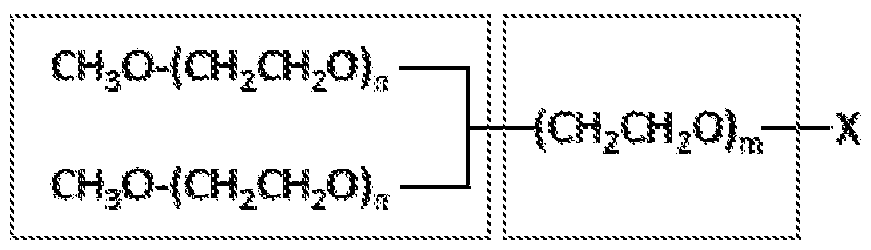
Branched G PES LitsSusr A*wt
Total w. 1 - m kDa Tofca! Ms*. 1 - 30 k
Preferably 20 - 40 kDa Preferably 2 - 20 kBs
The following trimeric PEGs were synthesized: YPEG42, YPEG43.5, YPEG45, YPEG50 and YPEG60.
• YPEG42 is a trimeric PEG moiety which has a molecular weight of 42kDa: (20 + 20 kDa) (branched PEG) + 2 kDa (linker arm).
• YPEG43.5 is a trimeric PEG moiety which has a molecular weight of 43.5kDa: (20 + 20 kDa) (branched PEG) + 3.5 kDa (linker arm).
• YPEG45 is a trimeric PEG moiety which has a molecular weight of 45kDa: (20 + 20 kDa) (branched PEG) + 5 kDa (linker arm).
• YPEG50 is a trimeric PEG moiety which has a molecular weight of 50kDa: (20 + 20 kDa) (branched PEG) + 10 kDa (linker arm).
• YPEG60 is a trimeric PEG moiety which has a molecular weight of 60kDa: (20 + 20 kDa) (branched PEG) + 20 kDa (linker arm).
2. Linker moiety
The protein or peptide is covalently joined to the branched PEG moiety via a linker. The linker is a polymer, and generally has an atomic length of at least 800 angstroms. Typically, the linker has an atomic length from about 800 to about 2,000 angstrom, from about 800 to about 1,500 angstrom, from about 800 to about 1 ,000 angstrom, or from about 900 to about 1 ,000 angstrom. It is to be appreciated that the atomic distances listed above refer to fully extended polymers, and that when in the solid state or solution the linker may fold or curl in ways such that the actual distance between the branched PEG and protein or peptide is less than the atomic lengths listed above.
In certain embodiments, the linker is a poly(ethylene glycol) derivative with a molecular weight between about 1 kDa to 30 kDa, preferably from about 2 kDa to 20 kDa. A linker may also be a natural or unnatural amino acid of at least 80 units in length. .
PEG alternatives for the linker include synthetic or natural water- soluble biocompatible polymers such as polyethylene oxide, polyvinyl alcohol, polyacrylamide, proteins such as hyaluronic acid and ehondroitin sulfate, celluloses such as hydroxymethyl cellulose, polyvinyl alcohol, and polyhydroxyalkyl (meth)acrylates.
Proteins and peptides may be covalently bound to the linker using conventional chemistries. Primary amine groups, such as found at the N- terminus or in lysine residues, will react with aldehydes and their equivalents under reductive conditions to give amines. (Molineux, Current
pharmaceutical design, 10(1 1): 1235-1244 (2004)). Mercapto (-SH) groups, such as found in cysteine residues, can undergo a conjugate addition with a variety of Michael acceptors, including acrylic and methacrylic acid derivatives, as well as maleimides (Gong et al, British Journal of
Pharmacology, 163(2):399-412 (2011)). Other suitable nucleophilic groups found in peptides and proteins include disulfide bonds (Brocchini, et al, Nature protocols, 1 :2241-2252 (2006)) and histidine residues (Cong, et al, Bioconjugate Chemistry, 23(2):248-263 (2012)).
The linker may be covalently joined to the protein or peptide using conventional chemistries. For instance, the linker polymer may be derivatized at one end with an electrophilic group such as an aldehyde, epoxide, halogen (chlorine, bromide, iodine), sulfonate ester (tosylate, mesylate), Michael acceptor, or activated carboxylates and then reacted with a nucleophilic amine or thiol group in the protein or peptide. Suitable Michael acceptors include acylic and methacrylic acid derivatives such as acrylamides, methacrylamides, acrylates and methacrylates, as well as maleimides. Suitable activated carboxylates include nitrophenyl carbonate and NHS (N-hydroxy succinate) esters. In other embodiments, peptides and proteins containing arginine residues may be covalently joined with a linker containing a reactive 1,3 diketone functional group.
The conjugates may be prepared by first joining the linker with the peptide or protein, followed by joining the linker with the branched poly(ethylene glycol), or by first joining the linker with the branched poly(ethylene glycol), followed by joining the linker with the peptide or protein. The optimal sequence of bond formation is determined by the specific chemical transformations involved.
2. Macromolecules
In other embodiments, TRAIL can be derivatized as a long-acting
TRAIL with an extended half-life using biopolymers or polypeptides through reported methods; for example, but not limited to, using chemically conjugated hyaluronic acid (Yang et al, Biomaterials 32(33);8722-8729 (2011), depot forming polypeptides (Amiram et al, Proc natl Acad Sci U S A, 1 10(8);2792-2792 (2013), U.S. Published Application No. 13/795,992) and TRAIL linked to extended recombinant polypeptides (U.S. Published Application No. 12/699,761).
3. Complexes
The TRAIL domain can be complexed with a negatively charged moiety. In some embodiments the negatively charged moiety can facilitate loading of the ligand or agonist into a nanoparticle for extended, sustained, or time released delivery. In some embodiments, the negatively charged
moiety itself mediates extended, sustained, or time released delivery of the ligand or agonist. Preferably, the negatively charged moiety does not substantially reduce the ability of the ligand or agonist to induce or enhance apoptosis in immune cells or synoviocytes.
The formation of a complex between positively charged TRAIL and the negatively charged chondroitin sulfate (CS) (CS/TRAIL) was developed and shown to facilitate loading of TRAIL in poly(lactide-co-glycolide) (PLGA) microspheres (MSs), without compromising the activity of the TRAIL (Kim, et al, Journal of Pharmacy and Pharmacology, 65(1): 1 1—21 (2013). A nanocomplex of approximately 200 nm was formed in a weight ratio of 2 TRAIL to CS (TC2) at pH 5.0. The complex had >95% higher loading efficiency in PLGA MSs prepared by the multi-emulsion method than that of native TRAIL. Therefore, in some embodiments, the ligand or agonist, particularly TRAIL peptides, and variants, functional fragments and fusion proteins thereof, or conjugates thereof such as PEG-conjugates are complexed with chondroitin sulfate and optionally loaded into micro- or nanoparticles, for example, PLGA-based particles.
In other embodiments, the ligand or agonist, particularly TRAIL peptides, and variants, functional fragments and fusion proteins thereof, or conjugates thereof such as PEG-conjugates are complexed with hyaluronic acid (HA). Nanocomplexes of PEG-TRAIL and HA prepared by mixing positively charged PEG-TRAIL and negatively charged HA, were shown to have sustained delivery in vivo, with negligible loss of bioactivity compared with the PEG-TRAIL (Kim, et al, Biomaterials, 31(34):9057-64 (2010)). Delivery was further enhanced by administering the nanoparticles in a 1% HA containing solution. In an alternative embodiment, the HA is conjugated to the ligand or agonist as in Yang, et al, Biomaterials, 32(33):8722-9 (2011). Yang describes a coupling reaction between an aldehyde modified HA and the N-terminal group of IFNa, which can be used to couple HA to the pro-apoptotic agents disclosed herein. The IFNa content could be controlled in the range of 2-9 molecules per single HA chain with a bioconjugation efficiency higher than 95%, and the conjugates exhibited
improved activity and half-life in vivo.
In some embodiments, the pro-apoptotic agent is modified to improve purification, Tag-removal, facilitate small molecule attachment or a combination thereof. Applied in tandem, elastin-like polypeptides and the Sortase A (SrtA) transpeptidase provide a method for chromatography-free purification of recombinant proteins and optional, site-specific conjugation of the protein to a small molecule (Bellucci, et al, Angewandte Chemie International Edition, 52(13):3703— 3708 (2013)). This system provides an efficient mechanism for generating bioactive proteins at high yields and purities.
Other tags and labels are known in the art and include, for example, SUMO tags, His tags which typically include six or more, typically consecutive, histidine residues; FLAG tags, which typically include the sequence DYKDDDDK (SEQ ID NO:2); haemagglutinin (HA) for example, YPYDVP (SEQ ID NO: 3); MYC tag for example ILKKA AYIL (SEQ ID
NO:4) or EQKLISEEDL (SEQ ID NO:5). Methods of using purification tags to facilitate protein purification are known in the art and include, for example, a chromatography step wherein the tag reversibly binds to a chromatography resin.
Purification tags can be at the N-terminus or C-terminus of the fusion protein. The purification tags can be separated from the polypeptide of interest in vivo (e.g., during expression), or ex vivo after isolation of protein. Therefore, purification tags can also be used to remove the fusion protein from a cellular lysate following expression. The fusion protein can also include an expression or solubility enhancing amino acid sequence.
Exemplary expression or solubility enhancing amino acid sequences include maltose-binding protein (MBP), glutathione S-transferase (GST), thioredoxin (TRX), NUS A, ubiquitin (Ub), and a small ubiquitin-related modifier (SUMO).
4. Targeting Moieties
The TRAIL-conjugate, compositions including the TRAIL-conjugate agent, and delivery vehicles for the TRAIL-conjugate agent can include a
targeting moiety. In some embodiments, the targeting moiety increases targeting to or accumulation of the pro-apoptotic agent to the organ of interest or target cells.
In a preferred embodiment, the targeting moiety increases targeting to or accumulation of the pro-apoptotic agent in the j oints of subj ects with rheumatoid arthritis, and/or to pro-inflammatory immune cells, synoviocytes, or a combination thereof. In other embodiments, the targeting moiety increases targeting to or accumulation of the agent in areas of inflammation or areas in which inflammatory cells are produced.
In some embodiments, the targeting molecules are fused with or conjugated to the TRAIL-conjugate itself, or to a composition that includes the TRAIL-conjugate, or delivery vehicles carrying the TRAIL conjugate (e.g., a carrier such as a micro- or nanoparticle, liposome, etc,).
The molecule can target a protein expressed in the joint, or preferably on the surface of or in the microenvironment around pro-inflammatory immune cells, particularly those causing or contributing to joint
inflammation or other symptoms of autoimmune disease, particular rheumatoid arthritis. The molecule can target a protein expressed in the synovium, or preferably on the surface of in the microenvironment around synoviocytes. The targeting moiety can be, for example, an antibody or antibody fragment such as immunoglobulin (antibody) single variable domains (dAbs) that binds to an antigen expressed in the liver, or more preferably on the surface of liver cells or in the microenvironment around hepatic stellate cells. In certain embodiments, the antibody is polyclonal, monoclonal, linear, humanized, chimeric or a fragment thereof.
Representative antibody fragments are those fragments that bind the antibody binding portion of the non-viral vector and include Fab, Fab', F(ab'), Fv diabodies, linear antibodies, single chain antibodies and bispecific antibodies known in the art. In preferred embodiments, the targeting antibody or fragment thereof is specific for pro-inflammatory immune cell surface marker or synoviocyte surface marker, and is produced to reduce potential immunogenicity to a human host as is known in the art. For
example, transgenic mice which contain the entire human immunoglobulin gene cluster are capable of producing "human" antibodies can be utilized. In one embodiment, fragments of such human antibodies are employed as targeting signals. In a preferred embodiment, single chain antibodies modeled on human antibodies are prepared in prokaryotic culture.
C. Formulations
Formulations of and pharmaceutical compositions including one or more active agents are provided. The pharmaceutical compositions can include one or more additional active agents. Therefore, in some embodiments, the pharmaceutical composition includes two, three, or more active agents. The pharmaceutical compositions can be formulated as a pharmaceutical dosage unit, also referred to as a unit dosage form. Such formulations typically include an effective amount a TRAIL-conjugate. Effective amounts of the disclosed TRAIL-conjugates are discussed in more detail below.
Pharmaceutical compositions can be for administration by parenteral (intramuscular, intraperitoneal, intravenous (IV) or subcutaneous injection), or nasal or pulmonary administration and can be formulated in dosage forms appropriate for each route of administration.
Preferably, the compositions are administered locally, for example by injection directly into a site to be treated (e.g., into a joint). In some embodiments, the compositions are injected or otherwise administered directly into the vasculature at or adjacent to the intended site of treatment (e.g., adjacent to the joint). Typically, local administration causes an increased localized concentration of the compositions which is greater than that which can be achieved by systemic administration.
The formulations are preferably an aqueous solution, a suspension or emulsion. Such compositions include diluents sterile water, buffered saline of various buffer content (e.g., Tris-HCl, acetate, phosphate), pH and ionic strength; and optionally, additives such as detergents and solubilizing agents (e.g., TWEEN® 20, TWEEN® 80 also referred to as polysorbate 20 or 80. The formulations may be lyophilized and redissolved/resuspended
immediately before use. The formulation may be sterilized by, for example, filtration through a bacteria retaining filter, by incorporating sterilizing agents into the compositions, by irradiating the compositions, or by heating the compositions.
III. Methods of Use
The conjugated TRAIL proteins have extended half-lives relative to their unconjugated counterparts due to their increased molecular size.
Because the linker permits the protein or peptide to more easily interact with its biological target, the biological potency of the conjugate is not substantially reduced, as is typically observed with PEGylated proteins and peptides. Since the half-life is extended without concurrent loss of potency, the conjugates may be administered at lower dosage levels and dosing frequencies compared to the unconjugated protein or peptide, or compared to proteins and peptides conjugated according to protocols disclosed in the prior art.
The Examples below show that 5K-PEG-TRAIL (i.e., a PEG-TRAIL conjugate with a 5,000 Dalton PEG) is effective for treatment for rheumatoid arthritis when administered every three days, while a 30K-PEG-TRAIL (i.e., a PEG-TRAIL conjugate with a 30,000 Dalton PEG) is effective when administered once weekly. Therefore, in some embodiments, a large molecular weight PEG conjugate is associated with a longer in vivo half-life.
A. Disease or Disorders to be Treated
The TRAIL compositions are useful for treatment of autoimmune disease or inflammatory disease or disorder. Representative inflammatory or autoimmune diseases/disorders that can be treated using the disclosed compositions include, but are not limited to, rheumatoid arthritis, systemic lupus erythematosus, alopecia areata, anklosing spondylitis, antiphospholipid syndrome, autoimmune Addison's disease, autoimmune hemolytic anemia, autoimmune hepatitis, autoimmune inner ear disease, autoimmune lymphoproliferative syndrome (alps), autoimmune thrombocytopenic purpura (ATP), Behcet's disease, bullous pemphigoid, cardiomyopathy, celiac sprue-dermatitis, chronic fatigue syndrome immune deficiency,
syndrome (CFIDS), chronic inflammatory demyelinating polyneuropathy, cicatricial pemphigoid, cold agglutinin disease, Crest syndrome, Crohn's disease, Dego's disease, dermatomyositis, dermatomyositis - juvenile, discoid lupus, essential mixed cryoglobulinemia, fibromyalgia - fibromyositis, grave's disease, guillain-barre, hashimoto's thyroiditis, idiopathic pulmonary fibrosis, idiopathic thrombocytopenia purpura (ITP), Iga nephropathy, insulin dependent diabetes (Type I), juvenile arthritis, Meniere's disease, mixed connective tissue disease, multiple sclerosis, myasthenia gravis, pemphigus vulgaris, pernicious anemia, polyarteritis nodosa, polychondritis, polyglancular syndromes, polymyalgia rheumatica, polymyositis and dermatomyositis, primary agammaglobulinemia, primary biliary cirrhosis, psoriasis, Raynaud's phenomenon, Reiter's syndrome, rheumatic fever, sarcoidosis, scleroderma, Sjogren's syndrome, stiff-man syndrome, Takayasu arteritis, temporal arteritis/giant cell arteritis, ulcerative colitis, uveitis, vasculitis, vitiligo, and Wegener's granulomatosis.
In a preferred embodiment, the inflammatory and autoimmune disease/disorder is rheumatoid arthritis.
B. Methods of Treatment
Methods of treating autoimmune diseases, particular rheumatoid arthritis are provided. The methods typically include administering to a subject in need thereof an effective amount of a TRAIL-conjugate.
Typically, the TRAIL-conjugate is administered in an effective amount to i) induce or increase apoptosis of target cell types such as immune cells, particularly pro-inflammatory immune cells, synoviocytes and ii) increase the quantity of the anti-inflammatory regulatory T cells or a combination thereof. TRAIL is believed to have a therapeutic effect against RA by inducing apoptosis of activated lymphocytes or synoviocytes or increasing the population of the anti-inflammatory regulatory T cells. Therefore, in the most preferred embodiments, the TRAIL-conjugate is administered in an effective amount to induce or increase apoptosis of activated, proinflammatory lymphocytes, synoviocytes, or increase anti-inflammatory regulatory T cells, or a combination thereof.
Preferably, the level of apoptosis is effective to reduce or inhibit the onset or progression of an autoimmune disease such as rheumatoid arthritis, or one or more symptoms thereof. In some embodiments, the subject has rheumatoid arthritis and the method reduces, or prevents an increase, in joint swelling, joint pain, or a combination thereof.
In some embodiments, the method is effective to reduce, or prevent an increase, in one or more biochemical, physiological, or pathological indications of the autoimmune or inflammatory disease or disorder. For example, if the disease or disorder is rheumatoid arthritis, the TRAIL- conjugate can be administered in an effective amount to reduce, or prevent an increase, in joint swelling, erythema, joint rigidity, inflammatory cell infiltration into the joint(s), synovitis, pannus formation, destruction of articular cartilage, bone erosion, elevated erythrocyte sedimentation rates (ESR), anaemia and combinations thereof. Pro-inflammatory molecules can accelerate pannus formation and mediate cartilage and bone destruction (Mclnnes, et al, Nature reviews Immunology, 7(6):429-42 (2007);
Feldmann, et al, Annual review of immunology 14:397-440 (1996). In some embodiments, the TRAIL-conjugate can reduce or prevent increases in expression of pro-inflammatory molecules, for example, TNF-a, IL-Ι β, IFN- γ, IL-2, IL-6, IL-17, ICAM-1, COX-2, iNOS, or combination thereof. In some embodiments, the TRAIL-conjugate is effective to reduce activated lymphocytes while increasing the population of the anti-inflammatory regulatory T cells. In some embodiments, the TRAIL-conjugate is effective to reduce, or prevent increases in, expression or circulating levels of autoantibodies to IgGFc (i.e., "rheumatoid factors (RF)"), antibodies to citrullinated peptides (ACPA), or combinations thereof. The levels of circulating pro-inflammatory molecules, autoantibodies, ect, can be measured in, for example, a blood, serum, or synovial fluid sample take from the subject before and again after administration to the TRAIL-conjugate.
The TRAIL-conjugate can also be effective to reduce, improve, or prevent more general symptoms of arthritis such as tender or warm joints,
morning stiffness, bumps of tissue under the skin on the arms (rheumatoid nodules), fatigue, fever, weight loss, or combinations thereof.
Apoptosis and the resolution of symptoms can be assessed in the subject using a number of techniques. For example, overall improvement in the condition of the joints can be monitored over time. The joints or overall condition of the RA can be assessed, rated, staged, or evaluated using standard methods that are known in the art. See, for example, European League Against Rheumatism (EULAR) management guidelines, 2010 American College of Rheumatology (ACR)/EULAR classification criteria (Aletaha, et al, Arthritis Rheum., 62(9):2569-81 (2010), 2012 ACR disease activity measures (Anderson, Arthritis Care Res (Hoboken), 64:640-7 (2012)), or 201 1 ACR/EULAR definitions of remission. In preferred embodiments, the joints or over condition of the RA is improved overtime following administration of the TRAIL-conjugate.
The apoptosis of target cells can be determined from biopsies. Any change, and in particular any increase, in the frequency of apoptosis of target cells can be measured. Apoptotic cells can be identified using a number of well-known methods. Techniques such as TU EL staining (terminal deoxynucleotidyl transferase mediated deoxyuridine trisphosphate nick end labelling) can be used to identify apoptotic cells. TUNEL staining is particular useful as it can be used to identify apoptotic cells in situ.
Other well-known techniques for identifying and/or quantifying apoptosis can be employed such as, for example, Annexin V staining, antibodies against single stranded DNA, caspase substrate assays, ligation mediated PCR and cell membrane permeability staining. DNA
fragmentation can be analyzed by gel electrophoresis. Staining can also be used to determine the morphological characteristics associated with apoptosis, such as membrane blebbing and the breakdown of the nucleus. Acridine orange staining can be used to identify apoptotoic cells. Cells may be stained with propidium iodide to analyze DNA content. Tests such as trypan blue staining can be used to check that the membrane cell is intact and that they are apoptotic not necrotic.
The effect of administration of the TRAIL-conjugate can be compared to a control. Suitable controls are known in the art and include, for example, a matched untreated subject, or a matched subject administered a therapeutic agent that does not induce or increase apoptosis of the target cells.
The compositions can be administered locally or systemically, as discussed above. However, preferably the composition is administered systemically.
The dosage and frequency of administration can depend on the TRAIL-conjugate that is selected. In some embodiments, the TRAIL- conjugate is administered systemically once, twice, or three times every 1, 2, 3, 4, 5, 6, 7, 8, 9, 10, 1 1, 12, 13, 14, 15, 16, 17, 18, 19, 20, 21, 28, or more days. Preferably the TRAIL-conjugate need only be administered once every 3, 4, 5, 6, 7, or more days. In the most preferred embodiments, the TRAIL-conjugate need only be administered once a week, once every 10 days, or once every two weeks.
As discussed above, and illustrated in the Examples below, a TRAIL- conjugate with 30 kDa PEG exhibit a longer duration of action than a TRAIL-conjugate with a 5 kDa PEG. More specifically, the 30K-PEG- TRAIL, was effective when administered once weekly, while the 5K-PEG- TRAIL was effective when administered once every third day. Therefore, the frequency of administration can be determined by the practitioner based on the structure of the TRAIL-conjugate.
Typically, the compositions disclosed herein are administered in a dosage of between about 0.01 and 1,000 mg/kg, or between about 1 and 100 mg/kg, 5-50 mg/kg, or 10-20 mg/kg.
As reported by Herbst, et al, J. Clin. Oncol. 2010 10;28(17):2839-46, in a phase I, open-label, dose-escalation study treated patients with advanced cancer with rhApo2L/TRAIL doses ranging from 0.5 to 30 mg/kg/d, with parallel dose escalation for patients without liver metastases and with normal liver function (cohort 1) and for patients with liver metastases and normal or
mildly abnormal liver function (cohort 2). Doses were given daily for 5 days, with cycles repeating every 3 weeks.
In the Examples below, mice were administered PEG-TRAIL conjugates at a dosage of 300 μg/mouse once every 3 days, or once weekly. For a 25 gram mouse, this is approximately 12 mg kg. In some
embodiments, the estimated mouse dosage is extrapolated to a human dose through normalization to body surface area as discussed in Reagan-Shaw, et al, The FASEB Journal, 22: 1-3 (2007) (the FASEB Journal article fj.07- 9574LSF). Therefore, in some embodiments, the dosage is about 1-1,000 mg/m2, or 10-100 mg/m2, or 25-75 mg/m2, or 40-60 mg/m2 or about 45 mg/m2.
IV. Combination Therapies
One or more of the TRAIL-conjugates disclosed herein, and compositions thereof, can be administered to subjects in need thereof alone, or in combination, with one or more additional active agents.
A. Additional Active Agents
Additional agents can be proteins, peptides, carbohydrates, nucleic acids, lipids, small molecules, or combinations thereof. In some
embodiments, the second active agent is an agent that is known in the art for treatment of autoimmune disease, particularly rheumatoid arthritis. As discussed in more detail below, standard therapy for RA includes analgesics, non-steroidal anti-inflammatory drugs, and biologic disease-modifying antirheumatic drugs (DMARDs) that target components of the immune response. Some such therapies target excessive inflammatory mediators, released by infiltrating lymphocytes that are responsible for joint destruction. As a result, anti-cytokine RA therapeutics have been identified such as tumor necrosis factor alpha (TNF-a) and interleukin (IL)-l receptor antagonistic antibodies. In 2012, Interleukin (IL) targets made up 15%, kinase inhibitors made up 12%, B-cell targets made up 9% and TNF inhibitors made up 7% of the products in the RA drug class. TNF-a antagonist are considered by some to be the most efficient of conventional biologies to treat RA (Audo, et al., Cytokine, 63(2):81-90 (2013)). Others targets in the TNF family implicated in
RA include receptor activator for nuclear factor kappa-beta ligand (RANKL) and its receptor RANK, and osteoprotegerin (OPG) (Lamhamedi-Cherradi, et al, Nature immunology 4(3):255-60 (2003)).
Therefore, the second active agent can be one that modulates immune cells, particularly lymphocytes, synoviocytes, or a combination thereof. The active agent can reduce or inhibit the proliferation or activity of proinflammatory immune cells, induce or increase the proliferation or activity of anti-inflammatory immune cells (e.g., regulatory T cells), reduce or inhibit the proliferation or activity of synoviocytes, or any combination thereof. In some embodiments, the second active agent reduces the expression or circulation of one or more pro-inflammatory molecules, including, but not limited to TNF-a, IL-Ι β, IFN-γ, IL-2, 11-6, IL-8, IL-Ιβ, TGF-β, IL-17, IL-6, IL-23, IL-22, IL-21, prostanoids, and matrix metalloproteinases (MMPs). For example, in some embodiments, the second active agent is one that reduces the level of one or more pro-inflammatory molecules in the blood, serum, or synovial fluid when administered to a subject with RA.
1. Conventional Treatments for Rheumatoid Arthritis In some embodiments, the TRAIL-conjugates are administered in combination with a conventional treatment or agent used for treating or preventing rheumatoid arthritis. Common RA drugs can be divided into two general classes: fast-acting "first-line drugs" and slow-acting "second-line drugs" (also referred to as disease-modifying antirheumatic drugs or DMARDs).
a. First-Line Drugs
The TRAIL-conjugates can be administered in combination with a first-line drug for treating rheumatoid arthritis.
The first-line drugs, such as aspirin and cortisone (corticosteroids), are typically agents that reduce pain, inflammation, or a combination thereof.
For example, the first-line drug can be a nonsteroidal anti-inflammatory drugs (NSAIDs). N-Acetyl salicylate (aspirin), naproxen (NAPROSYN®), ibuprofen (ADVIL®, MEDIPREN®, MOTRIN®), and etodolac
(LODINE®) are examples of NSAIDs. NSAIDs are medications that can reduce tissue inflammation, pain, and swelling. NSAIDs are not cortisone.
Aspirin, in doses higher than those used in treating headaches and fever, is also effective anti-inflammatory medication for rheumatoid arthritis. However, NSAIDs are typically as effective as aspirin in reducing inflammation and pain and require fewer dosages per day.
The most common side effects of aspirin and other NSAIDs include stomach upset, abdominal pain, ulcers, and even gastrointestinal bleeding. Therefore, NSAIDs can be taken with additional medications that are frequently recommended to protect the stomach from their ulcer effects. These medications include antacids, sucralfate (CARAFATE®), proton- pump inhibitors (PREVACID® and others), and misoprostol (CYTOTEC®). NSAIDs can also be selective Cox-2 inhibitors, such as celecoxib
(CELEBREX®), which offer anti-inflammatory effects with less risk of stomach irritation and bleeding risk.
Corticosteroid medications can be given orally or injected directly into tissues and joints. They are more potent than NSAIDs in reducing inflammation and in restoring joint mobility and function, and often administered to treat severe flair-ups or when the subject is not responsive to NSAIDs. Corticosteroid medications can be administered with calcium and/or vitamin D supplements to reduce or prevent osteoporosis,
b. Second-Line Drugs
The TRAIL-conjugates can be administered in combination with a second-line drug for treating rheumatoid arthritis. While first-line medications can relieve joint inflammation and pain, they do not necessarily prevent joint destruction or deformity. Rheumatoid arthritis requires medications other than NSAIDs and corticosteroids to stop progressive damage to cartilage, bone, and adjacent soft tissues. The medications that target the mechanisms underlying the disease are also referred to as disease- modifying antirheumatic drugs (DMARDs).
Second-line agents, also sometimes referred to as slow-acting medicines, may take weeks to months to become effective. They are
typically administered for long periods of time, even years, at varying doses. DMARDs can promote remission by reducing the progression of joint destruction and deformity. Sometimes a number of DMARD second-line medications are used together as combination therapy. Therefore, in some embodiments, the TRAIL-conjugate is administered two or more second-line drugs.
Hydroxychloroquine (PLAQUENIL®); sulfasalazine
(AZULFIDI E® ) ; gold salts such as gold thioglucose (SOLGANAL®); gold thiomalate (MYOCHRYSI E®); oral gold (e.g., auranofin (ridaura)); d-penicillamine (DEPEN®, CUPRIMI E®); immunosuppressives such as methotrexate, azathioprine (IMURAN®), cyclophosphamide
(CYTOXAN®), chlorambucil (LEUKERAN®), and cyclosporine
(SANDIMMUNE®); leflunomide (ARAVA®); etanercept (ENBREL®); infliximab (REMICADE®); anakinra (KINERET®); adalimumab
(HUMIRA®); rituximab (RITUXAN®); abatacept (ORENCIA®);
golimumab (SIMPONI®); certolizumab pegol (CIMZIA®); tocilizumab (ACTEMRA®); and tofacitinib (XELJANZ®).
In some embodiments, the TRAIL-conjugates are administered in combination with a tumor necrosis factor (TNF)-a antagonist. TNF-a antagonists are currently the most effective, efficient and common biologies used to treat RA. Common TNF-a antagonists include, but are not limited to, etanercept, infliximab, adalimumab, golimumab, and certolizumab pegol. These drugs typically work by intercepting tumor necrosis factor or TNF in the joints and reducing its pro-inflammatory signal. This in turn reduces the recruitment of pro-inflammatory cells to the site of inflammation. Etanercept is typically injected subcutaneously once or twice a week. Infliximab can be given by infusion directly into a vein (intravenously). Adalimumab is typically injected subcutaneously either every other week or weekly.
Golimumab is typically injected subcutaneously on a monthly basis.
Certolizumab pegol is typically injected subcutaneously every two to four weeks. They are also frequently used in combination with methotrexate and other DMARDs. Furthermore, it should be noted that the TNF-blocking
biologies all are more effective when combined with methotrexate. These medications should be avoided by people with significant congestive heart failure or demyelinating diseases (such as multiple sclerosis) because they can worsen these conditions.
In some embodiments, the effect of administering a TRAIL- conjugate and a TNF-a antagonist in a combination therapy is more than the additive effect of administering the two agents as monotherapies.
In some embodiments, the TRAIL-conjugate is administered in combination with adjunct therapy, for example, surgery or apheresis.
Apheresis is a procedure that involves removing whole blood from a donor or patient and separating the blood into individual components so that one or more particular component can be removed. In the case of rheumatoid arthritis, apheresis is most typically used to remove autoantibodies that contribute to disease progression. Following, apheresis, the remaining blood components then are re-introduced back into the bloodstream of the patient or donor.
2. Chemotherapeutic Agents
TRAIL receptor agonists have been investigated for use in the treatment of cancer, both alone and in combination with conventional cancer treatments such as chemotherapeutic agents. Some reports indicate that chemotherapeutic drugs can sensitize cells to TRAIL-induced apoptosis, and some results indicate the combination of the two agents is more effective than the sum of effects of the agents when used alone (Cuello, et al, Gynecol Oncol, 81(3):380-90 (2001) Wu, et al, Vitam Horm., 67:365-83 (2004)). Therefore, in some embodiments, the subjects and diseases disclosed herein are treated with a combination of a TRAIL-conjugate and a
chemotherapeutic agent. In some embodiments, the subjects do not have cancer.
Exemplary chemotherapeutic drugs include, but are not limited to, doxorubicin,5-fluorouracil, cisplatin, carboplatin, oxaliplatin,
mechlorethamine, cyclophosphamide, chlorambucil, vincristine, vinblastine, vinorelbine, vindesine, taxol and derivatives thereof, irinotecan, topotecan,
amsacrine, etoposide, etoposide phosphate, teniposide, epipodophyllotoxins, trastuzumab (HERCEPTI ®), cetuximab, and rituximab (RITUXAN® or MABTHERA®), bevacizumab (AVASTIN®), and combinations thereof.
B. Dosage and Treatment Regimes for Combination
Therapies
The methods of treatment disclosed herein typically include treatment of a disease or symptom thereof, or a method for achieving a desired physiological change, including administering to an animal, such as a mammal, especially a human being, an effective amount of a TRAIL- conjugate disease or symptom thereof, or to produce the physiological change. In some embodiments, the TRAIL-conjugate is in combination with an additional active agent, such as those discussed above. The TRAIL- conjugate and the additional active agent can be administered together, such as part of the same composition, or administered separately and
independently at the same time or at different times (i.e., administration of the TRAIL-conjugate and the second active agent is separated by a finite period of time from each other). Therefore, the term "combination" or "combined" is used to refer to either concomitant, simultaneous, or sequential administration of the ligand or agonist and the second active agent. The combinations can be administered either concomitantly (e.g., as an admixture), separately but simultaneously (e.g., via separate intravenous lines into the same subject; one agent is given orally while the other agent is given by infusion or injection, etc.,), or sequentially (e.g., one agent is given first followed by the second).
In preferred embodiments, administration of the TRAIL-conjugate in combination with the second active agent achieves a result greater than when the TRAIL-conjugate and the second active agent are administered alone or in isolation (i.e., the result achieved by the combination is more than additive of the results achieved by the individual components alone). In some embodiments, the effective amount of one or both agents used in
combination is lower than the effective amount of each agent when administered separately. In some embodiments, the amount of one or both
agents when used in the combination therapy is sub-therapeutic when used alone.
A treatment regimen of the combination therapy can include one or multiple administrations of the TRAIL-conjugate. A treatment regimen of the combination therapy can include one or multiple administrations of the second active agent.
In some embodiments, the TRAIL-conjugate is administered prior to the first administration of the second active agent. In other embodiments, the ligand or agonist is administered after to the first administration of the second active agent.
The TRAIL-conjugate can be administered at least 1, 2, 3, 5, 10, 15, 20, 24 or 30 hours or days prior to or after administering of the second active agent.
Dosage regimens or cycles of the agents can be completely, or partially overlapping, or can be sequential. For example, in some embodiments, all such administration(s) of the TRAIL-conjugate occur before or after administration of the second active agent. Alternatively, administration of one or more doses of the TRAIL-conjugate can be temporally staggered with the administration of second therapeutic agent to form a uniform or non-uniform course of treatment whereby one or more doses of TRAIL-conjugate are administered, followed by one or more doses of second active agent, followed by one or more doses of TRAIL-conjugate; or one or more doses of second active agent are administered, followed by one or more doses of the TRAIL-conjugate, followed by one or more doses of second active agent; etc., all according to whatever schedule is selected or desired by the researcher or clinician administering the therapy.
An effective amount of each of the agents can be administered as a single unit dosage (e.g., as dosage unit), or sub-therapeutic doses that are administered over a finite time interval. Such unit doses may be
administered on a daily basis for a finite time period, such as up to 3 days, or up to 5 days, or up to 7 days, or up to 10 days, or up to 15 days or up to 20 days or up to 25 days
The present invention will be further understood by reference to the following non-limiting examples.
Examples
Example 1: PEG-TRAIL Analogs Induce Apoptosis of Jurkat Cells and down-regulate inflammatory molecules
Materials and Methods
Two different PEGylated TRAIL analogs, trimeric active TRAIL having PEG, with molecular weight of 5kDa and 30kDa, at the N-terminal site were prepared. Briefly, monomethoxy PEG-aldehyde (mPEG-ALD with molecular weight of 5 kDa and 30 kDa) (Nippon Oil Fats, NOF, Tokyo) was conjugated to the N-terminal site of TRAIL having a trimer-forming zipper domain, in the presence of 20 mM sodium cyanoborohydrice (NaCNBFL) in 50 mM sodium acetate buffer at pH 5, as described previously (U.S. Patent Application No. 20090203599 and Chae, et al, Molecular Cancer
Therapeutics, 9(6): 1719-29 (2010), Kim, et al, Bioconjugate Chemistry, 22(8): 1631-1637 (201 1
PEG and TRAIL molar ratios and reaction times were studied by size exclusion chromatography monitoring. PEG-TRAIL analogs were purified and concentrated by gel-filtration chromatography and ultrafiltration, respectively, and stored at -20 °C until use. Analogs were characterized and identified as described.
The in vitro cytotoxicities of PEG-TRAIL analogs were examined in Jurkat cells using an established MTS-based assay and Annexin-V-FLUOS staining. Human leukemia T-cell line Jurkat cells were cultured at a cell density of 4* 106 cells/ml (100 μΐ/well) in 96-well plates, and stimulated with 10 ng/ml Con A (concanavalin A) for 12 h. Pre-determined amounts of PEG- TRAIL were then added to final concentrations of 0-10,000 ng/ml, and incubated for 24 h. MTS assays (CellTiter 96 Aqueous Non-Radioactive Cell Proliferation Assay; Promega, Madison, WI) were performed on collected culture supernatants following manufacturer's protocol. Cell viabilities (%) were calculated by expressing the absorbance at 490 nm of treated samples as percentages of those of untreated controls. To examine the apoptotic effect
on Jurkat cells, Annexin-V-FLUOS staining kits (Roche Diagnostics, Mannheim, Germany) was used according to manufacturer's protocol. In brief, Jurkat cells were treated with Con A and PEG-TRAIL (500 ng/ml) as described above, and then washed with PBS and stained with 100 μΐ of an Annexin-V/propidium iodide mixture for 15 min. Finally, apoptotic and necrotic cells levels were analyzed by fluorescence microscopy. Apoptotic effects (%) were calculated by expressing number of stained cells (green or orange) as percentages of total cells.
The effect of PEG-TRAIL analogs on down-regulating inflammatory molecules in Jurkat cells was analyzed at the molecular level by Western blotting and quantitative real-time PCR (qPCR) after incubating the cells with PEG-TRAIL at the concentrations of 0, 0.1, 1, 10, 100 and 1000 ng/mL for 24 h. Anti-Caspase-8 (Cell Signaling Technology, Danvers), anti-cleaved Caspase-8, anti-cleaved Caspase-3 (Cell Signaling Technology), anti-Cox-2 and anti-ICAM-1, anti-GAPDH (Santa Cruz Biotechnology) were used in Western blot analysis. In general, cells were lysed by sonication in ice-cold PBS buffer containing protease inhibitor (1 mM PMSF and 1 mg/mL each of aprotinin, leupeptin and pepstatin A). Cell lysates were clarified by centrifugation and the supernatants were used to measure protein
concentration by Braford assay (Bio-Rad Laboratories, Hercules, CA). The samples were subjected to electrophoresis through SDS-polyacrylamide gels and transferred to nitrocellulose membrane. After blocking the membrane with 3% bovine serum albumin (BSA, Sigma), the membranes were incubated with the primary antibodies overnight. GAPDH was used for protein loading control. Protein bands were detected using a secondary antibody conjugated with horseradish peroxidase (Thermo) and a chemiluminescence detection system (ECL) onto X-ray film. The intensity of protein bands was quantified by Multi Gauge software (Fujifilm). For qPCR studies, total RNA from cultured cells was extracted with TRIzol reagent (Life Technologies, Grand Island, NY) following the instruction provided by the company. RNA concentration was measured spectrophotometrically by using NanoDrop 2000 (Thermo Fisher Scientific, Waltham, MA). 1 μg of
total RNAs were reverse-transcribed to cDNA using the High-Capacity cDNA Reverse Transcription System (Life Technologies). Comparative qPCR was performed in duplicate or triplicate for each sample using fast SYBR Green Master Mix (Life Technologies) and StepOnePlus Real-Time PCR System (Life Technologies). The expression levels of target genes were normalized to the expression of GAPDH and calculated based on the comparative cycle threshold Ct method. The sequence of the primers were used as follows;
Murine IFN-γ
5 '-CAGCAACAGCAAGGCGAAA-3 ' (Forward) (SEQ ID NO: 6),
5 ' -CTGGACCTGTGGGTTGTTGAC-3 ' (Reverse) (SEQ ID NO: 7); Murine ICAM-1
5 ' -GTGGCGGGAAAGTTCCTG-3 ' (Forward) (SEQ ID NO: 8), 5 ' -CGTCTTGCAGGTCATCTTAGGAG-3 ' (Reverse) (SEQ ID NO: 9); Murine Cox-2
5 ' -TGCCTGGTCTGATGATGTATGCCA-3 ' (Forward) (SEQ ID NO: 10),
5 ' -AGTAGTCGCACACTCTGTTGTGCT-3 ' (Reverse) (SEQ ID
NO: 11);
Murine iNOS
5 ' -CCTGGTACGGGCATTGCT-3 ' (Forward) (SEQ ID NO: 12), 5'-GCTCATGCGGCCTCCTTT-3' (Reverse) (SEQ ID NO: 13);
Murine GAPDH
5'-CGACTTCAACAGCAACTCCCACTCTTCC-3' (Forward) (SEQ ID NO: 14),
5'-CCTTCTCACCCTCAACGACAACTTCAGC -3' (Reverse) (SEQ ID NO: 15).
Results
TRAIL and PEG-TRAIL analogs demonstrated marked apoptotic effects on Jurkat cells as evident by MTS assay (IC50 for TRAIL, 5K-PEG- TRAIL and 3 OK-PEG-TRAIL, 4.89 ng/mL, 15.71 ng/mL, and 68.26 ng/mL, respectively; Figure 1A). In addition, time-dependent apoptotic cell death
was investigated by Annexin-V-FLUOS staining. Typically, after 24 h of 3 OK-PEG-TRAIL treatment (500 ng/ml), more than 70% Jurkat cells were committed to apoptosis (Figure IB).
Western blot analyses confirmed that 5K-PEG-TRAIL-treated (1,000 ng/mL) Jurkat cells significantly upregulated expression levels of apoptotic markers, cleaved caspase-8 and cleaved caspase-3, by 4.7-fold and 3.9-fold, respectively, compared to non-treated cells (p<0.05). In addition, 5K-PEG- TRAIL declined expression levels of inflammatory molecules, COX-2 and ICAM-1 by 54% and 12%, respectively, compared to non-treated cells (p<0.05). qPCR of mR A obtained from 5K-PEG-TRAIL-treated Jurkat cells revealed more than 50% reduction of ICAM-1, iNOS and IFN-γ expressions compared to non-treated cells (for ICAM-1, iNOS, IFN-γ, 50%, 82%, 75%, respectively, vs. non-treated cells, p<0.05). These results indicate that PEG-TRAIL induces death receptor-mediated apoptosis in activated T cells while inhibiting the regulation of inflammatory markers such as ICAM- 1, COX-2 and iNOS.
Example 2: 5K-PEG-TRAIL Reduces the Severity of
Collagen-Induced Arthritis (CIA)
Materials and Methods
Collagen induced arthritis was subjected in DBA/1 mice as described by Jin et al, J. Pharmacol. Exp. Ther. 332(3):858-865 (2010). Bovine type II collagen (CII, 2 mg/mL; Chondrex, Inc., Redmond, WA) was emulsified in an equal volume of Complete Freund's adjuvant (Chondrex, Inc.) in an ice- cold water bath. First, Male DBA/1J mice were immunized subcutaneous ly at the base of the tail with 0.1 ml of the emulsion at day 0. On day 21, mice received a booster immunization (0.1 ml) using the same procedure but with Incomplete Freund's Adjuvant (IFA; Chondrex). Clinical severities of arthritis were assessed visually every other day in wrist and ankle joints under blinded conditions. TRAIL and 5K-PEG-TRAIL were diluted in phosphate buffered saline solution (PBS) at the intended protein
concentrations. Mice were i.p. administered TRAIL (daily or every 3 days at 300 μg/mouse/day) or 5K-PEG-TRAIL (daily, every 3 days, or weekly at
300
 (300 μΐ) after 1 day from the booster immunization to the end of experiment. PBS was administered as a negative control. Arthritis was graded using clinical signs on a 0-4 scale as follows: 0 = normal, 1 = slight swelling and edema, 2 = moderate swelling and edema, 3 = severe swelling and pronounced edema, and 4 = joint deformity or ankylosis. Each limb was graded with the maximum possible score being 16 per mouse. Clinical scores were monitored throughout the entire treatment.
Results
To investigate the effect of the dosing interval on the development and progression of collagen- induced arthritis (CIA), mice were i.p.
administered TRAIL (daily or every 3 days) or 5K-PEG-TRAIL (daily, every 3 days, or weekly, 300 μg/mouse/day) and therapeutic effects were continuously monitored. CIA developed rapidly in mice immunized with bovine type II collagen (CII), and clinical signs of the disease (periarticular erythema and edema) first appeared in hind paws at approximately 23 days post-CI. All vehicle-treated mice were affected by day 25 (Figures 2B and 2C). Hind paw erythema and swelling increased in frequency and severity in a time-dependent manner, and a mean maximum clinical score was reached between 35 and 39 days post-CI.
Although TRAIL administered every 3 days produced no significant difference as compared with CIA mice (PBS treatment), mice treated daily with TRAIL improved (Figure 2B). In the case of daily and every 3 day administered 5K-PEG-TRAIL, significant therapeutic effects were observed, whereas weekly injections had no evident therapeutic effect (Figure 2C). In addition, a comparison of daily TRAIL and 5K-PEG-TRAIL revealed that 5K-PEG-TRAIL had a better therapeutic effect (clinical scores of 8.6±0.90 and 6.5± 1.38 at day 41, respectively, Figure 2C).
Example 3: 5K-PEG-TRAIL reduces pro-inflammatory cytokines and increases the quantity of the anti-inflammatory regulatory T cells in CIA models
Materials and Methods
Protein was extracted using T-PER tissue protein extraction buffer containing a protease inhibitor cocktail (Roche). Briefly, 20 μg of proteins were separated by SDS-PAGE and transferred to PVDF membranes.
Membranes were blocked in 5% non-fat milk for 1 h at room temperature and incubated overnight at 4°C and analyzed with antibodies raised against DR5 (Abeam, Cambridge, UK), Caspase-8 (Cell Signaling), cleaved
Caspase-3 (Cell Signaling), COX-2 (Santacruz), ICAM-1 (Santacruz), p-p65 (Cell Signaling), or GAPDH (Santacruz). Protein bands were detected using a secondary antibody and a chemiluminescence detection system as described. For qPCR studies, total RNAs were isolated and analyzed as described in Example 1. The sequence of the primers were used as follows; Murine TNF-a
5' - TCTCATGCACCACCATCAAGGACT-3 ' (Forward) (SEQ ID NO: 16),
5'- ACCACTCTCCCTTTGCAGAACTCA-3 ' (Reverse) (SEQ ID NO: 17);
Murine IFN-γ
5 '-CAGCAACAGCAAGGCGAAA-3 ' (Forward) (SEQ ID NO: 6), 5 '-CTGGACCTGTGGGTTGTTGAC-3 ' (Reverse) (SEQ ID NO: 7); Murine IL-Ιβ
5 ' -CAACCAACAAGTGATATTCTCCATG-3 ' (Forward) (SEQ ID
NO: 18),
5'-GATCCACACTCTCCAGCTGCA-3' (Reverse) (SEQ ID NO:
19) ;
Murine IL-6
5'-GGTGACAACCACGGCCTTCCC-3' (Forward) (SEQ ID NO:
20) ,
5 ' -TTAAGCCTCCGACTTGTGAAGTGGT-3 ' (Reverse) (SEQ ID NO: 21);
Murine IL-17
5'-GCTCCGAAGGCCCTCAGA-3' (Forward) (SEQ ID NO: 22), 5'-CTTTCCCTCCGCATTGACA-3' (Reverse) (SEQ ID NO: 23);
Murine TGF-βΙ
5 '-TGACGTCACTGGAGTTGTACGG-3 ' (Forward) (SEQ ID NO:
24),
5 ' -GGTTCATGTCATGGATGGTGC-3 ' (Reverse) (SEQ ID NO: 25);
Murine IL-10
5 '-ATTTGAATTCCCTGGGTGAGAA-3 ' (Forward) (SEQ ID NO:
26),
5 ' -ACACCTTGGTCTTGGAGCTTATTAA-3 ' (Reverse) (SEQ ID NO: 27).
Murine ICAM-1
5 ' -GTGGCGGGAAAGTTCCTG-3 ' (Forward) (SEQ ID NO: 8), 5 ' -CGTCTTGCAGGTCATCTTAGGAG-3 ' (Reverse) (SEQ ID NO:
9);
Murine Cox-2
5 ' -TGCCTGGTCTGATGATGTATGCCA-3 ' (Forward) (SEQ ID NO: 10),
5 ' -AGTAGTCGCACACTCTGTTGTGCT-3 ' (Reverse) (SEQ ID
NO: 11);
Murine iNOS
5 ' -CCTGGTACGGGCATTGCT-3 ' (Forward) (SEQ ID NO: 12), 5'-GCTCATGCGGCCTCCTTT-3' (Reverse) (SEQ ID NO: 13);
Murine GAPDH
5'-CGACTTCAACAGCAACTCCCACTCTTCC-3' (Forward) (SEQ ID NO: 14),
5'-CGACTTCAACAGCAACTCCCACTCTTCC-3' (Reverse) (SEQ ID NO: 15).
Data were analyzed according to the comparative CT method and were normalized to GAPDH expression.
For analysis of the regulatory T (Treg) cell population, splenocytes of PEG-TRAIL-treated mice were stained with anti-CD4-FITC and CD25-APC antibodies (BDbioscience). After fixation and permeabilziation, stained splenocytes were incubated with anti-Dox3-PE antibody (BDbioscience). Treg (CD4+CD25+Foxp3+) percentages were determined using
FACSCalibur (BDbioscience).
Results
To investigate the effect of systemically injected 5K-PEG-TRAIL on
RA in CIA mice at molecular level, various inflammatory, pro-inflammatory and anti-inflammatory markers were analyzed. In CIA models, Western blot and qPCR analysis confirmed significantly upregulated inflammatory makers including ICAM-1, COX-2 and iNOS and pro-inflammatory cytokines such as TNF-a, IL- 1 β, INF-γ, IL-6, IL- 17. In contrast, when 5K-PEG-TRAIL was systemically, those inflammatory and pro-inflammatory markers were significantly reduced (Table 1). Relative mRNA expressions expressed as fold-change are described in Table 1.
Table 1. Relative mRNA expression obtained from normal, CIA mice and 5K-PEG-TRAIL-treated CIA mice. Values are mean (s.e.m) (n=8-10). #p<0.05, ##p<0.01 versus Control mice; *p<0.05, **p<0.01 versus CIA mice
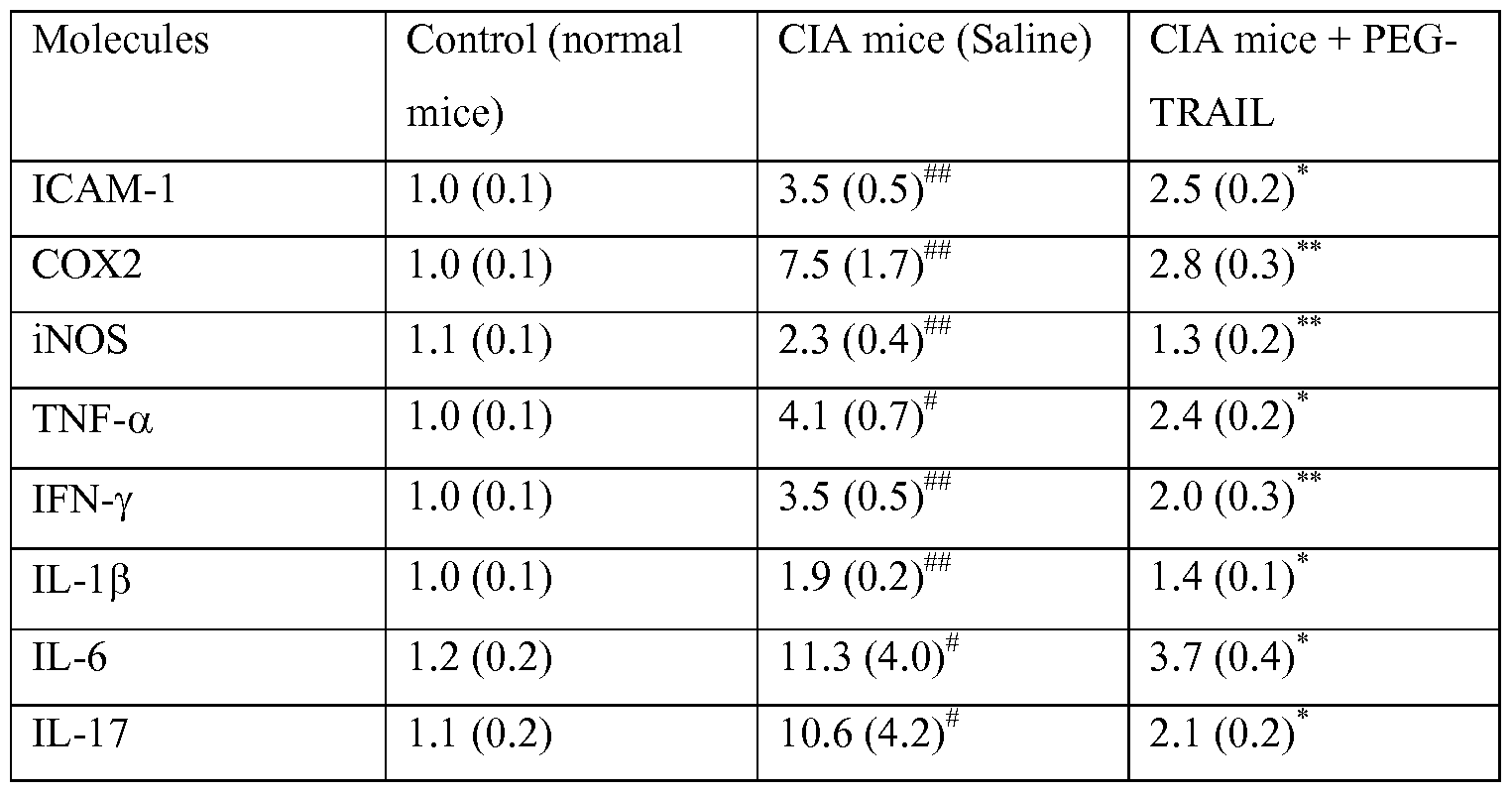
Example 4: Weekly Dosing of 3 OK-PE G-TRAIL Reduces
the Severity of CIA
Materials and Methods
TRAIL, 5K-PEG-TRAIL, and 30K-PEG-TRAIL were diluted in phosphate buffered saline solution (PBS) at the intended protein
concentrations. CIA mice, prepared as described above, were i.p.
administered TRAIL and TRAIL-conjugate weekly at 300 μg/mouse/day (300 μΐ) after 1 day from the booster immunization to the end of experiment.
PBS was administered as a negative control. The experiment continued to 43 days after immunization. Arthritis was graded using clinical signs on a 0-4 scale as described.
Results
To investigate the effect of PEG molecular weight on the development and progression of CIA, mice were i.p. administered 5K-PEG- TRAIL or 30K-PEG-TRAIL (weekly, 300 μg/mouse/day) and therapeutic effects were continuously monitored. CIA developed rapidly in mice immunized with CII, and clinical signs of the disease (periarticular erythema and edema) first appeared in hind paws at approximately 23 days post-CI, and all vehicle-treated mice were affected by day 25 (Figure 2B). Hind paw erythema and swelling increased in frequency and severity in a time-
dependent manner, and a mean maximum clinical score was reached between 35 and 39 days post-CI. In the case of weekly administered 30K- PEG-TRAIL, significant therapeutic effects were observed, whereas weekly injections of 5K-PEG-TRAIL had no evident therapeutic effect (Figure 3B). In addition, a comparison of clinical scores of weekly 5K-PEG-TRAIL and 30K-PEG-TRAIL revealed that 3 OK-PEG-TRAIL had a better therapeutic effect (clinical scores of 9.2±1.34 and 4.9±0.86 at day 41, respectively).
Treated joints were investigated using micro-computed tomographic (micro-CT) and histological techniques. In the reconstructed three- dimensional micro-CT images of the paw of a mouse with CIA, loss of bone integrity and damage were clearly visible at vehicle and 5K-PEG-TRAIL treated mice. However, the paws of 30K-PEG-TRAIL treated mice showed no evidence of bone erosion and appeared similar to those of normal mice. The effects of 3 OK-PEG-TRAIL on joint inflammation were observed by conducting histological investigations of knee joints after H&E staining.
As compared with the clean, typical joint morphology observed in the normal mice, histological examination of CIA and 5K-PEG-TRAIL treated mice showed synovial hyperplasia, inflammatory cell infiltration, pannus formation, cartilage destruction, and bone erosion, which are all
characteristics of RA. However, a weekly dose of 3 OK-PEG-TRAIL clinically reduced joint inflammation.
Example 5: 30K-PEG-TRAIL Reduces Systemic Inflammation and Humoral Immunity in CIA
Materials and Methods
Animals from Example 4 were examined at the end of treatment. To determine cytokine levels in vivo, serum samples were collected from mice by aspirating retro-orbital blood. All samples were stored at -70°C until used. Serum levels of pro-inflammatory cytokines of TNF-a, interleukin (IL)-l- , IL-2, and interferon-gamma (IFN-γ) were determined using a Bio-Plex suspension array system (Bio-Rad laboratories, Hercules, CA), according to the manufacturer's instructions. To measure collagen-specific autoantibodies levels in vivo, collected serum samples were analyzed using enzyme-linked
immunosorbent assay (ELISA) kits (Chondrex) for Cll-specific IgGl and
IgG2a antibody levels.
Results
The effects of 30K-PEG-TRAIL on systemic inflammation were investigated by measuring serum pro-inflammatory cytokine levels. The serum levels of TNF-a in 30K-PEG-TRAIL treated mice were 75% lower than those in CIA mice (p < 0.05). Similar results were observed for IL-Ιβ, IFN-γ, and IL-2 (67%, 55%, 60%, respectively, vs. non-treated CIA mice, p < 0.05). These results indicate that reduced levels of pro-inflammatory cytokines in blood are related to the therapeutic effects of 30K-PEG-TRAIL on CIA, such as reduced inflammatory cell infiltration and edema.
Humoral immunity against CII also plays an important role in the immunopathology of autoimmune arthritis, and CIA is also accompanied by high levels of circulating auto antibodies, which initiate joint inflammation (De Clerck, Clinical rheumatology 14 Suppl 2: 14-8 (1995)). In particular, Thl-type IgG2a subclass antibody activates the complement cascade and plays a crucial role in the development of RA. 30K-PEG-TRAIL also affected humoral immune response, representing serum antibody levels, against CII. As illustrated in Figures 4A and 4B, the levels of Cll-specific autoantibodies were barely detectable in the sera of normal mice, but were markedly elevated after two CII immunizations. No significant differences were observed between the serum levels of anti-CII IgGl in CIA mice treatment with PEG-TRAIL analogs and CIA mice (Figure 4A). However, anti-CII IgG2a levels were significantly reduced by 30K-PEG-TRAIL by 64.7% as compared with CIA mice, respectively (Figure 4B). These results indicated that 30K-PEG-TRAIL reduced the productions of Cll-specific autoantibodies in humoral immune response to secondary immunization. Example 6: A combination of 5K-PEG-TRAIL and TNF-a blocker, adalimumab (Humira®), ameliorates rheumatoid arthritis.
Materials and Methods
To investigate the effect of the combination of 5K-PEG-TRAIL and TNF-a blocker on the development and progression of arthritis, collagen-
induced arthritis (CIA) DBA/IJ mice were examined after i.p. administration of vehicle, 5K-PEG-TRAIL (300 μg/mouse/injection), adalimumab (50 μg/mouse/injection) or a combination of 5K-PEG-TRAIL (300
μg/mouse/injection) and adalimumab (50 μg/mouse/injection) every 3 days for 4 times in 2 weeks starting at Day 28 after immunization. Therapeutic effects were continuously monitored.
Results
5K-PEG-TRAIL showed efficacy similar to that of adalimumab when administered alone. When combined, 5K-PEG-TRAIL and adalimumab offered a significantly improved therapeutic effect (clinical scores for vehicle, 5K-PEG-TRAIL, adalimumab, combination; 9±1.34, 3.8±1.01, 3.6±1.20, and 1.8±0.37) (Figure 5A). In particular, animal-to-animal variation of mean paw thickness was narrowed in the case of combination vs. drug alone (Figure 5B).
Claims
1. A method of treating an autoimmune disease, of increasing apoptosis of pro-inflammatory immune cells or synoviocytes, or reducing or slowing the progression of inflammation, comprising systemically administering a subject with the autoimmune disease a pharmaceutical composition comprising an effective amount of TRAIL-conjugate to reduce one or more symptoms of the autoimmune disease,
wherein the pharmaceutical composition is administered to the subject less frequently than once a day, more preferably, twice weekly, or less frequently.
2. The method of claim 1 wherein the TRAIL-conjugate reduces, or prevents an increase, in joint swelling, erythema, joint rigidity, inflammatory cell infiltration into the joint(s), synovitis, pannus formation, destruction of articular cartilage, bone erosion, elevated erythrocyte sedimentation rates (ESR), anaemia or combinations thereof.
3. The method of claims 1 or 2 wherein the TRAIL-conjugate reduces, or prevents an increase, in expression or circulating levels of one or more inflammatory or pro-inflammatory molecules selected for the group consisting of ICAM-1, COX-2, iNOS, TNF-a, IL-Ιβ, IFN-γ, IL-2, IL-6, IL- 17 or combination thereof.
4. The method of any one of claims 1-3 wherein the TRAIL-conjugate reduces, or prevents an increase, in expression or circulating levels of autoantibodies.
5. The method of any one of claims 1-4 wherein the autoimmune disease is rheumatoid arthritis.
6. The method of claims 1 or 2 wherein the TRAIL-conjugate increases the quantity of the anti- inflammatory regulatory T cells (Treg) and modulating Treg immune response, optionally wherein the regulatory T cells (Treg) are Foxp3+.
7. The method wherein the TRAIL-conjugate increases the expression or circulating levels of anti-inflammatory cytokines TGF-β or IL-10, or combination thereof.
8. The method of claim 1 comprising increasing the quantity of regulator T cells and expression of anti-inflammatory cytokines in autoimmune diseases.
9. The method of claim 1 wherein the autoimmune disease is rheumatoid arthritis.
10. The method of any one of claims 1-9 wherein the pharmaceutical composition is administered to the subject no more than once weekly.
1 1. The method of any one of claims 1-10 wherein the pharmaceutical composition is administered to the subject no more than once every 10 days.
12. The method of any one of claims 1-11 wherein the subject does not have cancer.
13. The method of any one of claims 1-12 wherein the TRAIL-conjugate is not part of a nanocomplex that modulates the circulation half-life or release kinetics of the TRAIL-conjugate.
14. The method of any one of claims 1-13 further comprising administering to the subject a second active agent.
15. The method of claim 14 wherein the second active agent is a TNF-a inhibitor.
16. The method of claim 15 wherein the TNF-a inhibitor is selected from the group consisting of etanercept, infliximab, adalimumab, golimumab, and certolizumab pegol.
17. The method of any one of claims 14-16 wherein the TRAIL- conjugate and the second active agent are co-administered as part of the same pharmaceutical composition.
18. The method of any one of claims 14-16 wherein the TRAIL- conjugate and the second active agent are co-administered in different pharmaceutical compositions.
19. The method of claim 18 wherein the TRAIL-conjugate and the second active agent are administered separately but simultaneously.
20. The method of claim 18 wherein the TRAIL-conjugate and the second active agent are administered sequentially.
21. The method of any one of claims 1-20 wherein the TRAIL-conjugate comprises a TRAIL polypeptide linked to a polyethylene glycol molecule or a derivative thereof.
22. The method of claim 21 wherein the TRAIL polypeptide comprises a fragment of human TRAIL effective to bind to and induce apoptotic signaling through TRAIL-Rl or TRAIL-R2.
23. The method of claim 22 wherein the human TRAIL comprises the amino acid sequence of SEQ ID NO: 1, or a variant thereof with at least 70% identity to SEQ ID NO: l.
24. The method of claim 23 wherein the fragment of human TRAIL comprises amino acids 1 14-281 of SEQ ID NO: l.
25. The method of any one of claims 21 -24 wherein the TRAIL polypeptide is a fusion protein further comprising a multimerization domain that allows trimerization of three TRAIL-conjugate monomers.
26. The method of claim 25 wherein the multimerization domain comprises a zipper motif.
27. The method of claim 26 wherein the zipper motif is an isoleucine zipper motif.
28. The method of any one of claims 21 -27 wherein the polyethylene glycol derivative is selected from the group consisting of
methoxypolyethylene glycol succinimidyl propionate, methoxypolyethylene glycol N-hydroxysuccinimide, methoxypolyethylene glycol aldehyde, methoxypolyethylene glycol maleimide and multiple-branched polyethylene glycol.
29. The method of any one of claims 21-28 wherein the polyethylene glycol or derivative thereof is at least 5,000 Da
30. The method of claim 29 wherein the polyethylene glycol is of sufficient size that the TRIAL-conjugate is effective when administered only once weekly.
31. The method of claim 30 wherein the polyethylene glycol or derivative thereof is at least 30,000 Da.
32. The method of any one of claims 1-31 wherein the TRAIL-conjugate is administered in a dosage of 0.01-1,000 mg/kg, 1-100 mg/kg, 5-50 mg/kg, or 10-20 mg/kg.
33. The method of any one of claims 1-32 wherein the TRAIL-conjugate is administered in a dosage of 1-1,000 mg/m2, or 10-100 mg/m2, or 25-75 mg/m2, or 40-60 mg/m2 or about 45 mg/m2.
34. A pharmaceutical composition for use in any of the methods of claims 1-33.
35. The pharmaceutical composition of claim 34 comprising a TRAIL- conjugate comprising a fusion protein comprising an isoleucine zipper domain fused to amino acids 1 14-281 of SEQ ID NO: 1 linked to one or more polyethylene glycol molecules, and optionally, a TNF-a inhibitor.
36. The pharmaceutical composition of claim 34 in a dosage unit comprising a dosage of the TRAIL-conjugate effective to treat rheumatoid arthritis for at least one week.
37. The pharmaceutical composition of claim 36 comprising long-acting TRAIL.
Applications Claiming Priority (2)
| Application Number | Priority Date | Filing Date | Title |
|---|---|---|---|
| US201461951393P | 2014-03-11 | 2014-03-11 | |
| US61/951,393 | 2014-03-11 |
Publications (1)
| Publication Number | Publication Date |
|---|---|
| WO2015138638A1 true WO2015138638A1 (en) | 2015-09-17 |
Family
ID=52737419
Family Applications (1)
| Application Number | Title | Priority Date | Filing Date |
|---|---|---|---|
| PCT/US2015/020015 Ceased WO2015138638A1 (en) | 2014-03-11 | 2015-03-11 | Long acting trail receptor agonists for treatment of autoimmune diseases |
Country Status (2)
| Country | Link |
|---|---|
| US (1) | US11299528B2 (en) |
| WO (1) | WO2015138638A1 (en) |
Families Citing this family (7)
| Publication number | Priority date | Publication date | Assignee | Title |
|---|---|---|---|---|
| WO2015138638A1 (en) | 2014-03-11 | 2015-09-17 | Theraly Pharmaceuticals, Inc. | Long acting trail receptor agonists for treatment of autoimmune diseases |
| AU2016371021B2 (en) | 2015-12-17 | 2020-04-09 | The Johns Hopkins University | Ameliorating systemic sclerosis with death receptor agonists |
| US20210169984A1 (en) * | 2016-01-19 | 2021-06-10 | The Johns Hopkins University | Sensitizing cancer to death receptor agonists with kinase inhibitors |
| JP7281795B2 (en) * | 2016-04-07 | 2023-05-26 | ザ・ジョンズ・ホプキンス・ユニバーシティー | Compositions and methods for treating pancreatitis and pain with death receptor agonists |
| CN105906800A (en) * | 2016-05-06 | 2016-08-31 | 中国科学院长春应用化学研究所 | Gene transmission system and preparation method thereof |
| US10738338B2 (en) | 2016-10-18 | 2020-08-11 | The Research Foundation for the State University | Method and composition for biocatalytic protein-oligonucleotide conjugation and protein-oligonucleotide conjugate |
| US11767353B2 (en) | 2020-06-05 | 2023-09-26 | Theraly Fibrosis, Inc. | Trail compositions with reduced immunogenicity |
Citations (1)
| Publication number | Priority date | Publication date | Assignee | Title |
|---|---|---|---|---|
| WO2007145457A1 (en) * | 2006-06-12 | 2007-12-21 | Sungkyunkwan University Foundation For Corporate Collaboration | N-terminal modified peg-trail, method for preparing and uses thereof |
Family Cites Families (121)
| Publication number | Priority date | Publication date | Assignee | Title |
|---|---|---|---|---|
| WO1997001633A1 (en) | 1995-06-29 | 1997-01-16 | Immunex Corporation | Cytokine that induces apoptosis |
| JP4450870B2 (en) | 1997-01-28 | 2010-04-14 | ヒューマン ジノーム サイエンシーズ, インコーポレイテッド | Binding to death domain containing receptor 4 (DR4: death receptor 4), a member of the TNF-receptor superfamily and TRAIL |
| US6072047A (en) | 1997-02-13 | 2000-06-06 | Immunex Corporation | Receptor that binds trail |
| EP1001990A4 (en) | 1997-06-26 | 2001-12-19 | Immunex Corp | Protein that binds trail |
| NZ512657A (en) | 1999-01-14 | 2004-01-30 | Amylin Pharmaceuticals Inc | Glucagon suppression |
| US6329148B1 (en) | 1999-02-16 | 2001-12-11 | The Board Of Trustees Of The Leland Stanford University | Combined therapy of diterpenoid triepoxides and death domain receptor ligands for synergistic killing of tumor cells |
| US7534866B2 (en) | 2005-10-19 | 2009-05-19 | Ibc Pharmaceuticals, Inc. | Methods and compositions for generating bioactive assemblies of increased complexity and uses |
| US7550143B2 (en) | 2005-04-06 | 2009-06-23 | Ibc Pharmaceuticals, Inc. | Methods for generating stably linked complexes composed of homodimers, homotetramers or dimers of dimers and uses |
| SI1180121T1 (en) | 1999-05-17 | 2004-04-30 | Conjuchem, Inc. | Long lasting insulinotropic peptides |
| US7160924B2 (en) | 2002-07-19 | 2007-01-09 | The General Hospital Corporation | Protein conjugates with a water-soluble biocompatible, biodegradable polymer |
| AU766984B2 (en) | 1999-09-30 | 2003-10-30 | Trustees Of The University Of Pennsylvania, The | Trail: an inhibitor of autoimmune inflammation and cell cycle progression |
| IL136156A0 (en) | 2000-05-16 | 2001-05-20 | Compugen Ltd | Sequences of trail variants |
| US20040005314A1 (en) | 2001-07-27 | 2004-01-08 | Enrique Escandon | Apo-2l receptor agonist and cpt-11 synergism |
| MXPA03002262A (en) * | 2000-09-18 | 2003-10-15 | Idec Pharma Corp | Combination therapy for treatment of autoimmune diseases using b cell depleting/immunoregulatory antibody combination. |
| KR20020056565A (en) | 2000-12-29 | 2002-07-10 | 황규언 | Three-dimensional structure of human derived apoptotic factor and receptor thereof by X-ray chrystallography and TRAIL deletion mutant protein |
| US20020169123A1 (en) | 2001-02-27 | 2002-11-14 | The Trustees Of The University Of Pennsylvania | Regulating apoptosis in TRAIL-resistant cancer cells, while protecting normal, non-cancerous cells |
| US7615233B2 (en) | 2001-07-10 | 2009-11-10 | Canon Kabushiki Kaisha | Particulate construct comprising polyhydroxyalkanoate and method for producing it |
| DE10144252A1 (en) | 2001-08-31 | 2003-03-27 | Fraunhofer Ges Forschung | Nanoparticles with biologically active TNF immobilized on them |
| US20040186051A1 (en) | 2001-10-02 | 2004-09-23 | Kelley Robert F | Apo-2 ligand variants and uses thereof |
| US6908963B2 (en) | 2001-10-09 | 2005-06-21 | Nektar Therapeutics Al, Corporation | Thioester polymer derivatives and method of modifying the N-terminus of a polypeptide therewith |
| US7906118B2 (en) | 2005-04-06 | 2011-03-15 | Ibc Pharmaceuticals, Inc. | Modular method to prepare tetrameric cytokines with improved pharmacokinetics by the dock-and-lock (DNL) technology |
| EP1556076A4 (en) | 2002-06-24 | 2009-07-08 | Genentech Inc | VARIANTS OF APO-2 / TRAIL LIGAND AND USES THEREOF |
| CA2497794A1 (en) | 2002-09-06 | 2004-03-18 | Bayer Pharmaceuticals Corporation | Modified glp-1 receptor agonists and their pharmacological methods of use |
| US20050203142A1 (en) | 2002-10-24 | 2005-09-15 | Zeldis Jerome B. | Methods of using and compositions comprising immunomodulatory compounds for treatment, modification and management of pain |
| EP1558631A4 (en) | 2002-10-30 | 2006-10-04 | Pfizer Prod Inc | METHODS AND COMPOSITIONS FOR THE DIAGNOSIS AND TREATMENT OF CANCER OF PETS |
| GB2401040A (en) * | 2003-04-28 | 2004-11-03 | Chugai Pharmaceutical Co Ltd | Method for treating interleukin-6 related diseases |
| DK1754713T3 (en) | 2003-05-09 | 2009-06-08 | Genentech Inc | Peptides that bind to Apo2L (Trail) receptors and their applications |
| US7186699B2 (en) | 2003-06-03 | 2007-03-06 | Cell Genesys, Inc. | Method for treating cancer by vector-mediated delivery of one or more anti-angiogenic or pro-apoptotic genes |
| AU2004220325B2 (en) | 2003-06-30 | 2011-05-12 | Domantis Limited | Polypeptides |
| US7795404B1 (en) | 2003-08-08 | 2010-09-14 | Five Prime Therapeutics, Inc. | Human soluble notch receptor ligands |
| GB0328261D0 (en) | 2003-12-05 | 2004-01-07 | Univ Groningen | Improved cytokine design |
| US8003111B2 (en) | 2005-04-06 | 2011-08-23 | Ibc Pharmaceuticals, Inc. | Dimeric alpha interferon pegylated site-specifically shows enhanced and prolonged efficacy in vivo |
| US8034352B2 (en) | 2005-04-06 | 2011-10-11 | Ibc Pharmaceuticals, Inc. | Tetrameric cytokines with improved biological activity |
| US20110020273A1 (en) | 2005-04-06 | 2011-01-27 | Ibc Pharmaceuticals, Inc. | Bispecific Immunocytokine Dock-and-Lock (DNL) Complexes and Therapeutic Use Thereof |
| ES2246694B1 (en) | 2004-04-29 | 2007-05-01 | Instituto Cientifico Y Tecnologico De Navarra, S.A. | PEGILATED NANOPARTICLES. |
| US20080199423A1 (en) | 2004-06-18 | 2008-08-21 | Genentech, Inc. | Methods of Using Apo2l Receptor Agonists and Ink Cell Activators |
| EP1773400A2 (en) | 2004-07-08 | 2007-04-18 | Amgen Inc. | Therapeutic peptides |
| US20060046961A1 (en) | 2004-09-02 | 2006-03-02 | Mckay William F | Controlled and directed local delivery of anti-inflammatory compositions |
| US20090317384A1 (en) | 2004-09-08 | 2009-12-24 | Genentech, Inc. | Methods of using death receptor ligands and cd20 antibodies |
| US8029783B2 (en) | 2005-02-02 | 2011-10-04 | Genentech, Inc. | DR5 antibodies and articles of manufacture containing same |
| US20060188498A1 (en) | 2005-02-18 | 2006-08-24 | Genentech, Inc. | Methods of using death receptor agonists and EGFR inhibitors |
| EP1695717A1 (en) | 2005-02-23 | 2006-08-30 | Ludwig-Maximilians-Universität | Transport of nano-and macromolecular structures into cytoplasm and nucleus of cells |
| US20060228352A1 (en) | 2005-02-24 | 2006-10-12 | Schoenberger Stephen P | TRAIL and methods of modulating T cell activity and adaptive immune responses using TRAIL |
| EP1874824A4 (en) | 2005-04-06 | 2009-12-30 | Ibc Pharmaceuticals Inc | Methods for generating stably linked complexes composed of homodimers, homotetramers or dimers of dimers and uses |
| AU2006232310B9 (en) | 2005-04-06 | 2011-07-21 | Ibc Pharmaceuticals, Inc. | Improved stably tethered structures of defined compositions with multiple functions or binding specificities |
| US8158129B2 (en) | 2005-04-06 | 2012-04-17 | Ibc Pharmaceuticals, Inc. | Dimeric alpha interferon PEGylated site-specifically shows enhanced and prolonged efficacy in vivo |
| EP1745802A1 (en) | 2005-07-20 | 2007-01-24 | Kreatech Biotechnology B.V. | Method of conjugating therapeutic compounds to cell targeting moieties via metal complexes |
| JP5231231B2 (en) | 2005-10-19 | 2013-07-10 | アイビーシー・ファーマシューティカルズ・インコーポレーテッド | Methods and compositions and uses for generating bioactive assemblies of increased complexity |
| GB0524316D0 (en) | 2005-11-29 | 2006-01-04 | Medical Res Council | Tumour necrosis factor-related apoptosis-inducing ligands (TRAILs) |
| JP5096363B2 (en) | 2005-12-16 | 2012-12-12 | ネクター セラピューティックス | GLP-1 polymer complex |
| WO2007120368A2 (en) | 2006-01-09 | 2007-10-25 | The Regents Of The University Of California | Immunostimulatory combinations for vaccine adjuvants |
| KR100784485B1 (en) | 2006-01-18 | 2007-12-11 | 한국과학기술연구원 | Biodegradable and thermosensitive polyorganophosphazene hydrogel, preparation method thereof and use thereof |
| WO2007102690A1 (en) | 2006-03-06 | 2007-09-13 | Postech Foundation | Vector including the codon-optimized dna cassette for producing secretory recombinant dodecamer trail |
| KR100746962B1 (en) | 2006-04-04 | 2007-08-07 | 한국과학기술연구원 | Thermosensitive polyphosphazene-bioactive molecule conjugates, preparation method thereof and use thereof |
| JO3324B1 (en) | 2006-04-21 | 2019-03-13 | Amgen Inc | Lyophilized Therapeutic Peptibody Formulations |
| CN101074261A (en) | 2006-04-30 | 2007-11-21 | 北京同为时代生物技术有限公司 | TRAIL receptor I and/or TRAIL receptor 2 specific antibody and its use |
| KR100890989B1 (en) | 2006-06-01 | 2009-03-31 | 이강춘 | Mono modified exendin with polyethylene glycol or its derivatives and uses thereof |
| US8080248B2 (en) * | 2006-06-02 | 2011-12-20 | Regeneron Pharmaceuticals, Inc. | Method of treating rheumatoid arthritis with an IL-6R antibody |
| AU2007261405B2 (en) | 2006-06-20 | 2013-02-14 | Genentech, Inc. | Methods and materials for observing apoptosis by detecting fragments of clathrin-pathway components |
| RU2009101783A (en) | 2006-06-21 | 2010-07-27 | Апогеникс Гмбх (De) | DIFFERENTIAL EXPRESSION OF IL-4 AND / OR IL-10 CYTOKINS IN A HUMAN MALIGNANT TUMOR |
| US8008261B2 (en) | 2006-08-04 | 2011-08-30 | Mayo Foundation For Medical Education And Research | Methods of reducing trail-induced apoptosis by trail isoforms |
| AU2009233925B2 (en) | 2006-12-05 | 2014-03-13 | Ibc Pharmaceuticals, Inc. | Modular method to prepare tetrameric cytokines with improved pharmacokinetics by the dock-and-lock (DNL) technology |
| WO2008120832A1 (en) | 2007-03-30 | 2008-10-09 | Industry-Academic Cooperation Foundation, Yonsei University | Human neural stem cell secreting a smac, preparation method and use thereof |
| WO2008130066A1 (en) | 2007-04-20 | 2008-10-30 | Kang Choon Lee | Mono modified exendin with polyethylene glycol or its derivatives and uses thereof |
| KR100968591B1 (en) | 2007-06-14 | 2010-07-08 | 한국과학기술연구원 | Polyphosphazene hydrogel for drug delivery, preparation method thereof and use thereof |
| US8986684B2 (en) * | 2007-07-25 | 2015-03-24 | Alexion Pharmaceuticals, Inc. | Methods and compositions for treating autoimmune disease |
| JPWO2009020094A1 (en) | 2007-08-09 | 2010-11-04 | 第一三共株式会社 | Antibodies modified with hydrophobic molecules |
| JP5823125B2 (en) | 2007-10-23 | 2015-11-25 | ウェルズ ファーゴ バンク ナショナル アソシエイション | Hydroxyapatite targeted multi-arm polymer and conjugates made from this polymer |
| KR101686247B1 (en) | 2007-10-31 | 2016-12-14 | 메디뮨 엘엘씨 | Protein scaffolds |
| GB0723059D0 (en) | 2007-11-23 | 2008-01-02 | Nat Univ Ireland | Improved cytokine design |
| US20090203671A1 (en) | 2007-11-27 | 2009-08-13 | Abbott Laboratories | Method of treating cancer |
| GB0724532D0 (en) | 2007-12-17 | 2008-01-30 | Nat Univ Ireland | Trail variants for treating cancer |
| WO2009140469A2 (en) | 2008-05-14 | 2009-11-19 | Genentech, Inc. | Methods of using apo2l/trail to treat cancer |
| US20100068302A1 (en) | 2008-09-17 | 2010-03-18 | Traslational Cancer Drugs Pharma, S.L. | Methods and compositions for the treatment of cancer |
| US20120021995A1 (en) | 2008-10-10 | 2012-01-26 | Anaphore, Inc. | Polypeptides that Bind TRAIL-R1 and TRAIL-R2 |
| CA2739663A1 (en) | 2008-10-10 | 2010-05-15 | Anaphore, Inc. | Polypeptides that bind trail-r1 and trail-r2 |
| GB0818649D0 (en) | 2008-10-10 | 2008-11-19 | Nat Univ Ireland | Treatment of proliferative disorders with trail |
| LT3903829T (en) | 2009-02-13 | 2023-06-12 | Immunomedics, Inc. | Immunoconjugates with an intracellularly-cleavable linkage |
| CN101870728A (en) | 2009-04-23 | 2010-10-27 | 派格生物医药(苏州)有限公司 | Novel Exendin variant and conjugate thereof |
| KR101112578B1 (en) | 2009-07-16 | 2012-02-16 | 성균관대학교산학협력단 | Pharmaceutical composition containing exendin for nasal administration and method for the preparation thereof |
| IN2012DN01331A (en) | 2009-08-31 | 2015-06-05 | Ibc Pharmaceuticals Inc | |
| WO2011079293A1 (en) | 2009-12-23 | 2011-06-30 | Ambrx, Inc | Tumor necrosis factor-related apoptosis inducing ligand polypeptides and their uses |
| EP2519260A2 (en) | 2009-12-31 | 2012-11-07 | Deutsches Krebsforschungszentrum | Novel modulators of trail signalling |
| WO2011106707A2 (en) | 2010-02-26 | 2011-09-01 | Human Genome Sciences, Inc. | Antibodies that specifically bind to dr3 |
| AU2011240620A1 (en) | 2010-04-13 | 2012-10-18 | Medimmune, Llc | Fibronectin type III domain-based multimeric scaffolds |
| US8461311B2 (en) | 2010-06-08 | 2013-06-11 | Washington University | TRAIL trimers, methods and uses therefor |
| KR101209266B1 (en) | 2010-06-30 | 2012-12-06 | 한국과학기술연구원 | Biodegradable and thermosensitive poly(phosphazene)-superparamagnetic nano-particle complex, preparation method and use thereof |
| EP3020812B1 (en) | 2010-10-29 | 2018-05-02 | Daiichi Sankyo Company, Limited | Novel anti-dr5 antibody |
| EP2468764A1 (en) | 2010-12-24 | 2012-06-27 | Rijksuniversiteit te Groningen | TNF family ligand variants |
| US9428565B2 (en) | 2011-01-31 | 2016-08-30 | The General Hospital Corporation | Treatment and bioluminescent visualization using multimodal TRAIL molecules |
| US20140105898A1 (en) | 2011-02-28 | 2014-04-17 | Istituto Di Ricovero E Cura A Carattere Scientific Materno-Infantile Burlo Garo | Apoptosis-inducing molecules and uses therefor |
| US20140079722A1 (en) | 2011-03-09 | 2014-03-20 | Centrose, Llc | Extracellular targeted drug conjugates |
| WO2012123755A1 (en) | 2011-03-17 | 2012-09-20 | The University Of Birmingham | Re-directed immunotherapy |
| US20130101553A1 (en) | 2011-04-18 | 2013-04-25 | The Regents Of The University Of California | Inducing inactivation of fibrogenic myofibroblasts |
| FI3679934T3 (en) | 2011-04-29 | 2024-07-08 | Penn State Res Found | Small molecule trail gene induction by normal and tumor cells as an anticancer therapy |
| WO2012151317A1 (en) | 2011-05-03 | 2012-11-08 | Genentech, Inc. | Vascular disruption agents and uses thereof |
| FI20115640A0 (en) | 2011-06-22 | 2011-06-22 | Turun Yliopisto | combination therapy |
| US8586020B2 (en) | 2011-06-30 | 2013-11-19 | Korea Institute Of Science And Technology | Poly(organophosphazene) composition for biomaterials |
| BR112014002219A2 (en) | 2011-07-05 | 2018-08-07 | Bioasis Technologies Inc | p97 antibody conjugates and methods of use |
| CN102863537A (en) | 2011-07-06 | 2013-01-09 | 江苏靶标生物医药研究所有限公司 | Tumor targeting tumor necrosis factor related apoptosis ligand variant and application thereof |
| CN102898526A (en) | 2011-07-28 | 2013-01-30 | 山东先声麦得津生物制药有限公司 | Tumor necrosis factor-related apoptosis-inducing ligand fusion protein, its preparation and application |
| GB201203442D0 (en) | 2012-02-28 | 2012-04-11 | Univ Birmingham | Immunotherapeutic molecules and uses |
| AU2013239682B2 (en) | 2012-03-28 | 2016-03-31 | Amgen Inc. | DR5 receptor agonist combinations |
| WO2013156054A1 (en) | 2012-04-16 | 2013-10-24 | Universität Stuttgart | The igm and ige heavy chain domain 2 as covalently linked homodimerization modules for the generation of fusion proteins with dual specificity |
| US9862932B2 (en) | 2012-07-24 | 2018-01-09 | The General Hospital Corporation | Oncolytic virus therapy for resistant tumors |
| US20150038511A1 (en) | 2012-08-09 | 2015-02-05 | Celgene Corporation | Treatment of immune-related and inflammatory diseases |
| EP2890720B1 (en) | 2012-08-30 | 2019-07-17 | The General Hospital Corporation | Compositions and methods for treating cancer |
| CN104755936B (en) | 2012-08-30 | 2018-04-27 | 图尔库大学 | The method of the personalized cancer of the brain therapy of selection |
| MY175388A (en) * | 2012-09-20 | 2020-06-23 | Morphosys Ag | Treatment for rheumatoid arthritis |
| US20140134647A1 (en) | 2012-11-01 | 2014-05-15 | La Jolla Institute For Allergy And Immunology | Novel crystal structure and ligand binding sites of trail receptor |
| JP6133431B2 (en) | 2012-11-24 | 2017-05-24 | ハンジョウ ディーエーシー バイオテック シーオー.,エルティディ.Hangzhou Dac Biotech Co.,Ltd. | Use of hydrophilic conjugates and conjugation reactions between drug molecules and cell binding molecules |
| WO2014082083A1 (en) | 2012-11-26 | 2014-05-30 | Caris Science, Inc. | Biomarker compositions and methods |
| JP6177937B2 (en) | 2013-02-13 | 2017-08-09 | エイジェンシー フォー サイエンス,テクノロジー アンド リサーチ | Polymer system for active drug release |
| CN104342444B (en) | 2013-07-23 | 2017-11-17 | 四川大学华西医院 | Recombinant TRAIL protein and preparation method and application thereof |
| NZ717003A (en) | 2013-09-02 | 2019-05-31 | Hangzhou Dac Biotech Co Ltd | Novel cytotoxic agents for conjugation of drugs to cell binding molecule |
| WO2015037000A1 (en) | 2013-09-11 | 2015-03-19 | Compugen Ltd | Vstm5 polypeptides and uses thereof as a drug for treatment of cancer, infectious diseases and immune related diseases |
| PL222795B1 (en) | 2013-12-22 | 2016-09-30 | Univ Warszawski | Rekombinant fusion protein ProSTAT and its application |
| US10464955B2 (en) | 2014-02-28 | 2019-11-05 | Hangzhou Dac Biotech Co., Ltd. | Charged linkers and their uses for conjugation |
| WO2015138638A1 (en) | 2014-03-11 | 2015-09-17 | Theraly Pharmaceuticals, Inc. | Long acting trail receptor agonists for treatment of autoimmune diseases |
| ES2879804T3 (en) | 2014-04-21 | 2021-11-23 | D&D Pharmatech Inc | TRAIL receptor agonists for the treatment of fibrotic diseases |
| US10975112B2 (en) | 2015-06-16 | 2021-04-13 | Hangzhou Dac Biotech Co., Ltd. | Linkers for conjugation of cell-binding molecules |
-
2015
- 2015-03-11 WO PCT/US2015/020015 patent/WO2015138638A1/en not_active Ceased
- 2015-03-11 US US14/645,276 patent/US11299528B2/en active Active
Patent Citations (2)
| Publication number | Priority date | Publication date | Assignee | Title |
|---|---|---|---|---|
| WO2007145457A1 (en) * | 2006-06-12 | 2007-12-21 | Sungkyunkwan University Foundation For Corporate Collaboration | N-terminal modified peg-trail, method for preparing and uses thereof |
| US20090203599A1 (en) | 2006-06-12 | 2009-08-13 | Kang Choon Lee | N-terminal modified peg-trail, method for preparing and uses thereof |
Non-Patent Citations (57)
| Title |
|---|
| ALETAHA ET AL., ARTHRITIS RHEUM., vol. 62, no. 9, 2010, pages 2569 - 81 |
| AMIRAM ET AL., PROC NATL ACAD SCI US A, vol. 110, no. 8, 2013, pages 2792 - 2792 |
| ANDERSON, ARTHRITIS CARE RES (HOBOKEN, vol. 64, 2012, pages 640 - 7 |
| ANEL A ET AL., FRONTIERS IN BIOSCIENCE : A JOURNAL AND VIRTUAL LIBRARY, vol. 12, 2007, pages 2074 - 84 |
| AUDO ET AL., CYTOKINE, vol. 63, no. 2, 2013, pages 81 - 90 |
| BELLUCCI ET AL., ANGEWANDTE CHEMIE INTERNATIONAL EDITION, vol. 52, no. 13, 2013, pages 3703 - 3708 |
| BENEDICT ET AL., J. EXP. MED., vol. 209, no. 11, 2012, pages 1903 - 1906 |
| BROCCHINI ET AL., NATURE PROTOCOLS, vol. 1, 2006, pages 2241 - 2252 |
| CARILLO, H; LIPMAN, D., SIAM J APPLIED MATH., vol. 48, 1988, pages 1073 |
| CHAE ET AL., MOLECULAR CANCER THERAPEUTICS, vol. 9, no. 6, 2010, pages 1719 - 29 |
| CHAE SU YOUNG ET AL: "Improved Antitumor Activity and Tumor Targeting of NH2-Terminal-Specific PEGylated Tumor Necrosis Factor-Related Apoptosis-Inducing Ligand", MOLECULAR CANCER THERAPEUTICS, AMERICAN ASSOCIATION OF CANCER RESEARCH, US, vol. 9, no. 6, 1 June 2010 (2010-06-01), pages 1719 - 1729, XP008135183, ISSN: 1535-7163, [retrieved on 20100601], DOI: 10.1158/1535-7163.MCT-09-1076 * |
| CONG ET AL., BIOCONJUGATE CHEMISTRY, vol. 23, no. 2, 2012, pages 248 - 263 |
| CUELLO ET AL., GYNECOL ONCOL., vol. 81, no. 3, 2001, pages 380 - 90 |
| DE CLERCK, CLINICAL RHEUMATOLOGY, vol. 14, no. 2, 1995, pages 14 - 8 |
| FEE ET AL., BIOTECHNOL BIOENG., vol. 98, no. 4, 2007, pages 725 - 3 |
| FELDMANN ET AL., ANNUAL REVIEW OF IMMUNOLOGY, vol. 14, 1996, pages 397 - 440 |
| GIEFFERS, MOLECULAR CANCER THERAPEUTICS, vol. 12, no. 12, 2013, pages 2735 - 47 |
| GONG ET AL., BRITISH JOURNAL OF PHARMACOLOGY, vol. 163, no. 2, 2011, pages 399 - 412 |
| GRIBSKOV, M AND DEVEREUX, J.: "Sequence Analysis Primer", 1991, M STOCKTON PRESS |
| GRIFFIN, A. M, AND GRIFFIN, H. G.: "Computer Analysis of Sequence Data, Part I", 1994, HUMANA PRESS |
| HEINJE, G.: "Sequence Analysis in Molecular Biology", 1987, ACADEMIC PRESS |
| HERBST ET AL., J. CLIN. ONCOL., vol. 28, no. 17, 10 December 2009 (2009-12-10), pages 2839 - 46 |
| HYEONG JUN BYEON ET AL: "Human Serum Albumin-TRAIL Conjugate for the Treatment of Rheumatoid Arthritis", BIOCONJUGATE CHEMISTRY, vol. 25, no. 12, 17 December 2014 (2014-12-17), pages 2212 - 2221, XP055192960, ISSN: 1043-1802, DOI: 10.1021/bc500427g * |
| JIN ET AL., J. PHARMACOL. EXP. THER., vol. 332, no. 3, 2010, pages 858 - 865 |
| JIN ET AL., THE JOURNAL OF PHARMACOLOGY AND EXPERIMENTAL THERAPEUTICS, vol. 332, no. 3, 2010, pages 858 - 65 |
| JO ET AL., NATURE MEDICINE, vol. 6, no. 5, 2000, pages 564 - 7 |
| KIM ET AL., BIOCONJUGATE CHEM., vol. 22, no. 8, 2011, pages 1631 - 1637 |
| KIM ET AL., BIOCONJUGATE CHEMISTRY, vol. 22, no. 8, 2011, pages 1631 - 1637 |
| KIM ET AL., BIOCONJUGATE CHEMISTRY, vol. 22, no. 8, 2011, pages 1631 - 7 |
| KIM ET AL., BIOMATERIALS, vol. 31, no. 34, 2010, pages 9057 - 64 |
| KIM ET AL., JOURNAL OF CONTROLLED RELEASE: OFFICIAL JOURNAL OF THE CONTROLLED RELEASE SOCIETY, vol. 1 0, no. 1, 2011, pages 63 - 9 |
| KIM ET AL., JOURNAL OF PHARMACEUTICAL SCIENCES, vol. 100, no. 2, 2011, pages 482 - 91 |
| KIM ET AL., JOURNAL OF PHARMACY AND PHARMACOLOGY, vol. 65, no. 1, 2013, pages 11 - 21 |
| KIM Y J ET AL: "Ionic complex systems based on hyaluronic acid and PEGylated TNF-related apoptosis-inducing ligand for treatment of rheumatoid arthritis", BIOMATERIALS, ELSEVIER SCIENCE PUBLISHERS BV., BARKING, GB, vol. 31, no. 34, 1 December 2010 (2010-12-01), pages 9057 - 9064, XP027381070, ISSN: 0142-9612, [retrieved on 20101001] * |
| LAMHAMEDI-CHERRADI ET AL., NATURE IMMUNOLOGY, vol. 4, no. 3, 2003, pages 255 - 60 |
| LEE EUN YOUNG ET AL: "Treatment with PEGylated TNF-related apoptosis-inducing ligand (TRAIL) induces apoptosis of human rheumatoid arthritis (RA) fibroblast-like synoviocytes (FLS) and suppresses arthritis in murine colla en-induced arthritis", ARTHRITIS & RHEUMATISM, vol. 58, no. 9, Suppl. S, September 2008 (2008-09-01), & 72ND ANNUAL SCIENTIFIC MEETING OF THE AMERICAN-COLLEGE-OF-RHEUMATOLOGY/43RD ANNUAL SCIENTIFIC MEETIN; SAN FRANCISCO, CA, USA; OCTOBER 24 -29, 2008, pages S539, XP008176520, ISSN: 0004-3591 * |
| LESK, A. M.: "Computational Molecular Biology", 1988, OXFORD UNIVERSITY PRESS |
| LI ET AL., EXPERIMENTAL BIOLOGY AND MEDICINE (MAYWOOD, NJ), vol. 234, no. 12, 2009, pages 1468 - 76 |
| LIAO H-J ET AL: "Trail reduced joint inflammation, osteoclast activation and bone loss in experimental arthritis", ALLERGY (OXFORD), vol. 68, no. Suppl. 98, Sp. Iss. SI, November 2013 (2013-11-01), & ASIA PACIFIC CONGRESS OF ALLERGY, ASTHMA AND CLINICAL IMMUNOLOGY; TAIPEI, TAIWAN; NOVEMBER 14 -17, 2013, pages 67, XP008176519 * |
| LIU ET AL., THE JOURNAL OF CLINICAL INVESTIGATION, vol. 112, no. 9, 2003, pages 1332 - 41 |
| MA X ET AL: "TNF inhibitor therapy for rheumatoid arthritis (Review)", BIOMEDICAL REPORTS, vol. 1, no. 2, 29 November 2012 (2012-11-29), pages 177 - 184, XP055193268, ISSN: 2049-9434, DOI: 10.3892/br.2012.42 * |
| MARTINEZ-LOSTAO ET AL., ARTHRITIS & RHEUMATISM, vol. 62, no. 8, 2010, pages 2272 - 82 |
| MCINNES ET AL., NATURE REVIEWS IMMUNOLOGY, vol. 7, no. 6, 2007, pages 429 - 42 |
| MIRANDA-CARUS ET AL., ARTHRITIS AND RHEUMATISM, vol. 50, no. 9, 2004, pages 2786 - 93 |
| MOLINEUX, CURRENT PHARMACEUTICAL DESIGN, vol. 10, no. 11, 2004, pages 1235 - 1244 |
| NEEDELMAN; WUNSCH, J. MOL. BIOL., vol. 48, 1970, pages 443 - 453 |
| REAGAN-SHAW ET AL., THE FASEB JOURNAL, vol. 22, 2007, pages 1 - 3 |
| SMITH, D. W.: "Biocomputing: Informatics and Genome Projects", 1993, ACADEMIC PRESS |
| SONG K ET AL., THE JOURNAL OF EXPERIMENTAL MEDICINE, vol. 191, no. 7, 2000, pages 1095 - 104 |
| TAE HYUNG KIM ET AL: "PEGylated TNF-Related Apoptosis-Inducing Ligand (TRAIL) Analogues: Pharmacokinetics and Antitumor Effects", BIOCONJUGATE CHEMISTRY, vol. 22, no. 8, 17 August 2011 (2011-08-17), pages 1631 - 1637, XP055098112, ISSN: 1043-1802, DOI: 10.1021/bc200187k * |
| TUR, THE JOURNAL OF BIOLOGICAL CHEMISTRY, vol. 283, no. 29, 2008, pages 20560 - 8 |
| VAN DER SLOOT, PROCEEDINGS OF THE NATIONAL ACADEMY OF SCIENCES OF THE UNITED STATES OF AMERICA, vol. 103, no. 23, 2006, pages 8634 - 9 |
| WAHL, HEPATOLOGY, vol. 57, no. 2, 2013, pages 625 - 36 |
| WU ET AL., VITAM HORM., vol. 67, 2004, pages 365 - 83 |
| YANG ET AL., BIOMATERIALS, vol. 32, no. 33, 2011, pages 8722 - 8729 |
| YANG ET AL., BIOMATERIALS, vol. 32, no. 33, 2011, pages 8722 - 9 |
| YAO ET AL., GENE THERAPY, vol. 10, no. 12, 2003, pages 1055 - 60 |
Also Published As
| Publication number | Publication date |
|---|---|
| US20150259397A1 (en) | 2015-09-17 |
| US11299528B2 (en) | 2022-04-12 |
Similar Documents
| Publication | Publication Date | Title |
|---|---|---|
| US11299528B2 (en) | Long acting TRAIL receptor agonists for treatment of autoimmune diseases | |
| ES2981745T3 (en) | Bispecific signaling agents and their uses | |
| KR102825098B1 (en) | GLP-2 analogues and peptibodies for preoperative, intraoperative, or postoperative administration | |
| EP3065765B1 (en) | Use of il-22 dimers in manufacture of medicaments for treating pancreatitis | |
| ES2939112T3 (en) | Compositions and methods of use of interleukin-10 in combination with inhibitors of immune checkpoint pathways | |
| JP2010518079A5 (en) | ||
| CN105209054A (en) | Methods of treating diseases and conditions using interleukin-10 | |
| CN106573072A (en) | Methods of lowering serum cholesterol | |
| CN114901310A (en) | Combination therapy using IL-2 receptor agonists and immune checkpoint inhibitors | |
| US11767353B2 (en) | Trail compositions with reduced immunogenicity | |
| US9617325B2 (en) | Treatment of IgE-mediated disease | |
| TWI911137B (en) | Glp-2 analogs and peptibodies for administration before, during or after surgery | |
| EP3389696B1 (en) | Ameliorating systemic sclerosis with death receptor agonists | |
| Buyuktimkin | Utilizing Antigenic Peptide and Adhesion Molecule Conjugates to Suppress Autoimmune Disease in Animal Models | |
| HK1258208B (en) | Ameliorating systemic sclerosis with death receptor agonists | |
| HK1223556B (en) | Use of il-22 dimers in manufacture of medicaments for treating pancreatitis |
Legal Events
| Date | Code | Title | Description |
|---|---|---|---|
| 121 | Ep: the epo has been informed by wipo that ep was designated in this application |
Ref document number: 15712237 Country of ref document: EP Kind code of ref document: A1 |
|
| NENP | Non-entry into the national phase |
Ref country code: DE |
|
| 122 | Ep: pct application non-entry in european phase |
Ref document number: 15712237 Country of ref document: EP Kind code of ref document: A1 |