CN112639591A - Stabilization of private displays - Google Patents
Stabilization of private displays Download PDFInfo
- Publication number
- CN112639591A CN112639591A CN201980056022.0A CN201980056022A CN112639591A CN 112639591 A CN112639591 A CN 112639591A CN 201980056022 A CN201980056022 A CN 201980056022A CN 112639591 A CN112639591 A CN 112639591A
- Authority
- CN
- China
- Prior art keywords
- liquid crystal
- retarder
- crystal material
- layer
- range
- Prior art date
- Legal status (The legal status is an assumption and is not a legal conclusion. Google has not performed a legal analysis and makes no representation as to the accuracy of the status listed.)
- Granted
Links
Images


Classifications
-
- G—PHYSICS
- G02—OPTICS
- G02F—OPTICAL DEVICES OR ARRANGEMENTS FOR THE CONTROL OF LIGHT BY MODIFICATION OF THE OPTICAL PROPERTIES OF THE MEDIA OF THE ELEMENTS INVOLVED THEREIN; NON-LINEAR OPTICS; FREQUENCY-CHANGING OF LIGHT; OPTICAL LOGIC ELEMENTS; OPTICAL ANALOGUE/DIGITAL CONVERTERS
- G02F1/00—Devices or arrangements for the control of the intensity, colour, phase, polarisation or direction of light arriving from an independent light source, e.g. switching, gating or modulating; Non-linear optics
- G02F1/01—Devices or arrangements for the control of the intensity, colour, phase, polarisation or direction of light arriving from an independent light source, e.g. switching, gating or modulating; Non-linear optics for the control of the intensity, phase, polarisation or colour
- G02F1/13—Devices or arrangements for the control of the intensity, colour, phase, polarisation or direction of light arriving from an independent light source, e.g. switching, gating or modulating; Non-linear optics for the control of the intensity, phase, polarisation or colour based on liquid crystals, e.g. single liquid crystal display cells
- G02F1/137—Devices or arrangements for the control of the intensity, colour, phase, polarisation or direction of light arriving from an independent light source, e.g. switching, gating or modulating; Non-linear optics for the control of the intensity, phase, polarisation or colour based on liquid crystals, e.g. single liquid crystal display cells characterised by the electro-optical or magneto-optical effect, e.g. field-induced phase transition, orientation effect, guest-host interaction or dynamic scattering
-
- G—PHYSICS
- G06—COMPUTING OR CALCULATING; COUNTING
- G06F—ELECTRIC DIGITAL DATA PROCESSING
- G06F3/00—Input arrangements for transferring data to be processed into a form capable of being handled by the computer; Output arrangements for transferring data from processing unit to output unit, e.g. interface arrangements
- G06F3/01—Input arrangements or combined input and output arrangements for interaction between user and computer
- G06F3/03—Arrangements for converting the position or the displacement of a member into a coded form
- G06F3/041—Digitisers, e.g. for touch screens or touch pads, characterised by the transducing means
- G06F3/044—Digitisers, e.g. for touch screens or touch pads, characterised by the transducing means by capacitive means
- G06F3/0445—Digitisers, e.g. for touch screens or touch pads, characterised by the transducing means by capacitive means using two or more layers of sensing electrodes, e.g. using two layers of electrodes separated by a dielectric layer
-
- G—PHYSICS
- G02—OPTICS
- G02B—OPTICAL ELEMENTS, SYSTEMS OR APPARATUS
- G02B6/00—Light guides; Structural details of arrangements comprising light guides and other optical elements, e.g. couplings
- G02B6/0001—Light guides; Structural details of arrangements comprising light guides and other optical elements, e.g. couplings specially adapted for lighting devices or systems
- G02B6/0011—Light guides; Structural details of arrangements comprising light guides and other optical elements, e.g. couplings specially adapted for lighting devices or systems the light guides being planar or of plate-like form
- G02B6/0033—Means for improving the coupling-out of light from the light guide
- G02B6/0035—Means for improving the coupling-out of light from the light guide provided on the surface of the light guide or in the bulk of it
- G02B6/0038—Linear indentations or grooves, e.g. arc-shaped grooves or meandering grooves, extending over the full length or width of the light guide
-
- G—PHYSICS
- G02—OPTICS
- G02B—OPTICAL ELEMENTS, SYSTEMS OR APPARATUS
- G02B6/00—Light guides; Structural details of arrangements comprising light guides and other optical elements, e.g. couplings
- G02B6/0001—Light guides; Structural details of arrangements comprising light guides and other optical elements, e.g. couplings specially adapted for lighting devices or systems
- G02B6/0011—Light guides; Structural details of arrangements comprising light guides and other optical elements, e.g. couplings specially adapted for lighting devices or systems the light guides being planar or of plate-like form
- G02B6/0033—Means for improving the coupling-out of light from the light guide
- G02B6/005—Means for improving the coupling-out of light from the light guide provided by one optical element, or plurality thereof, placed on the light output side of the light guide
- G02B6/0055—Reflecting element, sheet or layer
-
- G—PHYSICS
- G02—OPTICS
- G02F—OPTICAL DEVICES OR ARRANGEMENTS FOR THE CONTROL OF LIGHT BY MODIFICATION OF THE OPTICAL PROPERTIES OF THE MEDIA OF THE ELEMENTS INVOLVED THEREIN; NON-LINEAR OPTICS; FREQUENCY-CHANGING OF LIGHT; OPTICAL LOGIC ELEMENTS; OPTICAL ANALOGUE/DIGITAL CONVERTERS
- G02F1/00—Devices or arrangements for the control of the intensity, colour, phase, polarisation or direction of light arriving from an independent light source, e.g. switching, gating or modulating; Non-linear optics
- G02F1/01—Devices or arrangements for the control of the intensity, colour, phase, polarisation or direction of light arriving from an independent light source, e.g. switching, gating or modulating; Non-linear optics for the control of the intensity, phase, polarisation or colour
- G02F1/13—Devices or arrangements for the control of the intensity, colour, phase, polarisation or direction of light arriving from an independent light source, e.g. switching, gating or modulating; Non-linear optics for the control of the intensity, phase, polarisation or colour based on liquid crystals, e.g. single liquid crystal display cells
- G02F1/1323—Arrangements for providing a switchable viewing angle
-
- G—PHYSICS
- G02—OPTICS
- G02F—OPTICAL DEVICES OR ARRANGEMENTS FOR THE CONTROL OF LIGHT BY MODIFICATION OF THE OPTICAL PROPERTIES OF THE MEDIA OF THE ELEMENTS INVOLVED THEREIN; NON-LINEAR OPTICS; FREQUENCY-CHANGING OF LIGHT; OPTICAL LOGIC ELEMENTS; OPTICAL ANALOGUE/DIGITAL CONVERTERS
- G02F1/00—Devices or arrangements for the control of the intensity, colour, phase, polarisation or direction of light arriving from an independent light source, e.g. switching, gating or modulating; Non-linear optics
- G02F1/01—Devices or arrangements for the control of the intensity, colour, phase, polarisation or direction of light arriving from an independent light source, e.g. switching, gating or modulating; Non-linear optics for the control of the intensity, phase, polarisation or colour
- G02F1/13—Devices or arrangements for the control of the intensity, colour, phase, polarisation or direction of light arriving from an independent light source, e.g. switching, gating or modulating; Non-linear optics for the control of the intensity, phase, polarisation or colour based on liquid crystals, e.g. single liquid crystal display cells
- G02F1/133—Constructional arrangements; Operation of liquid crystal cells; Circuit arrangements
- G02F1/1333—Constructional arrangements; Manufacturing methods
- G02F1/13338—Input devices, e.g. touch panels
-
- G—PHYSICS
- G02—OPTICS
- G02F—OPTICAL DEVICES OR ARRANGEMENTS FOR THE CONTROL OF LIGHT BY MODIFICATION OF THE OPTICAL PROPERTIES OF THE MEDIA OF THE ELEMENTS INVOLVED THEREIN; NON-LINEAR OPTICS; FREQUENCY-CHANGING OF LIGHT; OPTICAL LOGIC ELEMENTS; OPTICAL ANALOGUE/DIGITAL CONVERTERS
- G02F1/00—Devices or arrangements for the control of the intensity, colour, phase, polarisation or direction of light arriving from an independent light source, e.g. switching, gating or modulating; Non-linear optics
- G02F1/01—Devices or arrangements for the control of the intensity, colour, phase, polarisation or direction of light arriving from an independent light source, e.g. switching, gating or modulating; Non-linear optics for the control of the intensity, phase, polarisation or colour
- G02F1/13—Devices or arrangements for the control of the intensity, colour, phase, polarisation or direction of light arriving from an independent light source, e.g. switching, gating or modulating; Non-linear optics for the control of the intensity, phase, polarisation or colour based on liquid crystals, e.g. single liquid crystal display cells
- G02F1/133—Constructional arrangements; Operation of liquid crystal cells; Circuit arrangements
- G02F1/1333—Constructional arrangements; Manufacturing methods
- G02F1/1335—Structural association of cells with optical devices, e.g. polarisers or reflectors
- G02F1/133504—Diffusing, scattering, diffracting elements
-
- G—PHYSICS
- G02—OPTICS
- G02F—OPTICAL DEVICES OR ARRANGEMENTS FOR THE CONTROL OF LIGHT BY MODIFICATION OF THE OPTICAL PROPERTIES OF THE MEDIA OF THE ELEMENTS INVOLVED THEREIN; NON-LINEAR OPTICS; FREQUENCY-CHANGING OF LIGHT; OPTICAL LOGIC ELEMENTS; OPTICAL ANALOGUE/DIGITAL CONVERTERS
- G02F1/00—Devices or arrangements for the control of the intensity, colour, phase, polarisation or direction of light arriving from an independent light source, e.g. switching, gating or modulating; Non-linear optics
- G02F1/01—Devices or arrangements for the control of the intensity, colour, phase, polarisation or direction of light arriving from an independent light source, e.g. switching, gating or modulating; Non-linear optics for the control of the intensity, phase, polarisation or colour
- G02F1/13—Devices or arrangements for the control of the intensity, colour, phase, polarisation or direction of light arriving from an independent light source, e.g. switching, gating or modulating; Non-linear optics for the control of the intensity, phase, polarisation or colour based on liquid crystals, e.g. single liquid crystal display cells
- G02F1/133—Constructional arrangements; Operation of liquid crystal cells; Circuit arrangements
- G02F1/1333—Constructional arrangements; Manufacturing methods
- G02F1/1335—Structural association of cells with optical devices, e.g. polarisers or reflectors
- G02F1/133528—Polarisers
-
- G—PHYSICS
- G02—OPTICS
- G02F—OPTICAL DEVICES OR ARRANGEMENTS FOR THE CONTROL OF LIGHT BY MODIFICATION OF THE OPTICAL PROPERTIES OF THE MEDIA OF THE ELEMENTS INVOLVED THEREIN; NON-LINEAR OPTICS; FREQUENCY-CHANGING OF LIGHT; OPTICAL LOGIC ELEMENTS; OPTICAL ANALOGUE/DIGITAL CONVERTERS
- G02F1/00—Devices or arrangements for the control of the intensity, colour, phase, polarisation or direction of light arriving from an independent light source, e.g. switching, gating or modulating; Non-linear optics
- G02F1/01—Devices or arrangements for the control of the intensity, colour, phase, polarisation or direction of light arriving from an independent light source, e.g. switching, gating or modulating; Non-linear optics for the control of the intensity, phase, polarisation or colour
- G02F1/13—Devices or arrangements for the control of the intensity, colour, phase, polarisation or direction of light arriving from an independent light source, e.g. switching, gating or modulating; Non-linear optics for the control of the intensity, phase, polarisation or colour based on liquid crystals, e.g. single liquid crystal display cells
- G02F1/133—Constructional arrangements; Operation of liquid crystal cells; Circuit arrangements
- G02F1/1333—Constructional arrangements; Manufacturing methods
- G02F1/1335—Structural association of cells with optical devices, e.g. polarisers or reflectors
- G02F1/133528—Polarisers
- G02F1/133536—Reflective polarizers
-
- G—PHYSICS
- G02—OPTICS
- G02F—OPTICAL DEVICES OR ARRANGEMENTS FOR THE CONTROL OF LIGHT BY MODIFICATION OF THE OPTICAL PROPERTIES OF THE MEDIA OF THE ELEMENTS INVOLVED THEREIN; NON-LINEAR OPTICS; FREQUENCY-CHANGING OF LIGHT; OPTICAL LOGIC ELEMENTS; OPTICAL ANALOGUE/DIGITAL CONVERTERS
- G02F1/00—Devices or arrangements for the control of the intensity, colour, phase, polarisation or direction of light arriving from an independent light source, e.g. switching, gating or modulating; Non-linear optics
- G02F1/01—Devices or arrangements for the control of the intensity, colour, phase, polarisation or direction of light arriving from an independent light source, e.g. switching, gating or modulating; Non-linear optics for the control of the intensity, phase, polarisation or colour
- G02F1/13—Devices or arrangements for the control of the intensity, colour, phase, polarisation or direction of light arriving from an independent light source, e.g. switching, gating or modulating; Non-linear optics for the control of the intensity, phase, polarisation or colour based on liquid crystals, e.g. single liquid crystal display cells
- G02F1/133—Constructional arrangements; Operation of liquid crystal cells; Circuit arrangements
- G02F1/1333—Constructional arrangements; Manufacturing methods
- G02F1/1335—Structural association of cells with optical devices, e.g. polarisers or reflectors
- G02F1/13363—Birefringent elements, e.g. for optical compensation
-
- G—PHYSICS
- G02—OPTICS
- G02F—OPTICAL DEVICES OR ARRANGEMENTS FOR THE CONTROL OF LIGHT BY MODIFICATION OF THE OPTICAL PROPERTIES OF THE MEDIA OF THE ELEMENTS INVOLVED THEREIN; NON-LINEAR OPTICS; FREQUENCY-CHANGING OF LIGHT; OPTICAL LOGIC ELEMENTS; OPTICAL ANALOGUE/DIGITAL CONVERTERS
- G02F1/00—Devices or arrangements for the control of the intensity, colour, phase, polarisation or direction of light arriving from an independent light source, e.g. switching, gating or modulating; Non-linear optics
- G02F1/01—Devices or arrangements for the control of the intensity, colour, phase, polarisation or direction of light arriving from an independent light source, e.g. switching, gating or modulating; Non-linear optics for the control of the intensity, phase, polarisation or colour
- G02F1/13—Devices or arrangements for the control of the intensity, colour, phase, polarisation or direction of light arriving from an independent light source, e.g. switching, gating or modulating; Non-linear optics for the control of the intensity, phase, polarisation or colour based on liquid crystals, e.g. single liquid crystal display cells
- G02F1/133—Constructional arrangements; Operation of liquid crystal cells; Circuit arrangements
- G02F1/1333—Constructional arrangements; Manufacturing methods
- G02F1/1335—Structural association of cells with optical devices, e.g. polarisers or reflectors
- G02F1/13363—Birefringent elements, e.g. for optical compensation
- G02F1/133634—Birefringent elements, e.g. for optical compensation the refractive index Nz perpendicular to the element surface being different from in-plane refractive indices Nx and Ny, e.g. biaxial or with normal optical axis
-
- G—PHYSICS
- G02—OPTICS
- G02F—OPTICAL DEVICES OR ARRANGEMENTS FOR THE CONTROL OF LIGHT BY MODIFICATION OF THE OPTICAL PROPERTIES OF THE MEDIA OF THE ELEMENTS INVOLVED THEREIN; NON-LINEAR OPTICS; FREQUENCY-CHANGING OF LIGHT; OPTICAL LOGIC ELEMENTS; OPTICAL ANALOGUE/DIGITAL CONVERTERS
- G02F1/00—Devices or arrangements for the control of the intensity, colour, phase, polarisation or direction of light arriving from an independent light source, e.g. switching, gating or modulating; Non-linear optics
- G02F1/01—Devices or arrangements for the control of the intensity, colour, phase, polarisation or direction of light arriving from an independent light source, e.g. switching, gating or modulating; Non-linear optics for the control of the intensity, phase, polarisation or colour
- G02F1/13—Devices or arrangements for the control of the intensity, colour, phase, polarisation or direction of light arriving from an independent light source, e.g. switching, gating or modulating; Non-linear optics for the control of the intensity, phase, polarisation or colour based on liquid crystals, e.g. single liquid crystal display cells
- G02F1/133—Constructional arrangements; Operation of liquid crystal cells; Circuit arrangements
- G02F1/1333—Constructional arrangements; Manufacturing methods
- G02F1/1335—Structural association of cells with optical devices, e.g. polarisers or reflectors
- G02F1/13363—Birefringent elements, e.g. for optical compensation
- G02F1/133638—Waveplates, i.e. plates with a retardation value of lambda/n
-
- G—PHYSICS
- G02—OPTICS
- G02F—OPTICAL DEVICES OR ARRANGEMENTS FOR THE CONTROL OF LIGHT BY MODIFICATION OF THE OPTICAL PROPERTIES OF THE MEDIA OF THE ELEMENTS INVOLVED THEREIN; NON-LINEAR OPTICS; FREQUENCY-CHANGING OF LIGHT; OPTICAL LOGIC ELEMENTS; OPTICAL ANALOGUE/DIGITAL CONVERTERS
- G02F1/00—Devices or arrangements for the control of the intensity, colour, phase, polarisation or direction of light arriving from an independent light source, e.g. switching, gating or modulating; Non-linear optics
- G02F1/01—Devices or arrangements for the control of the intensity, colour, phase, polarisation or direction of light arriving from an independent light source, e.g. switching, gating or modulating; Non-linear optics for the control of the intensity, phase, polarisation or colour
- G02F1/13—Devices or arrangements for the control of the intensity, colour, phase, polarisation or direction of light arriving from an independent light source, e.g. switching, gating or modulating; Non-linear optics for the control of the intensity, phase, polarisation or colour based on liquid crystals, e.g. single liquid crystal display cells
- G02F1/133—Constructional arrangements; Operation of liquid crystal cells; Circuit arrangements
- G02F1/1333—Constructional arrangements; Manufacturing methods
- G02F1/1337—Surface-induced orientation of the liquid crystal molecules, e.g. by alignment layers
-
- G—PHYSICS
- G02—OPTICS
- G02F—OPTICAL DEVICES OR ARRANGEMENTS FOR THE CONTROL OF LIGHT BY MODIFICATION OF THE OPTICAL PROPERTIES OF THE MEDIA OF THE ELEMENTS INVOLVED THEREIN; NON-LINEAR OPTICS; FREQUENCY-CHANGING OF LIGHT; OPTICAL LOGIC ELEMENTS; OPTICAL ANALOGUE/DIGITAL CONVERTERS
- G02F1/00—Devices or arrangements for the control of the intensity, colour, phase, polarisation or direction of light arriving from an independent light source, e.g. switching, gating or modulating; Non-linear optics
- G02F1/01—Devices or arrangements for the control of the intensity, colour, phase, polarisation or direction of light arriving from an independent light source, e.g. switching, gating or modulating; Non-linear optics for the control of the intensity, phase, polarisation or colour
- G02F1/13—Devices or arrangements for the control of the intensity, colour, phase, polarisation or direction of light arriving from an independent light source, e.g. switching, gating or modulating; Non-linear optics for the control of the intensity, phase, polarisation or colour based on liquid crystals, e.g. single liquid crystal display cells
- G02F1/133—Constructional arrangements; Operation of liquid crystal cells; Circuit arrangements
- G02F1/1333—Constructional arrangements; Manufacturing methods
- G02F1/1343—Electrodes
- G02F1/13439—Electrodes characterised by their electrical, optical, physical properties; materials therefor; method of making
-
- G—PHYSICS
- G02—OPTICS
- G02F—OPTICAL DEVICES OR ARRANGEMENTS FOR THE CONTROL OF LIGHT BY MODIFICATION OF THE OPTICAL PROPERTIES OF THE MEDIA OF THE ELEMENTS INVOLVED THEREIN; NON-LINEAR OPTICS; FREQUENCY-CHANGING OF LIGHT; OPTICAL LOGIC ELEMENTS; OPTICAL ANALOGUE/DIGITAL CONVERTERS
- G02F1/00—Devices or arrangements for the control of the intensity, colour, phase, polarisation or direction of light arriving from an independent light source, e.g. switching, gating or modulating; Non-linear optics
- G02F1/01—Devices or arrangements for the control of the intensity, colour, phase, polarisation or direction of light arriving from an independent light source, e.g. switching, gating or modulating; Non-linear optics for the control of the intensity, phase, polarisation or colour
- G02F1/13—Devices or arrangements for the control of the intensity, colour, phase, polarisation or direction of light arriving from an independent light source, e.g. switching, gating or modulating; Non-linear optics for the control of the intensity, phase, polarisation or colour based on liquid crystals, e.g. single liquid crystal display cells
- G02F1/137—Devices or arrangements for the control of the intensity, colour, phase, polarisation or direction of light arriving from an independent light source, e.g. switching, gating or modulating; Non-linear optics for the control of the intensity, phase, polarisation or colour based on liquid crystals, e.g. single liquid crystal display cells characterised by the electro-optical or magneto-optical effect, e.g. field-induced phase transition, orientation effect, guest-host interaction or dynamic scattering
- G02F1/139—Devices or arrangements for the control of the intensity, colour, phase, polarisation or direction of light arriving from an independent light source, e.g. switching, gating or modulating; Non-linear optics for the control of the intensity, phase, polarisation or colour based on liquid crystals, e.g. single liquid crystal display cells characterised by the electro-optical or magneto-optical effect, e.g. field-induced phase transition, orientation effect, guest-host interaction or dynamic scattering based on orientation effects in which the liquid crystal remains transparent
-
- G—PHYSICS
- G02—OPTICS
- G02F—OPTICAL DEVICES OR ARRANGEMENTS FOR THE CONTROL OF LIGHT BY MODIFICATION OF THE OPTICAL PROPERTIES OF THE MEDIA OF THE ELEMENTS INVOLVED THEREIN; NON-LINEAR OPTICS; FREQUENCY-CHANGING OF LIGHT; OPTICAL LOGIC ELEMENTS; OPTICAL ANALOGUE/DIGITAL CONVERTERS
- G02F1/00—Devices or arrangements for the control of the intensity, colour, phase, polarisation or direction of light arriving from an independent light source, e.g. switching, gating or modulating; Non-linear optics
- G02F1/01—Devices or arrangements for the control of the intensity, colour, phase, polarisation or direction of light arriving from an independent light source, e.g. switching, gating or modulating; Non-linear optics for the control of the intensity, phase, polarisation or colour
- G02F1/13—Devices or arrangements for the control of the intensity, colour, phase, polarisation or direction of light arriving from an independent light source, e.g. switching, gating or modulating; Non-linear optics for the control of the intensity, phase, polarisation or colour based on liquid crystals, e.g. single liquid crystal display cells
- G02F1/133—Constructional arrangements; Operation of liquid crystal cells; Circuit arrangements
- G02F1/1333—Constructional arrangements; Manufacturing methods
- G02F1/1335—Structural association of cells with optical devices, e.g. polarisers or reflectors
- G02F1/133528—Polarisers
- G02F1/133531—Polarisers characterised by the arrangement of polariser or analyser axes
-
- G—PHYSICS
- G02—OPTICS
- G02F—OPTICAL DEVICES OR ARRANGEMENTS FOR THE CONTROL OF LIGHT BY MODIFICATION OF THE OPTICAL PROPERTIES OF THE MEDIA OF THE ELEMENTS INVOLVED THEREIN; NON-LINEAR OPTICS; FREQUENCY-CHANGING OF LIGHT; OPTICAL LOGIC ELEMENTS; OPTICAL ANALOGUE/DIGITAL CONVERTERS
- G02F1/00—Devices or arrangements for the control of the intensity, colour, phase, polarisation or direction of light arriving from an independent light source, e.g. switching, gating or modulating; Non-linear optics
- G02F1/01—Devices or arrangements for the control of the intensity, colour, phase, polarisation or direction of light arriving from an independent light source, e.g. switching, gating or modulating; Non-linear optics for the control of the intensity, phase, polarisation or colour
- G02F1/13—Devices or arrangements for the control of the intensity, colour, phase, polarisation or direction of light arriving from an independent light source, e.g. switching, gating or modulating; Non-linear optics for the control of the intensity, phase, polarisation or colour based on liquid crystals, e.g. single liquid crystal display cells
- G02F1/133—Constructional arrangements; Operation of liquid crystal cells; Circuit arrangements
- G02F1/1333—Constructional arrangements; Manufacturing methods
- G02F1/1337—Surface-induced orientation of the liquid crystal molecules, e.g. by alignment layers
- G02F1/133738—Surface-induced orientation of the liquid crystal molecules, e.g. by alignment layers for homogeneous alignment
-
- G—PHYSICS
- G02—OPTICS
- G02F—OPTICAL DEVICES OR ARRANGEMENTS FOR THE CONTROL OF LIGHT BY MODIFICATION OF THE OPTICAL PROPERTIES OF THE MEDIA OF THE ELEMENTS INVOLVED THEREIN; NON-LINEAR OPTICS; FREQUENCY-CHANGING OF LIGHT; OPTICAL LOGIC ELEMENTS; OPTICAL ANALOGUE/DIGITAL CONVERTERS
- G02F1/00—Devices or arrangements for the control of the intensity, colour, phase, polarisation or direction of light arriving from an independent light source, e.g. switching, gating or modulating; Non-linear optics
- G02F1/01—Devices or arrangements for the control of the intensity, colour, phase, polarisation or direction of light arriving from an independent light source, e.g. switching, gating or modulating; Non-linear optics for the control of the intensity, phase, polarisation or colour
- G02F1/13—Devices or arrangements for the control of the intensity, colour, phase, polarisation or direction of light arriving from an independent light source, e.g. switching, gating or modulating; Non-linear optics for the control of the intensity, phase, polarisation or colour based on liquid crystals, e.g. single liquid crystal display cells
- G02F1/133—Constructional arrangements; Operation of liquid crystal cells; Circuit arrangements
- G02F1/1333—Constructional arrangements; Manufacturing methods
- G02F1/1337—Surface-induced orientation of the liquid crystal molecules, e.g. by alignment layers
- G02F1/133742—Surface-induced orientation of the liquid crystal molecules, e.g. by alignment layers for homeotropic alignment
-
- G—PHYSICS
- G02—OPTICS
- G02F—OPTICAL DEVICES OR ARRANGEMENTS FOR THE CONTROL OF LIGHT BY MODIFICATION OF THE OPTICAL PROPERTIES OF THE MEDIA OF THE ELEMENTS INVOLVED THEREIN; NON-LINEAR OPTICS; FREQUENCY-CHANGING OF LIGHT; OPTICAL LOGIC ELEMENTS; OPTICAL ANALOGUE/DIGITAL CONVERTERS
- G02F1/00—Devices or arrangements for the control of the intensity, colour, phase, polarisation or direction of light arriving from an independent light source, e.g. switching, gating or modulating; Non-linear optics
- G02F1/01—Devices or arrangements for the control of the intensity, colour, phase, polarisation or direction of light arriving from an independent light source, e.g. switching, gating or modulating; Non-linear optics for the control of the intensity, phase, polarisation or colour
- G02F1/13—Devices or arrangements for the control of the intensity, colour, phase, polarisation or direction of light arriving from an independent light source, e.g. switching, gating or modulating; Non-linear optics for the control of the intensity, phase, polarisation or colour based on liquid crystals, e.g. single liquid crystal display cells
- G02F1/137—Devices or arrangements for the control of the intensity, colour, phase, polarisation or direction of light arriving from an independent light source, e.g. switching, gating or modulating; Non-linear optics for the control of the intensity, phase, polarisation or colour based on liquid crystals, e.g. single liquid crystal display cells characterised by the electro-optical or magneto-optical effect, e.g. field-induced phase transition, orientation effect, guest-host interaction or dynamic scattering
- G02F1/13706—Devices or arrangements for the control of the intensity, colour, phase, polarisation or direction of light arriving from an independent light source, e.g. switching, gating or modulating; Non-linear optics for the control of the intensity, phase, polarisation or colour based on liquid crystals, e.g. single liquid crystal display cells characterised by the electro-optical or magneto-optical effect, e.g. field-induced phase transition, orientation effect, guest-host interaction or dynamic scattering the liquid crystal having positive dielectric anisotropy
-
- G—PHYSICS
- G02—OPTICS
- G02F—OPTICAL DEVICES OR ARRANGEMENTS FOR THE CONTROL OF LIGHT BY MODIFICATION OF THE OPTICAL PROPERTIES OF THE MEDIA OF THE ELEMENTS INVOLVED THEREIN; NON-LINEAR OPTICS; FREQUENCY-CHANGING OF LIGHT; OPTICAL LOGIC ELEMENTS; OPTICAL ANALOGUE/DIGITAL CONVERTERS
- G02F1/00—Devices or arrangements for the control of the intensity, colour, phase, polarisation or direction of light arriving from an independent light source, e.g. switching, gating or modulating; Non-linear optics
- G02F1/01—Devices or arrangements for the control of the intensity, colour, phase, polarisation or direction of light arriving from an independent light source, e.g. switching, gating or modulating; Non-linear optics for the control of the intensity, phase, polarisation or colour
- G02F1/13—Devices or arrangements for the control of the intensity, colour, phase, polarisation or direction of light arriving from an independent light source, e.g. switching, gating or modulating; Non-linear optics for the control of the intensity, phase, polarisation or colour based on liquid crystals, e.g. single liquid crystal display cells
- G02F1/137—Devices or arrangements for the control of the intensity, colour, phase, polarisation or direction of light arriving from an independent light source, e.g. switching, gating or modulating; Non-linear optics for the control of the intensity, phase, polarisation or colour based on liquid crystals, e.g. single liquid crystal display cells characterised by the electro-optical or magneto-optical effect, e.g. field-induced phase transition, orientation effect, guest-host interaction or dynamic scattering
- G02F1/13712—Devices or arrangements for the control of the intensity, colour, phase, polarisation or direction of light arriving from an independent light source, e.g. switching, gating or modulating; Non-linear optics for the control of the intensity, phase, polarisation or colour based on liquid crystals, e.g. single liquid crystal display cells characterised by the electro-optical or magneto-optical effect, e.g. field-induced phase transition, orientation effect, guest-host interaction or dynamic scattering the liquid crystal having negative dielectric anisotropy
-
- G—PHYSICS
- G02—OPTICS
- G02F—OPTICAL DEVICES OR ARRANGEMENTS FOR THE CONTROL OF LIGHT BY MODIFICATION OF THE OPTICAL PROPERTIES OF THE MEDIA OF THE ELEMENTS INVOLVED THEREIN; NON-LINEAR OPTICS; FREQUENCY-CHANGING OF LIGHT; OPTICAL LOGIC ELEMENTS; OPTICAL ANALOGUE/DIGITAL CONVERTERS
- G02F1/00—Devices or arrangements for the control of the intensity, colour, phase, polarisation or direction of light arriving from an independent light source, e.g. switching, gating or modulating; Non-linear optics
- G02F1/01—Devices or arrangements for the control of the intensity, colour, phase, polarisation or direction of light arriving from an independent light source, e.g. switching, gating or modulating; Non-linear optics for the control of the intensity, phase, polarisation or colour
- G02F1/13—Devices or arrangements for the control of the intensity, colour, phase, polarisation or direction of light arriving from an independent light source, e.g. switching, gating or modulating; Non-linear optics for the control of the intensity, phase, polarisation or colour based on liquid crystals, e.g. single liquid crystal display cells
- G02F1/137—Devices or arrangements for the control of the intensity, colour, phase, polarisation or direction of light arriving from an independent light source, e.g. switching, gating or modulating; Non-linear optics for the control of the intensity, phase, polarisation or colour based on liquid crystals, e.g. single liquid crystal display cells characterised by the electro-optical or magneto-optical effect, e.g. field-induced phase transition, orientation effect, guest-host interaction or dynamic scattering
- G02F1/13725—Devices or arrangements for the control of the intensity, colour, phase, polarisation or direction of light arriving from an independent light source, e.g. switching, gating or modulating; Non-linear optics for the control of the intensity, phase, polarisation or colour based on liquid crystals, e.g. single liquid crystal display cells characterised by the electro-optical or magneto-optical effect, e.g. field-induced phase transition, orientation effect, guest-host interaction or dynamic scattering based on guest-host interaction
-
- G—PHYSICS
- G02—OPTICS
- G02F—OPTICAL DEVICES OR ARRANGEMENTS FOR THE CONTROL OF LIGHT BY MODIFICATION OF THE OPTICAL PROPERTIES OF THE MEDIA OF THE ELEMENTS INVOLVED THEREIN; NON-LINEAR OPTICS; FREQUENCY-CHANGING OF LIGHT; OPTICAL LOGIC ELEMENTS; OPTICAL ANALOGUE/DIGITAL CONVERTERS
- G02F1/00—Devices or arrangements for the control of the intensity, colour, phase, polarisation or direction of light arriving from an independent light source, e.g. switching, gating or modulating; Non-linear optics
- G02F1/01—Devices or arrangements for the control of the intensity, colour, phase, polarisation or direction of light arriving from an independent light source, e.g. switching, gating or modulating; Non-linear optics for the control of the intensity, phase, polarisation or colour
- G02F1/13—Devices or arrangements for the control of the intensity, colour, phase, polarisation or direction of light arriving from an independent light source, e.g. switching, gating or modulating; Non-linear optics for the control of the intensity, phase, polarisation or colour based on liquid crystals, e.g. single liquid crystal display cells
- G02F1/137—Devices or arrangements for the control of the intensity, colour, phase, polarisation or direction of light arriving from an independent light source, e.g. switching, gating or modulating; Non-linear optics for the control of the intensity, phase, polarisation or colour based on liquid crystals, e.g. single liquid crystal display cells characterised by the electro-optical or magneto-optical effect, e.g. field-induced phase transition, orientation effect, guest-host interaction or dynamic scattering
- G02F1/13775—Polymer-stabilized liquid crystal layers
-
- G—PHYSICS
- G02—OPTICS
- G02F—OPTICAL DEVICES OR ARRANGEMENTS FOR THE CONTROL OF LIGHT BY MODIFICATION OF THE OPTICAL PROPERTIES OF THE MEDIA OF THE ELEMENTS INVOLVED THEREIN; NON-LINEAR OPTICS; FREQUENCY-CHANGING OF LIGHT; OPTICAL LOGIC ELEMENTS; OPTICAL ANALOGUE/DIGITAL CONVERTERS
- G02F2203/00—Function characteristic
- G02F2203/62—Switchable arrangements whereby the element being usually not switchable
-
- G—PHYSICS
- G02—OPTICS
- G02F—OPTICAL DEVICES OR ARRANGEMENTS FOR THE CONTROL OF LIGHT BY MODIFICATION OF THE OPTICAL PROPERTIES OF THE MEDIA OF THE ELEMENTS INVOLVED THEREIN; NON-LINEAR OPTICS; FREQUENCY-CHANGING OF LIGHT; OPTICAL LOGIC ELEMENTS; OPTICAL ANALOGUE/DIGITAL CONVERTERS
- G02F2413/00—Indexing scheme related to G02F1/13363, i.e. to birefringent elements, e.g. for optical compensation, characterised by the number, position, orientation or value of the compensation plates
- G02F2413/14—Negative birefingence
Landscapes
- Physics & Mathematics (AREA)
- Nonlinear Science (AREA)
- General Physics & Mathematics (AREA)
- Optics & Photonics (AREA)
- Chemical & Material Sciences (AREA)
- Crystallography & Structural Chemistry (AREA)
- Mathematical Physics (AREA)
- Engineering & Computer Science (AREA)
- General Engineering & Computer Science (AREA)
- Theoretical Computer Science (AREA)
- Liquid Crystal (AREA)
- Spectroscopy & Molecular Physics (AREA)
- Human Computer Interaction (AREA)
Abstract
一种显示器包括偏振输出空间光调制器、可切换液晶延迟器、吸收偏振器和触摸面板电极。在所施加电压的施加期间,所述可切换液晶层由固化反应性介晶材料稳定。减少了隐私模式下的光散射,并且提高了视觉安全级别。在例如手指施加在触摸屏上的压力的施加期间,向错的可见性降至最低。
A display includes a polarization output spatial light modulator, a switchable liquid crystal retarder, an absorbing polarizer, and touch panel electrodes. During the application of the applied voltage, the switchable liquid crystal layer is stabilized by the curing reactive mesogenic material. Reduced light scatter in privacy mode and increased visual security level. Visibility of disclination is minimized during application of pressure, eg, a finger on the touch screen.
Description
Technical Field
The present disclosure relates generally to touch input for display devices with angular illumination control for use in privacy displays and low stray light displays.
Background
The privacy display provides image visibility for primary users (typically located in on-axis locations) and reduces visibility of image content to snoopers (typically located in off-axis locations). Privacy functionality may be provided by micro-louvered optical films that transmit higher brightness from the display in the on-axis direction and lower brightness in the off-axis position, however such films are not electrically switchable, and thus the display is limited to only privacy functionality.
Switchable privacy displays may be provided by controlling the off-axis optical output.
Off-axis privacy control may be provided by reducing contrast, for example by adjusting the out-of-plane tilt of the liquid crystal in an in-plane switching LCD.
Further control can be provided by reducing the off-axis brightness. The brightness reduction may be achieved by a switchable backlight for a Liquid Crystal Display (LCD) spatial light modulator. Off-axis brightness reduction may also be provided by switchable liquid crystal retarders, polarizers and compensation retarders arranged to modulate the input and/or output directional brightness profile of the spatial light modulator.
The touch screen is arranged to receive input positions from an observer finger or stylus and may include capacitive touch, resistive touch, electromagnetic resonance, and other known touch sensing technologies.
Disclosure of Invention
According to a first aspect of the present disclosure, there is provided a display device including: a spatial light modulator; a display polarizer disposed on one side of the spatial light modulator, the display polarizer being a linear polarizer; an additional polarizer arranged on the same side of the spatial light modulator as the display polarizer, the additional polarizer being a linear polarizer; and at least one polarity-controlled retarder disposed between the additional polarizer and the display polarizer, wherein the at least one polarity-controlled retarder comprises a switchable liquid crystal retarder comprising: a first support substrate and a second support substrate; a liquid crystal layer disposed between the first and second transparent support substrates, the liquid crystal layer comprising a non-curable liquid crystal material and a curable polymer material; electrodes arranged to apply a voltage for controlling the liquid crystal layer; and respective liquid crystal alignment layers supported on the first and second support substrates adjacent to the liquid crystal layer for aligning the non-curable liquid crystal material. The cured polymeric material may comprise an acrylate or thiol material. It may be convenient to provide a cross-linked network within the liquid crystal layer. Advantageously, brightness and reflection artifacts caused by liquid crystal cell thickness variations and liquid crystal flow variations during applied mechanical forces may be reduced.
The cured polymeric material may comprise a cured liquid crystal material. The cured liquid crystal material may include a reactive mesogen. In a state in which a predetermined voltage is applied to the electrodes, the cured liquid crystal material may have an alignment aligned with an alignment of the non-curable liquid crystal material. Advantageously, light scattering in one mode of operation may be reduced. The relaxation time (relaxation time) of the artifact can be reduced. Low artifact visibility can be provided to thin flexible devices during folding.
The predetermined voltage is such that the layers of cured liquid crystal material and non-curable liquid crystal material are simultaneously: a net relative phase shift is not introduced to orthogonally polarized components of light passing through the display polarizer along an axis normal to the plane of the at least one polarization-controlled retarder, and a net relative phase shift is introduced to orthogonally polarized components of light passing through the additional polarizer along an axis oblique to the normal to the plane of the at least one polarization-controlled retarder. Advantageously, scattering may be reduced in the private mode of operation, thereby enabling an increased level of visual security. Increased scattering can be achieved in the common mode of operation, thereby achieving increased uniformity.
The cured liquid crystal material may be arranged in a network extending between the two support substrates. The cured liquid crystal material may be a reactive mesogen. The ratio of the volume of the cured liquid crystal material to the volume of the non-curable liquid crystal material may be less than 5%. A network may be attached to each of the two support substrates. The electrodes may be disposed on opposite sides of the liquid crystal layer. A cured network may be provided that provides mechanical connection between the substrates across the area of the device. The optical properties of the switchable liquid crystal layer may be substantially determined by the properties of the non-curable liquid crystal material. Advantageously, a stable liquid crystal layer is provided which has a high resistance to image artifacts caused by applied mechanical forces.
The display device may further comprise a control system arranged to control the voltage applied to the electrodes of the switchable liquid crystal retarder. Advantageously, the display is switchable between a private mode of operation and a public mode of operation.
The at least one polarity controlled delay may further comprise at least one passive compensated delay. Advantageously, polar regions are provided in which a high level of visual security for off-axis snoopers is extended.
The switchable liquid crystal retarder may comprise two surface alignment layers disposed adjacent to the liquid crystal material on opposite sides thereof and each configured to provide homeotropic alignment (homeotropic alignment) at the adjacent liquid crystal material. The liquid crystal material layer of the switchable liquid crystal retarder may comprise a liquid crystal material having a negative dielectric anisotropy. The layer of liquid crystal material may have a retardation for light of wavelength 550nm in the range: in the range of 500nm to 1000nm, preferably in the range of 600nm to 900nm, and most preferably in the range of 700nm to 850 nm. The at least one passive retarder may comprise at least one passive retarder having an optical axis perpendicular to a plane of the retarder, the at least one passive retarder having a total retardation for light of 550nm wavelength in a range of: in the range-300 nm to-900 nm, preferably in the range-450 nm to-800 nm, and most preferably in the range-500 nm to-725 nm; or the at least one passive retarder comprises a pair of passive retarders having optical axes that intersect in the plane of the retarder, each passive retarder of the pair having a retardation for light of wavelength 550nm in a range of: in the range of 300nm to 800nm, preferably in the range of 500nm to 700nm, and most preferably in the range of 550nm to 675 nm. Advantageously, the common mode can provide high image visibility over a wide polar region. Power consumption for operating in the public mode may be reduced.
The switchable liquid crystal retarder may comprise two surface alignment layers disposed adjacent to and on opposite sides of the layer of liquid crystal material and each configured to provide a homeotropic alignment (homeotropic alignment) in the adjacent liquid crystal material. The liquid crystal material layer of the switchable liquid crystal retarder comprises a liquid crystal material having a positive dielectric anisotropy. The layer of liquid crystal material may have a retardation for light of wavelength 550nm in the range: in the range of 500nm to 900nm, preferably in the range of 600nm to 850nm, and most preferably in the range of 700nm to 800 nm. The at least one passive retarder may comprise at least one passive retarder having an optical axis perpendicular to a plane of the retarder, the at least one passive retarder having a total retardation for light of 550nm wavelength in a range of: in the range of-300 nm to-700 nm, preferably in the range of-350 nm to-600 nm, and most preferably in the range of-700 nm to-500 nm; or the at least one passive retarder comprises a pair of passive retarders having optical axes that intersect in the plane of the retarder, each passive retarder of the pair having a retardation for light of wavelength 550nm in a range of: in the range of 300nm to 800nm, preferably in the range of 350nm to 650nm, and most preferably in the range of 450nm to 550 nm. Advantageously, the applied mechanical force may achieve increased stability compared to homeotropic alignment. In the privacy mode, large polar regions with high visual security levels can be achieved. The thin flexible switchable retarder may have a high elasticity to the applied mechanical force.
According to a second aspect of the present disclosure, there is provided a method of manufacturing a switchable liquid crystal retarder, which is a polarity controlled retarder for a display device, the method comprising: providing first and second support substrates having electrodes for controlling the liquid crystal layer and having first and second liquid crystal alignment layers supported thereon for aligning liquid crystal material of the liquid crystal layer; disposing a liquid crystal layer disposed between a first transparent support substrate and a second transparent support substrate, wherein the first and second liquid crystal alignment layers are adjacent to the liquid crystal layer, the liquid crystal layer comprising a non-curable liquid crystal material and a curable liquid crystal material; the curable liquid crystal material is cured when a predetermined voltage is applied to the electrodes. Advantageously, in operation, low image scattering can be achieved in at least one mode of operation while achieving high elasticity to applied mechanical forces.
The predetermined voltage may be capable of causing the layers of cured liquid crystal material and non-curable liquid crystal material to simultaneously: a net relative phase shift is not introduced to orthogonally polarized components of light passing through the additional polarizer along an axis normal to the plane of the at least one polarization-controlled retarder, and a net relative phase shift is introduced to orthogonally polarized components of light passing through the additional polarizer along an axis oblique to the normal to the plane of the at least one polarization-controlled retarder. The predetermined voltage may be different from zero. Advantageously, the mode with low image scatter may be a private mode, such that the level of visual security for off-axis snoopers is increased. The common mode image uniformity can be increased.
The curable liquid crystal material may be a reactive mesogen. Advantageously, the reactive mesogen may be aligned by the applied voltage and the alignment layer of the liquid crystal retarder.
The liquid crystal layer may further comprise a polymerisation photoinitiator and the step of curing the curable liquid crystal material is performed by applying light radiation, preferably ultraviolet light radiation, to the liquid crystal layer. Advantageously, a uniform liquid crystal layer may be provided.
Embodiments of the present disclosure may be used in a variety of optical systems. Embodiments may include or be used with a variety of projectors, projection systems, optical components, displays, microdisplays, computer systems, processors, self-contained projector systems, visual and/or audiovisual systems, and electrical and/or optical devices. Aspects of the present disclosure may actually be used with: any apparatus associated with optical and electrical devices, optical systems, presentation systems, or any apparatus that may contain any type of optical system. Accordingly, embodiments of the present disclosure may be employed in optical systems, devices used in visual and/or optical presentations, visual peripherals, and the like, as well as in a variety of computing environments.
Before the disclosed embodiments are explained in detail, it is to be understood that the disclosure is not limited in its application or creation to the details of the particular arrangements shown, since the disclosure is capable of other embodiments. Moreover, aspects of the present disclosure may be set forth in various combinations and arrangements to define unique embodiments thereof. Also, the terminology used herein is for the purpose of description and not of limitation.
Directional backlighting provides control of the illumination emanating from substantially the entire output surface, typically by modulating individual LED light sources arranged at the input aperture side of the light guide. Controlling the directional distribution of the emitted light may achieve: a single person viewing safety function in which the display can only be viewed by a single viewer from a limited range of angles; high electrical efficiency, wherein illumination is provided primarily over a small angular directional distribution; the left eye and the right eye alternately observe to perform stereoscopic and automatic stereoscopic display according to the time sequence; and low cost.
These and other advantages and features of the present disclosure will become apparent to those of ordinary skill in the art upon reading the entirety of the present disclosure.
Drawings
Embodiments are illustrated by way of example in the figures of the accompanying drawings in which like references indicate similar elements and in which:
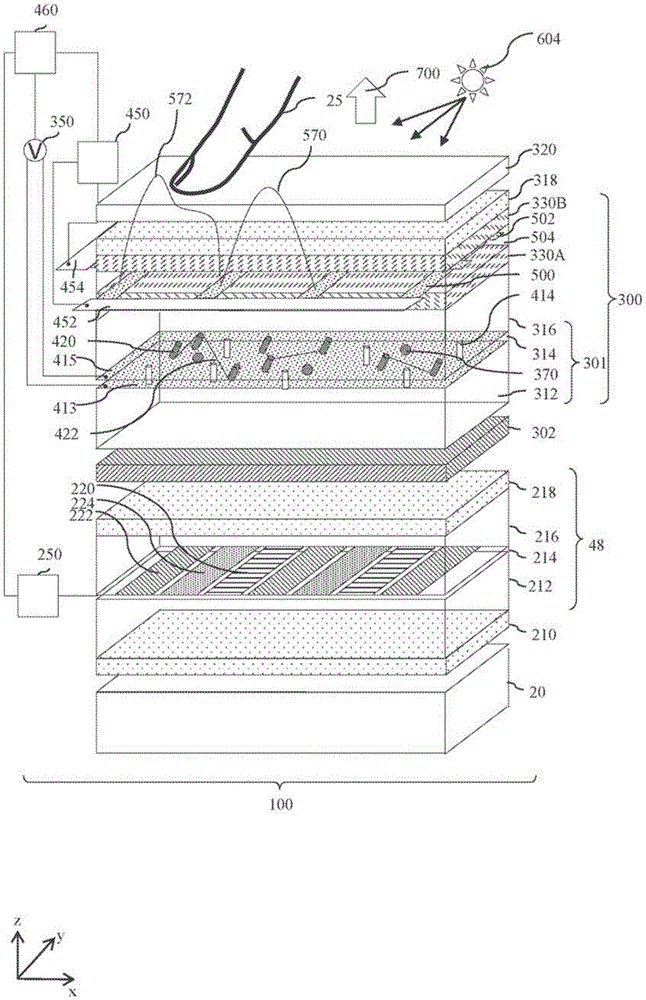
FIG. 1A is a schematic diagram illustrating in a perspective side view a touch input display device including a spatial light modulator, a reflective polarizer, and a switchable liquid crystal retarder including a stabilized liquid crystal layer;
FIG. 1B is a schematic diagram illustrating alignment of optical layers in the optical stack of FIG. 1 in a front view;
FIGS. 2A and 2B are schematic diagrams illustrating the touch input display device of FIGS. 1A-B in a privacy mode of operation and a wide-angle mode of operation, respectively, in different perspective side views;
FIG. 3A is a schematic diagram illustrating the variation of the transmitted brightness of the transmitted light in FIG. 2A with the polarity direction in the private mode of operation;
FIG. 3B is a diagram illustrating the reflectance of the reflected light of FIG. 2A as a function of polarity in a private mode of operation;
FIG. 3C is a diagram illustrating the variation of the transmitted luminance of the transmitted light in FIG. 2B with the polarity direction in the common operation mode;
FIG. 3D is a diagram illustrating the reflectance of the reflected light rays of FIG. 2B as a function of the polarity direction in the common mode of operation;
FIG. 4 is a schematic diagram illustrating a plot of liquid crystal director angle versus fractional position through the voltage switchable liquid crystal retarder cell of FIGS. 2A-B and 3A-D for different applications;
FIG. 5A, FIG. 5B, FIG. 5C and FIG. 5D are schematic diagrams illustrating a method of providing a liquid crystal polymer stabilized switchable liquid crystal retarder for a privacy display including an along-the-plane alignment layer in a perspective side view;
FIG. 6A is a schematic diagram illustrating in perspective side view an arrangement of a switchable compensating retarder and a negative C-plate comprising a switchable liquid crystal retarder aligned in a plane in a privacy mode of operation;
FIG. 6B is a schematic diagram illustrating in perspective side view an arrangement of a switchable compensatory retarder comprising an in-plane aligned switchable liquid crystal retarder and a negative C-plate operating in a common mode of operation for different applied voltage supply;
FIG. 6C is a schematic diagram illustrating in perspective side view an arrangement of a switchable compensating retarder comprising a switchable liquid crystal retarder aligned in a plane and a negative C plate for no applied voltage;
FIG. 7A is a diagram illustrating the variation of the transmitted luminance of the transmitted light in FIG. 6B with the polarity direction in the common operation mode;
FIG. 7B is a diagram illustrating the variation of the transmitted brightness of the transmitted light in FIG. 6A with the polarity direction in the private mode of operation;
FIG. 7C is a diagram illustrating the reflectance of the reflected light of FIG. 6A as a function of polarity direction in the private mode of operation;
FIG. 8A is a schematic diagram illustrating in front perspective view the observation of reflected ambient light from the interface surface of the display of FIG. 1A operating in public mode;
FIG. 8B is a schematic diagram illustrating an observation of reflected ambient light of the display of FIG. 1A operating in a privacy mode in a front perspective view;
FIG. 9A is a photograph showing the appearance of disclinations in a nematic liquid crystal layer during the application of pressure, which does not include the cured liquid crystal material of the present embodiment;
FIG. 9B is a photograph showing the appearance of a disclination in a nematic liquid crystal layer not including the cured liquid crystal material of the present embodiment, immediately after the pressure is released and before the complete annealing of the disclination;
FIG. 10A is a schematic diagram illustrating in a perspective side view an arrangement of a switchable compensating retarder and a negative C-plate including a homeotropically aligned switchable liquid crystal retarder in a private mode of operation;
FIG. 10B is a schematic diagram illustrating a plot of liquid crystal director angle versus fractional position through the switchable liquid crystal retarder cell of FIG. 10A providing operation in the common mode of operation for no applied voltage;
FIG. 11A is a schematic diagram illustrating the output luminance of the transmitted light of FIG. 10A as a function of polarity in a private mode of operation;
FIG. 11B is a diagram illustrating the reflectance of the reflected light of FIG. 10A as a function of polarity in the private mode of operation;
FIG. 11C is a diagram illustrating the variation of the output luminance of the transmitted light in FIG. 10B with the polarity direction in the common operation mode;
FIG. 11D is a diagram illustrating the variation of the reflectivity of the reflected light rays of FIG. 10B with the polarity direction in the common mode of operation;
FIG. 11E is a schematic diagram illustrating a plot of liquid crystal director angle versus fractional position through the switchable liquid crystal retarder cell of FIGS. 10A-B for different applied voltages;
12A, 12B, 12C and 12D are schematic diagrams illustrating a method of providing a liquid crystal polymer stabilized switchable liquid crystal retarder for a privacy display including a homeotropic alignment layer in a perspective side view;
FIG. 13A is a diagram illustrating illumination of an off-axis light with a retarder layer in a perspective view;
FIG. 13B is a diagram illustrating, in perspective view, the illumination of the retarder layer by off-axis light in a first linear polarization state of 0 degrees;
FIG. 13C is a diagram illustrating, in perspective view, illumination of the retarder layer by off-axis light in a first linear polarization state of 90 degrees;
FIG. 13D illustrates, in perspective view, a plot of off-axis light in a first linear polarization state of 45 degrees versus illumination of a retarder layer;
FIG. 14A is a diagram illustrating in perspective the illumination of an off-axis polarized light with a positive elevation angle with a C-plate retarder;
FIG. 14B is a diagram illustrating in perspective the illumination of an off-axis polarized light having a negative side angle with a C-plate retarder;
FIG. 14C is a diagram illustrating in perspective the illumination of a C-plate retarder by off-axis polarized light having a positive elevation angle and a negative side angle;
FIG. 14D is a diagram illustrating in perspective the illumination of an off-axis polarized light having a positive elevation angle and a positive lateral angle with a C-plate retarder;
FIG. 14E is a graph illustrating the output transmittance of transmitted light as a function of polarity in FIGS. 14A-D;
FIG. 15A is a diagram illustrating in perspective the illumination of an off-axis polarized light having a positive elevation angle with a crossed A-plate retarder layer;
FIG. 15B is a diagram illustrating in perspective view illumination of off-axis polarized light having a negative lateral angle with crossed A-plate retarder layers;
FIG. 15C is a diagram illustrating in perspective view illumination of off-axis polarized light having positive elevation and negative side angles with crossed A-plate retarder layers;
FIG. 15D is a diagram illustrating in perspective view illumination of off-axis polarized light having positive elevation and positive lateral angles with crossed A-plate retarder layers; and
fig. 15E is a graph illustrating the output transmittance of transmitted light as a function of the polarity direction in fig. 15A-D.
Detailed Description
Terms related to optical retarders used for purposes of this disclosure will now be described.
In a layer comprising a uniaxially birefringent material, there is a direction of control of the optical anisotropy, while all directions perpendicular to this direction (or at a given angle thereto) have an equivalent birefringence.
The optical axis of an optical retarder refers to the direction of propagation of a light ray in a uniaxially birefringent material that does not experience birefringence. This is different from the optical axis of the optical system, which may be, for example, parallel to the symmetry line or perpendicular to the display surface along which the principal ray (ray) propagates.
For light traveling in a direction orthogonal to the optical axis, the optical axis is the slow axis when linearly polarized light having an electric vector direction parallel to the slow axis travels at the lowest speed. The slow axis direction is the direction having the highest refractive index at the design wavelength. Similarly, the fast axis direction is the direction having the lowest refractive index at the design wavelength.
For a positively dielectric anisotropic uniaxially birefringent material, the slow axis direction is the extraordinary axis of the birefringent material. For a negative dielectric anisotropy uniaxial birefringent material, the fast axis direction is the extraordinary axis of the birefringent material.
The terms half wavelength and quarter wavelength are used for λ0Typically a retarder of a design wavelength that may be between 500nm and 570 nm. In the present illustrative embodiment, exemplary retardation values for a wavelength of 550nm are provided, unless otherwise specified.
The retarder provides a relative phase shift between two orthogonal polarization components of the light wave incident thereon, and is characterized in that the retarder imparts a relative phase amount Γ to the two polarization components. In some cases, the term "phase shift" is used without the term "relative," but still denotes a relative phase shift. The relative phase shift is related to the birefringence Δ n and the thickness d of the retarder:
Γ=2.π.Δn.d/λ0equation 1
In equation 1, Δ n is defined as the difference between the extraordinary refractive index and the ordinary refractive index, that is,
Δn=ne-noequation 2
For half-wave retarders, d, Δ n and λ are chosen0The relationship between them is such that the phase shift between the polarization components is Γ ═ π. For a quarter-wave retarder, d, Δ n and λ are chosen0The relationship between them is such that the phase shift between the polarization components is Γ ═ π/2.
The term half-wave retarder herein generally refers to light propagating perpendicular to the retarder and perpendicular to the spatial light modulator.
Some aspects of light propagation through a transparent retarder between a pair of polarizers will now be described.
The state of polarization (SOP) of a light ray is described by the relative amplitude and phase shift between any two orthogonal polarization components. The transparent retarder does not change the relative amplitudes of these orthogonal polarization components, but only acts on their relative phases. Providing a net phase shift between the orthogonal polarization components changes the SOP, while maintaining the net relative phase maintains the SOP.
A linear SOP has a non-zero amplitude polarization component and a zero amplitude orthogonal polarization component.
The linear polarizer transmits a unique linear SOP, the linear polarization component of which is parallel to the electric vector transmission direction of the linear polarizer, and attenuates the light with a different SOP.
An absorbing polarizer is a polarizer that absorbs one polarization component of incident light and transmits a second orthogonal polarization component. An example of an absorbing linear polarizer is a dichroic polarizer.
A reflective polarizer is a polarizer that reflects one polarization component of incident light and transmits a second orthogonal polarization component. An example of a reflective linear polarizer is a multilayer polymer film stack, such as DBEF from 3M companyTMOr APFTMOr wire grid polarizers, e.g. ProFlux from MoxtekTM。
A retarder disposed between a linear polarizer and a parallel linear analyzing polarizer that does not introduce a relative net phase shift provides complete transmission of light in addition to residual absorption within the linear polarizer.
Retarders that provide a relative net phase shift between orthogonal polarization components will change the SOP and provide attenuation at the analyzing polarizer.
In this disclosure, "a plate" refers to an optical retarder that utilizes a layer of birefringent material whose optical axis is parallel to the plane of the layer.
"Positive A-plate" refers to a positively birefringent A-plate, i.e., an A-plate with a positive Δ n.
In this disclosure, "C-plate" refers to an optical retarder that utilizes a layer of birefringent material whose optical axis is perpendicular to the plane of the layer. "Positive C-plate" refers to a positively birefringent C-plate, i.e., a C-plate having a positive Δ n. "negative C-plate" refers to a negatively birefringent C-plate, i.e., a C-plate having a negative Δ n.
An "O-plate" refers to an optical retarder that utilizes a layer of birefringent material whose optical axis has a component parallel to the plane of the layer and a component perpendicular to the plane of the layer. "Positive O-plate" refers to a positively birefringent O-plate, i.e., an O-plate having a positive Δ n.
An achromatic retarder may be provided, wherein the material of the retarder is provided with a retardation Δ n.d which varies with the wavelength λ
Δ n.d/λ ═ κ equation 3
Where κ is substantially constant.
Examples of suitable materials include modified polycarbonates from imperial Films (Teijin Films). An achromatic retarder may be provided in this embodiment to advantageously minimize color variation between polarization angle viewing directions with low luminance reduction and polarization angle viewing directions with increased luminance reduction, as will be described below.
Various other terms used in this disclosure in relation to retarders and liquid crystals will now be described.
The liquid crystal cell has a retardation given by Δ n.d, where Δ n is the birefringence of the liquid crystal material in the liquid crystal cell and d is the thickness of the liquid crystal cell, independent of the alignment of the liquid crystal material in the liquid crystal cell.
In-plane alignment refers to the alignment of liquid crystals in a switchable liquid crystal display, wherein the molecules are aligned substantially parallel to the substrates. The in-plane alignment is sometimes referred to as planar alignment. The in-plane alignment may typically be provided with a small pre-tilt, e.g. 2 degrees, so that the molecules on the surface of the alignment layer of the liquid crystal cell are slightly tilted, as will be described below. The pretilt is arranged to minimize degeneracy in cell switching.
In the present disclosure, the homeotropic alignment is a state in which rod-like liquid crystal molecules are aligned substantially perpendicular to the substrates. In discotic liquid crystals, homeotropic alignment is defined as a state in which the axes of column structures formed by discotic liquid crystal molecules are aligned perpendicular to the surface. In homeotropic alignment, the pretilt is the tilt angle of the molecules close to the alignment layer and typically close to 90 degrees and may be, for example, 88 degrees.
In a twisted liquid crystal layer, a twisted configuration of nematic liquid crystal molecules (also referred to as a helical structure or helix) is provided. Twisting may be achieved by non-parallel alignment of the alignment layers. In addition, cholesteric dopants can be added to the liquid crystal material to break the degeneracy of the twist sense (clockwise or counterclockwise) and to further control the pitch of the twist in the relaxed (typically undriven) state. The super twist liquid crystal layer has a twist of more than 180 degrees. The twisted nematic layers used in spatial light modulators typically have a twist of 90 degrees.
Liquid crystal molecules having positive dielectric anisotropy are switched from an in-plane alignment (e.g., a-plate retarder alignment) to a homeotropic alignment (e.g., C-plate or O-plate retarder alignment) by an applied electric field.
Liquid crystal molecules having negative dielectric anisotropy are switched from homeotropic (e.g., C-plate or O-plate retarder orientation) to in-plane (e.g., a-plate retarder orientation) alignment by an applied electric field.
The rod-shaped molecules have positive birefringence such that ne>noAs described in equation 2. The discotic molecules have a negative birefringence such that ne<no。
Positive retarders, such as a-plates, positive O-plates, and positive C-plates, can generally be provided by stretched films or rod-shaped liquid crystal molecules. A negative retarder, such as a negative C-plate, may be provided by stretched films or discotic liquid crystal molecules.
Parallel liquid crystal cell alignment refers to alignment directions that are parallel or more typically antiparallel along the planar alignment layer. In the case of homeotropic alignment of the pretilt, the alignment layers may have a substantially parallel or antiparallel component. A hybrid aligned liquid crystal cell may have one homeotropic and one homeotropic alignment layers. Twisted liquid crystal cells may be provided by alignment layers that do not have parallel alignment (e.g., oriented at 90 degrees to each other).
The transmissive spatial light modulator may further include a retarder between the input display polarizer and the output display polarizer, for example, as disclosed in U.S. patent No. 8,237,876, which is incorporated herein by reference in its entirety. Such a delay (not shown) is in a different location than the passive delay of the present embodiment. Such retarders compensate for the contrast reduction at the off-axis viewing position, which has a different effect on the brightness reduction at the off-axis viewing position of the present embodiment.
The private mode of operation of the display is a mode in which the observer sees a low contrast sensitivity so that the image is not clearly visible. Contrast sensitivity is a measure of the ability to distinguish between different brightness levels in a static image. The inverse contrast sensitivity may be used as a measure of visual safety, since a high Visual Safety Level (VSL) corresponds to low image visibility.
For a private display that provides an image to a viewer, visual security may be given by:
VSL ═ Y + R)/(Y-K) equation 4
Where VSL is the visual security level, Y is the brightness of the white state of the display at the perspective of a snooper, K is the brightness of the black state of the display at the perspective of a snooper, and R is the brightness of the reflected light from the display.
The panel contrast is given as:
c ═ Y/K equation 5
For the high contrast optical LCD mode, the white state transmittance remains substantially constant with viewing angle. In the contrast-reduced liquid crystal mode of the present embodiment, the white-state transmittance generally decreases as the black-state transmittance increases, so that
Y + K P.L equation 6
The visual security level may then be further given as:

where the off-axis relative brightness P is generally defined as a percentage of the front face brightness, L is at the snooper angle, and the display may have an image contrast C, and the surface reflectivity is P.
The off-axis relative brightness P is sometimes referred to as the privacy level. However, such privacy levels P describe the relative brightness of the display at a given polarization angle compared to the front brightness, rather than a measure of the privacy profile.
The display may be illuminated by lambertian ambient lighting I. Thus, in a completely dark environment, the VSL of a high contrast display is about 1.0. As ambient lighting increases, the perceived image contrast decreases, VSL increases, and a privacy image is perceived.
For a typical liquid crystal display, the panel contrast C is higher than 100:1 for almost all viewing angles, making the visual security level approximately:
VSL ═ 1+ i. ρ/(pi. P.L) equation 8
The desired wide-angle display is easily observed under standard ambient lighting conditions as compared to a private display. One measure of image visibility is given by contrast sensitivity, such as the michelson contrast given by:
M=(Imax-Imin)/(Imax+Imin) Equation 9
And thus:
m ═ (((Y + R) - (K + R))/((Y + R) + (K + R))) - (YK)/(Y + K +2.R) equation 10
Thus, the Visual Security Level (VSL) is equal to (but different from) 1/M. In the present discussion, for a given off-axis relative brightness P, the wide-angle image visibility W is approximately
W1/VSL 1/(1+ i. ρ/(pi. P.L)) equation 11
Switchable directional display devices for use in, for example, privacy displays and comprising a plurality of retarders arranged between a display polarizer and an additional polarizer are described in us patent No. 10,126,575 and us patent publication No. 2019-0086706, both of which are incorporated herein by reference in their entirety. Directional display devices further comprising a reflective polarizer disposed between the display polarizer and the retarder are described in U.S. patent No. 10,303,030 and in U.S. patent application No. 16/256,120, filed 24.1.2019 (attorney docket No. 413101), both of which are incorporated herein by reference in their entirety. Directional display polarizers comprising a passive retarder arranged between the display polarizer and an additional polarizer are described in us patent publication No. 2018-0321553, which is incorporated herein by reference in its entirety. Also incorporated herein by reference in its entirety is U.S. patent application No. 16/256,754 filed 24/1/2019 (attorney docket No. 420001).
The structure and operation of various switchable display devices will now be described. In the present specification, common elements have common reference numerals. It is noted that the disclosure in relation to any element applies to each and every apparatus in which the same or corresponding element is provided. Accordingly, such disclosure is not repeated for the sake of brevity.
It would be desirable to provide high image quality during touch input for a switchable directional display device that includes a switchable liquid crystal retarder disposed between a display output polarizer and an additional polarizer for use in displays such as privacy displays.
FIG. 1A is a schematic diagram illustrating in a perspective side view a touch input display device 100 including a spatial light modulator 48, a reflective polarizer 302, and a switchable liquid crystal retarder 300, with touch electrode arrays 500, 502 provided on opposing surfaces of a first passive compensated retarder 330A and a second passive compensated retarder 330B; and FIG. 1B is a schematic diagram illustrating alignment of optical layers and electrode layers in the optical stack of FIG. 1A in a front view.
The position of finger 25 is detected by detecting the deformation of field lines 570, 572 provided by touch electrode arrays 500, 502 and a control system comprising touch drivers 452, 454, touch controller 450 and system controller 460. At least one dielectric layer 504 is arranged between the switchable liquid crystal layer 314 and the additional polarizer 318. First touch electrode array 500 and second touch electrode array 502 are arranged on opposite sides of dielectric layer 504.
In fig. 1A, the spatial light modulator 48 is a transmissive spatial light modulator such as a liquid crystal display and further includes a backlight 20. In other embodiments (not shown), an emissive display, such as an OLED or micro-LED display, may be provided, where the display 100 does not include the input polarizer 210 and the backlight 20.
The spatial light modulator 48 is arranged to output light 700 and comprises: a display polarizer 218 arranged on the output side of the spatial light modulator 48; an additional polarizer 318 disposed on the output side of the display polarizer 218; a reflective polarizer 302 disposed between the display polarizer 218 and the additional polarizer 318; and at least one retarder 300 arranged between the reflective polarizer 302 and the additional polarizer 318. The display polarizer 218 and the additional polarizer 318 are linear polarizers.
The display 100 typically operates in an environment with external lighting 604. Reflection of such illumination is used to provide an increased level of visual security to a snooper when the display is operating in a privacy mode, as will be described further below.
The plurality of retarders 300 comprises a switchable liquid crystal retarder 301 comprising a non-curable liquid crystal material 414 and a layer 314 of a cured liquid crystal material 420. The layer 314 is disposed between the transparent support substrates 312, 316 and between the display polarizer 218 and the additional polarizer 318.
The control system comprises a system controller 460 arranged to (i) provide image data to the spatial light modulator 48 via the spatial light modulator controller 250, (ii) provide control of the voltage driver 350 to control the drive voltage V applied to the switchable liquid crystal retarders, and (iii) and to control the signals applied to and measured from the touch electrode arrays 500, 502 via the touch controller 450 and the touch drivers 452, 454.
A reflective polarizer 302 is disposed between the display polarizer 218 and the plurality of retarders 300. The electric vector propagation direction 303 of the reflective polarizer 302 is parallel to the electric vector propagation direction 219 of the display polarizer 218 and the electric vector propagation direction 319 of the additional polarizer 318.
A plurality of retarders 300 is arranged between the display polarizer 218 and the additional polarizer 318. The plurality of delayers 300 includes: a switchable liquid crystal retarder 301, wherein a liquid crystal layer 314 is arranged between an input transparent support substrate 312 and an output transparent support substrate 316; and two passive compensated retarders 330A, 330B arranged between the switchable liquid crystal retarder 301 and the additional polarizer 318. The at least one passive compensated retarder 330 comprises a pair of passive uniaxial retarders 330A, 330B whose optical axes cross in the plane of the retarder.
More generally, the display polarizer 218 is disposed on a side of the spatial light modulator 48, the display polarizer 218 being a linear polarizer. An additional polarizer 318 is arranged on the same side of the spatial light modulator 48 as the display polarizer 218, the additional polarizer 318 being a linear polarizer. Where the spatial light modulator is a transmissive spatial light modulator 48, an additional polarizer 318 may alternatively or additionally be arranged between the backlight 20 and the input polarizer 210 of the spatial light modulator. In the case where the spatial light modulator 48 is an emissive spatial light modulator, the plurality of retarders 300 and the additional polarizer 318 are arranged on the output side of the output polarizer 218.
At least one polarization-controlled retarder 300 is disposed between the additional polarizer 318 and the display polarizer 218, wherein the at least one polarization-controlled retarder 300 comprises a switchable liquid crystal retarder 301 comprising: a first support substrate 312 and a second support substrate 316; a liquid crystal layer 314 disposed between the first and second transparent support substrates 312, 316, the liquid crystal layer 314 including a non-curable liquid crystal material 414 and a curable liquid crystal material 420. The cured liquid crystal material may be a reactive mesogen, as will be further described below.
The electrodes 413, 415 are arranged to apply voltages for controlling the liquid crystal layer 314; and respective liquid crystal alignment layers 418A, 418B are supported on the first and second support substrates 312, 316 adjacent to the liquid crystal layer 314 for aligning the non-curable liquid crystal material 414.
A dielectric layer 504 is disposed between the passive retarders 330A, 330B. First touch electrode array 500 and second touch electrode array 502 can be provided on at least one surface of at least one passive compensated retarder 330. The touch electrode array may be disposed on opposing surfaces of a pair of passive uniaxial retarders 330A, 330B. Dielectric layer 504 may include an adhesive layer provided between touch electrode arrays 500, 502 disposed on opposing surfaces of a pair of passive uniaxial retarders 330A, 330B. The dielectric layer 504 may comprise, for example, Optically Clear Adhesive (OCA) or Pressure Sensitive Adhesive (PSA), or may be provided by another dielectric material.
The touching finger 25 may be near or in contact with a substrate 320, which may be a glass cover with an oleophobic hard coating or a hard coated polymer layer for mechanical robustness and resistance to finger grease. Touch control may also be provided by a pen or stylus.
As will be further described herein, layer 314 includes a cured liquid crystal material 420 provided as a network 424 including cross-links 422 between molecules of material 420.
FIG. 1B further illustrates the arrangement of the orientation of the various components. Polarizers 218, 302, 318 are aligned with parallel electric vector propagation directions 219, 303, 319, respectively. The passive retarders 330A, 330B are provided with optical axis directions 331A, 331B at 135 degrees and 45 degrees, respectively. The shape and orientation of the electrodes 500, 502 are illustrated as orthogonal strips, however other shapes and orientations may be provided.
The structure and operation of the arrangement of the plurality of retarders will now be described.
Fig. 2A is a schematic diagram illustrating the arrangement of a switchable retarder 300 in a privacy mode of operation in a perspective side view, wherein the switchable retarder 301 comprises a switchable liquid crystal layer 314 having a planar alignment and crossed a-plate polarity-controlled passive retarders 330A, 330B; and fig. 2B is a diagram illustrating the output luminance of the transmitted light in fig. 2A as a function of the polarity direction in the common operation mode.
The passive retarders 330A, 330B are composed of non-switching molecules 408A, 408B, respectively.
The switchable liquid crystal retarder 301 comprises two surface alignment layers 418A, 418B disposed adjacent to and on opposite sides of the layer 314 of non-curable liquid crystal material 414 and each configured to provide in-plane alignment in the adjacent non-curable liquid crystal material 414. Advantageously, the in-plane alignment provides high recovery of the molecules of the non-curable liquid crystal material 414 compared to the homeotropic alignment.
The switchable liquid crystal retarder 301 and the passive retarder 330 may be replaced by any of those described in united states patent No. 10,126,575, united states patent publication No. 2019-0086706, united states patent No. 10,303,030, united states patent application No. 16/256,120 filed 24 months and 2019 (attorney docket No. 413101), united states provisional patent application No. 62/756,902 filed 7 days and 2018 (attorney docket No. 426000), and united states provisional patent application No. 62/844,980 filed 5 months and 8 days and 2019 (attorney docket No. 426000a), the entire contents of which are incorporated herein by reference in their entirety.
In the privacy mode, the switchable liquid crystal layer 314 is driven by a first voltage V1. The molecules of the non-curable liquid crystal material 414 and the cured liquid crystal material 420 are aligned with the same alignment, i.e. the variation of the inclination of the molecules across the thickness of the layer 314 is the same for the cured material 422 and the non-curable material 420.
In the common mode, the switchable liquid crystal layer 314 is driven by a second voltage V2. The molecules of the non-curable liquid crystal material 414 and the cured liquid crystal material 420 are aligned with different orientations, i.e. the variation of the tilt across the layer 314 is different for the material 420 and the material 422. The alignment of the liquid crystal in the layer 314 will be described with reference to fig. 4.
Some of the cured liquid crystal material 420A may be arranged in a network 424 that extends between the two support substrates 312, 316, and the network 424 is attached to each of the two support substrates 312, 316. Some of the cured liquid crystal material 420B may be arranged to be attached to the support substrates 312, 316.
In the privacy mode, the predetermined voltage V1 of the switchable liquid crystal layer 314 causes the layer 314 of curable liquid crystal material 420 and non-curable liquid crystal material 414 to simultaneously: a net relative phase shift is not introduced to the orthogonally polarized components of light passing through the additional polarizer 318 along an axis 199 normal to the plane of the at least one polarization-controlled retarder 300, and a net relative phase shift is introduced to the orthogonally polarized components of light passing through the additional polarizer along an axis 197 oblique to the normal to the plane of the at least one polarization-controlled retarder 300. Such phase shift changes, when combined with passive retarder 330 and analyzed by polarizers 218, 302, and 318, provide polarity changes in transmittance and reflectance, such as those illustrated in fig. 3A-B.
In the common mode, the switchable liquid crystal layer 314 is driven by V2 which is different from the predetermined voltage V1. The voltage V2 causes the layer 314 of non-curable liquid crystal material 414 to simultaneously: a net relative phase shift is not introduced to the orthogonally polarized components of light passing through the additional polarizer 318 along an axis 199 normal to the plane of the at least one polarization-controlled retarder 300, and a net relative phase shift is introduced to the orthogonally polarized components of light passing through the additional polarizer along an axis 197 oblique to the normal to the plane of the at least one polarization-controlled retarder 300. Such phase shift changes, when combined with passive retarder 330 and analyzed by polarizers 218, 302, and 318, provide polarity changes in transmittance and reflectance, such as those illustrated in fig. 3C-D.
A network 424 of cured liquid crystal material 414 is attached to the substrates 312, 316. The deformation of the thickness of layer 314 during the application of mechanical force is reduced. For both private and public modes of operation, the delay of layer 314 is substantially maintained and the net relative phase shift introduced by the applied mechanical force is maintained. Advantageously, the brightness in the region of the applied mechanical force is reduced and reflection artifacts are reduced. In other words, during the application of force, the thickness of the liquid crystal layer 314 may vary, thereby creating an undesirable retardation profile in the layer 314. The network 424 of aligned cured liquid crystal molecules 420 provides resistance to cell gap variations, thereby achieving a uniform retardation profile across the display area. Advantageously, the visibility of artifacts due to variations in the thickness of layer 314 is reduced.
The molecules 420B arranged near the substrates 312, 316 may be arranged to increase the recovery force of the molecules 414 after the application of the mechanical force. Advantageously, the visibility of artifacts may be reduced.
During the applied mechanical force, non-curable liquid crystal material 414 may flow within layer 314. Such flow may provide disclination that adjusts the retardation characteristics of layer 314 and change the net relative phase shift. Such undesirable disclinations will be illustrated in fig. 9A-B below in layers that do not include cured liquid crystal material 420.
Curing liquid crystal material 420 provides increased healing force to non-curable liquid crystal material 414, prevents the formation of large area disclinations, and may reduce relaxation time of the disclination after flow. Advantageously, the time during which brightness and reflection artifacts are visible in the region of the applied mechanical force may be reduced, and the size of the artifacts may be reduced.
In the privacy mode, light scattering in layer 314 undesirably directs image data to the snooper location and reduces the visual security level. The molecules of the non-curable liquid crystal material 414 and the cured liquid crystal material 420 are aligned in a common alignment. Light scattering is reduced and the privacy mode visual security level is advantageously increased.
In the common mode, light scattering may be provided in layer 314 due to alignment disorder between the molecules of materials 414, 420. Advantageously, such scattering provides increased angular brightness uniformity in the common mode, thereby increasing image visibility for off-axis users.
During the application of force, flow of the non-curable liquid crystal material 414 may occur in the liquid crystal layer 314. The flow may cause undesirable liquid crystal alignment disorder and dislocations, which may provide visual artifacts. The network 424 of aligned cured liquid crystal molecules 420 provides resistance to flow of the non-curable liquid crystal material 414. The amount of retardation variation and disclination in the layer 314 due to flow is reduced and the visibility of artifacts due to material flow is advantageously reduced.
In the privacy mode, the drive voltage V1 may be lower than the drive voltage V2 for the common mode, as illustrated in table 1 below for the embodiments of fig. 3A-D. The high drive voltage increases the recovery force and reduces the relaxation time after flow, thereby reducing the time for artifact visibility. It is desirable to provide increased recovery in layer 314 at lower drive voltages.
In this embodiment, the molecules of the materials 414, 420 are aligned in the driven state at a given voltage V1, and the restoring force provided by the molecules of the cured liquid crystal material 420 provides the same energy minimum as that provided by the drive voltage V1. The total restoring force on the molecule 414 increases, thereby reducing the magnitude and decay time of the disclination. Advantageously, the visibility of artifacts is reduced.
In the common mode, the time for artifact visibility has been reduced due to the restoring force provided by the high drive voltage. Advantageously, in both private and public modes of operation, the time of visibility and the size of flow artifacts are reduced.
In the public mode, the voltage V2 provides a phase structure with a slow polarity change in brightness and reflectivity with polar angle, as will be described in fig. 3C-D, while in the private mode the polarity roll-off will be faster, as will be described in fig. 3A-B. The retardation change in layer 314 due to material flow in the region of applied force can be seen as a local brightness and reflectivity change that depends on the polar angle and distorts the polar brightness and reflectivity profile. The aligned cured liquid crystal material 420 provides increased recovery in the private mode of operation, thereby reducing the range of polar angles at which artifacts are present. Advantageously, in the private mode and the public mode, the polarity change of the material 414 flow and the visibility of disclination artifacts is reduced.
Features of the arrangement of fig. 2A-B that are not discussed in further detail may be assumed to correspond to features having equivalent reference numerals as discussed above, including any potential variations in the features.
The optical output of the illustrative embodiments will now be described.
FIG. 3A is a schematic diagram illustrating the transmittance of the transmitted light of FIG. 2A as a function of polarity direction in a private mode of operation; and FIG. 3B is a schematic diagram illustrating the reflectance of the reflected light rays of FIG. 2A as a function of polarity direction in the private mode of operation; FIG. 3C is a diagram illustrating the transmittance of the transmitted light of FIG. 2B as a function of the polarity direction in the common mode of operation; and fig. 3D is a schematic diagram illustrating the variation of the reflectivity of the reflected light rays in fig. 2B with the polarity direction in the common operation mode, including the embodiments shown in table 1.

TABLE 1
The layer 314 of non-curable liquid crystal material 414 of the switchable liquid crystal retarder 301 comprises a non-curable liquid crystal material 414 having a positive dielectric anisotropy.
In this embodiment, desirable retardation and voltage ranges have been established by simulating the retarder stack and performing experiments with the display optical stack. The retardation ranges that provide the design configurations of the various optical layers will now be described.
The predetermined voltage is not zero. The layer 314 of non-curable liquid crystal material 414, 420 has a retardation for light of wavelength 550nm in the range: in the range of 500nm to 900nm, preferably in the range of 600nm to 850nm, and most preferably in the range of 700nm to 800 nm.
The at least one passive retarder 330 comprises a pair of passive retarders 330A, 330B having optical axes that intersect in the plane of the retarder, each passive retarder 330A, 330B of the pair having a retardation for light of 550nm wavelength in a range of: in the range of 300nm to 800nm, preferably in the range of 350nm to 650nm, and most preferably in the range of 450nm to 550 nm.
In another embodiment (not shown), the at least one passive retarder 330 may include at least one passive retarder 330 having an optical axis perpendicular to the plane of the retarder 330, the at least one passive retarder 330 having a total retardation for light of 550nm wavelength in a range of: in the range of-300 nm to-700 nm, preferably in the range of-350 nm to-600 nm, and most preferably in the range of-400 nm to-500 nm. A passive retarder may be provided using a stretched film to advantageously achieve low cost and high uniformity.
The passive polarity controlled retarder 330 is provided by a pair of a-plates 330A, 330B having intersecting axes. In the present embodiment, "crossing" means that an angle of substantially 90 ° is formed between the optical axes of the two retarders in the plane of the retarders. In order to reduce the cost of retarder materials, it is desirable to provide materials that have some variation in retarder orientation, for example due to stretching errors during film manufacturing. A change in retarder orientation away from the preferred direction may reduce the front brightness and increase the minimum transmittance. Preferably, the angle between the optical axes in the plane of the retarders is at least 35 ° and at most 55 °, more preferably at least 40 ° and at most 50 °, and most preferably at least 42.5 ° and at most 47.5 °.
Fig. 3A-D illustrate the achievement of high brightness and low reflectivity in a direction parallel to axis 199. Advantageously, the front-facing user sees high image visibility for both private and public modes of operation.
Fig. 3A-B illustrate that low brightness and high reflectivity are achieved in a direction along an axis 197 that is oblique to an axis 199 in a lateral direction for privacy operations. Advantageously, a high level of visual security is presented to off-axis snoopers during the private mode of operation. Fig. 3C-D illustrate that high brightness and low reflectivity are achieved in a direction along axis 197 that is oblique to axis 199 in the lateral direction for common operation. Advantageously, high image visibility is presented to off-axis users during the public mode of operation.
Fig. 4 is a schematic diagram illustrating a plot of liquid crystal director angle versus fractional position through the switchable liquid crystal retarder cell of fig. 2A-B and 3A-D for different applied voltages.
Outline 441 illustrates the tilt angle of the non-curable liquid crystal material 414 for an applied voltage of 0V; the tilted profile 443 illustrates the director orientation for the privacy mode of an applied voltage V1 of, for example, 2.5V; and the tilted profile 445 illustrates the director orientation for the common mode of an applied voltage V2 of, for example, 5V. Thus, the director is distributed across the thickness of the cell for the private and wide-angle modes. The cured liquid crystal material 420 of the present embodiment has a profile 443 for both the private mode and the public mode. In contrast, the non-curable liquid crystal material 414 switches between the profile 445 in the public mode and the profile 443 in the private mode.
In operation, the applied pressure may deform the profile 443, 445. The deformation of profile 443 is more visible than profile 445. Advantageously, the present embodiment achieves increased resistance to deviation of the non-curable liquid crystal material from the profile 443. Image artifacts are reduced during the applied pressure.
A method of manufacturing a stable liquid crystal retarder for a switchable privacy display having low artifact visibility during applied mechanical forces will now be presented.
Fig. 5A-D are schematic diagrams illustrating a method for providing a reactive mesogenic polymer stabilized switchable liquid crystal retarder for a privacy display in a perspective side view. It may be assumed that features of the arrangement of fig. 5A-D, which are not discussed in further detail, correspond to features having equivalent reference numerals as discussed above, including any potential variations in the features.
A method of manufacturing a switchable liquid crystal retarder 301, which is a polarity controlled retarder for a display device 100, the method comprising: in a first step, shown in fig. 5A, a first support substrate 312 and a second support substrate 316 are provided, the first support substrate and the second support substrate having electrodes 413, 415 for controlling the liquid crystal layer 314 and having supported thereon a first liquid crystal alignment layer 418A and a second liquid crystal alignment layer 418B for aligning liquid crystal material of the liquid crystal layer 314, and the liquid crystal layer 314 disposed between the first transparent support substrate 312 and the second transparent support substrate 316, wherein the first liquid crystal alignment layer 418A and the second liquid crystal alignment layer 418B are adjacent to the liquid crystal layer 314, the liquid crystal layer 314 comprising a non-curable liquid crystal material 414 and a curable liquid crystal material 420. The liquid crystal layer may include optical properties as illustrated in table 1 or other tables herein.
The curable liquid crystal material 420 may be a reactive mesogen. Reactive Mesogens (RMs) are low molecular weight liquid crystalline materials containing reactive end groups that can be photopolymerised by visible or UV light. RM has the inherent characteristics of liquid crystals, including self-organization, anisotropic optical and dielectric properties, and controlled alignment defined by a surface alignment layer (e.g. rubbed polyimide); at the same time, the RMs can polymerize into a network structure or solid material and retain their liquid crystal alignment and anisotropic properties. By way of example and not limitation, example reactive mesogenic materials include RM257 and RM488, sold by Merck ltd. An example photoinitiator includes Irgacure 651 sold by Ciba.
The ratio of the volume of curable liquid crystal material 420 to the volume of non-curable liquid crystal material 414 may be less than 5%. Advantageously, light scattering can be reduced and the level of visual security in the privacy mode increased.
FIG. 5A further illustrates the liquid crystal layer 314 including an isotropically curable polymeric material 421. Prior to curing, the curable polymeric material may include a monomeric material. The curable polymeric material 420, 421 may comprise a material including an acrylate or a thiol.
Fig. 5B illustrates the application of a predetermined voltage V1 to the electrodes 418A, 418B. FIG. 5C illustrates curing the curable liquid crystal material 420 when a predetermined voltage V1 is applied. The liquid crystal material may further comprise a polymeric photoinitiator. The step of curing the curable liquid crystal material is performed by applying optical radiation 720, preferably ultraviolet light radiation, from a light source 722 to the liquid crystal layer 314.
FIG. 5D illustrates the liquid crystal retarder 301 after the curable liquid crystal material 420 is cured to the provided network 424 and the voltage V1 is removed. The non-curable liquid crystal molecules 414 are provided with a tilt and orientation provided by the pre-tilt and alignment directions of the alignment layers 418A, 418B. At the curing step of fig. 5C, a cured liquid crystal material 420 is provided by applying a voltage V1 and the alignment direction of the alignment layers 418A, 418B.
The network 424 may comprise a network of cured liquid crystal material 420 and cured isotropic material 421. Cross-linking may be provided between the cured polymer materials 420, 421 by bonding between the liquid crystal materials 420, between the isotropic materials 422, or between the liquid crystal material 420 and the isotropic material 421. Advantageously, an increased resistance to applied mechanical forces may be achieved.
In other words, a method of manufacturing a liquid crystal retarder for a privacy display device 100 includes the steps of: (i) providing a first transparent support substrate 312 and a second transparent support substrate 316, wherein electrodes 413, 415 are on at least one side of each of the first transparent support substrate 312 and the second transparent support substrate 316; (ii) forming a liquid crystal alignment layer 418A, 418B on the electrode 413, 415 of each of the first and second transparent support substrates 312, 316; (iii) a liquid crystal layer 314 provided between the alignment layers; wherein liquid crystal layer 314 comprises (a) a non-curable liquid crystal material 414 and (b) a curable liquid crystal material 420; (iv) applying a curing step voltage across the electrodes; and (v) curing the curable liquid crystal material 420. The curing step voltage V1 is the voltage at which the liquid crystal retarder is driven to provide a private mode of operation of the display device, such as illustrated in fig. 2A. The curable liquid crystal material 420 comprises a photoinitiator and the step of curing the curable liquid crystal material comprises illumination by ultraviolet radiation 720.
As illustrated in fig. 5D, after curing, the light source 722 and voltage driver are removed and the molecules of the non-curable liquid crystal material 414 relax while the molecules of the cured liquid crystal material 420 remain in the cured liquid crystal network 424 including the molecular orientation of the driven state.
Advantageously, a switchable liquid crystal retarder 301 may be provided for use in a switchable privacy display 100 having low artifact visibility due to applied pressure during touch operations.
It would be desirable to reduce the thickness of the polarity control retarder 300 while achieving high image quality during touch operations.
FIG. 6A is a schematic diagram illustrating in perspective side view an arrangement of a switchable compensating retarder and a negative C-plate comprising a switchable liquid crystal retarder aligned in a plane in a privacy mode of operation; FIG. 6B is a schematic diagram illustrating in perspective side view an arrangement of a switchable compensatory retarder comprising an in-plane aligned switchable liquid crystal retarder and a negative C-plate operating in a common mode of operation for different applied voltage supply; and figure 6C is a schematic diagram illustrating in perspective side view the arrangement of a switchable compensating retarder comprising a switchable liquid crystal retarder aligned in a plane and a negative C-plate for no applied voltage. It may be assumed that features of the arrangement of fig. 6A-C, which are not discussed in further detail, correspond to features having equivalent reference numerals as discussed above, including any potential variations in the features.
In contrast to the arrangements of fig. 1A and 2A-B, the first support substrate 312 and the second support substrate 316 may be provided by passive compensated retarders 330A, 330B.
The passive compensated retarder 330 includes a negative C-plate retarder having an optical axis, which is the fast axis perpendicular to the plane of the retarder. Thus, the material 430 of the C-plate retarder may have a negative dielectric anisotropy. The C-plate may comprise a transparent birefringent material, for example: polycarbonate or reactive mesogens cast onto a substrate providing homeotropic alignment, for example: zeonexTMCyclic Olefin Polymers (COP); a discotic polymer; and Nitto DenkoTMA biaxially stretched polycarbonate.
The switchable liquid crystal retarder of fig. 6A-C further includes surface alignment layers 418A, 418B disposed adjacent to the layer of non-curable liquid crystal material 414 and each configured to provide in-plane alignment in the adjacent liquid crystal layer 314. In other words, the switchable liquid crystal retarder comprises two surface alignment layers 418A, 418B disposed adjacent to and on opposite sides of the layer of non-curable liquid crystal material 414 and each configured to provide in-plane alignment in the adjacent non-curable liquid crystal material 414. The substrate provided by the passive compensated retarders 330A, 330B may have a reduced thickness and stiffness compared to the substrate of fig. 1A, for example, which may use a glass material, for example. Advantageously, the present embodiment enables increased resilience of layer 314 to applied mechanical forces during touch operations. Such displays may also be foldable or bendable. Advantageously, an increased flexibility to folding or bending of the display may be achieved. A very small thickness can be achieved.
The optical output of the arrangement of fig. 6A and 6B will now be described.
FIG. 7A is a diagram illustrating the variation of the transmitted luminance of the transmitted light in FIG. 6B with the polarity direction in the common operation mode; FIG. 7B is a diagram illustrating the variation of the transmitted brightness of the transmitted light in FIG. 6A with the polarity direction in the private mode of operation; fig. 7C is a schematic diagram illustrating the variation of the reflectivity of the reflected light rays in fig. 6A with the polarity direction in the privacy operation mode, including the arrangement described in table 2.

TABLE 2
The passive polarity control retarder 330 includes a first C plate 330A and a second C plate 330B; and a switchable liquid crystal layer 314 is provided between the first C-plate 330A and the second C-plate 330B. The switchable liquid crystal retarder 301 comprises two surface alignment layers 418A, 418B disposed adjacent to and on opposite sides of the layer 314 of non-curable liquid crystal material 414 and each configured to provide in-plane alignment in the adjacent non-curable liquid crystal material 414. The layer of non-curable liquid crystal material 414 of the switchable liquid crystal retarder 301 comprises a non-curable liquid crystal material 414 having a positive dielectric anisotropy.
In this embodiment, desirable retardation and voltage ranges have been established by simulating the retarder stack and performing experiments with the display optical stack. The retardation ranges that provide the design configurations of the various optical layers will now be described.
The liquid crystal material layer 314 has a retardation for light of 550nm wavelength in the following range: in the range of 500nm to 1000nm, preferably in the range of 600nm to 900nm, and most preferably in the range of 700nm to 850 nm. The two passive retarders 330A, 330B each comprise a passive retarder having an optical axis perpendicular to the plane of the retarder, and the total retardation of the two passive retarders for light of 550nm wavelength is in the range: in the range of-300 nm to-700 nm, preferably in the range of-350 nm to-600 nm, and most preferably in the range of-400 nm to-500 nm.
Advantageously, in very small thickness embodiments, high optical performance can be achieved in private and public modes of operation.
The operation of the privacy display will now be further described.
FIG. 8A is a schematic diagram illustrating, in a front perspective view, observation of reflected ambient light from an interface surface of the display of FIG. 1A operating in public mode.
The display 100 may be provided with a white area 603 and a black area 601. If a difference in brightness between the observed regions 601, 603 is perceptible, the image on the display can be viewed by the snooper 47. In operation, through rays 700, primary user 45 views a full brightness image at viewing position 26, which may be an optical window of a directional display. Snooper 47 observes reduced brightness rays 402 in viewing position 27, which may be, for example, an optical window of a directional display that includes an imaging waveguide. The regions 26, 27 further represent the on-axis and off-axis regions of the polarity diagrams of fig. 3C-D.
Thus, some light rays 404 may be reflected by the front surface of the additional polarizer 318 and other surfaces of the display. Typically, such reflectivity may be 4% for bonded optical stacks at normal incidence and about 5% for bonded optical stacks at 45 degree incidence due to fresnel reflections at the air-polarizer interface. Thus, the low intensity reflected image 605 of source 604 may be viewed by a snooper in front of display 100.
FIG. 8B is a schematic diagram illustrating, in a front perspective view, observation of reflected ambient light of the display of FIG. 1A operating in a privacy mode. The regions 26, 27 further represent the on-axis and off-axis regions of the polarity diagrams of fig. 3A-B. By comparison with FIG. 8A, a substantially higher reflected brightness is observable from the reflection 606 of the source 604 for the off-axis snooper 47 in the off-axis position 27. In contrast, the user 45 in the position 26 sees a low-reflectance image with high brightness. The shape and distribution of the reflected image 606 is determined by the spatial distribution of the ambient light source 604, but may further be determined by a diffuser layer, particularly at the output surface of the additional polarizer 318.
Advantageously, the image seen by user 45 has a high brightness and image visibility, while the image seen by snooper 47 has a low brightness and a high level of visual security.
Features of the arrangement of fig. 8A-C, which are not discussed in further detail, may be assumed to correspond to features having equivalent reference numerals as discussed above, including any potential variations in the features.
The appearance of artifacts due to the applied force applied to the liquid crystal layer without the cured liquid crystal material 420 of the present embodiment will now be described.
FIG. 9A is a photograph showing the appearance of a disclination 600 in a nematic liquid crystal layer 314 that does not include the cured liquid crystal material of the present embodiment during the application of pressure by a finger 25; and FIG. 9B is a photograph showing the appearance of a disclination 600 in a nematic liquid crystal layer not including the cured liquid crystal material of the present embodiment, immediately after the pressure is released and before the full annealing of the disclination.
Such disclinations provide undesirable image artifacts over a relatively large area and for several seconds, and are unacceptable for display contouring.
It would be desirable to provide increased uniformity of the common mode of operation.
FIG. 10A is a schematic diagram illustrating in a perspective side view an arrangement of a switchable compensating retarder 300 and a negative C plate 330 including a homeotropically aligned switchable liquid crystal retarder 301 in a private mode of operation; and figure 10B is a schematic diagram illustrating a plot of liquid crystal director angle versus fractional position through the switchable liquid crystal retarder cell of figure 10A providing operation in the common mode of operation for no applied voltage.
The switchable liquid crystal retarder 301 comprises two surface alignment layers 418A, 418B disposed adjacent to and on opposite sides of the non-curable liquid crystal material 414 and arranged to provide homeotropic alignment at the adjacent non-curable liquid crystal material 414. The non-curable liquid crystal material 414 may be provided with a pre-tilt of, for example, 88 degrees from horizontal to remove degeneracy of alignment of the non-curable liquid crystal material 414. The cured liquid crystal material 420 may have the same alignment as the alignment of the non-curable liquid crystal material 420 when driven with the privacy mode voltage V1. Thus, in the common mode, the alignment of the materials 414, 420 is different and advantageously may provide some scattering to increase uniformity.
FIG. 11A is a schematic diagram illustrating the output luminance of the transmitted light of FIG. 10A as a function of polarity in a private mode of operation; FIG. 11B is a diagram illustrating the reflectance of the reflected light of FIG. 10A as a function of polarity in the private mode of operation; FIG. 11C is a diagram illustrating the variation of the output luminance of the transmitted light in FIG. 10B with the polarity direction in the common operation mode; and FIG. 11D is a schematic diagram illustrating the variation of the reflectivity of the reflected light rays in FIG. 10B with the polarity direction in the common mode of operation, including the arrangement described in Table 3.

TABLE 3
In contrast to the examples of tables 1 and 2, the liquid crystal retarder alignment is provided by homeotropic alignment rather than along-the-plane alignment. Advantageously, the wide-angle mode performance of FIGS. 11C-D is improved relative to FIGS. 3C-D. In addition, because of the low driving voltage, the power consumption of the common mode is reduced.
The liquid crystal material layer of the switchable liquid crystal retarder comprises a liquid crystal material having a negative dielectric anisotropy.
The switchable liquid crystal retarder 301 comprises two surface alignment layers 418A, 418B disposed adjacent to the non-curable liquid crystal material 414 on opposite sides thereof, and each configured to provide homeotropic alignment at the adjacent non-curable liquid crystal material 414.
In this embodiment, desirable retardation and voltage ranges have been established by simulating the retarder stack and performing experiments with the display optical stack. The retardation ranges that provide the design configurations of the various optical layers will now be described.
The liquid crystal material layer has a retardation for light of 550nm wavelength in the following range: in the range of 500nm to 1000nm, preferably in the range of 600nm to 900nm, and most preferably in the range of 700nm to 850 nm.
The at least one passive retarder comprises a passive retarder having an optical axis perpendicular to a plane of the retarder, the passive retarder having a retardation for light at a wavelength of 550nm in a range of: in the range-300 nm to-900 nm, preferably in the range-450 nm to-800 nm, and most preferably in the range-500 nm to-725 nm; or (not shown) the at least one passive retarder comprises a pair of passive retarders having optical axes that intersect in the plane of the retarder, each passive retarder of the pair of passive retarders having a retardation for light of wavelength 550nm in a range of: in the range of 300nm to 800nm, preferably in the range of 500nm to 700nm, and most preferably in the range of 550nm to 675 nm.
The switchable liquid crystal retarder 301 comprises two surface alignment layers disposed on the electrodes 413, 415 adjacent to and on opposite sides of the layer of non-curable liquid crystal material 414 and each configured to provide homeotropic alignment in the adjacent non-curable liquid crystal material 414. The layer of non-curable liquid crystal material 414 of the switchable liquid crystal retarder 301 comprises a liquid crystal material having a negative dielectric anisotropy. The liquid crystal molecules 414 may be provided with a pre-tilt of, for example, 88 degrees from horizontal to remove degeneracy in switching.
Fig. 11E is a schematic diagram illustrating a plot of the liquid crystal director angle 407 versus the fractional position 440 through the switchable liquid crystal retarder cell, where the fractional position 440 varies between 0 for the position at the surface alignment layer 409 and 1 for the position at the surface alignment layer 411. Fig. 11E differs from fig. 4 in that the pre-tilt angle is larger and decreases with applied voltage.
As illustrated in fig. 6A, for the homeotropic aligned mode with no applied voltage, the liquid crystal director is at a tilt 407 of 88 degrees through the thickness of the cell, as indicated by tilt profile 442. The sloped profile of layer 314 may be the same as profile 442. The compensating retarder 330 may provide correction of the pretilt direction of the switchable liquid crystal retarder 301. The compensated retarder 330 may alternatively have a uniform tilt angle of 90 degrees, such difference from the pre-tilt of the liquid crystal layer providing only a small difference in off-axis viewing characteristics. The non-curable liquid crystal material 414 switches between the profile 442 in the public mode and the profile 444 in the private mode, while the cured liquid crystal material 420 maintains the profile 444 in both modes of operation.
A method of forming the switchable liquid crystal layer of fig. 10A-B will now be described.
Fig. 12A-D are schematic diagrams illustrating in perspective side view a method of providing a liquid crystal polymer stabilized switchable liquid crystal retarder for a privacy display including a homeotropic alignment layer. The method of fig. 12A-D is similar to that of fig. 5A-D, except that the liquid crystal material 414, 420 comprises a negative dielectric anisotropy material and a homeotropic alignment layer 418A, 418B is provided.
A method of manufacturing a liquid crystal retarder for a privacy display device 100 comprising the steps of: (i) providing a first transparent support substrate 312 and a second transparent support substrate 316, wherein electrodes 413, 415 are on at least one side of each of the first transparent support substrate 312 and the second transparent support substrate 316; (ii) forming a liquid crystal alignment layer on the electrodes 413, 415 of each of the first and second transparent support substrates 312 and 316; (iii) a liquid crystal layer 314 provided between the alignment layers; wherein liquid crystal layer 314 comprises (a) non-curable liquid crystal material 414 and (b) cured liquid crystal material 420; and the liquid crystal layer 314 has a retardation for light of 550nm wavelength in the following range: in the range of 500nm to 1000nm, preferably in the range of 600nm to 900nm, and most preferably in the range of 700nm to 850 nm; (iv) applying a curing step voltage across the electrodes; and (v) curing the curable liquid crystal material 420. The curing step voltage V1 is the voltage at which the liquid crystal retarder is driven to provide a private mode of operation of the display device, such as illustrated in fig. 2A. The curable liquid crystal material 420 comprises a photoinitiator and the step of curing the curable liquid crystal material comprises illumination by ultraviolet radiation 720.
In more detail, as illustrated in fig. 12A, in a first step, a liquid crystal layer is provided, wherein the liquid crystal material comprises non-curable liquid crystal molecules 414 and curable liquid crystal molecules 420. The alignment layer (not shown) is arranged to provide alignment, for example along-the-plane alignment at each surface by an anti-parallel pre-tilt alignment.
As illustrated in FIG. 12B, a voltage may be applied across the liquid crystal layer 413 through the electrodes 413, 415. The voltage may be substantially the same as the voltage V1 provided to achieve the liquid crystal alignment state for privacy operations.
As illustrated in fig. 12C, the cell may cure while maintaining the applied voltage. The curable liquid crystal material 420 may comprise, for example, reactive mesogenic molecules having a birefringence similar to the birefringence of the non-curable liquid crystal material 414 and the photoinitiator.
As illustrated in fig. 12D, after curing, the light source 722 and voltage driver are removed and the molecules of the non-curable liquid crystal material 414 relax while the molecules of the cured liquid crystal material 420 remain in the cured liquid crystal network 424 including the molecular orientation of the driven state.
The operation of the polarity-controlled retarder layer between parallel polarizers for off-axis illumination will now be further described. In the various devices described above, at least one polarization-controlled retarder is arranged between the reflective polarizer 318 and the additional polarizer 218 in various different configurations. In each case, the at least one polarization-controlled retarder is configured such that it does not affect the brightness of light passing through the reflective polarizer 318, the at least one polarization-controlled retarder, and the additional polarizer 218 along an axis that is normal to the plane of the one or more polarization-controlled retarders, but does reduce the brightness of light passing through the reflective polarizer 318, the at least one polarization-controlled retarder, and the additional polarizer 218 along an axis that is oblique to the normal to the plane of the one or more polarization-controlled retarders, at least in one of the compensated switchable states of the switchable polarization-controlled retarder 300. This effect will now be described in more detail, the principle of which can be applied generally to all the devices described above.
FIG. 13A is a schematic diagram illustrating illumination of an off-axis light versus polarity control retarder layer in a perspective view. The polarization controlled retarder 630 may comprise a birefringent material represented by a refractive index ellipsoid 632 whose optical axis direction 634 is at 0 degrees to the x-axis and has a thickness 631. It may be assumed that features of the arrangement of fig. 13A-15E, which are not discussed in further detail below, correspond to features having equivalent reference numerals as discussed above, including any potential variations in the features.
The normal ray 636 propagates such that the path length in the material is the same as the thickness 631. The path length of ray 637 in the y-z plane increases; however, the birefringence of the material is substantially the same as ray 636. By comparison, light ray 638 in the x-z plane increases in path length in the birefringent material, and additionally, is not birefringent as the normal ray 636.
Thus, the retardance of the polarity-controlled retarder 630 depends on the angle of incidence of the respective ray, and also on the plane of incidence, i.e., the retardance of ray 638 in x-z will be different from the retardance of normal ray 636 and ray 637 in the y-z plane.
The interaction of polarized light with the polarization-controlled retarder 630 will now be described. In order to distinguish the first polarization component from the second polarization component during operation in the directional backlight 101, the following explanation will refer to the third polarization component and the fourth polarization component.
Fig. 13B is a schematic diagram illustrating in perspective the illumination of the polarization-controlling retarder layer with off-axis light of a third linear polarization state at 90 degrees to the x-axis, and fig. 13C is a schematic diagram illustrating in perspective the illumination of the polarization-controlling retarder layer with off-axis light of a fourth linear polarization state at 0 degrees to the x-axis. In such an arrangement, the incident linear polarization state is aligned with the optical axis of the birefringent material, represented by the ellipse 632. Thus, no phase difference is provided between the third and fourth orthogonal polarization components, and no change in the polarization state of the linearly polarized input is produced for each ray 636, 637, 638. Thus, the polarization-controlled retarder 630 does not introduce a phase shift to the polarization component of light passing through the polarizer on the input side of the polarization-controlled retarder 630 along an axis along the normal to the plane of the polarization-controlled retarder 630. Accordingly, the polarization-controlled retarder 630 does not affect the brightness of light passing through the polarization-controlled retarder 630 and the polarizers (not shown) on each side of the polarization-controlled retarder 630. Although fig. 29A-C specifically refer to a passive polarity controlled delay 630, similar effects are achieved by the polarity controlled delay in the apparatus described above.
Fig. 13D illustrates, in perspective view, a schematic of off-axis light in a linear polarization state of 45 degrees illuminating the layer of the polarization-controlled retarder 630. The linear polarization state may be decomposed into a third polarization component and a fourth polarization component that are orthogonal and parallel to the direction of the optical axis 634, respectively. For the design wavelength, the polarization controlling retarder thickness 631 and the material retardation represented by the index ellipsoid 632 may provide the net effect of relatively phase shifting the third and fourth polarization components incident thereon in a direction along the normal represented by the half wavelength ray 636. The design wavelength may be, for example, in the range of 500nm to 550 nm.
At the design wavelength and for light propagating normally along ray 636, the output polarization at-45 degrees may be rotated 90 degrees to the linear polarization state 640. Due to the variation in thickness, light propagating along ray 637 may see a similar, but not identical, phase difference to that of light along ray 637 and may therefore output an elliptical polarization state 639 whose principal axis may be similar to the linear polarization axis of the output light of ray 636.
By contrast, the phase difference of the incident linear polarization state along ray 638 may be significantly different, and in particular may provide a lower phase difference. Such a phase difference may provide an output polarization state 644 that is substantially circular at a given tilt angle 642. Thus, polarization-controlled retarder 630 introduces a phase shift to the polarization component of light passing through the polarizer on the input side of polarization-controlled retarder 630 along the axis of ray 638, which corresponds to a normal to the plane of polarization-controlled retarder 630. Although fig. 29D refers to a passive polarity-controlled retarder 630, the above-described polarity-controlled retarder achieves a similar effect in the switchable state of the switchable liquid crystal polarity-controlled retarder corresponding to the privacy mode.
To illustrate the off-axis behavior of the polarization-controlled retarder stack, the angular brightness control of the C- plates 330A, 330B between the additional polarizer 318 and the output display polarizer 218 will now be described for various off-axis illumination arrangements with reference to the operation of the C-plates between the parallel polarizers 500, 210.
FIG. 14A is a schematic diagram illustrating, in perspective, the illumination of a C-plate layer with off-axis polarized light having a positive elevation angle. The incident linearly polarized component 704 is incident on the birefringent material 632 of the polarization-controlled retarder 560, which is a C-plate with the optical axis direction 507 perpendicular to the plane of the polarization-controlled retarder 560. The polarization component 704 sees no net phase difference when transmitted through the liquid crystal molecules, and thus the output polarization component is the same as component 704. Therefore, the maximum transmittance can be seen through the polarizer 210. Thus, the optical axis 561 of the polarity-controlled retarder 560 is perpendicular to the plane of the polarity-controlled retarder 560, i.e., the x-y plane. The polarization controlled retarder 560, whose optical axis is perpendicular to the plane of the polarization controlled retarder, includes a C-plate.
FIG. 14B is a schematic diagram illustrating in perspective the illumination of a C-plate layer with off-axis polarized light having a negative lateral angle. As with the arrangement of 14A, no net phase difference is seen for polarization state 704 and transmission is at maximum brightness. Thus, polarization-controlled retarder 560 does not introduce a phase shift to the polarization component of light passing through the polarizer on the input side of polarization-controlled retarder 560 along an axis normal to the plane of polarization-controlled retarder 560. Accordingly, the polarization-controlled retarder 560 does not affect the brightness of light passing through the polarization-controlled retarder 560 and the polarizers (not shown) on each side of the polarization-controlled retarder 560. Although fig. 29A-C specifically refer to a passive polarity controlled delay 560, similar effects are achieved by the polarity controlled delay in the apparatus described above.
FIG. 14C is a schematic diagram illustrating, in perspective view, illumination of a C-plate layer with off-axis polarized light having a positive elevation angle and a negative side angle. In contrast to the arrangement of FIGS. 14A-B, polarization state 704 is decomposed into eigenstates 703, 705 with respect to birefringent material 632, providing a net phase difference when transmitted through polarization-controlled retarder 560. The resulting elliptically polarized component 656 is transmitted through polarizer 210 with reduced brightness compared to the rays illustrated in FIGS. 14A-B.
FIG. 14D is a schematic diagram illustrating, in perspective view, illumination of a C-plate layer with off-axis polarized light having a positive elevation angle and a positive lateral angle. In a similar manner to FIG. 14C, the polarized component 704 decomposes into eigenstates 703, 705 that experience a net phase difference and provides an elliptically polarized component 660 that reduces the brightness of the corresponding off-axis ray after transmission through the polarizer. Accordingly, polarization-controlled retarder 560 introduces a phase shift to the polarization component of light passing through the polarizer on the input side of polarization-controlled retarder 560 along an axis oblique to the normal to the plane of polarization-controlled retarder 560. Although fig. 29D refers to a passive polarity-controlled retarder 560, the above-described polarity-controlled retarder achieves a similar effect in the switchable state of the switchable liquid crystal polarity-controlled retarder corresponding to the privacy mode.
Fig. 14E is a schematic diagram illustrating the output transmittance of transmitted light as a function of the polarity direction in fig. 14A-D. Thus, the C-plate may provide reduced brightness in the polarity quadrant. In conjunction with the switchable liquid crystal layer 314 described elsewhere herein, (i) the brightness reduction of the C-plate may be removed in the first wide-angle operating state, and (ii) the extended polarity region of brightness reduction may be achieved in the second privacy operating state.
To illustrate the off-axis behavior of the polarization-controlled retarder stack, the angular brightness control of the crossed a-plates 330A, 330B between the additional polarizer 318 and the output display polarizer 218 will now be described for various off-axis illumination arrangements.
FIG. 15A is a schematic diagram illustrating in perspective the illumination of crossed A-plate retarder layers with off-axis polarized light at positive elevation angles. A linear polarizer 218 having an electric vector propagation direction 219 is used to provide a linear polarization state 704 parallel to the lateral direction on the first a-plate 330A of the crossed a-plates 330A, 330B. The optical axis direction 331A is inclined at +45 degrees with respect to the lateral direction. Polarity controlled retarder 330A for off-axis angle θ in the positive elevation direction1Provides a resulting polarization component 650 that is generally elliptical in shape at the output. The polarization component 650 is incident on the second a plate 330B of the crossed a plates 330A, 330B, whose optical axis direction 331B is orthogonal to the optical axis direction 331A of the first a plate 330A. In the plane of incidence of FIG. 15A, the second A plate 330B is at an off-axis angle θ1Is equal to and opposite to the retardation of the first a plate 330A. Thus, a net zero retardation is provided for the incident polarization component 704, and the output polarizationThe component is the same as the input polarization component 704.
The output polarization component is aligned with the electric vector transmission direction of the additional polarizer 318 and is thus efficiently transmitted. Advantageously, there is substantially no loss for light rays having zero lateral angular component, thereby achieving full transmission efficiency.
FIG. 15B is a schematic diagram illustrating in perspective view the illumination of off-axis polarized light having a negative lateral angle on crossed A-plate retarder layers. Thus, the input polarization component is converted by the first a plate 330A into an intermediate polarization component 652, which is generally an elliptical polarization state. The second a-plate 330B again provides an equal and opposite retardation as the first a-plate, so that the output polarization component is the same as the input polarization component 704, and the light is effectively transmitted through the polarizer 318.
Thus, the polarity control retarder includes a pair of retarders 330A, 330B whose optical axes intersect in the plane (x-y plane in the present embodiment) of the retarders 330A, 330B. A pair of retarders 330A, 330B has optical axes 331A, 331B, each extending at 45 ° with respect to an electric vector propagation direction parallel to the electric vector propagation of polarizer 318.
Advantageously, there is substantially no loss for light rays having a zero elevation angle component, thereby achieving full transmission efficiency.
FIG. 15C is a schematic diagram illustrating in perspective view illumination of off-axis polarized light having positive elevation and negative side angles with crossed A-plate retarder layers. The polarization component 704 is converted into an elliptical polarization component 654 by the first a plate 330A. The resulting elliptical component 656 is output from the second a plate 330B. The elliptical component 656 is analyzed by the reduced-brightness input polarizer 318 as compared to the input brightness of the first polarized component 704.
FIG. 15D is a schematic diagram illustrating in perspective view illumination of off-axis polarized light having positive elevation and positive lateral angles with crossed A-plate retarder layers. The polarization components 658 and 660 are provided by the first and second a-plates 330A and 330B because the net retardation of the first and second retarders does not provide compensation.
Thus, for light rays having a non-zero lateral angular component and a non-zero elevation component, the brightness is reduced. Advantageously, display privacy may be increased for snoopers disposed in the viewing quadrant without substantially reducing the luminous efficiency of the primary display user.
Fig. 15E is a schematic diagram illustrating the output transmittance of transmitted light as a function of the polarity direction in fig. 15A-D. Compared to the arrangement of fig. 14E, the region of reduced brightness is increased for off-axis viewing. However, the switchable liquid crystal layer 314 may provide reduced uniformity compared to a C-plate arrangement for off-axis viewing in the first common mode of operation state.
As used herein, the terms "substantially" and "approximately" provide an industry-accepted tolerance for their corresponding terms and/or relativity between items. Such industry-accepted tolerance ranges from zero percent to ten percent and corresponds to, but is not limited to, component values, angles, and the like. The relativity between such terms is between about zero percent and ten percent.
While various embodiments in accordance with the principles disclosed herein have been described above, it should be understood that they have been presented by way of example only, and not limitation. Thus, the breadth and scope of the present disclosure should not be limited by any of the above-described exemplary embodiments, but should be defined only in accordance with any claims and their equivalents issuing from the present disclosure. Furthermore, the above advantages and features are provided in described embodiments, but the application of such issued claims should not be limited to processes and structures accomplishing any or all of the above advantages.
In addition, the section headings provided herein are consistent with the suggestions under 37CFR 1.77, or otherwise provide organizational cues. These headings should not limit or characterize the embodiments set forth in any claims that may issue from this disclosure. In particular and by way of example, although the headings refer to a "technical field," the claims should not be limited by the language chosen under this heading to describe the so-called field. In addition, the description of techniques in the "background" should not be construed as an admission that certain techniques are prior art to any embodiments in this disclosure. "summary of the invention" is not to be considered a feature of one or more embodiments set forth in the issued claims. Furthermore, any reference in this disclosure to "the invention" in the singular should not be used to demonstrate that there is only a single point of novelty in this disclosure. Various embodiments may be set forth with limitations in various claims issuing from this disclosure, and such claims accordingly define the various embodiments that are protected thereby and their equivalents. In all cases, the scope of such claims should be considered in light of the present disclosure based on its own advantages, and should not be constrained by the headings set forth herein.
Claims (25)
Applications Claiming Priority (7)
| Application Number | Priority Date | Filing Date | Title |
|---|---|---|---|
| US201862691896P | 2018-06-29 | 2018-06-29 | |
| US62/691,896 | 2018-06-29 | ||
| US201962789322P | 2019-01-07 | 2019-01-07 | |
| US62/789,322 | 2019-01-07 | ||
| US201962796423P | 2019-01-24 | 2019-01-24 | |
| US62/796,423 | 2019-01-24 | ||
| PCT/US2019/038466 WO2020005756A1 (en) | 2018-06-29 | 2019-06-21 | Stabilization for privacy display |
Publications (2)
| Publication Number | Publication Date |
|---|---|
| CN112639591A true CN112639591A (en) | 2021-04-09 |
| CN112639591B CN112639591B (en) | 2025-06-06 |
Family
ID=68985151
Family Applications (2)
| Application Number | Title | Priority Date | Filing Date |
|---|---|---|---|
| CN201980056097.9A Active CN112639592B (en) | 2018-06-29 | 2019-06-21 | Optical stack for privacy displays |
| CN201980056022.0A Active CN112639591B (en) | 2018-06-29 | 2019-06-21 | Stabilization of privacy display |
Family Applications Before (1)
| Application Number | Title | Priority Date | Filing Date |
|---|---|---|---|
| CN201980056097.9A Active CN112639592B (en) | 2018-06-29 | 2019-06-21 | Optical stack for privacy displays |
Country Status (4)
| Country | Link |
|---|---|
| US (5) | US10955715B2 (en) |
| EP (2) | EP3814680B1 (en) |
| CN (2) | CN112639592B (en) |
| WO (2) | WO2020005748A1 (en) |
Families Citing this family (38)
| Publication number | Priority date | Publication date | Assignee | Title |
|---|---|---|---|---|
| ES2520816T3 (en) | 2003-05-01 | 2014-11-11 | Cornell Research Foundation, Inc. | Method and carrier complexes to deliver molecules to cells |
| US11079619B2 (en) | 2016-05-19 | 2021-08-03 | Reald Spark, Llc | Wide angle imaging directional backlights |
| US20210199879A1 (en) | 2017-05-08 | 2021-07-01 | Reald Spark, Llc | Optical stack for imaging directional backlights |
| JP7237018B2 (en) * | 2017-06-06 | 2023-03-10 | スリーエム イノベイティブ プロパティズ カンパニー | Backlight comprising a wide web turning film and a reflective polarizer with a quarter wave retarder |
| TWI878209B (en) | 2017-09-15 | 2025-04-01 | 美商瑞爾D斯帕克有限責任公司 | Display device and a view angle control optical element for application to a display device |
| WO2019147762A1 (en) | 2018-01-25 | 2019-08-01 | Reald Spark, Llc | Reflective optical stack for privacy display |
| CN118672006A (en) | 2018-01-25 | 2024-09-20 | 瑞尔D斯帕克有限责任公司 | Touch screen for privacy display |
| JP7495027B2 (en) | 2018-03-22 | 2024-06-04 | リアルディー スパーク エルエルシー | Optical waveguide, backlight device and display device |
| WO2020005748A1 (en) * | 2018-06-29 | 2020-01-02 | Reald Spark, Llc | Optical stack for privacy display |
| WO2020018552A1 (en) | 2018-07-18 | 2020-01-23 | Reald Spark, Llc | Optical stack for switchable directional display |
| WO2020072643A1 (en) * | 2018-10-03 | 2020-04-09 | Reald Spark, Llc | Privacy display control apparatus |
| CN113167953B (en) | 2018-11-07 | 2023-10-24 | 瑞尔D斯帕克有限责任公司 | Directional display device |
| WO2020146091A1 (en) | 2019-01-07 | 2020-07-16 | Reald Spark, Llc | Optical stack for privacy display |
| WO2020167680A1 (en) * | 2019-02-12 | 2020-08-20 | Reald Spark, Llc | Diffuser for privacy display |
| EP3994878A4 (en) | 2019-07-02 | 2023-06-14 | RealD Spark, LLC | DIRECTIONAL DISPLAY DEVICE |
| CN114846393B (en) | 2019-11-13 | 2024-12-03 | 瑞尔D斯帕克有限责任公司 | Off-axis display device |
| CN114730078B (en) * | 2019-11-22 | 2025-08-01 | 威尔乌集团 | Head Mounted Display (HMD) with spatially varying retarder optics |
| WO2021118936A1 (en) | 2019-12-10 | 2021-06-17 | Reald Spark, Llc | Control of reflections of a display device |
| EP4143042B1 (en) | 2020-04-30 | 2025-09-24 | RealD Spark, LLC | Directional display apparatus |
| US11506939B2 (en) | 2020-04-30 | 2022-11-22 | Reald Spark, Llc | Directional display apparatus |
| DE102020113714A1 (en) | 2020-05-20 | 2021-11-25 | Bayerische Motoren Werke Aktiengesellschaft | Display device for automobiles |
| TWI898003B (en) | 2020-07-29 | 2025-09-21 | 美商瑞爾D斯帕克有限責任公司 | Pupillated illumination apparatus |
| US11624944B2 (en) | 2020-07-29 | 2023-04-11 | Reald Spark, Llc | Backlight for switchable directional display |
| CN112034640B (en) | 2020-09-11 | 2023-03-17 | 京东方科技集团股份有限公司 | Peep-proof panel, preparation method, driving method and display device |
| US11906828B2 (en) | 2020-09-30 | 2024-02-20 | Sioptica Gmbh | Switchable light filter and use thereof |
| KR102874923B1 (en) * | 2021-01-12 | 2025-10-24 | 삼성디스플레이 주식회사 | Display device |
| US11892717B2 (en) | 2021-09-30 | 2024-02-06 | Reald Spark, Llc | Marks for privacy display |
| CN114089552A (en) * | 2021-11-18 | 2022-02-25 | 武汉华星光电技术有限公司 | Display panel and display device |
| EP4476588A4 (en) | 2022-02-09 | 2025-12-31 | Reald Spark Llc | OBSERVER-TRANSFERRED PRIVACY DISPLAY |
| EP4505240A1 (en) | 2022-04-07 | 2025-02-12 | RealD Spark, LLC | Directional display apparatus |
| CN115728978A (en) * | 2022-04-18 | 2023-03-03 | 友达光电股份有限公司 | Display device and manufacturing method thereof |
| NL2032216B1 (en) * | 2022-06-17 | 2024-01-05 | Dimenco Holding B V | Method for reducing disclinations in a 2d/3d switchable autostereoscopic display |
| KR20240053723A (en) | 2022-10-17 | 2024-04-25 | 삼성디스플레이 주식회사 | Pixel and display device including same |
| CN218675579U (en) * | 2022-12-07 | 2023-03-21 | 中强光电股份有限公司 | display device |
| US20240329471A1 (en) * | 2023-03-29 | 2024-10-03 | Reald Spark, Llc | Marks for Angular Optical Filters |
| DE102023110269B3 (en) | 2023-04-21 | 2023-12-28 | Sioptica Gmbh | Switchable light filter, lighting device and screen |
| WO2024226506A1 (en) | 2023-04-25 | 2024-10-31 | Reald Spark, Llc | Switchable privacy display |
| US12393066B2 (en) | 2023-08-03 | 2025-08-19 | Reald Spark, Llc | Privacy displays |
Citations (9)
| Publication number | Priority date | Publication date | Assignee | Title |
|---|---|---|---|---|
| CN1690800A (en) * | 2001-04-04 | 2005-11-02 | 富士通显示技术株式会社 | Liquid crystal display device with retardation plates |
| CN1881036A (en) * | 2005-06-17 | 2006-12-20 | 卡西欧计算机株式会社 | Liquid crystal display device and electronic device using same |
| US20080106689A1 (en) * | 2004-08-31 | 2008-05-08 | Iichiro Inoue | Display Element And Display Device |
| CN102540544A (en) * | 2010-12-22 | 2012-07-04 | 光子动力学公司 | Encapsulated polymer network liquid crystal material, device and applications |
| CN102645778A (en) * | 2012-03-08 | 2012-08-22 | 北京京东方光电科技有限公司 | Liquid crystal display panel and manufacturing method thereof |
| KR101227145B1 (en) * | 2011-09-16 | 2013-02-07 | 전북대학교산학협력단 | Stereoscopic image display device and manufacturing method of the same |
| CN104597661A (en) * | 2014-11-21 | 2015-05-06 | 深圳市华星光电技术有限公司 | Vertical alignment liquid crystal display and manufacturing method thereof |
| CN105960609A (en) * | 2013-12-03 | 2016-09-21 | 埃西勒国际通用光学公司 | Transparent thin film, process for manufacturing film and spatial phase modulator |
| CN207301541U (en) * | 2016-10-25 | 2018-05-01 | 扬升照明股份有限公司 | Viewing angle control device and viewing angle controllable display device |
Family Cites Families (373)
| Publication number | Priority date | Publication date | Assignee | Title |
|---|---|---|---|---|
| US3914022A (en) | 1974-07-02 | 1975-10-21 | Gen Electric | Quasi-homeotropic twisted nematic liquid crystal device |
| US4059916A (en) | 1975-01-30 | 1977-11-29 | Copal Company Limited | Light diffusing device |
| JPS58143305A (en) | 1982-02-22 | 1983-08-25 | Hitachi Ltd | Display panel |
| US4621898A (en) | 1983-03-17 | 1986-11-11 | Allied Corporation | Directional optical filter |
| CA1312320C (en) | 1987-11-12 | 1993-01-05 | Makoto Oe | Plane light source unit |
| JPH06142Y2 (en) | 1988-02-29 | 1994-01-05 | 株式会社三洋物産 | Pachinko machine game board |
| US5005108A (en) | 1989-02-10 | 1991-04-02 | Lumitex, Inc. | Thin panel illuminator |
| US4974941A (en) | 1989-03-08 | 1990-12-04 | Hercules Incorporated | Process of aligning and realigning liquid crystal media |
| AU628953B2 (en) | 1989-04-03 | 1992-09-24 | Canon Kabushiki Kaisha | Liquid crystal apparatus |
| GB9017938D0 (en) | 1990-08-15 | 1990-09-26 | Taylor Made Energy Savers Limi | Thermal insulation |
| US5671994A (en) | 1994-06-08 | 1997-09-30 | Clio Technologies, Inc. | Flat and transparent front-lighting system using microprisms |
| DE19521254A1 (en) | 1994-06-24 | 1996-01-04 | Minnesota Mining & Mfg | Display system with brightness boosting film |
| US5835166A (en) | 1994-08-17 | 1998-11-10 | Hall; Dennis R. | Chiral nematic liquid crystal polarization modulated color display for stereoscopic viewing device |
| US5808784A (en) | 1994-09-06 | 1998-09-15 | Dai Nippon Printing Co., Ltd. | Lens array sheet surface light source, and transmission type display device |
| US6380997B1 (en) | 1995-04-07 | 2002-04-30 | Colorlink, Inc. | Achromatic polarization inverters for displaying inverse frames in DC balanced liquid crystal displays |
| US5658490A (en) | 1995-04-07 | 1997-08-19 | Board Of Regents Of The University Of Colorado | Liquid crystal achromatic compound retarder |
| WO1996036956A2 (en) | 1995-05-09 | 1996-11-21 | Monsanto Company | Conductive font |
| US5579139A (en) | 1995-06-07 | 1996-11-26 | Ois Optical Imaging Systems, Inc. | LCD with reduced canopy reflection having a retarder of 220-320 nm retardation outside a polarizer |
| JPH09113911A (en) | 1995-10-15 | 1997-05-02 | Semiconductor Energy Lab Co Ltd | Display device |
| TW331593B (en) | 1996-05-13 | 1998-05-11 | Konika Co Ltd | Planer light source device and light guide plate |
| US5914760A (en) | 1996-06-21 | 1999-06-22 | Casio Computer Co., Ltd. | Surface light source device and liquid crystal display device using the same |
| GB2314640A (en) | 1996-06-26 | 1998-01-07 | Sharp Kk | Liquid crystal devices |
| US6046849A (en) | 1996-09-12 | 2000-04-04 | Sharp Kabushiki Kaisha | Parallax barrier, display, passive polarisation modulating optical element and method of making such an element |
| US6642981B1 (en) | 1996-09-30 | 2003-11-04 | Fujitsu Display Technologies Corporation | Liquid crystal display device operating in a vertically aligned mode including at least one retardation film |
| US5854872A (en) | 1996-10-08 | 1998-12-29 | Clio Technologies, Inc. | Divergent angle rotator system and method for collimating light beams |
| GB2318878A (en) * | 1996-10-31 | 1998-05-06 | Sharp Kk | Reflective liquid crystal device |
| CA2222313C (en) | 1996-12-12 | 2001-04-03 | Gregory P. Crawford | Liquid crystal display employing dual negative retarders and a brightness enhancing film |
| JPH10268251A (en) | 1997-03-27 | 1998-10-09 | Advanced Display:Kk | Control method for liquid crystal display device |
| US5791757A (en) | 1997-04-01 | 1998-08-11 | Ford Global Technologies, Inc. | Vehicle lighting system utilizing a uniform thickness thin sheet optical element |
| US6280043B1 (en) | 1997-05-14 | 2001-08-28 | Enplas Corporation | Surface light source device of side light type |
| JP3615355B2 (en) | 1997-06-04 | 2005-02-02 | 株式会社エンプラス | Sidelight type surface light source device and light guide plate |
| US6141070A (en) | 1997-06-13 | 2000-10-31 | Citizen Watch Co., Ltd. | Normally black liquid crystal display with twisted compensator and . .DELTAnd of 1500-1800 nm |
| US6055103A (en) | 1997-06-28 | 2000-04-25 | Sharp Kabushiki Kaisha | Passive polarisation modulating optical element and method of making such an element |
| US6099758A (en) | 1997-09-17 | 2000-08-08 | Merck Patent Gesellschaft Mit Beschrankter Haftung | Broadband reflective polarizer |
| US6411306B1 (en) | 1997-11-14 | 2002-06-25 | Eastman Kodak Company | Automatic luminance and contrast adustment for display device |
| GB2331883A (en) | 1997-11-26 | 1999-06-02 | Sharp Kk | Dual image viewing system |
| JP3322197B2 (en) | 1997-12-17 | 2002-09-09 | 松下電器産業株式会社 | Liquid crystal display |
| FI106323B (en) | 1998-12-30 | 2001-01-15 | Nokia Mobile Phones Ltd | The backlight light guide for a flat screen |
| US6392727B1 (en) * | 1998-12-31 | 2002-05-21 | Honeywell International Inc. | Reduced reflectance polarized display |
| US6256447B1 (en) | 1998-12-31 | 2001-07-03 | Physical Optics Corporation | Backlight for correcting diagonal line distortion |
| US6752505B2 (en) | 1999-02-23 | 2004-06-22 | Solid State Opto Limited | Light redirecting films and film systems |
| US6364497B1 (en) | 1999-03-24 | 2002-04-02 | L G Chemical Ltd. | Backlight system |
| JP3405972B2 (en) | 2000-01-11 | 2003-05-12 | 株式会社東芝 | Liquid crystal display |
| JP2003519817A (en) | 2000-01-14 | 2003-06-24 | コーニンクレッカ フィリップス エレクトロニクス エヌ ヴィ | Display device |
| US6347874B1 (en) | 2000-02-16 | 2002-02-19 | 3M Innovative Properties Company | Wedge light extractor with risers |
| US6801263B2 (en) | 2000-04-10 | 2004-10-05 | Sony Corporation | Liquid crystal display, liquid crystal device and liquid crystal display system |
| JP2002050219A (en) | 2000-07-25 | 2002-02-15 | Internatl Business Mach Corp <Ibm> | Planar light source device, light guide plate, display device |
| US7495719B2 (en) | 2001-02-28 | 2009-02-24 | Hitachi Displays, Ltd. | Device capable of switching between an image display status and a mirror status, and an instrument disposed therewith |
| GB0114998D0 (en) | 2001-06-20 | 2001-08-08 | Secr Defence | Liquid crystal device |
| KR100799156B1 (en) | 2001-07-13 | 2008-01-29 | 삼성전자주식회사 | Light guide plate, manufacturing method thereof, liquid crystal display device using the same |
| GB0119176D0 (en) | 2001-08-06 | 2001-09-26 | Ocuity Ltd | Optical switching apparatus |
| JP2003150073A (en) | 2001-08-27 | 2003-05-21 | Omron Corp | Image display device and front light |
| US20030089956A1 (en) | 2001-09-27 | 2003-05-15 | Allen Richard Charles | Polarization rotators, articles containing the polarization rotators, and methods of making and using the same |
| WO2003056876A2 (en) | 2001-12-14 | 2003-07-10 | Digital Optics International Corporation | Uniform illumination system |
| US6837588B2 (en) | 2001-12-25 | 2005-01-04 | Minebea Co., Ltd. | Spread illuminating apparatus with means for reflecting light dispersely |
| US7372510B2 (en) | 2002-03-01 | 2008-05-13 | Planar Systems, Inc. | Reflection resistant touch screens |
| JP2003262734A (en) | 2002-03-08 | 2003-09-19 | Citizen Electronics Co Ltd | Light guide plate |
| US6831786B2 (en) | 2002-03-11 | 2004-12-14 | Eastman Kodak Company | Surface formed complex multi-layered polymer lenses for light diffusion |
| CN1643439A (en) | 2002-03-14 | 2005-07-20 | 日本电气株式会社 | Light modulation display device, manufacturing method thereof, and display device equipped with the light modulation display device |
| US6791639B2 (en) | 2002-05-14 | 2004-09-14 | International Business Machines Corporation | Direct view display with lenticular lens for improved brightness and wide viewing angle |
| US7437765B2 (en) | 2002-06-04 | 2008-10-14 | Sap Aktiengesellschaft | Sensitive display system |
| JP4027164B2 (en) | 2002-06-21 | 2007-12-26 | 株式会社日立製作所 | Display device |
| GB2390172A (en) * | 2002-06-28 | 2003-12-31 | Sharp Kk | Polarising optical element and display |
| JP3937945B2 (en) | 2002-07-04 | 2007-06-27 | セイコーエプソン株式会社 | Display device and electronic apparatus equipped with the same |
| KR100526402B1 (en) | 2002-11-22 | 2005-11-08 | 주식회사 엘지화학 | Negative c-plate type optical anisotropic film comprising poly cycloolefin and method for preparing the same |
| US7125131B2 (en) | 2002-12-06 | 2006-10-24 | General Electric Company | Brightness enhancement film with improved view angle |
| US6779893B2 (en) | 2003-01-24 | 2004-08-24 | Intel Corporation | Non-collinear light engine for color imaging systems |
| KR100462326B1 (en) * | 2003-01-28 | 2004-12-18 | 주식회사 엘지화학 | Vertically aligned liquid crystal display having a negative compensation film |
| GB2398130A (en) | 2003-02-05 | 2004-08-11 | Ocuity Ltd | Switchable active lens for display apparatus |
| CN1768537B (en) | 2003-03-31 | 2012-01-18 | 皇家飞利浦电子股份有限公司 | Display devices and methods for displaying data on them |
| JP4294992B2 (en) | 2003-03-31 | 2009-07-15 | シャープ株式会社 | Reflective liquid crystal display |
| KR100468860B1 (en) | 2003-04-15 | 2005-01-29 | 삼성전자주식회사 | Light guide panel having light deflection member and edge light type backlight apparatus |
| US6937310B2 (en) | 2003-05-16 | 2005-08-30 | Eastman Kodak Company | Compensation films for LCDs |
| JP2005017489A (en) | 2003-06-24 | 2005-01-20 | Olympus Corp | Optical antenna |
| GB2405542A (en) | 2003-08-30 | 2005-03-02 | Sharp Kk | Multiple view directional display having display layer and parallax optic sandwiched between substrates. |
| GB2405519A (en) | 2003-08-30 | 2005-03-02 | Sharp Kk | A multiple-view directional display |
| KR100677050B1 (en) | 2003-10-22 | 2007-01-31 | 주식회사 엘지화학 | Planar switching liquid crystal display comprising a viewing angle compensation film using + A-plate and + C-plate |
| CN100451693C (en) | 2003-11-06 | 2009-01-14 | 住友化学株式会社 | Dichroic guest-host polarizers comprising oriented polymer films |
| WO2005052673A2 (en) | 2003-11-21 | 2005-06-09 | Sharp Laboratories Of America, Inc. | Liquid crystal display with adaptive color |
| IL165376A0 (en) | 2003-12-02 | 2006-01-15 | Electro Optics Ind Ltd | Vehicle display system |
| US7052168B2 (en) | 2003-12-17 | 2006-05-30 | 3M Innovative Properties Company | Illumination device |
| KR100561066B1 (en) | 2004-01-08 | 2006-03-15 | 주식회사 엘지화학 | Vertically oriented liquid crystal display with improved viewing angle |
| US7307679B2 (en) | 2004-01-16 | 2007-12-11 | Fujifilm Corporation | Liquid-crystal display and polarizing plate |
| GB2410116A (en) | 2004-01-17 | 2005-07-20 | Sharp Kk | Illumination system and display device |
| US8154686B2 (en) | 2004-01-20 | 2012-04-10 | Sharp Kabushiki Kaisha | Directional backlight, a multiple view display and a multi-direction display |
| JP4285350B2 (en) | 2004-02-26 | 2009-06-24 | セイコーエプソン株式会社 | Viewing angle control element and manufacturing method thereof, liquid crystal display device, electronic device |
| US20050219693A1 (en) | 2004-04-02 | 2005-10-06 | David Hartkop | Scanning aperture three dimensional display device |
| GB2413394A (en) | 2004-04-20 | 2005-10-26 | Sharp Kk | Display |
| JP4668549B2 (en) | 2004-04-21 | 2011-04-13 | 大日本印刷株式会社 | Optical compensation element with variable phase difference and liquid crystal display using the same |
| JP4717494B2 (en) | 2004-05-20 | 2011-07-06 | セイコーインスツル株式会社 | LIGHTING DEVICE AND DISPLAY DEVICE USING THE SAME |
| JP4800304B2 (en) | 2004-05-24 | 2011-10-26 | リアルディー インコーポレイテッド | High durability and high performance polarizing optical element using low elastic organic layer |
| US7160017B2 (en) | 2004-06-03 | 2007-01-09 | Eastman Kodak Company | Brightness enhancement film using a linear arrangement of light concentrators |
| JP2005345799A (en) | 2004-06-03 | 2005-12-15 | Toshiba Electronic Engineering Corp | Visual field angle control panel and display apparatus |
| WO2006027995A1 (en) | 2004-09-07 | 2006-03-16 | Sharp Kabushiki Kaisha | Display, view angle controller, and electronic apparatus |
| US7817106B2 (en) * | 2004-09-15 | 2010-10-19 | Sharp Kabushiki Kaisha | Display device, viewing angle control device, and electronic apparatus |
| GB2418518A (en) | 2004-09-24 | 2006-03-29 | Sharp Kk | A Display |
| US7450204B1 (en) | 2004-11-02 | 2008-11-11 | University Of Central Florida Research Foundation, Inc. | Multi-film compensated liquid crystal display with initial homogeneous alignment |
| JP4536489B2 (en) | 2004-11-15 | 2010-09-01 | 株式会社 日立ディスプレイズ | Optical element and display device using the same |
| US7170680B2 (en) | 2005-01-06 | 2007-01-30 | E. I. Du Pont De Nemours And Company | Privacy screen for a display |
| TWI255896B (en) | 2005-01-19 | 2006-06-01 | Au Optronics Corp | Backlight module |
| JP4225279B2 (en) | 2005-01-19 | 2009-02-18 | セイコーエプソン株式会社 | Liquid crystal display device and electronic device |
| JP2006251050A (en) | 2005-03-08 | 2006-09-21 | Toshiba Matsushita Display Technology Co Ltd | Liquid crystal display element |
| EP1881266A4 (en) | 2005-03-17 | 2013-06-12 | Fujitsu Ltd | ILLUMINATOR AND LIQUID CRYSTAL DISPLAY |
| US8542334B2 (en) | 2005-05-20 | 2013-09-24 | Institut Jozef Stefan | Variable contrast, wide viewing angle LCD light-switching filter |
| US7633583B2 (en) | 2005-05-23 | 2009-12-15 | Ran-Hong Raymond Wang | Controlling polarization for liquid crystal displays |
| DE102006023993A1 (en) | 2005-05-23 | 2007-03-08 | Wang, Ran-Hong, Tustin | Polarization control for liquid crystal displays |
| US8237876B2 (en) | 2005-05-25 | 2012-08-07 | Kim Leong Tan | Tilted C-plate retarder compensator and display systems incorporating the same |
| GB2427033A (en) | 2005-06-07 | 2006-12-13 | Sharp Kk | A display switchable between public and private modes |
| US7965268B2 (en) * | 2005-07-08 | 2011-06-21 | Sharp Kabushiki Kaisha | Display device and liquid crystal display panel |
| GB2428100A (en) | 2005-07-08 | 2007-01-17 | Sharp Kk | Display device and optical device |
| GB2428345A (en) | 2005-07-13 | 2007-01-24 | Sharp Kk | A display having multiple view and single view modes |
| JP4831729B2 (en) | 2005-08-05 | 2011-12-07 | Nltテクノロジー株式会社 | Variable viewing angle liquid crystal display device, method and terminal |
| TWI464494B (en) | 2005-08-27 | 2014-12-11 | 3M新設資產公司 | Lighting components and systems |
| EP1764644B1 (en) | 2005-09-09 | 2017-08-30 | Viavi Solutions Inc. | Optimally oriented trim retarders |
| US7628502B2 (en) | 2005-09-22 | 2009-12-08 | Dai Nippon Printing Co., Ltd. | Light controlling sheet and surface light source device |
| JP2007148279A (en) | 2005-10-31 | 2007-06-14 | Optrex Corp | Display apparatus |
| US7859753B2 (en) | 2005-12-21 | 2010-12-28 | Chem Image Corporation | Optical birefringence filters with interleaved absorptive and zero degree reflective polarizers |
| CN100498389C (en) | 2006-03-25 | 2009-06-10 | 鸿富锦精密工业(深圳)有限公司 | Light conducting plate and back light module |
| JP4385031B2 (en) | 2006-03-31 | 2009-12-16 | 日本ライツ株式会社 | Light guide plate and flat illumination device |
| JP2007311325A (en) | 2006-04-17 | 2007-11-29 | Citizen Electronics Co Ltd | Light guide plate and its manufacturing method, and back light unit using its light guide plate |
| US8446548B2 (en) | 2006-05-19 | 2013-05-21 | Nlt Technologies, Ltd. | Light source device, display device, terminal device, and transparent/scattering state switching element |
| GB2439563A (en) | 2006-06-13 | 2008-01-02 | Sharp Kk | A thermally re-writeable optical element and a display, reflector and backlight incorporating the same. |
| KR20070118765A (en) | 2006-06-13 | 2007-12-18 | 쓰리엠 이노베이티브 프로퍼티즈 컴파니 | Circular Polarizer Composite and Optical System Comprising the Same |
| WO2008001896A1 (en) | 2006-06-30 | 2008-01-03 | Sharp Kabushiki Kaisha | Display and field-of-view angle control device used for the same |
| KR100830340B1 (en) | 2006-07-04 | 2008-05-16 | 삼성에스디아이 주식회사 | Light guide plate of backlight unit and backlight unit having same |
| WO2008004361A1 (en) | 2006-07-05 | 2008-01-10 | Sharp Kabushiki Kaisha | Liquid crystal display and angle-of-field control panel |
| CN101427177B (en) | 2006-08-09 | 2010-12-29 | 夏普株式会社 | Liquid crystal display device and viewing angle control unit |
| KR101259011B1 (en) | 2006-09-15 | 2013-04-29 | 삼성전자주식회사 | Multiview autosterescopic display apparatus with lnterlaced image |
| GB2443649A (en) | 2006-11-07 | 2008-05-14 | Sharp Kk | Liquid crystal device having splay-twist and splay-bend mode |
| GB2443648A (en) | 2006-11-07 | 2008-05-14 | Sharp Kk | LC display having public and private viewing modes arranged to display a first image in the public mode and second and third spatially interlaced images in th |
| JP4986582B2 (en) | 2006-11-15 | 2012-07-25 | シチズンホールディングス株式会社 | Liquid crystal light modulation device, liquid crystal light modulation device, and liquid crystal light modulation device driving method |
| WO2008067558A2 (en) | 2006-11-30 | 2008-06-05 | Real D | High performance shutter glasses for multifunctional display |
| TWI427374B (en) | 2006-12-27 | 2014-02-21 | Fujifilm Corp | Retardation compensation element, van liquid crystal display device, and liquid crystal projector |
| TWI340259B (en) | 2006-12-29 | 2011-04-11 | Ind Tech Res Inst | Light guide plate |
| US8169567B2 (en) | 2007-01-31 | 2012-05-01 | Sharp Kabushiki Kaisha | Viewing angle controlling liquid crystal panel and display device |
| JP2008197132A (en) | 2007-02-08 | 2008-08-28 | Seiko Epson Corp | Directional display |
| EP3133438A1 (en) | 2007-02-09 | 2017-02-22 | Viavi Solutions Inc. | Single-layer birefringent crystal optical retarders |
| JP4148299B1 (en) | 2007-02-13 | 2008-09-10 | ソニー株式会社 | Optical package and manufacturing method thereof, lighting device, and display device |
| US7991257B1 (en) | 2007-05-16 | 2011-08-02 | Fusion Optix, Inc. | Method of manufacturing an optical composite |
| US7780330B2 (en) | 2007-05-16 | 2010-08-24 | Rohm And Haas Electronics Materials Llc | Elongated illuminators configuration for LCD displays |
| US7528893B2 (en) | 2007-05-18 | 2009-05-05 | 3M Innovative Properties Company | Backlight for liquid crystal display |
| CN101681056B (en) | 2007-05-20 | 2013-03-27 | 3M创新有限公司 | Backlight and display system using same |
| CN101681572B (en) | 2007-05-21 | 2012-11-07 | 夏普株式会社 | Display and viewing angle control element used for same |
| GB2449682A (en) * | 2007-06-01 | 2008-12-03 | Sharp Kk | Optical system for converting a flat image to a non-flat image |
| JP2008305713A (en) | 2007-06-08 | 2008-12-18 | Fujifilm Corp | Surface lighting device |
| JP2008310271A (en) | 2007-06-18 | 2008-12-25 | Sharp Corp | Liquid crystal display device and viewing angle control panel |
| US20090009894A1 (en) | 2007-07-05 | 2009-01-08 | Chin-Lun Chuang | Combined prismatic condenser board |
| US20100149459A1 (en) | 2007-07-09 | 2010-06-17 | Koji Yabuta | View angle control element and display device provided with the same |
| JP2009020293A (en) | 2007-07-11 | 2009-01-29 | Sharp Corp | Display and viewing angle control device used therefor |
| CN101681577B (en) | 2007-07-19 | 2011-08-24 | 夏普株式会社 | Display and view angle control element employed therein |
| JP5066741B2 (en) | 2007-09-27 | 2012-11-07 | スタンレー電気株式会社 | Light guide plate for surface light source |
| US8587559B2 (en) | 2007-09-28 | 2013-11-19 | Samsung Electronics Co., Ltd. | Multipoint nanostructure-film touch screen |
| US9335449B2 (en) | 2007-10-16 | 2016-05-10 | 3M Innovative Properties Company | Higher transmission light control film |
| JP2009104061A (en) | 2007-10-25 | 2009-05-14 | Seiko Epson Corp | Electro-optical device and electronic apparatus |
| JP5299757B2 (en) | 2007-10-30 | 2013-09-25 | Nltテクノロジー株式会社 | Display device and electronic device |
| TWM332872U (en) | 2007-10-31 | 2008-05-21 | Nano Prec Corp | Light guide plate and side-emitting backlight module having the same |
| US7791683B2 (en) | 2007-11-19 | 2010-09-07 | Honeywell International Inc. | Backlight systems for liquid crystal displays |
| JP4996433B2 (en) | 2007-11-27 | 2012-08-08 | ミネベア株式会社 | Surface lighting device |
| CN101458347B (en) | 2007-12-14 | 2011-12-21 | 鸿富锦精密工业(深圳)有限公司 | Prism lens, method for making same, and LCD device employing the prism lens |
| US8721149B2 (en) | 2008-01-30 | 2014-05-13 | Qualcomm Mems Technologies, Inc. | Illumination device having a tapered light guide |
| US8848132B2 (en) | 2008-02-07 | 2014-09-30 | 3M Innovative Properties Company | Hollow backlight with structured films |
| GB2457690A (en) | 2008-02-21 | 2009-08-26 | Sharp Kk | Viewer position tracking display |
| GB2457693A (en) | 2008-02-21 | 2009-08-26 | Sharp Kk | Display comprising a parallax optic for providing private and public viewing modes |
| WO2009105450A1 (en) | 2008-02-22 | 2009-08-27 | 3M Innovative Properties Company | Backlights having selected output light flux distributions and display systems using same |
| GB2457106A (en) | 2008-03-04 | 2009-08-05 | Sharp Kk | LCD device with luminance variations perceivable only by off-axis viewers |
| GB2461907A (en) | 2008-07-17 | 2010-01-20 | Sharp Kk | Angularly restricted display |
| US8621635B2 (en) | 2008-08-18 | 2013-12-31 | Microsoft Corporation | Web page privacy risk detection |
| US7660047B1 (en) | 2008-09-03 | 2010-02-09 | Microsoft Corporation | Flat panel lens |
| KR20110086067A (en) | 2008-10-22 | 2011-07-27 | 가부시키가이샤 구라레 | Surface light source element and image display apparatus provided with the same |
| JP4817080B2 (en) | 2008-10-29 | 2011-11-16 | 奇美電子股▲ふん▼有限公司 | Horizontal drive type liquid crystal display device |
| WO2010101697A2 (en) | 2009-02-06 | 2010-09-10 | Oculis Labs, Inc. | Video-based privacy supporting system |
| ES2880475T3 (en) | 2009-04-01 | 2021-11-24 | Tobii Ab | Visual representation system with illuminators for gaze tracking |
| KR101253049B1 (en) | 2009-05-07 | 2013-04-11 | 엘지디스플레이 주식회사 | Liquid crystal display device and method for fabricating the same |
| KR20150044976A (en) | 2009-06-11 | 2015-04-27 | 니폰 제온 가부시키가이샤 | Surface light source device, lighting equipment, backlight device |
| RU2491474C1 (en) | 2009-06-30 | 2013-08-27 | Шарп Кабусики Кайся | Illumination device, display device and television receiver |
| JP5563250B2 (en) | 2009-06-30 | 2014-07-30 | 株式会社ジャパンディスプレイ | Stereoscopic image display device |
| EP2282231A3 (en) | 2009-08-07 | 2011-05-04 | JDS Uniphase Corporation | Multi-segment optical retarder for creating 3d images |
| US20110044582A1 (en) | 2009-08-21 | 2011-02-24 | Microsoft Corporation | Efficient collimation of light with optical wedge |
| JP5429625B2 (en) | 2009-11-11 | 2014-02-26 | 大日本印刷株式会社 | Light guide plate, surface light source device and display device |
| DE112010004660T5 (en) | 2009-12-02 | 2012-10-11 | Mitsubishi Electric Corporation | Liquid crystal display device |
| JP4985787B2 (en) | 2010-01-12 | 2012-07-25 | オムロン株式会社 | Surface light source device and liquid crystal display device |
| US9285589B2 (en) | 2010-02-28 | 2016-03-15 | Microsoft Technology Licensing, Llc | AR glasses with event and sensor triggered control of AR eyepiece applications |
| US8922480B1 (en) | 2010-03-05 | 2014-12-30 | Amazon Technologies, Inc. | Viewer-based device control |
| US9180609B2 (en) | 2010-03-26 | 2015-11-10 | Ubright Optronics Corporation | Optical substrates having light collimating and diffusion structures |
| US20160067931A1 (en) | 2010-03-26 | 2016-03-10 | Ubright Optronics Corporation | Optical substrates having light collimating and diffusion structures |
| US9851479B2 (en) | 2010-03-26 | 2017-12-26 | Ubright Optronics Corporation | Optical substrates having light collimating and diffusion structures |
| TW201135688A (en) | 2010-04-02 | 2011-10-16 | Wistron Corp | Method of providing privacy for a display apparatus and display apparatus |
| TWI424206B (en) | 2010-04-06 | 2014-01-21 | Coretronic Corp | Light guide plate and light source module |
| EP2561275A4 (en) | 2010-04-23 | 2016-02-24 | Martin Professional Aps | LUMINAIRE HAVING BACKLIGHT DISPLAY DEVICE USING PIXELS DIFFUSED BETWEEN SOURCES OF NON-DIFFUSED LIGHT |
| KR20130117645A (en) | 2010-05-31 | 2013-10-28 | 다이니폰 인사츠 가부시키가이샤 | Light-guide panel, planar light-source device, and display device |
| US8539560B2 (en) | 2010-06-24 | 2013-09-17 | International Business Machines Corporation | Content protection using automatically selectable display surfaces |
| US8848136B2 (en) | 2010-07-12 | 2014-09-30 | Dai Nippon Printing Co., Ltd. | Display device having enlarged viewing angle |
| GB201011829D0 (en) | 2010-07-14 | 2010-09-01 | Two Trees Photonics Ltd | Display system |
| CN101886764A (en) | 2010-07-26 | 2010-11-17 | 鸿富锦精密工业(深圳)有限公司 | LED surface light source device |
| KR101198185B1 (en) | 2010-07-27 | 2012-11-12 | 전북대학교산학협력단 | Liquid Crystal Display and method for making thereof |
| KR101131983B1 (en) | 2010-07-28 | 2012-03-29 | 안희경 | A head-up display device for vehicle moving the projecting position of virtual images by the vehicle velocity |
| US8820937B2 (en) | 2010-08-17 | 2014-09-02 | Lc-Tec Displays Ab | Optical polarization state modulator assembly for use in stereoscopic three-dimensional image projection system |
| EP3537204A1 (en) | 2010-09-22 | 2019-09-11 | Koninklijke Philips N.V. | Multi-view display device |
| US10176781B2 (en) | 2010-09-30 | 2019-01-08 | Apple Inc. | Ambient display adaptation for privacy screens |
| US20130144657A1 (en) | 2011-11-16 | 2013-06-06 | Flextronics Ap, Llc | Insurance tracking |
| JP2012108311A (en) | 2010-11-17 | 2012-06-07 | Toshiba Mobile Display Co Ltd | Liquid crystal display device |
| KR101775068B1 (en) | 2010-11-19 | 2017-09-06 | 리얼디 스파크, 엘엘씨 | Directional flat illuminators |
| US9250448B2 (en) | 2010-11-19 | 2016-02-02 | Reald Inc. | Segmented directional backlight and related methods of backlight illumination |
| US20130328866A1 (en) | 2010-11-19 | 2013-12-12 | Reald Inc. | Spatially multiplexed imaging directional backlight displays |
| US20120162763A1 (en) | 2010-12-28 | 2012-06-28 | Lg Display Co., Ltd. | Image display device |
| TWI421596B (en) | 2010-12-31 | 2014-01-01 | Au Optronics Corp | Three-dimensional display apparatus and backlight module thereof |
| US9501036B2 (en) | 2011-01-14 | 2016-11-22 | Levent Onural | Apparatus and methods for holographic display |
| TWI442110B (en) | 2011-01-26 | 2014-06-21 | Coretronic Corp | Light guide plate and light source module |
| EP4343525A3 (en) | 2011-02-10 | 2024-06-26 | Samsung Electronics Co., Ltd. | Portable device comprising a touch-screen display, and method for controlling same |
| CN103688211B (en) | 2011-05-12 | 2017-02-15 | 瑞尔D股份有限公司 | Polarization compensated stereoscopic systems |
| US9164216B2 (en) | 2011-07-06 | 2015-10-20 | Sharp Kabushiki Kaisha | Illumination device and display device |
| US8801260B2 (en) | 2011-07-11 | 2014-08-12 | Seiko Epson Corporation | Display device, electronic apparatus and lighting device |
| US8752200B2 (en) | 2011-07-12 | 2014-06-10 | At&T Intellectual Property I, L.P. | Devices, systems and methods for security using magnetic field based identification |
| US20140133181A1 (en) | 2011-07-13 | 2014-05-15 | Sharp Kabushiki Kaisha | Illumination device and display device |
| CN103827726A (en) | 2011-09-30 | 2014-05-28 | 3M创新有限公司 | Electronically switchable privacy film and display device with electronically switchable privacy film |
| US9097826B2 (en) | 2011-10-08 | 2015-08-04 | Svv Technology Innovations, Inc. | Collimating illumination systems employing a waveguide |
| US20130100097A1 (en) | 2011-10-21 | 2013-04-25 | Qualcomm Mems Technologies, Inc. | Device and method of controlling lighting of a display based on ambient lighting conditions |
| KR20130046116A (en) | 2011-10-27 | 2013-05-07 | 삼성디스플레이 주식회사 | 2 dimension/3 dimension switchable display apparatus |
| KR101507202B1 (en) | 2011-11-16 | 2015-04-08 | 엘지디스플레이 주식회사 | Spatial Light Modulating Panel Using Transparent Type Liquid Crystal Display Panel And 3D Display Device Using The Same |
| US20140140091A1 (en) | 2012-11-20 | 2014-05-22 | Sergiy Victorovich Vasylyev | Waveguide illumination system |
| JP5839211B2 (en) | 2011-12-06 | 2016-01-06 | エルジー・ケム・リミテッド | Liquid crystal cell |
| KR101282125B1 (en) | 2012-01-18 | 2013-07-04 | 주식회사 지앤씨에스 | Back-light assembly and display device having the same |
| CN107664838B (en) | 2012-01-26 | 2020-10-02 | 视瑞尔技术公司 | Display with observer tracking function |
| HK1201331A1 (en) | 2012-01-31 | 2015-08-28 | Alphamicron Incorporated | Electronically dimmable optical device |
| US8937604B2 (en) | 2012-02-28 | 2015-01-20 | Eastman Kodak Company | Touch-responsive capacitor with polarizing dielectric structure |
| EP2639498A1 (en) | 2012-03-14 | 2013-09-18 | Samsung Electronics Co., Ltd | Light Guide Panel and Backlight Unit having the same |
| JP5556837B2 (en) | 2012-03-15 | 2014-07-23 | オムロン株式会社 | Surface light source device and liquid crystal display device |
| TWI481915B (en) | 2013-08-20 | 2015-04-21 | Radiant Opto Electronics Corp | Light guide plate with multidirectional structures |
| TWI485453B (en) | 2014-01-02 | 2015-05-21 | Radiant Opto Electronics Corp | Light guide plate |
| JP5816115B2 (en) | 2012-03-21 | 2015-11-18 | 株式会社ジャパンディスプレイ | Display device and electronic device |
| JP5532075B2 (en) | 2012-04-18 | 2014-06-25 | 凸版印刷株式会社 | Liquid crystal display |
| TW201346341A (en) | 2012-05-03 | 2013-11-16 | Ind Tech Res Inst | Display apparatus and control method thereof |
| US20130300985A1 (en) | 2012-05-14 | 2013-11-14 | Marcus Bulda | Integrated privacy filter |
| US9188731B2 (en) | 2012-05-18 | 2015-11-17 | Reald Inc. | Directional backlight |
| US9678267B2 (en) | 2012-05-18 | 2017-06-13 | Reald Spark, Llc | Wide angle imaging directional backlights |
| TWI636283B (en) | 2012-05-18 | 2018-09-21 | 美商瑞爾D斯帕克有限責任公司 | Directional backlight, directional display device and control method thereof |
| US9235057B2 (en) | 2012-05-18 | 2016-01-12 | Reald Inc. | Polarization recovery in a directional display device |
| US9594261B2 (en) | 2012-05-18 | 2017-03-14 | Reald Spark, Llc | Directionally illuminated waveguide arrangement |
| WO2013179828A1 (en) | 2012-05-29 | 2013-12-05 | シャープ株式会社 | Display device and television receiver device |
| JP2015530607A (en) | 2012-07-09 | 2015-10-15 | コーニング インコーポレイテッド | Anti-glare and anti-glare transparent structure |
| WO2014018269A1 (en) | 2012-07-23 | 2014-01-30 | Reald Inc. | Observer tracking autostereoscopic display |
| KR20140018742A (en) | 2012-08-03 | 2014-02-13 | 삼성디스플레이 주식회사 | Backlight unit and display apparatus having the same |
| CN104641269B (en) | 2012-08-21 | 2020-03-06 | 张大海 | Light guide plate surface structure and application and manufacturing method thereof |
| JP2015200681A (en) | 2012-08-27 | 2015-11-12 | シャープ株式会社 | liquid crystal display device |
| US9057808B2 (en) | 2012-09-11 | 2015-06-16 | Apple Inc. | Textured light guide to reduce friction with film |
| WO2014055695A1 (en) | 2012-10-02 | 2014-04-10 | Reald Inc. | Temporally multiplexed display with landscape and portrait operation modes |
| TWI496453B (en) | 2012-10-05 | 2015-08-11 | Zhangjiagang Kangde Xin Optronics Material Co Ltd | A method of displaying a three - dimensional image in both directions |
| JP5532109B2 (en) | 2012-11-15 | 2014-06-25 | オムロン株式会社 | Light guide plate and surface light source device |
| CN103047581B (en) | 2012-12-04 | 2015-04-01 | 京东方科技集团股份有限公司 | Backlight module and display device with same |
| JP6237998B2 (en) | 2012-12-26 | 2017-11-29 | オムロン株式会社 | Light guide plate and surface light source device |
| CN105074552B (en) | 2012-12-27 | 2018-01-02 | 凸版印刷株式会社 | The manufacture method of liquid crystal display device, base plate for liquid crystal display device and base plate for liquid crystal display device |
| CN103901526A (en) | 2012-12-28 | 2014-07-02 | 群创光电股份有限公司 | Light guide plate, backlight module and display device |
| US8973149B2 (en) | 2013-01-14 | 2015-03-03 | Lookout, Inc. | Detection of and privacy preserving response to observation of display screen |
| JP5915556B2 (en) | 2013-01-30 | 2016-05-11 | オムロン株式会社 | Light guide plate |
| JP6584008B2 (en) | 2013-02-22 | 2019-10-02 | リアルディー スパーク エルエルシー | Directional backlight |
| US9262648B2 (en) | 2013-02-22 | 2016-02-16 | Fujitsu Limited | Display device with automatic viewing angle control |
| JP6207850B2 (en) | 2013-03-13 | 2017-10-04 | 株式会社日立エルジーデータストレージ | Virtual image display device |
| US9784902B2 (en) | 2013-03-25 | 2017-10-10 | 3M Innovative Properties Company | Dual-sided film with split light spreading structures |
| US9261641B2 (en) | 2013-03-25 | 2016-02-16 | 3M Innovative Properties Company | Dual-sided film with compound prisms |
| CN105102879A (en) | 2013-03-29 | 2015-11-25 | 夏普株式会社 | Illumination device and display device |
| CN104071010B (en) | 2013-03-29 | 2018-02-13 | 株式会社斯巴鲁 | Display device for transportation equipment |
| CN103473494B (en) | 2013-09-03 | 2016-08-17 | 小米科技有限责任公司 | A kind of run the method for application, device and terminal unit |
| JP6115420B2 (en) | 2013-09-17 | 2017-04-19 | 株式会社Jvcケンウッド | Image display device |
| US10012884B2 (en) | 2013-09-23 | 2018-07-03 | Lc-Tec Displays Ab | High contrast electro-optic liquid crystal camera iris providing angle independent transmission for uniform gray shades |
| US20160259115A1 (en) | 2013-09-26 | 2016-09-08 | Dai Nippon Printing Co., Ltd. | Prism sheet, surface light source device, image source unit, and liquid crystal display device |
| US9740034B2 (en) | 2013-10-14 | 2017-08-22 | Reald Spark, Llc | Control of directional display |
| WO2015072193A1 (en) | 2013-11-15 | 2015-05-21 | シャープ株式会社 | Display device |
| WO2015073438A1 (en) | 2013-11-15 | 2015-05-21 | Reald Inc. | Directional backlights with light emitting element packages |
| KR102271203B1 (en) | 2013-12-23 | 2021-06-30 | 삼성디스플레이 주식회사 | Display device |
| GB2524233A (en) | 2014-03-04 | 2015-09-23 | Nokia Technologies Oy | A method, apparatus and/or computer program for controlling light output of a display |
| KR102377759B1 (en) | 2014-03-21 | 2022-03-23 | 리얼디 스파크, 엘엘씨 | Directional backlight |
| JP2015195181A (en) | 2014-03-28 | 2015-11-05 | 大日本印刷株式会社 | Surface light source device and display device |
| CN106537234A (en) | 2014-04-07 | 2017-03-22 | 加利福尼亚大学董事会 | Highly tunable magnetic liquid crystals |
| KR20150116974A (en) | 2014-04-08 | 2015-10-19 | 삼성디스플레이 주식회사 | Image display apparatus |
| US9147068B1 (en) | 2014-04-08 | 2015-09-29 | Vysk Communications, Inc. | Internal signal diversion apparatus and method for mobile communication devices |
| JP6288442B2 (en) | 2014-04-09 | 2018-03-07 | オムロン株式会社 | Light guide plate and surface light source device |
| US9638841B2 (en) | 2014-04-10 | 2017-05-02 | Microsoft Technology Licensing, Llc | Laminated diffuser |
| US9494726B2 (en) | 2014-05-27 | 2016-11-15 | Microsoft Technology Licensing, Llc | Switchable backlight unit |
| KR20150137217A (en) | 2014-05-28 | 2015-12-09 | 삼성디스플레이 주식회사 | Liquid crystal display apparatus |
| JP6688744B2 (en) | 2014-05-30 | 2020-04-28 | スリーエム イノベイティブ プロパティズ カンパニー | Optical system with variable viewing angle |
| CN105320314B (en) | 2014-06-04 | 2019-07-16 | 宸盛光电有限公司 | Touch control display device |
| JP6540988B2 (en) | 2014-06-09 | 2019-07-10 | 日本精機株式会社 | Head-up display device |
| WO2015200814A1 (en) | 2014-06-26 | 2015-12-30 | Reald Inc. | Directional privacy display |
| WO2016017487A1 (en) | 2014-07-29 | 2016-02-04 | シャープ株式会社 | Illumination device and display device |
| WO2016017492A1 (en) | 2014-07-29 | 2016-02-04 | シャープ株式会社 | Illumination device and display device |
| US20160109760A1 (en) * | 2014-09-05 | 2016-04-21 | Valerie A. Finnemeyer | Methods and apparatus for liquid crystal photoalignment |
| KR20160044145A (en) | 2014-10-14 | 2016-04-25 | 삼성디스플레이 주식회사 | Backlight unit and display apparatus having the same |
| US9727741B2 (en) | 2014-11-11 | 2017-08-08 | International Business Machines Corporation | Confidential content display in flexible display devices |
| EP3029519B1 (en) | 2014-12-02 | 2018-03-07 | LG Display Co., Ltd. | Light controlling apparatus and method of fabricating the same |
| CN107429884B (en) | 2014-12-10 | 2019-06-18 | 夏普株式会社 | Lighting device and display device |
| KR20160092150A (en) | 2015-01-26 | 2016-08-04 | 삼성디스플레이 주식회사 | Display device and driving method for display device |
| CN107077212B (en) | 2015-01-30 | 2020-03-24 | 惠普发展公司,有限责任合伙企业 | Electronic display illumination |
| US20160224106A1 (en) | 2015-02-03 | 2016-08-04 | Kobo Incorporated | Method and system for transitioning to private e-reading mode |
| KR101596848B1 (en) | 2015-03-02 | 2016-02-23 | 엘지전자 주식회사 | Display panel and mobile terminal |
| WO2016152311A1 (en) | 2015-03-20 | 2016-09-29 | シャープ株式会社 | Mirror display |
| US10061370B2 (en) | 2015-05-15 | 2018-08-28 | Intel Corporation | Micro louvers for active privacy screen |
| WO2016191598A1 (en) | 2015-05-27 | 2016-12-01 | Reald Inc. | Wide angle imaging directional backlights |
| US10247982B2 (en) | 2015-06-03 | 2019-04-02 | Apple Inc. | Electronic device display with switchable film structures |
| WO2016195786A1 (en) | 2015-06-03 | 2016-12-08 | Apple Inc | Electronic device display with switchable film structures |
| WO2016206013A1 (en) | 2015-06-24 | 2016-12-29 | Intel Corporation | Touch sensitive active privacy screen |
| US10591767B2 (en) * | 2015-07-29 | 2020-03-17 | Sharp Kabushiki Kaisha | Sunlight readable LCD with uniform in-cell retarder |
| CN105068337B (en) | 2015-08-26 | 2018-04-20 | 昆山龙腾光电有限公司 | The changeable liquid crystal display device in visual angle |
| DE102015011933B3 (en) | 2015-09-14 | 2017-02-02 | Sioptica Gmbh | Method and use of a screen for the secure presentation of information |
| WO2017050631A1 (en) | 2015-09-23 | 2017-03-30 | Koninklijke Philips N.V. | Display device and driving method |
| KR102447099B1 (en) | 2015-09-23 | 2022-09-26 | 삼성전자주식회사 | Light source device, display apparatus comprising the same, display method using the same |
| US20170090103A1 (en) | 2015-09-25 | 2017-03-30 | Qualcomm Mems Technologies, Inc. | Illumination system with overlapping light guiding units |
| CN106873209B (en) | 2015-09-30 | 2021-05-11 | 乐金显示有限公司 | Light control device, transparent display device including the same, and manufacturing method thereof |
| CN108027535B (en) * | 2015-09-30 | 2021-06-15 | 日本瑞翁株式会社 | Liquid crystal display device |
| KR102069487B1 (en) | 2015-10-05 | 2020-01-23 | 주식회사 엘지화학 | Optical Film |
| EP3369034B1 (en) | 2015-10-26 | 2023-07-05 | RealD Spark, LLC | Intelligent privacy system, apparatus, and method thereof |
| CN105372883B (en) | 2015-11-03 | 2018-05-29 | 昆山龙腾光电有限公司 | The changeable liquid crystal display device in visual angle |
| KR101990286B1 (en) | 2015-12-18 | 2019-06-18 | 주식회사 엘지화학 | Vertical Alignment Layer |
| CN105446014B (en) | 2015-12-24 | 2019-05-14 | 昆山龙腾光电有限公司 | The liquid crystal display device of view angle switch can be achieved |
| AU2016381367A1 (en) | 2015-12-31 | 2018-07-05 | Surewerx Usa Inc. | Two mode electro-optic filter |
| TWI592722B (en) | 2016-03-16 | 2017-07-21 | 揚昇照明股份有限公司 | Backlight module and display apparatus |
| EP3436871B1 (en) | 2016-03-28 | 2020-04-22 | LC-TEC Displays AB | Electro-optic guest-host liquid crystal variable transmission filter with wide viewing angle |
| US20170299941A1 (en) | 2016-04-13 | 2017-10-19 | Boulder Nonlinear Systems, Inc. | Compact liquid crystal beam steering devices including multiple polarization gratings |
| US11079619B2 (en) | 2016-05-19 | 2021-08-03 | Reald Spark, Llc | Wide angle imaging directional backlights |
| CN109496258A (en) | 2016-05-23 | 2019-03-19 | 瑞尔D斯帕克有限责任公司 | Wide-angle image directional backlight |
| TWI606286B (en) | 2016-05-24 | 2017-11-21 | 揚昇照明股份有限公司 | Composite film and display device |
| CN105867007A (en) | 2016-05-31 | 2016-08-17 | 京东方科技集团股份有限公司 | Display device and control method thereof |
| CN105842909B (en) | 2016-06-16 | 2019-02-26 | 京东方科技集团股份有限公司 | Liquid crystal display device and method of making the same |
| TWI598669B (en) * | 2016-06-20 | 2017-09-11 | 明基材料股份有限公司 | Liquid crystal device |
| JP6719558B2 (en) | 2016-06-30 | 2020-07-08 | 富士フイルム株式会社 | Optical device and display device |
| US11034335B2 (en) | 2016-07-07 | 2021-06-15 | Nio Usa, Inc. | Low-profile imaging system with enhanced viewing angles |
| WO2018035492A1 (en) | 2016-08-18 | 2018-02-22 | Rushline, LLC | Systems and methods for enabling dialog amongst different participant groups with variable and association-based privacy |
| US10496831B2 (en) | 2016-09-20 | 2019-12-03 | Intel Corporation | Dynamic electronic display privacy filter |
| KR102630256B1 (en) | 2016-09-30 | 2024-01-25 | 엘지디스플레이 주식회사 | Organic light emitting display apparatus |
| US9955144B2 (en) | 2016-12-11 | 2018-04-24 | Lightscope Media, Llc | 3D display system |
| TWI605287B (en) | 2016-12-29 | 2017-11-11 | 揚昇照明股份有限公司 | Display Device |
| CN106483694B (en) | 2017-01-03 | 2019-09-27 | 京东方科技集团股份有限公司 | Display screen, display device and display method |
| US10401638B2 (en) | 2017-01-04 | 2019-09-03 | Reald Spark, Llc | Optical stack for imaging directional backlights |
| US10649248B1 (en) | 2017-01-17 | 2020-05-12 | Apple Inc. | Displays with adjustable privacy levels |
| CN107065371B (en) | 2017-01-23 | 2023-10-10 | 京东方科技集团股份有限公司 | Double-sided multifunctional device and display method thereof |
| CN108345139B (en) * | 2017-01-25 | 2022-04-22 | 中强光电股份有限公司 | Viewing angle switchable display device |
| JP2018147759A (en) | 2017-03-06 | 2018-09-20 | 恵和株式会社 | Optical sheet and backlight unit |
| JP7394625B2 (en) | 2017-03-31 | 2023-12-08 | スリーエム イノベイティブ プロパティズ カンパニー | light guide |
| WO2018187154A1 (en) | 2017-04-03 | 2018-10-11 | Reald Spark, Llc | Segmented imaging directional backlights |
| US10488705B2 (en) | 2017-04-19 | 2019-11-26 | Apple Inc. | Electronic devices with backlit displays |
| US20210199879A1 (en) | 2017-05-08 | 2021-07-01 | Reald Spark, Llc | Optical stack for imaging directional backlights |
| CN110785694B (en) | 2017-05-08 | 2023-06-23 | 瑞尔D斯帕克有限责任公司 | Optical stacks for directional displays |
| US10303030B2 (en) | 2017-05-08 | 2019-05-28 | Reald Spark, Llc | Reflective optical stack for privacy display |
| US10126575B1 (en) | 2017-05-08 | 2018-11-13 | Reald Spark, Llc | Optical stack for privacy display |
| CN110662996B (en) | 2017-05-29 | 2022-04-19 | 富士胶片株式会社 | Display device |
| CN107102460B (en) | 2017-07-06 | 2023-02-17 | 京东方科技集团股份有限公司 | Anti-peeping device, display and driving method of display |
| TWI878209B (en) | 2017-09-15 | 2025-04-01 | 美商瑞爾D斯帕克有限責任公司 | Display device and a view angle control optical element for application to a display device |
| WO2019067846A1 (en) | 2017-09-29 | 2019-04-04 | Reald Spark, Llc | Optical stack for directional backlights |
| US10948648B2 (en) | 2017-09-29 | 2021-03-16 | Reald Spark, Llc | Backlights having stacked waveguide and optical components with different coefficients of friction |
| EP3707554B1 (en) | 2017-11-06 | 2023-09-13 | RealD Spark, LLC | Privacy display apparatus |
| KR102461160B1 (en) | 2017-11-22 | 2022-10-31 | 삼성디스플레이 주식회사 | Display Device |
| US10424232B2 (en) | 2017-12-21 | 2019-09-24 | X Development Llc | Directional light emitters and electronic displays featuring the same |
| CN207650518U (en) | 2017-12-26 | 2018-07-24 | 扬升照明股份有限公司 | Viewing angle switchable device and viewing angle switchable display module |
| JP7067077B2 (en) | 2018-01-18 | 2022-05-16 | Agc株式会社 | Glass plate and display device |
| CN118672006A (en) | 2018-01-25 | 2024-09-20 | 瑞尔D斯帕克有限责任公司 | Touch screen for privacy display |
| WO2019147762A1 (en) | 2018-01-25 | 2019-08-01 | Reald Spark, Llc | Reflective optical stack for privacy display |
| JP2019158953A (en) | 2018-03-08 | 2019-09-19 | シャープ株式会社 | Circularly polarizing plate, display device, and laminated retardation plate |
| JP7495027B2 (en) | 2018-03-22 | 2024-06-04 | リアルディー スパーク エルエルシー | Optical waveguide, backlight device and display device |
| US10823990B2 (en) | 2018-05-16 | 2020-11-03 | Sharp Kabushiki Kaisha | Bistable switchable liquid crystal private device |
| WO2020005748A1 (en) * | 2018-06-29 | 2020-01-02 | Reald Spark, Llc | Optical stack for privacy display |
| CN209171779U (en) | 2018-07-27 | 2019-07-30 | 麒盛科技股份有限公司 | A kind of fan assembly structure for beddo |
| WO2020072643A1 (en) | 2018-10-03 | 2020-04-09 | Reald Spark, Llc | Privacy display control apparatus |
| CN113167953B (en) | 2018-11-07 | 2023-10-24 | 瑞尔D斯帕克有限责任公司 | Directional display device |
| US11233189B2 (en) | 2018-12-11 | 2022-01-25 | Facebook Technologies, Llc | Nanovoided tunable birefringence |
| WO2020146091A1 (en) | 2019-01-07 | 2020-07-16 | Reald Spark, Llc | Optical stack for privacy display |
| CN111474619B (en) | 2019-01-23 | 2022-02-18 | 诚屏科技股份有限公司 | Light guide plate and light source module |
| EP3994878A4 (en) | 2019-07-02 | 2023-06-14 | RealD Spark, LLC | DIRECTIONAL DISPLAY DEVICE |
| EP4007930B1 (en) | 2019-08-02 | 2025-10-08 | RealD Spark, LLC | Optical stack for privacy display |
| WO2021050967A1 (en) | 2019-09-11 | 2021-03-18 | Reald Spark, Llc | Directional illumination apparatus and privacy display |
| CN114846393B (en) | 2019-11-13 | 2024-12-03 | 瑞尔D斯帕克有限责任公司 | Off-axis display device |
| TWI732476B (en) | 2020-03-02 | 2021-07-01 | 友達光電股份有限公司 | Display apparatus |
| EP4143632A4 (en) | 2020-04-30 | 2024-08-14 | RealD Spark, LLC | DIRECTION INDICATOR |
| EP4143042B1 (en) | 2020-04-30 | 2025-09-24 | RealD Spark, LLC | Directional display apparatus |
| CN113741084B (en) | 2020-05-29 | 2024-11-26 | 夏普株式会社 | Liquid crystal display device and polarizing plate |
-
2019
- 2019-06-21 WO PCT/US2019/038409 patent/WO2020005748A1/en not_active Ceased
- 2019-06-21 EP EP19825030.0A patent/EP3814680B1/en active Active
- 2019-06-21 CN CN201980056097.9A patent/CN112639592B/en active Active
- 2019-06-21 US US16/448,235 patent/US10955715B2/en active Active
- 2019-06-21 US US16/448,555 patent/US11079645B2/en active Active
- 2019-06-21 CN CN201980056022.0A patent/CN112639591B/en active Active
- 2019-06-21 WO PCT/US2019/038466 patent/WO2020005756A1/en not_active Ceased
- 2019-06-21 EP EP19825448.4A patent/EP3814832B1/en active Active
-
2021
- 2021-02-12 US US17/175,096 patent/US11287713B2/en active Active
- 2021-07-09 US US17/372,059 patent/US11809052B2/en active Active
-
2022
- 2022-02-24 US US17/679,337 patent/US11874576B2/en active Active
Patent Citations (9)
| Publication number | Priority date | Publication date | Assignee | Title |
|---|---|---|---|---|
| CN1690800A (en) * | 2001-04-04 | 2005-11-02 | 富士通显示技术株式会社 | Liquid crystal display device with retardation plates |
| US20080106689A1 (en) * | 2004-08-31 | 2008-05-08 | Iichiro Inoue | Display Element And Display Device |
| CN1881036A (en) * | 2005-06-17 | 2006-12-20 | 卡西欧计算机株式会社 | Liquid crystal display device and electronic device using same |
| CN102540544A (en) * | 2010-12-22 | 2012-07-04 | 光子动力学公司 | Encapsulated polymer network liquid crystal material, device and applications |
| KR101227145B1 (en) * | 2011-09-16 | 2013-02-07 | 전북대학교산학협력단 | Stereoscopic image display device and manufacturing method of the same |
| CN102645778A (en) * | 2012-03-08 | 2012-08-22 | 北京京东方光电科技有限公司 | Liquid crystal display panel and manufacturing method thereof |
| CN105960609A (en) * | 2013-12-03 | 2016-09-21 | 埃西勒国际通用光学公司 | Transparent thin film, process for manufacturing film and spatial phase modulator |
| CN104597661A (en) * | 2014-11-21 | 2015-05-06 | 深圳市华星光电技术有限公司 | Vertical alignment liquid crystal display and manufacturing method thereof |
| CN207301541U (en) * | 2016-10-25 | 2018-05-01 | 扬升照明股份有限公司 | Viewing angle control device and viewing angle controllable display device |
Also Published As
| Publication number | Publication date |
|---|---|
| US20200004058A1 (en) | 2020-01-02 |
| EP3814680A4 (en) | 2022-05-04 |
| EP3814832B1 (en) | 2025-12-17 |
| US11809052B2 (en) | 2023-11-07 |
| EP3814832A4 (en) | 2022-04-06 |
| US20220252915A1 (en) | 2022-08-11 |
| US20210405403A1 (en) | 2021-12-30 |
| CN112639592B (en) | 2024-06-21 |
| EP3814680B1 (en) | 2025-03-19 |
| CN112639591B (en) | 2025-06-06 |
| US11874576B2 (en) | 2024-01-16 |
| CN112639592A (en) | 2021-04-09 |
| US20200004061A1 (en) | 2020-01-02 |
| US20210271121A1 (en) | 2021-09-02 |
| WO2020005748A1 (en) | 2020-01-02 |
| US11079645B2 (en) | 2021-08-03 |
| EP3814680A1 (en) | 2021-05-05 |
| EP3814832A1 (en) | 2021-05-05 |
| WO2020005756A1 (en) | 2020-01-02 |
| US10955715B2 (en) | 2021-03-23 |
| US11287713B2 (en) | 2022-03-29 |
Similar Documents
| Publication | Publication Date | Title |
|---|---|---|
| US11809052B2 (en) | Stabilization for privacy display | |
| US12174504B2 (en) | Optical stack for switchable directional display | |
| CN114868050B (en) | Display device with uniform off-axis brightness reduction | |
| EP4007930B1 (en) | Optical stack for privacy display | |
| CN113508334B (en) | Optical stacks for privacy displays | |
| US10564337B2 (en) | Optical film | |
| CN113646695B (en) | Diffusers for privacy displays | |
| CN118672006A (en) | Touch screen for privacy display | |
| CN111868585A (en) | Reflective Optical Stacks for Privacy-Proof Display Devices | |
| JP4228004B2 (en) | Transmission type liquid crystal display device | |
| US20250347943A1 (en) | Privacy displays | |
| US12523899B2 (en) | Switchable privacy display | |
| KR20220003721A (en) | Viewing angle variable element and display assembly | |
| KR102034462B1 (en) | Optical Film | |
| JP2009157244A (en) | Liquid crystal display |
Legal Events
| Date | Code | Title | Description |
|---|---|---|---|
| PB01 | Publication | ||
| PB01 | Publication | ||
| SE01 | Entry into force of request for substantive examination | ||
| SE01 | Entry into force of request for substantive examination | ||
| GR01 | Patent grant | ||
| GR01 | Patent grant |