CN103755930A - Film(s) and/or sheet(s) formed of polyester compositions containing minimal amounts of cyclobutanediol - Google Patents
Film(s) and/or sheet(s) formed of polyester compositions containing minimal amounts of cyclobutanediol Download PDFInfo
- Publication number
- CN103755930A CN103755930A CN201310616094.0A CN201310616094A CN103755930A CN 103755930 A CN103755930 A CN 103755930A CN 201310616094 A CN201310616094 A CN 201310616094A CN 103755930 A CN103755930 A CN 103755930A
- Authority
- CN
- China
- Prior art keywords
- mole
- polyester
- residues
- sheet
- film
- Prior art date
- Legal status (The legal status is an assumption and is not a legal conclusion. Google has not performed a legal analysis and makes no representation as to the accuracy of the status listed.)
- Pending
Links
- 229920000728 polyester Polymers 0.000 title claims abstract description 305
- 239000000203 mixture Substances 0.000 title claims abstract description 161
- NBBUYPNTAABDEY-UHFFFAOYSA-N cyclobutane-1,1-diol Chemical compound OC1(O)CCC1 NBBUYPNTAABDEY-UHFFFAOYSA-N 0.000 title abstract description 5
- YIMQCDZDWXUDCA-UHFFFAOYSA-N [4-(hydroxymethyl)cyclohexyl]methanol Chemical group OCC1CCC(CO)CC1 YIMQCDZDWXUDCA-UHFFFAOYSA-N 0.000 claims abstract description 139
- 150000002009 diols Chemical class 0.000 claims abstract description 104
- KKEYFWRCBNTPAC-UHFFFAOYSA-N terephthalic acid group Chemical group C(C1=CC=C(C(=O)O)C=C1)(=O)O KKEYFWRCBNTPAC-UHFFFAOYSA-N 0.000 claims abstract description 81
- OFOBLEOULBTSOW-UHFFFAOYSA-N Malonic acid Chemical compound OC(=O)CC(O)=O OFOBLEOULBTSOW-UHFFFAOYSA-N 0.000 claims abstract description 63
- FQXGHZNSUOHCLO-UHFFFAOYSA-N 2,2,4,4-tetramethyl-1,3-cyclobutanediol Chemical group CC1(C)C(O)C(C)(C)C1O FQXGHZNSUOHCLO-UHFFFAOYSA-N 0.000 claims description 157
- LYCAIKOWRPUZTN-UHFFFAOYSA-N Ethylene glycol Chemical group OCCO LYCAIKOWRPUZTN-UHFFFAOYSA-N 0.000 claims description 88
- 229920000642 polymer Polymers 0.000 claims description 79
- 230000009477 glass transition Effects 0.000 claims description 66
- QPFMBZIOSGYJDE-UHFFFAOYSA-N 1,1,2,2-tetrachloroethane Chemical compound ClC(Cl)C(Cl)Cl QPFMBZIOSGYJDE-UHFFFAOYSA-N 0.000 claims description 56
- 238000002425 crystallisation Methods 0.000 claims description 47
- 125000004432 carbon atom Chemical group C* 0.000 claims description 46
- 230000008025 crystallization Effects 0.000 claims description 35
- 239000004417 polycarbonate Substances 0.000 claims description 35
- 229920000515 polycarbonate Polymers 0.000 claims description 33
- ISWSIDIOOBJBQZ-UHFFFAOYSA-N Phenol Chemical compound OC1=CC=CC=C1 ISWSIDIOOBJBQZ-UHFFFAOYSA-N 0.000 claims description 32
- 239000003054 catalyst Substances 0.000 claims description 23
- 239000000155 melt Substances 0.000 claims description 18
- 239000002253 acid Substances 0.000 claims description 14
- 239000006085 branching agent Substances 0.000 claims description 13
- PPBRXRYQALVLMV-UHFFFAOYSA-N Styrene Natural products C=CC1=CC=CC=C1 PPBRXRYQALVLMV-UHFFFAOYSA-N 0.000 claims description 11
- 150000001875 compounds Chemical class 0.000 claims description 10
- 239000007795 chemical reaction product Substances 0.000 claims description 9
- ATJFFYVFTNAWJD-UHFFFAOYSA-N Tin Chemical compound [Sn] ATJFFYVFTNAWJD-UHFFFAOYSA-N 0.000 claims description 8
- 239000012760 heat stabilizer Substances 0.000 claims description 8
- 238000004519 manufacturing process Methods 0.000 claims description 8
- RTZKZFJDLAIYFH-UHFFFAOYSA-N Diethyl ether Chemical compound CCOCC RTZKZFJDLAIYFH-UHFFFAOYSA-N 0.000 claims description 6
- 239000000654 additive Substances 0.000 claims description 6
- 229920001577 copolymer Polymers 0.000 claims description 6
- 239000004609 Impact Modifier Substances 0.000 claims description 5
- 239000004793 Polystyrene Substances 0.000 claims description 5
- 229920002492 poly(sulfone) Polymers 0.000 claims description 5
- 229920002223 polystyrene Polymers 0.000 claims description 5
- KAKZBPTYRLMSJV-UHFFFAOYSA-N Butadiene Chemical compound C=CC=C KAKZBPTYRLMSJV-UHFFFAOYSA-N 0.000 claims description 4
- 239000004734 Polyphenylene sulfide Substances 0.000 claims description 4
- 239000004973 liquid crystal related substance Substances 0.000 claims description 4
- 229920001955 polyphenylene ether Polymers 0.000 claims description 4
- 229920000069 polyphenylene sulfide Polymers 0.000 claims description 4
- NLHHRLWOUZZQLW-UHFFFAOYSA-N Acrylonitrile Chemical compound C=CC#N NLHHRLWOUZZQLW-UHFFFAOYSA-N 0.000 claims description 3
- 239000004952 Polyamide Substances 0.000 claims description 3
- 229920006243 acrylic copolymer Polymers 0.000 claims description 3
- 239000003086 colorant Substances 0.000 claims description 3
- 229920002647 polyamide Polymers 0.000 claims description 3
- 229920001601 polyetherimide Polymers 0.000 claims description 3
- 239000012963 UV stabilizer Substances 0.000 claims description 2
- 230000000996 additive effect Effects 0.000 claims description 2
- 239000003795 chemical substances by application Substances 0.000 claims description 2
- 239000000945 filler Substances 0.000 claims description 2
- 239000003063 flame retardant Substances 0.000 claims description 2
- 239000003365 glass fiber Substances 0.000 claims description 2
- 239000002667 nucleating agent Substances 0.000 claims description 2
- 239000004014 plasticizer Substances 0.000 claims description 2
- 229920001643 poly(ether ketone) Polymers 0.000 claims description 2
- 229920003229 poly(methyl methacrylate) Polymers 0.000 claims description 2
- 239000004926 polymethyl methacrylate Substances 0.000 claims description 2
- 229920012287 polyphenylene sulfone Polymers 0.000 claims description 2
- 230000001681 protective effect Effects 0.000 claims description 2
- 150000003457 sulfones Chemical class 0.000 claims description 2
- 229920000058 polyacrylate Polymers 0.000 claims 2
- FQXGHZNSUOHCLO-IZLXSQMJSA-N CC1(C)[C@H](O)C(C)(C)[C@H]1O Chemical group CC1(C)[C@H](O)C(C)(C)[C@H]1O FQXGHZNSUOHCLO-IZLXSQMJSA-N 0.000 claims 1
- 229920000049 Carbon (fiber) Polymers 0.000 claims 1
- 239000004917 carbon fiber Substances 0.000 claims 1
- 238000009792 diffusion process Methods 0.000 claims 1
- 125000003011 styrenyl group Chemical group [H]\C(*)=C(/[H])C1=C([H])C([H])=C([H])C([H])=C1[H] 0.000 claims 1
- 125000003158 alcohol group Chemical group 0.000 abstract 1
- WOZVHXUHUFLZGK-UHFFFAOYSA-N dimethyl terephthalate Chemical compound COC(=O)C1=CC=C(C(=O)OC)C=C1 WOZVHXUHUFLZGK-UHFFFAOYSA-N 0.000 description 61
- IJGRMHOSHXDMSA-UHFFFAOYSA-N Atomic nitrogen Chemical compound N#N IJGRMHOSHXDMSA-UHFFFAOYSA-N 0.000 description 44
- 239000011541 reaction mixture Substances 0.000 description 34
- 238000000034 method Methods 0.000 description 32
- 229920001634 Copolyester Polymers 0.000 description 31
- 238000003856 thermoforming Methods 0.000 description 28
- QQVIHTHCMHWDBS-UHFFFAOYSA-N isophthalic acid Chemical compound OC(=O)C1=CC=CC(C(O)=O)=C1 QQVIHTHCMHWDBS-UHFFFAOYSA-N 0.000 description 24
- 229910052757 nitrogen Inorganic materials 0.000 description 22
- 238000002474 experimental method Methods 0.000 description 21
- 238000005481 NMR spectroscopy Methods 0.000 description 19
- 150000002148 esters Chemical class 0.000 description 19
- 238000003756 stirring Methods 0.000 description 19
- 239000000178 monomer Substances 0.000 description 18
- 230000007704 transition Effects 0.000 description 18
- 230000000694 effects Effects 0.000 description 17
- -1 half-esters Chemical class 0.000 description 17
- 238000001035 drying Methods 0.000 description 16
- 238000006243 chemical reaction Methods 0.000 description 14
- JGFBRKRYDCGYKD-UHFFFAOYSA-N dibutyl(oxo)tin Chemical compound CCCC[Sn](=O)CCCC JGFBRKRYDCGYKD-UHFFFAOYSA-N 0.000 description 14
- 230000001143 conditioned effect Effects 0.000 description 13
- 239000002184 metal Substances 0.000 description 13
- 229910052751 metal Inorganic materials 0.000 description 13
- 238000002360 preparation method Methods 0.000 description 13
- 229920001169 thermoplastic Polymers 0.000 description 13
- 239000004416 thermosoftening plastic Substances 0.000 description 13
- WERYXYBDKMZEQL-UHFFFAOYSA-N butane-1,4-diol Chemical compound OCCCCO WERYXYBDKMZEQL-UHFFFAOYSA-N 0.000 description 12
- 238000002834 transmittance Methods 0.000 description 12
- 239000000126 substance Substances 0.000 description 11
- 238000006116 polymerization reaction Methods 0.000 description 10
- XLYOFNOQVPJJNP-UHFFFAOYSA-N water Substances O XLYOFNOQVPJJNP-UHFFFAOYSA-N 0.000 description 10
- OKKJLVBELUTLKV-UHFFFAOYSA-N Methanol Chemical compound OC OKKJLVBELUTLKV-UHFFFAOYSA-N 0.000 description 9
- 238000001514 detection method Methods 0.000 description 9
- 238000010438 heat treatment Methods 0.000 description 9
- DNIAPMSPPWPWGF-VKHMYHEASA-N (+)-propylene glycol Chemical compound C[C@H](O)CO DNIAPMSPPWPWGF-VKHMYHEASA-N 0.000 description 8
- YPFDHNVEDLHUCE-UHFFFAOYSA-N 1,3-propanediol Substances OCCCO YPFDHNVEDLHUCE-UHFFFAOYSA-N 0.000 description 8
- 150000001991 dicarboxylic acids Chemical class 0.000 description 8
- 238000004821 distillation Methods 0.000 description 8
- 239000011521 glass Substances 0.000 description 8
- 239000000463 material Substances 0.000 description 8
- 229920000166 polytrimethylene carbonate Polymers 0.000 description 8
- 239000000047 product Substances 0.000 description 8
- LUZSPGQEISANPO-UHFFFAOYSA-N butyltin Chemical compound CCCC[Sn] LUZSPGQEISANPO-UHFFFAOYSA-N 0.000 description 7
- 238000006068 polycondensation reaction Methods 0.000 description 7
- 238000010926 purge Methods 0.000 description 7
- 238000012360 testing method Methods 0.000 description 7
- 229910000634 wood's metal Inorganic materials 0.000 description 7
- PEDCQBHIVMGVHV-UHFFFAOYSA-N Glycerine Chemical compound OCC(O)CO PEDCQBHIVMGVHV-UHFFFAOYSA-N 0.000 description 6
- ZMANZCXQSJIPKH-UHFFFAOYSA-N Triethylamine Chemical compound CCN(CC)CC ZMANZCXQSJIPKH-UHFFFAOYSA-N 0.000 description 6
- 229920000402 bisphenol A polycarbonate polymer Polymers 0.000 description 6
- 238000009833 condensation Methods 0.000 description 6
- 230000005494 condensation Effects 0.000 description 6
- VNGOYPQMJFJDLV-UHFFFAOYSA-N dimethyl benzene-1,3-dicarboxylate Chemical group COC(=O)C1=CC=CC(C(=O)OC)=C1 VNGOYPQMJFJDLV-UHFFFAOYSA-N 0.000 description 6
- 238000001125 extrusion Methods 0.000 description 6
- 229910001220 stainless steel Inorganic materials 0.000 description 6
- 239000010935 stainless steel Substances 0.000 description 6
- OBETXYAYXDNJHR-UHFFFAOYSA-N 2-Ethylhexanoic acid Chemical compound CCCCC(CC)C(O)=O OBETXYAYXDNJHR-UHFFFAOYSA-N 0.000 description 5
- BVKZGUZCCUSVTD-UHFFFAOYSA-L Carbonate Chemical compound [O-]C([O-])=O BVKZGUZCCUSVTD-UHFFFAOYSA-L 0.000 description 5
- 239000004970 Chain extender Substances 0.000 description 5
- 239000007983 Tris buffer Substances 0.000 description 5
- ORLQHILJRHBSAY-UHFFFAOYSA-N [1-(hydroxymethyl)cyclohexyl]methanol Chemical compound OCC1(CO)CCCCC1 ORLQHILJRHBSAY-UHFFFAOYSA-N 0.000 description 5
- 239000000370 acceptor Substances 0.000 description 5
- 150000008064 anhydrides Chemical class 0.000 description 5
- 125000003118 aryl group Chemical group 0.000 description 5
- SHZIWNPUGXLXDT-UHFFFAOYSA-N caproic acid ethyl ester Natural products CCCCCC(=O)OCC SHZIWNPUGXLXDT-UHFFFAOYSA-N 0.000 description 5
- 230000003247 decreasing effect Effects 0.000 description 5
- 238000005886 esterification reaction Methods 0.000 description 5
- 125000002887 hydroxy group Chemical group [H]O* 0.000 description 5
- 230000000704 physical effect Effects 0.000 description 5
- 150000003839 salts Chemical class 0.000 description 5
- 239000000243 solution Substances 0.000 description 5
- YGYAWVDWMABLBF-UHFFFAOYSA-N Phosgene Chemical compound ClC(Cl)=O YGYAWVDWMABLBF-UHFFFAOYSA-N 0.000 description 4
- 238000003490 calendering Methods 0.000 description 4
- 230000003301 hydrolyzing effect Effects 0.000 description 4
- 238000002347 injection Methods 0.000 description 4
- 239000007924 injection Substances 0.000 description 4
- 230000008569 process Effects 0.000 description 4
- 239000007858 starting material Substances 0.000 description 4
- JLTDJTHDQAWBAV-UHFFFAOYSA-N N,N-dimethylaniline Chemical compound CN(C)C1=CC=CC=C1 JLTDJTHDQAWBAV-UHFFFAOYSA-N 0.000 description 3
- 125000005907 alkyl ester group Chemical group 0.000 description 3
- 150000001732 carboxylic acid derivatives Chemical class 0.000 description 3
- 230000008859 change Effects 0.000 description 3
- KRKNYBCHXYNGOX-UHFFFAOYSA-N citric acid Chemical compound OC(=O)CC(O)(C(O)=O)CC(O)=O KRKNYBCHXYNGOX-UHFFFAOYSA-N 0.000 description 3
- 238000007906 compression Methods 0.000 description 3
- 230000006835 compression Effects 0.000 description 3
- 238000001816 cooling Methods 0.000 description 3
- 230000001419 dependent effect Effects 0.000 description 3
- MTHSVFCYNBDYFN-UHFFFAOYSA-N diethylene glycol Chemical compound OCCOCCO MTHSVFCYNBDYFN-UHFFFAOYSA-N 0.000 description 3
- 150000004820 halides Chemical class 0.000 description 3
- 150000002440 hydroxy compounds Chemical class 0.000 description 3
- 238000001746 injection moulding Methods 0.000 description 3
- 238000010128 melt processing Methods 0.000 description 3
- 238000002156 mixing Methods 0.000 description 3
- 229920002959 polymer blend Polymers 0.000 description 3
- 238000012545 processing Methods 0.000 description 3
- 239000012779 reinforcing material Substances 0.000 description 3
- 238000001228 spectrum Methods 0.000 description 3
- 239000003381 stabilizer Substances 0.000 description 3
- 238000005809 transesterification reaction Methods 0.000 description 3
- VLDPXPPHXDGHEW-UHFFFAOYSA-N 1-chloro-2-dichlorophosphoryloxybenzene Chemical compound ClC1=CC=CC=C1OP(Cl)(Cl)=O VLDPXPPHXDGHEW-UHFFFAOYSA-N 0.000 description 2
- FJKROLUGYXJWQN-UHFFFAOYSA-N 4-hydroxybenzoic acid Chemical compound OC(=O)C1=CC=C(O)C=C1 FJKROLUGYXJWQN-UHFFFAOYSA-N 0.000 description 2
- LFQSCWFLJHTTHZ-UHFFFAOYSA-N Ethanol Chemical compound CCO LFQSCWFLJHTTHZ-UHFFFAOYSA-N 0.000 description 2
- QIGBRXMKCJKVMJ-UHFFFAOYSA-N Hydroquinone Chemical compound OC1=CC=C(O)C=C1 QIGBRXMKCJKVMJ-UHFFFAOYSA-N 0.000 description 2
- 229920006382 Lustran Polymers 0.000 description 2
- 229920004042 Makrolon® 2608 Polymers 0.000 description 2
- BAPJBEWLBFYGME-UHFFFAOYSA-N Methyl acrylate Chemical compound COC(=O)C=C BAPJBEWLBFYGME-UHFFFAOYSA-N 0.000 description 2
- NBIIXXVUZAFLBC-UHFFFAOYSA-N Phosphoric acid Chemical compound OP(O)(O)=O NBIIXXVUZAFLBC-UHFFFAOYSA-N 0.000 description 2
- OAICVXFJPJFONN-UHFFFAOYSA-N Phosphorus Chemical compound [P] OAICVXFJPJFONN-UHFFFAOYSA-N 0.000 description 2
- JUJWROOIHBZHMG-UHFFFAOYSA-N Pyridine Chemical compound C1=CC=NC=C1 JUJWROOIHBZHMG-UHFFFAOYSA-N 0.000 description 2
- GWEVSGVZZGPLCZ-UHFFFAOYSA-N Titan oxide Chemical compound O=[Ti]=O GWEVSGVZZGPLCZ-UHFFFAOYSA-N 0.000 description 2
- HEDRZPFGACZZDS-MICDWDOJSA-N Trichloro(2H)methane Chemical compound [2H]C(Cl)(Cl)Cl HEDRZPFGACZZDS-MICDWDOJSA-N 0.000 description 2
- 150000007513 acids Chemical class 0.000 description 2
- WNLRTRBMVRJNCN-UHFFFAOYSA-N adipic acid Chemical compound OC(=O)CCCCC(O)=O WNLRTRBMVRJNCN-UHFFFAOYSA-N 0.000 description 2
- 238000013019 agitation Methods 0.000 description 2
- 230000008901 benefit Effects 0.000 description 2
- IISBACLAFKSPIT-UHFFFAOYSA-N bisphenol A Chemical group C=1C=C(O)C=CC=1C(C)(C)C1=CC=C(O)C=C1 IISBACLAFKSPIT-UHFFFAOYSA-N 0.000 description 2
- 150000004649 carbonic acid derivatives Chemical class 0.000 description 2
- 150000001735 carboxylic acids Chemical class 0.000 description 2
- 238000005266 casting Methods 0.000 description 2
- 238000000748 compression moulding Methods 0.000 description 2
- 125000001142 dicarboxylic acid group Chemical group 0.000 description 2
- ROORDVPLFPIABK-UHFFFAOYSA-N diphenyl carbonate Chemical compound C=1C=CC=CC=1OC(=O)OC1=CC=CC=C1 ROORDVPLFPIABK-UHFFFAOYSA-N 0.000 description 2
- 239000000835 fiber Substances 0.000 description 2
- 239000012467 final product Substances 0.000 description 2
- WGCNASOHLSPBMP-UHFFFAOYSA-N hydroxyacetaldehyde Natural products OCC=O WGCNASOHLSPBMP-UHFFFAOYSA-N 0.000 description 2
- 230000006872 improvement Effects 0.000 description 2
- 238000007689 inspection Methods 0.000 description 2
- 239000010445 mica Substances 0.000 description 2
- 229910052618 mica group Inorganic materials 0.000 description 2
- 150000007522 mineralic acids Chemical class 0.000 description 2
- 230000004048 modification Effects 0.000 description 2
- 238000012986 modification Methods 0.000 description 2
- 238000000465 moulding Methods 0.000 description 2
- SLCVBVWXLSEKPL-UHFFFAOYSA-N neopentyl glycol Chemical compound OCC(C)(C)CO SLCVBVWXLSEKPL-UHFFFAOYSA-N 0.000 description 2
- BDJRBEYXGGNYIS-UHFFFAOYSA-N nonanedioic acid Chemical compound OC(=O)CCCCCCCC(O)=O BDJRBEYXGGNYIS-UHFFFAOYSA-N 0.000 description 2
- 150000007524 organic acids Chemical class 0.000 description 2
- 239000008188 pellet Substances 0.000 description 2
- WXZMFSXDPGVJKK-UHFFFAOYSA-N pentaerythritol Chemical compound OCC(CO)(CO)CO WXZMFSXDPGVJKK-UHFFFAOYSA-N 0.000 description 2
- 150000002989 phenols Chemical class 0.000 description 2
- 229910052698 phosphorus Inorganic materials 0.000 description 2
- 239000011574 phosphorus Substances 0.000 description 2
- WLJVNTCWHIRURA-UHFFFAOYSA-N pimelic acid Chemical compound OC(=O)CCCCCC(O)=O WLJVNTCWHIRURA-UHFFFAOYSA-N 0.000 description 2
- 229920003023 plastic Polymers 0.000 description 2
- 239000004033 plastic Substances 0.000 description 2
- 229920001690 polydopamine Polymers 0.000 description 2
- 229920005594 polymer fiber Polymers 0.000 description 2
- 239000002243 precursor Substances 0.000 description 2
- 239000000376 reactant Substances 0.000 description 2
- TYFQFVWCELRYAO-UHFFFAOYSA-N suberic acid Chemical compound OC(=O)CCCCCCC(O)=O TYFQFVWCELRYAO-UHFFFAOYSA-N 0.000 description 2
- 239000000454 talc Substances 0.000 description 2
- 229910052623 talc Inorganic materials 0.000 description 2
- 150000003512 tertiary amines Chemical class 0.000 description 2
- WGTYBPLFGIVFAS-UHFFFAOYSA-M tetramethylammonium hydroxide Chemical compound [OH-].C[N+](C)(C)C WGTYBPLFGIVFAS-UHFFFAOYSA-M 0.000 description 2
- ARCGXLSVLAOJQL-UHFFFAOYSA-N trimellitic acid Chemical compound OC(=O)C1=CC=C(C(O)=O)C(C(O)=O)=C1 ARCGXLSVLAOJQL-UHFFFAOYSA-N 0.000 description 2
- SRPWOOOHEPICQU-UHFFFAOYSA-N trimellitic anhydride Chemical compound OC(=O)C1=CC=C2C(=O)OC(=O)C2=C1 SRPWOOOHEPICQU-UHFFFAOYSA-N 0.000 description 2
- SIDXFGMQLJSRTB-UHFFFAOYSA-N (2-butylphenyl)-diphenylphosphanium bromide Chemical compound [Br-].CCCCC1=CC=CC=C1[PH+](C=1C=CC=CC=1)C1=CC=CC=C1 SIDXFGMQLJSRTB-UHFFFAOYSA-N 0.000 description 1
- DNIAPMSPPWPWGF-GSVOUGTGSA-N (R)-(-)-Propylene glycol Chemical compound C[C@@H](O)CO DNIAPMSPPWPWGF-GSVOUGTGSA-N 0.000 description 1
- ZWVMLYRJXORSEP-UHFFFAOYSA-N 1,2,6-Hexanetriol Chemical compound OCCCCC(O)CO ZWVMLYRJXORSEP-UHFFFAOYSA-N 0.000 description 1
- RTBFRGCFXZNCOE-UHFFFAOYSA-N 1-methylsulfonylpiperidin-4-one Chemical compound CS(=O)(=O)N1CCC(=O)CC1 RTBFRGCFXZNCOE-UHFFFAOYSA-N 0.000 description 1
- 238000005160 1H NMR spectroscopy Methods 0.000 description 1
- ZFFMLCVRJBZUDZ-UHFFFAOYSA-N 2,3-dimethylbutane Chemical group CC(C)C(C)C ZFFMLCVRJBZUDZ-UHFFFAOYSA-N 0.000 description 1
- FDSYTWVNUJTPMA-UHFFFAOYSA-N 2-[3,9-bis(carboxymethyl)-3,6,9,15-tetrazabicyclo[9.3.1]pentadeca-1(15),11,13-trien-6-yl]acetic acid Chemical compound C1N(CC(O)=O)CCN(CC(=O)O)CCN(CC(O)=O)CC2=CC=CC1=N2 FDSYTWVNUJTPMA-UHFFFAOYSA-N 0.000 description 1
- WMRCTEPOPAZMMN-UHFFFAOYSA-N 2-undecylpropanedioic acid Chemical compound CCCCCCCCCCCC(C(O)=O)C(O)=O WMRCTEPOPAZMMN-UHFFFAOYSA-N 0.000 description 1
- ZQHYXNSQOIDNTL-UHFFFAOYSA-N 3-hydroxyglutaric acid Chemical compound OC(=O)CC(O)CC(O)=O ZQHYXNSQOIDNTL-UHFFFAOYSA-N 0.000 description 1
- NEQFBGHQPUXOFH-UHFFFAOYSA-N 4-(4-carboxyphenyl)benzoic acid Chemical compound C1=CC(C(=O)O)=CC=C1C1=CC=C(C(O)=O)C=C1 NEQFBGHQPUXOFH-UHFFFAOYSA-N 0.000 description 1
- SBBQDUFLZGOASY-OWOJBTEDSA-N 4-[(e)-2-(4-carboxyphenyl)ethenyl]benzoic acid Chemical compound C1=CC(C(=O)O)=CC=C1\C=C\C1=CC=C(C(O)=O)C=C1 SBBQDUFLZGOASY-OWOJBTEDSA-N 0.000 description 1
- 229940090248 4-hydroxybenzoic acid Drugs 0.000 description 1
- QHPQWRBYOIRBIT-UHFFFAOYSA-N 4-tert-butylphenol Chemical class CC(C)(C)C1=CC=C(O)C=C1 QHPQWRBYOIRBIT-UHFFFAOYSA-N 0.000 description 1
- OCKGFTQIICXDQW-ZEQRLZLVSA-N 5-[(1r)-1-hydroxy-2-[4-[(2r)-2-hydroxy-2-(4-methyl-1-oxo-3h-2-benzofuran-5-yl)ethyl]piperazin-1-yl]ethyl]-4-methyl-3h-2-benzofuran-1-one Chemical compound C1=C2C(=O)OCC2=C(C)C([C@@H](O)CN2CCN(CC2)C[C@H](O)C2=CC=C3C(=O)OCC3=C2C)=C1 OCKGFTQIICXDQW-ZEQRLZLVSA-N 0.000 description 1
- BVKZGUZCCUSVTD-UHFFFAOYSA-M Bicarbonate Chemical compound OC([O-])=O BVKZGUZCCUSVTD-UHFFFAOYSA-M 0.000 description 1
- OKTJSMMVPCPJKN-UHFFFAOYSA-N Carbon Chemical compound [C] OKTJSMMVPCPJKN-UHFFFAOYSA-N 0.000 description 1
- VEXZGXHMUGYJMC-UHFFFAOYSA-M Chloride anion Chemical compound [Cl-] VEXZGXHMUGYJMC-UHFFFAOYSA-M 0.000 description 1
- FBPFZTCFMRRESA-FSIIMWSLSA-N D-Glucitol Natural products OC[C@H](O)[C@H](O)[C@@H](O)[C@H](O)CO FBPFZTCFMRRESA-FSIIMWSLSA-N 0.000 description 1
- FBPFZTCFMRRESA-JGWLITMVSA-N D-glucitol Chemical compound OC[C@H](O)[C@@H](O)[C@H](O)[C@H](O)CO FBPFZTCFMRRESA-JGWLITMVSA-N 0.000 description 1
- FEWJPZIEWOKRBE-JCYAYHJZSA-N Dextrotartaric acid Chemical compound OC(=O)[C@H](O)[C@@H](O)C(O)=O FEWJPZIEWOKRBE-JCYAYHJZSA-N 0.000 description 1
- OTMSDBZUPAUEDD-UHFFFAOYSA-N Ethane Chemical compound CC OTMSDBZUPAUEDD-UHFFFAOYSA-N 0.000 description 1
- WHXSMMKQMYFTQS-UHFFFAOYSA-N Lithium Chemical compound [Li] WHXSMMKQMYFTQS-UHFFFAOYSA-N 0.000 description 1
- OKIZCWYLBDKLSU-UHFFFAOYSA-M N,N,N-Trimethylmethanaminium chloride Chemical compound [Cl-].C[N+](C)(C)C OKIZCWYLBDKLSU-UHFFFAOYSA-M 0.000 description 1
- 239000004727 Noryl Substances 0.000 description 1
- 229920001207 Noryl Polymers 0.000 description 1
- 239000004677 Nylon Substances 0.000 description 1
- 229910019142 PO4 Inorganic materials 0.000 description 1
- JPYHHZQJCSQRJY-UHFFFAOYSA-N Phloroglucinol Natural products CCC=CCC=CCC=CCC=CCCCCC(=O)C1=C(O)C=C(O)C=C1O JPYHHZQJCSQRJY-UHFFFAOYSA-N 0.000 description 1
- ABLZXFCXXLZCGV-UHFFFAOYSA-N Phosphorous acid Chemical compound OP(O)=O ABLZXFCXXLZCGV-UHFFFAOYSA-N 0.000 description 1
- 239000004697 Polyetherimide Substances 0.000 description 1
- 201000010273 Porphyria Cutanea Tarda Diseases 0.000 description 1
- KDYFGRWQOYBRFD-UHFFFAOYSA-N Succinic acid Natural products OC(=O)CCC(O)=O KDYFGRWQOYBRFD-UHFFFAOYSA-N 0.000 description 1
- FEWJPZIEWOKRBE-UHFFFAOYSA-N Tartaric acid Natural products [H+].[H+].[O-]C(=O)C(O)C(O)C([O-])=O FEWJPZIEWOKRBE-UHFFFAOYSA-N 0.000 description 1
- RTAQQCXQSZGOHL-UHFFFAOYSA-N Titanium Chemical compound [Ti] RTAQQCXQSZGOHL-UHFFFAOYSA-N 0.000 description 1
- ZJCCRDAZUWHFQH-UHFFFAOYSA-N Trimethylolpropane Chemical compound CCC(CO)(CO)CO ZJCCRDAZUWHFQH-UHFFFAOYSA-N 0.000 description 1
- 238000002441 X-ray diffraction Methods 0.000 description 1
- HCHKCACWOHOZIP-UHFFFAOYSA-N Zinc Chemical compound [Zn] HCHKCACWOHOZIP-UHFFFAOYSA-N 0.000 description 1
- ISKQADXMHQSTHK-UHFFFAOYSA-N [4-(aminomethyl)phenyl]methanamine Chemical compound NCC1=CC=C(CN)C=C1 ISKQADXMHQSTHK-UHFFFAOYSA-N 0.000 description 1
- BWVAOONFBYYRHY-UHFFFAOYSA-N [4-(hydroxymethyl)phenyl]methanol Chemical compound OCC1=CC=C(CO)C=C1 BWVAOONFBYYRHY-UHFFFAOYSA-N 0.000 description 1
- ZVQOOHYFBIDMTQ-UHFFFAOYSA-N [methyl(oxido){1-[6-(trifluoromethyl)pyridin-3-yl]ethyl}-lambda(6)-sulfanylidene]cyanamide Chemical compound N#CN=S(C)(=O)C(C)C1=CC=C(C(F)(F)F)N=C1 ZVQOOHYFBIDMTQ-UHFFFAOYSA-N 0.000 description 1
- 239000006096 absorbing agent Substances 0.000 description 1
- ZOIORXHNWRGPMV-UHFFFAOYSA-N acetic acid;zinc Chemical compound [Zn].CC(O)=O.CC(O)=O ZOIORXHNWRGPMV-UHFFFAOYSA-N 0.000 description 1
- NIXOWILDQLNWCW-UHFFFAOYSA-N acrylic acid group Chemical group C(C=C)(=O)O NIXOWILDQLNWCW-UHFFFAOYSA-N 0.000 description 1
- 239000001361 adipic acid Substances 0.000 description 1
- 235000011037 adipic acid Nutrition 0.000 description 1
- 150000001298 alcohols Chemical class 0.000 description 1
- 125000001931 aliphatic group Chemical group 0.000 description 1
- 229910000272 alkali metal oxide Inorganic materials 0.000 description 1
- 150000001340 alkali metals Chemical class 0.000 description 1
- 229910001860 alkaline earth metal hydroxide Inorganic materials 0.000 description 1
- 150000005215 alkyl ethers Chemical class 0.000 description 1
- 229910000147 aluminium phosphate Inorganic materials 0.000 description 1
- JFCQEDHGNNZCLN-UHFFFAOYSA-N anhydrous glutaric acid Natural products OC(=O)CCCC(O)=O JFCQEDHGNNZCLN-UHFFFAOYSA-N 0.000 description 1
- 150000007860 aryl ester derivatives Chemical class 0.000 description 1
- 238000003556 assay Methods 0.000 description 1
- 206010003549 asthenia Diseases 0.000 description 1
- 238000010923 batch production Methods 0.000 description 1
- 239000011324 bead Substances 0.000 description 1
- FDQSRULYDNDXQB-UHFFFAOYSA-N benzene-1,3-dicarbonyl chloride Chemical compound ClC(=O)C1=CC=CC(C(Cl)=O)=C1 FDQSRULYDNDXQB-UHFFFAOYSA-N 0.000 description 1
- KXHPPCXNWTUNSB-UHFFFAOYSA-M benzyl(trimethyl)azanium;chloride Chemical compound [Cl-].C[N+](C)(C)CC1=CC=CC=C1 KXHPPCXNWTUNSB-UHFFFAOYSA-M 0.000 description 1
- 230000015572 biosynthetic process Effects 0.000 description 1
- 125000006267 biphenyl group Chemical group 0.000 description 1
- DSEORJACOQDMQX-UHFFFAOYSA-N bis(2,3,4-trichlorophenyl) carbonate Chemical compound ClC1=C(Cl)C(Cl)=CC=C1OC(=O)OC1=CC=C(Cl)C(Cl)=C1Cl DSEORJACOQDMQX-UHFFFAOYSA-N 0.000 description 1
- SJWFGMZZMOUDTF-UHFFFAOYSA-N bis(2-chloronaphthalen-1-yl) carbonate Chemical compound C1=CC=C2C(OC(=O)OC3=C4C=CC=CC4=CC=C3Cl)=C(Cl)C=CC2=C1 SJWFGMZZMOUDTF-UHFFFAOYSA-N 0.000 description 1
- 229920001400 block copolymer Polymers 0.000 description 1
- 238000000071 blow moulding Methods 0.000 description 1
- 238000007664 blowing Methods 0.000 description 1
- KDYFGRWQOYBRFD-NUQCWPJISA-N butanedioic acid Chemical compound O[14C](=O)CC[14C](O)=O KDYFGRWQOYBRFD-NUQCWPJISA-N 0.000 description 1
- 229910052799 carbon Inorganic materials 0.000 description 1
- BVKZGUZCCUSVTD-UHFFFAOYSA-N carbonic acid Chemical compound OC(O)=O BVKZGUZCCUSVTD-UHFFFAOYSA-N 0.000 description 1
- MOIPGXQKZSZOQX-UHFFFAOYSA-N carbonyl bromide Chemical compound BrC(Br)=O MOIPGXQKZSZOQX-UHFFFAOYSA-N 0.000 description 1
- 125000005708 carbonyloxy group Chemical group [*:2]OC([*:1])=O 0.000 description 1
- IPDQVJYWUCDNBB-UHFFFAOYSA-N chloroform;2,2,2-trifluoroacetic acid Chemical compound ClC(Cl)Cl.OC(=O)C(F)(F)F IPDQVJYWUCDNBB-UHFFFAOYSA-N 0.000 description 1
- 239000004927 clay Substances 0.000 description 1
- 229910052570 clay Inorganic materials 0.000 description 1
- 238000000576 coating method Methods 0.000 description 1
- 229910017052 cobalt Inorganic materials 0.000 description 1
- 239000010941 cobalt Substances 0.000 description 1
- GUTLYIVDDKVIGB-UHFFFAOYSA-N cobalt atom Chemical compound [Co] GUTLYIVDDKVIGB-UHFFFAOYSA-N 0.000 description 1
- 230000000052 comparative effect Effects 0.000 description 1
- 239000012141 concentrate Substances 0.000 description 1
- 230000003750 conditioning effect Effects 0.000 description 1
- 238000010924 continuous production Methods 0.000 description 1
- STENYDAIMALDKF-UHFFFAOYSA-N cyclobutane-1,3-diol Chemical compound OC1CC(O)C1 STENYDAIMALDKF-UHFFFAOYSA-N 0.000 description 1
- HPXRVTGHNJAIIH-UHFFFAOYSA-N cyclohexanol Chemical compound OC1CCCCC1 HPXRVTGHNJAIIH-UHFFFAOYSA-N 0.000 description 1
- 230000007812 deficiency Effects 0.000 description 1
- 125000004177 diethyl group Chemical group [H]C([H])([H])C([H])([H])* 0.000 description 1
- 125000000118 dimethyl group Chemical group [H]C([H])([H])* 0.000 description 1
- ZQUZPFYNEARCQO-UHFFFAOYSA-N dinaphthalen-1-yl carbonate Chemical compound C1=CC=C2C(OC(OC=3C4=CC=CC=C4C=CC=3)=O)=CC=CC2=C1 ZQUZPFYNEARCQO-UHFFFAOYSA-N 0.000 description 1
- 238000006073 displacement reaction Methods 0.000 description 1
- 239000000975 dye Substances 0.000 description 1
- 125000004185 ester group Chemical group 0.000 description 1
- 230000032050 esterification Effects 0.000 description 1
- HQQADJVZYDDRJT-UHFFFAOYSA-N ethene;prop-1-ene Chemical group C=C.CC=C HQQADJVZYDDRJT-UHFFFAOYSA-N 0.000 description 1
- 150000002170 ethers Chemical class 0.000 description 1
- 125000004494 ethyl ester group Chemical group 0.000 description 1
- 230000001747 exhibiting effect Effects 0.000 description 1
- 238000010101 extrusion blow moulding Methods 0.000 description 1
- 238000009472 formulation Methods 0.000 description 1
- 229910052732 germanium Inorganic materials 0.000 description 1
- GNPVGFCGXDBREM-UHFFFAOYSA-N germanium atom Chemical compound [Ge] GNPVGFCGXDBREM-UHFFFAOYSA-N 0.000 description 1
- VOZRXNHHFUQHIL-UHFFFAOYSA-N glycidyl methacrylate Chemical compound CC(=C)C(=O)OCC1CO1 VOZRXNHHFUQHIL-UHFFFAOYSA-N 0.000 description 1
- 150000002334 glycols Chemical class 0.000 description 1
- 230000005484 gravity Effects 0.000 description 1
- XXMIOPMDWAUFGU-UHFFFAOYSA-N hexane-1,6-diol Chemical compound OCCCCCCO XXMIOPMDWAUFGU-UHFFFAOYSA-N 0.000 description 1
- 239000012456 homogeneous solution Substances 0.000 description 1
- 238000005286 illumination Methods 0.000 description 1
- 238000010348 incorporation Methods 0.000 description 1
- 238000010102 injection blow moulding Methods 0.000 description 1
- 238000010103 injection stretch blow moulding Methods 0.000 description 1
- 239000012948 isocyanate Substances 0.000 description 1
- 150000002513 isocyanates Chemical class 0.000 description 1
- 125000001449 isopropyl group Chemical group [H]C([H])([H])C([H])(*)C([H])([H])[H] 0.000 description 1
- 150000002632 lipids Chemical class 0.000 description 1
- 239000007788 liquid Substances 0.000 description 1
- 229910052744 lithium Inorganic materials 0.000 description 1
- WPBNNNQJVZRUHP-UHFFFAOYSA-L manganese(2+);methyl n-[[2-(methoxycarbonylcarbamothioylamino)phenyl]carbamothioyl]carbamate;n-[2-(sulfidocarbothioylamino)ethyl]carbamodithioate Chemical compound [Mn+2].[S-]C(=S)NCCNC([S-])=S.COC(=O)NC(=S)NC1=CC=CC=C1NC(=S)NC(=O)OC WPBNNNQJVZRUHP-UHFFFAOYSA-L 0.000 description 1
- 150000004702 methyl esters Chemical class 0.000 description 1
- LSEFCHWGJNHZNT-UHFFFAOYSA-M methyl(triphenyl)phosphanium;bromide Chemical compound [Br-].C=1C=CC=CC=1[P+](C=1C=CC=CC=1)(C)C1=CC=CC=C1 LSEFCHWGJNHZNT-UHFFFAOYSA-M 0.000 description 1
- 239000003607 modifier Substances 0.000 description 1
- DNIAPMSPPWPWGF-UHFFFAOYSA-N monopropylene glycol Natural products CC(O)CO DNIAPMSPPWPWGF-UHFFFAOYSA-N 0.000 description 1
- VLKZOEOYAKHREP-UHFFFAOYSA-N n-Hexane Chemical group CCCCCC VLKZOEOYAKHREP-UHFFFAOYSA-N 0.000 description 1
- WPUMVKJOWWJPRK-UHFFFAOYSA-N naphthalene-2,7-dicarboxylic acid Chemical compound C1=CC(C(O)=O)=CC2=CC(C(=O)O)=CC=C21 WPUMVKJOWWJPRK-UHFFFAOYSA-N 0.000 description 1
- 229920003986 novolac Polymers 0.000 description 1
- 238000010899 nucleation Methods 0.000 description 1
- 230000006911 nucleation Effects 0.000 description 1
- 229920001778 nylon Polymers 0.000 description 1
- 150000002924 oxiranes Chemical class 0.000 description 1
- 229920006287 phenoxy resin Polymers 0.000 description 1
- 239000013034 phenoxy resin Substances 0.000 description 1
- 125000001997 phenyl group Chemical group [H]C1=C([H])C([H])=C(*)C([H])=C1[H] 0.000 description 1
- QCDYQQDYXPDABM-UHFFFAOYSA-N phloroglucinol Chemical compound OC1=CC(O)=CC(O)=C1 QCDYQQDYXPDABM-UHFFFAOYSA-N 0.000 description 1
- 229960001553 phloroglucinol Drugs 0.000 description 1
- NBIIXXVUZAFLBC-UHFFFAOYSA-K phosphate Chemical compound [O-]P([O-])([O-])=O NBIIXXVUZAFLBC-UHFFFAOYSA-K 0.000 description 1
- 239000010452 phosphate Substances 0.000 description 1
- ACVYVLVWPXVTIT-UHFFFAOYSA-N phosphinic acid Chemical compound O[PH2]=O ACVYVLVWPXVTIT-UHFFFAOYSA-N 0.000 description 1
- XRBCRPZXSCBRTK-UHFFFAOYSA-N phosphonous acid Chemical compound OPO XRBCRPZXSCBRTK-UHFFFAOYSA-N 0.000 description 1
- 150000003018 phosphorus compounds Chemical group 0.000 description 1
- NUSQOFAKCBLANB-UHFFFAOYSA-N phthalocyanine tetrasulfonic acid Chemical class C12=CC(S(=O)(=O)O)=CC=C2C(N=C2NC(C3=CC=C(C=C32)S(O)(=O)=O)=N2)=NC1=NC([C]1C=CC(=CC1=1)S(O)(=O)=O)=NC=1N=C1[C]3C=CC(S(O)(=O)=O)=CC3=C2N1 NUSQOFAKCBLANB-UHFFFAOYSA-N 0.000 description 1
- 238000011020 pilot scale process Methods 0.000 description 1
- 229920006267 polyester film Polymers 0.000 description 1
- 229920005644 polyethylene terephthalate glycol copolymer Polymers 0.000 description 1
- 229920000098 polyolefin Polymers 0.000 description 1
- 229920005990 polystyrene resin Polymers 0.000 description 1
- 238000004886 process control Methods 0.000 description 1
- 125000001436 propyl group Chemical group [H]C([*])([H])C([H])([H])C([H])([H])[H] 0.000 description 1
- 235000013772 propylene glycol Nutrition 0.000 description 1
- UMJSCPRVCHMLSP-UHFFFAOYSA-N pyridine Natural products COC1=CC=CN=C1 UMJSCPRVCHMLSP-UHFFFAOYSA-N 0.000 description 1
- 150000003856 quaternary ammonium compounds Chemical class 0.000 description 1
- 238000010791 quenching Methods 0.000 description 1
- 230000000171 quenching effect Effects 0.000 description 1
- 230000009467 reduction Effects 0.000 description 1
- 238000010992 reflux Methods 0.000 description 1
- 229920005989 resin Polymers 0.000 description 1
- 239000011347 resin Substances 0.000 description 1
- 230000035939 shock Effects 0.000 description 1
- 229920006300 shrink film Polymers 0.000 description 1
- 150000004760 silicates Chemical class 0.000 description 1
- 239000000600 sorbitol Substances 0.000 description 1
- 230000000087 stabilizing effect Effects 0.000 description 1
- 229920000638 styrene acrylonitrile Polymers 0.000 description 1
- 125000000547 substituted alkyl group Chemical group 0.000 description 1
- 125000003107 substituted aryl group Chemical group 0.000 description 1
- 229920001059 synthetic polymer Polymers 0.000 description 1
- 239000011975 tartaric acid Substances 0.000 description 1
- 235000002906 tartaric acid Nutrition 0.000 description 1
- KKEYFWRCBNTPAC-UHFFFAOYSA-L terephthalate(2-) Chemical compound [O-]C(=O)C1=CC=C(C([O-])=O)C=C1 KKEYFWRCBNTPAC-UHFFFAOYSA-L 0.000 description 1
- 150000003503 terephthalic acid derivatives Chemical class 0.000 description 1
- LXEJRKJRKIFVNY-UHFFFAOYSA-N terephthaloyl chloride Chemical compound ClC(=O)C1=CC=C(C(Cl)=O)C=C1 LXEJRKJRKIFVNY-UHFFFAOYSA-N 0.000 description 1
- 229920001897 terpolymer Polymers 0.000 description 1
- ISIJQEHRDSCQIU-UHFFFAOYSA-N tert-butyl 2,7-diazaspiro[4.5]decane-7-carboxylate Chemical compound C1N(C(=O)OC(C)(C)C)CCCC11CNCC1 ISIJQEHRDSCQIU-UHFFFAOYSA-N 0.000 description 1
- DPKBAXPHAYBPRL-UHFFFAOYSA-M tetrabutylazanium;iodide Chemical compound [I-].CCCC[N+](CCCC)(CCCC)CCCC DPKBAXPHAYBPRL-UHFFFAOYSA-M 0.000 description 1
- HWCKGOZZJDHMNC-UHFFFAOYSA-M tetraethylammonium bromide Chemical compound [Br-].CC[N+](CC)(CC)CC HWCKGOZZJDHMNC-UHFFFAOYSA-M 0.000 description 1
- KCSOHLKZTZMKQA-UHFFFAOYSA-M tetraheptylazanium;iodide Chemical compound [I-].CCCCCCC[N+](CCCCCCC)(CCCCCCC)CCCCCCC KCSOHLKZTZMKQA-UHFFFAOYSA-M 0.000 description 1
- BGQMOFGZRJUORO-UHFFFAOYSA-M tetrapropylammonium bromide Chemical compound [Br-].CCC[N+](CCC)(CCC)CCC BGQMOFGZRJUORO-UHFFFAOYSA-M 0.000 description 1
- 239000003017 thermal stabilizer Substances 0.000 description 1
- 239000010936 titanium Substances 0.000 description 1
- 229910052719 titanium Inorganic materials 0.000 description 1
- 239000004408 titanium dioxide Substances 0.000 description 1
- 238000000411 transmission spectrum Methods 0.000 description 1
- IMFACGCPASFAPR-UHFFFAOYSA-N tributylamine Chemical compound CCCCN(CCCC)CCCC IMFACGCPASFAPR-UHFFFAOYSA-N 0.000 description 1
- HNJXPTMEWIVQQM-UHFFFAOYSA-M triethyl(hexadecyl)azanium;bromide Chemical compound [Br-].CCCCCCCCCCCCCCCC[N+](CC)(CC)CC HNJXPTMEWIVQQM-UHFFFAOYSA-M 0.000 description 1
- QXJQHYBHAIHNGG-UHFFFAOYSA-N trimethylolethane Chemical compound OCC(C)(CO)CO QXJQHYBHAIHNGG-UHFFFAOYSA-N 0.000 description 1
- YFTHZRPMJXBUME-UHFFFAOYSA-N tripropylamine Chemical compound CCCN(CCC)CCC YFTHZRPMJXBUME-UHFFFAOYSA-N 0.000 description 1
- 238000009423 ventilation Methods 0.000 description 1
- 238000005406 washing Methods 0.000 description 1
- 239000010456 wollastonite Substances 0.000 description 1
- 229910052882 wollastonite Inorganic materials 0.000 description 1
- 238000004876 x-ray fluorescence Methods 0.000 description 1
- 238000004383 yellowing Methods 0.000 description 1
- 239000011701 zinc Substances 0.000 description 1
- 229910052725 zinc Inorganic materials 0.000 description 1
- 239000004246 zinc acetate Substances 0.000 description 1
Images

Classifications
-
- A—HUMAN NECESSITIES
- A01—AGRICULTURE; FORESTRY; ANIMAL HUSBANDRY; HUNTING; TRAPPING; FISHING
- A01G—HORTICULTURE; CULTIVATION OF VEGETABLES, FLOWERS, RICE, FRUIT, VINES, HOPS OR SEAWEED; FORESTRY; WATERING
- A01G9/00—Cultivation in receptacles, forcing-frames or greenhouses; Edging for beds, lawn or the like
- A01G9/14—Greenhouses
- A01G9/1438—Covering materials therefor; Materials for protective coverings used for soil and plants, e.g. films, canopies, tunnels or cloches
-
- A—HUMAN NECESSITIES
- A47—FURNITURE; DOMESTIC ARTICLES OR APPLIANCES; COFFEE MILLS; SPICE MILLS; SUCTION CLEANERS IN GENERAL
- A47F—SPECIAL FURNITURE, FITTINGS, OR ACCESSORIES FOR SHOPS, STOREHOUSES, BARS, RESTAURANTS OR THE LIKE; PAYING COUNTERS
- A47F5/00—Show stands, hangers, or shelves characterised by their constructional features
-
- B—PERFORMING OPERATIONS; TRANSPORTING
- B01—PHYSICAL OR CHEMICAL PROCESSES OR APPARATUS IN GENERAL
- B01D—SEPARATION
- B01D61/00—Processes of separation using semi-permeable membranes, e.g. dialysis, osmosis or ultrafiltration; Apparatus, accessories or auxiliary operations specially adapted therefor
- B01D61/24—Dialysis ; Membrane extraction
- B01D61/30—Accessories; Auxiliary operation
-
- B—PERFORMING OPERATIONS; TRANSPORTING
- B29—WORKING OF PLASTICS; WORKING OF SUBSTANCES IN A PLASTIC STATE IN GENERAL
- B29C—SHAPING OR JOINING OF PLASTICS; SHAPING OF MATERIAL IN A PLASTIC STATE, NOT OTHERWISE PROVIDED FOR; AFTER-TREATMENT OF THE SHAPED PRODUCTS, e.g. REPAIRING
- B29C49/00—Blow-moulding, i.e. blowing a preform or parison to a desired shape within a mould; Apparatus therefor
- B29C49/0005—Blow-moulding, i.e. blowing a preform or parison to a desired shape within a mould; Apparatus therefor characterised by the material
- B29C49/0006—Blow-moulding, i.e. blowing a preform or parison to a desired shape within a mould; Apparatus therefor characterised by the material for heating or cooling
-
- B—PERFORMING OPERATIONS; TRANSPORTING
- B32—LAYERED PRODUCTS
- B32B—LAYERED PRODUCTS, i.e. PRODUCTS BUILT-UP OF STRATA OF FLAT OR NON-FLAT, e.g. CELLULAR OR HONEYCOMB, FORM
- B32B17/00—Layered products essentially comprising sheet glass, or glass, slag, or like fibres
- B32B17/06—Layered products essentially comprising sheet glass, or glass, slag, or like fibres comprising glass as the main or only constituent of a layer, next to another layer of a specific material
- B32B17/10—Layered products essentially comprising sheet glass, or glass, slag, or like fibres comprising glass as the main or only constituent of a layer, next to another layer of a specific material of synthetic resin
- B32B17/10005—Layered products essentially comprising sheet glass, or glass, slag, or like fibres comprising glass as the main or only constituent of a layer, next to another layer of a specific material of synthetic resin laminated safety glass or glazing
- B32B17/10009—Layered products essentially comprising sheet glass, or glass, slag, or like fibres comprising glass as the main or only constituent of a layer, next to another layer of a specific material of synthetic resin laminated safety glass or glazing characterized by the number, the constitution or treatment of glass sheets
- B32B17/10018—Layered products essentially comprising sheet glass, or glass, slag, or like fibres comprising glass as the main or only constituent of a layer, next to another layer of a specific material of synthetic resin laminated safety glass or glazing characterized by the number, the constitution or treatment of glass sheets comprising only one glass sheet
-
- B—PERFORMING OPERATIONS; TRANSPORTING
- B32—LAYERED PRODUCTS
- B32B—LAYERED PRODUCTS, i.e. PRODUCTS BUILT-UP OF STRATA OF FLAT OR NON-FLAT, e.g. CELLULAR OR HONEYCOMB, FORM
- B32B27/00—Layered products comprising a layer of synthetic resin
- B32B27/36—Layered products comprising a layer of synthetic resin comprising polyesters
-
- B—PERFORMING OPERATIONS; TRANSPORTING
- B65—CONVEYING; PACKING; STORING; HANDLING THIN OR FILAMENTARY MATERIAL
- B65D—CONTAINERS FOR STORAGE OR TRANSPORT OF ARTICLES OR MATERIALS, e.g. BAGS, BARRELS, BOTTLES, BOXES, CANS, CARTONS, CRATES, DRUMS, JARS, TANKS, HOPPERS, FORWARDING CONTAINERS; ACCESSORIES, CLOSURES, OR FITTINGS THEREFOR; PACKAGING ELEMENTS; PACKAGES
- B65D1/00—Rigid or semi-rigid containers having bodies formed in one piece, e.g. by casting metallic material, by moulding plastics, by blowing vitreous material, by throwing ceramic material, by moulding pulped fibrous material or by deep-drawing operations performed on sheet material
- B65D1/02—Bottles or similar containers with necks or like restricted apertures, designed for pouring contents
- B65D1/0207—Bottles or similar containers with necks or like restricted apertures, designed for pouring contents characterised by material, e.g. composition, physical features
-
- B—PERFORMING OPERATIONS; TRANSPORTING
- B65—CONVEYING; PACKING; STORING; HANDLING THIN OR FILAMENTARY MATERIAL
- B65D—CONTAINERS FOR STORAGE OR TRANSPORT OF ARTICLES OR MATERIALS, e.g. BAGS, BARRELS, BOTTLES, BOXES, CANS, CARTONS, CRATES, DRUMS, JARS, TANKS, HOPPERS, FORWARDING CONTAINERS; ACCESSORIES, CLOSURES, OR FITTINGS THEREFOR; PACKAGING ELEMENTS; PACKAGES
- B65D23/00—Details of bottles or jars not otherwise provided for
- B65D23/10—Handles
-
- B—PERFORMING OPERATIONS; TRANSPORTING
- B65—CONVEYING; PACKING; STORING; HANDLING THIN OR FILAMENTARY MATERIAL
- B65D—CONTAINERS FOR STORAGE OR TRANSPORT OF ARTICLES OR MATERIALS, e.g. BAGS, BARRELS, BOTTLES, BOXES, CANS, CARTONS, CRATES, DRUMS, JARS, TANKS, HOPPERS, FORWARDING CONTAINERS; ACCESSORIES, CLOSURES, OR FITTINGS THEREFOR; PACKAGING ELEMENTS; PACKAGES
- B65D25/00—Details of other kinds or types of rigid or semi-rigid containers
-
- B—PERFORMING OPERATIONS; TRANSPORTING
- B65—CONVEYING; PACKING; STORING; HANDLING THIN OR FILAMENTARY MATERIAL
- B65D—CONTAINERS FOR STORAGE OR TRANSPORT OF ARTICLES OR MATERIALS, e.g. BAGS, BARRELS, BOTTLES, BOXES, CANS, CARTONS, CRATES, DRUMS, JARS, TANKS, HOPPERS, FORWARDING CONTAINERS; ACCESSORIES, CLOSURES, OR FITTINGS THEREFOR; PACKAGING ELEMENTS; PACKAGES
- B65D43/00—Lids or covers for rigid or semi-rigid containers
-
- C—CHEMISTRY; METALLURGY
- C08—ORGANIC MACROMOLECULAR COMPOUNDS; THEIR PREPARATION OR CHEMICAL WORKING-UP; COMPOSITIONS BASED THEREON
- C08G—MACROMOLECULAR COMPOUNDS OBTAINED OTHERWISE THAN BY REACTIONS ONLY INVOLVING UNSATURATED CARBON-TO-CARBON BONDS
- C08G63/00—Macromolecular compounds obtained by reactions forming a carboxylic ester link in the main chain of the macromolecule
- C08G63/02—Polyesters derived from hydroxycarboxylic acids or from polycarboxylic acids and polyhydroxy compounds
- C08G63/12—Polyesters derived from hydroxycarboxylic acids or from polycarboxylic acids and polyhydroxy compounds derived from polycarboxylic acids and polyhydroxy compounds
- C08G63/16—Dicarboxylic acids and dihydroxy compounds
- C08G63/18—Dicarboxylic acids and dihydroxy compounds the acids or hydroxy compounds containing carbocyclic rings
- C08G63/181—Acids containing aromatic rings
- C08G63/183—Terephthalic acids
-
- C—CHEMISTRY; METALLURGY
- C08—ORGANIC MACROMOLECULAR COMPOUNDS; THEIR PREPARATION OR CHEMICAL WORKING-UP; COMPOSITIONS BASED THEREON
- C08G—MACROMOLECULAR COMPOUNDS OBTAINED OTHERWISE THAN BY REACTIONS ONLY INVOLVING UNSATURATED CARBON-TO-CARBON BONDS
- C08G63/00—Macromolecular compounds obtained by reactions forming a carboxylic ester link in the main chain of the macromolecule
- C08G63/02—Polyesters derived from hydroxycarboxylic acids or from polycarboxylic acids and polyhydroxy compounds
- C08G63/12—Polyesters derived from hydroxycarboxylic acids or from polycarboxylic acids and polyhydroxy compounds derived from polycarboxylic acids and polyhydroxy compounds
- C08G63/16—Dicarboxylic acids and dihydroxy compounds
- C08G63/18—Dicarboxylic acids and dihydroxy compounds the acids or hydroxy compounds containing carbocyclic rings
- C08G63/199—Acids or hydroxy compounds containing cycloaliphatic rings
-
- C—CHEMISTRY; METALLURGY
- C08—ORGANIC MACROMOLECULAR COMPOUNDS; THEIR PREPARATION OR CHEMICAL WORKING-UP; COMPOSITIONS BASED THEREON
- C08J—WORKING-UP; GENERAL PROCESSES OF COMPOUNDING; AFTER-TREATMENT NOT COVERED BY SUBCLASSES C08B, C08C, C08F, C08G or C08H
- C08J5/00—Manufacture of articles or shaped materials containing macromolecular substances
- C08J5/18—Manufacture of films or sheets
-
- C—CHEMISTRY; METALLURGY
- C08—ORGANIC MACROMOLECULAR COMPOUNDS; THEIR PREPARATION OR CHEMICAL WORKING-UP; COMPOSITIONS BASED THEREON
- C08J—WORKING-UP; GENERAL PROCESSES OF COMPOUNDING; AFTER-TREATMENT NOT COVERED BY SUBCLASSES C08B, C08C, C08F, C08G or C08H
- C08J7/00—Chemical treatment or coating of shaped articles made of macromolecular substances
- C08J7/04—Coating
- C08J7/0427—Coating with only one layer of a composition containing a polymer binder
-
- C—CHEMISTRY; METALLURGY
- C08—ORGANIC MACROMOLECULAR COMPOUNDS; THEIR PREPARATION OR CHEMICAL WORKING-UP; COMPOSITIONS BASED THEREON
- C08J—WORKING-UP; GENERAL PROCESSES OF COMPOUNDING; AFTER-TREATMENT NOT COVERED BY SUBCLASSES C08B, C08C, C08F, C08G or C08H
- C08J7/00—Chemical treatment or coating of shaped articles made of macromolecular substances
- C08J7/12—Chemical modification
- C08J7/123—Treatment by wave energy or particle radiation
-
- C—CHEMISTRY; METALLURGY
- C08—ORGANIC MACROMOLECULAR COMPOUNDS; THEIR PREPARATION OR CHEMICAL WORKING-UP; COMPOSITIONS BASED THEREON
- C08K—Use of inorganic or non-macromolecular organic substances as compounding ingredients
- C08K3/00—Use of inorganic substances as compounding ingredients
- C08K3/32—Phosphorus-containing compounds
-
- C—CHEMISTRY; METALLURGY
- C08—ORGANIC MACROMOLECULAR COMPOUNDS; THEIR PREPARATION OR CHEMICAL WORKING-UP; COMPOSITIONS BASED THEREON
- C08K—Use of inorganic or non-macromolecular organic substances as compounding ingredients
- C08K5/00—Use of organic ingredients
- C08K5/49—Phosphorus-containing compounds
- C08K5/51—Phosphorus bound to oxygen
- C08K5/52—Phosphorus bound to oxygen only
- C08K5/521—Esters of phosphoric acids, e.g. of H3PO4
-
- C—CHEMISTRY; METALLURGY
- C08—ORGANIC MACROMOLECULAR COMPOUNDS; THEIR PREPARATION OR CHEMICAL WORKING-UP; COMPOSITIONS BASED THEREON
- C08L—COMPOSITIONS OF MACROMOLECULAR COMPOUNDS
- C08L67/00—Compositions of polyesters obtained by reactions forming a carboxylic ester link in the main chain; Compositions of derivatives of such polymers
- C08L67/02—Polyesters derived from dicarboxylic acids and dihydroxy compounds
-
- C—CHEMISTRY; METALLURGY
- C08—ORGANIC MACROMOLECULAR COMPOUNDS; THEIR PREPARATION OR CHEMICAL WORKING-UP; COMPOSITIONS BASED THEREON
- C08L—COMPOSITIONS OF MACROMOLECULAR COMPOUNDS
- C08L67/00—Compositions of polyesters obtained by reactions forming a carboxylic ester link in the main chain; Compositions of derivatives of such polymers
- C08L67/02—Polyesters derived from dicarboxylic acids and dihydroxy compounds
- C08L67/03—Polyesters derived from dicarboxylic acids and dihydroxy compounds the dicarboxylic acids and dihydroxy compounds having the carboxyl- and the hydroxy groups directly linked to aromatic rings
-
- C—CHEMISTRY; METALLURGY
- C08—ORGANIC MACROMOLECULAR COMPOUNDS; THEIR PREPARATION OR CHEMICAL WORKING-UP; COMPOSITIONS BASED THEREON
- C08L—COMPOSITIONS OF MACROMOLECULAR COMPOUNDS
- C08L69/00—Compositions of polycarbonates; Compositions of derivatives of polycarbonates
-
- C—CHEMISTRY; METALLURGY
- C09—DYES; PAINTS; POLISHES; NATURAL RESINS; ADHESIVES; COMPOSITIONS NOT OTHERWISE PROVIDED FOR; APPLICATIONS OF MATERIALS NOT OTHERWISE PROVIDED FOR
- C09D—COATING COMPOSITIONS, e.g. PAINTS, VARNISHES OR LACQUERS; FILLING PASTES; CHEMICAL PAINT OR INK REMOVERS; INKS; CORRECTING FLUIDS; WOODSTAINS; PASTES OR SOLIDS FOR COLOURING OR PRINTING; USE OF MATERIALS THEREFOR
- C09D167/00—Coating compositions based on polyesters obtained by reactions forming a carboxylic ester link in the main chain; Coating compositions based on derivatives of such polymers
- C09D167/02—Polyesters derived from dicarboxylic acids and dihydroxy compounds
-
- E—FIXED CONSTRUCTIONS
- E01—CONSTRUCTION OF ROADS, RAILWAYS, OR BRIDGES
- E01F—ADDITIONAL WORK, SUCH AS EQUIPPING ROADS OR THE CONSTRUCTION OF PLATFORMS, HELICOPTER LANDING STAGES, SIGNS, SNOW FENCES, OR THE LIKE
- E01F8/00—Arrangements for absorbing or reflecting air-transmitted noise from road or railway traffic
- E01F8/0005—Arrangements for absorbing or reflecting air-transmitted noise from road or railway traffic used in a wall type arrangement
-
- E—FIXED CONSTRUCTIONS
- E04—BUILDING
- E04D—ROOF COVERINGS; SKY-LIGHTS; GUTTERS; ROOF-WORKING TOOLS
- E04D13/00—Special arrangements or devices in connection with roof coverings; Protection against birds; Roof drainage ; Sky-lights
- E04D13/03—Sky-lights; Domes; Ventilating sky-lights
-
- G—PHYSICS
- G02—OPTICS
- G02B—OPTICAL ELEMENTS, SYSTEMS OR APPARATUS
- G02B1/00—Optical elements characterised by the material of which they are made; Optical coatings for optical elements
- G02B1/04—Optical elements characterised by the material of which they are made; Optical coatings for optical elements made of organic materials, e.g. plastics
-
- G—PHYSICS
- G02—OPTICS
- G02B—OPTICAL ELEMENTS, SYSTEMS OR APPARATUS
- G02B1/00—Optical elements characterised by the material of which they are made; Optical coatings for optical elements
- G02B1/10—Optical coatings produced by application to, or surface treatment of, optical elements
- G02B1/14—Protective coatings, e.g. hard coatings
-
- G—PHYSICS
- G02—OPTICS
- G02F—OPTICAL DEVICES OR ARRANGEMENTS FOR THE CONTROL OF LIGHT BY MODIFICATION OF THE OPTICAL PROPERTIES OF THE MEDIA OF THE ELEMENTS INVOLVED THEREIN; NON-LINEAR OPTICS; FREQUENCY-CHANGING OF LIGHT; OPTICAL LOGIC ELEMENTS; OPTICAL ANALOGUE/DIGITAL CONVERTERS
- G02F1/00—Devices or arrangements for the control of the intensity, colour, phase, polarisation or direction of light arriving from an independent light source, e.g. switching, gating or modulating; Non-linear optics
- G02F1/01—Devices or arrangements for the control of the intensity, colour, phase, polarisation or direction of light arriving from an independent light source, e.g. switching, gating or modulating; Non-linear optics for the control of the intensity, phase, polarisation or colour
- G02F1/13—Devices or arrangements for the control of the intensity, colour, phase, polarisation or direction of light arriving from an independent light source, e.g. switching, gating or modulating; Non-linear optics for the control of the intensity, phase, polarisation or colour based on liquid crystals, e.g. single liquid crystal display cells
- G02F1/133—Constructional arrangements; Operation of liquid crystal cells; Circuit arrangements
- G02F1/1333—Constructional arrangements; Manufacturing methods
- G02F1/1335—Structural association of cells with optical devices, e.g. polarisers or reflectors
- G02F1/1336—Illuminating devices
- G02F1/133602—Direct backlight
- G02F1/133606—Direct backlight including a specially adapted diffusing, scattering or light controlling members
-
- A—HUMAN NECESSITIES
- A61—MEDICAL OR VETERINARY SCIENCE; HYGIENE
- A61M—DEVICES FOR INTRODUCING MEDIA INTO, OR ONTO, THE BODY; DEVICES FOR TRANSDUCING BODY MEDIA OR FOR TAKING MEDIA FROM THE BODY; DEVICES FOR PRODUCING OR ENDING SLEEP OR STUPOR
- A61M1/00—Suction or pumping devices for medical purposes; Devices for carrying-off, for treatment of, or for carrying-over, body-liquids; Drainage systems
- A61M1/14—Dialysis systems; Artificial kidneys; Blood oxygenators ; Reciprocating systems for treatment of body fluids, e.g. single needle systems for hemofiltration or pheresis
- A61M1/16—Dialysis systems; Artificial kidneys; Blood oxygenators ; Reciprocating systems for treatment of body fluids, e.g. single needle systems for hemofiltration or pheresis with membranes
-
- B—PERFORMING OPERATIONS; TRANSPORTING
- B29—WORKING OF PLASTICS; WORKING OF SUBSTANCES IN A PLASTIC STATE IN GENERAL
- B29K—INDEXING SCHEME ASSOCIATED WITH SUBCLASSES B29B, B29C OR B29D, RELATING TO MOULDING MATERIALS OR TO MATERIALS FOR MOULDS, REINFORCEMENTS, FILLERS OR PREFORMED PARTS, e.g. INSERTS
- B29K2067/00—Use of polyesters or derivatives thereof, as moulding material
-
- B—PERFORMING OPERATIONS; TRANSPORTING
- B29—WORKING OF PLASTICS; WORKING OF SUBSTANCES IN A PLASTIC STATE IN GENERAL
- B29L—INDEXING SCHEME ASSOCIATED WITH SUBCLASS B29C, RELATING TO PARTICULAR ARTICLES
- B29L2031/00—Other particular articles
- B29L2031/753—Medical equipment; Accessories therefor
- B29L2031/7542—Catheters
-
- C—CHEMISTRY; METALLURGY
- C08—ORGANIC MACROMOLECULAR COMPOUNDS; THEIR PREPARATION OR CHEMICAL WORKING-UP; COMPOSITIONS BASED THEREON
- C08J—WORKING-UP; GENERAL PROCESSES OF COMPOUNDING; AFTER-TREATMENT NOT COVERED BY SUBCLASSES C08B, C08C, C08F, C08G or C08H
- C08J2367/00—Characterised by the use of polyesters obtained by reactions forming a carboxylic ester link in the main chain; Derivatives of such polymers
-
- C—CHEMISTRY; METALLURGY
- C08—ORGANIC MACROMOLECULAR COMPOUNDS; THEIR PREPARATION OR CHEMICAL WORKING-UP; COMPOSITIONS BASED THEREON
- C08J—WORKING-UP; GENERAL PROCESSES OF COMPOUNDING; AFTER-TREATMENT NOT COVERED BY SUBCLASSES C08B, C08C, C08F, C08G or C08H
- C08J2367/00—Characterised by the use of polyesters obtained by reactions forming a carboxylic ester link in the main chain; Derivatives of such polymers
- C08J2367/02—Polyesters derived from dicarboxylic acids and dihydroxy compounds
-
- C—CHEMISTRY; METALLURGY
- C08—ORGANIC MACROMOLECULAR COMPOUNDS; THEIR PREPARATION OR CHEMICAL WORKING-UP; COMPOSITIONS BASED THEREON
- C08J—WORKING-UP; GENERAL PROCESSES OF COMPOUNDING; AFTER-TREATMENT NOT COVERED BY SUBCLASSES C08B, C08C, C08F, C08G or C08H
- C08J2483/00—Characterised by the use of macromolecular compounds obtained by reactions forming in the main chain of the macromolecule a linkage containing silicon with or without sulfur, nitrogen, oxygen, or carbon only; Derivatives of such polymers
-
- C—CHEMISTRY; METALLURGY
- C08—ORGANIC MACROMOLECULAR COMPOUNDS; THEIR PREPARATION OR CHEMICAL WORKING-UP; COMPOSITIONS BASED THEREON
- C08K—Use of inorganic or non-macromolecular organic substances as compounding ingredients
- C08K2201/00—Specific properties of additives
- C08K2201/014—Additives containing two or more different additives of the same subgroup in C08K
-
- C—CHEMISTRY; METALLURGY
- C08—ORGANIC MACROMOLECULAR COMPOUNDS; THEIR PREPARATION OR CHEMICAL WORKING-UP; COMPOSITIONS BASED THEREON
- C08L—COMPOSITIONS OF MACROMOLECULAR COMPOUNDS
- C08L101/00—Compositions of unspecified macromolecular compounds
-
- G—PHYSICS
- G02—OPTICS
- G02B—OPTICAL ELEMENTS, SYSTEMS OR APPARATUS
- G02B1/00—Optical elements characterised by the material of which they are made; Optical coatings for optical elements
- G02B1/10—Optical coatings produced by application to, or surface treatment of, optical elements
-
- G—PHYSICS
- G02—OPTICS
- G02B—OPTICAL ELEMENTS, SYSTEMS OR APPARATUS
- G02B5/00—Optical elements other than lenses
- G02B5/30—Polarising elements
- G02B5/3083—Birefringent or phase retarding elements
-
- Y—GENERAL TAGGING OF NEW TECHNOLOGICAL DEVELOPMENTS; GENERAL TAGGING OF CROSS-SECTIONAL TECHNOLOGIES SPANNING OVER SEVERAL SECTIONS OF THE IPC; TECHNICAL SUBJECTS COVERED BY FORMER USPC CROSS-REFERENCE ART COLLECTIONS [XRACs] AND DIGESTS
- Y02—TECHNOLOGIES OR APPLICATIONS FOR MITIGATION OR ADAPTATION AGAINST CLIMATE CHANGE
- Y02A—TECHNOLOGIES FOR ADAPTATION TO CLIMATE CHANGE
- Y02A40/00—Adaptation technologies in agriculture, forestry, livestock or agroalimentary production
- Y02A40/10—Adaptation technologies in agriculture, forestry, livestock or agroalimentary production in agriculture
- Y02A40/25—Greenhouse technology, e.g. cooling systems therefor
-
- Y—GENERAL TAGGING OF NEW TECHNOLOGICAL DEVELOPMENTS; GENERAL TAGGING OF CROSS-SECTIONAL TECHNOLOGIES SPANNING OVER SEVERAL SECTIONS OF THE IPC; TECHNICAL SUBJECTS COVERED BY FORMER USPC CROSS-REFERENCE ART COLLECTIONS [XRACs] AND DIGESTS
- Y10—TECHNICAL SUBJECTS COVERED BY FORMER USPC
- Y10T—TECHNICAL SUBJECTS COVERED BY FORMER US CLASSIFICATION
- Y10T428/00—Stock material or miscellaneous articles
- Y10T428/13—Hollow or container type article [e.g., tube, vase, etc.]
- Y10T428/1352—Polymer or resin containing [i.e., natural or synthetic]
-
- Y—GENERAL TAGGING OF NEW TECHNOLOGICAL DEVELOPMENTS; GENERAL TAGGING OF CROSS-SECTIONAL TECHNOLOGIES SPANNING OVER SEVERAL SECTIONS OF THE IPC; TECHNICAL SUBJECTS COVERED BY FORMER USPC CROSS-REFERENCE ART COLLECTIONS [XRACs] AND DIGESTS
- Y10—TECHNICAL SUBJECTS COVERED BY FORMER USPC
- Y10T—TECHNICAL SUBJECTS COVERED BY FORMER US CLASSIFICATION
- Y10T428/00—Stock material or miscellaneous articles
- Y10T428/13—Hollow or container type article [e.g., tube, vase, etc.]
- Y10T428/1352—Polymer or resin containing [i.e., natural or synthetic]
- Y10T428/139—Open-ended, self-supporting conduit, cylinder, or tube-type article
-
- Y—GENERAL TAGGING OF NEW TECHNOLOGICAL DEVELOPMENTS; GENERAL TAGGING OF CROSS-SECTIONAL TECHNOLOGIES SPANNING OVER SEVERAL SECTIONS OF THE IPC; TECHNICAL SUBJECTS COVERED BY FORMER USPC CROSS-REFERENCE ART COLLECTIONS [XRACs] AND DIGESTS
- Y10—TECHNICAL SUBJECTS COVERED BY FORMER USPC
- Y10T—TECHNICAL SUBJECTS COVERED BY FORMER US CLASSIFICATION
- Y10T428/00—Stock material or miscellaneous articles
- Y10T428/13—Hollow or container type article [e.g., tube, vase, etc.]
- Y10T428/1352—Polymer or resin containing [i.e., natural or synthetic]
- Y10T428/1397—Single layer [continuous layer]
-
- Y—GENERAL TAGGING OF NEW TECHNOLOGICAL DEVELOPMENTS; GENERAL TAGGING OF CROSS-SECTIONAL TECHNOLOGIES SPANNING OVER SEVERAL SECTIONS OF THE IPC; TECHNICAL SUBJECTS COVERED BY FORMER USPC CROSS-REFERENCE ART COLLECTIONS [XRACs] AND DIGESTS
- Y10—TECHNICAL SUBJECTS COVERED BY FORMER USPC
- Y10T—TECHNICAL SUBJECTS COVERED BY FORMER US CLASSIFICATION
- Y10T428/00—Stock material or miscellaneous articles
- Y10T428/16—Two dimensionally sectional layer
- Y10T428/161—Two dimensionally sectional layer with frame, casing, or perimeter structure
-
- Y—GENERAL TAGGING OF NEW TECHNOLOGICAL DEVELOPMENTS; GENERAL TAGGING OF CROSS-SECTIONAL TECHNOLOGIES SPANNING OVER SEVERAL SECTIONS OF THE IPC; TECHNICAL SUBJECTS COVERED BY FORMER USPC CROSS-REFERENCE ART COLLECTIONS [XRACs] AND DIGESTS
- Y10—TECHNICAL SUBJECTS COVERED BY FORMER USPC
- Y10T—TECHNICAL SUBJECTS COVERED BY FORMER US CLASSIFICATION
- Y10T428/00—Stock material or miscellaneous articles
- Y10T428/16—Two dimensionally sectional layer
- Y10T428/162—Transparent or translucent layer or section
-
- Y—GENERAL TAGGING OF NEW TECHNOLOGICAL DEVELOPMENTS; GENERAL TAGGING OF CROSS-SECTIONAL TECHNOLOGIES SPANNING OVER SEVERAL SECTIONS OF THE IPC; TECHNICAL SUBJECTS COVERED BY FORMER USPC CROSS-REFERENCE ART COLLECTIONS [XRACs] AND DIGESTS
- Y10—TECHNICAL SUBJECTS COVERED BY FORMER USPC
- Y10T—TECHNICAL SUBJECTS COVERED BY FORMER US CLASSIFICATION
- Y10T428/00—Stock material or miscellaneous articles
- Y10T428/24—Structurally defined web or sheet [e.g., overall dimension, etc.]
- Y10T428/24058—Structurally defined web or sheet [e.g., overall dimension, etc.] including grain, strips, or filamentary elements in respective layers or components in angular relation
- Y10T428/24074—Strand or strand-portions
- Y10T428/24091—Strand or strand-portions with additional layer[s]
- Y10T428/24099—On each side of strands or strand-portions
- Y10T428/24107—On each side of strands or strand-portions including mechanically interengaged strands, strand-portions or strand-like strips
-
- Y—GENERAL TAGGING OF NEW TECHNOLOGICAL DEVELOPMENTS; GENERAL TAGGING OF CROSS-SECTIONAL TECHNOLOGIES SPANNING OVER SEVERAL SECTIONS OF THE IPC; TECHNICAL SUBJECTS COVERED BY FORMER USPC CROSS-REFERENCE ART COLLECTIONS [XRACs] AND DIGESTS
- Y10—TECHNICAL SUBJECTS COVERED BY FORMER USPC
- Y10T—TECHNICAL SUBJECTS COVERED BY FORMER US CLASSIFICATION
- Y10T428/00—Stock material or miscellaneous articles
- Y10T428/24—Structurally defined web or sheet [e.g., overall dimension, etc.]
- Y10T428/24479—Structurally defined web or sheet [e.g., overall dimension, etc.] including variation in thickness
-
- Y—GENERAL TAGGING OF NEW TECHNOLOGICAL DEVELOPMENTS; GENERAL TAGGING OF CROSS-SECTIONAL TECHNOLOGIES SPANNING OVER SEVERAL SECTIONS OF THE IPC; TECHNICAL SUBJECTS COVERED BY FORMER USPC CROSS-REFERENCE ART COLLECTIONS [XRACs] AND DIGESTS
- Y10—TECHNICAL SUBJECTS COVERED BY FORMER USPC
- Y10T—TECHNICAL SUBJECTS COVERED BY FORMER US CLASSIFICATION
- Y10T428/00—Stock material or miscellaneous articles
- Y10T428/24—Structurally defined web or sheet [e.g., overall dimension, etc.]
- Y10T428/24942—Structurally defined web or sheet [e.g., overall dimension, etc.] including components having same physical characteristic in differing degree
-
- Y—GENERAL TAGGING OF NEW TECHNOLOGICAL DEVELOPMENTS; GENERAL TAGGING OF CROSS-SECTIONAL TECHNOLOGIES SPANNING OVER SEVERAL SECTIONS OF THE IPC; TECHNICAL SUBJECTS COVERED BY FORMER USPC CROSS-REFERENCE ART COLLECTIONS [XRACs] AND DIGESTS
- Y10—TECHNICAL SUBJECTS COVERED BY FORMER USPC
- Y10T—TECHNICAL SUBJECTS COVERED BY FORMER US CLASSIFICATION
- Y10T428/00—Stock material or miscellaneous articles
- Y10T428/31504—Composite [nonstructural laminate]
-
- Y—GENERAL TAGGING OF NEW TECHNOLOGICAL DEVELOPMENTS; GENERAL TAGGING OF CROSS-SECTIONAL TECHNOLOGIES SPANNING OVER SEVERAL SECTIONS OF THE IPC; TECHNICAL SUBJECTS COVERED BY FORMER USPC CROSS-REFERENCE ART COLLECTIONS [XRACs] AND DIGESTS
- Y10—TECHNICAL SUBJECTS COVERED BY FORMER USPC
- Y10T—TECHNICAL SUBJECTS COVERED BY FORMER US CLASSIFICATION
- Y10T428/00—Stock material or miscellaneous articles
- Y10T428/31504—Composite [nonstructural laminate]
- Y10T428/31507—Of polycarbonate
-
- Y—GENERAL TAGGING OF NEW TECHNOLOGICAL DEVELOPMENTS; GENERAL TAGGING OF CROSS-SECTIONAL TECHNOLOGIES SPANNING OVER SEVERAL SECTIONS OF THE IPC; TECHNICAL SUBJECTS COVERED BY FORMER USPC CROSS-REFERENCE ART COLLECTIONS [XRACs] AND DIGESTS
- Y10—TECHNICAL SUBJECTS COVERED BY FORMER USPC
- Y10T—TECHNICAL SUBJECTS COVERED BY FORMER US CLASSIFICATION
- Y10T428/00—Stock material or miscellaneous articles
- Y10T428/31504—Composite [nonstructural laminate]
- Y10T428/31652—Of asbestos
- Y10T428/31663—As siloxane, silicone or silane
-
- Y—GENERAL TAGGING OF NEW TECHNOLOGICAL DEVELOPMENTS; GENERAL TAGGING OF CROSS-SECTIONAL TECHNOLOGIES SPANNING OVER SEVERAL SECTIONS OF THE IPC; TECHNICAL SUBJECTS COVERED BY FORMER USPC CROSS-REFERENCE ART COLLECTIONS [XRACs] AND DIGESTS
- Y10—TECHNICAL SUBJECTS COVERED BY FORMER USPC
- Y10T—TECHNICAL SUBJECTS COVERED BY FORMER US CLASSIFICATION
- Y10T428/00—Stock material or miscellaneous articles
- Y10T428/31504—Composite [nonstructural laminate]
- Y10T428/31786—Of polyester [e.g., alkyd, etc.]
Landscapes
- Chemical & Material Sciences (AREA)
- Engineering & Computer Science (AREA)
- Chemical Kinetics & Catalysis (AREA)
- Health & Medical Sciences (AREA)
- Organic Chemistry (AREA)
- Medicinal Chemistry (AREA)
- Polymers & Plastics (AREA)
- Physics & Mathematics (AREA)
- Mechanical Engineering (AREA)
- Manufacturing & Machinery (AREA)
- Materials Engineering (AREA)
- Life Sciences & Earth Sciences (AREA)
- Civil Engineering (AREA)
- Structural Engineering (AREA)
- Architecture (AREA)
- Nonlinear Science (AREA)
- Optics & Photonics (AREA)
- General Physics & Mathematics (AREA)
- Urology & Nephrology (AREA)
- Crystallography & Structural Chemistry (AREA)
- Ceramic Engineering (AREA)
- Water Supply & Treatment (AREA)
- General Chemical & Material Sciences (AREA)
- Soil Sciences (AREA)
- Environmental Sciences (AREA)
- Mathematical Physics (AREA)
- Wood Science & Technology (AREA)
- Polyesters Or Polycarbonates (AREA)
- Compositions Of Macromolecular Compounds (AREA)
- Manufacture Of Macromolecular Shaped Articles (AREA)
- Containers Having Bodies Formed In One Piece (AREA)
- Laminated Bodies (AREA)
- Wrappers (AREA)
- Medical Preparation Storing Or Oral Administration Devices (AREA)
- External Artificial Organs (AREA)
- Liquid Crystal (AREA)
- Polarising Elements (AREA)
- Materials For Medical Uses (AREA)
- Extrusion Moulding Of Plastics Or The Like (AREA)
- Casting Or Compression Moulding Of Plastics Or The Like (AREA)
Abstract
本发明涉及含有少量环丁二醇的聚酯组合物制成的膜和/或片材。其中,本发明的一个方面是一种含下述组分的聚酯:(a)二羧酸组分,其含有70-100摩尔%的对苯二甲酸残基、最多30摩尔%的芳族二羧酸残基或脂族二羧酸残基;和(b)二醇组分,其含有11-25摩尔%的2,2,4,4-四甲基-1,3-环丁二醇残基和75-89摩尔%的1,4-环己烷二甲醇残基,其中二羧酸组分的总摩尔%是100摩尔%,二醇组分的总摩尔%是100摩尔%。所述聚酯可以制成制品。

The present invention relates to films and/or sheets made from polyester compositions containing small amounts of cyclobutanediol. Among others, an aspect of the present invention is a polyester comprising: (a) a dicarboxylic acid component containing 70-100 mole % of terephthalic acid residues, up to 30 mole % of aromatic Dicarboxylic acid residues or aliphatic dicarboxylic acid residues; and (b) a diol component containing 11-25 mole % of 2,2,4,4-tetramethyl-1,3-cyclobutanedi Alcohol residues and 75-89 mole % of 1,4-cyclohexanedimethanol residues, wherein the total mole % of the dicarboxylic acid component is 100 mole %, and the total mole % of the diol component is 100 mole %. The polyesters can be made into articles.
Description
本申请是一项发明专利申请的分案申请,其母案的申请日为2006年3月30日、申请号为200680020745.8(PCT/US2006/011968)、发明名称为“含有少量环丁二醇的聚酯组合物制成的膜和/或片材”。 This application is a divisional application of an invention patent application. The application date of the parent case is March 30, 2006, the application number is 200680020745.8 (PCT/US2006/011968), and the invention name is "Containing a small amount of cyclobutanediol Films and/or sheets made of polyester compositions". the
技术领域 technical field
本发明总的涉及由聚酯组合物制成的膜和/或片材,该聚酯组合物由对苯二甲酸,其酯;2,2,4,4-四甲基-1,3-环丁二醇或混合物;以及1,4-环己烷二甲醇制得。用于本发明的膜和/或片材中的这些组合物具有下列性能中的两种或两种以上的独特结合,使得它们能够容易地形成膜和/或片材。这些性能包括:高冲击强度,中等到高的玻璃化转变温度(Tg),韧性,特定的比浓对数粘度,低的韧-脆转变温度,良好的色彩和清晰度,低密度,耐化学性、水解稳定性,以及长的半结晶期(半结晶期)。 The present invention generally relates to films and/or sheets made from polyester compositions consisting of terephthalic acid, its esters; 2,2,4,4-tetramethyl-1,3- Cyclobutanediol or mixtures; and 1,4-cyclohexanedimethanol in the system. These compositions used in the film and/or sheet of the present invention have a unique combination of two or more of the following properties, allowing them to be easily formed into a film and/or sheet. These properties include: high impact strength, moderate to high glass transition temperature (Tg), toughness, specific inherent viscosity, low ductile-brittle transition temperature, good color and clarity, low density, chemical resistance properties, hydrolytic stability, and a long half-crystallization period (half-crystallization period). the
背景技术 Background technique
聚对苯二甲酸1,4-亚环己基二亚甲基酯(PCT)是一种仅仅基于对苯二甲酸或其酯和1,4-环己烷二甲醇的酯,它们是本领域公知的,并可从商业获得。这种聚酯能在冷却时快速地从熔体结晶,从而难以通过本领域公知的方法例如挤出、注塑等形成无定形制品。为了减慢PCT的结晶速率,可以制备含有额外二羧酸或二醇(例如间苯二甲酸或乙二醇)的共聚酯。这些被乙二醇或间苯二甲酸改性的PCT也是本领域公知的,并可从商业获得。 Poly(1,4-cyclohexylenedimethylene terephthalate) (PCT) is an ester based solely on terephthalic acid or its esters and 1,4-cyclohexanedimethanol, which are well known in the art and are commercially available. Such polyesters are capable of rapidly crystallizing from the melt upon cooling, making it difficult to form amorphous articles by methods known in the art, such as extrusion, injection molding, and the like. To slow down the crystallization rate of PCT, copolyesters can be prepared containing additional dicarboxylic acids or diols such as isophthalic acid or ethylene glycol. These PCTs modified with ethylene glycol or isophthalic acid are also well known in the art and commercially available. the
一种通常用于生产膜、片材和模塑制品的共聚酯是从对苯二甲酸、1,4-环己烷二甲醇和乙二醇制备的。虽然这些共聚酯可用于许多最终用途中,但是当在配料中包含足够的改性乙二醇以提供长的半结晶期时,它们显示在性能例如玻璃化转变温度和冲击强度方面的缺陷。例如,由对苯二甲酸、1,4-环己烷二甲醇和乙二醇制备并且具有足够长的半结晶期的共聚酯可以提供无定形产品,与本文公开的组合物相比,其显示出不利的较高韧脆转变温度和较低的玻璃化转变温度。 A copolyester commonly used in the production of films, sheets and molded articles is prepared from terephthalic acid, 1,4-cyclohexanedimethanol and ethylene glycol. While these copolyesters are useful in many end uses, they exhibit deficiencies in properties such as glass transition temperature and impact strength when sufficient modifying glycol is included in the formulation to provide a long crystallization half-time. For example, a copolyester prepared from terephthalic acid, 1,4-cyclohexanedimethanol, and ethylene glycol and having a sufficiently long crystallization half-time can provide an amorphous product that is less complex than the compositions disclosed herein. Show unfavorably higher ductile-brittle transition temperature and lower glass transition temperature. the
4,4’-亚异丙基二苯酚的聚碳酸酯(双酚A聚碳酸酯)已经用作本领域已知的聚酯的替代品,也是公知的工程模塑塑料。双酚A聚碳酸酯是透明的高性能塑料,其具有良好的物理性能,例如尺寸稳定性、高耐热性和良好的冲击强度。尽管双酚A聚碳酸酯具有许多良好的物理性能,但是它的较高熔体粘度导致熔体加工性差,并且聚碳酸酯的耐化学品性差。它们也难以热成型。 Polycarbonate of 4,4'-isopropylidene diphenol (bisphenol A polycarbonate) has been used as a replacement for polyester known in the art and is also known as an engineering molding plastic. Bisphenol A polycarbonate is a transparent high-performance plastic with good physical properties such as dimensional stability, high heat resistance and good impact strength. Although bisphenol A polycarbonate has many good physical properties, its higher melt viscosity results in poor melt processability, and polycarbonate has poor chemical resistance. They are also difficult to thermoform. the
含有2,2,4,4-四甲基-1,3-环丁二醇的聚合物也在本领域中有描述。但是,一般而言,这些聚合物显示出高的比浓对数粘度、高熔体粘度和/或高Tg(玻璃化转变温度),使得在工业中使用的设备不足以生产或后聚合加工这些材料。 Polymers containing 2,2,4,4-tetramethyl-1,3-cyclobutanediol have also been described in the art. In general, however, these polymers exhibit high inherent viscosities, high melt viscosities, and/or high Tg (glass transition temperatures), making the equipment used in industry insufficient for the production or post-polymerization processing of these polymers. Material. the
因此,本领域所需要的膜和/或片包含的聚酯应具有两种或两种以上的至少一种选自以下的性能:韧性、中等的玻璃化转变温度(Tg)、高冲击强度、低的韧-脆转变温度、耐化学性、水解稳定性、良好的色彩和清晰度、低密度,长的结晶半生期和/或热成形性,这将使得它们易于形成膜和/或片。在一些实施方案中,聚酯在熔融加工和/或加热成形前如对干燥无要求或仅有最低要求,则更容易被热成形。 Therefore, the polyester film and/or sheet required in this field should have at least one of two or more properties selected from the following properties: toughness, medium glass transition temperature (Tg), high impact strength, Low ductile-brittle transition temperature, chemical resistance, hydrolytic stability, good color and clarity, low density, long crystallization half-life and/or thermoformability, which would make them easy to form into films and/or sheets. In some embodiments, polyesters are more readily thermoformable with no or minimal drying requirements prior to melt processing and/or thermoforming. the
发明内容 Contents of the invention
一般认为,某些含有由具有一定单体组成、比浓对数粘度和/或玻璃化转变温度的对苯二甲酸、其酯,或它们的混合物;1,4-环己烷二甲醇;以及2,2,4,4-四甲基-1,3-环丁二醇形成的组合物的膜和/或片材,在高冲击强度、水解稳定性、韧性、耐化学性、良好的色彩和清晰度、长的半结晶期、低的韧-脆转变温度、低的比重、和/或热成形性中的一项或多项性能上优于由现有技术中已知的聚酯制成的膜和/或片材,并且优于聚碳酸酯。这些膜和/或片材被认为可在标准的工业设备上加工。 It is generally believed that certain substances containing terephthalic acid, its esters, or mixtures thereof with a certain monomer composition, inherent viscosity and/or glass transition temperature; 1,4-cyclohexanedimethanol; and Films and/or sheets of compositions formed from 2,2,4,4-tetramethyl-1,3-cyclobutanediol exhibiting high impact strength, hydrolytic stability, toughness, chemical resistance, good color and clarity, long crystallization half-time, low ductile-brittle transition temperature, low specific gravity, and/or thermoformability are superior to those made from polyesters known in the prior art into films and/or sheets, and is superior to polycarbonate. These films and/or sheets are believed to be processable on standard industrial equipment. the
在一方面,本发明涉及包含了含有至少一种聚酯的聚酯组合物的膜或片,该聚酯包括: In one aspect, the present invention relates to a film or sheet comprising a polyester composition comprising at least one polyester comprising:
(a)二羧酸组分,包括: (a) Dicarboxylic acid components, including:
i)70-100摩尔%的对苯二甲酸残基; i) 70-100 mole % of terephthalic acid residues;
ii)0-30摩尔%的具有至多20个碳原子的芳族二羧酸残基;以及 ii) 0-30 mole % of aromatic dicarboxylic acid residues having up to 20 carbon atoms; and
iii)0-10摩尔%的具有至多16个碳原子的脂族二羧酸残基;以及 iii) 0-10 mole % of aliphatic dicarboxylic acid residues having up to 16 carbon atoms; and
(b)二醇组分,包括: (b) diol components, including:
i)10-25摩尔%的2,2,4,4-四甲基-1,3-环丁二醇残基;以及 i) 10-25 mole % of 2,2,4,4-tetramethyl-1,3-cyclobutanediol residues; and
ii)75-90摩尔%的1,4-环己烷二甲醇残基, ii) 75-90 mole % of 1,4-cyclohexanedimethanol residues,
其中,二羧酸组分的总摩尔%为100摩尔%,二醇组分的总摩尔%为100摩尔%;并且 Wherein, the total mole % of the dicarboxylic acid component is 100 mole %, and the total mole % of the diol component is 100 mole %; and
其中,在60/40(wt/wt)的苯酚/四氯乙烷中,0.5g/100ml浓度下,在25℃测定的聚酯的比浓对数粘度是大于0.60-1.2dL/g。 Wherein, in 60/40 (wt/wt) phenol/tetrachloroethane, under the concentration of 0.5g/100ml, the inherent viscosity of the polyester measured at 25°C is greater than 0.60-1.2dL/g. the
在一方面,本发明涉及包含了含有至少一种聚酯的聚酯组合物的膜或片,该聚酯包括: In one aspect, the present invention relates to a film or sheet comprising a polyester composition comprising at least one polyester comprising:
(a)二羧酸组分,包括: (a) Dicarboxylic acid components, including:
i)70-100摩尔%的对苯二甲酸残基; i) 70-100 mole % of terephthalic acid residues;
ii)0-30摩尔%的具有至多20个碳原子的芳族二羧酸残基;以及 ii) 0-30 mole % of aromatic dicarboxylic acid residues having up to 20 carbon atoms; and
iii)0-10摩尔%的具有至多16个碳原子的脂族二羧酸残基;以及 iii) 0-10 mole % of aliphatic dicarboxylic acid residues having up to 16 carbon atoms; and
(b)二醇组分,包括: (b) diol components, including:
i)10-25摩尔%的2,2,4,4-四甲基-1,3-环丁二醇残基;以及 i) 10-25 mole % of 2,2,4,4-tetramethyl-1,3-cyclobutanediol residues; and
ii)75-90摩尔%的1,4-环己烷二甲醇残基, ii) 75-90 mole % of 1,4-cyclohexanedimethanol residues,
其中,二羧酸组分的总摩尔%为100摩尔%,二醇组分的总摩尔%为100摩尔%;并且 Wherein, the total mole % of the dicarboxylic acid component is 100 mole %, and the total mole % of the diol component is 100 mole %; and
其中,在60/40(wt/wt)的苯酚/四氯乙烷中,0.5g/100ml浓度下,在25℃测定的聚酯的比浓对数粘度是大于0.60-0.9dL/g。 Among them, in 60/40 (wt/wt) phenol/tetrachloroethane, under the concentration of 0.5g/100ml, the inherent viscosity of the polyester measured at 25°C is greater than 0.60-0.9dL/g. the
在一方面,本发明涉及包含了至少一种聚酯的膜或片,该聚酯包括: In one aspect, the invention relates to a film or sheet comprising at least one polyester comprising:
(a)二羧酸组分,包括: (a) Dicarboxylic acid components, including:
i)70-100摩尔%的对苯二甲酸残基; i) 70-100 mole % of terephthalic acid residues;
ii)0-30摩尔%的具有至多20个碳原子的芳族二羧酸残基;以及 ii) 0-30 mole % of aromatic dicarboxylic acid residues having up to 20 carbon atoms; and
iii)0-10摩尔%的具有至多16个碳原子的脂族二羧酸残基;以及 iii) 0-10 mole % of aliphatic dicarboxylic acid residues having up to 16 carbon atoms; and
(b)二醇组分,包括: (b) diol components, including:
i)10-25摩尔%的2,2,4,4-四甲基-1,3-环丁二醇残基;以及 i) 10-25 mole % of 2,2,4,4-tetramethyl-1,3-cyclobutanediol residues; and
ii)75-90摩尔%的1,4-环己烷二甲醇残基, ii) 75-90 mole % of 1,4-cyclohexanedimethanol residues,
其中,二羧酸组分的总摩尔%为100摩尔%,二醇组分的总摩尔%为100摩尔%;并且 Wherein, the total mole % of the dicarboxylic acid component is 100 mole %, and the total mole % of the diol component is 100 mole %; and
其中,在60/40(wt/wt)的苯酚/四氯乙烷中,0.5g/100ml浓度下,在25℃测定的聚酯的比浓对数粘度是0.65-1.2dL/g。 Wherein, in 60/40 (wt/wt) phenol/tetrachloroethane, under the concentration of 0.5g/100ml, the inherent viscosity of the polyester measured at 25°C is 0.65-1.2dL/g. the
在一方面,本发明涉及包含了含有至少一种聚酯的聚酯组 合物的膜或片,该聚酯包括: In one aspect, the invention relates to a film or sheet comprising a polyester composition comprising at least one polyester comprising:
(a)二羧酸组分,包括: (a) Dicarboxylic acid components, including:
i)70-100摩尔%的对苯二甲酸残基; i) 70-100 mole % of terephthalic acid residues;
ii)0-30摩尔%的具有至多20个碳原子的芳族二羧酸残基;以及 ii) 0-30 mole % of aromatic dicarboxylic acid residues having up to 20 carbon atoms; and
iii)0-10摩尔%的具有至多16个碳原子的脂族二羧酸残基;以及 iii) 0-10 mole % of aliphatic dicarboxylic acid residues having up to 16 carbon atoms; and
(b)二醇组分,包括: (b) diol components, including:
i)11-25摩尔%的2,2,4,4-四甲基-1,3-环丁二醇残基;以及 i) 11-25 mole % of 2,2,4,4-tetramethyl-1,3-cyclobutanediol residues; and
ii)75-89摩尔%的1,4-环己烷二甲醇残基, ii) 75-89 mole % of 1,4-cyclohexanedimethanol residues,
其中,二羧酸组分的总摩尔%为100摩尔%,二醇组分的总摩尔%为100摩尔%;并且 Wherein, the total mole % of the dicarboxylic acid component is 100 mole %, and the total mole % of the diol component is 100 mole %; and
其中,在60/40(wt/wt)的苯酚/四氯乙烷中,0.5g/100ml浓度下,在25℃测定的聚酯的比浓对数粘度0.80dL/g或更小。 Among them, in 60/40 (wt/wt) phenol/tetrachloroethane, at a concentration of 0.5g/100ml, the inherent viscosity of the polyester measured at 25°C is 0.80dL/g or less. the
在一方面,本发明涉及包含了含有至少一种聚酯的聚酯组合物的膜或片,该聚酯包括: In one aspect, the present invention relates to a film or sheet comprising a polyester composition comprising at least one polyester comprising:
(a)二羧酸组分,包括: (a) Dicarboxylic acid components, including:
i)70-100摩尔%的对苯二甲酸残基; i) 70-100 mole % of terephthalic acid residues;
ii)0-30摩尔%的具有至多20个碳原子的芳族二羧酸残基;以及 ii) 0-30 mole % of aromatic dicarboxylic acid residues having up to 20 carbon atoms; and
iii)0-10摩尔%的具有至多16个碳原子的脂族二羧酸残基;以及 iii) 0-10 mole % of aliphatic dicarboxylic acid residues having up to 16 carbon atoms; and
(b)二醇组分,包括: (b) diol components, including:
i)12-25摩尔%的2,2,4,4-四甲基-1,3-环丁二醇残基;以及 i) 12-25 mole % of 2,2,4,4-tetramethyl-1,3-cyclobutanediol residues; and
ii)75-88摩尔%的1,4-环己烷二甲醇残基, ii) 75-88 mole % of 1,4-cyclohexanedimethanol residues,
其中,二羧酸组分的总摩尔%为100摩尔%,二醇组分的总摩尔%为100摩尔%;并且 Wherein, the total mole % of the dicarboxylic acid component is 100 mole %, and the total mole % of the diol component is 100 mole %; and
其中,在60/40(wt/wt)的苯酚/四氯乙烷中,0.5g/100ml浓度下,在25℃测定的聚酯的比浓对数粘度为0.80dL/g或更小。 Wherein, in 60/40 (wt/wt) phenol/tetrachloroethane, under the concentration of 0.5g/100ml, the inherent viscosity of the polyester measured at 25°C is 0.80dL/g or less. the
在一方面,本发明涉及包含了含有至少一种聚酯的聚酯组合物的膜或片,该聚酯包括: In one aspect, the present invention relates to a film or sheet comprising a polyester composition comprising at least one polyester comprising:
(a)二羧酸组分,包括: (a) Dicarboxylic acid components, including:
i)70-100摩尔%的对苯二甲酸残基; i) 70-100 mole % of terephthalic acid residues;
ii)0-30摩尔%的具有至多20个碳原子的芳族二羧酸残基;以及 ii) 0-30 mole % of aromatic dicarboxylic acid residues having up to 20 carbon atoms; and
iii)0-10摩尔%的具有至多16个碳原子的脂族二羧酸残基;以及 iii) 0-10 mole % of aliphatic dicarboxylic acid residues having up to 16 carbon atoms; and
(b)二醇组分,包括: (b) diol components, including:
i)13-25摩尔%的2,2,4,4-四甲基-1,3-环丁二醇残基;以及 i) 13-25 mole % of 2,2,4,4-tetramethyl-1,3-cyclobutanediol residues; and
ii)75-87摩尔%的1,4-环己烷二甲醇残基, ii) 75-87 mole % of 1,4-cyclohexanedimethanol residues,
其中,二羧酸组分的总摩尔%为100摩尔%,二醇组分的总摩尔%为100摩尔%;并且 Wherein, the total mole % of the dicarboxylic acid component is 100 mole %, and the total mole % of the diol component is 100 mole %; and
其中,在60/40(wt/wt)的苯酚/四氯乙烷中,0.5g/100ml浓度下,在25℃测定的聚酯的比浓对数粘度为0.80dL/g或更小。 Wherein, in 60/40 (wt/wt) phenol/tetrachloroethane, under the concentration of 0.5g/100ml, the inherent viscosity of the polyester measured at 25°C is 0.80dL/g or less. the
在一方面,本发明涉及包含了含有至少一种聚酯的聚酯组合物的膜或片,该聚酯包括: In one aspect, the present invention relates to a film or sheet comprising a polyester composition comprising at least one polyester comprising:
(a)二羧酸组分,包括: (a) Dicarboxylic acid components, including:
i)70-100摩尔%的对苯二甲酸残基; i) 70-100 mole % of terephthalic acid residues;
ii)0-30摩尔%的具有至多20个碳原子的芳族二羧酸残基;以及 ii) 0-30 mole % of aromatic dicarboxylic acid residues having up to 20 carbon atoms; and
iii)0-10摩尔%的具有至多16个碳原子的脂族二羧酸残基;以及 iii) 0-10 mole % of aliphatic dicarboxylic acid residues having up to 16 carbon atoms; and
(b)二醇组分,包括: (b) diol components, including:
i)14-25摩尔%的2,2,4,4-四甲基-1,3-环丁二醇残基;以及 i) 14-25 mole % of 2,2,4,4-tetramethyl-1,3-cyclobutanediol residues; and
ii)75-86摩尔%的1,4-环己烷二甲醇残基, ii) 75-86 mole % of 1,4-cyclohexanedimethanol residues,
其中,二羧酸组分的总摩尔%为100摩尔%,二醇组分的总摩尔%为100摩尔%;并且 Wherein, the total mole % of the dicarboxylic acid component is 100 mole %, and the total mole % of the diol component is 100 mole %; and
其中,在60/40(wt/wt)的苯酚/四氯乙烷中,0.5g/100ml浓度下,在25℃测定的聚酯的比浓对数粘度为0.80dL/g或更小。 Wherein, in 60/40 (wt/wt) phenol/tetrachloroethane, under the concentration of 0.5g/100ml, the inherent viscosity of the polyester measured at 25°C is 0.80dL/g or less. the
在一方面,本发明涉及包含了含有至少一种聚酯的聚酯组合物的膜或片,该聚酯包括: In one aspect, the present invention relates to a film or sheet comprising a polyester composition comprising at least one polyester comprising:
(a)二羧酸组分,包括: (a) Dicarboxylic acid components, including:
i)70-100摩尔%的对苯二甲酸残基; i) 70-100 mole % of terephthalic acid residues;
ii)0-30摩尔%的具有至多20个碳原子的芳族二羧酸残基;以及 ii) 0-30 mole % of aromatic dicarboxylic acid residues having up to 20 carbon atoms; and
iii)0-10摩尔%的具有至多16个碳原子的脂族二羧酸残基;以及 iii) 0-10 mole % of aliphatic dicarboxylic acid residues having up to 16 carbon atoms; and
(b)二醇组分,包括: (b) diol components, including:
i)14-25摩尔%的2,2,4,4-四甲基-1,3-环丁二醇残基;以及 i) 14-25 mole % of 2,2,4,4-tetramethyl-1,3-cyclobutanediol residues; and
ii)75-86摩尔%的1,4-环己烷二甲醇残基, ii) 75-86 mole % of 1,4-cyclohexanedimethanol residues,
其中,二羧酸组分的总摩尔%为100摩尔%,二醇组分的总摩尔%为100摩尔%;并且 Wherein, the total mole % of the dicarboxylic acid component is 100 mole %, and the total mole % of the diol component is 100 mole %; and
其中,在60/40(wt/wt)的苯酚/四氯乙烷中,0.5g/100ml浓度下,在25℃测定的聚酯的比浓对数粘度为0.75dL/g或更小。 Among them, in 60/40 (wt/wt) phenol/tetrachloroethane, under the concentration of 0.5g/100ml, the inherent viscosity of the polyester measured at 25°C is 0.75dL/g or less. the
在一方面,本发明涉及包含了含有至少一种聚酯的聚酯组合物的膜或片,该聚酯包括: In one aspect, the present invention relates to a film or sheet comprising a polyester composition comprising at least one polyester comprising:
(a)二羧酸组分,包括: (a) Dicarboxylic acid components, including:
i)70-100摩尔%的对苯二甲酸残基; i) 70-100 mole % of terephthalic acid residues;
ii)0-30摩尔%的具有至多20个碳原子的芳族二羧酸残基;以及 ii) 0-30 mole % of aromatic dicarboxylic acid residues having up to 20 carbon atoms; and
iii)0-10摩尔%的具有至多16个碳原子的脂族二羧酸残基;以及 iii) 0-10 mole % of aliphatic dicarboxylic acid residues having up to 16 carbon atoms; and
(b)二醇组分,包括: (b) diol components, including:
i)14-25摩尔%的2,2,4,4-四甲基-1,3-环丁二醇残基;以及 i) 14-25 mole % of 2,2,4,4-tetramethyl-1,3-cyclobutanediol residues; and
ii)75-86摩尔%的1,4-环己烷二甲醇残基, ii) 75-86 mole % of 1,4-cyclohexanedimethanol residues,
其中,二羧酸组分的总摩尔%为100摩尔%,二醇组分的总摩尔%为100摩尔%;并且 Wherein, the total mole % of the dicarboxylic acid component is 100 mole %, and the total mole % of the diol component is 100 mole %; and
其中,在60/40(wt/wt)的苯酚/四氯乙烷中,0.5g/100ml浓度下,在25℃测定的聚酯的比浓对数粘度为0.35-0.75dL/g。 Wherein, in 60/40 (wt/wt) phenol/tetrachloroethane, under the concentration of 0.5g/100ml, the inherent viscosity of the polyester measured at 25°C is 0.35-0.75dL/g. the
在一方面,本发明涉及包含了含有至少一种聚酯的聚酯组合物的膜或片,该聚酯包括: In one aspect, the present invention relates to a film or sheet comprising a polyester composition comprising at least one polyester comprising:
(a)二羧酸组分,包括: (a) Dicarboxylic acid components, including:
i)70-100摩尔%的对苯二甲酸残基; i) 70-100 mole % of terephthalic acid residues;
ii)0-30摩尔%的具有至多20个碳原子的芳族二羧酸残基;以及 ii) 0-30 mole % of aromatic dicarboxylic acid residues having up to 20 carbon atoms; and
iii)0-10摩尔%的具有至多16个碳原子的脂族二羧酸残基;以及 iii) 0-10 mole % of aliphatic dicarboxylic acid residues having up to 16 carbon atoms; and
(b)二醇组分,包括: (b) diol components, including:
i)14-25摩尔%的2,2,4,4-四甲基-1,3-环丁二醇残基;以及 i) 14-25 mole % of 2,2,4,4-tetramethyl-1,3-cyclobutanediol residues; and
ii)75-86摩尔%的1,4-环己烷二甲醇残基, ii) 75-86 mole % of 1,4-cyclohexanedimethanol residues,
其中,二羧酸组分的总摩尔%为100摩尔%,二醇组分的总摩尔%为100摩尔%;并且 Wherein, the total mole % of the dicarboxylic acid component is 100 mole %, and the total mole % of the diol component is 100 mole %; and
其中,在60/40(wt/wt)的苯酚/四氯乙烷中,0.5g/100ml浓度下,在25℃测定的聚酯的比浓对数粘度为0.50-0.75dL/g。 Wherein, in 60/40 (wt/wt) phenol/tetrachloroethane, under the concentration of 0.5g/100ml, the inherent viscosity of the polyester measured at 25°C is 0.50-0.75dL/g. the
在一方面,本发明涉及包含了含有至少一种聚酯的聚酯组合物的膜或片,该聚酯包括: In one aspect, the present invention relates to a film or sheet comprising a polyester composition comprising at least one polyester comprising:
(a)二羧酸组分,包括: (a) Dicarboxylic acid components, including:
i)70-100摩尔%的对苯二甲酸残基; i) 70-100 mole % of terephthalic acid residues;
ii)0-30摩尔%的具有至多20个碳原子的芳族二羧酸残基;以及 ii) 0-30 mole % of aromatic dicarboxylic acid residues having up to 20 carbon atoms; and
iii)0-10摩尔%的具有至多16个碳原子的脂族二羧酸残基;以及 iii) 0-10 mole % of aliphatic dicarboxylic acid residues having up to 16 carbon atoms; and
(b)二醇组分,包括: (b) diol components, including:
i)14-25摩尔%的2,2,4,4-四甲基-1,3-环丁二醇残基;以及 i) 14-25 mole % of 2,2,4,4-tetramethyl-1,3-cyclobutanediol residues; and
ii)75-86摩尔%的1,4-环己烷二甲醇残基,以及 ii) 75-86 mole % of 1,4-cyclohexanedimethanol residues, and
(c)来自至少一种支化剂残基中的残基; (c) residues from at least one branching agent residue;
其中,二羧酸组分的总摩尔%为100摩尔%,二醇组分的总摩尔%为100摩尔%;并且 Wherein, the total mole % of the dicarboxylic acid component is 100 mole %, and the total mole % of the diol component is 100 mole %; and
其中,在60/40(wt/wt)的苯酚/四氯乙烷中,0.5g/100ml浓度下,在25℃测定的聚酯的比浓对数粘度为0.5-1.2dL/g。 Wherein, in 60/40 (wt/wt) phenol/tetrachloroethane, under the concentration of 0.5g/100ml, the inherent viscosity of the polyester measured at 25°C is 0.5-1.2dL/g. the
在一方面,本发明涉及包含了含有至少一种聚酯的聚酯组合物的膜或片,该聚酯包括: In one aspect, the present invention relates to a film or sheet comprising a polyester composition comprising at least one polyester comprising:
(a)二羧酸组分,包括: (a) Dicarboxylic acid components, including:
i)70-100摩尔%的对苯二甲酸残基; i) 70-100 mole % of terephthalic acid residues;
ii)0-30摩尔%的具有至多20个碳原子的芳族二羧酸残基;以及 ii) 0-30 mole % of aromatic dicarboxylic acid residues having up to 20 carbon atoms; and
iii)0-10摩尔%的具有至多16个碳原子的脂族二羧酸残基;以及 iii) 0-10 mole % of aliphatic dicarboxylic acid residues having up to 16 carbon atoms; and
(b)二醇组分,包括: (b) diol components, including:
i)17-23摩尔%的2,2,4,4-四甲基-1,3-环丁二醇残基;以及 i) 17-23 mole % of 2,2,4,4-tetramethyl-1,3-cyclobutanediol residues; and
ii)77-83摩尔%的1,4-环己烷二甲醇残基, ii) 77-83 mole % of 1,4-cyclohexanedimethanol residues,
其中,二羧酸组分的总摩尔%为100摩尔%,二醇组分的总摩尔%为100摩尔%;并且 Wherein, the total mole % of the dicarboxylic acid component is 100 mole %, and the total mole % of the diol component is 100 mole %; and
其中,在60/40(wt/wt)的苯酚/四氯乙烷中,0.5g/100ml浓度下,在25℃测定的聚酯的比浓对数粘度是从0.60到小于0.72dL/g。 Among them, in 60/40 (wt/wt) phenol/tetrachloroethane, under the concentration of 0.5g/100ml, the inherent viscosity of the polyester measured at 25°C is from 0.60 to less than 0.72dL/g. the
其中,聚酯的玻璃化转变温度是从95到115℃。 Among them, the glass transition temperature of polyester is from 95 to 115°C. the
在一方面,本发明涉及包含了含有至少一种聚酯的聚酯组合物的膜或片,该聚酯包括: In one aspect, the present invention relates to a film or sheet comprising a polyester composition comprising at least one polyester comprising:
(a)二羧酸组分,包括: (a) Dicarboxylic acid components, including:
i)70-100摩尔%的对苯二甲酸残基; i) 70-100 mole % of terephthalic acid residues;
ii)0-30摩尔%的具有至多20个碳原子的芳族二羧酸残基;以及 ii) 0-30 mole % of aromatic dicarboxylic acid residues having up to 20 carbon atoms; and
iii)0-10摩尔%的具有至多16个碳原子的脂族二羧酸残基;以及 iii) 0-10 mole % of aliphatic dicarboxylic acid residues having up to 16 carbon atoms; and
(b)二醇组分,包括: (b) diol components, including:
i)14-25摩尔%的2,2,4,4-四甲基-1,3-环丁二醇残基; i) 14-25 mole % of 2,2,4,4-tetramethyl-1,3-cyclobutanediol residues;
ii)75-86摩尔%的1,4-环己烷二甲醇残基,以及 ii) 75-86 mole % of 1,4-cyclohexanedimethanol residues, and
iii)0.1到小于10摩尔%的乙二醇残基, iii) 0.1 to less than 10 mole percent ethylene glycol residues,
其中,二羧酸组分的总摩尔%为100摩尔%,二醇组分的总摩尔%为100摩尔%; Wherein, the total mol% of the dicarboxylic acid component is 100 mol%, and the total mol% of the diol component is 100 mol%;
其中,在60/40(wt/wt)的苯酚/四氯乙烷中,0.5g/100ml浓度下,在25℃测定的聚酯的比浓对数粘度为0.60-0.72dL/g;以及 Wherein, in 60/40 (wt/wt) phenol/tetrachloroethane, at a concentration of 0.5g/100ml, the inherent viscosity of the polyester measured at 25°C is 0.60-0.72dL/g; and
其中,聚酯的玻璃化转变温度是从95到115℃。 Among them, the glass transition temperature of polyester is from 95 to 115°C. the
在一方面,本发明涉及包含了含有至少一种聚酯的聚酯组合物的膜或片,该聚酯包括: In one aspect, the present invention relates to a film or sheet comprising a polyester composition comprising at least one polyester comprising:
至少一种聚酯,其包括: at least one polyester comprising:
(a)二羧酸组分,包括: (a) Dicarboxylic acid components, including:
i)70-100摩尔%的对苯二甲酸残基; i) 70-100 mole % of terephthalic acid residues;
ii)0-30摩尔%的具有至多20个碳原子的芳族二羧酸残基;以及 ii) 0-30 mole % of aromatic dicarboxylic acid residues having up to 20 carbon atoms; and
iii)0-10摩尔%的具有至多16个碳原子的脂族二羧酸残基;以及 iii) 0-10 mole % of aliphatic dicarboxylic acid residues having up to 16 carbon atoms; and
(b)二醇组分,包括: (b) diol components, including:
i)17-23摩尔%的2,2,4,4-四甲基-1,3-环丁二醇残基; i) 17-23 mole % of 2,2,4,4-tetramethyl-1,3-cyclobutanediol residues;
ii)77-83摩尔%的1,4-环己烷二甲醇残基,以及 ii) 77-83 mole % of 1,4-cyclohexanedimethanol residues, and
iii)0.01到小于15摩尔%的乙二醇残基; iii) 0.01 to less than 15 mole percent ethylene glycol residues;
其中,二羧酸组分的总摩尔%为100摩尔%,二醇组分的总摩尔%为100摩尔%; Wherein, the total mol% of the dicarboxylic acid component is 100 mol%, and the total mol% of the diol component is 100 mol%;
其中,在60/40(wt/wt)的苯酚/四氯乙烷中,0.5g/100ml浓度下,在25℃测定的聚酯的比浓对数粘度是从0.35到0.75dL/g。 Among them, in 60/40 (wt/wt) phenol/tetrachloroethane, under the concentration of 0.5g/100ml, the inherent viscosity of the polyester measured at 25°C is from 0.35 to 0.75dL/g. the
在一方面,本发明涉及包含了含有至少一种聚酯的聚酯组合物的膜或片,该聚酯包括: In one aspect, the present invention relates to a film or sheet comprising a polyester composition comprising at least one polyester comprising:
(a)二羧酸组分,包括: (a) Dicarboxylic acid components, including:
i)70-100摩尔%的对苯二甲酸残基; i) 70-100 mole % of terephthalic acid residues;
ii)0-30摩尔%的具有至多20个碳原子的芳族二羧酸残基;以及 ii) 0-30 mole % of aromatic dicarboxylic acid residues having up to 20 carbon atoms; and
iii)0-10摩尔%的具有至多16个碳原子的脂族二羧酸残基;以及 iii) 0-10 mole % of aliphatic dicarboxylic acid residues having up to 16 carbon atoms; and
(b)二醇组分,包括: (b) diol components, including:
i)14-25摩尔%的2,2,4,4-四甲基-1,3-环丁二醇残基;以及 i) 14-25 mole % of 2,2,4,4-tetramethyl-1,3-cyclobutanediol residues; and
ii)75-86摩尔%的1,4-环己烷二甲醇残基, ii) 75-86 mole % of 1,4-cyclohexanedimethanol residues,
其中,二羧酸组分的总摩尔%为100摩尔%,二醇组分的总摩尔%为100摩尔%; Wherein, the total mol% of the dicarboxylic acid component is 100 mol%, and the total mol% of the diol component is 100 mol%;
其中,在60/40(wt/wt)的苯酚/四氯乙烷中,0.5g/100ml浓度下, 在25℃测定的聚酯的比浓对数粘度为0.75dL/g或更小。 Among them, in 60/40 (wt/wt) phenol/tetrachloroethane, under the concentration of 0.5g/100ml, the inherent viscosity of the polyester measured at 25°C is 0.75dL/g or less. the
其中,聚酯的玻璃化转变温度是从95到115℃。 Among them, the glass transition temperature of polyester is from 95 to 115°C. the
在一方面,本发明涉及包含了聚酯组合物的膜或片,该聚酯组合物包括: In one aspect, the invention relates to a film or sheet comprising a polyester composition comprising:
(I)至少一种聚酯,其包括: (I) at least one polyester comprising:
(a)二羧酸组分,包括: (a) Dicarboxylic acid components, including:
i)70-100摩尔%的对苯二甲酸残基; i) 70-100 mole % of terephthalic acid residues;
ii)0-30摩尔%的具有至多20个碳原子的芳族二羧酸残基;以及 ii) 0-30 mole % of aromatic dicarboxylic acid residues having up to 20 carbon atoms; and
iii)0-10摩尔%的具有至多16个碳原子的脂族二羧酸残基;以及 iii) 0-10 mole % of aliphatic dicarboxylic acid residues having up to 16 carbon atoms; and
(b)二醇组分,包括: (b) diol components, including:
i)10-25摩尔%的2,2,4,4-四甲基-1,3-环丁二醇残基;以及 i) 10-25 mole % of 2,2,4,4-tetramethyl-1,3-cyclobutanediol residues; and
ii)75-90摩尔%的1,4-环己烷二甲醇残基;以及 ii) 75-90 mole % of 1,4-cyclohexanedimethanol residues; and
(II)至少一种热稳定剂和/或其反应产品; (II) at least one heat stabilizer and/or its reaction products;
其中,二羧酸组分的总摩尔%为100摩尔%,二醇组分的总摩尔%为100摩尔%;并且 Wherein, the total mole % of the dicarboxylic acid component is 100 mole %, and the total mole % of the diol component is 100 mole %; and
其中,在60/40(wt/wt)的苯酚/四氯乙烷中,0.5g/100ml浓度下,在25℃测定的聚酯的比浓对数粘度为0.5-1.2dL/g。 Wherein, in 60/40 (wt/wt) phenol/tetrachloroethane, under the concentration of 0.5g/100ml, the inherent viscosity of the polyester measured at 25°C is 0.5-1.2dL/g. the
在一方面,本发明涉及包含了聚酯组合物的膜或片,该聚酯组合物包括: In one aspect, the invention relates to a film or sheet comprising a polyester composition comprising:
(I)至少一种聚酯,其包括: (I) at least one polyester comprising:
(a)二羧酸组分,包括: (a) Dicarboxylic acid components, including:
i)70-100摩尔%的对苯二甲酸残基; i) 70-100 mole % of terephthalic acid residues;
ii)0-30摩尔%的具有至多20个碳原子的芳族二羧酸残基;以及 ii) 0-30 mole % of aromatic dicarboxylic acid residues having up to 20 carbon atoms; and
iii)0-10摩尔%的具有至多16个碳原子的脂族二羧酸残基;以及 iii) 0-10 mole % of aliphatic dicarboxylic acid residues having up to 16 carbon atoms; and
(b)二醇组分,包括: (b) diol components, including:
i)14-25摩尔%的2,2,4,4-四甲基-1,3-环丁二醇残基;以及 i) 14-25 mole % of 2,2,4,4-tetramethyl-1,3-cyclobutanediol residues; and
ii)75-86摩尔%的1,4-环己烷二甲醇残基;以及 ii) 75-86 mole % of 1,4-cyclohexanedimethanol residues; and
(II)至少一种热稳定剂和/或其反应产品; (II) at least one heat stabilizer and/or its reaction products;
其中,二羧酸组分的总摩尔%为100摩尔%,二醇组分的总摩尔%为100摩尔%;并且 Wherein, the total mole % of the dicarboxylic acid component is 100 mole %, and the total mole % of the diol component is 100 mole %; and
其中,在60/40(wt/wt)的苯酚/四氯乙烷中,0.5g/100ml浓度下,在25℃测定的聚酯的比浓对数粘度为0.5-1.2dL/g。 Wherein, in 60/40 (wt/wt) phenol/tetrachloroethane, under the concentration of 0.5g/100ml, the inherent viscosity of the polyester measured at 25°C is 0.5-1.2dL/g. the
在一方面,本发明涉及包含了含有至少一种聚酯的聚酯组合物的膜或片,该聚酯包括: In one aspect, the present invention relates to a film or sheet comprising a polyester composition comprising at least one polyester comprising:
(a)二羧酸组分,包括: (a) Dicarboxylic acid components, including:
i)70-100摩尔%的对苯二甲酸残基; i) 70-100 mole % of terephthalic acid residues;
ii)0-30摩尔%的具有至多20个碳原子的芳族二羧酸残基;以及 ii) 0-30 mole % of aromatic dicarboxylic acid residues having up to 20 carbon atoms; and
iii)0-10摩尔%的具有至多16个碳原子的脂族二羧酸残基;以及 iii) 0-10 mole % of aliphatic dicarboxylic acid residues having up to 16 carbon atoms; and
(b)二醇组分,包括: (b) diol components, including:
i)10-25摩尔%的2,2,4,4-四甲基-1,3-环丁二醇残基;以及 i) 10-25 mole % of 2,2,4,4-tetramethyl-1,3-cyclobutanediol residues; and
ii)75-90摩尔%的1,4-环己烷二甲醇残基, ii) 75-90 mole % of 1,4-cyclohexanedimethanol residues,
其中,二羧酸组分的总摩尔%为100摩尔%,二醇组分的总摩尔%为100摩尔%; Wherein, the total mol% of the dicarboxylic acid component is 100 mol%, and the total mol% of the diol component is 100 mol%;
其中,在60/40(wt/wt)的苯酚/四氯乙烷中,0.5g/100ml浓度下,在25℃测定的聚酯的比浓对数粘度为0.5-1.2dL/g。 Wherein, in 60/40 (wt/wt) phenol/tetrachloroethane, under the concentration of 0.5g/100ml, the inherent viscosity of the polyester measured at 25°C is 0.5-1.2dL/g. the
其中,聚酯的玻璃化转变温度是从95到115℃。 Among them, the glass transition temperature of polyester is from 95 to 115°C. the
在一方面,本发明涉及包含了含有至少一种聚酯的聚酯组合物的膜或片,该聚酯包括: In one aspect, the present invention relates to a film or sheet comprising a polyester composition comprising at least one polyester comprising:
(a)二羧酸组分,包括: (a) Dicarboxylic acid components, including:
i)70-100摩尔%的对苯二甲酸残基; i) 70-100 mole % of terephthalic acid residues;
ii)0-30摩尔%的具有至多20个碳原子的芳族二羧酸残基;以及 ii) 0-30 mole % of aromatic dicarboxylic acid residues having up to 20 carbon atoms; and
iii)0-10摩尔%的具有至多16个碳原子的脂族二羧酸残基;以及 iii) 0-10 mole % of aliphatic dicarboxylic acid residues having up to 16 carbon atoms; and
(b)二醇组分,包括: (b) diol components, including:
i)14-25摩尔%的2,2,4,4-四甲基-1,3-环丁二醇残基;以及 i) 14-25 mole % of 2,2,4,4-tetramethyl-1,3-cyclobutanediol residues; and
ii)75-86摩尔%的1,4-环己烷二甲醇残基, ii) 75-86 mole % of 1,4-cyclohexanedimethanol residues,
其中,二羧酸组分的总摩尔%为100摩尔%,二醇组分的总摩尔%为100摩尔%; Wherein, the total mol% of the dicarboxylic acid component is 100 mol%, and the total mol% of the diol component is 100 mol%;
其中,在60/40(wt/wt)的苯酚/四氯乙烷中,0.5g/100ml浓度下,在25℃测定的聚酯的比浓对数粘度为0.35-0.75dL/g。 Wherein, in 60/40 (wt/wt) phenol/tetrachloroethane, under the concentration of 0.5g/100ml, the inherent viscosity of the polyester measured at 25°C is 0.35-0.75dL/g. the
其中,聚酯的玻璃化转变温度是从95到115℃。 Among them, the glass transition temperature of polyester is from 95 to 115°C. the
在一方面,含有用于本发明中的聚酯组合物的膜和/或片材包含至少一种聚碳酸酯。 In one aspect, the film and/or sheet comprising the polyester composition used in the present invention comprises at least one polycarbonate. the
在一个方面,所述用于本发明的膜和/或片材中的聚酯组合物不含聚碳酸酯。 In one aspect, the polyester composition used in the film and/or sheet of the present invention is free of polycarbonate. the
在一个方面,用于本发明的膜和/或片材中的聚酯含有小于15摩尔%的乙二醇残基,例如0.01摩尔%至小于15摩尔%的乙二醇残基。 In one aspect, the polyesters used in the films and/or sheets of the invention contain less than 15 mole percent ethylene glycol residues, eg, 0.01 mole percent to less than 15 mole percent ethylene glycol residues. the
在一个方面,用于本发明的膜和/或片材中的聚酯不含乙二醇残基。 In one aspect, the polyesters used in the films and/or sheets of the invention are free of ethylene glycol residues. the
在一个方面,用于本发明的膜和/或片材中的聚酯组合物含有至少一种热稳定剂和/或其反应产物。 In one aspect, the polyester composition used in the films and/or sheets of the present invention contains at least one heat stabilizer and/or reaction product thereof. the
在一个方面,用于本发明的膜和/或片材中的聚酯不含支化剂,或在聚酯的聚合之前或期间加入至少一种支化剂。 In one aspect, the polyesters used in the films and/or sheets of the invention are free of branching agents, or at least one branching agent is added prior to or during polymerization of the polyesters. the
在一个方面,用于本发明的膜和/或片材中的聚酯含有至少一种支化剂,且与支化剂的添加方法或顺序无关。 In one aspect, the polyesters used in the films and/or sheets of the present invention contain at least one branching agent, regardless of the method or order of addition of the branching agent. the
在一个方面,用于本发明的膜和/或片材中的聚酯不是由1,3-丙二醇或1,4-丙二醇单独或其组合制备的。在另一个方面,1,3-丙二醇或1,4-丙二醇单独或其组合可以用于制备本发明的聚酯。 In one aspect, the polyesters used in the films and/or sheets of the invention are not prepared from 1,3-propanediol or 1,4-propanediol alone or in combination. In another aspect, 1,3-propanediol or 1,4-propanediol alone or in combination can be used to prepare the polyesters of the present invention. the
在本发明的一个方面,在本发明特定聚酯中使用的顺式-2,2,4,4-四甲基-1,3-环丁二醇的摩尔%是大于50摩尔%或大于55摩尔%的顺式-2,2,4,4-四甲基-1,3-环丁二醇,或是大于70摩尔%的顺式-2,2,4,4-四甲基-1,3-环丁二醇;其中顺式-2,2,4,4-四甲基-1,3-环丁二醇和反式-2,2,4,4-四甲基-1,3-环丁二醇的总摩尔百分比等于100摩尔%。 In one aspect of the invention, the mole % of cis-2,2,4,4-tetramethyl-1,3-cyclobutanediol used in the particular polyesters of the invention is greater than 50 mole % or greater than 55 mol% cis-2,2,4,4-tetramethyl-1,3-cyclobutanediol, or more than 70 mol% cis-2,2,4,4-tetramethyl-1 , 3-cyclobutanediol; where cis-2,2,4,4-tetramethyl-1,3-cyclobutanediol and trans-2,2,4,4-tetramethyl-1,3 - The total mole percentage of cyclobutanediol is equal to 100 mole%. the
在本发明的一个方面,在本发明特定聚酯中使用的2,2,4,4-四甲基-1,3-环丁二醇异构体的摩尔%是30-70摩尔%的顺式-2,2,4,4-四甲基-1,3-环丁二醇和30-70摩尔%的反式-2,2,4,4-四甲基-1,3-环丁二醇,或者40-60摩尔%的顺式-2,2,4,4-四甲基-1,3-环丁二醇和40-60摩尔%的反式-2,2,4,4-四甲基-1,3-环丁二醇,其中顺式-2,2,4,4-四甲基-1,3-环丁二醇和反式-2,2,4,4-四甲基-1,3-环丁二醇的总摩尔百分比等于100摩尔%。 In one aspect of the invention, the mole percent of 2,2,4,4-tetramethyl-1,3-cyclobutanediol isomer used in the particular polyester of the invention is 30-70 mole percent cis Formula - 2,2,4,4-tetramethyl-1,3-cyclobutanediol and 30-70 mole % of trans-2,2,4,4-tetramethyl-1,3-cyclobutanediol alcohol, or 40-60 mole percent cis-2,2,4,4-tetramethyl-1,3-cyclobutanediol and 40-60 mole percent trans-2,2,4,4-tetra Methyl-1,3-cyclobutanediol, in which cis-2,2,4,4-tetramethyl-1,3-cyclobutanediol and trans-2,2,4,4-tetramethyl - The total mole percent of 1,3-cyclobutanediol is equal to 100 mole percent. the
在一方面,使用了聚酯组合物的本发明的膜和/或片材包括但不限于挤出的和/或模塑的物品,包括但不限于挤出的膜和/或片材,压延的膜和/或片材,压缩模塑的膜和/或片材,溶液铸塑的膜和/或片材。制造膜和/或片材的方法包括但不限于挤出、压延、压缩模塑、和溶液铸塑。 In one aspect, films and/or sheets of the present invention using polyester compositions include but are not limited to extruded and/or molded articles, including but not limited to extruded films and/or sheets, calendered film and/or sheet, compression molded film and/or sheet, solution cast film and/or sheet. Methods of making films and/or sheets include, but are not limited to, extrusion, calendering, compression molding, and solution casting. the
在一方面,使用聚酯组合物也最大地降低了和/或消除了在进行熔融过程和/或热成形前对干燥步骤的需要。 In one aspect, use of the polyester composition also minimizes and/or eliminates the need for a drying step prior to melt processing and/or thermoforming. the
在一方面,用于本发明的膜和/或片材中的一些聚酯可为无定 形的或半结晶的。在一方面,用于本发明的膜和/或片材中的一些聚酯具有相对较低的结晶性。用于本发明的一些聚酯因此具有相当的无定形的形态,这就意味着聚酯基本上含有无序的聚合物区域。 In one aspect, some of the polyesters used in the films and/or sheets of the present invention may be amorphous or semi-crystalline. In one aspect, some polyesters useful in the films and/or sheets of the present invention have relatively low crystallinity. Some polyesters useful in the present invention therefore have a rather amorphous morphology, which means that the polyesters contain substantially disordered polymer domains. the
附图说明 Description of drawings
图1是显示共聚单体对改性PCT共聚酯的最快半结晶期的影响的图。 Figure 1 is a graph showing the effect of comonomers on the fastest crystallization half-time of modified PCT copolyesters. the
图2是显示共聚单体对缺口悬臂梁式冲击强度试验(ASTM D256,1/8英寸厚,10密耳缺口)中的脆韧转变温度(Tbd)的影响的图。 Figure 2 is a graph showing the effect of comonomer on the brittle-ductile transition temperature (T bd ) in a notched Izod impact strength test (ASTM D256, 1/8 inch thick, 10 mil notch).
图3是显示2,2,4,4-四甲基-1,3-环丁二醇的组成对共聚酯的玻璃化转变温度(Tg)的影响的图。 Figure 3 is a graph showing the effect of the composition of 2,2,4,4-tetramethyl-1,3-cyclobutanediol on the glass transition temperature (Tg) of copolyesters. the
具体实施方式 Detailed ways
可以参考以下对本发明具体实施方案和工作实施例的详细描述更好地理解本发明。 The invention may be better understood by reference to the following detailed description of specific embodiments of the invention and working examples. the
本文使用的术语“聚酯”包括共聚酯。根据本发明的目的,本发明的某些实施方案公开在“发明概述”中,并在以下进一步描述。本发明的其它实施方案也在下面描述。 As used herein, the term "polyester" includes copolyesters. For purposes of the present invention, certain embodiments of the invention are disclosed in the "Summary of the Invention" and are further described below. Other embodiments of the invention are also described below. the
据信具有本文所描述的组成的用于本发明的膜和/或片材中的聚酯具有以下两种或多种物理性能的独特组合:高冲击强度,中等玻璃化转变温度,耐化学品性,水解稳定性,低的韧脆转变温度,良好的颜色和透明性,低密度,长的半结晶期,以及良好的加工性,这使得它们易于成型为膜和/或片材。此外,描述于本发明的一些实施方案中的膜或片状制品无需对膜或片材进行预干燥就可加热成形。以前一直不相信,在本发明的一些实施方案中的含有这里描述的组合物的聚酯中可呈现出良好的冲击强度、耐热性、耐化学性、密度、可加工性这些性能的有利结合,和/或呈现出所描述的四种性能中的至少两种的结合。 It is believed that the polyesters used in the films and/or sheets of the present invention having the compositions described herein possess a unique combination of two or more of the following physical properties: high impact strength, moderate glass transition temperature, chemical resistance properties, hydrolytic stability, low ductile-brittle transition temperature, good color and transparency, low density, long half-crystallization period, and good processability, which make them easy to form into films and/or sheets. Furthermore, the film or sheet articles described in some embodiments of the present invention can be thermoformed without pre-drying the film or sheet. It has not previously been believed that the advantageous combination of good impact strength, heat resistance, chemical resistance, density, processability, etc. can be exhibited in polyesters containing the compositions described herein in some embodiments of the present invention , and/or exhibit a combination of at least two of the four properties described. the
在本文使用的术语“聚酯”包括“共聚酯”,并理解为表示通过一种或多种双官能羧酸和/或多官能羧酸与一种或多种双官能羟基化合物和/或多官能羟基化合物反应制得的合成聚合物。通常,双官能羧酸可以是二羧酸,双官能羟基化合物可以是二元醇,例如甘醇(glycol)和二醇(diol)。在本申请中使用的术语“二醇”包括但不限于二醇、 甘醇和/或多官能羟基化合物,例如支化剂。或者,双官能羧酸可以是羟基羧酸,例如对-羟基苯甲酸;双官能羟基化合物可以是带有两个羟基取代基的芳核,例如氢醌。在本文使用的术语“残基”表示任何通过与相应单体进行缩聚和/或酯化反应而被引入聚合物中的有机结构。在本文使用的术语“重复单元”表示具有经由羰基氧基键接的二羧酸残基和二醇残基的有机结构。因此,例如,二羧酸残基可以衍生自二羧酸单体或其相应的酰卤、酯、盐、酸酐或其混合物。所以,在本文使用的术语“二羧酸”表示包括二羧酸和二羧酸的任何衍生物,包括其相应的酰卤、酯、半酯、盐、半盐、酸酐、混合酸酐或其混合物,用于与二醇反应制备聚酯的过程中。此外,在本申请中使用的术语“二酸”包括但不限于多官能酸,例如支化剂。在本文使用的术语“对苯二甲酸”表示包括对苯二甲酸本身和其残基,以及对苯二甲酸的任何衍生物,包括其相应的酰卤、酯、半酯、盐、半盐、酸酐、混合酸酐或其混合物,用于与二醇反应制备聚酯的过程中。 As used herein, the term "polyester" includes "copolyester" and is understood to mean the combination of one or more difunctional carboxylic acids and/or polyfunctional carboxylic acids with one or more difunctional hydroxy compounds and/or Synthetic polymers prepared by the reaction of polyfunctional hydroxyl compounds. Generally, the difunctional carboxylic acid may be a dicarboxylic acid, and the difunctional hydroxy compound may be a dihydric alcohol, such as glycol and diol. The term "diol" as used in this application includes, but is not limited to, diols, glycols, and/or polyfunctional hydroxyl compounds, such as branching agents. Alternatively, the difunctional carboxylic acid may be a hydroxycarboxylic acid, such as p-hydroxybenzoic acid; the difunctional hydroxy compound may be an aromatic nucleus bearing two hydroxyl substituents, such as hydroquinone. The term "residue" as used herein denotes any organic structure introduced into a polymer by polycondensation and/or esterification with corresponding monomers. The term "repeating unit" as used herein means an organic structure having a dicarboxylic acid residue and a diol residue bonded via a carbonyloxy group. Thus, for example, a dicarboxylic acid residue may be derived from a dicarboxylic acid monomer or its corresponding acid halide, ester, salt, anhydride or mixtures thereof. Therefore, the term "dicarboxylic acid" as used herein is meant to include dicarboxylic acids and any derivatives of dicarboxylic acids, including their corresponding acid halides, esters, half-esters, salts, half-salts, anhydrides, mixed anhydrides, or mixtures thereof , used in the process of preparing polyester by reaction with diol. Furthermore, the term "diacid" as used in this application includes, but is not limited to, polyfunctional acids, such as branching agents. The term "terephthalic acid" used herein means to include terephthalic acid itself and its residues, as well as any derivatives of terephthalic acid, including its corresponding acid halides, esters, half-esters, salts, half-salts, Anhydrides, mixed anhydrides or mixtures thereof, used in the reaction with diols in the preparation of polyesters. the
在一个实施方案中,对苯二甲酸可以用作原料。在另一个实施方案中,对苯二甲酸二甲酯用作原料。在另一个实施方案中,对苯二甲酸和对苯二甲酸二甲酯的混合物可以用作原料和/或用作中间材料。 In one embodiment, terephthalic acid can be used as a starting material. In another embodiment, dimethyl terephthalate is used as starting material. In another embodiment, a mixture of terephthalic acid and dimethyl terephthalate can be used as a starting material and/or as an intermediate material. the
用于本发明的聚酯通常可以从二羧酸和二醇按照基本相等的比例反应制备,所述二羧酸和二醇作为它们的相应残基被引入聚酯聚合物中。所以,本发明的聚酯可以含有基本等摩尔比例的酸残基(100摩尔%)和二醇(和/或多官能羟基化合物)残基(100摩尔%),使得重复单元的总摩尔%等于100摩尔%。所以,在本说明书中提供的摩尔百分比可以是基于酸残基的总摩尔数、二醇残基的总摩尔数或重复单元的总摩尔数。例如,基于酸残基总量计含有30摩尔%间苯二甲酸的聚酯表示聚酯含有30摩尔%间苯二甲酸残基,基于100摩尔%的酸残基计。因此,在每100摩尔的酸残基中有30摩尔的间苯二甲酸残基。在另一个例子中,基于二醇残基总量计含有25摩尔%2,2,4,4-四甲基-1,3-环丁二醇的聚酯表示聚酯含有25摩尔%的2,2,4,4-四甲基-1,3-环丁二醇残基,基于100摩尔%的二醇残基计。因此,在每100摩尔的二醇残基中有25摩尔的2,2,4,4-四甲基-1,3-环丁二醇残基。 The polyesters used in the present invention can generally be prepared from the reaction in substantially equal proportions of dicarboxylic acids and diols which are incorporated into the polyester polymer as their corresponding residues. Accordingly, the polyesters of the present invention may contain acid residues (100 mole %) and diol (and/or polyfunctional hydroxyl compound) residues (100 mole %) in substantially equimolar proportions such that the total mole % of repeating units is equal to 100 mol%. Therefore, the mole percentages provided in this specification may be based on the total moles of acid residues, the total moles of diol residues, or the total moles of repeating units. For example, a polyester containing 30 mole percent isophthalic acid based on total acid residues means that the polyester contains 30 mole percent isophthalic acid residues, based on 100 mole percent acid residues. Thus, there are 30 moles of isophthalic acid residues for every 100 moles of acid residues. In another example, a polyester containing 25 mole % 2,2,4,4-tetramethyl-1,3-cyclobutanediol based on the total diol residues means that the polyester contains 25 mole % 2 , 2,4,4-Tetramethyl-1,3-cyclobutanediol residues, based on 100 mol % of diol residues. Thus, there are 25 moles of 2,2,4,4-tetramethyl-1,3-cyclobutanediol residues per 100 moles of diol residues. the
在本发明的一个方面,用于本发明的膜和/或片材中的聚酯的Tg可以是至少一个以下范围:80-125℃;80-120℃;80-115℃;80-110 ℃;80-105℃;80-100℃;80-95℃;80-90℃;80-85℃;85-125℃;85-120℃;85-115℃;85-110℃;85-105℃;85-100℃;85-95℃;85-90℃;90-125℃;90-120℃;90-115℃;90-110℃;90-105℃;90-100℃;90-95℃;95-125℃;95-120℃;95-115℃;95-110℃;95-105℃;95至小于105℃;95-100℃;100-125℃;100-120℃;100-115℃;100-110℃;105-125℃;105-120℃;105-115℃;105-110℃;大于105至125℃;大于105至120℃;大于105至115℃;大于105至110℃;110-125℃;110-120℃;110-115℃;大于110至125℃;大于110至120℃;大于110至115℃;115-125℃;和115-120℃。 In one aspect of the present invention, the Tg of the polyester used in the film and/or sheet of the present invention may be at least one of the following ranges: 80-125°C; 80-120°C; 80-115°C; 80-110°C ;80-105°C; 80-100°C; 80-95°C; 80-90°C; 80-85°C; 85-125°C; 85-120°C; ;85-100°C; 85-95°C; 85-90°C; 90-125°C; 90-120°C; 90-115°C; ;95-125°C; 95-120°C; 95-115°C; 95-110°C; 95-105°C; 95 to less than 105°C; 95-100°C; ℃; 100-110℃; 105-125℃; 105-120℃; 105-115℃; 105-110℃; more than 105 to 125℃; more than 105 to 120℃; 110-125°C; 110-120°C; 110-115°C; greater than 110 to 125°C; greater than 110 to 120°C; greater than 110 to 115°C; the
在本发明的其它方面,用于本发明的膜和/或片材中的聚酯的二醇组分包括但不限于至少一个以下范围组合:10-25摩尔%2,2,4,4-四甲基-1,3-环丁二醇和75-90摩尔%1,4-环己烷二甲醇;10-24摩尔%2,2,4,4-四甲基-1,3-环丁二醇和76-90摩尔%1,4-环己烷二甲醇;10-20摩尔%2,2,4,4-四甲基-1,3-环丁二醇和80-90摩尔%1,4-环己烷二甲醇;10至小于20摩尔%2,2,4,4-四甲基-1,3-环丁二醇和大于80至90摩尔%1,4-环己烷二甲醇;10-19摩尔%2,2,4,4-四甲基-1,3-环丁二醇和81-90摩尔%1,4-环己烷二甲醇;10-18摩尔%2,2,4,4-四甲基-1,3-环丁二醇和82-90摩尔%1,4-环己烷二甲醇;和10-15摩尔%2,2,4,4-四甲基-1,3-环丁二醇和85-90摩尔%1,4-环己烷二甲醇。 In other aspects of the invention, the diol component of the polyester used in the films and/or sheets of the invention includes, but is not limited to, at least one combination of the following ranges: 10-25 mole % 2,2,4,4- Tetramethyl-1,3-cyclobutanediol and 75-90 mole % 1,4-cyclohexanedimethanol; 10-24 mole % 2,2,4,4-tetramethyl-1,3-cyclobutane Diol and 76-90 mole % 1,4-cyclohexanedimethanol; 10-20 mole % 2,2,4,4-tetramethyl-1,3-cyclobutanediol and 80-90 mole % 1,4 - cyclohexanedimethanol; 10 to less than 20 mole % 2,2,4,4-tetramethyl-1,3-cyclobutanediol and greater than 80 to 90 mole % 1,4-cyclohexanedimethanol; 10 -19 mol% 2,2,4,4-tetramethyl-1,3-cyclobutanediol and 81-90 mol% 1,4-cyclohexanedimethanol; 10-18 mol% 2,2,4, 4-Tetramethyl-1,3-cyclobutanediol and 82-90 mole % 1,4-cyclohexanedimethanol; and 10-15 mole % 2,2,4,4-tetramethyl-1,3 - Cyclobutanediol and 85-90 mole % 1,4-cyclohexanedimethanol. the
在本发明的其它方面,用于本发明的膜和/或片材中的聚酯的二醇组分包括但不限于至少一个以下范围组合:大于10至25摩尔%2,2,4,4-四甲基-1,3-环丁二醇和75至小于90摩尔%1,4-环己烷二甲醇;大于10至24摩尔%2,2,4,4-四甲基-1,3-环丁二醇和76至小于90摩尔%1,4-环己烷二甲醇;大于10至20摩尔%2,2,4,4-四甲基-1,3-环丁二醇和80至小于90摩尔%1,4-环己烷二甲醇;大于10至小于20摩尔%2,2,4,4-四甲基-1,3-环丁二醇和大于80至小于90摩尔%1,4-环己烷二甲醇;大于10至19摩尔%2,2,4,4-四甲基-1,3-环丁二醇和81至小于90摩尔%1,4-环己烷二甲醇;大于10至18摩尔%2,2,4,4-四甲基-1,3-环丁二醇和82至小于90摩尔%1,4-环己烷二甲醇;大于10至15摩尔%2,2,4,4-四甲基-1,3-环丁二醇和85至小于90摩尔%1,4-环己烷二甲醇; In other aspects of the invention, the diol component of the polyester used in the films and/or sheets of the invention includes, but is not limited to, at least one combination of the following ranges: greater than 10 to 25 mole % 2, 2, 4, 4 - Tetramethyl-1,3-cyclobutanediol and 75 to less than 90 mole percent 1,4-cyclohexanedimethanol; greater than 10 to 24 mole percent 2,2,4,4-tetramethyl-1,3 - cyclobutanediol and 76 to less than 90 mole % 1,4-cyclohexanedimethanol; greater than 10 to 20 mole % 2,2,4,4-tetramethyl-1,3-cyclobutanediol and 80 to less than 90 mole % 1,4-cyclohexanedimethanol; greater than 10 to less than 20 mole % 2,2,4,4-tetramethyl-1,3-cyclobutanediol and greater than 80 to less than 90 mole % 1,4 - Cyclohexanedimethanol; greater than 10 to 19 mole percent 2,2,4,4-tetramethyl-1,3-cyclobutanediol and 81 to less than 90 mole percent 1,4-cyclohexanedimethanol; greater than 10 to 18 mole % 2,2,4,4-tetramethyl-1,3-cyclobutanediol and 82 to less than 90 mole % 1,4-cyclohexanedimethanol; greater than 10 to 15 mole % 2,2 , 4,4-tetramethyl-1,3-cyclobutanediol and 85 to less than 90 mole percent 1,4-cyclohexanedimethanol;
在本发明的其它方面,用于本发明的膜和/或片材中的聚酯的二醇组分包括但不限于至少一个以下范围组合:11-25摩尔%2,2,4,4-四 甲基-1,3-环丁二醇和75-89摩尔%1,4-环己烷二甲醇;11-24摩尔%2,2,4,4-四甲基-1,3-环丁二醇和76-89摩尔%1,4-环己烷二甲醇;11-20摩尔%2,2,4,4-四甲基-1,3-环丁二醇和80-89摩尔%1,4-环己烷二甲醇;11-19摩尔%2,2,4,4-四甲基-1,3-环丁二醇和81-89摩尔%1,4-环己烷二甲醇;11-18摩尔%2,2,4,4-四甲基-1,3-环丁二醇和82-89摩尔%1,4-环己烷二甲醇;11-15摩尔%2,2,4,4-四甲基-1,3-环丁二醇和85-89摩尔%1,4-环己烷二甲醇。 In other aspects of the invention, the diol component of the polyester used in the films and/or sheets of the invention includes, but is not limited to, at least one combination of the following ranges: 11-25 mole % 2,2,4,4- Tetramethyl-1,3-cyclobutanediol and 75-89 mol% 1,4-cyclohexanedimethanol; 11-24 mol% 2,2,4,4-tetramethyl-1,3-cyclobutane Diol and 76-89 mole % 1,4-cyclohexanedimethanol; 11-20 mole % 2,2,4,4-tetramethyl-1,3-cyclobutanediol and 80-89 mole % 1,4 - Cyclohexanedimethanol; 11-19 mol% 2,2,4,4-tetramethyl-1,3-cyclobutanediol and 81-89 mol% 1,4-cyclohexanedimethanol; 11-18 Mole % 2,2,4,4-tetramethyl-1,3-cyclobutanediol and 82-89 mole % 1,4-cyclohexanedimethanol; 11-15 mole % 2,2,4,4- Tetramethyl-1,3-cyclobutanediol and 85-89 mole % 1,4-cyclohexanedimethanol. the
在本发明的其它方面,用于本发明的膜和/或片材中的聚酯的二醇组分包括但不限于至少一个以下范围组合:12-25摩尔%2,2,4,4-四甲基-1,3-环丁二醇和75-88摩尔%1,4-环己烷二甲醇;12-24摩尔%2,2,4,4-四甲基-1,3-环丁二醇和76-88摩尔%1,4-环己烷二甲醇;12-20摩尔%2,2,4,4-四甲基-1,3-环丁二醇和80-88摩尔%1,4-环己烷二甲醇;12-19摩尔%2,2,4,4-四甲基-1,3-环丁二醇和81-88摩尔%1,4-环己烷二甲醇;12-18摩尔%2,2,4,4-四甲基-1,3-环丁二醇和82-88摩尔%1,4-环己烷二甲醇;12-18摩尔%2,2,4,4-四甲基-1,3-环丁二醇和82-88摩尔%1,4-环己烷二甲醇;12-15摩尔%2,2,4,4-四甲基-1,3-环丁二醇和85-88摩尔%1,4-环己烷二甲醇。 In other aspects of the invention, the diol component of the polyester used in the films and/or sheets of the invention includes, but is not limited to, at least one combination of the following ranges: 12-25 mole % 2,2,4,4- Tetramethyl-1,3-cyclobutanediol and 75-88 mole % 1,4-cyclohexanedimethanol; 12-24 mole % 2,2,4,4-tetramethyl-1,3-cyclobutane Diol and 76-88 mole % 1,4-cyclohexanedimethanol; 12-20 mole % 2,2,4,4-tetramethyl-1,3-cyclobutanediol and 80-88 mole % 1,4 - Cyclohexanedimethanol; 12-19 mol% 2,2,4,4-tetramethyl-1,3-cyclobutanediol and 81-88 mol% 1,4-cyclohexanedimethanol; 12-18 mol% 2,2,4,4-tetramethyl-1,3-cyclobutanediol and 82-88 mol% 1,4-cyclohexanedimethanol; 12-18 mol% 2,2,4,4- Tetramethyl-1,3-cyclobutanediol and 82-88 mol% 1,4-cyclohexanedimethanol; 12-15 mol% 2,2,4,4-tetramethyl-1,3-cyclobutane diol and 85-88 mole percent 1,4-cyclohexanedimethanol. the
在本发明的其它方面,用于本发明的膜和/或片材中的聚酯的二醇组分包括但不限于至少一个以下范围组合:13-25摩尔%2,2,4,4-四甲基-1,3-环丁二醇和75-87摩尔%1,4-环己烷二甲醇;13-24摩尔%2,2,4,4-四甲基-1,3-环丁二醇和76-87摩尔%1,4-环己烷二甲醇;13-20摩尔%2,2,4,4-四甲基-1,3-环丁二醇和80-87摩尔%1,4-环己烷二甲醇;13-19摩尔%2,2,4,4-四甲基-1,3-环丁二醇和81-87摩尔%1,4-环己烷二甲醇;和13-18摩尔%2,2,4,4-四甲基-1,3-环丁二醇和82-87摩尔%1,4-环己烷二甲醇;和13-15摩尔%2,2,4,4-四甲基-1,3-环丁二醇和85-87摩尔%1,4-环己烷二甲醇。 In other aspects of the invention, the diol component of the polyester used in the films and/or sheets of the invention includes, but is not limited to, at least one combination of the following ranges: 13-25 mole % 2,2,4,4- Tetramethyl-1,3-cyclobutanediol and 75-87 mole % 1,4-cyclohexanedimethanol; 13-24 mole % 2,2,4,4-tetramethyl-1,3-cyclobutane Diol and 76-87 mole % 1,4-cyclohexanedimethanol; 13-20 mole % 2,2,4,4-tetramethyl-1,3-cyclobutanediol and 80-87 mole % 1,4 - cyclohexanedimethanol; 13-19 mole % 2,2,4,4-tetramethyl-1,3-cyclobutanediol and 81-87 mole % 1,4-cyclohexanedimethanol; and 13- 18 mole % 2,2,4,4-tetramethyl-1,3-cyclobutanediol and 82-87 mole % 1,4-cyclohexanedimethanol; and 13-15 mole % 2,2,4, 4-Tetramethyl-1,3-cyclobutanediol and 85-87 mole % 1,4-cyclohexanedimethanol. the
在本发明的其它方面,用于本发明的膜和/或片材中的聚酯的二醇组分包括但不限于至少一个以下范围组合:14-25摩尔%2,2,4,4-四甲基-1,3-环丁二醇和75-86摩尔%1,4-环己烷二甲醇;14-24摩尔%2,2,4,4-四甲基-1,3-环丁二醇和76-86摩尔%1,4-环己烷二甲醇;14-20摩尔%2,2,4,4-四甲基-1,3-环丁二醇和80-86摩尔%1,4-环己烷二甲醇;14-19摩尔%2,2,4,4-四甲基-1,3-环丁二醇和81-86摩尔%1,4-环己烷二甲 醇;14-18摩尔%2,2,4,4-四甲基-1,3-环丁二醇和82-86摩尔%1,4-环己烷二甲醇;15-25摩尔%2,2,4,4-四甲基-1,3-环丁二醇和75-85摩尔%1,4-环己烷二甲醇;15-24摩尔%2,2,4,4-四甲基-1,3-环丁二醇和76-85摩尔%1,4-环己烷二甲醇;15-20摩尔%2,2,4,4-四甲基-1,3-环丁二醇和80-85摩尔%1,4-环己烷二甲醇;16-24摩尔%2,2,4,4-四甲基-1,3-环丁二醇和76-84摩尔%1,4-环己烷二甲醇;16-23摩尔%2,2,4,4-四甲基-1,3-环丁二醇和77-84摩尔%1,4-环己烷二甲醇;17-24摩尔%2,2,4,4-四甲基-1,3-环丁二醇和76-83摩尔%1,4-环己烷二甲醇;17-23摩尔%2,2,4,4-四甲基-1,3-环丁二醇和77-83摩尔%1,4-环己烷二甲醇;20-25摩尔%2,2,4,4-四甲基-1,3-环丁二醇和75-80摩尔%1,4-环己烷二甲醇。 In other aspects of the invention, the diol component of the polyester used in the films and/or sheets of the invention includes, but is not limited to, at least one combination of the following ranges: 14-25 mole % 2,2,4,4- Tetramethyl-1,3-cyclobutanediol and 75-86 mol% 1,4-cyclohexanedimethanol; 14-24 mol% 2,2,4,4-tetramethyl-1,3-cyclobutane Diol and 76-86 mole % 1,4-cyclohexanedimethanol; 14-20 mole % 2,2,4,4-tetramethyl-1,3-cyclobutanediol and 80-86 mole % 1,4 - cyclohexanedimethanol; 14-19 mole % 2,2,4,4-tetramethyl-1,3-cyclobutanediol and 81-86 mole % 1,4-cyclohexanedimethanol; 14- 18 mol% 2,2,4,4-tetramethyl-1,3-cyclobutanediol and 82-86 mol% 1,4-cyclohexanedimethanol; 15-25 mol% 2,2,4,4 -Tetramethyl-1,3-cyclobutanediol and 75-85 mol% 1,4-cyclohexanedimethanol; 15-24 mol% 2,2,4,4-tetramethyl-1,3-cyclo Butanediol and 76-85 mol% 1,4-cyclohexanedimethanol; 15-20 mol% 2,2,4,4-tetramethyl-1,3-cyclobutanediol and 80-85 mol% 1, 4-cyclohexanedimethanol; 16-24 mol% 2,2,4,4-tetramethyl-1,3-cyclobutanediol and 76-84 mol% 1,4-cyclohexanedimethanol; 16- 23 mol% 2,2,4,4-tetramethyl-1,3-cyclobutanediol and 77-84 mol% 1,4-cyclohexanedimethanol; 17-24 mol% 2,2,4,4 -Tetramethyl-1,3-cyclobutanediol and 76-83 mol% 1,4-cyclohexanedimethanol; 17-23 mol% 2,2,4,4-tetramethyl-1,3-cyclo Butanediol and 77-83 mole % 1,4-cyclohexanedimethanol; 20-25 mole % 2,2,4,4-tetramethyl-1,3-cyclobutanediol and 75-80 mole % 1, 4-Cyclohexanedimethanol. the
除了上述二醇之外,用于本发明的膜和/或片材中的聚酯组合物的聚酯也可以由1,3-丙二醇、1,4-丁二醇或其混合物制备。认为由1,3-丙二醇、1,4-丁二醇或其混合物制备的本发明组合物可以具有至少一个本文所述的Tg范围、至少一个本文所述的比浓粘度范围和/或至少一个本文所述的二醇或二酸范围。除此之外或作为另一种选择,由1,3-丙二醇、1,4-丁二醇或其混合物制备的聚酯也可以由至少一个以下用量的1,4-环己烷二甲醇制备:0.1-80摩尔%;0.1-99摩尔%;0.1-90摩尔%;0.1-80摩尔%;0.1-70摩尔%;0.1-60摩尔%;0.1-50摩尔%;0.1-40摩尔%;0.1-35摩尔%;0.1-30摩尔%;0.1-25摩尔%;0.1-20摩尔%;0.1-15摩尔%;0.1-10摩尔%;0.1-5摩尔%;1-99摩尔%;1-90摩尔%;1-80摩尔%;1-70摩尔%;1-60摩尔%;1-50摩尔%;1-40摩尔%;1-35摩尔%;1-30摩尔%;1-25摩尔%;1-20摩尔%;1-15摩尔%;1-10摩尔%;1-5摩尔%;5-99摩尔%;5-90摩尔%;5-80摩尔%;5-70摩尔%;5-60摩尔%;5-50摩尔%;5-40摩尔%;5-35摩尔%;5-30摩尔%;5-25摩尔%;5-20摩尔%;5-15摩尔%;5-10摩尔%;10-99摩尔%;10-90摩尔%;10-80摩尔%;10-70摩尔%;10-60摩尔%;10-50摩尔%;10-40摩尔%;10-35摩尔%;10-30摩尔%;10-25摩尔%;10-20摩尔%;10-15摩尔%;20-99摩尔%;20-90摩尔%;20-80摩尔%;20-70摩尔%;20-60摩尔%;20-50摩尔%;20-40摩尔%;20-35摩尔%;20-30摩尔%;和20-25摩尔%。 In addition to the aforementioned diols, the polyesters used in the polyester compositions in the films and/or sheets of the present invention may also be prepared from 1,3-propanediol, 1,4-butanediol or mixtures thereof. It is contemplated that compositions of the present invention prepared from 1,3-propanediol, 1,4-butanediol, or mixtures thereof may have at least one Tg range described herein, at least one reduced viscosity range described herein, and/or at least one The range of diols or diacids described herein. Additionally or alternatively, polyesters prepared from 1,3-propanediol, 1,4-butanediol or mixtures thereof may also be prepared from at least one 1,4-cyclohexanedimethanol in an amount of 0.1-80 mole %; 0.1-99 mole %; 0.1-90 mole %; 0.1-80 mole %; 0.1-70 mole %; 0.1-60 mole %; -35 mol%; 0.1-30 mol%; 0.1-25 mol%; 0.1-20 mol%; 0.1-15 mol%; 0.1-10 mol%; 1-80 mol%; 1-70 mol%; 1-60 mol%; 1-50 mol%; 1-40 mol%; 1-35 mol%; 1-30 mol%; 1-20 mole %; 1-15 mole %; 1-10 mole %; 1-5 mole %; 5-99 mole %; 5-90 mole %; 5-80 mole %; -60 mol%; 5-50 mol%; 5-40 mol%; 5-35 mol%; 5-30 mol%; 5-25 mol%; 5-20 mol%; Mole %; 10-99 Mole %; 10-90 Mole %; 10-80 Mole %; 10-70 Mole %; 10-60 Mole %; 10-50 Mole %; 10-30 mol%; 10-25 mol%; 10-20 mol%; 10-15 mol%; 20-99 mol%; 20-90 mol%; 20-50 mole %; 20-40 mole %; 20-35 mole %; 20-30 mole %; and 20-25 mole %. the
对于本发明的具体实施方案,用于本发明的膜和/或片材中的聚酯的比浓对数粘度在60/40(重量/重量)的苯酚/四氯乙烷中在0.5g/100 ml的浓度下于25℃测定,可以在至少一个以下范围内:0.1-0.80dL/g;0.1-小于0.80dL/g;0.10-0.75dL/g;0.10-小于0.75dL/g;0.10-0.72dL/g;0.10-0.70dL/g;0.10至小于0.70dL/g;0.10-0.68dL/g;0.10至小于0.68dL/g;0.10-0.65dL/g;0.20-0.80dL/g;0.2至小于0.80dL/g;0.20-0.75dL/g;0.20至小于0.75dL/g;0.20-0.72dL/g;0.20-0.70dL/g;0.20至小于0.70dL/g;0.20-0.68dL/g;0.20至小于0.68dL/g;0.20-0.65dL/g;0.35-0.80dL/g;0.35-小于0.80dL/g;0.35-0.80dL/g;0.35-0.75dL/g;0.35至小于0.75dL/g;0.35-0.72dL/g;0.35-0.70dL/g;0.35至小于0.70dL/g;0.35-0.68dL/g;0.35至小于0.68dL/g;0.35-0.65dL/g;0.40-0.80dL/g;0.40至小于0.80dL/g0.40-0.75dL/g;0.40至小于0.75dL/g;0.40-0.72dL/g;0.40-0.70dL/g;0.40至小于0.70dL/g;0.40-0.68dL/g;0.40至小于0.68dL/g;0.40-0.65dL/g;0.42-0.80dL/g;0.42至小于0.80dL/g;大于0.42至0.80dL/g;大于0.42至小于0.80dL/g;大于0.42至0.75dL/g;大于0.42至小于0.75dL/g;大于0.42至0.72dL/g;大于0.42至小于0.70dL/g;大于0.42至0.68dL/g;大于0.42至小于0.68dL/g;和大于0.42至0.65dL/g。 For specific embodiments of the present invention, the inherent viscosity of the polyester used in the films and/or sheets of the present invention is 0.5 g/ Measured at 25°C at a concentration of 100 ml, it can be in at least one of the following ranges: 0.1-0.80dL/g; 0.1-less than 0.80dL/g; 0.10-0.75dL/g; 0.10-less than 0.75dL/g; 0.10- 0.72dL/g; 0.10-0.70dL/g; 0.10 to less than 0.70dL/g; 0.10-0.68dL/g; 0.10 to less than 0.68dL/g; 0.10-0.65dL/g; 0.20-0.75dL/g; 0.20-0.75dL/g; 0.20-0.72dL/g; 0.20-0.70dL/g; 0.20-0.70dL/g; 0.20-0.68dL/g ;0.20 to less than 0.68dL/g; 0.20-0.65dL/g; 0.35-0.80dL/g; 0.35-less than 0.80dL/g; 0.35-0.80dL/g; /g; 0.35-0.72dL/g; 0.35-0.70dL/g; 0.35 to less than 0.70dL/g; 0.35-0.68dL/g; dL/g; 0.40 to less than 0.80dL/g0.40-0.75dL/g; 0.40 to less than 0.75dL/g; 0.40-0.72dL/g; 0.40-0.70dL/g; -0.68dL/g; 0.40 to less than 0.68dL/g; 0.40-0.65dL/g; 0.42-0.80dL/g; 0.42 to less than 0.80dL/g; greater than 0.42 to 0.80dL/g; /g; greater than 0.42 to 0.75dL/g; greater than 0.42 to less than 0.75dL/g; greater than 0.42 to 0.72dL/g; greater than 0.42 to less than 0.70dL/g; greater than 0.42 to 0.68dL/g; greater than 0.42 to less than 0.68 dL/g; and greater than 0.42 to 0.65 dL/g. the
对于本发明的具体实施方案,用于本发明的膜和/或片材中的聚酯的比浓对数粘度在60/40(重量/重量)的苯酚/四氯乙烷中在0.5g/100ml的浓度下于25℃测定,可以在至少一个以下范围内:0.45-0.80dL/g;0.45-小于0.80dL/g;0.45-0.75dL/g;0.45-小于0.75dL/g;0.45-0.72dL/g;0.45-0.70dL/g;0.45至小于0.70dL/g;0.45-0.68dL/g;0.45至小于0.68dL/g;0.45-0.65dL/g;0.50-0.80dL/g;0.50-小于0.80dL/g;0.50-0.75dL/g;0.50至小于0.75dL/g;0.50-0.72dL/g;0.50-0.70dL/g;0.50至小于0.70dL/g;0.50-0.68dL/g;0.50至小于0.68dL/g;0.50-0.65dL/g;0.55-0.80dL/g;0.55至小于0.80dL/g;0.55-0.75dL/g;0.55至小于0.75dL/g;0.55-0.72dL/g;0.55-0.70dL/g;0.55至小于0.70dL/g;0.55-0.68dL/g;0.55至小于0.68dL/g;0.55-0.65dL/g;0.58-0.80dL/g;0.58至小于0.80dL/g;0.58-0.75dL/g;0.58至小于0.75dL/g;0.58-0.72dL/g;0.58-0.70dL/g;0.58至小于0.70dL/g;0.58-0.68dL/g;0.58至小于0.68dL/g;0.58-0.65dL/g;0.60-0.80dL/g;0.60至小于0.80dL/g;0.60-0.75dL/g;0.60至小于0.75dL/g;0.60-0.72dL/g;0.60-0.70dL/g;0.60至小于0.70dL/g;0.60-0.68dL/g;0.60至小于0.68dL/g;0.60-0.65dL/g;大于0.60 至小于0.80dL/g;大于0.60至0.75dL/g;大于0.60至小于0.75dL/g;大于0.60至0.72dL/g;0.65-0.80dL/g;0.65至小于0.80dL/g;0.65-0.75dL/g;0.65至小于0.75dL/g;0.65至0.72dL/g;0.65-0.70dL/g;0.65至小于0.70dL/g;0.68-0.80dL/g;0.68-0.75dL/g;0.68至小于0.75dL/g;0.68-0.72dL/g;0.70-0.80dL/g;0.70至小于0.80dL/g;0.70-0.75dL/g;和0.70至小于0.75dL/g。 For specific embodiments of the present invention, the inherent viscosity of the polyester used in the films and/or sheets of the present invention is 0.5 g/ Measured at 25°C at a concentration of 100ml, it can be in at least one of the following ranges: 0.45-0.80dL/g; 0.45-less than 0.80dL/g; 0.45-0.75dL/g; 0.45-less than 0.75dL/g; 0.45-0.72 dL/g; 0.45-0.70dL/g; 0.45 to less than 0.70dL/g; 0.45-0.68dL/g; 0.45 to less than 0.68dL/g; Less than 0.80dL/g; 0.50-0.75dL/g; 0.50 to less than 0.75dL/g; 0.50-0.72dL/g; 0.50-0.70dL/g; 0.50 to less than 0.70dL/g; 0.50 to less than 0.68dL/g; 0.50-0.65dL/g; 0.55-0.80dL/g; 0.55 to less than 0.80dL/g; 0.55-0.75dL/g; g; 0.55-0.70dL/g; 0.55 to less than 0.70dL/g; 0.55-0.68dL/g; 0.55 to less than 0.68dL/g; dL/g; 0.58-0.75dL/g; 0.58 to less than 0.75dL/g; 0.58-0.72dL/g; 0.58-0.70dL/g; Less than 0.68dL/g; 0.58-0.65dL/g; 0.60-0.80dL/g; 0.60 to less than 0.80dL/g; 0.60-0.75dL/g; 0.60 to less than 0.75dL/g; 0.60-0.72dL/g; 0.60-0.70dL/g; 0.60 to less than 0.70dL/g; 0.60-0.68dL/g; 0.60 to less than 0.68dL/g; 0.60-0.65dL/g; greater than 0.60 to less than 0.80dL/g; dL/g; greater than 0.60 to less than 0.75dL/g; greater than 0.60 to 0.72dL/g; 0.65-0.80dL/g; 0.65 to less than 0.80dL/g; 0.65-0.75dL/g; ;0.65 to 0.72dL/g; 0.65-0.70dL/g; 0.65 to less than 0.7 0dL/g; 0.68-0.80dL/g; 0.68-0.75dL/g; 0.68 to less than 0.75dL/g; 0.68-0.72dL/g; 0.75 dL/g; and 0.70 to less than 0.75 dL/g. the
对于本发明的具体实施方案,用于本发明膜和/或片材中的聚酯的比浓对数粘度在60/40(重量/重量)的苯酚/四氯乙烷中在0.5g/100ml的浓度下于25℃测定,可以在至少一个以下范围内:0.40-1.2dL/g;0.40-1.1dL/g;0.40-1dL/g;0.40至小于1dL/g;0.40-0.98dL/g;0.40-0.95dL/g;0.40-0.90dL/g;0.40-0.85dL/g;0.45-1.2dL/g;0.45-1.1dL/g;0.45-1dL/g;0.45至小于1dL/g;0.45-0.98dL/g;0.45-0.95dL/g;0.45-0.90dL/g;0.45-0.85dL/g;0.50-1.2dL/g;0.50-1.1dL/g;0.50-1dL/g;0.50至小于1dL/g;0.50-0.98dL/g;0.50-0.95dL/g;0.50-0.90dL/g;0.50-0.85dL/g;0.55-1.2dL/g;0.55-1.1dL/g;0.55-1dL/g;0.55至小于1dL/g;0.55-0.98dL/g;0.55-0.95dL/g;0.55-0.90dL/g;0.55-0.85dL/g;0.58-1.2dL/g;0.58-1.1dL/g;0.58-1dL/g;0.58-小于1dL/g;0.58-0.98dL/g;0.58-0.95dL/g;0.58-0.90dL/g;0.58-0.85dL/g;0.60-1.2dL/g;0.60-1.1dL/g;0.60-1dL/g;0.60至小于1dL/g;0.60-0.98dL/g;0.60-0.95dL/g;0.60-0.90dL/g;0.60-0.85dL/g;0.65-1.2dL/g;0.65-1.1dL/g;0.65-1dL/g;0.65至小于1dL/g;0.65-0.98dL/g;0.65-0.95dL/g;0.65-0.90dL/g;0.65-0.85dL/g;0.68-1.2dL/g;0.68-1.1dL/g;0.68-1dL/g;0.68至小于1dL/g;0.68-0.98dL/g;0.68-0.95dL/g;0.68-0.90dL/g;0.68-0.85dL/g;0.70-1.2dL/g;0.70-1.1dL/g;0.70-1dL/g;0.70至小于1dL/g;0.70-0.98dL/g;0.70-0.95dL/g;0.70-0.90dL/g;0.70-0.85dL/g;0.75-1.2dL/g;0.75-1.1dL/g;0.75-1dL/g;0.75至小于1dL/g;0.75-0.98dL/g;0.75-0.95dL/g;0.75-0.90dL/g;0.75-0.85dL/g;大于0.76dL/g-1.2dL/g;大于0.76dL/g至1.1dL/g;大于0.76dL/g至1dL/g;大于0.76dL/g至小于1dL/g;大于0.76dL/g至0.98dL/g;大于0.76dL/g至0.95dL/g;大于0.76dL/g至0.90dL/g;大于0.80dL/g至1.2dL/g;大于0.80dL/g至1.1dL/g;大于0.80dL/g至1dL/g;大于0.80dL/g至小于1dL/g;大于0.80dL/g至1.2dL/g;大于0.80dL/g至0.98dL/g;大于0.80dL/g至0.95dL/g;大于0.80dL/g至0.90dL/g。 For a particular embodiment of the invention, the inherent viscosity of the polyester used in the film and/or sheet of the invention is 0.5 g/100 ml in 60/40 (w/w) phenol/tetrachloroethane 0.40-1.1dL/g; 0.40-1dL/g; 0.40 to less than 1dL/g; 0.40-0.98dL/g; 0.40-0.95dL/g; 0.40-0.90dL/g; 0.40-0.85dL/g; 0.45-1.2dL/g; 0.45-1.1dL/g; 0.45-1dL/g; 0.45 to less than 1dL/g; 0.98dL/g; 0.45-0.95dL/g; 0.45-0.90dL/g; 0.45-0.85dL/g; 0.50-1.2dL/g; 0.50-1.1dL/g; /g; 0.50-0.98dL/g; 0.50-0.95dL/g; 0.50-0.90dL/g; 0.50-0.85dL/g; ;0.55 to less than 1dL/g; 0.55-0.98dL/g; 0.55-0.95dL/g; 0.55-0.90dL/g; 0.55-0.85dL/g; 0.58-1dL/g; 0.58-less than 1dL/g; 0.58-0.98dL/g; 0.58-0.95dL/g; 0.58-0.90dL/g; 0.58-0.85dL/g; 1.1dL/g; 0.60-1dL/g; 0.60 to less than 1dL/g; 0.60-0.98dL/g; 0.60-0.95dL/g; 0.60-0.90dL/g; 0.65-1.1dL/g; 0.65-1dL/g; 0.65 to less than 1dL/g; 0.65-0.98dL/g; 0.65-0.95dL/g; 0.68-1.2dL/g; 0.68-1.1dL/g; 0.68-1dL/g; 0.68 to less than 1dL/g; -0.85dL/g; 0.70-1.2dL/g; 0.70-1.1dL/g; 0.70-1dL/g; 0.70 to less than 1dL/g; 0.70-0.98d L/g; 0.70-0.95dL/g; 0.70-0.90dL/g; 0.70-0.85dL/g; 0.75-1.2dL/g; g; 0.75-0.98dL/g; 0.75-0.95dL/g; 0.75-0.90dL/g; 0.75-0.85dL/g; g; greater than 0.76dL/g to 1dL/g; greater than 0.76dL/g to less than 1dL/g; greater than 0.76dL/g to 0.98dL/g; greater than 0.76dL/g to 0.95dL/g; greater than 0.76dL/g to 0.90dL/g; greater than 0.80dL/g to 1.2dL/g; greater than 0.80dL/g to 1.1dL/g; greater than 0.80dL/g to 1dL/g; greater than 0.80dL/g to less than 1dL/g; 0.80dL/g to 1.2dL/g; greater than 0.80dL/g to 0.98dL/g; greater than 0.80dL/g to 0.95dL/g; greater than 0.80dL/g to 0.90dL/g. the
除特别指出外,预计用于本发明的膜和/或片材中的聚酯组合物可具有本文描述的至少一个比浓对数粘度范围,以及本文描述的组合物的至少一个单体范围。除特别指出外,预计用于本发明的膜和/或片材中的聚酯组合物可具有本文描述的至少一个Tg范围,以及本文描述的组合物的至少一个单体范围。除特别指出外,还预计用于本发明的膜和/或片材中的聚酯组合物可具有本文描述的至少一个Tg范围,本文描述的至少一个比浓对数粘度范围,以及本文描述的组合物的至少一个单体范围。 Unless otherwise indicated, polyester compositions contemplated for use in the films and/or sheets of the present invention may have at least one inherent viscosity range described herein, and at least one monomer range for the compositions described herein. Unless otherwise indicated, polyester compositions contemplated for use in the films and/or sheets of the present invention may have at least one Tg range described herein, and at least one monomer range for the compositions described herein. Unless otherwise specified, it is also contemplated that the polyester compositions used in the films and/or sheets of the present invention may have at least one of the Tg ranges described herein, at least one of the inherent viscosity ranges described herein, and the Tg ranges described herein. At least one monomer range of the composition. the
对用于本发明的膜和/或片材中的期望的聚酯而言,顺式/反式2,2,4,4-四甲基-1,3-环丁二醇的摩尔比可以从各自的纯形式或其混合物变化。在某些实施方案中,顺式和/或反式2,2,4,4-四甲基-1,3-环丁二醇的摩尔百分比是大于50摩尔%顺式和小于50摩尔%反式;或大于55摩尔%顺式和小于45摩尔%反式;或30-70摩尔%顺式和70-30%反式;或40-60摩尔%顺式和60-40摩尔%反式;或50-70摩尔%反式和50-30%顺式;或50-70摩尔%顺式和50-30%反式;或60-70摩尔%顺式和30-40摩尔%反式;或大于70摩尔%顺式和小于30摩尔%反式;其中顺式-和反式-2,2,4,4-四甲基-1,3-环丁二醇的总摩尔百分比等于100摩尔%。顺式/反式1,4-环己烷二甲醇的摩尔比可以在50/50-0/100、例如40/60-20/80的范围内变化。 The molar ratio of cis/trans 2,2,4,4-tetramethyl-1,3-cyclobutanediol for the desired polyester used in the film and/or sheet of the invention can be Vary from each in pure form or mixtures thereof. In certain embodiments, the mole percentage of cis and/or trans 2,2,4,4-tetramethyl-1,3-cyclobutanediol is greater than 50 mole % cis and less than 50 mole % trans or greater than 55 mol% cis and less than 45 mol% trans; or 30-70 mol% cis and 70-30% trans; or 40-60 mol% cis and 60-40 mol% trans; or 50-70 mol% trans and 50-30% cis; or 50-70 mol% cis and 50-30% trans; or 60-70 mol% cis and 30-40 mol% trans; or More than 70 mole % cis and less than 30 mole % trans; where the total mole percentage of cis- and trans-2,2,4,4-tetramethyl-1,3-cyclobutanediol is equal to 100 mole % . The molar ratio of cis/trans 1,4-cyclohexanedimethanol can be varied in the range of 50/50-0/100, eg 40/60-20/80. the
在某些实施方案中,对苯二甲酸、它的酯(例如对苯二甲酸二甲酯)或对苯二甲酸和其酯的混合物占用于形成本发明的膜和/或片材中的聚酯的二羧酸组分的大部分或全部。在某些实施方案中,对苯二甲酸残基可以以至少70摩尔%、例如至少80摩尔%、至少90摩尔%、至少95摩尔%、至少99摩尔%或100摩尔%的浓度占用于形成本发明聚酯的二羧酸组分的一部分或全部。在某些实施方案中,可以使用较高量的对苯二甲酸以制备具有较高冲击强度的聚酯。为了公开的目的,术语“对苯二甲酸”和“对苯二甲酸二甲酯”在本文可以互换使用。在一个实施方案中,对苯二甲酸二甲酯是用于制备本发明聚酯的二羧酸组分的部分或全部。在所有实施方案中,可以使用70-100摩尔%或80-100摩尔%或90-100摩尔%或99-100摩尔%或100摩尔%的对苯二甲酸和/或对苯二甲酸二甲酯和/或其混合物。 In certain embodiments, terephthalic acid, its esters (e.g., dimethyl terephthalate), or mixtures of terephthalic acid and its esters account for the polyamide used to form the films and/or sheets of the present invention. Most or all of the dicarboxylic acid component of the ester. In certain embodiments, the terephthalic acid residues may be present in a concentration of at least 70 mole percent, such as at least 80 mole percent, at least 90 mole percent, at least 95 mole percent, at least 99 mole percent, or 100 mole percent for the formation of the present invention. Part or all of the dicarboxylic acid component of the inventive polyester. In certain embodiments, higher amounts of terephthalic acid may be used to produce polyesters with higher impact strength. For purposes of this disclosure, the terms "terephthalic acid" and "dimethyl terephthalate" are used interchangeably herein. In one embodiment, dimethyl terephthalate is part or all of the dicarboxylic acid component used to prepare the polyesters of the present invention. In all embodiments, 70-100 mole % or 80-100 mole % or 90-100 mole % or 99-100 mole % or 100 mole % of terephthalic acid and/or dimethyl terephthalate can be used and/or mixtures thereof. the
除了对苯二甲酸残基之外,用于本发明的膜和/或片材中的聚 酯的二羧酸组分可以含有至多30摩尔%、至多20摩尔%、至多10摩尔%、至多5摩尔%或至多1摩尔%的改性芳族二羧酸。另一个实施方案含有0摩尔%的改性芳族二羧酸。因此,如果存在的话,认为一种或多种改性芳族二羧酸的量可以是任何上述端点值之间的范围,包括例如0.01-30摩尔%、0.01-20摩尔%、0.01-10摩尔%、0.01-5摩尔%和0.01-1摩尔%。在一个实施方案中,可以用于本发明的改性芳族二羧酸包括但不限于具有至多20个碳原子的那些,其可以是线性、对-取向或对称的。可以用于本发明的改性芳族二羧酸的例子包括但不限于间苯二甲酸、4,4’-二苯基二羧酸、1,4-、1,5-、2,6-、2,7-萘二甲酸和反-4,4’-茋二甲酸,以及它们的酯。在一个实施方案中,改性芳族二羧酸是间苯二甲酸。 In addition to terephthalic acid residues, the dicarboxylic acid component of the polyester used in the film and/or sheet of the present invention may contain up to 30 mole %, up to 20 mole %, up to 10 mole %, up to 5 mole % Mole % or up to 1 mole % of modified aromatic dicarboxylic acid. Another embodiment contains 0 mole percent modified aromatic dicarboxylic acid. Accordingly, it is believed that the amount of one or more modified aromatic dicarboxylic acids, if present, may range between any of the aforementioned endpoints, including, for example, 0.01-30 mole percent, 0.01-20 mole percent, 0.01-10 mole percent %, 0.01-5 mol%, and 0.01-1 mol%. In one embodiment, modified aromatic dicarboxylic acids that may be used in the present invention include, but are not limited to, those having up to 20 carbon atoms, which may be linear, para-oriented, or symmetrical. Examples of modified aromatic dicarboxylic acids that can be used in the present invention include, but are not limited to, isophthalic acid, 4,4'-diphenyldicarboxylic acid, 1,4-, 1,5-, 2,6- , 2,7-naphthalene dicarboxylic acid and trans-4,4'-stilbene dicarboxylic acid, and their esters. In one embodiment, the modified aromatic dicarboxylic acid is isophthalic acid. the
用于本发明的膜和/或片材中的聚酯的羧酸组分可以进一步用至多10摩尔%、至多5摩尔%或至多1摩尔%的一种或多种含有2-16个碳原子的脂族二羧酸改性,例如丙二酸、琥珀酸、戊二酸、己二酸、庚二酸、辛二酸、壬二酸和十二烷二甲酸。某些实施方案也可以含有0.01摩尔%或更多、0.1摩尔%或更多、1摩尔%或更多、5摩尔%或更多或者10摩尔%或更多的一种或多种改性脂族二羧酸。另一个实施方案含有0摩尔%的改性脂族二羧酸。因此,如果存在的话,认为一种或多种改性脂族二羧酸的量可以是任何上述端点值之间的范围,包括例如0.01-10摩尔%和0.1-10摩尔%。二羧酸组分的总摩尔%是100摩尔%。 The carboxylic acid component of the polyester used in the film and/or sheet of the present invention may further be used in up to 10 mol%, up to 5 mol%, or up to 1 mol% of one or more compounds containing 2-16 carbon atoms aliphatic dicarboxylic acids such as malonic acid, succinic acid, glutaric acid, adipic acid, pimelic acid, suberic acid, azelaic acid and dodecanedicarboxylic acid. Certain embodiments may also contain 0.01 mole % or more, 0.1 mole % or more, 1 mole % or more, 5 mole % or more, or 10 mole % or more of one or more modified lipids family of dicarboxylic acids. Another embodiment contains 0 mole percent modified aliphatic dicarboxylic acid. Accordingly, it is contemplated that the amount of one or more modified aliphatic dicarboxylic acids, if present, may range between any of the aforementioned endpoints, including, for example, 0.01-10 mole percent and 0.1-10 mole percent. The total mole % of dicarboxylic acid components is 100 mole %. the
可以使用对苯二甲酸的酯和其它改性二羧酸或其相应酯和/或盐代替二羧酸。二羧酸酯的合适例子包括但不限于二甲基酯、二乙基酯、二丙基酯、二异丙基酯、二丁基酯和二苯基酯。在一个实施方案中,这些酯选自以下的至少一种:甲基酯、乙基酯、丙基酯、异丙基酯和苯基酯。 Esters of terephthalic acid and other modified dicarboxylic acids or their corresponding esters and/or salts may be used instead of dicarboxylic acids. Suitable examples of dicarboxylates include, but are not limited to, dimethyl, diethyl, dipropyl, diisopropyl, dibutyl, and diphenyl esters. In one embodiment, the esters are selected from at least one of the following: methyl esters, ethyl esters, propyl esters, isopropyl esters and phenyl esters. the
1,4-环己烷二甲醇可以是顺式、反式或其混合物,例如顺/反比例为60:40至40:60。在另一个实施方案中,反-1,4-环己烷二甲醇可以以60-80摩尔%的量存在。 1,4-Cyclohexanedimethanol can be in cis form, trans form or a mixture thereof, for example, the cis/trans ratio is 60:40 to 40:60. In another embodiment, trans-1,4-cyclohexanedimethanol may be present in an amount of 60-80 mole percent. the
在用于本发明的膜和/或片材中的聚酯组合物中,聚酯部分的二醇组分可以含有25摩尔%或更少的一种或多种与2,2,4,4-四甲基-1,3-环丁二醇或1,4-环己烷二甲醇不同的改性二醇;在一个实施方案中,用于本发明的膜和/或片材中的聚酯可以含有小于15摩尔%的一种或多种改性二醇。在另一个实施方案中,用于本发明的聚酯可以含有10摩尔% 或更少的一种或多种改性二醇。在另一个实施方案中,用于本发明的膜和/或片材中的聚酯可以含有5摩尔%或更少的一种或多种改性二醇。在另一个实施方案中,用于本发明的膜和/或片材中的聚酯可以含有3摩尔%或更少的一种或多种改性二醇。在另一个实施方案中,用于本发明的膜和/或片材中的聚酯可以含有0摩尔%的改性二醇。因此,如果存在的话,认为一种或多种改性二醇的量可以是任何上述端点值之间的范围,包括例如0.01-15摩尔%和0.1-10摩尔%。 In the polyester composition used in the film and/or sheet of the present invention, the diol component of the polyester part may contain 25 mol% or less of one or more of 2, 2, 4, 4 - different modified diols of tetramethyl-1,3-cyclobutanediol or 1,4-cyclohexanedimethanol; in one embodiment, the poly The ester may contain less than 15 mole percent of one or more modifying diols. In another embodiment, the polyesters useful in the present invention may contain 10 mole percent or less of one or more modifying diols. In another embodiment, the polyesters used in the films and/or sheets of the present invention may contain 5 mole percent or less of one or more modifying diols. In another embodiment, the polyesters used in the films and/or sheets of the present invention may contain 3 mole percent or less of one or more modifying diols. In another embodiment, the polyester used in the films and/or sheets of the present invention may contain 0 mole percent modifying diol. Accordingly, it is contemplated that the amount of one or more modifying diols, if present, may range between any of the aforementioned endpoints, including, for example, 0.01-15 mole percent and 0.1-10 mole percent. the
用于形成本发明的膜和/或片材中的聚酯的改性二醇指与2,2,4,4-四甲基-1,3-环丁二醇或1,4-环己烷二甲醇不同并且含有2-16个碳原子的二醇。合适的改性二醇的例子包括但不限于乙二醇、二甘醇、1,2-丙二醇、1,3-丙二醇、新戊二醇、1,4-丁二醇、1,5-戊二醇、1,6-己二醇、对二甲苯二醇或它们的混合物。在一个实施方案中,改性二醇是乙二醇。在另一个实施方案中,改性二醇包括但不限于1,3-丙二醇和/或1,4-丁二醇。在另一个实施方案中,改性二醇不包括乙二醇。在另一个实施方案中,改性二醇不包括1,3-丙二醇和1,4-丁二醇。在另一个实施方案中,改性二醇不包括2,2-二甲基-1,3-丙二醇。 The modified diols used to form the polyesters in the films and/or sheets of the present invention refer to 2,2,4,4-tetramethyl-1,3-cyclobutanediol or 1,4-cyclohexane Alkanedimethanols are diols that are different and contain 2-16 carbon atoms. Examples of suitable modifying diols include, but are not limited to, ethylene glycol, diethylene glycol, 1,2-propanediol, 1,3-propanediol, neopentyl glycol, 1,4-butanediol, 1,5-pentanediol Diol, 1,6-hexanediol, p-xylylene glycol or mixtures thereof. In one embodiment, the modifying diol is ethylene glycol. In another embodiment, modifying diols include, but are not limited to, 1,3-propanediol and/or 1,4-butanediol. In another embodiment, the modifying diol does not include ethylene glycol. In another embodiment, the modifying diol does not include 1,3-propanediol and 1,4-butanediol. In another embodiment, the modifying diol does not include 2,2-dimethyl-1,3-propanediol. the
用于本发明的膜和/或片材中的聚酯组合物中的聚酯和/或聚碳酸酯可以含有分别基于二醇或二酸残基总摩尔百分比计的0-10摩尔%、例如0.01-5摩尔%、0.01-1摩尔%、0.05-5摩尔%、0.05-1摩尔%或0.1-0.7摩尔%或0.1-0.5摩尔%的一种或多种具有3个或更多羧基取代基、羟基取代基或其组合的支化单体的残基(在本文也称为支化剂)或其组合。在某些实施方案中,支化单体或支化剂可以在聚酯的聚合之前和/或期间和/或之后添加。用于本发明的膜和/或片材中的聚酯因此可以是线性或支化的。聚碳酸酯也可以是线性或支化的。在某些实施方案中,支化单体或支化剂可以在聚碳酸酯的聚合之前和/或期间和/或之后添加。 The polyester and/or polycarbonate in the polyester composition used in the film and/or sheet of the present invention may contain 0-10 mole % based on the total mole percentage of diol or diacid residues, for example 0.01-5 mole %, 0.01-1 mole %, 0.05-5 mole %, 0.05-1 mole % or 0.1-0.7 mole % or 0.1-0.5 mole % of one or more having 3 or more carboxyl substituents , a hydroxyl substituent, or a combination thereof, the residue of a branching monomer (also referred to herein as a branching agent), or a combination thereof. In certain embodiments, branching monomers or branching agents may be added before and/or during and/or after polymerization of the polyester. The polyesters used in the films and/or sheets of the invention may thus be linear or branched. Polycarbonates can also be linear or branched. In certain embodiments, branching monomers or branching agents may be added before and/or during and/or after polymerization of the polycarbonate. the
支化单体的例子包括但不限于多官能酸或多官能醇,例如偏苯三酸、偏苯三酸酐、苯均四酸二酐、三羟甲基丙烷、甘油、季戊四醇、柠檬酸、酒石酸、3-羟基戊二酸等。在一个实施方案中,支化单体残基可以含有0.1-0.7摩尔%的一种或多种选自至少一种以下的残基:偏苯三酸酐、苯均四酸二酐、甘油、山梨醇、1,2,6-己三醇、季戊四醇、三羟甲基乙烷和/或1,3,5-苯三酸。可以将支化单体加入聚酯反应混合物中或与 浓缩物形式的聚酯共混,例如描述在美国专利5,654,347和5,696,176中,将其中关于支化单体的公开内容引入本文供参考。 Examples of branching monomers include, but are not limited to, polyfunctional acids or alcohols such as trimellitic acid, trimellitic anhydride, pyromellitic dianhydride, trimethylolpropane, glycerol, pentaerythritol, citric acid, tartaric acid, 3- Hydroxyglutaric acid, etc. In one embodiment, the branched monomer residues may contain 0.1-0.7 mole % of one or more residues selected from at least one of the following: trimellitic anhydride, pyromellitic dianhydride, glycerol, sorbitol, 1 , 2,6-hexanetriol, pentaerythritol, trimethylolethane and/or 1,3,5-benzenetriol. Branching monomers can be added to the polyester reaction mixture or blended with the polyester in concentrate form, such as described in U.S. Patent Nos. 5,654,347 and 5,696,176, the disclosures of which are incorporated herein by reference for branching monomers. the
玻璃化转变温度(Tg)是使用来自Thermal Analyst Instrument的TA DSC2920以20℃/分钟的扫描速率测定的。 Glass transition temperature (Tg) was determined using a TA DSC2920 from Thermal Analyst Instrument at a scan rate of 20°C/min. the
由于用于本发明的膜和/或片材中的一些聚酯在170℃下显示出的长的半结晶期(例如,大于5分钟),因此可生产的物品包括但不限于:注模件,注坯吹塑物,注坯拉伸吹塑物,挤出膜,挤出片,挤坯吹塑物,挤坯拉伸吹塑物,和纤维。可加热成形的片是由本发明提供的制造物品中的一个例子。用于本发明的膜和/或片材中的聚酯可以是无定形的或半结晶的。在一方面,用于本发明的膜和/或片材中的一些聚酯具有相对较低的结晶性。因此,用于本发明的膜和/或片材中的一些聚酯具有基本无定形形态,这就意味着聚酯包含基本上无序的聚合物区域。 Due to the long crystallization half-time (e.g., greater than 5 minutes) exhibited by some of the polyesters used in the films and/or sheets of the present invention at 170°C, articles that may be produced include, but are not limited to: injection molded parts , injection blow moldings, injection stretch blow moldings, extruded films, extruded sheets, extrusion blow moldings, extrusion stretch blow moldings, and fibers. A thermoformable sheet is one example of an article of manufacture provided by the present invention. The polyesters used in the films and/or sheets of the present invention may be amorphous or semi-crystalline. In one aspect, some polyesters useful in the films and/or sheets of the present invention have relatively low crystallinity. Accordingly, some polyesters used in the films and/or sheets of the present invention have a substantially amorphous morphology, which means that the polyesters comprise substantially disordered polymer domains. the
在一个实施方案中,“无定形”聚合物的半结晶期可以在170℃大于5分钟或在170℃大于10分钟或在170℃大于50分钟或在170℃大于100分钟。在本发明的一个实施方案中,用于本发明的膜和/或片材中的聚酯的半结晶期是在170℃大于1000分钟。在另一个实施方案中,用于本发明的膜和/或片材中的聚酯的半结晶期是在170℃大于10000分钟。在本文使用的半结晶期可以使用本领域技术人员公知的方法检测。例如,聚酯的半结晶期t1/2可以通过经由激光和光探测器检测样品的透光率随着在温控加热台上的时间变化来测定。这种检测可以通过使聚合物暴露于温度Tmax、然后冷却到所需的温度来进行。然后将样品通过加热台保持在所需的温度,同时检测透射率随时间的变化。开始时,样品目测是透明的,具有高透光率,并且随着样品结晶而变浑浊。半结晶期是透光率处于初始透光率和最终透光率之间的一半时的时间。Tmax定义为熔融样品的结晶相畴所需要的温度(如果结晶相畴存在的话)。可以将样品加热到Tmax以在检测半结晶期之前调节样品。绝对Tmax对于各组合物是不同的。例如,可以将PCT加热到比290℃高的温度以熔融结晶相畴。 In one embodiment, the crystallization half-time of an "amorphous" polymer may be greater than 5 minutes at 170°C or greater than 10 minutes at 170°C or greater than 50 minutes at 170°C or greater than 100 minutes at 170°C. In one embodiment of the present invention, the crystallization half-time of the polyester used in the films and/or sheets of the present invention is greater than 1000 minutes at 170°C. In another embodiment, the polyesters used in the films and/or sheets of the present invention have a crystallization half-time of greater than 10,000 minutes at 170°C. The crystallization half-time as used herein can be detected using methods well known to those skilled in the art. For example, the crystallization half-time t 1/2 of polyesters can be determined by measuring the light transmittance of a sample as a function of time on a temperature-controlled heating stage via a laser and a photodetector. This detection can be performed by exposing the polymer to a temperature Tmax followed by cooling to the desired temperature. The sample is then held at the desired temperature by a heating stage while the change in transmittance is measured over time. Initially, the sample was visually clear with high light transmittance and became cloudy as the sample crystallized. The half-crystallization period is the time when the transmittance is halfway between the initial transmittance and the final transmittance. Tmax is defined as the temperature required to melt the crystalline domains of the sample (if crystalline domains exist). The sample can be heated to Tmax to condition the sample prior to detection of the half crystallization period. Absolute Tmax is different for each composition. For example, PCT can be heated to a temperature higher than 290°C to melt the crystalline domains.
如实施例的表1和图1所示,2,2,4,4-四甲基-1,3-环丁二醇比其它共聚单体例如乙二醇和间苯二甲酸在增加半结晶期方面更有效,即聚合物达到其最大结晶度的一半所需的时间。通过降低PCT的结晶速率,即增加半结晶期,基于改性的PCT的无定形制品可以通过本领域公 知的方法生产,例如挤出、注塑等。如表1所示,这些材料显示比其它改性的PCT共聚酯更高的玻璃化转变温度和更低的密度。 As shown in Table 1 and Figure 1 of the Examples, 2,2,4,4-tetramethyl-1,3-cyclobutanediol has an increased crystallization half-time compared to other comonomers such as ethylene glycol and isophthalic acid is more efficient in terms of the time it takes for a polymer to reach half of its maximum crystallinity. By reducing the crystallization rate of PCT, that is, increasing the half-crystallization period, amorphous articles based on modified PCT can be produced by methods known in the art, such as extrusion, injection molding, etc. As shown in Table 1, these materials exhibit higher glass transition temperatures and lower densities than other modified PCT copolyesters. the
对于一些本发明的实施方案,聚酯显示韧性和加工性组合的改进。例如,略微降低用于本发明的膜和/或片材中的聚酯的比浓对数粘度会获得加工性更好的熔体粘度,同时保持聚酯的良好物理性能例如韧性和耐热性。 For some embodiments of the present invention, polyesters exhibit a combination of toughness and processability improvements. For example, slightly lowering the inherent viscosity of the polyester used in the films and/or sheets of the present invention results in a more processable melt viscosity while maintaining the good physical properties of the polyester such as toughness and heat resistance . the
提高1,4-环己烷二甲醇在基于对苯二甲酸、乙二醇和1,4-环己烷二甲醇的共聚酯中的含量可以改进韧性,这可以通过按照ASTM D256在缺口悬臂梁式冲击强度试验中检测脆韧转变温度测定。认为这种通过用1,4-环己烷二甲醇降低脆韧转变温度所实现的韧性改进是由于在共聚酯中的1,4-环己烷二甲醇的柔性和构象行为引起的。据信向PCT中引入2,2,4,4-四甲基-1,3-环丁二醇能通过降低脆韧转变温度而改进韧性,如实施例的表2和图2所示。 Increasing the content of 1,4-cyclohexanedimethanol in copolyesters based on terephthalic acid, ethylene glycol and 1,4-cyclohexanedimethanol improves toughness, which can be obtained by Determination of the brittle-ductile transition temperature in the impact strength test. It is believed that this toughness improvement achieved by lowering the brittle-ductile transition temperature with 1,4-cyclohexanedimethanol is due to the flexibility and conformational behavior of 1,4-cyclohexanedimethanol in the copolyester. It is believed that the introduction of 2,2,4,4-tetramethyl-1,3-cyclobutanediol into PCT improves toughness by lowering the brittle-ductile transition temperature, as shown in Table 2 and Figure 2 of the Examples. the
在一个实施方案中,在1弧度/秒下在旋转熔体流变仪中在290℃测得用于本发明的膜和/或片材中的聚酯的熔体粘度是小于30000泊。在另一个实施方案中,在1弧度/秒下在旋转熔体流变仪中在290℃测得用于本发明的膜和/或片材中的聚酯的熔体粘度是小于20000泊。 In one embodiment, the melt viscosity of the polyesters used in the films and/or sheets of the present invention is less than 30,000 poise as measured in a rotational melt rheometer at 1 rad/sec at 290°C. In another embodiment, the melt viscosity of the polyesters used in the films and/or sheets of the present invention is less than 20,000 poise as measured in a rotational melt rheometer at 1 rad/sec at 290°C. the
在一个实施方案中,在1弧度/秒下在旋转熔体流变仪中在290℃测得用于本发明的膜和/或片材中的聚酯的熔体粘度是小于15000泊。在一个实施方案中,在1弧度/秒下在旋转熔体流变仪中在290℃测得用于本发明的膜和/或片材中的聚酯的熔体粘度是小于10000泊。在另一个实施方案中,在1弧度/秒下在旋转熔体流变仪中在290℃测得用于本发明的膜和/或片材中的聚酯的熔体粘度是小于6000泊。在弧度/秒下的粘度与加工性相关。典型的聚合物在其加工温度下检测时在1弧度/秒下的粘度是小于10000泊。聚酯通常不在高于290℃的温度加工。聚碳酸酯通常在290℃的温度加工。在1弧度/秒的典型12熔体流速下的聚碳酸酯粘度在290℃是7000泊。 In one embodiment, the melt viscosity of the polyesters used in the films and/or sheets of the present invention is less than 15,000 poise as measured in a rotational melt rheometer at 1 rad/sec at 290°C. In one embodiment, the melt viscosity of the polyesters used in the films and/or sheets of the present invention is less than 10,000 poise as measured in a rotational melt rheometer at 1 rad/sec at 290°C. In another embodiment, the melt viscosity of the polyesters used in the films and/or sheets of the present invention is less than 6000 poise as measured in a rotational melt rheometer at 1 rad/sec at 290°C. Viscosity in radians per second correlates with processability. A typical polymer has a viscosity at 1 rad/sec of less than 10,000 poise when measured at its processing temperature. Polyesters are generally not processed at temperatures above 290°C. Polycarbonate is usually processed at a temperature of 290°C. Polycarbonate viscosity at 290°C is 7000 poise at a typical 12 melt flow rate of 1 rad/sec. the
在本发明的一个实施方案中,用于本发明的膜和/或片材中的聚酯在厚度截面上显示优异的缺口悬臂梁式(Izod)冲击强度。如ASTM D256所述,缺口悬臂梁式冲击强度是常用的韧性检测方法。当通过悬臂梁式方法检测时,聚合物可以显示完全断裂破坏模式,其中试样断裂成两个独立的部件;或显示部分断裂破坏或无断裂破坏模式,其中试样 作为一个部件保留。完全断裂破坏模式与低能量破坏相关。部分断裂破坏或无断裂破坏模式与高能量破坏相关。用于检测悬臂梁式韧性的典型厚度是1/8”。在此厚度下,认为非常少的聚合物显示部分断裂破坏或无断裂破坏模式,其中聚碳酸酯是一个典型的例子。但是当试样的厚度增加到1/4”时,没有工业无定形材料会显示部分断裂破坏或无断裂破坏模式。在一个实施方案中,本发明实施例的组合物在使用1/4”厚度的试样进行悬臂梁式检测时显示出无断裂破坏模式。 In one embodiment of the present invention, the polyesters used in the films and/or sheets of the present invention exhibit excellent notched Izod impact strength in the thickness section. Notched Izod impact strength, as described in ASTM D256, is a commonly used test of toughness. When tested by the Izod method, polymers can exhibit either a full fracture failure mode, in which the specimen breaks into two separate components, or a partial fracture failure or no fracture failure mode, in which the specimen remains as one component. The complete fracture failure mode is associated with low energy failure. Partial fracture failure or no fracture failure modes are associated with high energy failure. A typical thickness for testing Izod toughness is 1/8". At this thickness, very few polymers are considered to show partial fracture failure or no fracture failure modes, of which polycarbonate is a typical example. But when trying No industrial amorphous material exhibited partial or no-fracture failure modes when the sample thickness was increased to 1/4". In one embodiment, the compositions of the present examples exhibit a non-fracture mode of failure when tested in Izod using 1/4" thick specimens.
用于本发明的膜和/或片材中的聚酯可以具有一个或多个以下性能。在一个实施方案中,根据ASTM D256在3.2mm(1/8英寸)厚棒中用10密耳的缺口在23℃测得用于本发明的膜和/或片材中的聚酯的缺口悬臂梁式冲击强度是至少150J/m(3ft-lb/in);在一个实施方案中,根据ASTM D256在3.2mm(1/8英寸)厚棒中用10密耳的缺口在23℃测得用于本发明的膜和/或片材中的聚酯的缺口悬臂梁式冲击强度是至少400J/m(7.5ft-lb/in);在一个实施方案中,根据ASTM D256在3.2mm(1/8英寸)厚棒中用10密耳的缺口在23℃测得用于本发明的膜和/或片材中的聚酯的缺口悬臂梁式冲击强度是至少1000J/m(18ft-lb/in)。在一个实施方案中,根据ASTM D256在6.4mm(1/4英寸)厚棒中用10密耳的缺口在23℃测得用于本发明的膜和/或片材中的聚酯的缺口悬臂梁式冲击强度是至少150J/m(3ft-lb/in);在一个实施方案中,根据ASTM D256在6.4mm(1/4英寸)厚棒中用10密耳的缺口在23℃测得用于本发明的膜和/或片材中的聚酯的缺口悬臂梁式冲击强度是至少400J/m(7.5ft-lb/in);在一个实施方案中,根据ASTM D256在6.4mm(1/4英寸)厚棒中用10密耳的缺口在23℃测得用于本发明的膜和/或片材中的聚酯的缺口悬臂梁式冲击强度是至少1000J/m(18ft-lb/in)。 The polyesters used in the films and/or sheets of the present invention may have one or more of the following properties. In one embodiment, the notched cantilever of the polyesters used in the films and/or sheets of the present invention is measured according to ASTM D256 in a 3.2 mm (1/8 inch) thick bar with a 10 mil notch at 23°C Beam impact strength of at least 150 J/m (3 ft-lb/in); in one embodiment, measured in accordance with ASTM D256 in a 3.2 mm (1/8 inch) thick bar with a 10 mil notch at 23°C. The polyester in the films and/or sheets of the present invention has a notched Izod impact strength of at least 400 J/m (7.5 ft-lb/in); in one embodiment, at 3.2 mm (1/in) according to ASTM D256 The polyesters used in the films and/or sheets of the present invention have a notched Izod impact strength of at least 1000 J/m (18 ft-lb/in) as measured at 23° C. in a 8 inch) thick rod with a 10 mil notch. ). In one embodiment, the notched cantilever of the polyesters used in the films and/or sheets of the present invention is measured according to ASTM D256 in a 6.4 mm (1/4 inch) thick bar with a 10 mil notch at 23°C Beam impact strength of at least 150 J/m (3 ft-lb/in); in one embodiment, measured in accordance with ASTM D256 in a 6.4 mm (1/4 inch) thick bar with a 10 mil notch at 23°C. The notched Izod impact strength of the polyester in the films and/or sheets of the present invention is at least 400 J/m (7.5 ft-lb/in); in one embodiment, at 6.4 mm (1/in) according to ASTM D256 The notched Izod impact strength of the polyesters used in the films and/or sheets of the present invention is at least 1000 J/m (18 ft-lb/in. ). the
在另一个实施方案中,用于本发明的膜和/或片材中的某些聚酯显示出根据ASTM D256在1/8英寸的厚棒中用10密耳的缺口在0℃测得的缺口悬臂梁式冲击强度比在-5℃测得的缺口悬臂梁式冲击强度增加至少3%或至少5%或至少10%或至少15%。另外,某些其它聚酯也可以显示出根据ASTM D256在1/8英寸的厚棒中用10密耳的缺口在0-30℃检测时保持为±5%的缺口悬臂梁式冲击强度。 In another embodiment, certain polyesters useful in the films and/or sheets of the present invention exhibit a 1/8 inch thick bar with a 10 mil notch at 0°C according to ASTM D256 The notched Izod impact strength is increased by at least 3%, or at least 5%, or at least 10%, or at least 15% over the notched Izod impact strength measured at -5°C. In addition, certain other polyesters may also exhibit a notched Izod impact strength of ± 5% when tested at 0-30°C in a 1/8 inch thick bar with a 10 mil notch in accordance with ASTM D256. the
在另一个实施方案中,与根据ASTM D256在1/8英寸的厚棒 中用10密耳的缺口在23℃检测的缺口悬臂梁式冲击强度相比,用于本发明的膜和/或片材中的某些聚酯显示出根据ASTM D256在1/4英寸的厚棒中用10密耳的缺口在23℃检测时损失不超过70%的缺口悬臂梁式冲击强度。 In another embodiment, the films and/or sheets used in the present invention are compared to the notched Izod impact strength measured according to ASTM D256 in a 1/8 inch thick bar with a 10 mil notch at 23°C. Certain polyesters in lumber exhibit notched Izod impact strength loss of not more than 70% when tested at 23°C with a 10 mil notch in a 1/4 inch thick bar according to ASTM D256. the
在一个实施方案中,基于根据ASTM D256在1/8英寸的厚棒中10密耳的缺口,用于本发明的膜和/或片材中的聚酯显示小于0℃的韧脆转变温度。 In one embodiment, the polyesters used in the films and/or sheets of the present invention exhibit a ductile-brittle transition temperature of less than 0° C. based on a 10 mil notch in a 1/8 inch thick bar according to ASTM D256. the
在一个实施方案中,使用梯度密度柱在23℃检测,用于本发明的膜和/或片材中的聚酯显示至少一个下述密度:在23℃的密度小于1.2g/ml;在23℃的密度小于1.18g/ml;在23℃的密度为0.8-1.3g/ml;在23℃的密度为0.80-1.2g/ml;在23℃的密度为0.8至小于1.2g/ml;在23℃的密度为1.0-1.3g/ml;在23℃的密度为1.0-1.2g/ml;在23℃的密度为1.0-1.1g/ml;在23℃的密度为1.13-1.3g/ml;在23℃的密度为1.13-1.2g/ml。 In one embodiment, the polyester used in the film and/or sheet of the present invention exhibits at least one of the following densities using a gradient density column at 23°C: less than 1.2 g/ml at 23°C; The density at ℃ is less than 1.18g/ml; the density at 23°C is 0.8-1.3g/ml; the density at 23°C is 0.80-1.2g/ml; the density at 23°C is 0.8 to less than 1.2g/ml; The density at 23°C is 1.0-1.3g/ml; the density at 23°C is 1.0-1.2g/ml; the density at 23°C is 1.0-1.1g/ml; the density at 23°C is 1.13-1.3g/ml ; The density at 23°C is 1.13-1.2g/ml. the
在一个实施方案中,用于本发明的膜和/或片材中的聚酯可以一般是目测透明的。术语“目测透明”在本文定义为当目测观察时不存在可看到的混浊、雾度和/或污浊。在另一个实施方案中,当聚酯与聚碳酸酯(包括但不限于双酚A聚碳酸酯)共混时,共混物可以是目测透明的。 In one embodiment, the polyesters used in the films and/or sheets of the present invention may be generally visually clear. The term "visually clear" is defined herein as the absence of visible clouding, haze and/or turbidity when observed visually. In another embodiment, when the polyester is blended with polycarbonate, including but not limited to bisphenol A polycarbonate, the blend may be visually clear. the
在本发明的另一个实施方案中,用于本发明的膜和/或片材中的聚酯的黄变指数(ASTM D-1925)可以小于50或小于20。 In another embodiment of the present invention, the yellowing index (ASTM D-1925) of the polyesters used in the films and/or sheets of the present invention may be less than 50 or less than 20. the
在一个实施方案中,用于本发明的膜和/或片材中的聚酯和/或本发明的聚酯组合物(含或不含调色剂)可以具有色值L*、a*和b*,使用Hunter Lab Inc.Reston,Va.生产的Hunter Lab Ultrascan Spectra Colorimeter测定。颜色检测值是对聚酯的粒料或由其注塑或挤出的板材或其它制品检测的值的平均值。它们通过CIE的L*a*b*颜色体系测定(International Commission on Illumination),其中L*表示亮度坐标,a*表示红/绿坐标,b*表示黄/蓝坐标。在某些实施方案中,用于本发明的聚酯的b*值可以是-10至小于10,L*值可以是50-90。在其它实施方案中,用于本发明的聚酯的b*值可以处于以下范围之一中:-10至9;-10至8;-10至7;-10至6;-10至5;-10至4;-10至3;-10至2;-5至9;-5至8;-5至7;-5至6;-5至5;-5至4;-5至3;-5至2;0至9; 0至8;0至7;0至6;0至5;0至4;0至3;0至2;1至10;1至9;1至8;1至7;1至6;1至5;1至4;1至3;和1至2。在其它实施方案中,用于本发明的膜和/或片材中的聚酯的L*值可以处于以下范围之一中:50-60;50-70;50-80;50-90;60-70;60-80;60-90;70-80;79-90。 In one embodiment, the polyesters used in the films and/or sheets of the invention and/or the polyester compositions of the invention (with or without toner) may have color values L*, a* and b*, determined using a Hunter Lab Ultrascan Spectra Colorimeter manufactured by Hunter Lab Inc. Reston, Va. The color test value is the average value of the test values of polyester pellets or injection molded or extruded sheets or other products. They are determined by CIE's L*a*b* color system (International Commission on Illumination), where L* represents the brightness coordinate, a* represents the red/green coordinate, and b* represents the yellow/blue coordinate. In certain embodiments, the polyesters useful in the present invention may have a b* value of -10 to less than 10 and an L* value of 50-90. In other embodiments, the b* value of the polyesters used in the present invention may be in one of the following ranges: -10 to 9; -10 to 8; -10 to 7; -10 to 6; -10 to 5; -10 to 4; -10 to 3; -10 to 2; -5 to 9; -5 to 8; -5 to 7; -5 to 6; -5 to 5; -5 to 4; -5 to 3; -5 to 2; 0 to 9; 0 to 8; 0 to 7; 0 to 6; 0 to 5; 0 to 4; 0 to 3; 0 to 2; 1 to 10; 1 to 9; 1 to 8; 1 to 7; 1 to 6; 1 to 5; 1 to 4; 1 to 3; and 1 to 2. In other embodiments, the L* value of the polyester used in the films and/or sheets of the present invention may be in one of the following ranges: 50-60; 50-70; 50-80; 50-90; 60 -70; 60-80; 60-90; 70-80; 79-90. the
在一些实施方案中,使用用于本发明的膜和/或片材中的聚酯组合物能使在熔体加工和/或热成型之前的干燥步骤最小化和/或不需要干燥步骤。 In some embodiments, the use of polyester compositions for use in the films and/or sheets of the present invention can minimize and/or eliminate drying steps prior to melt processing and/or thermoforming. the
在用于本发明的膜和/或片材中的聚酯组合物中的聚酯部分可以通过文献已知的方法制备,例如通过在均匀溶液中的方法,通过在熔体中的酯交换方法,和通过两相界面方法。合适的方法包括但不限于使一种或多种二羧酸与一种或多种二醇在100-315℃的温度和0.1-760mmHg的压力下反应足以形成聚酯的时间。关于生产聚酯的方法可以参见美国专利3,772,405,将关于这些方法的公开内容引入本文供参考。 The polyester moiety in the polyester composition used in the film and/or sheet of the invention can be prepared by methods known from the literature, for example by methods in homogeneous solution, by transesterification in the melt , and by the two-phase interface method. Suitable methods include, but are not limited to, reacting one or more dicarboxylic acids with one or more diols at a temperature of 100-315°C and a pressure of 0.1-760 mmHg for a time sufficient to form a polyester. Methods for producing polyesters can be found in US Patent No. 3,772,405, the disclosure of which is incorporated herein by reference. the
在另一方面,本发明涉及一种生产用于本发明的膜和/或片材中的聚酯组合物中的聚酯的方法。该方法包括: In another aspect, the present invention relates to a process for producing the polyester used in the polyester composition in the film and/or sheet of the present invention. The method includes:
(I)将含有在任何用于本发明的聚酯中使用的单体的混合物在催化剂的存在下在150-240℃加热足以制备初始聚酯的时间; (1) heating a mixture containing the monomers used in any of the polyesters used in the present invention at 150-240° C. in the presence of a catalyst for a time sufficient to prepare the initial polyester;
(II)将来自步骤(I)的初始聚酯在240-320℃的温度加热1-4小时;和 (II) heating the initial polyester from step (I) at a temperature of 240-320° C. for 1-4 hours; and
(III)除去任何未反应的二醇。 (III) Removal of any unreacted diol. the
适用于该方法的催化剂包括但不限于有机锌化合物或有机锡化合物。这种催化剂的使用是本领域公知的。用于本发明的催化剂例如包括但不限于乙酸锌、三-2-乙基己酸丁基锡、二乙酸二丁锡和/或氧化二丁锡。其它催化剂可以包括但不限于基于钛、锌、锰、锂、锗和钴的那些。催化剂的量可以是10-20000ppm或10-10000ppm,或10-5000ppm或10-1000ppm或10-500ppm,或10-300ppm或10-250ppm,基于催化剂金属和基于最终聚合物的重量计。该方法可以按照间歇或连续工艺进行。 Catalysts suitable for this process include, but are not limited to, organozinc or organotin compounds. The use of such catalysts is well known in the art. Catalysts useful in the present invention include, but are not limited to, zinc acetate, butyltin tri-2-ethylhexanoate, dibutyltin diacetate, and/or dibutyltin oxide, for example. Other catalysts may include, but are not limited to, those based on titanium, zinc, manganese, lithium, germanium, and cobalt. The amount of catalyst may be 10-20000 ppm or 10-10000 ppm, or 10-5000 ppm or 10-1000 ppm or 10-500 ppm, or 10-300 ppm or 10-250 ppm, based on catalyst metal and based on the weight of the final polymer. The method can be carried out as a batch or continuous process. the
一般,步骤(I)可以进行直到50重量%或更多的2,2,4,4-四甲基-1,3-环丁二醇已经反应。步骤(I)可以在大气压至100psig的压力下进行。在本文与本发明中所用催化剂相关使用的术语“反应产物”表 示任何与催化剂和在制备聚酯中所用单体的缩聚或酯化反应的产物,以及在催化剂和任何其它类型添加剂之间的缩聚或酯化反应的产物。 In general, step (I) can be carried out until 50% by weight or more of the 2,2,4,4-tetramethyl-1,3-cyclobutanediol has reacted. Step (I) can be carried out at a pressure from atmospheric pressure to 100 psig. The term "reaction product" as used herein in relation to the catalyst used in the present invention means any product of the polycondensation or esterification reaction with the catalyst and the monomers used in the preparation of the polyester, as well as the reaction between the catalyst and any other type of additive The product of polycondensation or esterification reactions. the
一般,步骤(II)和步骤(III)可以同时进行。这些步骤可以通过本领域公知的方法进行,例如通过将反应混合物置于0.002psig至低于大气压范围的压力下,或通过将热氮气吹过该混合物。 Generally, step (II) and step (III) can be carried out simultaneously. These steps can be performed by methods known in the art, such as by placing the reaction mixture at a pressure ranging from 0.002 psig to subatmospheric, or by blowing hot nitrogen through the mixture. the
本发明进一步涉及一种通过上述方法生产的聚酯产品。 The invention further relates to a polyester product produced by the above method. the
本发明进一步涉及一种聚合物共混物。该共混物包含: The invention further relates to a polymer blend. This blend contains:
((a)5-95重量%的至少一种上述聚酯;和 ((a) 5-95% by weight of at least one of the above polyesters; and
((b)5-95重量%的至少一种聚合物组分。 ((b) 5-95% by weight of at least one polymer component.
聚合物组分的合适例子包括但不限于聚酰胺如尼龙、与上述不同的聚酯、DuPont的

用于本发明的膜和/或片材中的聚碳酸酯可以根据公知的程序制备,例如通过使二羟基芳族化合物与碳酸酯前体(例如光气、卤代甲酸酯或碳酸酯)、分子量调节剂、酸受体和催化剂反应。制备聚碳酸酯的方法是本领域公知的,例如描述在美国专利4,452,933中,将其中关于聚碳酸酯制备的内容引入本文供参考。 The polycarbonates used in the films and/or sheets of the invention can be prepared according to known procedures, for example by reacting a dihydroxyaromatic compound with a carbonate precursor (e.g. phosgene, haloformate or carbonate) , molecular weight regulator, acid acceptor and catalyst reaction. Methods of making polycarbonates are well known in the art and are described, for example, in US Pat. No. 4,452,933, which is incorporated herein by reference for the preparation of polycarbonates. the
合适的碳酸酯前体的例子包括但不限于羰基溴、羰基氯或其混合物;碳酸二苯基酯;碳酸二(卤代苯基)酯,例如碳酸二(三氯苯基)酯、碳酸二(三溴苯基)酯等;碳酸二(烷基苯基)酯,例如碳酸 二甲苯基酯;碳酸二(萘基)酯;碳酸二(氯萘基)酯,或其混合物;和二元酚的卤代甲酸酯。 Examples of suitable carbonate precursors include, but are not limited to, carbonyl bromide, carbonyl chloride, or mixtures thereof; diphenyl carbonate; bis(halophenyl)carbonates, such as bis(trichlorophenyl)carbonate, di (tribromophenyl) esters, etc.; bis(alkylphenyl)carbonates, such as xylyl carbonate; bis(naphthyl)carbonate; bis(chloronaphthyl)carbonate, or mixtures thereof; Phenol haloformates. the
合适的分子量调节剂的例子包括但不限于苯酚、环己醇、甲醇、烷基化苯酚,例如辛基酚、对叔丁基苯酚等。在一个实施方案中,分子量调节剂是苯酚或烷基化苯酚。 Examples of suitable molecular weight modifiers include, but are not limited to, phenol, cyclohexanol, methanol, alkylated phenols such as octylphenol, p-tert-butylphenol, and the like. In one embodiment, the molecular weight regulator is phenol or alkylated phenols. the
酸受体可以是有机酸或无机酸受体。合适的有机酸受体可以是叔胺,包括但不限于吡啶、三乙胺、二甲基苯胺、三丁胺等。无机酸受体可以是碱金属或碱土金属的氢氧化物、碳酸盐、碳酸氢盐或磷酸盐。 The acid acceptor can be an organic acid or an inorganic acid acceptor. Suitable organic acid acceptors may be tertiary amines including, but not limited to, pyridine, triethylamine, dimethylaniline, tributylamine, and the like. The inorganic acid acceptor may be an alkali metal or alkaline earth metal hydroxide, carbonate, bicarbonate or phosphate. the
可以使用的催化剂包括但不限于能通常协助单体与光气的聚合反应的那些。合适的催化剂包括但不限于叔胺,例如三乙胺、三丙胺、N,N-二甲基苯胺;季铵化合物,例如四乙基溴化铵、十六烷基三乙基溴化铵、四正庚基碘化铵、四正丙基溴化铵、四甲基氯化铵、四甲基氢氧化铵、四正丁基碘化铵、苄基三甲基氯化铵;和季磷

用于用于本发明的膜和/或片材中的聚酯组合物中的聚碳酸酯也可以是共聚酯碳酸酯,例如公开在美国专利3,169,121、3,207,814、4,194,038、4,156,069、4,430,484、4,465,820和4,981,898中的那些,将这些美国专利中关于共聚酯碳酸酯的内容引入本文供参考。 The polycarbonates used in the polyester compositions used in the films and/or sheets of the present invention may also be copolyestercarbonates, as disclosed, for example, in U.S. Patent Nos. 4,981,898, the disclosures of these US patents regarding copolyestercarbonates are incorporated herein by reference. the
用于本发明的膜和/或片材中的共聚酯碳酸酯可以从商业获得和/或可以通过本领域公知的方法制备。例如,它们可以通常通过至少一种二羟基芳族化合物与光气和至少一种二酰氯(特别是间苯二甲酰氯、对苯二甲酰氯或这两者)的混合物反应获得。 The copolyestercarbonates used in the films and/or sheets of the present invention are commercially available and/or can be prepared by methods well known in the art. For example, they can generally be obtained by reaction of at least one dihydroxyaromatic compound with a mixture of phosgene and at least one diacid chloride, in particular isophthaloyl dichloride, terephthaloyl dichloride or both. the
另外,含有用于本发明的膜和/或片材中的聚酯的聚酯组合物和聚合物共混物组合物也可以含有基于聚酯组合物总重量计的0.01-25重量%或0.01-20重量%或0.01-15重量%或0.01-10重量%或0.01-5重量%的常规添加剂,例如着色剂、染料、脱模剂、阻燃剂、增塑剂、成核剂、稳定剂(包括但不限于UV稳定剂、热稳定剂和/或其反应产物)、填料和冲击改性剂。用于本发明并且本领域公知的典型可商购的冲击改性剂例如包括但不限于乙烯/丙烯三元聚合物;官能化聚烯烃,例如含有丙烯酸甲酯和/或甲基丙烯酸缩水甘油酯的那些;基于苯乙烯的嵌段共聚物冲击改性剂;和各种丙烯酸类核/壳型冲击改性剂。例如,可以通过添加到本体中、通过涂覆硬涂层或通过共挤出罩面层而将UV 添加剂引入本发明生产的制品中。这些添加剂的残基也是本发明聚酯组合物的部分。 In addition, polyester compositions and polymer blend compositions containing polyesters used in the films and/or sheets of the present invention may also contain 0.01-25% by weight or 0.01% by weight based on the total weight of the polyester composition - 20% by weight or 0.01-15% by weight or 0.01-10% by weight or 0.01-5% by weight of conventional additives, such as colorants, dyes, release agents, flame retardants, plasticizers, nucleating agents, stabilizers (including but not limited to UV stabilizers, heat stabilizers and/or their reaction products), fillers and impact modifiers. Typical commercially available impact modifiers useful in the present invention and well known in the art include, for example, but are not limited to ethylene/propylene terpolymers; functionalized polyolefins, for example containing methyl acrylate and/or glycidyl methacrylate; styrene-based block copolymer impact modifiers; and various acrylic core/shell impact modifiers. For example, UV additives can be incorporated into articles produced by the present invention by incorporation into the bulk, by application of a hard coat, or by coextrusion of an overcoat. The residues of these additives are also part of the polyester composition of the invention. the
用于本发明的膜和/或片材中的聚酯可以含有至少一种扩链剂。合适的扩链剂包括但不限于多官能(包括但不限于双官能)异氰酸酯、多官能环氧化物,包括例如环氧基化线型酚醛树脂,和苯氧基树脂。在某些实施方案中,扩链剂可以在聚合工艺结束时或在聚合工艺之后加入。如果在聚合工艺之后加入,则扩链剂可以在转化工艺例如注塑或挤出期间通过混合或通过添加来引入。扩链剂的用量可以根据所用的具体单体组成和所需的物理性能而变化,但是通常是约0.1-约10重量%,优选约0.1-约5重量%,基于聚酯的总重量计。 The polyesters used in the films and/or sheets of the present invention may contain at least one chain extender. Suitable chain extenders include, but are not limited to, multifunctional (including but not limited to difunctional) isocyanates, multifunctional epoxides, including, for example, epoxidized novolaks, and phenoxy resins. In certain embodiments, the chain extender can be added at the end of or after the polymerization process. If added after the polymerization process, the chain extender can be introduced by mixing or by addition during the converting process such as injection molding or extrusion. The amount of chain extender used will vary depending on the particular monomer composition used and the desired physical properties, but is generally from about 0.1 to about 10 percent by weight, preferably from about 0.1 to about 5 percent by weight, based on the total weight of the polyester. the
热稳定剂是能在聚酯生产期间和/或后聚合期间稳定聚酯的化合物,包括但不限于含磷化合物,包括但不限于磷酸、亚磷酸、膦酸、次膦酸、亚膦酸和它们的各种酯和盐。它们可以存在于用于本发明的膜和/或片材中的聚酯组合物中。这些酯可以是烷基酯、支化烷基酯、取代的烷基酯、双官能烷基酯、烷基醚、芳基酯和取代的芳基酯。在一个实施方案中,在具体含磷化合物中存在的酯基数目可以从0直至基于在所用稳定剂中存在的羟基数目计可允许的最大数目。术语“热稳定剂”表示包括其反应产物。在本文与本发明热稳定剂一起使用的术语“反应产物”表示在热稳定剂和任何在生产聚酯中所用单体之间的缩聚或酯化反应的任何产物,以及在催化剂和任何其它类型添加剂之间的缩聚或酯化反应的任何产物。 Thermal stabilizers are compounds capable of stabilizing polyesters during polyester production and/or post-polymerization, including but not limited to phosphorus-containing compounds including but not limited to phosphoric acid, phosphorous acid, phosphonic acid, phosphinic acid, phosphonous acid and Their various esters and salts. They may be present in the polyester composition used in the film and/or sheet of the invention. These esters can be alkyl esters, branched alkyl esters, substituted alkyl esters, difunctional alkyl esters, alkyl ethers, aryl esters, and substituted aryl esters. In one embodiment, the number of ester groups present in a particular phosphorus-containing compound can range from 0 up to the maximum number allowable based on the number of hydroxyl groups present in the stabilizer used. The term "heat stabilizer" is meant to include reaction products thereof. The term "reaction product" as used herein in connection with the heat stabilizer of the present invention means any product of the polycondensation or esterification reaction between the heat stabilizer and any monomers used in the production of polyester, as well as in catalysts and any other types of Any product of polycondensation or esterification reactions between additives. the
增强材料可以用于本发明的组合物中。增强材料可以包括但不限于碳单丝、硅酸盐、云母、粘土、滑石、二氧化钛、硅灰石、玻璃片、玻璃珠和纤维、聚合物纤维以及它们的混合物。在一个实施方案中,增强材料是玻璃,例如纤维状玻璃丝,玻璃和滑石的混合物,玻璃和云母的混合物,以及玻璃和聚合物纤维的混合物。 Reinforcing materials may be used in the compositions of the present invention. Reinforcing materials may include, but are not limited to, carbon monofilaments, silicates, mica, clay, talc, titanium dioxide, wollastonite, glass flakes, glass beads and fibers, polymer fibers, and mixtures thereof. In one embodiment, the reinforcing material is glass, such as fibrous glass filaments, mixtures of glass and talc, mixtures of glass and mica, and mixtures of glass and polymer fibers. the
在另一种实施方式中,本发明进一步涉及包含了含有本文描述的聚酯组合物的膜和/或片材的制造物品。 In another embodiment, the present invention further relates to articles of manufacture comprising films and/or sheets comprising the polyester compositions described herein. the
用于本发明的膜和/或片材可以是对本领域技术人员而言显而易见的任意厚度。在一种实施方式中,本发明的膜的厚度不超过40密耳。在一种实施方式中,本发明的膜的厚度不超过35密耳。在一种实施方式中,本发明的膜的厚度不超过30密耳。在一种实施方式中, 本发明的膜的厚度不超过25密耳。在一种实施方式中,本发明的膜的厚度不超过20密耳。 Films and/or sheets useful in the present invention may be of any thickness apparent to those skilled in the art. In one embodiment, the film of the present invention has a thickness of no more than 40 mils. In one embodiment, the film of the present invention has a thickness of no more than 35 mils. In one embodiment, the film of the present invention has a thickness of no more than 30 mils. In one embodiment, the film of the present invention has a thickness of no more than 25 mils. In one embodiment, the film of the present invention has a thickness of no more than 20 mils. the
在一种实施方式中,本发明的片的厚度不小于20密耳。在另一种实施方式中,本发明的片的厚度不小于25密耳。在另一种实施方式中,本发明的片的厚度不小于30密耳。在另一种实施方式中,本发明的片的厚度不小于35密耳。在另一种实施方式中,本发明的片的厚度不小于40密耳。 In one embodiment, the sheet of the present invention has a thickness of not less than 20 mils. In another embodiment, the sheet of the present invention has a thickness of not less than 25 mils. In another embodiment, the sheet of the present invention has a thickness of not less than 30 mils. In another embodiment, the sheet of the present invention has a thickness of not less than 35 mils. In another embodiment, the sheet of the present invention has a thickness of not less than 40 mils. the
本发明进一步涉及包含本发明聚酯组合物的膜和/或片材。使聚酯形成膜和/或片材的方法为本领域熟知。本发明的膜和/或片材的例子包括但不限于:挤出的膜和/或片材,压延的膜和/或片材,压缩模塑的膜和/或片材,溶液铸塑锻膜和/或片材。制造膜和/或片材的方法包括但不限于挤出、压延、压缩模塑、和溶液铸塑。 The invention further relates to films and/or sheets comprising the polyester compositions of the invention. Methods of forming polyesters into films and/or sheets are well known in the art. Examples of films and/or sheets of the present invention include, but are not limited to: extruded films and/or sheets, calendered films and/or sheets, compression molded films and/or sheets, solution cast forged film and/or sheet. Methods of making films and/or sheets include, but are not limited to, extrusion, calendering, compression molding, and solution casting. the
由所述膜和/或片材生产的潜在制品的例子包括但不限于单轴拉伸的膜、双轴拉伸的膜、收缩膜(无论是否是单轴或双轴拉伸的),液晶显示膜(包括但不限于扩散片、补偿膜和保护膜)、热成型片、指示牌膜、户外标记、天窗、涂料、涂覆的制品、上漆的制品、层压材料、层压制品和/或多壁膜或片材。 Examples of potential articles produced from the films and/or sheets include, but are not limited to, uniaxially stretched films, biaxially stretched films, shrink films (whether uniaxially or biaxially stretched), liquid crystal Display films (including but not limited to diffusers, compensators, and protective films), thermoformed sheets, signage films, outdoor signage, skylights, coatings, coated articles, painted articles, laminates, laminated articles, and and/or multi-walled films or sheets. the
指示牌膜的例子包括但不限于名片、膜转换叠层;买点显示器;在洗衣机上的平面或模内装饰板;冰箱上的平面接触面板;在烘箱上的平板;用于汽车的内装饰;汽车的仪表盘;手机盖;加热和通风控制显示器;汽车减震盘;汽车轮胎位移盘;用于汽车仪表盘的控制显示器或警示标志;家居用品上的面板、按键或显示屏;洗衣机上的面板、按键或显示屏;洗碟机上的面板、按键或显示屏;电子设备的键盘;移动电话、PDA(手提式电脑)或遥控器的键盘;电子设备的显示屏;手提式电子设备例如电话和PDA的显示器;用于汽车或标准电话的面板和外壳;电子设备上的标志;和用于手提电话的标志。 Examples of signage films include, but are not limited to, business cards, film conversion laminates; point-of-purchase displays; flat or in-mold decorative panels on washing machines; flat touch panels on refrigerators; flat panels on ovens; interior trim for automobiles; Dashboards for cars; mobile phone covers; heating and ventilation control displays; car shock absorbers; car tire displacement discs; control displays or warning signs for car dashboards; Panels, buttons or displays; panels, buttons or displays on dishwashers; keyboards for electronic equipment; keyboards for mobile phones, PDAs (handheld computers) or remote controls; displays for electronic equipment; portable electronic equipment such as telephones and PDA displays; panels and housings for automobiles or standard telephones; markings on electronic equipment; and markings for portable phones. the
多壁膜或片材表示作为型材挤出的片材,其由彼此经由垂直条连接的多层组成。多壁膜或片材的例子包括但不限于温室和商业遮蓬。 A multi-walled film or sheet means a sheet extruded as a profile consisting of multiple layers connected to each other via vertical strips. Examples of multi-wall films or sheets include, but are not limited to, greenhouses and commercial awnings. the
在此本文的揭露中,术语“wt”是指“重量”。 In this disclosure herein, the term "wt" means "weight". the
下面的实施例进一步展示了用于膜和/或片材中的聚酯组合物以及制造聚酯组合物的方法和对其进行的评价,但这些实施例仅出于 对本发明进行解释说明的作用,而不对本发明构成任何限制。除非另外指明外,份是指重量份,温度单位是℃,或者是在室温,压力是大气压或接近大气压。 The following examples further illustrate polyester compositions for use in films and/or sheets and methods of making and evaluating polyester compositions, but these examples are intended to illustrate the invention only , without any limitation to the present invention. Unless indicated otherwise, parts are parts by weight, temperature is in °C or is at room temperature, and pressure is at or near atmospheric. the
实施例 Example
检测方法 Detection method
聚酯的比浓对数粘度是在60/40(重量/重量)的苯酚/四氯乙烷中在0.5g/100ml的浓度下于25℃测定的。 The inherent viscosity of the polyesters is determined in 60/40 (w/w) phenol/tetrachloroethane at a concentration of 0.5 g/100 ml at 25°C. the
除非另有说明,玻璃化转变温度(Tg)是按照ASTM D3418使用来自Thermal Analyst Instrument的TA DSC2920以20℃/分钟的扫描速率测定的。 Unless otherwise stated, glass transition temperatures (Tg) are determined according to ASTM D3418 using a TA DSC2920 from Thermal Analyst Instrument at a scan rate of 20°C/min. the
组合物的二醇含量和顺式/反式比率是通过质子核磁共振谱(NMR)测定的。所有NMR数据记录在JEOL Eclipse Plus600MHz核磁共振光谱仪上,对于聚合物使用氯仿-三氟乙酸(70/30体积/体积),或对于低聚样品,使用60/40(wt/wt)苯酚/四氯乙烷,其中加入氘化氯仿以锁定。对于2,2,4,4-四甲基-1,3-环丁二醇共振峰的归属是通过与作为模型(model)的2,2,4,4-四甲基-1,3-环丁二醇的单-和二-苯甲酸酯比较进行的。这些模型化合物非常接近在聚合物和低聚物中的共振位置。 The diol content and cis/trans ratio of the compositions were determined by proton nuclear magnetic resonance spectroscopy (NMR). All NMR data were recorded on a JEOL Eclipse Plus 600MHz NMR spectrometer using chloroform-trifluoroacetic acid (70/30 v/v) for polymers or 60/40 (wt/wt) phenol/tetrachlorohydrin for oligomeric samples. Ethane, to which deuterated chloroform was added for locking. For 2,2,4,4-tetramethyl-1,3-cyclobutanediol, the assignment of resonance peaks is done with 2,2,4,4-tetramethyl-1,3- A comparison of the mono- and di-benzoates of cyclobutanediol was carried out. These model compounds are in close proximity to resonance positions in polymers and oligomers. the
半结晶期t1/2是通过经由激光和光探测器检测样品的透光率随着在温控加热台上的时间变化测定的。这种检测可以通过使聚合物暴露于温度Tmax、然后冷却到所需的温度来进行。然后将样品通过加热台保持在所需的温度,同时检测透射率随时间的变化。开始时,样品目测是透明的,具有高透光率,并且随着样品结晶而变浑浊。半结晶期是透光率处于初始透光率和最终透光率之间的一半时的时间。Tmax定义为熔融样品的结晶相畴所需要的温度(如果结晶相畴存在的话)。以下实施例中的Tmax表示将样品加热以在检测半结晶期之前调节样品时的温度。Tmax取决于组成,并且对于各种聚酯通常是不同的。例如,可以将PCT加热到比290℃高的温度以熔融结晶相畴。 The crystallization half-time t1/2 is determined by detecting the light transmittance of the sample as a function of time on a temperature-controlled heating stage via a laser and a photodetector. This detection can be performed by exposing the polymer to a temperature Tmax followed by cooling to the desired temperature. The sample is then held at the desired temperature by a heating stage while the change in transmittance is measured over time. Initially, the sample was visually clear with high light transmittance and became cloudy as the sample crystallized. The half-crystallization period is the time when the transmittance is halfway between the initial transmittance and the final transmittance. Tmax is defined as the temperature required to melt the crystalline domains of the sample (if crystalline domains exist). Tmax in the following examples represents the temperature at which the samples were heated to condition the samples prior to detection of the half crystallization period. Tmax is composition dependent and is generally different for various polyesters. For example, PCT can be heated to a temperature higher than 290°C to melt the crystalline domains. the
密度是使用梯度密度塔在23℃检测的。 Density was measured at 23°C using a gradient density column. the
本文报告的熔体粘度是使用Rheometrics Dynamic Analyzer(RDA II)检测的。熔体粘度作为剪切速率的函数在1-400弧度/秒的频率下在所报告的温度下检测。零剪切粘度(η0)是在零剪切速率下的熔 体粘度,通过根据本领域已知的模型外推数据来估计。此步骤通过Rheometrics Dynamic Analyzer(RDA II)软件自动进行。 Melt viscosities reported herein were measured using a Rheometrics Dynamic Analyzer (RDA II). Melt viscosity as a function of shear rate was measured at the reported temperature at a frequency of 1-400 rad/sec. Zero shear viscosity (η 0 ) is the melt viscosity at zero shear rate, estimated by extrapolating data from models known in the art. This step is automated by the Rheometrics Dynamic Analyzer (RDA II) software.
将聚合物在80-100℃的温度下在真空烘箱中干燥24小时,并在Boy22S模塑机上注塑,得到1/8×1/2×5英寸和1/4×1/2×5英寸的挠曲棒。将这些棒切成2.5英寸的长度,并根据ASTM D256用10密耳缺口冲击掉1/2英寸的宽度。在23℃的平均悬臂梁式冲击强度是从5个样品的检测值确定的。 The polymer was dried in a vacuum oven at a temperature of 80-100°C for 24 hours, and injected on a Boy22S molding machine to obtain 1/8×1/2×5 inches and 1/4×1/2×5 inches flex rod. The rods were cut to 2.5 inch lengths and notched 1/2 inch in width per ASTM D256 with 10 mils. The average Izod impact strength at 23°C was determined from the measured values of 5 samples. the
另外,以5℃的增量在各种温度下检测5个样品,从而测定脆韧转变温度。脆韧转变温度定义为50%的样品以ASTM D256说明的脆性方式破坏的温度。 In addition, five samples were tested at various temperatures in increments of 5°C to determine the brittle-ductile transition temperature. The brittle-ductile transition temperature is defined as the temperature at which 50% of the sample fails in a brittle manner as described in ASTM D256. the
本文报告的色值是使用Hunter Associatess Lab Inc.Reston,Va.生产的Hunter Lab Ultrascan Spectra Colorimeter测定的。色值的确定是对聚酯的粒料或由其注塑或挤出的板材或其它制品检测的值的平均值。它们通过CIE的L*a*b*颜色体系测定(International Commission on Illumination)(译出),其中L*表示亮度坐标,a*表示红/绿坐标,b*表示黄/蓝坐标。 Color values reported herein were determined using a Hunter Lab Ultrascan Spectra Colorimeter manufactured by Hunter Associates Lab Inc. Reston, Va. The determination of the color value is the average value of the values detected on pellets of polyester or sheets or other products injected or extruded from it. They are determined by CIE's L*a*b* color system (International Commission on Illumination) (translated), where L* represents the brightness coordinate, a* represents the red/green coordinate, and b* represents the yellow/blue coordinate. the
另外,10密耳的膜使用Carver压机在240℃进行压塑。 Additionally, 10 mil films were compression molded using a Carver press at 240°C. the
除非另有说明,在以下实施例中使用的1,4-环己烷二甲醇的顺/反比率是约30/70,可以在35/65至25/75的范围内。除非另有说明,在以下实施例中使用的2,2,4,4-四甲基-1,3-环丁二醇的顺/反比率是约50/50。 Unless otherwise stated, the cis/trans ratio of 1,4-cyclohexanedimethanol used in the following examples is about 30/70 and can range from 35/65 to 25/75. Unless otherwise stated, the cis/trans ratio of 2,2,4,4-tetramethyl-1,3-cyclobutanediol used in the following examples was about 50/50. the
在工作实施例和附图中使用以下缩写:
实施例1 Example 1
本实施例说明2,2,4,4-四甲基-1,3-环丁二醇在降低PCT的结晶速率方面比乙二醇或间苯二甲酸更有效。另外,本实施例说明2,2,4,4-四甲基-1,3-环丁二醇对玻璃化转变温度和密度的益处。 This example demonstrates that 2,2,4,4-tetramethyl-1,3-cyclobutanediol is more effective than ethylene glycol or isophthalic acid in reducing the crystallization rate of PCT. Additionally, this example illustrates the benefit of 2,2,4,4-tetramethyl-1,3-cyclobutanediol on glass transition temperature and density. the
如下所述制备各种共聚酯。这些共聚酯都用200ppm氧化二丁基锡作为催化剂,从而在结晶研究期间将催化剂类型和成核时的浓度的影响最小化。1,4-环己烷二甲醇的顺/反比率是31/69,而2,2,4,4-四甲基-1,3-环丁二醇的顺/反比率列在表1中。 Various copolyesters were prepared as described below. These copolyesters were all catalystd with 200 ppm dibutyltin oxide to minimize the effect of catalyst type and concentration on nucleation during crystallization studies. The cis/trans ratio of 1,4-cyclohexanedimethanol is 31/69, while the cis/trans ratio of 2,2,4,4-tetramethyl-1,3-cyclobutanediol is listed in Table 1 . the
为了本实施例的目的,样品具有足够相似的比浓对数粘度,从而有效地在结晶速率检测中不会成为变量。 For the purposes of this example, the samples had sufficiently similar inherent viscosities to effectively not be a variable in the crystallization rate assay. the
熔体的半结晶期检测是在140-200℃的温度以10℃的增量检测的,列在表1中。将每个样品的最快半结晶期作为半结晶期随温度变化的最小值,通常在约170-180℃出现。将样品的最快半结晶期作为用于改性PCT的共聚单体的摩尔%的函数绘制在图1中。 The crystallization half-times of the melts were measured in increments of 10°C at a temperature of 140-200°C and are listed in Table 1. The fastest crystallization half-time for each sample was taken as the minimum value of the temperature-dependent variation of the crystallization half-time, which usually occurs at about 170-180°C. The fastest crystallization half-times of the samples are plotted in Figure 1 as a function of the mole % of comonomer used to modify PCT. the
数据显示2,2,4,4-四甲基-1,3-环丁二醇在降低结晶速率(即,增加半结晶期)方面比乙二醇和间苯二甲酸更有效。另外,2,2,4,4-四甲基-1,3-环丁二醇能提高Tg和降低密度。 The data show that 2,2,4,4-tetramethyl-1,3-cyclobutanediol is more effective than ethylene glycol and isophthalic acid in reducing the rate of crystallization (ie, increasing the half-time of crystallization). In addition, 2,2,4,4-tetramethyl-1,3-cyclobutanediol can increase Tg and decrease density. the
表1 Table 1
半结晶期(分钟) Semi-crystallization period (minutes)

1表1中聚酯的二醇组分的余量是1,4-环己烷二甲醇;表1中聚酯的二羧酸组分的余量是对苯二甲酸二甲酯;如果没有描述二羧酸,则是100摩尔%的对苯二甲酸二甲酯。 1 The balance of the diol component of the polyester in Table 1 is 1,4-cyclohexanedimethanol; the balance of the dicarboxylic acid component of the polyester in Table 1 is dimethyl terephthalate; if there is no Describing the dicarboxylic acid, it is 100 mole percent dimethyl terephthalate. the
2100摩尔%的1,4-环己烷二甲醇。 2100 mole % 1,4-cyclohexanedimethanol. the
3从实施例1G的研磨聚酯在240℃压制膜。所得的膜具有0.575dL/g的比浓对数粘度。 3 Films were pressed at 240°C from the ground polyester of Example 1G. The resulting film had an inherent viscosity of 0.575 dL/g. the
4从实施例1H的研磨聚酯在240℃压制膜。所得的膜具有0652dL/g的比浓对数粘度。 4 Films were pressed at 240°C from the milled polyester of Example 1H. The resulting film had an inherent viscosity of 0652 dL/g. the
其中:A是间苯二甲酸 Among them: A is isophthalic acid
B是乙二醇 B is ethylene glycol
C是2,2,4,4-四甲基-1,3-环丁二醇(顺/反=约50/50) C is 2,2,4,4-tetramethyl-1,3-cyclobutanediol (cis/trans = about 50/50)
D是2,2,4,4-四甲基-1,3-环丁二醇(顺/反=98/2) D is 2,2,4,4-tetramethyl-1,3-cyclobutanediol (cis/trans=98/2)
E是2,2,4,4-四甲基-1,3-环丁二醇(顺/反=5/95) E is 2,2,4,4-tetramethyl-1,3-cyclobutanediol (cis/trans=5/95)
如表1和图1所示,2,2,4,4-四甲基-1,3-环丁二醇在增加半结晶期(即聚合物达到其最大结晶度的一半所需的时间)方面比其它共聚单体例如乙二醇和间苯二甲酸更有效。通过降低PCT的结晶速率(增加半结晶期),本文所述的基于2,2,4,4-四甲基-1,3-环丁二醇改性PCT的无定形制品可以通过本领域公知的方法制备。如表1所示,这些材料显示出比其它改性PCT共聚酯更高的玻璃化转变温度和更低的密度。 As shown in Table 1 and Figure 1, 2,2,4,4-Tetramethyl-1,3-cyclobutanediol increases the crystallization half-period (i.e., the time it takes for a polymer to reach half of its maximum crystallinity) Aspects are more effective than other comonomers such as ethylene glycol and isophthalic acid. By reducing the crystallization rate of PCT (increasing the half-crystallization period), the amorphous products based on 2,2,4,4-tetramethyl-1,3-cyclobutanediol modified PCT described herein can be obtained through known in the art method of preparation. As shown in Table 1, these materials exhibit higher glass transition temperatures and lower densities than other modified PCT copolyesters. the
下面描述表1中所示的聚酯的制备。 The preparation of the polyesters shown in Table 1 is described below. the
实施例1A Example 1A
本实施例描述了目标组成为80摩尔%对苯二甲酸二甲酯残基、20摩尔%间苯二甲酸二甲酯残基和100摩尔%的1,4-环己烷二甲醇残基(顺/反=28/72)的共聚酯的制备。 This example describes a target composition of 80 mole percent dimethyl terephthalate residues, 20 mole percent dimethyl isophthalate residues, and 100 mole percent 1,4-cyclohexanedimethanol residues ( Cis/trans=28/72) copolyester preparation. the
将56.63g对苯二甲酸二甲酯、55.2g1,4-环己烷二甲醇、14.16g间苯二甲酸二甲酯和0.0419g氧化二丁锡的混合物放入配备有氮气入口、金属搅拌器和短蒸馏柱的500ml烧瓶中。将烧瓶放入已加热到210℃的Wood金属浴中。在实验过程中,搅拌速度设定为200RPM。将烧瓶内容物在210℃加热5分钟,然后在30分钟内使温度逐渐升高到290℃。反应混合物在290℃保持60分钟,然后在随后的5分钟内逐渐施加真空直到烧瓶内的压力达到100mmHg。在随后的5分钟内进一步将烧瓶内的压力降低到0.3mmHg。0.3mmHg的压力总共保持90分钟以除去过量的未反应的二醇。获得了具有高熔体粘度、目测透明且无色的聚合物,其玻璃化转变温度是87.5℃,比浓对数粘度是0.63dL/g。NMR分析表明该聚合物包含100摩尔%的1,4-环己烷二甲醇残基和20.2摩尔%间苯二甲酸二甲酯残基。 A mixture of 56.63 g dimethyl terephthalate, 55.2 g 1,4-cyclohexanedimethanol, 14.16 g dimethyl isophthalate and 0.0419 g dibutyltin oxide was placed in a metal stirrer equipped with a nitrogen inlet and a 500ml flask with a short distillation column. The flask was placed in a Wood metal bath which had been heated to 210°C. During the experiment, the stirring speed was set at 200 RPM. The contents of the flask were heated at 210°C for 5 minutes, then the temperature was gradually increased to 290°C over 30 minutes. The reaction mixture was maintained at 290°C for 60 minutes, then vacuum was gradually applied over the next 5 minutes until the pressure in the flask reached 100 mmHg. The pressure in the flask was further reduced to 0.3 mmHg over the next 5 minutes. A pressure of 0.3 mmHg was maintained for a total of 90 minutes to remove excess unreacted diol. A visually clear and colorless polymer with a high melt viscosity, a glass transition temperature of 87.5° C. and an inherent viscosity of 0.63 dL/g was obtained. NMR analysis indicated that the polymer contained 100 mole percent 1,4-cyclohexanedimethanol residues and 20.2 mole percent dimethyl isophthalate residues. the
实施例1B Example 1B
本实施例描述了目标组成为100摩尔%对苯二甲酸二甲酯残基、20摩尔%乙二醇残基和80摩尔%的1,4-环己烷二甲醇残基(顺/反=32/68)的共聚酯的制备。 This example describes a target composition of 100 mole percent dimethyl terephthalate residues, 20 mole percent ethylene glycol residues, and 80 mole percent 1,4-cyclohexanedimethanol residues (cis/trans= 32/68) copolyester preparation. the
将77.68g对苯二甲酸二甲酯、50.77g1,4-环己烷二甲醇、27.81g乙二醇和0.0433g氧化二丁锡的混合物放入配备有氮气入口、金属搅拌器和短蒸馏柱的500ml烧瓶中。将烧瓶放入已加热到200℃的Wood金属浴中。在实验过程中,搅拌速度设定为200RPM。将烧瓶内容物在200℃加热60分钟,然后在5分钟内使温度逐渐升高到210℃。反应混合物在210℃保持120分钟,然后在30分钟内加热到直至280℃。一旦达到280℃,在随后的5分钟内逐渐施加真空直到烧瓶内的压力达到100mmHg。在随后的10分钟内进一步将烧瓶内的压力降低到0.3mmHg。0.3mmHg的压力总共保持90分钟以除去过量的未反应的二醇。获得了具有高熔体粘度、目测透明且无色的聚合物,其玻璃化转变温度是87.7℃,比浓对数粘度是0.71dL/g。NMR分析表明该聚合物包含19.8 摩尔%乙二醇残基。 A mixture of 77.68 g of dimethyl terephthalate, 50.77 g of 1,4-cyclohexanedimethanol, 27.81 g of ethylene glycol, and 0.0433 g of dibutyltin oxide was placed in a vessel equipped with a nitrogen inlet, a metal stirrer, and a short distillation column 500ml flask. The flask was placed in a Wood metal bath which had been heated to 200°C. During the experiment, the stirring speed was set at 200 RPM. The contents of the flask were heated at 200°C for 60 minutes, then the temperature was gradually increased to 210°C over 5 minutes. The reaction mixture was maintained at 210°C for 120 minutes and then heated up to 280°C within 30 minutes. Once 280°C was reached, vacuum was gradually applied over the next 5 minutes until the pressure in the flask reached 100 mmHg. The pressure in the flask was further reduced to 0.3 mmHg over the next 10 minutes. A pressure of 0.3 mmHg was maintained for a total of 90 minutes to remove excess unreacted diol. A visually clear and colorless polymer with a high melt viscosity, a glass transition temperature of 87.7° C. and an inherent viscosity of 0.71 dL/g was obtained. NMR analysis indicated that the polymer contained 19.8 mole % ethylene glycol residues. the
实施例1C Example 1C
本实施例描述了目标组成为100摩尔%对苯二甲酸二甲酯残基、20摩尔%2,2,4,4-四甲基-1,3-环丁二醇残基和80摩尔%的1,4-环己烷二甲醇残基(顺/反=31/69)的共聚酯的制备。 This example describes a target composition of 100 mole % dimethyl terephthalate residues, 20 mole % 2,2,4,4-tetramethyl-1,3-cyclobutanediol residues and 80 mole % Preparation of copolyesters of 1,4-cyclohexanedimethanol residues (cis/trans=31/69). the
将77.68g对苯二甲酸二甲酯、48.46g1,4-环己烷二甲醇、17.86g2,2,4,4-四甲基-1,3-环丁二醇和0.046g氧化二丁锡的混合物放入配备有氮气入口、金属搅拌器和短蒸馏柱的500ml烧瓶中。按照与实施例1A相似的方式制备聚酯。获得了具有高熔体粘度、目测透明且无色的聚合物,其玻璃化转变温度是100.5℃,比浓对数粘度是0.73dL/g。NMR分析表明该聚合物包含80.5摩尔%的1,4-环己烷二甲醇残基和19.5摩尔%的2,2,4,4-四甲基-1,3-环丁二醇残基。 77.68g of dimethyl terephthalate, 48.46g of 1,4-cyclohexanedimethanol, 17.86g of 2,2,4,4-tetramethyl-1,3-cyclobutanediol and 0.046g of dibutyltin oxide The mixture was placed in a 500ml flask equipped with nitrogen inlet, metal stirrer and short distillation column. Polyester was prepared in a similar manner to Example 1A. A visually clear and colorless polymer with a high melt viscosity, a glass transition temperature of 100.5° C. and an inherent viscosity of 0.73 dL/g was obtained. NMR analysis indicated that the polymer contained 80.5 mole percent 1,4-cyclohexanedimethanol residues and 19.5 mole percent 2,2,4,4-tetramethyl-1,3-cyclobutanediol residues. the
实施例1D Example 1D
本实施例描述了目标组成为80摩尔%对苯二甲酸二甲酯残基、40摩尔%间苯二甲酸二甲酯残基和100摩尔%的1,4-环己烷二甲醇残基(顺/反=28/72)的共聚酯的制备。 This example describes a target composition of 80 mole percent dimethyl terephthalate residues, 40 mole percent dimethyl isophthalate residues, and 100 mole percent 1,4-cyclohexanedimethanol residues ( Cis/trans=28/72) copolyester preparation. the
将42.83g对苯二甲酸二甲酯、55.26g1,4-环己烷二甲醇、28.45g间苯二甲酸二甲酯和0.0419g氧化二丁锡的混合物放入配备有氮气入口、金属搅拌器和短蒸馏柱的500ml烧瓶中。将烧瓶放入已加热到210℃的Wood金属浴中。在实验过程中,搅拌速度设定为200RPM。将烧瓶内容物在210℃加热5分钟,然后在30分钟内使温度逐渐升高到290℃。反应混合物在290℃保持60分钟,然后在随后的5分钟内逐渐施加真空直到烧瓶内的压力达到100mmHg。在随后的5分钟内进一步将烧瓶内的压力降低到0.3mmHg。0.3mmHg的压力总共保持90分钟以除去过量的未反应的二醇。获得了具有高熔体粘度、目测透明且无色的聚合物,其玻璃化转变温度是81.2℃,比浓对数粘度是0.67dL/g。NMR分析表明该聚合物包含100摩尔%的1,4-环己烷二甲醇残基和40.2摩尔%间苯二甲酸二甲酯残基。 A mixture of 42.83 g dimethyl terephthalate, 55.26 g 1,4-cyclohexanedimethanol, 28.45 g dimethyl isophthalate and 0.0419 g dibutyltin oxide was placed in a metal stirrer equipped with a nitrogen inlet and a 500ml flask with a short distillation column. The flask was placed in a Wood metal bath which had been heated to 210°C. During the experiment, the stirring speed was set at 200 RPM. The contents of the flask were heated at 210°C for 5 minutes, then the temperature was gradually increased to 290°C over 30 minutes. The reaction mixture was maintained at 290°C for 60 minutes, then vacuum was gradually applied over the next 5 minutes until the pressure in the flask reached 100 mmHg. The pressure in the flask was further reduced to 0.3 mmHg over the next 5 minutes. A pressure of 0.3 mmHg was maintained for a total of 90 minutes to remove excess unreacted diol. A visually clear and colorless polymer with a high melt viscosity, a glass transition temperature of 81.2° C. and an inherent viscosity of 0.67 dL/g was obtained. NMR analysis indicated that the polymer contained 100 mole percent 1,4-cyclohexanedimethanol residues and 40.2 mole percent dimethyl isophthalate residues. the
实施例1E Example 1E
本实施例描述了目标组成为100摩尔%对苯二甲酸二甲酯残基、40摩尔%乙二醇残基和60摩尔%的1,4-环己烷二甲醇残基(顺/反=31/69)的共聚酯的制备。 This example describes a target composition of 100 mole percent dimethyl terephthalate residues, 40 mole percent ethylene glycol residues, and 60 mole percent 1,4-cyclohexanedimethanol residues (cis/trans= 31/69) copolyester preparation. the
将81.3g对苯二甲酸二甲酯、42.85g1,4-环己烷二甲醇、34.44g乙二醇和0.0419g氧化二丁锡的混合物放入配备有氮气入口、金属搅拌器和短蒸馏柱的500ml烧瓶中。将烧瓶放入已加热到200℃的Wood金属浴中。在实验过程中,搅拌速度设定为200RPM。将烧瓶内容物在200℃加热60分钟,然后在5分钟内使温度逐渐升高到210℃。反应混合物在210℃保持120分钟,然后在30分钟内加热到直至280℃。一旦达到280℃,在随后的5分钟内逐渐施加真空直到烧瓶内的压力达到100mmHg。在随后的10分钟内进一步将烧瓶内的压力降低到0.3mmHg。0.3mmHg的压力总共保持90分钟以除去过量的未反应的二醇。获得了具有高熔体粘度、目测透明且无色的聚合物,其玻璃化转变温度是82.1℃,比浓对数粘度是0.64dL/g。NMR分析表明该聚合物包含34.5摩尔%乙二醇残基。 A mixture of 81.3 g of dimethyl terephthalate, 42.85 g of 1,4-cyclohexanedimethanol, 34.44 g of ethylene glycol, and 0.0419 g of dibutyltin oxide was placed in a vessel equipped with a nitrogen inlet, a metal stirrer, and a short distillation column 500ml flask. The flask was placed in a Wood metal bath which had been heated to 200°C. During the experiment, the stirring speed was set at 200 RPM. The contents of the flask were heated at 200°C for 60 minutes, then the temperature was gradually increased to 210°C over 5 minutes. The reaction mixture was maintained at 210°C for 120 minutes and then heated up to 280°C within 30 minutes. Once 280°C was reached, vacuum was gradually applied over the next 5 minutes until the pressure in the flask reached 100 mmHg. The pressure in the flask was further reduced to 0.3 mmHg over the next 10 minutes. A pressure of 0.3 mmHg was maintained for a total of 90 minutes to remove excess unreacted diol. A visually transparent and colorless polymer with a high melt viscosity, a glass transition temperature of 82.1° C. and an inherent viscosity of 0.64 dL/g was obtained. NMR analysis indicated that the polymer contained 34.5 mole % ethylene glycol residues. the
实施例1F Example 1F
本实施例描述了目标组成为100摩尔%对苯二甲酸二甲酯残基、40摩尔%2,2,4,4-四甲基-1,3-环丁二醇残基和60摩尔%的1,4-环己烷二甲醇残基(顺/反=31/69)的共聚酯的制备。 This example describes a target composition of 100 mole % dimethyl terephthalate residues, 40 mole % 2,2,4,4-tetramethyl-1,3-cyclobutanediol residues and 60 mole % Preparation of copolyesters of 1,4-cyclohexanedimethanol residues (cis/trans=31/69). the
将77.4g对苯二甲酸二甲酯、36.9g1,4-环己烷二甲醇、32.5g2,2,4,4-四甲基-1,3-环丁二醇和0.046g氧化二丁锡的混合物放入配备有氮气入口、金属搅拌器和短蒸馏柱的500ml烧瓶中。将烧瓶放入已加热到210℃的Wood金属浴中。在实验过程中,搅拌速度设定为200RPM。将烧瓶内容物在210℃加热3分钟,然后在30分钟内使温度逐渐升高到260℃。反应混合物在260℃保持120分钟,然后在30分钟内加热到直至290℃。一旦达到290℃,在随后的5分钟内逐渐施加真空直到烧瓶内的压力达到100mmHg。在随后的5分钟内进一步将烧瓶内的压力降低到0.3mmHg。0.3mmHg的压力总共保持90分钟以除去过量的未反应的二醇。获得了具有高熔体粘度、目测透明且无色的聚合物,其玻璃化转变温度是122℃,比浓对数粘度是0.65dL/g。NMR分析表明该聚合物包含59.9摩尔%的1,4-环己烷二甲醇残基和40.1摩尔%的2,2,4,4-四甲 基-1,3-环丁二醇残基。 77.4g of dimethyl terephthalate, 36.9g of 1,4-cyclohexanedimethanol, 32.5g of 2,2,4,4-tetramethyl-1,3-cyclobutanediol and 0.046g of dibutyltin oxide The mixture was placed in a 500ml flask equipped with nitrogen inlet, metal stirrer and short distillation column. The flask was placed in a Wood metal bath which had been heated to 210°C. During the experiment, the stirring speed was set at 200 RPM. The contents of the flask were heated at 210°C for 3 minutes, then the temperature was gradually increased to 260°C over 30 minutes. The reaction mixture was maintained at 260°C for 120 minutes and then heated up to 290°C within 30 minutes. Once 290°C was reached, vacuum was gradually applied over the next 5 minutes until the pressure in the flask reached 100 mmHg. The pressure in the flask was further reduced to 0.3 mmHg over the next 5 minutes. A pressure of 0.3 mmHg was maintained for a total of 90 minutes to remove excess unreacted diol. A visually clear and colorless polymer with a high melt viscosity, a glass transition temperature of 122° C. and an inherent viscosity of 0.65 dL/g was obtained. NMR analysis showed that the polymer contained 59.9 mole % of 1,4-cyclohexanedimethanol residues and 40.1 mole % of 2,2,4,4-tetramethyl-1,3-cyclobutanediol residues. the
实施例1G Example 1G
本实施例描述了目标组成为100摩尔%对苯二甲酸二甲酯残基、20摩尔%2,2,4,4-四甲基-1,3-环丁二醇残基(顺/反=98/2)和80摩尔%的1,4-环己烷二甲醇残基(顺/反=31/69)的共聚酯的制备。 This example describes a target composition of 100 mole % dimethyl terephthalate residues, 20 mole % 2,2,4,4-tetramethyl-1,3-cyclobutanediol residues (cis/trans =98/2) and 80 mole % of 1,4-cyclohexanedimethanol residues (cis/trans=31/69) copolyester preparation. the
将77.68g对苯二甲酸二甲酯、48.46g1,4-环己烷二甲醇、20.77g2,2,4,4-四甲基-1,3-环丁二醇和0.046g氧化二丁锡的混合物放入配备有氮气入口、金属搅拌器和短蒸馏柱的500ml烧瓶中。将烧瓶放入已加热到210℃的Wood金属浴中。在实验过程中,搅拌速度设定为200RPM。将烧瓶内容物在210℃加热3分钟,然后在30分钟内使温度逐渐升高到260℃。反应混合物在260℃保持120分钟,然后在30分钟内加热到直至290℃。一旦达到290℃,在随后的5分钟内逐渐施加真空直到烧瓶内的压力达到100mmHg,并将搅拌速度也降低到100RPM。在随后的5分钟内进一步将烧瓶内的压力降低到0.3mmHg,并将搅拌速度也降低到50RPM。0.3mmHg的压力总共保持60分钟以除去过量的未反应的二醇。获得了具有高熔体粘度、目测透明且无色的聚合物,其玻璃化转变温度是103℃,比浓对数粘度是0.65dL/g。NMR分析表明该聚合物包含85.7摩尔%的1,4-环己烷二甲醇残基和14.3摩尔%的2,2,4,4-四甲基-1,3-环丁二醇残基。 77.68g of dimethyl terephthalate, 48.46g of 1,4-cyclohexanedimethanol, 20.77g of 2,2,4,4-tetramethyl-1,3-cyclobutanediol and 0.046g of dibutyltin oxide The mixture was placed in a 500ml flask equipped with nitrogen inlet, metal stirrer and short distillation column. The flask was placed in a Wood metal bath which had been heated to 210°C. During the experiment, the stirring speed was set at 200 RPM. The contents of the flask were heated at 210°C for 3 minutes, then the temperature was gradually increased to 260°C over 30 minutes. The reaction mixture was maintained at 260°C for 120 minutes and then heated up to 290°C within 30 minutes. Once 290°C was reached, vacuum was gradually applied over the next 5 minutes until the pressure inside the flask reached 100 mmHg, and the stirring speed was also reduced to 100 RPM. The pressure in the flask was further reduced to 0.3 mmHg and the stirring speed was also reduced to 50 RPM over the next 5 minutes. A pressure of 0.3 mmHg was maintained for a total of 60 minutes to remove excess unreacted diol. A visually clear and colorless polymer with a high melt viscosity, a glass transition temperature of 103° C. and an inherent viscosity of 0.65 dL/g was obtained. NMR analysis showed that the polymer contained 85.7 mole % of 1,4-cyclohexanedimethanol residues and 14.3 mole % of 2,2,4,4-tetramethyl-1,3-cyclobutanediol residues. the
实施例1H Example 1H
本实施例描述了100摩尔%对苯二甲酸二甲酯残基、20摩尔%2,2,4,4-四甲基-1,3-环丁二醇残基(顺/反=5/95)和80摩尔%的1,4-环己烷二甲醇残基(顺/反=31/69)的共聚酯的制备。 This example describes 100 mole % dimethyl terephthalate residues, 20 mole % 2,2,4,4-tetramethyl-1,3-cyclobutanediol residues (cis/trans=5/ 95) and 80 mol% of 1,4-cyclohexanedimethanol residues (cis/trans = 31/69) copolyester preparation. the
将77.68g对苯二甲酸二甲酯、48.46g1,4-环己烷二甲醇、20.77g2,2,4,4-四甲基-1,3-环丁二醇和0.046g氧化二丁锡的混合物放入配备有氮气入口、金属搅拌器和短蒸馏柱的500ml烧瓶中。将烧瓶放入已加热到210℃的Wood金属浴中。在实验开始时,搅拌速度设定为200RPM。将烧瓶内容物在210℃加热3分钟,然后在30分钟内使温度逐渐升高到260℃。反应混合物在260℃保持120分钟,然后在30分钟内加热到直至290℃。一旦达到290℃,在随后的5分钟内逐渐施加真空直 到烧瓶内的压力达到100mmHg,并将搅拌速度也降低到100RPM。在随后的5分钟内进一步将烧瓶内的压力降低到0.3mmHg的设定点,并将搅拌速度也降低到50RPM。此压力总共保持60分钟以除去过量的未反应的二醇。需要注意的是真空系统未能达到上述设定点,但是产生足够的真空以获得具有高熔体粘度、目测透明且无色的聚合物,其玻璃化转变温度是99℃,比浓对数粘度是0.73dL/g。NMR分析表明该聚合物包含85摩尔%的1,4-环己烷二甲醇残基和15摩尔%的2,2,4,4-四甲基-1,3-环丁二醇残基。 77.68g of dimethyl terephthalate, 48.46g of 1,4-cyclohexanedimethanol, 20.77g of 2,2,4,4-tetramethyl-1,3-cyclobutanediol and 0.046g of dibutyltin oxide The mixture was placed in a 500ml flask equipped with nitrogen inlet, metal stirrer and short distillation column. The flask was placed in a Wood metal bath which had been heated to 210°C. At the beginning of the experiment, the stirring speed was set at 200 RPM. The contents of the flask were heated at 210°C for 3 minutes, then the temperature was gradually increased to 260°C over 30 minutes. The reaction mixture was maintained at 260°C for 120 minutes and then heated up to 290°C within 30 minutes. Once 290°C was reached, vacuum was gradually applied over the next 5 minutes until the pressure inside the flask reached 100 mmHg, and the stirring speed was also reduced to 100 RPM. The pressure in the flask was further reduced to a set point of 0.3 mmHg over the next 5 minutes and the stirring speed was also reduced to 50 RPM. This pressure was maintained for a total of 60 minutes to remove excess unreacted diol. It should be noted that the vacuum system failed to reach the above set point, but produced enough vacuum to obtain a visually clear and colorless polymer with a high melt viscosity, a glass transition temperature of 99°C, and an inherent viscosity of It is 0.73dL/g. NMR analysis indicated that the polymer contained 85 mole percent 1,4-cyclohexanedimethanol residues and 15 mole percent 2,2,4,4-tetramethyl-1,3-cyclobutanediol residues. the
实施例2 Example 2
本实施例说明2,2,4,4-四甲基-1,3-环丁二醇能改进PCT型共聚酯(含有对苯二甲酸和1,4-环己烷二甲醇的聚酯)的韧性。 This example illustrates that 2,2,4,4-tetramethyl-1,3-cyclobutanediol can improve PCT-type copolyesters (polyesters containing terephthalic acid and 1,4-cyclohexanedimethanol) ) toughness. the
如下所述制备基于2,2,4,4-四甲基-1,3-环丁二醇的共聚酯。对于所有样品,1,4-环己烷二甲醇的顺/反比率是约31/69。基于乙二醇和1,4-环己烷二甲醇的共聚酯是商购的聚酯。实施例2A的共聚酯(Eastar PCTG5445)从Eastman Chemical Co.获得。实施例2B的共聚酯从Eastman Chemical Co.以商品名Spectar获得。实施例2C和2D是以中试规模(各自是15-lb批次)按照实施例1A所述的工序制备的,并具有表2所示的比浓对数粘度和玻璃化转变温度。实施例2C是用300ppm的目标锡含量(氧化二丁锡)制备的。最终产物含有295ppm的锡。实施例2C的聚酯的色值是L*=77.11,a*=-1.50,b*=5.79。实施例2D是用300ppm的目标锡含量(氧化二丁锡)制备的。最终产物含有307ppm的锡。实施例2D的聚酯的色值是L*=66.72,a*=-1.22,b*=16.28。 Copolyesters based on 2,2,4,4-tetramethyl-1,3-cyclobutanediol were prepared as follows. The cis/trans ratio for 1,4-cyclohexanedimethanol was about 31/69 for all samples. Copolyesters based on ethylene glycol and 1,4-cyclohexanedimethanol are commercially available polyesters. The copolyester of Example 2A (Eastar PCTG5445) was obtained from Eastman Chemical Co. The copolyester of Example 2B was obtained from Eastman Chemical Co. under the trade name Spectar. Examples 2C and 2D were prepared at pilot scale (15-lb batches each) following the procedure described in Example 1A and had the inherent viscosities and glass transition temperatures shown in Table 2. Example 2C was prepared with a target tin content (dibutyltin oxide) of 300 ppm. The final product contained 295 ppm tin. The color values of the polyester of Example 2C are L*=77.11, a*=-1.50, b*=5.79. Example 2D was prepared with a target tin content (dibutyltin oxide) of 300 ppm. The final product contained 307 ppm tin. The color values of the polyester of Example 2D are L*=66.72, a*=-1.22, b*=16.28. the
将材料注塑成棒,随后打缺口用于悬臂梁(Izod)检测。缺口悬臂梁式冲击强度作为温度的函数获得,也列在表2中。 The material was injection molded into rods, which were then notched for Izod inspection. The notched Izod impact strength was obtained as a function of temperature and is also listed in Table 2. the
对于给定的样品,悬臂梁式冲击强度在短温度范围内经历主要转变。例如,基于38摩尔%乙二醇的共聚酯的悬臂梁式冲击强度在15-20℃经历这种转变。这种转变温度与破坏模式的变化有关:在较低温度下的脆性/低能量破坏和在较高温度下的韧性/高能量破坏。转变温度表示为脆韧转变温度Tbd,是衡量韧性的手段。Tbd列在表2中,并在图2中对共聚单体的摩尔%作图。 For a given sample, the Izod impact strength undergoes major transitions over a short temperature range. For example, the Izod impact strength of a copolyester based on 38 mole % ethylene glycol undergoes this transition at 15-20°C. This transition temperature is associated with a change in failure mode: brittle/low energy failure at lower temperatures and ductile/high energy failure at higher temperatures. The transition temperature is expressed as the brittle-ductile transition temperature T bd , which is a measure of toughness. T bd is listed in Table 2 and plotted against mole % comonomer in Figure 2.
数据表明与导致PCT的Tbd提高的乙二醇相比,向PCT中 加入2,2,4,4-四甲基-1,3-环丁二醇能降低Tbd和改进韧性。 The data show that the addition of 2,2,4,4-tetramethyl-1,3- cyclobutanediol to PCT reduces Tbd and improves toughness compared to ethylene glycol which leads to an increase in Tbd of PCT.
表2 Table 2
缺口悬臂梁式冲击能(ft-lb/in) Notched Izod Impact Energy (ft-lb/in)

1在表中的聚酯的二醇组分的余量是1,4-环己烷二甲醇。所有聚合物从100摩尔%的对苯二甲酸二甲酯制备。 1 The balance of the diol component of the polyesters in the table is 1,4-cyclohexanedimethanol. All polymers were prepared from 100 mole percent dimethyl terephthalate. the
NA=未获得 NA=not obtained
其中B是乙二醇 where B is ethylene glycol
C是2,2,4,4-四甲基-1,3-环丁二醇(顺/反=50/50) C is 2,2,4,4-tetramethyl-1,3-cyclobutanediol (cis/trans=50/50)
实施例3 Example 3
本实施例说明2,2,4,4-四甲基-1,3-环丁二醇能改进PCT型共聚酯(含有对苯二甲酸和1,4-环己烷二甲醇的聚酯)的韧性。在本实施例中制备的聚酯含有15-25摩尔%的2,2,4,4-四甲基-1,3-环丁二醇残基。 This example illustrates that 2,2,4,4-tetramethyl-1,3-cyclobutanediol can improve PCT-type copolyesters (polyesters containing terephthalic acid and 1,4-cyclohexanedimethanol) ) toughness. The polyesters prepared in this example contained 15-25 mole percent 2,2,4,4-tetramethyl-1,3-cyclobutanediol residues. the
如下所述制备基于对苯二甲酸二甲酯、2,2,4,4-四甲基-1,3-环丁二醇和1,4-环己烷二甲醇的共聚酯,其具有下表3所示的组成和性能。在下表3中的聚酯的二醇组分的余量直至100摩尔%是1,4-环己烷二甲醇(顺/反=31/69)。 Copolyesters based on dimethyl terephthalate, 2,2,4,4-tetramethyl-1,3-cyclobutanediol and 1,4-cyclohexanedimethanol were prepared as follows, having the following Composition and properties shown in Table 3. The balance up to 100 mol % of the diol component of the polyesters in Table 3 below is 1,4-cyclohexanedimethanol (cis/trans=31/69). the
将材料注塑成3.2mm和6.4mm厚的棒,随后打缺口用于悬臂梁检测。缺口悬臂梁式冲击强度在23℃获得,列在下表3中。检测模塑棒的密度、Tg和半结晶期。在290℃检测粒料的熔体粘度。 The material was injection molded into 3.2mm and 6.4mm thick rods and subsequently notched for Izod inspection. Notched Izod impact strengths were obtained at 23°C and are listed in Table 3 below. The density, Tg and half-crystallization period of the molded rods were examined. The melt viscosity of the pellets was tested at 290°C. the
表3 table 3
用于本发明的特定聚酯的各种性能汇总 Summary of Various Properties of Specific Polyesters Used in the Invention
NA=未获得 NA=not obtained
实施例3A Example 3A
将21.24lb(49.71g-mol)的对苯二甲酸二甲酯、14.34lb(45.21g-mol)的1,4-环己烷二甲醇和4.58lb(14.44g-mol)的2,2,4,4-四甲基-1,3-环丁二醇一起在200ppm的催化剂三(2-乙基己酸)丁基锡的存在下反应。该反应在氮气吹扫下在18加仑的配备有冷凝柱、真空系统和HELICONE型搅拌器的不锈钢压力容器中进行。在25RPM的搅拌下,反应混合物的温度升高到250℃,压力升高到20psig。反应混合物在250℃和20psig压力下保持2小时。然后以3psig/分钟的速率将压力降低到0psig。反应混合物的温度然后升高到270℃,压力降低到90mmHg。在270℃和90mmHg保持1小时后,搅拌器速度降低到15RPM,反应混合物的温度升高到290℃,压力降低到小于1mmHg。反应混合物在290℃和小于1mmHg压力下保持直到对搅拌器的能量拉伸不再增 加(70分钟)。然后使用氮气将压力容器的压力升高到1大气压。熔融的聚合物然后从压力容器挤出。将冷却的挤出聚合物研磨至能通过6mm筛子。聚合物的比浓对数粘度是0.736dL/g,Tg是104℃。NMR分析表明该聚合物包含85.4摩尔%的1,4-环己烷二甲醇残基和14.6摩尔%的2,2,4,4-四甲基-1,3-环丁二醇残基。聚合物的色值是:L*=78.20,a*=-1.62,b*=6.23。 21.24 lb (49.71 g-mol) of dimethyl terephthalate, 14.34 lb (45.21 g-mol) of 1,4-cyclohexanedimethanol and 4.58 lb (14.44 g-mol) of 2,2, 4,4-Tetramethyl-1,3-cyclobutanediol was reacted together in the presence of 200 ppm of catalyst tris(2-ethylhexanoate)butyltin. The reaction was performed under a nitrogen purge in an 18 gallon stainless steel pressure vessel equipped with a condensation column, vacuum system and HELICONE type stirrer. With stirring at 25 RPM, the temperature of the reaction mixture was raised to 250°C and the pressure was raised to 20 psig. The reaction mixture was maintained at 250°C and 20 psig pressure for 2 hours. The pressure was then reduced to 0 psig at a rate of 3 psig/minute. The temperature of the reaction mixture was then increased to 270°C and the pressure decreased to 90 mmHg. After 1 hour at 270°C and 90 mmHg, the stirrer speed was reduced to 15 RPM, the temperature of the reaction mixture was increased to 290°C, and the pressure was reduced to less than 1 mmHg. The reaction mixture was maintained at 290°C and a pressure of less than 1 mmHg until the energy stretch to the stirrer was no longer increased (70 minutes). The pressure of the pressure vessel was then raised to 1 atmosphere using nitrogen. The molten polymer is then extruded from the pressure vessel. The cooled extruded polymer was ground to pass through a 6 mm sieve. The inherent viscosity of the polymer was 0.736 dL/g and the Tg was 104°C. NMR analysis indicated that the polymer contained 85.4 mole percent 1,4-cyclohexanedimethanol residues and 14.6 mole percent 2,2,4,4-tetramethyl-1,3-cyclobutanediol residues. The color values of the polymer are: L*=78.20, a*=-1.62, b*=6.23. the
实施例3B至3D Example 3B to 3D
实施例3B至3D的聚酯按照与实施例3A所述相似的工序制备。这些聚酯的组成和性能列在表3中。 The polyesters of Examples 3B to 3D were prepared following a procedure similar to that described for Example 3A. The compositions and properties of these polyesters are listed in Table 3. the
实施例3E Example 3E
将21.24lb(49.71g-mol)的对苯二甲酸二甲酯、12.61lb(39.77g-mol)的1,4-环己烷二甲醇和6.30lb(19.88g-mol)的2,2,4,4-四甲基-1,3-环丁二醇一起在200ppm的催化剂三(2-乙基己酸)丁基锡的存在下反应。该反应在氮气吹扫下在18加仑的配备有冷凝柱、真空系统和HELICONE型搅拌器的不锈钢压力容器中进行。在25RPM的搅拌下,反应混合物的温度升高到250℃,压力升高到20psig。反应混合物在250℃和20psig压力下保持2小时。然后以3psig/分钟的速率将压力降低到0psig。反应混合物的温度然后升高到270℃,压力降低到90mmHg。在270℃和90mmHg保持1小时后,搅拌器速度降低到15RPM,反应混合物的温度升高到290℃,压力降低到小于1mmHg。反应混合物在290℃和小于1mmHg压力下保持60分钟。然后使用氮气将压力容器的压力升高到1大气压。熔融的聚合物然后从压力容器挤出。将冷却的挤出聚合物研磨至能通过6mm筛子。聚合物的比浓对数粘度是0.715dL/g,Tg是110℃。X-射线分析显示聚酯含有223ppm的锡。NMR分析表明该聚合物包含78.6摩尔%的1,4-环己烷二甲醇残基和21.4摩尔%的2,2,4,4-四甲基-1,3-环丁二醇残基。聚合物的色值是:L*=76.45,a*=-1.65,b*=6.47。 21.24 lb (49.71 g-mol) of dimethyl terephthalate, 12.61 lb (39.77 g-mol) of 1,4-cyclohexanedimethanol and 6.30 lb (19.88 g-mol) of 2,2, 4,4-Tetramethyl-1,3-cyclobutanediol was reacted together in the presence of 200 ppm of catalyst tris(2-ethylhexanoate)butyltin. The reaction was performed under a nitrogen purge in an 18 gallon stainless steel pressure vessel equipped with a condensation column, vacuum system and HELICONE type stirrer. With stirring at 25 RPM, the temperature of the reaction mixture was raised to 250°C and the pressure was raised to 20 psig. The reaction mixture was maintained at 250°C and 20 psig pressure for 2 hours. The pressure was then reduced to 0 psig at a rate of 3 psig/minute. The temperature of the reaction mixture was then increased to 270°C and the pressure decreased to 90 mmHg. After 1 hour at 270°C and 90 mmHg, the stirrer speed was reduced to 15 RPM, the temperature of the reaction mixture was increased to 290°C, and the pressure was reduced to less than 1 mmHg. The reaction mixture was maintained at 290°C and a pressure of less than 1 mmHg for 60 minutes. The pressure of the pressure vessel was then raised to 1 atmosphere using nitrogen. The molten polymer is then extruded from the pressure vessel. The cooled extruded polymer was ground to pass through a 6 mm sieve. The inherent viscosity of the polymer was 0.715 dL/g and the Tg was 110°C. X-ray analysis showed that the polyester contained 223 ppm tin. NMR analysis showed that the polymer contained 78.6 mole % of 1,4-cyclohexanedimethanol residues and 21.4 mole % of 2,2,4,4-tetramethyl-1,3-cyclobutanediol residues. The color values of the polymer are: L*=76.45, a*=-1.65, b*=6.47. the
实施例3F Example 3F
实施例3F的聚酯按照与实施例3A所述相似的工序制备。 这些聚酯的组成和性能列在表3中。 The polyester of Example 3F was prepared following a procedure similar to that described for Example 3A. The compositions and properties of these polyesters are listed in Table 3. the
实施例3H Example 3H
将21.24lb(49.71g-mol)的对苯二甲酸二甲酯、12.61lb(39.77g-mol)的1,4-环己烷二甲醇和6.30lb(19.88g-mol)的2,2,4,4-四甲基-1,3-环丁二醇一起在200ppm的催化剂三(2-乙基己酸)丁基锡的存在下反应。该反应在氮气吹扫下在18加仑的配备有冷凝柱、真空系统和HELICONE型搅拌器的不锈钢压力容器中进行。在25RPM的搅拌下,反应混合物的温度升高到250℃,压力升高到20psig。反应混合物在250℃和20psig压力下保持2小时。然后以3psig/分钟的速率将压力降低到0psig。反应混合物的温度然后升高到270℃,压力降低到90mmHg。在270℃和90mmHg保持1小时后,搅拌器速度降低到15RPM,反应混合物的温度升高到290℃,压力降低到小于1mmHg。反应混合物在290℃和小于1mmHg压力下保持12分钟。然后使用氮气将压力容器的压力升高到1大气压。熔融的聚合物然后从压力容器挤出。将冷却的挤出聚合物研磨至能通过6mm筛子。聚合物的比浓对数粘度是0.590dL/g,Tg是106℃。NMR分析表明该聚合物包含77.1摩尔%的1,4-环己烷二甲醇残基和22.9摩尔%的2,2,4,4-四甲基-1,3-环丁二醇残基。聚合物的色值是:L*=83.27,a*=-1.34,b*=5.08。 21.24 lb (49.71 g-mol) of dimethyl terephthalate, 12.61 lb (39.77 g-mol) of 1,4-cyclohexanedimethanol and 6.30 lb (19.88 g-mol) of 2,2, 4,4-Tetramethyl-1,3-cyclobutanediol was reacted together in the presence of 200 ppm of catalyst tris(2-ethylhexanoate)butyltin. The reaction was performed under a nitrogen purge in an 18 gallon stainless steel pressure vessel equipped with a condensation column, vacuum system and HELICONE type stirrer. With stirring at 25 RPM, the temperature of the reaction mixture was raised to 250°C and the pressure was raised to 20 psig. The reaction mixture was maintained at 250°C and 20 psig pressure for 2 hours. The pressure was then reduced to 0 psig at a rate of 3 psig/minute. The temperature of the reaction mixture was then increased to 270°C and the pressure decreased to 90 mmHg. After 1 hour at 270°C and 90 mmHg, the stirrer speed was reduced to 15 RPM, the temperature of the reaction mixture was increased to 290°C, and the pressure was reduced to less than 1 mmHg. The reaction mixture was maintained at 290°C and a pressure of less than 1 mmHg for 12 minutes. The pressure of the pressure vessel was then raised to 1 atmosphere using nitrogen. The molten polymer is then extruded from the pressure vessel. The cooled extruded polymer was ground to pass through a 6 mm sieve. The inherent viscosity of the polymer was 0.590 dL/g and the Tg was 106°C. NMR analysis showed that the polymer contained 77.1 mole % of 1,4-cyclohexanedimethanol residues and 22.9 mole % of 2,2,4,4-tetramethyl-1,3-cyclobutanediol residues. The color values of the polymer are: L*=83.27, a*=-1.34, b*=5.08. the
实施例3I Embodiment 3I
将21.24lb(49.71g-mol)的对苯二甲酸二甲酯、12.61lb(39.77g-mol)的1,4-环己烷二甲醇和6.30lb(19.88g-mol)的2,2,4,4-四甲基-1,3-环丁二醇一起在200ppm的催化剂三(2-乙基己酸)丁基锡的存在下反应。该反应在氮气吹扫下在18加仑的配备有冷凝柱、真空系统和HELICONE型搅拌器的不锈钢压力容器中进行。在25RPM的搅拌下,反应混合物的温度升高到250℃,压力升高到20psig。反应混合物在250℃和20psig压力下保持2小时。然后以3psig/分钟的速率将压力降低到0psig。反应混合物的温度然后升高到270℃,压力降低到90mmHg。在270℃和90mmHg保持1小时后,搅拌器速度降低到15RPM,反应混合物的温度升高到290℃,压力降低到4mmHg。反应混合物在290℃和4mmHg压力下保持30分钟。然后使用氮气将压力容器的压力 升高到1大气压。熔融的聚合物然后从压力容器挤出。将冷却的挤出聚合物研磨至能通过6mm筛子。聚合物的比浓对数粘度是0.531dL/g,Tg是105℃。NMR分析表明该聚合物包含76.9摩尔%的1,4-环己烷二甲醇残基和23.1摩尔%的2,2,4,4-四甲基-1,3-环丁二醇残基。聚合物的色值是:L*=80.42,a*=-1.28,b*=5.13。 21.24 lb (49.71 g-mol) of dimethyl terephthalate, 12.61 lb (39.77 g-mol) of 1,4-cyclohexanedimethanol and 6.30 lb (19.88 g-mol) of 2,2, 4,4-Tetramethyl-1,3-cyclobutanediol was reacted together in the presence of 200 ppm of catalyst tris(2-ethylhexanoate)butyltin. The reaction was performed under a nitrogen purge in an 18 gallon stainless steel pressure vessel equipped with a condensation column, vacuum system and HELICONE type stirrer. With stirring at 25 RPM, the temperature of the reaction mixture was raised to 250°C and the pressure was raised to 20 psig. The reaction mixture was maintained at 250°C and 20 psig pressure for 2 hours. The pressure was then reduced to 0 psig at a rate of 3 psig/minute. The temperature of the reaction mixture was then increased to 270°C and the pressure decreased to 90 mmHg. After 1 hour at 270°C and 90 mmHg, the stirrer speed was reduced to 15 RPM, the temperature of the reaction mixture was increased to 290°C, and the pressure was reduced to 4 mmHg. The reaction mixture was maintained at 290°C and a pressure of 4 mmHg for 30 minutes. The pressure of the pressure vessel was then raised to 1 atmosphere using nitrogen. The molten polymer is then extruded from the pressure vessel. The cooled extruded polymer was ground to pass through a 6 mm sieve. The inherent viscosity of the polymer was 0.531 dL/g and the Tg was 105°C. NMR analysis showed that the polymer contained 76.9 mole % of 1,4-cyclohexanedimethanol residues and 23.1 mole % of 2,2,4,4-tetramethyl-1,3-cyclobutanediol residues. The color values of the polymer are: L*=80.42, a*=-1.28, b*=5.13. the
实施例3J Example 3J
将21.24lb(49.71g-mol)的对苯二甲酸二甲酯、12.61lb(39.77g-mol)的1,4-环己烷二甲醇和6.30lb(19.88g-mol)的2,2,4,4-四甲基-1,3-环丁二醇一起在200ppm的催化剂三(2-乙基己酸)丁基锡的存在下反应。该反应在氮气吹扫下在18加仑的配备有冷凝柱、真空系统和HELICONE型搅拌器的不锈钢压力容器中进行。在25RPM的搅拌下,反应混合物的温度升高到250℃,压力升高到20psig。反应混合物在250℃和20psig压力下保持2小时。然后以3psig/分钟的速率将压力降低到0psig。反应混合物的温度然后升高到270℃,压力降低到90mmHg。在270℃和90mmHg保持1小时后,搅拌器速度降低到15RPM,反应混合物的温度升高到290℃,压力降低到4mmHg。当反应混合物达到290℃和4mmHg压力时,立即使用氮气将压力容器的压力升高到1大气压。熔融的聚合物然后从压力容器挤出。将冷却的挤出聚合物研磨至能通过6mm筛子。聚合物的比浓对数粘度是0.364dL/g,Tg是98℃。NMR分析表明该聚合物包含77.5摩尔%的1,4-环己烷二甲醇残基和22.5摩尔%的2,2,4,4-四甲基-1,3-环丁二醇残基。聚合物的色值是:L*=77.20,a*=-1.47,b*=4.62。 21.24 lb (49.71 g-mol) of dimethyl terephthalate, 12.61 lb (39.77 g-mol) of 1,4-cyclohexanedimethanol and 6.30 lb (19.88 g-mol) of 2,2, 4,4-Tetramethyl-1,3-cyclobutanediol was reacted together in the presence of 200 ppm of catalyst tris(2-ethylhexanoate)butyltin. The reaction was performed under a nitrogen purge in an 18 gallon stainless steel pressure vessel equipped with a condensation column, vacuum system and HELICONE type stirrer. With stirring at 25 RPM, the temperature of the reaction mixture was raised to 250°C and the pressure was raised to 20 psig. The reaction mixture was maintained at 250°C and 20 psig pressure for 2 hours. The pressure was then reduced to 0 psig at a rate of 3 psig/minute. The temperature of the reaction mixture was then increased to 270°C and the pressure decreased to 90 mmHg. After 1 hour at 270°C and 90 mmHg, the stirrer speed was reduced to 15 RPM, the temperature of the reaction mixture was increased to 290°C, and the pressure was reduced to 4 mmHg. When the reaction mixture reached 290°C and a pressure of 4 mmHg, the pressure of the pressure vessel was immediately raised to 1 atmosphere using nitrogen. The molten polymer is then extruded from the pressure vessel. The cooled extruded polymer was ground to pass through a 6 mm sieve. The inherent viscosity of the polymer was 0.364 dL/g and the Tg was 98°C. NMR analysis showed that the polymer contained 77.5 mole % of 1,4-cyclohexanedimethanol residues and 22.5 mole % of 2,2,4,4-tetramethyl-1,3-cyclobutanediol residues. The color values of the polymer are: L*=77.20, a*=-1.47, b*=4.62. the
实施例4-对比例 Embodiment 4-comparative example
本实施例的对比材料的数据列在表4中。PC是来自Bayer的Makrolon2608,其标称组成是100摩尔%双酚A残基和100摩尔%的碳酸二苯酯残基。Makrolon2608的标称熔体流速是20g/10分钟,在300℃下使用1.2kg砝码测量。PET是来自Eastman Chemical Company的Eastar9921,其标称组成是100摩尔%对苯二甲酸、3.5摩尔%的环己烷二甲醇(CHDM)和96.5摩尔%的乙二醇。PETG是来自Eastman Chemical Company的Eastar6763,其标称组成是100摩尔%对苯二甲酸、31摩尔 %的环己烷二甲醇(CHDM)和69摩尔%的乙二醇。PCTG是来自Eastman Chemical Company的Eastar DN001,其标称组成是100摩尔%对苯二甲酸、62摩尔%的环己烷二甲醇(CHDM)和38摩尔%的乙二醇。PCTA是来自Eastman Chemical Company的Eastar AN001,其标称组成是65摩尔%对苯二甲酸、35摩尔%的间苯二甲酸和100摩尔%的环己烷二甲醇(CHDM)。聚砜是来自Solvay的Udel1700,其标称组成是100摩尔%的双酚A残基和100摩尔%的4,4-二氯磺酰基砜残基。Udel1700的标称熔体流速是6.5g/10分钟,在343℃下使用2.16kg砝码测量。SAN是来自Lanxess的Lustran31,其标称组成是76摩尔%的苯乙烯和24摩尔%的丙烯腈。Lustran31的标称熔体流速是7.5g/10分钟,在230℃下使用3.8kg砝码测量。与所有其它树脂相比,本发明的实施例显示改进了6.4mm厚的棒的韧性。 The data of the comparative material of this example are listed in Table 4. PC is Makrolon 2608 from Bayer with a nominal composition of 100 mole % bisphenol A residues and 100 mole % diphenyl carbonate residues. The nominal melt flow rate of Makrolon 2608 is 20g/10 minutes, measured at 300°C using a 1.2kg weight. The PET was Eastar 9921 from Eastman Chemical Company with a nominal composition of 100 mole percent terephthalic acid, 3.5 mole percent cyclohexanedimethanol (CHDM), and 96.5 mole percent ethylene glycol. PETG is Eastar 6763 from Eastman Chemical Company, with a nominal composition of 100 mole % terephthalic acid, 31 mole % cyclohexanedimethanol (CHDM), and 69 mole % ethylene glycol. PCTG is Eastar DN001 from Eastman Chemical Company with a nominal composition of 100 mole percent terephthalic acid, 62 mole percent cyclohexanedimethanol (CHDM), and 38 mole percent ethylene glycol. PCTA is Eastar AN001 from Eastman Chemical Company with a nominal composition of 65 mole percent terephthalic acid, 35 mole percent isophthalic acid, and 100 mole percent cyclohexanedimethanol (CHDM). The polysulfone was Udel 1700 from Solvay with a nominal composition of 100 mole % bisphenol A residues and 100 mole % 4,4-dichlorosulfonylsulfone residues. The nominal melt flow rate of Udel 1700 is 6.5 g/10 minutes, measured at 343°C using a 2.16 kg weight. The SAN is Lustran 31 from Lanxess with a nominal composition of 76 mole % styrene and 24 mole % acrylonitrile. The nominal melt flow rate of Lustran 31 is 7.5 g/10 minutes, measured at 230°C using a 3.8 kg weight. The inventive examples showed improved toughness for 6.4 mm thick rods compared to all other resins. the
表4 Table 4
特定商业聚合物的各种性能汇总 Summary of various properties of specific commercial polymers

NA=未获得 NA=not obtained
实施例5 Example 5
本实施例说明用于制备本发明聚酯的2,2,4,4-四甲基-1,3-环 丁二醇的用量对聚酯的玻璃化转变温度的影响。在本实施例中制备的聚酯含有15-25摩尔%的2,2,4,4-四甲基-1,3-环丁二醇残基。 This example illustrates the influence of the amount of 2,2,4,4-tetramethyl-1,3-cyclobutanediol used to prepare the polyester of the present invention on the glass transition temperature of the polyester. The polyesters prepared in this example contained 15-25 mole percent 2,2,4,4-tetramethyl-1,3-cyclobutanediol residues. the
实施例5A-5G Embodiment 5A-5G
将对苯二甲酸二甲酯、1,4-环己烷二甲醇和2,2,4,4-四甲基-1,3-环丁二醇加入500ml的单颈圆底烧瓶中。对2,2,4,4-四甲基-1,3-环丁二醇原料的NMR分析显示顺/反比率是53/47。本实施例的聚酯用1.2/1的二醇/酸比率制备,其中全部过量来自2,2,4,4-四甲基-1,3-环丁二醇。加入足量的氧化二丁锡催化剂以在最终聚合物中得到300ppm的锡。烧瓶处于具有真空降低能力的0.2SCFC氮气吹扫下。将烧瓶在200℃浸入Belmont金属浴中,并在反应物熔融后于200RPM搅拌。在约2.5小时后,温度升高到210℃,并将这些条件再保持2小时。将温度升高到285℃(在约25分钟内),并在5分钟内将压力降低到0.3mmHg。随着粘度增加而降低搅拌速度,使用15RPM的最小搅拌。改变总聚合时间以达到目标比浓对数粘度。在完成聚合之后,放低Belmont金属浴,并使聚合物冷却到低于其玻璃化转变温度。在约30分钟后,将烧瓶再次浸入Belmont金属浴(在此30分钟等待期间,温度已经升高到295℃),并加热聚合物物质直到从玻璃烧瓶中取出。在中等水平下搅拌聚合物物质直到聚合物冷却。从烧瓶取出聚合物,并研磨到能通过3mm筛子。改变该工序以制备如下所述具有20摩尔%目标组成的共聚酯。 Dimethyl terephthalate, 1,4-cyclohexanedimethanol and 2,2,4,4-tetramethyl-1,3-cyclobutanediol were charged into a 500 ml single-neck round bottom flask. NMR analysis of the 2,2,4,4-tetramethyl-1,3-cyclobutanediol starting material showed a cis/trans ratio of 53/47. The polyester of this example was prepared with a diol/acid ratio of 1.2/1 with the entire excess coming from 2,2,4,4-tetramethyl-1,3-cyclobutanediol. Sufficient dibutyltin oxide catalyst was added to obtain 300 ppm tin in the final polymer. The flask was under a 0.2 SCFC nitrogen purge with vacuum reduction capability. The flask was immersed in a Belmont metal bath at 200°C and stirred at 200 RPM after the reactants were molten. After about 2.5 hours, the temperature was raised to 210°C and these conditions were maintained for a further 2 hours. The temperature was raised to 285°C (in about 25 minutes) and the pressure was lowered to 0.3 mmHg in 5 minutes. Reduce agitation speed as viscosity increases, using a minimum agitation of 15 RPM. The total polymerization time was varied to achieve the target inherent viscosity. After the polymerization is complete, the Belmont metal bath is lowered and the polymer is allowed to cool below its glass transition temperature. After about 30 minutes, the flask was again immersed in the Belmont metal bath (during this 30 minute wait, the temperature had risen to 295°C) and the polymer mass was heated until removed from the glass flask. Stir the polymer mass on medium until the polymer cools. The polymer was removed from the flask and ground to pass through a 3 mm sieve. This procedure was modified to produce a copolyester with a target composition of 20 mole % as described below. the
比浓对数粘度如上述“检测方法”所述检测。聚酯的组成通过在上述检测方法部分中所解释的1H NMR测定。玻璃化转变温度通过DSC使用在骤冷之后20℃/分钟的速率第二次加热来检测。 The logarithmic viscosity is detected as described in the above-mentioned "testing method". The composition of the polyesters was determined by 1 H NMR as explained in the Detection Methods section above. Glass transition temperature was detected by DSC using a second heating at a rate of 20°C/min after quenching.
实施例5H-5Q Example 5H-5Q
这些聚酯通过在分开的阶段中进行酯交换和缩聚反应来制备。酯交换实验在连续升温型(CTR)反应器中进行。CTR是3000ml的玻璃反应器,配备有单轴驱动浆式搅拌器,被电加热外套覆盖,并装配有加热的填充回流冷凝柱。向反应器中装入777g(4摩尔)的对苯二甲酸二甲酯、230g(1.6摩尔)的2,2,4,4-四甲基-1,3-环丁二醇、460.8g(3.2摩尔)的环己烷二甲醇和1.12g的三-2-乙基己酸丁基锡(使得在最终聚合物中有200ppm的锡金属)。将加热套手动调节到100%输出 功率。设定点和数据的收集是通过Camile工艺控制系统促进的。一旦反应物熔融,就开始搅拌并缓慢增加到250rpm。反应器的温度随着运行时间而逐步升高。收集的甲醇的重量通过天平记录。当甲醇的逸出停止或在260℃的预定低温时停止反应。在氮气吹扫下取出低聚物,并冷却到室温。用液氮冷冻低聚物,并破裂成足够小到称量加入500ml圆底烧瓶的小块。 These polyesters are produced by transesterification and polycondensation in separate stages. The transesterification experiments were carried out in a continuous temperature rise (CTR) reactor. The CTR is a 3000ml glass reactor equipped with a single shaft driven paddle stirrer, covered by an electrically heated jacket and fitted with a heated packed reflux condensation column. 777 g (4 moles) of dimethyl terephthalate, 230 g (1.6 moles) of 2,2,4,4-tetramethyl-1,3-cyclobutanediol, 460.8 g ( 3.2 moles) of cyclohexanedimethanol and 1.12 g of butyltin tris-2-ethylhexanoate (making 200 ppm tin metal in the final polymer). Manually adjust the heating mantle to 100% output power. Collection of set points and data is facilitated through the Camile process control system. Once the reactants were molten, stirring was started and slowly increased to 250 rpm. The temperature of the reactor gradually increased with the running time. The weight of methanol collected was recorded by balance. The reaction was stopped when methanol evolution ceased or at a predetermined low temperature of 260°C. The oligomer was removed under a nitrogen purge and cooled to room temperature. The oligomer was frozen with liquid nitrogen and broken into pieces small enough to be weighed into a 500ml round bottom flask. the
在缩聚反应中,将如上制备的约150g低聚物加入500ml圆底烧瓶中。该烧瓶配备有不锈钢搅拌器和聚合物头。将玻璃器皿设定到一半摩尔数的聚合物装置上,并开始Camile顺序。一旦低聚物熔融就将搅拌器放置在圆底烧瓶中的全满位置。这些实施例的由Camile软件控制的温度/压力/搅拌速率顺序列在下表中,除非另有说明。 In the polycondensation reaction, about 150 g of the oligomer prepared above was charged into a 500 ml round bottom flask. The flask was equipped with a stainless steel stirrer and polymer head. Set the glassware to the half molar polymer setup and start the Camile sequence. Place the stirrer on full in the round bottom flask once the oligomer is molten. The temperature/pressure/stirring rate sequences controlled by the Camile software for these examples are listed in the table below unless otherwise stated. the
实施例5H和5I的Camile顺序 The Camile order of embodiment 5H and 5I

实施例5N至5Q的Camile顺序 The Camile order of embodiment 5N to 5Q

实施例5K和5L的Camile顺序 The Camile order of embodiment 5K and 5L

实施例5J和5M的Camile顺序 Camile sequence of embodiment 5J and 5M

所得的聚合物从烧瓶中取出,使用水力切割器切割,并研磨成6mm的筛子尺寸。每种研磨过的聚合物样品的比浓对数粘度在60/40(重量/重量)的苯酚/四氯乙烷中在0.5g/100ml的浓度下于25℃测定,催化剂水平(Sn)通过x-射线荧光谱检测,色值(L*、a*、b*)通过透射光谱检测。聚合物的组成通过1H NMR获得。使用Rheometrics Mechanical Spectrometer(RMS-800)检测样品的热稳定性和熔体粘度。 The resulting polymer was removed from the flask, cut using a water cutter, and ground to a sieve size of 6 mm. The inherent viscosity of each milled polymer sample was determined in 60/40 (w/w) phenol/tetrachloroethane at a concentration of 0.5 g/100 ml at 25°C and the catalyst level (Sn) by X-ray fluorescence spectrum detection, color value (L*, a*, b*) is detected by transmission spectrum. The composition of the polymer was obtained by 1 H NMR. The thermal stability and melt viscosity of the samples were tested using Rheometrics Mechanical Spectrometer (RMS-800).
下表显示本实施例聚酯的实验数据。这些数据表明对于恒定的比浓对数粘度,提高2,2,4,4-四甲基-1,3-环丁二醇的用量能以几乎线性的方式提高玻璃化转变温度。图3也显示Tg对组成和比浓对数粘度的依赖性。 The following table shows the experimental data of the polyester of this example. These data show that for a constant inherent viscosity, increasing the amount of 2,2,4,4-tetramethyl-1,3-cyclobutanediol increases the glass transition temperature in a nearly linear fashion. Figure 3 also shows the dependence of Tg on composition and inherent viscosity. the
表5 table 5
玻璃化转变温度与比浓对数粘度和组成的关系 Relationship between glass transition temperature and inherent viscosity and composition

NA=未获得 NA=not obtained
实施例6-对比例 Embodiment 6-comparative example
本实施例说明基于100%2,2,4,4-四甲基-1,3-环丁二醇的聚酯具有缓慢的半结晶期。 This example illustrates that a polyester based on 100% 2,2,4,4-tetramethyl-1,3-cyclobutanediol has a slow crystallization half-time. the
仅仅基于对苯二甲酸和2,2,4,4-四甲基-1,3-环丁二醇的聚酯按照与上述实施例1A相似的方法制备,且具有表6所示的性能。这种聚酯具有300ppm的氧化二丁锡。2,2,4,4-四甲基-1,3-环丁二醇的反/顺比率是65/35。 A polyester based solely on terephthalic acid and 2,2,4,4-tetramethyl-1,3-cyclobutanediol was prepared in a manner similar to that of Example 1A above, and had the properties shown in Table 6. This polyester has 300 ppm dibutyltin oxide. The trans/cis ratio of 2,2,4,4-tetramethyl-1,3-cyclobutanediol is 65/35. the
在320℃从研磨的聚合物压制膜。从熔体检测半结晶期是在220-250℃的温度以10℃的增量进行的,并报告在表6中。将样品的最快半结晶期作为与温度有关的半结晶期最小值。这种聚酯的最快半结晶 期是约1300分钟。将该值与具有极短半结晶期(小于1分钟)的仅仅基于对苯二甲酸和1,4-环己烷二甲醇(没有用于改性的共聚单体)的聚酯(PCT)进行比较,如图1所示。 Films were pressed from the ground polymer at 320°C. The detection of crystallization half-times from the melt was carried out at a temperature of 220-250°C in 10°C increments and is reported in Table 6. The fastest half-crystallization period of the sample was taken as the temperature-dependent minimum half-crystallization period. The fastest crystallization half-time for this polyester is about 1300 minutes. Comparing this value with a polyester (PCT) based solely on terephthalic acid and 1,4-cyclohexanedimethanol (no comonomers used for modification) has an extremely short half-time of crystallization (less than 1 minute). Compare, as shown in Figure 1. the
表6 Table 6
半结晶期(分钟) Semi-crystallization period (minutes)

其中:F是2,2,4,4-四甲基-1,3-环丁二醇(反/顺=65/35) Among them: F is 2,2,4,4-tetramethyl-1,3-cyclobutanediol (trans/cis=65/35)
实施例7 Example 7
使用3.5英寸单螺杆挤出机生产含有聚酯的片材,所述聚酯已经制得具有100摩尔%对苯二甲酸残基、80摩尔%1,4-环己烷二甲醇和20摩尔%2,2,4,4-四甲基-1,3-环丁二醇残基的目标组成。将片材连续地挤出,校正到177密耳的厚度,然后将各种片材剪切达到尺寸要求。在一个片材上检测比浓对数粘度和玻璃化转变温度。测得片材的比浓对数粘度是0.69dL/g。测得片材的玻璃化转变温度是106℃。然后将片材在50%相对湿度和60℃下调节两星期。随后使用Brown热成型机将片材热成型到拉伸比为2.5∶1的阴模中。热成型烘箱加热器设定为70/60/60%输出,仅仅使用顶部加热。将片材在烘箱中保持各种时间以测定片材温度对部件质量的影响,如下表所示。部件质量通过检测热成型部件的体积、计算拉伸和目测观察热成型部件来确定。拉伸通过用部件体积除以在此组实验中达到的最大部件体积(实施例G)来计算。目测观察热成型的部件中的任何起泡,起泡程度评价为无(N)、低(L)或高(H)。下述结果证明这些玻璃化转变温度为106℃的热塑性片材可以在下述条件下热成型,这表现为这些片材具有至少95%的拉伸,没有起泡,且在热成型之前没有预先干燥片材。 A 3.5-inch single-screw extruder was used to produce sheets containing polyester that had been prepared with 100 mole percent terephthalic acid residues, 80 mole percent 1,4-cyclohexanedimethanol, and 20 mole percent Target composition of 2,2,4,4-tetramethyl-1,3-cyclobutanediol residues. The sheets were continuously extruded, calibrated to a thickness of 177 mils, and the various sheets were then cut to size. Inherent viscosity and glass transition temperature were measured on one sheet. The inherent viscosity of the sheet was measured to be 0.69 dL/g. The glass transition temperature of the sheet was measured to be 106°C. The sheets were then conditioned for two weeks at 50% relative humidity and 60°C. The sheet was then thermoformed into a female mold with a draw ratio of 2.5:1 using a Brown thermoformer. The thermoforming oven heaters were set at 70/60/60% output, using top heat only. Sheets were kept in the oven for various times to determine the effect of sheet temperature on part quality, as shown in the table below. Part quality is determined by measuring the volume of the thermoformed part, calculating the stretch and visually observing the thermoformed part. Stretch was calculated by dividing the part volume by the maximum part volume achieved in this set of experiments (Example G). The thermoformed parts were visually observed for any blistering and the degree of blistering was rated as none (N), low (L) or high (H). The results described below demonstrate that these thermoplastic sheets having a glass transition temperature of 106°C can be thermoformed under the conditions shown below, as shown by the sheets having at least 95% elongation, no blistering, and no pre-drying prior to thermoforming Sheet. the

实施例8 Example 8
使用3.5英寸单螺杆挤出机生产含有聚酯的片材,所述聚酯已经制得具有100摩尔%对苯二甲酸残基、80摩尔%1,4-环己烷二甲醇和20摩尔%2,2,4,4-四甲基-1,3-环丁二醇残基的目标组成。将片材连续地挤出,校正到177密耳的厚度,然后将各种片材剪切达到尺寸要求。在一个片材上检测比浓对数粘度和玻璃化转变温度。测得片材的比浓对数粘度是0.69dL/g。测得片材的玻璃化转变温度是106℃。然后将片材在100%相对湿度和25℃下调节两星期。随后使用Brown热成型机将片材热成型到拉伸比为2.5:1的阴模中。热成型烘箱加热器设定为60/40/40%输出,仅仅使用顶部加热。将片材在烘箱中保持各种时间以测定片材温度对部件质量的影响,如下表所示。部件质量通过检测热成型部件的体积、计算拉伸和目测观察热成型部件来确定。拉伸通过用部件体积除以在此组实验中达到的最大部件体积(实施例G)来计算。目测观察热成型的部件中的任何起泡,起泡程度评价为无(N)、低(L)或高(H)。下述结果证明这些玻璃化转变温度为106℃的热塑性片材可以在下述条件下热成型,这表现为这些片材具有至少95%的拉伸,没有起泡,且在热成型之前没有预先干燥片材。 A 3.5-inch single-screw extruder was used to produce sheets containing polyester that had been prepared with 100 mole percent terephthalic acid residues, 80 mole percent 1,4-cyclohexanedimethanol, and 20 mole percent Target composition of 2,2,4,4-tetramethyl-1,3-cyclobutanediol residues. The sheets were continuously extruded, calibrated to a thickness of 177 mils, and the various sheets were then cut to size. Inherent viscosity and glass transition temperature were measured on one sheet. The inherent viscosity of the sheet was measured to be 0.69 dL/g. The glass transition temperature of the sheet was measured to be 106°C. The sheets were then conditioned for two weeks at 100% relative humidity and 25°C. The sheet was then thermoformed into a female mold with a draw ratio of 2.5:1 using a Brown thermoformer. The thermoforming oven heaters were set at 60/40/40% output, using top heat only. Sheets were kept in the oven for various times to determine the effect of sheet temperature on part quality, as shown in the table below. Part quality is determined by measuring the volume of the thermoformed part, calculating the stretch and visually observing the thermoformed part. Stretch was calculated by dividing the part volume by the maximum part volume achieved in this set of experiments (Example G). The thermoformed parts were visually observed for any blistering and the degree of blistering was rated as none (N), low (L) or high (H). The results described below demonstrate that these thermoplastic sheets having a glass transition temperature of 106°C can be thermoformed under the conditions shown below, as shown by the sheets having at least 95% elongation, no blistering, and no pre-drying prior to thermoforming Sheet. the

实施例9-对比例 Embodiment 9-comparative example
使用3.5英寸单螺杆挤出机生产由Kelvx201组成的片材。Kelvx是一种由69.85%PCTG(来自Eastman Chemcial Co.的Eastar,具有100摩尔%对苯二甲酸残基、62摩尔%1,4-环己烷二甲醇和38摩尔%乙二醇残基)、30%PC(双酚A聚碳酸酯)和0.15%Weston619(Crompton Corporation销售的稳定剂)组成的共混物。将片材连续地挤出,校正到177密耳的厚度,然后将各种片材剪切达到尺寸要求。在一个片材上检测玻璃化转变温度,测得是100℃。然后将片材在50%相对湿度和60℃下调节两星期。随后使用Brown热成型机将片材热成型到拉伸比为2.5:1的阴模中。热成型烘箱加热器设定为70/60/60%输出,仅仅使用顶部加热。将片材在烘箱中保持各种时间以测定片材温度对部件质量的影响,如下表所示。部件质量通过检测热成型部件的体积、计算拉伸和目测观察热成型部件来确定。拉伸通过用部件体积除以在此组实验中达到的最大部件体积(实施例E)来计算。目测观察热成型的部件中的任何起泡,起泡程度评价为无(N)、低(L)或高(H)。下述结果证明这些玻璃化转变温度为100℃的热塑性片材可以在下述条件下热成型,这表现为这些片材具有至少95%的拉伸,没有起泡,且在热成型之前没有预先干燥片材。 Sheets consisting of Kelvx201 were produced using a 3.5 inch single screw extruder. Kelvx is a 69.85% PCTG (Eastar from Eastman Chemical Co., with 100 mole % terephthalic acid residues, 62 mole % 1,4-cyclohexanedimethanol and 38 mole % ethylene glycol residues) , a blend of 30% PC (bisphenol A polycarbonate) and 0.15% Weston 619 (stabilizer sold by Crompton Corporation). The sheets were continuously extruded, calibrated to a thickness of 177 mils, and the various sheets were then cut to size. The glass transition temperature was measured on one sheet and found to be 100°C. The sheets were then conditioned for two weeks at 50% relative humidity and 60°C. The sheet was then thermoformed into a female mold with a draw ratio of 2.5:1 using a Brown thermoformer. The thermoforming oven heaters were set at 70/60/60% output, using top heat only. Sheets were kept in the oven for various times to determine the effect of sheet temperature on part quality, as shown in the table below. Part quality is determined by measuring the volume of the thermoformed part, calculating the stretch and visually observing the thermoformed part. Stretch was calculated by dividing the part volume by the maximum part volume achieved in this set of experiments (Example E). The thermoformed parts were visually observed for any blistering and the degree of blistering was rated as none (N), low (L) or high (H). The results below demonstrate that these thermoplastic sheets having a glass transition temperature of 100°C can be thermoformed under the following conditions, as shown by the sheets having at least 95% elongation, no blistering, and no pre-drying prior to thermoforming Sheet. the
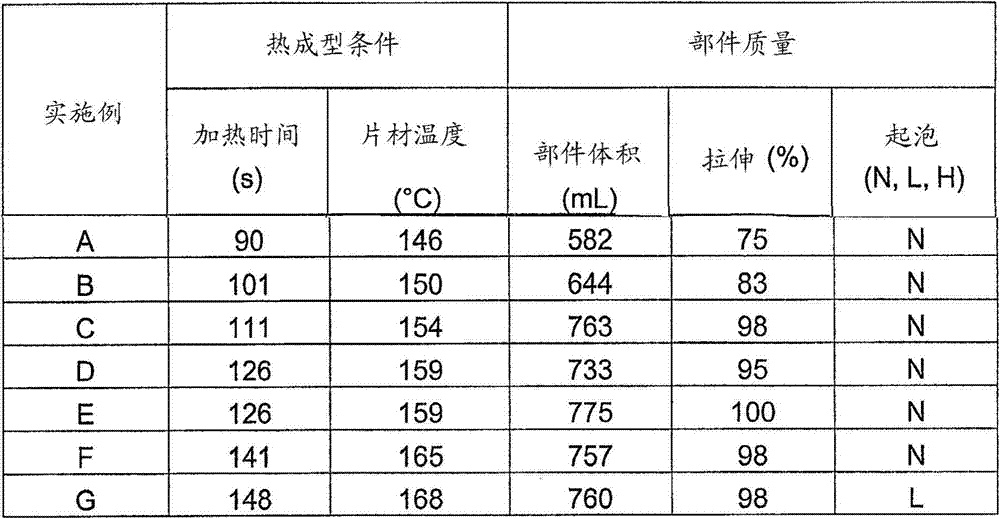
实施例10-对比例 Embodiment 10-comparative example
使用3.5英寸单螺杆挤出机生产由Kelvx201组成的片材。将片材连续地挤出,校正到177密耳的厚度,然后将各种片材剪切达到尺寸要求。在一个片材上检测玻璃化转变温度,测得是100℃。然后将片材在100%相对湿度和25℃下调节两星期。随后使用Brown热成型机将片材热成型到拉伸比为2.5:1的阴模中。热成型烘箱加热器设定为60/40/40%输出,仅仅使用顶部加热。将片材在烘箱中保持各种时间以测定片材温度对部件质量的影响,如下表所示。部件质量通过检测热成型部件的体积、计算拉伸和目测观察热成型部件来确定。拉伸通过用部件体积除以在此组实验中达到的最大部件体积(实施例H)来计算。目测观察热成型的部件中的任何起泡,起泡程度评价为无(N)、低(L)或高(H)。下述结果证明这些玻璃化转变温度为100℃的热塑性片材可以在下述条件下热成型,这表现为这些片材具有至少95%的拉伸,没有起泡,且在热成型之前没有预先干燥片材。 Sheets consisting of Kelvx201 were produced using a 3.5 inch single screw extruder. The sheets were continuously extruded, calibrated to a thickness of 177 mils, and the various sheets were then cut to size. The glass transition temperature was measured on one sheet and found to be 100°C. The sheets were then conditioned for two weeks at 100% relative humidity and 25°C. The sheet was then thermoformed into a female mold with a draw ratio of 2.5:1 using a Brown thermoformer. The thermoforming oven heaters were set at 60/40/40% output, using top heat only. Sheets were kept in the oven for various times to determine the effect of sheet temperature on part quality, as shown in the table below. Part quality is determined by measuring the volume of the thermoformed part, calculating the stretch and visually observing the thermoformed part. Stretch was calculated by dividing the part volume by the maximum part volume achieved in this set of experiments (Example H). The thermoformed parts were visually observed for any blistering and the degree of blistering was rated as none (N), low (L) or high (H). The results below demonstrate that these thermoplastic sheets having a glass transition temperature of 100°C can be thermoformed under the following conditions, as shown by the sheets having at least 95% elongation, no blistering, and no pre-drying prior to thermoforming Sheet. the

NA=未记录 NA=not recorded
实施例11-对比例 Embodiment 11-comparative example
使用3.5英寸单螺杆挤出机生产由PCTG25976(100摩尔%对苯二甲酸残基、62摩尔%的1,4-环己烷二甲醇残基和38摩尔%的乙二醇残基)组成的片材。将片材连续地挤出,校正到118密耳的厚度,然后将各种片材剪切达到尺寸要求。在一个片材上检测玻璃化转变温度,测得是87℃。然后将片材在50%相对湿度和60℃下调节四星期。测得水含量是0.17重量%。随后使用Brown热成型机将片材热成型到拉伸比为2.5:1的阴模中。热成型烘箱加热器设定为70/60/60%输出,仅仅使用顶部加热。将片材在烘箱中保持各种时间以测定片材温度对部件质量的影响,如下表所示。部件质量通过检测热成型部件的体积、计算拉伸和目测观察热成型部件来确定。拉伸通过用部件体积除以在此组实验中达到的最大部件体积(实施例A)来计算。目测观察热成型的部件中的任何起泡,起泡程度评价为无(N)、低(L)或高(H)。下述结果证明这些玻璃化转变温度为87℃的热塑性片材可以在下述条件下热成型,这表现为这些片材具有大于95%的拉伸,没有起泡,且在热成型之前没有预先干燥片材。 A 3.5-inch single-screw extruder was used to produce PCTG25976 (100 mole percent terephthalic acid residues, 62 mole percent 1,4-cyclohexanedimethanol residues, and 38 mole percent ethylene glycol residues) Sheet. The sheets were continuously extruded, calibrated to a thickness of 118 mils, and the various sheets were then cut to size. The glass transition temperature was measured on one sheet and found to be 87°C. The sheets were then conditioned for four weeks at 50% relative humidity and 60°C. The water content was measured to be 0.17% by weight. The sheet was then thermoformed into a female mold with a draw ratio of 2.5:1 using a Brown thermoformer. The thermoforming oven heaters were set at 70/60/60% output, using top heat only. Sheets were kept in the oven for various times to determine the effect of sheet temperature on part quality, as shown in the table below. Part quality is determined by measuring the volume of the thermoformed part, calculating the stretch and visually observing the thermoformed part. Stretch was calculated by dividing the part volume by the maximum part volume achieved in this set of experiments (Example A). The thermoformed parts were visually observed for any blistering and the degree of blistering was rated as none (N), low (L) or high (H). The results below demonstrate that these thermoplastic sheets with a glass transition temperature of 87°C can be thermoformed under the following conditions, as shown by the sheets having greater than 95% elongation, no blistering, and no pre-drying prior to thermoforming Sheet. the

实施例12-对比例 Embodiment 12-comparative example
使用1.25英寸单螺杆挤出机生产由20重量%的Teijin L-1250聚碳酸酯(一种双酚A聚碳酸酯)、79.85重量%的PCTG25976和0.15重量%Weston619组成的可混溶性共混物。然后使用3.5英寸单螺杆挤出机生产由这种共混物组成的片材。将片材连续地挤出,校正到118密耳的厚度,然后将各种片材剪切达到尺寸要求。在一个片材上检测玻璃化转变温度,测得是94℃。然后将片材在50%相对湿度和60℃下调节四星期。测得水含量是0.25重量%。随后使用Brown热成型机将片材热成型到拉伸比为2.5:1的阴模中。热成型烘箱加热器设定为70/60/60%输出,仅仅使用顶部加热。将片材在烘箱中保持各种时间以测定片材温度对部件质量的影响,如下表所示。部件质量通过检测热成型部件的体积、计算拉伸和目测观察热成型部件来确定。拉伸通过用部件体积除以在此组实验中达到的最大部件体积(实施例(A)来计算。目测观察热成型的部件中的任何起泡,起泡程度评价为无(N)、低(L)或高(H)。下述结果证明这些玻璃化转变温度为94℃的热塑性片材可以在下述条件下热成型,这表现为这些片材具有大于95%的拉伸,没有起泡,且在热成型之前没有预先干燥片材。 A 1.25 inch single screw extruder was used to produce a miscible blend consisting of 20 wt% Teijin L-1250 polycarbonate (a bisphenol A polycarbonate), 79.85 wt% PCTG25976 and 0.15 wt% Weston619 . Sheets consisting of this blend were then produced using a 3.5 inch single screw extruder. The sheets were continuously extruded, calibrated to a thickness of 118 mils, and the various sheets were then cut to size. The glass transition temperature was measured on one sheet and found to be 94°C. The sheets were then conditioned for four weeks at 50% relative humidity and 60°C. The water content was measured to be 0.25% by weight. The sheet was then thermoformed into a female mold with a draw ratio of 2.5:1 using a Brown thermoformer. The thermoforming oven heaters were set at 70/60/60% output, using top heat only. Sheets were kept in the oven for various times to determine the effect of sheet temperature on part quality, as shown in the table below. Part quality is determined by measuring the volume of the thermoformed part, calculating the stretch and visually observing the thermoformed part. Stretch was calculated by dividing the part volume by the maximum part volume achieved in this set of experiments (Example (A). Any blistering in the thermoformed part was visually observed and the degree of blistering was rated as None (N), Low (L) or high (H). The following results demonstrate that these thermoplastic sheets with a glass transition temperature of 94°C can be thermoformed under the following conditions, which is shown by these sheets having greater than 95% elongation without blistering , without pre-drying the sheet before thermoforming.

实施例13-对比例 Embodiment 13-comparative example
使用1.25英寸单螺杆挤出机生产由30重量%的Teijin L-1250聚碳酸酯、69.85重量%的PCTG 25976和0.15重量%Weston619组成的可混溶性共混物。然后使用3.5英寸单螺杆挤出机生产由这种共混物组成的片材。将片材连续地挤出,校正到118密耳的厚度,然后将各种片材剪切达到尺寸要求。在一个片材上检测玻璃化转变温度,测得是99℃。然后将片材在50%相对湿度和60℃下调节四星期。测得水含量是0.25重量%。随后使用Brown热成型机将片材热成型到拉伸比为2.5∶1的阴模中。热成型烘箱加热器设定为70/60/60%输出,仅仅使用顶部加热。将片材在烘箱中保持各种时间以测定片材温度对部件质量的影响,如下表所示。部件质量通过检测热成型部件的体积、计算拉伸和目测观察热成型部件来确定。拉伸通过用部件体积除以在此组实验中达到的最大部件体积(实施例(A)来计算。目测观察热成型的部件中的任何起泡,起泡程度评价为无(N)、低(L)或高(H)。下述结果证明这些玻璃化转变温度为99℃的热塑性片材可以在下述条件下热成型,这表现为这些片材具有大于95%的拉伸,没有起泡,且在热成型之前没有预先干燥片材。 A 1.25 inch single screw extruder was used to produce a miscible blend consisting of 30% by weight Teijin L-1250 polycarbonate, 69.85% by weight PCTG 25976 and 0.15% by weight Weston 619. Sheets consisting of this blend were then produced using a 3.5 inch single screw extruder. The sheets were continuously extruded, calibrated to a thickness of 118 mils, and the various sheets were then cut to size. The glass transition temperature was measured on one sheet and found to be 99°C. The sheets were then conditioned for four weeks at 50% relative humidity and 60°C. The water content was measured to be 0.25% by weight. The sheet was then thermoformed into a female mold with a draw ratio of 2.5:1 using a Brown thermoformer. The thermoforming oven heaters were set at 70/60/60% output, using top heat only. Sheets were kept in the oven for various times to determine the effect of sheet temperature on part quality, as shown in the table below. Part quality is determined by measuring the volume of the thermoformed part, calculating the stretch and visually observing the thermoformed part. Stretch was calculated by dividing the part volume by the maximum part volume achieved in this set of experiments (Example (A). Any blistering in the thermoformed part was visually observed and the degree of blistering was rated as None (N), Low (L) or High (H). The following results demonstrate that these thermoplastic sheets with a glass transition temperature of 99°C can be thermoformed under the following conditions, which is shown by these sheets having greater than 95% elongation without blistering , without pre-drying the sheet before thermoforming.
NA=未获得。零值表示因为片材没有进入模具而没有形成片材(似乎是因为太冷)。 NA=not obtained. A value of zero indicates that no sheet was formed because the sheet did not enter the mold (seemingly because it was too cold). the
实施例14-对比例 Embodiment 14-comparative example
使用1.25英寸单螺杆挤出机生产由40重量%的Teijin L-1250聚碳酸酯、59.85重量%的PCTG25976和0.15重量%Weston619组成的可混溶性共混物。然后使用3.5英寸单螺杆挤出机生产由这种共混物组成的片材。将片材连续地挤出,校正到118密耳的厚度,然后将各种片材剪切达到尺寸要求。在一个片材上检测玻璃化转变温度,测得是105℃。然后将片材在50%相对湿度和60℃下调节四星期。测得水含量是0.265重量%。随后使用Brown热成型机将片材热成型到拉伸比为2.5:1的阴模中。热成型烘箱加热器设定为70/60/60%输出,仅仅使用顶部加热。将片材在烘箱中保持各种时间以测定片材温度对部件质量的影响,如下表所示。部件质量通过检测热成型部件的体积、计算拉伸和目测观察热成型部件来确定。拉伸通过用部件体积除以在此组实验中达到的最大部件体积(实施例8A-8E)来计算。目测观察热成型的部件中的任何起泡,起泡程度评价为无(N)、低(L)或高(H)。下述结果证明这些玻璃化转变温度为105℃的热塑性片材可以在下述条件下热成型,这表现为这些片材具有大于95%的拉伸,没有起泡,且在热成型之前没有预先干燥片材。 A 1.25 inch single screw extruder was used to produce a miscible blend consisting of 40% by weight Teijin L-1250 polycarbonate, 59.85% by weight PCTG25976 and 0.15% by weight Weston 619. Sheets consisting of this blend were then produced using a 3.5 inch single screw extruder. The sheets were continuously extruded, calibrated to a thickness of 118 mils, and the various sheets were then cut to size. The glass transition temperature was measured on one sheet and found to be 105°C. The sheets were then conditioned for four weeks at 50% relative humidity and 60°C. The water content was measured to be 0.265% by weight. The sheet was then thermoformed into a female mold with a draw ratio of 2.5:1 using a Brown thermoformer. The thermoforming oven heaters were set at 70/60/60% output, using top heat only. Sheets were kept in the oven for various times to determine the effect of sheet temperature on part quality, as shown in the table below. Part quality is determined by measuring the volume of the thermoformed part, calculating the stretch and visually observing the thermoformed part. Stretch was calculated by dividing the part volume by the maximum part volume achieved in this set of experiments (Examples 8A-8E). The thermoformed parts were visually observed for any blistering and the degree of blistering was rated as none (N), low (L) or high (H). The results below demonstrate that these thermoplastic sheets with a glass transition temperature of 105°C can be thermoformed under the following conditions, as shown by the sheets having greater than 95% elongation, no blistering, and no pre-drying prior to thermoforming Sheet. the

实施例15-对比例 Embodiment 15-comparative example
使用1.25英寸单螺杆挤出机生产由50重量%的Teijin L-1250聚碳酸酯、49.85重量%的PCTG25976和0.15重量%Weston619组成的可混溶性共混物。将片材连续地挤出,校正到118密耳的厚度,然后将各种片材剪切达到尺寸要求。在一个片材上检测玻璃化转变温度,测得是111℃。然后将片材在50%相对湿度和60℃下调节四星期。测得水含量是0.225重量%。随后使用Brown热成型机将片材热成型到拉伸比为2.5∶1的阴模中。热成型烘箱加热器设定为70/60/60%输出,仅仅使用顶部加热。将片材在烘箱中保持各种时间以测定片材温度对部件质量的影响,如下表所示。部件质量通过检测热成型部件的体积、计算拉伸和目测观察热成型部件来确定。拉伸通过用部件体积除以在此组实验中达到的最大部件体积(实施例A-D)来计算。目测观察热成型的部件中的任何起泡,起泡程度评价为无(N)、低(L)或高(H)。下述结果证明这些玻璃化转变温度为111℃的热塑性片材可以在下述条件下热成型,这表现为这些片材具有大于95%的拉伸,没有起泡,且在热成型之前没有预先干燥片材。 A 1.25 inch single screw extruder was used to produce a miscible blend consisting of 50% by weight Teijin L-1250 polycarbonate, 49.85% by weight PCTG25976 and 0.15% by weight Weston 619. The sheets were continuously extruded, calibrated to a thickness of 118 mils, and the various sheets were then cut to size. The glass transition temperature was measured on one sheet and found to be 111°C. The sheets were then conditioned for four weeks at 50% relative humidity and 60°C. The water content was measured to be 0.225% by weight. The sheet was then thermoformed into a female mold with a draw ratio of 2.5:1 using a Brown thermoformer. The thermoforming oven heaters were set at 70/60/60% output, using top heat only. Sheets were kept in the oven for various times to determine the effect of sheet temperature on part quality, as shown in the table below. Part quality is determined by measuring the volume of the thermoformed part, calculating the stretch and visually observing the thermoformed part. Stretch was calculated by dividing the part volume by the maximum part volume achieved in this set of experiments (Examples A-D). The thermoformed parts were visually observed for any blistering and the degree of blistering was rated as none (N), low (L) or high (H). The results below demonstrate that these thermoplastic sheets with a glass transition temperature of 111°C can be thermoformed under the following conditions, as shown by the sheets having greater than 95% elongation, no blistering, and no pre-drying prior to thermoforming Sheet. the

NA=未获得。零值表示因为片材没有进入模具而没有形成片材(似乎是因为太冷)。 NA=not obtained. A value of zero indicates that no sheet was formed because the sheet did not enter the mold (seemingly because it was too cold). the
实施例16-对比例 Embodiment 16-comparative example
使用1.25英寸单螺杆挤出机生产由60重量%的Teijin L-1250聚碳酸酯、39.85重量%的PCTG25976和0.15重量%Weston619组成的可混溶性共混物。然后使用3.5英寸单螺杆挤出机生产由这种共混物组成的片材。将片材连续地挤出,校正到118密耳的厚度,然后将各种片材剪切达到尺寸要求。在一个片材上检测玻璃化转变温度,测得是117℃。然后将片材在50%相对湿度和60℃下调节四星期。测得水含量是0.215重量%。随后使用Brown热成型机将片材热成型到拉伸比为2.5:1的阴模中。热成型烘箱加热器设定为70/60/60%输出,仅仅使用顶部加热。将片材在烘箱中保持各种时间以测定片材温度对部件质量的影响,如下表所示。部件质量通过检测热成型部件的体积、计算拉伸和目测观察热成型部件来确定。拉伸通过用部件体积除以在此组实验中达到的最大部件体积(实施例(A)来计算。目测观察热成型的部件中的任何起泡,起泡程度评价为无(N)、低(L)或高(H)。下述结果证明这些玻璃化转变温度为117℃的热塑性片材可以在下述条件下不能热成型,这表现为在热成型之前没有预先干燥片材的情况下不能生产具有大于95%的拉伸且没有起泡的片材。 A 1.25 inch single screw extruder was used to produce a miscible blend consisting of 60% by weight Teijin L-1250 polycarbonate, 39.85% by weight PCTG25976 and 0.15% by weight Weston 619. Sheets consisting of this blend were then produced using a 3.5 inch single screw extruder. The sheets were continuously extruded, calibrated to a thickness of 118 mils, and the various sheets were then cut to size. The glass transition temperature was measured on one sheet and found to be 117°C. The sheets were then conditioned for four weeks at 50% relative humidity and 60°C. The water content was measured to be 0.215% by weight. The sheet was then thermoformed into a female mold with a draw ratio of 2.5:1 using a Brown thermoformer. The thermoforming oven heaters were set at 70/60/60% output, using top heat only. Sheets were kept in the oven for various times to determine the effect of sheet temperature on part quality, as shown in the table below. Part quality is determined by measuring the volume of the thermoformed part, calculating the stretch and visually observing the thermoformed part. Stretch was calculated by dividing the part volume by the maximum part volume achieved in this set of experiments (Example (A). Any blistering in the thermoformed part was visually observed and the degree of blistering was rated as None (N), Low (L) or high (H). The following results demonstrate that these thermoplastic sheets with a glass transition temperature of 117°C can not be thermoformed under the following conditions, which is shown as not being able to Produces sheets with greater than 95% stretch without blistering.
实施例17-对比例 Embodiment 17-comparative example
使用1.25英寸单螺杆挤出机生产由65重量%的Teijin L-1250聚碳酸酯、34.85重量%的PCTG25976和0.15重量%Weston619组成的可混溶性共混物。然后使用3.5英寸单螺杆挤出机生产由这种共混物组成的片材。将片材连续地挤出,校正到118密耳的厚度,然后将各种片材剪切达到尺寸要求。在一个片材上检测玻璃化转变温度,测得是120℃。然后将片材在50%相对湿度和60℃下调节四星期。测得水含量是0.23重量%。随后使用Brown热成型机将片材热成型到拉伸比为2.5∶1的阴模中。热成型烘箱加热器设定为70/60/60%输出,仅仅使用顶部加热。将片材在烘箱中保持各种时间以测定片材温度对部件质量的影响,如下表所示。部件质量通过检测热成型部件的体积、计算拉伸和目测观察热成型部件来确定。拉伸通过用部件体积除以在此组实验中达到的最大部件体积(实施例(A)来计算。目测观察热成型的部件中的任何起泡,起泡程度评价为无(N)、低(L)或高(H)。下述结果证明这些玻璃化转变温度为120℃的热塑性片材可以在下述条件下不能热成型,这表现为在热成型之前没有预先干燥片材的情况下不能生产具有大于95%的拉伸且没有起泡的片材。 A 1.25 inch single screw extruder was used to produce a miscible blend consisting of 65% by weight Teijin L-1250 polycarbonate, 34.85% by weight PCTG25976 and 0.15% by weight Weston 619. Sheets consisting of this blend were then produced using a 3.5 inch single screw extruder. The sheets were continuously extruded, calibrated to a thickness of 118 mils, and the various sheets were then cut to size. The glass transition temperature was measured on one sheet and found to be 120°C. The sheets were then conditioned for four weeks at 50% relative humidity and 60°C. The water content was measured to be 0.23% by weight. The sheet was then thermoformed into a female mold with a draw ratio of 2.5:1 using a Brown thermoformer. The thermoforming oven heaters were set at 70/60/60% output, using top heat only. Sheets were kept in the oven for various times to determine the effect of sheet temperature on part quality, as shown in the table below. Part quality is determined by measuring the volume of the thermoformed part, calculating the stretch and visually observing the thermoformed part. Stretch was calculated by dividing the part volume by the maximum part volume achieved in this set of experiments (Example (A). Any blistering in the thermoformed part was visually observed and the degree of blistering was rated as None (N), Low (L) or high (H). The following results demonstrate that these thermoplastic sheets with a glass transition temperature of 120°C can not be thermoformed under the following conditions, which is shown to be impossible without pre-drying the sheet before thermoforming. Produces sheets with greater than 95% stretch without blistering.

实施例18-对比例 Embodiment 18-comparative example
使用1.25英寸单螺杆挤出机生产由70重量%的Teijin L-1250聚碳酸酯、29.85重量%的PCTG25976和0.15重量%Weston619组成的可混溶性共混物。然后使用3.5英寸单螺杆挤出机生产由这种共混物组成的片材。将片材连续地挤出,校正到118密耳的厚度,然后将各种片材剪切达到尺寸要求。在一个片材上检测玻璃化转变温度,测得是123℃。然后将片材在50%相对湿度和60℃下调节四星期。测得水含量是0.205重量%。随后使用Brown热成型机将片材热成型到拉伸比为2.5:1的阴模中。热成型烘箱加热器设定为70/60/60%输出,仅仅使用顶部加热。将片材在烘箱中保持各种时间以测定片材温度对部件质量的影响,如下表所示。部件质量通过检测热成型部件的体积、计算拉伸和目测观察热成型部件来确定。拉伸通过用部件体积除以在此组实验中达到的最大部件体积(实施例A和(B)来计算。目测观察热成型的部件中的任何起泡,起泡程度评价为无(N)、低(L)或高(H)。下述结果证明这些玻璃化转变温度为123℃的热塑性片材可以在下述条件下不能热成型,这表现为在热成型之前没有预先干燥片材的情况下不能生产具有大于95%的拉伸且没有起泡的片材。 A 1.25 inch single screw extruder was used to produce a miscible blend consisting of 70% by weight Teijin L-1250 polycarbonate, 29.85% by weight PCTG25976 and 0.15% by weight Weston 619. Sheets consisting of this blend were then produced using a 3.5 inch single screw extruder. The sheets were continuously extruded, calibrated to a thickness of 118 mils, and the various sheets were then cut to size. The glass transition temperature was measured on one sheet and found to be 123°C. The sheets were then conditioned for four weeks at 50% relative humidity and 60°C. The water content was measured to be 0.205% by weight. The sheet was then thermoformed into a female mold with a draw ratio of 2.5:1 using a Brown thermoformer. The thermoforming oven heaters were set at 70/60/60% output, using top heat only. Sheets were kept in the oven for various times to determine the effect of sheet temperature on part quality, as shown in the table below. Part quality is determined by measuring the volume of the thermoformed part, calculating the stretch and visually observing the thermoformed part. Stretch was calculated by dividing the part volume by the maximum part volume achieved in this set of experiments (Examples A and (B). Any blistering in the thermoformed part was visually observed and the degree of blistering was rated as None (N). , low (L) or high (H). The following results demonstrate that these thermoplastic sheets with a glass transition temperature of 123°C can not be thermoformed under the following conditions, which is shown without pre-drying the sheets before thermoforming Sheets with stretch greater than 95% without blistering cannot be produced under this condition.

NA=未获得。零值表示因为片材没有进入模具而没有形成片材(似乎是因为太冷)。 NA=not obtained. A value of zero indicates that no sheet was formed because the sheet did not enter the mold (seemingly because it was too cold). the
实施例19-对比例 Embodiment 19-comparative example
使用3.5英寸单螺杆挤出机生产由Teijin L-1250聚碳酸酯组成的片材。将片材连续地挤出,校正到118密耳的厚度,然后将各种片材剪切达到尺寸要求。在一个片材上检测玻璃化转变温度,测得是149℃。然后将片材在50%相对湿度和60℃下调节四星期。测得水含量是0.16重量%。随后使用Brown热成型机将片材热成型到拉伸比为2.5:1的阴模中。热成型烘箱加热器设定为70/60/60%输出,仅仅使用顶部加热。将片材在烘箱中保持各种时间以测定片材温度对部件质量的影响,如下表所示。部件质量通过检测热成型部件的体积、计算拉伸和目测观察热成型部件来确定。拉伸通过用部件体积除以在此组实验中达到的最大部件体积(实施例(A)来计算。目测观察热成型的部件中的任何起泡,起泡程度评价为无(N)、低(L)或高(H)。下述结果证明这些玻璃化转变温度为149℃的热塑性片材可以在下述条件下不能热成型,这表现为在热成型之前没有预先干燥片材的情况下不能生产具有大于95%的拉伸且没有起泡的片材。 Sheets consisting of Teijin L-1250 polycarbonate were produced using a 3.5-inch single-screw extruder. The sheets were continuously extruded, calibrated to a thickness of 118 mils, and the various sheets were then cut to size. The glass transition temperature was measured on one sheet and found to be 149°C. The sheets were then conditioned for four weeks at 50% relative humidity and 60°C. The water content was measured to be 0.16% by weight. The sheet was then thermoformed into a female mold with a draw ratio of 2.5:1 using a Brown thermoformer. The thermoforming oven heaters were set at 70/60/60% output, using top heat only. Sheets were kept in the oven for various times to determine the effect of sheet temperature on part quality, as shown in the table below. Part quality is determined by measuring the volume of the thermoformed part, calculating the stretch and visually observing the thermoformed part. Stretch was calculated by dividing the part volume by the maximum part volume achieved in this set of experiments (Example (A). Any blistering in the thermoformed part was visually observed and the degree of blistering was rated as None (N), Low (L) or high (H). The following results demonstrate that these thermoplastic sheets with a glass transition temperature of 149°C can not be thermoformed under the following conditions, which is shown to be impossible without pre-drying the sheet before thermoforming. Produces sheets with greater than 95% stretch without blistering.

NA=未获得。零值表示因为片材没有进入模具而没有形成片材(似乎是因为太冷)。 NA=not obtained. A value of zero indicates that no sheet was formed because the sheet did not enter the mold (seemingly because it was too cold). the
从上述相关工作实施例的数据比较显然可见,与商业聚酯相比,本发明的聚酯提供了在玻璃化转变温度、密度、慢结晶速率、熔体粘度和韧性方面的显著优点。 It is evident from the above comparison of the data of the related working examples that the polyesters of the present invention offer significant advantages in terms of glass transition temperature, density, slow crystallization rate, melt viscosity and toughness compared to commercial polyesters. the
已经参考本文公开的实施方案详细描述了本发明,但是应该理解的是可以在本发明的主旨和范围内进行变化和改进。 The invention has been described in detail with reference to the embodiments disclosed herein, but it should be understood that changes and modifications can be made within the spirit and scope of the invention. the
Claims (33)
Applications Claiming Priority (18)
| Application Number | Priority Date | Filing Date | Title |
|---|---|---|---|
| US69156705P | 2005-06-17 | 2005-06-17 | |
| US60/691567 | 2005-06-17 | ||
| US73138905P | 2005-10-28 | 2005-10-28 | |
| US73145405P | 2005-10-28 | 2005-10-28 | |
| US60/731454 | 2005-10-28 | ||
| US60/731389 | 2005-10-28 | ||
| US73886905P | 2005-11-22 | 2005-11-22 | |
| US73905805P | 2005-11-22 | 2005-11-22 | |
| US60/738869 | 2005-11-22 | ||
| US60/739058 | 2005-11-22 | ||
| US75069205P | 2005-12-15 | 2005-12-15 | |
| US75069305P | 2005-12-15 | 2005-12-15 | |
| US75068205P | 2005-12-15 | 2005-12-15 | |
| US75054705P | 2005-12-15 | 2005-12-15 | |
| US60/750682 | 2005-12-15 | ||
| US60/750692 | 2005-12-15 | ||
| US60/750547 | 2005-12-15 | ||
| US60/750693 | 2005-12-15 |
Related Parent Applications (1)
| Application Number | Title | Priority Date | Filing Date |
|---|---|---|---|
| CNA2006800207458A Division CN101193946A (en) | 2005-06-17 | 2006-03-30 | Films and/or sheets made from polyester compositions containing small amounts of cyclobutanediol |
Publications (1)
| Publication Number | Publication Date |
|---|---|
| CN103755930A true CN103755930A (en) | 2014-04-30 |
Family
ID=36630440
Family Applications (1)
| Application Number | Title | Priority Date | Filing Date |
|---|---|---|---|
| CN201310616094.0A Pending CN103755930A (en) | 2005-06-17 | 2006-03-30 | Film(s) and/or sheet(s) formed of polyester compositions containing minimal amounts of cyclobutanediol |
Country Status (17)
| Country | Link |
|---|---|
| US (59) | US7868128B2 (en) |
| EP (49) | EP1899400B1 (en) |
| JP (38) | JP2008546442A (en) |
| KR (14) | KR101249616B1 (en) |
| CN (1) | CN103755930A (en) |
| AR (1) | AR055897A1 (en) |
| AT (20) | ATE458772T1 (en) |
| AU (2) | AU2006262854A1 (en) |
| BR (3) | BRPI0613698A2 (en) |
| DE (19) | DE602006007345D1 (en) |
| ES (1) | ES2341482T3 (en) |
| IL (3) | IL188025A0 (en) |
| MX (5) | MX2007015687A (en) |
| MY (2) | MY145986A (en) |
| PL (3) | PL1891131T3 (en) |
| TW (9) | TW200700496A (en) |
| WO (39) | WO2007001536A1 (en) |
Cited By (6)
| Publication number | Priority date | Publication date | Assignee | Title |
|---|---|---|---|---|
| CN114206615A (en) * | 2019-08-02 | 2022-03-18 | 伊士曼化工公司 | Multilayer sheet |
| CN115666939A (en) * | 2020-04-13 | 2023-01-31 | 伊士曼化工公司 | Hot-fillable articles made from multilayer thermoformable films and sheets |
| CN116615483A (en) * | 2020-11-17 | 2023-08-18 | 伊士曼化工公司 | Molded articles for use with terpene containing oils |
| WO2023206073A1 (en) * | 2022-04-26 | 2023-11-02 | Eastman Chemical (China) Co., Ltd. | Flame retardant copolyester compositions |
| WO2024164940A1 (en) * | 2023-02-09 | 2024-08-15 | Eastman Chemical (China) Co., Ltd. | Molded polyester articles with improved aesthetic chemical resistance |
| CN119081084A (en) * | 2024-09-06 | 2024-12-06 | 中国科学院理化技术研究所 | A transparent biodegradable copolyester and its preparation method and application |
Families Citing this family (276)
| Publication number | Priority date | Publication date | Assignee | Title |
|---|---|---|---|---|
| IL150601A (en) * | 2001-07-19 | 2010-06-30 | Organon Nv | Process for rapid solution synthesis of peptides using an excess of activated carboxylic component and scavenging the residual activated carboxylic component |
| WO2007053549A1 (en) * | 2005-10-28 | 2007-05-10 | Eastman Chemical Company | Polyester compositions containing cyclobutanediol having a certain combination of inherent viscosity and moderate glass transition temperature and articles made therefrom |
| US7868128B2 (en) * | 2005-06-17 | 2011-01-11 | Eastman Chemical Company | Skylights and windows comprising polyester compositions formed from 2,2,4,4,-tetramethyl-1,3-cyclobutanediol and 1,4-cyclohexanedimethanol |
| US20130072628A1 (en) * | 2005-06-17 | 2013-03-21 | Eastman Chemical Company | Coating compositions containing cyclobutanediol |
| US7704605B2 (en) * | 2006-03-28 | 2010-04-27 | Eastman Chemical Company | Thermoplastic articles comprising cyclobutanediol having a decorative material embedded therein |
| EP1910466B1 (en) * | 2005-06-17 | 2008-10-15 | Eastman Chemical Company | Process for the preparation of transparent, shaped articles containing polyesters comprising a cyclobutanediol |
| EP1940907B1 (en) * | 2005-10-28 | 2011-04-13 | Eastman Chemical Company | Polyester compositions containing cyclobutanediol having high glass transition temperature and articles made therefrom |
| US8586701B2 (en) | 2005-10-28 | 2013-11-19 | Eastman Chemical Company | Process for the preparation of copolyesters based on 2,2,4,4-tetramethyl-1,3-cyclobutanediol and 1,4-cyclohexanedimethanol |
| US9598533B2 (en) | 2005-11-22 | 2017-03-21 | Eastman Chemical Company | Polyester compositions containing cyclobutanediol having a certain combination of inherent viscosity and moderate glass transition temperature and articles made therefrom |
| US9169388B2 (en) | 2006-03-28 | 2015-10-27 | Eastman Chemical Company | Polyester compositions which comprise cyclobutanediol and certain thermal stabilizers, and/or reaction products thereof |
| JP4923671B2 (en) * | 2006-03-29 | 2012-04-25 | ソニー株式会社 | Liquid crystal display |
| US8083094B2 (en) | 2006-08-10 | 2011-12-27 | Capitol Vial Inc. | Container and cap assembly |
| US20110089187A1 (en) * | 2006-08-10 | 2011-04-21 | Capitol Vial Inc. | Shatterproof Container And Cap Assembly |
| US20080053752A1 (en) * | 2006-09-06 | 2008-03-06 | Peter Miller | System and method for securing a window in a panel |
| US8287991B2 (en) * | 2006-10-04 | 2012-10-16 | Eastman Chemical Company | Using branched polymers to control the dimensional stability of articles in the lamination process |
| US20080085390A1 (en) * | 2006-10-04 | 2008-04-10 | Ryan Thomas Neill | Encapsulation of electrically energized articles |
| US8080191B2 (en) * | 2006-10-20 | 2011-12-20 | Pepsico, Inc. | Extrudable polyethylene terephthalate blend |
| WO2008088336A1 (en) * | 2007-01-18 | 2008-07-24 | Sabic Innovative Plastics Ip B.V. | COATED ARTICLES OF MANUFACTURE MADE OF HIGH Tg POLYMER BLENDS |
| US7753518B2 (en) * | 2007-03-08 | 2010-07-13 | Okia Optical Co., Ltd | Eyeglasses and eyeglass frames comprising glycol modified copolyesters |
| JP5346443B2 (en) | 2007-04-16 | 2013-11-20 | ローム株式会社 | Semiconductor light emitting device and manufacturing method thereof |
| US8198979B2 (en) * | 2007-04-20 | 2012-06-12 | Ink-Logix, Llc | In-molded resistive and shielding elements |
| EP2149143A4 (en) * | 2007-04-20 | 2012-01-11 | Ink Logix Llc | In-molded capacitive switch |
| KR101543043B1 (en) * | 2007-05-10 | 2015-08-07 | 이스트만 케미칼 캄파니 | 2244--13- 14- process for the preparation of copolyesters based on 2244-tetramethyl-13-cyclobutanediol and 14-cyclohexanedimethanol |
| WO2009012190A1 (en) * | 2007-07-15 | 2009-01-22 | Yin Wang | Wood-drying solar greenhouse |
| US20090023885A1 (en) * | 2007-07-16 | 2009-01-22 | Texas State University - San Marcos | Treatment method for imparting high impact resistance in certain cbdo copolymers |
| US7772362B2 (en) * | 2007-07-16 | 2010-08-10 | Texas State University | Treatment method for imparting self-healing and shape memory properties to certain CBDO copolymers |
| CN101434744B (en) * | 2007-11-14 | 2013-12-18 | 财团法人工业技术研究院 | Blends and Encapsulation Materials |
| US8287970B2 (en) * | 2007-11-21 | 2012-10-16 | Eastman Chemical Company | Plastic baby bottles, other blow molded articles, and processes for their manufacture |
| US8501287B2 (en) * | 2007-11-21 | 2013-08-06 | Eastman Chemical Company | Plastic baby bottles, other blow molded articles, and processes for their manufacture |
| GB0800459D0 (en) * | 2008-01-11 | 2008-02-20 | Innovata Biomed Ltd | Improvements in or relating to inhalers |
| DE202008005269U1 (en) * | 2008-02-28 | 2008-08-21 | Mapa Gmbh Gummi- Und Plastikwerke | Soother with a sucking part fixed to a mouth shield |
| TR201904238T4 (en) | 2008-04-18 | 2019-04-22 | Pepsico Inc | Polyester compositions and method for preparing products by extrusion blow molding. |
| US7901780B2 (en) * | 2008-06-25 | 2011-03-08 | Solutia Inc. | Polymer interlayers comprising blends of plasticized poly(vinyl butyral) and poly(cyclohexanedimethylene terephthalate-co-ethylene terephthalate) copolyester |
| US8198371B2 (en) * | 2008-06-27 | 2012-06-12 | Eastman Chemical Company | Blends of polyesters and ABS copolymers |
| US7960007B2 (en) * | 2008-07-11 | 2011-06-14 | Teknor Apex Company | Retortable liners and containers |
| US20100143546A1 (en) | 2008-12-09 | 2010-06-10 | The Coca-Cola Company | Container and composition for enhanced gas barrier properties |
| US8110265B2 (en) | 2008-12-09 | 2012-02-07 | The Coca-Cola Company | Pet container and compositions having enhanced mechanical properties and gas barrier properties |
| US8895654B2 (en) * | 2008-12-18 | 2014-11-25 | Eastman Chemical Company | Polyester compositions which comprise spiro-glycol, cyclohexanedimethanol, and terephthalic acid |
| US20100168328A1 (en) * | 2008-12-30 | 2010-07-01 | Ganesh Kannan | Process for the manufacture of polycyclohexane dimethylene terephthalate copolymers from polyethylene terephthalate, and compositions and articles thereof |
| US9161888B2 (en) | 2009-01-13 | 2015-10-20 | Michelle Lamar | Pacifier apparatus |
| US9029460B2 (en) | 2009-02-06 | 2015-05-12 | Stacey James Marsh | Coating compositions containing acrylic and aliphatic polyester blends |
| US8324316B2 (en) * | 2009-02-06 | 2012-12-04 | Eastman Chemical Company | Unsaturated polyester resin compositions containing 2,2,2,4-tetramethyl-1,3-cyclobutanediol and articles made therefrom |
| US9029461B2 (en) | 2009-02-06 | 2015-05-12 | Eastman Chemical Company | Aliphatic polyester coating compositions containing tetramethyl cyclobutanediol |
| US20100210775A1 (en) | 2009-02-13 | 2010-08-19 | Eastman Chemical Company | Reinforced polyester compositions having improved toughness |
| US9062197B2 (en) * | 2009-03-27 | 2015-06-23 | Eastman Chemical Company | Polyester blends |
| WO2010114508A1 (en) | 2009-04-01 | 2010-10-07 | Eastman Chemical Company | Improved process for the production of polyesters |
| EP2441072B1 (en) | 2009-06-08 | 2019-02-20 | Nokia Technologies Oy | Audio processing |
| JP5586177B2 (en) * | 2009-06-23 | 2014-09-10 | 三菱樹脂株式会社 | Laminated sheet and metal plate coated with laminated sheet |
| ES2355220B2 (en) * | 2009-08-17 | 2011-09-19 | Sp Kloner Ecotec, S.L. | STRUCTURAL PROFILES FOR THE MANUFACTURE OF DOMESTIC UTENSILS AND PROCESS TO OBTAIN THOSE PROFILES. |
| KR20110028696A (en) * | 2009-09-14 | 2011-03-22 | 에스케이케미칼주식회사 | Polyester resin copolymerized with isosorbide and 1,4-cyclohexanedimethanol and preparation method thereof |
| US8586652B2 (en) * | 2009-10-09 | 2013-11-19 | Eastman Chemical Company | Polyester compositions for molding clear parts |
| KR101818780B1 (en) * | 2009-10-19 | 2018-01-15 | 이스트만 케미칼 컴파니 | Radio-frequency sealable polymer and articles thereof |
| US8574694B2 (en) | 2009-11-03 | 2013-11-05 | Curwood, Inc. | Packaging sheet with improved cutting properties |
| US20110104342A1 (en) * | 2009-11-03 | 2011-05-05 | Kevin David Glaser | Chlorine-Free Packaging Sheet with Tear-Resistance Properties |
| JP4888853B2 (en) | 2009-11-12 | 2012-02-29 | 学校法人慶應義塾 | Method for improving visibility of liquid crystal display device, and liquid crystal display device using the same |
| US8865790B2 (en) * | 2009-11-20 | 2014-10-21 | Dentsply International Inc. | Dental materials using 2,2,4,4-tetramethyl-1,3-cyclobutanediol |
| FR2957152B1 (en) * | 2010-03-04 | 2012-08-03 | Christian Dalloz Sunoptics | NEW COMPOSITE MATERIAL FOR OPTICAL USE AND METHOD OF OBTAINING THE SAME |
| SG184028A1 (en) * | 2010-03-16 | 2012-10-30 | Sumitomo Bakelite Co | Resin composition sheet, and method for production thereof |
| JP5653061B2 (en) * | 2010-04-09 | 2015-01-14 | 株式会社ジェイエスピー | Thermoplastic resin extrusion foam insulation board for construction or civil engineering |
| BR112012026240B1 (en) | 2010-04-16 | 2021-08-03 | Swimc Llc | ARTICLE, METHOD, AND, COATING COMPOSITION |
| US8283800B2 (en) | 2010-05-27 | 2012-10-09 | Ford Global Technologies, Llc | Vehicle control system with proximity switch and method thereof |
| US8973405B2 (en) | 2010-06-17 | 2015-03-10 | Johns Manville | Apparatus, systems and methods for reducing foaming downstream of a submerged combustion melter producing molten glass |
| US8707740B2 (en) | 2011-10-07 | 2014-04-29 | Johns Manville | Submerged combustion glass manufacturing systems and methods |
| US8991215B2 (en) | 2010-06-17 | 2015-03-31 | Johns Manville | Methods and systems for controlling bubble size and bubble decay rate in foamed glass produced by a submerged combustion melter |
| US9021838B2 (en) | 2010-06-17 | 2015-05-05 | Johns Manville | Systems and methods for glass manufacturing |
| US9032760B2 (en) | 2012-07-03 | 2015-05-19 | Johns Manville | Process of using a submerged combustion melter to produce hollow glass fiber or solid glass fiber having entrained bubbles, and burners and systems to make such fibers |
| US8997525B2 (en) | 2010-06-17 | 2015-04-07 | Johns Manville | Systems and methods for making foamed glass using submerged combustion |
| US9776903B2 (en) | 2010-06-17 | 2017-10-03 | Johns Manville | Apparatus, systems and methods for processing molten glass |
| US8650914B2 (en) | 2010-09-23 | 2014-02-18 | Johns Manville | Methods and apparatus for recycling glass products using submerged combustion |
| US8769992B2 (en) | 2010-06-17 | 2014-07-08 | Johns Manville | Panel-cooled submerged combustion melter geometry and methods of making molten glass |
| US8875544B2 (en) | 2011-10-07 | 2014-11-04 | Johns Manville | Burner apparatus, submerged combustion melters including the burner, and methods of use |
| US8707739B2 (en) | 2012-06-11 | 2014-04-29 | Johns Manville | Apparatus, systems and methods for conditioning molten glass |
| US9096452B2 (en) | 2010-06-17 | 2015-08-04 | Johns Manville | Methods and systems for destabilizing foam in equipment downstream of a submerged combustion melter |
| US10322960B2 (en) | 2010-06-17 | 2019-06-18 | Johns Manville | Controlling foam in apparatus downstream of a melter by adjustment of alkali oxide content in the melter |
| US8973400B2 (en) | 2010-06-17 | 2015-03-10 | Johns Manville | Methods of using a submerged combustion melter to produce glass products |
| CN102959459B (en) | 2010-06-22 | 2019-06-18 | 东洋纺株式会社 | Liquid crystal display device, polarizing plate and polarizing plate protective film |
| US8686072B2 (en) | 2010-06-29 | 2014-04-01 | Sabic Innovative Plastics Ip B.V. | Flame resistant polyester compositions, method of manufacture, and articles therof |
| US8604105B2 (en) | 2010-09-03 | 2013-12-10 | Eastman Chemical Company | Flame retardant copolyester compositions |
| BR112013012716A2 (en) * | 2010-12-06 | 2016-09-06 | Colgate Palmolive Co | laminated tube having a resilience enhanced by a block copolymer |
| US8633262B2 (en) * | 2011-01-17 | 2014-01-21 | Eastman Chemical Company | Haze reduction for blends of aromatic-aliphatic polyesters with aliphatic polyesters and antimicrobial additives |
| DE102011009820A1 (en) * | 2011-01-31 | 2011-10-13 | Mitsubishi Polyester Film Gmbh | Biaxially stretched foil, useful e.g. for electrical insulation, comprises black pigment, diol component made of 1,4-cyclohexane dimethanol, and dicarboxylic acid component made of benzene dicarboxylic acid or naphthalene dicarboxylic acid |
| EP3878912B1 (en) | 2011-02-07 | 2023-04-05 | Swimc Llc | Coating compositions for containers and other articles and methods of coating |
| KR101603097B1 (en) | 2011-02-18 | 2016-03-14 | 미도리안젠 가부시키가이샤 | Transparent resin composition having good chemical resistance, durability and stability under natural environmental conditions, harsher natural environmental conditions, and similar or harsher usage conditions, and product using same |
| WO2012115971A2 (en) * | 2011-02-22 | 2012-08-30 | Polyone Corporation | Polyester compounds suitable for hydroclaving |
| US9090769B2 (en) | 2011-04-05 | 2015-07-28 | Ticona Llc | Molded articles having a swirl-like or marble-like appearance and compositions for producing same |
| US20120305575A1 (en) * | 2011-06-01 | 2012-12-06 | Eastman Chemical Company | High strength bottle |
| US8975903B2 (en) | 2011-06-09 | 2015-03-10 | Ford Global Technologies, Llc | Proximity switch having learned sensitivity and method therefor |
| US8928336B2 (en) | 2011-06-09 | 2015-01-06 | Ford Global Technologies, Llc | Proximity switch having sensitivity control and method therefor |
| JP2013001090A (en) * | 2011-06-21 | 2013-01-07 | Nippon Kararingu Kk | Card sheet |
| JP2013001089A (en) * | 2011-06-21 | 2013-01-07 | Nippon Kararingu Kk | Card sheet |
| JP5864571B2 (en) * | 2011-06-21 | 2016-02-17 | 日本カラリング株式会社 | Card sheet |
| US9150006B2 (en) | 2011-06-23 | 2015-10-06 | Eastman Chemical Company | Lamination process optimization utilizing neopentyl glycol-modified polyesters |
| EP2546282A1 (en) * | 2011-07-14 | 2013-01-16 | Basf Se | Thermoplastic moulding material |
| US10004286B2 (en) | 2011-08-08 | 2018-06-26 | Ford Global Technologies, Llc | Glove having conductive ink and method of interacting with proximity sensor |
| WO2013034950A1 (en) * | 2011-09-08 | 2013-03-14 | Société Anonyme Des Eaux Minerales D'evian | Method for producing a bio-pet polymer |
| WO2013035911A1 (en) * | 2011-09-09 | 2013-03-14 | Lg Innotek Co., Ltd. | A method of fabricating thick film of large area substrate and thick film, backlihgt unit and liquid crystal display using the same |
| US9143126B2 (en) | 2011-09-22 | 2015-09-22 | Ford Global Technologies, Llc | Proximity switch having lockout control for controlling movable panel |
| EP2578412B1 (en) * | 2011-10-07 | 2014-06-25 | 3M Innovative Properties Company | Printable film |
| US20130095270A1 (en) * | 2011-10-14 | 2013-04-18 | Eastman Chemical Company | Polyester compositions containing furandicarboxylic acid or an ester thereof, cyclobutanediol and cyclohexanedimethanol |
| BR112013033832A8 (en) * | 2011-10-28 | 2017-10-03 | Nissin Dental Products Inc | MOLDED BODY FOR DENTAL USE |
| WO2013065740A1 (en) | 2011-11-01 | 2013-05-10 | ミドリ安全株式会社 | Resin composition and molded body |
| US10112556B2 (en) | 2011-11-03 | 2018-10-30 | Ford Global Technologies, Llc | Proximity switch having wrong touch adaptive learning and method |
| US8994228B2 (en) | 2011-11-03 | 2015-03-31 | Ford Global Technologies, Llc | Proximity switch having wrong touch feedback |
| US8878438B2 (en) | 2011-11-04 | 2014-11-04 | Ford Global Technologies, Llc | Lamp and proximity switch assembly and method |
| US9956334B2 (en) * | 2011-11-04 | 2018-05-01 | Asahi Kasei Medical Co., Ltd. | Separation membrane for blood processing and blood processing apparatus having the membrane installed therein |
| EP2782990B1 (en) * | 2011-11-21 | 2020-10-07 | Innovation Hammer LLC | Method for growing plants using silicate microbeads and photosafening by utilization of exogenous glycopyranosides |
| CN102676591A (en) * | 2012-01-12 | 2012-09-19 | 河南科技大学 | Method for preparing polyester containing 3-hydroxy glutaric acid unit |
| US8669314B2 (en) | 2012-02-03 | 2014-03-11 | Sabic Innovative Plastics Ip B.V. | Hydrolytic stability in polycarbonate compositions |
| US20130217830A1 (en) * | 2012-02-16 | 2013-08-22 | Eastman Chemical Company | Clear Semi-Crystalline Articles with Improved Heat Resistance |
| KR101417250B1 (en) | 2012-02-20 | 2014-07-08 | (주)엘지하우시스 | High temperature resistant multilayer resistant opitical multilater film and its manufacturing method |
| ES2638388T3 (en) | 2012-02-28 | 2017-10-20 | Sabic Global Technologies B.V. | Processes and compositions for cleaning mixing devices to improve polycarbonate production |
| US9520875B2 (en) | 2012-04-11 | 2016-12-13 | Ford Global Technologies, Llc | Pliable proximity switch assembly and activation method |
| US9197206B2 (en) | 2012-04-11 | 2015-11-24 | Ford Global Technologies, Llc | Proximity switch having differential contact surface |
| US9568527B2 (en) | 2012-04-11 | 2017-02-14 | Ford Global Technologies, Llc | Proximity switch assembly and activation method having virtual button mode |
| US9944237B2 (en) | 2012-04-11 | 2018-04-17 | Ford Global Technologies, Llc | Proximity switch assembly with signal drift rejection and method |
| US9559688B2 (en) | 2012-04-11 | 2017-01-31 | Ford Global Technologies, Llc | Proximity switch assembly having pliable surface and depression |
| US9219472B2 (en) | 2012-04-11 | 2015-12-22 | Ford Global Technologies, Llc | Proximity switch assembly and activation method using rate monitoring |
| US9531379B2 (en) | 2012-04-11 | 2016-12-27 | Ford Global Technologies, Llc | Proximity switch assembly having groove between adjacent proximity sensors |
| US8933708B2 (en) | 2012-04-11 | 2015-01-13 | Ford Global Technologies, Llc | Proximity switch assembly and activation method with exploration mode |
| US9184745B2 (en) | 2012-04-11 | 2015-11-10 | Ford Global Technologies, Llc | Proximity switch assembly and method of sensing user input based on signal rate of change |
| US9065447B2 (en) | 2012-04-11 | 2015-06-23 | Ford Global Technologies, Llc | Proximity switch assembly and method having adaptive time delay |
| US9831870B2 (en) | 2012-04-11 | 2017-11-28 | Ford Global Technologies, Llc | Proximity switch assembly and method of tuning same |
| US9660644B2 (en) | 2012-04-11 | 2017-05-23 | Ford Global Technologies, Llc | Proximity switch assembly and activation method |
| US9287864B2 (en) | 2012-04-11 | 2016-03-15 | Ford Global Technologies, Llc | Proximity switch assembly and calibration method therefor |
| US9533905B2 (en) | 2012-10-03 | 2017-01-03 | Johns Manville | Submerged combustion melters having an extended treatment zone and methods of producing molten glass |
| US9136840B2 (en) | 2012-05-17 | 2015-09-15 | Ford Global Technologies, Llc | Proximity switch assembly having dynamic tuned threshold |
| US9080763B2 (en) | 2012-05-17 | 2015-07-14 | GE Lighting Solutions, LLC | Edge lit luminaires for windows |
| US8981602B2 (en) | 2012-05-29 | 2015-03-17 | Ford Global Technologies, Llc | Proximity switch assembly having non-switch contact and method |
| US9337832B2 (en) | 2012-06-06 | 2016-05-10 | Ford Global Technologies, Llc | Proximity switch and method of adjusting sensitivity therefor |
| US9641172B2 (en) | 2012-06-27 | 2017-05-02 | Ford Global Technologies, Llc | Proximity switch assembly having varying size electrode fingers |
| US9273206B2 (en) | 2012-07-09 | 2016-03-01 | Eastman Chemical Company | Ternary blends of terephthalate or isophthalate polyesters containing EG, CHDM and TMCD |
| WO2014025410A1 (en) | 2012-08-09 | 2014-02-13 | Valspar Sourcing, Inc. | Stabilizer and coating compositions thereof |
| CN104541210A (en) | 2012-08-09 | 2015-04-22 | 威士伯采购公司 | Developer for thermally responsive recording material |
| JP2015527455A (en) | 2012-08-09 | 2015-09-17 | ヴァルスパー・ソーシング・インコーポレーテッド | Compositions for containers and other articles and methods of use thereof |
| EP2882792A4 (en) | 2012-08-09 | 2016-04-13 | Valspar Sourcing Inc | Polycarbonates |
| EP2882401A4 (en) | 2012-08-09 | 2016-03-30 | Valspar Sourcing Inc | Dental materials and method of manufacture |
| EP2882658B1 (en) | 2012-08-09 | 2021-09-08 | Swimc Llc | Container coating system |
| US9102597B2 (en) | 2012-09-05 | 2015-08-11 | Sabic Global Technologies B.V. | Indane bisphenols, polymers derived therefrom, and methods of use thereof |
| US8922340B2 (en) | 2012-09-11 | 2014-12-30 | Ford Global Technologies, Llc | Proximity switch based door latch release |
| US9788765B2 (en) | 2012-09-28 | 2017-10-17 | Dexcom, Inc. | Zwitterion surface modifications for continuous sensors |
| WO2014055199A1 (en) | 2012-10-03 | 2014-04-10 | Johns Manville | Methods and systems for destabilizing foam in equipment downstream of a submerged combustion melter |
| US20150247037A1 (en) * | 2012-10-15 | 2015-09-03 | Asahi Kasei Chemicals Corporation | Thermoplastic resin composition and molded article thereof |
| US9127122B2 (en) | 2012-10-23 | 2015-09-08 | Eastman Chemical Company | Copolyesters containing neopentyl glycol and 2,2,4,4-tetraalkyl 1,3-cyclobutanediol |
| US8623483B1 (en) | 2012-10-23 | 2014-01-07 | Eastman Chemical Company | Copolyesters containing neopentyl glycol and 2,2,4,4-tetraalkyl 1,3-cyclobutanediol |
| US8796575B2 (en) | 2012-10-31 | 2014-08-05 | Ford Global Technologies, Llc | Proximity switch assembly having ground layer |
| US9227865B2 (en) | 2012-11-29 | 2016-01-05 | Johns Manville | Methods and systems for making well-fined glass using submerged combustion |
| US9311204B2 (en) | 2013-03-13 | 2016-04-12 | Ford Global Technologies, Llc | Proximity interface development system having replicator and method |
| EP2970653B1 (en) | 2013-03-13 | 2020-09-02 | SABIC Global Technologies B.V. | Reinforced polyestercarbonate, polycarbonate-polydiorganosiloxane, poly(butylene-terephthalate) blend, and article comprising same |
| US9737250B2 (en) | 2013-03-15 | 2017-08-22 | Dexcom, Inc. | Membrane for continuous analyte sensors |
| WO2014189499A1 (en) | 2013-05-22 | 2014-11-27 | Johns Manville | Submerged combustion burners and melters, and methods of use |
| US10138151B2 (en) | 2013-05-22 | 2018-11-27 | Johns Manville | Submerged combustion burners and melters, and methods of use |
| US10654740B2 (en) | 2013-05-22 | 2020-05-19 | Johns Manville | Submerged combustion burners, melters, and methods of use |
| US10131563B2 (en) | 2013-05-22 | 2018-11-20 | Johns Manville | Submerged combustion burners |
| SI2999923T1 (en) | 2013-05-22 | 2018-11-30 | Johns Manville | Submerged combustion melter with improved burner and corresponding method |
| WO2014193388A1 (en) | 2013-05-30 | 2014-12-04 | Johns Manville | Submerged combustion glass melting systems and methods of use |
| SI3003997T1 (en) | 2013-05-30 | 2021-08-31 | Johns Manville | Submerged combustion burners with mixing improving means for glass melters, and use |
| CN105246941B (en) | 2013-06-03 | 2017-06-16 | 东洋纺株式会社 | Polyester resin and the surface mounting LED reflecting plate polyester and resin composition using polyester resin |
| US20140370218A1 (en) | 2013-06-14 | 2014-12-18 | Eastman Chemical Company | Foamed articles with deep undercuts |
| WO2015009300A1 (en) | 2013-07-18 | 2015-01-22 | Johns Manville | Fluid cooled combustion burner and method of making said burner |
| WO2015069662A1 (en) * | 2013-11-06 | 2015-05-14 | The Board Of Trustees Of The Leland Stanford Junior University | Methods for modifying a hydrophobic polymer surface and devices thereof |
| JP5630795B1 (en) * | 2014-03-24 | 2014-11-26 | 有限会社金栄堂 | Colored lens design method |
| JP6746501B2 (en) | 2014-04-14 | 2020-08-26 | ヴァルスパー・ソーシング・インコーポレーテッド | Method of preparing compositions for containers and other articles and methods of use thereof |
| CN104017365B (en) * | 2014-05-19 | 2016-05-11 | 安徽省康利亚实业有限公司 | A kind of high-strength cable material used for rail vehicle and preparation method thereof |
| US9238609B2 (en) | 2014-05-23 | 2016-01-19 | Sabic Global Technologies B.V. | Dicarboxylic acid monomers and methods of making and using the same |
| WO2015193795A1 (en) * | 2014-06-16 | 2015-12-23 | Sabic Global Technologies B.V. | Method of making a laminate, an energy absorbing device, an energy absorbing device composition, and a forming tool |
| JP2015028177A (en) * | 2014-09-22 | 2015-02-12 | イーストマン ケミカル カンパニー | Improved method for producing polyester |
| US10038443B2 (en) | 2014-10-20 | 2018-07-31 | Ford Global Technologies, Llc | Directional proximity switch assembly |
| US9487619B2 (en) | 2014-10-27 | 2016-11-08 | Eastman Chemical Company | Carboxyl functional curable polyesters containing tetra-alkyl cyclobutanediol |
| US9598602B2 (en) | 2014-11-13 | 2017-03-21 | Eastman Chemical Company | Thermosetting compositions based on phenolic resins and curable poleyester resins made with diketene or beta-ketoacetate containing compounds |
| US9650539B2 (en) | 2014-10-27 | 2017-05-16 | Eastman Chemical Company | Thermosetting compositions based on unsaturated polyesters and phenolic resins |
| US11229095B2 (en) | 2014-12-17 | 2022-01-18 | Campbell Soup Company | Electromagnetic wave food processing system and methods |
| WO2016138388A1 (en) | 2015-02-27 | 2016-09-01 | Sabic Global Technologies B.V. | Process to make low color polyetherimide by halo-displacement and low color polyetherimide |
| KR20170125374A (en) | 2015-02-27 | 2017-11-14 | 사빅 글로벌 테크놀러지스 비.브이. | Polyetherimides with improved color and their preparation |
| US9654103B2 (en) | 2015-03-18 | 2017-05-16 | Ford Global Technologies, Llc | Proximity switch assembly having haptic feedback and method |
| MX2017013229A (en) * | 2015-04-13 | 2018-02-23 | Coca Cola Co | Refillable polymer bottle and method for improved caustic stress crack resistance. |
| CN107548352A (en) | 2015-04-28 | 2018-01-05 | 沙特基础工业全球技术有限公司 | Multilayer material and the product being produced from it and manufacture method |
| US20160340471A1 (en) * | 2015-05-19 | 2016-11-24 | Eastman Chemical Company | Aliphatic polyester coating compositions containing tetramethyl cyclobutanediol |
| US9548733B2 (en) | 2015-05-20 | 2017-01-17 | Ford Global Technologies, Llc | Proximity sensor assembly having interleaved electrode configuration |
| US10435511B2 (en) | 2015-05-29 | 2019-10-08 | Sabic Global Technologies B.V. | Polyetherimide of improved color and process of preparing |
| JP6487287B2 (en) * | 2015-07-16 | 2019-03-20 | リケンテクノス株式会社 | Metal sheet covering decorative sheet |
| CN107849340B (en) * | 2015-08-05 | 2020-08-04 | 理研科技株式会社 | Antistatic resin composition |
| US9751792B2 (en) | 2015-08-12 | 2017-09-05 | Johns Manville | Post-manufacturing processes for submerged combustion burner |
| US10041666B2 (en) | 2015-08-27 | 2018-08-07 | Johns Manville | Burner panels including dry-tip burners, submerged combustion melters, and methods |
| US10670261B2 (en) | 2015-08-27 | 2020-06-02 | Johns Manville | Burner panels, submerged combustion melters, and methods |
| US9815726B2 (en) | 2015-09-03 | 2017-11-14 | Johns Manville | Apparatus, systems, and methods for pre-heating feedstock to a melter using melter exhaust |
| US9982884B2 (en) | 2015-09-15 | 2018-05-29 | Johns Manville | Methods of melting feedstock using a submerged combustion melter |
| US10837705B2 (en) | 2015-09-16 | 2020-11-17 | Johns Manville | Change-out system for submerged combustion melting burner |
| US10081563B2 (en) | 2015-09-23 | 2018-09-25 | Johns Manville | Systems and methods for mechanically binding loose scrap |
| US20170088665A1 (en) | 2015-09-25 | 2017-03-30 | Eastman Chemical Company | POLYMERS CONTAINING CYCLOBUTANEDIOL AND 2,2 BIS(HYDROXYMETHYL) AlKYLCARBOXYLIC ACID |
| US10144666B2 (en) | 2015-10-20 | 2018-12-04 | Johns Manville | Processing organics and inorganics in a submerged combustion melter |
| TWI614275B (en) | 2015-11-03 | 2018-02-11 | Valspar Sourcing Inc | Liquid epoxy resin composition for preparing a polymer |
| US10767041B2 (en) | 2015-11-24 | 2020-09-08 | Eastman Chemical Company | Polymer compositions and substrates for high temperature transparent conductive film applications |
| CN108473666A (en) | 2015-12-11 | 2018-08-31 | 埃维昂矿泉水有限公司 | Pet polymer with the resistive connection crystalline substance comonomer that can be biological source |
| US10767005B2 (en) | 2015-12-22 | 2020-09-08 | Exxonmobil Chemical Patents Inc. | Bibenzoate copolyesters and methods to produce them |
| EP3394130A4 (en) * | 2015-12-22 | 2019-06-26 | ExxonMobil Chemical Patents Inc. | POLYESTERS OF TEREPHTHALATE-CO-BIBENZOATE |
| JP6477921B2 (en) * | 2015-12-28 | 2019-03-06 | 日本ゼオン株式会社 | Optical laminate, polarizing plate, and display device manufacturing method |
| US20170188905A1 (en) | 2015-12-30 | 2017-07-06 | Dexcom, Inc. | Biointerface layer for analyte sensors |
| US9988553B2 (en) | 2016-02-22 | 2018-06-05 | Eastman Chemical Company | Thermosetting coating compositions |
| US10011737B2 (en) | 2016-03-23 | 2018-07-03 | Eastman Chemical Company | Curable polyester polyols and their use in thermosetting soft feel coating formulations |
| JP6256721B2 (en) * | 2016-03-28 | 2018-01-10 | 東洋紡株式会社 | Polarizer protective film, polarizing plate, and liquid crystal display device using the same |
| CN109414027A (en) | 2016-04-29 | 2019-03-01 | 创新汉玛有限责任公司 | With the preparation and method of glycan complex formulation processing photosynthetic organism and increase quality and yield |
| US10287402B2 (en) | 2016-04-29 | 2019-05-14 | Exxonmobil Chemical Patents Inc. | Polycarbonate-polyolefin block copolymers and methods of making them |
| US10246362B2 (en) | 2016-06-22 | 2019-04-02 | Johns Manville | Effective discharge of exhaust from submerged combustion melters and methods |
| CN106188553A (en) * | 2016-08-11 | 2016-12-07 | 苏州柯创电子材料有限公司 | Copolyesters electronic isolation cushion block and manufacture method thereof |
| BR112019003127A2 (en) * | 2016-08-15 | 2019-05-21 | Klöckner Pentaplast Of America, Inc | hot fill laminate |
| US10337732B2 (en) | 2016-08-25 | 2019-07-02 | Johns Manville | Consumable tip burners, submerged combustion melters including same, and methods |
| US10301208B2 (en) | 2016-08-25 | 2019-05-28 | Johns Manville | Continuous flow submerged combustion melter cooling wall panels, submerged combustion melters, and methods of using same |
| US10282682B2 (en) | 2016-08-29 | 2019-05-07 | Axon Enterprise, Inc. | Systems and methods for assignment of equipment to an officer |
| US10196294B2 (en) | 2016-09-07 | 2019-02-05 | Johns Manville | Submerged combustion melters, wall structures or panels of same, and methods of using same |
| US10233105B2 (en) | 2016-10-14 | 2019-03-19 | Johns Manville | Submerged combustion melters and methods of feeding particulate material into such melters |
| CN109843846B (en) | 2016-10-19 | 2022-07-05 | 伊士曼化工公司 | Synthesis of bicyclo [2.2.2] octane |
| EP3551682B1 (en) | 2016-12-12 | 2021-02-03 | PPG Industries Ohio, Inc. | An acrylic polyester resin and an aqueous coating composition containing the same |
| US11427688B2 (en) * | 2017-04-17 | 2022-08-30 | Eastman Chemical Company | Copolyesters plasticized with polymeric plasticizer |
| KR102435819B1 (en) | 2017-04-28 | 2022-08-24 | (주)스마트큐브랩스 | Smart magic cube and operating method thereof |
| JP2018199509A (en) * | 2017-05-26 | 2018-12-20 | 北海製罐株式会社 | Polyester resin wide-mouthed container |
| US11512198B2 (en) * | 2017-06-21 | 2022-11-29 | Eastman Chemical Company | Polyvinyl chloride and copolyester compositions and articles made using these compositions |
| US10384854B2 (en) | 2017-06-28 | 2019-08-20 | Bemis Company, Inc. | Packaging sheet for elevated-temperature use |
| DE102017115429A1 (en) | 2017-07-10 | 2019-01-10 | Fresenius Medical Care Deutschland Gmbh | Methods and apparatus for calibrating a pump for blood treatment |
| WO2019046061A1 (en) | 2017-08-30 | 2019-03-07 | Eastman Chemical Company | Copolyester resin composition with improved melt flow properties |
| US11518726B2 (en) | 2017-10-11 | 2022-12-06 | Eastman Chemical Company | Synthesis of bicyclo[2.2.2]octane derivatives |
| EP3743477A2 (en) | 2018-01-23 | 2020-12-02 | Eastman Chemical Company | Novel polyesteramides, processes for the preparation thereof, and polyesteramide compositions |
| JP2019167460A (en) * | 2018-03-23 | 2019-10-03 | プランティック・テクノロジーズ・リミテッド | Resin composition |
| EP3790930B1 (en) * | 2018-05-11 | 2025-08-27 | SABIC Global Technologies B.V. | Noise reducing filled polyester |
| DE102018112817A1 (en) | 2018-05-29 | 2019-12-05 | Klöckner Pentaplast Gmbh | Transparent polymer film with discoloration compensation |
| CN108995252B (en) * | 2018-06-27 | 2020-12-01 | 成都飞机工业(集团)有限责任公司 | Method for verifying structural adhesive joint of composite material part |
| JP6607335B1 (en) * | 2018-07-11 | 2019-11-20 | 三菱エンジニアリングプラスチックス株式会社 | Thermoplastic resin composition and method for producing molded article |
| JP7017131B2 (en) * | 2018-08-20 | 2022-02-08 | 三菱エンジニアリングプラスチックス株式会社 | Molded product with hardcourt layer and its manufacturing method |
| WO2020085286A1 (en) * | 2018-10-26 | 2020-04-30 | 三菱瓦斯化学株式会社 | Thermoplastic resin laminate |
| CA3120354A1 (en) * | 2018-11-19 | 2020-05-28 | Arkema France | Acrylic composites with improved surface properties |
| CN109801731B (en) * | 2018-12-03 | 2020-11-17 | 中国辐射防护研究院 | Device for simulating radionuclide wet deposition |
| EP3891240B1 (en) | 2018-12-06 | 2025-09-24 | Eastman Chemical (China) Co., Ltd. | Adhesive compositions including 1, 4-cyclohexanedimethanol and methods of making same |
| US10836899B2 (en) | 2018-12-13 | 2020-11-17 | Eastman Chemical Company | Polyesters with specified crystallization half-times |
| KR102891325B1 (en) * | 2019-03-29 | 2025-11-27 | 디디피 스페셜티 일렉트로닉 머티리얼즈 유에스, 엘엘씨 | Amorphous polyester composition and method for producing it |
| CN109988408B (en) * | 2019-04-18 | 2022-02-08 | 重庆市智翔铺道技术工程有限公司 | Multi-polymer alloy steel bridge deck pavement material and preparation method thereof |
| CN109971176B (en) * | 2019-04-18 | 2021-12-17 | 重庆市智翔铺道技术工程有限公司 | Steel bridge deck paving material based on polyarylene sulfide and polycarbonate and preparation method thereof |
| US11365357B2 (en) | 2019-05-24 | 2022-06-21 | Eastman Chemical Company | Cracking C8+ fraction of pyoil |
| US12497467B2 (en) | 2019-05-24 | 2025-12-16 | Exxon Mobil Product Solutions Company | Recycle content cellulose ester |
| WO2020247192A1 (en) | 2019-05-24 | 2020-12-10 | Eastman Chemical Company | Recycle content cracked effluent |
| CN113993977B (en) | 2019-05-24 | 2024-09-13 | 伊士曼化工公司 | A small amount of pyrolysis oil is mixed into the liquid stream entering the gas cracker for processing |
| WO2021021847A1 (en) | 2019-07-29 | 2021-02-04 | Eastman Chemical Company | Recycle content (c4)alkanal |
| KR20220041177A (en) | 2019-07-29 | 2022-03-31 | 이스트만 케미칼 컴파니 | Process for making polyester with recycled monomers from pyrolysis and methanolysis |
| CN114174375B (en) | 2019-07-29 | 2025-01-28 | 伊士曼化工公司 | Recycled content cyclobutanediol polyester |
| CN114206979B (en) * | 2019-07-31 | 2023-10-24 | 伊士曼(中国)投资管理有限公司 | Polyester articles with improved hard coating |
| KR102103927B1 (en) * | 2019-09-27 | 2020-04-24 | 코오롱플라스틱 주식회사 | High strength and high heat resistance thermoplastic composite composition and product prepared by the same |
| KR20220079916A (en) | 2019-10-08 | 2022-06-14 | 이스트만 케미칼 컴파니 | Catalyst System for Crystallizable Reactor Grade Resins with Recycled Content |
| US11319262B2 (en) | 2019-10-31 | 2022-05-03 | Eastman Chemical Company | Processes and systems for making recycle content hydrocarbons |
| US12528995B2 (en) | 2019-10-31 | 2026-01-20 | ExxonMobil Product Solutions Company | Pyrolysis method and system for recycled waste |
| US11945998B2 (en) | 2019-10-31 | 2024-04-02 | Eastman Chemical Company | Processes and systems for making recycle content hydrocarbons |
| KR20220091549A (en) | 2019-10-31 | 2022-06-30 | 이스트만 케미칼 컴파니 | Pyrolysis method and system for recycled waste |
| CN119080582A (en) | 2019-11-07 | 2024-12-06 | 伊士曼化工公司 | Recycled content Oxo alcohols and Oxo plasticizers |
| WO2021092309A1 (en) | 2019-11-07 | 2021-05-14 | Eastman Chemical Company | Recycle content propanol |
| FR3105232B1 (en) * | 2019-12-20 | 2021-12-24 | Roquette Freres | Method for manufacturing a polyester containing at least one 1,4: 3,6-dianhydrohexitol unit with reduced coloring and improved rate of incorporation of said unit |
| CA3167384A1 (en) | 2020-02-10 | 2021-08-19 | Bruce Roger Debruin | Chemical recycling of solvolysis coproduct streams |
| US12398328B2 (en) | 2020-02-10 | 2025-08-26 | Eastman Chemical Company | Chemical recycling of processed mixed plastic waste streams |
| US11999619B2 (en) | 2020-06-18 | 2024-06-04 | Saudi Arabian Oil Company | Hydrogen production with membrane reactor |
| WO2022067113A1 (en) * | 2020-09-24 | 2022-03-31 | Prosomnus Sleep Technologies Inc. | Polymeric mandibular advancement devices and methods for making and using them |
| US12528971B2 (en) | 2020-10-27 | 2026-01-20 | Eastman Chemical Company | Coating composition containing TMCD polyester and a modifying polyester |
| US20240011217A1 (en) | 2020-11-09 | 2024-01-11 | Eastman Chemical Company | Washing machine door assembly |
| CA3196216A1 (en) | 2020-11-18 | 2022-05-27 | Wade Jackson Kammauff | Thermoformed packaging and methods of forming the same |
| US20220305713A1 (en) * | 2021-03-24 | 2022-09-29 | Celanese International Corporation | Thermoformed Articles Made From Bio-Based Polymers and Compositions Therefore |
| US11631814B2 (en) | 2021-07-15 | 2023-04-18 | Wisconsin Alumni Research Foundation | Two-dimensional carbon nanotube liquid crystal films for wafer-scale electronics |
| EP4380995B1 (en) | 2021-08-03 | 2025-07-02 | Eastman Chemical Company | Flame retardant copolyester compositions |
| US11787759B2 (en) | 2021-08-12 | 2023-10-17 | Saudi Arabian Oil Company | Dimethyl ether production via dry reforming and dimethyl ether synthesis in a vessel |
| JP7753862B2 (en) * | 2021-12-22 | 2025-10-15 | 三菱ケミカル株式会社 | Thermoplastic resin composition and film |
| KR20250022159A (en) | 2022-06-13 | 2025-02-14 | 이스트만 케미칼 컴파니 | Copolyester composition with low coefficient of friction |
| WO2024158786A1 (en) | 2023-01-27 | 2024-08-02 | Eastman Chemical Company | Flame retardant copolyester compositions |
| US12202228B2 (en) | 2023-02-07 | 2025-01-21 | Siplast Inc. | Flashing assemblies and related systems and methods |
| EP4662264A1 (en) * | 2023-02-08 | 2025-12-17 | Eastman Chemical Company | Articles comprising polymer compositions having a certain combination of high light transmittance and high heat distortion temperature |
| CN121152840A (en) | 2023-04-21 | 2025-12-16 | 伊士曼化工公司 | Cyclobutanediol copolyester compositions with improved paint, chemical and weather resistance |
| US12435514B2 (en) | 2023-06-06 | 2025-10-07 | Bmic Llc | Adhesive-less roofing systems and related methods |
| US12352040B2 (en) | 2023-06-08 | 2025-07-08 | Siplast, Inc. | Barrier systems for building structures and related methods |
| WO2025136741A1 (en) * | 2023-12-18 | 2025-06-26 | Eastman Chemical Company | Films for use in dental appliances |
| WO2025193589A1 (en) * | 2024-03-11 | 2025-09-18 | Eastman Chemical Company | Process for recycling high heat resistant polyester |
| WO2025212724A1 (en) | 2024-04-03 | 2025-10-09 | Eastman Chemical Company | Flame-retardant copolyesters |
| WO2025225511A1 (en) * | 2024-04-25 | 2025-10-30 | 三菱瓦斯化学株式会社 | Polyester and feeding bottle |
| CN119132754B (en) * | 2024-09-18 | 2025-04-18 | 江苏宏飞光电集团有限公司 | A method for manufacturing a special tensile drag cable |
Citations (5)
| Publication number | Priority date | Publication date | Assignee | Title |
|---|---|---|---|---|
| US3313777A (en) * | 1959-12-18 | 1967-04-11 | Eastman Kodak Co | Linear polyesters and polyester-amides from 2, 2, 4, 4-tetraalkyl-1, 3-cyclobutanediols |
| US5962625A (en) * | 1998-06-24 | 1999-10-05 | Eastman Chemical Company | High clarity polyester containing sub-visual antimony phosphate derivatives particles |
| US6043322A (en) * | 1996-12-28 | 2000-03-28 | Eastman Chemical Company | Clear polycarbonate and polyester blends |
| CN1293696A (en) * | 1998-03-17 | 2001-05-02 | 伊斯曼化学公司 | Polyester resin composition for calendering |
| CN1501954A (en) * | 2001-04-11 | 2004-06-02 | �Ϻ���ͨ��ѧ | Films made from plasticized polyester |
Family Cites Families (460)
| Publication number | Priority date | Publication date | Assignee | Title |
|---|---|---|---|---|
| US873016A (en) | 1907-12-10 | James Burnham | Pneumatic and solid tire for vehicle-wheels. | |
| US360547A (en) * | 1887-04-05 | Shelving | ||
| US300906A (en) * | 1884-06-24 | William d | ||
| US516994A (en) * | 1894-03-20 | Game apparatus | ||
| US589404A (en) | 1897-09-07 | bettini | ||
| US644833A (en) * | 1898-11-18 | 1900-03-06 | Sims Hydraulic Engine Company | Impact water-motor. |
| US696854A (en) * | 1900-06-06 | 1902-04-01 | Wesley R Cain | Lamplighter and match-extinguisher. |
| US729775A (en) * | 1902-06-03 | 1903-06-02 | Arthur E Krause | Method of removing oil or oily matter from water. |
| US858012A (en) * | 1906-10-17 | 1907-06-25 | C J De Boor | Smoke-consuming furnace. |
| US1187437A (en) * | 1914-08-27 | 1916-06-13 | david r Lucas | Ladder-bracket. |
| NL16356C (en) * | 1924-07-22 | |||
| GB478303A (en) * | 1936-07-13 | 1938-01-13 | Henry Dreyfus | Improvements in the manufacture of ketene, acetic anhydride or a homologue thereof |
| GB478326A (en) * | 1936-07-17 | 1938-01-17 | Henry Dreyfus | Improvements in the manufacture of ketene, acetic anhydride or a homologue thereof |
| US2278537A (en) * | 1937-10-19 | 1942-04-07 | Celanese Corp | Manufacture of aliphatic compounds |
| US2720507A (en) | 1952-10-03 | 1955-10-11 | Eastman Kodak Co | Organo-metallic tin catalysts for preparation of polyesters |
| NL104015C (en) | 1953-10-16 | |||
| US2806064A (en) | 1954-02-23 | 1957-09-10 | Celanese Corp | Production of anhydrous ketenes |
| DE1007996B (en) | 1955-03-26 | 1957-05-09 | Bayer Ag | Process for the production of thermoplastics |
| US3153008A (en) | 1955-07-05 | 1964-10-13 | Gen Electric | Aromatic carbonate resins and preparation thereof |
| BE592181A (en) | 1955-12-22 | |||
| US2991273A (en) | 1956-07-07 | 1961-07-04 | Bayer Ag | Process for manufacture of vacuum moulded parts of high molecular weight thermoplastic polycarbonates |
| US3148172A (en) | 1956-07-19 | 1964-09-08 | Gen Electric | Polycarbonates of dihydroxyaryl ethers |
| US2999846A (en) | 1956-11-30 | 1961-09-12 | Schnell Hermann | High molecular weight thermoplastic aromatic sulfoxy polycarbonates |
| BE570531A (en) * | 1957-08-22 | |||
| US2936324A (en) * | 1958-04-14 | 1960-05-10 | Eastman Kodak Co | Preparation of 2, 2, 4, 4-tetraalkylcyclobutane-1, 3-diols |
| US3030335A (en) | 1959-01-02 | 1962-04-17 | Gen Electric | Aromatic polycarbonate reaction products |
| US2999835A (en) | 1959-01-02 | 1961-09-12 | Gen Electric | Resinous mixture comprising organo-polysiloxane and polymer of a carbonate of a dihydric phenol, and products containing same |
| GB993121A (en) | 1959-01-21 | 1965-05-26 | Eastman Kodak Co | Linear superpolyester production |
| FR1291273A (en) | 1959-01-21 | 1962-04-20 | Eastman Kodak Co | New process for the preparation of a linear superpolyester and product obtained |
| US3075952A (en) | 1959-01-21 | 1963-01-29 | Eastman Kodak Co | Solid phase process for linear superpolyesters |
| US3075852A (en) * | 1959-08-12 | 1963-01-29 | Matthew J Bonora | Fingerprinting |
| US3201474A (en) * | 1959-09-24 | 1965-08-17 | Eastman Kodak Co | Process of manufacturing dialkyl ketenes |
| FR1278284A (en) | 1959-12-18 | 1961-12-08 | Kodak Pathe | New polymers derived from 2, 2, 4, 4-tetraalkyl-1, 3-cyclobutanediols and their industrial applications |
| FR83790E (en) | 1959-12-18 | 1964-10-09 | Kodak Pathe | New polymers derived from 2, 2, 4, 4-tetraalkyl-1, 3-cyclobutanediols and their industrial applications |
| US3000906A (en) | 1960-02-05 | 1961-09-19 | Eastman Kodak Co | Purification of pivalolactone |
| US3062852A (en) | 1960-03-30 | 1962-11-06 | Eastman Kodak Co | Esters of 2, 2, 4, 4-tetraalkylcyclobutane-1, 3-diols |
| BE615850Q (en) | 1960-12-16 | 1962-07-16 | Eastman Kodak Co | New polymers derived from 2,2,4,4-tetraalkyl-1,3-cyclobutanediols and their industrial applications |
| US3227764A (en) | 1960-12-30 | 1966-01-04 | Eastman Kodak Co | Separation of cis and trans isomers of tetraalkyl - 1,3 - cyclobutanediols and novel compound obtained thereby |
| US3207814A (en) | 1961-01-03 | 1965-09-21 | Gen Electric | Carbonate-polyester copolymer resinous compositions |
| US3091600A (en) | 1961-01-05 | 1963-05-28 | Eastman Kodak Co | Linear aromatic acid copolyesters modified with dimer glycols having 36 carbons |
| US3236899A (en) * | 1961-02-23 | 1966-02-22 | Eastman Kodak Co | Treatment of 2, 2, 4, 4-tetraalkyl-1, 3-cyclobutanediols |
| GB1002372A (en) | 1961-04-25 | 1965-08-25 | Chisso Corp | Process for continuously hydrogenating higher aldehydes in liquid phase |
| US3360547A (en) | 1961-05-01 | 1967-12-26 | Eastman Kodak Co | Polyesters of tetraalkylcyclobutanediol |
| US3259469A (en) | 1961-07-26 | 1966-07-05 | Eastman Kodak Co | Apparatus for manufacturing ketenes |
| GB951818A (en) | 1961-08-18 | 1964-03-11 | Kunoshima Kagaku Kogyo Kabushi | Polyester moulding materials |
| US3287390A (en) | 1961-08-21 | 1966-11-22 | Mcneilab Inc | 2, 2, 4, 4-tetramethylcyclobutyl compounds |
| US3254047A (en) * | 1961-09-14 | 1966-05-31 | Eastman Kodak Co | Additives for increasing modulus of elasticity of polycarbonate films |
| US3317466A (en) * | 1961-09-14 | 1967-05-02 | Eastman Kodak Co | Three-dimensional polycyclic bisphenol polycarbonates and polyesters |
| US3190928A (en) * | 1961-09-27 | 1965-06-22 | Eastman Kodak Co | Preparation of tetraalkylcyclo-butanediols |
| US3236999A (en) * | 1962-10-01 | 1966-02-22 | North American Aviation Inc | Computer having floating point division |
| US3249652A (en) * | 1962-10-24 | 1966-05-03 | Du Pont | Segmented copolyester of 2, 2, 4, 4-tetramethyl-1, 3-cyclobutylene terephthalate andethylene terephthalate |
| DE1520178A1 (en) | 1963-02-09 | 1969-12-04 | Kalle Ag | Process for the production of polyethylene terephthalate |
| US3312741A (en) * | 1963-04-29 | 1967-04-04 | Eastman Kodak Co | 2, 2-dialkyl-3-alkoxy cyclobutanone derivatives |
| US3317465A (en) * | 1963-06-26 | 1967-05-02 | Robertson Co H H | Combination catalyst-inhibitor for betahydroxy carboxylic esters |
| US3288854A (en) | 1963-07-05 | 1966-11-29 | Eastman Kodak Co | Addition of dialkylketenes to alkoxyacetylenes |
| US3329722A (en) * | 1964-01-10 | 1967-07-04 | Englehard Ind Inc | Production of 3-hydroxy-2, 2, 4, 4-tetraalkyl-cyclobutanones |
| DE1443821A1 (en) | 1964-05-04 | 1968-11-14 | Eastman Kodak Co | Method and device for the production of ketenes |
| GB1090241A (en) | 1964-05-13 | 1967-11-08 | Kodak Ltd | Polyester insulating layers |
| FR1434658A (en) | 1964-05-13 | 1966-04-08 | Eastman Kodak Co | New insulating layer electrical conductors |
| FR1456345A (en) | 1964-12-07 | 1966-10-21 | Eastman Kodak Co | New process for the preparation of polyesters and new products obtained |
| US3544514A (en) * | 1965-01-15 | 1970-12-01 | Bayer Ag | Process for the production of thermoplastic polycarbonates |
| US3366689A (en) * | 1965-03-31 | 1968-01-30 | Daikin Ind Ltd | Process for manufacturing ketenes |
| FR1432471A (en) | 1965-05-12 | 1966-03-18 | Eastman Kodak Co | Process for the preparation of cyclic diols by catalytic hydrogenation of the corresponding ketones |
| US3484339A (en) | 1966-05-02 | 1969-12-16 | Eastman Kodak Co | Blends of polyesters containing free carboxyl groups and laminate thereof |
| JPS541040B1 (en) | 1967-02-17 | 1979-01-19 | ||
| US3541059A (en) | 1967-04-19 | 1970-11-17 | Calgon C0Rp | Novel reaction products of glycidyl esters and alkali metal sulfite or bisulfite,and polymers thereof |
| US3502620A (en) * | 1967-05-11 | 1970-03-24 | Eastman Kodak Co | Branched polyesters containing terminal carboxyl groups |
| US3456177A (en) * | 1967-05-29 | 1969-07-15 | Web Press Eng Inc | Operational amplifier and regenerative motor control incorporating an operational amplifier |
| US3504002A (en) * | 1967-08-29 | 1970-03-31 | Du Pont | Selected 6-difluoromethylene steroids of the pregnane series |
| US3546008A (en) | 1968-01-03 | 1970-12-08 | Eastman Kodak Co | Sizing compositions and fibrous articles sized therewith |
| US3546177A (en) | 1968-03-07 | 1970-12-08 | Eastman Kodak Co | Polyesters containing sterically hindered trialkyl phosphates |
| GB1251834A (en) * | 1968-04-02 | 1971-11-03 | ||
| GB1278284A (en) | 1969-08-16 | 1972-06-21 | Norman Wood | Improvements in or relating to the manufacture of resonators of stringed musical instruments |
| US3629202A (en) | 1969-09-12 | 1971-12-21 | Eastman Kodak Co | Treating polyesters with organic acids for improved stability |
| UST875010I4 (en) * | 1969-11-20 | 1970-06-09 | Defensive publication | |
| UST873016I4 (en) | 1969-11-28 | 1970-04-28 | Defensive publication | |
| US3734874A (en) | 1970-02-27 | 1973-05-22 | Eastman Kodak Co | Polyesters and polyesteramides containing ether groups and sulfonate groups in the form of a metallic salt |
| JPS4920078B1 (en) | 1970-09-26 | 1974-05-22 | ||
| BE774720A (en) | 1970-11-02 | 1972-02-14 | Fiber Industries Inc | THERMO-STABILIZED POLYESTERS AND THEIR MANUFACTURING PROCESS |
| BE794938A (en) | 1972-02-02 | 1973-08-02 | Eastman Kodak Co | NEW PROCESS FOR PREPARING COPOLYESTERS AND APPLICATIONS |
| US3915913A (en) | 1972-08-15 | 1975-10-28 | Eastman Kodak Co | Hot melt polymer blends |
| US3799953A (en) | 1972-09-01 | 1974-03-26 | Bayer Ag | 1,4-bis(4,'4''-dihydroxy-triphenylmethyl)benzene |
| US3845884A (en) | 1973-06-05 | 1974-11-05 | Hall & Myers | Bottle with an inverted portion support and sealing ring |
| US3907754A (en) | 1974-06-19 | 1975-09-23 | Eastman Kodak Co | Process and catalyst-inhibitor system for preparing synthetic linear polyester |
| DE2431072C3 (en) | 1974-06-28 | 1980-04-30 | Bayer Ag, 5090 Leverkusen | Thermoplastic copolyesters and processes for their manufacture |
| US4056504A (en) | 1974-08-16 | 1977-11-01 | Bayer Aktiengesellschaft | Polycarbonate molding compositions |
| US3962189A (en) | 1974-11-01 | 1976-06-08 | Eastman Kodak Company | Process and catalyst-inhibitor systems for preparing synthetic linear polyesters |
| US4185009A (en) * | 1975-01-03 | 1980-01-22 | Bayer Aktiengesellschaft | Branched, high-molecular weight thermoplastic polycarbonates |
| US4136089A (en) | 1975-02-22 | 1979-01-23 | Bayer Aktiengesellschaft | Molded articles of crystalline poly (ethylene/alkylene) terephthalates which crystallize rapidly |
| US4001184A (en) | 1975-03-31 | 1977-01-04 | General Electric Company | Process for preparing a branched polycarbonate |
| US4010145A (en) * | 1975-05-12 | 1977-03-01 | Eastman Kodak Company | Process and catalyst inhibitor systems for preparing synthetic linear polyesters |
| US4046933A (en) | 1975-09-16 | 1977-09-06 | Ppg Industries, Inc. | Laminated window structure and its method of fabrication |
| JPS5285255A (en) * | 1976-01-09 | 1977-07-15 | Toray Industries | Method of producing hollow formed article of thermoplastic polyester resin |
| US4156069A (en) * | 1976-04-02 | 1979-05-22 | Allied Chemical Corporation | Bisphenol-A/terephthalate/carbonate melt processable copolymers |
| US4084889A (en) | 1976-07-28 | 1978-04-18 | Vischer Optics, Inc. | Eyeglass frame |
| US4188314A (en) | 1976-12-14 | 1980-02-12 | General Electric Company | Shaped article obtained from a carbonate-polyester composition |
| US4391954A (en) | 1976-12-14 | 1983-07-05 | General Electric Company | Thermoplastic molding composition |
| US4125572A (en) | 1976-12-14 | 1978-11-14 | General Electric Company | Thermoplastic molding composition |
| US4123436A (en) | 1976-12-16 | 1978-10-31 | General Electric Company | Polycarbonate composition plasticized with esters |
| IT1076001B (en) * | 1977-01-04 | 1985-04-22 | Also Lab Di Dr P Sorbini & C S | COMPOSITION FOR THE TREATMENT OF LEATHER HAIR AND AGAINST HAIR LOSS |
| DE2715932A1 (en) | 1977-04-09 | 1978-10-19 | Bayer Ag | FAST CRYSTALLIZING POLY (AETHYLENE / ALKYLENE) TEREPHTHALATE |
| US4111846A (en) | 1977-05-06 | 1978-09-05 | W. R. Grace & Co. | Hydrosol and catalyst preparation |
| US4160383A (en) * | 1977-12-27 | 1979-07-10 | Will Ross Inc. | Unitary sample-vent-valve assembly |
| DE2811982A1 (en) | 1978-03-18 | 1979-09-27 | Huels Chemische Werke Ag | METHOD FOR PRODUCING HIGH MOLECULAR POLY (ETHYLENE TEREPHTHALATE) |
| DE2842004A1 (en) | 1978-09-27 | 1980-04-10 | Bayer Ag | METHOD FOR PRODUCING MODIFIED POLYCARBONATE MOLDS |
| US4194038A (en) | 1979-01-25 | 1980-03-18 | Allied Chemical Corporation | Poly(ester-carbonates) from dicarboxylic acid chlorides |
| US4233196A (en) | 1979-04-30 | 1980-11-11 | Eastman Kodak Company | Polyester and polyesteramide compositions |
| DE2921868A1 (en) | 1979-05-30 | 1980-12-04 | Karl Obser | Lightweight shelter for protecting waiting sportsmen - is glass fibre reinforced polyester moulded in one piece |
| US4238593B1 (en) | 1979-06-12 | 1994-03-22 | Goodyear Tire & Rubber | Method for production of a high molecular weight polyester prepared from a prepolymer polyester having an optional carboxyl content |
| US4263364A (en) * | 1979-12-14 | 1981-04-21 | Eastman Kodak Company | Stampable reinforced thermoplastic polyester sheets |
| JPS5688440A (en) | 1979-12-21 | 1981-07-17 | Daicel Chem Ind Ltd | Noval cellulose acetate resin composition |
| US4264751A (en) | 1980-03-12 | 1981-04-28 | The Goodyear Tire & Rubber Company | Copolyester resin having minimal carboxyl terminated ends and method for producing the same |
| DE3164692D1 (en) | 1980-04-30 | 1984-08-16 | Dainippon Ink & Chemicals | Ultraviolet-transmissible composition |
| EP0078609B1 (en) | 1980-04-30 | 1987-05-06 | Imperial Chemical Industries Plc | 3-hydroxybutyric acid polymers |
| US4430484A (en) * | 1981-01-14 | 1984-02-07 | General Electric Company | Polyester-carbonate resin blends |
| JPS5883344A (en) * | 1981-11-13 | 1983-05-19 | Ricoh Co Ltd | optical information recording medium |
| US4356299A (en) | 1982-02-04 | 1982-10-26 | Rohm And Haas Company | Catalyst system for a polyethylene terephthalate polycondensation |
| US4384106A (en) | 1982-03-09 | 1983-05-17 | Owens-Illinois, Inc. | Copolyesters |
| US4379802A (en) | 1982-04-21 | 1983-04-12 | Eastman Kodak Company | Stampable reinforced thermoplastic polyester sheet with improved surface finish |
| US4424140A (en) | 1982-06-03 | 1984-01-03 | Union Carbide Corporation | Stabilization of polycondensation catalysts |
| US4431793A (en) * | 1982-06-09 | 1984-02-14 | General Electric Company | Aromatic polycarbonate end capped with branched chain alkyl acyl halide or acid |
| US4786692A (en) | 1982-12-20 | 1988-11-22 | General Electric Company | High strength, reduced heat distortion temperature thermoplastic composition |
| US4469861A (en) | 1982-12-27 | 1984-09-04 | General Electric Company | Polycarbonate composition from branched chain dihydric phenol |
| US4465820A (en) * | 1983-06-03 | 1984-08-14 | General Electric Company | Copolyestercarbonates |
| US4452933A (en) * | 1983-06-09 | 1984-06-05 | General Electric Company | Stabilized polyester-polycarbonate blends and stabilization process therefor |
| US4426512A (en) | 1983-06-09 | 1984-01-17 | Eastman Kodak Company | Polyester containers having improved gas barrier properties |
| US4578437A (en) * | 1983-08-01 | 1986-03-25 | Eastman Kodak Company | Copolyester/polyester blends having reduced carbon dioxide permeability |
| US4480086A (en) | 1983-09-09 | 1984-10-30 | Eastman Kodak Company | Radiation-resistant copolyesters |
| US4525504A (en) * | 1983-10-24 | 1985-06-25 | Eastman Kodak Company | Stabilized polyester compositions suitable for outdoor applications |
| US4642959A (en) | 1983-11-29 | 1987-02-17 | Swiech Jr Tom E | Vending machine panels |
| US4939186A (en) | 1984-02-10 | 1990-07-03 | General Electric Company | Enhancing color stability to sterilizing radiation of polymer compositions |
| US4587437A (en) | 1984-03-19 | 1986-05-06 | Rockwell International Corporation | Coupling/decoupling capacitor multiplier |
| US4578295A (en) * | 1984-07-16 | 1986-03-25 | Owens-Illinois, Inc. | High barrier polymer blend and articles prepared therefrom |
| JPS6199954A (en) * | 1984-10-18 | 1986-05-19 | Toray Ind Inc | Optical recording medium |
| JPS61213147A (en) * | 1985-03-18 | 1986-09-22 | 鐘淵化学工業株式会社 | Aromatic group polyester group laminate and liquid-crystal display part |
| US5239020A (en) | 1985-08-21 | 1993-08-24 | Eastman Kodak Company | Polyester/polycarbonate blends |
| AU603076B2 (en) | 1985-12-09 | 1990-11-08 | W.R. Grace & Co.-Conn. | Polymeric products and their manufacture |
| WO1988004279A1 (en) | 1986-12-11 | 1988-06-16 | Larson Raymond L | Container and liquid dispenser |
| EP0273144A3 (en) | 1986-12-15 | 1990-03-21 | General Electric Company | Cross-linked branched polycarbonate composition |
| JPH0741907B2 (en) * | 1986-12-27 | 1995-05-10 | 三菱瓦斯化学株式会社 | Multi-layer container |
| GB8705712D0 (en) | 1987-03-11 | 1987-04-15 | Du Pont Canada | Lid for food trays |
| US4733880A (en) * | 1987-03-17 | 1988-03-29 | Wilhelm Iii Donald | Ridable arm exercise bicycle |
| SE8702840D0 (en) | 1987-07-10 | 1987-07-10 | Plm Ab | BARRIERFORSTERKNING |
| US4749773A (en) | 1987-07-27 | 1988-06-07 | Eastman Kodak Company | Condensation polymers containing methine ultraviolet radiation-absorbing residues and shaped articles produced therefrom |
| US5326821A (en) | 1987-10-28 | 1994-07-05 | Unitika Ltd. | Resin composition for powder coatings |
| US4982342A (en) * | 1987-11-05 | 1991-01-01 | Kabushiki Kaisha Toyota Chuo Kenkyusho | Image processor system having multifunction look-up table units |
| JP2608429B2 (en) | 1987-11-09 | 1997-05-07 | 東レ・ダウコーニング・シリコーン株式会社 | Pattern forming material and pattern forming method |
| US4892922A (en) * | 1987-11-30 | 1990-01-09 | Eastman Kodak Company | Polyester polymer containing the residue of a benzopyran colorant compound and shaped articles produced therefrom |
| US4882412A (en) | 1987-11-30 | 1989-11-21 | Eastman Kodak Company | Polyester polymer containing the residue of the UV absorbing benzopyran compound and shaped articles produced therefrom |
| US4846359A (en) | 1987-12-18 | 1989-07-11 | The Procter & Gamble Company | Multi-layered plastic bottle having integrally formed handle and method of making |
| US4981898A (en) | 1987-12-31 | 1991-01-01 | General Electric Company | Polycarbonate-polyester blends |
| JP2873823B2 (en) * | 1988-02-15 | 1999-03-24 | 大日本印刷株式会社 | Packaging bag |
| US4826903A (en) | 1988-02-22 | 1989-05-02 | Eastman Kodak Company | Condensation polymer containing the residue of an acyloxystyrl compound and shaped articles produced therefrom |
| US4892923A (en) * | 1988-02-22 | 1990-01-09 | Eastman Kodak Company | Polyester compositions containing the residue of a naphthopyran compound and shaped articles produced therefrom |
| GB2216919B (en) | 1988-04-08 | 1991-11-13 | Stc Plc | Kiosk housing for telephone equipment |
| GB8817061D0 (en) * | 1988-07-18 | 1988-08-24 | Protein Tech Int | Functional protein product from vegetable protein materials |
| US4976057A (en) | 1988-07-21 | 1990-12-11 | Bianchi Dennis R | Simulated neon sign |
| JPH0779833B2 (en) * | 1988-08-10 | 1995-08-30 | 川澄化学工業株式会社 | Γ-ray irradiation resistant body fluid treatment device |
| NO170326C (en) | 1988-08-12 | 1992-10-07 | Bayer Ag | DIHYDROKSYDIFENYLCYKLOALKANER |
| US4845188A (en) | 1988-08-19 | 1989-07-04 | Eastman Kodak Company | Condensation polymers containing methine ultraviolet radiation-absorbing residues and shaped articles produced therefrom |
| CA2004300C (en) | 1988-12-01 | 1999-05-11 | Motoshige Hayashi | Process for producing polyester resin foam and polyester resin foam sheet |
| US4946932A (en) | 1988-12-05 | 1990-08-07 | Eastman Kodak Company | Water-dispersible polyester blends |
| DE3926719A1 (en) | 1988-12-23 | 1990-07-05 | Bayer Ag | POLYCARBONATES FROM ALKYLCYCLOHEXYLIDENBISPHENOLS |
| US4937134A (en) | 1989-04-17 | 1990-06-26 | The Dow Chemical Company | Elastomeric optical interference films |
| US5326584A (en) | 1989-04-24 | 1994-07-05 | Drexel University | Biocompatible, surface modified materials and method of making the same |
| JPH02305816A (en) * | 1989-05-18 | 1990-12-19 | Kuraray Co Ltd | Oxygen permeable molded body |
| US5191038A (en) * | 1989-06-01 | 1993-03-02 | General Electric Company | Preparation of branched polycarbonate composition from cyclic aromatic polycarbonate oligomer, polyhydric phenol and polycarbonate |
| US5017679A (en) * | 1989-08-30 | 1991-05-21 | Eastman Kodak Company | Polyesters terminated with carboxycyclohexanecarboxylate groups |
| JPH03207743A (en) | 1990-01-09 | 1991-09-11 | Mitsubishi Rayon Co Ltd | Methacrylic resin molded material having excellent transmittance and diffusibility of light |
| US6288161B1 (en) | 1990-01-31 | 2001-09-11 | Pechiney Emballage Flexible Europe | Barrier compositions and articles made therefrom |
| CA2035149A1 (en) | 1990-02-06 | 1991-08-07 | Charles E. Lundy | Blends of polycarbonates and aliphatic polyesters |
| IE65907B1 (en) * | 1990-02-26 | 1995-11-29 | Lonza Ag | New 3-hydroxy-2-cyclobuten-1-one salts their preparation and use |
| US5224958A (en) | 1990-05-04 | 1993-07-06 | The Research Foundation Of State University Of New York | Silicone elastomer line prosthetic devices and methods of manufacture |
| US5017680A (en) | 1990-07-03 | 1991-05-21 | Eastman Kodak Company | Process and catalyst-inhibitor systems for preparing poly(ethylene terephthalate) |
| US5486562A (en) | 1990-07-12 | 1996-01-23 | General Electric Company | Modifications of poly(alkylene cyclohexanedicarboxylate) blends |
| AU649710B2 (en) | 1990-09-11 | 1994-06-02 | Mitsubishi Gas Chemical Company, Inc. | Polyamide resin composition and film therefrom |
| US5219510A (en) * | 1990-09-26 | 1993-06-15 | Eastman Kodak Company | Method of manufacture of cellulose ester film |
| US5104450A (en) | 1990-09-26 | 1992-04-14 | Eastman Kodak Company | Formulations of cellulose esters with arylene-bis(diaryl phosphate)s |
| DE4036359A1 (en) | 1990-11-15 | 1992-05-21 | Hoechst Ag | METHOD FOR PREVENTING THE PROCESSING OF A PLASTIC MOLD AT THE PROCESSING TEMPERATURE |
| ATE199383T1 (en) * | 1990-11-30 | 2001-03-15 | Eastman Chem Co | ALIPHATIC-AROMATIC COPOLYESTERS |
| US5292783A (en) * | 1990-11-30 | 1994-03-08 | Eastman Kodak Company | Aliphatic-aromatic copolyesters and cellulose ester/polymer blends |
| US6495656B1 (en) | 1990-11-30 | 2002-12-17 | Eastman Chemical Company | Copolyesters and fibrous materials formed therefrom |
| US5118760A (en) | 1990-12-26 | 1992-06-02 | Eastman Kodak Company | Impact resistant polymer blends |
| US5142088A (en) | 1991-01-28 | 1992-08-25 | General Electric Company | Preparation of branched polycarbonates and chloroformates, and intermediates therefor |
| US5434227A (en) * | 1991-05-08 | 1995-07-18 | Daicel Chemical Industries, Ltd. | Process for producing polycarbonate |
| JP2613502B2 (en) * | 1991-05-31 | 1997-05-28 | 東洋紡績株式会社 | Viscoelastic resin composition for vibration damping materials |
| US5310787A (en) * | 1991-06-04 | 1994-05-10 | Du Pont-Mitsui Polychemicals Co., Ltd. | Polyester packaging material |
| DE69209448T2 (en) | 1991-06-17 | 1996-08-01 | Fujimori Kogyo Co | PHASE DIFFERENTIAL FILM, PHASE DIFFERENTIAL PLATE, AND LIQUID CRYSTAL DISPLAY THAT CONTAINS |
| US5254610A (en) * | 1991-08-02 | 1993-10-19 | Eastman Kodak Company | Polyester/polycarbonate blends containing phosphites |
| US5169994A (en) | 1991-08-20 | 1992-12-08 | Eastman Kodak Company | Process for the manufacture of 2,2,4,4-tetramethycyclobutanediol |
| US5256761A (en) | 1991-09-23 | 1993-10-26 | Eastman Kodak Company | Polyester coatings containing covalently-bound mesogenic monomers |
| EP0535930B1 (en) * | 1991-10-04 | 1997-01-02 | Oki Electric Industry Co., Ltd. | Thermoreversible recording material, thermoreversible recording medium and recording method |
| US5217128A (en) | 1991-10-28 | 1993-06-08 | Johnson Enterprises, Inc. | Thermoplastic bottle with reinforcing ribs |
| FR2682956B1 (en) | 1991-10-29 | 1994-01-07 | Rhone Poulenc Chimie | PROCESS FOR THE PREPARATION OF WATER-SOLUBLE AND / OR HYDRODISPERSABLE POLYESTERS AND USE OF SUCH POLYESTERS FOR SIZING TEXTILE THREADS. |
| JP2797804B2 (en) | 1992-01-09 | 1998-09-17 | 日本電気株式会社 | Backlight and liquid crystal display |
| US5207967A (en) | 1992-03-02 | 1993-05-04 | Eastman Kodak Company | Multicomponent polyester/polycarbonate blends with improved impact strength and processability |
| US5422189A (en) | 1992-10-01 | 1995-06-06 | Minnesota Mining And Manufacturing Company | Flexible optically uniform sign face substrate |
| BE1006297A3 (en) | 1992-10-26 | 1994-07-12 | Axxis Nv | Plastic sheet, process for the production thereof and shape parts containing the plate. |
| US5494992A (en) * | 1993-01-29 | 1996-02-27 | Daicel Chemical Industries, Ltd. | (Co)polycarbonate and process for producing the same |
| US5288764A (en) | 1993-01-29 | 1994-02-22 | Amoco Corporation | Increased throughput in foaming and other melt fabrication of polyester |
| US5258556A (en) | 1993-02-01 | 1993-11-02 | Eastman Kodak Company | Process for the manufacture of 2,2,4,4-tetramethylcyclobutanediol |
| US5372879A (en) | 1993-02-22 | 1994-12-13 | Teijin Limited | Biaxially oriented polyester film |
| CN1099044A (en) * | 1993-04-16 | 1995-02-22 | 大世吕化学工业株式会社 | The preparation method of (being total to) polycarbonate |
| US5463011A (en) * | 1993-06-28 | 1995-10-31 | Zeneca Limited | Acid derivatives |
| US5382292A (en) | 1993-07-28 | 1995-01-17 | Eastman Kodak Company | Edge guide lubricating fluid delivery apparatus |
| CA2169299A1 (en) | 1993-08-12 | 1995-02-23 | Thauming Kuo | Water-dispersible acrylic-modified polyester resins used in coatings and process for their preparation |
| US5372864A (en) | 1993-09-03 | 1994-12-13 | Eastman Chemical Company | Toners for polyesters |
| US5474735A (en) | 1993-09-24 | 1995-12-12 | Continental Pet Technologies, Inc. | Pulse blow method for forming container with enhanced thermal stability |
| IL110514A0 (en) | 1993-10-04 | 1994-10-21 | Eastman Chem Co | Concentrates for improving polyester compositions and a method for preparing such compositions |
| US5354791A (en) | 1993-10-19 | 1994-10-11 | General Electric Company | Epoxy-functional polyester, polycarbonate with metal phosphate |
| US5543488A (en) | 1994-07-29 | 1996-08-06 | Eastman Chemical Company | Water-dispersible adhesive composition and process |
| DE69408696T2 (en) | 1993-12-29 | 1998-06-18 | Eastman Chem Co | WATER-DISPERSIBLE ADHESIVE COMPOSITION AND METHOD |
| US5413870A (en) | 1994-01-03 | 1995-05-09 | Flood; Christopher J. | Decorative bathroom panel including embedded fabric |
| US5378796A (en) * | 1994-02-09 | 1995-01-03 | Eastman Chemical Company | Process for preparing copolyesters |
| US5475144A (en) | 1994-06-08 | 1995-12-12 | The University Of Delaware | Catalyst and process for synthesis of ketenes from carboxylic acids |
| DE4425143A1 (en) * | 1994-07-15 | 1996-01-18 | Basf Ag | Substituted pyrimidine compounds and their use |
| AT401611B (en) | 1994-08-19 | 1996-10-25 | Bumba Walter Ing | DECUBITUS BED |
| DE69529032T2 (en) | 1994-08-25 | 2003-05-08 | Kyodo Printing Co., Ltd. | Copolyester resin, polymer mixture and packaging material made of it |
| US5442036A (en) | 1994-09-06 | 1995-08-15 | Eastman Chemical Company | Branched copolyesters especially suitable for extrusion blow molding |
| US6162890A (en) | 1994-10-24 | 2000-12-19 | Eastman Chemical Company | Water-dispersible block copolyesters useful as low-odor adhesive raw materials |
| EP0709419B1 (en) | 1994-10-24 | 2004-04-14 | Eastman Chemical Company | Water-dispersible block copolyesters |
| US5498668A (en) | 1994-10-31 | 1996-03-12 | Eastman Chemical Company | Blends of certain polyesters with acrylics |
| EP0714764A3 (en) | 1994-12-02 | 1997-03-05 | Gen Electric | Improved impact resistant laminate |
| US5534609A (en) | 1995-02-03 | 1996-07-09 | Osi Specialties, Inc. | Polysiloxane compositions |
| CA2171584A1 (en) | 1995-04-11 | 1996-10-12 | James P. Mason | Compositions having low birefringence |
| US5650453A (en) | 1995-04-28 | 1997-07-22 | General Electric Company | UV curable epoxysilicone blend compositions |
| US5480926A (en) | 1995-04-28 | 1996-01-02 | Eastman Chemical Company | Blends of ultraviolet absorbers and polyesters |
| JP3153437B2 (en) * | 1995-05-11 | 2001-04-09 | 電気化学工業株式会社 | Polyester-based multilayer sheet, container, and method for producing the same |
| JP3448158B2 (en) * | 1995-05-31 | 2003-09-16 | シエル・インターナシヨネイル・リサーチ・マーチヤツピイ・ベー・ウイ | Copolyester composition |
| KR19990028290A (en) * | 1995-06-22 | 1999-04-15 | 스프레이그 로버트 월터 | Encapsulated lenticular retroreflective sheet |
| US5646237A (en) | 1995-08-15 | 1997-07-08 | Eastman Chemical Company | Water-dispersible copolyester-ether compositions |
| JP3200338B2 (en) | 1995-08-30 | 2001-08-20 | 帝人株式会社 | Method for producing aromatic polycarbonate |
| US5506014A (en) * | 1995-09-01 | 1996-04-09 | Eastman Chemical Company | Pet copolyesters containing succinic and naphthalenedicarboxylic acid moieties having improved barrier properties |
| US5624987A (en) * | 1995-09-15 | 1997-04-29 | Brink; Andrew E. | Polyalkylene ethers as plasticizers and flow aids in poly(1,4-cyclohexanedimethylene terephthalate) resins |
| US5868704A (en) | 1995-09-18 | 1999-02-09 | W. L. Gore & Associates, Inc. | Balloon catheter device |
| US5633340A (en) * | 1995-09-21 | 1997-05-27 | Eastman Chemical Company | Polyester molding compositions |
| US5696176A (en) | 1995-09-22 | 1997-12-09 | Eastman Chemical Company | Foamable polyester compositions having a low level of unreacted branching agent |
| US5552512A (en) * | 1995-10-06 | 1996-09-03 | Eastman Chemical Company | Thermoplastic copolyesters having improved gas barrier properties |
| AUPN605595A0 (en) | 1995-10-19 | 1995-11-09 | Amcor Limited | A hot fill container |
| JPH09135896A (en) * | 1995-11-17 | 1997-05-27 | Shimadzu Corp | Artificial organ module |
| US5608031A (en) | 1995-11-30 | 1997-03-04 | Eastman Chemical Company | Polyesters modified with 1,4-cyclohexaned imethanol having high clarity prepared utilizing an antimony containing catalyst/stabilizer system |
| US5643666A (en) | 1995-12-20 | 1997-07-01 | Eastman Chemical Company | Solid surfaces which are prepared from copolyesters laminated onto a high resolution image |
| US5688874A (en) | 1995-12-22 | 1997-11-18 | Eastman Chemical Company | Process for preparing blends of poly(ethylene terephthalate) and poly(ethylene 2,6-naphthalenedicarboxylate) |
| TW381104B (en) | 1996-02-20 | 2000-02-01 | Eastman Chem Co | Process for preparing copolyesters of terephthalic acid, ethylene glycol, and 1,4-cyclohexanedimethanol |
| JP3745776B2 (en) | 1996-04-05 | 2006-02-15 | 帝人株式会社 | Ethylene terephthalate / ethylene-2,6-naphthalenedicarboxylate copolymer for bottles |
| US5656715A (en) | 1996-06-26 | 1997-08-12 | Eastman Chemical Company | Copolyesters based on 1,4-cyclohexanedimethanol having improved stability |
| US5977347A (en) | 1996-07-30 | 1999-11-02 | Daicel Chemical Industries, Ltd. | Cellulose acetate propionate |
| US5814679A (en) | 1996-10-18 | 1998-09-29 | General Electric Company | Premium release photo-curable silicone compositions |
| US5783307A (en) | 1996-11-04 | 1998-07-21 | Eastman Chemical Company | UV stabilized multi-layer structures with detectable UV protective layers and a method of detection |
| US5863622A (en) | 1996-12-05 | 1999-01-26 | Hoechst Celanese Corporation | Polarizer laminates comprising coextruded liquid crystal polymer moieties and integral thermoplastic cover layers |
| US5942585A (en) | 1996-12-28 | 1999-08-24 | Eastman Chemical Company | Polycarbonate and polyester blends |
| US6005059A (en) | 1996-12-28 | 1999-12-21 | Eastman Chemical Company | Clear polycarbonate and polyester blends |
| US6037424A (en) * | 1996-12-28 | 2000-03-14 | Eastman Chemical Company | Clear blends of polycarbonates and polyesters |
| US5955565A (en) | 1996-12-28 | 1999-09-21 | Eastman Chemical Company | Polyesters from terephthalic acid, 2,2,4,4-tetramethyl-1,3-cyclobutanediol and ethylene glycol |
| US6011124A (en) * | 1996-12-28 | 2000-01-04 | Eastman Chemical Company | Blends of bisphenol a polycarbonate and polyesters |
| US5989663A (en) | 1996-12-30 | 1999-11-23 | Eastman Chemical Company | Blow-molding polyesters from terephthalic acid, 2, 2, 4, 4-tetramethyl-1,3-cyclobutanediol, and ethylene glycol |
| US6431401B1 (en) | 1996-12-31 | 2002-08-13 | Lever Brothers Company, A Division Of Conopco, Inc. | Bottle |
| US6084019A (en) * | 1996-12-31 | 2000-07-04 | Eastman Chemical Corporation | High I.V. polyester compositions containing platelet particles |
| DE19701415C1 (en) * | 1997-01-17 | 1998-01-29 | Dornier Gmbh Lindauer | Apparatus to spread and mangle tubular knit goods |
| US5859116A (en) | 1997-01-21 | 1999-01-12 | Eastman Chemical Company | Clarity and adjustable shrinkage of shrink films using miscible polyester blends |
| DE19711773C2 (en) | 1997-03-21 | 1999-07-29 | Hueller Hille Gmbh | Telescopic feed unit |
| US6114575A (en) | 1997-03-25 | 2000-09-05 | Bp Amoco Corporation | Process for preparing 2,6-naphthalenedicarboxylic acid |
| US5902631A (en) | 1997-06-03 | 1999-05-11 | Wang; Lixiao | Lubricity gradient for medical devices |
| DE19727709A1 (en) | 1997-06-30 | 1999-01-07 | Bayer Ag | Process for the production of branched polycarbonates |
| US6309718B1 (en) | 1997-07-25 | 2001-10-30 | Eastman Chemical Company | Large polyester containers and method for making same |
| FR2766964B1 (en) | 1997-07-29 | 1999-10-29 | Pixtech Sa | METHOD FOR VACUUM ASSEMBLY OF A FLAT VISUALIZATION SCREEN |
| US5942595A (en) * | 1997-08-19 | 1999-08-24 | E. I. Du Pont De Nemours And Company | Process for co-polymerization of formaldehyde with cyclic ethers in the presence of organic nitro compounds |
| US5998028A (en) | 1997-08-26 | 1999-12-07 | Eastman Chemical Company | Thermoplastic article having metallic wire, rod or bar embedded therein |
| US6025069A (en) | 1998-06-19 | 2000-02-15 | Eastman Chemical Company | Thermoplastic article having high-relief surface |
| US5958539A (en) | 1997-08-26 | 1999-09-28 | Eastman Chemical Company | Thermoplastic article having textile fiber fabric embedded therein |
| DE69830318T2 (en) * | 1997-08-26 | 2005-11-17 | Eastman Chemical Co., Kingsport | PLASTIC PRODUCTS WITH RELIEF STRUCTURES |
| US5907026A (en) * | 1997-08-27 | 1999-05-25 | General Electric Company | Polycarbonate compositions comprising polyester resins and ultraviolet light absorbers |
| SG70651A1 (en) | 1997-09-15 | 2000-02-22 | Gen Electric | Aliphatic polyester-acrylic blend molding composition having good ductility and weatherability |
| US6048978A (en) * | 1997-10-07 | 2000-04-11 | Merck & Co., Inc. | Process for the synthesis of carbapenem intermediates, and compounds produced |
| US6030671A (en) | 1998-01-09 | 2000-02-29 | Msc Specialty Films, Inc. | Low emissivity window films |
| US5925507A (en) | 1998-01-14 | 1999-07-20 | Eastman Kodak Company | Photographic film base and photographic elements |
| WO1999037340A2 (en) * | 1998-01-23 | 1999-07-29 | Pall Corporation | Biological fluid treatment system |
| US5954216A (en) | 1998-01-23 | 1999-09-21 | Great Spring Waters Of America, Inc. | Container with integral ergonomic handle |
| JP3628165B2 (en) | 1998-02-05 | 2005-03-09 | 三井化学株式会社 | Polyester and its use |
| US6846440B2 (en) | 1998-03-17 | 2005-01-25 | Eastman Chemical Company | Polyester resin compositions for calendering |
| US6012597A (en) | 1998-03-18 | 2000-01-11 | Mitsubishi Plastics, Inc. | Polyester bottle with a handle and method of manufacturing the same |
| DE19811773A1 (en) | 1998-03-18 | 1999-09-23 | Wolff Walsrode Ag | Opaque, biodegradable and compostable film for packaging fruit and vegetables and for covering plants or greenhouses |
| US6140422A (en) * | 1998-04-23 | 2000-10-31 | E.I. Dupont De Nemours And Company | Polyesters including isosorbide as a comonomer blended with other thermoplastic polymers |
| US6063465A (en) * | 1998-04-23 | 2000-05-16 | Hna Holdings, Inc. | Polyester container and method for making same |
| US6025061A (en) | 1998-04-23 | 2000-02-15 | Hna Holdings, Inc. | Sheets formed from polyesters including isosorbide |
| US6063464A (en) | 1998-04-23 | 2000-05-16 | Hna Holdings, Inc. | Isosorbide containing polyesters and methods for making same |
| US6126992A (en) | 1998-04-23 | 2000-10-03 | E.I. Dupont De Nemours And Company | Optical articles comprising isosorbide polyesters and method for making same |
| US5958581A (en) | 1998-04-23 | 1999-09-28 | Hna Holdings, Inc. | Polyester film and methods for making same |
| US5959066A (en) | 1998-04-23 | 1999-09-28 | Hna Holdings, Inc. | Polyesters including isosorbide as a comonomer and methods for making same |
| US6063495A (en) * | 1998-04-23 | 2000-05-16 | Hna Holdings, Inc. | Polyester fiber and methods for making same |
| US6150494A (en) | 1998-04-30 | 2000-11-21 | Eastman Chemical Company | Polymers containing optical brightener compounds copolymerized therein and methods of making and using therefor |
| GB9902808D0 (en) * | 1998-05-06 | 1999-03-31 | Dow Corning Sa | Adhesive device |
| TW500765B (en) | 1998-05-13 | 2002-09-01 | Sumitomo Chemical Co | Thermoplastic resin composition and heat-resistant tray for IC |
| US6211309B1 (en) | 1998-06-29 | 2001-04-03 | Basf Corporation | Water-dispersable materials |
| US6727294B2 (en) | 1998-07-28 | 2004-04-27 | Mitsubishi Engineering-Plastics Corporation | Thermoplastic resin composition containing a naphthalene dicarboxylic acid moiety and an aliphatic diol moiety |
| US6639067B1 (en) | 1998-09-09 | 2003-10-28 | Willard C. Brinegar | Continuous process for the production of anhydrosugar alcohols |
| US6255523B1 (en) | 1998-09-18 | 2001-07-03 | Mcwhorter Technologies, Inc. | Power coatings based on branched oligoesters and non-emissive uretdione polyisocyanates |
| JP4021105B2 (en) | 1998-09-30 | 2007-12-12 | 三井化学株式会社 | Polyester resin composition and hollow molded container comprising the same |
| JP3583305B2 (en) * | 1998-11-24 | 2004-11-04 | 三菱化学株式会社 | Aromatic polycarbonate |
| JP2001066701A (en) | 1999-08-25 | 2001-03-16 | Mitsubishi Rayon Co Ltd | Light diffusion sheet and transmission screen |
| GB9902823D0 (en) * | 1998-12-23 | 1999-03-31 | Dow Corning Sa | Biocompatible coatings |
| US6232504B1 (en) * | 1998-12-29 | 2001-05-15 | University Of Delaware | Functionalized monolith catalyst and process for production of ketenes |
| US6458468B1 (en) | 1999-01-28 | 2002-10-01 | Eastman Chemical Company | Photocurable coatings for polyester articles |
| US6320042B1 (en) | 1999-03-03 | 2001-11-20 | Konica Corporation | Polarizing plate protective cellulose triacetate film |
| US6221556B1 (en) * | 1999-03-05 | 2001-04-24 | General Electric Company | Article for optical data storage device |
| JP2000352620A (en) | 1999-03-31 | 2000-12-19 | Konica Corp | Optical film, polarizing plate and liquid crystal display |
| US6001910A (en) | 1999-04-09 | 1999-12-14 | National Starch And Chemical Investment Holding Corporation | Use of anionic or cationic plasticizers with sulfonated polyesters in hot melt formulations |
| US6287656B1 (en) * | 1999-06-03 | 2001-09-11 | Eastman Chemical Corporation | Low melt viscosity amorphous copolyesters having improved resistance to lipids |
| US6183848B1 (en) * | 1999-06-03 | 2001-02-06 | Eastman Chemical Company | Low melt viscosity amorphous copolyesters with enhanced glass transition temperatures having improved gas barrier properties |
| US6120889A (en) * | 1999-06-03 | 2000-09-19 | Eastman Chemical Company | Low melt viscosity amorphous copolyesters with enhanced glass transition temperatures |
| EP1066825A1 (en) | 1999-06-17 | 2001-01-10 | The Procter & Gamble Company | An anti-microbial body care product |
| US20030032737A1 (en) * | 1999-06-30 | 2003-02-13 | Stephen Andrews | Polyester compositions of low residual aldehyde content |
| US6191209B1 (en) * | 1999-06-30 | 2001-02-20 | Ciba Specialty Chemicals Corporation | Polyester compositions of low residual aldehyde content |
| AU6025700A (en) | 1999-07-26 | 2001-02-13 | Kolon Industries, Inc. | A suckling bottle for baby, and a process of preparing the same |
| US7176252B2 (en) | 1999-07-29 | 2007-02-13 | Dover Chemical Corporation | Solid melt blended phosphite composites |
| CN1377380A (en) * | 1999-08-06 | 2002-10-30 | 伊斯曼化学公司 | Polyesters having a controlled melting point and fibers formed therefrom |
| ATE282667T1 (en) | 1999-09-27 | 2004-12-15 | Ciba Sc Holding Ag | METHOD FOR PRODUCING A POLYESTER COMPOSITION WITH LOW RESIDUAL DEHYDE CONTENT |
| JP2001098086A (en) | 1999-09-29 | 2001-04-10 | Fuji Photo Film Co Ltd | Method for production of cellulose ester film and method for increasing birefringence of cellulose ester film |
| JP4373577B2 (en) | 1999-11-25 | 2009-11-25 | 帝人化成株式会社 | Light diffusing aromatic polycarbonate resin composition |
| US6576309B2 (en) | 1999-12-02 | 2003-06-10 | Associated Packaging Enterprises | Thermoplastic compositions having high dimensional stability |
| FR2802302B1 (en) | 1999-12-09 | 2002-02-15 | Sagem | APPARATUS FOR MEASURING THE CURRENT INTENSITY IN A CONDUCTOR |
| US6352783B1 (en) * | 1999-12-13 | 2002-03-05 | Eastman Kodak Company | Copolyester containing 4,4'-biphenyldicarboxylic acid, 1,4-cyclohexanedimethanol and an ultraviolet light absorbing compound and articles made therefrom |
| EP1257191A1 (en) | 2000-02-11 | 2002-11-20 | U.S. Army Institute of Surgical Research | Pacifier pulse oximeter sensor |
| US6354986B1 (en) | 2000-02-16 | 2002-03-12 | Gambro, Inc. | Reverse-flow chamber purging during centrifugal separation |
| DE10009756B4 (en) | 2000-03-01 | 2004-03-25 | Ems-Chemie Ag | Colorless, highly transparent polyamide blends with improved stress crack resistance |
| US6704377B1 (en) * | 2000-03-10 | 2004-03-09 | Lucent Technologies Inc. | Method of correcting frequency errors for coherently demodulated wireless communication systems |
| KR20010089942A (en) | 2000-03-15 | 2001-10-17 | 양갑석 | Polyester Resin Manufacturing method for high heat resistance bottle |
| JP2001273723A (en) | 2000-03-28 | 2001-10-05 | Matsushita Electric Ind Co Ltd | Hard disk drive, medium and information aggregate |
| US6225436B1 (en) * | 2000-04-07 | 2001-05-01 | The Dow Chemical Company | Polycarbonate preparation process |
| US6593425B2 (en) | 2000-05-31 | 2003-07-15 | General Electric Company | Data storage media containing transparent polycarbonate blends |
| JP5360517B2 (en) | 2000-06-05 | 2013-12-04 | エフテックス有限会社 | Masterbatch type production method of polyester resin and molded article thereof |
| FR2810040B1 (en) | 2000-06-09 | 2004-04-09 | Roquette Freres | PROCESS FOR PURIFYING A COMPOSITION CONTAINING AT LEAST ONE PRODUCT OF INTERNAL DEHYDRATION OF A HYDROGENIC SUGAR |
| JP2002053685A (en) * | 2000-08-08 | 2002-02-19 | Fuji Photo Film Co Ltd | Polyester substrate and silver halide photographic photosensitive material |
| DE10040178A1 (en) * | 2000-08-17 | 2002-03-07 | Wacker Chemie Gmbh | Thickeners based on vinyl alcohol copolymers |
| JP3461175B2 (en) * | 2000-09-12 | 2003-10-27 | 東洋紡績株式会社 | Polyester polymerization catalyst, polyester produced using the same, and method for producing polyester |
| US6458888B1 (en) * | 2000-09-15 | 2002-10-01 | Isp Investments Inc. | Rheology modifier for use in aqueous compositions |
| JP3455776B2 (en) * | 2000-09-19 | 2003-10-14 | 独立行政法人産業技術総合研究所 | Manufacturing method of hollow ceramic fiber aggregate using unidirectionally oriented organic fiber as a mold by electrostatic method |
| US6458915B1 (en) | 2000-10-13 | 2002-10-01 | Eastman Chemical Company | Process for producing poly(1,4-cyclohexylenedimethylene 1,4-cyclohexanedicarboxylate) and the reactor grade polyester therefrom |
| US20020082360A1 (en) * | 2000-11-03 | 2002-06-27 | Conn Roy Lee | Films and articles formed from blends of polycarbonate and polyester |
| CN1281645C (en) | 2000-11-09 | 2006-10-25 | 艾弗里丹尼森有限公司 | Fluorescent polymeric articles having screening layer formed from U.V. light absorbing polymer |
| US6541059B2 (en) * | 2000-12-07 | 2003-04-01 | Bestfoods | Process of making instant pasta with improved cooking quality |
| US6448334B1 (en) | 2000-12-19 | 2002-09-10 | General Electric Company | Translucent polycarbonate composition, method for preparation thereof, and articles derived therefrom |
| US6635698B2 (en) | 2000-12-22 | 2003-10-21 | General Electric Company | Flame retardant polycarbonate polyester composition |
| ATE352583T1 (en) | 2000-12-29 | 2007-02-15 | Ciba Sc Holding Ag | POLYESTER COMPOSITIONS WITH LOW RESIDUAL DEHYDE CONTENT |
| US6573328B2 (en) | 2001-01-03 | 2003-06-03 | Loctite Corporation | Low temperature, fast curing silicone compositions |
| US6323304B1 (en) | 2001-01-12 | 2001-11-27 | General Electric Company | Melt polycarbonate catalyst systems |
| US6551688B2 (en) | 2001-02-28 | 2003-04-22 | Eastman Chemical Company | Calendered polyester films or sheets having a haze value of less than five percent |
| US6908650B2 (en) * | 2001-03-02 | 2005-06-21 | Ciba Specialty Chemicals Corporation | Polyester and polyamide compositions of low residual aldehyde content |
| US20020198297A1 (en) | 2001-03-02 | 2002-12-26 | Odorisio Paul A. | Polyester and polyamide compositions of low residual aldehyde content |
| CA2435928A1 (en) | 2001-03-28 | 2002-10-10 | Ciba Specialty Chemicals Holding Inc. | Process for preparing a stabilized polyester |
| US6586165B2 (en) | 2001-04-27 | 2003-07-01 | Eastman Kodak Company | Photographic elements coated on transparent support with reflective protective overcoat |
| US6733716B2 (en) * | 2001-05-21 | 2004-05-11 | Sabel Plastechs Inc. | Method of making a stretch/blow molded article (bottle) with an integral projection such as a handle |
| JP2002348482A (en) * | 2001-05-25 | 2002-12-04 | Mitsubishi Rayon Co Ltd | Thermoplastic resin composition |
| US6599994B2 (en) | 2001-07-18 | 2003-07-29 | Eastman Chemical Company | Polyester blends and heat shrinkable films made therefrom |
| DE10135465A1 (en) | 2001-07-20 | 2003-02-06 | Bayer Ag | Polycarbonate blends |
| FR2827876B1 (en) * | 2001-07-27 | 2004-06-18 | Usinor | AUSTENITIC STAINLESS STEEL FOR COLD DEFORMATION THAT CAN BE FOLLOWED BY MACHINING |
| US20030055586A1 (en) * | 2001-08-21 | 2003-03-20 | Alstom Power N.V. | Regularization model for electrical resistance mapping |
| US6740377B2 (en) * | 2001-09-14 | 2004-05-25 | Eastman Chemical Company | Polyester having improved crystallization behavior and extrusion blow molded articles made therefrom |
| US6669980B2 (en) | 2001-09-18 | 2003-12-30 | Scimed Life Systems, Inc. | Method for spray-coating medical devices |
| US6773653B2 (en) | 2001-10-05 | 2004-08-10 | Avery Dennison Corporation | In-mold labeling method |
| KR100459654B1 (en) * | 2001-10-12 | 2004-12-03 | 에스케이케미칼주식회사 | Method for preparing polyester resin copolymerized with 1,4-cyclohexanedimethanol |
| US6437083B1 (en) | 2001-12-06 | 2002-08-20 | General Electric Company | Process for preparing branched aromatic polycarbonates |
| EP1460106B1 (en) | 2001-12-21 | 2005-11-23 | Mitsubishi Gas Chemical Company, Inc. | Thermoplastic resin composition |
| US6504002B1 (en) * | 2001-12-21 | 2003-01-07 | General Electric Company | Process for the production of branched melt polycarbonate by late addition of fries-inducing catalyst |
| JP3952144B2 (en) * | 2001-12-25 | 2007-08-01 | 三菱瓦斯化学株式会社 | Polyester hollow molded body |
| KR20030054611A (en) * | 2001-12-26 | 2003-07-02 | 주식회사 코오롱 | Housing for hemodialyzer |
| DE10201354A1 (en) * | 2002-01-16 | 2003-07-24 | Cognis Deutschland Gmbh | Novel alk(en)yloligoglycoside betaine quaternary ester useful as an emulsifier, hair conditioner and washing softener |
| US6984694B2 (en) | 2002-02-01 | 2006-01-10 | Johnson Polymer, Llc | Oligomeric chain extenders for processing, post-processing and recycling of condensation polymers, synthesis, compositions and applications |
| US7037576B2 (en) * | 2002-02-06 | 2006-05-02 | Eastman Chemical Company | Polyester or copolyester/polyolefin laminate structures and methods of making the same |
| US20040009146A1 (en) * | 2002-02-26 | 2004-01-15 | Osvaldo Podhajcer | Anti-tumor vaccine and method |
| JP2003252969A (en) * | 2002-03-05 | 2003-09-10 | Nippon Ester Co Ltd | Copolyester and molded article |
| US6721102B2 (en) | 2002-03-11 | 2004-04-13 | Eastman Kodak Company | Surface formed complex polymer lenses for visible light diffusion |
| US6723768B2 (en) * | 2002-03-27 | 2004-04-20 | Eastman Chemical Company | Polyester/polycarbonate blends with reduced yellowness |
| JP4062416B2 (en) | 2002-04-04 | 2008-03-19 | 三菱瓦斯化学株式会社 | Polyester resin |
| US20030195295A1 (en) | 2002-04-16 | 2003-10-16 | General Electric Company | Miscible blends of polyesters and polycarbonates with good thermal characteristics, and related processes and articles |
| US6818730B2 (en) | 2002-04-26 | 2004-11-16 | E. I. Du Pont De Nemours And Company | Process to produce polyesters which incorporate isosorbide |
| US6986864B2 (en) * | 2002-04-30 | 2006-01-17 | David Scott Porter | Polyester compositions |
| US6742533B2 (en) | 2002-06-04 | 2004-06-01 | Charles J. Olson | Temporary outdoor shelter |
| US6656577B1 (en) | 2002-06-14 | 2003-12-02 | E. I. Du Pont De Nemours & Company | Process for making poly(ethylene-co-isosorbide) terephthalate polymer |
| CN100337697C (en) | 2002-07-24 | 2007-09-19 | 舍伍德服务公开股份有限公司 | Medical device lubricant comprising radiation curable silicon material |
| JP2004058565A (en) | 2002-07-31 | 2004-02-26 | Tahara:Kk | Method for producing container made of polyester resin |
| JP4052055B2 (en) | 2002-08-06 | 2008-02-27 | 東洋製罐株式会社 | Stretch blow molding method for plastic bottle containers |
| JP4123351B2 (en) | 2002-08-09 | 2008-07-23 | 三菱瓦斯化学株式会社 | Production method of polyester resin |
| DE60317282T2 (en) | 2002-09-17 | 2008-02-14 | Mitsubishi Gas Chemical Co., Inc. | Polyester resin composition |
| US6818276B2 (en) | 2002-10-24 | 2004-11-16 | Eastman Kodak Company | Light management film with colorant receiving layer |
| EP1557439B1 (en) | 2002-10-31 | 2008-04-30 | Mitsubishi Chemical Corporation | Polyester resin, polyester resin composition, sheet or film obtained therefrom and hollow molded container |
| AU2003290840A1 (en) | 2002-11-13 | 2004-06-03 | Technology Resource International Corporation | Protective coatings and methods of applying and using the same |
| US6914120B2 (en) | 2002-11-13 | 2005-07-05 | Eastman Chemical Company | Method for making isosorbide containing polyesters |
| US6896966B2 (en) * | 2002-11-22 | 2005-05-24 | Eastman Chemical Company | Articles of manufacture incorporating polyester/polycarbonate blends |
| US7118799B2 (en) * | 2002-11-22 | 2006-10-10 | Eastman Chemical Company | Thermoplastic article having a decorative material embedded therein |
| MXPA05006179A (en) | 2002-12-10 | 2005-08-26 | Johnson Polymer Llc | High flow engineering theremoplastic compositions and products made therefrom. |
| US7285587B2 (en) * | 2002-12-20 | 2007-10-23 | Eastman Chemical Company | Flame retardant polyester compositions for calendering |
| US7482397B2 (en) * | 2003-01-13 | 2009-01-27 | Eastman Chemical Company | Polycarbonate compositions |
| US20040143041A1 (en) | 2003-01-13 | 2004-07-22 | Pearson Jason Clay | Polyester compositions |
| US7004583B2 (en) | 2003-01-29 | 2006-02-28 | East Bay Technologies | Eyewear lenses and methods of manufacturing |
| JP2004244497A (en) | 2003-02-13 | 2004-09-02 | Konica Minolta Holdings Inc | Cellulose ester film, polarizing plate and liquid crystal display |
| US7332227B2 (en) * | 2003-03-14 | 2008-02-19 | Becton, Dickinson And Company | Non-volatile lubricant system for medical devices |
| JP2004292558A (en) | 2003-03-26 | 2004-10-21 | Konica Minolta Holdings Inc | Cellulose ester film, production method therefor, and polarizing plate protective film |
| US6818293B1 (en) * | 2003-04-24 | 2004-11-16 | Eastman Chemical Company | Stabilized polyester fibers and films |
| JP3927585B2 (en) | 2003-05-20 | 2007-06-13 | 三菱樹脂株式会社 | Aliphatic polyester resin reflective film and reflector |
| US7046439B2 (en) | 2003-05-22 | 2006-05-16 | Eastman Kodak Company | Optical element with nanoparticles |
| KR101050982B1 (en) | 2003-06-17 | 2011-07-21 | 테이진 카세이 가부시키가이샤 | Direct Backlit Liquid Crystal Display and Light Diffusion Plate |
| JP2005008809A (en) * | 2003-06-20 | 2005-01-13 | Mitsubishi Gas Chem Co Inc | Method for producing recycled polyester resin composition |
| EP1498778A1 (en) * | 2003-06-27 | 2005-01-19 | ASML Netherlands B.V. | Lithographic apparatus and device manufacturing method |
| US20050010017A1 (en) | 2003-07-11 | 2005-01-13 | Blakely Dale Milton | Addition of UV inhibitors to pet process for maximum yield |
| EP1644436A2 (en) | 2003-07-11 | 2006-04-12 | Eastman Chemical Company | Addition of uv absorbers to pet process for maximum yield |
| JP2005047983A (en) * | 2003-07-30 | 2005-02-24 | Toyobo Co Ltd | Polyester-based resin injection-molded article for medical treatment |
| JP2005047984A (en) * | 2003-07-30 | 2005-02-24 | Toyobo Co Ltd | Polyester resin injection molding for medical care implement |
| CN100480305C (en) | 2003-09-11 | 2009-04-22 | 帝人杜邦菲林日本株式会社 | Polyester film |
| US7237360B2 (en) * | 2003-09-23 | 2007-07-03 | Cemusa, Inc. | Shelter |
| KR100711149B1 (en) | 2003-09-25 | 2007-05-02 | 가네보 트리니티 홀딩스 가부시키가이샤 | Polyester resin composition and optical material |
| US7051892B1 (en) | 2003-10-28 | 2006-05-30 | O'day Jr William R | Water bottle for a dispenser |
| US7235623B2 (en) * | 2003-11-26 | 2007-06-26 | Eastman Chemical Company | Polyester compositions for calendering |
| US7273894B2 (en) | 2003-12-02 | 2007-09-25 | Eastman Chemical Company | Compositions for the preparation of void-containing articles |
| US7169880B2 (en) | 2003-12-04 | 2007-01-30 | Eastman Chemical Company | Shaped articles from cycloaliphatic polyester compositions |
| US8192676B2 (en) | 2004-02-12 | 2012-06-05 | Valspar Sourcing, Inc. | Container having barrier properties and method of manufacturing the same |
| JP4378689B2 (en) | 2004-03-15 | 2009-12-09 | 帝人化成株式会社 | Container for fuel tank made of polyethylene naphthalate resin |
| US7179869B2 (en) | 2004-03-22 | 2007-02-20 | Mitsubishi Gas Chemical Company, Inc. | Process for producing polyester resins |
| USD532694S1 (en) | 2004-04-29 | 2006-11-28 | Plastipak Packaging, Inc. | Container |
| US20060004151A1 (en) | 2004-06-30 | 2006-01-05 | General Electric Company | Copolymers containing indan moieties and blends thereof |
| US20060036012A1 (en) | 2004-08-10 | 2006-02-16 | Hayes Richard A | Process for producing a wollastonite containing polyester and products and articles produced therefrom |
| EP1784300B1 (en) | 2004-08-31 | 2012-05-23 | INVISTA Technologies S.à.r.l. | Polyester-polyamide blends having low haze |
| CN100456163C (en) | 2004-09-08 | 2009-01-28 | 佳能株式会社 | Method of manufacturing electrophotographic endless belt and electrophotographic apparatus |
| DE102004051274A1 (en) * | 2004-10-21 | 2006-04-27 | Robert Bosch Gmbh | Method and device for adapting a monitoring device of a control device for a restraint system of a motor vehicle |
| US20060094858A1 (en) | 2004-10-28 | 2006-05-04 | Turner Sam R | Novel copolyester compositions with improved impact strength at low temperatures |
| US8071695B2 (en) | 2004-11-12 | 2011-12-06 | Eastman Chemical Company | Polyeste blends with improved stress whitening for film and sheet applications |
| US7582690B2 (en) * | 2004-11-19 | 2009-09-01 | Eastman Chemical Company | Stabilized aliphatic polyester compositions |
| US7375154B2 (en) | 2004-12-06 | 2008-05-20 | Eastman Chemical Company | Polyester/polyamide blend having improved flavor retaining property and clarity |
| US20060135668A1 (en) | 2004-12-21 | 2006-06-22 | Hayes Richard A | Polyesters containing natural mineral materials, processes for producing such polyesters, and shaped articles produced therefrom |
| CN101084250B (en) | 2004-12-21 | 2011-06-15 | 三井化学株式会社 | Modified phenol resin, epoxy resin composition containing same, and prepreg using same |
| US7114623B2 (en) | 2005-02-04 | 2006-10-03 | John Robinson | Point of purchase display with interchangeable placards |
| US7959836B2 (en) | 2005-03-02 | 2011-06-14 | Eastman Chemical Company | Process for the preparation of transparent, shaped articles containing polyesters comprising a cyclobutanediol |
| US7868128B2 (en) * | 2005-06-17 | 2011-01-11 | Eastman Chemical Company | Skylights and windows comprising polyester compositions formed from 2,2,4,4,-tetramethyl-1,3-cyclobutanediol and 1,4-cyclohexanedimethanol |
| US7959998B2 (en) | 2005-03-02 | 2011-06-14 | Eastman Chemical Company | Transparent, oxygen-scavenging compositions containing polyesters comprising a cyclobutanediol and articles prepared therefrom |
| US20060199871A1 (en) | 2005-03-02 | 2006-09-07 | Hale Wesley R | Multilayered, transparent articles and a process for their preparation |
| WO2007053549A1 (en) | 2005-10-28 | 2007-05-10 | Eastman Chemical Company | Polyester compositions containing cyclobutanediol having a certain combination of inherent viscosity and moderate glass transition temperature and articles made therefrom |
| US7955533B2 (en) | 2005-03-02 | 2011-06-07 | Eastman Chemical Company | Process for the preparation of transparent shaped articles |
| US7955674B2 (en) | 2005-03-02 | 2011-06-07 | Eastman Chemical Company | Transparent polymer blends containing polyesters comprising a cyclobutanediol and articles prepared therefrom |
| US7964258B2 (en) | 2005-03-02 | 2011-06-21 | Eastman Chemical Company | Transparent, oxygen-scavenging compositions and articles prepared therefrom |
| WO2007126855A1 (en) | 2006-03-28 | 2007-11-08 | Eastman Chemical Company | Polyester compositions which comprise cyclobutanediol and certain thermal stabilizers, and/or reaction products thereof |
| US7968164B2 (en) | 2005-03-02 | 2011-06-28 | Eastman Chemical Company | Transparent polymer blends and articles prepared therefrom |
| ES2297803T3 (en) | 2005-03-15 | 2008-05-01 | Techne Technipack Engineering Italia S.P.A. | BOTTLE MANUFACTURED IN PLASTIC MATERIAL WITH REINFORCED FUND. |
| JP4830410B2 (en) | 2005-09-05 | 2011-12-07 | 東洋製罐株式会社 | Stretch-molded container and manufacturing method thereof |
| US20060270773A1 (en) | 2005-05-26 | 2006-11-30 | Hale Wesley R | Polyester-polycarbonate blends for diffuser sheets with improved luminance |
| US20060270806A1 (en) | 2005-05-26 | 2006-11-30 | Hale Wesley R | Miscible high Tg polyester/polymer blend compositions and films formed therefrom |
| CN101193943B (en) | 2005-06-17 | 2012-09-05 | 伊士曼化工公司 | Films and/or sheets comprising certain bonded polyester compositions comprising cyclobutanediol and having an inherent viscosity and a moderate glass transition temperature |
| US20130072628A1 (en) | 2005-06-17 | 2013-03-21 | Eastman Chemical Company | Coating compositions containing cyclobutanediol |
| US7825176B2 (en) | 2005-08-31 | 2010-11-02 | Sabic Innovative Plastics Ip B.V. | High flow polyester composition |
| EP1940907B1 (en) * | 2005-10-28 | 2011-04-13 | Eastman Chemical Company | Polyester compositions containing cyclobutanediol having high glass transition temperature and articles made therefrom |
| US20100096589A1 (en) | 2005-10-28 | 2010-04-22 | Emmett Dudley Crawford | Polyester compositions containing low amounts of cyclobutanediol and articles made therefrom |
| US20070108232A1 (en) | 2005-11-09 | 2007-05-17 | Dan Loebach | Water bottle |
| US7427430B2 (en) | 2005-12-29 | 2008-09-23 | Honeywell International Inc. | Polyamide blend composition having excellent gas barrier performance |
| JP2007253491A (en) | 2006-03-24 | 2007-10-04 | Nippon Zeon Co Ltd | Blow molding container |
| US20080092776A1 (en) | 2006-10-19 | 2008-04-24 | Rebecca Reid Stockl | Low-VOC additives for extending wet edge and open times of coatings |
| US8287970B2 (en) | 2007-11-21 | 2012-10-16 | Eastman Chemical Company | Plastic baby bottles, other blow molded articles, and processes for their manufacture |
| TWI455967B (en) | 2008-04-24 | 2014-10-11 | Saudi Basic Ind Corp | Process for making opaque polyester film |
| EP2168752B1 (en) | 2008-09-30 | 2015-01-14 | The Procter & Gamble Company | Stretch blow molding process and container |
| US8324316B2 (en) | 2009-02-06 | 2012-12-04 | Eastman Chemical Company | Unsaturated polyester resin compositions containing 2,2,2,4-tetramethyl-1,3-cyclobutanediol and articles made therefrom |
| US20100252570A1 (en) | 2009-04-01 | 2010-10-07 | Yui George M | Bottom loading water cooler |
| WO2011017481A2 (en) | 2009-08-06 | 2011-02-10 | Robert Priessnitz | Bottle with handle |
-
2006
- 2006-03-28 US US11/390,811 patent/US7868128B2/en not_active Expired - Fee Related
- 2006-03-28 US US11/391,505 patent/US7838620B2/en active Active
- 2006-03-28 US US11/390,793 patent/US20060286389A1/en not_active Abandoned
- 2006-03-28 US US11/390,794 patent/US8119761B2/en active Active
- 2006-03-28 US US11/391,565 patent/US7781562B2/en active Active
- 2006-03-28 US US11/390,814 patent/US20060286327A1/en not_active Abandoned
- 2006-03-28 US US11/390,629 patent/US7803439B2/en active Active
- 2006-03-28 US US11/390,750 patent/US20060287480A1/en not_active Abandoned
- 2006-03-28 US US11/390,865 patent/US20060287485A1/en not_active Abandoned
- 2006-03-28 US US11/390,751 patent/US7803440B2/en active Active
- 2006-03-28 US US11/391,571 patent/US20060287494A1/en not_active Abandoned
- 2006-03-28 US US11/391,495 patent/US7807775B2/en not_active Expired - Fee Related
- 2006-03-28 US US11/390,722 patent/US7893187B2/en not_active Expired - Fee Related
- 2006-03-28 US US11/390,826 patent/US7906610B2/en active Active
- 2006-03-28 US US11/390,752 patent/US8063173B2/en active Active
- 2006-03-28 US US11/390,671 patent/US8063172B2/en active Active
- 2006-03-28 US US11/391,137 patent/US7985827B2/en active Active
- 2006-03-28 US US11/391,063 patent/US7576171B2/en not_active Expired - Fee Related
- 2006-03-28 US US11/390,827 patent/US7893188B2/en active Active
- 2006-03-28 US US11/391,659 patent/US20060287496A1/en not_active Abandoned
- 2006-03-28 US US11/391,156 patent/US7812112B2/en active Active
- 2006-03-28 US US11/390,836 patent/US20060286330A1/en not_active Abandoned
- 2006-03-28 US US11/390,563 patent/US7902320B2/en not_active Expired - Fee Related
- 2006-03-28 US US11/390,847 patent/US20060287484A1/en not_active Abandoned
- 2006-03-28 US US11/391,485 patent/US7842776B2/en active Active
- 2006-03-28 US US11/390,858 patent/US7951900B2/en active Active
- 2006-03-28 US US11/390,631 patent/US7855267B2/en active Active
- 2006-03-28 US US11/391,125 patent/US20070010650A1/en not_active Abandoned
- 2006-03-28 US US11/390,853 patent/US20070270569A1/en not_active Abandoned
- 2006-03-28 US US11/390,672 patent/US20060287479A1/en not_active Abandoned
- 2006-03-28 US US11/391,576 patent/US7803441B2/en active Active
- 2006-03-28 US US11/390,864 patent/US7812111B2/en not_active Expired - Fee Related
- 2006-03-28 US US11/390,955 patent/US7915376B2/en active Active
- 2006-03-28 US US11/390,883 patent/US7834129B2/en active Active
- 2006-03-28 US US11/391,642 patent/US7510768B2/en active Active
- 2006-03-28 US US11/390,654 patent/US20060287477A1/en not_active Abandoned
- 2006-03-28 US US11/390,655 patent/US8067525B2/en not_active Expired - Fee Related
- 2006-03-28 US US11/390,882 patent/US20060287486A1/en not_active Abandoned
- 2006-03-28 US US11/390,630 patent/US7807774B2/en not_active Expired - Fee Related
- 2006-03-30 BR BRPI0613698A patent/BRPI0613698A2/en not_active IP Right Cessation
- 2006-03-30 EP EP06740055A patent/EP1899400B1/en not_active Not-in-force
- 2006-03-30 EP EP20110000363 patent/EP2305732A3/en not_active Withdrawn
- 2006-03-30 WO PCT/US2006/011701 patent/WO2007001536A1/en not_active Ceased
- 2006-03-30 BR BRPI0613645A patent/BRPI0613645A2/en not_active IP Right Cessation
- 2006-03-30 AT AT06740272T patent/ATE458772T1/en not_active IP Right Cessation
- 2006-03-30 KR KR1020077028809A patent/KR101249616B1/en active Active
- 2006-03-30 EP EP06758241A patent/EP1904551A1/en not_active Withdrawn
- 2006-03-30 JP JP2008516825A patent/JP2008546442A/en active Pending
- 2006-03-30 JP JP2008516836A patent/JP2008544023A/en active Pending
- 2006-03-30 EP EP20163621.4A patent/EP3686233B1/en active Active
- 2006-03-30 WO PCT/US2006/011913 patent/WO2007001555A1/en not_active Ceased
- 2006-03-30 JP JP2008516852A patent/JP2008544033A/en not_active Withdrawn
- 2006-03-30 WO PCT/US2006/012075 patent/WO2007001575A1/en not_active Ceased
- 2006-03-30 AT AT06740273T patent/ATE475683T1/en not_active IP Right Cessation
- 2006-03-30 EP EP06740053A patent/EP1899399B1/en active Active
- 2006-03-30 WO PCT/US2006/011891 patent/WO2007001548A1/en not_active Ceased
- 2006-03-30 EP EP20090012338 patent/EP2138523B1/en not_active Not-in-force
- 2006-03-30 EP EP06784333A patent/EP1907443A1/en not_active Withdrawn
- 2006-03-30 JP JP2008516851A patent/JP2008546868A/en not_active Withdrawn
- 2006-03-30 WO PCT/US2006/011970 patent/WO2007001569A1/en not_active Ceased
- 2006-03-30 KR KR1020077028796A patent/KR101249595B1/en active Active
- 2006-03-30 DE DE602006007345T patent/DE602006007345D1/en active Active
- 2006-03-30 WO PCT/US2006/011873 patent/WO2007001544A1/en not_active Ceased
- 2006-03-30 KR KR1020077028799A patent/KR20080018998A/en not_active Withdrawn
- 2006-03-30 JP JP2008516829A patent/JP2008544020A/en not_active Withdrawn
- 2006-03-30 AT AT09012338T patent/ATE522560T1/en not_active IP Right Cessation
- 2006-03-30 JP JP2008516844A patent/JP2008544027A/en not_active Withdrawn
- 2006-03-30 WO PCT/US2006/011940 patent/WO2007001564A1/en not_active Ceased
- 2006-03-30 JP JP2008516826A patent/JP2008544019A/en not_active Withdrawn
- 2006-03-30 WO PCT/US2006/011915 patent/WO2007001557A1/en not_active Ceased
- 2006-03-30 EP EP06749015A patent/EP1891136B1/en not_active Not-in-force
- 2006-03-30 WO PCT/US2006/011911 patent/WO2007001553A1/en not_active Ceased
- 2006-03-30 AT AT06749044T patent/ATE443095T1/en not_active IP Right Cessation
- 2006-03-30 PL PL06749020T patent/PL1891131T3/en unknown
- 2006-03-30 WO PCT/US2006/011808 patent/WO2007001542A1/en not_active Ceased
- 2006-03-30 DE DE602006011332T patent/DE602006011332D1/en active Active
- 2006-03-30 JP JP2008516838A patent/JP2008546866A/en not_active Withdrawn
- 2006-03-30 TW TW095111241A patent/TW200700496A/en unknown
- 2006-03-30 DE DE602006009514T patent/DE602006009514D1/en active Active
- 2006-03-30 JP JP2008516846A patent/JP2008544028A/en active Pending
- 2006-03-30 WO PCT/US2006/012063 patent/WO2007001571A1/en not_active Ceased
- 2006-03-30 EP EP06749044A patent/EP1904549B1/en not_active Not-in-force
- 2006-03-30 DE DE602006007346T patent/DE602006007346D1/en active Active
- 2006-03-30 WO PCT/US2006/011594 patent/WO2007001529A1/en not_active Ceased
- 2006-03-30 JP JP2008516839A patent/JP2008544024A/en active Pending
- 2006-03-30 MX MX2007015687A patent/MX2007015687A/en not_active Application Discontinuation
- 2006-03-30 WO PCT/US2006/011796 patent/WO2007001541A1/en not_active Ceased
- 2006-03-30 AT AT06758235T patent/ATE443728T1/en not_active IP Right Cessation
- 2006-03-30 TW TW095111285A patent/TW200700497A/en unknown
- 2006-03-30 EP EP06749073A patent/EP1913053B1/en active Active
- 2006-03-30 AT AT06749029T patent/ATE444326T1/en not_active IP Right Cessation
- 2006-03-30 JP JP2008516842A patent/JP2008544026A/en not_active Withdrawn
- 2006-03-30 EP EP20090012339 patent/EP2138524A1/en not_active Withdrawn
- 2006-03-30 EP EP06758235A patent/EP1891138B1/en active Active
- 2006-03-30 EP EP06749019A patent/EP1891137B1/en active Active
- 2006-03-30 EP EP06758240A patent/EP1913057B1/en not_active Not-in-force
- 2006-03-30 DE DE602006009268T patent/DE602006009268D1/en active Active
- 2006-03-30 JP JP2008516850A patent/JP5683786B2/en active Active
- 2006-03-30 MX MX2007015667A patent/MX2007015667A/en active IP Right Grant
- 2006-03-30 EP EP10001838.1A patent/EP2192141B1/en active Active
- 2006-03-30 EP EP06784332.6A patent/EP1899401B1/en active Active
- 2006-03-30 BR BRPI0611900A patent/BRPI0611900A2/en not_active IP Right Cessation
- 2006-03-30 EP EP06740024A patent/EP1891132A1/en not_active Withdrawn
- 2006-03-30 WO PCT/US2006/012268 patent/WO2006137954A1/en not_active Ceased
- 2006-03-30 EP EP10014298.3A patent/EP2277935B1/en active Active
- 2006-03-30 EP EP06749014A patent/EP1891157B1/en not_active Not-in-force
- 2006-03-30 AT AT06740280T patent/ATE461956T1/en not_active IP Right Cessation
- 2006-03-30 JP JP2008516858A patent/JP5616581B2/en active Active
- 2006-03-30 EP EP06740206A patent/EP1891133A1/en not_active Withdrawn
- 2006-03-30 MX MX2007015664A patent/MX2007015664A/en active IP Right Grant
- 2006-03-30 WO PCT/US2006/011700 patent/WO2007001535A1/en not_active Ceased
- 2006-03-30 JP JP2008516853A patent/JP2008546561A/en not_active Withdrawn
- 2006-03-30 EP EP06749045A patent/EP1904550B1/en active Active
- 2006-03-30 AT AT06740053T patent/ATE449121T1/en not_active IP Right Cessation
- 2006-03-30 EP EP06749030A patent/EP1907441A1/en not_active Withdrawn
- 2006-03-30 AT AT06749014T patent/ATE434020T1/en not_active IP Right Cessation
- 2006-03-30 MX MX2007015662A patent/MX2007015662A/en active IP Right Grant
- 2006-03-30 EP EP06749029A patent/EP1907440B1/en not_active Not-in-force
- 2006-03-30 TW TW095111213A patent/TW200700494A/en unknown
- 2006-03-30 WO PCT/US2006/011962 patent/WO2007001565A1/en not_active Ceased
- 2006-03-30 EP EP15003262.1A patent/EP3017834A1/en not_active Withdrawn
- 2006-03-30 EP EP06740272A patent/EP1913051B1/en active Active
- 2006-03-30 WO PCT/US2006/012062 patent/WO2007001570A1/en not_active Ceased
- 2006-03-30 AU AU2006262854A patent/AU2006262854A1/en not_active Abandoned
- 2006-03-30 WO PCT/US2006/011912 patent/WO2007001554A1/en not_active Ceased
- 2006-03-30 EP EP06758239A patent/EP1913056B1/en not_active Not-in-force
- 2006-03-30 WO PCT/US2006/011593 patent/WO2007001528A1/en not_active Ceased
- 2006-03-30 WO PCT/US2006/011704 patent/WO2007001537A1/en not_active Ceased
- 2006-03-30 EP EP20100012570 patent/EP2272888B1/en active Active
- 2006-03-30 TW TW095111286A patent/TW200700498A/en unknown
- 2006-03-30 DE DE602006019597T patent/DE602006019597D1/en active Active
- 2006-03-30 EP EP20090012051 patent/EP2156934B1/en active Active
- 2006-03-30 MX MX2007015663A patent/MX2007015663A/en unknown
- 2006-03-30 AU AU2006262852A patent/AU2006262852A1/en not_active Abandoned
- 2006-03-30 JP JP2008516848A patent/JP2008544030A/en active Pending
- 2006-03-30 JP JP2008516831A patent/JP2008546865A/en not_active Withdrawn
- 2006-03-30 EP EP06749020.1A patent/EP1891131B1/en active Active
- 2006-03-30 KR KR1020077028793A patent/KR101280717B1/en active Active
- 2006-03-30 WO PCT/US2006/011892 patent/WO2007001549A1/en not_active Ceased
- 2006-03-30 TW TW095111210A patent/TW200700455A/en unknown
- 2006-03-30 WO PCT/US2006/011893 patent/WO2007001550A1/en not_active Ceased
- 2006-03-30 AT AT06740270T patent/ATE466898T1/en not_active IP Right Cessation
- 2006-03-30 KR KR1020077028806A patent/KR20080019218A/en not_active Withdrawn
- 2006-03-30 KR KR1020077028792A patent/KR101249552B1/en active Active
- 2006-03-30 AT AT06749073T patent/ATE445659T1/en not_active IP Right Cessation
- 2006-03-30 JP JP2008516854A patent/JP5139274B2/en active Active
- 2006-03-30 WO PCT/US2006/012065 patent/WO2007001572A1/en not_active Ceased
- 2006-03-30 EP EP06748952A patent/EP1898972B1/en not_active Not-in-force
- 2006-03-30 WO PCT/US2006/011937 patent/WO2007001563A1/en not_active Ceased
- 2006-03-30 EP EP06740273A patent/EP1907439B1/en active Active
- 2006-03-30 WO PCT/US2006/011910 patent/WO2007001552A1/en not_active Ceased
- 2006-03-30 DE DE602006009396T patent/DE602006009396D1/en active Active
- 2006-03-30 EP EP20090014313 patent/EP2147763A1/en not_active Withdrawn
- 2006-03-30 DE DE602006013146T patent/DE602006013146D1/en active Active
- 2006-03-30 EP EP06749046A patent/EP1913052A1/en not_active Withdrawn
- 2006-03-30 EP EP20100007798 patent/EP2260887A1/en not_active Withdrawn
- 2006-03-30 WO PCT/US2006/011967 patent/WO2007001567A1/en not_active Ceased
- 2006-03-30 EP EP06758238A patent/EP1913055A1/en not_active Withdrawn
- 2006-03-30 AT AT06749045T patent/ATE495211T1/en not_active IP Right Cessation
- 2006-03-30 AT AT06758239T patent/ATE452925T1/en not_active IP Right Cessation
- 2006-03-30 KR KR1020077028811A patent/KR20080016841A/en not_active Withdrawn
- 2006-03-30 AT AT06748952T patent/ATE457754T1/en not_active IP Right Cessation
- 2006-03-30 EP EP06740280A patent/EP1910441B1/en not_active Not-in-force
- 2006-03-30 KR KR1020077028795A patent/KR20080031672A/en not_active Withdrawn
- 2006-03-30 AT AT06749007T patent/ATE434009T1/en not_active IP Right Cessation
- 2006-03-30 JP JP2008516847A patent/JP5290754B2/en active Active
- 2006-03-30 EP EP20100004446 patent/EP2233657A3/en not_active Withdrawn
- 2006-03-30 PL PL06758235T patent/PL1891138T3/en unknown
- 2006-03-30 JP JP2008516832A patent/JP2008543425A/en active Pending
- 2006-03-30 WO PCT/US2006/011890 patent/WO2007001547A1/en not_active Ceased
- 2006-03-30 MY MYPI20061422A patent/MY145986A/en unknown
- 2006-03-30 TW TW095111208A patent/TW200700454A/en unknown
- 2006-03-30 KR KR1020077028804A patent/KR101274908B1/en active Active
- 2006-03-30 JP JP2008516845A patent/JP5408467B2/en active Active
- 2006-03-30 AT AT06749019T patent/ATE502068T1/en not_active IP Right Cessation
- 2006-03-30 EP EP14001923.3A patent/EP2865398B1/en active Active
- 2006-03-30 EP EP17163415.7A patent/EP3246055B1/en active Active
- 2006-03-30 WO PCT/US2006/011914 patent/WO2007001556A1/en not_active Ceased
- 2006-03-30 PL PL06749034T patent/PL1907442T3/en unknown
- 2006-03-30 EP EP09012868.7A patent/EP2192140B1/en active Active
- 2006-03-30 AT AT06758240T patent/ATE491737T1/en not_active IP Right Cessation
- 2006-03-30 DE DE602006012496T patent/DE602006012496D1/en active Active
- 2006-03-30 JP JP2008516855A patent/JP2008544035A/en active Pending
- 2006-03-30 WO PCT/US2006/011935 patent/WO2007001562A1/en not_active Ceased
- 2006-03-30 KR KR1020077028803A patent/KR101249550B1/en active Active
- 2006-03-30 EP EP15000775.5A patent/EP2907640A1/en not_active Withdrawn
- 2006-03-30 TW TW095111234A patent/TW200700495A/en unknown
- 2006-03-30 WO PCT/US2006/011927 patent/WO2007001560A1/en not_active Ceased
- 2006-03-30 WO PCT/US2006/011926 patent/WO2007001559A1/en not_active Ceased
- 2006-03-30 JP JP2008516841A patent/JP2008546603A/en active Pending
- 2006-03-30 CN CN201310616094.0A patent/CN103755930A/en active Pending
- 2006-03-30 EP EP15002089.9A patent/EP2954910B1/en active Active
- 2006-03-30 DE DE602006018945T patent/DE602006018945D1/en active Active
- 2006-03-30 JP JP2008516837A patent/JP2008547143A/en active Pending
- 2006-03-30 EP EP06749145.6A patent/EP1913054B1/en active Active
- 2006-03-30 DE DE602006015813T patent/DE602006015813D1/en active Active
- 2006-03-30 JP JP2008516835A patent/JP5431725B2/en active Active
- 2006-03-30 DE DE602006013971T patent/DE602006013971D1/en active Active
- 2006-03-30 TW TW095111258A patent/TW200700456A/en unknown
- 2006-03-30 WO PCT/US2006/011877 patent/WO2007001545A1/en not_active Ceased
- 2006-03-30 DE DE602006009816T patent/DE602006009816D1/en active Active
- 2006-03-30 DE DE602006018314T patent/DE602006018314D1/en active Active
- 2006-03-30 AT AT06749015T patent/ATE466039T1/en not_active IP Right Cessation
- 2006-03-30 DE DE602006020720T patent/DE602006020720D1/en active Active
- 2006-03-30 DE DE602006009519T patent/DE602006009519D1/en active Active
- 2006-03-30 WO PCT/US2006/011966 patent/WO2007001566A1/en not_active Ceased
- 2006-03-30 WO PCT/US2006/011968 patent/WO2007001568A1/en not_active Ceased
- 2006-03-30 WO PCT/US2006/011662 patent/WO2007001531A1/en not_active Ceased
- 2006-03-30 DE DE602006012319T patent/DE602006012319D1/en active Active
- 2006-03-30 KR KR1020077028818A patent/KR101249547B1/en active Active
- 2006-03-30 TW TW095111204A patent/TW200700493A/en unknown
- 2006-03-30 WO PCT/US2006/011686 patent/WO2007001532A1/en not_active Ceased
- 2006-03-30 JP JP2008516840A patent/JP5384936B2/en active Active
- 2006-03-30 MY MYPI20061425A patent/MY148507A/en unknown
- 2006-03-30 ES ES06748952T patent/ES2341482T3/en active Active
- 2006-03-30 EP EP06749034A patent/EP1907442B9/en active Active
- 2006-03-30 EP EP06740210A patent/EP1891134A1/en not_active Withdrawn
- 2006-03-30 KR KR1020077028827A patent/KR101238995B1/en active Active
- 2006-03-30 EP EP06740270A patent/EP1910442B1/en active Active
- 2006-03-30 AT AT06740055T patent/ATE444325T1/en not_active IP Right Cessation
- 2006-03-30 AR ARP060101261 patent/AR055897A1/en not_active Application Discontinuation
- 2006-03-30 DE DE602006010552T patent/DE602006010552D1/en active Active
- 2006-03-30 EP EP20090015897 patent/EP2159029A3/en not_active Withdrawn
- 2006-03-30 JP JP2008516830A patent/JP2008546560A/en active Pending
- 2006-03-30 WO PCT/US2006/011687 patent/WO2007001533A1/en not_active Ceased
- 2006-03-30 EP EP16000036.0A patent/EP3031481B1/en active Active
- 2006-03-30 WO PCT/US2006/012066 patent/WO2007001573A1/en not_active Ceased
- 2006-03-30 EP EP06749007A patent/EP1891135B1/en not_active Not-in-force
- 2006-03-30 DE DE602006014160T patent/DE602006014160D1/en active Active
- 2006-03-30 KR KR1020077028797A patent/KR20080019216A/en not_active Withdrawn
- 2006-03-30 JP JP2008516857A patent/JP2008547046A/en active Pending
- 2006-03-30 WO PCT/US2006/011660 patent/WO2007001530A1/en not_active Ceased
- 2006-03-30 JP JP2008516827A patent/JP2008543424A/en active Pending
- 2006-03-30 JP JP2008516849A patent/JP2008544031A/en active Pending
- 2006-03-30 KR KR1020077028802A patent/KR20080019217A/en not_active Withdrawn
- 2006-03-30 JP JP2008516833A patent/JP2008544121A/en active Pending
- 2006-03-30 AT AT06749034T patent/ATE488541T1/en not_active IP Right Cessation
- 2006-10-27 US US12/091,572 patent/US20090093573A1/en not_active Abandoned
- 2006-10-27 US US12/091,568 patent/US20090093574A1/en not_active Abandoned
-
2007
- 2007-12-10 IL IL188025A patent/IL188025A0/en unknown
- 2007-12-10 IL IL188024A patent/IL188024A0/en unknown
- 2007-12-10 IL IL188026A patent/IL188026A0/en unknown
-
2009
- 2009-01-29 US US12/361,779 patent/US7740941B2/en active Active
- 2009-06-08 US US12/479,893 patent/US20100092705A1/en not_active Abandoned
-
2010
- 2010-03-16 US US12/724,492 patent/US20100174030A1/en not_active Abandoned
- 2010-03-16 US US12/724,480 patent/US7906212B2/en active Active
- 2010-05-20 US US12/784,193 patent/US8101705B2/en active Active
- 2010-10-07 US US12/900,060 patent/US8133967B2/en not_active Expired - Fee Related
- 2010-11-10 US US12/943,217 patent/US8119762B2/en active Active
-
2011
- 2011-01-17 US US13/007,838 patent/US9169348B2/en active Active
- 2011-01-28 US US13/016,147 patent/US8354491B2/en active Active
- 2011-01-31 US US13/017,352 patent/US20110189415A1/en not_active Abandoned
- 2011-06-17 US US13/162,870 patent/US9181387B2/en active Active
- 2011-08-23 US US13/215,511 patent/US8507638B2/en active Active
-
2012
- 2012-01-12 US US13/348,677 patent/US8415450B2/en active Active
- 2012-03-21 JP JP2012064353A patent/JP5437424B2/en active Active
- 2012-03-21 JP JP2012064378A patent/JP5437425B2/en active Active
- 2012-10-12 JP JP2012227374A patent/JP5773966B2/en active Active
- 2012-11-22 JP JP2012256682A patent/JP5685240B2/en active Active
- 2012-12-10 US US13/709,097 patent/US9175134B2/en active Active
-
2013
- 2013-02-25 US US13/776,038 patent/US9181388B2/en active Active
- 2013-02-28 JP JP2013039677A patent/JP2013100557A/en active Pending
- 2013-07-12 JP JP2013146759A patent/JP5767671B2/en active Active
- 2013-08-28 JP JP2013176918A patent/JP5647311B2/en active Active
- 2013-10-16 JP JP2013215301A patent/JP5795615B2/en active Active
-
2015
- 2015-09-25 US US14/865,714 patent/US9534079B2/en active Active
- 2015-09-25 US US14/865,681 patent/US20160009857A1/en not_active Abandoned
- 2015-09-25 US US14/865,705 patent/US9765181B2/en active Active
Patent Citations (5)
| Publication number | Priority date | Publication date | Assignee | Title |
|---|---|---|---|---|
| US3313777A (en) * | 1959-12-18 | 1967-04-11 | Eastman Kodak Co | Linear polyesters and polyester-amides from 2, 2, 4, 4-tetraalkyl-1, 3-cyclobutanediols |
| US6043322A (en) * | 1996-12-28 | 2000-03-28 | Eastman Chemical Company | Clear polycarbonate and polyester blends |
| CN1293696A (en) * | 1998-03-17 | 2001-05-02 | 伊斯曼化学公司 | Polyester resin composition for calendering |
| US5962625A (en) * | 1998-06-24 | 1999-10-05 | Eastman Chemical Company | High clarity polyester containing sub-visual antimony phosphate derivatives particles |
| CN1501954A (en) * | 2001-04-11 | 2004-06-02 | �Ϻ���ͨ��ѧ | Films made from plasticized polyester |
Cited By (6)
| Publication number | Priority date | Publication date | Assignee | Title |
|---|---|---|---|---|
| CN114206615A (en) * | 2019-08-02 | 2022-03-18 | 伊士曼化工公司 | Multilayer sheet |
| CN115666939A (en) * | 2020-04-13 | 2023-01-31 | 伊士曼化工公司 | Hot-fillable articles made from multilayer thermoformable films and sheets |
| CN116615483A (en) * | 2020-11-17 | 2023-08-18 | 伊士曼化工公司 | Molded articles for use with terpene containing oils |
| WO2023206073A1 (en) * | 2022-04-26 | 2023-11-02 | Eastman Chemical (China) Co., Ltd. | Flame retardant copolyester compositions |
| WO2024164940A1 (en) * | 2023-02-09 | 2024-08-15 | Eastman Chemical (China) Co., Ltd. | Molded polyester articles with improved aesthetic chemical resistance |
| CN119081084A (en) * | 2024-09-06 | 2024-12-06 | 中国科学院理化技术研究所 | A transparent biodegradable copolyester and its preparation method and application |
Also Published As
Similar Documents
| Publication | Publication Date | Title |
|---|---|---|
| CN101193936B (en) | Polyester compositions containing small amounts of cyclobutanediol and articles produced therefrom | |
| JP5683786B2 (en) | Film and / or sheet produced using a polyester composition containing a small amount of cyclobutanediol |
Legal Events
| Date | Code | Title | Description |
|---|---|---|---|
| C06 | Publication | ||
| PB01 | Publication | ||
| C10 | Entry into substantive examination | ||
| SE01 | Entry into force of request for substantive examination | ||
| RJ01 | Rejection of invention patent application after publication | ||
| RJ01 | Rejection of invention patent application after publication |
Application publication date: 20140430 |