CN1281645C - Fluorescent polymeric articles having screening layer formed from U.V. light absorbing polymer - Google Patents
Fluorescent polymeric articles having screening layer formed from U.V. light absorbing polymer Download PDFInfo
- Publication number
- CN1281645C CN1281645C CNB018186408A CN01818640A CN1281645C CN 1281645 C CN1281645 C CN 1281645C CN B018186408 A CNB018186408 A CN B018186408A CN 01818640 A CN01818640 A CN 01818640A CN 1281645 C CN1281645 C CN 1281645C
- Authority
- CN
- China
- Prior art keywords
- polymer
- layer
- fluorescent
- article
- reflective
- Prior art date
- Legal status (The legal status is an assumption and is not a legal conclusion. Google has not performed a legal analysis and makes no representation as to the accuracy of the status listed.)
- Expired - Fee Related
Links
Images


Classifications
-
- C—CHEMISTRY; METALLURGY
- C08—ORGANIC MACROMOLECULAR COMPOUNDS; THEIR PREPARATION OR CHEMICAL WORKING-UP; COMPOSITIONS BASED THEREON
- C08F—MACROMOLECULAR COMPOUNDS OBTAINED BY REACTIONS ONLY INVOLVING CARBON-TO-CARBON UNSATURATED BONDS
- C08F263/00—Macromolecular compounds obtained by polymerising monomers on to polymers of esters of unsaturated alcohols with saturated acids as defined in group C08F18/00
- C08F263/02—Macromolecular compounds obtained by polymerising monomers on to polymers of esters of unsaturated alcohols with saturated acids as defined in group C08F18/00 on to polymers of vinyl esters with monocarboxylic acids
-
- G—PHYSICS
- G09—EDUCATION; CRYPTOGRAPHY; DISPLAY; ADVERTISING; SEALS
- G09F—DISPLAYING; ADVERTISING; SIGNS; LABELS OR NAME-PLATES; SEALS
- G09F13/00—Illuminated signs; Luminous advertising
- G09F13/20—Illuminated signs; Luminous advertising with luminescent surfaces or parts
-
- B—PERFORMING OPERATIONS; TRANSPORTING
- B32—LAYERED PRODUCTS
- B32B—LAYERED PRODUCTS, i.e. PRODUCTS BUILT-UP OF STRATA OF FLAT OR NON-FLAT, e.g. CELLULAR OR HONEYCOMB, FORM
- B32B27/00—Layered products comprising a layer of synthetic resin
- B32B27/06—Layered products comprising a layer of synthetic resin as the main or only constituent of a layer, which is next to another layer of the same or of a different material
- B32B27/08—Layered products comprising a layer of synthetic resin as the main or only constituent of a layer, which is next to another layer of the same or of a different material of synthetic resin
-
- B—PERFORMING OPERATIONS; TRANSPORTING
- B32—LAYERED PRODUCTS
- B32B—LAYERED PRODUCTS, i.e. PRODUCTS BUILT-UP OF STRATA OF FLAT OR NON-FLAT, e.g. CELLULAR OR HONEYCOMB, FORM
- B32B27/00—Layered products comprising a layer of synthetic resin
- B32B27/18—Layered products comprising a layer of synthetic resin characterised by the use of special additives
-
- B—PERFORMING OPERATIONS; TRANSPORTING
- B32—LAYERED PRODUCTS
- B32B—LAYERED PRODUCTS, i.e. PRODUCTS BUILT-UP OF STRATA OF FLAT OR NON-FLAT, e.g. CELLULAR OR HONEYCOMB, FORM
- B32B27/00—Layered products comprising a layer of synthetic resin
- B32B27/28—Layered products comprising a layer of synthetic resin comprising synthetic resins not wholly covered by any one of the sub-groups B32B27/30 - B32B27/42
-
- C—CHEMISTRY; METALLURGY
- C08—ORGANIC MACROMOLECULAR COMPOUNDS; THEIR PREPARATION OR CHEMICAL WORKING-UP; COMPOSITIONS BASED THEREON
- C08L—COMPOSITIONS OF MACROMOLECULAR COMPOUNDS
- C08L51/00—Compositions of graft polymers in which the grafted component is obtained by reactions only involving carbon-to-carbon unsaturated bonds; Compositions of derivatives of such polymers
- C08L51/08—Compositions of graft polymers in which the grafted component is obtained by reactions only involving carbon-to-carbon unsaturated bonds; Compositions of derivatives of such polymers grafted on to macromolecular compounds obtained otherwise than by reactions only involving unsaturated carbon-to-carbon bonds
-
- C—CHEMISTRY; METALLURGY
- C08—ORGANIC MACROMOLECULAR COMPOUNDS; THEIR PREPARATION OR CHEMICAL WORKING-UP; COMPOSITIONS BASED THEREON
- C08L—COMPOSITIONS OF MACROMOLECULAR COMPOUNDS
- C08L53/00—Compositions of block copolymers containing at least one sequence of a polymer obtained by reactions only involving carbon-to-carbon unsaturated bonds; Compositions of derivatives of such polymers
-
- C—CHEMISTRY; METALLURGY
- C08—ORGANIC MACROMOLECULAR COMPOUNDS; THEIR PREPARATION OR CHEMICAL WORKING-UP; COMPOSITIONS BASED THEREON
- C08L—COMPOSITIONS OF MACROMOLECULAR COMPOUNDS
- C08L67/00—Compositions of polyesters obtained by reactions forming a carboxylic ester link in the main chain; Compositions of derivatives of such polymers
- C08L67/02—Polyesters derived from dicarboxylic acids and dihydroxy compounds
- C08L67/03—Polyesters derived from dicarboxylic acids and dihydroxy compounds the dicarboxylic acids and dihydroxy compounds having the carboxyl- and the hydroxy groups directly linked to aromatic rings
-
- C—CHEMISTRY; METALLURGY
- C08—ORGANIC MACROMOLECULAR COMPOUNDS; THEIR PREPARATION OR CHEMICAL WORKING-UP; COMPOSITIONS BASED THEREON
- C08L—COMPOSITIONS OF MACROMOLECULAR COMPOUNDS
- C08L69/00—Compositions of polycarbonates; Compositions of derivatives of polycarbonates
- C08L69/005—Polyester-carbonates
-
- C—CHEMISTRY; METALLURGY
- C08—ORGANIC MACROMOLECULAR COMPOUNDS; THEIR PREPARATION OR CHEMICAL WORKING-UP; COMPOSITIONS BASED THEREON
- C08L—COMPOSITIONS OF MACROMOLECULAR COMPOUNDS
- C08L67/00—Compositions of polyesters obtained by reactions forming a carboxylic ester link in the main chain; Compositions of derivatives of such polymers
- C08L67/02—Polyesters derived from dicarboxylic acids and dihydroxy compounds
-
- C—CHEMISTRY; METALLURGY
- C08—ORGANIC MACROMOLECULAR COMPOUNDS; THEIR PREPARATION OR CHEMICAL WORKING-UP; COMPOSITIONS BASED THEREON
- C08L—COMPOSITIONS OF MACROMOLECULAR COMPOUNDS
- C08L69/00—Compositions of polycarbonates; Compositions of derivatives of polycarbonates
Landscapes
- Chemical & Material Sciences (AREA)
- Health & Medical Sciences (AREA)
- Chemical Kinetics & Catalysis (AREA)
- Medicinal Chemistry (AREA)
- Polymers & Plastics (AREA)
- Organic Chemistry (AREA)
- Physics & Mathematics (AREA)
- General Physics & Mathematics (AREA)
- Engineering & Computer Science (AREA)
- Theoretical Computer Science (AREA)
- Laminated Bodies (AREA)
Abstract
Description
技术领域technical field
本发明一般涉及具有紫外光屏蔽层以保护荧光层的荧光颜色稳定性的荧光多层聚合物制品。更具体地,本发明涉及优选包含多个反射单元的制品,其中,荧光聚合物层被聚合物紫外光屏蔽层保护,所述聚合物紫外光屏蔽层由紫外光吸收聚合物或者能重排成紫外光吸收聚合物的聚合物制备。The present invention generally relates to fluorescent multilayer polymeric articles having a UV light shielding layer to protect the fluorescent color stability of the fluorescent layer. More particularly, the present invention relates to articles, preferably comprising a plurality of reflective units, in which the fluorescent polymer layer is protected by a polymeric UV light shielding layer made of a UV light absorbing polymer or capable of being rearranged into Polymer Preparation of UV Absorbing Polymers.
背景技术Background technique
反射薄片广泛用于交通和道路安全标志。这样的薄片通常以聚合物单层或多层薄片材料提供,其有数千个反射单元,如微棱柱直角棱镜或玻璃微珠,它们反射入射光。向反射薄片中引入一种或多种荧光染料以增强诸如由此类薄片材料制造的道路标志制品的可见度是众所周知的。荧光颜色增强视觉对比度,这使得荧光着色的材料比没有荧光的材料更醒目。遗憾的是,大多数荧光着色剂的紫外光稳定性差。在某些情况下,由于紫外光暴露产生的荧光薄片褪色可能在6个月内发生。由紫外线暴露引起的荧光损失急剧缩短荧光交通和道路标志的使用寿命。因此,在该领域中需要稳定塑料中的荧光着色剂并且寻求减少荧光染料褪色的措施,以提供能在苛刻环境中保持明显更长时间的制品,如反射道路标志。Reflective sheets are widely used in traffic and road safety signs. Such flakes are typically provided as polymeric monolayer or multilayer flake materials with thousands of reflective elements, such as microprismatic cube prisms or glass beads, which reflect incident light. It is well known to incorporate one or more fluorescent dyes into reflective flakes to enhance the visibility of articles such as pavement markings made from such flake materials. Fluorescent colors enhance visual contrast, which makes fluorescently colored materials stand out more than non-fluorescent materials. Unfortunately, most fluorescent colorants have poor UV light stability. In some cases, fading of fluorescent flakes due to exposure to UV light may occur within 6 months. Loss of fluorescence caused by UV exposure drastically shortens the lifetime of fluorescent traffic and road signs. Accordingly, there is a need in the art to stabilize fluorescent colorants in plastics and to seek measures to reduce the fading of fluorescent dyes in order to provide articles, such as reflective road markings, that can last significantly longer in harsh environments.
为了提高荧光反射薄片的室外耐久性,常常使用紫外光屏蔽层来保护基础荧光聚合物基质层不受紫外辐射的影响。传统上,通过向透明聚合物基质中引入紫外光吸收化合物来制造紫外光屏蔽层。日本专利公开No.2-16042、申请No.63-165914(Koshiji等人)和美国专利5,387,458(Pavelka等人)各自公开了由布置在荧光层前面的紫外屏蔽层组成的荧光制品。根据这些参考文献,屏蔽层含有大量紫外光吸收化合物,其吸收确定范围的紫外光(波长为290-400纳米)。To improve the outdoor durability of fluorescent reflective sheeting, a UV light shielding layer is often used to protect the base fluorescent polymer matrix layer from UV radiation. Traditionally, UV-shielding layers have been fabricated by incorporating UV-absorbing compounds into transparent polymer matrices. Japanese Patent Laid-Open No. 2-16042, Application No. 63-165914 (Koshiji et al.) and US Pat. No. 5,387,458 (Pavelka et al.) each disclose fluorescent articles consisting of an ultraviolet shielding layer disposed in front of a fluorescent layer. According to these references, the shielding layer contains a large amount of UV-absorbing compounds which absorb a defined range of UV light (wavelength 290-400 nm).
其中紫外光吸收性添加剂处理的屏蔽层布置于含有荧光染料的层前面的这些现有技术多层结构可能产生若干问题。一个问题是引入到紫外光屏蔽层中的紫外光吸收性添加剂可能随时间溶出,因为大多数紫外光吸收化合物是较小的分子,并且紫外光屏蔽层通常相当薄。由于这一现象,屏蔽层可能失去其防护作用,并且在荧光层中的荧光着色剂将会迅速褪色且在暴露于紫外光时失去其荧光性。紫外光吸收性添加剂处理的屏蔽层的另一个问题是其中存在的紫外光吸收化合物可能扩散或迁移到荧光层中。如果不仔细选择紫外光吸收化合物,则该扩散可能实际上加速荧光着色剂的褪色,即使所扩散的化合物是吸收紫外光的。添加剂迁移的问题要求引入到屏蔽层中的紫外光吸收添加剂必需仔细地与荧光着色剂匹配,以便减小迁移的紫外光吸收剂影响制品颜色和荧光任何的趋势。人们可以随机选择能阻断大多数低于400纳米波长紫外光的任何紫外光吸收剂(例如参见日本专利公开No.2-16042、申请No.63-165914(Koshiji等人)和美国专利5,387,458(Pavelka等人))没有考虑在屏蔽层中的紫外光吸收剂与着色层中存在的荧光染料之间潜在的相互作用。Several problems can arise with these prior art multilayer structures in which the UV-absorbing additive-treated shielding layer is arranged in front of the fluorescent dye-containing layer. One problem is that UV-absorbing additives incorporated into UV-screening layers may leach out over time, since most UV-absorbing compounds are smaller molecules, and UV-screening layers are typically relatively thin. Due to this phenomenon, the shielding layer may lose its protective effect, and the fluorescent colorant in the fluorescent layer will fade rapidly and lose its fluorescence when exposed to ultraviolet light. Another problem with UV-absorbing additive-treated shielding layers is the possible diffusion or migration of UV-absorbing compounds present therein into the phosphor layer. If the UV absorbing compound is not carefully selected, this diffusion may actually accelerate the fading of the fluorescent colorant even if the compound being diffused is UV absorbing. The problem of additive migration requires that the UV absorbing additive incorporated into the shielding layer must be carefully matched to the fluorescent colorant in order to reduce any tendency of the migrating UV absorber to affect the color and fluorescence of the article. One can randomly select any UV absorber that blocks most UV light below 400 nm wavelength (see, for example, Japanese Patent Laid-Open No. 2-16042, Application No. 63-165914 (Koshiji et al.) and U.S. Patent No. 5,387,458 ( Pavelka et al.)) did not take into account the potential interaction between the UV absorber in the shielding layer and the fluorescent dye present in the colored layer.
基于上述问题,在该领域中,对于其中紫外光屏蔽层可以为含有荧光染料的聚合物层提供更长持续的紫外光防护的聚合物制品,存在强烈的需求。而且,在该领域中,对于制造能选择荧光着色剂而不考虑屏蔽层中存在的紫外光吸收材料种类或者反过来能够选择紫外光吸收材料而不考虑荧光着色剂种类的制品存在需求。Based on the above problems, there is a strong need in the art for polymeric articles in which a UV light shielding layer can provide longer lasting UV light protection to a polymer layer containing a fluorescent dye. Furthermore, there is a need in the art to manufacture articles in which fluorescent colorants can be selected regardless of the type of UV absorbing material present in the shielding layer, or vice versa.
由于上述原因,本发明的一般目的是提供一种聚合物多层制品,其中聚合物紫外光屏蔽层与含荧光染料的层以保护性叠层方式布置(有或没有中间层),以便在含染料层中提供远高于目前由传统紫外光屏蔽层提供的荧光度和颜色稳定性,传统紫外光屏蔽层包含聚合物和紫外光吸收添加剂。For the above reasons, it is a general object of the present invention to provide a polymeric multilayer article in which a polymeric UV light shielding layer and a fluorescent dye-containing layer are arranged in a protective stack (with or without an intermediate layer) so that The dye layer provides much higher levels of fluorescence and color stability than is currently provided by conventional UV-blocking layers, which contain polymers and UV-absorbing additives.
本发明的另一个目的是提供一种聚合物多层反射制品,其中,紫外光屏蔽层用能够吸收紫外辐射的聚合物制备,使得该反射制品可以用来制备荧光的室外耐风化的制品,其在颜色和荧光两方面具有更大的耐久性。Another object of the present invention is to provide a polymeric multilayer reflective article, wherein the ultraviolet light shielding layer is made of a polymer capable of absorbing ultraviolet radiation, so that the reflective article can be used to prepare fluorescent outdoor weather-resistant articles, which Greater durability in both color and fluorescence.
本发明的再一个目的是提供一种聚合物多层反射制品,其中,紫外光屏蔽层以与在其表面上形成立方角的荧光层处于保护的关系布置,并且紫外光屏蔽层用一种或多种紫外光吸收聚合物或能进行到紫外光吸收聚合物重排的一种或多种聚合物来制造。It is a further object of the present invention to provide a polymeric multilayer reflective article wherein the UV light shielding layer is disposed in protective relationship with the fluorescent layer forming cube corners on its surface and the UV light shielding layer is formed with one or A variety of UV-absorbing polymers or one or more polymers capable of rearrangement to UV-absorbing polymers.
本发明的仍然另一个目的是提供一种聚合物反射制品,其中,用紫外光吸收聚合物或者用能重排成紫外光吸收聚合物的聚合物制备的紫外光屏蔽层可以与包含荧光染料的聚合物层以防护叠层结构连接或者以其它方式排列,以便即使在屏蔽层和/或着色层中没有使用附加的紫外光吸收添加剂和/或光稳定剂,也能在制品暴露于紫外辐射时减少荧光损失。It is still another object of the present invention to provide a polymeric reflective article in which a UV-shielding layer made of a UV-absorbing polymer or a polymer capable of rearranging into a UV-absorbing polymer can be combined with a fluorescent dye-containing The polymeric layers are attached or otherwise arranged in a protective laminate so that, even without the use of additional UV light absorbing additives and/or light stabilizers in the shielding and/or coloring layers, Reduce fluorescence loss.
本发明的仍然另一个目的是提供一种反射薄片材料,其中,由紫外光吸收聚合物制备的或由能重排成紫外光吸收聚合物的聚合物制备的增强的紫外光屏蔽层可以为底下的荧光层提供显著程度的荧光保护,从而延长此类反射薄片材料的使用寿命,其使用寿命明显超过目前可以获得的使用含紫外光吸收添加剂的传统屏蔽层。It is still another object of the present invention to provide a reflective sheeting material wherein the enhanced UV shielding layer prepared from a UV absorbing polymer or from a polymer capable of rearrangement into a UV absorbing polymer can be an underlying The fluorescent layer of the fluorophore provides a significant degree of fluorescent protection, extending the useful life of such reflective sheeting materials significantly beyond currently available traditional shielding layers containing UV light absorbing additives.
在下文中,这些或其他目的对于本领域技术人员将是显而易见的。These or other objects will be apparent to those skilled in the art hereinafter.
发明内容Contents of the invention
本发明得自我们的以下发现:由紫外光吸收聚合物和/或能进行向紫外光吸收聚合物重排的聚合物制备的紫外光屏蔽层可以为含荧光着色剂的聚合物层的荧光和颜色耐久性提供显著水平的保护。保护水平优于由仅向非紫外光吸收聚合物树脂中加入一种或多种传统紫外光吸收性添加剂(例如二苯甲酮和/或苯并三唑,用或不用受阻胺光稳定剂,等等)的紫外光屏蔽层所提供的保护水平。虽然紫外光吸收树脂已经是已知的(例如多芳基化合物),但是与到目前为止已经使用的紫外添加剂处理的屏蔽层相比,还不能预测这样的树脂在多层荧光反射结构中的使用能够赋予这种意外的紫外保护程度。The present invention arose from our discovery that UV-shielding layers made from UV-absorbing polymers and/or polymers capable of rearrangement to UV-absorbing polymers can be fluorescent and fluorescent from polymer layers containing fluorescent colorants. Color durability provides a remarkable level of protection. Levels of protection superior to those obtained by merely adding one or more conventional UV absorbing additives (such as benzophenones and/or benzotriazoles, with or without hindered amine light stabilizers, to non-UV absorbing polymer resins, etc.) level of protection provided by the UV light shielding layer. While UV absorbing resins are already known (e.g. polyarylates), the use of such resins in multilayer fluorescent reflective structures cannot be predicted in contrast to the UV additive treated shielding layers that have been used so far able to impart this unexpected degree of UV protection.
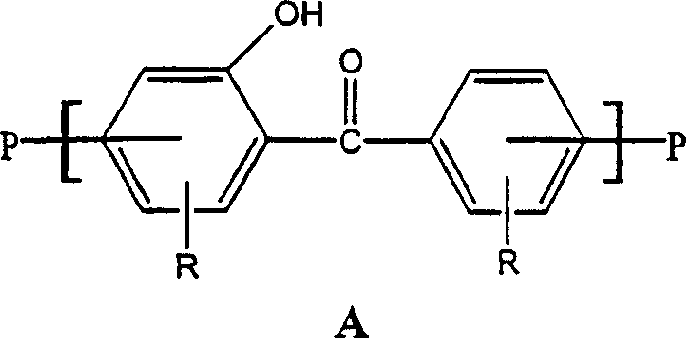
因此,我们已经发现,在含有以下组分的多层紫外光保护制品,优选是薄片制品中实现了上述目的:(a)包含荧光着色剂的聚合物层;和(b)在该着色层上布置的并且包含紫外光吸收聚合物或者能进行到紫外光吸收聚合物的光-Fries重排的聚合物的紫外光屏蔽层。更具体地,用来制备紫外光屏蔽层的聚合物树脂包含至少一种选自以下的聚合物或其混合物:(i)具有包含以下重复部分A的聚合物主链的聚合物:Accordingly, we have found that the above objects are achieved in a multilayer UV protection article, preferably a sheet article, comprising: (a) a polymer layer comprising a fluorescent colorant; and (b) on the colored layer A UV shielding layer disposed and comprising a UV absorbing polymer or a polymer capable of photo-Fries rearrangement to the UV absorbing polymer. More specifically, the polymeric resin used to prepare the UV light shielding layer comprises at least one polymer or a mixture thereof selected from: (i) a polymer having a polymer backbone comprising the repeating portion A of:
其中,R是无干扰的取代基,P是聚合物的其余部分,并且因此该聚合物能够吸收紫外光;和(ii)具有包含以下重复部分B的聚合物主链的聚合物:wherein R is a non-interfering substituent, P is the remainder of the polymer, and thus the polymer is capable of absorbing ultraviolet light; and (ii) a polymer having a polymer backbone comprising the following repeating moiety B:

其中,R和P是如上所定义的;所述部分B通过光-Fries重排能转变成所述部分A,从而所述包含部分B的聚合物可以进行到包含部分A的紫外光吸收聚合物的重排。wherein R and P are as defined above; said moiety B can be transformed into said moiety A by photo-Fries rearrangement, whereby said polymer comprising moiety B can proceed to a UV-absorbing polymer comprising moiety A rearrangement.
术语“无干扰取代基”用来表示不会阻止以上限定部分呈现出紫外光吸收性质的取代基,或者不会阻止上述部分进行到紫外光吸收部分的光-Fries重排的取代基。The term "non-interfering substituent" is used to denote a substituent that does not prevent the moiety defined above from exhibiting UV absorbing properties, or that does not prevent the above moiety from undergoing a Photo-Fries rearrangement to the UV absorbing moiety.
该屏蔽层还可以包含部分A和部分B聚合物的混合物。不欲受限于任何特定理论,由本发明屏蔽层提供的颜色和荧光保护的增强可以认为至少部分来自直接存在于屏蔽层聚合物主链中的重复的紫外光吸收部分,这不同于与聚合物混合的单独的紫外光吸收化合物。The barrier layer may also comprise a blend of Part A and Part B polymers. Without wishing to be bound by any particular theory, the enhancement of color and fluorescent protection provided by the shielding layer of the present invention is believed to result, at least in part, from repeating UV light absorbing moieties directly present in the polymer backbone of the shielding layer, unlike the polymeric Mixture of individual UV absorbing compounds.
本发明还涉及一种反射薄片材料,其包含许多反射单元、由包含多芳基化合物的聚合物树脂制备的紫外光屏蔽层、以及包含荧光染料和任选的含多芳基化合物树脂的聚合层。The present invention also relates to a reflective sheeting material comprising a plurality of reflective units, an ultraviolet light shielding layer prepared from a polyarylate-containing polymer resin, and a polymeric layer comprising a fluorescent dye and optionally a polyarylate-containing resin .
本发明的多层制品在反射道路标志中发现了特定的实用性,其包含:(i)包含荧光染料和任选的多芳基化合物的聚合物层,(ii)布置在所述荧光层前面并且包含多芳基化合物的聚合物紫外光屏蔽层,和(iii)所布置的许多反射单元,使得从汽车前灯发出的入射光被道路标志反射到交通工具的驾驶者。Multilayer articles of the present invention find particular utility in reflective road markings, comprising: (i) a polymer layer comprising a fluorescent dye and optionally a polyarylate, (ii) disposed in front of said fluorescent layer And comprising a polymeric UV shielding layer of polyarylate, and (iii) a plurality of reflective units arranged such that incident light from headlights of a car is reflected by road markings to a driver of a vehicle.
用于屏蔽层的优选聚合物是多芳基化合物,以及多芳基化合物与一种或多种以下物质的共混物:聚碳酸酯、聚环己烷二甲醇对苯二甲酸酯(“PCT”)、聚环己烷二甲醇-共聚-对苯二甲酸乙二酯(“PETG”)和聚对苯二甲酸乙二酯(“PET”)。尽管多芳基化合物主链含有能进行到二苯甲酮型紫外光吸收部分的光-Fries重排的部分B,但是,本发明还涉及在其聚合物主链中有二苯甲酮型部分(见以上的部分A)的聚合物,因此不需要变成紫外光吸收性的重排。Preferred polymers for the barrier layer are polyarylates, and blends of polyarylates with one or more of the following: polycarbonate, polycyclohexanedimethanol terephthalate (" PCT"), polycyclohexanedimethanol-co-ethylene terephthalate ("PETG") and polyethylene terephthalate ("PET"). Although the polyarylate backbone contains a moiety B capable of undergoing a Photo-Fries rearrangement to a benzophenone-type UV-absorbing moiety, the present invention also relates to polyarylates having benzophenone-type moieties in their polymer backbones. (see Section A above), therefore no rearrangement is required to become UV absorbing.
本发明提供了许多优点。例如,它不再需要为了与屏蔽层中所用的紫外光吸收材料种类的相容性而选择荧光层中的荧光着色剂。可以认为,在本发明的结构中所用的紫外光吸收性聚合物层将为荧光层中实际存在的任何荧光着色剂提供优异的保护。另一个优点是明显减少或省去使用单独的紫外光吸收添加剂的能力,从而减少或消除这些添加剂从屏蔽层中溶出或迁移出来的已知问题。本发明的在一个优点是,在其中多芳基化合物在屏蔽层中作为紫外光吸收性聚合物存在的一个优选的实施方案中,聚合物屏蔽层还提供在耐久的反射薄片材料制备中重要的优异性质的组合,如韧性、抗冲击性和耐化学性。The present invention provides many advantages. For example, it eliminates the need to select the fluorescent colorant in the fluorescent layer for compatibility with the type of UV absorbing material used in the shielding layer. It is believed that the UV absorbing polymer layer used in the construction of the present invention will provide excellent protection for any fluorescent colorants actually present in the fluorescent layer. Another advantage is the ability to significantly reduce or eliminate the use of separate UV light absorbing additives, thereby reducing or eliminating the known problems of leaching or migration of these additives from the barrier layer. It is an advantage of the present invention that, in a preferred embodiment wherein the polyarylate is present in the shielding layer as a UV-absorbing polymer, the polymeric shielding layer also provides the essential properties that are important in the manufacture of durable reflective sheeting materials. A combination of excellent properties such as toughness, impact resistance and chemical resistance.
附图简述Brief description of the drawings
图1表示本发明的微棱柱形反射薄片材料的截面图,其包含在具有荧光着色剂的层上布置的紫外光吸收性屏蔽层,并且其中反射微棱柱直角棱镜单元在荧光层上形成。1 shows a cross-sectional view of a microprismatic reflective sheet material of the present invention comprising an ultraviolet light absorbing shielding layer disposed on a layer having a fluorescent colorant, and wherein reflective microprismatic rectangular prism elements are formed on the fluorescent layer.
图2表示本发明的微棱柱反射薄片材料的截面图,其包含在具有荧光着色剂的层和在其间布置的结合层或粘合层上布置的紫外光吸收性屏蔽层,并且其中反射微棱柱直角单元在荧光层上形成。Figure 2 shows a cross-sectional view of a microprism reflective sheet material of the present invention comprising an ultraviolet light absorbing shielding layer disposed on a layer having a fluorescent colorant and a tie or adhesive layer disposed therebetween, and wherein the reflective microprisms Right-angle units are formed on the fluorescent layer.
图3表示本发明的微棱柱反射薄片材料的截面图,其包含紫外光吸收剂屏蔽层、包含荧光着色剂的层和无色反射层,并且其中反射单元是在无色层上形成的微棱柱直角单元。Figure 3 shows a cross-sectional view of a microprism reflective sheet material of the present invention, which comprises an ultraviolet light absorber shielding layer, a layer comprising a fluorescent colorant, and a colorless reflective layer, and wherein the reflective unit is a microprism formed on the colorless layer right angle unit.
图4表示本发明的微棱柱反射薄片材料的截面图,其包含紫外光吸收剂屏蔽层、包含荧光着色剂的层和无色层,无色层布置在紫外光吸收性屏蔽层上,并且其中反射单元在荧光层上形成。Figure 4 shows a cross-sectional view of a microprismatic reflective sheet material of the present invention comprising a UV absorber shielding layer, a layer comprising a fluorescent colorant, and a colorless layer disposed on the UV absorbing shielding layer, and wherein The reflective unit is formed on the fluorescent layer.
图5表示本发明的封闭透镜反射薄片材料的截面图,其中,紫外光吸收屏蔽层和含有荧光着色剂的层布置在封闭透镜结构上。Figure 5 shows a cross-sectional view of a closed lens reflective sheeting material of the present invention wherein a UV light absorbing shielding layer and a layer containing a fluorescent colorant are disposed on the closed lens structure.
图6表示本发明的包封透镜反射薄片材料的截面图,其中,紫外光吸收屏蔽层和含有荧光着色剂的层布置在包封的透镜结构上。Figure 6 shows a cross-sectional view of an encapsulated lens reflective sheet material of the present invention wherein a UV light absorbing shielding layer and a layer containing a fluorescent colorant are disposed on the encapsulated lens structure.
实施本发明的最佳方式Best Mode for Carrying Out the Invention
为了本专利的目的,紫外吸收聚合物材料被定义为对于在约290-410纳米之间的至少一些波长吸收一定量光能的聚合物材料。For the purposes of this patent, an ultraviolet absorbing polymer material is defined as a polymer material that absorbs a certain amount of light energy for at least some wavelengths between about 290-410 nanometers.
一般来说,本发明的制品包含至少两层:含有至少一种荧光着色剂的着色层,和以叠层结构附着、结合或以其它方式布置在荧光层前面的紫外光屏蔽层,即布置在荧光层与入射光源之间。这两层可以直接相互结合,如通过共挤出,或者用热和/或粘结剂层叠。任选可以在荧光层和紫外光屏蔽层之间布置一个或多个中间层。In general, the articles of the present invention comprise at least two layers: a colored layer containing at least one fluorescent colorant, and a UV-shielding layer attached, bonded, or otherwise disposed in front of the fluorescent layer in a laminated structure, i.e. disposed on Between the fluorescent layer and the incident light source. The two layers can be bonded directly to each other, such as by coextrusion, or laminated with heat and/or adhesives. Optionally, one or more intermediate layers may be arranged between the fluorescent layer and the UV light shielding layer.
如果反射性质是希望的,在反射薄片工业中熟知的反射单元如微棱柱直角单元或玻璃微珠可以设计到制品中。例如,在本发明的一种简单的两层结构中,许多微棱柱直角单元可以直接形成到荧光层的背面,紫外光吸收层可以用作薄片的前面。当本发明的反射制品制成道路标志时,来自迎面而来的交通工具的前灯的光通过其前面进入多层结构中,通过紫外光屏蔽层到达含反射单元的层,并被反射到交通工具的驾驶者。If reflective properties are desired, reflective elements such as microprismatic rectangular elements or glass beads well known in the reflective sheeting industry can be designed into the article. For example, in a simple two-layer structure of the present invention, many microprismatic right-angle units can be formed directly to the backside of the phosphor layer, and the UV-absorbing layer can be used as the front side of the flake. When the reflective article of the present invention is made into a road sign, light from the headlights of oncoming traffic passes through its front into the multilayer structure, passes through the UV light shielding layer to the layer containing the reflective elements, and is reflected to the traffic tool driver.
本发明的中心在于使用紫外光吸收聚合物,优选的是多芳基化合物作为紫外光屏蔽层的聚合物基质的组分。任选地,荧光层也可以含有多芳基化合物。当暴露于光时,多芳基化合物重排成吸收紫外光的在其主链中有羟基二苯甲酮部分的聚合物。我们发现,与由含有紫外光吸收添加剂如羟基二苯甲酮的传统屏蔽层提供的紫外线保护相比,使用在其聚合主链中引入紫外光吸收部分的紫外光吸收聚合物提供了更好和更长的紫外线保护。这是相当意外的,因为形成本发明的紫外光屏蔽层中的聚合物主链片断的紫外光吸收部分(羟基二苯甲酮型部分,见以下的部分A)与向现有技术的屏蔽层中加入的传统二苯甲酮紫外线添加剂中存在的紫外光吸收部分类似。Central to the present invention is the use of UV-absorbing polymers, preferably polyarylates, as components of the polymer matrix of the UV-shielding layer. Optionally, the fluorescent layer may also contain polyarylates. When exposed to light, the polyarylate rearranges into a polymer that absorbs UV light and has a hydroxybenzophenone moiety in its backbone. We have found that the use of UV-absorbing polymers incorporating UV-absorbing moieties into their polymeric backbone provides better and Longer UV protection. This is rather surprising, since the UV-absorbing moieties (hydroxybenzophenone-type moieties, see Part A below) forming the polymer backbone segments in the UV-shielding layer of the present invention are different from those of prior art shielding layers. Similar to the UV light absorbing part present in traditional benzophenone UV additives added in .
稍微更详细地,本发明的制品的紫外光屏蔽层可以用任何聚合物制备,其中,聚合物主链或者包含以下重复的紫外光吸收羟基二苯甲酮部分A:In somewhat more detail, the UV-shielding layer of the articles of the present invention may be prepared from any polymer wherein the polymer backbone either contains the following repeating UV-absorbing hydroxybenzophenone moieties A:

或者包含能进行到以上部分的重排的重复部分。这样的重复部分的实例是以下的部分B:Or contain repeating sections that can carry out rearrangements to the above sections. An example of such a repeating section is Section B below:

含有重复的B部分(和/或在光-Fries重排后的重复A部分)的用在本发明紫外光屏蔽层中的特别优选的聚合物类型的一个实例是所谓多芳基化合物。An example of a particularly preferred class of polymers containing repeating B moieties (and/or repeating A moieties after Photo-Fries rearrangement) for use in the UV light shielding layers of the invention are so-called polyarylates.
一般来说,多芳基化合物是本领域中众所周知的,并且通过二酚与二元羧酸的聚合获得。适用于本发明制品中的多芳基化合物包括在U.S.4,598,130中所述的那些,并入本文作为参考。如U.S.4,598,130中所述的,并且为了说明的目的而不是为了限制,可以用来制备多芳基化合物的合适的二羟基酚是双酚如双(4-羟苯基)甲烷、2,2-双(4-羟苯基)丙烷(双酚A)、2,2-双(4-羟基-3-甲基苯基)丙烷、4,4-双(4-羟苯基)庚烷、2,2-双(4-羟基-3,5-二氯苯基)丙烷、2,2-双(4-羟基-3,5-二溴苯基)丙烷等;二羟基酚醚如双(4-羟苯基)醚、双(3,5-二氯-4-羟苯基)醚等;二羟基联苯基如p,p’-二羟基联苯基、3,3’-二氯-4,4’-二羟基联苯基等;二羟基芳基砜如双(4-羟基苯基)砜、双(3,5-二甲基-4-羟苯基)砜等;二羟基苯、间苯二酚、氢醌、卤-和烷基-取代的二羟基苯如1,4-二羟基-2,5-二氯苯、1,4-二羟基-3-甲基苯等;和二羟基二苯基亚砜如双(4-羟苯基)亚砜、双(3,5-二溴-4-羟基苯基)亚砜等。还可以获得许多另外的二羟基酚,如在U.S.2,999,835、3,028,365和3,153,008中所公开的。还合适的是由上述二羟基酚与含卤素的二羟基酚如2,2-双(3,5-二氯-4-羟苯基)丙烷、2,2-双(3,5-二溴-4-羟苯基)丙烷等共聚所制备的共聚物。还可以使用两种或多种不同的二羟基酚或二羟基酚与二元醇或与羟基或酸封端的聚酯或与二元酸的共聚物,以及任何上述材料的共混物。合适的二元羧酸是芳族和脂肪族芳族二元羧酸,如邻苯二甲酸、间苯二甲酸、对苯二甲酸、邻-邻苯二甲酸、邻-、间-和对-亚苯基二乙酸;多核芳族酸如联苯甲酸和1,4-萘二甲酸。In general, polyarylates are well known in the art and are obtained by polymerization of diphenols and dicarboxylic acids. Polyarylates suitable for use in the articles of the present invention include those described in U.S. 4,598,130, incorporated herein by reference. As described in U.S. 4,598,130, and for purposes of illustration and not limitation, suitable dihydric phenols that may be used to prepare polyarylates are bisphenols such as bis(4-hydroxyphenyl)methane, 2,2- Bis(4-hydroxyphenyl)propane (bisphenol A), 2,2-bis(4-hydroxy-3-methylphenyl)propane, 4,4-bis(4-hydroxyphenyl)heptane, 2 , 2-bis(4-hydroxy-3,5-dichlorophenyl)propane, 2,2-bis(4-hydroxy-3,5-dibromophenyl)propane, etc.; dihydric phenol ethers such as bis(4 -hydroxyphenyl) ether, bis(3,5-dichloro-4-hydroxyphenyl) ether, etc.; dihydroxybiphenyl such as p,p'-dihydroxybiphenyl, 3,3'-dichloro- 4,4'-dihydroxybiphenyl, etc.; dihydroxyaryl sulfones such as bis(4-hydroxyphenyl)sulfone, bis(3,5-dimethyl-4-hydroxyphenyl)sulfone, etc.; dihydroxybenzene , resorcinol, hydroquinone, halogen- and alkyl-substituted dihydroxybenzenes such as 1,4-dihydroxy-2,5-dichlorobenzene, 1,4-dihydroxy-3-methylbenzene, etc.; And dihydroxydiphenylsulfoxide such as bis(4-hydroxyphenyl)sulfoxide, bis(3,5-dibromo-4-hydroxyphenyl)sulfoxide and the like. A number of additional dihydric phenols are also available as disclosed in U.S. 2,999,835, 3,028,365 and 3,153,008. Also suitable is the combination of the above-mentioned dihydric phenols with halogen-containing dihydric phenols such as 2,2-bis(3,5-dichloro-4-hydroxyphenyl)propane, 2,2-bis(3,5-dibromo -4-hydroxyphenyl) propane and other copolymers prepared by copolymerization. Copolymers of two or more different dihydric phenols or dihydric phenols with diols or with hydroxyl or acid terminated polyesters or with dibasic acids, as well as blends of any of the foregoing, may also be used. Suitable dicarboxylic acids are aromatic and aliphatic aromatic dicarboxylic acids, such as phthalic acid, isophthalic acid, terephthalic acid, o-phthalic acid, o-, meta- and p- Phenylenediacetic acid; polynuclear aromatic acids such as biphenylcarboxylic acid and 1,4-naphthalene dicarboxylic acid.
最广泛使用的商品多芳基化合物之一得自双酚A(2,2-双-(4-羟基苯基)丙烷)和50∶50混合物间苯二甲酸/对苯二甲酸的聚合。用于在本发明的紫外光屏蔽层中特别优选的该多芳基化合物以前以商标“ArdelD100”从Amoco Performance Polymers,Inc.购得,并且现在由Unitika America Corporation及其分销商以商标“U-Polymer U-100”销售。用在本发明的优选多芳基化合物具有下式I和II。式I是在光-Fries重排之前的多芳基化合物。式II是在光-Fries重排后的多芳基化合物。在屏蔽层中可以存在一种或这两种聚合物:One of the most widely used commercial polyarylates is obtained from the polymerization of bisphenol A (2,2-bis-(4-hydroxyphenyl)propane) and a 50:50 mixture isophthalic/terephthalic acid. This polyarylate, which is particularly preferred for use in the UV light shielding layer of the present invention, was previously commercially available from Amoco Performance Polymers, Inc. under the trademark "Ardel D100" and is now sold by Unitika America Corporation and its distributors under the trademark "U- Polymer U-100" sales. Preferred polyarylates for use in the present invention have the following formulas I and II. Formula I is a polyarylate prior to Photo-Fries rearrangement. Formula II is the polyarylate after Photo-Fries rearrangement. One or both of these polymers can be present in the shield:

另一组合适的多芳基化合物是基于四甲基双酚-A、4,4’-二羟基二苯甲酮和5-叔丁基间苯二甲酸二氯化物的那些,如在Wright等在Journal of Membrane Science,vol 124,第161-174页(1997)中所一般公开的,和其中公开的其它多芳基化合物结构。Another group of suitable polyarylates are those based on tetramethylbisphenol-A, 4,4'-dihydroxybenzophenone and 5-tert-butylisophthalic acid dichloride, as described in Wright et al. As generally disclosed in Journal of Membrane Science, vol 124, pp. 161-174 (1997), and other polyarylate structures disclosed therein.
多芳基化合物的制备的讨论可以在L.Robeson和J.Tibbet的题目为“多芳基化合物的历史(History of Polyarylates)”的章节中找到(在专题论文 High Performance Polymers:Their Origin and Development,编者为E.B.Seymour和G.S.Kirshenbaum,(1986)的第95页)。例如,生产多芳基化合物的已知方法包括界面聚合,即在搅拌条件下,把芳族二元羧酸二卤化物在有机溶剂中的溶液与双酚的碱水溶液混合,使这些物料反应;溶液聚合,即在有机溶剂中,在脱酸剂如吡啶存在下,使芳族二元羧酸二卤化物与双酚反应;使芳族二羧酸二苯基酯与双酚反应的熔融聚合;使芳族二元羧酸、碳酸二苯基酯和双酚反应的熔融聚合;使芳族二元羧酸与双酚二乙酸酯反应的熔融聚合,和使芳族二元羧酸与双酚二乙酸酯反应的聚合。制备多芳基化合物的方法可以更详细地参考Hirose等人的U.S.5,034,502和Berger等人的U.S.4,374,239,二者都并入本文作为参考。A discussion of the preparation of polyarylates can be found in the chapter entitled "History of Polyarylates" by L. Robeson and J. Tibbet (in the monograph High Performance Polymers: Their Origin and Development , Edited by EBSeymour and GS Kirshenbaum, (1986), p. 95). For example, known methods of producing polyarylates include interfacial polymerization, i.e. mixing a solution of an aromatic dicarboxylic acid dihalide in an organic solvent with an aqueous base solution of bisphenol and reacting these materials under agitation; Solution polymerization, that is, in an organic solvent, in the presence of a deacidification agent such as pyridine, the aromatic dicarboxylic acid dihalide is reacted with bisphenol; the melt polymerization of the aromatic dicarboxylic acid diphenyl ester is reacted with bisphenol ; Melt polymerization for reacting aromatic dicarboxylic acid, diphenyl carbonate and bisphenol; Melt polymerization for reacting aromatic dicarboxylic acid with bisphenol diacetate, and making aromatic dicarboxylic acid and Reactive polymerization of bisphenol diacetate. Methods for preparing polyarylates can be found in more detail in US 5,034,502 to Hirose et al. and US 4,374,239 to Berger et al, both of which are incorporated herein by reference.
众所周知,在暴露于紫外光时,多芳基化合物进行光-Fries重排。参见Korshak等的“Synthesis and Properties of Self-ProtectingPolyarylates”,Journal of Polymer Science,Part A-1,Vol.7,第157-172页(1969),其描述了解释当多芳基化合物暴露于紫外光时发生的作用的机理。作者提出多芳基化合物经过光-Fries重排,导致羰基和羟基相互邻位,结构上类似于已知的光吸收剂邻羟基二苯甲酮。作为多芳基化合物聚合物主链的一部分的邻羟基二苯甲酮部分可以吸收95%以上的波长低于375纳米的紫外光,大量的紫外光波长在375-410纳米之间。我们现在已经发现,当这些部分在屏蔽层的聚合物主链内时,与它们作为混入屏蔽层聚合物基质中的添加剂存在时相比,它们作为在屏蔽层后面的另一层中的荧光着色剂的保护剂更好地起作用。It is well known that polyarylates undergo a photo-Fries rearrangement upon exposure to ultraviolet light. See "Synthesis and Properties of Self-Protecting Polyarylates" by Korshak et al., Journal of Polymer Science, Part A-1, Vol.7, pp. 157-172 (1969), which describes the mechanism of action that occurs. The authors propose that polyarylates undergo a photo-Fries rearrangement, resulting in the carbonyl and hydroxyl groups being ortho to each other, structurally similar to the known light absorber o-hydroxybenzophenone. The o-hydroxybenzophenone moiety, which is part of the polyarylate polymer backbone, absorbs more than 95% of UV light at wavelengths below 375 nm, with a substantial amount of UV light at wavelengths between 375-410 nm. We have now found that when these moieties are within the polymer backbone of the shield, they act as fluorescent colorants in another layer behind the shield than when they are present as additives mixed into the shield's polymer matrix Anti-aging protectants work better.
应该理解,虽然上述多芳基化合物是用于本发明的屏蔽层中的优选的紫外光吸收聚合物,但是,任何含有以上部分A或B的聚合物预计可以用在本发明中,条件是该聚合物具有使其适用于所考虑的特定产品用途中的性质。这样的聚合物的另一个实例是在国际专利申请WO00/26275(2000年5月11日公开)中所述的嵌段共聚酯碳酸酯,其引入本文作为参考。在WO 00/26275申请中描述的共聚酯碳酸酯包括与芳基化合物嵌段交替的有机碳酸酯嵌段,其中,芳基化物嵌段得自1,3-二羟基苯部分和芳族二元羧酸。具体地,具有以上定义的部分A和/或部分B的嵌段共聚酯碳酸酯聚合物分别具有以下结构III和IV之一或之二:It should be understood that while the polyarylates described above are preferred UV absorbing polymers for use in the shielding layers of the present invention, any polymer containing moieties A or B above is contemplated for use in the present invention provided that the Polymers have properties that make them suitable for the particular product use under consideration. Another example of such a polymer is the block copolyestercarbonate described in International Patent Application WO 00/26275 (published May 11, 2000), which is incorporated herein by reference. The copolyestercarbonates described in the WO 00/26275 application comprise organic carbonate blocks alternating with aryl compound blocks, wherein the arylate blocks are derived from 1,3-dihydroxybenzene moieties and aromatic di Carboxylic acid. Specifically, block copolyestercarbonate polymers having part A and/or part B as defined above have either or both of the following structures III and IV, respectively:

其中,每个R1独立地是H或C1-C12烷基、p是0-3,每个R2独立地是二价有机基团;m至少为1,并且优选约为2-200;且n至少约为4,优选约为30-150。Wherein, each R 1 is independently H or C 1 -C 12 alkyl, p is 0-3, and each R 2 is independently a divalent organic group; m is at least 1, and preferably about 2-200 and n is at least about 4, preferably about 30-150.
在上述WO 00/26275申请中的申请人假定,上述共聚酯碳酸酯的耐候性至少部分归功于发生热或光化学引发的芳基化物嵌段(见以上结构IV)的光-Fries重排,以产生邻位-羟基二苯甲酮部分(见以上结构III)或其类似物,其用作紫外辐射的吸收剂。The applicants in the above-mentioned WO 00/26275 application postulate that the weatherability of the above-mentioned copolyestercarbonates is due at least in part to a thermally or photochemically initiated photo-Fries rearrangement of the arylate blocks (see structure IV above), to produce an ortho-hydroxybenzophenone moiety (see structure III above) or an analogue thereof, which acts as an absorber for ultraviolet radiation.
能够进行到紫外光吸收性聚合物的重排的其它聚合物描述在Cohen等人的“Transparent Ultraviolet-Barrier Coatings”,Journal of Polymer Science,Part A-1,Vol.9,第3263-3299页,(1971)(并入作为参考),其描述了许多苯基聚酯,包括多芳基化合物,其被合成以提供其主链在紫外光下重排成邻-羟基二苯甲酮结构的分子。Other polymers capable of undergoing rearrangement to UV-absorbing polymers are described in Cohen et al., "Transparent Ultraviolet-Barrier Coatings", Journal of Polymer Science , Part A-1, Vol.9, pp. 3263-3299, (1971) (incorporated by reference), which describes a number of phenyl polyesters, including polyarylates, which were synthesized to provide molecules whose backbones rearrange under ultraviolet light to the o-hydroxybenzophenone structure .
紫外光吸收聚合物的紫外光吸收性质不必得自光-Fries重排。例如,如在上述WO 00/26275申请中所解释的,合适的羟基二苯甲酮型单体的合成与聚合可以产生其中在聚合物中已经存在紫外光吸收部分A(参见上文)的聚合物而无需使该聚合物进行光-Fries重排。The UV-absorbing properties of UV-absorbing polymers do not necessarily result from a Photo-Fries rearrangement. For example, as explained in the aforementioned WO 00/26275 application, the synthesis and polymerization of suitable hydroxybenzophenone-type monomers can lead to polymerizations in which the UV-absorbing moiety A (see above) is already present in the polymer without subjecting the polymer to Photo-Fries rearrangement.
应该理解,在本发明中使用多芳基化合物的情况下,多芳基化合物的紫外光吸收性在紫外辐射存在下需要一段时间来“发展”,用于“发展”的时间取决于环境和紫外辐射的强度。例如,在Xenon ArcWeather-O-Meter中,多芳基化合物通常需要约50小时来“发展”。由于该“发展”时间,尽管不要求,但是在荧光层中或荧光层前面包含少量紫外光吸收化合物或光稳定剂可能是希望的,以便在紫外光屏蔽层获得其全部保护能力前的期间内提供一些初始的保护。It should be understood that where polyarylates are used in the present invention, the UV absorbance of the polyarylates takes a period of time to "develop" in the presence of UV radiation, the time for "development" being dependent on the environment and the UV The intensity of the radiation. For example, in the Xenon ArcWeather-O-Meter, polyarylates typically take about 50 hours to "develop". Because of this "development" time, it may be desirable, although not required, to include small amounts of UV absorbing compounds or photostabilizers in or in front of the phosphor layer for the period before the UV shielding layer acquires its full protective capabilities. Provide some initial protection.
虽然紫外光屏蔽层的聚合物树脂可以完全由含有部分A和/或B的上述紫外光吸收聚合物组成,但是,本文还预计使用紫外光吸收聚合物与其它合适的聚合物的共混物,这些其它合适的聚合物在聚合物主链中可以有或没有紫外光吸收部分。例如,可以使用多芳基化合物与选自聚对苯二甲酸乙二酯(“PET”)、聚环己烷二甲醇-共聚-对苯二甲酸乙二酯(“PETG”)、聚碳酸酯和聚环己烷二甲醇对苯二甲酸酯(“PCT”)的共混物。对于某些前述多芳基化合物共混物的更详细讨论,可以参考Robeson等人的U.S.4,286,075和4,259,458(并入本文作为参考)。While the polymeric resin of the UV shielding layer may consist entirely of the aforementioned UV absorbing polymers containing moieties A and/or B, the use of blends of UV absorbing polymers with other suitable polymers is also contemplated herein, These other suitable polymers may or may not have UV absorbing moieties in the polymer backbone. For example, polyarylates may be used in combination with polyethylene terephthalate ("PET"), polycyclohexanedimethanol-co-ethylene terephthalate ("PETG"), polycarbonate and polycyclohexanedimethanol terephthalate (“PCT”). For a more detailed discussion of certain of the foregoing polyarylate blends, reference may be made to U.S. 4,286,075 and 4,259,458 to Robeson et al. (incorporated herein by reference).
从多芳基化合物和多芳基化合物共混物制备热塑性薄片的方法,以及把这些薄片层叠到其它聚合物层上的方法在本领域中是公知的。例如,参见Robeson等人的U.S.4,643,937。用在该方法中的聚合物薄膜可以用已知的方法制备,例如使用挤出技术。Methods of preparing thermoplastic sheets from polyarylates and polyarylate blends, and methods of laminating these sheets to other polymer layers are well known in the art. See, eg, U.S. 4,643,937 to Robeson et al. The polymer films used in the process can be produced by known methods, for example using extrusion techniques.
稍微更详细地,对于其中本发明的制品是薄片材料的那些实施方案,用在本发明中的荧光层可以由具有制备合适的聚合薄片材料的必备性质的任何合适的聚合物制备。适合于制备荧光层的特别优选的聚合物的实例是聚碳酸酯、聚烯烃、多芳基化合物、聚对苯二甲酸乙二酯(“PET”)、聚环己烷二甲醇-共聚-对苯二甲酸乙二酯(“PETG”)、聚氨基甲酸乙酯、聚丙烯酸酯(例如聚甲基丙烯酸甲酯)、聚苯乙烯和前述物质的合适的共混物、合金和共聚物(包括嵌段共聚物)。制备前述聚合物的方法以及由其制备薄膜和薄片(包括反射薄片材料)的方法是本领域中众所周知的。用在本发明的荧光层中的特别优选的聚合物是双酚A聚碳酸酯,如由Dow Chemical Company销售的Calibre-302。可替代地,用在本发明的荧光层中的另一种特别优选的聚合物是由Eastman Chemical Company以“Eastar GN-071”销售的PETG树脂。In somewhat more detail, for those embodiments in which the article of the invention is a sheet material, the phosphor layer used in the invention may be prepared from any suitable polymer having the requisite properties to make a suitable polymeric sheet material. Examples of particularly preferred polymers suitable for the preparation of fluorescent layers are polycarbonates, polyolefins, polyarylates, polyethylene terephthalate ("PET"), polycyclohexanedimethanol-co-para Polyethylene phthalate ("PETG"), polyurethane, polyacrylates (such as polymethyl methacrylate), polystyrene, and suitable blends, alloys, and copolymers of the foregoing (including block copolymer). Methods of making the aforementioned polymers and methods of making films and sheeting therefrom, including reflective sheeting materials, are well known in the art. A particularly preferred polymer for use in the phosphor layer of the present invention is bisphenol A polycarbonate, such as Calibre-302 sold by the Dow Chemical Company. Alternatively, another particularly preferred polymer for use in the phosphor layer of the present invention is a PETG resin sold by Eastman Chemical Company as "Eastar GN-071".
优选地,在本发明的反射薄片材料中,许多微棱柱反射单元用已知的方法直接形成在一层薄片材料表面上。例如,Pricone等人的U.S.4,601,861公开了一种改善的方法和设备,用于连续压出具有精确细节的重复图案,特别是在单层薄片的一个表面上或者在透明热塑性材料的层合物的一个表面上压出直角型反射单元,以形成反射薄片。Pricone等人公开了一种连续的压花工具,其是柔性薄金属带或圆筒形式的,在其外表面上有压花图案,该图案是要形成的精确光学图案的反转图案。该压花工具以预定的速度沿着封闭过程连续移动,通过加热工位,一部分压花工具的温度在加热工位中被提高到薄片或层合物的玻璃转变温度以上;通过冷却工位,在相当平的条件下,压花工具的被加热部分在冷却工位中被冷却到低于该玻璃转变温度。该薄片以预定的速度从其供应处连续移动进入与所述工具上的压花图案的咬合,并且在沿着加热工位顺序地间隔分布的许多加压点连续加压,并且薄片的一个表面碰到并咬合压花图案直至薄片被升温到其玻璃转变温度以上并与一个面上的压花图案一致。使该薄片保持与该工具的咬合直至所述工具通过冷却工位并且该薄片被降温到其玻璃转变温度以下且图案固化。然后把薄片与工具剥离。前述技术的其它细节描述在Pricone等人的参考文献中,其并入本文作为参考。Preferably, in the reflective sheet material of the present invention, a plurality of micro-prism reflective units are directly formed on the surface of a layer of sheet material by known methods. For example, U.S. 4,601,861 to Pricone et al. discloses an improved method and apparatus for continuously extruding repeating patterns with precise detail, particularly on one surface of a single-layer sheet or on a laminate of transparent thermoplastic materials. A right-angle reflective unit is extruded on one surface to form a reflective sheet. Pricone et al. disclose a continuous embossing tool in the form of a flexible thin metal strip or cylinder having on its outer surface an embossing pattern which is the inverse of the precise optical pattern to be formed. The embossing tool is moved continuously along the closed process at a predetermined speed, through a heating station in which the temperature of a part of the embossing tool is raised above the glass transition temperature of the sheet or laminate; through a cooling station, In fairly flat conditions, the heated part of the embossing tool is cooled below this glass transition temperature in the cooling station. The sheet is continuously moved from its supply at a predetermined speed into engagement with the embossing pattern on the tool and is continuously pressed at a number of pressure points spaced sequentially along the heating station, and one surface of the sheet The embossing pattern is touched and engaged until the sheet is heated above its glass transition temperature and conforms to the embossing pattern on one side. The sheet remains in engagement with the tool until the tool passes through the cooling station and the sheet is cooled below its glass transition temperature and the pattern solidifies. The sheet is then peeled off with the tool. Additional details of the foregoing techniques are described in the Pricone et al. reference, which is incorporated herein by reference.
众所周知,许多着色剂,特别是荧光着色剂,对紫外光降解是非常敏感的。由于其提供优异的紫外光屏蔽层,本发明考虑向荧光层中引入一种或多种这样的紫外光敏感的着色剂/染料或其组合,包括已知的这些染料和染料组合。本发明不限于任何特定的染料或着色剂。合适的染料的实例是本领域已知的任何荧光染料,其用于增强道路标志在白天和黑天的可见性。这样的染料的实例是苝、苝酰亚胺、苝酯、噻吨、噻吨酮和硫代靛青化合物。可能合适的其它染料包括苯并呫吨、苯并噻嗪、napthalimide和香豆素基化合物。前述染料的共混物也可以考虑。如本领域技术人员所清楚的,当本发明以反射薄片形式实施时,所用的染料是足够透明的,使得不会明显损害薄片的反射功能。It is well known that many colorants, especially fluorescent colorants, are very sensitive to degradation by UV light. The present invention contemplates the incorporation of one or more such UV-sensitive colorants/dye or combinations thereof, including such dyes and dye combinations, into the fluorescent layer as they provide an excellent UV light shielding layer. The present invention is not limited to any particular dye or colorant. An example of a suitable dye is any fluorescent dye known in the art for enhancing the visibility of road markings both day and dark. Examples of such dyes are perylenes, peryleneimides, perylene esters, thioxanthenes, thioxanthones and thioindigo compounds. Other dyes that may be suitable include benzoxanthenes, benzothiazines, napthalimide and coumarin-based compounds. Blends of the foregoing dyes are also contemplated. As will be apparent to those skilled in the art, when the invention is practiced in the form of reflective flakes, the dyes used are sufficiently transparent so as not to significantly impair the reflective function of the flakes.
适用于引入到本发明的荧光层中的具体荧光染料的其它实例包括:苝酰亚胺和苝酯染料如Lumogen F Orange 240、Lumogen F Yellow083和Lumogen F Red 300(各自得自BASF,Rensselaer,New York);噻吨染料,如Hostasol Yellow 3G(得自Clariant Corporation,Clevelend,Charlotte,North Carolina和Marigold Orange D-315(Day-Glo Color Corporation,Ohio);噻吨酮染料如HostasolRed GG(Clariant);硫代靛青染料如Hostasol Red 5B(Clariant);香豆素基染料如Macrolex 10GN(得自Bayer Corporation)和PotomacYellow D-838(Day-Glo);苯并呫吨染料Lumofast Yellow 3G(Day-Glo);和苯并噻嗪染料如Huron Yellow D-417(Day-Glo)。Other examples of specific fluorescent dyes suitable for incorporation into the fluorescent layer of the present invention include: peryleneimide and perylene ester dyes such as Lumogen F Orange 240, Lumogen F Yellow 083 and Lumogen F Red 300 (each from BASF, Rensselaer, New York); thioxanthene dyes such as Hostasol Yellow 3G (obtained from Clariant Corporation, Clevelend, Charlotte, North Carolina and Marigold Orange D-315 (Day-Glo Color Corporation, Ohio); thioxanthene dyes such as HostasolRed GG (Clariant); Thioindigo dyes such as Hostasol Red 5B (Clariant); Coumarin based dyes such as Macrolex 10GN (from Bayer Corporation) and PotomacYellow D-838 (Day-Glo); Benzoxanthene dyes Lumofast Yellow 3G (Day-Glo) and benzothiazine dyes such as Huron Yellow D-417 (Day-Glo).
用在荧光层中的特别优选的染料的实例是:噻吨染料如得自Clariant的“Hostasol Yellow 3G”Solvent Yellow 98染料;二萘嵌苯酯和苝酰亚胺染料如得自BASF的“Lumogen F Yellow 083”或“Lumogen F Orange 240”;苯并呫吨染料如得自Day-Glo Color的“Lumofast Yellow 3G”;和苯并噻嗪染料如得自Day-Glo Color的“Huron Yellow D-417”。Examples of particularly preferred dyes for use in the fluorescent layer are: thioxanthene dyes such as "Hostasol Yellow 3G" Solvent Yellow 98 dye from Clariant; perylene and perylene imide dyes such as "Lumogen Yellow 98" from BASF. F Yellow 083" or "Lumogen F Orange 240"; benzoxanthene dyes such as "Lumofast Yellow 3G" from Day-Glo Color; and benzothiazine dyes such as "Huron Yellow D- 417".
除了荧光染料以外,非荧光着色剂也可以用来调节最终产品的颜色。In addition to fluorescent dyes, non-fluorescent colorants can also be used to adjust the color of the final product.
用在荧光层中的荧光染料量取决于染料种类,通常在约0.05-约1.5%范围内,优选在0.08-1.0%范围内,以荧光层总重量为基准。在某些情况下,荧光染料用量取决于荧光层的规格和希望的具体色调。该用量可以根据本领域技术容易地确定。The amount of fluorescent dye used in the fluorescent layer depends on the type of dye, usually in the range of about 0.05-about 1.5%, preferably in the range of 0.08-1.0%, based on the total weight of the fluorescent layer. In some cases, the amount of fluorescent dye used will depend on the specification of the fluorescent layer and the specific hue desired. This amount can be readily determined according to the skill in the art.
为了进一步提高系统的荧光耐久性,荧光层可以任选含有许多熟知的紫外光吸收剂(UVA)和受阻胺光稳定剂(HALS),尽管本发明使得可以明显减少或省去荧光层中和紫外光屏蔽层中的此类添加剂。合适的紫外光吸收剂包括二苯甲酮、苯并三唑和草酰苯胺。市售二苯甲酮的实例包括:可以商品名“Lowilite 22”购自Great Lakes ChemicalCorporation的2-羟基-4-正辛氧基二苯甲酮、商品名“Uvinul 3049”得自BASF的2,2-二羟基-4,4-二甲氧基二苯甲酮、和商品名“Uvinul3050”得自BASF的2,2’,4,4’-四羟基二苯甲酮。合适的苯并三唑的实例包括以商品名“Tinuvin 234”由Ciba-Geigy销售的2-(2H-苯并三唑-2-基)-4,6-双(1-甲基-1-苯基乙基)酚、和由Ciba-Geigy以“Tinuvin 1577”销售的2-(4,6-二苯基-1,3,5-三嗪-2-基)-5(己基)氧化苯酚。草酰苯胺紫外光吸收剂的实例是以商品名“Sanduvor VSU”由Clariant销售的2-乙基,2’-乙氧基-草酰苯胺。本领域技术人员应该认识到,存在许多其它合适的二苯甲酮、苯并三唑和草酰苯胺紫外光吸收剂,并且它们可能适用于本发明中。In order to further improve the fluorescent durability of the system, the fluorescent layer can optionally contain many well-known ultraviolet light absorbers (UVA) and hindered amine light stabilizers (HALS), although the present invention makes it possible to significantly reduce or omit the UV neutralization of the fluorescent layer. Such additives in light shielding layers. Suitable UV absorbers include benzophenones, benzotriazoles and oxanilides. Examples of commercially available benzophenones include: 2-Hydroxy-4-n-octyloxybenzophenone available from Great Lakes Chemical Corporation under the trade designation "
适用于本发明的荧光层中的紫外光吸收剂的量在约0.2-约4%范围内,优选在约0.3-约2.0%,以荧光层的总重量为基准。The amount of ultraviolet light absorber suitable for use in the phosphor layer of the present invention is in the range of about 0.2 to about 4%, preferably about 0.3 to about 2.0%, based on the total weight of the phosphor layer.
我们还认为,在本发明中单独使用或与紫外光吸收剂联用低聚的和/或聚合的HALS是有利的。合适的HALS的实例包括一些得自CibaSpecialty Additives并且由Ciba Specialty Additives描述的产品,如以“Tinuvin 622”购自Ciba Specialty Additives的带有4-羟基-2,2,6,6-四甲基-1-哌啶乙醇的琥珀酸二甲酯聚合物;以商品名Chimassorb 944购自Ciba Specialty Additives的聚[[6-[(1,1,3,3-四甲基丁基)氨基]-仲-三嗪-2,4-二基][[2,2,6,6-四甲基-4-哌啶基]亚氨基]六亚甲基[(2,2,6,6-四甲基-4-哌啶基)亚氨基]];得自Ciba Specialty Additives的“Tinuvin 791”并且其是聚[[6-[1,1,3,3-四甲基-丁基]氨基]-仲-三嗪-2,4-二基][[(2,2,6,6-四甲基-4-哌啶基)亚氨基]]六亚甲基[(2,2,6,6-四甲基-4-哌啶基亚氨基)]和双(2,2,6,6-四甲基-4-piperidynyl)癸二酸酯的共混物。另一种合适的HALS是得自Clariant的“HostavinN30”。本领域技术人员将会认识到,许多其它受阻胺光稳定剂可以用在本发明中。We also believe that oligomeric and/or polymeric HALS are advantageously used in the present invention alone or in combination with UV absorbers. Examples of suitable HALS include some of the products available from and described by Ciba Specialty Additives, such as "Tinuvin 622" from Ciba Specialty Additives with 4-hydroxy-2,2,6,6-tetramethyl- Dimethyl succinate polymer of 1-piperidineethanol; poly[[6-[(1,1,3,3-tetramethylbutyl)amino]-sec -Triazine-2,4-diyl][[2,2,6,6-tetramethyl-4-piperidinyl]imino]hexamethylene[(2,2,6,6-tetramethyl "Tinuvin 791" from Ciba Specialty Additives and which is poly[[6-[1,1,3,3-tetramethyl-butyl]amino]- Secondary-triazine-2,4-diyl][[(2,2,6,6-tetramethyl-4-piperidinyl)imino]]hexamethylene[(2,2,6,6 - a blend of tetramethyl-4-piperidynylimino)] and bis(2,2,6,6-tetramethyl-4-piperidynyl) sebacate. Another suitable HALS is "Hostavin N30" from Clariant. Those skilled in the art will recognize that many other hindered amine light stabilizers may be used in the present invention.
适用于本发明的荧光层的HALS的量在约0.2-约2%范围内,并且优选在约0.3-约1.0%,以荧光层配方的总重量计。Amounts of HALS suitable for use in the phosphor layer of the present invention range from about 0.2 to about 2%, and preferably from about 0.3 to about 1.0%, based on the total weight of the phosphor layer formulation.
取决于聚合物种类,荧光层可以通过任何众所周知的薄膜制造方法来制备,如挤出、压延或浇注。紫外光吸收层通常可以挤出,尽管可以使用其它成膜技术。对于一些类型的挤出操作,根据已知的共挤出技术,可以共同挤出紫外光吸收屏蔽层和荧光层。Depending on the type of polymer, the phosphor layer can be produced by any of the well-known film production methods, such as extrusion, calendering or casting. The UV absorbing layer is generally extrudable, although other film-forming techniques can be used. For some types of extrusion operations, the UV-absorbing shielding layer and the fluorescent layer can be co-extruded according to known co-extrusion techniques.
本发明的紫外光吸收性屏蔽层可以用在若干不同实施方案中。图1-6表示反射薄片的不同实施方案,其中,紫外光吸收层根据本发明制造,并且其中反射单元是微棱柱直角(图1-4)或玻璃微珠(图5-6)。在每个图中,箭头90表示入射光射线在穿透所述结构、被反射单元反射并通过该结构的前面返回时的路线。The ultraviolet light absorbing shielding layers of the present invention can be used in several different embodiments. Figures 1-6 show different embodiments of reflective flakes in which the UV light absorbing layer is made according to the invention and in which the reflective elements are microprism cubes (Figures 1-4) or glass beads (Figures 5-6). In each figure,
图1表示根据本发明制备的反射薄片制品的最简单的实施方案,其是一种两层结构,具有在其一个表面上带有微棱镜反射单元的荧光层10和靠近其反面布置的本发明的紫外光屏蔽层12。Fig. 1 shows the simplest embodiment of the reflective sheeting article prepared according to the present invention, it is a kind of two-layer structure, has on its one surface with the fluorescent layer 10 of microprism reflective unit and the present invention that is arranged near its reverse side. UV light shielding layer 12.
图2表示根据本发明制造的反射薄片制品的一个替代实施方案,其具有在其一个表面上带有微棱柱反射单元的荧光层20、以叠层结构布置在所述荧光层20上的本发明的紫外光屏蔽层22、和布置在层20和22之间的结合层23。结合层的使用在叠层薄片材料领域中是众所周知的,并且其主要用来改善在层合物的层之间的界面结合性。在反射薄片中如何利用结合层的简单讨论可以参见例如U.S.5,450,235。在本发明的略有不同的实施方案中,层23还可以表示在层20和22之间的层叠粘结剂。Figure 2 shows an alternative embodiment of a reflective sheeting article made in accordance with the present invention having a phosphor layer 20 with microprismatic reflective elements on one of its surfaces, the present invention disposed on said phosphor layer 20 in a stacked structure. The ultraviolet
图3表示根据本发明制造的微棱柱反射薄层制品的另一个替代实施方案,其包含荧光层30、以叠层结构布置在所述荧光层30的一个表面上的本发明的紫外光屏蔽层32、和具有许多微棱柱反射单元的反射层34,所述层34对着荧光层30与紫外光屏蔽层32相反的表面以叠层结构布置。这样的构造可能是希望的,此时对于在反射层中使用,例如对于其光学性能或其立方体几何形状保持性能,特定的材料可能是优选的,但是该材料不是荧光着色剂的最合适的主体。图3的结构使得薄片设计者可以对每个层选择材料,其将优化整个成品薄片结构的性能。Figure 3 shows another alternative embodiment of a microprismatic reflective thin layer article made in accordance with the present invention comprising a fluorescent layer 30, an ultraviolet light shielding layer of the present invention disposed on one surface of said fluorescent layer 30 in a laminated structure 32, and a reflective layer 34 having many micro-prism reflective units, said layer 34 is arranged in a laminated structure facing the surface of the fluorescent layer 30 opposite to the ultraviolet light shielding layer 32. Such a configuration may be desirable where a particular material may be preferred for use in the reflective layer, for example for its optical properties or its cube geometry retention properties, but this material is not the most suitable host for fluorescent colorants . The structure of Figure 3 allows the flake designer to select materials for each layer that will optimize the performance of the overall finished flake structure.
图4表示根据本发明制造的微棱柱反射薄片制品的一个替代实施方案,其包括含有许多微棱柱反射单元的荧光层40、以叠层结构布置在荧光层40与反射单元相反的表面上的本发明的紫外光屏蔽层42、和以叠层结构布置在紫外光屏蔽层42上的顶层或层合物表层薄膜44。顶层或层合物表层薄膜44可以选择以具有标志前表面希望的性能,如抗结露性或印刷容易,这些性能在紫外光屏蔽层中不是最佳的。任选的层45可以是结合层或层合物表层粘结剂,如本领域已知的。应当理解,这样的任选结合层或层合物表层粘结剂也可以布置在层40和42之间。4 shows an alternative embodiment of a microprismatic reflective sheeting article made in accordance with the present invention, which includes a
图5表示如何把本发明引入到封闭式透镜反射薄片制品中。封闭式反射薄片是本领域众所周知的,其已经早在U.S.2,407,680(Palmquist)中说明,并且包含透镜,如包埋在带有平坦透明覆盖薄膜的薄片结构中的玻璃微珠。在图5中的实施方案中,玻璃微珠51包埋在包含荧光层50和布置在层50上的本发明的紫外光吸收层52的平坦透明覆盖薄膜54中。镜面反射层55可以是沉积的铝,正如本领域中熟知的。Figure 5 shows how the invention can be incorporated into a closed lens reflective sheeting article. Enclosed reflective flakes are well known in the art and have been described earlier in U.S. 2,407,680 (Palmquist) and comprise lenses, such as glass beads, embedded in a flake structure with a flat transparent cover film. In the embodiment in FIG. 5 ,
图6表示如何把本发明引入到包封透镜反射制品中。包封透镜薄片也是本领域中众所周知的,其早在U.S.3,190,178(McKenzie)中已经说明。这样的薄片包含一种粘合剂层,其中,单层的透镜如玻璃微珠部分被包埋,其还包含密封到粘合剂层上的覆盖薄膜,使得透镜被包封在密封的单元中。在图6中所示的实施方案中,玻璃微珠61部分包埋在粘合剂层66中,并且覆盖薄膜64包含两层,即布置在荧光层60上面的本发明的紫外光吸收层62。两层60和62一起产生包封玻璃微珠反射结构的覆盖层64。Figure 6 shows how the invention can be incorporated into an encapsulated lens reflective article. Encapsulating lens flakes are also well known in the art and are described as early as in U.S. 3,190,178 (McKenzie). Such a sheet comprises an adhesive layer in which a single layer of lenses such as glass beads is partially embedded and a cover film sealed to the adhesive layer such that the lenses are enclosed in a sealed unit . In the embodiment shown in FIG. 6, the glass beads 61 are partially embedded in the adhesive layer 66, and the cover film 64 comprises two layers, an ultraviolet light absorbing layer 62 of the present invention disposed on top of the fluorescent layer 60. . Together, the two layers 60 and 62 create a cover layer 64 that encapsulates the glass bead reflective structure.
图1-6的实施方案是为了说明而不是为了限制的。例如,图2的结合层23也可以用在图3-6的实施方案中的任何层之间。图4的顶层44可以在图1-3、5和6的结构中发现实用性。The embodiments of Figures 1-6 are for illustration and not for limitation. For example, the
在本发明的另一个实施方案中,各层之一的一个表面可以预先印刷希望的图例,使得成品叠层结构在其内表面上具有希望的图例,如在U.S.5,213,872和U.S.5,310,436中所公开的,二者整体并入本文作为参考。例如,其上具有预先印刷的图例的层可以布置在图1的实施方案的层10和12之间,或者图例可以预先印刷在图4的实施方案的层42的上表面上或者在层44的下表面上。In another embodiment of the invention, one surface of one of the layers can be pre-printed with the desired legend so that the finished laminate has the desired legend on its inner surface, as disclosed in U.S. 5,213,872 and U.S. 5,310,436 , both of which are incorporated herein by reference in their entirety. For example, a layer with a legend pre-printed thereon may be disposed between layers 10 and 12 of the embodiment of FIG. on the lower surface.
其它变化对于反射薄片领域技术人员是显而易见的。Other variations will be apparent to those skilled in the art of reflective sheeting.
仅为了说明的目的提供以下实施例,并且这些实施例不应被认为限制由所附权利要求限定的本发明的范围。The following examples are provided for illustrative purposes only and should not be considered as limiting the scope of the invention as defined by the appended claims.
实施例Example
用在以下实施例的每一个中的紫外光屏蔽层是挤出的2密耳多芳基化合物薄膜。但是,应该理解,紫外光屏蔽层可以是含有多芳基化合物的任何透明薄膜或与多芳基化合物具有类似分子结构的聚合物,及其共混物,如多芳基化合物/聚碳酸酯共混物、多芳基化合物/PET共混物、多芳基化合物/PETG共混物以及含有以上限定的紫外光吸收部分A和/或B的聚合物(及其共混物)。在每个实施例中的荧光薄膜配方是用C.W.Brabender Plasti-Corder Prep-Mixer(由C.W.Brabender Instruments,Inc.of Hackensack,NJ制造)制造的,通过聚合物树脂和添加剂的熔体混合,然后使用加热的Carver压机转变成约4-6密耳的薄膜。所用的混合温度在约230-300℃范围内,这取决于树脂。Brabender速度为100转/分,所用的混合时间在约3-6分钟范围内。紫外光屏蔽层薄膜使用热层叠法直接层叠到荧光层薄膜的一侧上。The UV light shielding layer used in each of the following examples was an extruded 2 mil polyarylate film. However, it should be understood that the UV light shielding layer may be any transparent film containing a polyarylate or a polymer having a similar molecular structure to the polyarylate, and blends thereof such as polyarylate/polycarbonate co- blends, polyarylate/PET blends, polyarylate/PETG blends, and polymers (and blends thereof) containing the UV absorbing moieties A and/or B defined above. The fluorescent film formula in each embodiment is to use C.W.Brabender Plasti-Corder Prep-Mixer (manufactured by C.W.Brabender Instruments, Inc. of Hackensack, NJ) by melt mixing of polymer resin and additives, and then use The heated Carver press converts to about 4-6 mil films. The mixing temperature used is in the range of about 230-300°C, depending on the resin. The Brabender speed was 100 rpm and the mixing time used was in the range of about 3-6 minutes. The UV light shielding layer film is directly laminated to one side of the phosphor layer film using thermal lamination.
在制备样品后,各自放入Xenon Arc加速风化单元中并且常规地测定颜色测量。用于Xenon Arc风化的测试技术在ASTM G26-90,Section1.3.1中概述。使用硼硅酸盐内滤光器和外滤光器,并且辐照度在340纳米设定为0.35W/m2。在Hunter Lab LS6000仪器上使用D65光源、2°观察器和0/45几何构型进行颜色测量。为了确定褪色程度和颜色漂移,计算CIE E*色差因子,以便把加速风化暴露后的颜色测量与风化之前的初始测量相比较。CIE E*色差因子的值小表明颜色差异小。约2或3的值对人眼是勉强可检测的。After the samples were prepared, each was placed in a Xenon Arc accelerated weathering unit and color measurements were routinely determined. Testing techniques for Xenon Arc weathering are outlined in ASTM G26-90, Section 1.3.1. Borosilicate inner and outer filters were used and the irradiance was set at 0.35 W/ m2 at 340 nm. Color measurements were performed on a Hunter Lab LS6000 instrument using D65 illuminant, 2° observer and 0/45 geometry. To determine the degree of fading and color shift, a CIE E * color difference factor is calculated to compare color measurements after accelerated weathering exposure to initial measurements before weathering. A small value for the CIE E * color difference factor indicates little color difference. Values around 2 or 3 are barely detectable to the human eye.
实施例1Example 1
本实施例证明多芳基化合物屏蔽层保护荧光聚碳酸酯层的荧光性和颜色耐久性的能力,用或不用紫外光保护添加剂和荧光染料。所用的聚碳酸酯树脂颗粒是得自Dow Chemical Company的Calibre-302,与0.25重量%的HALS(得自Ciba的Tinuvin 622)共混。在样品1.2a、1.2b和1.4a、1.4b中,聚碳酸酯层还包含0.3重量%的Tinuvin234(Ciba)紫外光吸收剂。所用的荧光染料是Huron Yellow D-417和Lumofast Yellow 3G(LF-3G),二者均得自Day-Glo ColorCorporation,Cleveland,Ohio。在这些实施例中,D-417和LF-3G在聚碳酸酯层中的用量分别为0.08和0.8重量%。在屏蔽层中所用的多芳基化合物薄膜由Westlake Plastics Company,Lenni,Pennsylvania以商品名“Ardel”销售的挤出薄膜形式购买。加速风化结果表示在下表1中。This example demonstrates the ability of a polyarylate barrier layer to protect the fluorescence and color durability of a fluorescent polycarbonate layer, with and without UV light protection additives and fluorescent dyes. The polycarbonate resin particles used were Caliber-302 from Dow Chemical Company blended with 0.25% by weight of HALS (Tinuvin 622 from Ciba). In samples 1.2a, 1.2b and 1.4a, 1.4b, the polycarbonate layer also contained 0.3% by weight of Tinuvin 234 (Ciba) UV absorber. The fluorochromes used were Huron Yellow D-417 and Lumofast Yellow 3G (LF-3G), both obtained from Day-Glo Color Corporation, Cleveland, Ohio. In these examples, D-417 and LF-3G were used in the polycarbonate layer at 0.08 and 0.8% by weight, respectively. The polyarylate film used in the barrier layer is commercially available as extruded film sold under the trade designation "Ardel" by Westlake Plastics Company, Lenni, Pennsylvania. The accelerated weathering results are shown in Table 1 below.
表1 Table 1
用多芳基化合物(“PAL”)屏蔽层保护的Protected with polyarylate ("PAL") shielding
荧光聚碳酸酯*层的加速风化结果
*与0.25重量%HALS共混的聚碳酸酯。 * Polycarbonate blended with 0.25 wt% HALS.
表1中的结果表明,在每对样品中,具有多芳基化合物屏蔽层的样品具有明显更小的E*值,表明更大的荧光性和颜色耐久性。此外,对于染料D-417,带有多芳基化合物屏蔽层且在聚碳酸酯中没有紫外光吸收添加剂的样品1.1b比没有多芳基化合物屏蔽层且在聚碳酸酯中有紫外光吸收添加剂的样品1.2a具有更小的ΔE*。类似地,对于染料Lumofast Yellow 3G,有多芳基化合物屏蔽层且在聚碳酸酯中没有紫外光吸收添加剂的样品1.3b比在聚碳酸酯中有紫外光吸收添加剂且没有多芳基化合物屏蔽层的样品1.4a具有更低的ΔE*。还令人惊奇的是,对于Lumofast Yellow 3G,有多芳基化合物屏蔽层且没有紫外光吸收添加剂的样品1.3b优于有多芳基屏蔽层且在聚碳酸酯层中有紫外光吸收添加剂的样品1.4b。应当指出,Lumofast Yellow 3G在前40小时加速风化中的初始颜色漂移约为10ΔE*单位。在加速风化条件下,多芳基化合物的光-Fries重排需要约50小时达到其作为屏蔽层的全部功能。我们相信,这是多芳基化合物屏蔽层没有防止Lumofast Yellow 3G的初始ΔE*漂移的原因。在该初始漂移后,PAL屏蔽层起作用防止聚碳酸酯中的Lumofast Yellow 3G的进一步褪色。The results in Table 1 show that, within each pair of samples, the sample with the polyarylate shield had significantly smaller E * values, indicating greater fluorescence and color durability. Furthermore, for dye D-417, sample 1.1b with a polyarylate shield and no UV-absorbing additive in polycarbonate was more The sample 1.2a has a smaller ΔE * . Similarly, for the dye Lumofast Yellow 3G, sample 1.3b with a polyarylate shield and no UV absorbing additive in polycarbonate was more Sample 1.4a has a lower ΔE * . It is also surprising that for Lumofast Yellow 3G, sample 1.3b with a polyarylate barrier and no UV absorbing additive outperformed sample 1.3b with a polyarylate barrier and UV absorbing additive in the polycarbonate layer Sample 1.4b. It should be noted that the initial color shift of Lumofast Yellow 3G in the first 40 hours of accelerated weathering was approximately 10ΔE * units. Under accelerated weathering conditions, the photo-Fries rearrangement of polyarylates takes about 50 hours to reach its full function as a shield. We believe this is why the polyarylate shield did not prevent the initial ΔE * shift of Lumofast Yellow 3G. After this initial drift, the PAL shield acts to prevent further fading of the Lumofast Yellow 3G in polycarbonate.
实施例2Example 2
本实施例证明多芳基化合物屏蔽层为用PETG制备且含有得自Clariant的染料“Hostasol Yellow 3G”(HY-3G)、得自BASF的“Lumogen Yellow 083”(LY-083)和得自Day-Glo的“LumofastYellow 3G”(LF-3G)的任一种的荧光层赋予改善的荧光性质耐久性的能力。所用的PETG树脂是得自Eastman Chemical,Kingsport,Tennessee的“Eastar GN-071”。在样品2.1a、2.1b中,荧光层是PETG与0.45重量%的Hostasol Yellow 3G的共混物。在样品2.2a、2.2b中,荧光层是PETG与0.8重量%Lumofast Yellow 3G的共混物。在样品2.3a、2.3b中,荧光层是PETG与0.25重量%Lumogen Yellow083的共混物。没有向PETG/荧光层中引入光稳定剂或紫外光吸收添加剂。风化结果表示在表2中。This example demonstrates that a polyarylate shield is prepared from PETG and contains dyes "Hostasol Yellow 3G" (HY-3G) from Clariant, "Lumogen Yellow 083" (LY-083) from BASF and dyes from Day - The ability of the fluorescent layer of any of Glo's "Lumofast Yellow 3G" (LF-3G) to impart improved durability of fluorescent properties. The PETG resin used was "Eastar GN-071" from Eastman Chemical, Kingsport, Tennessee. In samples 2.1a, 2.1b, the fluorescent layer was a blend of PETG with 0.45% by weight of Hostasol Yellow 3G. In samples 2.2a, 2.2b, the fluorescent layer was a blend of PETG with 0.8 wt% Lumofast Yellow 3G. In samples 2.3a, 2.3b, the fluorescent layer was a blend of PETG with 0.25 wt% Lumogen Yellow083. No photostabilizers or UV absorbing additives were incorporated into the PETG/fluorescent layer. The weathering results are shown in Table 2.
表2 Table 2
用多芳基化合物(“PAL”)屏蔽层保护的 Protected with polyarylate ("PAL") shielding
荧光PETG层的加速风化结果
对于每对样品,带有多芳基化合物屏蔽层的样品在延长风化后的ΔE*值都较小,这表明多芳基化合物屏蔽层有效地保护了PETG基质中的不同荧光染料不受紫外光影响。For each pair of samples, the samples with the polyarylate shield had smaller ΔE * values after prolonged weathering, indicating that the polyarylate shield effectively protected the different fluorescent dyes in the PETG matrix from UV light Influence.
实施例3Example 3
本实施例证明多芳基化合物屏蔽层为由荧光多芳基化合物制备的荧光层赋予改善的荧光性质耐久性的能力。该荧光层用得自UnitikaAmerica Corporation,New York,New York的多芳基化合物制备,其是与0.25重量%的Hostasol Yellow 3G共混的“U-Polymer U-100”。结果表示在表3中。This example demonstrates the ability of polyarylate shielding layers to impart improved durability of fluorescent properties to fluorescent layers prepared from fluorescent polyarylates. The fluorescent layer was prepared with a polyarylate obtained from Unitika America Corporation, New York, New York, which was "U-Polymer U-100" blended with 0.25% by weight of Hostasol Yellow 3G. The results are shown in Table 3.
表3 table 3
用多芳基化合物(“PAL”)屏蔽层保护的 Protected with polyarylate ("PAL") shielding
荧光多芳基化合物(“PAL”)层的加速风化结果
本实施例表明,虽然多芳基化合物基质为Hostasol Yellow 3G荧光染料提供了某种保护,在含染料的多芳基化合物基质上的多芳基化合物屏蔽层提供了甚至更好的保护。This example shows that while the polyarylate matrix provided some protection for the Hostasol Yellow 3G fluorescent dye, the polyarylate shield on the dye-containing polyarylate matrix provided even better protection.
实施例4Example 4
本实施例证明多芳基化合物屏蔽层提高多芳基化合物/聚碳酸酯(PAL/PC)共混物中Hostasol Yellow 3G的荧光性质耐久性,在PAL/PC共混物中用或不用紫外光吸收剂(Tinuvin 1577)和HALS(Tinuvin622)。PAL/PC共混物以“U-Polymer P-5001”从Unitika获得。在每个样品中的染料含量为0.25重量%,以荧光层的共混树脂配方的总重量为基准。结果表示在表4中。This example demonstrates that polyarylate shielding enhances the durability of fluorescent properties of Hostasol Yellow 3G in polyarylate/polycarbonate (PAL/PC) blends, with or without UV light in PAL/PC blends Absorbent (Tinuvin 1577) and HALS (Tinuvin 622). The PAL/PC blend was obtained from Unitika as "U-Polymer P-5001". The dye content in each sample was 0.25% by weight, based on the total weight of the blended resin formulation for the fluorescent layer. The results are shown in Table 4.
表4 Table 4
用多芳基化合物(“PAL”)屏蔽层保护的 Protected with polyarylate ("PAL") shielding
荧光多芳基化合物/聚碳酸酯层的加速风化结果
上表4中的结果表明,多芳基化合物屏蔽层提高了荧光和颜色的耐久性,用或不用紫外光吸收剂和光稳定剂。在初始颜色漂移后指定的时间周期内,在有多芳基化合物屏蔽层的样品中基本没有发生ΔE*的变化(ΔE*≈2-4)。The results in Table 4 above show that the polyarylate shielding layer improves the durability of fluorescence and color, with and without UV absorbers and photostabilizers. Substantially no change in ΔE * occurred in the polyarylate shielded samples (ΔE * ≈2-4) for the specified time period after the initial color shift.
实施例5Example 5
本实施例说明多芳基化合物屏蔽层在保护用和不用紫外光吸收剂(Tinuvin 1577)和HALS(Tinuvin 622)的多芳基化合物/聚对苯二甲酸乙二酯(PAL/PET)共混物中Hostasol Yellow 3G的荧光性能方面的效果。PAL/PET共混物以U-Polymer U-8400H形式得自Unitika。对于所有的样品,染料含量为0.25重量%,以荧光层的总重量为基准。风化结果表示在表5中。This example illustrates the protection of polyarylate barriers in polyarylate/polyethylene terephthalate (PAL/PET) blends with and without UV absorbers (Tinuvin 1577) and HALS (Tinuvin 622). The effect on the fluorescent properties of Hostasol Yellow 3G in animals. The PAL/PET blend was obtained from Unitika as U-Polymer U-8400H. For all samples, the dye content was 0.25% by weight, based on the total weight of the fluorescent layer. Weathering results are shown in Table 5.
表5 table 5
用多芳基化合物(“PAL”)屏蔽层保护的 Protected with polyarylate ("PAL") shielding
荧光多芳基化合物/PET层的加速风化结果
表5中的结果表明,多芳基化合物屏蔽层为由PAL/PET共混物用和不用紫外光吸收剂制备的层中的Hostasol Yellow 3G提供了优异的保护。在初始颜色漂移后指定的时间周期内,在有多芳基化合物屏蔽层的样品中也基本没有发生ΔE*的变化(ΔE*≈2-4)。The results in Table 5 show that the polyarylate barrier layer provides excellent protection for Hostasol Yellow 3G in layers prepared from PAL/PET blends with and without UV absorber. There was also substantially no change in ΔE * (ΔE * ≈2-4) in the polyarylate shielded samples over the specified time period after the initial color shift.
虽然利用多层反射薄片材料描述了本发明的制品,但是本发明并不因此受到限制。本发明意欲包括可以从要求权利的组合物的紫外光屏蔽层获益的任何荧光制品。打算长期室外使用并提供这样的紫外光屏蔽层的其它荧光制品也要包括在本发明范围内。本发明还不限于本文公开的具体材料。本领域技术人员将会认识到,除了本文公开的可以适用于本发明的具体材料以外,还有许多多芳基化合物材料。一些这样的材料可能具有与本文公开的主链部分结构略有不同的主链部分结构。为了本发明的目的,重要的是,聚合物材料包含本身是紫外光吸收聚合物材料或者能够进行到紫外光吸收聚合材料重排的聚合物。此外,虽然本文对于荧光层和屏蔽层所讨论的聚合树脂是热塑性树脂,但是,某些热固性树脂也可以在实施本发明的紫外光屏蔽层的结构中发现实用性。类似地,也可以使用其它热塑性树脂、荧光染料、紫外吸收剂和HALS化合物。Although the articles of the present invention have been described using multilayer reflective sheet materials, the invention is not limited thereby. The present invention is intended to include any fluorescent article that can benefit from a UV light shielding layer of the claimed composition. Other fluorescent articles intended for long term outdoor use and which provide such UV light shielding are also within the scope of this invention. The invention is also not limited to the specific materials disclosed herein. Those skilled in the art will recognize that there are many polyarylate materials in addition to the specific materials disclosed herein that may be suitable for use in the present invention. Some of these materials may have backbone moiety structures that differ slightly from those disclosed herein. For the purposes of the present invention it is important that the polymeric material comprises a polymer which is itself a UV absorbing polymer material or which is capable of undergoing rearrangement to a UV absorbing polymer material. Additionally, while the polymeric resins discussed herein for the phosphor and shielding layers are thermoplastic resins, certain thermosetting resins may also find utility in the construction of UV light shielding layers embodying the present invention. Similarly, other thermoplastic resins, fluorescent dyes, UV absorbers and HALS compounds may also be used.
Claims (62)


Applications Claiming Priority (2)
| Application Number | Priority Date | Filing Date | Title |
|---|---|---|---|
| US09/710,560 | 2000-11-09 | ||
| US09/710,560 US6514594B1 (en) | 2000-11-09 | 2000-11-09 | Fluorescent polymeric articles having screening layer formed from U.V. light absorbing polymer |
Publications (2)
| Publication Number | Publication Date |
|---|---|
| CN1473169A CN1473169A (en) | 2004-02-04 |
| CN1281645C true CN1281645C (en) | 2006-10-25 |
Family
ID=24854531
Family Applications (1)
| Application Number | Title | Priority Date | Filing Date |
|---|---|---|---|
| CNB018186408A Expired - Fee Related CN1281645C (en) | 2000-11-09 | 2001-11-09 | Fluorescent polymeric articles having screening layer formed from U.V. light absorbing polymer |
Country Status (4)
| Country | Link |
|---|---|
| EP (1) | EP1349882A4 (en) |
| KR (1) | KR100579588B1 (en) |
| CN (1) | CN1281645C (en) |
| WO (1) | WO2002055570A1 (en) |
Families Citing this family (27)
| Publication number | Priority date | Publication date | Assignee | Title |
|---|---|---|---|---|
| EP1349885B1 (en) * | 2000-11-09 | 2008-03-12 | Avery Dennison Corporation | Fluorescent polymeric articles fabricated from u.v. light absorbing polymer |
| DE102004061126A1 (en) * | 2004-12-16 | 2006-06-29 | Röhm GmbH & Co. KG | UV stabilizer for PMMA |
| US7868128B2 (en) | 2005-06-17 | 2011-01-11 | Eastman Chemical Company | Skylights and windows comprising polyester compositions formed from 2,2,4,4,-tetramethyl-1,3-cyclobutanediol and 1,4-cyclohexanedimethanol |
| US7704605B2 (en) | 2006-03-28 | 2010-04-27 | Eastman Chemical Company | Thermoplastic articles comprising cyclobutanediol having a decorative material embedded therein |
| EP1940907B1 (en) | 2005-10-28 | 2011-04-13 | Eastman Chemical Company | Polyester compositions containing cyclobutanediol having high glass transition temperature and articles made therefrom |
| US8193302B2 (en) | 2005-10-28 | 2012-06-05 | Eastman Chemical Company | Polyester compositions which comprise cyclobutanediol and certain phosphate thermal stabilizers, and/or reaction products thereof |
| US9598533B2 (en) | 2005-11-22 | 2017-03-21 | Eastman Chemical Company | Polyester compositions containing cyclobutanediol having a certain combination of inherent viscosity and moderate glass transition temperature and articles made therefrom |
| US7737246B2 (en) | 2005-12-15 | 2010-06-15 | Eastman Chemical Company | Polyester compositions which comprise cyclobutanediol, cyclohexanedimethanol, and ethylene glycol and manufacturing processes therefor |
| US9169388B2 (en) | 2006-03-28 | 2015-10-27 | Eastman Chemical Company | Polyester compositions which comprise cyclobutanediol and certain thermal stabilizers, and/or reaction products thereof |
| US8287970B2 (en) | 2007-11-21 | 2012-10-16 | Eastman Chemical Company | Plastic baby bottles, other blow molded articles, and processes for their manufacture |
| US8501287B2 (en) | 2007-11-21 | 2013-08-06 | Eastman Chemical Company | Plastic baby bottles, other blow molded articles, and processes for their manufacture |
| US8198371B2 (en) | 2008-06-27 | 2012-06-12 | Eastman Chemical Company | Blends of polyesters and ABS copolymers |
| US8895654B2 (en) | 2008-12-18 | 2014-11-25 | Eastman Chemical Company | Polyester compositions which comprise spiro-glycol, cyclohexanedimethanol, and terephthalic acid |
| JP5366765B2 (en) * | 2009-11-10 | 2013-12-11 | 日東電工株式会社 | Polarizing plate and image display device |
| US8394997B2 (en) | 2010-12-09 | 2013-03-12 | Eastman Chemical Company | Process for the isomerization of 2,2,4,4-tetraalkylcyclobutane-1,3-diols |
| US8420869B2 (en) | 2010-12-09 | 2013-04-16 | Eastman Chemical Company | Process for the preparation of 2,2,4,4-tetraalkylcyclobutane-1,3-diols |
| US8420868B2 (en) | 2010-12-09 | 2013-04-16 | Eastman Chemical Company | Process for the preparation of 2,2,4,4-tetraalkylcyclobutane-1,3-diols |
| US20130217830A1 (en) | 2012-02-16 | 2013-08-22 | Eastman Chemical Company | Clear Semi-Crystalline Articles with Improved Heat Resistance |
| KR102075546B1 (en) * | 2013-02-26 | 2020-02-11 | 미래나노텍(주) | Retroreflective sheet using cube corner of transformed structure having uv isolation function and manufacturing method thereof |
| US9969932B2 (en) | 2013-03-01 | 2018-05-15 | Philips Lighting Holding B.V. | Class of green/yellow emitting phosphors based on benzoxanthene derivatives for LED lighting |
| SG11201510810QA (en) * | 2013-07-01 | 2016-01-28 | 3M Innovative Properties Co | Retroreflective sheeting including a solvent-based topcoat |
| KR101647389B1 (en) * | 2014-12-29 | 2016-08-10 | 도레이케미칼 주식회사 | 2 layer coextruding retro-reflection film and preparing method of thereof |
| KR101647385B1 (en) * | 2014-12-29 | 2016-08-10 | 도레이케미칼 주식회사 | 2 layer coextruding retro-reflection film and preparing method of thereof |
| KR101647392B1 (en) * | 2014-12-29 | 2016-08-10 | 도레이케미칼 주식회사 | 2 layer coextruding retro-reflection film and preparing method of thereof |
| EP3327488B1 (en) * | 2016-11-23 | 2021-01-06 | Essilor International | Optical article comprising a dye resistant to photo-degradation |
| CN111902742A (en) | 2018-03-30 | 2020-11-06 | 3M创新有限公司 | Retroreflective articles including conformal wavelength selective radiation absorbing coating layers and methods of making the same |
| CN111019327B (en) * | 2019-12-20 | 2021-03-26 | 中国科学院过程工程研究所 | A kind of polymer composite material with dual functions of mechanochromic and self-healing and preparation method thereof |
Family Cites Families (5)
| Publication number | Priority date | Publication date | Assignee | Title |
|---|---|---|---|---|
| US4598130A (en) * | 1983-02-18 | 1986-07-01 | Union Carbide Corporation | Blends of a polyarylate and a poly(ester carbonate) |
| US4643937A (en) * | 1985-02-27 | 1987-02-17 | Union Carbide Corporation | Laminate formed from a polyarylate sheet and a polycarbonate and/or polyester sheet |
| ZA918849B (en) * | 1990-12-06 | 1992-08-26 | Minnesota Mining & Mfg | Articles exhibiting durable fluorescence |
| DE69928431T2 (en) * | 1998-10-29 | 2006-07-27 | General Electric Co. | WEATHER-RESISTANT BLOCKCOPOLYESTER CARBONATES, METHOD FOR THE PRODUCTION THEREOF AND POLYMER ALLOYS CONTAINING THEM |
| US6572956B1 (en) * | 1999-04-08 | 2003-06-03 | General Electric Company | Weatherable multilayer resinous articles and method for their preparation |
-
2001
- 2001-11-09 CN CNB018186408A patent/CN1281645C/en not_active Expired - Fee Related
- 2001-11-09 WO PCT/US2001/051359 patent/WO2002055570A1/en not_active Ceased
- 2001-11-09 EP EP01989346A patent/EP1349882A4/en not_active Withdrawn
- 2001-11-09 KR KR1020037006304A patent/KR100579588B1/en not_active Expired - Fee Related
Also Published As
| Publication number | Publication date |
|---|---|
| EP1349882A4 (en) | 2006-07-05 |
| KR100579588B1 (en) | 2006-05-15 |
| WO2002055570A1 (en) | 2002-07-18 |
| EP1349882A1 (en) | 2003-10-08 |
| CN1473169A (en) | 2004-02-04 |
| KR20030051789A (en) | 2003-06-25 |
Similar Documents
| Publication | Publication Date | Title |
|---|---|---|
| CN1281645C (en) | Fluorescent polymeric articles having screening layer formed from U.V. light absorbing polymer | |
| US6514594B1 (en) | Fluorescent polymeric articles having screening layer formed from U.V. light absorbing polymer | |
| CN1106935C (en) | UV stabilized multilayer structure with detectable UV protective layer and detection method | |
| CN1071359C (en) | Articles exhibiting durable colour and/or fluorescent properties | |
| CN1139628C (en) | Stabilization of fluorescent dyes in polyvinyl chloride articles using hindered amine light stabilizers | |
| KR101369661B1 (en) | Moulded object exhibiting a polychromatic effect, associated light device and resin | |
| CN104918992B (en) | Light emitting diode devices, method of manufacture, uses thereof | |
| JP4373579B2 (en) | Light diffusing aromatic polycarbonate resin composition | |
| CN1189176A (en) | Blend of UV absorber and polyester | |
| CN1649732A (en) | Fluorescent articles having multiple film layers | |
| CN1366619A (en) | Fluorescent retroreflective sheet | |
| CN1514773A (en) | Heat absorbing layer system | |
| US8716374B2 (en) | Colour-stable LED substrates | |
| TWI396713B (en) | White light diffusing thermoplastic composition | |
| US6972147B1 (en) | Fluorescent polymeric articles fabricated from U.V. light absorbing polymer | |
| CN104053722A (en) | Use of light-scattering polycarbonate sheets as lampshades | |
| CN101120052A (en) | Thermoplastic resin composition having absorption ability for light having wavelength of 420nm and molded article thereof | |
| CN1211423C (en) | Transparent thermoplastic composition | |
| CN105246961B (en) | Color stable thermoplastic composition | |
| BRPI0709143A2 (en) | high light scattering and high light emission molded bodies for use as a diffuser plate in flat screens | |
| JP2005528249A5 (en) | ||
| CN1649731A (en) | Fluorescent articles with multiple film layers | |
| JP2004137472A (en) | Thermoplastic resin composition and molded article thereof | |
| EP1349885B1 (en) | Fluorescent polymeric articles fabricated from u.v. light absorbing polymer | |
| JP2003516448A (en) | Copolyester containing isophthalic acid, 1,4-cyclohexanedimethanol and ultraviolet light absorbing compound and products made therefrom |
Legal Events
| Date | Code | Title | Description |
|---|---|---|---|
| C06 | Publication | ||
| PB01 | Publication | ||
| C10 | Entry into substantive examination | ||
| SE01 | Entry into force of request for substantive examination | ||
| REG | Reference to a national code |
Ref country code: HK Ref legal event code: DE Ref document number: 1060738 Country of ref document: HK |
|
| C14 | Grant of patent or utility model | ||
| GR01 | Patent grant | ||
| REG | Reference to a national code |
Ref country code: HK Ref legal event code: WD Ref document number: 1060738 Country of ref document: HK |
|
| C17 | Cessation of patent right | ||
| CF01 | Termination of patent right due to non-payment of annual fee |
Granted publication date: 20061025 Termination date: 20091209 |