CN103080134A - Antibody to Epidermal Growth Factor Receptor 3 (HER3) - Google Patents
Antibody to Epidermal Growth Factor Receptor 3 (HER3) Download PDFInfo
- Publication number
- CN103080134A CN103080134A CN2011800403721A CN201180040372A CN103080134A CN 103080134 A CN103080134 A CN 103080134A CN 2011800403721 A CN2011800403721 A CN 2011800403721A CN 201180040372 A CN201180040372 A CN 201180040372A CN 103080134 A CN103080134 A CN 103080134A
- Authority
- CN
- China
- Prior art keywords
- antibody
- seq
- fragment
- her3
- variable region
- Prior art date
- Legal status (The legal status is an assumption and is not a legal conclusion. Google has not performed a legal analysis and makes no representation as to the accuracy of the status listed.)
- Granted
Links
Images


Classifications
-
- C—CHEMISTRY; METALLURGY
- C07—ORGANIC CHEMISTRY
- C07K—PEPTIDES
- C07K16/00—Immunoglobulins [IGs], e.g. monoclonal or polyclonal antibodies
- C07K16/18—Immunoglobulins [IGs], e.g. monoclonal or polyclonal antibodies against material from animals or humans
- C07K16/32—Immunoglobulins [IGs], e.g. monoclonal or polyclonal antibodies against material from animals or humans against translation products of oncogenes
-
- A—HUMAN NECESSITIES
- A61—MEDICAL OR VETERINARY SCIENCE; HYGIENE
- A61K—PREPARATIONS FOR MEDICAL, DENTAL OR TOILETRY PURPOSES
- A61K39/00—Medicinal preparations containing antigens or antibodies
- A61K39/395—Antibodies; Immunoglobulins; Immune serum, e.g. antilymphocytic serum
-
- A—HUMAN NECESSITIES
- A61—MEDICAL OR VETERINARY SCIENCE; HYGIENE
- A61K—PREPARATIONS FOR MEDICAL, DENTAL OR TOILETRY PURPOSES
- A61K39/00—Medicinal preparations containing antigens or antibodies
- A61K39/395—Antibodies; Immunoglobulins; Immune serum, e.g. antilymphocytic serum
- A61K39/39533—Antibodies; Immunoglobulins; Immune serum, e.g. antilymphocytic serum against materials from animals
- A61K39/39558—Antibodies; Immunoglobulins; Immune serum, e.g. antilymphocytic serum against materials from animals against tumor tissues, cells, antigens
-
- A—HUMAN NECESSITIES
- A61—MEDICAL OR VETERINARY SCIENCE; HYGIENE
- A61K—PREPARATIONS FOR MEDICAL, DENTAL OR TOILETRY PURPOSES
- A61K45/00—Medicinal preparations containing active ingredients not provided for in groups A61K31/00 - A61K41/00
- A61K45/06—Mixtures of active ingredients without chemical characterisation, e.g. antiphlogistics and cardiaca
-
- A—HUMAN NECESSITIES
- A61—MEDICAL OR VETERINARY SCIENCE; HYGIENE
- A61P—SPECIFIC THERAPEUTIC ACTIVITY OF CHEMICAL COMPOUNDS OR MEDICINAL PREPARATIONS
- A61P1/00—Drugs for disorders of the alimentary tract or the digestive system
- A61P1/04—Drugs for disorders of the alimentary tract or the digestive system for ulcers, gastritis or reflux esophagitis, e.g. antacids, inhibitors of acid secretion, mucosal protectants
-
- A—HUMAN NECESSITIES
- A61—MEDICAL OR VETERINARY SCIENCE; HYGIENE
- A61P—SPECIFIC THERAPEUTIC ACTIVITY OF CHEMICAL COMPOUNDS OR MEDICINAL PREPARATIONS
- A61P1/00—Drugs for disorders of the alimentary tract or the digestive system
- A61P1/16—Drugs for disorders of the alimentary tract or the digestive system for liver or gallbladder disorders, e.g. hepatoprotective agents, cholagogues, litholytics
-
- A—HUMAN NECESSITIES
- A61—MEDICAL OR VETERINARY SCIENCE; HYGIENE
- A61P—SPECIFIC THERAPEUTIC ACTIVITY OF CHEMICAL COMPOUNDS OR MEDICINAL PREPARATIONS
- A61P1/00—Drugs for disorders of the alimentary tract or the digestive system
- A61P1/18—Drugs for disorders of the alimentary tract or the digestive system for pancreatic disorders, e.g. pancreatic enzymes
-
- A—HUMAN NECESSITIES
- A61—MEDICAL OR VETERINARY SCIENCE; HYGIENE
- A61P—SPECIFIC THERAPEUTIC ACTIVITY OF CHEMICAL COMPOUNDS OR MEDICINAL PREPARATIONS
- A61P11/00—Drugs for disorders of the respiratory system
-
- A—HUMAN NECESSITIES
- A61—MEDICAL OR VETERINARY SCIENCE; HYGIENE
- A61P—SPECIFIC THERAPEUTIC ACTIVITY OF CHEMICAL COMPOUNDS OR MEDICINAL PREPARATIONS
- A61P13/00—Drugs for disorders of the urinary system
- A61P13/08—Drugs for disorders of the urinary system of the prostate
-
- A—HUMAN NECESSITIES
- A61—MEDICAL OR VETERINARY SCIENCE; HYGIENE
- A61P—SPECIFIC THERAPEUTIC ACTIVITY OF CHEMICAL COMPOUNDS OR MEDICINAL PREPARATIONS
- A61P13/00—Drugs for disorders of the urinary system
- A61P13/10—Drugs for disorders of the urinary system of the bladder
-
- A—HUMAN NECESSITIES
- A61—MEDICAL OR VETERINARY SCIENCE; HYGIENE
- A61P—SPECIFIC THERAPEUTIC ACTIVITY OF CHEMICAL COMPOUNDS OR MEDICINAL PREPARATIONS
- A61P13/00—Drugs for disorders of the urinary system
- A61P13/12—Drugs for disorders of the urinary system of the kidneys
-
- A—HUMAN NECESSITIES
- A61—MEDICAL OR VETERINARY SCIENCE; HYGIENE
- A61P—SPECIFIC THERAPEUTIC ACTIVITY OF CHEMICAL COMPOUNDS OR MEDICINAL PREPARATIONS
- A61P15/00—Drugs for genital or sexual disorders; Contraceptives
-
- A—HUMAN NECESSITIES
- A61—MEDICAL OR VETERINARY SCIENCE; HYGIENE
- A61P—SPECIFIC THERAPEUTIC ACTIVITY OF CHEMICAL COMPOUNDS OR MEDICINAL PREPARATIONS
- A61P17/00—Drugs for dermatological disorders
-
- A—HUMAN NECESSITIES
- A61—MEDICAL OR VETERINARY SCIENCE; HYGIENE
- A61P—SPECIFIC THERAPEUTIC ACTIVITY OF CHEMICAL COMPOUNDS OR MEDICINAL PREPARATIONS
- A61P19/00—Drugs for skeletal disorders
-
- A—HUMAN NECESSITIES
- A61—MEDICAL OR VETERINARY SCIENCE; HYGIENE
- A61P—SPECIFIC THERAPEUTIC ACTIVITY OF CHEMICAL COMPOUNDS OR MEDICINAL PREPARATIONS
- A61P25/00—Drugs for disorders of the nervous system
- A61P25/02—Drugs for disorders of the nervous system for peripheral neuropathies
-
- A—HUMAN NECESSITIES
- A61—MEDICAL OR VETERINARY SCIENCE; HYGIENE
- A61P—SPECIFIC THERAPEUTIC ACTIVITY OF CHEMICAL COMPOUNDS OR MEDICINAL PREPARATIONS
- A61P35/00—Antineoplastic agents
-
- A—HUMAN NECESSITIES
- A61—MEDICAL OR VETERINARY SCIENCE; HYGIENE
- A61P—SPECIFIC THERAPEUTIC ACTIVITY OF CHEMICAL COMPOUNDS OR MEDICINAL PREPARATIONS
- A61P35/00—Antineoplastic agents
- A61P35/02—Antineoplastic agents specific for leukemia
-
- A—HUMAN NECESSITIES
- A61—MEDICAL OR VETERINARY SCIENCE; HYGIENE
- A61P—SPECIFIC THERAPEUTIC ACTIVITY OF CHEMICAL COMPOUNDS OR MEDICINAL PREPARATIONS
- A61P37/00—Drugs for immunological or allergic disorders
- A61P37/02—Immunomodulators
- A61P37/04—Immunostimulants
-
- A—HUMAN NECESSITIES
- A61—MEDICAL OR VETERINARY SCIENCE; HYGIENE
- A61P—SPECIFIC THERAPEUTIC ACTIVITY OF CHEMICAL COMPOUNDS OR MEDICINAL PREPARATIONS
- A61P43/00—Drugs for specific purposes, not provided for in groups A61P1/00-A61P41/00
-
- C—CHEMISTRY; METALLURGY
- C07—ORGANIC CHEMISTRY
- C07K—PEPTIDES
- C07K16/00—Immunoglobulins [IGs], e.g. monoclonal or polyclonal antibodies
- C07K16/18—Immunoglobulins [IGs], e.g. monoclonal or polyclonal antibodies against material from animals or humans
- C07K16/28—Immunoglobulins [IGs], e.g. monoclonal or polyclonal antibodies against material from animals or humans against receptors, cell surface antigens or cell surface determinants
- C07K16/30—Immunoglobulins [IGs], e.g. monoclonal or polyclonal antibodies against material from animals or humans against receptors, cell surface antigens or cell surface determinants from tumour cells
-
- C—CHEMISTRY; METALLURGY
- C07—ORGANIC CHEMISTRY
- C07K—PEPTIDES
- C07K16/00—Immunoglobulins [IGs], e.g. monoclonal or polyclonal antibodies
- C07K16/18—Immunoglobulins [IGs], e.g. monoclonal or polyclonal antibodies against material from animals or humans
- C07K16/28—Immunoglobulins [IGs], e.g. monoclonal or polyclonal antibodies against material from animals or humans against receptors, cell surface antigens or cell surface determinants
- C07K16/30—Immunoglobulins [IGs], e.g. monoclonal or polyclonal antibodies against material from animals or humans against receptors, cell surface antigens or cell surface determinants from tumour cells
- C07K16/3015—Breast
-
- C—CHEMISTRY; METALLURGY
- C07—ORGANIC CHEMISTRY
- C07K—PEPTIDES
- C07K16/00—Immunoglobulins [IGs], e.g. monoclonal or polyclonal antibodies
- C07K16/18—Immunoglobulins [IGs], e.g. monoclonal or polyclonal antibodies against material from animals or humans
- C07K16/28—Immunoglobulins [IGs], e.g. monoclonal or polyclonal antibodies against material from animals or humans against receptors, cell surface antigens or cell surface determinants
- C07K16/30—Immunoglobulins [IGs], e.g. monoclonal or polyclonal antibodies against material from animals or humans against receptors, cell surface antigens or cell surface determinants from tumour cells
- C07K16/3023—Lung
-
- C—CHEMISTRY; METALLURGY
- C07—ORGANIC CHEMISTRY
- C07K—PEPTIDES
- C07K16/00—Immunoglobulins [IGs], e.g. monoclonal or polyclonal antibodies
- C07K16/18—Immunoglobulins [IGs], e.g. monoclonal or polyclonal antibodies against material from animals or humans
- C07K16/28—Immunoglobulins [IGs], e.g. monoclonal or polyclonal antibodies against material from animals or humans against receptors, cell surface antigens or cell surface determinants
- C07K16/30—Immunoglobulins [IGs], e.g. monoclonal or polyclonal antibodies against material from animals or humans against receptors, cell surface antigens or cell surface determinants from tumour cells
- C07K16/303—Liver or Pancreas
-
- C—CHEMISTRY; METALLURGY
- C07—ORGANIC CHEMISTRY
- C07K—PEPTIDES
- C07K16/00—Immunoglobulins [IGs], e.g. monoclonal or polyclonal antibodies
- C07K16/18—Immunoglobulins [IGs], e.g. monoclonal or polyclonal antibodies against material from animals or humans
- C07K16/28—Immunoglobulins [IGs], e.g. monoclonal or polyclonal antibodies against material from animals or humans against receptors, cell surface antigens or cell surface determinants
- C07K16/30—Immunoglobulins [IGs], e.g. monoclonal or polyclonal antibodies against material from animals or humans against receptors, cell surface antigens or cell surface determinants from tumour cells
- C07K16/3038—Kidney, bladder
-
- C—CHEMISTRY; METALLURGY
- C07—ORGANIC CHEMISTRY
- C07K—PEPTIDES
- C07K16/00—Immunoglobulins [IGs], e.g. monoclonal or polyclonal antibodies
- C07K16/18—Immunoglobulins [IGs], e.g. monoclonal or polyclonal antibodies against material from animals or humans
- C07K16/28—Immunoglobulins [IGs], e.g. monoclonal or polyclonal antibodies against material from animals or humans against receptors, cell surface antigens or cell surface determinants
- C07K16/30—Immunoglobulins [IGs], e.g. monoclonal or polyclonal antibodies against material from animals or humans against receptors, cell surface antigens or cell surface determinants from tumour cells
- C07K16/3046—Stomach, Intestines
-
- C—CHEMISTRY; METALLURGY
- C07—ORGANIC CHEMISTRY
- C07K—PEPTIDES
- C07K16/00—Immunoglobulins [IGs], e.g. monoclonal or polyclonal antibodies
- C07K16/18—Immunoglobulins [IGs], e.g. monoclonal or polyclonal antibodies against material from animals or humans
- C07K16/28—Immunoglobulins [IGs], e.g. monoclonal or polyclonal antibodies against material from animals or humans against receptors, cell surface antigens or cell surface determinants
- C07K16/30—Immunoglobulins [IGs], e.g. monoclonal or polyclonal antibodies against material from animals or humans against receptors, cell surface antigens or cell surface determinants from tumour cells
- C07K16/3053—Skin, nerves, brain
-
- C—CHEMISTRY; METALLURGY
- C07—ORGANIC CHEMISTRY
- C07K—PEPTIDES
- C07K16/00—Immunoglobulins [IGs], e.g. monoclonal or polyclonal antibodies
- C07K16/18—Immunoglobulins [IGs], e.g. monoclonal or polyclonal antibodies against material from animals or humans
- C07K16/28—Immunoglobulins [IGs], e.g. monoclonal or polyclonal antibodies against material from animals or humans against receptors, cell surface antigens or cell surface determinants
- C07K16/30—Immunoglobulins [IGs], e.g. monoclonal or polyclonal antibodies against material from animals or humans against receptors, cell surface antigens or cell surface determinants from tumour cells
- C07K16/3061—Blood cells
-
- C—CHEMISTRY; METALLURGY
- C07—ORGANIC CHEMISTRY
- C07K—PEPTIDES
- C07K16/00—Immunoglobulins [IGs], e.g. monoclonal or polyclonal antibodies
- C07K16/18—Immunoglobulins [IGs], e.g. monoclonal or polyclonal antibodies against material from animals or humans
- C07K16/28—Immunoglobulins [IGs], e.g. monoclonal or polyclonal antibodies against material from animals or humans against receptors, cell surface antigens or cell surface determinants
- C07K16/30—Immunoglobulins [IGs], e.g. monoclonal or polyclonal antibodies against material from animals or humans against receptors, cell surface antigens or cell surface determinants from tumour cells
- C07K16/3069—Reproductive system, e.g. ovaria, uterus, testes, prostate
-
- A—HUMAN NECESSITIES
- A61—MEDICAL OR VETERINARY SCIENCE; HYGIENE
- A61K—PREPARATIONS FOR MEDICAL, DENTAL OR TOILETRY PURPOSES
- A61K39/00—Medicinal preparations containing antigens or antibodies
- A61K2039/505—Medicinal preparations containing antigens or antibodies comprising antibodies
-
- C—CHEMISTRY; METALLURGY
- C07—ORGANIC CHEMISTRY
- C07K—PEPTIDES
- C07K2317/00—Immunoglobulins specific features
- C07K2317/20—Immunoglobulins specific features characterized by taxonomic origin
- C07K2317/21—Immunoglobulins specific features characterized by taxonomic origin from primates, e.g. man
-
- C—CHEMISTRY; METALLURGY
- C07—ORGANIC CHEMISTRY
- C07K—PEPTIDES
- C07K2317/00—Immunoglobulins specific features
- C07K2317/20—Immunoglobulins specific features characterized by taxonomic origin
- C07K2317/24—Immunoglobulins specific features characterized by taxonomic origin containing regions, domains or residues from different species, e.g. chimeric, humanized or veneered
-
- C—CHEMISTRY; METALLURGY
- C07—ORGANIC CHEMISTRY
- C07K—PEPTIDES
- C07K2317/00—Immunoglobulins specific features
- C07K2317/30—Immunoglobulins specific features characterized by aspects of specificity or valency
- C07K2317/33—Crossreactivity, e.g. for species or epitope, or lack of said crossreactivity
-
- C—CHEMISTRY; METALLURGY
- C07—ORGANIC CHEMISTRY
- C07K—PEPTIDES
- C07K2317/00—Immunoglobulins specific features
- C07K2317/30—Immunoglobulins specific features characterized by aspects of specificity or valency
- C07K2317/34—Identification of a linear epitope shorter than 20 amino acid residues or of a conformational epitope defined by amino acid residues
-
- C—CHEMISTRY; METALLURGY
- C07—ORGANIC CHEMISTRY
- C07K—PEPTIDES
- C07K2317/00—Immunoglobulins specific features
- C07K2317/50—Immunoglobulins specific features characterized by immunoglobulin fragments
- C07K2317/52—Constant or Fc region; Isotype
- C07K2317/522—CH1 domain
-
- C—CHEMISTRY; METALLURGY
- C07—ORGANIC CHEMISTRY
- C07K—PEPTIDES
- C07K2317/00—Immunoglobulins specific features
- C07K2317/50—Immunoglobulins specific features characterized by immunoglobulin fragments
- C07K2317/52—Constant or Fc region; Isotype
- C07K2317/524—CH2 domain
-
- C—CHEMISTRY; METALLURGY
- C07—ORGANIC CHEMISTRY
- C07K—PEPTIDES
- C07K2317/00—Immunoglobulins specific features
- C07K2317/50—Immunoglobulins specific features characterized by immunoglobulin fragments
- C07K2317/52—Constant or Fc region; Isotype
- C07K2317/526—CH3 domain
-
- C—CHEMISTRY; METALLURGY
- C07—ORGANIC CHEMISTRY
- C07K—PEPTIDES
- C07K2317/00—Immunoglobulins specific features
- C07K2317/50—Immunoglobulins specific features characterized by immunoglobulin fragments
- C07K2317/55—Fab or Fab'
-
- C—CHEMISTRY; METALLURGY
- C07—ORGANIC CHEMISTRY
- C07K—PEPTIDES
- C07K2317/00—Immunoglobulins specific features
- C07K2317/50—Immunoglobulins specific features characterized by immunoglobulin fragments
- C07K2317/56—Immunoglobulins specific features characterized by immunoglobulin fragments variable (Fv) region, i.e. VH and/or VL
-
- C—CHEMISTRY; METALLURGY
- C07—ORGANIC CHEMISTRY
- C07K—PEPTIDES
- C07K2317/00—Immunoglobulins specific features
- C07K2317/50—Immunoglobulins specific features characterized by immunoglobulin fragments
- C07K2317/56—Immunoglobulins specific features characterized by immunoglobulin fragments variable (Fv) region, i.e. VH and/or VL
- C07K2317/565—Complementarity determining region [CDR]
-
- C—CHEMISTRY; METALLURGY
- C07—ORGANIC CHEMISTRY
- C07K—PEPTIDES
- C07K2317/00—Immunoglobulins specific features
- C07K2317/50—Immunoglobulins specific features characterized by immunoglobulin fragments
- C07K2317/56—Immunoglobulins specific features characterized by immunoglobulin fragments variable (Fv) region, i.e. VH and/or VL
- C07K2317/567—Framework region [FR]
-
- C—CHEMISTRY; METALLURGY
- C07—ORGANIC CHEMISTRY
- C07K—PEPTIDES
- C07K2317/00—Immunoglobulins specific features
- C07K2317/70—Immunoglobulins specific features characterized by effect upon binding to a cell or to an antigen
- C07K2317/73—Inducing cell death, e.g. apoptosis, necrosis or inhibition of cell proliferation
-
- C—CHEMISTRY; METALLURGY
- C07—ORGANIC CHEMISTRY
- C07K—PEPTIDES
- C07K2317/00—Immunoglobulins specific features
- C07K2317/70—Immunoglobulins specific features characterized by effect upon binding to a cell or to an antigen
- C07K2317/76—Antagonist effect on antigen, e.g. neutralization or inhibition of binding
-
- C—CHEMISTRY; METALLURGY
- C07—ORGANIC CHEMISTRY
- C07K—PEPTIDES
- C07K2317/00—Immunoglobulins specific features
- C07K2317/90—Immunoglobulins specific features characterized by (pharmaco)kinetic aspects or by stability of the immunoglobulin
- C07K2317/92—Affinity (KD), association rate (Ka), dissociation rate (Kd) or EC50 value
Landscapes
- Health & Medical Sciences (AREA)
- Chemical & Material Sciences (AREA)
- Life Sciences & Earth Sciences (AREA)
- Organic Chemistry (AREA)
- Medicinal Chemistry (AREA)
- General Health & Medical Sciences (AREA)
- Immunology (AREA)
- Engineering & Computer Science (AREA)
- Pharmacology & Pharmacy (AREA)
- Animal Behavior & Ethology (AREA)
- Public Health (AREA)
- Veterinary Medicine (AREA)
- Bioinformatics & Cheminformatics (AREA)
- General Chemical & Material Sciences (AREA)
- Nuclear Medicine, Radiotherapy & Molecular Imaging (AREA)
- Chemical Kinetics & Catalysis (AREA)
- Biophysics (AREA)
- Proteomics, Peptides & Aminoacids (AREA)
- Molecular Biology (AREA)
- Genetics & Genomics (AREA)
- Biochemistry (AREA)
- Cell Biology (AREA)
- Oncology (AREA)
- Biomedical Technology (AREA)
- Epidemiology (AREA)
- Urology & Nephrology (AREA)
- Mycology (AREA)
- Microbiology (AREA)
- Neurology (AREA)
- Reproductive Health (AREA)
- Gastroenterology & Hepatology (AREA)
- Hematology (AREA)
- Pregnancy & Childbirth (AREA)
- Gynecology & Obstetrics (AREA)
- Neurosurgery (AREA)
- Physical Education & Sports Medicine (AREA)
- Pulmonology (AREA)
- Dermatology (AREA)
- Endocrinology (AREA)
- Peptides Or Proteins (AREA)
Abstract
Description
与相关申请的交叉引用Cross References to Related Applications
本申请要求在2010年8月20日提交的美国临时申请号61/375,408的优先权,其内容以其整体引入。This application claims priority to US Provisional Application No. 61/375,408, filed August 20, 2010, the contents of which are incorporated in their entirety.
发明领域field of invention
本发明大体上涉及与HER家族受体,例如HER3受体相互作用的抗体或其片段。特别地,其涉及下述抗体或其片段,其识别HER受体(例如HER3)的构象表位,所述构象表位包含来自结构域2和4的残基并且导致配体依赖性和配体非依赖性信号转导的抑制。本发明也涉及下述抗体及其片段,其与配体(例如神经调节蛋白)同时结合HER受体(例如HER3受体),然而阻止配体诱导的信号转导的活化。The invention generally relates to antibodies or fragments thereof that interact with HER family receptors, such as the HER3 receptor. In particular, it relates to antibodies or fragments thereof which recognize a conformational epitope of a HER receptor (eg HER3) comprising residues from
发明背景Background of the invention
人表皮生长因子受体3(ErbB3,又称HER3)是受体蛋白酪氨酸激酶并属于受体蛋白酪氨酸激酶的表皮生长因子受体(EGFR)亚家族,所述亚家族还包括EGFR(HER1,ErbB1),HER2(ErbB2,Neu)和HER4(ErbB4)(Plowman等人,(1990)Proc.Natl.Acad.Sci.U.S.A.87:4905-4909;Kraus等人,(1989)Proc.Natl.Acad.Sci.U.S.A.86:9193-9197;和Kraus等人,(1993)Proc.Natl.Acad.Sci.U.S.A.90:2900-2904)。类似典型的表皮生长因子受体,跨膜受体HER3由胞外配体结合结构域(ECD)、ECD中的二聚化结构域、跨膜结构域、胞内蛋白酪氨酸激酶样结构域(TKD)和C-端的磷酸化结构域组成。与其他HER家族成员不同,HER3的激酶结构域显示极低的内在激酶活性。Human epidermal growth factor receptor 3 (ErbB3, also known as HER3) is a receptor protein tyrosine kinase and belongs to the epidermal growth factor receptor (EGFR) subfamily of receptor protein tyrosine kinases, which also includes EGFR (HER1, ErbB1), HER2 (ErbB2, Neu) and HER4 (ErbB4) (Plowman et al., (1990) Proc.Natl.Acad.Sci.U.S.A.87:4905-4909; Kraus et al., (1989) Proc.Natl Sci. U.S.A. 86:9193-9197; and Kraus et al., (1993) Proc. Natl. Acad. Sci. U.S.A. 90:2900-2904). Similar to the typical epidermal growth factor receptor, the transmembrane receptor HER3 consists of an extracellular ligand-binding domain (ECD), a dimerization domain in the ECD, a transmembrane domain, and an intracellular protein tyrosine kinase-like domain (TKD) and C-terminal phosphorylation domain. Unlike other HER family members, the kinase domain of HER3 displays very low intrinsic kinase activity.
配体神经调节蛋白1(NRG)或神经调节蛋白2结合HER3的胞外结构域,并且通过促进与其他二聚化搭档例如HER2的二聚化来活化受体介导的信号传递途径。异源二聚化导致HER3胞内结构域的活化和转磷酸化,这不仅是信号多样化的手段,而且也是信号放大的手段。此外,HER3异源二聚化也可在缺乏活化配体时发生,这通常被称为配体非依赖性HER3活化。例如,当HER2由于基因扩增(例如在乳腺癌、肺癌、卵巢癌或胃癌中)以高水平表达时,可形成自发的HER2/HER3二聚体。在这种情况下,HER2/HER3被认为是最活跃的ErbB信号传递二聚体,并因此是高度转化的。The ligands neuregulin 1 (NRG) or neuregulin 2 bind the extracellular domain of HER3 and activate receptor-mediated signaling pathways by promoting dimerization with other dimerization partners such as HER2. Heterodimerization leads to activation and transphosphorylation of the intracellular domain of HER3, which is a means not only of signal diversification but also of signal amplification. In addition, HER3 heterodimerization can also occur in the absence of activating ligands, which is often referred to as ligand-independent HER3 activation. For example, when HER2 is expressed at high levels due to gene amplification (eg, in breast, lung, ovarian, or gastric cancer), spontaneous HER2/HER3 dimers can form. In this context, HER2/HER3 is considered to be the most active ErbB signaling dimer and is thus highly transformed.
已经在若干癌症类型中发现增加的HER3,例如乳腺癌、肺癌、胃肠癌和胰腺癌。有趣地是,已有研究显示在HER2/HER3表达和从非侵入期至侵入期的进展之间存在相关性(Alimandi等人,(1995)Oncogene10:1813-1821;DeFazio等人,(2000)Cancer87:487-498;Naidu等人,(1988)Br.J.Cancer78:1385-1390)。因此,需要干扰HER3介导的信号转导的活性剂。Increased HER3 has been found in several cancer types, such as breast, lung, gastrointestinal and pancreatic cancers. Interestingly, studies have shown a correlation between HER2/HER3 expression and progression from non-invasive to invasive stages (Alimandi et al., (1995) Oncogene 10:1813-1821; DeFazio et al., (2000) Cancer87 : 487-498; Naidu et al. (1988) Br. J. Cancer 78: 1385-1390). Accordingly, there is a need for agents that interfere with HER3-mediated signal transduction.
发明概述Summary of the invention
本发明是基于下述抗原结合蛋白(例如抗体或其片段)的发现,所述抗原结合蛋白结合包含HER3的结构域2和结构域4中的氨基酸残基的HER3受体的构象表位。所述抗体或其片段与结构域2和结构域4的结合稳定了处于失活或封闭构象的HER3受体,从而抑制了HER3活化。令人惊讶地是,抗体或其片段与此构象表位的结合阻断了配体依赖性(例如神经调节蛋白)和配体非依赖性HER3信号传递途径。此外,抗体介导的配体诱导的信号传递的抑制在不阻断配体结合的情况下发生(即配体和抗体都可结合HER3),这可能是由于HER3不能经历活化所需的构象重排。The present invention is based on the discovery of antigen binding proteins (eg antibodies or fragments thereof) that bind a conformational epitope of the HER3 receptor comprising amino acid residues in domain 2 and
因此,在一个方面,本发明涉及结合HER受体的失活状态态的分离的抗体或其片段,其中所述抗体或其片段阻断配体依赖性和配体非依赖性信号转导。在一个实施方案中,抗体或其片段稳定处于失活态的HER受体。Accordingly, in one aspect, the invention relates to an isolated antibody or fragment thereof that binds to the inactive state of the HER receptor, wherein said antibody or fragment thereof blocks ligand-dependent and ligand-independent signal transduction. In one embodiment, the antibody or fragment thereof stabilizes the HER receptor in an inactive state.
在另一个方面,本发明涉及识别HER受体的构象表位的分离的抗体或其片段,其中所述构象表位包含HER受体的结构域2和结构域4中的氨基酸残基,且其中所述抗体或其片段阻断配体依赖性和配体非依赖性信号转导。在一个实施方案中,抗体或其片段结合HER受体的失活态。在一个实施方案中,抗体或其片段结合HER受体的活性态并使其成为失活态。在另一个实施方案中,抗体或其片段稳定处于失活态的HER受体。HER受体选自HER1、HER2、HER3和HER4。抗体选自单克隆抗体、多克隆抗体、嵌合抗体、人源化抗体和合成抗体。In another aspect, the invention relates to an isolated antibody or fragment thereof that recognizes a conformational epitope of the HER receptor, wherein said conformational epitope comprises amino acid residues in domain 2 and
另一个方面,本发明涉及识别HER受体的构象表位的分离的抗体或其片段,其中所述构象表位包含HER受体的结构域2和结构域4中的氨基酸残基,其中抗体的结合稳定处于失活态的HER受体,且其中HER配体可同时结合HER受体上的配体结合位点。在一个实施方案中,HER配体与配体结合位点的结合未能诱导HER受体构象改变至活性态。在另一个实施方案中,HER配体与配体结合位点的结合未能活化信号转导。In another aspect, the invention relates to an isolated antibody or fragment thereof that recognizes a conformational epitope of the HER receptor, wherein said conformational epitope comprises amino acid residues in domain 2 and
在一个实施方案中,HER配体选自神经调节蛋白1(NRG)、神经调节蛋白2、神经调节蛋白3、神经调节蛋白4、乙胞素(betacellulin)、肝素结合表皮生长因子、表皮调节素(epiregulin)、表皮生长因子,双调蛋白和转化生长因子α。In one embodiment, the HER ligand is selected from neuregulin 1 (NRG), neuregulin 2,
在另一个方面,本发明涉及识别HER受体的构象表位的分离的抗体或其片段,其中所述构象表位包含HER受体的结构域2和结构域4中的氨基酸残基,其中抗体的结合稳定处于失活态的HER受体,使得HER受体未能与共受体二聚化形成受体-受体复合物。受体-受体复合物形成的失败阻止了配体依赖性和配体非依赖性信号转导的活化。In another aspect, the invention relates to an isolated antibody or fragment thereof that recognizes a conformational epitope of the HER receptor, wherein said conformational epitope comprises amino acid residues in domain 2 and
在另一个方面,本发明涉及识别HER受体的构象表位的分离的抗体或其片段,其中所述构象表位包含HER受体的结构域2和结构域4中的氨基酸残基,其中抗体与HER受体的结合允许与共受体二聚化形成失活的受体-受体复合物。失活的受体-受体复合物的形成阻止了配体非依赖性信号转导的活化。In another aspect, the invention relates to an isolated antibody or fragment thereof that recognizes a conformational epitope of the HER receptor, wherein said conformational epitope comprises amino acid residues in domain 2 and
在另一个方面,本发明涉及结合HER3受体的失活构象的分离的抗体或其片段,其中所述抗体阻断配体依赖性和配体非依赖性信号转导。在一个实施方案中,抗体或其片段稳定处于失活态的HER3受体。In another aspect, the invention relates to an isolated antibody or fragment thereof that binds an inactive conformation of the HER3 receptor, wherein said antibody blocks ligand-dependent and ligand-independent signal transduction. In one embodiment, the antibody or fragment thereof stabilizes the HER3 receptor in an inactive state.
在另一个方面,本发明涉及识别HER3受体的构象表位的分离的抗体或其片段,其中所述构象表位包含HER3受体的结构域2和结构域4中的氨基酸残基,且其中所述抗体或其片段阻断配体依赖性和配体非依赖性信号转导。在一个实施方案中,抗体或其片段结合HER3受体的失活态。在另一个实施方案中,抗体或其片段稳定处于失活态的HER3受体。抗体选自单克隆抗体、多克隆抗体、嵌合抗体、人源化抗体和合成抗体。In another aspect, the invention relates to an isolated antibody or fragment thereof that recognizes a conformational epitope of the HER3 receptor, wherein said conformational epitope comprises amino acid residues in domain 2 and
在另一个方面,本发明涉及识别HER3受体的构象表位的分离的抗体或其片段,其中所述构象表位包含HER3受体的结构域2和结构域4中的氨基酸残基,且其中抗体的结合稳定处于失活态的HER3受体,且其中HER3配体可同时结合HER3受体上的配体结合位点。在一个实施方案中,HER3配体与配体结合位点的结合未能诱导HER3受体构象改变至活性态。在另一个实施方案中,HER3配体与配体结合位点的结合未能活化信号转导。在一个实施方案中,HER3配体选自神经调节蛋白1(NRG),神经调节蛋白2,乙胞素,肝素结合表皮生长因子和表皮调节素。In another aspect, the invention relates to an isolated antibody or fragment thereof that recognizes a conformational epitope of the HER3 receptor, wherein said conformational epitope comprises amino acid residues in domain 2 and
在另一个方面,本发明涉及识别HER3受体的构象表位的分离的抗体或其片段,其中所述构象表位包含HER3受体的结构域2和结构域4中的氨基酸残基,且其中所述抗体或其片段阻断配体依赖性和配体非依赖性信号转导。在一个实施方案中,抗体或其片段结合HER3受体的失活态。在另一个实施方案中,抗体或其片段稳定处于失活态的HER3受体。In another aspect, the invention relates to an isolated antibody or fragment thereof that recognizes a conformational epitope of the HER3 receptor, wherein said conformational epitope comprises amino acid residues in domain 2 and
在另一个方面,本发明涉及结合HER3受体的构象表位的分离的抗体或其片段,其中所述构象表位包含HER3受体的结构域2和结构域4中的氨基酸残基,其中结构域2包含二聚化环,且其中抗体或片段阻断配体依赖性和配体非依赖性信号转导。在一个实施方案中,抗体或其片段稳定处于失活态的HER3受体。在一个实施方案中,构象表位包含(结构域2的)氨基酸残基265-277,315,(结构域4的)571,582-584,596-597,600-602,609-615或其子集。在一个实施方案中,抗体的VH或其片段结合以下HER3残基中的至少一个:Asn266,Lys267,Leu268,Thr269,Gln271,Glu273,Pro274,Asn275,Pro276,His277,Asn315,Asp571,Pro583,His584,Ala596,Lys597。在一个实施方案中,抗体的VL或其片段结合以下HER3残基中的至少一个:Tyr265,Lys267,Leu268,Phe270,Gly582,Pro583,Lys597,Ile600,Lys602,Glu609,Arg611,Pro612,Cys613,His614,Glu615。In another aspect, the invention relates to an isolated antibody or fragment thereof that binds a conformational epitope of the HER3 receptor, wherein said conformational epitope comprises amino acid residues in domain 2 and
在另一个方面,本发明涉及识别第一HER受体的构象表位的分离的抗体或其片段,其中所述构象表位包含第一HER受体的结构域2和结构域4中的氨基酸残基,其中在缺乏HER受体配体时,抗体或其片段与第一HER受体的结合减少细胞中第一HER受体-第二HER受体蛋白复合物的配体依赖性形成,所述细胞表达第一HER受体和第二HER受体。在一个实施方案中,抗体或其片段稳定处于失活态的第一HER受体,使得第一HER受体未能与第二HER受体二聚化形成第一HER受体-第二HER受体蛋白复合物。在一个实施方案中,第一HER受体-第二HER受体蛋白复合物形成的失败阻止信号转导的活化。在一个实施方案中,第一HER选自HER1、HER2、HER3和HER4。在一个实施方案中,第二HER选自HER1、HER2、HER3和HER4。In another aspect, the invention relates to an isolated antibody or fragment thereof that recognizes a conformational epitope of a first HER receptor, wherein said conformational epitope comprises amino acid residues in domain 2 and
在另一个方面,本发明涉及识别HER3受体的构象表位的分离的抗体或其片段,其中所述构象表位包含HER3的结构域2和结构域4中的氨基酸残基,其中在缺乏HER3配体时,抗体或其片段与HER3受体的结合减少细胞中HER2-HER3蛋白复合物的配体依赖性形成,所述细胞表达HER2和HER3。在一个实施方案中,抗体或其片段稳定处于失活态的HER3受体,使得HER3受体未能与HER2受体二聚化形成HER2-HER3蛋白复合物。在一个实施方案中,HER2-HER3蛋白复合物形成的失败阻止信号转导的活化。在一个实施方案中,抗体或其片段稳定处于失活态的HER3受体,使得HER3受体仍然可与HER2二聚化但形成失活的HER2-HER3蛋白复合物。在一个实施方案中,失活的HER2-HER3蛋白复合物的形成阻止信号转导的活化。In another aspect, the invention relates to an isolated antibody or fragment thereof that recognizes a conformational epitope of the HER3 receptor, wherein said conformational epitope comprises amino acid residues in domain 2 and
在另一个方面,本发明涉及识别第一HER受体的构象表位的分离的抗体或其片段,其中所述构象表位包含第一HER受体的结构域2和结构域4中的氨基酸残基,其中在存在HER配体时,抗体或其片段与第一HER受体的结合减少细胞中第一HER受体-第二HER受体蛋白复合物的配体依赖性形成,所述细胞表达第一HER受体和第二HER受体。在一个实施方案中,抗体或其片段稳定处于失活态的第一HER受体,使得在存在第一HER配体时,HER受体未能与第二HER受体二聚化形成第一HER受体-第二HER受体蛋白复合物。在一个实施方案中,第一HER受体-第二HER受体蛋白复合物形成的失败阻止信号转导的活化。在一个实施方案中,HER配体选自神经调节蛋白1(NRG),神经调节蛋白2,神经调节蛋白3,神经调节蛋白4,乙胞素,肝素结合表皮生长因子,表皮调节素,表皮生长因子,双调蛋白和转化生长因子α。在一个实施方案中,第一HER选自HER1、HER2、HER3和HER4。在一个实施方案中,第二HER选自HER1、HER2、HER3和HER4。In another aspect, the invention relates to an isolated antibody or fragment thereof that recognizes a conformational epitope of a first HER receptor, wherein said conformational epitope comprises amino acid residues in domain 2 and
在另一个方面,本发明涉及识别HER3受体的构象表位的分离的抗体或其片段,其中所述构象表位包含HER3的结构域2和结构域4中的氨基酸残基,其中在存在HER3配体时,抗体或其片段与HER3受体的结合减少细胞中HER2-HER3蛋白复合物的配体依赖性形成,所述细胞表达HER2和HER3。配体选自神经调节蛋白1(NRG)和神经调节蛋白2。在一个实施方案中,抗体或其片段稳定处于失活态的HER3受体,使得在存在HER3配体时,HER3受体未能与HER2受体二聚化形成HER2-HER3蛋白复合物。在一个实施方案中,HER2-HER3蛋白复合物形成的失败阻止信号转导的活化。In another aspect, the invention relates to an isolated antibody or fragment thereof that recognizes a conformational epitope of the HER3 receptor, wherein said conformational epitope comprises amino acid residues in domain 2 and
在另一个方面,本发明涉及识别HER3受体的构象表位的分离的抗体或其片段,其中所述构象表位包含HER3的结构域2和结构域4中的氨基酸残基,且其中抗体或其片段抑制HER3的磷酸化,如通过HER3配体非依赖性磷酸化测定所评估。在一个实施方案中,HER3配体非依赖性磷酸化测定使用HER2扩增的细胞,其中所述HER2扩增细胞是SK-Br-3细胞。In another aspect, the invention relates to an isolated antibody or fragment thereof that recognizes a conformational epitope of the HER3 receptor, wherein said conformational epitope comprises amino acid residues in Domain 2 and
在另一个方面,本发明涉及识别HER3受体的构象表位的分离的抗体或其片段,其中所述构象表位包含HER3的结构域2和结构域4中的氨基酸残基,且其中抗体或其片段抑制HER3的磷酸化,如通过HER3配体依赖性磷酸化测定所评估。在一个实施方案中,HER3配体依赖性磷酸化测定使用用神经调节蛋白(NRG)刺激的MCF7细胞。In another aspect, the invention relates to an isolated antibody or fragment thereof that recognizes a conformational epitope of the HER3 receptor, wherein said conformational epitope comprises amino acid residues in Domain 2 and
在另一个方面,本发明涉及针对HER3受体的分离的抗体或其片段,其具有至少1x10⁷M-1,108M-1,109M-1,1010M-1,1011M-1,1012M-1,1013M-1的解离常数(KD)。在一个实施方案中,抗体或其片段抑制HER3磷酸化,如通过在选自磷酸-HER3和磷酸-Akt的磷酸化测定中与人HER3的体外结合所测量。In another aspect, the invention relates to an isolated antibody or fragment thereof against the HER3 receptor having at least 1x10 7 M -1 , 10 8 M -1 , 10 9 M -1 , 10 10 M -1 , 10 11 M Dissociation constant (K D ) of −1 , 10 12 M −1 , 10 13 M −1 . In one embodiment, the antibody or fragment thereof inhibits HER3 phosphorylation as measured by in vitro binding to human HER3 in a phosphorylation assay selected from phospho-HER3 and phospho-Akt.
在另一个方面,本发明涉及与表1中描述的抗体交叉竞争的针对Her3受体的分离的抗体或其片段;相互作用(例如通过结合、位阻、稳定/去稳定、空间分布)的表位与表1中描述的抗体相同的抗体或其片段。在一个实施方案中,抗体或其片段是单克隆抗体。在另一个实施方案中,抗体或其片段是人或人源化抗体。在另一个实施方案中,抗体或其片段是嵌合抗体。在一个实施方案中,抗体或其片段包含人重链恒定区和人轻链恒定区。在一个实施方案中,抗体或其片段是单链抗体。在另一个实施方案中,抗体或其片段是Fab片段。在另一个实施方案中,抗体或其片段是scFv。在一个实施方案中,抗体或其片段结合人HER3和食蟹猴HER3。在一个实施方案中,抗体或其片段是IgG同种型。在另一个实施方案中,抗体或其片段包含框架,其中氨基酸已被替换进入来自各自的人VH或VL种系序列的抗体框架。In another aspect, the invention relates to isolated antibodies or fragments thereof against the Her3 receptor that cross-compete with the antibodies described in Table 1; table of interactions (e.g., by binding, steric hindrance, stabilization/destabilization, spatial distribution) Antibodies identical to those described in Table 1 or fragments thereof. In one embodiment, the antibody or fragment thereof is a monoclonal antibody. In another embodiment, the antibody or fragment thereof is a human or humanized antibody. In another embodiment, the antibody or fragment thereof is a chimeric antibody. In one embodiment, the antibody or fragment thereof comprises a human heavy chain constant region and a human light chain constant region. In one embodiment, the antibody or fragment thereof is a single chain antibody. In another embodiment, the antibody or fragment thereof is a Fab fragment. In another embodiment, the antibody or fragment thereof is a scFv. In one embodiment, the antibody or fragment thereof binds human HER3 and cynomolgus HER3. In one embodiment, the antibody or fragment thereof is of the IgG isotype. In another embodiment, the antibody or fragment thereof comprises a framework wherein amino acids have been substituted into the antibody framework from the respective human VH or VL germline sequences.
在一个方面,本发明涉及针对HER3的分离的抗体或其片段,其包含表1中任意抗体的由Kabat或Chothia计算的1,2,3,4,5或6个CDR。In one aspect, the invention relates to an isolated antibody or fragment thereof against HER3 comprising 1, 2, 3, 4, 5 or 6 CDRs of any of the antibodies in Table 1 calculated by Kabat or Chothia.
在另一个方面,本发明涉及针对Her3受体的分离的抗体或其片段,其包含选自SEQ ID NO:4,SEQ ID NO:10,SEQ ID NO:22,SEQ ID NO:28,SEQ ID NO:40,SEQ ID NO:46,SEQ ID NO:58,SEQ ID NO:64,SEQ ID NO:76,SEQ ID NO:82,SEQ ID NO:94,SEQ ID NO:100,SEQID NO:112,SEQ ID NO:118,SEQ ID NO:130,SEQ ID NO:136,SEQ IDNO:148,SEQ ID NO:166,SEQ ID NO:184,SEQ ID NO:202,SEQ IDNO:220,SEQ ID NO:238,SEQ ID NO:256,SEQ ID NO:274,SEQ IDNO:292,SEQ ID NO:310,SEQ ID NO:328,SEQ ID NO:346和SEQ IDNO:364的重链CDR3。In another aspect, the present invention relates to an isolated antibody or fragment thereof directed against the Her3 receptor, comprising an antibody selected from the group consisting of SEQ ID NO: 4, SEQ ID NO: 10, SEQ ID NO: 22, SEQ ID NO: 28, SEQ ID NO: 40, SEQ ID NO: 46, SEQ ID NO: 58, SEQ ID NO: 64, SEQ ID NO: 76, SEQ ID NO: 82, SEQ ID NO: 94, SEQ ID NO: 100, SEQ ID NO: 112 , SEQ ID NO: 118, SEQ ID NO: 130, SEQ ID NO: 136, SEQ ID NO: 148, SEQ ID NO: 166, SEQ ID NO: 184, SEQ ID NO: 202, SEQ ID NO: 220, SEQ ID NO : 238, SEQ ID NO: 256, SEQ ID NO: 274, SEQ ID NO: 292, SEQ ID NO: 310, SEQ ID NO: 328, SEQ ID NO: 346 and the heavy chain CDR3 of SEQ ID NO: 364.
在另一个方面,本发明涉及针对HER3受体的分离的抗体或其片段,所述抗体包含含有SEQ ID NO:15的VH和含有SEQ ID NO:14的VL,或与其具有97-99%同一性的氨基酸序列。In another aspect, the present invention relates to an isolated antibody or fragment thereof against the HER3 receptor, said antibody comprising a VH comprising SEQ ID NO: 15 and a VL comprising SEQ ID NO: 14, or having 97-99% identity thereto Sexual amino acid sequence.
在另一个方面,本发明涉及针对HER3受体的分离的抗体或其片段,所述抗体包含含有SEQ ID NO:33的VH和含有SEQ ID NO:32的VL,或与其具有97-99%同一性的氨基酸序列。In another aspect, the present invention relates to an isolated antibody or fragment thereof against the HER3 receptor, said antibody comprising a VH comprising SEQ ID NO: 33 and a VL comprising SEQ ID NO: 32, or having 97-99% identity thereto Sexual amino acid sequence.
在另一个方面,本发明涉及针对HER3受体的分离的抗体或其片段,所述抗体包含含有SEQ ID NO:51的VH和含有SEQ ID NO:50的VL,或与其具有97-99%同一性的氨基酸序列。In another aspect, the present invention relates to an isolated antibody or fragment thereof against the HER3 receptor comprising a VH comprising SEQ ID NO: 51 and a VL comprising SEQ ID NO: 50, or 97-99% identical thereto Sexual amino acid sequence.
在另一个方面,本发明涉及针对HER3受体的分离的抗体或其片段,所述抗体包含含有SEQ ID NO:69的VH和含有SEQ ID NO:68的VL,或与其具有97-99%同一性的氨基酸序列。In another aspect, the present invention relates to an isolated antibody or fragment thereof against the HER3 receptor, said antibody comprising a VH comprising SEQ ID NO: 69 and a VL comprising SEQ ID NO: 68, or having 97-99% identity thereto Sexual amino acid sequence.
在另一个方面,本发明涉及针对HER3受体的分离的抗体或其片段,所述抗体包含含有SEQ ID NO:87的VH和含有SEQ ID NO:86的VL,或与其具有97-99%同一性的氨基酸序列。In another aspect, the present invention relates to an isolated antibody or fragment thereof against the HER3 receptor, said antibody comprising a VH comprising SEQ ID NO: 87 and a VL comprising SEQ ID NO: 86, or having 97-99% identity thereto Sexual amino acid sequence.
在另一个方面,本发明涉及针对HER3受体的分离的抗体或其片段,所述抗体包含含有SEQ ID NO:105的VH和含有SEQ ID NO:104的VL,或与其具有97-99%同一性的氨基酸序列。In another aspect, the present invention relates to an isolated antibody or fragment thereof against the HER3 receptor, said antibody comprising a VH comprising SEQ ID NO: 105 and a VL comprising SEQ ID NO: 104, or having 97-99% identity thereto Sexual amino acid sequence.
在另一个方面,本发明涉及针对HER3受体的分离的抗体或其片段,所述抗体包含含有SEQ ID NO:123的VH和含有SEQ ID NO:122的VL,或与其具有97-99%同一性的氨基酸序列。In another aspect, the present invention relates to an isolated antibody or fragment thereof against the HER3 receptor, said antibody comprising a VH comprising SEQ ID NO: 123 and a VL comprising SEQ ID NO: 122, or having 97-99% identity therewith Sexual amino acid sequence.
在另一个方面,本发明涉及针对HER3受体的分离的抗体或其片段,所述抗体包含含有SEQ ID NO:141的VH和含有SEQ ID NO:140的VL,或与其具有97-99%同一性的氨基酸序列。In another aspect, the present invention relates to an isolated antibody or fragment thereof against the HER3 receptor, said antibody comprising a VH comprising SEQ ID NO: 141 and a VL comprising SEQ ID NO: 140, or having 97-99% identity therewith Sexual amino acid sequence.
在另一个方面,本发明涉及针对HER3受体的分离的抗体或其片段,所述抗体包含含有SEQ ID NO:159的VH和含有SEQ ID NO:158的VL,或与其具有97-99%同一性的氨基酸序列。In another aspect, the present invention relates to an isolated antibody or fragment thereof against the HER3 receptor comprising a VH comprising SEQ ID NO: 159 and a VL comprising SEQ ID NO: 158, or 97-99% identical thereto Sexual amino acid sequence.
在另一个方面,本发明涉及针对HER3受体的分离的抗体或其片段,所述抗体包含含有SEQ ID NO:177的VH和含有SEQ ID NO:176的VL,或与其具有97-99%同一性的氨基酸序列。In another aspect, the present invention relates to an isolated antibody or fragment thereof against the HER3 receptor comprising a VH comprising SEQ ID NO: 177 and a VL comprising SEQ ID NO: 176, or 97-99% identical thereto Sexual amino acid sequence.
在另一个方面,本发明涉及针对HER3受体的分离的抗体或其片段,所述抗体包含含有SEQ ID NO:195的VH和含有SEQ ID NO:194的VL,或与其具有97-99%同一性的氨基酸序列。In another aspect, the present invention relates to an isolated antibody or fragment thereof against the HER3 receptor comprising a VH comprising SEQ ID NO: 195 and a VL comprising SEQ ID NO: 194, or 97-99% identical thereto Sexual amino acid sequence.
在另一个方面,本发明涉及针对HER3受体的分离的抗体或其片段,所述抗体包含含有SEQ ID NO:213的VH和含有SEQ ID NO:212的VL,或与其具有97-99%同一性的氨基酸序列。In another aspect, the present invention relates to an isolated antibody or fragment thereof against the HER3 receptor, said antibody comprising a VH comprising SEQ ID NO: 213 and a VL comprising SEQ ID NO: 212, or having 97-99% identity thereto Sexual amino acid sequence.
在另一个方面,本发明涉及针对HER3受体的分离的抗体或其片段,所述抗体包含含有SEQ ID NO:231的VH和含有SEQ ID NO:230的VL,或与其具有97-99%同一性的氨基酸序列。In another aspect, the present invention relates to an isolated antibody or fragment thereof against the HER3 receptor, said antibody comprising a VH comprising SEQ ID NO: 231 and a VL comprising SEQ ID NO: 230, or having 97-99% identity thereto Sexual amino acid sequence.
在另一个方面,本发明涉及针对HER3受体的分离的抗体或其片段,所述抗体包含含有SEQ ID NO:249的VH和含有SEQ ID NO:248的VL,或与其具有97-99%同一性的氨基酸序列。In another aspect, the present invention relates to an isolated antibody or fragment thereof against the HER3 receptor, said antibody comprising a VH comprising SEQ ID NO: 249 and a VL comprising SEQ ID NO: 248, or 97-99% identical thereto Sexual amino acid sequence.
在另一个方面,本发明涉及针对HER3受体的分离的抗体或其片段,所述抗体包含含有SEQ ID NO:267的VH和含有SEQ ID NO:266的VL,或与其具有97-99%同一性的氨基酸序列。In another aspect, the present invention relates to an isolated antibody or fragment thereof against the HER3 receptor, said antibody comprising a VH comprising SEQ ID NO: 267 and a VL comprising SEQ ID NO: 266, or having 97-99% identity thereto Sexual amino acid sequence.
在另一个方面,本发明涉及针对HER3受体的分离的抗体或其片段,所述抗体包含含有SEQ ID NO:285的VH和含有SEQ ID NO:284的VL,或与其具有97-99%同一性的氨基酸序列。In another aspect, the present invention relates to an isolated antibody or fragment thereof against the HER3 receptor, said antibody comprising a VH comprising SEQ ID NO: 285 and a VL comprising SEQ ID NO: 284, or having 97-99% identity thereto Sexual amino acid sequence.
在另一个方面,本发明涉及针对HER3受体的分离的抗体或其片段,所述抗体包含含有SEQ ID NO:303的VH和含有SEQ ID NO:302的VL,或与其具有97-99%同一性的氨基酸序列。In another aspect, the present invention relates to an isolated antibody or fragment thereof against the HER3 receptor, said antibody comprising a VH comprising SEQ ID NO: 303 and a VL comprising SEQ ID NO: 302, or having 97-99% identity thereto Sexual amino acid sequence.
在另一个方面,本发明涉及针对HER3受体的分离的抗体或其片段,所述抗体包含含有SEQ ID NO:321的VH和含有SEQ ID NO:320的VL,或与其具有97-99%同一性的氨基酸序列。In another aspect, the present invention relates to an isolated antibody or fragment thereof against the HER3 receptor, said antibody comprising a VH comprising SEQ ID NO: 321 and a VL comprising SEQ ID NO: 320, or having 97-99% identity thereto Sexual amino acid sequence.
在另一个方面,本发明涉及针对HER3受体的分离的抗体或其片段,所述抗体包含含有SEQ ID NO:339的VH和含有SEQ ID NO:338的VL,或与其具有97-99%同一性的氨基酸序列。In another aspect, the present invention relates to an isolated antibody or fragment thereof against the HER3 receptor comprising a VH comprising SEQ ID NO: 339 and a VL comprising SEQ ID NO: 338, or 97-99% identical thereto Sexual amino acid sequence.
在另一个方面,本发明涉及针对HER3受体的分离的抗体或其片段,所述抗体包含含有SEQ ID NO:357的VH和含有SEQ ID NO:356的VL,或与其具有97-99%同一性的氨基酸序列。In another aspect, the present invention relates to an isolated antibody or fragment thereof against the HER3 receptor, said antibody comprising a VH comprising SEQ ID NO: 357 and a VL comprising SEQ ID NO: 356, or having 97-99% identity thereto Sexual amino acid sequence.
在另一个方面,本发明涉及针对HER3受体的分离的抗体或其片段,所述抗体包含含有SEQ ID NO:375的VH和含有SEQ ID NO:374的VL,或与其具有97-99%同一性的氨基酸序列。In another aspect, the present invention relates to an isolated antibody or fragment thereof against the HER3 receptor, said antibody comprising a VH comprising SEQ ID NO: 375 and a VL comprising SEQ ID NO: 374, or 97-99% identical thereto Sexual amino acid sequence.
在另一个方面,本发明涉及分离的抗体或其片段,其包含具有SEQ IDNO:493的可变重链序列。In another aspect, the invention relates to an isolated antibody or fragment thereof comprising a variable heavy chain sequence having SEQ ID NO: 493.
在另一个方面,本发明涉及分离的抗体或其片段,其包含具有SEQ IDNO:494的可变轻链序列。In another aspect, the invention relates to an isolated antibody or fragment thereof comprising a variable light chain sequence having SEQ ID NO: 494.
在另一个方面,本发明涉及分离的抗体或其片段,其包含具有SEQ IDNO:493的可变重链序列和具有SEQ ID NO:494的可变轻链序列。In another aspect, the invention relates to an isolated antibody or fragment thereof comprising a variable heavy chain sequence having SEQ ID NO: 493 and a variable light chain sequence having SEQ ID NO: 494.
在另一个方面,本发明涉及针对HER3受体的分离的抗体或其片段,其具有包含CDR1,CDR2和CDR3的变体重链可变区,其中变体在CDR1,CDR2或CDR3之一中具有至少1-4个氨基酸改变。In another aspect, the invention relates to an isolated antibody or fragment thereof against the HER3 receptor having a variant heavy chain variable region comprising CDR1, CDR2 and CDR3, wherein the variant has at least one of CDR1, CDR2 or CDR3 1-4 amino acid changes.
在另一个方面,本发明涉及分离的抗体或其片段,其包含重链可变区SEQ ID NO:2的CDR1;SEQ ID NO:3的CDR2;SEQ ID NO:4的CDR3;轻链可变区SEQ ID NO:5的CDR1;SEQ ID NO:6的CDR2;和SEQ IDNO:7的CDR3。In another aspect, the present invention relates to an isolated antibody or fragment thereof comprising CDR1 of heavy chain variable region SEQ ID NO: 2; CDR2 of SEQ ID NO: 3; CDR3 of SEQ ID NO: 4; light chain variable Regions CDR1 of SEQ ID NO:5; CDR2 of SEQ ID NO:6; and CDR3 of SEQ ID NO:7.
在另一个方面,本发明涉及分离的抗体或其片段,其包含重链可变区SEQ ID NO:20的CDR1;SEQ ID NO:21的CDR2;SEQ ID NO:22的CDR3;轻链可变区SEQ ID NO:23的CDR1;SEQ ID NO:24的CDR2和SEQ ID NO:25的CDR3。In another aspect, the present invention relates to an isolated antibody or fragment thereof comprising CDR1 of a heavy chain variable region of SEQ ID NO: 20; CDR2 of SEQ ID NO: 21; CDR3 of SEQ ID NO: 22; light chain variable Regions CDR1 of SEQ ID NO: 23; CDR2 of SEQ ID NO: 24 and CDR3 of SEQ ID NO: 25.
在另一个方面,本发明涉及分离的抗体或其片段,其包含重链可变区SEQ ID NO:38的CDR1;SEQ ID NO:39的CDR2;SEQ ID NO:40的CDR3;轻链可变区SEQ ID NO:41的CDR1;SEQ ID NO:42的CDR2和SEQ ID NO:43的CDR3。In another aspect, the present invention relates to an isolated antibody or fragment thereof comprising CDR1 of a heavy chain variable region of SEQ ID NO: 38; CDR2 of SEQ ID NO: 39; CDR3 of SEQ ID NO: 40; light chain variable Regions CDR1 of SEQ ID NO:41; CDR2 of SEQ ID NO:42 and CDR3 of SEQ ID NO:43.
在另一个方面,本发明涉及分离的抗体或其片段,其包含重链可变区SEQ ID NO:56的CDR1;SEQ ID NO:57的CDR2;SEQ ID NO:58的CDR3;轻链可变区SEQ ID NO:59的CDR1;SEQ ID NO:60的CDR2和SEQ ID NO:61的CDR3。In another aspect, the present invention relates to an isolated antibody or fragment thereof comprising CDR1 of heavy chain variable region SEQ ID NO: 56; CDR2 of SEQ ID NO: 57; CDR3 of SEQ ID NO: 58; light chain variable Regions CDR1 of SEQ ID NO:59; CDR2 of SEQ ID NO:60 and CDR3 of SEQ ID NO:61.
在另一个方面,本发明涉及分离的抗体或其片段,其包含重链可变区SEQ ID NO:74的CDR1;SEQ ID NO:75的CDR2;SEQ ID NO:76的CDR3;轻链可变区SEQ ID NO:77的CDR1;SEQ ID NO:78的CDR2和SEQ ID NO:79的CDR3。In another aspect, the present invention relates to an isolated antibody or fragment thereof comprising CDR1 of heavy chain variable region of SEQ ID NO: 74; CDR2 of SEQ ID NO: 75; CDR3 of SEQ ID NO: 76; light chain variable Regions CDR1 of SEQ ID NO:77; CDR2 of SEQ ID NO:78 and CDR3 of SEQ ID NO:79.
在另一个方面,本发明涉及分离的抗体或其片段,其包含重链可变区SEQ ID NO:92的CDR1;SEQ ID NO:93的CDR2;SEQ ID NO:94的CDR3;轻链可变区SEQ ID NO:95的CDR1;SEQ ID NO:96的CDR2和SEQ ID NO:97的CDR3。In another aspect, the present invention relates to an isolated antibody or fragment thereof comprising CDR1 of heavy chain variable region SEQ ID NO: 92; CDR2 of SEQ ID NO: 93; CDR3 of SEQ ID NO: 94; light chain variable Regions CDR1 of SEQ ID NO:95; CDR2 of SEQ ID NO:96 and CDR3 of SEQ ID NO:97.
在另一个方面,本发明涉及分离的抗体或其片段,其包含重链可变区SEQ ID NO:110的CDR1;SEQ ID NO:111的CDR2;SEQ ID NO:112的CDR3;轻链可变区SEQ ID NO:113的CDR1;SEQ ID NO:114的CDR2和SEQ ID NO:115的CDR3。In another aspect, the present invention relates to an isolated antibody or fragment thereof comprising CDR1 of heavy chain variable region SEQ ID NO: 110; CDR2 of SEQ ID NO: 111; CDR3 of SEQ ID NO: 112; light chain variable Regions CDR1 of SEQ ID NO: 113; CDR2 of SEQ ID NO: 114 and CDR3 of SEQ ID NO: 115.
在另一个方面,本发明涉及分离的抗体或其片段,其包含重链可变区SEQ ID NO:128的CDR1;SEQ ID NO:129的CDR2;SEQ ID NO:130的CDR3;轻链可变区SEQ ID NO:131的CDR1;SEQ ID NO:132的CDR2和SEQ ID NO:133的CDR3。In another aspect, the invention relates to an isolated antibody or fragment thereof comprising CDR1 of heavy chain variable region SEQ ID NO: 128; CDR2 of SEQ ID NO: 129; CDR3 of SEQ ID NO: 130; light chain variable Regions CDR1 of SEQ ID NO:131; CDR2 of SEQ ID NO:132 and CDR3 of SEQ ID NO:133.
在另一个方面,本发明涉及分离的抗体或其片段,其包含重链可变区SEQ ID NO:146的CDR1;SEQ ID NO:147的CDR2;SEQ ID NO:148的CDR3;轻链可变区SEQ ID NO:149的CDR1;SEQ ID NO:150的CDR2和SEQ ID NO:151的CDR3。In another aspect, the present invention relates to an isolated antibody or fragment thereof comprising CDR1 of heavy chain variable region SEQ ID NO: 146; CDR2 of SEQ ID NO: 147; CDR3 of SEQ ID NO: 148; light chain variable Regions CDR1 of SEQ ID NO:149; CDR2 of SEQ ID NO:150 and CDR3 of SEQ ID NO:151.
在另一个方面,本发明涉及分离的抗体或其片段,其包含重链可变区SEQ ID NO:164的CDR1;SEQ ID NO:165的CDR2;SEQ ID NO:166的CDR3;轻链可变区SEQ ID NO:167的CDR1;SEQ ID NO:168的CDR2和SEQ ID NO:169的CDR3。In another aspect, the present invention relates to an isolated antibody or fragment thereof comprising CDR1 of heavy chain variable region SEQ ID NO: 164; CDR2 of SEQ ID NO: 165; CDR3 of SEQ ID NO: 166; light chain variable Regions CDR1 of SEQ ID NO: 167; CDR2 of SEQ ID NO: 168 and CDR3 of SEQ ID NO: 169.
在另一个方面,本发明涉及分离的抗体或其片段,其包含重链可变区SEQ ID NO:182的CDR1;SEQ ID NO:183的CDR2;SEQ ID NO:184的CDR3;轻链可变区SEQ ID NO:185的CDR1;SEQ ID NO:186的CDR2和SEQ ID NO:187的CDR3。In another aspect, the present invention relates to an isolated antibody or fragment thereof comprising CDR1 of heavy chain variable region SEQ ID NO: 182; CDR2 of SEQ ID NO: 183; CDR3 of SEQ ID NO: 184; light chain variable Regions CDR1 of SEQ ID NO: 185; CDR2 of SEQ ID NO: 186 and CDR3 of SEQ ID NO: 187.
在另一个方面,本发明涉及分离的抗体或其片段,其包含重链可变区SEQ ID NO:200的CDR1;SEQ ID NO:201的CDR2;SEQ ID NO:202的CDR3;轻链可变区SEQ ID NO:203的CDR1;SEQ ID NO:204的CDR2和SEQ ID NO:205的CDR3。In another aspect, the present invention relates to an isolated antibody or fragment thereof comprising CDR1 of heavy chain variable region SEQ ID NO: 200; CDR2 of SEQ ID NO: 201; CDR3 of SEQ ID NO: 202; light chain variable Regions CDR1 of SEQ ID NO:203; CDR2 of SEQ ID NO:204 and CDR3 of SEQ ID NO:205.
在另一个方面,本发明涉及分离的抗体或其片段,其包含重链可变区SEQ ID NO:218的CDR1;SEQ ID NO:219的CDR2;SEQ ID NO:220的CDR3;轻链可变区SEQ ID NO:221的CDR1;SEQ ID NO:222的CDR2和SEQ ID NO:223的CDR3。In another aspect, the present invention relates to an isolated antibody or fragment thereof comprising CDR1 of a heavy chain variable region of SEQ ID NO: 218; CDR2 of SEQ ID NO: 219; CDR3 of SEQ ID NO: 220; light chain variable CDR1 of Region SEQ ID NO:221; CDR2 of SEQ ID NO:222 and CDR3 of SEQ ID NO:223.
在另一个方面,本发明涉及分离的抗体或其片段,其包含重链可变区SEQ ID NO:236的CDR1;SEQ ID NO:237的CDR2;SEQ ID NO:238的CDR3;轻链可变区SEQ ID NO:239的CDR1;SEQ ID NO:240的CDR2和SEQ ID NO:241的CDR3。In another aspect, the present invention relates to an isolated antibody or fragment thereof comprising CDR1 of heavy chain variable region SEQ ID NO: 236; CDR2 of SEQ ID NO: 237; CDR3 of SEQ ID NO: 238; light chain variable Regions CDR1 of SEQ ID NO:239; CDR2 of SEQ ID NO:240 and CDR3 of SEQ ID NO:241.
在另一个方面,本发明涉及分离的抗体或其片段,其包含重链可变区SEQ ID NO:254的CDR1;SEQ ID NO:255的CDR2;SEQ ID NO:256的CDR3;轻链可变区SEQ ID NO:257的CDR1;SEQ ID NO:258的CDR2和SEQ ID NO:259的CDR3。In another aspect, the present invention relates to an isolated antibody or fragment thereof comprising CDR1 of heavy chain variable region of SEQ ID NO: 254; CDR2 of SEQ ID NO: 255; CDR3 of SEQ ID NO: 256; variable light chain Regions CDR1 of SEQ ID NO:257; CDR2 of SEQ ID NO:258 and CDR3 of SEQ ID NO:259.
在另一个方面,本发明涉及分离的抗体或其片段,其包含重链可变区SEQ ID NO:272的CDR1;SEQ ID NO:273的CDR2;SEQ ID NO:274的CDR3;轻链可变区SEQ ID NO:275的CDR1;SEQ ID NO:276的CDR2和SEQ ID NO:277的CDR3。In another aspect, the present invention relates to an isolated antibody or fragment thereof comprising CDR1 of heavy chain variable region SEQ ID NO: 272; CDR2 of SEQ ID NO: 273; CDR3 of SEQ ID NO: 274; light chain variable Regions CDR1 of SEQ ID NO:275; CDR2 of SEQ ID NO:276 and CDR3 of SEQ ID NO:277.
在另一个方面,本发明涉及分离的抗体或其片段,其包含重链可变区SEQ ID NO:290的CDR1;SEQ ID NO:291的CDR2;SEQ ID NO:292的CDR3;轻链可变区SEQ ID NO:293的CDR1;SEQ ID NO:294的CDR2和SEQ ID NO:295的CDR3。In another aspect, the present invention relates to an isolated antibody or fragment thereof comprising CDR1 of heavy chain variable region SEQ ID NO: 290; CDR2 of SEQ ID NO: 291; CDR3 of SEQ ID NO: 292; light chain variable Regions CDR1 of SEQ ID NO:293; CDR2 of SEQ ID NO:294 and CDR3 of SEQ ID NO:295.
在另一个方面,本发明涉及分离的抗体或其片段,其包含重链可变区SEQ ID NO:308的CDR1;SEQ ID NO:309的CDR2;SEQ ID NO:310的CDR3;轻链可变区SEQ ID NO:311的CDR1;SEQ ID NO:312的CDR2和SEQ ID NO:313的CDR3。In another aspect, the present invention relates to an isolated antibody or fragment thereof comprising CDR1 of heavy chain variable region SEQ ID NO: 308; CDR2 of SEQ ID NO: 309; CDR3 of SEQ ID NO: 310; light chain variable Region SEQ ID NO: CDR1 of 311; CDR2 of SEQ ID NO: 312 and CDR3 of SEQ ID NO: 313.
在另一个方面,本发明涉及分离的抗体或其片段,其包含重链可变区SEQ ID NO:326的CDR1;SEQ ID NO:327的CDR2;SEQ ID NO:328的CDR3;轻链可变区SEQ ID NO:329的CDR1;SEQ ID NO:330的CDR2和SEQ ID NO:331的CDR3。In another aspect, the present invention relates to an isolated antibody or fragment thereof comprising CDR1 of heavy chain variable region SEQ ID NO: 326; CDR2 of SEQ ID NO: 327; CDR3 of SEQ ID NO: 328; light chain variable Region SEQ ID NO: CDR1 of 329; CDR2 of SEQ ID NO: 330 and CDR3 of SEQ ID NO: 331.
在另一个方面,本发明涉及分离的抗体或其片段,其包含重链可变区SEQ ID NO:344的CDR1;SEQ ID NO:345的CDR2;SEQ ID NO:346的CDR3;轻链可变区SEQ ID NO:347的CDR1;SEQ ID NO:348的CDR2和SEQ ID NO:349的CDR3。In another aspect, the present invention relates to an isolated antibody or fragment thereof comprising CDR1 of heavy chain variable region SEQ ID NO: 344; CDR2 of SEQ ID NO: 345; CDR3 of SEQ ID NO: 346; light chain variable Regions CDR1 of SEQ ID NO: 347; CDR2 of SEQ ID NO: 348 and CDR3 of SEQ ID NO: 349.
在另一个方面,本发明涉及分离的抗体或其片段,其包含重链可变区SEQ ID NO:362的CDR1;SEQ ID NO:363的CDR2;SEQ ID NO:364的CDR3;轻链可变区SEQ ID NO:365的CDR1;SEQ ID NO:366的CDR2和SEQ ID NO:367的CDR3。In another aspect, the present invention relates to an isolated antibody or fragment thereof comprising CDR1 of heavy chain variable region SEQ ID NO: 362; CDR2 of SEQ ID NO: 363; CDR3 of SEQ ID NO: 364; light chain variable Regions CDR1 of SEQ ID NO:365; CDR2 of SEQ ID NO:366 and CDR3 of SEQ ID NO:367.
在一个实施方案中,结合HER3的抗体的片段选自Fab,F(ab2)’,F(ab)2’,scFV,VHH,VH,VL,dAb。In one embodiment, the fragment of the HER3 binding antibody is selected from Fab, F(ab 2 )', F(ab) 2 ', scFV, VHH, VH, VL, dAb.
在另一个方面,本发明涉及药物组合物,其包含抗体或片段和可药用的载体。在一个实施方案中,药物组合物还包含另外的治疗剂,例如抗体、小分子、mTOR抑制剂或PI3激酶抑制剂。在一个实施方案中,药物组合物包含本发明的抗体或其片段和HER1抑制剂,所述抑制剂包括但不限于,马妥珠单抗(Matuzumab)(EMD72000),




在一个实施方案中,药物组合物包含本发明的抗体或其片段和HER2抑制剂,所述抑制剂包括但不限于,帕妥珠单抗(Pertuzumab),曲妥珠单抗(Trastuzumab),MM-111,来那替尼(neratinib),拉帕替尼或二甲苯磺酸拉帕替尼/
在一个实施方案中,药物组合物包含本发明的抗体或其片段和HER3抑制剂,所述抑制剂包括但不限于,MM-121,MM-111,IB4C3,2DID12(U3Pharma AG),AMG888(Amgen),AV-203(Aveo),MEHD7945A(Genentech);抑制HER3的小分子。In one embodiment, the pharmaceutical composition comprises an antibody or fragment thereof of the present invention and a HER3 inhibitor including, but not limited to, MM-121, MM-111, IB4C3, 2DID12 (U3Pharma AG), AMG888 (Amgen ), AV-203 (Aveo), MEHD7945A (Genentech); small molecules that inhibit HER3.
在一个实施方案中,药物组合物包含本发明的抗体或其片段和HER4抑制剂。In one embodiment, a pharmaceutical composition comprises an antibody or fragment thereof of the invention and a HER4 inhibitor.
在一个实施方案中,药物组合物包含本发明的抗体或其片段和PI3激酶抑制剂,所述抑制剂包括但不限于,GDC0941BEZ235,BMK120和BYL719。In one embodiment, a pharmaceutical composition comprises an antibody or fragment thereof of the present invention and a PI3 kinase inhibitor including, but not limited to, GDC0941BEZ235, BMK120 and BYL719.
在一个实施方案中,药物组合物包含本发明的抗体或其片段和mTOR抑制剂,所述抑制剂包括但不限于,坦罗莫司(Temsirolimus)/

在另一个方面,本发明涉及治疗癌症的方法,其包括选择具有表达HER3的癌症的受试者,对受试者施用有效量的包含选自前述权利要求中任一项的抗体或其片段的组合物,其中所述癌症选自乳腺癌,结肠直肠癌,肺癌,多发性骨髓瘤,卵巢癌,肝癌,胃癌,胰腺癌,前列腺癌,急性髓细胞白血病,慢性髓细胞白血病,骨肉瘤,鳞状细胞癌,外周神经鞘瘤,许旺氏细胞瘤,头和颈癌,膀胱癌,食道癌,成胶质细胞瘤,软组织透明细胞肉瘤,恶性间皮瘤,多发性神经纤维瘤,肾癌,黑色素瘤。在一个实施方案中,癌症是乳腺癌。In another aspect, the present invention relates to a method of treating cancer comprising selecting a subject having a HER3-expressing cancer, administering to the subject an effective amount of an antibody comprising an antibody or fragment thereof selected from any one of the preceding claims Composition, wherein said cancer is selected from breast cancer, colorectal cancer, lung cancer, multiple myeloma, ovarian cancer, liver cancer, gastric cancer, pancreatic cancer, prostate cancer, acute myeloid leukemia, chronic myeloid leukemia, osteosarcoma, squamous Stem cell carcinoma, peripheral nerve sheath tumor, Schwann cell tumor, head and neck cancer, bladder cancer, esophageal cancer, glioblastoma, soft tissue clear cell sarcoma, malignant mesothelioma, neurofibroma, kidney cancer , melanoma. In one embodiment, the cancer is breast cancer.
在另一个方面,本发明涉及治疗癌症的方法,其包括选择具有表达HER3的癌症的受试者,对所述受试者施用有效量的包含与HER3结合的表1中公开的抗体或其片段的组合的组合物。In another aspect, the invention relates to a method of treating cancer comprising selecting a subject having a HER3-expressing cancer, administering to said subject an effective amount comprising an antibody or fragment thereof disclosed in Table 1 that binds HER3 Composition of combinations.
在另一个方面,本发明涉及治疗癌症的方法,其包括选择具有表达HER3的癌症的受试者,对所述受试者施用有效量的包含与HER3结合的并抑制HER3配体依赖性信号转导和配体非依赖性信号转导的抗体或其片段的组合物。In another aspect, the present invention relates to a method of treating cancer, which comprises selecting a subject having a cancer expressing HER3, administering to the subject an effective amount of a compound comprising a compound that binds to HER3 and inhibits HER3 ligand-dependent signal transduction. Compositions of antibodies or fragments thereof that induce and ligand-independent signal transduction.
在另一个方面,本发明涉及前述权利要求中任一项的抗体或其片段在制造用于治疗由HER3配体依赖性信号转导或配体非依赖性信号转导途径介导的癌症的药物中的用途,所述癌症选自乳腺癌,结肠直肠癌,肺癌,多发性骨髓瘤,卵巢癌,肝癌,胃癌,胰腺癌,前列腺癌,急性髓细胞白血病,慢性髓细胞白血病,骨肉瘤,鳞状细胞癌,外周神经鞘瘤,许旺氏细胞瘤,头和颈癌,膀胱癌,食道癌,成胶质细胞瘤,软组织透明细胞肉瘤,恶性间皮瘤,多发性神经纤维瘤,肾癌和黑色素瘤。In another aspect, the invention relates to the use of an antibody or fragment thereof according to any one of the preceding claims in the manufacture of a medicament for the treatment of cancers mediated by HER3 ligand-dependent signal transduction or ligand-independent signal transduction pathways The purposes in, described cancer is selected from breast cancer, colorectal cancer, lung cancer, multiple myeloma, ovarian cancer, liver cancer, gastric cancer, pancreatic cancer, prostate cancer, acute myeloid leukemia, chronic myeloid leukemia, osteosarcoma, squamous cell carcinoma Stem cell carcinoma, peripheral nerve sheath tumor, Schwann cell tumor, head and neck cancer, bladder cancer, esophageal cancer, glioblastoma, soft tissue clear cell sarcoma, malignant mesothelioma, neurofibroma, kidney cancer and melanoma.
在另一个方面,本发明涉及具有SEQ ID NO:15的VH和SEQ ID NO:14的VL的抗体,其用于治疗由HER3配体依赖性信号转导或配体非依赖性信号转导途径介导的癌症。In another aspect, the present invention relates to an antibody having a VH of SEQ ID NO: 15 and a VL of SEQ ID NO: 14 for use in the treatment of HER3 ligand-dependent signal transduction or ligand-independent signal transduction pathways mediated cancer.
在另一个方面,本发明涉及具有SEQ ID NO:33的VH和SEQ ID NO:32的VL的抗体,其用于治疗由HER3配体依赖性信号转导或配体非依赖性信号转导途径介导的癌症。In another aspect, the present invention relates to an antibody having a VH of SEQ ID NO: 33 and a VL of SEQ ID NO: 32 for use in the treatment of HER3 ligand-dependent signal transduction or ligand-independent signal transduction pathways mediated cancer.
在另一个方面,本发明涉及具有SEQ ID NO:51的VH和SEQ ID NO:50的VL的抗体,其用于治疗由HER3配体依赖性信号转导或配体非依赖性信号转导途径介导的癌症。In another aspect, the present invention relates to an antibody having a VH of SEQ ID NO: 51 and a VL of SEQ ID NO: 50 for use in the treatment of HER3 ligand-dependent signal transduction or ligand-independent signal transduction pathways mediated cancer.
在另一个方面,本发明涉及具有SEQ ID NO:69的VH和SEQ ID NO:68的VL的抗体,其用于治疗由HER3配体依赖性信号转导或配体非依赖性信号转导途径介导的癌症。In another aspect, the present invention relates to an antibody having a VH of SEQ ID NO: 69 and a VL of SEQ ID NO: 68 for use in the treatment of HER3 ligand-dependent signal transduction or ligand-independent signal transduction pathways mediated cancer.
在另一个方面,本发明涉及具有SEQ ID NO:87的VH和SEQ ID NO:86的VL的抗体,其用于治疗由HER3配体依赖性信号转导或配体非依赖性信号转导途径介导的癌症。In another aspect, the present invention relates to an antibody having a VH of SEQ ID NO: 87 and a VL of SEQ ID NO: 86 for use in the treatment of HER3 ligand-dependent signal transduction or ligand-independent signal transduction pathways mediated cancer.
在另一个方面,本发明涉及具有SEQ ID NO:105的VH和SEQ ID NO:104的VL的抗体,其用于治疗由HER3配体依赖性信号转导或配体非依赖性信号转导途径介导的癌症。In another aspect, the present invention relates to an antibody having a VH of SEQ ID NO: 105 and a VL of SEQ ID NO: 104 for use in the treatment of HER3 ligand-dependent signal transduction or ligand-independent signal transduction pathways mediated cancer.
在另一个方面,本发明涉及具有SEQ ID NO:123的VH和SEQ ID NO:122的VL的抗体,其用于治疗由HER3配体依赖性信号转导或配体非依赖性信号转导途径介导的癌症。In another aspect, the present invention relates to an antibody having a VH of SEQ ID NO: 123 and a VL of SEQ ID NO: 122 for use in the treatment of HER3 ligand-dependent signal transduction or ligand-independent signal transduction pathways mediated cancer.
在另一个方面,本发明涉及具有SEQ ID NO:141的VH和SEQ ID NO:140的VL的抗体,其用于治疗由HER3配体依赖性信号转导或配体非依赖性信号转导途径介导的癌症。In another aspect, the present invention relates to an antibody having a VH of SEQ ID NO: 141 and a VL of SEQ ID NO: 140 for use in the treatment of HER3 ligand-dependent signal transduction or ligand-independent signal transduction pathways mediated cancer.
在另一个方面,本发明涉及具有SEQ ID NO:159的VH和SEQ ID NO:158的VL的抗体,其用于治疗由HER3配体依赖性信号转导或配体非依赖性信号转导途径介导的癌症。In another aspect, the present invention relates to an antibody having a VH of SEQ ID NO: 159 and a VL of SEQ ID NO: 158 for use in the treatment of HER3 ligand-dependent signal transduction or ligand-independent signal transduction pathways mediated cancer.
在另一个方面,本发明涉及具有SEQ ID NO:177的VH和SEQ ID NO:176的VL的抗体,其用于治疗由HER3配体依赖性信号转导或配体非依赖性信号转导途径介导的癌症。In another aspect, the present invention relates to an antibody having a VH of SEQ ID NO: 177 and a VL of SEQ ID NO: 176 for use in the treatment of HER3 ligand-dependent signal transduction or ligand-independent signal transduction pathways mediated cancer.
在另一个方面,本发明涉及具有SEQ ID NO:195的VH和SEQ ID NO:194的VL的抗体,其用于治疗由HER3配体依赖性信号转导或配体非依赖性信号转导途径介导的癌症。In another aspect, the present invention relates to an antibody having a VH of SEQ ID NO: 195 and a VL of SEQ ID NO: 194 for use in the treatment of HER3 ligand-dependent signal transduction or ligand-independent signal transduction pathways mediated cancer.
在另一个方面,本发明涉及具有SEQ ID NO:213的VH和SEQ ID NO:212的VL的抗体,其用于治疗由HER3配体依赖性信号转导或配体非依赖性信号转导途径介导的癌症。In another aspect, the present invention relates to an antibody having a VH of SEQ ID NO: 213 and a VL of SEQ ID NO: 212 for use in the treatment of HER3 ligand-dependent signal transduction or ligand-independent signal transduction pathways mediated cancer.
在另一个方面,本发明涉及具有SEQ ID NO:231的VH和SEQ ID NO:230的VL的抗体,其用于治疗由HER3配体依赖性信号转导或配体非依赖性信号转导途径介导的癌症。In another aspect, the present invention relates to an antibody having a VH of SEQ ID NO: 231 and a VL of SEQ ID NO: 230 for use in the treatment of HER3 ligand-dependent signal transduction or ligand-independent signal transduction pathways mediated cancer.
在另一个方面,本发明涉及具有SEQ ID NO:249的VH和SEQ ID NO:248的VL的抗体,其用于治疗由HER3配体依赖性信号转导或配体非依赖性信号转导途径介导的癌症。In another aspect, the present invention relates to an antibody having a VH of SEQ ID NO: 249 and a VL of SEQ ID NO: 248 for use in the treatment of HER3 ligand-dependent signal transduction or ligand-independent signal transduction pathways mediated cancer.
在另一个方面,本发明涉及具有SEQ ID NO:267的VH和SEQ ID NO:266的VL的抗体,其用于治疗由HER3配体依赖性信号转导或配体非依赖性信号转导途径介导的癌症。In another aspect, the present invention relates to an antibody having a VH of SEQ ID NO: 267 and a VL of SEQ ID NO: 266 for use in the treatment of HER3 ligand-dependent signal transduction or ligand-independent signal transduction pathways mediated cancer.
在另一个方面,本发明涉及具有SEQ ID NO:285的VH和SEQ ID NO:284的VL的抗体,其用于治疗由HER3配体依赖性信号转导或配体非依赖性信号转导途径介导的癌症。In another aspect, the present invention relates to an antibody having a VH of SEQ ID NO: 285 and a VL of SEQ ID NO: 284 for use in the treatment of HER3 ligand-dependent signal transduction or ligand-independent signal transduction pathways mediated cancer.
在另一个方面,本发明涉及具有SEQ ID NO:303的VH和SEQ ID NO:302的VL的抗体,其用于治疗由HER3配体依赖性信号转导或配体非依赖性信号转导途径介导的癌症。In another aspect, the present invention relates to an antibody having a VH of SEQ ID NO: 303 and a VL of SEQ ID NO: 302 for use in the treatment of HER3 ligand-dependent signal transduction or ligand-independent signal transduction pathways mediated cancer.
在另一个方面,本发明涉及具有SEQ ID NO:321的VH和SEQ ID NO:320的VL的抗体,其用于治疗由HER3配体依赖性信号转导或配体非依赖性信号转导途径介导的癌症。In another aspect, the present invention relates to an antibody having a VH of SEQ ID NO: 321 and a VL of SEQ ID NO: 320 for use in the treatment of HER3 ligand-dependent signal transduction or ligand-independent signal transduction pathways mediated cancer.
在另一个方面,本发明涉及具有SEQ ID NO:339的VH和SEQ ID NO:338的VL的抗体,其用于治疗由HER3配体依赖性信号转导或配体非依赖性信号转导途径介导的癌症。In another aspect, the present invention relates to an antibody having a VH of SEQ ID NO: 339 and a VL of SEQ ID NO: 338 for use in the treatment of HER3 ligand-dependent signal transduction or ligand-independent signal transduction pathways mediated cancer.
在另一个方面,本发明涉及具有SEQ ID NO:357的VH和SEQ ID NO:356的VL的抗体,其用于治疗由HER3配体依赖性信号转导或配体非依赖性信号转导途径介导的癌症。In another aspect, the present invention relates to an antibody having a VH of SEQ ID NO: 357 and a VL of SEQ ID NO: 356 for use in the treatment of HER3 ligand-dependent signal transduction or ligand-independent signal transduction pathways mediated cancer.
在另一个方面,本发明涉及具有SEQ ID NO:375的VH和SEQ ID NO:374的VL的抗体,其用于治疗由HER3配体依赖性信号转导或配体非依赖性信号转导途径介导的癌症。In another aspect, the present invention relates to an antibody having a VH of SEQ ID NO: 375 and a VL of SEQ ID NO: 374 for use in the treatment of HER3 ligand-dependent signal transduction or ligand-independent signal transduction pathways mediated cancer.
在另一个方面,本发明涉具有SEQ ID NO:15的VH和SEQ ID NO:14的VL的抗体,其用作药物。In another aspect, the invention relates to an antibody having a VH of SEQ ID NO: 15 and a VL of SEQ ID NO: 14 for use as a medicament.
在另一个方面,本发明涉及具有SEQ ID NO:33的VH和SEQ ID NO:32的VL的抗体,其用作药物。In another aspect, the invention relates to an antibody having a VH of SEQ ID NO: 33 and a VL of SEQ ID NO: 32 for use as a medicament.
在另一个方面,本发明涉及具有SEQ ID NO:51的VH和SEQ ID NO:50的VL的抗体,其用作药物。In another aspect, the invention relates to an antibody having a VH of SEQ ID NO: 51 and a VL of SEQ ID NO: 50 for use as a medicament.
在另一个方面,本发明涉及具有SEQ ID NO:69的VH和SEQ ID NO:68的VL的抗体,其用作药物。In another aspect, the invention relates to an antibody having a VH of SEQ ID NO: 69 and a VL of SEQ ID NO: 68 for use as a medicament.
在另一个方面,本发明涉及具有SEQ ID NO:87的VH和SEQ ID NO:86的VL的抗体,其用作药物。In another aspect, the present invention relates to an antibody having a VH of SEQ ID NO: 87 and a VL of SEQ ID NO: 86 for use as a medicament.
在另一个方面,本发明涉及具有SEQ ID NO:105的VH和SEQ ID NO:104的VL的抗体,其用作药物。In another aspect, the invention relates to an antibody having a VH of SEQ ID NO: 105 and a VL of SEQ ID NO: 104 for use as a medicament.
在另一个方面,本发明涉及具有SEQ ID NO:123的VH和SEQ ID NO:122的VL的抗体,其用作药物。In another aspect, the present invention relates to an antibody having a VH of SEQ ID NO: 123 and a VL of SEQ ID NO: 122 for use as a medicament.
在另一个方面,本发明涉及具有SEQ ID NO:141的VH和SEQ ID NO:140的VL的抗体,其用作药物。In another aspect, the invention relates to an antibody having a VH of SEQ ID NO: 141 and a VL of SEQ ID NO: 140 for use as a medicament.
在另一个方面,本发明涉及具有SEQ ID NO:159的VH和SEQ ID NO:158的VL的抗体,其用作药物。In another aspect, the invention relates to an antibody having a VH of SEQ ID NO: 159 and a VL of SEQ ID NO: 158 for use as a medicament.
在另一个方面,本发明涉及具有SEQ ID NO:177的VH和SEQ ID NO:176的VL的抗体,其用作药物。In another aspect, the present invention relates to an antibody having a VH of SEQ ID NO: 177 and a VL of SEQ ID NO: 176 for use as a medicament.
在另一个方面,本发明涉及具有SEQ ID NO:195的VH和SEQ ID NO:194的VL的抗体,其用作药物。In another aspect, the invention relates to an antibody having a VH of SEQ ID NO: 195 and a VL of SEQ ID NO: 194 for use as a medicament.
在另一个方面,本发明涉及具有SEQ ID NO:213的VH和SEQ ID NO:212的VL的抗体,其用作药物。In another aspect, the present invention relates to an antibody having a VH of SEQ ID NO: 213 and a VL of SEQ ID NO: 212 for use as a medicament.
在另一个方面,本发明涉及具有SEQ ID NO:231的VH和SEQ ID NO:230的VL的抗体,其用作药物。In another aspect, the present invention relates to an antibody having a VH of SEQ ID NO: 231 and a VL of SEQ ID NO: 230 for use as a medicament.
在另一个方面,本发明涉及具有SEQ ID NO:249的VH和SEQ ID NO:248的VL的抗体,其用作药物。In another aspect, the present invention relates to an antibody having a VH of SEQ ID NO: 249 and a VL of SEQ ID NO: 248 for use as a medicament.
在另一个方面,本发明涉及具有SEQ ID NO:267的VH和SEQ ID NO:266的VL的抗体,其用作药物。In another aspect, the present invention relates to an antibody having a VH of SEQ ID NO: 267 and a VL of SEQ ID NO: 266 for use as a medicament.
在另一个方面,本发明涉及具有SEQ ID NO:285的VH和SEQ ID NO:284的VL的抗体,其用作药物。In another aspect, the present invention relates to an antibody having a VH of SEQ ID NO: 285 and a VL of SEQ ID NO: 284 for use as a medicament.
在另一个方面,本发明涉及具有SEQ ID NO:303的VH和SEQ ID NO:302的VL的抗体,其用作药物。In another aspect, the present invention relates to an antibody having a VH of SEQ ID NO: 303 and a VL of SEQ ID NO: 302 for use as a medicament.
在另一个方面,本发明涉及具有SEQ ID NO:321的VH和SEQ ID NO:320的VL的抗体,其用作药物。In another aspect, the present invention relates to an antibody having a VH of SEQ ID NO: 321 and a VL of SEQ ID NO: 320 for use as a medicament.
在另一个方面,本发明涉及具有SEQ ID NO:339的VH和SEQ ID NO:338的VL的抗体,其用作药物。In another aspect, the present invention relates to an antibody having a VH of SEQ ID NO: 339 and a VL of SEQ ID NO: 338 for use as a medicament.
在另一个方面,本发明涉及具有SEQ ID NO:357的VH和SEQ ID NO:356的VL的抗体,其用作药物。In another aspect, the present invention relates to an antibody having a VH of SEQ ID NO: 357 and a VL of SEQ ID NO: 356 for use as a medicament.
在另一个方面,本发明涉及具有SEQ ID NO:375的VH和SEQ ID NO:374的VL的抗体,其用作药物。In another aspect, the present invention relates to an antibody having a VH of SEQ ID NO: 375 and a VL of SEQ ID NO: 374 for use as a medicament.
附图简述Brief description of the drawings
图1:用人、小鼠、大鼠和食蟹猴HER3得到的代表性MOR10701SET曲线Figure 1: Representative MOR10701SET curves obtained with human, mouse, rat, and cynomolgus HER3
图2:通过FACS滴定的SK-Br-3细胞结合测定Figure 2: SK-Br-3 cell binding assay by FACS titration
图3:HER3结构域结合ELISAFigure 3: HER3 Domain Binding ELISA
图4:氢氘交换表位作图。A)在HDX-MS分析后回收的HER3ECD肽用虚线指示。突出了潜在的N连接的糖基化位点。B)在通过MS鉴定的肽中观察到的相对氘化程度。C)在公开的HER3晶体结构上绘制的受保护的残基。Figure 4: Hydrogen-deuterium exchange epitope mapping. A) HER3ECD peptides recovered after HDX-MS analysis are indicated by dashed lines. Potential N-linked glycosylation sites are highlighted. B) Relative degree of deuteration observed in peptides identified by MS. C) Protected residues mapped on published HER3 crystal structure.
图5:A)HER3/MOR09823和HER3/MOR09825的X射线晶体结构的表面表示。HER3(浅灰色)处于封闭的构象中,MOR09823或MOR09825(最深的灰色)结合结构域2和4。B).HER3/MOR09823结构中HER3的表面视图,以与(A)相似的方向显示。为了清楚略去了MOR09823。C)用条带结构图示的HER3/MOR09823结构,相对图(A),(B)和(D)旋转90°观察。D)由MOR09823Fab识别的失活的HER3构象的条带表示,放大显示了结构域2/结构域4的界面,突出了在Fab
图6:配体诱导的(A)或配体非依赖性的(B)HER3磷酸化的抑制。Figure 6: Inhibition of ligand-induced (A) or ligand-independent (B) HER3 phosphorylation.
图7:在HER2扩增的细胞系中的HER3依赖性的下游信号传递途经的抑制。Figure 7: HER3-dependent inhibition of downstream signaling pathways in HER2-amplified cell lines.
图8:在A)BT-474细胞和B)神经调节蛋白刺激的MCF7细胞中HER3抑制对细胞生长的影响。Figure 8: Effect of HER3 inhibition on cell growth in A) BT-474 cells and B) neuregulin-stimulated MCF7 cells.
图9:MOR09823和MOR09825对神经调节蛋白结合MCF7细胞的影响。Figure 9: Effect of MOR09823 and MOR09825 on neuregulin binding to MCF7 cells.
图10:MOR09823结合对HER3/神经调节蛋白复合物形成的影响,如通过BiacoreTM所评估。无抗体(黑色条),MOR09823(白色条),105.5(灰色)和对照IgG(条纹条)。Figure 10: Effect of MOR09823 binding on HER3/neuregulin complex formation as assessed by Biacore ™ . No antibody (black bar), MOR09823 (white bar), 105.5 (grey) and control IgG (striped bar).
图11:MOR09823介导的体内(A)配体非依赖性(BT-474)和(B)配体依赖性(BxPC3)HER3信号转导的抑制。Figure 11 : MOR09823-mediated inhibition of (A) ligand-independent (BT-474) and (B) ligand-dependent (BxPC3) HER3 signaling in vivo.
图12:MOR10701和MOR10703对BT-474肿瘤生长的影响。Figure 12: Effect of MOR10701 and MOR10703 on BT-474 tumor growth.
图13:MOR10701和MOR10703对BxPC3肿瘤生长的影响。Figure 13: Effect of MOR10701 and MOR10703 on BxPC3 tumor growth.
图14:MOR10703体外药物组合等效应图(A)MOR09823/曲妥珠单抗,(B)MOR09823/拉帕替尼,(C)MOR10703/BEZ235,(D)MOR10703/BKM120,(E)MOR10703/BYL719,(F)MOR10703/RAD001,(G)MOR10703/西妥昔单抗,和(H)MOR10703/埃罗替尼。Figure 14: MOR10703 in vitro drug combination equivalent effect diagram (A) MOR09823/trastuzumab, (B) MOR09823/lapatinib, (C) MOR10703/BEZ235, (D) MOR10703/BKM120, (E) MOR10703/ BYL719, (F) MOR10703/RAD001, (G) MOR10703/cetuximab, and (H) MOR10703/erlotinib.
图15:MOR10701或MOR10703与(A)曲妥珠单抗和(B)埃罗替尼在BT-474和L3.3中的体内组合。Figure 15: In vivo combination of MOR10701 or MOR10703 with (A) trastuzumab and (B) erlotinib in BT-474 and L3.3.
发明详述Detailed description of the invention
定义definition
为了使本发明更易于理解,首先定义特定术语。在通篇详述的说明书中示出了另外的定义。In order to make the present invention easier to understand, certain terms are first defined. Additional definitions are set forth throughout the detailed specification.
本文中使用的短语“信号转导”或“信号传递活性”指一般通过蛋白质-蛋白质相互作用,例如生长因子与受体的结合起始的生化因果关系,导致信号从细胞一部分传递到细胞另一部分。对HER3而言,所述传递涉及在导致信号转导的系列反应中的一种或多种蛋白质上的一个或多个酪氨酸、丝氨酸或苏氨酸残基的特异性磷酸化。倒数第二个过程一般包括核事件,导致基因表达的改变。As used herein, the phrase "signal transduction" or "signaling activity" refers to a biochemical causal relationship initiated typically by protein-protein interactions, such as the binding of a growth factor to a receptor, resulting in the transmission of a signal from one part of a cell to another . For HER3, the transmission involves specific phosphorylation of one or more tyrosine, serine or threonine residues on one or more proteins in a series of reactions leading to signal transduction. The penultimate process generally involves nuclear events, resulting in changes in gene expression.
“HER受体”是属于HER受体家族的受体蛋白酪氨酸激酶,包括EGFR,HER2,HER3和HER4受体以及以后有待鉴定的此家族的其他成员。HER受体将一般包含可结合HER配体的胞外结构域;亲脂性跨膜结构域;保守的胞内酪氨酸激酶结构域;和含有若干可被磷酸化的酪氨酸残基的羧基端信号传递结构域。优选地,HER受体是天然序列的人HER受体。A "HER receptor" is a receptor protein tyrosine kinase belonging to the HER receptor family, including EGFR, HER2, HER3 and HER4 receptors and other members of this family to be identified later. A HER receptor will generally comprise an extracellular domain that can bind HER ligands; a lipophilic transmembrane domain; a conserved intracellular tyrosine kinase domain; and a carboxyl group containing several tyrosine residues that can be phosphorylated terminal signaling domain. Preferably, the HER receptor is a native sequence human HER receptor.
术语“HER1,”“ErbB1,”“表皮生长因子受体”和“EGFR”在本文中可互换使用,指例如在Carpenter等人Ann.Rev.Biochem.56:881-914(1987)中公开的EGFR,包括其天然存在的突变体形式(例如在Humphrey等人,(1990)PNAS(USA)87:4207-4211中的缺失突变体EGFR)。erbB1指编码EGFR蛋白产物的基因。The terms "HER1," "ErbB1," "epidermal growth factor receptor" and "EGFR" are used interchangeably herein to refer to, for example, those disclosed in Carpenter et al. Ann. Rev. Biochem. 56:881-914 (1987). EGFR, including its naturally occurring mutant forms (eg, the deletion mutant EGFR in Humphrey et al., (1990) PNAS (USA) 87:4207-4211). erbB1 refers to the gene encoding the EGFR protein product.
术语“HER2”和“ErbB2”在本文中可互换使用,指例如在Semba等人,(1985)PNAS(USA)82:6497-6501和Yamamoto等人(1986)Nature319:230-234(Genebank accession number X03363)中描述的人HER2蛋白。术语“erbB2”指编码人ErbB2的基因,“neu”指编码大鼠p185neu的基因。The terms "HER2" and "ErbB2" are used interchangeably herein to refer to e.g. The human HER2 protein described in number X03363). The term "erbB2" refers to the gene encoding human ErbB2 and "neu" refers to the gene encoding rat pl85 neu .
本文中的术语“HER4”和“ErbB4”指例如在EP专利申请号599,274;Plowman等人,(1993)Proc.Natl.Acad.Sci.USA,90:1746-1750;和Plowman等人,(1993)Nature,366:473-475中公开的受体多肽,包括其同种型,例如在1999年4月22日公布的WO99/19488中公开的同种型。The terms "HER4" and "ErbB4" herein are referred to, for example, in EP Patent Application No. 599,274; Plowman et al., (1993) Proc.Natl.Acad.Sci.USA, 90:1746-1750; ) Receptor polypeptides disclosed in Nature, 366:473-475, including isoforms thereof, such as those disclosed in WO99/19488 published April 22, 1999.
本文中使用的术语“HER3”或“HER3受体”又称“ErbB3”,指哺乳动物HER3蛋白,“her3”或″erbB3″指哺乳动物her3基因。优选的HER3蛋白是存在于细胞的细胞膜中的人HER3蛋白。人her3基因在美国专利号5,480,968和Plowman等人,(1990)Proc.Natl.Acad.Sci.USA,87:4905-4909中描述。As used herein, the term "HER3" or "HER3 receptor", also known as "ErbB3", refers to mammalian HER3 protein, and "her3" or "erbB3" refers to mammalian her3 gene. A preferred HER3 protein is human HER3 protein present in the cell membrane of cells. The human her3 gene is described in US Patent No. 5,480,968 and in Plowman et al., (1990) Proc. Natl. Acad. Sci. USA, 87:4905-4909.
在登记号NP_001973(人)中定义的人HER3,下文中以SEQ ID NO:1表示。所有的命名表示全长的、未成熟的HER3(氨基酸1-1342)。未成熟的HER3在位置19和20之间被切割,得到成熟的HER3蛋白(20-1342位氨基酸)。Human HER3 as defined in Accession No. NP_001973 (Human), hereinafter represented by SEQ ID NO: 1. All designations refer to full-length, immature HER3 (amino acids 1-1342). Immature HER3 is cleaved between
mrandalqvl gllfslargs evgnsqavcp gtlnglsvtg daenqyqtly klyercevvmmrandalqvl gllfslargs evgnsqavcp gtlnglsvtg daenqyqtly klyercevvm
gnleivltgh nadlsflqwi revtgyvlva mnefstlplp nlrvvrgtqv ydgkfaifvmgnleivltgh nadlsflqwi revtgyvlva mnefstlplp nlrvvrgtqv ydgkfaifvm
lnyntnssha lrqlrltqlt eilsggvyie kndklchmdt idwrdivrdr daeivvkdnglnyntnssha lrqlrltqlt eilsggvyie kndklchmdt idwrdivrdr daeivvkdng
rscppchevc kgrcwgpgse dcqtltktic apqcnghcfg pnpnqcchde caggcsgpqdrscppchevc kgrcwgpgse dcqtltktic apqcnghcfg pnpnqcchde caggcsgpqd
tdcfacrhfn dsgacvprcp qplvynkltf qlepnphtky qyggvcvasc phnfvvdqtstdcfacrhfn dsgacvprcp qplvynkltf qlepnphtky qyggvcvasc phnfvvdqts
cvracppdkm evdknglkmc epcgglcpka cegtgsgsrf qtvdssnidg fvnctkilgncvracppdkm evdknglkmc epcgglcpka cegtgsgsrf qtvdssnidg fvnctkilgn
ldflitglng dpwhkipald peklnvfrtv reitgylniq swpphmhnfs vfsnlttiggldflitglng dpwhkipald peklnvfrtv reitgylniq swpphmhnfs vfsnlttigg
rslynrgfsl limknlnvts lgfrslkeis agriyisanr qlcyhhslnw tkvlrgpteerslynrgfsl limknlnvts lgfrslkeis agriyisanr qlcyhhslnw tkvlrgptee
rldikhnrpr rdcvaegkvc dplcssggcw gpgpgqclsc rnysrggvcv thcnflngeprldikhnrpr rdcvaegkvc dplcssggcw gpgpgqclsc rnysrggvcv thcnflngep
refaheaecf schpecqpme gtatcngsgs dtcaqcahfr dgphcvsscp hgvlgakgpirefaheaecf schpecqpme gtatcngsgs dtcaqcahfr dgphcvsscp hgvlgakgpi
ykypdvqnec rpchenctqg ckgpelqdcl gqtlvligkt hltmaltvia glvvifmmlgykypdvqnec rpchenctqg ckgpelqdcl gqtlvligkt hltmaltvia glvvifmmlg
gtflywrgrr iqnkramrry lergesiepl dpsekankvl arifketelr klkvlgsgvfgtflywrgrr iqnkramrry lergesiepl dpsekankvl arifketelr klkvlgsgvf
gtvhkgvwip egesikipvc ikviedksgr qsfqavtdhm laigsldhah ivrllglcpggtvhkgvwip egesikipvc ikviedksgr qsfqavtdhm laigsldhah ivrllglcpg
sslqlvtqyl plgslldhvr qhrgalgpql llnwgvqiak gmyyleehgm vhrnlaarnvsslqlvtqyl plgslldhvr qhrgalgpql llnwgvqiak gmyyleehgm vhrnlaarnv
llkspsqvqv adfgvadllp pddkqllyse aktpikwmal esihfgkyth qsdvwsygvtllkspsqvqv adfgvadllp pddkqllyse aktpikwmal esihfgkyth qsdvwsygvt
vwelmtfgae pyaglrlaev pdllekgerl aqpqictidv ymvmvkcwmi denirptfkevwelmtfgae pyaglrlaev pdllekgerl aqpqictidv ymvmvkcwmi denirptfke
laneftrmar dpprylvikr esgpgiapgp ephgltnkkl eevelepeld ldldleaeedlanetrmar dpprylvikr esgpgiapgp ephgltnkkl eevelepeld ldldleaeed
nlatttlgsa lslpvgtlnr prgsqsllsp ssgympmnqg nlgescqesa vsgssercprnlatttlgsa lslpvgtlnr prgsqsllsp ssgympmnqg nlgescqesa vsgssercpr
pvslhpmprg clasessegh vtgseaelqe kvsmcrsrsr srsprprgds ayhsqrhsllpvslhpmprg clasessegh vtgseaelqe kvsmcrsrsr srsprprgds ayhsqrhsll
tpvtplsppg leeedvngyv mpdthlkgtp ssregtlssv glssvlgtee ededeeyeymtpvtplsppg leeedvngyv mpdthlkgtp ssregtlssv glssvlgtee ededeeyym
nrrrrhspph pprpssleel gyeymdvgsd lsaslgstqs cplhpvpimp tagttpdedynrrrrhspph pprpssleel gyeymdvgsd lsaslgstqs cplhpvpimp tagttpdedy
eymnrqrdgg gpggdyaamg acpaseqgye emrafqgpgh qaphvhyarl ktlrsleatdeymnrqrdgg gpggdyaamg acpaseqgye emrafqgpgh qaphvhyarl ktlrsleatd
safdnpdywh srlfpkanaq rt(SEQ ID NO:l)safdnpdywh srlfpkanaq rt (SEQ ID NO: l)
本文中使用的术语“HER配体”指结合并活化HER受体如HER1、HER2、HER3和HER4的多肽。HER配体的实例包括但不限于神经调节蛋白1(NRG),神经调节蛋白2,神经调节蛋白3,神经调节蛋白4,乙胞素,肝素结合表皮生长因子,表皮调节素,表皮生长因子,双调蛋白和转化生长因子α。术语包括天然存在多肽的生物活性片段和/或变体。The term "HER ligand" as used herein refers to a polypeptide that binds to and activates HER receptors such as HER1, HER2, HER3 and HER4. Examples of HER ligands include, but are not limited to, neuregulin 1 (NRG), neuregulin 2,
本文中使用的术语“HER3配体”指结合并活化HER3的多肽。HER3配体的实例包括但不限于神经调节蛋白1(NRG)和神经调节蛋白2,乙胞素,肝素结合表皮生长因子和表皮调节素。术语包括天然存在多肽的生物活性片段和/或变体。The term "HER3 ligand" as used herein refers to a polypeptide that binds and activates HER3. Examples of HER3 ligands include, but are not limited to, neuregulin 1 (NRG) and neuregulin 2, betacellin, heparin-binding epidermal growth factor, and epiregulin. The term includes biologically active fragments and/or variants of naturally occurring polypeptides.
“HER-HER蛋白复合物”是任意组合的含有HER共受体的非共价缔合的寡聚物(例如,HER1-HER2,HER1-HER3,HER1-HER4,HER2-HER3,HER3-HER4,等等)。当表达这两种受体的细胞暴露于HER配体例如NRG,或当HER受体有活性或被过表达时,可形成此复合物。A "HER-HER protein complex" is any combination of non-covalently associated oligomers containing HER co-receptors (e.g., HER1-HER2, HER1-HER3, HER1-HER4, HER2-HER3, HER3-HER4, etc). This complex can be formed when cells expressing both receptors are exposed to HER ligands such as NRG, or when the HER receptors are active or overexpressed.
“HER2-HER3蛋白复合物”是含有HER2受体和HER3受体的非共价缔合的寡聚物。当表达这两种受体的细胞暴露于HER3配体例如NRG,A "HER2-HER3 protein complex" is a non-covalently associated oligomer comprising a HER2 receptor and a HER3 receptor. When cells expressing these two receptors are exposed to HER3 ligands such as NRG,
或当HER2受体有活性/被过表达时,可形成此复合物。Or this complex may be formed when the HER2 receptor is active/overexpressed.
本文中使用的短语“HER3活性”或“HER3活化”指寡聚化(例如包含HER3的复合物的增加),HER3磷酸化,构象重排(例如由配体诱导的)和HER3介导的下游信号传递的增加。As used herein, the phrase "HER3 activity" or "HER3 activation" refers to oligomerization (e.g., increase of HER3-containing complexes), HER3 phosphorylation, conformational rearrangements (e.g., induced by ligands) and HER3-mediated downstream Increased signaling.
在HER3的上下文中使用的术语“稳定”或“稳定的”指不阻断配体结合HER3,直接维持(锁定、束缚、保持、优先结合、利于)HER3的失活态或失活构象的抗体或其片段,使得配体结合不再能够活化HER3。可使用实施例中描述的测定(例如Biacore测定)测量配体与稳定的HER3受体的结合。The term "stabilized" or "stabilized" as used in the context of HER3 refers to an antibody that directly maintains (locks, binds, maintains, preferentially binds, favors) the inactive state or inactive conformation of HER3 without blocking ligand binding to HER3 or fragments thereof, such that ligand binding is no longer able to activate HER3. Binding of ligands to stable HER3 receptors can be measured using assays described in the Examples (eg, the Biacore assay).
本文中使用的术语“配体依赖性信号传递”指HER(例如HER3)通过配体的活化。通过使下游信号传递途径(例如PI3K)活化的增加的寡聚化(例如异源二聚化)和/或HER3磷酸化证明HER3活化。当使用实施例中描述的测定测量时,相对于未处理(对照)细胞,在暴露于抗原结合蛋白(例如抗体)的受刺激的细胞中,抗体或其片段可统计上显著地减少磷酸化HER3的量。表达HER3的细胞可为天然存在的细胞系(例如MCF7),或可为通过在宿主细胞中引入编码HER3蛋白的核酸重组产生的细胞。可通过外源加入活化HER3配体或通过内源表达活化配体进行细胞刺激。The term "ligand-dependent signaling" as used herein refers to the activation of HER (eg, HER3) by a ligand. HER3 activation is evidenced by increased oligomerization (eg, heterodimerization) and/or HER3 phosphorylation leading to activation of downstream signaling pathways (eg, PI3K). The antibody or fragment thereof can statistically significantly reduce phosphorylated HER3 relative to untreated (control) cells in stimulated cells exposed to an antigen binding protein (e.g., antibody) as measured using the assay described in the Examples amount. A cell expressing HER3 may be a naturally occurring cell line (eg, MCF7), or may be a cell recombinantly produced by introducing a nucleic acid encoding a HER3 protein into a host cell. Cell stimulation can be performed by exogenous addition of activating HER3 ligands or by endogenous expression of activating ligands.
“减少细胞中由神经调节蛋白诱导的HER3活化”的抗体或其片段是这样的抗体或其片段,当使用实施例中描述的测定测量时,相对于未处理(对照)细胞,所述抗体或其片段统计上显著地减少HER3酪氨酸磷酸化。这可基于在将HER3暴露于NRG和目的抗体之后的HER3磷酸化水平测定。表达HER3蛋白的细胞可为天然存在的细胞或细胞系(例如MCF7),或可为重组产生的细胞或细胞系。An antibody or fragment thereof that "reduces neuregulin-induced activation of HER3 in cells" is an antibody or fragment thereof that, when measured using the assays described in the Examples, exhibits a significant reduction relative to untreated (control) cells Its fragments statistically significantly reduce HER3 tyrosine phosphorylation. This can be determined based on the level of HER3 phosphorylation following exposure of HER3 to NRG and the antibody of interest. A cell expressing a HER3 protein may be a naturally occurring cell or cell line (eg, MCF7), or may be a recombinantly produced cell or cell line.
本文中使用的术语“配体非依赖性信号传递”指不需要配体结合的细胞HER3活性(例如磷酸化)。例如,配体非依赖性HER3活化可为HER2过表达或在HER3异源二聚体搭档例如EGFR和HER2中的活化突变的结果。相对于未处理(对照)细胞,在暴露于抗原结合蛋白(例如抗体)的细胞中,抗体或其片段可统计上显著地减少磷酸化HER3的量。表达HER3的细胞可为天然存在的细胞系(例如SK-Br-3),或可为通过在宿主细胞中引入编码HER3蛋白的核酸重组产生的细胞。As used herein, the term "ligand-independent signaling" refers to cellular HER3 activity (eg, phosphorylation) that does not require ligand binding. For example, ligand-independent HER3 activation can be the result of HER2 overexpression or activating mutations in HER3 heterodimer partners such as EGFR and HER2. The antibody or fragment thereof can statistically significantly reduce the amount of phosphorylated HER3 in cells exposed to the antigen binding protein (eg, antibody) relative to untreated (control) cells. A cell expressing HER3 may be a naturally occurring cell line (eg, SK-Br-3), or may be a cell recombinantly produced by introducing a nucleic acid encoding a HER3 protein into a host cell.
本文中使用的术语“阻断”指中止或阻止相互作用或过程,例如,中止配体依赖性或配体非依赖性信号传递。The term "blocking" as used herein refers to halting or preventing an interaction or process, for example, halting ligand-dependent or ligand-independent signaling.
本文中使用的术语“识别”指找到并与其构象表位相互作用(例如结合)的抗体或其片段。As used herein, the term "recognizes" refers to an antibody or fragment thereof that finds and interacts with (eg, binds to) a conformational epitope.
本文中使用的短语“同时结合”指可与HER抗体一起结合HER受体上的配体结合位点的HER配体。这表示配体和抗体都可一起结合HER受体。仅为了说明的目的,HER3配体NRG可与HER3抗体一起结合HER3受体。测量配体和抗体同时结合的测定在实施例章节中描述(例如,Biacore)。As used herein, the phrase "concurrently binds" refers to a HER ligand that can bind to the ligand binding site on the HER receptor together with the HER antibody. This means that both the ligand and the antibody can bind the HER receptor together. For illustrative purposes only, the HER3 ligand NRG can bind the HER3 receptor in conjunction with a HER3 antibody. Assays to measure simultaneous ligand and antibody binding are described in the Examples section (eg, Biacore).
本文中使用的术语“未能(fails)”指没有进行特定事件的抗体或其片段。例如“未能活化信号转导”的抗体或其片段是不触发信号转导的抗体或其片段;“未能引起构象改变”的抗体或其片段是不引起HER受体的结构改变的抗体或其片段;稳定处于失活态的HER受体使得HER受体“未能二聚化”的抗体或其片段是不形成蛋白质-蛋白质复合物的抗体或其片段。As used herein, the term "fails" refers to an antibody or fragment thereof that fails to perform a specified event. For example, an antibody or fragment thereof that "fails to activate signal transduction" is an antibody or fragment thereof that does not trigger signal transduction; an antibody or fragment thereof that "fails to cause a conformational change" is an antibody or fragment thereof that does not cause a structural change in the HER receptor Fragments thereof; antibodies or fragments thereof which stabilize the HER receptor in the inactive state such that the HER receptor "fails to dimerize" are antibodies or fragments thereof which do not form protein-protein complexes.
本文中使用的术语“抗体”指与HER3表位相互作用(例如,通过结合、位阻、稳定/去稳定、空间分布)且抑制信号转导的整个抗体。天然存在的″抗体″是包含通过二硫键相互连接的至少2条重(H)链和2条轻(L)链的糖蛋白。每条重链由重链可变区(本文中简称VH)和重链恒定区组成。重链恒定区由三个结构域CH1,CH2和CH3组成。每条轻链由轻链可变区(本文中简称VL)和轻链恒定区组成。轻链恒定区由一个结构域CL组成。VH和VL区可进一步细分为被称作互补决定区(CDR)的高变区,其中散布更保守的被称作框架区(FR)的区域。每个VH和VL由三个CDR和4个FR组成,从氨基端到羧基端以如下顺序排列:FR1,CDR1,FR2,CDR2,FR3,CDR3,FR4。重链和轻链的可变区包含与抗原相互作用的结合结构域。抗体的恒定区可介导免疫球蛋白与宿主组织或因子(包括免疫系统的多种细胞(例如效应细胞)和经典补体系统的第一个组分(Clq))的结合。术语“抗体”包括例如,单克隆抗体、人抗体、人源化抗体、骆驼(camelised)抗体、嵌合抗体、单链Fv(scFv)、二硫化物连接的Fv(sdFv)、Fab片段、F(ab′)片段和抗独特型(抗-Id)抗体(包括例如,针对本发明抗体的抗-Id抗体),和上述任意的表位结合片段。抗体可为任意同种型(例如,IgG,IgE,IgM,IgD,IgA和IgY),任意种类(例如,IgG1,IgG2,IgG3,IgG4,IgA1和IgA2)或亚类。The term "antibody" as used herein refers to a whole antibody that interacts with a HER3 epitope (eg, by binding, steric hindrance, stabilization/destabilization, spatial distribution) and inhibits signal transduction. A naturally occurring "antibody" is a glycoprotein comprising at least 2 heavy (H) chains and 2 light (L) chains inter-connected by disulfide bonds. Each heavy chain is composed of a heavy chain variable region (abbreviated herein as VH) and a heavy chain constant region. The heavy chain constant region consists of three domains CH1, CH2 and CH3. Each light chain is composed of a light chain variable region (abbreviated herein as VL) and a light chain constant region. The light chain constant region consists of one domain, CL. The VH and VL regions can be further subdivided into hypervariable regions called complementarity determining regions (CDRs), interspersed with more conserved regions called framework regions (FRs). Each VH and VL consists of three CDRs and four FRs, arranged in the following order from the amino-terminus to the carboxy-terminus: FR1, CDR1, FR2, CDR2, FR3, CDR3, FR4. The variable regions of the heavy and light chains contain the binding domains that interact with the antigen. The constant regions of the antibodies mediate the binding of the immunoglobulin to host tissues or factors, including various cells of the immune system (eg, effector cells) and the first component (Clq) of the classical complement system. The term "antibody" includes, for example, monoclonal antibodies, human antibodies, humanized antibodies, camelised antibodies, chimeric antibodies, single chain Fv (scFv), disulfide-linked Fv (sdFv), Fab fragments, Fab fragments, (ab') fragments and anti-idiotypic (anti-Id) antibodies (including, for example, anti-Id antibodies to antibodies of the invention), and any epitope-binding fragments described above. Antibodies can be of any isotype (eg, IgG, IgE, IgM, IgD, IgA, and IgY), class (eg, IgGl, IgG2, IgG3, IgG4, IgAl, and IgA2) or subclass.
轻链和重链都被分为结构和功能同源性区。术语“恒定”和“可变”是在功能上使用的。就此点而言,应当理解轻(VL)链和重(VH)链部分的可变结构域都决定抗原识别和特异性。相反地,轻链(CL)和重链(CH1,CH2或CH3)的恒定结构域赋予重要的生物学性能,例如分泌、经胎盘的迁移、Fc受体结合、补体结合,等等。按照惯例,当恒定区结构域离抗体的抗原结合位点或氨基端变得越来越远时,其编号增大。N-端为可变区,C-端为恒定区;CH3和CL结构域实际上分别包含重链和轻链的羧基端。Both light and heavy chains are divided into regions of structural and functional homology. The terms "constant" and "variable" are used functionally. In this regard, it is understood that the variable domains of both the light (VL) and heavy (VH) chain portions are responsible for antigen recognition and specificity. Conversely, the constant domains of the light chain (CL) and heavy chain (CH1, CH2 or CH3) confer important biological properties such as secretion, transplacental migration, Fc receptor binding, complement fixation, and the like. By convention, constant region domains are numbered increasing as they become increasingly distant from the antigen-binding site or amino-terminus of the antibody. The N-terminus is the variable region and the C-terminus is the constant region; the CH3 and CL domains actually comprise the carboxy-terminal ends of the heavy and light chains, respectively.
本文中使用的短语“抗体片段”指保留与HER3表位特异性相互作用(例如,通过结合、位阻、稳定/去稳定、空间分布)且抑制信号转导的能力的抗体的一个或多个部分。结合片段的实例包括但不限于Fab片段,由VL、VH、CL和CH1结构域组成的单价片段;F(ab)2片段,包含在铰链区通过二硫键连接的两个Fab片段的二价片段;由VH和CH1结构域组成的Fd片段;由抗体单条臂的VL和VH结构域组成的Fv片段;dAb片段(Ward等,(1989)Nature341:544-546),其由VH结构域组成;和分离的互补决定区(CDR)。As used herein, the phrase "antibody fragment" refers to one or more of an antibody that retains the ability to specifically interact with a HER3 epitope (e.g., by binding, steric hindrance, stabilization/destabilization, spatial distribution) and inhibit signal transduction part. Examples of binding fragments include, but are not limited to, Fab fragments, monovalent fragments consisting of VL, VH, CL and CH1 domains; F(ab) 2 fragments, bivalent fragments comprising two Fab fragments linked by disulfide bonds at the hinge region; fragments; Fd fragments consisting of VH and CH1 domains; Fv fragments consisting of VL and VH domains of a single arm of an antibody; dAb fragments (Ward et al., (1989) Nature 341:544-546), which consist of VH domains ; and isolated complementarity determining regions (CDRs).
此外,尽管Fv片段的两个结构域VL和VH由单独的基因编码,但可使用重组方法,通过合成接头将它们连接,所述合成接头使得它们能够制备成单条蛋白质链,其中VL和VH区域配对形成单价分子(称为单链Fv(scFv);参阅例如Bird等,(1988)Science242:423-426;和Huston等,(1988)Proc.Natl.Acad.Sci.85:5879-5883)。此类单链抗体也旨在涵盖于术语“抗体片段”之内。使用本领域技术人员已知的常规技术获得这些抗体片段,并筛选所述片段,以与完整抗体相同的方式使用所述片段。Furthermore, although the two domains VL and VH of the Fv fragment are encoded by separate genes, they can be connected using a recombinant method by a synthetic linker that allows them to be prepared as a single protein chain in which the VL and VH regions Pairing forms a monovalent molecule (termed a single-chain Fv (scFv); see eg Bird et al., (1988) Science 242:423-426; and Huston et al., (1988) Proc. Natl. Acad. Sci. 85:5879-5883). Such single chain antibodies are also intended to be encompassed within the term "antibody fragment". These antibody fragments are obtained using conventional techniques known to those skilled in the art, and the fragments are screened and used in the same manner as intact antibodies.
抗体片段也可掺入到单结构域抗体、巨型抗体(maxibodies)、微型抗体(minibodies)、胞内抗体、双抗体、三抗体、四抗体、v-NAR和bis-scFv中(参阅例如Hollinger和Hudson,(2005),Nature Biotechnology,23,9,1126-1136)。抗体片段可移植到基于多肽如III型纤连蛋白(Fn3)的支架中(参阅美国专利号6,703,199,其描述了纤连蛋白多肽单抗体)。Antibody fragments can also be incorporated into single domain antibodies, maxibodies, minibodies, intrabodies, diabodies, triabodies, tetrabodies, v-NAR and bis-scFv (see e.g. Hollinger and Hudson, (2005), Nature Biotechnology, 23, 9, 1126-1136). Antibody fragments can be grafted into scaffolds based on polypeptides such as fibronectin type III (Fn3) (see US Patent No. 6,703,199, which describes fibronectin polypeptide monoclonal antibodies).
抗体片段可掺入到包含一对串联Fv区段(VH-CH1-VH-CH1)的单链分子中,所述串联Fv区段与互补轻链多肽一起形成一对抗原结合区(Zapata等,(1995)Protein Eng.8:1057-1062;和美国专利号5,641,870)。Antibody fragments can be incorporated into single chain molecules comprising a pair of tandem Fv segments (VH-CH1-VH-CH1) which together with complementary light chain polypeptides form a pair of antigen-binding regions (Zapata et al., (1995) Protein Eng. 8:1057-1062; and US Patent No. 5,641,870).
术语“表位”包括能够特异性结合免疫球蛋白或与分子相互作用的蛋白质决定簇。表位决定簇一般由分子的化学活性表面基团,如氨基酸或碳水化合物或糖侧链组成,并可具有特异性的三维结构特征,以及特异性电荷特征。表位可为“线性”或“构象”表位。The term "epitope" includes a protein determinant capable of specifically binding to an immunoglobulin or interacting with a molecule. Epitope determinants are generally composed of chemically active surface groups of molecules, such as amino acids or carbohydrates or sugar side chains, and may have specific three-dimensional structural characteristics, as well as specific charge characteristics. Epitopes may be "linear" or "conformational" epitopes.
术语“线性表位”指下述表位,其蛋白质和相互作用分子(例如抗体)之间的所有相互作用点沿蛋白质一级氨基酸序列线性存在(连续的)。一旦确定了抗原上的期望表位,有可能生产针对该表位的抗体,例如使用在本发明中描述的技术。可选地,在发现过程中,抗体的生成和表征可阐明有关期望表位的信息。通过此信息,然后有可能竞争地筛选结合相同表位的抗体。实现方法是进行交叉竞争研究,以寻找彼此竞争结合的抗体,例如竞争结合抗原的抗体。在国际专利申请号WO2003/48731中描述了基于抗体的交叉竞争的用于“装箱(binning)”抗体的高通量方法。本领域技术人员应当理解,实际上抗体可特异性结合的任意物质都可为表位。表位可包含抗体结合的残基。The term "linear epitope" refers to an epitope for which all points of interaction between a protein and an interacting molecule (eg an antibody) occur linearly (contiguously) along the primary amino acid sequence of the protein. Once a desired epitope on an antigen has been identified, it is possible to produce antibodies directed against that epitope, for example using the techniques described in this invention. Alternatively, during the discovery process, the generation and characterization of antibodies can elucidate information about desired epitopes. With this information, it is then possible to competitively screen for antibodies that bind the same epitope. This is done by performing cross-competition studies to find antibodies that compete with each other for binding, such as antibodies that compete for binding to an antigen. A high-throughput method for "binning" antibodies based on their cross-competition is described in International Patent Application No. WO2003/48731. Those skilled in the art will appreciate that virtually anything to which an antibody can specifically bind can be an epitope. An epitope may comprise residues to which an antibody binds.
术语“构象表位”指下述表位,其中不连续的氨基酸在三维构象中聚集在一起。在构象表位中,相互作用点出现在蛋白质上彼此分离的氨基酸残基上。在一个实施方案中,表位是在本说明书的实施例中描述的表位。在一个实施方案中,构象表位由SEQ ID NO:1的(i)HER3氨基酸残基265-277和315(结构域2的)和(ii)HER3氨基酸残基571,582-584,596-597,600-602,609-615(结构域4的),或其子集定义。本领域技术人员应当理解,由创造分子形状的残基或侧链所占据的空间有助于决定表位是什么。The term "conformational epitope" refers to an epitope in which discrete amino acids are brought together in a three-dimensional conformation. In a conformational epitope, the points of interaction occur at amino acid residues on the protein that are separated from each other. In one embodiment, the epitope is an epitope described in the Examples of this specification. In one embodiment, the conformational epitope consists of (i) HER3 amino acid residues 265-277 and 315 (of domain 2) and (ii) HER3 amino acid residues 571, 582-584, 596- 597, 600-602, 609-615 (of domain 4), or a subset definition thereof. Those skilled in the art will appreciate that the space occupied by the residues or side chains that create the shape of the molecule helps determine what the epitope is.
一般而言,针对特定靶抗原的特异性抗体将优先识别蛋白质和/或大分子复杂混合物中靶抗原上的表位。In general, an antibody specific for a particular target antigen will preferentially recognize an epitope on the target antigen in a complex mixture of proteins and/or macromolecules.
可使用任意数目的本领域熟知的表位作图技术鉴定包括表位的给定多肽的区域。见例如Molecular Biology,Vol.66(Glenn E.Morris,编,1996)Humana Press,Totowa,New Jersey的方法中的Epitope MappingProtocols。例如,可通过例如在固相支持物上同时合成大量肽,所述肽对应蛋白质分子的部分,当肽仍然连接在固相时使肽与抗体反应来测定线性表位。这样的技术是本领域公知的,在例如,美国专利号4,708,871;Geysen等人,(1984)Proc.Natl.Acad.Sci.USA8:3998-4002;Geysen等人,(1985)Proc.Natl.Acad.Sci.USA82:78-182;Geysen等人,(1986)Mol.Immunol.23:709-715中描述。类似地,例如通过例如,氢/氘交换、X射线晶体学和二维核磁共振,通过测定氨基酸的空间构象容易地鉴定构象表位。见例如Epitope Mapping Protocols,同上。也可使用标准抗原性和亲水性图(例如使用例如从Oxford Molecular Group获得的Omiga版本1.0软件程序计算的标准抗原性和亲水性图)鉴定蛋白质的抗原性区域。此计算机程序应用Hopp/Woods法,Hopp等人,(1981)Proc.Natl.Acad.Sci USA78:3824-3828用于测定抗原性谱,应用Kyte-Doolittle技术,Kyte等人,(1982)J.MoI.Biol.157:105-132用于亲水性图。The region of a given polypeptide comprising an epitope can be identified using any number of epitope mapping techniques well known in the art. See, e.g., Epitope Mapping Protocols in Methods of Molecular Biology, Vol. 66 (Glenn E. Morris, Ed., 1996) Humana Press, Totowa, New Jersey. For example, linear epitopes can be determined by simultaneously synthesizing, eg, on a solid support, large numbers of peptides corresponding to parts of the protein molecule, and reacting the peptides with antibodies while the peptides are still attached to the solid phase. Such techniques are known in the art, for example, in U.S. Pat. No. 4,708,871; Geysen et al., (1984) Proc. Natl. Acad. Sci. USA 8:3998-4002; . Sci. USA 82: 78-182; Geysen et al., (1986) Mol. Immunol. 23: 709-715. Similarly, conformational epitopes are readily identified by determining the spatial conformation of amino acids, eg, by, for example, hydrogen/deuterium exchange, X-ray crystallography and two-dimensional nuclear magnetic resonance. See e.g. Epitope Mapping Protocols, supra. Antigenic regions of proteins can also be identified using standard antigenicity and hydrophilicity maps, such as those calculated using, for example, the Omiga version 1.0 software program available from the Oxford Molecular Group. This computer program uses the Hopp/Woods method, Hopp et al, (1981) Proc. MoI.Biol.157:105-132 was used for the hydrophilicity profile.
本文中使用的术语“互补位”指决定与表位结合的结合区的一般结构。此结构影响结合区是否可结合表位和以何种方式结合表位。互补位可指负责抗体或其片段结合抗原决定簇的抗体的抗原性位点。互补位也指抗体的独特位,和结合表位的互补决定区(CDR)。在一个实施方案中,互补位是与包含SEQ ID NO:1的(i)HER3氨基酸残基265-277和315(结构域2的)和(ii)HER3氨基酸残基571,582-584,596-597,600-602,609-615(结构域4的),或其子集的构象表位结合的抗体区域。在一个实施方案中,互补位是包含CDR序列的抗体区域。在一个实施方案中,互补位包含表1中所列的序列。在一个实施方案中,互补位包含与HER3残基:Asn266,Lys267,Leu268,Thr269,Gln271,Glu273,Pro274,Asn275,Pro276,His277,Asn315,Asp571,Pro583,His584,Ala596,Lys597结合的至少一个氨基酸残基。在一个实施方案中,互补位包含与HER3残基:Tyr265,Lys267,Leu268,Phe270,Gly582,Pro583,Lys597,Ile600,Lys602,Glu609,Arg611,Pro612,Cys613,His614,Glu615结合的至少一个氨基酸残基。本领域技术人员应当理解,可用本申请陈述的方式测定任意抗体或其变体的互补位。The term "paratope" as used herein refers to the general structure of the binding region that determines binding to an epitope. This structure affects whether and in what manner the binding region can bind the epitope. Paratope may refer to the antigenic site of an antibody responsible for binding of the antibody or fragment thereof to an antigenic determinant. Paratope also refers to the idiotope of an antibody, and the complementarity determining regions (CDRs) of a binding epitope. In one embodiment, the paratope is aligned with (i) HER3 amino acid residues 265-277 and 315 (of domain 2) and (ii) HER3 amino acid residues 571, 582-584, 596 of SEQ ID NO: 1 - 597, 600-602, 609-615 (of domain 4), or a subset thereof conformational epitope-binding antibody region. In one embodiment, the paratope is the region of an antibody comprising the CDR sequences. In one embodiment, the paratope comprises the sequences listed in Table 1. In one embodiment, the paratope comprises at least one amino acid that binds to HER3 residues: Asn266, Lys267, Leu268, Thr269, Gln271 , Glu273, Pro274, Asn275, Pro276, His277, Asn315, Asp571 , Pro583, His584, Ala596, Lys597 Residues. In one embodiment, the paratope comprises at least one amino acid residue that binds to HER3 residues: Tyr265, Lys267, Leu268, Phe270, Gly582, Pro583, Lys597, Ile600, Lys602, Glu609, Arg611, Pro612, Cys613, His614, Glu615 . Those skilled in the art will appreciate that the paratope of any antibody or variant thereof can be determined in the manner set forth herein.
本文中使用的短语“单克隆抗体”或“单克隆抗体组合物”指具有基本相同的氨基酸序列或来源于相同的遗传来源的多肽,包括抗体、抗体片段、双特异性抗体等。此术语也包括单分子组合物的抗体分子的制剂。单克隆抗体组合物展示对特定表位的单一结合特异性和亲和力。The phrase "monoclonal antibody" or "monoclonal antibody composition" as used herein refers to polypeptides having substantially the same amino acid sequence or derived from the same genetic source, including antibodies, antibody fragments, bispecific antibodies, and the like. The term also includes preparations of antibody molecules of single molecular composition. A monoclonal antibody composition exhibits a single binding specificity and affinity for a particular epitope.
本文中使用的短语“人抗体”包括具有如下可变区的抗体,其中框架和CDR区都来自人来源的序列。此外,如果抗体包含恒定区,恒定区也来自这样的人序列,例如人种系序列,或人种系序列的突变形式,或含有例如来自Knappik等人,(2000)J Mol Biol296:57-86)中描述的人框架序列分析的共有框架序列的抗体。免疫球蛋白可变结构域例如CDR的结构和位置可使用熟知的编号方案定义,例如,Kabat编号方案,Chothia编号方案,或Kabat和Chothia的组合(见例如,Sequences of Proteins of ImmunologicalInterest,U.S.Department of Health and Human Services(1991),Kabat等人编;Lazikani等人,(1997)J.Mol.Bio.273:927-948);Kabat等人,(1991)Sequences of Proteins of Immunological Interest,第五版,NIH公开号91-3242U.S.Department of Health and Human Services;Chothia等人,(1987)J.Mol.Biol.196:901-917;Chothia等人,(1989)Nature342:877-883;和Al-Lazikani等人,(1997)J.Mol.Biol.273:927-948。The phrase "human antibody" as used herein includes antibodies having variable regions in which both the framework and CDR regions are derived from sequences of human origin. Furthermore, if the antibody comprises a constant region, the constant region is also derived from such a human sequence, such as a human germline sequence, or a mutated form of a human germline sequence, or contains, for example, from Knappik et al., (2000) J Mol Biol 296:57-86 Antibodies to the consensus framework sequences of the human framework sequence analysis described in ). The structure and position of immunoglobulin variable domains, e.g., CDRs, can be defined using well-known numbering schemes, e.g., the Kabat numbering scheme, the Chothia numbering scheme, or a combination of Kabat and Chothia (see, e.g., Sequences of Proteins of Immunological Interest, U.S. Department of Health and Human Services (1991), Kabat et al., eds.; Lazikani et al., (1997) J. Mol. Bio. 273:927-948); Kabat et al., (1991) Sequences of Proteins of Immunological Interest, Fifth Edition , NIH Publication No. 91-3242 U.S. Department of Health and Human Services; Chothia et al., (1987) J. Mol. Biol. 196:901-917; Chothia et al., (1989) Nature 342:877-883; and Al-Lazikani et al. (1997) J. Mol. Biol. 273:927-948.
本发明的人抗体可包括不由人序列编码的氨基酸残基(例如,通过体外的随机或定点诱变或体内的体细胞突变或保守替换而引入的突变,以促进稳定性或生产)。Human antibodies of the invention may include amino acid residues not encoded by human sequences (eg, mutations introduced by random or site-directed mutagenesis in vitro or somatic mutation or conservative substitutions in vivo to promote stability or production).
本文中使用的短语“人单克隆抗体”指展示单一结合特异性的抗体,其具有如下可变区,其中框架和CDR区都来自人序列。在一个实施方案中,通过杂交瘤产生人单克隆抗体,所述杂交瘤包括具有包含人重链转基因和轻链转基因的基因组的、从转基因非人动物例如转基因小鼠得到的、与永生细胞融合的B细胞。The phrase "human monoclonal antibody" as used herein refers to an antibody displaying a single binding specificity which has variable regions in which both the framework and CDR regions are derived from human sequences. In one embodiment, the human monoclonal antibody is produced by a hybridoma comprising a human monoclonal antibody obtained from a transgenic non-human animal, such as a transgenic mouse, fused to an immortal cell having a genome comprising a human heavy chain transgene and a light chain transgene. of B cells.
本文中使用的短语“重组人抗体”包括通过重组手段制备、表达、产生或分离的所有人抗体,例如从人免疫球蛋白基因的转基因或转染色体动物(例如小鼠)或从其制备的杂交瘤分离的抗体,从被转化以表达人抗体的宿主细胞(例如转染瘤)分离的抗体,从重组的组合人抗体文库分离的抗体,和通过涉及将人免疫球蛋白基因、序列的全部或部分剪接至其他DNA序列的任意其他手段制备、表达、产生或分离的抗体。这样的重组人抗体具有如下可变区,其中框架和CDR区来自人种系免疫球蛋白序列。然而在某些实施方案中,可对这样的重组人抗体进行体外诱变(或,当使用人Ig序列的转基因动物时进行体内体细胞诱变),因此重组抗体的VH和VL区的氨基酸序列是这样的序列,所述序列尽管来自人种系VH和VL序列并与之相关,但可能并不天然存在于体内的人抗体种系库中。As used herein, the phrase "recombinant human antibody" includes all human antibodies prepared, expressed, produced or isolated by recombinant means, such as from transgenic or transchromosomal animals (such as mice) of human immunoglobulin genes or hybrids prepared therefrom Antibodies isolated from tumors, antibodies isolated from host cells transformed to express human antibodies (e.g., transfectomas), antibodies isolated from recombinant combinatorial human antibody libraries, and antibodies isolated by methods involving all or all of human immunoglobulin genes, sequences Antibodies prepared, expressed, produced or isolated by any other means by which parts are spliced to other DNA sequences. Such recombinant human antibodies have variable regions in which the framework and CDR regions are derived from human germline immunoglobulin sequences. In certain embodiments, however, such recombinant human antibodies can be subjected to in vitro mutagenesis (or, when using transgenic animals of human Ig sequences, in vivo somatic mutagenesis), so that the VH and VL regions of the recombinant antibody Amino acid sequences are sequences which, although derived from and related to human germline VH and VL sequences, may not naturally occur in the human antibody germline repertoire in vivo.
2个实体之间的特异性结合表示以至少102M-1,至少5x10²M-1,至少103M-1,至少5x10³M-1,至少104M-1至少5x10⁴M-1,至少105M-1,至少5x10⁵M-1,至少106M-1,至少5x10⁶M-1,至少107M-1,至少5x10⁷M-1,至少108M-1,至少5x10⁸M-1,至少109M-1,至少5x10⁹M-1,至少1010M-1,至少5x10¹⁰M-1,至少1011M-1,至少5x10¹¹M-1,至少1012M-1,至少5x10¹²M-1,至少1013M-1,至少5x10¹³M-1,至少1014M-1,至少5x10¹⁴M-1,至少1015M-1,或至少5x10¹⁵M-1的平衡常数(KA)(kon/koff)结合。Specific binding between 2 entities means at least 10 2 M −1 , at least 5x10 2 M −1 , at least 10 3 M −1 , at least 5x10 3 M −1 , at least 10 4 M −1 at least 5x10 4 M −1 1 , at least 10 5 M -1 , at least 5x10 5 M -1 , at least 10 6 M -1 , at least 5x10 6 M -1 , at least 10 7 M -1 , at least 5x10 7 M -1 , at least 10 8 M -1 , at least 5x10 8 M -1 , at least 10 9 M -1 , at least 5x10 9 M -1 , at least 10 10 M -1 , at least 5x10 10 M -1 , at least 10 11 M -1 , at least 5x10 11 M -1 , at least 10 12 M -1 , at least 5x10 12 M -1 , at least 10 13 M -1 , at least 5x10 13 M -1 , at least 10 14 M -1 , at least 5x10 14 M -1 , at least 10 15 M -1 , or An equilibrium constant (K A ) (k on /k off ) of at least 5x10 15 M −1 is bound.
短语与抗体(例如,HER3结合抗体)“特异性(或选择性)结合”指决定同族抗原(例如人HER3)在蛋白质和其它生物产品的异质群体中的存在的结合反应。除了上文指出的平衡常数(KA),本发明的HER3结合抗体通常还具有低于5x10⁻²M,低于10-2M,低于5x10⁻³M,低于10-3M,低于5x10⁻⁴M,低于10-4M,低于5x10⁻⁵M,低于10-5M,低于5x10⁻⁶M,低于10-6M,低于5x10⁻⁷M,低于10-7M,低于5x10⁻⁸M,低于10-8M,低于5x10⁻⁹M,低于10-9M,低于5x10⁻¹⁰M,低于10-10M,低于5x10-11M,低于10-11M,低于5x10-12M,低于10-12M,低于5x10-13M,低于10-13M,低于5x10-14M,低于10-14M,低于5x10-15M,或低于10-15M或更低的解离速率常数(KD)(koff/kon),并且以比其结合非特异性抗原(例如HSA)的亲和力大至少2倍的亲和力结合HER3。The phrase "specifically (or selectively) binds" to an antibody (eg, a HER3-binding antibody) refers to a binding reaction that determines the presence of a cognate antigen (eg, human HER3) in a heterogeneous population of proteins and other biological products. In addition to the equilibrium constant (K A ) noted above, the HER3-binding antibodies of the present invention typically have less than 5x10 -2 M, less than 10 -2 M, less than 5x10 -3 M, less than 10 -3 M, low At 5x10 -4 M, below 10 -4 M, below 5x10 -5 M, below 10 -5 M, below 5x10 -6 M, below 10 -6 M, below 5x10 -7 M, below 10 -7 M, below 5x10 -8 M, below 10 -8 M, below 5x10 -9 M, below 10 -9 M, below 5x10 -10 M, below 10 -10 M, below 5x10 -11 M, below 10 -11 M, below 5x10 -12 M, below 10 -12 M, below 5x10 -13 M, below 10 -13 M, below 5x10 -14 M, below 10 - 14 M, lower than 5x10 -15 M, or lower than 10 -15 M or lower dissociation rate constant (K D ) (k off /k on ), and in comparison to its binding non-specific antigen (such as HSA) Binds HER3 with at least 2-fold greater affinity.
在一个实施方案中,抗体或其片段具有低于3000pM,低于2500pM,低于2000pM,低于1500pM,低于1000pM,低于750pM,低于500pM,低于250pM,低于200pM,低于150pM,低于100pM,低于75pM,低于10pM,低于1pM的解离常数(Kd),所述解离常数使用本文描述的方法或本领域技术人员公知的方法评估(例如,BIAcore测定,ELISA,FACS,SET)(Biacore International AB,Uppsala,瑞典)。如此处所用,术语“Kassoc”或“Ka”指特定抗体-抗原相互作用的缔合速率,而如此处所用,术语“Kdis”或“Kd”指特定抗体-抗原相互作用的解离速率。如此处所用,术语“KD”指解离常数,其从Kd与Ka的比值(即Kd/Ka)获得并表达为摩尔浓度(M)。可使用本领域熟知的方法测定抗体的KD值。用于测定抗体KD的方法是通过使用表面等离振子共振,或使用生物传感器系统如
如此处所用,术语“亲和力”指抗体与抗原在单个抗原位点上相互作用的强度。在每一抗原位点中,抗体“臂”的可变区与抗原在许多位点上通过弱的非共价力相互作用;相互作用越多,亲和力越强。As used herein, the term "affinity" refers to the strength with which an antibody interacts with an antigen at a single antigenic site. Within each antigenic site, the variable regions of the antibody "arm" interact with the antigen through weak non-covalent forces at many sites; the more interactions, the stronger the affinity.
如此处所用,术语“亲合力”指抗体-抗原复合物的总稳定性或强度的信息化量度。其受三个主要因素控制:抗体表位亲和力;抗原与抗体两者的效价;和相互作用部分的结构排列。最终这些因素决定了抗体的特异性,即特定抗原结合精确抗原表位的可能性。As used herein, the term "avidity" refers to an informative measure of the overall stability or strength of an antibody-antigen complex. It is governed by three major factors: antibody epitope affinity; potency of both antigen and antibody; and structural arrangement of interacting moieties. Ultimately these factors determine the specificity of an antibody, the likelihood that a particular antigen will bind to a precise epitope.
本文中使用的术语“效价”指多肽中潜在靶结合位点的数目。每个靶结合位点特异性结合一个靶分子或靶分子上的特异性位点(即表位)。当多肽包含多于一个靶结合位点时,每个靶结合位点可特异性结合相同或不同的分子(例如可结合不同分子,例如不同的抗原,或相同分子上的不同表位)。The term "potency" as used herein refers to the number of potential target binding sites in a polypeptide. Each target binding site specifically binds one target molecule or a specific site (ie, epitope) on a target molecule. When a polypeptide comprises more than one target binding site, each target binding site can specifically bind the same or a different molecule (eg, can bind a different molecule, eg, a different antigen, or a different epitope on the same molecule).
本文中使用的短语“拮抗剂抗体”指结合HER3并中和HER3信号传递生物活性(例如,在磷酸-HER3或磷酸-Akt测定中例如降低、减少和/或抑制HER3诱导的信号转导活性)的抗体。测定的实例在以下实施例中更详细地描述。因此,应当理解,根据本领域公知的方法和本文描述的方法测定的“抑制”一种或多种这些HER3功能特性(例如生化、免疫化学、细胞、生理或其他生物活性,等等)的抗体涉及相对于在没有抗体时(例如,或当存在无关特异性的对照抗体时)所观察到的特定活性,特定活性的统计上显著的减少。抑制HER3活性的抗体引起这样的统计上显著的减少,即测量参数的至少10%,至少50%,80%或90%的减少,在某些实施方案中,本发明的抗体可抑制超过95%,98%或99%的HER3功能活性,这由细胞HER3磷酸化水平的降低证明。The phrase "antagonist antibody" as used herein refers to binding to HER3 and neutralizing HER3 signaling biological activity (e.g., in a phospho-HER3 or phospho-Akt assay, e.g., reducing, reducing and/or inhibiting HER3-induced signaling activity) antibodies. Examples of assays are described in more detail in the Examples below. Accordingly, it is understood that antibodies that "inhibit" one or more of these HER3 functional properties (e.g., biochemical, immunochemical, cellular, physiological or other biological activity, etc.) Refers to a statistically significant decrease in a specific activity relative to that observed in the absence of the antibody (eg, or when a control antibody of irrelevant specificity is present). Antibodies that inhibit HER3 activity cause a statistically significant reduction of at least 10%, at least 50%, 80% or 90% of a measured parameter, and in certain embodiments, antibodies of the invention may inhibit more than 95% , 98% or 99% HER3 functional activity, as evidenced by a decrease in cellular HER3 phosphorylation levels.
短语“分离的抗体”指抗体,其基本不含具有不同抗原特异性的其它抗体(例如,特异性结合HER3的分离的抗体基本不含特异性结合除HER3外的抗原的抗体)。然而,特异性结合HER3的分离的抗体可对其它抗原具有交叉反应性。此外,分离的抗体可基本不含其它细胞物质和/或化学品。The phrase "isolated antibody" refers to an antibody that is substantially free of other antibodies having different antigen specificities (eg, an isolated antibody that specifically binds HER3 is substantially free of antibodies that specifically bind an antigen other than HER3). An isolated antibody that specifically binds HER3 may, however, be cross-reactive with other antigens. Furthermore, an isolated antibody can be substantially free of other cellular material and/or chemicals.
短语“保守修饰的变体”应用到氨基酸和核酸序列。对于特定核酸序列,保守修饰的变体指编码相同或基本相同氨基酸序列的那些核酸,或者其中所述核酸不编码氨基酸序列,则指基本相同的序列。因为遗传密码的简并性,大量功能相同的核酸编码任何给定的蛋白质。例如,密码子GCA、GCC、GCG和GCU均编码氨基酸丙氨酸。因此,在每一位置上(其中密码子确定丙氨酸),可将所述密码子改变成任何所述相应的密码子,而不改变所编码的多肽。此类核酸变异是“沉默变异”,其为保守修饰变异的一种。本文编码多肽的每一核酸序列也描述了核酸的每一种可能的沉默变异。本领域技术人员将认识到可修饰核酸中的每一密码子(除了AUG,其通常是甲硫氨酸的唯一密码子,和TGG,其通常是色氨酸的唯一密码子),以产生功能上相同的分子。因此,在每一所述序列中暗含了编码多肽的核酸的每一沉默变异。The phrase "conservatively modified variants" applies to amino acid and nucleic acid sequences. With respect to particular nucleic acid sequences, conservatively modified variants refers to those nucleic acids which encode identical or essentially identical amino acid sequences, or where the nucleic acid does not encode an amino acid sequence, to essentially identical sequences. Because of the degeneracy of the genetic code, a large number of functionally identical nucleic acids encode any given protein. For example, the codons GCA, GCC, GCG and GCU all encode the amino acid alanine. Thus, at each position where the codon specifies an alanine, the codon can be changed to any of the corresponding codons without altering the encoded polypeptide. Such nucleic acid variations are "silent variations," which are one type of conservatively modified variations. Every nucleic acid sequence herein which encodes a polypeptide also describes every possible silent variation of the nucleic acid. Those skilled in the art will recognize that every codon in a nucleic acid (except AUG, which is usually the only codon for methionine, and TGG, which is usually the only codon for tryptophan) can be modified to produce a functional on the same molecule. Accordingly, every silent variation of a nucleic acid which encodes a polypeptide is implicit in every stated sequence.
对于多肽序列,“保守修饰的变体”包括对多肽序列的各替换、缺失或添加,其导致用化学上类似的氨基酸对氨基酸进行替换。提供功能上类似的氨基酸的保守替换表为本领域所熟知。此类保守修饰变体除了并且不排斥本发明的多态性变体、种间同源物和等位基因。以下8组含有彼此为保守替换的氨基酸:1)丙氨酸(A)、甘氨酸(G);2)天冬氨酸(D),谷氨酸(E);3)天冬酰胺(N),谷氨酰胺(Q);4)精氨酸(R),赖氨酸(K);5)异亮氨酸(I),亮氨酸(L),甲硫氨酸(M),缬氨酸(V);6)苯丙氨酸(F),酪氨酸(Y),色氨酸(w);7)丝氨酸(S),苏氨酸(T);和8)半胱氨酸(C)、甲硫氨酸(M)(参阅例如,Creighton,Proteins(1984))。在一些实施方案中,术语“保守序列修饰”用于指不显著影响或改变含有氨基酸序列的抗体的结合特征的氨基酸修饰。With respect to a polypeptide sequence, "conservatively modified variants" include each substitution, deletion or addition to a polypeptide sequence which results in the substitution of an amino acid with a chemically similar amino acid. Conservative substitution tables providing functionally similar amino acids are well known in the art. Such conservatively modified variants are in addition to and do not exclude polymorphic variants, interspecies homologues and alleles of the invention. The following 8 groups contain amino acids that are conservative substitutions for each other: 1) alanine (A), glycine (G); 2) aspartic acid (D), glutamic acid (E); 3) asparagine (N) , glutamine (Q); 4) arginine (R), lysine (K); 5) isoleucine (I), leucine (L), methionine (M), valine 6) phenylalanine (F), tyrosine (Y), tryptophan (w); 7) serine (S), threonine (T); and 8) cysteine acid (C), methionine (M) (see eg, Creighton, Proteins (1984)). In some embodiments, the term "conservative sequence modification" is used to refer to an amino acid modification that does not significantly affect or alter the binding characteristics of an antibody comprising the amino acid sequence.
术语“交叉-竞争”、“交叉-竞争的”在此处可互换使用,表示抗体或其它结合剂在标准的竞争性结合测定中干扰其它抗体或结合剂与HER3结合。The terms "cross-competing", "cross-competing" are used interchangeably herein to indicate that an antibody or other binding agent interferes with the binding of another antibody or binding agent to HER3 in a standard competitive binding assay.
可使用标准竞争结合测定法来测定抗体或其它结合剂能够干扰另一抗体或结合分子与HER3结合的能力或程度,并因此是否可以被称为本发明的交叉阻断。一种合适的测定法包括使用Biacore技术(例如通过使用BIAcore3000仪器(Biacore,Uppsala,瑞典)),其可以使用表面等离振子共振技术测量相互作用的程度。用于测量交叉竞争的另一测定法使用基于ELISA的方法。Standard competition binding assays can be used to determine the ability or extent to which an antibody or other binding agent is capable of interfering with the binding of another antibody or binding molecule to HER3, and thus can be referred to as cross-blocking according to the invention. A suitable assay involves the use of Biacore technology (for example by using a
如此处所用,术语“优化的”表示已经使用密码子改变核苷酸序列,以编码氨基酸序列,所述密码子是生产细胞或生物,一般是真核细胞,例如毕赤酵母细胞、木霉属细胞、中国仓鼠卵巢细胞(CHO)或人细胞中优选的。将优化的核苷酸序列改造以完全或最大可能地保留起始核苷酸序列(其也称为“亲本”序列)最初编码的氨基酸序列。As used herein, the term "optimized" means that a nucleotide sequence that has been altered using codons to encode an amino acid sequence is a producer cell or organism, typically a eukaryotic cell such as a Pichia cell, Trichoderma Cells, Chinese hamster ovary cells (CHO) or human cells are preferred. The optimized nucleotide sequence is engineered to preserve completely or to the greatest extent possible the amino acid sequence originally encoded by the starting nucleotide sequence (which is also referred to as the "parental" sequence).
用于评估抗体与多个物种HER3的结合能力的标准测定是本领域公知的,包括例如ELISA、蛋白质印迹和RIA。合适的测定在实施例中详细描述。也可通过本领域公知的标准测定评估抗体的结合动力学(例如结合亲和力),例如通过Biacore分析,或FACS相对亲和力(Scatchard)。在实施例中还详细地描述了用于评估抗体对HER3的功能特性的作用的测定(例如,受体结合测定,调节Her通路)。Standard assays for assessing the ability of antibodies to bind to HER3 in various species are well known in the art and include, for example, ELISA, Western blot, and RIA. Suitable assays are described in detail in the Examples. Binding kinetics (eg, binding affinity) of antibodies can also be assessed by standard assays well known in the art, eg, by Biacore analysis, or FACS relative affinity (Scatchard). Assays for assessing the effect of antibodies on functional properties of HER3 (eg, receptor binding assays, modulation of Her pathways) are also described in detail in the Examples.
在两条或更多核酸或多肽序列的上下文中,短语“百分比相同的”或“百分比同一性”指相同的两条或更多序列或子序列。当使用以下的序列比较算法或通过手工比对和视觉检查测定,比较并比对在比较窗内或指定区域内对于最大对应时,如果两条序列具有特定百分比(即,在特定区域上或当不指定时,在全长序列上60%同一性,任选地65%、70%、75%、80%、85%、90%、95%或99%同一性)的相同氨基酸残基或核苷酸,那么两条序列“基本相同”。任选地,同一性存在于长度至少约50个核苷酸(或10个氨基酸)的区域,或更优选地在长度为100到500或1000或更多核苷酸(或20、50、200或更多氨基酸)的区域。The phrase "percent identical" or "percent identity" in the context of two or more nucleic acid or polypeptide sequences refers to two or more sequences or subsequences that are identical. When compared and aligned for maximum correspondence within a comparison window or within a specified region, using the following sequence comparison algorithm or as determined by manual alignment and visual inspection, two sequences have a specified percentage (i.e., over a specified region or when When not specified, 60% identity, optionally 65%, 70%, 75%, 80%, 85%, 90%, 95% or 99% identity) over the full-length sequence) of identical amino acid residues or core nucleotides, then the two sequences are "substantially identical". Optionally, the identity exists over a region of at least about 50 nucleotides (or 10 amino acids) in length, or more preferably 100 to 500 or 1000 or more nucleotides (or 20, 50, 200 amino acids) in length. or more amino acids) region.
对于序列比较,通常一条序列作为参考序列,测试序列与其进行比较。当使用序列比较算法时,将测试和参考序列输入计算机,如果需要,指定子序列坐标,并指定序列算法程序参数。可使用默认程序参数,或可指定可选参数。所述序列比较算法然后基于程序参数计算测试序列相对于参考序列的百分比序列同一性。For sequence comparison, typically one sequence acts as a reference sequence, to which test sequences are compared. When using a sequence comparison algorithm, test and reference sequences are entered into a computer, subsequence coordinates are designated, if necessary, and sequence algorithm program parameters are designated. Default program parameters can be used, or optional parameters can be specified. The sequence comparison algorithm then calculates the percent sequence identities for the test sequences relative to the reference sequence, based on the program parameters.
如此处所用,“比较窗口”包括参考选自20到600、一般约50到约200,更一般约100到约150的任何一定数量相邻位置的区段,其中可在两条序列进行最佳比对后将序列与相同数量相邻位置的参考序列进行比较。用于比较的序列比对方法为本领域所熟知。例如通过Smith和Waterman(1970)Adv.Appl.Math.2:482c的局部同源性算法,通过Needleman和Wunsch,(1970)J.Mol.Biol.48:443的同源性比对算法,通过搜索Pearson和Lipman,(1988)Proc.Nat’l.Acad.Sci.USA85:2444的相似性方法,通过这些算法的计算机化实现(Wisconsin Genetics Software Package,Genetics Computer Group,575Science Dr.,Madison,WI中的GAP、BESTFIT、FASTA和TFASTA),或通过手工比对和视觉检查(参阅,例如Brent等,(2003)Current Protocols in Molecular Biology)进行序列最佳比对用于比较。As used herein, a "comparison window" includes segments that refer to any number of contiguous positions selected from 20 to 600, typically about 50 to about 200, more typically about 100 to about 150, in which optimal comparison between two sequences can be performed. Alignment compares the sequence to a reference sequence at the same number of adjacent positions. Methods of alignment of sequences for comparison are well known in the art. For example, by the local homology algorithm of Smith and Waterman (1970) Adv.Appl.Math.2:482c, by the homology comparison algorithm of Needleman and Wunsch, (1970) J.Mol.Biol.48:443, by Search for similarity methods of Pearson and Lipman, (1988) Proc.Nat'l.Acad.Sci.USA85:2444, by computerized implementation of these algorithms (Wisconsin Genetics Software Package, Genetics Computer Group, 575 Science Dr., Madison, WI GAP, BESTFIT, FASTA, and TFASTA), or sequence optimal alignment for comparison by manual alignment and visual inspection (see, e.g., Brent et al., (2003) Current Protocols in Molecular Biology).
适合于测定百分比序列同一性和序列相似性的算法的两个实例是BLAST和BLAST2.0算法,其分别描述于Altschul等,(1977)Nuc.AcidsRes.25:3389-3402;和Altschul等,(1990)J.Mol.Biol.215:403-410中。用于进行BLAST分析的软件通过National Center for BiotechnologyInformation公开获得。该算法包括首先通过鉴定查询序列中长度为W的短字来鉴定高得分序列对(HSPs),当在数据库序列中用相同长度的字比对时,所述短字匹配或满足某一正值阈值得分T。T称为邻近字得分阈值(Altschul等,上文)。这些初始邻近字命中作为起始搜索的种子,以发现含有它们的更长HSPs。只要可增加累积比对得分,则沿每一序列的两个方向延伸字命中。对于核苷酸序列,使用参数M(对一对匹配残基的奖赏得分;总>0)和N(对错配残基的罚分;总<0)计算累积得分。对于氨基酸序列,使用得分矩阵来计算累积得分。当:所述累积比对得分从其最高达到值跌落X量;因一个或更多负得分残基比对累积,所述累积比对得分到达零或以下;或到达任何一条序列的末端时,停止字命中在每一方向上的延伸。BLAST算法参数W、T和X决定了比对的灵敏度和速度。BLASTN程序(对于核苷酸序列)使用默认字长(W)11、期望值(E)10、M=5、N=-4和两条链的比较。对于氨基酸序列,BLASTP程序使用默认字长3,和期望值(E)10和BLOSUM62得分矩阵(参阅Henikoff和Henikoff,(1989)Proc.Natl.Acad.Sci.USA89:10915)比对(B)50、期望值(E)10、M=5、N=-4和两条链的比较。Two examples of algorithms suitable for determining percent sequence identity and sequence similarity are the BLAST and BLAST2.0 algorithms, respectively described in Altschul et al., (1977) Nuc. Acids Res. 25:3389-3402; and Altschul et al., ( 1990) J. Mol. Biol. 215:403-410. Software for performing BLAST analyzes is publicly available through the National Center for Biotechnology Information. The algorithm involves first identifying high scoring sequence pairs (HSPs) by identifying short words of length W in the query sequence that either match or satisfy some positive value when aligned with a word of the same length in a database sequence. Threshold score T. T is referred to as the neighborhood word score threshold (Altschul et al., supra). These initial neighborhood word hits serve as seeds for the initial search to find longer HSPs containing them. Word hits are extended in both directions along each sequence as long as the cumulative alignment score can be increased. Cumulative scores are calculated using, for nucleotide sequences, the parameters M (reward score for a pair of matching residues; total >0) and N (penalty score for mismatching residues; total <0). For amino acid sequences, a scoring matrix is used to calculate the cumulative score. When: the cumulative alignment score falls by X amount from its highest achieved value; the cumulative alignment score reaches zero or below due to the accumulation of one or more negative scoring residue alignments; or the end of either sequence is reached, Stop word hits extend in each direction. The BLAST algorithm parameters W, T, and X determine the sensitivity and speed of the alignment. The BLASTN program (for nucleotide sequences) uses by default a wordlength (W) of 11, an expectation (E) of 10, M=5, N=-4, and a comparison of both strands. For amino acid sequences, the BLASTP program uses a default wordlength of 3, and an expectation (E) of 10 and a BLOSUM62 scoring matrix (see Henikoff and Henikoff, (1989) Proc. Natl. Acad. Sci. USA89: 10915) alignment (B) 50, Expected value (E) 10, M=5, N=-4 and comparison of the two chains.
BLAST算法也进行两条序列之间相似性的统计学分析(参阅例如,Karlin和Altschul,(1993)Proc.Natl.Acad.Sci.USA90:5873-5787)。BLAST算法提供的一种相似性测量是最小总和概率(P(N)),其提供两条核苷酸或氨基酸序列之间偶然发生匹配的概率的指示。例如,如果测试核酸与参考核酸的比较中最小总和概率低于约0.2,更优选低于约0.01,并最优选低于约0.001,那么认为核酸与参考序列相似。The BLAST algorithm also performs a statistical analysis of the similarity between two sequences (see, eg, Karlin and Altschul, (1993) Proc. Natl. Acad. Sci. USA 90:5873-5787). One measure of similarity provided by the BLAST algorithm is the smallest sum probability (P(N)), which provides an indication of the probability by which a match between two nucleotide or amino acid sequences would occur by chance. For example, a nucleic acid is considered similar to a reference sequence if the smallest sum probability in a comparison of the test nucleic acid to the reference nucleic acid is less than about 0.2, more preferably less than about 0.01, and most preferably less than about 0.001.
也可使用已经整合到ALIGN算法(版本2.0)的E.Meyers和W.Miller,(1988)Comput.Appl.Biosci.,4:11-17)的算法,使用PAM120加权残基表,空位长度罚分12和空位罚分4测定两条氨基酸序列之间的百分比同一性。此外,可使用已经整合到GCG软件包(可在www.gcg.com上获得)中的GAP程序的Needleman和Wunsch(1970)J.Mol,Biol.48:444-453)算法,使用Blossom62矩阵或PAM250矩阵,以及空位加权16、14、12、10、8、6或4和长度加权1、2、3、4、5或6来测定两条氨基酸序列之间的百分比同一性。The algorithm of E. Meyers and W. Miller, (1988) Comput. Appl. Biosci., 4: 11-17) which has been integrated into the ALIGN algorithm (version 2.0) can also be used, using PAM120 weighted residue tables, gap length penalty A score of 12 and a gap penalty of 4 determine the percent identity between two amino acid sequences. In addition, the Needleman and Wunsch (1970) J. Mol, Biol. 48:444-453) algorithm of the GAP program that has been integrated into the GCG software package (available at www.gcg.com) can be used, using the Blossom62 matrix or PAM250 matrix, with gap weights of 16, 14, 12, 10, 8, 6 or 4 and length weights of 1, 2, 3, 4, 5 or 6 to determine the percent identity between two amino acid sequences.
除了上文指出的序列同一性的百分比,两条核酸序列或多肽基本相同的另一指示是第一条核酸编码的多肽与针对第二条核酸编码的多肽产生的抗体免疫交叉反应,如下文描述。因此,多肽通常与第二条多肽基本相同,例如,其中两条肽仅因保守替换而不同。两条核酸序列基本相同的另一指示是两个分子或其互补序列在严格条件下彼此杂交,如下文描述。两条核酸序列基本相同的又一指示是可使用相同的引物来扩增所述序列。In addition to the percentages of sequence identity noted above, another indication that two nucleic acid sequences or polypeptides are substantially identical is that the polypeptide encoded by the first nucleic acid is immunologically cross-reactive with antibodies raised against the polypeptide encoded by the second nucleic acid, as described below . Thus, a polypeptide is typically substantially identical to a second polypeptide, eg, where the two peptides differ only by conservative substitutions. Another indication that two nucleic acid sequences are substantially identical is that the two molecules, or their complements, hybridize to each other under stringent conditions, as described below. A further indication that two nucleic acid sequences are substantially identical is that the same primers can be used to amplify the sequences.
短语“核酸”此处与术语“多核苷酸”可互换使用,并指单链或双链形式的脱氧核糖核苷酸或核糖核苷酸及其聚合物。术语涵盖含有已知核苷酸类似物或修饰的骨架残基或键的核酸,其为合成的、天然存在的和非天然存在的,其与参考核酸具有相似的结合性质,并且其以与参考核苷酸相似的方式进行代谢。此类类似物的实例包括,但不限于硫代磷酸酯、氨基磷酸酯、甲基膦酸酯、手性-甲基膦酸酯、2-O-甲基核糖核苷酸、肽核酸(PNA)。The phrase "nucleic acid" is used herein interchangeably with the term "polynucleotide" and refers to deoxyribonucleotides or ribonucleotides and polymers thereof in either single- or double-stranded form. The term encompasses nucleic acids containing known nucleotide analogs or modified backbone residues or linkages, synthetic, naturally occurring and non-naturally occurring, which have similar binding properties to a reference nucleic acid, and which are derived in the same manner as the reference nucleic acid. Nucleotides are metabolized in a similar manner. Examples of such analogs include, but are not limited to, phosphorothioate, phosphoroamidate, methylphosphonate, chiral-methylphosphonate, 2-O-methyl ribonucleotides, peptide nucleic acid (PNA ).
除非另有指出,特定核酸序列也暗中涵盖其保守修饰的变体(例如简并密码子替换)和互补序列,以及明确指出的序列。尤其是,如下文详细描述,可通过生成这样的序列完成简并密码子替换,其中用混和碱基和/或脱氧肌苷残基替换一个或更多所选(或全部)密码子的第三个位置(Batzer等,(1991)Nucleic Acid Res.19:5081;Ohtsuka等,(1985)J.Biol.Chem.260:2605-2608;和Rossolini等,(1994)Mol.Cell.Probes8:91-98)。Unless otherwise indicated, a particular nucleic acid sequence also implicitly encompasses conservatively modified variants thereof (eg, degenerate codon substitutions) and complementary sequences, as well as the sequence explicitly indicated. In particular, as described in detail below, degenerate codon replacement can be accomplished by generating sequences in which mixed bases and/or deoxyinosine residues replace the third of one or more selected (or all) codons. position (Batzer et al., (1991) Nucleic Acid Res.19:5081; Ohtsuka et al., (1985) J.Biol.Chem.260:2605-2608; and Rossolini et al., (1994) Mol.Cell.Probes8:91- 98).
短语“有效连接”指两个和更多个多核苷酸(例如DNA)区段的功能关系。通常,其指转录调节序列与转录序列之间的功能关系。例如,如果启动子或增强子序列刺激或调节编码序列在适当宿主细胞或其它表达系统中的转录,那么该启动子或增强子序列有效连接编码序列。一般地,有效连接转录序列的启动子转录调节序列与转录序列在物理空间上邻近,即它们是顺式作用。然而,一些转录调节序列,如增强子不需要与编码序列(增强子增强其转录)在物理空间上邻近或位于其附近。The phrase "operably linked" refers to the functional relationship of two or more polynucleotide (eg, DNA) segments. Generally, it refers to the functional relationship between a transcriptional regulatory sequence and a transcribed sequence. For example, a promoter or enhancer sequence is operably linked to a coding sequence if the promoter or enhancer sequence stimulates or regulates the transcription of the coding sequence in an appropriate host cell or other expression system. Typically, promoter transcriptional regulatory sequences operably linked to the transcribed sequence are in physical spatial proximity to the transcribed sequence, ie, they are cis-acting. However, some transcriptional regulatory sequences, such as enhancers, need not be physically adjacent to or located in the vicinity of coding sequences whose transcription the enhancer enhances.
术语“多肽”和“蛋白质”此处互换使用来指氨基酸残基的聚合物。所述术语应用到氨基酸聚合物,其中一个或更多氨基酸残基是相应天然存在的氨基酸的人工化学模拟物,还应用到天然存在的氨基酸聚合物和非天然存在的氨基酸聚合物。除非另有指出,特定的多肽序列也暗中涵盖其保守修饰的变体。The terms "polypeptide" and "protein" are used interchangeably herein to refer to a polymer of amino acid residues. The term applies to amino acid polymers in which one or more amino acid residues are an artificial chemical mimetic of the corresponding naturally occurring amino acid, and also to naturally occurring amino acid polymers and non-naturally occurring amino acid polymers. Unless otherwise indicated, a particular polypeptide sequence also implicitly encompasses conservatively modified variants thereof.
术语“受试者”包括人和非人动物。非人动物包括所有的脊椎动物,例如哺乳动物和非哺乳动物,如非人灵长类、羊、狗、奶牛、鸡、两栖动物和爬行动物。除了指出时,术语“患者”或“受试者”此处可互换使用。The term "subject" includes humans and non-human animals. Non-human animals include all vertebrates such as mammals and non-mammals such as non-human primates, sheep, dogs, cows, chickens, amphibians and reptiles. The terms "patient" or "subject" are used interchangeably herein except where noted.
术语“抗癌剂”表示可用于治疗细胞增殖性疾病例如癌症的任意活性剂,包括细胞毒性剂、化疗剂、放射疗法和放射治疗剂、靶向抗癌剂和免疫治疗剂。The term "anticancer agent" refers to any active agent useful in the treatment of a cell proliferative disease such as cancer, including cytotoxic agents, chemotherapeutic agents, radiotherapy and radiotherapeutic agents, targeted anticancer agents and immunotherapeutic agents.
“肿瘤”指无论是恶性还是良性的赘生性细胞生长和增殖,和所有癌前期细胞和癌细胞和组织。"Tumor" refers to neoplastic cell growth and proliferation, whether malignant or benign, and all precancerous and cancerous cells and tissues.
术语“抗肿瘤活性”表示肿瘤细胞增殖、活力或转移活性速率的降低。显示抗肿瘤活性的可能方式是显示在治疗期间出现的异常细胞生长速率或肿瘤大小稳定性的下降或降低。此类活性可使用公认的体外或体内肿瘤模型评估,包括但不限于异种移植物模型、同种异体移植物模型、MMTV模型和本领域公知的用于研究抗肿瘤活性的其他已知模型。The term "anti-tumor activity" means a decrease in the rate of tumor cell proliferation, viability or metastatic activity. A possible way to demonstrate anti-tumor activity is to demonstrate a reduction or decrease in abnormal cell growth rate or tumor size stability that occurs during treatment. Such activity can be assessed using recognized in vitro or in vivo tumor models, including but not limited to xenograft models, allograft models, MMTV models, and other known models known in the art for studying anti-tumor activity.
术语“恶性肿瘤”指非良性肿瘤或癌症。本文中使用的术语“癌症”包括由去调节或失控的细胞生长表征的恶性肿瘤。代表性癌症包括:癌、肉瘤、白血病和淋巴癌。术语“癌症”包括原发性恶性肿瘤(例如,其中的细胞没有迁移到受试者体内的原始肿瘤位点以外的位点的恶性肿瘤)和继发性恶性肿瘤(例如,通过转移产生的恶性肿瘤,肿瘤细胞迁移至与原始肿瘤位点不同的继发位点)。The term "malignancy" refers to a non-benign tumor or cancer. The term "cancer" as used herein includes malignancies characterized by deregulated or uncontrolled cell growth. Representative cancers include: carcinomas, sarcomas, leukemias, and lymphomas. The term "cancer" includes primary malignancies (e.g., malignancies in which cells have not migrated to a site in a subject other than the original tumor site) and secondary malignancies (e.g., malignancies arising by metastasis tumor, tumor cells migrate to a secondary site that is different from the original tumor site).
在以下章节和细分章节中更详细地描述本发明的多个方面。Aspects of the invention are described in more detail in the following sections and subsections.
HER受体的结构和活化机制Structure and Activation Mechanism of HER Receptor
所有4种HER受体具有胞外配体结合结构域、单跨膜结构域和含有细胞质酪氨酸激酶的结构域。HER受体的胞内酪氨酸激酶结构域高度保守,尽管HER3的激酶结构域含有关键氨基酸的替换因此缺乏激酶活性(Guy等人,(1994):PNAS91,8132-8136)。配体诱导的HER受体的二聚化诱导激酶活化,在C-端尾部的酪氨酸残基处的受体转磷酸化,随后是胞内信号传递效应子的募集和活化(Yarden和Sliwkowski,(2001)Nature Rev2,127-137;Jorissen等人,(2003)Exp Cell Res284,31-53。All four HER receptors possess an extracellular ligand-binding domain, a single transmembrane domain, and a cytoplasmic tyrosine kinase-containing domain. The intracellular tyrosine kinase domain of HER receptors is highly conserved, although the kinase domain of HER3 contains key amino acid substitutions and thus lacks kinase activity (Guy et al., (1994): PNAS 91, 8132-8136). Ligand-induced dimerization of the HER receptor induces kinase activation, receptor transphosphorylation at tyrosine residues in the C-terminal tail, and subsequent recruitment and activation of intracellular signaling effectors (Yarden and Sliwkowski , (2001) Nature Rev 2, 127-137; Jorissen et al., (2003) Exp Cell Res 284, 31-53.
HER的胞外结构域的晶体结构提供了一些配体诱导的受体活化过程的信息(Schlessinger,(2002)Cell110,669-672)。每种HER受体的胞外结构域由4个亚结构域组成:亚结构域I和III合作形成配体结合位点,而亚结构域II(也许也和亚结构域IV)通过直接的受体-受体相互作用参与受体二聚化。在结合配体的HER1结构中,亚结构域II中的β发夹(被称为二聚化环)与搭档受体的二聚化环相互作用,介导受体二聚化(Garrett等人,(2002)Cell110,763-773;Ogiso等人,(2002)Cell110,775-787)。相反地,在失活的HER1,HER3和HER4的结构中,二聚化环参与和亚结构域IV的分子内相互作用,这在没有配体时阻止了受体二聚化(Cho和Leahy,(2002)Science297,1330-1333;Ferguson等人,(2003)Mol Cell12,541-552;Bouyan等人,(2005)PNAS102,15024-15029)。HER2的结构在HER中是独特的。在没有配体时,HER2具有与HER1的配体活性态类似的、具有突出的二聚化环的构象,可以与其他HER受体相互作用(Cho等人,(2003)Nature421,756-760;Garrett等人,(2003)Mol Cell11,495-505)。这可以解释HER2增强的异源二聚化能力。The crystal structure of the extracellular domain of HER provided some information on the process of ligand-induced receptor activation (Schlessinger, (2002) Cell 110, 669-672). The extracellular domain of each HER receptor consists of four subdomains: subdomains I and III cooperate to form the ligand-binding site, while subdomain II (and perhaps subdomain IV) act through direct receptor Body-receptor interactions are involved in receptor dimerization. In the ligand-bound HER1 structure, the β-hairpin in subdomain II (known as the dimerization loop) interacts with the dimerization loop of the partner receptor to mediate receptor dimerization (Garrett et al. (2002) Cell 110, 763-773; Ogiso et al., (2002) Cell 110, 775-787). Conversely, in the structures of inactive HER1, HER3 and HER4, the dimerization loop engages in intramolecular interactions with subdomain IV, which prevents receptor dimerization in the absence of ligand (Cho and Leahy, (2002) Science 297, 1330-1333; Ferguson et al., (2003)
尽管HER受体晶体结构为HER受体的同源和异源二聚化提供了模型,一些HER同源和异源二聚体比其他二聚体更普遍的背景(Franklin等人,(2004)Cancer Cell5,317-328),以及每个结构域在受体二聚化和自身抑制中的构象作用(Burgess等人,(2003)Mol Cell12,541-552;Mattoon等人,(2004)PNAS101,923-928)仍然不太清楚。如下所述,HER3X射线晶体结构提供了更多的信息。Although the HER receptor crystal structure provides a model for homo- and heterodimerization of the HER receptor, some HER homo- and heterodimers are more prevalent than others in the context of (Franklin et al., (2004) Cancer Cell5, 317-328), and the conformational role of each domain in receptor dimerization and autoinhibition (Burgess et al., (2003) Mol Cell12, 541-552; Mattoon et al., (2004) PNAS101, 923-928) are still less clear. The HER3 X-ray crystal structure, described below, provides additional information.
HER3的结构和构象表位Structural and conformational epitopes of HER3
本文提供了抗原结合蛋白(例如抗HER3抗体)结合的构象表位。首次显示了与抗体复合的HER3的胞外结构域的截短形式(残基20-640)的三维结构。分别在

尽管不必要提供理论,一个可能的作用机制模型是HER3通常以失活(封闭、束缚)或活性(开放)态存在。配体结合诱导了构象变化,使得HER3以能够结合异源二聚体搭档的活性(开放)态存在,导致下游信号传递的活化。例如MOR09823的抗体结合HER3的失活(束缚)态但不阻断配体结合位点。例如MOR09823的抗体通过阻止HER3转变为活性构象所需的配体诱导的结构重排来抑制HER3,因此阻止信号转导。在一个实施方案中,本发明的抗体或其片段结合HER3的失活(束缚)态但不阻断配体结合位点。在另一个实施方案中,抗体或其片段通过阻止HER3转变为活性构象所需的配体诱导的结构重排来抑制HER3,因此阻止信号转导。在另一个实施方案中,抗体或其片段稳定(直接维持、锁定、束缚、保持、优先结合,或有助于)处于失活态或失活构象的HER3受体。在一个实施方案中,失活的HER3受体可能易受优先内化或降解,使得其导致失去细胞表面HER3受体。在实施例章节中展示的生物学数据支持这些实施方案。While not necessarily offering a theory, one possible mechanistic model of action is that HER3 normally exists in an inactive (closed, bound) or active (open) state. Ligand binding induces a conformational change such that HER3 exists in an active (open) state capable of binding heterodimeric partners, resulting in activation of downstream signaling. Antibodies such as MOR09823 bind the inactive (tethered) state of HER3 but do not block the ligand binding site. Antibodies such as MOR09823 inhibit HER3 by preventing the ligand-induced structural rearrangements required for HER3 to transition into the active conformation, thus preventing signal transduction. In one embodiment, an antibody or fragment thereof of the invention binds the inactive (tethered) state of HER3 but does not block the ligand binding site. In another embodiment, the antibody or fragment thereof inhibits HER3 by preventing the ligand-induced structural rearrangement required for HER3 to transition into the active conformation, thereby preventing signal transduction. In another embodiment, the antibody or fragment thereof stabilizes (directly maintains, locks, binds, maintains, preferentially binds, or contributes to) the HER3 receptor in an inactive state or inactive conformation. In one embodiment, an inactivated HER3 receptor may be susceptible to preferential internalization or degradation such that it results in loss of the cell surface HER3 receptor. The biological data presented in the Examples section support these embodiments.
可通过在合适的宿主细胞中表达编码HER3或其变体的核苷酸序列,然后在存在相关的HER3靶向的Fab时使纯化的蛋白质结晶,制备HER3晶体。优选地所述HER3多肽含有胞外结构域(人多肽的氨基酸20至640或其截短形式,优选包含氨基酸20-640),但缺乏跨膜和胞内结构域。HER3 crystals can be prepared by expressing a nucleotide sequence encoding HER3 or a variant thereof in a suitable host cell, followed by crystallization of the purified protein in the presence of the relevant HER3-targeting Fab. Preferably said HER3 polypeptide contains an extracellular domain (
也可以将HER3多肽生产为融合蛋白,例如便于提取和纯化。融合蛋白搭档的实例包括谷胱甘肽-S-转移酶(GST)、组氨酸(HIS)、六聚组氨酸(6HIS)、GAL4(DNA结合和/或转录活化结构域)和β-半乳糖苷酶。也可方便地在融合蛋白搭档和目的蛋白质序列之间加入蛋白水解切割位点,以允许去除融合蛋白序列。HER3 polypeptides can also be produced as fusion proteins, eg, to facilitate extraction and purification. Examples of fusion protein partners include glutathione-S-transferase (GST), histidine (HIS), hexahistidine (6HIS), GAL4 (DNA binding and/or transcription activation domain) and β- Galactosidase. It may also be convenient to include a proteolytic cleavage site between the fusion protein partner and the protein sequence of interest to allow removal of the fusion protein sequence.
在表达后可纯化和/或浓缩蛋白质,例如通过固定化金属亲和层析、离子交换层析和/或凝胶过滤。Following expression the protein can be purified and/or concentrated, for example by immobilized metal affinity chromatography, ion exchange chromatography and/or gel filtration.
可使用本文描述的技术结晶蛋白质。通常在结晶过程中,混合含有蛋白质溶液的液滴与结晶缓冲液,并允许在密封的容器中平衡。可通过公知的技术例如“悬滴”或“坐滴”法实现平衡。在这些方法中,液滴悬挂在多得多的结晶缓冲液库上方或坐落于其旁边,通过蒸汽扩散达到平衡。可选地,可通过其他方法达到平衡,例如在油下面,通过半渗透膜,或通过自由界面扩散(见例如,Chayen等人,(2008)Nature Methods5,147-153。Proteins can be crystallized using the techniques described herein. Typically during crystallization, droplets containing the protein solution are mixed with crystallization buffer and allowed to equilibrate in a sealed vessel. Equilibration can be achieved by well known techniques such as "hanging drop" or "seating drop" methods. In these methods, a droplet is suspended above or seated next to a much larger reservoir of crystallization buffer, equilibrated by vapor diffusion. Alternatively, equilibrium can be reached by other means, such as beneath the oil, through a semi-permeable membrane, or through free interfacial diffusion (see, e.g., Chayen et al., (2008)
一旦得到晶体,可通过已知的X射线衍射技术解析结构。许多技术使用化学修饰的晶体,例如通过重原子衍生为近似相来修饰的晶体。实际上,在含有重金属原子盐或有机金属化合物例如氯化铅、硫代苹果酸金、硫柳汞或乙酸双氧铀中浸泡晶体,所述重金属原子盐或有机金属化合物可扩散通过晶体并与蛋白质表面结合。然后可通过对浸泡的晶体的X射线衍射分析测定结合的重金属原子的位置。可通过数学方程解析X射线单色光束被晶体原子(散射中心)的衍射得到的谱,以得到数学坐标。使用衍射数据计算晶体重复单位的电子密度图。得到相信息的另一种方法是使用名为分子替换的技术。在此方法中,对从相关结构得到的检索模型应用旋转和平移算法,得到目的蛋白质的近似定位(见Rossmann,(1990)Acta Crystals A46,73-82)。使用电子密度图确定各个原子在晶体的晶胞中的位置(Blundel等人,(1976)Protein Crystallography,Academic Press)。Once crystals are obtained, the structure can be solved by known X-ray diffraction techniques. Many techniques use chemically modified crystals, for example by derivatizing heavy atoms into approximate phases. In practice, soaking the crystals contains atomic salts of heavy metals or organometallic compounds such as lead chloride, gold thiomalate, thimerosal, or uranyl acetate that diffuse through the crystal and bind to the protein surface. combined. The location of bound heavy metal atoms can then be determined by X-ray diffraction analysis of the soaked crystals. The spectrum obtained by the diffraction of X-ray monochromatic beams by crystal atoms (scattering centers) can be analyzed by mathematical equations to obtain mathematical coordinates. The electron density map of the repeating unit of the crystal is calculated using the diffraction data. Another way to obtain phase information is to use a technique called molecular replacement. In this method, a rotation and translation algorithm is applied to a retrieval model derived from a related structure, resulting in an approximate location of the protein of interest (see Rossmann, (1990) Acta Crystals A46, 73-82). Electron density maps are used to determine the position of individual atoms in the unit cell of the crystal (Blundel et al. (1976) Protein Crystallography, Academic Press).
本公开首次描述了HER3和抗HER3抗体的Fab的三维结构。HER3胞外结构域的粗略结构域边界如下:结构域1:氨基酸20-207;结构域2:氨基酸208-328;结构域3:氨基酸329-498;和结构域4:氨基酸499-642。HER3和抗体的三维结构也允许鉴定潜在HER3调节物的靶结合位点。优选的靶结合位点是涉及HER3活化的靶结合位点。在一个实施方案中,靶结合位点位于HER3的结构域2和结构域4中。因此,与结构域2或结构域4结合的,和优选与这两个结构域结合的抗体或其片段可通过阻止结构域彼此解离或通过修饰结构域的相对位置来调节HER3活化。因此,抗体或其片段与结构域2或结构域4中的氨基酸残基的结合可导致蛋白质采用阻止活化的构象。本文的公开内容也首次显示了可与HER3配体,例如神经调节蛋白同时结合的抗体或其片段。The present disclosure describes for the first time the three-dimensional structure of HER3 and the Fab of an anti-HER3 antibody. The rough domain boundaries of the HER3 extracellular domain are as follows: domain 1: amino acids 20-207; domain 2: amino acids 208-328; domain 3: amino acids 329-498; and domain 4: amino acids 499-642. The three-dimensional structure of HER3 and antibodies also allows the identification of target binding sites for potential HER3 modulators. Preferred target binding sites are target binding sites involved in HER3 activation. In one embodiment, the target binding site is located in domain 2 and
在一些实施方案中,抗体或其片段识别HER3的特定构象态,使得抗体或其片段阻止HER3与共受体(包括但不限于HER1,HER2和HER4)相互作用。在一些实施方案中,抗体或其片段通过稳定处于失活或闭合态的HER3受体来阻止HER3与共受体相互作用。在一个实施方案中,抗体或其片段通过与HER3的结构域2和结构域4中的氨基酸残基结合来稳定HER3受体。在此失活态中,位于结构域2中的二聚化环没有暴露,因此不能与其他共受体(包括但不限于HER1,HER2和HER4)二聚化。在一些实施方案中,抗体或其片段与具有下述构象表位的人HER3蛋白结合,所述构象表位包含SEQ ID NO:1的(i)(结构域2的)HER3氨基酸残基265-277和315和(ii)(结构域4的)HER3氨基酸残基571,582-584,596-597,600-602,609-615,或其子集。在一些实施方案中,抗体或其片段与SEQ IDNO:1的(i)(结构域2的)氨基酸残基265-277和315和(ii)(结构域4的)HER3氨基酸残基571,582-584,596-597,600-602,609-615中的氨基酸结合,或与上述有重叠的氨基酸结合。在一些实施方案中,抗体或其片段与SEQ ID NO:1的(i)(结构域2的)氨基酸残基265-277和315和(ii)(结构域4的)HER3氨基酸残基571,582-584,596-597,600-602,609-615,或其子集中的氨基酸(和/或由上述组成的氨基酸序列)结合。在一些实施方案中,抗体或其片段结合构象表位,使得结构域2和结构域4的移动性受到限制,稳定了其失活或封闭构象。未能形成活性构象导致未能活化信号转导。在一些实施方案中,抗体或其片段结合构象表位,使得结构域2中的二聚化环被封闭,因此使其不能用于受体-受体相互作用。未能形成同源或异源二聚体导致未能活化信号转导。In some embodiments, the antibody or fragment thereof recognizes a specific conformational state of HER3 such that the antibody or fragment thereof prevents HER3 from interacting with co-receptors (including but not limited to HER1, HER2, and HER4). In some embodiments, the antibody or fragment thereof prevents HER3 from interacting with co-receptors by stabilizing the HER3 receptor in an inactive or closed state. In one embodiment, the antibody or fragment thereof stabilizes the HER3 receptor by binding to amino acid residues in domain 2 and
在另一个方面,抗体或其片段结合HER受体(例如HER3受体)的构象表位。在一个实施方案中,抗体或其片段稳定处于失活态的HER3受体。在另一个实施方案中,抗体或其片段结合HER3受体的活性态并使其变为和失活态一样的失活态。因此,抗体或其片段可结合HER3的活性态或失活态,但利于形成失活态并使HER3的活性态变为失活态,导致未能活化信号转导。In another aspect, the antibody or fragment thereof binds a conformational epitope of a HER receptor (eg, HER3 receptor). In one embodiment, the antibody or fragment thereof stabilizes the HER3 receptor in an inactive state. In another embodiment, the antibody or fragment thereof binds to the active state of the HER3 receptor and renders it inactive as well as the inactive state. Thus, the antibody or fragment thereof may bind to either the active or inactive state of HER3, but favors the formation of the inactive state and changes the active state of HER3 to an inactive state, resulting in failure to activate signal transduction.
在另一个方面,抗体或其片段结合HER受体(例如HER3受体)的构象表位,其中抗体或其片段的结合稳定了处于失活态的HER3受体,使得HER3受体未能与共受体二聚化形成受体-受体复合物。受体-受体复合物形成的失败阻止了配体依赖性和配体非依赖性信号转导的活化。In another aspect, the antibody or fragment thereof binds a conformational epitope of a HER receptor (eg, HER3 receptor), wherein binding of the antibody or fragment thereof stabilizes the HER3 receptor in an inactive state such that the HER3 receptor cannot interact with co-receptors. dimerization to form a receptor-receptor complex. Failure of receptor-receptor complex formation prevents activation of ligand-dependent and ligand-independent signal transduction.
在另一个方面,抗体或其片段结合HER受体(例如HER3受体)的构象表位,其中抗体或其片段与HER3受体的结合允许与共受体二聚化形成失活的受体-受体复合物。失活的受体-受体复合物的形成阻止了配体非依赖性信号转导。例如,在配体非依赖性信号转导中,HER3可以失活态存在,但是HER2的过表达导致HER2-HER3复合物的形成,然而这些形成的复合物是失活的,并阻止了配体非依赖性信号转导的活化。In another aspect, the antibody or fragment thereof binds a conformational epitope of a HER receptor, such as the HER3 receptor, wherein binding of the antibody or fragment thereof to the HER3 receptor allows dimerization with a co-receptor to form an inactive receptor-receptor body complex. Formation of inactive receptor-receptor complexes prevents ligand-independent signal transduction. For example, in ligand-independent signal transduction, HER3 can exist in an inactive state, but overexpression of HER2 leads to the formation of HER2-HER3 complexes, however these formed complexes are inactive and prevent ligand activation. Activation of independent signal transduction.
所述结构也允许鉴定抗体或其片段(例如,MOR09823)与HER3的相互作用界面的特异性核心HER3氨基酸残基。其被定义为MOR09823蛋白VH链
所述结构也可用于鉴定与抗体或其片段(例如,MOR09823)相互作用界面的边界HER3氨基酸残基。这些残基可为距离MOR09823蛋白VH链
所述结构也允许鉴定抗体或其片段(例如,MOR09823)与HER3的相互作用界面的特异性核心HER3氨基酸残基。其被定义为MOR09823蛋白VL链
所述结构也可用于鉴定与抗体或其片段(例如,MOR09823)相互作用界面的边界HER3氨基酸残基。这些残基可为距离MOR09823蛋白VL链
如分别可在表11和12(MOR09823)和表13和14(MOR09825)中看到的,重链主要涉及抗原结合蛋白与表位的结构域2中的氨基酸残基的结合,与结构域4的氨基酸残基具有较少的相互作用,而轻链主要涉及与表位的结构域4中的氨基酸残基的结合,与结构域2中的氨基酸残基具有较少的相互作用。As can be seen in Tables 11 and 12 (MOR09823) and Tables 13 and 14 (MOR09825), respectively, the heavy chain is primarily involved in the binding of the antigen-binding protein to amino acid residues in domain 2 of the epitope, and to amino acid residues in
同样地,考虑到目前的教导,本领域技术人员可预测抗原结合蛋白的哪些残基和区域可被改变,而不过度干扰抗原结合蛋白结合HER3的能力。Likewise, given current teachings, one skilled in the art can predict which residues and regions of an antigen binding protein can be altered without unduly interfering with the ability of the antigen binding protein to bind HER3.
测定了核心相互作用界面氨基酸,即具有距离HER3搭档蛋白小于或等于


在一些实施方案中,结合、掩蔽MOR09823或阻止MOR09823与任意上述残基相互作用的任意抗原结合蛋白可用于结合或中和HER3。在一些实施方案中,抗体或其片段结合至少一个下述HER3残基(SEQ ID NO:1)或与其相互作用:Asn266,Lys267,Leu268,Thr269,Gln271,Glu273,Pro274,Asn275,Pro276,His277,Asn315,Asp571,Pro583,His584,Ala596,Lys597。在一些实施方案中,抗体及其片段结合至少一个下述HER3残基(SEQ ID NO:1)或与其相互作用:Tyr265,Lys267,Leu268,Phe270,Gly582,Pro583,Lys597,Ile600,Lys602,Glu609,Arg611,Pro612,Cys613,His614,Glu615。在一些实施方案中,抗体或其片段结合至少一个下述HER3残基(SEQ ID NO:1)或与其相互作用:Asn266,Lys267,Leu268,Thr269,Gln271,Glu273,Pro274,Asn275,Pro276,His277,Asn315,Asp571,Pro583,His584,Ala596,Lys597,Tyr265,Lys267,Leu268,Phe270,Gly582,Pro583,Lys597,Ile600,Lys602,Glu609,Arg611,Pro612,Cys613,His614,Glu615。在一些实施方案中,抗体或其片段结合下述HER3残基(SEQ ID NO:1)的组合或与所述组合相互作用:Asn266,Lys267,Leu268,Thr269,Gln271,Glu273,Pro274,Asn275,Pro276,His277,Asn315,Asp571,Pro583,His584,Ala596,Lys597,Tyr265,Lys267,Leu268,Phe270,Gly582,Pro583,Lys597,Ile600,Lys602,Glu609,Arg611,Pro612,Cys613,His614,Glu615。在一些实施方案中,抗体或其片段结合所有下述HER3残基(SEQ ID NO:1)或与其相互作用:Asn266,Lys267,Leu268,Th r269,Gln271,Glu273,Pro274,Asn275,Pro276,His277,Asn315,Asp571,Pro583,His584,Ala596,Lys597,Tyr265,Lys267,Leu268,Phe270,Gly582,Pro583,Lys597,Ile600,Lys602,Glu609,Arg611,Pro612,Cys613,His614,Glu615。在一些实施方案中,抗体或其片段在一个或多个上述残基的5埃内。在一些实施方案中,抗体或其片段在一个或多个上述残基的5-8埃距离内。在一些实施方案中,抗体或其片段与1,2,3,4,5,6,7,8,9,10,11,12,13,14,15,20,25,30,35,40,45,或50个上述残基相互作用,阻断所述残基或在其8埃内。In some embodiments, any antigen binding protein that binds, masks, or prevents MOR09823 from interacting with any of the above residues can be used to bind or neutralize HER3. In some embodiments, the antibody or fragment thereof binds or interacts with at least one of the following HER3 residues (SEQ ID NO: 1): Asn266, Lys267, Leu268, Thr269, Gln271, Glu273, Pro274, Asn275, Pro276, His277, Asn315, Asp571, Pro583, His584, Ala596, Lys597. In some embodiments, antibodies and fragments thereof bind to or interact with at least one of the following HER3 residues (SEQ ID NO: 1): Tyr265, Lys267, Leu268, Phe270, Gly582, Pro583, Lys597, Ile600, Lys602, Glu609, Arg611, Pro612, Cys613, His614, Glu615. In some embodiments, the antibody or fragment thereof binds or interacts with at least one of the following HER3 residues (SEQ ID NO: 1): Asn266, Lys267, Leu268, Thr269, Gln271, Glu273, Pro274, Asn275, Pro276, His277, Asn315, Asp571, Pro583, His584, Ala596, Lys597, Tyr265, Lys267, Leu268, Phe270, Gly582, Pro583, Lys597, Ile600, Lys602, Glu609, Arg611, Pro612, Cys613, His614, Glu615. In some embodiments, the antibody or fragment thereof binds or interacts with the following combination of HER3 residues (SEQ ID NO: 1): Asn266, Lys267, Leu268, Thr269, Gln271, Glu273, Pro274, Asn275, Pro276 , His277, Asn315, Asp571, Pro583, His584, Ala596, Lys597, Tyr265, Lys267, Leu268, Phe270, Gly582, Pro583, Lys597, Ile600, Lys602, Glu609, Arg611, Pro612, Cys613, His614, Glu. In some embodiments, the antibody or fragment thereof binds or interacts with all of the following HER3 residues (SEQ ID NO: 1): Asn266, Lys267, Leu268, Thr269, Gln271, Glu273, Pro274, Asn275, Pro276, His277, Asn315, Asp571, Pro583, His584, Ala596, Lys597, Tyr265, Lys267, Leu268, Phe270, Gly582, Pro583, Lys597, Ile600, Lys602, Glu609, Arg611, Pro612, Cys613, His614, Glu615. In some embodiments, the antibody or fragment thereof is within 5 Angstroms of one or more of the aforementioned residues. In some embodiments, the antibody or fragment thereof is within 5-8 Angstroms of one or more of the aforementioned residues. In some embodiments, the antibody or fragment thereof is combined with 1, 2, 3, 4, 5, 6, 7, 8, 9, 10, 11, 12, 13, 14, 15, 20, 25, 30, 35, 40 , 45, or 50 of the above residues interact, block or are within 8 Angstroms of said residues.
例如,HER3和HER3:MOR09823复合物的3D结构的获得为更详细地探索其他HER3抗体提供了框架。HER3的3D结构允许对单克隆抗体的表位进行作图和推测其作用模式,因为有些抑制细胞生长,有些刺激细胞生长,而其他对细胞生长没有影响。MOR09823的构象表位已被定位于HER3的结构域2和4。此受体的3D结构的获得将有助于测定这些抑制剂的精确作用机制和设计新的方法干扰HER3受体功能。在一个实施方案中,本发明的抗体结合与MOR09823相同的构象表位。For example, the acquisition of the 3D structure of HER3 and the HER3:MOR09823 complex provides a framework for exploring other HER3 antibodies in more detail. The 3D structure of HER3 allows the mapping of the epitopes of monoclonal antibodies and the speculation of their mode of action, as some inhibit cell growth, some stimulate cell growth, and others have no effect on cell growth. The conformational epitope of MOR09823 has been mapped to
在一些实施方案中,表1中列出的任意抗体所结合的构象表位特别有用。在某些实施方案中,HER3构象表位可用于分离结合HER3的抗体或其片段。在某些实施方案中,HER3构象表位可用于生成结合HER3的抗体或其片段。在某些实施方案中,HER3构象表位可用作免疫原,用于生成结合HER3构象表位的抗体或其片段。在某些实施方案中,可对动物施用HER3构象表位,随后可从动物中得到结合HER3的抗体。In some embodiments, a conformational epitope to which any of the antibodies listed in Table 1 binds is particularly useful. In certain embodiments, conformational epitopes of HER3 can be used to isolate antibodies or fragments thereof that bind HER3. In certain embodiments, conformational epitopes of HER3 can be used to generate antibodies or fragments thereof that bind HER3. In certain embodiments, HER3 conformational epitopes are useful as immunogens for generating antibodies or fragments thereof that bind HER3 conformational epitopes. In certain embodiments, a conformational epitope of HER3 can be administered to an animal, and antibodies that bind HER3 can subsequently be obtained from the animal.
在一些实施方案中,可以通过突变在HER3(例如野生型抗原)中特定残基并测定抗体或其片段是否可结合突变的或变体HER3蛋白或测量亲和力相对野生型的变化,来鉴定含有与抗体接触或被抗体遮盖的残基的结构域/区域。通过产生多个单独突变,可鉴定在结合中起直接作用的残基,或距离抗体足够近从而使突变可影响抗体和抗原之间的结合的残基。通过这些氨基酸的信息,可阐明含有与抗体接触或被抗体掩蔽的残基的抗原(HER3)结构域/区域。使用已知技术例如丙氨酸扫描的诱变可帮助定义功能上相关的表位。也可应用使用精氨酸/谷氨酸扫描方案的诱变(见例如,Nanevicz等人,(1995),J.Biol.Chem.270(37):21619-21625和Zupnick等人,(2006),J.Biol.Chem.281(29):20464-20473)。一般而言,精氨酸和谷氨酸被替换(一般单独取代)为野生型多肽中的氨基酸,因为这些氨基酸是带电荷的且体积大,因此具有在引入突变的抗原区域中破坏抗体结合蛋白和抗原之间的结合的潜力。在野生型抗原中存在的精氨酸被替换为谷氨酸。可得到多个这样的单独的突变体,并分析收集的结合结果来测定哪个残基影响结合。可产生一系列突变体HER3抗原,每个突变体抗原具有单个突变。可测量每个突变体HER3抗原与多种HER3抗体或其片段的结合并与选定的抗体或其片段结合野生型HER3(SEQ ID NO:1)的能力比较。In some embodiments, HER3-containing antigens can be identified by mutating specific residues in HER3 (e.g., wild-type antigen) and determining whether an antibody or fragment thereof can bind a mutated or variant HER3 protein or measuring the change in affinity relative to wild-type. A domain/region of residues that are contacted by or obscured by the antibody. By making multiple individual mutations, residues that play a direct role in binding, or that are sufficiently close to the antibody that mutations can affect the binding between the antibody and antigen, can be identified. From these amino acid information, antigenic (HER3) domains/regions containing residues that contact or are masked by the antibody can be elucidated. Mutagenesis using known techniques such as alanine scanning can help define functionally related epitopes. Mutagenesis using arginine/glutamate scanning protocols can also be applied (see, e.g., Nanevicz et al., (1995), J. Biol. Chem. 270(37):21619-21625 and Zupnick et al., (2006) , J. Biol. Chem. 281(29):20464-20473). In general, arginine and glutamic acid are replaced (usually individually) by amino acids in the wild-type polypeptide because these amino acids are charged and bulky and thus have the potential to disrupt the antibody-binding protein in the region of the antigen into which the mutation is introduced potential for binding to antigens. Arginine present in the wild-type antigen was replaced by glutamic acid. A number of these individual mutants can be obtained and the binding results collected analyzed to determine which residues affect binding. A series of mutant HER3 antigens can be generated, each with a single mutation. Binding of each mutant HER3 antigen to various HER3 antibodies or fragments thereof can be measured and compared to the ability of the selected antibodies or fragments thereof to bind wild-type HER3 (SEQ ID NO: 1).
本文中使用的抗体或其片段和突变体或变体HER3之间的结合的改变(例如减少或增加)表示在结合亲和力(例如,通过已知方法例如Biacore检测或在下文实施例中描述的基于珠测定所测量的),EC50中有变化,和/或抗体结合蛋白的总结合能力(例如,通过在抗体结合蛋白浓度对抗原浓度的图中Bmax的减少所证明的)中有变化(例如减少)。结合的显著改变指示突变的残基涉及与抗体或其片段的结合。As used herein, an alteration (e.g., a decrease or increase) in the binding between an antibody or fragment thereof and a mutant or variant HER3 is expressed in terms of binding affinity (e.g., measured by known methods such as Biacore or based on bead assay), changes in the EC50 , and/or changes in the total binding capacity of the antibody binding protein (e.g., as evidenced by a decrease in Bmax in a plot of antibody binding protein concentration versus antigen concentration) ( e.g. decrease). A significant change in binding indicates that the mutated residue is involved in binding to the antibody or fragment thereof.
在一些实施方案中,结合的显著减少表示相对于抗体或其片段与野生型HER3(例如,SEQ ID NO:1)之间的结合,抗体或其片段与突变体HER3抗原之间的结合亲和力,EC50,和/或能力减少超过10%,超过20%,超过40%,超过50%,超过55%,超过60%,超过65%,超过70%,超过75%,超过80%,超过85%,超过90%或超过95%。In some embodiments, a significant decrease in binding is indicative of the binding affinity between the antibody or fragment thereof and the mutant HER3 antigen relative to the binding between the antibody or fragment thereof and wild-type HER3 (e.g., SEQ ID NO: 1), EC 50 , and/or capacity reduction by more than 10%, more than 20%, more than 40%, more than 50%, more than 55%, more than 60%, more than 65%, more than 70%, more than 75%, more than 80%, more than 85% %, more than 90% or more than 95%.
在一些实施方案中,相比野生型HER3蛋白(例如,SEQ ID NO:1),抗体或其片段对具有一个或多个(例如,1,2,3,4,5,6,7,8,9,10个或更多)突变的突变体HER3蛋白的结合显著减少或增加。In some embodiments, the antibody or fragment pair thereof has one or more (e.g., 1, 2, 3, 4, 5, 6, 7, 8) compared to wild-type HER3 protein (e.g., SEQ ID NO: 1). , 9, 10 or more) mutant HER3 protein binding was significantly reduced or increased.
尽管变体形式是参照SEQ ID NO:1所示的野生型序列,应当理解在HER3的等位基因或剪接变体中氨基酸可不同。也考虑这样的抗体或其片段,其显示对此类HER3的等位基因形式的结合显著改变。Although the variant forms are referenced to the wild-type sequence shown in SEQ ID NO: 1, it is understood that amino acids may differ in alleles or splice variants of HER3. Also contemplated are antibodies or fragments thereof that exhibit significantly altered binding to such allelic forms of HER3.
除了抗体的一般结构方面,通过结构方法可研究互补位和表位之间的更特异的相互作用。在一个实施方案中,CDR的结构起互补位作用,通过互补位抗体能够与表位结合。可用多种方式测定此类互补位的形状。可使用传统的结构研究方法,例如NMR或X射线晶体学。这些方法可研究单独的互补位的形状,或当互补位与表位结合时的形状。可选地,可在计算机上生成分子模型。可通过用商业软件包(例如Accelrys(San Diego,Calif.)的InsightII建模软件包)辅助同源建模来生成结构。简单地说,可使用待研究的抗体序列针对具有已知结构的蛋白质数据库(例如Protein DataBank)进行检索。在鉴定出具有已知结构的同源性蛋白质后,使用这些同源蛋白质作为建模模板。可比对每个可能的模板,这样在模板之间产生基于结构的序列比对。然后可将具有未知结构的抗体序列与这些模板比对,以生成具有未知结构的抗体的分子模型。本领域技术人员应当理解,在计算机上生成此类结构的可选方法有很多,可使用其中任意方法。例如,可使用类似Hardman等人描述的方法,其以美国专利号5,958,708发布,应用QUANTA(Polygen Corp.,Waltham,Mass.)和CHARM(Brooks等人,(1983),J.Comp.Chem.4:187)(在此以其整体引入作为参考)。In addition to general structural aspects of antibodies, more specific interactions between paratopes and epitopes can be studied by structural methods. In one embodiment, the structure of the CDRs acts as a paratope by which the antibody is able to bind to the epitope. The shape of such paratopes can be determined in a number of ways. Conventional structural study methods such as NMR or X-ray crystallography may be used. These methods can study the shape of the paratope alone, or when the paratope is combined with an epitope. Alternatively, molecular models can be generated on a computer. Structures can be generated by assisted homology modeling with commercial software packages such as the InsightII modeling package from Accelrys (San Diego, Calif.). Briefly, the sequence of the antibody of interest can be used to search against databases of proteins with known structures (such as the Protein DataBank). After identifying homologous proteins with known structures, these homologous proteins were used as modeling templates. Each possible template can be aligned, resulting in a structure-based sequence alignment between the templates. Antibody sequences of unknown structure can then be aligned to these templates to generate a molecular model of the antibody of unknown structure. Those skilled in the art will appreciate that there are many alternative methods for generating such structures on a computer, any of which may be used. For example, methods similar to those described by Hardman et al., issued as U.S. Patent No. 5,958,708, using QUANTA (Polygen Corp., Waltham, Mass.) and CHARM (Brooks et al., (1983), J. Comp. Chem. 4 :187) (herein incorporated by reference in its entirety).
不仅互补位的形状对确定可能的互补位是否将结合表位以及结合得有多好很重要,而且表位和互补位之间的相互作用自身为设计变体抗体提供了大量信息来源。本领域技术人员应当理解,有多种方式可研究此相互作用。一种方式是使用生成的结构模型(也许如上述),然后使用例如InsightII(Accelrys,San Diego,Calif.)的程序,其中具有对接模块,特别地能够在互补位及其表位之间的构象和定向空间上进行Monte Carlo检索。结果是能够估计表位与互补位相互作用的位置和如何相互作用。在一个实施方案中,仅使用表位的片段或变体来帮助确定相关的相互作用。在一个实施方案中,在互补位和表位之间的相互作用的建模中使用整个表位。Not only is the shape of the paratope important in determining whether and how well a potential paratope will bind the epitope, but the interaction between the epitope and paratope itself provides a rich source of information for designing variant antibodies. Those skilled in the art will appreciate that there are a variety of ways to study this interaction. One way is to use the generated structure model (perhaps as above) and then use a program such as InsightII (Accelrys, San Diego, Calif.), which has a docking module that is specifically capable of conformation between the paratope and its epitope Monte Carlo search on and orientation space. The result is the ability to estimate where and how epitopes interact with the paratope. In one embodiment, only fragments or variants of the epitope are used to help determine relevant interactions. In one embodiment, the entire epitope is used in modeling the interaction between the paratope and the epitope.
通过使用这些模型结构,能够预测哪个残基在表位和互补位之间的相互作用中最重要。因此,在一个实施方案中,能够容易地选择改变哪个残基以改变抗体的结合特征。例如,从对接模型中显而易见,在互补位中某些基的侧链可在空间上阻碍表位的结合,因此将这些残基改变为具有较小侧链的残基可能是有利的。可通过多种方式确定这点。例如,可简单地观看2个模型并基于官能团和接近性估计相互作用。可选地,可如上述进行表位和互补位的重复配对,以得到更有利的能量相互作用。也可测定对多种抗体变体的相互作用,以确定抗体以何种可选的方式结合表位。也可组合多种模型以确定应当如何改变抗体结构以得到具有期望的特定特征的抗体。By using these model structures, it is possible to predict which residues are most important in the interaction between the epitope and paratope. Thus, in one embodiment, one can readily choose which residues to alter in order to alter the binding characteristics of the antibody. For example, it is evident from docking models that the side chains of certain bases in the paratope can sterically hinder epitope binding, so it may be advantageous to change these residues to residues with smaller side chains. This can be determined in a number of ways. For example, one can simply look at the 2 models and estimate interactions based on functional groups and proximity. Alternatively, repeated pairing of epitopes and paratopes can be performed as described above for more favorable energetic interactions. Interactions on various antibody variants can also be assayed to determine in which alternative ways the antibody binds the epitope. Models can also be combined to determine how the structure of an antibody should be altered to obtain an antibody with the particular characteristics desired.
可通过多种技术检测上面确定的模型。例如,可使用上述程序测定相互作用能量,以确定进一步研究哪个变体。此外,使用库仑和范德华相互作用来测定表位和变体互补位的相互作用能量。也使用定点诱变以观察预测的抗体结构改变是否真的导致期望的结合特征的改变。可选地,可对表位进行改变以验证模型是正确的,或测定互补位和表位之间可存在的一般结合主题。The models identified above can be tested by a variety of techniques. For example, interaction energies can be determined using the procedures described above to determine which variant to investigate further. In addition, Coulomb and van der Waals interactions were used to determine the interaction energies of epitopes and variant paratopes. Site-directed mutagenesis was also used to see if predicted changes in antibody structure actually resulted in changes in the desired binding characteristics. Alternatively, changes to the epitope can be made to verify that the model is correct, or to determine general binding themes that may exist between the paratope and the epitope.
本领域技术人员应当理解,尽管这些模型将提供制备本实施方案的抗体及其变体所必需的指导,仍然希望对计算机模型进行常规检测,也许通过体外研究。此外,对本领域技术人员显而易见地,任意修饰也可能对抗体的活性具有额外的副作用。例如,尽管预测导致更强结合的任意改变可诱导更强的结合,其也可导致其他结构改变,所述结构改变可能减少或改变抗体活性。确定是否如此是本领域的例行程序并可用多种方式实现。例如,可通过ELISA测试检测活性。可选地,可通过使用表面等离子共振设备检测样品。It will be appreciated by those skilled in the art that while these models will provide the necessary guidance for making the antibodies of this embodiment and variants thereof, it is desirable to routinely test the in silico models, perhaps by in vitro studies. Furthermore, it will be obvious to those skilled in the art that any modification may also have additional side effects on the activity of the antibody. For example, while any change predicted to result in stronger binding may induce stronger binding, it may also result in other structural changes that may reduce or alter antibody activity. Determining whether this is the case is routine in the art and can be accomplished in a variety of ways. For example, activity can be detected by ELISA assay. Alternatively, samples can be detected by using surface plasmon resonance equipment.
HER3抗体HER3 antibody
本发明提供了识别HER3的构象表位的抗体。本发明是基于以下惊人发现,即针对HER3的抗体类别阻断配体依赖性和配体非依赖性HER3信号转导途径。结合HER3的特别构象表位的抗体类别在表1中公开。在一个实施方案中,抗体抑制配体依赖性和配体非依赖性HER3信号传递。在另一个实施方案中,抗体结合HER3并且不阻断HER配体与配体结合位点结合(即配体和抗体都可同时结合HER3)。The present invention provides antibodies that recognize conformational epitopes of HER3. The present invention is based on the surprising discovery that antibody classes directed against HER3 block both ligand-dependent and ligand-independent HER3 signaling pathways. Antibody classes that bind particular conformational epitopes of HER3 are disclosed in Table 1. In one embodiment, the antibody inhibits both ligand-dependent and ligand-independent HER3 signaling. In another embodiment, the antibody binds HER3 and does not block the binding of a HER ligand to the ligand binding site (ie, both the ligand and the antibody bind HER3 simultaneously).
本发明提供了特异性结合HER3蛋白(例如,人和/或食蟹猴HER3)的抗体,所述抗体包含具有SEQ ID NO:15,33,51,69,87,105,123,141,159,177,195,213,231,249,267,285,303,321,339,357和375的氨基酸序列的VH结构域。本发明提供了特异性结合HER3蛋白(例如,人和/或食蟹猴HER3)的抗体,所述抗体包含具有SEQ ID NO:14,32,50,68,86,104,122,140,158,176,194,212,230,248,266,284,302,320,338,356和374的氨基酸序列的VL结构域。本发明也提供了特异性结合HER3蛋白(例如,人和/或食蟹猴HER3)的抗体,所述抗体包含具有下文表1中列出的任一VHCDR的氨基酸序列的VH CDR。特别地,本发明提供了特异性结合HER3蛋白(例如,人和/或食蟹猴HER3)的抗体,所述抗体包含(或可选地由下述组成)1、2、3、4、5或更多个具有下文表1中列出的任意VH CDR的氨基酸序列的VH CDR。The invention provides antibodies specifically binding to HER3 protein (for example, human and/or cynomolgus HER3), said antibody comprising SEQ ID NO: 15, 33, 51, 69, 87, 105, 123, 141, 159 , 177, 195, 213, 231, 249, 267, 285, 303, 321, 339, 357 and 375 of the amino acid sequence of the VH domain. The invention provides antibodies specifically binding to HER3 protein (for example, human and/or cynomolgus HER3), said antibody comprising SEQ ID NO: 14, 32, 50, 68, 86, 104, 122, 140, 158 , 176, 194, 212, 230, 248, 266, 284, 302, 320, 338, 356 and 374 of the amino acid sequence of the VL domain. The invention also provides antibodies that specifically bind to a HER3 protein (eg, human and/or cynomolgus HER3), said antibodies comprising a VH CDR having the amino acid sequence of any VHCDR listed in Table 1 below. In particular, the invention provides antibodies that specifically bind to a HER3 protein (eg, human and/or cynomolgus HER3), said antibodies comprising (or alternatively consisting of) 1, 2, 3, 4, 5 or more VH CDRs having the amino acid sequence of any of the VH CDRs listed in Table 1 below.
本发明的其他抗体包括已突变的氨基酸,但在CDR区中与表1所述序列所示的CDR区具有至少60,70,80,90,95或98的百分比同一性。在一些实施方案中,其包括突变体氨基酸序列,其中当与表1所述序列所示的CDR区相比时,在CDR区中已经突变了不超过1,2,3,4或5个氨基酸,但仍然维持其对原始抗体表位的特异性。Other antibodies of the invention include mutated amino acids, but have at least 60, 70, 80, 90, 95 or 98 percent identity in the CDR regions to the CDR regions shown in the sequences set forth in Table 1. In some embodiments, it includes mutant amino acid sequences wherein no more than 1, 2, 3, 4 or 5 amino acids have been mutated in the CDR regions when compared to the CDR regions shown in the sequences set forth in Table 1 , but still maintains its specificity for the original antibody epitope.
本发明的其他抗体包括已突变的氨基酸,但在框架区中与表1所述序列所示的框架区具有至少60,70,80,90,95或98的百分比同一性。在一些实施方案中,其包括突变的氨基酸序列,其中当与表1所述序列所示的框架区相比时,在框架区中已经突变了不超过1,2,3,4,5,6或7个氨基酸,但仍然维持其对原始抗体表位的特异性。本发明也提供了核酸序列,其编码特异性结合HER3蛋白(例如,人和/或食蟹猴HER3)的抗体的VH,VL,全长重链和全长轻链。Other antibodies of the invention comprise amino acids that have been mutated, but have at least 60, 70, 80, 90, 95 or 98 percent identity in the framework regions to the framework regions shown in the sequences set forth in Table 1. In some embodiments, it comprises a mutated amino acid sequence wherein no more than 1, 2, 3, 4, 5, 6 have been mutated in the framework regions when compared to the framework regions shown in the sequences set forth in Table 1 or 7 amino acids, but still maintains its specificity for the original antibody epitope. The invention also provides nucleic acid sequences encoding the VH, VL, full-length heavy chain and full-length light chain of an antibody that specifically binds to a HER3 protein (eg, human and/or cynomolgus HER3).
本发明的HER3抗体结合HER3的构象表位,所述表位包含来自HER3的结构域2和结构域4的氨基酸残基。The HER3 antibodies of the invention bind a conformational epitope of HER3 comprising amino acid residues from domain 2 and
表1:本发明的HER3抗体的实例Table 1: Examples of HER3 antibodies of the invention
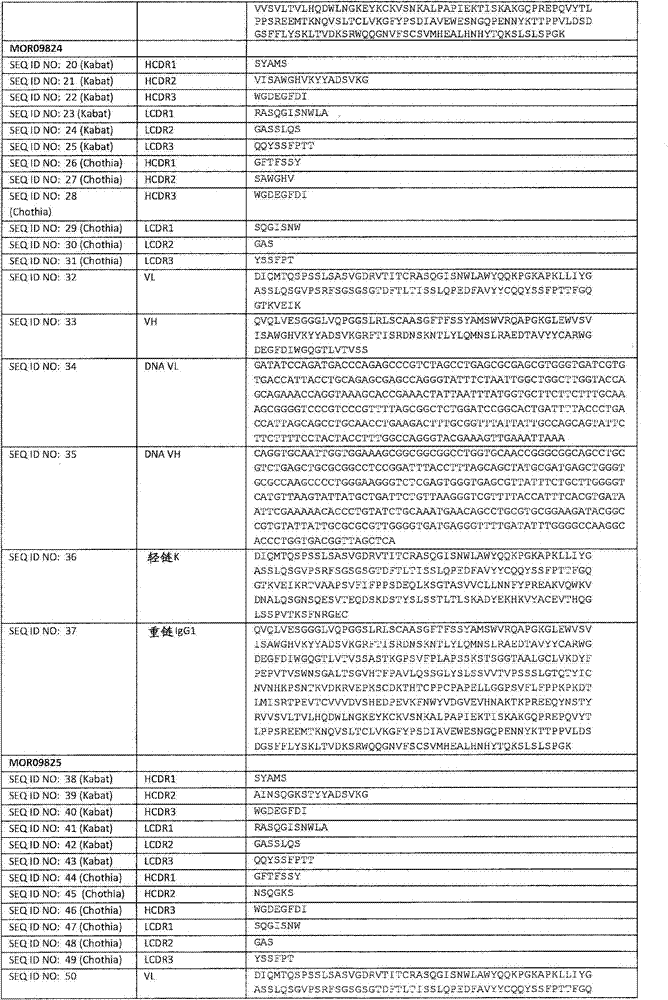
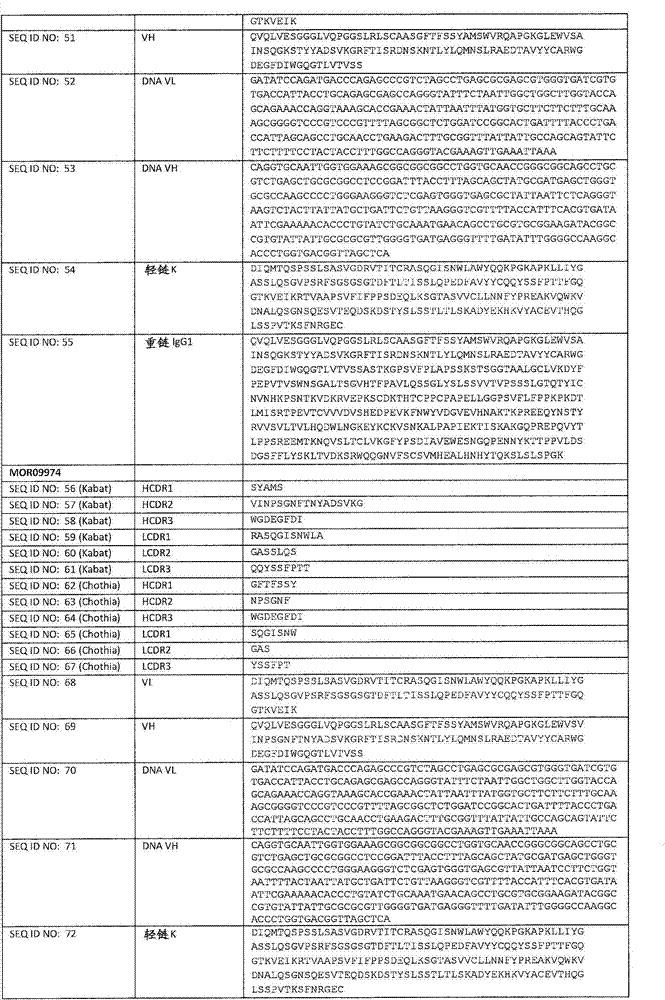
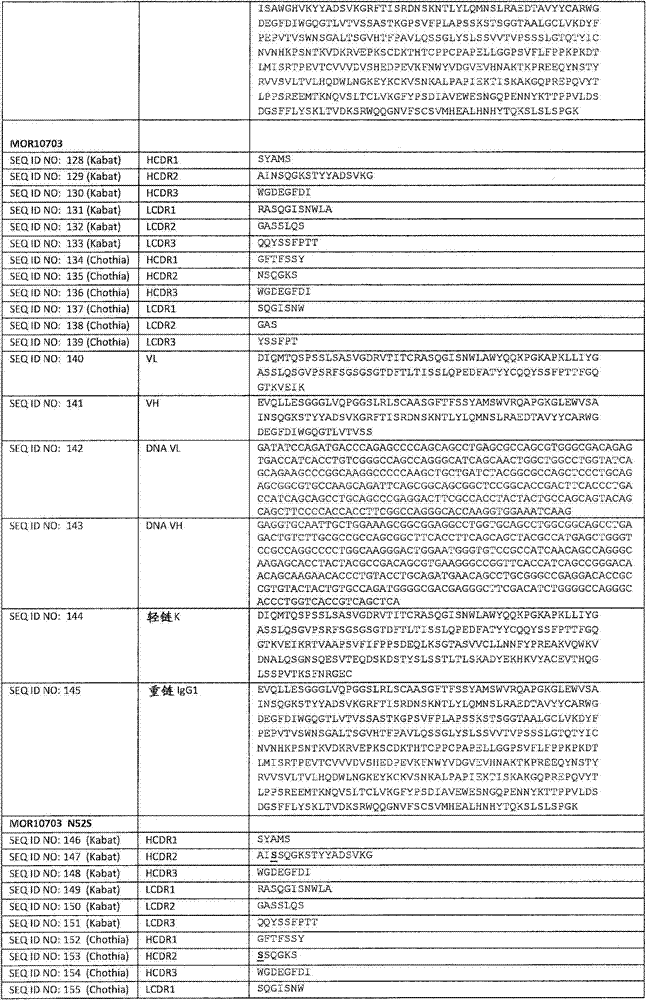

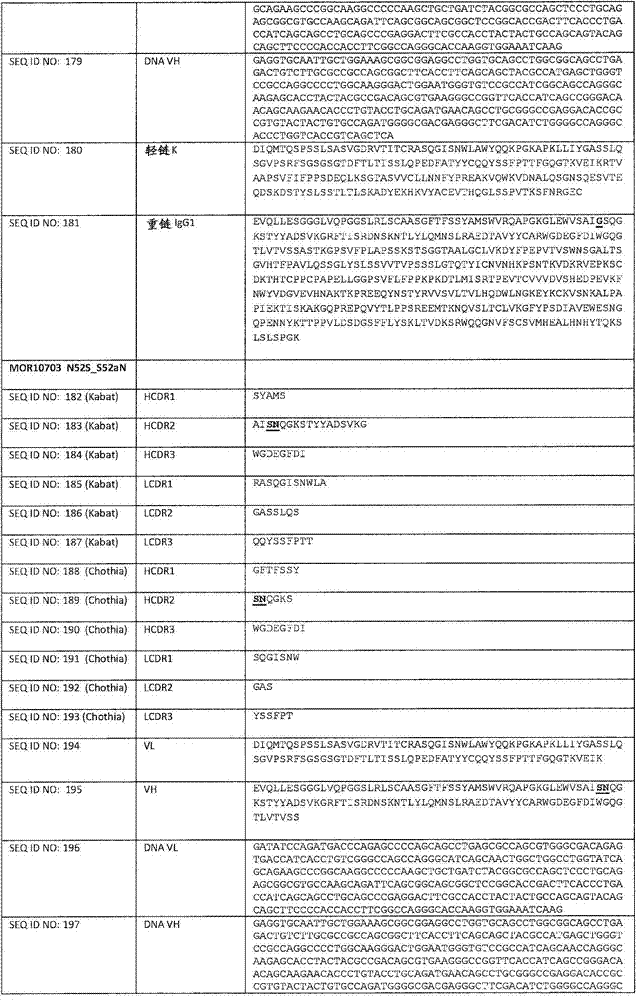
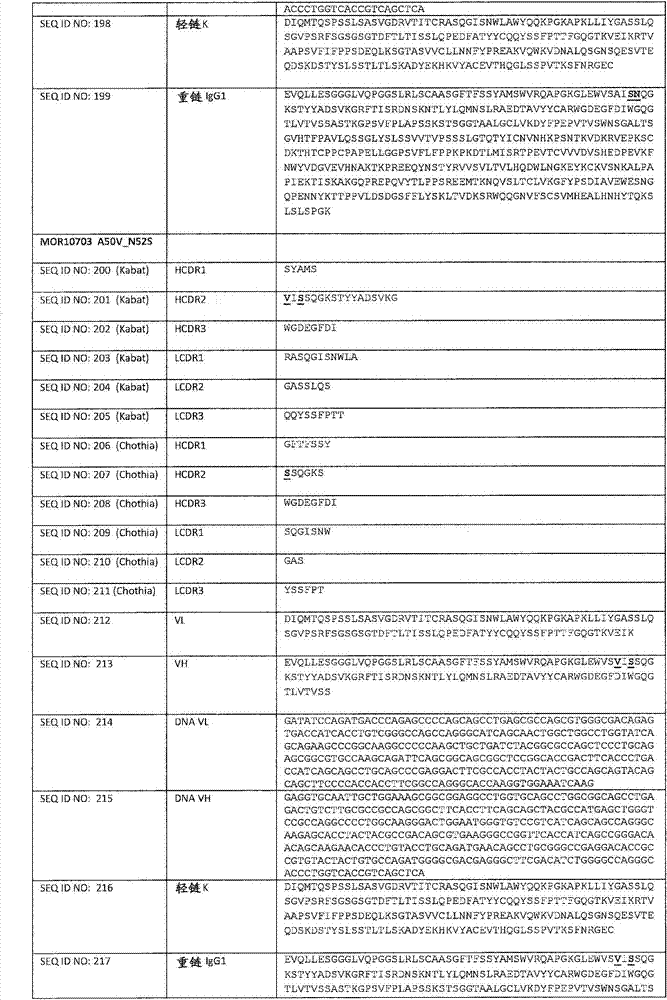
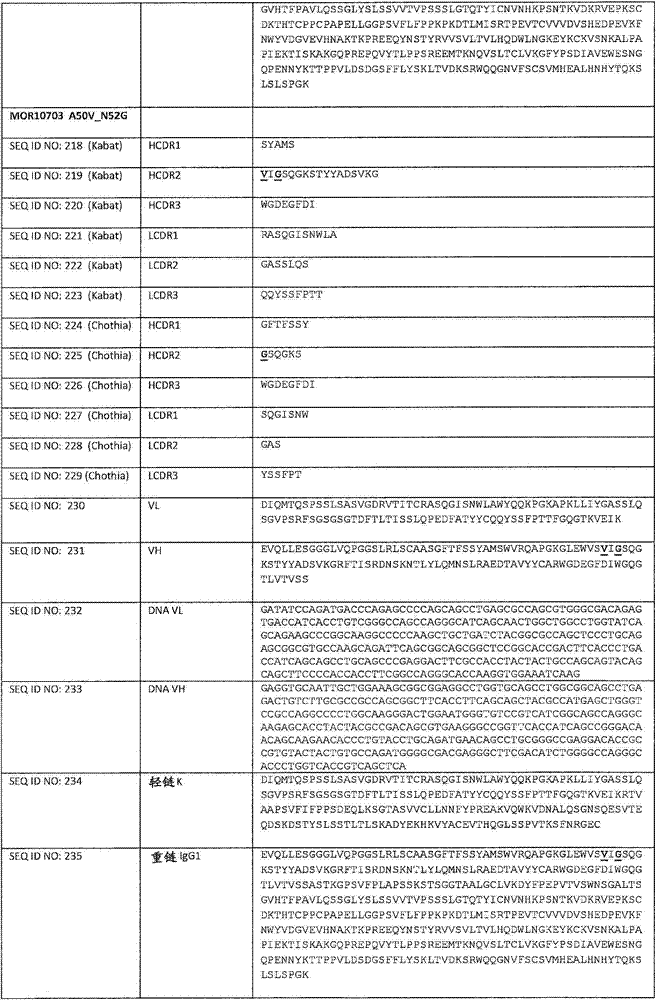


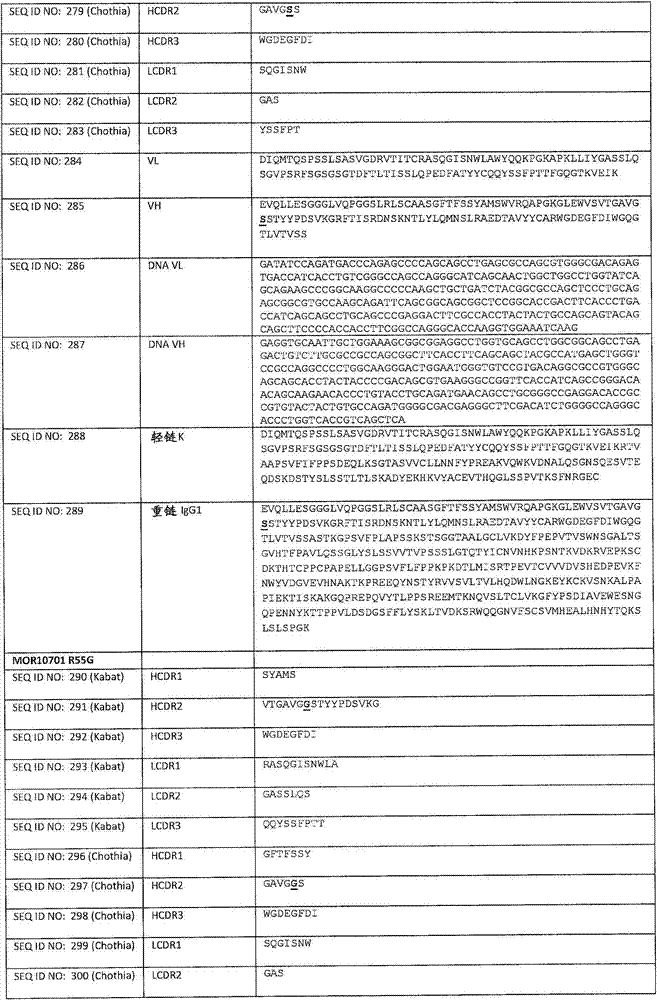
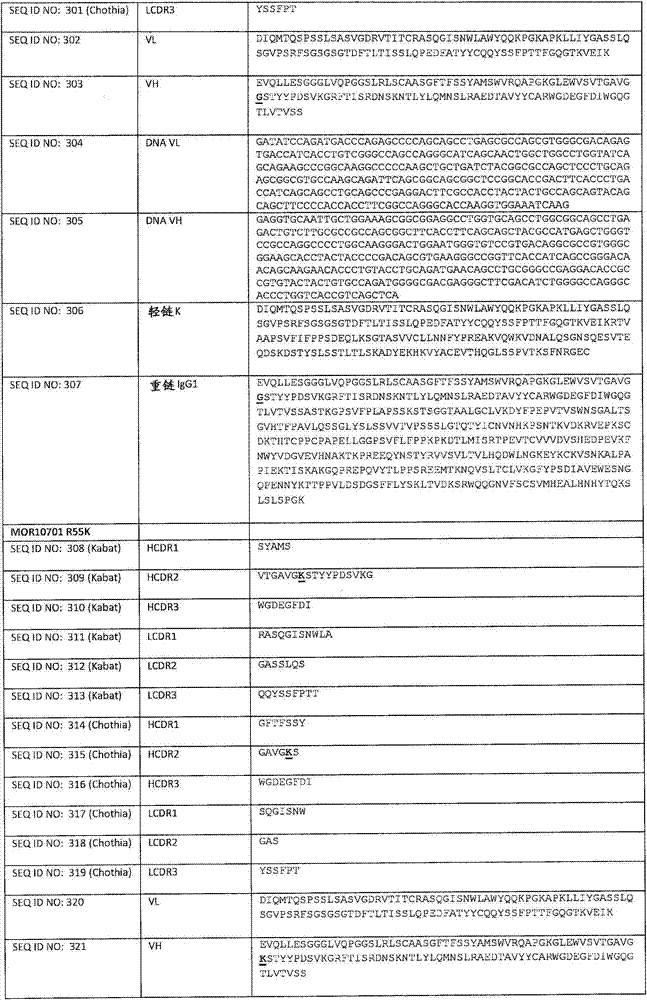
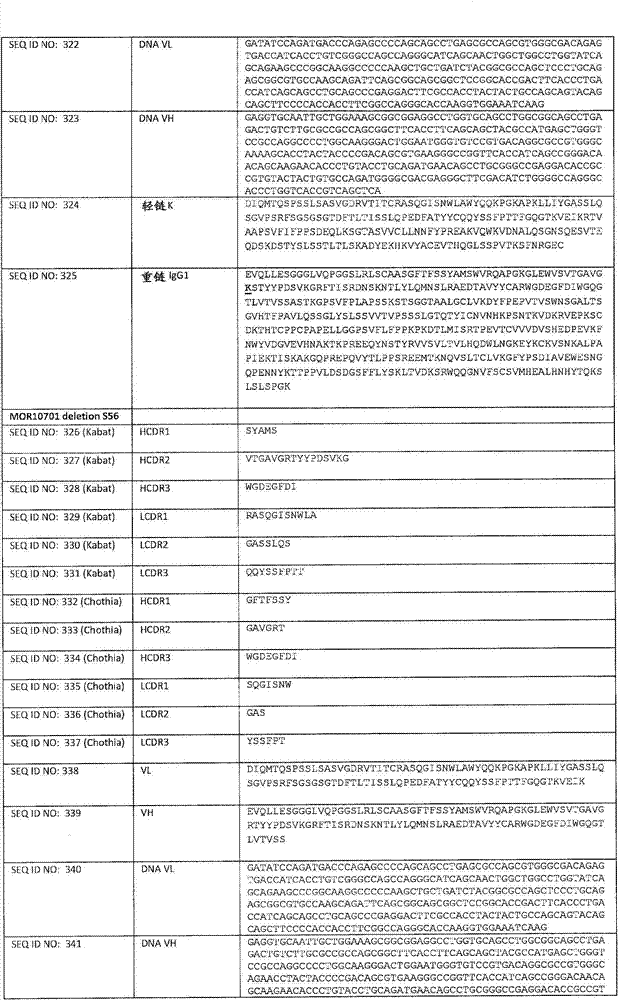

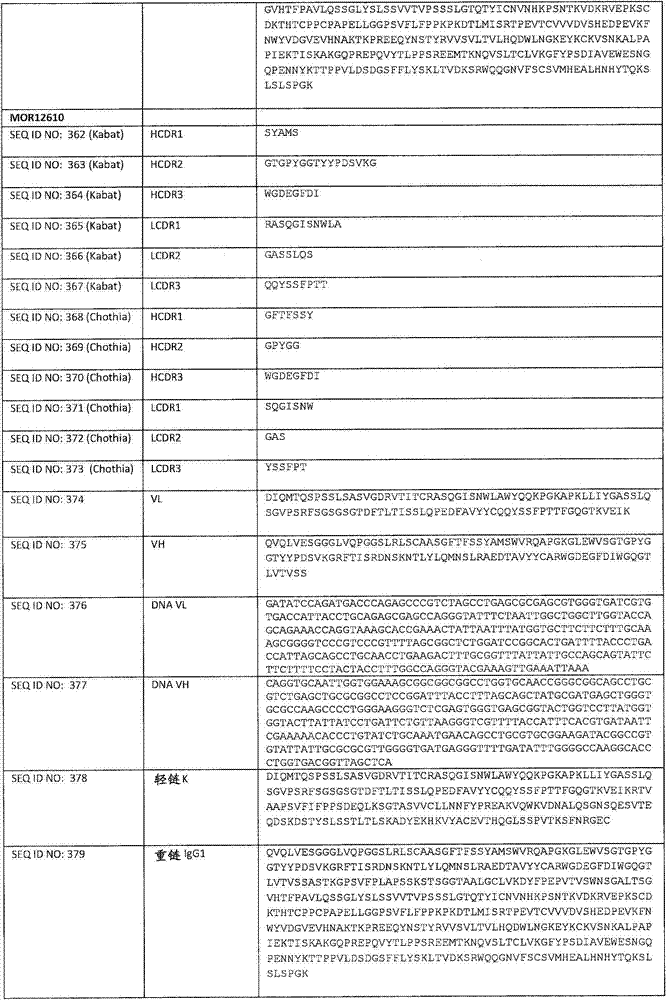
本发明的其他抗体包括下述抗体,其中氨基酸或编码氨基酸的核酸已被突变,但与表1所述序列具有至少60,70,80,90,95,96,97,98和99的百分比同一性。在一些实施方案中,其包括突变体氨基酸序列,其中当与表1所述序列所示的可变区相比时,在可变区中已经突变了不多于1,2,3,4或5个氨基酸,但保留基本相同的治疗活性。Other antibodies of the invention include antibodies in which the amino acid or the nucleic acid encoding the amino acid has been mutated but has at least 60, 70, 80, 90, 95, 96, 97, 98 and 99 percent identity to the sequence described in Table 1 sex. In some embodiments, it includes mutant amino acid sequences wherein no more than 1, 2, 3, 4, or 5 amino acids, but retain essentially the same therapeutic activity.
因为这些抗体或其片段中的每一个都可结合HER3,可“混合和匹配”VH,VL,全长轻链和全长重链序列(氨基酸序列和编码氨基酸序列的核苷酸序列)以制造本发明的其他HER3结合抗体。可使用本领域公知的结合测定(例如ELISA和在实施例章节中描述的其他测定)检测此类“混合和匹配”的HER3结合抗体。当混合和匹配这些链时,应当用结构相似的VH序列替换来自特别的VH/VL配对的VH序列。同样地,应当用结构相似的全长重链序列替换来自特别的全长重链/全长轻链配对的全长重链序列。同样地,应当用结构相似的VL序列替换来自特别的VH/VL配对的VL序列。同样地,应当用结构相似的全长轻链序列替换来自特别的全长重链/全长轻链配对的全长轻链序列。因此,在一个方面,本发明提供了分离的单克隆抗体或其片段,其具有包含选自SEQ ID NO:15,33,51,69,87,105,123,141,159,177,195,213,231,249,267,285,303,321,339,357和375的氨基酸序列的重链可变区;和包含选自SEQ ID NO:14,32,50,68,86,104,122,140,158,176,194,212,230,248,266,284,302,320,338,356和374的氨基酸序列的轻链可变区;其中抗体特异性结合HER3(例如,人和/或食蟹猴HER3)。Because each of these antibodies or fragments thereof binds HER3, the VH, VL, full-length light chain, and full-length heavy chain sequences (amino acid sequence and nucleotide sequence encoding the amino acid sequence) can be "mixed and matched" to produce Other HER3-binding antibodies of the invention. Such "mixed and matched" HER3-binding antibodies can be detected using binding assays well known in the art, such as ELISA and other assays described in the Examples section. When mixing and matching these chains, one should replace the VH sequence from a particular VH/VL pairing with a structurally similar VH sequence. Likewise, the full-length heavy chain sequence from a particular full-length heavy chain/full-length light chain pairing should be replaced with a structurally similar full-length heavy chain sequence. Likewise, VL sequences from a particular VH/VL pairing should be replaced with structurally similar VL sequences. Likewise, the full-length light chain sequence from a particular full-length heavy chain/full-length light chain pairing should be replaced with a structurally similar full-length light chain sequence. Accordingly, in one aspect, the invention provides an isolated monoclonal antibody, or fragment thereof, comprising a protein selected from the group consisting of SEQ ID NO: 15, 33, 51, 69, 87, 105, 123, 141, 159, 177, 195, 213, 231, 249, 267, 285, 303, 321, 339, 357 and 375 of the amino acid sequence of the heavy chain variable region; , 140, 158, 176, 194, 212, 230, 248, 266, 284, 302, 320, 338, 356 and 374 of the light chain variable region of the amino acid sequence; wherein the antibody specifically binds HER3 (e.g., human and/or or cynomolgus monkey HER3).
在另一个方面,本发明提供了HER3结合抗体,其包含表1所述的重链和轻链CDR1,CDR2和CDR3,或其组合。抗体的VHCDR1的氨基酸序列在SEQ ID NO:2,8,20,26,38,44,56,62,74,80,92,98,110,116,128,134,146,152,164,170,182,188,200,206,218,224,236,242,254,260,272,278,290,296,308,314,326,332,344,350,362和368中显示。抗体的VHCDR2的氨基酸序列在SEQ ID NO:3,9,21,27,39,45,57,63,75,81,93,99,111,117,129,135,147,153,165,171,183,189,201,207,219,225,237,243,255,261,273,279,291,297,309,315,327,333,345,351,363和369中显示。抗体的VH CDR3的氨基酸序列在SEQ ID NO:4,10,22,28,40,46,58,64,76,82,94,100,112,118,130,136,148,154,166,172,184,190,202,208,220,226,238,244,256,262,274,280,292,298,310,316,328,334,346,352,364和370中显示。抗体的VL CDR1的氨基酸序列在SEQ ID NO:5,11,23,29,41,47,59,65,77,83,95,101,113,119,131,137,149,155,167,173,185,191,203,209,221,227,239,245,257,263,275,281,293,299,311,317,329,335,347,353,365和371中显示。抗体的VL CDR2的氨基酸序列在SEQ ID NO:6,12,24,30,42,48,60,66,78,84,96,102,114,120,132,138,150,156,168,174,186,192,204,210,222,228,240,246,258,264,276,282,294,300,312,318,330,336,348,354,366和372中显示。抗体的VL CDR3的氨基酸序列在SEQ ID NO:7,13,25,31,43,49,61,67,79,85,97,103,115,121,133,139,151,157,169,175,187,193,205,211,223,229,241,247,259,265,277,283,295,301,313,319,331,337,349,355,367和373中显示。使用Kabat系统(Kabat等人,(1991)Sequences of Proteins of Immunological Interest,第五版,U.S.Department of Health and Human Services,NIH公开号91-3242;Chothia等人,(1987)J.Mol.Biol.196:901-917;Chothia等人,(1989)Nature342:877-883;和Al-Lazikani等人,(1997)J.Mol.Biol.273,927-948)描述CDR区。In another aspect, the present invention provides a HER3-binding antibody comprising the heavy and light chain CDR1, CDR2 and CDR3 described in Table 1, or a combination thereof. The amino acid sequence of VHCDR1 of the antibody is in SEQ ID NO: 2, 8, 20, 26, 38, 44, 56, 62, 74, 80, 92, 98, 110, 116, 128, 134, 146, 152, 164, 170 , 182, 188, 200, 206, 218, 224, 236, 242, 254, 260, 272, 278, 290, 296, 308, 314, 326, 332, 344, 350, 362 and 368 are displayed. The amino acid sequence of VHCDR2 of the antibody is in SEQ ID NO: 3, 9, 21, 27, 39, 45, 57, 63, 75, 81, 93, 99, 111, 117, 129, 135, 147, 153, 165, 171 , 183, 189, 201, 207, 219, 225, 237, 243, 255, 261, 273, 279, 291, 297, 309, 315, 327, 333, 345, 351, 363 and 369 are shown. The amino acid sequence of the VH CDR3 of the antibody is in SEQ ID NO: 4, 10, 22, 28, 40, 46, 58, 64, 76, 82, 94, 100, 112, 118, 130, 136, 148, 154, 166, 172, 184, 190, 202, 208, 220, 226, 238, 244, 256, 262, 274, 280, 292, 298, 310, 316, 328, 334, 346, 352, 364 and 370 are shown. The amino acid sequence of VL CDR1 of the antibody is in SEQ ID NO: 5, 11, 23, 29, 41, 47, 59, 65, 77, 83, 95, 101, 113, 119, 131, 137, 149, 155, 167, 173, 185, 191, 203, 209, 221, 227, 239, 245, 257, 263, 275, 281, 293, 299, 311, 317, 329, 335, 347, 353, 365, and 371 are shown. The amino acid sequence of the VL CDR2 of the antibody is in SEQ ID NO: 6, 12, 24, 30, 42, 48, 60, 66, 78, 84, 96, 102, 114, 120, 132, 138, 150, 156, 168, 174, 186, 192, 204, 210, 222, 228, 240, 246, 258, 264, 276, 282, 294, 300, 312, 318, 330, 336, 348, 354, 366 and 372 are shown. The amino acid sequence of the VL CDR3 of the antibody is in SEQ ID NO: 7, 13, 25, 31, 43, 49, 61, 67, 79, 85, 97, 103, 115, 121, 133, 139, 151, 157, 169, 175, 187, 193, 205, 211, 223, 229, 241, 247, 259, 265, 277, 283, 295, 301, 313, 319, 331, 337, 349, 355, 367 and 373 are shown. Using the Kabat system (Kabat et al., (1991) Sequences of Proteins of Immunological Interest, Fifth Edition, U.S. Department of Health and Human Services, NIH Publication No. 91-3242; Chothia et al., (1987) J. Mol. Biol. 196:901-917; Chothia et al., (1989) Nature 342:877-883; and Al-Lazikani et al., (1997) J. Mol. Biol. 273, 927-948) describe the CDR regions.
在特定实施方案中,结合HER3的抗体包含重链可变区的SEQ ID NO:2的CDR1;SEQ ID NO:3的CDR2;SEQ ID NO:4的CDR3;轻链可变区的SEQ ID NO:5的CDR1;SEQ ID NO:6的CDR2;和SEQ ID NO:7的CDR3。In particular embodiments, the HER3-binding antibody comprises CDR1 of SEQ ID NO: 2 of the heavy chain variable region; CDR2 of SEQ ID NO: 3; CDR3 of SEQ ID NO: 4; SEQ ID NO of the light chain variable region CDR1 of : 5; CDR2 of SEQ ID NO: 6; and CDR3 of SEQ ID NO: 7.
在特定实施方案中,结合HER3的抗体包含重链可变区的SEQ ID NO:20的CDR1;SEQ ID NO:21的CDR2;SEQ ID NO:22的CDR3;轻链可变区的SEQ ID NO:23的CDR1;SEQ ID NO:24的CDR2;和SEQ ID NO:25的CDR3。In particular embodiments, the HER3-binding antibody comprises CDR1 of SEQ ID NO: 20 of the heavy chain variable region; CDR2 of SEQ ID NO: 21; CDR3 of SEQ ID NO: 22; SEQ ID NO of the light chain variable region CDR1 of : 23; CDR2 of SEQ ID NO: 24; and CDR3 of SEQ ID NO: 25.
在特定实施方案中,结合HER3的抗体包含重链可变区的SEQ ID NO:38的CDR1;SEQ ID NO:39的CDR2;SEQ ID NO:40的CDR3;轻链可变区的SEQ ID NO:41的CDR1;SEQ ID NO:42的CDR2;和SEQ ID NO:43的CDR3。In specific embodiments, the antibody that binds HER3 comprises CDR1 of SEQ ID NO: 38 of the heavy chain variable region; CDR2 of SEQ ID NO: 39; CDR3 of SEQ ID NO: 40; SEQ ID NO of the light chain variable region CDR1 of : 41; CDR2 of SEQ ID NO: 42; and CDR3 of SEQ ID NO: 43.
在特定实施方案中,结合HER3的抗体包含重链可变区的SEQ ID NO:56的CDR1;SEQ ID NO:57的CDR2;SEQ ID NO:58的CDR3;轻链可变区的SEQ ID NO:59的CDR1;SEQ ID NO:60的CDR2;和SEQ ID NO:61的CDR3。In particular embodiments, the HER3-binding antibody comprises CDR1 of SEQ ID NO: 56 of the heavy chain variable region; CDR2 of SEQ ID NO: 57; CDR3 of SEQ ID NO: 58; SEQ ID NO of the light chain variable region CDR1 of : 59; CDR2 of SEQ ID NO: 60; and CDR3 of SEQ ID NO: 61.
在特定实施方案中,结合HER3的抗体包含重链可变区的SEQ ID NO:74的CDR1;SEQ ID NO:75的CDR2;SEQ ID NO:76的CDR3;轻链可变区的SEQ ID NO:77的CDR1;SEQ ID NO:78的CDR2;和SEQ ID NO:79的CDR3。In particular embodiments, the HER3-binding antibody comprises CDR1 of SEQ ID NO: 74 of the heavy chain variable region; CDR2 of SEQ ID NO: 75; CDR3 of SEQ ID NO: 76; SEQ ID NO of the light chain variable region CDR1 of : 77; CDR2 of SEQ ID NO: 78; and CDR3 of SEQ ID NO: 79.
在特定实施方案中,结合HER3的抗体包含重链可变区的SEQ ID NO:92的CDR1;SEQ ID NO:93的CDR2;SEQ ID NO:94的CDR3;轻链可变区的SEQ ID NO:95的CDR1;SEQ ID NO:96的CDR2;和SEQ ID NO:97的CDR3。In specific embodiments, the HER3-binding antibody comprises CDR1 of SEQ ID NO: 92 of the heavy chain variable region; CDR2 of SEQ ID NO: 93; CDR3 of SEQ ID NO: 94; SEQ ID NO of the light chain variable region CDR1 of : 95; CDR2 of SEQ ID NO: 96; and CDR3 of SEQ ID NO: 97.
在特定实施方案中,结合HER3的抗体包含重链可变区的SEQ ID NO:110的CDR1;SEQ ID NO:111的CDR2;SEQ ID NO:112的CDR3;轻链可变区的SEQ ID NO:113的CDR1;SEQ ID NO:114的CDR2;和SEQID NO:115的CDR3。In particular embodiments, the HER3-binding antibody comprises CDR1 of SEQ ID NO: 110 of the heavy chain variable region; CDR2 of SEQ ID NO: 111; CDR3 of SEQ ID NO: 112; SEQ ID NO of the light chain variable region CDR1 of : 113; CDR2 of SEQ ID NO: 114; and CDR3 of SEQ ID NO: 115.
在特定实施方案中,结合HER3的抗体包含重链可变区的SEQ ID NO:128的CDR1;SEQ ID NO:129的CDR2;SEQ ID NO:130的CDR3;轻链可变区的SEQ ID NO:131的CDR1;SEQ ID NO:132的CDR2;和SEQIDNO:133的CDR3。In particular embodiments, the HER3-binding antibody comprises CDR1 of SEQ ID NO: 128 of the heavy chain variable region; CDR2 of SEQ ID NO: 129; CDR3 of SEQ ID NO: 130; SEQ ID NO of the light chain variable region CDR1 of : 131; CDR2 of SEQ ID NO: 132; and CDR3 of SEQ ID NO: 133.
在特定实施方案中,结合HER3的抗体包含重链可变区的SEQ ID NO:146的CDR1;SEQ ID NO:147的CDR2;SEQ ID NO:148的CDR3;轻链可变区的SEQ ID NO:149的CDR1;SEQ ID NO:150的CDR2;和SEQID NO:151的CDR3。In particular embodiments, the HER3-binding antibody comprises CDR1 of SEQ ID NO: 146 of the heavy chain variable region; CDR2 of SEQ ID NO: 147; CDR3 of SEQ ID NO: 148; SEQ ID NO of the light chain variable region CDR1 of : 149; CDR2 of SEQ ID NO: 150; and CDR3 of SEQ ID NO: 151.
在特定实施方案中,结合HER3的抗体包含重链可变区的SEQ ID NO:164的CDR1;SEQ ID NO:165的CDR2;SEQ ID NO:166的CDR3;轻链可变区的SEQ ID NO:167的CDR1;SEQ ID NO:168的CDR2;和SEQID NO:169的CDR3。In specific embodiments, the HER3-binding antibody comprises CDR1 of SEQ ID NO: 164 of the heavy chain variable region; CDR2 of SEQ ID NO: 165; CDR3 of SEQ ID NO: 166; SEQ ID NO of the light chain variable region CDR1 of : 167; CDR2 of SEQ ID NO: 168; and CDR3 of SEQ ID NO: 169.
在特定实施方案中,结合HER3的抗体包含重链可变区的SEQ ID NO:182的CDR1;SEQ ID NO:183的CDR2;SEQ ID NO:184的CDR3;轻链可变区SEQ ID NO:185的CDR1;SEQ ID NO:186的CDR2;和SEQ IDNO:187的CDR3。In particular embodiments, the antibody that binds HER3 comprises CDR1 of SEQ ID NO: 182 of the heavy chain variable region; CDR2 of SEQ ID NO: 183; CDR3 of SEQ ID NO: 184; light chain variable region of SEQ ID NO: CDR1 of 185; CDR2 of SEQ ID NO: 186; and CDR3 of SEQ ID NO: 187.
在特定实施方案中,结合HER3的抗体包含重链可变区的SEQ ID NO:200的CDR1;SEQ ID NO:201的CDR2;SEQ ID NO:202的CDR3;轻链可变区的SEQ ID NO:203的CDR1;SEQ ID NO:204的CDR2;和SEQID NO:205的CDR3。In particular embodiments, the HER3-binding antibody comprises CDR1 of SEQ ID NO: 200 of the heavy chain variable region; CDR2 of SEQ ID NO: 201; CDR3 of SEQ ID NO: 202; SEQ ID NO of the light chain variable region CDR1 of : 203; CDR2 of SEQ ID NO: 204; and CDR3 of SEQ ID NO: 205.
在特定实施方案中,结合HER3的抗体包含重链可变区的SEQ ID NO:218的CDR1;SEQ ID NO:219的CDR2;SEQ ID NO:220的CDR3;轻链可变区的SEQ ID NO:221的CDR1;SEQ ID NO:222的CDR2;和SEQID NO:223的CDR3。In particular embodiments, the HER3-binding antibody comprises CDR1 of SEQ ID NO: 218 of the heavy chain variable region; CDR2 of SEQ ID NO: 219; CDR3 of SEQ ID NO: 220; SEQ ID NO of the light chain variable region CDR1 of : 221; CDR2 of SEQ ID NO: 222; and CDR3 of SEQ ID NO: 223.
在特定实施方案中,结合HER3的抗体包含重链可变区的SEQ ID NO:236的CDR1;SEQ ID NO:237的CDR2;SEQ ID NO:238的CDR3;轻链可变区的SEQ ID NO:239的CDR1;SEQ ID NO:240的CDR2;和SEQID NO:241的CDR3。In particular embodiments, the HER3-binding antibody comprises CDR1 of SEQ ID NO: 236 of the heavy chain variable region; CDR2 of SEQ ID NO: 237; CDR3 of SEQ ID NO: 238; SEQ ID NO of the light chain variable region CDR1 of : 239; CDR2 of SEQ ID NO: 240; and CDR3 of SEQ ID NO: 241.
在特定实施方案中,结合HER3的抗体包含重链可变区的SEQ ID NO:254的CDR1;SEQ ID NO:255的CDR2;SEQ ID NO:256的CDR3;轻链可变区的SEQ ID NO:257的CDR1;SEQ ID NO:258的CDR2;和SEQID NO:259的CDR3.In particular embodiments, the HER3-binding antibody comprises CDR1 of SEQ ID NO: 254 of the heavy chain variable region; CDR2 of SEQ ID NO: 255; CDR3 of SEQ ID NO: 256; SEQ ID NO of the light chain variable region : CDR1 of 257; CDR2 of SEQ ID NO: 258; and CDR3 of SEQ ID NO: 259.
在特定实施方案中,结合HER3的抗体包含重链可变区的SEQ ID NO:272的CDR1;SEQ ID NO:273的CDR2;SEQ ID NO:274的CDR3;轻链可变区的SEQ ID NO:275的CDR1;SEQ ID NO:276的CDR2;和SEQID NO:277的CDR3。In specific embodiments, the HER3-binding antibody comprises CDR1 of SEQ ID NO: 272 of the heavy chain variable region; CDR2 of SEQ ID NO: 273; CDR3 of SEQ ID NO: 274; SEQ ID NO of the light chain variable region CDR1 of : 275; CDR2 of SEQ ID NO: 276; and CDR3 of SEQ ID NO: 277.
在特定实施方案中,结合HER3的抗体包含重链可变区的SEQ ID NO:290的CDR1;SEQ ID NO:291的CDR2;SEQ ID NO:292的CDR3;轻链可变区的SEQ ID NO:293的CDR1;SEQ ID NO:294的CDR2;和SEQID NO:295的CDR3。In particular embodiments, the HER3-binding antibody comprises CDR1 of SEQ ID NO: 290 of the heavy chain variable region; CDR2 of SEQ ID NO: 291; CDR3 of SEQ ID NO: 292; SEQ ID NO of the light chain variable region CDR1 of : 293; CDR2 of SEQ ID NO: 294; and CDR3 of SEQ ID NO: 295.
在特定实施方案中,结合HER3的抗体包含重链可变区的SEQ ID NO:308的CDR1;SEQ ID NO:309的CDR2;SEQ ID NO:310的CDR3;轻链可变区的SEQ ID NO:311的CDR1;SEQ ID NO:312的CDR2;和SEQID NO:313的CDR3。In particular embodiments, the HER3-binding antibody comprises CDR1 of SEQ ID NO: 308 of the heavy chain variable region; CDR2 of SEQ ID NO: 309; CDR3 of SEQ ID NO: 310; SEQ ID NO of the light chain variable region CDR1 of : 311; CDR2 of SEQ ID NO: 312; and CDR3 of SEQ ID NO: 313.
在特定实施方案中,结合HER3的抗体包含重链可变区的SEQ ID NO:326的CDR1;SEQ ID NO:327的CDR2;SEQ ID NO:328的CDR3;轻链可变区的SEQ ID NO:329的CDR1;SEQ ID NO:330的CDR2;和SEQID NO:331的CDR3。In specific embodiments, the antibody that binds HER3 comprises CDR1 of SEQ ID NO: 326 of the heavy chain variable region; CDR2 of SEQ ID NO: 327; CDR3 of SEQ ID NO: 328; SEQ ID NO of the light chain variable region CDR1 of : 329; CDR2 of SEQ ID NO: 330; and CDR3 of SEQ ID NO: 331.
在特定实施方案中,结合HER3的抗体包含重链可变区的SEQ ID NO:344的CDR1;SEQ ID NO:345的CDR2;SEQ ID NO:346的CDR3;轻链可变区的SEQ ID NO:347的CDR1;SEQ ID NO:348的CDR2;和SEQID NO:349的CDR3。In particular embodiments, the HER3-binding antibody comprises CDR1 of SEQ ID NO: 344 of the heavy chain variable region; CDR2 of SEQ ID NO: 345; CDR3 of SEQ ID NO: 346; SEQ ID NO of the light chain variable region CDR1 of : 347; CDR2 of SEQ ID NO: 348; and CDR3 of SEQ ID NO: 349.
在特定实施方案中,结合HER3的抗体包含重链可变区的SEQ ID NO:362的CDR1;SEQ ID NO:363的CDR2;SEQ ID NO:364的CDR3;轻链可变区的SEQ ID NO:365的CDR1;SEQ ID NO:366的CDR2;和SEQID NO:367的CDR3。In specific embodiments, the antibody that binds HER3 comprises CDR1 of SEQ ID NO: 362 of the heavy chain variable region; CDR2 of SEQ ID NO: 363; CDR3 of SEQ ID NO: 364; SEQ ID NO of the light chain variable region : CDR1 of 365; CDR2 of SEQ ID NO: 366; and CDR3 of SEQ ID NO: 367.
在特定的实施方案中,结合HER3的抗体包含SEQ ID NO.15的VH和SEQ ID NO:14的VL。在特定的实施方案中,结合HER3的抗体包含SEQ ID NO:33的VH和SEQ ID NO:32的VL。在特定的实施方案中,结合HER3的抗体包含SEQ ID NO:51的VH和SEQ ID NO:50的VL。在特定的实施方案中,结合HER3的抗体包含SEQ ID NO:69的VH和SEQ ID NO:68的VL。在特定的实施方案中,结合HER3的抗体包含SEQID NO:87的VH和SEQ ID NO:86的VL。在特定的实施方案中,结合HER3的抗体包含SEQ ID NO:105的VH和SEQ ID NO:104的VL。在特定的实施方案中,结合HER3的抗体包含SEQ ID NO:123的VH和SEQID NO:122的VL。在特定的实施方案中,结合HER3的抗体包含SEQ IDNO:141的VH和SEQ ID NO:140的VL。在特定的实施方案中,结合HER3的抗体包含SEQ ID NO:159的VH和SEQ ID NO:158的VL。在特定的实施方案中,结合HER3的抗体包含SEQ ID NO:177的VH和SEQID NO:176的VL。在特定的实施方案中,结合HER3的抗体包含SEQ IDNO:195的VH和SEQ ID NO:194的VL。在特定的实施方案中,结合HER3的抗体包含SEQ ID NO:213的VH和SEQ ID NO:212的VL。在特定的实施方案中,结合HER3的抗体包含SEQ ID NO:231的VH和SEQID NO:230的VL。在特定的实施方案中,结合HER3的抗体包含SEQ IDNO:249的VH和SEQ ID NO:248的VL。在特定的实施方案中,结合HER3的抗体包含SEQ ID NO:267的VH和SEQ ID NO:266的VL。在特定的实施方案中,结合HER3的抗体包含SEQ ID NO:285的VH和SEQID NO:284的VL。在特定的实施方案中,结合HER3的抗体包含SEQ IDNO:303的VH和SEQ ID NO:302的VL。在特定的实施方案中,结合HER3的抗体包含SEQ ID NO:321的VH和SEQ ID NO:320的VL。在特定的实施方案中,结合HER3的抗体包含SEQ ID NO:339的VH和SEQID NO:338的VL。在特定的实施方案中,结合HER3的抗体包含SEQ IDNO:357的VH和SEQ ID NO:356的VL。在特定的实施方案中,结合HER3的抗体包含SEQ ID NO:375的VH和SEQ ID NO:374的VL。在一个实施方案中,HER3抗体是拮抗剂抗体。在某些实施方案中,结合HER3的抗体是表1所述的抗体。In specific embodiments, the HER3-binding antibody comprises the VH of SEQ ID NO. 15 and the VL of SEQ ID NO: 14. In specific embodiments, the antibody that binds HER3 comprises the VH of SEQ ID NO: 33 and the VL of SEQ ID NO: 32. In specific embodiments, the antibody that binds HER3 comprises the VH of SEQ ID NO:51 and the VL of SEQ ID NO:50. In specific embodiments, the antibody that binds HER3 comprises the VH of SEQ ID NO:69 and the VL of SEQ ID NO:68. In specific embodiments, the antibody that binds HER3 comprises the VH of SEQ ID NO:87 and the VL of SEQ ID NO:86. In specific embodiments, the antibody that binds HER3 comprises the VH of SEQ ID NO: 105 and the VL of SEQ ID NO: 104. In specific embodiments, the antibody that binds HER3 comprises the VH of SEQ ID NO: 123 and the VL of SEQ ID NO: 122. In specific embodiments, the antibody that binds HER3 comprises the VH of SEQ ID NO: 141 and the VL of SEQ ID NO: 140. In specific embodiments, the antibody that binds HER3 comprises the VH of SEQ ID NO: 159 and the VL of SEQ ID NO: 158. In specific embodiments, the antibody that binds HER3 comprises the VH of SEQ ID NO: 177 and the VL of SEQ ID NO: 176. In specific embodiments, the antibody that binds HER3 comprises the VH of SEQ ID NO: 195 and the VL of SEQ ID NO: 194. In specific embodiments, the antibody that binds HER3 comprises the VH of SEQ ID NO:213 and the VL of SEQ ID NO:212. In specific embodiments, the antibody that binds HER3 comprises the VH of SEQ ID NO:231 and the VL of SEQ ID NO:230. In specific embodiments, the antibody that binds HER3 comprises the VH of SEQ ID NO:249 and the VL of SEQ ID NO:248. In specific embodiments, the antibody that binds HER3 comprises the VH of SEQ ID NO: 267 and the VL of SEQ ID NO: 266. In specific embodiments, the antibody that binds HER3 comprises the VH of SEQ ID NO:285 and the VL of SEQ ID NO:284. In specific embodiments, the antibody that binds HER3 comprises the VH of SEQ ID NO: 303 and the VL of SEQ ID NO: 302. In specific embodiments, the antibody that binds HER3 comprises the VH of SEQ ID NO:321 and the VL of SEQ ID NO:320. In specific embodiments, the antibody that binds HER3 comprises the VH of SEQ ID NO:339 and the VL of SEQ ID NO:338. In specific embodiments, the antibody that binds HER3 comprises the VH of SEQ ID NO:357 and the VL of SEQ ID NO:356. In specific embodiments, the antibody that binds HER3 comprises the VH of SEQ ID NO:375 and the VL of SEQ ID NO:374. In one embodiment, the HER3 antibody is an antagonist antibody. In certain embodiments, the antibody that binds HER3 is an antibody described in Table 1.
如此处所用,人抗体包含“产自”或“来自”特别种系序列的重链或轻链可变区或全长重链或轻链,如果抗体的可变区或全长链获自使用人种系免疫球蛋白基因的系统的话。此类系统包括用目的抗原免疫携带人免疫球蛋白基因的转基因小鼠或利用目的抗原筛选在噬菌体上展示的人免疫球蛋白基因文库。例如可通过比较人抗体的氨基酸序列与人种系免疫球蛋白的氨基酸序列,并选择与人抗体的序列在序列上最相近(即,最高%同一性)的人种系免疫球蛋白序列来鉴定“产自”或“来自”人种系免疫球蛋白序列的人抗体。“产自”或“来自”特别人种系免疫球蛋白序列的人抗体可含有较之种系序列的氨基酸差异,例如因天然存在的体细胞突变或刻意引入定点突变的氨基酸差异。然而,在VH或VL构架区,所选人抗体在氨基酸序列上通常与人种系免疫球蛋白基因编码的氨基酸序列具有至少90%的同一性,并含有氨基酸残基,所述氨基酸残基当与其它物种的种系免疫球蛋白氨基酸序列(例如,鼠类种系序列)比较时,将人抗体鉴定为人的。在某些情况下,人抗体在氨基酸序列上与种系免疫球蛋白基因编码的氨基酸序列具有至少60%、70%、80%、90%或至少95%,或甚至至少96%、97%、98%或99%的同一性。通常,重组人抗体与人种系免疫球蛋白基因编码的氨基酸序列在VH或VL构架区具有不多于10个氨基酸的差异。在某些情况下,人抗体与种系免疫球蛋白基因编码的氨基酸序列具有不多于5个,或甚至不多于4、3、2或1个氨基酸的差异。多种代表性HER3抗体的使用VH和VL种系序列的不同种系形式在表2中显示,使用Kabat系统。用粗体突出CDR位置。表中对种系序列使用的符号如下:MOR10701-VH_3-07表示MOR10701CDR环在VH种系序列3-07的框架区中(基于Vbase命名),MOR10703-VK_L1表示来自MOR10703的CDR在来自VK_L1的种系框架区中,其中VK是κ轻链。As used herein, a human antibody comprises a heavy or light chain variable region or a full-length heavy or light chain "derived from" or "derived from" a particular germline sequence if the variable region or full-length chain of the antibody was obtained from a Systematic words of human germline immunoglobulin genes. Such systems include immunization of transgenic mice carrying human immunoglobulin genes with the antigen of interest or screening of human immunoglobulin gene libraries displayed on phage using the antigen of interest. Can be identified, for example, by comparing the amino acid sequence of a human antibody to that of a human germline immunoglobulin, and selecting the human germline immunoglobulin sequence that is closest in sequence (i.e., highest % identity) to the sequence of the human antibody A human antibody is "produced from" or "derived from" human germline immunoglobulin sequences. A human antibody "produced from" or "derived from" a particular human germline immunoglobulin sequence may contain amino acid differences from the germline sequence, for example, as a result of naturally occurring somatic mutations or by deliberate introduction of site-directed mutations. However, in the VH or VL framework regions, selected human antibodies will generally have at least 90% identity in amino acid sequence to those encoded by human germline immunoglobulin genes and will contain amino acid residues which, when Human antibodies are identified as human when compared to germline immunoglobulin amino acid sequences of other species (eg, murine germline sequences). In certain instances, a human antibody shares at least 60%, 70%, 80%, 90%, or at least 95%, or even at least 96%, 97%, or even at least 96%, 97%, or 98% or 99% identity. Typically, recombinant human antibodies differ by no more than 10 amino acids in the VH or VL framework regions from the amino acid sequences encoded by human germline immunoglobulin genes. In certain instances, human antibodies differ from the amino acid sequence encoded by the germline immunoglobulin genes by no more than 5, or even by no more than 4, 3, 2, or 1 amino acid. The different germline forms of various representative HER3 antibodies using VH and VL germline sequences are shown in Table 2, using the Kabat system. CDR positions are highlighted in bold. The symbols used for the germline sequences in the table are as follows: MOR10701-VH_3-07 indicates that the MOR10701 CDR loop is in the framework region of the VH germline sequence 3-07 (based on Vbase nomenclature), MOR10703-VK_L1 indicates that the CDR from MOR10703 is in the framework region from VK_L1 In the framework region, where VK is a kappa light chain.
表2:选定的多种代表性抗体的不同种系形式Table 2: Different germline forms of selected representative antibodies
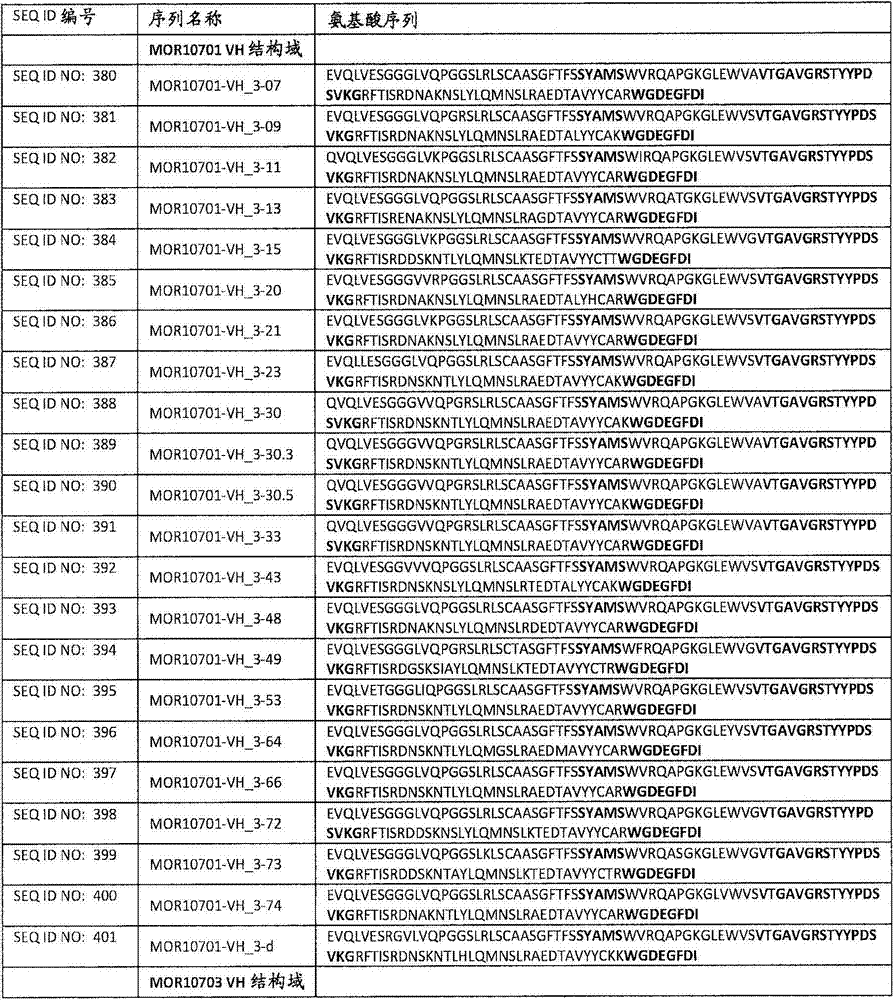
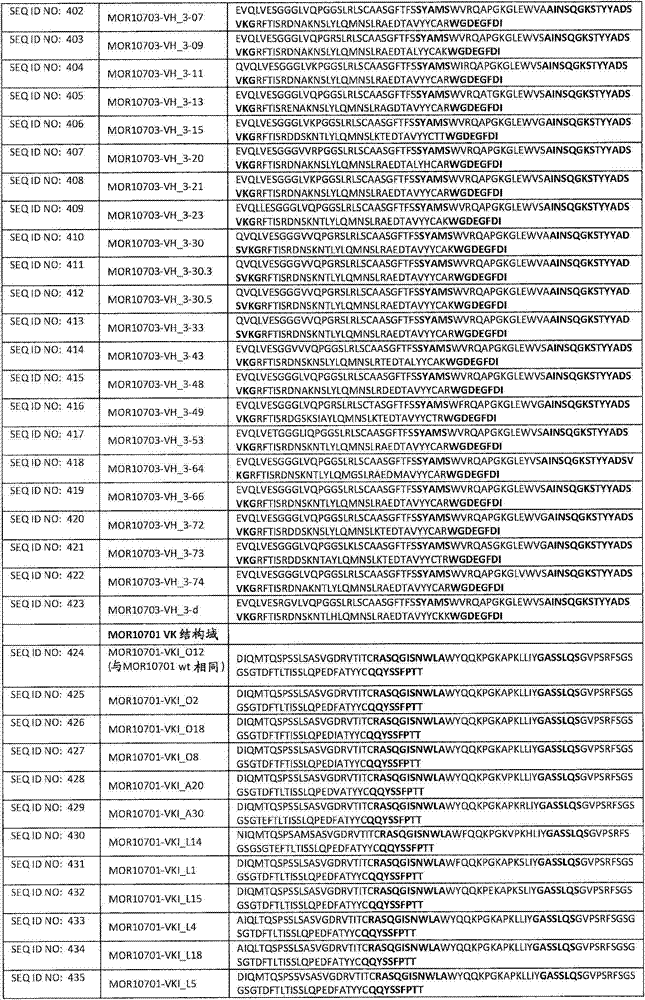
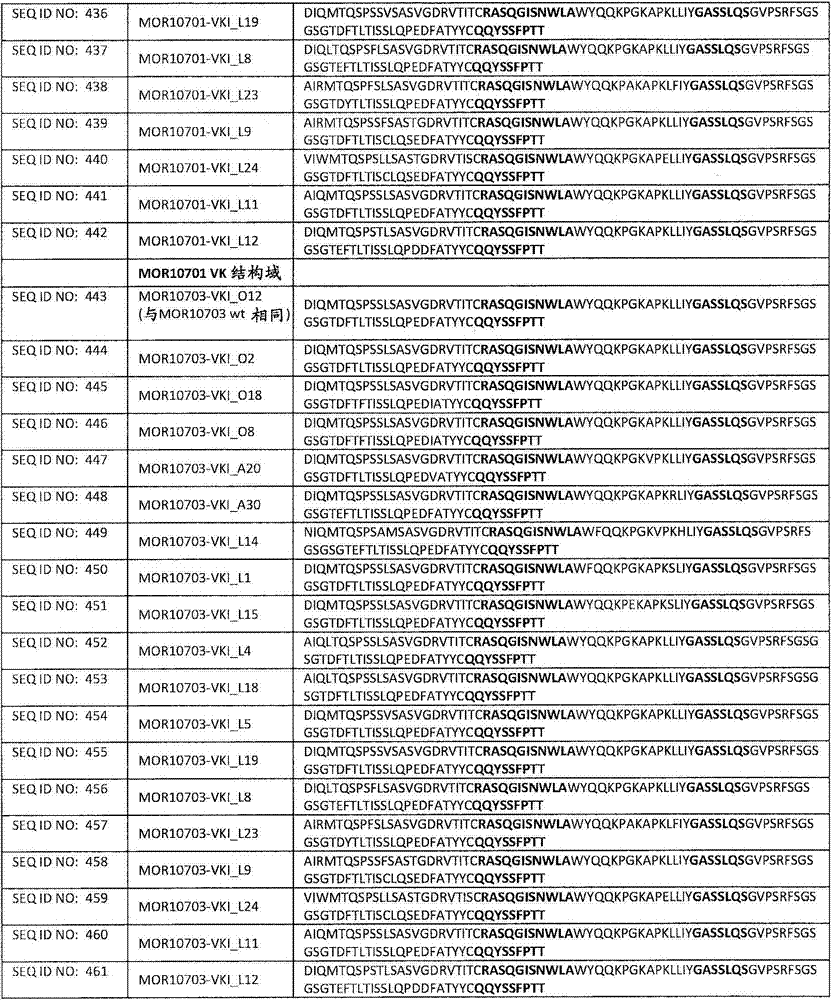
表3:JH区段Table 3: JH segment
表4:JK区段Table 4: JK segment
可使用VH-种系序列和JH区段的任意组合。组合的代表性实例在表5中显示。Any combination of VH-germline sequences and JH segments can be used. Representative examples of combinations are shown in Table 5.
表5:VH-种系序列和JH区段的组合的代表性实例Table 5: Representative examples of combinations of VH-germline sequences and JH segments
可使用VL-种系序列和JK区段的任意组合。组合的代表性实例在表6中显示。Any combination of VL-germline sequences and JK segments can be used. Representative examples of combinations are shown in Table 6.
表6:VK-种系序列和JK区段的组合的代表性实例Table 6: Representative examples of combinations of VK-germline sequences and JK segments
一旦VH与JH组合并且VK与JK组合,那么可使用VH或JH与VK或JK的任意组合。在一个实施方案中,对每个抗体,任意VH种系区可与任意VK(VL)种系区组合。组合的多种代表性实例在表7中显示。Once VH is combined with JH and VK is combined with JK, any combination of VH or JH with VK or JK can be used. In one embodiment, any VH germline region may be combined with any VK (VL) germline region for each antibody. Various representative examples of combinations are shown in Table 7.
表7:种系序列组合的代表性实例Table 7: Representative examples of germline sequence combinations

在一个实施方案中,本发明涉及包含序列Xaa1-HCDR1-Xaa2-HCDR2-Xaa3-HCDR3-Xaa4的重链可变区,其中重链HCDR1,HCDR2,HCDR3是选自表1和2的任意重链CDR。仅仅为了说明的目的,所述序列可为:In one embodiment, the present invention relates to a heavy chain variable region comprising the sequence Xaa 1 -HCDR1-Xaa 2 -HCDR2-Xaa 3 -HCDR3-Xaa 4 , wherein heavy chain HCDR1, HCDR2, HCDR3 are selected from Tables 1 and 2 Any heavy chain CDR of . For illustrative purposes only, the sequence can be:
Xaa1-SYAMS-Xaa2-AINSQGKSTYYADSVKG-Xaa3-WGDEGFDI-Xaa4(SEQ ID NO:493),其中,Xaa 1 -SYAMS-Xaa 2 -AINSQGKSTYYADSVKG-Xaa 3 -WGDEGFDI-Xaa 4 ( SEQ ID NO: 493), wherein,
Xaa1是任意30个氨基酸的框架区;Xaa 1 is a framework region of any 30 amino acids;
Xaa2是任意14个氨基酸的框架区;Xaa 2 is a framework region of any 14 amino acids;
Xaa3是任意32个氨基酸的框架区;Xaa 3 is any framework region of 32 amino acids;
Xaa4是任意11个氨基酸的框架区;Xaa 4 is a framework region of any 11 amino acids;
在一个实施方案中,本发明涉及包含Xaa1-LCDR1-Xaa2-LCDR2-Xaa3-LCDR3-Xaa4的序列的轻链可变区,其中轻链LCDR1,LCDR2,LCDR3是选自表1和2的任意轻链CDR。仅仅为了说明的目的,所述序列可为:In one embodiment, the present invention relates to a light chain variable region comprising the sequence of Xaa 1 -LCDR1-Xaa 2 -LCDR2-Xaa 3 -LCDR3-Xaa 4 , wherein the light chain LCDR1, LCDR2, LCDR3 are selected from Table 1 and Any light chain CDR of 2. For illustrative purposes only, the sequence can be:
Xaa1-RASQGISNWLA-Xaa2-GASSLQS-Xaa3-QQYSSFPTT-Xaa4(SEQ IDNO:494),其中,Xaa 1 -RASQGISNWLA-Xaa 2 -GASSLQS-Xaa 3 -QQYSSFPTT-Xaa 4 (SEQ ID NO: 494), wherein,
Xaa1是任意23个氨基酸的框架区;Xaa 1 is any framework region of 23 amino acids;
Xaa2是任意15个氨基酸的框架区;Xaa 2 is a framework region of any 15 amino acids;
Xaa3是任意32个氨基酸的框架区;和 Xaa3 is any 32 amino acid framework region; and
Xaa4是任意10个氨基酸的框架区。Xaa 4 is an arbitrary 10 amino acid framework region.
本文公开的抗体可为单链抗体、双抗体、结构域抗体、纳米抗体和单抗体(unibody)的衍生物。“单链抗体”(scFv)由包含和VH结构域相连的VL结构域的单条多肽链组成,其中VL结构域和VH结构域配对形成单价分子。可根据本领域公知的方法制备单链抗体(见例如,Bird等人,(1988)Science242:423-426和Huston等人,(1988)Proc.Natl.Acad.Sci.USA85:5879-5883)。“双抗体”由两条链组成,每条链包含在同一多肽链上通过短肽接头连接的重链可变区和轻链可变区,其中在同一链上的两个区域不彼此配对,而是与另一条链上的互补结构域配对形成双特异性分子。制备双抗体的方法是本领域公知的(见例如,Holliger等人,(1993)Proc.Natl.Acad.Sci.USA90:6444-6448,和Poljak等人,(1994)Structure2:1121-1123)。结构域抗体(dAb)是抗体的小的功能性结合单位,对应抗体的重链或轻链的可变区。结构域抗体在细菌、酵母和哺乳动物细胞系统中良好表达。结构域抗体的进一步细节和制备方法是本领域公知的(见例如,美国专利号6,291,158;6,582,915;6,593,081;6,172,197;6,696,245;欧洲专利0368684&0616640;WO05/035572,WO04/101790,WO04/081026,WO04/058821,WO04/003019和WO03/002609。纳米抗体来源于抗体的重链。纳米抗体通常包含单个可变结构域和2个恒定结构域(CH2和CH3)并保留原始抗体的抗原结合能力。可通过本领域公知的方法制备纳米抗体(见例如,美国专利号6,765,087,美国专利号6,838,254,WO06/079372)。单抗体由IgG4抗体的一条轻链和一条重链组成。可通过去除IgG4抗体的铰链区制备单抗体。单抗体的进一步细节和制备其的方法可见WO2007/059782。The antibodies disclosed herein may be derivatives of single chain antibodies, diabodies, domain antibodies, nanobodies and unibodies. A "single-chain antibody" (scFv) consists of a single polypeptide chain comprising a VL domain connected to a VH domain, wherein the VL and VH domains pair to form a monovalent molecule. Single-chain antibodies can be prepared according to methods well known in the art (see eg, Bird et al., (1988) Science 242:423-426 and Huston et al., (1988) Proc. Natl. Acad. Sci. USA 85:5879-5883). A "diabody" consists of two chains, each chain comprising a heavy chain variable region and a light chain variable region connected by a short peptide linker on the same polypeptide chain, wherein the two regions on the same chain are not paired with each other, Instead, they pair with complementary domains on the other chain to form bispecific molecules. Methods for making diabodies are well known in the art (see, eg, Holliger et al., (1993) Proc. Natl. Acad. Sci. USA 90:6444-6448, and Poljak et al., (1994) Structure 2:1121-1123). Domain antibodies (dAbs) are small functional binding units of antibodies, corresponding to the variable regions of either the heavy or light chains of antibodies. Domain antibodies are well expressed in bacterial, yeast and mammalian cell systems. Further details and methods of making domain antibodies are well known in the art (see, e.g., US Patent Nos. 6,291,158; 6,582,915; 6,593,081; 6,172,197; , WO04/003019 and WO03/002609. Nanobodies are derived from the heavy chain of an antibody. Nanobodies generally comprise a single variable domain and 2 constant domains (CH2 and CH3) and retain the antigen-binding ability of the original antibody. Nanobodies are prepared by methods known in the art (see, e.g., U.S. Patent No. 6,765,087, U.S. Patent No. 6,838,254, WO06/079372). Single antibodies consist of one light chain and one heavy chain of an IgG4 antibody. Can be prepared by removing the hinge region of an IgG4 antibody Monobodies. Further details of monobodies and methods of making them can be found in WO2007/059782.
同源抗体homologous antibody
在另一实施方案中,本发明提供包含与表1所述序列同源的氨基酸序列的抗体或其片段,并且所述抗体结合HER3蛋白质(例如,人和/或食蟹猴HER3),并保留表1所述那些抗体的期望功能性质。In another embodiment, the present invention provides an antibody or fragment thereof comprising an amino acid sequence homologous to the sequence described in Table 1, and said antibody binds to a HER3 protein (eg, human and/or cynomolgus HER3) and retains Desired functional properties of those antibodies described in Table 1.
例如,本发明提供包含重链可变区和轻链可变区的分离的单克隆抗体(或其功能片段),其中重链可变区包含与选自SEQ ID NO:15,33,51,69,87,105,123,141,159,177,195,213,231,249,267,285,303,321,339,357和375的氨基酸序列具有至少80%、至少90%或至少95%同一性的氨基酸序列;轻链可变区包含与选自SEQ ID NO:14,32,50,68,86,104,122,140,158,176,194,212,230,248,266,284,302,320,338,356和374的氨基酸序列具有至少80%、至少90%或至少95%同一性的氨基酸序列;抗体结合HER3(例如,人和/或食蟹猴HER3)并中和HER3的信号传递活性,所述活性可在磷酸化测定或HER信号传递的其他测量方法(例如,在实施例中描述的磷酸-HER3测定、磷酸-Akt测定、细胞增殖和配体阻断测定)中测量。在本发明的范围内也包括可变重和轻链的亲本核苷酸序列;和对于在哺乳细胞中表达而优化的全长重和轻链序列。本发明的其他抗体包括已突变的氨基酸或核酸,但与上述序列具有至少60,70,80,90,95或98%百分比同一性。在一些实施方案中,其包括突变体氨基酸序列,其中当与上述序列所示可变区相比时,可变区中不超过1,2,3,4或5个氨基酸已通过氨基酸缺失、插入或替换被突变。For example, the present invention provides an isolated monoclonal antibody (or functional fragment thereof) comprising a heavy chain variable region and a light chain variable region, wherein the heavy chain variable region comprises a compound selected from the group consisting of SEQ ID NO: 15, 33, 51, The amino acid sequences of 69, 87, 105, 123, 141, 159, 177, 195, 213, 231, 249, 267, 285, 303, 321, 339, 357 and 375 have at least 80%, at least 90% or at least 95% The amino acid sequence of identity; The light chain variable region comprises and is selected from SEQ ID NO:14,32,50,68,86,104,122,140,158,176,194,212,230,248,266,284 , 302, 320, 338, 356, and 374 have an amino acid sequence that is at least 80%, at least 90%, or at least 95% identical to the amino acid sequence; the antibody binds HER3 (e.g., human and/or cynomolgus HER3) and neutralizes HER3 Signaling activity of , which can be measured in phosphorylation assays or other measurements of HER signaling (e.g., phospho-HER3 assays, phospho-Akt assays, cell proliferation and ligand blockade assays described in the Examples) Measurement. Also included within the scope of the invention are the parental nucleotide sequences of the variable heavy and light chains; and the full-length heavy and light chain sequences optimized for expression in mammalian cells. Other antibodies of the invention include amino acids or nucleic acids that have been mutated, but have at least 60, 70, 80, 90, 95, or 98% percent identity to the aforementioned sequences. In some embodiments, it includes mutant amino acid sequences in which no more than 1, 2, 3, 4 or 5 amino acids in the variable region have been deleted, inserted, or the substitution is mutated.
在其它实施方案中,VH和/或VL氨基酸序列可以与表1中阐明的序列具有50%、60%、70%、80%、90%、95%、96%、97%、98%或99%的同一性。在其它实施方案中,VH和/或VL氨基酸序列可以相同,只是在不超过1、2、3、4或5个氨基酸位置处具有氨基酸替换。可通过诱变(例如定点或PCR介导诱变)获得这样的抗体,所述抗体具有与表1所述抗体的VH和VL区具有高(即,80%或更高)同一性的VH和VL区,然后使用本文所述的功能测定法测试所编码的经改变的抗体的保留的功能。In other embodiments, the VH and/or VL amino acid sequences may have 50%, 60%, 70%, 80%, 90%, 95%, 96%, 97%, 98%, or 99% of the sequences set forth in Table 1. % identity. In other embodiments, the VH and/or VL amino acid sequences may be identical with amino acid substitutions at no more than 1, 2, 3, 4 or 5 amino acid positions. Antibodies having VH and VL regions with high (i.e., 80% or more) identity to the VH and VL regions of the antibodies described in Table 1 can be obtained by mutagenesis (e.g., site-directed or PCR-mediated mutagenesis). The VL region is then tested for retained function of the encoded altered antibody using the functional assays described herein.
在其它实施方案中,重链和/或轻链可变区核苷酸序列与上文阐明的序列具有60%、70%、80%、90%、95%、96%、97%、98%或99%的同一性。In other embodiments, the heavy chain and/or light chain variable region nucleotide sequence has 60%, 70%, 80%, 90%, 95%, 96%, 97%, 98% of the sequence set forth above Or 99% identity.
如此处所用,两条序列之间的“百分比同一性”是所述序列共有的相同位置数量的函数(即,%同一性等于相同位置的数量/位置总数x100),其中考虑空位数量和每一空位长度,需要引入所述空位用于两条序列的最佳比对。如下文非限制性实施例所述,可使用数学算法完成两条序列之间序列的比较和百分比同一性的确定。As used herein, "percent identity" between two sequences is a function of the number of identical positions shared by the sequences (i.e., % identity equals number of identical positions/total number of positions x 100), taking into account the number of gaps and the number of identical positions for each The length of the gap that needs to be introduced for optimal alignment of the two sequences. The comparison of sequences and determination of percent identity between two sequences can be accomplished using a mathematical algorithm, as described in the non-limiting examples below.
额外地或备选地,本发明的蛋白质序列可进一步用作“查询序列”以针对公共数据库进行搜索,例如来鉴定相关序列。例如,可使用Altschul等,(1990)J.Mol.Biol.215:403-10的BLAST程序(版本2.0)进行此类搜索。Additionally or alternatively, the protein sequences of the invention may further be used as "query sequences" to search against public databases, for example to identify related sequences. For example, such searches can be performed using the BLAST program (version 2.0) of Altschul et al., (1990) J. Mol. Biol. 215:403-10.
具有保守修饰的抗体Antibodies with Conservative Modifications
在某些实施方案中,本发明的抗体具有包含CDR1、CDR2和CDR3序列的重链可变区和包含CDR1、CDR2和CDR3序列的轻链可变区,其中一个或更多这些CDR序列具有基于本文所述抗体的指明的氨基酸序列或其保守修饰,并且其中所述抗体保留本发明HER3结合抗体的期望功能性质。In certain embodiments, an antibody of the invention has a heavy chain variable region comprising CDR1, CDR2, and CDR3 sequences and a light chain variable region comprising CDR1, CDR2, and CDR3 sequences, wherein one or more of these CDR sequences have The indicated amino acid sequences of the antibodies described herein, or conservative modifications thereof, and wherein the antibodies retain the desired functional properties of the HER3-binding antibodies of the invention.
因此,本发明提供了分离的HER3单克隆抗体,或其片段,其由包含CDR1、CDR2和CDR3序列的重链可变区和包含CDR1、CDR2和CDR3序列的轻链可变区组成,其中:重链可变区CDR1氨基酸序列选自SEQ IDNO:2,8,20,26,38,44,56,62,74,80,92,98,110,116,128,134,146,152,164,170,182,188,200,206,218,224,236,242,254,260,272,278,290,296,308,314,326,332,344,350,362和368,及其保守修饰;重链可变区CDR2氨基酸序列选自SEQ ID NO:3,9,21,27,39,45,57,63,75,81,93,99,111,117,129,135,147,153,165,171,183,189,201,207,219,225,237,243,255,261,273,279,291,297,309,315,327,333,345,351,363和369及其保守修饰;重链可变区CDR3氨基酸序列选自SEQ ID NO:4,10,22,28,40,46,58,64,76,82,94,100,112,118,130,136,148,154,166,172,184,190,202,208,220,226,238,244,256,262,274,280,292,298,310,316,328,334,346,352,364和370及其保守修饰;轻链可变区CDR1氨基酸序列选自SEQ ID NO:5,11,23,29,41,47,59,65,77,83,95,101,113,119,131,137,149,155,167,173,185,191,203,209,221,227,239,245,257,263,275,281,293,299,311,317,329,335,347,353,365和371及其保守修饰;轻链可变区CDR2氨基酸序列选自SEQ ID NO:6,12,24,30,42,48,60,66,78,84,96,102,114,120,132,138,150,156,168,174,186,192,204,210,222,228,240,246,258,264,276,282,294,300,312,318,330,336,348,354,366和372,及其保守修饰;轻链可变区CDR3氨基酸序列选自SEQ ID NO:7,13,25,31,43,49,61,67,79,85,97,103,115,121,133,139,151,157,169,175,187,193,205,211,223,229,241,247,259,265,277,283,295,301,313,319,331,337,349,355,367和373,及其保守修饰;所述抗体或其片段特异性结合HER3并通过抑制HER信号传递途经中和HER3活性,所述活性可在磷酸化测定或HER信号传递的其他测量方法(例如,在实施例中描述的磷酸-HER3测定、磷酸-Akt测定、细胞增殖和配体阻断测定)中测量。Accordingly, the invention provides an isolated HER3 monoclonal antibody, or fragment thereof, consisting of a heavy chain variable region comprising CDR1, CDR2 and CDR3 sequences and a light chain variable region comprising CDR1, CDR2 and CDR3 sequences, wherein: The heavy chain variable region CDR1 amino acid sequence is selected from SEQ ID NO: 2, 8, 20, 26, 38, 44, 56, 62, 74, 80, 92, 98, 110, 116, 128, 134, 146, 152, 164 , 170, 182, 188, 200, 206, 218, 224, 236, 242, 254, 260, 272, 278, 290, 296, 308, 314, 326, 332, 344, 350, 362 and 368, and their conservative Modification; heavy chain variable region CDR2 amino acid sequence selected from SEQ ID NO: 3,9,21,27,39,45,57,63,75,81,93,99,111,117,129,135,147, 153,165,171,183,189,201,207,219,225,237,243,255,261,273,279,291,297,309,315,327,333,345,351,363, and Its conservative modification; heavy chain variable region CDR3 amino acid sequence selected from SEQ ID NO: 4,10,22,28,40,46,58,64,76,82,94,100,112,118,130,136, 148,154,166,172,184,190,202,208,220,226,238,244,256,262,274,280,292,298,310,316,328,334,346,352,364 and 370 and its conservative modification; the light chain variable region CDR1 amino acid sequence is selected from SEQ ID NO:5,11,23,29,41,47,59,65,77,83,95,101,113,119,131, 137, 149, 155, 167, 173, 185, 191, 203, 209, 221, 227, 239, 245, 257, 263, 275, 281, 293, 299, 311, 317, 329, 335, 347, 353, 365 and 371 and their conservative modifications; the light chain variable region CDR2 amino acid sequence is selected from SEQ ID NO: 6,12,24,30,42,48,60,66,78,84,96,102,114,120, 132, 138, 150, 156, 168, 174, 186, 192, 204, 210, 222, 228, 240, 246, 258, 264, 276, 282, 294, 300, 312, 318, 330, 336, 34 8, 354, 366 and 372, and conservative modifications thereof; the light chain variable region CDR3 amino acid sequence is selected from SEQ ID NO: 7, 13, 25, 31, 43, 49, 61, 67, 79, 85, 97, 103 , 115, 121, 133, 139, 151, 157, 169, 175, 187, 193, 205, 211, 223, 229, 241, 247, 259, 265, 277, 283, 295, 301, 313, 319, 331 , 337, 349, 355, 367 and 373, and conservative modifications thereof; said antibody or fragment thereof specifically binds HER3 and neutralizes HER3 activity by inhibiting the HER signaling pathway, said activity being measured in a phosphorylation assay or HER signaling Measured in other measurements of (eg, phospho-HER3 assays, phospho-Akt assays, cell proliferation and ligand blocking assays described in the Examples).
结合相同表位的抗体Antibodies that bind the same epitope
本发明提供与表位相互作用(例如通过结合、位阻、稳定/去稳定、空间分布)的抗体,所述表位和与表1和图7所述的HER3结合抗体相互作用的表位相同。因此可基于它们在HER3结合测定中与本发明其它抗体交叉竞争(例如以统计学上显著的方式竞争性抑制结合)的能力鉴定额外的抗体。测试抗体抑制本发明抗体与HER3蛋白(例如,人和/或食蟹猴HER3)结合的能力表明所述测试抗体可与该抗体竞争结合HER3;根据非限制性理论,该抗体和与其竞争的抗体结合HER3上相同或相关(例如,结构上相似或空间上接近)的表位。在某实施方案中,与本发明抗体结合HER3上相同表位的抗体是人单克隆抗体。可如本文所述制备并分离此类人单克隆抗体。The invention provides antibodies that interact (e.g., by binding, steric hindrance, stabilization/destabilization, spatial distribution) with the same epitopes as the HER3 binding antibodies described in Table 1 and Figure 7 . Additional antibodies can thus be identified based on their ability to cross-compete (eg, competitively inhibit binding in a statistically significant manner) with other antibodies of the invention in a HER3 binding assay. The ability of a test antibody to inhibit binding of an antibody of the invention to a HER3 protein (e.g., human and/or cynomolgus HER3) indicates that the test antibody can compete with the antibody for binding to HER3; according to a non-limiting theory, the antibody and a competing antibody Bind identical or related (eg, structurally similar or spatially close) epitopes on HER3. In a certain embodiment, the antibody that binds to the same epitope on HER3 as an antibody of the invention is a human monoclonal antibody. Such human monoclonal antibodies can be prepared and isolated as described herein.
在一个实施方案中,抗体或其片段结合HER3的结构域2和结构域4以维持HER3处于失活构象,这阻止了在结构域2中存在的二聚化环的暴露。这阻止了与其他家族成员,例如HER1,HER2和HER4的异源二聚化。抗体或其片段抑制配体依赖性和配体非依赖性HER3信号转导。In one embodiment, the antibody or fragment thereof binds domain 2 and
在另一个实施方案中,抗体或其片段结合HER3的结构域2和结构域4但不阻断HER3配体(例如神经调节蛋白)的同时结合。尽管不需要提供理论,抗体或其片段结合HER3的结构域2和结构域4,维持HER3处于失活构象但不阻断HER3上的配体结合位点是可能的。因此,HER3配体(例如,神经调节蛋白)能够与抗体或其片段同时结合HER3。In another embodiment, the antibody or fragment thereof binds domain 2 and
本发明的抗体或其片段抑制HER3的配体依赖性和非依赖性活化,但不阻止配体结合。基于以下原因认为这是有利的:The antibodies or fragments thereof of the invention inhibit ligand-dependent and independent activation of HER3, but do not prevent ligand binding. This is considered advantageous for the following reasons:
(i)相比靶向单种HER3活化机制(即配体依赖性或配体非依赖性)的抗体,治疗抗体将在广谱肿瘤中具有临床用途,因为不同的肿瘤类型受各自机制驱动。(i) Compared to antibodies targeting a single mechanism of HER3 activation (ie, ligand-dependent or ligand-independent), therapeutic antibodies will have clinical utility in a broad spectrum of tumors, as different tumor types are driven by their respective mechanisms.
(ii)治疗抗体将在同时涉及两种HER3活化机制的肿瘤类型中有效。靶向单种HER3活化机制(即配体依赖性或配体非依赖性)的抗体将在这些肿瘤类型中展示低效力或无效力。(ii) Therapeutic antibodies will be effective in tumor types involving both mechanisms of HER3 activation. Antibodies targeting a single mechanism of HER3 activation (ie, ligand-dependent or ligand-independent) will exhibit low or no efficacy in these tumor types.
(iii)抑制HER3的配体依赖性活化但不阻止配体结合的抗体的效力将较少可能受增加的配体浓度的不良影响。这将转化为在通过极高浓度HER3配体驱动的肿瘤类型中的增加的效力,或当抗性由HER3配体的上调介导时减少的药物抗性倾向。(iii) The efficacy of antibodies that inhibit ligand-dependent activation of HER3 but do not prevent ligand binding will be less likely to be adversely affected by increased ligand concentrations. This would translate into increased potency in tumor types driven by very high concentrations of HER3 ligands, or reduced propensity for drug resistance when resistance is mediated by upregulation of HER3 ligands.
(iv)通过稳定失活形式来抑制HER3活化的抗体将不易产生由HER3活化的备选机制驱动的药物抗性。(iv) Antibodies that inhibit HER3 activation by stabilizing the inactive form will be less prone to drug resistance driven by alternative mechanisms of HER3 activation.
因此,本发明的抗体可用于治疗现有治疗抗体临床无效的病况。Accordingly, the antibodies of the invention are useful in the treatment of conditions for which existing therapeutic antibodies are clinically ineffective.
改造和修饰的抗体Engineered and Modified Antibodies
还可使用具有一个或更多本文所示VH和/或VL序列的抗体作为起始材料制备本发明的抗体,以改造修饰的抗体,所述修饰的抗体可以具有从起始抗体改变的性质。可通过修饰一个或两个可变区(即,VH和/或VL)内,例如一个或更多CDR区内和/或一个或更多构架区内的一个或更多残基来改造抗体。额外地或备选地,可通过修饰恒定区内的残基来改造抗体,例如来改变所述抗体的效应功能。Antibodies of the invention can also be prepared using antibodies having one or more of the VH and/or VL sequences shown herein as starting material to engineer modified antibodies that may have altered properties from the starting antibody. Antibodies can be engineered by modifying one or more residues within one or both variable domains (ie, VH and/or VL), for example within one or more CDR regions and/or within one or more framework regions. Additionally or alternatively, antibodies can be engineered by modifying residues within the constant region, eg, to alter the effector functions of the antibody.
可以进行的一种类型的可变区改造是CDR移植。抗体主要通过定位在六个重链和轻链互补决定区(CDR)中的氨基酸残基与靶抗原相互作用。为此,CDR内的氨基酸序列在各抗体之间比CDR外的序列更多样化。因为CDR序列负责多数抗体-抗原相互作用,所以通过构建表达载体来表达模拟特定天然存在的抗体的性质的重组抗体是可能的,所述表达载体包括移植到具有不同性质的不同抗体的构架序列上的CDR序列,所述CDR序列来自特定天然存在的抗体(参阅例如,Riechmann等,(1998)Nature332:323-327;Jones等,(1986)Nature321:522-525;Queen等,(1989)Proc.Natl.Acad.,U.S.A.86:10029-10033;Winter的美国专利号5,225,539,和Queen等的美国专利号5,530,101;5,585,089;5,693,762和6,180,370)。One type of variable region engineering that can be performed is CDR grafting. Antibodies interact with target antigens primarily through amino acid residues located in the six heavy and light chain complementarity determining regions (CDRs). For this reason, amino acid sequences within CDRs are more diverse among antibodies than sequences outside CDRs. Because the CDR sequences are responsible for most antibody-antigen interactions, it is possible to express recombinant antibodies that mimic the properties of a particular naturally occurring antibody by constructing expression vectors that include framework sequences grafted onto different antibodies with different properties CDR sequences derived from specific naturally occurring antibodies (see, e.g., Riechmann et al., (1998) Nature 332:323-327; Jones et al., (1986) Nature 321:522-525; Queen et al., (1989) Proc. Natl. Acad., U.S.A. 86:10029-10033; U.S. Patent No. 5,225,539 to Winter, and U.S. Patent Nos. 5,530,101 to Queen et al.; 5,585,089; 5,693,762 and 6,180,370).
因此,本发明的另一个实施方案涉及分离的HER3结合单克隆抗体,或其片段,其包含重链可变区和轻链可变区,所述重链可变区分别包含具有选自SEQ ID NO:2,8,20,26,38,44,56,62,74,80,92,98,110,116,128,134,146,152,164,170,182,188,200,206,218,224,236,242,254,260,272,278,290,296,308,314,326,332,344,350,362和368的氨基酸序列的CDR1序列;具有选自SEQ ID NO:3,9,21,27,39,45,57,63,75,81,93,99,111,117,129,135,147,153,165,171,183,189,201,207,219,225,237,243,255,261,273,279,291,297,309,315,327,333,345,351,363和369的氨基酸序列的CDR2序列;具有SEQ ID NO:4,10,22,28,40,46,58,64,76,82,94,100,112,118,130,136,148,154,166,172,184,190,202,208,220,226,238,244,256,262,274,280,292,298,310,316,328,334,346,352,364和370的氨基酸序列的CDR3序列;所述轻链可变区分别包含具有选自SEQID NO:5,11,23,29,41,47,59,65,77,83,95,101,113,119,131,137,149,155,167,173,185,191,203,209,221,227,239,245,257,263,275,281,293,299,311,317,329,335,347,353,365和371的氨基酸序列的CDR1序列;具有选自SEQ ID NO:6,12,24,30,42,48,60,66,78,84,96,102,114,120,132,138,150,156,168,174,186,192,204,210,222,228,240,246,258,264,276,282,294,300,312,318,330,336,348,354,366和372的氨基酸序列的CDR2序列;和具有选自SEQ ID NO:7,13,25,31,43,49,61,67,79,85,97,103,115,121,135,139,151,157,169,175,187,193,205,211,223,229,241,247,259,265,277,283,295,301,313,319,331,337,349,355,367和373的氨基酸序列的CDR3序列。因此,此类抗体含有单克隆抗体的VH和VLCDR序列,但仍然含有来自这些抗体的不同构架序列。可从公共DNA数据库或包括种系抗体基因序列的出版的参考文献中获得此类构架序列。例如,人重链和轻链可变区基因的种系DNA序列可见于“Vase”人种系序列数据库(可在互联网www.mrc-cpe.cam.ac.uk/vbase上获得),以及Kabat等人,(1991)Sequences of Proteins of Immunological Interest,第五版,U.S.Department of Health and Human Services,NIH公开号91-3242;Chothia等人,(1987)J.Mol.Biol.196:901-917;Chothia等人,(1989)Nature342:877-883;和Al-Lazikani等人,(1997)J.Mol.Biol.273:927-948;Tomlinson等人,(1992)J.fol.Biol.227:776-798;和Cox等人,(1994)Eur.JImmunol.24:827-836;各自内容此处明确引入作为参考。Accordingly, another embodiment of the present invention relates to an isolated HER3-binding monoclonal antibody, or a fragment thereof, comprising a heavy chain variable region and a light chain variable region, each comprising a variable region having a protein selected from the group consisting of SEQ ID NO: NO: 2, 8, 20, 26, 38, 44, 56, 62, 74, 80, 92, 98, 110, 116, 128, 134, 146, 152, 164, 170, 182, 188, 200, 206, The CDR1 sequence of the amino acid sequence of 218, 224, 236, 242, 254, 260, 272, 278, 290, 296, 308, 314, 326, 332, 344, 350, 362 and 368; having a sequence selected from the group consisting of SEQ ID NO: 3 , 9, 21, 27, 39, 45, 57, 63, 75, 81, 93, 99, 111, 117, 129, 135, 147, 153, 165, 171, 183, 189, 201, 207, 219, 225 , 237, 243, 255, 261, 273, 279, 291, 297, 309, 315, 327, 333, 345, 351, 363 and 369 the CDR2 sequence of the amino acid sequence; having SEQ ID NO: 4, 10, 22, 28, 40, 46, 58, 64, 76, 82, 94, 100, 112, 118, 130, 136, 148, 154, 166, 172, 184, 190, 202, 208, 220, 226, 238, 244, 256, 262, 274, 280, 292, 298, 310, 316, 328, 334, 346, 352, 364 and 370 of the amino acid sequence of the CDR3 sequence; the light chain variable region comprises a sequence selected from SEQ ID NO: 5 , 11, 23, 29, 41, 47, 59, 65, 77, 83, 95, 101, 113, 119, 131, 137, 149, 155, 167, 173, 185, 191, 203, 209, 221, 227 , 239, 245, 257, 263, 275, 281, 293, 299, 311, 317, 329, 335, 347, 353, 365 and 371 of the amino acid sequence of the CDR1 sequence; with SEQ ID NO: 6,12, 24, 30, 42, 48, 60, 66, 78, 84, 96, 102, 114, 120, 132, 138, 150, 156, 168, 174, 186, 192, 204, 210, 222, 228, 240, The CDR2 sequence of the amino acid sequence of 246,258,264,276,282,294,300,312,318,330,336,348,354,366 and 372; , 25, 31, 43, 49, 61, 67, 79, 85, 97, 103, 115, 121, 135, 139, 151, 157, 169, 175, 187, 193, 205, 211, 223, 229, 241 , 247, 259, 265, 277, 283, 295, 301, 313, 319, 331, 337, 349, 355, 367 and 373 of the amino acid sequences of the CDR3 sequences. Thus, such antibodies contain the VH and VLCDR sequences of monoclonal antibodies, but still contain different framework sequences from these antibodies. Such framework sequences can be obtained from public DNA databases or published references that include germline antibody gene sequences. For example, the germline DNA sequences of the human heavy and light chain variable region genes can be found in the "Vase" human germline sequence database (available on the Internet at www.mrc-cpe.cam.ac.uk/vbase), and the Kabat et al., (1991) Sequences of Proteins of Immunological Interest, Fifth Edition, U.S. Department of Health and Human Services, NIH Publication No. 91-3242; Chothia et al., (1987) J. Mol. Biol. 196:901-917 ; Chothia et al., (1989) Nature 342:877-883; and Al-Lazikani et al., (1997) J.Mol.Biol.273:927-948; Tomlinson et al., (1992) J.fol.Biol.227 : 776-798; and Cox et al., (1994) Eur. J Immunol. 24: 827-836; the contents of each of which are expressly incorporated herein by reference.
用于本发明抗体的构架序列的实例是与本发明所选抗体使用的构架序列(例如本发明单克隆抗体使用的共有序列和/或构架序列)在结构上相似的那些构架序列。VH CDR1、2和3序列,以及VL CDR1、2和3序列可移植到与见于构架序列来源的种系免疫球蛋白基因中的序列具有相同序列的构架区上,或者所述CDR序列可移植到与种系序列相比含有一个或更多突变的构架区上。例如,已经发现在某些情况下突变构架区内的残基以维持或增强抗体的抗原结合能力是有利的(参阅例如,Queen等的美国专利号5,530,101;5,585,089;5,693,762和6,180,370)。Examples of framework sequences for use in antibodies of the invention are those framework sequences that are structurally similar to framework sequences used by selected antibodies of the invention (eg, consensus sequences and/or framework sequences used by monoclonal antibodies of the invention). The VH CDR1, 2 and 3 sequences, and the VL CDR1, 2 and 3 sequences may be grafted onto the framework regions having the same sequence as that found in the germline immunoglobulin genes from which the framework sequences were derived, or the CDR sequences may be grafted onto In framework regions that contain one or more mutations compared to the germline sequence. For example, it has been found that in some cases it may be advantageous to mutate residues within the framework regions in order to maintain or enhance the antigen-binding ability of the antibody (see, eg, Queen et al., US Patent Nos. 5,530,101; 5,585,089; 5,693,762 and 6,180,370).
另一类型的可变区修饰是突变VH和/或VL CDR1、CDR2和/或CDR3区内的氨基酸残基,由此改善目的抗体的一种或更多结合性质(例如,亲和力),称为“亲和力成熟”。可进行定点诱变或PCR介导的诱变引入突变,并在如本文所述以及实施例中提供的体外或体内测定中评估对抗体结合或其它目的功能性质的影响。可引入保守修饰(如上文讨论)。所述突变可以是氨基酸替换、添加或缺失。此外,通常改变CDR区内不超过1、2、3、4或5个残基。Another type of variable region modification is to mutate amino acid residues within the VH and/or VL CDR1, CDR2 and/or CDR3 regions, thereby improving one or more binding properties (e.g., affinity) of the antibody of interest, referred to as "Affinity maturity". Mutations can be introduced by site-directed mutagenesis or PCR-mediated mutagenesis and assessed for effects on antibody binding or other functional properties of interest in in vitro or in vivo assays as described herein and provided in the Examples. Conservative modifications (as discussed above) may be introduced. The mutations may be amino acid substitutions, additions or deletions. Furthermore, typically no more than 1, 2, 3, 4 or 5 residues within a CDR region are altered.
因此,在另一实施方案中,本发明提供分离的HER3结合单克隆抗体,或其抗原结合片段,其由重链可变区组成,所述重链可变区具有:由选自SEQ ID NO:2,8,20,26,38,44,56,62,74,80,92,98,110,116,128,134,146,152,164,170,182,188,200,206,218,224,236,242,254,260,272,278,290,296,308,314,326,332,344,350,362和368的氨基酸序列,或与SEQ ID NO:2,8,20,26,38,44,56,62,74,80,92,98,110,116,128,134,146,152,164,170,182,188,200,206,218,224,236,242,254,260,272,278,290,296,308,314,326,332,344,350,362和368相比具有1、2、3、4或5个氨基酸替换、缺失或添加的氨基酸序列组成的VH CDR1区;具有选自SEQ ID NO:3,9,21,27,39,45,57,63,75,81,93,99,111,117,129,135,147,153,165,171,183,189,201,207,219,225,237,243,255,261,273,279,291,297,309,315,327,333,345,351,363和369的氨基酸序列,或与SEQ ID NO:3,9,21,27,39,45,57,63,75,81,93,99,111,117,129,135,147,153,165,171,183,189,201,207,219,225,237,243,255,261,273,279,291,297,309,315,327,333,345,351,363和369相比具有1、2、3、4或5个氨基酸替换、缺失或添加的氨基酸序列的VH CDR2区;具有选自SEQ ID NO:4,10,22,28,40,46,58,64,76,82,94,100,112,118,130,136,148,154,166,172,184,190,202,208,220,226,238,244,256,262,274,280,292,298,310,316,328,334,346,352,364和370的氨基酸序列,或与SEQ ID NO:4,10,22,28,40,46,58,64,76,82,94,100,112,118,130,136,148,154,166,172,184,190,202,208,220,226,238,244,256,262,274,280,292,298,310,316,328,334,346,352,364和370相比具有1、2、3、4或5个氨基酸替换、缺失或添加的氨基酸序列的VH CDR3区;具有选自SEQ ID NO:5,11,23,29,41,47,59,65,77,83,95,101,113,119,131,137,149,155,167,173,185,191,203,209,221,227,239,245,257,263,275,281,293,299,311,317,329,335,347,353,365和371的氨基酸序列,或与SEQ ID NO:5,11,23,29,41,47,59,65,77,83,95,101,113,119,131,137,149,155,167,173,185,191,203,209,221,227,239,245,257,263,275,281,293,299,311,317,329,335,347,353,365和371相比具有1、2、3、4或5个氨基酸替换、缺失或添加的氨基酸序列的VL CDR1区;具有选自SEQ ID NO:6,12,24,30,42,48,60,66,78,84,96,102,114,120,132,138,150,156,168,174,186,192,204,210,222,228,240,246,258,264,276,282,294,300,312,318,330,336,348,354,366和372的氨基酸序列,或与SEQ ID NO:6,12,24,30,42,48,60,66,78,84,96,102,114,120,132,138,150,156,168,174,186,192,204,210,222,228,240,246,258,264,276,282,294,300,312,318,330,336,348,354,366和372相比具有1、2、3、4或5个氨基酸替换、缺失或添加的氨基酸序列的VL CDR2区;和具有选自SEQ ID NO:7,13,25,31,43,49,61,67,79,85,97,103,115,121,135,139,139,151,157,169,175,187,193,205,211,223,229,241,247,259,265,277,283,295,301,313,319,331,337,349,355,367和373的氨基酸序列,或与SEQ ID NO:7,13,25,31,43,49,61,67,79,85,97,103,115,121,135,139,139,151,157,169,175,187,193,205,211,223,229,241,247,259,265,277,283,295,301,313,319,331,337,349,355,367和373相比具有1、2、3、4或5个氨基酸替换、缺失或添加的氨基酸序列的VL CDR3区。Accordingly, in another embodiment, the invention provides an isolated HER3-binding monoclonal antibody, or an antigen-binding fragment thereof, consisting of a heavy chain variable region having: : 2, 8, 20, 26, 38, 44, 56, 62, 74, 80, 92, 98, 110, 116, 128, 134, 146, 152, 164, 170, 182, 188, 200, 206, 218 , 224, 236, 242, 254, 260, 272, 278, 290, 296, 308, 314, 326, 332, 344, 350, 362 and 368 amino acid sequences, or with SEQ ID NO: 2, 8, 20, 26, 38, 44, 56, 62, 74, 80, 92, 98, 110, 116, 128, 134, 146, 152, 164, 170, 182, 188, 200, 206, 218, 224, 236, 242, 254, 260, 272, 278, 290, 296, 308, 314, 326, 332, 344, 350, 362 and 368 have 1, 2, 3, 4 or 5 amino acid substitutions, deletions or additions to the amino acid sequence composition VH CDR1 region; having a sequence selected from SEQ ID NO: 3,9,21,27,39,45,57,63,75,81,93,99,111,117,129,135,147,153,165, the amino acid sequence of 171, 183, 189, 201, 207, 219, 225, 237, 243, 255, 261, 273, 279, 291, 297, 309, 315, 327, 333, 345, 351, 363 and 369, or with SEQ ID NO: 3, 9, 21, 27, 39, 45, 57, 63, 75, 81, 93, 99, 111, 117, 129, 135, 147, 153, 165, 171, 183, 189, 201 , 207, 219, 225, 237, 243, 255, 261, 273, 279, 291, 297, 309, 315, 327, 333, 345, 351, 363, and 369 compared with 1, 2, 3, 4, or 5 A VH CDR2 region of an amino acid sequence of amino acid substitution, deletion or addition; having a sequence selected from SEQ ID NO: 4, 10, 22, 28, 40, 46, 58, 64, 76, 82, 94, 100, 112, 118, 130, 136, 148, 154, 166, 172, 184, 190, 202, 208, 220, 226, 238, 244, 256, 262, 274, 280, 292, 298, 310, 316, 328, 334, 346, Amino acid sequences 352, 364 and 370, or with SEQ ID NO: 4, 10, 22, 28, 40, 46, 58, 64, 76, 82, 94, 100, 112, 118, 130, 136, 148, 154, 166, 172, 184, 190, 202, 208, 220, 226, 238, 244, 256, 262, 274, 280, 292, 298, 310, 316, 328, 334, 346, 352, 364 and 370 compared with 1, 2, 3, 4 or 5 The VH CDR3 region of amino acid substitution, deletion or added amino acid sequence; , 137, 149, 155, 167, 173, 185, 191, 203, 209, 221, 227, 239, 245, 257, 263, 275, 281, 293, 299, 311, 317, 329, 335, 347, 353 , 365 and 371 amino acid sequences, or with SEQ ID NO: 5, 11, 23, 29, 41, 47, 59, 65, 77, 83, 95, 101, 113, 119, 131, 137, 149, 155, 167, 173, 185, 191, 203, 209, 221, 227, 239, 245, 257, 263, 275, 281, 293, 299, 311, 317, 329, 335, 347, 353, 365 and 371 compared with VL CDR1 region of 1, 2, 3, 4 or 5 amino acid substitutions, deletions or additions of amino acid sequences; having a sequence selected from SEQ ID NO: 6, 12, 24, 30, 42, 48, 60, 66, 78, 84 , 96, 102, 114, 120, 132, 138, 150, 156, 168, 174, 186, 192, 204, 210, 222, 228, 240, 246, 258, 264, 276, 282, 294, 300, 312 , 318, 330, 336, 348, 354, 366 and 372 amino acid sequences, or with SEQ ID NO: 6, 12, 24, 30, 42, 48, 60, 66, 78, 84, 96, 102, 114, 120, 132, 138, 150, 156, 168, 174, 186, 192, 204, 210, 222, 228, 240, 246, 258, 264, 276, 282, 294, 300, 312, 318, 330, 336, 348, 354, 366 and 372 have 1, 2, 3, 4 or 5 amino acid substitutions, deletions or additions to the VL CDR2 region of the amino acid sequence; 43, 49, 61, 67, 79, 85, 97, 103, 115, 121, 135, 139, 139, 151, 157, 169, 175, 187, 193, 205, 211, 223, 229, 241, 247, 259, 265, 277, 283, 295, 301, 313, 319, 331, 337, 349, 355, 367 and 373 amino acid sequences, or with SEQ ID NO: 7, 13, 25, 31, 43, 49, 61 , 67, 79, 85, 97, 103, 115, 121, 135, 139, 139, 151, 157, 169, 175, 187, 193, 205, 211, 223, 229, 241, 247, 259, 265, 277 , 283, 295, 301, 313, 319, 331, 337, 349, 355, 367 and 373 compared to VL CDR3 regions having 1, 2, 3, 4 or 5 amino acid substitutions, deletions or additions to the amino acid sequence.
将抗体片段移植到备选构架或支架中Grafting of antibody fragments into alternative frameworks or scaffolds
可使用多种抗体/免疫球蛋白构架或支架,只要所得多肽包括至少一个特异性结合HER3的抗原结合区。此类构架或支架包括人免疫球蛋白或其片段的5个主要独特型,并包括其它动物物种的免疫球蛋白,优选具有人源化方面的免疫球蛋白。本领域技术人员不断发现并开发新的构架、支架和片段。A variety of antibody/immunoglobulin frameworks or scaffolds can be used so long as the resulting polypeptide includes at least one antigen binding region that specifically binds HER3. Such frameworks or scaffolds include the five major idiotypes of human immunoglobulins or fragments thereof, and include immunoglobulins of other animal species, preferably with humanized aspects. Those skilled in the art are constantly discovering and developing new frameworks, scaffolds and fragments.
一方面,本发明涉及使用其上可移植本发明CDR的非免疫球蛋白支架生成基于非免疫球蛋白的抗体。可以使用已知或未知非免疫球蛋白构架和支架,只要它们包含靶HER3蛋白质(例如,人和/或食蟹猴HER3)特异性的结合区。已知的非免疫球蛋白构架或支架包括,但不限于纤连蛋白(Compound Therapeutics,Inc.,Waltham,MA)、锚蛋白(MolecularPartners AG,Zurich,瑞士)、结构域抗体(Domantis,Ltd.,Cambridge,MA,and Ablynx nv,Zwijnaarde,Belgium)、脂笼蛋白(Pieris Proteolab AG,Freising,德国)、小模块免疫药物(Trubion Pharmaceuticals Inc.,Seattle,WA)、巨型抗体(Avidia,Inc.,Mountain View,CA)、蛋白A(Affibody AG,瑞典)和affilin(γ-晶体蛋白或泛素)(Scil Proteins GmbH,Halle,德国)。In one aspect, the invention relates to the generation of non-immunoglobulin-based antibodies using a non-immunoglobulin scaffold onto which the CDRs of the invention can be grafted. Known or unknown non-immunoglobulin frameworks and scaffolds can be used so long as they comprise a binding region specific for the target HER3 protein (eg, human and/or cynomolgus HER3). Known non-immunoglobulin frameworks or scaffolds include, but are not limited to, fibronectin (Compound Therapeutics, Inc., Waltham, MA), ankyrin (MolecularPartners AG, Zurich, Switzerland), domain antibodies (Domantis, Ltd., Cambridge, MA, and Ablynx nv, Zwijnaarde, Belgium), lipocalin (Pieris Proteolab AG, Freising, Germany), small module immune drugs (Trubion Pharmaceuticals Inc., Seattle, WA), giant antibodies (Avidia, Inc., Mountain View, CA), protein A (Affibody AG, Sweden) and affilin (γ-crystallin or ubiquitin) (Scil Proteins GmbH, Halle, Germany).
纤连蛋白支架基于纤连蛋白类型III结构域(例如,纤连蛋白类型III的第十个模块(10Fn3结构域))。纤连蛋白类型III结构域具有在两个β折叠之间分布的7个或8个β链,所述两个β折叠自身彼此包装形成蛋白质的核心,并还含有将β链彼此连接且暴露在溶剂中的环(与CDRs类似)。在β折叠夹层每一边缘具有至少三个这样的环,其中所述边缘是与β链方向垂直的蛋白质边界(参阅US6,818,418)。这些基于纤连蛋白的支架不是免疫球蛋白,尽管总体折叠与骆驼和骆马IgG中最小功能抗体片段、包含整个抗原识别单位的重链可变区十分相近。因为该结构,非免疫球蛋白抗体模拟抗原结合性质,所述抗原结合性质与抗体的抗原结合性质在本质和亲和力上相似。这些支架可用于体外环随机化和改组策略,其与体内抗体的亲和力成熟过程相似。这些基于纤连蛋白的分子可用作支架,其中使用标准克隆技术用本发明的CDR替换分子的环区。Fibronectin scaffolds are based on fibronectin type III domains (eg, the tenth module of fibronectin type III ( 10Fn3 domain)). The fibronectin type III domain has 7 or 8 β-strands distributed between two β-sheets that wrap themselves around each other to form the core of the protein and also contain the Rings in solvent (similar to CDRs). There are at least three such loops at each edge of the beta-sheet sandwich, where the edge is the protein boundary perpendicular to the beta-strand orientation (see US 6,818,418). These fibronectin-based scaffolds are not immunoglobulins, although the overall fold closely resembles that of camelid and llama IgG, the smallest functional antibody fragment, the heavy-chain variable region comprising the entire antigen-recognition unit. Because of this structure, non-immunoglobulin antibodies mimic antigen-binding properties that are similar in nature and affinity to those of antibodies. These scaffolds can be used in in vitro loop randomization and shuffling strategies, which are similar to the affinity maturation process of antibodies in vivo. These fibronectin-based molecules can be used as scaffolds in which the loop regions of the molecule are replaced with the CDRs of the invention using standard cloning techniques.
锚蛋白技术基于使用具有锚蛋白来源的重复模块的蛋白质作为携带可变区的支架,所述可变区可用于结合不同靶。所述锚蛋白重复模块是由两个反向平行的α螺旋和β转角组成的33个氨基酸的多肽。通过使用核糖体展示对可变区的结合进行最大优化。Ankyrin technology is based on the use of proteins with ankyrin-derived repeat modules as scaffolds carrying variable regions that can be used to bind different targets. The ankyrin repeat module is a 33-amino acid polypeptide composed of two antiparallel α-helices and β-turns. Binding of variable regions was maximally optimized by using ribosome display.
Avimers来自含有例如HER3的天然A结构域。这些结构域天然地用于蛋白质-蛋白质相互作用,并且在人中超过250个蛋白质在结构上基于A结构域。Avimers由通过氨基酸接头连接的大量不同的“A结构域”单体(2-10)组成。可使用例如美国专利申请公开号20040175756;20050053973;20050048512和20060008844中描述的方法制造可以结合靶抗原的Avimers。Avimers are derived from the native A domain containing eg HER3. These domains are used naturally in protein-protein interactions, and in humans over 250 proteins are structurally based on A domains. Avimers consist of a large number of different "A domain" monomers (2-10) linked by amino acid linkers. Avimers that can bind a target antigen can be made using, for example, the methods described in US Patent Application Publication Nos. 20040175756; 20050053973; 20050048512 and 20060008844.
Affibody亲和配体是由基于蛋白A一个IgG结合域的支架的三螺旋束组成的小的简单蛋白质。蛋白A是来自细菌金黄色葡萄球菌(Staphylococcus aureus)的表面蛋白。该支架结构域由58个氨基酸组成,其中13个随机化以产生具有大量配体变体的affibody文库(参阅例如,US5,831,012)。Affibody分子模拟抗体,它们与150kDa的抗体分子量相比具有6kDa的分子量。尽管其具有小的尺寸,但affibody分子的结合位点与抗体的结合位点类似。Affibody affinity ligands are small simple proteins composed of three-helical bundles based on a scaffold of one IgG-binding domain of protein A. Protein A is a surface protein from the bacterium Staphylococcus aureus. The scaffold domain consists of 58 amino acids, 13 of which were randomized to generate an affibody library with a large number of ligand variants (see eg, US 5,831,012). Affibody molecules mimic antibodies and they have a molecular weight of 6 kDa compared to the molecular weight of antibodies of 150 kDa. Despite its small size, the binding site of an affibody molecule is similar to that of an antibody.
Anticalins是Pieris ProteoLab AG公司开发的产品。它们衍生自脂笼蛋白,其为一大类小且坚固的蛋白质,一般参与生理运输或储藏化学敏感的或不溶解的化合物。若干天然脂笼蛋白在人组织或体液中存在。蛋白质结构表明为免疫球蛋白,在刚性构架上面具有高变环。然而,与抗体或它们的重组片段相比,脂笼蛋白由具有160到180个氨基酸残基的单条多肽链组成,仅比单个免疫球蛋白结构域稍大。构成结合口袋的四环组显示明显的结构可塑性并耐受多种侧链。因此结合位点在专有方法中可重塑,以识别具有高亲和力和特异性的不同形状的规定的靶分子。脂笼蛋白家族的一个蛋白质——欧洲粉蝶(Pieris Brassicae)的后胆色素(bilin)结合蛋白(BBP)已经用于通过诱变处理四环组来开发anticalins。描述anticalins的专利申请的一个实例在PCT公开号WO199916873中。Anticalins are products developed by Pieris ProteoLab AG. They are derived from lipocalins, a large class of small and robust proteins generally involved in the physiological transport or storage of chemically sensitive or insoluble compounds. Several natural lipocalins are present in human tissues or body fluids. The protein structure indicates an immunoglobulin with hypervariable loops on a rigid framework. However, in contrast to antibodies or their recombinant fragments, lipocalins consist of a single polypeptide chain of 160 to 180 amino acid residues and are only slightly larger than a single immunoglobulin domain. The tetracyclic group constituting the binding pocket shows marked structural plasticity and tolerates a wide variety of side chains. Binding sites are thus remodelable in proprietary methods to recognize defined target molecules of different shapes with high affinity and specificity. A protein of the lipocalin family, the bilin binding protein (BBP) of the European white butterfly (Pieris Brassicae), has been used to develop anticalins by mutagenizing the tetracyclic group. An example of a patent application describing anticalins is in PCT Publication No. WO199916873.
Affilin分子是设计对蛋白质和小分子具有特异亲和力的小的非免疫球蛋白蛋白质。可从两个文库中非常快速地选择新的affilin分子,每一所述文库基于不同的来自人的支架蛋白。Affilin分子与免疫球蛋白蛋白质不显示任何结构同源性。目前,使用两种affilin支架,其中一种是γ晶体蛋白——人结构晶状体蛋白质,另一个是“泛素”超家族蛋白质。两种人支架均非常小,显示高的温度稳定性,并对pH改变和变性剂几乎是抗性的。该高稳定性主要是因为蛋白质扩展的β折叠结构。γ晶体蛋白来源的蛋白质的实例描述于WO200104144中,并且“泛素样”蛋白质的实例描述于WO2004106368中。Affilin molecules are small non-immunoglobulin proteins designed to have specific affinity for proteins and small molecules. New affilin molecules can be selected very rapidly from two libraries, each based on a different scaffold protein from humans. Affilin molecules do not show any structural homology to immunoglobulin proteins. Currently, two affilin scaffolds are used, one of which is gamma crystallin, a human structural lens protein, and the other is a protein of the "ubiquitin" superfamily. Both human scaffolds are very small, exhibit high temperature stability, and are virtually resistant to pH changes and denaturants. This high stability is mainly due to the protein's extended beta-sheet structure. Examples of gamma-crystallin-derived proteins are described in WO200104144 and examples of "ubiquitin-like" proteins are described in WO2004106368.
蛋白质表位模拟物(PEM)是模拟蛋白质β发夹二级结构的中等大小、环形、肽样的分子(MW1-2kDa),所述蛋白质β发夹二级结构是参与蛋白质-蛋白质相互作用的主要二级结构。Protein epitope mimics (PEMs) are medium-sized, circular, peptide-like molecules (MW 1-2 kDa) that mimic the secondary structure of protein beta hairpins that are involved in protein-protein interactions Primary secondary structure.
在一些实施方案中,通过改变Fc区将Fab转变为沉默的IgG1形式。例如,可将表1中的抗体转变为IgG形式。In some embodiments, the Fab is converted to a silent IgGl form by altering the Fc region. For example, the antibodies in Table 1 can be converted to IgG form.
人抗体或人源化抗体Human Antibody or Humanized Antibody
本发明提供特异性结合HER3蛋白质(例如,人和/或食蟹猴/小鼠/大鼠HER3)的完全人抗体。与嵌合或人源化抗体相比,当对人受试者施用时,本发明的人HER3结合抗体具有进一步降低的抗原性。The invention provides fully human antibodies that specifically bind HER3 proteins (eg, human and/or cyno/mouse/rat HER3). The human HER3-binding antibodies of the invention have further reduced antigenicity when administered to a human subject compared to chimeric or humanized antibodies.
可使用本领域已知的方法生成人HER3结合抗体。例如,人类工程技术用于将非人抗体转变成改造的人抗体。美国专利公开号20050008625描述了用抗体中人可变区替换非人抗体可变区的体内方法,该方法同时维持相同或提供比非人抗体的结合性质更好的结合性质。所述方法依赖于用完全人抗体对非人参考抗体可变区的表位引导的替换。所得人抗体一般在结构上与参考非人抗体不相关,但与所述参考抗体结合相同抗原上的相同表位。简言之,在响应测试抗体结合抗原的报告系统存在下,通过在细胞中“竞争者”与参考抗体(“测试抗体”)多种杂合物的文库之间建立对于结合有限量的抗原的竞争,使得可以进行连续表位引导的互补性替换方法。所述竞争者可以是参考抗体或其衍生物,如单链Fv片段。所述竞争者也可以是天然的或人造的抗原配体,其与参考抗体结合相同的表位。所述竞争者仅有的要求是其结合与参考抗体结合的表位,并且其与参考抗体竞争结合抗原。测试抗体具有来自非人参考抗体的一个共同的抗原结合V区,和从多种来源(如人抗体的所有组成成分文库)中随机选择的其它V区。来自参考抗体的共同V区用作引导,将所述测试抗体定位于抗原上的相同表位上,并且处于同一方向,从而选择偏向于对于参考抗体的最高抗原结合保真度。Human HER3-binding antibodies can be generated using methods known in the art. For example, human engineering techniques are used to convert non-human antibodies into engineered human antibodies. US Patent Publication No. 20050008625 describes an in vivo method for replacing the variable regions of a non-human antibody with human variable regions in an antibody while maintaining the same or providing better binding properties than those of the non-human antibody. The method relies on epitope-directed replacement of the variable region of a non-human reference antibody with a fully human antibody. The resulting human antibody is generally not structurally related to the reference non-human antibody, but binds to the same epitope on the same antigen as the reference antibody. Briefly, in the presence of a reporter system that responds to the binding of a test antibody to an antigen, the ability to bind a finite amount of antigen is determined by establishing in cells a library of multiple hybrids of "competitors" and reference antibodies ("test antibodies"). competition, enabling a sequential epitope-guided complementarity replacement approach. The competitor may be a reference antibody or a derivative thereof, such as a single chain Fv fragment. The competitor can also be a natural or artificial antigen ligand that binds to the same epitope as the reference antibody. The only requirement for the competitor is that it binds the epitope that the reference antibody binds to, and that it competes with the reference antibody for antigen binding. The test antibodies have one common antigen-binding V region from a non-human reference antibody, and other V regions randomly selected from a variety of sources, such as a repertoire library of human antibodies. The common V region from the reference antibody is used as a guide to position the test antibodies on the same epitope on the antigen, and in the same orientation, thus biasing the selection towards the highest antigen binding fidelity to the reference antibody.
许多类型的报告系统可用于检测测试抗体与抗原之间期望的相互作用。例如,互补报告子片段可分别连接抗原和测试抗体,使得仅当测试抗体结合抗原时发生通过片段互补的报告子活化。当测试抗体和抗原-报告片段融合物与竞争者共表达时,报告子活化变得依赖于所述测试抗体与竞争者竞争的能力,所述能力与该测试抗体对抗原的亲和力成比例。可使用的其它报告系统包括如美国专利申请系列号10/208,730(公开号20030198971)中公布的自抑制的报告子再活化系统(RAIR)的再活化子,或在美国专利申请系列号10/076,845(公开号20030157579)中公开的竞争活化系统。Many types of reporter systems can be used to detect the desired interaction between the test antibody and the antigen. For example, complementary reporter fragments can be linked to antigen and test antibody separately such that reporter activation by fragment complementarity occurs only when the test antibody binds the antigen. When a test antibody and antigen-reporter fragment fusion are coexpressed with a competitor, reporter activation becomes dependent on the ability of the test antibody to compete with the competitor, which is proportional to the affinity of the test antibody for the antigen. Other reporter systems that can be used include the reactivators of the Autoinhibited Reporter Reactivation System (RAIR) as disclosed in U.S. Patent Application Serial No. 10/208,730 (Publication No. 20030198971), or in U.S. Patent Application Serial No. 10/076,845 The competitive activation system disclosed in (Publication No. 20030157579).
利用连续表位引导的互补替换系统,进行选择以鉴定表达单个测试抗体与竞争者、抗原和报告子组分的细胞。在这些细胞中,每一测试抗体一对一地与竞争者竞争结合有限量的抗原。报告子的活性与结合测试抗体的抗原的量成比例,所述抗原量转而与测试抗体对抗原的亲和力和测试抗体的稳定性成比例。当表达为测试抗体时,开始在其相对于参考抗体的活性基础上选择测试抗体。第一轮选择的结果是“杂合”抗体组,其中每一抗体包含来自参考抗体的相同非人V区和来自文库的人V区,并且每一抗体与抗原上的表位结合,所述表位与参考抗体上的表位相同。在第一轮中选择的一个或更多杂合抗体对抗原的亲和力与参考抗体对抗原的亲和力相当或更高。Using a sequential epitope-directed complementarity replacement system, selection is performed to identify cells expressing individual test antibodies together with competitor, antigen and reporter components. In these cells, each test antibody competes one-to-one with competitors for binding a limited amount of antigen. The activity of the reporter is proportional to the amount of antigen bound to the test antibody, which in turn is proportional to the affinity of the test antibody for the antigen and the stability of the test antibody. When expressed as a test antibody, the test antibody is initially selected on the basis of its activity relative to the reference antibody. The result of the first round of selection is a panel of "hybrid" antibodies, in which each antibody comprises the same non-human V region from the reference antibody and a human V region from the library, and each antibody binds to an epitope on the antigen, the The epitope is identical to the epitope on the reference antibody. One or more hybrid antibodies selected in the first round have an affinity for the antigen that is comparable to or higher than the affinity of the reference antibody for the antigen.
在第二个V区替换步骤中,使用在第一步骤中选择的人V区作为选择人替换的指导,所述人替换用同族人V区的多样文库替换剩余非人参考抗体V区的。第一轮中选择的杂合抗体也可用作第二轮选择的竞争者。第二轮选择的结果是完全人抗体组,其在结构上不同于参考抗体,但与参考抗体竞争结合相同的抗原。一些所选人抗体与参考抗体结合相同抗原上的相同表位。在这些所选人抗体中,一个或更多抗体以与参考抗体的亲和力相当或比其高的亲和力结合相同表位。In the second V region replacement step, the human V regions selected in the first step are used as a guide for selecting human replacements that replace the remaining non-human reference antibody V regions with a diverse library of cognate human V regions. Hybrid antibodies selected in the first round can also be used as competitors for the second round of selection. The result of the second round of selection is a panel of fully human antibodies that differ structurally from, but compete with, the reference antibody for binding to the same antigen. Some selected human antibodies bind to the same epitope on the same antigen as the reference antibody. Among these selected human antibodies, one or more antibodies bind the same epitope with an affinity comparable to or greater than that of the reference antibody.
使用上文描述的一种小鼠或嵌合HER3结合抗体作为参考抗体,可容易地使用该方法来产生以相同结合特异性及相同或更高结合亲和力结合人HER3的人抗体。此外,也可从通常生产人抗体的公司,例如KaloBios,Inc.(Mountain View,CA)通过商业途径获得此类人HER3结合抗体。Using one of the mouse or chimeric HER3-binding antibodies described above as a reference antibody, this method can be readily used to generate human antibodies that bind human HER3 with the same binding specificity and with the same or higher binding affinity. In addition, such human HER3-binding antibodies are also commercially available from companies that generally produce human antibodies, such as KaloBios, Inc. (Mountain View, CA).
骆驼(camelid)抗体camelid antibody
从骆驼和单峰骆驼(双峰骆驼(Camelus bactrianus)和Calelusdromaderius)家族的成员,包括新世界成员如美洲驼物种(Lama paccos、大羊驼(Lama glama)和瘦驼(Lama vicugna))中获得的抗体蛋白质已经在关于大小、结构复杂性和对人受试者的抗原性方面进行了表征。自然界中发现的来自该哺乳动物家族的某些IgG抗体缺少轻链,并因此在结构上不同于来自其它动物的抗体的两条重链和两条轻链的典型四链四级结构。参阅PCT/EP93/02214(1994年3月3日公开的WO94/04678)。From members of the camel and dromedary (Camelus bactrianus and Calelus dromaderius) families, including New World members such as llama species (Lama paccos, llama (Lama glama) and lean camel (Lama vicugna)) The antibody proteins of ® have been characterized with respect to size, structural complexity, and antigenicity to human subjects. Certain IgG antibodies from this family of mammals found in nature lack light chains and thus differ structurally from the typical four-chain quaternary structure of two heavy chains and two light chains of antibodies from other animals. See PCT/EP93/02214 (WO94/04678 published March 3, 1994).
可通过遗传改造获得鉴定为VHH的小的单个可变结构域的骆驼抗体的区域,以产生对靶具有高亲和力的小蛋白质,得到低分子量的抗体来源的蛋白质,称为“骆驼纳米抗体”。参阅1998年6月2日发布的美国专利号5,759,808;还参阅Stijlemans等人,(2004)J Biol Chem279:1256-1261;Dumoulin等人,(2003)Nature424:783-788;Pleschberger等人,(2003)Bioconj ugate Chem14:440-448;Cortez-Retamozo等人,(2002)Int JCancer89:456-62;和Lauwereys等人,(1998)EMBO J17:3512-3520。例如从Ablynx,Ghent,比利时可商购骆驼抗体和抗体片段的改造库。(例如,US20060115470;Domantis(US20070065440,US20090148434)。如同非人来源的其它抗体一样,可重组改变骆驼抗体的氨基酸序列,来获得与人序列更像的序列,即纳米抗体可以进行“人源化”。因此,骆驼抗体对人的天然低抗原性可进一步降低。The small single variable domain regions of camelid antibodies identified as VHH can be genetically engineered to generate small proteins with high affinity for targets, resulting in low molecular weight antibody-derived proteins, termed "camelid nanobodies". See U.S. Patent No. 5,759,808 issued June 2, 1998; see also Stijlemans et al., (2004) J Biol Chem 279:1256-1261; Dumoulin et al., (2003) Nature 424:783-788; Pleschberger et al., (2003) ) Bioconjugate Chem 14: 440-448; Cortez-Retamozo et al., (2002) Int J Cancer 89: 456-62; and Lauwereys et al., (1998) EMBO J 17: 3512-3520. Engineered libraries of camelid antibodies and antibody fragments are commercially available eg from Ablynx, Ghent, Belgium. (For example, US20060115470; Domantis (US20070065440, US20090148434). Like other antibodies of non-human origin, the amino acid sequence of camelid antibodies can be recombined to obtain sequences more similar to human sequences, that is, Nanobodies can be "humanized" Therefore, the natural low antigenicity of camelid antibodies to humans can be further reduced.
骆驼纳米抗体的分子量是人IgG分子的大概十分之一,并且所述蛋白质物理直径仅几纳米。小尺寸的一种结果是骆驼纳米抗体能够结合更大抗体蛋白质在功能上看不见的抗原位点,即骆驼纳米抗体可用作使用经典免疫技术检测不到的抗原的检测试剂,并可能用作治疗剂。因此,小尺寸的另一结果是骆驼纳米抗体因此可抑制与靶蛋白质的沟或窄缝中特异位点的结合,并因而可具有这样的能力,其比经典抗体更像经典的低分子量药物的功能。The molecular weight of a camelid nanobody is roughly one-tenth that of a human IgG molecule, and the protein is only a few nanometers in physical diameter. One consequence of the small size is that camelid nanobodies are able to bind to antigenic sites that are not functionally visible in larger antibody proteins, i.e. camelid nanobodies can be used as detection reagents for antigens that cannot be detected using classical immunological techniques, and possibly as therapeutic agent. Thus, another consequence of the small size is that camelid nanobodies can thus inhibit binding to specific sites in the groove or slit of the target protein, and thus can have the ability to act more like classical low molecular weight drugs than classical antibodies. Function.
低分子量和紧密尺寸还导致骆驼纳米抗体极其热稳定,对极端pH和蛋白酶解消化稳定,并且抗原性弱。另一结果是骆驼纳米抗体容易从循环系统转移到组织,甚至穿过血脑屏障,可治疗影响神经组织的病症。纳米抗体可进一步协助药物运输穿过血脑屏障。参阅2004年8月19日公开的美国专利申请20040161738。这些特征与对人的低抗原性结合表明巨大的治疗潜能。另外,这些分子可在原核细胞,如大肠杆菌(E.coli)中完全表达,并用噬菌体表达为融合蛋白,且是有功能的。The low molecular weight and compact size also lead to camelid nanobodies being extremely thermostable, stable to extreme pH and proteolytic digestion, and weakly antigenic. Another consequence is that camelid nanobodies readily transfer from the circulatory system to tissues, and even cross the blood-brain barrier, potentially treating conditions that affect nervous tissue. Nanobodies can further assist drug transport across the blood-brain barrier. See US Patent Application 20040161738 published August 19, 2004. These features combined with low antigenicity to humans suggest great therapeutic potential. In addition, these molecules can be fully expressed in prokaryotic cells, such as E. coli, and expressed as fusion proteins using phage, and are functional.
因此,本发明的特征是对HER3具有高亲和力的骆驼抗体或纳米抗体。在本文某些实施方案中,所述骆驼抗体或纳米抗体在骆驼动物中天然产生,即,使用本文对于其它抗体描述的技术,用HER3或其肽片段免疫骆驼来生产。备选地,改造结合HER3的骆驼纳米抗体,即如此处实施例中所述使用HER3作为靶标的淘选方法,通过例如从适当诱变处理的骆驼纳米抗体蛋白质的噬菌体展示文库中选择产生结合HER3的骆驼纳米抗体。可通过遗传改造进一步定制改造的纳米抗体,以在受体受试者中具有从45分钟到两周的半寿期。在特定实施方案中,如PCT/EP93/02214所述,通过将本发明的人抗体的重链或轻链的CDR序列移植到纳米抗体或单结构域抗体构架序列中来获得骆驼抗体或纳米抗体。在一个实施方案中,骆驼抗体或纳米抗体与以下HER3残基中的至少一个结合:Asn266,Lys267,Leu268,Thr269,Gln271,Glu273,Pro274,Asn275,Pro276,His277,Asn315,Asp571,Pro583,His584,Ala596,Lys597。在一个实施方案中,骆驼抗体或纳米抗体与以下HER3残基中的至少一个结合:Tyr265,Lys267,Leu268,Phe270,Gly582,Pro583,Lys597,Ile600,Lys602,Glu609,Arg611,Pro612,Cys613,His614,Glu615。Thus, the invention features camelid antibodies or nanobodies with high affinity for HER3. In certain embodiments herein, the camelid antibody or Nanobody is produced naturally in a camelid animal, ie, produced by immunizing a camelid with HER3 or a peptide fragment thereof using the techniques described herein for other antibodies. Alternatively, HER3-binding camelid Nanobodies are engineered, i.e., a panning method using HER3 as a target as described in the Examples here, by selection, for example, from a phage display library of appropriately mutagenized camelid Nanobody proteins to generate HER3-binding camelid nanobody. Engineered Nanobodies can be further tailored by genetic engineering to have a half-life in a recipient subject of from 45 minutes to two weeks. In a specific embodiment, camelid antibodies or Nanobodies are obtained by grafting the CDR sequences of the heavy or light chains of a human antibody of the invention into the Nanobody or single domain antibody framework sequences as described in PCT/EP93/02214 . In one embodiment, the camelid antibody or Nanobody binds to at least one of the following HER3 residues: Asn266, Lys267, Leu268, Thr269, Gln271, Glu273, Pro274, Asn275, Pro276, His277, Asn315, Asp571, Pro583, His584, Ala596, Lys597. In one embodiment, the camelid antibody or Nanobody binds to at least one of the following HER3 residues: Tyr265, Lys267, Leu268, Phe270, Gly582, Pro583, Lys597, Ile600, Lys602, Glu609, Arg611, Pro612, Cys613, His614, Glu615.
双特异性分子和多价抗体Bispecific Molecules and Multivalent Antibodies
另一方面,本发明描述了包含本发明HER3结合抗体或其片段的双互补位、双特异性或多特异性分子。本发明的抗体或其片段可衍生为或连接至另一功能分子(例如另一肽或蛋白质(例如,另一抗体或受体的配体)),来生成结合至少两种不同结合位点或靶分子的双特异性分子。本发明的抗体可实际上衍生为或连接至超过一种其它功能分子,以生成结合多于两种不同结合位点和/或靶分子的双互补位或多特异性分子;此类双互补位或多特异性分子。为了制造本发明的双特异性分子,本发明的抗体可在功能上连接(例如,通过化学偶联、遗传融合、非共价缔合或其它)一个或更多其它结合分子,如另一抗体、抗体片段、肽或结合模拟物,使得获得双特异性分子。In another aspect, the invention features biparatopic, bispecific or multispecific molecules comprising a HER3-binding antibody or fragment thereof of the invention. An antibody or fragment thereof of the invention may be derivatized or linked to another functional molecule (e.g., another peptide or protein (e.g., a ligand for another antibody or receptor)) to generate binding to at least two different binding sites or Bispecific molecules for target molecules. Antibodies of the invention may actually be derivatized or linked to more than one other functional molecule to generate biparatopic or multispecific molecules that bind more than two different binding sites and/or target molecules; such biparatopic or multispecific molecules. To make bispecific molecules of the invention, an antibody of the invention may be functionally linked (e.g., by chemical conjugation, genetic fusion, non-covalent association or otherwise) to one or more other binding molecules, such as another antibody , antibody fragments, peptides or binding mimetics, resulting in bispecific molecules.
通过在一个抗体内结合2个或多个抗原可提供另外的临床益处(Coloma等人,(1997);Merchant等人,(1998);Alt等人,(1999);Zuo等人,(2000);Lu等人,(2004);Lu等人,(2005);Marvin等人,(2005);Marvin等人,(2006);Shen等人,(2007);Wu等人,(2007);Dimasi等人,(2009);Michaelson等人,(2009)).(Morrison等人,(1997)Nature Biotech.15:159-163;Alt等人(1999)FEBS Letters454:90-94;Zuo等人,(2000)ProteinEngineering13:361-367;Lu等人,(2004)JBC279:2856-2865;Lu等人,(2005)JBC280:19665-19672;Marvin等人,(2005)Acta Pharmacologica Sinica26:649-658;Marvin等人,(2006)Curr Opin Drug Disc Develop9:184-193;Shen等人,(2007)J Immun Methods218:65-74;Wu等人,(2007)NatBiotechnol.11:1290-1297;Dimasi等人,(2009)J Mol Biol.393:672-692;和Michaelson等人,(2009)mAbs1:128-141。Additional clinical benefit may be provided by binding two or more antigens within one antibody (Coloma et al., (1997); Merchant et al., (1998); Alt et al., (1999); Zuo et al., (2000) ; Lu et al., (2004); Lu et al., (2005); Marvin et al., (2005); Marvin et al., (2006); Shen et al., (2007); Wu et al., (2007); et al., (2009); Michaelson et al., (2009)). (Morrison et al., (1997) Nature Biotech.15: 159-163; Alt et al. (1999) FEBS Letters 454: 90-94; Zuo et al., (2000) Protein Engineering 13: 361-367; Lu et al., (2004) JBC279: 2856-2865; Lu et al., (2005) JBC280: 19665-19672; Marvin et al., (2005) Acta Pharmacologica Sinica 26: 649-658; Marvin et al., (2006) Curr Opin Drug Disc Develop 9:184-193; Shen et al., (2007) J Immun Methods 218:65-74; Wu et al., (2007) NatBiotechnol.11:1290-1297; Dimasi et al. , (2009) J Mol Biol. 393:672-692; and Michaelson et al., (2009) mAbs 1:128-141.
可使用本领域已知的方法,通过缀合成分结合特异性来制备本发明的双特异性分子。例如,可单独产生双特异性分子的每一结合特异性,然后相互缀合。当结合特异性是蛋白质或肽时,多种偶联或交联剂可用于共价缀合。交联剂的实例包括蛋白A、碳化二亚胺、N-琥珀酰亚胺基-S-乙酰-硫代乙酸酯(SATA)、5,5′-二硫代双(2-硝基苯甲酸)(DTNB)、o-亚苯基二马来酰亚胺(oPDM)、N-琥珀酰亚胺基-3-(2-吡啶基二硫代)丙酸酯(SPDP)和磺基琥珀酰亚胺基4-(N-马来酰亚胺基甲基)环己烷-l-羧酸酯(磺基-SMCC)(见例如,Karpovsky等人,(1984)J.Exp.Med.160:1686;Liu等人,(1985)Proc.Natl.Acad.Sci.USA82:8648)。其他方法包括在Paulus(1985)Behring Ins.Mitt.No.78:118-132;Brennan等人,(1985)Science229:81-83),和Glennie等人,(1987)J.Immunol.139:2367-2375)中描述的那些。缀合剂是SATA和磺基-SMCC,两者均可从Pierce ChemicalCo.(Rockford,IL)获得。Bispecific molecules of the invention can be prepared by conjugating the binding specificities of the components using methods known in the art. For example, each binding specificity of the bispecific molecule can be produced separately and then conjugated to each other. When the binding specificities are proteins or peptides, a variety of coupling or cross-linking agents are available for covalent conjugation. Examples of cross-linking agents include protein A, carbodiimide, N-succinimidyl-S-acetyl-thioacetate (SATA), 5,5'-dithiobis(2-nitrophenyl Formic acid) (DTNB), o-phenylene dimaleimide (oPDM), N-succinimidyl-3-(2-pyridyldithio)propionate (SPDP) and sulfosuccinate Imido 4-(N-maleimidomethyl)cyclohexane-1-carboxylate (sulfo-SMCC) (see, e.g., Karpovsky et al., (1984) J.Exp.Med. 160:1686; Liu et al. (1985) Proc. Natl. Acad. Sci. USA 82:8648). Other methods include those in Paulus (1985) Behring Ins. Mitt. No. 78: 118-132; Brennan et al., (1985) Science 229: 81-83), and Glennie et al., (1987) J. Immunol. 139: 2367 -2375) described in those. The conjugating agents were SATA and sulfo-SMCC, both available from Pierce Chemical Co. (Rockford, IL).
当结合特异性是抗体时,它们可通过两条重链的C末端铰链区的巯基成键而缀合。在特定实施方案中,在缀合之前修饰铰链区以含有奇数个巯基残基,例如1个。When the binding specificities are antibodies, they can be conjugated via sulfhydryl bonding of the C-terminal hinge regions of the two heavy chains. In certain embodiments, the hinge region is modified to contain an odd number of sulfhydryl residues, eg, 1, prior to conjugation.
备选地,两种结合特异性可在相同载体中编码,并在相同宿主细胞中表达并装配。其中双特异性分子是mAb x mAb、mAb x Fab、Fab x F(ab′)2或配体x Fab融合蛋白质时,该方法是特别有用的。本发明的双特异性分子可以是包含一个单链抗体和结合决定簇的单链分子,或包含两个结合决定簇的单链双特异性分子。双特异性分子可包含至少两个单链分子。例如在美国专利号5,260,203;美国专利号5,455,030;美国专利号4,881,175;美国专利号5,132,405;美国专利号5,091,513;美国专利号5,476,786;美国专利号5,013,653;美国专利号5,258,498;和美国专利号5,482,858中描述了用于制备双特异性分子的方法。Alternatively, both binding specificities can be encoded in the same vector, expressed and assembled in the same host cell. This approach is particularly useful where the bispecific molecule is a mAb x mAb, mAb x Fab, Fab x F(ab') 2 or Ligand x Fab fusion protein. A bispecific molecule of the invention may be a single chain molecule comprising a single chain antibody and a binding determinant, or a single chain bispecific molecule comprising two binding determinants. A bispecific molecule may comprise at least two single chain molecules. US Patent No. 5,260,203; US Patent No. 5,455,030; US Patent No. 4,881,175; US Patent No. 5,132,405; US Patent No. 5,091,513; Methods for making bispecific molecules.
例如,通过酶联免疫吸附测定(ELISA)、放射免疫测定(REA)、FACS分析、生物测定(例如生长抑制)、或Western印迹测定来验证双特异性分子与其特异性靶标的结合。这些测定法中的每一种一般通过使用对目的复合体特异的标记活性剂(例如抗体)检测特别重要的蛋白质-抗体复合物的存在。Binding of the bispecific molecule to its specific target is verified, for example, by enzyme-linked immunosorbent assay (ELISA), radioimmunoassay (REA), FACS analysis, biological assay (eg, growth inhibition), or Western blot assay. Each of these assays typically detects the presence of protein-antibody complexes of particular interest through the use of labeled active agents (eg, antibodies) specific for the complex of interest.
另一方面,本发明提供多价化合物,其包含结合HER3的本发明抗体的至少两个相同或不同的片段。所述抗体片段可通过蛋白质融合或共价或非共价键而连接在一起。例如通过交联本发明的抗体的抗体与结合本发明抗体的恒定区(例如Fc或铰链区)的抗体获得四价化合物。例如在Borean专利EP1012280B1中描述了三聚化结构域。例如在PCT/EP97/05897中描述了五聚化模块。In another aspect, the invention provides a multivalent compound comprising at least two identical or different fragments of an antibody of the invention that binds HER3. The antibody fragments may be linked together by protein fusion or covalent or non-covalent linkages. Tetravalent compounds are obtained, for example, by cross-linking an antibody of an antibody of the invention with an antibody that binds a constant region (eg, Fc or hinge region) of an antibody of the invention. Trimerization domains are described eg in Borean patent EP1012280B1. Pentameric modules are described eg in PCT/EP97/05897.
在一个实施方案中,双互补位/双特异性结合HER3结构域2和结构域4中的氨基酸残基。In one embodiment, the biparatopic/bispecific binds to amino acid residues in domain 2 and
在另一个实施方案中,本发明涉及双功能抗体,其中单个单克隆抗体被修饰,使得抗原结合位点结合多于一个抗原,例如结合HER3和另一种抗原(例如,HER1,HER2和HER4)的双功能抗体。在另一个实施方案中,本发明涉及靶向具有相同构象的抗原(例如与处于“封闭”或“失活”态的HER3具有相同构象的抗原)的双功能抗体。与“封闭”或“失活”态的HER3具有相同构象的抗原的实例包括但不限于HER1和HER4。因此,双功能抗体可结合HER3和HER1;HER3和HER4,或HER1和HER4。双功能抗体的双重结合特异性可进一步转化为双重活性,或双重活性抑制。(见例如,Jenny Bostrom等人,(2009)Science:323;1610-1614)。In another embodiment, the invention relates to bifunctional antibodies, wherein a single monoclonal antibody is modified such that the antigen binding site binds more than one antigen, such as HER3 and another antigen (e.g., HER1, HER2 and HER4) bifunctional antibodies. In another embodiment, the invention relates to diabodies that target an antigen that has the same conformation, eg, an antigen that has the same conformation as HER3 in the "blocked" or "inactive" state. Examples of antigens that have the same conformation as HER3 in the "blocked" or "inactive" state include, but are not limited to, HER1 and HER4. Thus, a diabody can bind HER3 and HER1; HER3 and HER4, or HER1 and HER4. The dual binding specificities of diabodies can be further translated into dual activity, or dual activity inhibition. (See eg, Jenny Bostrom et al. (2009) Science: 323; 1610-1614).
具有延长的半寿期的抗体Antibodies with extended half-life
本发明提供特异性结合HER3蛋白质的在体内具有延长的半寿期的抗体。The present invention provides antibodies that specifically bind the HER3 protein and have an extended half-life in vivo.
许多因素可影响蛋白质在体内的半寿期。例如,肾过滤、肝中的新陈代谢、通过蛋白水解酶(蛋白酶)的降解和免疫原性应答(例如,通过抗体的蛋白质中和以及通过巨噬细胞和树突状细胞的吸收)。多种策略可用于延长本发明抗体的半寿期。例如,通过化学连接聚乙二醇(PEG)、reCODE PEG、抗体支架、聚唾液酸(PSA)、羟乙基淀粉(HES)、白蛋白结合配体、和糖类保护层;通过与结合血清蛋白质(如白蛋白、IgG、FcRn)的蛋白质遗传融合并转移;通过偶联(遗传上或化学上)到其它结合部分,所述结合部分结合血清蛋白质,如纳米抗体、Fabs、DARPins、avimers、affibodies和anticalins;通过遗传融合rPEG、白蛋白、白蛋白的结构域、白蛋白结合蛋白质和Fc;或通过掺入到纳米载体中,减缓释放制剂和医疗设备。Many factors can affect the half-life of a protein in the body. For example, renal filtration, metabolism in the liver, degradation by proteolytic enzymes (proteases), and immunogenic responses (eg, protein neutralization by antibodies and uptake by macrophages and dendritic cells). Various strategies can be used to extend the half-life of the antibodies of the invention. For example, by chemically linking polyethylene glycol (PEG), reCODE PEG, antibody scaffolds, polysialic acid (PSA), hydroxyethyl starch (HES), albumin-binding ligands, and protective carbohydrates; by binding serum Protein genetic fusion and transfer of proteins (e.g. albumin, IgG, FcRn); by conjugation (genetically or chemically) to other binding moieties that bind serum proteins such as Nanobodies, Fabs, DARPins, avimers, affibodies and anticalins; by genetic fusion of rPEG, albumin, domains of albumin, albumin-binding protein, and Fc; or by incorporation into nanocarriers, slow-release formulations and medical devices.
为了延长抗体在体内的血清循环,可使用或不使用多功能接头通过将PEG位点特异性缀合到抗体N或C末端或通过赖氨酸残基上存在的ε氨基将惰性聚合分子(如高分子量PEG)附着到抗体或其片段上。为了聚乙二醇化抗体,抗体或其片段通常与聚乙二醇(PEG)(如PEG的活性酯或醛衍生物)在其中一个或更多PEG基团变得附着到抗体或抗体片段的条件下进行反应。可利用反应性PEG分子(或类似的反应性水溶性聚合物)通过酰化反应或烷化反应进行聚乙二醇化。如此处所用,术语“聚乙二醇”旨在包括PEG的任何形式,其已经用于衍生其它蛋白质,如单(C1-C10)烷氧基或芳氧基-聚乙二醇或聚乙二醇-马来酰亚胺。在某些实施方案中,待聚乙二醇化的抗体是aglycosylated抗体。使用导致生物活性损失最小的线性或分支聚合物衍生化。可通过SDS-PAGE和质谱密切监测缀合的程度,来保证PEG分子与抗体的正确缀合。可通过大小排阻或通过离子交换层析从抗体-PEG缀合物中分离未反应的PEG。可使用本领域技术人员熟知的方法,例如通过本文描述的免疫测定来测试PEG衍生的抗体的结合活性以及体内功效。聚乙二醇化蛋白质的方法为本领域所知,并可应用到本发明的抗体中。参阅例如,Nishimura等的EP0154316和Ishikawa等的EP0401384。In order to prolong the serum circulation of antibodies in vivo, inert polymeric molecules (e.g. High molecular weight PEG) attached to antibodies or fragments thereof. To pegylate an antibody, the antibody or fragment thereof is typically combined with polyethylene glycol (PEG) (such as an active ester or aldehyde derivative of PEG) under conditions in which one or more PEG groups become attached to the antibody or antibody fragment react below. PEGylation can be carried out by acylation or alkylation using reactive PEG molecules (or similar reactive water-soluble polymers). As used herein, the term "polyethylene glycol" is intended to include any form of PEG that has been used to derivatize other proteins, such as mono(C1-C10)alkoxy or aryloxy-polyethylene glycol or polyethylene glycol Alcohol-maleimide. In certain embodiments, the antibody to be pegylated is an aglycosylated antibody. Use linear or branched polymer derivatizations that result in minimal loss of biological activity. The degree of conjugation can be closely monitored by SDS-PAGE and mass spectrometry to ensure proper conjugation of the PEG molecule to the antibody. Unreacted PEG can be separated from the antibody-PEG conjugate by size exclusion or by ion exchange chromatography. PEG-derived antibodies can be tested for binding activity and in vivo efficacy using methods well known to those skilled in the art, eg, by immunoassays described herein. Methods of PEGylating proteins are known in the art and can be applied to the antibodies of the invention. See, eg, EP0154316 by Nishimura et al. and EP0401384 by Ishikawa et al.
其它修改的聚乙二醇化技术包括重构化学正交指导的改造技术(ReCODE PEG),其将化学上特定的侧链通过包括tRNA合成酶和tRNA的重构系统掺入到生物合成蛋白质中。该技术能够在大肠杆菌、酵母和哺乳动物细胞中将多于30个新氨基酸掺入到生物合成蛋白质中。所述tRNA将非天然氨基酸掺入到琥珀密码子定位的任何位置,使琥珀密码子从终止密码子转化成发信号使化学上特定的氨基酸掺入的密码子。Other modified PEGylation techniques include Reconstitution Chemical Orthogonal Directed Engineering (ReCODE PEG), which incorporates chemically specific side chains into biosynthetic proteins through a remodeling system involving tRNA synthetase and tRNA. This technique enables the incorporation of more than 30 novel amino acids into biosynthetic proteins in E. coli, yeast and mammalian cells. The tRNA incorporates an unnatural amino acid wherever the amber codon is located, converting the amber codon from a stop codon to a codon that signals the incorporation of a chemically specific amino acid.
重组聚乙二醇化技术(rPEG)也可用于血清半寿期延长。该技术包括将300-600个氨基酸的无组织的蛋白质尾巴融合到现有的药物蛋白质上。因为该无组织的蛋白质链的表观分子量比其实际分子量大约15倍,所以极大增加了该蛋白质的血清半寿期。与需要化学缀合和再纯化的传统聚乙二醇化相反,该制备方法极其简化并且产品是均质的。Recombinant pegylation (rPEG) can also be used for serum half-life extension. The technique involves fusing unorganized protein tails of 300-600 amino acids to existing drug proteins. Because the apparent molecular weight of the disorganized protein chain is about 15 times larger than its actual molecular weight, the serum half-life of the protein is greatly increased. In contrast to traditional PEGylation, which requires chemical conjugation and repurification, the preparation method is extremely simplified and the product is homogeneous.
多唾液酸化是另一种技术,其使用天然聚合物聚唾液酸(PSA)来延长活性生命并提高治疗肽和蛋白质的稳定性。PSA是唾液酸的聚合物(糖)。当用于蛋白质和治疗肽药物递送时,聚唾液酸对缀合提供保护性微环境。这增加了治疗蛋白质在循环中的活性生命并防止其被免疫系统识别。PSA聚合物天然见于人体中。其被某些细菌采用,所述细菌进化了超过数百万年,用所述PSA聚合物包被自身的壁。通过分子拟态,这些天然多唾液酸化细菌然后能够挫败身体的防御系统。PSA是自然界的最终偷窃技术,可容易地自此类细菌大量产生并具有预定的物理特征。甚至当与蛋白质偶联时,细菌PSA也是完全非免疫原性的,因为它与人体中的PSA在化学上相同。Polysialylation is another technology that uses the natural polymer polysialic acid (PSA) to prolong active life and increase the stability of therapeutic peptides and proteins. PSA is a polymer of sialic acid (sugar). When used for protein and therapeutic peptide drug delivery, polysialic acid provides a protective microenvironment for conjugation. This increases the active life of the therapeutic protein in circulation and prevents it from being recognized by the immune system. PSA polymers are naturally found in the human body. It is adopted by certain bacteria, which have evolved over millions of years, to coat their walls with the PSA polymer. Through molecular mimicry, these naturally polysialylated bacteria are then able to thwart the body's defense system. PSA is nature's ultimate steal technology, readily produced in large quantities from such bacteria and possessing predetermined physical characteristics. Even when conjugated to proteins, bacterial PSA is completely non-immunogenic because it is chemically identical to PSA in humans.
另一技术包括使用连接抗体的羟乙基淀粉(“HES”)衍生物。HES是来自蜡状玉米淀粉的经修饰的天然聚合物,并可通过身体的酶进行新陈代谢。一般施用HES溶液来替换不足的血液容量并改善血液的流变学性质。抗体的羟乙基淀粉化使得能够通过提高分子的稳定性,以及降低肾清除率来延长循环半寿期,导致提高的生物学活性。通过改变不同的参数,如HES的分子量,可定制广泛的HES抗体缀合物。Another technique involves the use of hydroxyethyl starch ("HES") derivatives linked to antibodies. HES is a modified natural polymer derived from waxy cornstarch and is metabolized by the body's enzymes. HES solutions are generally administered to replace deficient blood volume and to improve the rheological properties of blood. Hesylation of antibodies enables prolonged circulatory half-life by increasing the stability of the molecule, as well as reducing renal clearance, resulting in enhanced biological activity. A wide range of HES antibody conjugates can be customized by varying various parameters, such as the molecular weight of HES.
也可通过向IgG恒定结构域或其FcRn结合片段(优选Fc或铰链Fc结构域片段)中引入一个或更多氨基酸修饰(即,替换、插入或缺失)来生成具有增加的体内半寿期的抗体。参阅例如,国际公开号WO98/23289;国际公开号WO97/34631;和美国专利号6,277,375。IgG constant domains or FcRn-binding fragments thereof (preferably Fc or hinge Fc domain fragments) can also be generated by introducing one or more amino acid modifications (i.e., substitutions, insertions or deletions) with increased in vivo half-life. Antibody. See, eg, International Publication No. WO 98/23289; International Publication No. WO 97/34631; and US Patent No. 6,277,375.
另外,抗体可缀合到白蛋白上,以使抗体或抗体片段在体内更稳定或在体内具有更长的半寿期。技术为本领域所熟知,参阅例如国际公开号WO93/15199、WO93/15200和WO01/77137;和欧洲专利号EP413,622。Additionally, antibodies can be conjugated to albumin to make the antibodies or antibody fragments more stable in vivo or have a longer half-life in vivo. The technique is well known in the art, see eg International Publication Nos. WO93/15199, WO93/15200 and WO01/77137; and European Patent No. EP413,622.
HER3抗体或其片段也可与一种或多种人血清白蛋白(HSA)多肽或其部分融合。成熟形式的HSA为585个氨基酸的蛋白质,负责血清渗透压的大部分,也充当内源和外源配体的载体。白蛋白作为载体分子的功能及其天然惰性是用作体内多肽的载体和转运体的理想性质。在WO93/15199,WO93/15200和EP413622中已提出白蛋白用作多种蛋白质的载体的白蛋白融合蛋白的组分的用途。也已提议使用HSA的N-端片段与多肽融合(EP399666)。因此,通过基因或化学方法将抗体或其片段与白蛋白融合或缀合可稳定或延长储存期,和/或在溶液中、体外和/或体内在延长的时间内保持分子活性。HER3 antibodies or fragments thereof can also be fused to one or more human serum albumin (HSA) polypeptides or portions thereof. The mature form of HSA is a 585 amino acid protein responsible for the majority of serum osmolarity and also serves as a carrier for endogenous and exogenous ligands. The function of albumin as a carrier molecule and its natural inertness are ideal properties for use as a carrier and transporter of polypeptides in vivo. The use of albumin as a component of albumin fusion proteins as a carrier for various proteins has been proposed in WO93/15199, WO93/15200 and EP413622. It has also been proposed to use an N-terminal fragment of HSA fused to a polypeptide (EP399666). Thus, genetically or chemically fusing or conjugating an antibody or fragment thereof to albumin can stabilize or extend shelf-life, and/or maintain molecular activity in solution, in vitro, and/or in vivo for extended periods of time.
可通过基因操作实现白蛋白与另一种蛋白质的融合,使得编码HSA的DNA或其片段与编码蛋白质的DNA连接。然后用融合的核苷酸序列转化或转染合适的宿主,所述融合的核苷酸序列被排列在合适的质粒上以表达融合多肽。可以从例如原核或真核细胞进行体外表达,或从转基因生物进行体内表达。涉及HSA融合的其他方法可见于例如WO2001077137和WO200306007中,在此引入作为参考。在特定的实施方案中,在哺乳动物细胞系,例如CHO细胞系中进行融合蛋白的表达。在本发明的范围内也考虑在低或高pH下抗体与受体的改变的差异结合。例如,通过在抗体的CDR中包括额外的氨基酸(例如组氨酸)来修饰抗体,可对抗体的亲和力进行修饰,使得其在低pH(例如在溶酶体内的低pH)下保持与其受体结合(见例如,Tomoyuki Igawa等人(2010)Nature Biotechnology;28,1203-1207)。Fusion of albumin to another protein can be achieved by genetic manipulation such that the DNA encoding HSA or a fragment thereof is linked to the DNA encoding the protein. A suitable host is then transformed or transfected with the fusion nucleotide sequence, which is arranged on a suitable plasmid to express the fusion polypeptide. Expression can be in vitro, eg from prokaryotic or eukaryotic cells, or in vivo from transgenic organisms. Other methods involving HSA fusion can be found in eg WO2001077137 and WO200306007, incorporated herein by reference. In specific embodiments, expression of the fusion protein is performed in a mammalian cell line, such as a CHO cell line. Altered differential binding of antibodies to receptors at low or high pH is also contemplated within the scope of the present invention. For example, modifying an antibody by including additional amino acids (e.g., histidine) in its CDRs can modify the affinity of the antibody so that it retains its affinity for its receptor at low pH (e.g., in a lysosome). Binding (see, eg, Tomoyuki Igawa et al. (2010) Nature Biotechnology; 28, 1203-1207).
抗体缀合物antibody conjugate
本发明提供特异性结合HER3蛋白质的抗体或其片段,所述抗体或其片段重组融合或化学缀合(包括共价和非共价缀合)到异源蛋白质或多肽(或其片段,优选至少10、至少20、至少30、至少40、至少50、至少60、至少70、至少80、至少90或至少100个氨基酸的多肽),以产生融合蛋白质。具体而言,本发明提供包含本文所述抗体片段(例如,Fab片段、Fd片段、Fv片段、F(ab)2片段、VH结构域、VH CDR、VL结构域或VL CDR)和异源蛋白质、多肽或肽的融合蛋白质。用于将蛋白质、多肽或肽融合或缀合到抗体或抗体片段上的方法为本领域所知。参阅例如美国专利号5,336,603、5,622,929、5,359,046、5,349,053、5,447,851和5,112,946;欧洲专利号EP307,434和EP367,166;国际公开号WO96/04388和WO91/06570;Ashkenazi等,(1991),Proc.Natl.Acad.Sci.USA88:10535-10539;Zheng等,(1995),J.Immunol.154:5590-5600;和Vil等,(1992),Proc.Natl.Acad.Sci.USA89:11337-11341。The present invention provides an antibody or fragment thereof that specifically binds to a HER3 protein, which antibody or fragment thereof is recombinantly fused or chemically conjugated (including covalently and non-covalently conjugated) to a heterologous protein or polypeptide (or fragment thereof, preferably at least 10, a polypeptide of at least 20, at least 30, at least 40, at least 50, at least 60, at least 70, at least 80, at least 90 or at least 100 amino acids) to produce a fusion protein. In particular, the invention provides antibody fragments (e.g., Fab fragments, Fd fragments, Fv fragments, F(ab)2 fragments, VH domains, VH CDRs, VL domains, or VL CDRs) and heterologous proteins comprising antibody fragments described herein. , polypeptide or peptide fusion protein. Methods for fusing or conjugating proteins, polypeptides or peptides to antibodies or antibody fragments are known in the art. See, eg, U.S. Patent Nos. 5,336,603, 5,622,929, 5,359,046, 5,349,053, 5,447,851 and 5,112,946; European Patent Nos. EP307,434 and EP367,166; International Publication Nos. WO96/04388 and WO91/06570; Ashkenazi et al., (1991. Natl. Proc. Acad.Sci.USA88:10535-10539; Zheng et al., (1995), J. Immunol.154:5590-5600; and Vil et al., (1992), Proc.Natl.Acad.Sci.USA89:11337-11341.
可通过基因改组、基序改组、外显子改组和/或密码子改组(共同称为“DNA改组”)的技术生成额外的融合蛋白质。可使用DNA改组来改变本发明抗体或其片段的活性(例如,具有更高亲和力和更低解离速率的抗体或其片段)。一般参阅美国专利号5,605,793、5,811,238、5,830,721、5,834,252和5,837,458;Patten等,(1997),Curr.Opinion Biotechnol.8:724-33;Harayama,(1998),Trends Biotechnol.16(2):76-82;Hansson等,(1999),J.Mol.Biol.287:265-76;以及Lorenzo和Blasco,(1998),Biotechniques24(2):308-313(这些专利和出版物每一文件以其整体引入作为参考)。可在重组之前通过易错PCR、随机核苷酸插入或其它方法进行随机诱变来改变抗体或其片段,或编码的抗体或其片段。编码特异性结合HER3蛋白质的抗体或其片段的多核苷酸可与一种或多种异源分子的一个或多个组分、基序、节段、部分、结构域、片段等重组。Additional fusion proteins can be generated by techniques of gene shuffling, motif shuffling, exon shuffling and/or codon shuffling (collectively referred to as "DNA shuffling"). DNA shuffling can be used to alter the activity of an antibody or fragment thereof of the invention (eg, an antibody or fragment thereof with higher affinity and lower off-rate). See generally US Pat. Hansson et al., (1999), J.Mol.Biol.287:265-76; and Lorenzo and Blasco, (1998), Biotechniques24 (2): 308-313 (each of these patents and publications is incorporated in its entirety Reference). Antibodies or fragments thereof, or encoded antibodies or fragments thereof, may be altered prior to recombination by random mutagenesis by error-prone PCR, random nucleotide insertion, or other methods. A polynucleotide encoding an antibody or fragment thereof that specifically binds a HER3 protein may be recombined with one or more components, motifs, segments, parts, domains, fragments, etc. of one or more heterologous molecules.
此外,可将抗体或其片段融合到标记序列(如肽)以促进纯化。在优选的实施方案中,标记氨基酸序列是六组氨酸肽,如pQE载体(QIAGEN,Inc.,9259Eton Avenue,Chatsworth,CA,91311)中提供的标签,其中许多是可商购的。如Gentz等,(1989),Proc.Natl.Acad.Sci.USA86:821-824中所述,六组氨酸为纯化融合蛋白质提供了便利。可用于纯化的其它肽标签包括,但不限于对应于来自流行性感冒血凝素蛋白质的表位(Wilson等,(1984),Cell37:767)的血凝素(“HA”)标签和“flag”标签。In addition, antibodies or fragments thereof can be fused to marker sequences (eg, peptides) to facilitate purification. In a preferred embodiment, the marker amino acid sequence is a hexahistidine peptide, such as the tag provided in the pQE vector (QIAGEN, Inc., 9259 Eton Avenue, Chatsworth, CA, 91311), many of which are commercially available. The hexahistidine facilitates the purification of fusion proteins as described in Gentz et al., (1989), Proc. Natl. Acad. Sci. USA 86:821-824. Other peptide tags that can be used for purification include, but are not limited to, the hemagglutinin ("HA") tag and the "flag "Label.
在其它实施方案中,本发明的抗体或其片段与诊断或检测剂缀合。此类抗体可用于作为临床测试程序的一部分(如测定特别疗法的功效),对疾病或病症的开始、发展、进行和/或严重性进行监测或预后。可通过将抗体与可检测物质偶联完成此类诊断和检测,所述可检测物质包括但不限于多种酶,如但不限于,辣根过氧化物酶、碱性磷酸酶、β-半乳糖苷酶、或乙酰胆碱酯酶;辅基,例如但不限于链霉抗生物素蛋白生物素和抗生物素蛋白/生物素;荧光物质,如但不限于伞形酮、荧光素、异硫氰酸荧光素、罗丹明、二氯三嗪基胺荧光素、丹磺酰氯或藻红蛋白;发光物质,例如但不限于鲁米诺;生物发光物质,例如但不限于荧光素酶、萤光素和水母发光蛋白;放射性物质,例如但不限于碘(131I,125I,123I和121I,),碳(14C),硫(35S),氚(3H),铟(115In,113In,112In和111In,),锝(99Tc),铊(201Ti),镓(68Ga,67Ga),钯(103Pd),钼(99Mo),氙(133Xe),氟(18F),153Sm,177Lu,159Gd,149Pm,140La,175Yb,166Ho,90Y,47Sc,186Re,188Re,142Pr,105Rh,97Ru,68Ge,57Co,65Zn,85Sr,32P,153Gd,169Yb,51Cr,54Mn,75Se,113Sn和117Tin;和使用多种正电子发射断层术的正电子发射金属,和非放射性顺磁金属离子。In other embodiments, an antibody or fragment thereof of the invention is conjugated to a diagnostic or detection agent. Such antibodies are useful in monitoring or prognosing the onset, development, progression and/or severity of a disease or condition as part of a clinical testing program (eg, to determine the efficacy of a particular therapy). Such diagnosis and detection can be accomplished by conjugating antibodies to detectable substances including, but not limited to, various enzymes such as, but not limited to, horseradish peroxidase, alkaline phosphatase, beta-semi Lactosidase, or acetylcholinesterase; prosthetic groups such as but not limited to streptavidin-biotin and avidin/biotin; fluorescent substances such as but not limited to umbelliferone, fluorescein, isothiocyanate Acid fluorescein, rhodamine, dichlorotriazinylamine fluorescein, dansyl chloride or phycoerythrin; luminescent substances such as but not limited to luminol; bioluminescent substances such as but not limited to luciferase, luciferin and aequorin; radioactive substances such as but not limited to iodine ( 131 I, 125 I, 123 I and 121 I,), carbon ( 14 C), sulfur ( 35 S), tritium ( 3 H), indium ( 115 In , 113 In, 112 In and 111 In,), technetium ( 99 Tc), thallium ( 201 Ti), gallium ( 68 Ga, 67 Ga), palladium ( 103 Pd), molybdenum ( 99 Mo), xenon ( 133 Xe) , fluorine ( 18 F), 153 Sm, 177 Lu, 159 Gd, 149 Pm, 140 La, 175 Yb, 166 Ho, 90 Y, 47Sc, 186 Re, 188 Re, 142 Pr, 105 Rh, 97 Ru, 68 Ge , 57 Co, 65 Zn, 85 Sr, 32 P, 153 Gd, 169 Yb, 51 Cr, 54 Mn, 75 Se, 113 Sn, and 117 Tin; and positron-emitting metals using various positron emission tomography techniques, and Non-radioactive paramagnetic metal ions.
本发明还包括与治疗部分缀合的抗体或其片段的用途。抗体或其片段可缀合到治疗部分,如细胞毒素(例如细胞生长抑制剂或细胞自杀剂),治疗剂或放射性金属离子,例如α粒子发射体。细胞毒素或细胞毒性剂包括对细胞有害的任何活性剂。The invention also encompasses the use of antibodies or fragments thereof conjugated to therapeutic moieties. Antibodies or fragments thereof may be conjugated to therapeutic moieties, such as cytotoxins (eg, cytostatic or cytocidal agents), therapeutic agents, or radioactive metal ions, eg, alpha particle emitters. A cytotoxin or cytotoxic agent includes any agent that is harmful to cells.
另外,抗体或其片段可缀合到修饰给定生物学应答的治疗部分或药物部分。治疗部分或药物部分不理解为限制为经典的化学治疗剂。例如,药物部分可以是具有想要的生物学活性的蛋白质、肽或多肽。此类蛋白质可包括例如,毒素例如相思豆毒蛋白、蓖麻毒蛋白A、假单胞菌外毒素、霍乱毒素或白喉毒素;蛋白质如肿瘤坏死因子、α干扰素、β干扰素、神经生长因子、血小板衍生的生长因子、组织纤溶酶原活化物、细胞凋亡剂、抗血管生成剂;或生物应答修饰因子,例如淋巴因子。在一个实施方案中,抗HER3抗体,或其片段与治疗部分(例如细胞毒素、药物(例如,免疫抑制剂)或放射性毒素)缀合。这样的缀合物在本文中被称为“免疫缀合物”。包括一种或多种细胞毒素的免疫缀合物被称为“免疫毒素”。细胞毒素或细胞毒性剂包括有害于(例如杀死)细胞的任何活性剂。实例包括taxon,细胞松弛素B,短杆菌肽D,溴化乙锭,吐根碱,丝裂霉素,依托泊苷,替尼泊苷,长春新碱,长春碱,秋水仙素,阿霉素,柔红霉素,二羟炭疽菌素二酮,米托蒽醌,光神霉素,放线菌素D,1-去氢睾酮,糖皮质激素,普鲁卡因,丁卡因,利多卡因,普萘洛尔和嘌呤霉素,及其类似物或同系物。治疗剂也包括,例如,抗代谢物(例如,甲氨蝶呤,6-巯嘌呤,6-硫鸟嘌呤,阿糖孢苷,5-氟尿嘧啶氮烯咪胺),烧灼剂(ablating agents)(例如,氮芥,塞替派苯丁酸氮芥,美法仑,卡莫司汀(BSNU)和罗氮芥(CCNU),环磷酰胺,白消安,二溴甘露醇,链脲霉素,丝裂霉素C和顺-二氯二胺铂(II)(DDP)顺铂,蒽环类抗生素(例如,柔红霉素(以前称道诺霉素)和阿霉素),抗生素(例如,更生菌素(以前称放线菌素),博来霉素,光神霉素和氨茴霉素(AMC)),和抗有丝分裂剂(例如,长春新碱和长春碱)。(见例如,Seattle GeneticsUS20090304721)。Additionally, antibodies or fragments thereof may be conjugated to therapeutic or drug moieties that modify a given biological response. Therapeutic or drug moieties are not understood to be limited to classical chemotherapeutic agents. For example, the drug moiety can be a protein, peptide or polypeptide having the desired biological activity. Such proteins may include, for example, toxins such as abrin, ricin A, pseudomonas exotoxin, cholera toxin, or diphtheria toxin; proteins such as tumor necrosis factor, alpha interferon, beta interferon, nerve growth factor , platelet-derived growth factor, tissue plasminogen activator, apoptotic agent, anti-angiogenic agent; or a biological response modifier, such as a lymphokine. In one embodiment, an anti-HER3 antibody, or fragment thereof, is conjugated to a therapeutic moiety, such as a cytotoxin, drug (eg, immunosuppressant), or radiotoxin. Such conjugates are referred to herein as "immunoconjugates". Immunoconjugates that include one or more cytotoxins are referred to as "immunotoxins." A cytotoxin or cytotoxic agent includes any agent that is harmful to (eg, kills) cells. Examples include taxon, cytochalasin B, gramicidin D, ethidium bromide, emetine, mitomycin, etoposide, teniposide, vincristine, vinblastine, colchicine, doxorubicin Daunorubicin, dihydroxyanthraxindione, mitoxantrone, mithramycin, actinomycin D, 1-dehydrotestosterone, glucocorticoids, procaine, tetracaine, Lidocaine, propranolol, and puromycin, and their analogs or homologues. Therapeutic agents also include, for example, antimetabolites (e.g., methotrexate, 6-mercaptopurine, 6-thioguanine, arabinoside, 5-fluorouracil dacarbazine), ablating agents ( For example, mechlorethamine, thiotepa chlorambucil, melphalan, carmustine (BSNU) and rolomustine (CCNU), cyclophosphamide, busulfan, dibromomannitol, streptozotocin , mitomycin C and cis-dichlorodiamminoplatinum(II) (DDP) cisplatin, anthracyclines (eg, daunorubicin (formerly known as daunorubicin) and doxorubicin), antibiotics (eg, Dactinomycin (formerly actinomycin), bleomycin, mithramycin, and anthranimycin (AMC)), and antimitotic agents (eg, vincristine and vinblastine). (See eg, Seattle Genetics US20090304721).
可与本发明的抗体缀合的治疗细胞毒素的其他实例包括duocarmycins,刺孢霉素,美登素(maytansines)和auristatins,及其衍生物。刺孢霉素抗体缀合物的实例可商购(MylotargTm;Wyeth-Ayerst)。Other examples of therapeutic cytotoxins that can be conjugated to the antibodies of the invention include duocarmycins, calicheamicins, maytansines and auristatins, and derivatives thereof. Examples of calicheamicin antibody conjugates are commercially available (MylotargTm; Wyeth-Ayerst).
可使用本领域现有的接头技术将细胞毒素与本发明的抗体缀合。已经用于将细胞毒素与抗体缀合的接头类型的实例包括但不限于,腙类,硫醚类,酯类,二硫化物类和含肽接头。可选择这样的接头,其例如易于被溶酶体区室内的低pH切割,或易于被蛋白酶(例如在肿瘤组织中优先表达的蛋白酶,例如组织蛋白酶(例如,组织蛋白酶B,C,D))切割。Cytotoxins can be conjugated to antibodies of the invention using linker techniques available in the art. Examples of linker types that have been used to conjugate cytotoxins to antibodies include, but are not limited to, hydrazones, thioethers, esters, disulfides, and peptide-containing linkers. A linker can be chosen that is, for example, susceptible to cleavage by the low pH within the lysosomal compartment, or by proteases such as those preferentially expressed in tumor tissue, such as cathepsins (e.g., cathepsins B, C, D) cutting.
有关细胞毒素、接头类型和用于将治疗剂与抗体缀合的方法的进一步讨论也可见Saito等人,(2003)Adv.Drug Deliv.Rev.55:199-215;Trail等人,(2003)Cancer Immunol.Immunother.52:328-337;Payne,(2003)CancerCell3:207-212;Allen,(2002)Nat.Rev.Cancer2:750-763;Pastan和Kreitman,(2002)Curr.Opin.Investig.Drugs3:1089-1091;Senter和Springer,(2001)Adv.Drug Deliv.Rev.53:247-264。Further discussion of cytotoxins, linker types, and methods for conjugating therapeutic agents to antibodies can also be found in Saito et al., (2003) Adv. Drug Deliv. Rev. 55:199-215; Trail et al., (2003) Cancer Immunol. Immunother.52: 328-337; Payne, (2003) Cancer Cell 3: 207-212; Allen, (2002) Nat. Rev. Cancer 2: 750-763; Pastan and Kreitman, (2002) Curr. Opin. Investig. Drugs 3: 1089-1091; Senter and Springer, (2001) Adv. Drug Deliv. Rev. 53: 247-264.
本发明的抗体也可与放射性同位素缀合以生成细胞毒性放射性药物,又称放射性免疫缀合物。可与抗体缀合用于诊断或治疗的放射性同位素的实例包括但不限于,碘131,铟111,钇90和镥177。制备放射性免疫缀合物的方法是本领域周知的。放射性免疫缀合物的实例可商购,包括ZevalinTM(DEC Pharmaceuticals)和BexxarTM(Corixa Pharmaceuticals),并且可使用类似方法使用本发明的抗体制备放射性免疫缀合物。在某些实施方案中,大环螯合剂是1,4,7,10-四氮杂环十二烷-N,N’,N”,N’”-四乙酸(DOTA),其可通过接头分子附着到抗体上。此类接头分子为本领域所熟知,并描述于Denardo等,(1998),Clin Cancer Res.4(10):2483-90;Peterson等,(1999),Bioconjug.Chem.10(4):553-7;和Zimmerman等,(1999),Nucl.Med.Biol.26(8):943-50,每一参考文献以其整体引入作为参考。Antibodies of the invention may also be conjugated to radioactive isotopes to generate cytotoxic radiopharmaceuticals, also known as radioimmunoconjugates. Examples of radioisotopes that can be conjugated to antibodies for diagnostic or therapeutic use include, but are not limited to, iodine 131 , indium 111 , yttrium 90 , and lutetium 177 . Methods for preparing radioimmunoconjugates are well known in the art. Examples of radioimmunoconjugates are commercially available, including Zevalin ™ (DEC Pharmaceuticals) and Bexxar ™ (Corixa Pharmaceuticals), and similar methods can be used to prepare radioimmunoconjugates using antibodies of the invention. In certain embodiments, the macrocyclic chelating agent is 1,4,7,10-tetraazacyclododecane-N,N',N",N'"-tetraacetic acid (DOTA), which can be Molecules attach to antibodies. Such linker molecules are well known in the art and are described in Denardo et al., (1998), Clin Cancer Res. 4(10): 2483-90; Peterson et al., (1999), Bioconjug. Chem. 10(4): 553 -7; and Zimmerman et al., (1999), Nucl. Med. Biol. 26(8):943-50, each reference being incorporated by reference in its entirety.
用于将治疗部分缀合到抗体上的技术是众所周知的,参阅例如Arnon等,“Monoclonal Antibodies For Immunotargeting Of Drugs In CancerTherapy”,Monoclonal Antibodies And Cancer Therapy,Reisfeld等(编辑),第243-56页(Alan R.Liss,Inc.1985);Hellstrom等,“Antibodies For DrugDelivery”,Controlled Drug Delivery(第2版Robinson等(编辑),第623-53页(Marcel Dekker,Inc.1987);Thorpe,“Antibody Carriers Of CytotoxicAgents In Cancer Therapy:A Review”,Monoclonal Antibodies84:Biological And Clinical Applications,Pinchera等(编辑),第475-506页(1985);“Analysis,Results,And Future Prospective Of The TherapeuticUse Of Radiolabeled Antibody In Cancer Therapy”,MonoclonalAntibodies For Cancer Detection And Therapy,Baldwin等(编辑),第303-16页(Academic Press1985),和Thorpe等,(1982),Immunol.Rev.62:119-58。Techniques for conjugating therapeutic moieties to antibodies are well known, see, e.g., Arnon et al., "Monoclonal Antibodies For Immunotargeting Of Drugs In Cancer Therapy", Monoclonal Antibodies And Cancer Therapy, Reisfeld et al. (eds.), pp. 243-56 ( Alan R. Liss, Inc. 1985); Hellstrom et al., "Antibodies For Drug Delivery", Controlled Drug Delivery (2nd ed. Robinson et al. (eds.), pp. 623-53 (Marcel Dekker, Inc. 1987); Thorpe, "Antibody Carriers Of Cytotoxic Agents In Cancer Therapy: A Review", Monoclonal Antibodies84: Biological And Clinical Applications, Pinchera et al. (eds.), pp. 475-506 (1985); "Analysis, Results, And Future Prospective Of The Therapeutic Use Of Radiolabeled Therapy", Monoclonal Antibodies For Cancer Detection And Therapy, Baldwin et al. (eds.), pp. 303-16 (Academic Press 1985), and Thorpe et al., (1982), Immunol. Rev. 62:119-58.
抗体也可附着到固相支持物上,所述固相支持物特别用于靶抗原的免疫测定或纯化。此类固相支持物包括,但不限于玻璃、纤维素、聚丙烯酰胺、尼龙、聚苯乙烯、聚氯乙烯或聚丙烯。Antibodies can also be attached to solid supports, particularly for immunoassays or purification of target antigens. Such solid supports include, but are not limited to, glass, cellulose, polyacrylamide, nylon, polystyrene, polyvinyl chloride or polypropylene.
抗体组合Antibody combination
另一个方面,本发明涉及本发明的HER3抗体或其片段,其与其他治疗剂例如另一种抗体、小分子抑制剂、mTOR抑制剂或PI3激酶抑制剂一起使用。实例包括但不限于以下抑制剂:In another aspect, the invention relates to a HER3 antibody or fragment thereof of the invention for use with other therapeutic agents such as another antibody, a small molecule inhibitor, an mTOR inhibitor, or a PI3 kinase inhibitor. Examples include, but are not limited to, the following inhibitors:
HER1抑制剂:HER3抗体或其片段可与HER1抑制剂一起使用,所述抑制剂包括但不限于,马妥珠单抗(EMD72000),




HER2抑制剂:HER3抗体或其片段可与HER2抑制剂一起使用,所述抑制剂包括但不限于,帕妥珠单抗(以商标由Genentech出售),曲妥珠单抗(以商标

HER3抑制剂:HER3抗体或其片段可与HER3抑制剂一起使用,所述抑制剂包括但不限于,MM-121,MM-111,IB4C3,2DID12(U3Pharma AG),AMG888(Amgen),AV-203(Aveo),MEHD7945A(Genentech),和抑制HER3的小分子。HER3 Inhibitors: HER3 antibodies or fragments thereof may be used with HER3 inhibitors including, but not limited to, MM-121, MM-111, IB4C3, 2DID12 (U3Pharma AG), AMG888 (Amgen), AV-203 (Aveo), MEHD7945A (Genentech), and small molecules that inhibit HER3.
HER4抑制剂:HER3抗体或其片段可与HER4抑制剂一起使用。HER4 inhibitors: HER3 antibodies or fragments thereof may be used with HER4 inhibitors.
PI3K抑制剂:HER3抗体或其片段可与PI3激酶抑制剂一起使用,所述抑制剂包括但不限于,4-[2-(1H-吲哚-4-基)-6-[[4-(甲磺酰)哌嗪-1-基]甲基]噻吩并[3,2-d]嘧啶-4-基]吗啉(又称GDC0941,在PCT公开号WO09/036082和WO09/055730中描述),2-甲基-2-[4-[3-甲基-2-氧代-8-(喹啉-3-基)-2,3-二氢咪唑并[4,5-c]喹啉-1-基]苯基]丙腈(又称BEZ235或NVP-BEZ235,在PCT公开号WO06/122806中描述),BMK120和BYL719。PI3K inhibitors: HER3 antibodies or fragments thereof may be used with PI3 kinase inhibitors including, but not limited to, 4-[2-(1H-indol-4-yl)-6-[[4-( Methylsulfonyl)piperazin-1-yl]methyl]thieno[3,2-d]pyrimidin-4-yl]morpholine (also known as GDC0941, described in PCT Publication Nos. WO09/036082 and WO09/055730) , 2-methyl-2-[4-[3-methyl-2-oxo-8-(quinolin-3-yl)-2,3-dihydroimidazo[4,5-c]quinoline -1-yl]phenyl]propionitrile (also known as BEZ235 or NVP-BEZ235, described in PCT Publication No. WO06/122806), BMK120 and BYL719.
mTOR抑制剂:HER3抗体或其片段可与mTOR抑制剂一起使用,所述抑制剂包括但不限于,坦罗莫司(以商标名

生产本发明抗体的方法Methods of Producing Antibodies of the Invention
(i)编码抗体的核酸(i) nucleic acid encoding an antibody
本发明提供基本纯化的核酸分子,其编码包含上文描述的HER3结合抗体链的区段或结构域的多肽。本发明的一些核酸包含编码HER3抗体重链可变区的核苷酸序列,和/或编码轻链可变区的核苷酸序列。在特定实施方案中,核酸分子是在表1中鉴定的那些核酸分子。本发明的一些其它核酸分子包含与表1中鉴定的那些核酸分子的核苷酸序列基本相同(例如至少65、80%、95%或99%)的核苷酸序列。当从适当表达载体进行表达时,由这些多核苷酸编码的多肽能够显示HER3抗原结合能力。The invention provides substantially purified nucleic acid molecules encoding polypeptides comprising segments or domains of the HER3-binding antibody chains described above. Some nucleic acids of the invention comprise a nucleotide sequence encoding a heavy chain variable region of a HER3 antibody, and/or a nucleotide sequence encoding a light chain variable region. In particular embodiments, the nucleic acid molecules are those identified in Table 1. Some other nucleic acid molecules of the invention comprise nucleotide sequences that are substantially identical (eg, at least 65, 80%, 95%, or 99%) to the nucleotide sequences of those nucleic acid molecules identified in Table 1. The polypeptides encoded by these polynucleotides are capable of displaying HER3 antigen binding ability when expressed from an appropriate expression vector.
本发明还提供多核苷酸,所述多核苷酸编码来自上文阐明的HER3结合抗体的重链或轻链的至少一个CDR区以及通常所有三个CDR区。一些其它多核苷酸编码上文阐明的HER3结合抗体的重链和/或轻链的所有或基本上所有可变区序列。因为密码子的简并性,多种核酸序列编码每一种免疫球蛋白氨基酸序列。The invention also provides polynucleotides encoding at least one CDR region and typically all three CDR regions from the heavy or light chain of the HER3-binding antibodies set forth above. Some other polynucleotides encode all or substantially all of the variable region sequences of the heavy and/or light chains of the HER3-binding antibodies set forth above. Because of codon degeneracy, multiple nucleic acid sequences encode each immunoglobulin amino acid sequence.
本发明的核酸分子可编码抗体的可变区和恒定区。一些本发明的核酸序列包含编码成熟重链可变区序列的核苷酸,所述成熟重链可变区序列与表1中阐明的HER3抗体的成熟重链可变区序列基本相同(例如,至少80%、90%或99%相同)。一些其它核酸序列包含编码成熟轻链可变区序列的核苷酸,所述成熟轻链可变区序列与在表1中阐明的HER3抗体的成熟轻链可变区序列基本相同(例如,至少80%、90%或99%相同)。The nucleic acid molecules of the invention can encode variable and constant regions of antibodies. Some nucleic acid sequences of the invention comprise nucleotides encoding mature heavy chain variable region sequences that are substantially identical to the mature heavy chain variable region sequences of the HER3 antibodies set forth in Table 1 (e.g., at least 80%, 90%, or 99% identical). Some other nucleic acid sequences comprise nucleotides encoding mature light chain variable region sequences that are substantially identical to the mature light chain variable region sequences of the HER3 antibodies set forth in Table 1 (e.g., at least 80%, 90%, or 99% the same).
可通过从头固相DNA合成或通过对编码HER3结合抗体或其结合片段的现有序列进行PCR诱变(例如下文实施例中描述的序列)来产生多核苷酸序列。可通过本领域已知的方法,如Narang等,(1979),Meth.Enzymol.68∶90的磷酸三酯法;Brown等,(1979)Meth.Enzymol.68∶109的磷酸二酯法;Beaucage等,(1981)Tetra.Lett.,22∶1859的二乙基亚磷酰胺法;和美国专利号4,458,066的固相支持物法完成核酸的直接化学合成。如PCRTechnology:Principles and Applications for DNA Amplification,H.A.Erlich(编辑),Freeman Press,NY,NY,1992;PCR Protocols:A Guide至Methods and Applications,Innis等(编辑),Academic Press,San Diego,CA,1990;Mattila等,(1991)Nucleic Acids Res.19:967;和Eckert等,(1991)PCR Methods and Applications1:17中描述的进行通过PCR向多核苷酸序列中引入突变。Polynucleotide sequences can be generated by de novo solid phase DNA synthesis or by PCR mutagenesis of existing sequences encoding HER3-binding antibodies or binding fragments thereof, such as the sequences described in the Examples below. By methods known in the art, such as Narang et al., (1979), the phosphodiester method of Meth.Enzymol.68:90; Brown et al., the phosphodiester method of (1979) Meth.Enzymol.68:109; Beaucage et al., (1981) Tetra. Lett., 22:1859 diethylphosphoramidite method; and US Pat. No. 4,458,066 solid phase support method for direct chemical synthesis of nucleic acids. Such as PCRTechnology: Principles and Applications for DNA Amplification, H.A. Erlich (editor), Freeman Press, NY, NY, 1992; PCR Protocols: A Guide to Methods and Applications, Innis et al. (editors), Academic Press, San Diego, CA, 1990 ; Mattila et al., (1991) Nucleic Acids Res. 19: 967; and Eckert et al., (1991) PCR Methods and Applications 1: 17 for introducing mutations into polynucleotide sequences by PCR.
本发明还提供用于生产上文所述HER3结合抗体的表达载体和宿主细胞。可使用多种表达载体来表达编码HER3结合抗体链或结合片段的多核苷酸。基于病毒的表达载体和非病毒表达载体均可用于在哺乳动物宿主细胞中生产抗体。非病毒载体和系统包括质粒、游离型载体,通常具有用于表达蛋白质或RNA的表达盒,和人工染色体(参阅例如,Harrington等,(1997)Nat Genet15:345,)。例如,用于在哺乳动物(例如人)细胞中表达HER3结合多核苷酸和多肽的非病毒载体包括pThioHis A、B&C、pcDNA3.1/His、pEBVHis A、B&C(Invitrogen,San Diego,CA)、MPSV载体,和本领域中已知用于表达其它蛋白质的许多其它载体。有用的病毒载体包括基于逆转录病毒、腺病毒、腺伴随病毒、疱疹病毒的载体、基于SV40、乳头瘤病毒、HBP EB病毒、痘苗病毒载体和Semliki Forest病毒(SFV)。参阅,Brent等,(1995)上文;Smith,Annu.Rev.Microbiol.49:807;和Rosenfeld等,(1992)Cell68:143。The present invention also provides expression vectors and host cells for producing the HER3-binding antibodies described above. A variety of expression vectors can be used to express polynucleotides encoding HER3-binding antibody chains or binding fragments. Both viral-based and non-viral expression vectors can be used to produce antibodies in mammalian host cells. Non-viral vectors and systems include plasmids, episomal vectors, often with expression cassettes for expressing proteins or RNA, and artificial chromosomes (see, eg, Harrington et al., (1997) Nat Genet 15:345,). For example, non-viral vectors for expressing HER3-binding polynucleotides and polypeptides in mammalian (e.g., human) cells include pThioHis A, B&C, pcDNA3.1/His, pEBVHis A, B&C (Invitrogen, San Diego, CA), MPSV vectors, and many others known in the art for expressing other proteins. Useful viral vectors include retrovirus, adenovirus, adeno-associated virus, herpes virus-based vectors, SV40-based, papillomavirus, HBP Epstein-Barr virus, vaccinia virus vectors, and Semliki Forest virus (SFV). See, Brent et al., (1995) supra; Smith, Annu. Rev. Microbiol. 49:807; and Rosenfeld et al., (1992) Cell 68:143.
表达载体的选择依赖于其中将表达所述载体的预期宿主细胞。通常,所述表达载体含有有效连接编码HER3结合抗体链或片段的多核苷酸的启动子和其它调节序列(例如,增强子)。在一些实施方案中,使用诱导型启动子来防止插入序列除了在诱导条件下之外的表达。诱导型启动子包括,例如阿拉伯糖、lacZ、金属硫蛋白启动子或热激启动子。可在非诱导条件下扩大转化生物的培养,而不偏向编码序列的群体,所述编码序列的表达产物能更好地由宿主细胞耐受。除了启动子,也要求或想要其它调节元件用于HER3结合抗体链或片段的有效表达。这些元件通常包括ATG起始密码子和邻近核糖体结合位点或其它序列。此外,可通过包括适合于使用中的细胞系统的增强子来增强表达的效率(参阅例如,Scharf等,(1994)Results Probl.Cell Differ.20:125;和Bittner等,(1987)Meth.Enzymol.,153:516)。例如,SV40增强子或CMV增强子可用于提高哺乳动物宿主细胞中的表达。The choice of expression vector depends on the intended host cell in which the vector will be expressed. Typically, the expression vectors contain a promoter and other regulatory sequences (eg, enhancers) operably linked to a polynucleotide encoding a HER3-binding antibody chain or fragment. In some embodiments, an inducible promoter is used to prevent expression of the inserted sequence except under inducing conditions. Inducible promoters include, for example, arabinose, lacZ, metallothionein promoters, or heat shock promoters. The culture of transformed organisms can be expanded under non-inducing conditions without favoring the population of coding sequences whose expression products are better tolerated by the host cell. In addition to the promoter, other regulatory elements are also required or desired for efficient expression of the HER3-binding antibody chain or fragment. These elements typically include the ATG initiation codon and adjacent ribosome binding site or other sequences. In addition, the efficiency of expression can be enhanced by including an enhancer appropriate to the cell system in use (see, e.g., Scharf et al., (1994) Results Probl. Cell Differ. 20:125; and Bittner et al., (1987) Meth. Enzymol ., 153:516). For example, the SV40 enhancer or the CMV enhancer can be used to increase expression in mammalian host cells.
表达载体也可提供分泌信号序列位置,以与由插入的HER3结合抗体序列所编码的多肽形成融合蛋白质。更经常地,先于包括进入载体,所述插入的HER3结合抗体序列与信号序列连接。待用于接受编码HER3结合的抗体轻链和重链可变结构域的序列的载体有时候也编码恒定区或其部分。此类载体允许可变区表达为与恒定区的融合蛋白质,由此导致完整抗体或其片段的生产。通常,此类恒定区是人的恒定区。The expression vector may also provide a location for a secretion signal sequence to form a fusion protein with the polypeptide encoded by the inserted HER3-binding antibody sequence. More often, the inserted HER3-binding antibody sequence is linked to a signal sequence prior to inclusion in the entry vector. Vectors to be used to receive sequences encoding the variable domains of the HER3-binding antibody light and heavy chains sometimes also encode constant regions or portions thereof. Such vectors allow expression of the variable regions as fusion proteins with constant regions, thereby resulting in the production of whole antibodies or fragments thereof. Typically, such constant regions are human constant regions.
用于包含并表达HER3结合抗体链的宿主细胞可以是原核细胞或真核细胞。大肠杆菌是用于克隆并表达本发明多核苷酸的一种原核宿主。适于使用的其它微生物宿主包括芽孢杆菌,如枯草芽孢杆菌(Bacillus subtilis),和其它肠杆菌科(enterobacteriaceae)如沙门氏菌属(Salmonella)、沙雷氏菌属(Serratia)和多种假单胞菌属(Pseudomonas)物种。在这些原核宿主中,也可以制备表达载体,其通常含有与所述宿主细胞相容的表达控制序列(例如,复制起点)。此外,存在任何数量的多种众所周知的启动子,如乳糖启动子系统、色氨酸(trp)启动子系统、β-内酰胺酶启动子系统,或来自λ噬菌体的启动子系统。所述启动子通常任选地与操纵子序列控制表达,并具有核糖体结合位点序列等,用于起始并完成转录和翻译。其它微生物,如酵母也可用于表达本发明的HER3结合多肽。也可使用昆虫细胞与杆状病毒载体组合。Host cells for containing and expressing HER3-binding antibody chains can be prokaryotic or eukaryotic. Escherichia coli is a prokaryotic host for cloning and expressing the polynucleotides of the present invention. Other microbial hosts suitable for use include Bacillus, such as Bacillus subtilis, and other Enterobacteriaceae such as Salmonella, Serratia, and various Pseudomonas Genus (Pseudomonas) species. In these prokaryotic hosts, expression vectors can also be prepared, which generally contain expression control sequences (eg, an origin of replication) compatible with the host cell. In addition, there are any number of various well-known promoters, such as the lactose promoter system, the tryptophan (trp) promoter system, the beta-lactamase promoter system, or the promoter system from lambda phage. The promoter typically controls expression, optionally with an operator sequence, and has ribosome binding site sequences, etc., for initiating and completing transcription and translation. Other microorganisms, such as yeast, can also be used to express the HER3-binding polypeptides of the invention. Insect cells can also be used in combination with baculovirus vectors.
在一些优选的实施方案中,哺乳动物宿主细胞用于表达并生产本发明的HER3结合多肽。例如,它们可以是表达内源免疫球蛋白基因的杂交瘤细胞系(例如,实施例中描述的1D6.C9骨髓瘤杂交瘤克隆)或包含外源表达载体的哺乳动物细胞系(例如,下文示例的SP2/0骨髓瘤细胞)。这些包括任何正常死亡的或正常或非正常永生的动物或人细胞。例如,已经开发了能够分泌完整免疫球蛋白的大量合适宿主细胞系,包括CHO细胞系、多种Cos细胞系、HeLa细胞、骨髓瘤细胞系、经转化的B细胞和杂交瘤。一般在例如Winnacker,FROM GENES至CLONES,VCH Publishers,N.Y.,N.Y.,1987中讨论了哺乳动物组织细胞培养物表达多肽的用途。用于哺乳动物宿主细胞的表达载体可包括表达控制序列,如复制起点、启动子和增强子(参阅例如,Queen等,(1986)Immunol.Rev.89:49-68),和必要的加工信息位点,如核糖体结合位点、RNA剪接位点、多腺苷酸化位点和转录终止子序列。这些表达载体一般含有衍生自哺乳动物基因或来自哺乳动物病毒的启动子。合适的启动子可以是组成型的、细胞类型特异型的、阶段特异型的、和/或可调整的或可调节的。有用的启动子包括,但不限于金属硫蛋白启动子、组成型腺病毒主要晚期启动子、地塞米松诱导型MMTV启动子、SV40启动子、MRP polIII启动子、组成型MPSV启动子、四环素诱导型CMV启动子(如人立即早期CMV启动子)、组成型CMV启动子和本领域已知的启动子-增强子组合。In some preferred embodiments, mammalian host cells are used to express and produce the HER3-binding polypeptides of the invention. For example, they may be hybridoma cell lines expressing endogenous immunoglobulin genes (e.g., the 1D6.C9 myeloma hybridoma clone described in the Examples) or mammalian cell lines containing exogenous expression vectors (e.g., exemplified below SP2/0 myeloma cells). These include any normally dead or normally or abnormally immortalized animal or human cell. For example, a number of suitable host cell lines capable of secreting intact immunoglobulins have been developed, including CHO cell lines, various Cos cell lines, HeLa cells, myeloma cell lines, transformed B cells, and hybridomas. The use of mammalian tissue cell cultures to express polypeptides is generally discussed in, for example, Winnacker, FROM GENES to CLONES, VCH Publishers, N.Y., N.Y., 1987. Expression vectors for use in mammalian host cells may include expression control sequences, such as origins of replication, promoters, and enhancers (see, e.g., Queen et al., (1986) Immunol. Rev. 89:49-68), and necessary processing information sites, such as ribosome binding sites, RNA splicing sites, polyadenylation sites, and transcription terminator sequences. These expression vectors generally contain promoters derived from mammalian genes or from mammalian viruses. Suitable promoters may be constitutive, cell type specific, stage specific, and/or adjustable or regulatable. Useful promoters include, but are not limited to, metallothionein promoter, constitutive adenovirus major late promoter, dexamethasone-inducible MMTV promoter, SV40 promoter, MRP polIII promoter, constitutive MPSV promoter, tetracycline-inducible Type CMV promoters (such as the human immediate early CMV promoter), constitutive CMV promoters, and promoter-enhancer combinations known in the art.
用于引入含有目的多核苷酸序列的表达载体的方法根据细胞宿主的类型而不同。例如,氯化钙转染通常用于原核细胞,而磷酸钙处理或电穿孔可用于其它细胞宿主。(一般参阅Sambrook,等,上文)。其它方法包括,例如电穿孔、磷酸钙处理、脂质体介导的转化、注射和显微注射、生物射弹方法、病毒颗粒、免疫脂质体、聚阳离子:核酸缀合物、裸DNA、人工病毒体、与疱疹病毒结构蛋白VP22的融合物(Elliot和O′Hare,(1997)Cell88:223)、DNA的活性剂增强的吸收和离体转导。对于重组蛋白质的长期、高产量生产,通常想要稳定表达。例如,可使用含有病毒复制起点或内源表达元件和选择标记基因的本发明的表达载体来制备稳定表达HER3结合抗体链或结合片段的细胞系。引入载体后,可以允许细胞在富集培养基中生长1-2天后转换到选择性培养基。选择标记的目的是赋予对选择的抗性,并且其存在允许成功表达所引入的序列的细胞在选择性培养基中生长。使用对细胞类型合适的组织培养技术增殖具有抗性的稳定转染的细胞。The method for introducing an expression vector containing a polynucleotide sequence of interest differs depending on the type of cellular host. For example, calcium chloride transfection is commonly used in prokaryotic cells, while calcium phosphate treatment or electroporation can be used in other cellular hosts. (See generally Sambrook, et al., supra). Other methods include, for example, electroporation, calcium phosphate treatment, liposome-mediated transformation, injection and microinjection, biolistic methods, viral particles, immunoliposomes, polycation:nucleic acid conjugates, naked DNA, Artificial virions, fusions to the herpesvirus structural protein VP22 (Elliot and O'Hare, (1997) Cell 88:223), agent-enhanced uptake of DNA, and ex vivo transduction. For long-term, high-yield production of recombinant proteins, stable expression is often desired. For example, an expression vector of the invention containing a viral origin of replication or endogenous expression elements and a selectable marker gene can be used to prepare a cell line stably expressing a HER3-binding antibody chain or binding fragment. After vector introduction, cells can be allowed to grow in enriched media for 1-2 days before switching to selective media. The purpose of the selectable marker is to confer resistance to selection, and its presence allows cells that successfully express the introduced sequence to grow in selective media. Resistant stably transfected cells are propagated using tissue culture techniques appropriate to the cell type.
(ii)本发明单克隆抗体的生成(ii) Production of monoclonal antibodies of the present invention
可通过多种技术,包括常规单克隆抗体方法,例如Kohler和Milstein,(1975)Nature256:495的标准体细胞杂交技术来生产单克隆抗体(mAb)。可使用生产单克隆抗体的许多技术,例如,B淋巴细胞的病毒转化或致癌性转化。Monoclonal antibodies (mAbs) can be produced by a variety of techniques, including conventional monoclonal antibody methods, eg, the standard somatic cell hybridization technique of Kohler and Milstein, (1975) Nature 256:495. Many techniques for the production of monoclonal antibodies can be used, eg, viral transformation or oncogenic transformation of B lymphocytes.
用于制备杂交瘤的动物系统是鼠类系统。小鼠中杂交瘤的生产是良好建立的程序。分离经免疫的脾细胞用于融合的免疫方案和技术为本领域所知。融合搭档(例如鼠类骨髓瘤细胞)和融合步骤也是已知的。The animal system used for the preparation of hybridomas is the murine system. The production of hybridomas in mice is a well established procedure. Immunization protocols and techniques for isolating immunized splenocytes for fusion are known in the art. Fusion partners (eg, murine myeloma cells) and fusion procedures are also known.
可在如上文描述制备的鼠类单克隆抗体的序列基础上制备本发明的嵌合或人源化抗体。可使用标准分子生物学技术从目的鼠类杂交瘤中获得编码重链和轻链免疫球蛋白的DNA,并进行改造以含有非鼠类(例如,人)免疫球蛋白序列。例如,为了制造嵌合抗体,可使用本领域已知的方法将鼠类可变区连接到人恒定区(参阅例如,Cabilly等的美国专利号4,816,567)。为了制造人源化抗体,可使用本领域已知的方法将鼠类CDR区插入人构架中。参阅例如,Winter的美国专利号5225539,和Queen等的美国专利号5530101;5585089;5693762和6180370。Chimeric or humanized antibodies of the invention can be prepared based on the sequences of murine monoclonal antibodies prepared as described above. DNA encoding the heavy and light chain immunoglobulins can be obtained from the murine hybridoma of interest using standard molecular biology techniques and engineered to contain non-murine (eg, human) immunoglobulin sequences. For example, to make chimeric antibodies, murine variable regions can be linked to human constant regions using methods known in the art (see, eg, US Patent No. 4,816,567 to Cabilly et al.). To make humanized antibodies, the murine CDR regions can be inserted into the human framework using methods known in the art. See, eg, US Patent No. 5,225,539 to Winter, and US Patent Nos. 5,530,101; 5,585,089; 5,693,762 and 6,180,370 to Queen et al.
在某实施方案中,本发明抗体是人单克隆抗体。可使用携带人免疫系统的部分而非小鼠系统的转基因或转染色体小鼠生成针对HER3的此类人单克隆抗体。这些转基因和转染色体小鼠包括本文分别称为HuMAb小鼠和KM小鼠的小鼠,并在此处统称为“人Ig小鼠”。In a certain embodiment, an antibody of the invention is a human monoclonal antibody. Such human monoclonal antibodies directed against HER3 can be generated using transgenic or transchromosomic mice carrying parts of the human immune system rather than the mouse system. These transgenic and transchromosomal mice include mice referred to herein as HuMAb mice and KM mice, respectively, and are collectively referred to herein as "human Ig mice."
HuMAb小鼠
在另一实施方案中,可使用在转基因和转染色体上携带人免疫球蛋白序列的小鼠,如携带人重链转基因和人轻链转染色体的小鼠来生产本发明的人抗体。在Ishida等的PCT公开WO02/43478中详细描述了此本文称为“KM小鼠”的此类小鼠。In another embodiment, human antibodies of the invention can be produced using mice carrying human immunoglobulin sequences on transgenes and transchromosomes, such as mice carrying human heavy chain transgenes and human light chain transchromosomes. Such mice, referred to herein as "KM mice", are described in detail in PCT Publication WO 02/43478 by Ishida et al.
进一步,表达人免疫球蛋白基因的备选转基因动物系统可在本领域中获得,并可用于产生本发明的HER3结合抗体。例如,可使用称为Xenomouse(Abgenix,Inc.)的备选转基因系统。在例如Kucherlapati等的美国专利号5,939,598;6,075,181;6,114,598;6,150,584和6,162,963中描述了此类小鼠。Further, alternative transgenic animal systems expressing human immunoglobulin genes are available in the art and can be used to generate HER3-binding antibodies of the invention. For example, an alternative transgenic system known as Xenomouse (Abgenix, Inc.) can be used. Such mice are described, for example, in US Patent Nos. 5,939,598; 6,075,181; 6,114,598; 6,150,584 and 6,162,963 to Kucherlapati et al.
此外,表达人免疫球蛋白基因的备选转染色体动物系统可在本领域中获得,并可用于产生本发明的HER3结合抗体。例如,可使用称为“TC小鼠”的携带人重链转染色体和人轻链转染色体的小鼠;在Tomizuka等,(2000)Proc.Natl.Acad.Sci.USA97:722-727中描述了这种小鼠。另外,携带人重链和轻链转染色体的奶牛已经描述于本领域中(Kuroiwa等,(2002)Nature Biotechnology20:889-894),并可用于产生本发明的HER3结合抗体。Furthermore, alternative transchromosomal animal systems expressing human immunoglobulin genes are available in the art and can be used to raise the HER3-binding antibodies of the invention. For example, mice carrying a human heavy chain transchromosome and a human light chain transchromosome known as "TC mice" can be used; described in Tomizuka et al., (2000) Proc. Natl. Acad. Sci. USA 97:722-727 this mouse. Additionally, cows carrying human heavy and light chain transchromosomes have been described in the art (Kuroiwa et al., (2002) Nature Biotechnology 20:889-894) and can be used to generate HER3-binding antibodies of the invention.
也可使用噬菌体展示方法制备本发明的人单克隆抗体,用于筛选人免疫球蛋白基因文库。在本领域中建立或在下文实施例中描述了用于分离人抗体的此类噬菌体展示方法。参阅例如:Ladner等的美国专利号5,223,409;5,403,484;和5,571,698;Dower等的美国专利号5,427,908和5,580,717;McCafferty等的美国专利号5,969,108和6,172,197;和Griffiths等的美国专利号5,885,793;6,521,404;6,544,731;6,555,313;6,582,915和6,593,081。The human monoclonal antibodies of the present invention can also be prepared using phage display methods for screening human immunoglobulin gene libraries. Such phage display methods for isolating human antibodies are established in the art or are described in the Examples below.参阅例如:Ladner等的美国专利号5,223,409;5,403,484;和5,571,698;Dower等的美国专利号5,427,908和5,580,717;McCafferty等的美国专利号5,969,108和6,172,197;和Griffiths等的美国专利号5,885,793;6,521,404;6,544,731;6,555,313 ; 6,582,915 and 6,593,081.
也可使用SCID小鼠制备本发明的人单克隆抗体,在所述SCID小鼠中已经重构了人免疫细胞,使得在免疫后生成人抗体应答。例如在Wilson等的美国专利号5,476,996和5,698,767中描述了此类小鼠。Human monoclonal antibodies of the invention can also be prepared using SCID mice in which human immune cells have been reconstituted such that a human antibody response is generated following immunization. Such mice are described, for example, in US Patent Nos. 5,476,996 and 5,698,767 to Wilson et al.
(iii)构架或Fc改造(iii) Architecture or Fc modification
本发明的改造抗体包括其中VH和/或VL内构架残基已经进行了修饰,例如以改善抗体性质的那些抗体。通常进行这些构架修饰以降低抗体的免疫原性。例如,一种方法是将一个或更多构架残基“回复突变”成相应的种系序列。更特别地,已经经历体细胞突变的抗体含有不同于抗体来源种系序列的构架残基。可通过比较抗体构架序列与抗体来源的种系序列来鉴定此类残基。为了将构架区序列恢复成它们的种系构型,例如通过定点诱变可以将体细胞突变“回复突变”到种系序列中。此类“回复突变的”抗体也旨在包括在本发明内。Engineered antibodies of the invention include those in which VH and/or VL internal framework residues have been modified, eg, to improve antibody properties. These framework modifications are typically made to reduce the immunogenicity of the antibody. For example, one approach is to "backmutate" one or more framework residues to the corresponding germline sequence. More particularly, antibodies that have undergone somatic mutation contain framework residues that differ from the germline sequence from which the antibody was derived. Such residues can be identified by comparing the antibody framework sequences to the germline sequence from which the antibody is derived. To restore the framework region sequences to their germline configuration, somatic mutations can be "backmutated" into the germline sequences, eg, by site-directed mutagenesis. Such "backmutated" antibodies are also intended to be encompassed by the present invention.
另一类型的构架修饰包括突变构架区,或甚至一个或更多CDR区内的一个或更多残基,来去除T细胞表位,由此降低抗体的潜在免疫原性。该方法也称为“去免疫化”,并进一步详细描述于Carr等的美国专利公开号20030153043中。Another type of framework modification involves mutating one or more residues within the framework regions, or even one or more CDR regions, to remove T cell epitopes, thereby reducing the potential immunogenicity of the antibody. This approach is also known as "deimmunization" and is described in further detail in US Patent Publication No. 20030153043 by Carr et al.
除了在构架或CDR区内进行修饰外或作为备选,可改造本发明的抗体以包括Fc区内的修饰,通常用来改变抗体的一种或更多功能性质,如血清半寿期、补体固定、Fc受体结合,和/或抗原依赖性细胞毒性。另外,可化学修饰(例如,一个或更多个化学部分可附着到抗体上)或修饰本发明的抗体以改变其糖基化,再次用于改变抗体的一种或更多功能性质。在下文中进一步详细描述了这些实施方案中每一个实施方案。Fc区中残基的编号是Kabat的EU指数的编号。In addition to or as an alternative to making modifications within the framework or CDR regions, antibodies of the invention can be engineered to include modifications within the Fc region, typically to alter one or more functional properties of the antibody, such as serum half-life, complement Immobilization, Fc receptor binding, and/or antigen-dependent cytotoxicity. Additionally, antibodies of the invention can be chemically modified (eg, one or more chemical moieties can be attached to the antibody) or modified to alter their glycosylation, again for altering one or more functional properties of the antibody. Each of these embodiments is described in further detail below. The numbering of residues in the Fc region is that of Kabat's EU index.
在一个实施方案中,修饰CH1的铰链区,使得改变,例如增加或减少铰链区中半胱氨酸残基的数量。在Bodmer等的美国专利号5,677,425中进一步描述了该方法。改变CH1的铰链区中半胱氨酸残基的数量,例如用来协助轻链和重链装配,或提高或降低抗体的稳定性。In one embodiment, the hinge region of CH1 is modified such that the number of cysteine residues in the hinge region is altered, eg increased or decreased. This method is further described in US Patent No. 5,677,425 to Bodmer et al. Altering the number of cysteine residues in the hinge region of CH1, for example, to assist light and heavy chain assembly, or to increase or decrease antibody stability.
在另一实施方案中,突变抗体的Fc铰链区,以降低抗体的生物半寿期。更特别地,向Fc铰链片段的CH2-CH3结构域界面区引入一个或多个氨基酸突变,使得抗体相对于天然的Fc铰链结构域SpA结合具有受损的葡萄球菌蛋白A(SpA)结合。在Ward等的美国专利号6,165,745中进一步描述了该方法。In another embodiment, the Fc hinge region of the antibody is mutated to reduce the biological half-life of the antibody. More specifically, one or more amino acid mutations are introduced into the CH2-CH3 domain interface region of the Fc hinge fragment such that the antibody has impaired staphylococcal protein A (SpA) binding relative to native Fc hinge domain SpA binding. This method is further described in US Patent No. 6,165,745 to Ward et al.
在其它实施方案中,通过用不同氨基酸残基替换至少一个氨基酸残基来改变Fc区域,以改变抗体的效应子功能。例如,可用不同氨基酸残基替换一个或多个氨基酸,使得所述抗体对效应子配体具有改变的亲和力,但保留亲本抗体的抗原结合能力。效应子配体可以是例如,Fc受体或补体的C1组分,对所述效应子配体的亲和力改变。在Winter等的美国专利号5,624,821和5,648,260中进一步详细描述了该方法。In other embodiments, the Fc region is altered by replacing at least one amino acid residue with a different amino acid residue to alter the effector function of the antibody. For example, one or more amino acids may be substituted with a different amino acid residue such that the antibody has an altered affinity for the effector ligand but retains the antigen-binding ability of the parent antibody. The effector ligand can be, for example, an Fc receptor or the C1 component of complement, for which the affinity for the effector ligand is altered. This method is described in further detail in US Patent Nos. 5,624,821 and 5,648,260 to Winter et al.
在另一实施方案中,可用不同氨基酸残基替换选自氨基酸残基的一个或多个氨基酸,使得抗体具有改变的C1q结合/或降低的或消除的补体依赖性细胞毒性(CDC)。在Idusogie等的美国专利号6,194,551中进一步详细描述了该方法。In another embodiment, one or more amino acids selected from amino acid residues may be substituted with a different amino acid residue such that the antibody has altered C1q binding and/or reduced or eliminated complement dependent cytotoxicity (CDC). This method is described in further detail in US Patent No. 6,194,551 to Idusogie et al.
在另一实施方案中,改变一个或多个氨基酸残基,由此改变抗体固定补体的能力。在Bodmer等的PCT公开WO94/29351中进一步详细描述了该方法。In another embodiment, one or more amino acid residues are altered, thereby altering the ability of the antibody to fix complement. This method is described in further detail in PCT Publication WO 94/29351 by Bodmer et al.
在再一实施方案中,修饰Fc区以提高抗体介导抗体依赖性细胞毒性(ADCC)的能力和/或通过修饰一个或多个氨基酸来增加抗体对Fcγ受体的亲和力。在Presta的PCT公开WO00/42072中进一步详细了描述该方法。此外,已经绘制了人IgG1上FcγRl、FcγRII、FcγRIII和FcRn的结合位点,并且已经描述了具有提高的结合的变体(参阅Shields等,(2001)J.Biol.Chen.276:6591-6604)。In yet another embodiment, the Fc region is modified to increase the ability of the antibody to mediate antibody-dependent cellular cytotoxicity (ADCC) and/or to increase the affinity of the antibody for Fcγ receptors by modifying one or more amino acids. This method is described in further detail in PCT Publication WO 00/42072 by Presta. Furthermore, the binding sites for FcγR1, FcγRII, FcγRIII and FcRn on human IgG1 have been mapped and variants with improved binding have been described (see Shields et al., (2001) J. Biol. Chen. 276:6591-6604 ).
在再一实施方案中,修饰抗体的糖基化。例如,可制备aglycoslated抗体(即,所述抗体缺少糖基化)。可改变糖基化,例如用来增加抗体对“抗原”的亲和力。可通过例如改变抗体序列中一个或多个糖基化位点来完成此类糖类修饰。例如,可进行导致一个或更多可变区构架糖基化位点消除的一个或多个氨基酸替换,由此消除该位点处的糖基化。这种aglycosylation可增加抗体对抗原的亲和力。在Co等的美国专利号5,714,350和6,350,861中进一步详细描述了该方法。In yet another embodiment, the glycosylation of the antibody is modified. For example, aglycoslated antibodies can be prepared (ie, the antibodies lack glycosylation). Glycosylation can be altered, for example, to increase the affinity of the antibody for the "antigen". Such carbohydrate modifications can be accomplished, for example, by altering one or more sites of glycosylation in the antibody sequence. For example, one or more amino acid substitutions can be made that result in the elimination of one or more variable region framework glycosylation sites, thereby eliminating glycosylation at that site. This aglycosylation increases the affinity of the antibody for the antigen. This method is described in further detail in US Patent Nos. 5,714,350 and 6,350,861 to Co et al.
此外或备选地,可以制备具有改变类型糖基化的抗体,如具有减少量的岩藻糖残基的低岩藻糖化抗体或具有增加的二等分GlcNac结构的抗体。已经显示此类改变的糖基化模式提高抗体的ADCC能力。例如通过在具有改变的糖基化机器的宿主细胞中表达抗体来完成此类糖类修饰。已经在本领域中描述了具有改变的糖基化机器的细胞,并且所述细胞可用作其中表达本发明重组抗体的宿主细胞,由此产生具有改变的糖基化的抗体。例如,Hang等的EP1,176,195描述了具有功能破坏的FUT8基因的细胞系,该基因编码岩藻糖转移酶,使得在此类细胞系中表达的抗体显示低岩藻糖化。Presta的PCT公开WO03/035835描述了变体CHO细胞系Lecl3细胞,其将岩藻糖附着到Asn(297)-连接的糖类上的能力降低,也导致在该宿主细胞中表达的抗体的低岩藻糖化(也参阅Shields等,(2002)J.Biol.Chem.277:26733-26740)。Umana等的PCT公开WO99/54342描述了经改造以表达修饰糖蛋白的糖基转移酶(例如,β(1,4)-N乙酰葡糖氨基转移酶III(GnTIII)),使得在改造的细胞系中表达的抗体显示增加的二等分GlcNac结构,这导致抗体的ADCC活性提高(也参阅Umana等,(1999)Nat.Biotech.17:176-180)。Additionally or alternatively, antibodies can be prepared with an altered type of glycosylation, such as a hypofucosylated antibody with reduced amounts of fucosyl residues or an antibody with increased bisecting GlcNac structures. Such altered glycosylation patterns have been shown to increase the ADCC ability of antibodies. Such carbohydrate modifications are accomplished, for example, by expressing the antibody in a host cell with altered glycosylation machinery. Cells with altered glycosylation machinery have been described in the art and can be used as host cells in which recombinant antibodies of the invention are expressed, thereby producing antibodies with altered glycosylation. For example, EP 1,176,195 by Hang et al. describes cell lines with a functionally disrupted FUT8 gene, which encodes a fucosyltransferase, such that antibodies expressed in such cell lines exhibit hypofucosylation. PCT Publication WO03/035835 by Presta describes a variant CHO cell line, Lecl3 cells, which has a reduced ability to attach fucose to Asn(297)-linked carbohydrates, also resulting in low expression of antibodies in this host cell. Fucosylation (see also Shields et al. (2002) J. Biol. Chem. 277:26733-26740). PCT Publication WO 99/54342 by Umana et al. describes glycosyltransferases (e.g., β(1,4)-N-acetylglucosaminyltransferase III (GnTIII)) engineered to express modified glycoproteins such that in engineered cells Antibodies expressed in this line display increased bisecting GlcNac structure, which leads to increased ADCC activity of the antibodies (see also Umana et al. (1999) Nat. Biotech. 17:176-180).
在另一个实施方案中,修饰抗体以增加其生物半寿期。可使用多种方法。例如,如Ward的美国专利号6,277,375中描述的,可引入一个或多个以下突变:T252L,T254S,T256F。备选地,为了增加生物半寿期,可在CH1或CL区中改变抗体以含有从IgG的Fc区的CH2结构域取得的2个环的救助受体结合表位,如在Presta等人的美国专利号5,869,046和6,121,022中描述的。In another embodiment, the antibody is modified to increase its biological half-life. Various methods can be used. For example, one or more of the following mutations can be introduced as described in US Patent No. 6,277,375 to Ward: T252L, T254S, T256F. Alternatively, to increase biological half-life, the antibody can be altered in the CH1 or CL region to contain a 2-loop salvage receptor binding epitope taken from the CH2 domain of the Fc region of IgG, as described in Presta et al. Described in US Patent Nos. 5,869,046 and 6,121,022.
(iv)改造改变的抗体的方法(iv) Methods of Engineering Altered Antibodies
如上讨论,本文显示的具有VH和VL序列或全长重链和轻链序列的HER3结合抗体可用于通过修饰全长重链和/或轻链序列、VH和/或VL序列、或附着到其上的恒定区来制造新的HER3结合抗体。因此,在本发明的另一方面,本发明的HER3结合抗体的结构特征用于制造结构上相关的HER3结合抗体,所述抗体保留了本发明抗体的至少一种功能性质,如结合人HER3,以及抑制HER3的一种或多种功能性质(例如,在溶血测定中抑制红细胞溶解)。例如,本发明抗体的一个或多个CDR区或其突变可与已知的构架区和/或其它CDR重组组合以制造本发明额外的、重组改造的HER3结合抗体,如上讨论。其它类型的修饰包括在先前部分中描述的那些。用于改造方法的起始材料是本文提供的一个或多个VH和/或VL序列,或其一个或多个CDR区。为了制造改造的抗体,不必实际制备(即,表达为蛋白质)具有本文提供的一个或多个VH和/或VL序列,或其一个或多个CDR区的抗体。而是,将序列中含有的信息用作起始材料,来制造来自初始序列的“第二代”序列,然后制备所述“第二代”序列并将其表达为蛋白质。As discussed above, the HER3-binding antibodies shown herein having VH and VL sequences or full-length heavy and light chain sequences can be used by modifying the full-length heavy and/or light chain sequences, VH and/or VL sequences, or attaching to them. to create new HER3-binding antibodies. Thus, in another aspect of the invention, the structural features of the HER3-binding antibodies of the invention are used to create structurally related HER3-binding antibodies that retain at least one functional property of the antibodies of the invention, such as binding to human HER3, As well as inhibiting one or more functional properties of HER3 (eg, inhibiting red blood cell lysis in a hemolytic assay). For example, one or more CDR regions of an antibody of the invention, or mutations thereof, can be recombinantly combined with known framework regions and/or other CDRs to produce additional, recombinantly engineered HER3-binding antibodies of the invention, as discussed above. Other types of modifications include those described in the previous sections. The starting material for the engineering method is one or more VH and/or VL sequences provided herein, or one or more CDR regions thereof. In order to make an engineered antibody, it is not necessary to actually make (ie, express as a protein) an antibody having one or more of the VH and/or VL sequences provided herein, or one or more of its CDR regions. Instead, the information contained in the sequence is used as starting material to make a "second generation" sequence from the original sequence, which is then prepared and expressed as a protein.
因此,在另一实施方案中,本发明提供用于制备HER3结合抗体的方法;改变重链可变区抗体序列和/或轻链可变区抗体序列内的至少一个氨基酸残基来制造至少一个改变的抗体序列;并将所述改变的抗体序列表达为蛋白质。所述HER3结合抗体由以下组成:具有选自SEQ ID NO:2,8,20,26,38,44,56,62,74,80,92,98,110,116,128,134,146,152,164,170,182,188,200,206,218,224,236,242,254,260,272,278,290,296,308,314,326,332,344,350,362和368的CDR1序列;选自SEQ ID NO:3,9,21,27,39,45,57,63,75,81,93,99,111,117,129,135,147,153,165,171,183,189,201,207,219,225,237,243,255,261,273,279,291,297,309,315,327,333,345,351,363和369的CDR2序列;和/或选自SEQ ID NO:4,10,22,28,40,46,58,64,75,82,94,100,112,118,130,136,148,154,166,172,184,190,202,208,220,226,238,244,256,262,274,280,292,298,310,316,328,334,346,352,364和370的CDR3序列的重链可变区抗体序列;和具有选自SEQ IDNO:5,11,23,29,41,47,59,65,77,83,95,101,113,119,131,137,149,155,167,173,185,191,203,209,221,227,239,245,257,263,275,281,293,299,311,317,329,335,347,353,365和371的CDR1序列;选自SEQ ID NO:6,12,24,30,42,48,60,66,78,84,96,102,114,120,132,138,150,156,168,174,186,192,204,210,222,228,240,246,258,264,276,282,294,300,312,318,330,336,348,354,366和372的CDR2序列,和/或选自SEQ ID NO:7,13,25,31,43,49,61,67,79,85,97,103,115,121,133,139,151,157,169,175,187,193,205,211,223,229,241,247,259,265,277,283,295,301,313,319,331,337,349,355,367和373的CDR3序列的轻链可变区抗体序列;也可通过筛选抗体文库制备改变的抗体序列,所述抗体文库具有如US20050255552中描述的固定的CDR3序列或最小必要结合决定簇以及CDR1和CDR2序列上的多样性。可根据适合于从抗体文库中筛选抗体的任何筛选技术(如噬菌体展示技术)进行筛选。Therefore, in another embodiment, the present invention provides a method for making a HER3-binding antibody; altering at least one amino acid residue within the heavy chain variable region antibody sequence and/or the light chain variable region antibody sequence to produce at least one an altered antibody sequence; and expressing the altered antibody sequence as a protein. The HER3-binding antibody consists of the following: having a protein selected from the group consisting of SEQ ID NO: 2, 8, 20, 26, 38, 44, 56, 62, 74, 80, 92, 98, 110, 116, 128, 134, 146, 152, 164, 170, 182, 188, 200, 206, 218, 224, 236, 242, 254, 260, 272, 278, 290, 296, 308, 314, 326, 332, 344, 350, 362 and 368 CDR1 sequence; selected from SEQ ID NO: 3, 9, 21, 27, 39, 45, 57, 63, 75, 81, 93, 99, 111, 117, 129, 135, 147, 153, 165, 171, 183 , 189, 201, 207, 219, 225, 237, 243, 255, 261, 273, 279, 291, 297, 309, 315, 327, 333, 345, 351, 363 and 369 CDR2 sequences; and/or selected Since SEQ ID NO: 4, 10, 22, 28, 40, 46, 58, 64, 75, 82, 94, 100, 112, 118, 130, 136, 148, 154, 166, 172, 184, 190, 202 , 208, 220, 226, 238, 244, 256, 262, 274, 280, 292, 298, 310, 316, 328, 334, 346, 352, 364 and 370 of the heavy chain variable region antibody sequence of the CDR3 sequence; and having a sequence selected from SEQ ID NO: 5, 11, 23, 29, 41, 47, 59, 65, 77, 83, 95, 101, 113, 119, 131, 137, 149, 155, 167, 173, 185, 191 , 203, 209, 221, 227, 239, 245, 257, 263, 275, 281, 293, 299, 311, 317, 329, 335, 347, 353, 365 and 371 CDR1 sequences; selected from SEQ ID NO: 6, 12, 24, 30, 42, 48, 60, 66, 78, 84, 96, 102, 114, 120, 132, 138, 150, 156, 168, 174, 186, 192, 204, 210, 222, 228, 240, 246, 258, 264, 276, 282, 294, 300, 312, 318, 330, 336, 348, 354, 366 and 372 CDR2 sequences, and/or selected from SEQ ID NO: 7, 13, 25, 31, 43, 49, 61, 67, 79, 85, 97, 103, 115, 121, 133, 139, 151, 157, 169, 175, 187, 193, 205, 2 11, 223, 229, 241, 247, 259, 265, 277, 283, 295, 301, 313, 319, 331, 337, 349, 355, 367, and 373 light chain variable region antibody sequences; also Altered antibody sequences can be prepared by screening antibody libraries with fixed CDR3 sequences or minimal essential binding determinants and diversity in CDR1 and CDR2 sequences as described in US20050255552. Screening can be performed according to any screening technique suitable for screening antibodies from antibody libraries, such as phage display technology.
标准分子生物学技术可用于制备和表达改变的抗体序列。由所述改变的抗体序列编码的抗体是保留本文所述的HER3结合抗体的一种、一些或所有功能性质的抗体,所述功能性质包括,但不限于与人和/或食蟹猴HER3特异性结合;在磷酸-HER测定中抗体结合HER3并通过抑制HER信号传递活性来中和HER3生物活性。Standard molecular biology techniques can be used to prepare and express altered antibody sequences. The antibody encoded by the altered antibody sequence is an antibody that retains one, some or all of the functional properties of the HER3-binding antibodies described herein, including, but not limited to, specificity for human and/or cynomolgus HER3 Sexual binding; antibody binds HER3 in a phospho-HER assay and neutralizes HER3 biological activity by inhibiting HER signaling activity.
可使用本领域中可得的标准测定和/或本文描述的测定,如在实施例中阐明的那些(例如,ELISA)来评估经改变的抗体的功能性质。The functional properties of altered antibodies can be assessed using standard assays available in the art and/or assays described herein, such as those set forth in the Examples (eg, ELISA).
在本发明改造抗体的方法的某些实施方案中,可沿全部或部分HER3结合抗体编码序列随机或选择性引入突变,并且可如本文所描述来筛选所得的经修饰HER3结合抗体的结合活性和/或其它功能性质。已经在本领域中描述了突变方法。例如,Short的PCT公开WO02/092780描述了使用饱和诱变、合成连接装配或其组合用于制造并筛选抗体突变的方法。备选地,Lazar等的PCT公开WO03/074679描述了使用计算筛选方法来优化抗体理化性质的方法。In certain embodiments of the methods of engineering antibodies of the invention, mutations can be introduced randomly or selectively along all or part of the HER3-binding antibody coding sequence, and the resulting modified HER3-binding antibodies can be screened for binding activity and binding activity as described herein. /or other functional properties. Mutation methods have been described in the art. For example, PCT Publication WO 02/092780 to Short describes methods for making and screening antibody mutations using saturation mutagenesis, synthetic ligation assembly, or a combination thereof. Alternatively, PCT Publication WO 03/074679 by Lazar et al. describes methods for optimizing physicochemical properties of antibodies using computational screening methods.
本发明抗体的表征Characterization of Antibodies of the Invention
可通过多种功能测定表征本发明的抗体。例如,可通过它们在本文描述的磷酸-HER测定中通过抑制HER信号传递中和生物活性的能力,它们与HER3蛋白(例如,人和/或食蟹猴HER3)的亲和力,表位结合,它们对蛋白酶解的抗性,和它们阻断HER3下游信号转导的能力来表征。可使用多种方法测量HER3介导的信号传递。例如,可通过(i)测量磷酸-HER3;(ii)测量HER3或其他下游信号传递蛋白(例如Akt)的磷酸化,(iii)本文描述的配体阻断测定,(iv)异源二聚体的形成,(v)HER3依赖性基因表达特征(signature),(vi)受体内化和(vii)HER3驱动的细胞表型(例如增殖)监控HER信号传递途径。Antibodies of the invention can be characterized by a variety of functional assays. For example, their ability to neutralize biological activity by inhibiting HER signaling in the phospho-HER assays described herein, their affinity for HER3 proteins (e.g., human and/or cynomolgus HER3), epitope binding, their resistance to proteolysis, and their ability to block signaling downstream of HER3. HER3-mediated signaling can be measured using a variety of methods. For example, by (i) measuring phospho-HER3; (ii) measuring phosphorylation of HER3 or other downstream signaling proteins such as Akt, (iii) ligand blocking assays described herein, (iv) heterodimerization HER signaling pathways are monitored for body formation, (v) HER3-dependent gene expression signatures, (vi) receptor internalization and (vii) HER3-driven cellular phenotypes such as proliferation.
可通过直接标记目的抗体来检测抗体结合HER3的能力,或可不标记抗体,使用本领域公知的多种夹心测定方式间接检测结合。The ability of an antibody to bind HER3 can be detected by directly labeling the antibody of interest, or the antibody can be left unlabeled and binding detected indirectly using a variety of sandwich assay formats known in the art.
在一些实施方案中,本发明的HER3结合抗体阻断参考HER3结合抗体与HER3多肽或蛋白质的结合或与参考HER3结合抗体竞争结合HER3多肽或蛋白质。它们可为上文描述的完全人HER3结合抗体。它们也可为与参考抗体结合相同表位的其他小鼠、嵌合或人源化HER3结合抗体。阻断参考抗体结合或与参考抗体竞争结合的能力表明受检HER3结合抗体结合与参考抗体定义的表位相同或相似的表位,或结合与参考HER3结合抗体的结合表位足够接近的表位。此类抗体尤其可能共享参考抗体所鉴定出的有利性能。可通过例如竞争结合测定来确定阻断参考抗体或与参考抗体竞争的能力。使用竞争结合测定,检测受检抗体抑制参考抗体与共同抗原(例如HER3多肽或蛋白质)的特异性结合的能力。如果过量的检测抗体基本上抑制参考抗体的结合,则检测抗体与参考抗体竞争与抗原的特异性结合。基本上抑制表示检测抗体通常降低与参考抗体的特异性结合至少10%,25%,50%,75%或90%。In some embodiments, a HER3-binding antibody of the invention blocks binding of a reference HER3-binding antibody to a HER3 polypeptide or protein or competes with a reference HER3-binding antibody for binding to a HER3 polypeptide or protein. They may be fully human HER3 binding antibodies as described above. They can also be other mouse, chimeric or humanized HER3-binding antibodies that bind the same epitope as the reference antibody. The ability to block binding of the reference antibody or to compete with the reference antibody for binding indicates that the test HER3-binding antibody binds an epitope that is identical or similar to that defined by the reference antibody, or that binds an epitope sufficiently close to that of the reference HER3-binding antibody . Such antibodies are especially likely to share the advantageous properties identified for the reference antibody. The ability to block or compete with a reference antibody can be determined, for example, by a competition binding assay. Using a competition binding assay, the ability of the test antibody to inhibit specific binding of a reference antibody to a common antigen (eg, HER3 polypeptide or protein) is tested. The test antibody competes with the reference antibody for specific binding to the antigen if the excess of the test antibody substantially inhibits the binding of the reference antibody. By substantially inhibiting is meant that the test antibody typically reduces specific binding to the reference antibody by at least 10%, 25%, 50%, 75% or 90%.
可使用许多公知的竞争结合测定来评估HER3结合抗体和参考HER3结合抗体与HER3蛋白的竞争结合。这包括,例如固相直接或间接放射免疫测定(RIA),固相直接或间接酶免疫测定(EIA),夹心竞争测定(见Stahli等人,(1983)Methods in Enzymology9:242-253);固相直接生物素-抗生物素蛋白EIA(见Kirkland等人,(1986)J.Immunol.137:3614-3619);固相直接标记测定,固相直接标记夹心测定(见Harlow&Lane,见上文);使用I-125标记物的固相直接标记RIA(见Morel等人,(1988)Molec.Immunol.25:7-15);固相直接生物素-抗生物素蛋白EIA(Cheung等人,(1990)Virology176:546-552);和直接标记RIA(Moldenhauer等人,(1990)Scand.J.Immunol.32:77-82)。通常,此类测定涉及使用结合在固相表面或细胞的纯化抗原,所述固相表面或细胞携带具有未标记的测试HER3结合抗体和标记的参考抗体中的任何一种。通过在存在检测抗体时测定与固相表面或细胞结合的标记物的量测量竞争性抑制。通常检测抗体以过量存在。由于存在位阻,通过竞争测定鉴定的抗体(竞争抗体)包括与参考抗体结合的表位相同的表位结合的抗体,和与参考抗体结合的表位足够接近的相邻表位结合的抗体。Competitive binding of a HER3-binding antibody and a reference HER3-binding antibody to a HER3 protein can be assessed using a number of well-known competition binding assays. This includes, for example, solid-phase direct or indirect radioimmunoassays (RIA), solid-phase direct or indirect enzyme immunoassays (EIA), sandwich competition assays (see Stahli et al., (1983) Methods in Enzymology 9:242-253); solid-phase Phase direct biotin-avidin EIA (see Kirkland et al., (1986) J. Immunol. 137:3614-3619); solid phase direct labeling assay, solid phase direct labeling sandwich assay (see Harlow & Lane, supra) ; solid-phase direct-labeled RIA using the I-125 marker (see Morel et al., (1988) Molec. Immunol. 25:7-15); solid-phase direct biotin-avidin EIA (Cheung et al., ( 1990) Virology 176:546-552); and directly labeled RIA (Moldenhauer et al. (1990) Scand. J. Immunol. 32:77-82). Typically, such assays involve the use of purified antigen bound to a solid surface or cells bearing either an unlabeled test HER3-binding antibody or a labeled reference antibody. Competitive inhibition is measured by measuring the amount of label bound to the solid surface or cells in the presence of detection antibody. Usually the detection antibody is present in excess. Due to steric hindrance, antibodies identified by competition assays (competing antibodies) include antibodies that bind to the same epitope as the reference antibody binds, and antibodies that bind to an adjacent epitope that is sufficiently close to the epitope that the reference antibody binds.
为了测定选择的HER3结合单克隆抗体是否结合唯一的表位,可使用市售试剂(例如Pierce,Rockford,IL的试剂)对各个抗体进行生物素化。使用HER3多肽包被的ELISA板可进行使用未标记的单克隆抗体和生物素化的单克隆抗体的竞争研究。可使用链霉抗生物素-碱性磷酸酶探针检测生物素化Ab的结合。为了测定纯化的HER3结合抗体的同种型,可进行同种型ELISA。例如,可用1μg/ml抗人IgG在4℃过夜包被微滴定板的孔。在用1%BSA封闭后,使板与1μg/ml或更少的单克隆HER3结合抗体或纯化的同种型对照在环境温度反应1-2小时。然后可使孔与人IgGl或人IgM特异性碱性磷酸酶缀合的探针反应。然后对板显色和分析,从而可测定纯化的抗体的同种型。To determine whether selected HER3-binding monoclonal antibodies bind unique epitopes, individual antibodies can be biotinylated using commercially available reagents (eg, those from Pierce, Rockford, IL). Competition studies using unlabeled mAbs and biotinylated mAbs can be performed using HER3 polypeptide-coated ELISA plates. Binding of biotinylated Abs can be detected using a streptavidin-alkaline phosphatase probe. To determine the isotype of purified HER3-binding antibodies, an isotype ELISA can be performed. For example, wells of a microtiter plate can be coated with 1 μg/ml anti-human IgG overnight at 4°C. After blocking with 1% BSA, plates were reacted with 1 μg/ml or less of monoclonal HER3-binding antibody or purified isotype control for 1-2 hours at ambient temperature. The wells can then be reacted with human IgGl or human IgM specific alkaline phosphatase-conjugated probes. The plate is then developed and analyzed so that the isotype of the purified antibody can be determined.
为证明单克隆HER3结合抗体与表达HER3多肽的活细胞的结合,可使用流式细胞术。简言之,表达HER3的细胞系(在标准生长条件下生长)可与多种浓度的HER3结合抗体在含有0.1%BSA和10%胎牛血清的PBS中混合,并在4℃孵育1小时。洗涤后,在和第一抗体染色相同的条件下使细胞与荧光素标记的抗人IgG抗体反应。可通过FACScan仪器分析样品,使用光散射和侧向散射性能分选单个细胞。除了流式细胞术测定以外或代替流式细胞术测定,可使用利用荧光显微术的备选测定。正如上文所述对细胞进行染色并通过荧光显微镜检查细胞。此方法允许单个细胞可视化,但取决于抗原密度可能具有降低的灵敏性。To demonstrate binding of monoclonal HER3-binding antibodies to live cells expressing HER3 polypeptides, flow cytometry can be used. Briefly, HER3-expressing cell lines (grown under standard growth conditions) can be mixed with various concentrations of HER3-binding antibodies in PBS containing 0.1% BSA and 10% fetal bovine serum and incubated for 1 hour at 4°C. After washing, cells were reacted with fluorescein-labeled anti-human IgG antibody under the same conditions as for primary antibody staining. Samples can be analyzed by a FACScan instrument, using light scatter and side scatter properties to sort individual cells. Alternative assays utilizing fluorescence microscopy may be used in addition to or instead of flow cytometry assays. Cells were stained as described above and examined by fluorescence microscopy. This method allows visualization of single cells, but may have reduced sensitivity depending on antigen density.
可通过Western印迹进一步检测本发明的HER3结合抗体与HER3多肽或抗原片段的反应性。简言之,可制备纯化的HER3多肽或融合蛋白,或来自表达HER3的细胞的细胞提取物,然后进行十二烷基磺酸钠聚丙烯酰胺凝胶电泳。电泳后,将分离的抗原转移至硝酸纤维素膜,用10%胎牛血清封闭,并用待测单克隆抗体探测。可使用抗人IgG碱性磷酸酶检测人IgG的结合,并用BCIP/NBT底物片剂(Sigma Chem.Co.,St.Louis,MO)显色。The reactivity of the HER3-binding antibodies of the present invention with HER3 polypeptides or antigen fragments can be further detected by Western blotting. Briefly, purified HER3 polypeptides or fusion proteins, or cell extracts from cells expressing HER3, can be prepared and subjected to sodium dodecyl sulfate polyacrylamide gel electrophoresis. After electrophoresis, the separated antigens were transferred to nitrocellulose membranes, blocked with 10% fetal bovine serum, and probed with the monoclonal antibodies to be tested. Binding of human IgG can be detected using anti-human IgG alkaline phosphatase and developed with BCIP/NBT substrate tablets (Sigma Chem. Co., St. Louis, MO).
可使用多种读出方式在配体诱导的异源二聚体形成的基于细胞的测定中评估HER3抗体的效力和特异性。可通过一种或多种下述内容评估活性:The potency and specificity of HER3 antibodies can be assessed in cell-based assays of ligand-induced heterodimer formation using a variety of readout formats. Activity can be assessed by one or more of the following:
(i)在靶细胞系(例如MCF-7乳腺癌细胞)中HER2与其他EGF家族成员的配体诱导的异源二聚化的抑制。可使用受体特异性抗体从细胞裂解液中免疫沉淀HER2复合物,在电泳/Western转移后通过用其他EGF受体的抗体探测,可分析复合物中其他EGF受体及其生物学相关配体的缺乏/存在。(i) Inhibition of ligand-induced heterodimerization of HER2 with other EGF family members in target cell lines (eg, MCF-7 breast cancer cells). HER2 complexes can be immunoprecipitated from cell lysates using receptor-specific antibodies, and the complexes can be analyzed for other EGF receptors and their biologically relevant ligands by probing with antibodies to other EGF receptors after electrophoresis/Western transfer absence/existence of .
(ii)由配体活化的异源二聚体活化的信号传递途径的抑制。与HER3的缔合似乎是EGF家族受体的其他成员在配体结合后引发最大细胞应答的关键。在激酶缺陷的HER3的情况下,HER2提供了功能酪氨酸激酶结构域,使得信号传递在生长因子配体的结合后发生。因此,可在没有和存在抑制剂的情况下用配体(例如调蛋白)处理共表达HER2和HER3的细胞,并且通过许多方法监控对HER3酪氨酸磷酸化的影响,这些方法包括从经处理的细胞裂解液中免疫沉淀HER3,和随后使用抗磷酸酪氨酸抗体的Western印迹(有关细节见Agus见上文)。备选地,可通过将HER3从可溶性裂解液中捕获至用抗HER3受体抗体包被的96孔板的孔上,并使用例如Waddleton等人,(2002)Anal.Biochem.309:150-157实施的铕标记的抗磷酸酪氨酸抗体测量酪氨酸磷酸化水平来建立高通量测定。(ii) Inhibition of signaling pathways activated by ligand-activated heterodimers. Association with HER3 appears to be critical for other members of the EGF family of receptors to elicit maximal cellular responses upon ligand binding. In the case of kinase-deficient HER3, HER2 presents a functional tyrosine kinase domain such that signaling occurs upon binding of the growth factor ligand. Thus, cells co-expressing HER2 and HER3 can be treated with ligands such as heregulin in the absence and presence of inhibitors, and the effect on HER3 tyrosine phosphorylation monitored by a number of methods, including extraction from treated Immunoprecipitation of HER3 in cell lysates from , and subsequent Western blotting using an anti-phosphotyrosine antibody (see Agus supra for details). Alternatively, HER3 can be detected by capturing HER3 from soluble lysate onto the wells of a 96-well plate coated with anti-HER3 receptor antibody and using e.g. Waddleton et al., (2002) Anal. Biochem. 309: 150-157 A europium-labeled anti-phosphotyrosine antibody was implemented to measure tyrosine phosphorylation levels to establish a high-throughput assay.
在此方法的更广的扩增中,已知在活化的受体异源二聚体下游活化的效应分子(例如促分裂原活化蛋白激酶(MAPK)和Akt)可通过从经处理的裂解液中免疫沉淀并用检测这些蛋白质的活化形式的抗体进行印迹,或通过分析这些蛋白质修饰/活化特异性底物的能力直接进行分析In a broader amplification of this approach, effector molecules known to be activated downstream of activated receptor heterodimers, such as mitogen-activated protein kinase (MAPK) and Akt, can be detected by activating cells from treated lysates. Immunoprecipitation and blotting with antibodies that detect the activated form of these proteins, or directly by analyzing the ability of these proteins to modify/activate specific substrates
(iii)配体诱导的细胞增殖的抑制。已知多种细胞系共表达ErbB受体的组合,例如许多乳腺癌和前列腺癌细胞系。可在24/48/96-孔格式中进行测定,读出基于相关DNA合成(氚标记的胸苷掺入),细胞数的增加(结晶紫染色)等。(iii) Inhibition of ligand-induced cell proliferation. Various cell lines are known to co-express combinations of ErbB receptors, such as many breast and prostate cancer cell lines. Assays can be performed in 24/48/96-well format with readout based on relative DNA synthesis (tritiated thymidine incorporation), increase in cell number (crystal violet staining), etc.
可使用多种读出方式在配体非依赖性同源和异源二聚体形成的基于细胞的测定中评估HER3抗体的效力和特异性。例如,HER2过表达触发由于自发二聚体形成导致的激酶结构域的配体非依赖性活化。过表达的HER2与其他HER分子(例如HER1,HER3和HER4)生成同源或异源二聚体。The potency and specificity of HER3 antibodies can be assessed in cell-based assays of ligand-independent homo- and heterodimer formation using a variety of readout formats. For example, HER2 overexpression triggers ligand-independent activation of the kinase domain due to spontaneous dimer formation. Overexpressed HER2 forms homo- or heterodimers with other HER molecules such as HER1, HER3 and HER4.
抗体或其片段阻断人肿瘤细胞系的肿瘤异种移植物的体内生长的能力,所述细胞系的肿瘤发生表型已知至少部分依赖于HER3异源二聚体细胞信号传递的配体活化,例如BxPC3胰腺癌细胞等。此能力可在免疫受损小鼠中单独评估,或与用于目标细胞系的合适的细胞毒性剂组合评估。在下文的实施例章节中也描述了功能测定的实例。the ability of an antibody or fragment thereof to block in vivo growth of a tumor xenograft of a human tumor cell line whose tumorigenic phenotype is known to depend at least in part on ligand activation of HER3 heterodimer cell signaling, For example, BxPC3 pancreatic cancer cells, etc. This ability can be assessed in immunocompromised mice alone, or in combination with an appropriate cytotoxic agent for the cell line of interest. Examples of functional assays are also described in the Examples section below.
预防和治疗用途preventive and therapeutic use
本发明提供了通过向需要治疗的受试者施用有效量的本发明抗体来治疗与HER3信号传递途径相关的疾病或病症的方法。在特定实施方案中,本发明提供了通过向需要治疗的受试者施用有效量的本发明抗体来治疗或预防癌症(例如,乳腺癌,结肠直肠癌,肺癌,多发性骨髓瘤,卵巢癌,肝癌,胃癌,胰腺癌,前列腺癌,急性髓细胞白血病,慢性髓细胞白血病,骨肉瘤,鳞状细胞癌,外周神经鞘瘤,许旺氏细胞瘤,头和颈癌,膀胱癌,食道癌,成胶质细胞瘤,软组织透明细胞肉瘤,恶性间皮瘤,多发性神经纤维瘤,肾癌和黑色素瘤)的方法。在一些实施方案中,本发明提供了通过向需要治疗的受试者施用有效量的本发明抗体来治疗或预防与HER信号传递途径相关的癌症的方法。The invention provides methods of treating diseases or disorders associated with the HER3 signaling pathway by administering to a subject in need thereof an effective amount of an antibody of the invention. In particular embodiments, the invention provides for the treatment or prevention of cancer (e.g., breast cancer, colorectal cancer, lung cancer, multiple myeloma, ovarian cancer, Liver cancer, gastric cancer, pancreatic cancer, prostate cancer, acute myeloid leukemia, chronic myeloid leukemia, osteosarcoma, squamous cell carcinoma, peripheral nerve sheath tumor, Schwann cell tumor, head and neck cancer, bladder cancer, esophageal cancer, Glioblastoma, soft tissue clear cell sarcoma, malignant mesothelioma, neurofibroma, renal carcinoma, and melanoma). In some embodiments, the invention provides methods of treating or preventing cancers associated with the HER signaling pathway by administering to a subject in need thereof an effective amount of an antibody of the invention.
在特定的实施方案中,本发明提供了治疗与HER信号传递途径相关的癌症的方法,所述癌症包括但不限于乳腺癌,结肠直肠癌,肺癌,多发性骨髓瘤,卵巢癌,肝癌,胃癌,胰腺癌,前列腺癌,急性髓细胞白血病,慢性髓细胞白血病,骨肉瘤,鳞状细胞癌,外周神经鞘瘤,许旺氏细胞瘤,头和颈癌,膀胱癌,食道癌,成胶质细胞瘤,软组织透明细胞肉瘤,恶性间皮瘤,多发性神经纤维瘤,肾癌和黑色素瘤。In particular embodiments, the present invention provides methods of treating cancers associated with the HER signaling pathway, including but not limited to breast cancer, colorectal cancer, lung cancer, multiple myeloma, ovarian cancer, liver cancer, gastric cancer , pancreatic cancer, prostate cancer, acute myeloid leukemia, chronic myeloid leukemia, osteosarcoma, squamous cell carcinoma, peripheral nerve sheath tumor, Schwann cell tumor, head and neck cancer, bladder cancer, esophageal cancer, glioblastoma Cytoma, soft tissue clear cell sarcoma, malignant mesothelioma, neurofibroma, renal carcinoma, and melanoma.
也可以使用HER3抗体治疗或预防与异常或缺陷的HER信号传递相关的其他疾病,所述疾病包括但不限于呼吸道疾病,骨质疏松症,骨关节炎,多囊性肾病,糖尿病,精神分裂症,血管疾病,心脏疾病,非致瘤的增生性疾病,纤维化和神经退行性疾病例如阿尔茨海默病。HER3 antibodies may also be used to treat or prevent other diseases associated with abnormal or defective HER signaling including, but not limited to, respiratory disease, osteoporosis, osteoarthritis, polycystic kidney disease, diabetes, schizophrenia , vascular disease, cardiac disease, non-neoplastic proliferative disease, fibrosis and neurodegenerative disease such as Alzheimer's disease.
用于与HER3结合抗体组合治疗的合适活性剂包括能够调节ErbB信号传递途径的本领域公知的标准治疗剂。用于HER2的标准治疗剂的合适的实例包括但不限于赫塞汀(Herceptin)和拉帕替尼(Tykerb)。用于EGFR的标准治疗剂的合适的实例包括但不限于易瑞沙(Iressa),特罗凯(Tarceva),爱必妥(Erbitux)和维克替比(Vectibix)。可能适于和HER3结合抗体组合治疗的其他活性剂包括但不限于调节受体酪氨酸激酶、G蛋白偶联受体、生长/生存信号传递途径、核激素受体、凋亡通路、细胞周期和血管发生的活性剂。Suitable agents for combination therapy with HER3 binding antibodies include standard therapeutic agents known in the art that are capable of modulating the ErbB signaling pathway. Suitable examples of standard therapeutic agents for HER2 include, but are not limited to, Herceptin and Lapatinib (Tykerb). Suitable examples of standard therapeutic agents for EGFR include, but are not limited to, Iressa, Tarceva, Erbitux and Vectibix. Other agents that may be suitable for combination therapy with HER3-binding antibodies include, but are not limited to, modulating receptor tyrosine kinases, G protein-coupled receptors, growth/survival signaling pathways, nuclear hormone receptors, apoptotic pathways, cell cycle and angiogenesis active agents.
诊断用途diagnostic use
一方面,本发明包括用于在生物学样品(例如,血液、血清、细胞、组织)的背景中或患有癌症、或处于患上癌症的风险的个体中测定HER3蛋白质和/或核酸表达以及HER3蛋白质功能的诊断测定。In one aspect, the invention includes methods for determining HER3 protein and/or nucleic acid expression in the context of a biological sample (e.g., blood, serum, cells, tissue) or in an individual suffering from, or at risk of developing, cancer and Diagnostic assays for HER3 protein function.
诊断测定,如竞争性测定依赖于标记的类似物(“示踪物”)与测试样品分析物竞争共同结合搭档上有限数量的结合位点的能力。结合搭档一般在竞争前或竞争后不溶解,然后结合到结合搭档上的示踪物和分析物与未结合的示踪物和分析物分离。通过倒出(其中结合搭档预先不溶解)或通过离心(其中结合搭档在竞争反应后沉淀)完成该分离。如通过标记物质的量所测定,测试样品分析物的量与结合的示踪物的量成反比。制备已知量的分析物的剂量应答曲线,并与测试结果进行比较,以定量测定测试样品中存在的分析物的量。当酶用作可检测标记时,这些测定称为ELISA系统。在该形式的测定中,抗体与HER3结合抗体之间的竞争性结合使得结合的HER3蛋白质,优选本发明的HER3表位是血清样品中的抗体的量度,最特别的是血清样品中的中和抗体的量度。Diagnostic assays, such as competitive assays, rely on the ability of a labeled analog ("tracer") to compete with a test sample analyte for a limited number of binding sites on a common binding partner. The binding partner is generally insoluble either before or after competition, and tracer and analyte bound to the binding partner are then separated from unbound tracer and analyte. This separation is accomplished by decantation (where the binding partner is not previously dissolved) or by centrifugation (where the binding partner is precipitated after the competition reaction). The amount of test sample analyte is inversely proportional to the amount of bound tracer, as determined by the amount of labeled substance. Dose response curves for known amounts of analyte are prepared and compared to test results to quantify the amount of analyte present in the test sample. When enzymes are used as detectable labels, these assays are called ELISA systems. In this form of assay, competitive binding between the antibody and the HER3-binding antibody is such that the bound HER3 protein, preferably the HER3 epitope of the invention, is a measure of the antibody in the serum sample, most particularly neutralization in the serum sample Antibody measurement.
测定的显著优势是直接对中和抗体(即,干扰HER3蛋白质结合,尤其是表位结合的那些抗体)进行测定。此类测定,特别是ELISA测试形式,在临床环境和常规血液筛查中具有相当多的应用。A significant advantage of the assay is that it is directly assayed for neutralizing antibodies (ie, those antibodies that interfere with HER3 protein binding, especially epitope binding). Such assays, especially the ELISA test format, have considerable application in clinical settings and routine blood screening.
本发明的另一方面提供用于测定个体中HER3核酸表达或HER3蛋白质活性的方法,由此为该个体选择适当的治疗剂或预防剂(此处称为“药物基因组学”)。药物基因组学允许基于个体的基因型来选择活性剂(例如,药物)用于个体的治疗性或预防性治疗(例如,检查个体的基因型以测定所述个体对特定活性剂应答的能力)。Another aspect of the invention provides methods for determining HER3 nucleic acid expression or HER3 protein activity in an individual, thereby selecting an appropriate therapeutic or prophylactic agent for that individual (referred to herein as "pharmacogenomics"). Pharmacogenomics allows selection of active agents (eg, drugs) for therapeutic or prophylactic treatment of an individual based on the individual's genotype (eg, examining an individual's genotype to determine the individual's ability to respond to a particular agent).
本发明的另一方面涉及在临床试验中监测活性剂(例如,药物)对HER3蛋白质的表达或活性的影响。Another aspect of the invention relates to monitoring the effect of an active agent (eg, a drug) on the expression or activity of the HER3 protein in a clinical trial.
药物组合物pharmaceutical composition
为了制备包括HER3结合抗体(完整的或结合片段)的药物组合物或无菌组合物,将HER3结合抗体(完整的或结合片段)与可药用的载体或赋形剂混合。组合物可另外含有适于治疗或预防癌症(乳腺癌,结肠直肠癌,肺癌,多发性骨髓瘤,卵巢癌,肝癌,胃癌,胰腺癌,前列腺癌,急性髓细胞白血病,慢性髓细胞白血病,骨肉瘤,鳞状细胞癌,外周神经鞘瘤许旺氏细胞瘤,头和颈癌,膀胱癌,食道癌,成胶质细胞瘤,软组织透明细胞肉瘤,恶性间皮瘤,多发性神经纤维瘤,肾癌和黑色素瘤)的一种或多种治疗剂。To prepare a pharmaceutical or sterile composition comprising a HER3-binding antibody (intact or binding fragment), the HER3-binding antibody (intact or binding fragment) is mixed with a pharmaceutically acceptable carrier or excipient. The composition may additionally contain cancer (breast cancer, colorectal cancer, lung cancer, multiple myeloma, ovarian cancer, liver cancer, gastric cancer, pancreatic cancer, prostate cancer, acute myeloid leukemia, chronic myeloid leukemia, tumor, squamous cell carcinoma, peripheral nerve sheath tumor Schwann cell tumor, head and neck cancer, bladder cancer, esophageal cancer, glioblastoma, soft tissue clear cell sarcoma, malignant mesothelioma, neurofibroma, One or more therapeutic agents for kidney cancer and melanoma).
可通过与生理上可接受的载体、赋形剂或稳定剂混合来制备治疗和诊断的活性剂制剂,其可处于例如,冻干的粉末、浆体、水溶液、乳液或悬浮液的形式(见例如,Hardman等人,(2001)Goodman and Gilman′s ThePharmacological Basis of Therapeutics,McGraw-Hill,New York,N.Y.;Gennaro(2000)Remington:The Science and Practice of Pharmacy,Lippincott,Williams,and Wilkins,New York,N.Y.;Avis,等人(编)(1993)Pharmaceutical Dosage Forms:Parenteral Medications,Marcel Dekker,NY;Lieberman,等人(编)(1990)Pharmaceutical Dosage Forms:Tablets,Marcel Dekker,NY;Lieberman,等人(编)(1990)Pharmaceutical DosageForms:Disperse Systems,Marcel Dekker,NY;Weiner和Kotkoskie(2000)Excipient Toxicity and Safety,Marcel Dekker,Inc.,New York,N.Y.)。Therapeutic and diagnostic formulations of active agents can be prepared by mixing with physiologically acceptable carriers, excipients or stabilizers, which can be in the form of, for example, lyophilized powders, slurries, aqueous solutions, emulsions or suspensions (see For example, Hardman et al., (2001) Goodman and Gilman's The Pharmacological Basis of Therapeutics, McGraw-Hill, New York, N.Y.; Gennaro (2000) Remington: The Science and Practice of Pharmacy, Lippincott, Williams, and Wilkins, New York , N.Y.; Avis, et al. (ed.) (1993) Pharmaceutical Dosage Forms: Parenteral Medications, Marcel Dekker, NY; Lieberman, et al. (ed.) (1990) Pharmaceutical Dosage Forms: Tablets, Marcel Dekker, NY; Lieberman, et al. (ed.) (1990) Pharmaceutical Dosage Forms: Disperse Systems, Marcel Dekker, NY; Weiner and Kotkoskie (2000) Excipient Toxicity and Safety, Marcel Dekker, Inc., New York, N.Y.).
治疗剂施用方案的选择取决于若干因素,包括实体的血清或组织周转率,症状水平,实体的免疫原性和靶细胞在生物基质中的可达性。在某些实施方案中,施用方案在符合可接受的副作用的水平上使递送给患者的治疗剂的量最大化。因此,递送的生物剂的量部分取决于特别的实体和治疗病况的严重性。选择合适剂量的抗体、细胞因子和小分子的指导是现有的(见例如,Wawrzynczak(1996)Antibody Therapy,Bios Scientific Pub.Ltd,Oxfordshire,UK;Kresina(编)(1991)Monoclonal Antibodies,Cytokines andArthritis,Marcel Dekker,New York,N.Y.;Bach(编)(1993)MonoclonalAntibodies and Peptide Therapy in Autoimmune Diseases,Marcel Dekker,New York,N.Y.;Baert等人,(2003)New Engl.J.Med.348:601-608;Milgrom等人,(1999)New Engl.J.Med.341:1966-1973;Slamon等人,(2001)New Engl.J.Med.344:783-792;Beniaminovitz等人,(2000)New Engl.J.Med.342:613-619;Ghosh等人,(2003)New Engl.J.Med.348:24-32;Lipsky等人,(2000)New Engl.J.Med.343:1594-1602)。The choice of therapeutic agent administration regimen depends on several factors, including the serum or tissue turnover rate of the entity, the level of symptoms, the immunogenicity of the entity, and the accessibility of target cells in the biological matrix. In certain embodiments, the administration regimen maximizes the amount of therapeutic agent delivered to the patient at a level consistent with acceptable side effects. Thus, the amount of biological agent delivered depends in part on the particular entity and severity of the condition being treated. Guidance for selecting appropriate doses of antibodies, cytokines and small molecules is available (see, e.g., Wawrzynczak (1996) Antibody Therapy, Bios Scientific Pub. Ltd, Oxfordshire, UK; Kresina (ed.) (1991) Monoclonal Antibodies, Cytokines and Arthritis , Marcel Dekker, New York, N.Y.; Bach (ed.) (1993) Monoclonal Antibodies and Peptide Therapy in Autoimmune Diseases, Marcel Dekker, New York, N.Y.; Baert et al., (2003) New Engl.J.Med.348:601- 608; Milgrom et al., (1999) New Engl.J.Med.341:1966-1973; Slamon et al., (2001) New Engl.J.Med.344:783-792; Beniaminovitz et al., (2000) New Engl.J.Med.342:613-619; Ghosh et al., (2003) New Engl.J.Med.348:24-32; Lipsky et al., (2000) New Engl.J.Med.343:1594- 1602).
由临床医生确定合适剂量,例如,使用本领域公知或怀疑的影响治疗或预计影响治疗的参数或因素。一般从略低于最佳剂量的量开始剂量并随后小幅增加,直至达到相对于任何负面副作用的理想或最佳的效果。重要的诊断措施包括这些症状,例如炎症,或产生的炎性细胞因子的水平的诊断措施。Appropriate dosages are determined by the clinician, for example, using parameters or factors known or suspected in the art to affect therapy or are expected to affect therapy. Dosages will generally be started at slightly less than optimum doses and subsequently increased by small increments until the desired or optimum effect relative to any negative side effects is achieved. Important diagnostic measures include those symptoms such as inflammation, or diagnostic measures of the levels of inflammatory cytokines produced.
可改变本发明药物组合物中活性成份的实际剂量水平,以获得活性成份的量,所述量对于实现关于特别患者、组合物和施用方式的理想的治疗应答是有效的,而对患者无毒。所选剂量水平将依赖于多种药物代谢动力学因素,包括本发明使用的特别的组合物或其酯、盐或酰胺的活性、施用途径、施用时间、所用特别化合物的排泄速率、治疗的持续时间、与所用特别的组合物组合使用的其它药物、化合物和/或材料、待治疗患者的年龄、性别、体重、状况、一般健康和先前医疗史,以及医学领域公知的类似因素。Actual dosage levels of the active ingredients in the pharmaceutical compositions of this invention may be varied to obtain an amount of the active ingredient effective to achieve the desired therapeutic response with respect to a particular patient, composition, and mode of administration, without being toxic to the patient . The selected dosage level will depend on a variety of pharmacokinetic factors, including the activity of the particular composition used in the invention, or its ester, salt or amide, the route of administration, the time of administration, the rate of excretion of the particular compound used, the duration of treatment, time, other drugs, compounds and/or materials used in combination with the particular composition used, age, sex, weight, condition, general health and prior medical history of the patient to be treated, and similar factors well known in the medical art.
可通过连续输注,或通过例如1天、1周的间隔给药,或每周1-7次的剂量提供包含本发明抗体或其片段的组合物。可通过静脉内、皮下、局部、口服、鼻、直肠、肌肉内、脑内或通过吸入提供剂量。特定的剂量方案是涉及避免显著不良副作用的最大剂量或剂量频率的剂量方案。每周总剂量可为至少0.05μg/kg体重,至少0.2μg/kg,至少0.5μg/kg,至少1μg/kg,至少10μg/kg,至少100μg/kg,至少0.2mg/kg,至少1.0mg/kg,至少2.0mg/kg,至少10mg/kg,至少25mg/kg或至少50mg/kg(见例如,Yang等人,(2003)New Engl.J.Med.349:427-434;Herold等人,(2002)New Engl.J.Med.346:1692-1698;Liu等人,(1999)J.Neurol.Neurosurg.Psych.67:451-456;Portielji等人,(2003)Cancer Immunol.Immunother.52:133-144)。抗体或其片段的理想剂量与抗体或多肽的大致相同,在摩尔/kg体重的基础上。抗体或其片段的理想血浆浓度大约在摩尔/kg体重的基础上。剂量可为至少15μg至少20μg,至少25μg,至少30μg,至少35μg,至少40μg,至少45μg,至少50μg,至少55μg,至少60μg,至少65μg,至少70μg,至少75μg,至少80μg,至少85μg,至少90μg,至少95μg或至少100μg。对受试者施用的剂量可为至少1,2,3,4,5,6,7,8,9,10,11或12次,或更多。Compositions comprising an antibody or fragment thereof of the invention may be provided by continuous infusion, or by dosing at intervals of, for example, 1 day, 1 week, or 1-7 times per week. Doses may be given intravenously, subcutaneously, topically, orally, nasally, rectally, intramuscularly, intracerebrally or by inhalation. A particular dosage regimen is one that involves the maximum dose or dose frequency that avoids significant adverse side effects. The total weekly dose can be at least 0.05 μg/kg body weight, at least 0.2 μg/kg, at least 0.5 μg/kg, at least 1 μg/kg, at least 10 μg/kg, at least 100 μg/kg, at least 0.2 mg/kg, at least 1.0 mg/kg kg, at least 2.0 mg/kg, at least 10 mg/kg, at least 25 mg/kg or at least 50 mg/kg (see for example, Yang et al., (2003) New Engl.J.Med.349:427-434; Herold et al., (2002) New Engl.J.Med.346:1692-1698; Liu et al., (1999) J.Neurol.Neurosurg.Psych.67:451-456; Portielji et al., (2003) Cancer Immunol.Immunother.52 : 133-144). The ideal dosage for an antibody or fragment thereof is about the same as for an antibody or polypeptide, on a moles/kg body weight basis. Ideal plasma concentrations of antibodies or fragments thereof are on the order of moles/kg body weight. The dosage may be at least 15 μg, at least 20 μg, at least 25 μg, at least 30 μg, at least 35 μg, at least 40 μg, at least 45 μg, at least 50 μg, at least 55 μg, at least 60 μg, at least 65 μg, at least 70 μg, at least 75 μg, at least 80 μg, at least 85 μg, at least 90 μg, At least 95 μg or at least 100 μg. The dose administered to a subject may be at least 1, 2, 3, 4, 5, 6, 7, 8, 9, 10, 11 or 12, or more.
对本发明的抗体或其片段,对患者施用的剂量可为0.0001mg/kg至100mg/kg患者体重。剂量可在0.0001mg/kg至20mg/kg,0.0001mg/kg至10mg/kg,0.0001mg/kg至5mg/kg,0.0001至2mg/kg,0.0001至1mg/kg,0.0001mg/kg至0.75mg/kg,0.0001mg/kg至0.5mg/kg,0.0001mg/kg至0.25mg/kg,0.0001至0.15mg/kg,0.0001至0.10mg/kg,0.001至0.5mg/kg,0.01至0.25mg/kg或0.01至0.10mg/kg患者体重之间。For the antibodies or fragments thereof of the present invention, the dose administered to a patient may range from 0.0001 mg/kg to 100 mg/kg of the patient's body weight. The dosage can be in the range of 0.0001mg/kg to 20mg/kg, 0.0001mg/kg to 10mg/kg, 0.0001mg/kg to 5mg/kg, 0.0001 to 2mg/kg, 0.0001 to 1mg/kg, 0.0001mg/kg to 0.75mg/kg kg, 0.0001 mg/kg to 0.5 mg/kg, 0.0001 mg/kg to 0.25 mg/kg, 0.0001 to 0.15 mg/kg, 0.0001 to 0.10 mg/kg, 0.001 to 0.5 mg/kg, 0.01 to 0.25 mg/kg or Between 0.01 and 0.10 mg/kg patient body weight.
使用以千克(kg)计的患者体重乘以mg/kg计的待施用剂量可计算本发明的抗体或其片段的剂量。本发明的抗体或其片段的剂量可为150μg/kg或更低,125μg/kg或更低,100μg/kg或更低,95μg/kg或更低,90μg/kg或更低,85μg/kg或更低,80μg/kg或更低,75μg/kg或更低,70μg/kg或更低,65μg/kg或更低,60μg/kg或更低,55μg/kg或更低,50μg/kg或更低,45μg/kg或更低,40μg/kg或更低,35μg/kg或更低,30μg/kg或更低,25μg/kg或更低,20μg/kg或更低,15μg/kg或更低,10μg/kg或更低,5μg/kg或更低,2.5μg/kg或更低,2μg/kg或更低,1.5μg/kg或更低,1μg/kg或更低,0.5μg/kg或更低,或0.5μg/kg或更低患者体重。Dosages of antibodies or fragments thereof of the invention can be calculated using the patient's body weight in kilograms (kg) multiplied by the dose to be administered in mg/kg. The dose of the antibody or fragment thereof of the present invention may be 150 μg/kg or less, 125 μg/kg or less, 100 μg/kg or less, 95 μg/kg or less, 90 μg/kg or less, 85 μg/kg or Lower, 80 μg/kg or lower, 75 μg/kg or lower, 70 μg/kg or lower, 65 μg/kg or lower, 60 μg/kg or lower, 55 μg/kg or lower, 50 μg/kg or lower Low, 45 μg/kg or less, 40 μg/kg or less, 35 μg/kg or less, 30 μg/kg or less, 25 μg/kg or less, 20 μg/kg or less, 15 μg/kg or less , 10 μg/kg or less, 5 μg/kg or less, 2.5 μg/kg or less, 2 μg/kg or less, 1.5 μg/kg or less, 1 μg/kg or less, 0.5 μg/kg or lower, or 0.5 μg/kg or lower patient body weight.
本发明的抗体或其片段的单位剂量可为0.1mg至20mg,0.1mg至15mg,0.1mg至12mg,0.1mg至10mg,0.1mg至8mg,0.1mg至7mg,0.1mg至5mg,0.1至2.5mg,0.25mg至20mg,0.25至15mg,0.25至12mg,0.25至10mg,0.25至8mg,0.25mg至7mg,0.25mg至5mg,0.5mg至2.5mg,1mg至20mg,1mg至15mg,1mg至12mg,1mg至10mg,1mg至8mg,1mg至7mg,1mg至5mg,或1mg至2.5mg。The unit dosage of the antibody or fragment thereof of the present invention may be 0.1 mg to 20 mg, 0.1 mg to 15 mg, 0.1 mg to 12 mg, 0.1 mg to 10 mg, 0.1 mg to 8 mg, 0.1 mg to 7 mg, 0.1 mg to 5 mg, 0.1 to 2.5 mg, 0.25mg to 20mg, 0.25 to 15mg, 0.25 to 12mg, 0.25 to 10mg, 0.25 to 8mg, 0.25mg to 7mg, 0.25mg to 5mg, 0.5mg to 2.5mg, 1mg to 20mg, 1mg to 15mg, 1mg to 12mg , 1 mg to 10 mg, 1 mg to 8 mg, 1 mg to 7 mg, 1 mg to 5 mg, or 1 mg to 2.5 mg.
本发明的抗体或其片段的剂量可在受试者中达到至少0.1μg/ml,至少0.5μg/ml,至少1μg/ml,至少2μg/ml,至少5μg/ml,至少6μg/ml,至少10μg/ml,至少15μg/ml,至少20μg/ml,至少25μg/ml,至少50μg/ml,至少100μg/ml,至少125μg/ml,至少150μg/ml,至少175μg/ml,至少200μg/ml,至少225μg/ml,至少250μg/ml,至少275μg/ml,至少300μg/ml,至少325μg/ml,至少350μg/ml,至少375μg/ml,或至少400μg/ml的血清滴度。备选地,本发明的抗体或其片段的剂量可在受试者中达到至少0.1μg/ml,至少0.5μg/ml,至少1μg/ml,至少2μg/ml,至少5μg/ml,至少6μg/ml,至少10μg/ml,至少15μg/ml,至少20μg/ml,至少25μg/ml,至少50μg/ml,至少100μg/ml,至少125μg/ml,至少150μg/ml,至少175μg/ml,至少200μg/ml,至少225μg/ml,至少250μg/ml,至少275μg/ml,至少300μg/ml,至少325μg/ml,至少350μg/ml,至少375μg/ml,或至少400μg/ml的血清滴度。The dose of the antibody or fragment thereof of the present invention may achieve at least 0.1 μg/ml, at least 0.5 μg/ml, at least 1 μg/ml, at least 2 μg/ml, at least 5 μg/ml, at least 6 μg/ml, at least 10 μg in a subject /ml, at least 15 μg/ml, at least 20 μg/ml, at least 25 μg/ml, at least 50 μg/ml, at least 100 μg/ml, at least 125 μg/ml, at least 150 μg/ml, at least 175 μg/ml, at least 200 μg/ml, at least 225 μg A serum titer of at least 250 μg/ml, at least 275 μg/ml, at least 300 μg/ml, at least 325 μg/ml, at least 350 μg/ml, at least 375 μg/ml, or at least 400 μg/ml. Alternatively, the dose of the antibody or fragment thereof of the invention may achieve at least 0.1 μg/ml, at least 0.5 μg/ml, at least 1 μg/ml, at least 2 μg/ml, at least 5 μg/ml, at least 6 μg/ml in a subject. ml, at least 10 μg/ml, at least 15 μg/ml, at least 20 μg/ml, at least 25 μg/ml, at least 50 μg/ml, at least 100 μg/ml, at least 125 μg/ml, at least 150 μg/ml, at least 175 μg/ml, at least 200 μg/ml ml, at least 225 μg/ml, at least 250 μg/ml, at least 275 μg/ml, at least 300 μg/ml, at least 325 μg/ml, at least 350 μg/ml, at least 375 μg/ml, or at least 400 μg/ml serum titer.
本发明的抗体或其片段的剂量可重复,可间隔至少1天,2天,3天,5天,10天,15天,30天,45天,2个月,75天,3个月或至少6个月施用。Doses of an antibody or fragment thereof of the invention may be repeated at intervals of at least 1 day, 2 days, 3 days, 5 days, 10 days, 15 days, 30 days, 45 days, 2 months, 75 days, 3 months or Administer for at least 6 months.
对特定患者的有效量可根据例如治疗的病况、患者的总体健康、施用的方法途径和剂量以及副作用的严重性等因素而变化(见例如,Maynard等人,(1996)A Handbook of SOPs for Good Clinical Practice,InterpharmPress,Boca Raton,Fla.;Dent(2001)Good Laboratory and Good ClinicalPractice,Urch Publ.,London,UK)。The effective amount for a particular patient may vary depending on factors such as the condition being treated, the general health of the patient, the route and dose of administration, and the severity of side effects (see, e.g., Maynard et al., (1996) A Handbook of SOPs for Good Clinical Practice, Interpharm Press, Boca Raton, Fla.; Dent (2001) Good Laboratory and Good Clinical Practice, Urch Publ., London, UK).
施用途径可通过例如,局部或皮肤施用,通过静脉内、腹膜内、脑内、肌肉内、眼内、动脉内、脑脊髓内、病灶内注射或输注,或通过持续释放系统或植入物(见例如,Sidman等人,(1983)Biopolymers22:547-556;Langer等人,(1981)J.Biomed.Mater.Res.15:167-277;Langer(1982)Chem.Tech.12:98-105;Epstein等人,(1985)Proc.Natl.Acad.Sci.USA82:3688-3692;Hwang等人,(1980)Proc.Natl.Acad.Sci.USA77:4030-4034;美国专利号6,350,466和6,316,024)。必要时,组合物可还包括增溶剂和局部麻醉剂(例如利多卡因)以缓解注射位点处的疼痛。此外,也可使用肺施用,例如,通过使用吸入器或喷雾器,和具有烟雾化剂的制剂。见例如,美国专利号6,019,968,5,985,320,5,985,309,5,934,272,5,874,064,5,855,913,5,290,540和4,880,078;和PCT公开号WO92/19244,WO97/32572,WO97/44013,WO98/31346和WO99/66903,其分别以其整体引入本文作为参考。The route of administration can be by, for example, topical or dermal administration, by intravenous, intraperitoneal, intracerebral, intramuscular, intraocular, intraarterial, intracerebrospinal, intralesional injection or infusion, or by sustained release system or implant (See eg, Sidman et al., (1983) Biopolymers 22:547-556; Langer et al., (1981) J.Biomed.Mater.Res.15:167-277; Langer (1982) Chem.Tech.12:98- 105; Epstein et al., (1985) Proc. Natl. Acad. Sci. USA82:3688-3692; Hwang et al., (1980) Proc.Natl.Acad.Sci. ). The composition may also include a solubilizer and a local anesthetic (eg lidocaine) to relieve pain at the injection site, if necessary. In addition, pulmonary administration can also be used, for example, by use of an inhaler or nebulizer, and formulations with aerosolizing agents. See, eg, U.S. Patent Nos. 6,019,968, 5,985,320, 5,985,309, 5,934,272, 5,874,064, 5,855,913, 5,290,540, and 4,880,078; and PCT Publication Nos. This text is incorporated by reference in its entirety.
也可使用一种或多种本领域公知的多种方法经由一种或多种施用途径施用本发明的组合物。熟练技术人员将理解,施用途径和/或模式将根据期望的结果而变化。本发明的抗体或其片段的选定的施用途径包括静脉内,肌肉内,皮内,腹膜内,皮下,脊柱或其他胃肠外施用途径,例如通过注射或输注。胃肠外施用可表示除了肠和局部施用以外的施用模式,通常通过注射进行,并包括但不限于静脉内,肌肉内,动脉内,鞘内,囊内,眶内,心脏内,皮内,腹膜内,经气管,皮下,表皮下,关节内,囊下,蛛网膜下,脊柱内,硬膜外和胸骨内注射和输注。可选地,本发明的组合物可通过非胃肠外途径,例如局部,表皮或粘膜施用途径施用,例如鼻内,口服,阴道,直肠,舌下或局部施用。在一个实施方案中,通过输注施用本发明的抗体或其片段。在另一个实施方案中,通过皮下施用本发明的多特异性表位结合蛋白。Compositions of the invention may also be administered via one or more routes of administration using one or more of a variety of methods known in the art. The skilled artisan will appreciate that the route and/or mode of administration will vary depending on the desired result. Selected routes of administration of the antibodies or fragments thereof of the invention include intravenous, intramuscular, intradermal, intraperitoneal, subcutaneous, spinal or other parenteral routes of administration, eg, by injection or infusion. Parenteral administration may mean modes of administration other than enteral and topical administration, usually by injection, and includes, but is not limited to, intravenous, intramuscular, intraarterial, intrathecal, intrathecal, intraorbital, intracardiac, intradermal, Intraperitoneal, transtracheal, subcutaneous, subcutaneous, intra-articular, subcapsular, subarachnoid, intraspinal, epidural and intrasternal injections and infusions. Alternatively, the compositions of the present invention may be administered by non-parenteral routes, such as topical, epidermal or mucosal administration routes, such as intranasal, oral, vaginal, rectal, sublingual or topical administration. In one embodiment, an antibody or fragment thereof of the invention is administered by infusion. In another embodiment, the multispecific epitope binding protein of the invention is administered subcutaneously.
如果在受控释放或持续释放的系统中施用本发明的抗体或其片段,可使用泵来实现受控或持续释放(见Langer,上文;Sefton,(1987)CRC Crit.Ref Biomed.Eng.14:20;Buchwald等人,(1980),Surgery88:507;Saudek等人,(1989)N.Engl.J.Med.321:574)。可使用聚合材料实现本发明治疗的受控或持续释放(见例如,Medical Applications of Controlled Release,Langer和Wise(编),CRC Pres.,Boca Raton,Fla.(1974);Controlled DrugBioavailability,Drug Product Design and Performance,Smolen和Ball(编),Wiley,New York(1984);Ranger和Peppas,(1983)J.Macromol.Sci.Rev.Macromol.Chem.23:61;也见Levy等人,(1985)Science228:190;During等人,(1989)Ann.Neurol.25:351;Howard等人,(1989)J.Neurosurg.71:105);美国专利号5,679,377;美国专利号5,916,597;美国专利号5,912,015;美国专利号5,989,463;美国专利号5,128,326;PCT公开号WO99/15154;和PCT公开号WO99/20253。在持续释放制剂中使用的聚合物的实例包括但不限于,聚甲基丙烯酸2-羟基乙酯,聚甲基丙烯酸甲酯,聚丙烯酸,乙烯-醋酸乙烯共聚物,聚甲基丙烯酸,聚乙交酯(PLG),聚酐,聚N-乙烯基吡咯烷酮,聚乙烯醇,聚丙烯酰胺,聚乙二醇,聚乳酸(PLA),聚乳酸-乙醇酸共聚物(PLGA)和聚原酸酯。在一个实施方案中,在持续释放制剂中使用的聚合物是惰性的,不含可滤取的杂质,储存时稳定,无菌和可生物降解。受控或持续释放的系统可置于预防或治疗靶的附近,因此仅需要全身剂量的一部分(见例如,Goodson,in Medical Applications ofControlled Release,上文,第2卷,第115-138页(1984))。If the antibody or fragment thereof of the invention is administered in a controlled or sustained release system, a pump can be used to achieve the controlled or sustained release (see Langer, supra; Sefton, (1987) CRC Crit. Ref Biomed. Eng. 14:20; Buchwald et al., (1980), Surgery 88:507; Saudek et al., (1989) N. Engl. J. Med. 321:574). Controlled or sustained release of the therapeutics of the invention can be achieved using polymeric materials (see, e.g., Medical Applications of Controlled Release, Langer and Wise (eds), CRC Press., Boca Raton, Fla. (1974); Controlled Drug Bioavailability, Drug Product Design and Performance, Smolen and Ball (eds), Wiley, New York (1984); Ranger and Peppas, (1983) J. Macromol. Sci. Rev. Macromol. Chem. 23:61; see also Levy et al., (1985) Science 228: 190; During et al., (1989) Ann. Neurol. 25: 351; Howard et al., (1989) J. Neurosurg. 71: 105); U.S. Patent No. 5,679,377; U.S. Patent No. 5,916,597; U.S. Patent No. 5,912,015; US Patent No. 5,989,463; US Patent No. 5,128,326; PCT Publication No. WO99/15154; and PCT Publication No. WO99/20253. Examples of polymers used in sustained release formulations include, but are not limited to, poly-2-hydroxyethyl methacrylate, polymethyl methacrylate, polyacrylic acid, ethylene-vinyl acetate copolymer, polymethacrylic acid, polyethylene glycol Lactide (PLG), polyanhydrides, poly(N-vinylpyrrolidone), polyvinyl alcohol, polyacrylamide, polyethylene glycol, polylactic acid (PLA), poly(lactic-co-glycolic acid) (PLGA) and polyorthoesters . In one embodiment, the polymer used in the sustained release formulation is inert, free of leachable impurities, stable on storage, sterile and biodegradable. Controlled or sustained release systems can be placed in close proximity to the prophylactic or therapeutic target, thus requiring only a fraction of the systemic dose (see, e.g., Goodson, in Medical Applications of Controlled Release, supra, Vol. 2, pp. 115-138 (1984 )).
在Langer,(1990),Science249:1527-1533)的综述中讨论了受控释放系统。可使用本领域技术人员公知的任何技术生产包含本发明的一种或多种抗体或其片段的持续释放制剂。见,例如,美国专利号4,526,938,PCT公开WO91/05548,PCT公开WO96/20698,Ning等人,(1996),Radiotherapy&Oncology39:179-189,Song等人,(1995)PDA Journal of PharmaceuticalScience&Technology50:372-397,Cleek等人,(1997)Pro.Int′l.Symp.Control.Rel.Bioact.Mater.24:853-854,和Lam等人,(1997)Proc.Int′l.Symp.Control Rel.Bioact.Mater.24:759-760,其分别以其整体引入本文作为参考。Controlled release systems are discussed in the review by Langer, (1990), Science 249: 1527-1533). Sustained release formulations comprising one or more antibodies or fragments thereof of the invention can be produced using any technique known to those of skill in the art. See, e.g., U.S. Patent No. 4,526,938, PCT Publication WO91/05548, PCT Publication WO96/20698, Ning et al., (1996), Radiotherapy & Oncology 39:179-189, Song et al., (1995) PDA Journal of Pharmaceutical Science & Technology 50:372-397 , Cleek et al., (1997) Pro.Int'l.Symp.Control.Rel.Bioact.Mater.24:853-854, and Lam et al., (1997) Proc.Int'l.Symp.Control Rel.Bioact .Mater.24:759-760, each of which is incorporated herein by reference in its entirety.
如果局部施用本发明的抗体或其片段,它们可被配制为软膏剂、霜、透皮贴剂、乳液、凝胶、洗发液、喷雾、气雾剂、溶液、乳剂的形式,或本领域技术人员熟知的其他形式。见例如,Remington′s PharmaceuticalSciences and Introduction to Pharmaceutical Dosage Forms,第19版,Mack Pub.Co.,Easton,Pa.(1995)。对不可喷雾的局部剂型,通常使用粘性至半固体或固体形式,所述形式包含与局部施用相容的载体或一种或多种赋形剂,并在某些情况下具有大于水的动力粘度。合适的制剂包括但不限于,溶液、悬浮液、乳剂、霜、软膏剂、散剂、搽剂、药膏等等,如果需要,将所述制剂灭菌或与助剂(例如防腐剂、稳定剂、润湿剂、缓冲液或盐)混合以影响多种性能,例如渗透压。其他合适的局部剂型包括可喷雾的气雾剂,其中活性成分,在某些情况下与固体或液体惰性载体组合,被包装在具有加压的挥发物(例如,气体推进剂,例如氟利昂)的混合物中或塑料挤瓶中。如果需要,也可在药物组合物和剂型中添加保湿剂或湿润剂。此类另外成分的实例是本领域熟知的。If the antibodies or fragments thereof of the invention are administered topically, they may be formulated in the form of ointments, creams, transdermal patches, lotions, gels, shampoos, sprays, aerosols, solutions, emulsions, or in the form of Other forms well known to the skilled person. See, eg, Remington's Pharmaceutical Sciences and Introduction to Pharmaceutical Dosage Forms, 19th ed., Mack Pub. Co., Easton, Pa. (1995). For non-sprayable topical dosage forms, viscous to semi-solid or solid forms comprising a carrier or excipient(s) compatible with topical application and in some cases having a kinetic viscosity greater than water are generally used . Suitable formulations include, but are not limited to, solutions, suspensions, emulsions, creams, ointments, powders, liniments, salves, and the like, which are sterilized or mixed with adjuvants (e.g., preservatives, stabilizers, Wetting agents, buffers or salts) are mixed to affect various properties such as osmotic pressure. Other suitable topical dosage forms include sprayable aerosols wherein the active ingredient, in some cases in combination with a solid or liquid inert carrier, is packaged in a in the mix or in a plastic squeeze bottle. Moisturizers or humectants can also be added to pharmaceutical compositions and dosage forms, if desired. Examples of such additional ingredients are well known in the art.
如果鼻内施用包含抗体或其片段的组合物,其可被配制为气雾剂形式、喷雾、薄雾或滴剂形式。特别地,根据本发明使用的预防或治疗活性剂可便利地以加压包装或雾化器的样式的气雾喷雾形式递送,使用合适的推进剂(例如,二氯二氟甲烷,三氯氟甲烷,二氯四氟乙烷,二氧化碳或其他合适气体)。在加压气雾的情况下,可通过提供递送计量的量的阀门确定剂量单位。可配制用于吸入器或吹入器的胶囊和盒(例如由明胶组成),所述胶囊和盒含有化合物和合适的散剂基料例如乳糖或淀粉的散剂混合物。If the composition comprising the antibody or fragment thereof is administered intranasally, it may be formulated as an aerosol, spray, mist or drops. In particular, prophylactically or therapeutically active agents for use according to the invention may conveniently be delivered in the form of an aerosol spray in the form of a pressurized pack or nebulizer, using a suitable propellant (e.g., dichlorodifluoromethane, trichlorofluoromethane, methane, dichlorotetrafluoroethane, carbon dioxide or other suitable gas). In the case of a pressurized aerosol, the dosage unit may be determined by providing a valve to deliver a metered amount. Capsules and cartridges (eg, consisting of gelatin) for use in an inhaler or insufflator can be formulated containing a powder mix of the compound and a suitable powder base such as lactose or starch.
与第二治疗剂,例如,细胞因子、类固醇、化学治疗剂、抗生素或放射共同施用或治疗的方法是本领域公知的(见例如,Hardman等人,(编)(2001)Goodman and Gilman′s The Pharmacological Basis ofTherapeutics,第10版以上,McGraw-Hill,New York,N.Y.;Poole和Peterson(编)(2001)Pharmacotherapeutics for Advanced Practice:APractical Approach,Lippincott,Williams&Wilkins,Phila.,Pa.;Chabner和Longo(编)(2001)Cancer Chemotherapy and Biotherapy,Lippincott,Williams&Wilkins,Phila.,Pa.)。有效量的治疗剂可减少症状至少10%;至少20%;至少约30%;至少40%或至少50%。Methods of co-administration or treatment with a second therapeutic agent, e.g., cytokines, steroids, chemotherapeutics, antibiotics, or radiation are well known in the art (see, e.g., Hardman et al., (eds.) (2001) Goodman and Gilman's The Pharmacological Basis of Therapeutics, 10th edition onwards, McGraw-Hill, New York, N.Y.; Poole and Peterson (eds.) (2001) Pharmacotherapeutics for Advanced Practice: APractical Approach, Lippincott, Williams & Wilkins, Phila., Pa.; Chabner and Longo ( Ed.) (2001) Cancer Chemotherapy and Biotherapy, Lippincott, Williams & Wilkins, Phila., Pa.). An effective amount of a therapeutic agent reduces symptoms by at least 10%; at least 20%; at least about 30%; at least 40% or at least 50%.
可与本发明的抗体或其片段组合施用的另外疗法(例如,预防或治疗活性剂)可与本发明的抗体或其片段相隔低于5分钟、相隔低于30分钟、相隔1小时、相隔约1小时、相隔约1至约2小时、相隔约2小时至约3小时、相隔约3小时至约4小时、相隔约4小时至约5小时、相隔约5小时至约6小时、相隔约6小时至约7小时、相隔约7小时至约8小时、相隔约8小时至约9小时、相隔约9小时至约10小时、相隔约10小时至约11小时、相隔约11小时至约12小时、相隔约12小时至18小时、相隔18小时至24小时、相隔24小时至36小时、相隔36小时至48小时、相隔48小时至52小时、相隔52小时至60小时、相隔60小时至72小时、相隔72小时至84小时、相隔84小时至96小时或相隔96小时至120小时施用。可在同一次患者来访中施用2种或多种疗法。Additional therapy (e.g., a prophylactic or therapeutically active agent) that can be administered in combination with an antibody of the invention or a fragment thereof can be less than 5 minutes apart, less than 30 minutes apart, 1 hour apart, about 1 hour, about 1 to about 2 hours apart, about 2 hours to about 3 hours apart, about 3 hours to about 4 hours apart, about 4 hours to about 5 hours apart, about 5 hours to about 6 hours apart, about 6 hours apart hours to about 7 hours, about 7 hours to about 8 hours apart, about 8 hours to about 9 hours apart, about 9 hours to about 10 hours apart, about 10 hours to about 11 hours apart, about 11 hours to about 12 hours apart , about 12 hours to 18 hours apart, 18 hours to 24 hours apart, 24 hours to 36 hours apart, 36 hours to 48 hours apart, 48 hours to 52 hours apart, 52 hours to 60 hours apart, 60 hours to 72 hours apart , administered 72 hours to 84 hours apart, 84 hours to 96 hours apart, or 96 hours to 120 hours apart. Two or more therapies can be administered during the same patient visit.
可循环性地施用本发明的抗体或其片段和其他疗法。循环性疗法涉及施用第一疗法(例如,第一预防或治疗活性剂)一段时间,接着施用第二疗法(例如,第二预防或治疗活性剂)一段时间,任选地,接着施用第三疗法(例如,预防或治疗活性剂)一段时间等等,并重复此相继施用,即循环以减少对一种疗法产生抗性,避免或减少一种疗法的副作用,和/或提高疗法的效力。Antibodies or fragments thereof of the invention and other therapies can be administered cyclically. Cyclic therapy involves administering a first therapy (e.g., a first prophylactic or therapeutic active agent) for a period of time, followed by a second therapy (e.g., a second prophylactic or therapeutic active agent) for a period of time, optionally followed by a third therapy (eg, prophylactically or therapeutically active agents) for a period of time, etc., and repeat this sequential administration, ie, cycles, to reduce resistance to a therapy, avoid or reduce side effects of a therapy, and/or increase the efficacy of a therapy.
在某些实施方案中,可配制本发明的抗体或其片段以确保在体内的恰当分布。例如,血脑屏障(BBB)排除许多高亲水性化合物。为了确保本发明的治疗化合物穿越BBB(如果需要),它们可在例如脂质体中配制。有关制造脂质体的方法,见例如,美国专利号4,522,811;5,374,548;和5,399,331。脂质体可包含一个或多个被选择性转运至特定细胞或器官的部分,因此增强靶向药物递送(见例如,Ranade,(1989)J.Clin.Pharmacol.29:685)。示例性靶向部分包括叶酸或生物素(见例如,Low等人的美国专利号5,416,016);甘露糖苷(Umezawa等人,(1988)Biochem.Biophys.Res.Commun.153:1038);抗体(Bloeman等人,(1995)FEBS Lett.357:140;Owais等人,(1995)Antimicrob.Agents Chemother.39:180);表面活性蛋白A受体(Briscoe等人,(1995)Am.J.Physiol.1233:134);p120(Schreier等人,(1994)J.Biol.Chem.269:9090);也见K.Keinanen;M.L.Laukkanen(1994)FEBS Lett.346:123;J.J.Killion;I.J.Fidler(1994)Immunomethods4:273。In certain embodiments, antibodies or fragments thereof of the invention may be formulated to ensure proper distribution in vivo. For example, the blood-brain barrier (BBB) excludes many highly hydrophilic compounds. To ensure that the therapeutic compounds of the invention cross the BBB (if desired), they can be formulated, for example, in liposomes. For methods of making liposomes, see, eg, US Patent Nos. 4,522,811; 5,374,548; and 5,399,331. Liposomes may contain one or more moieties that are selectively transported to specific cells or organs, thus enhancing targeted drug delivery (see, eg, Ranade, (1989) J. Clin. Pharmacol. 29:685). Exemplary targeting moieties include folic acid or biotin (see, e.g., U.S. Pat. People such as (1995) FEBS Lett.357:140; People such as Owais, (1995) Antimicrob.Agents Chemother.39:180); Surfactant protein A receptor (Briscoe et al., (1995) Am.J.Physiol. 1233:134); p120 (Schreier et al., (1994) J. Biol. Chem. 269:9090); see also K. Keinanen; M.L. Laukkanen (1994) FEBS Lett. 346:123; J.J. Killion; I.J. Fidler (1994 ) Immunomethods 4:273.
本发明提供了对有需要的受试者单独施用或与其他疗法组合施用包含本发明的抗体或其片段的药物组合物的方案。可对受试者同时或顺序施用本发明的组合治疗的疗法(例如,预防或治疗活性剂)。也可循环性施用本发明的组合治疗的疗法(例如,预防或治疗活性剂)。循环性疗法涉及施用第一疗法(例如,第一预防或治疗活性剂)一段时间,接着施用第二疗法(例如,第二预防或治疗活性剂)一段时间,并重复此相继施用,即循环,以减少对一种疗法(例如活性剂)产生抗性,避免或减少一种疗法(例如活性剂)的副作用,和/或提高疗法的效力。The invention provides regimens for administering a pharmaceutical composition comprising an antibody or fragment thereof of the invention, alone or in combination with other therapies, to a subject in need thereof. The therapies (eg, prophylactic or therapeutic active agents) of the combination therapy of the invention can be administered to a subject simultaneously or sequentially. Combination therapy regimens (eg, prophylactic or therapeutic active agents) of the invention may also be administered in cycles. Cyclic therapy involves administering a first therapy (e.g., a first prophylactic or therapeutic active agent) for a period of time, followed by a second therapy (e.g., a second prophylactic or therapeutic active agent) for a period of time, and repeating this sequential administration, i.e., a cycle, To reduce resistance to a therapy (eg, active agent), to avoid or reduce side effects of a therapy (eg, active agent), and/or to increase the efficacy of the therapy.
可对受试者同时施用本发明的组合疗法的疗法(例如,预防或治疗活性剂)。术语“同时”不限于在精确地同一时间施用疗法(例如,预防或治疗活性剂),而是指按顺序和在时间间隔内对受试者施用包含本发明的抗体或其片段的药物组合物,使得本发明的抗体可与其他疗法一起作用,以提供较之其他施用方式提高的益处。例如,可同时或在不同时点以任意顺序相继对受试者施用各个疗法;然而,如果不同时施用,它们应在足够接近的时间内施用以提供理想的治疗或预防效果。可单独地、以任意合适形式和通过任意合适途径对受试者施用各个疗法。在多个实施方案中,以低于15分钟、低于30分钟、相隔低于1小时、相隔约1小时、相隔约1小时至约2小时、相隔约2小时至约3小时、相隔约3小时至约4小时、相隔约4小时至约5小时、相隔约5小时至约6小时、相隔约6小时至约7小时、相隔约7小时至约8小时、相隔约8小时至约9小时、相隔约9小时至约10小时、相隔约10小时至约11小时、相隔约11小时至约12小时、相隔24小时、相隔48小时、相隔72小时或相隔1周对受试者施用疗法(例如,预防或治疗活性剂)。在其他实施方案中,在同一次患者来访中施用两种或多种疗法(例如,预防或治疗剂)。The therapy (eg, prophylactic or therapeutic active agents) of the combination therapy of the invention can be administered to the subject concurrently. The term "simultaneously" is not limited to administering a therapy (e.g., a prophylactic or therapeutic active agent) at precisely the same time, but refers to administering a pharmaceutical composition comprising an antibody or fragment thereof of the invention to a subject sequentially and at intervals , so that the antibodies of the invention can be used in conjunction with other therapies to provide enhanced benefits over other modes of administration. For example, the individual therapies can be administered to a subject simultaneously or sequentially in any order at different points in time; however, if not administered simultaneously, they should be administered within close enough time to provide the desired therapeutic or prophylactic effect. Each therapy can be administered to a subject separately, in any suitable form and by any suitable route. In various embodiments, less than 15 minutes apart, less than 30 minutes apart, less than 1 hour apart, about 1 hour apart, about 1 hour to about 2 hours apart, about 2 hours to about 3 hours apart, about 3 hours apart hours to about 4 hours, about 4 hours to about 5 hours apart, about 5 hours to about 6 hours apart, about 6 hours to about 7 hours apart, about 7 hours to about 8 hours apart, about 8 hours to about 9 hours apart , about 9 hours to about 10 hours apart, about 10 hours to about 11 hours apart, about 11 hours to about 12 hours apart, 24 hours apart, 48 hours apart, 72 hours apart, or 1 week apart to administer the therapy to the subject ( For example, prophylactic or therapeutic active agents). In other embodiments, two or more therapies (eg, prophylactic or therapeutic agents) are administered during the same patient visit.
可在同一药物组合物中对受试者施用组合疗法的预防或治疗活性剂。备选地,可在单独的药物组合物中对受试者同时施用组合疗法的预防或治疗活性剂。可通过相同或不同的施用途径对受试者施用预防或治疗活性剂。The prophylactic or therapeutic active agents of the combination therapy can be administered to a subject in the same pharmaceutical composition. Alternatively, the prophylactic or therapeutic active agents of the combination therapy may be administered to the subject simultaneously in separate pharmaceutical compositions. Prophylactically or therapeutically active agents can be administered to a subject by the same or different routes of administration.
现在已充分描述了本发明,通过以下实施例和权利要求进一步说明本发明,实施例和权利要求是说明性的,无意进一步限制。Having now fully described the invention, it is further illustrated by the following examples and claims, which are illustrative and not intended to be further limiting.
实施例Example
实施例1:方法,材料和抗体筛选Example 1: Methods, Materials and Antibody Screening
(i)细胞系(i) cell lines
BXPC-3,SK-Br-3,BT-474,MDA-MB-453,FaDu和MCF-7细胞系购自ATCC,并在补充10%胎牛血清(FBS)的培养基中常规培养。BXPC-3, SK-Br-3, BT-474, MDA-MB-453, FaDu and MCF-7 cell lines were purchased from ATCC and routinely cultured in media supplemented with 10% fetal bovine serum (FBS).
(ii)生成重组人、食蟹猴、小鼠和大鼠HER3载体(ii) Generation of recombinant human, cynomolgus, mouse and rat HER3 vectors
从小鼠脑cDNA(Clontech)PCR扩增鼠HER3胞外结构域并通过与Refseq NM_010153比较验证序列。从Rat-2细胞mRNA逆转录大鼠HER3ECD并通过与NM_017218比较验证序列。使用来自多个食蟹猴组织的RNA(Zyagen Laboratories)生成食蟹猴HER3cDNA模板,并在对两条链测序之前将RT-PCR产物克隆进
为了生成标记的重组蛋白质,使用Pwo Taq聚合酶(RocheDiagnostics)PCR扩增人、小鼠、大鼠和食蟹猴HER3。扩增的PCR产物经凝胶纯化并克隆进pDonR201(Invitrogen)Gateway入门载体(entryvector),所述载体先前已经被修饰以包括符合读框的N-端CD33前导序列和C-端TAG,例如,FLAG TAG。TAG允许通过抗TAG单克隆抗体纯化单体蛋白质。靶基因侧翼具有AttB1和AttB2,允许使用克隆技术(Invitrogen)来重组进入适合Gateway的专利所有的目的载体(例如,pcDNA3.1)。使用Gateway LR反应和含有CMV启动子的专利所有的目的载体进行重组反应,以制造TAG表达载体,尽管也可使用任意可商购载体。To generate tagged recombinant proteins, human, mouse, rat and cynomolgus HER3 were PCR amplified using Pwo Taq polymerase (Roche Diagnostics). The amplified PCR product was gel purified and cloned into the pDonR201 (Invitrogen) Gateway entry vector, which had been previously modified to include an in-frame N-terminal CD33 leader and C-terminal TAG, e.g., FLAG TAG. TAG allows the purification of monomeric proteins by anti-TAG monoclonal antibodies. The target gene is flanked by AttB1 and AttB2, allowing the use of Cloning technology (Invitrogen) to recombine into Gateway's proprietary proprietary destination vector (eg, pcDNA3.1). A recombination reaction was performed using the Gateway LR reaction and a proprietary destination vector containing the CMV promoter to make the TAG expression vector, although any commercially available vector could also be used.
生成其他的重组HER3蛋白,其融合在C-端因子X切割位点上游的HER3ECD和人IgG铰链和Fc结构域以制造Fc标记的蛋白质。为此,PCR扩增多个HER3ECD并将其克隆进入载体(例如,pcDNA3.1),所述载体经修饰含有符合阅读框的C-端融合的因子X位点-铰链-hFc。生成的开放阅读框侧翼具有AttB1和AttB2位点,用于进一步使用
表8.生成HER3表达载体。HER3氨基酸编号是基于NP_001973(人),NP_034283(小鼠)和NP_058914(大鼠)。Table 8. Generation of HER3 expression vectors. HER3 amino acid numbering is based on NP_001973 (human), NP_034283 (mouse) and NP_058914 (rat).
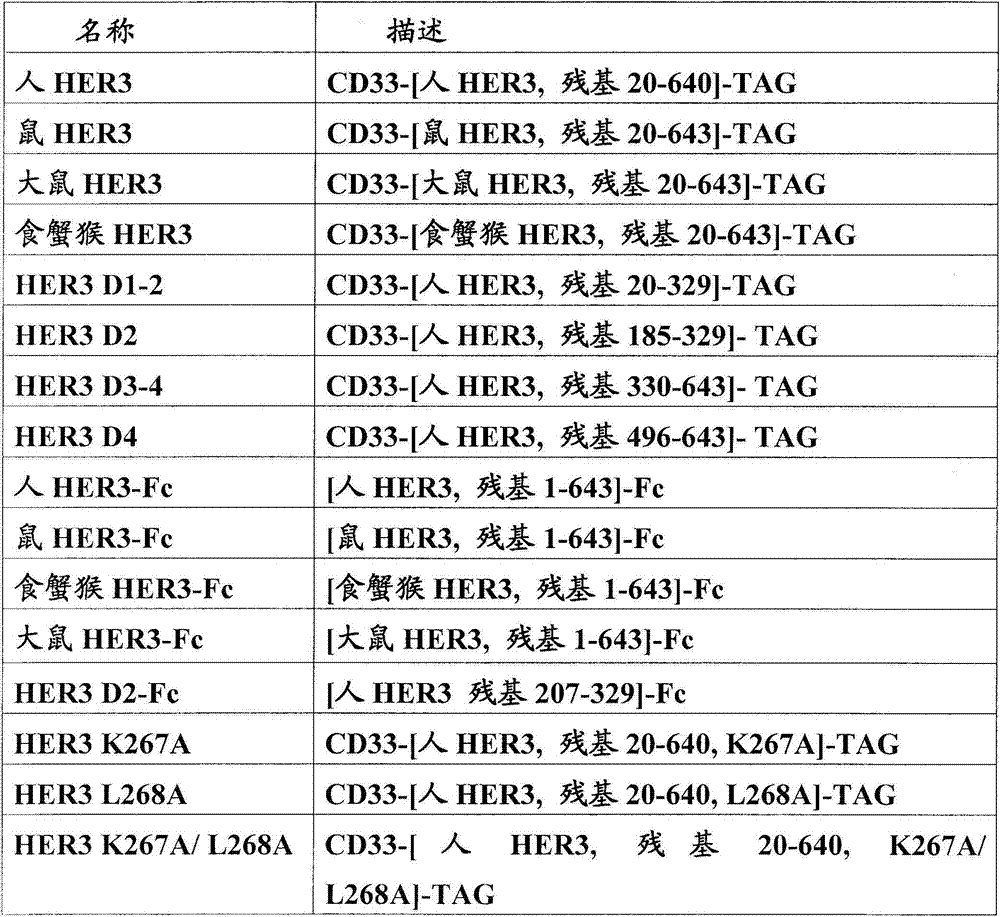
(iii)重组HER3蛋白的表达(iii) Expression of recombinant HER3 protein
在先前适应悬浮培养并在Novartis专利所有的无血清培养基中生长的HEK293来源的细胞系中表达期望的HER3重组蛋白。在基于脂质转染的瞬时6孔板转染测定中进行小规模表达验证。在WaveTM生物反应器系统(Wave Biotech)中以10-20L的规模进行通过瞬时转染的大规模蛋白质生产。以1∶3(w∶w)的比例使用DNA聚乙烯亚胺(Polysciences)作为质粒运载体。在转染后7-10天收获细胞培养上清,并在纯化之前通过交叉流动过滤和透析过滤浓缩。Desired HER3 recombinant proteins were expressed in HEK293-derived cell lines previously adapted to suspension culture and grown in Novartis proprietary serum-free medium. Small-scale expression validation was performed in a lipofection-based transient 6-well plate transfection assay. Large-scale protein production by transient transfection was performed at a 10-20 L scale in a Wave ™ bioreactor system (Wave Biotech). DNA polyethylenimine (Polysciences) was used as a plasmid carrier at a ratio of 1:3 (w:w). Cell culture supernatants were harvested 7–10 days after transfection and concentrated by cross-flow filtration and diafiltration prior to purification.
(iv)标记蛋白质的纯化(iv) Purification of labeled protein
通过收集细胞培养上清并使用10kDa截止滤器(Fresenius)通过交叉流动过滤浓缩10倍来纯化重组标记的HER3蛋白(例如,TAG-HER3)。通过将抗TAG单克隆抗体与CNBr活化的Sepharose4B偶联来制备抗TAG柱,最终比率为10mg抗体/mL树脂。对35ml抗Tag柱应用浓缩上清,流速为1-2mL/分钟。在用PBS进行基线洗涤后,用100mM甘氨酸(pH2.7)洗脱结合的物质,中和并无菌过滤。通过测量在280nm处的吸光度和使用0.66AU/mg的理论系数进行转化来测定蛋白质浓度。最后通过SDS-PAGE,N-端测序和LC-MS表征纯化的蛋白质。Recombinant tagged HER3 proteins (eg, TAG-HER3) were purified by collecting cell culture supernatants and concentrating 10-fold by cross-flow filtration using 10 kDa cut-off filters (Fresenius). Prepare an anti-TAG column by coupling anti-TAG monoclonal antibody to CNBr-activated Sepharose4B at a final ratio of 10 mg antibody/mL resin. Apply the concentrated supernatant to a 35 ml anti-Tag column at a flow rate of 1-2 mL/min. After a baseline wash with PBS, bound material was eluted with 100 mM glycine, pH 2.7, neutralized and sterile filtered. Protein concentration was determined by measuring absorbance at 280 nm and converting using a theoretical coefficient of 0.66 AU/mg. Finally the purified protein was characterized by SDS-PAGE, N-terminal sequencing and LC-MS.
(v)Fc Tag纯化(v) Fc Tag purification
对50ml蛋白质A Sepharose Fast Flow柱应用浓缩的细胞培养上清,流速为1ml/min。在用PBS进行基线洗涤后,用10倍柱体积的10mMNaH2PO4/30%(v/v)异丙醇,pH7.3洗涤柱,接着用5倍柱体积的PBS洗涤。最后,用50mM柠檬酸盐/140mM NaC1(pH2.7)洗脱结合的物质,中和并无菌过滤。Apply the concentrated cell culture supernatant to a 50ml Protein A Sepharose Fast Flow column at a flow rate of 1ml/min. After a baseline wash with PBS, the column was washed with 10 column volumes of 10 mM NaH2PO4 / 30% (v/v) isopropanol, pH 7.3, followed by 5 column volumes of PBS. Finally, bound material was eluted with 50 mM citrate/140 mM NaCl (pH 2.7), neutralized and sterile filtered.
(vi)生成过表达细胞系(vi) Generation of overexpression cell lines
为了产生在细胞表面表达高水平HER3的细胞系,构建了哺乳动物表达载体,其含有编码在人HER3的氨基酸残基20-667上游的CD33前导序列的插入片段,所述HER3序列与人EGFR的氨基酸残基669-1210符合阅读框融合。当在哺乳动物细胞中表达时,得到的嵌合蛋白包含N-端HER3胞外和跨膜结构域和C-端EGFR细胞质结构域。将HER3/1载体转染进CHO-S细胞(Invitrogen),在抗生素选择后生成稳定的库。得到的细胞系(CHO HER3/1)在其细胞表面表达高水平的HER3胞外结构域。To generate cell lines expressing high levels of HER3 on the cell surface, mammalian expression vectors were constructed containing an insert encoding the CD33 leader sequence upstream of amino acid residues 20-667 of human HER3, which is identical to that of human EGFR Amino acid residues 669-1210 were fused in-frame. When expressed in mammalian cells, the resulting chimeric protein contains the N-terminal HER3 extracellular and transmembrane domains and the C-terminal EGFR cytoplasmic domain. The HER3/1 vector was transfected into CHO-S cells (Invitrogen), generating a stable pool after antibiotic selection. The resulting cell line (CHO HER3/1) expresses high levels of the HER3 extracellular domain on its cell surface.
(vii)HuCAL
为了选择识别人HER3的抗体应用多种淘选策略。通过选择具有高结合亲和力的克隆产生针对人HER3蛋白的治疗抗体,使用可商购的噬菌体展示文库,MorphoSys HuCAL


为了分离抗HER3抗体,使用固相、溶液、全细胞和差异全细胞淘选实施标准和RapMAT淘选策略。To isolate anti-HER3 antibodies, standard and RapMAT panning strategies were implemented using solid-phase, solution, whole-cell, and differential whole-cell panning.
(viii)固相淘选(viii) Solid phase panning
为了鉴定抗HER3抗体,使用不同的重组HER3蛋白来实施多种固相淘选策略。为了进行每一轮固相淘选,用HER3蛋白包被Maxisorp板(Nunc)。使用先前用抗Fc(山羊或小鼠抗人IgG,Jackson ImmunoResearch),抗Tag抗体包被的板或通过被动吸附来捕获标记的蛋白质。用PBS洗涤包被的板并封闭。用PBS洗涤2次包被的平板,然后加入HuCAL
(ix)溶液相淘选(ix) Solution phase panning
使用多种生物素化的重组HER3蛋白在存在或没有神经调节蛋白1-β1(R&D Systems)时进行每一轮溶液相淘选。使用EZ-连接磺基-NHS-LC生物素化试剂盒(Pierce)根据制造商的说明书生物素化蛋白质。800μl链霉抗生物素连接的磁珠(Dynabeads,Dynal)用PBS洗一次,用Chemiblocker(Chemicon)封闭过夜。在反应管中孵育HuCAL
(x)基于细胞的淘选(x) Cell-based panning
对于细胞淘选,HuCAL
a)全细胞淘选:在此策略中使用多种完整的细胞系作为抗原。a) Whole cell panning: Various intact cell lines are used as antigens in this strategy.
b)差异全细胞淘选:在此策略中抗原相继由细胞和重组HER3蛋白组成(见1981.09作为实例)。如上所述进行基于细胞的淘选,而当使用重组蛋白作为抗原时,应用固相淘选方案。使用PBS(2-3X)和PBST(2-3X)进行洗涤。b) Differential whole cell panning: In this strategy the antigen consists successively of cells and recombinant HER3 protein (see 1981.09 as an example). Cell-based panning was performed as described above, while a solid-phase panning protocol was applied when recombinant proteins were used as antigens. Washes were performed with PBS (2-3X) and PBST (2-3X).
(xi)RapMATTM文库的生成和淘选(xi) Generation and panning of RapMAT TM library
为了提高抗体结合亲和力同时维持文库的多样性,溶液和固相淘选的第二轮输出都进入RapMATTM过程,而全细胞和差异全细胞淘选策略的第三轮输出进入此过程(Prassler等人,(2009)Immunotherapy;1:571-583。通过将经由淘选所选择的噬菌体的Fab编码插入片段亚克隆至展示载体
实施例2:抗HER3IgG的瞬时表达Example 2: Transient expression of anti-HER3 IgG
在BioWave20中将适应悬浮的HEK293-6E细胞培养至密度约2x10⁶活细胞/mL。用相关的无菌DNA:PEI-MIX瞬时转染细胞并进一步培养。转染后7天通过交叉流动过滤使用Fresenius滤器(0.2μm)去除细胞。使用10kDa截止滤器(Fresenius)通过交叉流动过滤浓缩不含细胞的材料,将浓缩物无菌滤过stericup滤器(0.22μm)。将无菌上清储存在4℃。Grow suspension-adapted HEK293-6E cells to a density of approximately 2x10 viable cells/mL in a BioWave20. Cells were transiently transfected with the relevant sterile DNA: PEI-MIX and further cultured. Cells were removed 7 days after transfection by cross-flow filtration using Fresenius filters (0.2 μm). Cell-free material was concentrated by cross-flow filtration using a 10 kDa cut-off filter (Fresenius), and the concentrate was sterile filtered through a stericup filter (0.22 μm). Store the sterile supernatant at 4°C.
实施例3:抗HER3IgG的纯化Example 3: Purification of anti-HER3 IgG
在
实施例4:HuCAL-Fab抗体在大肠杆菌中的表达和纯化Example 4: Expression and purification of HuCAL-Fab antibody in Escherichia coli
在摇瓶培养中表达TG-1细胞中的
实施例5:通过溶液平衡滴定(SET)测量HER3抗体亲和力(KD)Example 5: Measurement of HER3 antibody affinity (K D ) by solution equilibrium titration (SET)
基本上如上所述在溶液中进行亲和力测定(Friguet等人,(1985)JImmunol Methods77:305-19)。为了提高SET法的灵敏度和准确性,将其从经典的ELISA改变为基于ECL的技术(Haenel等人,(2005)Anal biochem339:182-84)。Affinity assays were performed in solution essentially as described above (Friguet et al. (1985) J Immunol Methods 77:305-19). To improve the sensitivity and accuracy of the SET method, it was changed from the classical ELISA to an ECL-based technique (Haenel et al. (2005) Anal biochem 339: 182-84).
使用上述未标记的HER3-Tag(人、大鼠、小鼠或食蟹猴)用于通过SET的亲和力测定。The above-mentioned unlabeled HER3-Tag (human, rat, mouse or cynomolgus monkey) was used for affinity determination by SET.
使用XLfit软件(ID Business Solutions),应用自定义拟合模型评估数据。对于每种IgG的KD测定,使用以下模型(根据Piehler等人(Piehler等人,(1997)J Immunol Methods201:189-206修改)。Using XLfit software (ID Business Solutions), data were evaluated applying custom fit models. For the KD determination of each IgG, the following model (modified from Piehler et al. (Piehler et al., (1997) J Immunol Methods 201 : 189-206)) was used.
[IgG]:应用的总IgG浓度[IgG]: Applied total IgG concentration
X:应用的总可溶性抗原浓度(结合位点)X: Applied total soluble antigen concentration (binding site)
Bmax:没有抗原的IgG的最大信号B max : maximum signal of IgG without antigen
KD:亲和力K D : Affinity
实施例6:通过FACS测定抗体细胞结合Example 6: Determination of Antibody Cell Binding by FACS
通过FACS评估抗体与在人癌细胞上表达的内源人抗原的结合。为了测定抗体EC50值,用accutase收获SK-Br-3细胞并在FACS缓冲液(PBS/3%FBS/0.2%NaN3)中稀释至1x106细胞/mL。向96孔板(Nunc)的每个孔加入1x105细胞/孔并以210g在4℃离心5分钟,然后去除上清。将检测抗体的系列稀释物(用FACS缓冲液在1∶4的稀释步骤中稀释)加入沉淀的细胞,并在冰上孵育1小时。用100μL FACS缓冲液洗涤并沉淀细胞3次。将用FACS缓冲液1/200稀释的PE缀合的山羊抗人IgG(JacksonImmunoResearch)加入细胞,并在冰上孵育1小时。用100μL FACS缓冲液进行3次另外的洗涤步骤,接着进行离心步骤,在4℃以210g离心5分钟。最后在200μL FACS缓冲液中重悬细胞,用FACSArray(BDBiosciences)测量荧光值。通过测量平均通道荧光来评估细胞表面结合的抗HER3抗体的量。Binding of antibodies to endogenous human antigens expressed on human cancer cells was assessed by FACS. To determine antibody EC 50 values, SK-Br-3 cells were harvested with accutase and diluted to 1×10 6 cells/mL in FACS buffer (PBS/3% FBS/0.2% NaN3). 1×10 5 cells/well were added to each well of a 96-well plate (Nunc) and centrifuged at 210 g for 5 minutes at 4° C., then the supernatant was removed. Serial dilutions of the detection antibody (diluted in 1:4 dilution steps with FACS buffer) were added to the pelleted cells and incubated on ice for 1 hour. Wash and
实施例7:HER3结构域和突变体结合Example 7: HER3 domain and mutant binding
用200ng合适的重组人蛋白质(HER3-标签,D1-2-标签,D2-标签,D3-4-标签,D4-标签,HER3K267A-标签,HER3L268A-标签,HER3K267A/L268A和标记的无关对照)在4℃过夜包被96孔Maxisorp板(Nunc)。然后用PBS/0.1%吐温20洗涤所有孔3次,用PBS/1%BSA/0.1%吐温20封闭1小时,然后用PBS/0.1%吐温20洗涤3次。将抗HER3抗体加入相关孔,直到对合适的孔加入10μg/mL的终浓度,并在室温孵育2小时。用PBS/0.1%吐温20洗涤板3次,然后加入在PBS/1%BSA/0.1%吐温20中1/10000稀释的合适的过氧化物酶连接的检测抗体。使用的检测抗体为山羊抗小鼠(Pierce,31432),兔抗山羊(Pierce,31402)和山羊抗人(Pierce,31412)。板在室温孵育1小时,然后用PBS/0.1%吐温20洗三次。将100μl TMB(3,3’,5,5’四甲基联苯胺)底物溶液(BioFx)加入所有孔,6分钟后用50μl2.5%H2SO4终止反应。使用SpectraMax平板阅读器(Molecular Devices)通过测量OD450测定HER3抗体与每种重组蛋白质的结合程度。在适当情况下使用Graphpad Prism分析剂量应答曲线。Use 200ng of the appropriate recombinant human protein (HER3-tag, D1-2-tag, D2-tag, D3-4-tag, D4-tag, HER3K267A-tag, HER3L268A-tag, HER3K267A/L268A and labeled irrelevant control) in 96-well Maxisorp plates (Nunc) were coated overnight at 4°C. All wells were then washed 3 times with PBS/0.1
实施例8:使用氢/氘交换质谱进行HER3表位作图Example 8: HER3 Epitope Mapping Using Hydrogen/Deuterium Exchange Mass Spectrometry
材料Material
通过在重水(Sigma)中溶解25mM TBS(pH7.5)/500mM NaCl制备D2O缓冲液。还原溶液是50mM甲酸盐缓冲液(pH4)500mM TCEP,猝灭溶液是0.5%(v/v)溶于水的三氟乙酸(TFA)。缓冲液A是溶于水的0.25%甲酸/10%甲醇/10%乙二醇,缓冲液B是0.25%溶于乙腈的甲酸。所有化学品购自Sigma,HPLC级溶剂购自Fisher Scientific。 D2O buffer was prepared by dissolving 25 mM TBS (pH 7.5)/500 mM NaCl in heavy water (Sigma). The reducing solution was 50 mM formate buffer (pH 4) 500 mM TCEP and the quenching solution was 0.5% (v/v) trifluoroacetic acid (TFA) in water. Buffer A was 0.25% formic acid/10% methanol/10% ethylene glycol in water and buffer B was 0.25% formic acid in acetonitrile. All chemicals were purchased from Sigma and HPLC grade solvents were purchased from Fisher Scientific.
液体处理和层析Liquid Handling and Chromatography
基于Wales等人,(2006)Anal.Chem.78:1005-1014)描述的方法和设备设计自动化氢/氘交换质谱(HDX MS)实验。简言之,所有液体处理操作使用位于维持在2℃的冷冻外壳中的Pal HTS液体处理器(LEAPTechnologies)。在液体处理器轨道上安装6通道喷射阀和洗涤站并协助样品注入层析系统和注射洗涤。层析系统包含另外的10通道阀,2.1mm x30mm Poroszyme胃蛋白酶柱(Applied Biosystems),反相0.5mm x2mm帽捕获盒(Michrom Bioresources),和自填充的电喷雾发射体作为分析柱(100μm x~60mm,Kinetex2.6μm C18,Phenomenex)组成。10通道阀头部、捕获盒和分析柱位于铝制的单独外壳中并通过帕尔帖堆(peltier stacks)维持在-5℃。配置阀和柱,使得允许串联的蛋白质消化、肽脱盐和反相层析,之后将样品引入质谱仪(LTQ-Orbitrap,Thermo Scientific)的电喷射离子化(ESI)源。An automated hydrogen/deuterium exchange mass spectrometry (HDX MS) experiment was designed based on the method and equipment described by Wales et al., (2006) Anal. Chem. 78: 1005-1014). Briefly, all liquid handling operations used a Pal HTS liquid handler (LEAP Technologies) in a refrigerated enclosure maintained at 2°C. A 6-channel injection valve and a washing station are installed on the liquid handler rail to assist sample injection into the chromatography system and injection washing. The chromatography system included an additional 10-channel valve, a 2.1mm x 30mm Poroszyme pepsin column (Applied Biosystems), a reversed-phase 0.5mm x 2mm cap capture cartridge (Michrom Bioresources), and a self-packing electrospray emitter as the analytical column (100 μm x ~ 60mm, Kinetex2.6μm C18, Phenomenex). The 10-channel valve head, capture cartridge and analytical column are housed in a single housing made of aluminum and maintained at -5°C by peltier stacks. Valves and columns were configured to allow in-line protein digestion, peptide desalting, and reverse phase chromatography before the samples were introduced into the electrospray ionization (ESI) source of a mass spectrometer (LTQ-Orbitrap, Thermo Scientific).
由2个单独的HPLC泵提供操作所需的液流。第一个HPLC(SurveyorMS泵,Thermo Scientific)以125μL/min的恒定流速递送缓冲液A,并用于运送样品通过固定的胃蛋白酶盒到达交叉安装在10通道阀上的反相捕获盒。在装载和脱盐期之后,切换10通道阀使样品在梯度泵(AQUITYUPLC,Waters)的帮助下从反相捕获盒洗脱,通过分析柱并进入质谱的离子源。在梯度洗脱期间分离固定的酶盒并废弃。梯度泵在35分钟内以5μL/min递送0-40%的流动相B的线性梯度段,并在10分钟内以5μL/min递送40-95%的流动相B的线性梯度段。使用被动分流器在10通阀处分流来自泵的梯度流,使得梯度洗脱通过捕获盒和分析柱的实际流速为~1μL/min。整个层析运行70分钟,包括洗涤和平衡步骤。The flow required for operation is provided by 2 separate HPLC pumps. The first HPLC (SurveyorMS pump, Thermo Scientific) delivered buffer A at a constant flow rate of 125 μL/min and was used to transport the sample through the immobilized pepsin cassette to a reversed-phase capture cassette cross-mounted on a 10-channel valve. After the loading and desalting period, the 10-channel valve was switched to allow the sample to be eluted from the reversed-phase trap cartridge with the help of a gradient pump (AQUITY UPLC, Waters), through the analytical column and into the ion source of the mass spectrometer. The immobilized enzyme cassette is detached and discarded during gradient elution. The gradient pump delivered a linear gradient segment of 0-40% mobile phase B at 5 μL/min over 35 min and a linear gradient segment of 40-95% mobile phase B at 5 μL/min over 10 min. The gradient flow from the pump was split at the 10-port valve using a passive splitter such that the actual flow rate of the gradient elution through the capture cartridge and analytical column was ~1 μL/min. The entire chromatography run was 70 minutes, including washing and equilibration steps.
质谱mass spectrometry
为了鉴定从在线消化得到的蛋白水解片段进行了若干数据依赖性MS/MS实验。为此,使用LTQ-Orbitrap混合质谱仪的LTQ分析器获得串联质谱。前体质量选择基于Orbitrap分析仪获得的质谱扫描。通过Orbitrap(大于m/z400-2000)分析仪在60,000的分辨率上获得为了氘化水平测定目的而进行的单级MS采集结果。Several data-dependent MS/MS experiments were performed to identify the proteolytic fragments obtained from the online digestion. For this, tandem mass spectra were acquired using the LTQ analyzer of the LTQ-Orbitrap hybrid mass spectrometer. Precursor mass selection was based on mass spectral scans obtained with the Orbitrap analyzer. Single stage MS acquisitions for deuteration level determination purposes were acquired by an Orbitrap (greater than m/z 400-2000) analyzer at a resolution of 60,000.
蛋白质和蛋白质:Fab复合物的制备Protein and Protein:Fab Complex Preparation
通过用25mM TBS(pH7.5)/500mM NaCl稀释50μg HER3-标签至50μL终体积来制备HER3蛋白。通过以1∶1的摩尔比混合50μgHER3-标签和研究的Fab制备蛋白质∶Fab复合物。然后用25mM TBS(pH7.5)/500mM NaCl将蛋白质∶Fab混合物稀释至50μL终体积。Prepare HER3 protein by diluting 50 μg of HER3-tag with 25 mM TBS (pH 7.5)/500 mM NaCl to a final volume of 50 μL. Protein:Fab complexes were prepared by mixing 50 μg of HER3-tag and the investigated Fab in a 1:1 molar ratio. The protein:Fab mixture was then diluted to a final volume of 50 μL with 25 mM TBS (pH 7.5)/500 mM NaCl.
制备蛋白质:Fab混合物并允许其在4℃孵育至少2小时。在每个实验开始前,将含有样品、稀释剂、猝灭溶液和还原溶液的4块96孔板装载在液体处理器上。用于on-交换实验,用150μL D2O缓冲液稀释50μLHER3或HER3:Fab复合物。在用600μL猝灭缓冲液猝灭之前,通过加入200μL还原缓冲液1分钟还原混合物。在所有液体处理步骤后的总体积为~1mL。一旦混合,将猝灭的溶液注入层析系统,在那里其被自动消化、分离并由LCMS分析。将样品和对照间的氘化的平均变化计算为样品和对照的氘摄取水平间的差异。Prepare the protein:Fab mix and allow it to incubate at 4 °C for at least 2 h. Four 96-well plates containing samples, diluent, quenching solution, and reducing solution were loaded on the liquid handler before the start of each experiment. For on-exchange experiments, dilute 50 μL of HER3 or HER3:Fab complexes with 150 μL of D2O buffer. The mixture was reduced by adding 200 μL of reducing buffer for 1 min before quenching with 600 μL of quenching buffer. The total volume after all liquid handling steps was ~1 mL. Once mixed, the quenched solution was injected into a chromatography system where it was automatically digested, separated and analyzed by LCMS. The mean change in deuteration between samples and controls was calculated as the difference between the deuterium uptake levels of samples and controls.
数据处理data processing
使用内部程序(RawXtract)将Orbitrap RAW文件转化为mzXML文件。随后使用SEQUEST(Yates Lab,Scripps Research Institute,La Jolla,CA)搜索串联质谱采集结果,并使用DTASelect2.0(Yates Lab,ScrippsResearch Institute,La Jolla,CA)自动过滤搜索结果。使用肽序列标识,使用内部编写的程序自动提取每个经鉴别的序列的单离子层析图并生成层析峰的平均谱。使平均谱平滑并有质心。用氘化样品和非氘化参考间的质量差异作为氘摄取水平。手工验证处理的数据并调整以纠正来自自动化处理步骤的不准确和错误。通过使氘含量在每个肽上离域将氘摄取水平分配给蛋白质序列的每个残基(即用观察到的氘化水平除以该肽中氨基酸的数量)。如果一个残基被多于一个肽覆盖,则对覆盖该残基的所有肽的标准化氘摄取进行平均。Orbitrap RAW files were converted to mzXML files using an internal program (RawXtract). Tandem mass spectrometry acquisitions were subsequently searched using SEQUEST (Yates Lab, Scripps Research Institute, La Jolla, CA) and search results were automatically filtered using DTASelect2.0 (Yates Lab, Scripps Research Institute, La Jolla, CA). Using peptide sequence identification, an in-house written program was used to automatically extract single ion chromatograms for each identified sequence and generate average spectra of chromatographic peaks. Make the average spectrum smooth and have a centroid. The difference in mass between the deuterated sample and the non-deuterated reference was used as the deuterium uptake level. Processed data is manually validated and adjusted to correct inaccuracies and errors from automated processing steps. The level of deuterium uptake was assigned to each residue of the protein sequence by delocalizing the deuterium content on each peptide (ie, dividing the observed level of deuteration by the number of amino acids in that peptide). If a residue was covered by more than one peptide, the normalized deuterium uptake of all peptides covering that residue was averaged.
实施例9:人HER3/MOR09823Fab和人HER3/MOR09825Fab复合物的X射线晶体结构测定Example 9: Determination of X-ray Crystal Structures of Human HER3/MOR09823Fab and Human HER3/MOR09825Fab Complexes
本实施例呈现了与MOR09823的Fab片段和MOR09825的Fab片段结合的全长HER3的晶体结构,分别在

通过以1.3-1.8∶1的摩尔比(通过在280nm处的吸光度估计浓度,对HER3和Fab分别使用0.9和1.4(mg/ml)-1cm-1的计算的消光系数)混合过量的Fab和标记的HER3来制备HER3Fab复合物,并在25mM Tris(pH7.5),150mM NaCl中平衡的Superdex20010/300柱(GE Healthcare)上纯化所述复合物。通过SDS-PAGE和LCMS分析峰级分。对于每种复合物,合并含有约等摩尔比的HER3和Fab的级分并浓缩。通过从含有150nlHER3/MOR09823复合物和150nl池液(100mM柠檬酸钠pH5.6,20%PEG4000和20%异丙醇)的液滴进行坐滴蒸汽扩散,在293K生长HER3/MOR09823晶体。将晶体转移至含有额外的8%甘油的池液中并在液氮中速冻。通过从含有150nl HER3/MOR09825复合物和150nl池液(100mM双(2-羟乙基)氨基(三羟甲基)甲烷(bis-Tris)pH6.5,16%PEG10,000)的液滴中进行坐滴蒸汽扩散,在293K培养HER3/MOR09825晶体。将晶体转移至100mM双(2-羟乙基)氨基(三羟甲基)甲烷pH6.5,18%PEG10,000和22%甘油,并在液氮中速冻。 Excess Fab and HER3 Fab complexes were prepared from labeled HER3 and purified on a Superdex20010/300 column (GE Healthcare) equilibrated in 25 mM Tris (pH 7.5), 150 mM NaCl. Peak fractions were analyzed by SDS-PAGE and LCMS. For each complex, fractions containing approximately equimolar ratios of HER3 and Fab were pooled and concentrated. HER3/MOR09823 crystals were grown at 293K by sitting drop vapor diffusion from droplets containing 150 nl HER3/MOR09823 complex and 150 nl pool solution (100 mM sodium citrate pH 5.6, 20% PEG4000 and 20% isopropanol). Crystals were transferred to pool fluid with additional 8% glycerol and snap frozen in liquid nitrogen. Pass through the droplet containing 150nl HER3/MOR09825 complex and 150nl pool solution (100mM bis(2-hydroxyethyl)amino(trimethylol)methane (bis-Tris) pH6.5, 16%PEG10,000) Sitting drop vapor diffusion was performed to grow HER3/MOR09825 crystals at 293K. Crystals were transferred to 100 mM bis(2-hydroxyethyl)amino(trimethylol)methane pH 6.5, 18% PEG 10,000 and 22% glycerol and snap frozen in liquid nitrogen.
在Advanced Photon Source(Argonne National Laboratory)的光束线17-ID下收集数据。处理HER3/MOR09823Fab复合物的数据并使用HKL2000(HKL Research Inc)在空间群I222中调节为晶胞尺寸a=124.16,b=139.44,c=180.25







实施例10:磷酸-HER3体外细胞测定Example 10: Phospho-HER3 in vitro cell assay
在DMEM/F12,15mM HEPES,L-谷氨酰胺,10%FCS中常规培养MCF-7细胞,在McCoy5a,10%FCS,1.5mM L-谷氨酰胺中常规培养SK-Br-3细胞。用accutase(PAA Laboratories)收获在完全培养基中生长的近汇合的MCF7或SK-Br-3细胞,并在合适的培养基中以5x10⁵细胞/mL的终浓度重悬。然后对96孔平底板(Nunc)的每个孔添加100μL细胞悬浮液,得到5x104细胞/孔的最终密度。允许MCF7细胞附着约3小时,然后将培养基更换为含有0.5%FBS的饥饿培养基。然后将所有板在37℃孵育过夜,之后用合适浓度的HER3抗体(在合适的培养基中稀释)在37℃处理80分钟。最后20分钟用50ng/mL神经调节蛋白1-β1EGF结构域(R&DSystems)处理MCF7细胞以刺激HER3磷酸化。缓慢地吸去所有培养基,用含有1mM CaCl2和0.5mM MgCl2(Gibco)的冰冷PBS洗涤细胞。通过加入50μL冰冷的裂解缓冲液(20mM Tris(pH8.0)/137mM NaCl/10%甘油/2mM EDTA/1%NP-40/1mM正钒酸钠/,抑肽酶(10μg/mL)/亮抑酶肽(10μg/mL))裂解细胞,在冰上振荡孵育30分钟。然后收集裂解物并在4℃以1800g离心15分钟以去除细胞碎片。将20μL裂解物添加至预先制备的捕获板。MCF-7 cells were routinely cultured in DMEM/F12, 15 mM HEPES, L-glutamine, 10% FCS, and SK-Br-3 cells were routinely cultured in McCoy5a, 10% FCS, 1.5 mM L-glutamine. Subconfluent MCF7 or SK-Br-3 cells grown in complete medium were harvested with accutase (PAA Laboratories) and resuspended in appropriate medium at a final concentration of 5x10⁵ cells/mL. 100 μL of cell suspension was then added to each well of a 96-well flat bottom plate (Nunc) to give a final density of 5x10⁴ cells/well. The MCF7 cells were allowed to attach for about 3 h, then the medium was changed to starvation medium containing 0.5% FBS. All plates were then incubated overnight at 37°C prior to treatment with appropriate concentrations of HER3 antibodies (diluted in appropriate medium) for 80 minutes at 37°C. MCF7 cells were treated with 50 ng/mL neuregulin 1-β1 EGF domain (R&D Systems) for the final 20 minutes to stimulate HER3 phosphorylation. All medium was slowly aspirated and cells were washed with ice-cold PBS containing 1 mM CaCl2 and 0.5 mM MgCl2 (Gibco). By adding 50 μL of ice-cold lysis buffer (20 mM Tris (pH8.0)/137 mM NaCl/10% glycerol/2 mM EDTA/1% NP-40/1 mM sodium orthovanadate/, aprotinin (10 μg/mL)/ Aprotinin (10 μg/mL)) was used to lyse the cells and incubated on ice for 30 minutes with shaking. Lysates were then collected and centrifuged at 1800 g for 15 min at 4 °C to remove cell debris. Add 20 μL of lysate to the pre-prepared capture plate.
使用碳板(Mesoscale Discovery)制备HER3捕获板,所述碳板用20μL在PBS中稀释的4μg/mL MAB3481捕获抗体(R&D Systems)在4℃包被过夜,随后用在1x Tris缓冲液(Mesoscale Discovery)/0.1%吐温20中的3%牛血清白蛋白封闭。通过将板在室温振荡孵育1小时从裂解物中捕获HER3,然后吸去裂解物,用1x Tris缓冲液(Mesoscale Discovery)/0.1%吐温20洗涤孔。使用在1%BSA/1x Tris/0.1%吐温20中制备的0.75μg/mL生物素化的抗磷酸酪氨酸抗体(R&D Systems),通过在室温振荡孵育1小时来检测磷酸化的HER3。用1x Tris/0.1%吐温20洗孔4次,并通过与在1%BSA/1x Tris/0.1%吐温20中稀释的S-Tag标记的链霉抗生物素(Mesoscale Discovery)室温孵育1小时来检测生物素化的蛋白质。吸去每个孔,用1x Tris/0.1%吐温20洗4次,然后加入具有表面活性剂的20μL阅读缓冲液T(Mesoscale Discovery),使用Mesoscale Sector Imager对信号定量。在信号传递实验中包括抗体MOR06391或MOR03207作为同种型对照。HER3 capture plates were prepared using carbon plates (Mesoscale Discovery) that were coated with 20 μL of 4 μg/mL MAB3481 capture antibody (R&D Systems) diluted in PBS overnight at 4°C, and subsequently coated in 1x Tris buffer (Mesoscale Discovery )/0.1
实施例11:磷酸-Akt(S473)体外细胞测定Example 11: Phospho-Akt (S473) in vitro cell assay
用accutase(PAA Laboratories)收获在完全培养基中生长的近汇合的SK-Br-3和BT-474细胞,并在合适的培养基中以5x10⁵细胞/mL终浓度重悬。然后对96孔平底板(Nunc)的每个孔添加100μL细胞悬浮液,得到5x104细胞/孔的最终密度。然后将所有板在37℃孵育过夜,之后用合适浓度的HER3抗体(在合适的培养基中稀释)在37℃处理80分钟。缓慢吸去所有培养基,并用含有1mM CaCl2和0.5mM MgCl2(Gibco)的冰冷的PBS洗涤细胞。通过加入50μL冰冷的裂解缓冲液(20mM Tris(pH8.0)/137mM NaCl/10%甘油/2mM EDTA/1%NP-40/1mM正钒酸钠/,抑肽酶(10μg/mL)/亮抑酶肽(10μg/mL))裂解细胞,在冰上振荡孵育30分钟。然后收集裂解物并在4℃以1800g离心15分钟以去除细胞碎片。将20μL裂解物添加至先前已用3%BSA/1x Tris/0.1%吐温20封闭的多点384孔磷酸-Akt碳板(Mesoscale Discovery)。将板在室温振荡孵育2小时,然后吸去裂解物,用1x Tris缓冲液(Mesoscale Discovery)/0.1%吐温20洗孔4次。使用在1%BSA/1x Tris/0.1%吐温20中稀释50倍的20μLSULFO-TAG抗磷酸-Akt(S473)抗体(Mesoscale Discovery)通过在室温振荡孵育2小时来检测磷酸化的Akt。用1x Tris/0.1%吐温20洗孔4次,然后加入20μL具有表面活性剂的阅读缓冲液T(Mesoscale Discovery),使用Mesoscale Sector Imager对信号定量。在信号传递实验中包括抗体MOR06391或MOR03207作为同种型对照。Subconfluent SK-Br-3 and BT-474 cells grown in complete medium were harvested with accutase (PAA Laboratories) and resuspended in appropriate medium at a final concentration of 5x10⁵ cells/mL. 100 μL of cell suspension was then added to each well of a 96-well flat bottom plate (Nunc) to give a final density of 5x10⁴ cells/well. All plates were then incubated overnight at 37°C prior to treatment with appropriate concentrations of HER3 antibodies (diluted in appropriate medium) for 80 minutes at 37°C. All medium was aspirated slowly, and cells were washed with ice-cold PBS containing 1 mM CaCl2 and 0.5 mM MgCl2 (Gibco). By adding 50 μL of ice-cold lysis buffer (20 mM Tris (pH8.0)/137 mM NaCl/10% glycerol/2 mM EDTA/1% NP-40/1 mM sodium orthovanadate/, aprotinin (10 μg/mL)/ Aprotinin (10 μg/mL)) was used to lyse the cells and incubated on ice for 30 minutes with shaking. Lysates were then collected and centrifuged at 1800 g for 15 min at 4 °C to remove cell debris. 20 [mu]L of lysate was added to a multispot 384-well phospho-Akt carbon plate (Mesoscale Discovery) that had been previously blocked with 3% BSA/1x Tris/0.1
实施例12:细胞系增殖测定Example 12: Cell Line Proliferation Assay
在补充10%胎牛血清的修饰的McCoy5A培养基中常规培养SK-Br-3细胞,并在补充10%FBS的DMEM中培养BT-474细胞。胰酶消化近汇合的细胞,用PBS洗涤,用培养基稀释为5x10⁴细胞/mL,并以5000细胞/孔的密度置于96孔透明底黑色板(Costar3904)中。细胞在37℃孵育过夜,然后加入合适浓度的HER3抗体(通常终浓度为10或1μg/mL)。将板放回培养箱,6天后使用CellTiter-Glo(Promega)评估细胞活力。对每个孔添加100μL CellTiter-Glo溶液并在室温温和振荡孵育10分钟。使用SpectraMax平板阅读器(Molecular Devices)测定发光量。通过比较用每种HER3抗体与标准同种型对照抗体(MOR06391)所得到的发光值,计算使用每种抗体获得的生长抑制程度。SK-Br-3 cells were routinely cultured in modified McCoy5A medium supplemented with 10% fetal bovine serum, and BT-474 cells were cultured in DMEM supplemented with 10% FBS. Near-confluent cells were trypsinized, washed with PBS, diluted to 5x10⁴ cells/mL with culture medium, and placed in a 96-well clear bottom black plate (Costar3904) at a density of 5000 cells/well. Cells were incubated overnight at 37°C, and then an appropriate concentration of HER3 antibody was added (usually a final concentration of 10 or 1 μg/mL). Plates were returned to the incubator and cell viability was assessed 6 days later using CellTiter-Glo (Promega). Add 100 μL of CellTiter-Glo solution to each well and incubate for 10 minutes at room temperature with gentle shaking. Luminescence was measured using a SpectraMax plate reader (Molecular Devices). The degree of growth inhibition obtained with each antibody was calculated by comparing the luminescence values obtained with each HER3 antibody with a standard isotype control antibody (MOR06391).
用于增殖测定,在含有4mM L-谷氨酰胺/15mM HEPES/10%FBS的DMEM/F12(1∶1)中常规培养MCF-7细胞。胰酶消化近汇合的细胞,用PBS洗涤,并用含有4mM L-谷氨酰胺/15mM HEPES/10μg/mL人转铁蛋白/0.2%BSA的DMEM/F12(1∶1)稀释为1x105细胞/mL。以5000细胞/孔的密度将细胞置于96孔透明底黑色板(Costar)中。然后加入合适浓度的HER3抗体(通常终浓度为10或1μg/mL)。对合适的孔还加入10ng/mLNRG1-β1EGF结构域(R&D Systems)以刺激细胞生长。将板放回培养箱,6天后使用CellTiter-Glo(Promega)评估细胞活力。通过减去背景(无神经调节蛋白)发光值并比较用每种抗HER3抗体与标准同种型对照抗体(MOR06391)所得到的值计算使用每种抗体获得的生长抑制程度。For proliferation assays, MCF-7 cells were routinely cultured in DMEM/F12 (1:1) containing 4 mM L-glutamine/15 mM HEPES/10% FBS. Near-confluent cells were trypsinized, washed with PBS, and diluted to 1x10⁵ cells/ mL. Cells were plated in 96-well clear bottom black plates (Costar) at a density of 5000 cells/well. An appropriate concentration of HER3 antibody is then added (usually a final concentration of 10 or 1 μg/mL). 10 ng/mL NRG1-β1EGF domain (R&D Systems) was also added to appropriate wells to stimulate cell growth. Plates were returned to the incubator and cell viability was assessed 6 days later using CellTiter-Glo (Promega). The degree of growth inhibition obtained with each antibody was calculated by subtracting the background (neuregulin-free) luminescence value and comparing the value obtained with each anti-HER3 antibody to a standard isotype control antibody (MOR06391).
实施例13:配体阻断细胞测定Example 13: Ligand Blockade Cell Assay
冲洗在补充10%FBS和1μg/mL胰岛素(Sigma)的MEM中培养的MCF-7细胞并收集在小体积的FACSmax细胞分离缓冲液(Genlantis)中,然后加入5mL FACS缓冲液(PBS/1%FBS/0.1%叠氮化钠)。计数细胞密度并调整为1x106细胞/mL的终浓度。对96孔板的每个孔添加100μl细胞悬浮物,通过离心(220g,3分钟,4℃)沉淀细胞。在100μL用FACS缓冲液稀释的适合的检测抗体中(一般最终抗体浓度范围在100至0.1nM)重悬细胞沉淀,在冰上孵育板45分钟。包括配体阻断抗体MAB3481(R&DSystems)作为阳性对照。用染色缓冲液洗涤细胞2次,然后加入10nM用FACS缓冲液稀释的NRG1-β1EGF结构域(R&D Systems),在冰上孵育45分钟。用染色缓冲液洗涤细胞2次,通过在冰上孵育细胞和10nM抗人NRG1-β1EGF结构域抗体(R&D Systems)45分钟来检测结合的神经调节蛋白。用染色缓冲液洗涤细胞2次,并与用FACS缓冲液1/500稀释的PE连接的抗山羊抗体(Jackson ImmunoResearch)在冰上孵育45分钟。然后通过离心沉淀细胞,在200μL FACS缓冲液中重悬沉淀。为了对每个样品进行定量,在LSR II流式细胞仪(BD Biosciences)上计数10,000个活细胞,并通过测量平均通道荧光来评估细胞表面结合的神经调节蛋白的量。MCF-7 cells cultured in MEM supplemented with 10% FBS and 1 μg/mL insulin (Sigma) were rinsed and collected in a small volume of FACSmax cell separation buffer (Genlantis), followed by the addition of 5 mL of FACS buffer (PBS/1% FBS/0.1% sodium azide). Count the cell density and adjust to a final concentration of 1x10 cells/mL. 100 [mu]l of cell suspension was added to each well of a 96-well plate, and the cells were pelleted by centrifugation (220 g, 3 min, 4[deg.] C.). Resuspend the cell pellet in 100 [mu]L of the appropriate detection antibody diluted in FACS buffer (typical final antibody concentration ranges from 100 to 0.1 nM) and incubate the plate on ice for 45 minutes. Ligand blocking antibody MAB3481 (R&D Systems) was included as a positive control. Cells were washed twice with staining buffer, then 10 nM NRG1-β1EGF domain (R&D Systems) diluted in FACS buffer was added and incubated on ice for 45 minutes. Cells were washed twice with staining buffer and bound neuregulin was detected by incubating cells with 10 nM anti-human NRG1-β1 EGF domain antibody (R&D Systems) for 45 minutes on ice. Cells were washed twice with staining buffer and incubated with PE-conjugated anti-goat antibody (Jackson ImmunoResearch) diluted 1/500 in FACS buffer for 45 min on ice. Cells were then pelleted by centrifugation and the pellet was resuspended in 200 μL of FACS buffer. For quantification of each sample, 10,000 live cells were counted on an LSR II flow cytometer (BD Biosciences) and the amount of cell surface-bound neuregulin was assessed by measuring mean channel fluorescence.
实施例14:配体阻断生化测定Example 14: Ligand Blocking Biochemical Assays
本发明包括利用基于表面等离子共振(SPR)的生物传感器(BiacoreTM,GE Healthcare,Uppsala,瑞典)检查HER3/抗体复合物结合神经调节蛋白的能力。The present invention involves examining the ability of HER3/antibody complexes to bind neuregulin using a surface plasmon resonance (SPR) based biosensor (Biacore™, GE Healthcare, Uppsala, Sweden).
BiacoreTM利用表面等离子共振(SPR)现象检测和测量结合相互作用。在典型的Biacore实验中,将相互作用分子之一(神经调节蛋白)固定在基质上,而相互作用搭档(HER3)流经表面。结合相互作用导致传感器表面质量的增加和传感器表面附近介质的折射率的相应的直接变化。以共振单位(R.U.)记录折射率或信号的变化。以非侵入方式连续或实时监控由于复合物的缔合和解离导致的信号变化,将其结果以传感图的形式报告。BiacoreTM utilizes the phenomenon of Surface Plasmon Resonance (SPR) to detect and measure binding interactions. In a typical Biacore experiment, one of the interacting molecules (neuregulin) is immobilized on a substrate, while the interacting partner (HER3) flows across the surface. The binding interaction leads to an increase in the mass of the sensor surface and a corresponding direct change in the refractive index of the medium near the sensor surface. Changes in refractive index or signal are recorded in resonance units (R.U.). Non-invasively, continuously or in real time, monitor signal changes due to complex association and dissociation and report the results as sensorgrams.
使用BiacoreTM T100(GE Healthcare,Uppsala,瑞典)进行本文报导的所有实验。在25℃进行传感器表面制备和相互作用分析。缓冲液和Biacore试剂购自GE Healthcare。在测定全程使用含有10mM Hepes,pH7.4/150mM NaCl,0.05%P20,0.5%BSA的运行缓冲液。All experiments reported herein were performed using a Biacore ™ T100 (GE Healthcare, Uppsala, Sweden). Sensor surface preparation and interaction analysis were performed at 25 °C. Buffers and Biacore reagents were purchased from GE Healthcare. A running buffer containing 10 mM Hepes, pH 7.4/150 mM NaCl, 0.05% P20, 0.5% BSA was used throughout the assay.
以5∶1的摩尔比在冰上孵育NRG-1β1胞外结构域(R&D Systems)和EZ连接的磺基-NHS-LC-LC-生物素(Pierce)45分钟。通过加入过量的乙醇胺使反应猝灭,使用脱盐离心柱(Zeba)从生物素化的NRG中去除未偶联的生物素。在预先固定了约3000R.U.的ssDNA-链霉抗生物素(Biotin CAPture试剂盒)的传感器芯片CAP上捕获生物素化的NRG,以获得400-600R.U.范围的神经调节蛋白表面密度。通过省略注入步骤的生物素化的NRG生成参考流动池,使得流动池表面仅存在ssDNA-链霉抗生物素。NRG-1β1 extracellular domain (R&D Systems) and EZ-linked sulfo-NHS-LC-LC-biotin (Pierce) were incubated on ice at a molar ratio of 5:1 for 45 min. The reaction was quenched by adding excess ethanolamine and unconjugated biotin was removed from biotinylated NRG using a desalting spin column (Zeba). Biotinylated NRG was captured on a sensor chip CAP pre-immobilized with approximately 3000 R.U. of ssDNA-streptavidin (Biotin CAPture kit) to obtain neuregulin surface densities in the range of 400-600 R.U. . A reference flow cell was generated by omitting the injection step of biotinylated NRG such that only ssDNA-streptavidin was present on the flow cell surface.
通过室温孵育10nM人HER3-Fc和增加浓度的(0-50nM)合适的检测抗体15分钟来生成HER3/抗体复合物,然后在BiacoreTM中在10℃孵育。通过在180秒中以60μL/min的流速注入HER3/抗体复合物顺序流经参考和神经调节蛋白表面进行相互作用分析。监控流速为60μL/min的复合物的解离达180秒。在每分析循环结束时以30μL/min的流速使用120秒的8M胍∶1M NaOH(3∶1)注入,接着120秒的30%乙腈/0.25M NaOH注入进行表面重生。HER3/antibody complexes were generated by incubating 10 nM human HER3-Fc with increasing concentrations (0-50 nM) of the appropriate detection antibody for 15 minutes at room temperature, followed by incubation in Biacore ™ at 10°C. Interaction assays were performed by injecting HER3/antibody complexes sequentially across the reference and neuregulin surfaces at a flow rate of 60 μL/min for 180 s. Dissociation of the complex was monitored for 180 sec at a flow rate of 60 μL/min. Surface regeneration was performed at the end of each analysis cycle using a 120 s injection of 8M guanidine:1M NaOH (3:1 ) followed by a 120 s injection of 30% acetonitrile/0.25M NaOH at a flow rate of 30 μL/min.
实施例15:体内PD研究Example 15: In vivo PD studies
培养BxPC3和BT-474细胞并如实施例16和17所述植入雌性无胸腺nu/nu Balb/C小鼠(Harlan Laboratories)中。BxPC3 and BT-474 cells were cultured and implanted into female athymic nu/nu Balb/C mice (Harlan Laboratories) as described in Examples 16 and 17.
一旦肿瘤达到合适大小,检查动物的肿瘤质量。从研究中排除具有溃烂的肿瘤的动物或具有充满流体的肿瘤的动物。通过侧向尾静脉注射用抗体对剩余动物进行静脉内给药。在给定的时点通过CO2窒息对动物实施安乐死,并通过心脏穿刺收集全血并置于1.5mL Eppendorf收集管。立即切除肿瘤组织,置于有螺旋盖的聚丙烯样品管并在液氮中速冻。在-80℃储存组织直到制备裂解物Once tumors have reached an appropriate size, animals are checked for tumor quality. Animals with ulcerated tumors or animals with fluid-filled tumors were excluded from the study. The remaining animals were dosed intravenously with antibody via lateral tail vein injection. Animals were euthanized at given time points by CO2 asphyxiation, and whole blood was collected by cardiac puncture and placed in 1.5 mL Eppendorf collection tubes. Tumor tissue was excised immediately, placed in screw cap polypropylene sample tubes and snap frozen in liquid nitrogen. Store tissue at -80 °C until preparation of lysates
实施例16:体内BT-474效力研究Example 16: In Vivo BT-474 Potency Study
在含有10%热失活的胎牛血清的不含抗生素的DMEM中培养BT-474细胞直到植入时。BT-474 cells were cultured in antibiotic-free DMEM containing 10% heat-inactivated fetal calf serum until implantation.
在细胞接种前1天,对雌性无胸腺nu/nu Balb/C小鼠(HarlanLaboratories)皮下植入持续释放的17β-雌二醇颗粒(Innovative Research ofAmerica)以维持血清雌激素水平。在17β-雌二醇颗粒植入后1天,将5x10⁶细胞原位注射进在悬浮液中的第四乳腺脂肪垫,所述悬浮液含有在Hank平衡盐溶液中的50%无酚红基质胶(BD Biosciences)。含有悬浮细胞的总注射体积为200μL。细胞植入后20天,具有约200mm3的肿瘤体积的动物进入效力研究。大体上,每组共10只动物进入效力研究。One day prior to cell inoculation, female athymic nu/nu Balb/C mice (Harlan Laboratories) were subcutaneously implanted with sustained-release 17[beta]-estradiol particles (Innovative Research of America) to maintain serum estrogen levels. 1 day after 17β-estradiol particle implantation, 5x10⁶ cells were orthotopically injected into the fourth mammary fat pad in suspension containing 50% phenol red-free matrix in Hank's balanced salt solution Glue (BD Biosciences). The total injection volume containing suspended cells was 200 µL. Twenty days after cell implantation, animals with tumor volumes of approximately 200 mm3 were entered into the efficacy study. In general, a total of 10 animals per group were entered into the efficacy study.
对于单活性剂研究,通过侧向尾静脉注射用MOR10701或MOR10703对动物进行静脉内给药。首次剂量采用40mg/kg的初始负荷剂量。在初始剂量后,在研究期间对动物采用20mg/kg,每隔一天的时间表。对于组合研究,用MOR10701或MOR10703(20mg/kg,静脉注射,q2d)和次优剂量的曲妥珠单抗(1mg/kg,静脉注射,2qw)对动物进行给药。For single agent studies, animals were dosed intravenously with MOR10701 or MOR10703 via lateral tail vein injection. The first dose was an initial loading dose of 40 mg/kg. After the initial dose, animals were administered a 20 mg/kg, every other day schedule for the duration of the study. For combination studies, animals were dosed with MOR10701 or MOR10703 (20 mg/kg, iv, q2d) and a suboptimal dose of trastuzumab (1 mg/kg, iv, 2qw).
在研究期间,每周2次通过卡钳测量肿瘤体积。使用以下公式计算百分比治疗/对照(T/C)值:Tumor volumes were measured by calipers twice a week during the study period. Calculate percent treatment/control (T/C) values using the following formula:
%T/C=100xΔT/ΔC如果ΔT>0%T/C=100xΔT/ΔC if ΔT>0
其中:in:
T=在治疗最后一天药物治疗组的平均肿瘤体积;T = mean tumor volume in the drug-treated group on the last day of treatment;
ΔT=在治疗最后一天药物治疗组的平均肿瘤体积-在给药首天药物治疗组的平均肿瘤体积;ΔT=the average tumor volume of the drug treatment group on the last day of treatment-the average tumor volume of the drug treatment group on the first day of administration;
C=在治疗最后一天对照组的平均肿瘤体积;和C = mean tumor volume in the control group on the last day of treatment; and
ΔC=在治疗最后一天对照组的平均肿瘤体积-在给药首天对照组的平均肿瘤体积。ΔC = mean tumor volume of the control group on the last day of treatment - mean tumor volume of the control group on the first day of dosing.
每周测量2次体重,根据体重调整剂量。用(BW当前-BW初始)/(BW初始)x100计算体重的%变化。用从治疗开始日开始的百分比体重变化表示数据。Body weight was measured twice a week, and the dose was adjusted according to body weight. % change in body weight was calculated as (BW current - BW initial )/(BW initial ) x 100. Data are expressed as percent body weight change from the treatment start date.
将所有数据表示为平均值±平均值的标准差(SEM)。使用Δ肿瘤体积和体重用于统计学分析。使用单因素ANOVA和事后Tukey进行组间比较。对所有统计学评估,将显著性水平设为p<0.05。报导了相比载体对照组的显著性。All data are presented as mean ± standard error of the mean (SEM). Delta tumor volume and body weight were used for statistical analysis. Between-group comparisons were performed using one-way ANOVA with post-hoc Tukey. For all statistical evaluations, the significance level was set at p<0.05. Significance compared to the vehicle control group is reported.
实施例17:体内BxPC3效力研究Example 17: In Vivo BxPC3 Potency Study
在含有10%热失活的胎牛血清的不含抗生素的RPMI-1640培养基中培养BxPC3细胞直到植入时。BxPC3 cells were cultured in antibiotic-free RPMI-1640 medium containing 10% heat-inactivated fetal calf serum until implantation.
对雌性无胸腺nu/nu Balb/C小鼠(Harlan Laboratories)皮下植入在50%磷酸缓冲盐溶液和50%基质胶的混合物中的10x106细胞。含有悬浮细胞的总注射体积为200μL。一旦肿瘤达到约200mm3的大小,动物进入效力研究。大体上,每组共10只动物进入效力研究。如果在进入研究前动物显示不寻常的肿瘤生长特征,则将动物从研究中排除。Female athymic nu/nu Balb/C mice (Harlan Laboratories) were implanted subcutaneously with 10x106 cells in a mixture of 50% phosphate buffered saline and 50% Matrigel. The total injection volume containing suspended cells was 200 µL. Animals were entered into efficacy studies once tumors reached a size of approximately 200mm3 . In general, a total of 10 animals per group were entered into the efficacy study. Animals were excluded from the study if they displayed unusual tumor growth characteristics prior to study entry.
通过侧向尾静脉注射对动物静脉内给药。首次剂量采用40mg/kg的初始负荷剂量。在初始剂量后,在研究期间(治疗25天)对动物采用20mg/kg,每隔一天的时间表。如上所述计算肿瘤体积和T/C值。Animals were dosed intravenously by lateral tail vein injection. The first dose was an initial loading dose of 40 mg/kg. After the initial dose, animals were administered a 20 mg/kg, every other day schedule for the duration of the study (25 days of treatment). Tumor volumes and T/C values were calculated as described above.
实施例18:磷酸-Akt(S473)体内PD测定Example 18: Phospho-Akt(S473) PD assay in vivo
在冰上解冻约50mm3冷冻的肿瘤(例如BT-474或BXPC-3)组织,对每种样品添加100-300μL含有磷酸酶(Roche)和蛋白酶抑制剂(Roche)的T-PER缓冲液(Pierce)。添加的裂解缓冲液体积取决于肿瘤样品的大小。使用1.5mL研杵(Fisher Scientific)破碎组织,得到的悬浮物在冰上孵育15分钟,然后在-80℃冷冻过夜。解冻样品并在4℃以13000g离心15分钟,然后通过BCA测定(Thermo Scientific)定量上清蛋白质浓度。用裂解缓冲液(Mesoscale Discovery)稀释组织上清,并将25μg加入先前用封闭溶液-A(Mesoscale Discovery)封闭的多点96孔磷酸-Akt碳板(MesoscaleDiscovery)。在室温振荡孵育板1小时,然后吸去裂解物,用Tris洗涤缓冲液(Mesoscale Discovery)洗孔4次。使用在抗体稀释缓冲液中稀释的25μL SULFO-TAG抗磷酸-Akt(S473)抗体(Mesoscale Discovery)通过在室温振荡孵育1小时检测磷酸化的Akt。用Tris洗涤缓冲液洗孔4次,然后加入150μL阅读缓冲液T(具有表面活性剂)(Mesoscale Discovery),使用Mesoscale Sector Imager对信号定量。Thaw approximately 50 mm frozen tumor (e.g. BT-474 or BXPC-3) tissue on ice, add 100-300 μL of T-PER buffer containing phosphatase (Roche) and protease inhibitors (Roche) to each sample ( Pierce). The volume of lysis buffer added depends on the size of the tumor sample. Tissue was disrupted using a 1.5 mL pestle (Fisher Scientific), and the resulting suspension was incubated on ice for 15 minutes and then frozen overnight at -80°C. Samples were thawed and centrifuged at 13000 g for 15 min at 4°C, then supernatant protein concentration was quantified by BCA assay (Thermo Scientific). Tissue supernatant was diluted with lysis buffer (Mesoscale Discovery), and 25 μg was added to a multi-spot 96-well phospho-Akt carbon plate (Mesoscale Discovery) previously blocked with blocking solution-A (Mesoscale Discovery). The plate was incubated with shaking at room temperature for 1 hour, then the lysate was aspirated and the wells were washed 4 times with Tris wash buffer (Mesoscale Discovery). Phosphorylated Akt was detected by incubation with shaking at room temperature for 1 hour using 25 μL of SULFO-TAG anti-phospho-Akt (S473) antibody (Mesoscale Discovery) diluted in antibody dilution buffer. The wells were washed 4 times with Tris wash buffer, then 150 [mu]L of read buffer T (with surfactant) (Mesoscale Discovery) was added and the signal was quantified using a Mesoscale Sector Imager.
实施例19:磷酸HER3(Y1197)体内PD测定Example 19: In vivo PD determination of phosphoHER3 (Y1197)
在冰上解冻约50mm3冷冻的肿瘤(例如BXPC-3)组织,对每种样品添加100-300μL含有磷酸酶(Roche)和蛋白酶抑制剂(Roche)的T-PER缓冲液(Pierce)。使用1.5mL研杵(Fisher Scientific)破碎组织,得到的悬浮物在冰上孵育15分钟,然后在-80℃冷冻过夜。解冻样品并在4℃以13000g离心15分钟,然后通过BCA测定(Thermo Scientific)定量上清蛋白质浓度。用裂解缓冲液(Mesoscale Discovery)稀释组织上清,并将150μg加入先前用4μg/mL MAB3481(R&D Systems)过夜包被和用3%奶粉封闭的多点96孔碳板(Mesoscale Discovery)。在室温振荡孵育板2小时,然后吸去裂解物,用Tris洗涤缓冲液(Mesoscale Discovery)洗孔4次。使用以封闭缓冲液1/8000稀释的抗HER3pY1197结合磷酸化的HER3。在室温孵育1小时后用Tris洗涤缓冲液洗孔,并使用在封闭缓冲液中1/1000稀释的S-Tag标记的抗兔抗体(Mesoscale Discovery)通过在室温振荡孵育1小时来检测抗pY1197抗体。用Tris洗涤缓冲液洗孔4次,然后加入150μL1/4稀释的阅读缓冲液T(具有表面活性剂)(Mesoscale Discovery),使用MesoscaleSector Imager对信号进行定量。Thaw approximately 50 mm3 of frozen tumor (eg BXPC-3) tissue on ice and add 100-300 μL of T-PER buffer (Pierce) containing phosphatase (Roche) and protease inhibitors (Roche) to each sample. Tissue was disrupted using a 1.5 mL pestle (Fisher Scientific), and the resulting suspension was incubated on ice for 15 minutes and then frozen overnight at -80°C. Samples were thawed and centrifuged at 13000 g for 15 min at 4°C, then supernatant protein concentration was quantified by BCA assay (Thermo Scientific). Tissue supernatant was diluted with lysis buffer (Mesoscale Discovery) and 150 μg was added to a multi-spot 96-well carbon plate (Mesoscale Discovery) previously coated overnight with 4 μg/mL MAB3481 (R&D Systems) and blocked with 3% milk powder. Plates were incubated with shaking at room temperature for 2 hours, then the lysate was aspirated and the wells were washed 4 times with Tris wash buffer (Mesoscale Discovery). Phosphorylated HER3 was bound using anti-HER3pY1197 diluted 1/8000 in blocking buffer. After incubation for 1 hour at room temperature, the wells were washed with Tris wash buffer, and anti-pY1197 antibody was detected by incubation with shaking at room temperature for 1 hour using S-Tag-labeled anti-rabbit antibody (Mesoscale Discovery) diluted 1/1000 in blocking buffer. . The wells were washed 4 times with Tris wash buffer, then 150 μL of 1/4 diluted reading buffer T (with surfactant) (Mesoscale Discovery) was added and the signal was quantified using a Mesoscale Sector Imager.
实施例20:体外药物组合研究Example 20: In Vitro Drug Combination Studies
为了评估HER3靶向抗体与靶向疗法组合的能力,在细胞活力测定中将MOR09825或MOR10703与曲妥珠单抗,拉帕替尼,BEZ235,BKM120,BYL719,RAD001,埃罗替尼和西妥昔单抗组合。将约1000-1500个SK-Br-3(McCoy’s),MDA-MB-453(RPMI),FaDu(EMEM)或L3.3(RPMI)细胞接种在384孔板中的补充有2%FBS的合适的培养基中,并允许在37℃粘附过夜。随后将合适的药物组合(拉帕替尼,BKM120和BYL719的通常最终药物浓度范围在3μM至13nM;RAD001的范围在27nM至0.0041nM;埃罗替尼的范围在1μM至0.0025nM;MOR1073的范围在100nm至0.01nm;西妥昔单抗的范围在100nM至0.0015nM;和曲妥珠单抗的范围在300nM至0.046nM))加入孔,使得每块板含有每种药物在二维矩阵中的剂量应答曲线。将板放回培养箱,3-6天后使用CellTiter-Glo(Promega)评估细胞活力。将CellTiter-Glo溶液加入每个孔,在室温温和振荡孵育10分钟。使用SpectraMax平板阅读器(MolecularDevices)测定发光量。计算每种组合所获得的生长抑制的程度,并使用Loewe相加模型突出组合活性。To assess the ability of HER3-targeting antibodies in combination with targeted therapies, MOR09825 or MOR10703 was compared with trastuzumab, lapatinib, BEZ235, BKM120, BYL719, RAD001, erlotinib, and cetuzumab in a cell viability assay. Combination of ciximab. About 1000-1500 SK-Br-3 (McCoy's), MDA-MB-453 (RPMI), FaDu (EMEM) or L3.3 (RPMI) cells were seeded in a 384-well plate in a suitable medium supplemented with 2% FBS culture medium and allowed to adhere overnight at 37 °C. Appropriate drug combinations are then combined (lapatinib, BKM120 and BYL719 typically have final drug concentrations ranging from 3 μM to 13 nM; RAD001 ranging from 27 nM to 0.0041 nM; erlotinib ranging from 1 μM to 0.0025 nM; MOR1073 ranging At 100nM to 0.01nM; Cetuximab in the range of 100nM to 0.0015nM; and Trastuzumab in the range of 300nM to 0.046nM)) Add wells such that each plate contains each drug in a two-dimensional matrix dose-response curve. Plates were returned to the incubator and cell viability was assessed after 3-6 days using CellTiter-Glo (Promega). Add the CellTiter-Glo solution to each well and incubate for 10 minutes at room temperature with gentle shaking. Luminescence was determined using a SpectraMax plate reader (Molecular Devices). The degree of growth inhibition obtained for each combination was calculated and combined activity was highlighted using the Loewe additive model.
实施例21:在L3.3细胞中的体内药物组合研究Example 21: In vivo drug combination studies in L3.3 cells
在含有10%热失活的胎牛血清的DMEM培养基中培养胰腺L3.3细胞直至植入时。对雌性Foxn1裸小鼠(Harlan Laboratories)皮下植入3x10⁶在无FBS的DMEM中的细胞。含有悬浮细胞的总注射液体积为100μL。细胞植入后12天,所有组具有约100mm3的平均肿瘤体积的动物进入效力研究。大体上,每组共8只动物进入研究。如果在进入研究前动物显示不寻常的肿瘤生长特征,则将其从研究中排除。Pancreatic L3.3 cells were cultured in DMEM medium containing 10% heat-inactivated fetal bovine serum until implantation. Female Foxnl nude mice (Harlan Laboratories) were implanted subcutaneously with 3x10⁶ cells in DMEM without FBS. The total injection volume containing suspended cells was 100 μL. Animals from all groups with mean tumor volumes of approximately 100 mm3 were entered into the
通过侧向尾静脉注射用MOR10703对动物进行静脉内给药,在研究期间(治疗14天)采用20mg/kg,每隔一天的时间表。以每天50mg/kg(PO)的时间表,作为单活性剂或与MOR10703组合进行埃罗替尼给药。如上所述计算肿瘤体积和T/C值。Animals were dosed intravenously with MOR10703 via lateral tail vein injection on a 20 mg/kg, every other day schedule for the duration of the study (14 days of treatment). Erlotinib was administered as a single active agent or in combination with MOR10703 on a daily schedule of 50 mg/kg (PO). Tumor volumes and T/C values were calculated as described above.
结果和讨论Results and discussion
共同地,这些结果显示抗体类别结合HER3的构象表位的结构域2和结构域4中的氨基酸残基,并稳定处于失活或封闭构象的HER3。这些抗体的结合抑制配体依赖性和配体非依赖性信号传递。这些抗体也能够与HER3配体同时结合。Collectively, these results show that the antibody classes bind amino acid residues in
(i)亲和力测定(i) Affinity determination
通过如上所述的溶液平衡滴定(SET)测定抗体亲和力。结果总结在表9中,并且MOR10701的实例滴定曲线包含在图1中。数据表面鉴定了许多紧密结合人、食蟹猴、大鼠和鼠HER3的抗体。Antibody affinity was determined by solution equilibrium titration (SET) as described above. The results are summarized in Table 9 and an example titration curve for MOR10701 is included in FIG. 1 . The data surface identified a number of antibodies that tightly bound human, cynomolgus monkey, rat and murine HER3.
表9:通过溶液平衡滴定(SET)测定的抗HER3IgG的KD值。Hu(人),Cy(食蟹猴),Mu(鼠)和ra(大鼠)Table 9: KD values of anti-HER3 IgG determined by solution equilibrium titration (SET). Hu (human), Cy (cynomolgus monkey), Mu (rat) and ra (rat)
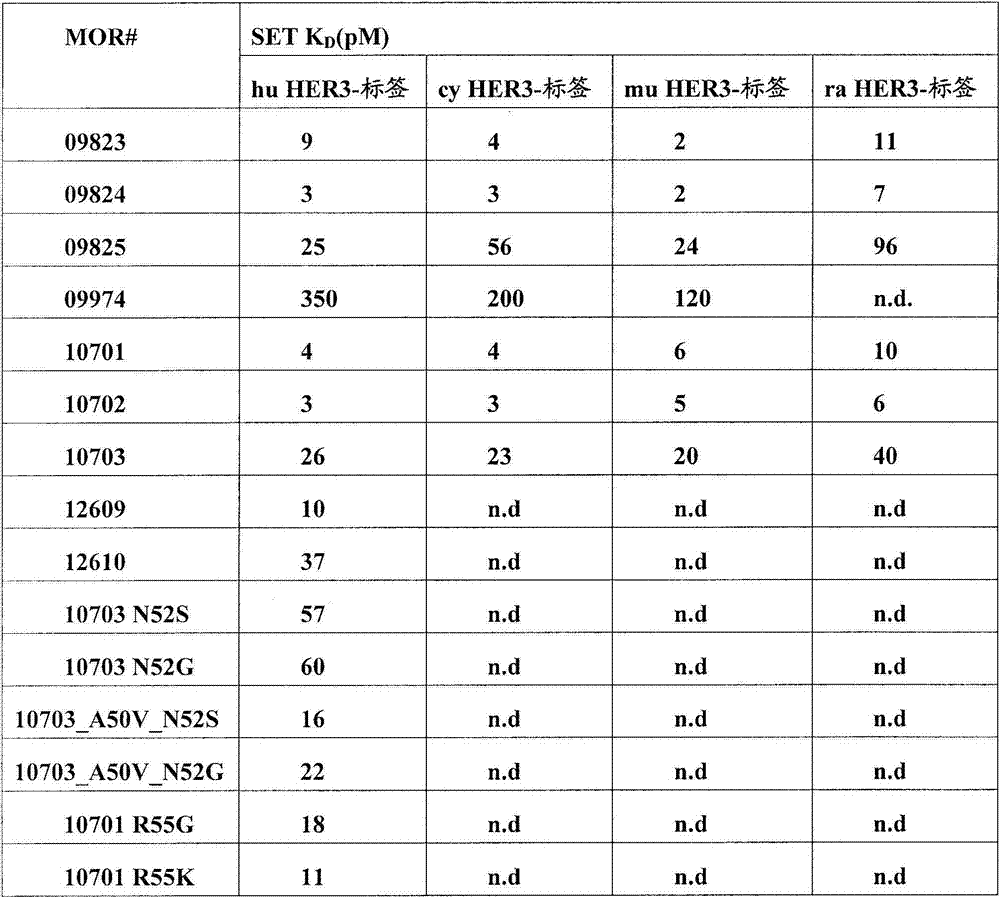
(ii)SK-Br-3细胞EC50测定(ii) Determination of EC 50 of SK-Br-3 cells
通过计算抗体结合HER2扩增的细胞系SK-Br-3的EC50值测定经鉴定的抗体结合HER3表达细胞的能力(见图2和表10)。The ability of the identified antibodies to bind to HER3 expressing cells was determined by calculating the EC50 values of the antibodies binding to the HER2 amplified cell line SK-Br-3 (see Figure 2 and Table 10).
表10:抗HER3IgG在SK-Br-3细胞上的FACS EC50值。n.d.(未测定)Table 10: FACS EC 50 values of anti-HER3 IgG on SK-Br-3 cells. nd (not determined)
(iii)HER3结构域结合(iii) HER3 domain binding
在ELISA测定中表征了抗HER3抗体子集结合人HER3的多种胞外结构域的能力。为此,将HER3的胞外结构域分为4个组成型结构域,并如上所述将这些结构域的多种组合克隆、表达和纯化为独立的蛋白质。使用此策略将以下结构域成功制备为可溶性蛋白质:结构域1和2(D1-2),结构域2(D2),结构域3和4(D3-4)和结构域4(D4)。作为阳性对照,也检测了若干内部制备的小鼠抗人HER3抗体(8D7,1F5和8P2)以证明每个分离的结构域的完整性。The ability of a subset of anti-HER3 antibodies to bind various extracellular domains of human HER3 was characterized in an ELISA assay. To this end, the extracellular domain of HER3 was divided into 4 constitutive domains and various combinations of these domains were cloned, expressed and purified as independent proteins as described above. The following domains were successfully prepared as soluble proteins using this strategy:
如图3所示,观察到MOR09823和MOR09825都成功结合HER3的胞外结构域,但用在此测定中观察到这些抗体很少与分离的结构域结合。对此结合模式有若干可能的解释:As shown in Figure 3, it was observed that both MOR09823 and MOR09825 successfully bound the extracellular domain of HER3, but little binding of these antibodies to the isolated domain was observed in this assay. There are several possible explanations for this binding pattern:
a)MOR09823和MOR09825可能结合跨结构域边界的线性表位,因此当把结构域表达为分离的蛋白质时部分结合表位将丢失。a) MOR09823 and MOR09825 likely bind linear epitopes across domain boundaries, so part of the bound epitope will be lost when the domains are expressed as separate proteins.
b)MOR09823和MOR09825可能结合桥接多个结构域的非线性表位。因此,将HER3分解为其组分单位可能破坏结合位点。b) MOR09823 and MOR09825 likely bind non-linear epitopes bridging multiple domains. Therefore, disassembly of HER3 into its component units may destroy the binding site.
c)HER3的形状/构象可能是MOR09823和MOR09825结合HER3的要素,使得只有HER3的全长胞外结构域能够采取此形状/构象,而分离的结构域不能完全呈现此构象。c) The shape/conformation of HER3 may be the factor for MOR09823 and MOR09825 to bind HER3, such that only the full-length extracellular domain of HER3 can adopt this shape/conformation, while the isolated domain cannot fully assume this conformation.
(vi)使用氢/氘交换质谱进行HER3表位作图(vi) HER3 epitope mapping using hydrogen/deuterium exchange mass spectrometry
在存在和没有Fab形式的MOR09823,MOR09824,MOR09825和MOR09974的情况下,通过HER3ECD的HDX-MS分析进一步研究HER3表位。图4A显示在没有结合的Fab的情况下,约69%的HER3ECD序列被至少一个肽覆盖。覆盖缺口可能是由于在这些区域中残基的糖基化或在半胱氨酸富含区中二硫键的不充分还原,这在结构域2中特别明显。有趣的是,尽管每种Fab产生单独的保护模式,在MOR09823,MOR09824,MOR09825和MOR09974中一致观察到一个强保护区(见图4B),指示这些高度相关的抗体家族以相同的方式结合HER3。观察到最强的保护是针对结构域2的残基269-286(TFQLEPNPHTKYQYGGVC)(SEQ ID NO:146),指示这附近的残基可能对mAb结合很重要。将Fab保护的残基绘制在公布的HER3晶体结构(Cho&Leahy,(2002)Science297:1330-1333)上,突出显示残基269-286在结构域2中的功能重要的β-发夹环内和附近(见图4C)。HER3 epitopes were further investigated by HDX-MS analysis of HER3ECD in the presence and absence of Fab forms of MOR09823, MOR09824, MOR09825 and MOR09974. Figure 4A shows that in the absence of bound Fab, approximately 69% of the HER3 ECD sequence is covered by at least one peptide. The gaps in coverage may be due to glycosylation of residues in these regions or insufficient reduction of disulfide bonds in cysteine-rich regions, which is particularly pronounced in domain 2. Interestingly, although each Fab produced an individual protection pattern, a strong protection region was consistently observed in MOR09823, MOR09824, MOR09825 and MOR09974 (see Figure 4B), indicating that these highly related antibody families bind HER3 in the same way. The strongest protection was observed for residues 269-286 of domain 2 (TFQLEPNPHTKYQYGGVC) (SEQ ID NO: 146), indicating that residues near this may be important for mAb binding. The Fab-protected residues were mapped on the published HER3 crystal structure (Cho & Leahy, (2002) Science 297:1330-1333), highlighting the functionally important β-hairpin loop of residues 269-286 in domain 2 and nearby (see Figure 4C).
(vii)HER3/MOR09823晶体结构(vii) Crystal structure of HER3/MOR09823
解析了与HER3胞外结构域结合的MOR09823Fab片段的

在失活(束缚)态中HER3的结构域1至4之间的空间关系与伸展(活化)态中的空间关系显著不同。此发现是基于相关的EGFR家族成员HER2和配体结合的HER1的晶体结构(Cho等人,(2003)Nature421:756-760;Ogiso等人,(2002)Cell110:775-787;Garrett等人,(2002)Cell110:763-773),二者均处于伸展(活化)态。在伸展态中,结构域2的β-发夹二聚化环从其与结构域4的抑制性相互作用中被释放,因此可自由地与其二聚化搭档蛋白质相互作用。因此,结构域2的β-发夹二聚化环在维持束缚(失活)态和介导伸展态中EGF受体的二聚化,从而导致胞内激酶结构域的活化中具有重要功能。因此MOR09823/HER3和MOR09825/HER3的晶体结构(见图5)提示,MOR09823和MOR09825都通过稳定HER3的失活构象发挥功能。The spatial relationship between
晶体结构也显示,MOR09823和MOR09825都识别的HER3表位是包括来自结构域2和4的残基的非线性表位(见图5C和D,表11,12,13和14)。因此被此高度相关的抗体的家族所识别的HER3表位可被定义为:The crystal structures also showed that the HER3 epitope recognized by both MOR09823 and MOR09825 is a non-linear epitope comprising residues from domains 2 and 4 (see Figure 5C and D, Tables 11, 12, 13 and 14). The HER3 epitopes recognized by this family of highly related antibodies can thus be defined as:
结构域2:残基265-277,315Domain 2: Residues 265-277, 315
结构域4残基:571,582-584,596-597,600-602,609-615
MOR09823或MOR09825与结构域2和4的结合将因此稳定HER3的束缚构象,从而拮抗其发信号的能力。Binding of MOR09823 or MOR09825 to
在晶体结构中观察到的MOR09823/MOR09825结合模式与我们的其他表位作图研究一致。具体来说,ELISA结构域结合实验证明,MOR09823和MOR09825对完整的HER3胞外蛋白的亲和力显著大于对任意分离的结构域(例如D1,D1-D2,D3,或D3-D4片段)的亲和力(见图3)。这也与HER3HDX-MS的数据(见图4B)一致,其鉴定了结构域2的β-发夹是抗体识别表位的一部分。最后,两个晶体结构都显示,MOR09823或MOR09825的结合都不封闭HER3的配体结合表面(见图5B),通过与HER1类比将所述配体结合表面绘制到结构域1和3(Ogiso等人,(2002)Cell,110:775-787;Garrett等人,(2002)Cell,110:763-773)。这与我们的发现一致,即MOR09823和MOR09825都不阻断神经调节蛋白结合MCF7细胞(见图9),且在biacore研究中HER3/MOR09823复合物可结合固定化的神经调节蛋白(见图10)。The MOR09823/MOR09825 binding mode observed in the crystal structure is consistent with our other epitope mapping studies. Specifically, ELISA domain binding experiments demonstrated that the affinity of MOR09823 and MOR09825 for the intact HER3 extracellular protein was significantly greater than for any isolated domain (such as D1, D1-D2, D3, or D3-D4 fragments) ( See Figure 3). This is also consistent with the HER3 HDX-MS data (see Figure 4B), which identified the β-hairpin of domain 2 as part of the epitope recognized by the antibody. Finally, both crystal structures show that neither MOR09823 nor MOR09825 binding blocks the ligand-binding surface of HER3 (see Figure 5B), which was mapped to
表11:MOR09823Fab重链和人HER3之间的相互作用。Fab VH残基的编号是基于其线性氨基酸序列(SEQ ID NO:15)。HER3残基的编号是基于NP_001973。显示的HER3残基具有在MOR09823Fab的原子
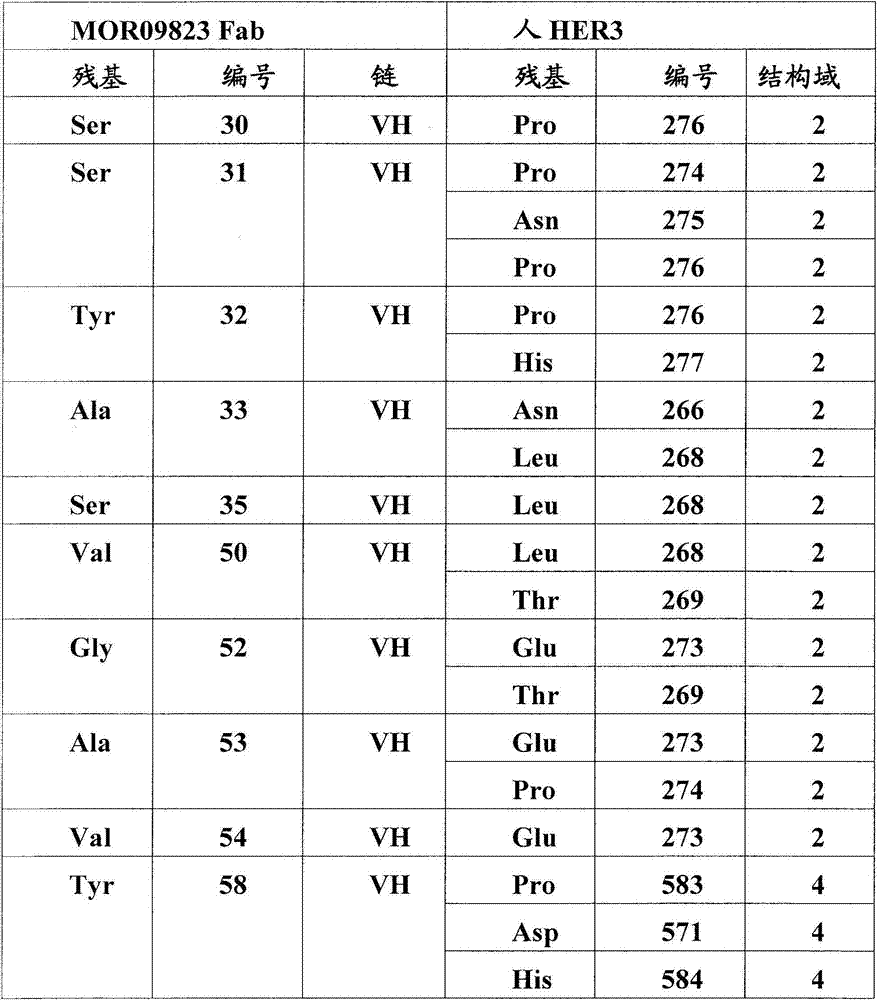

表12:MOR09823Fab轻链和人HER3之间的相互作用。Fab VL残基的编号是基于其线性氨基酸序列(SEQ ID NO:14)。HER3残基的编号是基于NP_001973。显示的HER3残基具有在MOR09823Fab的原子
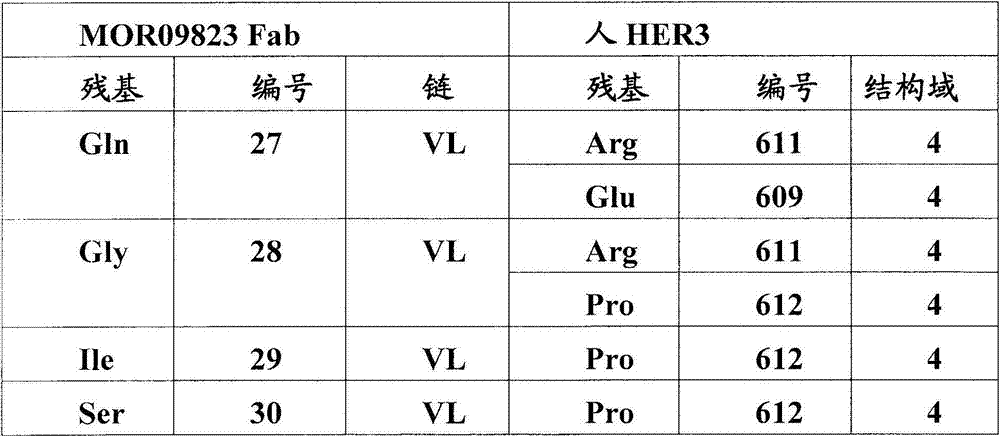
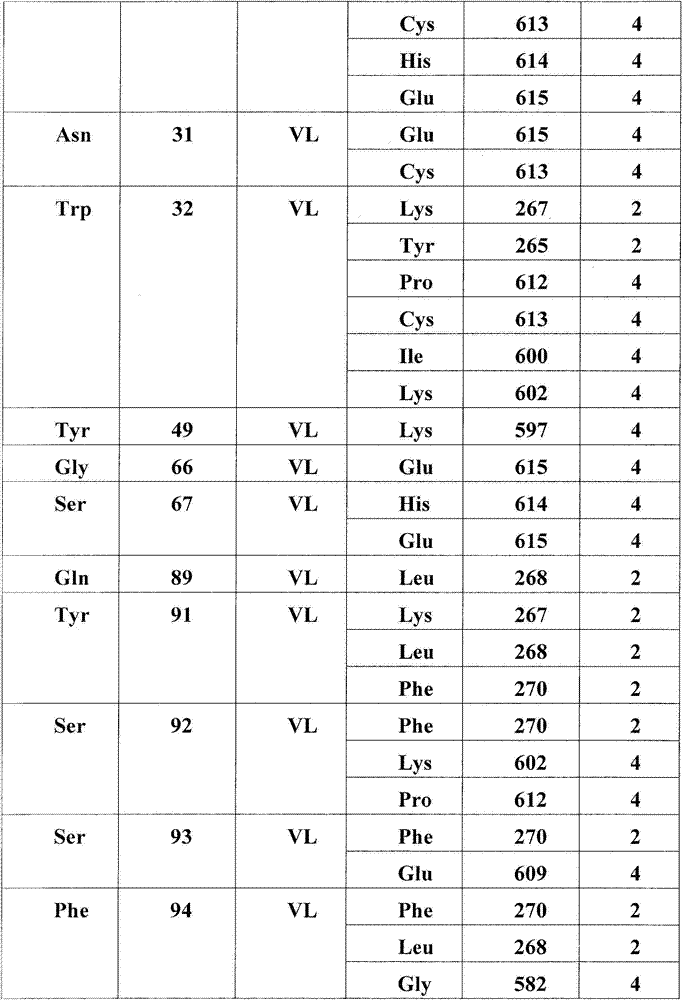
表13:MOR09825Fab重链与人HER3的相互作用。Fab VH残基的编号是基于其线性氨基酸序列(SEQ ID NO:51)。HER3残基的编号是基于NP_001973。显示的HER3残基具有在MOR09825Fab的原子
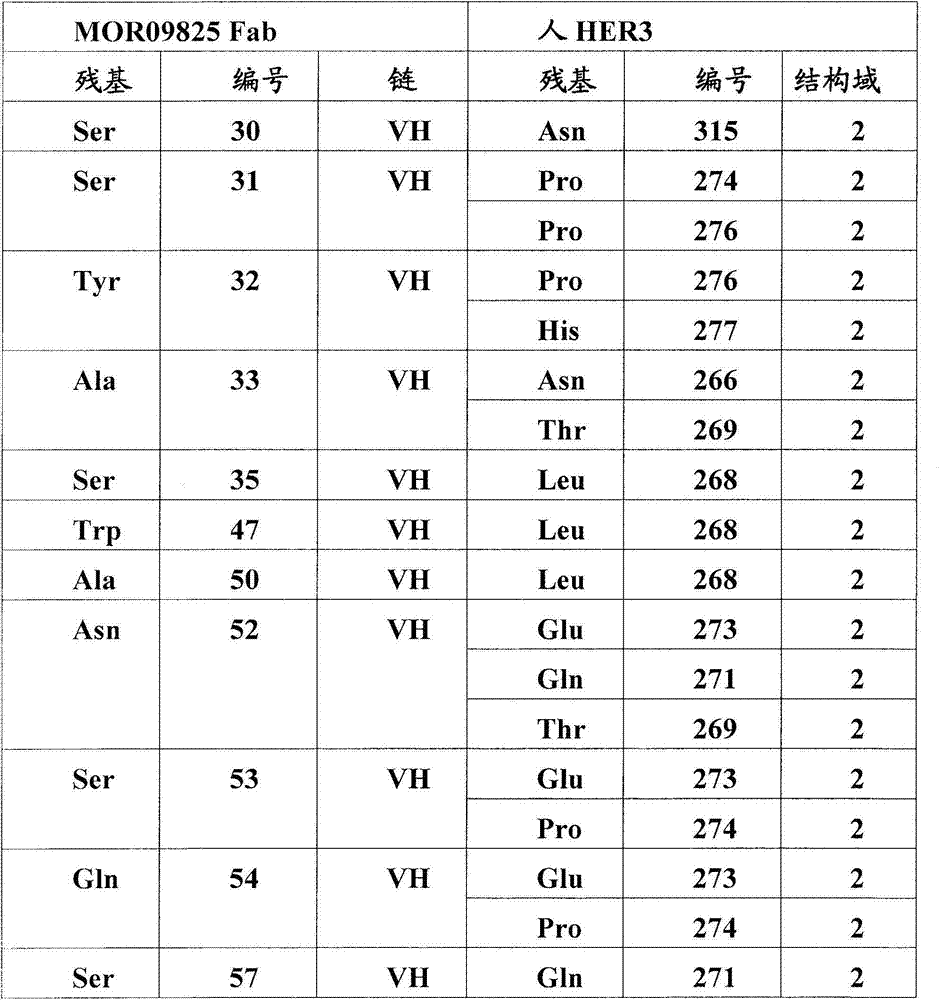
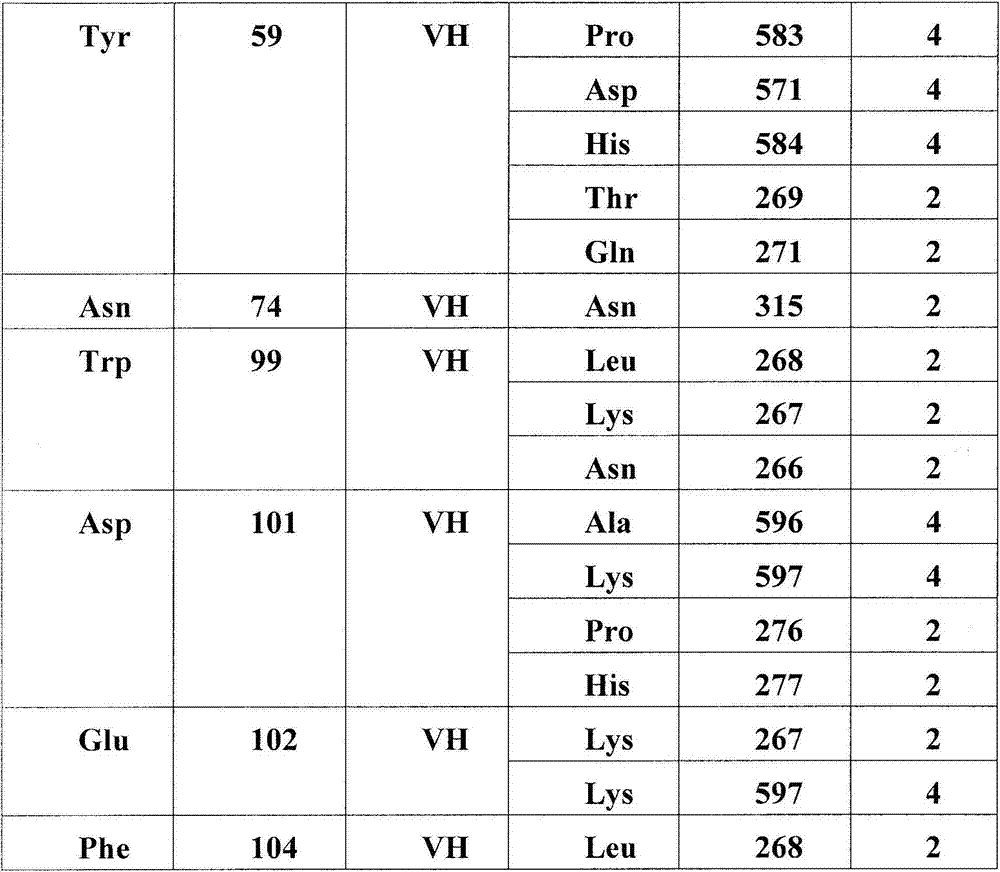
表14:MOR09825Fab轻链与人HER3的相互作用。Fab VL残基的编号是基于其线性氨基酸序列(SEQ ID NO:50)。HER3残基的编号是基于NP_001973。显示的HER3残基具有在MOR09825Fab的原子

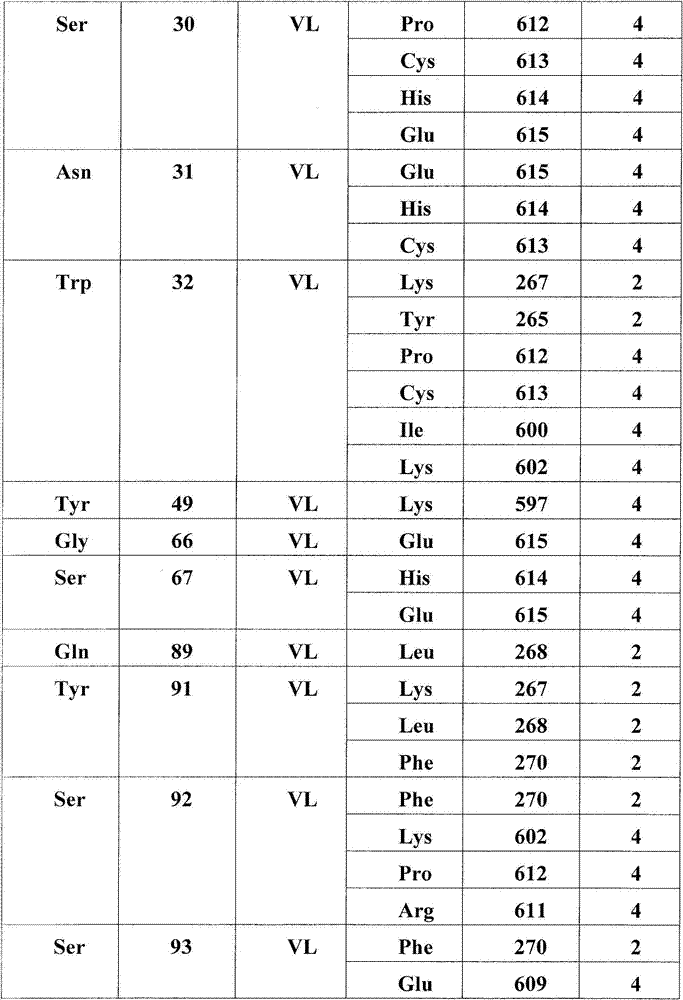
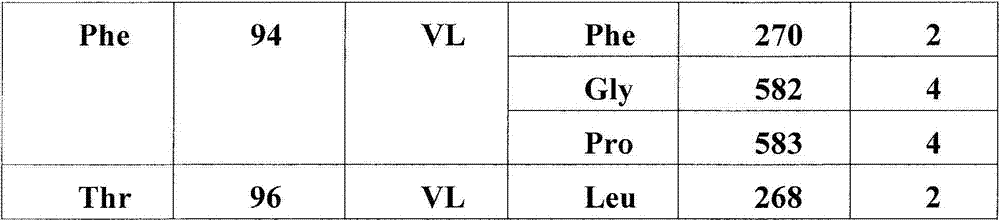
目视检查MOR09823/MOR09825的晶体结构突出了HER3残基Lys267和Leu268与多种抗体CDR形成多个相互作用,表明它们可能在抗体结合中很重要。因此,将Lys267和/或Leu268突变为丙氨酸,表达并纯化得到的重组蛋白质以评估它们对抗体结合的影响。ELISA结合测定显示,Lys267或Leu268的突变破坏了MOR10703与HER3的结合(图5F),表明这两个残基是HER3表位的主要部分,因此支持MOR09823/MOR09825和HER3之间的推测的相互作用。Visual inspection of the crystal structure of MOR09823/MOR09825 highlighted that HER3 residues Lys267 and Leu268 form multiple interactions with various antibody CDRs, suggesting that they may be important in antibody binding. Therefore, Lys267 and/or Leu268 were mutated to alanine, and the resulting recombinant proteins were expressed and purified to assess their effect on antibody binding. ELISA binding assays revealed that mutation of Lys267 or Leu268 disrupted the binding of MOR10703 to HER3 (Fig. 5F), suggesting that these two residues are a major part of the HER3 epitope, thus supporting the putative interaction between MOR09823/MOR09825 and HER3 .
(viii)细胞信号传递的抑制(viii) Inhibition of cell signaling
为了确定抗HER3抗体对配体依赖性HER3活性的影响,将MCF7细胞与IgG孵育,然后用神经调节蛋白进行刺激。实例抑制曲线在图6A中图解并总结在表15中。还使用HER2扩增的细胞系SK-Br-3研究了抗HER3抗体对HER2介导的HER3活化的作用(图6B和表15)。To determine the effect of anti-HER3 antibodies on ligand-dependent HER3 activity, MCF7 cells were incubated with IgG and then stimulated with neuregulin. Example inhibition curves are illustrated in Figure 6A and summarized in Table 15. The effect of anti-HER3 antibodies on HER2-mediated activation of HER3 was also investigated using the HER2-amplified cell line SK-Br-3 (Figure 6B and Table 15).
表15:在MCF7,和SK-Br-3细胞中的pHER3IC50和抗HER3IgG的抑制程度值Table 15: In MCF7, and SK-Br-3 cells pHER3IC 50 and the degree of inhibition of anti-HER3 IgG values
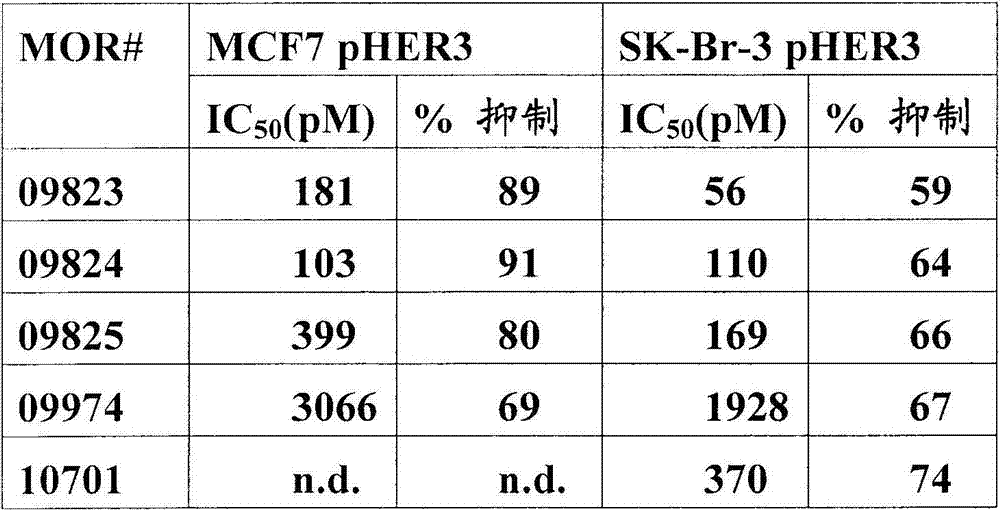
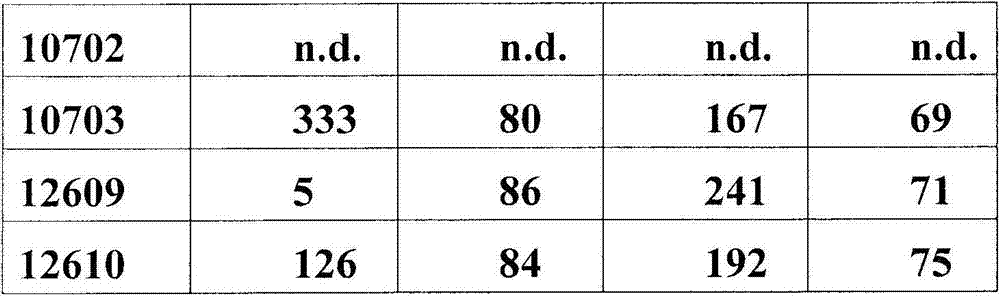
为了确定抑制HER3活性是否影响下游细胞信号传递,在用抗HER3抗体处理后也在HER2扩增的细胞中测量了Akt磷酸化(见图7和表16)。To determine whether inhibition of HER3 activity affects downstream cell signaling, Akt phosphorylation was also measured in HER2-amplified cells following treatment with anti-HER3 antibodies (see Figure 7 and Table 16).
表16:在SK-Br-3、BT-474和MCF7细胞中的pAkt(S473)IC50和抗HER3IgG抑制程度值Table 16: pAkt(S 473 ) IC 50 and anti-HER3 IgG inhibition values in SK-Br-3, BT-474 and MCF7 cells
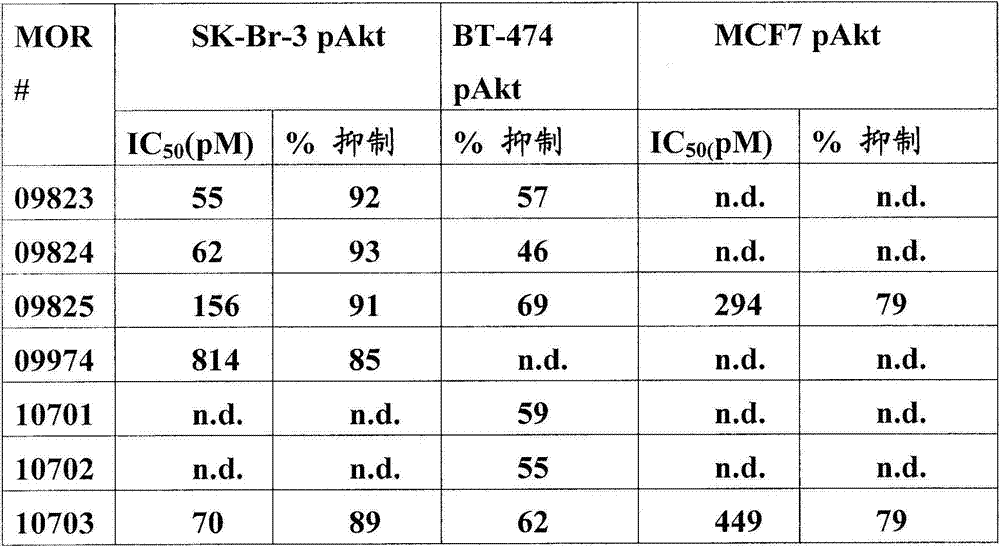
总之,MOR09823,MOR09824,MOR09825,MOR09974,MOR10701,MOR10702MOR10703,MOR12609和MOR12610每者能够以配体依赖性和配体非依赖性方式抑制细胞HER3活性。In conclusion, MOR09823, MOR09824, MOR09825, MOR09974, MOR10701, MOR10702MOR10703, MOR12609 and MOR12610 are each able to inhibit cellular HER3 activity in a ligand-dependent and ligand-independent manner.
(ix)增殖抑制(ix) Proliferation inhibition
由于MOR09823,MOR09824,MOR09825,MOR09974,MOR10701,MOR10702和MOR10703都抑制HER3活性和下游信号传递,检测了它们阻断配体依赖性和非依赖性体外细胞生长的能力(实例数据显示于图8并总结在表17中)。所检测的抗HER3抗体都是有效的细胞增殖抑制剂。Since MOR09823, MOR09824, MOR09825, MOR09974, MOR10701, MOR10702 and MOR10703 all inhibit HER3 activity and downstream signaling, they were tested for their ability to block ligand-dependent and independent cell growth in vitro (example data are shown in Figure 8 and summarized in Table 17). The tested anti-HER3 antibodies were all potent inhibitors of cell proliferation.
表17:在用10μg/ml抗HER3IgG处理SK-Br-3,BT-474和MCF7细胞后的增殖抑制Table 17: Proliferation inhibition after treatment of SK-Br-3, BT-474 and MCF7 cells with 10 μg/ml anti-HER3 IgG
(x)配体阻断评估(x) Ligand Blocking Assessment
通过检查神经调节蛋白与先前用MOR09823或MOR09825处理的MCF7细胞的结合,评估所述抗HER3抗体阻断配体结合的能力。MOR09823或MOR09825的存在对神经调节蛋白结合MCF7细胞的能力没有显著影响,而在实验中使用的阳性对照(Mab3481)能够严重干扰神经调节蛋白的结合(见图9)。这些结果与晶体结构一致,因为MOR09823与结构域2和4相互作用,而神经调节蛋白与HER3相互作用的主要接触点假定主要集中在结构域1和3内。考虑到神经调节蛋白能够结合HER3的失活构象(Kani等人,(2005)Biochemistry44:15842-15857),MOR09823和MOR09825很可能通过阻止信号传递所必需的HER3结构域重排或通过干扰受体二聚化起作用。The ability of the anti-HER3 antibodies to block ligand binding was assessed by examining neuregulin binding to MCF7 cells previously treated with MOR09823 or MOR09825. The presence of MOR09823 or MOR09825 had no significant effect on the ability of neuregulin to bind to MCF7 cells, whereas the positive control (Mab3481) used in the experiment was able to severely interfere with neuregulin binding (see Figure 9). These results are consistent with the crystal structure, as MOR09823 interacts with
(xi)配体阻断评估(生化)(xi) Ligand Blockade Assessment (Biochemical)
为了研究MOR09823和神经调节蛋白是否可同时结合HER3,使用BiacoreTM技术建立了生化测定。使用Biotin CAPture试剂盒(GEHealthcare)通过在BiacoreTM传感器芯片CAP(GE Healthcare)表面捕获生物素化的神经调节蛋白进行相互作用分析。通过孵育人HER3-Fc与浓度增加的MOR09823,105.5(Thermo Scientific)或人IgG生成HER3复合物。将预先形成的HER3/抗体复合物注射至参考表面和活性表面,观察HER3与神经调节蛋白的相互作用。To investigate whether MOR09823 and neuregulin can simultaneously bind HER3, a biochemical assay was established using Biacore ™ technology. Interaction analysis was performed by capturing biotinylated neuregulin on the surface of a Biacore ™ sensor chip CAP (GE Healthcare) using the Biotin CAPture kit (GE Healthcare). HER3 complexes were generated by incubating human HER3-Fc with increasing concentrations of MOR09823, 105.5 (Thermo Scientific) or human IgG. Inject preformed HER3/antibody complexes onto reference and active surfaces to observe HER3-neuregulin interaction.
对照IgG对HER3/神经调节蛋白复合物的形成没有影响,而观察到105.5明显抑制HER3与神经调节蛋白结合的能力,证明其为配体阻断抗体(图10)。相反地,HER3/MOR09823复合物能够结合神经调节蛋白,证明MOR09823不阻止配体结合。有趣的是,当注射MOR09823/HER3复合物时独有地观察到RU值的剂量依赖性增加。此数据显示,在芯片表面上生成了含有神经调节蛋白、HER3和MOR09823的三聚体复合物。HER3/MOR09823晶体结构预测了形成此三聚体复合物的能力因为MOR09823的结合不封闭HER3的配体结合位点,这表明神经调节蛋白和MOR09823的结合不是互相排斥的。Control IgG had no effect on the formation of HER3/neuregulin complex, while 105.5 was observed to significantly inhibit the ability of HER3 to bind to neuregulin, proving that it is a ligand blocking antibody (Figure 10). In contrast, the HER3/MOR09823 complex was able to bind neuregulin, demonstrating that MOR09823 does not prevent ligand binding. Interestingly, a dose-dependent increase in RU values was exclusively observed when the MOR09823/HER3 complex was injected. This data shows that a trimeric complex containing neuregulin, HER3 and MOR09823 was generated on the chip surface. The HER3/MOR09823 crystal structure predicts the ability to form this trimeric complex because MOR09823 binding does not block the ligand binding site of HER3, suggesting that neuregulin and MOR09823 binding are not mutually exclusive.
在另一个实施方案中,抗体或其片段结合HER3的结构域2和结构域4但不阻断HER3配体(例如神经调节蛋白)的同时结合。尽管不需要提供理论,抗体或其片段结合HER3的结构域2和结构域4,维持HER3处于失活构象但不阻断HER3上的配体结合位点是可能的。因此,HER3配体(例如,神经调节蛋白)能够与抗体同时结合HER3。In another embodiment, the antibody or fragment thereof binds domain 2 and
本发明的抗体或其片段抑制HER3的配体依赖性和非依赖性活化,但不阻止配体结合。基于以下原因认为这是有利的:The antibodies or fragments thereof of the invention inhibit ligand-dependent and independent activation of HER3, but do not prevent ligand binding. This is considered advantageous for the following reasons:
(i)相比靶向单种HER3活化机制((即配体依赖性或配体非依赖性)的抗体,治疗抗体将在广谱肿瘤中具有临床用途,因为不同的肿瘤类型受各自机制驱动。(i) Compared to antibodies targeting a single mechanism of HER3 activation (i.e., ligand-dependent or ligand-independent), therapeutic antibodies will have clinical utility in a broad spectrum of tumors, as different tumor types are driven by individual mechanisms .
(ii)治疗抗体将在同时涉及两种HER3活化机制的肿瘤类型中有效。靶向单种HER3活化机制(即配体依赖性或配体非依赖性)的抗体将在这些肿瘤类型中展示低效力或无效力。(ii) Therapeutic antibodies will be effective in tumor types involving both mechanisms of HER3 activation. Antibodies targeting a single mechanism of HER3 activation (ie, ligand-dependent or ligand-independent) will exhibit low or no efficacy in these tumor types.
(iii)抑制HER3的配体依赖性活化但不阻止配体结合的抗体的效力将较少可能受增加的配体浓度的不良影响。这将转化为在通过极高浓度HER3配体驱动的肿瘤类型中的增加的效力,或当抗性由HER3配体的上调介导时减少的药物抗性倾向。(iii) The efficacy of antibodies that inhibit ligand-dependent activation of HER3 but do not prevent ligand binding will be less likely to be adversely affected by increased ligand concentrations. This would translate into increased potency in tumor types driven by very high concentrations of HER3 ligands, or reduced propensity for drug resistance when resistance is mediated by upregulation of HER3 ligands.
(iv)通过稳定失活形式来抑制HER3活化的抗体将不易产生由HER3活化的备选机制驱动的药物抗性。(iv) Antibodies that inhibit HER3 activation by stabilizing the inactive form will be less prone to drug resistance driven by alternative mechanisms of HER3 activation.
因此,本发明的抗体可用于治疗现有治疗抗体临床无效的病况。Accordingly, the antibodies of the invention are useful in the treatment of conditions for which existing therapeutic antibodies are clinically ineffective.
(xii)HER3活性的体内抑制和对肿瘤生长的影响(xii) In vivo inhibition of HER3 activity and effects on tumor growth
为了测定上述抗HER3抗体的体内活性,在BxPC-3和BT-474肿瘤模型中都检测了MOR09823。已通过肿瘤pHER3水平的显著降低证明了MOR09823抑制HER3活性(图11)。通过在BxPC-3和BT-474中均降低的pAkt水平证明了HER3的下游信号传递被类似地抑制(图11)。在HER2驱动的BT-474效力研究中,重复的MOR10701处理导致74%的肿瘤生长抑制(见图12A),而MOR10703导致83%的抑制。在BxPC3肿瘤生长模型中,MOR10701和MOR10703都有效抑制了配体驱动的肿瘤生长(见图13)。To determine the in vivo activity of the above anti-HER3 antibodies, MOR09823 was tested in both BxPC-3 and BT-474 tumor models. Inhibition of HER3 activity by MOR09823 has been demonstrated by a significant reduction in tumor pHER3 levels (Figure 11). Downstream signaling of HER3 was similarly inhibited as evidenced by reduced pAkt levels in both BxPC-3 and BT-474 (Figure 11). In a HER2-driven BT-474 efficacy study, repeated MOR10701 treatment resulted in 74% inhibition of tumor growth (see Figure 12A), while MOR10703 resulted in 83% inhibition. In the BxPC3 tumor growth model, both MOR10701 and MOR10703 effectively inhibited ligand-driven tumor growth (see Figure 13).
(xiii)体外药物组合和对细胞生长的影响(xiii) In vitro drug combinations and effects on cell growth
由于肿瘤细胞生长常常受多个信号传递途径驱动,我们评估了MOR09823或MOR10703与多种靶向活性剂的组合是否有利于阻断细胞增殖。选择的靶向活性剂主要抑制HER2(曲妥珠单抗,拉帕替尼)EGFR(西妥昔单抗,埃罗替尼),PI3K/mTOR(BEZ235),PI3K(BKM120),PIK3CA(BYL719)和mTOR(RAD001),因为这些靶在人肿瘤中通常被活化。等效应图分析(见图14)显示,MOR09823和MOR10703展示了与曲妥珠单抗,拉帕替尼,埃罗替尼,西妥昔单抗,BEZ235,BKM120,BYL719和RAD001的协同作用的药物组合。此数据表明,HER3信号传递的抑制特别有利于靶向酪氨酸激酶或PI3K信号传递途径的抑制剂。Since tumor cell growth is often driven by multiple signaling pathways, we assessed whether the combination of MOR09823 or MOR10703 with multiple targeted agents would be beneficial in blocking cell proliferation. Selected targeting agents mainly inhibit HER2 (trastuzumab, lapatinib) EGFR (cetuximab, erlotinib), PI3K/mTOR (BEZ235), PI3K (BKM120), PIK3CA (BYL719 ) and mTOR (RAD001), as these targets are commonly activated in human tumors. Isoeffect map analysis (see Figure 14) showed that MOR09823 and MOR10703 exhibited synergistic effects with trastuzumab, lapatinib, erlotinib, cetuximab, BEZ235, BKM120, BYL719 and RAD001 drug combination. This data suggests that inhibition of HER3 signaling is particularly beneficial for inhibitors targeting tyrosine kinases or the PI3K signaling pathway.
(xiv)体内MOR10703药物组合(xiv) MOR10703 drug combination in vivo
由于体外HER3抑制和受体酪氨酸激酶靶向活性剂的组合,我们评估了MOR10701或MOR10703与曲妥珠单抗和埃罗替尼组合的体内影响。在BT-474异种移植物中(见图15A),MOR10701或MOR10703(20mg/kg)与次优剂量的曲妥珠单抗(1mg/kg)的组合足以诱导肿瘤衰退(%T/C=-50和-37,分别地)。在L3.3胰腺异种移植物中,MOR10703(20mg/kg)与每日的埃罗替尼(50mg/kg)的组合导致肿瘤停滞(%T/C=3,见图15B)。在两种模型中,2种药物的组合都比单独的任一种药物显著更有效,因此支持我们早先的体外发现,即组合HER3靶向抗体和ErbB靶向活性剂的益处。Due to the combination of HER3 inhibition and receptor tyrosine kinase targeting agents in vitro, we assessed the in vivo effects of MOR10701 or MOR10703 in combination with trastuzumab and erlotinib. In BT-474 xenografts (see Figure 15A), the combination of MOR10701 or MOR10703 (20 mg/kg) with a suboptimal dose of trastuzumab (1 mg/kg) was sufficient to induce tumor regression (%T/C=- 50 and -37, respectively). In L3.3 pancreatic xenografts, the combination of MOR10703 (20 mg/kg) with daily erlotinib (50 mg/kg) resulted in tumor stasis (%T/C=3, see Figure 15B). In both models, the combination of the 2 drugs was significantly more effective than either drug alone, thus supporting our earlier in vitro findings of the benefit of combining a HER3-targeting antibody and an ErbB-targeting active agent.
总之,此家族抗体稳定HER3的失活构象的独特能力在模型中导致显著的体内效力,所述模型中HER3以配体依赖性或非依赖性方式活化。此外,此家族抗体导致的HER3抑制在与多种靶向疗法的组合中似乎是有益的。In conclusion, the unique ability of this family of antibodies to stabilize the inactive conformation of HER3 resulted in remarkable in vivo efficacy in models in which HER3 is activated in a ligand-dependent or independent manner. Furthermore, HER3 inhibition by this family of antibodies appears to be beneficial in combination with various targeted therapies.
引入参考Introduce reference
本文引用的所有参考,包括专利、专利申请、论文、教科书等等和其中引用的参考(还没到列出的程度)在此以其整体引入作为参考。All references cited herein, including patents, patent applications, treatises, textbooks, etc. and references cited therein (not to the extent listed) are hereby incorporated by reference in their entirety.
等同物equivalent
我们认为上述说明书足以使本领域技术人员实践本发明。上述描述和实例详述了本发明的某些优选实施方案并描述了发明人设想的最佳模式。然而应当理解,无论上文描述地有多详尽,本发明可以多种方式实践,应根据随附的权利要求及其任意等同物理解本发明。We believe the foregoing description will be sufficient to enable any person skilled in the art to practice the invention. The above description and examples detail certain preferred embodiments of the invention and describe the best mode contemplated by the inventors. It should be understood, however, that no matter how exhaustively described above, the invention may be practiced in various ways, and that the invention should be construed in light of the appended claims and any equivalents thereof.
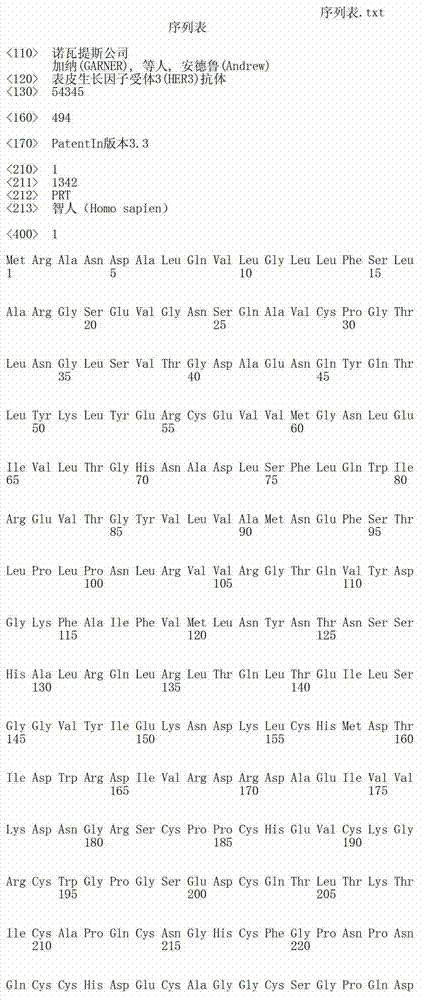
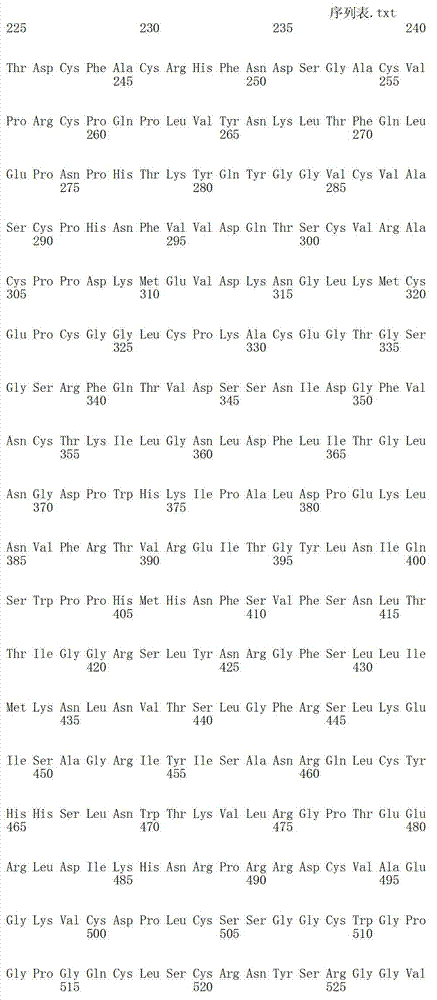
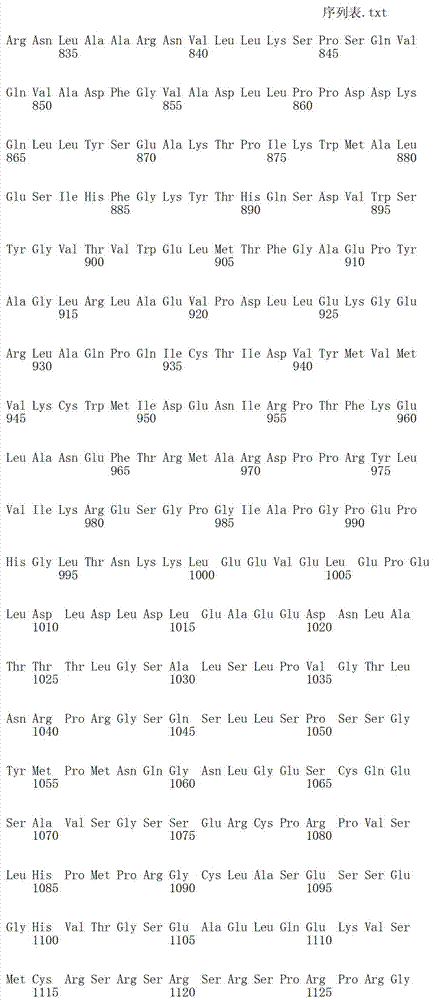
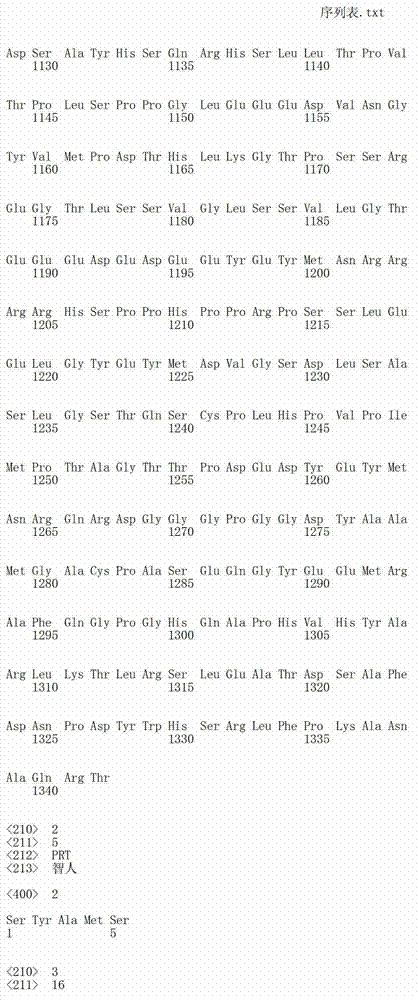
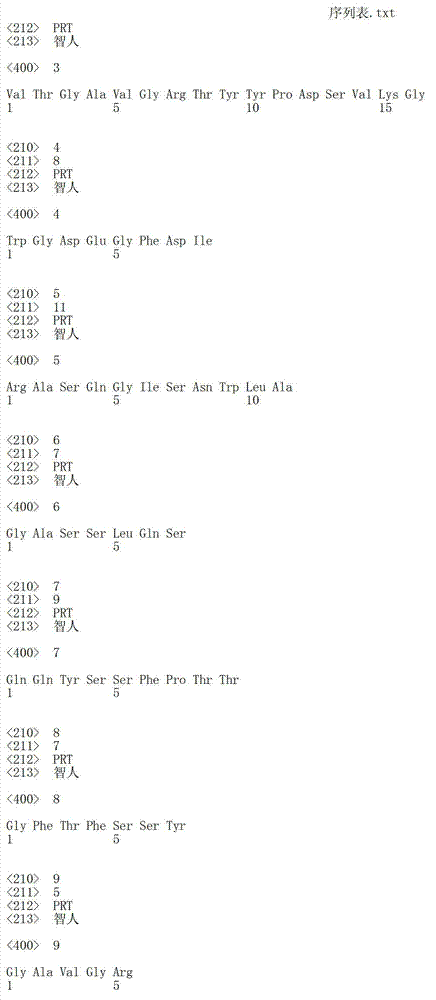
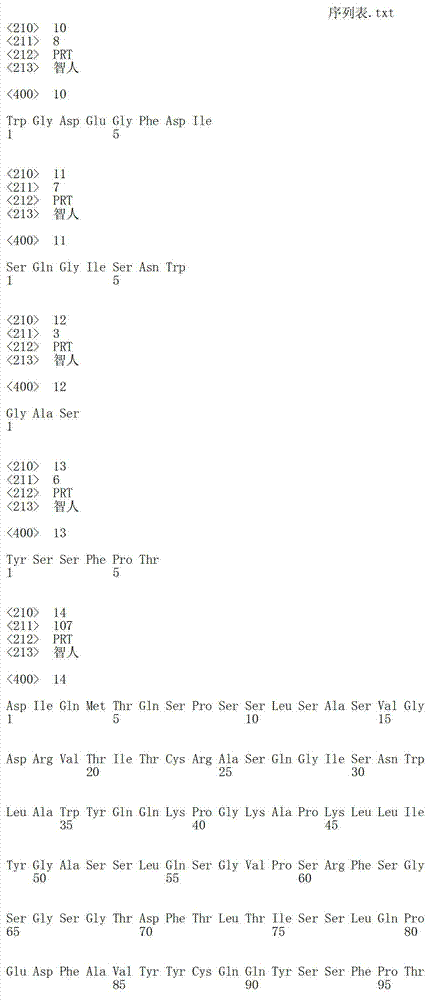
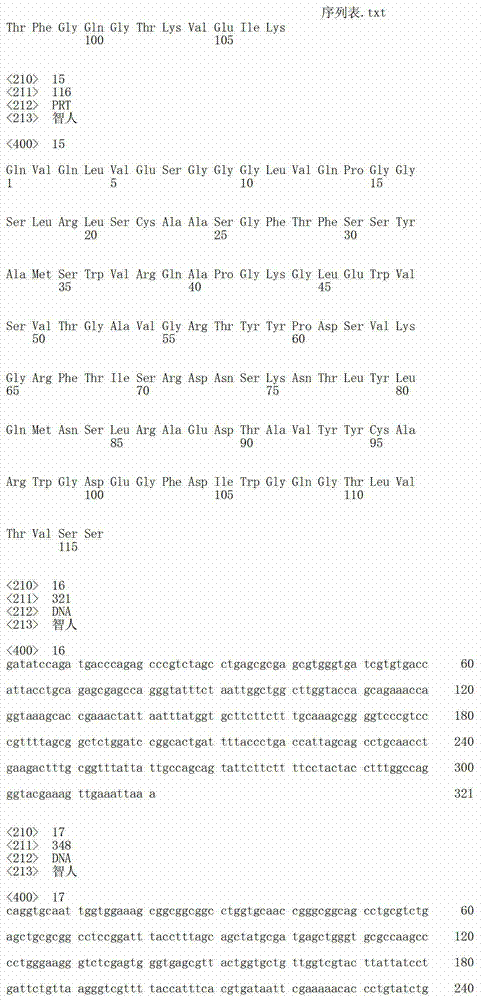


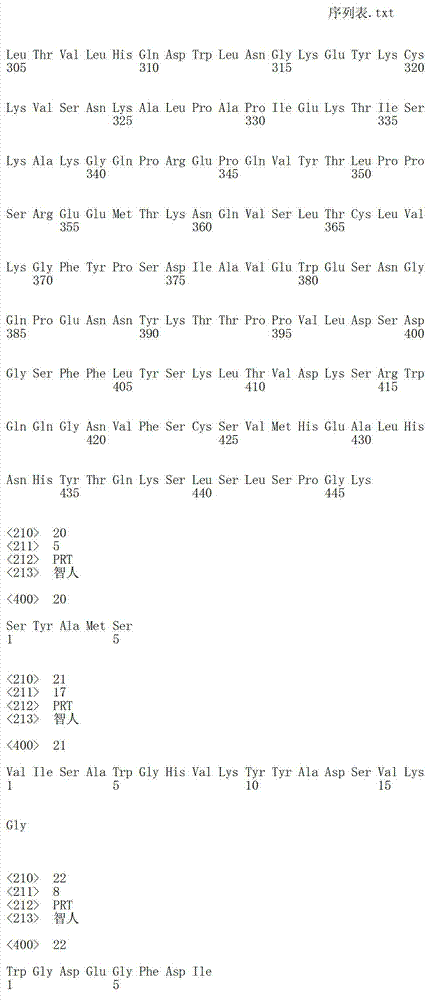
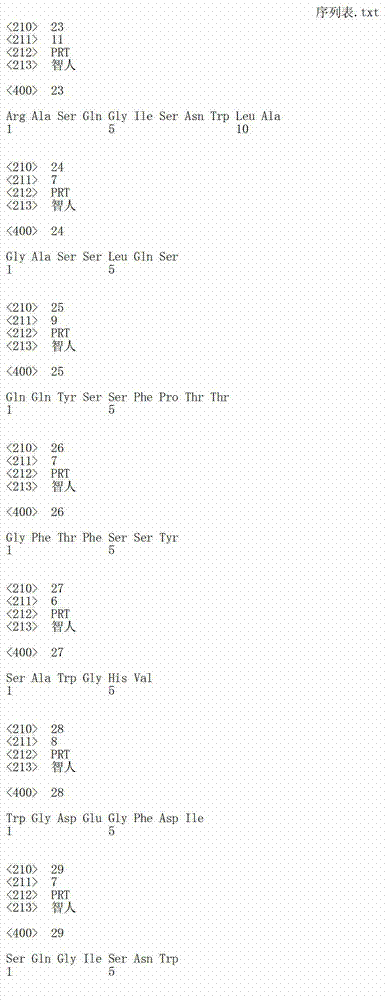
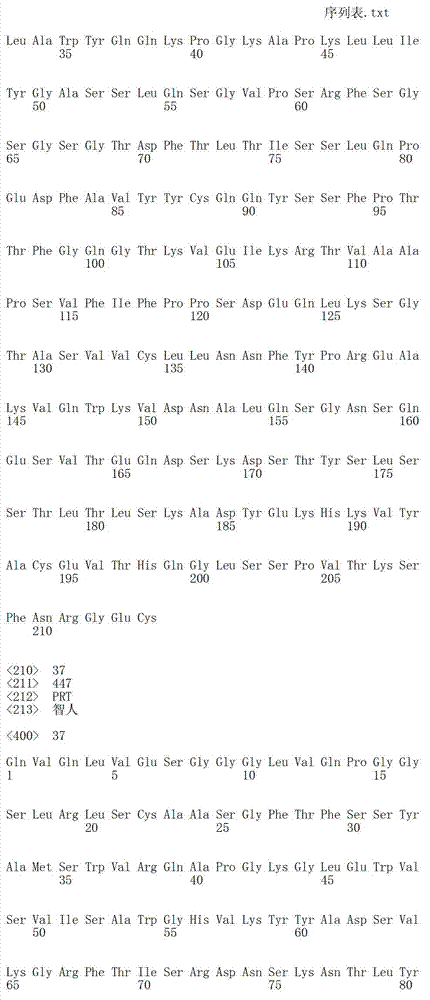
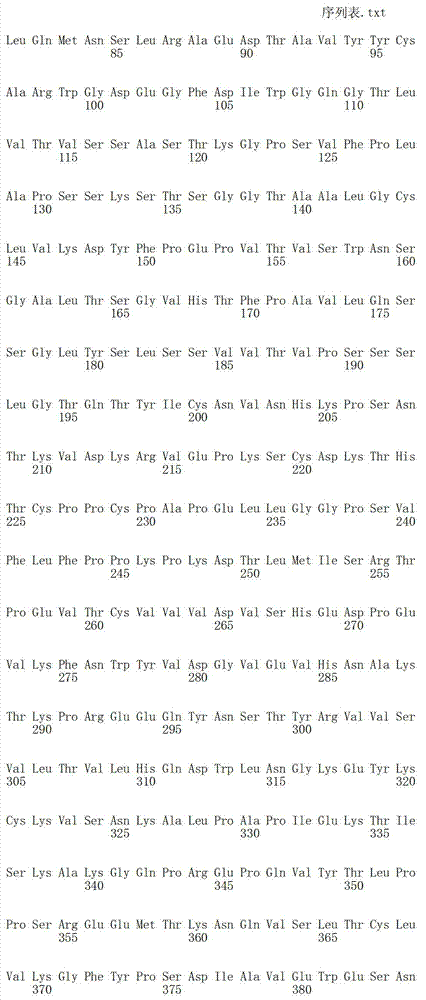
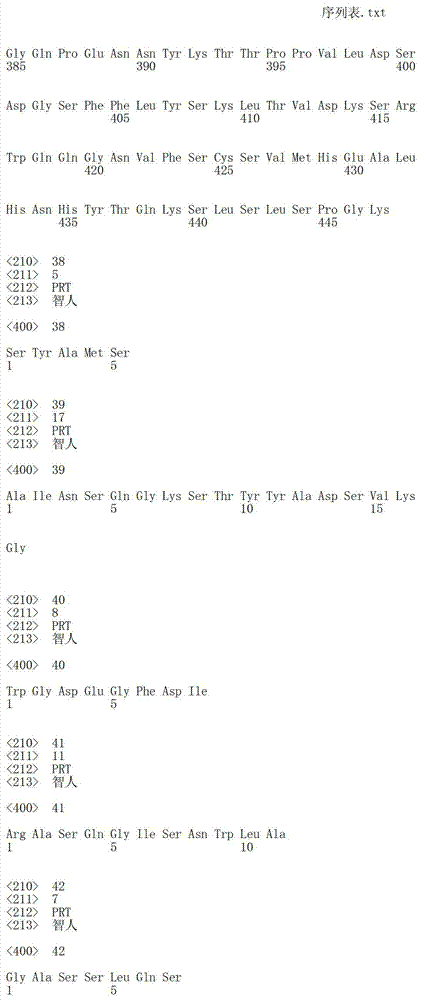
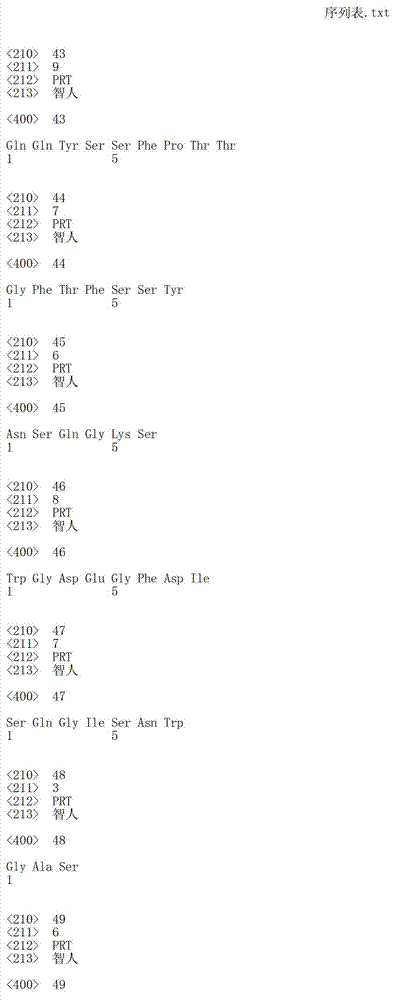

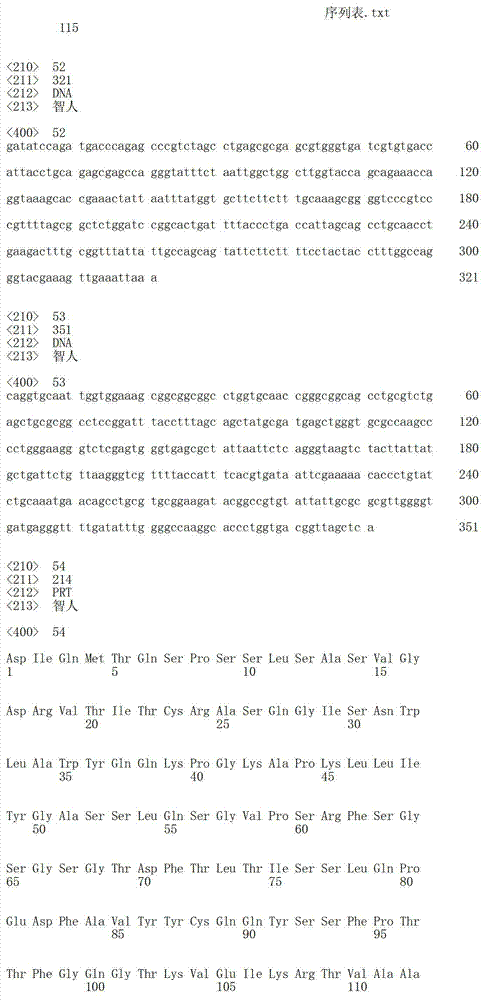
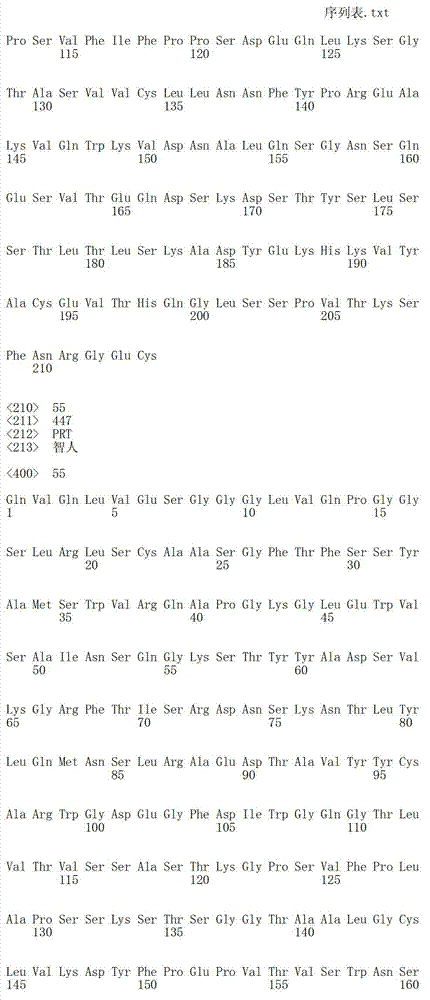
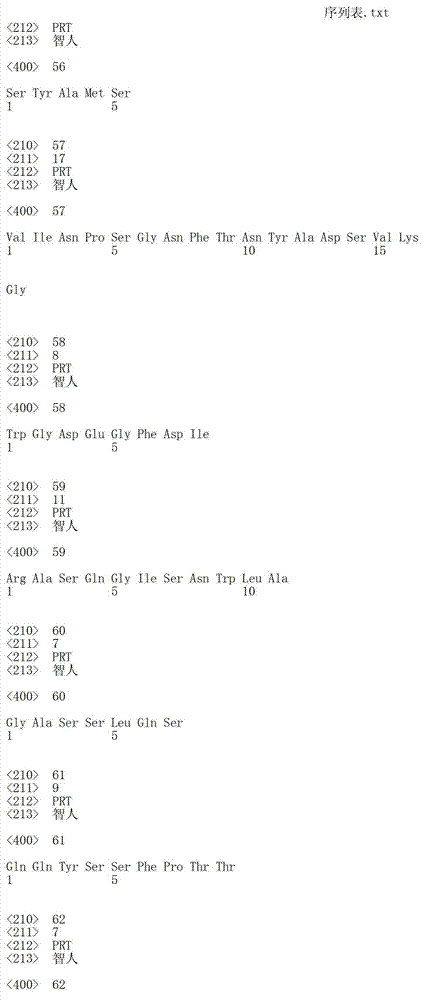
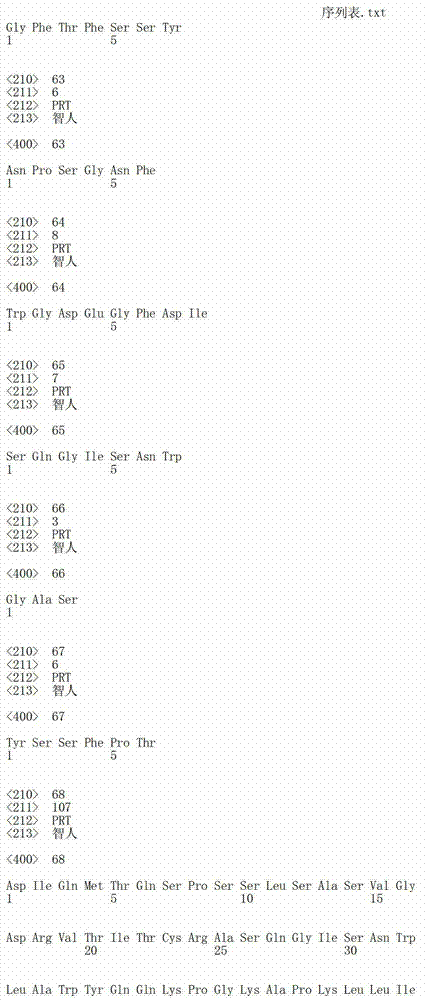
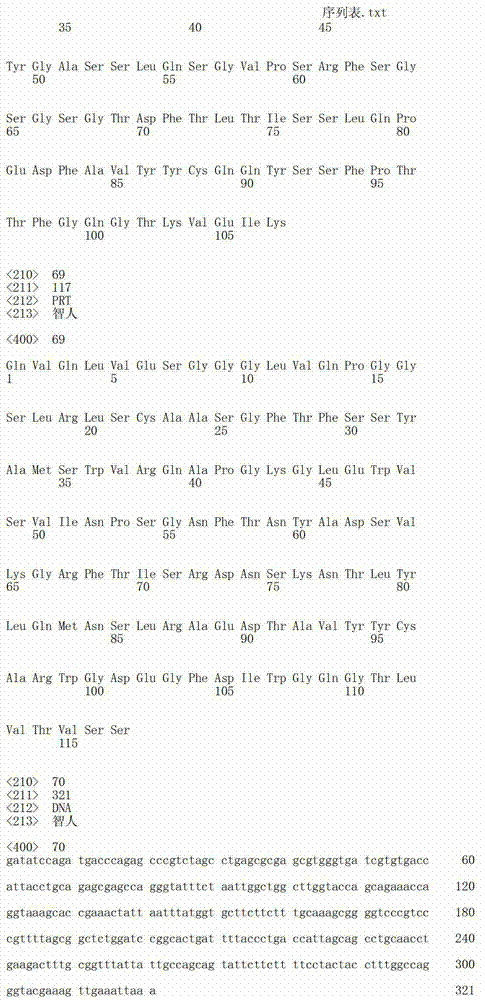


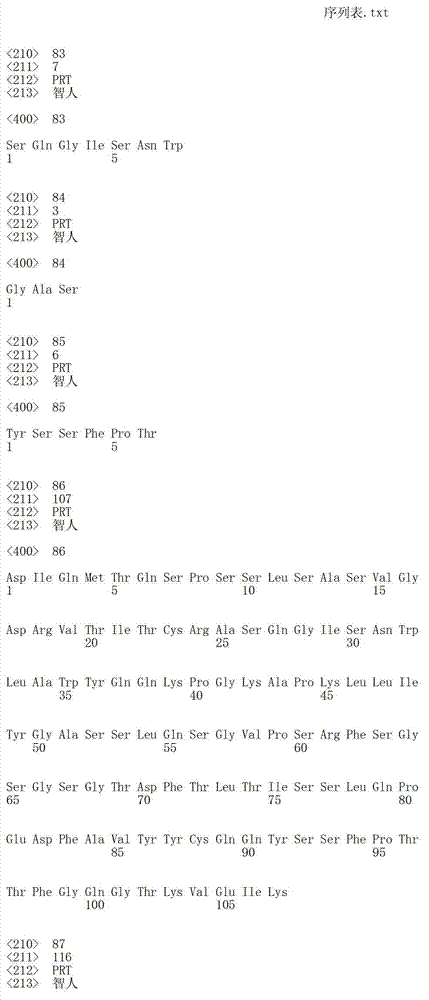
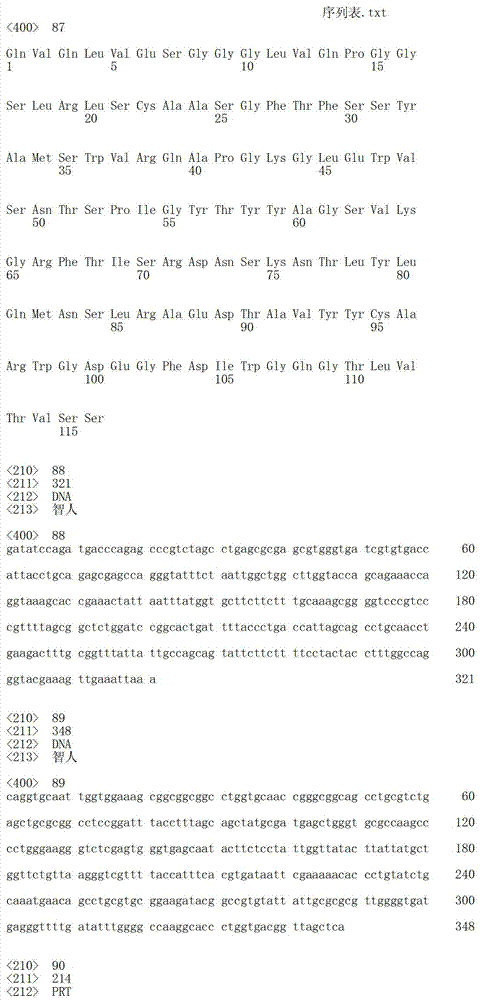
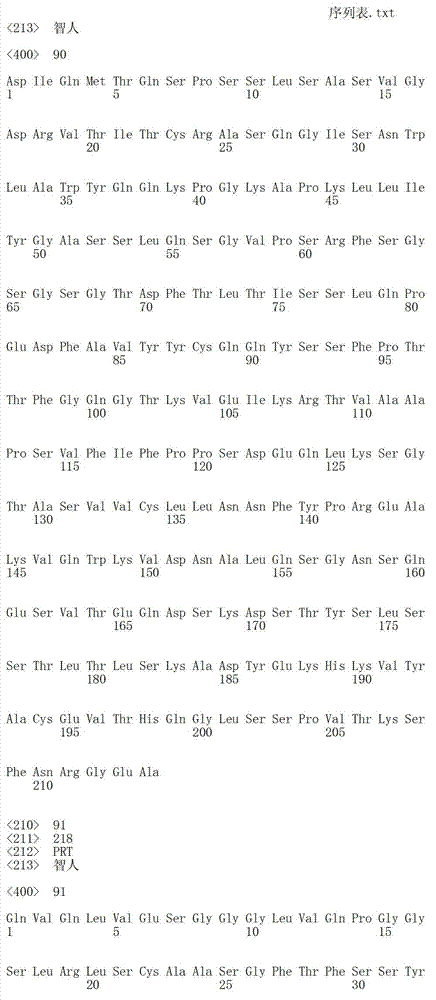

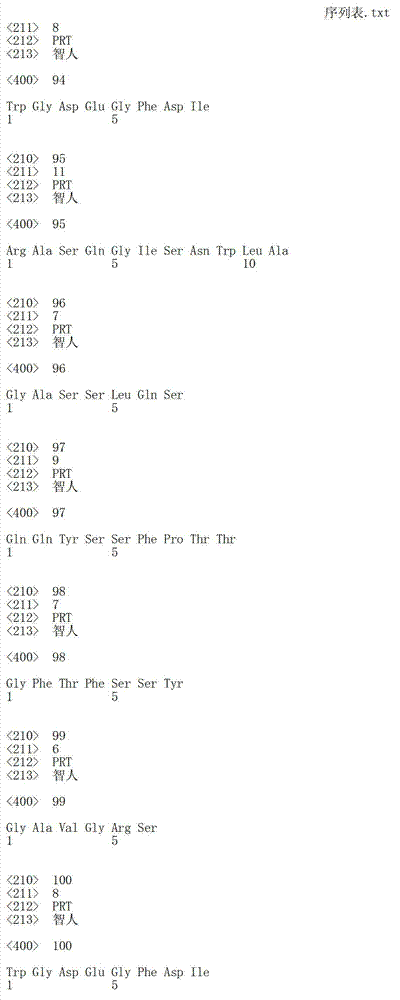


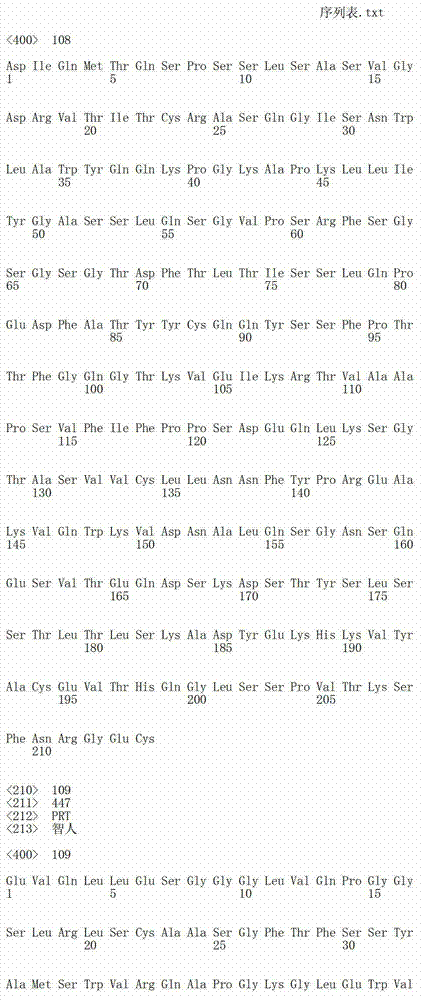
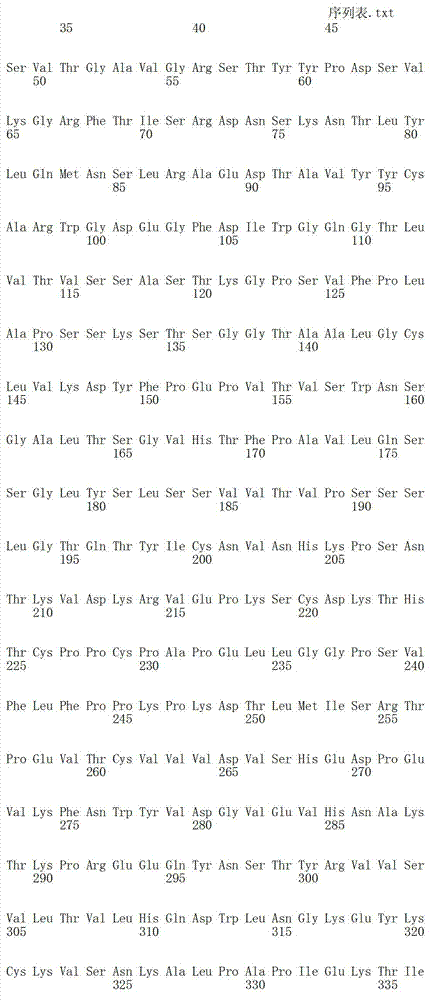
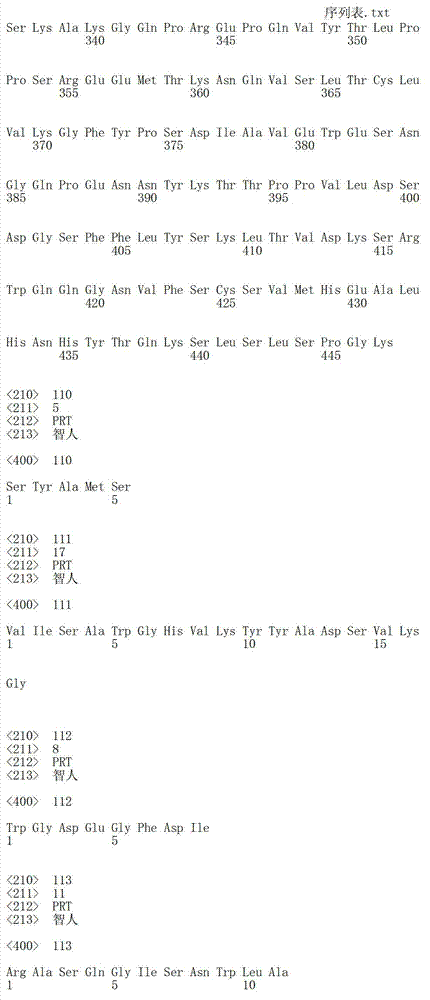
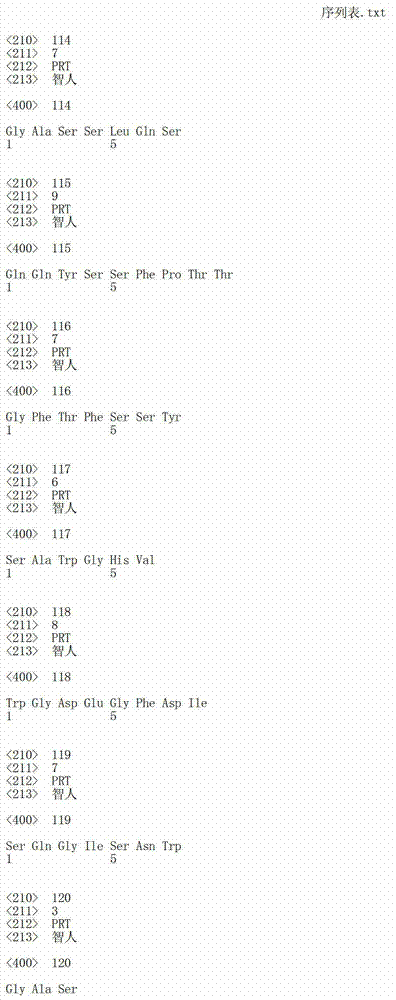


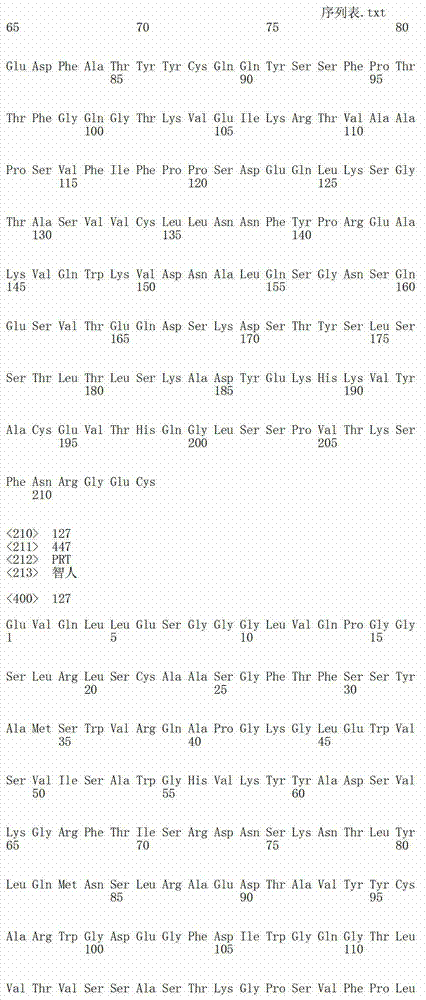


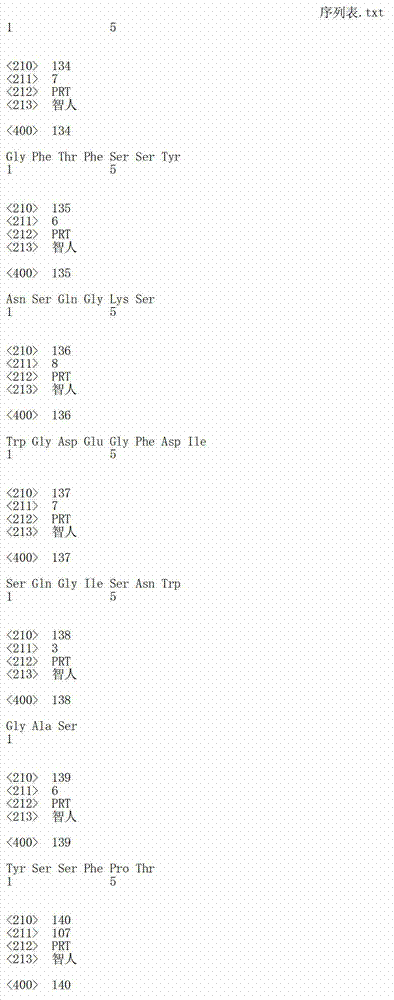

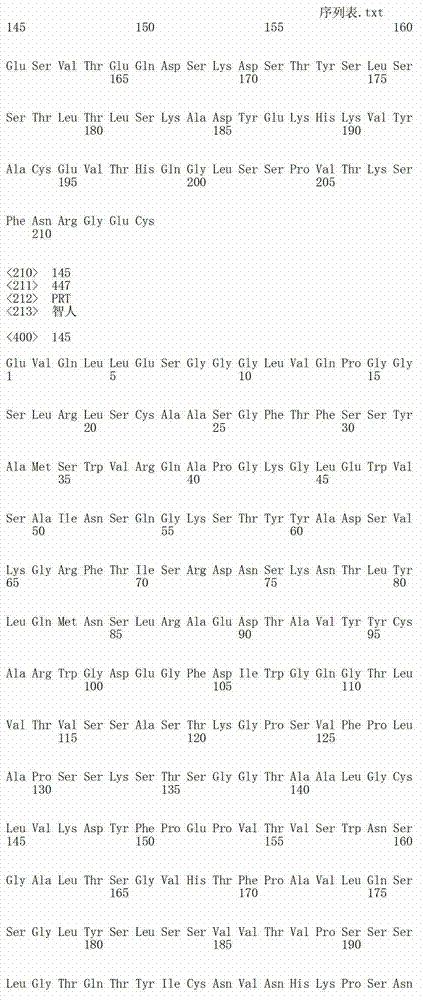
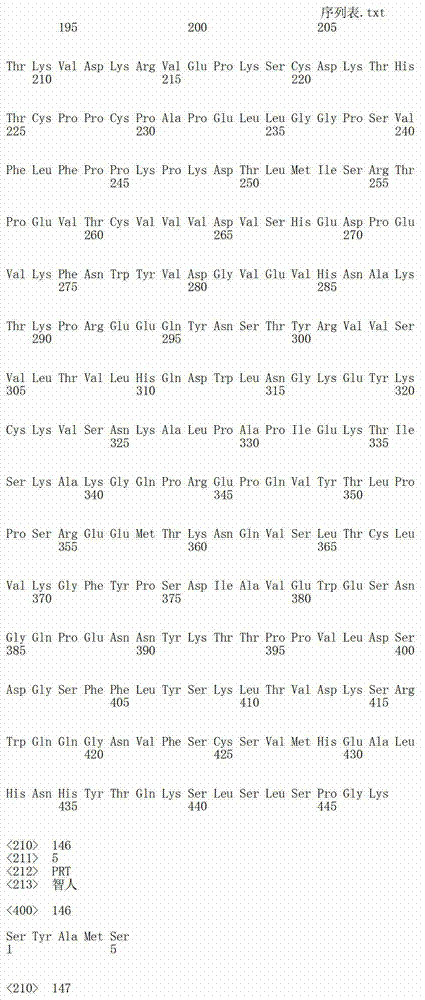


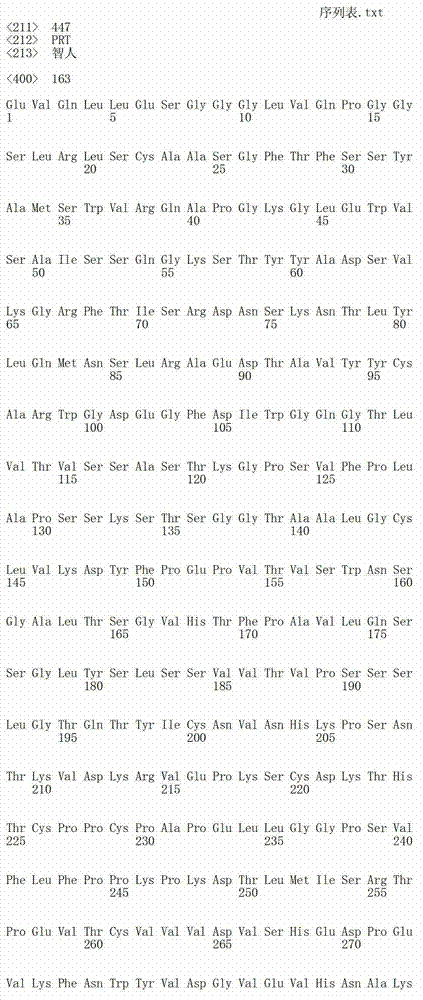
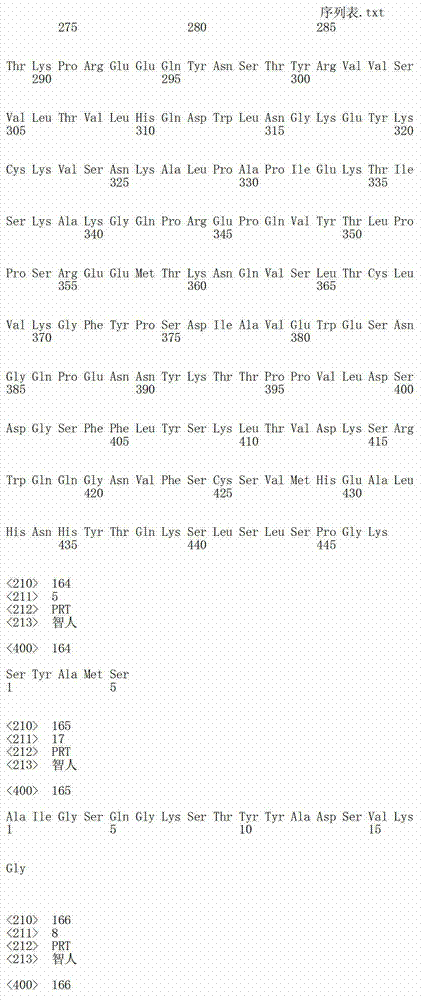

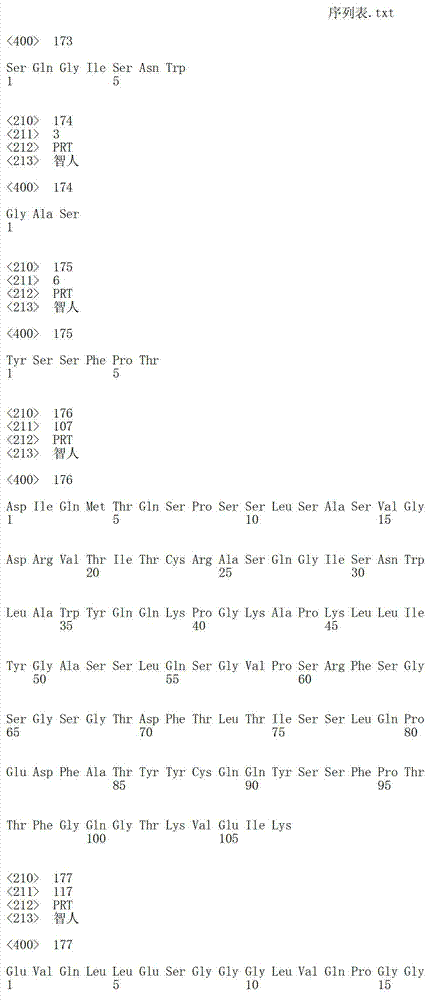
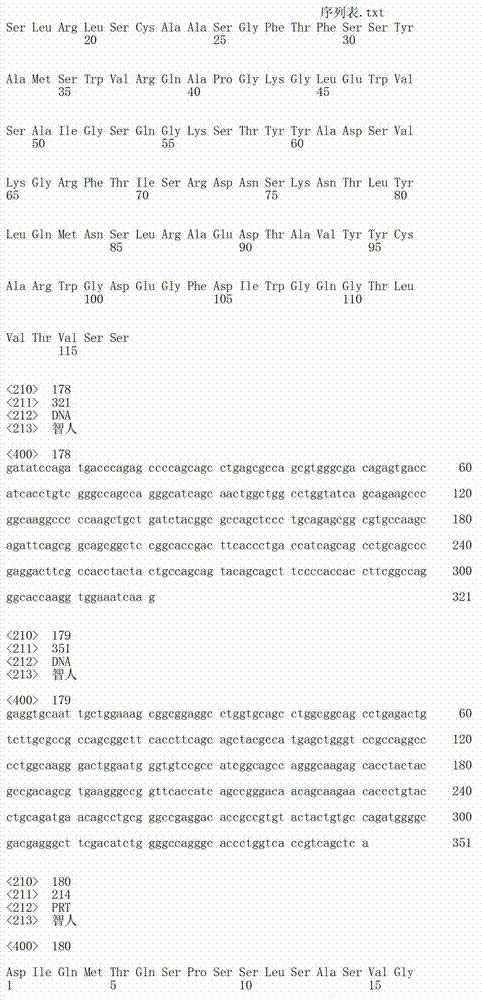
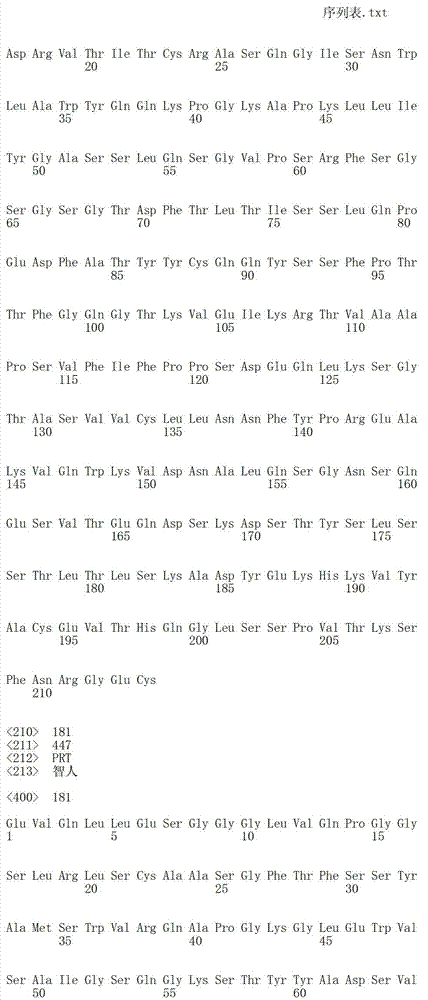

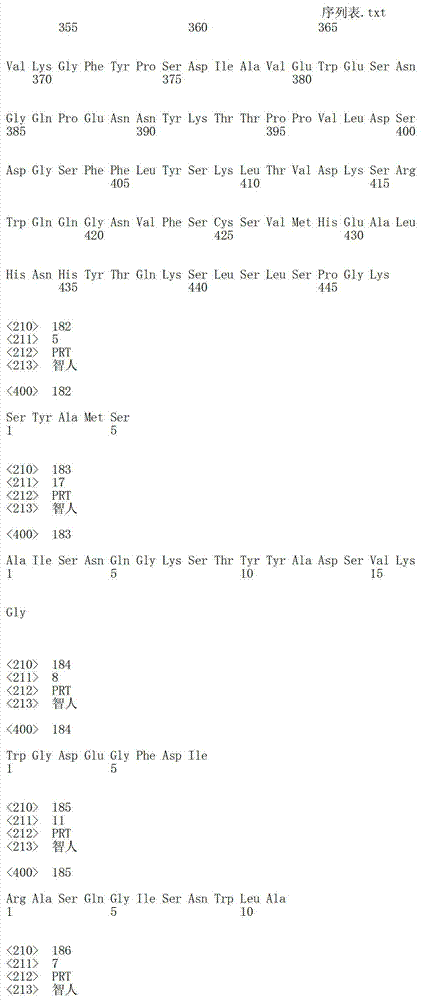


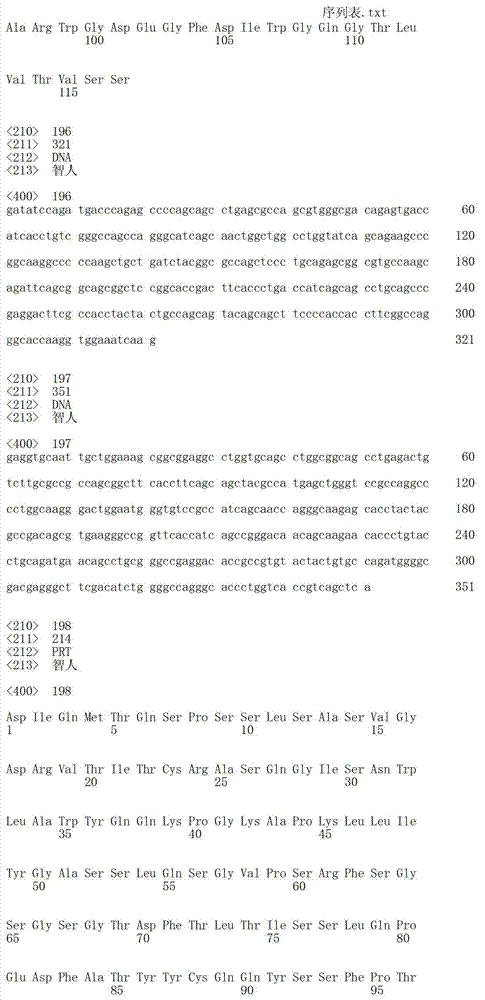

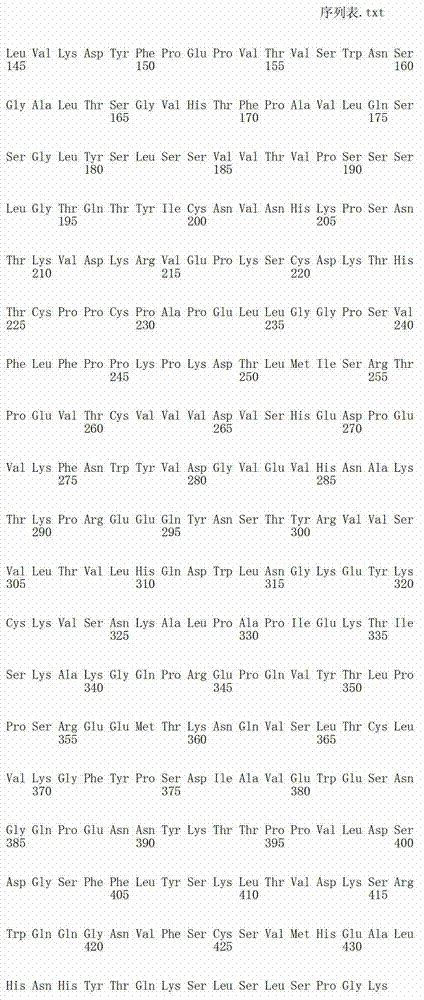

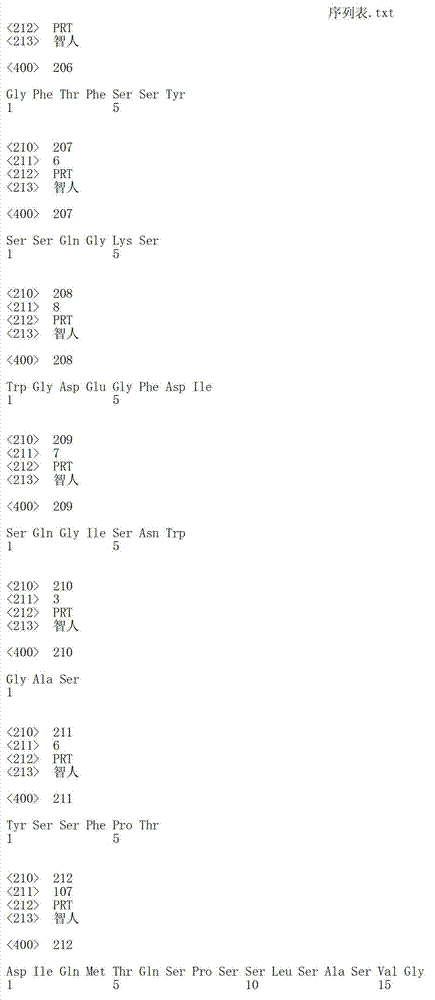
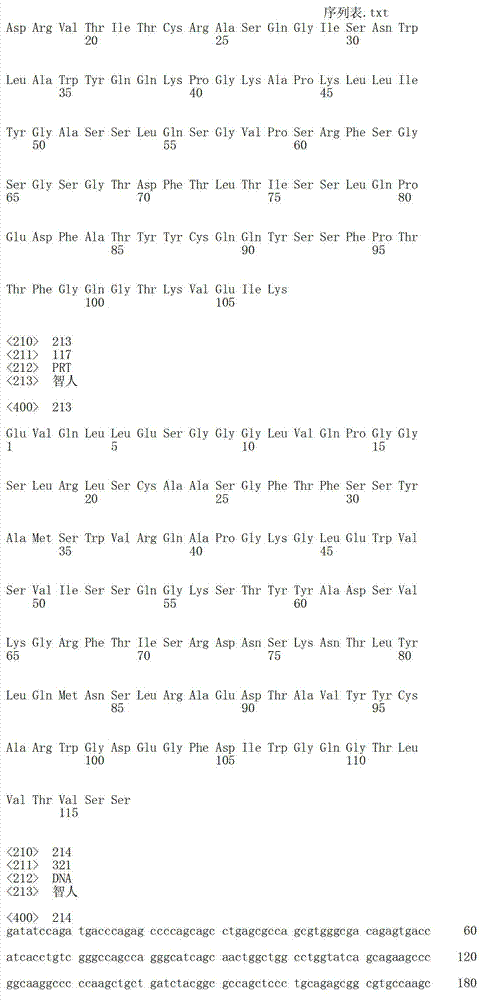

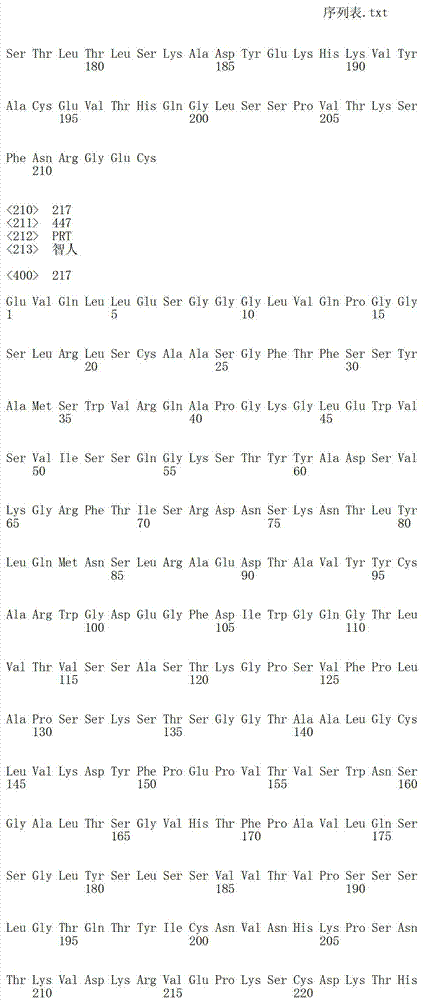
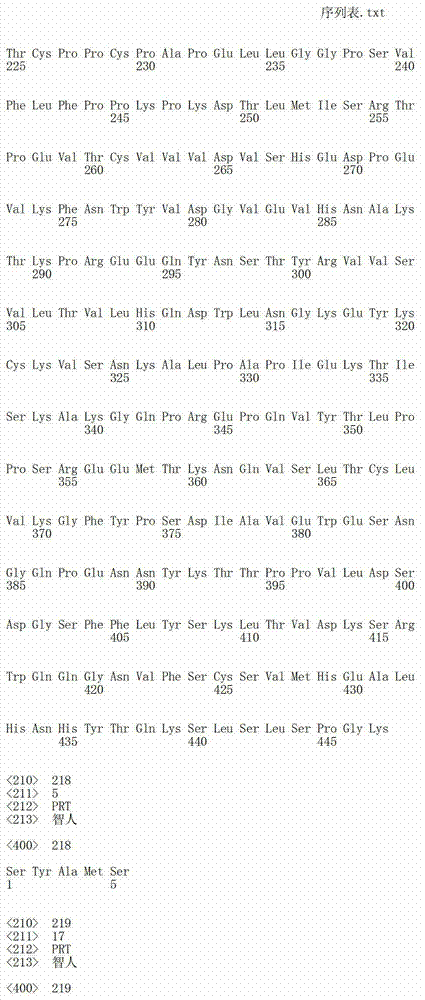
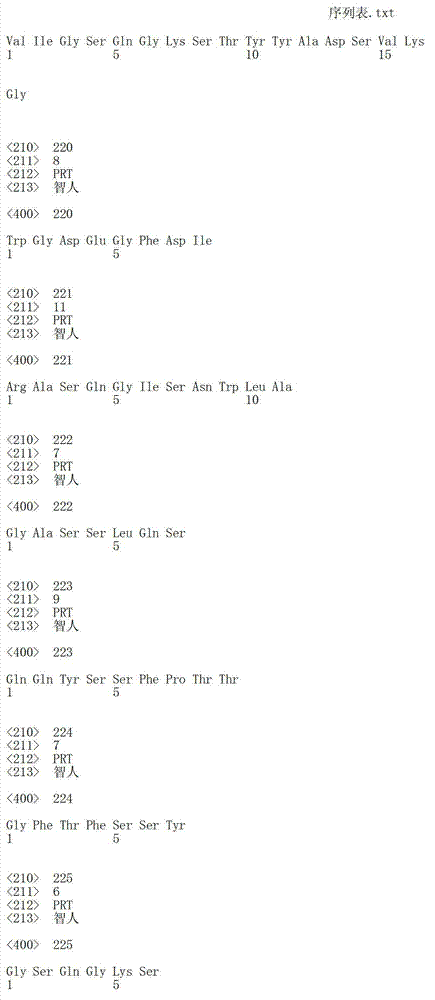
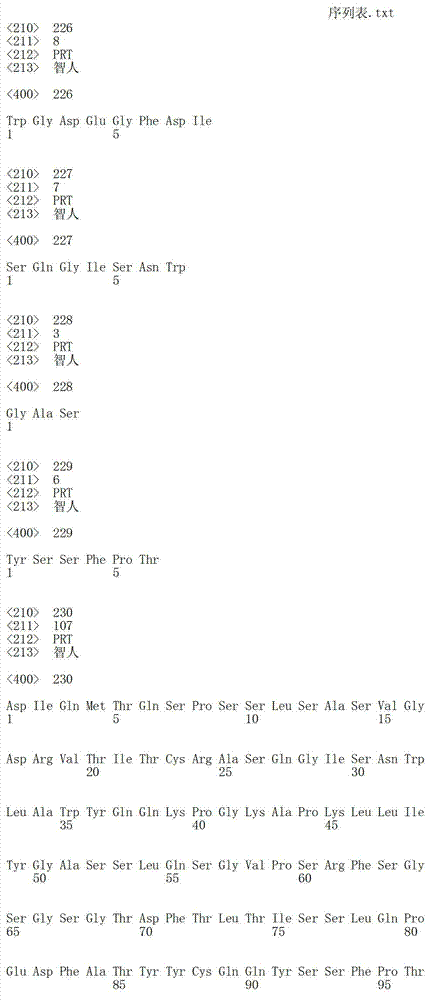
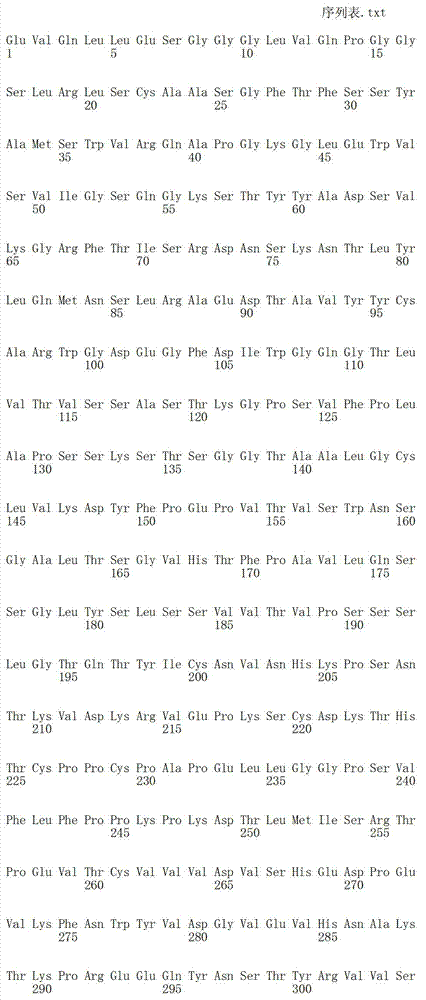

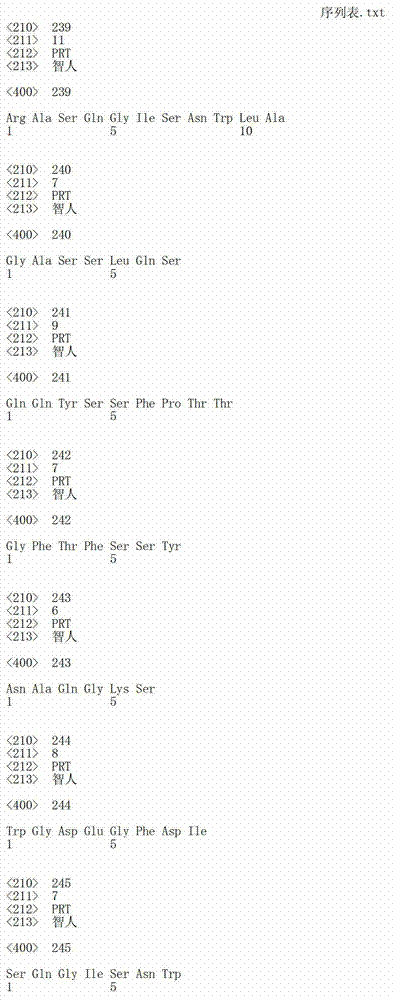
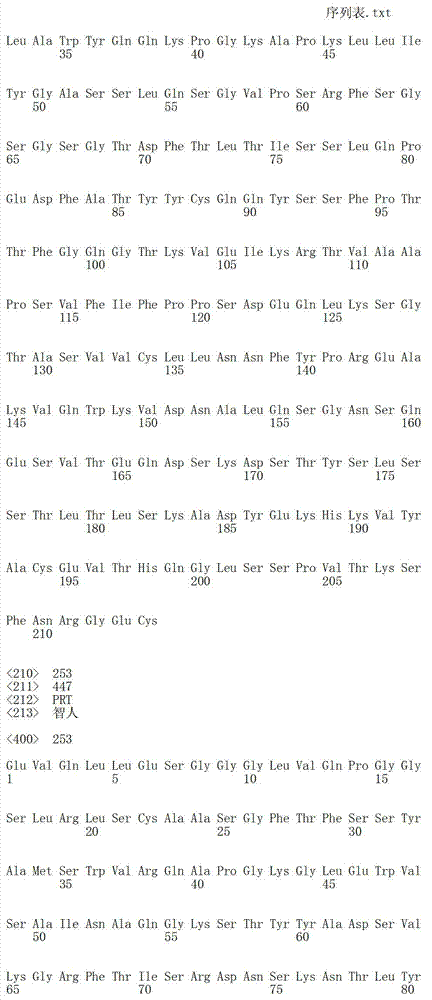
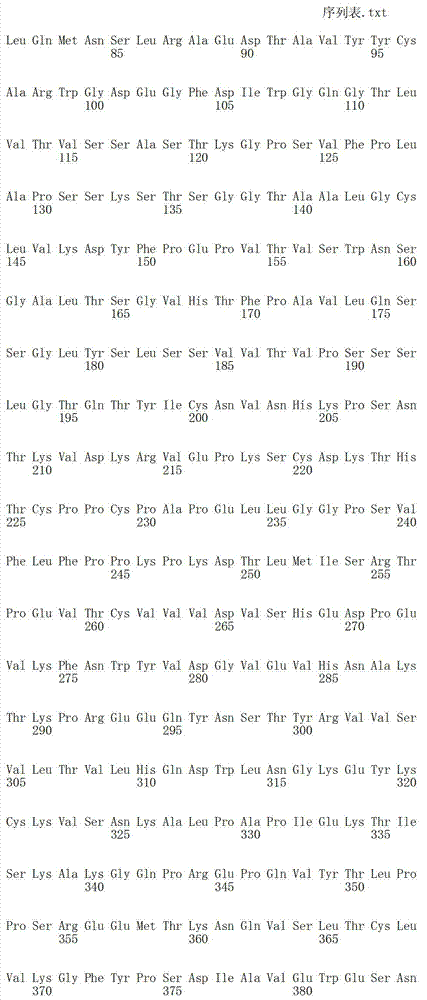
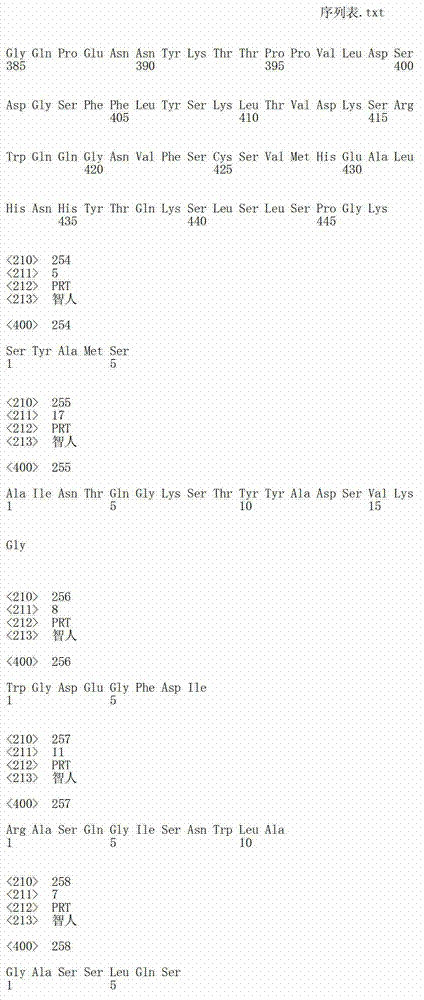
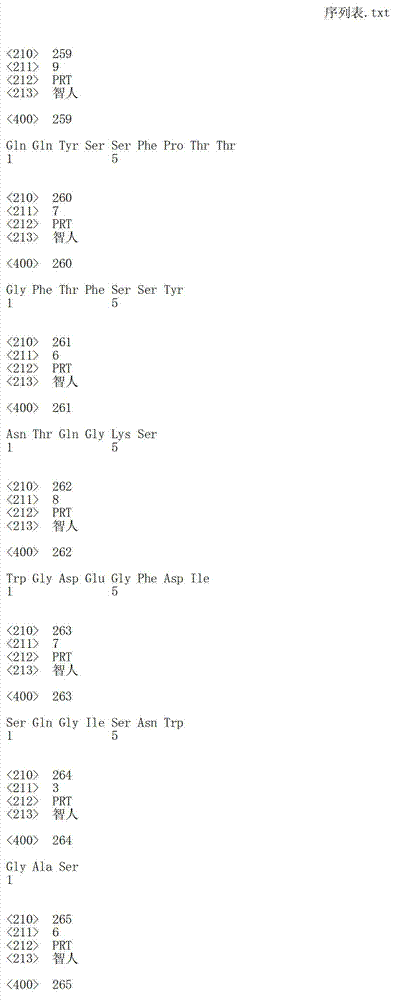
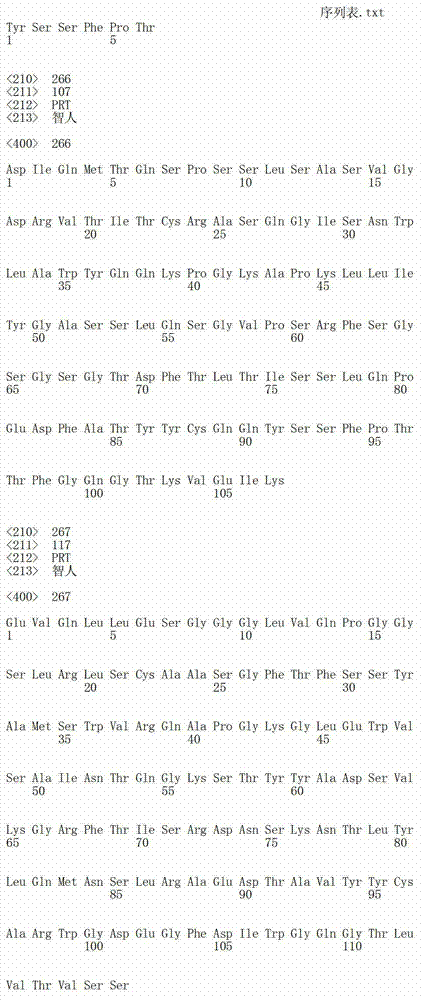
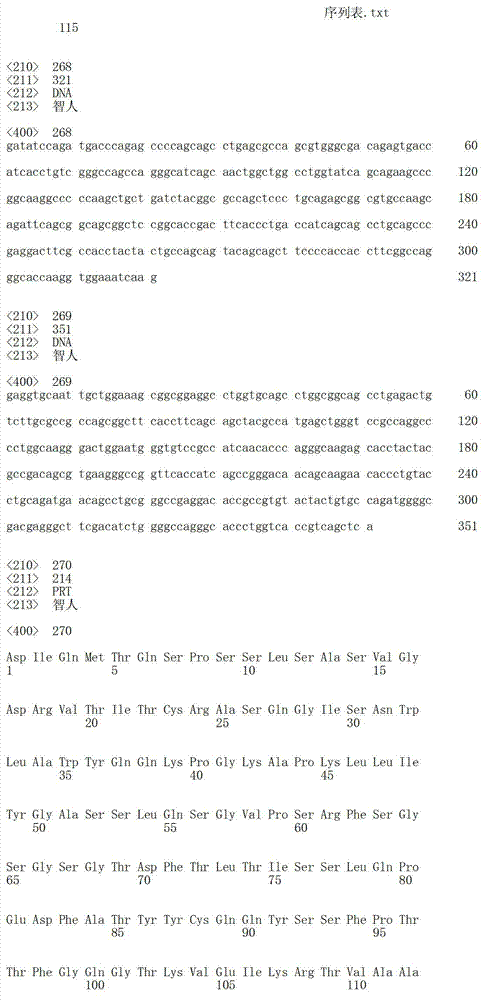

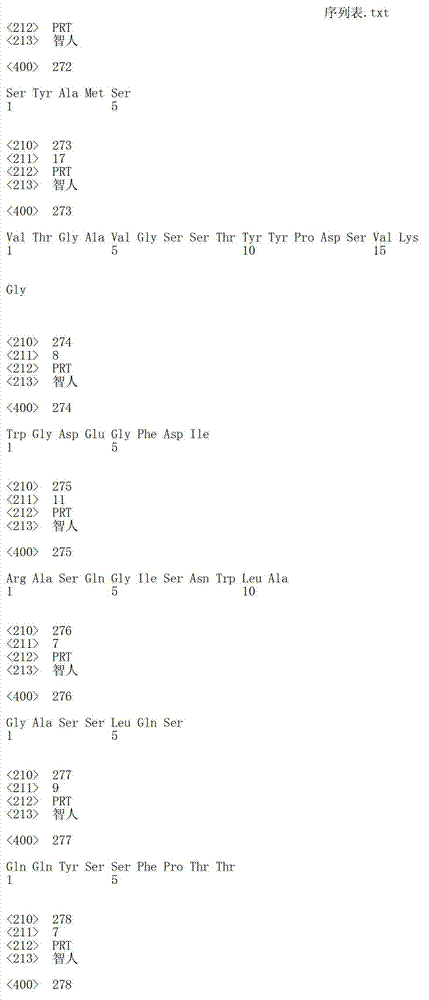

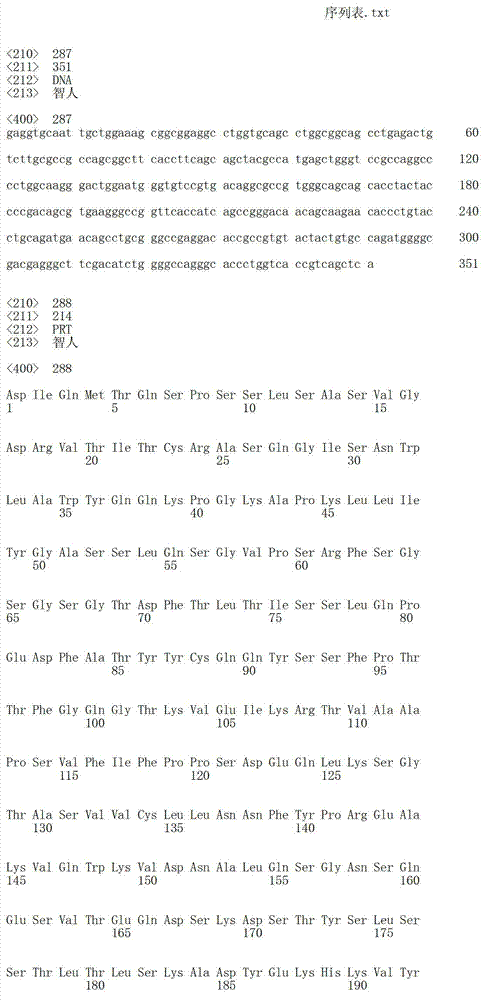
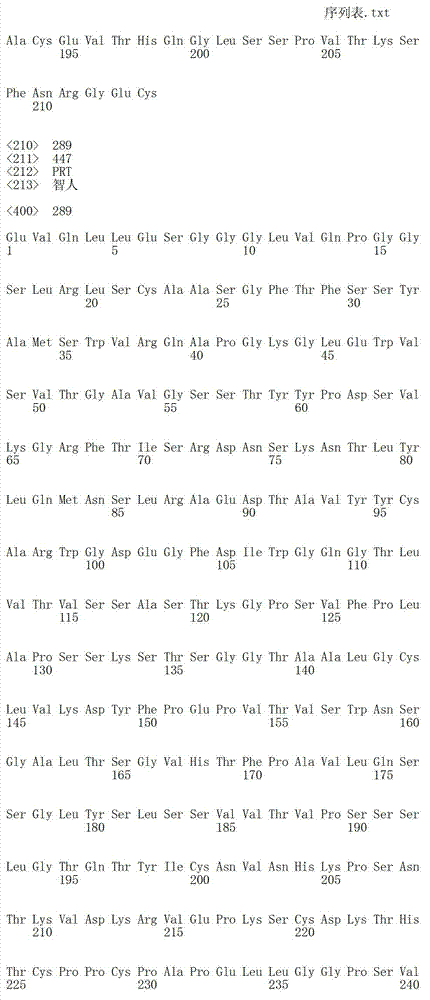
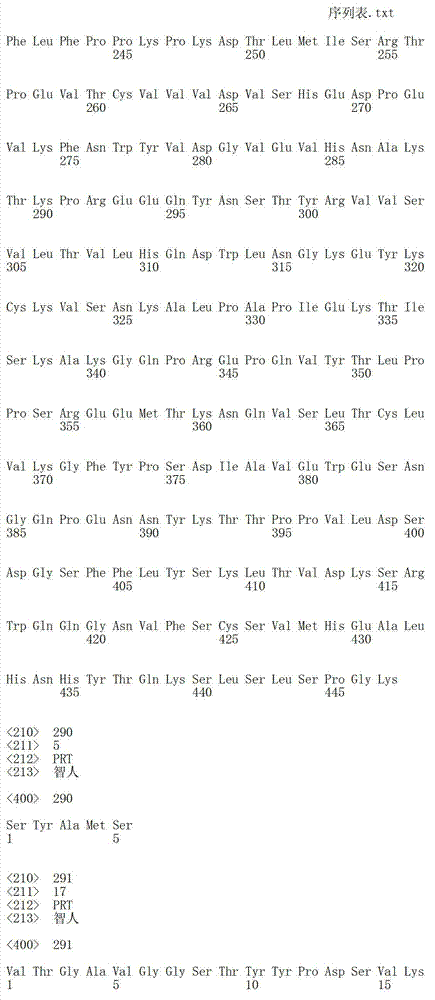
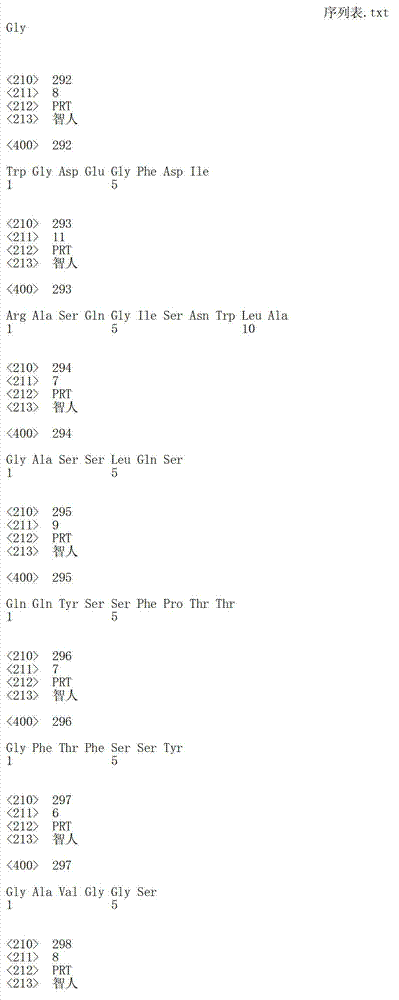
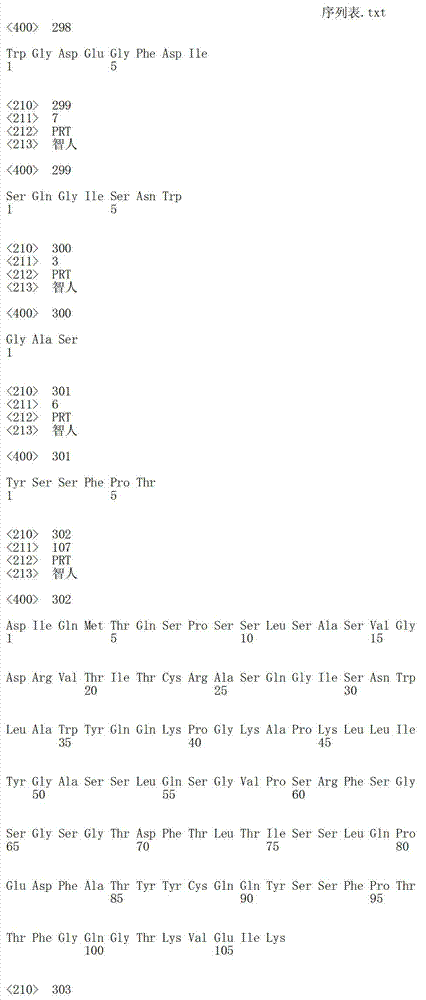
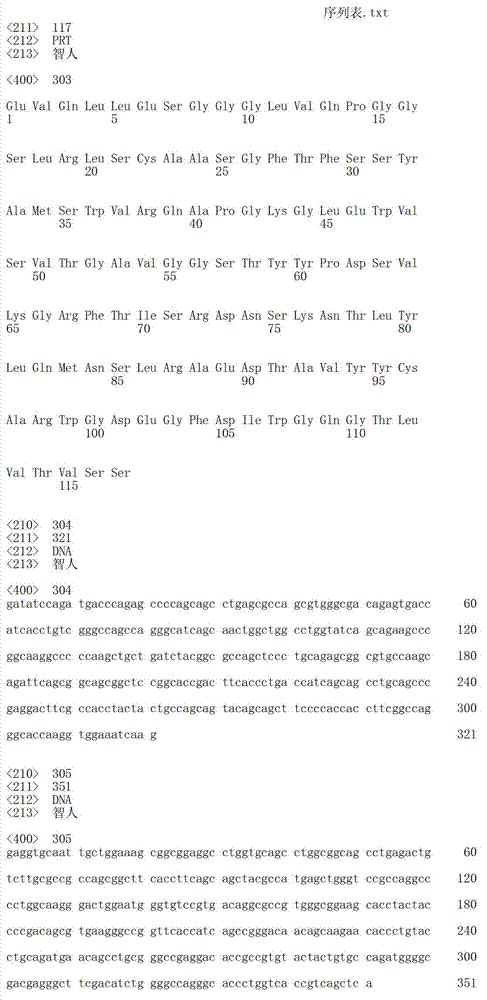

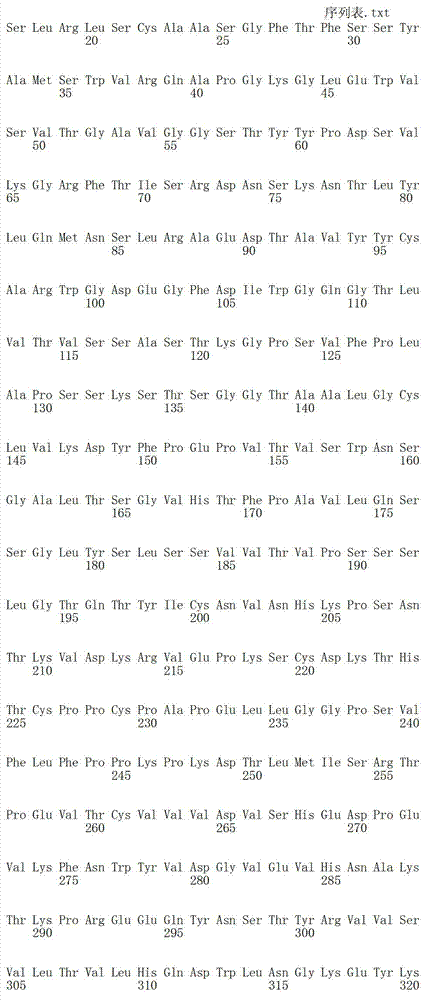
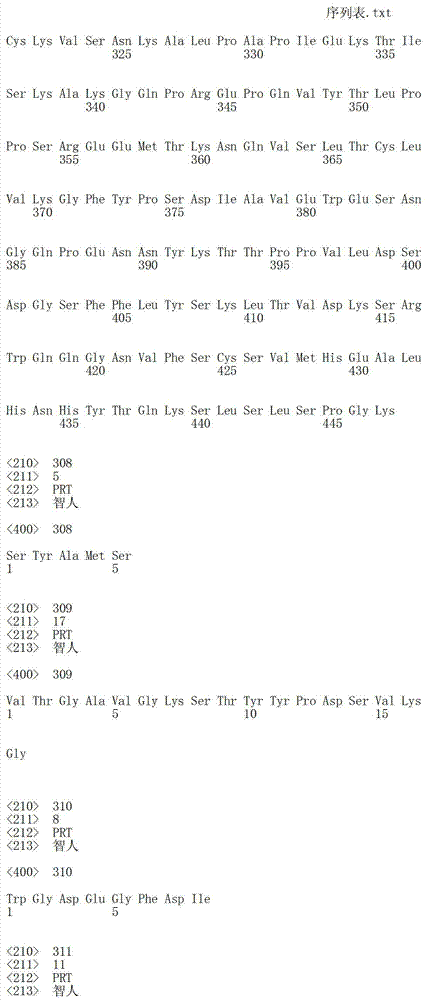
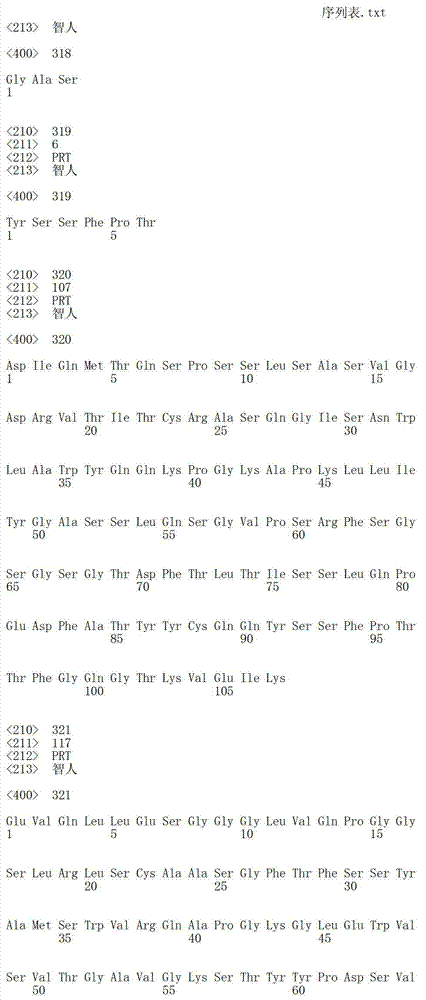


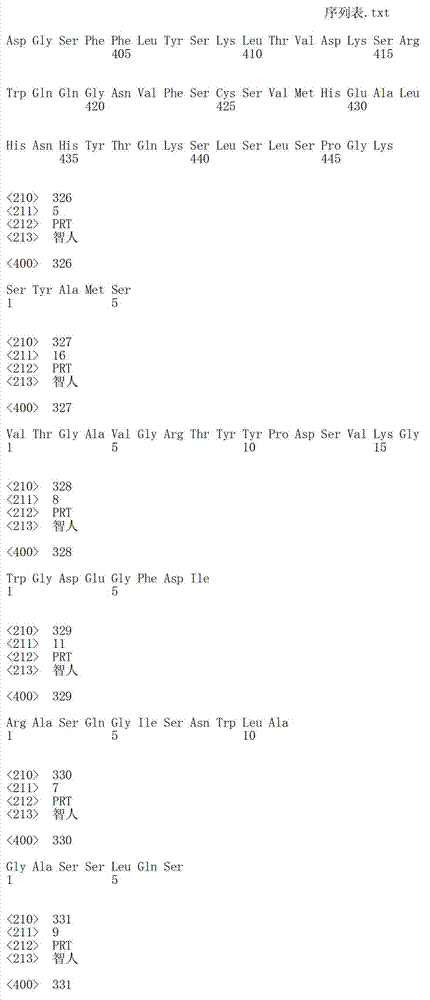
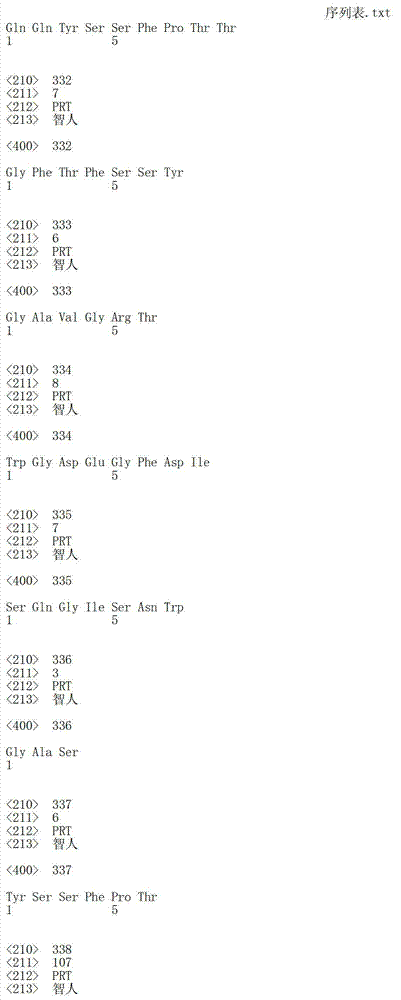

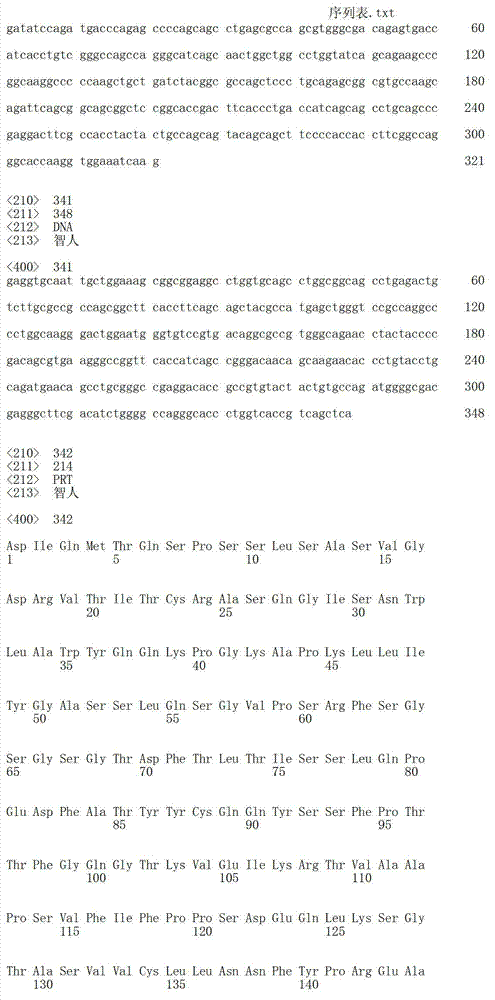


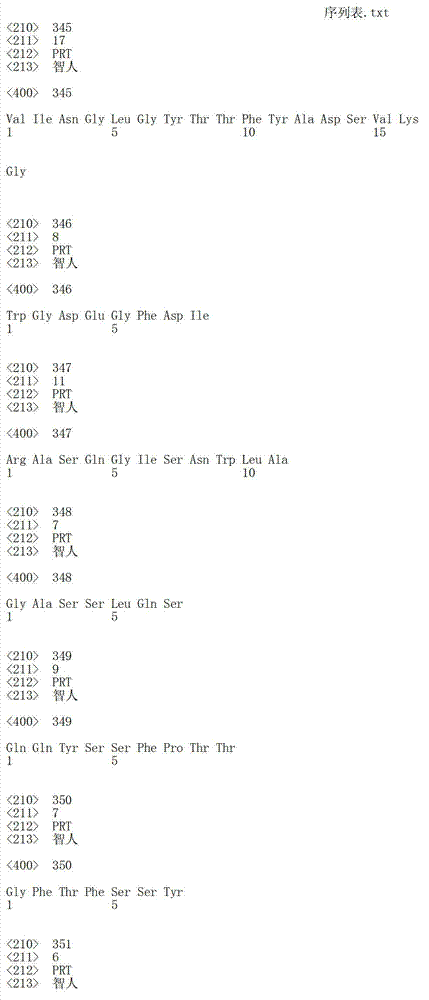
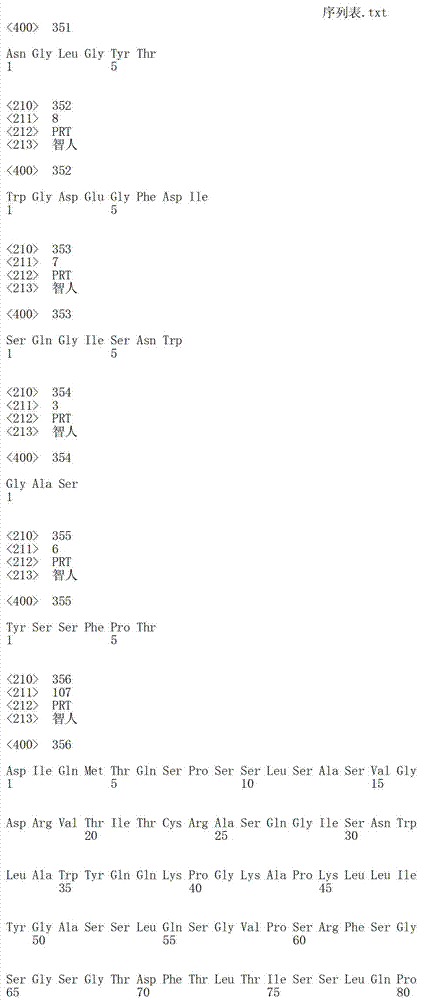

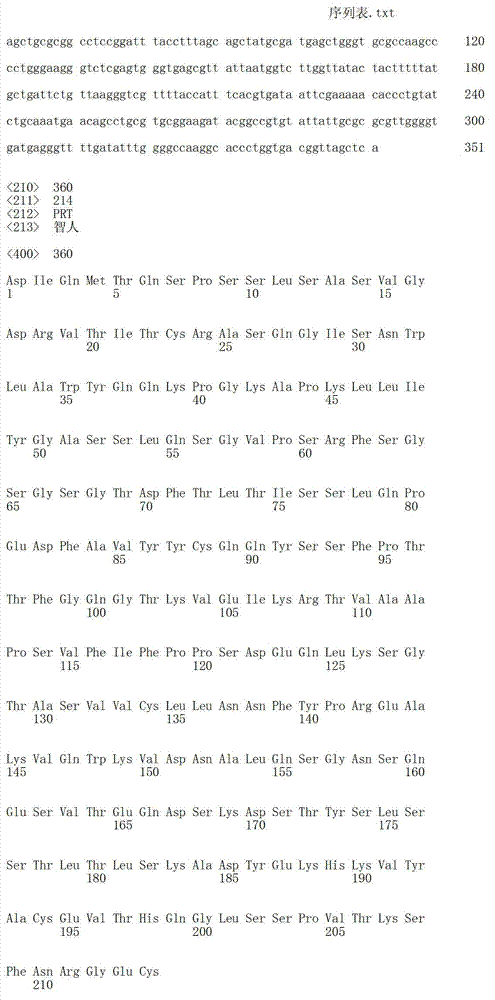

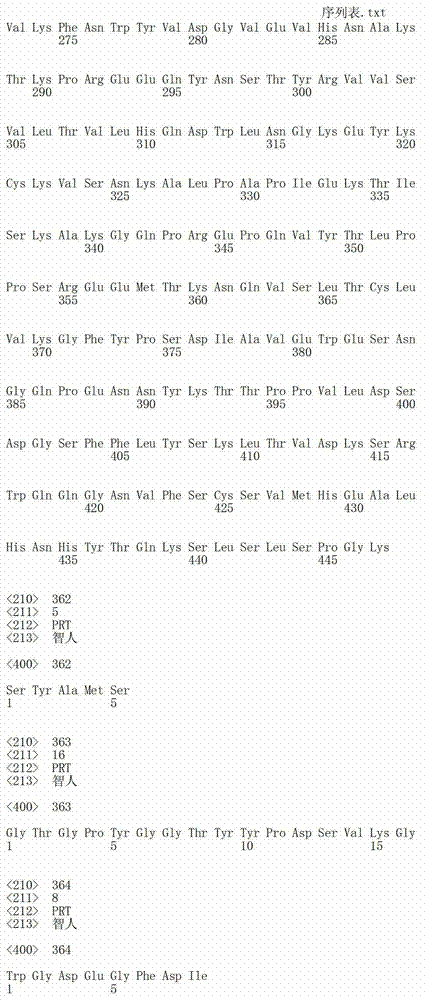
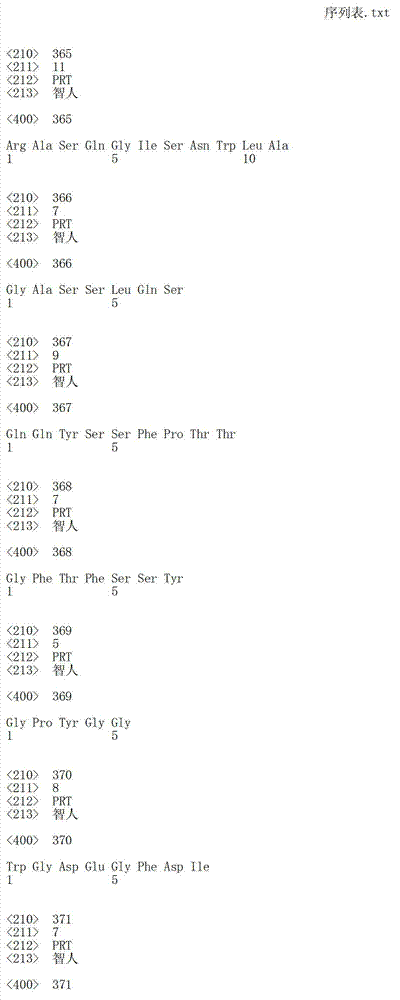

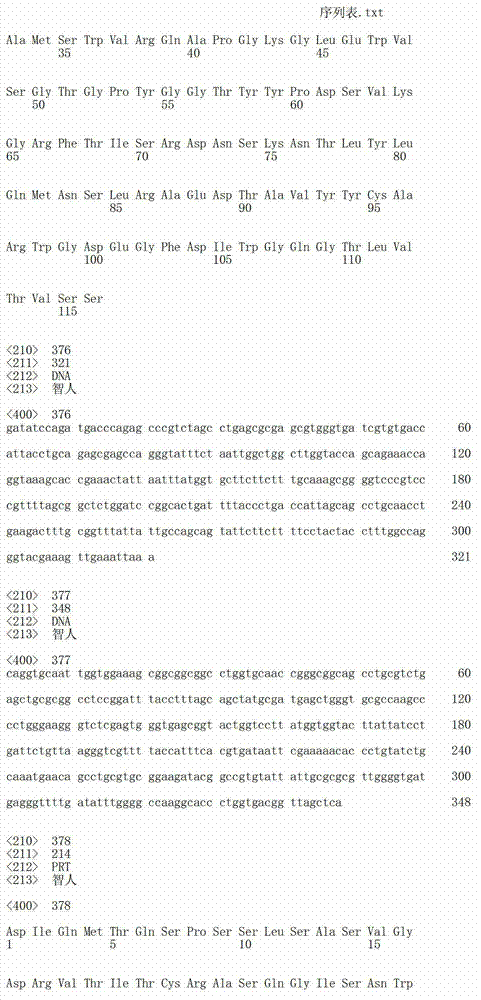

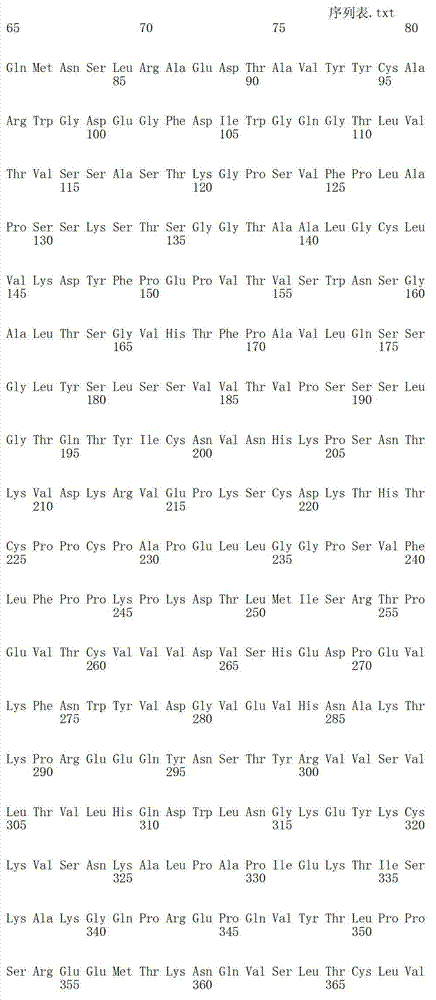
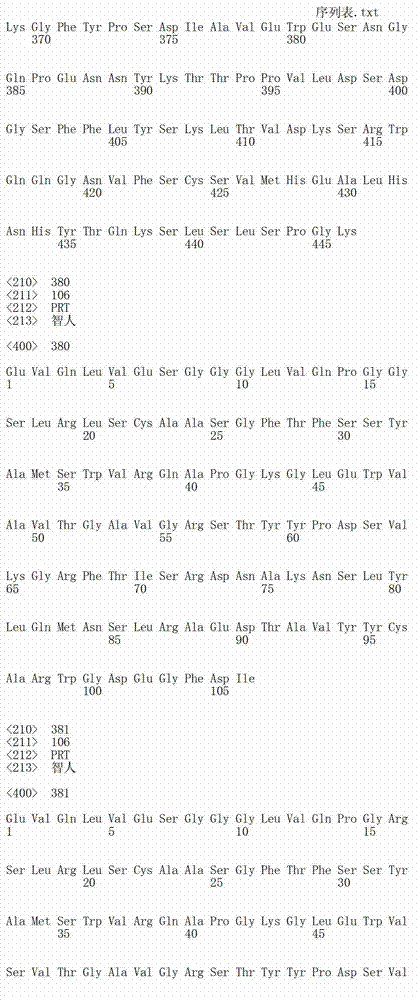
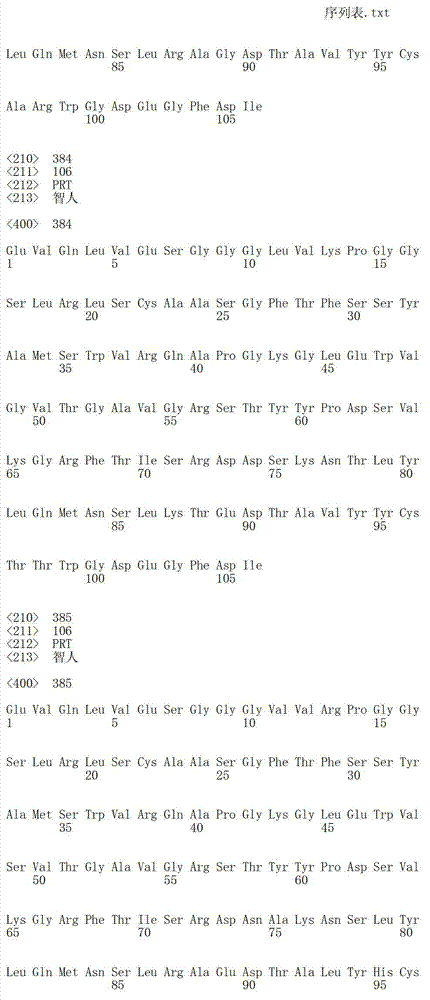

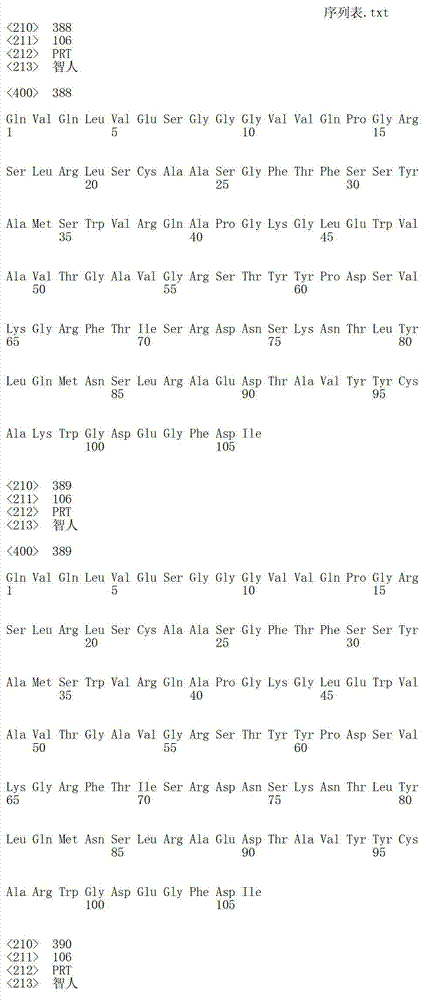
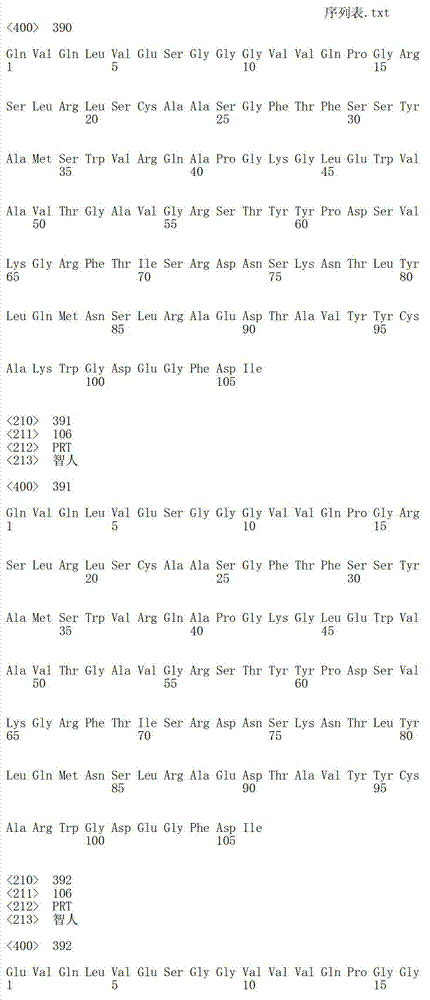
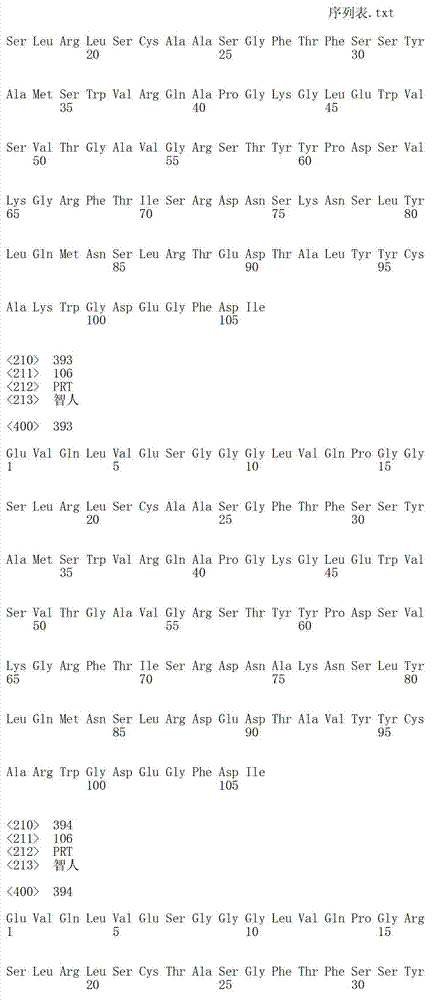
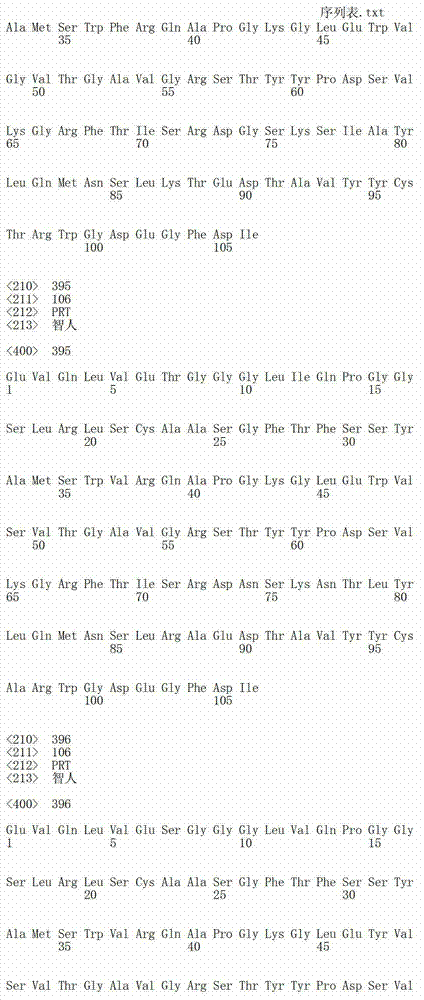
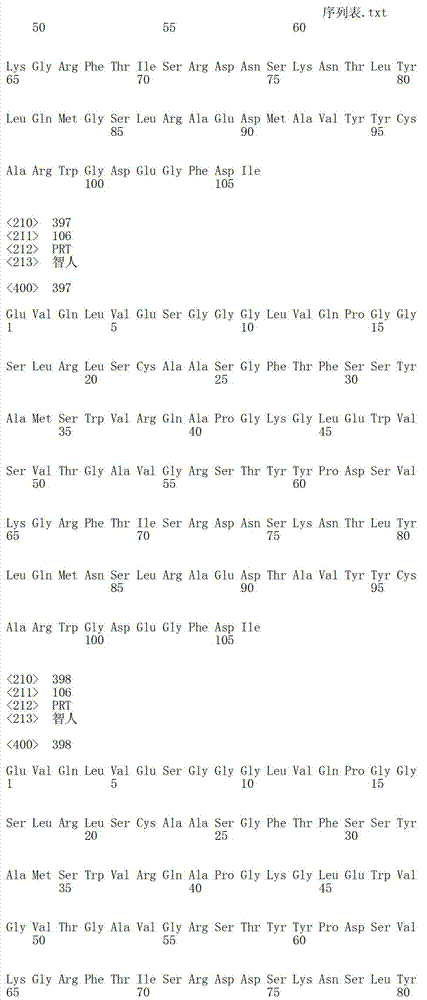

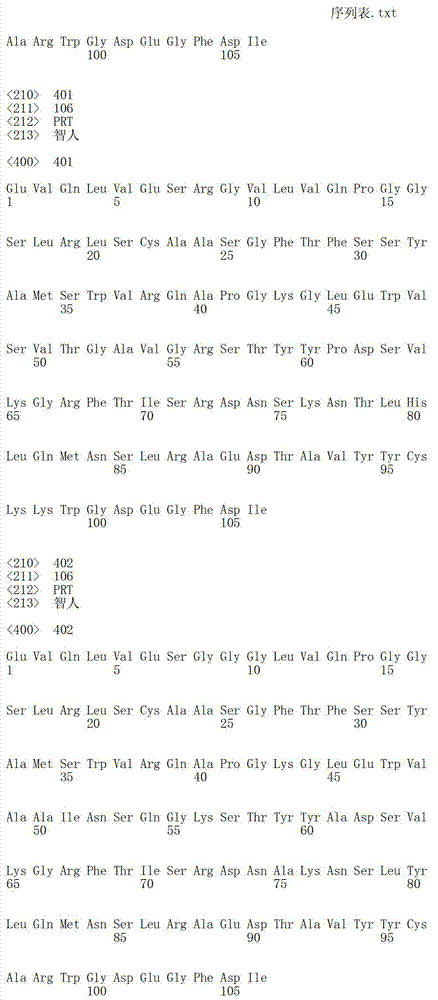
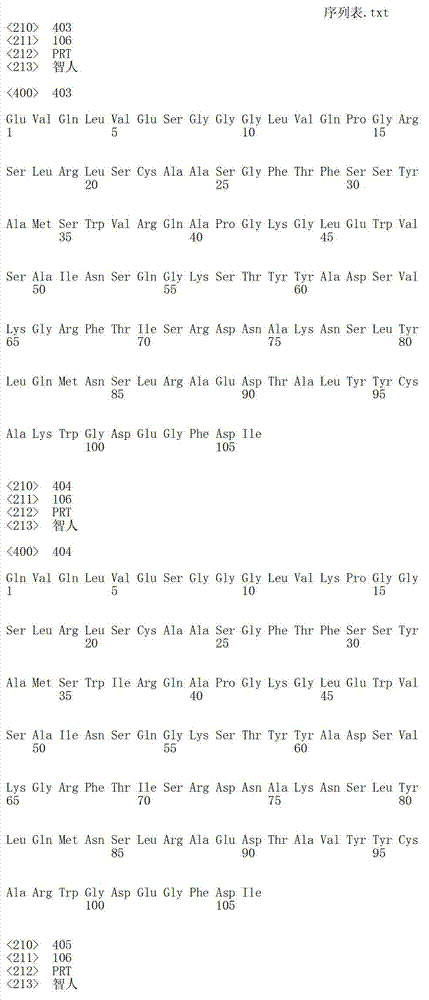
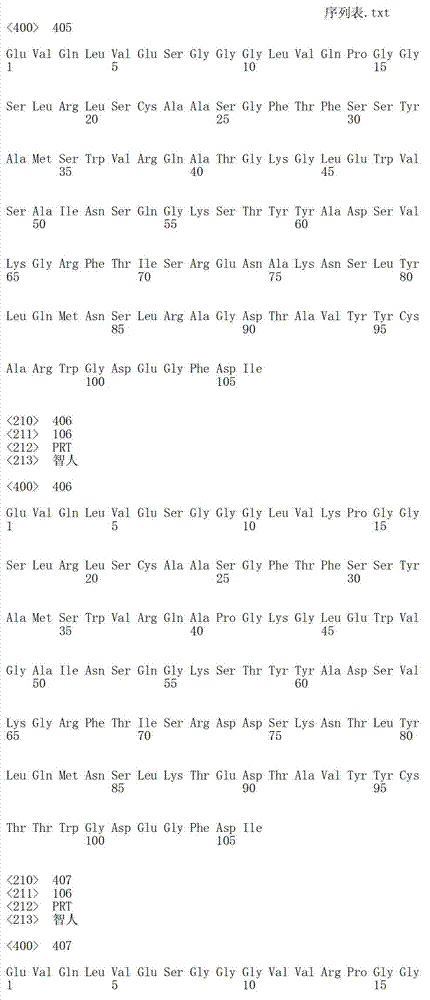

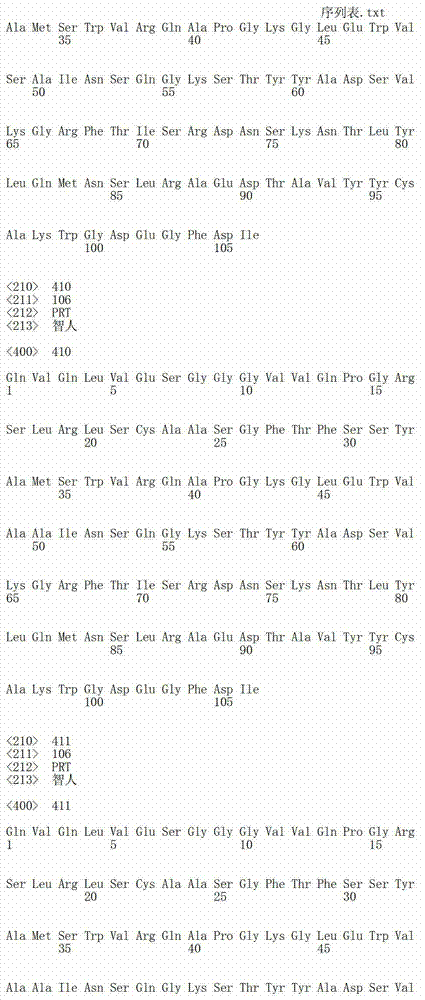
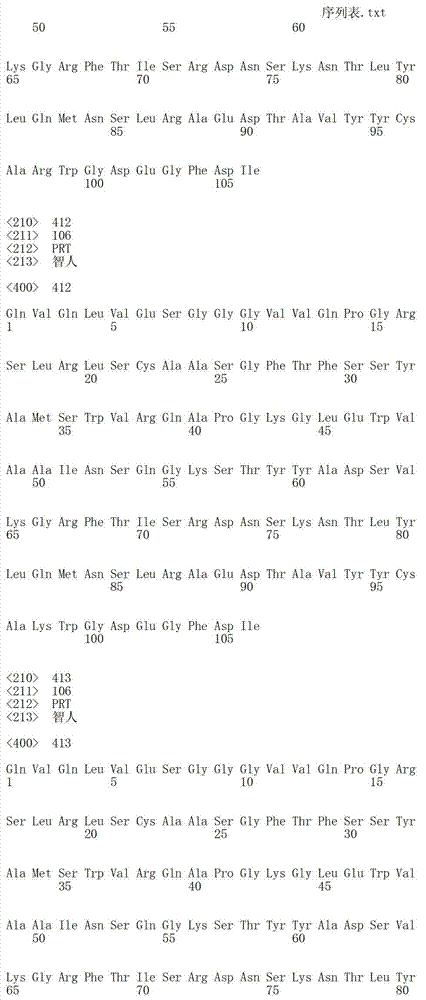
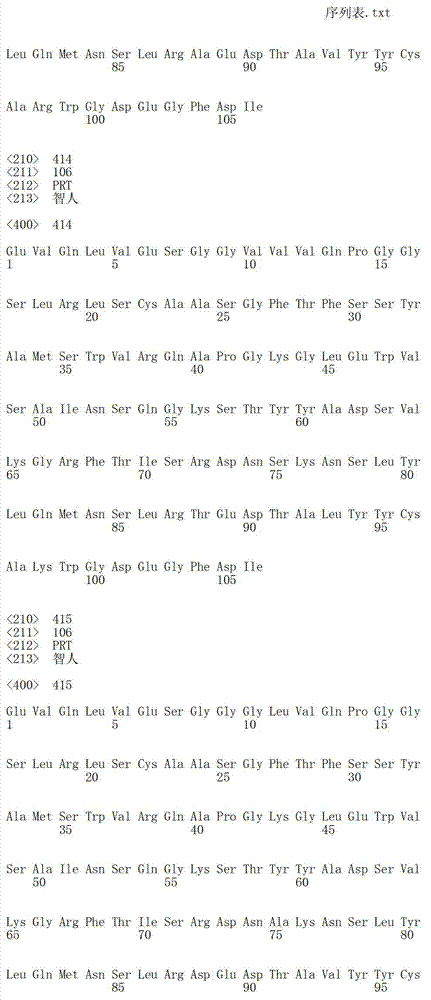


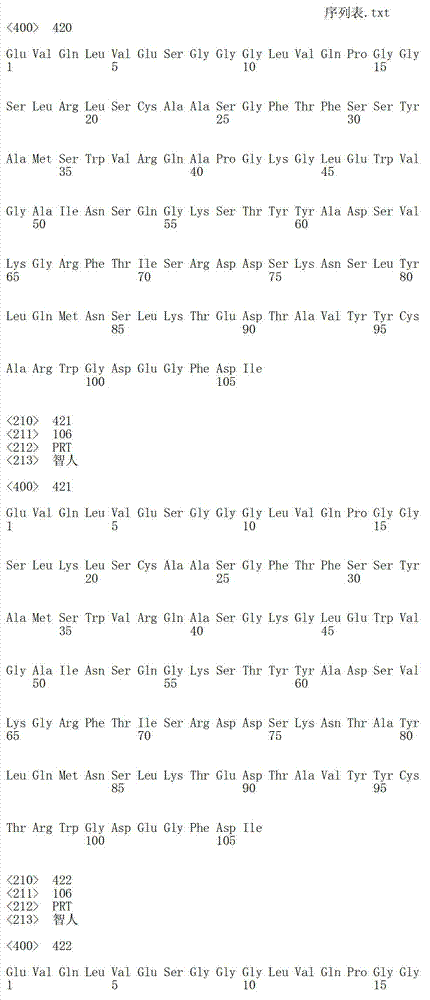
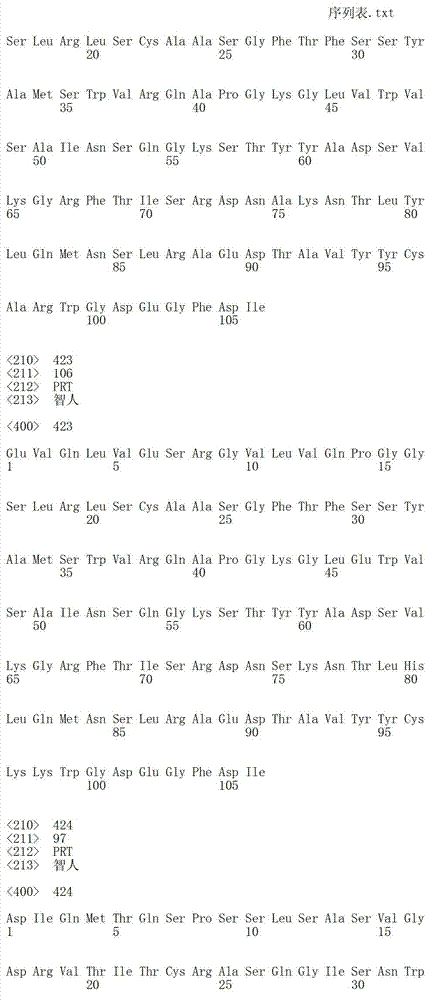
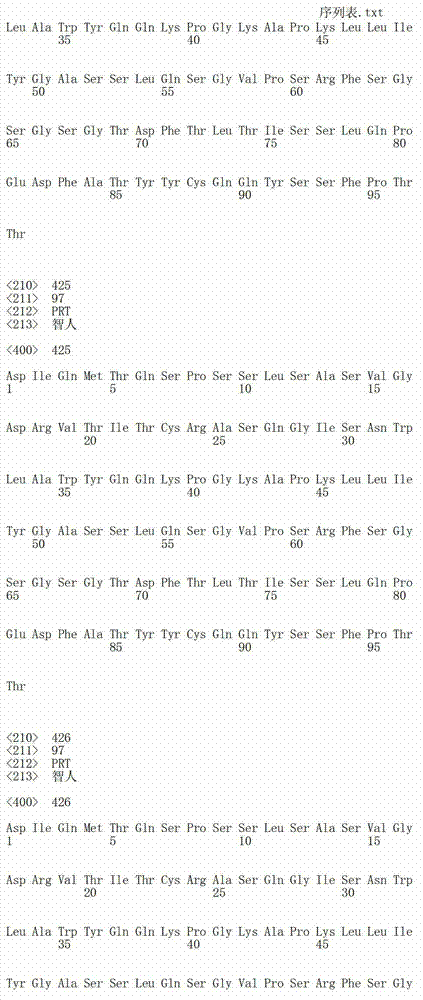
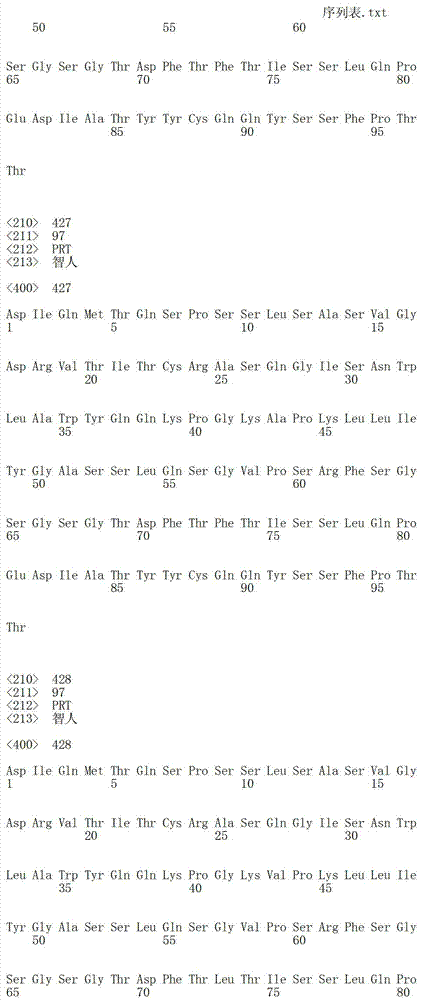
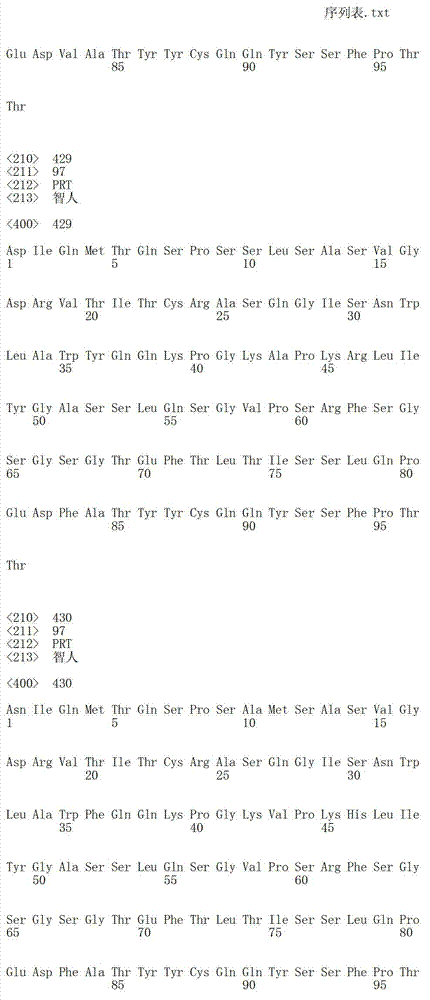
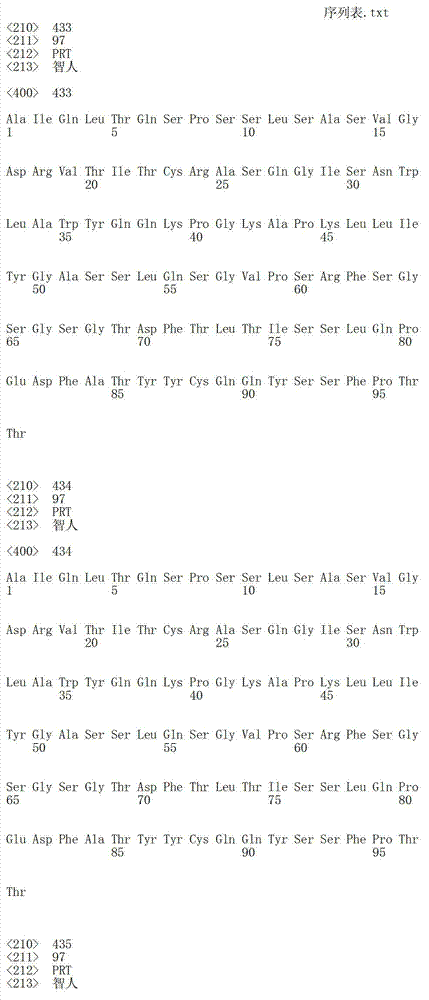
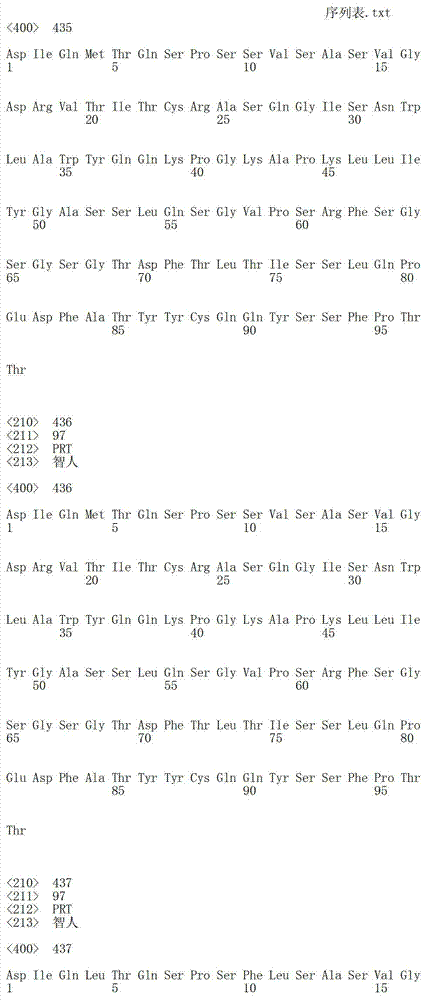

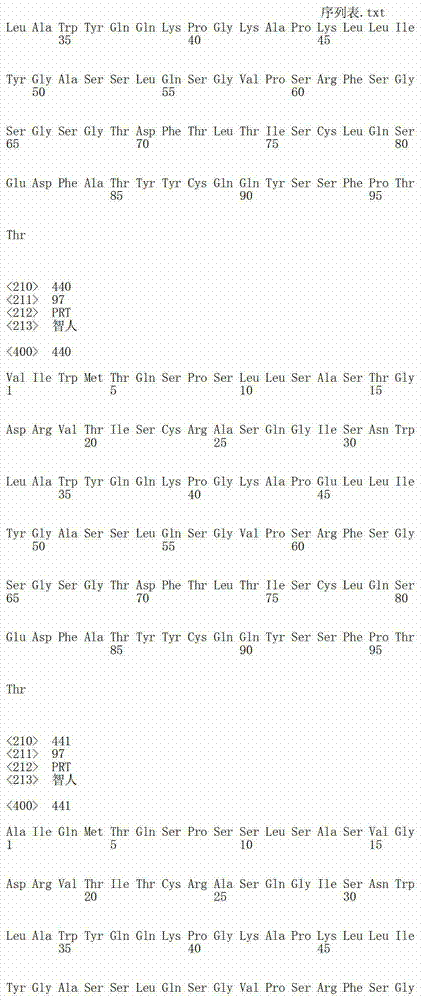
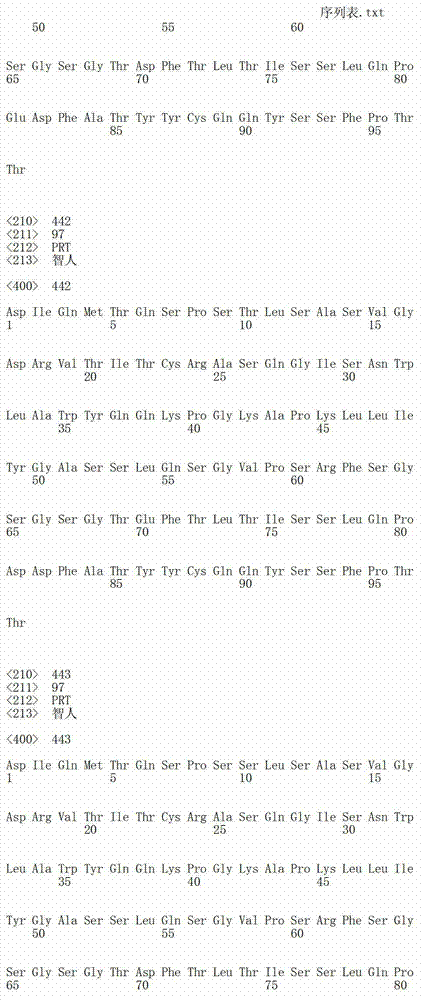

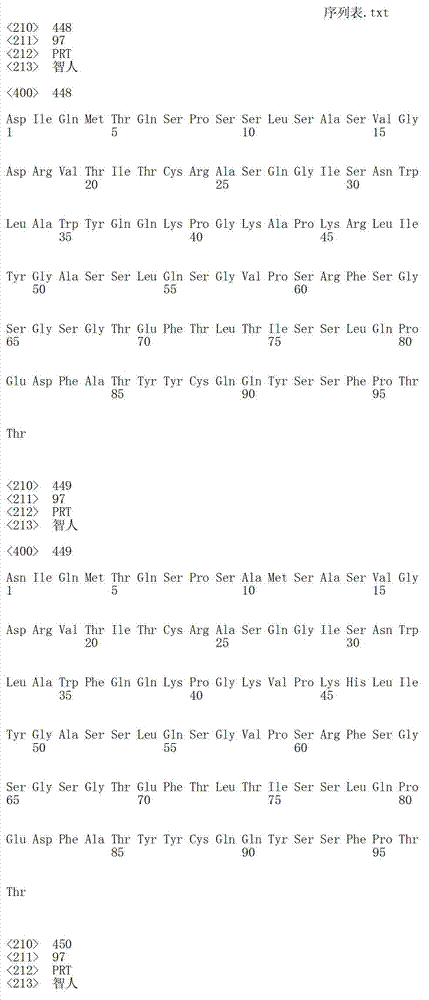

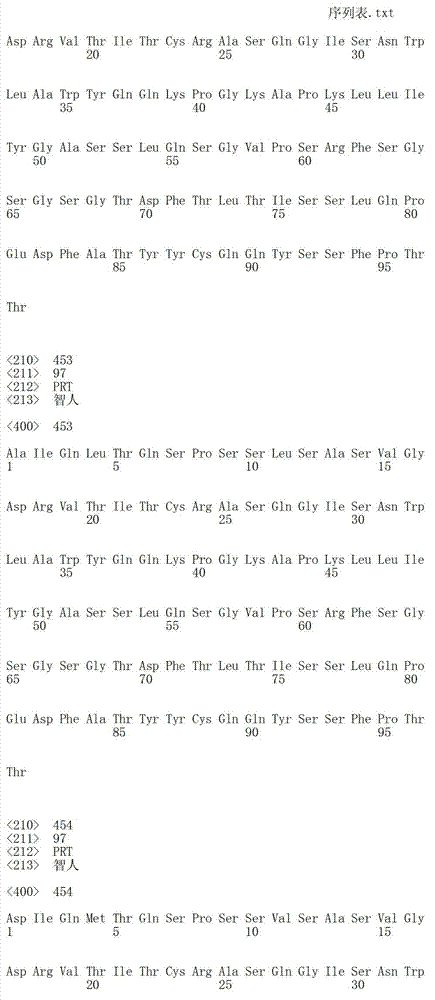

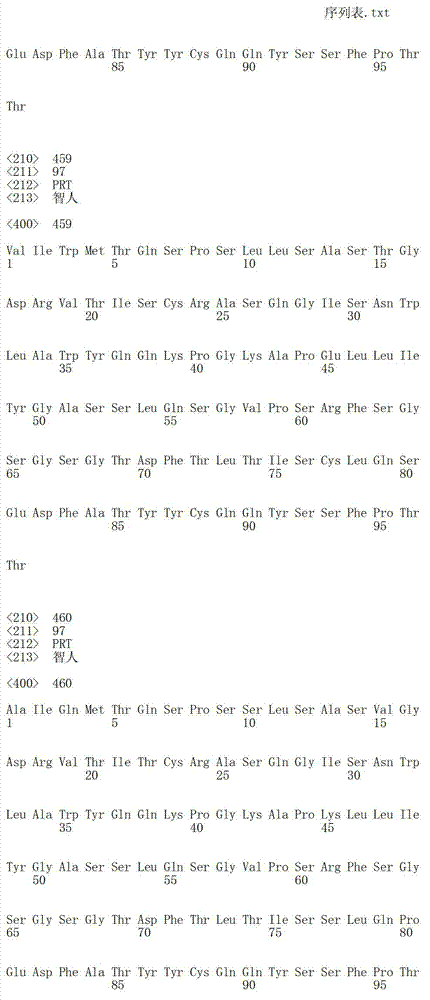
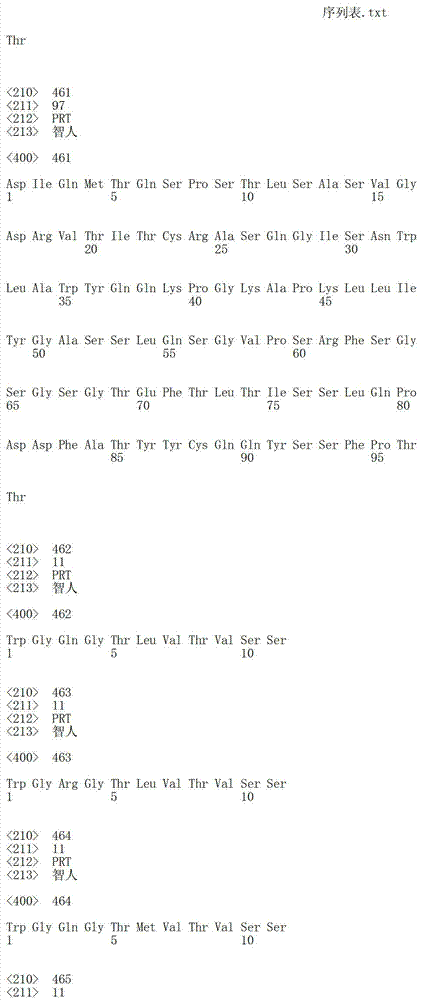
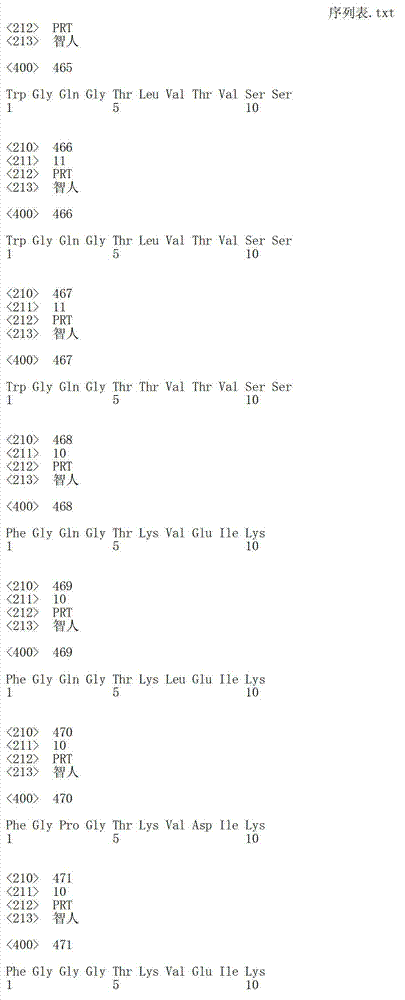
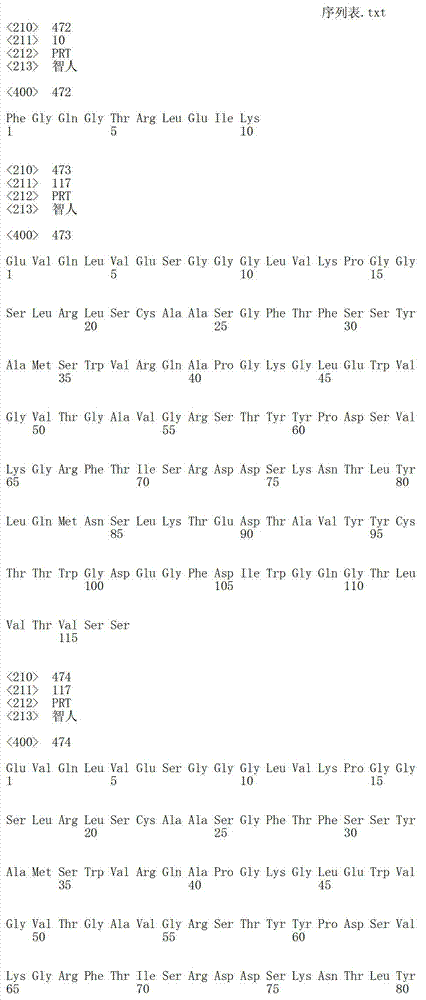
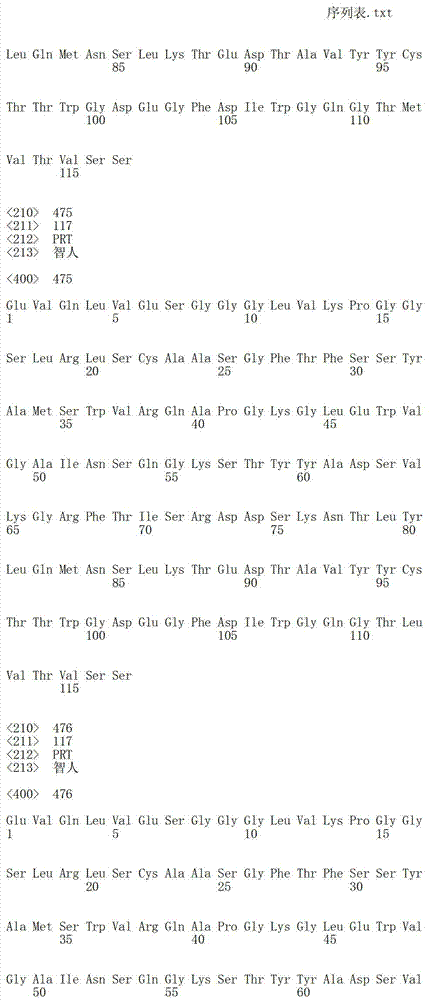

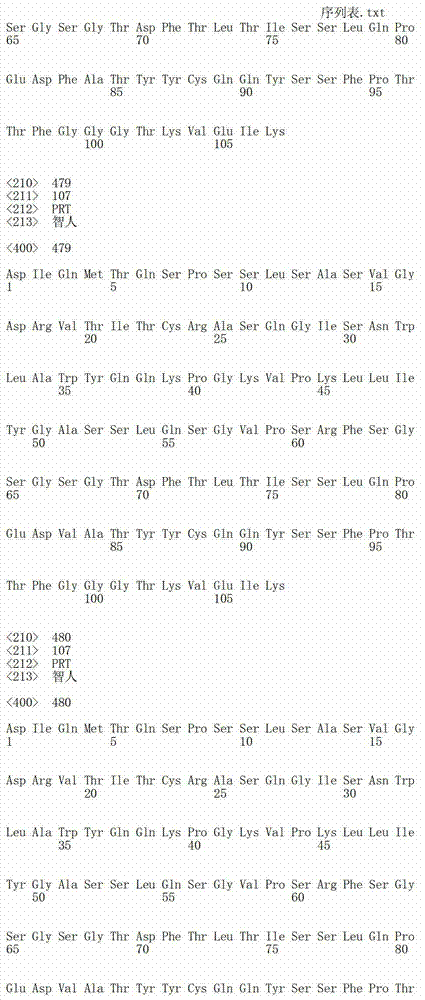
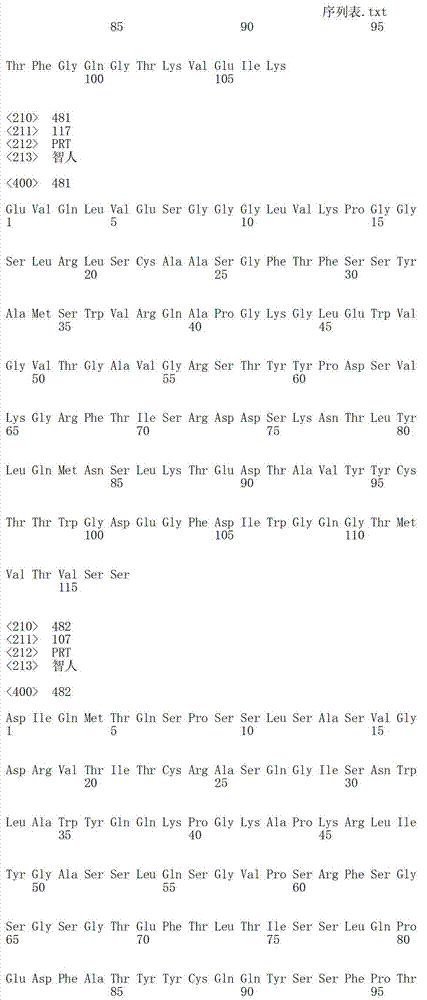
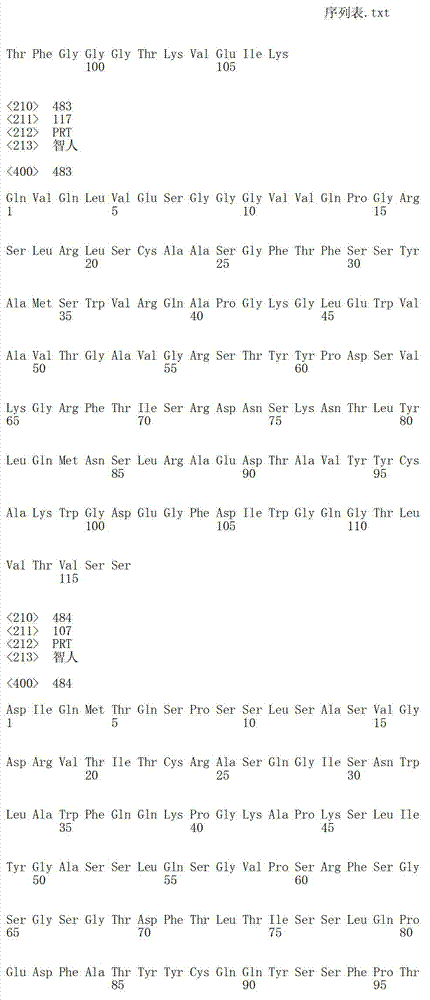


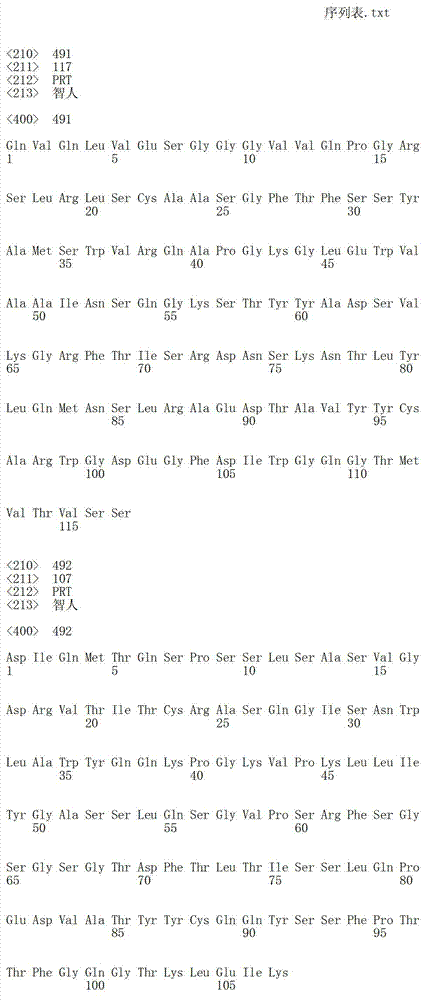
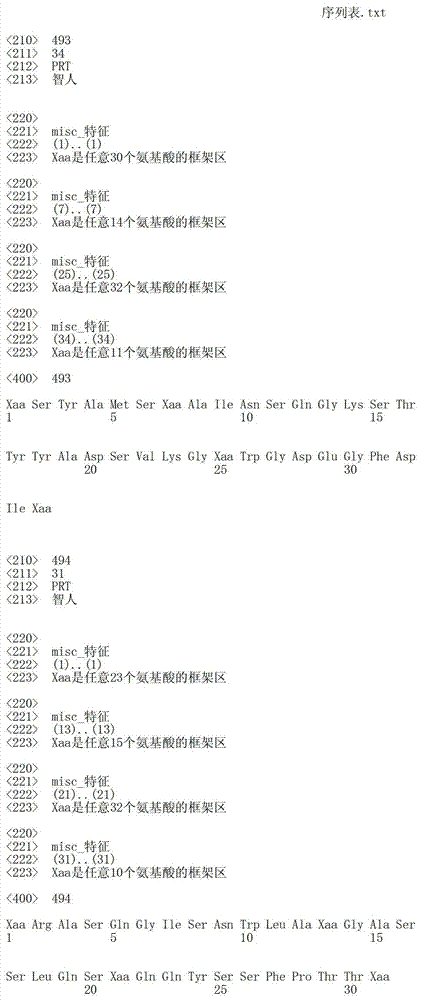
Claims (171)








Priority Applications (1)
| Application Number | Priority Date | Filing Date | Title |
|---|---|---|---|
| CN201510557840.2A CN105037552B (en) | 2010-08-20 | 2011-08-22 | EGF-R ELISA 3(HER3) antibody |
Applications Claiming Priority (3)
| Application Number | Priority Date | Filing Date | Title |
|---|---|---|---|
| US37540810P | 2010-08-20 | 2010-08-20 | |
| US61/375,408 | 2010-08-20 | ||
| PCT/EP2011/064407 WO2012022814A1 (en) | 2010-08-20 | 2011-08-22 | Antibodies for epidermal growth factor receptor 3 (her3) |
Related Child Applications (1)
| Application Number | Title | Priority Date | Filing Date |
|---|---|---|---|
| CN201510557840.2A Division CN105037552B (en) | 2010-08-20 | 2011-08-22 | EGF-R ELISA 3(HER3) antibody |
Publications (2)
| Publication Number | Publication Date |
|---|---|
| CN103080134A true CN103080134A (en) | 2013-05-01 |
| CN103080134B CN103080134B (en) | 2015-11-25 |
Family
ID=44630597
Family Applications (2)
| Application Number | Title | Priority Date | Filing Date |
|---|---|---|---|
| CN201180040372.1A Expired - Fee Related CN103080134B (en) | 2010-08-20 | 2011-08-22 | Antibody to Epidermal Growth Factor Receptor 3 (HER3) |
| CN201510557840.2A Expired - Fee Related CN105037552B (en) | 2010-08-20 | 2011-08-22 | EGF-R ELISA 3(HER3) antibody |
Family Applications After (1)
| Application Number | Title | Priority Date | Filing Date |
|---|---|---|---|
| CN201510557840.2A Expired - Fee Related CN105037552B (en) | 2010-08-20 | 2011-08-22 | EGF-R ELISA 3(HER3) antibody |
Country Status (39)
| Country | Link |
|---|---|
| US (3) | US8735551B2 (en) |
| EP (1) | EP2606070B1 (en) |
| JP (4) | JP6057896B2 (en) |
| KR (1) | KR102027011B1 (en) |
| CN (2) | CN103080134B (en) |
| AU (1) | AU2011290672B2 (en) |
| BR (1) | BR112013004012B1 (en) |
| CA (1) | CA2806637C (en) |
| CL (2) | CL2013000459A1 (en) |
| CO (1) | CO6680688A2 (en) |
| CR (1) | CR20130071A (en) |
| CU (1) | CU24094B1 (en) |
| CY (1) | CY1118761T1 (en) |
| DK (1) | DK2606070T3 (en) |
| DO (1) | DOP2013000044A (en) |
| EA (1) | EA036314B1 (en) |
| ES (1) | ES2620255T3 (en) |
| GE (1) | GEP201706605B (en) |
| GT (1) | GT201300046A (en) |
| HR (1) | HRP20170462T1 (en) |
| HU (1) | HUE031855T2 (en) |
| IL (2) | IL226712B (en) |
| LT (1) | LT2606070T (en) |
| MA (1) | MA34524B1 (en) |
| ME (1) | ME02637B (en) |
| MX (1) | MX2013002046A (en) |
| MY (1) | MY162825A (en) |
| NI (1) | NI201300023A (en) |
| NZ (1) | NZ607337A (en) |
| PE (1) | PE20140230A1 (en) |
| PH (1) | PH12013500333A1 (en) |
| PL (1) | PL2606070T3 (en) |
| PT (1) | PT2606070T (en) |
| RS (1) | RS55930B1 (en) |
| SG (1) | SG187908A1 (en) |
| SI (1) | SI2606070T1 (en) |
| SM (1) | SMT201700217T1 (en) |
| UA (1) | UA114883C2 (en) |
| WO (1) | WO2012022814A1 (en) |
Cited By (5)
| Publication number | Priority date | Publication date | Assignee | Title |
|---|---|---|---|---|
| CN103781800A (en) * | 2011-06-20 | 2014-05-07 | 协和发酵麒麟株式会社 | Anti-erbB3 antibody |
| CN106459207A (en) * | 2014-05-14 | 2017-02-22 | 豪夫迈·罗氏有限公司 | Anti-HER3 antibodies that bind to the HER3β‑hairpin |
| CN107043424A (en) * | 2012-08-21 | 2017-08-15 | 詹森药业有限公司 | Antibody of Risperidone and application thereof |
| CN107257691A (en) * | 2014-07-16 | 2017-10-17 | 达娜-法勃肿瘤研究所公司 | HER3 in low level serous ovarian cancer suppresses |
| CN108367003A (en) * | 2014-12-12 | 2018-08-03 | 麻省总医院 | The treatment of breast cancer patients with brain transfer |
Families Citing this family (73)
| Publication number | Priority date | Publication date | Assignee | Title |
|---|---|---|---|---|
| UA107821C2 (en) | 2009-12-22 | 2015-02-25 | Roche Glycart Ag | Antibody her3 and its application |
| PL2606070T3 (en) * | 2010-08-20 | 2017-06-30 | Novartis Ag | Antibodies for epidermal growth factor receptor 3 (her3) |
| AU2011324871B2 (en) | 2010-11-01 | 2016-05-19 | Symphogen A/S | Anti-HER3 antibodies and compositions |
| ITRM20100577A1 (en) * | 2010-11-02 | 2012-05-03 | Takis Srl | IMMUNOTHERAPY AGAINST THE ERBB-3 RECEPTOR |
| EP2699602B1 (en) | 2011-04-19 | 2017-03-01 | Merrimack Pharmaceuticals, Inc. | Bispecific anti-igf-1r and anti-erbb3 antibodies |
| US9273143B2 (en) | 2011-09-30 | 2016-03-01 | Regeneron Pharmaceuticals, Inc. | Methods and compositions comprising a combination of an anti-ErbB3 antibody and an anti-EGFR antibody |
| HK1200468A1 (en) | 2011-09-30 | 2015-08-07 | Regeneron Pharmaceuticals, Inc. | Anti-erbb3 antibodies and uses thereof |
| GB2504139B (en) * | 2012-07-20 | 2014-12-31 | Argen X Bv | Antibodies to highly conserved targets produced by the immunisation of Camelidae species |
| AU2012335543C1 (en) * | 2011-11-09 | 2017-12-14 | Beijing Cotimes Biotech Co., Ltd., | HER3 antibodies and uses thereof |
| MX350957B (en) | 2011-11-23 | 2017-09-27 | Medimmune Llc | Binding molecules specific for her3 and uses thereof. |
| SG11201402783YA (en) * | 2011-12-05 | 2014-06-27 | Novartis Ag | Antibodies for epidermal growth factor receptor 3 (her3) |
| BR112014013568A2 (en) * | 2011-12-05 | 2017-06-13 | Novartis Ag | epidermal growth factor 3 (her3) receptor antibodies directed to her3 domain ii |
| JP2015509492A (en) * | 2012-02-22 | 2015-03-30 | ユー3・ファーマ・ゲーエムベーハー | Combination of HB-EGF binding protein and EGFR inhibitor |
| EP2912066A4 (en) * | 2012-10-25 | 2016-10-12 | Sorrento Therapeutics Inc | Antigen binding proteins that bind erbb3 |
| PE20150955A1 (en) * | 2012-11-08 | 2015-06-20 | Hoffmann La Roche | ANTI-HER3 / HER4 ANTIGEN BINDING PROTEINS BINDING TO HER3 BETA FORK AND HER4 BETA FORK |
| CN104755500B (en) | 2012-11-08 | 2020-10-02 | 霍夫曼-拉罗奇有限公司 | HER3 antigen binding proteins that bind to the HER3 beta-hairpin |
| CN102993305B (en) * | 2012-11-16 | 2015-05-13 | 上海赛伦生物技术有限公司 | Humanized anti-human epidemic growth factor receptor (EGFR) antibody as well as encoding gene and application thereof |
| US9180185B2 (en) | 2013-01-11 | 2015-11-10 | Hoffman-La Roche Inc. | Combination therapy of anti-HER3 antibodies |
| US20160228589A1 (en) * | 2013-09-18 | 2016-08-11 | Sloan-Kettering Institute For Cancer Research | Methods and compositions for imaging disorders using polyspecific agents |
| US11305012B2 (en) | 2013-09-24 | 2022-04-19 | Medimmune, Llc | Binding molecules specific for HER3 and uses thereof |
| WO2015048312A1 (en) | 2013-09-26 | 2015-04-02 | Costim Pharmaceuticals Inc. | Methods for treating hematologic cancers |
| US10519247B2 (en) * | 2013-11-01 | 2019-12-31 | Board Of Regents,The University Of Texas System | Targeting HER2 and HER3 with bispecific antibodies in cancerous cells |
| JOP20200094A1 (en) | 2014-01-24 | 2017-06-16 | Dana Farber Cancer Inst Inc | Antibody molecules to pd-1 and uses thereof |
| JOP20200096A1 (en) | 2014-01-31 | 2017-06-16 | Children’S Medical Center Corp | TIM-3 Antibody Molecules and Their Uses |
| SG11201607104RA (en) | 2014-02-28 | 2016-09-29 | Merus Nv | Antibody that binds erbb-2 and erbb-3 |
| ES2816624T3 (en) | 2014-02-28 | 2021-04-05 | Merus Nv | Antibodies that bind EGFR and ERBB3 |
| LT3116909T (en) | 2014-03-14 | 2020-02-10 | Novartis Ag | ANTI-BODY MOLECULES AGAINST LAG-3 AND THEIR USE |
| US10745490B2 (en) | 2014-04-11 | 2020-08-18 | Celldex Therapeutics, Inc. | Anti-ErbB antibodies and methods of use thereof |
| FR3020063A1 (en) | 2014-04-16 | 2015-10-23 | Gamamabs Pharma | ANTI-HER4 HUMAN ANTIBODY |
| JP6695812B2 (en) * | 2014-05-14 | 2020-05-20 | エフ・ホフマン−ラ・ロシュ・アクチェンゲゼルシャフト | HER3 / HER2 bispecific antibody that binds to the beta hairpin of HER3 and domain II of HER2 |
| CN105367657B (en) * | 2014-08-14 | 2019-09-13 | 上海生物制品研究所有限责任公司 | Anti-HER3 antibody, its preparation method and application |
| CA2960824A1 (en) | 2014-09-13 | 2016-03-17 | Novartis Ag | Combination therapies of alk inhibitors |
| ES2774448T3 (en) | 2014-10-03 | 2020-07-21 | Novartis Ag | Combination therapies |
| MA41044A (en) | 2014-10-08 | 2017-08-15 | Novartis Ag | COMPOSITIONS AND METHODS OF USE FOR INCREASED IMMUNE RESPONSE AND CANCER TREATMENT |
| JP6877339B2 (en) | 2014-10-14 | 2021-05-26 | ノバルティス アーゲー | Antibody molecule against PD-L1 and its use |
| JP6692826B2 (en) | 2015-03-10 | 2020-05-13 | アドゥロ バイオテック,インク. | Compositions and methods for activation of "interferon gene stimulator" dependent signaling |
| CN108137706A (en) * | 2015-07-15 | 2018-06-08 | 酵活有限公司 | Drug-conjugated bispecific antigen-binding constructs |
| TW201716439A (en) | 2015-07-20 | 2017-05-16 | 美國禮來大藥廠 | HER3 antibodies |
| EP3878465A1 (en) | 2015-07-29 | 2021-09-15 | Novartis AG | Combination therapies comprising antibody molecules to tim-3 |
| EP3964528A1 (en) | 2015-07-29 | 2022-03-09 | Novartis AG | Combination therapies comprising antibody molecules to lag-3 |
| WO2017019896A1 (en) | 2015-07-29 | 2017-02-02 | Novartis Ag | Combination therapies comprising antibody molecules to pd-1 |
| HK1254093A1 (en) | 2015-08-14 | 2019-07-12 | Allergan, Inc. | Heavy chain only antibodies to pdgf |
| HRP20210483T1 (en) | 2015-10-23 | 2021-07-09 | Merus N.V. | Binding molecules that inhibit cancer growth |
| LT3370768T (en) | 2015-11-03 | 2022-05-25 | Janssen Biotech, Inc. | ANTIBODIES SPECIFICLY BINDING PD-1 AND THEIR USE |
| JP6629581B2 (en) * | 2015-11-30 | 2020-01-15 | サントリーホールディングス株式会社 | Hydroxytyrosol-containing tea beverage |
| CA2949032A1 (en) | 2015-11-30 | 2017-05-30 | Pfizer Inc. | Site specific her2 antibody drug conjugates |
| KR101746152B1 (en) * | 2015-12-07 | 2017-06-13 | 주식회사 이수앱지스 | Antibody specifically binding to ErbB3 and use thereof |
| CN108602890A (en) | 2015-12-11 | 2018-09-28 | 瑞泽恩制药公司 | Method for reducing or preventing the tumour growth resistant to EGFR and/or ERBB3 retarding agents |
| EP4424322A3 (en) | 2015-12-17 | 2025-04-16 | Novartis AG | Antibody molecules to pd-1 and uses thereof |
| EP3429623A1 (en) | 2016-03-15 | 2019-01-23 | Merrimack Pharmaceuticals, Inc. | Methods for treating er+, her2-, hrg+ breast cancer using combination therapies comprising an anti-erbb3 antibody |
| WO2018009466A1 (en) | 2016-07-05 | 2018-01-11 | Aduro Biotech, Inc. | Locked nucleic acid cyclic dinucleotide compounds and uses thereof |
| WO2018159582A1 (en) | 2017-02-28 | 2018-09-07 | 学校法人近畿大学 | Method for treating egfr-tki-resistant non-small cell lung cancer by administration of anti-her3 antibody-drug conjugate |
| MX2019011658A (en) | 2017-03-31 | 2019-11-18 | Merus Nv | AGENT TARGETING THE RECEPTOR 2 OF THE HUMAN EPIDERMAL GROWTH FACTOR (ERBB-2) AND THE BISPECIFIC ANTIBODY WITH ANTIGEN BINDING SITES THAT JOIN AN EPITOOPE ON AN EXTRACELLULAR PART OF ERBB-2 AND THE EPITOPHY RECEPTOR 3 OF THE EPIDERMIC FACTOR HUMAN (ERBB-3), FOR THE TREATMENT OF AN INDIVIDUAL WITH AN ERBB-2, ERBB-2 / ERBB-3 POSITIVE TUMOR. |
| KR20260006707A (en) | 2017-03-31 | 2026-01-13 | 메뤼스 엔.페. | Erbb-2 and erbb3 binding bispecific antibodies for use in the treatment f cells that have an nrg1 fusion gene |
| UY37695A (en) | 2017-04-28 | 2018-11-30 | Novartis Ag | BIS 2’-5’-RR- (3’F-A) (3’F-A) CYCLE DINUCLEOTIDE COMPOUND AND USES OF THE SAME |
| AU2018271157C1 (en) | 2017-05-17 | 2021-11-18 | Merus N.V. | Combination of an ErbB-2/ErbB-3 bispecific antibody with endocrine therapy for breast cancer |
| EP3642240A1 (en) | 2017-06-22 | 2020-04-29 | Novartis AG | Antibody molecules to cd73 and uses thereof |
| DK3665198T3 (en) | 2017-08-09 | 2025-04-28 | Merus Nv | ANTIBODIES THAT BINDING EGFR AND CMET |
| EP3692048A4 (en) | 2017-08-30 | 2021-10-20 | Beijing Xuanyi Pharmasciences Co., Ltd. | CYCLIC DI-NUCLEOTIDES AS A STIMULATOR OF MODULATORS OF INTERFERON GENES |
| KR20200083503A (en) | 2017-11-03 | 2020-07-08 | 오리진 디스커버리 테크놀로지스 리미티드 | Double inhibitor of TIM-3 pathway and PD-1 pathway |
| WO2019087092A1 (en) | 2017-11-06 | 2019-05-09 | Aurigene Discovery Technologies Limited | Conjoint therapies for immunomodulation |
| US12398209B2 (en) | 2018-01-22 | 2025-08-26 | Janssen Biotech, Inc. | Methods of treating cancers with antagonistic anti-PD-1 antibodies |
| EA202091773A1 (en) | 2018-03-14 | 2021-06-22 | Ориджен Дискавери Текнолоджис Лимитед | METHOD FOR MODULATION OF TIGIT AND PD-1 SIGNAL PATHWAYS USING 1,2,4-OXADIAZOL COMPOUNDS |
| WO2019185164A1 (en) * | 2018-03-29 | 2019-10-03 | Hummingbird Bioscience Holdings Pte. Ltd. | Her3 antigen-binding molecules |
| TWI869346B (en) | 2018-05-30 | 2025-01-11 | 瑞士商諾華公司 | Entpd2 antibodies, combination therapies, and methods of using the antibodies and combination therapies |
| KR102871791B1 (en) | 2018-09-10 | 2025-10-15 | 미라티 테라퓨틱스, 인크. | combination therapy |
| WO2020059772A1 (en) | 2018-09-20 | 2020-03-26 | 第一三共株式会社 | Treatment of her3 mutant cancer by administration of anti-her3 antibody-drug conjugate |
| CN110760003A (en) * | 2019-09-10 | 2020-02-07 | 广东药科大学 | Preparation method of anti-HER3 single-chain antibody |
| CN114502590A (en) | 2019-09-18 | 2022-05-13 | 诺华股份有限公司 | ENTPD2 antibodies, combination therapies, and methods of using these antibodies and combination therapies |
| EP4153617A4 (en) * | 2020-05-19 | 2024-11-20 | Momenta Pharmaceuticals, Inc. | PREPARATION AND PURIFICATION OF HYPERSIALYLATED IGG |
| KR20240021294A (en) * | 2021-06-15 | 2024-02-16 | 베이징 시노타우 바이오-파마슈티컬스 테크놀로지 씨오., 엘티디. | Anti-HER3 antibody, antibody-drug conjugate containing the same, and uses thereof |
| CN113788895B (en) * | 2021-10-14 | 2023-09-15 | 陕西健吉跃生物科技有限公司 | A rabbit polyclonal antibody and its preparation method and application |
| TW202500135A (en) | 2023-06-02 | 2025-01-01 | 日商第一三共股份有限公司 | Combination of anti-her3 antibody-drug conjugate and rasg12c inhibitor |
Citations (3)
| Publication number | Priority date | Publication date | Assignee | Title |
|---|---|---|---|---|
| WO2006087637A2 (en) * | 2005-02-21 | 2006-08-24 | Hellenic Pasteur Institute | Anti her2/neu antibody |
| WO2007077028A2 (en) * | 2005-12-30 | 2007-07-12 | U3 Pharma Ag | Antibodies directed to her-3 and uses thereof |
| WO2008019290A2 (en) * | 2006-08-04 | 2008-02-14 | Astrazeneca Ab | Human antibodies to erbb 2 |
Family Cites Families (182)
| Publication number | Priority date | Publication date | Assignee | Title |
|---|---|---|---|---|
| US4458066A (en) | 1980-02-29 | 1984-07-03 | University Patents, Inc. | Process for preparing polynucleotides |
| ATE37983T1 (en) | 1982-04-22 | 1988-11-15 | Ici Plc | DELAYED RELEASE AGENT. |
| US4522811A (en) | 1982-07-08 | 1985-06-11 | Syntex (U.S.A.) Inc. | Serial injection of muramyldipeptides and liposomes enhances the anti-infective activity of muramyldipeptides |
| EP0138854B1 (en) | 1983-03-08 | 1992-11-04 | Chiron Mimotopes Pty. Ltd. | Antigenically active amino acid sequences |
| US4816567A (en) | 1983-04-08 | 1989-03-28 | Genentech, Inc. | Recombinant immunoglobin preparations |
| DE3572982D1 (en) | 1984-03-06 | 1989-10-19 | Takeda Chemical Industries Ltd | Chemically modified lymphokine and production thereof |
| US5128326A (en) | 1984-12-06 | 1992-07-07 | Biomatrix, Inc. | Drug delivery systems based on hyaluronans derivatives thereof and their salts and methods of producing same |
| US5374548A (en) | 1986-05-02 | 1994-12-20 | Genentech, Inc. | Methods and compositions for the attachment of proteins to liposomes using a glycophospholipid anchor |
| MX9203291A (en) | 1985-06-26 | 1992-08-01 | Liposome Co Inc | LIPOSOMAS COUPLING METHOD. |
| US5225539A (en) | 1986-03-27 | 1993-07-06 | Medical Research Council | Recombinant altered antibodies and methods of making altered antibodies |
| US5260203A (en) | 1986-09-02 | 1993-11-09 | Enzon, Inc. | Single polypeptide chain binding molecules |
| US4881175A (en) | 1986-09-02 | 1989-11-14 | Genex Corporation | Computer based system and method for determining and displaying possible chemical structures for converting double- or multiple-chain polypeptides to single-chain polypeptides |
| WO1988007089A1 (en) | 1987-03-18 | 1988-09-22 | Medical Research Council | Altered antibodies |
| US5013653A (en) | 1987-03-20 | 1991-05-07 | Creative Biomolecules, Inc. | Product and process for introduction of a hinge region into a fusion protein to facilitate cleavage |
| US5258498A (en) | 1987-05-21 | 1993-11-02 | Creative Biomolecules, Inc. | Polypeptide linkers for production of biosynthetic proteins |
| US5132405A (en) | 1987-05-21 | 1992-07-21 | Creative Biomolecules, Inc. | Biosynthetic antibody binding sites |
| US5091513A (en) | 1987-05-21 | 1992-02-25 | Creative Biomolecules, Inc. | Biosynthetic antibody binding sites |
| DE3853515T3 (en) | 1987-05-21 | 2005-08-25 | Micromet Ag | MULTIFUNCTIONAL PROTEINS WITH SPECIFIC OBJECTIVES. |
| US4880078A (en) | 1987-06-29 | 1989-11-14 | Honda Giken Kogyo Kabushiki Kaisha | Exhaust muffler |
| US5677425A (en) | 1987-09-04 | 1997-10-14 | Celltech Therapeutics Limited | Recombinant antibody |
| US5336603A (en) | 1987-10-02 | 1994-08-09 | Genentech, Inc. | CD4 adheson variants |
| US5476996A (en) | 1988-06-14 | 1995-12-19 | Lidak Pharmaceuticals | Human immune system in non-human animal |
| US5223409A (en) | 1988-09-02 | 1993-06-29 | Protein Engineering Corp. | Directed evolution of novel binding proteins |
| GB8823869D0 (en) | 1988-10-12 | 1988-11-16 | Medical Res Council | Production of antibodies |
| KR900005995A (en) | 1988-10-31 | 1990-05-07 | 우메모또 요시마사 | Modified Interleukin-2 and Method of Making the Same |
| WO1990005144A1 (en) | 1988-11-11 | 1990-05-17 | Medical Research Council | Single domain ligands, receptors comprising said ligands, methods for their production, and use of said ligands and receptors |
| CA2006596C (en) | 1988-12-22 | 2000-09-05 | Rika Ishikawa | Chemically-modified g-csf |
| US5530101A (en) | 1988-12-28 | 1996-06-25 | Protein Design Labs, Inc. | Humanized immunoglobulins |
| US5108921A (en) | 1989-04-03 | 1992-04-28 | Purdue Research Foundation | Method for enhanced transmembrane transport of exogenous molecules |
| ATE92107T1 (en) | 1989-04-29 | 1993-08-15 | Delta Biotechnology Ltd | N-TERMINAL FRAGMENTS OF HUMAN SERUM ALBUMIN-CONTAINING FUSION PROTEINS. |
| US6291158B1 (en) | 1989-05-16 | 2001-09-18 | Scripps Research Institute | Method for tapping the immunological repertoire |
| US5112946A (en) | 1989-07-06 | 1992-05-12 | Repligen Corporation | Modified pf4 compositions and methods of use |
| FR2650598B1 (en) | 1989-08-03 | 1994-06-03 | Rhone Poulenc Sante | DERIVATIVES OF ALBUMIN WITH THERAPEUTIC FUNCTION |
| WO1991005548A1 (en) | 1989-10-10 | 1991-05-02 | Pitman-Moore, Inc. | Sustained release composition for macromolecular proteins |
| WO1991006570A1 (en) | 1989-10-25 | 1991-05-16 | The University Of Melbourne | HYBRID Fc RECEPTOR MOLECULES |
| EP0550436A1 (en) | 1989-11-06 | 1993-07-14 | Alkermes Controlled Therapeutics, Inc. | Protein microspheres and methods of using them |
| US5183884A (en) | 1989-12-01 | 1993-02-02 | United States Of America | Dna segment encoding a gene for a receptor related to the epidermal growth factor receptor |
| DK0463151T3 (en) | 1990-01-12 | 1996-07-01 | Cell Genesys Inc | Generation of xenogenic antibodies |
| US6673986B1 (en) | 1990-01-12 | 2004-01-06 | Abgenix, Inc. | Generation of xenogeneic antibodies |
| US6075181A (en) | 1990-01-12 | 2000-06-13 | Abgenix, Inc. | Human antibodies derived from immunized xenomice |
| US6150584A (en) | 1990-01-12 | 2000-11-21 | Abgenix, Inc. | Human antibodies derived from immunized xenomice |
| US5427908A (en) | 1990-05-01 | 1995-06-27 | Affymax Technologies N.V. | Recombinant library screening methods |
| US5349053A (en) | 1990-06-01 | 1994-09-20 | Protein Design Labs, Inc. | Chimeric ligand/immunoglobulin molecules and their uses |
| US6172197B1 (en) | 1991-07-10 | 2001-01-09 | Medical Research Council | Methods for producing members of specific binding pairs |
| GB9015198D0 (en) | 1990-07-10 | 1990-08-29 | Brien Caroline J O | Binding substance |
| US5874299A (en) | 1990-08-29 | 1999-02-23 | Genpharm International, Inc. | Transgenic non-human animals capable of producing heterologous antibodies |
| US5625126A (en) | 1990-08-29 | 1997-04-29 | Genpharm International, Inc. | Transgenic non-human animals for producing heterologous antibodies |
| US5877397A (en) | 1990-08-29 | 1999-03-02 | Genpharm International Inc. | Transgenic non-human animals capable of producing heterologous antibodies of various isotypes |
| US5789650A (en) | 1990-08-29 | 1998-08-04 | Genpharm International, Inc. | Transgenic non-human animals for producing heterologous antibodies |
| WO1993012227A1 (en) | 1991-12-17 | 1993-06-24 | Genpharm International, Inc. | Transgenic non-human animals capable of producing heterologous antibodies |
| US5661016A (en) | 1990-08-29 | 1997-08-26 | Genpharm International Inc. | Transgenic non-human animals capable of producing heterologous antibodies of various isotypes |
| US5633425A (en) | 1990-08-29 | 1997-05-27 | Genpharm International, Inc. | Transgenic non-human animals capable of producing heterologous antibodies |
| US6300129B1 (en) | 1990-08-29 | 2001-10-09 | Genpharm International | Transgenic non-human animals for producing heterologous antibodies |
| US5814318A (en) | 1990-08-29 | 1998-09-29 | Genpharm International Inc. | Transgenic non-human animals for producing heterologous antibodies |
| US5770429A (en) | 1990-08-29 | 1998-06-23 | Genpharm International, Inc. | Transgenic non-human animals capable of producing heterologous antibodies |
| US6255458B1 (en) | 1990-08-29 | 2001-07-03 | Genpharm International | High affinity human antibodies and human antibodies against digoxin |
| US5545806A (en) | 1990-08-29 | 1996-08-13 | Genpharm International, Inc. | Ransgenic non-human animals for producing heterologous antibodies |
| JP2938569B2 (en) | 1990-08-29 | 1999-08-23 | ジェンファーム インターナショナル,インコーポレイティド | Method for producing xenogeneic immunoglobulin and transgenic mouse |
| KR100246529B1 (en) | 1990-12-14 | 2000-04-01 | 스티븐 에이. 서윈. 엠.디. | Chimeric Chains for Receptor-Related Signal Transduction Pathways |
| DE69232706T2 (en) | 1991-05-01 | 2002-11-28 | Henry M. Jackson Foundation For The Advancement Of Military Medicine, Rockville | METHOD FOR TREATING INFECTIOUS RESPIRATORY DISEASES |
| DE69233782D1 (en) | 1991-12-02 | 2010-05-20 | Medical Res Council | Preparation of Autoantibodies on Phage Surfaces Starting from Antibody Segment Libraries |
| CA2124460C (en) | 1991-12-02 | 2007-08-28 | Andrew David Griffiths | Production of anti-self antibodies from segment repertoires and displayed on phage |
| US5622929A (en) | 1992-01-23 | 1997-04-22 | Bristol-Myers Squibb Company | Thioether conjugates |
| FR2686901A1 (en) | 1992-01-31 | 1993-08-06 | Rhone Poulenc Rorer Sa | NOVEL ANTITHROMBOTIC POLYPEPTIDES, THEIR PREPARATION AND PHARMACEUTICAL COMPOSITIONS CONTAINING THEM. |
| FR2686899B1 (en) | 1992-01-31 | 1995-09-01 | Rhone Poulenc Rorer Sa | NOVEL BIOLOGICALLY ACTIVE POLYPEPTIDES, THEIR PREPARATION AND PHARMACEUTICAL COMPOSITIONS CONTAINING THEM. |
| US5714350A (en) | 1992-03-09 | 1998-02-03 | Protein Design Labs, Inc. | Increasing antibody affinity by altering glycosylation in the immunoglobulin variable region |
| US5912015A (en) | 1992-03-12 | 1999-06-15 | Alkermes Controlled Therapeutics, Inc. | Modulated release from biocompatible polymers |
| US5447851B1 (en) | 1992-04-02 | 1999-07-06 | Univ Texas System Board Of | Dna encoding a chimeric polypeptide comprising the extracellular domain of tnf receptor fused to igg vectors and host cells |
| AU4116793A (en) | 1992-04-24 | 1993-11-29 | Board Of Regents, The University Of Texas System | Recombinant production of immunoglobulin-like domains in prokaryotic cells |
| ATE420178T1 (en) | 1992-08-21 | 2009-01-15 | Univ Bruxelles | IMMUNOGLOBULINS WITHOUT LIGHT CHAIN |
| US6765087B1 (en) | 1992-08-21 | 2004-07-20 | Vrije Universiteit Brussel | Immunoglobulins devoid of light chains |
| US5958708A (en) | 1992-09-25 | 1999-09-28 | Novartis Corporation | Reshaped monoclonal antibodies against an immunoglobulin isotype |
| CA2103323A1 (en) | 1992-11-24 | 1994-05-25 | Gregory D. Plowman | Her4 human receptor tyrosine kinase |
| US5934272A (en) | 1993-01-29 | 1999-08-10 | Aradigm Corporation | Device and method of creating aerosolized mist of respiratory drug |
| CA2161351C (en) | 1993-04-26 | 2010-12-21 | Nils Lonberg | Transgenic non-human animals capable of producing heterologous antibodies |
| US6838254B1 (en) | 1993-04-29 | 2005-01-04 | Conopco, Inc. | Production of antibodies or (functionalized) fragments thereof derived from heavy chain immunoglobulins of camelidae |
| CA2163345A1 (en) | 1993-06-16 | 1994-12-22 | Susan Adrienne Morgan | Antibodies |
| SE9400088D0 (en) | 1994-01-14 | 1994-01-14 | Kabi Pharmacia Ab | Bacterial receptor structures |
| US5605793A (en) | 1994-02-17 | 1997-02-25 | Affymax Technologies N.V. | Methods for in vitro recombination |
| US5837458A (en) | 1994-02-17 | 1998-11-17 | Maxygen, Inc. | Methods and compositions for cellular and metabolic engineering |
| US5834252A (en) | 1995-04-18 | 1998-11-10 | Glaxo Group Limited | End-complementary polymerase reaction |
| CN1117155C (en) | 1994-07-29 | 2003-08-06 | 史密丝克莱恩比彻姆有限公司 | Novel compounds |
| US6132764A (en) | 1994-08-05 | 2000-10-17 | Targesome, Inc. | Targeted polymerized liposome diagnostic and treatment agents |
| DE69630514D1 (en) | 1995-01-05 | 2003-12-04 | Univ Michigan | SURFACE-MODIFIED NANOPARTICLES AND METHOD FOR THEIR PRODUCTION AND USE |
| US5641870A (en) | 1995-04-20 | 1997-06-24 | Genentech, Inc. | Low pH hydrophobic interaction chromatography for antibody purification |
| US6121022A (en) | 1995-04-14 | 2000-09-19 | Genentech, Inc. | Altered polypeptides with increased half-life |
| US5869046A (en) | 1995-04-14 | 1999-02-09 | Genentech, Inc. | Altered polypeptides with increased half-life |
| US6019968A (en) | 1995-04-14 | 2000-02-01 | Inhale Therapeutic Systems, Inc. | Dispersible antibody compositions and methods for their preparation and use |
| AU710347B2 (en) | 1995-08-31 | 1999-09-16 | Alkermes Controlled Therapeutics, Inc. | Composition for sustained release of an agent |
| AU2063197A (en) | 1996-03-04 | 1997-09-22 | Massachusetts Institute Of Technology | Materials and methods for enhancing cellular internalization |
| CA2249195A1 (en) | 1996-03-18 | 1997-09-25 | Board Of Regents, The University Of Texas System | Immunoglobin-like domains with increased half lives |
| US5874064A (en) | 1996-05-24 | 1999-02-23 | Massachusetts Institute Of Technology | Aerodynamically light particles for pulmonary drug delivery |
| US5985309A (en) | 1996-05-24 | 1999-11-16 | Massachusetts Institute Of Technology | Preparation of particles for inhalation |
| US5855913A (en) | 1997-01-16 | 1999-01-05 | Massachusetts Instite Of Technology | Particles incorporating surfactants for pulmonary drug delivery |
| US6056973A (en) | 1996-10-11 | 2000-05-02 | Sequus Pharmaceuticals, Inc. | Therapeutic liposome composition and method of preparation |
| WO1998023289A1 (en) | 1996-11-27 | 1998-06-04 | The General Hospital Corporation | MODULATION OF IgG BINDING TO FcRn |
| CA2277801C (en) | 1997-01-16 | 2002-10-15 | Massachusetts Institute Of Technology | Preparation of particles for inhalation |
| US6136558A (en) | 1997-02-10 | 2000-10-24 | Genentech, Inc. | Heregulin variants |
| US6277375B1 (en) | 1997-03-03 | 2001-08-21 | Board Of Regents, The University Of Texas System | Immunoglobulin-like domains with increased half-lives |
| ATE319745T1 (en) | 1997-05-21 | 2006-03-15 | Biovation Ltd | METHOD FOR PRODUCING NON-IMMUNOGENIC PROTEINS |
| ES2231991T3 (en) | 1997-06-11 | 2005-05-16 | Borean Pharma A/S | TRIMERIZATION MODULE. |
| DE69839147T2 (en) | 1997-06-12 | 2009-02-19 | Novartis International Pharmaceutical Ltd. | ARTIFICIAL ANTIBODY POLYPEPTIDE |
| US5989463A (en) | 1997-09-24 | 1999-11-23 | Alkermes Controlled Therapeutics, Inc. | Methods for fabricating polymer-based controlled release devices |
| DE19742706B4 (en) | 1997-09-26 | 2013-07-25 | Pieris Proteolab Ag | lipocalin muteins |
| WO1999019488A1 (en) | 1997-10-15 | 1999-04-22 | Children's Medical Center Corporation | Novel human egf receptors and use thereof |
| GB9722131D0 (en) | 1997-10-20 | 1997-12-17 | Medical Res Council | Method |
| SE512663C2 (en) | 1997-10-23 | 2000-04-17 | Biogram Ab | Active substance encapsulation process in a biodegradable polymer |
| US6194551B1 (en) | 1998-04-02 | 2001-02-27 | Genentech, Inc. | Polypeptide variants |
| PT1071700E (en) | 1998-04-20 | 2010-04-23 | Glycart Biotechnology Ag | Glycosylation engineering of antibodies for improving antibody-dependent cellular cytotoxicity |
| JP2002518432A (en) | 1998-06-24 | 2002-06-25 | アドバンスト インハレーション リサーチ,インコーポレイテッド | Large porous particles released from an inhaler |
| US6818418B1 (en) | 1998-12-10 | 2004-11-16 | Compound Therapeutics, Inc. | Protein scaffolds for antibody mimics and other binding proteins |
| EP1141024B1 (en) | 1999-01-15 | 2018-08-08 | Genentech, Inc. | POLYPEPTIDE COMPRISING A VARIANT HUMAN IgG1 Fc REGION |
| WO2001077137A1 (en) | 2000-04-12 | 2001-10-18 | Human Genome Sciences, Inc. | Albumin fusion proteins |
| ES2601882T5 (en) | 1999-04-09 | 2021-06-07 | Kyowa Kirin Co Ltd | Procedure to monitor the activity of an immunofunctional molecule |
| DE19932688B4 (en) | 1999-07-13 | 2009-10-08 | Scil Proteins Gmbh | Design of beta-sheet proteins of gamma-II-crystalline antibody-like |
| DE60041119D1 (en) | 1999-07-20 | 2009-01-29 | Morphosys Ag | METHOD FOR THE PRESENTATION OF (POLY) PEPTIDES / PROTEINS ON BACTERIOPHAGE PARTICLES VIA DISULPIDE BINDINGS |
| ATE354655T1 (en) | 1999-08-24 | 2007-03-15 | Medarex Inc | HUMAN ANTIBODIES TO CTLA-4 AND THEIR USES |
| US7943129B2 (en) | 2000-05-26 | 2011-05-17 | National Research Council Of Canada | Single-domain brain-targeting antibody fragments derived from llama antibodies |
| EP1916303B1 (en) | 2000-11-30 | 2013-02-27 | Medarex, Inc. | Nucleic acids encoding rearranged human immunoglobulin sequences from transgenic transchromosomal mice |
| EP2269603B1 (en) | 2001-02-19 | 2015-05-20 | Novartis AG | Treatment of breast tumors with a rapamycin derivative in combination with exemestane |
| US20050053973A1 (en) | 2001-04-26 | 2005-03-10 | Avidia Research Institute | Novel proteins with targeted binding |
| US20050048512A1 (en) | 2001-04-26 | 2005-03-03 | Avidia Research Institute | Combinatorial libraries of monomer domains |
| US20040175756A1 (en) | 2001-04-26 | 2004-09-09 | Avidia Research Institute | Methods for using combinatorial libraries of monomer domains |
| EP1421203A4 (en) | 2001-05-17 | 2005-06-01 | Diversa Corp | Novel antigen binding molecules for therapeutic, diagnostic, prophylactic, enzymatic, industrial, and agricultural applications, and methods for generating and screening thereof |
| DE60237282D1 (en) | 2001-06-28 | 2010-09-23 | Domantis Ltd | DOUBLE-SPECIFIC LIGAND AND ITS USE |
| ITMI20011483A1 (en) | 2001-07-11 | 2003-01-11 | Res & Innovation Soc Coop A R | USE OF COMPOUNDS AS FUNCTIONAL ANTAGONISTS TO CENTRAL DEICANNABINOID RECEPTORS |
| WO2003011897A1 (en) | 2001-07-27 | 2003-02-13 | The Regents Of The University Of California | Modulation of heregulin and her3 interaction |
| EP1283053A1 (en) | 2001-08-09 | 2003-02-12 | Max-Planck-Gesellschaft zur Förderung der Wissenschaften e.V. | Inhibitors of HER3 activity |
| HUP0600342A3 (en) | 2001-10-25 | 2011-03-28 | Genentech Inc | Glycoprotein compositions |
| CA2467633C (en) | 2001-12-03 | 2012-03-27 | Abgenix, Inc. | Antibody categorization based on binding characteristics |
| EP2407473A3 (en) | 2002-02-01 | 2012-03-21 | ARIAD Pharmaceuticals, Inc | Method for producing phosphorus-containing compounds |
| US20030157579A1 (en) | 2002-02-14 | 2003-08-21 | Kalobios, Inc. | Molecular sensors activated by disinhibition |
| US7335478B2 (en) | 2002-04-18 | 2008-02-26 | Kalobios Pharmaceuticals, Inc. | Reactivation-based molecular interaction sensors |
| AU2003217912A1 (en) | 2002-03-01 | 2003-09-16 | Xencor | Antibody optimization |
| EP1600459A3 (en) | 2002-06-28 | 2005-12-07 | Domantis Limited | Ligand |
| JP2006520584A (en) | 2002-11-08 | 2006-09-14 | アブリンクス エン.ヴェー. | Stabilized single domain antibody |
| CA2511910A1 (en) | 2002-12-27 | 2004-07-15 | Domantis Limited | Dual specific single domain antibodies specific for a ligand and for the receptor of the ligand |
| US20050008625A1 (en) | 2003-02-13 | 2005-01-13 | Kalobios, Inc. | Antibody affinity engineering by serial epitope-guided complementarity replacement |
| CA2525120C (en) | 2003-05-14 | 2013-04-30 | Domantis Limited | A process for recovering polypeptides that unfold reversibly from a polypeptide repertoire |
| DE10324447A1 (en) | 2003-05-28 | 2004-12-30 | Scil Proteins Gmbh | Generation of artificial binding proteins based on ubiquitin |
| AU2004220325B2 (en) | 2003-06-30 | 2011-05-12 | Domantis Limited | Polypeptides |
| US7399865B2 (en) | 2003-09-15 | 2008-07-15 | Wyeth | Protein tyrosine kinase enzyme inhibitors |
| JP4782700B2 (en) | 2004-01-20 | 2011-09-28 | カロバイオス ファーマシューティカルズ インコーポレイティッド | Transfer of antibody specificity using minimally required binding determinants |
| US20060008844A1 (en) | 2004-06-17 | 2006-01-12 | Avidia Research Institute | c-Met kinase binding proteins |
| JP2008528010A (en) | 2005-01-31 | 2008-07-31 | アブリンクス ナームローゼ フェンノートシャップ | Methods for creating variable domain sequences of heavy chain antibodies |
| GB0510390D0 (en) | 2005-05-20 | 2005-06-29 | Novartis Ag | Organic compounds |
| MX2008003189A (en) | 2005-09-07 | 2008-03-18 | Serono Lab | P13k inhibitors for the treatment of endometriosis. |
| AU2006287416A1 (en) | 2005-09-07 | 2007-03-15 | Medimmune, Llc | Toxin conjugated Eph receptor antibodies |
| WO2007059782A1 (en) | 2005-11-28 | 2007-05-31 | Genmab A/S | Recombinant monovalent antibodies and methods for production thereof |
| JP2009539412A (en) | 2006-06-12 | 2009-11-19 | レセプター バイオロジックス, インコーポレイテッド | Pan cell surface receptor specific therapeutics |
| MX2009001715A (en) * | 2006-08-21 | 2009-02-25 | Hoffmann La Roche | Tumor therapy with an anti-vegf antibody. |
| US7825127B2 (en) | 2006-12-28 | 2010-11-02 | Takeda Pharmaceutical Company, Limited | Method for treating cancer |
| DK2716301T3 (en) | 2007-02-16 | 2017-07-31 | Merrimack Pharmaceuticals Inc | ANTIBODIES AGAINST ERBB3 AND APPLICATIONS THEREOF |
| EP2132573B1 (en) | 2007-03-02 | 2014-04-23 | Genentech, Inc. | Predicting response to a her dimerisation inhbitor based on low her3 expression |
| US20080245375A1 (en) | 2007-04-05 | 2008-10-09 | Medtronic Vascular, Inc. | Benign Prostatic Hyperplasia Treatments |
| PE20090678A1 (en) | 2007-09-12 | 2009-06-27 | Genentech Inc | COMBINATIONS OF INHIBITING COMPOUNDS OF PHOSPHOINOSITIDE 3-KINASE AND CHEMOTHERAPEUTIC AGENTS AND THE METHODS OF USE |
| BRPI0818033A2 (en) | 2007-10-16 | 2015-03-24 | Symphogen As | Compositions comprising optimized her1 and her3 multimers and methods for using them |
| JP5348725B2 (en) | 2007-10-25 | 2013-11-20 | ジェネンテック, インコーポレイテッド | Method for producing thienopyrimidine compound |
| UY31800A (en) | 2008-05-05 | 2009-11-10 | Smithkline Beckman Corp | CANCER TREATMENT METHOD USING A CMET AND AXL INHIBITOR AND AN ERBB INHIBITOR |
| AU2010242914B2 (en) | 2009-04-29 | 2014-11-13 | Trellis Bioscience, Llc | Improved antibodies immunoreactive with heregulin-coupled HER3 |
| EA201200195A1 (en) | 2009-08-21 | 2012-12-28 | Мерримаск Фармасьютикалс, Инк. | ANTIBODIES AGAINST EKTODOMENA ErbB3 AND THEIR APPLICATION |
| US8654108B2 (en) | 2009-09-25 | 2014-02-18 | Sharp Kabushiki Kaisha | Liquid crystal display device |
| CA2777242A1 (en) | 2009-10-14 | 2011-04-21 | Merrimack Pharmaceuticals, Inc. | Bispecific binding agents targeting igf-1r and erbb3 signalling and uses thereof |
| CN105999263B (en) | 2009-11-13 | 2021-06-29 | 第一三共欧洲有限公司 | Materials and methods for treating or preventing human epidermal growth factor receptor-3 (HER-3) related diseases |
| UA107821C2 (en) | 2009-12-22 | 2015-02-25 | Roche Glycart Ag | Antibody her3 and its application |
| CN102892779B (en) | 2010-02-18 | 2016-12-21 | 基因泰克公司 | Neuregulin antagonist and the purposes in treatment cancer thereof |
| CA2792327C (en) | 2010-03-11 | 2019-09-24 | Merrimack Pharmaceuticals, Inc. | Use of erbb3 inhibitors in the treatment of triple negative and basal-like breast cancers |
| ES2566602T3 (en) | 2010-04-09 | 2016-04-14 | Aveo Pharmaceuticals, Inc. | Anti-ErbB3 antibodies |
| US20130108547A1 (en) | 2010-05-13 | 2013-05-02 | Fox Chase Cancer Center | Recombinantly Produced Antibodies Targeting ErbB Signaling Molecules and Methods of Use Thereof for the Diagnosis and Treatment of Disease |
| EP3546483A1 (en) | 2010-05-20 | 2019-10-02 | Ablynx N.V. | Biological materials related to her3 |
| UY33492A (en) | 2010-07-09 | 2012-01-31 | Abbott Lab | IMMUNOGLOBULINS WITH DUAL VARIABLE DOMAIN AND USES OF THE SAME |
| WO2012019024A2 (en) | 2010-08-04 | 2012-02-09 | Immunogen, Inc. | Her3-binding molecules and immunoconjugates thereof |
| CA2815154A1 (en) | 2010-08-06 | 2012-02-09 | U3 Pharma Gmbh | Use of her3 binding agents in prostate treatment |
| PL2606070T3 (en) | 2010-08-20 | 2017-06-30 | Novartis Ag | Antibodies for epidermal growth factor receptor 3 (her3) |
| TW201302793A (en) | 2010-09-03 | 2013-01-16 | Glaxo Group Ltd | Novel antigen binding protein |
| US9155802B2 (en) | 2010-11-01 | 2015-10-13 | Symphogen A/S | Pan-HER antibody composition |
| ITRM20100577A1 (en) | 2010-11-02 | 2012-05-03 | Takis Srl | IMMUNOTHERAPY AGAINST THE ERBB-3 RECEPTOR |
| US20120263722A1 (en) | 2010-11-04 | 2012-10-18 | Abbott Laboratories | Dual Variable Domain Immunoglobulins and Uses Thereof |
| PT2707391T (en) | 2011-05-13 | 2018-02-06 | Inserm Institut National De La Santa© Et De La Rech Ma©Dicale | Antibodies against her3 |
| CA2842860A1 (en) | 2011-07-28 | 2013-01-31 | Sea Lane Biotechnologies, Llc | Sur-binding proteins |
| SG11201402783YA (en) | 2011-12-05 | 2014-06-27 | Novartis Ag | Antibodies for epidermal growth factor receptor 3 (her3) |
| BR112014013568A2 (en) | 2011-12-05 | 2017-06-13 | Novartis Ag | epidermal growth factor 3 (her3) receptor antibodies directed to her3 domain ii |
-
2011
- 2011-08-22 PL PL11746252T patent/PL2606070T3/en unknown
- 2011-08-22 DK DK11746252.3T patent/DK2606070T3/en active
- 2011-08-22 SG SG2013012398A patent/SG187908A1/en unknown
- 2011-08-22 PE PE2013000313A patent/PE20140230A1/en active IP Right Grant
- 2011-08-22 EA EA201300256A patent/EA036314B1/en not_active IP Right Cessation
- 2011-08-22 RS RS20170303A patent/RS55930B1/en unknown
- 2011-08-22 US US13/214,413 patent/US8735551B2/en active Active
- 2011-08-22 AU AU2011290672A patent/AU2011290672B2/en not_active Ceased
- 2011-08-22 NZ NZ607337A patent/NZ607337A/en not_active IP Right Cessation
- 2011-08-22 HR HRP20170462TT patent/HRP20170462T1/en unknown
- 2011-08-22 ES ES11746252.3T patent/ES2620255T3/en active Active
- 2011-08-22 BR BR112013004012-2A patent/BR112013004012B1/en not_active IP Right Cessation
- 2011-08-22 SM SM20170217T patent/SMT201700217T1/en unknown
- 2011-08-22 LT LTEP11746252.3T patent/LT2606070T/en unknown
- 2011-08-22 KR KR1020137006917A patent/KR102027011B1/en not_active Expired - Fee Related
- 2011-08-22 CN CN201180040372.1A patent/CN103080134B/en not_active Expired - Fee Related
- 2011-08-22 CA CA2806637A patent/CA2806637C/en not_active Expired - Fee Related
- 2011-08-22 GE GEAP201113006A patent/GEP201706605B/en unknown
- 2011-08-22 CU CU20130023A patent/CU24094B1/en active IP Right Grant
- 2011-08-22 MY MYPI2013000560A patent/MY162825A/en unknown
- 2011-08-22 EP EP11746252.3A patent/EP2606070B1/en active Active
- 2011-08-22 PH PH1/2013/500333A patent/PH12013500333A1/en unknown
- 2011-08-22 CN CN201510557840.2A patent/CN105037552B/en not_active Expired - Fee Related
- 2011-08-22 SI SI201131128A patent/SI2606070T1/en unknown
- 2011-08-22 HU HUE11746252A patent/HUE031855T2/en unknown
- 2011-08-22 UA UAA201214744A patent/UA114883C2/en unknown
- 2011-08-22 WO PCT/EP2011/064407 patent/WO2012022814A1/en not_active Ceased
- 2011-08-22 JP JP2013524461A patent/JP6057896B2/en not_active Expired - Fee Related
- 2011-08-22 ME MEP-2017-65A patent/ME02637B/en unknown
- 2011-08-22 PT PT117462523T patent/PT2606070T/en unknown
- 2011-08-22 MX MX2013002046A patent/MX2013002046A/en active IP Right Grant
-
2013
- 2013-02-15 CL CL2013000459A patent/CL2013000459A1/en unknown
- 2013-02-19 NI NI201300023A patent/NI201300023A/en unknown
- 2013-02-20 DO DO2013000044A patent/DOP2013000044A/en unknown
- 2013-02-20 CR CR20130071A patent/CR20130071A/en unknown
- 2013-02-20 GT GT201300046A patent/GT201300046A/en unknown
- 2013-02-28 CO CO13041057A patent/CO6680688A2/en unknown
- 2013-03-12 MA MA35730A patent/MA34524B1/en unknown
- 2013-06-03 IL IL226712A patent/IL226712B/en active IP Right Grant
-
2014
- 2014-05-16 US US14/280,017 patent/US10077317B2/en active Active
- 2014-10-13 CL CL2014002750A patent/CL2014002750A1/en unknown
-
2016
- 2016-08-04 JP JP2016153803A patent/JP6416161B2/en not_active Expired - Fee Related
-
2017
- 2017-03-21 CY CY20171100359T patent/CY1118761T1/en unknown
- 2017-12-26 JP JP2017249232A patent/JP6770944B2/en not_active Expired - Fee Related
-
2018
- 2018-08-02 JP JP2018146057A patent/JP6771002B2/en not_active Expired - Fee Related
- 2018-09-11 US US16/128,057 patent/US20190194347A1/en not_active Abandoned
- 2018-09-23 IL IL261916A patent/IL261916A/en active IP Right Grant
Patent Citations (3)
| Publication number | Priority date | Publication date | Assignee | Title |
|---|---|---|---|---|
| WO2006087637A2 (en) * | 2005-02-21 | 2006-08-24 | Hellenic Pasteur Institute | Anti her2/neu antibody |
| WO2007077028A2 (en) * | 2005-12-30 | 2007-07-12 | U3 Pharma Ag | Antibodies directed to her-3 and uses thereof |
| WO2008019290A2 (en) * | 2006-08-04 | 2008-02-14 | Astrazeneca Ab | Human antibodies to erbb 2 |
Non-Patent Citations (1)
| Title |
|---|
| MATTHEW C FRANKLIN ET AL.: "Insights into ErbB signaling from the structure of the ErbB2-pertuzumab complex", 《CANCER CELL》 * |
Cited By (9)
| Publication number | Priority date | Publication date | Assignee | Title |
|---|---|---|---|---|
| CN103781800A (en) * | 2011-06-20 | 2014-05-07 | 协和发酵麒麟株式会社 | Anti-erbB3 antibody |
| CN107043424A (en) * | 2012-08-21 | 2017-08-15 | 詹森药业有限公司 | Antibody of Risperidone and application thereof |
| US10690686B2 (en) | 2012-08-21 | 2020-06-23 | Janssen Pharmaceutica Nv | Antibodies to risperidone and use thereof |
| CN107043424B (en) * | 2012-08-21 | 2021-03-16 | 詹森药业有限公司 | Antibodies to risperidone and uses thereof |
| CN106459207A (en) * | 2014-05-14 | 2017-02-22 | 豪夫迈·罗氏有限公司 | Anti-HER3 antibodies that bind to the HER3β‑hairpin |
| CN106459207B (en) * | 2014-05-14 | 2020-07-10 | 豪夫迈·罗氏有限公司 | anti-HER 3 antibodies that bind to the HER3 β -hairpin |
| CN107257691A (en) * | 2014-07-16 | 2017-10-17 | 达娜-法勃肿瘤研究所公司 | HER3 in low level serous ovarian cancer suppresses |
| CN107257691B (en) * | 2014-07-16 | 2021-09-21 | 达娜-法勃肿瘤研究所公司 | HER3 inhibition in low-grade serous ovarian cancer |
| CN108367003A (en) * | 2014-12-12 | 2018-08-03 | 麻省总医院 | The treatment of breast cancer patients with brain transfer |
Also Published As
Similar Documents
| Publication | Publication Date | Title |
|---|---|---|
| CN103080134B (en) | Antibody to Epidermal Growth Factor Receptor 3 (HER3) | |
| US20210008201A1 (en) | Antibodies for epidermal growth factor receptor 3 (her3) | |
| US20130273029A1 (en) | Antibodies for epidermal growth factor receptor 3 (her3) directed to domain ii of her3 | |
| CN104093742A (en) | Anti-HER3 domain III and domain IV epidermal growth factor receptor 3 (HER3) antibody | |
| HK1182118B (en) | Antibodies for epidermal growth factor receptor 3 (her3) | |
| HK1182118A (en) | Antibodies for epidermal growth factor receptor 3 (her3) |
Legal Events
| Date | Code | Title | Description |
|---|---|---|---|
| C06 | Publication | ||
| PB01 | Publication | ||
| C10 | Entry into substantive examination | ||
| SE01 | Entry into force of request for substantive examination | ||
| C53 | Correction of patent of invention or patent application | ||
| CB02 | Change of applicant information |
Address after: Basel, Switzerland Applicant after: NOVARTIS AG Address before: Basel, Switzerland Applicant before: Novartis AG |
|
| COR | Change of bibliographic data |
Free format text: CORRECT: APPLICANT; FROM: NOVARTIS AG TO: NOVARTIS CO., LTD. |
|
| C14 | Grant of patent or utility model | ||
| GR01 | Patent grant | ||
| CF01 | Termination of patent right due to non-payment of annual fee |
Granted publication date: 20151125 |
|
| CF01 | Termination of patent right due to non-payment of annual fee |