CN102372764A - Novel peptides as NS3-serine protease inhibitors of hepatitis c virus - Google Patents
Novel peptides as NS3-serine protease inhibitors of hepatitis c virus Download PDFInfo
- Publication number
- CN102372764A CN102372764A CN2011102287110A CN201110228711A CN102372764A CN 102372764 A CN102372764 A CN 102372764A CN 2011102287110 A CN2011102287110 A CN 2011102287110A CN 201110228711 A CN201110228711 A CN 201110228711A CN 102372764 A CN102372764 A CN 102372764A
- Authority
- CN
- China
- Prior art keywords
- mmol
- solution
- concentrated
- compound
- added
- Prior art date
- Legal status (The legal status is an assumption and is not a legal conclusion. Google has not performed a legal analysis and makes no representation as to the accuracy of the status listed.)
- Pending
Links
- 0 CC(C)CCC(*1C(C*)O)*1=CC[C@](*)N(C)C Chemical compound CC(C)CCC(*1C(C*)O)*1=CC[C@](*)N(C)C 0.000 description 53
- NNOLYNMFQICDQX-GJZGRUSLSA-N CC(C)(C)OC(N(C[C@@H](C1)C#N)[C@@H]1C(OCc1ccccc1)=O)=O Chemical compound CC(C)(C)OC(N(C[C@@H](C1)C#N)[C@@H]1C(OCc1ccccc1)=O)=O NNOLYNMFQICDQX-GJZGRUSLSA-N 0.000 description 1
- SKDKKJDRPRFRNZ-UHFFFAOYSA-N CC(C)C(C(CC=C1)F)=C1F Chemical compound CC(C)C(C(CC=C1)F)=C1F SKDKKJDRPRFRNZ-UHFFFAOYSA-N 0.000 description 1
- RPXAHJOKMPNWGG-UHFFFAOYSA-N CC(C)C(CNC(C)=O)O Chemical compound CC(C)C(CNC(C)=O)O RPXAHJOKMPNWGG-UHFFFAOYSA-N 0.000 description 1
- LHRNCFXFULOMHT-UHFFFAOYSA-N CC(C)CC(C1C=CC2C1)C2C(O)=O Chemical compound CC(C)CC(C1C=CC2C1)C2C(O)=O LHRNCFXFULOMHT-UHFFFAOYSA-N 0.000 description 1
- IMVONGDWKKLEGD-UHFFFAOYSA-N CC(C)COC=N Chemical compound CC(C)COC=N IMVONGDWKKLEGD-UHFFFAOYSA-N 0.000 description 1
- NGQYOPHNFQBWRW-WSMDXJOWSA-N CC(C[C@H]1C2)(C[C@@H]1[C@@H](C(C)=O)N2C(C)=O)N Chemical compound CC(C[C@H]1C2)(C[C@@H]1[C@@H](C(C)=O)N2C(C)=O)N NGQYOPHNFQBWRW-WSMDXJOWSA-N 0.000 description 1
- VWRAFSGCTCAJRH-UHFFFAOYSA-N CC(Nc1cc(C)cc(C(O)=O)c1)=O Chemical compound CC(Nc1cc(C)cc(C(O)=O)c1)=O VWRAFSGCTCAJRH-UHFFFAOYSA-N 0.000 description 1
- FFUDNKJTDNDPDY-YIBTVLSRSA-N CC([C@H]([C@@H](C1)[C@](C2)(C3)C12N=C)N3C(C)=O)=O Chemical compound CC([C@H]([C@@H](C1)[C@](C2)(C3)C12N=C)N3C(C)=O)=O FFUDNKJTDNDPDY-YIBTVLSRSA-N 0.000 description 1
- CTMHWPIWNRWQEG-UHFFFAOYSA-N CC1=CCCCC1 Chemical compound CC1=CCCCC1 CTMHWPIWNRWQEG-UHFFFAOYSA-N 0.000 description 1
- UAEPNZWRGJTJPN-UHFFFAOYSA-N CC1CCCCC1 Chemical compound CC1CCCCC1 UAEPNZWRGJTJPN-UHFFFAOYSA-N 0.000 description 1
- UIWISFUVNHCOBJ-UHFFFAOYSA-N CCOC(C=C(CC1)CCC11OCCO1)=O Chemical compound CCOC(C=C(CC1)CCC11OCCO1)=O UIWISFUVNHCOBJ-UHFFFAOYSA-N 0.000 description 1
- ANGDWNBGPBMQHW-UHFFFAOYSA-N COC(CC#N)=O Chemical compound COC(CC#N)=O ANGDWNBGPBMQHW-UHFFFAOYSA-N 0.000 description 1
- GWHJZXXIDMPWGX-UHFFFAOYSA-N Cc1cc(C)c(C)cc1 Chemical compound Cc1cc(C)c(C)cc1 GWHJZXXIDMPWGX-UHFFFAOYSA-N 0.000 description 1
- NSSWBKOKJVZIEX-UHFFFAOYSA-N FC(c(cc1C(F)(F)F)ccc1I)(F)F Chemical compound FC(c(cc1C(F)(F)F)ccc1I)(F)F NSSWBKOKJVZIEX-UHFFFAOYSA-N 0.000 description 1
- UAEHDWKVWWWJKT-UHFFFAOYSA-N OC(CC(C1)I)N1C(OCc1ccccc1)=O Chemical compound OC(CC(C1)I)N1C(OCc1ccccc1)=O UAEHDWKVWWWJKT-UHFFFAOYSA-N 0.000 description 1
- ZAIQBJPTOXDDKA-UHFFFAOYSA-N OCC1N(Cc2ccccc2)CCC1 Chemical compound OCC1N(Cc2ccccc2)CCC1 ZAIQBJPTOXDDKA-UHFFFAOYSA-N 0.000 description 1
Classifications
-
- C—CHEMISTRY; METALLURGY
- C07—ORGANIC CHEMISTRY
- C07K—PEPTIDES
- C07K5/00—Peptides containing up to four amino acids in a fully defined sequence; Derivatives thereof
-
- C—CHEMISTRY; METALLURGY
- C07—ORGANIC CHEMISTRY
- C07K—PEPTIDES
- C07K5/00—Peptides containing up to four amino acids in a fully defined sequence; Derivatives thereof
- C07K5/02—Peptides containing up to four amino acids in a fully defined sequence; Derivatives thereof containing at least one abnormal peptide link
- C07K5/0202—Peptides containing up to four amino acids in a fully defined sequence; Derivatives thereof containing at least one abnormal peptide link containing the structure -NH-X-X-C(=0)-, X being an optionally substituted carbon atom or a heteroatom, e.g. beta-amino acids
-
- A—HUMAN NECESSITIES
- A61—MEDICAL OR VETERINARY SCIENCE; HYGIENE
- A61P—SPECIFIC THERAPEUTIC ACTIVITY OF CHEMICAL COMPOUNDS OR MEDICINAL PREPARATIONS
- A61P1/00—Drugs for disorders of the alimentary tract or the digestive system
- A61P1/16—Drugs for disorders of the alimentary tract or the digestive system for liver or gallbladder disorders, e.g. hepatoprotective agents, cholagogues, litholytics
-
- A—HUMAN NECESSITIES
- A61—MEDICAL OR VETERINARY SCIENCE; HYGIENE
- A61P—SPECIFIC THERAPEUTIC ACTIVITY OF CHEMICAL COMPOUNDS OR MEDICINAL PREPARATIONS
- A61P31/00—Antiinfectives, i.e. antibiotics, antiseptics, chemotherapeutics
-
- A—HUMAN NECESSITIES
- A61—MEDICAL OR VETERINARY SCIENCE; HYGIENE
- A61P—SPECIFIC THERAPEUTIC ACTIVITY OF CHEMICAL COMPOUNDS OR MEDICINAL PREPARATIONS
- A61P31/00—Antiinfectives, i.e. antibiotics, antiseptics, chemotherapeutics
- A61P31/12—Antivirals
-
- A—HUMAN NECESSITIES
- A61—MEDICAL OR VETERINARY SCIENCE; HYGIENE
- A61P—SPECIFIC THERAPEUTIC ACTIVITY OF CHEMICAL COMPOUNDS OR MEDICINAL PREPARATIONS
- A61P31/00—Antiinfectives, i.e. antibiotics, antiseptics, chemotherapeutics
- A61P31/12—Antivirals
- A61P31/14—Antivirals for RNA viruses
-
- A—HUMAN NECESSITIES
- A61—MEDICAL OR VETERINARY SCIENCE; HYGIENE
- A61P—SPECIFIC THERAPEUTIC ACTIVITY OF CHEMICAL COMPOUNDS OR MEDICINAL PREPARATIONS
- A61P43/00—Drugs for specific purposes, not provided for in groups A61P1/00-A61P41/00
-
- C—CHEMISTRY; METALLURGY
- C07—ORGANIC CHEMISTRY
- C07K—PEPTIDES
- C07K5/00—Peptides containing up to four amino acids in a fully defined sequence; Derivatives thereof
- C07K5/04—Peptides containing up to four amino acids in a fully defined sequence; Derivatives thereof containing only normal peptide links
- C07K5/08—Tripeptides
- C07K5/0802—Tripeptides with the first amino acid being neutral
- C07K5/0812—Tripeptides with the first amino acid being neutral and aromatic or cycloaliphatic
-
- C—CHEMISTRY; METALLURGY
- C07—ORGANIC CHEMISTRY
- C07K—PEPTIDES
- C07K5/00—Peptides containing up to four amino acids in a fully defined sequence; Derivatives thereof
- C07K5/04—Peptides containing up to four amino acids in a fully defined sequence; Derivatives thereof containing only normal peptide links
- C07K5/08—Tripeptides
- C07K5/0827—Tripeptides containing heteroatoms different from O, S, or N
-
- C—CHEMISTRY; METALLURGY
- C07—ORGANIC CHEMISTRY
- C07K—PEPTIDES
- C07K7/00—Peptides having 5 to 20 amino acids in a fully defined sequence; Derivatives thereof
- C07K7/02—Linear peptides containing at least one abnormal peptide link
-
- A—HUMAN NECESSITIES
- A61—MEDICAL OR VETERINARY SCIENCE; HYGIENE
- A61K—PREPARATIONS FOR MEDICAL, DENTAL OR TOILETRY PURPOSES
- A61K38/00—Medicinal preparations containing peptides
Landscapes
- Chemical & Material Sciences (AREA)
- Health & Medical Sciences (AREA)
- Organic Chemistry (AREA)
- Life Sciences & Earth Sciences (AREA)
- General Health & Medical Sciences (AREA)
- Medicinal Chemistry (AREA)
- Molecular Biology (AREA)
- Proteomics, Peptides & Aminoacids (AREA)
- Genetics & Genomics (AREA)
- Biophysics (AREA)
- Biochemistry (AREA)
- General Chemical & Material Sciences (AREA)
- Pharmacology & Pharmacy (AREA)
- Public Health (AREA)
- Veterinary Medicine (AREA)
- Animal Behavior & Ethology (AREA)
- Nuclear Medicine, Radiotherapy & Molecular Imaging (AREA)
- Chemical Kinetics & Catalysis (AREA)
- Oncology (AREA)
- Virology (AREA)
- Communicable Diseases (AREA)
- Engineering & Computer Science (AREA)
- Bioinformatics & Cheminformatics (AREA)
- Crystallography & Structural Chemistry (AREA)
- Gastroenterology & Hepatology (AREA)
- Medicines That Contain Protein Lipid Enzymes And Other Medicines (AREA)
- Peptides Or Proteins (AREA)
- Pharmaceuticals Containing Other Organic And Inorganic Compounds (AREA)
- Heterocyclic Carbon Compounds Containing A Hetero Ring Having Nitrogen And Oxygen As The Only Ring Hetero Atoms (AREA)
Abstract
用作丙型肝炎病毒NS3-丝氨酸蛋白酶抑制剂的新型肽,本发明公开了具有HCV蛋白酶抑制活性的新型化合物以及制备所述化合物的方法。在另一实施方案中,本发明公开了包含所述化合物的药用组合物以及将其用于治疗HCV蛋白酶相关性疾病的方法。Novel peptides useful as hepatitis C virus NS3-serine protease inhibitors, the present invention discloses novel compounds having HCV protease inhibitory activity and processes for preparing said compounds. In another embodiment, the present invention discloses pharmaceutical compositions comprising said compounds and methods of using them for treating HCV protease-associated diseases.
Description
本申请为分案申请,原申请的申请日为2001年7月19日,申请号为01813111.5(PCT/US01/22678),发明名称为“用作丙型肝炎病毒NS3-丝氨酸蛋白酶抑制剂的新型肽”。 This application is a divisional application. The filing date of the original application is July 19, 2001. The application number is 01813111.5 (PCT/US01/22678). Peptides". the
发明领域 field of invention
本发明涉及新的丙型肝炎病毒(“HCV”)蛋白酶抑制剂、包含一种或多种所述抑制剂的药用组合物、制备所述抑制剂的方法和使用所述抑制剂治疗丙型肝炎和相关疾病的方法。本发明特别公开用作HCVNS3/NS4a丝氨酸蛋白酶抑制剂的新的肽化合物。 The present invention relates to novel hepatitis C virus ("HCV") protease inhibitors, pharmaceutical compositions comprising one or more of said inhibitors, methods of making said inhibitors and using said inhibitors to treat hepatitis C Methods for hepatitis and related diseases. The present invention particularly discloses novel peptide compounds useful as inhibitors of HCV NS3/NS4a serine protease. the
发明背景 Background of the invention
丙型肝炎病毒(HCV)为一种(+)-有义单链RNA病毒,它为非甲非乙型肝炎(NANBH)的主要病原体,尤其是血液相关性NANBH(BB-NANBH)(参见国际专利申请公布号WO 89/04669和欧洲专利申请公布号EP 381 216)。NANBH不同于其它类型的病毒诱导性肝疾病,例如甲型肝炎病毒(HAV)、乙型肝炎病毒(HBV)、丁型(δ)肝炎病毒(HDV)、巨细胞病毒(CMV)和埃-巴二氏病毒(EBV)、以及不同于其它形式的肝疾病,例如酒精中毒性肝疾病和原发性胆汁性肝硬化。 Hepatitis C virus (HCV), a (+)-sense, single-stranded RNA virus, is the major causative agent of non-A, non-B hepatitis (NANBH), especially blood-associated NANBH (BB-NANBH) (see International Patent application publication number WO 89/04669 and European patent application publication number EP 381 216). NANBH is distinct from other types of virally induced liver diseases such as hepatitis A virus (HAV), hepatitis B virus (HBV), hepatitis delta (HDV), cytomegalovirus (CMV) and Epstein-Barr Erasmus virus (EBV), and distinct from other forms of liver disease such as alcoholic liver disease and primary biliary cirrhosis. the
最近,已经鉴定、克隆和表达出了多肽加工和病毒复制所必需的HCV蛋白酶(参见例如美国专利号5,712,145)。这种约3000个氨基酸的多蛋白自氨基末端至羧基末端包含核壳蛋白(C)、包膜蛋白(E1和E2)以及几种非结构蛋白(NS1、2、3、4a、5a和5b)。NS3为约68kda的蛋白,由HCV基因组约1893个核苷酸编码,并且具有2个不同的结构域:(a)由约200个N-末端氨基酸组成的丝氨酸蛋白酶结构域;和(b)蛋白C-末端RNA依赖性ATP酶结构域。由于蛋白质序列、整体三维结构和催化机制的相似性,认为NS3蛋白酶是胰凝乳蛋白酶家族的一个成员。其它胰凝乳蛋白酶样酶有弹性蛋白酶、Xa因子、凝血酶、胰蛋白酶、纤溶酶、尿激酶、tPA和PSA。HCV NS3丝氨 酸蛋白酶与所述多肽(多蛋白)于NS3/NS4a、NS4a/NS4b、NS4b/NS5a和NS5a/NS5b接点水解有关,因此在病毒复制期间负责生成四种病毒蛋白。这使HCV NS3丝氨酸蛋白酶成为抗病毒化学治疗的令人关注的目标。 Recently, the HCV protease necessary for polypeptide processing and viral replication has been identified, cloned and expressed (see eg, US Patent No. 5,712,145). This approximately 3000 amino acid polyprotein contains, from amino-terminus to carboxy-terminus, nucleocapsid proteins (C), envelope proteins (E1 and E2), and several nonstructural proteins (NS1, 2, 3, 4a, 5a, and 5b) . NS3 is an approximately 68 kda protein encoded by approximately 1893 nucleotides of the HCV genome and has two distinct domains: (a) a serine protease domain consisting of approximately 200 N-terminal amino acids; and (b) a protein C-terminal RNA-dependent ATPase domain. Due to similarities in protein sequence, overall three-dimensional structure, and catalytic mechanism, the NS3 protease is considered to be a member of the chymotrypsin family. Other chymotrypsin-like enzymes are elastase, factor Xa, thrombin, trypsin, plasmin, urokinase, tPA and PSA. The HCV NS3 serine protease is involved in the hydrolysis of the polypeptide (polyprotein) at the NS3/NS4a, NS4a/NS4b, NS4b/NS5a and NS5a/NS5b junctions and is therefore responsible for the production of four viral proteins during viral replication. This makes the HCV NS3 serine protease an attractive target for antiviral chemotherapy. the
已经确定约6kda多肽的NS4a蛋白是NS3丝氨酸蛋白酶活性的辅因子。NS3/NS4a丝氨酸蛋白酶对NS3/NS4a接点的自动裂解在分子内(即顺式)进行,而其它的裂解位点在分子间(即反式)进行。 The NS4a protein, a polypeptide of about 6 kda, has been identified as a cofactor for the serine protease activity of NS3. Auto-cleavage of the NS3/NS4a junction by NS3/NS4a serine proteases occurs intramolecularly (ie, in cis), while other cleavage sites occur intermolecularly (ie, in trans). the
对HCV蛋白酶的天然裂解位点的分析揭示,P1存在半胱氨酸和P1’存在丝氨酸,并且这些残基在NS4a/NS4b、NS4b/NS5a和NS5a/NS5b接点中是严格保守的。NS3/NS4a接点包含P1的苏氨酸和P1’的丝氨酸。推定NS3/NS4a上的半胱氨酸→Thr取代解释该接点需要顺式而不是反式加工。参见例如Pizzi等(1994)Proc.Natl.Acad.Sci(USA)91:888-892,Failla等(1996)Folding&Design 1:35-42。NS3/NS4a裂解位点也比其它位点更耐受诱变。参见例如Kollykhalov等(1994)J.Virol.68:7525-7533。还发现,裂解位点上游区的酸性残基是有效裂解所需要的。参见例如Komoda等(1994)J.Virol.68:7351-7357。 Analysis of the native cleavage site of the HCV protease revealed cysteine in P1 and serine in P1', and these residues are strictly conserved in NS4a/NS4b, NS4b/NS5a and NS5a/NS5b junctions. The NS3/NS4a junction contains threonine from P1 and serine from P1'. A putative cysteine→Thr substitution on NS3/NS4a explains that this junction requires cis rather than trans processing. See eg Pizzi et al. (1994) Proc. Natl. Acad. Sci (USA) 91 :888-892, Failla et al. (1996) Folding & Design 1 :35-42. The NS3/NS4a cleavage site is also more resistant to mutagenesis than other sites. See, eg, Kollykhalov et al. (1994) J. Virol . 68:7525-7533. It was also found that acidic residues upstream of the cleavage site are required for efficient cleavage. See, eg, Komoda et al. (1994) J. Virol . 68:7351-7357.
已报道的HCV蛋白酶抑制剂包括抗氧化剂(参见国际专利申请公布号WO 98/14181)、某些肽类和肽类似物(参见国际专利申请公布号WO 98/17679,Landro等(1997)Biochem.36:9340-9348,Ingallinella等(1998)Biochem.37:8906-8914,Llinàs-Brunet等(1998)Bioorg.Med.Chem.Lett.8:1713-1718)、基于70-氨基酸多肽水蛭蛋白酶抑制剂c的抑制剂(Martin等(1998)Biochem.37:11459-11468,选自人胰腺分泌胰蛋白酶抑制剂(hPSTI-C3)和小体所有组成成分(MBip)的抑制剂亲和性(Dimasi等(1997)J.Virol,71:7461-7469),cVHE2(“camelized”可变结构域抗体片段)(Martin等(1997)Protein Eng.10:607-614)和α1-抗胰凝乳蛋白酶(ACT)(Elzouki等)(1997)J.Hepat.27:42-28)。最近公开了设计用来选择性破坏丙型肝炎病毒RNA的核酶(参见Bio WorldToday 9(217):4(1998年11月10日))。 Reported HCV protease inhibitors include antioxidants (see International Patent Application Publication No. WO 98/14181), certain peptides and peptide analogs (see International Patent Application Publication No. WO 98/17679, Landro et al. (1997) Biochem . 36 :9340-9348, Ingallinella et al. (1998) Biochem . 37 :8906-8914, Llinàs-Brunet et al. (1998) Bioorg.Med.Chem.Lett.8 :1713-1718), a 70-amino acid polypeptide based leech protease inhibitor Inhibitors of c (Martin et al. (1998) Biochem . 37 :11459-11468, selected from inhibitors of human pancreatic secretory trypsin inhibitor (hPSTI-C3) and small body repertoire (MBip) affinity (Dimasi et al. (1997) J. Virol , 71 :7461-7469), cVH E2 (a "camelized" variable domain antibody fragment) (Martin et al. (1997) Protein Eng . 10 :607-614) and α1-anti-chymocreatin Protease (ACT) (Elzouki et al.) (1997) J. Hepat . 27 :42-28). A ribozyme designed to selectively destroy the RNA of the hepatitis C virus was recently disclosed (see Bio World Today 9(217) :4 (Nov. 10, 1998)).
另外参见1998年4月30日公开的PCT公布号WO 98/17679(Vertex Pharmaceuyticals Incorporated)、1998年5月28日公开的WO98/22496(F.Hoffmann-La Roche AG)和1999年2月18日公开的WO99/07734(Boehringer Ingelheim Canada Ltd)。 See also PCT Publication Nos. WO 98/17679 (Vertex Pharmaceuticals Incorporated), published April 30, 1998, WO 98/22496 (F. Hoffmann-La Roche AG), published May 28, 1998 and February 18, 1999 Published WO99/07734 (Boehringer Ingelheim Canada Ltd). the
HCV与肝硬化有关,而且诱发肝细胞癌。目前HCV感染患者的预后很差。由于缺乏免疫性或者与HCV感染有关的豁免性(remission),HCV感染比起其它形式的肝炎更难以治疗。目前的资料表明,肝硬化诊断后四年的存活率小于50%。诊断为患有局灶性可切除性肝细胞癌的患者的五年存活率为10-30%,而局灶性不可切除性肝细胞癌的患者的五年存活率小于1%。 HCV is associated with liver cirrhosis and induces hepatocellular carcinoma. The prognosis of patients with HCV infection is currently poor. HCV infection is more difficult to treat than other forms of hepatitis due to lack of immunity or remission associated with HCV infection. Current data indicate that the four-year survival rate after cirrhosis diagnosis is less than 50%. The five-year survival rate for patients diagnosed with focal resectable HCC is 10-30%, whereas the five-year survival rate for patients with focal unresectable HCC is less than 1%. the
参见A.Marchett等Synlett,S1,1000-1002(1999),它介绍了HCVNS3蛋白酶抑制剂的二环类似物的合成,其中所公开的化合物的结构式如下: See Synlett such as A. Marchett, S1 , 1000-1002 (1999), it has introduced the synthesis of the bicyclic analogue of HCVNS3 protease inhibitor, wherein the structural formula of the disclosed compound is as follows:

另参见W.Han等Bioorganic&medicinal Chem.Lett,(2000)10,711-713,它介绍了某些包含烯丙基和乙基官能团的α-酮酰胺类、α-酮酯类以及α-二酮类的制备。 See also W. Han et al. Bioorganic & medicinal Chem. Lett, (2000) 10 , 711-713, which describes certain α-ketoamides, α-ketoesters and α-diketones containing allyl and ethyl functional groups Class preparation.
另参见WO 00/09558(受让人:Boehringer Ingelheim Limited;2000年2月24日公开),它公开了下式的肽衍生物: See also WO 00/09558 (Assignee: Boehringer Ingelheim Limited; published February 24, 2000), which discloses peptide derivatives of the formula:

其中各单元在其文中作了定义。该系列的示例性化合物为: where each unit is defined in its text. Exemplary compounds of this series are:

另参见WO 00/09543(受让人;Boehringer Ingelheim Limited;2000年2月24日公开),它公开了下式的肽衍生物: See also WO 00/09543 (assignee; Boehringer Ingelheim Limited; published February 24, 2000), which discloses peptide derivatives of the formula:

其中各种单元在其文中作了定义。该系列的示例性化合物为: Each of these units is defined therein. Exemplary compounds of this series are:

丙型肝炎的当前疗法包括干扰素-α(INFα)以及使用利巴韦林和干扰素的联合疗法。参见例如Beremguer等(1998)Proc.Assoc.Am.Physicians 110(2):98-112。这些疗法存在低持续应答率并时常发生副 作用的缺陷。参见例如Hoofnagle等(1997)N.Engl.J.Med.336:347。目前,没有疫苗可用于HCV感染。 Current therapies for hepatitis C include interferon-alpha ( INFα ) and combination therapy with ribavirin and interferon. See, eg, Beremguer et al. (1998) Proc. Assoc. Am. Physicians 110(2) :98-112. These therapies suffer from low sustained response rates and frequent side effects. See, eg, Hoofnagle et al. (1997) N. Engl. J. Med . 336 :347. Currently, no vaccine is available for HCV infection.
等待批准以及共同等待批准的美国专利申请序列号60/194,607(2000年4月5日申请)、序列号60/198,204(2000年4月19日申请)、序列号60/220,110(2000年7月21日申请)、序列号60/220,109(2000年7月21日申请)、序列号60/220,107(2000年7月21日申请)、序列号60/254,869(2000年11月12日申请)以及序列号60/220,101(2000年7月21日申请),它们公开了作为丙型肝炎病毒NS-3丝氨酸蛋白酶抑制剂的各种类型肽和/或其它化合物。 Pending and co-pending U.S. Patent Applications Serial No. 60/194,607 (filed April 5, 2000), Serial No. 60/198,204 (filed April 19, 2000), Serial No. 60/220,110 (filed July 2000 21), Serial No. 60/220,109 (applied July 21, 2000), Serial No. 60/220,107 (applied July 21, 2000), Serial No. 60/254,869 (applied November 12, 2000), and Serial No. 60/220,101 (filed July 21, 2000), which disclose various types of peptides and/or other compounds as inhibitors of the hepatitis C virus NS-3 serine protease. the
HCV感染需要新的治疗药物及治疗方法。因此,本发明一个目的是提供有效治疗、预防或改善丙型肝炎的一种或多种症状的化合物。 HCV infection requires new therapeutic agents and treatments. Accordingly, it is an object of the present invention to provide compounds effective in the treatment, prevention or amelioration of one or more symptoms of hepatitis C. the
本发明的另一目的是提供治疗、预防或改善丙型肝炎的一种或多种症状的方法。 Another object of the present invention is to provide methods for treating, preventing or ameliorating one or more symptoms of hepatitis C. the
本发明再一目的是提供使用本发明化合物调节丝氨酸蛋白酶活性、特别是HCV NS3/NS4a丝氨酸蛋白酶活性的方法。 Another object of the present invention is to provide a method for regulating serine protease activity, especially HCV NS3/NS4a serine protease activity, using the compound of the present invention. the
本发明又一目的是提供使用本发明化合物调节HCV多肽加工的方法。 Yet another object of the present invention is to provide methods of modulating HCV polypeptide processing using the compounds of the present invention. the
发明概述 Summary of the invention
在许多实施方案中,本发明提供HCV蛋白酶的一类新型抑制剂、包含一种或多种化合物的药用组合物、包含一种或多种所述化合物的药物制剂的制备方法以及治疗、预防或者改善丙型肝炎的一种或多种症状的方法。还提供调节HCV多肽与HCV蛋白酶相互作用的方法。本发明提供的化合物中,优选抑制HCV NS3/NS4a丝氨酸蛋白酶活性的化合物。本申请公开一种化合物,包括所述化合物的对映异构体、立体异构体、旋转异构体、互变异构体、外消旋体和前体药物,以及所述化合物或所述前体药物的药学上可接受的盐 或溶剂化物,所述化合物具有下式I的通用结构: In many embodiments, the present invention provides a class of novel inhibitors of HCV protease, pharmaceutical compositions comprising one or more compounds, methods for the preparation of pharmaceutical preparations comprising one or more of said compounds, and treatments, prophylaxis Or a way to improve one or more symptoms of hepatitis C. Also provided are methods of modulating the interaction of an HCV polypeptide with an HCV protease. Among the compounds provided by the present invention, compounds that inhibit the activity of HCV NS3/NS4a serine protease are preferred. The application discloses a compound, including enantiomers, stereoisomers, rotamers, tautomers, racemates and prodrugs of the compound, and the compound or the The pharmaceutically acceptable salt of prodrug or solvate, described compound has the general structure of following formula I:

式IFormula I
其中: in:
Y选自以下部分:烷基、烷基-芳基、杂烷基、杂芳基、芳基-杂芳基、烷基-杂芳基、环烷基、烷氧基、烷基-芳氧基、芳氧基、杂芳氧基、杂环烷氧基、环烷氧基、烷基氨基、芳基氨基、烷基-芳基氨基、芳基氨基、杂芳基氨基、环烷基氨基和杂环烷基氨基,前提是Y可以任选被X11或X12取代; Y is selected from the moieties: alkyl, alkyl-aryl, heteroalkyl, heteroaryl, aryl-heteroaryl, alkyl-heteroaryl, cycloalkyl, alkoxy, alkyl-aryloxy radical, aryloxy, heteroaryloxy, heterocycloalkoxy, cycloalkoxy, alkylamino, arylamino, alkyl-arylamino, arylamino, heteroarylamino, cycloalkylamino and heterocycloalkylamino, provided that Y can be optionally substituted by X or X ;
X11为烷基、链烯基、链炔基、环烷基、环烷基-烷基、杂环基、杂环基烷基、芳基、烷基芳基、芳基烷基、杂芳基、烷基杂芳基或杂芳基烷基,前提是X11还可以任选被X12取代; X is alkyl, alkenyl, alkynyl, cycloalkyl, cycloalkyl-alkyl, heterocyclyl, heterocyclylalkyl, aryl, alkylaryl, arylalkyl, heteroaryl radical, alkylheteroaryl or heteroarylalkyl, provided that X can also be optionally substituted by X ;
X12为羟基、烷氧基、芳氧基、硫代基、烷硫基、芳硫基、氨基、烷基氨基、芳基氨基、烷基磺酰基、芳基磺酰基、烷基亚磺酰氨基、芳基亚磺酰氨基、羧基、烷氧羰基、酰胺基、烷氧羰基氨基、烷氧羰基氧基、烷基脲基、芳基脲基、卤素、氰基或硝基,前提是所述烷基、烷氧基和芳基还可以任选被独立选自X12的部分取代; X12 is hydroxyl, alkoxy, aryloxy, thio, alkylthio, arylthio, amino, alkylamino, arylamino, alkylsulfonyl, arylsulfonyl, alkylsulfinyl Amino, arylsulfonamido, carboxyl, alkoxycarbonyl, amido, alkoxycarbonylamino, alkoxycarbonyloxy, alkylureido, arylureido, halogen, cyano or nitro, provided that all The alkyl, alkoxy and aryl groups can also be optionally substituted by moieties independently selected from X 12 ;
R1为COR5或B(OR)2,其中R5为H、OH、OR8、NR9R10、CF3、C2F5、C3F7、CF2R6、R6或COR7,其中R7为H、OH、OR8、CHR9R10或NR9R10,其中R6、R8、R9和R10独立选自以下基团:H、烷 基、芳基、杂烷基、杂芳基、环烷基、环烷基、芳基烷基、杂芳基烷基、[CH(R1’)]pCOOR11、[CH(R1’)]pCONR12R13、[CH(R1’)]pSO2R11、[CH(R1’)]pCOR11、[CH(R1’)]pCH(OH)R11、CH(R1’)CONHCH(R2’)COOR11、CH(R1’)CONHCH(R2’)CONR12R13、CH(R1’)CONHCH(R2’)R’、CH(R1’)CONHCH(R2’)CONHCH(R3’)COOR11、CH(R1’)CONHCH(R2’)CONHCH(R3’)CONR12R13、CH(R1’)CONHCH(R2’)CONHCH(R3’)CONHCH(R4’)COOR11、CH(R1’)CONHCH(R2’)CONHCH(R3’)CONHCH(R4’)CONR12R13、CH(R1’)CONHCH(R2’)CONHCH(R3’)CONHCH(R4’)CONHCH(R5’)COOR11、CH(R1’)CONHCH(R2’)CONHCH(R3’)CONHCH(R4’)CONHCH(R5’)CONR12R13,其中R1’、R2’、R3’、R4’、R5’、R11、R12、R13和R’独立选自以下基团:H、烷基、芳基、杂烷基、杂芳基、环烷基、烷基-芳基、烷基-杂芳基、芳基-烷基和杂芳烷基; R 1 is COR 5 or B(OR) 2 , wherein R 5 is H, OH, OR 8 , NR 9 R 10 , CF 3 , C 2 F 5 , C 3 F 7 , CF 2 R 6 , R 6 or COR 7 , wherein R 7 is H, OH, OR 8 , CHR 9 R 10 or NR 9 R 10 , wherein R 6 , R 8 , R 9 and R 10 are independently selected from the following groups: H, alkyl, aryl, Heteroalkyl, heteroaryl, cycloalkyl, cycloalkyl, arylalkyl, heteroarylalkyl, [CH(R 1 ')] p COOR 11 , [CH(R 1 ')] p CONR 12 R 13 , [CH(R 1 ')] p SO 2 R 11 , [CH(R 1 ')] p COR 11 , [CH(R 1 ')] p CH(OH)R 11 , CH(R 1 ' )CONHCH(R 2 ')COOR 11 , CH(R 1 ')CONHCH(R 2 ')CONR 12 R 13 , CH(R 1 ')CONHCH(R 2 ')R', CH(R 1 ')CONHCH( R 2 ')CONHCH(R 3 ')COOR 11 , CH(R 1 ')CONHCH(R 2 ')CONHCH(R 3 ')CONR 12 R 13 , CH(R 1 ')CONHCH(R 2 ')CONHCH( R 3 ')CONHCH(R 4 ')COOR 11 , CH(R 1 ')CONHCH(R 2 ')CONHCH(R 3 ')CONHCH(R 4 ')CONR 12 R 13 , CH(R 1 ')CONHCH( R 2 ')CONHCH(R 3 ')CONHCH(R 4 ')CONHCH(R 5 ')COOR 11 CH(R 1 ')CONHCH(R 2 ')CONHCH(R 3 ')CONHCH(R 4 ')CONHCH (R 5 ')CONR 12 R 13 , wherein R 1 ', R 2 ', R 3 ', R 4 ', R 5 ', R 11 , R 12 , R 13 and R' are independently selected from the following groups: H , alkyl, aryl, heteroalkyl, heteroaryl, cycloalkyl, alkyl-aryl, alkyl-heteroaryl, aryl-alkyl and heteroaralkyl;
Z选自O、N、CH或CR; Z is selected from O, N, CH or CR;
W可以存在或者不存在,当W存在时,W选自C=O、C=S、C(=N-CN)或SO2; W may or may not exist, and when W exists, W is selected from C=O, C=S, C(=N-CN) or SO 2 ;
Q可以存在或者不存在,当Q存在时,Q为CH、N、P、(CH2)p、(CHR)p、(CRR’)p、O、NR、S或SO2;当Q不存在时,M可以存在或不存在;当Q和M不存在时,A直接连结到L; Q can exist or not exist, when Q exists, Q is CH, N, P, (CH 2 ) p , (CHR) p , (CRR') p , O, NR, S or SO 2 ; when Q does not exist When , M can exist or not; when Q and M do not exist, A is directly linked to L;
A为O、CH2、(CHR)p、(CHR-CHR’)p、(CRR’)p、NR、S、SO2或化学键; A is O, CH 2 , (CHR) p , (CHR-CHR') p , (CRR') p , NR, S, SO 2 or a chemical bond;
E为CH、N、CR或朝向A、L或G的双键; E is CH, N, CR or a double bond towards A, L or G;
G可以存在或不存在,当G存在时,G为(CH2)p、(CHR)p或(CRR’)p;当G不存在时,则J存在并且E直接连结到G连结的式I碳原子上; G may or may not be present, when G is present, G is (CH 2 ) p , (CHR) p or (CRR') p ; when G is absent, then J is present and E is directly linked to Formula I to which G is linked carbon atom;
J可以存在或不存在,当J存在时,J为(CH2)p、(CHR)p或(CRR’)p、SO2、 NH、NR或O;当J不存在时,则G存在并且E直接连结到J连结的式I所示氮原子上; J may be present or absent, when J is present, J is (CH 2 ) p , (CHR) p or (CRR') p , SO 2 , NH, NR or O; when J is absent, then G is present and E is directly linked to the nitrogen atom shown in formula I to which J is linked;
L可以存在或不存在,当L存在时,L为CH、CR、O、S或NR;当L不存在时,则M可以存在或不存在;当M存在而L不存在时,则M直接独立连结到E,并且J直接独立连结到E; L can exist or not exist, when L exists, L is CH, CR, O, S or NR; when L does not exist, then M can exist or not exist; when M exists and L does not exist, then M directly is independently linked to E, and J is directly independently linked to E;
M可以存在或不存在,当M存在时,M为O、NR、S、SO2、(CH2)p、(CHR)p(CHR-CHR’)p或(CRR’)p; M can exist or not exist, when M exists, M is O, NR, S, SO 2 , (CH 2 ) p , (CHR) p (CHR-CHR') p or (CRR') p ;
p为数字0-6; p is a number 0-6;
R、R’、R2、R3和R4独立选自以下基团:H;C1-C10烷基;C2-C10链烯基;C3-C8环烷基;C3-C8杂环烷基、烷氧基、芳氧基、烷硫基、芳硫基、氨基、酰氨基、酯、羧酸、氨基甲酸酯、脲、酮、醛、氰基、硝基、卤素;(环烷基)烷基和(杂环烷基)烷基,其中所述环烷基由3-8个碳原子和0-6个氧、氮、硫或磷原子组成,并且所述烷基具有1-6个碳原子;芳基;杂芳基;烷基-芳基;以及烷基-杂芳基; R, R', R 2 , R 3 and R 4 are independently selected from the following groups: H; C 1 -C 10 alkyl; C 2 -C 10 alkenyl; C 3 -C 8 cycloalkyl; C 3 -C 8 heterocycloalkyl, alkoxy, aryloxy, alkylthio, arylthio, amino, amido, ester, carboxylic acid, carbamate, urea, ketone, aldehyde, cyano, nitro , halogen; (cycloalkyl)alkyl and (heterocycloalkyl)alkyl, wherein said cycloalkyl consists of 3-8 carbon atoms and 0-6 oxygen, nitrogen, sulfur or phosphorus atoms, and the The alkyl has 1-6 carbon atoms; aryl; heteroaryl; alkyl-aryl; and alkyl-heteroaryl;
其中所述烷基、杂烷基、链烯基、杂链烯基、芳基、杂芳基、环烷基和杂环烷基部分可任选进行化学上适当的取代,所述术语“取代”指任选并且化学上适当的被1个或多个选自以下的部分取代:烷基、链烯基、链炔基、芳基、芳烷基、环烷基、杂环基、卤素、羟基、硫代基、烷氧基、芳氧基、烷硫基、芳硫基、氨基、酰氨基、酯、羧酸、氨基甲酸酯、脲、酮、醛、氰基、硝基、亚磺酰氨基、亚砜、砜、磺酰脲、酰肼和异羟肟酸酯。 Wherein the alkyl, heteroalkyl, alkenyl, heteroalkenyl, aryl, heteroaryl, cycloalkyl and heterocycloalkyl moieties may be optionally substituted chemically, the term "substituted " means optionally and chemically suitably substituted with one or more moieties selected from the group consisting of alkyl, alkenyl, alkynyl, aryl, aralkyl, cycloalkyl, heterocyclyl, halogen, Hydroxy, thio, alkoxy, aryloxy, alkylthio, arylthio, amino, amido, ester, carboxylic acid, carbamate, urea, ketone, aldehyde, cyano, nitro, ethylene Sulfonylamino, sulfoxide, sulfone, sulfonylurea, hydrazide and hydroxamate. the
进一步,其中所述N-C-G-E-L-J-N单元为五元或六元环结构,前提是:当所述N-C-G-E-L-J-N单元为五元环结构,或当式I中包括N、C、G、E、L、J、N、A、Q和M的双环结构为五元环结构时,则所述五元环结构没有羰基作为环的一部分。 Further, wherein the N-C-G-E-L-J-N unit is a five-membered or six-membered ring structure, provided that: when the N-C-G-E-L-J-N unit is a five-membered ring structure, or when the formula I includes N, C, G, E, L, J, N, When the bicyclic structure of A, Q and M is a five membered ring structure, then said five membered ring structure does not have a carbonyl group as part of the ring. the
在式I各部分的上述定义中,各部分的优选基团如下: In the above definition of each part of formula I, the preferred groups of each part are as follows:
R1的优选定义为COR5,其中R5为H、OH、COOR8或CONR9R10, 其中R8、R9和R10的定义同上。R1的更优选部分为COCONR9R10,其中R9为H,R10为H、R14、[CH(R1’)]pCOOR11、[CH(R1’)]pCONR12R13、[CH(R1’)]pSO2R11、[CH(R1’)]pSO2NR12R13、[CH(R1’)]pCOR11、CH(R1’)CONHCH(R2’)COOR11、CH(R1’)CONHCH(R2’)CONR12R13或CH(R1’)CONHCH(R2’)(R’),其中R14为H、烷基、芳基、杂烷基、杂芳基、环烷基、烷基-芳基、烷基-杂芳基、芳基-烷基、链烯基、链炔基或杂芳烷基。在上述R10基团中,R10优选部分为:H、R14、CH(R1’)COOR11、CH(R1’)CH(R1’)COOR11、CH(R1’)CONR12R13、CH(R1’)CH(R1’)CONR12R13、CH(R1’)CH(R1’)SO2R11、CH(R1’)CH(R1’)SO2NR12R13、CH(R1’)CH(R1’)COR11、CH(R1’)CONHCH(R2’)COOR11、CH(R1’)CONHCH(R2’)CONR12R13或CH(R1’)CONHCH(R2’)(R’),其中R1’为H或烷基,R2’为苯基、取代的苯基、杂原子-取代的苯基、苯硫基、环烷基、哌啶基或吡啶基。 A preferred definition of R 1 is COR 5 , wherein R 5 is H, OH, COOR 8 or CONR 9 R 10 , wherein R 8 , R 9 and R 10 are as defined above. A more preferred moiety of R 1 is COCONR 9 R 10 , wherein R 9 is H, R 10 is H, R 14 , [CH(R 1 ')] p COOR 11 , [CH(R 1 ')] p CONR 12 R 13 , [CH(R 1 ')] p SO 2 R 11 , [CH(R 1 ')] p SO 2 NR 12 R 13 , [CH(R 1 ')] p COR 11 , CH(R 1 ') CONHCH(R 2 ')COOR 11 , CH(R 1 ')CONHCH(R 2 ')CONR 12 R 13 or CH(R 1 ')CONHCH(R 2 ')(R'), where R 14 is H, alkane radical, aryl, heteroalkyl, heteroaryl, cycloalkyl, alkyl-aryl, alkyl-heteroaryl, aryl-alkyl, alkenyl, alkynyl, or heteroaralkyl. Among the above-mentioned R 10 groups, the preferred parts of R 10 are: H, R 14 , CH(R 1 ')COOR 11 , CH(R 1 ')CH(R 1 ')COOR 11 , CH(R 1 ')CONR 12 R 13 , CH(R 1 ')CH(R 1 ')CONR 12 R 13 , CH(R 1 ')CH(R 1 ')SO 2 R 11 , CH(R 1 ')CH(R 1 ') SO 2 NR 12 R 13 , CH(R 1 ')CH(R 1 ')COR 11 , CH(R 1 ')CONHCH(R 2 ')COOR 11 , CH(R 1 ')CONHCH(R 2 ')CONR 12 R 13 or CH(R 1 ')CONHCH(R 2 ')(R'), wherein R 1 ' is H or alkyl, R 2 ' is phenyl, substituted phenyl, heteroatom-substituted phenyl , phenylthio, cycloalkyl, piperidinyl or pyridyl.
更优选部分为:R1’为H,R11为H、甲基、乙基、烯丙基、叔丁基、苄基、α-甲基苄基、α,α-二甲基苄基、1-甲基环丙基或1-甲基环戊基; More preferred moieties are: R 1 ' is H, R 11 is H, methyl, ethyl, allyl, tert-butyl, benzyl, α-methylbenzyl, α,α-dimethylbenzyl, 1-methylcyclopropyl or 1-methylcyclopentyl;
R’更优选部分为羟甲基或CH2CONR12R13,其中 More preferably the moiety of R' is hydroxymethyl or CH 2 CONR 12 R 13 , wherein
NR12R13选自以下基团: NR 12 R 13 is selected from the following groups:
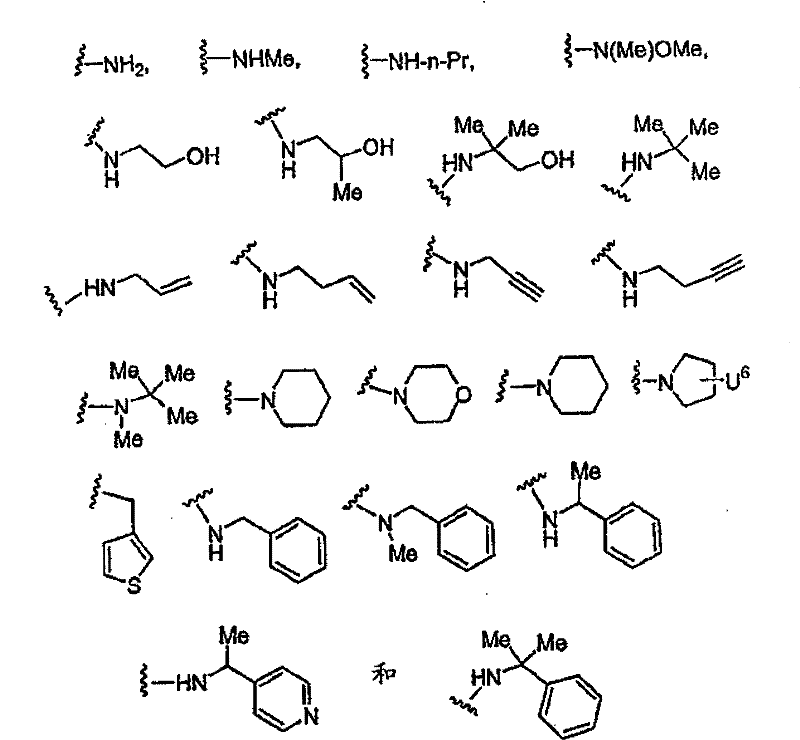
其中U6为H、OH或CH2OH; Wherein U 6 is H, OH or CH 2 OH;
R14优选自以下基团:H、Me、Et、正丙基、甲氧基、环丙基、正丁基、1-丁-3-炔基、苄基、α-甲基苄基、苯乙基、烯丙基、1-丁-3-烯基、OMe、环丙基甲基; R is preferably selected from the following groups: H, Me, Et, n-propyl, methoxy, cyclopropyl, n-butyl, 1-but-3-ynyl, benzyl, α-methylbenzyl, benzene Ethyl, Allyl, 1-but-3-enyl, OMe, Cyclopropylmethyl;
R2’优选独立选自以下的基团: R 2 ' is preferably independently selected from the following groups:
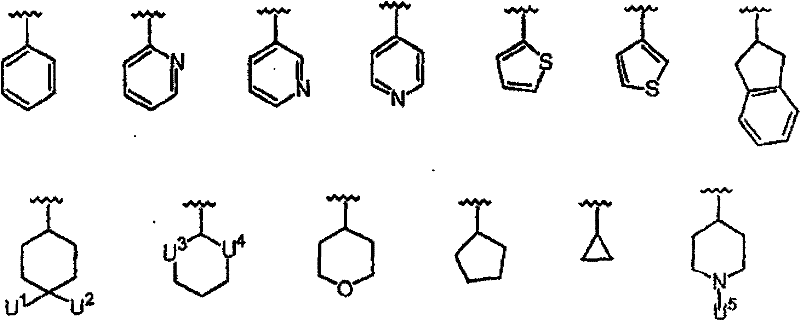
其中 in
U1和U2可以相同或不同并且选自以下基团:H、F、CH2COOH、CH2COOMe、CH2CONH2、CH2CONHMe、CH2CONMe2、叠氮基、氨基、羟基、取代的氨基、取代的羟基; U 1 and U 2 may be the same or different and are selected from the following groups: H, F, CH 2 COOH, CH 2 COOMe, CH 2 CONH 2 , CH 2 CONHMe, CH 2 CONMe 2 , azido, amino, hydroxyl, Substituted amino, substituted hydroxyl;
U3和U4可以相同或不同并且选自O和S; U3 and U4 can be the same or different and are selected from O and S;
U5选自以下部分:烷基磺酰基、芳基磺酰基、杂烷基磺酰基、杂芳基磺酰基、烷基羰基、芳基羰基、杂烷基羰基、杂芳基羰基、烷氧羰基、芳氧基羰基、杂芳氧基羰基、烷基氨基羰基、芳基氨基羰基、杂芳基氨基羰基或其组合; U is selected from the following moieties: alkylsulfonyl, arylsulfonyl, heteroalkylsulfonyl, heteroarylsulfonyl, alkylcarbonyl, arylcarbonyl, heteroalkylcarbonyl, heteroarylcarbonyl, alkoxycarbonyl , aryloxycarbonyl, heteroaryloxycarbonyl, alkylaminocarbonyl, arylaminocarbonyl, heteroarylaminocarbonyl, or combinations thereof;
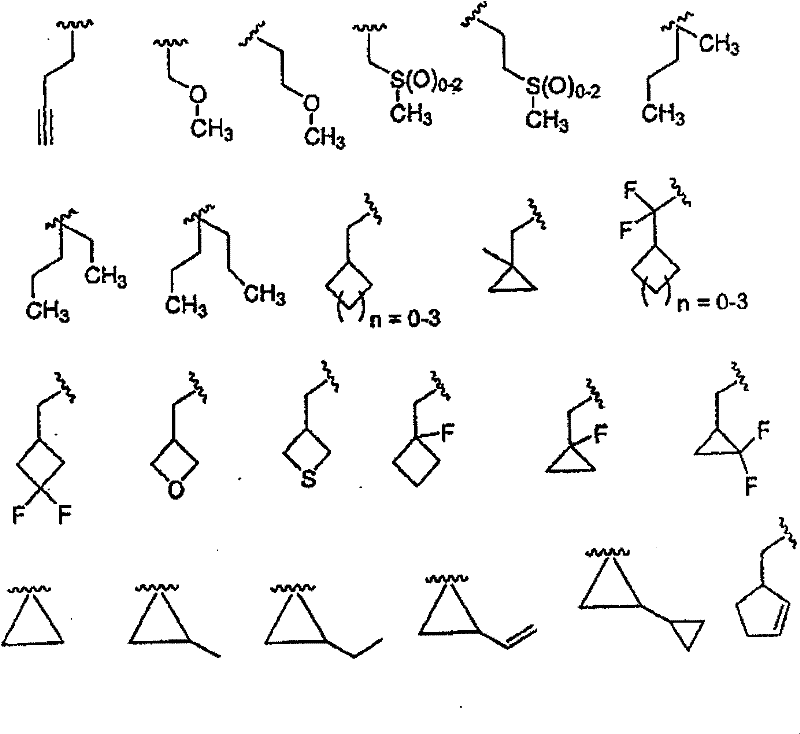
R2优选部分为: R2 preferred moieties are:

R3优选部分为: R 3 preferred moieties are:

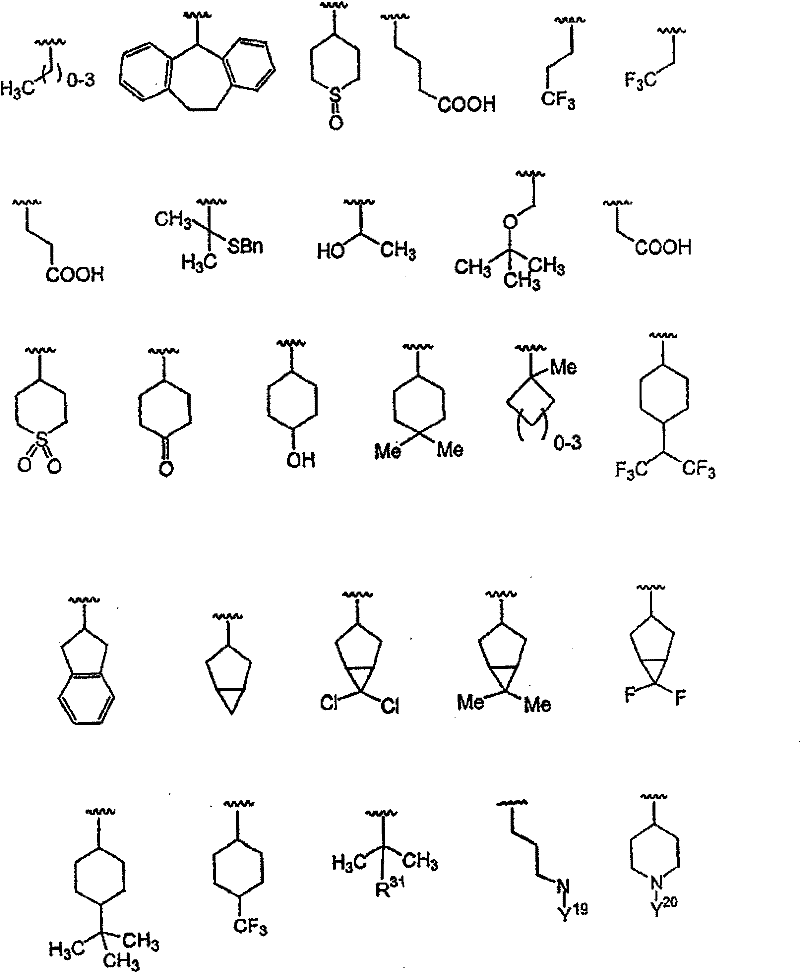
其中R31=OH或O-烷基; wherein R 31 =OH or O-alkyl;
Y19选自以下部分: Y 19 is selected from the following sections:
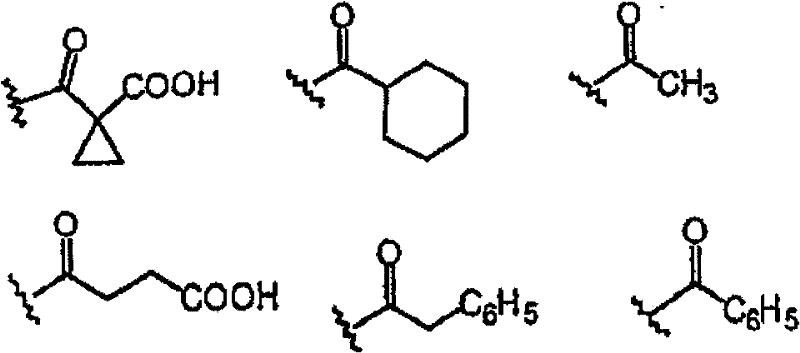
Y20选自以下部分: Y 20 is selected from the following sections:

R3的最优选部分为: The most preferred part of R3 is:

一些其它优选部分为:Z为N,R4为H,W为C=O。此外,R4不存在时,式I中Z-C-R3部分可以为以下结构: Some other preferred moieties are: Z is N, R4 is H, W is C=O. In addition, when R 4 does not exist, the ZCR 3 part in formula I can be the following structure:
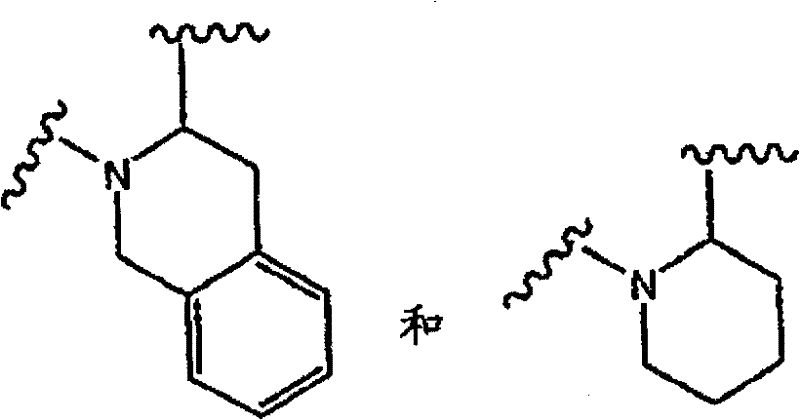
Y的优选部分为: The preferred part of Y is:

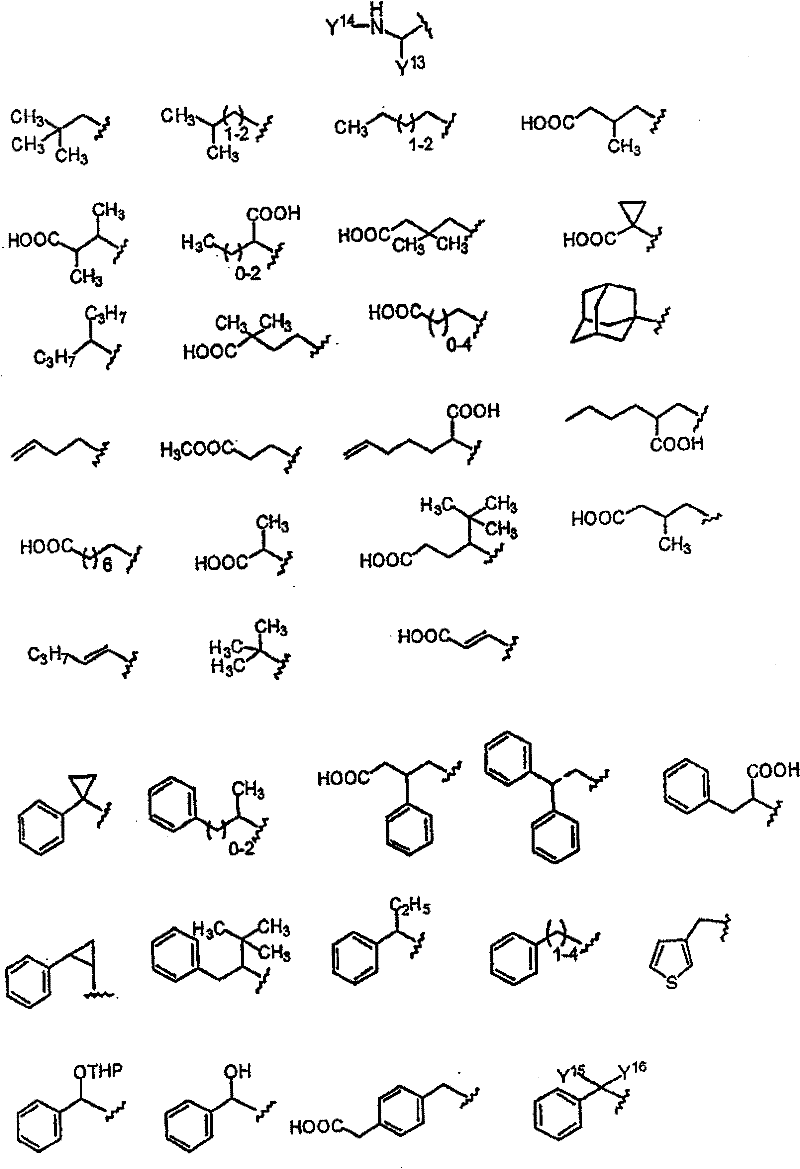


其中: in:
Y11选自H、COOH、COOEt、OMe、Ph、OPh、NHMe、NHAc、NHPh、CH(Me)2、1-三唑基、1-咪唑基和NHCH2COOH; Y 11 is selected from H, COOH, COOEt, OMe, Ph, OPh, NHMe, NHAc, NHPh, CH(Me) 2 , 1-triazolyl, 1-imidazolyl and NHCH 2 COOH;
Y12选自H、COOH、COOMe、OMe、F、Cl或Br; Y is selected from H, COOH, COOMe, OMe, F, Cl or Br;
Y13选自以下部分: Y 13 is selected from the following sections:

Y14选自MeSO2、Ac、Boc、iBoc、Cbz或Alloc; Y 14 is selected from MeSO 2 , Ac, Boc, iBoc, Cbz or Alloc;
Y15和Y16独立选自烷基、芳基、杂烷基和杂芳基; Y and Y are independently selected from alkyl, aryl, heteroalkyl and heteroaryl;
Y17为CF3、NO2、CONH2、OH、COOCH3、OCH3、OC6H5、C6H5、COC6H5、NH2或COOH; Y 17 is CF 3 , NO 2 , CONH 2 , OH, COOCH 3 , OCH 3 , OC 6 H 5 , C 6 H 5 , COC 6 H 5 , NH 2 or COOH;
Y18为COOCH3、NO2、N(CH3)2、F、OCH3、CH2COOH、COOH、SO2NH2或NHCOCH3。 Y 18 is COOCH 3 , NO 2 , N(CH 3 ) 2 , F, OCH 3 , CH 2 COOH, COOH, SO 2 NH 2 or NHCOCH 3 .
Y可以更优选为: Y can be more preferably:

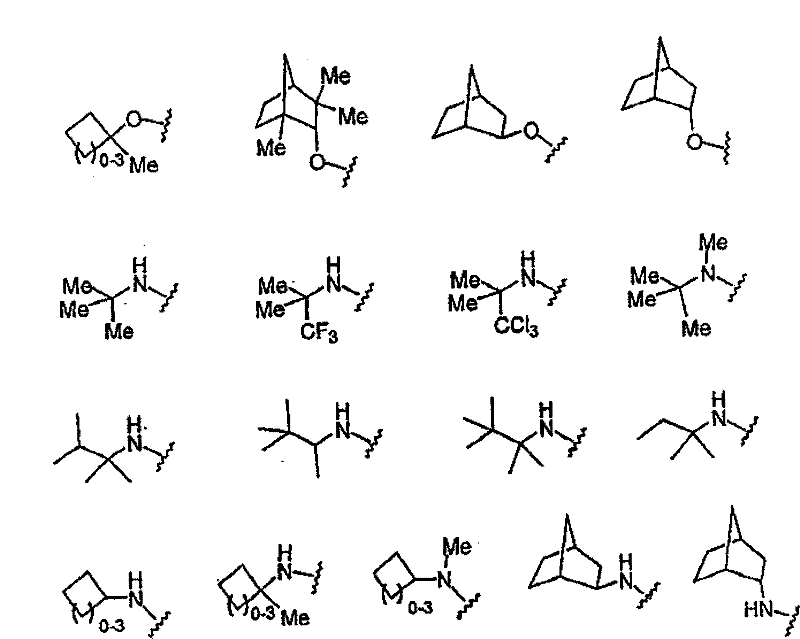
其中: in:
Y17=CF3、NO2、CONH2、OH、NH2或COOH; Y 17 = CF 3 , NO 2 , CONH 2 , OH, NH 2 or COOH;
Y18=F、COOH; Y18 = F, COOH;
Y的更加优选部分为: A more preferred part of Y is:

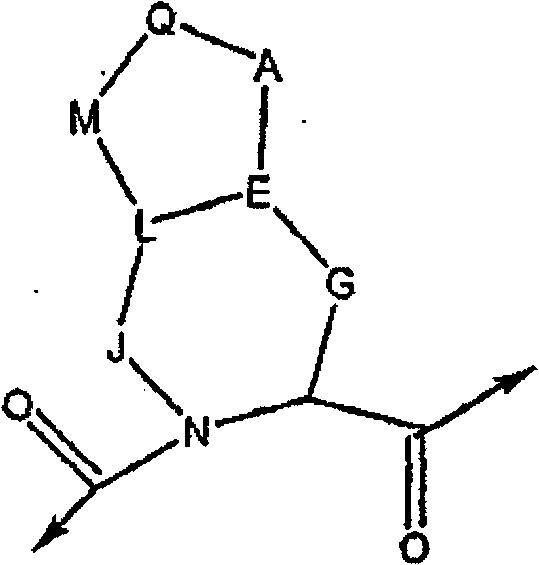
式I所示的以下单元: The following units shown in formula I:

为环结构,它可以为五元或六元环结构。但此环为五元环时,本发明要求五元环不包含羰基基团作为环结构的一部分。优选五元环结构为: As a ring structure, it may be a five-membered or six-membered ring structure. However, when the ring is a five-membered ring, the invention requires that the five-membered ring does not contain a carbonyl group as part of the ring structure. The preferred five-membered ring structure is:
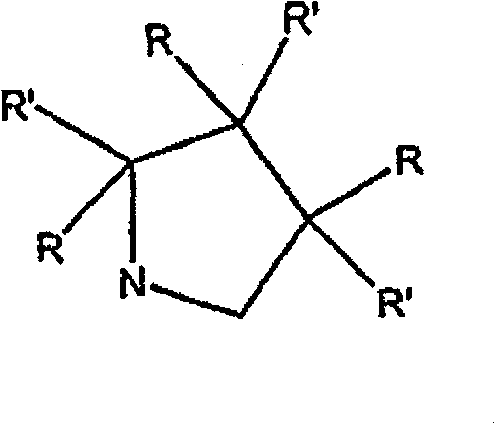
其中R和R’定义同上。优选的五元环结构为: wherein R and R' are as defined above. The preferred five-membered ring structure is:

其中R20选自以下部分: Wherein R 20 is selected from the following parts:
此外,所述五元环与其相邻的两个环外羰基一起可以表示如下: Furthermore, the five-membered ring together with its adjacent two exocyclic carbonyl groups can be represented as follows:

本发明情况下,R21和R22可以相同或不同并且独立选自以下部分: In the case of the present invention, R21 and R22 can be the same or different and independently selected from the following moieties:

以下五元环结构: The following five-membered ring structure:

的一些优选实例如下: Some preferred examples of are as follows:

此外,式中的以下单元: In addition, the following units in the formula:

可以表示为以下结构b和c: can be represented as the following structures b and c :
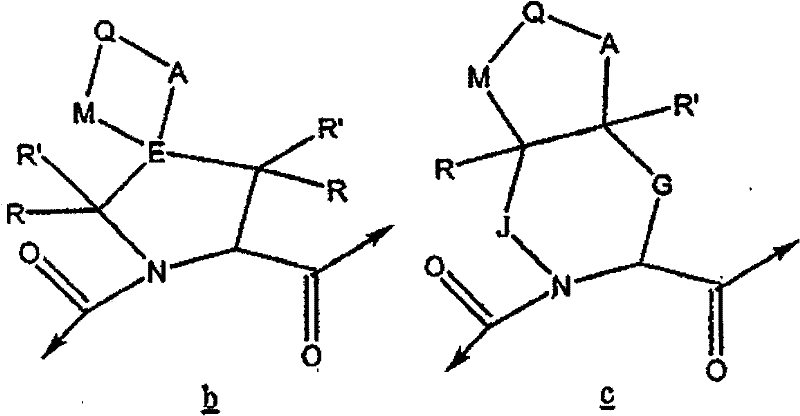
b的优选定义为: A preferred definition of b is:


在c中,G和J独立选自以下基团:(CH2)p、(CHR)p、(CHR-CHR’)p和(CRR’)p;A和M独立选自以下基团:O、S、SO2、NR、(CH2)p、(CHR)p、(CHR-CHR’)p和(CRR’)p;Q为CH2、CHR、CRR’、NH、NR、O、S、SO2、NR、(CH2)p、(CHR)p和(CRR’)p。 In c , G and J are independently selected from the following groups: ( CH2 ) p , (CHR) p , (CHR-CHR') p , and (CRR') p ; A and M are independently selected from the following groups: O , S, SO 2 , NR, (CH 2 ) p , (CHR) p , (CHR-CHR') p and (CRR') p ; Q is CH 2 , CHR, CRR', NH, NR, O, S , SO 2 , NR, (CH 2 ) p , (CHR) p , and (CRR') p .
c的优选定义为: A preferred definition of c is:
当环结构如下所示时: When the ring structure looks like this:

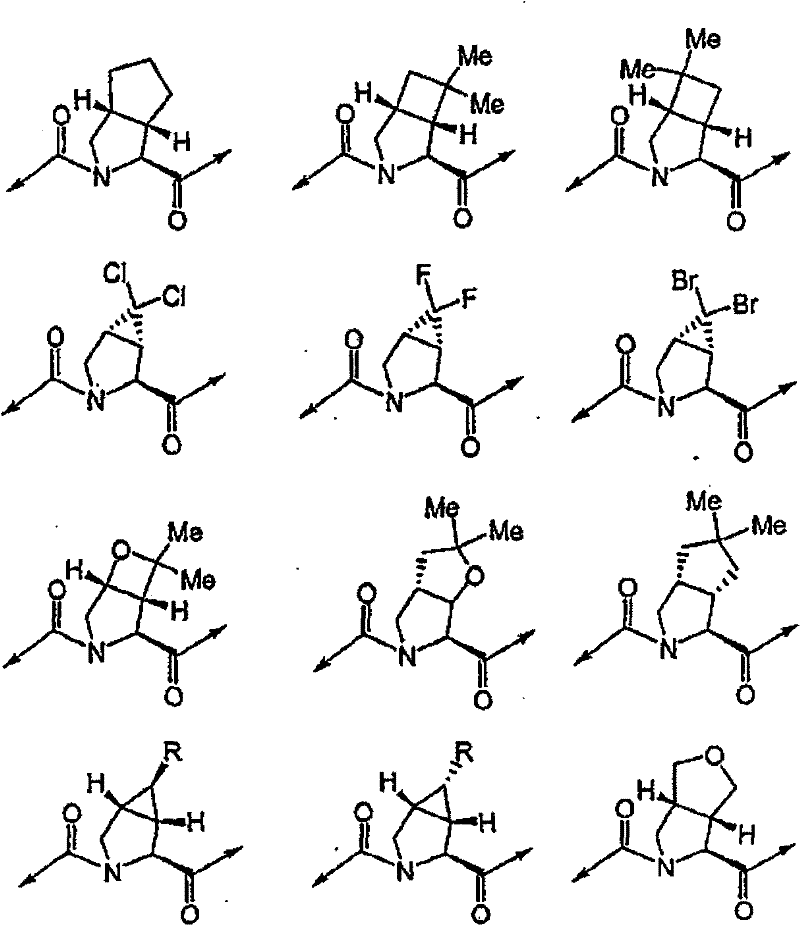
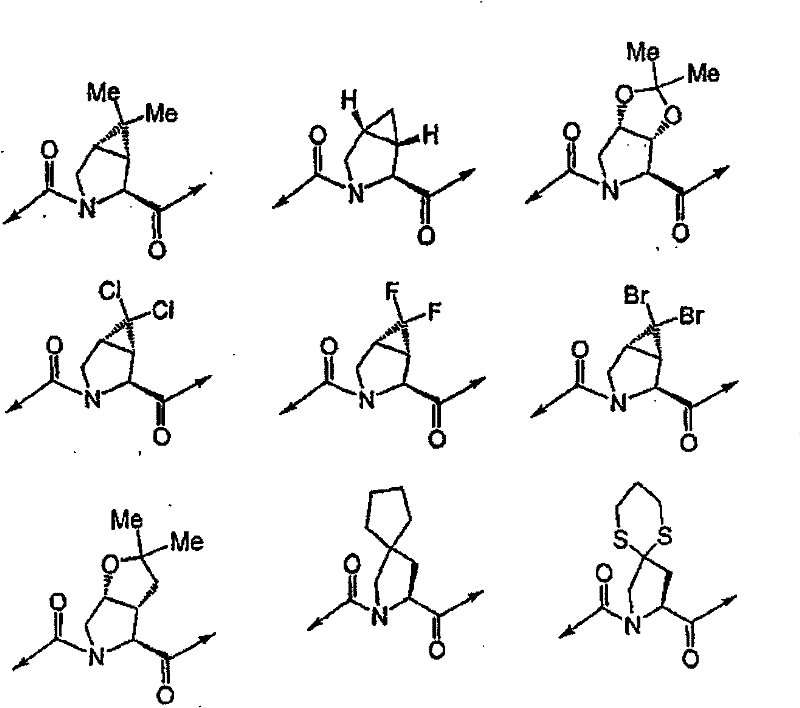
其最优选的实例如下: Its most preferred examples are as follows:

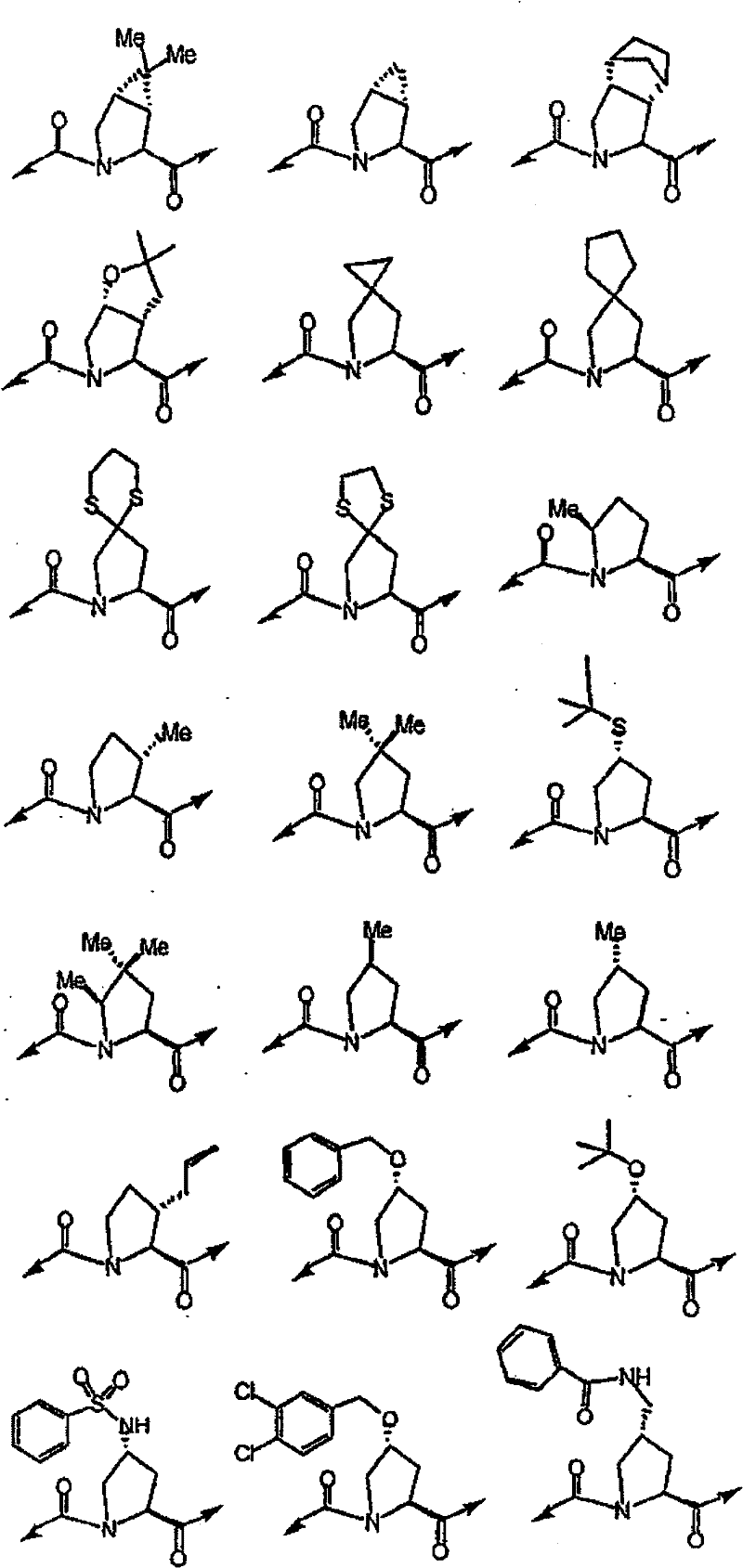

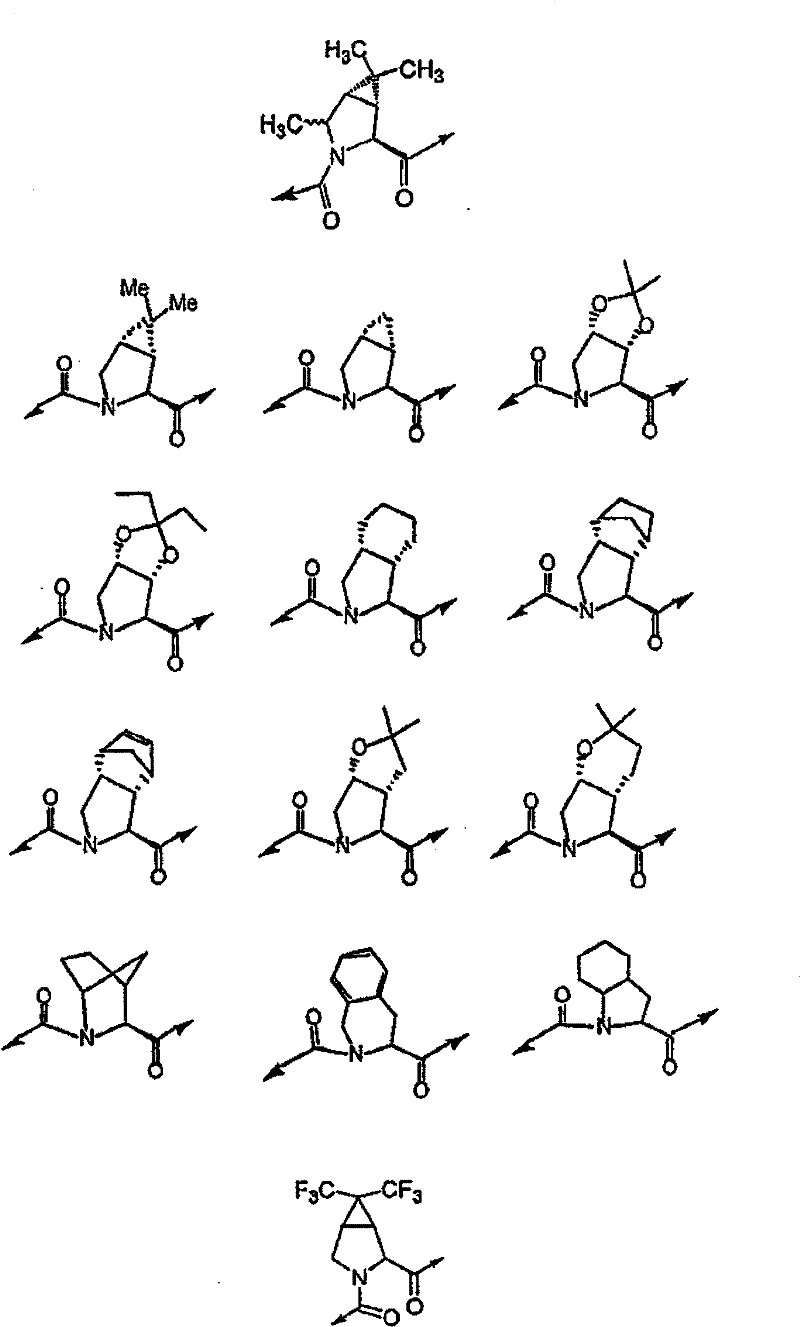
以下单元: The following units:
的一些更优选部分为: Some more preferred parts of are:

除非另有定义,否则本发明使用的所有科技术语具有本发明所属领域的技术人员通常理解的相同含义。因此,例如术语烷基(包括烷氧基的烷基部分)指由具有1-8个,优选1-6个碳原子的直链或支链饱和烃除去一个原子后获得的单价基团; Unless otherwise defined, all technical and scientific terms used in this invention have the same meaning as commonly understood by one of ordinary skill in the art to which this invention belongs. Thus, for example, the term alkyl (including the alkyl portion of alkoxy) refers to a monovalent radical obtained by removing one atom from a linear or branched saturated hydrocarbon having 1 to 8, preferably 1 to 6, carbon atoms;
芳基-表示具有6-14个碳原子且具有至少1个苯型环的碳环基团,碳环基团的所有可取代的芳香族碳原子均可作为连接点。优选芳基包括苯基、1-萘基、2-萘基和茚满基,尤其是苯基和取代的苯基; Aryl-represents a carbocyclic group having 6-14 carbon atoms and having at least one benzene-type ring, all substitutable aromatic carbon atoms of the carbocyclic group can be used as attachment points. Preferred aryl groups include phenyl, 1-naphthyl, 2-naphthyl and indanyl, especially phenyl and substituted phenyl;
芳烷基-表示含有芳基并通过低级烷基连接的部分; Aralkyl - means a moiety containing an aryl group attached through a lower alkyl group;
烷基芳基-表示含有低级烷基并通过芳基连接的部分; Alkylaryl - means a moiety containing a lower alkyl group attached through an aryl group;
环烷基-表示具有3-8个,优选5个或6个碳原子的饱和碳环,其任选被取代; Cycloalkyl - means a saturated carbocyclic ring having 3-8, preferably 5 or 6 carbon atoms, which is optionally substituted;
杂环-表示(除以下定义的杂芳基以外)具有至少1个插入碳环结构(由1个环或者2个稠环组成,其中每个环为5元、6元或7元环且可具有或者不具有不含离域pi电子的双键)的O、S和/或N原子的饱和及不饱和环状有机基团,其环结构具有2-8个、优选3-6个碳原子,例如2-或3-哌啶基、2-或3-哌嗪基、2-或3-吗啉基、或者2-或3-硫代吗啉基; Heterocycle - means (other than heteroaryl as defined below) having at least 1 inserted carbocyclic structure (consisting of 1 ring or 2 fused rings, wherein each ring is a 5-, 6-, or 7-membered ring and can be Saturated and unsaturated cyclic organic groups with or without O, S and/or N atoms with or without double bonds without delocalized pi electrons, the ring structure of which has 2-8, preferably 3-6 carbon atoms , such as 2- or 3-piperidinyl, 2- or 3-piperazinyl, 2- or 3-morpholinyl, or 2- or 3-thiomorpholinyl;
卤素-表示氟、氯、溴和碘; Halogen - means fluorine, chlorine, bromine and iodine;
杂芳基-表示具有至少1个插入碳环结构的O、S和/或N原子且 具有足够数量的离域pi电子以提供芳族性质的环状有机基团,其中芳族杂环具有2-14个、优选4或5个碳原子,例如2-、3-或4-吡啶基,2-或3-呋喃基、2-或3-噻吩基、2-、4-或5-噻唑基、2-或4-咪唑基、2-、4-或5-嘧啶基、2-吡嗪基、或者3-或4-哒嗪基等。优选杂芳基为2-、3-和4-吡啶基;所述杂芳基也可被任选取代。此外,如上所述,除有特别定义,术语“取代或未取代 

本发明还包括式I化合物及其前体药物的互变异构体、旋转异构体、对映异构体和其它旋光异构体,及其药学上可接受的盐、溶剂化物和衍生物。 The present invention also includes tautomers, rotamers, enantiomers and other optical isomers of the compound of formula I and its prodrugs, and pharmaceutically acceptable salts, solvates and derivatives thereof . the
本发明的又一特征是包含作为活性成分的式I化合物(或其盐、溶剂化物或异构体)和药学上可接受的载体或赋形剂的药用组合物。 Another feature of the present invention is a pharmaceutical composition comprising the compound of formula I (or its salt, solvate or isomer) as an active ingredient and a pharmaceutically acceptable carrier or excipient. the
本发明还提供制备式I化合物的方法以及治疗诸如HCV、AIDS(获得性免疫缺陷综合症)的疾病及相关疾病的方法。所述治疗方法包括给予患有一种或多种所述疾病的患者治疗有效量的式I化合物或者包含式I化合物的药用组合物。 The present invention also provides methods of preparing compounds of formula I and methods of treating diseases such as HCV, AIDS (acquired immunodeficiency syndrome) and related diseases. The method of treatment comprises administering a therapeutically effective amount of a compound of formula I or a pharmaceutical composition comprising a compound of formula I to a patient suffering from one or more of said diseases. the
还公开了式I化合物在制备治疗HCV、AIDS和相关疾病的药物中的用途。 Also disclosed is the use of the compound of formula I in the preparation of medicines for treating HCV, AIDS and related diseases. the
还公开了治疗丙型肝炎病毒相关性疾病的方法,该方法包括给予有效量的一种或多种本发明化合物。 Also disclosed is a method of treating hepatitis C virus-associated disease comprising administering an effective amount of one or more compounds of the invention. the
还公开了调节丙型肝炎病毒(HCV)蛋白酶活性的方法,该方法包括使HCV蛋白酶与一种或多种本发明化合物接触。 Also disclosed is a method of modulating the activity of a hepatitis C virus (HCV) protease comprising contacting the HCV protease with one or more compounds of the invention. the
还公开了治疗、预防或改善丙型肝炎的一种或多种症状的方法,该方法包括给予有效量的一种或多种本发明化合物。HCV蛋白酶为NS3或NS4a蛋白酶。本发明化合物抑制所述蛋白酶。它们还调节丙 型肝炎(HCV)多肽的加工。 Also disclosed is a method of treating, preventing or ameliorating one or more symptoms of hepatitis C comprising administering an effective amount of one or more compounds of the invention. The HCV protease is NS3 or NS4a protease. The compounds of the invention inhibit said proteases. They also regulate the processing of hepatitis C (HCV) polypeptides. the
优选实施方案的详细描述 Detailed description of the preferred embodiment
在一个实施方案中,本发明公开了作为HCV蛋白酶抑制剂、尤其是HCV NS3/NS4a丝氨酸蛋白酶抑制剂的式I化合物或其药学上可接受的衍生物,其各种定义见上文。 In one embodiment, the present invention discloses a compound of formula I or a pharmaceutically acceptable derivative thereof, variously defined above, as an HCV protease inhibitor, especially an HCV NS3/NS4a serine protease inhibitor. the
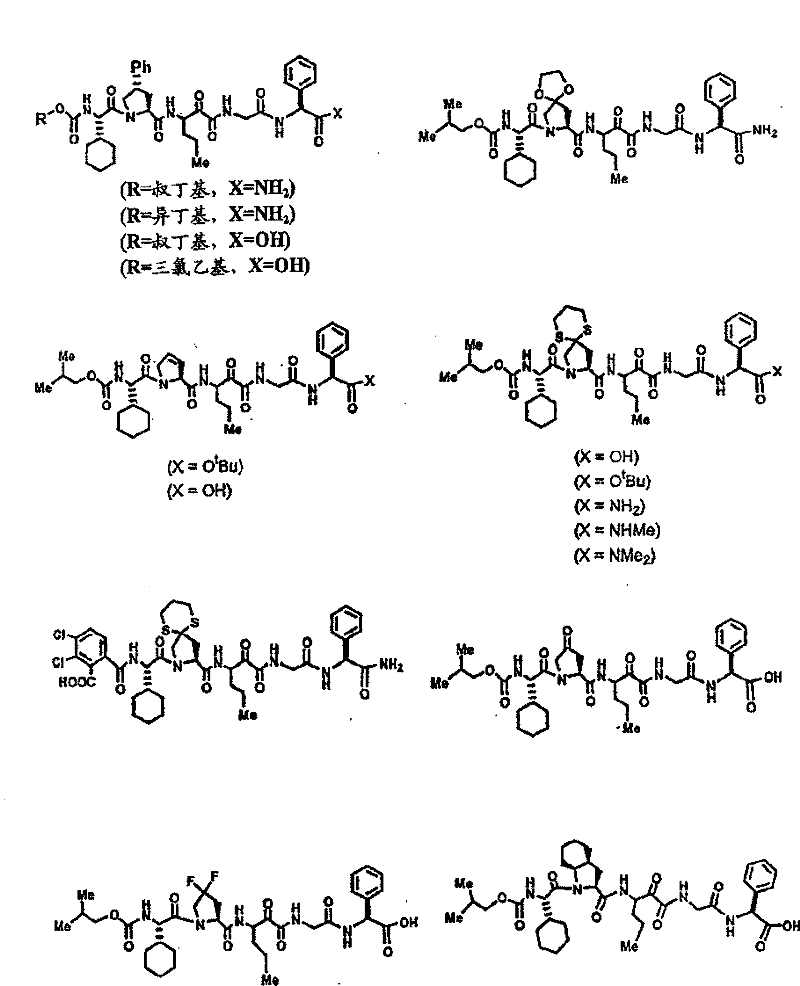
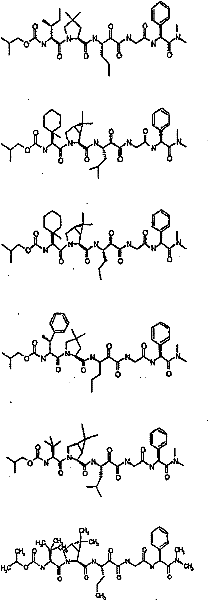
具有优良的HCV蛋白酶抑制活性的本发明代表性化合物与它们的活性一并列于下表1-5(Ki *值范围为纳摩尔,nM)。几个化合物以及补充的化合物另外在权利要求中公开。 Representative compounds of the present invention with excellent HCV protease inhibitory activity are listed in Tables 1-5 below together with their activities (K i * values are in nanomolar, nM). Several compounds as well as supplementary compounds are additionally disclosed in the claims.
表1:化合物和HCV蛋白酶连续检测结果Table 1: Compound and HCV protease serial detection results
[0161] [0161]
[0162] [0162]
[0163] [0163]
[0164] [0164]
[0165] [0165]
[0166] [0166]
[0167] [0167]
[0168] [0168]
HCV连续检测的Ki*范围: Ki * range for HCV serial detection:
类别A=1-100nM;类别B=101-1000nM;类别C>1000nM。 Class A = 1-100 nM; Class B = 101-1000 nM; Class C > 1000 nM. the
一些类型的本发明化合物以及合成不同类型的本发明式I化合物的方法列于下面,接着用示意图说明,之后是示例性的实施例。 Some types of compounds of the invention and methods for synthesizing different types of compounds of formula I of the invention are listed below, followed by schematic illustrations, followed by illustrative examples. the
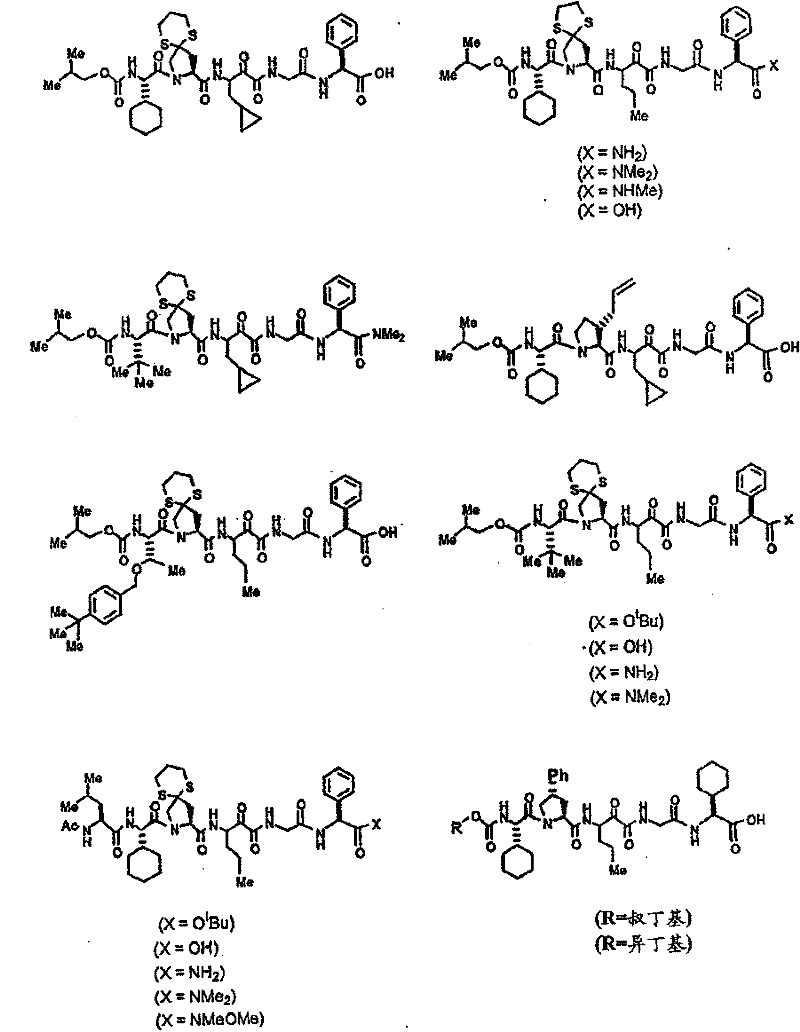
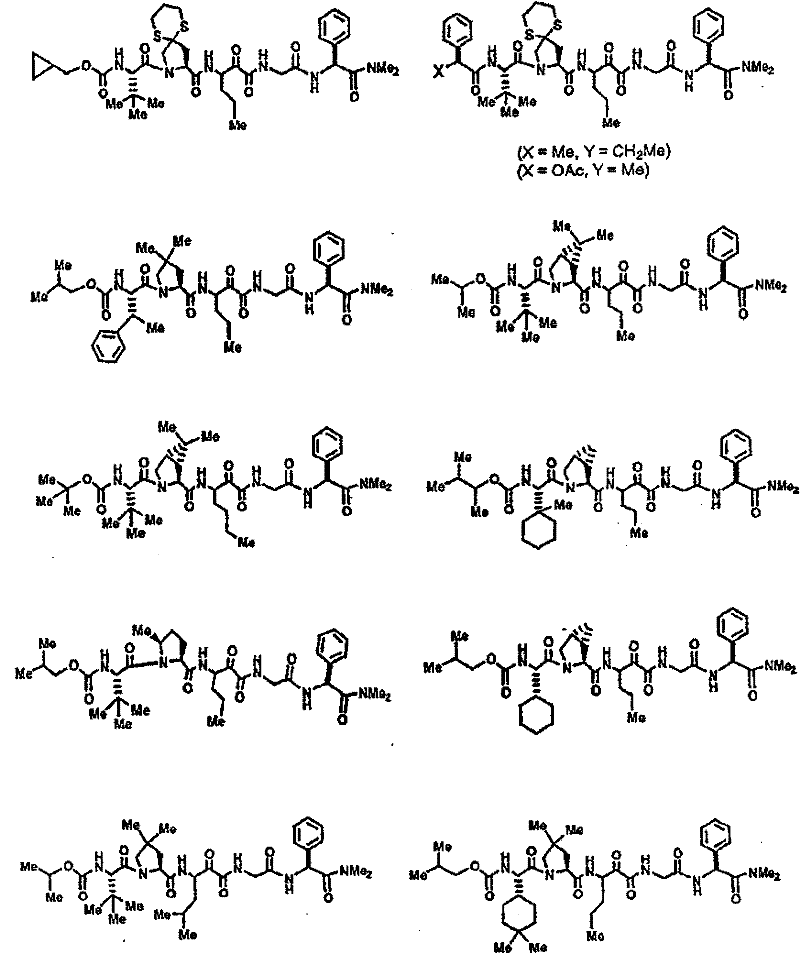
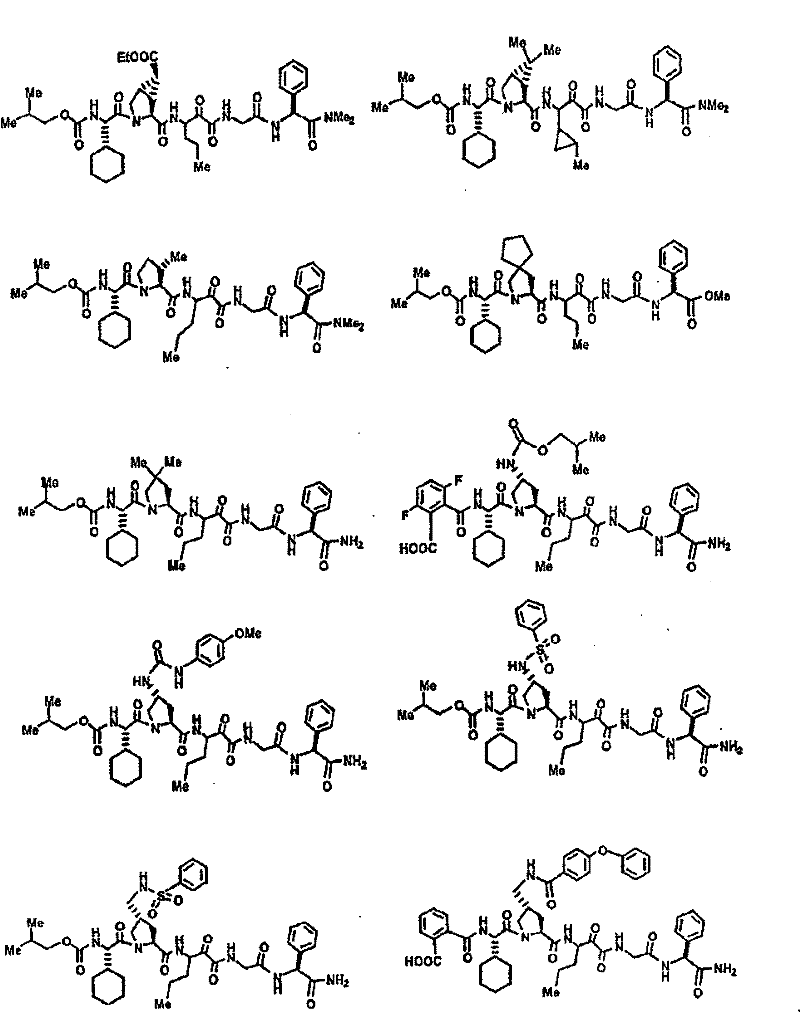

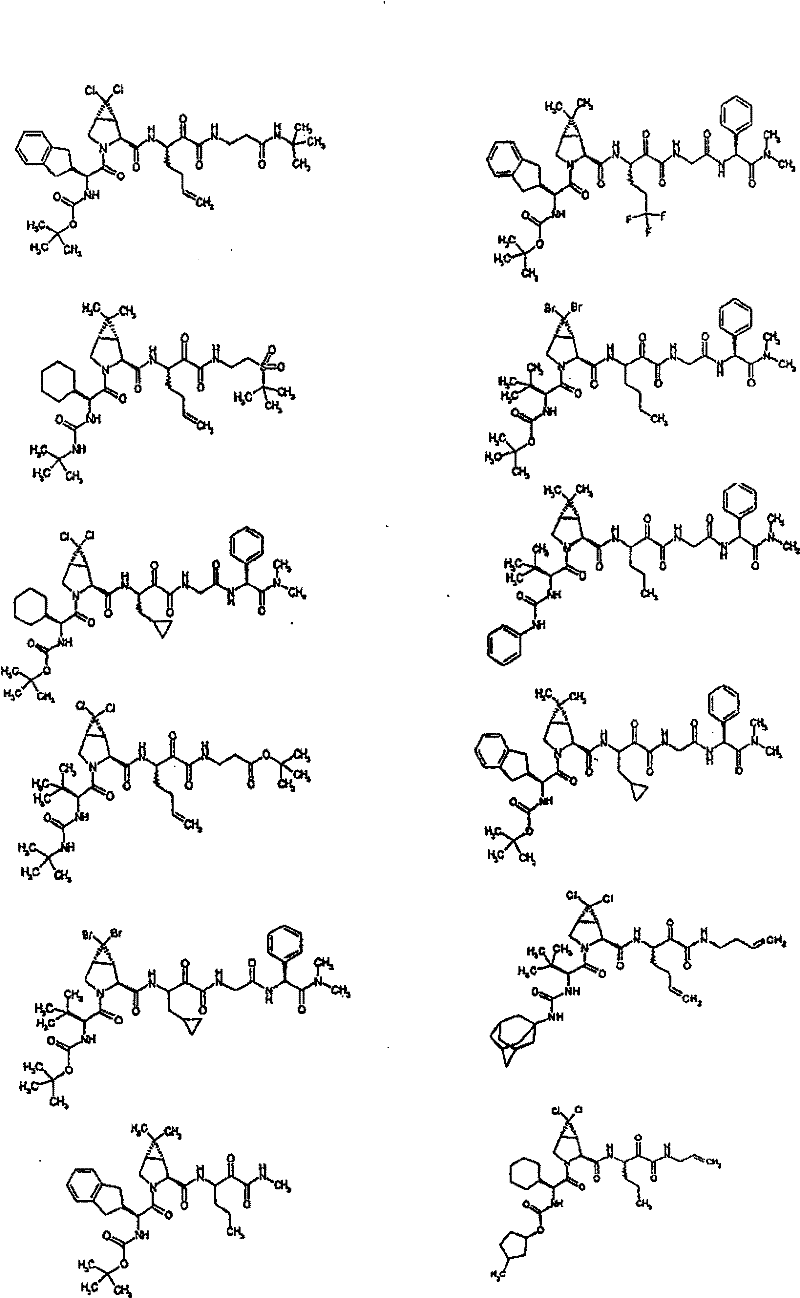
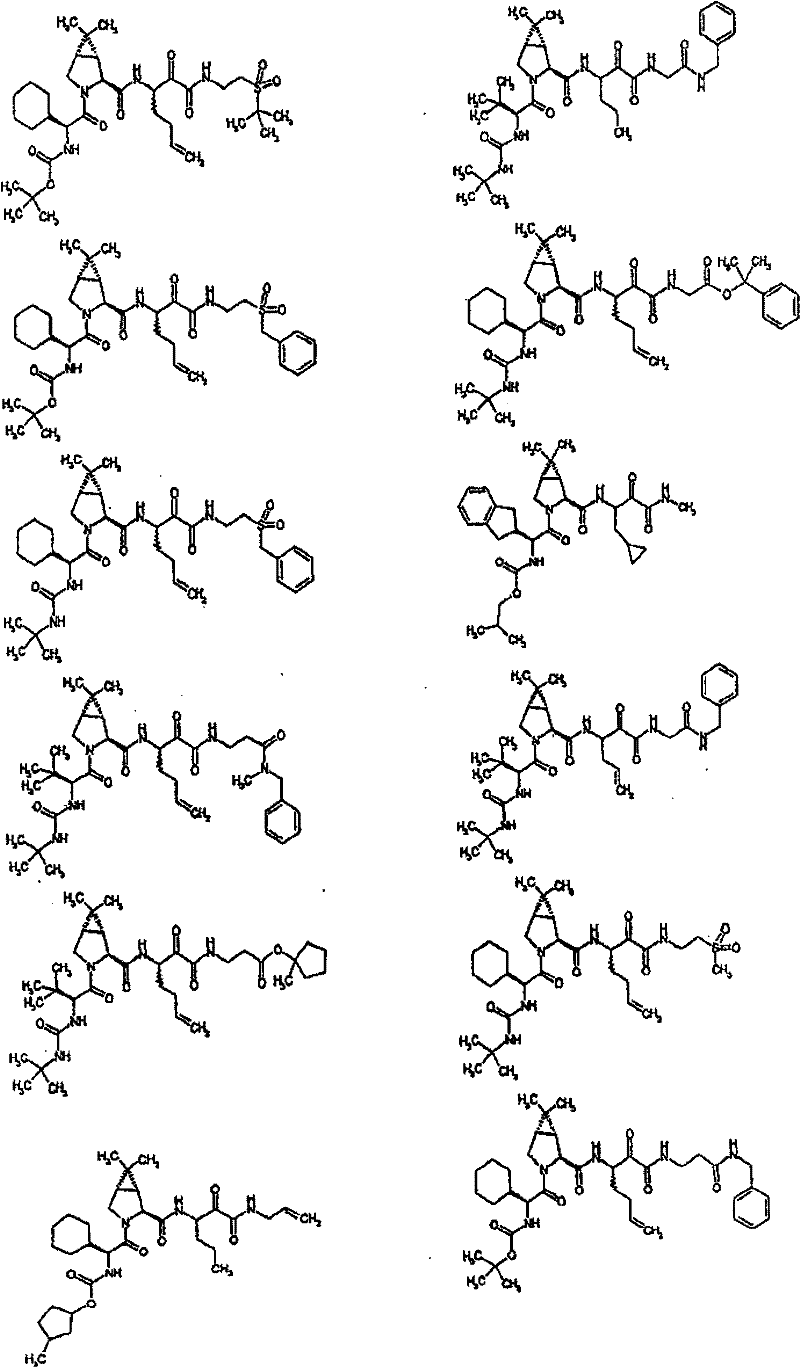


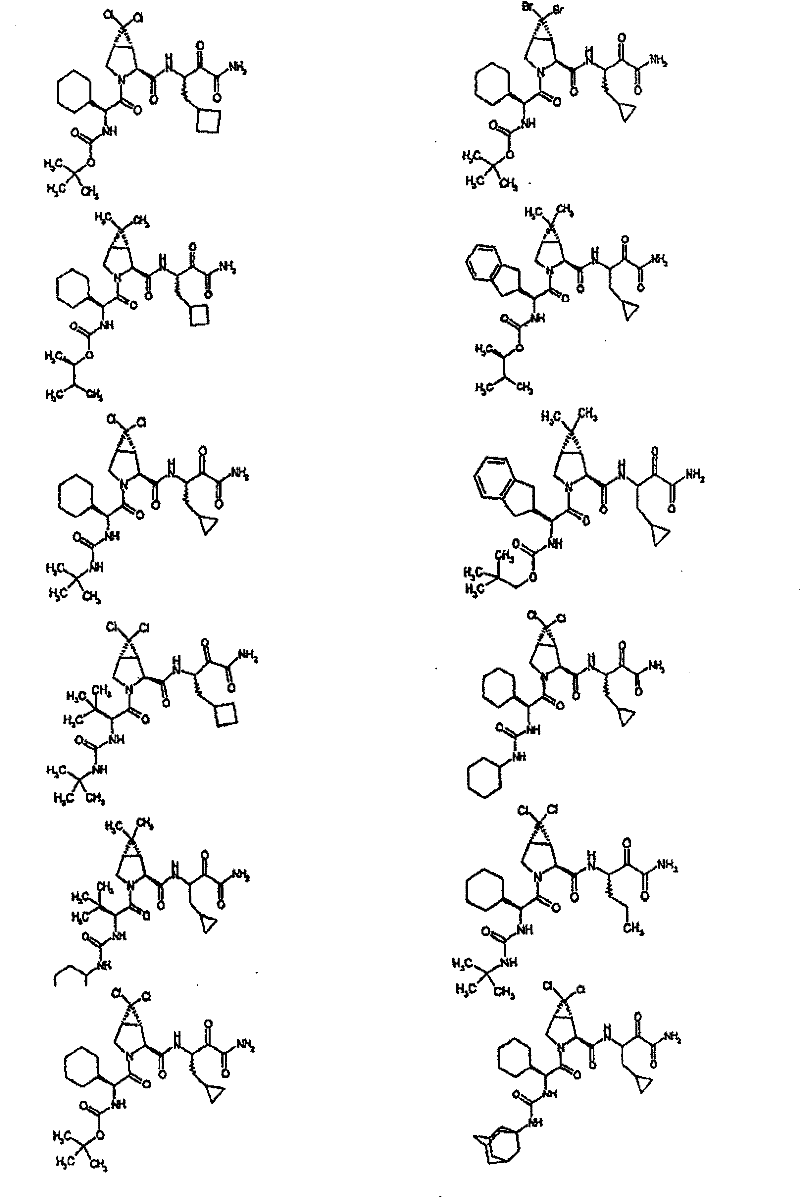


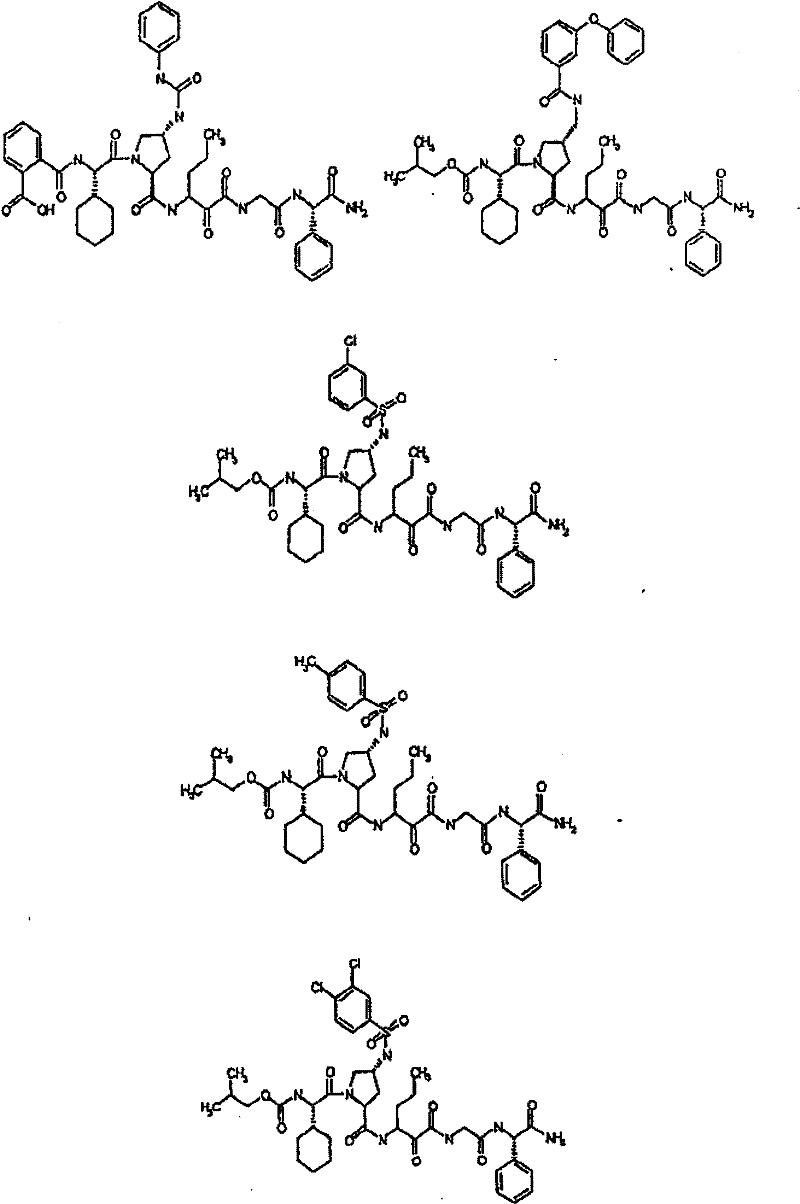
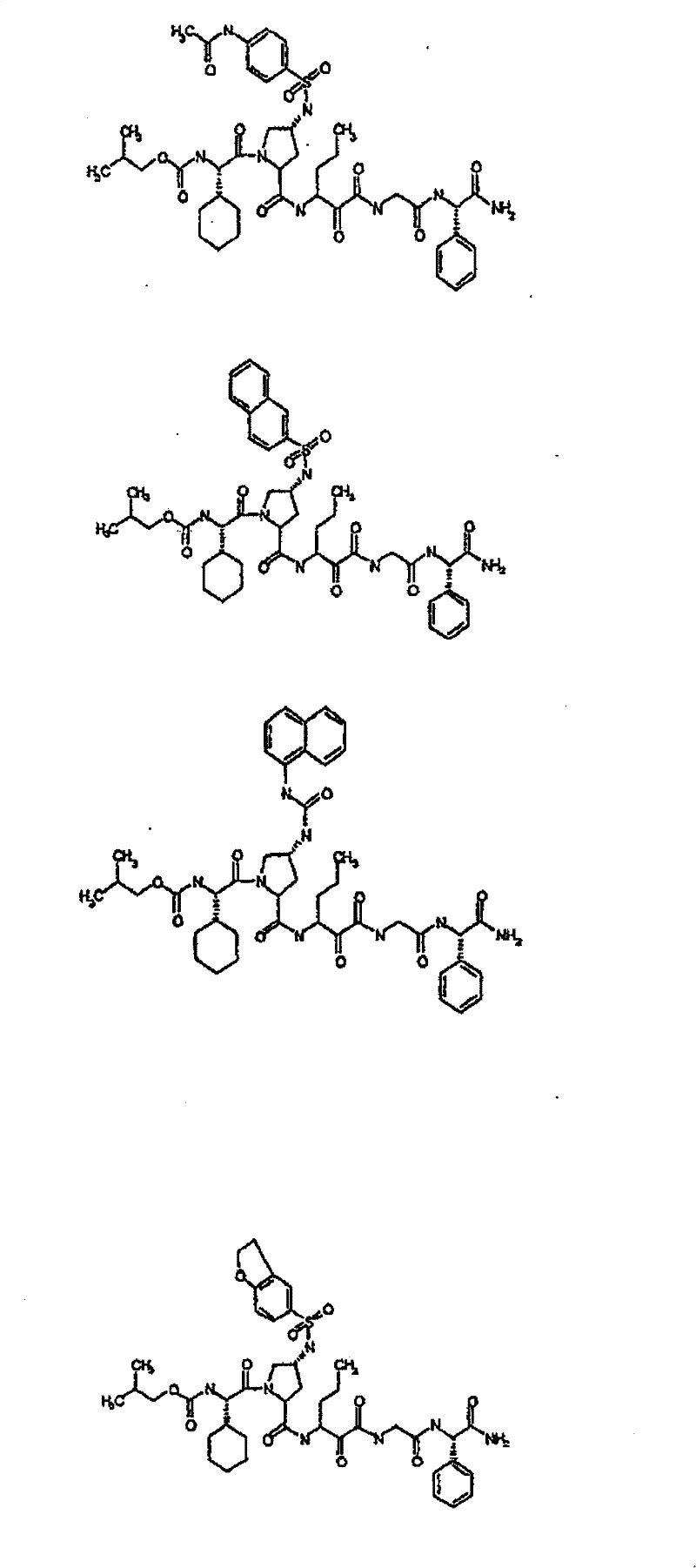


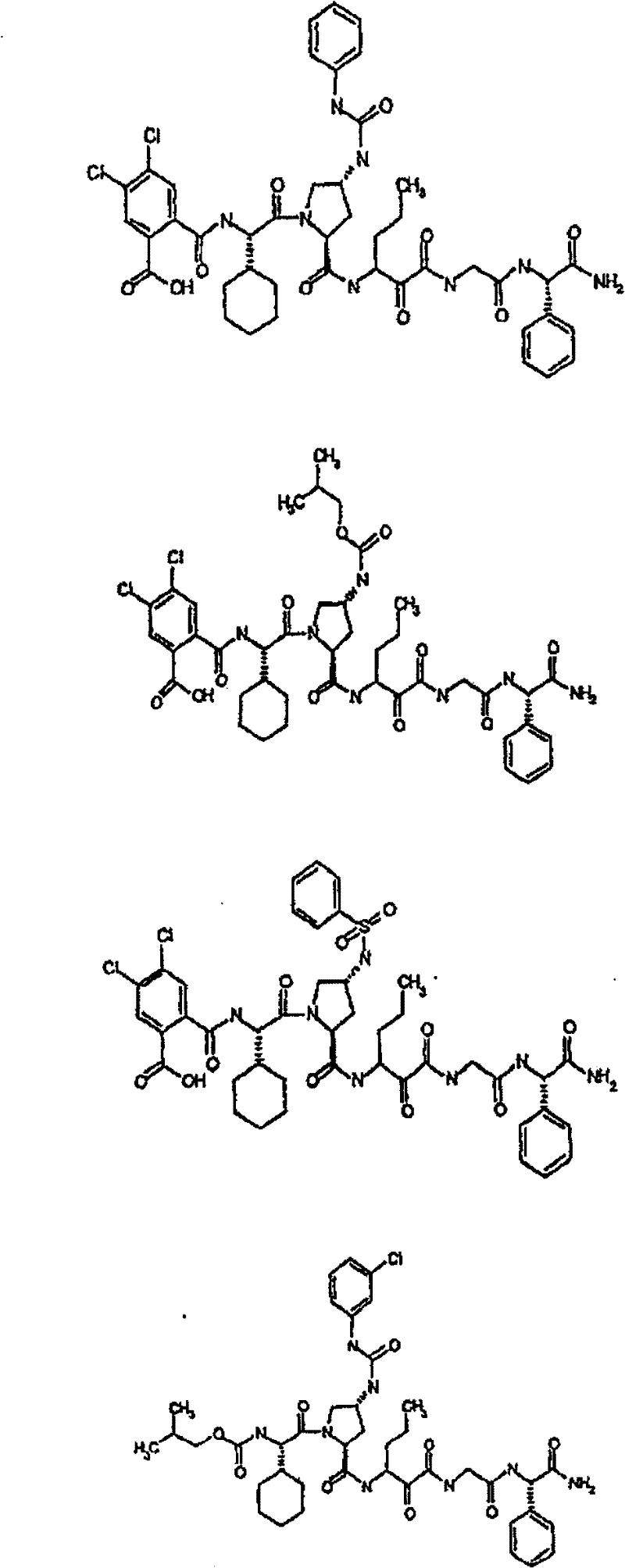

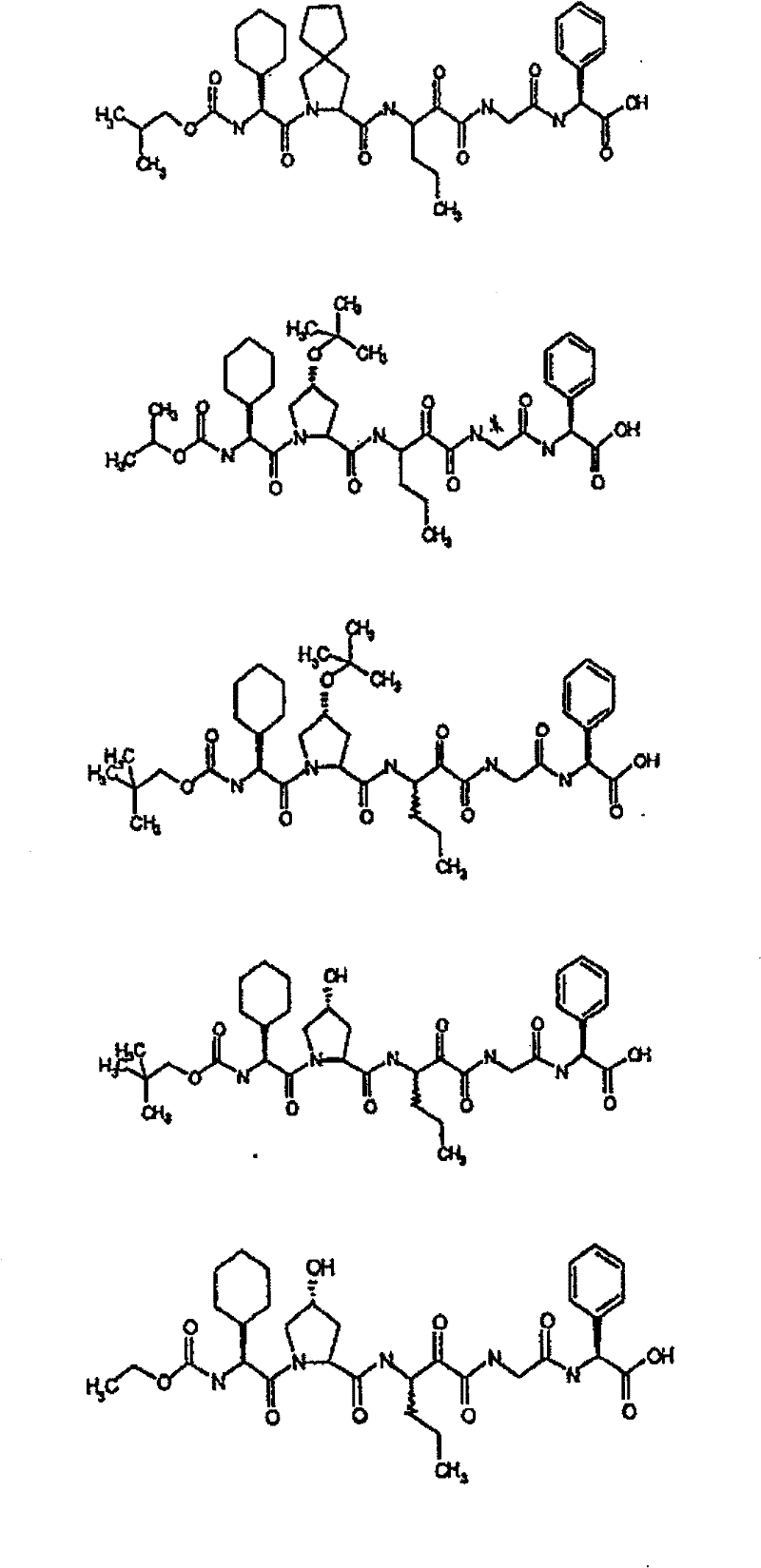
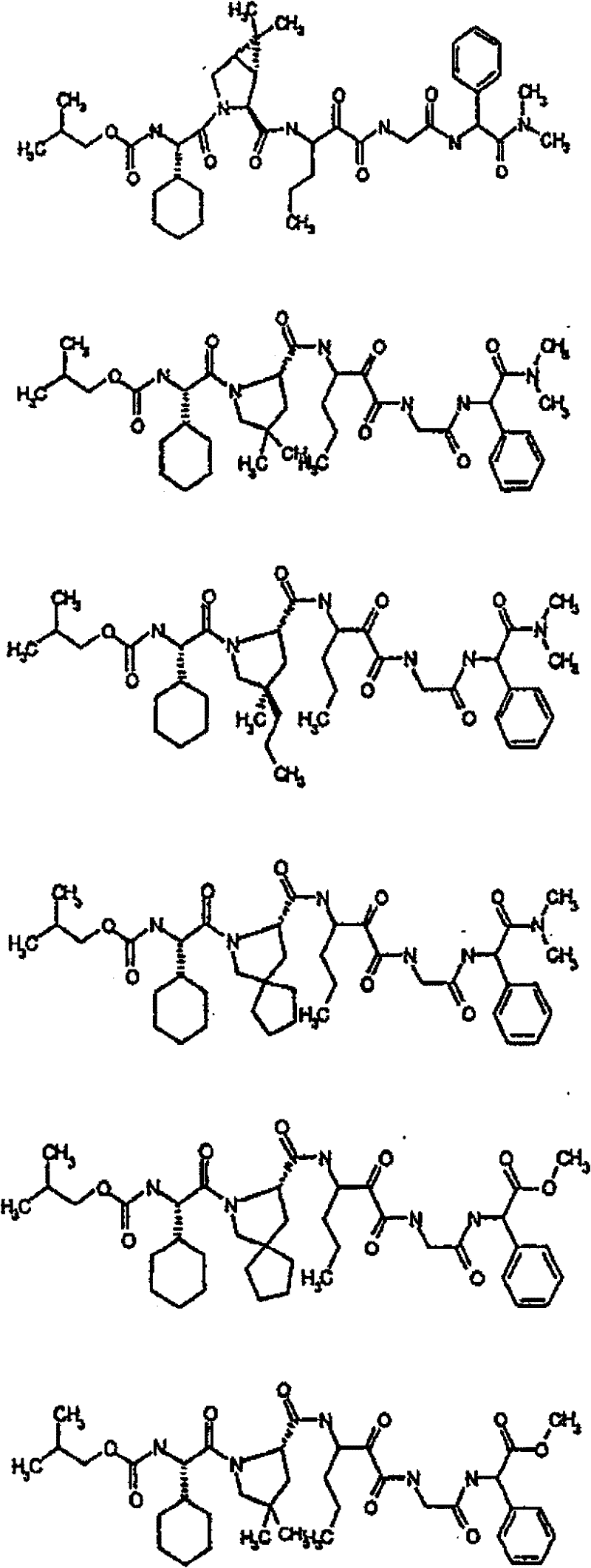
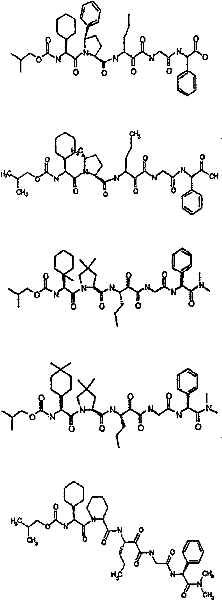


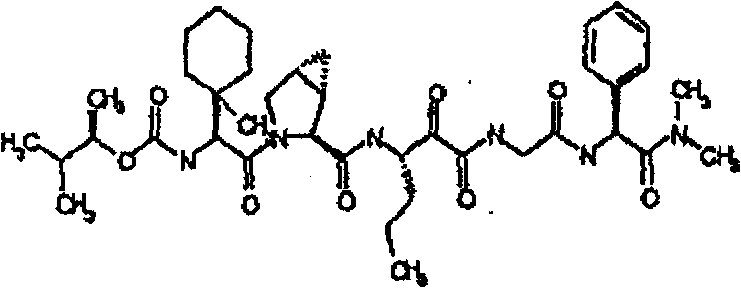
根据它们的结构,本发明化合物可与有机酸或无机酸、或者有机碱或无机碱形成药学上可接受的盐。用于此类盐形成的合适的酸的实例为盐酸、硫酸、磷酸、乙酸、柠檬酸、丙二酸、水杨酸、苹果酸、富马酸、琥珀酸、抗坏血酸、马来酸、甲磺酸和本领域技术人员熟知的其它的矿物酸以及羧酸类。对于与碱形成盐的合适碱为例如NaOH、KOH、NH4OH、氢氧化四烷基铵等。 Depending on their structure, the compounds of the present invention can form pharmaceutically acceptable salts with organic or inorganic acids, or organic or inorganic bases. Examples of suitable acids for such salt formation are hydrochloric acid, sulfuric acid, phosphoric acid, acetic acid, citric acid, malonic acid, salicylic acid, malic acid, fumaric acid, succinic acid, ascorbic acid, maleic acid, methanesulfonic acid, acids and other mineral acids and carboxylic acids well known to those skilled in the art. Suitable bases for the formation of salts with bases are, for example, NaOH, KOH, NH4OH , tetraalkylammonium hydroxides, and the like.
在另一实施方案中,本发明提供包含作为活性成分的本发明肽的药用组合物。药用组合物通常还包含药学上可接受的载体稀释剂、赋形剂或载体(本发明统称为载体材料)。由于它们的HCV抑制活性,所述药用组合物具有治疗丙型肝炎和相关疾病的用途。 In another embodiment, the present invention provides a pharmaceutical composition comprising, as an active ingredient, a peptide of the present invention. Pharmaceutical compositions generally also comprise pharmaceutically acceptable carrier diluents, excipients or carriers (collectively referred to herein as carrier materials). Due to their HCV inhibitory activity, said pharmaceutical compositions have utility in the treatment of hepatitis C and related diseases. the
在另一实施方案中,本发明公开了制备包含作为活性成分的本发明化合物的药用组合物的方法。在本发明的药用组合物和方法中,活性成分一般以与适合的载体材料的混合物给药,根据需要的给药形式适当地选择载体材料,即口服片剂、胶囊剂(固体填充、半固体填充或液体填充)、使用时配制用粉剂、口服凝胶剂、酏剂、可分散颗粒剂、糖浆剂、混悬剂等,并且符合常规制药实践。举例来说,对于以片剂或胶囊剂形式口服给药,活性药物成分可与任何口服非毒性的药学上可接受的惰性载体组合,例如乳糖、淀粉、蔗糖、纤维素、硬脂酸镁、磷酸二钙、硫酸钙、滑石粉、甘露糖醇、乙醇(液体形式)等。此外,当要求或者需要时,也可将合适的粘合剂、润滑剂、崩解剂和着色剂掺和到混合物中。粉剂和片剂也可包含约5-95%的本发明组分。合适的粘合剂包括淀粉、明胶、天然糖、玉米甜味剂、天然及合成树胶如阿拉伯树胶、藻酸钠、羧甲基纤维素、聚乙二醇和蜡。可用于上述剂型的润滑剂实例有硼酸、苯甲酸钠、乙酸钠、 氯化钠等。崩解剂包括淀粉、甲基纤维素、瓜尔胶等。 In another embodiment, the present invention discloses a method of preparing a pharmaceutical composition comprising a compound of the present invention as an active ingredient. In the pharmaceutical composition and method of the present invention, the active ingredient is generally administered as a mixture with a suitable carrier material, and the carrier material is appropriately selected according to the required administration form, i.e. oral tablet, capsule (solid-filled, semi- solid-filled or liquid-filled), powders for formulation in use, oral gels, elixirs, dispersible granules, syrups, suspensions, etc., and in accordance with conventional pharmaceutical practice. For example, for oral administration in tablet or capsule form, the active pharmaceutical ingredient may be combined with any orally nontoxic pharmaceutically acceptable inert carrier, such as lactose, starch, sucrose, cellulose, magnesium stearate, Dicalcium phosphate, calcium sulfate, talc, mannitol, ethanol (in liquid form), etc. In addition, suitable binders, lubricants, disintegrants and colorants may also be blended into the mixture when required or desired. Powders and tablets may also contain from about 5% to about 95% of the components of the invention. Suitable binders include starch, gelatin, natural sugars, corn sweeteners, natural and synthetic gums such as acacia, sodium alginate, carboxymethylcellulose, polyethylene glycol and waxes. Examples of lubricants that can be used in the above dosage forms include boric acid, sodium benzoate, sodium acetate, sodium chloride, and the like. Disintegrants include starch, methylcellulose, guar gum, and the like. the
合适的情况下也可包含甜味剂、增香剂和防腐剂。下面更详细地讨论以上提及的一些术语,即崩解剂、稀释剂、润滑剂、粘合剂等。 Sweetening, flavoring and preservative agents may also be included as appropriate. Some of the terms mentioned above, namely disintegrants, diluents, lubricants, binders, etc., are discussed in more detail below. the
另外,本发明的组合物可配制成持续释放形式,从而控制任何一种或者多种成分或活性成分的释放速率以达到最优化的治疗效果即HCV抑制活性等。持续释放的合适剂型包括多层片剂,它包含多层不同崩解速率或者控释聚合物基质,活性成分浸渍在聚合物基质中,加工成片剂形式,或者包含所述浸渍或囊化多孔聚合物基质的胶囊剂。 In addition, the composition of the present invention may be formulated in a sustained release form, so as to control the release rate of any one or more ingredients or active ingredients to optimize the therapeutic effect, ie, HCV inhibitory activity and the like. Suitable dosage forms for sustained release include multilayer tablets comprising layers of different disintegration rates or controlled release polymer matrices in which the active ingredient is impregnated, processed into tablet form, or comprising said impregnated or encapsulated porous Capsules of polymer matrix. the
液态制剂包括溶液剂、混悬剂和乳剂。可列举的实例有用于肠胃外注射的水溶液剂或者水-丙二醇溶液剂或者加入甜味剂和遮光剂(pacifiers)的口服溶液剂、混悬剂和乳剂。液态制剂还可包括鼻内给药的溶液剂。 Liquid preparations include solutions, suspensions and emulsions. Examples which may be mentioned are aqueous solutions or water-propylene glycol solutions for parenteral injection or oral solutions, suspensions and emulsions with the addition of sweeteners and pacifiers. Liquid preparations may also include solutions for intranasal administration. the
适于吸入的气雾制剂可包括溶液剂和粉末形式的固体,它们可以与药学上可接受的载体例如惰性压缩气体(如氮气)联合应用。 Aerosol preparations suitable for inhalation may include solutions and solids in powder form, which may be in combination with a pharmaceutically acceptable carrier, such as an inert compressed gas, such as nitrogen. the
制备栓剂时,首先熔融低熔点的蜡,例如脂肪酸甘油酯(如可可脂)的混合物,并且通过搅拌或者类似的混合使活性成分均匀分散于其中。然后将熔融的均匀混合物倾入到适当大小的模具中,使之冷却并由此固化。 To prepare suppositories, a low-melting wax such as a mixture of fatty acid glycerides such as cocoa butter is first melted, and the active ingredient is uniformly dispersed therein by stirring or similar mixing. The molten homogeneous mixture is then poured into suitably sized molds, allowed to cool and thereby solidify. the
也包括这样的固态制剂:可在临用前配制成口服或肠胃外给药的液态制剂。所述液态制剂包括溶液剂、混悬剂和乳剂。 Also included are solid preparations which may be formulated, before use, to be made into liquid preparations for oral or parenteral administration. The liquid preparations include solutions, suspensions and emulsions. the
本发明化合物也可经皮给药。经皮给药的组合物可采用乳膏、洗剂、气雾剂和/或乳剂形式,并且作为用于此目的的本领域常规技术,所述组合物可包含在基质型或者贮库型贴剂中。 The compounds of the present invention may also be administered transdermally. Compositions for transdermal administration may take the form of creams, lotions, aerosols and/or emulsions and may be contained in matrix or depot patches as is conventional in the art for this purpose. in the dose. the
本发明化合物优选口服、静脉内或皮下给药。 The compounds of the invention are preferably administered orally, intravenously or subcutaneously. the
药用制剂优选单位剂型。在所述剂型中,制剂细分为包含适量活性成分的适当大小的单位剂量,例如包含达到所需目的的有效量。 Pharmaceutical formulations are preferably in unit dosage form. In such form, the preparation is subdivided into suitably sized unit doses containing appropriate quantities of the active ingredient, eg, an effective amount to achieve the desired purpose. the
根据特定的应用,单位剂量制剂中的本发明活性成分剂量通常可以不同或调整,从约1.0毫克到约1,000毫克,优选从约1.0到约950毫克,更优选从约1.0到约500毫克,一般为约1到约250毫克。实际使用剂量可根据患者的年龄、性别、体重以及所治疗的病情严重程度而变化。所述技术是本领域的熟练技术人员众所周知的。 According to the specific application, the dosage of the active ingredient of the present invention in the unit dosage preparation can be different or adjusted usually, from about 1.0 mg to about 1,000 mg, preferably from about 1.0 to about 950 mg, more preferably from about 1.0 to about 500 mg, generally From about 1 to about 250 mg. The actual dosage used may vary according to the patient's age, sex, body weight and the severity of the condition being treated. Such techniques are well known to those skilled in the art. the
通常,包含活性成分的用于人的口服剂型可以每天给药1次或2次。给药量和给药频率需要根据主治医师的判断调节。口服给药的一般推荐日剂量范围从约1.0毫克/天到1,000毫克/天,可以一次或分次给药。 Generally, oral dosage forms for humans comprising the active ingredient can be administered once or twice a day. The amount and frequency of administration will need to be adjusted according to the judgment of the attending physician. Generally recommended daily dosages for oral administration range from about 1.0 mg/day to 1,000 mg/day, and may be administered in one or divided doses. the
一些有用的术语说明如下: Some useful terms are explained below:
胶囊剂-指特殊容器或者包封物,它们由甲基纤维素、聚乙烯醇、或变性明胶或淀粉制成用于保持或容纳包含活性成分的组合物。硬壳胶囊一般由相对高强度的明胶骨架和猪皮明胶的掺合物制成。胶囊本身可包含少量染料、不透明剂、增塑剂和防腐剂。 Capsule-refers to the special container or enclosure made of methylcellulose, polyvinyl alcohol, or denatured gelatin or starch for holding or containing a composition containing an active ingredient. Hard shell capsules are generally made from a blend of a relatively high strength gelatin matrix and porcine rind gelatin. The capsules themselves may contain minor amounts of dyes, opacifiers, plasticizers and preservatives. the
片剂-指包含活性成分及合适稀释剂的压缩或模压固体剂型。通过压缩混合物或经湿法制粒、干法制粒或压缩获得的颗粒制备片剂。 Tablet-refers to a compressed or molded solid dosage form containing the active ingredient with a suitable diluent. Tablets are prepared by compressing the mixture or granules obtained by wet granulation, dry granulation or compression. the
口服凝胶剂-指活性成分分散于或溶于亲水性半固体基质中。 Oral Gel - means that the active ingredient is dispersed or dissolved in a hydrophilic semi-solid matrix. the
使用时配制用粉剂指包含活性成分和合适稀释剂的粉末掺合物,它可用水或果汁混悬。 Powder for formulation when used means a powder blend comprising the active ingredient and a suitable diluent, which can be suspended in water or fruit juice. the
稀释剂-指通常构成组合物或者剂型的主要部分的物质。合适的稀释剂包括糖类,例如乳糖、蔗糖、甘露糖醇和山梨醇;从小麦、玉米、大米和马铃薯获得的淀粉;以及纤维素,例如微晶纤维素。组合物中稀释剂含量占总组合物的重量百分比从约10%到约90%,优选约25%到约75%,更优选约30%到约60%,更优选约12%到约60%。 Diluent - refers to a substance that usually makes up the major part of a composition or dosage form. Suitable diluents include sugars such as lactose, sucrose, mannitol and sorbitol; starches obtained from wheat, corn, rice and potatoes; and celluloses such as microcrystalline cellulose. The diluent content in the composition is from about 10% to about 90% by weight of the total composition, preferably from about 25% to about 75%, more preferably from about 30% to about 60%, more preferably from about 12% to about 60% . the
崩解剂-指加入到组合物中以便促使其分开(崩解)并释放出药物的物质。合适的崩解剂包括淀粉;“冷水可溶性”改性淀粉,例如羧甲基钠淀粉;天然和合成树胶类,如槐树豆胶、卡拉牙胶、瓜尔 胶、黄蓍胶和琼脂;纤维素衍生物,如甲基纤维素和羧甲基纤维素钠;微晶纤维素和交联微晶纤维素如交联羧甲基纤维素钠;藻酸盐如藻酸和藻酸钠;粘土如膨润土;以及泡腾混合物。组合物中崩解剂含量占组合物的重量百分比从约2%到约15%,更优选约4%到约10%。 Disintegrant - refers to a substance added to a composition to cause it to break apart (disintegrate) and release the drug. Suitable disintegrants include starches; "cold water soluble" modified starches such as sodium carboxymethyl starch; natural and synthetic gums such as locust bean, karaya, guar, tragacanth and agar; fibers Alginate derivatives such as methylcellulose and sodium carboxymethylcellulose; microcrystalline cellulose and cross-linked microcrystalline cellulose such as croscarmellose sodium; alginates such as alginic acid and sodium alginate; clays such as bentonite; and effervescent mixtures. The content of the disintegrant in the composition is from about 2% to about 15%, more preferably from about 4% to about 10%, by weight of the composition. the
粘合剂-指使粉末粘合或者“胶着”在一起并使它们粘聚形成颗粒的物质,因此在配制中用作“胶粘剂”。粘合剂增加稀释剂或增量剂已有的粘性强度。合适的粘合剂包括糖类如蔗糖;从小麦、玉米、大米和马铃薯获得的淀粉;天然树胶类如阿拉伯树胶、明胶和黄蓍胶;海藻衍生物如藻酸、藻酸钠和藻酸钙铵;纤维素材料如甲基纤维素和羧甲基纤维素钠和羟基丙基甲基纤维素;聚乙烯吡咯烷酮;以及无机物例如硅酸镁铝。组合物中粘合剂含量可占组合物的重量百分比从约2%到约20%,更优选从约3%到约10%,更优选从约3%到约6%。 Binder - refers to a substance that binds or "glues" powders together and causes them to agglomerate to form granules, and is therefore used as a "glue" in formulations. Binders add to the cohesive strength that a diluent or extender already has. Suitable binders include sugars such as sucrose; starches obtained from wheat, corn, rice and potatoes; natural gums such as acacia, gelatin and tragacanth; seaweed derivatives such as alginic acid, sodium alginate and calcium alginate ammonium; cellulosic materials such as methylcellulose and sodium carboxymethylcellulose and hydroxypropylmethylcellulose; polyvinylpyrrolidone; and inorganics such as magnesium aluminum silicate. The binder content of the composition may be from about 2% to about 20%, more preferably from about 3% to about 10%, more preferably from about 3% to about 6%, by weight of the composition. the
润滑剂-指加入到剂型中以便在其被压制后通过减少摩擦或磨损使片剂、颗粒剂等自模具或者冲模中脱出的物质。合适的润滑剂包括金属硬脂酸盐如硬脂酸镁、硬脂酸钙或硬脂酸钾;硬脂酸;高熔点蜡;以及水溶性润滑剂,例如氯化钠、苯甲酸钠、乙酸钠、油酸钠、聚乙二醇和d’l-亮氨酸。润滑剂通常在压制前的最后步骤加入,因为它们必须存在于颗粒的表面并介于颗粒与压片机组件之间。组合物中润滑剂含量可占组合物重量百分比从约0.2%到约5%,优选约0.5%到约2%,更优选从约0.3%到约1.5%。 Lubricant - means a substance added to a dosage form to allow the tablet, granule, etc. to release from the mold or die after it has been compressed by reducing friction or wear. Suitable lubricants include metallic stearates such as magnesium stearate, calcium stearate, or potassium stearate; stearic acid; high melting point waxes; and water-soluble lubricants such as sodium chloride, sodium benzoate, sodium acetate , sodium oleate, polyethylene glycol and d'l-leucine. Lubricants are usually added at the last step before compression, as they must be present on the surface of the granules and between the granules and the tablet press components. The lubricant may be present in the composition in an amount of from about 0.2% to about 5%, preferably from about 0.5% to about 2%, more preferably from about 0.3% to about 1.5% by weight of the composition. the
助流剂(glident)-防止结块并改善颗粒的流动性以使流动平滑均匀的物质。合适的助流剂包括二氧化硅和滑石粉。组合物中助流剂含量可占组合物的总重量百分比从约0.1%到约5%,优选从约0.5%到约2%。 Glidant - A substance that prevents clumping and improves the flowability of the granules for smooth and uniform flow. Suitable glidants include silicon dioxide and talc. The amount of glidant in the composition may be from about 0.1% to about 5%, preferably from about 0.5% to about 2%, by weight of the total composition. the
着色剂-使组合物或者剂型着色的赋形剂。所述赋形剂可包括食品级染料和吸附到合适吸附剂(例如粘土或氧化铝)上的食品级染料。 着色剂含量可占组合物的重量百分比从约0.1%到约5%,优选从约0.1%到约1%。 Colorant - an excipient that imparts color to a composition or dosage form. Such excipients may include food grade dyes and food grade dyes adsorbed to suitable adsorbents such as clay or alumina. Colorants may be present in an amount of from about 0.1% to about 5%, preferably from about 0.1% to about 1%, by weight of the composition. the
生物利用度-指与标准物或者对照物相比,给药剂型的活性药物成分或者治疗部分吸收进入体循环的速率和程度。 Bioavailability - refers to the rate and extent of absorption of an active pharmaceutical ingredient or therapeutic moiety from an administered dosage form into the systemic circulation as compared to a standard or control. the
制备片剂的常规方法是人们已知的。所述方法包括干法例如直接压缩和压制紧压生产的颗粒,或者湿法或其它特殊方法。制备其它给药形式例如胶囊剂、栓剂等的常规方法也是人们熟知的。 Conventional methods for the preparation of tablets are known. The methods include dry methods such as direct compression and compression of compacted produced granules, or wet or other specialized methods. Conventional methods of preparing other administration forms such as capsules, suppositories and the like are also well known. the
本发明的另一个实施方案公开了上文公开的药用组合物在治疗疾病例如丙型肝炎等中的用途。该方法包括给予患有一种或多种这种疾病并需要这种治疗的患者治疗有效量的本发明药用组合物。 Another embodiment of the present invention discloses the use of the pharmaceutical composition disclosed above for the treatment of diseases such as hepatitis C and the like. The method comprises administering to a patient having one or more of such diseases and in need of such treatment a therapeutically effective amount of a pharmaceutical composition of the invention. the
在另一实施方案中,本发明化合物可以用于治疗人类HCV,其治疗模式可以是单一疗法或联合疗法(例如双重联合、三重联合等),例如联合应用抗病毒剂和/或免疫调节剂。所述抗病毒剂和/或免疫调节剂实例包括利巴韦林(Schering-Plough Corporation,Madison,New Jersey)和LevovirinTM(ICN Pharmaceuticals,Costa Mesa,California)、VP50406TM(Viropharma,Incorporated,Exton,Pennsylvania)、ISIS 14803TM(ISIS Pharmaceuticals,Carlsbad,California)、HeptazymeTM(Ribozyme Pharmaceuticals,Boulder,Colorado)、VX 497TM(Vertex Pharmaceuticals,Cambridge,Massachusetts)、ThymosinTM(SciClone Pharmaceuticals,San Mateo,California)、MaxamineTM(Maxim Pharmaceuticals,San Diego,California)、霉酚酸莫非替克(Hoffman-LaRoche,Nutley,New Jersey)、干扰素(例如干扰素α,聚乙二醇-干扰素α缀合物)等。“聚乙二醇-干扰素α缀合物”为共价连结的干扰素α分子和聚乙二醇分子。聚乙二醇-干扰素α缀合物的实例包括干扰素α-2a(RoferonTM,Hoffman La-Roche,Nutley,New Jersey)(其形式为聚乙二醇化干扰素α-2a(例如以商品名PegasysTM出售))、干扰素α-2b(IntronTM,Schering-Plough Corporation)(其为聚乙二醇化干扰素α-2b形式(例如以商品名PEG-IntronTM出售))、干扰素α-2c(Berofor AlphaTM,Boehringer Ingelheim, Ingelheim,Germany)或通过测定天然干扰素α的共有序列定义的共有干扰素(InfergenTM,Amgen,Thousand Oaks,California). In another embodiment, the compound of the present invention can be used to treat human HCV, and its treatment mode can be monotherapy or combination therapy (such as double combination, triple combination, etc.), such as combined application of antiviral agents and/or immunomodulators. Examples of such antiviral agents and/or immunomodulators include ribavirin (Schering-Plough Corporation, Madison, New Jersey) and Levovirin ™ (ICN Pharmaceuticals, Costa Mesa, California), VP50406 ™ (Viropharma, Incorporated, Exton, Pennsylvania), ISIS 14803 ™ (ISIS Pharmaceuticals, Carlsbad, California), Heptazyme ™ (Ribozyme Pharmaceuticals, Boulder, Colorado), VX 497 ™ (Vertex Pharmaceuticals, Cambridge, Massachusetts), Thymosin ™ (SciClone Pharmaceuticals, San Mateo, Calif., Maxamine TM (Maxim Pharmaceuticals, San Diego, California), mycophenolate mofetil (Hoffman-LaRoche, Nutley, New Jersey), interferon (such as interferon α, polyethylene glycol-interferon α conjugate), etc. . A "polyethylene glycol-interferon alpha conjugate" is a covalently linked interferon alpha molecule and a polyethylene glycol molecule. Examples of pegylated-interferon alpha conjugates include interferon alpha-2a (Roferon ™ , Hoffman La-Roche, Nutley, New Jersey) in the form of pegylated interferon alpha-2a (such as commercially available as (sold under the name Pegasys ™ )), interferon alpha-2b (Intron ™ , Schering-Plough Corporation) (which is a pegylated form of interferon alpha-2b (sold, for example, under the trade name PEG-Intron ™ )), interferon alpha -2c (Berofor Alpha ™ , Boehringer Ingelheim, Ingelheim, Germany) or a consensus interferon defined by determining the consensus sequence of natural interferon alpha (Infergen ™ , Amgen, Thousand Oaks, California).
如前所述,本发明还包括本发明化合物的互变异构体、旋转异构体、对映异构体和其它立体异构体。因此,本领域技术人员知道,本发明的一些化合物可能存在适当的异构体形式。这样的变化形式考虑在本发明范围内。 As previously stated, the present invention also includes tautomers, rotamers, enantiomers and other stereoisomers of the compounds of the present invention. Accordingly, those skilled in the art are aware that some of the compounds of the present invention may exist in appropriate isomeric forms. Such variations are contemplated to be within the scope of the present invention. the
本发明另一个实施方案公开了本发明公开的化合物的制备方法。所述化合物可通过本领域已知的几种技术制备。代表性的示例方法在以下反应流程中概述。应当理解,虽然以下的示例性流程介绍了少量代表性本发明化合物的制备,但是适当替代任何天然及非天然氨基酸将会形成基于所述替代的所需化合物。这样的变化已考虑在本发明范围内。 Another embodiment of the present invention discloses a process for the preparation of the compounds disclosed in the present invention. The compounds can be prepared by several techniques known in the art. Representative exemplary methods are outlined in the following reaction schemes. It should be understood that while the following exemplary schemes describe the preparation of a small number of representative compounds of the invention, appropriate substitutions of any natural and unnatural amino acids will result in the desired compounds based on such substitutions. Such variations are contemplated to be within the scope of the present invention. the
在以下流程、制备和实施例的说明中所使用的缩写如下: The abbreviations used in the descriptions of the following schemes, preparations and examples are as follows:
THF:四氢呋喃 THF: Tetrahydrofuran
DMF:N,N-二甲基甲酰胺 DMF: N,N-Dimethylformamide
EtOAc:乙酸乙酯 EtOAc: ethyl acetate
AcOH:乙酸 AcOH: acetic acid
HOOBt:3-羟基-1,2,3-苯并三嗪-4(3H)-酮 HOOBt: 3-Hydroxy-1,2,3-benzotriazin-4(3H)-one
EDCl:1-(3-二甲基氨基丙基)-3-乙基碳二亚胺盐酸盐 EDCl: 1-(3-Dimethylaminopropyl)-3-ethylcarbodiimide hydrochloride
NMM:N-甲基吗啉 NMM: N-Methylmorpholine
ADDP:1,1’-(偶氮二羰基(azodicarbobyl))二哌啶 ADDP: 1,1'-(azodicarbobyl)dipiperidine
DEAD:二乙基偶氮二羧酸酯 DEAD: Diethyl azodicarboxylate
MeOH:甲醇 MeOH: Methanol
EtOH:乙醇 EtOH: ethanol
Et2O:乙醚 Et 2 O: diethyl ether
DMSO:二甲基亚砜 DMSO: dimethyl sulfoxide
HOBt:N-羟基苯并三唑 HOBt: N-Hydroxybenzotriazole
PyBrOP:溴-三-吡咯烷基磷 
DCM:二氯甲烷 DCM: dichloromethane
DCC:1,3-二环己基碳二亚胺 DCC: 1,3-Dicyclohexylcarbodiimide
TEMPO:2,2,6,6-四甲基-1-哌啶氧基 TEMPO: 2,2,6,6-tetramethyl-1-piperidinyloxy
Phg:苯基甘氨酸 Phg: Phenylglycine
Chg:环己基甘氨酸 Chg: Cyclohexylglycine
Bn:苄基 Bn: Benzyl
Bzl:苄基 Bzl: Benzyl
Et:乙基 Et: ethyl
Ph:苯基 Ph: phenyl
iBoc:异叔丁氧基羰基 iBoc: iso-tert-butoxycarbonyl
iPr:异丙基 iPr: isopropyl
tBu或But:叔丁基 t Bu or But : tert-butyl
Boc:叔丁氧基羰基 Boc: tert-butoxycarbonyl
Cbz:苄氧基羰基 Cbz: Benzyloxycarbonyl
Cp:环戊二烯基 Cp: Cyclopentadienyl
Ts:对甲苯磺酰基 Ts: p-toluenesulfonyl
Me:甲基 Me: methyl
HATU:O-(7-氮杂苯并三唑-1-基)-1,1,3,3-四甲基脲 
Bop:苯并三唑-1-基-氧-三(二甲基氨基)六氟磷酸酯 Bop: Benzotriazol-1-yl-oxy-tris(dimethylamino)hexafluorophosphate
一般制备流程: General preparation process :
以下流程介绍中间体单元的合成方法: The following process describes the synthesis method of the intermediate unit:
流程1Process 1
流程2Process 2

流程3Process 3

流程4Process 4
流程5Process 5
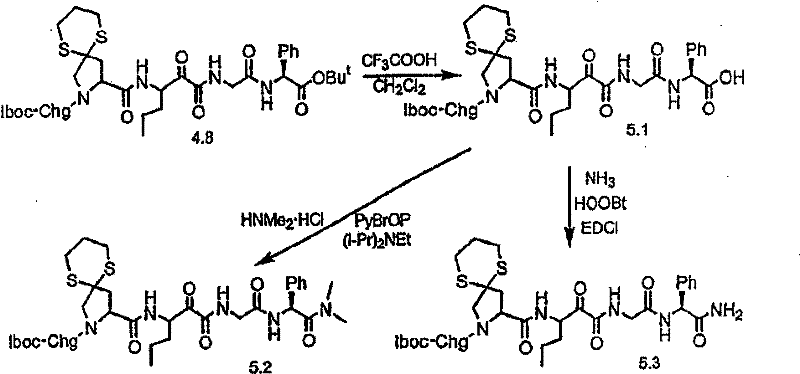
流程6Process 6
流程7Process 7
流程8Process 8
流程9Process 9
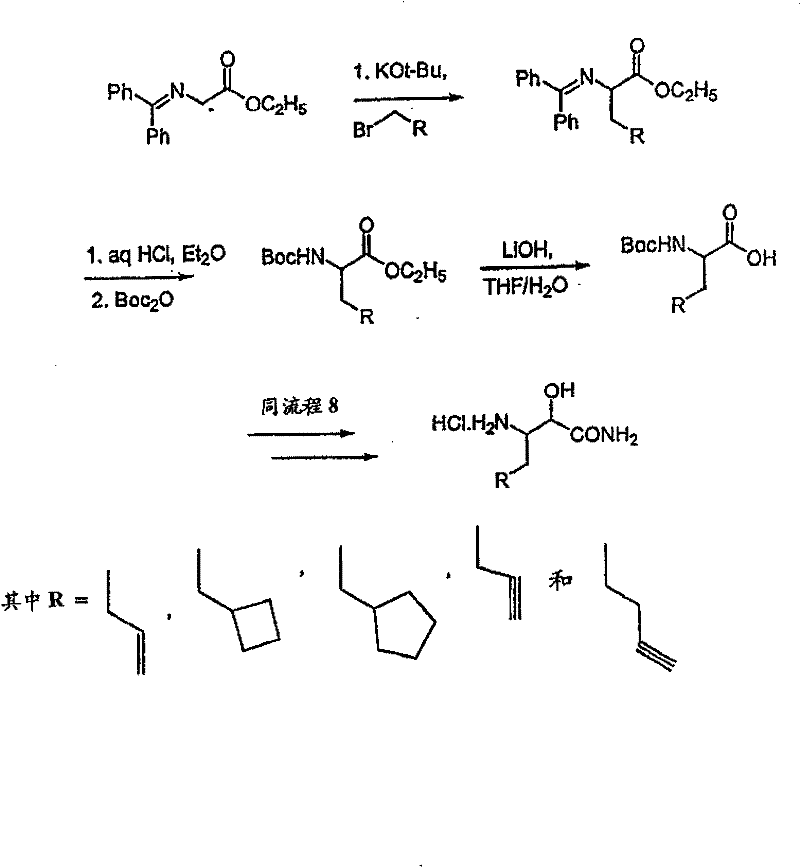
流程10Process 10
流程11Process 11

流程12Process 12

流程13Process 13

流程14Process 14
流程15Process 15

流程16Process 16
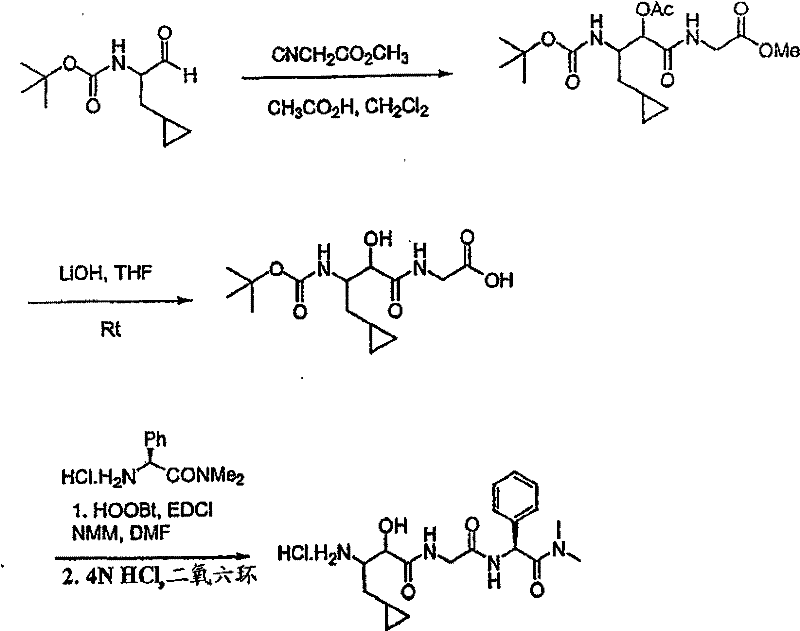
流程17Process 17

流程18Process 18
流程19Process 19
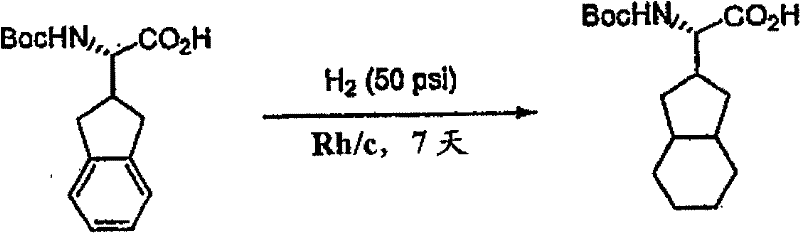
流程20Process 20
制备中间体:Preparation of intermediates:
制备实施例1Preparation Example 1
步骤A:化合物(1.1) Step A : Compound (1.1)
将化合物(1.08)(3.00g,12.0mmol;(S.L.Harbeson等J.Med.Chem.;37(18)1994;2918-2929;)的DMF(15mL)和CH2Cl2(15mL)溶液在-20℃搅拌下加入HOOBt(1.97g,12.0mmol)、N-甲基吗啉(4.0mL,36.0mmol)和EDCl(2.79g,14.5mmol),搅拌10分钟,然后加入HCl·H2N-Gly-OBn(2.56g,13.0mmol)。将所得溶液在-20℃搅拌2小时,冷藏保存过夜,然后浓缩至干,接着用EtOAc(150mL)稀释。将EtOAc溶液用饱和NaHCO3、H2O、5%H3PO4、盐水洗涤两次,用Na2SO4干燥,过滤,浓缩至干获得化合物(1.09)(4.5g,94%)。LRMSm/z MH+=395.1。 Compound (1.08) (3.00 g, 12.0 mmol; (SL Harbeson et al. J. Med. Chem.; 37 (18) 1994; 2918-2929; ) in DMF (15 mL) and CH 2 Cl 2 (15 mL) was dissolved at -20 HOOBt (1.97g, 12.0mmol), N-methylmorpholine (4.0mL, 36.0mmol) and EDCl (2.79g, 14.5mmol) were added under stirring at ℃, stirred for 10 minutes, then HCl·H 2 N-Gly- OBn (2.56g, 13.0mmol). The resulting solution was stirred at -20°C for 2 hours, stored in refrigerator overnight, then concentrated to dryness, and then diluted with EtOAc (150mL). The EtOAc solution was washed with saturated NaHCO 3 , H 2 O, 5 %H 3 PO 4 , washed twice with brine, dried over Na 2 SO 4 , filtered, and concentrated to dryness to obtain compound (1.09) (4.5 g, 94%). LRMS m/z MH + =395.1.
步骤B:化合物(1.1) Step B : Compound (1.1)
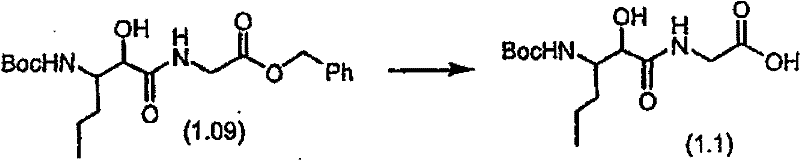
将化合物(1.09)(7.00g,17.8mmol)的无水乙醇(300mL)溶液在室温于氢气氛并存在Pd-C(300mg,10%)下搅拌。反应进度通过tlc监测。在2小时后,将混合物通过硅藻土垫过滤,所得溶液经真空浓缩获得化合物(1.1)(5.40g,定量)。LRMS m/z MH+=305.1。 A solution of compound (1.09) (7.00 g, 17.8 mmol) in absolute ethanol (300 mL) was stirred at room temperature under hydrogen atmosphere in the presence of Pd-C (300 mg, 10%). The progress of the reaction was monitored by tlc. After 2 hours, the mixture was filtered through a pad of celite, and the resulting solution was concentrated in vacuo to obtain compound (1.1) (5.40 g, quantitative). LRMS m/z MH + = 305.1.
制备实施例2Preparation Example 2
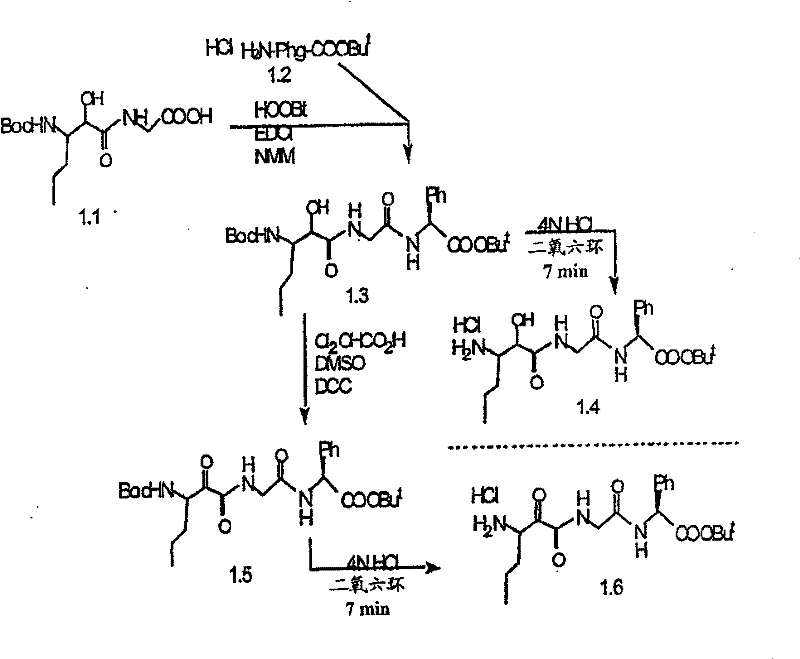
步骤A 化合物(1.3) Step A compound (1.3)
将以上制备实施例1步骤B的化合物(1.1)(1eq.)、化合物(1.2)(Novabiochem,第04-12-5147号)(1.03eq.)、HOOBt(1.03eq.)、N-甲基吗啉(2.2eq.)和二甲基甲酰胺(70mL/g)的混合物在-20℃搅拌。加入EDCl(1.04eq.),反应物搅拌48小时。将反应混合物倾入5%KH2PO4水溶液,用乙酸乙酯(2×)萃取。合并的有机物依次用5%K2CO3冷水溶液、5%KH2PO4水溶液、盐水洗涤,有机层用无水MgSO4干燥。过滤混合物,然后蒸发,真空干燥滤液,残余物用Et2O-己烷研磨,过滤获得标题化合物(1.3)(86%收率),C25H3N3O7(493.60),质谱(FAB)M+1=494.3。 Compound (1.1) (1eq.), compound (1.2) (Novabiochem, No. 04-12-5147) (1.03eq.), HOOBt (1.03eq.), N-methyl A mixture of morpholine (2.2 eq.) and dimethylformamide (70 mL/g) was stirred at -20 °C. EDCl (1.04 eq.) was added and the reaction was stirred for 48 hours. The reaction mixture was poured into 5% aqueous KH2PO4 and extracted with ethyl acetate (2x). The combined organics were washed successively with cold 5% K2CO3 aqueous solution, 5 % KH2PO4 aqueous solution, brine, and the organic layer was dried over anhydrous MgSO4 . The mixture was filtered, then evaporated, the filtrate was dried in vacuo, the residue was triturated with Et2O -hexane, and filtered to obtain the title compound (1.3) (86% yield), C25H3N3O7 ( 493.60 ), mass spectrum (FAB )M+1=494.3.
步骤B 化合物(1.4) Step B compound (1.4)

将制备实施例2步骤A的化合物(1.3)(3.0g)用4N HCl/二氧六环(36mL)处理,在室温下搅拌7分钟。将混合物倾入1.5L冷(5℃)己烷并搅拌,然后保持低温0.5小时。混合物在干燥空气中抽滤,将收集的固体进一步干燥获得标题化合物(1.4)(2.3g,88%收率), C20H31N3O5·HCl,H1NMR(DMSO-d6/NaOD)δ7.38(m,5H),5.25(m,1H),4.3-4.1(m,1H),3.8(m,2H),3.4-3.3(m,被D2O屏蔽),1.7-1.1(m,4H),1.35(s,9H),0.83(m,3H)。 Compound (1.3) (3.0 g) from Preparative Example 2, Step A was treated with 4N HCl/dioxane (36 mL) and stirred at room temperature for 7 minutes. The mixture was poured into 1.5 L of cold (5°C) hexane and stirred, then kept cold for 0.5 h. The mixture was suction filtered in dry air, and the collected solid was further dried to obtain the title compound (1.4) (2.3 g, 88% yield), C 20 H 31 N 3 O 5 ·HCl, H 1 NMR (DMSO-d 6 / NaOD) δ7.38(m, 5H), 5.25(m, 1H), 4.3-4.1(m, 1H), 3.8(m, 2H), 3.4-3.3(m, shielded by D2O ), 1.7-1.1 (m, 4H), 1.35 (s, 9H), 0.83 (m, 3H).
制备实施例3Preparation Example 3
化合物(1.5)Compound (1.5)

制备实施例2步骤A的化合物(1.3)按照以下制备实施例7步骤A基本相同的方法获得化合物(1.5)。 Compound (1.3) in Step A of Preparation Example 2 Compound (1.5) was obtained in substantially the same manner as Step A of Preparation Example 7 below. the
制备实施例4Preparation Example 4
化合物(1.6)Compound (1.6)
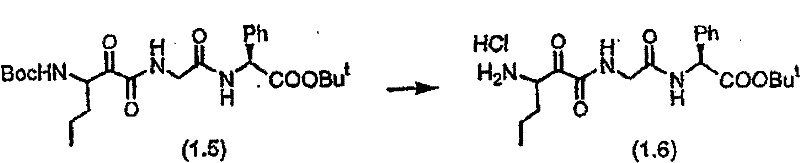
制备实施例3的化合物(1.5)按照制备实施例2步骤B基本相同的方法处理获得化合物(1.6)。 Compound (1.5) of Preparation Example 3 was treated in substantially the same manner as Step B of Preparation Example 2 to obtain Compound (1.6). the
制备实施例5Preparation Example 5
步骤A 化合物(2.09) Step A compound (2.09)
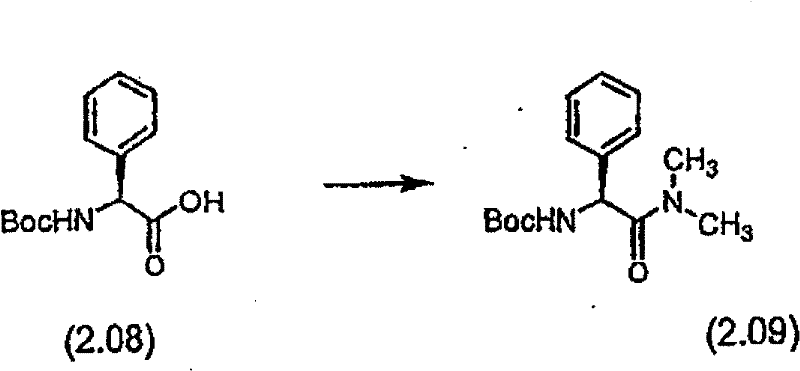
二甲胺盐酸盐(1.61g,19.7mmol)、N-Boc-苯基甘氨酸、化合物(2.08)(4.50g,17.9mmol,Bachem Co.#A-2225)、HOOBt(3.07g,18.8mmol)和EDCl(4.12g,21.5mmol)的无水DMF(200mL)和CH2Cl2(150mL)溶液在-20℃加入NMM(5.90mL,53.7mmol)。在上述温度搅拌30分钟后,将反应混合物保存在冰箱中过夜(18h)。然后加温至室温,加入EtOAc(450mL)、盐水(100mL)和5%H3PO4(100mL)。分出各层后,有机层用5%H3PO4(100mL)、饱和碳酸氢钠水溶液(2×150mL)、水(150mL)和盐水(150mL)洗涤,干燥(MgSO4),过滤,然后真空浓缩获得白色固体化合物(2.09)(4.86g),使用时无需再提纯。 Dimethylamine hydrochloride (1.61 g, 19.7 mmol), N-Boc-phenylglycine, compound (2.08) (4.50 g, 17.9 mmol, Bachem Co. #A-2225), HOOBt (3.07 g, 18.8 mmol) And a solution of EDCl (4.12 g, 21.5 mmol) in anhydrous DMF (200 mL) and CH2Cl2 (150 mL) was added NMM (5.90 mL , 53.7 mmol) at -20 °C. After stirring at the above temperature for 30 minutes, the reaction mixture was kept in the refrigerator overnight (18h). After warming to room temperature, EtOAc (450 mL), brine (100 mL) and 5% H3PO4 (100 mL ) were added. After separation of the layers, the organic layer was washed with 5% H 3 PO 4 (100 mL), saturated aqueous sodium bicarbonate (2×150 mL), water (150 mL) and brine (150 mL), dried (MgSO 4 ), filtered, and Concentration in vacuo afforded compound (2.09) (4.86 g) as a white solid, which was used without further purification.
步骤B 化合物(2.1) Step B compound (2.1)
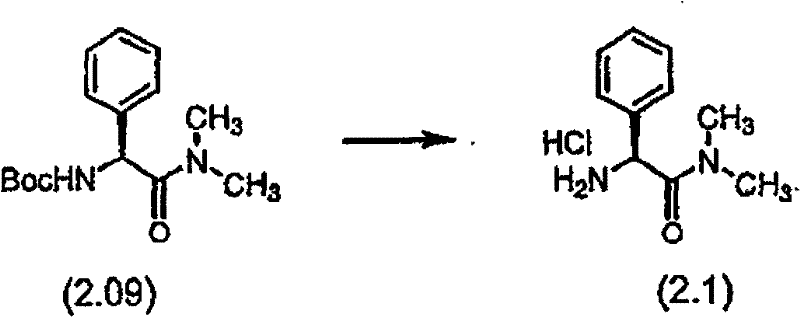
将制备实施例5步骤A的化合物(2.09)(4.70g,粗品)溶于4N HCl(60mL,240mmol),所得溶液在室温下搅拌。反应进度通过TLC监测。4小时后,真空浓缩上述溶液获得白色固体化合物(2.1),它在下 一步反应中直接使用无需再提纯。LRMS m/z MH+=179.0。 Compound (2.09) (4.70 g, crude product) of Preparative Example 5 Step A was dissolved in 4N HCl (60 mL, 240 mmol), and the resulting solution was stirred at room temperature. The progress of the reaction was monitored by TLC. After 4 hours, the above solution was concentrated in vacuo to obtain white solid compound (2.1), which was used directly in the next reaction without further purification. LRMS m/z MH + = 179.0.
制备实施例6Preparation Example 6
步骤A 化合物(2.2) Step A compound (2.2)

按照制备实施例2步骤A基本相同的方法,用苯基甘氨酸N,N-二甲基酰胺盐酸盐代替苯基甘氨酸叔丁酯盐酸盐制备化合物(2.2)。质谱(FAB)M+1=465.3。 Compound (2.2) was prepared by substantially the same method as Step A of Preparation Example 2, substituting phenylglycine N,N-dimethylamide hydrochloride for phenylglycine tert-butyl ester hydrochloride. Mass spectrum (FAB) M+1 = 465.3. the
步骤B 化合物(2.3) Step B compound (2.3)

使步骤A的化合物(2.2)(1.85g)与4N HCl/二氧六环(50mL)在室温下反应1小时。混合物在20℃水浴中真空蒸发,用异丙醚研磨,过滤,干燥获得化合物(2.3)(1.57g,98%收率),C18H28N4O4·HCl,质谱。(FAB)M+1=365.3 Compound (2.2) (1.85 g) from Step A was reacted with 4N HCl/dioxane (50 mL) at room temperature for 1 hour. The mixture was evaporated under vacuum in a 20°C water bath, triturated with isopropyl ether, filtered, and dried to obtain compound (2.3) (1.57 g, 98% yield), C 18 H 28 N 4 O 4 ·HCl, mass spectrum. (FAB)M+1=365.3
制备实施例7Preparation Example 7
步骤A 化合物(2.4) Step A compound (2.4)

将制备实施例5步骤A的化合物(2.2)(2.0g)的二氯甲烷(60mL)溶液用二甲基亚砜(3.0mL)和2,2-二氯乙酸(0.70mL)处理。混合物在搅拌下冷却至5℃,然后加入1M二环己基碳二亚胺/二氯甲烷溶液(8.5mL)。除去冷却浴,搅拌混合物22小时。然后加入2-丙醇(0.5mL),再搅拌1小时。过滤混合物,依次用冰冷的0.IN NaOH(50mL)、冰冷的0.1N HCl(50mL)、5%KH2PO4水溶液、饱和盐水洗涤。有机溶液用无水硫酸镁干燥,然后过滤。蒸发滤液,然后在硅胶上用色谱法提纯,用乙酸乙酯洗脱获得化合物(2.3)(1.87g,94%收率),C23H34N4O6,质谱(FAB)M+1=463.3。 A solution of compound (2.2) (2.0 g) from Preparative Example 5, Step A in dichloromethane (60 mL) was treated with dimethylsulfoxide (3.0 mL) and 2,2-dichloroacetic acid (0.70 mL). The mixture was cooled to 5°C with stirring, and then a 1M dicyclohexylcarbodiimide/dichloromethane solution (8.5 mL) was added. The cooling bath was removed and the mixture was stirred for 22 hours. Then 2-propanol (0.5 mL) was added and stirred for an additional 1 hour. The mixture was filtered and washed successively with ice-cold 0.IN NaOH (50 mL), ice-cold 0.1N HCl (50 mL), 5% aqueous KH 2 PO 4 , and saturated brine. The organic solution was dried over anhydrous magnesium sulfate, and filtered. The filtrate was evaporated and purified by chromatography on silica gel eluting with ethyl acetate to obtain compound (2.3) (1.87 g, 94% yield), C 23 H 34 N 4 O 6 , mass spectrum (FAB) M+1= 463.3.
步骤B 化合物(2.5) Step B compound (2.5)

按照制备实施例2步骤B基本相同的方法制备化合物(2.5)。 Compound (2.5) was prepared in substantially the same manner as Step B of Preparation Example 2. the
制备实施例8Preparation Example 8
步骤A 化合物(3.1) Step A compound (3.1)

在烧瓶中混合N-Cbz-羟脯氨酸甲酯(Bachem Biosciences,Incorporated,King of Prussia,Pennsylvania)、化合物(3.01)(3.0g)、甲苯(30mL)和乙酸乙酯(30mL)。将混合物剧烈地搅拌,然后加入NaBr/水溶液(1.28g/5mL)。向此溶液加入2,2,6,6-四甲基-1-哌啶氧基自由基(TEMPO,17mg,Aldrich Chemicals,Milwaukee,Wisconsin)。混合物在搅拌下冷却至5℃,然后在0.5小时内滴加制备好的氧化剂溶液[用商业上可得到的漂白剂 
步骤B 化合物(3.2) Step B compound (3.2)
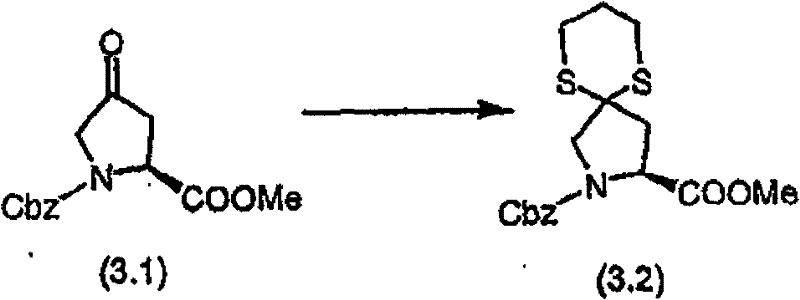
将上述步骤A的化合物(3.1)(7.8g)溶于二氯甲烷(100mL),冷却至15℃。在混合物中先加入1,3-丙二硫醇(3.1mL),接着加入新蒸馏的醚合三氟化硼(3.7mL)。将混合物在室温下搅拌18小时。在剧烈搅拌的同时,小心地加入K2CO3/水溶液(2g/30mL),接着加入饱和NaHCO3(10mL)。将有机层从水层(pH~7.4)分出,依次用水(10mL),盐水洗涤。有机溶液用无水MgSO4干燥,过滤,真空蒸发。残余物在硅胶上用色谱法提纯,洗脱时先用甲苯,再用梯度的己烷-Et2O(2∶3至0∶1)获得褐色油状物(7.0g,68%收率),C17H21NO4S2(367.48),质谱(FAB)M+1=368.1。 The compound (3.1) (7.8 g) of the above Step A was dissolved in dichloromethane (100 mL), and cooled to 15°C. 1,3-Propanedithiol (3.1 mL) was added to the mixture first, followed by freshly distilled boron trifluoride etherate (3.7 mL). The mixture was stirred at room temperature for 18 hours. While stirring vigorously, K 2 CO 3 /water solution (2 g/30 mL) was added carefully, followed by saturated NaHCO 3 (10 mL). The organic layer was separated from the aqueous layer (pH~7.4), washed with water (10 mL), then brine. The organic solution was dried over anhydrous MgSO4 , filtered and evaporated in vacuo. The residue was purified by chromatography on silica gel with toluene followed by a gradient of hexane- Et2O (2:3 to 0:1) to afford a brown oil (7.0 g, 68% yield), C17H21NO4S2 ( 367.48 ), mass spectrum ( FAB ) M+1 = 368.1.
步骤C 化合物(3.3) Step C compound (3.3)
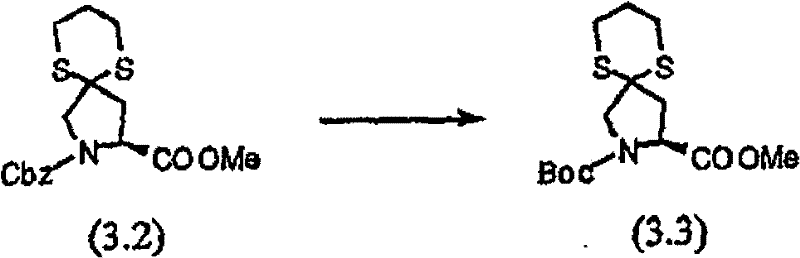
将以上步骤B的化合物(3.2)(45g)的乙腈(800mL)溶液立刻在20℃用新蒸馏的碘代三甲基硅烷(53mL)处理。将反应物搅拌30分钟,然后倾入新制备的二碳酸二叔丁酯(107g)、乙醚(150mL)和二异丙基乙胺(66.5mL)溶液。将混合物再搅拌30分钟,然后用己烷(2×500mL)洗涤。将乙酸乙酯(1000mL)加入下面的乙腈层,然后将此层用10%KH2PO4水溶液(2×700mL)和盐水洗涤。滤液在25℃的水浴中真空蒸发,再溶解于新的乙酸乙酯(1000mL),然后依次用0.1N HCl、0.1NNaOH、10%KH2PO4和盐水洗涤。有机溶液用无水MgSO4干燥,过滤,真空蒸发。残余物(66g)在硅胶(2kg)上用色谱法提纯,洗脱时先用己烷(2L),然后用Et2O/己烷(55∶45,2L),再用Et2O(2L)洗脱,获 得橙色树胶,它在放置时缓慢地结晶(28g,69%收率),C14H23NO4S2(333.46),质谱(FAB)M+1=334.1。 A solution of compound (3.2) (45 g) from Step B above in acetonitrile (800 mL) was immediately treated at 20°C with freshly distilled iodotrimethylsilane (53 mL). The reaction was stirred for 30 minutes then poured into a freshly prepared solution of di-tert-butyl dicarbonate (107 g), diethyl ether (150 mL) and diisopropylethylamine (66.5 mL). The mixture was stirred for an additional 30 minutes, then washed with hexanes (2 x 500 mL). Ethyl acetate (1000 mL) was added to the lower acetonitrile layer, then this layer was washed with 10% aqueous KH2PO4 (2 x 700 mL) and brine. The filtrate was evaporated in vacuo in a water bath at 25°C, redissolved in fresh ethyl acetate (1000 mL), and washed sequentially with 0.1N HCl, 0.1N NaOH, 10% KH2PO4 and brine . The organic solution was dried over anhydrous MgSO4 , filtered and evaporated in vacuo. The residue (66g) was purified by chromatography on silica gel (2kg), eluting with hexane (2L), then Et2O /hexane (55:45, 2L), then Et2O (2L ) to obtain an orange gum that crystallized slowly on standing (28 g, 69% yield), C 14 H 23 NO 4 S 2 (333.46), mass spectrum (FAB) M+1 = 334.1.
步骤D 化合物(3.4) Step D compound (3.4)
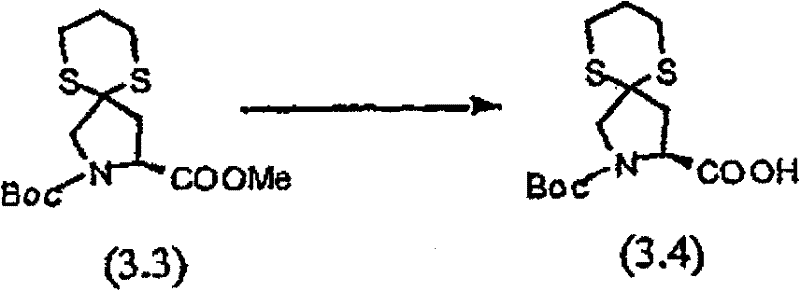
以上步骤C的化合物(3.3)(11g)的二氧六环(150mL)溶液在20℃用1N LiOH水溶液(47mL)处理,搅拌30小时。在30℃水浴中真空浓缩混合物至一半的体积。将残留物用水(300mL)稀释,用Et2O(2×200mL)萃取。将水层用12N HCl(3-4mL)酸化至pH~4,用乙酸乙酯萃取,然后用盐水洗涤。有机溶液用无水MgSO4干燥,过滤,然后真空蒸发获得化合物(3.4)(8.1g,78%),C13H21NO4S2(319.44),质谱(FAB)M+1=320.1。 A solution of compound (3.3) (11 g) from Step C above in dioxane (150 mL) was treated with 1N aqueous LiOH (47 mL) at 20°C and stirred for 30 hours. The mixture was concentrated in vacuo to half volume in a 30°C water bath. The residue was diluted with water (300 mL), extracted with Et2O (2 x 200 mL). The aqueous layer was acidified with 12N HCl (3-4 mL) to pH~4, extracted with ethyl acetate, then washed with brine. The organic solution was dried over anhydrous MgSO 4 , filtered, and evaporated in vacuo to obtain compound (3.4) (8.1 g, 78%), C 13 H 21 NO 4 S 2 (319.44), mass spectrum (FAB) M+1 = 320.1.
步骤E 化合物(3.5) Step E compound (3.5)

在以上步骤C的化合物(3.3)(1g)的二氧六环(5mL)溶液中加入4N HCl-二氧六环溶液(50mL)。将混合物剧烈地搅拌1小时。在25℃的水浴中真空蒸发混合物。残余物用Et2O研磨,然后过滤获得标题化合物(0.76g,93%收率),C9H15NO2S2·HCl(269.81),质谱(FAB)M+1=234.0。 To a solution of compound (3.3) (1 g) from Step C above in dioxane (5 mL) was added 4N HCl-dioxane solution (50 mL). The mixture was stirred vigorously for 1 hour. The mixture was evaporated under vacuum in a water bath at 25°C. The residue was triturated with Et2O , then filtered to obtain the title compound (0.76 g, 93% yield), C 9 H 15 NO 2 S 2 ·HCl (269.81), mass spectrum (FAB) M+1 = 234.0.
制备实施例9Preparation Example 9
步骤A 化合物(3.6) Step A compound (3.6)

按照制备实施例8步骤B的基本相同的方法,用乙烷二硫醇代替丙烷二硫醇,获得化合物(3.6)。 Following substantially the same procedure as in Step B of Preparative Example 8, substituting ethaneedithiol for propaneedithiol, compound (3.6) was obtained. the
步骤B 化合物(3.7) Step B compound (3.7)

按照制备实施例8步骤C的基本相同的方法,用化合物(3.6)代替化合物(3.2),获得产物化合物(3.7)。 Following substantially the same procedure as in Step C of Preparative Example 8, substituting compound (3.6) for compound (3.2), the product compound (3.7) was obtained. the
步骤C 化合物(3.8) Step C compound (3.8)

按照制备实施例8步骤D的基本相同的方法,用化合物(3.7)代替化合物(3.3),获得产物化合物(3.8)。 Following substantially the same procedure as in Step D of Preparative Example 8, substituting compound (3.7) for compound (3.3), the product compound (3.8) was obtained. the
步骤D 化合物(3.9) Step D compound (3.9)

按照制备实施例8步骤E的基本相同的方法,用化合物(3.7)代替化合物(3.3)获得产物化合物(3.9)。 Following substantially the same method as in Step E of Preparative Example 8, substituting compound (3.7) for compound (3.3), the product compound (3.9) was obtained. the
制备实施例10Preparation Example 10
步骤A 化合物(4.1) Step A compound (4.1)
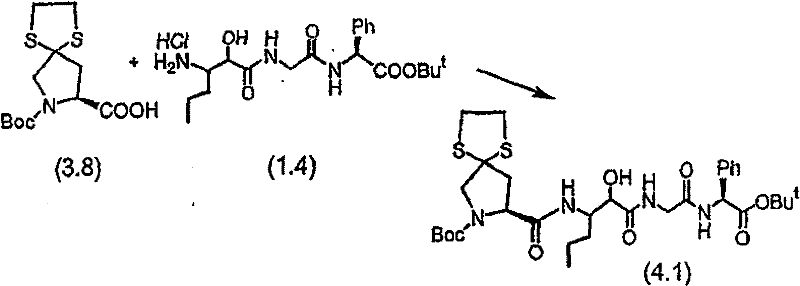
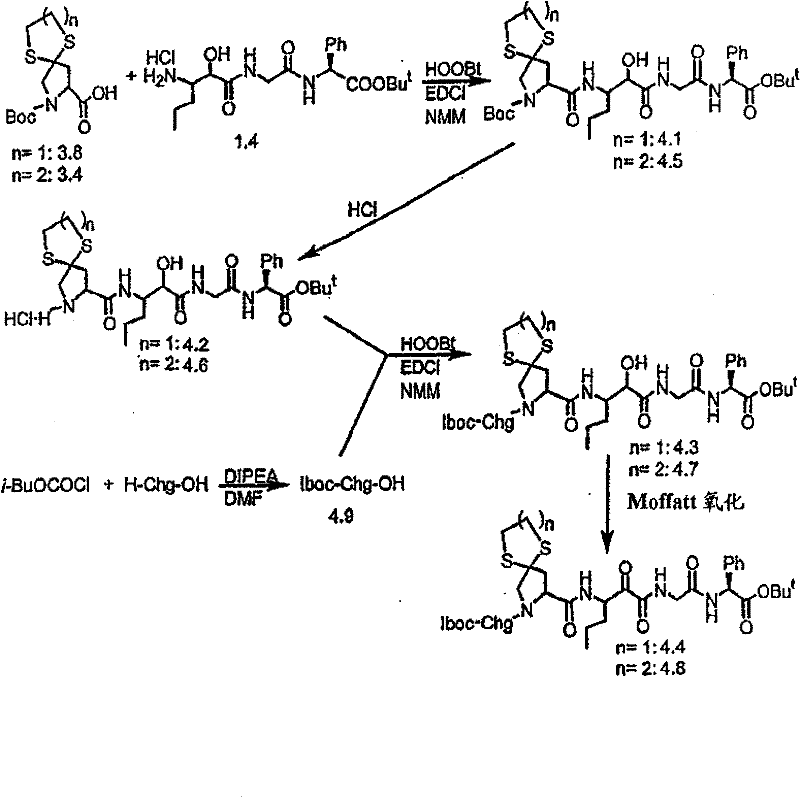
按照制备实施例2步骤A的基本相同的方法制备化合物(4.1)C33H48N4O9S2(708.89)。 Compound (4.1) C 33 H 48 N 4 O 9 S 2 (708.89) was prepared in substantially the same manner as in Step A of Preparative Example 2.
步骤B 化合物(4.2) Step B compound (4.2)
按照制备实施例2步骤B的基本相同的方法制备化合物(4.2),质谱(FAB)M+1=609.3。 Compound (4.2) was prepared in substantially the same manner as in Step B of Preparation Example 2, mass spectrum (FAB) M+1 = 609.3. the
步骤C 化合物(4.3) Step C compound (4.3)
按照制备实施例2步骤A的基本相同的方法制备化合物(4.3),C41H61N5O10S2(708.89),质谱(FAB)M+1=709.3。 Compound (4.3) was prepared in substantially the same manner as Step A of Preparation Example 2, C 41 H 61 N 5 O 10 S 2 (708.89), mass spectrum (FAB) M+1=709.3.
步骤D 化合物(4.4) Step D compound (4.4)

按照制备实施例7步骤A的基本相同的方法制备化合物(4.4)。 Compound (4.4) was prepared in substantially the same manner as in Step A of Preparative Example 7. the
制备实施例11 Preparation Example 11
步骤A 化合物(4.5) Step A compound (4.5)

按照制备实施例2步骤A的基本相同的方法制备化合物(4.5)。 Compound (4.5) was prepared in substantially the same manner as in Step A of Preparation Example 2. the
步骤B 化合物(4.6) Step B compound (4.6)

按照制备实施例2步骤B的基本相同的方法制备化合物(4.6)。 Compound (4.6) was prepared in substantially the same manner as in Step B of Preparation Example 2. the
步骤C 化合物(4.7) Step C compound (4.7)
按照制备实施例2步骤A的基本相同的方法,使制备实施例12的化合物(4.9)与以上步骤B的化合物(4.6)反应获得化合物(4.7)。 Compound (4.7) was obtained by reacting compound (4.9) of Preparation Example 12 with compound (4.6) of Step B above in substantially the same manner as in Step A of Preparation Example 2. the
步骤D 化合物(4.8) Step D compound (4.8)

按照制备实施例7步骤A基本相同的方法制备化合物(4.8)。 Compound (4.8) was prepared in substantially the same manner as Step A of Preparation Example 7. the
制备实施例12Preparation Example 12
化合物(4.9)Compound (4.9)
i-BuOCOCl+H-Chg-OH→Iboc-Chg-OH i-BuOCOCl+H-Chg-OH→Iboc-Chg-OH
(4.01) (4.02) (4.9) (4.01) (4.02) (4.9)
L-环己基甘氨酸(4.02)(1.0eq.)、二甲基甲酰胺(20mL/g)和二异丙基乙胺(1.1eq.)的溶液在5℃用氯甲酸异丁酯(4.01)(1.1eq.)处理。除去冷却浴,将其搅拌6小时。将反应混合物倾入5%KH2PO4水溶液,用乙酸乙酯(2×)萃取。合并的有机层依次用5%K2CO3冷水溶液、5%KH2PO4水溶液、盐水洗涤,将有机层用无水MgSO4干燥。过滤混合物,真空蒸发滤液,如果需要残余物用色谱法提纯,否则残余物用Et2O-己烷研磨,过滤获得标题化合物(4.9),C13H23NO4(257.33)。 A solution of L-cyclohexylglycine (4.02) (1.0eq.), dimethylformamide (20mL/g) and diisopropylethylamine (1.1eq.) was added at 5°C with isobutyl chloroformate (4.01) (1.1 eq.) processing. The cooling bath was removed and it was stirred for 6 hours. The reaction mixture was poured into 5% aqueous KH2PO4 and extracted with ethyl acetate (2x). The combined organic layers were washed sequentially with cold 5% K2CO3 aqueous solution, 5 % KH2PO4 aqueous solution, brine, and the organic layer was dried over anhydrous MgSO4 . The mixture was filtered, the filtrate evaporated in vacuo and the residue purified by chromatography if necessary, otherwise triturated with Et2O -hexane and filtered to afford the title compound (4.9), C13H23NO4 ( 257.33 ).
制备实施例13Preparation Example 13
化合物(13.1)Compound (13.1)
i-BuOCOCl+H-Thr(Bzl)-OH→Iboc-Thr(Bzl)-OH i-BuOCOCl+H-Thr(Bzl)-OH→Iboc-Thr(Bzl)-OH
(4.01) (13.02) (13.1) (4.01) (13.02) (13.1)
按照制备实施例12基本相同的方法,用L-O-苄基苏氨酸(13.02)(Wang等,J.Chem.Soc.,Perkin Trans.1,(1997)No.5,621-624.)代替L-环己基甘氨酸(4.02)制备化合物(13.1)C16H23NO5(309.36),质谱(FAB)M+1=310.2。 According to the method substantially the same as Preparation Example 12, replace Compound (13.1) C 16 H 23 NO 5 (309.36) was prepared from L-cyclohexylglycine (4.02), mass spectrum (FAB) M+1=310.2.
制备实施例14Preparation Example 14

使制备实施例11步骤D的化合物(4.8)(1.0g)与无水三氟乙酸-二氯甲烷(1∶1,50mL)溶液反应2小时。将溶液用二甲苯(100mL)稀释,真空蒸发。将残余物用Et2O研磨,过滤获得标题化合物(5.1)(0.9g),C37H53N5O9S2(775.98),质谱(FAB)M+1=776.5。 Compound (4.8) (1.0 g) from Step D of Preparative Example 11 was reacted with anhydrous trifluoroacetic acid-dichloromethane (1:1, 50 mL) solution for 2 hours. The solution was diluted with xylene (100 mL) and evaporated in vacuo. The residue was triturated with Et2O and filtered to obtain the title compound (5.1) (0.9 g), C37H53N5O9S2 ( 775.98 ) , mass spectrum (FAB) M+ 1 = 776.5.
步骤B 化合物(5.2) Step B compound (5.2)
按照制备实施例2步骤A基本相同的方法,使化合物(5.1)与氨(0.5M 1,4-二氧六环溶液)反应获得标题化合物(5.2)C37H54N6O8S2(774.99),质谱(FAB)M+1=775.4。 According to the method substantially the same as Step A of Preparation Example 2, the compound (5.1) was reacted with ammonia (0.5M 1,4-dioxane solution) to obtain the title compound (5.2) C 37 H 54 N 6 O 8 S 2 ( 774.99), mass spectrum (FAB) M+1 = 775.4.
制备实施例15Preparation Example 15

将制备实施例14步骤A的化合物(5.1)(0.15g)、N,N-二甲胺(0.12mL的2M THF溶液)、二甲基甲酰胺(10mL)和PyBrOP偶合试剂(0.11g)的混合物冷却至5℃,然后加入二异丙基乙胺(DIEA或DIPEA,0.12mL)。混合物在低温搅拌1分钟,然后在室温下搅拌6小时。将反应混合物倾入5%H3PO4冷水溶液(50mL),用乙酸乙酯(2×)萃取。合并的有机层依次用5%K2CO3冷水溶液、5%KH2PO4水溶液、盐水洗涤。有机溶液用无水MgSO4干燥,过滤,真空蒸发。残余物在硅胶上用色谱法提纯,洗脱时用MeOH-CH2Cl2获得标题化合物(5.3),C39H58N6O8S2(803.05),质谱(FAB)M+1=803.5。 Compound (5.1) (0.15 g), N,N-dimethylamine (0.12 mL of 2M THF solution), dimethylformamide (10 mL) and PyBrOP coupling reagent (0.11 g) of Preparative Example 14 Step A were prepared The mixture was cooled to 5°C, then diisopropylethylamine (DIEA or DIPEA, 0.12 mL) was added. The mixture was stirred at low temperature for 1 minute, then at room temperature for 6 hours. The reaction mixture was poured into cold 5% H3PO4 in water (50 mL), extracted with ethyl acetate (2x). The combined organic layers were washed sequentially with cold 5% K2CO3 aqueous solution, 5 % KH2PO4 aqueous solution, and brine. The organic solution was dried over anhydrous MgSO4 , filtered and evaporated in vacuo. The residue was purified by chromatography on silica gel eluting with MeOH- CH2Cl2 to obtain the title compound ( 5.3), C39H58N6O8S2 (803.05 ) , mass spectrum ( FAB) M+1 = 803.5 .
制备实施例16Preparation Example 16
步骤A 化合物(6.2) Step A compound (6.2)
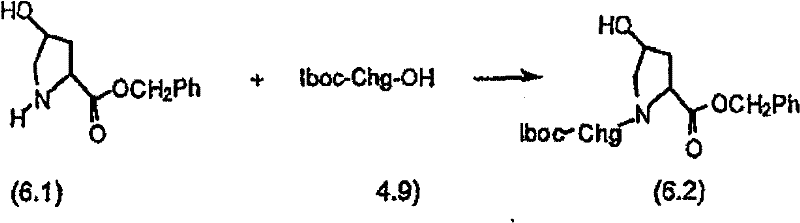
按照制备实施例2步骤A基本相同的方法,使化合物(6.1)羟脯氨酸苄酯盐酸盐与制备实施例12的化合物(4.9)反应获得标题化合物(6.2)C25H36N2O6(460.56),质谱(FAB)M+1=461.2。 According to the method basically the same as Step A of Preparation Example 2, the compound (6.1) hydroxyproline benzyl ester hydrochloride was reacted with the compound (4.9) of Preparation Example 12 to obtain the title compound (6.2) C 25 H 36 N 2 O 6 (460.56), mass spectrum (FAB) M+1 = 461.2.
步骤B 化合物(6.3) Step B compound (6.3)

按照制备实施例8基本相同的方法制备化合物(6.3)C25H34N2O6(458.55),质谱(FAB)M+1=459.2。 Compound (6.3) C 25 H 34 N 2 O 6 (458.55) was prepared in the same manner as in Preparation Example 8, mass spectrum (FAB) M+1 = 459.2.
步骤C 化合物(6.4) Step C compound (6.4)

将步骤B的化合物(6.3)(1g)、10%Pd/C(0.05g)和EtOH(100mL)的混合物在1个大气压H2气氛下搅拌6小时。将混合物过滤,然后真空蒸发至干,获得标题化合物(6.4)(0.77g),C18H28N2O6(368.42),质谱(FAB)M+1=369.2。 A mixture of compound (6.3) (1 g) from Step B, 10% Pd/C (0.05 g) and EtOH (100 mL) was stirred under 1 atm H2 atmosphere for 6 h. The mixture was filtered and then evaporated to dryness in vacuo to afford the title compound (6.4) (0.77 g), C 18 H 28 N 2 O 6 (368.42), mass spectrum (FAB) M+1 = 369.2.
制备实施例17Preparation Example 17
步骤A 化合物(7.1) Step A compound (7.1)

按照制备实施例2步骤A基本相同的方法,使制备实施例16步骤C的化合物(6.4)与制备实施例6步骤B的化合物(2.3)反应获得化合物(7.1),C36H54N6O9(714.85),质谱(FAB)M+1=715.9。 According to the method substantially the same as Step A of Preparation Example 2, the compound (6.4) in Step C of Preparation Example 16 was reacted with the compound (2.3) in Step B of Preparation Example 6 to obtain Compound (7.1), C 36 H 54 N 6 O 9 (714.85), mass spectrum (FAB) M+1 = 715.9.
步骤B 化合物(7.2) Step B compound (7.2)

化合物(7.1)按照制备实施例7步骤A的基本相同的方法反应获得化合物(7.2),C36H52N6O9(712.83),质谱(FAB)M+1=713.5。 Compound (7.1) was reacted in the same manner as in Step A of Preparation Example 7 to obtain compound (7.2), C 36 H 52 N 6 O 9 (712.83), mass spectrum (FAB) M+1=713.5.
步骤C 化合物(7.3) Step C compound (7.3)

以上步骤B的化合物(7.2)按照制备实施例8步骤B的基本相同的方法与1,4-丁二硫醇反应获得标题化合物(7.3),C40H60N6O8S2(817.07),质谱(FAB)M+1=817.5。 The compound (7.2) in Step B above was reacted with 1,4-butanedithiol in substantially the same manner as in Step B of Preparation Example 8 to obtain the title compound (7.3), C 40 H 60 N 6 O 8 S 2 (817.07) , mass spectrum (FAB) M+1 = 817.5.
利用上述方法制备附表2中的化合物。作为至此所有表格以及本说明书中的实施例和流程的总注释:在实施例和表格中化学结构化合价不够的任何开端氮原子是指NH,为末端氮时指-NH2。同样,在实施例和表中化合价不够的任何开端氧原子是指-OH。 Compounds in Table 2 were prepared using the methods described above. As a general note to all tables thus far and the examples and schemes in this specification: in the examples and tables any open nitrogen atom with insufficient valence of the chemical structure is referred to as NH and -NH2 when terminal nitrogen. Likewise, any terminal oxygen atom of insufficient valence is referred to in the Examples and Tables as -OH.
固相合成:Solid phase synthesis:
固相偶合反应的一般方法General Method for Solid Phase Coupling Reaction
合成是在反应容器中完成,容器由在底部装配有聚丙烯滤板(frit)的聚丙烯注射针筒构成。Fmoc-保护的氨基酸在标准固相技术下偶合。每个反应容器中装有100mg的初始Fmoc-Sieber树脂(大约0.03mmol)。树脂用每份2mL的DMF(2次)洗涤。用2mL 20%v/v的哌啶DMF溶液处理20分钟去除Fmoc保护基团。树脂用每份2mL的DMF(4次)洗涤。偶合在DMF(2mL)中完成,使用0.1mmol Fmoc-氨基酸、0.1mmol HATU[O-(7-氮杂苯并三唑-1-基)-1,1,3,3-四甲基脲 
固相Dess-Martin氧化的一般方法A General Method for Solid-Phase Dess-Martin Oxidation
合成是在反应容器中进行,容器由在底部装配有聚丙烯滤板的聚乙烯注射针筒构成。结合在树脂上的羟基化合物(大约0.03mmol)用0.12mmol Dess-Martin全碘烷(periodinane)和0.12mmol t-BuOH的2mL DCM溶液处理4小时。树脂用每份2mL的20%v/v iPrOH的DCM溶液、THF、50%v/v THF水溶液(4次)、THF(4次)和DCM(4次)洗涤。 The synthesis was carried out in a reaction vessel consisting of a polyethylene syringe fitted with a polypropylene filter plate at the bottom. The resin-bound hydroxyl compound (approximately 0.03 mmol) was treated with 0.12 mmol Dess-Martin periodinane and 0.12 mmol t-BuOH in 2 mL DCM for 4 hours. The resin was washed with 2 mL portions of 20% v/v iPrOH in DCM, THF, 50% v/v THF in water (4 times), THF (4 times) and DCM (4 times). the
制备实施例18Preparation Example 18
制备N-Fmoc-2’,3’-二甲氧基苯基甘氨酸 化合物(901) Preparation of N-Fmoc-2', 3'-dimethoxyphenylglycine compound (901)
氰化钾(1.465g,22.5mmol)和碳酸铵(5.045g,52.5mmol)的水(15mL)溶液中加入2,3-二甲氧基苯甲醛901A(2.5g,15mmol)的乙醇(15mL)溶液。将反应物混合物在40℃加热24小时。减压蒸发使溶液体 积减至10mL。加入浓盐酸(15mL),获得白色沉淀化合物901B。过滤分离出化合物901B(2.2g,9.3mmol)。将化合物901B溶于10%w/w氢氧化钠水溶液(15mL),所得溶液加热回流24小时。加入浓盐酸,调节pH值至中性(pH 7)。将所得包含化合物901C的溶液减压蒸发。将残余物溶于5%w/w碳酸氢钠水溶液(150mL)。溶液在冰浴中冷却至0℃,并在0℃加入1,4-二氧六环(30mL)和9-芴基甲基琥珀酰亚胺基碳酸酯(2.7g,8mmol)的1,4-二氧六环(30mL)溶液。将反应混合物加温至室温,在室温下搅拌24小时。减压蒸去1,4-二氧六环。用乙醚洗涤水溶液。加入浓盐酸调节pH值至酸性(pH 1)。加入乙酸乙酯,有机层用水和盐水洗涤。有机层用无水硫酸钠干燥。减压蒸去溶剂获得所需的白色泡沫状固体化合物901(3.44g,7.9mmol)。MS(LCMS-电喷雾)434.1MH+。 To a solution of potassium cyanide (1.465g, 22.5mmol) and ammonium carbonate (5.045g, 52.5mmol) in water (15mL) was added 2,3-dimethoxybenzaldehyde 901A (2.5g, 15mmol) in ethanol (15mL) solution. The reaction mixture was heated at 40 °C for 24 hours. Evaporation under reduced pressure reduced the volume of the solution to 10 mL. Concentrated hydrochloric acid (15 mL) was added to obtain compound 901B as a white precipitate. Compound 901B (2.2 g, 9.3 mmol) was isolated by filtration. Compound 901B was dissolved in 10% w/w aqueous sodium hydroxide solution (15 mL), and the resulting solution was heated to reflux for 24 hours. Concentrated hydrochloric acid was added to adjust the pH to neutral (pH 7). The resulting solution containing compound 901C was evaporated under reduced pressure. The residue was dissolved in 5% w/w aqueous sodium bicarbonate (150 mL). The solution was cooled to 0 °C in an ice bath, and a solution of 1,4-dioxane (30 mL) and 9-fluorenylmethylsuccinimidyl carbonate (2.7 g, 8 mmol) was added at 0 °C. - Dioxane (30 mL) solution. The reaction mixture was warmed to room temperature and stirred at room temperature for 24 hours. 1,4-Dioxane was distilled off under reduced pressure. The aqueous solution was washed with ether. Concentrated hydrochloric acid was added to adjust the pH to acidic (pH 1). Ethyl acetate was added and the organic layer was washed with water and brine. The organic layer was dried over anhydrous sodium sulfate. The solvent was distilled off under reduced pressure to obtain the desired compound 901 (3.44 g, 7.9 mmol) as a white foamy solid. MS (LCMS-electrospray) 434.1 MH + .
制备实施例19Preparation Example 19
化合物(801)Compound(801)
将N-Fmoc-苯基丙氨酸801A(5g,12.9mmol)的无水DCM(22mL)溶液在干冰-丙酮浴中冷却至-30℃,依次加入N-甲基吡咯烷(1.96mL,16.1mmol)和氯甲酸甲酯(1.2mL,15.5mmol)。反应混合物在-30 ℃搅拌1小时,加入N,O-二甲基羟胺盐酸盐(1.51g,15.5mol)和N-甲基吡咯烷(1.96mL,16.1mmol)的无水DCM(8mL)溶液。将反应混合物加温至室温,并在室温下搅拌过夜。加入甲苯,将有机层用稀盐酸、碳酸氢钠水溶液和盐水洗涤。有机层用无水硫酸钠干燥。减压蒸去溶剂获得化合物801B(4g,9.29mmol)。 A solution of N-Fmoc-phenylalanine 801A (5 g, 12.9 mmol) in anhydrous DCM (22 mL) was cooled to -30 ° C in a dry ice-acetone bath, and N-methylpyrrolidine (1.96 mL, 16.1 mmol) and methyl chloroformate (1.2 mL, 15.5 mmol). The reaction mixture was stirred at -30°C for 1 hour, N,O-dimethylhydroxylamine hydrochloride (1.51 g, 15.5 mol) and N-methylpyrrolidine (1.96 mL, 16.1 mmol) in anhydrous DCM (8 mL) were added solution. The reaction mixture was warmed to room temperature and stirred overnight at room temperature. Toluene was added, and the organic layer was washed with dilute hydrochloric acid, aqueous sodium bicarbonate and brine. The organic layer was dried over anhydrous sodium sulfate. The solvent was distilled off under reduced pressure to obtain compound 801B (4 g, 9.29 mmol). the
Red-Al(6.28mL,21.4mmol)的无水甲苯(8mL)溶液在干冰-丙酮浴中冷却至-20℃,加入化合物801B(4g,9.29mmol)的无水甲苯(12mL)溶液。将反应混合物在-20℃搅拌1.5小时。有机层用稀盐酸、碳酸氢钠水溶液和盐水洗涤。有机层用无水硫酸钠干燥。减压蒸去溶剂,粗产物801C在下一步反应直接使用无需再提纯。 A solution of Red-Al (6.28mL, 21.4mmol) in anhydrous toluene (8mL) was cooled to -20°C in a dry ice-acetone bath, and a solution of compound 801B (4g, 9.29mmol) in anhydrous toluene (12mL) was added. The reaction mixture was stirred at -20°C for 1.5 hours. The organic layer was washed with dilute hydrochloric acid, aqueous sodium bicarbonate and brine. The organic layer was dried over anhydrous sodium sulfate. The solvent was distilled off under reduced pressure, and the crude product 801C was directly used in the next reaction without further purification. the
化合物801C(大约9.29mmol)的己烷(15mL)溶液中依次加入氰化钾(24mg,0.37mmol)和叔丁基碘化铵(34mg,0.092mmol)的水(4mL)溶液以及丙酮合氰化氢(1.27mL,13.9mmol)。将反应混合物在室温下搅拌24小时。加入乙酸乙酯,有机层用水和盐水洗涤。有机层用无水硫酸钠干燥。减压蒸去溶剂获得化合物801D(2.4g,6.03mmol)。 Add potassium cyanide (24mg, 0.37mmol) and tert-butylammonium iodide (34mg, 0.092mmol) in water (4mL) solution and acetone cyanohydrin successively to the solution of compound 801C (about 9.29mmol) in hexane (15mL) Hydrogen (1.27 mL, 13.9 mmol). The reaction mixture was stirred at room temperature for 24 hours. Ethyl acetate was added and the organic layer was washed with water and brine. The organic layer was dried over anhydrous sodium sulfate. The solvent was distilled off under reduced pressure to obtain compound 801D (2.4 g, 6.03 mmol). the
化合物801D(2.4g,6.03mmol)的1,4-二氧六环(11mL)溶液中加入浓盐酸(11mL)。将反应混合物在80℃加热3小时。加入乙酸乙酯(25mL)和水(25mL)。有机层用盐水洗涤,用无水硫酸钠干燥。减压蒸去溶剂获得所需白色泡沫状固体化合物801(2g,4.8mmol)。MS(LCMS-电喷雾)418.1MH+。 To a solution of compound 801D (2.4 g, 6.03 mmol) in 1,4-dioxane (11 mL) was added concentrated hydrochloric acid (11 mL). The reaction mixture was heated at 80 °C for 3 hours. Ethyl acetate (25 mL) and water (25 mL) were added. The organic layer was washed with brine and dried over anhydrous sodium sulfate. The solvent was evaporated under reduced pressure to obtain the desired white foamy solid compound 801 (2 g, 4.8 mmol). MS (LCMS-electrospray) 418.1 MH + .
流程8Process 8

实施例(301J):Embodiment (301J):
流程8 化合物(301J) Scheme 8 compound (301J)

从100mg Fmoc-Sieber树脂(0.03mmol)开始,结合在树脂上的化合物301B、301C、301D、301E、301F和301G按照固相偶合反应的一般方法制备。按照固相Dess-Martin氧化的一般方法,将结合在树脂上的化合物301G氧化成结合在树脂上的化合物301H。将结合在树脂上的化合物301H用4mL 2%v/v TFA的DCM溶液处理5分钟。滤液加入到1mL AcOH中,将溶液真空离心浓缩获得化合物301J(0.0069g,29%收率)。MS(LCMS-电喷雾)771.2MH+。 Starting from 100 mg of Fmoc-Sieber resin (0.03 mmol), resin-bound compounds 301B, 301C, 301D, 301E, 301F and 301G were prepared following the general procedure for solid phase coupling reactions. Resin-bound compound 301G was oxidized to resin-bound compound 301H following the general procedure for solid phase Dess-Martin oxidation. Compound 301H bound to the resin was treated with 4 mL of 2% v/v TFA in DCM for 5 minutes. The filtrate was added to 1 mL of AcOH, and the solution was concentrated in vacuo to obtain compound 301J (0.0069 g, 29% yield). MS (LCMS-electrospray) 771.2 MH + .
利用上文详细说明的固相合成技术和以下式I化合物的各种官能团部分,制备表3中的化合物: The compounds in Table 3 were prepared using the solid phase synthesis technique detailed above and the various functional group moieties of the following compounds of formula I:

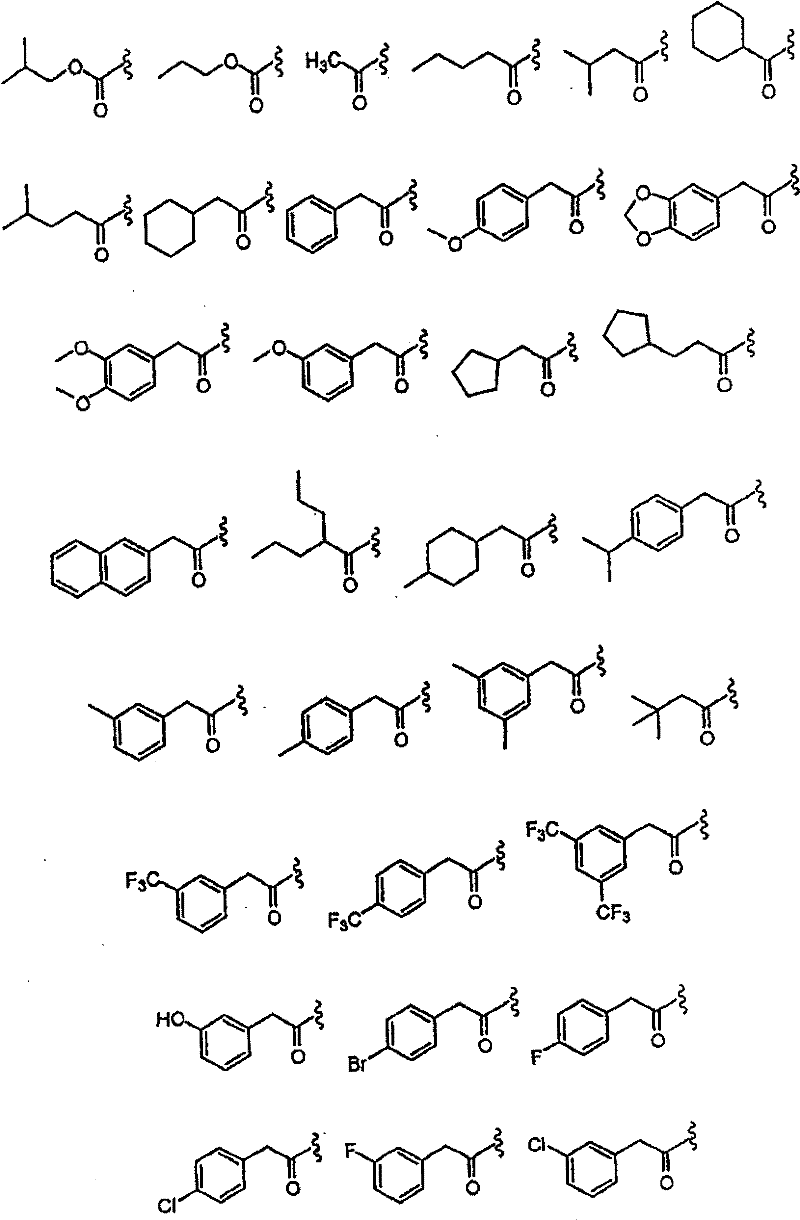


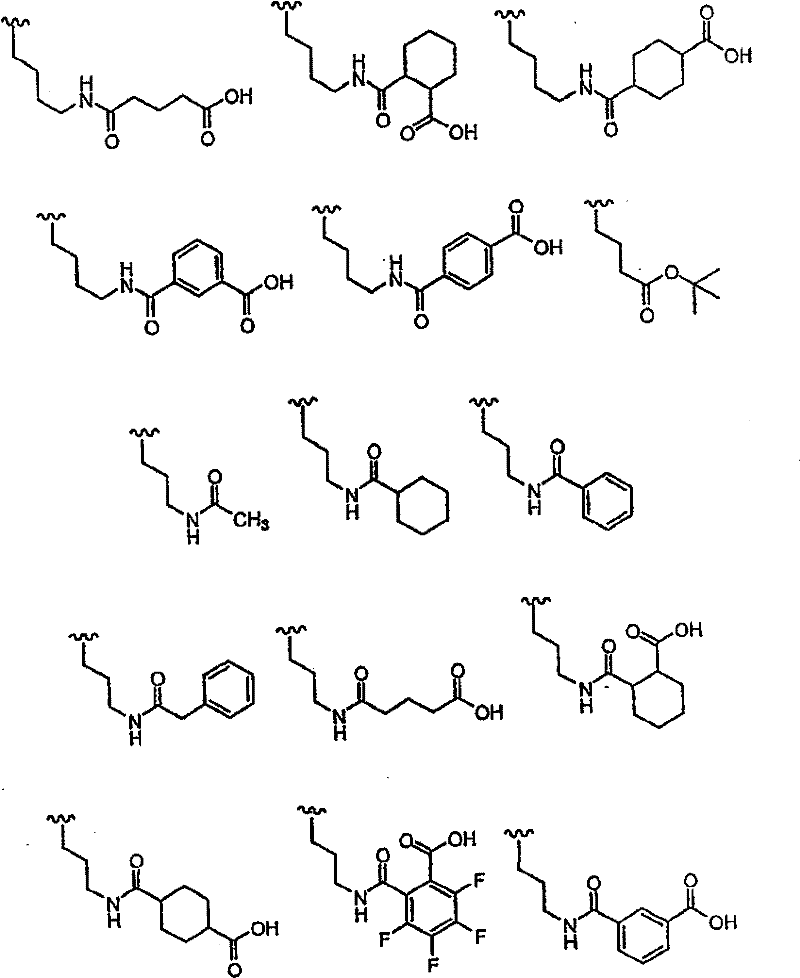
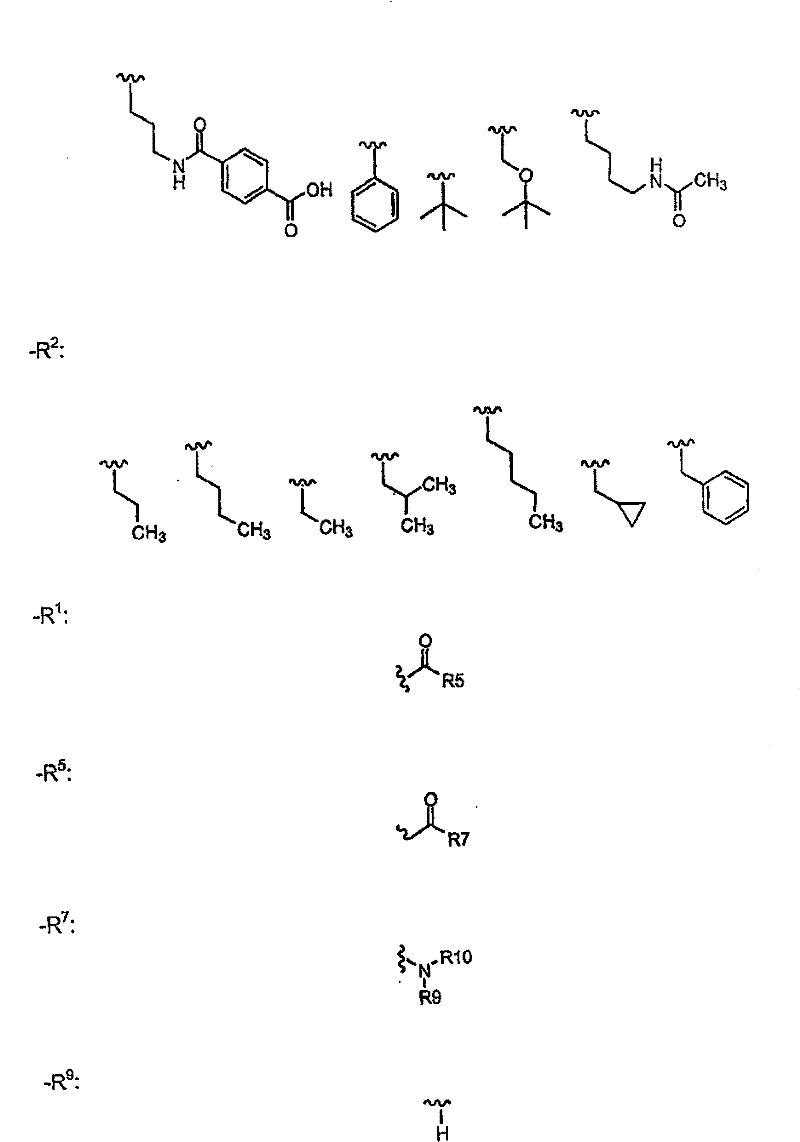


表3.固相合成制备的化合物Table 3. Compounds prepared by solid-phase synthesis
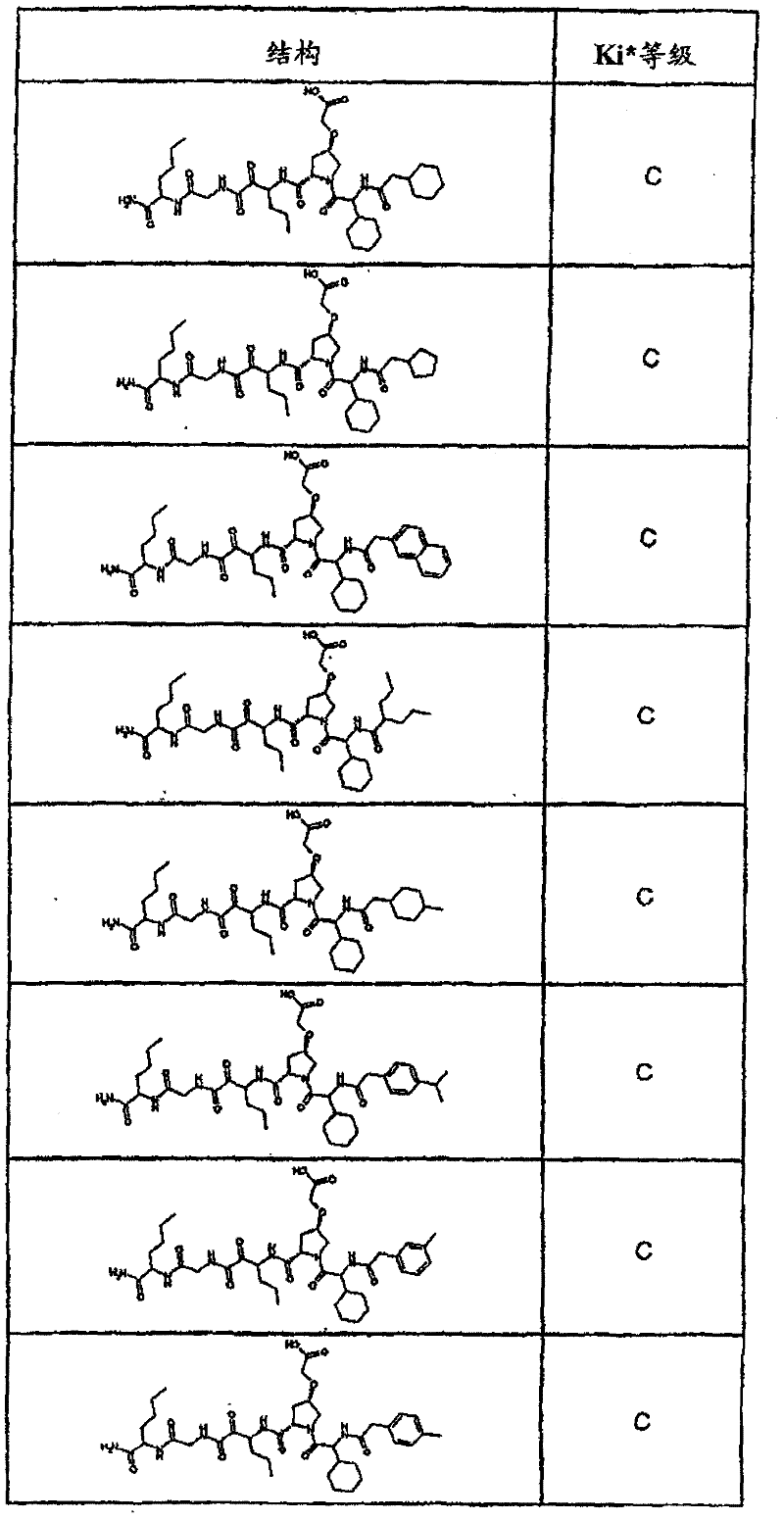

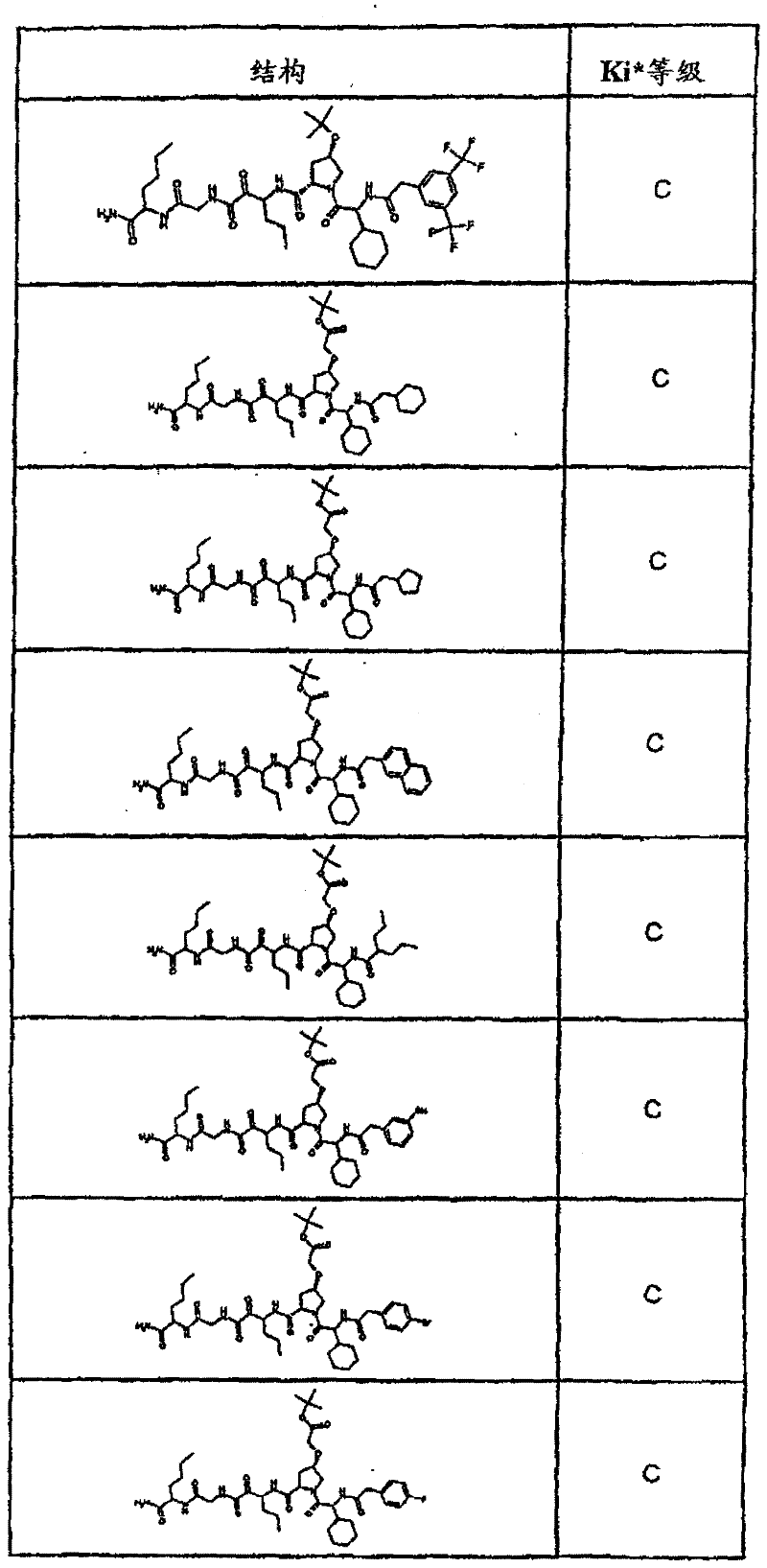
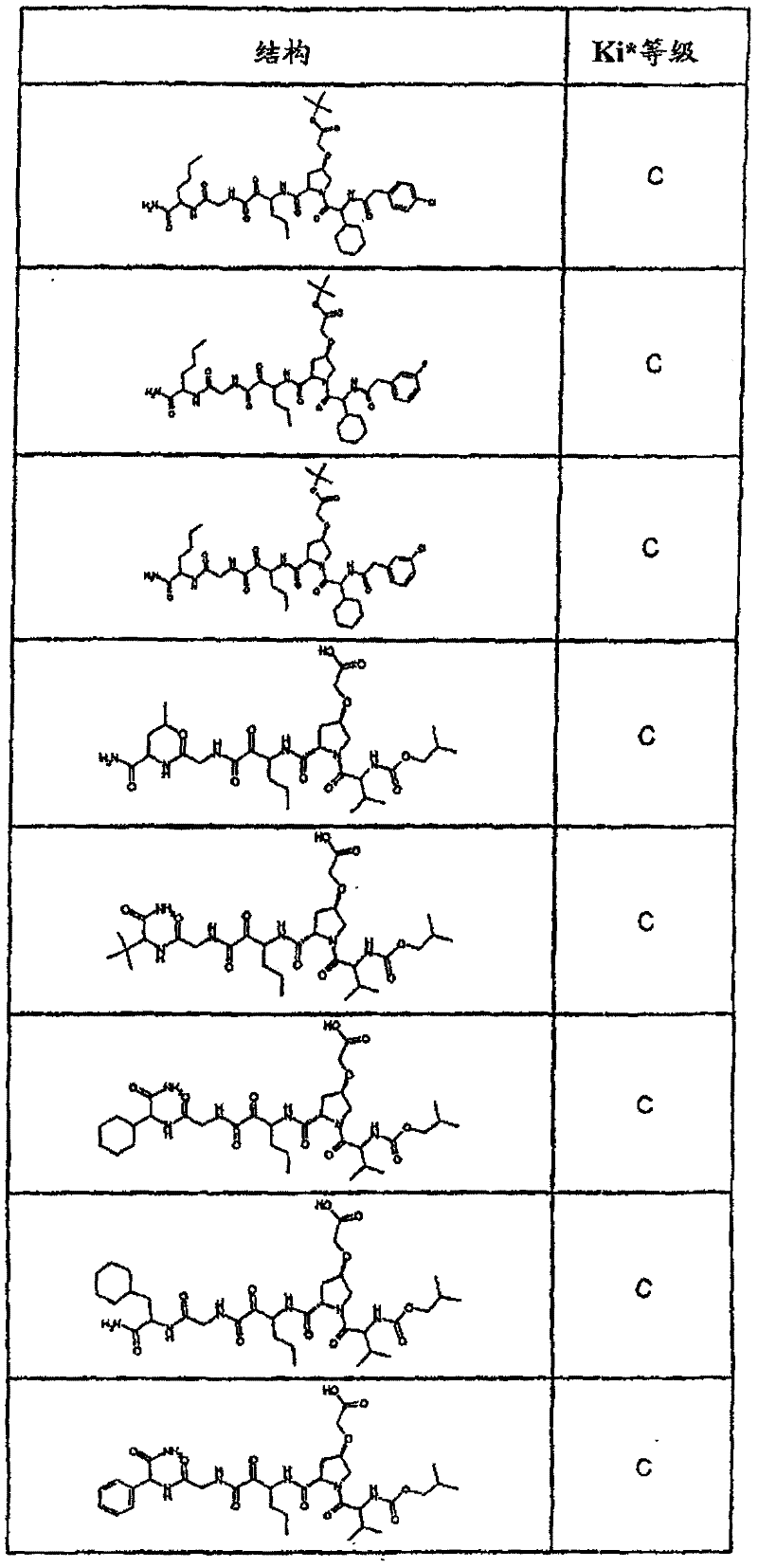


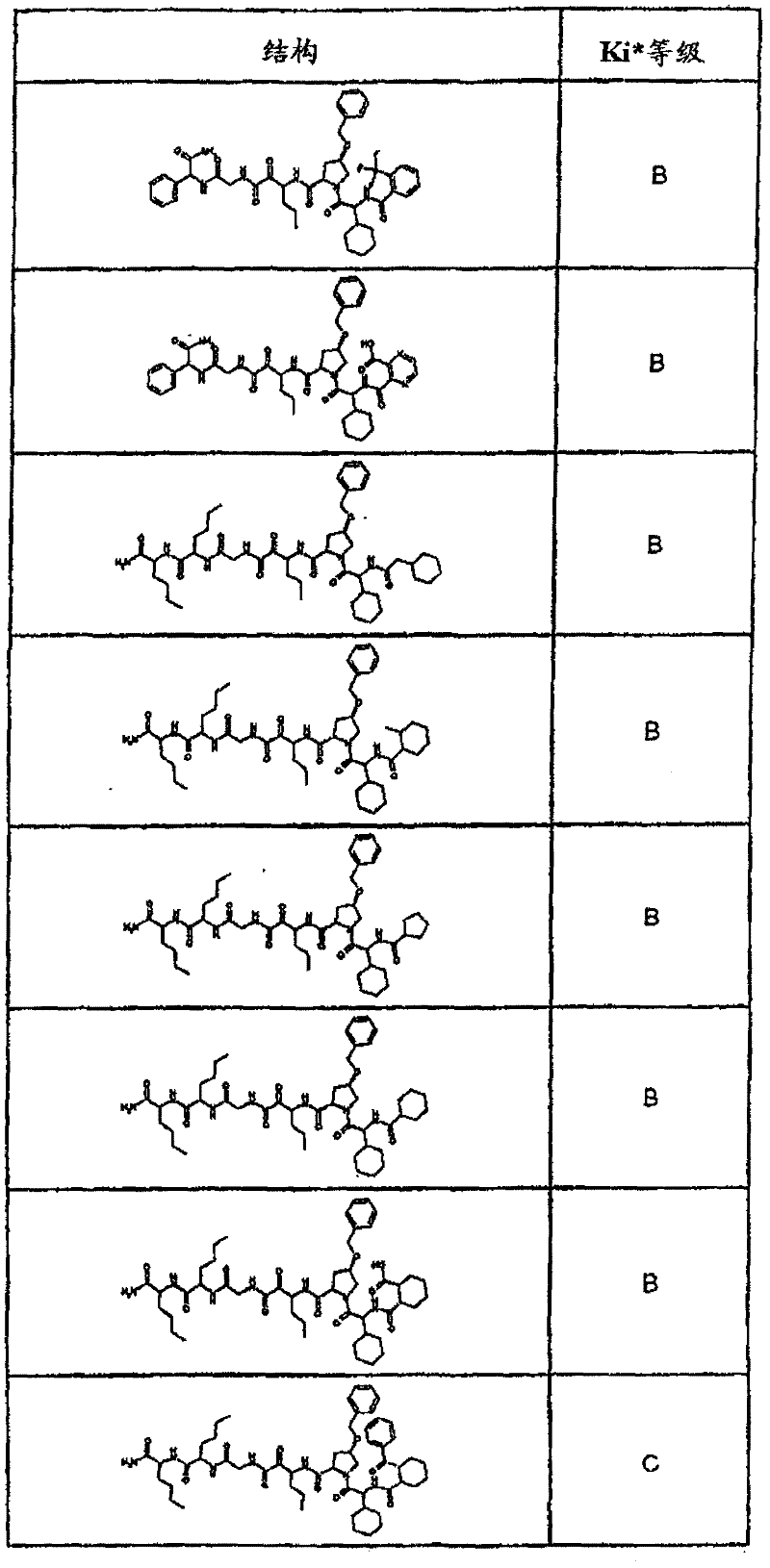

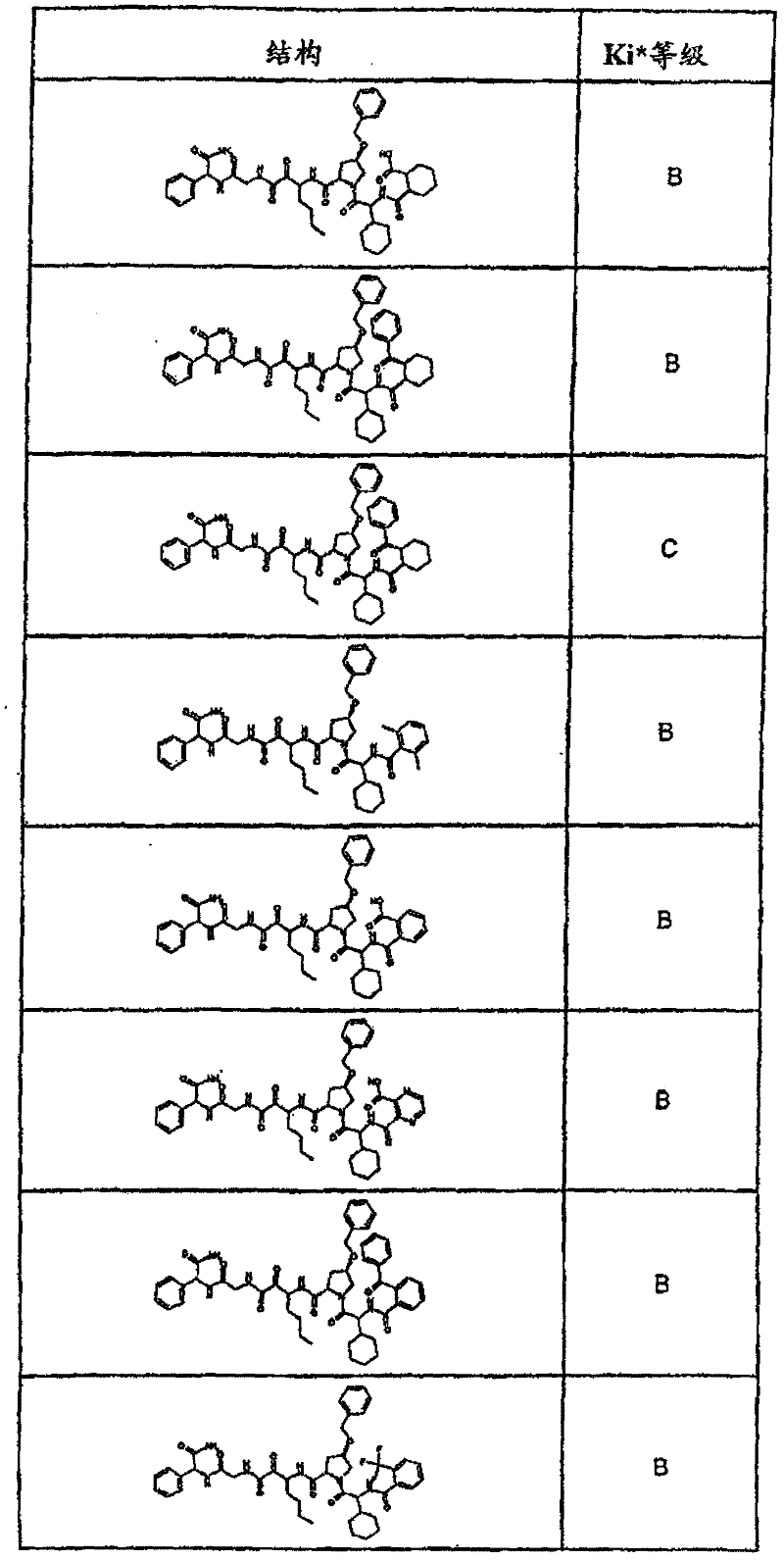


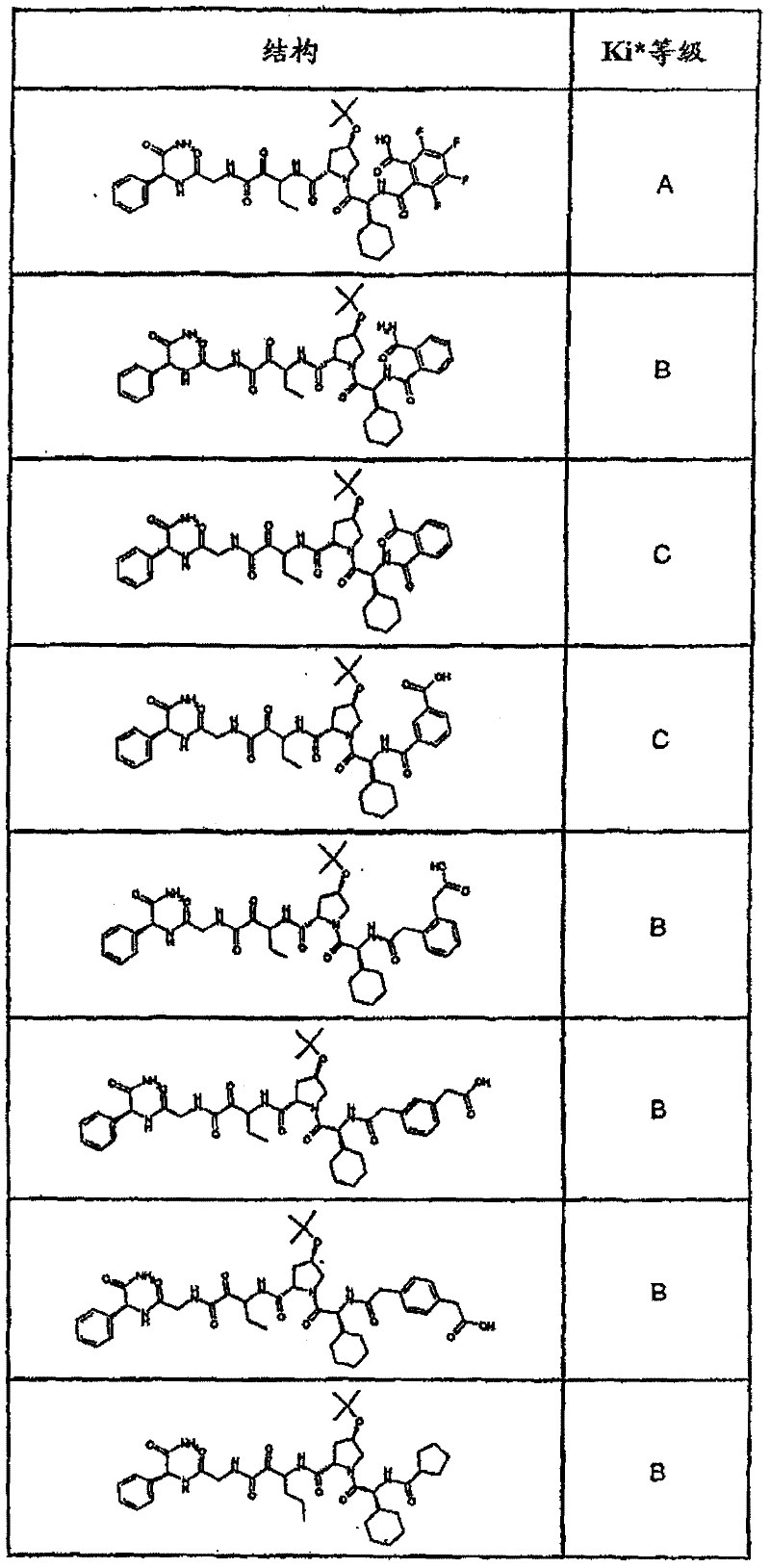


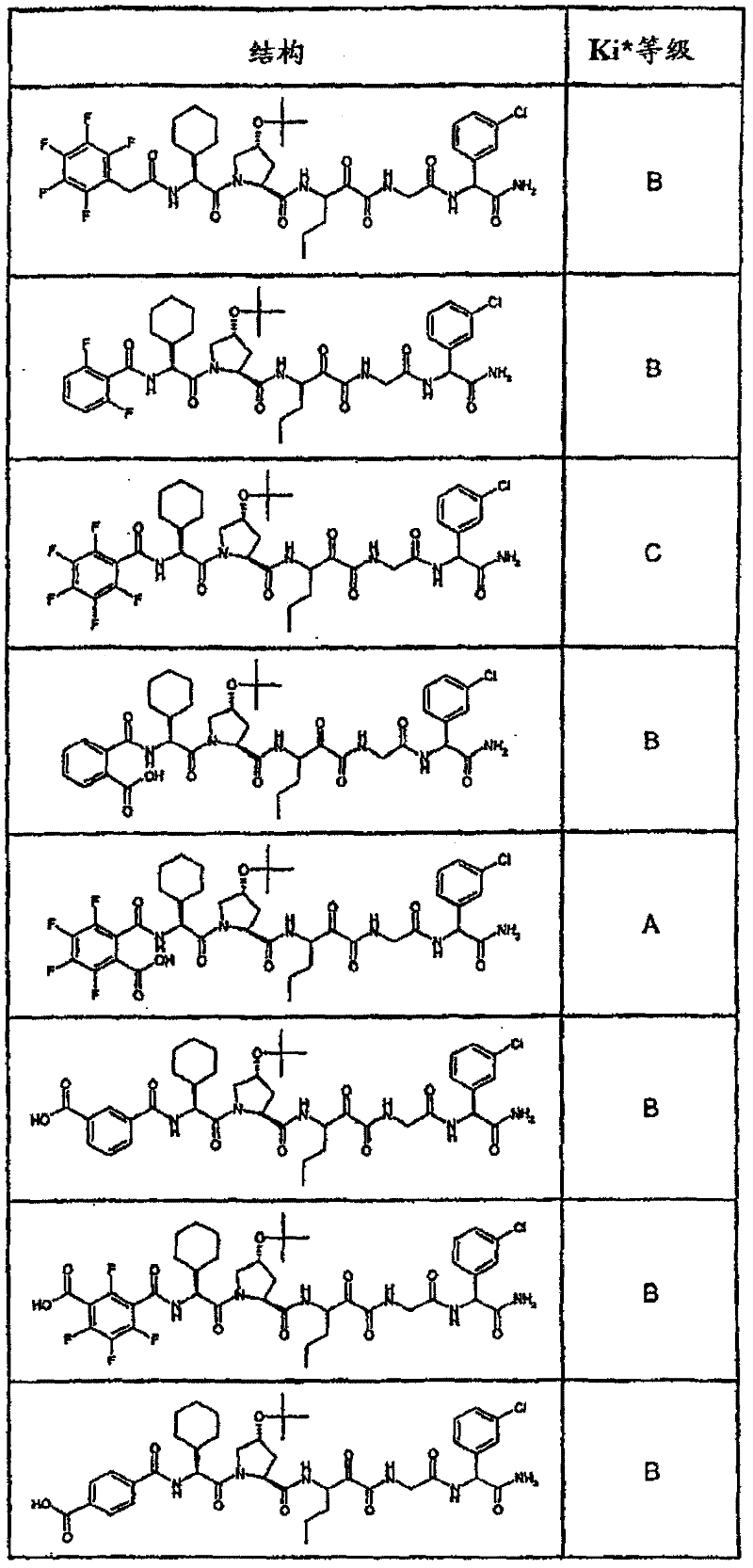
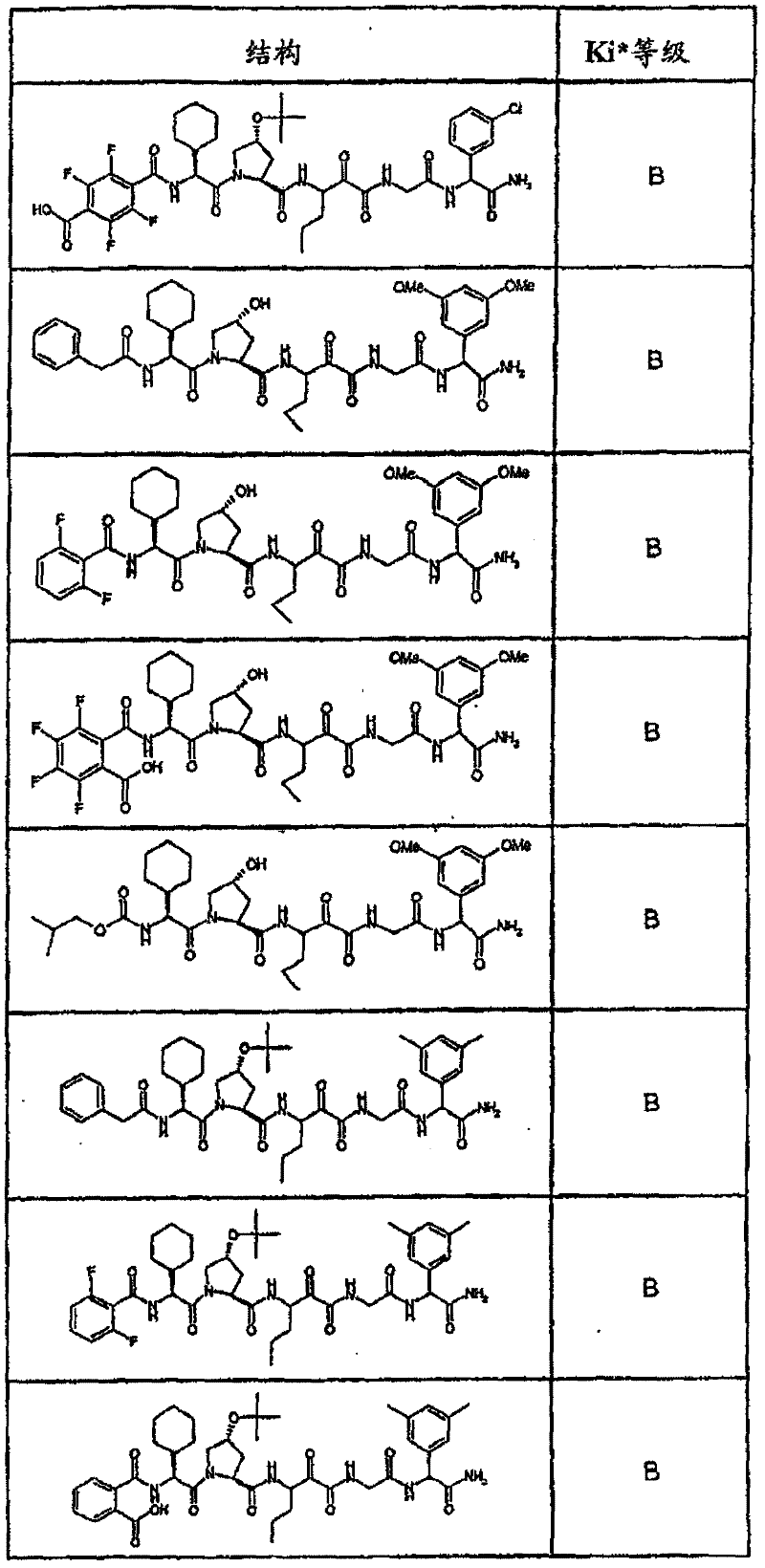


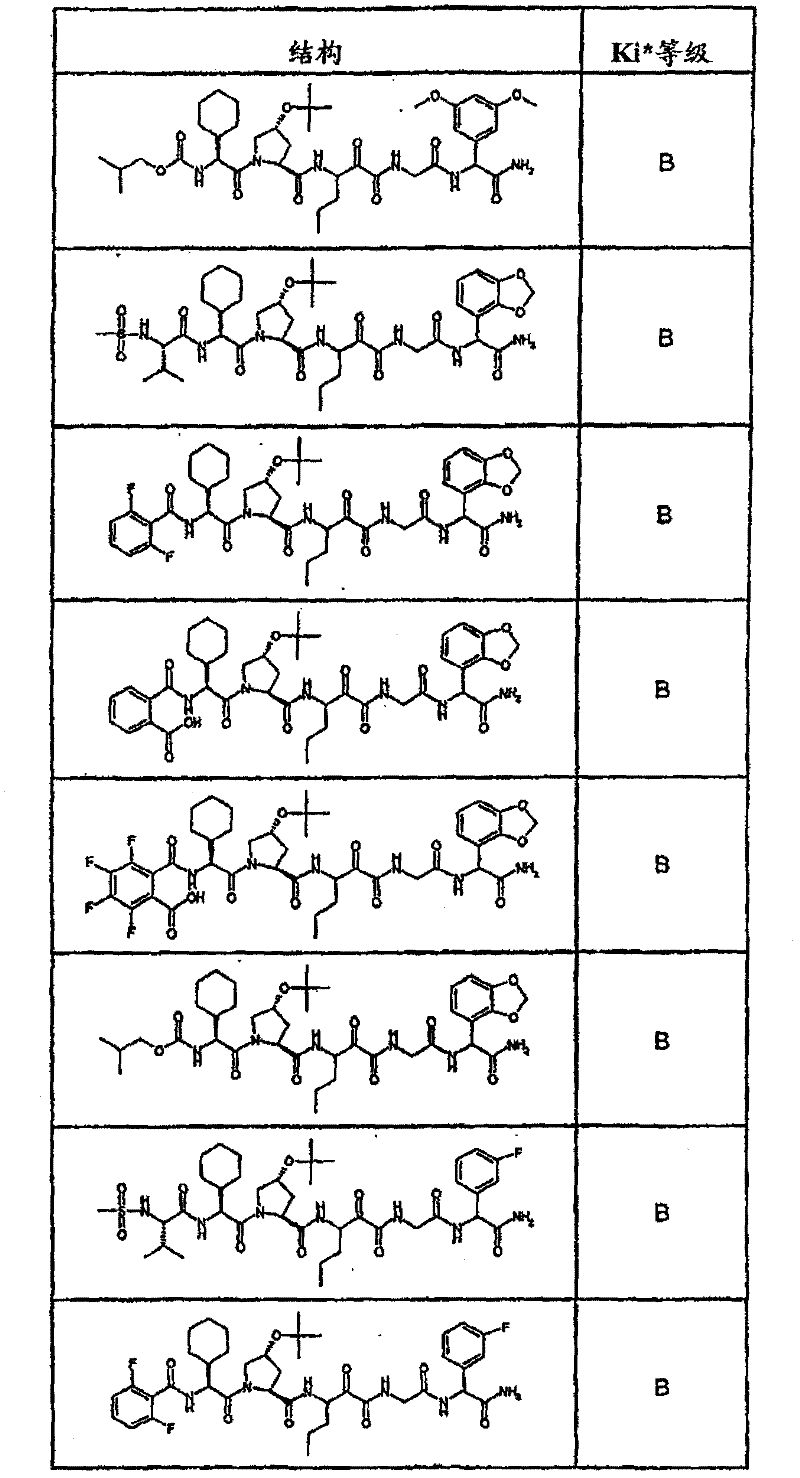


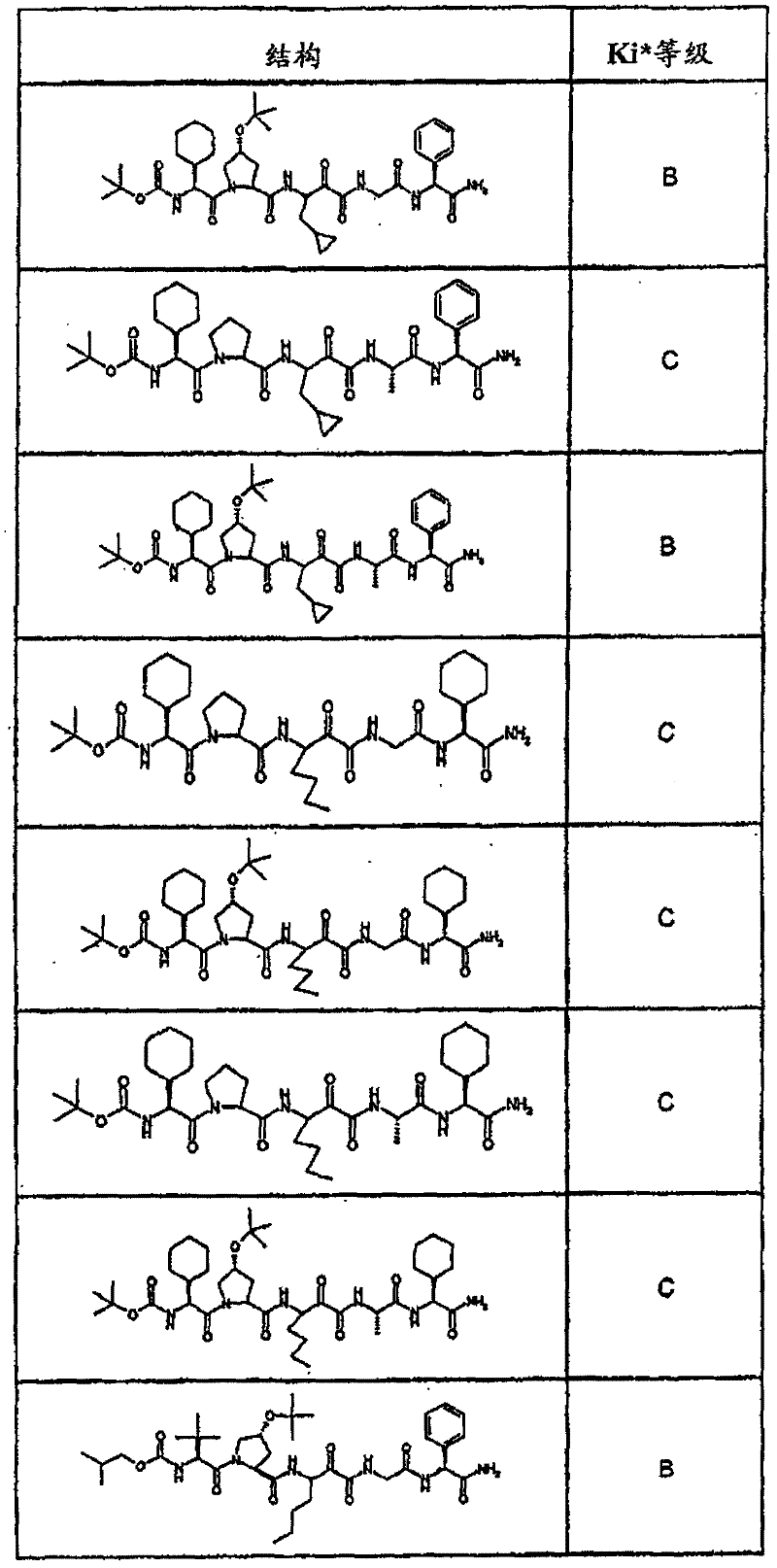

制备的其它化合物及其活性(Ki*)范围在附表4和附表5中列出。制备表4和表5中化合物的方法概述如下: Other compounds prepared and their activity (Ki * ) ranges are listed in Supplementary Table 4 and Supplementary Table 5. Methods for preparing the compounds in Tables 4 and 5 are outlined below:
I)合成表4和表5化合物的中间体: 1) intermediates of synthetic table 4 and table 5 compounds:
实施例I.合成4,4-二甲基脯氨酸甲酯(H-Pro(4,4-diMe)-OMe) Embodiment 1. Synthesis of 4,4-dimethylproline methyl ester (H-Pro(4,4-diMe)-OMe)
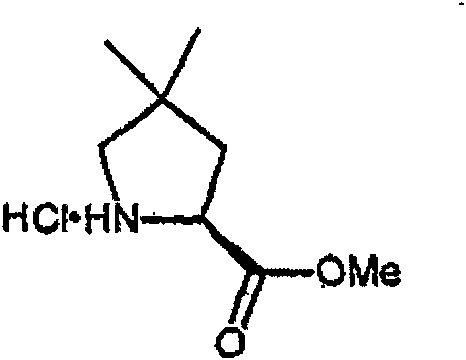
步骤1.合成N-叔丁氧基羰基-4-甲基-L-焦谷氨酸叔丁酯(Boc-PyroGlu(4-甲基)-OtBu):Step 1. Synthesis of N-tert-butoxycarbonyl-4-methyl-L-pyroglutamic acid tert-butyl ester (Boc-PyroGlu(4-methyl)-OtBu):

N-叔丁氧基羰基-焦谷氨酸叔丁酯(11.5g,40mmol)的THF(200mL)溶液在-78℃搅拌下于5分钟内滴加1M六甲基二硅叠氮化(disilazide)锂的THF(42mL,42mmol)溶液。在30分钟后,加入甲基碘(3.11mL,50mmol)。再在-78℃经过2小时后,除去冷却浴,加入50%氯化铵饱和水溶液(200mL)。将溶液搅拌20分钟,然后用乙醚(3×200mL)萃取。合并的有机层用盐水(200mL)洗涤,干燥(Na2SO4),过滤并浓缩。残余物色谱法(1∶1乙酸乙酯/己烷)获得Boc-PyroGlu(4-甲基)-OtBu(10.6g,35.4mmol,88%)的异构体混合物(2∶1顺式∶反式)。 A solution of N-tert-butoxycarbonyl-pyroglutamate tert-butyl ester (11.5 g, 40 mmol) in THF (200 mL) was added dropwise to 1M hexamethyldisilazide (disilazide) within 5 minutes under stirring at -78°C. ) solution of lithium in THF (42 mL, 42 mmol). After 30 minutes, methyl iodide (3.11 mL, 50 mmol) was added. After another 2 hours at -78°C, the cooling bath was removed and 50% saturated aqueous ammonium chloride (200 mL) was added. The solution was stirred for 20 minutes, then extracted with diethyl ether (3 x 200 mL). The combined organic layers were washed with brine (200 mL), dried (Na 2 SO 4 ), filtered and concentrated. Chromatography of the residue (1:1 ethyl acetate/hexane) afforded Boc-PyroGlu(4-methyl)-OtBu (10.6 g, 35.4 mmol, 88%) as a mixture of isomers (2:1 cis:trans Mode).
步骤2.合成N-叔丁氧基羰基-4,4-二甲基-L-焦谷氨酸叔丁酯(Boc-PyroGlu(4,4-二甲基)-OtBu):Step 2. Synthesis of N-tert-butoxycarbonyl-4,4-dimethyl-L-pyroglutamic acid tert-butyl ester (Boc-PyroGlu(4,4-dimethyl)-OtBu):
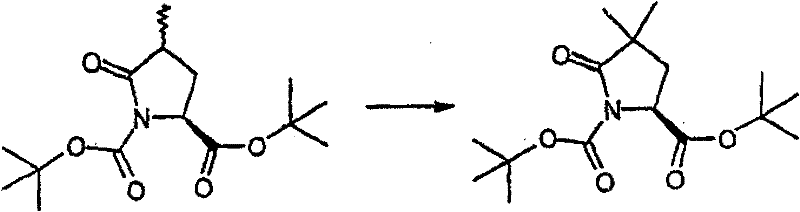
N-叔丁氧基羰基-4-甲基-L-焦谷氨酸叔丁酯(1.2g,4.0mmol)的四氢呋喃(20mL)溶液在-78℃搅拌下于5分钟内滴加1M六甲基二硅叠氮化锂的四氢呋喃(4.4mL,4.4mmol)溶液。在30分钟后,加入甲基碘(0.33mL,5.2mmol)。再在-78℃经过3小时后,除去冷却浴,加入50%氯化铵饱和水溶液(40mL)。将溶液搅拌20分钟,然后用乙醚(2×50mL)萃取。合并的有机层用水(2×25mL)、饱和碳酸氢钠水溶液(2×25mL)、盐水(50mL)洗涤,干燥(Na2SO4),过滤并浓缩获得Boc-PyroGlu(4,4-二甲基)-OtBu(0.673g,54%) A solution of N-tert-butoxycarbonyl-4-methyl-L-pyroglutamic acid tert-butyl ester (1.2g, 4.0mmol) in tetrahydrofuran (20mL) was added dropwise to 1M hexamethanol in 5 minutes under stirring at -78°C Lithium disilazide in tetrahydrofuran (4.4 mL, 4.4 mmol). After 30 minutes, methyl iodide (0.33 mL, 5.2 mmol) was added. After another 3 hours at -78°C, the cooling bath was removed and 50% saturated aqueous ammonium chloride (40 mL) was added. The solution was stirred for 20 minutes, then extracted with diethyl ether (2 x 50 mL). The combined organic layers were washed with water (2×25 mL), saturated aqueous sodium bicarbonate (2×25 mL), brine (50 mL), dried (Na 2 SO 4 ), filtered and concentrated to obtain Boc-PyroGlu (4,4-dimethyl base)-OtBu (0.673g, 54%)
步骤3.合成N-叔丁氧基羰基-4,4-二甲基脯氨酸叔丁酯(Boc-Pro(4,4-二甲基)-OtBu)Step 3. Synthesis of N-tert-butoxycarbonyl-4,4-dimethylproline tert-butyl ester (Boc-Pro(4,4-dimethyl)-OtBu)
改进已知方法:Pedregal,C.;Ezquerra,J.;Escribano,A.;Carreno,M.C.;Garcia Ruano,J.L.Tetrahedron Letters 1994,35(13),2053-2056)。 Improving known methods: Pedregal, C.; Ezquerra, J.; Escribano, A.; Carreno, M.C.; Garcia Ruano, J.L. Tetrahedron Letters 1994, 35(13), 2053-2056). the
N-叔丁氧基羰基-4,4-二甲基焦谷氨酸叔丁酯(2.0mmol)的四氢呋喃(5mL)溶液在-78℃搅拌下于5分钟内滴加1M三乙基硼氢化锂的四氢呋喃(2.4mL,2.4mmol)溶液。在30分钟后,除去冷却浴,加入饱和碳酸氢钠水溶液(5mL)。将反应混合物浸入冰/水浴中,加入30%的过氧化氢水溶液(10滴)。将溶液在0℃搅拌20分钟,然后真空浓缩反应混合物以除去四氢呋喃。将水溶液用水(10mL)稀释,用二氯甲烷(3×40mL)萃取。干燥(Na2SO4)有机层,过滤并浓缩。将残余物溶于二氯甲烷(20mL)和三乙基硅烷(310μL,2.0mmol),然后冷却至-78℃,滴加三氟化硼合乙醚(270μL,2.13mmol)。继续搅拌30分钟,本发明期间再加入三乙基硅烷(310μL,2.0mmol)和三氟化硼合乙醚(270μL,2.13mmol)。在-78℃再搅拌2小时,除去冷却浴,加入饱和碳酸氢钠水溶液(4mL)。5分钟后将混合物用二氯甲烷(3×40mL)萃取。干燥(Na2SO4)有机层,过滤并浓缩获得Boc-Pro(4,4-二甲基)-OtBu。 A solution of tert-butyl N-tert-butoxycarbonyl-4,4-dimethylpyroglutamate (2.0 mmol) in tetrahydrofuran (5 mL) was added dropwise with 1M triethyl borohydrogenation within 5 minutes under stirring at -78°C Lithium in tetrahydrofuran (2.4 mL, 2.4 mmol). After 30 minutes, the cooling bath was removed and saturated aqueous sodium bicarbonate (5 mL) was added. The reaction mixture was immersed in an ice/water bath, and 30% aqueous hydrogen peroxide (10 drops) was added. The solution was stirred at 0 °C for 20 minutes, then the reaction mixture was concentrated in vacuo to remove tetrahydrofuran. The aqueous solution was diluted with water (10 mL), extracted with dichloromethane (3 x 40 mL). The organic layer was dried ( Na2SO4 ) , filtered and concentrated. The residue was dissolved in dichloromethane (20 mL) and triethylsilane (310 μL, 2.0 mmol), then cooled to -78° C., and boron trifluoride diethyl ether (270 μL, 2.13 mmol) was added dropwise. Stirring was continued for 30 minutes, during which additional triethylsilane (310 μL, 2.0 mmol) and boron trifluoride diethyl ether (270 μL, 2.13 mmol) were added. After stirring at -78°C for an additional 2 hours, the cooling bath was removed and saturated aqueous sodium bicarbonate (4 mL) was added. After 5 minutes the mixture was extracted with dichloromethane (3 x 40 mL). The organic layer was dried ( Na2SO4 ), filtered and concentrated to afford Boc - Pro(4,4-dimethyl)-OtBu.
步骤4.合成4.4-二甲基脯氨酸(H-Pro(4.4-二甲基)-OH):Step 4. Synthesis of 4.4-dimethylproline (H-Pro(4.4-dimethyl)-OH):
N-叔丁氧基羰基-4,4-二甲基脯氨酸叔丁酯的二氯甲烷(5mL)和三氟乙酸(5mL)溶液在室温下搅拌5小时。将溶液浓缩,高真空下干燥,在下一步直接使用无需再提纯。 A solution of N-tert-butoxycarbonyl-4,4-dimethylproline tert-butyl ester in dichloromethane (5 mL) and trifluoroacetic acid (5 mL) was stirred at room temperature for 5 hours. The solution was concentrated, dried under high vacuum, and used directly in the next step without further purification. the
步骤5.合成N-叔丁氧基羰基4,4-二甲基脯氨酸(Boc-Pro(4.4-二甲基)-OH):Step 5. Synthesis of N-tert-butoxycarbonyl 4,4-dimethylproline (Boc-Pro(4.4-dimethyl)-OH):
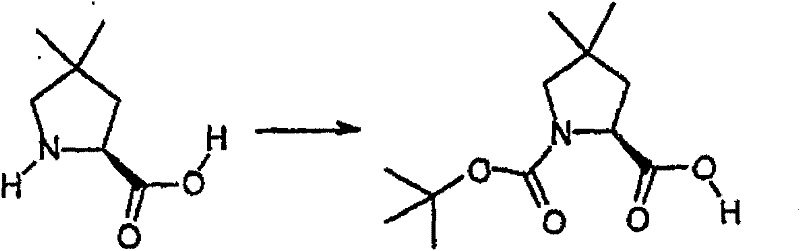
在4,4-二甲基脯氨酸三氟乙酸盐(1.5mmol)的二氧六环(7mL)、乙腈(12mL)和二异丙基乙胺(700μL,4mmol)溶液中加入二碳酸二叔丁酯(475mg,2.18mmol)的乙腈(5mL)溶液。在室温下搅拌12小时后,将溶液真空浓缩,溶于饱和碳酸氢钠水溶液(50mL),然后用乙醚(3×40mL)洗涤。水层用柠檬酸酸化至pH=3,然后用二氯甲烷(3×40mL)萃取。合并的有机层用硫酸钠干燥,过滤并浓缩。 To a solution of 4,4-dimethylproline trifluoroacetate (1.5 mmol) in dioxane (7 mL), acetonitrile (12 mL) and diisopropylethylamine (700 μL, 4 mmol) was added dicarbonic acid Di-tert-butyl ester (475 mg, 2.18 mmol) in acetonitrile (5 mL). After stirring at room temperature for 12 hours, the solution was concentrated in vacuo, dissolved in saturated aqueous sodium bicarbonate (50 mL), and washed with diethyl ether (3 x 40 mL). The aqueous layer was acidified with citric acid to pH = 3, then extracted with dichloromethane (3 x 40 mL). The combined organic layers were dried over sodium sulfate, filtered and concentrated. the
步骤6.合成4.4-二甲基脯氨酸甲酯盐酸盐(HCl·H-Pro(4.4-二甲基)-OMe):Step 6. Synthesis of 4.4-dimethylproline methyl ester hydrochloride (HCl H-Pro(4.4-dimethyl)-OMe):
Boc-Pro(4,4-diMe)-OH(0.5g,2.06mmol)的无水甲醇(8ml)溶液中滴加亚硫酰氯(448l,6.18mmol),将反应物在室温下搅拌6小时。将反应混合物浓缩获得无定形固体(377mg,95%)。 To a solution of Boc-Pro(4,4-diMe)-OH (0.5g, 2.06mmol) in anhydrous methanol (8ml) was added dropwise thionyl chloride (448l, 6.18mmol), and the reaction was stirred at room temperature for 6 hours. The reaction mixture was concentrated to obtain an amorphous solid (377 mg, 95%). the
实施例II.合成N-叔丁氧基羰基-4-烷基-4-甲基脯氨酸的一般方法:Example II. General method for the synthesis of N-tert-butoxycarbonyl-4-alkyl-4-methylproline:

R基团为烯丙基和苄基的化合物按照以下步骤1-4合成: The compound whose R group is allyl and benzyl is synthesized according to the following steps 1-4:
步骤1.合成N-叔丁氧基羰基-4-烷基-4-甲基-L-焦谷氨酸叔丁酯:Step 1. Synthesis of tert-butyl N-tert-butoxycarbonyl-4-alkyl-4-methyl-L-pyroglutamate:

N-叔丁氧基羰基-4-甲基-L-焦谷氨酸叔丁酯(10.2g,mmol)(参见实施例I步骤1)的四氢呋喃(170mL)溶液在-78℃搅拌下于5分钟内滴加1M六甲基二硅叠氮化锂的四氢呋喃(37.5mL,37.5mmol)溶液。在40分钟后,加入烷基卤(61.4mmol)。在-78℃经过3小时后,除去冷却浴,加入50%饱和氯化铵水溶液(200mL)。将溶液搅拌20分钟,然后用乙醚(2×200mL)萃取。合并的有机层用己烷(150mL)稀释,然后用饱和碳酸氢钠水溶液(100mL)、水(2×100mL)和盐水(100mL)洗涤,干燥(Na2SO4),过滤并浓缩。残余物用快速色谱法(用含20%乙酸乙酯的己烷)获得纯N-叔丁氧基羰基-4-烷基-4-甲基-L-焦谷氨酸叔丁酯。 A solution of N-tert-butoxycarbonyl-4-methyl-L-pyroglutamic acid tert-butyl ester (10.2 g, mmol) (see step 1 of Example 1) in tetrahydrofuran (170 mL) was stirred at -78 ° C for 5 A 1M solution of lithium hexamethyldisilazide in tetrahydrofuran (37.5 mL, 37.5 mmol) was added dropwise over a period of minutes. After 40 minutes, the alkyl halide (61.4 mmol) was added. After 3 hours at -78°C, the cooling bath was removed and 50% saturated aqueous ammonium chloride (200 mL) was added. The solution was stirred for 20 minutes, then extracted with diethyl ether (2 x 200 mL). The combined organic layers were diluted with hexanes (150 mL), then washed with saturated aqueous sodium bicarbonate (100 mL), water (2 x 100 mL), brine ( 100 mL), dried ( Na2SO4 ), filtered and concentrated. Flash chromatography of the residue (20% ethyl acetate in hexane) afforded pure tert-butyl N-tert-butoxycarbonyl-4-alkyl-4-methyl-L-pyroglutamate.
步骤2.合成N-叔丁氧基羰基-4-烷基-4-甲基脯氨酸叔丁酯:Step 2. Synthesis of N-tert-butoxycarbonyl-4-alkyl-4-methylproline tert-butyl ester:

改进已知方法:Pedregal,C.;Ezquerra,J.;Escribano,A.;Carreno,M.C.;Garcia Ruano,J.L.Tetrahedron Letters(1994)35(13),2053-2056)。 Improving known methods: Pedregal, C.; Ezquerra, J.; Escribano, A.; Carreno, M.C.; Garcia Ruano, J.L. Tetrahedron Letters (1994) 35(13), 2053-2056). the
N-叔丁氧基羰基-4-烷基-4-甲基焦谷氨酸叔丁酯(16.6mmol)的四氢呋喃(40mL)溶液在-78℃搅拌下于10分钟内滴加1M三乙基硼氢化锂的四氢呋喃(20mL,20mmol)溶液。在120分钟后,将冷却浴加温至-25℃,本发明温度加入饱和碳酸氢钠水溶液(40mL)。将反应混合物浸入冰/水浴中,加入30%的过氧化氢水溶液(4mL)。将溶液在0℃搅拌10分钟,然后将反应混合物真空浓缩以除去四氢呋喃。将水溶液用水(300mL)稀释,用二氯甲烷(3×200mL)萃取。干燥有机层(硫酸钠),过滤并浓缩。将残余物溶于二氯甲烷(100mL)和三乙基硅烷(2.6mL,mmol),然后冷却至-78℃,滴加三氟化硼合乙醚(2.2mL,mmol)。继续搅拌1小时,本发明期间再加入三乙基硅烷(2.6mL,mmol)和三氟化硼合乙醚(2.2mL,mmol)。在-78℃再搅拌小时,除去冷却浴,加入饱和碳酸氢钠水溶液(30mL)和水(150mL)。5分钟后将混合物用二氯甲烷(3×200mL)萃取。干燥有机层(Na2SO4),过滤并浓缩。 A solution of tert-butyl N-tert-butoxycarbonyl-4-alkyl-4-methylpyroglutamate (16.6 mmol) in tetrahydrofuran (40 mL) was added dropwise with 1M triethyl ether in 10 minutes under stirring at -78°C A solution of lithium borohydride in tetrahydrofuran (20 mL, 20 mmol). After 120 minutes, the cooling bath was warmed to -25°C, the inventive temperature, and saturated aqueous sodium bicarbonate (40 mL) was added. The reaction mixture was immersed in an ice/water bath, and 30% aqueous hydrogen peroxide (4 mL) was added. The solution was stirred at 0 °C for 10 minutes, then the reaction mixture was concentrated in vacuo to remove tetrahydrofuran. The aqueous solution was diluted with water (300 mL), extracted with dichloromethane (3 x 200 mL). The organic layer was dried (sodium sulfate), filtered and concentrated. The residue was dissolved in dichloromethane (100 mL) and triethylsilane (2.6 mL, mmol), then cooled to -78°C, and boron trifluoride diethyl ether (2.2 mL, mmol) was added dropwise. Stirring was continued for 1 hour, and additional triethylsilane (2.6 mL, mmol) and boron trifluoride diethyl ether (2.2 mL, mmol) were added during the invention. After stirring at -78°C for an additional hour, the cooling bath was removed and saturated aqueous sodium bicarbonate (30 mL) and water (150 mL) were added. After 5 minutes the mixture was extracted with dichloromethane (3 x 200 mL). The organic layer was dried ( Na2SO4 ) , filtered and concentrated.
步骤3.合成4-烷基-4-甲基脯氨酸:Step 3. Synthesis of 4-alkyl-4-methylproline:

将N-叔丁氧基羰基-4-烷基-4-甲基脯氨酸叔丁酯的二氯甲烷(5mL)和三氟乙酸(5mL)溶液在室温下搅拌5小时。加入甲苯,将溶液浓缩,然后在高真空下干燥。 A solution of N-tert-butoxycarbonyl-4-alkyl-4-methylproline tert-butyl ester in dichloromethane (5 mL) and trifluoroacetic acid (5 mL) was stirred at room temperature for 5 hours. Toluene was added and the solution was concentrated and dried under high vacuum. the
步骤4.合成N-叔丁氧基羰基4-烷基-4-甲基脯氨酸:Step 4. Synthesis of N-tert-butoxycarbonyl 4-alkyl-4-methylproline:
4-烷基-4-甲基脯氨酸三氟乙酸盐(1.5mmol)的二氧六环(7mL)、乙腈(12mL)和二异丙基乙胺(700μL,4mmol)溶液中加入二碳酸二叔丁酯(475mg,2.18mmol)的乙腈(5mL)溶液。在室温下搅拌12小时后,将溶液真空浓缩,溶于饱和碳酸氢钠水溶液(50mL),然后用乙醚(3×40mL)洗涤。将水相用1N盐酸酸化至pH=3,然后用二氯甲烷(3×40mL)萃取。将合并的有机层干燥(Na2SO4),过滤并浓缩。残余物用快速色谱法提纯,使用1∶1乙酸乙酯/己烷和1%乙酸。 Add di A solution of di-tert-butyl carbonate (475 mg, 2.18 mmol) in acetonitrile (5 mL). After stirring at room temperature for 12 hours, the solution was concentrated in vacuo, dissolved in saturated aqueous sodium bicarbonate (50 mL), and washed with diethyl ether (3 x 40 mL). The aqueous phase was acidified with 1N hydrochloric acid to pH = 3, then extracted with dichloromethane (3 x 40 mL). The combined organic layers were dried ( Na2SO4 ), filtered and concentrated. The residue was purified by flash chromatography using 1:1 ethyl acetate/hexane and 1% acetic acid.
实施例III.合成N-叔丁氧基羰基4-丙基-4-甲基脯氨酸:Embodiment III. Synthesis of N-tert-butoxycarbonyl 4-propyl-4-methylproline:

N-叔丁氧基羰基-4-烯丙基-4-甲基脯氨酸(400mg,1.48mmol)(参见实施例II步骤4)和10%碳载钯(400mg)的甲醇(20mL)溶液在50psi氢化4小时。将混合物过滤并浓缩。 N-tert-butoxycarbonyl-4-allyl-4-methylproline (400mg, 1.48mmol) (see Example II step 4) and 10% palladium on carbon (400mg) in methanol (20mL) Hydrogenate at 50 psi for 4 hours. The mixture was filtered and concentrated. the
实施例IV.合成Boc-4-环己基脯氨酸:Example IV. Synthesis of Boc-4-cyclohexylproline:

商业得到的Boc-4-苯基脯氨酸(750mg)和5%碳载Rh(750mg)的甲醇(15mL)溶液在50psi氢化24小时。将混合物过滤并浓缩获得730mg产物。 A solution of commercially available Boc-4-phenylproline (750 mg) and 5% Rh on carbon (750 mg) in methanol (15 mL) was hydrogenated at 50 psi for 24 hours. The mixture was filtered and concentrated to afford 730 mg of product. the
实施例V:制备芴基甲氧羰基-脯氨酸(4-螺环戊烷)-羧酸:Example V: Preparation of fluorenylmethoxycarbonyl-proline(4-spirocyclopentane)-carboxylic acid:
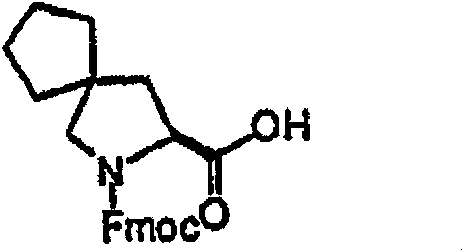
步骤1.合成Boc-焦谷氨酸(4-烯丙基)-叔丁酯:Step 1. Synthesis of Boc-pyroglutamic acid (4-allyl)-tert-butyl ester:

商业上得到的N-Boc-叔丁基焦谷氨酸酯(10g,35.1mmol)的THF(175ml)冷却(-78℃)溶液中在5分钟内加入六甲基二硅叠氮化锂(36.8mL,36.8mmol)。继续搅拌30分钟。将烯丙基溴(6.1ml,70.2mmol)的THF(39mL)溶液滴加到第一种溶液中。在-78℃经过两小时后,反应物中缓慢地加入饱和氯化铵(50mL)溶液猝灭。将反应混合物用乙酸乙酯稀释,将各层分离。有机层用硫酸钠干燥后浓缩。快速柱色谱法利用2∶8乙酸乙酯∶己烷获得产物(6g,53%)。NMRδppm(CDCl3):5.7(m,1H),5.1(dd,2H),4.4(m,1H),2.6(m,2H),2.4(m,1H),1.8-2.2(m,1H),1.45(s,9H),1.4(s,9H)。 To a cooled (-78°C) solution of commercially available N-Boc-tert-butylpyroglutamate (10 g, 35.1 mmol) in THF (175 mL) was added lithium hexamethyldisilazide ( 36.8 mL, 36.8 mmol). Stirring was continued for 30 minutes. A solution of allyl bromide (6.1 ml, 70.2 mmol) in THF (39 mL) was added dropwise to the first solution. After two hours at -78°C, the reaction was quenched by the slow addition of saturated ammonium chloride (50 mL) solution. The reaction mixture was diluted with ethyl acetate and the layers were separated. The organic layer was dried over sodium sulfate and concentrated. Flash column chromatography using 2:8 ethyl acetate:hexanes afforded the product (6 g, 53%). NMRδppm (CDCl3): 5.7 (m, 1H), 5.1 (dd, 2H), 4.4 (m, 1H), 2.6 (m, 2H), 2.4 (m, 1H), 1.8-2.2 (m, 1H), 1.45 (s, 9H), 1.4 (s, 9H). the
步骤2.合成N-Boc-焦谷氨酸(4,4-二烯丙基)-叔丁酯:Step 2. Synthesis of N-Boc-pyroglutamic acid (4,4-diallyl)-tert-butyl ester:
将以上步骤1获得的N-Boc-焦谷氨酸(4-烯丙基)-叔丁酯(2.68g,8.24mmol)在同样条件下用烯丙基溴第二次烷基化。快速色谱法利用15∶85乙酸乙酯∶己烷获得2.13g澄清油状产物(71%)。 N-Boc-pyroglutamic acid (4-allyl)-tert-butyl ester (2.68 g, 8.24 mmol) obtained in step 1 above was alkylated for the second time with allyl bromide under the same conditions. Flash chromatography using 15:85 ethyl acetate:hexanes afforded 2.13 g of product (71%) as a clear oil. the
步骤3.合成Boc-脯氨酸(4,4-二烯丙基)-叔丁酯:Step 3. Synthesis of Boc-proline (4,4-diallyl)-tert-butyl ester:

步骤a:Boc-PyroGlu(4,4-二烯丙基)-叔丁酯(2.13g,5.83mmol)的四氢呋喃(14ml)冷却(-78℃)溶液在5分钟内加入三乙基硼氢化锂(1M的四氢呋喃溶液,7.29ml,7.29mmol)。在-78℃经过2小时后,将反应物加温至0℃,缓慢地加入饱和碳酸氢钠水溶液(20ml)和30%过氧化氢(20滴)猝灭。继续搅拌20分钟。减压除去四氢呋喃,获得的白色稠厚残余物用水(80ml)稀释,用二氯甲烷萃取三次。干燥有机层,过滤并浓缩后用于下一步无需再提纯。 Step a : Boc-PyroGlu(4,4-diallyl)-tert-butyl ester (2.13g, 5.83mmol) in THF (14ml) was cooled (-78°C) and lithium triethylborohydride was added within 5 minutes (1M solution in tetrahydrofuran, 7.29ml, 7.29mmol). After 2 hours at -78°C, the reaction was warmed to 0°C and quenched by the slow addition of saturated aqueous sodium bicarbonate (20 mL) and 30% hydrogen peroxide (20 drops). Stirring was continued for 20 minutes. The tetrahydrofuran was removed under reduced pressure and the white thick residue obtained was diluted with water (80ml) and extracted three times with dichloromethane. The organic layer was dried, filtered and concentrated and used in the next step without further purification.
步骤b):在步骤(a)获得的产物的二氯甲烷(14ml)溶液中加入三乙基硅烷(931μl,5.83mmol),接着加入三氟化硼合乙醚(776μl,6.12mmol)。在30分钟后再加入三乙基硅烷(931μl,5.83mmol)和三氟化硼合乙醚(776μl,6.12mmol),将反应物在-78℃搅拌3小时,本发明期间缓慢地加入饱和碳酸氢钠溶液和水猝灭。将反应混合物用二氯甲烷萃取,干燥有机层,过滤并浓缩。用快速柱色谱法(含15%乙酸乙酯的己烷)获得1.07无色油状物(57%)。NMRδppm(CDCl3):57-5.8(m,2H),5.1(m,4H),4.1-4.2(2dd’s,1H旋转异构体),3.5-3.3(dd,1H)和3.2(dd,1H)旋转异构体,2.2-2.0(m,5H),1.7(m,1H),1.46(s,9H),1.43(s,9H)。 Step b) : To a solution of the product obtained in step (a) in dichloromethane (14 ml) was added triethylsilane (931 μl, 5.83 mmol) followed by boron trifluoride diethyl ether (776 μl, 6.12 mmol). Triethylsilane (931 μl, 5.83 mmol) and boron trifluoride diethyl ether (776 μl, 6.12 mmol) were added after 30 minutes, and the reaction was stirred at -78° C. for 3 hours, and saturated bicarbonate was slowly added during the invention Sodium solution and water quenched. The reaction mixture was extracted with dichloromethane, the organic layer was dried, filtered and concentrated. Flash column chromatography (15% ethyl acetate in hexanes) afforded 1.07 as a colorless oil (57%). NMRδppm (CDCl3): 57-5.8 (m, 2H), 5.1 (m, 4H), 4.1-4.2 (2dd's, 1H rotamers), 3.5-3.3 (dd, 1H) and 3.2 (dd, 1H) rotations Isomers, 2.2-2.0 (m, 5H), 1.7 (m, 1H), 1.46 (s, 9H), 1.43 (s, 9H).
步骤4.合成Boc-脯氨酸(4-螺环戊烯)-叔丁酯:Step 4. Synthesis of Boc-proline (4-spirocyclopentene)-tert-butyl ester:

Boc-脯氨酸(4,4-二烯丙基)-叔丁酯(1.07g,3.31mmol)的二氯甲烷(66ml)溶液中加入5%二氯化二(三环己基膦基)亚苄基钌IV(Grubbs催化剂),将混合物回流加热1.5小时。浓缩反应混合物,残余物用快速柱色谱法(用含15%乙酸乙酯的己烷)提纯。获得黄色油状物(0.57g,53%)。NMRδppm(CDCl3):5.56(bs,2H),4.2和4.1(t,1H,旋转异构体),3.2-3.5(m,2H),2.2-2.5(m,5H),1.9(dd,1H)1.47和1.46(2s’s,9H,旋转异构体),1.45和1.44(2s’s,9H,旋转异构体)。 Boc-proline (4,4-diallyl)-tert-butyl ester (1.07g, 3.31mmol) in dichloromethane (66ml) solution was added 5% dichloride bis(tricyclohexylphosphino) Benzylruthenium IV (Grubbs catalyst), the mixture was heated at reflux for 1.5 hours. The reaction mixture was concentrated and the residue was purified by flash column chromatography (15% ethyl acetate in hexane). Obtained as a yellow oil (0.57 g, 53%). NMRδppm (CDCl3): 5.56 (bs, 2H), 4.2 and 4.1 (t, 1H, rotamers), 3.2-3.5 (m, 2H), 2.2-2.5 (m, 5H), 1.9 (dd, 1H) 1.47 and 1.46 (2s's, 9H, rotamer), 1.45 and 1.44 (2s's, 9H, rotamer). the
步骤5.合成Boc-脯氨酸(4-螺环戊烷)-叔丁酯:Step 5. Synthesis of Boc-proline (4-spirocyclopentane)-tert-butyl ester:
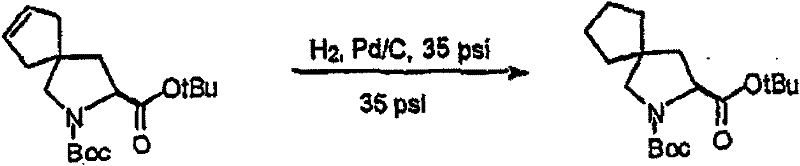
将Boc-脯氨酸(4-螺环戊烯)-叔丁酯(1.12g)的甲醇(18ml)、水(4ml)和乙酸(4ml)溶液置于Parr振荡器中,在35psi并存在10%碳载钯(300mg)下氢化3小时。将催化剂滤除,浓缩滤液至无色油状物(1.26g)。NMRδppm(CDCl3):4.1和4.2(t,1H,旋转异构体,3.4(d,1H),3.2(d,1H),2.1(m,1H),1.9(m,1H),1.6-1.7(m,10H),1.5(3s’s,18H,旋转异构体)。 A solution of Boc-proline(4-spirocyclopentene)-tert-butyl ester (1.12 g) in methanol (18 ml), water (4 ml) and acetic acid (4 ml) was placed in a Parr shaker at 35 psi in the presence of 10 % palladium on carbon (300 mg) for 3 hours. The catalyst was filtered off and the filtrate was concentrated to a colorless oil (1.26g). NMRδppm (CDCl3): 4.1 and 4.2 (t, 1H, rotamers, 3.4 (d, 1H), 3.2 (d, 1H), 2.1 (m, 1H), 1.9 (m, 1H), 1.6-1.7 ( m, 10H), 1.5 (3s's, 18H, rotamer).
步骤6.合成Fmoc-脯氨酸(4-螺环戊烷)羧酸:Step 6. Synthesis of Fmoc-proline (4-spirocyclopentane) carboxylic acid:
将Boc-脯氨酸(4-螺环戊烷)-叔丁酯(1.26,3.9mmol)用二氯甲烷(10ml)和三氟乙酸(15ml)处理3小时。浓缩反应混合物,将获得得黄色油状物溶于水(6ml)。分次加入溶于二氧六环(6ml)的芴基甲基琥珀酰碳酸酯(1.45g,4.3mmol),接着加入碳酸钾(2.16g,15.6mmol)。将反应物搅拌18小时后浓缩。残余物用饱和碳酸氢钠溶液(10mL)稀释,然后用乙醚(3×10ml)洗涤。将水层用1N硫酸氢钠溶液酸化至pH~1,用乙酸乙酯萃取。有机层用硫酸钠干燥,过滤并浓缩获得淡棕色泡沫物(1.3g,100%)。 Boc-proline(4-spirocyclopentane)-tert-butyl ester (1.26, 3.9mmol) was treated with dichloromethane (10ml) and trifluoroacetic acid (15ml) for 3 hours. The reaction mixture was concentrated and the obtained yellow oil was dissolved in water (6ml). Fluorenylmethylsuccinyl carbonate (1.45 g, 4.3 mmol) dissolved in dioxane (6 mL) was added in portions, followed by potassium carbonate (2.16 g, 15.6 mmol). The reaction was stirred for 18 hours and then concentrated. The residue was diluted with saturated sodium bicarbonate solution (10 mL), then washed with ether (3 x 10 mL). The aqueous layer was acidified to pH~1 with 1N sodium bisulfate solution and extracted with ethyl acetate. The organic layer was dried over sodium sulfate, filtered and concentrated to give a light brown foam (1.3 g, 100%). the
实施例VI.合成Boc-Pro(4t-NH(Fmoc))-OH:Example VI. Synthesis of Boc-Pro(4t-NH(Fmoc))-OH:
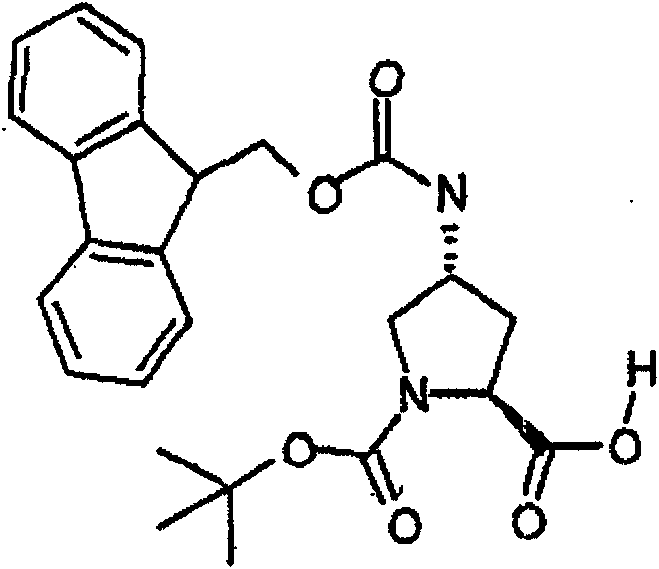
步骤1.合成NStep 1. Synthesis of N αalpha -叔丁氧基羰基-顺式-4-氯-L-脯氨酸苄酯-tert-butoxycarbonyl-cis-4-chloro-L-proline benzyl ester
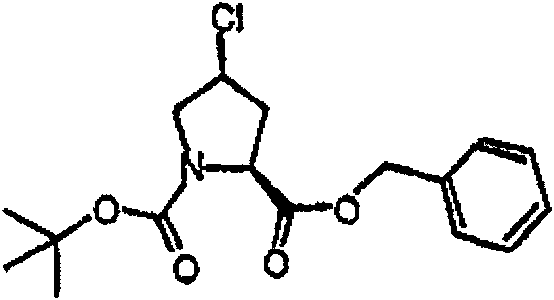
将商业性获得的N-叔丁氧基羰基-反式-4-羟基-脯氨酸(8.79g,38mmol)、碳酸钾(13.0g,94mmol)、苄基溴(4.5ml,38mmol)和二甲基甲酰胺(150mL)的混合物搅拌18小时。加入乙酸乙酯(100mL)后过滤。加入1M HCl(100mL)使白色混浊滤液变澄清。将各层分离,水层再加入乙酸乙酯(2×100mL)萃取。合并的有机层用水洗涤(2×50mL),干燥(硫酸钠),过滤并浓缩。将甲苯加入粗制的苄基酯,将溶液过滤后再浓缩。加入二氯甲烷(70mL)和四氯化碳(70mL),接着加入三苯膦(21.11g,80mmol)。将反应混合物搅拌10小时,用乙醇(7mL)猝灭,再搅拌5小时。将溶液浓缩至约100ml,然后加入二氯甲烷(40mL),接着搅拌下加入乙醚(200mL)。将溶液冷却4小时,过滤并浓缩获得黄褐色油状物,将它用快速色谱法提纯(用乙醚/己烷/二氯甲烷2∶2∶1)获得白色固体标题化合物(9.13g,26.9mmol,71%)。 Commercially available N-tert-butoxycarbonyl-trans-4-hydroxy-proline (8.79g, 38mmol), potassium carbonate (13.0g, 94mmol), benzyl bromide (4.5ml, 38mmol) and di A mixture of methylformamide (150 mL) was stirred for 18 hours. Ethyl acetate (100 mL) was added and filtered. The white cloudy filtrate was clarified by the addition of 1M HCl (100 mL). The layers were separated, and the aqueous layer was extracted with ethyl acetate (2 x 100 mL). The combined organic layers were washed with water (2 x 50 mL), dried (sodium sulfate), filtered and concentrated. Toluene was added to the crude benzyl ester and the solution was filtered and concentrated. Dichloromethane (70 mL) and carbon tetrachloride (70 mL) were added, followed by triphenylphosphine (21.11 g, 80 mmol). The reaction mixture was stirred for 10 hours, quenched with ethanol (7 mL), and stirred for an additional 5 hours. The solution was concentrated to about 100 mL, then dichloromethane (40 mL) was added, followed by diethyl ether (200 mL) with stirring. The solution was cooled for 4 hours, filtered and concentrated to give a tan oil, which was purified by flash chromatography (ether/hexane/dichloromethane 2:2:1) to give the title compound (9.13 g, 26.9 mmol, 71%). the
步骤2.合成NStep 2. Synthesis of N αalpha -叔丁氧基羰基-反式-4-叠氮基-L-脯氨酸苄酯:- tert-butoxycarbonyl-trans-4-azido-L-proline benzyl ester:
将Nα-叔丁氧基羰基-顺式-4-氯-L-脯氨酸苄酯(9.0g,26.5mmol)和叠氮化钠(7.36g,113mmol)的二甲基甲酰胺(270mL)溶液在75℃加热2天。加入水(100mL),将反应混合物用乙酸乙酯(3×100mL)萃取。合并的有机层用水洗涤(3×50mL),干燥(硫酸钠),过滤并浓缩。油状物用快速色谱法提纯(乙酸乙酯/己烷1∶1)获得标题化合物(8.59g,24.8mmol,94%)。 N α -tert-butoxycarbonyl-cis-4-chloro-L-proline benzyl ester (9.0 g, 26.5 mmol) and sodium azide (7.36 g, 113 mmol) in dimethylformamide (270 mL ) solution was heated at 75°C for 2 days. Water (100 mL) was added and the reaction mixture was extracted with ethyl acetate (3 x 100 mL). The combined organic layers were washed with water (3 x 50 mL), dried (sodium sulfate), filtered and concentrated. The oil was purified by flash chromatography (ethyl acetate/hexane 1:1) to obtain the title compound (8.59 g, 24.8 mmol, 94%).
步骤3.合成Boc-Pro(4t-NH(Fmoc))-OH:Step 3. Synthesis of Boc-Pro(4t-NH(Fmoc))-OH:
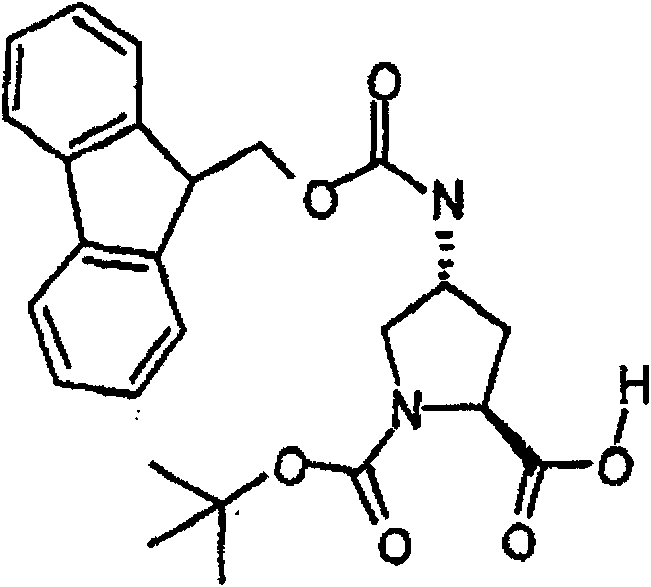
N-α-叔丁氧基羰基-反式-4-叠氮基-L-脯氨酸苄酯(8.59g,24.8mmol)和10%碳载钯(900mg)在乙醇(500mL)中的混合物用Parr氢化装置于50psi氢化14小时。将混合物过滤,浓缩,溶于甲醇(60mL),再过滤并浓缩获得无色油状物。将油状物溶于包含碳酸钠(5.31g,50.1mmol)的水(53mL)中,在40分钟内加入芴基甲基琥珀酰碳酸酯(8.37g,29.8mmol)的二氧六环(60mL)溶液。将反应混合物在室温下搅拌17小时,然后浓缩除去二氧六环,用水(200mL)稀释。溶液用乙醚(3×100mL)洗涤。加入柠檬酸(小心!发泡!)和水(100mL)调节水溶液的pH至2。混合物用二氯甲烷(400mL,100mL,100mL)萃取,将合并的有机层干燥(硫酸钠),过滤并浓缩获得标题化合物。 A mixture of N-α-tert-butoxycarbonyl-trans-4-azido-L-proline benzyl ester (8.59 g, 24.8 mmol) and 10% palladium on carbon (900 mg) in ethanol (500 mL) Hydrogenation was carried out at 50 psi for 14 hours using a Parr hydrogenation apparatus. The mixture was filtered, concentrated, dissolved in methanol (60 mL), filtered and concentrated to give a colorless oil. The oil was dissolved in water (53 mL) containing sodium carbonate (5.31 g, 50.1 mmol) and fluorenylmethylsuccinyl carbonate (8.37 g, 29.8 mmol) in dioxane (60 mL) was added over 40 minutes solution. The reaction mixture was stirred at room temperature for 17 hours, then concentrated to remove dioxane and diluted with water (200 mL). The solution was washed with ether (3 x 100 mL). Citric acid (caution! foaming!) and water (100 mL) were added to adjust the pH of the aqueous solution to 2. The mixture was extracted with dichloromethane (400 mL, 100 mL, 100 mL), the combined organic layers were dried (sodium sulfate), filtered and concentrated to afford the title compound. the
实施例VII.合成N-叔丁氧基羰基-4-反式-(N-芴基甲氧羰基氨基甲基)-L-脯氨酸(Boc-Pro(4t-MeNHFmoc)-OH):Example VII. Synthesis of N-tert-butoxycarbonyl-4-trans-(N-fluorenylmethoxycarbonylaminomethyl)-L-proline (Boc-Pro(4t-MeNHFmoc)-OH):

步骤1.合成叔丁氧基羰基顺式-4-羟基-L-脯氨酸苄酯(Boc-Pro(4-cis-OH)-OBn):Step 1. Synthesis of tert-butoxycarbonyl cis-4-hydroxy-L-proline benzyl ester (Boc-Pro(4-cis-OH)-OBn):
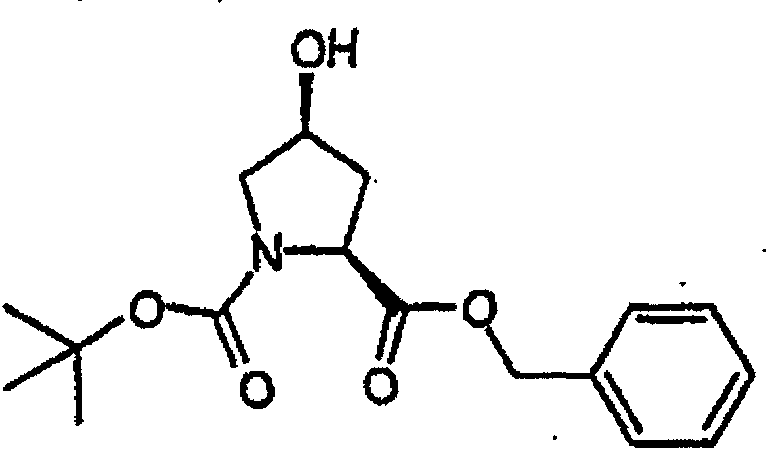
顺式-羟基-L-脯氨酸(5g,38.1mmol)的苯(45mL)和苄醇(45mL)混合物中加入一水合对甲苯磺酸(7.6g,40.0mmol)。将反应混合物在125℃加热20小时,同时用Dean-Stark捕集器除去水(2ml)。趁热过滤溶液,然后加入乙醚(150ml)。将溶液在室温冷却3小时,然后在4℃冷却3小时。收集所得固体,用乙醚(100mL)洗涤,真空干燥1小时获得13.5g白色固体。将固体溶于二氧六环(40mL)和二异丙基乙胺(7.6mL),然后在5分钟内加入二碳酸二叔丁酯(10g,45.8mmol),同时用冰浴保持恒定的反应温度。在室温经过10小时后,将反应混合物倾入冷水(200mL)中,用乙酸乙酯(3×200mL)萃取。合并的有机层用水(3×100mL)和饱和氯化钠水溶液(50mL)洗涤,干燥 (硫酸钠),过滤并浓缩。粗产物用快速色谱法(用40-60%乙酸乙酯的己烷)提纯获得标题化合物(10.04g,31.24mmol,82%)。 To a mixture of cis-hydroxy-L-proline (5 g, 38.1 mmol) in benzene (45 mL) and benzyl alcohol (45 mL) was added p-toluenesulfonic acid monohydrate (7.6 g, 40.0 mmol). The reaction mixture was heated at 125°C for 20 hours while removing water (2ml) with a Dean-Stark trap. The solution was filtered while hot, then diethyl ether (150ml) was added. The solution was cooled at room temperature for 3 hours, then at 4°C for 3 hours. The resulting solid was collected, washed with diethyl ether (100 mL), and dried under vacuum for 1 hour to obtain 13.5 g of a white solid. The solid was dissolved in dioxane (40 mL) and diisopropylethylamine (7.6 mL), then di-tert-butyl dicarbonate (10 g, 45.8 mmol) was added over 5 minutes while keeping the reaction constant with an ice bath temperature. After 10 hours at room temperature, the reaction mixture was poured into cold water (200 mL) and extracted with ethyl acetate (3 x 200 mL). The combined organic layers were washed with water (3 x 100 mL) and saturated aqueous sodium chloride (50 mL), dried (sodium sulfate), filtered and concentrated. The crude product was purified by flash chromatography (40-60% ethyl acetate in hexanes) to afford the title compound (10.04 g, 31.24 mmol, 82%). the
步骤2.合成N-叔丁氧基羰基顺式-4-甲磺酰氨基-L-脯氨酸苄酯(Boc-Pro(4-cis-OMs)-OBn):Step 2. Synthesis of N-tert-butoxycarbonyl cis-4-methanesulfonylamino-L-proline benzyl ester (Boc-Pro(4-cis-OMs)-OBn):
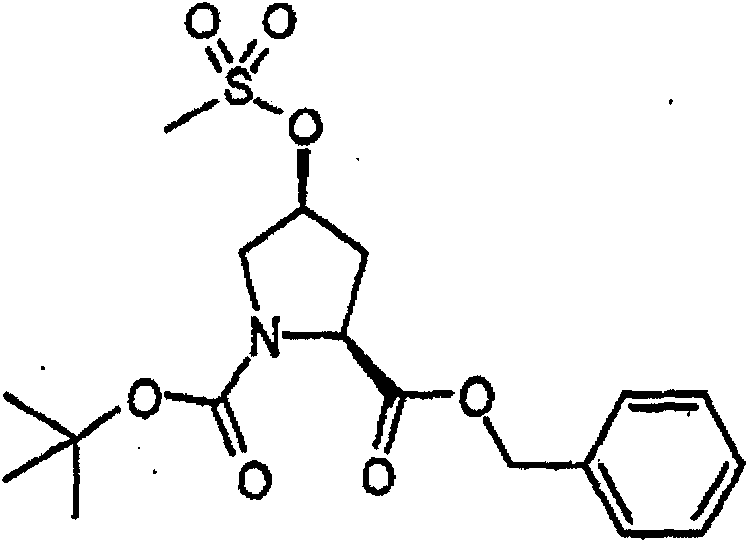
Boc-Pro(4-cis-OH)-OBn(8.45g,26.3mmol)的吡啶(65mL)溶液在0℃于7分钟内滴加甲磺酰氯(3.4mL,44mmol)。将反应混合物在2小时内加温至室温,然后搅拌过夜。在15分钟内加入10%水的吡啶(20mL)溶液,浓缩反应混合物。将残余物溶于水,用乙酸乙酯(2×200mL)萃取。合并的有机层用水(2×50mL)、饱和碳酸氢钠水溶液(50mL)和饱和氯化钠水溶液(50mL)洗涤,干燥(硫酸钠),过滤并浓缩。将所得残余物溶于甲苯(100mL),浓缩除去痕量吡啶。真空干燥残余物30分钟,获得标题化合物(10.7g,102%),然后用于下一步骤而无需提纯。 To a solution of Boc-Pro(4-cis-OH)-OBn (8.45 g, 26.3 mmol) in pyridine (65 mL) was added methanesulfonyl chloride (3.4 mL, 44 mmol) dropwise at 0° C. within 7 minutes. The reaction mixture was warmed to room temperature over 2 hours, then stirred overnight. A solution of 10% water in pyridine (20 mL) was added over 15 minutes and the reaction mixture was concentrated. The residue was dissolved in water and extracted with ethyl acetate (2 x 200 mL). The combined organic layers were washed with water (2 x 50 mL), saturated aqueous sodium bicarbonate (50 mL) and saturated aqueous sodium chloride (50 mL), dried (sodium sulfate), filtered and concentrated. The resulting residue was dissolved in toluene (100 mL), and concentrated to remove traces of pyridine. The residue was dried in vacuo for 30 minutes to obtain the title compound (10.7 g, 102%), which was used in the next step without purification. the
步骤3.N-叔丁氧基羰基-反式-4R-氰基-L-脯氨酸苄酯(Boc-Pro(4-trans-CN)-OBn):Step 3. N-tert-butoxycarbonyl-trans-4R-cyano-L-proline benzyl ester (Boc-Pro(4-trans-CN)-OBn):

将Boc-Pro(4-cis-OMs)-OBn(10.7g,26.3mmol)和四丁基氰化铵(15.0g,56mmol)的二甲基甲酰胺(100mL)溶液用油浴在55℃加热28小时。冷却后,加入水(150mL),混合物用乙酸乙酯(3×200mL)萃取。合并的有机层用水(3×100mL)和饱和氯化钠水溶液(100mL)洗涤,干燥(硫酸钠),过滤并浓缩。将所得残余物用快速色谱法(1∶1乙醚/己烷)提纯,然后用乙酸乙酯/己烷重结晶获得标题化合物(2.40g,7.26mmol,28%)。 A solution of Boc-Pro(4-cis-OMs)-OBn (10.7 g, 26.3 mmol) and tetrabutylammonium cyanide (15.0 g, 56 mmol) in dimethylformamide (100 mL) was heated at 55 °C in an oil bath 28 hours. After cooling, water (150 mL) was added and the mixture was extracted with ethyl acetate (3 x 200 mL). The combined organic layers were washed with water (3 x 100 mL) and saturated aqueous sodium chloride (100 mL), dried (sodium sulfate), filtered and concentrated. The resulting residue was purified by flash chromatography (1:1 ether/hexane), and then recrystallized from ethyl acetate/hexane to obtain the title compound (2.40 g, 7.26 mmol, 28%). the
步骤4.N-叔丁氧基羰基-4-反式-(N-芴基甲氧羰基氨基甲基)-L-脯氨酸(Boc-Pro(4t-MeNHFmoc)-OH):Step 4. N-tert-butoxycarbonyl-4-trans-(N-fluorenylmethoxycarbonylaminomethyl)-L-proline (Boc-Pro(4t-MeNHFmoc)-OH):

以上步骤3的化合物(2.31g,7mmol)、水(10mL)、甲醇(85mL)和10%碳载钯(700mg)的混合物用Parr氢化装置在50psi氢化11小时。过滤并浓缩混合物。将水(15mL)和碳酸钠(1.5g,14.2mmol)加 入残余物。在5分钟内加入芴基甲基琥珀酰碳酸酯(2.36g,7.0mmol)的二氧六环(17mL)溶液,在室温下连续搅拌28小时。真空浓缩反应物至体积为15mL,加入水(100mL)。溶液用乙醚(3×75mL)洗涤。加入柠檬酸(约20g,小心!发泡!)和水(100mL)调节水溶液的pH至2。混合物用二氯甲烷(4×100mL)萃取,干燥(硫酸钠)合并的有机层,过滤并浓缩。粗产物包含一种必须经3步纯化的主要杂质。将粗产物溶于二氯甲烷(50mL)和三氟乙酸(50mL),搅拌5小时后浓缩。残余物用制备型反相HPLC提纯。将纯4-(N-芴基甲氧羰基氨基甲基)脯氨酸三氟乙酸盐(1.887g,3.93mmol)溶于二氧六环(10mL)、乙腈(20mL)和二异丙基乙胺(1.4mL,8mmol)。反应混合物中加入二碳酸二叔丁酯(1.1g,5mmol)的二氧六环(5mL)溶液。在搅拌18小时后,加入柠檬酸(小心:发泡!)和水(100mL)调节溶液的pH至2。混合物用乙酸乙酯(3×150mL)萃取,合并的有机层用饱和氯化钠水溶液(100mL)洗涤,干燥(硫酸钠),过滤并浓缩。将粗产物溶于饱和碳酸氢钠水溶液(100mL),然后用乙醚(3×75mL)洗涤。水相中加入柠檬酸调节pH=3,然后用二氯甲烷(4×100mL)萃取。干燥(硫酸钠)合并的有机层,过滤并浓缩获得标题化合物(1.373g,2.94mmol,42%)。 A mixture of the compound from step 3 above (2.31 g, 7 mmol), water (10 mL), methanol (85 mL) and 10% palladium on carbon (700 mg) was hydrogenated using a Parr hydrogenation apparatus at 50 psi for 11 hours. Filter and concentrate the mixture. Water (15 mL) and sodium carbonate (1.5 g, 14.2 mmol) were added to the residue. A solution of fluorenylmethylsuccinyl carbonate (2.36 g, 7.0 mmol) in dioxane (17 mL) was added over 5 minutes and stirring was continued at room temperature for 28 hours. The reaction was concentrated in vacuo to a volume of 15 mL and water (100 mL) was added. The solution was washed with ether (3 x 75 mL). Citric acid (approximately 20 g, be careful! Foaming!) and water (100 mL) were added to adjust the pH of the aqueous solution to 2. The mixture was extracted with dichloromethane (4 x 100 mL), and the combined organic layers were dried (sodium sulfate), filtered and concentrated. The crude product contained a major impurity which had to be purified in 3 steps. The crude product was dissolved in dichloromethane (50 mL) and trifluoroacetic acid (50 mL), stirred for 5 hours and then concentrated. The residue was purified by preparative reverse phase HPLC. Pure 4-(N-fluorenylmethoxycarbonylaminomethyl)proline trifluoroacetate (1.887 g, 3.93 mmol) was dissolved in dioxane (10 mL), acetonitrile (20 mL) and diisopropyl Ethylamine (1.4 mL, 8 mmol). A solution of di-tert-butyl dicarbonate (1.1 g, 5 mmol) in dioxane (5 mL) was added to the reaction mixture. After stirring for 18 hours, the pH of the solution was adjusted to 2 by adding citric acid (caution: foaming!) and water (100 mL). The mixture was extracted with ethyl acetate (3 x 150 mL), the combined organic layers were washed with saturated aqueous sodium chloride (100 mL), dried (sodium sulfate), filtered and concentrated. The crude product was dissolved in saturated aqueous sodium bicarbonate (100 mL), then washed with diethyl ether (3 x 75 mL). Citric acid was added to the aqueous phase to adjust pH=3, and then extracted with dichloromethane (4×100 mL). The combined organic layers were dried (sodium sulfate), filtered and concentrated to afford the title compound (1.373 g, 2.94 mmol, 42%). the
实施例VIII.合成3,4-亚异丙基脯氨醇:Embodiment VIII. Synthesis of 3,4-isopropylidene prolinol:

步骤1.环丙烷化反应(Tetrahedron Lett.1993.34(16)2691和2695):Step 1. cyclopropanation reaction (Tetrahedron Lett.1993.34 (16) 2691 and 2695):
异丙基三苯基碘化鏻(4.14g,9.58mmol)的四氢呋喃(60mL)溶液在0℃搅拌下于5分钟加入正丁基锂(1.6M的己烷溶液,5.64mL,9.02mmol)。30分钟后,在10分钟内加入烯酰胺((5R,7S)-5-苯基-5,6,7,7a-四氢-6-氧杂pyrrolizin-3-酮)(1.206g,6.0mmol)(关于合成烯酰胺原料参见J.Org.Chem.1999,64(2),547)的四氢呋喃(40mL)溶液。再经过10分钟后,除去冷却浴,在室温下搅拌反应混合物4小时。将反应物倾入水(400mL)中,用乙醚(400mL)和乙酸乙酯(2×400mL)萃取。用硫酸钠干燥合并的有机萃取液,过滤并浓缩获得所需的粗产物。残余物用快速色谱法提纯,洗脱时用3∶5∶2乙酸乙酯/己烷/二氯甲烷获得纯环丙烷化产物(750mg,3.08mmol,51%)。 A solution of isopropyltriphenylphosphonium iodide (4.14g, 9.58mmol) in tetrahydrofuran (60mL) was added with stirring at 0°C for 5 minutes to n-butyllithium (1.6M in hexane, 5.64mL, 9.02mmol). After 30 minutes, enamide ((5R,7S)-5-phenyl-5,6,7,7a-tetrahydro-6-oxapyrrolizin-3-one) (1.206 g, 6.0 mmol) was added over 10 minutes ) (see J.Org.Chem.1999, 64(2), 547) in tetrahydrofuran (40 mL) for the synthesis of enamide raw materials. After an additional 10 minutes, the cooling bath was removed and the reaction mixture was stirred at room temperature for 4 hours. The reaction was poured into water (400 mL), extracted with diethyl ether (400 mL) and ethyl acetate (2 x 400 mL). The combined organic extracts were dried over sodium sulfate, filtered and concentrated to obtain the desired crude product. The residue was purified by flash chromatography eluting with 3:5:2 ethyl acetate/hexane/dichloromethane to give pure cyclopropanated product (750 mg, 3.08 mmol, 51%). the
步骤2.合成3,4-亚异丙基脯氨醇(P[3,4-(diMe-环丙基)]-乙醇)(J.Org.Chem.(1999)64(2),330):Step 2. Synthesis of 3,4-isopropylidene prolinol (P[3,4-(diMe-cyclopropyl)]-ethanol) (J.Org.Chem.(1999) 64(2), 330) :

将以上步骤1获得的产物(1.23g,5.06mmol)和氢化锂铝(1.0M的THF溶液,15mL,15mmol)的混合物加热回流5小时。在冷却至0℃后,在15分钟内滴加饱和硫酸钠水溶液(1.5mL)小心地猝灭残留的氢化铝。用乙酸乙酯(40mL)稀释混合物,然后用硅藻土过滤。用硫酸钠干燥滤液,过滤并浓缩获得粗制的N-苄基氨基醇(1.25g),将其用于下一步无需再提纯。粗制的N-苄基氨基醇(1.25g,5.06mmol)的1∶1乙酸/乙酸乙酯(30mL)溶液与10%Pd/C(1g)用Parr氢化装置在50psi氢化16小时。过滤反应混合物以除去碳载催化剂,浓缩滤液。将残余物溶于水(30mL),用50%NaOH调节pH至13。混合物用乙醚(3×60mL)萃取。用硫酸钠干燥合并的萃取液,过滤并浓缩获得粗制的氨基醇(485mg,3.43mmol)。此产物用于下一步无需再提纯。 A mixture of the product obtained in Step 1 above (1.23 g, 5.06 mmol) and lithium aluminum hydride (1.0 M in THF, 15 mL, 15 mmol) was heated at reflux for 5 hours. After cooling to 0 °C, the residual aluminum hydride was carefully quenched by adding saturated aqueous sodium sulfate solution (1.5 mL) dropwise over 15 min. The mixture was diluted with ethyl acetate (40 mL), then filtered through celite. The filtrate was dried over sodium sulfate, filtered and concentrated to give crude N-benzylaminoalcohol (1.25 g), which was used in the next step without further purification. A solution of crude N-benzylaminoalcohol (1.25 g, 5.06 mmol) in 1:1 acetic acid/ethyl acetate (30 mL) was hydrogenated with 10% Pd/C (1 g) using a Parr hydrogenation apparatus at 50 psi for 16 hours. The reaction mixture was filtered to remove the carbon-supported catalyst, and the filtrate was concentrated. The residue was dissolved in water (30 mL) and the pH was adjusted to 13 with 50% NaOH. The mixture was extracted with ether (3 x 60 mL). The combined extracts were dried over sodium sulfate, filtered and concentrated to give the crude aminoalcohol (485 mg, 3.43 mmol). This product was used in the next step without further purification. the
实施例IX.合成iBoc-G(Chx)-Pro(3,4-亚异丙基)-羧酸:Example IX. Synthesis of iBoc-G(Chx)-Pro(3,4-isopropylidene)-carboxylic acid:
步骤1.合成异丁氧基羰基-环己基甘氨酸(Boc-G(Chx)-OH):Step 1. Synthesis of isobutoxycarbonyl-cyclohexylglycine (Boc-G(Chx)-OH):

商业上可得到的环己基甘氨酸盐酸盐(15g,77.4mmol)的乙腈(320ml)和水(320ml)溶液中加入碳酸钾。将氯甲酸异丁酯(11.1ml,85.1mmol)在15分钟内加入澄清的溶液中,搅拌反应物17小时。减压除去乙腈,残留的水层用乙醚(100ml)萃取两次。然后用6N盐酸酸化水层至pH为1,用二氯甲烷(3×300ml)萃取。有机层用硫酸钠干燥,过滤并浓缩获得18.64g(94%)白色固体产物。 Potassium carbonate was added to a solution of commercially available cyclohexylglycine hydrochloride (15 g, 77.4 mmol) in acetonitrile (320 mL) and water (320 mL). Isobutyl chloroformate (11.1 mL, 85.1 mmol) was added to the clear solution over 15 minutes and the reaction was stirred for 17 hours. Acetonitrile was removed under reduced pressure and the remaining aqueous layer was extracted twice with ether (100ml). The aqueous layer was then acidified to pH 1 with 6N hydrochloric acid and extracted with dichloromethane (3 x 300ml). The organic layer was dried over sodium sulfate, filtered and concentrated to afford 18.64 g (94%) of the product as a white solid. the
步骤2.合成异丁氧基羰基-环己基甘氨酰基-3,4-亚异丙基脯氨酸(iBoc-G(Chx)-P[3,4-(diMe-环丙基)]-OH):Step 2. Synthesis of isobutoxycarbonyl-cyclohexylglycyl-3,4-isopropylidene proline (iBoc-G(Chx)-P[3,4-(diMe-cyclopropyl)]- OH):

a)偶合步骤 a) Coupling step
iBoc-G(Chx)-OH(890mg,3.45mmol)的乙腈(20mL)溶液中加入HATU(1.33g,3.5mmol)、HOAt(476mg,3.5g),然后加入二异丙基乙胺(2.5mL,14mmol)。2分钟后,加入3,4-亚异丙基脯氨醇(485mg,3.43mmol),搅拌反应混合物过夜。加入饱和碳酸氢钠水溶液后用乙醚和乙酸乙酯萃取。干燥合并的有机层,过滤并浓缩。残余物用快速色谱法提纯,洗脱时用1∶1乙酸乙酯/己烷获得纯二肽醇iBoc-G(Chx)-3,4-亚异丙基脯氨醇(870mg,2.3mmol,67%). To a solution of iBoc-G(Chx)-OH (890mg, 3.45mmol) in acetonitrile (20mL) was added HATU (1.33g, 3.5mmol), HOAt (476mg, 3.5g), and then diisopropylethylamine (2.5mL , 14mmol). After 2 minutes, 3,4-isopropylideneprolinol (485 mg, 3.43 mmol) was added and the reaction mixture was stirred overnight. After adding saturated aqueous sodium bicarbonate solution, it was extracted with diethyl ether and ethyl acetate. The combined organic layers were dried, filtered and concentrated. The residue was purified by flash chromatography eluting with 1:1 ethyl acetate/hexanes to obtain pure dipeptide alcohol iBoc-G(Chx)-3,4-isopropylidene prolinol (870 mg, 2.3 mmol, 67%).
b)琼斯氧化步骤 b) Jones oxidation step
二肽醇iBoc-G(Chx)-3,4-亚异丙基脯氨醇(100mg,0.26mmol)的丙酮(2mL)溶液在0℃搅拌下于5分钟内滴加琼斯试剂(300μL)。[琼斯试剂:用三氧化铬(13.4g)和浓硫酸(11.5mL)用水稀释至总体积为50mL制备]。在0℃搅拌3小时后,加入异丙醇(500μL),继续搅拌 10分钟。用水(20mL)稀释反应混合物,用乙酸乙酯(3×70mL)萃取。将合并的有机层干燥,过滤并浓缩获得二肽iBoc-G(Chx)-3,4-亚异丙基脯氨酸(100mg,0.25mmol,96%)。 To a solution of dipeptidol iBoc-G(Chx)-3,4-isopropylidene prolinol (100 mg, 0.26 mmol) in acetone (2 mL) was added dropwise Jones reagent (300 μL) within 5 minutes under stirring at 0°C. [Jones reagent: prepared by diluting with chromium trioxide (13.4 g) and concentrated sulfuric acid (11.5 mL) with water to a total volume of 50 mL]. After stirring at 0 °C for 3 hours, isopropanol (500 μL) was added and stirring was continued for 10 minutes. The reaction mixture was diluted with water (20 mL), extracted with ethyl acetate (3 x 70 mL). The combined organic layers were dried, filtered and concentrated to obtain the dipeptide iBoc-G(Chx)-3,4-isopropylideneproline (100 mg, 0.25 mmol, 96%). the
实施例X.合成N-Cbz-3,4-桥亚甲基脯氨酸:Example X. Synthesis of N-Cbz-3,4-methanoproline:

步骤1.合成N-苄基-3,4-桥亚甲基脯氨醇:Step 1. Synthesis of N-benzyl-3,4-methanoprolinol:

将亚苄基原料(J.Org.Chem.1999,64(2),547)(4.6g,21.4mmol)和氢化锂铝(1.0M的THF溶液,64mL,64mmol)混合物加热回流5小时。冷却到0℃后,在15分钟内滴加饱和硫酸钠水溶液(5mL)小心地猝灭残留的氢化铝。用乙酸乙酯(200mL)稀释混合物,然后通过硅藻土过滤。滤液用硫酸钠干燥,过滤并浓缩获得粗制的N-苄基氨基醇(3.45g),它用于下一步无需再提纯。 A mixture of benzylidene starting material (J. Org. Chem. 1999, 64(2), 547) (4.6 g, 21.4 mmol) and lithium aluminum hydride (1.0 M in THF, 64 mL, 64 mmol) was heated at reflux for 5 hours. After cooling to 0 °C, the remaining aluminum hydride was carefully quenched by the dropwise addition of saturated aqueous sodium sulfate (5 mL) over 15 min. The mixture was diluted with ethyl acetate (200 mL), then filtered through celite. The filtrate was dried over sodium sulfate, filtered and concentrated to give crude N-benzylaminoalcohol (3.45 g), which was used in the next step without further purification. the
步骤2.合成N-苄氧基羰基-3,4-桥亚甲基脯氨醇(CBz-P(3,4-CH2)-醇):Step 2. Synthesis of N-benzyloxycarbonyl-3,4-methanoprolinol (CBz-P(3,4-CH2)-alcohol):
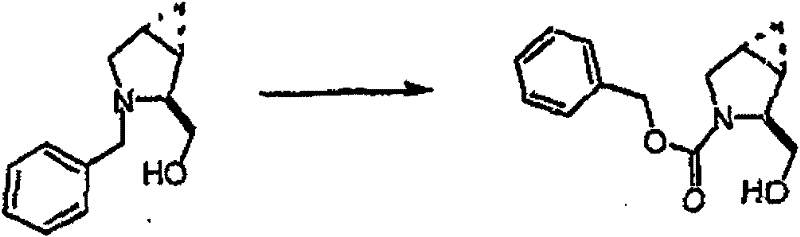
粗制的N-苄基氨基醇(3g,14.76mmol)的甲醇(120mL)和浓HCl(1.5mL)溶液与10%Pd/C(300mg)在50psi氢化16小时。将反应混合物过滤除去碳载催化剂,浓缩滤液。将残余物溶于水/二氧六环(100mL),加入二异丙基乙胺(3.2mL)。加入氯甲酸苄酯(2.76mL,16.2mmol),搅拌反应物过夜。将反应混合物浓缩,溶于1M HCl(100mL),用乙酸乙酯(3×200mL)萃取。合并的有机层用硫酸镁干燥,过滤并浓缩。残余物用快速色谱法(1∶3乙酸乙酯/己烷)提纯获得N-Cbz-3,4-桥亚甲基脯氨醇(2.4g)。 A solution of crude N-benzylaminoalcohol (3 g, 14.76 mmol) in methanol (120 mL) and concentrated HCl (1.5 mL) was hydrogenated with 10% Pd/C (300 mg) at 50 psi for 16 hours. The reaction mixture was filtered to remove the carbon-supported catalyst, and the filtrate was concentrated. The residue was dissolved in water/dioxane (100 mL), and diisopropylethylamine (3.2 mL) was added. Benzyl chloroformate (2.76 mL, 16.2 mmol) was added and the reaction was stirred overnight. The reaction mixture was concentrated, dissolved in 1M HCl (100 mL), and extracted with ethyl acetate (3 x 200 mL). The combined organic layers were dried over magnesium sulfate, filtered and concentrated. The residue was purified by flash chromatography (1:3 ethyl acetate/hexane) to give N-Cbz-3,4-methanoprolinol (2.4 g). the
步骤3.合成N-苄氧基羰基-3,4-桥亚甲基脯氨酸(CBz-P(3,4-CH2)-OH):Step 3. Synthesis of N-benzyloxycarbonyl-3,4-methanoproline (CBz-P(3,4-CH2)-OH):
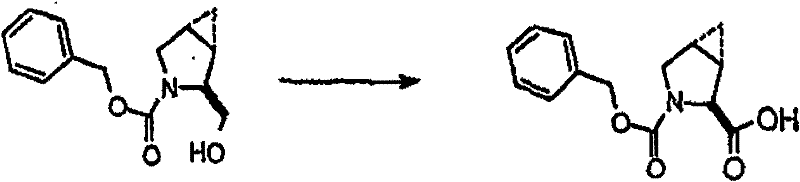
N-Cbz-3,4-桥亚甲基脯氨醇(2.2g,8.90mmol)的丙酮(68mL)溶液在0℃搅拌下于5分钟内滴加琼斯试剂(6.6mL)。[琼斯试剂:三氧化铬(13.4g)和浓硫酸(11.5mL)用水稀释至总体积为50mL制备]在0℃搅拌3小时后,加入异丙醇(11mL),再继续搅拌10分钟。反应混合物用水(400mL)稀释,用乙酸乙酯(3×500mL)萃取。合并的有机层 用硫酸镁干燥,过滤并浓缩获得N-Cbz-3,4-桥亚甲基脯氨酸(2.25g,96%) To a solution of N-Cbz-3,4-methanoprolinol (2.2 g, 8.90 mmol) in acetone (68 mL) was added dropwise Jones reagent (6.6 mL) within 5 minutes with stirring at 0°C. [Jones reagent: prepared by diluting chromium trioxide (13.4 g) and concentrated sulfuric acid (11.5 mL) with water to a total volume of 50 mL] After stirring at 0° C. for 3 hours, isopropanol (11 mL) was added, and stirring was continued for 10 minutes. The reaction mixture was diluted with water (400 mL), extracted with ethyl acetate (3 x 500 mL). The combined organic layers were dried with magnesium sulfate, filtered and concentrated to obtain N-Cbz-3,4-methanoproline (2.25g, 96%)
实施例XI.合成Boc-(6S-乙酯基桥亚甲基)脯氨酸:Example XI. Synthesis of Boc-(6S-carboethoxymethylene)proline:
按照公开的方法合成标题化合物:Marrinozzi,M.;Nataini,B.;Ni,M.H.;Costantino,G.;Pellicciari R.IL Farmaco(1995)50(5),327-331。 The title compound was synthesized following published procedures: Marrinozzi, M.; Nataini, B.; Ni, M.H.; Costantino, G.; Pellicciari R. IL Farmaco (1995) 50(5), 327-331. the
实施例XII.合成Boc-3-吗啉羧酸:Example XII. Synthesis of Boc-3-morpholine carboxylic acid:
按照公开的方法合成标题化合物:Kogami Y.,Okawa,K.Bull.Chem.Soc.Jpn.(1987)60,2963-2965。 The title compound was synthesized according to published methods: Kogami Y., Okawa, K. Bull. Chem. Soc. Jpn. (1987) 60, 2963-2965. the
实施例XIII.合成N-叔丁氧基羰基2-氮杂-3S-羟基羰基-[2,2,2]-二环辛烷:Example XIII. Synthesis of N-tert-butoxycarbonyl 2-aza-3S-hydroxycarbonyl-[2,2,2]-bicyclooctane:
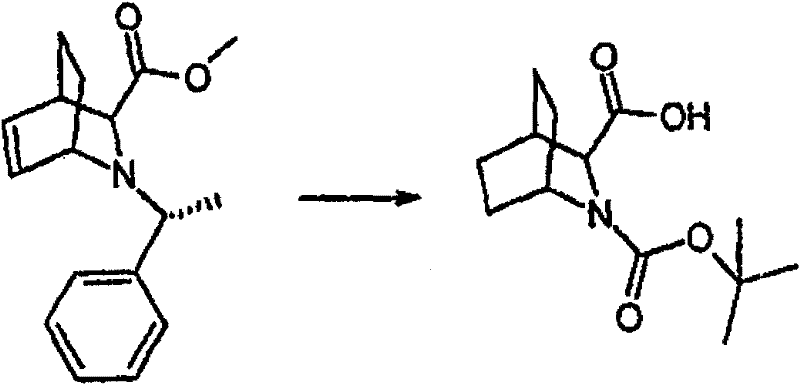
粗制的2-氮杂-2-(1-苯乙基)-3S-甲氧羰基-[2,2,2]-二环辛-5-烯(10mmol)(Tetrahedron(1992)48(44)9707-9718)和10%碳载钯(1g)的甲醇(30mL)溶液用12N HCl酸化,然后用Parr氢化装置在50psi氢化16小时。过滤反应混合物除去碳载催化剂,浓缩滤液。残余物溶于浓HCl,搅拌过夜。将溶液浓缩,再溶于乙腈(50mL)。加入二异丙基乙胺(3.5mL)和二碳酸二叔丁酯(1g)。将反应混合物搅拌24小时,然后浓缩。残余物溶于CH2Cl2和5%硫酸水溶液。反应混合物用CH2Cl2萃取,浓缩合并的有机层。将残余物溶于10%饱和碳酸氢钠,用乙醚(2×)洗涤,用5%硫酸水溶液酸化。水层用乙酸乙酯(2×)萃取。合并的乙酸乙酯层经干燥,过滤,浓缩获得N-叔丁氧基羰基2-氮杂-3S-羟基羰基-[2,2,2]-二环辛烷(650mg)。 Crude 2-aza-2-(1-phenylethyl)-3S-methoxycarbonyl-[2,2,2]-bicyclooct-5-ene (10mmol) (Tetrahedron (1992) 48 (44 ) 9707-9718) and 10% palladium on carbon (1 g) in methanol (30 mL) was acidified with 12N HCl and then hydrogenated using a Parr hydrogenation apparatus at 50 psi for 16 hours. The reaction mixture was filtered to remove the carbon-supported catalyst, and the filtrate was concentrated. The residue was dissolved in concentrated HCl and stirred overnight. The solution was concentrated and redissolved in acetonitrile (50 mL). Diisopropylethylamine (3.5 mL) and di-tert-butyl dicarbonate (1 g) were added. The reaction mixture was stirred for 24 hours, then concentrated. The residue was dissolved in CH2Cl2 and 5 % aqueous sulfuric acid. The reaction mixture was extracted with CH2Cl2 , and the combined organic layers were concentrated. The residue was dissolved in 10% saturated sodium bicarbonate, washed with ether (2x), and acidified with 5% aqueous sulfuric acid. The aqueous layer was extracted with ethyl acetate (2x). The combined ethyl acetate layers were dried, filtered and concentrated to give N-tert-butoxycarbonyl 2-aza-3S-hydroxycarbonyl-[2,2,2]-bicyclooctane (650 mg).
实施例XIV.合成异丁氧基羰基-环己基甘氨酰基-4,4-二甲基脯氨酸(Bioc-G(Chx)-P(4,4-二甲基)-OH):Example XIV. Synthesis of isobutoxycarbonyl-cyclohexylglycyl-4,4-dimethylproline (Bioc-G(Chx)-P(4,4-dimethyl)-OH):

步骤1.合成iBoc-G(Chx)-P(4,4-二甲基)-OMe:Step 1. Synthesis of iBoc-G(Chx)-P(4,4-dimethyl)-OMe:

iBoc-G(Chx)-OH(实施例IX步骤1.)(377mg,1.95mmol)的乙腈(7mL)溶液中依次加入HCl·HN-Pro(4,4-二甲基)-OMe(实施例I步骤6)(377mg,1.95mmol)、N-羟基苯并三唑(239mg,1.75mmol)、TBTU(845mg,2.63mmol)和二异丙基乙胺(1.35mL,7.8mmol)。反应混合物在室温下搅拌18小时。将反应混合物浓缩,残留的残余物溶于乙酸乙酯。有机层用每份10ml的饱和碳酸氢钠溶液、1N盐酸溶液和盐水洗涤两次。有机层用硫酸钠干燥,过滤并浓缩获得白色固体(612mg,79%)。 To a solution of iBoc-G(Chx)-OH (Example IX step 1.) (377mg, 1.95mmol) in acetonitrile (7mL) was successively added HCl·HN-Pro(4,4-dimethyl)-OMe (Example I step 6) (377mg, 1.95mmol), N-hydroxybenzotriazole (239mg, 1.75mmol), TBTU (845mg, 2.63mmol) and diisopropylethylamine (1.35mL, 7.8mmol). The reaction mixture was stirred at room temperature for 18 hours. The reaction mixture was concentrated, and the remaining residue was dissolved in ethyl acetate. The organic layer was washed twice with 10 mL portions of saturated sodium bicarbonate solution, 1N hydrochloric acid solution and brine. The organic layer was dried over sodium sulfate, filtered and concentrated to give a white solid (612 mg, 79%). the
步骤2.合成iBoc-G(Chx)-P(4,4-二甲基)-OH:Step 2. Synthesis of iBoc-G(Chx)-P(4,4-dimethyl)-OH:

以上步骤1获得的甲酯(612mg,1.54mmol)的甲醇(6ml)溶液在存在2M氢氧化锂(1.16ml)下皂化3小时。减压除去甲醇,残余物用乙酸乙酯稀释,用1N盐酸酸化至pH=2。将各层分离,有机层用水和盐水洗涤,用硫酸钠干燥,过滤并浓缩。 A solution of the methyl ester obtained in Step 1 above (612mg, 1.54mmol) in methanol (6ml) was saponified in the presence of 2M lithium hydroxide (1.16ml) for 3 hours. Methanol was removed under reduced pressure, and the residue was diluted with ethyl acetate and acidified to pH=2 with 1N hydrochloric acid. The layers were separated and the organic layer was washed with water and brine, dried over sodium sulfate, filtered and concentrated. the
实施例XV.合成L-苯基甘氨酸二甲基酰胺Example XV. Synthesis of L-phenylglycine dimethylamide

步骤1.合成N-苄氧基羰基-L-苯基甘氨酸二甲基酰胺(CBz-Phg-NMe2):Step 1. Synthesis of N-benzyloxycarbonyl-L-phenylglycine dimethylamide (CBz-Phg-NMe2):

将N-苄氧基羰基-L-苯基甘氨酸(25g,88mmols)溶于THF(800mL)并冷却至-10℃。加入N-甲基吗啉(9.7mL,88mmols)和氯甲酸异丁酯(11.4mL,88.0mmols),将混合物搅拌1分钟。加入二甲胺(100mL,2M的THF溶液),将反应物加温至室温。过滤混合物,真空浓缩滤液获得黄色油状物N-苄氧基羰基-L-苯基甘氨酸二甲基酰胺(32.5g)。 N-Benzyloxycarbonyl-L-phenylglycine (25 g, 88 mmols) was dissolved in THF (800 mL) and cooled to -10°C. N-methylmorpholine (9.7 mL, 88 mmols) and isobutyl chloroformate (11.4 mL, 88.0 mmols) were added and the mixture was stirred for 1 min. Dimethylamine (100 mL, 2M in THF) was added and the reaction was allowed to warm to room temperature. The mixture was filtered and the filtrate was concentrated in vacuo to give N-benzyloxycarbonyl-L-phenylglycine dimethylamide (32.5 g) as a yellow oil. the

步骤2.合成L-苯基甘氨酸二甲基酰胺(H-Phg-NMe2):Step 2. Synthesis of L-phenylglycine dimethylamide (H-Phg-NMe2):
将以上获得的N-苄氧基羰基-L-苯基甘氨酸二甲基酰胺(32.5g)溶于甲醇(750ml),加入10%活性碳载钯(3.3g)。此混合物用Parr装置在35psi氢气氛下氢化2小时。过滤反应混合物,真空除去溶剂,残余物用甲醇-己烷重结晶获得乳白色固体苯基甘氨酸二甲基酰胺(26g)。通过HPLC分析2,3,4,6-四-O-乙酰基吡喃葡萄糖基硫代异氰酸酯衍生物测定此产物的对映体过量(ee)>99%。 The N-benzyloxycarbonyl-L-phenylglycine dimethylamide (32.5 g) obtained above was dissolved in methanol (750 ml), and 10% palladium on activated carbon (3.3 g) was added. This mixture was hydrogenated using a Parr apparatus under a hydrogen atmosphere of 35 psi for 2 hours. The reaction mixture was filtered, the solvent was removed in vacuo, and the residue was recrystallized from methanol-hexane to obtain phenylglycine dimethylamide (26 g) as an off-white solid. The enantiomeric excess (ee) of this product was determined to be >99% by HPLC analysis of the 2,3,4,6-tetra-O-acetylglucopyranosylthioisocyanate derivative. the
实施例XVI.合成(1-甲基环己基)甘氨酸:Example XVI. Synthesis of (1-methylcyclohexyl) glycine:

步骤1.1-甲基-1-羟甲基环己烷Step 1. 1-Methyl-1-Hydroxymethylcyclohexane
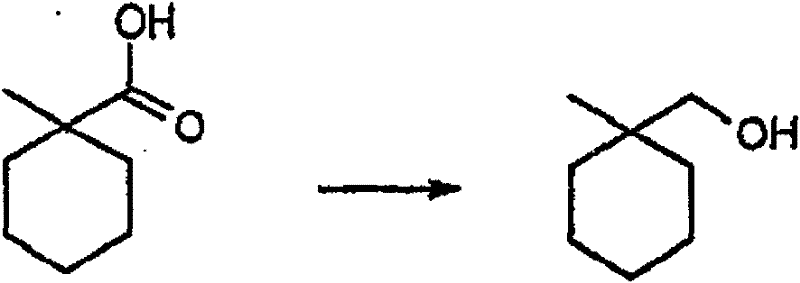
1-甲基-L-羟基羰基环己烷(10g,70mmol)的四氢呋喃(300mL)溶液在0℃于90分钟内加入1M乙硼烷的四氢呋喃(200mL,200mmol)溶液。除去冷却浴,反应混合物在室温下搅拌2天。在冷却下,90分钟内缓慢地加入饱和硫酸氢钠(10mL)猝灭残留硼烷。再加入饱和硫酸氢钠(200mL),搅拌20分钟后除去水层。有机层用水和饱和氯化钠洗涤,干燥,过滤并浓缩。残余物用快速色谱法(含20%乙醚的己烷)提纯获得1-甲基-1-羟甲基环己烷(6.17g,48mmol,69%)。 A solution of 1-methyl-L-hydroxycarbonylcyclohexane (10 g, 70 mmol) in THF (300 mL) was added to a solution of 1M diborane in THF (200 mL, 200 mmol) at 0° C. within 90 minutes. The cooling bath was removed and the reaction mixture was stirred at room temperature for 2 days. Under cooling, the residual borane was quenched by the slow addition of saturated sodium bisulfate (10 mL) over 90 minutes. Saturated sodium bisulfate (200 mL) was added, stirred for 20 minutes, and the aqueous layer was removed. The organic layer was washed with water and saturated sodium chloride, dried, filtered and concentrated. The residue was purified by flash chromatography (20% ether in hexanes) to give 1-methyl-1-hydroxymethylcyclohexane (6.17 g, 48 mmol, 69%). the
步骤2.1-甲基环己基甲醛:Step 2. 1-Methylcyclohexylcarbaldehyde:

1-甲基-1-羟甲基环己烷(6.17g,48mmol)和三乙胺(20.1mL,144mmol)的二氯甲烷(150mL)溶液在0℃于15分钟内加入吡啶三氧化硫络合物(22.9g,144mmol)的二甲基亚砜(150mL)溶液。在2小时内将冷却浴加温至室温,本发明期间将反应混合物倾入冰盐水(400mL)。将各层分离,水层用二氯甲烷(200mL)萃取。合并的有机层用己烷(600mL)稀释,然后用1M HCl(2×150mL)、饱和氯化钠(2×100mL)洗涤,干燥,过滤并浓缩。残余物用快速色谱法提纯获得1-甲基环己基甲醛(1.77g,13.8mmol,29%)。 A solution of 1-methyl-1-hydroxymethylcyclohexane (6.17g, 48mmol) and triethylamine (20.1mL, 144mmol) in dichloromethane (150mL) was added to pyridinesulfur trioxide in 15 minutes at 0°C compound (22.9 g, 144 mmol) in dimethyl sulfoxide (150 mL). The cooling bath was warmed to room temperature over 2 hours, and the reaction mixture was poured into ice-brine (400 mL) during the inventive period. The layers were separated and the aqueous layer was extracted with dichloromethane (200 mL). The combined organic layers were diluted with hexanes (600 mL), then washed with 1M HCl (2 x 150 mL), saturated sodium chloride (2 x 100 mL), dried, filtered and concentrated. The residue was purified by flash chromatography to obtain 1-methylcyclohexylcarbaldehyde (1.77 g, 13.8 mmol, 29%). the
步骤3.合成N-甲酰基-N-葡萄糖基-1-甲基环己基-叔丁基酰胺:Step 3. Synthesis of N-formyl-N-glucosyl-1-methylcyclohexyl-tert-butylamide:
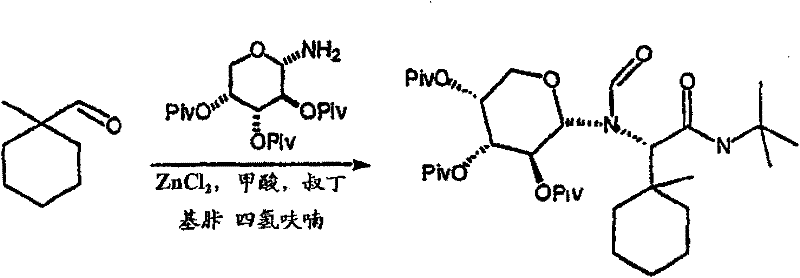
合成2,3,4-三-O-新戊酰--D-阿拉伯糖基胺按照公开的方法进行(Kunz.H.;Pfrengle,W.,Ruck,K.;Wilfried,S.Synthesis(1991)1039-1042)。 Synthesis of 2,3,4-tri-O-pivaloyl-D-arabinosylamine was carried out according to published methods (Kunz.H.; Pfrengle, W., Ruck, K.; Wilfried, S. Synthesis (1991 ) 1039-1042). the
1-甲基环己基甲醛(1.17g,8.34mmol)、2,3,4-三-O-新戊酰--D-阿拉伯糖基胺(8.3g,20.7mmol)、甲酸(850μL,22.2mmol)和叔丁基胩(2.4mL,21.2mmol)的四氢呋喃(170mL)溶液在-30℃加入0.5M氯化锌的四氢呋喃(41mL,20.57mmol)溶液。将溶液在-20℃搅拌3天,然后浓缩。残余物用CH2Cl2(500mL)稀释,用饱和碳酸氢钠水溶液(2×500mL)、水(500mL)洗涤。将有机层干燥,过滤并浓缩获得澄清油状物。用快速色谱法(含20%乙酸乙酯的己烷)获得纯产物(4.3g,6.6mmol,33%)。 1-Methylcyclohexylcarbaldehyde (1.17g, 8.34mmol), 2,3,4-tri-O-pivaloyl-D-arabinosylamine (8.3g, 20.7mmol), formic acid (850μL, 22.2mmol ) and tert-butyl isocyanide (2.4mL, 21.2mmol) in tetrahydrofuran (170mL) were added at -30°C to a 0.5M solution of zinc chloride in tetrahydrofuran (41mL, 20.57mmol). The solution was stirred at -20°C for 3 days, then concentrated. The residue was diluted with CH2Cl2 (500 mL), washed with saturated aqueous sodium bicarbonate (2 x 500 mL), water (500 mL ). The organic layer was dried, filtered and concentrated to a clear oil. The pure product was obtained by flash chromatography (20% ethyl acetate in hexanes) (4.3 g, 6.6 mmol, 33%).
步骤4.合成(1-甲基环己基)甘氨酸:Step 4. Synthesis of (1-methylcyclohexyl)glycine:

将以上步骤3获得产物(4.3g,6.6mmol)的二氯甲烷(30mL)和饱和无水甲醇的HCl(30mL)溶液搅拌过夜。浓缩溶液,残余物溶于水(100mL),然后用戊烷(2×100mL)洗涤。浓缩水层,残余物溶于6N HCl(50mL),加热回流30小时。浓缩溶液获得粗制的(1-甲基环己基)甘氨酸盐酸盐(790mg,3.82mmol,58%)。 A solution of the product obtained in step 3 above (4.3 g, 6.6 mmol) in dichloromethane (30 mL) and saturated anhydrous methanol in HCl (30 mL) was stirred overnight. The solution was concentrated and the residue was dissolved in water (100 mL), then washed with pentane (2 x 100 mL). The aqueous layer was concentrated, the residue was dissolved in 6N HCl (50 mL), and heated to reflux for 30 hours. The solution was concentrated to obtain crude (1-methylcyclohexyl)glycine hydrochloride (790 mg, 3.82 mmol, 58%). the
实施例XVII.合成(4,4-二甲基环己基)甘氨酸:Example XVII. Synthesis of (4,4-dimethylcyclohexyl)glycine:

步骤1.合成4,4-二甲基环己酮:Step 1. Synthesis of 4,4-dimethylcyclohexanone:

将4,4-二甲基环己-2-烯-1-酮(12mL,91.2mmol)和Degussa型10%碳载钯(2g)的混合物在40psi氢化18小时。将混合物过滤并浓缩(1H NMR显示比例为5∶3的酮和醇混合物)。将混合物溶于丙酮(400mL),冷却至0℃。在30分钟内加入琼斯试剂(40mL),然后除去冷却浴。2天后,蒸去过量的丙酮,将所得残余物溶于水和乙醚。乙醚层用水洗涤至无色,干燥,过滤并浓缩获得4,4-二甲基环己酮(7.4g,58.6mmol,64%)。 A mixture of 4,4-dimethylcyclohex-2-en-1-one (12 mL, 91.2 mmol) and Degussa type 10% palladium on carbon (2 g) was hydrogenated at 40 psi for 18 hours. The mixture was filtered and concentrated ( 1H NMR showed a 5:3 mixture of ketone and alcohol). The mixture was dissolved in acetone (400 mL) and cooled to 0°C. Jones reagent (40 mL) was added over 30 minutes, then the cooling bath was removed. After 2 days, the excess acetone was distilled off and the resulting residue was dissolved in water and ether. The ether layer was washed with water until colorless, dried, filtered and concentrated to obtain 4,4-dimethylcyclohexanone (7.4 g, 58.6 mmol, 64%).
步骤2.合成4,4-二甲基环己基甲醛的甲基烯醇醚:Step 2. Synthesis of methyl enol ether of 4,4-dimethylcyclohexylcarbaldehyde:
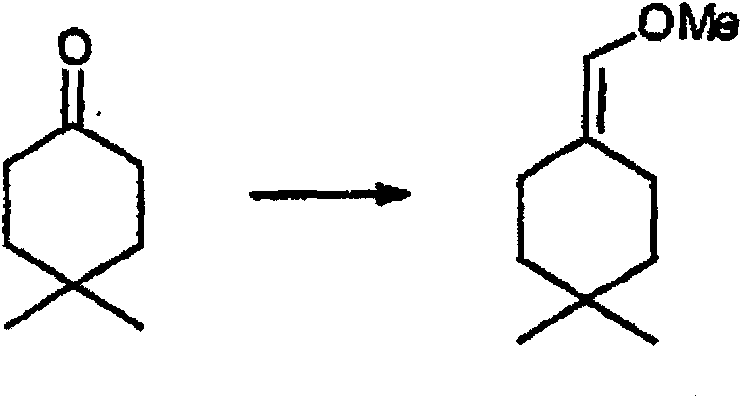
甲氧基甲基三苯基氯化鏻(8.6g)的四氢呋喃(125mL)溶液在0℃于10分钟内加入正丁基锂(1.6M的己烷溶液,14.3mL)。在30分钟后,将反应混合物冷却至-78℃,在20分钟内加入4,4-二甲基环己酮(2.45g,19.1mmol)的四氢呋喃(50mL)溶液。1小时后除去冷却浴,将反应混合物缓慢地加温至0℃。反应物用饱和氯化铵(50mL)、乙酸乙酯(100mL)和己烷(100mL)稀释。有机层用水和盐水洗涤,干燥过滤并浓缩。将残余物与己烷(70mL)搅拌10分钟,过滤。浓缩滤液,用色谱法(含25%乙酸乙酯的己烷)获得标题化合物(1.925g,12.5mmol,65%)。 To a solution of methoxymethyltriphenylphosphonium chloride (8.6 g) in tetrahydrofuran (125 mL) was added n-butyllithium (1.6 M in hexane, 14.3 mL) at 0° C. within 10 minutes. After 30 minutes, the reaction mixture was cooled to -78°C and a solution of 4,4-dimethylcyclohexanone (2.45 g, 19.1 mmol) in tetrahydrofuran (50 mL) was added over 20 minutes. After 1 hour the cooling bath was removed and the reaction mixture was slowly warmed to 0 °C. The reaction was diluted with saturated ammonium chloride (50 mL), ethyl acetate (100 mL) and hexane (100 mL). The organic layer was washed with water and brine, dried filtered and concentrated. The residue was stirred with hexanes (70 mL) for 10 minutes and filtered. The filtrate was concentrated and chromatographed (25% ethyl acetate in hexanes) to obtain the title compound (1.925 g, 12.5 mmol, 65%). the
步骤3:4,4-二甲基环己基甲醛:Step 3: 4,4-Dimethylcyclohexylcarbaldehyde:
将4,4-二甲基环己基甲醛的甲基烯醇醚(1.925g,12.5mmol)(以上步骤II)、四氢呋喃(100mL)和6M HCl(20mL)的溶液在室温下搅拌4小时。反应混合物用己烷、乙醚、盐水和水稀释。将有机层干燥,过滤并浓缩获得4,4-二甲基环己基甲醛(1.0g,7.1mmol,57%)。 A solution of the methyl enol ether of 4,4-dimethylcyclohexylcarbaldehyde (1.925 g, 12.5 mmol) (Step II above), tetrahydrofuran (100 mL) and 6M HCl (20 mL) was stirred at room temperature for 4 hours. The reaction mixture was diluted with hexane, ether, brine and water. The organic layer was dried, filtered and concentrated to obtain 4,4-dimethylcyclohexylcarbaldehyde (1.0 g, 7.1 mmol, 57%). the
步骤4.合成N-甲酰基-N-葡萄糖基-4,4-二甲基环己基-叔丁基酰胺:Step 4. Synthesis of N-formyl-N-glucosyl-4,4-dimethylcyclohexyl-tert-butylamide:
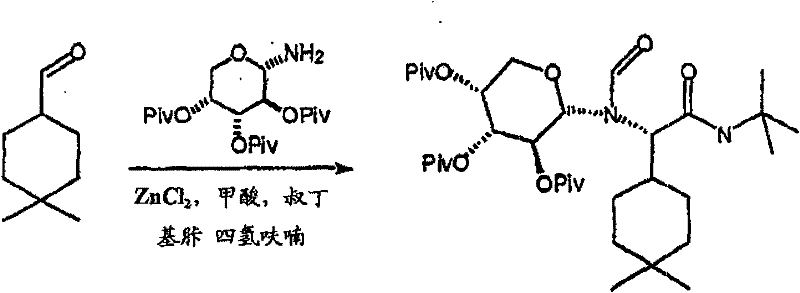
4,4-二甲基环己基甲醛(1.17g,8.34mmol)、2,3,4-三-O-新戊酰-α-D-阿拉伯糖基胺(3.43g,8.55mmol)、甲酸(350μL,9.17mmol)和叔丁基胩(990μL,8.76mmol)的THF(70mL)溶液在-30℃加入0.5M氯化锌的四氢呋喃(17mL,8.5mmol)溶液。将溶液在-20℃搅拌2天,然后浓缩。残余物用二氯甲烷(200mL)稀释,用饱和碳酸氢钠水溶液(2×200mL)、水(200mL)洗涤。将有机层干燥,过滤并浓缩获得澄清油状物。用快速色谱法(含20%乙酸乙酯的己烷)获得纯产物(2.1g,3.3mmol,39%)。 4,4-Dimethylcyclohexylcarbaldehyde (1.17g, 8.34mmol), 2,3,4-tri-O-pivaloyl-α-D-arabinosylamine (3.43g, 8.55mmol), formic acid ( 350 μL, 9.17 mmol) and tert-butyl isocyanide (990 μL, 8.76 mmol) in THF (70 mL) were added with 0.5M zinc chloride in tetrahydrofuran (17 mL, 8.5 mmol) at -30°C. The solution was stirred at -20°C for 2 days, then concentrated. The residue was diluted with dichloromethane (200 mL), washed with saturated aqueous sodium bicarbonate (2 x 200 mL), water (200 mL). The organic layer was dried, filtered and concentrated to a clear oil. The pure product was obtained by flash chromatography (20% ethyl acetate in hexanes) (2.1 g, 3.3 mmol, 39%). the
步骤5.合成(4,4-二甲基环己基)甘氨酸:Step 5. Synthesis of (4,4-dimethylcyclohexyl)glycine:
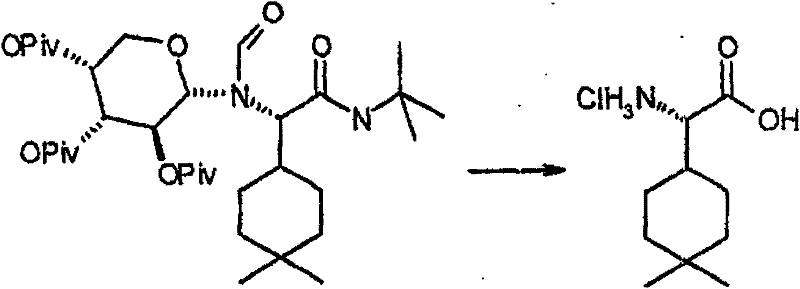
将以上步骤4获得的Ugi产物(2.1g,3.3mmol)的二氯甲烷(20mL)和饱和无水甲醇的HCl(20mL)的溶液搅拌过夜。将溶液浓缩,残余物溶于水(100mL),然后用戊烷(2×100mL)洗涤。浓缩水层,将残余 物溶于6N HCl(40mL)并加热回流30小时。浓缩溶液获得粗制的(1-甲基环己基)甘氨酸盐酸盐(300mg,1.36mmol,41%)。 A solution of the Ugi product obtained in Step 4 above (2.1 g, 3.3 mmol) in dichloromethane (20 mL) and saturated anhydrous methanol in HCl (20 mL) was stirred overnight. The solution was concentrated and the residue was dissolved in water (100 mL) and washed with pentane (2 x 100 mL). The aqueous layer was concentrated, and the residue was dissolved in 6N HCl (40 mL) and heated to reflux for 30 hours. The solution was concentrated to obtain crude (1-methylcyclohexyl)glycine hydrochloride (300 mg, 1.36 mmol, 41%). the
实施例XVIII.合成Boc-nVal-(CHOH)-Gly-OH:Example XVIII. Synthesis of Boc-nVal-(CHOH)-Gly-OH:

步骤1.制备Boc-正缬氨醇:Step 1. Preparation of Boc-norvalinol:

将Boc-正缬氨酸(25.0g,0.115mol)的四氢呋喃(461mL)溶液冷却至0℃,滴加硼烷/四氢呋喃络合物(461mL 1.0M的四氢呋喃溶液)。在0℃经过1小时后,将溶液在1.5小时内加温至室温。TLC指示反应完成。加入甲醇猝灭反应。浓缩溶液获得泡沫浆状标题化合物(22.56g,96%)。产物的TLC显示获得满意的纯度。Rf=0.34(40%乙酸乙酯/己烷)。 A solution of Boc-norvaline (25.0 g, 0.115 mol) in tetrahydrofuran (461 mL) was cooled to 0° C., and borane/tetrahydrofuran complex (461 mL of a 1.0 M solution in tetrahydrofuran) was added dropwise. After 1 hour at 0°C, the solution was allowed to warm to room temperature over 1.5 hours. TLC indicated the reaction was complete. The reaction was quenched by adding methanol. The solution was concentrated to afford the title compound (22.56 g, 96%) as a foamy syrup. TLC of the product showed that satisfactory purity was obtained. Rf = 0.34 (40% ethyl acetate/hexane). the
步骤2.制备Boc-正缬氨醛:Step 2. Preparation of Boc-Norvalinaldehyde:

Boc-正缬氨醇(7.77g,38mmol)的无水二甲基亚砜(153mL)和甲苯(153mL)溶液中加入EDC(73.32g,382mmol)。将溶液冷却至0℃后,滴加二氯乙酸(15.8mL,191mmol)。加入完毕后,将反应物搅 拌15分钟。在2小时内将溶液加温至室温。浓缩反应混合物以除去甲苯,然后溶于乙酸乙酯。溶液依次用1N硫酸氢钠、饱和碳酸氢钠和盐水洗涤,用硫酸钠干燥,过滤并浓缩获得粗制的Boc-正缬氨醛,它直接用于下一步骤。TLC Rf=0.84(40%乙酸乙酯/己烷)。 To a solution of Boc-norvalinol (7.77 g, 38 mmol) in anhydrous DMSO (153 mL) and toluene (153 mL) was added EDC (73.32 g, 382 mmol). After cooling the solution to 0 °C, dichloroacetic acid (15.8 mL, 191 mmol) was added dropwise. After the addition was complete, the reaction was stirred for 15 minutes. The solution was warmed to room temperature over 2 hours. The reaction mixture was concentrated to remove toluene, then dissolved in ethyl acetate. The solution was washed sequentially with 1N sodium bisulfate, saturated sodium bicarbonate and brine, dried over sodium sulfate, filtered and concentrated to give crude Boc-norvalinaldehyde which was used directly in the next step. TLC Rf = 0.84 (40% ethyl acetate/hexane). the
步骤3.合成Boc-nVal-(CHOH)-Gly-OEt:Step 3. Synthesis of Boc-nVal-(CHOH)-Gly-OEt:

粗制的Boc-正缬氨醛(4.18g,20.77mmol)的二氯甲烷(83mL)溶液中加入异氰基乙酸乙酯(2.72ml,24.93mmol)和吡啶(6.72ml,83.09mmol)。将溶液冷却至0℃后,滴加三氟乙酸(4.15ml,41.54mmol)。搅拌1小时后,将溶液在室温下搅拌18小时,同时在无盖容器中的反应混合物在室温下蒸发除去溶剂。将反应混合物浓缩,然后溶于乙酸乙酯。溶液依次用1N硫酸氢钠、饱和碳酸氢钠和盐水洗涤,用硫酸钠干燥,过滤后浓缩。残余物用快速色谱法提纯,洗脱时用20%-40%乙酸乙酯/己烷获得2.8g黄色浆状标题化合物。用低分辨率质谱证实存在所需要的产物(MH+333)。 To a solution of crude Boc-norvalinaldehyde (4.18g, 20.77mmol) in dichloromethane (83mL) was added ethyl isocyanoacetate (2.72ml, 24.93mmol) and pyridine (6.72ml, 83.09mmol). After cooling the solution to 0°C, trifluoroacetic acid (4.15ml, 41.54mmol) was added dropwise. After stirring for 1 hour, the solution was stirred at room temperature for 18 hours while the reaction mixture in an uncovered vessel was evaporated at room temperature to remove the solvent. The reaction mixture was concentrated, then dissolved in ethyl acetate. The solution was washed sequentially with 1N sodium bisulfate, saturated sodium bicarbonate, and brine, dried over sodium sulfate, filtered, and concentrated. The residue was purified by flash chromatography eluting with 20%-40% ethyl acetate/hexanes to give 2.8 g of the title compound as a yellow syrup. The presence of the desired product (MH + 333) was confirmed by low resolution mass spectrometry.
步骤4.合成Boc-nVal-(CHOH)-Gly-OH:Step 4. Synthesis of Boc-nVal-(CHOH)-Gly-OH:

将获得的产物(Boc-nVal-(CHOH)-Gly-OEt)(1.52g,4.70mmol)溶于乙醇(23ml),用1N氢氧化锂(18.81ml)在室温下皂化2小时。将 反应混合物用 
实施例XVIV.合成(2R,3S,4S、5S)-N-CBz-3-氨基-2-羟基-4,5亚甲基-己酸叔丁酯:Example XVIV. Synthesis of (2R, 3S, 4S, 5S)-N-CBz-3-amino-2-hydroxy-4,5 methylene-hexanoic acid tert-butyl ester:
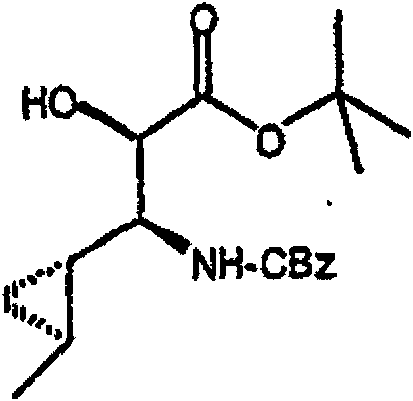
步骤1:step 1:

二乙基膦酰基乙酸叔丁酯(4.7mL,20mmol)溶于THF(50nL)的溶液在-78℃加入1.6M正丁基锂的己烷(12.4mL)溶液。30分钟后,在10分钟内加入(1S,2S)-2-甲基环丙基甲醛(1g,12mmol)(Barrett,A.G.M.;Doubleday,W.W.;Kasdorf,K.;Tustin,G.J.,J.Org.Chem.(1996)61,3280)的乙醚(100mL)溶液。将反应混合物加温至0℃2小时,然后加温至6℃12小时。反应物用饱和氯化铵(20mL)猝灭,分出有机层,用50mL盐水洗涤,用硫酸钠干燥,过滤并浓缩获得3.5g澄清油状物。用快速色谱法(含20%乙酸乙酯的己烷)获得纯的不饱和叔丁酯(1.4g)。 To a solution of tert-butyl diethylphosphonoacetate (4.7 mL, 20 mmol) dissolved in THF (50 nL) was added a 1.6M solution of n-butyllithium in hexane (12.4 mL) at -78°C. After 30 minutes, (1S,2S)-2-methylcyclopropylcarbaldehyde (1 g, 12 mmol) was added over 10 minutes (Barrett, A.G.M.; Doubleday, W.W.; Kasdorf, K.; Tustin, G.J., J.Org. Chem. (1996) 61, 3280) in diethyl ether (100 mL). The reaction mixture was warmed to 0°C for 2 hours, then to 6°C for 12 hours. The reaction was quenched with saturated ammonium chloride (20 mL), the organic layer was separated, washed with 50 mL of brine, dried over sodium sulfate, filtered and concentrated to give 3.5 g of a clear oil. Pure unsaturated tert-butyl ester (1.4 g) was obtained by flash chromatography (20% ethyl acetate in hexanes). the
步骤2:Step 2:
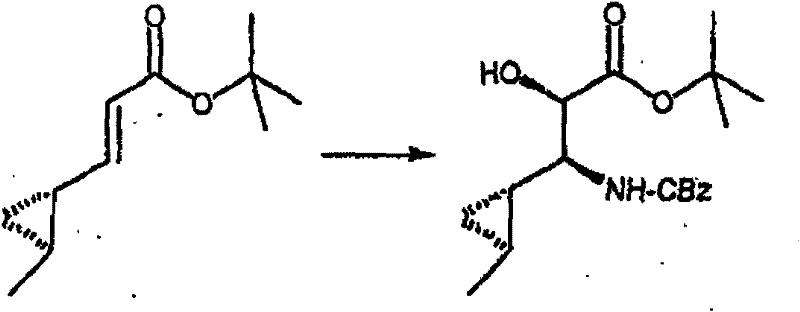
氨基甲酸苄酯(3.55g,23.5mmols)的正丙醇(24mL)溶液中加入氢氧化钠(900mg,22.7mmol)的水(48mL)溶液,接着加入次氯酸叔丁基酯(2.57mL,22.7mmol)。在15分钟后,将反应物冷却至0℃,加入(DHQ)2PHAL(350mg,0.45mmol)的正丙醇(24mL)溶液,接着加入上述不饱和叔丁酯(1.4g)的正丙醇(48mL)溶液。最后加入锇酸钾(110mg,0.30mmol)的水(2mL)溶液,溶液即刻形成深绿色,持续4小时。在6小时后,加入饱和硫酸钠(50mL),混合物用乙酸乙酯(2×50mL)萃取。合并的有机层用盐水(30mL)洗涤,用硫酸钠干燥,过滤并浓缩。快速色谱法(含20%乙酸乙酯的己烷)获得所需要的cBz保护氨基的叔丁酯白色固体(316mg)。 To a solution of benzyl carbamate (3.55 g, 23.5 mmols) in n-propanol (24 mL) was added a solution of sodium hydroxide (900 mg, 22.7 mmol) in water (48 mL), followed by tert-butyl hypochlorite (2.57 mL, 22.7 mmol). After 15 minutes, the reaction was cooled to 0 °C and a solution of (DHQ) 2PHAL (350 mg, 0.45 mmol) in n-propanol (24 mL) was added followed by the above unsaturated tert-butyl ester (1.4 g) in n-propanol (48 mL) solution. A solution of potassium osmate (110 mg, 0.30 mmol) in water (2 mL) was finally added, and the solution immediately turned dark green for 4 hours. After 6 hours, saturated sodium sulfate (50 mL) was added and the mixture was extracted with ethyl acetate (2 x 50 mL). The combined organic layers were washed with brine (30 mL), dried over sodium sulfate, filtered and concentrated. Flash chromatography (20% ethyl acetate in hexanes) gave the desired t-butyl ester of the cBz protected amino group as a white solid (316 mg).
步骤3:Step 3:

将CBz保护氨基的叔丁酯(316mg,0.9mmol)和32mg 10%碳载钯在9mL甲醇中的混合物氢化8小时。过滤混合物并浓缩获得为澄清油状物的游离胺(195mg)。 A mixture of CBz amino-protected tert-butyl ester (316 mg, 0.9 mmol) and 32 mg of 10% palladium on carbon in 9 mL of methanol was hydrogenated for 8 hours. The mixture was filtered and concentrated to give the free amine (195mg) as a clear oil. the
实施例XX.合成1R,氯甲酸2-二甲基丙酯:Example XX. Synthesis of 1R, 2-dimethylpropyl chloroformate:
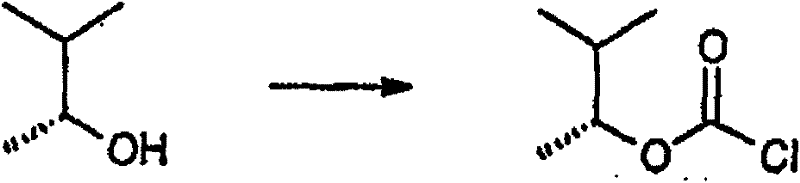
商业上可得到的2R-羟基-3-甲基丁烷(410mg,4.65mmol)中加入20%碳酰氯的甲苯(1mL,2mmol)溶液。将溶液搅拌6小时产生氯甲酸酯(2mmol),将它立即直接与需要的胺反应。S-异构体按照同样的方法制备。 To commercially available 2R-hydroxy-3-methylbutane (410 mg, 4.65 mmol) was added 20% phosgene in toluene (1 mL, 2 mmol). The solution was stirred for 6 hours to give the chloroformate (2 mmol) which was immediately reacted directly with the desired amine. The S-isomer was prepared in the same manner. the
II)典型的液相合成HCV抑制剂II) Typical liquid-phase synthetic HCV inhibitors
实施例XXI.液相合成iBoc-G(Chx)-Pro(4,4-二甲基)-Leu-(CO)-Gly-Phg-二甲基酰胺:Example XXI. Liquid-phase synthesis of iBoc-G(Chx)-Pro(4,4-dimethyl)-Leu-(CO)-Gly-Phg-dimethylamide:
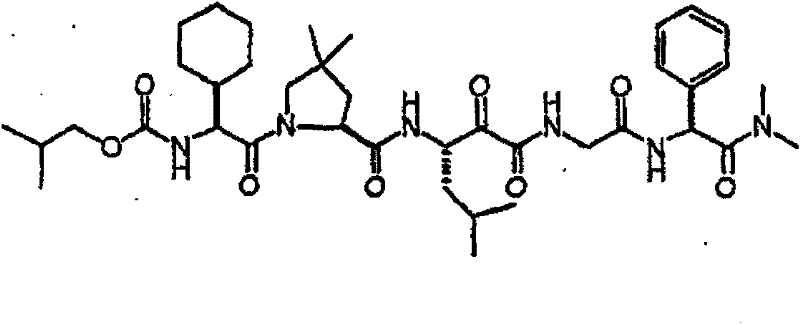
步骤1.合成叔丁氧基羰基-亮氨醛(Boc-Leu-CHO):Step 1. Synthesis of tert-butoxycarbonyl-leucinaldehyde (Boc-Leu-CHO):

商业上可获得的(Advanced Chem Tech)Boc-L-亮氨醇(0.78g,3.6mmol)的无水二氯甲烷(17.5ml)溶液中加入三乙胺(2ml,14.36mmol),将混合物冷却至0℃。加入二甲基亚砜(17.5ml),接着加入吡啶三氧化硫络合物(2.3g,14.36mmol),将反应物搅拌2小时。用TLC(1∶1乙酸乙酯∶己烷)确认反应完成。浓缩反应混合物,残余物用乙酸乙酯稀释。乙酸乙酯层用1M盐酸(2×5ml)洗涤,接着用饱和碳酸氢钠溶液(2×75ml)和盐水(75ml)洗涤。干燥(硫酸钠)有机层,过滤并浓缩获得775mg产物。 To a solution of commercially available (Advanced Chem Tech) Boc-L-leucinol (0.78 g, 3.6 mmol) in anhydrous dichloromethane (17.5 ml) was added triethylamine (2 ml, 14.36 mmol) and the mixture was cooled to 0°C. Dimethyl sulfoxide (17.5 mL) was added followed by pyridine sulfur trioxide complex (2.3 g, 14.36 mmol) and the reaction was stirred for 2 hours. Reaction completion was confirmed by TLC (1:1 ethyl acetate:hexanes). The reaction mixture was concentrated, and the residue was diluted with ethyl acetate. The ethyl acetate layer was washed with 1M hydrochloric acid (2 x 5ml), followed by saturated sodium bicarbonate solution (2 x 75ml) and brine (75ml). The organic layer was dried (sodium sulfate), filtered and concentrated to give 775 mg of product. the
步骤2.合成Boc-2-羟基-3-氨基-5-甲基己酰基-甘氨酸乙酯(Boc-Leu-((HOH)-Gly-OEt):Step 2. Synthesis of Boc-2-hydroxy-3-amino-5-methylhexanoyl-glycine ethyl ester (Boc-Leu-((HOH)-Gly-OEt):

溶液Boc-亮氨醛(0.77g,3.59mmol)的无水二氯甲烷(24ml)溶液中加入无水吡啶(1.16ml,14.36mmol)和异氰基乙酸乙酯(0.4ml,4.66mmol)。将反应混合物冷却至0℃,在2分钟内加入三氟乙酸(0.55ml,7/18mmol)。将反应混合物盖住,在4℃搅拌4天,在室温下搅拌1天。反应混合物用二氯甲烷(350ml)稀释,用每份75ml的1M盐酸、饱和碳酸氢钠和盐水各洗涤2次。将有机层干燥,过滤并浓缩。所得残余物在2”×6”硅胶柱用快速色谱法提纯,先用含10%乙酸乙酯的 己烷(800ml)、接着用1∶1乙酸乙酯∶己烷(800ml)。合并产物相关部分,浓缩获得980mg(79%)产物。 Solution To a solution of Boc-leucinaldehyde (0.77g, 3.59mmol) in anhydrous dichloromethane (24ml) was added anhydrous pyridine (1.16ml, 14.36mmol) and ethyl isocyanoacetate (0.4ml, 4.66mmol). The reaction mixture was cooled to 0°C and trifluoroacetic acid (0.55ml, 7/18mmol) was added within 2 minutes. The reaction mixture was capped and stirred at 4°C for 4 days and at room temperature for 1 day. The reaction mixture was diluted with dichloromethane (350ml) and washed twice each with 75ml portions of 1M hydrochloric acid, saturated sodium bicarbonate and brine. The organic layer was dried, filtered and concentrated. The resulting residue was purified by flash chromatography on a 2" x 6" silica gel column, first with 10% ethyl acetate in hexane (800 mL), followed by 1:1 ethyl acetate:hexane (800 mL). Product related fractions were combined and concentrated to afford 980 mg (79%) of product. the
步骤3.合成Boc-Leu-(CHOH)-Gly-OH:Step 3. Synthesis of Boc-Leu-(CHOH)-Gly-OH:

Boc-Leu-(CHOH)-Gly-Oet(0.98g,2.83mmol)的乙醇(11.3ml)溶液中加入2M氢氧化锂(4.25ml),将反应物在室温下搅拌5小时。减压除去乙醇,水层用乙酸乙酯稀释。有机层用1M盐酸洗涤,接着用盐水洗涤,干燥,过滤并浓缩获得775mg(86%)白色固体产物。 To a solution of Boc-Leu-(CHOH)-Gly-Oet (0.98g, 2.83mmol) in ethanol (11.3ml) was added 2M lithium hydroxide (4.25ml) and the reaction was stirred at room temperature for 5 hours. Ethanol was removed under reduced pressure, and the aqueous layer was diluted with ethyl acetate. The organic layer was washed with 1M hydrochloric acid followed by brine, dried, filtered and concentrated to afford 775 mg (86%) of the product as a white solid. the
步骤4.合成Boc-Leu-(CHOH)-Gly-Phg-二甲基酰胺:Step 4. Synthesis of Boc-Leu-(CHOH)-Gly-Phg-dimethylamide:
Boc-Leu-(CHOH)-Gly-OH(0.37g,1.18mmol)的乙腈(23ml)溶液中依次加入苯基甘氨酸二甲基酰胺(实施例XV步骤2获得)、EDC(0.34g,1.76mmol)、N-羟基苯并三唑(HOBt)(0.18g,1.18mmol)和二异丙基乙胺(DIEA)(0.82ml,4.7mmol),将反应物在室温下搅拌18小时。浓缩反应混合物,残余物用乙酸乙酯稀释,依次用每份75ml的1M盐酸、饱和碳酸氢钠和盐水各洗涤两次。然后干燥有机层,过滤并浓缩。粗产物在2”×6”硅胶柱用快速色谱法提纯,先用4∶1乙酸乙酯∶己烷(700ml)、接着用乙酸乙酯(1000ml)和含10%甲醇的二氯甲烷(600ml)洗脱。合并产物相关部分,浓缩获得445mg(80%)白色固体。 In the acetonitrile (23ml) solution of Boc-Leu-(CHOH)-Gly-OH (0.37g, 1.18mmol), add phenylglycine dimethylamide (obtained in step 2 of Example XV), EDC (0.34g, 1.76mmol) successively ), N-hydroxybenzotriazole (HOBt) (0.18g, 1.18mmol) and diisopropylethylamine (DIEA) (0.82ml, 4.7mmol), the reaction was stirred at room temperature for 18 hours. The reaction mixture was concentrated and the residue was diluted with ethyl acetate and washed successively with two 75 mL portions of 1M hydrochloric acid, saturated sodium bicarbonate and brine. The organic layer was then dried, filtered and concentrated. The crude product was purified by flash chromatography on a 2" x 6" silica gel column using 4:1 ethyl acetate:hexane (700ml), followed by ethyl acetate (1000ml) and 10% methanol in dichloromethane (600ml ) elution. The relevant product fractions were combined and concentrated to afford 445 mg (80%) of a white solid. the
步骤5.合成H-Leu-(CHOH)-Gly-Phg-二甲基酰胺三氟乙酸盐:Step 5. Synthesis of H-Leu-(CHOH)-Gly-Phg-dimethylamide trifluoroacetate:
Boc-Leu-(CHOH)-Gly-Phg-二甲基酰胺(70mg,0.146mmol)的二氯甲烷(1ml)溶液中加入三氟乙酸(1ml),反应物在室温下搅拌1小时。将反应混合物浓缩,在下一步骤中使用无需再提纯。 To a solution of Boc-Leu-(CHOH)-Gly-Phg-dimethylamide (70mg, 0.146mmol) in dichloromethane (1ml) was added trifluoroacetic acid (1ml), and the reaction was stirred at room temperature for 1 hour. The reaction mixture was concentrated and used in the next step without further purification. the
步骤6.合成iBoc-G(Chx)-Pro(4,4-二甲基)-Leu-(CHOH)-Gly-Phg-二甲基酰胺:Step 6. Synthesis of iBoc-G(Chx)-Pro(4,4-dimethyl)-Leu-(CHOH)-Gly-Phg-dimethylamide:

iBoc-G(Chx)-P(4,4-diMe)-OH(实施例XIV步骤2)(53mg,0.148mmol)的乙腈(3ml)溶液中依次加入TFA·2HN-Leu(CHOH)-Gly-Phg-NMe2(61mg,0.148mmol)、N-羟基苯并三唑(HOBt)(23mg,0.148mmol)、TBTU(71.5mg,0.222mmol)和二异丙基乙胺(1031,0.593mmol)。反应物在室温下搅拌18小时,浓缩。将残余物溶于乙酸乙酯,然后用1M盐酸(2×5ml)、饱和碳酸氢钠溶液(2×5ml)和盐水(2×5ml) 洗涤。干燥有机层,过滤并浓缩。产物(100mg)在下一步骤中使用无需再提纯。 To a solution of iBoc-G(Chx)-P(4,4-diMe)-OH (Example XIV step 2) (53mg, 0.148mmol) in acetonitrile (3ml) was sequentially added TFA·2HN-Leu(CHOH)-Gly- Phg-NMe2 (61 mg, 0.148 mmol), N-hydroxybenzotriazole (HOBt) (23 mg, 0.148 mmol), TBTU (71.5 mg, 0.222 mmol) and diisopropylethylamine (1031, 0.593 mmol). The reaction was stirred at room temperature for 18 hours and concentrated. The residue was dissolved in ethyl acetate and washed with 1M hydrochloric acid (2×5ml), saturated sodium bicarbonate solution (2×5ml) and brine (2×5ml). The organic layer was dried, filtered and concentrated. The product (100 mg) was used in the next step without further purification. the
步骤7.合成iBoc-G(Chx)-Pro(4,4-二甲基)-Leu-(CO)-Gly-Phg-二甲基酰胺:Step 7. Synthesis of iBoc-G(Chx)-Pro(4,4-dimethyl)-Leu-(CO)-Gly-Phg-dimethylamide:

iBoc-G(Chx)-Pro(4,4-二甲基)-Leu-(CHOH)-Gly-Phg-二甲基酰胺(30mg,0.04mmol)的二氯甲烷(1ml)溶液中加入商业性获得的Dess-Martin试剂(Omega Chemical Company Inc.)(67.8mg,0.16mmol),将反应物在室温下搅拌90分钟。浓缩反应混合物,将残余物在5%硫代硫酸钠中搅拌。然后将其用二氯甲烷稀释,分出各层。有机层用硫代硫酸钠(4×3ml)洗涤,接着用水和盐水洗涤。有机层用硫酸钠干燥,过滤并浓缩。将粗产物溶于己烷和异丙醇,在正相Kromasil 5硅胶柱上(Phenomenex,250×21.20mm,100埃孔径,5μm胶粒)用HPLC提纯,用含0-25%异丙醇的己烷(25ml/分钟)进行30分钟梯度洗脱。合并产物相关部分,浓缩。用水冷冻干燥获得6.7mg白色粉末。用低分辨率质谱确认所需要的质谱(MH+=741.4)。 To a solution of iBoc-G(Chx)-Pro(4,4-dimethyl)-Leu-(CHOH)-Gly-Phg-dimethylamide (30mg, 0.04mmol) in dichloromethane (1ml) was added commercial The obtained Dess-Martin reagent (Omega Chemical Company Inc.) (67.8 mg, 0.16 mmol) was stirred at room temperature for 90 minutes. The reaction mixture was concentrated and the residue was stirred in 5% sodium thiosulfate. It was then diluted with dichloromethane and the layers were separated. The organic layer was washed with sodium thiosulfate (4 x 3ml), followed by water and brine. The organic layer was dried over sodium sulfate, filtered and concentrated. The crude product was dissolved in hexane and isopropanol, purified by HPLC on a normal phase Kromasil 5 silica gel column (Phenomenex, 250×21.20 mm, 100 angstrom pore size, 5 μm micelle), and purified with 0-25% isopropanol Hexane (25 ml/min) was used for 30 min gradient elution. Product related fractions were combined and concentrated. Freeze-drying with water gave 6.7 mg of white powder. The desired mass spectrum (MH + = 741.4) was confirmed by low resolution mass spectrometry.
III)固相合成:III) Solid phase synthesis:
固相合成可用于小量生产本发明的某些化合物。与常规固相合成肽一样,用于固相合成肽基酮酰胺的反应釜包括一个反应容器,反应容器至少有一面可渗透溶剂以及溶解的试剂,但不能渗透所选粒径的合成树脂。这样的反应釜包括带有烧结玻璃滤板的玻璃固相反应容器、带有滤板的聚丙烯管或柱、或者由Irori Inc.,San Diego CA生产的KansTM反应器。反应釜类型根据所需要的固相树脂体积选择,不同类型的反应釜可用在合成的不同阶段。下面的方法将在接下来的实施例中引用: Solid phase synthesis can be used for small scale production of certain compounds of the invention. Like conventional solid-phase peptide synthesis, the reaction vessel for the solid-phase synthesis of peptidyl ketoamides includes a reaction vessel with at least one side permeable to the solvent and dissolved reagents, but impermeable to a synthetic resin of selected particle size. Such reactors include glass solid phase reaction vessels with sintered glass frits, polypropylene tubes or columns with frits, or Kans ™ reactors manufactured by Irori Inc., San Diego CA. The type of reactor is selected according to the volume of solid phase resin required, and different types of reactors can be used in different stages of synthesis. The following methods will be cited in the following examples:
方法A:偶合反应:在树脂的N-甲基吡咯烷(NMP)(10-15mL/克树脂)悬浮液中加入N-Fmoc氨基酸(2eq)、HOAt(2eq)、HATU(2eq)和二异丙基乙胺(4eq)。让混合物反应4-48小时。将反应物排出,树脂依次用二甲基甲酰胺、二氯甲烷、甲醇、二氯甲烷和乙醚(用10-15mL溶剂/克树脂)洗涤。然后真空干燥树脂。 Method A : Coupling reaction: Add N-Fmoc amino acid (2eq), HOAt (2eq), HATU (2eq) and diiso Propylethylamine (4eq). The mixture is allowed to react for 4-48 hours. The reactant was drained and the resin was washed sequentially with dimethylformamide, dichloromethane, methanol, dichloromethane and diethyl ether (with 10-15 mL of solvent/gram of resin). The resin is then vacuum dried.
方法B:去除Fmoc保护:Fmoc-保护的树脂用20%哌啶的二甲基甲酰胺(10mL试剂/g树脂)处理30分钟。将反应物排出,树脂依次用二甲基甲酰胺、二氯甲烷、甲醇、二氯甲烷和乙醚(10mL溶剂/克树脂)洗涤。 Method B : Fmoc deprotection: Fmoc-protected resin was treated with 20% piperidine in dimethylformamide (10 mL reagent/g resin) for 30 minutes. The reactant was drained and the resin was washed successively with dimethylformamide, dichloromethane, methanol, dichloromethane and diethyl ether (10 mL solvent/gram resin).
方法C:去除Boc保护:Boc-保护的树脂用1∶1的二氯甲烷和三氟乙酸混合物处理20-60分钟(10mL溶剂/克树脂)。将反应物排出,树脂依次用二氯甲烷、二甲基甲酰胺、5%二异丙基乙胺的二甲基甲酰胺溶液、二甲基甲酰胺、二氯甲烷和二甲基甲酰胺(10mL溶剂/克树脂)洗涤。 Method C : Boc deprotection: Boc-protected resin was treated with a 1:1 mixture of dichloromethane and trifluoroacetic acid for 20-60 minutes (10 mL solvent/gram resin). The reactant was discharged, and the resin was successively washed with dichloromethane, dimethylformamide, 5% diisopropylethylamine in dimethylformamide, dimethylformamide, dichloromethane and dimethylformamide ( 10 mL solvent/gram resin) for washing.
方法D:缩氨基脲水解:将树脂悬浮于由三氟乙酸∶丙酮酸∶二氯甲烷∶水9∶2∶2∶1组成的裂解混合物(10mL/g树脂)处理2小时。将反应物排出,此步骤再重复3次。树脂依次用二氯甲烷、水和二氯甲烷洗涤,真空干燥。 Method D : semicarbazone hydrolysis: the resin was suspended in a cleavage mixture (10 mL/g resin) consisting of trifluoroacetic acid:pyruvic acid:dichloromethane:water 9:2:2:1 for 2 hours. The reactants were drained and this step was repeated 3 more times. The resin was washed sequentially with dichloromethane, water and dichloromethane, and dried in vacuo.
方法E:HF裂解:经干燥的肽-nVal(CO)-G-O-PAM树脂(50mg) 置于包含一根小型搅拌棒的HF容器。加入清除剂苯甲醚(总体积的10%)。在存在谷氨酸和半胱氨酸氨基酸下,还加入苯硫基甲烷(10%)和1,2-乙二硫醇(0.2%)。然后将HF容器安装在HF仪器(Immuno Dynamics),系统充溢氮气5分钟。然后将其用干冰/异丙醇浴冷却至-78℃。20分钟后,蒸馏HF至所需体积(10mL HF/g树脂)。让反应物在0℃继续反应1.5小时。用氮气逐步移出所有HF。然后将二氯甲烷加入树脂中,搅拌此混合物5分钟。接着加入20%的乙酸水溶液(4mL)。搅拌20分钟后,树脂用多孔漏斗过滤,减压除去二氯甲烷。残余物和混合物用己烷(2×)洗涤除去清除剂。同时,将树脂在1mL甲醇中浸湿。将水层(20%HOAc)返回树脂中,将混合物搅拌5分钟后过滤。减压除去甲醇,冷冻干燥水层,然后将肽溶于10-25%甲醇(包含0.1%三氟乙酸),用反相HPLC提纯。 Method E : HF Cleavage: Dried Peptide-nVal(CO)-GO-PAM resin (50 mg) was placed in an HF vessel containing a small stir bar. The scavenger anisole (10% of total volume) was added. In the presence of glutamic acid and cysteine amino acids, thioanisole (10%) and 1,2-ethanedithiol (0.2%) were also added. The HF vessel was then installed in the HF instrument (Immuno Dynamics), and the system was flushed with nitrogen for 5 minutes. It was then cooled to -78°C with a dry ice/isopropanol bath. After 20 minutes, HF was distilled to the desired volume (10 mL HF/g resin). The reaction was allowed to continue for 1.5 hours at 0°C. All HF was removed gradually with nitrogen. Dichloromethane was then added to the resin and the mixture was stirred for 5 minutes. Then 20% aqueous acetic acid (4 mL) was added. After stirring for 20 minutes, the resin was filtered through a fritted funnel and the dichloromethane was removed under reduced pressure. The residue and mixture were washed with hexane (2x) to remove the scavenger. Simultaneously, wet the resin in 1 mL of methanol. The aqueous layer (20% HOAc) was returned to the resin, the mixture was stirred for 5 minutes and then filtered. Methanol was removed under reduced pressure, the aqueous layer was lyophilized, and the peptide was dissolved in 10-25% methanol (containing 0.1% trifluoroacetic acid) and purified by reverse phase HPLC.
实施例XXII:丙型肝炎抑制剂的典型的固相合成:(iBoc-G(Chx)-P(4t-NHSO2Ph)-nV-(CO)-G-G(Ph)-NH2)Example XXII: Typical solid phase synthesis of hepatitis C inhibitors: (iBoc-G(Chx)-P(4t-NHSO2Ph)-nV-(CO)-G-G(Ph)-NH2)
步骤1.合成Fmoc-nV-(dpsc)-Gly-OH:Step 1. Synthesis of Fmoc-nV-(dpsc)-Gly-OH:
A)合成异氰基乙酸烯丙酯(以下的步骤a-b):A) Synthesis of allyl isocyanoacetate (steps a-b below):
a)合成异氰基乙酸钾盐: a) Synthesis of potassium salt of isocyanoacetate:

将异氰基乙酸乙酯(96.6ml,0.88mol)滴加入乙醇(1.5L)和氢氧化钾(59.52g,1.0mol)的冷冻溶液。将反应物缓慢地加温至室温。2小时后,用玻璃漏斗滤出沉淀产物,用几份冷冻乙醇洗涤。因此获得的异氰基乙酸的钾盐经过真空干燥获得金黄褐色固体(99.92g,91.8%)。 Ethyl isocyanoacetate (96.6ml, 0.88mol) was added dropwise to a chilled solution of ethanol (1.5L) and potassium hydroxide (59.52g, 1.0mol). The reaction was slowly warmed to room temperature. After 2 hours, the precipitated product was filtered off with a glass funnel and washed with several portions of chilled ethanol. The potassium salt of isocyanoacetic acid thus obtained was dried in vacuo to give a golden-brown solid (99.92 g, 91.8%). the
b)合成异氰基乙酸烯丙酯: b) Synthesis of allyl isocyanoacetate:

步骤a产物(99.92g,0.81mol)溶解于乙腈(810ml)中,加入烯丙基溴(92ml,1.05mol)。加热回流4小时后获得深褐色溶液。将反应混合物浓缩,残余物溶于乙醚(1.5L),用水(500ml)洗涤三次。干燥有机层,过滤,浓缩获得深褐色浆状物。粗产物在7mm Hg(98℃)下真空蒸馏提纯获得澄清的油状物(78.92g,78%)。NMRδppm(CDCl3):5.9(m,1H),5.3(m,2H),4.7(d,2H),4.25(s,2H)。 The product from step a (99.92g, 0.81mol) was dissolved in acetonitrile (810ml) and allyl bromide (92ml, 1.05mol) was added. A dark brown solution was obtained after heating to reflux for 4 hours. The reaction mixture was concentrated, and the residue was dissolved in ether (1.5 L), washed three times with water (500 ml). The organic layer was dried, filtered and concentrated to give a dark brown syrup. The crude product was purified by vacuum distillation at 7 mm Hg (98° C.) to obtain a clear oil (78.92 g, 78%). NMR δppm (CDCl 3 ): 5.9 (m, 1H), 5.3 (m, 2H), 4.7 (d, 2H), 4.25 (s, 2H).
B)合成9-芴基甲氧羰基-正缬氨醛(以下步骤a-c):B) Synthesis of 9-fluorenylmethoxycarbonyl-norvalinaldehyde (following steps a-c):
a)合成9-芴基甲氧羰基-L-正缬氨酸甲酯(Fmoc-nVal-OMe): a) Synthesis of 9-fluorenylmethoxycarbonyl-L-norvaline methyl ester (Fmoc-nVal-OMe):

商业获得性Fmoc-正缬氨酸(25g,73.75mmol)的无水甲醇(469ml)冷冻溶液在1小时内加入亚硫酰氯(53.76ml,737.5mmol)。TLC用乙酸乙酯经过1小时后确认反应完成(Rf=0.85)。将反应混合物浓缩,残余物溶于乙酸乙酯。有机层用每份200ml的饱和碳酸氢钠、盐水洗涤几次。干燥有机层,过滤,浓缩获得定量收率的白色固体Fmoc-norVal-OMe(26.03g)。NMRδppm(CD3OD):7.7(m,2H),7.6(m,2H),7.4(m,2H),7.3(m,2H),4.3(m,2H),4.1(m,2H),3.7(s,3H),1.7(m,1H),1.6(m,1H),1.4(m,2H),0.95(t,3H)。 A chilled solution of commercially available Fmoc-norvaline (25 g, 73.75 mmol) in anhydrous methanol (469 ml) was added to thionyl chloride (53.76 ml, 737.5 mmol) over 1 hour. TLC with ethyl acetate confirmed completion of the reaction after 1 h (Rf = 0.85). The reaction mixture was concentrated, and the residue was dissolved in ethyl acetate. The organic layer was washed several times with 200 ml portions of saturated sodium bicarbonate, brine. The organic layer was dried, filtered and concentrated to give Fmoc-norVal-OMe as a white solid in quantitative yield (26.03 g). NMRδppm (CD 3 OD): 7.7 (m, 2H), 7.6 (m, 2H), 7.4 (m, 2H), 7.3 (m, 2H), 4.3 (m, 2H), 4.1 (m, 2H), 3.7 (s, 3H), 1.7 (m, 1H), 1.6 (m, 1H), 1.4 (m, 2H), 0.95 (t, 3H).
b)合成9-芴基甲氧羰基-正缬氨醇(Fmoc-nValinol): b) Synthesis of 9-fluorenylmethoxycarbonyl-norvalinol (Fmoc-nValinol):

Fmoc-nVal-OMe(26.03g,73.75mmol)的四氢呋喃(123ml)和甲醇(246ml)溶液中加入氯化钙(16.37g,147.49mmol)。将反应混合物冷却至0℃,分几批加入硼氢化钠(11.16g,294.98mmol)。在获得的稠糊状物中加入甲醇(500ml),反应物在室温下搅拌90分钟。TLC用2∶3乙酸乙酯∶己烷确认反应完成(Rf=0.25)。反应通过缓慢加入0℃的100ml水猝灭。减压除去甲醇,保留的水相用乙酸乙酯稀释。有机层用水(3×500ml)、饱和碳酸氢钠水溶液(3×500ml)和盐水(500mol)洗涤。用硫酸钠干燥有机层,过滤并浓缩获得白色固体(21.70g,90.5%)。NMRδppm(CD3OD):7.8(m,2H),7.7(m,2H),7.4(m,2H),7.3(m,2H),4.3-4.5(m,2H),4.2(m,1H),3.6(s,1H),3.5(s,2H),1.5(m,1H),1.3-1.4(m,3H),0.99(m,3H)。 To a solution of Fmoc-nVal-OMe (26.03g, 73.75mmol) in tetrahydrofuran (123ml) and methanol (246ml) was added calcium chloride (16.37g, 147.49mmol). The reaction mixture was cooled to 0 °C and sodium borohydride (11.16 g, 294.98 mmol) was added in several portions. Methanol (500ml) was added to the resulting thick paste and the reaction was stirred at room temperature for 90 minutes. TLC with 2:3 ethyl acetate:hexanes confirmed completion of the reaction (Rf = 0.25). The reaction was quenched by slow addition of 100 ml of water at 0°C. Methanol was removed under reduced pressure and the remaining aqueous phase was diluted with ethyl acetate. The organic layer was washed with water (3x500ml), saturated aqueous sodium bicarbonate (3x500ml) and brine (500mol). The organic layer was dried over sodium sulfate, filtered and concentrated to give a white solid (21.70 g, 90.5%). NMRδppm (CD 3 OD): 7.8 (m, 2H), 7.7 (m, 2H), 7.4 (m, 2H), 7.3 (m, 2H), 4.3-4.5 (m, 2H), 4.2 (m, 1H) , 3.6(s, 1H), 3.5(s, 2H), 1.5(m, 1H), 1.3-1.4(m, 3H), 0.99(m, 3H).
c)合成9-芴基甲氧羰基-正缬氨醛(Fmoc-nVal-CHO): c) Synthesis of 9-fluorenylmethoxycarbonyl-norvalinaldehyde (Fmoc-nVal-CHO):

在Fmoc-正缬氨醇(21.70g,66.77mmol)的二氯甲烷(668ml)溶液中加入三乙胺(37.23ml,267mmol),将溶液冷却至0℃。吡啶三氧化硫络合物(42.51g,267mmol)的二甲基亚砜(96ml)悬浮液加入到上述的冷冻溶液中。1小时后,TLC用2∶3乙酸乙酯∶己烷确认反应完成。减压除去二氯甲烷,将残余物溶于乙酸乙酯中,用水(2×50ml)、1N饱和硫酸氢钠(2×50ml)、饱和碳酸氢钠水溶液(2×50ml)和盐水(50ml)洗涤。浓缩有机层获得白色固体。获得理论产量(21.57g),反应物直接用于下一步骤而无需再提纯。 Triethylamine (37.23ml, 267mmol) was added to a solution of Fmoc-norvalinol (21.70g, 66.77mmol) in dichloromethane (668ml), and the solution was cooled to 0°C. A suspension of pyridinesulfur trioxide complex (42.51 g, 267 mmol) in dimethyl sulfoxide (96 ml) was added to the frozen solution above. After 1 hour, TLC with 2:3 ethyl acetate:hexanes confirmed the completion of the reaction. The dichloromethane was removed under reduced pressure, the residue was dissolved in ethyl acetate, water (2×50ml), 1N saturated sodium bisulfate (2×50ml), saturated aqueous sodium bicarbonate (2×50ml) and brine (50ml) washing. The organic layer was concentrated to obtain a white solid. Theoretical yield (21.57 g) was obtained and the reactant was used directly in the next step without further purification. the
C)合成二苯基甲基氨基脲(dpsc)三氟乙酸盐(以下的步骤a-b):C) Synthesis of diphenylmethylsemicarbazide (dpsc) trifluoroacetate (steps a-b below):
a)合成Boc-氨基脲-4-基二苯基甲烷 a) Synthesis of Boc-semicarbazide-4-yl diphenylmethane
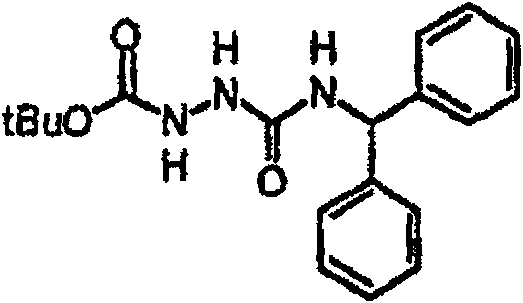
羰基二咪唑(16.2g,0.10mol)的二甲基甲酰胺(225ml)溶液在30分钟内滴加肼基甲酸叔丁酯(13.2g,0.100mol)的二甲基甲酰胺(225ml)溶液。在接下来的30分钟内加入二苯基甲胺(18.3g,0.10mol)。将反应物在室温下搅拌1小时。加入水(10ml)后将混合物减压浓缩至约150ml。将此溶液倾入水(500ml)中,用乙酸乙酯(400ml)萃取。乙酸乙酯相用每份75ml的1N HCl、H2O、饱和碳酸氢钠溶液和氯化 钠各洗涤2次,用硫酸镁干燥。将混合物过滤,浓缩溶液获得白色泡沫状产物29.5g(85%收率)。所得产物可以用乙酸乙酯/己烷重结晶提纯,但是上述产物纯度足以在下一步直接使用:mp 142-143℃。1HNMR(CDCl3)d 1.45(s,9H),6.10(dd,2H),6.42(s,1H),6.67(bs,1H),7.21-7.31(m,10H)。C19H23N3O3的分析值:C,66.84;H,6.79;N,12.31。实测值:C,66.46;H,6.75;N;12.90。 A solution of carbonyldiimidazole (16.2 g, 0.10 mol) in dimethylformamide (225 ml) was added dropwise to a solution of tert-butyl carbazate (13.2 g, 0.100 mol) in dimethylformamide (225 ml) over 30 minutes. Diphenylmethylamine (18.3 g, 0.10 mol) was added over the next 30 minutes. The reaction was stirred at room temperature for 1 hour. After adding water (10ml), the mixture was concentrated to about 150ml under reduced pressure. The solution was poured into water (500ml) and extracted with ethyl acetate (400ml). The ethyl acetate phase was washed twice with 75 ml each of 1N HCl, H2O , saturated sodium bicarbonate solution and sodium chloride and dried over magnesium sulfate. The mixture was filtered and the solution was concentrated to afford 29.5 g (85% yield) of the product as a white foam. The product obtained could be purified by recrystallization from ethyl acetate/hexane, but the product was pure enough to be used directly in the next step: mp 142-143°C. 1 H NMR (CDCl 3 )d 1.45 (s, 9H), 6.10 (dd, 2H), 6.42 (s, 1H), 6.67 (bs, 1H), 7.21-7.31 (m, 10H). Anal. for C19H23N3O3 : C, 66.84; H , 6.79; N, 12.31. Found: C, 66.46; H, 6.75; N; 12.90.
b)合成二苯基甲基氨基脲(dpsc)三氟乙酸盐 b) Synthesis of diphenylmethylsemicarbazide (dpsc) trifluoroacetate
Boc-氨基脲-4-基二苯基甲烷(3.43g,10mmol)的二氯甲烷(12.5ml)溶液在室温下用三氟乙酸(12.5ml)处理,搅拌30分钟。将溶液滴加到75ml乙醚,过滤收集所得固体(2.7g,80%)。mp 182-184℃。1H NMR(CD3OD)d 6.05(s,1H),7.21-7.35(m,10H)。13C NMR(CD3OD)d57.6,118.3(q,CF3),126.7,127.9,141.6,156.9,160.9(q,CF3 CO2H)。 A solution of Boc-semicarbazide-4-yldiphenylmethane (3.43g, 10mmol) in dichloromethane (12.5ml) was treated with trifluoroacetic acid (12.5ml) at room temperature and stirred for 30 minutes. The solution was added dropwise to 75 ml of diethyl ether, and the resulting solid (2.7 g, 80%) was collected by filtration. mp 182-184°C. 1 H NMR (CD 3 OD)d 6.05 (s, 1H), 7.21-7.35 (m, 10H). 13 C NMR (CD 3 OD) d57.6, 118.3 (q, CF 3 ), 126.7, 127.9, 141.6, 156.9, 160.9 (q, CF 3 CO 2 H).
D)合成Fmoc-nVal-(CHOH)-Gly-O烯丙基:D) Synthesis of Fmoc-nVal-(CHOH)-Gly-O allyl:

Fmoc-nVal-CHO(步骤1B)(5.47g,16.90mmol)的二氯甲烷(170ml)溶液中加入异氰基乙酸烯丙酯(步骤1A)(2.46ml,20.28mmol)和吡啶(5.47ml,67.61mmol)。将反应混合物冷却至0℃,滴加三氟乙酸(3.38ml,33.80mmol)。将反应物在0℃搅拌1小时,然后在室温下搅拌48小时。TLC采用乙酸乙酯确认反应完成。将反应混合物浓 缩,并用快速色谱法(含20%-70%乙酸乙酯的己烷)提纯。合并包含所需产品部分,浓缩获得白色泡沫物(6.88g,87.3%)。TLC用1∶1乙酸乙酯/己烷显示出一个斑点(Rf=0.37)。NMRδppm(CD3OD):7.8(m,2H),7.65(m,2H),7.4(m,2H),7.3(m,2H),5.9(m,1H),5.1-5.4(m,2H),4.55-4.65(m,2H),4.3-4.4(m,2H),4.15-4.25(m,1H),4.01(s,1H),3.9-4.0(m,3H),1.5-1.6(m,2H),1.35-1.45(m,3H),0.9(m,3H)。 To a solution of Fmoc-nVal-CHO (Step 1B) (5.47g, 16.90mmol) in dichloromethane (170ml) was added allyl isocyanoacetate (Step 1A) (2.46ml, 20.28mmol) and pyridine (5.47ml, 67.61 mmol). The reaction mixture was cooled to 0°C and trifluoroacetic acid (3.38ml, 33.80mmol) was added dropwise. The reaction was stirred at 0 °C for 1 hour, then at room temperature for 48 hours. TLC using ethyl acetate confirmed the completion of the reaction. The reaction mixture was concentrated and purified by flash chromatography (20%-70% ethyl acetate in hexanes). Fractions containing the desired product were combined and concentrated to give a white foam (6.88 g, 87.3%). TLC with 1:1 ethyl acetate/hexane showed one spot (Rf = 0.37). NMRδppm (CD 3 OD): 7.8 (m, 2H), 7.65 (m, 2H), 7.4 (m, 2H), 7.3 (m, 2H), 5.9 (m, 1H), 5.1-5.4 (m, 2H) , 4.55-4.65(m, 2H), 4.3-4.4(m, 2H), 4.15-4.25(m, 1H), 4.01(s, 1H), 3.9-4.0(m, 3H), 1.5-1.6(m, 2H), 1.35-1.45 (m, 3H), 0.9 (m, 3H).
E)合成Fmoc-nVal-(CO)-Gly-O烯丙基:E) Synthesis of Fmoc-nVal-(CO)-Gly-O allyl:

Fmoc-nVal-(CHOH)-Gly-O烯丙基(步骤D)(5.01g,10.77mmol)的二甲基亚砜(100ml)和甲苯(100ml)溶液中加入EDC(20.6g,107.7mmol)。将反应混合物冷却至0℃,滴加二氯乙酸(4.44ml,53.83mmol)。反应物在0℃下搅拌15分钟,然后在室温下搅拌1小时。再冷却至0℃后,加入水(70ml),减压除去甲苯。残余物用乙酸乙酯稀释,用饱和碳酸氢钠溶液、再用1N硫酸氢钠和盐水各洗涤几次。用硫酸钠干燥有机层,过滤,浓缩。获得理论产量4.99g,反应物直接用于下一步骤而无需再提纯。TLC用1∶1乙酸乙酯/己烷显示出一个斑点(Rf=0.73)。 To a solution of Fmoc-nVal-(CHOH)-Gly-Oallyl (Step D) (5.01 g, 10.77 mmol) in dimethylsulfoxide (100 ml) and toluene (100 ml) was added EDC (20.6 g, 107.7 mmol) . The reaction mixture was cooled to 0°C and dichloroacetic acid (4.44ml, 53.83mmol) was added dropwise. The reaction was stirred at 0°C for 15 minutes, then at room temperature for 1 hour. After further cooling to 0°C, water (70ml) was added and toluene was removed under reduced pressure. The residue was diluted with ethyl acetate, washed several times with saturated sodium bicarbonate solution, then with 1N sodium bisulfate and brine. The organic layer was dried over sodium sulfate, filtered and concentrated. A theoretical yield of 4.99 g was obtained and the reactant was used directly in the next step without further purification. TLC with 1:1 ethyl acetate/hexane showed one spot (Rf = 0.73). the
F)合成Fmoc-nVal-(dpsc)-Gly-O烯丙基:F) Synthesis of Fmoc-nVal-(dpsc)-Gly-O allyl:
Fmoc-nVal-(CO)-Gly-O烯丙基(步骤E)(4.99g,10.75mmol)的乙醇(130ml)和水(42ml)溶液中依次加入二苯基甲基氨基脲(dpsc)三氟乙酸盐(步骤1C)(7.6g,21.5mmol)和乙酸钠·3H2O(1.76g,12.9mmol)。将反应混合物加热回流90分钟。反应的完成用薄层色谱法用1∶1乙酸乙酯∶己烷确认。减压除去乙醇,残余物溶于乙酸乙酯,用1N硫酸氢钠(2×10ml)、饱和碳酸氢钠水溶液(2×10ml)洗涤、接着用盐水(2×10ml)洗涤。干燥有机层,过滤,浓缩。所得残余物用快速色谱法提纯(含20%到50%乙酸乙酯的己烷)获得白色固体(5.76g,78%)。TLC用50∶50乙酸乙酯/己烷显示出两个斑点(顺式异构体和反式异构体),Rf=0.42和0.50。 To a solution of Fmoc-nVal-(CO)-Gly-Oallyl (Step E) (4.99g, 10.75mmol) in ethanol (130ml) and water (42ml) was added diphenylmethylsemicarbazide (dpsc) three Fluoroacetate (Step 1C) (7.6 g, 21.5 mmol) and sodium acetate- 3H2O (1.76 g, 12.9 mmol). The reaction mixture was heated to reflux for 90 minutes. Completion of the reaction was confirmed by thin layer chromatography using 1:1 ethyl acetate:hexane. Ethanol was removed under reduced pressure, the residue was dissolved in ethyl acetate and washed with 1N sodium bisulfate (2 x 10 ml), saturated aqueous sodium bicarbonate (2 x 10 ml), followed by brine (2 x 10 ml). The organic layer was dried, filtered and concentrated. The resulting residue was purified by flash chromatography (20% to 50% ethyl acetate in hexanes) to give a white solid (5.76 g, 78%). TLC with 50:50 ethyl acetate/hexane showed two spots (cis isomer and trans isomer), Rf = 0.42 and 0.50.
G)合成Fmoc-nVal-(dpsc)-Gly-OH:G) Synthesis of Fmoc-nVal-(dpsc)-Gly-OH:
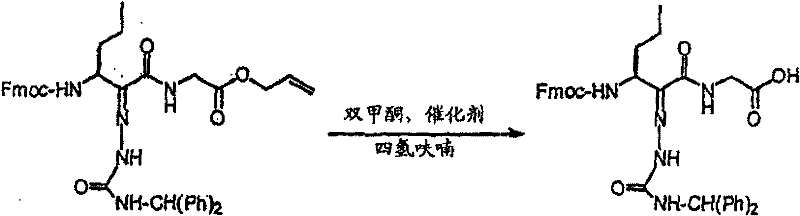
Fmoc-nVal-(dpsc)-Gly-O烯丙基(步骤1G)(4.53g,6.59mmol)的四氢呋喃(300ml)溶液中先加入双甲酮(4.62g,32.97mmol),然后加入四(三苯膦)钯(0)催化剂(0.76g,0.66mmol)。在90分钟后,反应的 完成由TLC(9∶1二氯甲烷∶甲醇)确认。将反应混合物浓缩,残余物溶于乙酸乙酯,用每份50ml的0.1M磷酸二氢钾洗涤三次。有机层用50ml亚硫酸氢钠处理,将两相体系搅拌15分钟。将两相分离,此步骤再重复两次。干燥有机层,浓缩,用快速柱色谱法(含20%-100%乙酸乙酯的己烷,然后用9∶1二氯甲烷∶甲醇)处理。合并纯产物相应部分,浓缩获得白色固体(3.99g,94%)。TLC用9∶1二氯甲烷∶甲醇显示出两个斑点(顺式异构体和反式异构体)。NMRδppm(CD3OD):7.75(m,2H),7.6(m,3H),7.2-7.4(m,14H),6.1-6.2(m,1H),4.25-4.4(m,2H),4.1-4.2(m,2H),3.85(s,2H),1.6-1.8(m,2H),1.3-1.5(m,2H),0.95(t,3H)。 To a solution of Fmoc-nVal-(dpsc)-Gly-Oallyl (Step 1G) (4.53g, 6.59mmol) in tetrahydrofuran (300ml) was added dimedone (4.62g, 32.97mmol) followed by tetrakis(tri Phenylphosphine)palladium(0) catalyst (0.76g, 0.66mmol). After 90 minutes, the completion of the reaction was confirmed by TLC (9:1 dichloromethane:methanol). The reaction mixture was concentrated, the residue was dissolved in ethyl acetate and washed three times with 50 mL portions of 0.1 M potassium dihydrogen phosphate. The organic layer was treated with 50 mL of sodium bisulfite and the biphasic system was stirred for 15 minutes. The two phases were separated and this step was repeated two more times. The organic layer was dried, concentrated, and subjected to flash column chromatography (20%-100% ethyl acetate in hexanes, then 9:1 dichloromethane:methanol). Fractions of pure product were combined and concentrated to give a white solid (3.99 g, 94%). TLC with 9:1 dichloromethane:methanol showed two spots (cis isomer and trans isomer). NMRδppm (CD 3 OD): 7.75 (m, 2H), 7.6 (m, 3H), 7.2-7.4 (m, 14H), 6.1-6.2 (m, 1H), 4.25-4.4 (m, 2H), 4.1- 4.2 (m, 2H), 3.85 (s, 2H), 1.6-1.8 (m, 2H), 1.3-1.5 (m, 2H), 0.95 (t, 3H).
步骤2.合成H-Phg-MBHA树脂:Step 2. Synthesis of H-Phg-MBHA resin:
将商业上可得到的MBHA树脂(2.6g,1.12mmol/g,2.91mmol)转移到250ml配置了氮气入口的烧结固相反应容器。将其用每份30ml的二氰甲烷、甲醇、二甲基甲酰胺和二氯甲烷充分洗涤,按照方法A将其与商业上可得到的Fmoc-Phg-OH(2.17g,5.82mmol)偶合18小时,反应效率为99.82%。然后按照方法B将树脂去除Fmoc保护。对少量试样的茚三酮定性分析呈现深蓝色的树脂和溶液,表明反应成功。 Commercially available MBHA resin (2.6 g, 1.12 mmol/g, 2.91 mmol) was transferred to a 250 ml sintered solid phase reaction vessel equipped with a nitrogen inlet. It was washed well with 30 ml each of dicyanomethane, methanol, dimethylformamide and dichloromethane, and it was coupled with commercially available Fmoc-Phg-OH (2.17 g, 5.82 mmol) according to method A 18 hours, the reaction efficiency was 99.82%. The resin was then de-Fmoc-protected following Method B. Qualitative analysis of ninhydrin on a small sample showed a dark blue resin and solution, indicating a successful reaction. the
步骤3.合成H-nVal(dpsc)-Gly-Phg-MBHA树脂:Step 3. Synthesis of H-nVal(dpsc)-Gly-Phg-MBHA resin:

步骤II获得的树脂(2.6g,0.8mmol/g,2.91mmol)按照方法A与Fmoc-nVal-(dpsc)-Gly-O烯丙基(步骤1G)(5.82mmol,3.77g)反应。在18小时后,用茚三酮定量分析显示偶合效率为99.91%,将树脂按照方法B除去Fmoc保护。对少量试样的定性茚三酮分析呈现深蓝色的树脂和溶液,表明反应成功。 The resin obtained in Step II (2.6 g, 0.8 mmol/g, 2.91 mmol) was reacted following method A with Fmoc-nVal-(dpsc)-Gly-Oallyl (Step 1G) (5.82 mmol, 3.77 g). After 18 hours, quantitative analysis with ninhydrin showed a coupling efficiency of 99.91%, and the resin was deprotected by Method B for Fmoc protection. Qualitative ninhydrin analysis of a small sample revealed a dark blue resin and solution, indicating a successful reaction. the
步骤4.合成Boc-Pro(4t-NHFmoc)-nVal(dpsc)-Gly-Phg-MBHA树脂:Step 4. Synthesis of Boc-Pro(4t-NHFmoc)-nVal(dpsc)-Gly-Phg-MBHA resin:
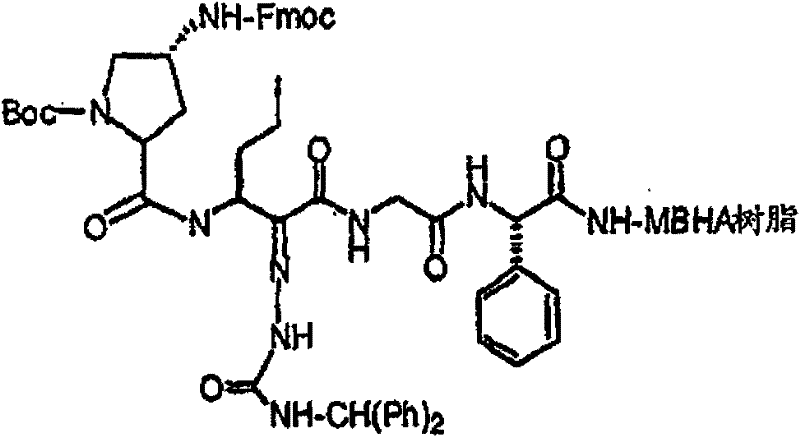
将化合物H-nVal(dpsc)-Gly-Phg-MBHA树脂(以上的步骤3)(600mg,0.8mmol/g,0.67mmol)转移到滤板型聚丙烯管中,按照方法A与Boc-Pro(4t-NHFmoc)-OH(实施例VI步骤3)(610mg,1.34mmol)偶合。在18小时后,用茚三酮定量分析偶合效率为99.96%。 Compound H-nVal(dpsc)-Gly-Phg-MBHA resin (step 3 above) (600 mg, 0.8 mmol/g, 0.67 mmol) was transferred to a filter plate polypropylene tube and followed by method A with Boc-Pro ( 4t-NHFmoc)-OH (Example VI step 3) (610 mg, 1.34 mmol) was coupled. After 18 hours, the coupling efficiency was quantified with ninhydrin to be 99.96%. the
步骤5.合成Boc-Pro(4t-NHStep 5. Synthesis of Boc-Pro (4t-NH 22 )-nVal(dpsc)-Gly-Phg-MBHA树脂:)-nVal(dpsc)-Gly-Phg-MBHA resin:
将前一步骤获得的树脂(Boc-Pro(4t-NHFmoc)-nVal(dpsc)-Gly-Phg-MBHA树脂)按照方法B除去Fmoc保护。对小量样品的茚三酮定性分析呈现深蓝色的树脂和溶液,表明反应成功。 The resin obtained in the previous step (Boc-Pro(4t-NHFmoc)-nVal(dpsc)-Gly-Phg-MBHA resin) was deprotected by method B according to method B. Qualitative analysis of ninhydrin on a small sample showed a dark blue resin and solution, indicating a successful reaction. the
步骤6.合成Boc-Pro(4t-NHSOStep 6. Synthesis of Boc-Pro (4t-NHSO 22 Bn)-nVal(dpsc)-Gly-Phg-MBHA树脂:Bn)-nVal(dpsc)-Gly-Phg-MBHA resin:
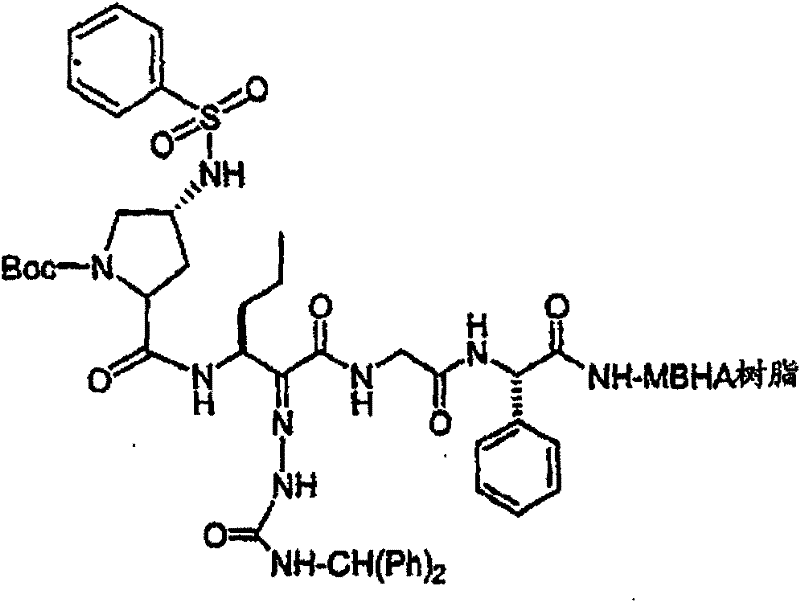
将前一步骤获得的树脂(Boc-Pro(4t-NH2)-nVal(dpsc)-Gly-Phg-MBHA树脂)(0.2g,0.22mmol)悬浮于NMP(2ml),加入2,4,6-三甲基吡啶(0.24ml,1.79mmol)和苯磺酰氯,将反应物振荡18小时。排 出溶剂,树脂用每份2ml的二氯甲烷、甲醇、二甲基甲酰胺和二氯甲烷充分洗涤。茚三酮定性分析显示无色的珠粒和溶液。 The resin (Boc-Pro(4t-NH 2 )-nVal(dpsc)-Gly-Phg-MBHA resin) (0.2 g, 0.22 mmol) obtained in the previous step was suspended in NMP (2 ml), and 2, 4, 6 -Collidine (0.24ml, 1.79mmol) and benzenesulfonyl chloride, the reaction was shaken for 18 hours. The solvent was drained and the resin was washed extensively with 2ml portions of dichloromethane, methanol, dimethylformamide and dichloromethane. Qualitative analysis of ninhydrin revealed colorless beads and solution.
步骤7.合成Fmoc-G(Chx)-Pro(4t-NHSOStep 7. Synthesis of Fmoc-G(Chx)-Pro(4t-NHSO 22 Bn)-nVal(dpsc)-Gly-Phg-MBHA树脂:Bn)-nVal(dpsc)-Gly-Phg-MBHA resin:

将前一步骤获得的树脂(Boc-Pro(4t-NHSO2Bn)-nVal(dpsc)-Gly-Phg-MBHA树脂)按照方法C除去Boc保护。然后按照方法A偶合Fmoc-G(Chx)(0.17g,0.45mmol)。18小时后,茚三酮定性分析显示无色珠粒,茚三酮定量分析显示偶合效率为99.79%。 The resin obtained in the previous step (Boc-Pro(4t-NHSO 2 Bn)-nVal(dpsc)-Gly-Phg-MBHA resin) was removed according to method C for Boc protection. Fmoc-G(Chx) (0.17 g, 0.45 mmol) was then coupled according to Method A. After 18 hours, qualitative analysis of ninhydrin showed colorless beads, and quantitative analysis of ninhydrin showed a coupling efficiency of 99.79%.
步骤8.合成iBoc-G(Chx)-Pro(4t-NHSOStep 8. Synthesis of iBoc-G(Chx)-Pro(4t-NHSO 22 Bn)-nVal(dpsc)-Gly-Phg-MBHA树脂:Bn)-nVal(dpsc)-Gly-Phg-MBHA resin:
将上一步获得的树脂(Fmoc-G(Chx)-Pro(4t-NHSO2Bn)-nVal(dpsc)-Gly-Phg-MBHA树脂)按照方法B除去Fmoc保护。对小量样品的茚三酮分析呈现深蓝色的树脂和溶液,表明反应成功。将树脂(0.2g,0.22mmol)悬浮于2ml NMP中,加入氯甲酸异丁酯(0.12ml,0.90mmol),接着加入二异丙基乙胺(0.31ml,1.79mmol),将反应混合物在室温下振荡18小时。茚三酮定性分析显示无色的珠粒和溶液,表明反应成功。 The resin obtained in the previous step (Fmoc-G(Chx)-Pro(4t-NHSO 2 Bn)-nVal(dpsc)-Gly-Phg-MBHA resin) was removed according to method B for Fmoc protection. Ninhydrin analysis of a small sample yielded a dark blue resin and solution, indicating a successful reaction. Resin (0.2g, 0.22mmol) was suspended in 2ml NMP, wasobutyl chloroformate (0.12ml, 0.90mmol) was added, followed by diisopropylethylamine (0.31ml, 1.79mmol), and the reaction mixture was heated at room temperature Shake for 18 hours. Qualitative analysis of ninhydrin revealed colorless beads and solution, indicating a successful reaction.
步骤9.合成iBoc-G(Chx)-Pro(4t-NHSOStep 9. Synthesis of iBoc-G(Chx)-Pro(4t-NHSO 22 Bn)-nVal(CO)-Gly-Phg-MBHA树脂:Bn)-nVal(CO)-Gly-Phg-MBHA resin:
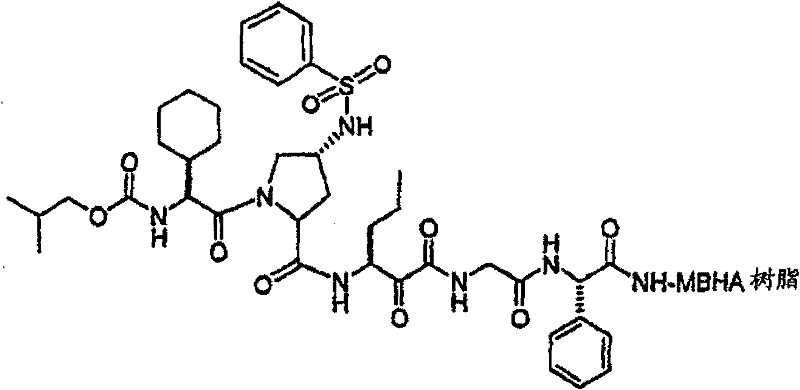
将前一步骤的化合物(iBoc-G(Chx)-Pro(4t-NHSO2Bn)-nVal(dpsc)-Gly-Phg-MBHA树脂)(200mg)按照方法D进行缩氨基脲水解。 The compound from the previous step (iBoc-G(Chx)-Pro(4t-NHSO 2 Bn)-nVal(dpsc)-Gly-Phg-MBHA resin) (200 mg) was subjected to semicarbazone hydrolysis according to method D.
步骤10.合成iBoc-G(Chx)-Pro(4t-NHSOStep 10. Synthesis of iBoc-G(Chx)-Pro(4t-NHSO 22 Bn)-nVal(CO)-Gly-Phg-NHBn)-nVal(CO)-Gly-Phg-NH 22 ::

将前一步骤的树脂(iBoc-G(Chx)-Pro(4t-NHSO2Bn)-nVal(CO)-Gly-Phg-MBHA树脂)(100mg)置于HF裂解条件(方法E)获得所需的粗产物。粗产物用HPLC(2.2×25cm反相柱,包含由300埃孔径的10微米硅胶粒组成的C-18树脂,洗脱用梯度含20-50%乙腈的水)提纯。 分析型HPLC(4.6×250mm反相柱,包含由300埃孔径的5微米硅胶粒组成的C-18树脂,洗脱时用25-75%乙腈(包含0.1%三氟乙酸))在13.5分钟显示一个峰。用低分辨率质谱确认所需要的物质(MH+826.4)。 The resin from the previous step (iBoc-G(Chx)-Pro(4t-NHSO 2 Bn)-nVal(CO)-Gly-Phg-MBHA resin) (100 mg) was subjected to HF cleavage conditions (Method E) to obtain the desired crude product. The crude product was purified by HPLC (2.2 x 25 cm reverse phase column containing C-18 resin composed of 10 micron silica particles with 300 Angstrom pore size, eluting with a gradient of 20-50% acetonitrile in water). Analytical HPLC (4.6 x 250 mm reverse phase column containing C-18 resin consisting of 300 angstrom pore size 5 micron silica particles eluting with 25-75% acetonitrile (containing 0.1% trifluoroacetic acid)) showed at 13.5 minutes a peak. The desired material (MH + 826.4) was confirmed by low resolution mass spectrometry.
IV.用液相合成制备另外的化合物:IV. Preparation of Additional Compounds Using Liquid Phase Synthesis:
制备本发明另外的化合物的典型方法如下,由这样的方法制备的化合物列于表5中。 Typical methods for preparing additional compounds of the invention are as follows, and compounds prepared by such methods are listed in Table 5. the
实施例XXIII:制备式XXIII化合物: Embodiment XXIII : preparation formula XXIII compound:
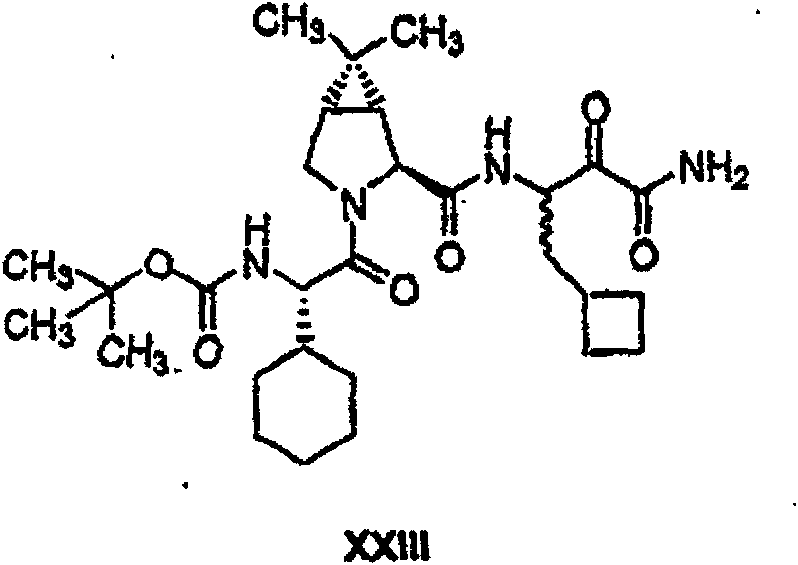
步骤1.step 1.

将酮亚胺(ketimime)XXIIIa(50g,187.1mmol)的氮气氛下的无水THF(400mL)溶液搅拌冷却至-78℃,用1M K-tBuO(220mL,1.15当量)的THF溶液处理。将反应混合物加温至0℃,搅拌1小时,用 溴甲基环丁烷(28mL,249mmol)处理。将反应混合物在室温下搅拌48小时,真空浓缩。残余物溶于Et2O(300mL),用HCl水溶液(2M,300mL)处理。所得溶液在室温下搅拌5小时,用Et2O(1L)萃取。水层用NaOH(50%aq.)碱化至pH~12-14,用CH2Cl2(3×300mL)萃取。干燥合并的有机层(MgSO4),过滤,浓缩获得无色油状的纯胺(XXIIIb,18g)。 A solution of ketimime XXIIIa (50 g, 187.1 mmol) in anhydrous THF (400 mL) under nitrogen was stirred cooled to -78°C and treated with 1M K -t BuO (220 mL, 1.15 equiv) in THF. The reaction mixture was warmed to 0°C, stirred for 1 hour, and treated with bromomethylcyclobutane (28 mL, 249 mmol). The reaction mixture was stirred at room temperature for 48 hours and concentrated in vacuo. The residue was dissolved in Et2O (300 mL) and treated with aqueous HCl (2M, 300 mL). The resulting solution was stirred at room temperature for 5 hours, extracted with Et2O (1 L). The aqueous layer was basified with NaOH (50% aq.) to pH~12-14 and extracted with CH2Cl2 (3 x 300 mL). The combined organic layers were dried ( MgSO4 ), filtered and concentrated to afford pure amine (XXIIIb, 18g) as a colorless oil.
步骤2.Step 2.
胺XXIIIb(18g,105.2mmol)的CH2Cl2(350mL)溶液在0℃用二碳酸二叔丁基酯(23g,105.4mmol)处理,在室温下搅拌12小时。在完成反应后(TLC),将反应混合物真空浓缩,残余物溶于THF/H2O(200ml,1∶1),用LiOH·H2O(6.5g,158.5mmol)处理,在室温下搅拌3小时。将反应混合物浓缩,碱性水层用Et2O萃取。水层用浓盐酸酸化至pH~1-2,用CH2Cl2萃取。干燥(MgSO4)合并的有机层,过滤,真空浓缩获得无色粘性油状物XXIIIc,它直接用于下一步骤无需任何提纯。 A solution of amine XXIIIb (18 g, 105.2 mmol) in CH2Cl2 (350 mL ) was treated with di-tert-butyl dicarbonate (23 g, 105.4 mmol) at 0 °C and stirred at room temperature for 12 hours. After completion of the reaction (TLC), the reaction mixture was concentrated in vacuo, the residue was dissolved in THF/ H2O (200ml, 1:1), treated with LiOH· H2O (6.5g, 158.5mmol) and stirred at room temperature 3 hours. The reaction mixture was concentrated, and the basic aqueous layer was extracted with Et2O . The aqueous layer was acidified with concentrated hydrochloric acid to pH ~1-2 and extracted with CH2Cl2 . The combined organic layers were dried ( MgSO4 ), filtered and concentrated in vacuo to afford XXIIIc as a colorless viscous oil which was used directly in the next step without any purification.
步骤3.Step 3.
酸XXIIIc(15.0g,62mmol)的CH2Cl2(250mL)溶液用用BOP试剂(41.1g,93mmol)、N-甲基吗啉(27mL)、N,O-二甲基羟胺盐酸盐(9.07g,93mmol)处理,在室温下搅拌过夜。将反应混合物用1N HCl水溶液(250mL)稀释,然后分离过层,水层用CH2Cl2(3×300ml)萃取。将合并的有机层干燥(MgSO4),过滤并真空浓缩,用色谱法(SiO2,乙酸乙酯/己烷2∶3)提纯获得无色固体酰胺XXIIId(15.0g)。 Acid XXIIIc (15.0 g, 62 mmol) in CH 2 Cl 2 (250 mL) was treated with BOP reagent (41.1 g, 93 mmol), N-methylmorpholine (27 mL), N, O-dimethylhydroxylamine hydrochloride ( 9.07 g, 93 mmol) and stirred overnight at room temperature. The reaction mixture was diluted with 1N aqueous HCl (250 mL), then the layers were separated and the aqueous layer was extracted with CH2Cl2 (3 x 300 mL). The combined organic layers were dried ( MgSO4 ), filtered and concentrated in vacuo, and purified by chromatography ( SiO2 , ethyl acetate/hexane 2:3) to afford amide XXIIId (15.0 g) as a colorless solid.
步骤4.Step 4.
酰胺XXIIId(15g,52.1mmol)的无水THF(200mL)溶液在0℃滴加LiAiH4(1M,93mL,93mmol)溶液。将反应混合物在室温下搅拌1小时,在0℃用KHSO4溶液(10%aq.)小心地猝灭,搅拌0.5小时。反应混合物用HCl水溶液(1M,150mL)稀释,用CH2Cl2(3×200mL)萃取,合并的有机层用HCl水溶液(1M)、饱和NaHCO3、盐水洗涤,干燥(MgSO4)。将混合物过滤并真空浓缩,获得无色粘性油状物XXIIIe(14g)。 A solution of amide XXIIId (15 g, 52.1 mmol) in anhydrous THF (200 mL) was added dropwise with a solution of LiAiH 4 (1M, 93 mL, 93 mmol) at 0°C. The reaction mixture was stirred at room temperature for 1 hour, carefully quenched with KHSO4 solution (10% aq.) at 0 °C, and stirred for 0.5 hours. The reaction mixture was diluted with aqueous HCl (1M, 150 mL), extracted with CH2Cl2 (3 x 200 mL), and the combined organic layers were washed with aqueous HCl ( 1M ), saturated NaHCO3 , brine, and dried ( MgSO4 ). The mixture was filtered and concentrated in vacuo to afford XXIIIe (14g) as a colorless viscous oil.
步骤5.Step 5.

醛XXIIIe(14g,61.6mmol)的CH2Cl2(50mL)溶液用Et3N(10.73mL,74.4mmol)和丙酮氰醇(10.86g,127.57mmol)处理,在室温下搅拌24小时。将反应混合物真空浓缩,用HCl水溶液(1M,200mL)洗涤,用CH2Cl2(3×200mL)萃取。合并的有机层用H2O、盐水洗涤,干燥(MgSO4),过滤,真空干燥,用色谱法(SiO2,乙酸乙酯/己烷1∶4)提纯获得无色液体XXIIIf(10.3g)。 A solution of aldehyde XXIIIe (14 g, 61.6 mmol) in CH2Cl2 (50 mL ) was treated with Et3N (10.73 mL, 74.4 mmol) and acetone cyanohydrin (10.86 g, 127.57 mmol) and stirred at room temperature for 24 hours. The reaction mixture was concentrated in vacuo, washed with aqueous HCl ( 1M , 200 mL), extracted with CH2Cl2 (3 x 200 mL). The combined organic layers were washed with H2O , brine, dried ( MgSO4 ), filtered, dried in vacuo and purified by chromatography ( SiO2 , ethyl acetate/hexane 1:4) to give XXIIIf as a colorless liquid (10.3 g) .
步骤6.Step 6.
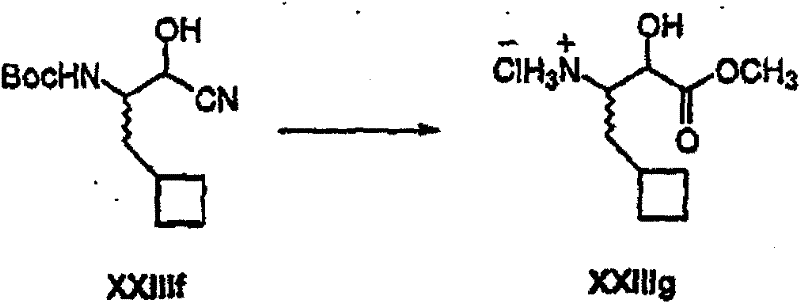
HCl*饱和的甲醇溶液(其制备是在0℃通入HCl气体至CH3OH(700ml))用上述氰醇XXIIIf处理,加热回流24小时。将反应物真空浓缩获得XXIIIg,它用于下一步骤无需再提纯。 A saturated methanolic solution of HCl * (prepared by bubbling HCl gas into CH3OH (700ml) at 0°C) was treated with the above cyanohydrin XXIIIf and heated at reflux for 24 hours. The reaction was concentrated in vacuo to afford XXIIIg which was used in the next step without further purification.
*或者也可使用通过加入AcCl到无水甲醇制备的6M HCl。 * Alternatively, 6M HCl prepared by adding AcCl to dry methanol can also be used.
步骤7.Step 7.
上述胺的盐酸盐XXIIIg的CH2Cl2(200mL)溶液用Et3N(45.0mL,315mmol)和Boc2O(45.7g,209mmol)在-78℃处理。然后将反应混合物在室温下搅拌过夜,用HCl(2M,200mL)稀释,萃取入 CH2Cl2,干燥(MgSO4)合并的有机层,过滤,真空浓缩,用色谱法(乙酸乙酯/环己烷1∶4)提纯获得羟基酯XXIIIh。 A solution of the hydrochloride XXIIIg of the above amine in CH2Cl2 (200 mL) was treated with Et3N (45.0 mL, 315 mmol) and Boc2O (45.7 g, 209 mmol) at -78 °C. The reaction mixture was then stirred at room temperature overnight, diluted with HCl (2M, 200 mL), extracted into CH2Cl2 , the combined organic layers were dried ( MgSO4 ), filtered, concentrated in vacuo and chromatographed (ethyl acetate/ cyclo Hexane 1:4) to obtain the hydroxyester XXIIIh.
步骤8.Step 8.

上述甲酯XXIIIh(3g,10.5mmol)的THF/H2O(1∶1)溶液用LiOH·H2O(645mg,15.75mmol)处理,在室温下搅拌2小时。反应混合物用HCl水溶液(1M,15mL)酸化,真空浓缩。真空干燥残余物。 A THF/H 2 O (1:1) solution of the above methyl ester XXIIIh (3 g, 10.5 mmol) was treated with LiOH·H 2 O (645 mg, 15.75 mmol) and stirred at room temperature for 2 hours. The reaction mixture was acidified with aqueous HCl (1M, 15 mL) and concentrated in vacuo. The residue was dried in vacuo.
上述酸的CH2Cl2(50mL)和DMF(25mL)溶液用NH4Cl(2.94g,55.5mmol)、EDCl(3.15g,16.5mmol)、HOOBt(2.69g,16.5mmol)和NMM(4.4g,44mmol)处理。反应混合物在室温下搅拌3天。真空除去溶剂,残余物用HCl水溶液(250mL)稀释,用CH2Cl2萃取。合并的有机层用饱和NaHCO3水溶液洗涤,干燥(MgSO4),过滤,真空浓缩获得XXIIIi,它直接用于下一步骤。 A solution of the above acid in CH 2 Cl 2 (50 mL) and DMF (25 mL) was mixed with NH 4 Cl (2.94 g, 55.5 mmol), EDCl (3.15 g, 16.5 mmol), HOOBt (2.69 g, 16.5 mmol) and NMM (4.4 g , 44mmol) treatment. The reaction mixture was stirred at room temperature for 3 days. The solvent was removed in vacuo , the residue was diluted with aqueous HCl (250 mL), and extracted with CH2Cl2 . The combined organic layers were washed with saturated aqueous NaHCO 3 , dried (MgSO 4 ), filtered, and concentrated in vacuo to afford XXIIIi, which was used directly in the next step.
(或者还可使XXIIIf(4.5g,17.7mmol)与H2O2(10mL)水溶液LiOH·H2O(820mg,20.8mmol)在0℃于50mL CH3OH中反应0.5小时直接得到XXIIIi) (Alternatively, XXIIIf (4.5g, 17.7mmol) can be reacted with H 2 O 2 (10mL) aqueous LiOH·H 2 O (820mg, 20.8mmol) in 50mL CH 3 OH at 0°C for 0.5 hours to directly obtain XXIIIi)
步骤9.Step 9.

将前一步骤获得的XXIIIi的溶液溶于4N HCl的二氧六环溶液,在室温下搅拌2小时。将反应混合物真空浓缩获得固体XXIIIj,它直接使用无需再提纯。 The solution of XXIIIi obtained in the previous step was dissolved in 4N HCl in dioxane and stirred at room temperature for 2 hours. The reaction mixture was concentrated in vacuo to afford solid XXIIIj which was used without further purification. the
步骤10.Step 10.
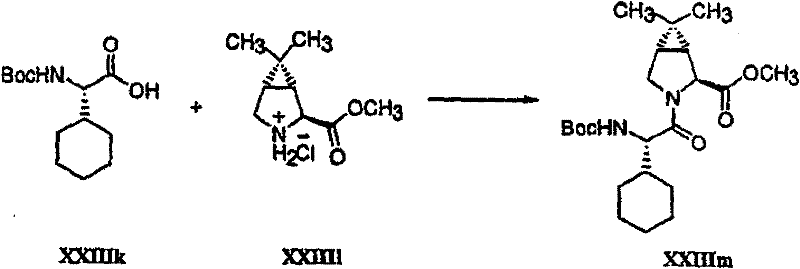
氨基酯XXIIII的制备按照R.Zhang和J.S.Madalengoitia(J.Org.Chem.1999,64,330)的方法制备,除了使Boc保护的氨基酸基团与HCl的甲醇溶液反应而使Boc基团脱去以外。 Amino ester XXIIII was prepared according to the method of R. Zhang and J.S. Madalengoitia (J. Org. Chem. 1999, 64, 330), except that the Boc group was removed by reacting the Boc-protected amino acid group with methanolic HCl outside. the
商品氨基酸Boc-Chg-OH XXIIIk(Senn chemicals,6.64g,24.1mmol)和胺的盐酸盐XXIIII(4.5g,22mmol)的CH2Cl2(100mL)溶液在0℃用BOP试剂处理,在室温搅拌15小时。将反应混合物真空浓缩,然后用1M HCl水溶液稀释,萃取入EtOAc(3×200mL)。合并的有机层用饱和NaHCO3(200mL)洗涤,干燥(MgSO4),过滤并真空浓 缩,用色谱法(SiO2,乙酸乙酯/环己烷3∶7)获得无色固体XXIIIm(6.0g)。 Commercial amino acid Boc-Chg-OH XXIIIk (Senn chemicals, 6.64 g, 24.1 mmol) and amine hydrochloride XXIII (4.5 g, 22 mmol) in CH 2 Cl 2 (100 mL) were treated with BOP reagent at 0°C, and at room temperature Stir for 15 hours. The reaction mixture was concentrated in vacuo, then diluted with 1M aqueous HCl, extracted into EtOAc (3 x 200 mL). The combined organic layers were washed with saturated NaHCO 3 (200 mL), dried (MgSO 4 ), filtered and concentrated in vacuo, and chromatographed (SiO 2 , ethyl acetate/cyclohexane 3:7) afforded XXIIIm as a colorless solid (6.0 g ).
步骤11.Step 11.

甲酯XXIIIm(4.0g,9.79mmol)的THF/H2O(1∶1)溶液用LiOH·H2O(401mg,9.79mmol)处理,在室温搅拌3小时。反应混合物用HCl水溶液酸化,真空浓缩获得游离酸。 A solution of methyl ester XXIIIm (4.0 g, 9.79 mmol) in THF/H 2 O (1:1) was treated with LiOH·H 2 O (401 mg, 9.79 mmol) and stirred at room temperature for 3 hours. The reaction mixture was acidified with aqueous HCl and concentrated in vacuo to obtain the free acid.
酸(1.5g,3.74mmol)的DMF/CH2Cl2(1∶150mL)溶液用胺XXIIIj(772mg,3.74mmol)、EDCl(1.07g,5.61mmol)、HOOBt(959mg,5.61mmol)和NMM(2.15mL,14.96mmol)在-10℃处理。反应混合物在0℃搅拌48小时,真空浓缩。残余物用1M HCl水溶液稀释,用CH2Cl2萃取,合并的有机层用NaHCO3水溶液、HCl水溶液、盐水萃取,干燥(MgSO4),过滤并真空浓缩获得黄褐色固体XXIIIn(2.08g)。 A solution of acid (1.5 g, 3.74 mmol) in DMF/CH 2 Cl 2 (1:150 mL) was treated with amine XXIIIj (772 mg, 3.74 mmol), EDCl (1.07 g, 5.61 mmol), HOOBt (959 mg, 5.61 mmol) and NMM ( 2.15 mL, 14.96 mmol) were treated at -10°C. The reaction mixture was stirred at 0°C for 48 hours and concentrated in vacuo. The residue was diluted with 1M aq. HCl, extracted with CH 2 Cl 2 , the combined organic layers were extracted with aq. NaHCO 3 , aq. HCl, brine, dried (MgSO 4 ), filtered and concentrated in vacuo to afford XXIIIn as a tan solid (2.08 g).
步骤12.Step 12.

酰胺XXIIIn(2.08g,3.79mmol)的甲苯和DMSO(1∶1 20mL)溶液在0℃用EDCl(7.24g,37.9mmol)和二氯乙酸(2.42g,19.9mmol)处理,在室温搅拌4小时。反应混合物用CH2Cl2稀释,用饱和NaHCO3和盐水洗涤。将有机层干燥(MgSO4),过滤,真空浓缩,然后用色谱法(SiO2,丙酮/己烷3∶7)提纯获得无色固体XXIII。 A solution of amide XXIIIn (2.08g, 3.79mmol) in toluene and DMSO (1:1 20mL) was treated with EDCl (7.24g, 37.9mmol) and dichloroacetic acid (2.42g, 19.9mmol) at 0°C and stirred at room temperature for 4 hours . The reaction mixture was diluted with CH2Cl2 , washed with saturated NaHCO3 and brine. The organic layer was dried ( MgSO4 ), filtered, concentrated in vacuo, and purified by chromatography ( SiO2 , acetone/hexane 3:7) to afford XXIII as a colorless solid.
实施例XXIV 制备式XXIV化合物: Embodiment XXIV prepares formula XXIV compound:

步骤1.step 1.

将Boc-tert-LeuXXIVa(Fluka,5.0g 21.6mmol)的无水CH2Cl2/DMF(50mL,1∶1)溶液冷却至0℃,用胺XXIIII(5.3g,25.7mmol)、NMM(6.5g,64.8mmol)和BOP试剂(11.6g,25.7mmol)处理。将反应物在室温搅拌24小时,用HCl水溶液(1M)稀释,用CH2Cl2萃取。合并的有机层用HCl(水溶液,1M)、饱和NaHCO3、盐水洗涤,干燥(MgSO4),过滤并真空浓缩,用色谱法(SiO2,丙酮/己烷1∶5)提纯获得无色固体XXIVb。 A solution of Boc-tert-LeuXXIVa (Fluka, 5.0 g 21.6 mmol) in anhydrous CH 2 Cl 2 /DMF (50 mL, 1 : 1) was cooled to 0°C and washed with amine XXIIII (5.3 g, 25.7 mmol), NMM (6.5 g, 64.8 mmol) and BOP reagent (11.6 g, 25.7 mmol). The reaction was stirred at room temperature for 24 hours, diluted with aqueous HCl (1M), and extracted with CH2Cl2 . The combined organic layers were washed with HCl (aq, 1M), saturated NaHCO3 , brine, dried ( MgSO4 ), filtered and concentrated in vacuo, purified by chromatography ( SiO2 , acetone/hexanes 1:5) to give a colorless solid XXIVb.
步骤2.Step 2.
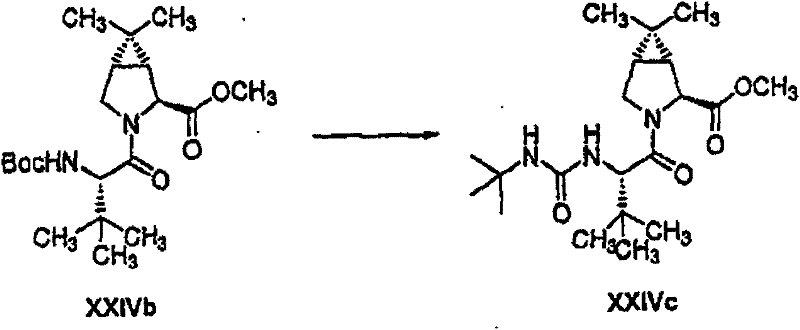
将甲酯XXIVb(4.0g,10.46mmol)溶液溶于HCl(4M二氧六环溶液),在室温下搅拌3小时。将反应混合物真空浓缩获得用于下一步骤的胺盐酸盐。 A solution of methyl ester XXIVb (4.0 g, 10.46 mmol) was dissolved in HCl (4M in dioxane) and stirred at room temperature for 3 hours. The reaction mixture was concentrated in vacuo to obtain the amine hydrochloride used in the next step. the
将上述胺盐酸盐(397mg,1.24mmol)的CH2Cl2(10mL)溶液冷却至-78℃,用异氰酸叔丁酯(250mg,2.5mmol)处理,在室温下搅拌过夜。将反应混合物真空浓缩,残余物用HCl水溶液(1M)稀释,用CH2Cl2萃取。合并的有机层用HCl水溶液(1M)、饱和NaHCO3和盐水洗涤。干燥有机层,过滤并真空浓缩,残余物用色谱法(SiO2,丙酮/环己烷1∶4)提纯获得无色固体XXIVc。 A solution of the above amine hydrochloride (397 mg, 1.24 mmol) in CH 2 Cl 2 (10 mL) was cooled to -78°C, treated with tert-butyl isocyanate (250 mg, 2.5 mmol), and stirred at room temperature overnight. The reaction mixture was concentrated in vacuo, the residue was diluted with aqueous HCl (1M), extracted with CH2Cl2 . The combined organic layers were washed with aqueous HCl (1M), saturated NaHCO 3 and brine. The organic layer was dried, filtered and concentrated in vacuo, and the residue was purified by chromatography ( SiO2 , acetone/cyclohexane 1:4) to obtain XXIVc as a colorless solid.
步骤3.Step 3.

甲酯XXIVc(381mg,1.0mmol)的THF/H2O(1∶1,5mL)溶液用LiOH·H2O(62mg,1.5mmol)处理,在室温下搅拌3小时。将反应混合物用HCl水溶液酸化,真空浓缩获得游离酸。 A solution of methyl ester XXIVc (381 mg, 1.0 mmol) in THF/H 2 O (1:1, 5 mL) was treated with LiOH·H 2 O (62 mg, 1.5 mmol) and stirred at room temperature for 3 hours. The reaction mixture was acidified with aqueous HCl and concentrated in vacuo to obtain the free acid.
酸(254.9mg,0.69mmol)的DMF/CH2Cl2(1∶1,5.0mL)溶液用胺XXIIIj(159mg,0.763mmol)、EDCl(199mg,1.04mmol)、HOOBt(169.5mg,1.04mmol)和NMM(280mg,2.77mmol)在-20℃处理。将反应混合物在-20℃搅拌48小时,真空浓缩。残余物用1M HCl水溶液稀释,用EtOAc萃取,合并的有机层用NaHCO3水溶液、HCl 水溶液、盐水萃取,干燥(MgSO4),过滤,真空浓缩获得黄褐色固体XXIVd(470mg)。 A solution of acid (254.9 mg, 0.69 mmol) in DMF/CH 2 Cl 2 (1:1, 5.0 mL) was mixed with amine XXIIIj (159 mg, 0.763 mmol), EDCl (199 mg, 1.04 mmol), HOOBt (169.5 mg, 1.04 mmol) and NMM (280 mg, 2.77 mmol) at -20°C. The reaction mixture was stirred at -20°C for 48 hours and concentrated in vacuo. The residue was diluted with 1M aq. HCl, extracted with EtOAc, the combined organic layers were extracted with aq. NaHCO 3 , aq. HCl, brine, dried (MgSO 4 ), filtered and concentrated in vacuo to afford XXIVd as a tan solid (470 mg).
步骤4.Step 4.

酰胺XXIVd(470mg,0.9mmol)的甲苯和DMSO(1∶120mL)溶液在0℃用EDCl(1.72g,9.0mmol)和二氯乙酸(0.37mL,4.5mmol)处理,在0℃搅拌4小时。将反应混合物用CH2Cl2稀释,然后用饱和NaHCO3和盐水洗涤。将有机层干燥(MgSO4),过滤,真空浓缩,用色谱法(SiO2,丙酮/己烷3∶7)提纯获得无色固体XXIV。 A solution of amide XXIVd (470 mg, 0.9 mmol) in toluene and DMSO (1:120 mL) was treated with EDCl (1.72 g, 9.0 mmol) and dichloroacetic acid (0.37 mL, 4.5 mmol) at 0°C and stirred at 0°C for 4 hours. The reaction mixture was diluted with CH2Cl2 , then washed with saturated NaHCO3 and brine. The organic layer was dried ( MgSO4 ), filtered, concentrated in vacuo and purified by chromatography ( SiO2 , acetone/hexane 3:7) to give XXIV as a colorless solid.
实施例XXV 制备式XXV化合物: Embodiment XXV prepares formula XXV compound:

步骤1.step 1.

Fmoc-甘氨酸(Bachem,2.0g,6.87mmol)的CH2Cl2(20mL)溶液用2-苯基-2-丙醇(Aldrich,3.36g,24.7mmol)、DCC(1M的CH2Cl2溶液,8.24mL)、DMAP(167mg,1.37mmol)处理,在室温下搅拌24小时。将反应混合物真空浓缩,用Et2O(100mL)稀释。过滤除去固体,滤液用饱和NaHCO3洗涤。 Fmoc-glycine (Bachem, 2.0 g, 6.87 mmol) in CH 2 Cl 2 (20 mL) was mixed with 2-phenyl-2-propanol (Aldrich, 3.36 g, 24.7 mmol), DCC (1M in CH 2 Cl 2 , 8.24 mL), DMAP (167 mg, 1.37 mmol), and stirred at room temperature for 24 hours. The reaction mixture was concentrated in vacuo and diluted with Et2O (100 mL). The solid was removed by filtration, and the filtrate was washed with saturated NaHCO 3 .
将有机层干燥(MgSO4),过滤,真空浓缩,用色谱法(SiO2,乙酸乙酯/环己烷1∶5)提纯获得无色粘性液体酯XXVc(1.1g)。 The organic layer was dried ( MgSO4 ), filtered, concentrated in vacuo and purified by chromatography ( SiO2 , ethyl acetate/cyclohexane 1:5) to give ester XXVc (1.1 g) as a colorless viscous liquid.
步骤2.Step 2.
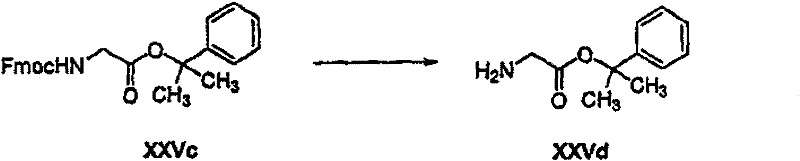
XXVc的CH2Cl2(16.0mL)溶液用哌啶(4.0mL)处理,在室温下搅拌0.5小时。将反应混合物真空浓缩,用色谱法(SiO2,丙酮/己烷1∶10-1∶1)提纯获得无色液体胺XXVd(420mg)。 A solution of XXVc in CH2Cl2 (16.0 mL ) was treated with piperidine (4.0 mL) and stirred at room temperature for 0.5 h. The reaction mixture was concentrated in vacuo and purified by chromatography ( SiO2 , acetone/hexane 1:10-1:1) to obtain the amine XXVd (420 mg) as a colorless liquid.
步骤3.Step 3.

甲酯XXIVc(381mg,1.0mmol)的THF/H2O(1∶1,5mL)溶液用LiOH·H2O(62mg,1.5mmol)处理,在室温下搅拌3小时。将反应混合物用HCl水溶液酸化,真空浓缩获得游离酸。 A solution of methyl ester XXIVc (381 mg, 1.0 mmol) in THF/H 2 O (1:1, 5 mL) was treated with LiOH·H 2 O (62 mg, 1.5 mmol) and stirred at room temperature for 3 hours. The reaction mixture was acidified with aqueous HCl and concentrated in vacuo to obtain the free acid.
酸(2.0g,5.5mmol)的DMF/CH2Cl2(1∶1,40.0ml)溶液在-10℃用胺XXIIIg(1.51g,6.8mmol)、EDCl(1.57g,8.25mmol)、HOOBt(1.41g,8.25mmol)和NMM(2.5g,24.7mmol)处理。反应混合物在0℃搅拌48小时,真空浓缩。残余物用1M HCl水溶液(100mL)稀释,用CH2Cl2萃取(3×100mL)。合并的有机层用NaHCO3水溶液、HCl水溶液、盐水萃取,于燥(MgSO4),过滤,真空浓缩获得黄褐色固体XXVe(3.17g),使用时无需任何提纯。 A solution of acid (2.0 g, 5.5 mmol) in DMF/CH 2 Cl 2 (1:1, 40.0 ml) was treated with amine XXIIIg (1.51 g, 6.8 mmol), EDCl (1.57 g, 8.25 mmol), HOOBt ( 1.41 g, 8.25 mmol) and NMM (2.5 g, 24.7 mmol). The reaction mixture was stirred at 0°C for 48 hours and concentrated in vacuo. The residue was diluted with 1M aqueous HCl (100 mL ), extracted with CH2Cl2 (3 x 100 mL). The combined organic layers were extracted with aq. NaHCO 3 , aq. HCl, brine, dried (MgSO 4 ), filtered, and concentrated in vacuo to give XXVe (3.17 g) as a tan solid which was used without any purification.
步骤4.Step 4.

甲酯XXVe(2.5g,4.66mmol)的THF/H2O/CH3OH(1∶1∶1,60mL)溶液用LiOH·H2O(200mg,4.87mmol)处理,在室温下搅拌4小时。反应混合物用HCl水溶液酸化,真空浓缩获得游离酸。 A solution of methyl ester XXVe (2.5 g, 4.66 mmol) in THF/H 2 O/CH 3 OH (1:1:1, 60 mL) was treated with LiOH·H 2 O (200 mg, 4.87 mmol) and stirred at room temperature for 4 h . The reaction mixture was acidified with aqueous HCl and concentrated in vacuo to obtain the free acid.
酸(200.0mg,0.38mmol)的DMF/CH2Cl2(1∶1,6.0mL)溶液在-10℃用胺XXVd(78mg,0.4mmol)、EDCl(105mg,0.55mmol)、HOOBt(95mg,0.55mmol)和NMM(150mg,1.48mmol)处理。将反应混合物在0℃搅拌48小时,真空浓缩。残余物用1M HCl水溶液(30mL)稀释,用CH2Cl2(3×30mL)萃取。合并的有机层用NaHCO3水溶液(2×30mL)、HCl水溶液、盐水(30mL)萃取,干燥(MgSO4),过滤,真空浓缩获得黄褐色固体XXVf(240mg)。 A solution of acid (200.0mg, 0.38mmol) in DMF/CH 2 Cl 2 (1:1, 6.0mL) was treated with amine XXVd (78mg, 0.4mmol), EDCl (105mg, 0.55mmol), HOOBt (95mg, 0.55mmol) and NMM (150mg, 1.48mmol) treatment. The reaction mixture was stirred at 0 °C for 48 hours and concentrated in vacuo. The residue was diluted with 1M aqueous HCl (30 mL), extracted with CH2Cl2 (3 x 30 mL) . The combined organic layers were extracted with aqueous NaHCO 3 (2×30 mL), aqueous HCl, brine (30 mL), dried (MgSO 4 ), filtered and concentrated in vacuo to afford XXVf as a tan solid (240 mg).
步骤5.Step 5.
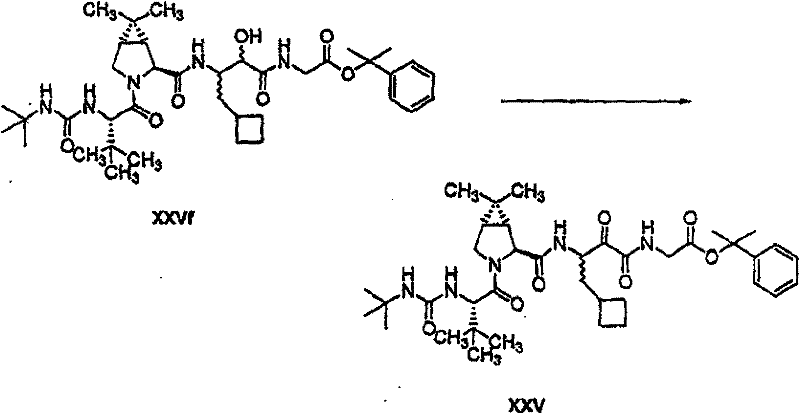
XXVf(240mg,0.28mmol)的CH2Cl2(10mL)溶液用Dess-Martin试剂(Omega,242mg,0.56mmol)处理,在室温下搅拌2小时。在氧化反应完成后(TLC,丙酮/己烷1∶4),将反应混合物用饱和NaHCO3(20mL)和Na2S2O3(10%水溶液,20mL)稀释。将反应混合物搅拌30分钟,用CH2Cl2(3×30mL)萃取。合并的有机层用饱和NaHCO3、盐水 萃取,干燥(MgSO4),过滤,真空浓缩,用色谱法(SiO2,丙酮/己烷1∶5)提纯获得无色固体XXV(122mg)。 A solution of XXVf (240 mg, 0.28 mmol) in CH 2 Cl 2 (10 mL) was treated with Dess-Martin reagent (Omega, 242 mg, 0.56 mmol) and stirred at room temperature for 2 hours. After the oxidation reaction was complete (TLC, acetone/hexane 1:4), the reaction mixture was diluted with saturated NaHCO 3 (20 mL) and Na 2 S 2 O 3 (10% aqueous solution, 20 mL). The reaction mixture was stirred for 30 minutes, extracted with CH2Cl2 (3 x 30 mL). The combined organic layers were extracted with saturated NaHCO3 , brine, dried ( MgSO4 ), filtered, concentrated in vacuo and purified by chromatography ( SiO2 , acetone/hexane 1:5) to give XXV as a colorless solid (122mg).
实施例XXVI 制备式XXVI化合物: Embodiment XXVI prepares formula XXVI compound:

步骤1:step 1:

N-Boc-3,4-脱氢脯氨酸XXVIa(5.0g,23.5mmol)、二碳酸二叔丁酯(7.5g,34.4mmol)和4-N,N-二甲基氨基吡啶(0.40g,3.33mmol)的乙腈(100mL)在室温、搅拌下加入三乙胺(5.0mL,35.6mmol)。所得溶液本发明温度搅拌18小时,然后将其真空浓缩。深褐色残余物用快速色谱法提纯,洗脱时用10-25%乙酸乙酯/己烷获得浅黄色油状产物XXVIb(5.29g,84%)。 N-Boc-3,4-dehydroproline XXVIa (5.0g, 23.5mmol), di-tert-butyl dicarbonate (7.5g, 34.4mmol) and 4-N,N-dimethylaminopyridine (0.40g , 3.33mmol) of acetonitrile (100mL) was added triethylamine (5.0mL, 35.6mmol) at room temperature under stirring. The resulting solution was stirred at the inventive temperature for 18 hours, then it was concentrated in vacuo. The dark brown residue was purified by flash chromatography eluting with 10-25% ethyl acetate/hexanes to give the product XXVIb (5.29 g, 84%) as a light yellow oil. the
步骤2:Step 2:

脱氢脯氨酸XXVIb(10.1g,37.4mmol)、苄基三乙基氯化铵(1.60g,7.02mmol)的氯仿(120mL)溶液在室温搅拌下加入50%氢氧化钠水溶液(120g)。本发明温度剧烈搅拌24小时后,将黑色混合物用CH2Cl2(200mL)和乙醚(600mL)稀释。分离各层后,水溶液用CH2Cl2/Et2O(1∶2,3×600mL)萃取。将有机溶液干燥(MgSO4),浓缩。残余物用快速柱色谱法(5-20%乙酸乙酯/己烷)提纯获得9.34g(71%)乳白色固体XXVIc。 Dehydroproline XXVIb (10.1 g, 37.4 mmol), benzyltriethylammonium chloride (1.60 g, 7.02 mmol) in chloroform (120 mL) was added with 50% aqueous sodium hydroxide solution (120 g) under stirring at room temperature. After vigorous stirring at the inventive temperature for 24 hours, the black mixture was diluted with CH2Cl2 (200 mL) and diethyl ether (600 mL). After the layers were separated, the aqueous solution was extracted with CH2Cl2 / Et2O (1: 2 , 3 x 600 mL). The organic solution was dried ( MgSO4 ) and concentrated. The residue was purified by flash column chromatography (5-20% ethyl acetate/hexanes) to afford 9.34 g (71%) of XXVIc as an off-white solid.
步骤3:Step 3:

将XXVIc(9.34g,26.5mmol)的CH2Cl2(25mL)和CF3CO2H(50mL)溶液在室温下搅拌4.5小时,然后真空浓缩获得褐色残余物,它用于步骤4中无需再提纯。 A solution of XXVIc (9.34 g, 26.5 mmol) in CH2Cl2 (25 mL) and CF3CO2H (50 mL) was stirred at room temperature for 4.5 h , then concentrated in vacuo to give a brown residue which was used in step 4 without further Purify.
步骤4.Step 4.

将商品浓盐酸(4.5mL)加入步骤3残余物的甲醇(70mL)溶液,所得混合物在油浴中加温到65℃。在18小时后,将混合物真空浓缩获得褐色油XXVIe,它用于步骤5无需再提纯。 Commercial concentrated hydrochloric acid (4.5 mL) was added to a solution of the residue from step 3 in methanol (70 mL), and the resulting mixture was warmed to 65°C in an oil bath. After 18 hours, the mixture was concentrated in vacuo to afford XXVIe as a brown oil, which was used in Step 5 without further purification.
步骤5:Step 5:

步骤4的脯氨酸甲酯XXVIe、商品N-Boc-环己基甘氨酸XXVIf(10.2g,40.0mmol)和[O-(7-氮杂苯并三唑-1-基)-1,1,3,3-四甲基脲 
步骤6:Step 6:

甲酯XXVIg(5.87g,13.1mmol)和LiOH(1.65g,39.3mmol)的THF/MeOH/H2O(1∶1∶1,90mL)溶液在室温下搅拌4小时。减压除去甲醇和THF。水溶液用1N HCl水溶液(50mL)酸化至pH~2,用固体氯化钠饱和,然后将其用EtOAc(3×150mL)萃取。将有机溶液合并,干燥(MgSO4),过滤并真空浓缩获得白色固体XXVIh(5.8g,定量)。 A solution of methyl ester XXVIg (5.87 g, 13.1 mmol) and LiOH (1.65 g, 39.3 mmol) in THF/MeOH/ H2O (1:1:1, 90 mL) was stirred at room temperature for 4 hours. Methanol and THF were removed under reduced pressure. The aqueous solution was acidified to pH~2 with 1 N aqueous HCl (50 mL), saturated with solid sodium chloride, and then it was extracted with EtOAc (3 x 150 mL). The organic solutions were combined, dried ( MgSO4 ), filtered and concentrated in vacuo to afford XXVIh as a white solid (5.8 g, quantitative).
步骤7:Step 7:
所需要的产物XXIIIi按照实施例XXIII步骤11的方法制备。 The desired product XXIIIi was prepared according to step 11 of Example XXIII. the
步骤8:Step 8:

所需要的产物XXVI按照实施例XXIII步骤12的方法制备。 The desired product XXVI was prepared according to step 12 of Example XXIII. the
实施例XXVII: 制备式XXVII化合物: Embodiment XXVII: preparation formula XXVII compound:
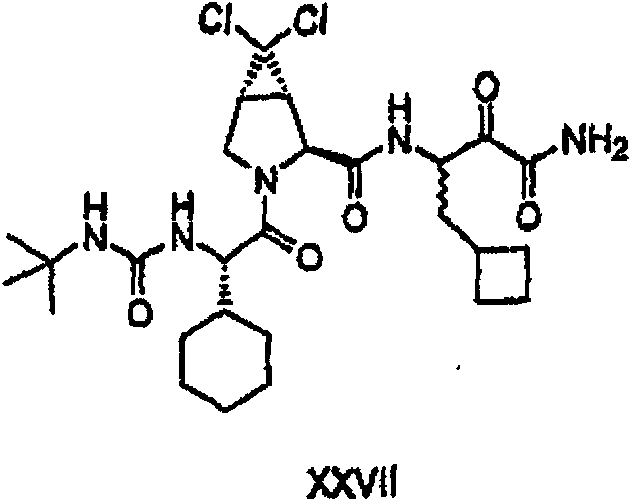
步骤1step 1
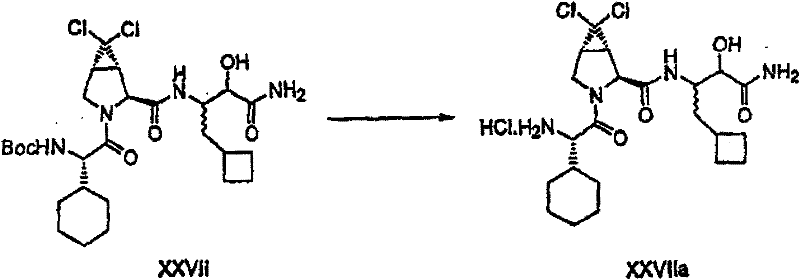
所需要的产物XXVIIa按照实施例XXIII步骤9的方法制备。 The desired product XXVIIa was prepared according to step 9 of Example XXIII. the
步骤2step 2
所需要的产物XXVIIb按照实施例XXIV步骤2的方法制备。 The desired product XXVIIb was prepared according to step 2 of Example XXIV. the
步骤3step 3
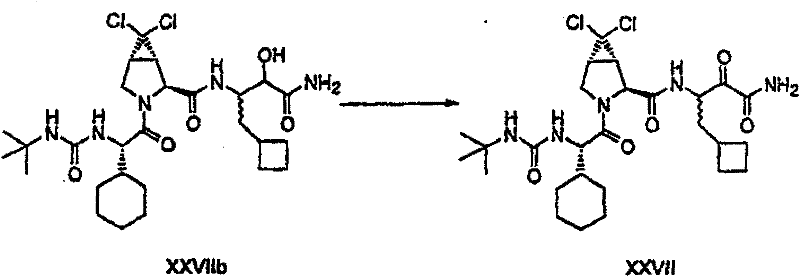
所需要的产物XXVII按照实施例XXIII步骤12的方法制备。 The desired product XXVII was prepared according to step 12 of Example XXIII. the
实施例XXVIII: 制备式XXVIII化合物: Embodiment XXVIII: preparation formula XXVIII compound:
步骤1:step 1:

中间体XXVIIIb按照实施例XXIII步骤3-6的方法制备。 Intermediate XXVIIIb was prepared according to steps 3-6 of Example XXIII. the
步骤2:Step 2:
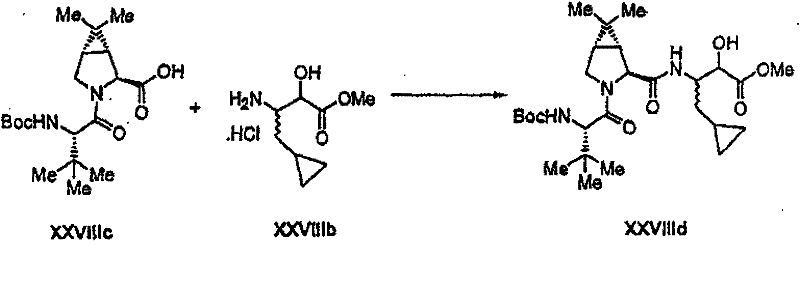
实施例XXIV步骤2的酸(XXVIIIc)(0.7g)与以上步骤1的产物(0.436g)、HATU(0.934g)和DIPEA(1.64mL)按照实施例IX步骤2a的方法反应获得0.66g所需要的产物XXVIIId。 The acid (XXVIIIc) (0.7g) of step 2 of Example XXIV was reacted with the product of step 1 above (0.436g), HATU (0.934g) and DIPEA (1.64mL) according to the method of step 2a of example IX to obtain 0.66g of the required The product of XXVIIId. the
步骤3:Step 3:
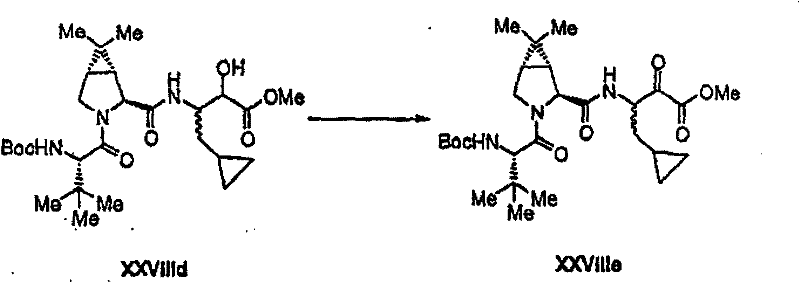
步骤2的产物(0.5g)与Dess-Martin试剂(1g)按照实施例XX步骤7的方法反应。用快速柱色谱法(40%EtOAc,己烷,二氧化硅)提纯获得0.35g产物XXVIIIe。质谱(LCMS)522(M+H+)。 The product of step 2 (0.5 g) was reacted with Dess-Martin reagent (1 g) according to the method of step 7 of Example XX. Purification by flash column chromatography (40% EtOAc, hexanes, silica) afforded 0.35 g of product XXVIIIe. Mass spectrum (LCMS) 522 (M+H + ).
步骤4:Step 4:

步骤4产物(0.3g)中加入1/1 H2O/MEOH溶液(20mL)和NaHCO3固体(242mg,5当量)。在室温下搅拌18小时后,将反应物用EtOAc稀释,将各层分离。水层用1.0N HCl酸化至pH 2,用EtOAc萃取。EtOAc层用盐水洗涤,然后用MgSO4干燥,过滤并真空浓缩获得白色粉末产物XXVIIIf(0.26g)。质谱(LCMS)508(M+H+)。 To the product from step 4 (0.3 g) was added 1/1 H 2 O/MEOH solution (20 mL) and NaHCO 3 solid (242 mg, 5 equiv). After stirring at room temperature for 18 hours, the reaction was diluted with EtOAc and the layers were separated. The aqueous layer was acidified to pH 2 with 1.0N HCl and extracted with EtOAc. The EtOAc layer was washed with brine, then dried over MgSO 4 , filtered and concentrated in vacuo to give the product XXVIIIf (0.26 g) as a white powder. Mass spectrum (LCMS) 508 (M+H + ).
步骤5:Step 5:
将步骤5产物(0.15g)溶于CH2Cl2,使其与HATU(0.137g)、NH4Cl(0.08g,5当量)和DIPEA(0.53mL)反应。在室温下2小时后,反应物用EtOAc稀释,先用10%柠檬酸溶液、再用饱和NaHCO3溶液洗涤。EtOAc层用盐水洗涤,然后用MgSO4干燥,过滤并真空浓缩获 得粗制的混合物。用快速柱色谱法(30%丙酮,己烷,二氧化硅)提纯获得所需要的产物XXVIII(0.096g)。质谱(LCMS)507(M+H+)。 The product from step 5 (0.15 g) was dissolved in CH2Cl2 and reacted with HATU (0.137 g), NH4Cl (0.08 g, 5 equiv) and DIPEA (0.53 mL ). After 2 h at room temperature, the reaction was diluted with EtOAc and washed with 10% citric acid solution followed by saturated NaHCO3 solution. The EtOAc layer was washed with brine, then dried over MgSO4 , filtered and concentrated in vacuo to obtain a crude mixture. Purification by flash column chromatography (30% acetone, hexanes, silica) afforded the desired product XXVIII (0.096 g). Mass spectrum (LCMS) 507 (M+H + ).
实施例XXIX: 制备式XXIX化合物: Embodiment XXIX: preparation formula XXIX compound:
步骤1:step 1:
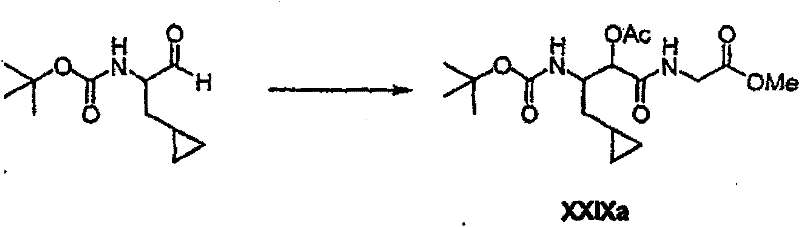
初始醛(4.0g)的CH2Cl2(75mL)溶液(0℃)中加入乙酸(2.0当量,2.15mL),接着加入异氰基乙酸甲酯(1.1当量,1.9mL)。然后将反应物逐渐加温至室温。在18小时(过夜)后,反应物用EtOAc稀释,然后用饱和NaHCO3溶液洗涤。EtOAc层用盐水洗涤,然后用MgSO4干燥,过滤并真空浓缩获得粗制混合物。用快速柱色谱法(30-40%EtOAc,己烷,二氧化硅)提纯获得产物XXIXa(4.5g)。 To a solution of the starting aldehyde (4.0 g) in CH2Cl2 (75 mL ) (0 °C) was added acetic acid (2.0 equiv, 2.15 mL) followed by methyl isocyanoacetate (1.1 equiv, 1.9 mL). The reaction was then gradually warmed to room temperature. After 18 hours (overnight), the reaction was diluted with EtOAc and washed with saturated NaHCO 3 solution. The EtOAc layer was washed with brine, then dried over MgSO4 , filtered and concentrated in vacuo to obtain a crude mixture. Purification by flash column chromatography (30-40% EtOAc, hexanes, silica) afforded the product XXIXa (4.5 g).
步骤2:Step 2:
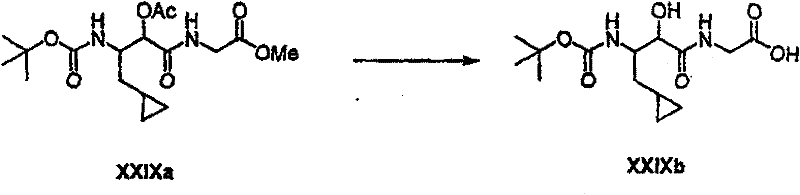
XXIXa(4.4g)的THF(100mL)溶液(0℃)中加入26mL(2.2当量)的1.0N LiOH溶液。将反应物本发明温度搅拌2小时,然后加温至室温。在2小时后,反应混合物用1.0N HCl溶液酸化至pH 2。加入EtOAc,将各层分离。EtOAc层用盐水洗涤,然后用MgSO4干燥,过滤并真空浓缩获得产物XXIXb(3.7g)。 To a solution of XXIXa (4.4 g) in THF (100 mL) (0 °C) was added 26 mL (2.2 equiv) of a 1.0 N LiOH solution. The reaction was stirred at the inventive temperature for 2 hours and then allowed to warm to room temperature. After 2 hours, the reaction mixture was acidified to pH 2 with 1.0 N HCl solution. EtOAc was added and the layers were separated. The EtOAc layer was washed with brine, then dried over MgSO 4 , filtered and concentrated in vacuo to afford the product XXIXb (3.7 g).
步骤3:Step 3:

使酸XXIXb与实施例XV的胺按照实施例XXI步骤4介绍的方法反应。然后将所得中间体用HCl按照实施例XXIII步骤9介绍的方法处理获得产物XXIXc。 Acid XXIXb was reacted with the amine of Example XV as described in Step 4 of Example XXI. The resulting intermediate was then treated with HCl as described in step 9 of Example XXIII to obtain product XXIXc. the
步骤4:Step 4:

将酸XXVIIIc(2.43g)溶于CH2Cl2,使其与胺XXIXc(2.47g)、HATU(2.5g)和DIPEA(5.8mL)按照前面实施例IX步骤2a介绍的方法获得(用快速柱色谱法(4%MeOH,CH2Cl2,二氧化硅)提纯后)所需要的产物XXIXd(4.35g)。质谱(LCMS)727(M+H+)。 Acid XXVIIIc (2.43 g) was dissolved in CH2Cl2 and mixed with amine XXIXc (2.47 g), HATU (2.5 g) and DIPEA (5.8 mL) as previously described in Example IX Step 2a (using a flash column After chromatography (4% MeOH, CH2Cl2 , silica ) the desired product XXIXd (4.35 g). Mass spectrum (LCMS) 727 (M+H + ).
步骤5:Step 5:
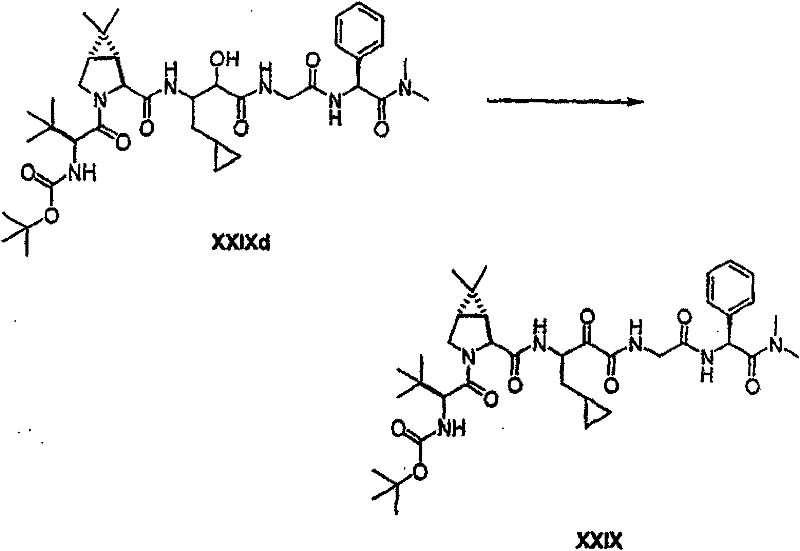
使步骤4产物(4.2g)与Dess-Martin试剂(6.4g)按照制备实施例XX步骤7介绍的方法反应。用快速柱色谱法(100%EtOAc,二氧化硅)提纯获得3g最终产物XXIX。质谱(LCMS)725(M+H+)。 The product of step 4 (4.2 g) was reacted with Dess-Martin reagent (6.4 g) as described in step 7 of Preparative Example XX. Purification by flash column chromatography (100% EtOAc, silica) afforded 3 g of the final product XXIX. Mass spectrum (LCMS) 725 (M+H + ).
实施例XXX: 制备式XXX化合物: Example XXX: Preparation of compounds of formula XXX:
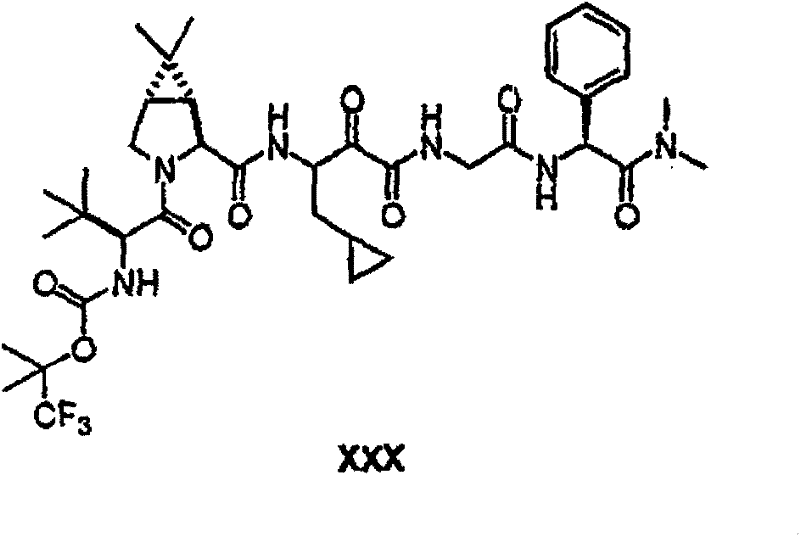
步骤1:step 1:

使2-(三氟甲基)丙-2-醇(1.28g)与N,N-二琥珀酰亚胺基碳酸酯(3.84g)和Et3N(4.2mL)的无水CH3CN(50mL)溶液反应18小时。将混合物用EtOAc(200mL)稀释,过滤。将滤液用NaHCO3、盐水洗涤,然后用MgSO4干燥,过滤并真空浓缩获得粗制的混合物。用快速柱色谱法(50%EtOAc,己烷,二氧化硅)提纯获得所需要的产物XXXa(0.3g)。 2-(Trifluoromethyl)propan-2-ol (1.28 g) was mixed with N,N-disuccinimidyl carbonate (3.84 g) and Et 3 N (4.2 mL) in anhydrous CH 3 CN ( 50 mL) solution was reacted for 18 hours. The mixture was diluted with EtOAc (200 mL), filtered. The filtrate was washed with NaHCO3 , brine, then dried over MgSO4 , filtered and concentrated in vacuo to obtain a crude mixture. Purification by flash column chromatography (50% EtOAc, hexanes, silica) afforded the desired product XXXa (0.3 g).
步骤2:Step 2:
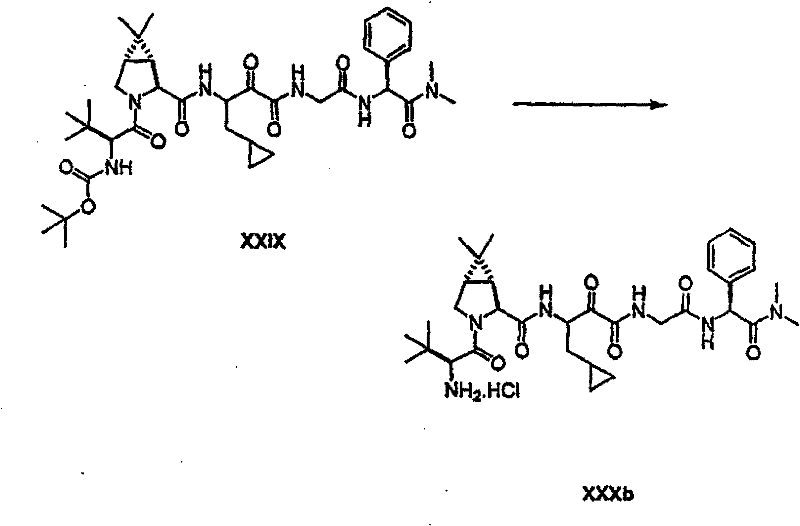
实施例XXIX的产物(0.3g)用100mL 4.0N HCl的二氧六环溶液处理。在1小时后,加入200mL Et2O,将所得沉淀滤出,真空干燥获得白色粉末产物XXXb(0.27g)。质谱(LCMS)625(M-HCl+H+)。 The product of Example XXIX (0.3 g) was treated with 100 mL of 4.0 N HCl in dioxane. After 1 hour, 200 mL of Et2O was added and the resulting precipitate was filtered off and dried in vacuo to give the product XXXb (0.27 g) as a white powder. Mass spectrum (LCMS) 625 (M-HCl+H + ).
步骤3:Step 3:
XXXb(0.05g)的CH2Cl2(5mL)室温溶液中加入DIPEA(0.040mL)、XXXa(1.5当量,0.030g),接着加入1粒DMAP晶体。在30分钟后,将反应物用EtOAc(20mL)稀释,然后依次用1.5N HCl、NaHCO3、盐水洗涤。EtOAc层用MgSO4干燥,过滤并真空浓缩获得粗制的混合物。用制备型色谱法(40%丙酮,己烷,二氧化硅)提纯获得所需要的产物XXX(0.044g)。质谱(LCMS)779(M+H+)。 To a solution of XXXb (0.05 g) in CH 2 Cl 2 (5 mL) at room temperature was added DIPEA (0.040 mL), XXXa (1.5 equiv, 0.030 g), followed by 1 crystal of DMAP. After 30 min, the reaction was diluted with EtOAc (20 mL), then washed sequentially with 1.5N HCl, NaHCO3 , brine. The EtOAc layer was dried over MgSO4 , filtered and concentrated in vacuo to obtain a crude mixture. Purification by preparative chromatography (40% acetone, hexanes, silica) afforded the desired product XXX (0.044 g). Mass spectrum (LCMS) 779 (M+H + ).
实施例XXXI: 制备式XXXI化合物: Example XXXI: Preparation of compounds of formula XXXI:

步骤1:step 1:
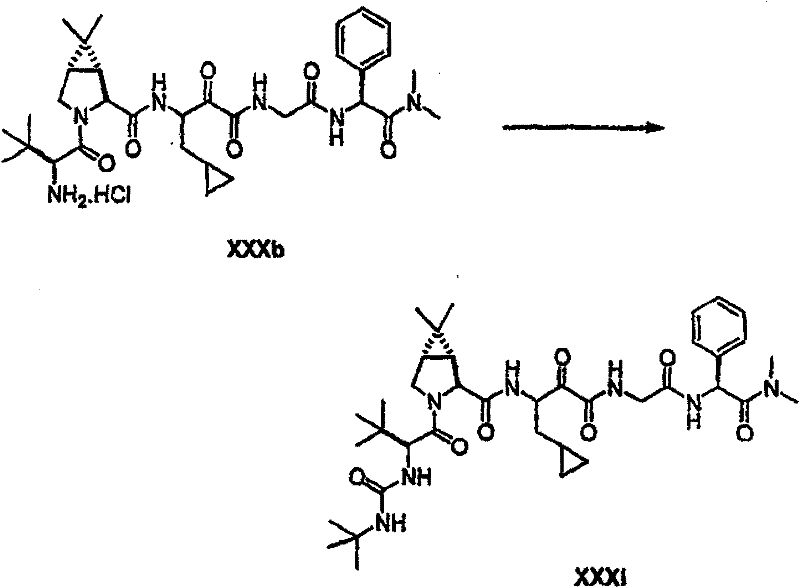
XXXb(0.05g)的CH2Cl2(5mL)溶液在室温下加入DIPEA(0.040mL)和异氰酸叔丁酯(1.2当量,0.01mL)。在18小时后,将反应物用EtOAc(20mL)稀释,然后用1.5N HCl、NaHCO3和盐水洗涤。EtOAc层用MgSO4干燥,过滤并真空浓缩获得粗制的混合物。用制备型色 谱法(100%EtOAc,二氧化硅)提纯获得最终产物XXXI(0.021g)。质谱(LCMS)724(M+H+)。 A solution of XXXb (0.05 g) in CH2Cl2 (5 mL) was added with DIPEA (0.040 mL) and tert-butyl isocyanate (1.2 equiv, 0.01 mL) at room temperature. After 18 hours, the reaction was diluted with EtOAc (20 mL), then washed with 1.5N HCl, NaHCO 3 and brine. The EtOAc layer was dried over MgSO4 , filtered and concentrated in vacuo to obtain a crude mixture. Purification by preparative chromatography (100% EtOAc, silica) afforded the final product XXXI (0.021 g). Mass spectrum (LCMS) 724 (M+H + ).
实施例XXXII: 制备式XXXII化合物: Embodiment XXXII: preparation formula XXXII compound:

步骤1:step 1:
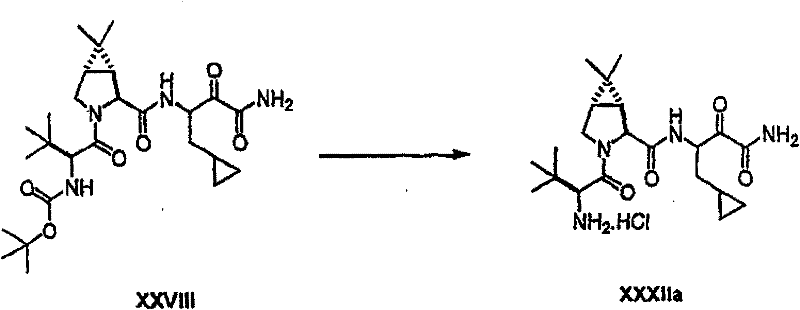
实施例XXVIII的产物按照制备实施例XXX步骤2中介绍的方法处理获得产物XXXIIa。质谱(LCMS)407(M-HCl+H+)。 The product of Example XXVIII was treated as described in Step 2 of Preparative Example XXX to obtain product XXXIIa. Mass spectrum (LCMS) 407 (M-HCl+H + ).
步骤2:Step 2:
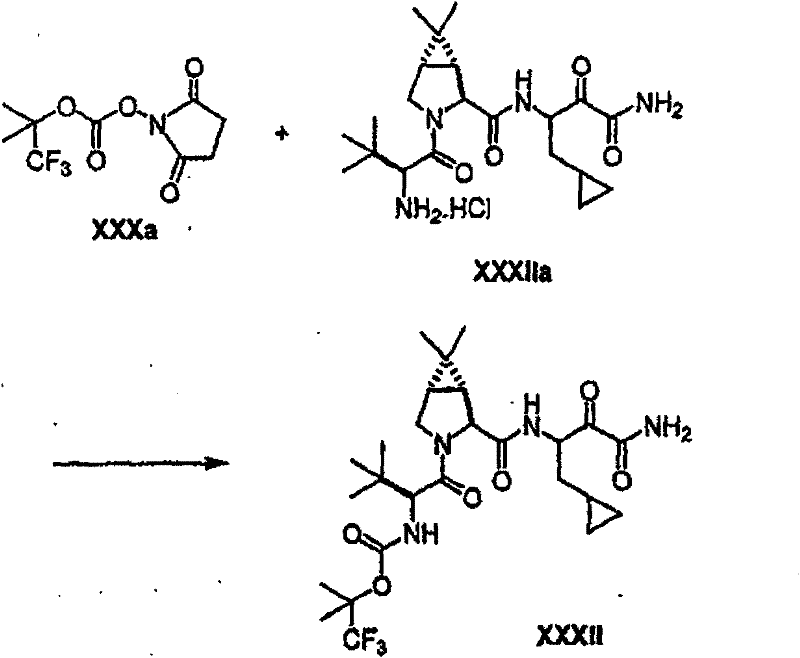
使胺XXXIIa与XXXa按照制备实施例XXX步骤3中介绍的方法反应获得所需要的产物XXXII。质谱(LCMS)508(M+H+)。 Reaction of amine XXXIIa with XXXa as described in Step 3 of Preparative Example XXX affords the desired product XXXII. Mass spectrum (LCMS) 508 (M+H + ).
实施例XXXIII: 制备式XXXIII化合物: Embodiment XXXIII: preparation formula XXXIII compound:

步骤1:step 1:

使胺XXXHa与异氰酸叔丁酯按照实施例XXXI步骤1中介绍的方法反应,获得产物XXXIII。质谱(LCMS)561(M+H+)。 Reaction of amine XXXHa with tert-butyl isocyanate as described in Example XXXI step 1 affords product XXXIII. Mass spectrum (LCMS) 561 (M+H + ).
实施例XXXIV: 制备式XXXIV化合物: Embodiment XXXIV: preparation formula XXXIV compound:

步骤1:step 1:
酯的混合物(6.0g)和分子筛(5.2g)的无水二氯甲烷(35mL)中加入吡咯烷(5.7mL,66.36mmoL)。所得褐色浆状物在N2气氛、室温下搅拌24小时,过滤,然后用无水CH3CN洗涤。将合并的滤液浓缩获得所需要的产物。 To a mixture of esters (6.0 g) and molecular sieves (5.2 g) in anhydrous dichloromethane (35 mL) was added pyrrolidine (5.7 mL, 66.36 mmoL). The resulting brown slurry was stirred under N2 atmosphere at room temperature for 24 hours, filtered, and washed with anhydrous CH3CN . The combined filtrates were concentrated to obtain the desired product.
步骤2:Step 2:
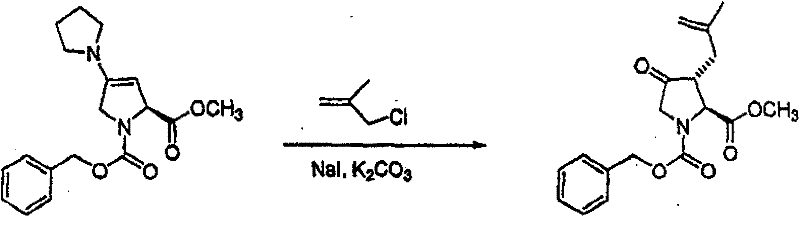
前一步骤产物的CH3CN(35mL)溶液中加入无水K2CO3、甲代烯丙基氯(2.77g,30.5mmol)、NaI(1.07g,6.7mmoL)。将所得浆状物在室温、N2气氛下搅拌24小时。加入50mL冰水,接着加入2NKHSO4溶液直到pH为1。加入EtOAc(100mL),搅拌混合物0.75小时。收集合并的有机层,然后用盐水洗涤,用MgSO4干燥,蒸发获得所需要的产物。 To a solution of the product from the previous step in CH 3 CN (35 mL) was added anhydrous K 2 CO 3 , methallyl chloride (2.77 g, 30.5 mmol), NaI (1.07 g, 6.7 mmol). The resulting slurry was stirred at room temperature under N2 atmosphere for 24 hours. 50 mL of ice water was added, followed by 2NKHSO4 solution until the pH was 1. EtOAc (100 mL) was added and the mixture was stirred for 0.75 h. The combined organic layers were collected, washed with brine, dried over MgSO4 and evaporated to obtain the desired product.
步骤3:Step 3:

将前一步骤产物(2.7g,8.16mmoL)溶于二氧六环(20mL),用新制备的1N LiOH(9mL)处理。反应混合物在室温、N2气氛下搅拌20小时。将反应混合物溶于EtOAc,然后用H2O洗涤。将合并的水层冷却至0℃,用1N HCl酸化至pH 1.65。混浊的混合物用EtOAc(2×100mL)萃取。合并的有机层用盐水洗涤,用MgSO4干燥,浓缩获得所需要的酸(3.40g)。 The product from the previous step (2.7 g, 8.16 mmoL) was dissolved in dioxane (20 mL) and treated with freshly prepared 1 N LiOH (9 mL). The reaction mixture was stirred at room temperature under N2 atmosphere for 20 hours. The reaction mixture was dissolved in EtOAc and washed with H2O . The combined aqueous layers were cooled to 0 °C and acidified to pH 1.65 with 1N HCl. The cloudy mixture was extracted with EtOAc (2 x 100 mL). The combined organic layers were washed with brine, dried over MgSO4 and concentrated to obtain the desired acid (3.40 g).
步骤4:Step 4:
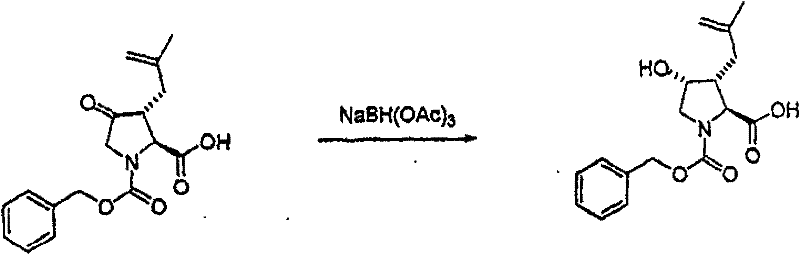
NaBH(OAc)3(3.93g,18.5mmoL)的CH2Cl2(55mL)悬浮液中加入前一步骤产物的无水CH2Cl2(20mL)和乙酸(2mL)溶液。所得浆状物在室温搅拌20小时。将冰水(100mL)加入到上述浆状物中,搅拌半小时。分出有机层,过滤,干燥,蒸发获得所需要的产物。 To a suspension of NaBH(OAc) 3 (3.93 g, 18.5 mmoL) in CH 2 Cl 2 (55 mL) was added a solution of the product from the previous step in anhydrous CH 2 Cl 2 (20 mL) and acetic acid (2 mL). The resulting slurry was stirred at room temperature for 20 hours. Ice water (100 mL) was added to the above slurry and stirred for half an hour. The organic layer was separated, filtered, dried and evaporated to give the desired product.
步骤5:Step 5:
前一步骤产物(1.9g)的MeOH(40mL)溶液用过量的CH2N2/Et2O溶液处理,搅拌过夜。将反应混合物浓缩至干获得粗制的残余物。将残余物在硅胶上用色谱法提纯,洗脱用梯度乙酸乙酯/己烷获得1.07g纯的所需产物。 A solution of the product from the previous step (1.9 g) in MeOH (40 mL) was treated with excess CH2N2 / Et2O solution and stirred overnight. The reaction mixture was concentrated to dryness to obtain a crude residue. The residue was chromatographed on silica gel eluting with a gradient of ethyl acetate/hexane to afford 1.07 g of pure desired product.
步骤6:Step 6:
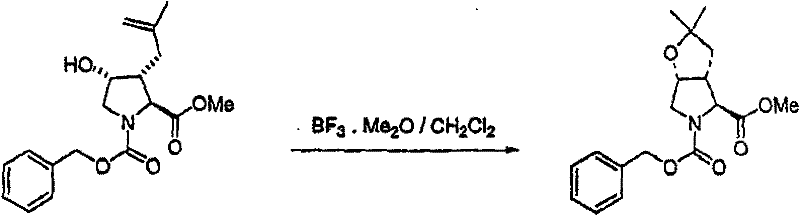
前一步骤的产物(1.36g)的无水CH2Cl2(40mL)溶液用BF3.Me2O(0.7mL)处理。反应混合物在室温下搅拌20小时,用饱和NaHCO3(30mL)猝灭,搅拌1/2小时。分离出有机层,合并的有机层用盐水洗涤,用MgSO4干燥,浓缩获得粗制的残余物。将残余物在硅胶上用色谱法提纯,洗脱用梯度乙酸乙酯/己烷获得0.88g所需要的化合物。 A solution of the product from the previous step (1.36 g) in dry CH2Cl2 (40 mL) was treated with BF3.Me2O (0.7 mL). The reaction mixture was stirred at room temperature for 20 hours, quenched with saturated NaHCO3 (30 mL), and stirred for 1/2 hour. The organic layer was separated, and the combined organic layers were washed with brine, dried over MgSO4 , and concentrated to obtain a crude residue. The residue was chromatographed on silica gel eluting with a gradient of ethyl acetate/hexane to afford 0.88 g of the desired compound.
步骤7:Step 7:
前一步骤产物(0.92g)的MeOH(30mL)溶液在室温下加入10%Pd/C(0.16g),在室温、1atm压力下氢化。将反应混合物搅拌4小时,浓缩至干获得所需要的化合物。 A solution of the product from the previous step (0.92 g) in MeOH (30 mL) was added with 10% Pd/C (0.16 g) at room temperature and hydrogenated at room temperature under a pressure of 1 atm. The reaction mixture was stirred for 4 hours and concentrated to dryness to obtain the desired compound. the
步骤8:Step 8:
所需要的产物按照实施例XXIII步骤10的方法制备。 The desired product was prepared according to step 10 of Example XXIII. the
步骤9:Step 9:

所需要的酸产物按照实施例XXIV步骤3的方法制备。 The desired acid product was prepared according to step 3 of Example XXIV. the
步骤10:Step 10:
所需要的产物XXXIV按照实施例XXIX步骤4-5的方法制备。 The desired product XXXIV was prepared according to steps 4-5 of Example XXIX. the
实施例XXXV:制备式XXXV化合物:Embodiment XXXV: preparation formula XXXV compound:

步骤1:step 1:
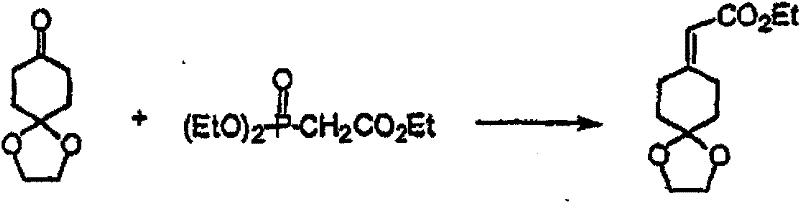
膦酸三乙酯(44.8g)的THF(30mL)溶液在0℃用1M二(三甲硅烷基酰胺)钠的THF溶液(200mL)处理。所得混合物在室温下搅拌0.5小时,然后冷却至0℃。滴加1,4-环己烷二酮乙二醇缩酮(15.6g)的THF(50mL)溶液,所得溶液在室温下搅拌18小时。然后将反应混合物冷却至0℃,用冷柠檬酸水溶液处理,混合物用EtOAc萃取。萃取液用饱和NaHCO3水溶液洗涤,然后用盐水洗涤;然后用无水Na2SO4干燥,过滤,将滤液蒸发。残余物在硅胶上用色谱法提纯,洗脱用梯度CH2Cl2/EtOAc,获得标题化合物(21g),92%收率。质谱(FAB)227.3(M+H+)。 A solution of triethylphosphonate (44.8 g) in THF (30 mL) was treated at 0° C. with 1 M sodium bis(trimethylsilylamide) in THF (200 mL). The resulting mixture was stirred at room temperature for 0.5 h, then cooled to 0 °C. A THF (50 mL) solution of 1,4-cyclohexanedione ethylene glycol ketal (15.6 g) was added dropwise, and the resulting solution was stirred at room temperature for 18 hours. The reaction mixture was then cooled to 0 °C, treated with cold aqueous citric acid, and the mixture was extracted with EtOAc. The extract was washed with saturated aqueous NaHCO 3 , then brine; then dried over anhydrous Na 2 SO 4 , filtered, and the filtrate was evaporated. The residue was purified by chromatography on silica gel, eluting with a gradient CH2Cl2 /EtOAc, to obtain the title compound ( 21 g) in 92% yield. Mass spectrum (FAB) 227.3 (M+H + ).
步骤2:Step 2:

将前一步骤产物(20g)溶于EtOH(150mL),在1atm氢气氛下用10%Pd/C处理3天。过滤混合物,将滤液蒸发获得标题化合物(20.3g),100%收率。质谱(FAB)229.2(M+H+)。 The product from the previous step (20 g) was dissolved in EtOH (150 mL) and treated with 10% Pd/C under 1 atm hydrogen atmosphere for 3 days. The mixture was filtered and the filtrate was evaporated to give the title compound (20.3 g) in 100% yield. Mass spectrum (FAB) 229.2 (M+H + ).
步骤3:Step 3:

将前一步骤产物(20g)溶于MeOH(150mL),用LiOH(3.6g)的水(50mL)溶液处理。将混合物搅拌18小时,真空浓缩。将残余物溶于冷水(100mL),所得溶液用5N HCl酸化至pH 2-3,所得混合物用EtOAc萃取。萃取液用无水Na2SO4干燥,过滤,将滤液蒸发获得标题化合物(17.1g),97%收率。质谱(FAB)201.2(M+H+)。 The product from the previous step (20 g) was dissolved in MeOH (150 mL) and treated with a solution of LiOH (3.6 g) in water (50 mL). The mixture was stirred for 18 hours and concentrated in vacuo. The residue was dissolved in cold water (100 mL), the resulting solution was acidified to pH 2-3 with 5N HCl, and the resulting mixture was extracted with EtOAc. The extract was dried over anhydrous Na2SO4 , filtered and the filtrate was evaporated to obtain the title compound (17.1 g) in 97% yield. Mass spectrum (FAB) 201.2 (M+H + ).
步骤4: Step 4:

1.将前一步骤产物(3.0g)溶于Et2O(150mL),用Et3N(2.1mL)处理,所得溶液冷却至-78℃。滴加新戊酰氯(1.85mL),再搅拌0.25小时后,将反应物在0.75小时内加温至0℃,然后再次冷却至-78℃获得用于第二部分反应的混合酸酐溶液。 1. The product from the previous step (3.0 g) was dissolved in Et2O (150 mL), treated with Et3N (2.1 mL), and the resulting solution was cooled to -78 °C. Pivaloyl chloride (1.85 mL) was added dropwise and after stirring for an additional 0.25 h, the reaction was warmed to 0°C over 0.75 h and then cooled again to -78°C to obtain a mixed anhydride solution for the second part of the reaction.
2.将(S)-4-苄基-2-噁唑烷酮(2.66g)的THF(22mL)溶液冷却至-78℃,滴加1.6M正丁基锂的己烷溶液(9.38mL)。再本发明温度下搅拌0.33小时后,将溶液通过套管转移到第一部分的冷溶液中。将混合物在-78℃搅拌,然后加温至0℃,本发明温度搅拌0.5小时。分出有机层,水层用Et2O萃取,合并的有机层用盐水洗涤,用无水Na2SO4干燥,过滤,将滤液蒸发。残余物在硅胶上用色谱法提纯,洗脱用梯度己烷/乙酸乙酯(9∶1)获得标题化合物(5.0g),93%收率。质谱(FAB)360.4(M+H+)。 2. Cool the solution of (S)-4-benzyl-2-oxazolidinone (2.66g) in THF (22mL) to -78°C, and add dropwise 1.6M hexane solution of n-butyllithium (9.38mL) . After stirring for 0.33 hours at the inventive temperature, the solution was transferred by cannula to the first portion of the cold solution. The mixture was stirred at -78°C, then warmed to 0°C, and stirred at the inventive temperature for 0.5 hours. The organic layer was separated, the aqueous layer was extracted with Et2O , the combined organic layers were washed with brine, dried over anhydrous Na2SO4 , filtered, and the filtrate was evaporated. The residue was purified by chromatography on silica gel eluting with a gradient of hexane/ethyl acetate (9:1) to afford the title compound (5.0 g) in 93% yield. Mass spectrum (FAB) 360.4 (M+H + ).
步骤5:Step 5:

将前一步骤产物(2.7g)溶于THF(25mL),冷却至-78℃,通过套管转移到-78℃的0.5M二(三甲硅烷基)酰胺钾/甲苯(16.5mL)的THF(25mL)溶液,所得溶液在-78℃搅拌0.75小时。此溶液中通过套管加入预冷至-78℃的trisyl叠氮化物(3.01g)的THF(25mL)溶液。在1.5分钟后,反应物用乙酸(1.99mL)猝灭,将反应物加热至室温,然后搅拌16小时。反应物用EtOAc(300mL)稀释,然后用5%NaCl水溶液洗涤。水相用EtOAc萃取,合并的有机相用饱和NaHCO3水溶液洗涤,然后用盐水洗涤;用无水Na2SO4干燥,过滤,将滤液蒸发。 残余物在硅胶上用色谱法提纯,洗脱时用乙酸乙酯/己烷(1∶3)获得标题化合物(2.65g),88%收率。 The product from the previous step (2.7 g) was dissolved in THF (25 mL), cooled to -78 °C, transferred via cannula to -78 °C 0.5 M potassium bis(trimethylsilyl)amide/toluene (16.5 mL) in THF ( 25 mL) solution, and the resulting solution was stirred at -78°C for 0.75 hours. To this solution was added a solution of trisyl azide (3.01 g) in THF (25 mL) precooled to -78°C via cannula. After 1.5 minutes, the reaction was quenched with acetic acid (1.99 mL), and the reaction was allowed to warm to room temperature, then stirred for 16 hours. The reaction was diluted with EtOAc (300 mL), then washed with 5% aqueous NaCl. The aqueous phase was extracted with EtOAc, the combined organic phases were washed with saturated aqueous NaHCO 3 , then brine; dried over anhydrous Na 2 SO 4 , filtered, and the filtrate was evaporated. The residue was purified by chromatography on silica gel eluting with ethyl acetate/hexane (1:3) to afford the title compound (2.65 g) in 88% yield.
步骤6:Step 6:

将前一步骤产物(11.4g)溶于95%甲酸(70mL),在70℃、搅拌下加热0.5小时。真空蒸发溶液,将残余物溶于EtOAc。溶液用饱和NaHCO3水溶液洗涤,然后用盐水洗涤;再用无水Na2SO4干燥,过滤,将滤液蒸发。残余物在硅胶上用色谱法提纯获得标题化合物(8.2g)。 The product from the previous step (11.4 g) was dissolved in 95% formic acid (70 mL) and heated at 70° C. with stirring for 0.5 h. The solution was evaporated in vacuo and the residue was dissolved in EtOAc. The solution was washed with saturated aqueous NaHCO 3 , then brine; dried over anhydrous Na 2 SO 4 , filtered, and the filtrate was evaporated. The residue was purified by chromatography on silica gel to obtain the title compound (8.2g).
步骤7:Step 7:
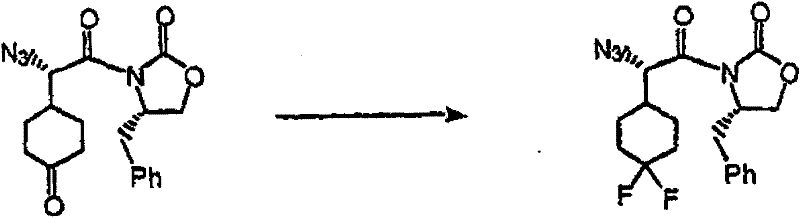
将前一步骤产物(8.2g)溶于CH2Cl2(16mL),用三氟化二乙氨基硫(dietylaminosulfur trifluoride)(DAST,7.00mL)在室温处理3小时。将反应物倾入冰/水(200cc),用CH2Cl2萃取。萃取液用饱和NaHCO3水溶液洗涤,然后用盐水洗涤;再用无水Na2SO4干燥,过滤,将滤液蒸发。残余物在硅胶上用色谱法提纯,洗脱时用乙酸乙酯/己烷(15∶85),获得标题化合物(4.5g),52%收率。 The product from the previous step (8.2 g) was dissolved in CH2Cl2 (16 mL ) and treated with dietylaminosulfur trifluoride (DAST, 7.00 mL) at room temperature for 3 hours. The reaction was poured into ice/water (200cc) and extracted with CH2Cl2 . The extract was washed with saturated aqueous NaHCO 3 , then brine; dried over anhydrous Na 2 SO 4 , filtered, and the filtrate was evaporated. The residue was purified by chromatography on silica gel eluting with ethyl acetate/hexane (15:85) to afford the title compound (4.5 g) in 52% yield.
步骤8:Step 8:

将前一步骤产物(3.7g)溶于混合物THF(150mL)和水(48mL),冷却至0℃,依次用30%H2O2(3.95mL)、LiOH·H2O(0.86g)处理。将混合物在0℃搅拌1小时,然后Na2SO3(5.6g)的水(30mL)溶液猝灭,接着用0.5N NaHCO3(100mL)溶液猝灭。将混合物真空浓缩至1/2体积,用水(至500mL)稀释,用CH2Cl2(4×200mL)萃取。水相用5N HCl酸化至pH 1-2,用EtOAc(4×200mL)萃取。萃取液用盐水洗涤;然后用无水Na2SO4干燥,过滤,将滤液蒸发获得标题化合物(1.95g),91%收率,它直接用于下一步骤。 The product from the previous step (3.7 g) was dissolved in a mixture of THF (150 mL) and water (48 mL), cooled to 0° C. and treated successively with 30% H 2 O 2 (3.95 mL), LiOH·H 2 O (0.86 g) . The mixture was stirred at 0° C. for 1 h, then quenched with a solution of Na 2 SO 3 (5.6 g) in water (30 mL), followed by 0.5 N NaHCO 3 (100 mL). The mixture was concentrated in vacuo to 1/2 volume, diluted with water (to 500 mL), extracted with CH2Cl2 (4 x 200 mL). The aqueous phase was acidified to pH 1-2 with 5N HCl and extracted with EtOAc (4 x 200 mL). The extract was washed with brine; then dried over anhydrous Na2SO4 , filtered, and the filtrate was evaporated to afford the title compound (1.95 g) in 91% yield , which was used directly in the next step.
步骤9:Step 9:

将前一实施例产物(2.6g)溶于Et2O(50mL),滴加CH2N2的Et2O溶液处理直到溶液保持黄色。将溶液搅拌18小时,然后真空蒸发获得标题化合物(2.8),它直接用于下一步骤。 The product from the previous example (2.6 g) was dissolved in Et 2 O (50 mL), and treated dropwise with CH 2 N 2 in Et 2 O until the solution remained yellow. The solution was stirred for 18 hours, then evaporated in vacuo to afford the title compound (2.8), which was used directly in the next step.
步骤10:Step 10:

将前一步骤产物(1.95g)溶于MeOH(150mL),先用甲酸(1.7mL)处理,再在1atm氢气氛下用10%Pd/C(3.3g,Degussa E101型)处理1.5小时。将混合物过滤,蒸发滤液获得为甲酸盐的标题化合物(2.1g),它直接用于下一步骤。 The product from the previous step (1.95 g) was dissolved in MeOH (150 mL) and treated with formic acid (1.7 mL) followed by 10% Pd/C (3.3 g, Degussa type E101 ) for 1.5 hours under 1 atm hydrogen atmosphere. The mixture was filtered and the filtrate was evaporated to give the title compound as the formate salt (2.1 g) which was used directly in the next step. the
步骤11:Step 11:

将前一步骤产物(2.1g)溶于1,4-二氧六环(100mL),加入二碳酸二叔丁酯(1.9g),接着加入二异丙基乙胺(2.9mL)。将溶液搅拌18小时,真空浓缩。残余物用5%KH2PO4水溶液处理,混合物用EtOAc萃取。萃取液用盐水洗涤;然后用无水MgSO4干燥,过滤,将滤液蒸发。残余物在硅胶上用色谱法提纯,洗脱用梯度CH2Cl2/Et2O获得标题化合物(2.5g),99%收率。质谱(FAB)307.9(M+H+)。 The product from the previous step (2.1 g) was dissolved in 1,4-dioxane (100 mL) and di-tert-butyl dicarbonate (1.9 g) was added followed by diisopropylethylamine (2.9 mL). The solution was stirred for 18 hours and concentrated in vacuo. The residue was treated with 5% aqueous KH2PO4 , and the mixture was extracted with EtOAc. The extract was washed with brine; then dried over anhydrous MgSO4 , filtered and the filtrate was evaporated. The residue was purified by chromatography on silica gel eluting with a gradient CH2Cl2 / Et2O to afford the title compound (2.5 g) in 99% yield. Mass spectrum (FAB) 307.9 (M+H + ).
步骤12:Step 12:
将前一步骤产物(2.5g)溶于1,4-二氧六环(35mL),用1M LiOH水溶液(17mL)处理,搅拌2小时。混合物用冰/水(125cc)猝灭,混合物用3N HCl酸化至pH 3-4,用EtOAc萃取。萃取液用无水MgSO4干燥,过滤,将滤液蒸发获得标题化合物(2.3g),96%收率。质谱(FAB)294.0(M+H+)。 The product from the previous step (2.5 g) was dissolved in 1,4-dioxane (35 mL), treated with 1M aqueous LiOH (17 mL) and stirred for 2 hours. The mixture was quenched with ice/water (125cc), the mixture was acidified with 3N HCl to pH 3-4, extracted with EtOAc. The extract was dried over anhydrous MgSO4 , filtered and the filtrate was evaporated to give the title compound (2.3g) in 96% yield. Mass spectrum (FAB) 294.0 (M+H + ).
步骤13:Step 13:
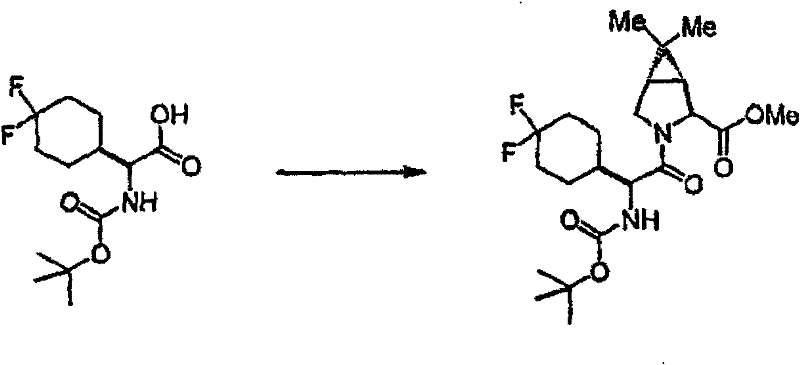
所需要的产物根据实施例XXIII步骤10的方法制备。 The desired product was prepared according to the method of step 10 of Example XXIII. the
步骤14:Step 14:

所需的酸产物按照实施例XXIV步骤3的方法制备。 The desired acid product was prepared according to step 3 of Example XXIV. the
步骤15:Step 15:

所需的酸产物按照实施例XXIX步骤4的方法制备。 The desired acid product was prepared according to step 4 of Example XXIX. the
实施例XXXVI. 制备式XXXVI和XXXVIII的化合物: Example XXXVI. Preparation of Compounds of Formulas XXXVI and XXXVIII:
式XXXVI和XXXVIII的化合物按照以下流程以及利用上述制备实施例11至15制备。 Compounds of formula XXXVI and XXXVIII were prepared according to the following schemes and using Preparative Examples 11 to 15 above. the
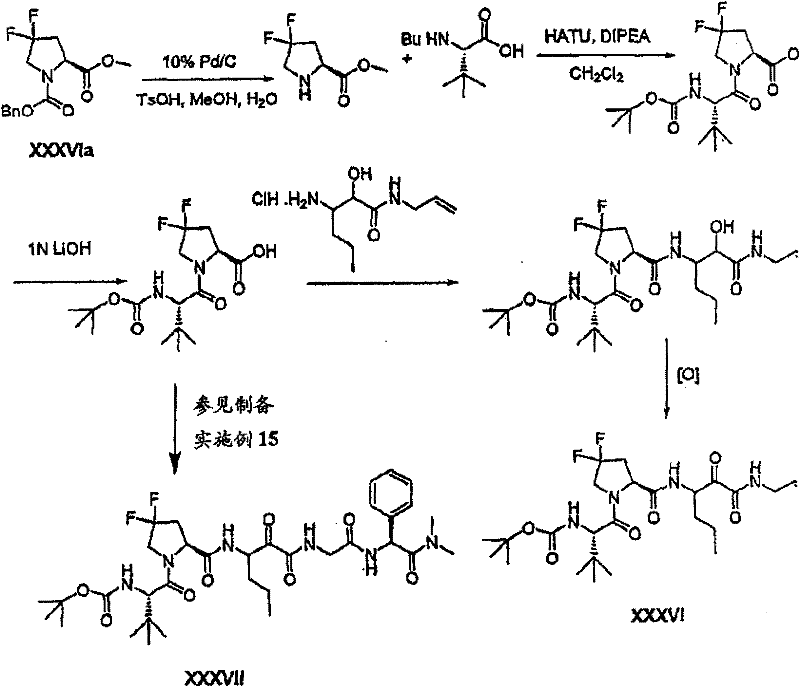
式XXXVIb化合物用式XXXVIa化合物按照以下的已知方法制备: The compound of formula XXXVIb is prepared according to the following known methods from the compound of formula XXXVIa:
化合物XXXVIa(6.58g,22mmol)的100mL MeOH溶液中加入10%Pd/C(0.8g)和对甲苯磺酸(4.2g)。将反应混合物在室温下氢化过 夜。反应混合物通过硅藻土过滤,然后用过量MeOH洗涤。将合并的滤液真空浓缩获得树胶状的标题化合物XXXVIb。按照以上流程的路线并根据制备实施例11-15将XXXVIb转换成XXXVI和XXXVII。 To a solution of compound XXXVIa (6.58 g, 22 mmol) in 100 mL of MeOH was added 10% Pd/C (0.8 g) and p-toluenesulfonic acid (4.2 g). The reaction mixture was hydrogenated overnight at room temperature. The reaction mixture was filtered through celite, then washed with excess MeOH. The combined filtrates were concentrated in vacuo to afford the title compound XXXVIb as a gum. XXXVIb was converted to XXXVI and XXXVII following the route of the above scheme and according to Preparative Examples 11-15. the
实施例XXXVIII.制备式XXXVIII化合物:Example XXXVIII. Preparation of Compound of Formula XXXVIII:
式XXXVIII化合物利用以下的流程并按照上述制备实施例11至15制备。 Compounds of formula XXXVIII were prepared using the following scheme and following Preparation Examples 11 to 15 above. the
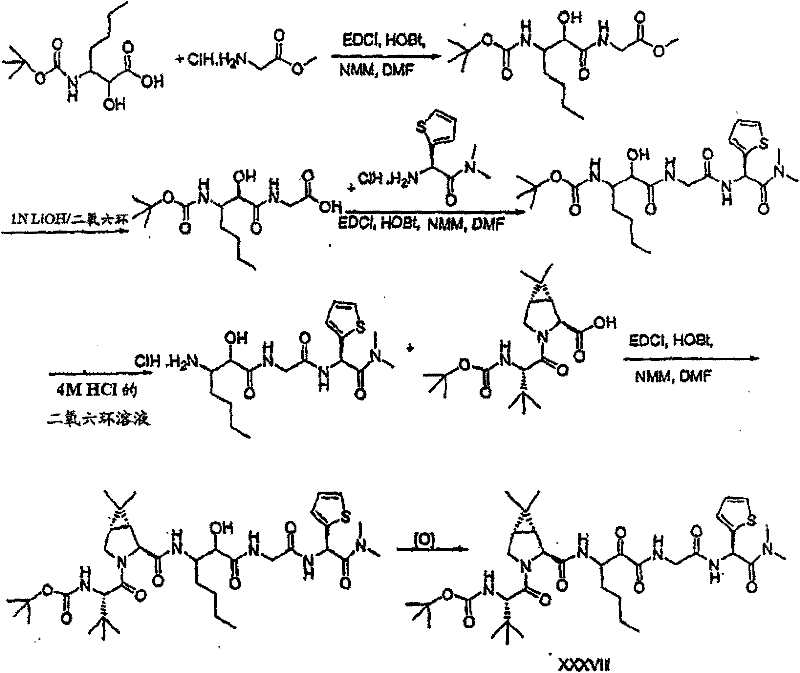
实施例XXXIX.合成式XXXIX化合物Example XXXIX. Synthesis of compounds of formula XXXIX

步骤1:step 1:
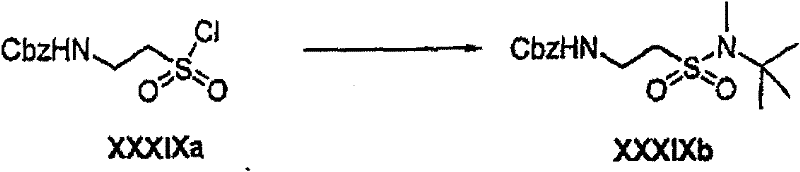
磺酰氯XXXIXa溶液(按照H.Mcklwain(J.Chem.Soc 1941,75)的方法制备)在-78℃滴加入1.1.当量的叔丁基甲胺和三乙胺的混合物,在室温下搅拌2小时。将反应混合物真空浓缩,用色谱法(SiO2,己烷/丙酮4∶1)提纯获得无色油状磺胺XXXIXb。 Sulfonyl chloride XXXIXa solution (prepared according to the method of H. Mcklwain (J. Chem. Soc 1941, 75)) was added dropwise at -78°C with 1.1 equivalents of a mixture of tert-butylmethylamine and triethylamine, and stirred at room temperature for 2 hours. The reaction mixture was concentrated in vacuo and purified by chromatography ( SiO2 , hexane/acetone 4:1) to afford sulfanilamide XXXIXb as a colorless oil.
步骤2:Step 2:

将Cbz-保护的胺XXXIXb溶液溶于甲醇,用5mol%的Pd/C(5%w/w)处理,在60psi氢化。反应混合物通过硅藻土填料过滤,真空浓缩获得游离胺XXXIXc,其放置时固化。 A solution of Cbz-protected amine XXXIXb was dissolved in methanol, treated with 5 mol% Pd/C (5% w/w), and hydrogenated at 60 psi. The reaction mixture was filtered through a pad of celite and concentrated in vacuo to afford the free amine XXXIXc which solidified on standing. the
步骤3:Step 3:

羟基磺胺XXXIXd用合成XXVf的同样方法合成,除了将胺XXVd用XXXIXc替代。粗制的反应混合物直接用于下一反应。 Hydroxysulfonamide XXXIXd was synthesized in the same manner as XXVf, except that amine XXVd was replaced by XXXIXc. The crude reaction mixture was directly used in the next reaction. the
步骤4:Step 4:
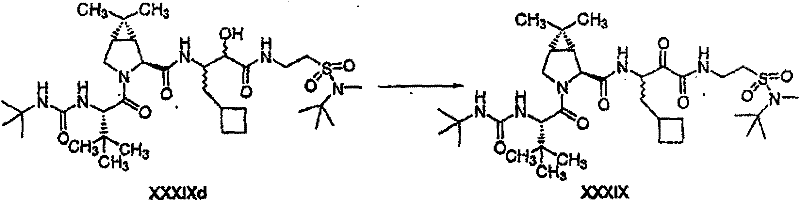
使用Dess Martin试剂,按照合成XXV(步骤5)的方法将羟基酰胺XXXIXd氧化成化合物XXXIX。粗制的混合物用色谱法(SiO2,丙酮/己烷3∶7)提纯获得无色固体XXXIX。 Hydroxyamide XXXIXd was oxidized to compound XXXIX following the procedure for the synthesis of XXV (step 5) using Dess Martin reagent. The crude mixture was purified by chromatography ( SiO2 , acetone/hexane 3:7) to obtain XXXIX as a colorless solid.
检测HCV蛋白酶抑制活性:Detection of HCV protease inhibitory activity:
分光光度分析:按照R.Zhang等(Analytical Biochemistry,270(1999)268-275,其公开内容通过引用结合到本文中)介绍的方法对本发明化合物进行HCV丝氨酸蛋白酶的分光光度分析。基于蛋白分解显色酯底物的分析适合连续监测HCV NS3蛋白酶活性。底物衍生自 其C末端羧基被4个不同发色醇(3-或4-硝基酚、7-羟基-4-甲基-香豆素或4-苯基偶氮酚)之一酯化的NS5A-NS5B连接序列(Ac-DTEDVVX(Nva)(其中X=A或P)的P侧。下面介绍这些新的分光光度性酯底物的合成、表征和在高通量筛选中的应用,并且详细介绍HCV NS蛋白酶抑制剂的动力学评价。 Spectrophotometric analysis: According to the method introduced by R. Zhang et al. (Analytical Biochemistry, 270 (1999) 268-275, the disclosure of which is incorporated herein by reference), the compound of the present invention was subjected to spectrophotometric analysis of HCV serine protease. A proteolytic chromogenic ester substrate-based assay is suitable for continuous monitoring of HCV NS3 protease activity. The substrate is derived from the esterification of its C-terminal carboxyl group with one of four different chromols (3- or 4-nitrophenol, 7-hydroxy-4-methyl-coumarin or 4-phenylazophenol) The P side of the NS5A-NS5B junction sequence (Ac-DTEDVVX(Nva) (where X = A or P). The synthesis, characterization and application of these new spectrophotometric ester substrates in high-throughput screening are described below, And the kinetic evaluation of HCV NS protease inhibitors is introduced in detail.
材料和方法:Materials and methods:
材料:分析用有关缓冲液的化学试剂得自Sigma Chemical Company(St.Louis,Missouri)。肽合成试剂得自Aldrich Chemicals、Novabiochem(San Diego,California)、Applied Biosystems(Foster City,California)和Perseptive Biosystems(Framingham,Massachusetts)。人工合成肽,或者用自动ABI 431A型合成仪(Applied Biosystems)合成肽。LAMBDA 12型UV/VIS分光计得自Perkin Elmer(Norwalk,Connecticut),96孔UV板得自Corning(Corning,New York)。预热均温块(prewarming block)得自USA Scientific(Ocala,Florida),96孔板涡旋器得自Labline Instruments(Melrose Park,Illinois)。SpectramaxPlus微量滴定板读数仪(带有单色计)得自Molecular Devices(Sunnyvale,Califomia)。 Materials: Buffer-related chemicals for the assay were obtained from Sigma Chemical Company (St. Louis, Missouri). Reagents for peptide synthesis were obtained from Aldrich Chemicals, Novabiochem (San Diego, California), Applied Biosystems (Foster City, California), and Perseptive Biosystems (Framingham, Massachusetts). Peptides were synthesized artificially or were synthesized using an automated ABI model 431A synthesizer (Applied Biosystems). UV/VIS spectrometer model LAMBDA 12 was obtained from Perkin Elmer (Norwalk, Connecticut) and 96-well UV plates were obtained from Corning (Corning, New York). Prewarming blocks were obtained from USA Scientific (Ocala, Florida), and 96-well plate vortexers were obtained from Labline Instruments (Melrose Park, Illinois). A SpectramaxPlus microtiter plate reader (with monochromator) was obtained from Molecular Devices (Sunnyvale, California).
酶制备:使用以前公开的方法(D。L。Sali等,Biochemistry,37(1998)3392-3401)制备重组HCV NS3/NS4A异源二聚体蛋白酶(菌株1a)。蛋白浓度使用预先通过氨基酸分析定量的重组HCV蛋白酶标准品通过Biorad染料方法测定。开始分析前,采用Biorad Bio-Spin P-6预填柱使酶贮藏缓冲液(50mM磷酸钠pH 8.0,300mM氯化钠,10%甘油,0.05%月桂基麦芽糖苷和10mM DTT)交换为检测缓冲液(25mMMOPS pH 6.5,300mM氯化钠,10%甘油,0.05%月桂基麦芽糖苷,5μM EDTA和5μM DTT)。 Enzyme preparation: Recombinant HCV NS3/NS4A heterodimeric protease (strain 1a) was prepared using a previously published method (D. L. Sali et al., Biochemistry, 37 (1998) 3392-3401). Protein concentrations were determined by the Biorad dye method using recombinant HCV protease standards previously quantified by amino acid analysis. Before starting the analysis, the enzyme storage buffer (50 mM sodium phosphate pH 8.0, 300 mM sodium chloride, 10% glycerol, 0.05% lauryl maltoside and 10 mM DTT) was exchanged for the detection buffer using a Biorad Bio-Spin P-6 prepacked column solution (25 mM MOPS pH 6.5, 300 mM NaCl, 10% glycerol, 0.05% lauryl maltoside, 5 μM EDTA and 5 μM DTT).
底物合成与纯化:根据R.Zhang等(同上)报道合成底物,合成开始时用标准方法(K.Barlos等,Int.J.Pept.Protein Res.,37(1991), 513-520)使Fmoc-Nva-OH固定在2-氯三苯甲基氯树脂上。随后利用Fmoc化学装配肽,或者人工进行或者采用自动ABI 431型肽合成仪。N-乙酰化且完全保护的肽片断经过10%乙酸(HOAC)和10%三氟乙醇(TFE)的二氯甲烷(DCM)溶液处理30分钟,或者经过2%三氟乙酸(TFA)的DCM溶液处理10分钟后与树脂断开。共沸蒸发合并的滤液和DCM洗涤液(或者重复用碳酸钠水溶液萃取),以去裂解时使用的酸。DCM相用硫酸钠干燥后蒸发。 Substrate synthesis and purification: Synthesize the substrate according to the report of R. Zhang et al. (supra), and use the standard method at the beginning of the synthesis (K. Barlos et al., Int. J. Pept. Protein Res., 37 (1991), 513-520) Fmoc-Nva-OH was immobilized on 2-chlorotrityl chloride resin. The peptides were then assembled using Fmoc chemistry, either manually or using an automated ABI model 431 peptide synthesizer. N-acetylated and fully protected peptide fragments were treated with 10% acetic acid (HOAC) and 10% trifluoroethanol (TFE) in dichloromethane (DCM) for 30 min, or with 2% trifluoroacetic acid (TFA) in DCM The solution disconnected from the resin after 10 minutes of treatment. The combined filtrate and DCM washes were azeotropically evaporated (or repeated extraction with aqueous sodium carbonate) to remove the acid used in the cleavage. The DCM phase was dried over sodium sulfate and evaporated.
所述酯底物用标准酸-醇偶合方法(K.Holmber等,Acta Chem.Scand.,B33(1979)410-412)装配。肽片段溶解于无水吡啶(30-60mg/ml),其中加入10摩尔当量发色团和催化量(0.1eq.)对甲苯磺酸(pTSA)。加入二环己基碳二亚胺(DCC,3eq.)启动偶合反应。用HPLC监测产物形成,在室温下反应12-72小时后证实反应完毕。吡啶溶剂通过真空蒸发除去,进一步与甲苯共沸除去。肽酯用95%TFA的DCM溶液去保护2小时,用无水乙醚萃取3次以去除过量发色团。去保护底物在C3或C8柱上通过反相HPLC纯化,用30%-60%乙腈梯度洗脱(用6个柱体积)。HPLC纯化后的总收率约20-30%。电喷雾离子化质谱证实分子量。底物以干粉干燥保藏。 The ester substrates are assembled using standard acid-alcohol coupling methods (K. Holmber et al., Acta Chem. Scand., B33 (1979) 410-412). The peptide fragments were dissolved in anhydrous pyridine (30-60 mg/ml) to which 10 molar equivalents of the chromophore and a catalytic amount (0.1 eq.) of p-toluenesulfonic acid (pTSA) were added. The coupling reaction was started by adding dicyclohexylcarbodiimide (DCC, 3 eq.). Product formation was monitored by HPLC and completion was confirmed after 12-72 hours at room temperature. The pyridine solvent was removed by evaporation in vacuo and further azeotroped with toluene. The peptide ester was deprotected with 95% TFA in DCM for 2 hours, and extracted 3 times with anhydrous ether to remove excess chromophore. The deprotected substrate was purified by reverse phase HPLC on a C3 or C8 column, eluting with a 30%-60% acetonitrile gradient (using 6 column volumes). The overall yield after HPLC purification was about 20-30%. Electrospray ionization mass spectrometry confirmed the molecular weight. The substrate is stored dry as a dry powder. the
底物及产物光谱:用pH 6.5检测缓冲液获得底物和相应的发色团产物的光谱。利用多个稀释度以1-cm比色杯于优化非高峰波长(3Np和HMC为340nm,PAP为370nm,4-Np为400nm)检测消光系数。优化非高峰波长的定义为:底物和产物之间产生最大吸光度差异((产物OD-底物OD)/底物OD)的波长。 Substrate and product spectra: The spectra of the substrates and corresponding chromophore products were obtained using a pH 6.5 detection buffer. Extinction coefficients were measured in 1-cm cuvettes at optimized off-peak wavelengths (340 nm for 3Np and HMC, 370 nm for PAP, and 400 nm for 4-Np) using multiple dilutions. The optimal off-peak wavelength is defined as the wavelength that produces the largest absorbance difference ((product OD-substrate OD)/substrate OD) between substrate and product.
蛋白酶分析:在96孔微量滴定板中用200μl反应混合物于30℃进行HCV蛋白酶分析。对NS3/NS4A异源二聚体优化检测缓冲条件(25mM MOPS pH 6.5,300mM NaCl,10%甘油,0.05%月桂基麦芽糖苷,5μM EDTA和5μM DTT)(D.L.Sali等,同上)。通常,将150μl的缓冲剂、底物和抑制剂的混合物加入各孔中(DMSO终浓度为4%v/v),使其于30℃预温育约3分钟。然后用50μl在检测缓冲液中的 蛋白酶预热溶液(12nM,30CC)启动反应(终体积为200μl)。用配备有单色器的Spectromax Plus微量滴定板读数仪(采用截止滤光片型板读数仪可获得可接受的结果),在合适波长(3Np和HMC为340nm,PAP为370nm,4-Np为400nm)在检测时间(60分钟)范围内监测各板的吸光度变化。相对于用作非酶水解对照的无酶空白,在合适波长监测Nva和发色团之间的酯键的蛋白裂解。在30倍底物浓度范围内(约6-200μM)评价底物动力学参数。用线性回归确定初速度,采用非线性回归分析(Mac Curve Fit 1.1,K.Raner)用实验数据拟合Michaelis-Menten方程,获得动力学常数。计算酶变率(kcat),假定酶全部具有活性。 Protease assay: HCV protease assay was performed in 96-well microtiter plates with 200 μl of reaction mixture at 30°C. Detection buffer conditions (25 mM MOPS pH 6.5, 300 mM NaCl, 10% glycerol, 0.05% lauryl maltoside, 5 μM EDTA and 5 μM DTT) were optimized for NS3/NS4A heterodimers (DLSali et al., supra). Typically, 150 [mu]l of buffer, substrate and inhibitor mixtures are added to each well (4% v/v final DMSO concentration) and allowed to pre-incubate at 30[deg.] C. for about 3 minutes. Reactions were then initiated with 50 µl of a prewarmed solution of protease (12 nM, 30 CC) in assay buffer (final volume 200 µl). Using a Spectromax Plus microtiter plate reader equipped with a monochromator (acceptable results can be obtained with a cut-off filter type plate reader), at the appropriate wavelength (340 nm for 3Np and HMC, 370 nm for PAP, and 370 nm for 4-Np) 400 nm) to monitor the absorbance change of each plate within the detection time (60 minutes). Proteolytic cleavage of the ester bond between Nva and the chromophore was monitored at the appropriate wavelength relative to a no-enzyme blank used as a non-enzymatic hydrolysis control. Substrate kinetic parameters were evaluated over a 30-fold substrate concentration range (approximately 6-200 [mu]M). The initial velocity was determined by linear regression, and the kinetic constants were obtained by fitting the Michaelis-Menten equation with experimental data using nonlinear regression analysis (Mac Curve Fit 1.1, K. Raner). Enzyme variability (k cat ) is calculated assuming that the enzyme is fully active.
抑制剂和灭活剂的评价:对竟争性抑制剂Ac-D-(D-Gla)-L-I-(Cha)-C-OH(27)、Ac-DTEDVVA(Nva)-OH和Ac-DTEDVVP(Nva)-OH,实验测定固定浓度酶和底物的抑制常数,根据用于竟争性抑制动力学的重排Michaelis-Menten方程:vo/vi=1+[1]o/(Ki *(1+[S]o/Km)),其中vo为非抑制初速度,vi为存在任何已知抑制剂浓度([1]o)抑制剂的初速度,[S]o为所使用的底物浓度;用vo/vi对抑制剂浓度([I]o)作图。用线性回归拟合获得的数据,用获得的斜率1/(Ki *(1+[S]o/Km)计算Ki *值。 Evaluation of Inhibitors and Inactivators: Competitive Inhibitors Ac-D-(D-Gla)-LI-(Cha)-C-OH(27), Ac-DTEDVVA(Nva)-OH and Ac-DTEDVVP (Nva)-OH, experimentally determined inhibition constants at fixed concentrations of enzyme and substrate, according to the rearranged Michaelis-Menten equation for competitive inhibition kinetics: v o /v i = 1+[1] o /(K i * (1+[S] o /K m )), where v o is the uninhibited initial velocity, v i is the initial velocity of the inhibitor in the presence of any known inhibitor concentration ([1] o ), [S] o is the substrate concentration used; v o /v i is plotted against the inhibitor concentration ([I] o ). The obtained data were fitted with a linear regression and the obtained slope 1/(K i * (1+[S] o /K m ) was used to calculate the K i * value.
在以上各表中给出了获得的本发明不同化合物的Ki *值,其中的化合物按照Ki *范围顺序排列。根据上述试验结果,熟练技术人员显而易见的是,本发明化合物具有良好的NS3-丝氨酸蛋白酶抑制剂作用。 The K i * values obtained for the different compounds of the invention are given in the above tables, where the compounds are arranged in order of the K i * range. From the above test results, it is obvious to the skilled person that the compounds of the present invention have good NS3-serine protease inhibitory activity.
尽管结合上述具体实施方案阐明了本发明,但是本发明的许多替代、改进及其它变化方案对本领域普通技术人员是显而易见的。所有这样的替代、改进及变化方案均属于本发明实质及范畴。 While the invention has been illustrated in conjunction with the specific embodiments described above, it is apparent that many alternatives, improvements and other variations of the invention will be apparent to those skilled in the art. All such alternatives, improvements and variations belong to the spirit and scope of the present invention. the
表2 Table 2

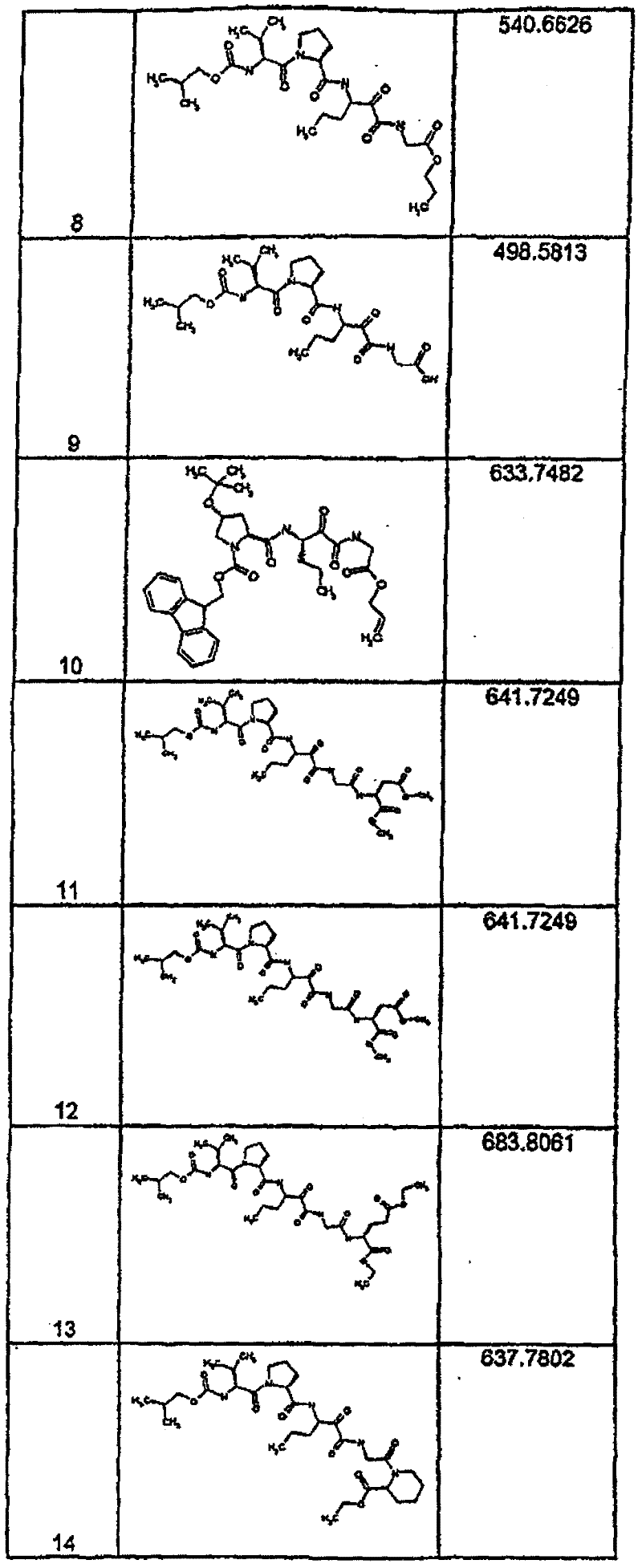

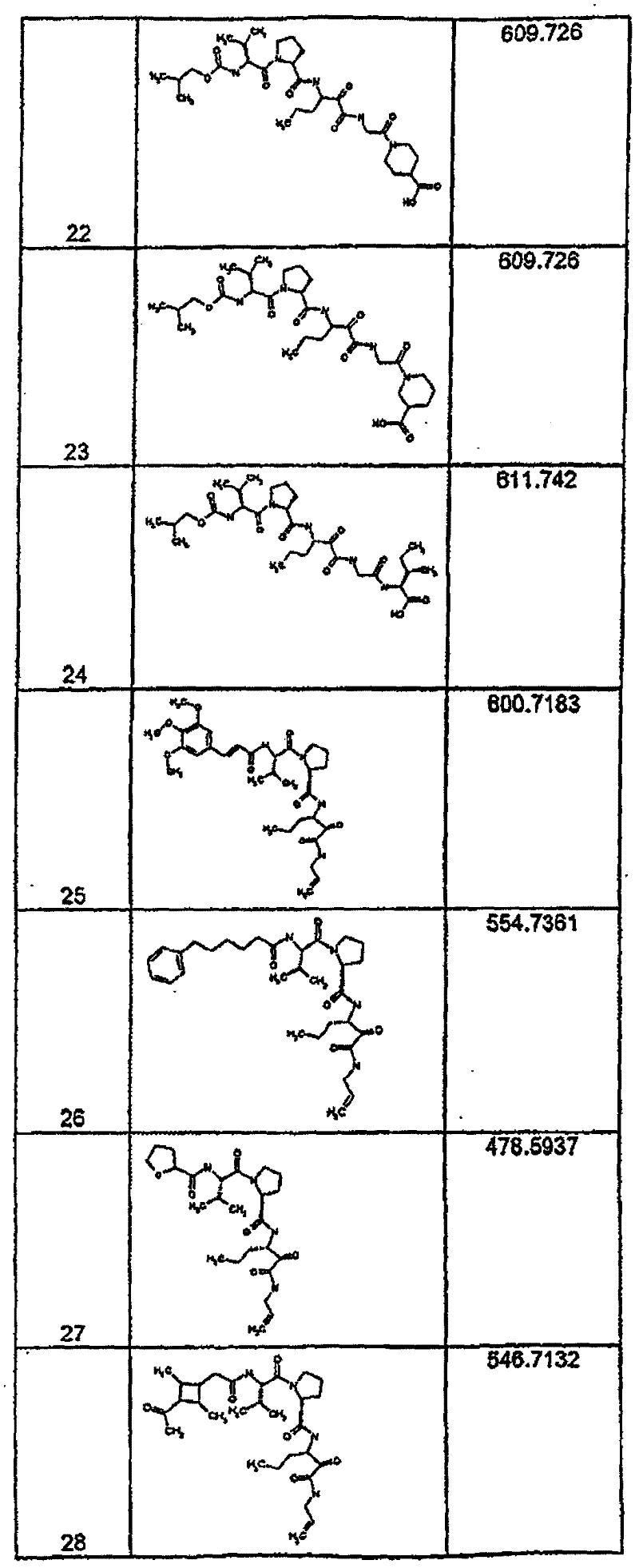
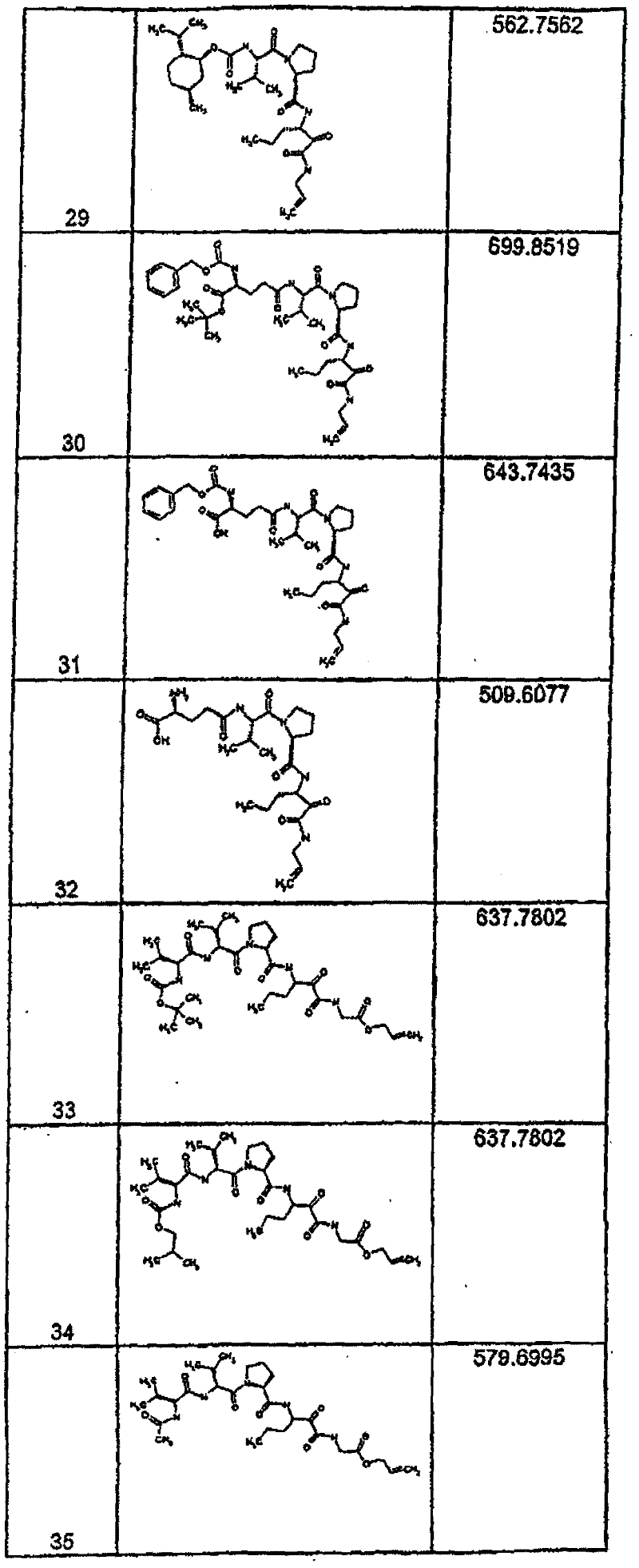

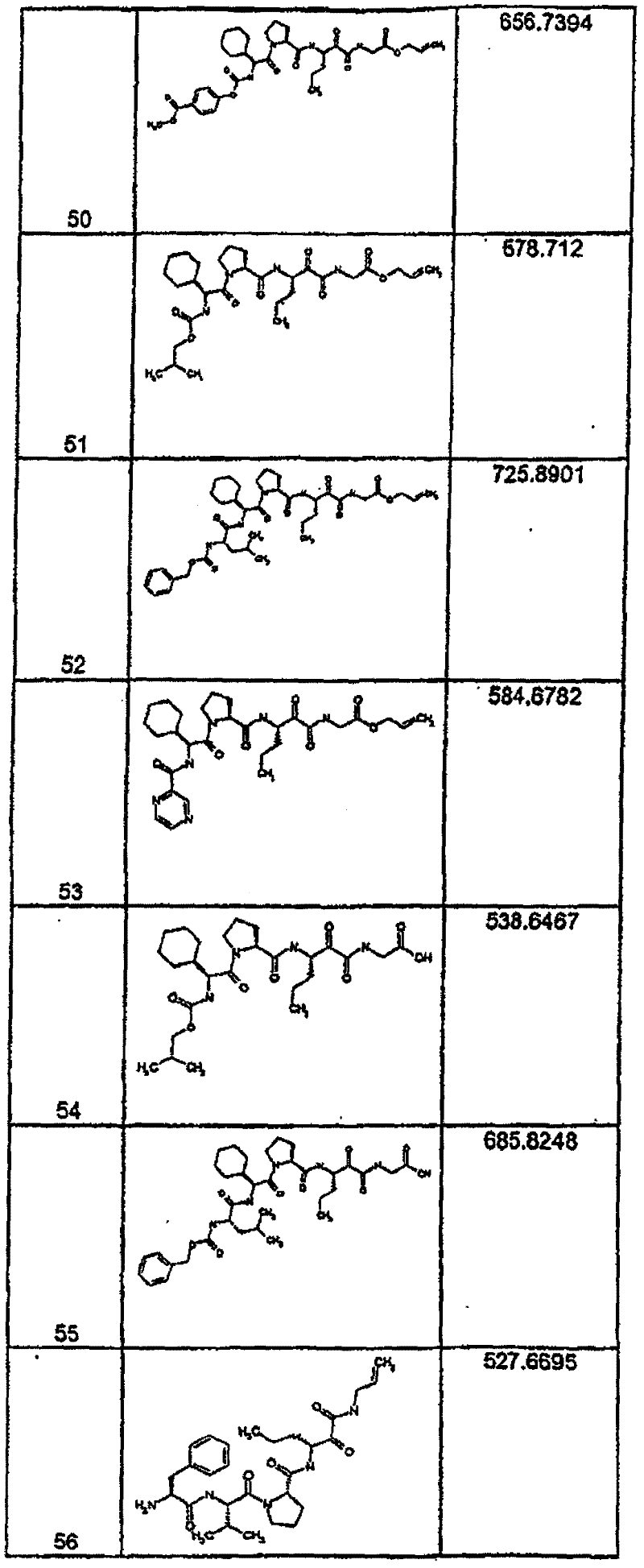
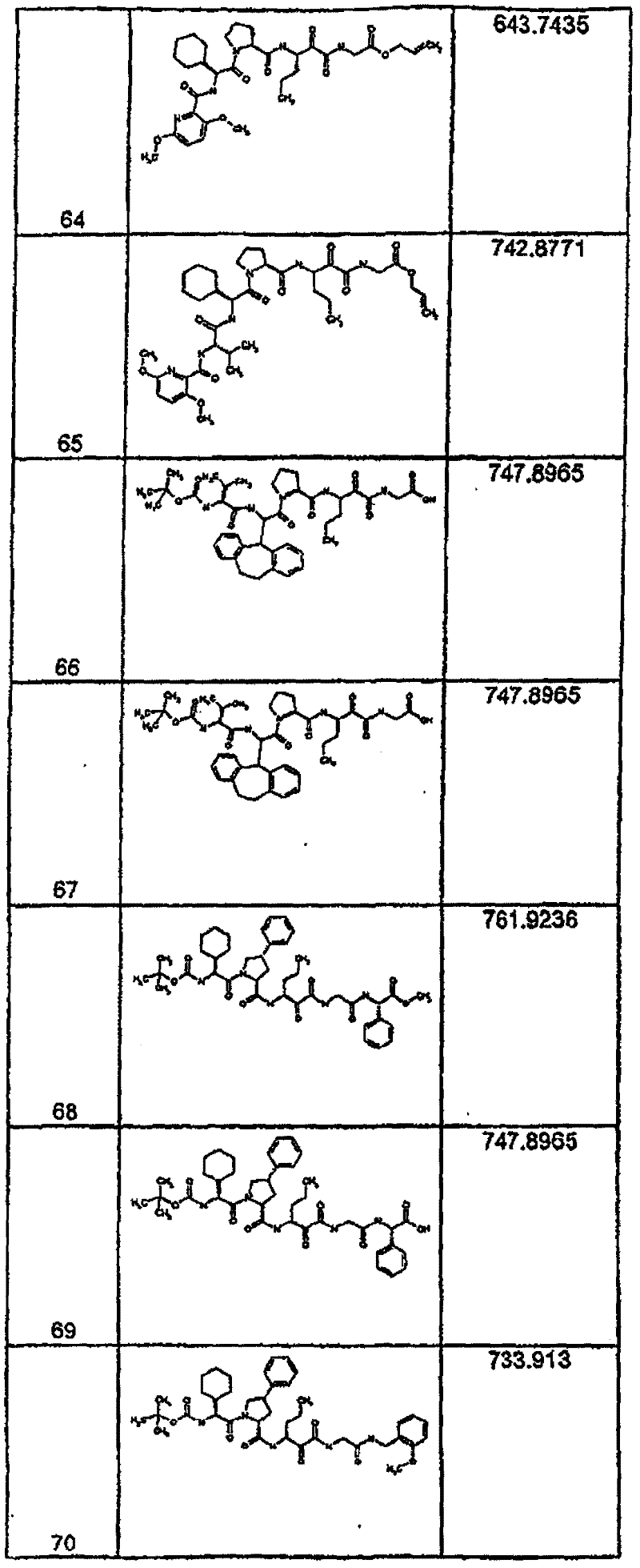
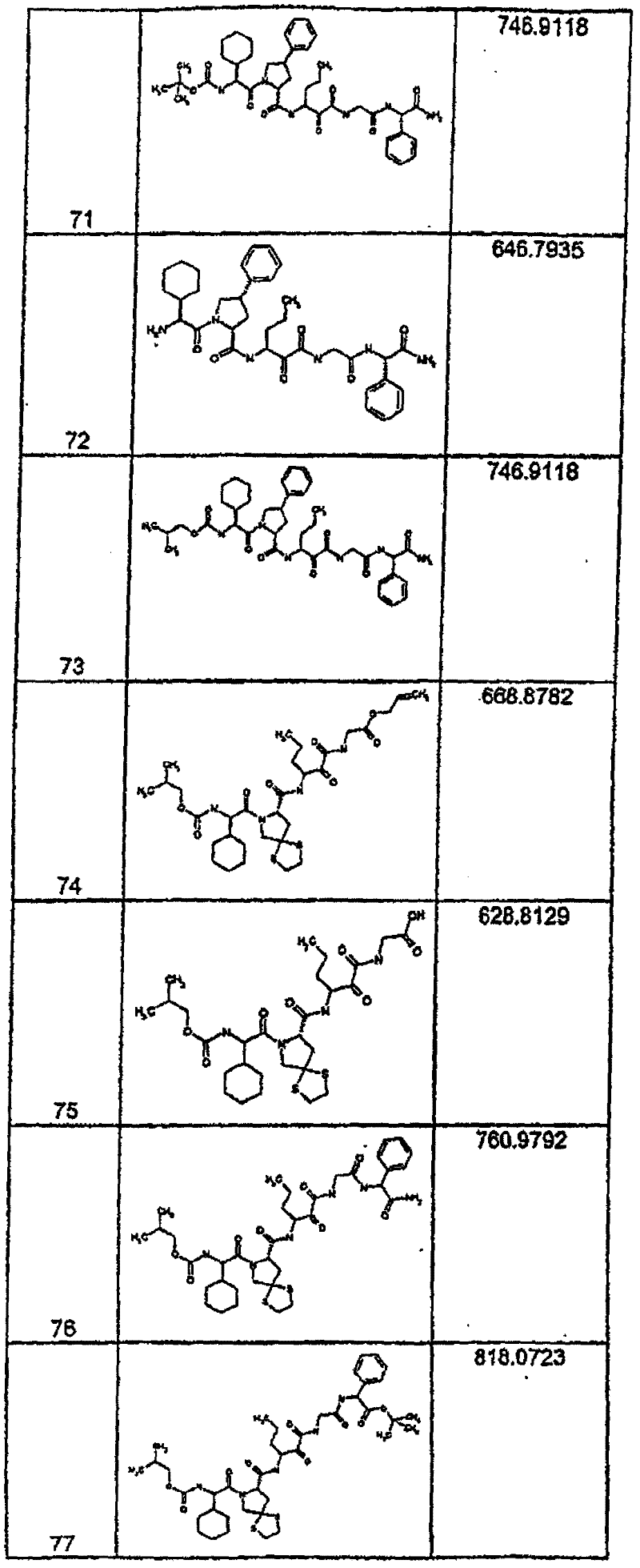
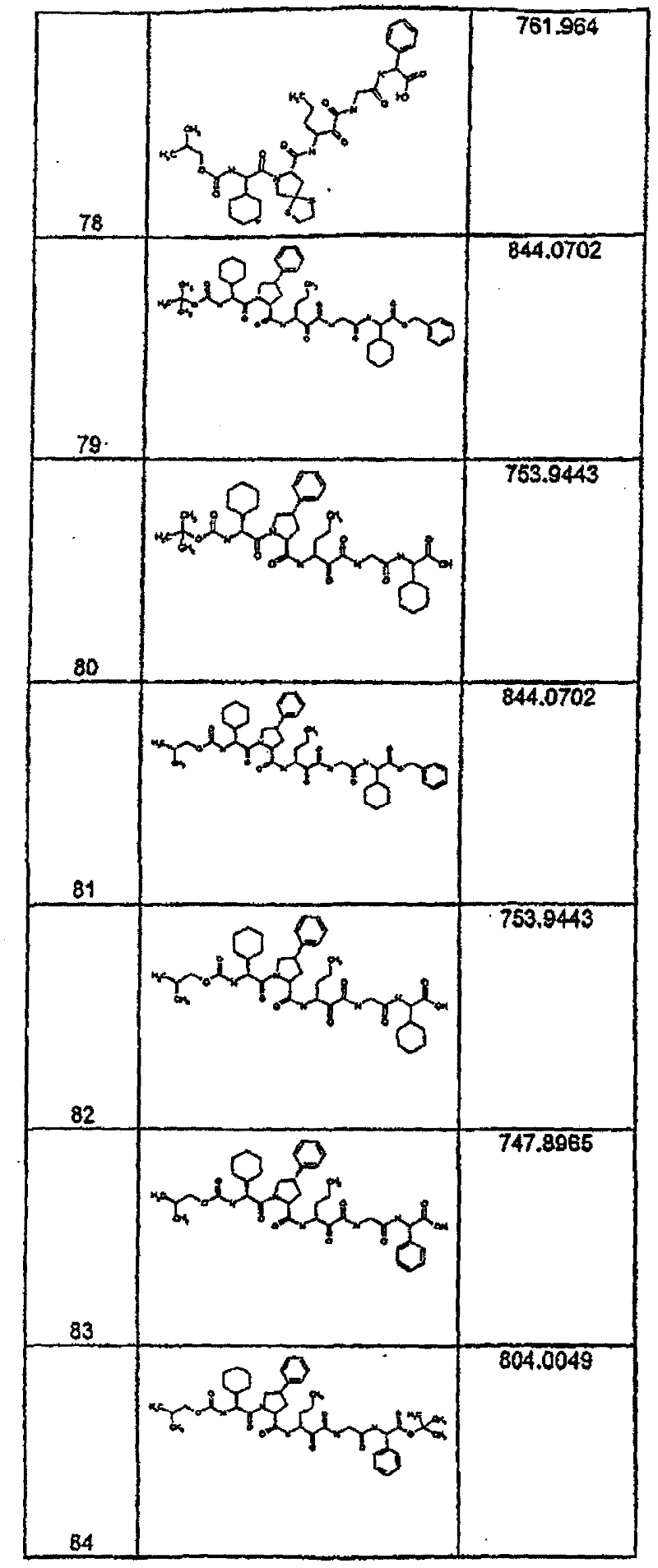
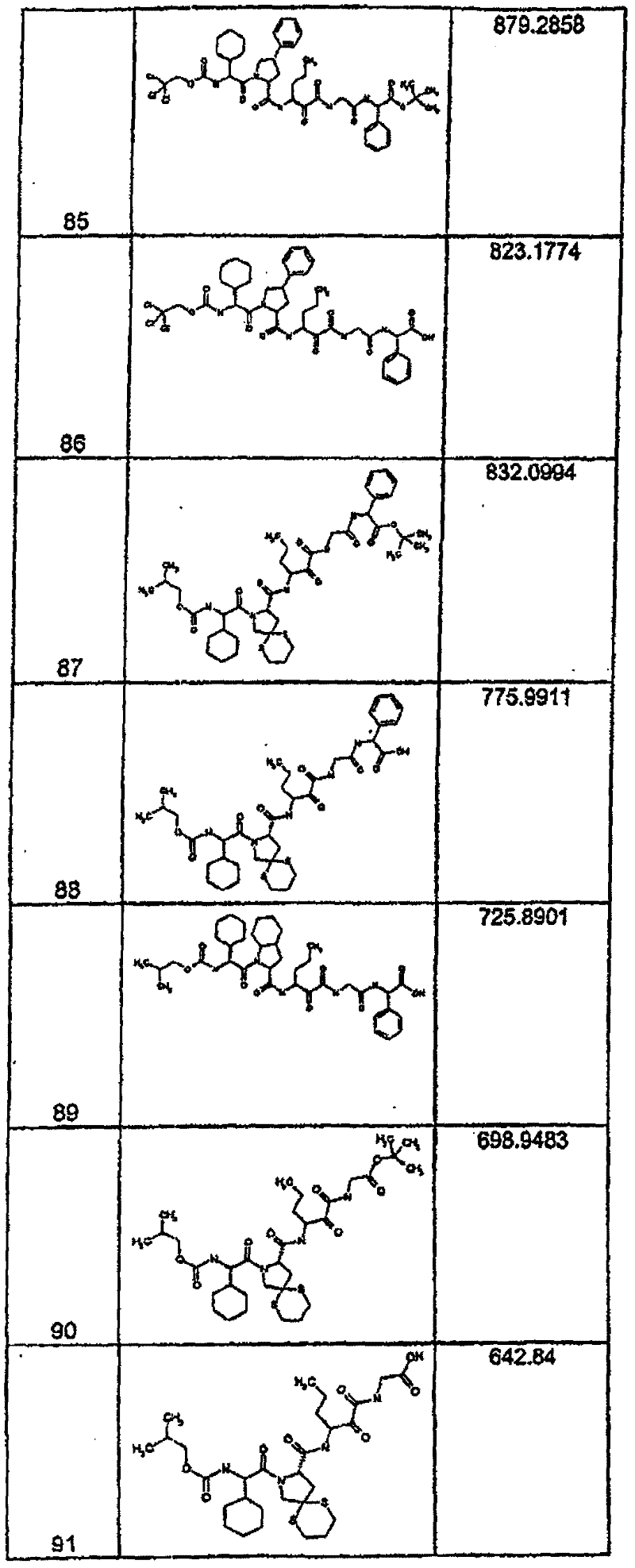
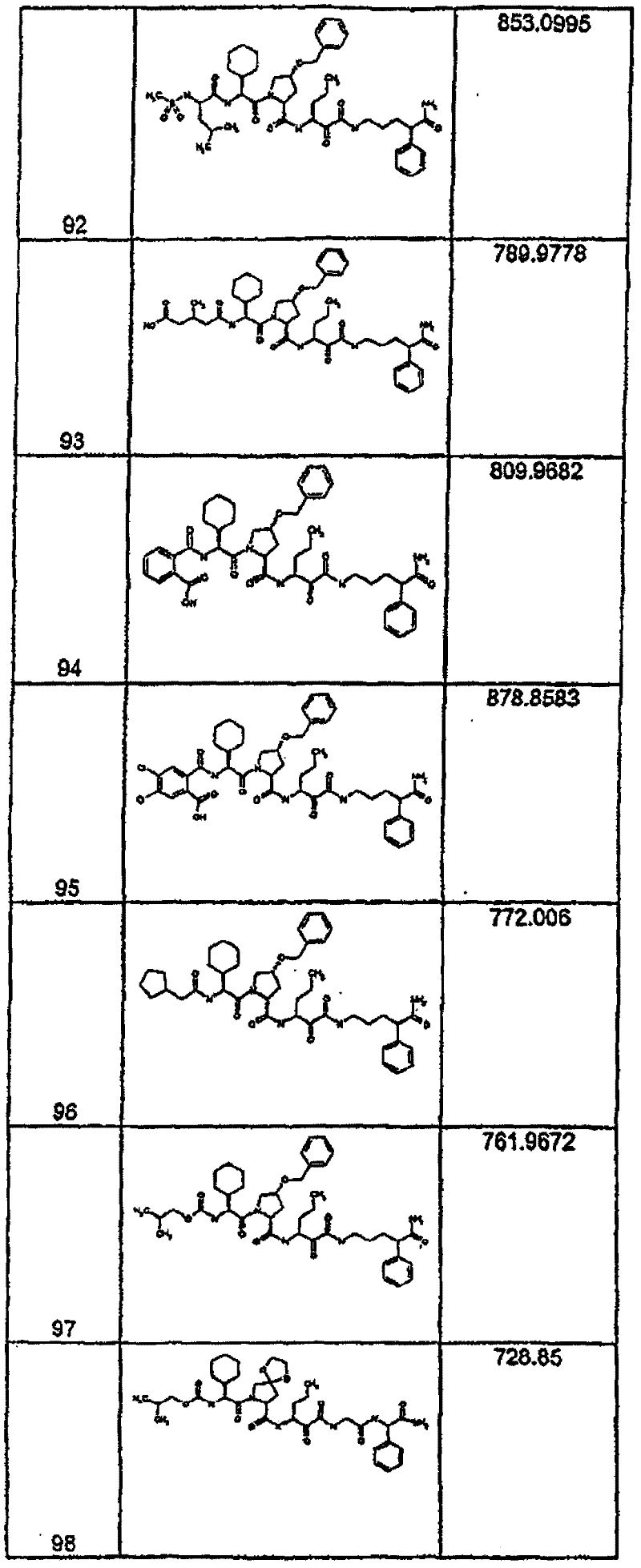
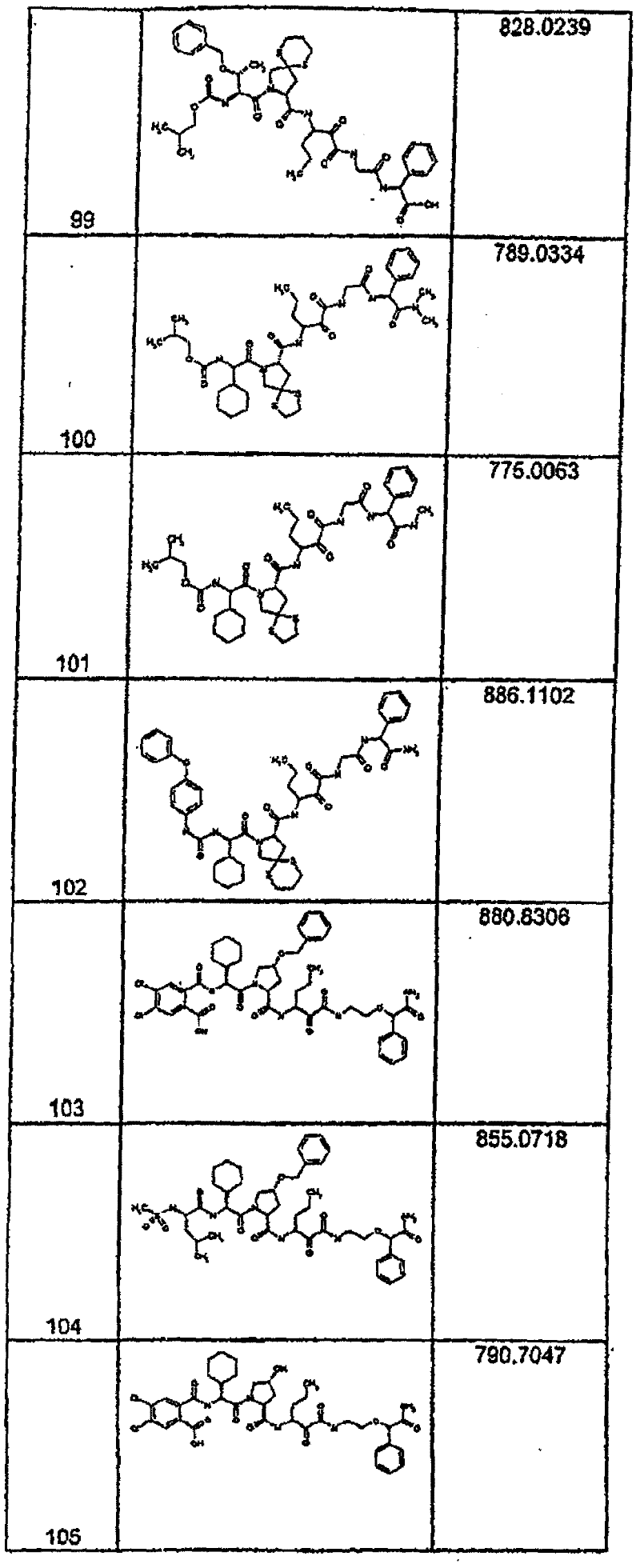


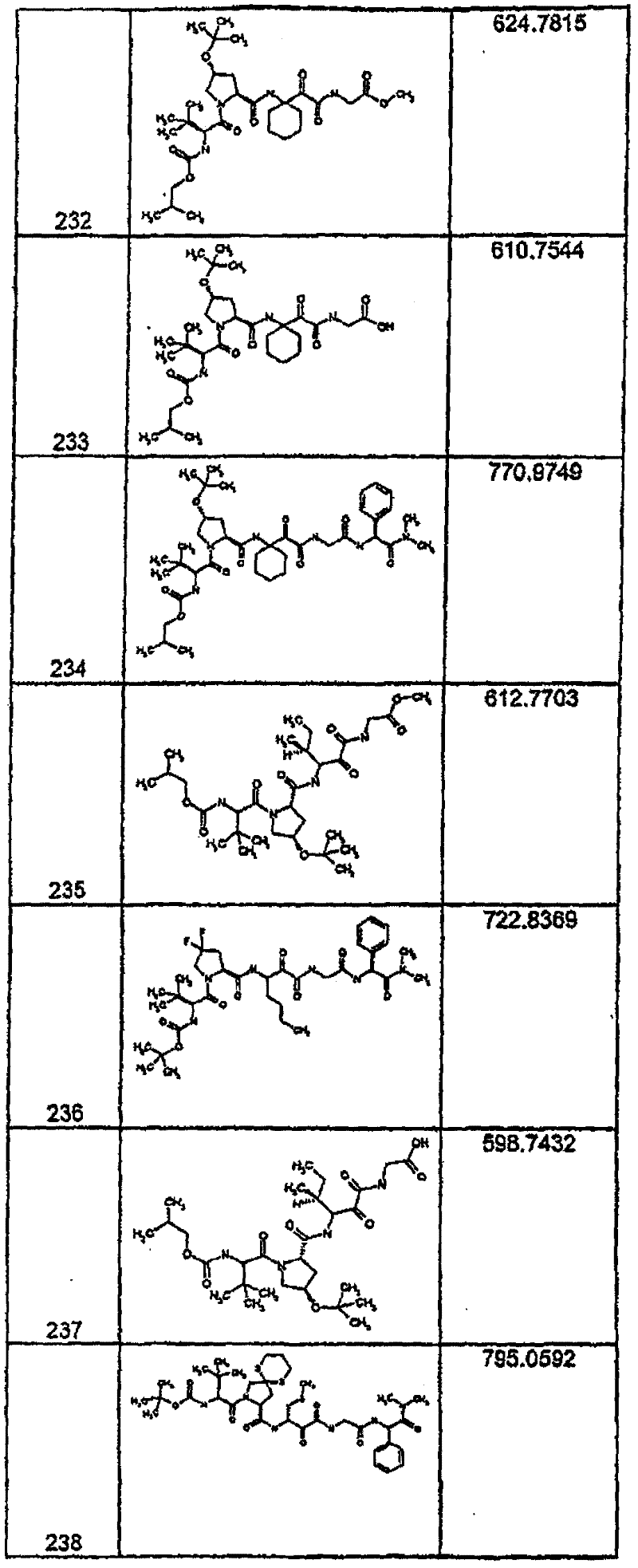
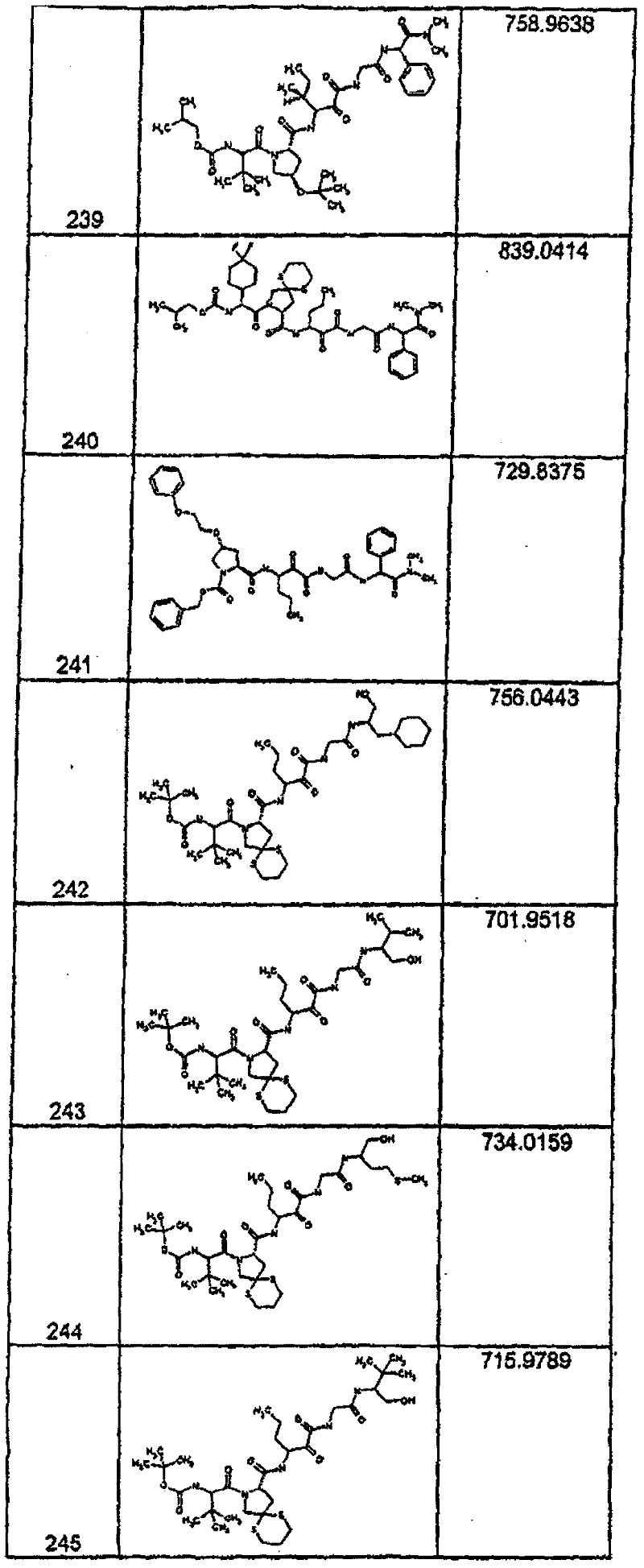


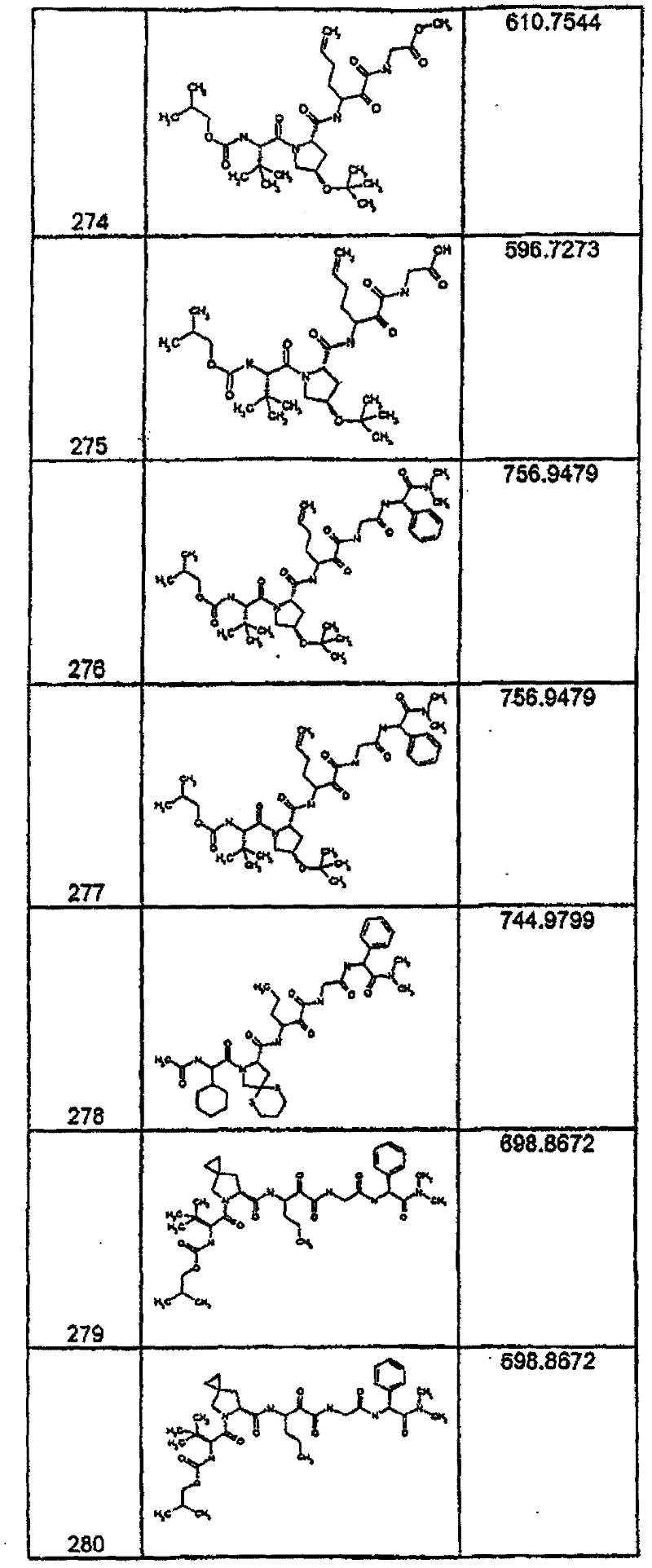


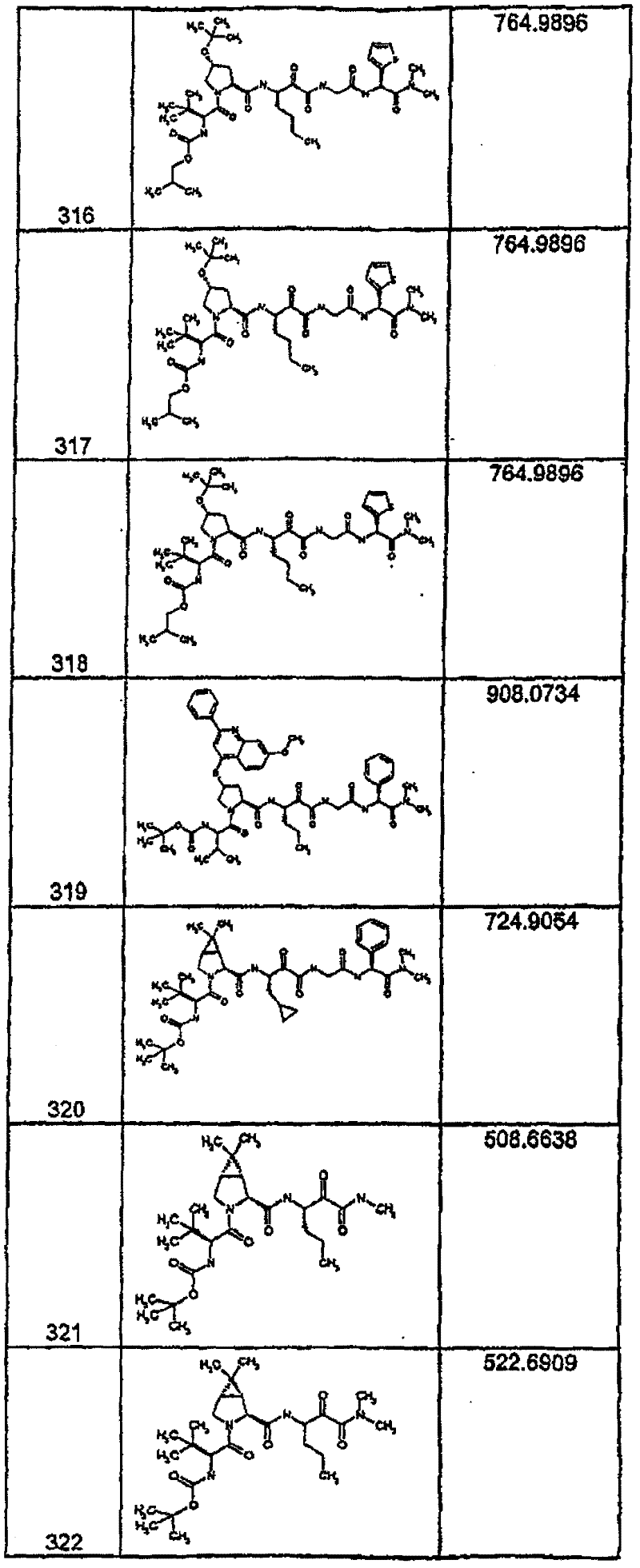

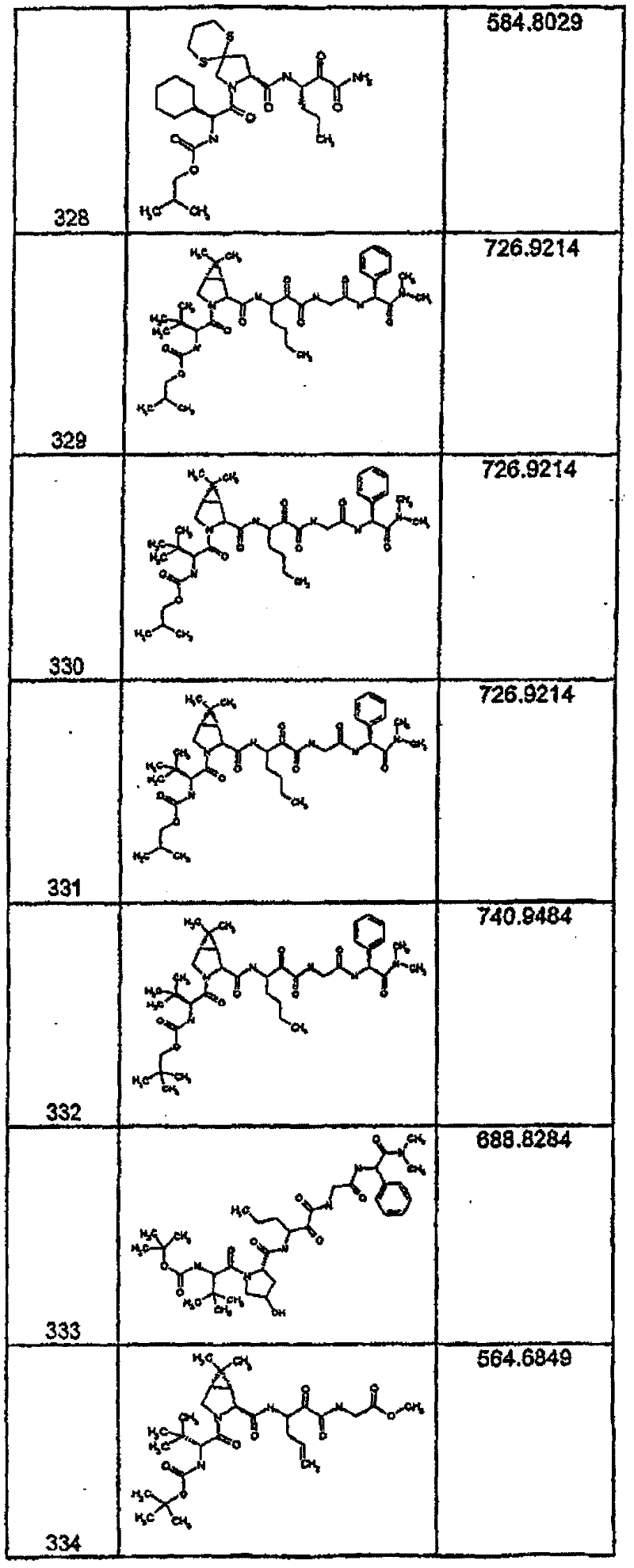
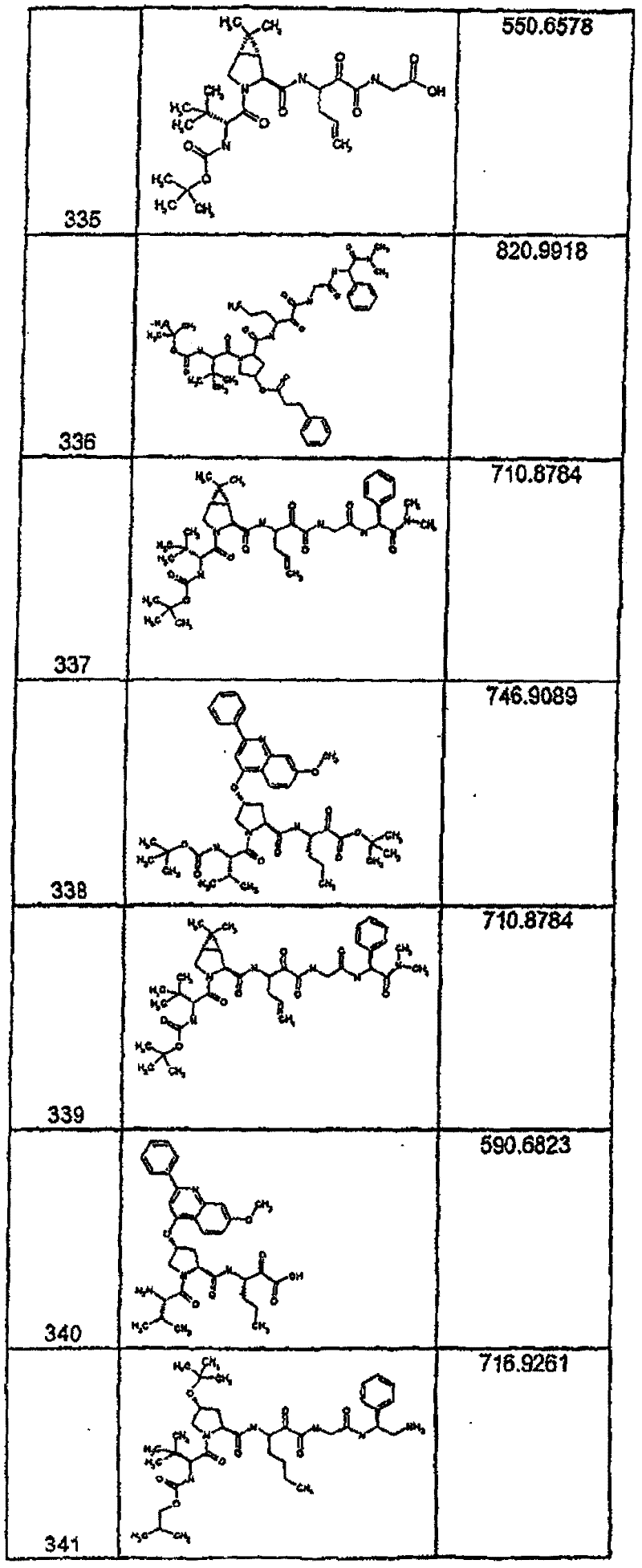
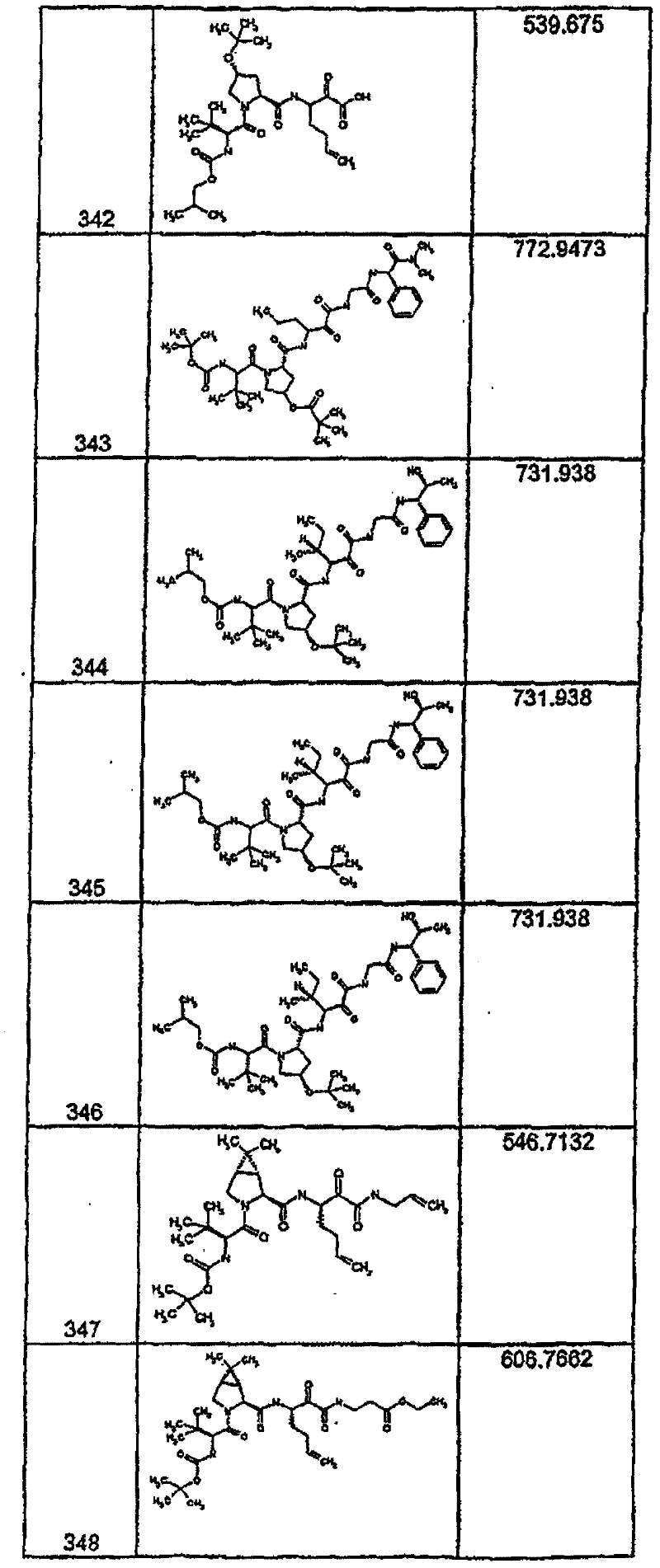
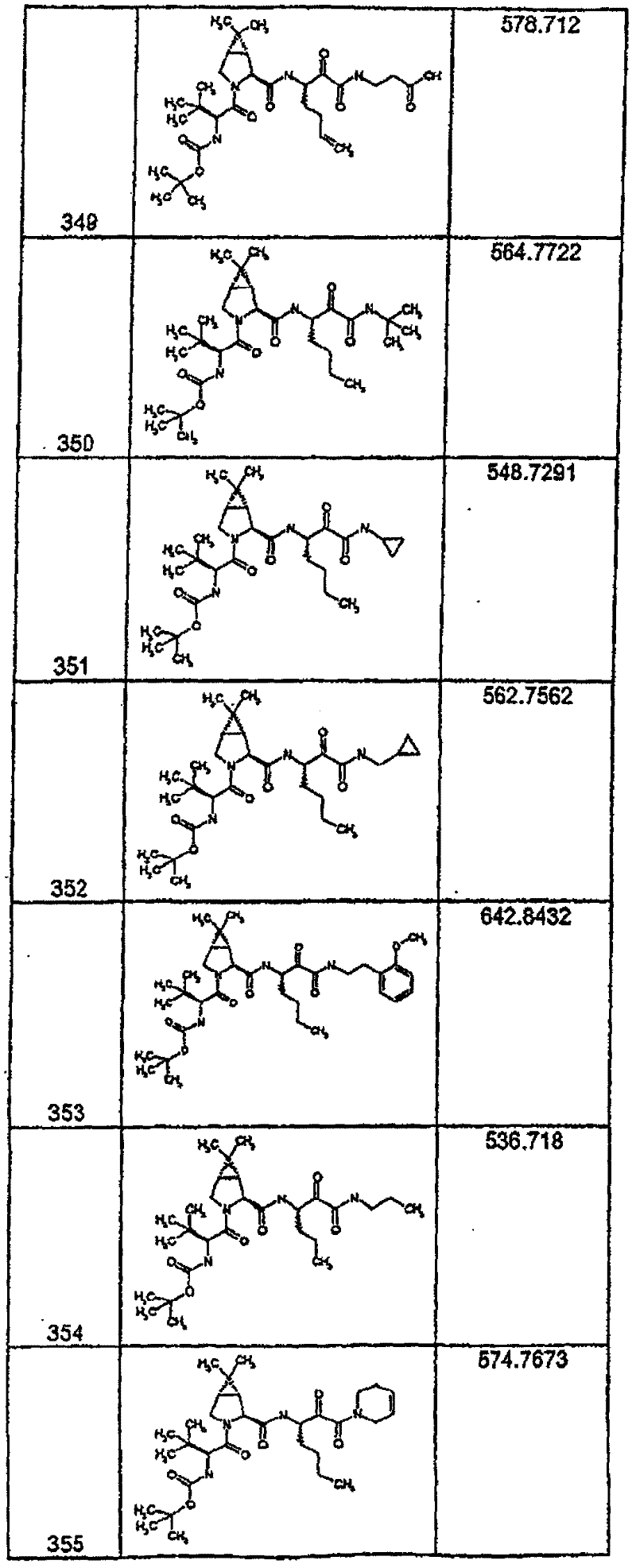

表4 Table 4


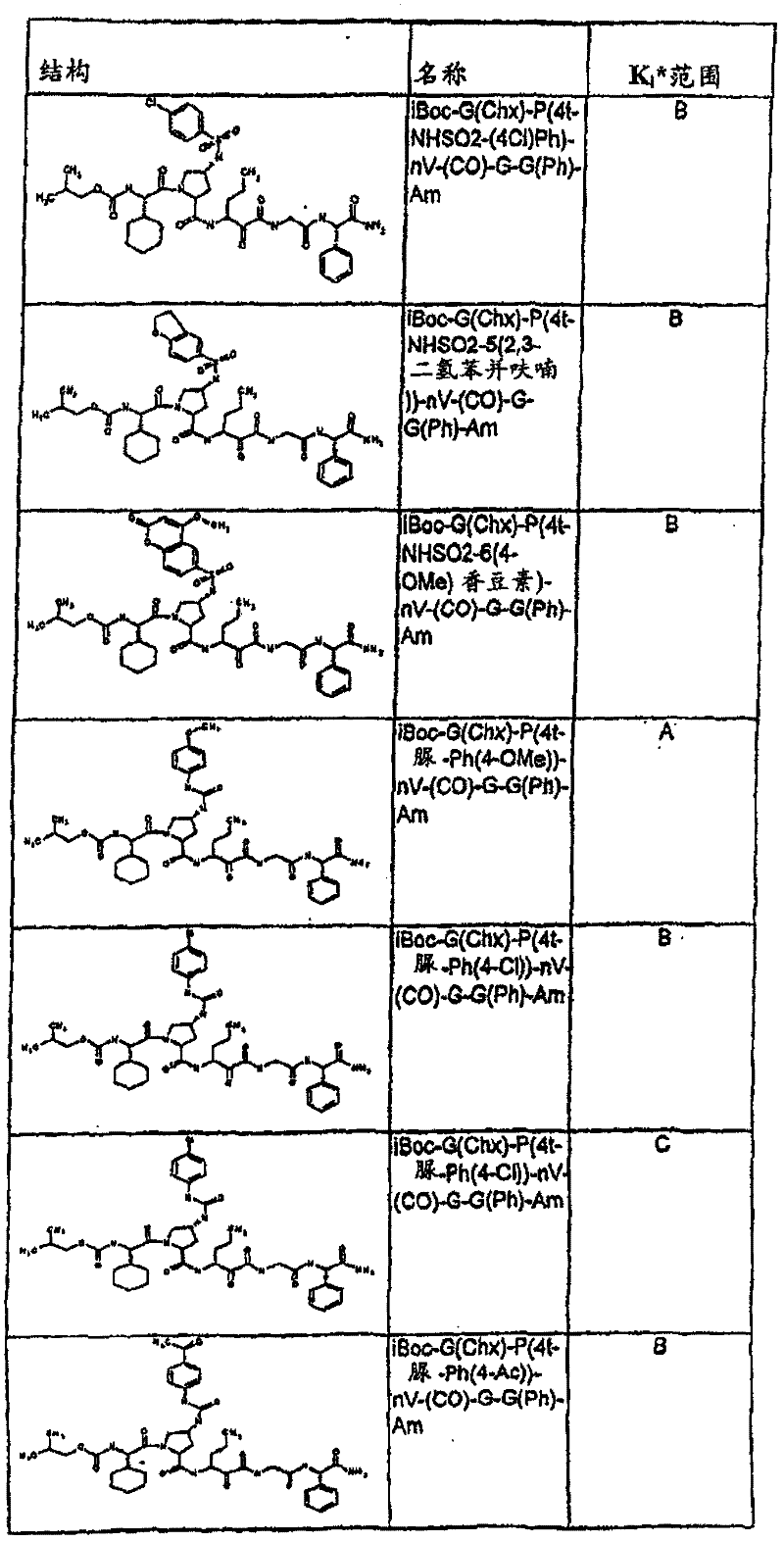

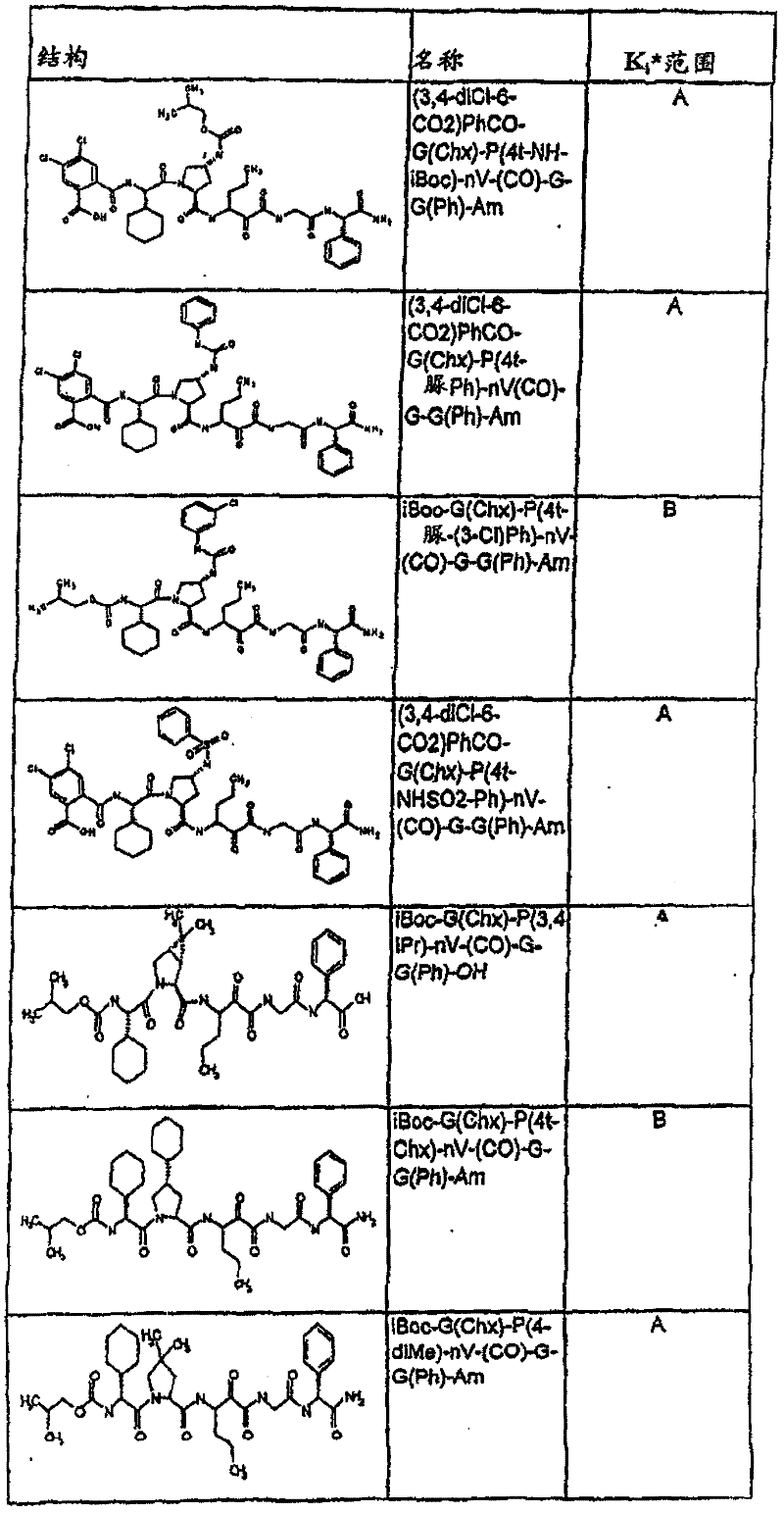
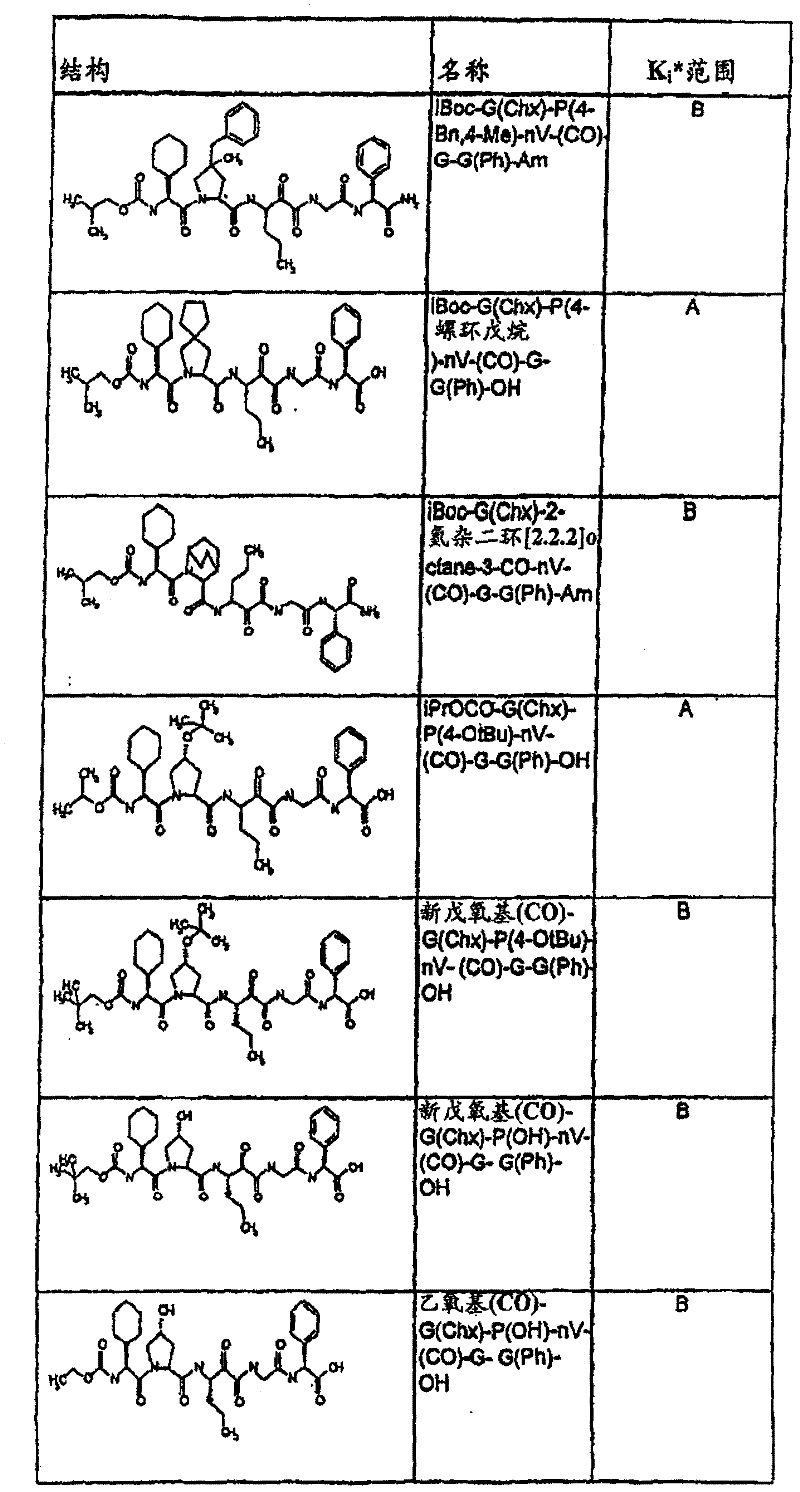

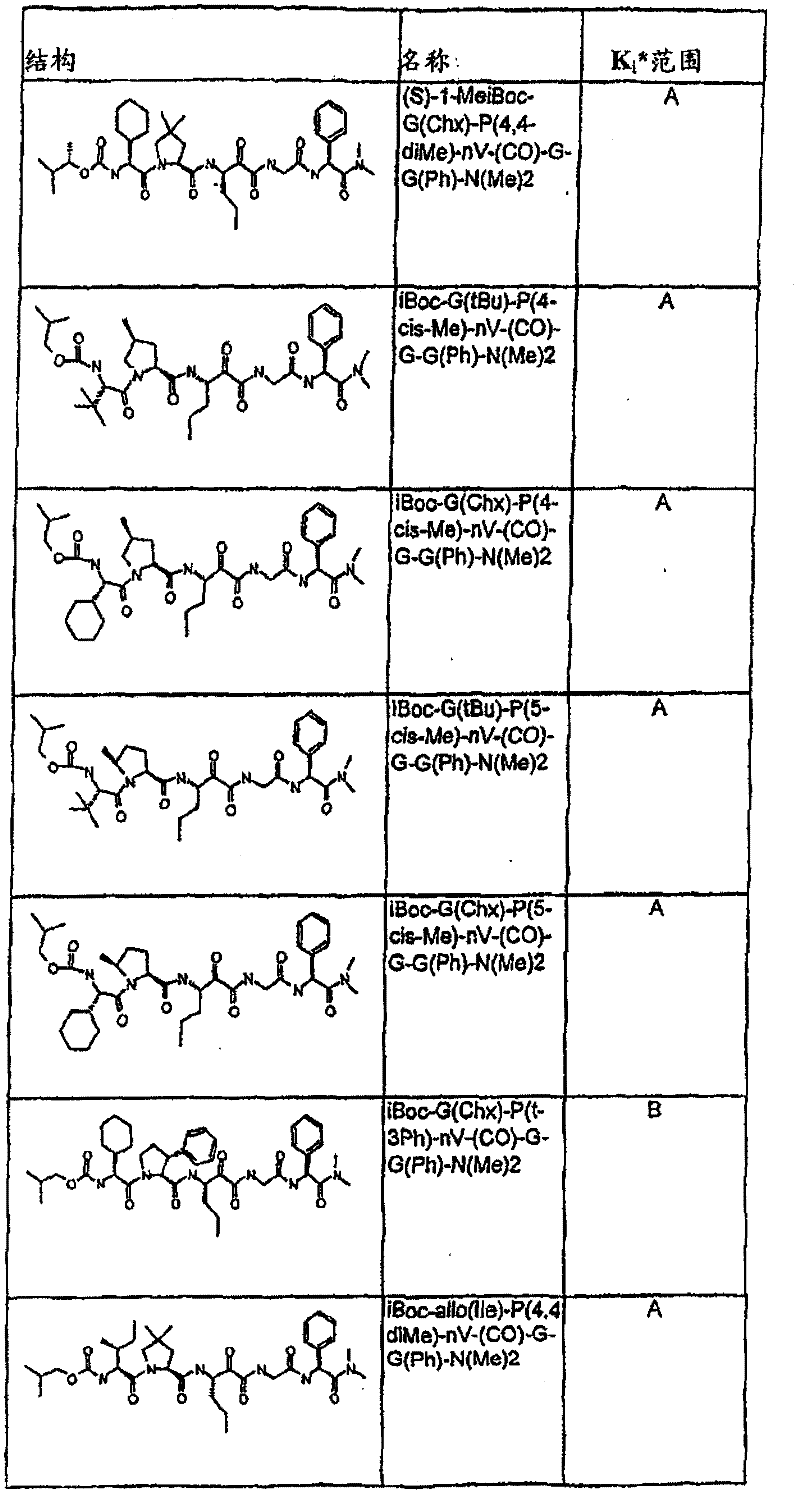


表5 table 5


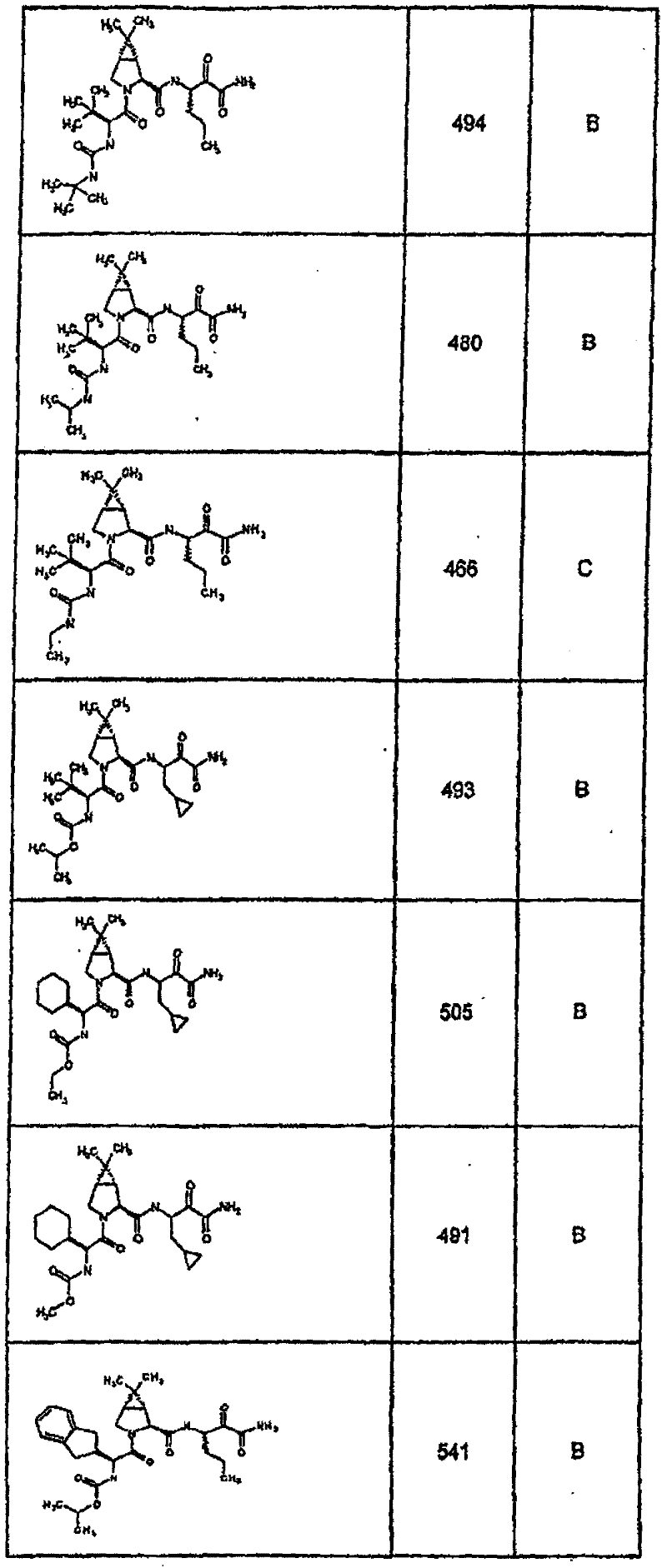
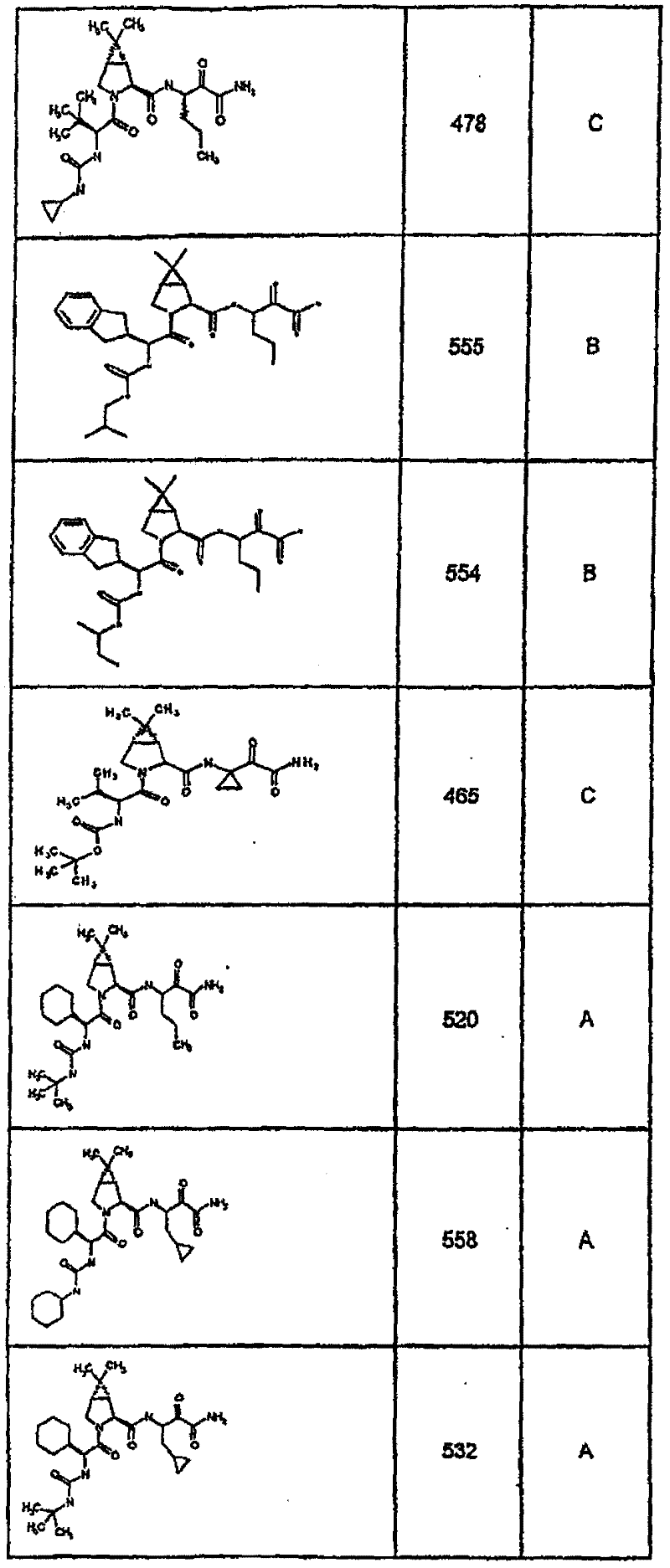

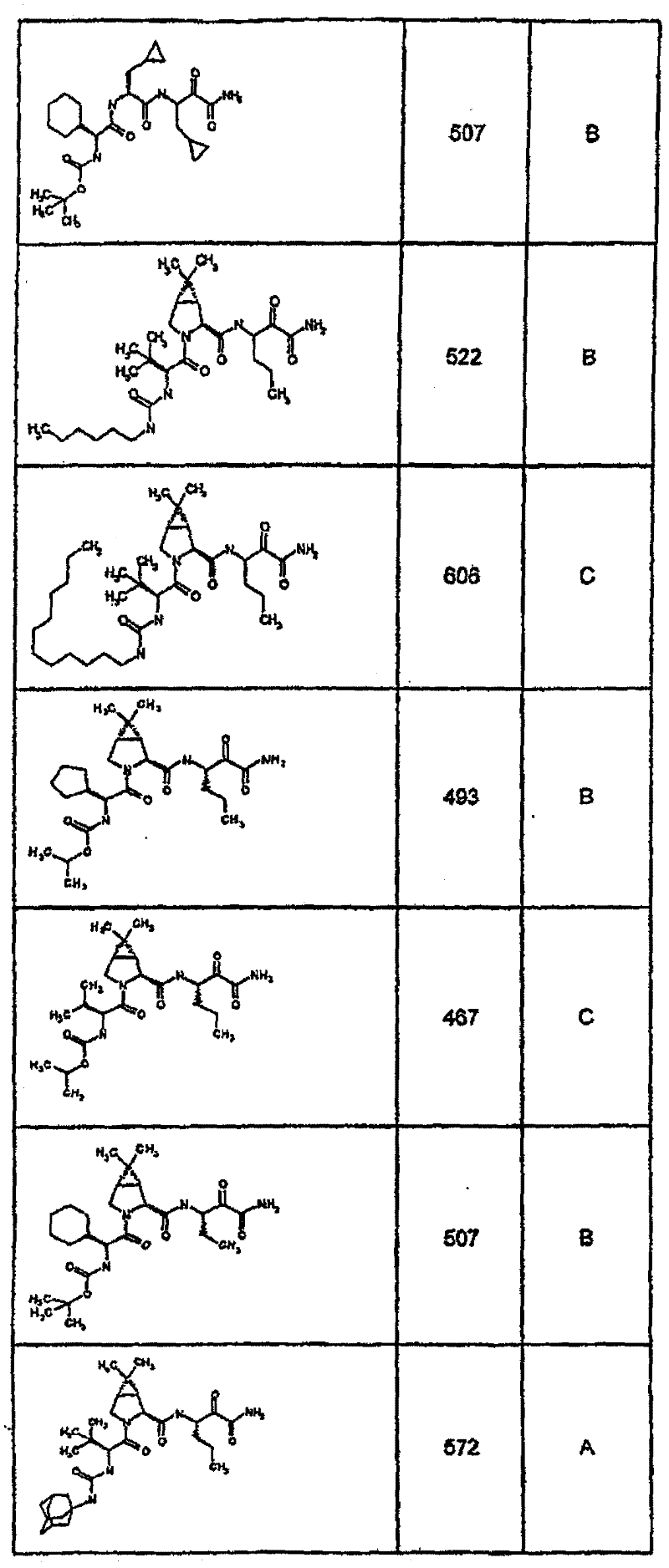


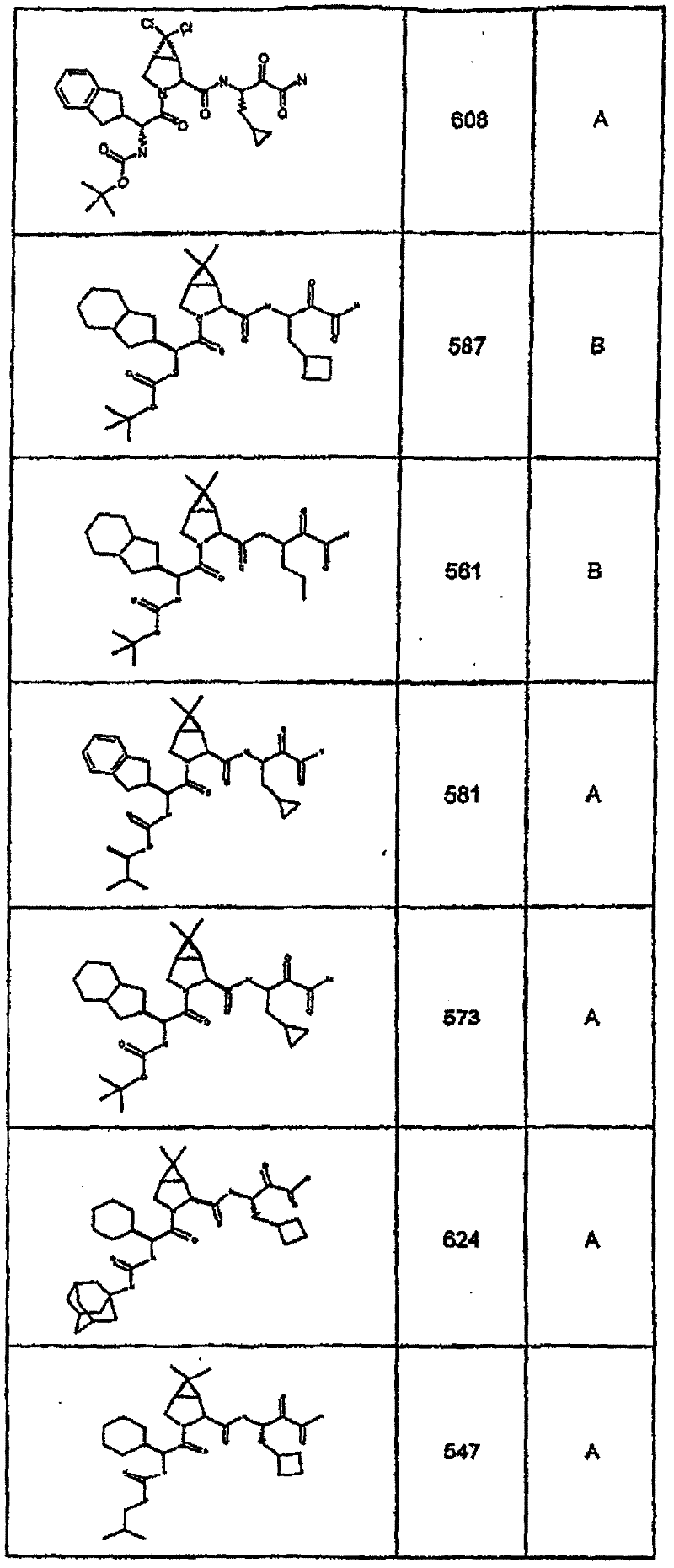

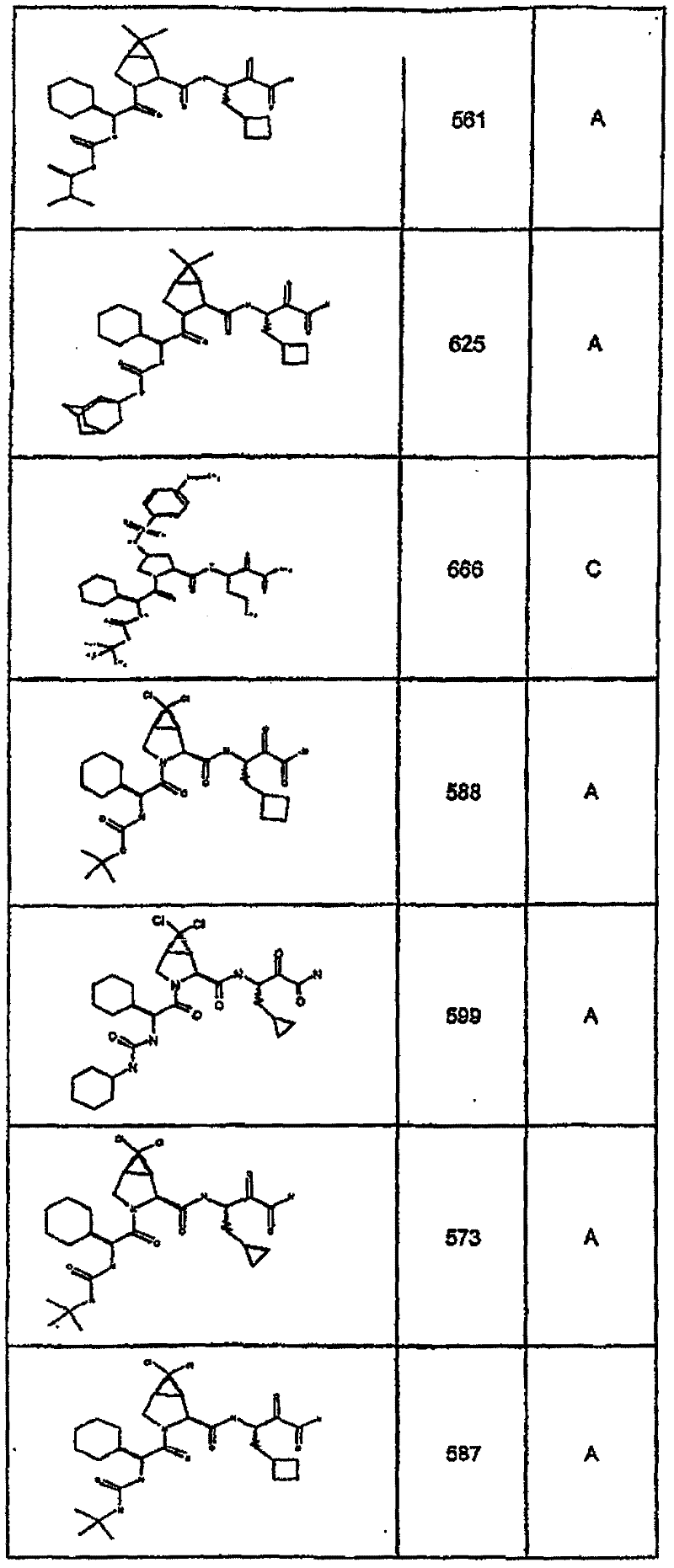

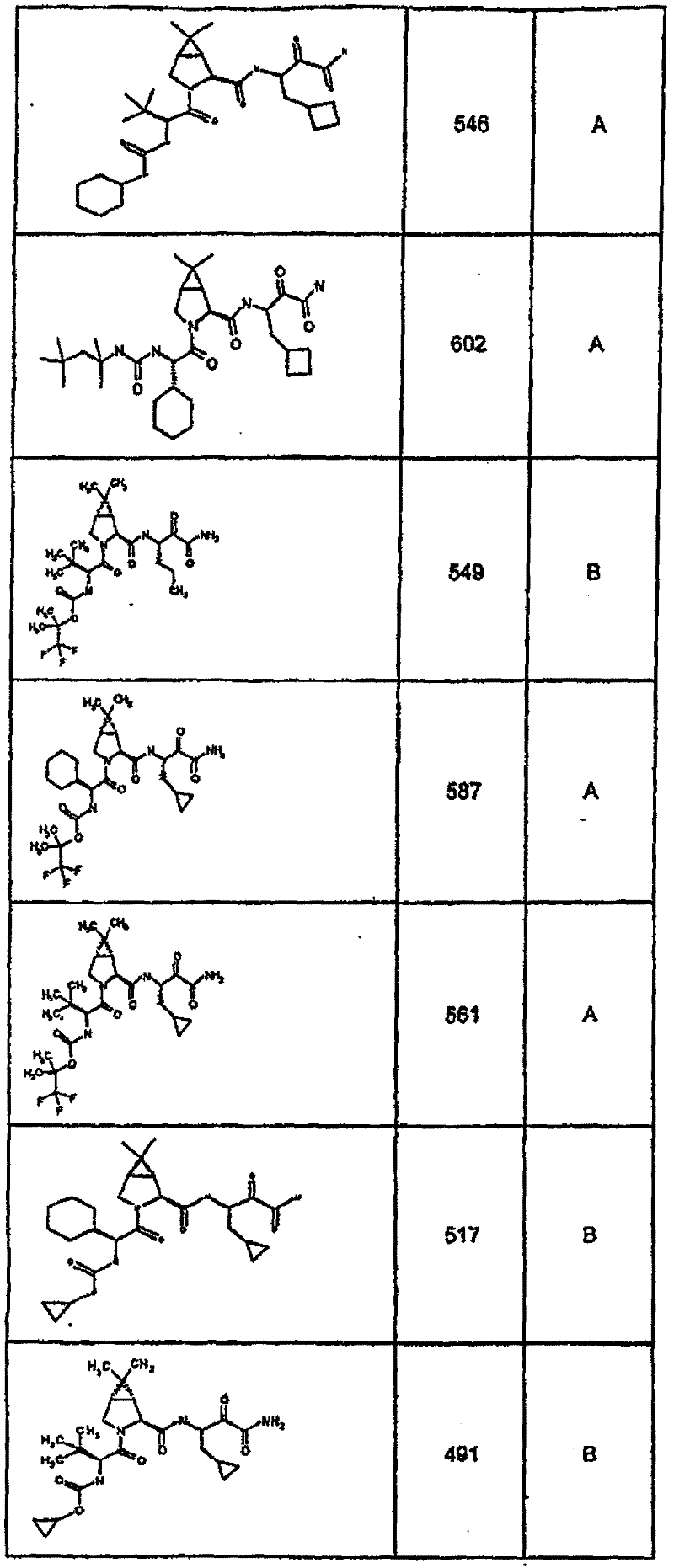
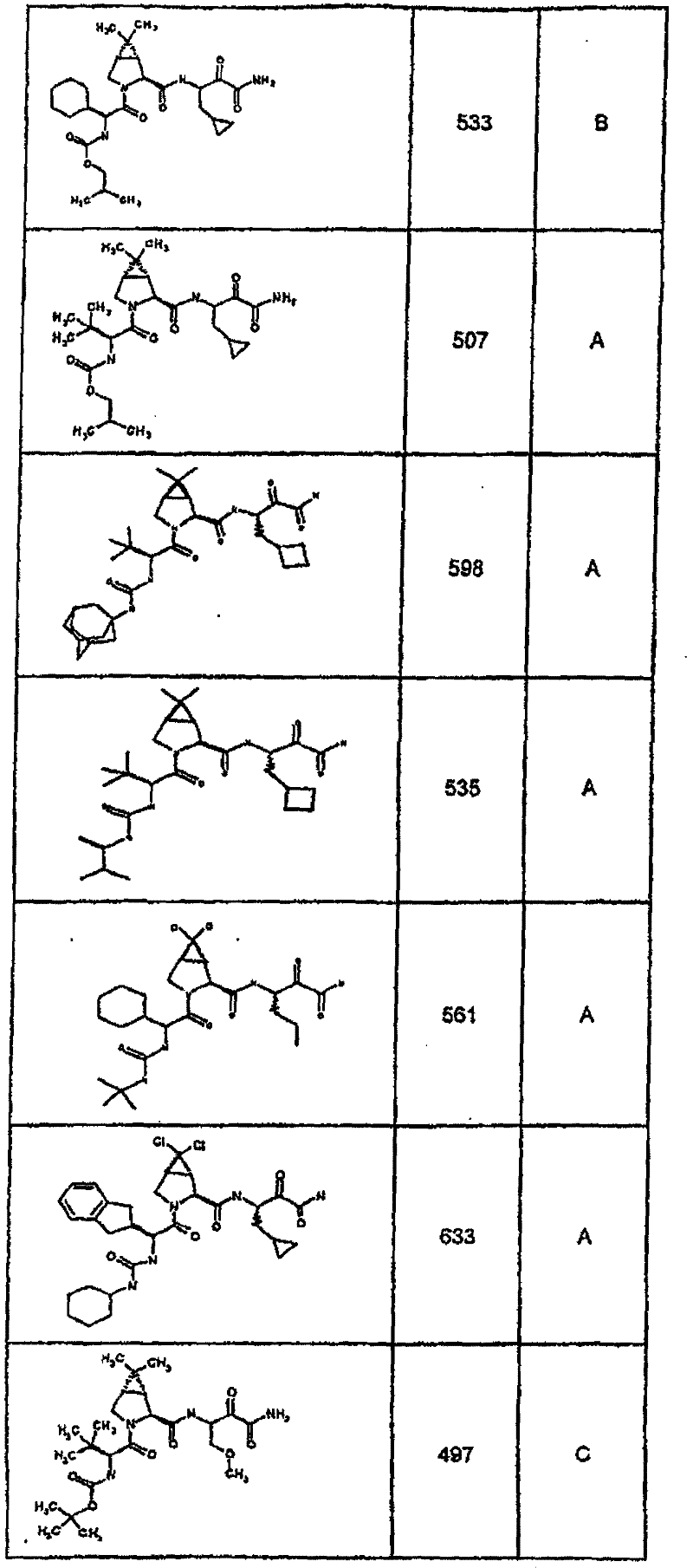
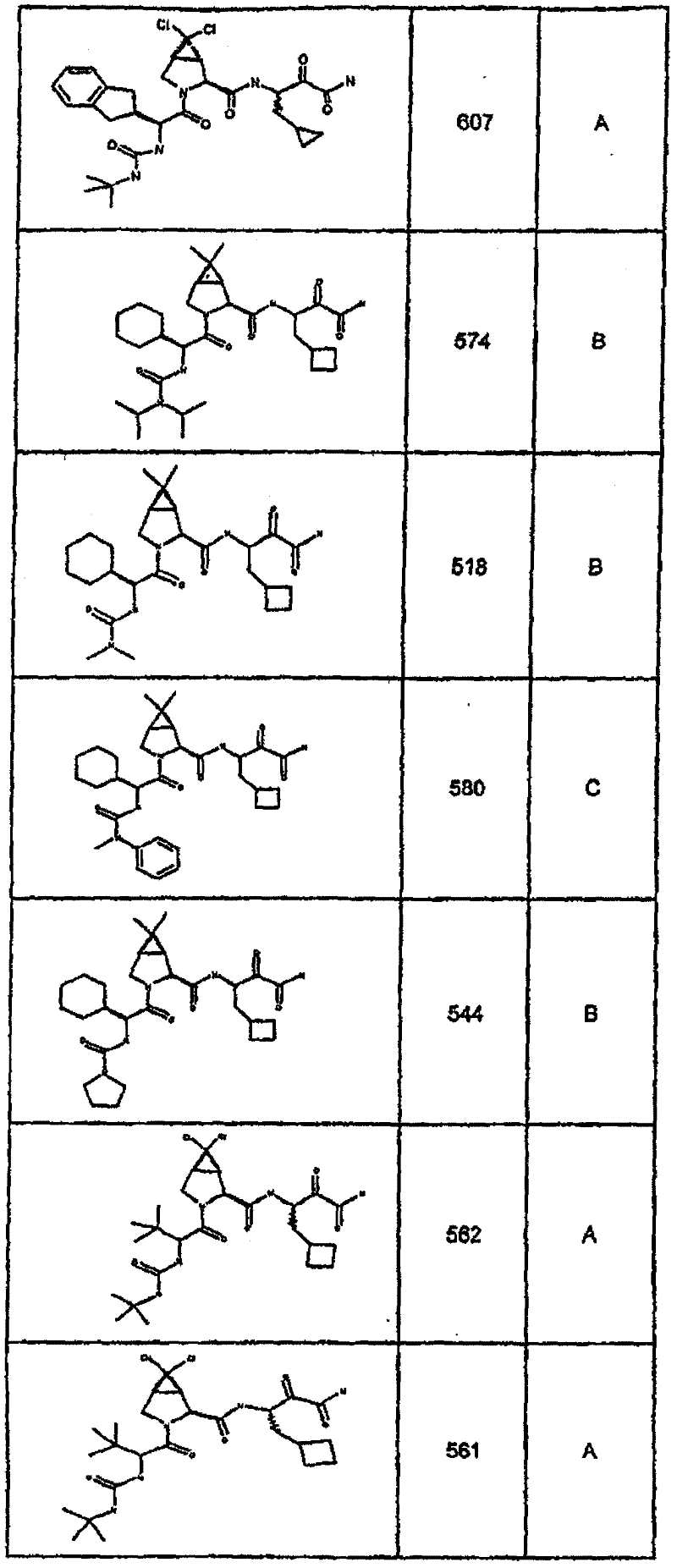
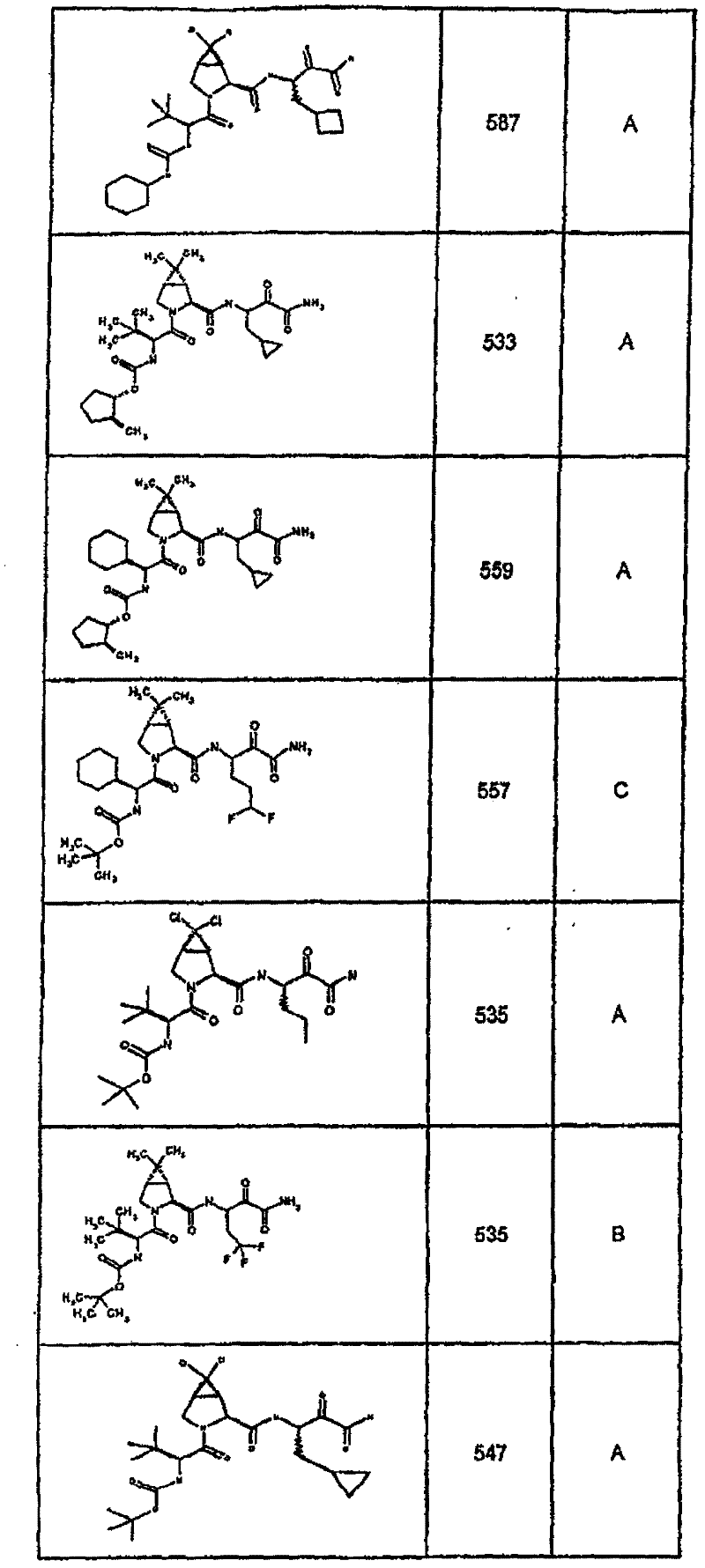
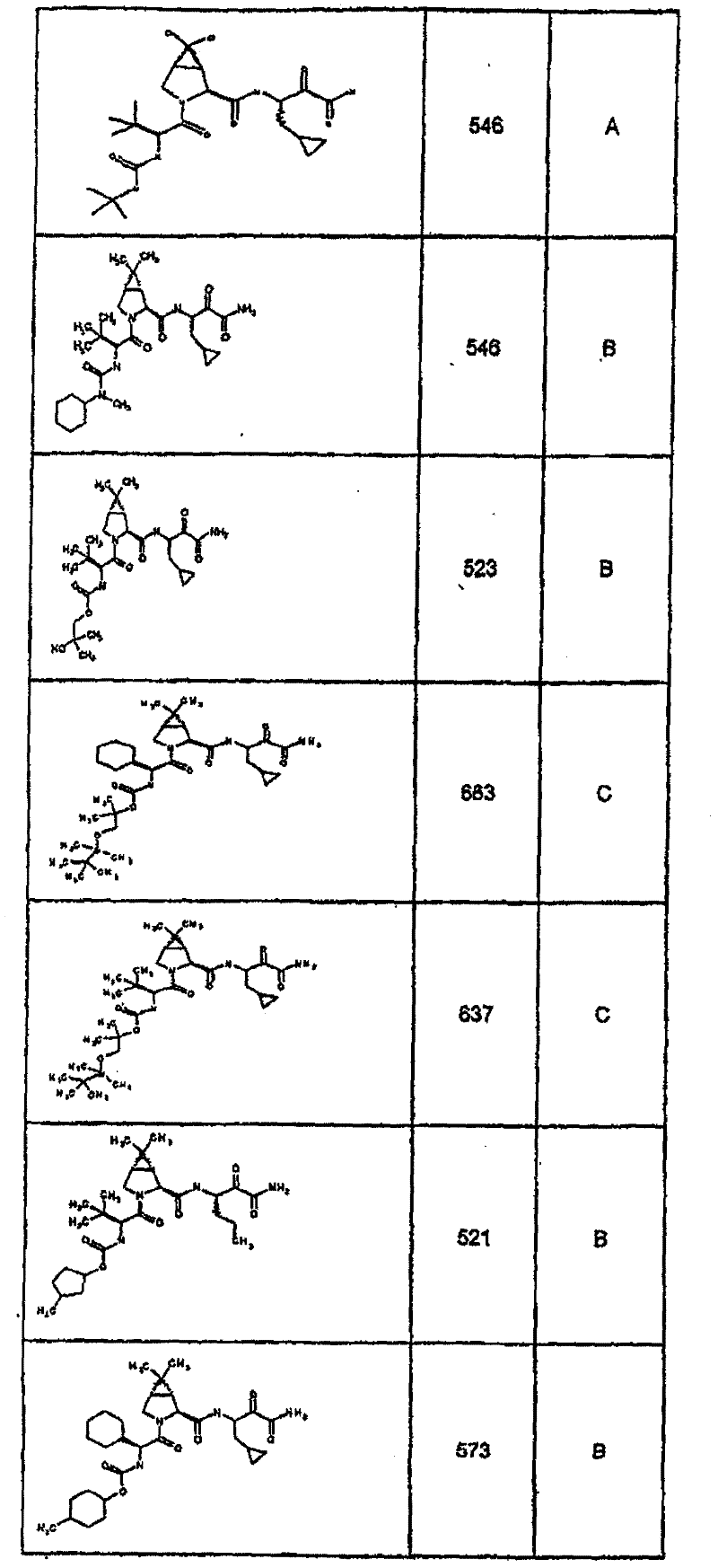


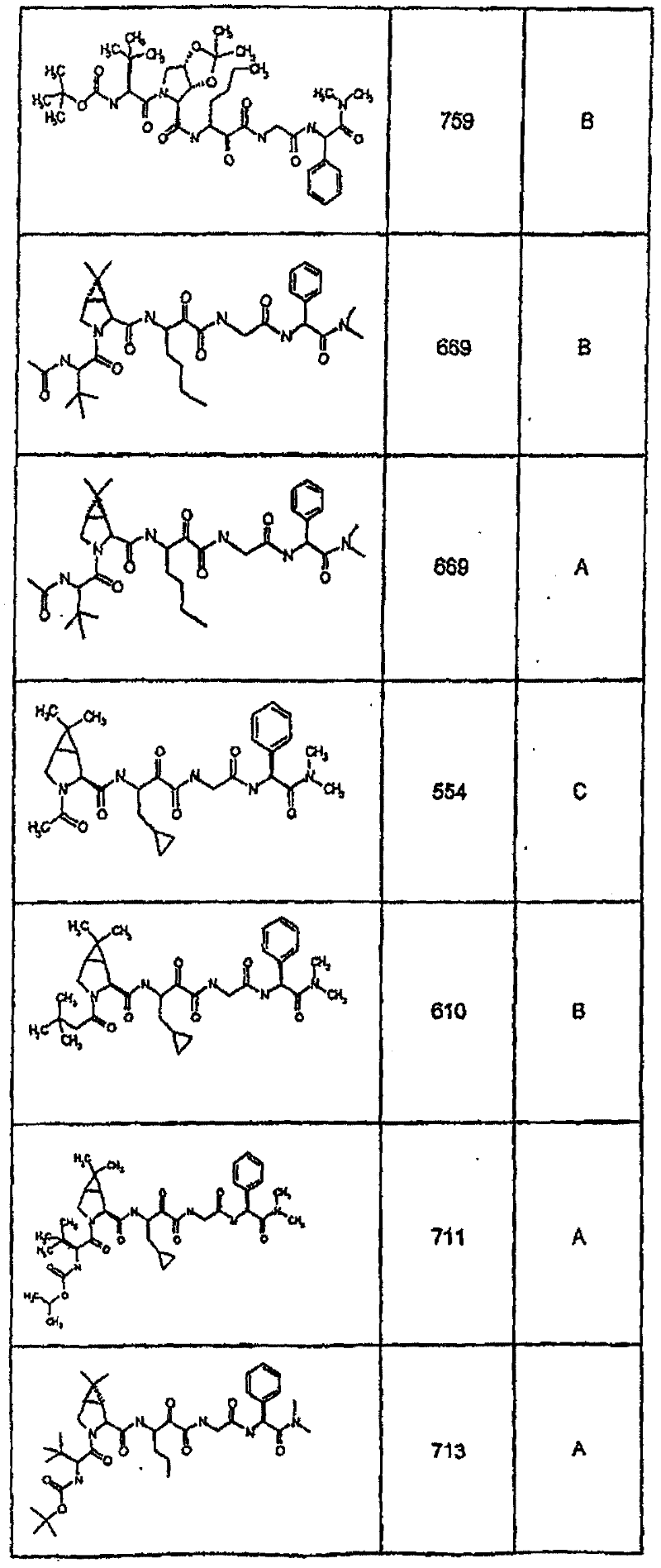


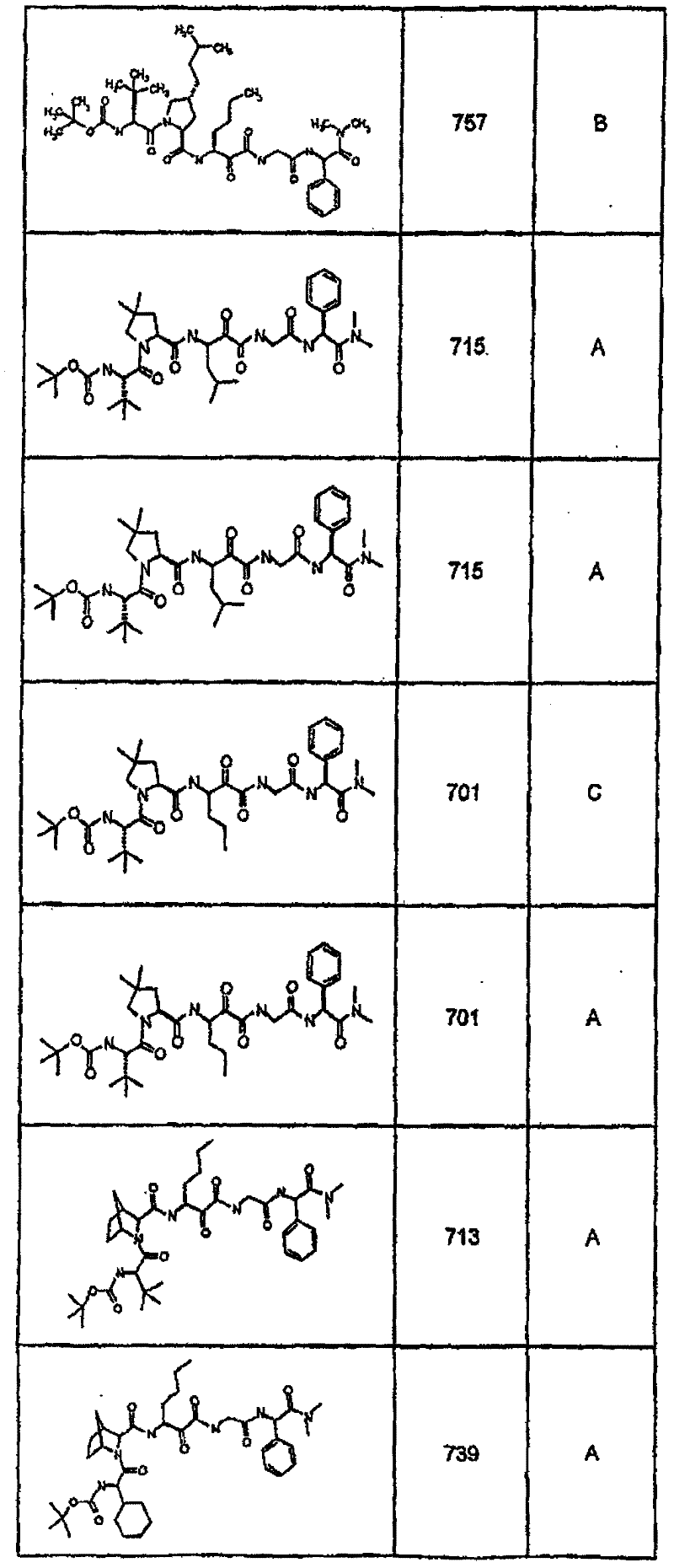
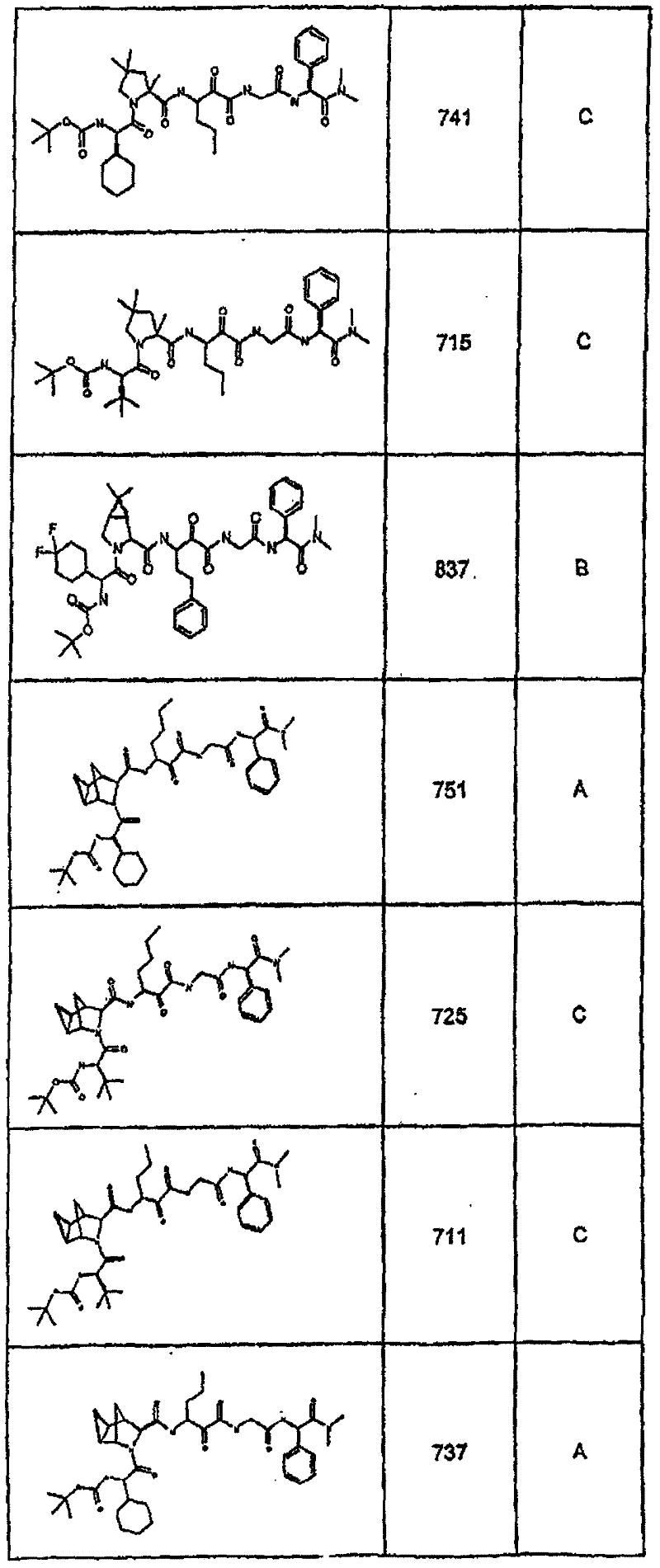
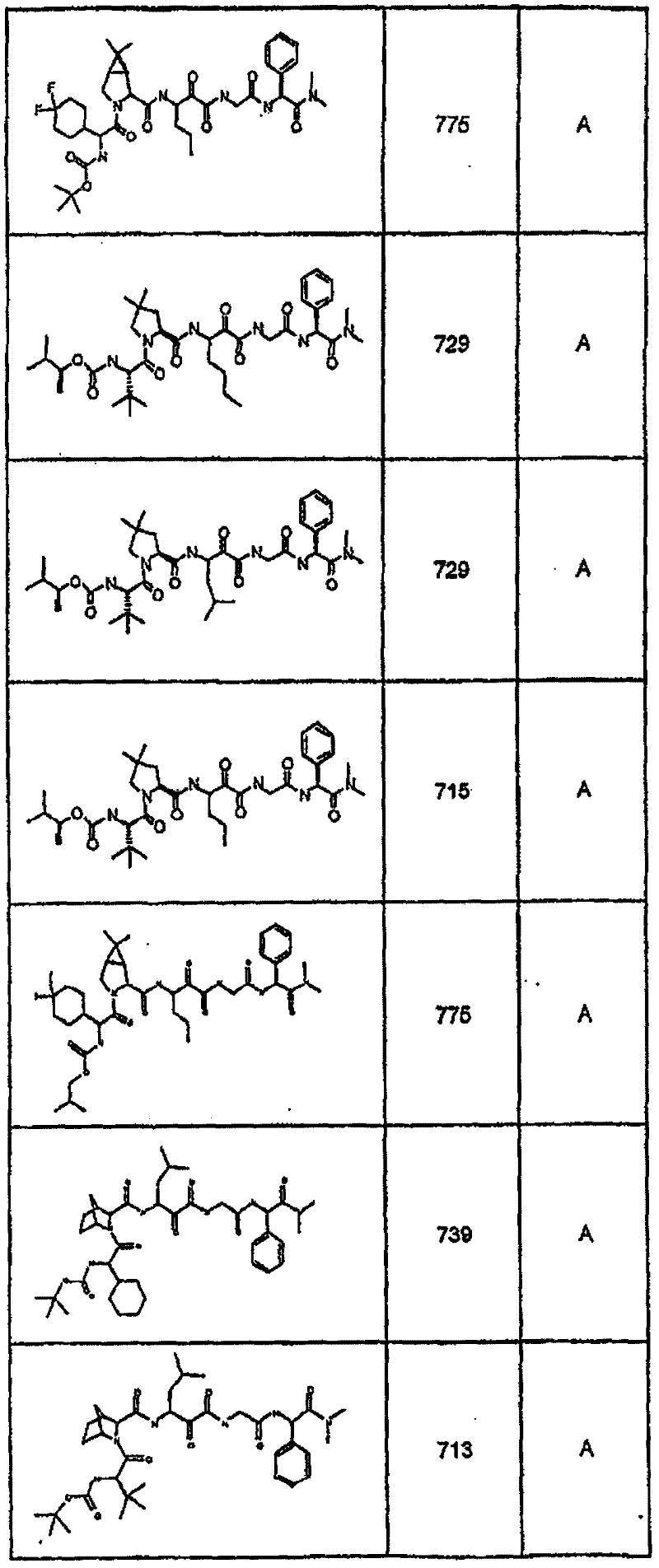
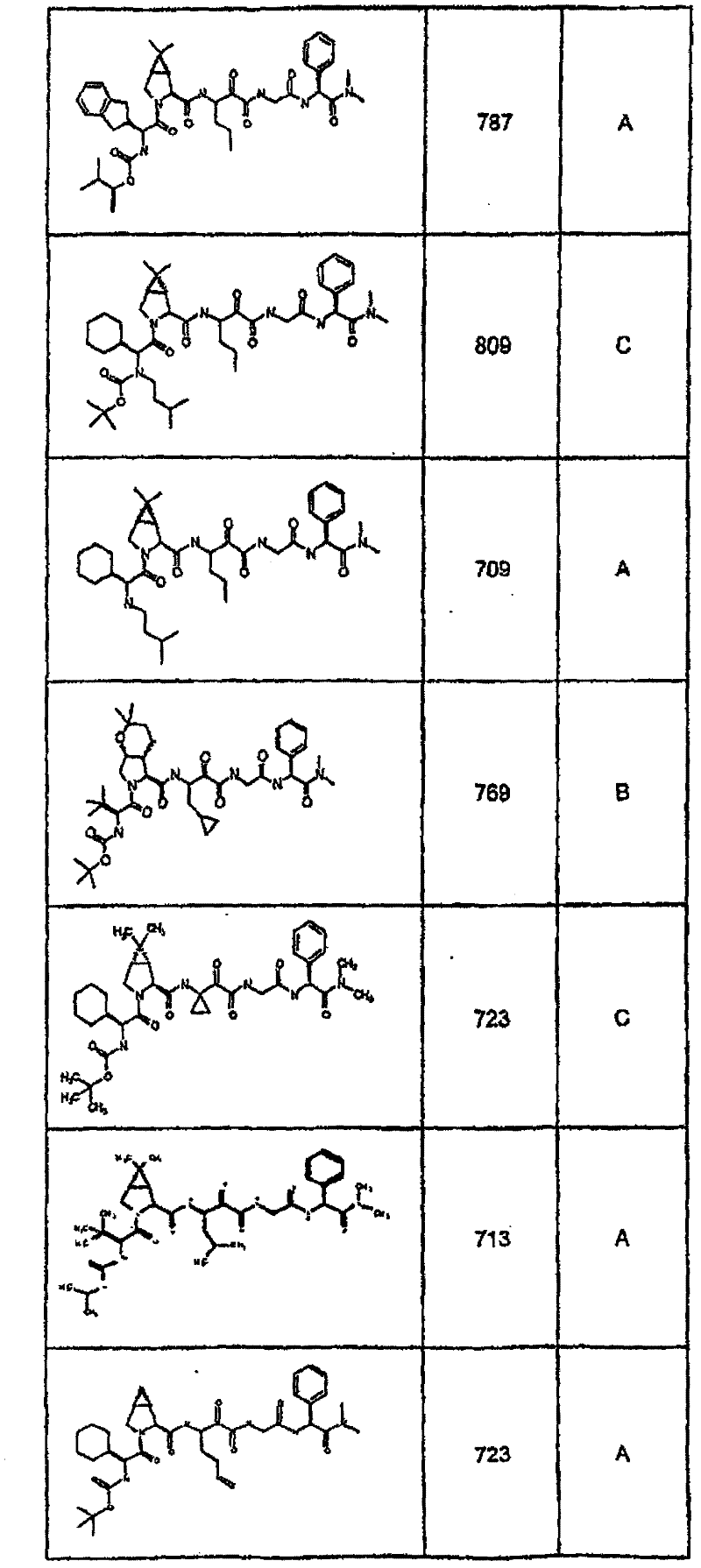


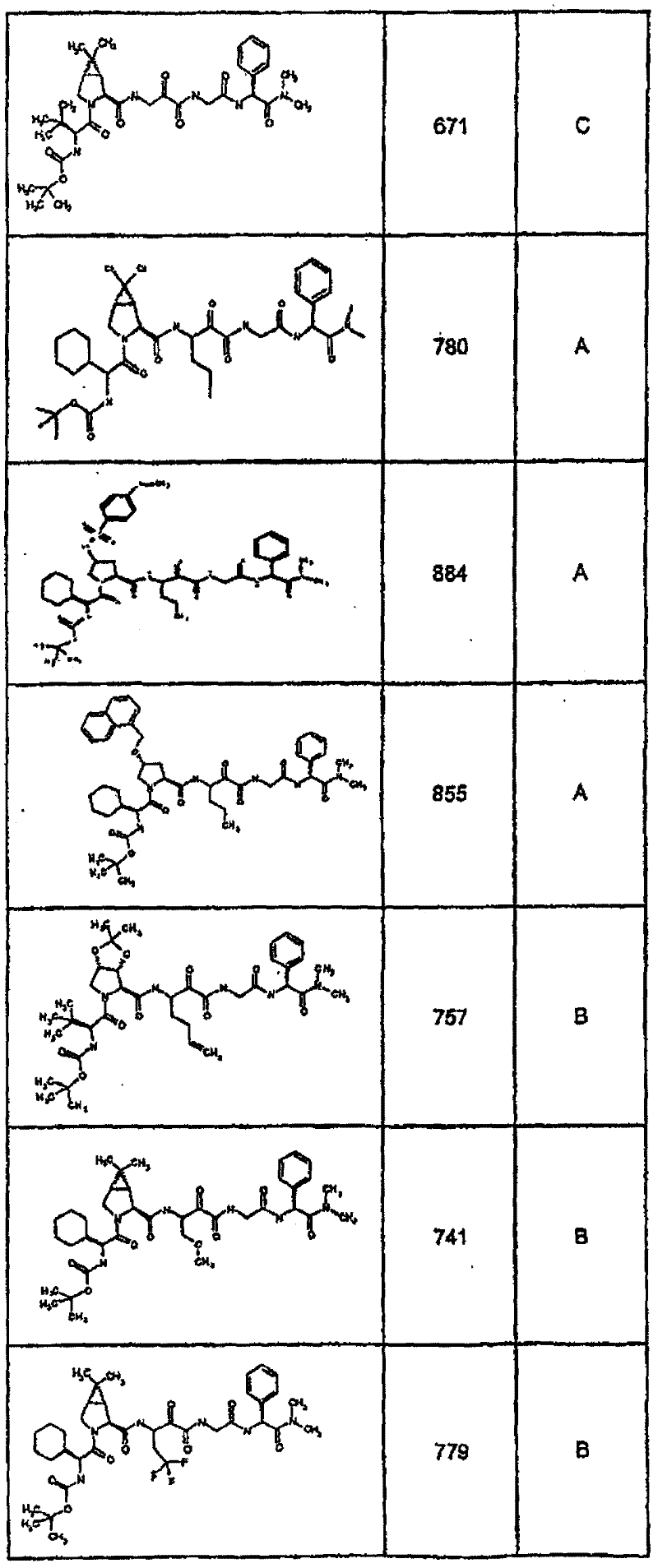


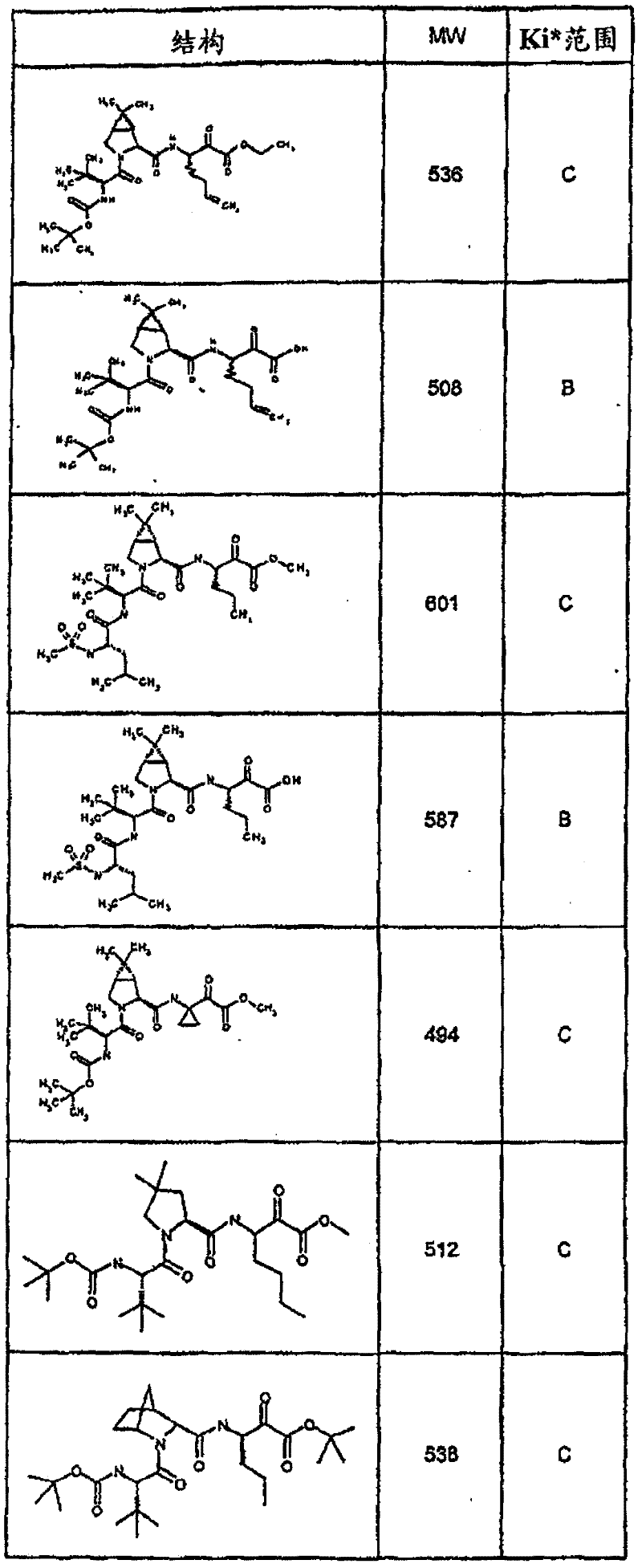


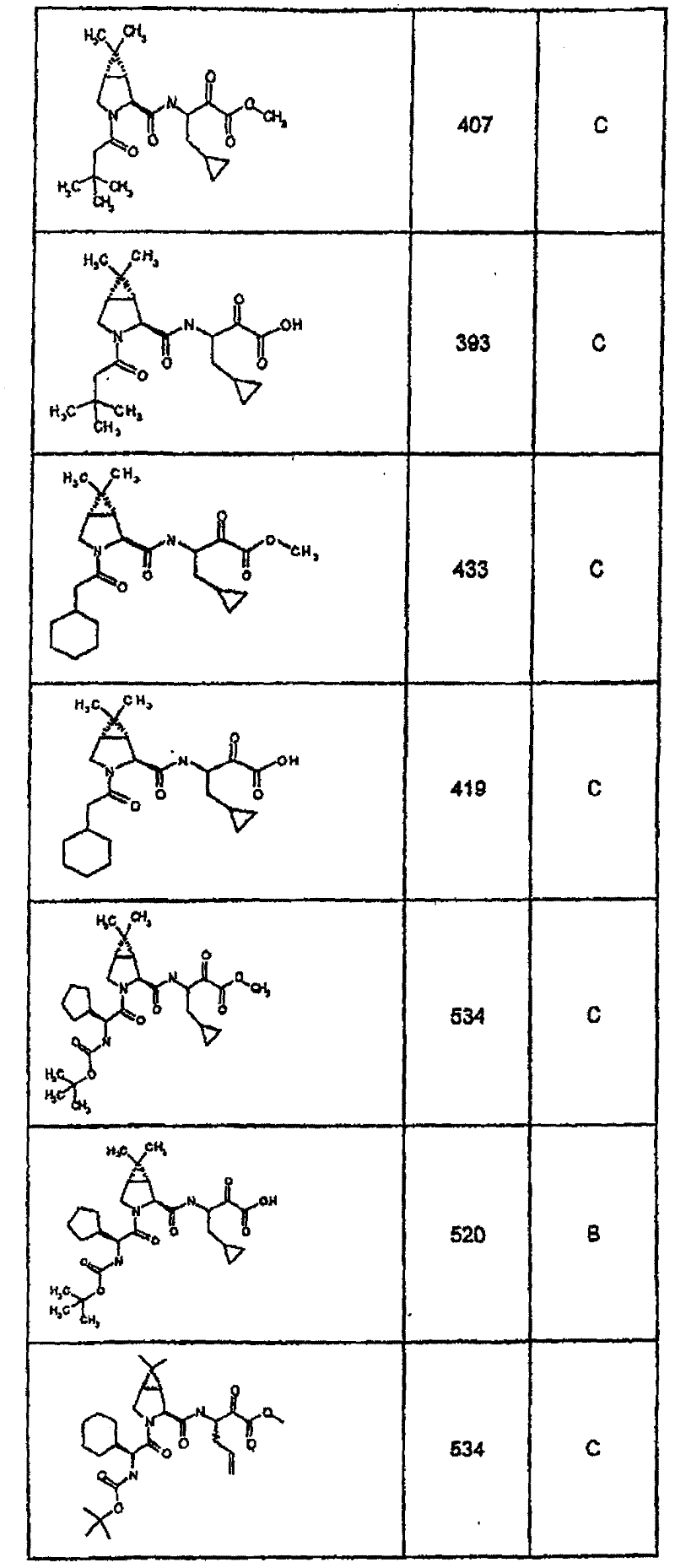


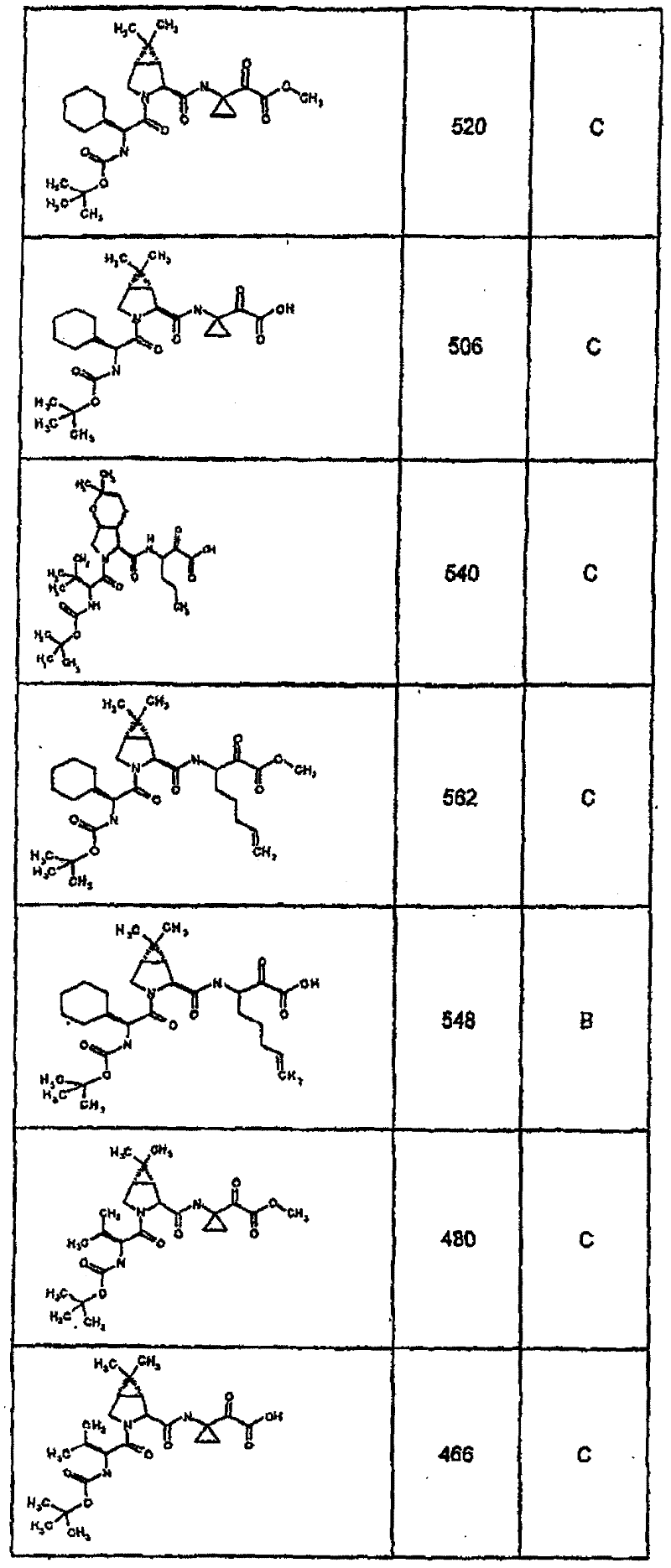

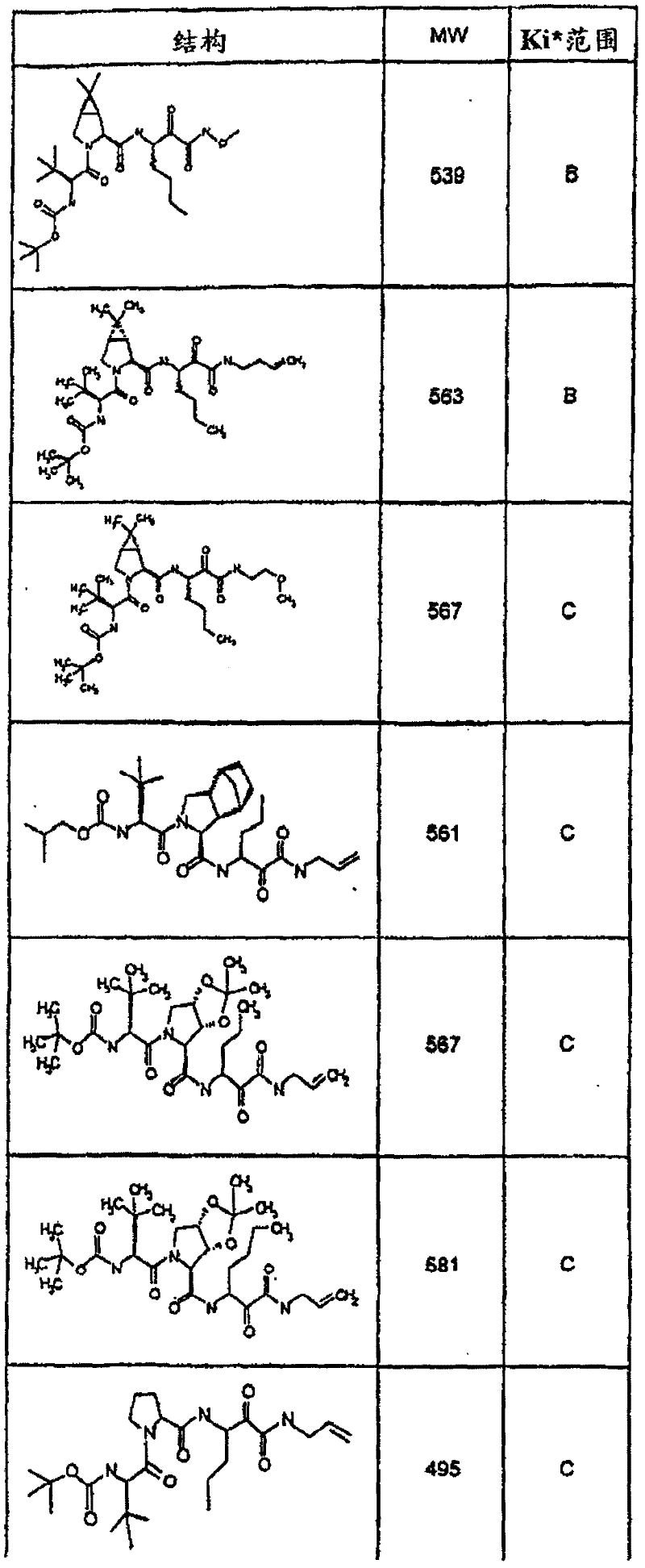
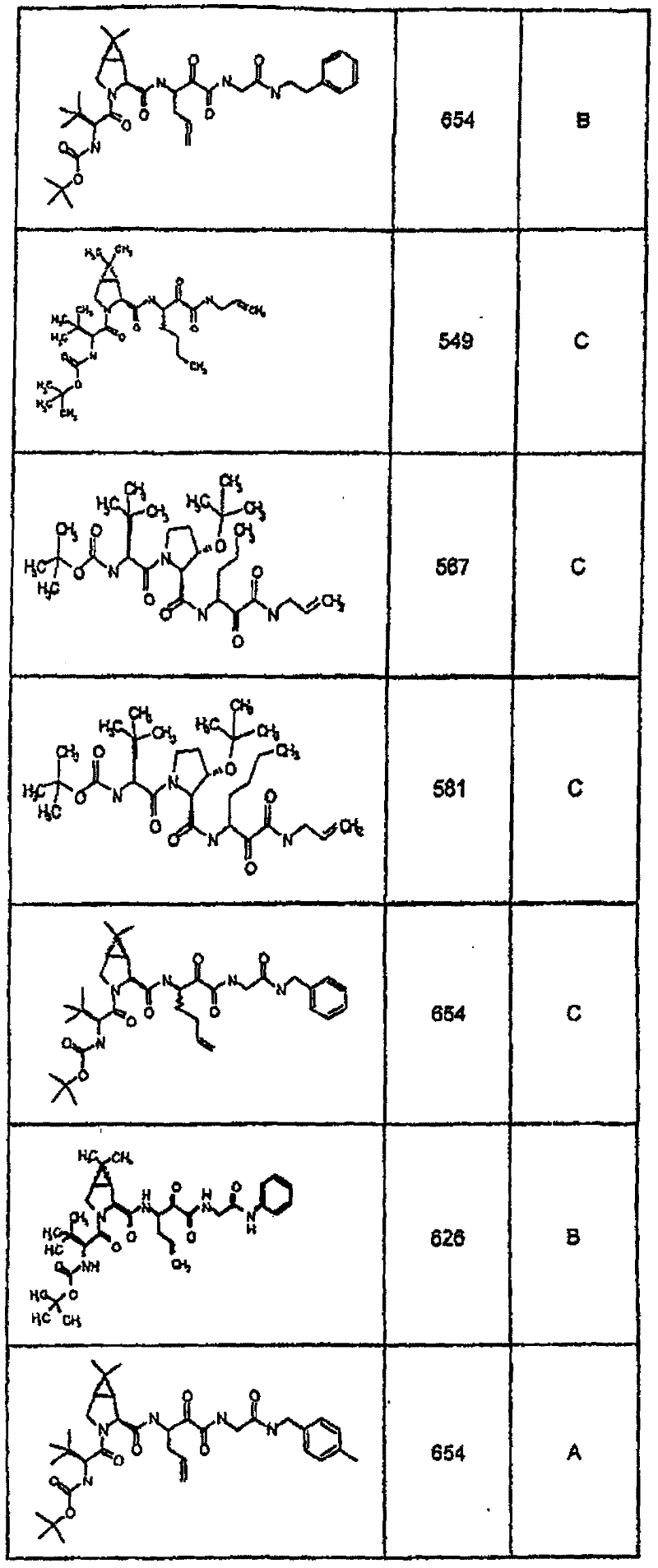


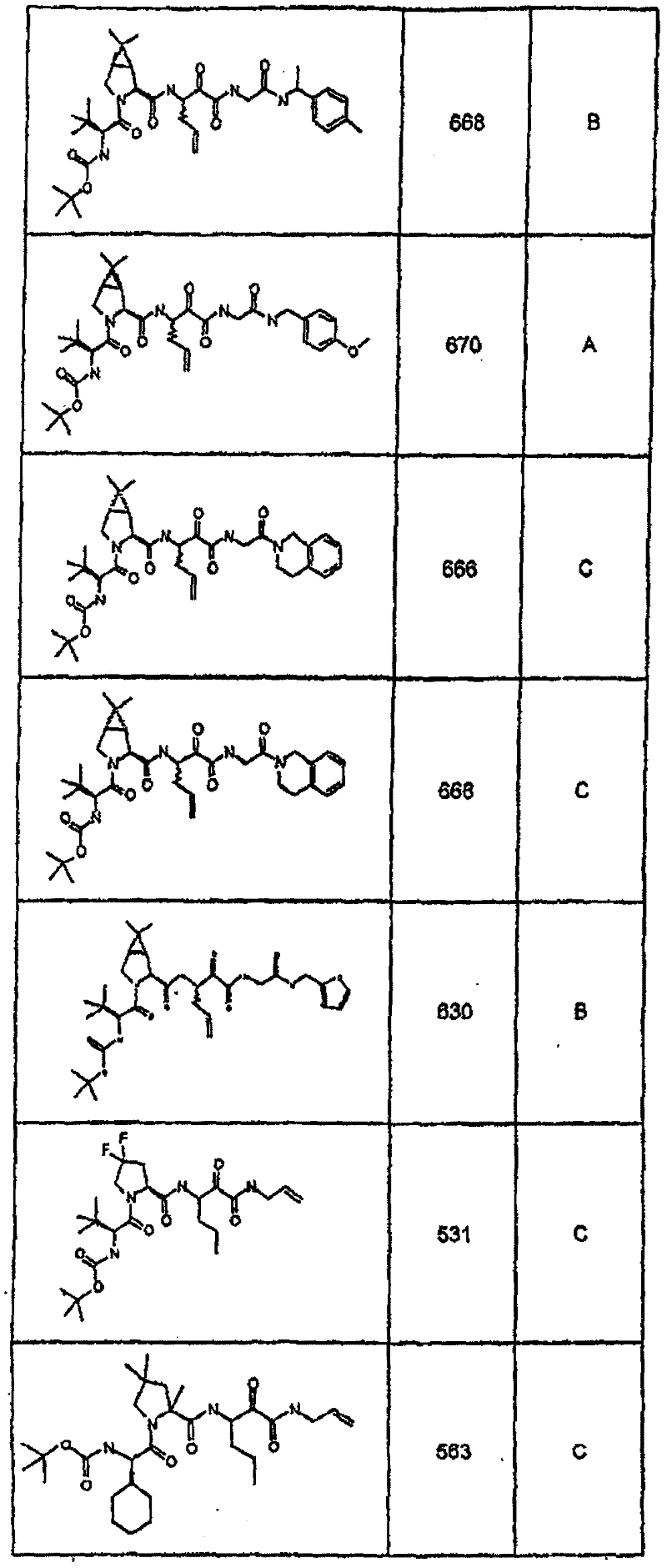
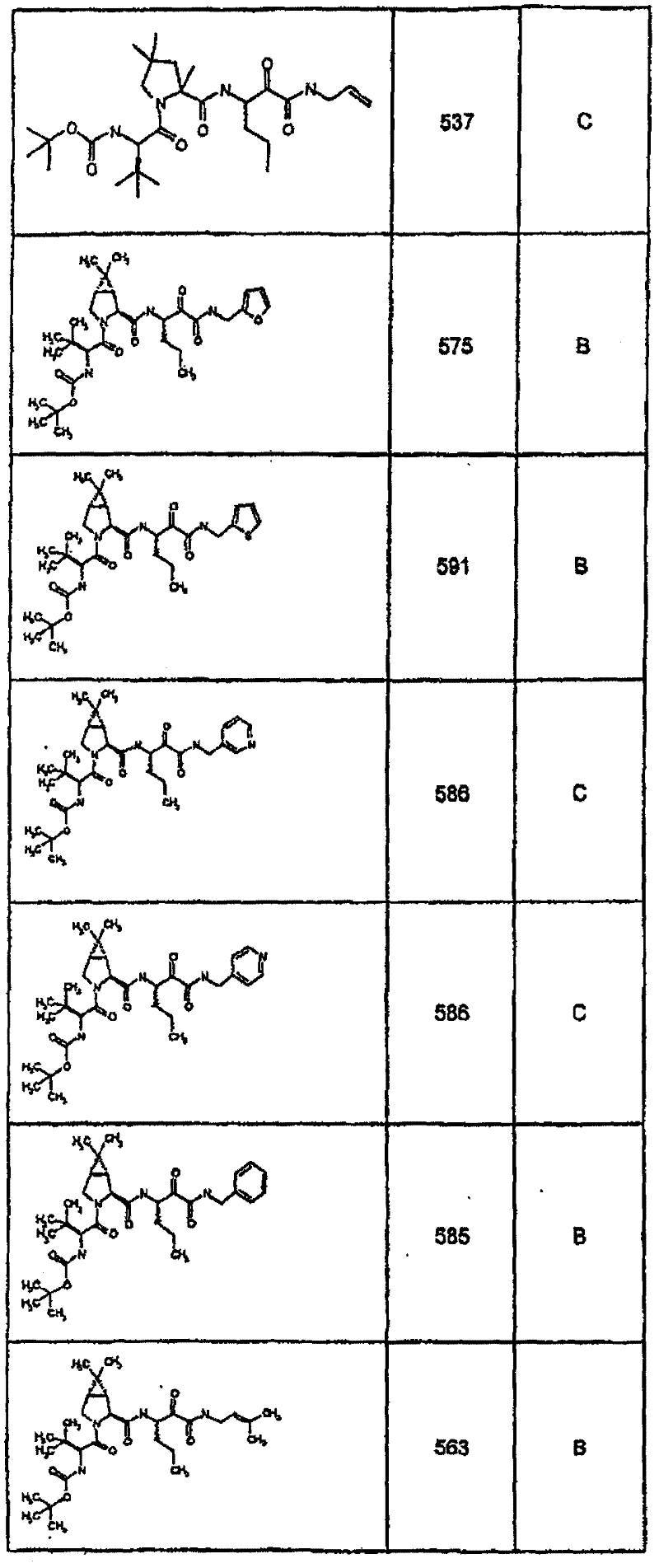

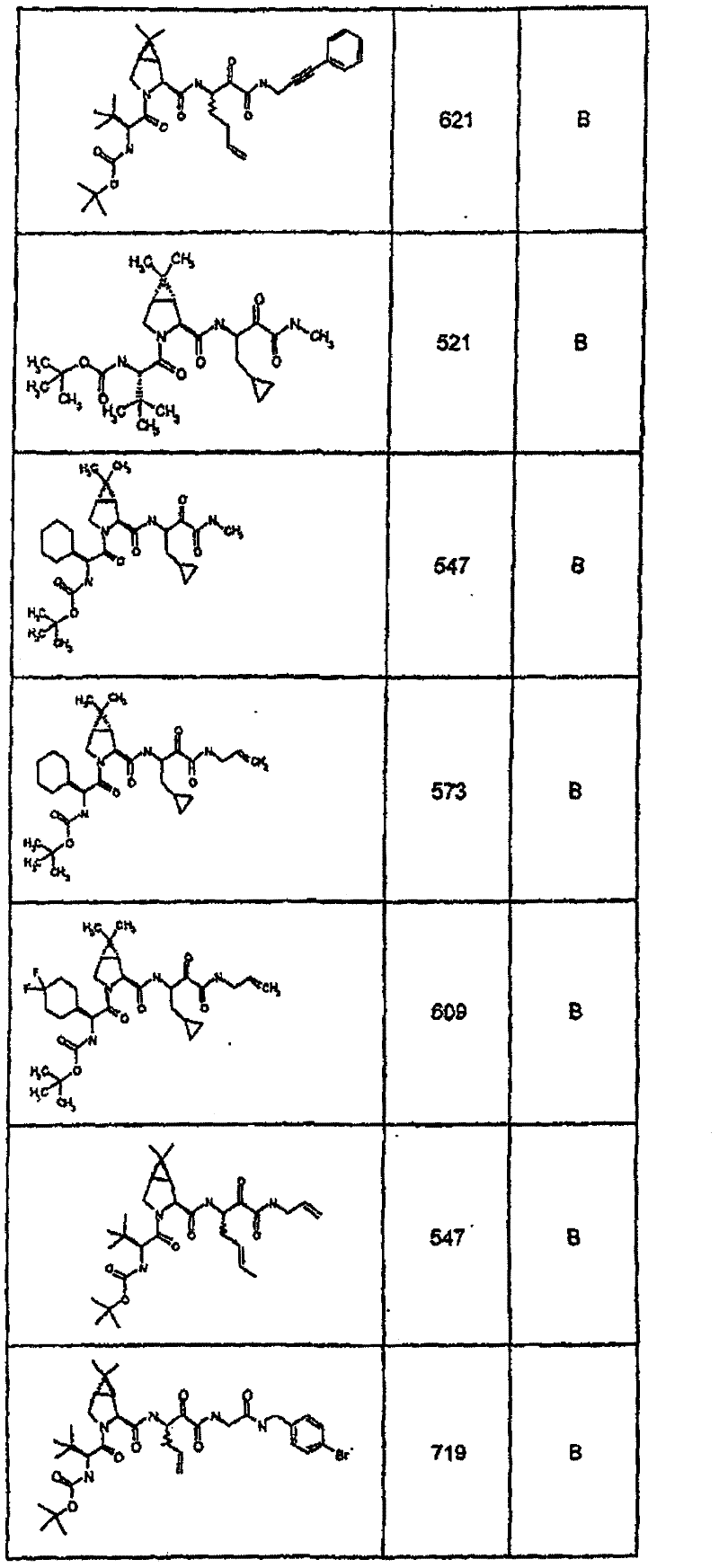


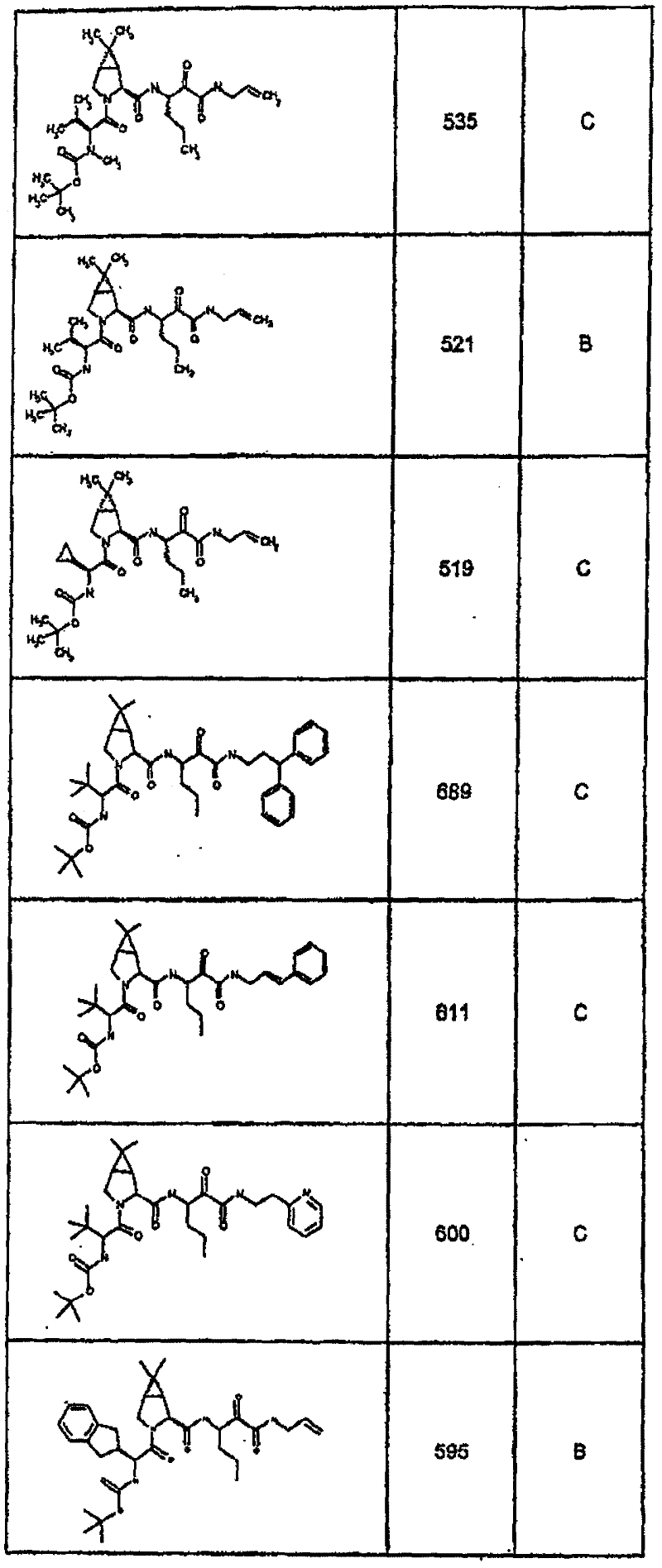

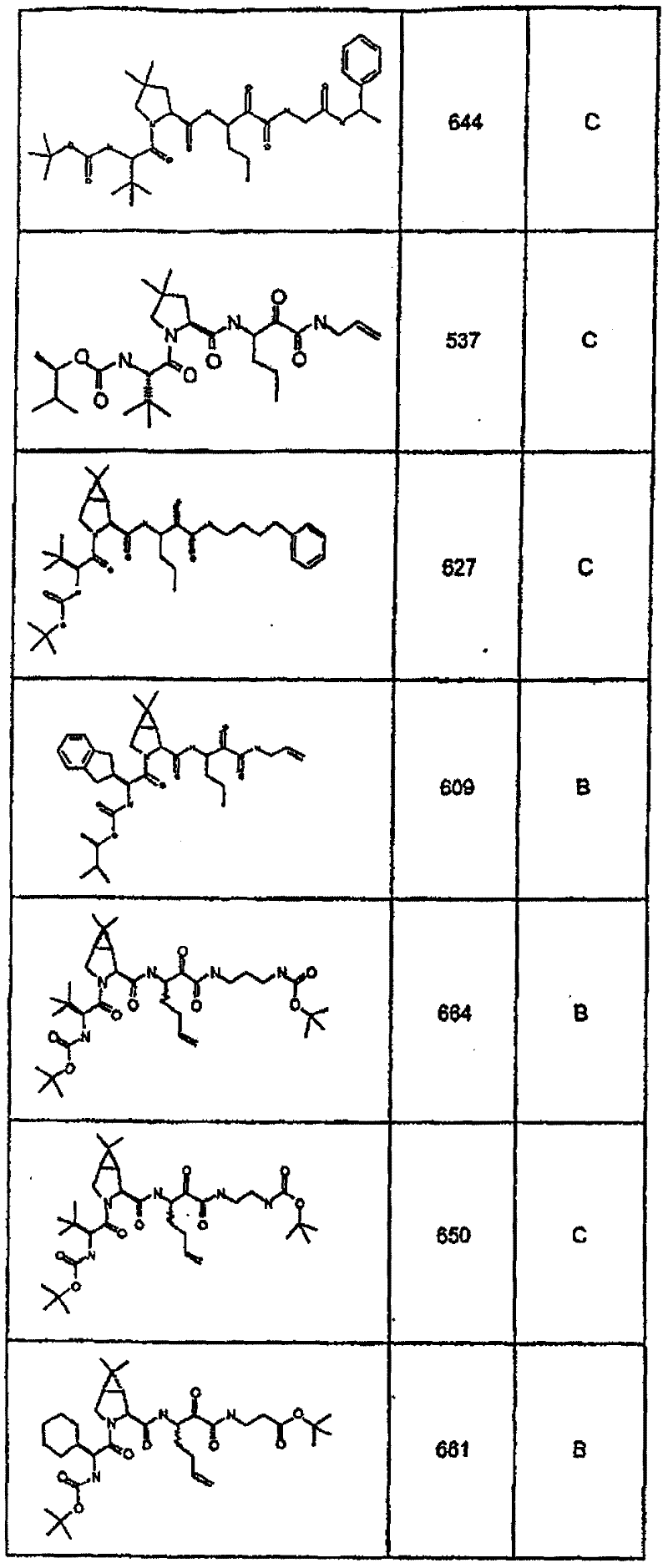


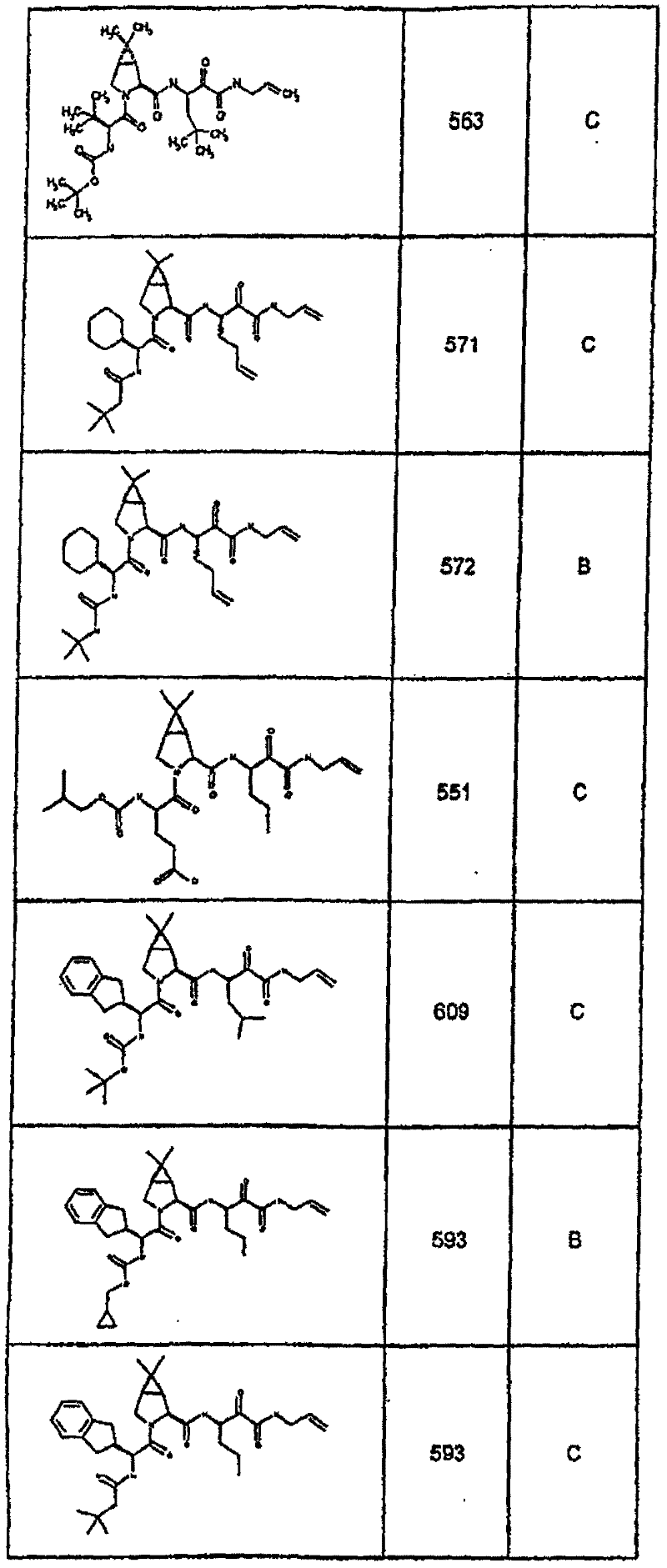


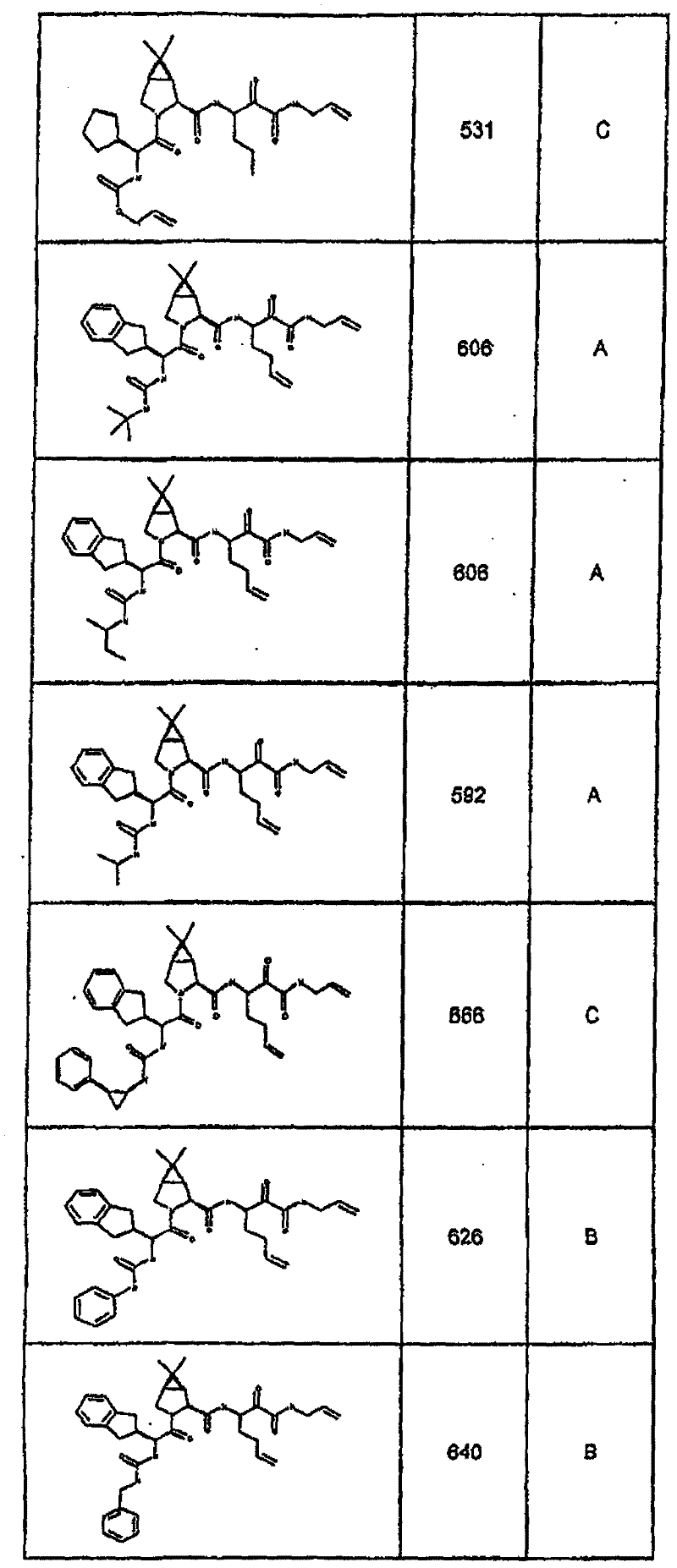
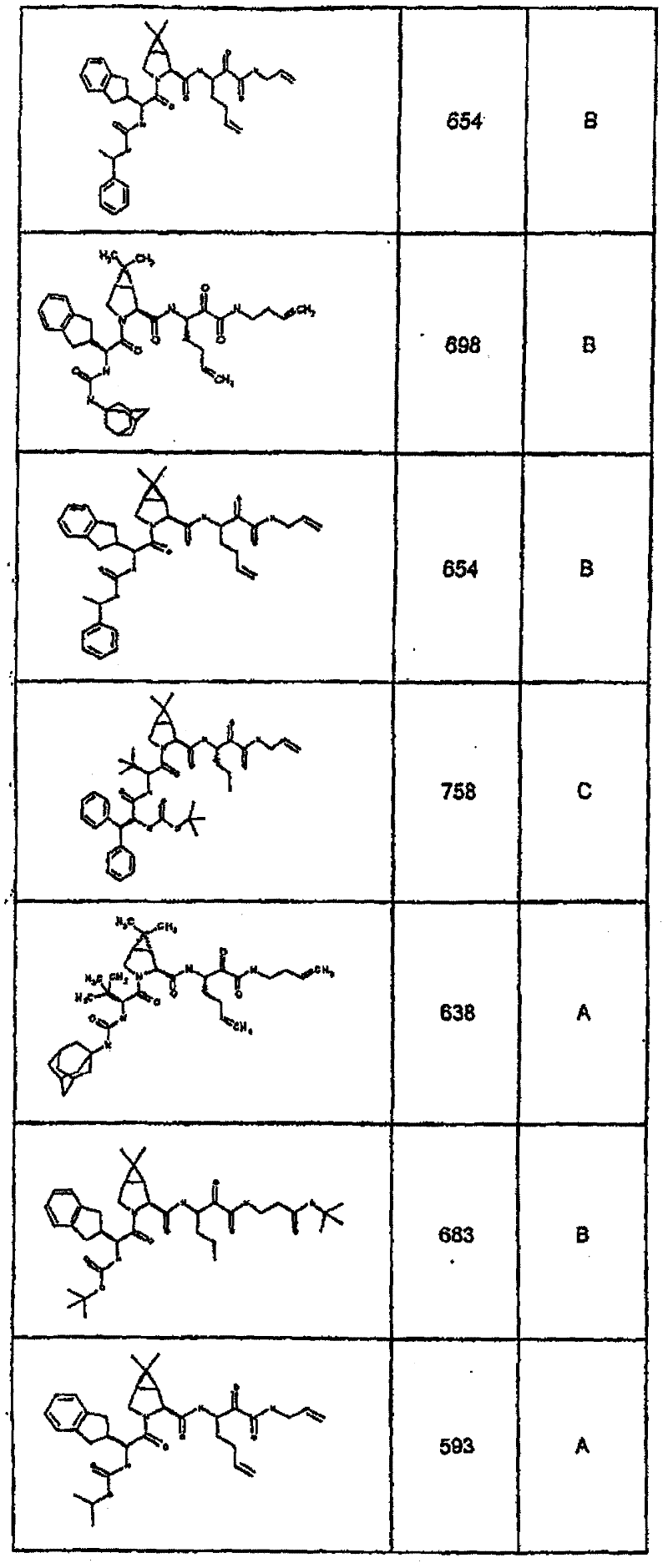


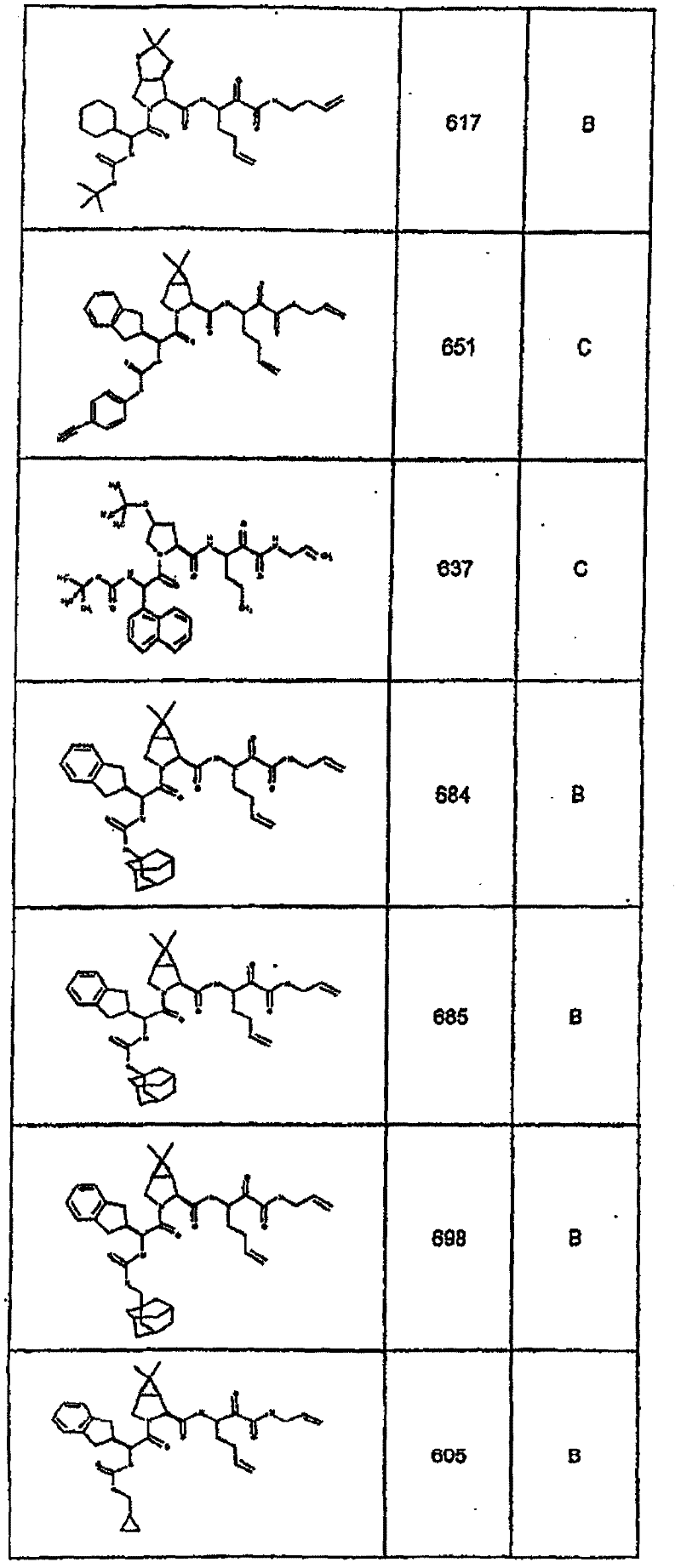


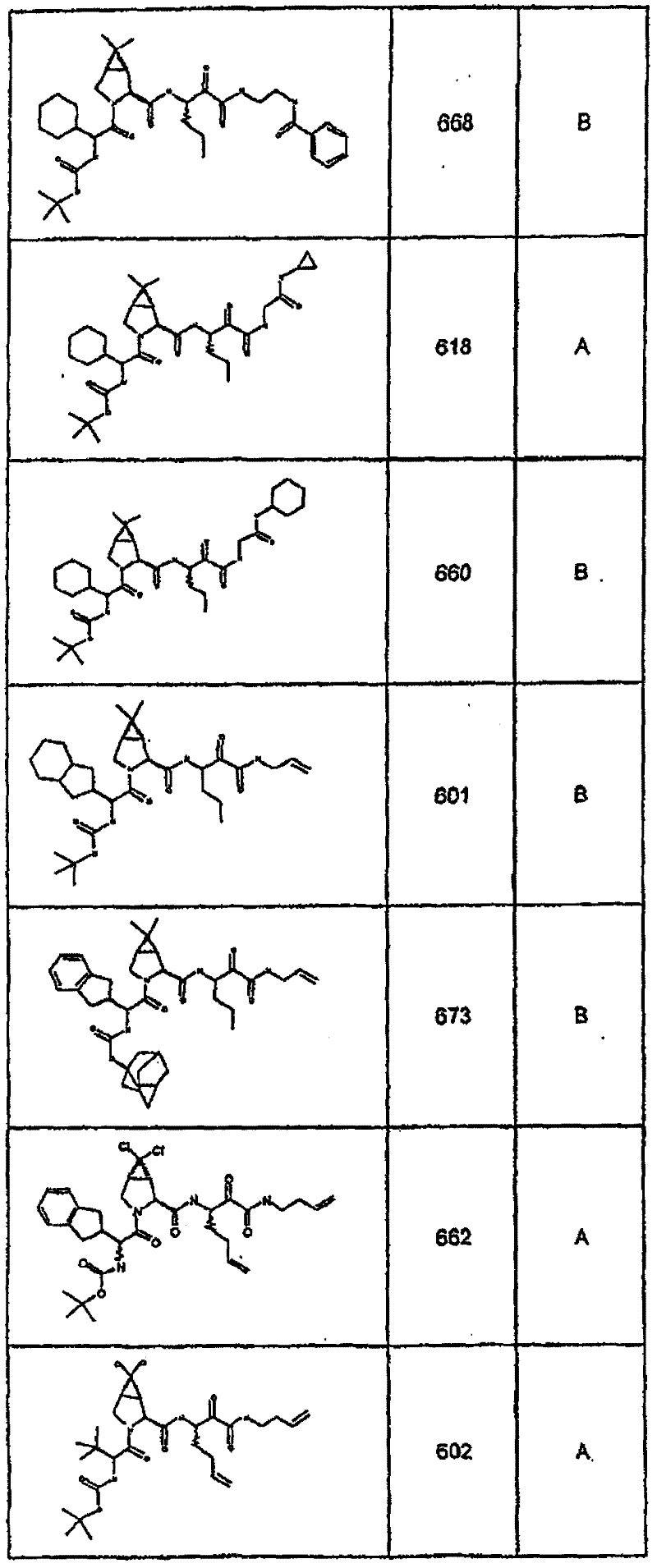
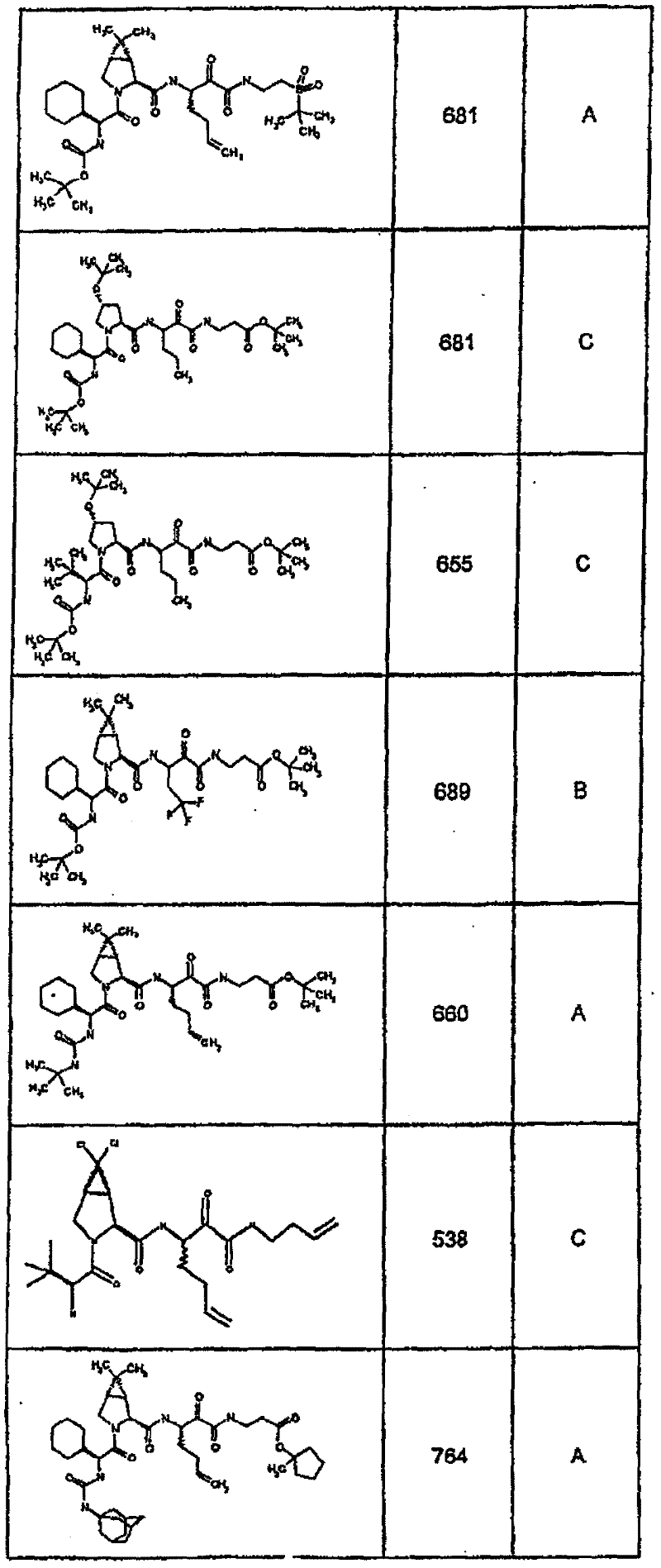
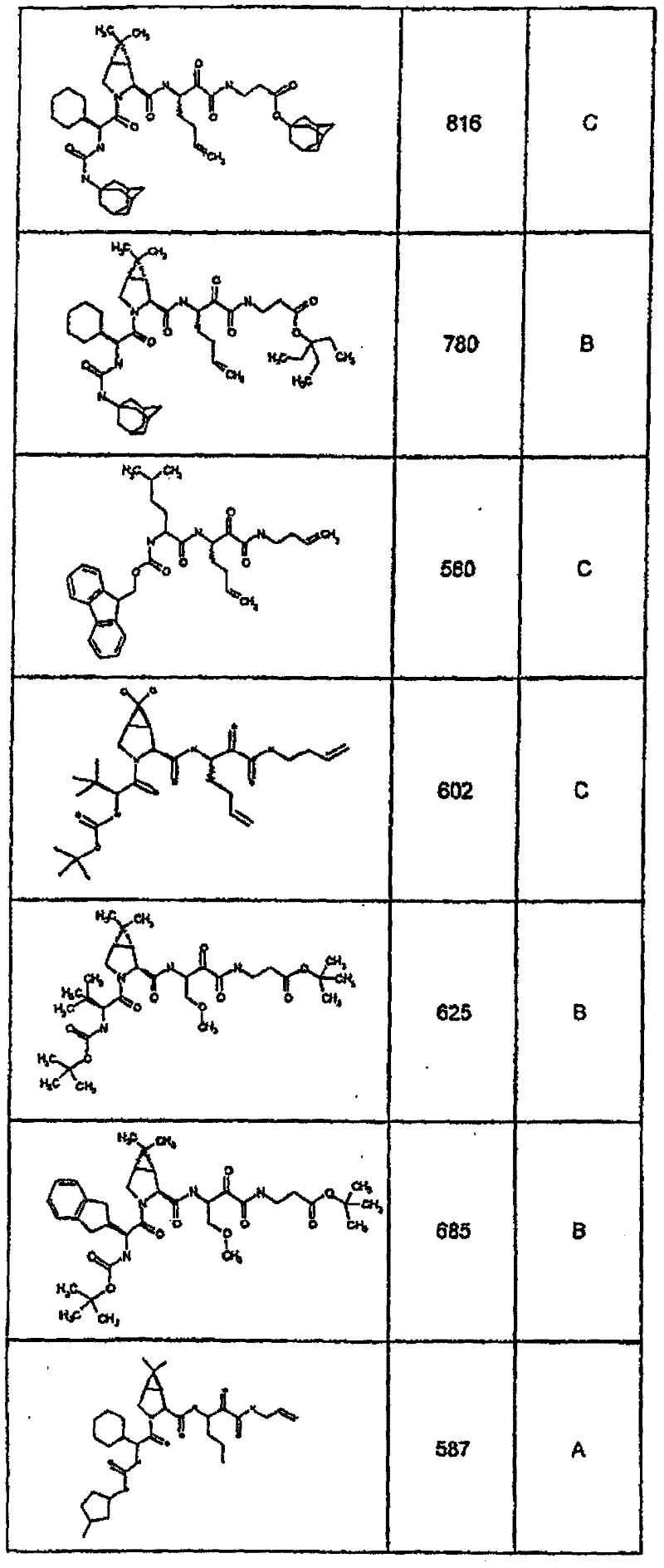

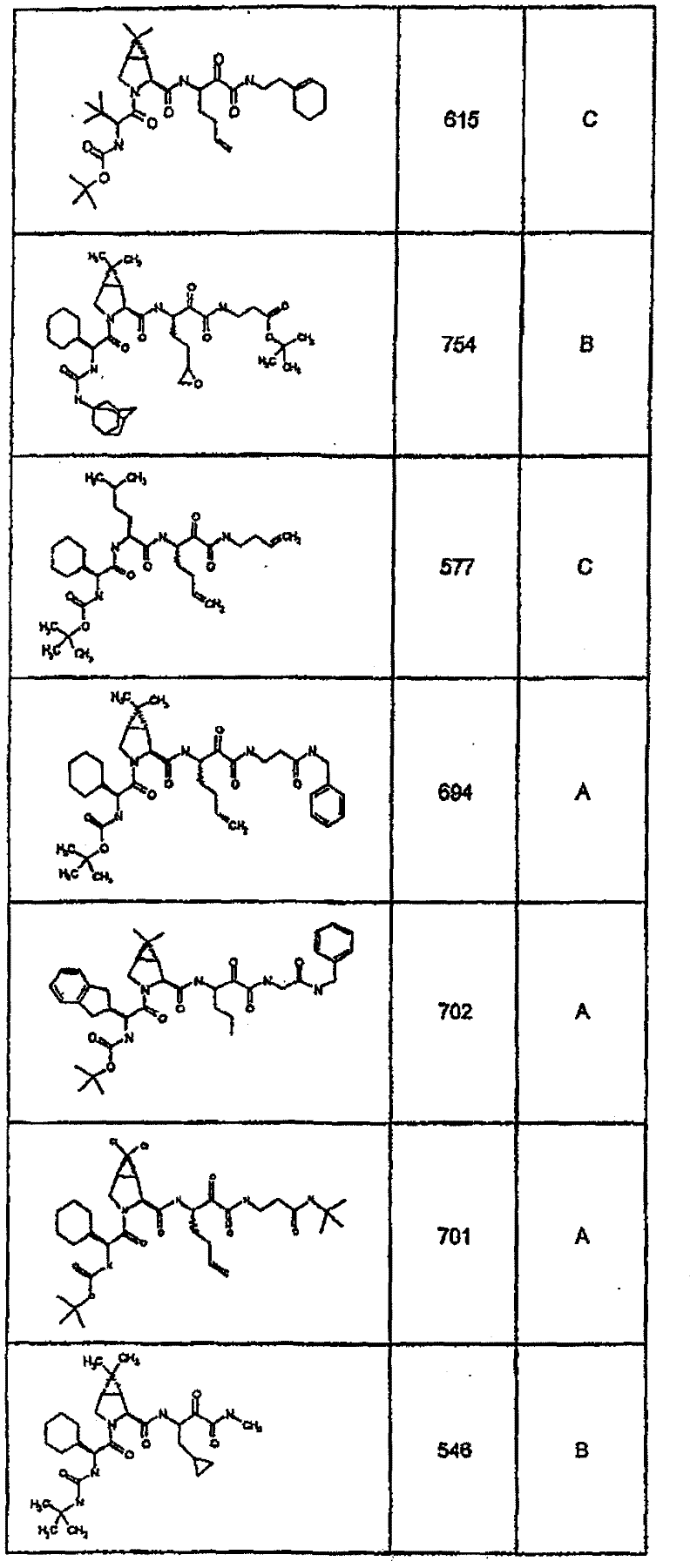
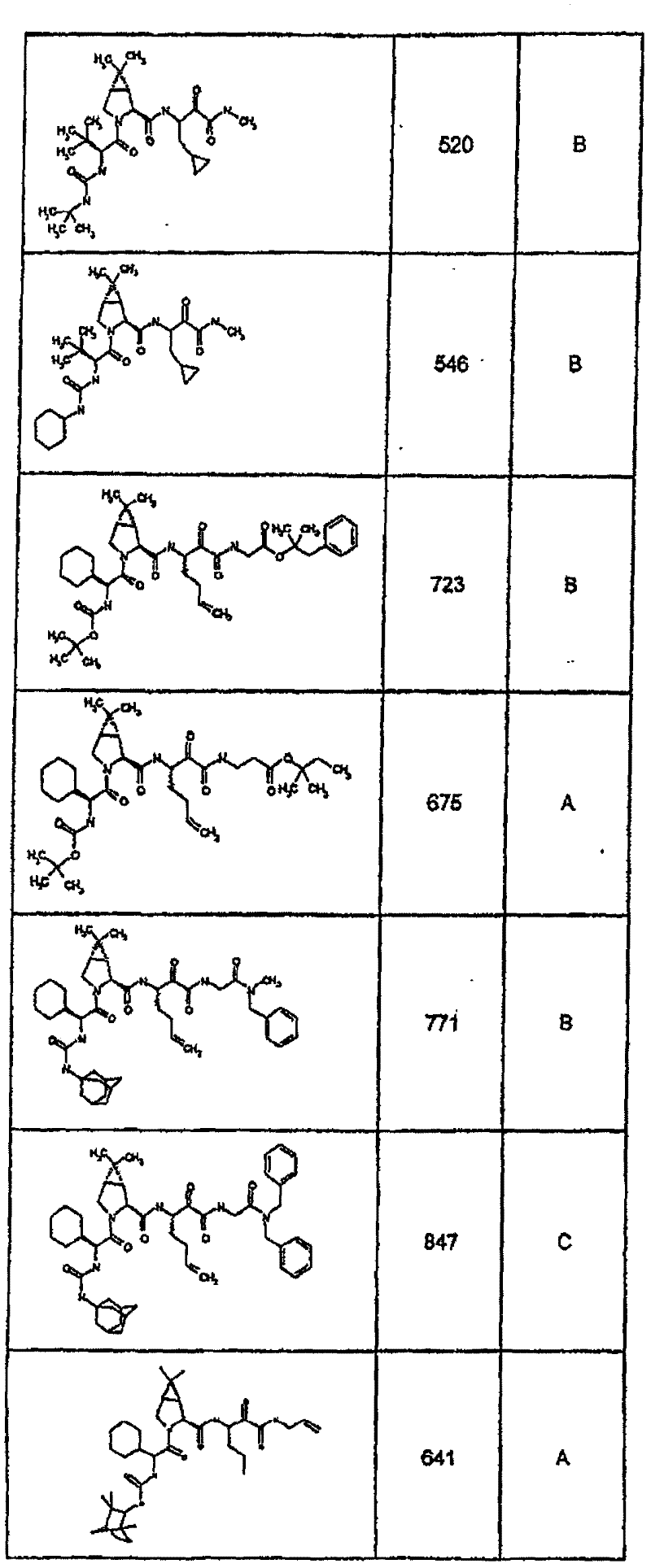


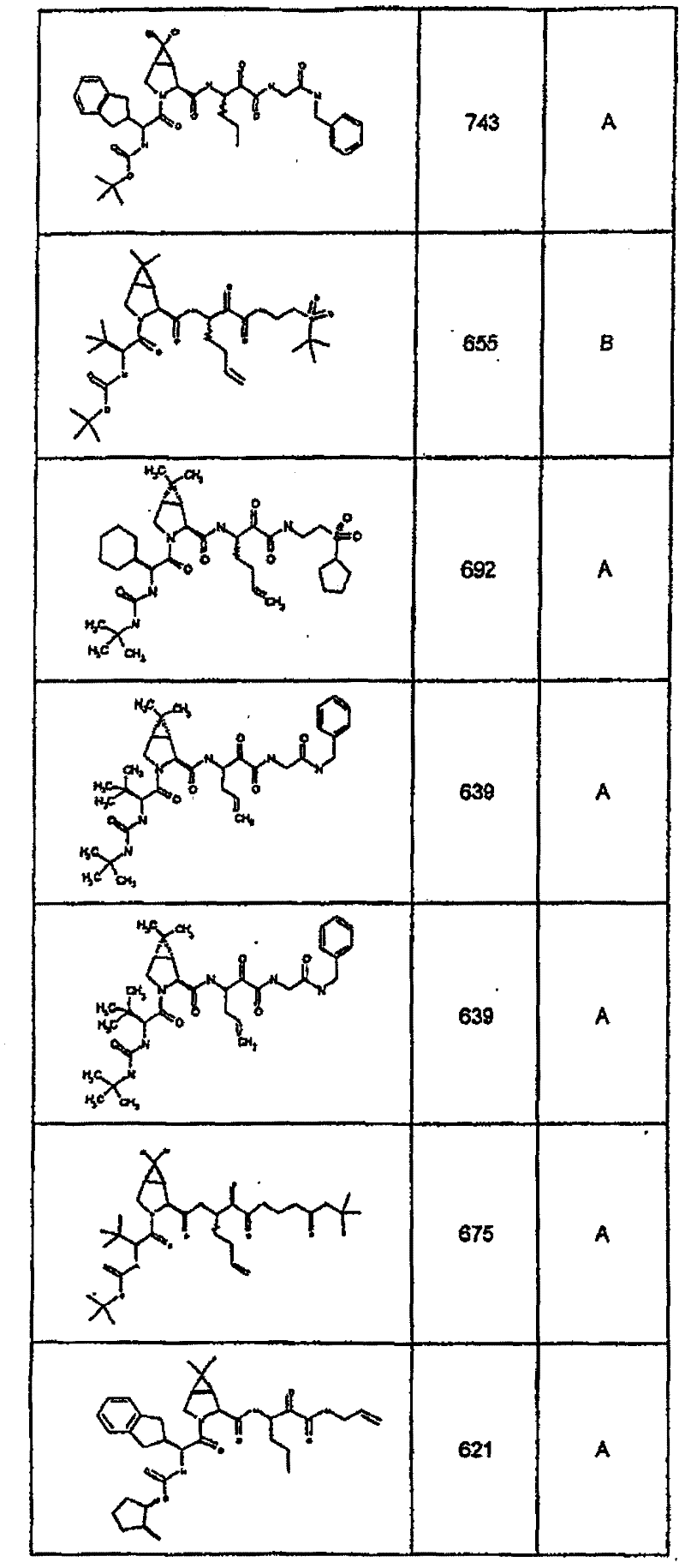


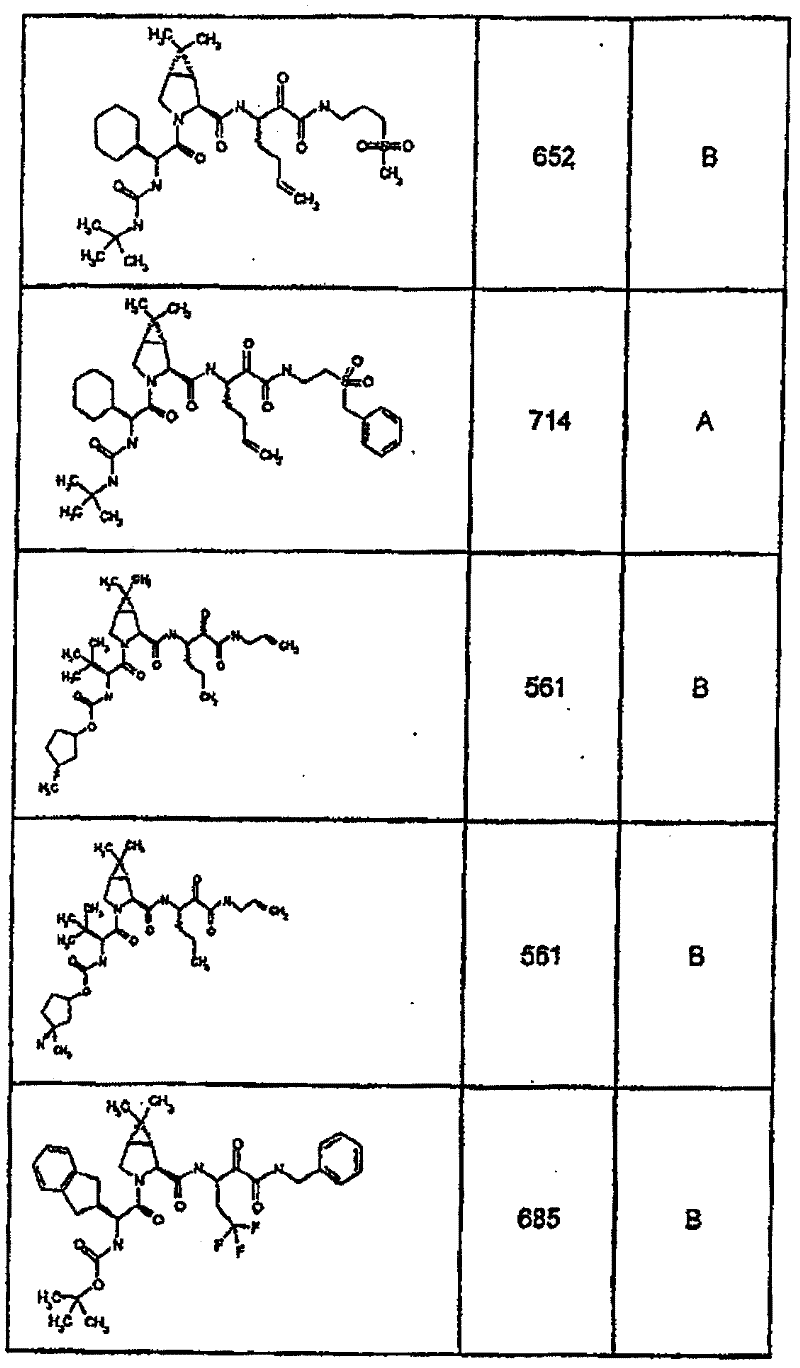

Claims (1)
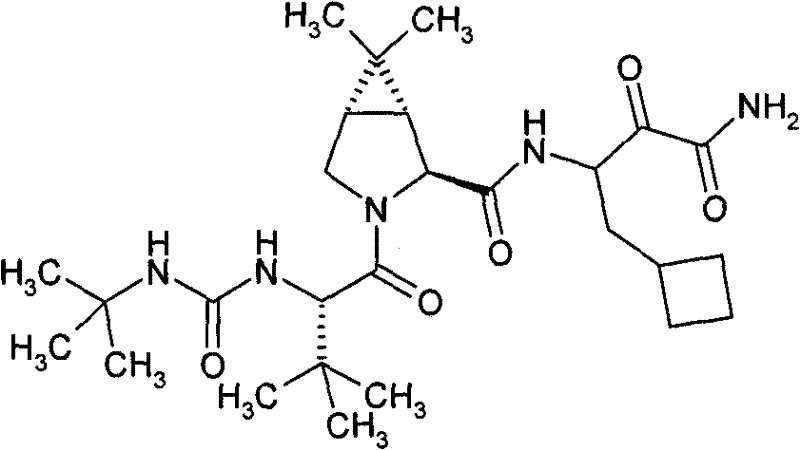
Applications Claiming Priority (2)
| Application Number | Priority Date | Filing Date | Title |
|---|---|---|---|
| US22010800P | 2000-07-21 | 2000-07-21 | |
| US60/220108 | 2000-07-21 |
Related Parent Applications (1)
| Application Number | Title | Priority Date | Filing Date |
|---|---|---|---|
| CNA018131115A Division CN1498224A (en) | 2000-07-21 | 2001-07-19 | Novel peptides as inhibitors of hepatitis C virus NS 3-serine protease |
Publications (1)
| Publication Number | Publication Date |
|---|---|
| CN102372764A true CN102372764A (en) | 2012-03-14 |
Family
ID=22822095
Family Applications (3)
| Application Number | Title | Priority Date | Filing Date |
|---|---|---|---|
| CN2011100651916A Expired - Fee Related CN102206247B (en) | 2000-07-21 | 2001-07-19 | Novel peptides as NS3/NS4a serine protease inhibitors of hepatitis C virus |
| CN2011102287110A Pending CN102372764A (en) | 2000-07-21 | 2001-07-19 | Novel peptides as NS3-serine protease inhibitors of hepatitis c virus |
| CNA018131115A Pending CN1498224A (en) | 2000-07-21 | 2001-07-19 | Novel peptides as inhibitors of hepatitis C virus NS 3-serine protease |
Family Applications Before (1)
| Application Number | Title | Priority Date | Filing Date |
|---|---|---|---|
| CN2011100651916A Expired - Fee Related CN102206247B (en) | 2000-07-21 | 2001-07-19 | Novel peptides as NS3/NS4a serine protease inhibitors of hepatitis C virus |
Family Applications After (1)
| Application Number | Title | Priority Date | Filing Date |
|---|---|---|---|
| CNA018131115A Pending CN1498224A (en) | 2000-07-21 | 2001-07-19 | Novel peptides as inhibitors of hepatitis C virus NS 3-serine protease |
Country Status (31)
| Country | Link |
|---|---|
| US (4) | US7012066B2 (en) |
| EP (1) | EP1385870B1 (en) |
| JP (3) | JP4298289B2 (en) |
| KR (2) | KR100904788B1 (en) |
| CN (3) | CN102206247B (en) |
| AR (2) | AR033985A1 (en) |
| AT (1) | ATE461207T1 (en) |
| AU (2) | AU2001276988B2 (en) |
| BR (1) | BR0112540A (en) |
| CA (1) | CA2410662C (en) |
| CY (2) | CY1112267T1 (en) |
| CZ (1) | CZ303213B6 (en) |
| DE (2) | DE60141608D1 (en) |
| DK (1) | DK1385870T3 (en) |
| EC (1) | ECSP034438A (en) |
| ES (1) | ES2341534T3 (en) |
| HU (1) | HU229997B1 (en) |
| IL (2) | IL153670A0 (en) |
| LU (1) | LU91910I2 (en) |
| MX (1) | MXPA03000627A (en) |
| MY (2) | MY143322A (en) |
| NO (2) | NO332329B1 (en) |
| NZ (1) | NZ523782A (en) |
| PL (1) | PL206255B1 (en) |
| PT (1) | PT1385870E (en) |
| RU (2) | RU2355700C9 (en) |
| SI (1) | SI1385870T1 (en) |
| SK (1) | SK288064B6 (en) |
| TW (1) | TWI324611B (en) |
| WO (1) | WO2002008244A2 (en) |
| ZA (1) | ZA200210312B (en) |
Families Citing this family (274)
| Publication number | Priority date | Publication date | Assignee | Title |
|---|---|---|---|---|
| UA66767C2 (en) | 1996-10-18 | 2004-06-15 | Вертекс Фармасьютикалс Інкорпорейтед | Serine proteases inhibitors, pharmaceutical composition, a method for inhibitining activity and a method for treatment or prevention of viral infection of hepatitis c |
| US6608027B1 (en) | 1999-04-06 | 2003-08-19 | Boehringer Ingelheim (Canada) Ltd | Macrocyclic peptides active against the hepatitis C virus |
| PE20011350A1 (en) | 2000-05-19 | 2002-01-15 | Vertex Pharma | PROPHARMAC OF AN INHIBITOR OF INTERLEUKIN-1ß CONVERTER ENZYME (ICE) |
| CN102206247B (en) * | 2000-07-21 | 2013-03-27 | 默沙东公司 | Novel peptides as NS3/NS4a serine protease inhibitors of hepatitis C virus |
| US7244721B2 (en) * | 2000-07-21 | 2007-07-17 | Schering Corporation | Peptides as NS3-serine protease inhibitors of hepatitis C virus |
| SV2003000617A (en) * | 2000-08-31 | 2003-01-13 | Lilly Co Eli | INHIBITORS OF PROTEASA PEPTIDOMIMETICA REF. X-14912M |
| US7473691B2 (en) | 2000-09-15 | 2009-01-06 | Vertex Pharmaceuticals Incorporated | Pyrazole compounds useful as protein kinase inhibitors |
| US6660731B2 (en) | 2000-09-15 | 2003-12-09 | Vertex Pharmaceuticals Incorporated | Pyrazole compounds useful as protein kinase inhibitors |
| ES2242771T5 (en) | 2000-09-15 | 2011-10-14 | Vertex Pharmaceuticals Incorporated | PIRAZOL COMPOUNDS USEFUL AS PROTEIN QUINASE INHIBITORS. |
| GB2367816A (en) * | 2000-10-09 | 2002-04-17 | Bayer Ag | Urea- and thiourea-containing derivatives of beta-amino acids |
| WO2002048172A2 (en) * | 2000-12-12 | 2002-06-20 | Schering Corporation | Diaryl peptides as ns3-serine protease inhibitors of hepatits c virus |
| CN102250071A (en) | 2000-12-21 | 2011-11-23 | 沃泰克斯药物股份有限公司 | Pyrazole compounds useful as protein kinase inhibitors |
| WO2003006490A1 (en) | 2001-07-11 | 2003-01-23 | Vertex Pharmaceuticals Incorporated | Bridged bicyclic serine protease inhibitors |
| JP4460294B2 (en) | 2001-10-24 | 2010-05-12 | バーテックス ファーマシューティカルズ インコーポレイテッド | Inhibitors of serine proteases, particularly hepatitis C virus NS3-NS4A protease, incorporating a condensed ring system |
| EP1467989B1 (en) * | 2002-01-23 | 2009-09-23 | Schering Corporation | Proline compounds as ns3-serine protease inhibitors for use in treatment of hepatitis c virus infection |
| US7119072B2 (en) | 2002-01-30 | 2006-10-10 | Boehringer Ingelheim (Canada) Ltd. | Macrocyclic peptides active against the hepatitis C virus |
| US7091184B2 (en) | 2002-02-01 | 2006-08-15 | Boehringer Ingelheim International Gmbh | Hepatitis C inhibitor tri-peptides |
| US6642204B2 (en) | 2002-02-01 | 2003-11-04 | Boehringer Ingelheim International Gmbh | Hepatitis C inhibitor tri-peptides |
| MXPA04009938A (en) * | 2002-04-11 | 2004-12-13 | Vertex Pharma | Inhibitors of serine proteases, particularly hepatitis c virus ns3 - ns4 protease. |
| MY140680A (en) | 2002-05-20 | 2010-01-15 | Bristol Myers Squibb Co | Hepatitis c virus inhibitors |
| MY141867A (en) | 2002-06-20 | 2010-07-16 | Vertex Pharma | Substituted pyrimidines useful as protein kinase inhibitors |
| US20050075279A1 (en) | 2002-10-25 | 2005-04-07 | Boehringer Ingelheim International Gmbh | Macrocyclic peptides active against the hepatitis C virus |
| AU2011203054B2 (en) * | 2003-04-11 | 2012-04-26 | Vertex Pharmaceuticals, Incorporated | Inhibitors of Serine Proteases, Particularly HCV NS3-NS4A Protease |
| US20050090450A1 (en) * | 2003-04-11 | 2005-04-28 | Farmer Luc J. | Inhibitors of serine proteases, particularly HCV NS3-NS4A protease |
| ES2297424T3 (en) * | 2003-05-21 | 2008-05-01 | Boehringer Ingelheim International Gmbh | INHIBITING COMPOUNDS OF HEPATITIS C. |
| EP1633711B1 (en) * | 2003-06-17 | 2010-11-24 | Schering Corporation | Process and intermediates for the preparation of (1r,2s,5s)-6,6-dimethyl-3-azabicyclo[3,1,0]hexane-2-carboxylates or salts thereof |
| AR044694A1 (en) * | 2003-06-17 | 2005-09-21 | Schering Corp | PROCESS AND INTERMEDIATE COMPOUNDS FOR THE PREPARATION OF (1R, 2S, 5S) - 3 AZABICICLO [3,1,0] HEXANO-2- CARBOXAMIDE, N- [3- AMINO-1- (CYCLLOBUTILMETILE) - 2, 3 - DIOXOPROPIL] -3- [(2S) - 2 - [[[1,1- DIMETHYTILE] AMINO] CARBONYLAMINE] -3,3-DIMETHYL -1- OXOBUTIL] -6.6 DIMETHYL |
| JP4823899B2 (en) * | 2003-06-17 | 2011-11-24 | シェーリング コーポレイション | Process and intermediate for the preparation of 3- (amino) -3-cyclobutylmethyl-2-hydroxy-propionamide or a salt thereof |
| NZ544789A (en) | 2003-07-18 | 2010-01-29 | Vertex Pharma | Dithia-azaspiro-nonane and decane derivatives as inhibitors of serine proteases |
| US7449447B2 (en) | 2003-08-26 | 2008-11-11 | Schering Corporation | Peptidomimetic NS3-serine protease inhibitors of hepatitis C virus |
| AR045596A1 (en) | 2003-09-05 | 2005-11-02 | Vertex Pharma | INHIBITORS OF SERINE PROTEASES IN PARTICULAR HCV PROTEASA NS3-NS4A |
| AU2004274468B2 (en) * | 2003-09-18 | 2009-07-23 | Vertex Pharmaceuticals, Incorporated | Inhibitors of serine proteases, particularly HCV NS3-NS4A protease |
| DE602004031645D1 (en) | 2003-09-22 | 2011-04-14 | Boehringer Ingelheim Pharma | MACROCYCLIC PEPTIDES WITH EFFECT AGAINST HEPATITIS C VIRUS |
| DE602004031298D1 (en) | 2003-09-26 | 2011-03-17 | Schering Corp | MACROCYCLIC INHIBITORS OF THE NS3 SERINE PROTEASE OF HEPATITIS C VIRUS |
| MXPA06004006A (en) * | 2003-10-10 | 2006-06-28 | Vertex Pharma | Inhibitors of serine proteases, particularly hcv ns3-ns4a protease. |
| US7491794B2 (en) * | 2003-10-14 | 2009-02-17 | Intermune, Inc. | Macrocyclic compounds as inhibitors of viral replication |
| WO2005043118A2 (en) | 2003-10-27 | 2005-05-12 | Vertex Pharmaceuticals Incorporated | Drug discovery method |
| CA2551074A1 (en) | 2003-10-27 | 2005-05-12 | Vertex Pharmaceuticals Incorporated | Hcv ns3-ns4a protease resistance mutants |
| EP1944042A1 (en) | 2003-10-27 | 2008-07-16 | Vertex Pharmceuticals Incorporated | Combinations for HCV treatment |
| WO2005051980A1 (en) | 2003-11-20 | 2005-06-09 | Schering Corporation | Depeptidized inhibitors of hepatitis c virus ns3 protease |
| RU2006124594A (en) * | 2003-12-11 | 2008-01-27 | Шеринг Корпорейшн (US) | NSA / NS4A SERINE PROTEASE INHIBITORS HEPATITIS C VIRUS |
| EP1730167B1 (en) | 2004-01-21 | 2011-01-12 | Boehringer Ingelheim International GmbH | Macrocyclic peptides active against the hepatitis c virus |
| CA2552319C (en) * | 2004-01-30 | 2012-08-21 | Medivir Ab | Hcv ns-3 serine protease inhibitors |
| EP1711515A2 (en) * | 2004-02-04 | 2006-10-18 | Vertex Pharmaceuticals Incorporated | Inhibitors of serine proteases, particularly hcv ns3-ns4a protease |
| DE602005013922D1 (en) | 2004-02-24 | 2009-05-28 | Japan Tobacco Inc | CONDENSED HETEROTETRACYCLIC COMPOUNDS AND THEIR USE AS HCV POLYMERASE INHIBITOR |
| US20070049593A1 (en) | 2004-02-24 | 2007-03-01 | Japan Tobacco Inc. | Tetracyclic fused heterocyclic compound and use thereof as HCV polymerase inhibitor |
| EP1737881B1 (en) | 2004-02-27 | 2009-06-24 | Schering Corporation | Novel compounds as inhibitors of hepatitis c virus ns3 serine protease |
| US7205330B2 (en) | 2004-02-27 | 2007-04-17 | Schering Corporation | Inhibitors of hepatitis C virus NS3 protease |
| US7635694B2 (en) | 2004-02-27 | 2009-12-22 | Schering Corporation | Cyclobutenedione-containing compounds as inhibitors of hepatitis C virus NS3 serine protease |
| CA2557301A1 (en) * | 2004-02-27 | 2005-09-15 | Schering Corporation | Cyclobutenedione groups-containing compounds as inhibitors of hepatitis c virus ns3 serine protease |
| US7816326B2 (en) | 2004-02-27 | 2010-10-19 | Schering Corporation | Sulfur compounds as inhibitors of hepatitis C virus NS3 serine protease |
| US7192957B2 (en) | 2004-02-27 | 2007-03-20 | Schering Corporation | Compounds as inhibitors of hepatitis C virus NS3 serine protease |
| DE602005021760D1 (en) * | 2004-02-27 | 2010-07-22 | Schering Corp | SULFUR COMPOUNDS AS INHIBITORS OF THE NS3 SERINE PROTEASE OF HEPATITIS C VIRUS |
| EP1737821B1 (en) | 2004-02-27 | 2009-08-05 | Schering Corporation | 3,4-(cyclopentyl)-fused proline compounds as inhibitors of hepatitis c virus ns3 serine protease |
| JP4874227B2 (en) * | 2004-02-27 | 2012-02-15 | シェーリング コーポレイション | Novel ketoamide with cyclic P4'S as NS3 serine protease inhibitor of hepatitis C virus |
| JP4898658B2 (en) * | 2004-03-12 | 2012-03-21 | バーテックス ファーマシューティカルズ インコーポレイテッド | Methods and intermediates for the preparation of aspartate acetal caspase inhibitors |
| PE20060309A1 (en) * | 2004-05-06 | 2006-04-13 | Schering Corp | (1R, 2S, 5S) -N - [(1S) -3-AMINO-1- (CYCLOBUTYLMETHYL) -2,3-DIOXOPROPYL] -3 - [(2S) -2 [[[(1,1-DIMETHYLETHYL) AMINO] CARBONYL] AMINO] -3,3-DIMETHYL-1-OXOBUTIL] -6,6-DIMETHYL-3-AZABICYCLO [3.1.O] HEXAN-2-CARBOXAMIDE AS INHIBITOR OF NS3 / NS4A SERINE PROTEASE OF L VIRUS |
| EP1773868B1 (en) * | 2004-05-20 | 2009-07-15 | Schering Corporation | Substituted prolines as inhibitors of hepatitis c virus ns3 serine protease |
| UY29016A1 (en) | 2004-07-20 | 2006-02-24 | Boehringer Ingelheim Int | ANALOGS OF INHIBITING DIPEPTIDES OF HEPATITIS C |
| JP4914355B2 (en) | 2004-07-20 | 2012-04-11 | ベーリンガー インゲルハイム インターナショナル ゲゼルシャフト ミット ベシュレンクテル ハフツング | Hepatitis C inhibitor peptide analog |
| MX2007002371A (en) | 2004-08-27 | 2007-04-23 | Schering Corp | Acylsulfonamide compounds as inhibitors of hepatitis c virus ns3 serine protease. |
| PT1802650E (en) * | 2004-10-01 | 2011-12-30 | Scynexis Inc | 3-ether and 3-thioether substituted cyclosporin derivatives for the treatment and prevention of hepatitis c infection |
| EP1804821A4 (en) | 2004-10-01 | 2009-07-15 | Vertex Pharma | Hcv ns3-ns4a protease inhibition |
| US7196161B2 (en) * | 2004-10-01 | 2007-03-27 | Scynexis Inc. | 3-ether and 3-thioether substituted cyclosporin derivatives for the treatment and prevention of hepatitis C infection |
| US7659263B2 (en) | 2004-11-12 | 2010-02-09 | Japan Tobacco Inc. | Thienopyrrole compound and use thereof as HCV polymerase inhibitor |
| GB0426661D0 (en) * | 2004-12-06 | 2005-01-05 | Isis Innovation | Pyrrolidine compounds |
| WO2006130626A2 (en) * | 2005-06-02 | 2006-12-07 | Schering Corporation | Method for modulating activity of hcv protease through use of a novel hcv protease inhibitor to reduce duration of treatment period |
| AU2006252519B2 (en) * | 2005-06-02 | 2012-08-30 | Merck Sharp & Dohme Corp. | HCV protease inhibitors in combination with food |
| US20060276406A1 (en) * | 2005-06-02 | 2006-12-07 | Schering Corporation | Methods of treating hepatitis C virus |
| WO2006130627A2 (en) * | 2005-06-02 | 2006-12-07 | Schering Corporation | Methods for treating hepatitis c |
| US20070021351A1 (en) * | 2005-06-02 | 2007-01-25 | Schering Corporation | Liver/plasma concentration ratio for dosing hepatitis C virus protease inhibitor |
| US20060275366A1 (en) * | 2005-06-02 | 2006-12-07 | Schering Corporation | Controlled-release formulation |
| AU2006252623A1 (en) * | 2005-06-02 | 2006-12-07 | Schering Corporation | Controlled-release formulation useful for treating disorders associated with hepatitis C virus |
| ES2572980T3 (en) * | 2005-06-02 | 2016-06-03 | Merck Sharp & Dohme Corp. | Combination of HCV protease inhibitors with a surfactant |
| WO2006130554A2 (en) * | 2005-06-02 | 2006-12-07 | Schering Corporation | Methods of treating hepatitis c virus |
| US7608592B2 (en) * | 2005-06-30 | 2009-10-27 | Virobay, Inc. | HCV inhibitors |
| ZA200711069B (en) * | 2005-06-30 | 2009-03-25 | Virobay Inc | HCV inhibitors |
| US20110104109A1 (en) * | 2005-07-13 | 2011-05-05 | Frank Bennett | Tetracyclic indole derivatives and their use for treating or preventing viral infections |
| GEP20105124B (en) | 2005-07-25 | 2010-11-25 | Array Biopharma Inc | Novel macrocyclic inhibitors of hepatitis c virus replication |
| ME01318B (en) | 2005-07-29 | 2013-12-20 | Tibotec Pharm Ltd | Macrocylic inhibitors of hepatitis c virus |
| DK1913015T3 (en) | 2005-07-29 | 2014-03-10 | Janssen R & D Ireland | Macrocyclic inhibitors of hepatitis C virus |
| EP2256113A1 (en) * | 2005-08-02 | 2010-12-01 | Vertex Pharmaceuticals Incorporated | Inhibitors of serine proteases |
| US8399615B2 (en) | 2005-08-19 | 2013-03-19 | Vertex Pharmaceuticals Incorporated | Processes and intermediates |
| CN102382170A (en) | 2005-08-19 | 2012-03-21 | 弗特克斯药品有限公司 | Method for preparation of protease inhibitors and intermediates |
| US7964624B1 (en) | 2005-08-26 | 2011-06-21 | Vertex Pharmaceuticals Incorporated | Inhibitors of serine proteases |
| AR055395A1 (en) | 2005-08-26 | 2007-08-22 | Vertex Pharma | INHIBITING COMPOUNDS OF THE ACTIVITY OF SERINA PROTEASA NS3-NS4A OF HEPATITIS C VIRUS |
| NZ567262A (en) * | 2005-09-30 | 2011-12-22 | Scynexis Inc | Cyclosporin derivatives and their use for the treatment and prevention of hepatitis C infection |
| ATE498630T1 (en) * | 2005-09-30 | 2011-03-15 | Scynexis Inc | ARYLALKYL AND HETEROARYLALKYL DERIVATIVES OF CYCLOSPORIN A IN THE TREATMENT AND PREVENTION OF VIRUS INFECTION |
| CN101415705B (en) | 2005-10-11 | 2011-10-26 | 因特蒙公司 | Compounds and methods for inhibiting hepatitis c viral replication |
| AR056763A1 (en) | 2005-11-03 | 2007-10-24 | Vertex Pharma | AMINOPIRIMIDINES REPLACED WITH TIAZOL OR PIRAZOL, USEFUL AS ANTICANCER AGENTS AND PHARMACEUTICAL COMPOSITIONS CONTAINING THEM. |
| US7705138B2 (en) | 2005-11-11 | 2010-04-27 | Vertex Pharmaceuticals Incorporated | Hepatitis C virus variants |
| KR20080072906A (en) | 2005-11-11 | 2008-08-07 | 버텍스 파마슈티칼스 인코포레이티드 | Hepatitis C Virus Variants |
| AR056805A1 (en) * | 2005-11-14 | 2007-10-24 | Schering Corp | AN OXIDATION PROCESS FOR THE PREPARATION OF N- (3- AMINO-1- (CICLOBUTILMETIL) -2,3- DIOXOPROPIL) -3- (N - ((TER-BUTILAMINO) CARBONIL) -3- METIL-L- VALIL) -6,6- DIMETIL-3- AZABICICLO (3.1.0) HEXANO -2- CARBOXAMIDE AND RALATED COMPOUNDS |
| WO2007075790A1 (en) * | 2005-12-22 | 2007-07-05 | Schering Corporation | Process for the preparation of 6, 6-dimethyl-3-azabicyclo-[3.1.0]-hexane compounds and enantiomeric salts thereof |
| KR101397915B1 (en) | 2005-12-23 | 2014-05-26 | 와이어쓰 엘엘씨 | Modified lysine-mimetic compounds |
| US7816348B2 (en) | 2006-02-03 | 2010-10-19 | Boehringer Ingelheim International Gmbh | Viral polymerase inhibitors |
| AR059430A1 (en) * | 2006-02-09 | 2008-04-09 | Schering Corp | NEW COMBINATIONS AND METHODS OF HCV INHIBITORS |
| JP2009526070A (en) * | 2006-02-09 | 2009-07-16 | シェーリング コーポレイション | Combinations of HCV protease inhibitors and HCV polymerase inhibitors and methods of treatment associated therewith |
| CN101489557B (en) | 2006-02-27 | 2013-12-18 | 弗特克斯药品有限公司 | Co-crystals comprising vx-950 and pharmaceutical compositions comprising the same |
| WO2007106317A2 (en) * | 2006-03-03 | 2007-09-20 | Schering Corporation | Pharmaceutical combinations of hcv-protease and -ires inhibitors |
| US20070207122A1 (en) * | 2006-03-06 | 2007-09-06 | Kempf Dale J | Compositons and methods of use of ritonavir for treating hcv |
| KR20080112303A (en) | 2006-03-16 | 2008-12-24 | 버텍스 파마슈티칼스 인코포레이티드 | Deuterated Hepatitis C Protease Inhibitor |
| MX2008013125A (en) * | 2006-04-11 | 2008-10-21 | Novartis Ag | Hcv inhibitors. |
| US20080045530A1 (en) * | 2006-04-11 | 2008-02-21 | Trixi Brandl | Organic Compounds and Their Uses |
| BRPI0710878A2 (en) * | 2006-04-11 | 2015-03-31 | Novartis Ag | Organic compounds and their uses |
| US8017612B2 (en) | 2006-04-18 | 2011-09-13 | Japan Tobacco Inc. | Piperazine compound and use thereof as a HCV polymerase inhibitor |
| US20080193518A1 (en) * | 2006-04-28 | 2008-08-14 | Schering Corporation | Process for the precipitation and isolation of 6,6-Dimethyl-3-Aza Bicyclo [3.1.0] Hexane-Amide compounds by controlled precipitation and pharmaceutical formulations containing same |
| CN101495095B (en) * | 2006-04-28 | 2013-05-29 | 默沙东公司 | Process for Precipitating and Isolating 6,6-Dimethyl-3-aza-bicyclo[3.1.0]hexane-amide Compounds by Controlled Precipitation and Pharmaceutical Preparations Containing The Same |
| US8420122B2 (en) | 2006-04-28 | 2013-04-16 | Merck Sharp & Dohme Corp. | Process for the precipitation and isolation of 6,6-dimethyl-3-aza-bicyclo [3.1.0] hexane-amide compounds by controlled precipitation and pharmaceutical formulations containing same |
| ES2361635T3 (en) | 2006-05-19 | 2011-06-20 | Scynexis, Inc. | CYCLOSPORINS FOR THE TREATMENT AND PREVENTION OF EYE DISORDERS. |
| RU2419625C2 (en) * | 2006-05-23 | 2011-05-27 | Айрм Ллк | Compounds and compositions as canal activating protease inhibitors |
| EP2027143A2 (en) * | 2006-05-23 | 2009-02-25 | Irm Llc | Compounds and compositions as channel activating protease inhibitors |
| KR101089112B1 (en) * | 2006-06-02 | 2011-12-06 | 피씨 제스띠옹 에스.아.에스. | Active electronic management |
| KR20090024834A (en) * | 2006-07-05 | 2009-03-09 | 인터뮨, 인크. | New Inhibitors of Hepatitis C Virus Replication |
| US7935670B2 (en) | 2006-07-11 | 2011-05-03 | Bristol-Myers Squibb Company | Hepatitis C virus inhibitors |
| EP1886685A1 (en) | 2006-08-11 | 2008-02-13 | INSERM (Institut National de la Santé et de la Recherche Médicale) | Methods, uses and compositions for modulating replication of hcv through the farnesoid x receptor (fxr) activation or inhibition |
| RU2009109355A (en) | 2006-08-17 | 2010-09-27 | БЕРИНГЕР ИНГЕЛЬХАЙМ ИНТЕРНАЦИОНАЛЬ ГмбХ (DE) | OUTLET POLYMERASE INHIBITORS |
| US20080182895A1 (en) * | 2006-08-25 | 2008-07-31 | Howe Anita Y M | Identification and characterization of hcv replicon variants with reduced susceptibility to hcv-796, and methods related thereto |
| WO2008033389A2 (en) * | 2006-09-13 | 2008-03-20 | Novartis Ag | Macrocyclic hcv inhibitors and their uses |
| US8343477B2 (en) | 2006-11-01 | 2013-01-01 | Bristol-Myers Squibb Company | Inhibitors of hepatitis C virus |
| US7772180B2 (en) | 2006-11-09 | 2010-08-10 | Bristol-Myers Squibb Company | Hepatitis C virus inhibitors |
| US7763584B2 (en) | 2006-11-16 | 2010-07-27 | Bristol-Myers Squibb Company | Hepatitis C virus inhibitors |
| US8003604B2 (en) | 2006-11-16 | 2011-08-23 | Bristol-Myers Squibb Company | Hepatitis C virus inhibitors |
| US7888464B2 (en) | 2006-11-16 | 2011-02-15 | Bristol-Myers Squibb Company | Hepatitis C virus inhibitors |
| US7576057B2 (en) | 2006-11-20 | 2009-08-18 | Scynexis, Inc. | Cyclic peptides |
| TW200831084A (en) * | 2006-11-21 | 2008-08-01 | Genelabs Tech Inc | Anti-viral compounds |
| WO2008064218A2 (en) * | 2006-11-21 | 2008-05-29 | Smithkline Beecham Corporation | Amido anti-viral compounds |
| EP2428204A3 (en) | 2006-12-07 | 2012-07-04 | Schering Corporation | pH sensitive matrix formulation |
| US8222427B2 (en) * | 2006-12-15 | 2012-07-17 | Merck Sharp & Dohme Corp. | Bisulfite purification of an alpha-keto amide |
| MX2009006884A (en) * | 2006-12-20 | 2009-07-03 | Schering Corp | Process for preparing (1r,2s,5s)-n-[(1s)-3-amino-1-(cyclobutylmet hyl)-2,3-dioxopropyl]-3-[(2s)-2-[[[(1,1-dimethylethyl)amino]-car bonyl]amino]-3,3-dimethyl-1-oxobutyl]-6,6-dimethyl-3-azabicyclo[ 3.1.0]hexane-2-carboxamide. |
| AR064626A1 (en) | 2006-12-21 | 2009-04-15 | Wyeth Corp | SYNTHESIS OF PIRROLIDINE COMPOUNDS |
| JP5055377B2 (en) | 2006-12-22 | 2012-10-24 | シェーリング コーポレイション | [5,6-Ring] Ring-forming indole derivatives and methods of use thereof |
| AU2007339382B2 (en) | 2006-12-22 | 2013-05-02 | Merck Sharp & Dohme Llc | 4,5-ring annulated indole derivatives for treating or preventing of HCV and related viral infections |
| CA2673254C (en) * | 2006-12-22 | 2013-09-10 | Schering Corporation | 4,5-ring annulated indole derivatives for treating or preventing of hcv and related viral infections |
| WO2008086053A1 (en) * | 2007-01-03 | 2008-07-17 | Virobay, Inc. | Hcv inhibitors |
| WO2008097676A1 (en) | 2007-02-09 | 2008-08-14 | Irm Llc | Compounds and compositions as channel activating protease inhibitors |
| WO2008106151A2 (en) * | 2007-02-27 | 2008-09-04 | Vertex Pharmaceuticals Incorporated | Co-crystals and pharmaceutical compositions comprising the same |
| US8575208B2 (en) * | 2007-02-27 | 2013-11-05 | Vertex Pharmaceuticals Incorporated | Inhibitors of serine proteases |
| WO2009008913A2 (en) * | 2007-03-23 | 2009-01-15 | Schering Corporation | P1-nonepimerizable ketoamide inhibitors of hcv ns3 protease |
| AP2009005053A0 (en) * | 2007-05-03 | 2009-12-31 | Intermune Inc | Novel macrocyclic inhibitors of hepatitis c virus replication |
| NZ580917A (en) | 2007-05-04 | 2012-06-29 | Vertex Pharma | Combinations of protease inhibitors such as VX-950 and polymerase inhibitors for the treatment of HCV infection |
| KR20100027134A (en) * | 2007-05-10 | 2010-03-10 | 인터뮨, 인크. | Novel peptide inhibitors of hepatitis c virus replication |
| CA2693997C (en) | 2007-08-03 | 2013-01-15 | Pierre L. Beaulieu | Viral polymerase inhibitors |
| JP5272008B2 (en) * | 2007-08-29 | 2013-08-28 | メルク・シャープ・アンド・ドーム・コーポレーション | Substituted indole derivatives and methods of use thereof |
| RU2010111550A (en) * | 2007-08-29 | 2011-10-10 | Шеринг Корпорейшн (US) | 2,3-SUBSTITUTED INDOLIC DERIVATIVES FOR TREATING VIRAL INFECTIONS |
| WO2009032125A1 (en) * | 2007-08-29 | 2009-03-12 | Schering Corporation | 2,3-substituted azaindole derivatives for treating viral infections |
| CA2704284A1 (en) | 2007-08-30 | 2009-03-12 | Vertex Pharmaceuticals Incorporated | Co-crystals and pharmaceutical compositions comprising the same |
| CN101883590A (en) | 2007-09-14 | 2010-11-10 | 先灵公司 | Methods of treating patients with hepatitis C |
| KR101218882B1 (en) | 2007-10-10 | 2013-01-07 | 노파르티스 아게 | Spiropyrrolidines and their use against hcv and hiv infection |
| US8419332B2 (en) * | 2007-10-19 | 2013-04-16 | Atlas Bolt & Screw Company Llc | Non-dimpling fastener |
| JP5416708B2 (en) * | 2007-11-16 | 2014-02-12 | メルク・シャープ・アンド・ドーム・コーポレーション | 3-Aminosulfonyl-substituted indole derivatives and methods for their use |
| US8765757B2 (en) * | 2007-11-16 | 2014-07-01 | Merck Sharp & Dohme Corp. | 3-heterocyclic substituted indole derivatives and methods of use thereof |
| CN101910130A (en) * | 2007-11-28 | 2010-12-08 | 先灵公司 | Dehydrohalogenation process for the preparation of intermediates for the formation of 6,6-dimethyl-3-azabicyclo[3.1.0]hexane compounds |
| EA201000948A1 (en) | 2007-12-19 | 2011-02-28 | Бёрингер Ингельхайм Интернациональ Гмбх | VIRAL POLYMERASE INHIBITORS |
| CA2710236A1 (en) * | 2007-12-21 | 2009-07-09 | Schering Corporation | Process for the synthesis of 3-amino-3-cyclobutylmethyl-2-hydroxypropionamide or salts thereof |
| US8202996B2 (en) | 2007-12-21 | 2012-06-19 | Bristol-Myers Squibb Company | Crystalline forms of N-(tert-butoxycarbonyl)-3-methyl-L-valyl-(4R)-4-((7-chloro-4-methoxy-1-isoquinolinyl)oxy)-N- ((1R,2S)-1-((cyclopropylsulfonyl)carbamoyl)-2-vinylcyclopropyl)-L-prolinamide |
| JP5574982B2 (en) * | 2008-02-04 | 2014-08-20 | イデニク プハルマセウティカルス,インコーポレイテッド | Macrocyclic serine protease inhibitor |
| WO2009142842A2 (en) * | 2008-04-15 | 2009-11-26 | Intermune, Inc. | Novel macrocyclic inhibitors of hepatitis c virus replication |
| US8163921B2 (en) | 2008-04-16 | 2012-04-24 | Bristol-Myers Squibb Company | Hepatitis C virus inhibitors |
| JP5529120B2 (en) | 2008-05-29 | 2014-06-25 | ブリストル−マイヤーズ スクイブ カンパニー | Hepatitis C virus inhibitor |
| US7964560B2 (en) | 2008-05-29 | 2011-06-21 | Bristol-Myers Squibb Company | Hepatitis C virus inhibitors |
| WO2010002428A2 (en) * | 2008-06-06 | 2010-01-07 | Scynexis, Inc. | Novel macrocyclic peptides |
| US20090306033A1 (en) * | 2008-06-06 | 2009-12-10 | Keqiang Li | Novel cyclic peptides |
| AR072088A1 (en) * | 2008-06-13 | 2010-08-04 | Schering Corp | TRICYCLE INDOL DERIVATIVES AND THEIR METHODS OF USE |
| WO2010008828A2 (en) | 2008-06-24 | 2010-01-21 | Codexis, Inc. | Biocatalytic processes for the preparation of substantially stereomerically pure fused bicyclic proline compounds |
| US8188137B2 (en) | 2008-08-15 | 2012-05-29 | Avila Therapeutics, Inc. | HCV protease inhibitors and uses thereof |
| TW201020245A (en) | 2008-08-20 | 2010-06-01 | Schering Corp | Ethynyl-substituted pyridine and pyrimidine derivatives and their use in treating viral infections |
| WO2010022128A1 (en) | 2008-08-20 | 2010-02-25 | Schering Corporation | Ethenyl-substituted pyridine and pyrimidine derivatives and their use in treating viral infections |
| US8697694B2 (en) | 2008-08-20 | 2014-04-15 | Merck Sharp & Dohme Corp. | Substituted pyridine and pyrimidine derivatives and their use in treating viral infections |
| AR072938A1 (en) | 2008-08-20 | 2010-09-29 | Southern Res Inst | DERIVATIVES OF PIRIDINE AND PYRIMIDINE AZOSUSTITUIDOS AND ITS USE IN THE TREATMENT OF VIRAL INFECTIONS |
| US8207341B2 (en) | 2008-09-04 | 2012-06-26 | Bristol-Myers Squibb Company | Process or synthesizing substituted isoquinolines |
| US8563505B2 (en) | 2008-09-29 | 2013-10-22 | Bristol-Myers Squibb Company | Hepatitis C virus inhibitors |
| US8044087B2 (en) | 2008-09-29 | 2011-10-25 | Bristol-Myers Squibb Company | Hepatitis C virus inhibitors |
| AP2011005695A0 (en) * | 2008-10-15 | 2011-06-30 | Intermune Inc | Therapeutic antiviral poptides. |
| US8283310B2 (en) | 2008-12-15 | 2012-10-09 | Bristol-Myers Squibb Company | Hepatitis C virus inhibitors |
| CA2748389A1 (en) * | 2008-12-31 | 2010-07-08 | Scynexis, Inc. | Derivatives of cyclosporin a |
| EP2385838A1 (en) | 2009-01-07 | 2011-11-16 | Scynexis, Inc. | Cyclosporine derivative for use in the treatment of hcv and hiv infection |
| GB0900914D0 (en) | 2009-01-20 | 2009-03-04 | Angeletti P Ist Richerche Bio | Antiviral agents |
| US8102720B2 (en) * | 2009-02-02 | 2012-01-24 | Qualcomm Incorporated | System and method of pulse generation |
| AR075584A1 (en) * | 2009-02-27 | 2011-04-20 | Intermune Inc | THERAPEUTIC COMPOSITIONS THAT INCLUDE beta-D-2'-DESOXI-2'-FLUORO-2'-C-METHYLYCTIDINE AND A CARDIEX ISOINDOL ACID DERIVATIVE AND ITS USES. COMPOUND. |
| EP2403860B1 (en) | 2009-03-04 | 2015-11-04 | IDENIX Pharmaceuticals, Inc. | Phosphothiophene and phosphothiazole as hcv polymerase inhibitors |
| EP2417134B1 (en) | 2009-04-08 | 2017-05-17 | Idenix Pharmaceuticals LLC. | Macrocyclic serine protease inhibitors |
| US8512690B2 (en) * | 2009-04-10 | 2013-08-20 | Novartis Ag | Derivatised proline containing peptide compounds as protease inhibitors |
| US20110182850A1 (en) * | 2009-04-10 | 2011-07-28 | Trixi Brandl | Organic compounds and their uses |
| WO2010138889A1 (en) | 2009-05-28 | 2010-12-02 | Concert Pharmaceuticals, Inc. | Peptides for the treatment of hcv infections |
| US8980920B2 (en) | 2009-05-29 | 2015-03-17 | Merck Sharp & Dohme Corp. | Antiviral compounds of three linked aryl moieties to treat diseases such as hepatitis C |
| WO2010151488A1 (en) | 2009-06-23 | 2010-12-29 | Gilead Sciences, Inc. | Combination of boceprevir with 5- ( { 6- [2, 4- bis (trifluoromethyl) phenyl] pyridazin-3 -yl } methyl) -2- (2 -fluorophenyl) -5h- imidazo [4, 5-c] pyridine for the treatment of hcv |
| US20110034469A1 (en) | 2009-08-04 | 2011-02-10 | Takeda Pharmaceutical Company Limited | Heterocyclic Compound |
| TW201117812A (en) | 2009-08-05 | 2011-06-01 | Idenix Pharmaceuticals Inc | Macrocyclic serine protease inhibitors |
| EP2475256A4 (en) * | 2009-09-11 | 2013-06-05 | Enanta Pharm Inc | Hepatitis c virus inhibitors |
| KR20130026410A (en) * | 2009-09-28 | 2013-03-13 | Intermune Inc | Cyclic peptide inhibitors of hepatitis c virus replication |
| TW201116540A (en) * | 2009-10-01 | 2011-05-16 | Intermune Inc | Therapeutic antiviral peptides |
| WO2011063076A1 (en) | 2009-11-19 | 2011-05-26 | Itherx Pharmaceuticals, Inc. | Methods of treating hepatitis c virus with oxoacetamide compounds |
| US20120276047A1 (en) | 2009-11-25 | 2012-11-01 | Rosenblum Stuart B | Fused tricyclic compounds and derivatives thereof useful for the treatment of viral diseases |
| KR20120118008A (en) | 2009-12-18 | 2012-10-25 | 아이데닉스 파마슈티칼스, 인코포레이티드 | 5,5-fused arylene or heteroarylene hepatitis c virus inhibitors |
| WO2011087740A1 (en) | 2009-12-22 | 2011-07-21 | Schering Corporation | Fused tricyclic compounds and methods of use thereof for the treatment of viral diseases |
| EP2536410B1 (en) | 2010-02-18 | 2015-09-23 | Merck Sharp & Dohme Corp. | Substituted pyrimidine derivatives and their use in treating viral infections |
| EP2539320A1 (en) * | 2010-02-25 | 2013-01-02 | Vereniging Voor Christelijk Hoger Onderwijs, Wetenschappelijk Onderzoek En Patiëntenzorg | A process for the preparation of substituted prolyl peptides and similar peptidomimetics |
| EP2545060B1 (en) | 2010-03-09 | 2015-11-25 | Merck Sharp & Dohme Corp. | Fused tricyclic silyl compounds and methods of use thereof for the treatment of viral diseases |
| EP2598149A4 (en) | 2010-07-26 | 2014-09-10 | Merck Sharp & Dohme | SUBSTITUTED BIPHENYLENE COMPOUNDS AND METHODS OF USING SAID COMPOUNDS FOR TREATING VIRAL DISEASES |
| JP2013540122A (en) | 2010-09-29 | 2013-10-31 | メルク・シャープ・エンド・ドーム・コーポレイション | Fused tetracyclic compound derivatives and methods of use thereof for the treatment of viral diseases |
| TW201309690A (en) | 2011-02-10 | 2013-03-01 | Idenix Pharmaceuticals Inc | Macrocyclic serine protease inhibitors, pharmaceutical compositions thereof, and their use for treating HCV infections |
| WO2012107589A1 (en) | 2011-02-11 | 2012-08-16 | INSERM (Institut National de la Santé et de la Recherche Médicale) | Methods and pharmaceutical compositions for the treatment and prevention of hcv infections |
| US20120252721A1 (en) | 2011-03-31 | 2012-10-04 | Idenix Pharmaceuticals, Inc. | Methods for treating drug-resistant hepatitis c virus infection with a 5,5-fused arylene or heteroarylene hepatitis c virus inhibitor |
| EP2696681B1 (en) | 2011-04-13 | 2018-10-03 | Merck Sharp & Dohme Corp. | 2'-substituted nucleoside derivatives and methods of use thereof for the treatment of viral diseases |
| EP2697242B1 (en) | 2011-04-13 | 2018-10-03 | Merck Sharp & Dohme Corp. | 2'-azido substituted nucleoside derivatives and methods of use thereof for the treatment of viral diseases |
| US8957203B2 (en) | 2011-05-05 | 2015-02-17 | Bristol-Myers Squibb Company | Hepatitis C virus inhibitors |
| US8691757B2 (en) | 2011-06-15 | 2014-04-08 | Bristol-Myers Squibb Company | Hepatitis C virus inhibitors |
| WO2013033900A1 (en) | 2011-09-08 | 2013-03-14 | Merck Sharp & Dohme Corp. | Tetracyclic heterocycle compounds and methods of use thereof for the treatment of viral diseases |
| WO2013033899A1 (en) | 2011-09-08 | 2013-03-14 | Merck Sharp & Dohme Corp. | Substituted benzofuran compounds and methods of use thereof for the treatment of viral diseases |
| WO2013033901A1 (en) | 2011-09-08 | 2013-03-14 | Merck Sharp & Dohme Corp. | Heterocyclic-substituted benzofuran derivatives and methods of use thereof for the treatment of viral diseases |
| WO2013039876A1 (en) | 2011-09-14 | 2013-03-21 | Merck Sharp & Dohme Corp. | Silyl-containing heterocyclic compounds and methods of use thereof for the treatment of viral diseases |
| US8492386B2 (en) | 2011-10-21 | 2013-07-23 | Abbvie Inc. | Methods for treating HCV |
| CA2811250C (en) | 2011-10-21 | 2015-08-11 | Abbvie Inc. | Methods for treating hcv |
| SE1450019A1 (en) | 2011-10-21 | 2014-01-10 | Abbvie Inc | Methods for treating HCV comprising at least two direct-acting antiviral agents, ribavirin but not interferon |
| US8466159B2 (en) | 2011-10-21 | 2013-06-18 | Abbvie Inc. | Methods for treating HCV |
| US20130123325A1 (en) | 2011-11-14 | 2013-05-16 | Sven Ruf | Use of boceprevir and related compounds in atherosclerosis, heart failure, renal diseases, liver diseases or inflammatory diseases |
| WO2013178682A2 (en) * | 2012-05-30 | 2013-12-05 | Chemo Ibérica, S.A. | Multicomponent process for the preparation of bicyclic compounds |
| CN103508918B (en) * | 2012-06-18 | 2015-09-09 | 上海医药工业研究院 | With the Alpha-hydroxy beta-amino ester compound and preparation method thereof of cyclobutyl |
| WO2014053533A1 (en) | 2012-10-05 | 2014-04-10 | Sanofi | Use of substituted 3-heteroaroylamino-propionic acid derivatives as pharmaceuticals for prevention/treatment of atrial fibrillation |
| WO2014061034A1 (en) * | 2012-10-18 | 2014-04-24 | Msn Laboratories Limited | Process for preparation of boceprevir and intermediates thereof |
| SG11201502802PA (en) | 2012-10-19 | 2015-05-28 | Bristol Myers Squibb Co | Hepatitis c virus inhibitors |
| JP2015536940A (en) | 2012-10-29 | 2015-12-24 | シプラ・リミテッド | Antiviral phosphonate analogs and methods for their production |
| EP2914598B1 (en) | 2012-11-02 | 2017-10-18 | Bristol-Myers Squibb Company | Hepatitis c virus inhibitors |
| US9598433B2 (en) | 2012-11-02 | 2017-03-21 | Bristol-Myers Squibb Company | Hepatitis C virus inhibitors |
| US9643999B2 (en) | 2012-11-02 | 2017-05-09 | Bristol-Myers Squibb Company | Hepatitis C virus inhibitors |
| EP2914614B1 (en) | 2012-11-05 | 2017-08-16 | Bristol-Myers Squibb Company | Hepatitis c virus inhibitors |
| WO2014083575A2 (en) | 2012-11-29 | 2014-06-05 | Mylan Laboratories Ltd | Improved process for the preparation of boceprevir intermediate |
| CN103936818B (en) * | 2013-01-18 | 2017-09-29 | 上海医药工业研究院 | Anti- hepatitis medicine Boceprevir intermediate I and its preparation method and application |
| CN103936627B (en) * | 2013-01-18 | 2016-08-31 | 上海医药工业研究院 | Intermediate VII of anti-hepatitis medicine Boceprevir and its preparation method and application |
| CN103936652B (en) * | 2013-01-18 | 2016-07-06 | 上海医药工业研究院 | Intermediate compound IV of anti-hepatitis C medicine Boceprevir and its preparation method and application |
| CN105164148A (en) | 2013-03-07 | 2015-12-16 | 百时美施贵宝公司 | Hepatitis c virus inhibitors |
| AR095426A1 (en) | 2013-03-14 | 2015-10-14 | Onyx Therapeutics Inc | TRIPEPTIDE INHIBITORS OF PROTEASA EPOXYCETONE |
| EA030957B1 (en) | 2013-03-14 | 2018-10-31 | Оникс Терапьютикс, Инк. | Dipeptide and tripeptide epoxy ketone protease inhibitors |
| EP2805705B1 (en) | 2013-05-23 | 2016-11-09 | IP Gesellschaft für Management mbH | Packaging with one or more administration units comprising a sodium salt of (R)-3-[6-amino-pyridin-3-yl]-2-(1-cyclohexyl-1 H-imidazol-4-yl)-propionic acid |
| CN103387510B (en) * | 2013-08-08 | 2015-09-09 | 苏州永健生物医药有限公司 | A kind of synthetic method of β-amino-alpha-hydroxycyclobutylbutanamide hydrochloride |
| EP3046924A1 (en) | 2013-09-20 | 2016-07-27 | IDENIX Pharmaceuticals, Inc. | Hepatitis c virus inhibitors |
| WO2015061518A1 (en) * | 2013-10-24 | 2015-04-30 | Bristol-Myers Squibb Company | Inhibitors of human immunodeficiency virus replication |
| WO2015065817A1 (en) | 2013-10-30 | 2015-05-07 | Merck Sharp & Dohme Corp. | Pseudopolymorphs of an hcv ns5a inhibitor and uses thereof |
| EP2899207A1 (en) | 2014-01-28 | 2015-07-29 | Amikana.Biologics | New method for testing HCV protease inhibition |
| WO2015134560A1 (en) | 2014-03-05 | 2015-09-11 | Idenix Pharmaceuticals, Inc. | Solid forms of a flaviviridae virus inhibitor compound and salts thereof |
| WO2015134561A1 (en) | 2014-03-05 | 2015-09-11 | Idenix Pharmaceuticals, Inc. | Pharmaceutical compositions comprising a 5,5-fused heteroarylene flaviviridae inhibitor and their use for treating or preventing flaviviridae infection |
| CN106810485A (en) * | 2015-11-27 | 2017-06-09 | 上海现代制药股份有限公司 | A kind of Preparation Method And Their Intermediate of chiral boxidine alkanone |
| EP3448392A4 (en) | 2016-04-28 | 2020-01-15 | Emory University | ALCYNE-CONTAINING NUCLEOTIDES AND NUCLEOSIDES THERAPEUTIC COMPOSITIONS AND USES THEREOF |
| DK3472149T3 (en) * | 2016-06-21 | 2023-11-27 | Orion Ophthalmology LLC | HETEROCYCLIC PROLINE MID DERIVATIVES |
| US10730832B2 (en) * | 2016-06-21 | 2020-08-04 | Orion Ophthalmology LLC | Aliphatic prolinamide derivatives |
| JP7164521B2 (en) * | 2016-06-21 | 2022-11-01 | オリオン・オフサルモロジー・エルエルシー | carbocyclic prolinamide derivatives |
| WO2018073110A1 (en) | 2016-10-20 | 2018-04-26 | Basf Se | Quinoline compounds as fungicides |
| BR112019014061A2 (en) | 2017-01-23 | 2020-02-04 | Basf Se | compounds of formula i, intermediates b, intermediates c, intermediates ii and intermediates d, composition, use, method to combat phytopathogenic fungi, seed and process for the synthesis of the compounds of formula i |
| BR112019020879A2 (en) | 2017-04-06 | 2020-04-28 | Basf Se | compounds, composition, use of a compound of formula i, method to combat phytopathogenic fungi, seed and intermediates |
| CN110709096B (en) | 2017-05-05 | 2023-10-31 | 泽兰德制药公司 | Gap junction communication modulators and their application in the treatment of diabetic eye disease |
| EP3927703B1 (en) | 2019-02-19 | 2023-04-05 | Univerza V Ljubljani | Antibacterials based on monocyclic fragments coupled to aminopiperidine naphthyridine scaffold |
| WO2021209563A1 (en) | 2020-04-16 | 2021-10-21 | Som Innovation Biotech, S.A. | Compounds for use in the treatment of viral infections by respiratory syndrome-related coronavirus |
| DE112021000413B4 (en) * | 2020-07-20 | 2023-02-23 | Enanta Pharmaceuticals, Inc. | Functionalized peptides as antiviral agents |
| US11351149B2 (en) | 2020-09-03 | 2022-06-07 | Pfizer Inc. | Nitrile-containing antiviral compounds |
| US12083099B2 (en) | 2020-10-28 | 2024-09-10 | Accencio LLC | Methods of treating symptoms of coronavirus infection with viral protease inhibitors |
| US12540141B2 (en) | 2020-11-23 | 2026-02-03 | Enanta Pharmaceuticals, Inc. | Spiropyrrolidine derived antiviral agents |
| IL302990A (en) | 2020-11-23 | 2023-07-01 | Enanta Pharm Inc | Antivirals that are derivatives of the novel spiropyrrolidine |
| HUE068871T2 (en) * | 2021-04-16 | 2025-01-28 | Fujian Akeylink Biotechnology Co Ltd | Ring-modified proline short peptide compound and use thereof |
| WO2022235605A1 (en) | 2021-05-04 | 2022-11-10 | Enanta Pharmaceuticals, Inc. | Novel macrocyclic antiviral agents |
| US12398147B2 (en) | 2021-05-11 | 2025-08-26 | Enanta Pharmaceuticals, Inc. | Macrocyclic spiropyrrolidine derived antiviral agents |
| IL309732A (en) | 2021-07-09 | 2024-02-01 | Aligos Therapeutics Inc | Anti-viral compounds |
| US12479854B2 (en) | 2021-07-29 | 2025-11-25 | Enanta Pharmaceuticals, Inc. | Spiropyrrolidine derived antiviral agents |
| WO2023043816A1 (en) | 2021-09-17 | 2023-03-23 | Aligos Therapeutics, Inc. | Anti-viral compounds for treating coronavirus, picornavirus, and norovirus infections |
| US11912714B2 (en) | 2021-11-12 | 2024-02-27 | Enanta Pharmaceuticals, Inc. | Spiropyrrolidine derived antiviral agents |
| WO2023086350A1 (en) | 2021-11-12 | 2023-05-19 | Enanta Pharmaceuticals, Inc. | Alkyne-containing antiviral agents |
| US11919910B2 (en) | 2021-11-12 | 2024-03-05 | Enanta Pharmaceuticals, Inc. | Spiropyrrolidine derived antiviral agents |
| WO2023107417A1 (en) | 2021-12-08 | 2023-06-15 | Enanta Pharmaceuticals, Inc. | Heterocyclic antiviral agents |
| WO2023107419A1 (en) | 2021-12-08 | 2023-06-15 | Enanta Pharmaceuticals, Inc. | Saturated spirocyclics as antiviral agents |
| CN114133350B (en) * | 2021-12-16 | 2023-05-23 | 浙江乐普药业股份有限公司 | Preparation method of anti-neocrown drug Paxlovid intermediate |
| WO2023149981A1 (en) * | 2022-02-07 | 2023-08-10 | Purdue Research Foundation | Compounds for the treatment of sars |
| WO2023196307A1 (en) | 2022-04-05 | 2023-10-12 | Enanta Pharmaceuticals, Inc. | Novel spiropyrrolidine derived antiviral agents |
| CN114736151B (en) * | 2022-04-13 | 2023-04-21 | 湖南复瑞生物医药技术有限责任公司 | Preparation method of Pa Luo Weide key intermediate and structural formula of compound |
| CN115160205B (en) * | 2022-07-08 | 2024-06-07 | 上海皓鸿生物医药科技有限公司 | Method for preparing (S) -1- (tert-butoxycarbonyl) -2, 5-dihydro-1H-pyrrole-2-carboxylic acid and salt thereof |
Family Cites Families (55)
| Publication number | Priority date | Publication date | Assignee | Title |
|---|---|---|---|---|
| HU177134B (en) * | 1977-07-18 | 1981-07-28 | Richter Gedeon Vegyeszet | Process for preparing angiotensin ii analogues containing alpha-hydroxy-acid in position 1 with angiotensin ii antagonist activity |
| DE2936099A1 (en) * | 1979-09-06 | 1981-04-02 | Victor Dipl.- Chem. 8000 München Brantl | PHARMACOLOGICALLY ACTIVE PEPTIDES |
| JPS5781447A (en) * | 1980-11-11 | 1982-05-21 | Toyo Jozo Co Ltd | Human chorionic gonadotropic hormone c-terminal fragment |
| DE3481913D1 (en) * | 1983-04-27 | 1990-05-17 | Ici America Inc | PROLIN DERIVATIVES. |
| US5496927A (en) | 1985-02-04 | 1996-03-05 | Merrell Pharmaceuticals Inc. | Peptidase inhibitors |
| ZA86746B (en) | 1985-02-04 | 1986-09-24 | Merrell Dow Pharma | Novel peptidase inhibitors |
| CN1049686C (en) | 1987-11-18 | 2000-02-23 | 希龙股份有限公司 | Diagnosis and vaccines for non-A and non-B hepatitis viruses |
| ZA897514B (en) | 1988-10-07 | 1990-06-27 | Merrell Dow Pharma | Novel peptidase inhibitors |
| ATE132182T1 (en) | 1989-02-01 | 1996-01-15 | Asahi Glass Co Ltd | AZEOTROPIC OR AZEOTROP-LIKE COMPOSITION BASED ON CHLOROFLUOROHYDROCARBONS |
| US5359138A (en) | 1989-04-15 | 1994-10-25 | Zaidan Hojin Biseibutsu Kagaku Kenkyu Kai | Poststatin and related compounds or salts thereof |
| EP0423358A4 (en) | 1989-04-15 | 1992-05-06 | Zaidan Hojin Biseibutsu Kagaku Kenkyu Kai | Postostatin and related compound thereof, or their salts |
| CA2079105C (en) | 1990-04-04 | 2000-06-13 | Michael Houghton | Hepatitis c virus protease |
| JP2804817B2 (en) | 1990-04-13 | 1998-09-30 | 財団法人微生物化学研究会 | Method for producing 3-amino-2-oxo fatty acid derivative |
| JPH04149166A (en) | 1990-10-12 | 1992-05-22 | Nippon Kayaku Co Ltd | Novel keto acid amide derivative |
| CA2098609A1 (en) | 1990-12-28 | 1992-06-29 | Raymond T. Bartus | Use of calpain inhibitors in the inhibition and treatment of neurodegeneration |
| FR2686086A1 (en) * | 1992-01-15 | 1993-07-16 | Adir | NOVEL THERAPEUTICALLY ACTIVE PEPTIDE AND PSEUDOPEPTIDE DERIVATIVES IN BLOOD COAGULATION CASCADE, PREPARATION METHOD THEREOF AND PHARMACEUTICAL COMPOSITIONS CONTAINING SAME. |
| WO1993015193A1 (en) | 1992-01-31 | 1993-08-05 | Abbott Laboratories | Mammalian expression systems for hcv proteins |
| JPH09500087A (en) | 1992-06-24 | 1997-01-07 | コーテックス ファーマシューティカルズ インコーポレイテッド | Use of calpain inhibitors in the control and treatment of health disorders associated with increased calpain activity. |
| US5514694A (en) | 1992-09-21 | 1996-05-07 | Georgia Tech Research Corp | Peptidyl ketoamides |
| US5414018A (en) | 1993-09-24 | 1995-05-09 | G. D. Searle & Co. | Alkylaminoalkyl-terminated sulfide/sulfonyl-containing propargyl amino-diol compounds for treatment of hypertension |
| US5843450A (en) | 1994-02-14 | 1998-12-01 | Abbott Laboratories | Hepatitis GB Virus synthetic peptides and uses thereof |
| IT1272179B (en) | 1994-02-23 | 1997-06-16 | Angeletti P Ist Richerche Bio | METHODOLOGY TO REPRODUCE IN VITRO THE PROTEOLITHIC ACTIVITY OF THE NS3 PROTEASE OF THE VIRUS HCV. |
| US5500208A (en) | 1994-06-07 | 1996-03-19 | The Procter & Gamble Company | Oral compositions comprising a novel tripeptide |
| US6285380B1 (en) * | 1994-08-02 | 2001-09-04 | New York University | Method and system for scripting interactive animated actors |
| RU2104284C1 (en) * | 1994-10-20 | 1998-02-10 | Научно-исследовательский институт вирусологии им.Д.И.Ивановского РАМН | Synthetic oligoypeptides specifically interacting with antibodies raised to hepatitis c virus, methods of diagnosis hcv-infection (variants) |
| US5843752A (en) | 1995-05-12 | 1998-12-01 | Schering Corporation | Soluble active hepatitis C virus protease |
| US5919765A (en) | 1995-06-07 | 1999-07-06 | Cor Therapeutics, Inc. | Inhibitors of factor XA |
| GB9517022D0 (en) | 1995-08-19 | 1995-10-25 | Glaxo Group Ltd | Medicaments |
| US5763576A (en) | 1995-10-06 | 1998-06-09 | Georgia Tech Research Corp. | Tetrapeptide α-ketoamides |
| IL120310A (en) | 1996-03-01 | 2002-02-10 | Akzo Nobel Nv | Serine protease inhibitors and pharmaceutical compositions containing them |
| US5633388A (en) | 1996-03-29 | 1997-05-27 | Viropharma Incorporated | Compounds, compositions and methods for treatment of hepatitis C |
| US5736576A (en) * | 1996-06-04 | 1998-04-07 | Octamer, Inc. | Method of treating malignant tumors with thyroxine analogues having no significant hormonal activity |
| WO1998007734A1 (en) | 1996-08-21 | 1998-02-26 | Hybridon, Inc. | Oligonucleotide prodrugs |
| IT1285158B1 (en) | 1996-09-17 | 1998-06-03 | Angeletti P Ist Richerche Bio | SOLUBLE POLYPEPTIDES WITH THE SERINO-PROTEASIS ACTIVITY OF NS3 OF THE HEPATITIS C VIRUS, AND PROCEDURE FOR THEIR PREPARATION AND |
| EP0929636B1 (en) | 1996-09-24 | 2002-12-04 | The Procter & Gamble Company | Liquid detergents containing proteolytic enzyme, peptide aldehyde and a source of boric acid |
| US5922757A (en) | 1996-09-30 | 1999-07-13 | The Regents Of The University Of California | Treatment and prevention of hepatic disorders |
| UA66767C2 (en) | 1996-10-18 | 2004-06-15 | Вертекс Фармасьютикалс Інкорпорейтед | Serine proteases inhibitors, pharmaceutical composition, a method for inhibitining activity and a method for treatment or prevention of viral infection of hepatitis c |
| GB9623908D0 (en) | 1996-11-18 | 1997-01-08 | Hoffmann La Roche | Amino acid derivatives |
| CA2276109C (en) | 1996-12-27 | 2003-11-18 | Boehringer Ingelheim (Canada) Ltd. | Peptidomimetic inhibitors of the human cytomegalovirus protease |
| WO1998037180A2 (en) | 1997-02-22 | 1998-08-27 | Abbott Laboratories | Hcv fusion protease and polynucleotide encoding same |
| IL134232A0 (en) | 1997-08-11 | 2001-04-30 | Boehringer Ingelheim Ca Ltd | Hepatitis c inhibitor peptides |
| AU757072B2 (en) * | 1997-08-11 | 2003-01-30 | Boehringer Ingelheim (Canada) Ltd. | Hepatitis C inhibitor peptide analogues |
| GB9809664D0 (en) | 1998-05-06 | 1998-07-01 | Hoffmann La Roche | a-Ketoamide derivatives |
| GB9812523D0 (en) | 1998-06-10 | 1998-08-05 | Angeletti P Ist Richerche Bio | Peptide inhibitors of hepatitis c virus ns3 protease |
| US6576613B1 (en) * | 1998-07-24 | 2003-06-10 | Corvas International, Inc. | Title inhibitors of urokinase |
| AR022061A1 (en) * | 1998-08-10 | 2002-09-04 | Boehringer Ingelheim Ca Ltd | INHIBITING PEPTIDES OF HEPATITIS C, A PHARMACEUTICAL COMPOSITION CONTAINING THEM, THE USE OF THE SAME TO PREPARE A PHARMACEUTICAL COMPOSITION, THE USE OF AN INTERMEDIATE PRODUCT FOR THE PREPARATION OF THESE PEPTIDES AND A PROCEDURE FOR THE PREPARATION OF ANOGRAPH . |
| US6323180B1 (en) | 1998-08-10 | 2001-11-27 | Boehringer Ingelheim (Canada) Ltd | Hepatitis C inhibitor tri-peptides |
| JP2000256396A (en) * | 1999-03-03 | 2000-09-19 | Dainippon Pharmaceut Co Ltd | Heterocyclic compounds and their intermediates and elastase inhibitors |
| UA74546C2 (en) * | 1999-04-06 | 2006-01-16 | Boehringer Ingelheim Ca Ltd | Macrocyclic peptides having activity relative to hepatitis c virus, a pharmaceutical composition and use of the pharmaceutical composition |
| EP1252178A1 (en) * | 1999-12-03 | 2002-10-30 | Bristol-Myers Squibb Pharma Company | Alpha-ketoamide inhibitors of hepatitis c virus ns3 protease |
| ES2240446T3 (en) | 2000-04-03 | 2005-10-16 | Vertex Pharma | SERINE PROTEASE INHIBITORS, PARTICULARLY THE NS3 PROTEASE OF HEPATITIS VIRUS C. |
| AR029851A1 (en) * | 2000-07-21 | 2003-07-16 | Dendreon Corp | NEW PEPTIDES AS INHIBITORS OF NS3-SERINA PROTEASA DEL VIRUS DE HEPATITIS C |
| US7244721B2 (en) | 2000-07-21 | 2007-07-17 | Schering Corporation | Peptides as NS3-serine protease inhibitors of hepatitis C virus |
| CN102206247B (en) * | 2000-07-21 | 2013-03-27 | 默沙东公司 | Novel peptides as NS3/NS4a serine protease inhibitors of hepatitis C virus |
| SV2003000617A (en) | 2000-08-31 | 2003-01-13 | Lilly Co Eli | INHIBITORS OF PROTEASA PEPTIDOMIMETICA REF. X-14912M |
-
2001
- 2001-07-19 CN CN2011100651916A patent/CN102206247B/en not_active Expired - Fee Related
- 2001-07-19 CN CN2011102287110A patent/CN102372764A/en active Pending
- 2001-07-19 DE DE60141608T patent/DE60141608D1/en not_active Expired - Lifetime
- 2001-07-19 WO PCT/US2001/022678 patent/WO2002008244A2/en not_active Ceased
- 2001-07-19 PT PT01954764T patent/PT1385870E/en unknown
- 2001-07-19 RU RU2003105217/04A patent/RU2355700C9/en not_active IP Right Cessation
- 2001-07-19 MX MXPA03000627A patent/MXPA03000627A/en active IP Right Grant
- 2001-07-19 AU AU2001276988A patent/AU2001276988B2/en not_active Ceased
- 2001-07-19 HU HU0401730A patent/HU229997B1/en not_active IP Right Cessation
- 2001-07-19 KR KR1020037000784A patent/KR100904788B1/en not_active Expired - Fee Related
- 2001-07-19 JP JP2002514149A patent/JP4298289B2/en not_active Expired - Fee Related
- 2001-07-19 MY MYPI20064737A patent/MY143322A/en unknown
- 2001-07-19 CN CNA018131115A patent/CN1498224A/en active Pending
- 2001-07-19 ES ES01954764T patent/ES2341534T3/en not_active Expired - Lifetime
- 2001-07-19 PL PL366063A patent/PL206255B1/en unknown
- 2001-07-19 SI SI200130967T patent/SI1385870T1/en unknown
- 2001-07-19 NZ NZ523782A patent/NZ523782A/en not_active IP Right Cessation
- 2001-07-19 DK DK01954764.5T patent/DK1385870T3/en active
- 2001-07-19 KR KR1020097002011A patent/KR100939155B1/en not_active Expired - Fee Related
- 2001-07-19 BR BR0112540-0A patent/BR0112540A/en not_active IP Right Cessation
- 2001-07-19 CZ CZ20030151A patent/CZ303213B6/en not_active IP Right Cessation
- 2001-07-19 EP EP01954764A patent/EP1385870B1/en not_active Expired - Lifetime
- 2001-07-19 IL IL15367001A patent/IL153670A0/en unknown
- 2001-07-19 US US09/908,955 patent/US7012066B2/en not_active Ceased
- 2001-07-19 AU AU7698801A patent/AU7698801A/en active Pending
- 2001-07-19 MY MYPI20013436A patent/MY139078A/en unknown
- 2001-07-19 SK SK75-2003A patent/SK288064B6/en not_active IP Right Cessation
- 2001-07-19 AT AT01954764T patent/ATE461207T1/en active
- 2001-07-19 CA CA2410662A patent/CA2410662C/en not_active Expired - Fee Related
- 2001-07-20 TW TW090117804A patent/TWI324611B/en not_active IP Right Cessation
- 2001-07-20 AR ARP010103450A patent/AR033985A1/en not_active Application Discontinuation
-
2002
- 2002-12-19 ZA ZA200210312A patent/ZA200210312B/en unknown
- 2002-12-25 IL IL153670A patent/IL153670A/en active Protection Beyond IP Right Term
-
2003
- 2003-01-20 NO NO20030272A patent/NO332329B1/en not_active IP Right Cessation
- 2003-01-20 EC EC2003004438A patent/ECSP034438A/en unknown
-
2005
- 2005-09-30 US US11/241,656 patent/US20060205672A1/en not_active Abandoned
-
2008
- 2008-06-30 RU RU2008126266/04A patent/RU2008126266A/en not_active Application Discontinuation
- 2008-10-27 JP JP2008275159A patent/JP2009051860A/en active Pending
- 2008-11-19 AR ARP080105033A patent/AR069373A2/en unknown
-
2010
- 2010-06-16 CY CY20101100554T patent/CY1112267T1/en unknown
- 2010-12-20 US US12/973,020 patent/US20110117057A1/en not_active Abandoned
-
2011
- 2011-04-22 US US13/068,159 patent/USRE43298E1/en not_active Expired - Lifetime
- 2011-12-02 LU LU91910C patent/LU91910I2/en unknown
- 2011-12-16 CY CY2011020C patent/CY2011020I1/en unknown
-
2012
- 2012-01-13 DE DE201212000004 patent/DE122012000004I1/en active Pending
- 2012-11-05 JP JP2012243691A patent/JP5775505B2/en not_active Expired - Fee Related
-
2013
- 2013-02-12 NO NO2013003C patent/NO2013003I2/en unknown
Also Published As
Similar Documents
| Publication | Publication Date | Title |
|---|---|---|
| CN102206247B (en) | Novel peptides as NS3/NS4a serine protease inhibitors of hepatitis C virus | |
| KR101020355B1 (en) | Novel Peptides as Hepatic C Virus Hepatitis C Virus Inhibitors | |
| US20020016294A1 (en) | Macrocyclic NS-3 serine protease inhibitors of hepatitis C virus comprising alkyl and aryl alanine P2 moieties | |
| US20020160962A1 (en) | Novel peptides as NS3-serine protease inhibitors of hepatitis C virus | |
| AU2001276988A1 (en) | Peptides as NS3-serine protease inhibitors of hepatitis C virus | |
| CN1972956A (en) | Novel compounds as inhibitors of hepatitis C virus NS3 serine protease | |
| JP2004515465A (en) | Novel peptide as NS3-serine protease inhibitor of hepatitis C virus | |
| CA2557301A1 (en) | Cyclobutenedione groups-containing compounds as inhibitors of hepatitis c virus ns3 serine protease | |
| AU2001280637B2 (en) | Novel peptides as NS3-serine protease inhibitors of hepatitis C virus | |
| HK1144439A (en) | Novel peptides as ns3-serine protease inhibitors of hepatitis c virus | |
| HK1058047B (en) | Peptides as ns3-serine protease inhibitors of hepatitis c virus | |
| HK1118066B (en) | Novel compounds as inhibitors of hepatitis c virus ns3 serine protease | |
| HK1095837B (en) | Novel compounds as inhibitors of hepatitis c virus ns3 serine protease | |
| AU2001280637A1 (en) | Novel peptides as NS3-serine protease inhibitors of hepatitis C virus |
Legal Events
| Date | Code | Title | Description |
|---|---|---|---|
| C06 | Publication | ||
| PB01 | Publication | ||
| C10 | Entry into substantive examination | ||
| SE01 | Entry into force of request for substantive examination | ||
| C53 | Correction of patent of invention or patent application | ||
| CB02 | Change of applicant information |
Address after: new jersey Applicant after: Schering Corporation Applicant after: Schering Corp. Address before: new jersey Applicant before: SCHERING CORP (US) Applicant before: Schering Corp. |
|
| COR | Change of bibliographic data |
Free format text: CORRECT: APPLICANT; FROM: SCHERING CORP (US) TO: MSD CORP. |
|
| C02 | Deemed withdrawal of patent application after publication (patent law 2001) | ||
| WD01 | Invention patent application deemed withdrawn after publication |
Application publication date: 20120314 |