CN101415705B - Compounds and methods for inhibiting hepatitis c viral replication - Google Patents
Compounds and methods for inhibiting hepatitis c viral replication Download PDFInfo
- Publication number
- CN101415705B CN101415705B CN2006800379454A CN200680037945A CN101415705B CN 101415705 B CN101415705 B CN 101415705B CN 2006800379454 A CN2006800379454 A CN 2006800379454A CN 200680037945 A CN200680037945 A CN 200680037945A CN 101415705 B CN101415705 B CN 101415705B
- Authority
- CN
- China
- Prior art keywords
- ifn
- week
- once
- micrograms
- dose
- Prior art date
- Legal status (The legal status is an assumption and is not a legal conclusion. Google has not performed a legal analysis and makes no representation as to the accuracy of the status listed.)
- Expired - Fee Related
Links
Classifications
-
- C—CHEMISTRY; METALLURGY
- C07—ORGANIC CHEMISTRY
- C07D—HETEROCYCLIC COMPOUNDS
- C07D403/00—Heterocyclic compounds containing two or more hetero rings, having nitrogen atoms as the only ring hetero atoms, not provided for by group C07D401/00
- C07D403/02—Heterocyclic compounds containing two or more hetero rings, having nitrogen atoms as the only ring hetero atoms, not provided for by group C07D401/00 containing two hetero rings
- C07D403/08—Heterocyclic compounds containing two or more hetero rings, having nitrogen atoms as the only ring hetero atoms, not provided for by group C07D401/00 containing two hetero rings linked by a carbon chain containing alicyclic rings
-
- C—CHEMISTRY; METALLURGY
- C07—ORGANIC CHEMISTRY
- C07D—HETEROCYCLIC COMPOUNDS
- C07D487/00—Heterocyclic compounds containing nitrogen atoms as the only ring hetero atoms in the condensed system, not provided for by groups C07D451/00 - C07D477/00
- C07D487/02—Heterocyclic compounds containing nitrogen atoms as the only ring hetero atoms in the condensed system, not provided for by groups C07D451/00 - C07D477/00 in which the condensed system contains two hetero rings
- C07D487/04—Ortho-condensed systems
-
- A—HUMAN NECESSITIES
- A61—MEDICAL OR VETERINARY SCIENCE; HYGIENE
- A61P—SPECIFIC THERAPEUTIC ACTIVITY OF CHEMICAL COMPOUNDS OR MEDICINAL PREPARATIONS
- A61P31/00—Antiinfectives, i.e. antibiotics, antiseptics, chemotherapeutics
- A61P31/12—Antivirals
-
- A—HUMAN NECESSITIES
- A61—MEDICAL OR VETERINARY SCIENCE; HYGIENE
- A61P—SPECIFIC THERAPEUTIC ACTIVITY OF CHEMICAL COMPOUNDS OR MEDICINAL PREPARATIONS
- A61P31/00—Antiinfectives, i.e. antibiotics, antiseptics, chemotherapeutics
- A61P31/12—Antivirals
- A61P31/14—Antivirals for RNA viruses
-
- A—HUMAN NECESSITIES
- A61—MEDICAL OR VETERINARY SCIENCE; HYGIENE
- A61P—SPECIFIC THERAPEUTIC ACTIVITY OF CHEMICAL COMPOUNDS OR MEDICINAL PREPARATIONS
- A61P43/00—Drugs for specific purposes, not provided for in groups A61P1/00-A61P41/00
-
- C—CHEMISTRY; METALLURGY
- C07—ORGANIC CHEMISTRY
- C07D—HETEROCYCLIC COMPOUNDS
- C07D207/00—Heterocyclic compounds containing five-membered rings not condensed with other rings, with one nitrogen atom as the only ring hetero atom
- C07D207/02—Heterocyclic compounds containing five-membered rings not condensed with other rings, with one nitrogen atom as the only ring hetero atom with only hydrogen or carbon atoms directly attached to the ring nitrogen atom
- C07D207/04—Heterocyclic compounds containing five-membered rings not condensed with other rings, with one nitrogen atom as the only ring hetero atom with only hydrogen or carbon atoms directly attached to the ring nitrogen atom having no double bonds between ring members or between ring members and non-ring members
- C07D207/08—Heterocyclic compounds containing five-membered rings not condensed with other rings, with one nitrogen atom as the only ring hetero atom with only hydrogen or carbon atoms directly attached to the ring nitrogen atom having no double bonds between ring members or between ring members and non-ring members with hydrocarbon radicals, substituted by hetero atoms, attached to ring carbon atoms
-
- C—CHEMISTRY; METALLURGY
- C07—ORGANIC CHEMISTRY
- C07D—HETEROCYCLIC COMPOUNDS
- C07D471/00—Heterocyclic compounds containing nitrogen atoms as the only ring hetero atoms in the condensed system, at least one ring being a six-membered ring with one nitrogen atom, not provided for by groups C07D451/00 - C07D463/00
- C07D471/02—Heterocyclic compounds containing nitrogen atoms as the only ring hetero atoms in the condensed system, at least one ring being a six-membered ring with one nitrogen atom, not provided for by groups C07D451/00 - C07D463/00 in which the condensed system contains two hetero rings
- C07D471/04—Ortho-condensed systems
Landscapes
- Chemical & Material Sciences (AREA)
- Organic Chemistry (AREA)
- Health & Medical Sciences (AREA)
- Life Sciences & Earth Sciences (AREA)
- Pharmacology & Pharmacy (AREA)
- Public Health (AREA)
- Veterinary Medicine (AREA)
- Chemical Kinetics & Catalysis (AREA)
- General Chemical & Material Sciences (AREA)
- Medicinal Chemistry (AREA)
- Nuclear Medicine, Radiotherapy & Molecular Imaging (AREA)
- Virology (AREA)
- General Health & Medical Sciences (AREA)
- Animal Behavior & Ethology (AREA)
- Oncology (AREA)
- Communicable Diseases (AREA)
- Molecular Biology (AREA)
- Engineering & Computer Science (AREA)
- Bioinformatics & Cheminformatics (AREA)
- Medicines That Contain Protein Lipid Enzymes And Other Medicines (AREA)
- Peptides Or Proteins (AREA)
- Pharmaceuticals Containing Other Organic And Inorganic Compounds (AREA)
- Acyclic And Carbocyclic Compounds In Medicinal Compositions (AREA)
- Micro-Organisms Or Cultivation Processes Thereof (AREA)
- Preparation Of Compounds By Using Micro-Organisms (AREA)
Abstract
Description
相关申请案Related applications
本申请案主张2005年10月11日申请的美国临时申请案第60/725,564号的权益,所述专利是以整体引用的方式并入本文中。This application claims the benefit of US Provisional Application Serial No. 60/725,564, filed October 11, 2005, which is hereby incorporated by reference in its entirety.
技术领域technical field
本发明涉及治疗丙型肝炎病毒(HCV)感染的化合物、其合成方法、治疗丙型肝炎病毒感染的组合物和治疗丙型肝炎病毒感染的方法。The present invention relates to a compound for treating hepatitis C virus (HCV) infection, a synthesis method thereof, a composition for treating hepatitis C virus infection and a method for treating hepatitis C virus infection.
背景技术Background technique
在美国,丙型肝炎病毒(HCV)感染是最常见的慢性血源性感染。尽管新感染的数量已有所下降,但慢性感染的负荷仍相当大,据疾病控制中心(Centers for DiseaseControl)估计在美国有390万(1.8%)受感染人群。慢性肝病是美国成人死亡的第十大主导原因,并且每年引起约25,000人死亡或占全部死亡人数的约1%。研究表明,40%的慢性肝病与HCV相关,每年导致近8,000-10,000人死亡。HCV相关的末期肝病是成人肝移植最常见的适应症。Hepatitis C virus (HCV) infection is the most common chronic blood-borne infection in the United States. Although the number of new infections has declined, the burden of chronic infection remains substantial, with the Centers for Disease Control estimating 3.9 million (1.8%) infected people in the United States. Chronic liver disease is the tenth leading cause of death among adults in the United States and is responsible for approximately 25,000 deaths each year or approximately 1% of all deaths. Studies have shown that 40% of chronic liver disease is associated with HCV, resulting in nearly 8,000-10,000 deaths per year. HCV-related end-stage liver disease is the most common indication for liver transplantation in adults.
在过去十年里,针对慢性丙型肝炎的抗病毒疗法已迅速发展,且治疗功效也已显著改进。然而,即使利用使用聚乙二醇化α干扰素(pegylated IFN-α)与利巴韦林(ribavirin)的组合疗法,仍有40%到50%的患者治疗无效,即为无反应者或复发者。目前,对这些患者尚无有效的治疗选择。具体来说,经肝活检患有晚期肝纤维化或晚期肝硬化的患者发展包括腹水、黄疸、静脉曲张出血、脑病和进行性肝衰竭的晚期肝病的并发症的风险很大,以及肝细胞癌的风险显著增加。Antiviral therapies for chronic hepatitis C have developed rapidly over the past decade, and their efficacy has improved dramatically. However, even with combination therapy using pegylated IFN-α and ribavirin, 40% to 50% of patients do not respond to treatment, known as non-responders or relapsers . Currently, there are no effective treatment options for these patients. Specifically, patients with advanced fibrosis or advanced cirrhosis on liver biopsy are at high risk of developing complications of advanced liver disease including ascites, jaundice, variceal bleeding, encephalopathy, and progressive liver failure, as well as hepatocellular carcinoma risk significantly increased.
在美国,慢性HCV感染的高流行性对于慢性肝病的未来负荷具有重要的公共健康影响。来自美国国家健康和营养调查(National Health and Nutrition Examination Survey,NHANES III)的数据表明,从20世纪60年代后期到20世纪80年代早期,新HCV感染的比率出现极大增加,尤其出现于年龄在20到40岁的人。据估计,从1990年到2015年,患20年或更长时间的长期HCV感染的人数可增加超过4倍,即从750,000增长到超过3,000,000。感染30或40年的人增加的比例甚至将更高。由于HCV相关慢性肝病的风险与感染持续时间相关,且感染超过20年的人肝硬化的风险进行性增加,故此将引起在1965年-1985年间受感染患者的肝硬化相关发病率和死亡率实质性增加。The high prevalence of chronic HCV infection in the United States has important public health implications for the future burden of chronic liver disease. Data from the National Health and Nutrition Examination Survey (NHANES III) show that from the late 1960s to the early 1980s, the rate of new HCV infections increased dramatically, especially among those aged People in their 20s to 40s. It is estimated that from 1990 to 2015, the number of people with chronic HCV infection of 20 years or more increased more than fourfold, from 750,000 to more than 3,000,000. The percentage increase will be even higher for people who have been infected for 30 or 40 years. Since the risk of HCV-associated chronic liver disease is related to the duration of infection, and the risk of cirrhosis increases progressively in persons infected for more than 20 years, this would result in substantial cirrhosis-related morbidity and mortality among infected patients between 1965 and 1985. sex increased.
HCV是有包膜的黄病毒(Flaviviridae)科正链RNA病毒。单链HCV RNA基因组为约9500个核苷酸长并且具有编码约3000个氨基酸的单一大多聚蛋白的单一开放阅读框(ORF)。在感染细胞中,这一多聚蛋白在多个位点处经细胞和病毒蛋白酶裂解,以产生病毒的结构和非结构(NS)蛋白。在HCV的情况下,成熟非结构蛋白(NS2、NS3、NS4、NS4A、NS4B、NS5A和NS5B)的产生受两种病毒蛋白酶的影响。第一种病毒蛋白酶在多聚蛋白的NS2-NS3接合处裂解。第二种病毒蛋白酶为NS3的N末端区内所含的丝氨酸蛋白酶(在本文中称为“NS3蛋白酶”)。NS3蛋白酶介导多聚蛋白中相对于NS3位置处于下游的位点(即,位于NS3的C末端与多聚蛋白C末端之间的位点)处的所有后续裂解事件。NS3蛋白酶在NS3-NS4裂解位点处展现顺式活性,且对于剩余NS4A-NS4B、NS4B-NS5A和NS5A-NS5B位点展现反式活性。认为NS4A蛋白起到多种作用,即充当NS3蛋白酶的辅因子,和可能辅助NS3和其它病毒复制酶组件的膜定位。显然,NS3与NS4A之间复合物的形成为NS3介导的加工事件所需并且其将增强由NS3识别的所有位点处的蛋白水解效率。NS3蛋白酶还展现核苷三磷酸酶和RNA解旋酶活性。NS5B为涉及在HCV RNA复制中的RNA依赖性RNA聚合酶。HCV is an enveloped positive-strand RNA virus of the family Flaviviridae. The single-stranded HCV RNA genome is about 9500 nucleotides long and has a single open reading frame (ORF) encoding a single polyprotein of about 3000 amino acids. In infected cells, this polyprotein is cleaved at multiple sites by cellular and viral proteases to produce viral structural and nonstructural (NS) proteins. In the case of HCV, the production of mature nonstructural proteins (NS2, NS3, NS4, NS4A, NS4B, NS5A and NS5B) is affected by two viral proteases. The first viral protease cleaves at the NS2-NS3 junction of the polyprotein. The second viral protease is a serine protease contained within the N-terminal region of NS3 (referred to herein as "NS3 protease"). The NS3 protease mediates all subsequent cleavage events at sites in the polyprotein that are downstream relative to the position of NS3 (ie, sites located between the C-terminus of NS3 and the C-terminus of the polyprotein). The NS3 protease exhibits activity in cis at the NS3-NS4 cleavage site and in trans for the remaining NS4A-NS4B, NS4B-NS5A, and NS5A-NS5B sites. The NS4A protein is thought to serve multiple functions, acting as a cofactor for the NS3 protease and possibly assisting in the membrane localization of NS3 and other viral replicase components. Clearly, complex formation between NS3 and NS4A is required for NS3-mediated processing events and it will enhance proteolytic efficiency at all sites recognized by NS3. NS3 protease also exhibits nucleoside triphosphatase and RNA helicase activities. NS5B is an RNA-dependent RNA polymerase involved in HCV RNA replication.
文献literature
METAVIR(1994)肝脏病学(Hepatology)20:15-20;Brunt(2000)肝脏病学杂志(Hepatol)31:241-246;Alpini(1997)肝脏病学杂志(J.Hepatol.)27:371-380;Baroni等人(1996)肝脏病学杂志23:1189-1199;Czaja等人(1989)肝脏病学杂志10:795-800;Grossman等人(1998)胃肠病学和肝脏病学杂志(J.Gastroenterol.Hepatol.)13:1058-1060;Rockey和Chung(1994)药学研究杂志(J.Invest.Med.)42:660-670;Sakaida等人(1998)肝脏病学杂志28:471-479;Shi等人(1997)美国国家科学院院刊(Proc.Natl.Acad.Sci.USA)94:10663-10668;Baroni等人(1999)肝脏(Liver)19:212-219;Lortat-Jacob等人(1997)肝脏病学杂志26:894-903;Llorent等人(1996)肝脏病学杂志24:555-563;美国专利第5,082,659号;欧洲专利申请案EP 294,160;美国专利第4,806,347号;Balish等人(1992)传染病杂志(J.Infect.Diseases)166:1401-1403;Katayama等人(2001)病毒性肝炎杂志(J.Viral Hepatitis)8:180-185;美国专利第5,082,659号;美国专利第5,190,751号;美国专利第4,806,347号;Wandl等人(1992)英国血液病杂志(Br.J.Haematol.)81:516-519;欧洲专利申请案第294,160号;加拿大专利第1,321,348号;欧洲专利申请案第276,120号;Wandl等人(1992)肿瘤学论文集(Sem.Oncol.)19:88-94;Balish等人(1992)传染病学杂志166:1401-1403;Van Dijk等人(1994)国际癌症杂志(Int.J.Cancer)56:262-268;Sundmacher等人(1987)当前眼科学研究(Current Eye Res.)6:273-276;美国专利第6,172,046号、第6,245,740号、第5,824,784号、第5,372,808号、第5,980,884号;已公开的国际专利申请案WO 96/21468、WO96/11953、WO 00/59929、WO 00/66623、WO2003/064416、WO2003/064455、WO2003/064456、WO 97/06804、WO 98/17679、WO 98/22496、WO 97/43310、WO98/46597、WO 98/46630、WO 99/07733、WO 99/07734、WO 00/09543、WO 00/09558、WO 99/38888、WO 99/64442、WO 99/50230、WO 95/33764;Torre等人(2001)医学病毒学杂志(J.Med.Virol.)64:455-459;Bekkering等人(2001)肝脏病学杂志34:435-440;Zeuzem等人(2001)胃肠病学(Gastroenterol.)120:1438-1447;Zeuzem(1999)肝脏病学杂志31:61-64;Keeffe和Hollinger(1997)肝脏病学杂志26:101S-107S;Wills(1990)临床药物动力学(Clin.Pharmacokinet.)19:390-399;Heathcote等人(2000)新英格兰医学杂志(New Engl.J.Med.)343:1673-1680;Husa和Husova(2001)Bratisl.Lek Listy102:248-252;Glue等人(2000)临床药理学(Clin.Pharmacol.)68:556-567;Bailon等人(2001)生物结合物化学(Bioconj.Chem.)12:195-202;和Neumann等人(2001)科学(Science)282:103;Zalipsky(1995)先进药物传递评论(Adv.Drug Delivery ReviewsS.)16,157-182;Mann等人(2001)柳叶刀(Lancet)358:958-965;Zeuzem等人(2000)新英格兰医学杂志343:1666-1672;美国专利第5,633,388号、第5,866,684号、第6,018,020号、第5,869,253号、第6,608,027号、第5,985,265号、第5,908,121号、第6,177,074号、第5,985,263号、第5,711,944号、第5,382,657号和第5,908,121号;Osborn等人(2002)药理学和实验治疗学杂志(J.Pharmacol.Exp.Therap.)303:540-548;Sheppard等人(2003)自然免疫学(Nat.Immunol.)4:63-68;Chang等人(1999)自然生物技术(Nat.Biotechnol.)17:793-797;Adolf(1995)多发性硬化(Multiple Sclerosis)1增补 1:S44-S47;Chu等人,四面体快报(Tet.Lett.)(1996),7229-7232;第九届抗病毒研究会议(Ninth Conferenceon Antiviral Research),日本福岛市里磐梯(Urabandai,Fukyshima,Japan)(1996)(抗病毒研究(Antiviral Research),(1996),30:1,A23(摘要19));Steinkuhler等人,生物化学(Biochem.),37:8899-8905;Ingallinella等人,生物化学.,37:8906-8914。METAVIR (1994) Hepatology 20: 15-20; Brunt (2000) Hepatol 31: 241-246; Alpini (1997) J. Hepatol 27: 371 -380; Baroni et al (1996) J Hepatol 23: 1189-1199; Czaja et al (1989) J Hepatol 10: 795-800; Grossman et al (1998) J Gastroenterology and Hepatology (J. Gastroenterol. Hepatol.) 13: 1058-1060; Rockey and Chung (1994) J. Invest. Med. 42: 660-670; Sakaida et al. (1998) J. Hepatol. 28: 471 -479; Shi et al. (1997) Proc. Natl. Acad. Sci. USA 94: 10663-10668; Baroni et al. (1999) Liver 19: 212-219; Lortat-Jacob (1997) J Hepatol 26:894-903; Llorent et al (1996) J Hepatol 24:555-563; US Patent No. 5,082,659; European Patent Application EP 294,160; US Patent No. 4,806,347; Balish et al. (1992) J. Infect. Diseases 166: 1401-1403; Katayama et al. (2001) J. Viral Hepatitis 8: 180-185; U.S. Patent No. 5,082,659; U.S. Patent No. 5,190,751; U.S. Patent No. 4,806,347; Wandl et al. (1992) Br. J. Haematol. 81:516-519; European Patent Application No. 294,160; Canadian Patent No. 1,321,348; European Patent Application No. 276,120; Wandl et al. (1992) Sem. Oncol. 19:88-94; Balish et al. (1992) Journal of Infectious Diseases 166:1401-1403; Van Dijk et al. (1994) Int. J. Cancer 56:262-268; Sundmacher et al. (1987) Current Eye Res. 6:273-276; US Patent Nos. 6,172,046, 6,245,740 , No. 5,824,78 4, 5,372,808, 5,980,884; Published International Patent Applications WO 96/21468, WO 96/11953, WO 00/59929, WO 00/66623, WO2003/064416, WO2003/064455, WO2003/064456, WO 97/06804, WO 98/17679, WO 98/22496, WO 97/43310, WO 98/46597, WO 98/46630, WO 99/07733, WO 99/07734, WO 00/09543, WO 00/09558, WO 99 /38888, WO 99/64442, WO 99/50230, WO 95/33764; Torre et al. (2001) J.Med.Virol. 64:455-459; Bekkering et al. (2001) Hepatopathy Zeuzem et al. (2001) Gastroenterol. 120:1438-1447; Zeuzem (1999) Hepatology 31:61-64; Keeffe and Hollinger (1997) Hepatology Journal of Medicine 26:101S-107S; Wills (1990) Clinical Pharmacokinet (Clin.Pharmacokinet.) 19:390-399; Heathcote et al. (2000) New England Journal of Medicine (New Engl.J.Med.) 343:1673 -1680; Husa and Husova (2001) Bratisl.Lek Listy 102:248-252; Glue et al. (2000) Clinical Pharmacology (Clin.Pharmacol.) 68:556-567; Bailon et al. (2001) Bioconjugate Chemistry ( Bioconj.Chem.) 12:195-202; and Neumann et al. (2001) Science (Science) 282:103; Zalipsky (1995) Advanced Drug Delivery Reviews (Adv.Drug Delivery Reviews S.) 16,157-182; Mann et al. (2001) Lancet 358:958-965; Zeuzem et al. (2000) New England Journal of Medicine 343:1666-1672; US Patent Nos. 5,633,388, 5,866,684, 6,018,020, 5,869,253, No. 6,608,027, No. 5,985,265, No. 5,908,121, No. 6,177,074 , No. 5,985,263, No. 5,711,944, No. 5,382,657 and No. 5,908,121; Osborn et al. (2002) Journal of Pharmacology and Experimental Therapeutics (J.Pharmacol.Exp.Therap.) 303:540-548; Sheppard et al. ( 2003) Nature Immunology (Nat. Immunol.) 4:63-68; Chang et al. (1999) Nature Biotechnology (Nat.Biotechnol.) 17:793-797; Adolf (1995) Multiple Sclerosis (Multiple Sclerosis) 1 Supplement 1: S44-S47; Chu et al., Tet. Lett. (1996), 7229-7232; Ninth Conference on Antiviral Research, Urabandai, Fukushima, Japan , Fukyshima, Japan) (1996) (Antiviral Research, (1996), 30:1, A23 (Abstract 19)); Steinkuhler et al., Biochem., 37:8899-8905; Ingallinella et al., Biochem., 37: 8906-8914.
发明内容Contents of the invention
第一实施例提供一种选自由以下物质组成的群组的化合物:A first embodiment provides a compound selected from the group consisting of:
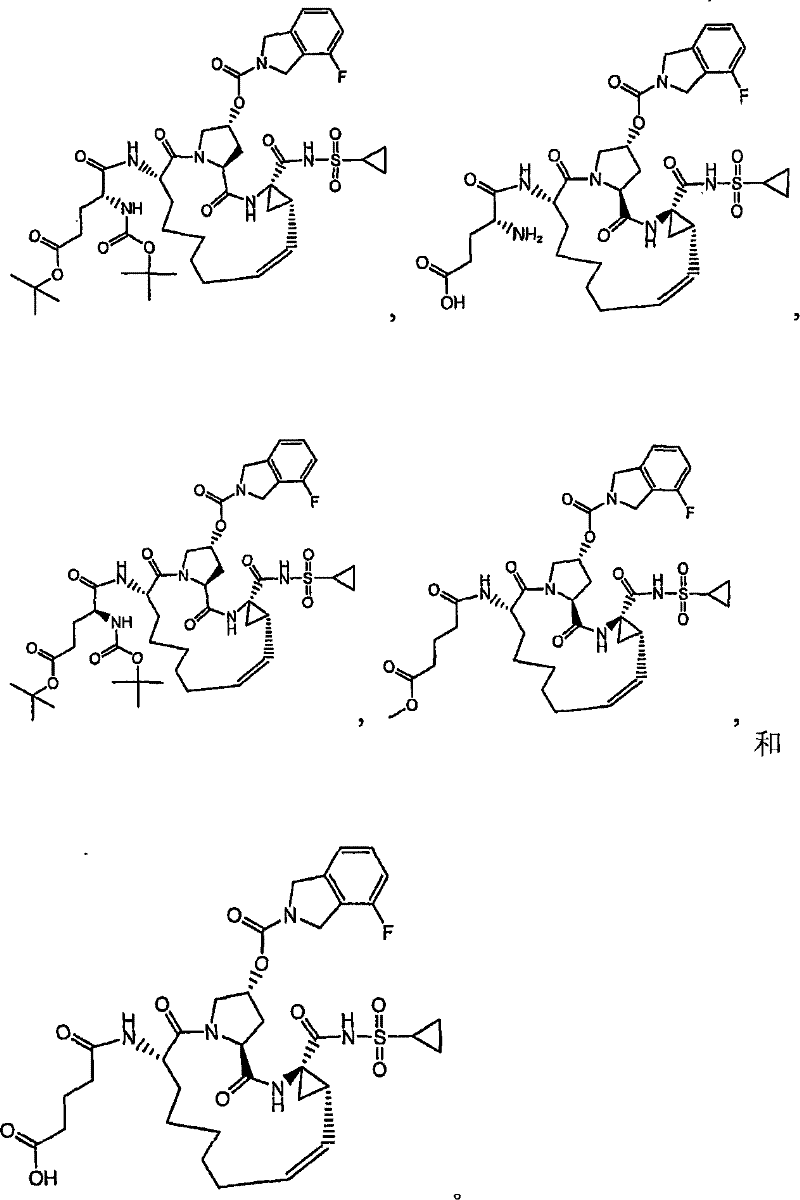
第二实施例提供一种医药组合物,其包含医药学上可接受的赋形剂和医药有效量的第一实施例中所述的化合物。The second embodiment provides a pharmaceutical composition, which comprises a pharmaceutically acceptable excipient and a pharmaceutically effective amount of the compound described in the first embodiment.
第三实施例提供一种调节丙型肝炎病毒活性的方法,其包含使所述病毒与有效量的第一实施例的化合物或第二实施例的医药组合物接触。The third embodiment provides a method of modulating the activity of hepatitis C virus, which comprises contacting the virus with an effective amount of the compound of the first embodiment or the pharmaceutical composition of the second embodiment.
第四实施例提供一种治疗哺乳动物的方法,其包含:鉴别感染丙型肝炎病毒的哺乳动物;和对所述哺乳动物投与有效量的第一实施例的化合物或第二实施例的医药组合物。A fourth embodiment provides a method of treating a mammal, comprising: identifying a mammal infected with hepatitis C virus; and administering to the mammal an effective amount of the compound of the first embodiment or the pharmaceutical combination of the second embodiment things.
第五实施例提供一种调节丙型肝炎病毒活性的方法,其包含:The fifth embodiment provides a method for regulating the activity of hepatitis C virus, which comprises:
选择具有NS3蛋白酶和NS3解旋酶活性的化合物,其中所述化合物选自由以下物质组成的群组:A compound is selected having NS3 protease and NS3 helicase activity, wherein the compound is selected from the group consisting of:
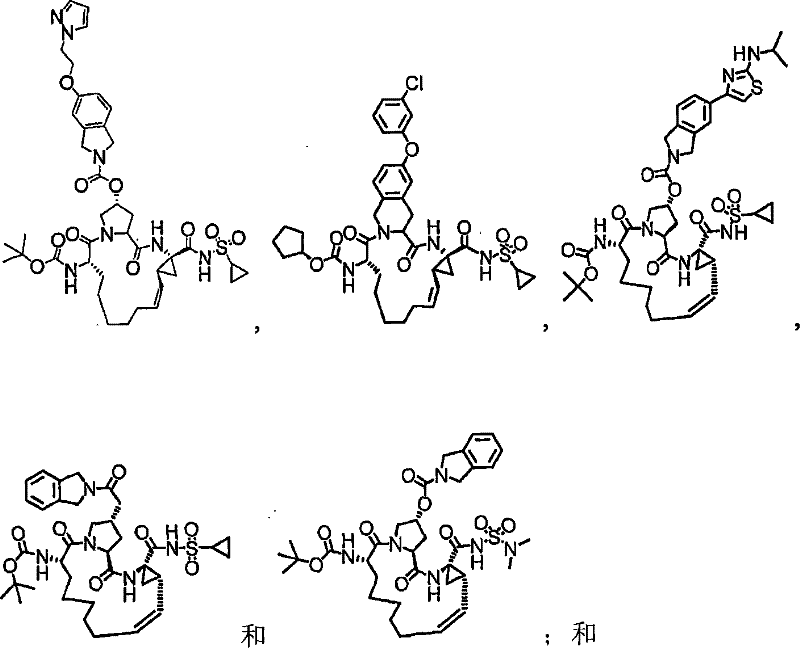
使有效调节NS3蛋白酶活性和NS3解旋酶活性的量的所述化合物与丙型肝炎病毒接触。The hepatitis C virus is contacted with an amount of the compound effective to modulate NS3 protease activity and NS3 helicase activity.
第六实施例提供一种治疗哺乳动物的方法,其包含:A sixth embodiment provides a method of treating a mammal comprising:
鉴别感染丙型肝炎病毒的哺乳动物;identification of mammals infected with hepatitis C virus;
鉴别具有NS3蛋白酶和NS3解旋酶活性的化合物,其中所述化合物选自由以下物质组成的群组:Identifying a compound having NS3 protease and NS3 helicase activity, wherein the compound is selected from the group consisting of:
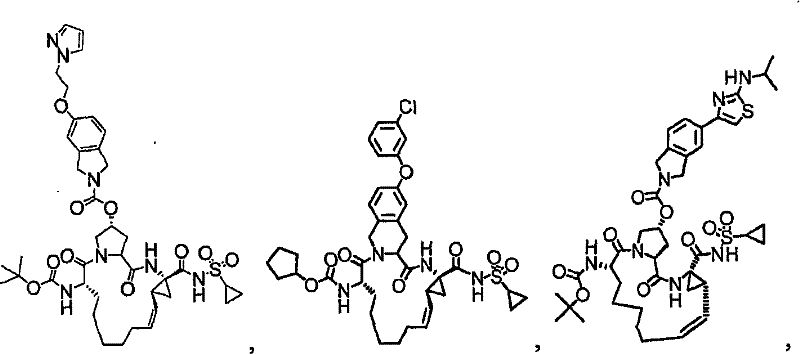
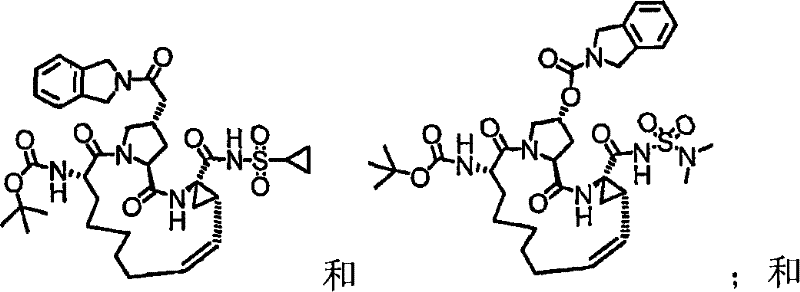
对所述哺乳动物投与有效量的所述化合物。An effective amount of the compound is administered to the mammal.
这些和其它实施例将于下文中进行更为详细地描述。These and other embodiments are described in more detail below.
附图说明Description of drawings
无none
具体实施方式Detailed ways
定义definition
如本文所使用,在本文中可与“肝纤维化(liver fibrosis)”互换使用的术语“肝脏纤维化(hepatic fibrosis)”是指可在慢性肝炎感染情况下于肝中出现的瘢痕组织生长。As used herein, the term "hepatic fibrosis" used herein interchangeably with "liver fibrosis" refers to the growth of scar tissue in the liver that can occur in the context of chronic hepatitis infection .
术语“个体”、“宿主”、“受检者”和“患者”在本文中可互换使用,并且指哺乳动物,包括(但不限于)灵长类动物,包括猿和人类。The terms "individual," "subject," "subject," and "patient" are used interchangeably herein and refer to mammals, including, but not limited to, primates, including apes, and humans.
如本文所使用,术语“肝功能”是指肝的正常功能,包括(但不限于)合成功能,包括(但不限于)合成诸如血清蛋白的蛋白质(例如,白蛋白、凝血因子、碱性磷酸酶、氨基转移酶(例如,丙氨酸转氨酶、天冬氨酸转氨酶)、5′-核苷酶、γ-谷氨酰转肽酶等)、合成胆红素、合成胆固醇和合成胆汁酸;肝脏代谢功能,包括(但不限于)碳水化合物代谢、氨基酸和氨代谢、激素代谢和脂质代谢;外来药物的解毒;血流动力学功能,包括内脏和门脉血流动力学等。As used herein, the term "hepatic function" refers to the normal function of the liver, including, but not limited to, synthetic functions, including, but not limited to, the synthesis of proteins such as serum proteins (e.g., albumin, coagulation factors, alkaline phosphate enzymes, aminotransferases (e.g., alanine aminotransferase, aspartate aminotransferase), 5′-nucleosidase, gamma-glutamyl transpeptidase, etc.), synthetic bilirubin, synthetic cholesterol, and synthetic bile acids; Liver metabolic function, including (but not limited to) carbohydrate metabolism, amino acid and ammonia metabolism, hormone metabolism and lipid metabolism; detoxification of foreign drugs; hemodynamic function, including visceral and portal hemodynamics, etc.
如本文所使用,术语“持续病毒反应”(SVR,也称为“持续反应”或“持久反应”)是指就血清HCV滴度来说,个体对HCV感染的治疗方案的反应。一般来说,“持续病毒反应”是指在治疗停止后在至少约1个月、至少约2个月、至少约3个月、至少约4个月、至少约5个月或至少约6个月的时间内在患者的血清中未发现可检测的HCV RNA(例如,每毫升血清小于约500、小于约200或小于约100个基因组拷贝)。As used herein, the term "sustained viral response" (SVR, also known as "sustained response" or "durable response") refers to the response of an individual to a treatment regimen for HCV infection in terms of serum HCV titers. Generally, "sustained viral response" refers to at least about 1 month, at least about 2 months, at least about 3 months, at least about 4 months, at least about 5 months, or at least about 6 months after the cessation of treatment. No detectable HCV RNA (e.g., less than about 500, less than about 200, or less than about 100 genome copies per milliliter of serum) is found in the patient's serum for a period of one month.
如本文中使用,“治疗失败的患者”通常是指对针对HCV的先前疗法不起反应的感染HCV的患者(称为“无反应者”)或最初对先前疗法起反应但治疗反应未得到保持的感染HCV的患者(称为“复发者”)。先前疗法通常可包括用IFN-α单一疗法或IFN-α组合疗法治疗,其中所述组合疗法可包括投与IFN-α和诸如利巴韦林的抗病毒剂。As used herein, "treatment failure patient" generally refers to an HCV-infected patient who does not respond to previous therapy against HCV (referred to as a "non-responder") or initially responds to a previous therapy but does not maintain a therapeutic response HCV-infected patients (referred to as "relapsers"). Prior therapy can typically include treatment with IFN-α monotherapy or IFN-α combination therapy, wherein the combination therapy can include administration of IFN-α and an antiviral agent such as ribavirin.
如本文所使用,术语“治疗”等是指获得所需的药理学和/或生理学作用。所述作用就完全或部分预防疾病或其症状来说可为预防性的,和/或就部分或完全治愈疾病和/或由所述疾病引起的不利作用来说可为治疗性的。如本文所使用,“治疗”涵盖对于哺乳动物、尤其人类的疾病的任何治疗,并且包括:(a)防止易患疾病但尚未诊断出患有所述疾病的受检者出现疾病;(b)抑制疾病,即阻滞其发展;和(c)减轻疾病,即使疾病恢复。As used herein, the term "treatment" and the like refers to obtaining a desired pharmacological and/or physiological effect. The effect may be prophylactic in terms of complete or partial prevention of the disease or its symptoms, and/or therapeutic in terms of partial or complete cure of the disease and/or adverse effects caused by the disease. As used herein, "treatment" encompasses any treatment of a disease in a mammal, especially a human, and includes: (a) preventing the disease in a subject predisposed to the disease but not yet diagnosed with the disease; (b) Inhibiting the disease, ie arresting its development; and (c) alleviating the disease, ie reversing the disease.
术语“个体”、“宿主”、“受检者”和“患者”在本文中可互换使用,并且指哺乳动物,包括(但不限于)鼠类动物、猿、人类、哺乳动物农场动物、哺乳动物运动动物和哺乳动物宠物。The terms "subject", "subject", "subject" and "patient" are used interchangeably herein and refer to mammals, including but not limited to murine animals, apes, humans, mammalian farm animals, Mammalian sports animals and mammalian pets.
如本文所使用,术语“I型干扰素受体激动剂”是指人类I型干扰素受体的任何天然存在或非天然存在的配体,其与受体结合并且经由受体引起信号转导。I型干扰素受体激动剂包括干扰素,包括天然存在的干扰素、经修饰干扰素、合成干扰素、聚乙二醇化干扰素、包含干扰素和异种蛋白质的融合蛋白、经改组干扰素;对干扰素受体具特异性的抗体;非肽化学激动剂等。As used herein, the term "type I interferon receptor agonist" refers to any naturally occurring or non-naturally occurring ligand of the human type I interferon receptor that binds to the receptor and causes signal transduction via the receptor . Type I interferon receptor agonists include interferons, including naturally occurring interferons, modified interferons, synthetic interferons, pegylated interferons, fusion proteins comprising interferon and a foreign protein, shuffled interferons; Antibodies specific for interferon receptors; non-peptide chemical agonists, etc.
如本文所使用,术语“II型干扰素受体激动剂”是指人类II型干扰素受体的任何天然存在或非天然存在的配体,其与受体结合并且经由受体引起信号转导。II型干扰素受体激动剂包括天然人类γ干扰素、重组IFN-γ种类、糖基化IFN-γ种类、聚乙二醇化IFN-γ种类、经修饰或变异IFN-γ种类、IFN-γ融合蛋白、对所述受体具特异性的抗体激动剂、非肽激动剂等。As used herein, the term "Type II interferon receptor agonist" refers to any naturally occurring or non-naturally occurring ligand of the human Type II interferon receptor that binds to the receptor and causes signal transduction via the receptor . Type II interferon receptor agonists include natural human gamma interferon, recombinant IFN-gamma species, glycosylated IFN-gamma species, pegylated IFN-gamma species, modified or variant IFN-gamma species, IFN-gamma Fusion proteins, antibody agonists specific for the receptor, non-peptide agonists, etc.
如本文所使用,术语“III型干扰素受体激动剂”是指人类白细胞介素28(IL-28)受体α(“IL-28R”)的任何天然存在或非天然存在的配体,所述受体α的氨基酸序列描述于Sheppard等人(见下文)中,所述配体与受体结合并且经由受体引起信号转导。As used herein, the term "Type III interferon receptor agonist" refers to any naturally occurring or non-naturally occurring ligand of the human interleukin 28 (IL-28) receptor alpha ("IL-28R"), The amino acid sequence of the receptor alpha is described in Sheppard et al. (see below), the ligand binds to the receptor and causes signal transduction via the receptor.
如本文所使用,术语“干扰素受体激动剂”是指任何I型干扰素受体激动剂、II型干扰素受体激动剂或III型干扰素受体激动剂。As used herein, the term "interferon receptor agonist" refers to any Type I interferon receptor agonist, Type II interferon receptor agonist, or Type III interferon receptor agonist.
如本文所使用,术语“给药事件”是指对有需要的患者投与抗病毒剂,所述事件可涵盖抗病毒剂从药物分配装置的一次或一次以上释放。因此,如本文所使用,术语“给药事件”包括(但不限于)安装连续传递装置(例如,泵或其它控释可注射系统);和单次皮下注射后安装连续传递系统。As used herein, the term "dosing event" refers to the administration of an antiviral agent to a patient in need thereof, which event may encompass one or more releases of the antiviral agent from a drug dispensing device. Thus, as used herein, the term "administration event" includes, but is not limited to, installation of a continuous delivery device (eg, pump or other controlled release injectable system); and installation of a continuous delivery system following a single subcutaneous injection.
如本文所使用,“连续传递”(例如,在“对组织连续传递物质”的上下文中)意思是指以使所需量的物质在所选时间段内传递到组织中的方式使药物移动到传递部位(例如,组织中),其中患者在所选时间段内每分钟接收约相同量的药物。As used herein, "continuous delivery" (e.g., in the context of "continuously delivering a substance to a tissue") means moving a drug to A delivery site (eg, in a tissue) where a patient receives about the same amount of drug per minute for a selected period of time.
如本文所使用,“控释”(例如,在“受控药物释放”的上下文中)意思涵盖以所选或者可控制的速率、间隔和/或量释放物质(例如,I型或III型干扰素受体激动剂,例如,IFN-α),其实质上不受使用环境的影响。因此,“控释”涵盖(但未必限于)实质上连续的传递和模式化传递(例如,在经规律或不规律时间间隔中断的时间内间歇传递)。As used herein, "controlled release" (e.g., in the context of "controlled drug release") is meant to encompass release of a substance (e.g., Type I or Type III interference) at a selected or controllable rate, interval, and/or amount. hormone receptor agonists, such as IFN-α), which are substantially unaffected by the environment of use. Thus, "controlled release" encompasses, but is not necessarily limited to, substantially continuous delivery as well as patterned delivery (eg, intermittent delivery interrupted by regular or irregular time intervals).
如在药物传递的上下文中所使用,“模式化”或“暂时性”意思指在预先选择的时间段内(例如,除与(例如)团注(bolus injection)相关的时间外)以一定模式、通常实质上规律的模式传递药物。“模式化”或“暂时性”药物传递意思涵盖以增加、降低、实质上恒定或脉动的速率或速率范围(例如,每单位时间的药物量或在单位时间内药物调配物的体积)传递药物,且另外涵盖连续或实质上连续或者长期的传递。As used in the context of drug delivery, "patterned" or "temporary" means to refer to a pattern of , delivering the drug in a generally substantially regular pattern. "Modalized" or "transient" drug delivery is meant to encompass delivery of a drug at an increasing, decreasing, substantially constant, or pulsatile rate or range of rates (e.g., the amount of drug per unit of time or the volume of a drug formulation per unit of time) , and additionally encompasses continuous or substantially continuous or long-term delivery.
术语“受控药物传递装置”意思涵盖装置中所含的药物或其它所需物质的释放(例如,释放速率、时限)受装置本身控制或由装置本身决定并且实质上不受使用环境影响,或者以在使用环境内可重现的速率释放的任何装置。The term "controlled drug delivery device" is meant to encompass that the release (e.g. release rate, time period) of a drug or other desired substance contained in the device is controlled or determined by the device itself and is substantially independent of the environment of use, or Any device that releases at a rate that is reproducible within the environment of use.
如(例如)“实质上连续输注”或“实质上连续传递”的上下文中所使用,“实质上连续”意思是指在预先选择的药物传递时间内以实质上不中断的方式传递药物,其中在预先选择的时间内的任何8小时间隔期间患者所接收的药物量从未降到零。此外,“实质上连续”药物传递还可涵盖在预先选择的药物传递时间内实质上不中断的以实质上恒定的预先选择的速率或速率范围(例如,每单位时间的药物量或在单位时间内药物调配物的体积)传递药物。As used, for example, in the context of "substantially continuous infusion" or "substantially continuous delivery", "substantially continuous" means that the drug is delivered in a substantially uninterrupted manner during a preselected drug delivery time, wherein the amount of drug received by the patient never drops to zero during any 8-hour interval within a preselected time period. Furthermore, "substantially continuous" drug delivery can also encompass a substantially constant preselected rate or range of rates (e.g., amount of drug per unit time or volume of the drug formulation) to deliver the drug.
如可随时间变化的生物参数的上下文中所使用,“实质上稳定的状态”意思指,生物参数在一段时程内展现实质上恒定的值,因此在所述时程内的任何8小时时间中由随时间变化的所述生物参数值所界定的曲线下面积(AUC8hr)在所述时程内8小时时间中生物参数的平均曲线下面积(AUC8hr平均值)的不超过约20%以上或约20%以下,且优选约15%以上或约15%以下,且更优选约10%以上或约10%以下的范围内。AUC8hr平均值定义为整个时程内生物参数的曲线下面积(AUC总)除以所述时程内8小时间隔的数量(总量/3天)的商(q),即q=(AUC总)/(总量/3天)。举例来说,在药物血清浓度的上下文中,当时程内任何8小时时间中药物的血清浓度的曲线下面积(AUC8hr)在所述时程内8小时时间中药物血清浓度的平均曲线下面积(AUC8hr平均)的不超过约20%以上或约20%以下范围内,即,所述时程内药物血清浓度的AUC8hr在AUC8hr平均的不超过20%以上或20%以下的范围内时,药物的血清浓度在所述时程中保持实质上稳定的状态。As used in the context of a biological parameter that may vary over time, "substantially steady state" means that the biological parameter exhibits a substantially constant value over a period of time, so that any 8-hour period within said time course The area under the curve (AUC8hr) defined by the value of the biological parameter as a function of time in the time course is not more than about 20% of the average area under the curve (AUC8hr mean) of the biological parameter in the 8-hour time period in the time course, or About 20% or less, and preferably about 15% or more or about 15% or less, and more preferably about 10% or more or about 10% or less. The AUC8hr average value is defined as the area under the curve (AUC total) of the biological parameter in the whole time course divided by the number (total amount/3 days) of the 8-hour interval in the described time course (q), that is, q=(AUC total )/(total amount/3 days). For example, in the context of drug serum concentrations, the area under the curve (AUC hr ) of the serum concentration of drug over any 8-hour time period within the time course is the mean area under the curve of the drug serum concentration over the 8-hour time period over the time course ( AUC8hr mean) is not more than about 20% or less than about 20%, that is, when the AUC8hr of the serum concentration of the drug in the time course is in the range of not more than 20% or less than 20% of the AUC8hr mean, the drug Serum concentrations remained substantially steady state over the time course.
如本文所使用,术语“烷基”是指具有1到20个碳原子的单价直链或支链基团,包括(但不限于)甲基、乙基、正丙基、异丙基、正丁基、异丁基、叔丁基、正己基等。As used herein, the term "alkyl" refers to a monovalent straight or branched chain group having from 1 to 20 carbon atoms, including but not limited to methyl, ethyl, n-propyl, isopropyl, n- Butyl, isobutyl, tert-butyl, n-hexyl, etc.
本文所使用的术语“卤基”是指氟、氯、溴或碘。As used herein, the term "halo" refers to fluorine, chlorine, bromine or iodine.
本文所使用的术语“烷氧基”是指通过-O-键与母体分子共价键结的直链或支链烷基。烷氧基的实例包括(但不限于)甲氧基、乙氧基、丙氧基、异丙氧基、丁氧基、正丁氧基、仲丁氧基、叔丁氧基等。As used herein, the term "alkoxy" refers to a straight or branched chain alkyl group covalently bonded to the parent molecule through an -O- bond. Examples of alkoxy include, but are not limited to, methoxy, ethoxy, propoxy, isopropoxy, butoxy, n-butoxy, sec-butoxy, t-butoxy, and the like.
本文所使用的术语“烯基”是指含有碳双键的具有2到20个碳原子的单价直链或支链基团,包括(但不限于)1-丙烯基、2-丙烯基、2-甲基-1-丙烯基、1-丁烯基、2-丁烯基等。As used herein, the term "alkenyl" refers to a monovalent straight or branched chain group of 2 to 20 carbon atoms containing a carbon double bond, including but not limited to 1-propenyl, 2-propenyl, 2-propenyl, -Methyl-1-propenyl, 1-butenyl, 2-butenyl and the like.
本文所使用的术语“炔基”是指含有碳三键的具有2到20个碳原子的单价直链或支链基团,包括(但不限于)1-丙炔基、1-丁炔基、2-丁炔基等。As used herein, the term "alkynyl" refers to a monovalent straight-chain or branched chain group of 2 to 20 carbon atoms containing a carbon triple bond, including (but not limited to) 1-propynyl, 1-butynyl , 2-butynyl, etc.
本文所使用的术语“芳基”是指稠合或不稠合的同素环芳香族基团。芳基的实例包括(但不限于)苯基、萘基、联苯基、菲基、并四苯基(naphthacenyl)等。As used herein, the term "aryl" refers to a fused or unfused homocyclic aromatic group. Examples of aryl groups include, but are not limited to, phenyl, naphthyl, biphenyl, phenanthrenyl, naphthacenyl, and the like.
本文所使用的术语“环烷基”是指具有3到20个碳原子的饱和脂肪族环系统基团,包括(但不限于)环丙基、环戊基、环己基、环庚基等。As used herein, the term "cycloalkyl" refers to a saturated aliphatic ring system group having 3 to 20 carbon atoms, including, but not limited to, cyclopropyl, cyclopentyl, cyclohexyl, cycloheptyl, and the like.
本文所使用的术语“环烯基”是指具有3到20个碳原子且在环中具有至少一个碳碳双键的脂肪族环系统基团。环烯基的实例包括(但不限于)环丙烯基、环戊烯基、环己烯基、环庚烯基等。As used herein, the term "cycloalkenyl" refers to an aliphatic ring system group having from 3 to 20 carbon atoms and having at least one carbon-carbon double bond in the ring. Examples of cycloalkenyl include, but are not limited to, cyclopropenyl, cyclopentenyl, cyclohexenyl, cycloheptenyl, and the like.
本文所使用的术语“聚环烷基”是指具有至少两个与桥头碳稠合或不与桥头碳稠合的环的饱和脂肪族环系统基团。聚环烷基的实例包括(但不限于)双环[4.4.0]癸基、双环[2.2.1]庚基、金刚烷基(adamantyl)、降冰片基(norbornyl)等。As used herein, the term "polycycloalkyl" refers to a saturated aliphatic ring system radical having at least two rings fused or not fused to a bridgehead carbon. Examples of polycycloalkyl include, but are not limited to, bicyclo[4.4.0]decyl, bicyclo[2.2.1]heptyl, adamantyl, norbornyl, and the like.
本文所使用的术语“聚环烯基”是指具有至少两个与桥头碳稠合或不与桥头碳稠合的环且其中至少一个环具有碳碳双键的脂肪族环系统基团。聚环烯基的实例包括(但不限于)降冰片烯基(norbornylenyl)、1,1′-二环戊烯基等。As used herein, the term "polycycloalkenyl" refers to an aliphatic ring system radical having at least two rings fused or not fused to a bridgehead carbon, at least one of which has a carbon-carbon double bond. Examples of polycycloalkenyl groups include, but are not limited to, norbornylenyl, 1,1'-dicyclopentenyl, and the like.
本文所使用的术语“多环烃”是指所有环成员都为碳原子的环系统基团。多环烃可为芳香族或可含有小于最大数量的非累积双键。多环烃的实例包括(但不限于)萘基、二氢萘基、茚基、芴基等。As used herein, the term "polycyclic hydrocarbon" refers to a ring system group in which all ring members are carbon atoms. Polycyclic hydrocarbons may be aromatic or may contain less than a maximum number of non-cumulative double bonds. Examples of polycyclic hydrocarbons include, but are not limited to, naphthyl, dihydronaphthyl, indenyl, fluorenyl, and the like.
本文所使用的术语“杂环”或“杂环基”是指具有至少一个环系统且其中一个或一个以上环原子不为碳(即杂原子)的环系统基团。杂环可为非芳香族或芳香族的。杂环基的实例包括(但不限于)吗啉基、四氢呋喃基、二氧戊环基、吡咯烷基、噁唑基、吡喃基、吡啶基、嘧啶基、吡咯基等。As used herein, the term "heterocycle" or "heterocyclyl" refers to a ring system group having at least one ring system in which one or more ring atoms are not carbon (ie, a heteroatom). Heterocycles can be non-aromatic or aromatic. Examples of heterocyclyl include, but are not limited to, morpholinyl, tetrahydrofuranyl, dioxolanyl, pyrrolidinyl, oxazolyl, pyranyl, pyridyl, pyrimidinyl, pyrrolyl, and the like.
本文所使用的术语“杂芳基”是指以保持芳香族系统的方式通过分别用三价或二价杂原子置换一个或一个以上次甲基和/或亚乙烯基而在形式上由芳烃得到的杂环基。杂芳基的实例包括(但不限于)吡啶基、吡咯基、噁唑基、吲哚基等。As used herein, the term "heteroaryl" refers to a group derived formally from an arene by replacing one or more methine and/or vinylidene groups with trivalent or divalent heteroatoms, respectively, in such a way as to preserve the aromatic system. The heterocyclic group. Examples of heteroaryl include, but are not limited to, pyridyl, pyrrolyl, oxazolyl, indolyl, and the like.
本文所使用的术语“芳烷基”是指附加到烷基上的一个或一个以上芳基。芳烷基的实例包括(但不限于)苯甲基、苯乙基、苯丙基、苯丁基等。As used herein, the term "aralkyl" refers to one or more aryl groups appended to an alkyl group. Examples of aralkyl groups include, but are not limited to, benzyl, phenethyl, phenpropyl, phenbutyl, and the like.
本文所使用的术语“环烷基烷基”是指附加到烷基上的一个或一个以上环烷基。环烷基烷基的实例包括(但不限于)环己基甲基、环己基乙基、环戊基甲基、环戊基乙基等。As used herein, the term "cycloalkylalkyl" refers to one or more cycloalkyl groups appended to an alkyl group. Examples of cycloalkylalkyl include, but are not limited to, cyclohexylmethyl, cyclohexylethyl, cyclopentylmethyl, cyclopentylethyl, and the like.
本文所使用的术语“杂芳烷基”是指附加到烷基上的一个或一个以上杂芳基。杂芳烷基的实例包括(但不限于)吡啶基甲基、呋喃基甲基、噻吩基乙基等。As used herein, the term "heteroaralkyl" refers to one or more heteroaryl groups appended to an alkyl group. Examples of heteroaralkyl include, but are not limited to, pyridylmethyl, furylmethyl, thienylethyl, and the like.
本文所使用的术语“杂环烷基”是指附加到烷基上的一个或一个以上杂环基。杂环烷基的实例包括(但不限于)吗啉基甲基、吗啉基乙基、吗啉基丙基、四氢呋喃基甲基、吡咯烷基丙基等。As used herein, the term "heterocycloalkyl" refers to one or more heterocyclyl groups appended to an alkyl group. Examples of heterocycloalkyl include, but are not limited to, morpholinylmethyl, morpholinylethyl, morpholinylpropyl, tetrahydrofuranylmethyl, pyrrolidinylpropyl, and the like.
本文所使用的术语“芳氧基”是指通过-O-键与母体分子共价键结的芳基。As used herein, the term "aryloxy" refers to an aryl group covalently bonded to the parent molecule through an -O- bond.
本文所使用的术语“烷硫基”是指通过-S-键与母体分子共价键结的直链或支链烷基。烷氧基的实例包括(但不限于)甲氧基、乙氧基、丙氧基、异丙氧基、丁氧基、正丁氧基、仲丁氧基、叔丁氧基等。The term "alkylthio" as used herein refers to a straight or branched chain alkyl group covalently bonded to the parent molecule through an -S- bond. Examples of alkoxy include, but are not limited to, methoxy, ethoxy, propoxy, isopropoxy, butoxy, n-butoxy, sec-butoxy, t-butoxy, and the like.
本文所使用的术语“芳硫基”是指通过-S-键与母体分子共价键结的芳基。As used herein, the term "arylthio" refers to an aryl group covalently bonded to the parent molecule through an -S- bond.
本文所使用的术语“烷基氨基”是指与一个或一个以上烷基连接的氮基。因此,单烷基氨基是指与一个烷基连接的氮基并且二烷基氨基是指与两个烷基连接的氮基。As used herein, the term "alkylamino" refers to a nitrogen group attached to one or more alkyl groups. Thus, monoalkylamino refers to a nitrogen group attached to one alkyl group and dialkylamino refers to a nitrogen group attached to two alkyl groups.
本文所使用的术语“氰基氨基”是指与腈基连接的氮基。As used herein, the term "cyanoamino" refers to a nitrogen group attached to a nitrile group.
本文所使用的术语“氨甲酰基”是指RNHCOO-。As used herein, the term "carbamoyl" refers to RNHCOO-.
本文所使用的术语“酮基”和“羰基”是指C=O。As used herein, the terms "keto" and "carbonyl" refer to C=O.
本文所使用的术语“羧基”是指-COOH。As used herein, the term "carboxy" refers to -COOH.
本文所使用的术语“氨磺酰基”是指-SO2NH2。 As used herein, the term "sulfamoyl" refers to -SO2NH2 .
本文所使用的术语“磺酰基”是指-SO2-。As used herein, the term "sulfonyl" refers to -SO2- .
本文所使用的术语“亚硫酰基”是指-SO-。As used herein, the term "sulfinyl" refers to -SO-.
本文所使用的术语“硫代羰基”是指C=S。As used herein, the term "thiocarbonyl" refers to C=S.
本文所使用的术语“硫代羧基”是指CSOH。As used herein, the term "thiocarboxy" refers to CSOH.
如本文所使用,基团表示具有单一未配对电子的物质,因此含有所述基团的物质可与另一物质共价键结。因此,在本文中,基团不必为游离基团。相反,基团表示较大分子的特定部分。术语“基团”可与术语“基团(group)”互换使用。As used herein, a group refers to a species that has a single unpaired electron, such that the species containing the group can be covalently bonded to another species. Thus, in this context, groups need not be free radicals. In contrast, a group represents a specific part of a larger molecule. The term "group" is used interchangeably with the term "group".
如本文所使用,经取代基团是从未经取代的母体结构得到,其中一个或一个以上氢原子已交换为另一原子或基团。当经取代时,取代基为一个或一个以上个别且独立地选自以下基团的基团:C1-C6烷基、C1-C6烯基、C1-C6炔基、C3-C6环烷基、C3-C6杂环烷基(例如,四氢呋喃基)、芳基、杂芳基、卤基(例如,氯、溴、碘和氟)、氰基、羟基、C1-C6烷氧基、芳氧基、硫氢基(巯基)、C1-C6烷硫基、芳硫基、单-和二-(C1-C6)烷基氨基、季铵盐、氨基(C1-C6)烷氧基、羟基(C1-C6)烷基氨基、氨基(C1-C6)烷硫基、氰基氨基、硝基、氨甲酰基、酮基(氧基)、羰基、羧基、羟乙酰基、甘氨酰基、肼基、脒基、氨磺酰基、磺酰基、亚硫酰基、硫代羰基、硫代羧基和其组合。可形成上述取代基的保护性衍生物的保护基已为所属领域技术人员所知并且可见于诸如Greene和Wuts的有机合成中的保护基(Protective Groups in Organic Synthesis);John Wiley and Sons:New York,1999的参考文献中。在将取代基描述为“视情况经取代”之处,取代基可经上述取代基取代。As used herein, a substituted group is derived from an unsubstituted parent structure in which one or more hydrogen atoms have been exchanged for another atom or group. When substituted, the substituent is one or more groups individually and independently selected from the following groups: C 1 -C 6 alkyl, C 1 -C 6 alkenyl, C 1 -C 6 alkynyl, C 1 -C 6 alkynyl, C 3 - C6 cycloalkyl, C3 - C6 heterocycloalkyl (for example, tetrahydrofuryl), aryl, heteroaryl, halo (for example, chlorine, bromine, iodine and fluorine), cyano, hydroxyl, C 1 -C 6 alkoxy, aryloxy, sulfhydryl (mercapto), C 1 -C 6 alkylthio, arylthio, mono- and di-(C 1 -C 6 )alkylamino, quaternary Ammonium salt, amino(C 1 -C 6 )alkoxy, hydroxy(C 1 -C 6 )alkylamino, amino(C 1 -C 6 )alkylthio, cyanoamino, nitro, carbamoyl, Keto (oxy), carbonyl, carboxyl, glycolyl, glycyl, hydrazino, amidino, sulfamoyl, sulfonyl, sulfinyl, thiocarbonyl, thiocarboxy, and combinations thereof. Protective groups that can form protected derivatives of the above substituents are known to those skilled in the art and can be found in, for example, Protective Groups in Organic Synthesis by Greene and Wuts; John Wiley and Sons: New York , 1999 in references. Where a substituent is described as "optionally substituted", the substituent may be substituted with the above substituent.
不对称碳原子可存在于所述的化合物中。预期所有所述异构体(包括非对映异构体和对映异构体)以及其混合物都包括在所述化合物的范围内。在某些情况下,化合物可以互变异构形式存在。预期所有互变异构形式都包括在所述化合物的范围内。同样,当化合物含有烯基或亚烯基时,存在化合物的顺式和反式异构形式的可能性。涵盖顺式和反式异构体以及顺式与反式异构体的混合物。因此,除非本文另作清楚规定,否则本文中提及的化合物包括所有上述异构形式。Asymmetric carbon atoms may be present in the compounds described. All such isomers (including diastereomers and enantiomers), as well as mixtures thereof, are intended to be included within the scope of the compounds. In certain instances, compounds may exist in tautomeric forms. All tautomeric forms are intended to be included within the scope of the compounds. Likewise, when a compound contains an alkenyl or alkenylene group, the possibility exists of cis and trans isomeric forms of the compound. Both cis and trans isomers and mixtures of cis and trans isomers are contemplated. Accordingly, unless the context clearly dictates otherwise, references to compounds herein include all such isomeric forms.
各种形式都包括在实施例中,包括多晶型物、溶剂化物、水合物、构象体(conformer)、盐和前药衍生物。多晶型物为具有相同化学式但具有不同结构的组合物。溶剂化物是由溶剂化(溶剂分子与溶质分子或离子的组合)形成的组合物。水合物是通过并入水而形成的化合物。构象体为构象异构体的结构。构象异构是具有相同结构式但具有不同原子构象(构象体)的分子关于旋转键的现象。化合物的盐可通过所属领域技术人员已知的方法制备。举例来说,可通过使适当的碱或酸与化学计量当量的化合物反应来制备化合物的盐。前药为在展现其药理学作用之前经历生物转化(化学变换)的化合物。举例来说,因此可将前药视作含有以临时方式使用以改变或消除母体分子的不合需要的特性的专用保护基的药物。因此,除非本文另作清楚规定,否则本文中提及的化合物包括所有上述形式。Various forms are included in the examples, including polymorphs, solvates, hydrates, conformers, salts and prodrug derivatives. Polymorphs are compositions of the same chemical formula but different structures. Solvates are compositions formed by solvation (combination of solvent molecules with solute molecules or ions). Hydrates are compounds formed by the incorporation of water. Conformers are structures that are conformers. Conformational isomerism is the phenomenon of molecules having the same structural formula but different atomic configurations (conformers) with respect to rotating bonds. Salts of compounds can be prepared by methods known to those skilled in the art. For example, a salt of a compound can be prepared by reacting an appropriate base or acid with a stoichiometric equivalent of the compound. Prodrugs are compounds that undergo biotransformation (chemical transformation) before exhibiting their pharmacological effects. For example, prodrugs can thus be viewed as drugs containing specialized protecting groups used in a temporary fashion to alter or eliminate undesirable properties of the parent molecule. Accordingly, references to compounds herein include all such forms unless the context clearly dictates otherwise.
当提供值的范围时,应了解介于所述范围的上限与下限之间的每一居中值(除非上下文另外明确规定,否则精确到下限单位的十分之一)和所述范围内的任何其它所述值或居中值都涵盖于实施例内。这些较小范围的上限和下限可独立地包括于所述较小范围中,且也涵盖于本发明中,其从属于规定范围中的任何特别排除的界限。当规定范围包括两个界限中的一个或两个时,排除那些所包括界限中的一个或两个的范围也包括在实施例中。When a range of values is provided, each intervening value between the upper and lower limits of the stated range (to the nearest tenth of the unit of the lower limit unless the context clearly dictates otherwise) and any intervening value within the stated range Other stated values or intermediate values are encompassed within the examples. The upper and lower limits of these smaller ranges may independently be included in the smaller ranges and are also encompassed within the invention, subject to any specifically excluded limit in the stated range. Where the stated range includes one or both of the limits, ranges excluding either or both of those included limits are also included in the examples.
除非另作定义,否则本文所使用的所有科技术语都具有与实施例所属领域技术人员通常所了解相同的含义。尽管也可将与本文所述的方法和材料类似或相同的任何方法和材料用于实施例的实践或测试中,但现仅对优选方法和材料加以描述。本文所提及的所有公开案都是以引用的方式并入本文中以揭示和描述与所引用的公开案相关的方法和/或材料。Unless defined otherwise, all technical and scientific terms used herein have the same meaning as commonly understood by one of ordinary skill in the art to which the embodiments belong. Although any methods and materials similar or equivalent to those described herein can also be used in the practice or testing of the examples, the preferred methods and materials are now described. All publications mentioned herein are incorporated herein by reference to disclose and describe the methods and/or materials in connection with which the publications are cited.
必须注意,除非本文另作清楚规定,否则如本文和随附权利要求中所使用,单数形式“一”和“所述”包括多个参考物。因此,例如提及“一方法”包括多种所述方法且提及“一剂量”包括提及一个或一个以上所属领域技术人员已知的剂量和其等效形式等。It must be noted that, as used herein and in the appended claims, the singular forms "a", "an" and "the" include plural references unless the context clearly dictates otherwise. Thus, for example, reference to "a method" includes a plurality of such methods and reference to "a dosage" includes reference to one or more dosages and equivalents thereof known to those skilled in the art, and the like.
术语“约”在本文中用于指大约、在…附近、粗略地或左右。当将术语“约”与数字范围组合使用时,其通过将边界扩大到高于和低于所述数值来修饰所述范围。一般说来,术语“约”在本文中用于使数值在所述值以上和以下改变10%方差。The term "about" is used herein to mean about, around, roughly or around. When the term "about" is used in conjunction with a numerical range, it modifies that range by extending the boundaries above and below the numerical values set forth. Generally, the term "about" is used herein to vary a numerical value by 10% variance above and below the stated value.
如本说明书中所使用,在过渡性短语或权利要求书主体中,术语“包含”应解释为具有开放式含义。也就是说,应将所述术语解释为与短语“具有至少”或“包括至少”同义。当用于有关方法的上下文中时,术语“包含”意思指所述方法至少包括所述的步骤,但也可能包括其它步骤。当用于有关化合物、组合物或装置的上下文中时,术语“包含”意思指所述化合物、组合物或装置至少包括所述的特征或组分,但也可能包括其它特征或组分。As used in this specification, in a transitional phrase or in the body of a claim, the term "comprising" should be interpreted as having an open-ended meaning. That is, the terms should be interpreted as synonymous with the phrases "having at least" or "including at least". When used in the context of a method, the term "comprising" means that the method includes at least the recited steps, but may also include other steps. When used in the context of a compound, composition or device, the term "comprising" means that the compound, composition or device includes at least the stated features or components, but may also include other features or components.
本文中将详细参考本发明的特定实施例。尽管将结合这些特定实施例描述本发明,但应了解不意欲将本发明限于所述特定实施例。相反,意欲涵盖替代物、修改物和等效物,其同样可包括于本发明的精神和范围内。在本文所提供的描述中,将描述多个特定细节以便提供对本发明的全面了解。可不依照这些特定细节中的一些或全部来实践本发明。在其它情况下,为了不混淆本发明,尚未对熟知的方法操作详细描述。Reference will be made in detail herein to specific embodiments of the invention. While the invention will be described in conjunction with these specific embodiments, it will be understood that it is not intended to limit the invention to the specific embodiments. On the contrary, it is intended to cover alternatives, modifications, and equivalents, which may also be included within the spirit and scope of the invention. In the description provided herein, numerous specific details are set forth in order to provide a thorough understanding of the present invention. The present invention may be practiced without some or all of these specific details. In other instances, well known process operations have not been described in detail in order not to obscure the present invention.
本发明的实施例提供如下文所述的化合物1-10以及包含化合物1-10中任一化合物的医药组合物和调配物。化合物1-10可在本文中以各种方式提及,包括“标的化合物”、“NS3抑制剂”、“NS3抑制剂化合物”、“蛋白酶抑制剂”、“解旋酶抑制剂”和所属领域技术人员易于了解的其它类似术语。标的化合物可用于在活体内和/或离体(ex vivo)调节(例如,抑制)NS3蛋白酶和/或解旋酶的活性。举例来说,如下文所论述,标的化合物可用于治疗HCV感染和其它病症。Embodiments of the invention provide Compounds 1-10 as described below and pharmaceutical compositions and formulations comprising any of Compounds 1-10. Compounds 1-10 may be referred to herein in various ways, including "subject compound", "NS3 inhibitor", "NS3 inhibitor compound", "protease inhibitor", "helicase inhibitor" and related art Other similar terms readily understood by the skilled artisan. Compounds of interest can be used to modulate (eg, inhibit) NS3 protease and/or helicase activity in vivo and/or ex vivo. For example, as discussed below, subject compounds are useful in the treatment of HCV infection and other disorders.
组合物combination
本发明提供具有下表1和2中所示的化学结构的化合物1-10。优选实施例提供一种治疗个体丙型肝炎病毒感染的方法,所述方法包含对所述个体投与有效量的包含优选化合物的组合物,例如包含化合物1-10中至少一种的组合物。The present invention provides compounds 1-10 having the chemical structures shown in Tables 1 and 2 below. Preferred embodiments provide a method of treating a hepatitis C virus infection in an individual comprising administering to the individual an effective amount of a composition comprising a preferred compound, eg, a composition comprising at least one of Compounds 1-10.
优选实施例提供一种治疗个体肝纤维化的方法,所述方法包含对所述个体投与有效量的包含优选化合物的组合物。Preferred embodiments provide a method of treating liver fibrosis in a subject comprising administering to the subject an effective amount of a composition comprising a preferred compound.
优选实施例提供一种增加感染丙型肝炎病毒的个体的肝功能的方法,所述方法包含对所述个体投与有效量的包含优选化合物的组合物。Preferred embodiments provide a method of increasing liver function in an individual infected with hepatitis C virus, the method comprising administering to the individual an effective amount of a composition comprising a preferred compound.
本发明的实施例另外提供包含化合物1-10和其盐、酯或其它衍生物的组合物,包括医药组合物。标的医药组合物包含标的化合物和医药学上可接受的赋形剂。多种医药学上可接受的赋形剂已为所属领域所知且无需在本文中详细论述。医药学上可接受的赋形剂已详细描述于多种出版物中,包括(例如)A.Gennaro(2000)“雷明顿:药学科学与实践(Remington:The Science and Practice of Pharmacy)”,第20版,Lippincott,Williams,&Wilkins;医药剂型与药物传递系统(Pharmaceutical Dosage Forms and Drug DeliverySystems)(1999)H.C.Ansel等人编,第7版,Lippincott,Williams,&Wilkins;和医药赋形剂手册(Handbook of Pharmaceutical Excipients)(2000)A.H.Kibbe等人编,第3版,美国医药协会(Amer.Pharmaceutical Assoc.)。Embodiments of the invention additionally provide compositions, including pharmaceutical compositions, comprising Compounds 1-10 and salts, esters or other derivatives thereof. A subject pharmaceutical composition comprises a subject compound and a pharmaceutically acceptable excipient. Various pharmaceutically acceptable excipients are known in the art and need not be discussed in detail herein. Pharmaceutically acceptable excipients have been described in detail in various publications including, for example, A. Gennaro (2000) "Remington: The Science and Practice of Pharmacy", 20th Edition, Lippincott, Williams, &Wilkins; Pharmaceutical Dosage Forms and Drug Delivery Systems (Pharmaceutical Dosage Forms and Drug Delivery Systems) (1999) edited by H.C.Ansel et al., 7th Edition, Lippincott, Williams, &Wilkins; and Handbook of Pharmaceutical Excipients ( Handbook of Pharmaceutical Excipients) (2000) edited by A.H. Kibbe et al., 3rd ed., Amer. Pharmaceutical Assoc.
医药学上可接受的赋形剂(诸如媒剂、佐剂、载剂或稀释剂)易于为公众所用。而且,医药学上可接受的辅助物质(诸如,pH调节和缓冲剂、渗透性调节剂、稳定剂、润湿剂等)易于为公众所用。Pharmaceutically acceptable excipients such as vehicles, adjuvants, carriers or diluents are readily available to the public. Furthermore, pharmaceutically acceptable auxiliary substances such as pH adjusting and buffering agents, osmolarity adjusting agents, stabilizers, wetting agents, etc. are readily available to the public.
在许多实施例中,标的化合物抑制丙型肝炎病毒(HCV)NS3蛋白酶的酶活性。可易于使用任何已知的方法确定标的化合物是否抑制HCV NS3蛋白酶。典型方法涉及在存在所述药剂的情况下,测定HCV多聚蛋白或包含NS3识别位点的其它多肽是否被NS3所裂解。在许多实施例中,与不存在标的化合物时NS3的酶活性相比,所述化合物将NS3的酶活性抑制至少约10%、至少约15%、至少约20%、至少约25%、至少约30%、至少约40%、至少约50%、至少约60%、至少约70%、至少约80%或至少约90%或更高。In many embodiments, the subject compounds inhibit the enzymatic activity of hepatitis C virus (HCV) NS3 protease. Whether a subject compound inhibits HCV NS3 protease can be readily determined using any known method. A typical method involves determining whether the HCV polyprotein or other polypeptide comprising an NS3 recognition site is cleaved by NS3 in the presence of the agent. In many embodiments, the compound inhibits the enzymatic activity of NS3 by at least about 10%, at least about 15%, at least about 20%, at least about 25%, at least about 30%, at least about 40%, at least about 50%, at least about 60%, at least about 70%, at least about 80%, or at least about 90% or higher.
在许多实施例中,标的化合物以小于约50μM的IC50抑制HCV NS3蛋白酶的酶活性,例如,标的化合物以小于约40μM、小于约25μM、小于约10μM、小于约1μM、小于约100nM、小于约80nM、小于约60nM、小于约50nM、小于约25nM、小于约10nM或小于约1nM或更低的IC50抑制HCV NS3蛋白酶。In many embodiments, the subject compound inhibits the enzymatic activity of HCV NS3 protease with an IC50 of less than about 50 μM, for example, the subject compound inhibits the enzymatic activity of HCV NS3 protease at less than about 40 μM, less than about 25 μM, less than about 10 μM, less than about 1 μM, less than about 100 nM, less than about An IC50 of 80 nM, less than about 60 nM, less than about 50 nM, less than about 25 nM, less than about 10 nM, or less than about 1 nM or lower inhibits HCV NS3 protease.
在许多实施例中,标的化合物抑制丙型肝炎病毒(HCV)NS3解旋酶的酶活性。可易于使用任何已知的方法确定标的化合物是否抑制HCV NS3解旋酶。在许多实施例中,与不存在标的化合物时NS3的酶活性相比,所述化合物将NS3的酶活性抑制至少约10%、至少约15%、至少约20%、至少约25%、至少约30%、至少约40%、至少约50%、至少约60%、至少约70%、至少约80%或至少约90%或更高。In many embodiments, the subject compounds inhibit the enzymatic activity of hepatitis C virus (HCV) NS3 helicase. Whether a subject compound inhibits HCV NS3 helicase can be readily determined using any known method. In many embodiments, the compound inhibits the enzymatic activity of NS3 by at least about 10%, at least about 15%, at least about 20%, at least about 25%, at least about 30%, at least about 40%, at least about 50%, at least about 60%, at least about 70%, at least about 80%, or at least about 90% or higher.
在许多实施例中,标的化合物抑制HCV病毒复制。举例来说,与不存在标的化合物时的HCV病毒复制相比,所述化合物将HCV病毒复制抑制至少约10%、至少约15%、至少约20%、至少约25%、至少约30%、至少约40%、至少约50%、至少约60%、至少约70%、至少约80%或至少约90%或更高。可使用所属领域已知的方法(包括活体外病毒复制检定)确定标的化合物是否抑制HCV病毒复制。In many embodiments, the subject compounds inhibit HCV viral replication. For example, the compound inhibits HCV viral replication by at least about 10%, at least about 15%, at least about 20%, at least about 25%, at least about 30%, compared to HCV viral replication in the absence of the subject compound. At least about 40%, at least about 50%, at least about 60%, at least about 70%, at least about 80%, or at least about 90% or higher. Whether a subject compound inhibits HCV viral replication can be determined using methods known in the art, including in vitro viral replication assays.
在许多实施例中,标的化合物抑制HCV NS3蛋白酶和HCV NS3解旋酶的酶活性。可易于使用任何已知的方法确定标的化合物是否抑制HCV NS3蛋白酶和HCV NS3解旋酶。在许多实施例中,与不存在标的化合物时HCV NS3蛋白酶和HCV NS3解旋酶的酶活性相比,所述化合物将HCV NS3蛋白酶和HCV NS3解旋酶的酶活性各自独立地抑制至少约10%、至少约15%、至少约20%、至少约25%、至少约30%、至少约40%、至少约50%、至少约60%、至少约70%、至少约80%或至少约90%或更高。In many embodiments, the subject compounds inhibit the enzymatic activity of HCV NS3 protease and HCV NS3 helicase. Whether a subject compound inhibits HCV NS3 protease and HCV NS3 helicase can be readily determined using any known method. In many embodiments, the compound independently inhibits the enzymatic activity of the HCV NS3 protease and the HCV NS3 helicase by at least about 10% compared to the enzymatic activity of the HCV NS3 protease and the HCV NS3 helicase in the absence of the subject compound. %, at least about 15%, at least about 20%, at least about 25%, at least about 30%, at least about 40%, at least about 50%, at least about 60%, at least about 70%, at least about 80%, or at least about 90% % or higher.
治疗肝炎病毒感染Treat hepatitis virus infection
本文所述的方法和组合物通常可用于治疗HCV感染。The methods and compositions described herein are generally useful for treating HCV infection.
可通过病毒载量的减少、血清转化(在患者血清中无法检测到的病毒)时间的减少、对疗法的持续病毒反应的比率的增加、临床结果中发病率或死亡率的降低或者疾病反应的其它指标来确定标的方法是否对治疗HCV感染有效。May be demonstrated by reduction in viral load, reduction in time to seroconversion (undetectable virus in patient serum), increase in the rate of sustained viral response to therapy, reduction in morbidity or mortality in clinical outcome, or improvement in disease response. Other indicators are used to determine whether the subject method is effective in treating HCV infection.
一般来说,本文所述化合物(例如,化合物1-10中任一种或一种以上)和视情况一种或一种以上额外抗病毒剂的有效量为有效减少病毒载量或实现对疗法的持续病毒反应的量。In general, an effective amount of a compound described herein (e.g., any one or more of Compounds 1-10) and, optionally, one or more additional antiviral agents is effective to reduce viral load or achieve a response to therapy. amount of sustained viral response.
可通过测量病毒载量或通过测量与HCV感染相关的参数(包括但不限于,肝纤维化、血清转氨酶含量升高和肝的坏死性炎症活动)来确定标的方法是否对治疗HCV感染有效。将于下文中详细论述肝纤维化的指标。Whether a subject method is effective in treating HCV infection can be determined by measuring viral load or by measuring parameters associated with HCV infection, including but not limited to, liver fibrosis, elevated serum transaminase levels, and necroinflammatory activity of the liver. Indicators of liver fibrosis are discussed in detail below.
所述方法涉及投与有效量的本文所述的化合物(例如,化合物1-10中的任一种或一种以上)和视情况有效量的一种或一种以上额外抗病毒剂。在一些实施例中,本文所述的化合物和视情况一种或一种以上额外抗病毒剂的有效量为使病毒滴度有效降低到不可检测的水平,例如降低到每毫升血清约1000到约5000个基因组拷贝、约500到约1000个基因组拷贝或约100到约500个基因组拷贝的量。在一些实施例中,本文中所述的化合物和视情况一种或一种以上额外抗病毒剂的有效量为有效将病毒载量降低到每毫升血清小于100个基因组拷贝的量。The methods involve administering an effective amount of a compound described herein (eg, any one or more of Compounds 1-10) and optionally an effective amount of one or more additional antiviral agents. In some embodiments, an effective amount of a compound described herein and optionally one or more additional antiviral agents is such that the viral titer is effectively reduced to an undetectable level, for example, to about 1000 to about 1000 per milliliter of serum. An amount of 5000 genome copies, about 500 to about 1000 genome copies, or about 100 to about 500 genome copies. In some embodiments, an effective amount of a compound described herein, and optionally one or more additional antiviral agents, is an amount effective to reduce viral load to less than 100 genome copies per milliliter of serum.
在一些实施例中,本文所述的化合物和视情况一种或一种以上额外抗病毒剂的有效量为有效实现个体血清中的病毒滴度1.5-log、2-log、2.5-log、3-log、3.5-log、4-log、4.5-log或5-log降低的量。In some embodiments, an effective amount of a compound described herein and, optionally, one or more additional antiviral agents is effective to achieve a viral titer in the individual's serum of 1.5-log, 2-log, 2.5-log, 3 Amount of -log, 3.5-log, 4-log, 4.5-log or 5-log reduction.
在许多实施例中,本文所述的化合物和视情况一种或一种以上额外抗病毒剂的有效量为有效实现持续病毒反应,例如在疗法停止后至少约1个月、至少约2个月、至少约3个月、至少约4个月、至少约5个月或至少约6个月的时间内在患者的血清中未发现可检测或实质上可检测的HCV RNA(例如,每毫升血清小于约500、小于约400、小于约200或小于约100个基因组拷贝)的量。In many embodiments, an effective amount of a compound described herein and optionally one or more additional antiviral agents is effective to achieve a sustained viral response, e.g., at least about 1 month, at least about 2 months after therapy has ceased , at least about 3 months, at least about 4 months, at least about 5 months, or at least about 6 months, no detectable or substantially detectable HCV RNA (e.g., less than An amount of about 500, less than about 400, less than about 200, or less than about 100 genome copies).
如上文所述,可通过测量与HCV感染相关的参数(诸如肝纤维化)来确定标的方法是否有效治疗HCV感染。将于下文中详细论述确定肝纤维化的程度的方法。在一些实施例中,肝纤维化的标志物血清含量指示肝纤维化的程度。As noted above, whether a subject method is effective in treating HCV infection can be determined by measuring parameters associated with HCV infection, such as liver fibrosis. Methods for determining the extent of liver fibrosis are discussed in detail below. In some embodiments, serum levels of markers of liver fibrosis indicate the degree of liver fibrosis.
作为一个非限制性实例,使用标准检定来测量血清丙氨酸氨基转移酶(ALT)的含量。通常,认为小于约45个国际单位的ALT含量是正常的。在一些实施例中,式I化合物和视情况一种或一种以上额外抗病毒剂的有效量为将ALT含量有效降低到每毫升血清小于45个国际单位(IU)的量。As a non-limiting example, serum alanine aminotransferase (ALT) levels are measured using standard assays. Generally, ALT levels of less than about 45 international units are considered normal. In some embodiments, the effective amount of a compound of formula I and optionally one or more additional antiviral agents is an amount effective to reduce ALT levels to less than 45 international units (IU) per milliliter of serum.
本文所述化合物和视情况一种或一种以上额外抗病毒剂的治疗有效量为与未经治疗的个体或经安慰剂治疗的个体的标志物含量相比,使肝纤维化的标志物血清含量有效降低至少约10%、至少约20%、至少约25%、至少约30%、至少约35%、至少约40%、至少约45%、至少约50%、至少约55%、至少约60%、至少约65%、至少约70%、至少约75%或至少约80%或更高的量。测量血清标志物的方法包括使用对指定血清标志物具特异性的抗体的基于免疫学的方法,例如酶联免疫吸附剂检定(ELISA)、放射免疫检定等。A therapeutically effective amount of a compound described herein and optionally one or more additional antiviral agents is such that a serum marker of liver fibrosis is increased compared to the level of the marker in an untreated individual or a placebo-treated individual. The content is effectively reduced by at least about 10%, at least about 20%, at least about 25%, at least about 30%, at least about 35%, at least about 40%, at least about 45%, at least about 50%, at least about 55%, at least about 60%, at least about 65%, at least about 70%, at least about 75%, or at least about 80% or higher amounts. Methods of measuring serum markers include immunological-based methods using antibodies specific for a given serum marker, such as enzyme-linked immunosorbent assay (ELISA), radioimmunoassay, and the like.
在许多实施例中,本文所述的化合物和额外抗病毒剂的有效量为协同量。如本文所使用,本文所述的化合物与额外抗病毒剂的“协同组合”或“协同量”为一种组合剂量,其对于治疗性治疗或预防性治疗HCV感染比可由以下两项的简单加和组合预计或预期的治疗结果的改进增量有效:(i)当投与与单一疗法相同的剂量时本文所述化合物的治疗或预防益处,和(ii)当投与与单一疗法相同的剂量时额外抗病毒剂的治疗或预防益处。In many embodiments, the effective amount of a compound described herein and the additional antiviral agent is a synergistic amount. As used herein, a "synergistic combination" or "synergistic amount" of a compound described herein and an additional antiviral agent is a combined dose whose ratio for the therapeutic or prophylactic treatment of HCV infection can be determined by the simple addition of Incrementally effective in combination with the expected or anticipated improvement in therapeutic outcome: (i) the therapeutic or prophylactic benefit of the compounds described herein when administered at the same dose as monotherapy, and (ii) additionally when administered at the same dose as monotherapy Therapeutic or prophylactic benefit of antiviral agents.
在一些实施例中,所选量的本文所述的化合物与所选量的额外抗病毒剂当以组合疗法用于疾病时有效,但所选量的本文所述的化合物和/或所选量的额外抗病毒剂当以单一疗法用于疾病时无效。因此,实施例涵盖(1)所选量的额外抗病毒剂当与所选量的本文所述的化合物以组合疗法用于疾病时增强所述化合物的治疗益处的方案,其中所选量的额外抗病毒剂当以单一疗法用于疾病中不提供治疗益处;(2)所选量的本文所述的化合物当与所选量的额外抗病毒剂以组合疗法用于疾病时增强所述抗病毒剂的治疗益处的方案,其中所选量的本文所述的化合物当以单一疗法用于疾病时不提供治疗益处;和(3)所选量的本文所述的化合物与所选量的额外抗病毒剂当以组合疗法用于疾病时提供治疗益处的方案,其中所选量的本文所述的化合物与所选量的额外抗病毒剂中每一者当以单一疗法用于疾病时分别不提供治疗益处。如本文所述,本文所述化合物和额外抗病毒剂的“协同有效量”和其语法等效的词应理解为包括上述(1)-(3)中任一者所涵盖的任何方案。In some embodiments, a selected amount of a compound described herein and a selected amount of an additional antiviral agent are effective when used in combination therapy for a disease, but the selected amount of a compound described herein and/or the selected amount Additional antiviral agents are ineffective when used as monotherapy for the disease. Accordingly, the embodiments encompass (1) regimens in which (1) a selected amount of an additional antiviral agent enhances the therapeutic benefit of a compound described herein when used in combination therapy with a selected amount of a compound described herein for a disease, wherein the selected amount of the additional The antiviral agent does not provide a therapeutic benefit when used in a disease as a monotherapy; (2) a selected amount of a compound described herein enhances said disease resistance when used in combination therapy with a selected amount of an additional antiviral agent in a disease A regimen of therapeutic benefit of a toxic agent, wherein a selected amount of a compound described herein does not provide a therapeutic benefit when used as monotherapy for a disease; and (3) a selected amount of a compound described herein combined with a selected amount of additional anti-inflammatory A regimen in which a viral agent provides a therapeutic benefit when used in combination therapy for a disease, wherein a selected amount of a compound described herein and a selected amount of an additional antiviral agent each do not provide a therapeutic benefit when used in monotherapy for a disease Therapeutic benefit. As used herein, a "synergistically effective amount" of a compound described herein and an additional antiviral agent, and grammatical equivalents thereof, is understood to include any regimen encompassed by any of (1)-(3) above.
纤维化fibrosis
所述实施例提供治疗肝纤维化(包括由HCV感染引起或与HCV感染相关的肝纤维化形式)的方法,其一般涉及投与治疗量的本文所述的化合物和视情况一种或一种以上额外抗病毒剂。在存在和不存在一种或一种以上额外抗病毒剂的情况下,化合物1-10中任一种的有效量以及给药方案将如下文所论述。The embodiments provide methods of treating liver fibrosis, including forms of liver fibrosis caused by or associated with HCV infection, which generally involve administering a therapeutic amount of a compound described herein and optionally one or more Additional antiviral agent. Effective amounts and dosing regimens of any of Compounds 1-10, with and without one or more additional antiviral agents, are discussed below.
通过多种用于测量肝纤维化和肝功能的良好确立的技术中的任一种来确定用本文所述的化合物和视情况一种或一种以上额外抗病毒剂治疗是否对减少肝纤维化有效。通过分析肝活检样本来测定肝纤维化的减少。肝活检的分析包含评定两种主要组分:由作为严重性和正在进行的疾病活动的量度的“等级”评定的坏死性炎症,和如由反映长期疾病进展的“分期”评定的纤维化和实质损伤或血管重塑。例如参看Brunt(2000)肝脏病学杂志31:241-246;和METAVIR,(1994)肝脏病学20:15-20。根据肝活检的分析,赋予分值。存在多种标准化评分系统,其提供对于纤维化程度和严重性的定量评定。这些系统包括METAVIR、Knodell、Scheuer、Ludwig和Ishak评分系统。Whether treatment with the compounds described herein and optionally one or more additional antiviral agents has an effect on reducing liver fibrosis is determined by any of a variety of well-established techniques for measuring liver fibrosis and liver function efficient. The reduction in liver fibrosis is determined by analyzing liver biopsy samples. Analysis of liver biopsies involves assessment of two major components: necroinflammation, as assessed by "Grade", which is a measure of severity and ongoing disease activity, and fibrosis and Parenchymal injury or vascular remodeling. See, eg, Brunt (2000) J Hepatol 31: 241-246; and METAVIR, (1994) Hepatol 20: 15-20. Scores are assigned based on analysis of liver biopsies. A variety of standardized scoring systems exist that provide quantitative assessments of the degree and severity of fibrosis. These systems include the METAVIR, Knodell, Scheuer, Ludwig, and Ishak scoring systems.
METAVIR评分系统是建立在分析肝活检的各种特征的基础之上,包括纤维化(门脉纤维化、小叶中央纤维化和肝硬化)、坏死(碎屑样坏死和小叶坏死、嗜酸收缩(acidophilic retraction)和气球样变性(ballooning degeneration))、炎症(汇管区炎症(portaltract inflammation)、门脉淋巴凝集(portal lymphoid aggregate)和门脉炎症分布)、胆管改变和Knodell指数(门脉区旁肝细胞坏死(periportal necrosis)、小叶坏死、门脉炎症、纤维化和整体疾病活动的评分)。METAVIR系统各分期的定义如下:得分:0,无纤维化;得分:1,汇管区星状扩大但不形成隔膜;得分:2,汇管区扩大且形成极少隔膜;得分:3,多个隔膜但未硬化;和得分:4,肝硬化。The METAVIR scoring system is based on the analysis of various features of liver biopsy, including fibrosis (portal fibrosis, centrilobular fibrosis, and cirrhosis), necrosis (clastic and lobular necrosis, eosinophilic shrinkage ( acidophilic retraction and ballooning degeneration), inflammation (portal tract inflammation, portal lymphoid aggregate and portal inflammation distribution), bile duct changes and Knodell index (paraportal hepatic Periportal necrosis, lobular necrosis, portal inflammation, fibrosis, and overall disease activity scores). The stages of the METAVIR system are defined as follows: score: 0, no fibrosis; score: 1, stellate enlargement of the portal area without septa; score: 2, enlargement of the portal area with few septa; score: 3, multiple septa but not cirrhotic; and score: 4, cirrhosis.
Knodell评分系统(也称为肝炎活动指数)基于组织学特征得分将试样分为四类:I.门脉区旁肝细胞和/或桥接坏死;II.小叶内变性和局灶性坏死;III.门脉炎症;和IV.纤维化。在Knodell分期系统中,得分如下:得分:0,无纤维化;得分:1,轻度纤维化(纤维状门脉扩张);得分:2,中度纤维化;得分:3,重度纤维化(桥接纤维化);和得分:4,肝硬化。得分越高,则肝组织损害越严重。Knodell(1981)肝脏病学杂志1:431。The Knodell scoring system (also known as the hepatitis activity index) divides specimens into four categories based on histologic features: I. Paraportal hepatocytes and/or bridging necrosis; II. Intralobular degeneration and focal necrosis; III. . Portal inflammation; and IV. Fibrosis. In the Knodell staging system, the scores are as follows: score: 0, no fibrosis; score: 1, mild fibrosis (fibrous portal dilation); score: 2, moderate fibrosis; score: 3, severe fibrosis ( bridging fibrosis); and score: 4, cirrhosis. The higher the score, the more severe the liver tissue damage. Knodell (1981) J Hepatol 1:431.
在Scheuer评分系统中,得分如下:得分:0,无纤维化;得分:1,扩大的纤维状汇管区;得分:2,门脉区旁肝细胞或门脉-门脉隔膜,但结构完整;得分:3,伴随结构变形的纤维化,但无明显硬化;得分:4,可能或确定的肝硬化。Scheuer(1991)肝脏病学杂志13:372。In the Scheuer scoring system, the scores are as follows: score: 0, no fibrosis; score: 1, enlarged fibrous portal area; score: 2, hepatocytes near the portal area or portal-portal septum, but the structure is intact; Score: 3, fibrosis with structural deformation, but no obvious cirrhosis; score: 4, possible or definite cirrhosis. Scheuer (1991) J Hepatol 13:372.
Ishak评分系统描述于Ishak(1995)肝脏病学杂志22:696-699中。第0期,无纤维化;第1期,一些门脉区纤维状扩张,出现或未出现短的纤维状隔膜;第2期,大部分门脉区纤维状扩张,出现或未出现短的纤维状隔膜;第3期,大部分门脉区纤维状扩张伴随偶发的门脉到门脉(P-P)桥接;第4期,门脉区纤维状扩张,伴随明显的桥接(P-P)以及门脉-中心(P-C)桥接;第5期,明显的桥接(P-P和/或P-C)伴随偶发的结节(不完全硬化);第6期,可能或确定的肝硬化。The Ishak scoring system is described in Ishak (1995) J. Hepatol. 22:696-699. Stage 0, no fibrosis; stage 1, fibrous expansion of some portal areas with or without short fibrous septa; stage 2, fibrous expansion of most portal areas with or without short fibers stage 3, fibrous dilation of most of the portal area with occasional portal-to-portal (P-P) bridging; stage 4, fibrous dilation of the portal area with prominent bridging (P-P) and Central (P-C) bridging; stage 5, marked bridging (P-P and/or P-C) with occasional nodules (incomplete cirrhosis); stage 6, probable or definite cirrhosis.
可通过使用Child-Pugh评分系统来测量和评定抗纤维化疗法的益处,所述系统包含建立在血清胆红素含量、血清白蛋白含量、凝血酶原时间异常、腹水的存在和严重程度以及脑病的存在和严重程度的基础上的多组分点系统(multicomponent point system)。基于这些参数异常的存在和严重程度,可将患者归为逐渐增加的临床疾病严重程度的三个类别中的一类:A、B或C。The benefit of anti-fibrotic therapy can be measured and rated by using the Child-Pugh scoring system, which includes parameters based on serum bilirubin levels, serum albumin levels, prothrombin time abnormalities, presence and severity of ascites, and encephalopathy. A multicomponent point system based on the presence and severity of Based on the presence and severity of abnormalities in these parameters, patients can be assigned to one of three categories of increasing clinical disease severity: A, B, or C.
在一些实施例中,式I化合物和视情况一种或一种以上额外抗病毒剂的治疗有效量为实现基于疗法前和疗法后肝活检的纤维化阶段的一个单位或一个以上单位改变的量。在特定实施例中,式I化合物和视情况一种或一种以上额外抗病毒剂的治疗有效量在METAVIR、Knodell、Scheuer、Ludwig或Ishak评分系统中使肝纤维化降低至少一个单位。In some embodiments, the therapeutically effective amount of a compound of Formula I and optionally one or more additional antiviral agents is an amount that achieves a one or more unit change in fibrosis stage based on pre-therapy and post-therapy liver biopsies . In specific embodiments, a therapeutically effective amount of a compound of formula I and optionally one or more additional antiviral agents reduces liver fibrosis by at least one unit in the METAVIR, Knodell, Scheuer, Ludwig or Ishak scoring system.
也可使用肝功能的二级或间接指数来评估用本文所述的化合物治疗的功效。还可以测量基于肝纤维化的胶原和/或血清标志物的特异性染色的肝纤维化量化程度的计算机辅助式半自动形态评定(morphometric computerized semi-automated assessment)以作为对标的治疗方法的功效的指示。肝功能的二级指数包括(但不限于)血清转氨酶含量、凝血酶原时间、胆红素、血小板计数、门脉压力、白蛋白含量和Child-Pug得分的评定。Secondary or indirect indices of liver function can also be used to assess the efficacy of treatment with the compounds described herein. A morphometric computerized semi-automated assessment of the degree of liver fibrosis quantification based on specific staining of collagen and/or serum markers of liver fibrosis can also be measured as an indication of the efficacy of the targeted therapy . Secondary indices of liver function include, but are not limited to, assessment of serum transaminase levels, prothrombin time, bilirubin, platelet count, portal pressure, albumin levels, and Child-Pug score.
本文所述化合物和视情况一种或一种以上额外抗病毒剂的有效量为与未经治疗的个体或经安慰剂治疗的个体的肝功能指数相比,使肝功能指数有效增加至少约10%、至少约20%、至少约25%、至少约30%、至少约35%、至少约40%、至少约45%、至少约50%、至少约55%、至少约60%、至少约65%、至少约70%、至少约75%或至少约80%或更高的量。所属领域技术人员易于使用标准检定方法测量所述肝功能指数,所述检定方法中有许多在市面有售并且通常用于临床环境中。An effective amount of a compound described herein, and optionally one or more additional antiviral agents, is effective to increase an index of liver function by at least about 10 compared to an index of liver function in an untreated individual or a placebo-treated individual. %, at least about 20%, at least about 25%, at least about 30%, at least about 35%, at least about 40%, at least about 45%, at least about 50%, at least about 55%, at least about 60%, at least about 65% %, at least about 70%, at least about 75%, or at least about 80% or higher amounts. Those skilled in the art can readily measure such indices of liver function using standard assays, many of which are commercially available and routinely used in clinical settings.
还可测量肝纤维化的血清标志物以作为标的治疗方法的功效的指示。肝纤维化的血清标志物包括(但不限于)透明质酸盐、III型前胶原N末端肽、IV型胶原的7S域、I型前胶原C末端肽和层粘蛋白(laminin)。肝纤维化的其它生化标志物包括α2-巨球蛋白、结合珠蛋白、γ球蛋白、载脂蛋白A和γ谷氨酰转肽酶。Serum markers of liver fibrosis can also be measured as an indication of the efficacy of the target treatment. Serum markers of liver fibrosis include, but are not limited to, hyaluronate, type III procollagen N-terminal peptide, type IV collagen 7S domain, type I procollagen C-terminal peptide, and laminin. Other biochemical markers of liver fibrosis include alpha2-macroglobulin, haptoglobulin, gamma globulin, apolipoprotein A, and gamma glutamyl transpeptidase.
本文所述化合物和视情况一种或一种以上额外抗病毒剂的治疗有效量为与未经治疗的个体或经安慰剂治疗的个体的标志物含量相比,使肝纤维化的标志物血清含量有效降低至少约10%、至少约20%、至少约25%、至少约30%、至少约35%、至少约40%、至少约45%、至少约50%、至少约55%、至少约60%、至少约65%、至少约70%、至少约75%或至少约80%或更高的量。所属领域技术人员易于使用标准检定方法测量所述肝纤维化血清标志物,所述检定方法中有许多在市面有售并且通常用于临床环境中。测量血清标志物的方法包括使用对指定血清标志物具特异性的抗体的基于免疫学的方法,例如酶联免疫吸附剂检定(ELISA)、放射免疫检定等。A therapeutically effective amount of a compound described herein and optionally one or more additional antiviral agents is such that a serum marker of liver fibrosis is increased compared to the level of the marker in an untreated individual or a placebo-treated individual. The content is effectively reduced by at least about 10%, at least about 20%, at least about 25%, at least about 30%, at least about 35%, at least about 40%, at least about 45%, at least about 50%, at least about 55%, at least about 60%, at least about 65%, at least about 70%, at least about 75%, or at least about 80% or higher amounts. Those of skill in the art can readily measure such serum markers of liver fibrosis using standard assays, many of which are commercially available and routinely used in clinical settings. Methods of measuring serum markers include immunological-based methods using antibodies specific for a given serum marker, such as enzyme-linked immunosorbent assay (ELISA), radioimmunoassay, and the like.
也可使用功能性肝储备物的定量测试来评定用干扰素受体激动剂和吡非尼酮(pirfenidone)(或吡非尼酮类似物)治疗的功效。这些测试包括:吲哚菁绿清除率(indocyanine green clearance,ICG)、半乳糖消除能力(galactose elimination capacity,GEC)、氨基比林呼气试验(aminopyrine breath test,ABT)、安替比林清除率(antipyrineclearance)、单乙基甘氨酰二甲苯胺(monoethylglycine-xylidide,MEG-X)清除率和咖啡因清除率(caffeine clearance)。Quantitative tests of functional liver reserves can also be used to assess the efficacy of treatment with interferon receptor agonists and pirfenidone (or pirfenidone analogs). These tests include: indocyanine green clearance (ICG), galactose elimination capacity (GEC), aminopyrine breath test (ABT), antipyrine clearance (antipyrine clearance), monoethylglycine-xylidide (MEG-X) clearance and caffeine clearance.
如本文所使用,“与肝硬化相关的并发症”是指为失代偿性肝病的后遗症(即在肝硬化出现后发生并且由肝硬化出现引起)的病症,且其包括(但不限于)出现腹水、静脉曲张出血、门脉高压症、黄疸、进行性肝功能不全、脑病、肝细胞癌、需要肝移植的肝衰竭和与肝相关的死亡率。As used herein, "cirrhosis-associated complications" refers to conditions that are sequelae of decompensated liver disease (i.e., occur after and result from the onset of cirrhosis) and include, but are not limited to Ascites, variceal bleeding, portal hypertension, jaundice, progressive hepatic insufficiency, encephalopathy, hepatocellular carcinoma, liver failure requiring liver transplantation, and liver-related mortality developed.
本文所述化合物和视情况一种或一种以上额外抗病毒剂的治疗有效量为与未经治疗的个体或经安慰剂治疗的个体相比,使与肝硬化相关的病症的发病率(例如,个体将发展疾病的可能性)有效降低至少约10%、至少约20%、至少约25%、至少约30%、至少约35%、至少约40%、至少约45%、至少约50%、至少约55%、至少约60%、至少约65%、至少约70%、至少约75%或至少约80%或更高的量。A therapeutically effective amount of a compound described herein, and optionally one or more additional antiviral agents, is such that the incidence of a disorder associated with liver cirrhosis (e.g., , the likelihood that an individual will develop a disease) is effectively reduced by at least about 10%, at least about 20%, at least about 25%, at least about 30%, at least about 35%, at least about 40%, at least about 45%, at least about 50% , at least about 55%, at least about 60%, at least about 65%, at least about 70%, at least about 75%, or at least about 80% or higher amounts.
用本文所述的化合物和视情况一种或一种以上额外抗病毒剂治疗是否对降低与肝硬化相关的病症的发病率有效易于由所属领域技术人员确定。Whether treatment with a compound described herein, and optionally one or more additional antiviral agents, is effective in reducing the incidence of conditions associated with cirrhosis can be readily determined by one of ordinary skill in the art.
肝硬化的减少将使肝功能增强。因此,实施例中提供增强肝功能的方法,其一般涉及投与治疗有效量的本文所述的化合物和视情况一种或一种以上额外抗病毒剂。肝功能包括(但不限于)合成诸如血清蛋白的蛋白质(例如,白蛋白、凝血因子、碱性磷酸酶、氨基转移酶(例如,丙氨酸转氨酶、天冬氨酸转氨酶)、5′-核苷酶、γ-谷氨酰转肽酶等)、合成胆红素、合成胆固醇和合成胆汁酸;肝代谢功能,包括(但不限于)碳水化合物代谢、氨基酸和氨代谢、激素代谢和脂质代谢;外来药物的解毒;血流动力学功能,包括内脏和门脉血流动力学等。Reduction of cirrhosis will lead to enhanced liver function. Accordingly, provided in the embodiments are methods of enhancing liver function, which generally involve administering a therapeutically effective amount of a compound described herein and, optionally, one or more additional antiviral agents. Liver functions include, but are not limited to, synthesis of proteins such as serum proteins (e.g., albumin, coagulation factors, alkaline phosphatase, aminotransferases (e.g., alanine transaminase, aspartate transaminase), 5′-nuclear glycosidase, γ-glutamyl transpeptidase, etc.), synthesis of bilirubin, synthesis of cholesterol, and synthesis of bile acids; liver metabolic functions, including (but not limited to) carbohydrate metabolism, amino acid and ammonia metabolism, hormone metabolism, and lipid metabolism Metabolism; detoxification of foreign drugs; hemodynamic function, including visceral and portal hemodynamics, etc.
所属领域技术人员使用良好确立的针对肝功能的测试易于确定肝功能是否增强。因此,可通过使用标准免疫学和酶检定测量血清中诸如白蛋白、碱性磷酸酶、丙氨酸转氨酶、天冬氨酸转氨酶、胆红素等肝功能标志物的含量来评定这些标志物的合成。可使用标准方法通过门脉楔压(portal wedge pressure)和/或阻力来测量内脏循环和门脉血流动力学。可通过测量血清中的氨含量来测量代谢功能。Enhanced liver function is readily determined by those skilled in the art using well established tests for liver function. Therefore, markers of liver function such as albumin, alkaline phosphatase, alanine aminotransferase, aspartate aminotransferase, bilirubin, etc. can be assessed by measuring serum levels of these markers using standard immunological and enzymatic assays. synthesis. Splanchnic circulation and portal hemodynamics can be measured by portal wedge pressure and/or resistance using standard methods. Metabolic function can be measured by measuring ammonia levels in serum.
通常由肝分泌的血清蛋白是否在正常范围内可通过使用标准免疫学和酶检定测量所述蛋白质的含量来确定。所属领域技术人员已知所述血清蛋白的正常范围。以下为非限制性实例。丙氨酸转氨酶的正常含量为每毫升血清约45个国际单位。天冬氨酸转氨酶的正常范围为每升血清约5到约40个单位。胆红素是使用标准检定测量。正常胆红素含量通常小于约1.2mg/dL。血清白蛋白含量是使用标准检定测量。血清白蛋白的正常含量在约35到约55g/L的范围内。凝血酶原时间的延长是使用标准检定测量。正常的凝血酶原时间比对照时间长约4秒以内。Whether serum proteins normally secreted by the liver are within normal ranges can be determined by measuring the levels of said proteins using standard immunological and enzymatic assays. Normal ranges for such serum proteins are known to those skilled in the art. The following are non-limiting examples. The normal level of alanine aminotransferase is about 45 international units per milliliter of serum. The normal range for aspartate aminotransferase is about 5 to about 40 units per liter of serum. Bilirubin is measured using standard assays. Normal bilirubin levels are usually less than about 1.2 mg/dL. Serum albumin levels are measured using standard assays. Normal levels of serum albumin range from about 35 to about 55 g/L. Prolongation of prothrombin time is measured using standard assays. A normal prothrombin time is within about 4 seconds longer than the control time.
本文所述的化合物和视情况一种或一种以上额外抗病毒剂的治疗有效量为使肝功能有效增强至少约10%、至少约20%、至少约30%、至少约40%、至少约50%、至少约60%、至少约70%、至少约80%或更高的量。举例来说,本文所述的化合物和视情况一种或一种以上额外抗病毒剂的治疗有效量为使肝功能的血清标志物的高含量有效降低至少约10%、至少约20%、至少约30%、至少约40%、至少约50%、至少约60%、至少约70%、至少约80%或更高或者使肝功能血清标志物的含量降低到正常范围内的量。本文所述的化合物和视情况一种或一种以上额外抗病毒剂的治疗有效量也为使肝功能的血清标志物的低含量有效增加至少约10%、至少约20%、至少约30%、至少约40%、至少约50%、至少约60%、至少约70%、至少约80%或更高或者使肝功能血清标志物的含量增加到正常范围内的量。A therapeutically effective amount of the compounds described herein and optionally one or more additional antiviral agents is effective to enhance liver function by at least about 10%, at least about 20%, at least about 30%, at least about 40%, at least about 50%, at least about 60%, at least about 70%, at least about 80%, or higher amounts. For example, a therapeutically effective amount of a compound described herein, and optionally one or more additional antiviral agents, is effective to reduce high levels of serum markers of liver function by at least about 10%, at least about 20%, at least About 30%, at least about 40%, at least about 50%, at least about 60%, at least about 70%, at least about 80% or higher or an amount that reduces the levels of serum markers of liver function to within normal ranges. A therapeutically effective amount of a compound described herein and optionally one or more additional antiviral agents is also effective to increase low levels of serum markers of liver function by at least about 10%, at least about 20%, at least about 30%. , at least about 40%, at least about 50%, at least about 60%, at least about 70%, at least about 80% or higher, or an amount that increases the levels of serum markers of liver function to within normal ranges.
剂量、调配物和投药途径Dosage, Formulation and Route of Administration
在标的方法中,可使用能够产生所需治疗作用的任何常规方式将活性剂(例如,本文所述的化合物和视情况一种或一种以上额外抗病毒剂)投与宿主。因此,所述药剂可并入多种调配物中以供治疗性投药。更具体地说,可通过与适当的医药学上可接受的载剂或稀释剂组合将实施例的药剂调配成医药组合物,并且可将其调配成固体、半固体、液体或气体形式的制剂,诸如片剂、胶囊、散剂、颗粒剂、油膏、溶液、栓剂、注射液、吸入剂和气雾剂。In the subject methods, the active agent (eg, a compound described herein and optionally one or more additional antiviral agents) can be administered to the host using any conventional means capable of producing the desired therapeutic effect. Accordingly, the agents can be incorporated into a variety of formulations for therapeutic administration. More specifically, the agent of the embodiment can be formulated into a pharmaceutical composition by combining with an appropriate pharmaceutically acceptable carrier or diluent, and it can be formulated into a preparation in the form of solid, semi-solid, liquid or gas , such as tablets, capsules, powders, granules, ointments, solutions, suppositories, injections, inhalants and aerosols.
调配物formulation
可使用众所周知的试剂和方法调配上述活性剂(例如下表1-2中所述的化合物1-10)。组合物是以与医药学上可接受的赋形剂的调配物的形式提供。多种医药学上可接受的赋形剂已为所属领域所知且无需在本文中详细论述。医药学上可接受的赋形剂已详细描述于多种出版物中,包括(例如)A.Gennaro(2000)“雷明顿:药学科学与实践”,第20版,Lippincott,Williams,&Wilkins;医药剂型与药物传递系统(1999)H.C.Ansel等人编,第7版,Lippincott,Williams,&Wilkins;和医药赋形剂手册(2000)A.H.Kibbe等人编,第3版,美国医药协会。The active agents described above (eg, compounds 1-10 described in Tables 1-2 below) can be formulated using well known reagents and methods. Compositions are provided in a formulation with a pharmaceutically acceptable excipient. Various pharmaceutically acceptable excipients are known in the art and need not be discussed in detail herein. Pharmaceutically acceptable excipients have been described in detail in various publications including, for example, A. Gennaro (2000) "Remington: The Science and Practice of Pharmacy", 20th Edition, Lippincott, Williams, &Wilkins; Pharmaceutical Dosage Forms and Drug Delivery Systems (1999) H.C. Ansel et al. eds. 7th ed. Lippincott, Williams, &Wilkins; and Pharmaceutical Excipients Handbook (2000) A.H. Kibbe et al. eds. 3rd ed. American Medical Association.
医药学上可接受的赋形剂(诸如媒剂、佐剂、载剂或稀释剂)易于为公众所用。而且,医药学上可接受的辅助物质(诸如,pH调节和缓冲剂、渗透性调节剂、稳定剂、润湿剂等)易于为公众所用。Pharmaceutically acceptable excipients such as vehicles, adjuvants, carriers or diluents are readily available to the public. Furthermore, pharmaceutically acceptable auxiliary substances such as pH adjusting and buffering agents, osmolarity adjusting agents, stabilizers, wetting agents, etc. are readily available to the public.
在一些实施例中,将药剂调配于水性缓冲液中。适当的水性缓冲液包括(但不限于)乙酸盐、琥珀酸盐、柠檬酸盐和磷酸盐缓冲液,其浓度在约5mM到约100mM内变化。在一些实施例中,水性缓冲液包括提供等渗溶液的试剂。所述试剂包括(但不限于)氯化钠和糖(例如甘露糖、右旋糖、蔗糖等)。在一些实施例中,水性缓冲液另外包括非离子表面活性剂,诸如聚山梨酯20或80。调配物视情况可另外包括防腐剂。适当的防腐剂包括(但不限于)苯甲醇、苯酚、氯丁醇、苯扎氯铵(benzalkonium chloride)等。在许多情况下,将调配物储存在约4℃下。还可将调配物冻干,在此情况下,其通常包括冷冻保护剂,诸如蔗糖、海藻糖、乳糖、麦芽糖、甘露糖等。冻干的调配物即使在环境温度下也可储存较长的时间。In some embodiments, the agent is formulated in an aqueous buffer. Suitable aqueous buffers include, but are not limited to, acetate, succinate, citrate and phosphate buffers at concentrations ranging from about 5 mM to about 100 mM. In some embodiments, the aqueous buffer includes reagents that provide an isotonic solution. Such agents include, but are not limited to, sodium chloride and sugars (eg, mannose, dextrose, sucrose, etc.). In some embodiments, the aqueous buffer additionally includes a nonionic surfactant, such as polysorbate 20 or 80. The formulations may additionally include preservatives, as appropriate. Suitable preservatives include, but are not limited to, benzyl alcohol, phenol, chlorobutanol, benzalkonium chloride, and the like. In many instances, the formulations were stored at about 4°C. The formulations can also be lyophilized, in which case they typically include cryoprotectants such as sucrose, trehalose, lactose, maltose, mannose, and the like. Lyophilized formulations can be stored for extended periods of time even at ambient temperature.
因此,投与药剂可以各种方式实现,包括经口、口腔、直肠、不经肠、腹膜内、皮内、皮下、肌肉内、透皮、气管内等投与。在许多实施例中,投药是通过团注进行,例如皮下团注、肌肉内团注等。Thus, administration of agents can be accomplished in various ways, including oral, buccal, rectal, parenteral, intraperitoneal, intradermal, subcutaneous, intramuscular, transdermal, intratracheal, and the like. In many embodiments, administration is by bolus injection, eg, subcutaneous bolus, intramuscular bolus, and the like.
实施例的医药组合物可经口、不经肠或经植入的储器投与。优选经口投药或注射投药。The pharmaceutical compositions of the embodiments can be administered orally, parenterally, or via an implanted reservoir. Oral administration or injection administration is preferred.
使用标准方法和装置(例如,针和注射器、皮下注射口传递系统等)实现皮下投与实施例的医药组合物。例如参看美国专利第3,547,119号、第4,755,173号、第4,531,937号、第4,311,137号和第6,017,328号。皮下注射口与通过所述口对患者投与实施例的医药组合物的装置的组合在本文中称为“皮下注射口传递系统”。在许多实施例中,皮下注射是通过用针和注射器进行的团注传递来实现。Subcutaneous administration of the pharmaceutical compositions of the Examples is accomplished using standard methods and devices (eg, needles and syringes, hypodermic port delivery systems, etc.). See, eg, US Patent Nos. 3,547,119, 4,755,173, 4,531,937, 4,311,137, and 6,017,328. The combination of a hypodermic port and a device for administering the pharmaceutical composition of the embodiments to a patient through the port is referred to herein as a "hypodermic port delivery system." In many embodiments, subcutaneous injection is by bolus delivery with a needle and syringe.
在医药剂型中,所述药剂可以其医药学上可接受的盐的形式投与,或者还可将其单独使用或与其它医药学活性化合物适当联合以及组合使用。以下方法和赋形剂仅是例示性的且决不是限制性的。In pharmaceutical dosage forms, the agents may be administered in the form of their pharmaceutically acceptable salts, or they may also be used alone or in appropriate association and combination with other pharmaceutically active compounds. The following methods and excipients are exemplary only and in no way limiting.
对于口服制剂来说,可将所述药剂单独使用或与适当添加剂组合使用以制得片剂、散剂、颗粒剂或胶囊,所述添加剂例如常规添加剂,诸如乳糖、甘露糖、玉米淀粉或马铃薯淀粉;粘合剂,诸如结晶纤维素、纤维素衍生物、阿拉伯胶、玉米淀粉或明胶;崩解剂,诸如玉米淀粉、马铃薯淀粉或羧甲基纤维素钠;润滑剂,诸如滑石粉或硬脂酸镁;和需要时稀释剂、缓冲剂、润湿剂、防腐剂和调味剂。For oral formulations, the agent may be used alone or in combination with suitable additives such as conventional additives such as lactose, mannose, corn starch or potato starch to prepare tablets, powders, granules or capsules ; binders such as crystalline cellulose, cellulose derivatives, gum arabic, corn starch or gelatin; disintegrants such as corn starch, potato starch or sodium carboxymethylcellulose; lubricants such as talc or stearin magnesium oxide; and diluents, buffers, wetting agents, preservatives and flavorings as needed.
可通过在水性或非水性溶剂(诸如植物油或其它类似油、合成脂肪酸甘油酯、高级脂肪酸酯或丙二醇酯)中溶解、悬浮或乳化所述药剂来将其调配成供注射用的制剂,且视需要同时使用常规添加剂,诸如增溶剂、等渗剂、悬浮剂、乳化剂、稳定剂和防腐剂。It can be formulated into preparations for injection by dissolving, suspending or emulsifying the agent in aqueous or non-aqueous solvents such as vegetable oil or other similar oils, synthetic fatty acid glycerides, higher fatty acid esters or propylene glycol esters, and Conventional additives such as solubilizers, isotonic agents, suspending agents, emulsifiers, stabilizers and preservatives are simultaneously used as necessary.
另外,可通过将所述药剂与多种基质(诸如乳化基质或水溶性基质)混合来将其制成栓剂。实施例的化合物可经由栓剂经直肠投与。栓剂可包括媒剂,诸如可可脂、Carbowax和聚乙二醇,其在体温下熔化但在室温下凝固。In addition, the agents can be formulated into suppositories by mixing them with various bases such as emulsifying bases or water-soluble bases. The compounds of the Examples can be administered rectally via a suppository. Suppositories may include vehicles such as cocoa butter, Carbowax and polyethylene glycols, which melt at body temperature but solidify at room temperature.
可提供经口或直肠投药单位剂型,诸如糖浆、酏剂和悬浮液,其中各剂量单位(例如满茶匙、满汤匙、片剂或栓剂)含有预定量的含有一种或一种以上抑制剂的组合物。类似地,供注射用或静脉内投药的单位剂型可包含无菌水、生理盐水或另一医药学上可接受的载剂中的溶液形式的组合物中的抑制剂。Oral or rectal unit dosage forms such as syrups, elixirs, and suspensions may be presented, wherein each dosage unit (e.g., teaspoonful, tablespoonful, tablet, or suppository) contains a predetermined amount of the drug containing one or more inhibitors. combination. Similarly, unit dosage forms for parenteral or intravenous administration may contain the inhibitor in composition as a solution in sterile water, physiological saline, or another pharmaceutically acceptable carrier.
如本文所使用,术语“单位剂型”是指适于以整体剂量用于人类和动物受检者的生理学离散单位,各单位含有经计算足以产生所需作用的量的预定量的实施例化合物与医药学上可接受的稀释剂、载剂或媒剂。实施例中新颖单位剂型的规格视所使用的特定化合物和待实现作用以及与各化合物在宿主体内相关的药物动力学而定。As used herein, the term "unit dosage form" refers to physiologically discrete units suitable as unitary dosages for human and animal subjects, each unit containing a predetermined quantity of a compound of the Examples calculated to be sufficient to produce the desired effect in combination with A pharmaceutically acceptable diluent, carrier or vehicle. The specifications for the novel unit dosage forms of the examples depend on the particular compound used and the effect to be achieved, as well as the pharmacokinetics associated with each compound in the host.
医药学上可接受的赋形剂(诸如媒剂、佐剂、载剂或稀释剂)易于为公众所用。而且,医药学上可接受的辅助物质(诸如,pH调节和缓冲剂、渗透性调节剂、稳定剂、润湿剂等)易于为公众所用。Pharmaceutically acceptable excipients such as vehicles, adjuvants, carriers or diluents are readily available to the public. Furthermore, pharmaceutically acceptable auxiliary substances such as pH adjusting and buffering agents, osmolarity adjusting agents, stabilizers, wetting agents, etc. are readily available to the public.
其它抗病毒或抗纤维化剂Other antiviral or antifibrotic agents
如上文所论述,在一些实施例中,标的方法将通过投与NS3抑制剂(其为本文所述的化合物)和视情况一种或一种以上额外抗病毒剂来进行。As discussed above, in some embodiments, the subject methods will be performed by administering an NS3 inhibitor, which is a compound described herein, and optionally one or more additional antiviral agents.
在一些实施例中,所述方法另外包括投与一种或一种以上干扰素受体激动剂。干扰素受体激动剂已于上文描述。In some embodiments, the methods further comprise administering one or more interferon receptor agonists. Interferon receptor agonists have been described above.
在其它实施例中,所述方法另外包括投与吡非尼酮或吡非尼酮类似物。吡非尼酮和吡非尼酮类似物已于上文描述。In other embodiments, the method further comprises administering pirfenidone or a pirfenidone analog. Pirfenidone and pirfenidone analogs have been described above.
适用于组合疗法中的额外抗病毒剂包括(但不限于)核苷酸和核苷类似物。非限制实例包括叠氮胸苷(AZT)(齐多夫定(zidovudine))以及其类似物和衍生物;2′,3′-双脱氧肌苷(DDI)(地丹诺辛(didanosine))以及其类似物和衍生物;2′,3′-双脱氧胞苷(DDC)(双脱氧胞苷(dideoxycytidine))以及其类似物和衍生物;2′,3′-双脱氢-2′,3′-双脱氧胸苷(D4T)(司他夫定(stavudine))以及其类似物和衍生物;可比韦(combivir);阿巴卡韦(abacavir);阿的法伟(adefovir dipoxil);西多福韦(cidofovir);利巴韦林(ribavirin);利巴韦林类似物等。Additional antiviral agents suitable for use in combination therapy include, but are not limited to, nucleotide and nucleoside analogs. Non-limiting examples include azidethymidine (AZT) (zidovudine) and its analogs and derivatives; 2',3'-dideoxyinosine (DDI) (didanosine) and its analogues and derivatives; 2',3'-dideoxycytidine (DDC) (dideoxycytidine (dideoxycytidine)) and its analogues and derivatives; 2',3'-didehydro-2' , 3′-Dideoxythymidine (D4T) (stavudine) and its analogues and derivatives; combivir; abacavir; adefovir dipoxil ; cidofovir (cidofovir); ribavirin (ribavirin); ribavirin analogues, etc.
在一些实施例中,所述方法另外包括投与利巴韦林。购自美国加利福尼亚州哥斯大米萨ICN医药公司(ICN Pharmaceuticals,Inc.,Costa Mesa,Calif.)的利巴韦林(1-β-D-核呋喃糖基-1H-1,2,4-三唑-3-甲酰胺)描述于默克索引(Merck Index),化合物第8199号,第19版中。其制备和调配描述于美国专利第4,211,771中。一些实施例还涉及使用利巴韦林的衍生物(例如参看美国专利第6,277,830号)。利巴韦林可以胶囊或片剂的形式经口投与,或者以与干扰素受体激动剂相同或不同的投药形式和相同或不同的途径投与。当然,当可使用这两种药物的其它投药类型时也涵盖这些投药类型,诸如通过鼻喷雾、透皮、静脉内、通过栓剂、通过持续释放剂型投与等。只要能够在不损害活性成分的情况下传递适当剂量,任何投药形式都将起作用。In some embodiments, the method further comprises administering ribavirin. Ribavirin (1-β-D-ribofuranosyl-1H-1,2,4- Triazole-3-carboxamide) is described in the Merck Index, Compound No. 8199, 19th Edition. Its preparation and formulation are described in US Patent No. 4,211,771. Some embodiments also involve the use of derivatives of ribavirin (see, eg, US Patent No. 6,277,830). Ribavirin may be administered orally in the form of capsules or tablets, or in the same or different form of administration and by the same or different route as the interferon receptor agonist. Of course, other types of administration of these two drugs are contemplated as they may be used, such as administration by nasal spray, transdermally, intravenously, by suppository, by sustained release dosage forms, and the like. Any form of administration will work so long as it delivers the proper dose without compromising the active ingredient.
在一些实施例中,在NS3抑制剂化合物治疗的整个过程中投与额外抗病毒剂。在其它实施例中,将额外抗病毒剂投与一段与NS3抑制剂化合物治疗重叠的时间,例如额外抗病毒剂治疗可在NS3抑制剂化合物治疗开始前开始并且在NS3抑制剂化合物治疗结束前结束;额外抗病毒剂治疗可在NS3抑制剂化合物治疗之后开始并且在NS3抑制剂化合物治疗结束后结束;额外抗病毒剂治疗可在NS3抑制剂化合物治疗开始后开始并且在NS3抑制剂化合物治疗结束前结束;或者额外抗病毒剂治疗可在NS3抑制剂化合物治疗开始前开始并且在NS3抑制剂化合物治疗结束后结束。In some embodiments, additional antiviral agents are administered throughout the course of NS3 inhibitor compound treatment. In other embodiments, the additional antiviral agent is administered for a period of time that overlaps with the NS3 inhibitor compound treatment, for example, the additional antiviral agent treatment can begin before the NS3 inhibitor compound treatment begins and end before the NS3 inhibitor compound treatment ends; Additional antiviral treatment can begin after NS3 inhibitor compound treatment and end after NS3 inhibitor compound treatment ends; Additional antiviral treatment can begin after NS3 inhibitor compound treatment begins and end before NS3 inhibitor compound treatment ends ; or the additional antiviral agent treatment can be started before the start of the NS3 inhibitor compound treatment and ended after the end of the NS3 inhibitor compound treatment.
治疗方法treatment method
单一疗法Monotherapy
本文所述的NS3抑制剂化合物可用于HCV疾病的急性或慢性疗法中。在许多实施例中,投与NS3抑制剂化合物持续约1天到约7天,或约1周到约2周,或约2周到约3周,或约3周到约4周,或约1个月到约2个月,或约3个月到约4个月,或约4个月到约6个月,或约6个月到约8个月,或约8个月到约12个月,或至少一年的时间,并且可投与较长时间段。可将NS3抑制剂化合物每天投与5次、每天4次、每天3次(tid)、每天2次(bid)、每天1次(qd)、每隔一天1次(qod)、每周2次(biw)、每周3次(tiw)、每周1次(qw)、每隔一周1次(qow)、每月3次或每月1次。在其它实施例中,NS3抑制剂化合物是以连续输注的方式投与。The NS3 inhibitor compounds described herein are useful in the acute or chronic therapy of HCV disease. In many embodiments, the NS3 inhibitor compound is administered for about 1 day to about 7 days, or about 1 week to about 2 weeks, or about 2 weeks to about 3 weeks, or about 3 weeks to about 4 weeks, or about 1 month to about 4 weeks. about 2 months, or about 3 months to about 4 months, or about 4 months to about 6 months, or about 6 months to about 8 months, or about 8 months to about 12 months, or At least one year, and can be invested for a longer period of time. The NS3 inhibitor compound can be administered 5 times a day, 4 times a day, 3 times a day (tid), 2 times a day (bid), 1 time a day (qd), every other day (qod), 2 times a week ( biw), 3 times a week (tiw), 1 time a week (qw), 1 time every other week (qow), 3 times a month or 1 time a month. In other embodiments, the NS3 inhibitor compound is administered as a continuous infusion.
在许多实施例中,实施例的NS3抑制剂化合物是经口投与。In many embodiments, the NS3 inhibitor compounds of the embodiments are administered orally.
对于治疗患者的HCV疾病的上述方法,可以每天1到5次分剂量对患者投与每天每公斤患者体重约0.01毫克到约100毫克剂量的如本文所述的NS3抑制剂化合物。在一些实施例中,以每天1到5次分剂量投与每天每公斤患者体重约0.5毫克到约750毫克剂量的NS3抑制剂化合物。For the above methods of treating HCV disease in a patient, an NS3 inhibitor compound as described herein may be administered to the patient in doses of about 0.01 mg to about 100 mg per kilogram of patient body weight per day in 1 to 5 divided doses. In some embodiments, the NS3 inhibitor compound is administered at a dose of about 0.5 milligrams to about 750 milligrams per kilogram of patient body weight per day in 1 to 5 divided doses.
可与载剂材料组合产生剂型的活性成分的量可视待治疗的宿主和特定投药模式而变化。典型的医药制剂可含有约5%到约95%活性成分(w/w)。在其它实施例中,医药制剂可含有约20%到约80%活性成分。The amount of active ingredient which can be combined with a carrier material to produce a dosage form will vary depending upon the host treated and the particular mode of administration. A typical pharmaceutical formulation may contain from about 5% to about 95% active ingredient (w/w). In other embodiments, pharmaceutical formulations may contain from about 20% to about 80% active ingredient.
所属领域技术人员将易于了解,剂量水平可随特定NS3抑制剂化合物、症状的严重程度和受检者对副作用的易感性而变化。所属领域技术人员通过多种方式可易于测定给定NS3抑制剂化合物的优选剂量。优选方式是测量给定干扰素受体激动剂的生理学效力。Those skilled in the art will readily appreciate that dosage levels may vary with the particular NS3 inhibitor compound, the severity of symptoms and the susceptibility of the subject to side effects. Preferred dosages for a given NS3 inhibitor compound can be readily determined by those skilled in the art in a number of ways. A preferred approach is to measure the physiological potency of a given interferon receptor agonist.
在许多实施例中,投与多剂NS3抑制剂化合物。举例来说,将NS3抑制剂化合物每月投与1次、每月2次、每月3次、每隔一周1次(qow)、每周1次(qw)、每周2次(biw)、每周3次(tiw)、每周4次、每周5次、每周6次、每隔一天1次(qod)、每天1次(qd)、每天2次(qid)或每天3次(tid),持续在约1天到约1周、约2周到约4周、约1个月到约2个月、约2个月到约4个月、约4个月到约6个月、约6个月到约8个月、约8个月到约1年、约1年到约2年或约2年到约4年范围内或更长的时间。In many embodiments, multiple doses of an NS3 inhibitor compound are administered. For example, the NS3 inhibitor compound is administered once a month, twice a month, three times a month, once every other week (qow), once a week (qw), twice a week (biw), Three times a week (tiw), four times a week, five times a week, six times a week, once every other day (qod), once a day (qd), twice a day (qid), or three times a day ( tid) for about 1 day to about 1 week, about 2 weeks to about 4 weeks, about 1 month to about 2 months, about 2 months to about 4 months, about 4 months to about 6 months, A period ranging from about 6 months to about 8 months, from about 8 months to about 1 year, from about 1 year to about 2 years, or from about 2 years to about 4 years or longer.
与利巴韦林的组合疗法Combination therapy with ribavirin
在一些实施例中,所述方法提供组合疗法,其包含投与如上文所述的NS3抑制剂化合物和有效量的利巴韦林。利巴韦林可以每天约400毫克、约800毫克、约1000毫克或约1200毫克的剂量投与。In some embodiments, the methods provide combination therapy comprising administering an NS3 inhibitor compound as described above and an effective amount of ribavirin. Ribavirin can be administered at a dose of about 400 mg, about 800 mg, about 1000 mg, or about 1200 mg per day.
一个实施例提供经修改成包括对患者共投与治疗有效量的利巴韦林持续NS3抑制剂化合物治疗的所需过程的持续时间的上述方法中的任一种。One embodiment provides any of the above methods modified to include co-administering to the patient a therapeutically effective amount of ribavirin for the duration of the desired course of NS3 inhibitor compound treatment.
另一实施例提供经修改成包括每天经口对患者共投与约800毫克到约1200毫克利巴韦林持续NS3抑制剂化合物治疗的所需过程的持续时间的上述方法中的任一种。在另一实施例中,上述方法中的任一种可经修改成包括对患者(a)每天经口共投与1000毫克利巴韦林(如果患者的体重不到75公斤);或(2)每天经口共投与1200毫克利巴韦林(如果患者的体重大于或等于75公斤),其中视情况将利巴韦林的每日剂量分成2剂,持续NS3抑制剂化合物治疗的所需过程的持续时间。Another embodiment provides any of the above methods modified to include co-administering to the patient about 800 mg to about 1200 mg ribavirin orally per day for the duration of the desired course of NS3 inhibitor compound treatment. In another embodiment, any of the above methods can be modified to include administering to the patient (a) a co-administration of 1000 mg ribavirin orally per day (if the patient weighs less than 75 kg); or (2) Administer a total of 1200 mg of ribavirin orally per day (if the patient weighs greater than or equal to 75 kg), with the daily dose of ribavirin divided into 2 doses as appropriate, continuing for the desired course of NS3 inhibitor compound therapy duration.
与左旋韦林(levovirin)的组合疗法Combination therapy with levovirin
在一些实施例中,所述方法提供组合疗法,其包含投与如上文所述的NS3抑制剂化合物和有效量的左旋韦林。左旋韦林通常是以每天约30毫克到约60毫克、约60毫克到约125毫克、约125毫克到约200毫克、约200毫克到约300毫克、约300毫克到约400毫克、约400毫克到约1200毫克、约600毫克到约1000毫克或约700到约900毫克范围内或者每天每公斤体重约10毫克的量投与。在一些实施例中,左旋韦林以每天约400、约800、约1000或约1200毫克的剂量经口投与期望的NS3抑制剂化合物治疗过程。In some embodiments, the methods provide combination therapy comprising administering an NS3 inhibitor compound as described above and an effective amount of levovirin. Levovirin is usually given as about 30 mg to about 60 mg, about 60 mg to about 125 mg, about 125 mg to about 200 mg, about 200 mg to about 300 mg, about 300 mg to about 400 mg, about 400 mg per day Administration is in an amount ranging from about 1200 mg, about 600 mg to about 1000 mg, or about 700 to about 900 mg, or about 10 mg per kilogram of body weight per day. In some embodiments, levovirin is orally administered at a dose of about 400, about 800, about 1000, or about 1200 mg per day for the desired course of NS3 inhibitor compound treatment.
与韦拉米啶(viramidine)的组合疗法Combination therapy with viramidine
在一些实施例中,所述方法提供组合疗法,其包含投与如上文所述的NS3抑制剂化合物和有效量的韦拉米啶。韦拉米啶通常是以每天约30毫克到约60毫克、约60毫克到约125毫克、约125毫克到约200毫克、约200毫克到约300毫克、约300毫克到约400毫克、约400毫克到约1200毫克、约600毫克到约1000毫克或约700到约900毫克范围内或者每天每公斤体重约10毫克的量投与。在一些实施例中,韦拉米啶以每天约800或约1600毫克的剂量经口投与期望的NS3抑制剂化合物治疗过程。In some embodiments, the methods provide combination therapy comprising administering an NS3 inhibitor compound as described above and an effective amount of viramidine. Viramidine is usually given as about 30 mg to about 60 mg, about 60 mg to about 125 mg, about 125 mg to about 200 mg, about 200 mg to about 300 mg, about 300 mg to about 400 mg, about 400 mg per day Administered in an amount ranging from about 1 mg to about 1200 mg, about 600 mg to about 1000 mg, or about 700 to about 900 mg, or about 10 mg per kilogram of body weight per day. In some embodiments, viramidine is orally administered at a dose of about 800 or about 1600 mg per day for the desired course of NS3 inhibitor compound treatment.
与α-葡糖苷酶抑制剂的组合疗法Combination therapy with alpha-glucosidase inhibitors
适当的α-葡糖苷酶抑制剂包括上述亚氨基糖中的任一种,包括如美国专利公开案第2004/0110795号中所揭示的亚氨基糖的长烷基链衍生物;内质网相关的α-葡糖苷酶的抑制剂;膜结合α-葡糖苷酶的抑制剂;米格列醇(miglitol)

在许多实施例中,所述方法提供组合疗法,其包含投与如上文所述的NS3抑制剂化合物和有效量的α-葡糖苷酶抑制剂,所述α-葡糖苷酶抑制剂经投与约1天到约7天、或约1周到约2周、或约2周到约3周、或约3周到约4周、或约1个月到约2个月、或约3个月到约4个月、或约4个月到约6个月、或约6个月到约8个月、或约8个月到约12个月、或至少一年的时间,并且可投与更长时间段。In many embodiments, the methods provide combination therapy comprising administering an NS3 inhibitor compound as described above and an effective amount of an alpha-glucosidase inhibitor administered for about 1 days to about 7 days, or about 1 week to about 2 weeks, or about 2 weeks to about 3 weeks, or about 3 weeks to about 4 weeks, or about 1 month to about 2 months, or about 3 months to about 4 months, or about 4 months to about 6 months, or about 6 months to about 8 months, or about 8 months to about 12 months, or at least one year, and longer periods of time can be administered.
可将α-葡糖苷酶抑制剂每天投与5次、每天4次、每天3次、每天2次、每天1次、每隔一天1次、每周2次、每周3次、每周1次、每隔一周1次、每月3次或每月1次。在其它实施例中,α-葡糖苷酶抑制剂是以连续输注的方式投与。The alpha-glucosidase inhibitor can be administered 5 times a day, 4 times a day, 3 times a day, 2 times a day, 1 time a day, 1 every other day, 2 times a week, 3 times a week, 1 time a week , 1 time every other week, 3 times a month or 1 time a month. In other embodiments, the alpha-glucosidase inhibitor is administered as a continuous infusion.
在许多实施例中,α-葡糖苷酶抑制剂是经口投与。In many embodiments, the alpha-glucosidase inhibitor is administered orally.
对于上述治疗黄病毒感染、治疗HCV感染和治疗由HCV感染所引起的肝纤维化的方法,所述方法提供组合疗法,其包含投与如上文所述的NS3抑制剂化合物和有效量的α-葡糖苷酶抑制剂,所述α-葡糖苷酶抑制剂是以分次剂量以每天约10毫克到每天约600毫克的剂量投与患者,例如每天约10毫克到每天约30毫克、每天约30毫克到每天约60毫克、每天约60毫克到每天约75毫克、每天约75毫克到每天约90毫克、每天约90毫克到每天约120毫克、每天约120毫克到每天约150毫克、每天约150毫克到每天约180毫克、每天约180毫克到每天约210毫克、每天约210毫克到每天约240毫克、每天约240毫克到每天约270毫克、每天约270毫克到每天约300毫克、每天约300毫克到每天约360毫克、每天约360毫克到每天约420毫克、每天约420毫克到每天约480毫克或每天约480毫克到每天约600毫克。For the above methods of treating flavivirus infection, treating HCV infection, and treating liver fibrosis caused by HCV infection, the method provides a combination therapy comprising administering an NS3 inhibitor compound as described above and an effective amount of α-glucose Glycosidase inhibitors, the α-glucosidase inhibitors are administered to patients in divided doses at a dose of about 10 mg per day to about 600 mg per day, such as about 10 mg per day to about 30 mg per day, about 30 mg to about 30 mg per day About 60 mg per day, about 60 mg per day to about 75 mg per day, about 75 mg per day to about 90 mg per day, about 90 mg per day to about 120 mg per day, about 120 mg per day to about 150 mg per day, about 150 mg to about 150 mg per day About 180 mg per day, about 180 mg per day to about 210 mg per day, about 210 mg per day to about 240 mg per day, about 240 mg per day to about 270 mg per day, about 270 mg per day to about 300 mg per day, about 300 mg to about 300 mg per day About 360 mg per day, about 360 mg per day to about 420 mg per day, about 420 mg per day to about 480 mg per day, or about 480 mg per day to about 600 mg per day.
在一些实施例中,所述方法提供组合疗法,其包含投与如上文所述的NS3抑制剂化合物和每天三次以约10毫克剂量投与的有效量的α-葡糖苷酶抑制剂。在一些实施例中,α-葡糖苷酶抑制剂是每天3次以约15毫克的剂量投与。在一些实施例中,α-葡糖苷酶抑制剂是每天3次以约20毫克的剂量投与。在一些实施例中,α-葡糖苷酶抑制剂是每天3次以约25毫克的剂量投与。在一些实施例中,α-葡糖苷酶抑制剂是每天3次以约30毫克的剂量投与。在一些实施例中,α-葡糖苷酶抑制剂是每天3次以约40毫克的剂量投与。在一些实施例中,α-葡糖苷酶抑制剂是每天3次以约50毫克的剂量投与。在一些实施例中,α-葡糖苷酶抑制剂是每天3次以约100毫克的剂量投与。在一些实施例中,α-葡糖苷酶抑制剂是以两次或三次分剂量以每天约75毫克到每天约150毫克的剂量投与,其中所述个体重60公斤或更轻。在一些实施例中,α-葡糖苷酶抑制剂是以两次或三次分剂量以每天约75毫克到每天约300毫克的剂量投与,其中所述个体重60公斤或更重。In some embodiments, the methods provide a combination therapy comprising administering an NS3 inhibitor compound as described above and an effective amount of an alpha-glucosidase inhibitor administered at a dose of about 10 mg three times per day. In some embodiments, the alpha-glucosidase inhibitor is administered at a dose of about 15 mg three times daily. In some embodiments, the alpha-glucosidase inhibitor is administered at a dose of about 20 mg three times daily. In some embodiments, the alpha-glucosidase inhibitor is administered at a dose of about 25 mg three times daily. In some embodiments, the alpha-glucosidase inhibitor is administered at a dose of about 30 mg three times daily. In some embodiments, the alpha-glucosidase inhibitor is administered at a dose of about 40 mg three times daily. In some embodiments, the alpha-glucosidase inhibitor is administered at a dose of about 50 mg three times daily. In some embodiments, the alpha-glucosidase inhibitor is administered at a dose of about 100 mg three times daily. In some embodiments, the alpha-glucosidase inhibitor is administered in two or three divided doses at a dose of about 75 mg per day to about 150 mg per day, wherein the individual weighs 60 kg or less. In some embodiments, the alpha-glucosidase inhibitor is administered in two or three divided doses at a dose of about 75 mg per day to about 300 mg per day, wherein the individual weighs 60 kg or more.
可与载剂材料组合产生剂型的活性成分(例如α-葡糖苷酶抑制剂)的量可视待治疗的宿主和特定投药模式而变化。典型的医药制剂可含有约5%到约95%活性成分(w/w)。在其它实施例中,医药制剂可含有约20%到约80%活性成分。The amount of active ingredient (eg, an alpha-glucosidase inhibitor) that can be combined with a carrier material to produce a dosage form will vary depending upon the host being treated and the particular mode of administration. A typical pharmaceutical formulation may contain from about 5% to about 95% active ingredient (w/w). In other embodiments, pharmaceutical formulations may contain from about 20% to about 80% active ingredient.
所属领域技术人员将易于了解,剂量水平可随特定α-葡糖苷酶抑制剂、症状的严重程度和受检者对副作用的易感性而变化。所属领域技术人员通过多种方式可易于测定给定α-葡糖苷酶抑制剂的优选剂量。优选方式是测量给定活性剂的生理学效力。Dosage levels may vary with the particular alpha-glucosidase inhibitor, the severity of symptoms and the susceptibility of the subject to side effects, as will be readily appreciated by those skilled in the art. The preferred dosage for a given alpha-glucosidase inhibitor can be readily determined by those skilled in the art in a number of ways. A preferred way is to measure the physiological potency of a given active agent.
在许多实施例中,投与多剂α-葡糖苷酶抑制剂。举例来说,所述方法提供组合疗法,其包含投与如上文所述的NS3抑制剂化合物和有效量的α-葡糖苷酶抑制剂,所述α-葡糖苷酶抑制剂经每月投与1次、每月2次、每月3次、每隔一周1次(qow)、每周1次(qw)、每周2次(biw)、每周3次(tiw)、每周4次、每周5次、每周6次、每隔一天1次(qod)、每天1次(qd)、每天2次(qid)或每天3次(tid),持续在约1天到约1周、约2周到约4周、约1个月到约2个月、约2个月到约4个月、约4个月到约6个月、约6个月到约8个月、约8个月到约1年、约1年到约2年或约2年到约4年范围内或更长的时间。In many embodiments, multiple doses of the alpha-glucosidase inhibitor are administered. For example, the method provides a combination therapy comprising administering an NS3 inhibitor compound as described above and an effective amount of an alpha-glucosidase inhibitor administered monthly , 2 times a month, 3 times a month, 1 time every other week (qow), 1 time a week (qw), 2 times a week (biw), 3 times a week (tiw), 4 times a week, 5 times a week, 6 times a week, once every other day (qod), once a day (qd), twice a day (qid), or three times a day (tid) for about 1 day to about 1 week, about 2 weeks to about 4 weeks, about 1 month to about 2 months, about 2 months to about 4 months, about 4 months to about 6 months, about 6 months to about 8 months, about 8 months Time in the range of to about 1 year, about 1 year to about 2 years, or about 2 years to about 4 years or longer.
与胸腺肽α(thymosin-α)的组合疗法Combination therapy with thymosin-α
在一些实施例中,所述方法提供组合疗法,其包含投与如上文所述的NS3抑制剂化合物和有效量的胸腺肽α。胸腺肽α(ZadaxinTM)通常是通过皮下注射投与。胸腺肽α可每天3次、每天2次、每天1次、每隔一天1次、每周2次、每周3次、每周1次、每隔一周1次、每月3次、每月1次投与,实质上连续或连续持续NS3抑制剂化合物治疗的所需过程。在许多实施例中,胸腺肽α是每周2次投与持续NS3抑制剂化合物治疗的所需过程。胸腺肽α的有效剂量在约0.5毫克到约5毫克,例如约0.5毫克到约1.0毫克、约1.0毫克到约1.5毫克、约1.5毫克到约2.0毫克、约2.0毫克到约2.5毫克、约2.5毫克到约3.0毫克、约3.0毫克到约3.5毫克、约3.5毫克到约4.0毫克、约4.0毫克到约4.5毫克或约4.5毫克到约5.0毫克的范围内。在特定实施例中,胸腺肽α是以含有1.0毫克或1.6毫克量的剂量投与。In some embodiments, the methods provide combination therapy comprising administering an NS3 inhibitor compound as described above and an effective amount of thymosin alpha. Thymosin alpha (Zadaxin ™ ) is usually administered by subcutaneous injection. Thymosin α can be given 3 times a day, 2 times a day, 1 time a day, 1 time every other day, 2 times a week, 3 times a week, 1 time a week, 1 time every other week, 3 times a month, 1 time a month Administrations are administered substantially continuously or continuously for the desired course of NS3 inhibitor compound treatment. In many embodiments, thymosin alpha is administered twice weekly as required for continued NS3 inhibitor compound therapy. The effective dose of thymosin alpha is about 0.5 mg to about 5 mg, such as about 0.5 mg to about 1.0 mg, about 1.0 mg to about 1.5 mg, about 1.5 mg to about 2.0 mg, about 2.0 mg to about 2.5 mg, about 2.5 mg to about 3.0 mg, about 3.0 mg to about 3.5 mg, about 3.5 mg to about 4.0 mg, about 4.0 mg to about 4.5 mg, or about 4.5 mg to about 5.0 mg. In specific embodiments, thymosin alpha is administered in a dose comprising an amount of 1.0 mg or 1.6 mg.
胸腺肽α可投与在约1天到约1周、约2周到约4周、约1个月到约2个月、约2个月到约4个月、约4个月到约6个月、约6个月到约8个月、约8个月到约1年、约1年到约2年或约2年到约4年的范围内或更长的时间。在一个实施例中,将胸腺肽α投与持续NS3抑制剂化合物治疗的所需过程。Thymosin alpha can be administered at about 1 day to about 1 week, about 2 weeks to about 4 weeks, about 1 month to about 2 months, about 2 months to about 4 months, about 4 months to about 6 months, In the range of about 6 months to about 8 months, about 8 months to about 1 year, about 1 year to about 2 years, or about 2 years to about 4 years or longer. In one embodiment, thymosin alpha is administered for the desired course of NS3 inhibitor compound therapy.
与干扰素的组合疗法Combination therapy with interferon
在许多实施例中,所述方法提供组合疗法,其包含投与如上文所述的NS3抑制剂化合物和有效量的干扰素受体激动剂。在一些实施例中,在本文所述的治疗方法中将本文所述的化合物与I型或III型干扰素受体激动剂共投与。适用于本文中的I型干扰素受体激动剂包括任何α干扰素(IFN-α)。在某些实施例中,α干扰素为聚乙二醇化α干扰素。在某些其它实施例中,α干扰素为复合干扰素,诸如
IFN-α的有效剂量在约3微克到约27微克、约3个百万单位(MU)到约10MU、约90微克到约180微克或约18微克到约90微克的范围内。


在许多实施例中,将I型或III型干扰素受体激动剂和/或II型干扰素受体激动剂投与约1天到约7天,或约1周到约2周,或约2周到约3周,或约3周到约4周,或约1个月到约2个月,或约3个月到约4个月,或约4个月到约6个月,或约6个月到约8个月,或约8个月到约12个月,或至少一年的时间,并且可投与较长时间段。剂量方案可包括每天3次、每天2次、每天1次、每隔一天1次、每周2次、每周3次、每周1次、每隔一周1次、每月3次或每月1次投与。一些实施例提供上述方法中的任一种,其中所需剂量的IFN-α是每天1次、每隔一天1次、每周3次、每周2次、每周1次、每隔一周1次、每月3次或每月1次通过团注传递经皮下投与患者,或者每天通过实质上连续或连续的传递经皮下投与患者持续所需的治疗持续时间。在其它实施例中,可实践上述方法中的任一种,其中所需剂量的聚乙二醇化IFN-α(PEG-IFN-α)是每周1次、每隔一周1次、每月3次或每月1次通过团注传递经皮下投与患者持续所需的治疗持续时间。In many embodiments, the Type I or Type III interferon receptor agonist and/or the Type II interferon receptor agonist are administered for about 1 day to about 7 days, or about 1 week to about 2 weeks, or about 2 weeks to About 3 weeks, or about 3 weeks to about 4 weeks, or about 1 month to about 2 months, or about 3 months to about 4 months, or about 4 months to about 6 months, or about 6 months Up to about 8 months, or about 8 months to about 12 months, or at least a year, and longer periods of time can be administered. Dosage regimens may include 3 times a day, 2 times a day, 1 time a day, 1 time every other day, 2 times a week, 3 times a week, 1 time a week, 1 time every other week, 3 times a month, or once a month 1 vote. Some embodiments provide any of the above methods, wherein the desired dose of IFN-α is once a day, once every other day, 3 times a week, 2 times a week, 1 time a week, 1 time every other week The patient is administered subcutaneously by bolus delivery once, three times per month, or once per month, or daily by substantially continuous or continuous delivery for the desired duration of treatment. In other embodiments, any of the above methods may be practiced, wherein the desired dose of pegylated IFN-α (PEG-IFN-α) is weekly, every other week, monthly 3 Administer subcutaneously by bolus delivery once or once a month for the desired duration of treatment in the patient.
在其它实施例中,在实施例的治疗方法中,将NS3抑制剂化合物和II型干扰素受体激动剂共投与。适用于本文中的II型干扰素受体激动剂包括任何γ干扰素(IFN-γ)。In other embodiments, in the methods of treatment of the embodiments, an NS3 inhibitor compound and a Type II interferon receptor agonist are co-administered. Type II interferon receptor agonists suitable for use herein include any interferon gamma (IFN-gamma).
IFN-γ的有效剂量可视患者的体格而在约0.5微克/平方米到约500微克/平方米、通常约1.5微克/平方米到200微克/平方米的范围内。此活性是以每50微克蛋白质106个国际单位(U)计。IFN-γ可每日1次、每隔一日1次、每周3次或实质上连续或连续投与。The effective dose of IFN-γ is in the range of about 0.5 μg/m2 to about 500 μg/m2, usually about 1.5 μg/m2 to 200 μg/m2, depending on the size of the patient. This activity is calculated as 10 6 International Units (U) per 50 micrograms of protein. IFN-γ can be administered once daily, once every other day, three times weekly, or substantially continuously or continuously.
在所关注的特定实施例中,IFN-γ是以约25微克到约500微克、约50微克到约400微克或约100微克到约300微克的单位剂型对个体投与。在所关注的特定实施例中,剂量为约200微克IFN-γ。在许多所关注的实施例中,投与IFN-γ1b。In particular embodiments contemplated, IFN-γ is administered to the individual in a unit dosage form of about 25 micrograms to about 500 micrograms, about 50 micrograms to about 400 micrograms, or about 100 micrograms to about 300 micrograms. In a particular embodiment contemplated, the dosage is about 200 micrograms of IFN-γ. In many contemplated embodiments, IFN-γ1b is administered.
当剂量为每剂200微克IFN-γ时,每公斤体重IFN-γ的量(假定体重在约45公斤到约135公斤的范围内)在每公斤体重约4.4微克IFN-γ到每公斤体重约1.48微克IFN-γ的范围内。At a dose of 200 µg IFN-γ per dose, the amount of IFN-γ per kg body weight (assuming a body weight in the range of about 45 kg to about 135 kg) ranged from about 4.4 µg IFN-γ/kg body weight to about 1.48 micrograms of IFN-γ in the range.
受检个体的体表面积通常在约1.33平方米到约2.50平方米的范围内。因此,在许多实施例中,IFN-γ剂量在约150微克/平方米到约20微克/平方米的范围内。举例来说,IFN-γ剂量在约20微克/平方米到约30微克/平方米、约30微克/平方米到约40微克/平方米、约40微克/平方米到约50微克/平方米、约50微克/平方米到约60微克/平方米、约60微克/平方米到约70微克/平方米、约70微克/平方米到约80微克/平方米、约80微克/平方米到约90微克/平方米、约90微克/平方米到约100微克/平方米、约100微克/平方米到约110微克/平方米、约110微克/平方米到约120微克/平方米、约120微克/平方米到约130微克/平方米、约130微克/平方米到约140微克/平方米或约140微克/平方米到约150微克/平方米的范围内。在一些实施例中,剂量组在约25微克/平方米到约100微克/平方米的范围内。在其它实施例中,剂量组在约25微克/平方米到约50微克/平方米的范围内。The subject's body surface area typically ranges from about 1.33 square meters to about 2.50 square meters. Thus, in many embodiments, the IFN-γ dosage ranges from about 150 micrograms/square to about 20 micrograms/square. For example, the dose of IFN-γ is between about 20 micrograms/square to about 30 micrograms/square, about 30 micrograms/square to about 40 micrograms/square, about 40 micrograms/square to about 50 micrograms/square , about 50 μg/m2 to about 60 μg/m2, about 60 μg/m2 to about 70 μg/m2, about 70 μg/m2 to about 80 μg/m2, about 80 μg/m2 to about 90 μg/m2, about 90 μg/m2 to about 100 μg/m2, about 100 μg/m2 to about 110 μg/m2, about 110 μg/m2 to about 120 μg/m2, about In the range of 120 micrograms/square to about 130 micrograms/square, about 130 micrograms/square to about 140 micrograms/square, or about 140 micrograms/square to about 150 micrograms/square. In some embodiments, the dosage group is in the range of about 25 micrograms/square to about 100 micrograms/square. In other embodiments, the dosage group is in the range of about 25 micrograms/square to about 50 micrograms/square.
在一些实施例中,I型或III型干扰素受体激动剂是以第一给药方案继之以第二给药方案投与。I型或III型干扰素受体激动剂的第一给药方案(也称为“诱导方案”)通常涉及投与较高剂量的I型或III型干扰素受体激动剂。举例来说,在
将I型或III型干扰素受体激动剂的第一给药方案投与持续第一时间段,所述时间段可为至少约4周、至少约8周或至少约12周。The first dosing regimen of the Type I or Type III interferon receptor agonist is administered for a first period of time, which may be at least about 4 weeks, at least about 8 weeks, or at least about 12 weeks.
I型或III型干扰素受体激动剂的第二给药方案(也称为“维持方案”)通常涉及投与较少量的I型或III型干扰素受体激动剂。举例来说,在CIFN的情况下,第二给药方案包含投与至少约3微克、至少约9微克、至少约15微克或至少约18微克剂量的CIFN。第二给药方案可涵盖单一给药事件或者至少两次或两次以上给药事件。A second dosing regimen of a Type I or Type III interferon receptor agonist (also referred to as a "maintenance regimen") generally involves administering a smaller amount of the Type I or Type III interferon receptor agonist. For example, in the case of CIFN, the second dosing regimen comprises administering a dose of at least about 3 micrograms, at least about 9 micrograms, at least about 15 micrograms, or at least about 18 micrograms of CIFN. The second dosing regimen may encompass a single dosing event or at least two or more dosing events.
I型或III型干扰素受体激动剂的第二给药方案可每天1次、每隔一天1次、每周3次、每隔一周1次、每月3次、每月1次实质上连续或连续投与。The second dosing regimen for a Type I or Type III interferon receptor agonist can be once daily, every other day, three times weekly, every other week, three times monthly, once monthly substantially Continuous or continuous administration.
在一些实施例中,当投与I型或III型干扰素受体激动剂的“诱导”/“维持”给药方案时,包括II型干扰素受体激动剂(例如,IFN-γ)的“启动(priming)”剂量。在这些实施例中,在开始用I型或III型干扰素受体激动剂治疗之前,投与IFN-γ持续约1天到约14天、约2天到约10天或约3天到约7天的时间。此时间段称为“启动”期。In some embodiments, when administering an "induction"/"maintenance" dosing regimen of a Type I or Type III interferon receptor agonist, the " "priming" dose. In these embodiments, IFN-γ is administered for about 1 day to about 14 days, about 2 days to about 10 days, or about 3 days to about 7 days prior to initiation of treatment with the Type I or Type III interferon receptor agonist. time of day. This period of time is called the "startup" period.
在一些所述实施例中,在用I型或III型干扰素受体激动剂治疗的整个过程中持续II型干扰素受体激动剂治疗。在其它实施例中,在用I型或III型干扰素受体激动剂治疗结束之前,停止II型干扰素受体激动剂治疗。在这些实施例中,用II型干扰素受体激动剂治疗的总时间(包括“启动”期)为约2天到约30天、约4天到约25天、约8天到约20天、约10天到约18天或约12天到约16天。在其它实施例中,在I型或III型干扰素受体激动剂治疗开始之后,即停止II型干扰素受体激动剂治疗。In some of such embodiments, the Type II interferon receptor agonist treatment is continued throughout the course of treatment with the Type I or Type III interferon receptor agonist. In other embodiments, the Type II interferon receptor agonist treatment is discontinued prior to the end of treatment with the Type I or Type III interferon receptor agonist. In these embodiments, the total duration of treatment with the Type II interferon receptor agonist (including the "priming" period) is from about 2 days to about 30 days, from about 4 days to about 25 days, from about 8 days to about 20 days , from about 10 days to about 18 days, or from about 12 days to about 16 days. In other embodiments, the Type II interferon receptor agonist treatment is discontinued after initiation of the Type I or Type III interferon receptor agonist treatment.
在其它实施例中,I型或III型干扰素受体激动剂是以单一给药方案投与。举例来说,在CIFN的情况下,CIFN的剂量通常在约3微克到约15微克或约9微克到约15微克的范围内。I型或III型干扰素受体激动剂的剂量通常是每天1次、每隔一天1次、每周3次、每隔一周1次、每月3次、每月1次或实质上连续地投与。将I型或III型干扰素受体激动剂的剂量投与一段时间,所述时间段可(例如)为至少约24周到至少约48周或更长。In other embodiments, the Type I or Type III interferon receptor agonist is administered as a single dosing regimen. For example, in the case of CIFN, the dose of CIFN typically ranges from about 3 micrograms to about 15 micrograms, or from about 9 micrograms to about 15 micrograms. Dosing of type I or type III interferon receptor agonists is usually daily, every other day, three times a week, every other week, three times a month, once a month, or substantially continuously vote with. A dose of a Type I or Type III interferon receptor agonist is administered for a period of time which can, for example, be at least about 24 weeks to at least about 48 weeks or longer.
在一些实施例中,当投与I型或III型干扰素受体激动剂的单一给药方案时,包括II型干扰素受体激动剂(例如,IFN-γ)的“启动”剂量。在这些实施例中,在开始用I型或III型干扰素受体激动剂治疗之前,投与IFN-γ持续约1天到约14天、约2天到约10天或约3天到约7天的时间。此时间段称为“启动”期。在一些所述实施例中,在用I型或III型干扰素受体激动剂治疗的整个过程中持续II型干扰素受体激动剂治疗。在其它实施例中,在用I型或III型干扰素受体激动剂治疗结束之前,停止II型干扰素受体激动剂治疗。在这些实施例中,用II型干扰素受体激动剂治疗的总时间(包括“启动”期)为约2天到约30天、约4天到约25天、约8天到约20天、约10天到约18天或约12天到约16天。在其它实施例中,在I型或III型干扰素受体激动剂治疗开始之后,即停止II型干扰素受体激动剂治疗。In some embodiments, a "prime" dose of a Type II interferon receptor agonist (eg, IFN-γ) is included when administering a single dosing regimen of a Type I or Type III interferon receptor agonist. In these embodiments, IFN-γ is administered for about 1 day to about 14 days, about 2 days to about 10 days, or about 3 days to about 7 days prior to initiation of treatment with the Type I or Type III interferon receptor agonist. time of day. This period of time is called the "startup" period. In some of such embodiments, the Type II interferon receptor agonist treatment is continued throughout the course of treatment with the Type I or Type III interferon receptor agonist. In other embodiments, the Type II interferon receptor agonist treatment is discontinued prior to the end of treatment with the Type I or Type III interferon receptor agonist. In these embodiments, the total duration of treatment with the Type II interferon receptor agonist (including the "priming" period) is from about 2 days to about 30 days, from about 4 days to about 25 days, from about 8 days to about 20 days , from about 10 days to about 18 days, or from about 12 days to about 16 days. In other embodiments, the Type II interferon receptor agonist treatment is discontinued after initiation of the Type I or Type III interferon receptor agonist treatment.
在其它实施例中,将NS3抑制剂化合物、I型或III型干扰素受体激动剂和II型干扰素受体激动共投与持续本文所述方法治疗所需的持续时间。在一些实施例中,将NS3抑制剂化合物、α干扰素和γ干扰素共投与持续本文所述方法治疗所需的持续时间。In other embodiments, an NS3 inhibitor compound, a Type I or Type III interferon receptor agonist, and a Type II interferon receptor agonist are co-administered for the duration required for treatment by the methods described herein. In some embodiments, the NS3 inhibitor compound, interferon alpha, and interferon gamma are co-administered for the duration required for treatment by the methods described herein.
在一些实施例中,本发明提供使用对治疗患者HCV感染有效的量的I型或III型干扰素受体激动剂、II型干扰素受体激动剂和NS3抑制剂化合物的方法。一些实施例提供使用有效量的IFN-α、IFN-γ和NS3抑制剂化合物治疗患者HCV感染的方法。一个实施例提供使用有效量的复合IFN-α、IFN-γ和NS3抑制剂化合物治疗患者HCV感染的方法。In some embodiments, the invention provides methods of using a Type I or Type III interferon receptor agonist, a Type II interferon receptor agonist, and an NS3 inhibitor compound in an amount effective to treat HCV infection in a patient. Some embodiments provide methods of treating HCV infection in a patient using effective amounts of IFN-α, IFN-γ, and NS3 inhibitor compounds. One embodiment provides a method of treating HCV infection in a patient using an effective amount of a co-IFN-[alpha], IFN-[gamma] and NS3 inhibitor compound.
一般来说,适用于实施例的方法中的复合干扰素(CIFN)和IFN-γ的有效量是以1微克CIFN:10微克IFN-γ的剂量比提供,其中CIFN与IFN-γ都为未聚乙二醇化且未糖基化的物质。In general, the effective amount of composite interferon (CIFN) and IFN-γ applicable to the methods of the embodiments is provided at a dose ratio of 1 microgram of CIFN: 10 micrograms of IFN-γ, wherein both CIFN and IFN-γ are not Pegylated and unglycosylated material.
在一个实施例中,本发明提供经修改成使用有效量的


另一实施例提供经修改成使用有效量的

另一实施例提供经修改成使用有效量的


另一实施例提供经修改成使用有效量的


另一实施例提供经修改成使用有效量的


另一实施例提供经修改成使用有效量的聚乙二醇化复合IFN-α和IFN-γ治疗患者病毒感染的上述方法中的任一种,其包含对患者每周1次、每隔一周1次、每月3次或每月1次经皮下投与含有每剂聚乙二醇化复合IFN-α(PEG-CIFN)约4微克到约60微克CIFN氨基酸重量的量的PEG-CIFN剂量,并且以分剂量每天1次、每隔一天1次、每周3次、每周2次经皮下投与或者实质上连续或连续投与含有每周约30微克到约1000微克药物的量的IFN-γ总每周剂量,持续用NS3抑制剂化合物治疗所需的持续时间。Another embodiment provides any of the above methods modified to treat a viral infection in a patient with an effective amount of pegylated conjugated IFN-alpha and IFN-gamma, comprising administering to the patient once a week, once every other week A dose of PEG-CIFN containing about 4 micrograms to about 60 micrograms of CIFN amino acid weight per dose of pegylated complex IFN-α (PEG-CIFN) is administered subcutaneously once, three times a month, or once a month, and is administered as Subcutaneous administration once a day, once every other day, 3 times a week, 2 times a week in divided doses or substantially continuous or continuous administration of IFN-γ in an amount containing about 30 micrograms to about 1000 micrograms of drug per week. Weekly doses for the desired duration of treatment with the NS3 inhibitor compound.
另一实施例提供经修改成使用有效量的聚乙二醇化复合IFN-α和IFN-γ治疗患者病毒感染的上述方法中的任一种,其包含对患者每周1次、每隔一周1次、每月3次或每月1次经皮下投与含有每剂聚乙二醇化复合IFN-α(PEG-CIFN)约18微克到约24微克CIFN氨基酸重量的量的PEG-CIFN剂量,并且以分剂量每天1次、每隔一天1次、每周3次、每周2次经皮下投与或者实质上连续或连续投与含有每周约100微克到约300微克药物的量的IFN-γ总每周剂量,持续用NS3抑制剂化合物治疗所需的持续时间。Another embodiment provides any of the above methods modified to treat a viral infection in a patient with an effective amount of pegylated conjugated IFN-alpha and IFN-gamma, comprising administering to the patient once a week, once every other week A dose of PEG-CIFN containing about 18 micrograms to about 24 micrograms of CIFN amino acid weight per dose of pegylated complex IFN-alpha (PEG-CIFN) is administered subcutaneously once, three times a month, or once a month, and is administered as IFN-γ is administered subcutaneously in divided doses once a day, once every other day, three times a week, twice a week or substantially continuously or continuously in an amount containing about 100 micrograms to about 300 micrograms of drug per week. Weekly doses for the desired duration of treatment with the NS3 inhibitor compound.
一般来说,适用于实施例的方法中的IFN-α2a或2b或2c和IFN-γ的有效量是以1个百万单位(MU)IFN-α2a或2b或2c∶30微克IFN-γ的剂量比提供,其中IFN-α2a或2b或2c和IFN-γ为未聚乙二醇化且未糖基化的物质。In general, effective amounts of IFN-α 2a or 2b or 2c and IFN-γ suitable for use in the methods of the examples are 1 million units (MU) of IFN-α 2a or 2b or 2c:30 micrograms of IFN-γ Dosage ratios are provided where IFN-[alpha] 2a or 2b or 2c and IFN-[gamma] are non-pegylated and non-glycosylated species.
另一实施例提供经修改成使用有效量的IFN-α2a或2b或2c和IFN-γ治疗患者病毒感染的上述方法中的任一种,其包含对患者每天1次、每隔一天1次、每周3次、每周2次或每天实质上连续或连续经皮下投与含有每剂IFN-α2a、2b或2c约1MU到约20MU药物的量的IFN-α2a、2b或2c剂量,并且每天1次、每隔一天1次、每周3次、每周2次或每天实质上连续或连续经皮下投与含有每剂IFN-γ约30微克到约600微克药物的量的IFN-γ剂量,持续用NS3抑制剂化合物治疗所需的持续时间。Another embodiment provides any of the above methods modified to treat a viral infection in a patient with an effective amount of IFN-α 2a or 2b or 2c and IFN-γ, comprising administering to the patient once a day, once every other day, A dose of IFN-α 2a, 2b, or 2c is administered subcutaneously 3 times a week, 2 times a week, or daily substantially continuously or continuously, in an amount of about 1 MU to about 20 MU drug per dose of IFN-α 2a, 2b, or 2c, and 1 IFN-γ doses containing about 30 micrograms to about 600 micrograms of drug per dose of IFN-γ are administered subcutaneously once, every other day, 3 times a week, 2 times a week, or daily substantially continuously or continuously for Desired duration of treatment with NS3 inhibitor compound.
另一实施例提供经修改成使用有效量的IFN-α2a或2b或2c和IFN-γ治疗患者病毒感染的上述方法中的任一种,其包含对患者每天1次、每隔一天1次、每周3次、每周2次或每天实质上连续或连续经皮下投与含有每剂IFN-α2a、2b或2c约3MU药物的量的IFN-α2a、2b或2c剂量,并且每天1次、每隔一天1次、每周3次、每周2次或每天实质上连续或连续经皮下投与含有每剂IFN-γ约100微克药物的量的IFN-γ剂量,持续用NS3抑制剂化合物治疗所需的持续时间。Another embodiment provides any of the above methods modified to treat a viral infection in a patient with an effective amount of IFN-α 2a or 2b or 2c and IFN-γ, comprising administering to the patient once a day, once every other day, Subcutaneously administer doses of IFN-α 2a, 2b, or 2c in an amount containing about 3 MU of drug per dose of IFN-α 2a, 2b, or 2c subcutaneously 3 times a week, 2 times a week, or daily, and once a day, every Subcutaneous administration of IFN-gamma doses containing about 100 micrograms of drug per dose of IFN-gamma once every other day, three times a week, twice a week, or substantially continuously or daily, for continued treatment with an NS3 inhibitor compound. required duration.
另一实施例提供经修改成使用有效量的IFN-α2a或2b或2c和IFN-γ治疗患者病毒感染的上述方法中的任一种,其包含对患者每天1次、每隔一天1次、每周3次、每周2次或每天实质上连续或连续经皮下投与含有每剂IFN-α2a、2b或2c约10MU药物的量的IFN-α2a、2b或2c剂量,并且每天1次、每隔一天1次、每周3次、每周2次或每天实质上连续或连续经皮下投与含有每剂IFN-γ约300微克药物的量的IFN-γ剂量,持续用NS3抑制剂化合物治疗所需的持续时间。Another embodiment provides any of the above methods modified to treat a viral infection in a patient with an effective amount of IFN-α 2a or 2b or 2c and IFN-γ, comprising administering to the patient once a day, once every other day, 3 times a week, 2 times a week, or substantially continuously or continuously subcutaneously administer a dose of IFN-α 2a, 2b or 2c containing about 10 MU of drug per dose of IFN-α 2a, 2b or 2c, and once a day, every Subcutaneous administration of IFN-gamma doses containing about 300 micrograms of drug per dose of IFN-gamma once every other day, three times a week, twice a week, or substantially continuously or daily, for continued treatment with an NS3 inhibitor compound required duration.
另一实施例提供经修改成使用有效量的

另一实施例提供经修改成使用有效量的聚乙二醇化IFN-α2a和IFN-γ治疗患者病毒感染的上述方法中的任一种,其包含对患者每周1次、每隔一周1次、每月3次或每月1次经皮下投与含有每剂

另一实施例提供经修改成使用有效量的聚乙二醇化IFN-α2b和IFN-γ治疗患者病毒感染的上述方法中的任一种,其包含对患者每周1次、每隔一周1次、每月3次或每月1次经皮下投与含有每剂

另一实施例提供经修改成使用有效量的


一个实施例提供经修改成包含对具有HCV感染的个体投与有效量的NS3抑制剂;和每天1次或每周3次经皮下投与的9微克
一个实施例提供经修改成包含对具有HCV感染的个体投与有效量的NS3抑制剂;和每天1次或每周3次经皮下投与的9微克

一个实施例提供经修改成包含对具有HCV感染的个体投与有效量的NS3抑制剂;和每天1次或每周3次经皮下投与的9微克

一个实施例提供经修改成包含对具有HCV感染的个体投与有效量的NS3抑制剂;和每天1次或每周3次经皮下投与的9微克

一个实施例提供经修改成包含对具有HCV感染的个体投与有效量的NS3抑制剂;和每天1次或每周3次经皮下投与的9微克

一个实施例提供经修改成包含对具有HCV感染的个体投与有效量的NS3抑制剂;和每天1次或每周3次经皮下投与的9微克

一个实施例提供经修改成包含对具有HCV感染的个体投与有效量的NS3抑制剂;和每天1次或每周3次经皮下投与的9微克

一个实施例提供经修改成包含对具有HCV感染的个体投与有效量的NS3抑制剂;和每天1次或每周3次经皮下投与的9微克

一个实施例提供经修改成包含对具有HCV感染的个体投与有效量的NS3抑制剂;和每天1次或每周3次经皮下投与的9微克

一个实施例提供经修改成包含对具有HCV感染的个体投与有效量的NS3抑制剂;和每10天1次或每周1次经皮下投与的100微克单聚乙二醇(30kD,线性)化复合IFN-α方案;和每天1次经口投与的利巴韦林的上述方法中的任一种,其中疗法持续时间为48周。在本实施例中,利巴韦林对于体重不到75公斤的个体是以1000毫克的量投与,且对于重75公斤或更重的个体以1200毫克的量投与。One embodiment provides an NS3 inhibitor modified to comprise administering an effective amount to an individual with HCV infection; and 100 micrograms of monopolyethylene glycol (30 kD, linear) administered subcutaneously every 10 days or once a week A combination IFN-α regimen; and any of the above methods of once-daily oral administration of ribavirin, wherein the duration of therapy is 48 weeks. In this example, ribavirin was administered in an amount of 1000 mg for individuals weighing less than 75 kg and 1200 mg for individuals weighing 75 kg or more.
一个实施例提供经修改成包含对具有HCV感染的个体投与有效量的NS3抑制剂;和每10天1次或每周1次经皮下投与的100微克单聚乙二醇(30kD,线性)化复合IFN-α方案;每周3次经皮下投与的50微克
一个实施例提供经修改成包含对具有HCV感染的个体投与有效量的NS3抑制剂;和每10天1次或每周1次经皮下投与的100微克单聚乙二醇(30kD,线性)化复合IFN-α方案;每周3次经皮下投与的100微克
一个实施例提供经修改成包含对具有HCV感染的个体投与有效量的NS3抑制剂;和每10天1次或每周1次经皮下投与的100微克单聚乙二醇(30kD,线性)化复合IFN-α方案;和每周3次经皮下投与的50微克
一个实施例提供经修改成包含对具有HCV感染的个体投与有效量的NS3抑制剂;和每10天1次或每周1次经皮下投与的100微克单聚乙二醇(30kD,线性)化复合IFN-α方案;和每周3次经皮下投与的100微克
一个实施例提供经修改成包含对具有HCV感染的个体投与有效量的NS3抑制剂;和每10天1次或每周1次经皮下投与的150微克单聚乙二醇(30kD,线性)化复合IFN-α方案;和每天1次经口投与的利巴韦林的上述方法中的任一种,其中疗法持续时间为48周。在本实施例中,利巴韦林对于体重不到75公斤的个体是以1000毫克的量投与,且对于重75公斤或更重的个体以1200毫克的量投与。One embodiment provides an NS3 inhibitor modified to comprise administering an effective amount to an individual with HCV infection; and 150 micrograms of monopolyethylene glycol (30 kD, linear) administered subcutaneously every 10 days or once a week A combination IFN-α regimen; and any of the above methods of once-daily oral administration of ribavirin, wherein the duration of therapy is 48 weeks. In this example, ribavirin was administered in an amount of 1000 mg for individuals weighing less than 75 kg and 1200 mg for individuals weighing 75 kg or more.
一个实施例提供经修改成包含对具有HCV感染的个体投与有效量的NS3抑制剂;和每10天1次或每周1次经皮下投与的150微克单聚乙二醇(30kD,线性)化复合IFN-α方案;每周3次经皮下投与的50微克人IFN-γ1b;和每天1次经口投与的利巴韦林的上述方法中的任一种,其中疗法持续时间为48周。在本实施例中,利巴韦林对于体重不到75公斤的个体是以1000毫克的量投与,且对于重75公斤或更重的个体以1200毫克的量投与。One embodiment provides an NS3 inhibitor modified to comprise administering an effective amount to an individual with HCV infection; and 150 micrograms of monopolyethylene glycol (30 kD, linear) administered subcutaneously every 10 days or once a week Combination IFN-α regimen; 50 micrograms administered subcutaneously 3 times per week Human IFN-γ1b; and any of the above methods of once-daily oral administration of ribavirin, wherein the duration of therapy is 48 weeks. In this example, ribavirin was administered in an amount of 1000 mg for individuals weighing less than 75 kg and 1200 mg for individuals weighing 75 kg or more.
一个实施例提供经修改成包含对具有HCV感染的个体投与有效量的NS3抑制剂;和每10天1次或每周1次经皮下投与的150微克单聚乙二醇(30kD,线性)化复合IFN-α方案;每周3次经皮下投与的100微克
一个实施例提供经修改成包含对具有HCV感染的个体投与有效量的NS3抑制剂;和每10天1次或每周1次经皮下投与的150微克单聚乙二醇(30kD,线性)化复合IFN-α方案;和每周3次经皮下投与的50微克
一个实施例提供经修改成包含对具有HCV感染的个体投与有效量的NS3抑制剂;和每10天1次或每周1次经皮下投与的150微克单聚乙二醇(30kD,线性)化复合IFN-α方案;和每周3次经皮下投与的100微克
一个实施例提供经修改成包含对具有HCV感染的个体投与有效量的NS3抑制剂;和每10天1次或每周1次经皮下投与的200微克单聚乙二醇(30kD,线性)化复合IFN-α方案;和每天1次经口投与的利巴韦林的上述方法中的任一种,其中疗法持续时间为48周。在本实施例中,利巴韦林对于体重不到75公斤的个体是以1000毫克的量投与,且对于重75公斤或更重的个体以1200毫克的量投与。One embodiment provides an NS3 inhibitor modified to comprise administering to an individual having an HCV infection an effective amount; and 200 micrograms of monopolyethylene glycol (30 kD, linear) administered subcutaneously every 10 days or once a week A combination IFN-α regimen; and any of the above methods of once-daily oral administration of ribavirin, wherein the duration of therapy is 48 weeks. In this example, ribavirin was administered in an amount of 1000 mg for individuals weighing less than 75 kg and 1200 mg for individuals weighing 75 kg or more.
一个实施例提供经修改成包含对具有HCV感染的个体投与有效量的NS3抑制剂;和每10天1次或每周1次经皮下投与的200微克单聚乙二醇(30kD,线性)化复合IFN-α方案;每周3次经皮下投与的50微克
一个实施例提供经修改成包含对具有HCV感染的个体投与有效量的NS3抑制剂;和每10天1次或每周1次经皮下投与的200微克单聚乙二醇(30kD,线性)化复合IFN-α方案;每周3次经皮下投与的100微克
一个实施例提供经修改成包含对具有HCV感染的个体投与有效量的NS3抑制剂;和每10天1次或每周1次经皮下投与的200微克单聚乙二醇(30kD,线性)化复合IFN-α方案;和每周3次经皮下投与的50微克
一个实施例提供经修改成包含对具有HCV感染的个体投与有效量的NS3抑制剂;和每10天1次或每周1次经皮下投与的200微克单聚乙二醇(30kD,线性)化复合IFN-α方案;和每周3次经皮下投与的100微克
可通过投与有效量的TNF-α拮抗剂(例如,除吡非尼酮或吡非尼酮类似物外的TNF-α拮抗剂)来扩大涉及投与NS3抑制剂、I型干扰素受体激动剂(例如,IFN-α)和II型干扰素受体激动剂(例如,IFN-γ)的上文所述的方法中的任一种。适用于所述组合疗法中的例示性非限制性TNF-α拮抗剂包括

一个实施例提供一种使用有效量的

一个实施例提供一种使用有效量的有效量的IFN-α、有效量的IFN-γ和有效量的NS3抑制剂治疗患者HCV感染的方法,其包含对患者每天1次、每隔一天1次、每周3次、每周2次、每周1次、每隔一周1次、每月3次、每月1次或每隔一月1次或者每天实质上连续或连续经静脉内投与含有每剂约0.1毫克/公斤到约4.5毫克/公斤、约0.1毫克/公斤到约0.5毫克/公斤、约0.5毫克/公斤到约1.0毫克/公斤、约1.0毫克/公斤到约1.5毫克/公斤、约1.5毫克/公斤到约2.0毫克/公斤、约2.0毫克/公斤到约2.5毫克/公斤、约2.5毫克/公斤到约3.0毫克/公斤、约3.0毫克/公斤到约3.5毫克/公斤、约3.5毫克/公斤到约4.0毫克/公斤或约4.0毫克/公斤到约4.5毫克/公斤的量的
一个实施例提供一种使用有效量的HUMIRATM、有效量的IFN-α、有效量的IFN-γ和有效量的NS3抑制剂治疗患者HCV感染的方法,其包含对患者每天1次、每隔一天1次、每周3次、每周2次、每周1次、每隔一周1次、每月3次、每月1次或每隔一月1次或者每天实质上连续或连续经皮下投与含有每剂HUMIRATM约0.1微克到约35毫克、约0.1微克到约1微克、约1微克到约10微克、约10微克到约100微克、约100微克到约1毫克、约1毫克到约5毫克、约5毫克到约10毫克、约10毫克到约15毫克、约15毫克到约20毫克、约20毫克到约25毫克、约25毫克到约30毫克或约30毫克到约35毫克的量的HUMIRATM剂量,持续所需的治疗持续时间。One embodiment provides a method for treating HCV infection in a patient using an effective amount of HUMIRA ™ , an effective amount of IFN-α, an effective amount of IFN-γ and an effective amount of an NS3 inhibitor, comprising administering to the patient once a day, every other Once a day, 3 times a week, 2 times a week, 1 time a week, 1 time every other week, 3 times a month, 1 time a month or 1 time every other month or substantially continuously or continuously subcutaneously every day Administering HUMIRA ™ containing about 0.1 microgram to about 35 mg, about 0.1 microgram to about 1 microgram, about 1 microgram to about 10 microgram, about 10 microgram to about 100 microgram, about 100 microgram to about 1 mg, about 1 mg to about 5 mg, about 5 mg to about 10 mg, about 10 mg to about 15 mg, about 15 mg to about 20 mg, about 20 mg to about 25 mg, about 25 mg to about 30 mg, or about 30 mg to about 35 mg Doses of HUMIRA TM in the amount of milligrams for the desired duration of treatment.
与吡非尼酮的组合疗法Combination therapy with pirfenidone
在许多实施例中,所述方法提供组合疗法,其包含投与如上文所述的NS3抑制剂化合物和有效量的吡非尼酮或吡非尼酮类似物。在一些实施例中,在实施例的治疗方法中,将NS3抑制剂化合物、一种或一种以上干扰素受体激动剂和吡非尼酮或吡非尼酮类似物共投与。在某些实施例中,将NS3抑制剂化合物、I型干扰素受体激动剂和吡非尼酮(或吡非尼酮类似物)共投与。在其它实施例中,将NS3抑制剂化合物、I型干扰素受体激动剂、II型干扰素受体激动剂和吡非尼酮(或吡非尼酮类似物)共投与。适用于本文中的I型干扰素受体激动剂包括任何IFN-α,诸如α2a干扰素、α2b干扰素、alfacon-1干扰素和聚乙二醇化IFN-α(诸如α2a聚乙二醇化干扰素、α2b聚乙二醇化干扰素和诸如单聚乙二醇(30kD,线性)化复合干扰素的聚乙二醇化复合干扰素)。适用于本文中的II型干扰素受体激动剂包括任何γ干扰素。In many embodiments, the methods provide combination therapy comprising administering an NS3 inhibitor compound as described above and an effective amount of pirfenidone or a pirfenidone analog. In some embodiments, an NS3 inhibitor compound, one or more interferon receptor agonists, and pirfenidone or a pirfenidone analog are co-administered in the methods of treatment of the embodiments. In certain embodiments, an NS3 inhibitor compound, a Type I interferon receptor agonist, and pirfenidone (or a pirfenidone analog) are co-administered. In other embodiments, an NS3 inhibitor compound, a Type I interferon receptor agonist, a Type II interferon receptor agonist, and pirfenidone (or a pirfenidone analog) are co-administered. Type I interferon receptor agonists suitable for use herein include any IFN-α, such as α2a interferon, α2b interferon, alfacon-1 interferon, and pegylated IFN-α (such as α2a pegylated interferon , α2b pegylated interferon and pegylated consensus interferon such as monopegylated (30 kD, linear) consensus interferon). Type II interferon receptor agonists suitable for use herein include any gamma interferon.
吡非尼酮或吡非尼酮类似物可每月投与1次、每月2次、每月3次、每周1次、每周2次、每周3次、每周4次、每周5次、每周6次、每天1次或者以在每日1次到每日5次范围内的分次每日剂量投与,持续在约1天到约1周、约2周到约4周、约1个月到约2个月、约2个月到约4个月、约4个月到约6个月、约6个月到约8个月、约8个月到约1年、约1年到约2年或约2年到约4年的范围内或更长的时间。Pirfenidone or a pirfenidone analog can be administered monthly, twice a month, three times a month, once a week, twice a week, three times a week, four times a week, 5 times, 6 times per week, 1 time per day, or in divided daily doses ranging from 1 time per day to 5 times per day for about 1 day to about 1 week, about 2 weeks to about 4 weeks, About 1 month to about 2 months, about 2 months to about 4 months, about 4 months to about 6 months, about 6 months to about 8 months, about 8 months to about 1 year, about In the range of 1 year to about 2 years or from about 2 years to about 4 years or longer.
吡非尼酮或特定吡非尼酮类似物的有效剂量包括以每天1到5次分次剂量经口投与的在约5毫克/公斤/天到约125毫克/公斤/天范围内的基于体重的剂量,或者每天约400毫克到约3500毫克,或每天800毫克到约2400毫克,或每天约1000毫克到约1800毫克,或每天约1200毫克到约1600毫克的固定剂量。适用于治疗纤维化疾病的吡非尼酮和特定吡非尼酮类似物的其它剂量和调配物描述于美国专利第5,310,562号、第5,518,729号、第5,716,632号和第6,090,822号中。Effective doses of pirfenidone or specific pirfenidone analogs include body weight-based doses ranging from about 5 mg/kg/day to about 125 mg/kg/day orally administered in divided doses 1 to 5 times a day. or about 400 mg to about 3500 mg per day, or about 800 mg to about 2400 mg per day, or about 1000 mg to about 1800 mg per day, or a fixed dose of about 1200 mg to about 1600 mg per day. Additional dosages and formulations of pirfenidone and specific pirfenidone analogs suitable for the treatment of fibrotic diseases are described in US Patent Nos. 5,310,562, 5,518,729, 5,716,632, and 6,090,822.
一个实施例提供经修改成包括对患者共投与治疗有效量的吡非尼酮或吡非尼酮类似物持续NS3抑制剂化合物治疗的所需过程的持续时间的上述方法中的任一种。One embodiment provides any of the above methods modified to include co-administering to the patient a therapeutically effective amount of pirfenidone or a pirfenidone analog for the duration of the desired course of NS3 inhibitor compound treatment.
与TNF-α拮抗剂的组合疗法Combination therapy with TNF-α antagonists
在许多实施例中,所述方法提供组合疗法,其包含投与组合疗法形式的有效量的如上文所述的NS3抑制剂化合物和有效量的TNF-α拮抗剂以治疗HCV感染。In many embodiments, the methods provide a combination therapy comprising administering an effective amount of a NS3 inhibitor compound as described above and an effective amount of a TNF-α antagonist in combination therapy to treat HCV infection.
TNF-α拮抗剂的有效剂量在每剂0.1微克到40毫克,例如每剂约0.1微克到约0.5微克、每剂约0.5微克到约1.0微克、每剂约1.0微克到每剂约5.0微克微克、每剂约5.0微克到约10微克、每剂约10微克到约20微克、每剂约20微克到约30微克、每剂约30微克到约40微克、每剂约40微克到约50微克、每剂约50微克到约60微克、每剂约60微克到约70微克、每剂约70微克到约80微克、每剂约80微克到约100微克、每剂约100微克到约150微克、每剂约150微克到约200微克、每剂约200微克到约250微克、每剂约250微克到约300微克、每剂约300微克到约400微克、每剂约400微克到约500微克、约500微克到约600微克、每剂约600微克到约700微克、每剂约700微克到约800微克、约800微克到约900微克、每剂约900微克到约1000微克、每剂约1毫克到约10毫克、每剂约10毫克到约15毫克、每剂约15毫克到约20毫克、每剂约20毫克到约25毫克、每剂约25毫克到约30毫克、每剂约30毫克到约35毫克或每剂约35毫克到约40毫克的范围内。The effective dose of TNF-alpha antagonist is in the range of 0.1 microgram to 40 mg per dose, such as about 0.1 microgram to about 0.5 microgram per dose, about 0.5 microgram to about 1.0 microgram per dose, about 1.0 microgram to about 5.0 microgram per dose , about 5.0 micrograms to about 10 micrograms per dose, about 10 micrograms to about 20 micrograms per dose, about 20 micrograms to about 30 micrograms per dose, about 30 micrograms to about 40 micrograms per dose, about 40 micrograms to about 50 micrograms per dose , about 50 micrograms to about 60 micrograms per dose, about 60 micrograms to about 70 micrograms per dose, about 70 micrograms to about 80 micrograms per dose, about 80 micrograms to about 100 micrograms per dose, about 100 micrograms to about 150 micrograms per dose , about 150 micrograms to about 200 micrograms per dose, about 200 micrograms to about 250 micrograms per dose, about 250 micrograms to about 300 micrograms per dose, about 300 micrograms to about 400 micrograms per dose, about 400 micrograms to about 500 micrograms per dose , about 500 micrograms to about 600 micrograms, about 600 micrograms to about 700 micrograms per dose, about 700 micrograms to about 800 micrograms per dose, about 800 micrograms to about 900 micrograms, about 900 micrograms to about 1000 micrograms per dose, about 1 mg to about 10 mg, about 10 mg to about 15 mg per dose, about 15 mg to about 20 mg per dose, about 20 mg to about 25 mg per dose, about 25 mg to about 30 mg per dose, about 30 mg to about 35 mg or in the range of about 35 mg to about 40 mg per dose.
在一些实施例中,TNF-α拮抗剂的有效剂量是以毫克/公斤体重表示。在这些实施例中,TNF-α拮抗剂的有效剂量为约0.1毫克/公斤体重到约10毫克/公斤体重,例如约0.1毫克/公斤体重到约0.5毫克/公斤体重、约0.5毫克/公斤体重到约1.0毫克/公斤体重、约1.0毫克/公斤体重到约2.5毫克/公斤体重、约2.5毫克/公斤体重到约5.0毫克/公斤体重、约5.0毫克/公斤体重到约7.5毫克/公斤体重或者约7.5毫克/公斤体重到约10毫克/公斤体重。In some embodiments, the effective dose of the TNF-α antagonist is expressed in mg/kg body weight. In these embodiments, the effective dose of TNF-alpha antagonist is about 0.1 mg/kg body weight to about 10 mg/kg body weight, such as about 0.1 mg/kg body weight to about 0.5 mg/kg body weight, about 0.5 mg/kg body weight to about 1.0 mg/kg body weight, about 1.0 mg/kg body weight to about 2.5 mg/kg body weight, about 2.5 mg/kg body weight to about 5.0 mg/kg body weight, about 5.0 mg/kg body weight to about 7.5 mg/kg body weight, or About 7.5 mg/kg body weight to about 10 mg/kg body weight.
在许多实施例中,将TNF-α拮抗剂投与约1天到约7天,或约1周到约2周,或约2周到约3周,或约3周到约4周,或约1个月到约2个月,或约3个月到约4个月,或约4个月到约6个月,或约6个月到约8个月,或约8个月到约12个月,或至少一年,并且可投与较长时间段。TNF-α拮抗剂可每天3次、每天2次、每天1次、每隔一天1次、每周2次、每周3次、每周1次、每隔一周1次、每月3次、每月1次实质上连续或连续投与。In many embodiments, the TNF-alpha antagonist is administered for about 1 day to about 7 days, or about 1 week to about 2 weeks, or about 2 weeks to about 3 weeks, or about 3 weeks to about 4 weeks, or about 1 month to about 2 months, or about 3 months to about 4 months, or about 4 months to about 6 months, or about 6 months to about 8 months, or about 8 months to about 12 months, Or at least one year, and can be administered for a longer period of time. TNF-α antagonists can be given 3 times a day, 2 times a day, 1 time a day, 1 time every other day, 2 times a week, 3 times a week, 1 time a week, 1 time every other week, 3 times a month, Substantial continuous or continuous administration once a month.
在许多实施例中,投与多剂TNF-α拮抗剂。举例来说,将TNF-α拮抗剂每月1次、每月2次、每月3次、每隔一周1次(qow)、每周1次(qw)、每周2次(biw)、每周3次(tiw)、每周4次、每周5次、每周6次、每隔一天1次(qod)、每天1次(qd)、每天2次(qid)或每天3次(tid)实质上连续或连续投与,持续约1天到约1周、约2周到约4周、约1个月到约2个月、约2个月到约4个月、约4个月到约6个月、约6个月到约8个月、约8个月到约1年、约1年到约2年或约2年到约4年或更长的时间。In many embodiments, multiple doses of the TNF-alpha antagonist are administered. For example, administer TNF-α antagonist once a month, twice a month, three times a month, once every other week (qow), once a week (qw), twice a week (biw), Three times a week (tiw), four times a week, five times a week, six times a week, once every other day (qod), once a day (qd), twice a day (qid), or three times a day ( tid) substantially continuous or continuous administration for about 1 day to about 1 week, about 2 weeks to about 4 weeks, about 1 month to about 2 months, about 2 months to about 4 months, about 4 months to About 6 months, about 6 months to about 8 months, about 8 months to about 1 year, about 1 year to about 2 years, or about 2 years to about 4 years or longer.
通常将TNF-α拮抗剂和NS3抑制剂以单独调配物投与。TNF-α拮抗剂和NS3抑制剂可实质上同时,或彼此分隔在约30分钟内、约1小时内、约2小时内、约4小时内、约8小时内、约16小时内、约24小时内、约36小时内、约72小时内、约4天内、约7天内或约2周内投与。Typically the TNF-α antagonist and NS3 inhibitor are administered in separate formulations. The TNF-alpha antagonist and the NS3 inhibitor can be substantially simultaneously, or separated from each other within about 30 minutes, within about 1 hour, within about 2 hours, within about 4 hours, within about 8 hours, within about 16 hours, within about 24 hours Administration within hours, within about 36 hours, within about 72 hours, within about 4 days, within about 7 days, or within about 2 weeks.
一个实施例提供一种使用有效量的TNF-α拮抗剂和有效量的NS3抑制剂治疗患者HCV感染的方法,其包含对患者每天1次、每隔一天1次、每周3次或每周2次或者每天实质上连续或连续经皮下投与含有每剂TNF-α拮抗剂约0.1微克到约40毫克的量的TNF-α拮抗剂剂量,持续用NS3抑制剂化合物治疗所需的持续时间。One embodiment provides a method of treating HCV infection in a patient using an effective amount of a TNF-alpha antagonist and an effective amount of an NS3 inhibitor, comprising administering to the patient once a day, once every other day, three times a week, or once a week Doses of the TNF-alpha antagonist in an amount ranging from about 0.1 micrograms to about 40 mg of TNF-alpha antagonist per dose are administered subcutaneously twice or substantially daily, for the desired duration of treatment with the NS3 inhibitor compound.
一个实施例提供一种使用有效量的


一个实施例提供一种使用有效量的


一个实施例提供一种使用有效量的HUMIRATM和有效量的NS3抑制剂治疗患者HCV感染的方法,其包含对患者每天1次、每隔一天1次、每周3次、每周2次、每周1次、每隔一周1次、每月3次、每月1次或每隔一月1次或者每天实质上连续或连续经皮下投与含有每剂HUMIRATM约0.1微克到约35毫克、约0.1微克到约1微克、约1微克到约10微克、约10微克到约100微克、约100微克到约1毫克、约1毫克到约5毫克、约5毫克到约10毫克、约10毫克到约15毫克、约15毫克到约20毫克、约20毫克到约25毫克、约25毫克到约30毫克或约30毫克到约35毫克的量的HUMIRATM剂量,持续用NS3抑制剂化合物治疗所需的持续时间。One embodiment provides a method for treating HCV infection in a patient using an effective amount of HUMIRA ™ and an effective amount of an NS3 inhibitor, comprising administering once a day, once every other day, three times a week, twice a week, Once a week, once every other week, three times a month, once a month or once every other month, or substantially continuously or continuously daily, subcutaneously administer HUMIRA ™ containing about 0.1 micrograms to about 35 mg per dose of About 0.1 microgram to about 1 microgram, about 1 microgram to about 10 micrograms, about 10 micrograms to about 100 micrograms, about 100 micrograms to about 1 milligram, about 1 milligram to about 5 milligrams, about 5 milligrams to about 10 milligrams, about 10 A dose of HUMIRA ™ in an amount ranging from about 10 mg to about 15 mg, about 15 mg to about 20 mg, about 20 mg to about 25 mg, about 25 mg to about 30 mg, or about 30 mg to about 35 mg, continuously with an NS3 inhibitor compound The desired duration of treatment.
与胸腺肽α的组合疗法Combination therapy with thymosin alpha
在许多实施例中,所述方法提供组合疗法,其包含投与组合疗法形式的有效量的如上文所述的NS3抑制剂化合物和有效量的胸腺肽α以治疗HCV感染。In many embodiments, the methods provide a combination therapy comprising administering an effective amount of an NS3 inhibitor compound as described above and an effective amount of thymosin alpha in combination therapy to treat HCV infection.
胸腺肽α的有效剂量在约0.5毫克到约5毫克,例如约0.5毫克到约1.0毫克、约1.0毫克到约1.5毫克、约1.5毫克到约2.0毫克、约2.0毫克到约2.5毫克、约2.5毫克到约3.0毫克、约3.0毫克到约3.5毫克、约3.5毫克到约4.0毫克、约4.0毫克到约4.5毫克或约4.5毫克到约5.0毫克的范围内。在特定实施例中,胸腺肽α是以含有1.0毫克或1.6毫克量的剂量投与。The effective dose of thymosin alpha is about 0.5 mg to about 5 mg, such as about 0.5 mg to about 1.0 mg, about 1.0 mg to about 1.5 mg, about 1.5 mg to about 2.0 mg, about 2.0 mg to about 2.5 mg, about 2.5 mg to about 3.0 mg, about 3.0 mg to about 3.5 mg, about 3.5 mg to about 4.0 mg, about 4.0 mg to about 4.5 mg, or about 4.5 mg to about 5.0 mg. In specific embodiments, thymosin alpha is administered in a dose comprising an amount of 1.0 mg or 1.6 mg.
一个实施例提供一种使用有效量的ZADAXINTM胸腺肽α和有效量的NS3抑制剂治疗患者HCV感染的方法,其包含对患者每周2次经皮下投与含有每剂约1.0毫克到约1.6毫克的量的ZADAXINTM剂量,持续用NS3抑制剂化合物治疗所需的持续时间。One embodiment provides a method of treating HCV infection in a patient with an effective amount of ZADAXIN ™ thymosin alpha and an effective amount of an NS3 inhibitor, comprising subcutaneously administering to the patient twice weekly a dose of about 1.0 mg to about 1.6 mg of amount of ZADAXIN TM dose for the desired duration of treatment with the NS3 inhibitor compound.
与TNF-α拮抗剂和干扰素的组合疗法Combination therapy with TNF-α antagonists and interferon
一些实施例提供一种治疗具有HCV感染的个体的HCV感染的方法,所述方法包含投与有效量的NS3抑制剂和有效量的TNF-α拮抗剂以及有效量的一种或一种以上干扰素。Some embodiments provide a method of treating HCV infection in an individual having HCV infection comprising administering an effective amount of an NS3 inhibitor and an effective amount of a TNF-alpha antagonist and an effective amount of one or more interferons .
一个实施例提供经修改成使用有效量的IFN-γ和有效量的TNF-α拮抗剂治疗患者HCV感染的上述方法中的任一种,其包含对患者每天1次、每隔一天1次、每周3次、每周2次、每周1次、每隔一周1次、每月3次、每月1次或每天实质上连续或连续经皮下投与含有每剂IFN-γ约10微克到约300微克药物的量的IFN-γ剂量,并且每天1次、每隔一天1次、每周3次或每周2次或每天实质上连续或连续经皮下投与含有每剂TNF-α拮抗剂约0.1微克到约40毫克的量的TNF-α拮抗剂剂量,持续用NS3抑制剂化合物治疗所需的持续时间。One embodiment provides any of the above methods modified to treat HCV infection in a patient with an effective amount of IFN-γ and an effective amount of a TNF-α antagonist, comprising administering to the patient once daily, once every other day, Subcutaneous administration of about 10 micrograms to A dose of IFN-γ in an amount of about 300 micrograms of drug and subcutaneously administered daily, every other day, 3 times a week, or 2 times a week or substantially continuously or continuously each day containing each dose of the TNF-α antagonist Doses of the TNF-[alpha] antagonist are in amounts of about 0.1 micrograms to about 40 milligrams for the desired duration of treatment with the NS3 inhibitor compound.
一个实施例提供经修改成使用有效量的IFN-γ和有效量的TNF-α拮抗剂治疗患者HCV感染的上述方法中的任一种,其包含对患者每天1次、每隔一天1次、每周3次、每周2次、每周1次、每隔一周1次、每月3次、每月1次或每天实质上连续或连续经皮下投与含有每剂IFN-γ约10微克到约100微克药物的量的IFN-γ剂量,并且每天1次、每隔一天1次、每周3次或每周2次或每天实质上连续或连续经皮下投与含有每剂TNF-α拮抗剂约0.1微克到约40毫克的量的TNF-α拮抗剂剂量,持续用NS3抑制剂化合物治疗所需的持续时间。One embodiment provides any of the above methods modified to treat HCV infection in a patient with an effective amount of IFN-γ and an effective amount of a TNF-α antagonist, comprising administering to the patient once daily, once every other day, Subcutaneous administration of about 10 micrograms to A dose of IFN-γ in an amount of about 100 micrograms of drug and administered subcutaneously once a day, every other day, three times a week, or twice a week or substantially continuously or continuously each day containing each dose of the TNF-α antagonist Doses of the TNF-[alpha] antagonist are in amounts of about 0.1 micrograms to about 40 milligrams for the desired duration of treatment with the NS3 inhibitor compound.
另一实施例提供经修改成使用有效量的IFN-γ和有效量的TNF-α拮抗剂治疗患者的病毒感染的上述方法中的任一种,其包含对患者以分次剂量每天1次、每隔一天1次、每周3次、每周2次经皮下投与或实质上连续或连续投与含有每周约30微克到约1,000微克药物的量的IFN-γ总每周剂量,并且每天1次、每隔一天1次、每周3次或每周2次或每天实质上连续或连续经皮下投与含有每剂TNF-α拮抗剂约0.1微克到约40毫克的量的TNF-α拮抗剂剂量,持续用NS3抑制剂化合物治疗所需的持续时间。Another embodiment provides any of the above methods modified to treat a viral infection in a patient with an effective amount of IFN-γ and an effective amount of a TNF-α antagonist, comprising administering to the patient in divided doses once daily, A total weekly dose of IFN-γ in an amount ranging from about 30 micrograms to about 1,000 micrograms of drug per week, administered subcutaneously every other day, three times a week, twice a week, or substantially continuously or continuously, and 1 Once, every other day, 3 times a week, or 2 times a week, or substantially continuously or continuously subcutaneously administering a TNF-α antagonist in an amount of about 0.1 micrograms to about 40 mg per dose of the TNF-α antagonist dose, for the desired duration of treatment with the NS3 inhibitor compound.
另一实施例提供经修改成使用有效量的IFN-γ和有效量的TNF-α拮抗剂治疗患者的病毒感染的上述方法中的任一种,其包含对患者以分次剂量每天1次、每隔一天1次、每周3次、每周2次经皮下投与或实质上连续或连续投与含有每周约100微克到约300微克药物的量的IFN-γ总每周剂量,并且每天1次、每隔一天1次、每周3次或每周2次或每天实质上连续或连续经皮下投与含有每剂TNF-α拮抗剂约0.1微克到约40毫克的量的TNF-α拮抗剂剂量,持续用NS3抑制剂化合物治疗所需的持续时间。Another embodiment provides any of the above methods modified to treat a viral infection in a patient with an effective amount of IFN-γ and an effective amount of a TNF-α antagonist, comprising administering to the patient in divided doses once daily, A total weekly dose of IFN-γ in an amount of about 100 micrograms to about 300 micrograms of drug per week administered subcutaneously every other day, 3 times a week, 2 times a week, or substantially continuously or continuously, and 1 Once, every other day, 3 times a week, or 2 times a week, or substantially continuously or continuously subcutaneously administering a TNF-α antagonist in an amount of about 0.1 micrograms to about 40 mg per dose of the TNF-α antagonist dose, for the desired duration of treatment with the NS3 inhibitor compound.
一个实施例提供经修改成使用有效量的复合IFN-α和有效量的TNF-α拮抗剂治疗患者HCV感染的上述方法中的任一种,其包含对患者每天1次、每隔一天1次、每周3次、每周2次、每周1次、每隔一周1次、每月3次、每月1次或每天实质上连续或连续经皮下投与含有每剂约1微克到约30微克药物的量的
一个实施例提供经修改成使用有效量的

另一实施例提供经修改成使用有效量的聚乙二醇化复合IFN-α和有效量的TNF-α拮抗剂治疗患者病毒感染的上述方法中的任一种,其包含对患者每周1次、每隔一周1次、每月3次或每月1次经皮下投与含有每剂聚乙二醇化复合IFN-α(PEG-CIFN)约4微克到约60微克CIFN氨基酸重量的量的PEG-CIFN剂量,并且每天1次、每隔一天、每周3次或每周2次或者每天实质上连续或连续经皮下投与含有每剂TNF-α拮抗剂约0.1微克到约40毫克的量的TNF-α拮抗剂剂量,持续用NS3抑制剂化合物治疗所需的持续时间。Another embodiment provides any of the above methods modified to treat a viral infection in a patient with an effective amount of pegylated conjugated IFN-α and an effective amount of a TNF-α antagonist, comprising administering to the patient weekly , once every other week, three times a month, or once a month, subcutaneously administer PEG- CIFN doses, and subcutaneously administered once daily, every other day, 3 times per week, or 2 times per week, or substantially continuously or continuously per day, containing TNF in an amount of about 0.1 micrograms to about 40 mg per dose of TNF-α antagonist - alpha antagonist dose, for the desired duration of treatment with the NS3 inhibitor compound.
另一实施例提供经修改成使用有效量的聚乙二醇化复合IFN-α和有效量的TNF-α拮抗剂治疗患者病毒感染的上述方法中的任一种,其包含对患者每周1次、每隔一周1次、每月3次或每月1次经皮下投与含有每剂聚乙二醇化复合IFN-α(PEG-CIFN)约18微克到约24微克CIFN氨基酸重量的量的PEG-CIFN剂量,并且每天1次、每隔一天、每周3次或每周2次或者每天实质上连续或连续经皮下投与含有每剂TNF-α拮抗剂约0.1微克到约40毫克的量的TNF-α拮抗剂剂量,持续用NS3抑制剂化合物治疗所需的持续时间。Another embodiment provides any of the above methods modified to treat a viral infection in a patient with an effective amount of pegylated conjugated IFN-α and an effective amount of a TNF-α antagonist, comprising administering to the patient weekly , once every other week, three times a month, or once a month, subcutaneously administer PEG- CIFN doses, and subcutaneously administered once daily, every other day, 3 times per week, or 2 times per week, or substantially continuously or continuously per day, containing TNF in an amount of about 0.1 micrograms to about 40 mg per dose of TNF-α antagonist - alpha antagonist dose, for the desired duration of treatment with the NS3 inhibitor compound.
另一实施例提供经修改成使用有效量的IFN-α2a或2b或2c和TNF-α拮抗剂治疗患者病毒感染的上述方法中的任一种,其包含对患者每天1次、每隔一天1次、每周3次、每周2次或每天实质上连续或连续经皮下投与含有每剂IFN-α2a、2b或2c约1MU到约20MU药物的量的IFN-α2a、2b或2c剂量,并且每天1次、每隔一天1次、每周3次或每周2次或每天实质上连续或连续经皮下投与含有每剂TNF-α拮抗剂约0.1微克到约40毫克的量的TNF-α拮抗剂剂量,持续用NS3抑制剂化合物治疗所需的持续时间。Another embodiment provides any of the above methods modified to treat a viral infection in a patient with an effective amount of IFN-α 2a or 2b or 2c and a TNF-α antagonist, comprising administering to the patient once a day, 1 dose every other day subcutaneously administering doses of IFN-α 2a, 2b, or 2c comprising from about 1 MU to about 20 MU of drug per dose of IFN-α 2a, 2b, or 2c once, 3 times per week, 2 times per week, or substantially continuously or daily, and Administering TNF-alpha once daily, once every other day, three times per week, or twice per week or substantially continuously or continuously subcutaneously per dose of TNF-alpha antagonist in an amount of about 0.1 micrograms to about 40 mg per dose Antagonist dose, for the desired duration of treatment with the NS3 inhibitor compound.
另一实施例提供经修改成使用有效量的IFN-α2a或2b或2c和TNF-α拮抗剂治疗患者病毒感染的上述方法中的任一种,其包含对患者每天1次、每隔一天1次、每周3次、每周2次或每天实质上连续或连续经皮下投与含有每剂IFN-α2a、2b或2c约3MU药物的量的IFN-α2a、2b或2c剂量,并且每天1次、每隔一天1次、每周3次或每周2次或每天实质上连续或连续经皮下投与含有每剂TNF-α拮抗剂约0.1微克到约40毫克的量的TNF-α拮抗剂剂量,持续用NS3抑制剂化合物治疗所需的持续时间。Another embodiment provides any of the above methods modified to treat a viral infection in a patient with an effective amount of IFN-α 2a or 2b or 2c and a TNF-α antagonist, comprising administering to the patient once a day, 1 dose every other day A dose of IFN-α 2a, 2b or 2c in an amount containing about 3 MU of drug per dose of IFN-α 2a, 2b or 2c is administered subcutaneously once, 3 times per week, 2 times per week, or daily substantially continuously or continuously, and once a day , once every other day, 3 times a week, or 2 times a week, or substantially continuously or continuously subcutaneously each day, administering a dose of the TNF-α antagonist in an amount of about 0.1 micrograms to about 40 mg of the TNF-α antagonist per dose , for the desired duration of treatment with the NS3 inhibitor compound.
另一实施例提供经修改成使用有效量的IFN-α2a或2b或2c和TNF-α拮抗剂治疗患者病毒感染的上述方法中的任一种,其包含对患者每天1次、每隔一天1次、每周3次、每周2次或每天实质上连续或连续经皮下投与含有每剂IFN-α2a、2b或2c约10MU药物的量的IFN-α2a、2b或2c剂量,并且每天1次、每隔一天1次、每周3次或每周2次或每天实质上连续或连续经皮下投与含有每剂TNF-α拮抗剂约0.1微克到约40毫克的量的TNF-α拮抗剂剂量,持续用NS3抑制剂化合物治疗所需的持续时间。Another embodiment provides any of the above methods modified to treat a viral infection in a patient with an effective amount of IFN-α 2a or 2b or 2c and a TNF-α antagonist, comprising administering to the patient once a day, 1 dose every other day A dose of IFN-α 2a, 2b or 2c in an amount containing about 10 MU of drug per dose of IFN-α 2a, 2b or 2c is administered subcutaneously once, 3 times per week, 2 times per week, or daily substantially continuously or continuously, and once a day , once every other day, 3 times a week, or 2 times a week, or substantially continuously or continuously subcutaneously each day, administering a dose of the TNF-α antagonist in an amount of about 0.1 micrograms to about 40 mg of the TNF-α antagonist per dose , for the desired duration of treatment with the NS3 inhibitor compound.
另一实施例提供经修改成使用有效量的

另一实施例提供经修改成使用有效量的

另一实施例提供经修改成使用有效量的

另一实施例提供经修改成使用有效量的


与其它抗病毒剂的组合疗法Combination therapy with other antiviral agents
诸如HCV NS3解旋酶抑制剂的其它药剂也是用于组合疗法的引人注目的药物并且预期可用于本文所述的组合疗法中。与HCV蛋白质序列互补并且抑制病毒核心蛋白表持续的核糖酶(诸如HeptazymeTM)和硫代磷酸寡核苷酸也适用于本文所述的组合疗法中。Other agents such as HCV NS3 helicase inhibitors are also attractive drugs for combination therapy and are expected to be useful in the combination therapies described herein. Ribozymes (such as Heptazyme (TM )) and phosphorothioate oligonucleotides that are complementary to HCV protein sequences and inhibit viral core protein surface persistence are also suitable for use in the combination therapies described herein.
在一些实施例中,在用本文所述的NS3抑制剂化合物治疗的整个过程中投与额外抗病毒剂并且治疗期的开始和结束同时发生。在其它实施例中,将额外抗病毒剂投与一段与NS3抑制剂化合物治疗重叠的时间,例如额外抗病毒剂治疗可在NS3抑制剂化合物治疗开始前开始并且在NS3抑制剂化合物治疗结束前结束;额外抗病毒剂治疗可在NS3抑制剂化合物治疗之后开始并且在NS3抑制剂化合物治疗结束后结束;额外抗病毒剂治疗可在NS3抑制剂化合物治疗开始后开始并且在NS3抑制剂化合物治疗结束前结束;或者额外抗病毒剂治疗可在NS3抑制剂化合物治疗开始前开始并且在NS3抑制剂化合物治疗结束后结束。In some embodiments, the additional antiviral agent is administered throughout the course of treatment with an NS3 inhibitor compound described herein and the beginning and end of the treatment period occur simultaneously. In other embodiments, the additional antiviral agent is administered for a period of time that overlaps with the NS3 inhibitor compound treatment, for example, the additional antiviral agent treatment can begin before the NS3 inhibitor compound treatment begins and end before the NS3 inhibitor compound treatment ends; Additional antiviral treatment can begin after NS3 inhibitor compound treatment and end after NS3 inhibitor compound treatment ends; Additional antiviral treatment can begin after NS3 inhibitor compound treatment begins and end before NS3 inhibitor compound treatment ends ; or the additional antiviral agent treatment can be started before the start of the NS3 inhibitor compound treatment and ended after the end of the NS3 inhibitor compound treatment.
可将NS3抑制剂化合物与(即,以单独调配物同时;以同一调配物同时;以单独调配物且在约48小时内、约36小时内、约24小时内、约16小时内、约12小时内、约8小时内、约4小时内、约2小时内、约1小时内、约30分钟内或约15分钟内或更短时间投与)一种或一种以上额外抗病毒剂一起投与。The NS3 inhibitor compound can be administered with (i.e., simultaneously in a separate formulation; simultaneously in the same formulation; in a separate formulation and within about 48 hours, within about 36 hours, within about 24 hours, within about 16 hours, within about 12 hours within 1 hour, within about 8 hours, within about 4 hours, within about 2 hours, within about 1 hour, within about 30 minutes, or within about 15 minutes or less) of one or more additional antiviral agents .
作为非限制性实例,可对提供IFN-α方案的上述方法中的任一种进行修改以将标的IFN-α方案用单聚乙二醇(30kD,线性)化复合IFN-α方案替代,其包含每周1次、每8天1次或每10天1次经皮下投与含有每剂100微克药物的量的单聚乙二醇(30kD,线性)化复合IFN-α剂量,持续用NS3抑制剂化合物所需的治疗持续时间。As a non-limiting example, any of the above methods for providing an IFN-α regimen can be modified to replace the target IFN-α regimen with a monoPEGylated (30 kD, linear) complex IFN-α regimen, which Consisting of once-weekly, once-every-8-day, or once-every-10-day subcutaneous administration of monopegylated (30 kD, linear) doses of complexed IFN-α in an amount containing 100 micrograms of drug per dose, sustained inhibition with NS3 The duration of treatment required for the dosed compound.
作为非限制性实例,可对提供IFN-α方案的上述方法中的任一种进行修改以将标的IFN-α方案用单聚乙二醇(30kD,线性)化复合IFN-α方案替代,其包含每周1次、每8天1次或每10天1次经皮下投与含有每剂150微克药物的量的单聚乙二醇(30kD,线性)化复合IFN-α剂量,持续用NS3抑制剂化合物所需的治疗持续时间。As a non-limiting example, any of the above methods for providing an IFN-α regimen can be modified to replace the target IFN-α regimen with a monoPEGylated (30 kD, linear) complex IFN-α regimen, which Consisting of once-weekly, once-every-8-day, or once-every-10-day subcutaneous administration of monopegylated (30 kD, linear) doses of complexed IFN-α in an amount containing 150 micrograms of drug per dose, sustained inhibition with NS3 The duration of treatment required for the dosed compound.
作为非限制性实例,可对提供IFN-α方案的上述方法中的任一种进行修改以将标的IFN-α方案用单聚乙二醇(30kD,线性)化复合IFN-α方案替代,其包含每周1次、每8天1次或每10天1次经皮下投与含有每剂200微克药物的量的单聚乙二醇(30kD,线性)化复合IFN-α剂量,持续用NS3抑制剂化合物所需的治疗持续时间。As a non-limiting example, any of the above methods for providing an IFN-α regimen can be modified to replace the target IFN-α regimen with a monoPEGylated (30 kD, linear) complex IFN-α regimen, which Consisting of once-weekly, once-every-8-day, or once-every-10-day subcutaneous administration of monopegylated (30 kD, linear) doses of complexed IFN-α in an amount containing 200 micrograms of drug per dose, sustained inhibition with NS3 The duration of treatment required for the dosed compound.
作为非限制性实例,可对提供IFN-α方案的上述方法中的任一种进行修改以将标的IFN-α方案用干扰素alfacon-1方案替代,其包含每天1次或每周3次经皮下投与含有每剂9微克药物的量的
作为非限制性实例,可对提供IFN-α方案的上述方法中的任一种进行修改以将标的IFN-α方案用

作为非限制性实例,可对提供IFN-γ方案的上述方法中的任一种进行修改以将标的IFN-γ方案用IFN-γ方案替代,其包含每周3次经皮下投与含有每剂25微克药物的量的IFN-γ剂量,持续用NS3抑制剂化合物所需的治疗持续时间。As a non-limiting example, any of the above methods of providing an IFN-γ regimen may be modified to replace the subject IFN-γ regimen with an IFN-γ regimen comprising 3 weekly subcutaneous administrations containing 25 IFN-gamma doses in the amount of micrograms of drug, for the desired duration of treatment with the NS3 inhibitor compound.
作为非限制性实例,可对提供IFN-γ方案的上述方法中的任一种进行修改以将标的IFN-γ方案用IFN-γ方案替代,其包含每周3次经皮下投与含有每剂50微克药物的量的IFN-γ剂量,持续用NS3抑制剂化合物所需的治疗持续时间。As a non-limiting example, any of the above methods of providing an IFN-γ regimen may be modified to replace the subject IFN-γ regimen with an IFN-γ regimen comprising 3 weekly subcutaneous administrations containing 50 IFN-gamma doses in the amount of micrograms of drug, for the desired duration of treatment with the NS3 inhibitor compound.
作为非限制性实例,可对提供IFN-γ方案的上述方法中的任一种进行修改以将标的IFN-γ方案用IFN-γ方案替代,其包含每周3次经皮下投与含有每剂100微克药物的量的IFN-γ剂量,持续用NS3抑制剂化合物所需的治疗持续时间。As a non-limiting example, any of the above methods of providing an IFN-γ regimen may be modified to replace the subject IFN-γ regimen with an IFN-γ regimen comprising 3 weekly subcutaneous administrations containing 100 IFN-gamma doses in the amount of micrograms of drug, for the desired duration of treatment with the NS3 inhibitor compound.
作为非限制性实例,可对提供IFN-α和IFN-γ组合方案的上述方法中的任一种进行修改以将标的IFN-α和IFN-γ组合方案用IFN-α和IFN-γ组合方案替代,其包含:(a)每周1次、每8天1次或每10天1次经皮下投与含有每剂100微克药物的量的单聚乙二醇(30kD,线性)化复合IFN-α剂量;和(b)每周3次经皮下投与含有每剂50微克药物的量的IFN-γ剂量;持续用NS3抑制剂化合物所需的治疗持续时间。As a non-limiting example, any of the above methods of providing a combination IFN-α and IFN-γ regimen may be modified to replace a target IFN-α and IFN-γ combination regimen with an IFN-α and IFN-γ combination regimen Alternatively, it comprises: (a) once weekly, once every 8 days, or once every 10 days subcutaneous administration of monopolyethylene glycol (30 kD, linear) conjugated IFN- alpha dose; and (b) IFN-γ dose administered subcutaneously 3 times per week in an amount containing 50 micrograms of drug per dose; for the desired duration of treatment with the NS3 inhibitor compound.
作为非限制性实例,可对提供TNF拮抗剂方案的上述方法中的任一种进行修改以将标的TNF拮抗剂方案用TNF拮抗剂方案替代,其包含投与选自由以下组成的群组的TNF拮抗剂剂量:(a)每周2次经皮下投与的每剂25毫克药物的量的依那西普(etanercept);(b)第0、2和6周且此后每8周经静脉内投与的每剂每公斤体重3毫克药物的量的因福利美(infliximab);或(c)每周1次或每2周1次经静脉内投与的每剂40毫克药物的量的阿达木单抗(adalimumab);持续用NS3抑制剂化合物所需的治疗持续时间。As a non-limiting example, any of the above methods of providing a TNF antagonist regimen may be modified to replace the subject TNF antagonist regimen with a TNF antagonist regimen comprising administering a TNF antagonist selected from the group consisting of Doses: (a) etanercept in an amount of 25 mg per dose administered subcutaneously twice a week; (b) intravenously administered at weeks 0, 2, and 6 and every 8 weeks thereafter Infliximab in the amount of 3 mg drug per kg body weight per dose; or (c) adalimumab in the amount of 40 mg drug administered intravenously once weekly or once every 2 weeks ( adalimumab); continue for the required duration of treatment with the NS3 inhibitor compound.
作为非限制性实例,可对提供IFN-α和IFN-γ组合方案的上述方法中的任一种进行修改以将标的IFN-α和IFN-γ组合方案用IFN-α和IFN-γ组合方案替代,其包含:(a)每周1次、每8天1次或每10天1次经皮下投与含有每剂100微克药物的量的单聚乙二醇(30kD,线性)化复合IFN-α剂量;和(b)每周3次经皮下投与含有每剂100微克药物的量的IFN-γ剂量;持续用NS3抑制剂化合物所需的治疗持续时间。As a non-limiting example, any of the above methods of providing a combination IFN-α and IFN-γ regimen may be modified to replace a target IFN-α and IFN-γ combination regimen with an IFN-α and IFN-γ combination regimen Alternatively, it comprises: (a) once weekly, once every 8 days, or once every 10 days subcutaneous administration of monopolyethylene glycol (30 kD, linear) conjugated IFN- alpha dose; and (b) IFN-γ dose administered subcutaneously 3 times per week in an amount containing 100 micrograms of drug per dose; for the desired duration of treatment with the NS3 inhibitor compound.
作为非限制性实例,可对提供IFN-α和IFN-γ组合方案的上述方法中的任一种进行修改以将标的IFN-α和IFN-γ组合方案用IFN-α和IFN-γ组合方案替代,其包含:(a)每周1次、每8天1次或每10天1次经皮下投与含有每剂150微克药物的量的单聚乙二醇(30kD,线性)化复合IFN-α剂量;和(b)每周3次经皮下投与含有每剂50微克药物的量的IFN-γ剂量;持续用NS3抑制剂化合物所需的治疗持续时间。As a non-limiting example, any of the above methods of providing a combination IFN-α and IFN-γ regimen may be modified to replace a target IFN-α and IFN-γ combination regimen with an IFN-α and IFN-γ combination regimen Alternatively, it comprises: (a) once weekly, once every 8 days, or once every 10 days subcutaneous administration of monoPEGylated (30 kD, linear) conjugated IFN- alpha dose; and (b) IFN-γ dose administered subcutaneously 3 times per week in an amount containing 50 micrograms of drug per dose; for the desired duration of treatment with the NS3 inhibitor compound.
作为非限制性实例,可对提供IFN-α和IFN-γ组合方案的上述方法中的任一种进行修改以将标的IFN-α和IFN-γ组合方案用IFN-α和IFN-γ组合方案替代,其包含:(a)每周1次、每8天1次或每10天1次经皮下投与含有每剂150微克药物的量的单聚乙二醇(30kD,线性)化复合IFN-α剂量;和(b)每周3次经皮下投与含有每剂100微克药物的量的IFN-γ剂量;持续用NS3抑制剂化合物所需的治疗持续时间。As a non-limiting example, any of the above methods of providing a combination IFN-α and IFN-γ regimen may be modified to replace a target IFN-α and IFN-γ combination regimen with an IFN-α and IFN-γ combination regimen Alternatively, it comprises: (a) once weekly, once every 8 days, or once every 10 days subcutaneous administration of monoPEGylated (30 kD, linear) conjugated IFN- alpha dose; and (b) IFN-γ dose administered subcutaneously 3 times per week in an amount containing 100 micrograms of drug per dose; for the desired duration of treatment with the NS3 inhibitor compound.
作为非限制性实例,可对提供IFN-α和IFN-γ组合方案的上述方法中的任一种进行修改以将标的IFN-α和IFN-γ组合方案用IFN-α和IFN-γ组合方案替代,其包含:(a)每周1次、每8天1次或每10天1次经皮下投与含有每剂200微克药物的量的单聚乙二醇(30kD,线性)化复合IFN-α剂量;和(b)每周3次经皮下投与含有每剂50微克药物的量的IFN-γ剂量;持续用NS3抑制剂化合物所需的治疗持续时间。As a non-limiting example, any of the above methods of providing a combination IFN-α and IFN-γ regimen may be modified to replace a target IFN-α and IFN-γ combination regimen with an IFN-α and IFN-γ combination regimen Alternatively, it comprises: (a) once weekly, once every 8 days, or once every 10 days subcutaneous administration of monopolyethylene glycol (30 kD, linear) conjugated IFN- alpha dose; and (b) IFN-γ dose administered subcutaneously 3 times per week in an amount containing 50 micrograms of drug per dose; for the desired duration of treatment with the NS3 inhibitor compound.
作为非限制性实例,可对提供IFN-α和IFN-γ组合方案的上述方法中的任一种进行修改以将标的IFN-α和IFN-γ组合方案用IFN-α和IFN-γ组合方案替代,其包含:(a)每周1次、每8天1次或每10天1次经皮下投与含有每剂200微克药物的量的单聚乙二醇(30kD,线性)化复合IFN-α剂量;和(b)每周3次经皮下投与含有每剂100微克药物的量的IFN-γ剂量;持续用NS3抑制剂化合物所需的治疗持续时间。As a non-limiting example, any of the above methods of providing a combination IFN-α and IFN-γ regimen may be modified to replace a target IFN-α and IFN-γ combination regimen with an IFN-α and IFN-γ combination regimen Alternatively, it comprises: (a) once weekly, once every 8 days, or once every 10 days subcutaneous administration of monopolyethylene glycol (30 kD, linear) conjugated IFN- alpha dose; and (b) IFN-γ dose administered subcutaneously 3 times per week in an amount containing 100 micrograms of drug per dose; for the desired duration of treatment with the NS3 inhibitor compound.
作为非限制性实例,可对提供IFN-α和IFN-γ组合方案的上述方法中的任一种进行修改以将标的IFN-α和IFN-γ组合方案用IFN-α和IFN-γ组合方案替代,其包含:(a)每周3次经皮下投与含有每剂9微克药物的量的
作为非限制性实例,可对提供IFN-α和IFN-γ组合方案的上述方法中的任一种进行修改以将标的IFN-α和IFN-γ组合方案用IFN-α和IFN-γ组合方案替代,其包含:(a)每周3次经皮下投与含有每剂9微克药物的量的
作为非限制性实例,可对提供IFN-α和IFN-γ组合方案的上述方法中的任一种进行修改以将标的IFN-α和IFN-γ组合方案用IFN-α和IFN-γ组合方案替代,其包含:(a)每周3次经皮下投与含有每剂9微克药物的量的
作为非限制性实例,可对提供IFN-α和IFN-γ组合方案的上述方法中的任一种进行修改以将标的IFN-α和IFN-γ组合方案用IFN-α和IFN-γ组合方案替代,其包含:(a)每天1次经皮下投与含有每剂9微克药物的量的
作为非限制性实例,可对提供IFN-α和IFN-γ组合方案的上述方法中的任一种进行修改以将标的IFN-α和IFN-γ组合方案用IFN-α和IFN-γ组合方案替代,其包含:(a)每天1次经皮下投与含有每剂9微克药物的量的
作为非限制性实例,可对提供IFN-α和IFN-γ组合方案的上述方法中的任一种进行修改以将标的IFN-α和IFN-γ组合方案用IFN-α和IFN-γ组合方案替代,其包含:(a)每天1次经皮下投与含有每剂9微克药物的量的
作为非限制性实例,可对提供IFN-α和IFN-γ组合方案的上述方法中的任一种进行修改以将标的IFN-α和IFN-γ组合方案用IFN-α和IFN-γ组合方案替代,其包含:(a)每周3次经皮下投与含有每剂15微克药物的量的
作为非限制性实例,可对提供IFN-α和IFN-γ组合方案的上述方法中的任一种进行修改以将标的IFN-α和IFN-γ组合方案用IFN-α和IFN-γ组合方案替代,其包含:(a)每周3次经皮下投与含有每剂15微克药物的量的
作为非限制性实例,可对提供IFN-α和IFN-γ组合方案的上述方法中的任一种进行修改以将标的IFN-α和IFN-γ组合方案用IFN-α和IFN-γ组合方案替代,其包含:(a)每周3次经皮下投与含有每剂15微克药物的量的
作为非限制性实例,可对提供IFN-α和IFN-γ组合方案的上述方法中的任一种进行修改以将标的IFN-α和IFN-γ组合方案用IFN-α和IFN-γ组合方案替代,其包含:(a)每天1次经皮下投与含有每剂15微克药物的量的
作为非限制性实例,可对提供IFN-α和IFN-γ组合方案的上述方法中的任一种进行修改以将标的IFN-α和IFN-γ组合方案用IFN-α和IFN-γ组合方案替代,其包含:(a)每天1次经皮下投与含有每剂15微克药物的量的
作为非限制性实例,可对提供IFN-α和IFN-γ组合方案的上述方法中的任一种进行修改以将标的IFN-α和IFN-γ组合方案用IFN-α和IFN-γ组合方案替代,其包含:(a)每天1次经皮下投与含有每剂15微克药物的量的
作为非限制性实例,可对提供IFN-α、IFN-γ和TNF拮抗剂组合方案的上述方法中的任一种进行修改以将标的IFN-α、IFN-γ和TNF拮抗剂组合方案用IFN-α、IFN-γ和TNF拮抗剂组合方案替代,其包含:(a)每周1次、每8天1次或每10天1次经皮下投与含有每剂100微克药物的量的单聚乙二醇(30kD,线性)化复合IFN-α剂量;(b)每周3次经皮下投与含有每剂100微克药物的量的IFN-γ剂量;和(c)投与选自以下的TNF拮抗剂剂量:(i)每周2次经皮下投与的25毫克量的依那西普,(ii)第0、2和6周且此后每8周经静脉内投与的每公斤体重3毫克药物的量的因福利美,或(iii)每周1次或每隔一周1次经皮下投与的40毫克量的阿达木单抗;持续用NS3抑制剂化合物所需的治疗持续时间。As a non-limiting example, any of the above methods of providing a combination regimen of IFN-α, IFN-γ, and a TNF antagonist may be modified to combine the subject IFN-α, IFN-γ, and TNF antagonist combination regimen with IFN - Alternative combination regimen of α, IFN-γ and TNF antagonist comprising: (a) subcutaneous administration of monomeric monoclonal drug in an amount containing 100 micrograms of drug per dose once weekly, once every 8 days, or once every 10 days Ethylene glycol (30kD, linear) combined IFN-alpha dose; (b) subcutaneous administration of IFN-gamma dose containing 100 micrograms of drug per dose 3 times a week; and (c) administration of a TNF antagonist selected from Doses: (i) etanercept in the amount of 25 mg administered subcutaneously twice a week, (ii) 3 mg/kg body weight administered intravenously at weeks 0, 2, and 6 and thereafter every 8 weeks or (iii) Adalimumab in an amount of 40 mg administered subcutaneously once a week or every other week; continued for the required duration of treatment with the NS3 inhibitor compound.
作为非限制性实例,可对提供IFN-α、IFN-γ和TNF拮抗剂组合方案的上述方法中的任一种进行修改以将标的IFN-α、IFN-γ和TNF拮抗剂组合方案用IFN-α、IFN-γ和TNF拮抗剂组合方案替代,其包含:(a)每周1次、每8天1次或每10天1次经皮下投与含有每剂100微克药物的量的单聚乙二醇(30kD,线性)化复合IFN-α剂量;(b)每周3次经皮下投与含有每剂50微克药物的量的IFN-γ剂量;和(c)投与选自以下的TNF拮抗剂剂量:(i)每周2次经皮下投与的25毫克量的依那西普,(ii)第0、2和6周且此后每8周经静脉内投与的每公斤体重3毫克药物的量的因福利美,或(iii)每周1次或每隔一周1次经皮下投与的40毫克量的阿达木单抗;持续用NS3抑制剂化合物所需的治疗持续时间。As a non-limiting example, any of the above methods of providing a combination regimen of IFN-α, IFN-γ, and a TNF antagonist may be modified to combine the subject IFN-α, IFN-γ, and TNF antagonist combination regimen with IFN - Alternative combination regimen of α, IFN-γ and TNF antagonist comprising: (a) subcutaneous administration of monomeric monoclonal drug in an amount containing 100 micrograms of drug per dose once weekly, once every 8 days, or once every 10 days Ethylene glycol (30 kD, linear) combined IFN-α dose; (b) subcutaneous administration of IFN-γ dose containing 50 micrograms of drug per dose 3 times a week; and (c) administration of TNF antagonist selected from Doses: (i) etanercept in the amount of 25 mg administered subcutaneously twice a week, (ii) 3 mg/kg body weight administered intravenously at weeks 0, 2, and 6 and thereafter every 8 weeks or (iii) Adalimumab in an amount of 40 mg administered subcutaneously once a week or every other week; continued for the required duration of treatment with the NS3 inhibitor compound.
作为非限制性实例,可对提供IFN-α、IFN-γ和TNF拮抗剂组合方案的上述方法中的任一种进行修改以将标的IFN-α、IFN-γ和TNF拮抗剂组合方案用IFN-α、IFN-γ和TNF拮抗剂组合方案替代,其包含:(a)每周1次、每8天1次或每10天1次经皮下投与含有每剂150微克药物的量的单聚乙二醇(30kD,线性)化复合IFN-α剂量;(b)每周3次经皮下投与含有每剂50微克药物的量的IFN-γ剂量;和(c)投与选自以下的TNF拮抗剂剂量:(i)每周2次经皮下投与的25毫克量的依那西普,(ii)第0、2和6周且此后每8周经静脉内投与的每公斤体重3毫克药物的量的因福利美,或(iii)每周1次或每隔一周1次经皮下投与的40毫克量的阿达木单抗;持续用NS3抑制剂化合物所需的治疗持续时间。As a non-limiting example, any of the above methods of providing a combination regimen of IFN-α, IFN-γ, and a TNF antagonist may be modified to combine the subject IFN-α, IFN-γ, and TNF antagonist combination regimen with IFN - Alternative combination regimen of alpha, IFN-gamma and TNF antagonist comprising: (a) subcutaneous administration of monomeric monoclonal drug in an amount containing 150 micrograms of drug per dose once weekly, once every 8 days, or once every 10 days Ethylene glycol (30 kD, linear) combined IFN-α dose; (b) subcutaneous administration of IFN-γ dose containing 50 micrograms of drug per dose 3 times a week; and (c) administration of TNF antagonist selected from Doses: (i) etanercept in the amount of 25 mg administered subcutaneously twice a week, (ii) 3 mg/kg body weight administered intravenously at weeks 0, 2, and 6 and thereafter every 8 weeks or (iii) Adalimumab in an amount of 40 mg administered subcutaneously once a week or every other week; continued for the required duration of treatment with the NS3 inhibitor compound.
作为非限制性实例,可对提供IFN-α、IFN-γ和TNF拮抗剂组合方案的上述方法中的任一种进行修改以将标的IFN-α、IFN-γ和TNF拮抗剂组合方案用IFN-α、IFN-γ和TNF拮抗剂组合方案替代,其包含:(a)每周1次、每8天1次或每10天1次经皮下投与含有每剂150微克药物的量的单聚乙二醇(30kD,线性)化复合IFN-α剂量;(b)每周3次经皮下投与含有每剂100微克药物的量的IFN-γ剂量;和(c)投与选自以下的TNF拮抗剂剂量:(i)每周2次经皮下投与的25毫克量的依那西普,(ii)第0、2和6周且此后每8周经静脉内投与的每公斤体重3毫克药物的量的因福利美,或(iii)每周1次或每隔一周1次经皮下投与的40毫克量的阿达木单抗;持续用NS3抑制剂化合物所需的治疗持续时间。As a non-limiting example, any of the above methods of providing a combination regimen of IFN-α, IFN-γ, and a TNF antagonist may be modified to combine the subject IFN-α, IFN-γ, and TNF antagonist combination regimen with IFN - Alternative combination regimen of alpha, IFN-gamma and TNF antagonist comprising: (a) subcutaneous administration of monomeric monoclonal drug in an amount containing 150 micrograms of drug per dose once weekly, once every 8 days, or once every 10 days Ethylene glycol (30kD, linear) combined IFN-alpha dose; (b) subcutaneous administration of IFN-gamma dose containing 100 micrograms of drug per dose 3 times a week; and (c) administration of a TNF antagonist selected from Doses: (i) etanercept in the amount of 25 mg administered subcutaneously twice a week, (ii) 3 mg/kg body weight administered intravenously at weeks 0, 2, and 6 and thereafter every 8 weeks or (iii) Adalimumab in an amount of 40 mg administered subcutaneously once a week or every other week; continued for the required duration of treatment with the NS3 inhibitor compound.
作为非限制性实例,可对提供IFN-α、IFN-γ和TNF拮抗剂组合方案的上述方法中的任一种进行修改以将标的IFN-α、IFN-γ和TNF拮抗剂组合方案用IFN-α、IFN-γ和TNF拮抗剂组合方案替代,其包含:(a)每周1次、每8天1次或每10天1次经皮下投与含有每剂200微克药物的量的单聚乙二醇(30kD,线性)化复合IFN-α剂量;(b)每周3次经皮下投与含有每剂50微克药物的量的IFN-γ剂量;和(c)投与选自以下的TNF拮抗剂剂量:(i)每周2次经皮下投与的25毫克量的依那西普,(ii)第0、2和6周且此后每8周经静脉内投与的每公斤体重3毫克药物的量的因福利美,或(iii)每周1次或每隔一周1次经皮下投与的40毫克量的阿达木单抗;持续用NS3抑制剂化合物所需的治疗持续时间。As a non-limiting example, any of the above methods of providing a combination regimen of IFN-α, IFN-γ, and a TNF antagonist may be modified to combine the subject IFN-α, IFN-γ, and TNF antagonist combination regimen with IFN - Alternative combination regimen of alpha, IFN-gamma and TNF antagonist comprising: (a) subcutaneous administration of monomeric monoclonal drug in an amount of 200 micrograms of drug per dose once weekly, once every 8 days or once every 10 days Ethylene glycol (30 kD, linear) combined IFN-α dose; (b) subcutaneous administration of IFN-γ dose containing 50 micrograms of drug per dose 3 times a week; and (c) administration of TNF antagonist selected from Doses: (i) etanercept in the amount of 25 mg administered subcutaneously twice a week, (ii) 3 mg/kg body weight administered intravenously at weeks 0, 2, and 6 and thereafter every 8 weeks or (iii) Adalimumab in an amount of 40 mg administered subcutaneously once a week or every other week; continued for the required duration of treatment with the NS3 inhibitor compound.
作为非限制性实例,可对提供IFN-α、IFN-γ和TNF拮抗剂组合方案的上述方法中的任一种进行修改以将标的IFN-α、IFN-γ和TNF拮抗剂组合方案用IFN-α、IFN-γ和TNF拮抗剂组合方案替代,其包含:(a)每周1次、每8天1次或每10天1次经皮下投与含有每剂200微克药物的量的单聚乙二醇(30kD,线性)化复合IFN-α剂量;(b)每周3次经皮下投与含有每剂100微克药物的量的IFN-γ剂量;和(c)投与选自以下的TNF拮抗剂剂量:(i)每周2次经皮下投与的25毫克量的依那西普,(ii)第0、2和6周且此后每8周经静脉内投与的每公斤体重3毫克药物的量的因福利美,或(iii)每周1次或每隔一周1次经皮下投与的40毫克量的阿达木单抗;持续用NS3抑制剂化合物所需的治疗持续时间。As a non-limiting example, any of the above methods of providing a combination regimen of IFN-α, IFN-γ, and a TNF antagonist may be modified to combine the subject IFN-α, IFN-γ, and TNF antagonist combination regimen with IFN - Alternative combination regimen of alpha, IFN-gamma and TNF antagonist comprising: (a) subcutaneous administration of monomeric monoclonal drug in an amount of 200 micrograms of drug per dose once weekly, once every 8 days or once every 10 days Ethylene glycol (30kD, linear) combined IFN-alpha dose; (b) subcutaneous administration of IFN-gamma dose containing 100 micrograms of drug per dose 3 times a week; and (c) administration of a TNF antagonist selected from Doses: (i) etanercept in the amount of 25 mg administered subcutaneously twice a week, (ii) 3 mg/kg body weight administered intravenously at weeks 0, 2, and 6 and thereafter every 8 weeks or (iii) Adalimumab in an amount of 40 mg administered subcutaneously once a week or every other week; continued for the required duration of treatment with the NS3 inhibitor compound.
作为非限制性实例,可对提供IFN-α、IFN-γ和TNF拮抗剂组合方案的上述方法中的任一种进行修改以将标的IFN-α、IFN-γ和TNF拮抗剂组合方案用IFN-α、IFN-γ和TNF拮抗剂组合方案替代,其包含:(a)每周3次经皮下投与含有每剂9微克药物的量的
作为非限制性实例,可对提供IFN-α、IFN-γ和TNF拮抗剂组合方案的上述方法中的任一种进行修改以将标的IFN-α、IFN-γ和TNF拮抗剂组合方案用IFN-α、IFN-γ和TNF拮抗剂组合方案替代,其包含:(a)每周3次经皮下投与含有每剂9微克药物的量的
作为非限制性实例,可对提供IFN-α、IFN-γ和TNF拮抗剂组合方案的上述方法中的任一种进行修改以将标的IFN-α、IFN-γ和TNF拮抗剂组合方案用IFN-α、IFN-γ和TNF拮抗剂组合方案替代,其包含:(a)每周3次经皮下投与含有每剂9微克药物的量的
作为非限制性实例,可对提供IFN-α、IFN-γ和TNF拮抗剂组合方案的上述方法中的任一种进行修改以将标的IFN-α、IFN-γ和TNF拮抗剂组合方案用IFN-α、IFN-γ和TNF拮抗剂组合方案替代,其包含:(a)每天1次经皮下投与含有每剂9微克药物的量的
作为非限制性实例,可对提供IFN-α、IFN-γ和TNF拮抗剂组合方案的上述方法中的任一种进行修改以将标的IFN-α、IFN-γ和TNF拮抗剂组合方案用IFN-α、IFN-γ和TNF拮抗剂组合方案替代,其包含:(a)每天1次经皮下投与含有每剂9微克药物的量的
作为非限制性实例,可对提供IFN-α、IFN-γ和TNF拮抗剂组合方案的上述方法中的任一种进行修改以将标的IFN-α、IFN-γ和TNF拮抗剂组合方案用IFN-α、IFN-γ和TNF拮抗剂组合方案替代,其包含:(a)每天1次经皮下投与含有每剂9微克药物的量的
作为非限制性实例,可对提供IFN-α、IFN-γ和TNF拮抗剂组合方案的上述方法中的任一种进行修改以将标的IFN-α、IFN-γ和TNF拮抗剂组合方案用IFN-α、IFN-γ和TNF拮抗剂组合方案替代,其包含:(a)每周3次经皮下投与含有每剂15微克药物的量的
作为非限制性实例,可对提供IFN-α、IFN-γ和TNF拮抗剂组合方案的上述方法中的任一种进行修改以将标的IFN-α、IFN-γ和TNF拮抗剂组合方案用IFN-α、IFN-γ和TNF拮抗剂组合方案替代,其包含:(a)每周3次经皮下投与含有每剂15微克药物的量的
作为非限制性实例,可对提供IFN-α、IFN-γ和TNF拮抗剂组合方案的上述方法中的任一种进行修改以将标的IFN-α、IFN-γ和TNF拮抗剂组合方案用IFN-α、IFN-γ和TNF拮抗剂组合方案替代,其包含:(a)每周3次经皮下投与含有每剂15微克药物的量的
作为非限制性实例,可对提供IFN-α、IFN-γ和TNF拮抗剂组合方案的上述方法中的任一种进行修改以将标的IFN-α、IFN-γ和TNF拮抗剂组合方案用IFN-α、IFN-γ和TNF拮抗剂组合方案替代,其包含:(a)每天1次经皮下投与含有每剂15微克药物的量的
作为非限制性实例,可对提供IFN-α、IFN-γ和TNF拮抗剂组合方案的上述方法中的任一种进行修改以将标的IFN-α、IFN-γ和TNF拮抗剂组合方案用IFN-α、IFN-γ和TNF拮抗剂组合方案替代,其包含:(a)每天1次经皮下投与含有每剂15微克药物的量的
作为非限制性实例,可对提供IFN-α、IFN-γ和TNF拮抗剂组合方案的上述方法中的任一种进行修改以将标的IFN-α、IFN-γ和TNF拮抗剂组合方案用IFN-α、IFN-γ和TNF拮抗剂组合方案替代,其包含:(a)每天1次经皮下投与含有每剂15微克药物的量的
作为非限制性实例,可对提供IFN-α和TNF拮抗剂组合方案的上述方法中的任一种进行修改以将标的IFN-α和TNF拮抗剂组合方案用IFN-α和TNF拮抗剂组合方案替代,其包含:(a)每周1次、每8天1次或每10天1次经皮下投与含有每剂100微克药物的量的单聚乙二醇(30kD,线性)化复合IFN-α剂量;和(b)投与选自以下的TNF拮抗剂剂量:(i)每周2次经皮下投与的25毫克量的依那西普,(ii)第0、2和6周且此后每8周经静脉内投与的每公斤体重3毫克药物的量的因福利美,或(iii)每周1次或每隔一周1次经皮下投与的40毫克量的阿达木单抗;持续用NS3抑制剂化合物所需的治疗持续时间。As a non-limiting example, any of the above-described methods of providing a combination IFN-α and TNF antagonist regimen can be modified to replace the target IFN-α and TNF antagonist combination regimen with an IFN-α and TNF antagonist combination regimen Alternatively, it comprises: (a) once weekly, once every 8 days, or once every 10 days subcutaneous administration of monopolyethylene glycol (30 kD, linear) conjugated IFN- and (b) administering a TNF antagonist dose selected from: (i) etanercept administered subcutaneously twice a week in an amount of 25 mg, (ii) at weeks 0, 2, and 6 and every week thereafter Infliximab at an amount of 3 mg/kg of drug administered intravenously for 8 weeks, or (iii) adalimumab at an amount of 40 mg administered subcutaneously once a week or every other week; continued with NS3 Duration of treatment required for inhibitor compound.
作为非限制性实例,可对提供IFN-α和TNF拮抗剂组合方案的上述方法中的任一种进行修改以将标的IFN-α和TNF拮抗剂组合方案用IFN-α和TNF拮抗剂组合方案替代,其包含:(a)每周1次、每8天1次或每10天1次经皮下投与含有每剂150微克药物的量的单聚乙二醇(30kD,线性)化复合IFN-α剂量;(b)投与选自以下的TNF拮抗剂剂量:(i)每周2次经皮下投与的25毫克量的依那西普,(ii)第0、2和6周且此后每8周经静脉内投与的每公斤体重3毫克药物的量的因福利美,或(iii)每周1次或每隔一周1次经皮下投与的40毫克量的阿达木单抗;持续用NS3抑制剂化合物所需的治疗持续时间。As a non-limiting example, any of the above-described methods of providing a combination IFN-α and TNF antagonist regimen can be modified to replace the target IFN-α and TNF antagonist combination regimen with an IFN-α and TNF antagonist combination regimen Alternatively, it comprises: (a) once weekly, once every 8 days, or once every 10 days subcutaneous administration of monoPEGylated (30 kD, linear) conjugated IFN- Alpha dose; (b) administering a TNF antagonist dose selected from: (i) etanercept administered subcutaneously twice a week in an amount of 25 mg, (ii) at weeks 0, 2 and 6 and every 8 weeks thereafter Infliximab in the amount of 3 mg/kg of drug administered intravenously or (iii) adalimumab administered subcutaneously in the amount of 40 mg once weekly or every other week; continuous suppression with NS3 The duration of treatment required for the dosed compound.
作为非限制性实例,可对提供IFN-α和TNF拮抗剂组合方案的上述方法中的任一种进行修改以将标的IFN-α和TNF拮抗剂组合方案用IFN-α和TNF拮抗剂组合方案替代,其包含:(a)每周1次、每8天1次或每10天1次经皮下投与含有每剂200微克药物的量的单聚乙二醇(30kD,线性)化复合IFN-α剂量;和(b)投与选自以下的TNF拮抗剂剂量:(i)每周2次经皮下投与的25毫克量的依那西普,(ii)第0、2和6周且此后每8周经静脉内投与的每公斤体重3毫克药物的量的因福利美,或(iii)每周1次或每隔一周1次经皮下投与的40毫克量的阿达木单抗;持续用NS3抑制剂化合物所需的治疗持续时间。As a non-limiting example, any of the above-described methods of providing a combination IFN-α and TNF antagonist regimen can be modified to replace the target IFN-α and TNF antagonist combination regimen with an IFN-α and TNF antagonist combination regimen Alternatively, it comprises: (a) once weekly, once every 8 days, or once every 10 days subcutaneous administration of monopolyethylene glycol (30 kD, linear) conjugated IFN- and (b) administering a TNF antagonist dose selected from: (i) etanercept administered subcutaneously twice a week in an amount of 25 mg, (ii) at weeks 0, 2, and 6 and every week thereafter Infliximab at an amount of 3 mg/kg of drug administered intravenously for 8 weeks, or (iii) adalimumab at an amount of 40 mg administered subcutaneously once a week or every other week; continued with NS3 Duration of treatment required for inhibitor compound.
作为非限制性实例,可对提供IFN-α和TNF拮抗剂组合方案的上述方法中的任一种进行修改以将标的IFN-α和TNF拮抗剂组合方案用IFN-α和TNF拮抗剂组合方案替代,其包含:(a)每天1次或每周3次经皮下投与含有每剂9微克药物的量的
作为非限制性实例,可对提供IFN-α和TNF拮抗剂组合方案的上述方法中的任一种进行修改以将标的IFN-α和TNF拮抗剂组合方案用IFN-α和TNF拮抗剂组合方案替代,其包含:(a)每天1次或每周3次经皮下投与含有每剂15微克药物的量的
作为非限制性实例,可对提供IFN-γ和TNF拮抗剂组合方案的上述方法中的任一种进行修改以将标的IFN-γ和TNF拮抗剂组合方案用IFN-γ和TNF拮抗剂组合方案替代,其包含:(a)每周3次经皮下投与含有每剂25微克药物的量的IFN-γ剂量;和(b)投与选自以下的TNF拮抗剂剂量:(i)每周2次经皮下投与的25毫克量的依那西普,(ii)第0、2和6周且此后每8周经静脉内投与的每公斤体重3毫克药物的量的因福利美,或(iii)每周1次或每隔一周1次经皮下投与的40毫克量的阿达木单抗;持续用NS3抑制剂化合物所需的治疗持续时间。As a non-limiting example, any of the above methods of providing a combination IFN-γ and TNF antagonist regimen can be modified to replace the target IFN-γ and TNF antagonist combination regimen with an IFN-γ and TNF antagonist combination regimen Alternatively, it comprises: (a) administering subcutaneously 3 times per week a dose of IFN-γ comprising an amount of 25 micrograms of drug per dose; and (b) administering a dose of a TNF antagonist selected from: (i) 2 times per week Etanercept in an amount of 25 mg administered subcutaneously, (ii) Infliximab in an amount of 3 mg drug/kg body weight administered intravenously at weeks 0, 2, and 6 and every 8 weeks thereafter, or (iii) Adalimumab in an amount of 40 mg administered subcutaneously once weekly or every other week; continued for the desired duration of treatment with the NS3 inhibitor compound.
作为非限制性实例,可对提供IFN-γ和TNF拮抗剂组合方案的上述方法中的任一种进行修改以将标的IFN-γ和TNF拮抗剂组合方案用IFN-γ和TNF拮抗剂组合方案替代,其包含:(a)每周3次经皮下投与含有每剂50微克药物的量的IFN-γ剂量;和(b)投与选自以下的TNF拮抗剂剂量:(i)每周2次经皮下投与的25毫克量的依那西普,(ii)第0、2和6周且此后每8周经静脉内投与的每公斤体重3毫克药物的量的因福利美,或(iii)每周1次或每隔一周1次经皮下投与的40毫克量的阿达木单抗;持续用NS3抑制剂化合物所需的治疗持续时间。As a non-limiting example, any of the above methods of providing a combination IFN-γ and TNF antagonist regimen can be modified to replace the target IFN-γ and TNF antagonist combination regimen with an IFN-γ and TNF antagonist combination regimen Alternatively, it comprises: (a) administering subcutaneously 3 times per week a dose of IFN-γ in an amount comprising 50 micrograms of drug per dose; and (b) administering a dose of a TNF antagonist selected from: (i) 2 times per week Etanercept in an amount of 25 mg administered subcutaneously, (ii) Infliximab in an amount of 3 mg drug/kg body weight administered intravenously at weeks 0, 2, and 6 and every 8 weeks thereafter, or (iii) Adalimumab in an amount of 40 mg administered subcutaneously once weekly or every other week; continued for the desired duration of treatment with the NS3 inhibitor compound.
作为非限制性实例,可对提供IFN-γ和TNF拮抗剂组合方案的上述方法中的任一种进行修改以将标的IFN-γ和TNF拮抗剂组合方案用IFN-γ和TNF拮抗剂组合方案替代,其包含:(a)每周3次经皮下投与含有每剂100微克药物的量的IFN-γ剂量;和(b)投与选自以下的TNF拮抗剂剂量:(i)每周2次经皮下投与的25毫克量的依那西普,(ii)第0、2和6周且此后每8周经静脉内投与的每公斤体重3毫克药物的量的因福利美,或(iii)每周1次或每隔一周1次经皮下投与的40毫克量的阿达木单抗;持续用NS3抑制剂化合物所需的治疗持续时间。As a non-limiting example, any of the above methods of providing a combination IFN-γ and TNF antagonist regimen can be modified to replace the target IFN-γ and TNF antagonist combination regimen with an IFN-γ and TNF antagonist combination regimen Alternatively, it comprises: (a) administering subcutaneously 3 times per week a dose of IFN-γ in an amount comprising 100 micrograms of drug per dose; and (b) administering a dose of a TNF antagonist selected from: (i) 2 times per week Etanercept in an amount of 25 mg administered subcutaneously, (ii) Infliximab in an amount of 3 mg drug/kg body weight administered intravenously at weeks 0, 2, and 6 and every 8 weeks thereafter, or (iii) Adalimumab in an amount of 40 mg administered subcutaneously once weekly or every other week; continued for the desired duration of treatment with the NS3 inhibitor compound.
作为非限制性实例,可对包括单聚乙二醇(30kD,线性)化复合IFN-α方案的上述方法中的任一种进行修改以将单聚乙二醇(30kD,线性)化复合IFN-α方案用聚乙二醇化α-2a干扰素方案替代,其包含每周1次经皮下投与含有每剂180微克药物的量的聚乙二醇化α-2a干扰素剂量,持续用NS3抑制剂化合物所需的治疗持续时间。As a non-limiting example, any of the above methods including mono-PEGylated (30 kD, linear) complexed IFN-α protocols may be modified to mono-PEGylated (30 kD, linear) complexed IFN-α. -Alpha regimen replaced with pegylated alpha-2a interferon regimen consisting of weekly subcutaneous administration of pegylated alpha-2a interferon doses containing 180 micrograms of drug per dose, continued with NS3 inhibitors Compound desired duration of treatment.
作为非限制性实例,可对包括单聚乙二醇(30kD,线性)化复合IFN-α方案的上述方法中的任一种进行修改以将单聚乙二醇(30kD,线性)化复合IFN-α方案用聚乙二醇化α-2b干扰素方案替代,其包含每周1次或2次经皮下投与含有每剂每公斤体重1.0微克到1.5微克药物的量的聚乙二醇化α-2b干扰素剂量,持续用NS3抑制剂化合物所需的治疗持续时间。As a non-limiting example, any of the above methods including mono-PEGylated (30 kD, linear) complexed IFN-α protocols may be modified to mono-PEGylated (30 kD, linear) complexed IFN-α. - The alpha regimen is replaced by a pegylated alpha-2b interferon regimen consisting of once or twice weekly subcutaneous administration of pegylated alpha-2b in an amount of 1.0 micrograms to 1.5 micrograms of drug per kilogram of body weight per dose Interferon dose, continued for the desired duration of treatment with the NS3 inhibitor compound.
作为非限制性实例,上述方法中的任一种可经修改成包括视情况每天以两次或两次以上分剂量,每天经口投与含有400毫克、800毫克、1000毫克或1200毫克药物的量的利巴韦林剂量,持续用NS3抑制剂化合物所需的治疗持续时间。As a non-limiting example, any of the above methods may be modified to include oral administration of an amount comprising 400 mg, 800 mg, 1000 mg, or 1200 mg of drug per day in two or more divided doses, as appropriate The dose of ribavirin, continued for the desired duration of treatment with the NS3 inhibitor compound.
作为非限制性实例,上述方法中的任一种可经修改成包括视情况每天以两次或两次以上分剂量投与含有以下量的利巴韦林剂量:(i)对于体重不到75公斤的患者每天经口投与的1000毫克药物量,或(ii)对于体重大于或等于75公斤的患者每天经口投与的1200毫克药物量,持续用NS3抑制剂化合物所需的治疗持续时间。As a non-limiting example, any of the above methods may be modified to include administering, as appropriate, two or more divided doses per day of a dose of ribavirin comprising: (i) for a body weight of less than 75 kg or (ii) 1200 mg per day for patients with a body weight greater than or equal to 75 kg, for the required duration of treatment with the NS3 inhibitor compound.
作为非限制性实例,可对上述方法中的任一种进行修改以将标的NS3抑制剂方案用NS3抑制剂方案替代,其包含视情况每天以两次或两次以上分剂量,每天经口投与每公斤体重0.01毫克到0.1毫克药物的剂量,持续用NS3抑制剂化合物所需的治疗持续时间。As a non-limiting example, any of the above methods may be modified to replace the subject NS3 inhibitor regimen with an NS3 inhibitor regimen comprising oral administration, optionally in two or more divided doses per day, Doses of 0.01 mg to 0.1 mg drug per kg body weight for the desired duration of treatment with the NS3 inhibitor compound.
作为非限制性实例,可对上述方法中的任一种进行修改以将标的NS3抑制剂方案用NS3抑制剂方案替代,其包含视情况每天以两次或两次以上分剂量,每天经口投与每公斤体重0.1毫克到1毫克药物的剂量,持续用NS3抑制剂化合物所需的治疗持续时间。As a non-limiting example, any of the above methods may be modified to replace the subject NS3 inhibitor regimen with an NS3 inhibitor regimen comprising oral administration, optionally in two or more divided doses per day, Doses of 0.1 mg to 1 mg drug per kg body weight for the desired duration of treatment with the NS3 inhibitor compound.
作为非限制性实例,可对上述方法中的任一种进行修改以将标的NS3抑制剂方案用NS3抑制剂方案替代,其包含视情况每天以两次或两次以上分剂量,每天经口投与每公斤体重1毫克到10毫克药物的剂量,持续用NS3抑制剂化合物所需的治疗持续时间。As a non-limiting example, any of the above methods may be modified to replace the subject NS3 inhibitor regimen with an NS3 inhibitor regimen comprising oral administration, optionally in two or more divided doses per day, Doses of 1 mg to 10 mg drug per kg body weight for the desired duration of treatment with the NS3 inhibitor compound.
作为非限制性实例,可对上述方法中的任一种进行修改以将标的NS3抑制剂方案用NS3抑制剂方案替代,其包含视情况每天以两次或两次以上分剂量,每天经口投与每公斤体重10毫克到100毫克药物的剂量,持续用NS3抑制剂化合物所需的治疗持续时间。As a non-limiting example, any of the above methods may be modified to replace the subject NS3 inhibitor regimen with an NS3 inhibitor regimen comprising oral administration, optionally in two or more divided doses per day, Doses of 10 mg to 100 mg drug per kg body weight for the desired duration of treatment with the NS3 inhibitor compound.
作为非限制性实例,可对提供NS5B抑制剂方案的上述方法中的任一种进行修改以将标的NS5B抑制剂方案用NS5B抑制剂方案替代,其包含视情况每天以两次或两次以上分剂量,每天经口投与每公斤体重0.01毫克到0.1毫克药物的剂量,持续用NS3抑制剂化合物所需的治疗持续时间。As a non-limiting example, any of the above methods of providing an NS5B inhibitor regimen may be modified to replace the subject NS5B inhibitor regimen with an NS5B inhibitor regimen comprising, optionally, two or more divided doses per day. Dosage, a dose of 0.01 mg to 0.1 mg drug per kg body weight is administered orally per day for the desired duration of treatment with the NS3 inhibitor compound.
作为非限制性实例,可对提供NS5B抑制剂方案的上述方法中的任一种进行修改以将标的NS5B抑制剂方案用NS5B抑制剂方案替代,其包含视情况每天以两次或两次以上分剂量,每天经口投与每公斤体重0.1毫克到1毫克药物的剂量,持续用NS3抑制剂化合物所需的治疗持续时间。As a non-limiting example, any of the above methods of providing an NS5B inhibitor regimen may be modified to replace the subject NS5B inhibitor regimen with an NS5B inhibitor regimen comprising, optionally, two or more divided doses per day. Dosage, a dose of 0.1 mg to 1 mg drug/kg body weight is administered orally per day for the desired duration of treatment with the NS3 inhibitor compound.
作为非限制性实例,可对提供NS5B抑制剂方案的上述方法中的任一种进行修改以将标的NS5B抑制剂方案用NS5B抑制剂方案替代,其包含视情况每天以两次或两次以上分剂量,每天经口投与每公斤体重1毫克到10毫克药物的剂量,持续用NS3抑制剂化合物所需的治疗持续时间。As a non-limiting example, any of the above methods of providing an NS5B inhibitor regimen may be modified to replace the subject NS5B inhibitor regimen with an NS5B inhibitor regimen comprising, optionally, two or more divided doses per day. Dose, a dose of 1 mg to 10 mg drug per kg body weight is administered orally per day for the desired duration of treatment with the NS3 inhibitor compound.
作为非限制性实例,可对提供NS5B抑制剂方案的上述方法中的任一种进行修改以将标的NS5B抑制剂方案用NS5B抑制剂方案替代,其包含视情况每天以两次或两次以上分剂量,每天经口投与每公斤体重10毫克到100毫克药物的剂量,持续用NS3抑制剂化合物所需的治疗持续时间。As a non-limiting example, any of the above methods of providing an NS5B inhibitor regimen may be modified to replace the subject NS5B inhibitor regimen with an NS5B inhibitor regimen comprising, optionally, two or more divided doses per day. Dose, a dose of 10 mg to 100 mg drug per kg body weight is administered orally per day for the desired duration of treatment with the NS3 inhibitor compound.
患者鉴别patient identification
在某些实施例中,用于治疗HCV患者的药物疗法的特定方案是根据患者所显现的某些疾病参数选择,诸如初始病毒载量、患者HCV感染的基因型、患者的肝组织学和/或肝纤维化的阶段。In certain embodiments, a particular regimen of drug therapy for treating an HCV patient is selected based on certain disease parameters exhibited by the patient, such as the initial viral load, the genotype of the patient's HCV infection, the patient's liver histology, and/or or stages of liver fibrosis.
因此,一些实施例提供治疗HCV感染的上述方法中的任一种,其中标的方法经修改成对治疗失败的患者进行治疗达48周。Accordingly, some embodiments provide any of the above methods of treating HCV infection, wherein the subject method is modified to treat treatment failure patients for up to 48 weeks.
其它实施例提供用于HCV的上述方法中的任一种,其中标的方法经修改成治疗无反应患者,其中所述患者接收48周的疗程。Other embodiments provide any of the above methods for HCV, wherein the subject method is modified to treat non-responding patients, wherein said patients receive a 48-week course of therapy.
其它实施例提供治疗HCV感染的上述方法中的任一种,其中标的方法经修改成治疗复发患者,其中所述患者接收48周的疗程。Other embodiments provide any of the above methods of treating HCV infection, wherein the subject method is modified to treat relapsed patients, wherein said patients receive a 48-week course of treatment.
其它实施例提供治疗HCV感染的上述方法中的任一种,其中标的方法经修改成治疗感染HCV基因型1的未治疗患者,其中所述患者接收48周的疗程。Further embodiments provide any of the above methods of treating HCV infection, wherein the subject method is modified to treat an untreated patient infected with HCV genotype 1, wherein said patient receives a 48-week course of therapy.
其它实施例提供治疗HCV感染的上述方法中的任一种,其中标的方法经修改成治疗感染HCV基因型4的未治疗患者,其中所述患者接收48周的疗程。Further embodiments provide any of the above methods of treating HCV infection, wherein the subject method is modified to treat an untreated patient infected with HCV genotype 4, wherein said patient receives a 48-week course of treatment.
其它实施例提供治疗HCV感染的上述方法中的任一种,其中标的方法经修改成治疗感染HCV基因型1的未治疗患者,其中所述患者具有高病毒载量(HVL),其中“HVL”是指每毫升血清大于2×10⁶个HCV基因组拷贝的HCV病毒载量,且其中所述患者接收48周的疗程。Other embodiments provide any of the above methods of treating HCV infection, wherein the subject method is modified to treat an untreated patient infected with HCV genotype 1, wherein said patient has a high viral load (HVL), wherein "HVL" Refers to an HCV viral load of greater than 2 x 10⁶ HCV genome copies per milliliter of serum, and wherein the patient receives a 48-week course of therapy.
一个实施例提供治疗HCV感染的上述方法中的任一种,其中标的方法经修改成包括以下步骤:(1)鉴别出如通过3或4的Knodell得分所测量患有晚期或重度肝纤维化的患者;且随后(2)对患者投与标的方法的药物疗法达约24周到约60周,或约30周到约1年,或约36周到约50周,或约40周到约48周,或至少约24周,或至少约30周,或至少约36周,或至少约40周,或至少约48周,或至少约60周的时间。One embodiment provides any of the above methods of treating HCV infection, wherein the subject method is modified to include the steps of: (1) identifying a patient with advanced or severe liver fibrosis as measured by a Knodell score of 3 or 4 patient; and subsequently (2) administering the drug therapy of the subject method to the patient for about 24 weeks to about 60 weeks, or about 30 weeks to about 1 year, or about 36 weeks to about 50 weeks, or about 40 weeks to about 48 weeks, or at least about 24 weeks, or at least about 30 weeks, or at least about 36 weeks, or at least about 40 weeks, or at least about 48 weeks, or at least about 60 weeks.
另一实施例提供治疗HCV感染的上述方法中的任一种,其中标的方法经修改成包括以下步骤:(1)鉴别出如通过3或4的Knodell得分所测量患有晚期或重度肝纤维化的患者,且随后(2)对患者投与标的方法的药物疗法达约40周到约50周或者约48周的时间。Another embodiment provides any of the above methods of treating HCV infection, wherein the subject method is modified to include the steps of: (1) identifying patients with advanced or severe liver fibrosis as measured by a Knodell score of 3 or 4 and subsequently (2) administering to the patient the drug therapy of the subject method for a period of about 40 weeks to about 50 weeks, or about 48 weeks.
另一实施例提供治疗HCV感染的上述方法中的任一种,其中标的方法经修改成包括以下步骤:(1)鉴别出感染HCV基因型1且初始病毒载量大于每毫升患者血清两百万个病毒基因组拷贝的患者;且随后(2)对患者投与标的方法的药物疗法达约24周到约60周,或约30周到约1年,或约36周到约50周,或约40周到约48周,或至少约24周,或至少约30周,或至少约36周,或至少约40周,或至少约48周,或至少约60周的时间。Another embodiment provides any of the above methods of treating HCV infection, wherein the subject method is modified to include the steps of: (1) identifying an infection with HCV genotype 1 with an initial viral load greater than two million per milliliter of patient serum and subsequently (2) administering the drug therapy of the subject method to the patient for about 24 weeks to about 60 weeks, or about 30 weeks to about 1 year, or about 36 weeks to about 50 weeks, or about 40 weeks to about 48 weeks weeks, or at least about 24 weeks, or at least about 30 weeks, or at least about 36 weeks, or at least about 40 weeks, or at least about 48 weeks, or at least about 60 weeks.
另一实施例提供治疗HCV感染的上述方法中的任一种,其中标的方法经修改成包括以下步骤:(1)鉴别出感染HCV基因型1且初始病毒载量大于每毫升患者血清两百万个病毒基因组拷贝的患者,且随后(2)对患者投与标的方法的药物疗法达约40周到约50周或者约48周的时间。Another embodiment provides any of the above methods of treating HCV infection, wherein the subject method is modified to include the steps of: (1) identifying an infection with HCV genotype 1 with an initial viral load greater than two million per milliliter of patient serum A patient with a copy of the viral genome, and then (2) administering the drug therapy of the subject method to the patient for a period of about 40 weeks to about 50 weeks or about 48 weeks.
另一实施例提供治疗HCV感染的上述方法中的任一种,其中标的方法经修改成包括以下步骤:(1)鉴别出感染HCV基因型1且初始病毒载量大于每毫升患者血清两百万个病毒基因组拷贝或者如通过0、1或2的Knodell得分所测量无肝纤维化或患有早期肝纤维化的患者;且随后(2)对患者投与标的方法的药物疗法达约24周到约60周,或约30周到约1年,或约36周到约50周,或约40周到约48周,或至少约24周,或至少约30周,或至少约36周,或至少约40周,或至少约48周,或至少约60周的时间。Another embodiment provides any of the above methods of treating HCV infection, wherein the subject method is modified to include the steps of: (1) identifying an infection with HCV genotype 1 with an initial viral load greater than two million per milliliter of patient serum viral genome copies or as measured by a Knodell score of 0, 1, or 2 in a patient without liver fibrosis or with early liver fibrosis; and subsequently (2) administering drug therapy of the subject method to the patient for about 24 weeks to about 60 weeks, or about 30 weeks to about 1 year, or about 36 weeks to about 50 weeks, or about 40 weeks to about 48 weeks, or at least about 24 weeks, or at least about 30 weeks, or at least about 36 weeks, or at least about 40 weeks, Or a period of at least about 48 weeks, or at least about 60 weeks.
另一实施例提供治疗HCV感染的上述方法中的任一种,其中标的方法经修改成包括以下步骤:(1)鉴别出感染HCV基因型1且初始病毒载量大于每毫升患者血清两百万个病毒基因组拷贝并且如通过0、1或2的Knodell得分所测量无肝纤维化或患有早期肝纤维化的患者,且随后(2)对患者投与标的方法的药物疗法达约40周到约50周或者约48周的时间。Another embodiment provides any of the above methods of treating HCV infection, wherein the subject method is modified to include the steps of: (1) identifying an infection with HCV genotype 1 with an initial viral load greater than two million per milliliter of patient serum A patient with no liver fibrosis or early liver fibrosis as measured by a Knodell score of 0, 1 or 2, and subsequently (2) administering drug therapy of the subject method to the patient for about 40 weeks to about 50 weeks or about 48 weeks.
另一实施例提供治疗HCV感染的上述方法中的任一种,其中标的方法经修改成包括以下步骤:(1)鉴别出感染HCV基因型1且初始病毒载量小于或等于每毫升患者血清两百万个病毒基因组拷贝的患者;且随后(2)对患者投与标的方法的药物疗法达约20周到约50周,或约24周到约48周,或约30周到约40周,或长达约20周,或长达约24周,或长达约30周,或长达约36周,或长达约48周的时间。Another embodiment provides any of the above methods of treating HCV infection, wherein the subject method is modified to include the steps of: (1) identifying infection with HCV genotype 1 with an initial viral load of less than or equal to two per milliliter of patient serum and subsequently (2) administering the drug therapy of the subject method to the patient for about 20 weeks to about 50 weeks, or for about 24 weeks to about 48 weeks, or for about 30 weeks to about 40 weeks, or for up to about 20 weeks, or up to about 24 weeks, or up to about 30 weeks, or up to about 36 weeks, or up to about 48 weeks.
另一实施例提供治疗HCV感染的上述方法中的任一种,其中标的方法经修改成包括以下步骤:(1)鉴别出感染HCV基因型1且初始病毒载量小于或等于每毫升患者血清两百万个病毒基因组拷贝的患者,且随后(2)对患者投与标的方法的药物疗法达约20周到约24周的时间。Another embodiment provides any of the above methods of treating HCV infection, wherein the subject method is modified to include the steps of: (1) identifying infection with HCV genotype 1 with an initial viral load of less than or equal to two per milliliter of patient serum A patient with millions of copies of the viral genome, and subsequently (2) administering the drug therapy of the subject method to the patient for a period of about 20 weeks to about 24 weeks.
另一实施例提供治疗HCV感染的上述方法中的任一种,其中标的方法经修改成包括以下步骤:(1)鉴别出感染HCV基因型1且初始病毒载量小于或等于每毫升患者血清两百万个病毒基因组拷贝的患者,且随后(2)对患者投与标的方法的药物疗法达约24周到约48周的时间。Another embodiment provides any of the above methods of treating HCV infection, wherein the subject method is modified to include the steps of: (1) identifying infection with HCV genotype 1 with an initial viral load of less than or equal to two per milliliter of patient serum A patient with millions of copies of the viral genome, and subsequently (2) administering the drug therapy of the subject method to the patient for a period of about 24 weeks to about 48 weeks.
另一实施例提供治疗HCV感染的上述方法中的任一种,其中标的方法经修改成包括以下步骤:(1)鉴别出感染HCV基因型2或3的患者;且随后(2)对患者投与标的方法的药物疗法达约24周到约60周,或约30周到约1年,或约36周到约50周,或约40周到约48周,或至少约24周,或至少约30周,或至少约36周,或至少约40周,或至少约48周,或至少约60周的时间。Another embodiment provides any of the above methods of treating HCV infection, wherein the subject method is modified to include the steps of: (1) identifying a patient infected with HCV genotype 2 or 3; and subsequently (2) administering to the patient The drug therapy of the subject method for about 24 weeks to about 60 weeks, or about 30 weeks to about 1 year, or about 36 weeks to about 50 weeks, or about 40 weeks to about 48 weeks, or at least about 24 weeks, or at least about 30 weeks, or A period of at least about 36 weeks, or at least about 40 weeks, or at least about 48 weeks, or at least about 60 weeks.
另一实施例提供治疗HCV感染的上述方法中的任一种,其中标的方法经修改成包括以下步骤:(1)鉴别出感染HCV基因型2或3的患者;且随后(2)对患者投与标的方法的药物疗法达约20周到约50周,或约24周到约48周,或约30周到约40周,或长达约20周,或长达约24周,或长达约30周,或长达约36周,或长达约48周的时间。Another embodiment provides any of the above methods of treating HCV infection, wherein the subject method is modified to include the steps of: (1) identifying a patient infected with HCV genotype 2 or 3; and subsequently (2) administering to the patient The drug therapy of the subject method for about 20 weeks to about 50 weeks, or about 24 weeks to about 48 weeks, or about 30 weeks to about 40 weeks, or up to about 20 weeks, or up to about 24 weeks, or up to about 30 weeks, Or up to about 36 weeks, or up to about 48 weeks.
另一实施例提供治疗HCV感染的上述方法中的任一种,其中标的方法经修改成包括以下步骤:(1)鉴别出感染HCV基因型2或3的患者,且随后(2)对患者投与标的方法的药物疗法达约20周到约24周的时间。Another embodiment provides any of the above methods of treating HCV infection, wherein the subject method is modified to include the steps of: (1) identifying a patient infected with HCV genotype 2 or 3, and then (2) administering to the patient The drug therapy of the subject method is for a period of about 20 weeks to about 24 weeks.
另一实施例提供治疗HCV感染的上述方法中的任一种,其中标的方法经修改成包括以下步骤:(1)鉴别出感染HCV基因型2或3的患者,且随后(2)对患者投与标的方法的药物疗法达至少约24周的时间。Another embodiment provides any of the above methods of treating HCV infection, wherein the subject method is modified to include the steps of: (1) identifying a patient infected with HCV genotype 2 or 3, and then (2) administering to the patient The drug therapy of the subject method is for a period of at least about 24 weeks.
另一实施例提供治疗HCV感染的上述方法中的任一种,其中标的方法经修改成包括以下步骤:(1)鉴别出感染HCV基因型1或4的患者;且随后(2)对患者投与标的方法的药物疗法达约24周到约60周,或约30周到约1年,或约36周到约50周,或约40周到约48周,或至少约24周,或至少约30周,或至少约36周,或至少约40周,或至少约48周,或至少约60周的时间。Another embodiment provides any of the above methods of treating HCV infection, wherein the subject method is modified to include the steps of: (1) identifying a patient infected with HCV genotype 1 or 4; and subsequently (2) administering to the patient The drug therapy of the subject method for about 24 weeks to about 60 weeks, or about 30 weeks to about 1 year, or about 36 weeks to about 50 weeks, or about 40 weeks to about 48 weeks, or at least about 24 weeks, or at least about 30 weeks, or A period of at least about 36 weeks, or at least about 40 weeks, or at least about 48 weeks, or at least about 60 weeks.
另一实施例提供治疗HCV感染的上述方法中的任一种,其中标的方法经修改成包括以下步骤:(1)鉴别出感染以HCV基因型5、6、7、8和9中任一种为特征的HCV的患者,且随后(2)对患者投与标的方法的药物疗法达约20周到约50周的时间。Another embodiment provides any of the above methods of treating HCV infection, wherein the subject method is modified to include the steps of: (1) identifying an infection with any of HCV genotypes 5, 6, 7, 8, and 9 A patient with characteristic HCV, and subsequently (2) administering to the patient a drug therapy of the subject method for a period of about 20 weeks to about 50 weeks.
另一实施例提供治疗HCV感染的上述方法中的任一种,其中标的方法经修改成包括以下步骤:(1)鉴别出感染以HCV基因型5、6、7、8和9中任一种为特征的HCV的患者,且随后(2)对患者投与标的方法的药物疗法达至少约24周且长达约48周的时间。Another embodiment provides any of the above methods of treating HCV infection, wherein the subject method is modified to include the steps of: (1) identifying an infection with any of HCV genotypes 5, 6, 7, 8, and 9 A patient with characteristic HCV, and subsequently (2) administering to the patient a drug therapy of the subject method for a period of at least about 24 weeks and up to about 48 weeks.
适于治疗的受检者Eligible subjects for treatment
可将上述治疗方案中的任一种投与已诊断感染HCV的个体。可将上述治疗方案中的任一种投与针对HCV感染的先前治疗已失败的个体(“治疗失败的患者”,包括无反应者和复发者)。Any of the above treatment regimens can be administered to individuals diagnosed with HCV infection. Any of the above treatment regimens can be administered to individuals who have failed previous treatment for HCV infection ("treatment failed patients", including non-responders and relapsers).
在许多实施例中,临床诊断为感染HCV的个体特别值得关注。将感染HCV的个体鉴别为其血液中具有HCV RNA和/或其血清中具有抗HCV抗体。所述个体包括抗HCVELISA阳性个体,和具有阳性重组免疫印迹检定(RIBA)的个体。所述个体还可能(但非必需)具有高血清ALT含量。In many embodiments, individuals clinically diagnosed with HCV infection are of particular interest. Individuals infected with HCV are identified as having HCV RNA in their blood and/or anti-HCV antibodies in their serum. Such individuals include anti-HCVELISA positive individuals, and individuals with a positive recombinant immunoblot assay (RIBA). The individual may also, but need not, have high serum ALT levels.
临床上诊断为感染HCV的个体包括未治疗个体(例如,先前未对HCV进行治疗的个体,尤其先前未接收以IFN-α和/或利巴韦林为基础的疗法的个体)和先前针对HCV的治疗失败的个体(“治疗失败”患者)。治疗失败的患者包括无反应者(即,针对HCV的先前治疗无法显著或充分降低HCV滴度的个体,所述先前治疗例如先前IFN-α单一疗法、先前IFN-α与利巴韦林组合疗法或先前聚乙二醇化IFN-α与利巴韦林组合疗法);和复发者(即,先前针对HCV加以治疗的个体,例如接收先前IFN-α单一疗法、先前IFN-α与利巴韦林组合疗法或者先前聚乙二醇化IFN-α与利巴韦林组合疗法的个体,HCV滴度已降低且随后增加的个体)。Individuals clinically diagnosed with HCV infection include treatment-naïve individuals (e.g., individuals who have not previously been treated for HCV, especially individuals who have not previously received IFN-alpha and/or ribavirin-based therapy) and individuals who have previously received no treatment for HCV Individuals who failed treatment ("treatment failure" patients). Treatment failure patients include non-responders (i.e., individuals who have failed to significantly or sufficiently reduce HCV titers with prior therapy for HCV, such as prior IFN-alpha monotherapy, prior IFN-alpha and ribavirin combination therapy or prior pegylated IFN-α and ribavirin combination therapy); and relapsers (i.e., individuals who were previously treated for HCV, such as receiving prior IFN-α monotherapy, prior IFN-α and ribavirin Individuals on combination therapy or prior pegylated IFN-α and ribavirin combination therapy, individuals whose HCV titers have decreased and subsequently increased).
在所关注的特定实施例中,个体具有每毫升血清至少约105、至少约5×10⁵或至少约106或者至少约2×10⁶个HCV基因组拷贝的HCV滴度。患者可能感染任何HCV基因型(基因型1(包括1a和1b)、2、3、4、6等,和亚型(例如,2a、2b、3a等)),尤其是难以治疗的基因型,诸如HCV基因型1和特定HCV亚型和准种(quasispecies)。In particular embodiments contemplated, the individual has an HCV titer of at least about 10 5 , at least about 5×10 5 , or at least about 10 6 , or at least about 2×10 6 HCV genome copies per milliliter of serum. Patients may be infected with any HCV genotype (genotype 1 (including 1a and 1b), 2, 3, 4, 6, etc., and subtypes (eg, 2a, 2b, 3a, etc.)), especially those that are difficult to treat, Such as HCV genotype 1 and specific HCV subtypes and quasispecies.
还值得关注的是因慢性HCV感染而展现重度纤维化或早期肝硬化(非失代偿性,Child′s-Pugh A类或更低)或较为晚期的肝硬化(失代偿性,Child′s-Pugh B类或C类)的HCV阳性个体,和尽管之前用以IFN-α为基础的疗法进行抗病毒治疗但仍患病毒血症的个体,或者不能耐受以IFN-α为基础的疗法的个体,或者对所述疗法禁忌的个体。在值得关注的特定实施例中,根据METAVTR评分系统患有3期或4期肝纤维化的HCV阳性个体适于用本文所述的方法治疗。在其它实施例中,适于用实施例的方法治疗的个体为患有具有临床表现的失代偿性肝硬化的患者,包括患有深度晚期肝硬化的患者,包括等待肝移植的患者。在其它实施例中,适于用本文所述的方法治疗的个体包括患有较轻程度纤维化的患者,包括患有早期纤维化(在METAVIR、Ludwig和Scheuer评分系统中为第1期和第2期;或者在Ishak评分系统中为第1期、第2期或第3期)的患者。Also of concern are patients with severe fibrosis or early cirrhosis (non-decompensated, Child's-Pugh class A or lower) or more advanced cirrhosis (decompensated, Child's A) due to chronic HCV infection s-Pugh class B or C) HCV-positive individuals, and individuals who are viremic despite prior antiviral therapy with IFN-α-based therapy, or who cannot tolerate IFN-α-based therapy therapy, or contraindicated for said therapy. In particular embodiments of note, HCV positive individuals with stage 3 or 4 liver fibrosis according to the METAVTR scoring system are amenable to treatment with the methods described herein. In other embodiments, individuals suitable for treatment by the methods of the embodiments are patients with clinically manifested decompensated cirrhosis, including patients with advanced advanced cirrhosis, including patients awaiting liver transplantation. In other embodiments, individuals amenable to treatment with the methods described herein include patients with less severe fibrosis, including patients with early-stage fibrosis (Stage 1 and Stage 1 on the METAVIR, Ludwig, and Scheuer scoring system). Stage 2; or stage 1, 2, or 3 on the Ishak scoring system).
实例1-5Example 1-5
化合物1-5的合成概述于方案1和2中。下文的通用程序描述反应条件。可使用适当次序的所述通用程序来制备化合物1-5。对于具有羧酸基团的化合物来说,在最后一步进行酯水解是有利的。The synthesis of compounds 1-5 is outlined in Schemes 1 and 2. The general procedure below describes the reaction conditions. Compounds 1-5 can be prepared using the general procedures described in the appropriate order. For compounds with carboxylic acid groups, it is advantageous to carry out ester hydrolysis as a final step.
方案1plan 1

方案2Scenario 2

裂解氨基甲酸叔丁酯和叔丁酯的通用程序:将化合物溶解于适量的二氯甲烷中并且加入乙醚中的2M HCl(3当量)。在室温下搅拌反应直到原材料已消耗。完成后,即在真空中浓缩反应获得粗产物。在大部分情况下,粗产物足够纯以供进一步转化。如果粗产物不够纯,那么可使用正相或反相色谱对其纯化。General procedure for cleavage of tert-butyl and tert-butyl carbamates: Dissolve compound in appropriate amount of dichloromethane and add 2M HCl in ether (3 eq.). The reaction was stirred at room temperature until starting material was consumed. Upon completion, the reaction was concentrated in vacuo to obtain crude product. In most cases, the crude product was pure enough for further transformation. If the crude product is not pure enough, it can be purified using normal or reverse phase chromatography.
使胺与羧酸偶合的通用程序:将化合物溶解于适量二氯甲烷中并且加入羧酸(1.1当量),随后加入PS-CDI(2当量)和DIEA(10当量)。在室温下振荡反应直到原材料已消耗。完成后,即将反应过滤并且将滤液在真空中浓缩获得粗产物。在大部分情况下,粗产物足够纯以供进一步转化。如果粗产物不够纯,那么可使用正相或反相色谱对其纯化。General procedure for coupling amines with carboxylic acids: compound was dissolved in appropriate amount of dichloromethane and carboxylic acid (1.1 equiv) was added followed by PS-CDI (2 equiv) and DIEA (10 equiv). The reaction was shaken at room temperature until starting material was consumed. Upon completion, the reaction was filtered and the filtrate was concentrated in vacuo to obtain crude product. In most cases, the crude product was pure enough for further transformation. If the crude product is not pure enough, it can be purified using normal or reverse phase chromatography.
使胺与酰氯(carboxylic acid chloride)偶合的通用程序:将化合物溶解于适量二氯甲烷中并且加入酰氯(1.1当量),随后加入PS-DMAP(3当量)。在室温下振荡反应直到原材料已消耗。完成后,即将反应过滤并且将滤液在真空中浓缩获得粗产物。在大部分情况下,粗产物足够纯以供进一步转化。如果粗产物不够纯,那么可使用正相或反相色谱对其纯化。General procedure for coupling amines with carboxylic acid chlorides: compound was dissolved in appropriate amount of dichloromethane and acid chloride (1.1 equiv) was added followed by PS-DMAP (3 equiv). The reaction was shaken at room temperature until starting material was consumed. Upon completion, the reaction was filtered and the filtrate was concentrated in vacuo to obtain crude product. In most cases, the crude product was pure enough for further transformation. If the crude product is not pure enough, it can be purified using normal or reverse phase chromatography.
水解甲酯和苯甲酯的通用程序:将化合物溶解于适量的甲醇中并且加入3N NaOH(2当量)。在室温下搅拌反应直到所有原材料已消耗。完成后,即在真空中浓缩反应获得粗产物。通过反相色谱纯化粗产物。表1中提供化合物1-5中每一种的液相色谱质谱(LCMS)信息(m/z)。General procedure for hydrolysis of methyl and benzyl esters: Compounds were dissolved in appropriate amount of methanol and 3N NaOH (2 eq.) was added. The reaction was stirred at room temperature until all starting material was consumed. Upon completion, the reaction was concentrated in vacuo to obtain crude product. The crude product was purified by reverse phase chromatography. Liquid chromatography mass spectrometry (LCMS) information (m/z) for each of compounds 1-5 is provided in Table 1 .
实例6-10Example 6-10
以2005年3月29日申请的美国专利申请案第11/093,884号中所述的方式制备化合物6、8、9和10,所述专利是以整体引用的方式并入本文中,包括用于描述制备化合物6、8、9和10的方法的特定目的。以2005年7月25日申请的美国临时专利申请案第60/702,195号中所述的方式制备化合物7,所述专利是以整体引用的方式并入本文中,包括用于描述制备化合物7的方法的特定目的。Compounds 6, 8, 9, and 10 were prepared in the manner described in U.S. Patent Application No. 11/093,884, filed March 29, 2005, which is incorporated herein by reference in its entirety, including for The specific purpose of the process for preparing compounds 6, 8, 9 and 10 is described. Compound 7 was prepared in the manner described in U.S. Provisional Patent Application No. 60/702,195, filed July 25, 2005, which is incorporated herein by reference in its entirety, including instructions for describing the preparation of Compound 7. specific purpose of the method.
实例11-20Examples 11-20
化合物1-10的NS3蛋白酶活性呈现于表1-2中。如2005年3月29申请的美国专利申请案第11/093,884号中所述测定NS3蛋白酶活性,所述专利是以整体引用的方式并入本文中,包括用于描述测定蛋白酶活性的方法的特定目的。The NS3 protease activities of Compounds 1-10 are presented in Tables 1-2. NS3 protease activity was assayed as described in U.S. Patent Application Serial No. 11/093,884, filed March 29, 2005, which is incorporated herein by reference in its entirety, including the specific clauses used to describe the method for determining protease activity. Purpose.
表2中所述的NS3解旋酶活性测定如下:通过在活体外均相时间分辨荧光淬灭检定(homogeneous time-resolved fluorescence quench assay)中测定化合物抑制DNA解链的能力来评定NS3解旋酶抑制活性。解旋酶底物(珀金埃尔默公司,TruPoint解旋酶底物(Perkin Elmer,TruPoint Helicase Substrate))是由部分双链DNA组成,其中一条寡核苷酸链经荧光铕螯合物标记且另一条链经QSYTM 7淬灭剂标记。在存在解旋酶和ATP的情况下,此DNA解链并且观察到荧光大量增加。所述检定中包括与淬灭剂链互补的过量的未经标记的寡核苷酸(也来自珀金埃尔默公司,TruPoint解旋酶捕获链(TruPointHelicase Capture Strand))以防止经铕和QSY标记的链再退火。The NS3 helicase activity assay described in Table 2 was as follows: NS3 helicase was assessed by measuring the ability of compounds to inhibit DNA unwinding in an in vitro homogeneous time-resolved fluorescence quench assay inhibitory activity. The helicase substrate (Perkin Elmer, TruPoint Helicase Substrate) consists of partially double-stranded DNA with one oligonucleotide strand labeled with a fluorescent europium chelate And the other strand is labeled with QSY ™ 7 quencher. In the presence of helicase and ATP, this DNA unwinds and a large increase in fluorescence is observed. An excess of unlabeled oligonucleotide complementary to the quencher strand (also from PerkinElmer, TruPoint Helicase Capture Strand) was included in the assay to prevent oligonucleotides via europium and QSY The labeled strands are then annealed.
检定缓冲液含有25mM MOPS(pH7.0)、500μM MgCl2和0.005%(v/v)曲通X-100(Triton x-100),以及以2%(v/v)的最终浓度存在的二甲亚砜(DMSO)。这些检定中包括2.5nM的最终浓度的重组经纯化全长NS3(1-631)蛋白。将化合物与NS3蛋白在384孔白色ProxiplateTM(珀金埃尔默公司)中一起培育5分钟,随后加入TruPoint解旋酶底物(4nM最终浓度)、TruPoint解旋酶捕获链(15nM最终浓度)和ATP(100μM最终浓度)。最终反应体积为20μL。加入底物和捕获链后,立即在室温下经由Envision(珀金埃尔默公司)平板读取器测定解链反应的初始速率。将含有测试化合物的反应的速率与缺乏测试化合物的反应的速率相比较,以便评估化合物的效力。使用曲线拟合软件XLfit(IDBS)测定IC50值。The assay buffer contained 25 mM MOPS (pH 7.0), 500 μM MgCl 2 and 0.005% (v/v) Triton X-100 (Triton x-100), as well as dioxane at a final concentration of 2% (v/v). Methylsulfoxide (DMSO). Recombinant purified full-length NS3(1-631) protein was included in these assays at a final concentration of 2.5 nM. Incubate the compound with NS3 protein in 384-well white Proxiplate TM (PerkinElmer) for 5 minutes, then add TruPoint helicase substrate (4nM final concentration), TruPoint helicase capture strand (15nM final concentration) and ATP (100 μM final concentration). The final reaction volume was 20 μL. Immediately after the addition of the substrate and capture strand, the initial rate of the melting reaction was measured via an Envision (PerkinElmer) plate reader at room temperature. The rate of the reaction containing the test compound is compared to the rate of the reaction lacking the test compound in order to assess the potency of the compound. IC50 values were determined using the curve fitting software XLfit (IDBS).
表1Table 1
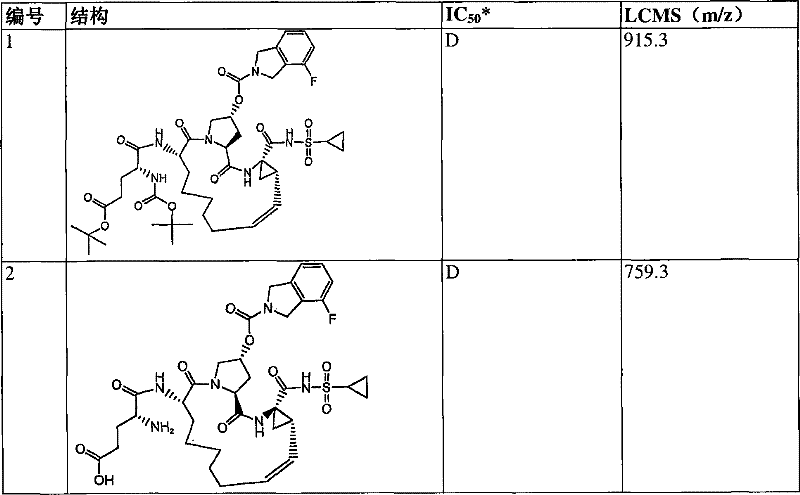
*NS3蛋白酶活性:A:<50mM;B:<10mM;C:<1mM;D:<0.1mM * NS3 protease activity: A: <50mM; B: <10mM; C: <1mM; D: <0.1mM
表2Table 2


*FL:全长NS3;A:<50mM;B:<10mM;C:<1mM;D:<0.1mM * FL: full-length NS3; A: <50mM; B: <10mM; C: <1mM; D: <0.1mM
Claims (33)
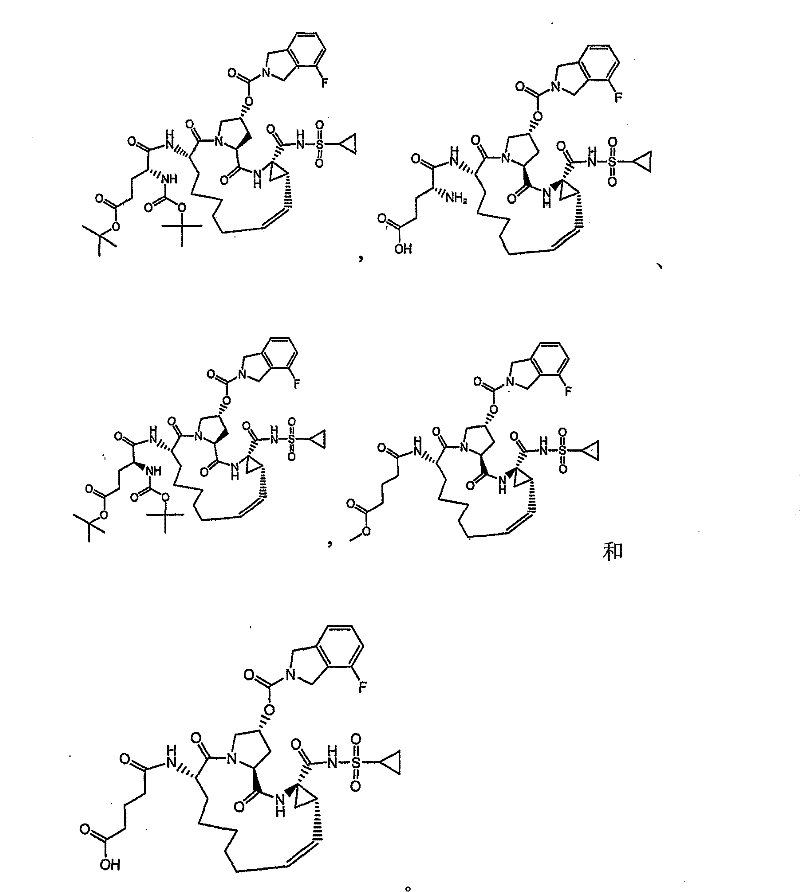
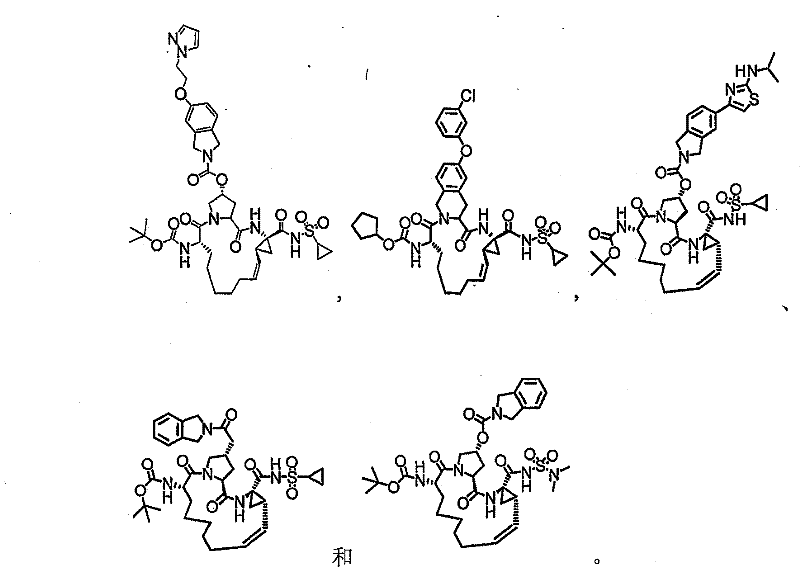

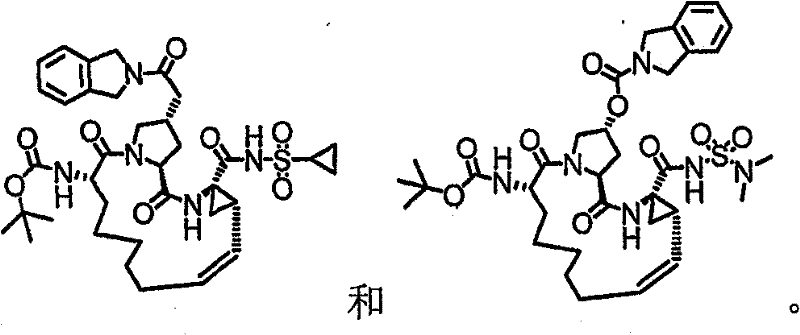
Applications Claiming Priority (3)
| Application Number | Priority Date | Filing Date | Title |
|---|---|---|---|
| US72556405P | 2005-10-11 | 2005-10-11 | |
| US60/725,564 | 2005-10-11 | ||
| PCT/US2006/040049 WO2007044893A2 (en) | 2005-10-11 | 2006-10-10 | Compounds and methods for inhibiting hepatitis c viral replication |
Publications (2)
| Publication Number | Publication Date |
|---|---|
| CN101415705A CN101415705A (en) | 2009-04-22 |
| CN101415705B true CN101415705B (en) | 2011-10-26 |
Family
ID=37943551
Family Applications (1)
| Application Number | Title | Priority Date | Filing Date |
|---|---|---|---|
| CN2006800379454A Expired - Fee Related CN101415705B (en) | 2005-10-11 | 2006-10-10 | Compounds and methods for inhibiting hepatitis c viral replication |
Country Status (26)
| Country | Link |
|---|---|
| US (1) | US8119592B2 (en) |
| EP (1) | EP1999129B1 (en) |
| JP (1) | JP2009511595A (en) |
| KR (1) | KR20080056295A (en) |
| CN (1) | CN101415705B (en) |
| AT (1) | ATE493409T1 (en) |
| AU (1) | AU2006301966A1 (en) |
| BR (1) | BRPI0617274A2 (en) |
| CA (1) | CA2624333A1 (en) |
| CU (1) | CU23781B7 (en) |
| DE (1) | DE602006019323D1 (en) |
| DK (1) | DK1999129T3 (en) |
| EA (1) | EA200801050A1 (en) |
| EC (1) | ECSP088437A (en) |
| ES (1) | ES2356776T3 (en) |
| GE (1) | GEP20104956B (en) |
| IL (1) | IL190404A0 (en) |
| MA (1) | MA29924B1 (en) |
| MX (1) | MX2008004754A (en) |
| NI (1) | NI200800114A (en) |
| NO (1) | NO20081999L (en) |
| NZ (1) | NZ568135A (en) |
| TN (1) | TNSN08160A1 (en) |
| UA (1) | UA93990C2 (en) |
| WO (1) | WO2007044893A2 (en) |
| ZA (1) | ZA200803797B (en) |
Families Citing this family (69)
| Publication number | Priority date | Publication date | Assignee | Title |
|---|---|---|---|---|
| JP2003007697A (en) * | 2001-06-21 | 2003-01-10 | Hitachi Kokusai Electric Inc | Semiconductor device manufacturing method, substrate processing method and substrate processing apparatus |
| MY140680A (en) | 2002-05-20 | 2010-01-15 | Bristol Myers Squibb Co | Hepatitis c virus inhibitors |
| US7491794B2 (en) * | 2003-10-14 | 2009-02-17 | Intermune, Inc. | Macrocyclic compounds as inhibitors of viral replication |
| GEP20105124B (en) * | 2005-07-25 | 2010-11-25 | Array Biopharma Inc | Novel macrocyclic inhibitors of hepatitis c virus replication |
| CN101415705B (en) | 2005-10-11 | 2011-10-26 | 因特蒙公司 | Compounds and methods for inhibiting hepatitis c viral replication |
| KR20090024834A (en) * | 2006-07-05 | 2009-03-09 | 인터뮨, 인크. | New Inhibitors of Hepatitis C Virus Replication |
| US7935670B2 (en) | 2006-07-11 | 2011-05-03 | Bristol-Myers Squibb Company | Hepatitis C virus inhibitors |
| EA017448B1 (en) | 2006-07-13 | 2012-12-28 | Ачиллион Фармасьютикалз, Инк. | 4-amino-4-oxobutanoyl peptides as inhibitors of viral replication |
| US8343477B2 (en) | 2006-11-01 | 2013-01-01 | Bristol-Myers Squibb Company | Inhibitors of hepatitis C virus |
| US7772180B2 (en) | 2006-11-09 | 2010-08-10 | Bristol-Myers Squibb Company | Hepatitis C virus inhibitors |
| US7888464B2 (en) | 2006-11-16 | 2011-02-15 | Bristol-Myers Squibb Company | Hepatitis C virus inhibitors |
| US8003604B2 (en) | 2006-11-16 | 2011-08-23 | Bristol-Myers Squibb Company | Hepatitis C virus inhibitors |
| US7763584B2 (en) | 2006-11-16 | 2010-07-27 | Bristol-Myers Squibb Company | Hepatitis C virus inhibitors |
| EA200900969A1 (en) * | 2007-01-08 | 2010-02-26 | Феномикс Корпорейшн | MACROCYCLIC INHIBITORS OF HEPATITIS C PROTEASE |
| US8435984B2 (en) | 2007-02-26 | 2013-05-07 | Achillion Pharmaceuticals, Inc. | Tertiary amine substituted peptides useful as inhibitors of HCV replication |
| AP2009005053A0 (en) * | 2007-05-03 | 2009-12-31 | Intermune Inc | Novel macrocyclic inhibitors of hepatitis c virus replication |
| KR20100027134A (en) | 2007-05-10 | 2010-03-10 | 인터뮨, 인크. | Novel peptide inhibitors of hepatitis c virus replication |
| RU2523790C2 (en) | 2007-12-21 | 2014-07-27 | Авила Терапьютикс, Инк. | Inhibitors of protease of hepatitis c virus and their application |
| US8309685B2 (en) | 2007-12-21 | 2012-11-13 | Celgene Avilomics Research, Inc. | HCV protease inhibitors and uses thereof |
| RU2515318C2 (en) | 2007-12-21 | 2014-05-10 | Авила Терапьютикс, Инк. | Inhibitors of protease of hepatitis c virus and their application |
| US8202996B2 (en) | 2007-12-21 | 2012-06-19 | Bristol-Myers Squibb Company | Crystalline forms of N-(tert-butoxycarbonyl)-3-methyl-L-valyl-(4R)-4-((7-chloro-4-methoxy-1-isoquinolinyl)oxy)-N- ((1R,2S)-1-((cyclopropylsulfonyl)carbamoyl)-2-vinylcyclopropyl)-L-prolinamide |
| WO2009142842A2 (en) * | 2008-04-15 | 2009-11-26 | Intermune, Inc. | Novel macrocyclic inhibitors of hepatitis c virus replication |
| US8163921B2 (en) | 2008-04-16 | 2012-04-24 | Bristol-Myers Squibb Company | Hepatitis C virus inhibitors |
| US7964560B2 (en) | 2008-05-29 | 2011-06-21 | Bristol-Myers Squibb Company | Hepatitis C virus inhibitors |
| JP5529120B2 (en) | 2008-05-29 | 2014-06-25 | ブリストル−マイヤーズ スクイブ カンパニー | Hepatitis C virus inhibitor |
| US8765667B2 (en) | 2008-08-20 | 2014-07-01 | Michael Eissenstat | HCV protease inhibitors |
| US8207341B2 (en) | 2008-09-04 | 2012-06-26 | Bristol-Myers Squibb Company | Process or synthesizing substituted isoquinolines |
| UY32099A (en) | 2008-09-11 | 2010-04-30 | Enanta Pharm Inc | HEPATITIS C SERINA PROTEASAS MACROCYCLIC INHIBITORS |
| CA2952692C (en) | 2008-09-22 | 2020-04-28 | Array Biopharma Inc. | Substituted imidazo[1,2b]pyridazine compounds |
| US8563505B2 (en) | 2008-09-29 | 2013-10-22 | Bristol-Myers Squibb Company | Hepatitis C virus inhibitors |
| US8044087B2 (en) | 2008-09-29 | 2011-10-25 | Bristol-Myers Squibb Company | Hepatitis C virus inhibitors |
| AP2011005695A0 (en) * | 2008-10-15 | 2011-06-30 | Intermune Inc | Therapeutic antiviral poptides. |
| PT3372605T (en) | 2008-10-22 | 2021-12-09 | Array Biopharma Inc | Substituted pyrazolo[1,5-a]pyrimidine compounds as trk kinase inhibitors |
| BRPI0922912A8 (en) | 2008-12-10 | 2018-01-02 | Achillion Pharmaceuticals Inc | 4-amino-4-oxobutanoyl peptides as viral replication inhibitors |
| US8283310B2 (en) | 2008-12-15 | 2012-10-09 | Bristol-Myers Squibb Company | Hepatitis C virus inhibitors |
| AR075584A1 (en) * | 2009-02-27 | 2011-04-20 | Intermune Inc | THERAPEUTIC COMPOSITIONS THAT INCLUDE beta-D-2'-DESOXI-2'-FLUORO-2'-C-METHYLYCTIDINE AND A CARDIEX ISOINDOL ACID DERIVATIVE AND ITS USES. COMPOUND. |
| US8232246B2 (en) | 2009-06-30 | 2012-07-31 | Abbott Laboratories | Anti-viral compounds |
| AR077468A1 (en) | 2009-07-09 | 2011-08-31 | Array Biopharma Inc | PIRAZOLO COMPOUNDS (1,5-A) PYRIMIDINE SUBSTITUTED AS TRK-QUINASA INHIBITORS |
| KR20130026410A (en) * | 2009-09-28 | 2013-03-13 | Intermune Inc | Cyclic peptide inhibitors of hepatitis c virus replication |
| JP2013518060A (en) | 2010-01-25 | 2013-05-20 | エナンタ ファーマシューティカルズ インコーポレイテッド | Hepatitis C virus inhibitor |
| US8933110B2 (en) | 2010-01-25 | 2015-01-13 | Enanta Pharmaceuticals, Inc. | Hepatitis C virus inhibitors |
| SMT201900203T1 (en) * | 2010-05-20 | 2019-05-10 | Array Biopharma Inc | Macrocyclic compounds as trk kinase inhibitors |
| WO2012092409A2 (en) | 2010-12-30 | 2012-07-05 | Enanta Phararmaceuticals, Inc | Macrocyclic hepatitis c serine protease inhibitors |
| CA2821340A1 (en) | 2010-12-30 | 2012-07-05 | Enanta Pharmaceuticals, Inc. | Phenanthridine macrocyclic hepatitis c serine protease inhibitors |
| US8957203B2 (en) | 2011-05-05 | 2015-02-17 | Bristol-Myers Squibb Company | Hepatitis C virus inhibitors |
| US10201584B1 (en) | 2011-05-17 | 2019-02-12 | Abbvie Inc. | Compositions and methods for treating HCV |
| US8691757B2 (en) | 2011-06-15 | 2014-04-08 | Bristol-Myers Squibb Company | Hepatitis C virus inhibitors |
| UA119315C2 (en) | 2012-07-03 | 2019-06-10 | Гіліад Фармассет Елелсі | HEPATITIS VIRUS INHIBITORS C |
| SG11201502802PA (en) | 2012-10-19 | 2015-05-28 | Bristol Myers Squibb Co | Hepatitis c virus inhibitors |
| US9598433B2 (en) | 2012-11-02 | 2017-03-21 | Bristol-Myers Squibb Company | Hepatitis C virus inhibitors |
| EP2914598B1 (en) | 2012-11-02 | 2017-10-18 | Bristol-Myers Squibb Company | Hepatitis c virus inhibitors |
| US9643999B2 (en) | 2012-11-02 | 2017-05-09 | Bristol-Myers Squibb Company | Hepatitis C virus inhibitors |
| EP2914614B1 (en) | 2012-11-05 | 2017-08-16 | Bristol-Myers Squibb Company | Hepatitis c virus inhibitors |
| CN105164148A (en) | 2013-03-07 | 2015-12-16 | 百时美施贵宝公司 | Hepatitis c virus inhibitors |
| JP2016515139A (en) | 2013-03-14 | 2016-05-26 | アキリオン ファーマシューティカルズ,インコーポレーテッド | A new method for producing buckwheatprevir |
| WO2014145600A1 (en) | 2013-03-15 | 2014-09-18 | Achillion Pharmaceuticals, Inc. | Ach-0142684 sodium salt polymorphs, composition including the same, and method of manufacture thereof |
| AU2014233390B2 (en) | 2013-03-15 | 2018-03-01 | Gilead Sciences, Inc. | Macrocyclic and bicyclic inhibitors of hepatitis C virus |
| US9227952B2 (en) | 2013-03-15 | 2016-01-05 | Achillion Pharmaceuticals, Inc. | Sovaprevir polymorphs and methods of manufacture thereof |
| US9006423B2 (en) | 2013-03-15 | 2015-04-14 | Achillion Pharmaceuticals Inc. | Process for making a 4-amino-4-oxobutanoyl peptide cyclic analogue, an inhibitor of viral replication, and intermediates thereof |
| EP3089757A1 (en) | 2014-01-03 | 2016-11-09 | AbbVie Inc. | Solid antiviral dosage forms |
| CA2967951C (en) | 2014-11-16 | 2023-11-07 | Array Biopharma, Inc. | Crystalline form of (s)-n-(5-((r)-2-(2,5-difluorophenyl)-pyrrolidin-1-yl)-pyrazolo[1,5-a]pyrimidin-3-yl)-3-hydroxypyrrolidine-1-carboxamide hydrogen sulfate |
| CN107108530B (en) | 2014-12-23 | 2020-12-15 | 克洛星有限公司 | Process for the industrial production of 2-halogen-4,6-dialkoxy-1,3,5-triazine and its use in the presence of amines |
| CA3003153A1 (en) | 2015-10-26 | 2017-05-04 | Loxo Oncology, Inc. | Point mutations in trk inhibitor-resistant cancer and methods relating to the same |
| US10045991B2 (en) | 2016-04-04 | 2018-08-14 | Loxo Oncology, Inc. | Methods of treating pediatric cancers |
| PH12018502124B1 (en) | 2016-04-04 | 2024-04-12 | Loxo Oncology Inc | Liquid formulations of (s)-n-(5-((r)-2-(2,5-difluorophenyl)-pyrrolidin-1-yl)-pyrazolo[1,5-a]pyrimidin-3-yl)-3-hydroxypyrrolidine-1-carboxamide |
| PT3458456T (en) | 2016-05-18 | 2020-12-07 | Array Biopharma Inc | Preparation of (s)-n-(5-((r)-2-(2,5-difluorophenyl)pyrrolidin-1-yl)pyrazolo[1,5-a]pyrimidin-3-y l)-3-hydroxypyrrolidine-1-carboxamide |
| JOP20190092A1 (en) | 2016-10-26 | 2019-04-25 | Array Biopharma Inc | PROCESS FOR THE PREPARATION OF PYRAZOLO[1,5-a]PYRIMIDINES AND SALTS THEREOF |
| JOP20190213A1 (en) | 2017-03-16 | 2019-09-16 | Array Biopharma Inc | Macrocyclic compounds as ros1 kinase inhibitors |
| US12083099B2 (en) | 2020-10-28 | 2024-09-10 | Accencio LLC | Methods of treating symptoms of coronavirus infection with viral protease inhibitors |
Family Cites Families (204)
| Publication number | Priority date | Publication date | Assignee | Title |
|---|---|---|---|---|
| US3547119A (en) | 1967-12-08 | 1970-12-15 | Baxter Laboratories Inc | Catheter assembly |
| US3798209A (en) | 1971-06-01 | 1974-03-19 | Icn Pharmaceuticals | 1,2,4-triazole nucleosides |
| US4211771A (en) | 1971-06-01 | 1980-07-08 | Robins Ronald K | Treatment of human viral diseases with 1-B-D-ribofuranosyl-1,2,4-triazole-3-carboxamide |
| US4311137A (en) | 1980-04-30 | 1982-01-19 | Sherwood Medical Industries Inc. | Infusion device |
| US4531937A (en) | 1983-01-24 | 1985-07-30 | Pacesetter Systems, Inc. | Introducer catheter apparatus and method of use |
| CS263951B1 (en) | 1985-04-25 | 1989-05-12 | Antonin Holy | 9-(phosponylmethoxyalkyl)adenines and method of their preparation |
| PT82580B (en) | 1985-05-15 | 1989-01-17 | Wellcome Found | Process for the preparation of 2 ', 3'-DIDESOXINUCLEOSIDOS AND OF PHARMACEUTICAL COMPOSITIONS THAT CONTAIN THEM |
| US4806347A (en) | 1985-12-11 | 1989-02-21 | Schering Corporation | Interferon combinations |
| US4755173A (en) | 1986-02-25 | 1988-07-05 | Pacesetter Infusion, Ltd. | Soft cannula subcutaneous injection set |
| CS264222B1 (en) | 1986-07-18 | 1989-06-13 | Holy Antonin | N-phosphonylmethoxyalkylderivatives of bases of pytimidine and purine and method of use them |
| US5082659A (en) | 1986-10-06 | 1992-01-21 | Board Of Regents, The University Of Texas System | Methods and compositions employing interferon-gamma |
| US5190751A (en) | 1987-01-20 | 1993-03-02 | Schering Corporation | Treatment of certain leukemias with a combination of gamma interferon and alpha interferon |
| DE3869789D1 (en) | 1987-01-20 | 1992-05-14 | Schering Corp | TREATMENT OF SOME LEUKAEMIA WITH A COMPOSITION OF INTERFERON-GAMMA AND INTERFERON-ALPHA. |
| WO1988009673A1 (en) | 1987-06-02 | 1988-12-15 | Schering Corporation | Treatment of chronic type b hepatitis with a combination of recombinant human alpha and gamma interferons |
| GB8815265D0 (en) | 1988-06-27 | 1988-08-03 | Wellcome Found | Therapeutic nucleosides |
| US5552558A (en) | 1989-05-23 | 1996-09-03 | Abbott Laboratories | Retroviral protease inhibiting compounds |
| US5232928A (en) | 1989-07-25 | 1993-08-03 | Boehringer Ingelheim Pharmaceuticals, Inc. | Tetrahydroisoquinoline amides |
| US5310562A (en) | 1989-11-22 | 1994-05-10 | Margolin Solomon B | Composition and method for reparation and prevention of fibrotic lesions |
| US5518729A (en) | 1989-11-22 | 1996-05-21 | Margolin; Solomon B. | Compositions and methods for reparation and prevention of fibrotic lesions |
| US5716632A (en) | 1989-11-22 | 1998-02-10 | Margolin; Solomon B. | Compositions and methods for reparation and prevention of fibrotic lesions |
| US5372808A (en) | 1990-10-17 | 1994-12-13 | Amgen Inc. | Methods and compositions for the treatment of diseases with consensus interferon while reducing side effect |
| US5610054A (en) | 1992-05-14 | 1997-03-11 | Ribozyme Pharmaceuticals, Inc. | Enzymatic RNA molecule targeted against Hepatitis C virus |
| US5382657A (en) | 1992-08-26 | 1995-01-17 | Hoffmann-La Roche Inc. | Peg-interferon conjugates |
| US5545143A (en) | 1993-01-21 | 1996-08-13 | T. S. I. Medical | Device for subcutaneous medication delivery |
| CA2176229C (en) | 1993-11-10 | 2003-05-27 | Carl W. Gilbert | Improved interferon polymer conjugates |
| US5624949A (en) | 1993-12-07 | 1997-04-29 | Eli Lilly And Company | Protein kinase C inhibitors |
| US6693072B2 (en) | 1994-06-02 | 2004-02-17 | Aventis Pharmaceuticals Inc. | Elastase inhibitors |
| US5500208A (en) | 1994-06-07 | 1996-03-19 | The Procter & Gamble Company | Oral compositions comprising a novel tripeptide |
| US5847135A (en) | 1994-06-17 | 1998-12-08 | Vertex Pharmaceuticals, Incorporated | Inhibitors of interleukin-1β converting enzyme |
| US5756466A (en) | 1994-06-17 | 1998-05-26 | Vertex Pharmaceuticals, Inc. | Inhibitors of interleukin-1β converting enzyme |
| US5824784A (en) | 1994-10-12 | 1998-10-20 | Amgen Inc. | N-terminally chemically modified protein compositions and methods |
| IL116730A0 (en) | 1995-01-13 | 1996-05-14 | Amgen Inc | Chemically modified interferon |
| US6090822A (en) | 1995-03-03 | 2000-07-18 | Margolin; Solomon B. | Treatment of cytokine growth factor caused disorders |
| GB9517022D0 (en) | 1995-08-19 | 1995-10-25 | Glaxo Group Ltd | Medicaments |
| US5908621A (en) | 1995-11-02 | 1999-06-01 | Schering Corporation | Polyethylene glycol modified interferon therapy |
| US5980884A (en) | 1996-02-05 | 1999-11-09 | Amgen, Inc. | Methods for retreatment of patients afflicted with Hepatitis C using consensus interferon |
| US5908121A (en) | 1996-03-11 | 1999-06-01 | Dardashti; Shahriar | Adjustable display assembly |
| US5633388A (en) | 1996-03-29 | 1997-05-27 | Viropharma Incorporated | Compounds, compositions and methods for treatment of hepatitis C |
| CA2254122A1 (en) | 1996-05-10 | 1997-11-20 | Schering Corporation | Synthetic inhibitors of hepatitis c virus ns3 protease |
| UA66767C2 (en) | 1996-10-18 | 2004-06-15 | Вертекс Фармасьютикалс Інкорпорейтед | Serine proteases inhibitors, pharmaceutical composition, a method for inhibitining activity and a method for treatment or prevention of viral infection of hepatitis c |
| GB9623908D0 (en) | 1996-11-18 | 1997-01-08 | Hoffmann La Roche | Amino acid derivatives |
| US5968895A (en) | 1996-12-11 | 1999-10-19 | Praecis Pharmaceuticals, Inc. | Pharmaceutical formulations for sustained drug delivery |
| WO1998046597A1 (en) | 1997-04-14 | 1998-10-22 | Emory University | Serine protease inhibitors |
| GB9707659D0 (en) | 1997-04-16 | 1997-06-04 | Peptide Therapeutics Ltd | Hepatitis C NS3 Protease inhibitors |
| AU757072B2 (en) | 1997-08-11 | 2003-01-30 | Boehringer Ingelheim (Canada) Ltd. | Hepatitis C inhibitor peptide analogues |
| US6767991B1 (en) | 1997-08-11 | 2004-07-27 | Boehringer Ingelheim (Canada) Ltd. | Hepatitis C inhibitor peptides |
| IL134232A0 (en) | 1997-08-11 | 2001-04-30 | Boehringer Ingelheim Ca Ltd | Hepatitis c inhibitor peptides |
| US6172046B1 (en) | 1997-09-21 | 2001-01-09 | Schering Corporation | Combination therapy for eradicating detectable HCV-RNA in patients having chronic Hepatitis C infection |
| US5985263A (en) | 1997-12-19 | 1999-11-16 | Enzon, Inc. | Substantially pure histidine-linked protein polymer conjugates |
| IT1299134B1 (en) | 1998-02-02 | 2000-02-29 | Angeletti P Ist Richerche Bio | PROCEDURE FOR THE PRODUCTION OF PEPTIDES WITH PROTEAS INHIBITING THE NS3 PROTEASIS OF THE HCV VIRUS, PEPTIDES SO OBTAINABLE AND PEPTIDES |
| ATE346035T1 (en) | 1998-03-31 | 2006-12-15 | Vertex Pharma | INHIBITORS OF SERINE PROTEASES, IN PARTICULAR HEPATITIS C VIRUS NS3 PROTEASE |
| GB9812523D0 (en) | 1998-06-10 | 1998-08-05 | Angeletti P Ist Richerche Bio | Peptide inhibitors of hepatitis c virus ns3 protease |
| US6323180B1 (en) | 1998-08-10 | 2001-11-27 | Boehringer Ingelheim (Canada) Ltd | Hepatitis C inhibitor tri-peptides |
| AR022061A1 (en) | 1998-08-10 | 2002-09-04 | Boehringer Ingelheim Ca Ltd | INHIBITING PEPTIDES OF HEPATITIS C, A PHARMACEUTICAL COMPOSITION CONTAINING THEM, THE USE OF THE SAME TO PREPARE A PHARMACEUTICAL COMPOSITION, THE USE OF AN INTERMEDIATE PRODUCT FOR THE PREPARATION OF THESE PEPTIDES AND A PROCEDURE FOR THE PREPARATION OF ANOGRAPH . |
| US6277830B1 (en) | 1998-10-16 | 2001-08-21 | Schering Corporation | 5′-amino acid esters of ribavirin and the use of same to treat hepatitis C with interferon |
| US7157430B2 (en) | 1998-10-22 | 2007-01-02 | Idun Pharmaceuticals, Inc. | (Substituted)acyl dipeptidyl inhibitors of the ICE/CED-3 family of cysteine proteases |
| US6245740B1 (en) | 1998-12-23 | 2001-06-12 | Amgen Inc. | Polyol:oil suspensions for the sustained release of proteins |
| UA74546C2 (en) | 1999-04-06 | 2006-01-16 | Boehringer Ingelheim Ca Ltd | Macrocyclic peptides having activity relative to hepatitis c virus, a pharmaceutical composition and use of the pharmaceutical composition |
| US6608027B1 (en) | 1999-04-06 | 2003-08-19 | Boehringer Ingelheim (Canada) Ltd | Macrocyclic peptides active against the hepatitis C virus |
| MXPA01011045A (en) | 1999-05-04 | 2002-07-22 | Boehringer Ingelheim Ltd | Surrogate cell-based system and method for assaying the activity of hepatitis c virus ns3 protease. |
| US7256005B2 (en) | 1999-08-10 | 2007-08-14 | The Chancellor, Masters And Scholars Of The University Of Oxford | Methods for identifying iminosugar derivatives that inhibit HCV p7 ion channel activity |
| ES2240446T3 (en) | 2000-04-03 | 2005-10-16 | Vertex Pharma | SERINE PROTEASE INHIBITORS, PARTICULARLY THE NS3 PROTEASE OF HEPATITIS VIRUS C. |
| ES2317900T3 (en) | 2000-04-05 | 2009-05-01 | Schering Corporation | SERINA PROTEASA NS3 MACROCICLIC INHIBITORS OF HEPATITIS C VIRUSES INCLUDING P2 N-CYCLICAL FRAGMENTS. |
| PL358591A1 (en) | 2000-04-19 | 2004-08-09 | Schering Corporation | Macrocyclic ns3-serine protease inhibitors of hepatitis c virus comprising alkyl and aryl alanine p2 moieties |
| US7244721B2 (en) | 2000-07-21 | 2007-07-17 | Schering Corporation | Peptides as NS3-serine protease inhibitors of hepatitis C virus |
| CN102206247B (en) | 2000-07-21 | 2013-03-27 | 默沙东公司 | Novel peptides as NS3/NS4a serine protease inhibitors of hepatitis C virus |
| CA2429359A1 (en) | 2000-11-20 | 2002-08-08 | Bristol-Myers Squibb Company | Hepatitis c tripeptide inhibitors |
| CA2446380A1 (en) | 2001-05-08 | 2002-11-14 | Yale University | Proteomimetic compounds and methods |
| WO2003006490A1 (en) | 2001-07-11 | 2003-01-23 | Vertex Pharmaceuticals Incorporated | Bridged bicyclic serine protease inhibitors |
| US6867185B2 (en) | 2001-12-20 | 2005-03-15 | Bristol-Myers Squibb Company | Inhibitors of hepatitis C virus |
| US7119072B2 (en) | 2002-01-30 | 2006-10-10 | Boehringer Ingelheim (Canada) Ltd. | Macrocyclic peptides active against the hepatitis C virus |
| CA2369711A1 (en) | 2002-01-30 | 2003-07-30 | Boehringer Ingelheim (Canada) Ltd. | Macrocyclic peptides active against the hepatitis c virus |
| US7091184B2 (en) | 2002-02-01 | 2006-08-15 | Boehringer Ingelheim International Gmbh | Hepatitis C inhibitor tri-peptides |
| US6642204B2 (en) | 2002-02-01 | 2003-11-04 | Boehringer Ingelheim International Gmbh | Hepatitis C inhibitor tri-peptides |
| CA2370396A1 (en) | 2002-02-01 | 2003-08-01 | Boehringer Ingelheim (Canada) Ltd. | Hepatitis c inhibitor tri-peptides |
| CA2370400A1 (en) | 2002-02-01 | 2003-08-01 | Boehringer Ingelheim (Canada) Ltd. | Hepatitis c inhibitor tri-peptides |
| CA2369970A1 (en) | 2002-02-01 | 2003-08-01 | Boehringer Ingelheim (Canada) Ltd. | Hepatitis c inhibitor tri-peptides |
| US6828301B2 (en) | 2002-02-07 | 2004-12-07 | Boehringer Ingelheim International Gmbh | Pharmaceutical compositions for hepatitis C viral protease inhibitors |
| MXPA04009938A (en) | 2002-04-11 | 2004-12-13 | Vertex Pharma | Inhibitors of serine proteases, particularly hepatitis c virus ns3 - ns4 protease. |
| CN101041669A (en) | 2002-04-26 | 2007-09-26 | 吉里德科学公司 | Non nucleoside reverse transcriptase inhibitors |
| DE60334205D1 (en) | 2002-05-20 | 2010-10-28 | Bristol Myers Squibb Co | Heterocyclische sulfonamid-hepatitis-c-virus-hemmer |
| MY140680A (en) | 2002-05-20 | 2010-01-15 | Bristol Myers Squibb Co | Hepatitis c virus inhibitors |
| ATE503764T1 (en) | 2002-05-20 | 2011-04-15 | Bristol Myers Squibb Co | HEPATITIS C VIRUS INHIBITORS |
| US20060199773A1 (en) | 2002-05-20 | 2006-09-07 | Sausker Justin B | Crystalline forms of (1R,2S)-N-[(1,1-dimethylethoxy)carbonyl]-3-methyl-L-valyl-(4R)-4-[(6-methoxy-1-isoquinolinyl)oxy]-L-prolyl-1-amino-N-(cyclopropylsulfonyl)-2-ethenyl-cyclopropanecarboxamide, monopotassium salt |
| PL213029B1 (en) | 2002-05-20 | 2012-12-31 | Bristol Myers Squibb Co | Substituted cycloalkyl p1' hepatitis c virus inhibitors |
| US20040033959A1 (en) | 2002-07-19 | 2004-02-19 | Boehringer Ingelheim Pharmaceuticals, Inc. | Pharmaceutical compositions for hepatitis C viral protease inhibitors |
| US20040138109A1 (en) | 2002-09-30 | 2004-07-15 | Boehringer Ingelheim Pharmaceuticals, Inc. | Potent inhibitor of HCV serine protease |
| PL199412B1 (en) | 2002-10-15 | 2008-09-30 | Boehringer Ingelheim Int | Ruthenium new complexes as (pre) catalytic agents of permutation reaction, new derivatives of 2-alkoxy-5-nitrostyrene as intermediate compounds and method of their receiving |
| US20050075279A1 (en) | 2002-10-25 | 2005-04-07 | Boehringer Ingelheim International Gmbh | Macrocyclic peptides active against the hepatitis C virus |
| US7601709B2 (en) | 2003-02-07 | 2009-10-13 | Enanta Pharmaceuticals, Inc. | Macrocyclic hepatitis C serine protease inhibitors |
| US20040180815A1 (en) | 2003-03-07 | 2004-09-16 | Suanne Nakajima | Pyridazinonyl macrocyclic hepatitis C serine protease inhibitors |
| AU2004211637C1 (en) | 2003-02-07 | 2010-08-19 | Enanta Pharmaceuticals, Inc. | Macrocyclic hepatitis C serine protease inhibitors |
| CA2516016C (en) | 2003-03-05 | 2012-05-29 | Boehringer Ingelheim International Gmbh | Hepatitis c inhibiting compounds |
| UY28240A1 (en) | 2003-03-27 | 2004-11-08 | Boehringer Ingelheim Pharma | CRYSTAL PHASES OF A POWERFUL HCV INHIBITOR |
| CN100363055C (en) | 2003-04-02 | 2008-01-23 | 贝林格尔·英格海姆国际有限公司 | Pharmaceutical compositions for use as hepatitis C virus protease inhibitors |
| WO2004092203A2 (en) | 2003-04-10 | 2004-10-28 | Boehringer Ingelheim International, Gmbh | Process for preparing macrocyclic compounds |
| EP1615949A1 (en) | 2003-04-10 | 2006-01-18 | Boehringer Ingelheim International GmbH | Process for the preparation of macrocyclic compounds by ruthenium complex catalysed metathesis reaction |
| EP1613620A1 (en) * | 2003-04-11 | 2006-01-11 | Vertex Pharmaceuticals Incorporated | Inhibitors of serine proteases, particularly hcv ns3-ns4a protease |
| JP4733023B2 (en) | 2003-04-16 | 2011-07-27 | ブリストル−マイヤーズ スクイブ カンパニー | Macrocyclic isoquinoline peptide inhibitor of hepatitis C virus |
| US7176208B2 (en) | 2003-04-18 | 2007-02-13 | Enanta Pharmaceuticals, Inc. | Quinoxalinyl macrocyclic hepatitis C serine protease inhibitors |
| US7429565B2 (en) | 2003-04-25 | 2008-09-30 | Gilead Sciences, Inc. | Antiviral phosphonate analogs |
| US7300924B2 (en) | 2003-04-25 | 2007-11-27 | Gilead Sciences, Inc. | Anti-infective phosphonate analogs |
| EP1622870A2 (en) | 2003-05-05 | 2006-02-08 | Prosidion Ltd. | Glutaminyl based dp iv-inhibitors |
| US7273851B2 (en) | 2003-06-05 | 2007-09-25 | Enanta Pharmaceuticals, Inc. | Tri-peptide hepatitis C serine protease inhibitors |
| US7125845B2 (en) | 2003-07-03 | 2006-10-24 | Enanta Pharmaceuticals, Inc. | Aza-peptide macrocyclic hepatitis C serine protease inhibitors |
| AR045596A1 (en) | 2003-09-05 | 2005-11-02 | Vertex Pharma | INHIBITORS OF SERINE PROTEASES IN PARTICULAR HCV PROTEASA NS3-NS4A |
| AU2004274468B2 (en) | 2003-09-18 | 2009-07-23 | Vertex Pharmaceuticals, Incorporated | Inhibitors of serine proteases, particularly HCV NS3-NS4A protease |
| DE602004031645D1 (en) | 2003-09-22 | 2011-04-14 | Boehringer Ingelheim Pharma | MACROCYCLIC PEPTIDES WITH EFFECT AGAINST HEPATITIS C VIRUS |
| DE602004031298D1 (en) | 2003-09-26 | 2011-03-17 | Schering Corp | MACROCYCLIC INHIBITORS OF THE NS3 SERINE PROTEASE OF HEPATITIS C VIRUS |
| MXPA06004006A (en) | 2003-10-10 | 2006-06-28 | Vertex Pharma | Inhibitors of serine proteases, particularly hcv ns3-ns4a protease. |
| RS54573B1 (en) | 2003-10-14 | 2016-06-30 | F. Hoffmann-La Roche Ltd | MACROCYCLIC CARBOXYLIC ACIDS AND ACYLSULPHONAMIDES AS HCV REPLICATION INHIBITORS |
| US7491794B2 (en) | 2003-10-14 | 2009-02-17 | Intermune, Inc. | Macrocyclic compounds as inhibitors of viral replication |
| CA2551074A1 (en) | 2003-10-27 | 2005-05-12 | Vertex Pharmaceuticals Incorporated | Hcv ns3-ns4a protease resistance mutants |
| US7132504B2 (en) | 2003-11-12 | 2006-11-07 | Bristol-Myers Squibb Company | Hepatitis C virus inhibitors |
| US7135462B2 (en) | 2003-11-20 | 2006-11-14 | Bristol-Myers Squibb Company | Hepatitis C virus inhibitors |
| EP1687021B1 (en) | 2003-11-20 | 2013-11-06 | Boehringer Ingelheim International GmbH | Method of removing transition metals, especially from metathesis reaction products |
| US7309708B2 (en) | 2003-11-20 | 2007-12-18 | Birstol-Myers Squibb Company | Hepatitis C virus inhibitors |
| CA2547770A1 (en) | 2003-12-08 | 2005-06-23 | Fabrice Gallou | Removal of ruthenium by-product by supercritical fluid processing |
| RU2006124594A (en) | 2003-12-11 | 2008-01-27 | Шеринг Корпорейшн (US) | NSA / NS4A SERINE PROTEASE INHIBITORS HEPATITIS C VIRUS |
| EP1730167B1 (en) | 2004-01-21 | 2011-01-12 | Boehringer Ingelheim International GmbH | Macrocyclic peptides active against the hepatitis c virus |
| CA2544886C (en) | 2004-01-28 | 2012-12-04 | Boehringer Ingelheim International Gmbh | Method of removing transition metals from reaction solutions comprising transition metal byproducts |
| CA2552319C (en) | 2004-01-30 | 2012-08-21 | Medivir Ab | Hcv ns-3 serine protease inhibitors |
| EP1711515A2 (en) | 2004-02-04 | 2006-10-18 | Vertex Pharmaceuticals Incorporated | Inhibitors of serine proteases, particularly hcv ns3-ns4a protease |
| JP4874227B2 (en) | 2004-02-27 | 2012-02-15 | シェーリング コーポレイション | Novel ketoamide with cyclic P4'S as NS3 serine protease inhibitor of hepatitis C virus |
| EP1737881B1 (en) | 2004-02-27 | 2009-06-24 | Schering Corporation | Novel compounds as inhibitors of hepatitis c virus ns3 serine protease |
| US7816326B2 (en) | 2004-02-27 | 2010-10-19 | Schering Corporation | Sulfur compounds as inhibitors of hepatitis C virus NS3 serine protease |
| EP1737821B1 (en) | 2004-02-27 | 2009-08-05 | Schering Corporation | 3,4-(cyclopentyl)-fused proline compounds as inhibitors of hepatitis c virus ns3 serine protease |
| US7205330B2 (en) | 2004-02-27 | 2007-04-17 | Schering Corporation | Inhibitors of hepatitis C virus NS3 protease |
| ATE459638T1 (en) | 2004-03-15 | 2010-03-15 | Boehringer Ingelheim Int | METHOD FOR PRODUCING MACROCYCLIC DIPEPTIDES SUITABLE FOR THE TREATMENT OF HEPATITIS C VIRUS INFECTIONS |
| US8598127B2 (en) | 2004-04-06 | 2013-12-03 | Korea Research Institute Of Bioscience & Biotechnology | Peptides for inhibiting MDM2 function |
| EP1773868B1 (en) | 2004-05-20 | 2009-07-15 | Schering Corporation | Substituted prolines as inhibitors of hepatitis c virus ns3 serine protease |
| US7514557B2 (en) | 2004-05-25 | 2009-04-07 | Boehringer Ingelheim International Gmbh | Process for preparing acyclic HCV protease inhibitors |
| US7939538B2 (en) | 2004-06-28 | 2011-05-10 | Amgen Inc. | Compounds, compositions and methods for prevention and treatment of inflammatory and immunoregulatory disorders and diseases |
| DE102004033312A1 (en) | 2004-07-08 | 2006-01-26 | Boehringer Ingelheim Pharma Gmbh & Co. Kg | Continuous metathesis process with ruthenium catalysts |
| AP2461A (en) | 2004-07-16 | 2012-09-14 | Gilead Sciences Inc | Antiviral compounds |
| UY29016A1 (en) | 2004-07-20 | 2006-02-24 | Boehringer Ingelheim Int | ANALOGS OF INHIBITING DIPEPTIDES OF HEPATITIS C |
| JP4914355B2 (en) | 2004-07-20 | 2012-04-11 | ベーリンガー インゲルハイム インターナショナル ゲゼルシャフト ミット ベシュレンクテル ハフツング | Hepatitis C inhibitor peptide analog |
| MX2007002371A (en) | 2004-08-27 | 2007-04-23 | Schering Corp | Acylsulfonamide compounds as inhibitors of hepatitis c virus ns3 serine protease. |
| EP1794179A1 (en) | 2004-09-17 | 2007-06-13 | Boehringer Ingelheim International Gmbh | Ring-closing metathesis process in supercritical fluid |
| CA2577831A1 (en) | 2004-09-17 | 2006-03-30 | Boehringer Ingelheim International Gmbh | Process for preparing macrocyclic hcv protease inhibitors |
| EP1838296B1 (en) | 2004-10-20 | 2012-08-08 | Resverlogix Corp. | Flavanoids and isoflavanoids for the prevention and treatment of cardiovascular diseases |
| DE102005002336A1 (en) | 2005-01-17 | 2006-07-20 | Boehringer Ingelheim Pharma Gmbh & Co. Kg | Process for conducting continuous olefin-ring closure metathesis in compressed carbon dioxide |
| US7323447B2 (en) | 2005-02-08 | 2008-01-29 | Bristol-Myers Squibb Company | Hepatitis C virus inhibitors |
| US7524831B2 (en) | 2005-03-02 | 2009-04-28 | Schering Corporation | Treatments for Flaviviridae virus infection |
| WO2006096459A2 (en) | 2005-03-04 | 2006-09-14 | The Rockefeller University | Infectious, chimeric hepatitis c virus, methods of producing the same and methods of use thereof |
| DK1863833T3 (en) | 2005-03-08 | 2013-12-02 | Boehringer Ingelheim Int | PROCEDURE FOR MAKING MACROCYCLIC COMPOUNDS |
| WO2006113942A2 (en) | 2005-04-20 | 2006-10-26 | Schering Corporation | Method of inhibiting cathepsin activity |
| EP1879607B1 (en) | 2005-05-02 | 2014-11-12 | Merck Sharp & Dohme Corp. | Hcv ns3 protease inhibitors |
| AU2006250068A1 (en) | 2005-05-26 | 2006-11-30 | Schering Corporation | Interferon-IGG fusion |
| ES2572980T3 (en) | 2005-06-02 | 2016-06-03 | Merck Sharp & Dohme Corp. | Combination of HCV protease inhibitors with a surfactant |
| AU2006252519B2 (en) | 2005-06-02 | 2012-08-30 | Merck Sharp & Dohme Corp. | HCV protease inhibitors in combination with food |
| US20060275366A1 (en) | 2005-06-02 | 2006-12-07 | Schering Corporation | Controlled-release formulation |
| WO2006130626A2 (en) | 2005-06-02 | 2006-12-07 | Schering Corporation | Method for modulating activity of hcv protease through use of a novel hcv protease inhibitor to reduce duration of treatment period |
| US20060276404A1 (en) | 2005-06-02 | 2006-12-07 | Anima Ghosal | Medicaments and methods combining a HCV protease inhibitor and an AKR competitor |
| US20070021351A1 (en) | 2005-06-02 | 2007-01-25 | Schering Corporation | Liver/plasma concentration ratio for dosing hepatitis C virus protease inhibitor |
| US20060287248A1 (en) | 2005-06-02 | 2006-12-21 | Schering Corporation | Asymmetric dosing methods |
| WO2006130627A2 (en) | 2005-06-02 | 2006-12-07 | Schering Corporation | Methods for treating hepatitis c |
| US20070004635A1 (en) | 2005-06-02 | 2007-01-04 | Schering Corporation | Method of treating interferon non-responders using HCV protease inhibitor |
| WO2006130554A2 (en) | 2005-06-02 | 2006-12-07 | Schering Corporation | Methods of treating hepatitis c virus |
| US7608592B2 (en) | 2005-06-30 | 2009-10-27 | Virobay, Inc. | HCV inhibitors |
| US7601686B2 (en) | 2005-07-11 | 2009-10-13 | Bristol-Myers Squibb Company | Hepatitis C virus inhibitors |
| TWI389908B (en) | 2005-07-14 | 2013-03-21 | Gilead Sciences Inc | Antiviral compounds |
| AR057456A1 (en) | 2005-07-20 | 2007-12-05 | Merck & Co Inc | HCV PROTEASA NS3 INHIBITORS |
| GEP20105124B (en) | 2005-07-25 | 2010-11-25 | Array Biopharma Inc | Novel macrocyclic inhibitors of hepatitis c virus replication |
| PE20070343A1 (en) | 2005-07-29 | 2007-05-12 | Medivir Ab | MACRO CYCLIC INHIBITORS OF HEPATITIS C VIRUS |
| US7700552B2 (en) | 2005-07-29 | 2010-04-20 | Medivir Ab | Macrocyclic inhibitors of hepatitis C virus |
| WO2007014922A1 (en) | 2005-07-29 | 2007-02-08 | Tibotec Pharmaceuticals Ltd. | Macrocyclic inhibitors of hepatitis c virus |
| US20090325889A1 (en) | 2005-08-01 | 2009-12-31 | David Alan Campbell | Hepatitis c serine protease inhibitors and uses therefor |
| CN101415705B (en) | 2005-10-11 | 2011-10-26 | 因特蒙公司 | Compounds and methods for inhibiting hepatitis c viral replication |
| US7772183B2 (en) | 2005-10-12 | 2010-08-10 | Bristol-Myers Squibb Company | Hepatitis C virus inhibitors |
| US7741281B2 (en) | 2005-11-03 | 2010-06-22 | Bristol-Myers Squibb Company | Hepatitis C virus inhibitors |
| US7705138B2 (en) * | 2005-11-11 | 2010-04-27 | Vertex Pharmaceuticals Incorporated | Hepatitis C virus variants |
| KR101020440B1 (en) | 2005-11-16 | 2011-03-08 | 에프. 호프만-라 로슈 아게 | Pyrrolidine Derivatives as Inhibitors of Coagulation Factor Pa |
| JP2009526070A (en) | 2006-02-09 | 2009-07-16 | シェーリング コーポレイション | Combinations of HCV protease inhibitors and HCV polymerase inhibitors and methods of treatment associated therewith |
| KR20080112303A (en) | 2006-03-16 | 2008-12-24 | 버텍스 파마슈티칼스 인코포레이티드 | Deuterated Hepatitis C Protease Inhibitor |
| CA2647158C (en) | 2006-03-23 | 2012-07-31 | Schering Corporation | Combinations of hcv protease inhibitor(s) and cyp3a4 inhibitor(s), and methods of treatment related thereto |
| BRPI0710878A2 (en) | 2006-04-11 | 2015-03-31 | Novartis Ag | Organic compounds and their uses |
| US7728148B2 (en) | 2006-06-06 | 2010-06-01 | Enanta Pharmaceuticals, Inc. | Acyclic oximyl hepatitis C protease inhibitors |
| US9526769B2 (en) | 2006-06-06 | 2016-12-27 | Enanta Pharmaceuticals, Inc. | Macrocylic oximyl hepatitis C protease inhibitors |
| US20080187516A1 (en) | 2006-06-06 | 2008-08-07 | Ying Sun | Acyclic oximyl hepatitis c protease inhibitors |
| US20090203008A1 (en) | 2006-06-08 | 2009-08-13 | Ludmerer Steven W | Rapid method to determine inhibitor sensitivity of NS3/4A protease sequences cloned from clinical samples |
| PE20080992A1 (en) | 2006-06-26 | 2008-08-06 | Enanta Pharm Inc | QUINOXALINYL MACROCYCLIC SERINE PROTEASE INHIBITORS OF HEPATITIS C VIRUS |
| KR20090024834A (en) | 2006-07-05 | 2009-03-09 | 인터뮨, 인크. | New Inhibitors of Hepatitis C Virus Replication |
| US7935670B2 (en) | 2006-07-11 | 2011-05-03 | Bristol-Myers Squibb Company | Hepatitis C virus inhibitors |
| EA017448B1 (en) | 2006-07-13 | 2012-12-28 | Ачиллион Фармасьютикалз, Инк. | 4-amino-4-oxobutanoyl peptides as inhibitors of viral replication |
| US20090035267A1 (en) | 2007-07-31 | 2009-02-05 | Moore Joel D | Acyclic, pyridazinone-derived hepatitis c serine protease inhibitors |
| US7635683B2 (en) | 2006-08-04 | 2009-12-22 | Enanta Pharmaceuticals, Inc. | Quinoxalinyl tripeptide hepatitis C virus inhibitors |
| CN101674844A (en) | 2006-08-04 | 2010-03-17 | 英安塔制药有限公司 | Tetrazolyl macrocyclic hepatitis C serine protease inhibitors |
| WO2008019303A2 (en) | 2006-08-04 | 2008-02-14 | Enanta Pharmaceuticals, Inc. | Pyridazinonyl macrocyclic hepatitis c serine protease inhibitors |
| US20080038225A1 (en) | 2006-08-11 | 2008-02-14 | Ying Sun | Triazolyl acyclic hepatitis c serine protease inhibitors |
| US7605126B2 (en) | 2006-08-11 | 2009-10-20 | Enanta Pharmaceuticals, Inc. | Acylaminoheteroaryl hepatitis C virus protease inhibitors |
| US7687459B2 (en) * | 2006-08-11 | 2010-03-30 | Enanta Pharmaceuticals, Inc. | Arylalkoxyl hepatitis C virus protease inhibitors |
| WO2008021960A2 (en) | 2006-08-11 | 2008-02-21 | Enanta Pharmaceuticals, Inc. | Triazolyl macrocyclic hepatitis c serine protease inhibitors |
| WO2008022006A2 (en) | 2006-08-11 | 2008-02-21 | Enanta Pharmaceuticals, Inc. | Arylalkoxyl hepatitis c virus protease inhibitors |
| US20090098085A1 (en) | 2006-08-11 | 2009-04-16 | Ying Sun | Tetrazolyl acyclic hepatitis c serine protease inhibitors |
| AP2009005053A0 (en) | 2007-05-03 | 2009-12-31 | Intermune Inc | Novel macrocyclic inhibitors of hepatitis c virus replication |
| KR20100027134A (en) | 2007-05-10 | 2010-03-10 | 인터뮨, 인크. | Novel peptide inhibitors of hepatitis c virus replication |
| WO2009142842A2 (en) | 2008-04-15 | 2009-11-26 | Intermune, Inc. | Novel macrocyclic inhibitors of hepatitis c virus replication |
| AP2011005695A0 (en) | 2008-10-15 | 2011-06-30 | Intermune Inc | Therapeutic antiviral poptides. |
| SG173747A1 (en) | 2009-02-18 | 2011-09-29 | Univ Wayne State | Method for identifying a subpopulation of mammalian cells with distinctive ribosome translation profiles |
| AR075584A1 (en) | 2009-02-27 | 2011-04-20 | Intermune Inc | THERAPEUTIC COMPOSITIONS THAT INCLUDE beta-D-2'-DESOXI-2'-FLUORO-2'-C-METHYLYCTIDINE AND A CARDIEX ISOINDOL ACID DERIVATIVE AND ITS USES. COMPOUND. |
| KR20130026410A (en) | 2009-09-28 | 2013-03-13 | Intermune Inc | Cyclic peptide inhibitors of hepatitis c virus replication |
| CA2774387A1 (en) | 2009-09-28 | 2011-03-31 | F. Hoffmann-La Roche Ltd | Novel macrocyclic inhibitors of hepatitis c virus replication |
| TW201116540A (en) | 2009-10-01 | 2011-05-16 | Intermune Inc | Therapeutic antiviral peptides |
-
2006
- 2006-10-10 CN CN2006800379454A patent/CN101415705B/en not_active Expired - Fee Related
- 2006-10-10 WO PCT/US2006/040049 patent/WO2007044893A2/en not_active Ceased
- 2006-10-10 UA UAA200806027A patent/UA93990C2/en unknown
- 2006-10-10 MX MX2008004754A patent/MX2008004754A/en active IP Right Grant
- 2006-10-10 DK DK06816857.4T patent/DK1999129T3/en active
- 2006-10-10 GE GEAP200610688A patent/GEP20104956B/en unknown
- 2006-10-10 BR BRPI0617274-1A patent/BRPI0617274A2/en not_active IP Right Cessation
- 2006-10-10 KR KR1020087011226A patent/KR20080056295A/en not_active Ceased
- 2006-10-10 CA CA002624333A patent/CA2624333A1/en not_active Abandoned
- 2006-10-10 ES ES06816857T patent/ES2356776T3/en active Active
- 2006-10-10 JP JP2008535702A patent/JP2009511595A/en active Pending
- 2006-10-10 DE DE602006019323T patent/DE602006019323D1/en active Active
- 2006-10-10 NZ NZ568135A patent/NZ568135A/en not_active IP Right Cessation
- 2006-10-10 AT AT06816857T patent/ATE493409T1/en not_active IP Right Cessation
- 2006-10-10 US US12/089,895 patent/US8119592B2/en not_active Expired - Fee Related
- 2006-10-10 AU AU2006301966A patent/AU2006301966A1/en not_active Abandoned
- 2006-10-10 EA EA200801050A patent/EA200801050A1/en unknown
- 2006-10-10 EP EP06816857A patent/EP1999129B1/en active Active
-
2008
- 2008-03-24 IL IL190404A patent/IL190404A0/en unknown
- 2008-04-07 CU CU20080057A patent/CU23781B7/en not_active IP Right Cessation
- 2008-04-10 TN TNP2008000160A patent/TNSN08160A1/en unknown
- 2008-04-10 NI NI200800114A patent/NI200800114A/en unknown
- 2008-04-28 NO NO20081999A patent/NO20081999L/en not_active Application Discontinuation
- 2008-05-02 MA MA30889A patent/MA29924B1/en unknown
- 2008-05-05 ZA ZA200803797A patent/ZA200803797B/en unknown
- 2008-05-08 EC EC2008008437A patent/ECSP088437A/en unknown
Also Published As
| Publication number | Publication date |
|---|---|
| US20090093533A1 (en) | 2009-04-09 |
| EP1999129A2 (en) | 2008-12-10 |
| NZ568135A (en) | 2011-06-30 |
| NO20081999L (en) | 2008-07-11 |
| AU2006301966A1 (en) | 2007-04-19 |
| ES2356776T3 (en) | 2011-04-13 |
| EA200801050A1 (en) | 2008-12-30 |
| WO2007044893A2 (en) | 2007-04-19 |
| ZA200803797B (en) | 2009-03-25 |
| CU23781B7 (en) | 2012-02-15 |
| DE602006019323D1 (en) | 2011-02-10 |
| UA93990C2 (en) | 2011-03-25 |
| IL190404A0 (en) | 2008-11-03 |
| CA2624333A1 (en) | 2007-04-19 |
| BRPI0617274A2 (en) | 2011-07-19 |
| KR20080056295A (en) | 2008-06-20 |
| DK1999129T3 (en) | 2011-02-07 |
| WO2007044893A3 (en) | 2008-10-02 |
| GEP20104956B (en) | 2010-04-12 |
| CU20080057A7 (en) | 2009-12-01 |
| ECSP088437A (en) | 2008-06-30 |
| MX2008004754A (en) | 2009-03-02 |
| TNSN08160A1 (en) | 2009-10-30 |
| MA29924B1 (en) | 2008-11-03 |
| US8119592B2 (en) | 2012-02-21 |
| NI200800114A (en) | 2010-09-06 |
| HK1125360A1 (en) | 2009-08-07 |
| EP1999129B1 (en) | 2010-12-29 |
| ATE493409T1 (en) | 2011-01-15 |
| JP2009511595A (en) | 2009-03-19 |
| CN101415705A (en) | 2009-04-22 |
Similar Documents
| Publication | Publication Date | Title |
|---|---|---|
| CN101415705B (en) | Compounds and methods for inhibiting hepatitis c viral replication | |
| US7781474B2 (en) | Inhibitors of hepatitis C virus replication | |
| US7932277B2 (en) | Peptide inhibitors of hepatitis C virus replication | |
| US20110129444A1 (en) | Novel macrocyclic inhibitors of hepatitis c virus replication | |
| CN101304976A (en) | Inhibitor of viral replication | |
| TW201116540A (en) | Therapeutic antiviral peptides | |
| HK1125360B (en) | Compounds and methods for inhibiting hepatitis c viral replication | |
| CN101495457A (en) | Novel inhibitors of hepatitis C virus replication | |
| US20120251493A1 (en) | Novel macrocyclic inhibitors of hepatitis c virus replication | |
| US20110110890A1 (en) | Novel Inhibitors of Hepatitis C Virus Replication |
Legal Events
| Date | Code | Title | Description |
|---|---|---|---|
| C06 | Publication | ||
| PB01 | Publication | ||
| C10 | Entry into substantive examination | ||
| SE01 | Entry into force of request for substantive examination | ||
| C14 | Grant of patent or utility model | ||
| GR01 | Patent grant | ||
| C17 | Cessation of patent right | ||
| CF01 | Termination of patent right due to non-payment of annual fee |
Granted publication date: 20111026 Termination date: 20131010 |