EP2914598B1 - Hepatitis c virus inhibitors - Google Patents
Hepatitis c virus inhibitors Download PDFInfo
- Publication number
- EP2914598B1 EP2914598B1 EP13789457.2A EP13789457A EP2914598B1 EP 2914598 B1 EP2914598 B1 EP 2914598B1 EP 13789457 A EP13789457 A EP 13789457A EP 2914598 B1 EP2914598 B1 EP 2914598B1
- Authority
- EP
- European Patent Office
- Prior art keywords
- carbamoyl
- carbamate
- pyrrolo
- dioxo
- oxy
- Prior art date
- Legal status (The legal status is an assumption and is not a legal conclusion. Google has not performed a legal analysis and makes no representation as to the accuracy of the status listed.)
- Not-in-force
Links
- 241000711549 Hepacivirus C Species 0.000 title description 73
- 239000003112 inhibitor Substances 0.000 title description 23
- 150000001875 compounds Chemical class 0.000 claims description 379
- -1 alkoxyalkoxycarbonyl Chemical group 0.000 claims description 270
- KXDHJXZQYSOELW-UHFFFAOYSA-M Carbamate Chemical compound NC([O-])=O KXDHJXZQYSOELW-UHFFFAOYSA-M 0.000 claims description 134
- 239000000203 mixture Substances 0.000 claims description 110
- 150000003839 salts Chemical class 0.000 claims description 48
- 125000000217 alkyl group Chemical group 0.000 claims description 28
- 229910052739 hydrogen Inorganic materials 0.000 claims description 26
- 125000003118 aryl group Chemical group 0.000 claims description 25
- 239000003814 drug Substances 0.000 claims description 24
- 229940079322 interferon Drugs 0.000 claims description 22
- 102000014150 Interferons Human genes 0.000 claims description 21
- 108010050904 Interferons Proteins 0.000 claims description 21
- 239000001257 hydrogen Substances 0.000 claims description 21
- IJGRMHOSHXDMSA-UHFFFAOYSA-N Atomic nitrogen Chemical compound N#N IJGRMHOSHXDMSA-UHFFFAOYSA-N 0.000 claims description 20
- IWUCXVSUMQZMFG-AFCXAGJDSA-N Ribavirin Chemical compound N1=C(C(=O)N)N=CN1[C@H]1[C@H](O)[C@H](O)[C@@H](CO)O1 IWUCXVSUMQZMFG-AFCXAGJDSA-N 0.000 claims description 19
- 229960000329 ribavirin Drugs 0.000 claims description 19
- HZCAHMRRMINHDJ-DBRKOABJSA-N ribavirin Natural products O[C@@H]1[C@H](O)[C@@H](CO)O[C@H]1N1N=CN=C1 HZCAHMRRMINHDJ-DBRKOABJSA-N 0.000 claims description 19
- 125000001072 heteroaryl group Chemical group 0.000 claims description 18
- 125000000623 heterocyclic group Chemical group 0.000 claims description 18
- 230000000694 effects Effects 0.000 claims description 17
- 125000000999 tert-butyl group Chemical group [H]C([H])([H])C(*)(C([H])([H])[H])C([H])([H])[H] 0.000 claims description 16
- 125000004435 hydrogen atom Chemical group [H]* 0.000 claims description 15
- 102000006992 Interferon-alpha Human genes 0.000 claims description 14
- 108010047761 Interferon-alpha Proteins 0.000 claims description 13
- 125000004429 atom Chemical group 0.000 claims description 13
- 125000005843 halogen group Chemical group 0.000 claims description 13
- 238000011282 treatment Methods 0.000 claims description 13
- 229910052757 nitrogen Inorganic materials 0.000 claims description 12
- 229910052760 oxygen Inorganic materials 0.000 claims description 12
- 229910052717 sulfur Inorganic materials 0.000 claims description 12
- 125000001188 haloalkyl group Chemical group 0.000 claims description 11
- 208000015181 infectious disease Diseases 0.000 claims description 11
- 125000001997 phenyl group Chemical group [H]C1=C([H])C([H])=C(*)C([H])=C1[H] 0.000 claims description 11
- 108010079944 Interferon-alpha2b Proteins 0.000 claims description 10
- 125000003545 alkoxy group Chemical group 0.000 claims description 10
- 239000003937 drug carrier Substances 0.000 claims description 10
- 101800001014 Non-structural protein 5A Proteins 0.000 claims description 9
- 125000002619 bicyclic group Chemical group 0.000 claims description 9
- 125000000753 cycloalkyl group Chemical group 0.000 claims description 9
- 125000004453 alkoxycarbonyl group Chemical group 0.000 claims description 8
- 229910052799 carbon Inorganic materials 0.000 claims description 8
- 125000004438 haloalkoxy group Chemical group 0.000 claims description 8
- 125000004993 haloalkoxycarbonyl group Chemical group 0.000 claims description 8
- 229910052727 yttrium Inorganic materials 0.000 claims description 8
- 101800001019 Non-structural protein 4B Proteins 0.000 claims description 7
- OKTJSMMVPCPJKN-UHFFFAOYSA-N Carbon Chemical compound [C] OKTJSMMVPCPJKN-UHFFFAOYSA-N 0.000 claims description 6
- 101710200424 Inosine-5'-monophosphate dehydrogenase Proteins 0.000 claims description 6
- 108010022999 Serine Proteases Proteins 0.000 claims description 6
- 102000012479 Serine Proteases Human genes 0.000 claims description 6
- NINIDFKCEFEMDL-UHFFFAOYSA-N Sulfur Chemical compound [S] NINIDFKCEFEMDL-UHFFFAOYSA-N 0.000 claims description 6
- QVGXLLKOCUKJST-UHFFFAOYSA-N atomic oxygen Chemical group [O] QVGXLLKOCUKJST-UHFFFAOYSA-N 0.000 claims description 6
- 125000006574 non-aromatic ring group Chemical group 0.000 claims description 6
- 239000001301 oxygen Substances 0.000 claims description 6
- 229920006395 saturated elastomer Polymers 0.000 claims description 6
- 239000011593 sulfur Substances 0.000 claims description 6
- UFHFLCQGNIYNRP-UHFFFAOYSA-N Hydrogen Chemical compound [H][H] UFHFLCQGNIYNRP-UHFFFAOYSA-N 0.000 claims description 5
- 108060004795 Methyltransferase Proteins 0.000 claims description 5
- 125000003282 alkyl amino group Chemical group 0.000 claims description 5
- 125000004448 alkyl carbonyl group Chemical group 0.000 claims description 5
- 125000003236 benzoyl group Chemical group [H]C1=C([H])C([H])=C(C([H])=C1[H])C(*)=O 0.000 claims description 5
- 125000004122 cyclic group Chemical group 0.000 claims description 5
- 125000006254 cycloalkyl carbonyl group Chemical group 0.000 claims description 5
- 125000005170 cycloalkyloxycarbonyl group Chemical group 0.000 claims description 5
- 125000006517 heterocyclyl carbonyl group Chemical group 0.000 claims description 5
- UBCHPRBFMUDMNC-UHFFFAOYSA-N 1-(1-adamantyl)ethanamine Chemical compound C1C(C2)CC3CC2CC1(C(N)C)C3 UBCHPRBFMUDMNC-UHFFFAOYSA-N 0.000 claims description 4
- 102100040018 Interferon alpha-2 Human genes 0.000 claims description 4
- 102000013462 Interleukin-12 Human genes 0.000 claims description 4
- 108010065805 Interleukin-12 Proteins 0.000 claims description 4
- 102000000588 Interleukin-2 Human genes 0.000 claims description 4
- 108010002350 Interleukin-2 Proteins 0.000 claims description 4
- 102000004889 Interleukin-6 Human genes 0.000 claims description 4
- 108090001005 Interleukin-6 Proteins 0.000 claims description 4
- 108010006035 Metalloproteases Proteins 0.000 claims description 4
- 102000005741 Metalloproteases Human genes 0.000 claims description 4
- DKNWSYNQZKUICI-UHFFFAOYSA-N amantadine Chemical compound C1C(C2)CC3CC2CC1(N)C3 DKNWSYNQZKUICI-UHFFFAOYSA-N 0.000 claims description 4
- 229960003805 amantadine Drugs 0.000 claims description 4
- 125000004663 dialkyl amino group Chemical group 0.000 claims description 4
- 125000004473 dialkylaminocarbonyl group Chemical group 0.000 claims description 4
- 125000001495 ethyl group Chemical group [H]C([H])([H])C([H])([H])* 0.000 claims description 4
- 125000005842 heteroatom Chemical group 0.000 claims description 4
- DOUYETYNHWVLEO-UHFFFAOYSA-N imiquimod Chemical compound C1=CC=CC2=C3N(CC(C)C)C=NC3=C(N)N=C21 DOUYETYNHWVLEO-UHFFFAOYSA-N 0.000 claims description 4
- 229960002751 imiquimod Drugs 0.000 claims description 4
- 108700027921 interferon tau Proteins 0.000 claims description 4
- 229940117681 interleukin-12 Drugs 0.000 claims description 4
- 229940100601 interleukin-6 Drugs 0.000 claims description 4
- 125000002496 methyl group Chemical group [H]C([H])([H])* 0.000 claims description 4
- 229960000888 rimantadine Drugs 0.000 claims description 4
- 125000004457 alkyl amino carbonyl group Chemical group 0.000 claims description 3
- 125000006809 haloalkylaminocarbonyl group Chemical group 0.000 claims description 3
- 125000004692 haloalkylcarbonyl group Chemical group 0.000 claims description 3
- 125000002768 hydroxyalkyl group Chemical group 0.000 claims description 3
- PTRYLMOTWSCGEX-QEZSFVEMSA-N (1,1,1-trifluoro-2-methylpropan-2-yl) N-[(1S,4R,6S,7Z,11R,13R,14S,18R)-11,13-dimethyl-4-[(1-methylcyclopropyl)sulfonylcarbamoyl]-2,15-dioxo-18-[2-(4-propan-2-yloxyphenyl)-6-pyrazin-2-ylpyridin-4-yl]oxy-3,16-diazatricyclo[14.3.0.04,6]nonadec-7-en-14-yl]carbamate Chemical compound C1=CC(OC(C)C)=CC=C1C1=CC(O[C@H]2CN3[C@H](C(N[C@@]4(C[C@H]4\C=C/CC[C@@H](C)C[C@@H](C)[C@H](NC(=O)OC(C)(C)C(F)(F)F)C3=O)C(=O)NS(=O)(=O)C3(C)CC3)=O)C2)=CC(C=2N=CC=NC=2)=N1 PTRYLMOTWSCGEX-QEZSFVEMSA-N 0.000 claims description 2
- PTRYLMOTWSCGEX-ZQKNKJMWSA-N (1,1,1-trifluoro-2-methylpropan-2-yl) N-[(1S,4R,6S,7Z,11S,13R,14S,18R)-11,13-dimethyl-4-[(1-methylcyclopropyl)sulfonylcarbamoyl]-2,15-dioxo-18-[2-(4-propan-2-yloxyphenyl)-6-pyrazin-2-ylpyridin-4-yl]oxy-3,16-diazatricyclo[14.3.0.04,6]nonadec-7-en-14-yl]carbamate Chemical compound C1=CC(OC(C)C)=CC=C1C1=CC(O[C@H]2CN3[C@H](C(N[C@@]4(C[C@H]4\C=C/CC[C@H](C)C[C@@H](C)[C@H](NC(=O)OC(C)(C)C(F)(F)F)C3=O)C(=O)NS(=O)(=O)C3(C)CC3)=O)C2)=CC(C=2N=CC=NC=2)=N1 PTRYLMOTWSCGEX-ZQKNKJMWSA-N 0.000 claims description 2
- 239000002348 inosinate dehydrogenase inhibitor Substances 0.000 claims 2
- 125000004356 hydroxy functional group Chemical group O* 0.000 claims 1
- 239000000243 solution Substances 0.000 description 148
- XEKOWRVHYACXOJ-UHFFFAOYSA-N Ethyl acetate Chemical compound CCOC(C)=O XEKOWRVHYACXOJ-UHFFFAOYSA-N 0.000 description 141
- 238000002360 preparation method Methods 0.000 description 105
- 238000005160 1H NMR spectroscopy Methods 0.000 description 96
- 238000003756 stirring Methods 0.000 description 96
- IAZDPXIOMUYVGZ-WFGJKAKNSA-N Dimethyl sulfoxide Chemical compound [2H]C([2H])([2H])S(=O)C([2H])([2H])[2H] IAZDPXIOMUYVGZ-WFGJKAKNSA-N 0.000 description 92
- WYURNTSHIVDZCO-UHFFFAOYSA-N Tetrahydrofuran Chemical compound C1CCOC1 WYURNTSHIVDZCO-UHFFFAOYSA-N 0.000 description 78
- CSNNHWWHGAXBCP-UHFFFAOYSA-L Magnesium sulfate Chemical compound [Mg+2].[O-][S+2]([O-])([O-])[O-] CSNNHWWHGAXBCP-UHFFFAOYSA-L 0.000 description 74
- HEDRZPFGACZZDS-MICDWDOJSA-N Trichloro(2H)methane Chemical compound [2H]C(Cl)(Cl)Cl HEDRZPFGACZZDS-MICDWDOJSA-N 0.000 description 71
- OKKJLVBELUTLKV-UHFFFAOYSA-N Methanol Chemical compound OC OKKJLVBELUTLKV-UHFFFAOYSA-N 0.000 description 69
- VLKZOEOYAKHREP-UHFFFAOYSA-N n-Hexane Chemical class CCCCCC VLKZOEOYAKHREP-UHFFFAOYSA-N 0.000 description 69
- 235000019439 ethyl acetate Nutrition 0.000 description 67
- 239000007787 solid Substances 0.000 description 65
- 238000000034 method Methods 0.000 description 62
- YMWUJEATGCHHMB-UHFFFAOYSA-N Dichloromethane Chemical compound ClCCl YMWUJEATGCHHMB-UHFFFAOYSA-N 0.000 description 59
- 230000015572 biosynthetic process Effects 0.000 description 56
- 239000000543 intermediate Substances 0.000 description 55
- 238000003786 synthesis reaction Methods 0.000 description 54
- XLYOFNOQVPJJNP-UHFFFAOYSA-N water Substances O XLYOFNOQVPJJNP-UHFFFAOYSA-N 0.000 description 53
- 230000000840 anti-viral effect Effects 0.000 description 40
- 239000012267 brine Substances 0.000 description 40
- HPALAKNZSZLMCH-UHFFFAOYSA-M sodium;chloride;hydrate Chemical compound O.[Na+].[Cl-] HPALAKNZSZLMCH-UHFFFAOYSA-M 0.000 description 40
- 238000006243 chemical reaction Methods 0.000 description 37
- 229910052943 magnesium sulfate Inorganic materials 0.000 description 37
- 239000000463 material Substances 0.000 description 36
- 238000010898 silica gel chromatography Methods 0.000 description 34
- 238000010438 heat treatment Methods 0.000 description 29
- 239000012299 nitrogen atmosphere Substances 0.000 description 29
- IAZDPXIOMUYVGZ-UHFFFAOYSA-N Dimethylsulphoxide Chemical compound CS(C)=O IAZDPXIOMUYVGZ-UHFFFAOYSA-N 0.000 description 28
- ZMXDDKWLCZADIW-UHFFFAOYSA-N N,N-Dimethylformamide Chemical compound CN(C)C=O ZMXDDKWLCZADIW-UHFFFAOYSA-N 0.000 description 27
- 101710144111 Non-structural protein 3 Proteins 0.000 description 25
- OKKJLVBELUTLKV-MZCSYVLQSA-N Deuterated methanol Chemical compound [2H]OC([2H])([2H])[2H] OKKJLVBELUTLKV-MZCSYVLQSA-N 0.000 description 23
- 239000011541 reaction mixture Substances 0.000 description 23
- RTZKZFJDLAIYFH-UHFFFAOYSA-N Diethyl ether Chemical compound CCOCC RTZKZFJDLAIYFH-UHFFFAOYSA-N 0.000 description 22
- JGFZNNIVVJXRND-UHFFFAOYSA-N N,N-Diisopropylethylamine (DIPEA) Chemical compound CCN(C(C)C)C(C)C JGFZNNIVVJXRND-UHFFFAOYSA-N 0.000 description 22
- FAPWRFPIFSIZLT-UHFFFAOYSA-M Sodium chloride Chemical compound [Na+].[Cl-] FAPWRFPIFSIZLT-UHFFFAOYSA-M 0.000 description 22
- CSCPPACGZOOCGX-UHFFFAOYSA-N Acetone Chemical compound CC(C)=O CSCPPACGZOOCGX-UHFFFAOYSA-N 0.000 description 21
- PEDCQBHIVMGVHV-UHFFFAOYSA-N Glycerine Chemical compound OCC(O)CO PEDCQBHIVMGVHV-UHFFFAOYSA-N 0.000 description 21
- KZPYGQFFRCFCPP-UHFFFAOYSA-N 1,1'-bis(diphenylphosphino)ferrocene Chemical compound [Fe+2].C1=CC=C[C-]1P(C=1C=CC=CC=1)C1=CC=CC=C1.C1=CC=C[C-]1P(C=1C=CC=CC=1)C1=CC=CC=C1 KZPYGQFFRCFCPP-UHFFFAOYSA-N 0.000 description 20
- VEXZGXHMUGYJMC-UHFFFAOYSA-N Hydrochloric acid Chemical compound Cl VEXZGXHMUGYJMC-UHFFFAOYSA-N 0.000 description 19
- 101800001554 RNA-directed RNA polymerase Proteins 0.000 description 18
- VYPSYNLAJGMNEJ-UHFFFAOYSA-N Silicium dioxide Chemical compound O=[Si]=O VYPSYNLAJGMNEJ-UHFFFAOYSA-N 0.000 description 18
- 125000002915 carbonyl group Chemical group [*:2]C([*:1])=O 0.000 description 18
- 239000008194 pharmaceutical composition Substances 0.000 description 17
- WMFOQBRAJBCJND-UHFFFAOYSA-M Lithium hydroxide Chemical compound [Li+].[OH-] WMFOQBRAJBCJND-UHFFFAOYSA-M 0.000 description 16
- 102000035195 Peptidases Human genes 0.000 description 16
- 108091005804 Peptidases Proteins 0.000 description 16
- 239000004365 Protease Substances 0.000 description 16
- 210000004027 cell Anatomy 0.000 description 16
- 239000000843 powder Substances 0.000 description 15
- XJHCXCQVJFPJIK-UHFFFAOYSA-M cesium fluoride Substances [F-].[Cs+] XJHCXCQVJFPJIK-UHFFFAOYSA-M 0.000 description 14
- DTQVDTLACAAQTR-UHFFFAOYSA-N trifluoroacetic acid Substances OC(=O)C(F)(F)F DTQVDTLACAAQTR-UHFFFAOYSA-N 0.000 description 13
- KYRAODNZVYIWGF-UHFFFAOYSA-N 2,4-dichloro-6-(4-propan-2-yloxyphenyl)pyridine Chemical compound C1=CC(OC(C)C)=CC=C1C1=CC(Cl)=CC(Cl)=N1 KYRAODNZVYIWGF-UHFFFAOYSA-N 0.000 description 12
- 239000004480 active ingredient Substances 0.000 description 12
- 208000037265 diseases, disorders, signs and symptoms Diseases 0.000 description 12
- 238000009472 formulation Methods 0.000 description 12
- 108010026228 mRNA guanylyltransferase Proteins 0.000 description 12
- 239000003921 oil Substances 0.000 description 12
- 239000012074 organic phase Substances 0.000 description 12
- WEVYAHXRMPXWCK-UHFFFAOYSA-N Acetonitrile Chemical compound CC#N WEVYAHXRMPXWCK-UHFFFAOYSA-N 0.000 description 11
- 239000007821 HATU Substances 0.000 description 11
- 239000007832 Na2SO4 Substances 0.000 description 11
- 101800001838 Serine protease/helicase NS3 Proteins 0.000 description 11
- PMZURENOXWZQFD-UHFFFAOYSA-L Sodium Sulfate Chemical compound [Na+].[Na+].[O-]S([O-])(=O)=O PMZURENOXWZQFD-UHFFFAOYSA-L 0.000 description 11
- UIIMBOGNXHQVGW-UHFFFAOYSA-M Sodium bicarbonate Chemical compound [Na+].OC([O-])=O UIIMBOGNXHQVGW-UHFFFAOYSA-M 0.000 description 11
- 238000003556 assay Methods 0.000 description 11
- 238000003776 cleavage reaction Methods 0.000 description 11
- 239000007788 liquid Substances 0.000 description 11
- 235000019198 oils Nutrition 0.000 description 11
- 108090000765 processed proteins & peptides Proteins 0.000 description 11
- 230000002829 reductive effect Effects 0.000 description 11
- 230000007017 scission Effects 0.000 description 11
- 239000011780 sodium chloride Substances 0.000 description 11
- 229910052938 sodium sulfate Inorganic materials 0.000 description 11
- NFHFRUOZVGFOOS-UHFFFAOYSA-N Pd(PPh3)4 Substances [Pd].C1=CC=CC=C1P(C=1C=CC=CC=1)C1=CC=CC=C1.C1=CC=CC=C1P(C=1C=CC=CC=1)C1=CC=CC=C1.C1=CC=CC=C1P(C=1C=CC=CC=1)C1=CC=CC=C1.C1=CC=CC=C1P(C=1C=CC=CC=1)C1=CC=CC=C1 NFHFRUOZVGFOOS-UHFFFAOYSA-N 0.000 description 10
- 239000003795 chemical substances by application Substances 0.000 description 10
- 239000012071 phase Substances 0.000 description 10
- 239000000758 substrate Substances 0.000 description 10
- 239000003826 tablet Substances 0.000 description 10
- 229940122055 Serine protease inhibitor Drugs 0.000 description 9
- 239000007864 aqueous solution Substances 0.000 description 9
- RAXXELZNTBOGNW-UHFFFAOYSA-N imidazole Natural products C1=CNC=N1 RAXXELZNTBOGNW-UHFFFAOYSA-N 0.000 description 9
- 238000000746 purification Methods 0.000 description 9
- 239000003001 serine protease inhibitor Substances 0.000 description 9
- LLXKNAHSONFVFM-UHFFFAOYSA-N 2-(4,6-dichloropyridin-2-yl)-1,3-thiazole Chemical compound ClC1=CC(Cl)=NC(C=2SC=CN=2)=C1 LLXKNAHSONFVFM-UHFFFAOYSA-N 0.000 description 8
- 101710179624 Antiviral serine protease Proteins 0.000 description 8
- HEDRZPFGACZZDS-UHFFFAOYSA-N Chloroform Chemical compound ClC(Cl)Cl HEDRZPFGACZZDS-UHFFFAOYSA-N 0.000 description 8
- 229940123066 Polymerase inhibitor Drugs 0.000 description 8
- 150000001413 amino acids Chemical group 0.000 description 8
- 239000008346 aqueous phase Substances 0.000 description 8
- 239000000872 buffer Substances 0.000 description 8
- 238000004587 chromatography analysis Methods 0.000 description 8
- 239000012044 organic layer Substances 0.000 description 8
- LWIHDJKSTIGBAC-UHFFFAOYSA-K tripotassium phosphate Chemical compound [K+].[K+].[K+].[O-]P([O-])([O-])=O LWIHDJKSTIGBAC-UHFFFAOYSA-K 0.000 description 8
- 229910000404 tripotassium phosphate Inorganic materials 0.000 description 8
- YORIBCPQDAVKHG-UHFFFAOYSA-M zinc;2h-1,3-thiazol-2-ide;bromide Chemical compound Br[Zn+].C1=CS[C-]=N1 YORIBCPQDAVKHG-UHFFFAOYSA-M 0.000 description 8
- ZRPFJAPZDXQHSM-UHFFFAOYSA-L 1,3-bis(2,4,6-trimethylphenyl)-4,5-dihydroimidazole;dichloro-[(2-propan-2-yloxyphenyl)methylidene]ruthenium Chemical compound CC(C)OC1=CC=CC=C1C=[Ru](Cl)(Cl)=C1N(C=2C(=CC(C)=CC=2C)C)CCN1C1=C(C)C=C(C)C=C1C ZRPFJAPZDXQHSM-UHFFFAOYSA-L 0.000 description 7
- JKMHFZQWWAIEOD-UHFFFAOYSA-N 2-[4-(2-hydroxyethyl)piperazin-1-yl]ethanesulfonic acid Chemical compound OCC[NH+]1CCN(CCS([O-])(=O)=O)CC1 JKMHFZQWWAIEOD-UHFFFAOYSA-N 0.000 description 7
- 201000010099 disease Diseases 0.000 description 7
- 239000000706 filtrate Substances 0.000 description 7
- 230000002401 inhibitory effect Effects 0.000 description 7
- 125000004430 oxygen atom Chemical group O* 0.000 description 7
- 108090000623 proteins and genes Proteins 0.000 description 7
- 239000008259 solid foam Substances 0.000 description 7
- 239000002904 solvent Substances 0.000 description 7
- GAZFPOFDVDLPRA-ZPETZKLVSA-N tert-butyl ((2r,6s,7r,13as,14ar,16as,z)-2-hydroxy-7,9-dimethyl-14a-(((1-methylcyclopropyl)sulfonyl)carbamoyl)-5,16-dioxo-1,2,3,5,6,7,8,9,10,11,13a,14,14a,15,16,16a-hexadecahydrocyclopropa[e]pyrrolo[1,2-a][1,4]diazacyclopentadecin-6-yl)carbamate Chemical compound O=C([C@@]12C[C@H]1\C=C/CCC(C[C@@H](C)[C@H](NC(=O)OC(C)(C)C)C(=O)N1C[C@H](O)C[C@H]1C(=O)N2)C)NS(=O)(=O)C1(C)CC1 GAZFPOFDVDLPRA-ZPETZKLVSA-N 0.000 description 7
- 239000007995 HEPES buffer Substances 0.000 description 6
- MZRVEZGGRBJDDB-UHFFFAOYSA-N N-Butyllithium Chemical compound [Li]CCCC MZRVEZGGRBJDDB-UHFFFAOYSA-N 0.000 description 6
- 101800001020 Non-structural protein 4A Proteins 0.000 description 6
- JUJWROOIHBZHMG-UHFFFAOYSA-N Pyridine Chemical compound C1=CC=NC=C1 JUJWROOIHBZHMG-UHFFFAOYSA-N 0.000 description 6
- YXFVVABEGXRONW-UHFFFAOYSA-N Toluene Chemical compound CC1=CC=CC=C1 YXFVVABEGXRONW-UHFFFAOYSA-N 0.000 description 6
- ZMANZCXQSJIPKH-UHFFFAOYSA-N Triethylamine Chemical compound CCN(CC)CC ZMANZCXQSJIPKH-UHFFFAOYSA-N 0.000 description 6
- 239000012131 assay buffer Substances 0.000 description 6
- WPYMKLBDIGXBTP-UHFFFAOYSA-N benzoic acid Chemical compound OC(=O)C1=CC=CC=C1 WPYMKLBDIGXBTP-UHFFFAOYSA-N 0.000 description 6
- 239000000741 silica gel Substances 0.000 description 6
- 229910002027 silica gel Inorganic materials 0.000 description 6
- JIAARYAFYJHUJI-UHFFFAOYSA-L zinc dichloride Chemical compound [Cl-].[Cl-].[Zn+2] JIAARYAFYJHUJI-UHFFFAOYSA-L 0.000 description 6
- 108020004414 DNA Proteins 0.000 description 5
- 229920004890 Triton X-100 Polymers 0.000 description 5
- 235000001014 amino acid Nutrition 0.000 description 5
- 239000003153 chemical reaction reagent Substances 0.000 description 5
- 239000012230 colorless oil Substances 0.000 description 5
- 239000003085 diluting agent Substances 0.000 description 5
- 208000035475 disorder Diseases 0.000 description 5
- 230000006870 function Effects 0.000 description 5
- 239000000314 lubricant Substances 0.000 description 5
- 239000000546 pharmaceutical excipient Substances 0.000 description 5
- 238000002165 resonance energy transfer Methods 0.000 description 5
- 239000000725 suspension Substances 0.000 description 5
- LYXZLEASHBOASJ-BXEXHWSDSA-N (2s,4r)-1-[(2s,3r)-3-ethyl-5-methyl-2-[(2-methylpropan-2-yl)oxycarbonylamino]non-8-enoyl]-4-hydroxypyrrolidine-2-carboxylic acid Chemical compound C=CCCC(C)C[C@@H](CC)[C@H](NC(=O)OC(C)(C)C)C(=O)N1C[C@H](O)C[C@H]1C(O)=O LYXZLEASHBOASJ-BXEXHWSDSA-N 0.000 description 4
- WSLDOOZREJYCGB-UHFFFAOYSA-N 1,2-Dichloroethane Chemical compound ClCCCl WSLDOOZREJYCGB-UHFFFAOYSA-N 0.000 description 4
- XWNLBWVIEGOTPG-BRHZVYESSA-N 1-o-tert-butyl 2-o-methyl (2s,3r)-3-ethylaziridine-1,2-dicarboxylate Chemical compound CC[C@@H]1[C@@H](C(=O)OC)N1C(=O)OC(C)(C)C XWNLBWVIEGOTPG-BRHZVYESSA-N 0.000 description 4
- FJNNGKMAGDPVIU-UHFFFAOYSA-N 2,4,6-trichloropyridine Chemical compound ClC1=CC(Cl)=NC(Cl)=C1 FJNNGKMAGDPVIU-UHFFFAOYSA-N 0.000 description 4
- SPXIJUNCAGBVPM-UHFFFAOYSA-N 2-(2-fluoropyridin-4-yl)-1,3-thiazole Chemical compound C1=NC(F)=CC(C=2SC=CN=2)=C1 SPXIJUNCAGBVPM-UHFFFAOYSA-N 0.000 description 4
- QJEDFNBMCXNWRT-UHFFFAOYSA-N 6-methyl-2-pyridin-3-yl-1,3,6,2-dioxazaborocane-4,8-dione Chemical compound O1C(=O)CN(C)CC(=O)OB1C1=CC=CN=C1 QJEDFNBMCXNWRT-UHFFFAOYSA-N 0.000 description 4
- 108091003079 Bovine Serum Albumin Proteins 0.000 description 4
- 108060001084 Luciferase Proteins 0.000 description 4
- 229920002472 Starch Polymers 0.000 description 4
- 239000013504 Triton X-100 Substances 0.000 description 4
- 229940024606 amino acid Drugs 0.000 description 4
- 239000011230 binding agent Substances 0.000 description 4
- 239000002775 capsule Substances 0.000 description 4
- 238000000576 coating method Methods 0.000 description 4
- 238000004440 column chromatography Methods 0.000 description 4
- 239000006071 cream Substances 0.000 description 4
- 239000002552 dosage form Substances 0.000 description 4
- 239000006260 foam Substances 0.000 description 4
- 239000008187 granular material Substances 0.000 description 4
- 150000002431 hydrogen Chemical group 0.000 description 4
- 229960003444 immunosuppressant agent Drugs 0.000 description 4
- 230000001861 immunosuppressant effect Effects 0.000 description 4
- 239000003018 immunosuppressive agent Substances 0.000 description 4
- 239000004615 ingredient Substances 0.000 description 4
- YNESATAKKCNGOF-UHFFFAOYSA-N lithium bis(trimethylsilyl)amide Chemical compound [Li+].C[Si](C)(C)[N-][Si](C)(C)C YNESATAKKCNGOF-UHFFFAOYSA-N 0.000 description 4
- 230000008569 process Effects 0.000 description 4
- 239000000047 product Substances 0.000 description 4
- 229920002477 rna polymer Polymers 0.000 description 4
- 229910000030 sodium bicarbonate Inorganic materials 0.000 description 4
- 235000019698 starch Nutrition 0.000 description 4
- 239000008107 starch Substances 0.000 description 4
- ATYFWYCRGORURT-LLRPWKSZSA-N tert-butyl n-[(2s,3r)-1-[(2s,4r)-2-[[(1r,2s)-2-ethenyl-1-[(1-methylcyclopropyl)sulfonylcarbamoyl]cyclopropyl]carbamoyl]-4-hydroxypyrrolidin-1-yl]-3,5-dimethyl-1-oxonon-8-en-2-yl]carbamate Chemical compound C=CCCC(C)C[C@@H](C)[C@H](NC(=O)OC(C)(C)C)C(=O)N1C[C@H](O)C[C@H]1C(=O)N[C@@]1(C(=O)NS(=O)(=O)C2(C)CC2)[C@H](C=C)C1 ATYFWYCRGORURT-LLRPWKSZSA-N 0.000 description 4
- 230000001225 therapeutic effect Effects 0.000 description 4
- 238000002560 therapeutic procedure Methods 0.000 description 4
- 210000001519 tissue Anatomy 0.000 description 4
- RIOQSEWOXXDEQQ-UHFFFAOYSA-N triphenylphosphine Chemical compound C1=CC=CC=C1P(C=1C=CC=CC=1)C1=CC=CC=C1 RIOQSEWOXXDEQQ-UHFFFAOYSA-N 0.000 description 4
- 230000003612 virological effect Effects 0.000 description 4
- LRBMECGJJNGBCC-RYUDHWBXSA-N (2s,3s)-2-[(2-methylpropan-2-yl)oxycarbonylamino]-3-pent-4-enoxypentanoic acid Chemical compound C=CCCCO[C@@H](CC)[C@H](NC(=O)OC(C)(C)C)C(O)=O LRBMECGJJNGBCC-RYUDHWBXSA-N 0.000 description 3
- KBUOCIXRGYZBSJ-AXDSSHIGSA-N (3s)-5-methylnon-8-en-3-ol Chemical compound CC[C@H](O)CC(C)CCC=C KBUOCIXRGYZBSJ-AXDSSHIGSA-N 0.000 description 3
- KSGFJKSNZLTEDI-UHFFFAOYSA-N 1-[benzyl(methyl)amino]-3-[3-(trifluoromethyl)phenoxy]propan-2-ol Chemical compound C=1C=CC=CC=1CN(C)CC(O)COC1=CC=CC(C(F)(F)F)=C1 KSGFJKSNZLTEDI-UHFFFAOYSA-N 0.000 description 3
- SLPXHWGBCHSMGW-UHFFFAOYSA-N 2-[4-chloro-6-(4-propan-2-yloxyphenyl)pyridin-2-yl]pyrazine Chemical compound C1=CC(OC(C)C)=CC=C1C1=CC(Cl)=CC(C=2N=CC=NC=2)=N1 SLPXHWGBCHSMGW-UHFFFAOYSA-N 0.000 description 3
- BRVNIGRVGXOFCW-UHFFFAOYSA-N 2-[4-chloro-6-(6-propan-2-yloxypyridin-3-yl)pyridin-2-yl]-1,3-thiazole Chemical compound C1=NC(OC(C)C)=CC=C1C1=CC(Cl)=CC(C=2SC=CN=2)=N1 BRVNIGRVGXOFCW-UHFFFAOYSA-N 0.000 description 3
- FGSAQRJRWCZLOB-UHFFFAOYSA-N 2-chloro-4-fluoropyridine Chemical compound FC1=CC=NC(Cl)=C1 FGSAQRJRWCZLOB-UHFFFAOYSA-N 0.000 description 3
- GEPJJTLAYZGKOK-UHFFFAOYSA-N 4-chloro-2-(6-methoxypyridin-2-yl)-6-(4-propan-2-yloxyphenyl)pyridine Chemical compound COC1=CC=CC(C=2N=C(C=C(Cl)C=2)C=2C=CC(OC(C)C)=CC=2)=N1 GEPJJTLAYZGKOK-UHFFFAOYSA-N 0.000 description 3
- FERIUCNNQQJTOY-UHFFFAOYSA-N Butyric acid Natural products CCCC(O)=O FERIUCNNQQJTOY-UHFFFAOYSA-N 0.000 description 3
- LFQSCWFLJHTTHZ-UHFFFAOYSA-N Ethanol Chemical compound CCO LFQSCWFLJHTTHZ-UHFFFAOYSA-N 0.000 description 3
- 108090000467 Interferon-beta Proteins 0.000 description 3
- 239000005909 Kieselgur Substances 0.000 description 3
- 239000005089 Luciferase Substances 0.000 description 3
- 241001139947 Mida Species 0.000 description 3
- SJRJJKPEHAURKC-UHFFFAOYSA-N N-Methylmorpholine Chemical compound CN1CCOCC1 SJRJJKPEHAURKC-UHFFFAOYSA-N 0.000 description 3
- XGVJQFLCBGLZAK-YZUKSGEXSA-N OC(=O)C(F)(F)F.CC1(CC1)S(=O)(=O)NC(=O)[C@@]1(N)C[C@H]1C=C Chemical compound OC(=O)C(F)(F)F.CC1(CC1)S(=O)(=O)NC(=O)[C@@]1(N)C[C@H]1C=C XGVJQFLCBGLZAK-YZUKSGEXSA-N 0.000 description 3
- 108700026244 Open Reading Frames Proteins 0.000 description 3
- 108010076039 Polyproteins Proteins 0.000 description 3
- MTCFGRXMJLQNBG-UHFFFAOYSA-N Serine Natural products OCC(N)C(O)=O MTCFGRXMJLQNBG-UHFFFAOYSA-N 0.000 description 3
- 108010078233 Thymalfasin Proteins 0.000 description 3
- 239000002253 acid Substances 0.000 description 3
- 230000008901 benefit Effects 0.000 description 3
- 210000004369 blood Anatomy 0.000 description 3
- 239000008280 blood Substances 0.000 description 3
- LHHCSNFAOIFYRV-DOVBMPENSA-N boceprevir Chemical compound O=C([C@@H]1[C@@H]2[C@@H](C2(C)C)CN1C(=O)[C@@H](NC(=O)NC(C)(C)C)C(C)(C)C)NC(C(=O)C(N)=O)CC1CCC1 LHHCSNFAOIFYRV-DOVBMPENSA-N 0.000 description 3
- 239000011248 coating agent Substances 0.000 description 3
- 125000001559 cyclopropyl group Chemical group [H]C1([H])C([H])([H])C1([H])* 0.000 description 3
- 239000012894 fetal calf serum Substances 0.000 description 3
- 239000000796 flavoring agent Substances 0.000 description 3
- 235000013355 food flavoring agent Nutrition 0.000 description 3
- 150000002430 hydrocarbons Chemical group 0.000 description 3
- KLGSHNXEUZOKHH-JBUOLDKXSA-N hydron;methyl (2s,4r)-4-hydroxypyrrolidine-2-carboxylate;chloride Chemical compound Cl.COC(=O)[C@@H]1C[C@@H](O)CN1 KLGSHNXEUZOKHH-JBUOLDKXSA-N 0.000 description 3
- 125000002887 hydroxy group Chemical group [H]O* 0.000 description 3
- 238000000338 in vitro Methods 0.000 description 3
- 230000005764 inhibitory process Effects 0.000 description 3
- 238000002347 injection Methods 0.000 description 3
- 239000007924 injection Substances 0.000 description 3
- 210000004185 liver Anatomy 0.000 description 3
- UIPNCPOCOOWQCU-RDBSUJKOSA-N methyl (2s,3s)-3-[(2r)-hex-5-en-2-yl]oxy-2-[(2-methylpropan-2-yl)oxycarbonylamino]pentanoate Chemical compound C=CCC[C@@H](C)O[C@@H](CC)[C@H](NC(=O)OC(C)(C)C)C(=O)OC UIPNCPOCOOWQCU-RDBSUJKOSA-N 0.000 description 3
- FQMGHQOYVOCYDJ-BXEXHWSDSA-N methyl (2s,4r)-1-[(2s,3r)-3,5-dimethyl-2-[(2-methylpropan-2-yl)oxycarbonylamino]non-8-enoyl]-4-hydroxypyrrolidine-2-carboxylate Chemical compound COC(=O)[C@@H]1C[C@@H](O)CN1C(=O)[C@@H](NC(=O)OC(C)(C)C)[C@H](C)CC(C)CCC=C FQMGHQOYVOCYDJ-BXEXHWSDSA-N 0.000 description 3
- ZUUVQXPDQNZFMC-AMQUQFIOSA-N methyl (2s,4r)-1-[(2s,3r)-3-ethyl-5-methyl-2-[(2-methylpropan-2-yl)oxycarbonylamino]non-8-enoyl]-4-hydroxypyrrolidine-2-carboxylate Chemical compound C=CCCC(C)C[C@@H](CC)[C@H](NC(=O)OC(C)(C)C)C(=O)N1C[C@H](O)C[C@H]1C(=O)OC ZUUVQXPDQNZFMC-AMQUQFIOSA-N 0.000 description 3
- KIJQZZQBPCYLGN-QZWWFDLISA-N methyl (2s,4r)-4-hydroxy-1-[(2s,3s)-2-[(2-methylpropan-2-yl)oxycarbonylamino]-3-pent-4-enoxypentanoyl]pyrrolidine-2-carboxylate Chemical compound C=CCCCO[C@@H](CC)[C@H](NC(=O)OC(C)(C)C)C(=O)N1C[C@H](O)C[C@H]1C(=O)OC KIJQZZQBPCYLGN-QZWWFDLISA-N 0.000 description 3
- 230000035772 mutation Effects 0.000 description 3
- 231100000252 nontoxic Toxicity 0.000 description 3
- 230000003000 nontoxic effect Effects 0.000 description 3
- 239000002777 nucleoside Substances 0.000 description 3
- 239000002773 nucleotide Substances 0.000 description 3
- 125000003729 nucleotide group Chemical group 0.000 description 3
- 108010092853 peginterferon alfa-2a Proteins 0.000 description 3
- 229920000642 polymer Polymers 0.000 description 3
- 239000003755 preservative agent Substances 0.000 description 3
- 230000000069 prophylactic effect Effects 0.000 description 3
- 125000006239 protecting group Chemical group 0.000 description 3
- 235000018102 proteins Nutrition 0.000 description 3
- 102000004169 proteins and genes Human genes 0.000 description 3
- 230000002797 proteolythic effect Effects 0.000 description 3
- UMJSCPRVCHMLSP-UHFFFAOYSA-N pyridine Natural products COC1=CC=CN=C1 UMJSCPRVCHMLSP-UHFFFAOYSA-N 0.000 description 3
- 238000009097 single-agent therapy Methods 0.000 description 3
- 239000007858 starting material Substances 0.000 description 3
- 230000002459 sustained effect Effects 0.000 description 3
- 239000006188 syrup Substances 0.000 description 3
- 235000020357 syrup Nutrition 0.000 description 3
- BBAWEDCPNXPBQM-GDEBMMAJSA-N telaprevir Chemical compound N([C@H](C(=O)N[C@H](C(=O)N1C[C@@H]2CCC[C@@H]2[C@H]1C(=O)N[C@@H](CCC)C(=O)C(=O)NC1CC1)C(C)(C)C)C1CCCCC1)C(=O)C1=CN=CC=N1 BBAWEDCPNXPBQM-GDEBMMAJSA-N 0.000 description 3
- DMCMQQAAELJPSI-HUCQAACUSA-N tert-butyl N-[(1S,4R,6S,7Z,13R,14S,18R)-4-(cyclopropylsulfonylcarbamoyl)-18-hydroxy-11,13-dimethyl-2,15-dioxo-3,16-diazatricyclo[14.3.0.04,6]nonadec-7-en-14-yl]carbamate Chemical compound O=C([C@@]12C[C@H]1\C=C/CCC(C[C@@H](C)[C@H](NC(=O)OC(C)(C)C)C(=O)N1C[C@H](O)C[C@H]1C(=O)N2)C)NS(=O)(=O)C1CC1 DMCMQQAAELJPSI-HUCQAACUSA-N 0.000 description 3
- DHMHZWVJEODBSD-LEVLKBOASA-N tert-butyl n-[(2s,3r)-1-[(2s,4r)-2-[[(1r,2s)-1-(cyclopropylsulfonylcarbamoyl)-2-ethenylcyclopropyl]carbamoyl]-4-hydroxypyrrolidin-1-yl]-3-ethyl-5-methyl-1-oxonon-8-en-2-yl]carbamate Chemical compound C=CCCC(C)C[C@@H](CC)[C@H](NC(=O)OC(C)(C)C)C(=O)N1C[C@H](O)C[C@H]1C(=O)N[C@@]1(C(=O)NS(=O)(=O)C2CC2)[C@H](C=C)C1 DHMHZWVJEODBSD-LEVLKBOASA-N 0.000 description 3
- NZVYCXVTEHPMHE-ZSUJOUNUSA-N thymalfasin Chemical compound CC(=O)N[C@@H](CO)C(=O)N[C@@H](CC(O)=O)C(=O)N[C@@H](C)C(=O)N[C@@H](C)C(=O)N[C@@H](C(C)C)C(=O)N[C@@H](CC(O)=O)C(=O)N[C@@H]([C@@H](C)O)C(=O)N[C@@H](CO)C(=O)N[C@@H](CO)C(=O)N[C@@H](CCC(O)=O)C(=O)N[C@@H]([C@@H](C)CC)C(=O)N[C@@H]([C@@H](C)O)C(=O)N[C@@H]([C@@H](C)O)C(=O)N[C@@H](CCCCN)C(=O)N[C@@H](CC(O)=O)C(=O)N[C@@H](CC(C)C)C(=O)N[C@@H](CCCCN)C(=O)N[C@@H](CCC(O)=O)C(=O)N[C@@H](CCCCN)C(=O)N[C@@H](CCCCN)C(=O)N[C@@H](CCC(O)=O)C(=O)N[C@@H](C(C)C)C(=O)N[C@@H](C(C)C)C(=O)N[C@@H](CCC(O)=O)C(=O)N[C@@H](CCC(O)=O)C(=O)N[C@@H](C)C(=O)N[C@@H](CCC(O)=O)C(=O)N[C@@H](CC(N)=O)C(O)=O NZVYCXVTEHPMHE-ZSUJOUNUSA-N 0.000 description 3
- 238000011200 topical administration Methods 0.000 description 3
- GOWNSHUNTJWVOM-UHFFFAOYSA-N tributyl(1,3-thiazol-5-yl)stannane Chemical compound CCCC[Sn](CCCC)(CCCC)C1=CN=CS1 GOWNSHUNTJWVOM-UHFFFAOYSA-N 0.000 description 3
- 239000011592 zinc chloride Substances 0.000 description 3
- 235000005074 zinc chloride Nutrition 0.000 description 3
- KFRMBZGDFZDMKS-HZAFXNSLSA-N (2s,4r)-1-[(2s,3r)-3,5-dimethyl-2-[(2-methylpropan-2-yl)oxycarbonylamino]non-8-enoyl]-4-hydroxypyrrolidine-2-carboxylic acid Chemical compound C=CCCC(C)C[C@@H](C)[C@H](NC(=O)OC(C)(C)C)C(=O)N1C[C@H](O)C[C@H]1C(O)=O KFRMBZGDFZDMKS-HZAFXNSLSA-N 0.000 description 2
- WEIAIONJFHGRPK-NRKLIOEPSA-N (2s,4r)-1-[(2s,3s)-3-[(2r)-hex-5-en-2-yl]oxy-2-[(2-methylpropan-2-yl)oxycarbonylamino]pentanoyl]-4-hydroxypyrrolidine-2-carboxylic acid Chemical compound C=CCC[C@@H](C)O[C@@H](CC)[C@H](NC(=O)OC(C)(C)C)C(=O)N1C[C@H](O)C[C@H]1C(O)=O WEIAIONJFHGRPK-NRKLIOEPSA-N 0.000 description 2
- GIPGLLGJGRWDFY-UGUYLWEFSA-N (2s,4r)-4-hydroxy-1-[(2s,3s)-2-[(2-methylpropan-2-yl)oxycarbonylamino]-3-pent-4-enoxypentanoyl]pyrrolidine-2-carboxylic acid Chemical compound C=CCCCO[C@@H](CC)[C@H](NC(=O)OC(C)(C)C)C(=O)N1C[C@H](O)C[C@H]1C(O)=O GIPGLLGJGRWDFY-UGUYLWEFSA-N 0.000 description 2
- WQXVMIZWGSKZIJ-ROKHWSDSSA-N (3r)-3-ethyl-5-methyl-2-[(2-methylpropan-2-yl)oxycarbonylamino]non-8-enoic acid Chemical compound C=CCCC(C)C[C@@H](CC)C(NC(=O)OC(C)(C)C)C(O)=O WQXVMIZWGSKZIJ-ROKHWSDSSA-N 0.000 description 2
- 108091032973 (ribonucleotides)n+m Proteins 0.000 description 2
- 102000040650 (ribonucleotides)n+m Human genes 0.000 description 2
- IWUCXVSUMQZMFG-RGDLXGNYSA-N 1-[(2s,3s,4r,5s)-3,4-dihydroxy-5-(hydroxymethyl)oxolan-2-yl]-1,2,4-triazole-3-carboxamide Chemical compound N1=C(C(=O)N)N=CN1[C@@H]1[C@@H](O)[C@@H](O)[C@H](CO)O1 IWUCXVSUMQZMFG-RGDLXGNYSA-N 0.000 description 2
- PAMIQIKDUOTOBW-UHFFFAOYSA-N 1-methylpiperidine Chemical compound CN1CCCCC1 PAMIQIKDUOTOBW-UHFFFAOYSA-N 0.000 description 2
- ABEXEQSGABRUHS-UHFFFAOYSA-N 16-methylheptadecyl 16-methylheptadecanoate Chemical compound CC(C)CCCCCCCCCCCCCCCOC(=O)CCCCCCCCCCCCCCC(C)C ABEXEQSGABRUHS-UHFFFAOYSA-N 0.000 description 2
- ROZCIVXTLACYNY-UHFFFAOYSA-N 2,3,4,5,6-pentafluoro-n-(3-fluoro-4-methoxyphenyl)benzenesulfonamide Chemical compound C1=C(F)C(OC)=CC=C1NS(=O)(=O)C1=C(F)C(F)=C(F)C(F)=C1F ROZCIVXTLACYNY-UHFFFAOYSA-N 0.000 description 2
- OXWYHTHXCLDQCN-UHFFFAOYSA-N 2-(2,3-dihydro-1,4-benzodioxin-3-ylmethyl)guanidine;sulfuric acid Chemical compound OS(O)(=O)=O.C1=CC=C2OC(CNC(=N)N)COC2=C1 OXWYHTHXCLDQCN-UHFFFAOYSA-N 0.000 description 2
- IUHYEESZTNEMJJ-UHFFFAOYSA-N 2-(4-chloro-6-phenylpyridin-2-yl)-1,3-thiazole Chemical compound C=1C(Cl)=CC(C=2SC=CN=2)=NC=1C1=CC=CC=C1 IUHYEESZTNEMJJ-UHFFFAOYSA-N 0.000 description 2
- SYPGKMJUZJMELS-UHFFFAOYSA-N 2-(4-chloro-6-pyridin-3-ylpyridin-2-yl)-1,3-thiazole Chemical compound C=1C(Cl)=CC(C=2SC=CN=2)=NC=1C1=CC=CN=C1 SYPGKMJUZJMELS-UHFFFAOYSA-N 0.000 description 2
- PMBFMJADUFDRKB-UHFFFAOYSA-N 2-(4-fluoro-6-methoxypyridin-2-yl)-1,3-thiazole Chemical compound COC1=CC(F)=CC(C=2SC=CN=2)=N1 PMBFMJADUFDRKB-UHFFFAOYSA-N 0.000 description 2
- CLESIMMVOSXHKF-UHFFFAOYSA-N 2-(4-fluoropyridin-2-yl)-1,3-thiazole Chemical compound FC1=CC=NC(C=2SC=CN=2)=C1 CLESIMMVOSXHKF-UHFFFAOYSA-N 0.000 description 2
- HZNJHUBLDOOCHS-UHFFFAOYSA-N 2-(4-fluoropyridin-2-yl)-4-methyl-1,3-thiazole Chemical compound CC1=CSC(C=2N=CC=C(F)C=2)=N1 HZNJHUBLDOOCHS-UHFFFAOYSA-N 0.000 description 2
- HPZWRZDOQPKYKD-UHFFFAOYSA-N 2-(4-fluoropyridin-2-yl)-5-methyl-1,3-thiazole Chemical compound S1C(C)=CN=C1C1=CC(F)=CC=N1 HPZWRZDOQPKYKD-UHFFFAOYSA-N 0.000 description 2
- RYYRZKHKRWYZOG-UHFFFAOYSA-N 2-(6-fluoropyridin-3-yl)-1,3-thiazole Chemical compound C1=NC(F)=CC=C1C1=NC=CS1 RYYRZKHKRWYZOG-UHFFFAOYSA-N 0.000 description 2
- HZAXFHJVJLSVMW-UHFFFAOYSA-N 2-Aminoethan-1-ol Chemical compound NCCO HZAXFHJVJLSVMW-UHFFFAOYSA-N 0.000 description 2
- IQGHGIFJWCLUHH-UHFFFAOYSA-N 2-[4-chloro-6-(1,3-thiazol-2-yl)pyridin-2-yl]-1,3-thiazole Chemical compound C=1C(Cl)=CC(C=2SC=CN=2)=NC=1C1=NC=CS1 IQGHGIFJWCLUHH-UHFFFAOYSA-N 0.000 description 2
- GHASHEWXQOAPBD-UHFFFAOYSA-N 2-[4-chloro-6-(4-methylphenyl)pyridin-2-yl]-1,3-thiazole Chemical compound C1=CC(C)=CC=C1C1=CC(Cl)=CC(C=2SC=CN=2)=N1 GHASHEWXQOAPBD-UHFFFAOYSA-N 0.000 description 2
- HDMXTEWGWGVHDS-UHFFFAOYSA-N 2-[4-chloro-6-(4-propan-2-yloxyphenyl)pyridin-2-yl]-1,3-thiazole Chemical compound C1=CC(OC(C)C)=CC=C1C1=CC(Cl)=CC(C=2SC=CN=2)=N1 HDMXTEWGWGVHDS-UHFFFAOYSA-N 0.000 description 2
- INVRQWCZNVAVIA-UHFFFAOYSA-N 2-[4-chloro-6-(4-propan-2-yloxyphenyl)pyridin-2-yl]pyrimidine Chemical compound C1=CC(OC(C)C)=CC=C1C1=CC(Cl)=CC(C=2N=CC=CN=2)=N1 INVRQWCZNVAVIA-UHFFFAOYSA-N 0.000 description 2
- QQWCELRNUWYGOZ-UHFFFAOYSA-N 2-[4-chloro-6-(5-methyl-1,3-thiazol-2-yl)pyridin-2-yl]-5-methyl-1,3-thiazole Chemical compound S1C(C)=CN=C1C1=CC(Cl)=CC(C=2SC(C)=CN=2)=N1 QQWCELRNUWYGOZ-UHFFFAOYSA-N 0.000 description 2
- ZXRORQCIPFOHOQ-UHFFFAOYSA-N 2-[4-chloro-6-[4-(trifluoromethyl)phenyl]pyridin-2-yl]-1,3-thiazole Chemical compound C1=CC(C(F)(F)F)=CC=C1C1=CC(Cl)=CC(C=2SC=CN=2)=N1 ZXRORQCIPFOHOQ-UHFFFAOYSA-N 0.000 description 2
- KQWABQWDAMWOTN-UHFFFAOYSA-N 2-[4-fluoro-6-(4-propan-2-yloxyphenyl)pyridin-2-yl]pyrimidine Chemical compound C1=CC(OC(C)C)=CC=C1C1=CC(F)=CC(C=2N=CC=CN=2)=N1 KQWABQWDAMWOTN-UHFFFAOYSA-N 0.000 description 2
- FJPZHYAYNAUKKA-UHFFFAOYSA-N 2-bromo-5-methyl-1,3-thiazole Chemical compound CC1=CN=C(Br)S1 FJPZHYAYNAUKKA-UHFFFAOYSA-N 0.000 description 2
- HFIBWMAGHJKAJD-UHFFFAOYSA-N 2-chloro-6-(4-propan-2-yloxyphenyl)-4-pyrazol-1-ylpyridine Chemical compound C1=CC(OC(C)C)=CC=C1C1=CC(N2N=CC=C2)=CC(Cl)=N1 HFIBWMAGHJKAJD-UHFFFAOYSA-N 0.000 description 2
- VEYCRYNJTXSFJS-UHFFFAOYSA-N 2-fluoro-6-(4-propan-2-yloxyphenyl)-4-pyrazol-1-ylpyridine Chemical compound C1=CC(OC(C)C)=CC=C1C1=CC(N2N=CC=C2)=CC(F)=N1 VEYCRYNJTXSFJS-UHFFFAOYSA-N 0.000 description 2
- SOPGZIYGNDDLON-UHFFFAOYSA-N 3-(trifluoromethyl)oxan-3-ol Chemical compound FC(F)(F)C1(O)CCCOC1 SOPGZIYGNDDLON-UHFFFAOYSA-N 0.000 description 2
- VHYFNPMBLIVWCW-UHFFFAOYSA-N 4-Dimethylaminopyridine Chemical compound CN(C)C1=CC=NC=C1 VHYFNPMBLIVWCW-UHFFFAOYSA-N 0.000 description 2
- LNQLVXOWADYTLO-UHFFFAOYSA-N 4-[4-chloro-6-(4-propan-2-yloxyphenyl)pyridin-2-yl]-1,3-thiazole Chemical compound C1=CC(OC(C)C)=CC=C1C1=CC(Cl)=CC(C=2N=CSC=2)=N1 LNQLVXOWADYTLO-UHFFFAOYSA-N 0.000 description 2
- PTPTZLXZHPPVKG-UHFFFAOYSA-N 4-bromo-2-fluoropyridine Chemical compound FC1=CC(Br)=CC=N1 PTPTZLXZHPPVKG-UHFFFAOYSA-N 0.000 description 2
- KOUHQVILLNRCJH-UHFFFAOYSA-N 4-chloro-2-(4-propan-2-yloxyphenyl)-6-pyridin-2-ylpyridine Chemical compound C1=CC(OC(C)C)=CC=C1C1=CC(Cl)=CC(C=2N=CC=CC=2)=N1 KOUHQVILLNRCJH-UHFFFAOYSA-N 0.000 description 2
- CKGBIVDBCCCVHQ-UHFFFAOYSA-N 4-chloro-2-(4-propan-2-yloxyphenyl)-6-pyridin-4-ylpyridine Chemical compound C1=CC(OC(C)C)=CC=C1C1=CC(Cl)=CC(C=2C=CN=CC=2)=N1 CKGBIVDBCCCVHQ-UHFFFAOYSA-N 0.000 description 2
- FPLRRYMZFXOBED-UHFFFAOYSA-N 4-fluoro-2-(4-propan-2-yloxyphenyl)-6-pyridin-2-ylpyridine Chemical compound C1=CC(OC(C)C)=CC=C1C1=CC(F)=CC(C=2N=CC=CC=2)=N1 FPLRRYMZFXOBED-UHFFFAOYSA-N 0.000 description 2
- XBMMWSBHTDLSLS-UHFFFAOYSA-N 4-fluoro-6-(1,3-thiazol-2-yl)-1h-pyridin-2-one Chemical compound N1C(=O)C=C(F)C=C1C1=NC=CS1 XBMMWSBHTDLSLS-UHFFFAOYSA-N 0.000 description 2
- YYROPELSRYBVMQ-UHFFFAOYSA-N 4-toluenesulfonyl chloride Chemical compound CC1=CC=C(S(Cl)(=O)=O)C=C1 YYROPELSRYBVMQ-UHFFFAOYSA-N 0.000 description 2
- LWHDFURUANLRNJ-UHFFFAOYSA-N 5-(4-chloro-6-methylpyridin-2-yl)-1,3-thiazole Chemical compound CC1=CC(Cl)=CC(C=2SC=NC=2)=N1 LWHDFURUANLRNJ-UHFFFAOYSA-N 0.000 description 2
- GQNARDIUJWIGJM-UHFFFAOYSA-N 5-(4-fluoro-6-methylpyridin-2-yl)-1,3-thiazole Chemical compound CC1=CC(F)=CC(C=2SC=NC=2)=N1 GQNARDIUJWIGJM-UHFFFAOYSA-N 0.000 description 2
- VUDLDQLOAVTRAG-UHFFFAOYSA-N 5-[4-chloro-6-(4-propan-2-yloxyphenyl)pyridin-2-yl]-1,3-thiazole Chemical compound C1=CC(OC(C)C)=CC=C1C1=CC(Cl)=CC(C=2SC=NC=2)=N1 VUDLDQLOAVTRAG-UHFFFAOYSA-N 0.000 description 2
- 229920001817 Agar Polymers 0.000 description 2
- QGZKDVFQNNGYKY-UHFFFAOYSA-N Ammonia Chemical compound N QGZKDVFQNNGYKY-UHFFFAOYSA-N 0.000 description 2
- NLXLAEXVIDQMFP-UHFFFAOYSA-N Ammonia chloride Chemical compound [NH4+].[Cl-] NLXLAEXVIDQMFP-UHFFFAOYSA-N 0.000 description 2
- USFZMSVCRYTOJT-UHFFFAOYSA-N Ammonium acetate Chemical compound N.CC(O)=O USFZMSVCRYTOJT-UHFFFAOYSA-N 0.000 description 2
- 239000005695 Ammonium acetate Substances 0.000 description 2
- BVKZGUZCCUSVTD-UHFFFAOYSA-M Bicarbonate Chemical compound OC([O-])=O BVKZGUZCCUSVTD-UHFFFAOYSA-M 0.000 description 2
- KZMGYPLQYOPHEL-UHFFFAOYSA-N Boron trifluoride etherate Chemical compound FB(F)F.CCOCC KZMGYPLQYOPHEL-UHFFFAOYSA-N 0.000 description 2
- SNKXZVKWSPFBQF-OTTGQSKISA-N CC[C@H](OCCCC=C)[C@H](NC(=O)OC(C)(C)C)C(=O)N1C[C@H](O)C[C@H]1C(=O)N[C@@]1(C[C@H]1C=C)C(=O)NS(=O)(=O)C1(C)CC1 Chemical compound CC[C@H](OCCCC=C)[C@H](NC(=O)OC(C)(C)C)C(=O)N1C[C@H](O)C[C@H]1C(=O)N[C@@]1(C[C@H]1C=C)C(=O)NS(=O)(=O)C1(C)CC1 SNKXZVKWSPFBQF-OTTGQSKISA-N 0.000 description 2
- QYBZKOFHKBEJHX-YTASCMOTSA-N CC[C@H](O[C@H](C)CCC=C)[C@H](NC(=O)OC(C)(C)C)C(=O)N1C[C@H](O)C[C@H]1C(=O)N[C@@]1(C[C@H]1C=C)C(=O)NS(=O)(=O)C1(C)CC1 Chemical compound CC[C@H](O[C@H](C)CCC=C)[C@H](NC(=O)OC(C)(C)C)C(=O)N1C[C@H](O)C[C@H]1C(=O)N[C@@]1(C[C@H]1C=C)C(=O)NS(=O)(=O)C1(C)CC1 QYBZKOFHKBEJHX-YTASCMOTSA-N 0.000 description 2
- VTYYLEPIZMXCLO-UHFFFAOYSA-L Calcium carbonate Chemical compound [Ca+2].[O-]C([O-])=O VTYYLEPIZMXCLO-UHFFFAOYSA-L 0.000 description 2
- 229920002134 Carboxymethyl cellulose Polymers 0.000 description 2
- 229940124186 Dehydrogenase inhibitor Drugs 0.000 description 2
- ROSDSFDQCJNGOL-UHFFFAOYSA-N Dimethylamine Chemical compound CNC ROSDSFDQCJNGOL-UHFFFAOYSA-N 0.000 description 2
- 102000004190 Enzymes Human genes 0.000 description 2
- 108090000790 Enzymes Proteins 0.000 description 2
- QUSNBJAOOMFDIB-UHFFFAOYSA-N Ethylamine Chemical compound CCN QUSNBJAOOMFDIB-UHFFFAOYSA-N 0.000 description 2
- 241000710781 Flaviviridae Species 0.000 description 2
- 229940126656 GS-4224 Drugs 0.000 description 2
- 108010010803 Gelatin Proteins 0.000 description 2
- DHMQDGOQFOQNFH-UHFFFAOYSA-N Glycine Chemical compound NCC(O)=O DHMQDGOQFOQNFH-UHFFFAOYSA-N 0.000 description 2
- HAEJPQIATWHALX-KQYNXXCUSA-N ITP Chemical compound O[C@@H]1[C@H](O)[C@@H](COP(O)(=O)OP(O)(=O)OP(O)(O)=O)O[C@H]1N1C(N=CNC2=O)=C2N=C1 HAEJPQIATWHALX-KQYNXXCUSA-N 0.000 description 2
- 102100026720 Interferon beta Human genes 0.000 description 2
- 108010005716 Interferon beta-1a Proteins 0.000 description 2
- 241000764238 Isis Species 0.000 description 2
- 239000004472 Lysine Substances 0.000 description 2
- FYYHWMGAXLPEAU-UHFFFAOYSA-N Magnesium Chemical compound [Mg] FYYHWMGAXLPEAU-UHFFFAOYSA-N 0.000 description 2
- 241001465754 Metazoa Species 0.000 description 2
- BAVYZALUXZFZLV-UHFFFAOYSA-N Methylamine Chemical compound NC BAVYZALUXZFZLV-UHFFFAOYSA-N 0.000 description 2
- JLTDJTHDQAWBAV-UHFFFAOYSA-N N,N-dimethylaniline Chemical compound CN(C)C1=CC=CC=C1 JLTDJTHDQAWBAV-UHFFFAOYSA-N 0.000 description 2
- 229930193140 Neomycin Natural products 0.000 description 2
- GLUUGHFHXGJENI-UHFFFAOYSA-N Piperazine Chemical compound C1CNCCN1 GLUUGHFHXGJENI-UHFFFAOYSA-N 0.000 description 2
- NQRYJNQNLNOLGT-UHFFFAOYSA-N Piperidine Chemical compound C1CCNCC1 NQRYJNQNLNOLGT-UHFFFAOYSA-N 0.000 description 2
- 239000002202 Polyethylene glycol Substances 0.000 description 2
- KYQCOXFCLRTKLS-UHFFFAOYSA-N Pyrazine Chemical compound C1=CN=CC=N1 KYQCOXFCLRTKLS-UHFFFAOYSA-N 0.000 description 2
- WTKZEGDFNFYCGP-UHFFFAOYSA-N Pyrazole Chemical compound C=1C=NNC=1 WTKZEGDFNFYCGP-UHFFFAOYSA-N 0.000 description 2
- 108010052090 Renilla Luciferases Proteins 0.000 description 2
- KEAYESYHFKHZAL-UHFFFAOYSA-N Sodium Chemical compound [Na] KEAYESYHFKHZAL-UHFFFAOYSA-N 0.000 description 2
- CDBYLPFSWZWCQE-UHFFFAOYSA-L Sodium Carbonate Chemical compound [Na+].[Na+].[O-]C([O-])=O CDBYLPFSWZWCQE-UHFFFAOYSA-L 0.000 description 2
- 108700022715 Viral Proteases Proteins 0.000 description 2
- SGMUVALESKAJPB-LYKKTTPLSA-N [(3s)-5-methylnon-8-en-3-yl] 4-methylbenzenesulfonate Chemical compound C=CCCC(C)C[C@H](CC)OS(=O)(=O)C1=CC=C(C)C=C1 SGMUVALESKAJPB-LYKKTTPLSA-N 0.000 description 2
- JBPUGFODGPKTDW-SFHVURJKSA-N [(3s)-oxolan-3-yl] n-[[3-[[3-methoxy-4-(1,3-oxazol-5-yl)phenyl]carbamoylamino]phenyl]methyl]carbamate Chemical compound C=1C=C(C=2OC=NC=2)C(OC)=CC=1NC(=O)NC(C=1)=CC=CC=1CNC(=O)O[C@H]1CCOC1 JBPUGFODGPKTDW-SFHVURJKSA-N 0.000 description 2
- 239000000443 aerosol Substances 0.000 description 2
- 235000010419 agar Nutrition 0.000 description 2
- 125000005083 alkoxyalkoxy group Chemical group 0.000 description 2
- 208000026935 allergic disease Diseases 0.000 description 2
- 150000001408 amides Chemical class 0.000 description 2
- 229940043376 ammonium acetate Drugs 0.000 description 2
- 235000019257 ammonium acetate Nutrition 0.000 description 2
- 229960000074 biopharmaceutical Drugs 0.000 description 2
- 229960000517 boceprevir Drugs 0.000 description 2
- 230000037396 body weight Effects 0.000 description 2
- ZADPBFCGQRWHPN-UHFFFAOYSA-N boronic acid Chemical compound OBO ZADPBFCGQRWHPN-UHFFFAOYSA-N 0.000 description 2
- 150000001721 carbon Chemical group 0.000 description 2
- 125000004432 carbon atom Chemical group C* 0.000 description 2
- 239000001768 carboxy methyl cellulose Substances 0.000 description 2
- 235000010948 carboxy methyl cellulose Nutrition 0.000 description 2
- 239000008112 carboxymethyl-cellulose Substances 0.000 description 2
- 239000003054 catalyst Substances 0.000 description 2
- 150000001768 cations Chemical class 0.000 description 2
- 238000001023 centrifugal evaporation Methods 0.000 description 2
- HVYWMOMLDIMFJA-DPAQBDIFSA-N cholesterol Chemical compound C1C=C2C[C@@H](O)CC[C@]2(C)[C@@H]2[C@@H]1[C@@H]1CC[C@H]([C@H](C)CCCC(C)C)[C@@]1(C)CC2 HVYWMOMLDIMFJA-DPAQBDIFSA-N 0.000 description 2
- 239000003086 colorant Substances 0.000 description 2
- 238000002648 combination therapy Methods 0.000 description 2
- 125000000000 cycloalkoxy group Chemical group 0.000 description 2
- 125000005112 cycloalkylalkoxy group Chemical group 0.000 description 2
- NXQGGXCHGDYOHB-UHFFFAOYSA-L cyclopenta-1,4-dien-1-yl(diphenyl)phosphane;dichloropalladium;iron(2+) Chemical compound [Fe+2].Cl[Pd]Cl.[CH-]1C=CC(P(C=2C=CC=CC=2)C=2C=CC=CC=2)=C1.[CH-]1C=CC(P(C=2C=CC=CC=2)C=2C=CC=CC=2)=C1 NXQGGXCHGDYOHB-UHFFFAOYSA-L 0.000 description 2
- XUJNEKJLAYXESH-UHFFFAOYSA-N cysteine Natural products SCC(N)C(O)=O XUJNEKJLAYXESH-UHFFFAOYSA-N 0.000 description 2
- 235000018417 cysteine Nutrition 0.000 description 2
- ZVTDLPBHTSMEJZ-JSZLBQEHSA-N danoprevir Chemical compound O=C([C@@]12C[C@H]1\C=C/CCCCC[C@@H](C(N1C[C@@H](C[C@H]1C(=O)N2)OC(=O)N1CC2=C(F)C=CC=C2C1)=O)NC(=O)OC(C)(C)C)NS(=O)(=O)C1CC1 ZVTDLPBHTSMEJZ-JSZLBQEHSA-N 0.000 description 2
- 230000002939 deleterious effect Effects 0.000 description 2
- 125000004431 deuterium atom Chemical group 0.000 description 2
- GCSAXWHQFYOIFE-UHFFFAOYSA-N dipyridin-2-yl carbonate Chemical compound C=1C=CC=NC=1OC(=O)OC1=CC=CC=N1 GCSAXWHQFYOIFE-UHFFFAOYSA-N 0.000 description 2
- 229940079593 drug Drugs 0.000 description 2
- 239000003995 emulsifying agent Substances 0.000 description 2
- 239000000839 emulsion Substances 0.000 description 2
- 229940088598 enzyme Drugs 0.000 description 2
- 150000002148 esters Chemical class 0.000 description 2
- BUUTZEDUBYVDBT-GUXMJAIHSA-N ethyl (3r)-2-(benzhydrylideneamino)-3-ethyl-5-methylnon-8-enoate Chemical compound C=1C=CC=CC=1C(=NC(C(=O)OCC)[C@H](CC)CC(C)CCC=C)C1=CC=CC=C1 BUUTZEDUBYVDBT-GUXMJAIHSA-N 0.000 description 2
- OCLMINIYJMBWKM-YKZSTEGZSA-N ethyl (3r)-2-amino-3-ethyl-5-methylnon-8-enoate;hydrochloride Chemical compound Cl.CCOC(=O)C(N)[C@H](CC)CC(C)CCC=C OCLMINIYJMBWKM-YKZSTEGZSA-N 0.000 description 2
- ZDICGKFHTVCHTN-HWOWSKLDSA-N ethyl (3r)-3-ethyl-5-methyl-2-[(2-methylpropan-2-yl)oxycarbonylamino]non-8-enoate Chemical compound CC(C)(C)OC(=O)NC(C(=O)OCC)[C@H](CC)CC(C)CCC=C ZDICGKFHTVCHTN-HWOWSKLDSA-N 0.000 description 2
- 230000005284 excitation Effects 0.000 description 2
- 238000011049 filling Methods 0.000 description 2
- 239000012065 filter cake Substances 0.000 description 2
- 238000002866 fluorescence resonance energy transfer Methods 0.000 description 2
- 235000003599 food sweetener Nutrition 0.000 description 2
- 239000012634 fragment Substances 0.000 description 2
- 239000000499 gel Substances 0.000 description 2
- 239000008273 gelatin Substances 0.000 description 2
- 229920000159 gelatin Polymers 0.000 description 2
- 235000019322 gelatine Nutrition 0.000 description 2
- 235000011852 gelatine desserts Nutrition 0.000 description 2
- 230000014509 gene expression Effects 0.000 description 2
- XIHXRRMCNSMUET-UHFFFAOYSA-N guanoclor Chemical compound NC(=N)NNCCOC1=C(Cl)C=CC=C1Cl XIHXRRMCNSMUET-UHFFFAOYSA-N 0.000 description 2
- 125000004992 haloalkylamino group Chemical group 0.000 description 2
- 206010073071 hepatocellular carcinoma Diseases 0.000 description 2
- 125000005844 heterocyclyloxy group Chemical group 0.000 description 2
- 229960001340 histamine Drugs 0.000 description 2
- PPZMYIBUHIPZOS-UHFFFAOYSA-N histamine dihydrochloride Chemical compound Cl.Cl.NCCC1=CN=CN1 PPZMYIBUHIPZOS-UHFFFAOYSA-N 0.000 description 2
- 238000005417 image-selected in vivo spectroscopy Methods 0.000 description 2
- 239000002955 immunomodulating agent Substances 0.000 description 2
- 229940121354 immunomodulator Drugs 0.000 description 2
- 230000002584 immunomodulator Effects 0.000 description 2
- 230000002458 infectious effect Effects 0.000 description 2
- 238000001802 infusion Methods 0.000 description 2
- 238000012739 integrated shape imaging system Methods 0.000 description 2
- 229940065638 intron a Drugs 0.000 description 2
- 229910052740 iodine Inorganic materials 0.000 description 2
- 230000007794 irritation Effects 0.000 description 2
- 238000002955 isolation Methods 0.000 description 2
- 229960000310 isoleucine Drugs 0.000 description 2
- AGPKZVBTJJNPAG-UHFFFAOYSA-N isoleucine Natural products CCC(C)C(N)C(O)=O AGPKZVBTJJNPAG-UHFFFAOYSA-N 0.000 description 2
- BPHPUYQFMNQIOC-NXRLNHOXSA-N isopropyl beta-D-thiogalactopyranoside Chemical compound CC(C)S[C@@H]1O[C@H](CO)[C@H](O)[C@H](O)[C@H]1O BPHPUYQFMNQIOC-NXRLNHOXSA-N 0.000 description 2
- 239000002502 liposome Substances 0.000 description 2
- HQKMJHAJHXVSDF-UHFFFAOYSA-L magnesium stearate Chemical compound [Mg+2].CCCCCCCCCCCCCCCCCC([O-])=O.CCCCCCCCCCCCCCCCCC([O-])=O HQKMJHAJHXVSDF-UHFFFAOYSA-L 0.000 description 2
- NUJOXMJBOLGQSY-UHFFFAOYSA-N manganese dioxide Chemical compound O=[Mn]=O NUJOXMJBOLGQSY-UHFFFAOYSA-N 0.000 description 2
- 238000004519 manufacturing process Methods 0.000 description 2
- 239000003550 marker Substances 0.000 description 2
- HXQDVQKOBYMTJJ-ZBRFXRBCSA-N methyl (2s,4r)-1-[(2s,3s)-3-[(2r)-hex-5-en-2-yl]oxy-2-[(2-methylpropan-2-yl)oxycarbonylamino]pentanoyl]-4-hydroxypyrrolidine-2-carboxylate Chemical compound C=CCC[C@@H](C)O[C@@H](CC)[C@H](NC(=O)OC(C)(C)C)C(=O)N1C[C@H](O)C[C@H]1C(=O)OC HXQDVQKOBYMTJJ-ZBRFXRBCSA-N 0.000 description 2
- 239000002480 mineral oil Substances 0.000 description 2
- 235000010446 mineral oil Nutrition 0.000 description 2
- 238000002156 mixing Methods 0.000 description 2
- WJSGOXONRXFGRY-UHFFFAOYSA-N n-[[4-pentoxy-3-(trifluoromethyl)phenyl]carbamothioyl]pyridine-3-carboxamide Chemical compound C1=C(C(F)(F)F)C(OCCCCC)=CC=C1NC(=S)NC(=O)C1=CC=CN=C1 WJSGOXONRXFGRY-UHFFFAOYSA-N 0.000 description 2
- 229960004927 neomycin Drugs 0.000 description 2
- 125000004433 nitrogen atom Chemical group N* 0.000 description 2
- QIQXTHQIDYTFRH-UHFFFAOYSA-N octadecanoic acid Chemical compound CCCCCCCCCCCCCCCCCC(O)=O QIQXTHQIDYTFRH-UHFFFAOYSA-N 0.000 description 2
- 239000002674 ointment Substances 0.000 description 2
- 239000002245 particle Substances 0.000 description 2
- 239000006072 paste Substances 0.000 description 2
- 229940002988 pegasys Drugs 0.000 description 2
- 108010092851 peginterferon alfa-2b Proteins 0.000 description 2
- HXITXNWTGFUOAU-UHFFFAOYSA-N phenylboronic acid Chemical compound OB(O)C1=CC=CC=C1 HXITXNWTGFUOAU-UHFFFAOYSA-N 0.000 description 2
- 229920001223 polyethylene glycol Polymers 0.000 description 2
- 239000001267 polyvinylpyrrolidone Substances 0.000 description 2
- 235000013855 polyvinylpyrrolidone Nutrition 0.000 description 2
- 229920000036 polyvinylpyrrolidone Polymers 0.000 description 2
- BWHMMNNQKKPAPP-UHFFFAOYSA-L potassium carbonate Chemical compound [K+].[K+].[O-]C([O-])=O BWHMMNNQKKPAPP-UHFFFAOYSA-L 0.000 description 2
- 230000036515 potency Effects 0.000 description 2
- 230000006337 proteolytic cleavage Effects 0.000 description 2
- GVDOEFRAKCRLEL-UHFFFAOYSA-N pyridin-2-yl [3-(trifluoromethyl)oxan-3-yl] carbonate Chemical compound C=1C=CC=NC=1OC(=O)OC1(C(F)(F)F)CCCOC1 GVDOEFRAKCRLEL-UHFFFAOYSA-N 0.000 description 2
- 230000009467 reduction Effects 0.000 description 2
- 230000010076 replication Effects 0.000 description 2
- 238000011160 research Methods 0.000 description 2
- 238000003757 reverse transcription PCR Methods 0.000 description 2
- 210000002966 serum Anatomy 0.000 description 2
- 238000009491 slugging Methods 0.000 description 2
- 239000012312 sodium hydride Substances 0.000 description 2
- 229910000104 sodium hydride Inorganic materials 0.000 description 2
- 239000007921 spray Substances 0.000 description 2
- 239000011550 stock solution Substances 0.000 description 2
- 239000000126 substance Substances 0.000 description 2
- 235000000346 sugar Nutrition 0.000 description 2
- 239000000375 suspending agent Substances 0.000 description 2
- 239000003765 sweetening agent Substances 0.000 description 2
- 239000000454 talc Substances 0.000 description 2
- 229910052623 talc Inorganic materials 0.000 description 2
- 235000012222 talc Nutrition 0.000 description 2
- 229960002935 telaprevir Drugs 0.000 description 2
- 108010017101 telaprevir Proteins 0.000 description 2
- GLWYQIQTCCRBMI-KQUALDNSSA-N tert-butyl (2r,3s)-2-ethyl-3-formylaziridine-1-carboxylate Chemical compound CC[C@@H]1[C@@H](C=O)N1C(=O)OC(C)(C)C GLWYQIQTCCRBMI-KQUALDNSSA-N 0.000 description 2
- RMFBFCHDCSSRPR-MBXSSICMSA-N tert-butyl n-[(2s,3r)-1-[(2s,4r)-2-[[(1r,2s)-1-(cyclopropylsulfonylcarbamoyl)-2-ethenylcyclopropyl]carbamoyl]-4-hydroxypyrrolidin-1-yl]-3,5-dimethyl-1-oxonon-8-en-2-yl]carbamate Chemical compound C=CCCC(C)C[C@@H](C)[C@H](NC(=O)OC(C)(C)C)C(=O)N1C[C@H](O)C[C@H]1C(=O)N[C@@]1(C(=O)NS(=O)(=O)C2CC2)[C@H](C=C)C1 RMFBFCHDCSSRPR-MBXSSICMSA-N 0.000 description 2
- STQGQHUUVFLEMB-KDXNUUFSSA-N tert-butyl n-[(2s,3r)-1-[(2s,4r)-2-[[(1r,2s)-2-ethenyl-1-[(1-methylcyclopropyl)sulfonylcarbamoyl]cyclopropyl]carbamoyl]-4-hydroxypyrrolidin-1-yl]-3-ethyl-5-methyl-1-oxonon-8-en-2-yl]carbamate Chemical compound C=CCCC(C)C[C@@H](CC)[C@H](NC(=O)OC(C)(C)C)C(=O)N1C[C@H](O)C[C@H]1C(=O)N[C@@]1(C(=O)NS(=O)(=O)C2(C)CC2)[C@H](C=C)C1 STQGQHUUVFLEMB-KDXNUUFSSA-N 0.000 description 2
- 229960004231 thymalfasin Drugs 0.000 description 2
- 231100000419 toxicity Toxicity 0.000 description 2
- 230000001988 toxicity Effects 0.000 description 2
- VZCYOOQTPOCHFL-UHFFFAOYSA-N trans-butenedioic acid Natural products OC(=O)C=CC(O)=O VZCYOOQTPOCHFL-UHFFFAOYSA-N 0.000 description 2
- 230000014616 translation Effects 0.000 description 2
- YYQKQPYPLADFMK-UHFFFAOYSA-N tributyl(1,3-thiazol-4-yl)stannane Chemical compound CCCC[Sn](CCCC)(CCCC)C1=CSC=N1 YYQKQPYPLADFMK-UHFFFAOYSA-N 0.000 description 2
- GYUURHMITDQTRU-UHFFFAOYSA-N tributyl(pyridin-2-yl)stannane Chemical compound CCCC[Sn](CCCC)(CCCC)C1=CC=CC=N1 GYUURHMITDQTRU-UHFFFAOYSA-N 0.000 description 2
- GETQZCLCWQTVFV-UHFFFAOYSA-N trimethylamine Chemical compound CN(C)C GETQZCLCWQTVFV-UHFFFAOYSA-N 0.000 description 2
- 239000002691 unilamellar liposome Substances 0.000 description 2
- 239000003981 vehicle Substances 0.000 description 2
- 230000029812 viral genome replication Effects 0.000 description 2
- 239000003039 volatile agent Substances 0.000 description 2
- 239000003643 water by type Substances 0.000 description 2
- 239000001993 wax Substances 0.000 description 2
- DGVVWUTYPXICAM-UHFFFAOYSA-N β‐Mercaptoethanol Chemical compound OCCS DGVVWUTYPXICAM-UHFFFAOYSA-N 0.000 description 2
- LSPHULWDVZXLIL-UHFFFAOYSA-N (+/-)-Camphoric acid Chemical compound CC1(C)C(C(O)=O)CCC1(C)C(O)=O LSPHULWDVZXLIL-UHFFFAOYSA-N 0.000 description 1
- VGHBWKACJXNKAF-HZGVNTEJSA-N (1r,2s)-1-amino-n-cyclopropylsulfonyl-2-ethenylcyclopropane-1-carboxamide Chemical compound C1CC1S(=O)(=O)NC(=O)[C@@]1(N)C[C@H]1C=C VGHBWKACJXNKAF-HZGVNTEJSA-N 0.000 description 1
- WILXYULVXUTJDF-SOWVLMPRSA-N (1r,2s)-1-amino-n-cyclopropylsulfonyl-2-ethenylcyclopropane-1-carboxamide;4-methylbenzenesulfonic acid Chemical compound CC1=CC=C(S(O)(=O)=O)C=C1.C1CC1S(=O)(=O)NC(=O)[C@@]1(N)C[C@H]1C=C WILXYULVXUTJDF-SOWVLMPRSA-N 0.000 description 1
- YKXMZSYOSBDLMM-XEAPYIEGSA-N (1r,5s)-bicyclo[3.1.0]hexan-3-ol Chemical compound C1C(O)C[C@@H]2C[C@@H]21 YKXMZSYOSBDLMM-XEAPYIEGSA-N 0.000 description 1
- LNPNXWKVAFKIBX-ZCFIWIBFSA-N (2r)-hex-5-en-2-ol Chemical compound C[C@@H](O)CCC=C LNPNXWKVAFKIBX-ZCFIWIBFSA-N 0.000 description 1
- PASOFFRBGIVJET-YRKGHMEHSA-N (2r,3r,4r,5r)-2-(6-aminopurin-9-yl)-5-(hydroxymethyl)-3-methyloxolane-3,4-diol Chemical compound C[C@@]1(O)[C@H](O)[C@@H](CO)O[C@H]1N1C2=NC=NC(N)=C2N=C1 PASOFFRBGIVJET-YRKGHMEHSA-N 0.000 description 1
- RBACIKXCRWGCBB-BYPYZUCNSA-N (2s)-2-ethyloxirane Chemical compound CC[C@H]1CO1 RBACIKXCRWGCBB-BYPYZUCNSA-N 0.000 description 1
- YZUOCDGZPWAWHV-AGIUHOORSA-N (2s,3s)-3-[(2r)-hex-5-en-2-yl]oxy-2-[(2-methylpropan-2-yl)oxycarbonylamino]pentanoic acid Chemical compound C=CCC[C@@H](C)O[C@@H](CC)[C@H](NC(=O)OC(C)(C)C)C(O)=O YZUOCDGZPWAWHV-AGIUHOORSA-N 0.000 description 1
- KFRMBZGDFZDMKS-MTSZKFMLSA-N (2s,4r)-1-[(2s,3r,5r)-3,5-dimethyl-2-[(2-methylpropan-2-yl)oxycarbonylamino]non-8-enoyl]-4-hydroxypyrrolidine-2-carboxylic acid Chemical compound C=CCC[C@@H](C)C[C@@H](C)[C@H](NC(=O)OC(C)(C)C)C(=O)N1C[C@H](O)C[C@H]1C(O)=O KFRMBZGDFZDMKS-MTSZKFMLSA-N 0.000 description 1
- KFRMBZGDFZDMKS-IZTSSTLKSA-N (2s,4r)-1-[(3r)-3,5-dimethyl-2-[(2-methylpropan-2-yl)oxycarbonylamino]non-8-enoyl]-4-hydroxypyrrolidine-2-carboxylic acid Chemical compound C=CCCC(C)C[C@@H](C)C(NC(=O)OC(C)(C)C)C(=O)N1C[C@H](O)C[C@H]1C(O)=O KFRMBZGDFZDMKS-IZTSSTLKSA-N 0.000 description 1
- RCNASJVFGXGBTE-OTTFEQOBSA-N (3r)-3,5-dimethyl-2-[(2-methylpropan-2-yl)oxycarbonylamino]non-8-enoic acid Chemical compound C=CCCC(C)C[C@@H](C)C(C(O)=O)NC(=O)OC(C)(C)C RCNASJVFGXGBTE-OTTFEQOBSA-N 0.000 description 1
- SCVHJVCATBPIHN-SJCJKPOMSA-N (3s)-3-[[(2s)-2-[[2-(2-tert-butylanilino)-2-oxoacetyl]amino]propanoyl]amino]-4-oxo-5-(2,3,5,6-tetrafluorophenoxy)pentanoic acid Chemical compound N([C@@H](C)C(=O)N[C@@H](CC(O)=O)C(=O)COC=1C(=C(F)C=C(F)C=1F)F)C(=O)C(=O)NC1=CC=CC=C1C(C)(C)C SCVHJVCATBPIHN-SJCJKPOMSA-N 0.000 description 1
- JXDNUMOTWHZSCB-XMTZKCFKSA-N (3s)-3-acetamido-4-[[(2s)-3-carboxy-1-[[(2s,3s)-1-[[(2s)-1-[(2s)-2-[[(1r)-1-carboxy-2-sulfanylethyl]carbamoyl]pyrrolidin-1-yl]-3-methyl-1-oxobutan-2-yl]amino]-3-methyl-1-oxopentan-2-yl]amino]-1-oxopropan-2-yl]amino]-4-oxobutanoic acid Chemical compound OC(=O)C[C@H](NC(C)=O)C(=O)N[C@@H](CC(O)=O)C(=O)N[C@@H]([C@@H](C)CC)C(=O)N[C@@H](C(C)C)C(=O)N1CCC[C@H]1C(=O)N[C@@H](CS)C(O)=O JXDNUMOTWHZSCB-XMTZKCFKSA-N 0.000 description 1
- BIWQNIMLAISTBV-UHFFFAOYSA-N (4-methylphenyl)boronic acid Chemical compound CC1=CC=C(B(O)O)C=C1 BIWQNIMLAISTBV-UHFFFAOYSA-N 0.000 description 1
- CJUHQADBFQRIMC-UHFFFAOYSA-N (4-propan-2-yloxyphenyl)boronic acid Chemical compound CC(C)OC1=CC=C(B(O)O)C=C1 CJUHQADBFQRIMC-UHFFFAOYSA-N 0.000 description 1
- DTCCTIQRPGSLPT-ONEGZZNKSA-N (E)-2-pentenal Chemical compound CC\C=C\C=O DTCCTIQRPGSLPT-ONEGZZNKSA-N 0.000 description 1
- JBSNALXXNTWUEC-SFQUDFHCSA-N (e)-3-[4-[[1-[(3-cyclopentyl-1-methyl-2-pyridin-2-ylindole-6-carbonyl)amino]cyclobutanecarbonyl]amino]phenyl]prop-2-enoic acid Chemical compound C12=CC=C(C(=O)NC3(CCC3)C(=O)NC=3C=CC(\C=C\C(O)=O)=CC=3)C=C2N(C)C(C=2N=CC=CC=2)=C1C1CCCC1 JBSNALXXNTWUEC-SFQUDFHCSA-N 0.000 description 1
- 108010030583 (melle-4)cyclosporin Proteins 0.000 description 1
- SCYULBFZEHDVBN-UHFFFAOYSA-N 1,1-Dichloroethane Chemical compound CC(Cl)Cl SCYULBFZEHDVBN-UHFFFAOYSA-N 0.000 description 1
- RUKVGXGTVPPWDD-UHFFFAOYSA-N 1,3-bis(2,4,6-trimethylphenyl)imidazolidine Chemical group CC1=CC(C)=CC(C)=C1N1CN(C=2C(=CC(C)=CC=2C)C)CC1 RUKVGXGTVPPWDD-UHFFFAOYSA-N 0.000 description 1
- IGERFAHWSHDDHX-UHFFFAOYSA-N 1,3-dioxanyl Chemical group [CH]1OCCCO1 IGERFAHWSHDDHX-UHFFFAOYSA-N 0.000 description 1
- JPRPJUMQRZTTED-UHFFFAOYSA-N 1,3-dioxolanyl Chemical group [CH]1OCCO1 JPRPJUMQRZTTED-UHFFFAOYSA-N 0.000 description 1
- 125000005940 1,4-dioxanyl group Chemical group 0.000 description 1
- IXPNQXFRVYWDDI-UHFFFAOYSA-N 1-methyl-2,4-dioxo-1,3-diazinane-5-carboximidamide Chemical compound CN1CC(C(N)=N)C(=O)NC1=O IXPNQXFRVYWDDI-UHFFFAOYSA-N 0.000 description 1
- YBYIRNPNPLQARY-UHFFFAOYSA-N 1H-indene Natural products C1=CC=C2CC=CC2=C1 YBYIRNPNPLQARY-UHFFFAOYSA-N 0.000 description 1
- APXRHPDHORGIEB-UHFFFAOYSA-N 1H-pyrazolo[4,3-d]pyrimidine Chemical compound N1=CN=C2C=NNC2=C1 APXRHPDHORGIEB-UHFFFAOYSA-N 0.000 description 1
- LXFQSRIDYRFTJW-UHFFFAOYSA-M 2,4,6-trimethylbenzenesulfonate Chemical compound CC1=CC(C)=C(S([O-])(=O)=O)C(C)=C1 LXFQSRIDYRFTJW-UHFFFAOYSA-M 0.000 description 1
- WUGTXQVNSRFDNV-UHFFFAOYSA-N 2,4-dichloro-6-methylpyridine Chemical compound CC1=CC(Cl)=CC(Cl)=N1 WUGTXQVNSRFDNV-UHFFFAOYSA-N 0.000 description 1
- TYPVHTOETJVYIV-UHFFFAOYSA-N 2,4-dichloropyridine Chemical compound ClC1=CC=NC(Cl)=C1 TYPVHTOETJVYIV-UHFFFAOYSA-N 0.000 description 1
- QIMXQDZXADNASR-UHFFFAOYSA-N 2-(4,6-dichloropyridin-2-yl)-5-methyl-1,3-thiazole Chemical compound S1C(C)=CN=C1C1=CC(Cl)=CC(Cl)=N1 QIMXQDZXADNASR-UHFFFAOYSA-N 0.000 description 1
- OISIANZPXIBRPZ-UHFFFAOYSA-N 2-(4,6-difluoropyridin-2-yl)-1,3-thiazole Chemical compound FC1=CC(F)=NC(C=2SC=CN=2)=C1 OISIANZPXIBRPZ-UHFFFAOYSA-N 0.000 description 1
- FMYBFLOWKQRBST-UHFFFAOYSA-N 2-[bis(carboxymethyl)amino]acetic acid;nickel Chemical compound [Ni].OC(=O)CN(CC(O)=O)CC(O)=O FMYBFLOWKQRBST-UHFFFAOYSA-N 0.000 description 1
- KLFWJAAGXUDNIS-UHFFFAOYSA-N 2-bromo-4-methyl-1,3-thiazole Chemical compound CC1=CSC(Br)=N1 KLFWJAAGXUDNIS-UHFFFAOYSA-N 0.000 description 1
- 229940080296 2-naphthalenesulfonate Drugs 0.000 description 1
- WCAIJTJWLUYXIW-UHFFFAOYSA-N 2-propan-2-yloxy-5-(4,4,5,5-tetramethyl-1,3,2-dioxaborolan-2-yl)pyridine Chemical compound C1=NC(OC(C)C)=CC=C1B1OC(C)(C)C(C)(C)O1 WCAIJTJWLUYXIW-UHFFFAOYSA-N 0.000 description 1
- 125000003349 3-pyridyl group Chemical group N1=C([H])C([*])=C([H])C([H])=C1[H] 0.000 description 1
- GCQADNWXVSTJQW-UHFFFAOYSA-N 4,4,5,5-tetramethyl-2-[4-(trifluoromethyl)phenyl]-1,3,2-dioxaborolane Chemical compound O1C(C)(C)C(C)(C)OB1C1=CC=C(C(F)(F)F)C=C1 GCQADNWXVSTJQW-UHFFFAOYSA-N 0.000 description 1
- WCKQPPQRFNHPRJ-UHFFFAOYSA-N 4-[[4-(dimethylamino)phenyl]diazenyl]benzoic acid Chemical compound C1=CC(N(C)C)=CC=C1N=NC1=CC=C(C(O)=O)C=C1 WCKQPPQRFNHPRJ-UHFFFAOYSA-N 0.000 description 1
- NYPIRLYMDJMKGW-VPCXQMTMSA-N 4-amino-1-[(2r,3r,4r,5r)-3-fluoro-4-hydroxy-5-(hydroxymethyl)-3-methyloxolan-2-yl]pyrimidin-2-one Chemical compound C[C@@]1(F)[C@H](O)[C@@H](CO)O[C@H]1N1C(=O)N=C(N)C=C1 NYPIRLYMDJMKGW-VPCXQMTMSA-N 0.000 description 1
- NVNIHIZECUQPFB-UHFFFAOYSA-N 4-chloro-2-(4-propan-2-yloxyphenyl)-6-pyridin-3-ylpyridine Chemical compound C1=CC(OC(C)C)=CC=C1C1=CC(Cl)=CC(C=2C=NC=CC=2)=N1 NVNIHIZECUQPFB-UHFFFAOYSA-N 0.000 description 1
- 229960000549 4-dimethylaminophenol Drugs 0.000 description 1
- 125000000339 4-pyridyl group Chemical group N1=C([H])C([H])=C([*])C([H])=C1[H] 0.000 description 1
- SJQRQOKXQKVJGJ-UHFFFAOYSA-N 5-(2-aminoethylamino)naphthalene-1-sulfonic acid Chemical compound C1=CC=C2C(NCCN)=CC=CC2=C1S(O)(=O)=O SJQRQOKXQKVJGJ-UHFFFAOYSA-N 0.000 description 1
- MYUQKYGWKHTRPG-UHFFFAOYSA-N 5-bromo-2-fluoropyridine Chemical compound FC1=CC=C(Br)C=N1 MYUQKYGWKHTRPG-UHFFFAOYSA-N 0.000 description 1
- AIAXFFLNNULCFG-UHFFFAOYSA-N 5-bromohex-1-ene Chemical compound CC(Br)CCC=C AIAXFFLNNULCFG-UHFFFAOYSA-N 0.000 description 1
- WTDWVLJJJOTABN-UHFFFAOYSA-N 5-cyclopropyl-2-(4-fluorophenyl)-6-[(2-hydroxyethyl)(methylsulfonyl)amino]-n-methyl-1-benzofuran-3-carboxamide Chemical compound C1=C2C(C(=O)NC)=C(C=3C=CC(F)=CC=3)OC2=CC(N(CCO)S(C)(=O)=O)=C1C1CC1 WTDWVLJJJOTABN-UHFFFAOYSA-N 0.000 description 1
- AISHCGVNWMRLOM-UHFFFAOYSA-N 6-methyl-2-phenyl-1,3,6,2-dioxazaborocane-4,8-dione Chemical compound O1C(=O)CN(C)CC(=O)OB1C1=CC=CC=C1 AISHCGVNWMRLOM-UHFFFAOYSA-N 0.000 description 1
- FHVDTGUDJYJELY-UHFFFAOYSA-N 6-{[2-carboxy-4,5-dihydroxy-6-(phosphanyloxy)oxan-3-yl]oxy}-4,5-dihydroxy-3-phosphanyloxane-2-carboxylic acid Chemical compound O1C(C(O)=O)C(P)C(O)C(O)C1OC1C(C(O)=O)OC(OP)C(O)C1O FHVDTGUDJYJELY-UHFFFAOYSA-N 0.000 description 1
- ZCYVEMRRCGMTRW-UHFFFAOYSA-N 7553-56-2 Chemical compound [I] ZCYVEMRRCGMTRW-UHFFFAOYSA-N 0.000 description 1
- HBAQYPYDRFILMT-UHFFFAOYSA-N 8-[3-(1-cyclopropylpyrazol-4-yl)-1H-pyrazolo[4,3-d]pyrimidin-5-yl]-3-methyl-3,8-diazabicyclo[3.2.1]octan-2-one Chemical class C1(CC1)N1N=CC(=C1)C1=NNC2=C1N=C(N=C2)N1C2C(N(CC1CC2)C)=O HBAQYPYDRFILMT-UHFFFAOYSA-N 0.000 description 1
- QTBSBXVTEAMEQO-UHFFFAOYSA-M Acetate Chemical compound CC([O-])=O QTBSBXVTEAMEQO-UHFFFAOYSA-M 0.000 description 1
- 108010088751 Albumins Proteins 0.000 description 1
- 102000009027 Albumins Human genes 0.000 description 1
- 239000005995 Aluminium silicate Substances 0.000 description 1
- QGZKDVFQNNGYKY-UHFFFAOYSA-O Ammonium Chemical compound [NH4+] QGZKDVFQNNGYKY-UHFFFAOYSA-O 0.000 description 1
- 102100024630 Asc-type amino acid transporter 1 Human genes 0.000 description 1
- 241000416162 Astragalus gummifer Species 0.000 description 1
- 229940096888 Beta tubulin inhibitor Drugs 0.000 description 1
- GUBGYTABKSRVRQ-DCSYEGIMSA-N Beta-Lactose Chemical compound OC[C@H]1O[C@@H](O[C@H]2[C@H](O)[C@@H](O)[C@H](O)O[C@@H]2CO)[C@H](O)[C@@H](O)[C@H]1O GUBGYTABKSRVRQ-DCSYEGIMSA-N 0.000 description 1
- CPELXLSAUQHCOX-UHFFFAOYSA-M Bromide Chemical compound [Br-] CPELXLSAUQHCOX-UHFFFAOYSA-M 0.000 description 1
- FERIUCNNQQJTOY-UHFFFAOYSA-M Butyrate Chemical compound CCCC([O-])=O FERIUCNNQQJTOY-UHFFFAOYSA-M 0.000 description 1
- PIZHAYAQHVONDO-ULGGODLBSA-N CC(C)Oc(cc1)ccc1-c1cc(O[C@H](C[C@H]2C(N[C@](C3)([C@@H]3/C=C\CC[C@@H](C)C[C@@H](C)[C@@H]3NC(OC4(COCCC4)C(F)(F)F)=O)C(NS(C4(C)CC4)(=O)=O)=O)=O)CN2C3=O)cc(-c2ncccc2)n1 Chemical compound CC(C)Oc(cc1)ccc1-c1cc(O[C@H](C[C@H]2C(N[C@](C3)([C@@H]3/C=C\CC[C@@H](C)C[C@@H](C)[C@@H]3NC(OC4(COCCC4)C(F)(F)F)=O)C(NS(C4(C)CC4)(=O)=O)=O)=O)CN2C3=O)cc(-c2ncccc2)n1 PIZHAYAQHVONDO-ULGGODLBSA-N 0.000 description 1
- AWTSUBLAYPWSTO-STQMWFEESA-N CC[C@H](OCCCC=C)[C@H](NC(=O)OC(C)(C)C)C(=O)OC Chemical compound CC[C@H](OCCCC=C)[C@H](NC(=O)OC(C)(C)C)C(=O)OC AWTSUBLAYPWSTO-STQMWFEESA-N 0.000 description 1
- 0 CC[C@]([C@@](C(N(C1)[C@]2C[C@]1O)=O)NC(OC(C)(C)C)=O)OCCCC=C[C@](*)(C1)[C@]1(C(NS(C1(C)CC1)(=O)=O)=O)NC2=O Chemical compound CC[C@]([C@@](C(N(C1)[C@]2C[C@]1O)=O)NC(OC(C)(C)C)=O)OCCCC=C[C@](*)(C1)[C@]1(C(NS(C1(C)CC1)(=O)=O)=O)NC2=O 0.000 description 1
- OYPRJOBELJOOCE-UHFFFAOYSA-N Calcium Chemical compound [Ca] OYPRJOBELJOOCE-UHFFFAOYSA-N 0.000 description 1
- BVKZGUZCCUSVTD-UHFFFAOYSA-L Carbonate Chemical compound [O-]C([O-])=O BVKZGUZCCUSVTD-UHFFFAOYSA-L 0.000 description 1
- 229940123169 Caspase inhibitor Drugs 0.000 description 1
- 108090000994 Catalytic RNA Proteins 0.000 description 1
- 102000053642 Catalytic RNA Human genes 0.000 description 1
- KRKNYBCHXYNGOX-UHFFFAOYSA-K Citrate Chemical compound [O-]C(=O)CC(O)(CC([O-])=O)C([O-])=O KRKNYBCHXYNGOX-UHFFFAOYSA-K 0.000 description 1
- 108091026890 Coding region Proteins 0.000 description 1
- 235000019750 Crude protein Nutrition 0.000 description 1
- 229940122806 Cyclophilin inhibitor Drugs 0.000 description 1
- FBPFZTCFMRRESA-FSIIMWSLSA-N D-Glucitol Natural products OC[C@H](O)[C@H](O)[C@@H](O)[C@H](O)CO FBPFZTCFMRRESA-FSIIMWSLSA-N 0.000 description 1
- FBPFZTCFMRRESA-KVTDHHQDSA-N D-Mannitol Chemical compound OC[C@@H](O)[C@@H](O)[C@H](O)[C@H](O)CO FBPFZTCFMRRESA-KVTDHHQDSA-N 0.000 description 1
- 102000053602 DNA Human genes 0.000 description 1
- 101710118188 DNA-binding protein HU-alpha Proteins 0.000 description 1
- 108010002156 Depsipeptides Proteins 0.000 description 1
- YZCKVEUIGOORGS-OUBTZVSYSA-N Deuterium Chemical compound [2H] YZCKVEUIGOORGS-OUBTZVSYSA-N 0.000 description 1
- FEWJPZIEWOKRBE-JCYAYHJZSA-N Dextrotartaric acid Chemical compound OC(=O)[C@H](O)[C@@H](O)C(O)=O FEWJPZIEWOKRBE-JCYAYHJZSA-N 0.000 description 1
- BWLUMTFWVZZZND-UHFFFAOYSA-N Dibenzylamine Chemical compound C=1C=CC=CC=1CNCC1=CC=CC=C1 BWLUMTFWVZZZND-UHFFFAOYSA-N 0.000 description 1
- 235000019739 Dicalciumphosphate Nutrition 0.000 description 1
- 101100364969 Dictyostelium discoideum scai gene Proteins 0.000 description 1
- XBPCUCUWBYBCDP-UHFFFAOYSA-N Dicyclohexylamine Chemical compound C1CCCCC1NC1CCCCC1 XBPCUCUWBYBCDP-UHFFFAOYSA-N 0.000 description 1
- 101100224482 Drosophila melanogaster PolE1 gene Proteins 0.000 description 1
- KCXVZYZYPLLWCC-UHFFFAOYSA-N EDTA Chemical compound OC(=O)CN(CC(O)=O)CCN(CC(O)=O)CC(O)=O KCXVZYZYPLLWCC-UHFFFAOYSA-N 0.000 description 1
- 241000792859 Enema Species 0.000 description 1
- 241000588722 Escherichia Species 0.000 description 1
- PIICEJLVQHRZGT-UHFFFAOYSA-N Ethylenediamine Chemical compound NCCN PIICEJLVQHRZGT-UHFFFAOYSA-N 0.000 description 1
- 206010016654 Fibrosis Diseases 0.000 description 1
- BDAGIHXWWSANSR-UHFFFAOYSA-M Formate Chemical compound [O-]C=O BDAGIHXWWSANSR-UHFFFAOYSA-M 0.000 description 1
- VZCYOOQTPOCHFL-OWOJBTEDSA-N Fumaric acid Chemical compound OC(=O)\C=C\C(O)=O VZCYOOQTPOCHFL-OWOJBTEDSA-N 0.000 description 1
- 241000237858 Gastropoda Species 0.000 description 1
- 241000206672 Gelidium Species 0.000 description 1
- WQZGKKKJIJFFOK-GASJEMHNSA-N Glucose Natural products OC[C@H]1OC(O)[C@H](O)[C@@H](O)[C@@H]1O WQZGKKKJIJFFOK-GASJEMHNSA-N 0.000 description 1
- 239000004471 Glycine Substances 0.000 description 1
- 241000713772 Human immunodeficiency virus 1 Species 0.000 description 1
- CPELXLSAUQHCOX-UHFFFAOYSA-N Hydrogen bromide Chemical compound Br CPELXLSAUQHCOX-UHFFFAOYSA-N 0.000 description 1
- DGAQECJNVWCQMB-PUAWFVPOSA-M Ilexoside XXIX Chemical compound C[C@@H]1CC[C@@]2(CC[C@@]3(C(=CC[C@H]4[C@]3(CC[C@@H]5[C@@]4(CC[C@@H](C5(C)C)OS(=O)(=O)[O-])C)C)[C@@H]2[C@]1(C)O)C)C(=O)O[C@H]6[C@@H]([C@H]([C@@H]([C@H](O6)CO)O)O)O.[Na+] DGAQECJNVWCQMB-PUAWFVPOSA-M 0.000 description 1
- 108010078049 Interferon alpha-2 Proteins 0.000 description 1
- 102000003996 Interferon-beta Human genes 0.000 description 1
- ONIBWKKTOPOVIA-BYPYZUCNSA-N L-Proline Chemical compound OC(=O)[C@@H]1CCCN1 ONIBWKKTOPOVIA-BYPYZUCNSA-N 0.000 description 1
- CKLJMWTZIZZHCS-REOHCLBHSA-N L-aspartic acid Chemical compound OC(=O)[C@@H](N)CC(O)=O CKLJMWTZIZZHCS-REOHCLBHSA-N 0.000 description 1
- WHUUTDBJXJRKMK-VKHMYHEASA-N L-glutamic acid Chemical compound OC(=O)[C@@H](N)CCC(O)=O WHUUTDBJXJRKMK-VKHMYHEASA-N 0.000 description 1
- AGPKZVBTJJNPAG-WHFBIAKZSA-N L-isoleucine Chemical compound CC[C@H](C)[C@H](N)C(O)=O AGPKZVBTJJNPAG-WHFBIAKZSA-N 0.000 description 1
- JVTAAEKCZFNVCJ-UHFFFAOYSA-M Lactate Chemical compound CC(O)C([O-])=O JVTAAEKCZFNVCJ-UHFFFAOYSA-M 0.000 description 1
- 108091026898 Leader sequence (mRNA) Proteins 0.000 description 1
- 235000010643 Leucaena leucocephala Nutrition 0.000 description 1
- 240000007472 Leucaena leucocephala Species 0.000 description 1
- ROHFNLRQFUQHCH-UHFFFAOYSA-N Leucine Natural products CC(C)CC(N)C(O)=O ROHFNLRQFUQHCH-UHFFFAOYSA-N 0.000 description 1
- WHXSMMKQMYFTQS-UHFFFAOYSA-N Lithium Chemical compound [Li] WHXSMMKQMYFTQS-UHFFFAOYSA-N 0.000 description 1
- KDXKERNSBIXSRK-UHFFFAOYSA-N Lysine Natural products NCCCCC(N)C(O)=O KDXKERNSBIXSRK-UHFFFAOYSA-N 0.000 description 1
- TWRXJAOTZQYOKJ-UHFFFAOYSA-L Magnesium chloride Chemical compound [Mg+2].[Cl-].[Cl-] TWRXJAOTZQYOKJ-UHFFFAOYSA-L 0.000 description 1
- 241000124008 Mammalia Species 0.000 description 1
- 229930195725 Mannitol Natural products 0.000 description 1
- AFVFQIVMOAPDHO-UHFFFAOYSA-N Methanesulfonic acid Chemical compound CS(O)(=O)=O AFVFQIVMOAPDHO-UHFFFAOYSA-N 0.000 description 1
- BZLVMXJERCGZMT-UHFFFAOYSA-N Methyl tert-butyl ether Chemical compound COC(C)(C)C BZLVMXJERCGZMT-UHFFFAOYSA-N 0.000 description 1
- 229920000715 Mucilage Polymers 0.000 description 1
- 102000016943 Muramidase Human genes 0.000 description 1
- 108010014251 Muramidase Proteins 0.000 description 1
- 101100364971 Mus musculus Scai gene Proteins 0.000 description 1
- RTGDFNSFWBGLEC-UHFFFAOYSA-N Mycophenolate mofetil Chemical compound COC1=C(C)C=2COC(=O)C=2C(O)=C1CC=C(C)CCC(=O)OCCN1CCOCC1 RTGDFNSFWBGLEC-UHFFFAOYSA-N 0.000 description 1
- 108010062010 N-Acetylmuramoyl-L-alanine Amidase Proteins 0.000 description 1
- PVNIIMVLHYAWGP-UHFFFAOYSA-N Niacin Chemical compound OC(=O)C1=CC=CN=C1 PVNIIMVLHYAWGP-UHFFFAOYSA-N 0.000 description 1
- 244000061176 Nicotiana tabacum Species 0.000 description 1
- 235000002637 Nicotiana tabacum Nutrition 0.000 description 1
- 101710144128 Non-structural protein 2 Proteins 0.000 description 1
- 101710199667 Nuclear export protein Proteins 0.000 description 1
- 102000008021 Nucleoside-Triphosphatase Human genes 0.000 description 1
- 108010075285 Nucleoside-Triphosphatase Proteins 0.000 description 1
- REYJJPSVUYRZGE-UHFFFAOYSA-N Octadecylamine Chemical compound CCCCCCCCCCCCCCCCCCN REYJJPSVUYRZGE-UHFFFAOYSA-N 0.000 description 1
- MUBZPKHOEPUJKR-UHFFFAOYSA-N Oxalic acid Chemical compound OC(=O)C(O)=O MUBZPKHOEPUJKR-UHFFFAOYSA-N 0.000 description 1
- 229910019142 PO4 Inorganic materials 0.000 description 1
- 241000282577 Pan troglodytes Species 0.000 description 1
- PCNDJXKNXGMECE-UHFFFAOYSA-N Phenazine Natural products C1=CC=CC2=NC3=CC=CC=C3N=C21 PCNDJXKNXGMECE-UHFFFAOYSA-N 0.000 description 1
- 241000276498 Pollachius virens Species 0.000 description 1
- 229920003171 Poly (ethylene oxide) Polymers 0.000 description 1
- 229920001710 Polyorthoester Polymers 0.000 description 1
- 239000004793 Polystyrene Substances 0.000 description 1
- ZLMJMSJWJFRBEC-UHFFFAOYSA-N Potassium Chemical compound [K] ZLMJMSJWJFRBEC-UHFFFAOYSA-N 0.000 description 1
- ONIBWKKTOPOVIA-UHFFFAOYSA-N Proline Natural products OC(=O)C1CCCN1 ONIBWKKTOPOVIA-UHFFFAOYSA-N 0.000 description 1
- XBDQKXXYIPTUBI-UHFFFAOYSA-M Propionate Chemical compound CCC([O-])=O XBDQKXXYIPTUBI-UHFFFAOYSA-M 0.000 description 1
- 229940124158 Protease/peptidase inhibitor Drugs 0.000 description 1
- 108090000944 RNA Helicases Proteins 0.000 description 1
- 102000004409 RNA Helicases Human genes 0.000 description 1
- 101710118046 RNA-directed RNA polymerase Proteins 0.000 description 1
- 108010012770 Rebetron Proteins 0.000 description 1
- 108010008281 Recombinant Fusion Proteins Proteins 0.000 description 1
- 102000007056 Recombinant Fusion Proteins Human genes 0.000 description 1
- 101710102218 Serine protease inhibitor Proteins 0.000 description 1
- 229920001800 Shellac Polymers 0.000 description 1
- 101150081875 Slc7a10 gene Proteins 0.000 description 1
- VMHLLURERBWHNL-UHFFFAOYSA-M Sodium acetate Chemical compound [Na+].CC([O-])=O VMHLLURERBWHNL-UHFFFAOYSA-M 0.000 description 1
- BCKXLBQYZLBQEK-KVVVOXFISA-M Sodium oleate Chemical compound [Na+].CCCCCCCC\C=C/CCCCCCCC([O-])=O BCKXLBQYZLBQEK-KVVVOXFISA-M 0.000 description 1
- 235000021355 Stearic acid Nutrition 0.000 description 1
- 101710172711 Structural protein Proteins 0.000 description 1
- 229940124615 TLR 7 agonist Drugs 0.000 description 1
- FZWLAAWBMGSTSO-UHFFFAOYSA-N Thiazole Chemical compound C1=CSC=N1 FZWLAAWBMGSTSO-UHFFFAOYSA-N 0.000 description 1
- 229920001615 Tragacanth Polymers 0.000 description 1
- DTQVDTLACAAQTR-UHFFFAOYSA-M Trifluoroacetate Chemical compound [O-]C(=O)C(F)(F)F DTQVDTLACAAQTR-UHFFFAOYSA-M 0.000 description 1
- OKJPEAGHQZHRQV-UHFFFAOYSA-N Triiodomethane Natural products IC(I)I OKJPEAGHQZHRQV-UHFFFAOYSA-N 0.000 description 1
- YZCKVEUIGOORGS-NJFSPNSNSA-N Tritium Chemical compound [3H] YZCKVEUIGOORGS-NJFSPNSNSA-N 0.000 description 1
- 208000036142 Viral infection Diseases 0.000 description 1
- 241000700605 Viruses Species 0.000 description 1
- 240000008042 Zea mays Species 0.000 description 1
- 235000005824 Zea mays ssp. parviglumis Nutrition 0.000 description 1
- 235000002017 Zea mays subsp mays Nutrition 0.000 description 1
- TVRCRTJYMVTEFS-ICGCPXGVSA-N [(2r,3r,4r,5r)-5-(4-amino-2-oxopyrimidin-1-yl)-4-hydroxy-2-(hydroxymethyl)-4-methyloxolan-3-yl] (2s)-2-amino-3-methylbutanoate Chemical compound C[C@@]1(O)[C@H](OC(=O)[C@@H](N)C(C)C)[C@@H](CO)O[C@H]1N1C(=O)N=C(N)C=C1 TVRCRTJYMVTEFS-ICGCPXGVSA-N 0.000 description 1
- RSUHWMSTWSSNOW-IBGZPJMESA-N [diphenyl-[(2s)-pyrrolidin-2-yl]methoxy]-trimethylsilane Chemical compound C=1C=CC=CC=1C(C=1C=CC=CC=1)(O[Si](C)(C)C)[C@@H]1CCCN1 RSUHWMSTWSSNOW-IBGZPJMESA-N 0.000 description 1
- 238000010521 absorption reaction Methods 0.000 description 1
- 230000002378 acidificating effect Effects 0.000 description 1
- 150000007513 acids Chemical class 0.000 description 1
- 230000001154 acute effect Effects 0.000 description 1
- 230000003044 adaptive effect Effects 0.000 description 1
- 239000000853 adhesive Substances 0.000 description 1
- WNLRTRBMVRJNCN-UHFFFAOYSA-L adipate(2-) Chemical compound [O-]C(=O)CCCCC([O-])=O WNLRTRBMVRJNCN-UHFFFAOYSA-L 0.000 description 1
- 239000002671 adjuvant Substances 0.000 description 1
- 239000008272 agar Substances 0.000 description 1
- 108010080374 albuferon Proteins 0.000 description 1
- 229940072056 alginate Drugs 0.000 description 1
- 235000010443 alginic acid Nutrition 0.000 description 1
- 229920000615 alginic acid Polymers 0.000 description 1
- 125000004183 alkoxy alkyl group Chemical group 0.000 description 1
- AWUCVROLDVIAJX-UHFFFAOYSA-N alpha-glycerophosphate Natural products OCC(O)COP(O)(O)=O AWUCVROLDVIAJX-UHFFFAOYSA-N 0.000 description 1
- 229910052782 aluminium Inorganic materials 0.000 description 1
- XAGFODPZIPBFFR-UHFFFAOYSA-N aluminium Chemical compound [Al] XAGFODPZIPBFFR-UHFFFAOYSA-N 0.000 description 1
- 235000012211 aluminium silicate Nutrition 0.000 description 1
- 150000001412 amines Chemical class 0.000 description 1
- 125000000539 amino acid group Chemical group 0.000 description 1
- 229910021529 ammonia Inorganic materials 0.000 description 1
- 235000019270 ammonium chloride Nutrition 0.000 description 1
- 239000003242 anti bacterial agent Substances 0.000 description 1
- 230000001093 anti-cancer Effects 0.000 description 1
- 230000003510 anti-fibrotic effect Effects 0.000 description 1
- 230000000692 anti-sense effect Effects 0.000 description 1
- 239000003429 antifungal agent Substances 0.000 description 1
- 229940121375 antifungal agent Drugs 0.000 description 1
- 239000003963 antioxidant agent Substances 0.000 description 1
- 235000006708 antioxidants Nutrition 0.000 description 1
- 239000003125 aqueous solvent Substances 0.000 description 1
- 239000008122 artificial sweetener Substances 0.000 description 1
- 235000021311 artificial sweeteners Nutrition 0.000 description 1
- 229940009098 aspartate Drugs 0.000 description 1
- 229960002118 asunaprevir Drugs 0.000 description 1
- XRWSZZJLZRKHHD-WVWIJVSJSA-N asunaprevir Chemical compound O=C([C@@H]1C[C@H](CN1C(=O)[C@@H](NC(=O)OC(C)(C)C)C(C)(C)C)OC1=NC=C(C2=CC=C(Cl)C=C21)OC)N[C@]1(C(=O)NS(=O)(=O)C2CC2)C[C@H]1C=C XRWSZZJLZRKHHD-WVWIJVSJSA-N 0.000 description 1
- 230000002358 autolytic effect Effects 0.000 description 1
- 230000001580 bacterial effect Effects 0.000 description 1
- 229950001429 batabulin Drugs 0.000 description 1
- ZTTKEBYSXUCBSE-QDFUAKMASA-N beclabuvir Chemical compound C1([C@@H]2C[C@@]2(CN2C3=CC(=CC=C33)C(=O)NS(=O)(=O)N(C)C)C(=O)N4[C@@H]5CC[C@H]4CN(C)C5)=CC(OC)=CC=C1C2=C3C1CCCCC1 ZTTKEBYSXUCBSE-QDFUAKMASA-N 0.000 description 1
- 229950010541 beclabuvir Drugs 0.000 description 1
- JUHORIMYRDESRB-UHFFFAOYSA-N benzathine Chemical compound C=1C=CC=CC=1CNCCNCC1=CC=CC=C1 JUHORIMYRDESRB-UHFFFAOYSA-N 0.000 description 1
- 229940077388 benzenesulfonate Drugs 0.000 description 1
- SRSXLGNVWSONIS-UHFFFAOYSA-M benzenesulfonate Chemical compound [O-]S(=O)(=O)C1=CC=CC=C1 SRSXLGNVWSONIS-UHFFFAOYSA-M 0.000 description 1
- 229940050390 benzoate Drugs 0.000 description 1
- 125000002047 benzodioxolyl group Chemical group O1OC(C2=C1C=CC=C2)* 0.000 description 1
- 125000000499 benzofuranyl group Chemical group O1C(=CC2=C1C=CC=C2)* 0.000 description 1
- 125000001164 benzothiazolyl group Chemical group S1C(=NC2=C1C=CC=C2)* 0.000 description 1
- 125000004196 benzothienyl group Chemical group S1C(=CC2=C1C=CC=C2)* 0.000 description 1
- 125000004541 benzoxazolyl group Chemical group O1C(=NC2=C1C=CC=C2)* 0.000 description 1
- WQZGKKKJIJFFOK-VFUOTHLCSA-N beta-D-glucose Chemical compound OC[C@H]1O[C@@H](O)[C@H](O)[C@@H](O)[C@@H]1O WQZGKKKJIJFFOK-VFUOTHLCSA-N 0.000 description 1
- 229920002988 biodegradable polymer Polymers 0.000 description 1
- 239000004621 biodegradable polymer Substances 0.000 description 1
- 230000004071 biological effect Effects 0.000 description 1
- 229920001400 block copolymer Polymers 0.000 description 1
- 229940098773 bovine serum albumin Drugs 0.000 description 1
- 229910052794 bromium Inorganic materials 0.000 description 1
- ODWXUNBKCRECNW-UHFFFAOYSA-M bromocopper(1+) Chemical compound Br[Cu+] ODWXUNBKCRECNW-UHFFFAOYSA-M 0.000 description 1
- OVBXTKIWZAHFAC-UHFFFAOYSA-N butane;pyrazine;tin Chemical compound CCCC[Sn](CCCC)(CCCC)C1=CN=CC=N1 OVBXTKIWZAHFAC-UHFFFAOYSA-N 0.000 description 1
- 239000011575 calcium Substances 0.000 description 1
- 229910052791 calcium Inorganic materials 0.000 description 1
- 229910000019 calcium carbonate Inorganic materials 0.000 description 1
- 239000001506 calcium phosphate Substances 0.000 description 1
- CJZGTCYPCWQAJB-UHFFFAOYSA-L calcium stearate Chemical compound [Ca+2].CCCCCCCCCCCCCCCCCC([O-])=O.CCCCCCCCCCCCCCCCCC([O-])=O CJZGTCYPCWQAJB-UHFFFAOYSA-L 0.000 description 1
- 239000008116 calcium stearate Substances 0.000 description 1
- 235000013539 calcium stearate Nutrition 0.000 description 1
- MIOPJNTWMNEORI-UHFFFAOYSA-N camphorsulfonic acid Chemical compound C1CC2(CS(O)(=O)=O)C(=O)CC1C2(C)C MIOPJNTWMNEORI-UHFFFAOYSA-N 0.000 description 1
- 150000001720 carbohydrates Chemical class 0.000 description 1
- 235000014633 carbohydrates Nutrition 0.000 description 1
- BVKZGUZCCUSVTD-UHFFFAOYSA-N carbonic acid Chemical class OC(O)=O BVKZGUZCCUSVTD-UHFFFAOYSA-N 0.000 description 1
- 229940105329 carboxymethylcellulose Drugs 0.000 description 1
- 239000000969 carrier Substances 0.000 description 1
- 239000012876 carrier material Substances 0.000 description 1
- 238000004113 cell culture Methods 0.000 description 1
- 229940107810 cellcept Drugs 0.000 description 1
- 230000001413 cellular effect Effects 0.000 description 1
- 230000008859 change Effects 0.000 description 1
- KXZJHVJKXJLBKO-UHFFFAOYSA-N chembl1408157 Chemical compound N=1C2=CC=CC=C2C(C(=O)O)=CC=1C1=CC=C(O)C=C1 KXZJHVJKXJLBKO-UHFFFAOYSA-N 0.000 description 1
- 239000007795 chemical reaction product Substances 0.000 description 1
- 229910052801 chlorine Inorganic materials 0.000 description 1
- 235000012000 cholesterol Nutrition 0.000 description 1
- 230000001684 chronic effect Effects 0.000 description 1
- PJZPDFUUXKKDNB-KNINVFKUSA-N ciluprevir Chemical compound N([C@@H]1C(=O)N2[C@H](C(N[C@@]3(C[C@H]3\C=C/CCCCC1)C(O)=O)=O)C[C@H](C2)OC=1C2=CC=C(C=C2N=C(C=1)C=1N=C(NC(C)C)SC=1)OC)C(=O)OC1CCCC1 PJZPDFUUXKKDNB-KNINVFKUSA-N 0.000 description 1
- 230000007882 cirrhosis Effects 0.000 description 1
- 208000019425 cirrhosis of liver Diseases 0.000 description 1
- 229940001468 citrate Drugs 0.000 description 1
- 229910052681 coesite Inorganic materials 0.000 description 1
- 239000008119 colloidal silica Substances 0.000 description 1
- 230000006957 competitive inhibition Effects 0.000 description 1
- 230000009918 complex formation Effects 0.000 description 1
- 238000011109 contamination Methods 0.000 description 1
- 238000013270 controlled release Methods 0.000 description 1
- 238000007796 conventional method Methods 0.000 description 1
- 229920001577 copolymer Polymers 0.000 description 1
- 235000005822 corn Nutrition 0.000 description 1
- 229910052906 cristobalite Inorganic materials 0.000 description 1
- 239000013058 crude material Substances 0.000 description 1
- 125000001995 cyclobutyl group Chemical group [H]C1([H])C([H])([H])C([H])(*)C1([H])[H] 0.000 description 1
- KFGVRWGDTLZAAO-UHFFFAOYSA-N cyclopenta-1,3-diene dicyclohexyl(cyclopenta-1,3-dien-1-yl)phosphane iron(2+) Chemical compound [Fe++].c1cc[cH-]c1.C1CCC(CC1)P(C1CCCCC1)c1ccc[cH-]1 KFGVRWGDTLZAAO-UHFFFAOYSA-N 0.000 description 1
- 125000001511 cyclopentyl group Chemical group [H]C1([H])C([H])([H])C([H])([H])C([H])(*)C1([H])[H] 0.000 description 1
- 239000000134 cyclophilin inhibitor Substances 0.000 description 1
- 231100000135 cytotoxicity Toxicity 0.000 description 1
- 230000003013 cytotoxicity Effects 0.000 description 1
- FKRSSPOQAMALKA-CUPIEXAXSA-N daclatasvir Chemical compound COC(=O)N[C@@H](C(C)C)C(=O)N1CCC[C@H]1C1=NC(C=2C=CC(=CC=2)C=2C=CC(=CC=2)C=2N=C(NC=2)[C@H]2N(CCC2)C(=O)[C@@H](NC(=O)OC)C(C)C)=CN1 FKRSSPOQAMALKA-CUPIEXAXSA-N 0.000 description 1
- 229960005449 daclatasvir Drugs 0.000 description 1
- 238000011033 desalting Methods 0.000 description 1
- 229910052805 deuterium Inorganic materials 0.000 description 1
- 238000011161 development Methods 0.000 description 1
- NEFBYIFKOOEVPA-UHFFFAOYSA-K dicalcium phosphate Chemical compound [Ca+2].[Ca+2].[O-]P([O-])([O-])=O NEFBYIFKOOEVPA-UHFFFAOYSA-K 0.000 description 1
- 229940038472 dicalcium phosphate Drugs 0.000 description 1
- 229910000390 dicalcium phosphate Inorganic materials 0.000 description 1
- HVJJUDAMOHYMRL-UHFFFAOYSA-L dichloro-[(2-propan-2-yloxyphenyl)methylidene]ruthenium Chemical compound CC(C)OC1=CC=CC=C1C=[Ru](Cl)Cl HVJJUDAMOHYMRL-UHFFFAOYSA-L 0.000 description 1
- ZBCBWPMODOFKDW-UHFFFAOYSA-N diethanolamine Chemical compound OCCNCCO ZBCBWPMODOFKDW-UHFFFAOYSA-N 0.000 description 1
- HPNMFZURTQLUMO-UHFFFAOYSA-N diethylamine Chemical compound CCNCC HPNMFZURTQLUMO-UHFFFAOYSA-N 0.000 description 1
- 125000001070 dihydroindolyl group Chemical group N1(CCC2=CC=CC=C12)* 0.000 description 1
- 125000004655 dihydropyridinyl group Chemical group N1(CC=CC=C1)* 0.000 description 1
- 239000007884 disintegrant Substances 0.000 description 1
- 239000002270 dispersing agent Substances 0.000 description 1
- 238000009826 distribution Methods 0.000 description 1
- 241001493065 dsRNA viruses Species 0.000 description 1
- 229950000234 emricasan Drugs 0.000 description 1
- 239000007920 enema Substances 0.000 description 1
- 229940079360 enema for constipation Drugs 0.000 description 1
- 230000002708 enhancing effect Effects 0.000 description 1
- 238000006911 enzymatic reaction Methods 0.000 description 1
- 238000001952 enzyme assay Methods 0.000 description 1
- 210000002615 epidermis Anatomy 0.000 description 1
- BUJIDIPZIPGWPD-SHARSMKWSA-N ethyl (3r)-3,5-dimethyl-2-[(2-methylpropan-2-yl)oxycarbonylamino]non-8-enoate Chemical compound CC(C)(C)OC(=O)NC(C(=O)OCC)[C@H](C)CC(C)CCC=C BUJIDIPZIPGWPD-SHARSMKWSA-N 0.000 description 1
- QUGJYNGNUBHTNS-UHFFFAOYSA-N ethyl 2-(benzhydrylideneamino)acetate Chemical compound C=1C=CC=CC=1C(=NCC(=O)OCC)C1=CC=CC=C1 QUGJYNGNUBHTNS-UHFFFAOYSA-N 0.000 description 1
- 230000029142 excretion Effects 0.000 description 1
- 239000013604 expression vector Substances 0.000 description 1
- 239000003889 eye drop Substances 0.000 description 1
- 229940012356 eye drops Drugs 0.000 description 1
- 238000000855 fermentation Methods 0.000 description 1
- 230000004151 fermentation Effects 0.000 description 1
- 239000000945 filler Substances 0.000 description 1
- 239000010419 fine particle Substances 0.000 description 1
- 238000003818 flash chromatography Methods 0.000 description 1
- 239000012530 fluid Substances 0.000 description 1
- 229910052731 fluorine Inorganic materials 0.000 description 1
- 125000000524 functional group Chemical group 0.000 description 1
- 125000002541 furyl group Chemical group 0.000 description 1
- 238000005227 gel permeation chromatography Methods 0.000 description 1
- 230000002068 genetic effect Effects 0.000 description 1
- 239000008103 glucose Substances 0.000 description 1
- 229930195712 glutamate Natural products 0.000 description 1
- 229910052736 halogen Inorganic materials 0.000 description 1
- 150000002367 halogens Chemical class 0.000 description 1
- 208000006454 hepatitis Diseases 0.000 description 1
- 231100000283 hepatitis Toxicity 0.000 description 1
- 231100000844 hepatocellular carcinoma Toxicity 0.000 description 1
- MNWFXJYAOYHMED-UHFFFAOYSA-N heptanoic acid Chemical compound CCCCCCC(O)=O MNWFXJYAOYHMED-UHFFFAOYSA-N 0.000 description 1
- FUZZWVXGSFPDMH-UHFFFAOYSA-N hexanoic acid Chemical compound CCCCCC(O)=O FUZZWVXGSFPDMH-UHFFFAOYSA-N 0.000 description 1
- 238000004128 high performance liquid chromatography Methods 0.000 description 1
- 239000012456 homogeneous solution Substances 0.000 description 1
- 102000011749 human hepatitis C immune globulin Human genes 0.000 description 1
- 108010062138 human hepatitis C immune globulin Proteins 0.000 description 1
- 244000052637 human pathogen Species 0.000 description 1
- 239000000017 hydrogel Substances 0.000 description 1
- XMBWDFGMSWQBCA-UHFFFAOYSA-N hydrogen iodide Chemical compound I XMBWDFGMSWQBCA-UHFFFAOYSA-N 0.000 description 1
- QAOWNCQODCNURD-UHFFFAOYSA-M hydrogensulfate Chemical compound OS([O-])(=O)=O QAOWNCQODCNURD-UHFFFAOYSA-M 0.000 description 1
- 239000008309 hydrophilic cream Substances 0.000 description 1
- XLYOFNOQVPJJNP-UHFFFAOYSA-M hydroxide Chemical compound [OH-] XLYOFNOQVPJJNP-UHFFFAOYSA-M 0.000 description 1
- 125000002883 imidazolyl group Chemical group 0.000 description 1
- 238000000099 in vitro assay Methods 0.000 description 1
- 238000001727 in vivo Methods 0.000 description 1
- 238000011534 incubation Methods 0.000 description 1
- 125000003392 indanyl group Chemical group C1(CCC2=CC=CC=C12)* 0.000 description 1
- 125000003453 indazolyl group Chemical group N1N=C(C2=C1C=CC=C2)* 0.000 description 1
- 125000003454 indenyl group Chemical group C1(C=CC2=CC=CC=C12)* 0.000 description 1
- 125000001041 indolyl group Chemical group 0.000 description 1
- 229940090438 infergen Drugs 0.000 description 1
- 230000000977 initiatory effect Effects 0.000 description 1
- 108010006088 interferon alfa-n1 Proteins 0.000 description 1
- 108010010648 interferon alfacon-1 Proteins 0.000 description 1
- 229960004461 interferon beta-1a Drugs 0.000 description 1
- 108010042414 interferon gamma-1b Proteins 0.000 description 1
- 238000007918 intramuscular administration Methods 0.000 description 1
- 238000007919 intrasynovial administration Methods 0.000 description 1
- 238000007913 intrathecal administration Methods 0.000 description 1
- 238000001990 intravenous administration Methods 0.000 description 1
- 239000011630 iodine Substances 0.000 description 1
- INQOMBQAUSQDDS-UHFFFAOYSA-N iodomethane Chemical compound IC INQOMBQAUSQDDS-UHFFFAOYSA-N 0.000 description 1
- SUMDYPCJJOFFON-UHFFFAOYSA-N isethionic acid Chemical compound OCCS(O)(=O)=O SUMDYPCJJOFFON-UHFFFAOYSA-N 0.000 description 1
- 125000004594 isoindolinyl group Chemical group C1(NCC2=CC=CC=C12)* 0.000 description 1
- 125000000741 isoleucyl group Chemical group [H]N([H])C(C(C([H])([H])[H])C([H])([H])C([H])([H])[H])C(=O)O* 0.000 description 1
- 125000002183 isoquinolinyl group Chemical group C1(=NC=CC2=CC=CC=C12)* 0.000 description 1
- 125000001786 isothiazolyl group Chemical group 0.000 description 1
- 125000000842 isoxazolyl group Chemical group 0.000 description 1
- NLYAJNPCOHFWQQ-UHFFFAOYSA-N kaolin Chemical compound O.O.O=[Al]O[Si](=O)O[Si](=O)O[Al]=O NLYAJNPCOHFWQQ-UHFFFAOYSA-N 0.000 description 1
- 239000010410 layer Substances 0.000 description 1
- 125000001909 leucine group Chemical group [H]N(*)C(C(*)=O)C([H])([H])C(C([H])([H])[H])C([H])([H])[H] 0.000 description 1
- 125000005647 linker group Chemical group 0.000 description 1
- 229910052744 lithium Inorganic materials 0.000 description 1
- 208000019423 liver disease Diseases 0.000 description 1
- 230000004807 localization Effects 0.000 description 1
- 230000005923 long-lasting effect Effects 0.000 description 1
- 239000006210 lotion Substances 0.000 description 1
- 239000007937 lozenge Substances 0.000 description 1
- 238000003670 luciferase enzyme activity assay Methods 0.000 description 1
- 238000003468 luciferase reporter gene assay Methods 0.000 description 1
- 239000012139 lysis buffer Substances 0.000 description 1
- 229960000274 lysozyme Drugs 0.000 description 1
- 239000004325 lysozyme Substances 0.000 description 1
- 235000010335 lysozyme Nutrition 0.000 description 1
- 239000011777 magnesium Substances 0.000 description 1
- 229910052749 magnesium Inorganic materials 0.000 description 1
- 235000019359 magnesium stearate Nutrition 0.000 description 1
- 230000014759 maintenance of location Effects 0.000 description 1
- VZCYOOQTPOCHFL-UPHRSURJSA-N maleic acid Chemical compound OC(=O)\C=C/C(O)=O VZCYOOQTPOCHFL-UPHRSURJSA-N 0.000 description 1
- 239000000594 mannitol Substances 0.000 description 1
- 235000010355 mannitol Nutrition 0.000 description 1
- 238000004949 mass spectrometry Methods 0.000 description 1
- 230000007246 mechanism Effects 0.000 description 1
- 230000001404 mediated effect Effects 0.000 description 1
- 239000012528 membrane Substances 0.000 description 1
- 239000001525 mentha piperita l. herb oil Substances 0.000 description 1
- 229950003168 merimepodib Drugs 0.000 description 1
- 230000004060 metabolic process Effects 0.000 description 1
- 229910052751 metal Inorganic materials 0.000 description 1
- 239000002184 metal Substances 0.000 description 1
- FQMGHQOYVOCYDJ-JRACIQGZSA-N methyl (2s,4r)-1-[(2r,3r)-3,5-dimethyl-2-[(2-methylpropan-2-yl)oxycarbonylamino]non-8-enoyl]-4-hydroxypyrrolidine-2-carboxylate Chemical compound COC(=O)[C@@H]1C[C@@H](O)CN1C(=O)[C@H](NC(=O)OC(C)(C)C)[C@H](C)CC(C)CCC=C FQMGHQOYVOCYDJ-JRACIQGZSA-N 0.000 description 1
- ZORHSASAYVIBLY-UHNVWZDZSA-N methyl (2s,4r)-4-hydroxypyrrolidine-2-carboxylate Chemical compound COC(=O)[C@@H]1C[C@@H](O)CN1 ZORHSASAYVIBLY-UHNVWZDZSA-N 0.000 description 1
- 229920000609 methyl cellulose Polymers 0.000 description 1
- 239000001923 methylcellulose Substances 0.000 description 1
- 235000010981 methylcellulose Nutrition 0.000 description 1
- CXKWCBBOMKCUKX-UHFFFAOYSA-M methylene blue Chemical compound [Cl-].C1=CC(N(C)C)=CC2=[S+]C3=CC(N(C)C)=CC=C3N=C21 CXKWCBBOMKCUKX-UHFFFAOYSA-M 0.000 description 1
- 229960000907 methylthioninium chloride Drugs 0.000 description 1
- HPNSFSBZBAHARI-UHFFFAOYSA-N micophenolic acid Natural products OC1=C(CC=C(C)CCC(O)=O)C(OC)=C(C)C2=C1C(=O)OC2 HPNSFSBZBAHARI-UHFFFAOYSA-N 0.000 description 1
- 150000007522 mineralic acids Chemical class 0.000 description 1
- 230000004048 modification Effects 0.000 description 1
- 238000012986 modification Methods 0.000 description 1
- 238000012544 monitoring process Methods 0.000 description 1
- 125000002950 monocyclic group Chemical group 0.000 description 1
- 125000002757 morpholinyl group Chemical group 0.000 description 1
- 239000002324 mouth wash Substances 0.000 description 1
- UQEIFYRRSNJVDO-UHFFFAOYSA-N n,n-dibenzyl-2-phenylethanamine Chemical compound C=1C=CC=CC=1CN(CC=1C=CC=CC=1)CCC1=CC=CC=C1 UQEIFYRRSNJVDO-UHFFFAOYSA-N 0.000 description 1
- OHDXDNUPVVYWOV-UHFFFAOYSA-N n-methyl-1-(2-naphthalen-1-ylsulfanylphenyl)methanamine Chemical compound CNCC1=CC=CC=C1SC1=CC=CC2=CC=CC=C12 OHDXDNUPVVYWOV-UHFFFAOYSA-N 0.000 description 1
- 210000004897 n-terminal region Anatomy 0.000 description 1
- KVBGVZZKJNLNJU-UHFFFAOYSA-M naphthalene-2-sulfonate Chemical compound C1=CC=CC2=CC(S(=O)(=O)[O-])=CC=C21 KVBGVZZKJNLNJU-UHFFFAOYSA-M 0.000 description 1
- 125000001624 naphthyl group Chemical group 0.000 description 1
- 125000004593 naphthyridinyl group Chemical group N1=C(C=CC2=CC=CN=C12)* 0.000 description 1
- 239000007923 nasal drop Substances 0.000 description 1
- 229940100662 nasal drops Drugs 0.000 description 1
- 229940097496 nasal spray Drugs 0.000 description 1
- 239000007922 nasal spray Substances 0.000 description 1
- 239000006225 natural substrate Substances 0.000 description 1
- 235000021096 natural sweeteners Nutrition 0.000 description 1
- 235000001968 nicotinic acid Nutrition 0.000 description 1
- 239000011664 nicotinic acid Substances 0.000 description 1
- RPJPZDVUUKWPGT-FOIHOXPVSA-N nim811 Chemical compound CC[C@H](C)[C@@H]1N(C)C(=O)CN(C)C(=O)[C@H](CC)NC(=O)[C@H]([C@H](O)[C@H](C)C\C=C\C)N(C)C(=O)[C@H](C(C)C)N(C)C(=O)[C@H](CC(C)C)N(C)C(=O)[C@H](CC(C)C)N(C)C(=O)[C@@H](C)NC(=O)[C@H](C)NC(=O)[C@H](CC(C)C)N(C)C(=O)[C@H](C(C)C)NC1=O RPJPZDVUUKWPGT-FOIHOXPVSA-N 0.000 description 1
- 150000003833 nucleoside derivatives Chemical class 0.000 description 1
- OQCDKBAXFALNLD-UHFFFAOYSA-N octadecanoic acid Natural products CCCCCCCC(C)CCCCCCCCC(O)=O OQCDKBAXFALNLD-UHFFFAOYSA-N 0.000 description 1
- LSYBRGMTRKJATA-IVEWBXRVSA-N odalasvir Chemical compound C1=C2NC([C@H]3N([C@H]4CCCC[C@H]4C3)C(=O)[C@H](C(C)C)NC(=O)OC)=NC2=CC=C1C(C(CC1)=CC=2)=CC=2CCC2=CC=C1C=C2C1=CC=C(N=C(N2)[C@H]3N([C@H]4CCCC[C@H]4C3)C(=O)[C@@H](NC(=O)OC)C(C)C)C2=C1 LSYBRGMTRKJATA-IVEWBXRVSA-N 0.000 description 1
- 239000003883 ointment base Substances 0.000 description 1
- 150000007524 organic acids Chemical class 0.000 description 1
- 235000005985 organic acids Nutrition 0.000 description 1
- 125000001715 oxadiazolyl group Chemical group 0.000 description 1
- URUUZIAJVSGYRC-UHFFFAOYSA-N oxan-3-one Chemical compound O=C1CCCOC1 URUUZIAJVSGYRC-UHFFFAOYSA-N 0.000 description 1
- 125000002971 oxazolyl group Chemical group 0.000 description 1
- 239000012188 paraffin wax Substances 0.000 description 1
- 238000007911 parenteral administration Methods 0.000 description 1
- 239000011236 particulate material Substances 0.000 description 1
- 235000010603 pastilles Nutrition 0.000 description 1
- 230000008506 pathogenesis Effects 0.000 description 1
- 230000037361 pathway Effects 0.000 description 1
- 229940106366 pegintron Drugs 0.000 description 1
- LQAVWYMTUMSFBE-UHFFFAOYSA-N pent-4-en-1-ol Chemical compound OCCCC=C LQAVWYMTUMSFBE-UHFFFAOYSA-N 0.000 description 1
- FSUXYWPILZJGCC-UHFFFAOYSA-N pent-4-en-1-ol Natural products CC=CCCO FSUXYWPILZJGCC-UHFFFAOYSA-N 0.000 description 1
- 235000019477 peppermint oil Nutrition 0.000 description 1
- 239000000137 peptide hydrolase inhibitor Substances 0.000 description 1
- 230000007030 peptide scission Effects 0.000 description 1
- 239000002304 perfume Substances 0.000 description 1
- JRKICGRDRMAZLK-UHFFFAOYSA-L peroxydisulfate Chemical compound [O-]S(=O)(=O)OOS([O-])(=O)=O JRKICGRDRMAZLK-UHFFFAOYSA-L 0.000 description 1
- 239000008177 pharmaceutical agent Substances 0.000 description 1
- 230000000144 pharmacologic effect Effects 0.000 description 1
- NBIIXXVUZAFLBC-UHFFFAOYSA-K phosphate Chemical compound [O-]P([O-])([O-])=O NBIIXXVUZAFLBC-UHFFFAOYSA-K 0.000 description 1
- 239000010452 phosphate Substances 0.000 description 1
- 235000011007 phosphoric acid Nutrition 0.000 description 1
- 150000003016 phosphoric acids Chemical class 0.000 description 1
- 229940075930 picrate Drugs 0.000 description 1
- OXNIZHLAWKMVMX-UHFFFAOYSA-M picrate anion Chemical compound [O-]C1=C([N+]([O-])=O)C=C([N+]([O-])=O)C=C1[N+]([O-])=O OXNIZHLAWKMVMX-UHFFFAOYSA-M 0.000 description 1
- 125000004193 piperazinyl group Chemical group 0.000 description 1
- 125000003386 piperidinyl group Chemical group 0.000 description 1
- 229950010765 pivalate Drugs 0.000 description 1
- IUGYQRQAERSCNH-UHFFFAOYSA-N pivalic acid Chemical compound CC(C)(C)C(O)=O IUGYQRQAERSCNH-UHFFFAOYSA-N 0.000 description 1
- 239000013612 plasmid Substances 0.000 description 1
- 229920000747 poly(lactic acid) Polymers 0.000 description 1
- 229920002721 polycyanoacrylate Polymers 0.000 description 1
- 239000004626 polylactic acid Substances 0.000 description 1
- 229920006324 polyoxymethylene Polymers 0.000 description 1
- 229920002223 polystyrene Polymers 0.000 description 1
- 239000011591 potassium Substances 0.000 description 1
- 229910052700 potassium Inorganic materials 0.000 description 1
- 229910000027 potassium carbonate Inorganic materials 0.000 description 1
- LPNYRYFBWFDTMA-UHFFFAOYSA-N potassium tert-butoxide Chemical compound [K+].CC(C)(C)[O-] LPNYRYFBWFDTMA-UHFFFAOYSA-N 0.000 description 1
- RYXIBQLRUHDYEE-UHFFFAOYSA-M potassium;5-(cyclohexen-1-yl)-3-[(4-methoxycyclohexyl)-(4-methylcyclohexanecarbonyl)amino]thiophene-2-carboxylate Chemical compound [K+].C1CC(OC)CCC1N(C1=C(SC(=C1)C=1CCCCC=1)C([O-])=O)C(=O)C1CCC(C)CC1 RYXIBQLRUHDYEE-UHFFFAOYSA-M 0.000 description 1
- 239000002244 precipitate Substances 0.000 description 1
- 230000002335 preservative effect Effects 0.000 description 1
- 238000003825 pressing Methods 0.000 description 1
- 230000002265 prevention Effects 0.000 description 1
- 150000003141 primary amines Chemical class 0.000 description 1
- MFDFERRIHVXMIY-UHFFFAOYSA-N procaine Chemical compound CCN(CC)CCOC(=O)C1=CC=C(N)C=C1 MFDFERRIHVXMIY-UHFFFAOYSA-N 0.000 description 1
- 229960004919 procaine Drugs 0.000 description 1
- 238000012545 processing Methods 0.000 description 1
- 229940002612 prodrug Drugs 0.000 description 1
- 239000000651 prodrug Substances 0.000 description 1
- 230000000750 progressive effect Effects 0.000 description 1
- 230000002035 prolonged effect Effects 0.000 description 1
- TTZHDVOVKQGIBA-IAAJYNJHSA-N propan-2-yl (2s)-2-[[[(2r,3r,4r,5r)-5-(2,4-dioxopyrimidin-1-yl)-4-fluoro-3-hydroxy-4-methyloxolan-2-yl]methoxy-phenoxyphosphoryl]amino]propanoate Chemical compound N1([C@@H]2O[C@@H]([C@H]([C@]2(F)C)O)COP(=O)(N[C@@H](C)C(=O)OC(C)C)OC=2C=CC=CC=2)C=CC(=O)NC1=O TTZHDVOVKQGIBA-IAAJYNJHSA-N 0.000 description 1
- 239000011253 protective coating Substances 0.000 description 1
- 125000003373 pyrazinyl group Chemical group 0.000 description 1
- 125000003226 pyrazolyl group Chemical group 0.000 description 1
- 125000002098 pyridazinyl group Chemical group 0.000 description 1
- AONJETQEBMBVFE-UHFFFAOYSA-N pyridin-2-yl (1,1,1-trifluoro-2-methylpropan-2-yl) carbonate Chemical compound FC(F)(F)C(C)(C)OC(=O)OC1=CC=CC=N1 AONJETQEBMBVFE-UHFFFAOYSA-N 0.000 description 1
- UFGTXPLSPACVGS-UHFFFAOYSA-N pyridin-2-yl hydrogen carbonate Chemical compound OC(=O)OC1=CC=CC=N1 UFGTXPLSPACVGS-UHFFFAOYSA-N 0.000 description 1
- 125000004076 pyridyl group Chemical group 0.000 description 1
- 125000000714 pyrimidinyl group Chemical group 0.000 description 1
- 125000000719 pyrrolidinyl group Chemical group 0.000 description 1
- 125000000168 pyrrolyl group Chemical group 0.000 description 1
- 238000010791 quenching Methods 0.000 description 1
- 230000000171 quenching effect Effects 0.000 description 1
- 125000002943 quinolinyl group Chemical group N1=C(C=CC2=CC=CC=C12)* 0.000 description 1
- 230000001105 regulatory effect Effects 0.000 description 1
- 108091092562 ribozyme Proteins 0.000 description 1
- OHRURASPPZQGQM-GCCNXGTGSA-N romidepsin Chemical compound O1C(=O)[C@H](C(C)C)NC(=O)C(=C/C)/NC(=O)[C@H]2CSSCC\C=C\[C@@H]1CC(=O)N[C@H](C(C)C)C(=O)N2 OHRURASPPZQGQM-GCCNXGTGSA-N 0.000 description 1
- 235000019204 saccharin Nutrition 0.000 description 1
- CVHZOJJKTDOEJC-UHFFFAOYSA-N saccharin Chemical compound C1=CC=C2C(=O)NS(=O)(=O)C2=C1 CVHZOJJKTDOEJC-UHFFFAOYSA-N 0.000 description 1
- 229940081974 saccharin Drugs 0.000 description 1
- 239000000901 saccharin and its Na,K and Ca salt Substances 0.000 description 1
- 229930195734 saturated hydrocarbon Natural products 0.000 description 1
- 238000007789 sealing Methods 0.000 description 1
- 150000003335 secondary amines Chemical class 0.000 description 1
- 238000000926 separation method Methods 0.000 description 1
- DEKOYVOWOVJMPM-RLHIPHHXSA-N setrobuvir Chemical compound N1([C@H]2[C@@H]3CC[C@@H](C3)[C@H]2C(O)=C(C1=O)C=1NC2=CC=C(C=C2S(=O)(=O)N=1)NS(=O)(=O)C)CC1=CC=C(F)C=C1 DEKOYVOWOVJMPM-RLHIPHHXSA-N 0.000 description 1
- 239000004208 shellac Substances 0.000 description 1
- 229940113147 shellac Drugs 0.000 description 1
- ZLGIYFNHBLSMPS-ATJNOEHPSA-N shellac Chemical compound OCCCCCC(O)C(O)CCCCCCCC(O)=O.C1C23[C@H](C(O)=O)CCC2[C@](C)(CO)[C@@H]1C(C(O)=O)=C[C@@H]3O ZLGIYFNHBLSMPS-ATJNOEHPSA-N 0.000 description 1
- 235000013874 shellac Nutrition 0.000 description 1
- 239000000377 silicon dioxide Substances 0.000 description 1
- 210000003491 skin Anatomy 0.000 description 1
- AWUCVROLDVIAJX-GSVOUGTGSA-N sn-glycerol 3-phosphate Chemical compound OC[C@@H](O)COP(O)(O)=O AWUCVROLDVIAJX-GSVOUGTGSA-N 0.000 description 1
- 239000011734 sodium Substances 0.000 description 1
- 229910052708 sodium Inorganic materials 0.000 description 1
- 235000015424 sodium Nutrition 0.000 description 1
- 239000001632 sodium acetate Substances 0.000 description 1
- 235000017281 sodium acetate Nutrition 0.000 description 1
- 235000010413 sodium alginate Nutrition 0.000 description 1
- 239000000661 sodium alginate Substances 0.000 description 1
- 229940005550 sodium alginate Drugs 0.000 description 1
- 229910000029 sodium carbonate Inorganic materials 0.000 description 1
- 238000002415 sodium dodecyl sulfate polyacrylamide gel electrophoresis Methods 0.000 description 1
- 235000011152 sodium sulphate Nutrition 0.000 description 1
- SSERCMQZZYTNBY-UHFFFAOYSA-M sodium;3-[(4-hydroxycyclohexyl)-(4-methylcyclohexanecarbonyl)amino]-5-phenylthiophene-2-carboxylate Chemical compound [Na+].C1CC(C)CCC1C(=O)N(C1=C(SC(=C1)C=1C=CC=CC=1)C([O-])=O)C1CCC(O)CC1 SSERCMQZZYTNBY-UHFFFAOYSA-M 0.000 description 1
- 229960002063 sofosbuvir Drugs 0.000 description 1
- TTZHDVOVKQGIBA-IQWMDFIBSA-N sofosbuvir Chemical compound N1([C@@H]2O[C@@H]([C@H]([C@]2(F)C)O)CO[P@@](=O)(N[C@@H](C)C(=O)OC(C)C)OC=2C=CC=CC=2)C=CC(=O)NC1=O TTZHDVOVKQGIBA-IQWMDFIBSA-N 0.000 description 1
- 230000003381 solubilizing effect Effects 0.000 description 1
- 239000000600 sorbitol Substances 0.000 description 1
- 239000008117 stearic acid Substances 0.000 description 1
- 229910052682 stishovite Inorganic materials 0.000 description 1
- 238000007920 subcutaneous administration Methods 0.000 description 1
- 125000001424 substituent group Chemical group 0.000 description 1
- 229940086735 succinate Drugs 0.000 description 1
- KDYFGRWQOYBRFD-UHFFFAOYSA-L succinate(2-) Chemical compound [O-]C(=O)CCC([O-])=O KDYFGRWQOYBRFD-UHFFFAOYSA-L 0.000 description 1
- 150000008163 sugars Chemical class 0.000 description 1
- 239000006228 supernatant Substances 0.000 description 1
- 239000000829 suppository Substances 0.000 description 1
- NHKZSTHOYNWEEZ-AFCXAGJDSA-N taribavirin Chemical compound N1=C(C(=N)N)N=CN1[C@H]1[C@H](O)[C@H](O)[C@@H](CO)O1 NHKZSTHOYNWEEZ-AFCXAGJDSA-N 0.000 description 1
- 229950006081 taribavirin Drugs 0.000 description 1
- 229940095064 tartrate Drugs 0.000 description 1
- HKAGHAQAXHKEFJ-WFFKYNGRSA-N tert-butyl N-[(1S,4R,6S,7Z,11R,13R,14S,18R)-13-ethyl-18-hydroxy-11-methyl-4-[(1-methylcyclopropyl)sulfonylcarbamoyl]-2,15-dioxo-3,16-diazatricyclo[14.3.0.04,6]nonadec-7-en-14-yl]carbamate Chemical compound O=C([C@@]12C[C@H]1\C=C/CC[C@@H](C)C[C@H]([C@@H](C(=O)N1C[C@H](O)C[C@H]1C(=O)N2)NC(=O)OC(C)(C)C)CC)NS(=O)(=O)C1(C)CC1 HKAGHAQAXHKEFJ-WFFKYNGRSA-N 0.000 description 1
- LFKDJXLFVYVEFG-UHFFFAOYSA-N tert-butyl carbamate Chemical group CC(C)(C)OC(N)=O LFKDJXLFVYVEFG-UHFFFAOYSA-N 0.000 description 1
- DUTLOVSBVBGNDM-UHFFFAOYSA-N tert-butyl n-(4-methylphenyl)sulfonylcarbamate Chemical compound CC1=CC=C(S(=O)(=O)NC(=O)OC(C)(C)C)C=C1 DUTLOVSBVBGNDM-UHFFFAOYSA-N 0.000 description 1
- 125000005931 tert-butyloxycarbonyl group Chemical group [H]C([H])([H])C(OC(*)=O)(C([H])([H])[H])C([H])([H])[H] 0.000 description 1
- 150000003512 tertiary amines Chemical class 0.000 description 1
- CBXCPBUEXACCNR-UHFFFAOYSA-N tetraethylammonium Chemical compound CC[N+](CC)(CC)CC CBXCPBUEXACCNR-UHFFFAOYSA-N 0.000 description 1
- YLQBMQCUIZJEEH-UHFFFAOYSA-N tetrahydrofuran Natural products C=1C=COC=1 YLQBMQCUIZJEEH-UHFFFAOYSA-N 0.000 description 1
- 125000001712 tetrahydronaphthyl group Chemical group C1(CCCC2=CC=CC=C12)* 0.000 description 1
- 125000001412 tetrahydropyranyl group Chemical group 0.000 description 1
- 125000004853 tetrahydropyridinyl group Chemical group N1(CCCC=C1)* 0.000 description 1
- QEMXHQIAXOOASZ-UHFFFAOYSA-N tetramethylammonium Chemical compound C[N+](C)(C)C QEMXHQIAXOOASZ-UHFFFAOYSA-N 0.000 description 1
- 238000011285 therapeutic regimen Methods 0.000 description 1
- 125000001113 thiadiazolyl group Chemical group 0.000 description 1
- 125000000335 thiazolyl group Chemical group 0.000 description 1
- 239000002562 thickening agent Substances 0.000 description 1
- 125000001544 thienyl group Chemical group 0.000 description 1
- 125000004568 thiomorpholinyl group Chemical group 0.000 description 1
- 238000004448 titration Methods 0.000 description 1
- 229940044655 toll-like receptor 9 agonist Drugs 0.000 description 1
- JOXIMZWYDAKGHI-UHFFFAOYSA-M toluene-4-sulfonate Chemical compound CC1=CC=C(S([O-])(=O)=O)C=C1 JOXIMZWYDAKGHI-UHFFFAOYSA-M 0.000 description 1
- 229940100611 topical cream Drugs 0.000 description 1
- 230000000699 topical effect Effects 0.000 description 1
- 229940100615 topical ointment Drugs 0.000 description 1
- 235000010487 tragacanth Nutrition 0.000 description 1
- 239000000196 tragacanth Substances 0.000 description 1
- 229940116362 tragacanth Drugs 0.000 description 1
- 238000013518 transcription Methods 0.000 description 1
- 230000035897 transcription Effects 0.000 description 1
- 230000007704 transition Effects 0.000 description 1
- 238000013519 translation Methods 0.000 description 1
- 125000004306 triazinyl group Chemical group 0.000 description 1
- 125000001425 triazolyl group Chemical group 0.000 description 1
- WTFFOOAJSDVASL-UHFFFAOYSA-N tributyl(pyrimidin-2-yl)stannane Chemical compound CCCC[Sn](CCCC)(CCCC)C1=NC=CC=N1 WTFFOOAJSDVASL-UHFFFAOYSA-N 0.000 description 1
- IEIMCQVOGICOFA-UHFFFAOYSA-N tributyl-(6-methoxypyridin-2-yl)stannane Chemical compound CCCC[Sn](CCCC)(CCCC)C1=CC=CC(OC)=N1 IEIMCQVOGICOFA-UHFFFAOYSA-N 0.000 description 1
- IMFACGCPASFAPR-UHFFFAOYSA-N tributylamine Chemical compound CCCCN(CCCC)CCCC IMFACGCPASFAPR-UHFFFAOYSA-N 0.000 description 1
- 229940066528 trichloroacetate Drugs 0.000 description 1
- YNJBWRMUSHSURL-UHFFFAOYSA-N trichloroacetic acid Chemical compound OC(=O)C(Cl)(Cl)Cl YNJBWRMUSHSURL-UHFFFAOYSA-N 0.000 description 1
- 229910052905 tridymite Inorganic materials 0.000 description 1
- MWKJTNBSKNUMFN-UHFFFAOYSA-N trifluoromethyltrimethylsilane Chemical compound C[Si](C)(C)C(F)(F)F MWKJTNBSKNUMFN-UHFFFAOYSA-N 0.000 description 1
- 229910052722 tritium Inorganic materials 0.000 description 1
- GPRLSGONYQIRFK-MNYXATJNSA-N triton Chemical compound [3H+] GPRLSGONYQIRFK-MNYXATJNSA-N 0.000 description 1
- 238000005199 ultracentrifugation Methods 0.000 description 1
- ZDPHROOEEOARMN-UHFFFAOYSA-N undecanoic acid Chemical compound CCCCCCCCCCC(O)=O ZDPHROOEEOARMN-UHFFFAOYSA-N 0.000 description 1
- 238000011144 upstream manufacturing Methods 0.000 description 1
- 238000010200 validation analysis Methods 0.000 description 1
- 230000009385 viral infection Effects 0.000 description 1
- 210000002845 virion Anatomy 0.000 description 1
- 238000005406 washing Methods 0.000 description 1
- 239000008215 water for injection Substances 0.000 description 1
- 238000009736 wetting Methods 0.000 description 1
- 239000000080 wetting agent Substances 0.000 description 1
- 239000000230 xanthan gum Substances 0.000 description 1
- 235000010493 xanthan gum Nutrition 0.000 description 1
- 229920001285 xanthan gum Polymers 0.000 description 1
- 229940082509 xanthan gum Drugs 0.000 description 1
- 229930195724 β-lactose Natural products 0.000 description 1
- PAPBSGBWRJIAAV-UHFFFAOYSA-N ε-Caprolactone Chemical compound O=C1CCCCCO1 PAPBSGBWRJIAAV-UHFFFAOYSA-N 0.000 description 1
Classifications
-
- C—CHEMISTRY; METALLURGY
- C07—ORGANIC CHEMISTRY
- C07D—HETEROCYCLIC COMPOUNDS
- C07D487/00—Heterocyclic compounds containing nitrogen atoms as the only ring hetero atoms in the condensed system, not provided for by groups C07D451/00 - C07D477/00
- C07D487/02—Heterocyclic compounds containing nitrogen atoms as the only ring hetero atoms in the condensed system, not provided for by groups C07D451/00 - C07D477/00 in which the condensed system contains two hetero rings
- C07D487/04—Ortho-condensed systems
-
- A—HUMAN NECESSITIES
- A61—MEDICAL OR VETERINARY SCIENCE; HYGIENE
- A61K—PREPARATIONS FOR MEDICAL, DENTAL OR TOILETRY PURPOSES
- A61K31/00—Medicinal preparations containing organic active ingredients
- A61K31/33—Heterocyclic compounds
- A61K31/395—Heterocyclic compounds having nitrogen as a ring hetero atom, e.g. guanethidine or rifamycins
- A61K31/435—Heterocyclic compounds having nitrogen as a ring hetero atom, e.g. guanethidine or rifamycins having six-membered rings with one nitrogen as the only ring hetero atom
- A61K31/44—Non condensed pyridines; Hydrogenated derivatives thereof
- A61K31/4427—Non condensed pyridines; Hydrogenated derivatives thereof containing further heterocyclic ring systems
- A61K31/4439—Non condensed pyridines; Hydrogenated derivatives thereof containing further heterocyclic ring systems containing a five-membered ring with nitrogen as a ring hetero atom, e.g. omeprazole
-
- A—HUMAN NECESSITIES
- A61—MEDICAL OR VETERINARY SCIENCE; HYGIENE
- A61K—PREPARATIONS FOR MEDICAL, DENTAL OR TOILETRY PURPOSES
- A61K31/00—Medicinal preparations containing organic active ingredients
- A61K31/33—Heterocyclic compounds
- A61K31/395—Heterocyclic compounds having nitrogen as a ring hetero atom, e.g. guanethidine or rifamycins
- A61K31/435—Heterocyclic compounds having nitrogen as a ring hetero atom, e.g. guanethidine or rifamycins having six-membered rings with one nitrogen as the only ring hetero atom
- A61K31/44—Non condensed pyridines; Hydrogenated derivatives thereof
- A61K31/4427—Non condensed pyridines; Hydrogenated derivatives thereof containing further heterocyclic ring systems
- A61K31/444—Non condensed pyridines; Hydrogenated derivatives thereof containing further heterocyclic ring systems containing a six-membered ring with nitrogen as a ring heteroatom, e.g. amrinone
-
- A—HUMAN NECESSITIES
- A61—MEDICAL OR VETERINARY SCIENCE; HYGIENE
- A61K—PREPARATIONS FOR MEDICAL, DENTAL OR TOILETRY PURPOSES
- A61K31/00—Medicinal preparations containing organic active ingredients
- A61K31/33—Heterocyclic compounds
- A61K31/395—Heterocyclic compounds having nitrogen as a ring hetero atom, e.g. guanethidine or rifamycins
- A61K31/495—Heterocyclic compounds having nitrogen as a ring hetero atom, e.g. guanethidine or rifamycins having six-membered rings with two or more nitrogen atoms as the only ring heteroatoms, e.g. piperazine or tetrazines
- A61K31/4965—Non-condensed pyrazines
- A61K31/497—Non-condensed pyrazines containing further heterocyclic rings
-
- A—HUMAN NECESSITIES
- A61—MEDICAL OR VETERINARY SCIENCE; HYGIENE
- A61K—PREPARATIONS FOR MEDICAL, DENTAL OR TOILETRY PURPOSES
- A61K31/00—Medicinal preparations containing organic active ingredients
- A61K31/33—Heterocyclic compounds
- A61K31/395—Heterocyclic compounds having nitrogen as a ring hetero atom, e.g. guanethidine or rifamycins
- A61K31/495—Heterocyclic compounds having nitrogen as a ring hetero atom, e.g. guanethidine or rifamycins having six-membered rings with two or more nitrogen atoms as the only ring heteroatoms, e.g. piperazine or tetrazines
- A61K31/505—Pyrimidines; Hydrogenated pyrimidines, e.g. trimethoprim
- A61K31/506—Pyrimidines; Hydrogenated pyrimidines, e.g. trimethoprim not condensed and containing further heterocyclic rings
-
- A—HUMAN NECESSITIES
- A61—MEDICAL OR VETERINARY SCIENCE; HYGIENE
- A61K—PREPARATIONS FOR MEDICAL, DENTAL OR TOILETRY PURPOSES
- A61K45/00—Medicinal preparations containing active ingredients not provided for in groups A61K31/00 - A61K41/00
- A61K45/06—Mixtures of active ingredients without chemical characterisation, e.g. antiphlogistics and cardiaca
-
- A—HUMAN NECESSITIES
- A61—MEDICAL OR VETERINARY SCIENCE; HYGIENE
- A61P—SPECIFIC THERAPEUTIC ACTIVITY OF CHEMICAL COMPOUNDS OR MEDICINAL PREPARATIONS
- A61P31/00—Antiinfectives, i.e. antibiotics, antiseptics, chemotherapeutics
- A61P31/12—Antivirals
- A61P31/20—Antivirals for DNA viruses
- A61P31/22—Antivirals for DNA viruses for herpes viruses
-
- C—CHEMISTRY; METALLURGY
- C07—ORGANIC CHEMISTRY
- C07D—HETEROCYCLIC COMPOUNDS
- C07D487/00—Heterocyclic compounds containing nitrogen atoms as the only ring hetero atoms in the condensed system, not provided for by groups C07D451/00 - C07D477/00
- C07D487/12—Heterocyclic compounds containing nitrogen atoms as the only ring hetero atoms in the condensed system, not provided for by groups C07D451/00 - C07D477/00 in which the condensed system contains three hetero rings
Definitions
- the present disclosure is generally directed to antiviral compounds, and more specifically directed to compounds which inhibit the function of the NS3 protease (also referred to herein as "serine protease") encoded by Hepatitis C virus (HCV), compositions comprising such compounds, and their use for inhibiting the function of the NS3 protease.
- NS3 protease also referred to herein as "serine protease”
- HCV Hepatitis C virus
- HCV is a major human pathogen, infecting an estimated 170 million persons worldwide - roughly five times the number infected by human immunodeficiency virus type 1. A substantial fraction of these HCV infected individuals develop serious progressive liver disease, including cirrhosis and hepatocellular carcinoma.
- HCV is a positive-stranded RNA virus. Based on a comparison of the deduced amino acid sequence and the extensive similarity in the 5' untranslated region, HCV has been classified as a separate genus in the Flaviviridae family. All members of the Flaviviridae family have enveloped virions that contain a positive stranded RNA genome encoding all known virus-specific proteins via translation of a single, uninterrupted, open reading frame.
- the single strand HCV RNA genome is approximately 9500 nucleotides in length and has a single open reading frame (ORF) encoding a single large polyprotein of about 3000 amino acids. In infected cells, this polyprotein is cleaved at multiple sites by cellular and viral proteases to produce the structural and non- structural (NS) proteins. In the case of HCV, the generation of mature non-structural proteins (NS2, NS3, NS4A, NS4B, NS5A, and NS5B) is effected by two viral proteases.
- ORF open reading frame
- the first one cleaves at the NS2-NS3 junction; the second one is a serine protease contained within the N -terminal region of NS3 and mediates all the subsequent cleavages downstream of NS3, both in cis, at the NS3-NS4A cleavage site, and in trans, for the remaining NS4A- NS4B, NS4B-NS5A, NS5A-NS5B sites.
- the NS4A protein appears to serve multiple functions, acting as a co-factor for the NS3 protease and possibly assisting in the membrane localization of NS3 and other viral replicase components.
- NS3 protein The complex formation of the NS3 protein with NS4A is essential for efficient polyprotein processing, enhancing the proteolytic cleavage at all of the sites.
- the NS3 protein also exhibits nucleoside triphosphatase and RNA helicase activities.
- NS5B is a RNA-dependent RNA polymerase that is involved in the replication of HCV.
- the present disclosure provides peptide compounds that can inhibit the functioning of the NS3 protease, e.g., in combination with the NS4A protease. Further, the present disclosure describes the administration of combination therapy to a patient whereby a compound in accordance with the present disclosure, which is effective to inhibit the HCV NS3 protease, can be administered with additional compounds having anti-HCV activity.
- the present disclosure provides a compound of formula (I) or a pharmaceutically acceptable salt thereof, wherein
- the present disclosure provides a compound of formula (I), or a pharmaceutically acceptable salt thereof, wherein m is 1.
- a second embodiment ----- is a double bond.
- the present disclosure provides a compound of formula (I), or a pharmaceutically acceptable salt thereof, wherein p is 1.
- the present disclosure provides a compound of formula (I), or a pharmaceutically acceptable salt thereof, wherein R 4 is selected from hydrogen and alkyl.
- the present disclosure provides a compound of formula (I), or a pharmaceutically acceptable salt thereof, wherein R 5 is selected from alkoxycarbonyl, haloalkoxycarbonyl, heterocyclyloxycarbonyl, and phenyloxycarbonyl, wherein the heterocyclyl part of the heterocyclyloxycarbonyl, and the phenyl part of the phenyloxycarbonyl is optionally substituted with one , two, or three groups independently selected from alkyl, halo, haloalkoxy, and haloalkyl.
- the present disclosure provides a compound of formula (II) or a pharmaceutically acceptable salt thereof, wherein
- the present disclosure provides a composition comprising a compound of formula (I), or a pharmaceutically acceptable salt thereof, and a pharmaceutically acceptable carrier.
- a composition comprising a compound of formula (I), or a pharmaceutically acceptable salt thereof, at least one additional compound having anti-HCV activity, and a pharmaceutical carrier.
- at least one of the additional compounds is an interferon or a ribavirin.
- the interferon is selected from interferon alpha 2B, pegylated interferon alpha, consensus interferon, interferon alpha 2A, and lymphoblastiod interferon tau.
- the present disclosure provides a composition
- a composition comprising a compound of formula (I), or a pharmaceutically acceptable salt thereof, at least one additional compound having anti-HCV activity, and a pharmaceutical carrier, wherein at least one of the additional compounds is selected from interleukin 2, interleukin 6, interleukin 12, Imiquimod, ribavirin, an inosine 5'-monophospate dehydrogenase inhibitor, amantadine, and rimantadine.
- the present disclosure provides a composition
- a composition comprising a compound of formula (I), or a pharmaceutically acceptable salt thereof, at least one additional compound having anti-HCV activity, and a pharmaceutical carrier, wherein at least one of the additional compounds is effective to inhibit the function of a target selected from HCV metalloprotease, HCV serine protease, HCV polymerase, HCV helicase, HCV NS4B protein, HCV entry, HCV assembly, HCV egress, HCV NS5A protein, and IMPDH for the treatment of an HCV infection.
- a target selected from HCV metalloprotease, HCV serine protease, HCV polymerase, HCV helicase, HCV NS4B protein, HCV entry, HCV assembly, HCV egress, HCV NS5A protein, and IMPDH for the treatment of an HCV infection.
- the present disclosure provides compounds according to the invention for use in the treatment of an HCV infection in a patient, comprising administering to the patient a therapeutically effective amount of a compound of formula (I), or a pharmaceutically acceptable salt thereof.
- it further comprises administering at least one additional compound having anti-HCV activity prior to, after, or simultaneously with the compound of formula (I), or a pharmaceutically acceptable salt thereof.
- at least one of the additional compounds is an interferon or a ribavirin.
- the interferon is selected from interferon alpha 2B, pegylated interferon alpha, consensus interferon, interferon alpha 2A, and lymphoblastiod interferon tau.
- the present disclosure provides compounds according to the invention for use in the treatment of an HCV infection in a patient, comprising administering to the patient a therapeutically effective amount of a compound of formula (I), or a pharmaceutically acceptable salt thereof, and at least one additional compound having anti-HCV activity prior to, after, or simultaneously with the compound of formula (I), or a pharmaceutically acceptable salt thereof, wherein at least one of the additional compounds is selected from interleukin 2, interleukin 6, interleukin 12, Imiquimod, ribavirin, an inosine 5'-monophospate dehydrogenase inhibitor, amantadine, and rimantadine.
- the present disclosure provides a compounds according to the invention for use in the treatment of an HCV infection in a patient, comprising administering to the patient a therapeutically effective amount of a compound of formula (I), or a pharmaceutically acceptable salt thereof, and at least one additional compound having anti-HCV activity prior to, after, or simultaneously with the compound of formula (I), or a pharmaceutically acceptable salt thereof, wherein at least one of the additional compounds is effective to inhibit the function of a target selected from HCV metalloprotease, HCV serine protease, HCV polymerase, HCV helicase, HCV NS4B protein, HCV entry, HCV assembly, HCV egress, HCV NS5A protein, and IMPDH for the treatment of an HCV infection.
- a target selected from HCV metalloprotease, HCV serine protease, HCV polymerase, HCV helicase, HCV NS4B protein, HCV entry, HCV assembly, HCV egress, HCV NS5A protein, and IMPDH
- any substituent or variable at a particular location in a molecule be independent of its definitions elsewhere in that molecule.
- n is 2
- each of the two R 1 groups may be the same or different.
- alkoxy refers to an alkyl group attached to the parent molecular moiety through an oxygen atom.
- alkoxyalkoxy refers to an alkoxyalkyl group attached to the parent molecular moiety through an oxygen atom.
- alkoxyalkoxycarbonyl refers to an alkoxyalkoxy group attached to the parent molecular moiety through a carbonyl group.
- alkoxycarbonyl refers to an alkoxy group attached to the parent molecular moiety through a carbonyl group.
- alkyl refers to a group derived from a straight or branched chain saturated hydrocarbon containing from one to ten carbon atoms. In one embodiment the hydrocarbon chain has from one to six atoms. In another embodiment the hydrocarbon chain has from one to four atoms.
- alkylamino refers to -NHR, wherein R is an alkyl group.
- alkylaminocarbonyl refers to an alkylamino group attached to the parent molecular moiety through a carbonyl group.
- alkylcarbonyl refers to an alkyl group attached to the parent molecular moiety through a carbonyl group.
- aryl refers to a phenyl group, or a bicyclic fused ring system wherein one or both of the rings is a phenyl group.
- Bicyclic fused ring systems consist of a phenyl group fused to a four- to six-membered aromatic or non-aromatic carbocyclic ring.
- the aryl groups of the present invention can be attached to the parent molecular moiety through any substitutable carbon atom in the group.
- Representative examples of aryl groups include, but are not limited to, indanyl, indenyl, naphthyl, phenyl, and tetrahydronaphthyl. In one embodiment the aryl is a phenyl group.
- carbonyl refers to -C(O)-.
- cycloalkyl refers to a saturated monocyclic or bicyclic hydrocarbon ring system having three to seven carbon atoms and zero heteroatoms.
- Representative examples of cycloalkyl groups include, but are not limited to, cyclopropyl, cyclobutyl, and cyclopentyl.
- cycloalkylalkoxy refers to a (cycloalkyl)alkyl group attached to the parent molecular moiety through an oxygen atom.
- cycloalkylalkoxycarbonyl refers to a cycloalkylalkoxy group attached to the parent molecular moiety through a carbonyl group.
- cycloalkylcarbonyl refers to a cycloalkyl group attached to the parent molecular moiety through a carbonyl group.
- cycloalkyloxy refers to a cycloalkyl group attached to the parent molecular moiety through an oxygen atom.
- cycloalkyloxycarbonyl refers to a cycloalkyloxy group attached to the parent molecular moiety through a carbonyl group.
- deuteroalkoxycarbonyl refers to an alkoxycarbonyl group wherein one or more of the hydrogen atoms are replaced by deuterium atoms.
- deuterohaloalkoxycarbonyl refers to a haloalkoxycarbonyl group wherein one or more of the hydrogen atoms are replaced by deuterium atoms.
- dialkylamino refers to -NR p R q , wherein R p and R q are alkyl groups.
- the alkyl groups may be the same or different.
- dialkylaminocarbonyl refers to a dialkylamino group attached to the parent molecular moiety through a carbonyl group.
- dialkylaminocarbonylcarbonyl refers to a dialkylaminocarbonyl group attached to the parent molecular moiety through a carbonyl group.
- halo and halogen, as used herein, refer to F, Cl, Br, and I.
- haloalkoxy refers to a haloalkyl group attached to the parent molecular moiety through an oxygen atom.
- haloalkoxycarbonyl refers to a haloalkoxy group attached to the parent molecular moiety through a carbonyl group.
- haloalkyl refers to an alkyl group substituted with one, two, three, or four halogen atoms.
- haloalkylamino refers to an alkyl amino group wherein the alkyl is substituted with one, two, three, or four halogen atoms.
- haloalkylaminocarbonyl refers to a haloalkylamino group attached to the parent molecular moiety through a carbonyl group.
- haloalkylcarbonyl refers to a haloalkyl group attached to the parent molecular moiety through a carbonyl group.
- heteroaryl refers to an aromatic five- or six-membered ring where at least one atom is selected from N, O, and S, and the remaining atoms are carbon.
- heteroaryl also includes bicyclic systems where a heteroaryl ring is fused to a four- to six-membered aromatic or non-aromatic ring containing zero, one, or two additional heteroatoms selected from N, O, and S.
- the heteroaryl groups are attached to the parent molecular moiety through any substitutable carbon or nitrogen atom in the group.
- heteroaryl groups include, but are not limited to, benzoxadiazolyl, benzoxazolyl, benzofuranyl, benzothienyl, furanyl, imidazolyl, indazolyl, indolyl, isoxazolyl, isoquinolinyl, isothiazolyl, naphthyridinyl, oxadiazolyl, oxazolyl, pyridinyl, pyridazinyl, pyrimidinyl, pyrazinyl, pyrazolyl, pyrrolyl, quinolinyl, thiazolyl, thienopyridinyl, thienyl, triazolyl, thiadiazolyl, and triazinyl.
- the heteroaryl is selected from pyrazine, pyrazole, pyridine, and thiazole.
- heterocyclyl refers to a cyclic, non-aromatic, saturated or partially unsaturated five-, six-, or seven-membered ring where at least one atom is selected from oxygen, nitrogen, and sulfur.
- heterocyclyl also includes bicyclic systems where a heterocyclyl ring is fused to a four- to six-membered aromatic or non-aromatic carbocyclic ring or a four- to six-membered non-aromatic ring containing zero, one, or two additional heteratoms selected from nitrogen, oxygen, and sulfur.
- the heterocyclyl groups of the invention are attached to the parent molecular group through any substitutable carbon or nitrogen atom in the group.
- heterocyclyl groups include, but are not limited to, benzodioxolyl, benzothiazolyl, dihydroindolyl, dihydropyridinyl, 1,3-dioxanyl, 1,4-dioxanyl, 1,3-dioxolanyl, isoindolinyl, morpholinyl, piperazinyl, pyrrolidinyl, tetrahydropyridinyl, piperidinyl, and thiomorpholinyl.
- the heterocycle is tetrahydropyranyl.
- heterocyclylcarbonyl refers to a heterocyclyl group attached to the parent molecular moiety through a carbonyl group.
- heterocyclyloxy refers to a heterocyclyl group attached to the parent molecular moiety through an oxygen atom.
- heterocyclyloxycarbonyl refers to a heterocyclyloxy group attached to the parent molecular moiety through a carbonyl group.
- hydroxy refers to -OH.
- hydroxyalkyl refers to an alkyl group substituted with one, two, or three hydroxy groups.
- phenylcarbonyl refers to a phenyl group attached to the parent molecular moiety through a carbonyl group.
- phenyloxy refers to a phenyl group attached to the parent molecular moiety through an oxygen atom.
- phenyloxycarbonyl refers to a phenyloxy group attached to the parent molecular moiety through a carbonyl group.
- isotopes include those atoms having the same atomic number but different mass numbers.
- isotopes of hydrogen include deuterium and tritium.
- isotopes of carbon include 13 C and 14 C.
- Isotopically-labeled compounds of the invention can generally be prepared by conventional techniques known to those skilled in the art or by processes analogous to those described herein, using an appropriate isotopically-labeled reagent in place of the non-labeled reagent otherwise employed. Such compounds may have a variety of potential uses, for example as standards and reagents in determining biological activity. In the case of stable isotopes, such compounds may have the potential to favorably modify biological, pharmacological, or pharmacokinetic properties.
- the compounds of the present disclosure can exist as pharmaceutically acceptable salts.
- pharmaceutically acceptable salt represents salts or zwitterionic forms of the compounds of the present disclosure which are water or oil-soluble or dispersible, which are, within the scope of sound medical judgment, suitable for use in contact with the tissues of patients without excessive toxicity, irritation, allergic response, or other problem or complication commensurate with a reasonable benefit/risk ratio, and are effective for their intended use.
- the salts can be prepared during the final isolation and purification of the compounds or separately by reacting a suitable basic functionality with a suitable acid.
- Representative acid addition salts include acetate, adipate, alginate, citrate, aspartate, benzoate, benzenesulfonate, bisulfate, butyrate, camphorate, camphorsulfonate; digluconate, glycerophosphate, hemisulfate, heptanoate, hexanoate, formate, fumarate, hydrochloride, hydrobromide, hydroiodide, 2-hydroxyethanesulfonate, lactate, maleate, mesitylenesulfonate, methanesulfonate, naphthylenesulfonate, nicotinate, 2-naphthalenesulfonate, oxalate, palmoate, pectinate, persulfate, 3-phenylproprionate, picrate, pivalate, propionate, succinate, tartrate, trichloroacetate, trifluoroacetate, phosphate, glutamate, bicarbon
- Basic addition salts can be prepared during the final isolation and purification of the compounds by reacting an acidic group with a suitable base such as the hydroxide, carbonate, or bicarbonate of a metal cation or with ammonia or an organic primary, secondary, or tertiary amine.
- a suitable base such as the hydroxide, carbonate, or bicarbonate of a metal cation or with ammonia or an organic primary, secondary, or tertiary amine.
- the cations of pharmaceutically acceptable salts include lithium, sodium, potassium, calcium, magnesium, and aluminum, as well as nontoxic quaternary amine cations such as ammonium, tetramethylammonium, tetraethylammonium, methylamine, dimethylamine, trimethylamine, triethylamine, diethylamine, ethylamine, tributylamine, pyridine, N , N- dimethylaniline, N- methylpiperidine, N- methylmorpholine, dicyclohexylamine, procaine, dibenzylamine, N , N- dibenzylphenethylamine, and N,N'- dibenzylethylenediamine.
- Other representative organic amines useful for the formation of base addition salts include ethylenediamine, ethanolamine, diethanolamine, piperidine, and piperazine.
- anti-HCV activity means the compound is effective to treat the HCV virus.
- patient includes both human and other mammals.
- composition means a composition comprising a compound of the disclosure in combination with at least one additional pharmaceutical carrier, i.e., adjuvant, excipient or vehicle, such as diluents, preserving agents, fillers, flow regulating agents, disintegrating agents, wetting agents, emulsifying agents, suspending agents, sweetening agents, flavoring agents, perfuming agents, antibacterial agents, antifungal agents, lubricating agents and dispensing agents, depending on the nature of the mode of administration and dosage forms.
- additional pharmaceutical carrier i.e., adjuvant, excipient or vehicle, such as diluents, preserving agents, fillers, flow regulating agents, disintegrating agents, wetting agents, emulsifying agents, suspending agents, sweetening agents, flavoring agents, perfuming agents, antibacterial agents, antifungal agents, lubricating agents and dispensing agents, depending on the nature of the mode of administration and dosage forms.
- additional pharmaceutical carrier i.e., adjuvant, excipient
- phrases "pharmaceutically acceptable” is employed herein to refer to those compounds, materials, compositions, and/or dosage forms which are, within the scope of sound medical judgment, suitable for use in contact with the tissues of patients without excessive toxicity, irritation, allergic response, or other problem or complication commensurate with a reasonable risk/benefit ratio.
- terapéuticaally effective amount means the total amount of each active component that is sufficient to show a meaningful patient benefit, e.g., a sustained reduction in viral load.
- a meaningful patient benefit e.g., a sustained reduction in viral load.
- the term refers to that ingredient alone.
- the term refers to combined amounts of the active ingredients that result in the therapeutic effect, whether administered in combination, serially or simultaneously.
- treat and “treating” refers to: (i) preventing a disease, disorder or condition from occurring in a patient which may be predisposed to the disease, disorder and/or condition but has not yet been diagnosed as having it; (ii) inhibiting the disease, disorder or condition, i.e., arresting its development; and/or (iii) relieving the disease, disorder or condition, i.e., causing regression of the disease, disorder and/or condition.
- the designations PI', P1, P2, P2*, P3, and P4, as used herein, map the relative positions of the amino acid residues of a protease inhibitor binding relative to the binding of the natural peptide cleavage substrate. Cleavage occurs in the natural substrate between P1 and PI' where the nonprime positions designate amino acids starting from the C-terminus end of the peptide natural cleavage site extending towards the N- terminus; whereas, the prime positions emanate from the N -terminus end of the cleavage site designation and extend toward the C-terminus.
- PI' refers to the first position away from the right hand end of the C-terminus of the cleavage site (i.e. N -terminus first position); whereas P1 starts the numbering from the left hand side of the C-terminus cleavage site, P2: second position from the C-terminus, etc.).
- the compounds may include P1 cyclopropyl element of formula wherein C 1 and C 2 each represent an asymmetric carbon atom at positions 1 and 2 of the cyclopropyl ring.
- (1R, 2S) R 2 is syn to carbonyl (1S, 2R)
- R 2 is syn to carbonyl (1R, 2R)
- R 2 is syn to amide
- (1S,2S) R 2 is syn to amide
- Certain compounds of the present disclosure may also exist in different stable conformational forms which may be separable. Torsional asymmetry due to restricted rotation about an asymmetric single bond, for example because of steric hindrance or ring strain, may permit separation of different conformers.
- the present disclosure includes each conformational isomer of these compounds and mixtures thereof.
- Certain compounds of the present disclosure may exist in zwitterionic form and the present disclosure includes each zwitterionic form of these compounds and mixtures thereof.
- compositions which include therapeutically effective amounts of compounds of formula (I) or pharmaceutically acceptable salts thereof, and one or more pharmaceutically acceptable carriers, diluents, or excipients.
- the compounds of formula (I) and pharmaceutically acceptable salts thereof are as described above.
- the carrier(s), diluent(s), or excipient(s) must be acceptable in the sense of being compatible with the other ingredients of the formulation and not deleterious to the recipient thereof.
- a process for the preparation of a pharmaceutical formulation including admixing a compound of formula (I), or a pharmaceutically acceptable salt thereof, with one or more pharmaceutically acceptable carriers, diluents, or excipients.
- compositions may be presented in unit dose forms containing a predetermined amount of active ingredient per unit dose. Dosage levels of between about 0.01 and about 150 milligram per kilogram (“mg/kg”) body weight per day, preferably between about 0.05 and about 100 mg/kg body weight per day of the compounds of the disclosure are typical in a monotherapy for the prevention and treatment of HCV mediated disease. Typically, the pharmaceutical compositions of this disclosure will be administered from about 1 to about 5 times per day or alternatively, as a continuous infusion. Such administration can be used as a chronic or acute therapy.
- mg/kg milligram per kilogram
- the amount of active ingredient that may be combined with the carrier materials to produce a single dosage form will vary depending on the condition being treated, the severity of the condition, the time of administration, the route of administration, the rate of excretion of the compound employed, the duration of treatment, and the age, gender, weight, and condition of the patient.
- Preferred unit dosage formulations are those containing a daily dose or sub-dose, as herein above recited, or an appropriate fraction thereof, of an active ingredient.
- treatment is initiated with small dosages substantially less than the optimum dose of the compound. Thereafter, the dosage is increased by small increments until the optimum effect under the circumstances is reached.
- the compound is most desirably administered at a concentration level that will generally afford antivirally effective results without causing any harmful or deleterious side effects.
- compositions of this disclosure comprise a combination of a compound of the disclosure and one or more additional therapeutic and/or prophylactic agent
- both the compound and the additional agent can be present in a dose that is less than or equal to the dosage normally administered in a monotherapy regimen.
- the compositions of this disclosure may be co-formulated with one or more additional therapeutic or prophylactic agents, for example, in the form of a monolithic and/or bi/multi-layer tablet or may be administered separately from the therapeutic or prophylactic agent(s).
- compositions may be adapted for administration by any appropriate route, for example by the oral (including buccal or sublingual), rectal, nasal, topical (including buccal, sublingual, or transdermal), vaginal, or parenteral (including subcutaneous, intracutaneous, intramuscular, intra-articular, intrasynovial, intrasternal, intrathecal, intralesional, intravenous, or intradermal injections or infusions) route.
- Such formulations may be prepared by any method known in the art of pharmacy, for example by bringing into association the active ingredient with the carrier(s) or excipient(s).
- compositions adapted for oral administration may be presented as discrete units such as capsules or tablets; powders or granules; solutions or suspensions in aqueous or non-aqueous liquids; edible foams or whips; or oil-in-water liquid emulsions or water-in-oil emulsions.
- the active drug component can be combined with an oral, non-toxic pharmaceutically acceptable inert carrier such as ethanol, glycerol, water, and the like.
- an oral, non-toxic pharmaceutically acceptable inert carrier such as ethanol, glycerol, water, and the like.
- Powders are prepared by comminuting the compound to a suitable fine size and mixing with a similarly comminuted pharmaceutical carrier such as an edible carbohydrate, as, for example, starch or mannitol. Flavoring, preservative, dispersing, and coloring agent can also be present.
- Capsules are made by preparing a powder mixture, as described above, and filling formed gelatin sheaths.
- Glidants and lubricants such as colloidal silica, talc, magnesium stearate, calcium stearate, or solid polyethylene glycol can be added to the powder mixture before the filling operation.
- a disintegrating or solubilizing agent such as agar-agar, calcium carbonate, or sodium carbonate can also be added to improve the availability of the medicament when the capsule is ingested.
- suitable binders include starch, gelatin, natural sugars such as glucose or beta-lactose, corn sweeteners, natural and synthetic gums such as acacia, tragacanth or sodium alginate, carboxymethylcellulose, polyethylene glycol, and the like.
- Lubricants used in these dosage forms include sodium oleate, sodium chloride, and the like.
- Disintegrators include, without limitation, starch, methyl cellulose, agar, betonite, xanthan gum, and the like.
- Tablets are formulated, for example, by preparing a powder mixture, granulating or slugging, adding a lubricant and disintegrant, and pressing into tablets.
- a powder mixture is prepared by mixing the compound, suitable comminuted, with a diluent or base as described above, and optionally, with a binder such as carboxymethylcellulose, an aliginate, gelating, or polyvinyl pyrrolidone, a solution retardant such as paraffin, a resorption accelerator such as a quaternary salt and/or and absorption agent such as betonite, kaolin, or dicalcium phosphate.
- a binder such as carboxymethylcellulose, an aliginate, gelating, or polyvinyl pyrrolidone
- a solution retardant such as paraffin
- a resorption accelerator such as a quaternary salt and/or
- absorption agent such as betonite, kaolin, or dicalcium phosphate.
- the powder mixture can be granulated by wetting with a binder such as syrup, starch paste, acadia mucilage, or solutions of cellulosic or polymeric materials and forcing through a screen.
- a binder such as syrup, starch paste, acadia mucilage, or solutions of cellulosic or polymeric materials and forcing through a screen.
- the powder mixture can be run through the tablet machine and the result is imperfectly formed slugs broken into granules.
- the granules can be lubricated to prevent sticking to the tablet forming dies by means of the addition of stearic acid, a stearate salt, talc, or mineral oil.
- the lubricated mixture is then compressed into tablets.
- the compounds of the present disclosure can also be combined with a free flowing inert carrier and compressed into tablets directly without going through the granulating or slugging steps.
- a clear or opaque protective coating consisting of a sealing coat of shellac,
- Oral fluids such as solution, syrups, and elixirs can be prepared in dosage unit form so that a given quantity contains a predetermined amount of the compound.
- Syrups can be prepared by dissolving the compound in a suitably flavored aqueous solution, while elixirs are prepared through the use of a non-toxic vehicle.
- Solubilizers and emulsifiers such as ethoxylated isostearyl alcohols and polyoxyethylene sorbitol ethers, preservatives, flavor additive such as peppermint oil or natural sweeteners, or saccharin or other artificial sweeteners, and the like can also be added.
- dosage unit formulations for oral administration can be microencapsulated.
- the formulation can also be prepared to prolong or sustain the release as for example by coating or embedding particulate material in polymers, wax, or the like.
- the compounds of formula (I), and pharmaceutically acceptable salts thereof, can also be administered in the form of liposome delivery systems, such as small unilamellar vesicles, large unilamellar vesicles, and multilamellar vesicles.
- liposomes can be formed from a variety of phopholipids, such as cholesterol, stearylamine, or phophatidylcholines.
- the compounds of formula (I) and pharmaceutically acceptable salts thereof may also be delivered by the use of monoclonal antibodies as individual carriers to which the compound molecules are coupled.
- the compounds may also be coupled with soluble polymers as targetable drug carriers.
- Such polymers can include polyvinylpyrrolidone, pyran copolymer, polyhydroxypropylmethacrylamidephenol, polyhydroxyethylaspartamidephenol, or polyethyleneoxidepolylysine substituted with palitoyl residues.
- the compounds may be coupled to a class of biodegradable polymers useful in achieving controlled release of a drug, for example, polylactic acid, polepsilon caprolactone, polyhydroxy butyric acid, polyorthoesters, polyacetals, polydihydropyrans, polycyanoacrylates, and cross-linked or amphipathic block copolymers of hydrogels.
- a class of biodegradable polymers useful in achieving controlled release of a drug, for example, polylactic acid, polepsilon caprolactone, polyhydroxy butyric acid, polyorthoesters, polyacetals, polydihydropyrans, polycyanoacrylates, and cross-linked or amphipathic block copolymers of hydrogels.
- compositions adapted for transdermal administration may be presented as discrete patches intended to remain in intimate contact with the epidermis of the recipient for a prolonged period of time.
- the active ingredient may be delivered from the patch by iontophoresis as generally described in Pharmaceutical Research, 3(6), 318 (1986 ).
- compositions adapted for topical administration may be formulated as ointments, creams, suspensions, lotions, powders, solutions, pastes, gels, sprays, aerosols, or oils.
- the formulations are preferably applied as a topical ointment or cream.
- the active ingredient may be employed with either a paraffinic or a water-miscible ointment base.
- the active ingredient may be formulated in a cream with an oil-in-water cream base or a water-in oil base.
- compositions adapted for topical administrations to the eye include eye drops wherein the active ingredient is dissolved or suspended in a suitable carrier, especially an aqueous solvent.
- compositions adapted for topical administration in the mouth include lozenges, pastilles, and mouth washes.
- compositions adapted for rectal administration may be presented as suppositories or as enemas.
- compositions adapted for nasal administration wherein the carrier is a solid include a course powder which is administered in the manner in which snuff is taken, i.e., by rapid inhalation through the nasal passage from a container of the powder held close up to the nose.
- Suitable formulations wherein the carrier is a liquid, for administration as a nasal spray or nasal drops, include aqueous or oil solutions of the active ingredient.
- Fine particle dusts or mists which may be generated by means of various types of metered, dose pressurized aerosols, nebulizers, or insufflators.
- compositions adapted for vaginal administration may be presented as pessaries, tampons, creams, gels, pastes, foams, or spray formulations.
- compositions adapted for parenteral administration include aqueous and non-aqueous sterile injection solutions which may contain anti-oxidants, buffers, bacteriostats, and soutes which render the formulation isotonic with the blood of the intended recipient; and aqueous and non-aqueous sterile suspensions which may include suspending agents and thickening agents.
- the formulations may be presented in unit-dose or multi-dose containers, for example sealed ampoules and vials, and may be stored in a freeze-dried (lyophilized) condition requiring only the addition of the sterile liquid carrier, for example water for injections, immediately prior to use.
- Extemporaneous injection solutions and suspensions may be prepared from sterile powders, granules, and tablets.
- formulations may include other agents conventional in the art having regard to the type of formulation in question, for example those suitable for oral administration may include flavoring agents.
- Table 1 below lists some illustrative examples of compounds that can be administered with the compounds of this disclosure.
- the compounds of the disclosure can be administered with other anti-HCV activity compounds in combination therapy, either jointly or separately, or by combining the compounds into a composition.
- Table 1 Brand Name Physiological Class Type of Inhibitor or Target Source Company NIM811 Cyclophilin Inhibitor Novartis Zadaxin Immuno-modulator Sciclone Suvus Methylene blue Bioenvision Actilon (CPG10101) TLR9 agonist Coley Batabulin (T67) Anticancer ⁇ -tubulin inhibitor Tularik Inc., South San Francisco, CA ISIS 14803 Antiviral antisense ISIS Pharmaceuticals Inc, Carlsbad, CA/Elan Phamaceuticals Inc., New York, NY Summetrel Antiviral antiviral Endo Pharmaceuticals Holdings Inc., Chadds Ford, PA GS-9132 (ACH-806) Antiviral HCV Inhibitor Achillion / Gilead Py
- the compounds of the disclosure may also be used as laboratory reagents.
- Compounds may be instrumental in providing research tools for designing of viral replication assays, validation of animal assay systems and structural biology studies to further enhance knowledge of the HCV disease mechanisms. Further, the compounds of the present disclosure are useful in establishing or determining the binding site of other antiviral compounds, for example, by competitive inhibition.
- the compounds of this disclosure may also be used to treat or prevent viral contamination of materials and therefore reduce the risk of viral infection of laboratory or medical personnel or patients who come in contact with such materials, e.g., blood, tissue, surgical instruments and garments, laboratory instruments and garments, and blood collection or transfusion apparatuses and materials.
- materials e.g., blood, tissue, surgical instruments and garments, laboratory instruments and garments, and blood collection or transfusion apparatuses and materials.
- This disclosure is intended to encompass compounds having formula (I) when prepared by synthetic processes or by metabolic processes including those occurring in the human or animal body ( in vivo ) or processes occurring in vitro.
- the vial was cooled to room temperature and then opened, and to the solution was added an additional charge of 5-(tributylstannyl)thiazole (85 mg, 0.23 mmol) and Pd(PPh 3 ) 4 (39 mg, 0.033 mmol).
- the vial was capped, placed under N 2 atmosphere, and then placed in a 80 °C heating block with stirring for an additional 1 hour.
- the reaction mixture was cooled to room temperature and then transferred to a 125 mL separatory funnel.
- the mixture was diluted with EtOAc (50 mL) and then washed with saturated aqueous NaCl ("brine", 50 mL).
- the aqueous phase was extracted with EtOAc (25 mL).
- the vial was re-sealed and then placed under N 2 atmosphere, and to the vial was added thiazol-2-ylzinc(II) bromide in THF (0.5M, 0.53 mL, 0.27 mmol).
- the vial was placed in a 60 °C heating block with stirring for 5 hours.
- the reaction solution was cooled to room temperature and then concentrated under a stream of N 2 .
- the resulting solid residue was subjected to silica gel chromatography to afford 2-(4-chloro-6-(4-isopropoxyphenyl)pyridin-2-yl)thiazole as a white solid (24 mg, 34%).
- the vial was placed in a 60 °C heating block with stirring for 3 hours.
- the mixture was cooled to room temperature and the aqueous phase was decanted.
- the organic phase was concentrated under a stream of N 2 and the resulting residue was subjected to silca gel chromatography (hexanes:EtOAc) to afford -chloro-6-(4-isopropoxyphenyl)-2,3'-bipyridine as a white solid (51 mg, 74%).
- the vial was placed in a 60 °C heating block with stirring for 3 hours.
- the reaction mixture was cooled to room temperature and the aqueous phase was decanted.
- the organic solution was concentrated under a stream of N 2 and the resulting solid residue was subjected to silica gel chromatography (hexanes:EtOAc) to afford 4-chloro-6-(4-isopropoxyphenyl)-2,4'-bipyridine as a white solid (45 mg, 65%).
- reaction mixture was allowed to cool to room temperature and was then directly purified via C 18 chromatography (water:MeOH w/ 0.1% TFA) to afford 4-chloro-6-(4-isopropoxyphenyl)-6'-methoxy-2,2'-bipyridine as a dark solid (58 mg, 92%).
- the vial was opened and to the reaction was added 2-(tributylstannyl)pyridine (65 mg, 0.18 mmol) and Pd(PPh 3 ) 4 (10 mg, 8.9 ⁇ mol).
- the vial was placed under N 2 atmosphere and then returned to the 80 °C heating block with stirring for 1 h.
- the mixture was cooled to room temperature and then adsorbed onto diatomaceous earth (Celite ® ).
- the resulting powder was subjected to C 18 chromatography (water:MeOH w/ 0.1% TFA) to afford 4-chloro-6-(4-isopropoxyphenyl)-2,2'-bipyridine as an amber solid. This material was carried forward into step 2.
- reaction mixture was cooled to room temperature and then directly purified via C 18 chromatography (water:MeOH w/ 0.1% TFA) to afford 2-chloro-6-(4-isopropoxyphenyl)-4-(1H-pyrazol-1-yl)pyridine as an off-white solid (41 mg, 62%).
- the mixture was placed in a 60 °C with stirring for 3h.
- the reaction mixture was transfered to a 125 mL separatory funnel using EtOAc and water.
- the mixture was diluted with EtOAc (30 mL), then washed with sat. aq. NaHCO 3 (20 mL).
- the aq. phase was extracted with EtOAc (20 mL).
- the combined organics were dried over MgSO 4 ; filtered; then concentrated in vacuo to afford a solid yellow residue.
- the mixture was stirred at room temperature for 16 h.
- the mixture was transferred to a separatory funnel and was thrice washed with aq. IN HCl; then brine.
- the organic phase was dried over MgSO 4 ; filtered; then concentrated in vacuo.
- the mixture was filtered, washing the filter cake with a small amount of CHCl 3 .
- the filtrate was concentrated in vacuo at 30 °C.
- the resulting orange liquid was dissolved in Et 2 O (400 mL) and transfered to a 1L separatory funnel. The solution was washed with water:aq. sat. NaHCO 3 (200 mL:200 mL). The aqueous phase was extracted with Et 2 O (100 mL).
- reaction mixture was filtered through a pad Celite and the filter cake was extracted with EtOAc (100 mL). The filtrate was concentrated in vacuo and the resulting orange solid residue was dissolved in water (100 mL) and EtOAc (100 mL) and transfered to a 1L separatory funnel where the mixture was further diluted with saturated aq. NaCl ("brine", 100 mL) and EtOAc (100 mL). The mixture was shaken and the phases were separated. The aq. phase was extracted with EtOAc (100 mL). The combined organics were washed with brine (100 mL); dried over MgSO 4 ; filtered; then concentrated in vacuo.
- N,N- diisopropylethylamine (0.80 mL, 4.56 mmol). The mixture was stirred for 16 h and then was transferred to a separatory funnel. The mixture was thrice washed with aq. IN HCl; then brine.
- reaction mass was allowed to come to room temperature and was stirred overnight.
- the reaction mass was quenched with saturated aqueous ammonium chloride solution and extracted with diethyl ether (200 mL x 3).
- the combined organic layers were dried over anhydrous Na 2 SO 4 ; filtered; then concentrated at room temperature to get crude compound.
- the crude compound was purified by column chromatography (Silica gel, 10% TBME in pet ether) to get (S)-5-methylnon-8-en-3-ol (9.5 g, 73.1 %) as an oily liquid.
- Step 7 Preparation of (2S,4R)-methyl 1-((2S,3R)-2-(tert-butoxycarbonylamino)-3-ethyl-5-methylnon-8-enoyl)-4-hydroxypyrrolidine-2-carboxylate
- Step 8 Preparation of (2S,4R)-1-((2S,3R)-2-(tert-butoxycarbonylamino)-3-ethyl-5-methylnon-8-enoyl)-4-hydroxypyrrolidine-2-carboxylic acid
- Step 9 Preparation of tert-butyl (2S,3R)-1-((2S,4R)-2-((1R,2S)-1-(cyclopropylsulfonylcarbamoyl)-2-vinylcyclopropylcarbamoyl)-4-hydroxypyrrolidin-1-yl)-3-ethyl-5-methyl-1-oxonon-8-en-2-ylcarbamate
- Step 10 Preparation of tert-butyl (2R,6S,7R,13aS,14aR,16aS,Z)-14a-(cyclopropylsulfonylcarbamoyl)-7-ethyl-2-hydroxy-9-methyl-5,16-dioxo-1,2,3,5,6,7,8,9,10,11,13a,14,14a,15,16,16a-hexadecahydrocyclopropa[e]pyrrolo[1,2-a][1,4]diazacyclopentadecin-6-ylcarbamate
- Compound 1001 1,1,1-trifluoro-2-methylpropan-2-yl ((2R,6S,7R,9R,13aS,14aR,16aS,Z)-2-((2-(4-isopropoxyphenyl)-6-(pyrazin-2-yl)pyridin-4-yl)oxy)-7,9-dimethyl-14a-(((1-methylcyclopropyl)sulfonyl)carbamoyl)-5,16-dioxo-1,2,3,5,6,7,8,9,10,11,13a,14,14a,15,16,16a-hexadecahydrocyclopropa[e]pyrrolo[1,2-a][1,4]diazacyclopentadecin-6-yl)carbamate.
- Compound 1002 1,1,1-trifluoro-2-methylpropan-2-yl ((2R,6S,7R,9S,13aS,14aR,16aS,Z)-2-((2-(4-isopropoxyphenyl)-6-(pyrazin-2-yl)pyridin-4-yl)oxy)-7,9-dimethyl-14a-(((1-methylcyclopropyl)sulfonyl)carbamoyl)-5,16-dioxo-1,2,3,5,6,7,8,9,10,11,13a,14,14a,15,16,16a-hexadecahydrocyclopropa[e]pyrrolo[1,2-a][1,4]diazacyclopentadecin-6-yl)carbamate.
- Compound 1003 1,1,1-trifluoro-2-methylpropan-2-yl ((2R,6S,7R,9R,13aS,14aR,16aS,Z)-2-((2-(4-isopropoxyphenyl)-6-(thiazol-5-yl)pyridin-4-yl)oxy)-7,9-dimethyl-14a-(((1-methylcyclopropyl)sulfonyl)carbamoyl)-5,16-dioxo-1,2,3,5,6,7,8,9,10,11,13a,14,14a,15,16,16a-hexadecahydrocyclopropa[e]pyrrolo[1,2-a][1,4]diazacyclopentadecin-6-yl)carbamate.
- Compound 1004 1,1,1-trifluoro-2-methylpropan-2-yl ((2R,6S,7R,9S,13aS,14aR,16aS,Z)-2-((2-(4-isopropoxyphenyl)-6-(thiazol-5-yl)pyridin-4-yl)oxy)-7,9-dimethyl-14a-(((1-methylcyclopropyl)sulfonyl)carbamoyl)-5,16-dioxo-1,2,3,5,6,7,8,9,10,11,13a,14,14a,15,16,16a-hexadecahydrocyclopropa[e]pyrrolo[1,2-a][1,4]diazacyclopentadecin-6-yl)carbamate.
- MS MS: MS m / z 959.5 (M + +1).
- Compound 1005 1,1,1-trifluoro-2-methylpropan-2-yl ((2R,6S,7R,9R,13aS,14aR,16aS,Z)-2-((6-(4-isopropoxyphenyl)-[2,3'-bipyridin]-4-yl)oxy)-7,9-dimethyl-14a-(((1-methylcyclopropyl)sulfonyl)carbamoyl)-5,16-dioxo-1,2,3,5,6,7,8,9,10,11,13a,14,14a,15,16,16a-hexadecahydrocyclopropa[e]pyrrolo[1,2-a][1,4]diazacyclopentadecin-6-yl)carbamate.
- Compound 1006 1,1,1-trifluoro-2-methylpropan-2-yl ((2R,6S,7R,9S,13aS,14aR,16aS,Z)-2-((6-(4-isopropoxyphenyl)-[2,3'-bipyridin]-4-yl)oxy)-7,9-dimethyl-14a-(((1-methylcyclopropyl)sulfonyl)carbamoyl)-5,16-dioxo-1,2,3,5,6,7,8,9,10,11,13a,14,14a,15,16,16a-hexadecahydrocyclopropa[e]pyrrolo[1,2-a][1,4]diazacyclopentadecin-6-yl)carbamate.
- MS MS: MS m / z 953.5 (M + +1).
- Compound 1007 1,1,1-trifluoro-2-methylpropan-2-yl ((2R,6S,7R,9R,13aS,14aR,16aS,Z)-2-((2-(4-isopropoxyphenyl)-6-(thiazol-2-yl)pyridin-4-yl)oxy)-7,9-dimethyl-14a-(((1-methylcyclopropyl)sulfonyl)carbamoyl)-5,16-dioxo-1,2,3,5,6,7,8,9,10,11,13a,14,14a,15,16,16a-hexadecahydrocyclopropa[e]pyrrolo[1,2-a][1,4]diazacyclopentadecin-6-yl)carbamate.
- Compound 1008 1,1,1-trifluoro-2-methylpropan-2-yl ((2R,6S,7R,9S,13aS,14aR,16aS,Z)-2-((2-(4-isopropoxyphenyl)-6-(thiazol-2-yl)pyridin-4-yl)oxy)-7,9-dimethyl-14a-(((1-methylcyclopropyl)sulfonyl)carbamoyl)-5,16-dioxo-1,2,3,5,6,7,8,9,10,11,13a,14,14a,15,16,16a-hexadecahydrocyclopropa[e]pyrrolo[1,2-a][1,4]diazacyclopentadecin-6-yl)carbamate.
- MS MS: MS m / z 959.5 (M + +1).
- Compound 1009 1,1,1-trifluoro-2-methylpropan-2-yl ((2R,6S,7R,9R,13aS,14aR,16aS,Z)-2-((6-(4-isopropoxyphenyl)-[2,4'-bipyridin]-4-yl)oxy)-7,9-dimethyl-14a-(((1-methylcyclopropyl)sulfonyl)carbamoyl)-5,16-dioxo-1,2,3,5,6,7,8,9,10,11,13a,14,14a,15,16,16a-hexadecahydrocyclopropa[e]pyrrolo[1,2-a][1,4]diazacyclopentadecin-6-yl)carbamate.
- Compound 1010 1,1,1-trifluoro-2-methylpropan-2-yl ((2R,6S,7R,9S,13aS,14aR,16aS,Z)-2-((6-(4-isopropoxyphenyl)-[2,4'-bipyridin]-4-yl)oxy)-7,9-dimethyl-14a-(((1-methylcyclopropyl)sulfonyl)carbamoyl)-5,16-dioxo-1,2,3,5,6,7,8,9,10,11,13a,14,14a,15,16,16a-hexadecahydrocyclopropa[e]pyrrolo[1,2-a][1,4]diazacyclopentadecin-6-yl)carbamate.
- MS MS: MS m / z 953.5 (M + +1).
- Compound 1011 1,1,1-trifluoro-2-methylpropan-2-yl ((2R,6S,7R,9R,13aS,14aR,16aS,Z)-2-((6-(4-isopropoxyphenyl)-6'-methoxy-[2,2'-bipyridin]-4-yl)oxy)-7,9-dimethyl-14a-(((1-methylcyclopropyl)sulfonyl)carbamoyl)-5,16-dioxo-1,2,3,5,6,7,8,9,10,11,13a,14,14a,15,16,16a-hexadecahydrocyclopropa[e]pyrrolo[1,2-a][1,4]diazacyclopentadecin-6-yl)carbamate.
- Compound 1012 1,1,1-trifluoro-2-methylpropan-2-yl ((2R,6S,7R,9R,13aS,14aR,16aS,Z)-2-((6-(4-isopropoxyphenyl)-6'-methoxy-[2,2'-bipyridin]-4-yl)oxy)-7,9-dimethyl-14a-(((1-methylcyclopropyl)sulfonyl)carbamoyl)-5,16-dioxo-1,2,3,5,6,7,8,9,10,11,13a,14,14a,15,16,16a-hexadecahydrocyclopropa[e]pyrrolo[1,2-a][1,4]diazacyclopentadecin-6-yl)carbamate.
- MS MS: MS m / z 983.5 (M + +1).
- Compound 1013 1,1,1-trifluoro-2-methylpropan-2-yl ((2R,6S,7R,9R,13aS,14aR,16aS,Z)-2-((2-(4-isopropoxyphenyl)-6-(1H-pyrazol-1-yl)pyridin-4-yl)oxy)-7,9-dimethyl-14a-(((1-methylcyclopropyl)sulfonyl)carbamoyl)-5,16-dioxo-1,2,3,5,6,7,8,9,10,11,13a,14,14a,15,16,16a-hexadecahydrocyclopropa[e]pyrrolo[1,2-a][1,4]diazacyclopentadecin-6-yl)carbamate.
- Compound 1015 1,1,1-trifluoro-2-methylpropan-2-yl ((2R,6S,7R,9R,13aS,14aR,16aS,Z)-7,9-dimethyl-2-((2-methyl-6-(thiazol-5-yl)pyridin-4-yl)oxy)-14a-(((1-methylcyclopropyl)sulfonyl)carbamoyl)-5,16-dioxo-1,2,3,5,6,7,8,9,10,11,13a,14,14a,15,16,16a-hexadecahydrocyclopropa[e]pyrrolo[1,2-a][1,4]diazacyclopentadecin-6-yl)carbamate.
- Compound 1017 3-(trifluoromethyl)tetrahydro-2H-pyran-3-yl ((2R,6S,7R,9R,13aS,14aR,16aS,Z)-2-((2-(4-isopropoxyphenyl)-6-(thiazol-5-yl)pyridin-4-yl)oxy)-7,9-dimethyl-14a-(((1-methylcyclopropyl)sulfonyl)carbamoyl)-5,16-dioxo-1,2,3,5,6,7,8,9,10,11,13a,14,14a,15,16,16a-hexadecahydrocyclopropa[e]pyrrolo[1,2-a][1,4]diazacyclopentadecin-6-yl)carbamate.
- Compound 1019 1,1,1-trifluoro-2-methylpropan-2-yl ((2R,6S,7R,9R,13aS,14aR,16aS,Z)-2-((2-(4-isopropoxyphenyl)-6-(pyrimidin-2-yl)pyridin-4-yl)oxy)-7,9-dimethyl-14a-(((1-methylcyclopropyl)sulfonyl)carbamoyl)-5,16-dioxo-1,2,3,5,6,7,8,9,10,11,13a,14,14a,15,16,16a-hexadecahydrocyclopropa[e]pyrrolo[1,2-a][1,4]diazacyclopentadecin-6-yl)carbamate.
- Compound 1020 1,1,1-trifluoro-2-methylpropan-2-yl ((2R,6S,7R,9S,13aS,14aR,16aS,Z)-2-((2-(4-isopropoxyphenyl)-6-(pyrimidin-2-yl)pyridin-4-yl)oxy)-7,9-dimethyl-14a-(((1-methylcyclopropyl)sulfonyl)carbamoyl)-5,16-dioxo-1,2,3,5,6,7,8,9,10,11,13a,14,14a,15,16,16a-hexadecahydrocyclopropa[e]pyrrolo[1,2-a][1,4]diazacyclopentadecin-6-yl)carbamate.
- MS MS: MS m / z 955.0 (M + +1).
- Compound 1021 1,1,1-trifluoro-2-methylpropan-2-yl ((2R,6S,7R,9R,13aS,14aR,16aS,Z)-2-((6-(4-isopropoxyphenyl)-[2,2'-bipyridin]-4-yl)oxy)-7,9-dimethyl-14a-(((1-methylcyclopropyl)sulfonyl)carbamoyl)-5,16-dioxo-1,2,3,5,6,7,8,9,10,11,13a,14,14a,15,16,16a-hexadecahydrocyclopropa[e]pyrrolo[1,2-a][1,4]diazacyclopentadecin-6-yl)carbamate.
- Compound 1023 1,1,1-trifluoro-2-methylpropan-2-yl ((2R,6S,7R,9R,13aS,14aR,16aS,Z)-2-((2,6-di(thiazol-2-yl)pyridin-4-yl)oxy)-7,9-dimethyl-14a-(((1-methylcyclopropyl)sulfonyl)carbamoyl)-5,16-dioxo-1,2,3,5,6,7,8,9,10,11,13a,14,14a,15,16,16a-hexadecahydrocyclopropa[e]pyrrolo[1,2-a][1,4]diazacyclopentadecin-6-yl)carbamate.
- Compound 1024 1,1,1-trifluoro-2-methylpropan-2-yl ((2R,6S,7R,9S,13aS,14aR,16aS,Z)-2-((2,6-di(thiazol-2-yl)pyridin-4-yl)oxy)-7,9-dimethyl-14a-(((1-methylcyclopropyl)sulfonyl)carbamoyl)-5,16-dioxo-1,2,3,5,6,7,8,9,10,11,13a,14,14a,15,16,16a-hexadecahydrocyclopropa[e]pyrrolo[1,2-a][1,4]diazacyclopentadecin-6-yl)carbamate.
- MS MS: MS m / z 908.5 (M + +1).
- Compound 1025 1,1,1-trifluoro-2-methylpropan-2-yl ((2R,6S,7R,9R,13aS,14aR,16aS,Z)-7,9-dimethyl-14a-(((1-methylcyclopropyl)sulfonyl)carbamoyl)-5,16-dioxo-2-((2-(thiazol-2-yl)pyridin-4-yl)oxy)-1,2,3,5,6,7,8,9,10,11,13a,14,14a,15,16,16a-hexadecahydrocyclopropa[e]pyrrolo[1,2-a][1,4]diazacyclopentadecin-6-yl)carbamate.
- Compound 1026 1,1,1-trifluoro-2-methylpropan-2-yl ((2R,6S,7R,9R,13aS,14aR,16aS,Z)-2-((4-chloropyridin-2-yl)oxy)-14a-((cyclopropylsulfonyl)carbamoyl)-7,9-dimethyl-5,16-dioxo-1,2,3,5,6,7,8,9,10,11,13a,14,14a,15,16,16a-hexadecahydrocyclopropa[e]pyrrolo[1,2-a][1,4]diazacyclopentadecin-6-yl)carbamate.
- Compound 1027 1,1,1-trifluoro-2-methylpropan-2-yl ((2R,6S,7R,9R,13aS,14aR,16aS,Z)-2-((4-chloro-6-(4-isopropoxyphenyl)pyridin-2-yl)oxy)-7,9-dimethyl-14a-(((1-methylcyclopropyl)sulfonyl)carbamoyl)-5,16-dioxo-1,2,3,5,6,7,8,9,10,11,13a,14,14a,15,16,16a-hexadecahydrocyclopropa[e]pyrrolo[1,2-a][1,4]diazacyclopentadecin-6-yl)carbamate.
- Compound 1029 tert-butyl ((2R,6S,7R,9R,13aS,14aR,16aS,Z)-2-((4-chloro-6-(4-isopropoxyphenyl)pyridin-2-yl)oxy)-7,9-dimethyl-14a-(((1-methylcyclopropyl)sulfonyl)carbamoyl)-5,16-dioxo-1,2,3,5,6,7,8,9,10,11,13a,14,14a,15,16,16a-hexadecahydrocyclopropa[e]pyrrolo[1,2-a][1,4]diazacyclopentadecin-6-yl)carbamate.
- Compound 1031 1,1,1-trifluoro-2-methylpropan-2-yl ((2R,6S,7R,9R,13aS,14aR,16aS,Z)-7,9-dimethyl-14a-(((1-methylcyclopropyl)sulfonyl)carbamoyl)-5,16-dioxo-2-((4-(thiazol-2-yl)pyridin-2-yl)oxy)-1,2,3,5,6,7,8,9,10,11,13a,14,14a,15,16,16a-hexadecahydrocyclopropa[e]pyrrolo[1,2-a][1,4]diazacyclopentadecin-6-yl)carbamate.
- Compound 1033 1,1,1-trifluoro-2-methylpropan-2-yl ((2R,6S,7S,9R,13aS,14aR,16aS,Z)-7-ethyl-2-((2-(4-isopropoxyphenyl)-6-(thiazol-5-yl)pyridin-4-yl)oxy)-9-methyl-14a-(((1-methylcyclopropyl)sulfonyl)carbamoyl)-5,16-dioxo-2,3,5,6,7,9,10,11,13a,14,14a,15,16,16a-tetradecahydro-1H-cyclopropa[i]pyrrolo[1,2-e][1,5,8]oxadiazacyclopentadecin-6-yl)carbamate.
- Compound 1034 3-(trifluoromethyl)tetrahydro-2H-pyran-3-yl ((2R,6S,7S,9R,13aS,14aR,16aS,Z)-7-ethyl-2-((2-(4-isopropoxyphenyl)-6-(thiazol-5-yl)pyridin-4-yl)oxy)-9-methyl-14a-(((1-methylcyclopropyl)sulfonyl)carbamoyl)-5,16-dioxo-2,3,5,6,7,9,10,11,13a,14,14a,15,16,16a-tetradecahydro-1H-cyclopropa[i]pyrrolo[1,2-e][1,5,8]oxadiazacyclopentadecin-6-yl)carbamate.
- Compound 1035 3-(trifluoromethyl)tetrahydro-2H-pyran-3-yl ((2R,6S,7S,9R,13aS,14aR,16aS,Z)-7-ethyl-2-((2-(4-isopropoxyphenyl)-6-(thiazol-2-yl)pyridin-4-yl)oxy)-9-methyl-14a-(((1-methylcyclopropyl)sulfonyl)carbamoyl)-5,16-dioxo-2,3,5,6,7,9,10,11,13 a,14,14a,15,16,16a-tetradecahydro-1H-cyclopropa[i]pyrrolo[1,2-e][1,5,8]oxadiazacyclopentadecin-6-yl)carbamate.
- Compound 1036 3-(trifluoromethyl)tetrahydro-2H-pyran-3-yl ((2R,6S,7S,9R,13aS,14aR,16aS,Z)-7-ethyl-2-((2-(4-isopropoxyphenyl)-6-(thiazol-4-yl)pyridin-4-yl)oxy)-9-methyl-14a-(((1-methylcyclopropyl)sulfonyl)carbamoyl)-5,16-dioxo-2,3,5,6,7,9,10,11,13a,14,14a,15,16,16a-tetradecahydro-1H-cyclopropa[i]pyrrolo[1,2-e][1,5,8]oxadiazacyclopentadecin-6-yl)carbamate.
- Compound 1037 3-(trifluoromethyl)tetrahydro-2H-pyran-3-yl ((2R,6S,7S,9R,13aS,14aR,16aS,Z)-7-ethyl-2-((6-(4-isopropoxyphenyl)-[2,2'-bipyridin]-4-yl)oxy)-9-methyl-14a-(((1-methylcyclopropyl)sulfonyl)carbamoyl)-5,16-dioxo-2,3,5,6,7,9,10,11,13a,14,14a,15,16,16a-tetradecahydro-1H-cyclopropa[i]pyrrolo[1,2-e][1,5,8]oxadiazacyclopentadecin-6-yl)carbamate.
- Compound 1038 3-(trifluoromethyl)tetrahydro-2H-pyran-3-yl ((2R,6S,7S,13aS,14aR,16aS,Z)-7-ethyl-2-((2-(4-isopropoxyphenyl)-6-(thiazol-5-yl)pyridin-4-yl)oxy)-14a-(((1-methylcyclopropyl)sulfonyl)carbamoyl)-5,16-dioxo-2,3,5,6,7,9,10,11,13a,14,14a,15,16,16a-tetradecahydro-1H-cyclopropa[i]pyrrolo[1,2-e][1,5,8]oxadiazacyclopentadecin-6-yl)carbamate.
- Compound 1039 1,1,1-trifluoro-2-methylpropan-2-yl ((2R,6S,7S,9R,13aS,14aR,16aS,Z)-7-ethyl-9-methyl-14a-(((1-methylcyclopropyl)sulfonyl)carbamoyl)-5,16-dioxo-2-((2-(thiazol-2-yl)-6-(4-(trifluoromethyl)phenyl)pyridin-4-yl)oxy)-2,3,5,6,7,9,10,11,13a,14,14a,15,16,16a-tetradecahydro-1H-cyclopropa[i]pyrrolo[1,2-e][1,5,8]oxadiazacyclopentadecin-6-yl)carbamate.
- Compound 1040 3-(trifluoromethyl)tetrahydro-2H-pyran-3-yl ((2R,6S,7S,9R,13aS,14aR,16aS,Z)-7-ethyl-9-methyl-14a-(((1-methylcyclopropyl)sulfonyl)carbamoyl)-5,16-dioxo-2-((2-(thiazol-2-yl)-6-(4-(trifluoromethyl)phenyl)pyridin-4-yl)oxy)-2,3,5,6,7,9,10,11,13a,14,14a,15,16,16a-tetradecahydro-1H-cyclopropa[i]pyrrolo[1,2-e][1,5,8]oxadiazacyclopentadecin-6-yl)carbamate.
- Compound 1041 3-(trifluoromethyl)tetrahydro-2H-pyran-3-yl ((2R,6S,7R,9R,13aS,4aR,16aS,Z)-2-((2-(4-isopropoxyphenyl)-6-(thiazol-2-yl)pyridin-4-yl)oxy)-7,9-dimethyl-14a-(((1-methylcyclopropyl)sulfonyl)carbamoyl)-5,16-dioxo-1,2,3,5,6,7,8,9,10,11,13a,14,14a,15,16,16a-hexadecahydrocyclopropa[e]pyrrolo[1,2-a][1,4]diazacyclopentadecin-6-yl)carbamate.
- Compound 1043 1,1,1-trifluoro-2-methylpropan-2-yl ((2R,6S,7R,9R,13aS,14aR,16aS,Z)-7,9-dimethyl-14a-(((1-methylcyclopropyl)sulfonyl)carbamoyl)-2-((2-(5-methylthiazol-2-yl)pyridin-4-yl)oxy)-5,16-dioxo-1,2,3,5,6,7,8,9,10,11,13a,14,14a,15,16,16a-hexadecahydrocyclopropa[e]pyrrolo[1,2-a][1,4]diazacyclopentadecin-6-yl)carbamate.
- Compound 1044 3-(trifluoromethyl)tetrahydro-2H-pyran-3-yl ((2R,6S,7R,9R,13aS, 14aR, 16aS,Z)-7,9-dimethyl-14a-(((1-methylcyclopropyl)sulfonyl)carbamoyl)-2-((2-(5-methylthiazol-2-yl)pyridin-4-yl)oxy)-5,16-dioxo-1,2,3,5,6,7, 8,9,10,11,13a,14,14a,15,16,16a-hexadecahydrocyclopropa[e]pyrrolo[1,2-a][1,4]diazacyclopentadecin-6-yl)carbamate.
- Compound 1045 1,1,1-trifluoro-2-methylpropan-2-yl ((2R,6S,7R,9R,13aS,14aR,16aS,Z)-7,9-dimethyl-14a-(((1-methylcyclopropyl)sulfonyl)carbamoyl)-2-((2-(4-methylthiazol-2-yl)pyridin-4-yl)oxy)-5,16-dioxo-1,2,3,5,6,7,8,9,10,11,13a,14,14a,15,16,16a-hexadecahydrocyclopropa[e]pyrrolo[1,2-a][1,4]diazacyclopentadecin-6-yl)carbamate.
- Compound 1046 1,1,1-trifluoro-2-methylpropan-2-yl ((2R,6S,7R,9R,13aS,14aR,16aS,Z)-2-((6'-isopropoxy-6-(thiazol-2-yl)-[2,3'-bipyridin]-4-yl)oxy)-7,9-dimethyl-14a-(((1-methylcyclopropyl)sulfonyl)carbamoyl)-5,16-dioxo-1,2,3,5,6,7,8,9,10,11,13a,14,14a,15,16,16a-hexadecahydrocyclopropa[e]pyrrolo[1,2-a][1,4]diazacyclopentadecin-6-yl)carbamate.
- Compound 1047 3-(trifluoromethyl)tetrahydro-2H-pyran-3-yl ((2R,6S,7R,9R,13aS,14aR,16aS,Z)-2-((6'-isopropoxy-6-(thiazol-2-yl)-[2,3'-bipyridin]-4-yl)oxy)-7,9-dimethyl-14a-(((1-methylcyclopropyl)sulfonyl)carbamoyl)-5,16-dioxo-1,2,3,5,6,7,8,9,10,11,13a,14,14a,15,16,16a-hexadecahydrocyclopropa[e]pyrrolo[1,2-a][1,4]diazacyclopentadecin-6-yl)carbamate.
- Compound 1048 3-(trifluoromethyl)tetrahydro-2H-pyran-3-yl ((2R,6S,7R,9R,13aS,4aR,16aS,Z)-2-((2-(4-isopropoxyphenyl)-6-(pyrimidin-2-yl)pyridin-4-yl)oxy)-7,9-dimethyl-14a-(((1-methylcyclopropyl)sulfonyl)carbamoyl)-5,16-dioxo-1,2,3,5,6,7,8,9,10,11,13a,14,14a,15,16,16a-hexadecahydrocyclopropa[e]pyrrolo[1,2-a][1,4]diazacyclopentadecin-6-yl)carbamate.
- Compound 1049 3-(trifluoromethyl)tetrahydro-2H-pyran-3-yl ((2R,6S,7R,9R,13aS, 14aR, 16aS,Z)-7,9-dimethyl-14a-(((1-methylcyclopropyl)sulfonyl)carbamoyl)-5,16-dioxo-2-((6-(thiazol-2-yl)-[2,3'-bipyridin]-4-yl)oxy)-1,2,3,5,6,7,8,9,10,11,13a,14,14a,15,16,16a-hexadecahydrocyclopropa[e]pyrrolo[1,2-a][1,4]diazacyclopentadecin-6-yl)carbamate.
- Compound 1050 1,1,1-trifluoro-2-methylpropan-2-yl ((2R,6S,7R,9R,13aS,14aR,16aS,Z)-7,9-dimethyl-14a-(((1-methylcyclopropyl)sulfonyl)carbamoyl)-5,16-dioxo-2-((6-(thiazol-2-yl)-[2,3'-bipyridin]-4-yl)oxy)-1,2,3,5,6,7,8,9,10,11,13a,14,14a,15,16,16a-hexadecahydrocyclopropa[e]pyrrolo[1,2-a][1,4]diazacyclopentadecin-6-yl)carbamate.
- Compound 1051 3-(trifluoromethyl)tetrahydro-2H-pyran-3-yl ((2R,6S,7R,9R,13aS,14aR,16aS,Z)-2-((6-(4-isopropoxyphenyl)-[2,2'-bipyridin]-4-yl)oxy)-7,9-dimethyl-14a-(((1-methylcyclopropyl)sulfonyl)carbamoyl)-5,16-dioxo-1,2,3,5,6,7,8,9,10,11,13a,14,14a,15,16,16a-hexadecahydrocyclopropa[e]pyrrolo[1,2-a][1,4]diazacyclopentadecin-6-yl)carbamate.
- Compound 1052 3-(trifluoromethyl)tetrahydro-2H-pyran-3-yl ((2R,6S,7R,9R,13aS,4aR,16aS,Z)-2-((2-(4-isopropoxyphenyl)-6-(thiazol-4-yl)pyridin-4-yl)oxy)-7,9-dimethyl-14a-(((1-methylcyclopropyl)sulfonyl)carbamoyl)-5,16-dioxo-1,2,3,5,6,7,8,9,10,11,13a,14,14a,15,16,16a-hexadecahydrocyclopropa[e]pyrrolo[1,2-a][1,4]diazacyclopentadecin-6-yl)carbamate.
- Compound 1053 1,1,1-trifluoro-2-methylpropan-2-yl ((2R,6S,7R,9R,13aS,4aR,16aS,Z)-14a-((cyclopropylsulfonyl)carbamoyl)-7-ethyl-9-methyl-5,16-dioxo-2-((2-(thiazol-2-yl)-6-(4-(trifluoromethyl)phenyl)pyridin-4-yl)oxy)-1,2,3,5,6,7,8,9,10,11,13a,14,14a,15,16,16a-hexadecahydrocyclopropa[e]pyrrolo[1,2-a][1,4]diazacyclopentadecin-6-yl)carbamate.
- Compound 1054 3-(trifluoromethyl)tetrahydro-2H-pyran-3-yl ((2R,6S,7R,9R,13aS,14aR,16aS,Z)-14a-((cyclopropylsulfonyl)carbamoyl)-7-ethyl-9-methyl-5,16-dioxo-2-((2-(thiazol-2-yl)-6-(4-(trifluoromethyl)phenyl)pyridin-4-yl)oxy)-1,2,3,5,6,7,8,9,10,11,13a,14,14a,15,16,16a-hexadecahydrocyclopropa[e]pyrrolo[1,2-a][1,4]diazacyclopentadecin-6-yl)carbamate.
- Compound 1055 1,1,1-trifluoro-2-methylpropan-2-yl ((2R,6S,7R,9R,13aS,14aR,16aS,Z)-7-ethyl-9-methyl-14a-(((1-methylcyclopropyl)sulfonyl)carbamoyl)-2-((2-(4-methylthiazol-2-yl)pyridin-4-yl)oxy)-5,16-dioxo-1,2,3,5,6,7,8,9,10,11,13a,14,14a,15,16,16a-hexadecahydrocyclopropa[e]pyrrolo[1,2-a][1,4]diazacyclopentadecin-6-yl)carbamate.
- Compound 1056 1,1,1-trifluoro-2-methylpropan-2-yl ((2R,6S,7R,9R,13aS,4aR,16aS,Z)-14a-((cyclopropylsulfonyl)carbamoyl)-7-ethyl-2-((2-methoxy-6-(thiazol-2-yl)pyridin-4-yl)oxy)-9-methyl-5,16-dioxo-1,2,3,5,6,7,8,9,10,11,13a,14,14a,15,16,16a-hexadecahydrocyclopropa[e]pyrrolo[1,2-a][1,4]diazacyclopentadecin-6-yl)carbamate.
- Compound 1058 1,1,1-trifluoro-2-methylpropan-2-yl ((2R,6S,7R,9R,13aS,14aR,16aS,Z)-2-((2,6-bis(5-methylthiazol-2-yl)pyridin-4-yl)oxy)-14a-((cyclopropylsulfonyl)carbamoyl)-7-ethyl-9-methyl-5,16-dioxo-1,2,3,5,6,7,8,9,10,11,13a,14,14a,15,16,16a-hexadecahydrocyclopropa[e]pyrrolo[1,2-a][1,4]diazacyclopentadecin-6-yl)carbamate.
- Compound 1059 1,1,1-trifluoro-2-methylpropan-2-yl ((2R,6S,7R,9R,13aS,14aR,16aS,Z)-7,9-dimethyl-14a-(((1-methylcyclopropyl)sulfonyl)carbamoyl)-5,16-dioxo-2-((2-(thiazol-2-yl)-6-(p-tolyl)pyridin-4-yl)oxy)-1,2,3,5,6,7,8,9,10,11,13a,14,14a,15,16,16a-hexadecahydrocyclopropa[e]pyrrolo[1,2-a][1,4]diazacyclopentadecin-6-yl)carbamate.
- Compound 1060 1,1,1-trifluoro-2-methylpropan-2-yl ((2R,6S,7R,9R,13aS,14aR,16aS,Z)-7,9-dimethyl-14a-(((1-methylcyclopropyl)sulfonyl)carbamoyl)-5,16-dioxo-2-((2-phenyl-6-(thiazol-2-yl)pyridin-4-yl)oxy)-1,2,3,5,6,7,8,9,10,11,13a,14,14a,15,16,16a-hexadecahydrocyclopropa[e]pyrrolo[1,2-a][1,4]diazacyclopentadecin-6-yl)carbamate.
- Compound 1062 1,1,1-trifluoro-2-methylpropan-2-yl ((2R,6S,7R,9R,13aS,14aR,16aS,Z)-7,9-dimethyl-14a-(((1-methylcyclopropyl)sulfonyl)carbamoyl)-5,16-dioxo-2-((4-(thiazol-2-yl)pyridin-2-yl)oxy)-1,2,3,5,6,7,8,9,10,11,13a,14,14a,15,16,16a-hexadecahydrocyclopropa[e]pyrrolo[1,2-a][1,4]diazacyclopentadecin-6-yl)carbamate.
- Compound 1063 1,1,1-trifluoro-2-methylpropan-2-yl ((2R,6S,7R,9R,13aS,14aR,16aS,Z)-14a-((cyclopropylsulfonyl)carbamoyl)-7-ethyl-9-methyl-5,16-dioxo-2-((5-(thiazol-2-yl)pyridin-2-yl)oxy)-1,2,3,5,6,7,8,9,10,11,13a,14,14a,15,16,16a-hexadecahydrocyclopropa[e]pyrrolo[1,2-a][1,4]diazacyclopentadecin-6-yl)carbamate.
- Compound 1064 1,1,1-trifluoro-2-methylpropan-2-yl ((2R,6S,7R,9R,13aS,14aR,16aS,Z)-7,9-dimethyl-14a-(((1-methylcyclopropyl)sulfonyl)carbamoyl)-5,16-dioxo-2-((5-(thiazol-2-yl)pyridin-2-yl)oxy)-1,2,3,5,6,7,8,9,10,11,13a,14,14a,15,16,16a-hexadecahydrocyclopropa[e]pyrrolo[1,2-a][1,4]diazacyclopentadecin-6-yl)carbamate.
- Compound 1065 tert-butyl ((2R,6S,7R,9R,13aS,14aR,16aS,Z)-7,9-dimethyl-14a-(((1-methylcyclopropyl)sulfonyl)carbamoyl)-5,16-dioxo-2-((3-(trifluoromethyl)pyridin-2-yl)oxy)-1,2,3,5,6,7,8,9,10,11,13a,14,14a,15,16,16a-hexadecahydrocyclopropa[e]pyrrolo[1,2-a][1,4]diazacyclopentadecin-6-yl)carbamate.
- Compound 1066 1,1,1-trifluoro-2-methylpropan-2-yl ((2R,6S,7R,9R,13aS,14aR,16aS,Z)-7,9-dimethyl-14a-(((1-methylcyclopropyl)sulfonyl)carbamoyl)-5,16-dioxo-2-((3-(trifluoromethyl)pyridin-2-yl)oxy)-1,2,3,5,6,7,8,9,10,11,13a,14,14a,15,16,16a-hexadecahydrocyclopropa[e]pyrrolo[1,2-a][1,4]diazacyclopentadecin-6-yl)carbamate.
- Compound 1067 1,1,1-trifluoro-2-methylpropan-2-yl ((2R,6S,7R,9R,13aS,14aR,16aS,Z)-2-((4-chloro-3-(trifluoromethyl)pyridin-2-yl)oxy)-7,9-dimethyl-14a-(((1-methylcyclopropyl)sulfonyl)carbamoyl)-5,16-dioxo-1,2,3,5,6,7,8,9,10,11,13a,14,14a,15,16,16a-hexadecahydrocyclopropa[e]pyrrolo[1,2-a][1,4]diazacyclopentadecin-6-yl)carbamate.
- Compound 1068 1,1,1-trifluoro-2-methylpropan-2-yl ((2R,6S,7R,9R,13aS,14aR,16aS,Z)-2-((6-methoxypyridin-2-yl)oxy)-7,9-dimethyl-14a-(((1-methylcyclopropyl)sulfonyl)carbamoyl)-5,16-dioxo-1,2,3,5,6,7,8,9,10,11,13a,14,14a,15,16,16a-hexadecahydrocyclopropa[e]pyrrolo[1,2-a][1,4]diazacyclopentadecin-6-yl)carbamate.
- Compound 1069 1,1,1-trifluoro-2-methylpropan-2-yl ((2R,6S,7R,9R,13aS,14aR,16aS,Z)-2-((3-chloropyridin-2-yl)oxy)-7,9-dimethyl-14a-(((1-methylcyclopropyl)sulfonyl)carbamoyl)-5,16-dioxo-1,2,3,5,6,7,8,9,10,11,13a,14,14a,15,16,16a-hexadecahydrocyclopropa[e]pyrrolo[1,2-a][1,4]diazacyclopentadecin-6-yl)carbamate.
- HCV NS3/4A protease complex enzyme assays and cell-based HCV replicon assays were utilized in the present disclosure, and were prepared, conducted and validated as follows:
- HCV NS3 protease complexes derived from the BMS strain, H77 strain or J4L6S strain, were generated, as described below. These purified recombinant proteins were generated for use in a homogeneous assay (see below) to provide an indication of how effective compounds of the present disclosure would be in inhibiting HCV NS3 proteolytic activity.
- Serum from an HCV-infected patient was obtained from Dr. T. Wright, San Francisco Hospital.
- An engineered full-length cDNA (compliment deoxyribonucleic acid) template of the HCV genome was constructed from DNA fragments obtained by reverse transcription-PCR (RT-PCR) of serum RNA (ribonucleic acid) and using primers selected on the basis of homology between other genotype 1a strains. From the determination of the entire genome sequence, a genotype 1a was assigned to the HCV isolate according to the classification of Simmonds et al. (See P Simmonds, KA Rose, S Graham, SW Chan, F McOmish, BC Dow, EA Follett, PL Yap and H Marsden, J. Clin.
- the amino acid sequence of the nonstructural region, NS2-5B was shown to be >97% identical to HCV genotype 1a (H77) and 87% identical to genotype 1b (J4L6S).
- the infectious clones, H77 (1a genotype) and J4L6S (1b genotype) were obtained from R. Purcell (NIH) and the sequences are published in Genbank (AAB67036, see Yanagi,M., Purcell,R.H., Emerson,S.U. and Bukh, J. Proc. Natl. Acad. Sci. U.S.A.
- the H77 and J4L6S strains were used for production of recombinant NS3/4A protease complexes.
- DNA encoding the recombinant HCV NS3/4A protease complex (amino acids 1027 to 1711) for these strains was manipulated as described by P. Gallinari et al. (see Gallinari P, Paolini C, Brennan D, Nardi C, Steinkuhler C, De Francesco R. Biochemistry. 38(17):5620-32, (1999 )). Briefly, a three-lysine solubilizing tail was added at the 3'-end of the NS4A coding region.
- the cysteine in the P1 position of the NS4A-NS4B cleavage site (amino acid 1711) was changed to a glycine to avoid the proteolytic cleavage of the lysine tag. Furthermore, a cysteine to serine mutation was introduced by PCR at amino acid position 1454 to prevent the autolytic cleavage in the NS3 helicase domain.
- the variant DNA fragment was cloned in the pET21b bacterial expression vector (Novagen) and the NS3/4A complex was expressed in Escherichia. coli strain BL21 (DE3) (Invitrogen) following the protocol described by P. Gallinari et al.
- the cells were resuspended in lysis buffer (10 mL/gram) consisting of 25 mM N -(2-Hydroxyethyl)Piperazine- N' -(2-Ethane Sulfonic acid) (HEPES) pH 7.5, 20% glycerol, 500 mM Sodium Chloride (NaCl), 0.5% Triton X-100, 1 microgram/milliliter (“ ⁇ g/mL”) lysozyme, 5 mM Magnesium Chloride (MgCl 2 ), 1 ⁇ g/ml DnaseI, 5 mM ⁇ -Mercaptoethanol ( ⁇ ME), Protease inhibitor-Ethylenediamine Tetraacetic acid (EDTA)free (Roche).
- lysis buffer 10 mL/gram
- MgCl 2 1 ⁇ g/ml DnaseI
- ⁇ ME ⁇ -Mercaptoethanol
- EDTA Protease inhibitor-E
- the mixture was homogenized and incubated for 20 minutes (min) at 4°C.
- the homogenate was sonicated and clarified by ultra-centrifugation at 235,000 g for 1 hour (h) at 4°C.
- Imidazole was added to the supernatant to a final concentration of 15 mM and the pH was adjusted to 8.0.
- the crude protein extract was loaded on a Nickel-Nitrilotriacetic acid (Ni-NTA) column pre-equilibrated with buffer B (25 mM HEPES, pH 8.0, 20% glycerol, 500 mM NaCl, 0.5% Triton X-100, 15 mM imidazole, 5 mM ⁇ ME).
- the sample was loaded at a flow rate of 1 mL/min.
- the column was washed with 15 column volumes of buffer C (same as buffer B except with 0.2% Triton X-100).
- the protein was eluted with 5 column volumes of buffer D (same as buffer C except with 200 mM Imidazole).
- NS3/4A protease complex-containing fractions were pooled and loaded on a desalting column Superdex-S200 pre-equilibrated with buffer E (25 mM HEPES, pH 7.5, 20% glycerol, 300 mM NaCl, 0.2% Triton X-100, 10 mM ⁇ ME). Sample was loaded and eluted with buffer E at a flow rate of 1 mL/min. NS3/4A protease complex-containing fractions were pooled and concentrated to approximately 0.5 mg/ml.
- buffer E 25 mM HEPES, pH 7.5, 20% glycerol, 300 mM NaCl, 0.2% Triton X-100, 10 mM ⁇ ME.
- the purity of the NS3/4A protease complexes derived from the BMS, H77 and J4L6S strains, were judged to be greater than 90% by SDS-PAGE and mass spectrometry analyses.
- the enzyme was stored at -80 °C, thawed on ice and diluted prior to use in assay buffer.
- This in vitro assay was to measure the inhibition of HCV NS3 protease complexes, derived from the BMS strain, H77 strain or J4L6S strain, as described above, by compounds of the present disclosure. This assay provides an indication of how effective compounds of the present disclosure would be in inhibiting HCV NS3 proteolytic activity.
- an NS3/4A peptide substrate was used.
- the substrate was RET S 1 (Resonance Energy Transfer Depsipeptide Substrate; AnaSpec, Inc. cat # 22991)(FRET peptide), described by Taliani et al. in Anal. Biochem. 240(2):60-67 (1996 ).
- the sequence of this peptide is loosely based on the NS4A/NS4B natural cleavage site for the HCV NS3 protease except there is an ester linkage rather than an amide bond at the cleavage site.
- the peptide also contains a fluorescence donor, EDANS, near one end of the peptide and an acceptor, DABCYL, near the other end.
- EDANS fluorescence donor
- DABCYL acceptor
- the fluorescence of the peptide is quenched by intermolecular resonance energy transfer (RET) between the donor and the acceptor, but as the NS3 protease cleaves the peptide the products are released from RET quenching and the fluorescence of the donor becomes apparent.
- RET intermolecular resonance energy transfer
- the peptide substrate was incubated with one of the three recombinant NS3/4A protease complexes, in the absence or presence of a compound of the present disclosure.
- the inhibitory effects of a compound were determined by monitoring the formation of fluorescent reaction product in real time using a Cytofluor Series 4000.
- HEPES and Glycerol were obtained from GIBCO-BRL.
- Dimethyl Sulfoxide (DMSO) was obtained from Sigma.
- ⁇ -Mercaptoethanol was obtained from Bio Rad.
- Assay buffer 50 mM HEPES pH 7.5; 0.15 M NaCl; 0.1% Triton; 15% Glycerol; 10 mM ⁇ ME.
- Substrate 2 ⁇ M final concentration (from a 2 mM stock solution in DMSO stored at -20°C).
- HCV NS3/4A protease type 1a (1b) 2-3 nM final concentration (from a 5 ⁇ M stock solution in 25 mM HEPES pH 7.5, 20% glycerol, 300 mM NaCl, 0.2% Triton-X100, 10 mM ⁇ ME).
- the assay was made more sensitive by adding 50 ⁇ g/ml Bovine Serum Albumin (Sigma) to the assay buffer and reducing the end protease concentration to 300 pM.
- the assay was performed in a 96-well polystyrene black plate from Falcon. Each well contained 25 ⁇ l NS3/4A protease complex in assay buffer, 50 ⁇ l of a compound of the present disclosure in 10% DMSO/assay buffer and 25 ⁇ l substrate in assay buffer. A control (no compound) was also prepared on the same assay plate. The enzyme complex was mixed with compound or control solution for 1 min before initiating the enzymatic reaction by the addition of substrate. The assay plate was read immediately using the Cytofluor Series 4000 (Perspective Biosystems). The instrument was set to read an emission of 340 nm and excitation of 490 nm at 25°C. Reactions were generally followed for approximately 15 min.
- the percent inhibition was calculated with the following equation: 100 ⁇ ⁇ F inh / ⁇ F con ⁇ 100 where ⁇ F is the change in fluorescence over the linear range of the curve.
- HCV GT1b(Con1) replicon cell system was established as described by Lohmann V, Korner F, Koch J, Herian U, Theilmann L, Bartenschlager R., Science 285(5424):110-3 (1999 ) and modified to introduce a luciferase reporter ( Krieger N, Lohmann V, and Bartenschlager R, J. Virol. 75(10):4614-4624 (2001 )).
- cDNA encoding a humanized form of the Renilla luciferase gene, and a linker sequence fused directly to the 3'-end of the luciferase gene were introduced into the replicon construct using an Asc1 restriction site located in core, directly upstream of the neomycin marker gene.
- the adaptive mutation at position 1179 was also introduced ( Blight KJ, Kolykhalov, AA, Rice, CM, Science 290(5498):1972-1974 ).
- a stable cell line constitutively expressing this HCV replicon construct was generated by first linearizing plasmid DNAs with ScaI.
- RNA transcripts were synthesized in vitro using the T7 MegaScript transcription kit (Ambion, Austin, TX) according to manufacturer's directions.
- In vitro transcripts of the cDNA were transfected into the human hepatoma cell line, HUH-7. Selection for cells constitutively expressing the HCV replicon was achieved in the presence of the selectable marker, neomycin (G418). Resulting cell lines were characterized for positive and negative strand RNA production and protein production over time.
- a stable HCV GT1a(H77) replicon luciferase reporter cell line ( Yanagi M, Purcell RH, Emerson SU, et al. Transcripts from a single full-length cDNA clone of hepatitis C virus are infectious when directly transfected into the liver of a chimpanzee. Proc Natl Acad Sci USA 1997; 94(16):8738-8743 ) was generated as described previously for the genotype 1b(Con1) replicon luciferase cell line.
- the replicon construct was modified by introducing mutations into the genes encoding the NS3 helicase domain (proline replaced by leucine at position 1496) and NS5A (serine to isoleucine at position 2204) to improve replication in cell culture.
- HCV replicon luciferase assays were developed to monitor the inhibitory effects of compounds described in the disclosure on HCV genotypes 1a and 1b viral replication.
- HUH-7 cells constitutively expressing the HCV replicon, were grown in Dulbecco's Modified Eagle Media (DMEM) (Gibco-BRL) containing 10% Fetal calf serum (FCS) (Sigma) and 1 mg/mL G418 (Gibco-BRL).
- DMEM Dulbecco's Modified Eagle Media
- FCS Fetal calf serum
- G418 G418
- the plates were then seeded with 50 ⁇ L of cells at a density of 3.0 x 10 3 cells/well in DMEM containing 4 % FCS (final DMSO concentration at 0.5 %). After 3 days incubation at 37°C, cells were analyzed for Renilla Luciferase activity using the EnduRen as substrate (Promega cat #E6485). The EnduRen substrate was diluted in DMEM and then added to the plates to a final concentration of 7.5 ⁇ M. The plates were incubated for 2 hrs at 37°C and then read immediately for 30 seconds with Viewlux Imager (PerkinElmer) using a luminescence program.
- CC 50 values were generated by multiplexing the EnduRen-containing plates with Cell Titer-Blue (Promega, cat # G8082). Cell-Titer Blue (3 ⁇ L) was added to each well and incubated for 8 hrs at 37°C. The fluorescence signal from each well was read, with an excitation wavelength at 525/10 nm and an emission wavelength of 598/10 nm, using the Viewlux Imager.
Landscapes
- Health & Medical Sciences (AREA)
- Chemical & Material Sciences (AREA)
- Life Sciences & Earth Sciences (AREA)
- Organic Chemistry (AREA)
- Veterinary Medicine (AREA)
- Public Health (AREA)
- General Health & Medical Sciences (AREA)
- Animal Behavior & Ethology (AREA)
- Pharmacology & Pharmacy (AREA)
- Medicinal Chemistry (AREA)
- Epidemiology (AREA)
- Virology (AREA)
- Molecular Biology (AREA)
- Nuclear Medicine, Radiotherapy & Molecular Imaging (AREA)
- General Chemical & Material Sciences (AREA)
- Chemical Kinetics & Catalysis (AREA)
- Oncology (AREA)
- Communicable Diseases (AREA)
- Biotechnology (AREA)
- Engineering & Computer Science (AREA)
- Medicines That Contain Protein Lipid Enzymes And Other Medicines (AREA)
- Nitrogen And Oxygen Or Sulfur-Condensed Heterocyclic Ring Systems (AREA)
Description
- The present disclosure is generally directed to antiviral compounds, and more specifically directed to compounds which inhibit the function of the NS3 protease (also referred to herein as "serine protease") encoded by Hepatitis C virus (HCV), compositions comprising such compounds, and their use for inhibiting the function of the NS3 protease.
- HCV is a major human pathogen, infecting an estimated 170 million persons worldwide - roughly five times the number infected by human immunodeficiency virus type 1. A substantial fraction of these HCV infected individuals develop serious progressive liver disease, including cirrhosis and hepatocellular carcinoma.
- Presently, the most effective HCV therapy employs a combination of alpha-interferon and ribavirin, leading to sustained efficacy in 40% of patients. Recent clinical results demonstrate that pegylated alpha-interferon is superior to unmodified alpha-interferon as monotherapy. However, even with experimental therapeutic regimens involving combinations of pegylated alpha-interferon and ribavirin, a substantial fraction of patients do not have a sustained reduction in viral load. Thus, there is a clear and unmet need to develop effective therapeutics for treatment of HCV infection.
- HCV is a positive-stranded RNA virus. Based on a comparison of the deduced amino acid sequence and the extensive similarity in the 5' untranslated region, HCV has been classified as a separate genus in the Flaviviridae family. All members of the Flaviviridae family have enveloped virions that contain a positive stranded RNA genome encoding all known virus-specific proteins via translation of a single, uninterrupted, open reading frame.
- Considerable heterogeneity is found within the nucleotide and encoded amino acid sequence throughout the HCV genome. Six major genotypes have been characterized, and more than 50 subtypes have been described. The major genotypes of HCV differ in their distribution worldwide, and the clinical significance of the genetic heterogeneity of HCV remains elusive despite numerous studies of the possible effect of genotypes on pathogenesis and therapy.
- The single strand HCV RNA genome is approximately 9500 nucleotides in length and has a single open reading frame (ORF) encoding a single large polyprotein of about 3000 amino acids. In infected cells, this polyprotein is cleaved at multiple sites by cellular and viral proteases to produce the structural and non- structural (NS) proteins. In the case of HCV, the generation of mature non-structural proteins (NS2, NS3, NS4A, NS4B, NS5A, and NS5B) is effected by two viral proteases. The first one cleaves at the NS2-NS3 junction; the second one is a serine protease contained within the N-terminal region of NS3 and mediates all the subsequent cleavages downstream of NS3, both in cis, at the NS3-NS4A cleavage site, and in trans, for the remaining NS4A- NS4B, NS4B-NS5A, NS5A-NS5B sites. The NS4A protein appears to serve multiple functions, acting as a co-factor for the NS3 protease and possibly assisting in the membrane localization of NS3 and other viral replicase components. The complex formation of the NS3 protein with NS4A is essential for efficient polyprotein processing, enhancing the proteolytic cleavage at all of the sites. The NS3 protein also exhibits nucleoside triphosphatase and RNA helicase activities. NS5B is a RNA-dependent RNA polymerase that is involved in the replication of HCV.
- Document
WO2012/173983 andWO 2012/151195 disclose hepatitis C virus inhibitors. Other macrocyclic hepatitis inhibitors are disclosed inWO2012/019299 ,WO2008/002924 andWO2009/140500 which however differ from the instant invention. - The present disclosure provides peptide compounds that can inhibit the functioning of the NS3 protease, e.g., in combination with the NS4A protease. Further, the present disclosure describes the administration of combination therapy to a patient whereby a compound in accordance with the present disclosure, which is effective to inhibit the HCV NS3 protease, can be administered with additional compounds having anti-HCV activity.
- In its first aspect the present disclosure provides a compound of formula (I)
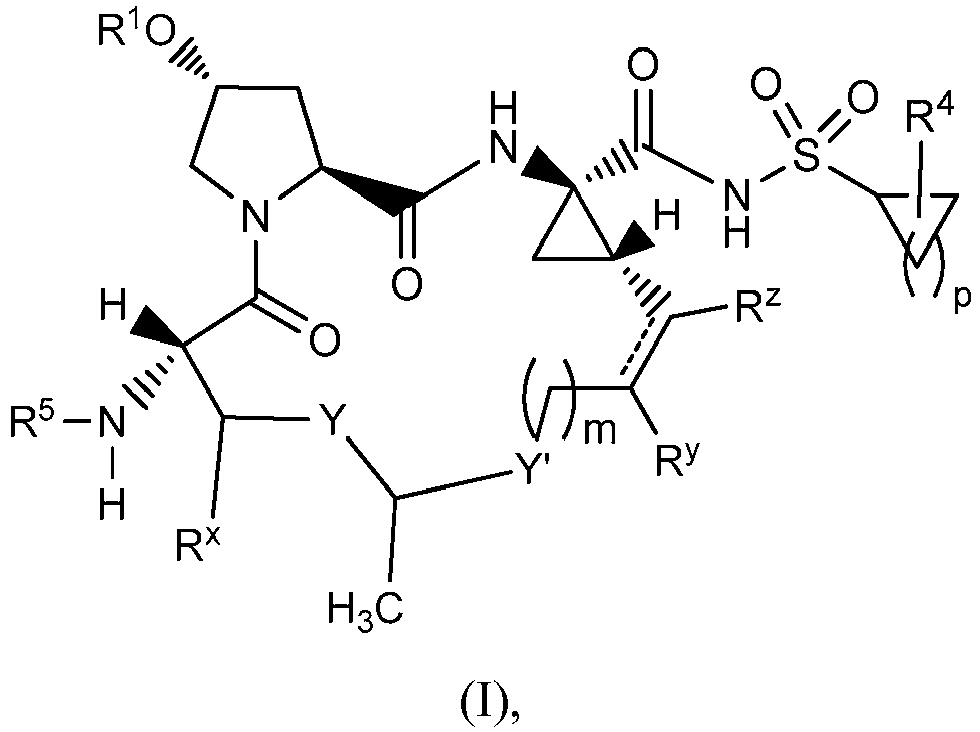
- p is 1 or 2;
- ----- is a single or double bond;
- R1 is
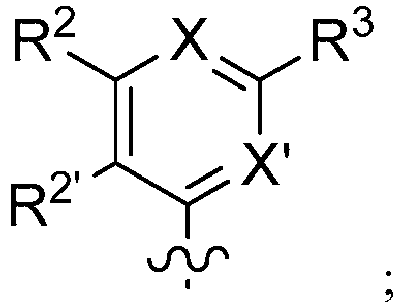
- m is 0, 1, or 2;
- one of X and X' is N and the other is CH;
- R2, and R3 are independently selected from hydrogen, alkoxy, alkyl, aryl, halo, and heteroaryl, wherein the aryl and heteroaryl are optionally substituted with one group independently selected from alkoxy and alkyl;
- R2 is hydrogen
- Rx is selected from methyl and ethyl;
- Ry and Rz are independently selected from hydrogen and hydroxy; provided that when ----- is a double bond, Ry and Rz are each hydrogen;
- R4 is selected from hydrogen, alkyl, and halo, haloalkoxy, haloalkyl, and hydroxyalkyl;
- R5 is selected from hydrogen, alkoxyalkoxycarbonyl, alkoxycarbonyl, alkylaminocarbonyl, alkylcarbonyl, cycloalkylalkoxycarbonyl, cycloalkylcarbonyl, cycloalkyloxycarbonyl, deuteroalkoxycarbonyl, deuterohaloalkoxycarbonyl, dialkylaminocarbonyl, dialkylaminocarbonylcarbonyl, haloalkoxycarbonyl, haloalkylaminocarbonyl, haloalkylcarbonyl, heterocyclylcarbonyl, heterocyclyloxycarbonyl, phenylcarbonyl, and phenyloxycarbonyl, wherein the cycloalkyl part of the cycloalkylalkoxycarbonyl, the cycloalkylcarbonyl, and the cycloalkyloxycarbonyl, the heterocyclyl part of the heterocyclylcarbonyl and the heterocyclyloxycarbonyl, and the phenyl part of the phenylcarbonyl and the phenyloxycarbonyl, is optionally substituted with one, two, or three groups independently selected from alkyl, alkylamino, alkylcarbonyl, cycloalkyl, dialkylamino, halo, haloalkoxy, and haloalkyl;
and - one of Y and Y' is CH2 and the other is selected from CH2 and O wherein heteroaryl refers to refers to an aromatic five- or six-membered ring where at least one atom is selected from N, O, and S, and the remaining atoms are carbon or bicyclic systems where a heteroaryl ring is fused to a four- to six-membered aromatic or non-aromatic ring containing zero, one, or two additional heteroatoms selected from N, O, and S;
- In a first embodiment of the first aspect the present disclosure provides a compound of formula (I), or a pharmaceutically acceptable salt thereof, wherein m is 1. In a second embodiment ----- is a double bond.
- In a third embodiment of the first aspect the present disclosure provides a compound of formula (I), or a pharmaceutically acceptable salt thereof, wherein p is 1.
- In a fourth embodiment of the first aspect the present disclosure provides a compound of formula (I), or a pharmaceutically acceptable salt thereof, wherein R4 is selected from hydrogen and alkyl.
- In a fifth embodiment of the first aspect the present disclosure provides a compound of formula (I), or a pharmaceutically acceptable salt thereof, wherein R5 is selected from alkoxycarbonyl, haloalkoxycarbonyl, heterocyclyloxycarbonyl, and phenyloxycarbonyl, wherein the heterocyclyl part of the heterocyclyloxycarbonyl, and the phenyl part of the phenyloxycarbonyl is optionally substituted with one , two, or three groups independently selected from alkyl, halo, haloalkoxy, and haloalkyl.
- In a second aspect the present disclosure provides a compound of formula (II)

- R1 is
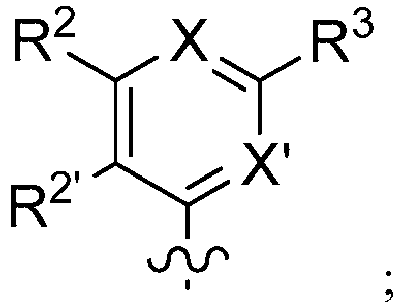
- one of X and X' is N and the other is CH;
- R2, and R3 are independently selected from hydrogen, alkoxy, alkyl, aryl, halo, and heteroaryl, wherein the aryl and heteroaryl are optionally substituted with one group independently selected from alkoxy and alkyl;
- R2' is hydrogen;
- Rx is selected from methyl and ethyl;
- R4 is selected from hydrogen and alkyl;
- R5 is selected from alkoxycarbonyl, cycloalkoxycarbonyl, haloalkoxycarbonyl, and heterocyclyloxycarbonyl, wherein heterocyclyl part of the heterocyclyloxycarbonyl is optionally substituted with one haloalkyl group; and
- one of Y and Y' is CH2 and the other is selected from CH2 and O.
- In a third aspect the present disclosure provides a composition comprising a compound of formula (I), or a pharmaceutically acceptable salt thereof, and a pharmaceutically acceptable carrier. In a first embodiment of the third aspect the present disclosure provides a composition comprising a compound of formula (I), or a pharmaceutically acceptable salt thereof, at least one additional compound having anti-HCV activity, and a pharmaceutical carrier. In a second embodiment at least one of the additional compounds is an interferon or a ribavirin. In a third embodiment the interferon is selected from interferon alpha 2B, pegylated interferon alpha, consensus interferon, interferon alpha 2A, and lymphoblastiod interferon tau. In a fourth embodiment of the third aspect the present disclosure provides a composition comprising a compound of formula (I), or a pharmaceutically acceptable salt thereof, at least one additional compound having anti-HCV activity, and a pharmaceutical carrier, wherein at least one of the additional compounds is selected from interleukin 2, interleukin 6, interleukin 12, Imiquimod, ribavirin, an inosine 5'-monophospate dehydrogenase inhibitor, amantadine, and rimantadine. In a fifth embodiment of the third aspect the present disclosure provides a composition comprising a compound of formula (I), or a pharmaceutically acceptable salt thereof, at least one additional compound having anti-HCV activity, and a pharmaceutical carrier, wherein at least one of the additional compounds is effective to inhibit the function of a target selected from HCV metalloprotease, HCV serine protease, HCV polymerase, HCV helicase, HCV NS4B protein, HCV entry, HCV assembly, HCV egress, HCV NS5A protein, and IMPDH for the treatment of an HCV infection.
- In a fourth aspect the present disclosure provides compounds according to the invention for use in the treatment of an HCV infection in a patient, comprising administering to the patient a therapeutically effective amount of a compound of formula (I), or a pharmaceutically acceptable salt thereof. In a first embodiment of the fourth aspect it further comprises administering at least one additional compound having anti-HCV activity prior to, after, or simultaneously with the compound of formula (I), or a pharmaceutically acceptable salt thereof. In a second embodiment of the fourth aspect at least one of the additional compounds is an interferon or a ribavirin. In a third embodiment the interferon is selected from interferon alpha 2B, pegylated interferon alpha, consensus interferon, interferon alpha 2A, and lymphoblastiod interferon tau. In a fourth embodiment of the fourth aspect the present disclosure provides compounds according to the invention for use in the treatment of an HCV infection in a patient, comprising administering to the patient a therapeutically effective amount of a compound of formula (I), or a pharmaceutically acceptable salt thereof, and at least one additional compound having anti-HCV activity prior to, after, or simultaneously with the compound of formula (I), or a pharmaceutically acceptable salt thereof, wherein at least one of the additional compounds is selected from interleukin 2, interleukin 6, interleukin 12, Imiquimod, ribavirin, an inosine 5'-monophospate dehydrogenase inhibitor, amantadine, and rimantadine. In a fifth embodiment of the third aspect the present disclosure provides a compounds according to the invention for use in the treatment of an HCV infection in a patient, comprising administering to the patient a therapeutically effective amount of a compound of formula (I), or a pharmaceutically acceptable salt thereof, and at least one additional compound having anti-HCV activity prior to, after, or simultaneously with the compound of formula (I), or a pharmaceutically acceptable salt thereof, wherein at least one of the additional compounds is effective to inhibit the function of a target selected from HCV metalloprotease, HCV serine protease, HCV polymerase, HCV helicase, HCV NS4B protein, HCV entry, HCV assembly, HCV egress, HCV NS5A protein, and IMPDH for the treatment of an HCV infection.
- Other aspects of the present disclosure may include suitable combinations of embodiments disclosed herein.
- Yet other aspects and embodiments may be found in the description provided herein.
- The description of the present disclosure herein should be construed in congruity with the laws and principals of chemical bonding. In some instances it may be necessary to remove a hydrogen atom in order to accommodate a substitutent at any given location.
- It should be understood that the compounds encompassed by the present disclosure are those that are suitably stable for use as pharmaceutical agent.
- It is intended that the definition of any substituent or variable at a particular location in a molecule be independent of its definitions elsewhere in that molecule. For example, when n is 2, each of the two R1 groups may be the same or different.
- All patents, patent applications, and literature references cited in the specification are herein incorporated by reference in their entirety. In the case of inconsistencies, the present disclosure, including definitions, will prevail.
- The term "alkoxy," as used herein, refers to an alkyl group attached to the parent molecular moiety through an oxygen atom.
- The term "alkoxyalkoxy," as used herein, refers to an alkoxyalkyl group attached to the parent molecular moiety through an oxygen atom.
- The term "alkoxyalkoxycarbonyl," as used herein, refers to an alkoxyalkoxy group attached to the parent molecular moiety through a carbonyl group.
- The term "alkoxycarbonyl," as used herein, refers to an alkoxy group attached to the parent molecular moiety through a carbonyl group.
- The term "alkyl," as used herein, refers to a group derived from a straight or branched chain saturated hydrocarbon containing from one to ten carbon atoms. In one embodiment the hydrocarbon chain has from one to six atoms. In another embodiment the hydrocarbon chain has from one to four atoms.
- The term "alkylamino," as used herein, refers to -NHR, wherein R is an alkyl group.
- The term "alkylaminocarbonyl," as used herein, refers to an alkylamino group attached to the parent molecular moiety through a carbonyl group.
- The term "alkylcarbonyl," as used herein, refers to an alkyl group attached to the parent molecular moiety through a carbonyl group.
- The term "aryl," as used herein, refers to a phenyl group, or a bicyclic fused ring system wherein one or both of the rings is a phenyl group. Bicyclic fused ring systems consist of a phenyl group fused to a four- to six-membered aromatic or non-aromatic carbocyclic ring. The aryl groups of the present invention can be attached to the parent molecular moiety through any substitutable carbon atom in the group. Representative examples of aryl groups include, but are not limited to, indanyl, indenyl, naphthyl, phenyl, and tetrahydronaphthyl. In one embodiment the aryl is a phenyl group.
- The term "carbonyl," as used herein, refers to -C(O)-.
- The term "cycloalkyl," as used herein, refers to a saturated monocyclic or bicyclic hydrocarbon ring system having three to seven carbon atoms and zero heteroatoms. Representative examples of cycloalkyl groups include, but are not limited to, cyclopropyl, cyclobutyl, and cyclopentyl.
- The term "cycloalkylalkoxy," as used herein, refers to a (cycloalkyl)alkyl group attached to the parent molecular moiety through an oxygen atom.
- The term "cycloalkylalkoxycarbonyl," as used herein, refers to a cycloalkylalkoxy group attached to the parent molecular moiety through a carbonyl group.
- The term "cycloalkylcarbonyl," as used herein, refers to a cycloalkyl group attached to the parent molecular moiety through a carbonyl group.
- The term "cycloalkyloxy," as used herein, refers to a cycloalkyl group attached to the parent molecular moiety through an oxygen atom.
- The term "cycloalkyloxycarbonyl," as used herein, refers to a cycloalkyloxy group attached to the parent molecular moiety through a carbonyl group.
- The term "deuteroalkoxycarbonyl," as used herein, refers to an alkoxycarbonyl group wherein one or more of the hydrogen atoms are replaced by deuterium atoms.
- The term "deuterohaloalkoxycarbonyl," as used herein, refers to a haloalkoxycarbonyl group wherein one or more of the hydrogen atoms are replaced by deuterium atoms.
- The term "dialkylamino," as used herein, refers to -NRpRq, wherein Rp and Rq are alkyl groups. The alkyl groups may be the same or different.
- The term "dialkylaminocarbonyl," as used herein, refers to a dialkylamino group attached to the parent molecular moiety through a carbonyl group.
- The term "dialkylaminocarbonylcarbonyl," as used herein, refers to a dialkylaminocarbonyl group attached to the parent molecular moiety through a carbonyl group.
- The terms "halo" and "halogen," as used herein, refer to F, Cl, Br, and I.
- The term "haloalkoxy," as used herein, refers to a haloalkyl group attached to the parent molecular moiety through an oxygen atom.
- The term "haloalkoxycarbonyl," as used herein, refers to a haloalkoxy group attached to the parent molecular moiety through a carbonyl group.
- The term "haloalkyl," as used herein, refers to an alkyl group substituted with one, two, three, or four halogen atoms.
- The term "haloalkylamino," as used herein, refers to an alkyl amino group wherein the alkyl is substituted with one, two, three, or four halogen atoms.
- The term "haloalkylaminocarbonyl," as used herein, refers to a haloalkylamino group attached to the parent molecular moiety through a carbonyl group.
- The term "haloalkylcarbonyl," as used herein, refers to a haloalkyl group attached to the parent molecular moiety through a carbonyl group.
- The term "heteroaryl," as used herein, refers to an aromatic five- or six-membered ring where at least one atom is selected from N, O, and S, and the remaining atoms are carbon. The term "heteroaryl" also includes bicyclic systems where a heteroaryl ring is fused to a four- to six-membered aromatic or non-aromatic ring containing zero, one, or two additional heteroatoms selected from N, O, and S. The heteroaryl groups are attached to the parent molecular moiety through any substitutable carbon or nitrogen atom in the group. Representative examples of heteroaryl groups include, but are not limited to, benzoxadiazolyl, benzoxazolyl, benzofuranyl, benzothienyl, furanyl, imidazolyl, indazolyl, indolyl, isoxazolyl, isoquinolinyl, isothiazolyl, naphthyridinyl, oxadiazolyl, oxazolyl, pyridinyl, pyridazinyl, pyrimidinyl, pyrazinyl, pyrazolyl, pyrrolyl, quinolinyl, thiazolyl, thienopyridinyl, thienyl, triazolyl, thiadiazolyl, and triazinyl. In one embodiment the heteroaryl is selected from pyrazine, pyrazole, pyridine, and thiazole.
- The term "heterocyclyl," as used herein, refers to a cyclic, non-aromatic, saturated or partially unsaturated five-, six-, or seven-membered ring where at least one atom is selected from oxygen, nitrogen, and sulfur. The term "heterocyclyl" also includes bicyclic systems where a heterocyclyl ring is fused to a four- to six-membered aromatic or non-aromatic carbocyclic ring or a four- to six-membered non-aromatic ring containing zero, one, or two additional heteratoms selected from nitrogen, oxygen, and sulfur. The heterocyclyl groups of the invention are attached to the parent molecular group through any substitutable carbon or nitrogen atom in the group. Representative examples of heterocyclyl groups include, but are not limited to, benzodioxolyl, benzothiazolyl, dihydroindolyl, dihydropyridinyl, 1,3-dioxanyl, 1,4-dioxanyl, 1,3-dioxolanyl, isoindolinyl, morpholinyl, piperazinyl, pyrrolidinyl, tetrahydropyridinyl, piperidinyl, and thiomorpholinyl. In one embodiment the heterocycle is tetrahydropyranyl.
- The term "heterocyclylcarbonyl," as used herein, refers to a heterocyclyl group attached to the parent molecular moiety through a carbonyl group.
- The term "heterocyclyloxy," as used herein, refers to a heterocyclyl group attached to the parent molecular moiety through an oxygen atom.
- The term "heterocyclyloxycarbonyl," as used herein, refers to a heterocyclyloxy group attached to the parent molecular moiety through a carbonyl group.
- The term "hydroxy," as used herein, refers to -OH.
- The term "hydroxyalkyl," as used herein, refers to an alkyl group substituted with one, two, or three hydroxy groups.
- The term "phenylcarbonyl," as used herein, refers to a phenyl group attached to the parent molecular moiety through a carbonyl group.
- The term "phenyloxy," as used herein, refers to a phenyl group attached to the parent molecular moiety through an oxygen atom.
- The term "phenyloxycarbonyl," as used herein, refers to a phenyloxy group attached to the parent molecular moiety through a carbonyl group.
- The present disclosure is intended to include all isotopes of atoms occurring in the present compounds. Isotopes include those atoms having the same atomic number but different mass numbers. By way of general example and without limitation, isotopes of hydrogen include deuterium and tritium. Isotopes of carbon include 13C and 14C. Isotopically-labeled compounds of the invention can generally be prepared by conventional techniques known to those skilled in the art or by processes analogous to those described herein, using an appropriate isotopically-labeled reagent in place of the non-labeled reagent otherwise employed. Such compounds may have a variety of potential uses, for example as standards and reagents in determining biological activity. In the case of stable isotopes, such compounds may have the potential to favorably modify biological, pharmacological, or pharmacokinetic properties.
- The compounds of the present disclosure can exist as pharmaceutically acceptable salts. The term "pharmaceutically acceptable salt," as used herein, represents salts or zwitterionic forms of the compounds of the present disclosure which are water or oil-soluble or dispersible, which are, within the scope of sound medical judgment, suitable for use in contact with the tissues of patients without excessive toxicity, irritation, allergic response, or other problem or complication commensurate with a reasonable benefit/risk ratio, and are effective for their intended use. The salts can be prepared during the final isolation and purification of the compounds or separately by reacting a suitable basic functionality with a suitable acid. Representative acid addition salts include acetate, adipate, alginate, citrate, aspartate, benzoate, benzenesulfonate, bisulfate, butyrate, camphorate, camphorsulfonate; digluconate, glycerophosphate, hemisulfate, heptanoate, hexanoate, formate, fumarate, hydrochloride, hydrobromide, hydroiodide, 2-hydroxyethanesulfonate, lactate, maleate, mesitylenesulfonate, methanesulfonate, naphthylenesulfonate, nicotinate, 2-naphthalenesulfonate, oxalate, palmoate, pectinate, persulfate, 3-phenylproprionate, picrate, pivalate, propionate, succinate, tartrate, trichloroacetate, trifluoroacetate, phosphate, glutamate, bicarbonate, para-toluenesulfonate, and undecanoate. Examples of acids which can be employed to form pharmaceutically acceptable addition salts include inorganic acids such as hydrochloric, hydrobromic, sulfuric, and phosphoric, and organic acids such as oxalic, maleic, succinic, and citric.
- Basic addition salts can be prepared during the final isolation and purification of the compounds by reacting an acidic group with a suitable base such as the hydroxide, carbonate, or bicarbonate of a metal cation or with ammonia or an organic primary, secondary, or tertiary amine. The cations of pharmaceutically acceptable salts include lithium, sodium, potassium, calcium, magnesium, and aluminum, as well as nontoxic quaternary amine cations such as ammonium, tetramethylammonium, tetraethylammonium, methylamine, dimethylamine, trimethylamine, triethylamine, diethylamine, ethylamine, tributylamine, pyridine, N,N-dimethylaniline, N-methylpiperidine, N-methylmorpholine, dicyclohexylamine, procaine, dibenzylamine, N,N-dibenzylphenethylamine, and N,N'-dibenzylethylenediamine. Other representative organic amines useful for the formation of base addition salts include ethylenediamine, ethanolamine, diethanolamine, piperidine, and piperazine.
- As used herein, the term "anti-HCV activity" means the compound is effective to treat the HCV virus.
- The term "compounds of the disclosure", and equivalent expressions, are meant to embrace compounds of formula (I), and pharmaceutically acceptable enantiomers, diastereomers, and salts thereof. Similarly, references to intermediates, are meant to embrace their salts where the context so permits.
- The term "patient" includes both human and other mammals.
- The term "pharmaceutical composition" means a composition comprising a compound of the disclosure in combination with at least one additional pharmaceutical carrier, i.e., adjuvant, excipient or vehicle, such as diluents, preserving agents, fillers, flow regulating agents, disintegrating agents, wetting agents, emulsifying agents, suspending agents, sweetening agents, flavoring agents, perfuming agents, antibacterial agents, antifungal agents, lubricating agents and dispensing agents, depending on the nature of the mode of administration and dosage forms. Ingredients listed in Remington's Pharmaceutical Sciences, 18th ed., Mack Publishing Company, Easton, PA (1999) for example, may be used.
- The phrase "pharmaceutically acceptable" is employed herein to refer to those compounds, materials, compositions, and/or dosage forms which are, within the scope of sound medical judgment, suitable for use in contact with the tissues of patients without excessive toxicity, irritation, allergic response, or other problem or complication commensurate with a reasonable risk/benefit ratio.
- The term "therapeutically effective amount" means the total amount of each active component that is sufficient to show a meaningful patient benefit, e.g., a sustained reduction in viral load. When applied to an individual active ingredient, administered alone, the term refers to that ingredient alone. When applied to a combination, the term refers to combined amounts of the active ingredients that result in the therapeutic effect, whether administered in combination, serially or simultaneously.
- The terms "treat" and "treating" refers to: (i) preventing a disease, disorder or condition from occurring in a patient which may be predisposed to the disease, disorder and/or condition but has not yet been diagnosed as having it; (ii) inhibiting the disease, disorder or condition, i.e., arresting its development; and/or (iii) relieving the disease, disorder or condition, i.e., causing regression of the disease, disorder and/or condition.
- Where used in naming compounds of the present disclosure, the designations PI', P1, P2, P2*, P3, and P4, as used herein, map the relative positions of the amino acid residues of a protease inhibitor binding relative to the binding of the natural peptide cleavage substrate. Cleavage occurs in the natural substrate between P1 and PI' where the nonprime positions designate amino acids starting from the C-terminus end of the peptide natural cleavage site extending towards the N-terminus; whereas, the prime positions emanate from the N-terminus end of the cleavage site designation and extend toward the C-terminus. For example, PI' refers to the first position away from the right hand end of the C-terminus of the cleavage site (i.e. N-terminus first position); whereas P1 starts the numbering from the left hand side of the C-terminus cleavage site, P2: second position from the C-terminus, etc.). (see Berger A. & Schechter I., Transactions of the Royal Society London series (1970), B257, 249-264].
- Asymmetric centers exist in the compounds of the present disclosure. For example, the compounds may include P1 cyclopropyl element of formula
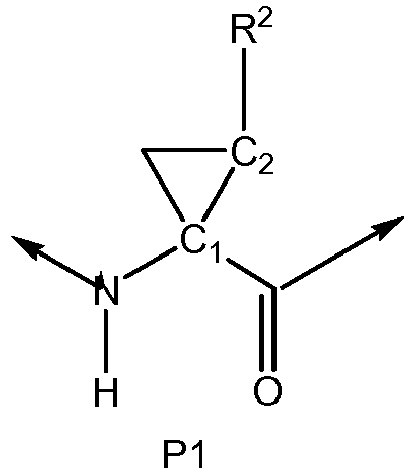
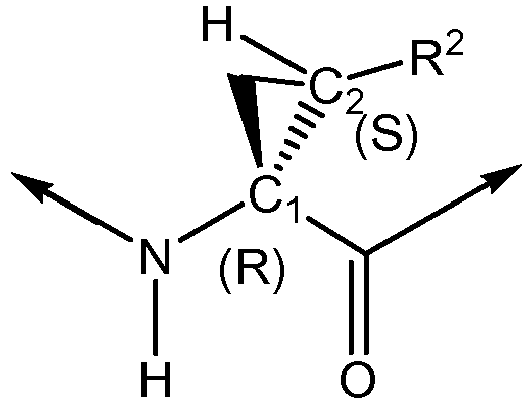

(1R, 2S) R2 is syn to carbonyl (1S, 2R) R2 is syn to carbonyl 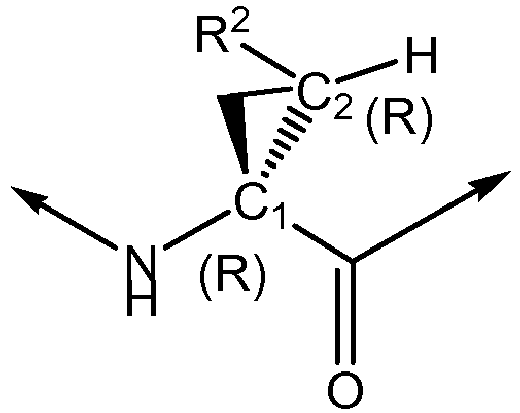
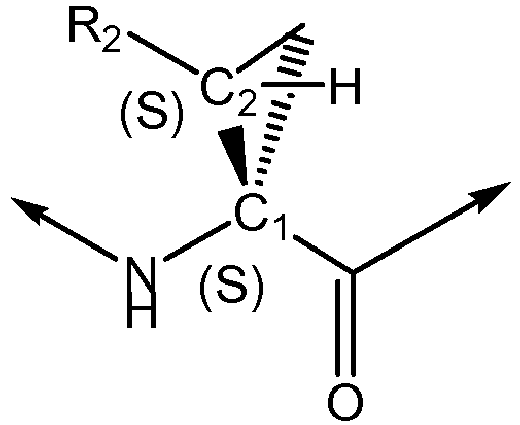
(1R, 2R) R2 is syn to amide (1S,2S) R2 is syn to amide - It should be understood that the disclosure encompasses all stereochemical forms, or mixtures thereof, which possess the ability to inhibit HCV protease.
- Certain compounds of the present disclosure may also exist in different stable conformational forms which may be separable. Torsional asymmetry due to restricted rotation about an asymmetric single bond, for example because of steric hindrance or ring strain, may permit separation of different conformers. The present disclosure includes each conformational isomer of these compounds and mixtures thereof.
- Certain compounds of the present disclosure may exist in zwitterionic form and the present disclosure includes each zwitterionic form of these compounds and mixtures thereof.
- When it is possible that, for use in therapy, therapeutically effective amounts of a compound of formula (I), as well as pharmaceutically acceptable salts thereof, may be administered as the raw chemical, it is possible to present the active ingredient as a pharmaceutical composition. Accordingly, the disclosure further provides pharmaceutical compositions, which include therapeutically effective amounts of compounds of formula (I) or pharmaceutically acceptable salts thereof, and one or more pharmaceutically acceptable carriers, diluents, or excipients. The compounds of formula (I) and pharmaceutically acceptable salts thereof, are as described above. The carrier(s), diluent(s), or excipient(s) must be acceptable in the sense of being compatible with the other ingredients of the formulation and not deleterious to the recipient thereof. In accordance with another aspect of the disclosure there is also provided a process for the preparation of a pharmaceutical formulation including admixing a compound of formula (I), or a pharmaceutically acceptable salt thereof, with one or more pharmaceutically acceptable carriers, diluents, or excipients.
- Pharmaceutical formulations may be presented in unit dose forms containing a predetermined amount of active ingredient per unit dose. Dosage levels of between about 0.01 and about 150 milligram per kilogram ("mg/kg") body weight per day, preferably between about 0.05 and about 100 mg/kg body weight per day of the compounds of the disclosure are typical in a monotherapy for the prevention and treatment of HCV mediated disease. Typically, the pharmaceutical compositions of this disclosure will be administered from about 1 to about 5 times per day or alternatively, as a continuous infusion. Such administration can be used as a chronic or acute therapy. The amount of active ingredient that may be combined with the carrier materials to produce a single dosage form will vary depending on the condition being treated, the severity of the condition, the time of administration, the route of administration, the rate of excretion of the compound employed, the duration of treatment, and the age, gender, weight, and condition of the patient. Preferred unit dosage formulations are those containing a daily dose or sub-dose, as herein above recited, or an appropriate fraction thereof, of an active ingredient. Generally, treatment is initiated with small dosages substantially less than the optimum dose of the compound. Thereafter, the dosage is increased by small increments until the optimum effect under the circumstances is reached. In general, the compound is most desirably administered at a concentration level that will generally afford antivirally effective results without causing any harmful or deleterious side effects.
- When the compositions of this disclosure comprise a combination of a compound of the disclosure and one or more additional therapeutic and/or prophylactic agent, both the compound and the additional agent can be present in a dose that is less than or equal to the dosage normally administered in a monotherapy regimen. The compositions of this disclosure may be co-formulated with one or more additional therapeutic or prophylactic agents, for example, in the form of a monolithic and/or bi/multi-layer tablet or may be administered separately from the therapeutic or prophylactic agent(s).
- Pharmaceutical formulations may be adapted for administration by any appropriate route, for example by the oral (including buccal or sublingual), rectal, nasal, topical (including buccal, sublingual, or transdermal), vaginal, or parenteral (including subcutaneous, intracutaneous, intramuscular, intra-articular, intrasynovial, intrasternal, intrathecal, intralesional, intravenous, or intradermal injections or infusions) route. Such formulations may be prepared by any method known in the art of pharmacy, for example by bringing into association the active ingredient with the carrier(s) or excipient(s).
- Pharmaceutical formulations adapted for oral administration may be presented as discrete units such as capsules or tablets; powders or granules; solutions or suspensions in aqueous or non-aqueous liquids; edible foams or whips; or oil-in-water liquid emulsions or water-in-oil emulsions.
- For instance, for oral administration in the form of a tablet or capsule, the active drug component can be combined with an oral, non-toxic pharmaceutically acceptable inert carrier such as ethanol, glycerol, water, and the like. Powders are prepared by comminuting the compound to a suitable fine size and mixing with a similarly comminuted pharmaceutical carrier such as an edible carbohydrate, as, for example, starch or mannitol. Flavoring, preservative, dispersing, and coloring agent can also be present.
- Capsules are made by preparing a powder mixture, as described above, and filling formed gelatin sheaths. Glidants and lubricants such as colloidal silica, talc, magnesium stearate, calcium stearate, or solid polyethylene glycol can be added to the powder mixture before the filling operation. A disintegrating or solubilizing agent such as agar-agar, calcium carbonate, or sodium carbonate can also be added to improve the availability of the medicament when the capsule is ingested.
- Moreover, when desired or necessary, suitable binders, lubricants, disintegrating agents, and coloring agents can also be incorporated into the mixture. Suitable binders include starch, gelatin, natural sugars such as glucose or beta-lactose, corn sweeteners, natural and synthetic gums such as acacia, tragacanth or sodium alginate, carboxymethylcellulose, polyethylene glycol, and the like. Lubricants used in these dosage forms include sodium oleate, sodium chloride, and the like. Disintegrators include, without limitation, starch, methyl cellulose, agar, betonite, xanthan gum, and the like. Tablets are formulated, for example, by preparing a powder mixture, granulating or slugging, adding a lubricant and disintegrant, and pressing into tablets. A powder mixture is prepared by mixing the compound, suitable comminuted, with a diluent or base as described above, and optionally, with a binder such as carboxymethylcellulose, an aliginate, gelating, or polyvinyl pyrrolidone, a solution retardant such as paraffin, a resorption accelerator such as a quaternary salt and/or and absorption agent such as betonite, kaolin, or dicalcium phosphate. The powder mixture can be granulated by wetting with a binder such as syrup, starch paste, acadia mucilage, or solutions of cellulosic or polymeric materials and forcing through a screen. As an alternative to granulating, the powder mixture can be run through the tablet machine and the result is imperfectly formed slugs broken into granules. The granules can be lubricated to prevent sticking to the tablet forming dies by means of the addition of stearic acid, a stearate salt, talc, or mineral oil. The lubricated mixture is then compressed into tablets. The compounds of the present disclosure can also be combined with a free flowing inert carrier and compressed into tablets directly without going through the granulating or slugging steps. A clear or opaque protective coating consisting of a sealing coat of shellac, a coating of sugar or polymeric material, and a polish coating of wax can be provided. Dyestuffs can be added to these coatings to distinguish different unit dosages.
- Oral fluids such as solution, syrups, and elixirs can be prepared in dosage unit form so that a given quantity contains a predetermined amount of the compound. Syrups can be prepared by dissolving the compound in a suitably flavored aqueous solution, while elixirs are prepared through the use of a non-toxic vehicle. Solubilizers and emulsifiers such as ethoxylated isostearyl alcohols and polyoxyethylene sorbitol ethers, preservatives, flavor additive such as peppermint oil or natural sweeteners, or saccharin or other artificial sweeteners, and the like can also be added.
- Where appropriate, dosage unit formulations for oral administration can be microencapsulated. The formulation can also be prepared to prolong or sustain the release as for example by coating or embedding particulate material in polymers, wax, or the like.
- The compounds of formula (I), and pharmaceutically acceptable salts thereof, can also be administered in the form of liposome delivery systems, such as small unilamellar vesicles, large unilamellar vesicles, and multilamellar vesicles. Liposomes can be formed from a variety of phopholipids, such as cholesterol, stearylamine, or phophatidylcholines.
- The compounds of formula (I) and pharmaceutically acceptable salts thereof may also be delivered by the use of monoclonal antibodies as individual carriers to which the compound molecules are coupled. The compounds may also be coupled with soluble polymers as targetable drug carriers. Such polymers can include polyvinylpyrrolidone, pyran copolymer, polyhydroxypropylmethacrylamidephenol, polyhydroxyethylaspartamidephenol, or polyethyleneoxidepolylysine substituted with palitoyl residues. Furthermore, the compounds may be coupled to a class of biodegradable polymers useful in achieving controlled release of a drug, for example, polylactic acid, polepsilon caprolactone, polyhydroxy butyric acid, polyorthoesters, polyacetals, polydihydropyrans, polycyanoacrylates, and cross-linked or amphipathic block copolymers of hydrogels.
- Pharmaceutical formulations adapted for transdermal administration may be presented as discrete patches intended to remain in intimate contact with the epidermis of the recipient for a prolonged period of time. For example, the active ingredient may be delivered from the patch by iontophoresis as generally described in Pharmaceutical Research, 3(6), 318 (1986).
- Pharmaceutical formulations adapted for topical administration may be formulated as ointments, creams, suspensions, lotions, powders, solutions, pastes, gels, sprays, aerosols, or oils.
- For treatments of the eye or other external tissues, for example mouth and skin, the formulations are preferably applied as a topical ointment or cream. When formulated in an ointment, the active ingredient may be employed with either a paraffinic or a water-miscible ointment base. Alternatively, the active ingredient may be formulated in a cream with an oil-in-water cream base or a water-in oil base.
- Pharmaceutical formulations adapted for topical administrations to the eye include eye drops wherein the active ingredient is dissolved or suspended in a suitable carrier, especially an aqueous solvent.
- Pharmaceutical formulations adapted for topical administration in the mouth include lozenges, pastilles, and mouth washes.
- Pharmaceutical formulations adapted for rectal administration may be presented as suppositories or as enemas.
- Pharmaceutical formulations adapted for nasal administration wherein the carrier is a solid include a course powder which is administered in the manner in which snuff is taken, i.e., by rapid inhalation through the nasal passage from a container of the powder held close up to the nose. Suitable formulations wherein the carrier is a liquid, for administration as a nasal spray or nasal drops, include aqueous or oil solutions of the active ingredient.
- Pharmaceutical formulations adapted for administration by inhalation include fine particle dusts or mists, which may be generated by means of various types of metered, dose pressurized aerosols, nebulizers, or insufflators.
- Pharmaceutical formulations adapted for vaginal administration may be presented as pessaries, tampons, creams, gels, pastes, foams, or spray formulations.
- Pharmaceutical formulations adapted for parenteral administration include aqueous and non-aqueous sterile injection solutions which may contain anti-oxidants, buffers, bacteriostats, and soutes which render the formulation isotonic with the blood of the intended recipient; and aqueous and non-aqueous sterile suspensions which may include suspending agents and thickening agents. The formulations may be presented in unit-dose or multi-dose containers, for example sealed ampoules and vials, and may be stored in a freeze-dried (lyophilized) condition requiring only the addition of the sterile liquid carrier, for example water for injections, immediately prior to use. Extemporaneous injection solutions and suspensions may be prepared from sterile powders, granules, and tablets.
- It should be understood that in addition to the ingredients particularly mentioned above, the formulations may include other agents conventional in the art having regard to the type of formulation in question, for example those suitable for oral administration may include flavoring agents.
- Table 1 below lists some illustrative examples of compounds that can be administered with the compounds of this disclosure. The compounds of the disclosure can be administered with other anti-HCV activity compounds in combination therapy, either jointly or separately, or by combining the compounds into a composition.
Table 1 Brand Name Physiological Class Type of Inhibitor or Target Source Company NIM811 Cyclophilin Inhibitor Novartis Zadaxin Immuno-modulator Sciclone Suvus Methylene blue Bioenvision Actilon (CPG10101) TLR9 agonist Coley Batabulin (T67) Anticancer β-tubulin inhibitor Tularik Inc., South San Francisco, CA ISIS 14803 Antiviral antisense ISIS Pharmaceuticals Inc, Carlsbad, CA/Elan Phamaceuticals Inc., New York, NY Summetrel Antiviral antiviral Endo Pharmaceuticals Holdings Inc., Chadds Ford, PA GS-9132 (ACH-806) Antiviral HCV Inhibitor Achillion / Gilead Pyrazolopyrimidin e compounds and salts From WO-2005047288 26 May 2005 Antiviral HCV Inhibitors Arrow Therapeutics Ltd. Levovirin Antiviral IMPDH inhibitor Ribapharm Inc., Costa Mesa, CA Merimepodib (VX-497) Antiviral IMPDH inhibitor Vertex Pharmaceuticals Inc., Cambridge, MA XTL-6865 (XTL-002) Antiviral monoclonal antibody XTL Biopharmaceutical s Ltd., Rehovot, Isreal Telaprevir (VX-950, LY-570310) Antiviral NS3 serine protease inhibitor Vertex Pharmaceuticals Inc., Cambridge, MA/ Eli Lilly and Co. Inc., Indianapolis, IN HCV-796 Antiviral NS5B Replicase Inhibitor Wyeth / Viropharma NM-283 Antiviral NS5B Replicase Inhibitor Idenix / Novartis GL-59728 Antiviral NS5B Replicase Inhibitor Gene Labs / Novartis GL-60667 Antiviral NS5B Replicase Inhibitor Gene Labs / Novartis 2'C MeA Antiviral NS5B Replicase Inhibitor Gilead PSI 6130 Antiviral NS5B Replicase Inhibitor Roche R1626 Antiviral NS5B Replicase Inhibitor Roche 2'C Methyl adenosine Antiviral NS5B Replicase Inhibitor Merck JTK-003 Antiviral RdRp inhibitor Japan Tobacco Inc., Tokyo, Japan Levovirin Antiviral ribavirin ICN Pharmaceuticals, Costa Mesa, CA Ribavirin Antiviral ribavirin Schering-Plough Corporation, Kenilworth, NJ Viramidine Antiviral Ribavirin Prodrug Ribapharm Inc., Costa Mesa, CA Heptazyme Antiviral ribozyme Ribozyme Pharmaceuticals Inc., Boulder, CO BILN-2061 Antiviral serine protease inhibitor Boehringer Ingelheim Pharma KG, Ingelheim, Germany SCH 503034 Antiviral serine protease inhibitor Schering Plough Zadazim Immune modulator Immune modulator SciClone Pharmaceuticals Inc., San Mateo, CA Ceplene Immunomodulator immune modulator Maxim Pharmaceuticals Inc., San Diego, CA CellCept Immunosuppressant HCV IgG immuno-suppressant F. Hoffmann-La Roche LTD, Basel, Switzerland Civacir Immunosuppressant HCV IgG immuno-suppressant Nabi Biopharmaceutical s Inc., Boca Raton, FL Albuferon - α Interferon albumin IFN-α2b Human Genome Sciences Inc., Rockville, MD Infergen A Interferon IFN alfacon-1 InterMune Pharmaceuticals Inc., Brisbane, CA Omega IFN Interferon If-ω Intarcia Therapeutics IFN-β and EMZ701 Interferon IFN-β and EMZ701 Transition Therapeutics Inc., Ontario, Canada Rebif Interferon IFN-β1a Serono, Geneva, Switzerland Roferon A Interferon IFN-α2a F. Hoffmann-La Roche LTD, Basel, Switzerland Intron A Interferon IFN-α2b Schering-Plough Corporation, Kenilworth, NJ Intron A and Zadaxin Interferon IFN-α2b/α1-thymosin RegeneRx Biopharma. Inc., Bethesda, MD/ SciClone Pharmaceuticals Inc, San Mateo, CA Rebetron Interferon IFN-α2b/ribavirin Schering-Plough Corporation, Kenilworth, NJ Actimmune Interferon INF-γ InterMune Inc., Brisbane, CA Interferon-β Interferon Interferon-β-1a Serono Multiferon Interferon Long lasting IFN Viragen/ Valentis Wellferon Interferon Lympho-blastoid IFN-αn1 GlaxoSmithKline plc, Uxbridge, UK Omniferon Interferon natural IFN-α Viragen Inc., Plantation, FL Pegasys Interferon PEGylated IFN-α2a F. Hoffmann-La Roche LTD, Basel, Switzerland Pegasys and Ceplene Interferon PEGylated IFN-α2a/ immune modulator Maxim Pharmaceuticals Inc., San Diego, CA Pegasys and Ribavirin Interferon PEGylated IFN-α2a/ribavirin F. Hoffmann-La Roche LTD, Basel, Switzerland PEG-Intron Interferon PEGylated IFN-α2b Schering-Plough Corporation, Kenilworth, NJ PEG-Intron / Ribavirin Interferon PEGylated IFN-α2b/ribavirin Schering-Plough Corporation, Kenilworth, NJ IP-501 Liver protection antifibrotic Indevus Pharmaceuticals Inc., Lexington, MA IDN-6556 Liver protection caspase inhibitor Idun Pharmaceuticals Inc., San Diego, CA ITMN-191 (R-7227) Antiviral serine protease inhibitor InterMune Pharmaceuticals Inc., Brisbane, CA GL-59728 Antiviral NS5B Replicase Inhibitor Genelabs ANA-971 Antiviral TLR-7 agonist Anadys Boceprevir Antiviral serine protease inhibitor Schering Plough TMS-435 Antiviral serine protease inhibitor Tibotec BVBA, Mechelen, Belgium BI-201335 Antiviral serine protease inhibitor Boehringer Ingelheim Pharma KG, Ingelheim, Germany MK-7009 Antiviral serine protease inhibitor Merck PF-00868554 Antiviral replicase inhibitor Pfizer ANA598 Antiviral Non-Nucleoside NS5B Polymerase Inhibitor Anadys Pharmaceuticals, Inc., San Diego, CA, USA IDX375 Antiviral Non-Nucleoside Replicase Inhibitor Idenix Pharmaceuticals, Cambridge, MA, USA BILB 1941 Antiviral NS5B Polymerase Inhibitor Boehringer Ingelheim Canada Ltd R&D, Laval, QC, Canada PSI-7851 Antiviral Nucleoside Polymerase Inhibitor Pharmasset, Princeton, NJ, USA PSI-7977 Antiviral Nucleotide NS5B Polymerase Inhibitor Pharmasset, Princeton, NJ, USA VCH-759 Antiviral NS5B Polymerase Inhibitor ViroChem Pharma VCH-916 Antiviral NS5B Polymerase Inhibitor ViroChem Pharma GS-9190 Antiviral NS5B Polymerase Inhibitor Gilead Peg-interferon lamda Antiviral Interferon ZymoGenetics/Bri stol-Myers Squibb daclatasvir Antiviral NS5A inhibitor Bristol-Myers Squibb BMS-791325 Antiviral NS5B Polymerase Inhibitor Bristol-Myers Squibb ACH-3102 Antiviral NS5A inhibitor Bristol-Myers Squibb BMS-984478 Antiviral NS5A inhibitor Bristol-Myers Squibb asunaprevir Antiviral serine protease inhibitor Bristol-Myers Squibb - The compounds of the disclosure may also be used as laboratory reagents. Compounds may be instrumental in providing research tools for designing of viral replication assays, validation of animal assay systems and structural biology studies to further enhance knowledge of the HCV disease mechanisms. Further, the compounds of the present disclosure are useful in establishing or determining the binding site of other antiviral compounds, for example, by competitive inhibition.
- The compounds of this disclosure may also be used to treat or prevent viral contamination of materials and therefore reduce the risk of viral infection of laboratory or medical personnel or patients who come in contact with such materials, e.g., blood, tissue, surgical instruments and garments, laboratory instruments and garments, and blood collection or transfusion apparatuses and materials.
- This disclosure is intended to encompass compounds having formula (I) when prepared by synthetic processes or by metabolic processes including those occurring in the human or animal body (in vivo) or processes occurring in vitro.
- The present disclosure will now be described in connection with certain embodiments which are not intended to limit its scope. Thus, the following examples, which include specific embodiments, will illustrate one practice of the present disclosure, it being understood that the examples are for the purposes of illustration of certain embodiments and are presented to provide what is believed to be the most useful and readily understood description of its procedures and conceptual aspects.
- The abbreviations used in the present application, including particularly in the illustrative schemes and examples which follow, are well-known to those skilled in the art. Some of the abbreviations used are as follows: dppf for diphenylphosphinoferrocene; THF for tetrahydrofuran; PPh3 for triphenylphosphine; DMF for N,N-dimethylformamide; MeOH for methanol; TFA for trifluoroacetic acid; EtOAc for ethyl acetate; DMSO for dimethylsulfoxide; h or hr for hours; rt or RT or Rt for room temperature or retention time (context will dictate); Et2O for diethyl ether; HATU for O-(7-azabenzotriazol-1-yl)-N,N,N',N'-tetramethyluronium hexafluorophosphate; MeCN for acetonitrile, LiHMDS for lithium hexamethyldisilazide, and BOC for tert-butoxycarbonyl.
- The starting materials useful to synthesize the compounds of the present disclosure are known to those skilled in the art and can be readily manufactured or are commercially available.
- The following methods set forth below are provided for illustrative purposes and are not intended to limit the scope of the claims. It will be recognized that it may be necessary to prepare such a compound in which a functional group is protected using a conventional protecting group then to remove the protecting group to provide a compound of the present disclosure. The details concerning the use of protecting groups in accordance with the present disclosure are known to those skilled in the art.
-

- To a 40 mL vial equipped with a stir bar was added 2,4,6-trichloropyridine (1.00g, 5.48 mmol), (4-isopropoxyphenyl)boronic acid (1.00g, 5.56 mmol), [1,1'-bis(diphenylphosphino)ferrocene]dichloropalladium(II) ("Pd(dppf)Cl2", 200 mg, 0.273 mmol), and K3PO4 (3.49 g, 16.4 mmol). The vial was sealed with a septum screwcap and then placed under N2 atmosphere. To the vial was added degassed THF (30 mL). The vial was placed in a 60 °C heating block with stirring for 60 hours. To the mixture was added diatomaceous earth (Celite®). The mixture was filtered and the filtrate was concentrated in vacuo to afford an amber solid residue. This material was subjected to silica gel chromatography (hexanes:CH2Cl2) to afford 2,4-dichloro-6-(4-isopropoxyphenyl)pyridine as a colorless oil that solidified upon standing (710 mg, 46%). 1H-NMR: (400MHz, CDCl3) δ 7.95 - 7.90 (m, 2H), 7.58 (d, J=1.5 Hz, 1H), 7.22 (d, J=1.5 Hz, 1H), 6.99 - 6.93 (m, 2H), 4.64 (spt, J=6.1 Hz, 1H), 1.38 (d, J=6.0 Hz, 6H); MS: MS m/z 281.9 (M++1).
-
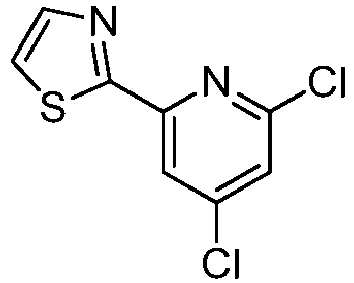
- To a 15 mL vial equiped with a stir bar was added 2,4,6-trichloropyridine (182 mg, 1.00 mmol) and Pd(dppf)Cl2 (73.2 mg, 0.100 mmol). The vial was sealed with a septum screwcap and was then placed under N2 atmosphere. To the vial was added thiazol-2-ylzinc(II) bromide in THF (8.00 mL, 4.00 mmol). The vial was placed in a 60 °C heating block with stirring for 3h. The reaction mixture was transfered to a separatory funnel and diluted with water (25 mL) and sat. aq. NaCl ("brine", 25mL). The mixture was extracted with EtOAc:Et2O (40 mL:20 mL). The organic phase was washed with brine (25 mL); dried over MgSO4; filtered; then concentrated in vacuo to afford an orange solid. This material was subjected to silica gel chromatography (CH2Cl2:MeOH, 100:0 to 99:1) to afford 2-(4,6-dichloropyridin-2-yl)thiazole as a white solid (231 mg, 46%). 1H-NMR (400MHz, CDCl3) δ8.16 (d, J=1.8 Hz, 1H), 7.95 (d, J=3.3 Hz, 1H), 7.52 (d, J=3.0 Hz, 1H), 7.37 (d, J=1.8 Hz, 1H).
-

- To a two dram vial equiped with a stir bar was added 4-bromo-2-fluoropyridine (132 mg, 0.75 mmol) and Pd(dppf)Cl2 (28 mg, 0.038 mmol). The vial was sealed with a septum screwcap and was then placed under N2 atm. To the vial was added thiazol-2-ylzinc(II) bromide in THF (3.0 mL, 1.5 mmol). The vial was placed in a 60 °C heating block with stirring for 3.5 h. The reaction solution was transfered to a 125 mL separatory funnel and was diluted with EtOAc (50 mL). The solution was washed with water:brine (25 mL:25 mL); then brine (50 mL). The organic solution was dried over MgSO4; filtered; then concentrated in vacuo. The residue was subjected to silica gel chromatography using hexanes:EtOAc to afford 2-(2-fluoropyridin-4-yl)thiazole as a white solid, 83 mg (61%). 1H-NMR (400MHz, CDCl3) δ 8.32 (d, J=5.3 Hz, 1H), 8.00 (d, J=3.3 Hz, 1H), 7.73 (dt, J=5.3, 1.6 Hz, 1H), 7.53 (d, J=3.3 Hz, 1H), 7.51 - 7.50 (m, 1H).
-
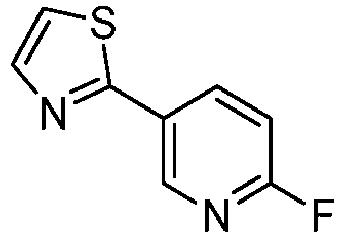
- To a 7 mL dram vial equipped with a stir bar was added 5-bromo-2-fluoropyridine (500 mg, 2.84 mmol) and Pd(dppf)Cl2 (104 mg, 0.142 mmol). The vial was sealed with a septum cap and then placed under N2 atm. To the vial was added thiazol-2-ylzinc(II) bromide in THF (6 mL, 3.00 mmol). The vial was placed in a 65 °C heating block with stirring for 2.5 h. The reaction solution was transfered to a 125 mL separatory funnel and was diluted with sat. aq. NaHCO3 (50 mL) upon which a significant amount of a white solid precipitated. The mixture was extracted with EtOAc (2 x 50 mL). The combined organics were washed with brine (50 mL); dried over MgSO4; filtered; then concentrated in vacuo. The resulting was subjected to silica gel chromatography (hexanes:EtOAc) to afford 2-(6-fluoropyridin-3-yl)thiazole as a white solid, 303 mg (59%). 1H-NMR (500MHz, CDCl3) δ 8.80 (d, J=2.5 Hz, 1H), 8.39 (ddd, J=8.5, 7.4, 2.5 Hz, 1H), 7.92 (d, J=3.3 Hz, 1H), 7.42 (d, J=3.3 Hz, 1H), 7.07 - 7.03 (m, 1H).
-
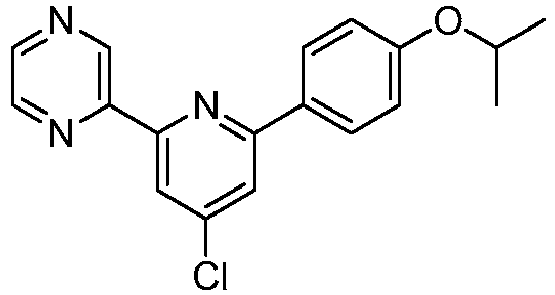
- To a 2 dram vial equipped with a stir bar was added 2,4-dichloro-6-(4-isopropoxyphenyl)pyridine (50 mg, 0.18 mmol), 2-(tributylstannyl)pyrazine (65 mg, 0.18 mmol), CuI (9.0 mg, 0.047 mmol), CsF (82 mg, 0.54 mmol), and Pd(PPh3)4 (10.2 mg, 8.86 µmol). The vial was capped with a septum screw-cap and then placed under N2 atmosphere. To the vial was added degassed DMF (1 mL). The vial was placed in a 80 °C heating block with stirring for 1 hour. The reaction mixture was directly purified by C18 chromatography (water:MeOH w/ 0.1% TFA) to afford 2-(4-chloro-6-(4-isopropoxyphenyl)pyridin-2-yl)pyrazine as a dark solid (37 mg, 64%). 1H-NMR: (400MHz, CDCl3) δ 9.82 (br. s., 1H), 8.66 (s, 2H), 8.28 (d, J=1.8 Hz, 1H), 8.12 - 8.03 (m, 2H), 7.75 (d, J=1.5 Hz, 1H), 7.03 (d, J=9.0 Hz, 2H), 4.67 (spt, J=6.1 Hz, 1H), 1.40 (d, J=6.0 Hz, 6H); MS: MS mlz 326.0 (M++1).
-
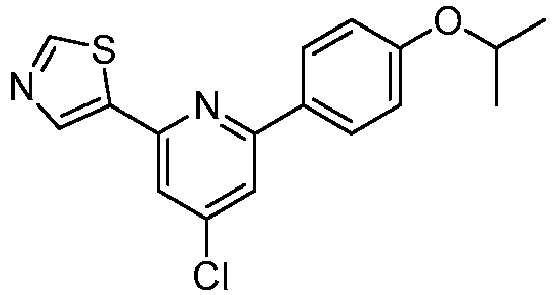
- To a 2 dram vial equipped with a stir bar was added 2,4-dichloro-6-(4-isopropoxyphenyl)pyridine (189 mg, 0.668 mmol), 5-(tributylstannyl)thiazole (250 mg, 0.668 mmol), CuI (32 mg, 0.17 mmol), CsF (304 mg, 2.00 mmol), and Pd(PPh3)4 (39 mg, 0.033 mmol). The vial was capped with a septum screw-cap and then placed under N2 atmosphere. To the vial was added degassed DMF (4 mL). The vial was placed in an 80 °C heating block with stirring for 1 hour. The vial was cooled to room temperature and then opened, and to the solution was added an additional charge of 5-(tributylstannyl)thiazole (85 mg, 0.23 mmol) and Pd(PPh3)4 (39 mg, 0.033 mmol). The vial was capped, placed under N2 atmosphere, and then placed in a 80 °C heating block with stirring for an additional 1 hour. The reaction mixture was cooled to room temperature and then transferred to a 125 mL separatory funnel. The mixture was diluted with EtOAc (50 mL) and then washed with saturated aqueous NaCl ("brine", 50 mL). The aqueous phase was extracted with EtOAc (25 mL). The combined organics were washed with brine (25 mL); dried over MgSO4; filtered; then concentrated in vacuo to afford a dark liquid. This material was subjected to silica gel chromatography to afford 5-(4-chloro-6-(4-isopropoxyphenyl)pyridin-2-yl)thiazole as a pale orange liquid (122 mg, 55%). 1H-NMR: (400MHz, CDCl3-d) δ 8.87 (s, 1H), 8.40 (s, 1H), 8.04 - 7.98 (m, 2H), 7.60 (d, J=1.5 Hz, 1H), 7.55 (d, J=1.8 Hz, 1H), 7.04 - 6.98 (m, 2H), 4.65 (spt, J=6.1 Hz, 1H), 1.39 (d, J=6.3 Hz, 6H); MS: MS m/z 331.1 (M++1).
-
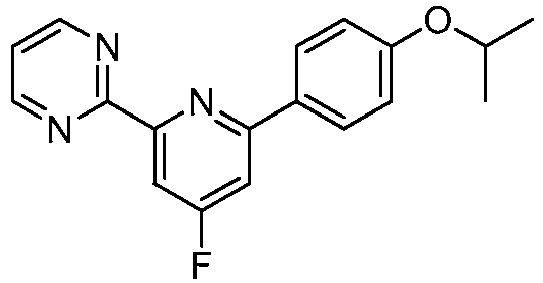

- To a 2 dram vial equipped with a stir bar was added 2,4-dichloro-6-(4-isopropoxyphenyl)pyridine (50 mg, 0.18 mmol), 2-(tributylstannyl)pyrimidine (65 mg, 0.18 mmol), CuI (8 mg, 0.04 mmol), CsF (81 mg, 0.53 mmol), and Pd(PPh3)4 (10 mg, 8.9 µmol). The vial was capped with a septum screw-cap and then placed under N2 atmosphere. To the vial was added degassed DMF (1 mL). The vial was placed in a 80 °C heating block with stirring for 1 hour. The mixture was allowed to cool to room temperature, and the reaction mixture was then directly subjected to C18 chromatography (water:MeOH w/ 0.1% TFA) to afford 2-(4-chloro-6-(4-isopropoxyphenyl)pyridin-2-yl)pyrimidine as an amber solid. This material was carried forward into step 2.
- To a 2 dram vial equipped with a stir bar and charged with 2-(4-chloro-6-(4-isopropoxyphenyl)pyridin-2-yl)pyrimidine (all material from step 1) was added CsF (200 mg, 1.32 mmol) and DMSO (0.7 mL). The vial was sealed with a septum cap and then placed in a 140 °C heating block with stirring for 18 hours. The reaction mixture was allowed to cool to room temperature and then was transfered to a 125 mL separatory funnel. The mixture was diluted with EtOAc (50 mL) and twice washed with water:brine (25 mL:25 mL). The organic solution was dried over MgSO4; filtered; then concentrated in vacuo to afford a solid amber residue. This material was subjected to silica gel purification (hexanes:EtOAc) to afford 2-(4-fluoro-6-(4-isopropoxyphenyl)pyridin-2-yl)pyrimidine as a white solid (15 mg, 27% over two steps). 1H-NMR (400MHz, CDCl3) δ 8.96 (d, J=5.0 Hz, 2H), 8.12 (dd, J=9.5, 2.3 Hz, 1H), 8.09 - 8.04 (m, 2H), 7.50 (dd, J=9.8, 2.3 Hz, 1H), 7.36 (t, J=4.9 Hz, 1H), 7.02 - 6.97 (m, 2H), 4.65 (spt, J=6.0 Hz, 1H), 1.38 (d, J=6.0 Hz, 6H); MS: MS m/z 310.2 (M++1).
-

- To a dry 2 dram vial equipped with a stir bar was added 2,4-dichloro-6-(4-isopropoxyphenyl)pyridine (60 mg, 0.21 mmol) and Pd(dppf)Cl2 (8 mg, 10 µmol). The vial was sealed with a septum screw-cap and was then placed under N2 atmosphere. To the vial was added THF (0.5 mL), then thiazol-2-ylzinc(II) bromide in THF (0.5M, 0.53 mL, 0.27 mmol). The vial was placed in a 60 °C heating block with stirring for 2 hours. The vial was opened, and then charged with Pd(dppf)Cl2 (8 mg, 10 µmol). The vial was re-sealed and then placed under N2 atmosphere, and to the vial was added thiazol-2-ylzinc(II) bromide in THF (0.5M, 0.53 mL, 0.27 mmol). The vial was placed in a 60 °C heating block with stirring for 5 hours. The reaction solution was cooled to room temperature and then concentrated under a stream of N2. The resulting solid residue was subjected to silica gel chromatography to afford 2-(4-chloro-6-(4-isopropoxyphenyl)pyridin-2-yl)thiazole as a white solid (24 mg, 34%). 1H-NMR (400MHz, CDCl3) δ 8.08 (d, J=1.8 Hz, 1H), 8.07 - 8.02 (m, 2H), 7.95 (d, J=3.0 Hz, 1H), 7.69 (d, J=1.8 Hz, 1H), 7.49 (d, J=3.0 Hz, 1H), 7.04 - 6.99 (m, 2H), 4.66 (spt, J=6.1 Hz, 1H), 1.40 (d, J=6.0 Hz, 6H); MS: MS m/z 331.1 (M++1).
-
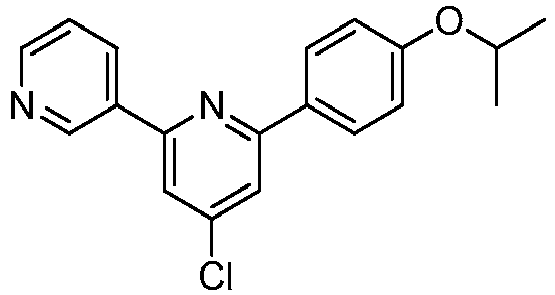
- To a 2 dram vial equipped with a stir bar was added 2,4-dichloro-6-(4-isopropoxyphenyl)pyridine (60 mg, 0.21 mmol), 6-methyl-2-(3-pyridinyl)-1,3,6,2-dioxazaborocane-4,8-dione ("3-pyridyl MIDA boronate", 50 mg, 0.21 mmol), Pd(dppf)Cl2 (8 mg, 10 µmol) and K3PO4 (339 mg, 1.60 mmol). The vial was capped with a septum screw-cap and then placed under N2 atmosphere. To the vial was added deggased THF (5 mL) and degassed water (1 mL). The vial was placed in a 60 °C heating block with stirring for 3 hours. The mixture was cooled to room temperature and the aqueous phase was decanted. The organic phase was concentrated under a stream of N2 and the resulting residue was subjected to silca gel chromatography (hexanes:EtOAc) to afford -chloro-6-(4-isopropoxyphenyl)-2,3'-bipyridine as a white solid (51 mg, 74%). 1H-NMR (400MHz, CDCl3) δ 9.31 (dd, J=2.3, 0.8 Hz, 1H), 8.69 (dd, J=4.8, 1.5 Hz, 1H), 8.44 - 8.40 (m, 1H), 8.09 - 8.04 (m, 2H), 7.68 (d, J=1.5 Hz, 1H), 7.64 (d, J=1.5 Hz, 1H), 7.44 (ddd, J=8.0, 4.8, 0.8 Hz, 1H), 7.05 - 6.97 (m, 2H), 4.66 (spt, J=6.1 Hz, 1H), 1.39 (d, J=6.3 Hz, 6H); MS: MS m/z 325.2 (M++1).
-
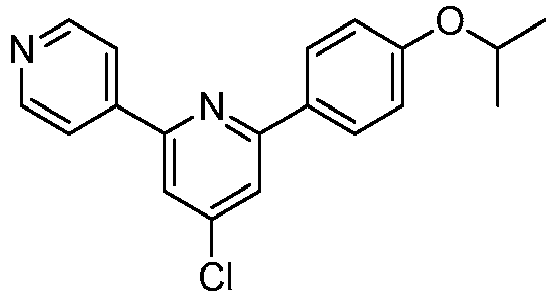
- To a 2 dram vial equipped with a stir bar was added 2,4-dichloro-6-(4-isopropoxyphenyl)pyridine (60 mg, 0.21 mmol), 6-methyl-2-(3-pyridinyl)-1,3,6,2-dioxazaborocane-4,8-dione ("4-pyridyl MIDA boronate", 50 mg, 0.21 mmol), Pd(dppf)Cl2 (8.0 mg, 10 µmol) and K3PO4 (337 mg, 1.59 mmol). The vial was capped with a septum screw-cap and then placed under N2 atmosphere. To the vial was added degassed THF (5 mL) and degassed water (1 mL). The vial was placed in a 60 °C heating block with stirring for 3 hours. The reaction mixture was cooled to room temperature and the aqueous phase was decanted. The organic solution was concentrated under a stream of N2 and the resulting solid residue was subjected to silica gel chromatography (hexanes:EtOAc) to afford 4-chloro-6-(4-isopropoxyphenyl)-2,4'-bipyridine as a white solid (45 mg, 65%). 1H-NMR (400MHz, CDCl3) δ 8.84 - 8.81 (m, 2H), 8.16 - 8.11 (m, 2H), 8.00 - 7.97 (m, 3H), 7.04 - 6.99 (m, 2H), 4.69 (spt, J=6.0 Hz, 1H), 1.40 (d, J=6.0 Hz, 6H); MS: MS m/z 326.2 (M++1).
-
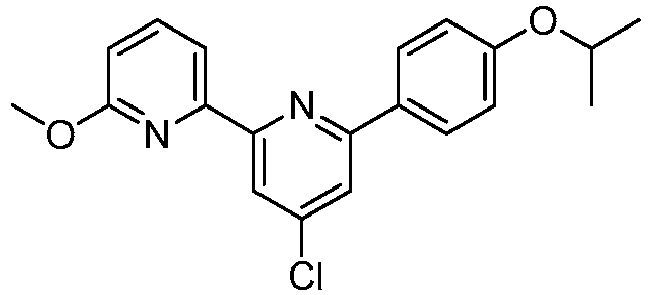
- To a 2 dram vial equipped with a stir bar was added 2,4-dichloro-6-(4-isopropoxyphenyl)pyridine (50 mg, 0.18 mmol), 2-methoxy-6-(tributylstannyl)pyridine (701 mg, 0.178 mmol), CuI (9 mg, 0.05 mmol), CsF (82 mg, 0.54 mmol), and Pd(PPh3)4 (10 mg, 8.9 µmol). The vial was sealed with a septum screw-cap and then placed under N2 atmosphere. To the vial was added degassed DMF (1 mL). The vial was placed in a 80 °C heating block with stirring for 1 hour. The reaction mixture was allowed to cool to room temperature and was then directly purified via C18 chromatography (water:MeOH w/ 0.1% TFA) to afford 4-chloro-6-(4-isopropoxyphenyl)-6'-methoxy-2,2'-bipyridine as a dark solid (58 mg, 92%). 1H-NMR (500MHz, CDCl3) 8.29 (d, J=1.7 Hz, 1H), 8.21 (dd, J=7.4, 0.5 Hz, 1H), 8.09 - 8.04 (m, 2H), 7.74 (t, J=7.8 Hz, 1H), 7.67 (d, J=1.7 Hz, 1H), 7.03 - 6.99 (m, 2H), 6.82 (dd, J=8.2, 0.5 Hz, 1H), 4.66 (spt, J=6.1 Hz, 1H), 4.08 (s, 3H), 1.40 (d, J=6.0 Hz, 6H); MS: MS m/z 355.2 (M++1).
-
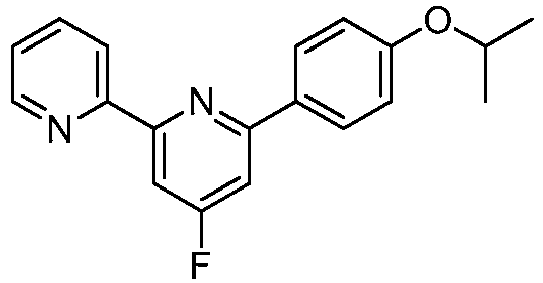

- To a 2 dram vial equipped with a stir bar was added 2,4-dichloro-6-(4-isopropoxyphenyl)pyridine (50 mg, 0.18 mmol), 2-(tributylstannyl)pyridine (65 mg, 0.18 mmol), CuI (8 mg, 0.04 mmol), CsF (81 mg, 0.53 mmol), and Pd(PPh3)4 (10 mg, 8.9 µmol). The vial was capped and then placed under N2 atmosphere. To the vial was added DMF (1 mL). The vial was placed in a 80 °C heating block with stirring for 1 h. The mixture was allowed to cool to room temperature. The vial was opened and to the reaction was added 2-(tributylstannyl)pyridine (65 mg, 0.18 mmol) and Pd(PPh3)4 (10 mg, 8.9 µmol). The vial was placed under N2 atmosphere and then returned to the 80 °C heating block with stirring for 1 h. The mixture was cooled to room temperature and then adsorbed onto diatomaceous earth (Celite®). The resulting powder was subjected to C18 chromatography (water:MeOH w/ 0.1% TFA) to afford 4-chloro-6-(4-isopropoxyphenyl)-2,2'-bipyridine as an amber solid. This material was carried forward into step 2.
- To a 2 dram vial equipped with a stir bar and charged with 4-chloro-6-(4-isopropoxyphenyl)-2,2'-bipyridine (all material from step 1) was added cesium fluoride (200 mg, 1.32 mmol) and DMSO (0.7 mL). The vial was sealed with a septum cap and then placed in a 140 °C heating block with stirring for 18 h. The reaction mixture was allowed to cool to room temperature. The mixture was transfered to a 125 mL separatory funnel and was diluted with EtOAc (50 mL) and then twice washed with water:brine (25 mL:25 mL). The organic solution was dried over MgSO4; filtered; then concentrated in vacuo to afford an amber solid residue which was subjected to silica gel chromatography (hexane:EtOAc) to afford 4-fluoro-6-(4-isopropoxyphenyl)-2,2'-bipyridine as a colorless solid (16 mg, 29% over two steps). 1H-NMR (400MHz, CDCl3) δ 8.72 - 8.67 (m, 1H), 8.62 (dt, J=7.8, 1.0 Hz, 1H), 8.10 - 8.05 (m, 3H), 7.86 (td, J=7.8, 1.8 Hz, 1H), 7.41 (dd, J=10.0, 2.3 Hz, 1H), 7.35 (ddd, J=7.5, 4.8, 1.3 Hz, 1H), 7.04 - 6.99 (m, 2H), 4.66 (spt, J=6.1 Hz, 1H), 1.40 (d, J=6.0 Hz, 6H); MS: MS m/z 309.2 (M++1).
-
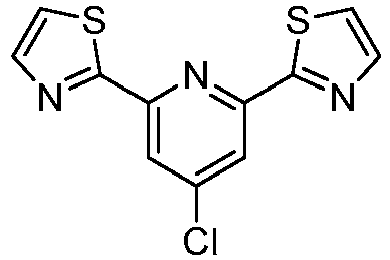
- To a 15 mL vial equiped with a stir bar was added 2,4,6-trichloropyridine (365 mg, 2.00 mmol) and Pd(dppf)Cl2 (146 mg, 0.200 mmol). The vial was sealed with a septum screwcap and then was placed under N2 atmosphere. To the vial was added thiazol-2-ylzinc(II) bromide in THF (10.0 mL, 5.00 mmol). The vial was placed in a 60 °C heating block with stirring for 16 h. The reaction mixture was cooled to room temperature, and then was transfered to a 125 mL separatory funnel where it was diluted with Et2O (50 mL) and water (50 mL). The mixture was filtered to remove a significant amount of a yellow-white precipitate and the filtrate was returned to the separatory funnel. The phases were isolated and the aqueous phase was extracted with EtOAc (25 mL). The combined organics were washed with brine (50 mL); dried over MgSO4; filtered; then concentrated in vacuo to afford a pale yellow solid which was subjected to silica gel chromatography (CH2Cl2:MeOH, 100:0 to 90:10) to afford 2,2'-(4-chloropyridine-2,6-diyl)dithiazole as a white solid (294 mg, 53%). 1H-NMR (400MHz, CDCl3) δ 8.23 (s, 2H), 7.97 (d, J=3.0 Hz, 2H), 7.53 (d, J=3.3 Hz, 2H); MS: MS m/z 280.0 (M++1).
-
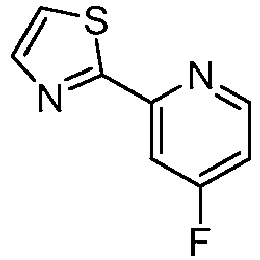
- To a 2 dram vial equiped with a stir bar was added 2-chloro-4-fluoropyridine (99 mg, 0.75 mmol) and Pd(dppf)Cl2 (27 mg, 0.038 mmol). The vial was sealed with a septum screwcap and then was placed under N2 atmosphere. To the vial was added thiazol-2-ylzinc(II) bromide in THF (3.0 mL, 1.5 mmol). The vial was placed in a 60 °C heating block with stirring for 3.5 h. The reaction solution was transferred to a 125 mL separatory funnel and was diluted with EtOAc (50 mL). The solution was washed with water:brine (25 mL:25 mL); then brine (50 mL). The organic solution was dried over MgSO4; filtered; then concentrated in vacuo. The resulting residue was subjected to silica gel chromatography (hexanes:EtOAc) to afford 2-(4-fluoropyridin-2-yl)thiazole as a white solid (106 mg, 78%). 1H-NMR (400MHz, CDCl3-d) δ 8.59 (dd, J=8.3, 5.5 Hz, 1H), 7.98 - 7.92 (m, 2H), 7.49 (d, J=3.3 Hz, 1H), 7.07 (ddd, J=8.2, 5.6, 2.5 Hz, 1H): MS: MS m/z 181.0 (M++1).
-

- To a 2 dram vial equiped with a stir bar was added 4-bromo-2-fluoropyridine (132 mg, 0.750 mmol) and Pd(dppf)Cl2 (27 mg, 0.038 mmol). The vial was sealed with a septum screwcap and then was placed under N2 atmosphere. To the vial was added thiazol-2-ylzinc(II) bromide in THF (3.0 mL, 1.5 mmol). The vial was placed in a 60 °C heating block with stirring for 3.5 h. The reaction solution was transfered to a 125 mL separatory funnel and was diluted with EtOAc (50 mL). The solution was washed with water:brine (25 mL:25 mL); then brine (50 mL). The organic solution was dried over MgSO4; filtered; then concentrated in vacuo. The residue was subjected to silica gel chromatography (hexanes:EtOAc) to afford 2-(2-fluoropyridin-4-yl)thiazole as a white solid (83 mg, 61%). 1H-NMR (400MHz, CDCl3) δ 8.32 (d, J=5.3 Hz, 1H), 8.00 (d, J=3.3 Hz, 1H), 7.73 (dt, J=5.3, 1.6 Hz, 1H), 7.53 (d, J=3.3 Hz, 1H), 7.51 - 7.50 (m, 1H): MS: MS m/z 181.0 (M++1).
-
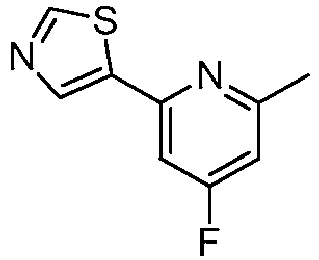
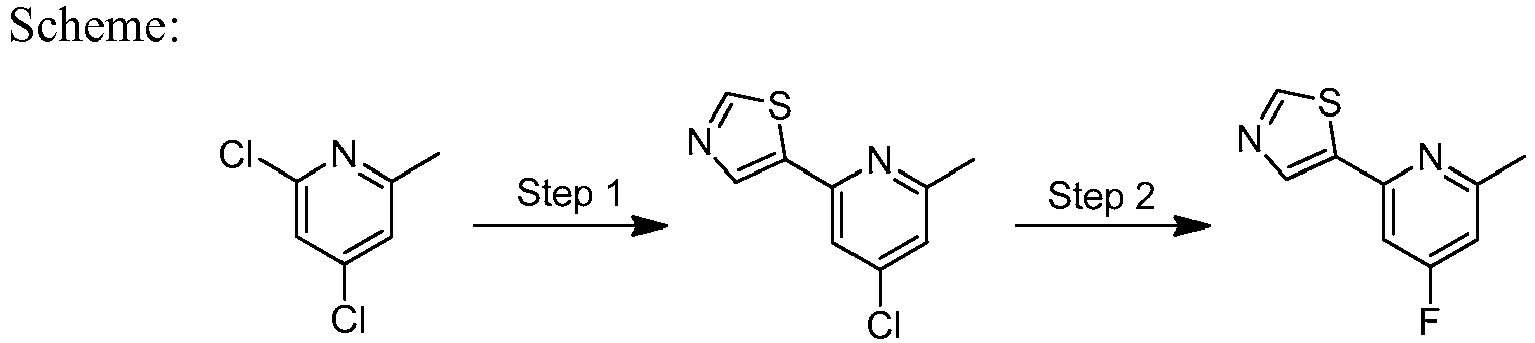
- To a 2 dram vial equipped with a stir bar was added 2,4-dichloro-6-methylpyridine (29 mg, 0.18 mmol), 5-(tributylstannyl)thiazole (66 mg, 0.18 mmol), CuI (8 mg, 0.04 mmol), CsF (81 mg, 0.53 mmol), and Pd(PPh3)4 (10 mg, 8.9 nmol). The vial was capped with a septum screw-cap and then placed under N2 atmosphere. To the vial was added degassed DMF (1 mL). The vial was placed in a 80 °C heating block with stirring for 1 hour. The mixture was allowed to cool to room temperature and was then directly purified via C18 chromatography (water:MeOH w/ 0.1% TFA) to afford 5-(4-chloro-6-methylpyridin-2-yl)thiazole as a white solid. MS: MS m/z 211.1 (M++1). This material was directly carried forward into step 2.
- To a 2 dram vial equipped with a stir bar and charged with the entirety of 5-(4-chloro-6-methylpyridin-2-yl)thiazole from step 1 was added CsF (200 mg, 1.32 mmol) and DMSO (0.7 mL). The vial was capped and then placed in a 140 °C heating block with stirring for 16 h. The reaction mixture was transfered to a 125 mL separatory funnel and was diluted with EtOAc (50 mL). The solution was twice washed with brine:water (25 mL:25 mL); dried over MgSO4; filtered; then concentrated in vacuo to afford an amber solid residue. This material was subjected to silica gel chromatography (hexanes:EtOAc) to afford 5-(4-fluoro-6-methylpyridin-2-yl)thiazole as a colorless solid (7.1 mg, 21% over two steps). 1H-NMR (500MHz, CDCl3) 8.84 (d, J=0.3 Hz, 1H), 8.32 (d, J=0.3 Hz, 1H), 7.22 (dd, J=9.3, 1.7 Hz, 1H), 6.82 (dd, J=9.2, 2.0 Hz, 1H), 2.59 (s, 3H); MS: MS m/z 195.2 (M++1).
-
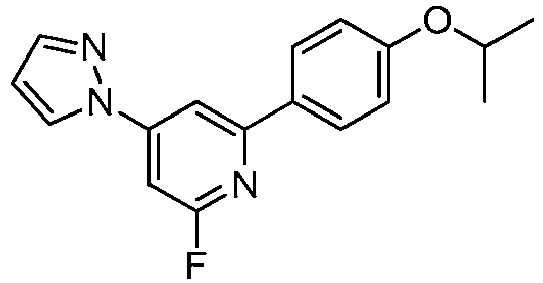
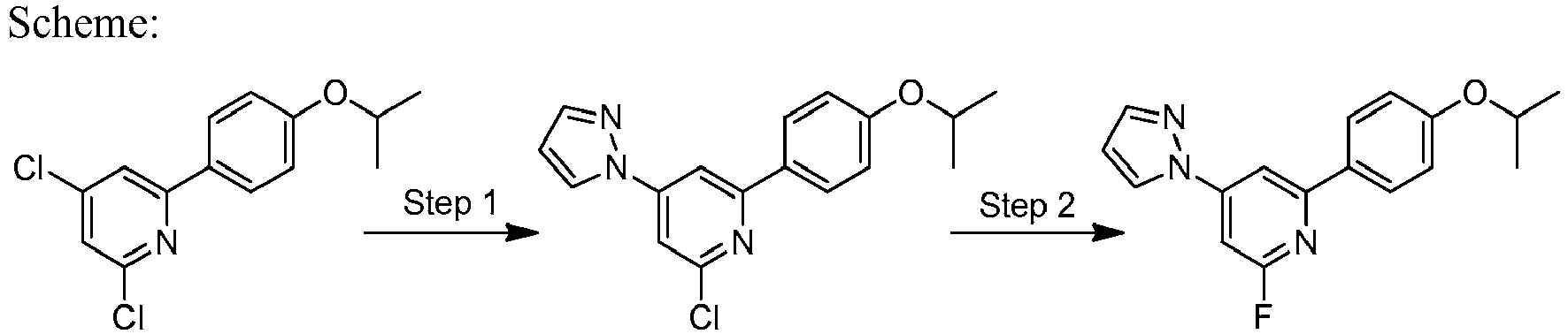
- To a dry 2 dram vial equipped with a stir bar was added 1H-pyrazole (16 mg, 0.23 mmol), then DMF (1 mL). To the solution was added sodium hydride (60% disp. in oil, 11 mg, 0.27 mmol) upon which effervesence was immediately observed. The mixture was stirred at room temperature for 15 minutes. To the solution was added 2,4-dichloro-6-(4-isopropoxyphenyl)pyridine (60 mg, 0.21 mmol) as a solution in DMF (0.2 mL). The solution was stirred at room temperature for 3 hours and then at 60 °C for 2.5 hours. The reaction mixture was cooled to room temperature and then directly purified via C18 chromatography (water:MeOH w/ 0.1% TFA) to afford 2-chloro-6-(4-isopropoxyphenyl)-4-(1H-pyrazol-1-yl)pyridine as an off-white solid (41 mg, 62%). 1H-NMR (400MHz, CDCl3) δ 8.05 (d, J=2.5 Hz, 1H), 7.99 (d, J=9.0 Hz, 2H), 7.96 (d, J=1.8 Hz, 1H), 7.81 (d, J=1.5 Hz, 1H), 7.50 (d, J=1.5 Hz, 1H), 6.97 (d, J=8.8 Hz, 2H), 6.56 (dd, J=2.5, 1.8 Hz, 1H), 4.64 (dquin, J=12.2, 6.0 Hz, 1H), 1.40 - 1.35 (m, 6H); MS: MS m/z 314.2 (M++1).
- To a 2 dram vial equipped with a stir bar and charged with 2-chloro-6-(4-isopropoxyphenyl)-4-(1H-pyrazol-1-yl)pyridine (41 mg, 0.13 mmol) was added CsF (199 mg, 1.31 mmol), then DMSO (0.7 mL). The vial was placed in a 140 °C heating block with vigorous stirring for 18 hours. The reaction mixture was transfered to a separatory funnel and was diluted with EtOAc (50 mL). The organic solution was washed twice with brine:water (25 mL:25 mL); dried over MgSO4; filtered; then concentrated in vacuo to afford 2-fluoro-6-(4-isopropoxyphenyl)-4-(1H-pyrazol-1-yl)pyridine as a yellow solid (25 mg, 63%). 1H-NMR (500MHz, CDCl3) δ 8.07 (dd, J=2.6, 0.4 Hz, 1H), 8.03 - 7.99 (m, 2H), 7.95 (t, J=1.4 Hz, 1H), 7.81 (d, J=1.4 Hz, 1H), 7.09 (t, J=1.6 Hz, 1H), 7.01 - 6.97 (m, 2H), 6.57 (dd, J=2.7, 1.7 Hz, 1H), 4.65 (spt, J=6.1 Hz, 1H), 1.39 (d, J=6.1 Hz, 6H); MS: MS m/z 298.2 (M++1).
-

- To a 2 dram vial equipped with a stir bar was added 2-(4,6-dichloropyridin-2-yl)thiazole (50 mg, 0.216 mmol), 6-Methyl-2-(3-pyridinyl)-1,3,6,2-dioxazaborocane-4,8-dione ("3-Pyridineboronic acid MIDA ester", 50.6 mg, 0.216 mmol), Pd(dppf)Cl2 (8 mg, 11 µmol) and K3PO4 (344 mg, 1.62 mmol). The vial was capped with a septum screwcap and then placed under N2 atmosphere. To the vial was added THF (1.00 mL) and water (0.20 mL). The mixture was placed in a 60 °C with stirring for 3h. The reaction mixture was transfered to a 125 mL separatory funnel using EtOAc and water. The mixture was diluted with EtOAc (30 mL), then washed with sat. aq. NaHCO3 (20 mL). The aq. phase was extracted with EtOAc (20 mL). The combined organics were dried over MgSO4; filtered; then concentrated in vacuo to afford a solid yellow residue. This material was subjected to silica gel chromatography (hexanes:EtOAc, 100:0 to 50:50) to afford 2-(4-chloro-[2,3'-bipyridin]-6-yl)thiazole as a white solid (32 mg, 54%). 1H-NMR (400MHz, CDCl3) δ 9.32 (dd, J=2.3, 0.8 Hz, 1H), 8.73 (dd, J=4.9, 1.6 Hz, 1H), 8.43 - 8.37 (m, 1H), 8.22 (d, J=1.8 Hz, 1H), 7.98 (d, J=3.0 Hz, 1H), 7.79 (d, J=1.8 Hz, 1H), 7.53 (d, J=3.3 Hz, 1H), 7.47 (ddd, J=7.9, 4.9, 1.0 Hz, 1H).
-

- To a 2 dram vial equipped with a stir bar was added 2-(4,6-dichloropyridin-2-yl)thiazole (50 mg, 0.22 mmol), 4,4,5,5-tetramethyl-2-(4-(trifluoromethyl)phenyl)-1,3,2-dioxaborolane (59 mg, 0.22 mmol), Pd(dppf)Cl2 (8 mg, 11 µmol) and K3PO4 (344 mg, 1.62 mmol). The vial was capped with a septum screwcap and then placed under N2 atmosphere. To the vial was added THF (1 mL) and water (0.5 mL). The mixture was placed in a 60 °C heating block with stirring for 16h. The reaction mixture was cooled to room temperatured; diluted with MeOH and then concentrated in vacuo. The resulting residue was dissolved/suspended in CH2Cl2 and then filtered through Celite. The filtrate was concentrated to afford a solid orange residue. This material was subjected to silica gel chromatography (hexanes:EtOAc, 100:0 to 95:5) to afford 2-(4-chloro-6-(4-(trifluoromethyl)phenyl)pyridin-2-yl)thiazole as a white solid (46 mg, 62%). 1H-NMR (400MHz, CDCl3) 8.23 (d, J=1.8 Hz, 2H), 8.21 (s, 1H), 7.98 (d, J=3.3 Hz, 1H), 7.80 (d, J=1.5 Hz, 2H), 7.78 (s, 1H), 7.53 (d, J=3.3 Hz, 1H).
-

- To a 2 dram vial equipped with a stir bar was added 2-(4,6-dichloropyridin-2-yl)thiazole (50 mg, 0.22 mmol), p-tolylboronic acid (29 mg, 0.22 mmol), Pd(dppf)Cl2 (8 mg, 11 µmol) and K3PO4 (344 mg, 1.62 mmol). The vial was capped with a septum screw-cap and then placed under N2 atmosphere. To the vial was added THF (1 mL) and water (.5 mL). The mixture was placed in a 60 °C oil bath with stirring for 16 h. The reaction mixture was diluted with EtOAc (5 mL) and brine (1 mL). The mixture was shaken; the aq. phase was decanted away via pipet. The organic phase was dried over MgSO4; filtered; and the filtrate was concentrated in vacuo to afford a dark amber solid. This material was subjected to silica gel chromatography (hexanes:EtOAc, 100:0 to 60:40) to afford 2-(4-chloro-6-(p-tolyl)pyridin-2-yl)thiazole as a white solid (28 mg, 45%). 1H-NMR (400MHz, CDCl3) δ 8.12 (d, J=1.8 Hz, 1H), 8.00 (d, J=8.3 Hz, 2H), 7.96 (d, J=3.3 Hz, 1H), 7.74 (d, J=1.8 Hz, 1H), 7.50 (d, J=3.3 Hz, 1H), 7.33 (d, J=8.0 Hz, 2H), 2.44 (s, 3H).
-
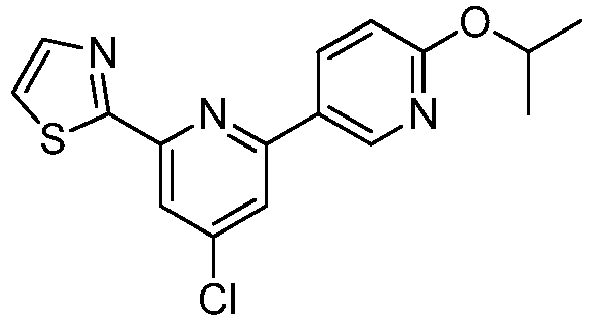
- To a 2 dram vial equipped with a stir bar was added 2-(4,6-dichloropyridin-2-yl)thiazole (50 mg, 0.22 mmol), 2-isopropoxy-5-(4,4,5,5-tetramethyl-1,3,2-dioxaborolan-2-yl)pyridine (85 mg, 0.33 mmol), Pd(dppf)Cl2 (8.0 mg, 11 µmol) and K3PO4 (344 mg, 1.62 mmol). The vial was capped with a septum screw-cap and then placed under N2 atmosphere. To the vial was added THF (1 mL) and water (0.50 mL). The mixture was placed in a 60 °C oil bath with stirring for 6h. The reaction mixture was diluted with EtOAc (4 mL) and the aqueous phase was decanted away. The organic phase was diluted with EtOAc to a volume of 40 mL. The solution was dried over MgSO4; filtered; then concentrated in vacuo to afford a dark residue. This material was subjected to silica gel chromatography (hexanes:EtOAc, 100:0 to 85:15) to afford 2-(4-chloro-6'-isopropoxy-[2,3'-bipyridin]-6-yl)thiazole as a white solid (34 mg, 47%). 1H-NMR (400MHz, CDCl3) δ 8.92 - 8.87 (m, 1H), 8.32 - 8.25 (m, 1H), 8.13 (d, J=1.8 Hz, 1H), 7.96 (d, J=3.0 Hz, 1H), 7.68 (d, J=1.8 Hz, 1H), 7.50 (d, J=3.0 Hz, 1H), 6.82 (dd, J=8.8, 0.5 Hz, 1H), 5.41 (spt, J=6.2 Hz, 1H), 1.41 (d, J=6.3 Hz, 6H).
-

- To a 2 dram vial equipped with a stir bar and charged with 2-(4,6-dichloropyridin-2-yl)thiazole (250 mg, 1.08 mmol) was added cesium fluoride (986 mg, 6.49 mmol), then DMSO (5 mL). The vial was placed in a 140 °C heating block with stirring for 16 h. The mixture was cooled to room temperature, transferred to a 125 mL separatory funnel, and then diluted with water (50 mL). The mixture was extracted with EtOAc (2 x 75 mL). The combined organics were washed with brine (50 mL); dried over MgSO4; filtered; then concentrated in vacuo. The resulting solid residue was subjected to silica gel chromatography (hexanes:EtOAc, 100:0 to 0:100) to afford 2-(4,6-difluoropyridin-2-yl)thiazole as a white solid (102 mg, 48%): 1H NMR (500MHz, CDCl3) δ 7.95 (d, J=3.2 Hz, 1H), 7.86 (dd, J=8.3, 1.8 Hz, 1H), 7.53 (d, J=3.2 Hz, 1H), 6.69 (dt, J=7.9, 2.0 Hz, 1H); and 4-fluoro-6-(thiazol-2-yl)pyridin-2-ol as a white solid (35 mg, 16%): 1H NMR (500MHz, CDCl3) δ 7.92 (d, J=3.2 Hz, 1H), 7.60 (s, 1H), 7.49 (d, J=3.2 Hz, 1H), 6.43 (d, J=1.1 Hz, 1H).
- To a 2 dram vial equipped with a stir bar was added 4-fluoro-6-(thiazol-2-yl)pyridin-2-ol (35 mg, 0.18 mmol) as a solution in DMF (1 mL). To the vial was added K2CO3 (49 mg, 0.36 mmol), then iodomethane (25 µL, 0.40 mmol). The vial was capped with a PTFE-lined cap and then placed in a 40 °C heating block with stirring for 2 h. The reaction mixture was transfered to a 125 mL separatory funnel and was diluted with water (25 mL). The mixture was extracted with CH2Cl2 (2 x 25 mL). The combined organics were dried over MgSO4; filtered; the concentrated in vacuo. The resulting residue was subjected to SiO2 column chromatography (hexanes:EtOAc, 100:0 to 50:50) to afford 2-(4-fluoro-6-methoxypyridin-2-yl)thiazole as a white solid (31 mg, 82%). 1H-NMR (500MHz, CDCl3) δ 7.92 (d, J=3.2 Hz, 1H), 7.66 (dd, J=1.9, 1.1 Hz, 1H), 7.48 (d, J=3.3 Hz, 1H), 6.44 (d, J=2.0 Hz, 1H), 3.97 (s, 3H).
-

- To a 2 dram vial equipped with a stir bar was added 2-(4,6-dichloropyridin-2-yl)thiazole (50 mg, 0.22 mmol), 6-Methyl-2-phenyl-1,3,6,2-dioxazaborocane-4,8-dione ("phenylboronic acid MIDA ester", 50 mg, 0.22 mmol), Pd(dppf)Cl2 (8 mg, 11 µmol) and K3PO4 (344 mg, 1.62 mmol). The vial was capped with a septum screwcap and then placed under N2 atmosphere. To the vial was added THF (1 mL) and water (0.5 mL). The mixture was placed in a 60 °C oil bath with stirring for 16 h. The reaction mixture was diluted with EtOAc (5 mL) and brine (1 mL). The mixture was shaken; the aq. phase was decanted away via pipet. The organic phase was dried over MgSO4; filtered; and the filtrate was concentrated in vacuo to afford a dark amber solid. This material was subjected to silica gel chromatography to afford 2-(4-chloro-6-phenylpyridin-2-yl)thiazole as a yellow solid (38 mg, 64%). 1H-NMR (400MHz, CDCl3) δ 8.16 (d, J=1.8 Hz, 1H), 8.14 - 8.08 (m, 2H), 7.97 (d, J=3.0 Hz, 1H), 7.77 (d, J=1.8 Hz, 1H), 7.58 - 7.45 (m, 4H).
-
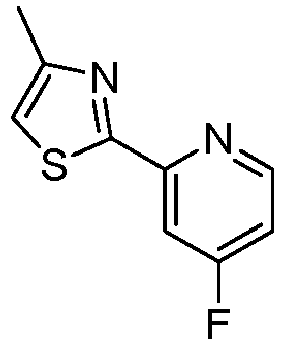
- To a dry 10 mL Schlenk flask equipped with a stir bar and placed under N2 atmosphere was added 2-bromo-4-methylthiazole (244 mg, 1.37 mmol) in THF (5 mL). The flask was cooled to -78 °C. To the solution was added n-butyllithium in hexanes (0.55 mL, 1.37 mmol). The solution was stirred for 5 minutes. To the solution was added zinc(II) chloride in THF (2.74 mL, 1.37 mmol). A thick ppt. immediately formed which hindered stirring. The flask was immediately transfered to a r.t. water bath and the solution was allowed to warm to r.t. with stirring for 30 min. To the solution was added 2-chloro-4-fluoropyridine (150 mg, 1.14 mmol), then Pd(dppf)Cl2 (42 mg, 0.057 mmol). The vial was placed in a 60 °C heating block with stirring (t=0). The reaction mixture was transfered to a 125 mL separatory funnel and was diluted with Et2O:EtOAc (25 mL:25 mL). The solution was washed with water:brine (25 mL:25 mL). The aq. phase was extracted with EtOAc (25 mL). The combined organics were washed with brine (25 mL); dried over MgSO4; filtered; then concentrated in vacuo. The residue was subjected to silica gel chromatography to afford 2-(4-fluoropyridin-2-yl)-4-methylthiazole as an orange solid (54 mg, 24%). 1H-NMR (400MHz, CDCl3) δ 8.57 (dd, J=8.2, 5.6 Hz, 1H), 7.91 (dd, J=9.7, 2.4 Hz, 1H), 7.09 - 7.01 (m, 2H), 2.54 (d, J=1.0 Hz, 3H).
-
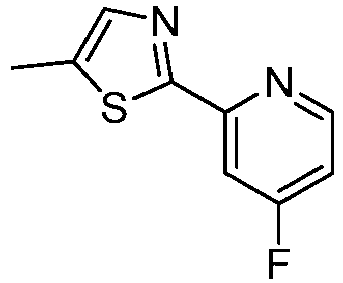
- To a dry 10 mL Schlenk flask equipped with a stir bar and placed under N2 atmosphere was added 2-bromo-5-methylthiazole (244 mg, 1.37 mmol) in THF (5 mL). The flask was cooled to -78 °C. To the solution was added n-butyllithium in hexanes (0.55 mL, 1.37 mmol). The solution was stirred for 15 minutes. To the solution was added zinc(II) chloride in THF (2.74 mL, 1.37 mmol). The solution was immediately allowed to warm to r.t. (using a r.t. water bath) with stirring for 30 min. To the solution was added 2-chloro-4-fluoropyridine (150 mg, 1.14 mmol), then Pd(dppf)Cl2 (42 mg, 0.057 mmol). The vial was placed in a 60 °C heating block with stirring for 2.25 h. The reaction solultion was transfered to a 125 mL separatory funnel and was diluted with Et2O (20 mL). The solution was washed with sat. aq. NaHCO3 (20 mL). The aq. phase was extracted with EtOAc (25 mL). The combined organics were washed with brine (20 mL); dried over MgSO4; filtered; then concentrated in vacuo to afford an orange residue. This material was subjected to silica gel chromatography (hexanes:EtOAc, 100:0 to 80:20) to afford 2-(4-fluoropyridin-2-yl)-5-methylthiazole as a white solid (54 mg, 24%). 1H-NMR (400MHz, CDCl3) δ 8.55 (dd, J=8.2, 5.4 Hz, 1H), 7.91 - 7.82 (m, 1H), 7.62 - 7.56 (m, 1H), 7.02 (ddd, J=8.2, 5.6, 2.5 Hz, 1H), 2.55 (d, J=1.3 Hz, 3H).
-

- A dry 25 mL schlenk flask equipped with a stir bar and placed under N2 atmosphere was charged with THF (7 mL) and 2-bromo-5-methylthiazole (610 mg, 3.43 mmol). The solution was cooled to -78 °C. To the solution was added n-butyllithium in hexanes (1.37 mL, 3.43 mmol) upon which the solution immediately turned dark/golden. The solution was stirred for 5 minutes. To the solution was added zinc(II) chloride in THF (6.85 mL, 3.43 mmol) upon which the solution lightened to a golden color. The solution was immediately warmed to r.t. with a water bath, with stirring for 30 minutes. To the reaction solution was added 2,4,6-trichloropyridine (250 mg, 1.37 mmol) and Pd(dppf)Cl2 (100 mg, 0.137 mmol). The flask was sealed and then was placed in a 60 °C oil bath with stirring for 16 h. The reaction solution was transfered to a 500 mL separatory funnel and was diluted with EtOAc (100 mL), then washed with brine (50 mL). The organic phase was dried over MgSO4; filtered; then concentrated in vacuo to afford a dark amber solid. This material was subjected to silica gel chromatography to afford 2-(4,6-dichloropyridin-2-yl)-5-methylthiazole as a white solid (33 mg, 8%): 1H-NMR (500MHz, CDCl3) δ 8.07 (d, J=1.7 Hz, 1H), 7.59 (d, J=1.1 Hz, 1H), 7.32 (d, J=1.6 Hz, 1H), 2.55 (d, J=1.1 Hz, 3H); and 2,2'-(4-chloropyridine-2,6-diyl)bis(5-methylthiazole) as a white solid (160 mg, 48%): 1H-NMR (500MHz, CDCl3) 8.10 (s, 2H), 7.60 (d, J=1.3 Hz, 2H), 2.59 - 2.55 (m, 6H).
-
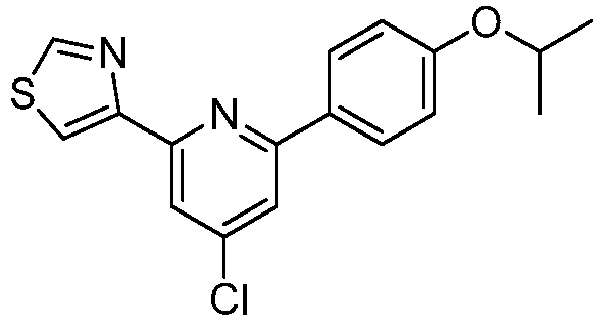
- To a 2 dram vial equipped with a stir bar was added 2,4-dichloro-6-(4-isopropoxyphenyl)pyridine (189 mg, 0.668 mmol), 4-(tributylstannyl)thiazole (250 mg, 0.668 mmol), CuI (32 mg, 0.17 mmol), CsF (304 mg, 2.00 mmol), and Pd(PPh3)4 (39 mg, 0.033 mmol). The vial was capped and then placed under N2 atmosphere. To the vial was added DMF (4 mL). The vial was placed in a 80 °C heating block with stirring for 1 h. The mixture was allowed to cool to room temperature. To the reaction was added 4-(tributylstannyl)thiazole (250 mg, 0.668 mmol) and Pd(PPh3)4 (10 mg, 8.9 µmol). The vial was placed under N2 atmosphere and then returned to the 80 °C with stirring for 1 h. The mixture was cooled to room temperature and the mixture was then adsorbed onto diatomaceous earth (Celite®). The resulting powder was subjected to C18 chromatography (water:MeCN, 100:0 to 0:100) to afford 4-(4-chloro-6-(4-isopropoxyphenyl)pyridin-2-yl)thiazole as a dark amber solid (58 mg, 26 %). 1H-NMR (500MHz, CDCl3) δ 8.90 (d, J=2.2 Hz, 1H), 8.36 (d, J=2.2 Hz, 1H), 8.09 (d, J=1.7 Hz, 1H), 8.06 - 8.02 (m, 2H), 7.63 (d, J=1.7 Hz, 1H), 7.03 - 6.98 (m, 2H), 4.66 (spt,J=6.1 Hz, 1H), 1.41 - 1.38 (m, 6H).
-
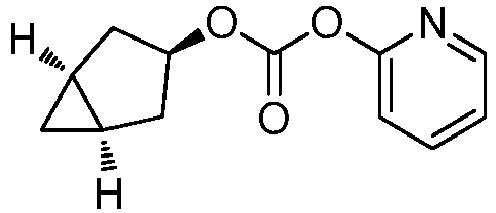
- To a round-bottom flask equipped with a stir bar and charged with (1R,3r,5S)-bicyclo[3.1.0]hexan-3-ol (2.50 g, 25.5 mmol) was added CH2Cl2 (100 mL), then dipyridin-2-yl carbonate (6.61 g, 30.6 mmol) followed by Et3N (4.26 mL, 30.6 mmol). The solution was stirred for 16 h. The solvent was removed under vacuum and the resulting residue was subjected to silica gel chromatography (hexanes:EtOAc, 95:5 to 80:20) to afford (1R,3r,5S)-bicyclo[3.1.0]hexan-3-yl pyridin-2-yl carbonate as a colorless oil (3.07 g, 55 %). 1H NMR (400MHz, CHLOROFORM-d) δ 8.40 (ddd, J=4.8, 2.0, 0.8 Hz, 1H), 7.84 - 7.76 (m, 1H), 7.24 (ddd, J=7.3, 4.9, 0.9 Hz, 1H), 7.11 (dt, J=8.2, 0.8 Hz, 1H), 5.25 (t, J=6.8 Hz, 1H), 2.31 - 2.20 (m, 2H), 2.09 - 2.01 (m, 2H), 1.38 - 1.31 (m, 2H), 0.53 (tdt, J=8.2, 5.2, 1.3 Hz, 1H), 0.48 - 0.43 (m, 1H).
-
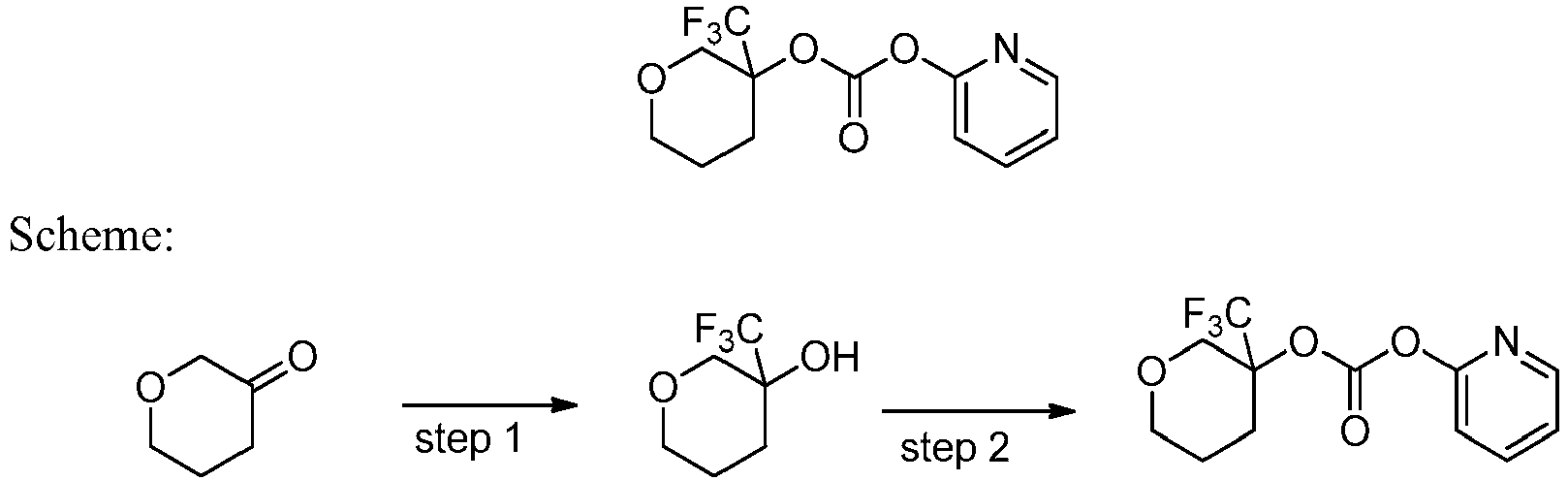
- To a round-bottom flask equipped with a stir bar and placed under N2 atmosphere was added THF (50 mL), then trimethyl(trifluoromethyl)silane (1.03 mL, 6.99 mmol). The solution was cooled to 0 °C and to the solution was added dihydro-2H-pyran-3(4H)-one (500 mg, 4.99 mmol). The solution was stirred for 5 minutes at 0 °C and then was allowed to warm to room temperature with stirring for 30 minutes. The solution was cooled to 0 °C and to the solution was added aq 1M HCl (50 mL). The mixture was stirred at room temperature overnight. The mixture was diluted with water and EtOAc and was transferred to a separatory funnel. The organic phase was isolated; washed with brine; dried over MgSO4, filtered; then concentrated in vacuo to afford 3-(trifluoromethyl)tetrahydro-2H-pyran-3-ol as a colorless oil (0.40 g, 47%). 1H-NMR (400MHz, CDCl3) δ 4.01 - 3.93 (m, 1H), 3.82 (dd, J=11.8, 2.5 Hz, 1H), 3.60 (d, J=12.0 Hz, 1H), 3.41 (td, J=11.8, 2.5 Hz, 1H), 2.10 - 2.08 (m, 2H), 1.97 - 1.90 (m, 1H), 1.82 (dd, J=12.9, 4.4 Hz, 1H), 1.65 - 1.55 (m, 1H).
- To a round-bottom flask equipped with a stir bar was added sodium hydride (60% w/w in mineral oil, 141 mg, 3.53 mmol) and THF (20 mL). The suspension was cooled to 0 °C, and to the mixture was added 3-(trifluoromethyl)tetrahydro-2H-pyran-3-ol (500 mg, 2.94 mmol). After stirring for 30 min. the solution was transferred via cannula to a solution of di(pyridin-2-yl) carbonate (635 mg, 2.94 mmol) in THF (20 mL). The resulting mixture was stirred at 0 °C for 30 min. The mixture was then warmed to room temperature with stirring for 2 h. The mixture was diluted with EtOAc followed and brine and transferred to a separatory funnel. The organic phase was isolated; dried over MgSO4; filtered; then concentrated in vacuo. The resulting residue was subjected to silica gel chromatography (hexane:EtOAc 95:5 to 60:40) to afford pyridin-2-yl (3-(trifluoromethyl)tetrahydro-2H-pyran-3-yl) carbonate as a colorless oil (195 mg, 23%). 1H-NMR (400MHz, CDCl3) δ 8.43 (dd, J=4.9, 1.4 Hz, 1H), 7.88 - 7.75 (m, 1H), 7.32 - 7.24 (m, 1H), 7.19 (d, J=8.3 Hz, 1H), 4.70 (dd, J=12.4, 2.6 Hz, 1H), 4.02 - 3.92 (m, 1H), 3.67 (d, J=12.3 Hz, 1H), 3.60 - 3.42 (m, 1H), 2.68 - 2.53 (m, 1H), 2.08 - 1.92 (m, 2H), 1.77 - 1.62 (m, 1H).
-


- O-(7-Azabenzotriazol-1-yl)-N,N,N',N'-tetramethyluronium hexafluorophosphate ("HATU", 31.7 g, 83.0 mmol) was added to a solution of (2S,4R)-methyl 4-hydroxypyrrolidine-2-carboxylate HCl salt (16.7 g, 92.0 mmol), (3R)-2-((tert-butoxycarbonyl)amino)-3,5-dimethylnon-8-enoic acid (25 g, 83 mmol) and NEt3 (35 mL, 250 mmol) in CH2Cl2 (250 mL) and the solution was stirred at room temperature for 16 h. The reaction solution was transferred to a separatory funnel and was washed with aqueous IN HCl (3X) and then brine. The organics were dried over MgSO4, filtered and concentrated in vacuo. The crude material was purified via silica gel chromatography (hexane:acetone 80:20 to 40:60) to afford the desired product (2S,4R)-methyl 1-((2S,3R)-2-((tert-butoxycarbonyl)amino)-3,5-dimethylnon-8-enoyl)-4-hydroxypyrrolidine-2-carboxylate (10.8 g, 30 % yield), MS: MS m/z 427.2 (M++1) and the undesired product (2S,4R)-methyl 1-((2R,3R)-2-((tert-butoxycarbonyl)amino)-3,5-dimethylnon-8-enoyl)-4-hydroxypyrrolidine-2-carboxylate (12 g, 34 % yield), MS: MS m/z 427.2 (M++1).
-
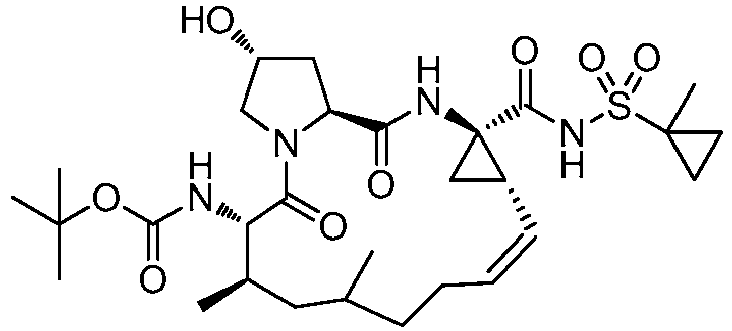

- To a 250 mL round-bottom flask equipped with a large stir bar was added (2S,4R)-methyl 1-((2S,3R)-2-((tert-butoxycarbonyl)amino)-3,5-dimethylnon-8-enoyl)-4-hydroxypyrrolidine-2-carboxylate (10.9 g, 25.5 mmol), then THF (75 mL) and methanol (75 mL). To the stirred solution was added aq. lithium hydroxide (2.0 M, 38 mL, 77 mmol). The mixture was vigorously stirred for 1.5 h. The volatiles were removed organics were removed in vacuo and the resulting aqueous solution and solid residue was transfered to a 500 mL separatory funnel. The aqueous phase was adjusted to pH 2.5 using aqueous 2N HCl and was then extracted with EtOAc (3 x 100 mL). The combined organics were washed with aqueous sat. NaCl adjusted to pH 2.5 with aqueous HCl, dried over MgSO4; filtered; then concentrated in vacuo to afford (2S,4R)-1-((2S,3R)-2-((tert-butoxycarbonyl)amino)-3,5-dimethylnon-8-enoyl)-4-hydroxypyrrolidine-2-carboxylic acid as a colorless foam (8.82 g, 84%). MS: MS m/z 413.2 (M++1).
- To a 500 mL round-bottom flask charged with (1R,2S)-1-amino-N-((1-methylcyclopropyl)sulfonyl)-2-vinylcyclopropanecarboxamide trifluoroacetic acid salt (7.53 g, 21.0 mmol) was added a solution of (2S,4R)-1-((2S,3R,5R)-2-((tert-butoxycarbonyl)amino)-3,5-dimethylnon-8-enoyl)-4-hydroxypyrrolidine-2-carboxylic acid (8.82 g, 21.38 mmol) in CH2Cl2 (100 mL). To the solution was added N,N-diisopropylethylamine (15 mL, 86 mmol) and DMF (15 mL) to afford a homogeneous orange solution. The flask was placed in a room temperature water bath. To the stirred solution was added HATU (9.59 g, 25.2 mmol). The solution was stirred at room temperature for 20 h. The reaction mixture was concentrated in vacuo and the resulting residue was dissolved in EtOAc (300 mL) and transfered to a 1L separatory funnel. The solution was washed with aq. 1M HCl (4 x 225 mL). The combined aqueous phases were extracted with EtOAc (150 mL). The combined organics were dried over MgSO4; filtered, then concentrated in vacuo. The resulting residue was dissolved in MeOH and concentrated onto Celite in vacuo; the resulting powder was subjected to silica gel chromatography (hexanes:acetone, 90:10 to 60:40) to afford tert-butyl ((2S,3R)-1-((2S,4R)-4-hydroxy-2-(((1R,2S)-1-(((1-methylcyclopropyl)sulfonyl)carbamoyl)-2-vinylcyclopropyl)carbamoyl)pyrrolidin-1-yl)-3,5-dimethyl-1-oxonon-8-en-2-yl)carbamate as a colorless solid (5.56 g, 41%). MS: MS m/z 639.5 (M++1).
- A solution of tert-butyl ((2S,3R)-1-((2S,4R)-4-hydroxy-2-(((1R,2S)-1-(((1-methylcyclopropyl)sulfonyl)carbamoyl)-2-vinylcyclopropyl)carbamoyl)pyrrolidin-1-yl)-3,5-dimethyl-1-oxonon-8-en-2-yl)carbamate (8.40 g, 13.2 mmol) in 1,2-dichloroethane (1500 ml) was sparged with nitrogen for 30 min. and then 1,3-Bis-(2,4,6-trimethylphenyl)-2-imidazolidinylidene)dichloro(o-isopropoxyphenylmethylene)ruthenium ("Hoveyda-Grubbs Catalyst 2nd Generation", 0.413 g, 0.657 mmol) was added. The reaction solution was heated to 80 °C for 2 h. The reaction solution was cooled to room temperature and then was concentrated in vacuo. The resulting residue was subjected to silica gel chromatography (hexane:acetone 80:20 to 40:60) to afford tert-butyl ((2R,6S,7R,13aS,14aR,16aS,Z)-2-hydroxy-7,9-dimethyl-14a-(((1-methylcyclopropyl)sulfonyl)carbamoyl)-5,16-dioxo-1,2,3,5,6,7,8,9,10,11,13a,14,14a,15,16,16a-hexadecahydrocyclopropa[e]pyrrolo[1,2-a][1,4]diazacyclopentadecin-6-yl)carbamate as a brown solid (5.6 g, 70% yield). MS: MS m/z 611.3 (M++1).
-

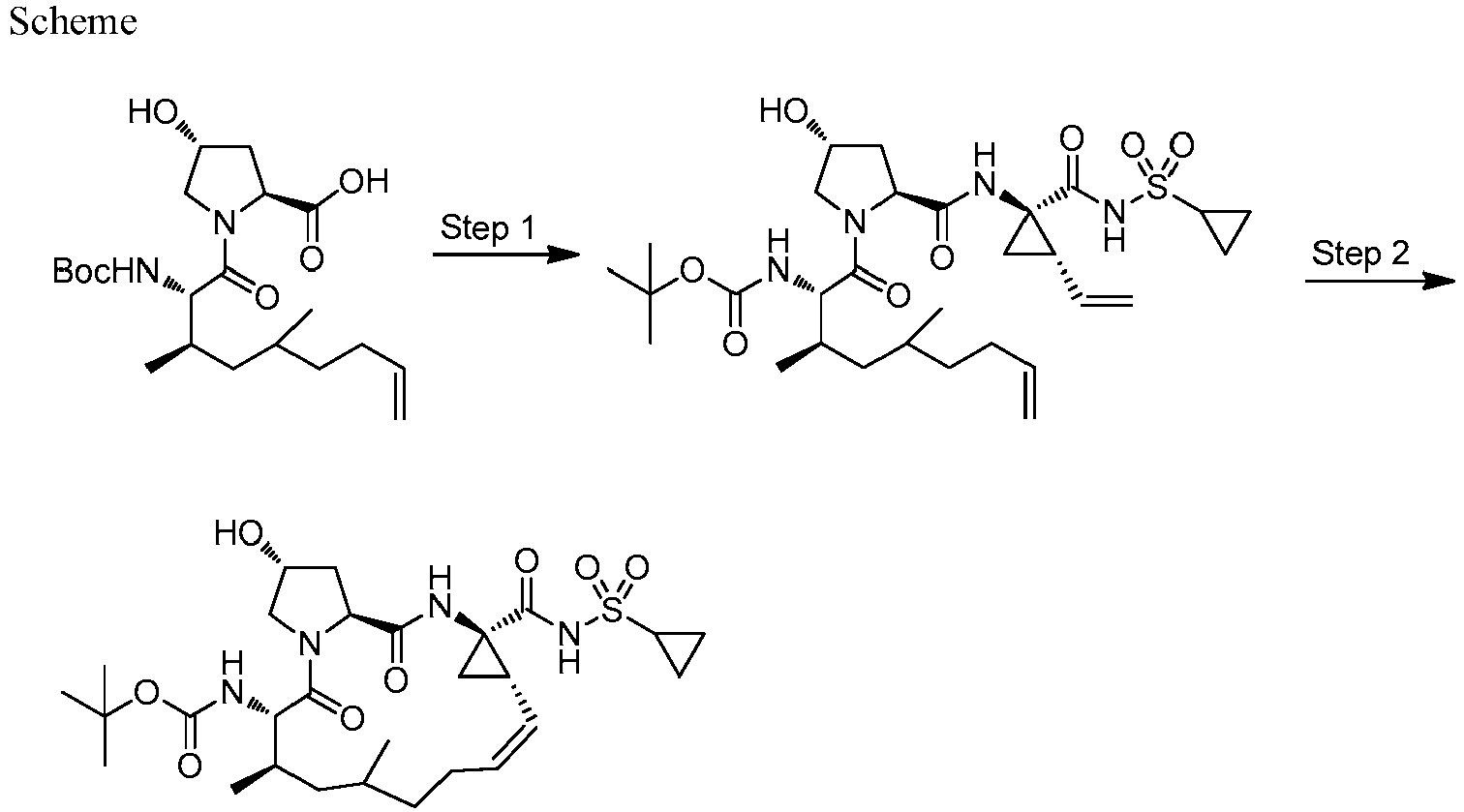
- To a solution of (2S,4R)-1-((2S,3R)-2-((tert-butoxycarbonyl)amino)-3,5-dimethylnon-8-enoyl)-4-hydroxypyrrolidine-2-carboxylic acid (10.4 g, 25.3 mmol), (1R,2S)-1-amino-N-(cyclopropylsulfonyl)-2-vinylcyclopropanecarboxamide p-toluenesulfonate salt (11.2 g, 27.8 mmol), and N,N-diisopropylethylamine (17.6 ml, 101 mmol) in CH2Cl2 (200 ml) was added HATU (11.5 g, 30.4 mmol). The mixture was stirred at room temperature for 16 h. The mixture was transferred to a separatory funnel and was thrice washed with aq. IN HCl; then brine. The organic phase was dried over MgSO4; filtered; then concentrated in vacuo. The resulting residue was subjected to silica gel chromatography to afford tert-butyl ((2S,3R)-1-((2S,4R)-2-(((1R,2S)-1-((cyclopropylsulfonyl)carbamoyl)-2-vinylcyclopropyl)carbamoyl)-4-hydroxypyrrolidin-1-yl)-3,5-dimethyl-1-oxonon-8-en-2-yl)carbamate as a light-orange solid foam (14.8 g, 94 %).
- A solution of tert-butyl ((2S,3R)-1-((2S,4R)-2-(((1R,2S)-1-((cyclopropylsulfonyl)carbamoyl)-2-vinylcyclopropyl)carbamoyl)-4-hydroxypyrrolidin-1-yl)-3,5-dimethyl-1-oxonon-8-en-2-yl)carbamate (9.50 g, 15.2 mmol) in DCE (2.5 L) was sparged with nitrogen for 30 min. To the solution was added Hoveyda-Grubbs 2nd Generation Catalyst (0.574 g, 0.912 mmol). The solution was heated at 80 °C for 2 h; then cooled to 45 °C and stirred for 2 days. The reaction solution was concentrated in vacuo and the resulting solid residue was then subjected to flash chromatography on silica gel (hexanes:acetone, 80:20 to 40:60) to afford tert-butyl ((2R,6S,7R,13aS,14aR,16aS,Z)-14a-((cyclopropylsulfonyl)carbamoyl)-2-hydroxy-7,9-dimethyl-5,16-dioxo-1,2,3,5,6,7,8,9,10,11,13a,14,14a,15,16,16a-hexadecahydrocyclopropa[e]pyrrolo[1,2-a][1,4]diazacyclopentadecin-6-yl)carbamate as a solid foam (7 g). MS: MS m/z 597.35 (M++1).
-
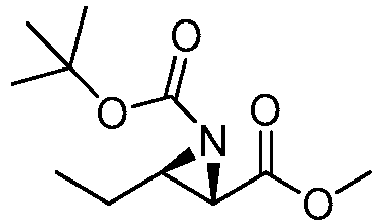


- To a 500 mL round-bottom flask equipped with a stir bar was added (S)-2-(diphenyl((trimethylsilyl)oxy)methyl)pyrrolidine (2.60 g, 8.00 mmol) and CHCl3 (200 mL). To the solution was added tert-butyl tosylcarbamate (10.9 g, 40.0 mmol). The flask was placed in a room temperature-water bath. To the stirred solution was added sodium acetate (9.84 g, 120 mmol), then (E)-pent-2-enal (4.04 g, 48.0 mmol). The mixture was stirred at room temperature for 40 minutes. The mixture was filtered, washing the filter cake with a small amount of CHCl3. The filtrate was concentrated in vacuo at 30 °C. The resulting orange liquid was dissolved in Et2O (400 mL) and transfered to a 1L separatory funnel. The solution was washed with water:aq. sat. NaHCO3 (200 mL:200 mL). The aqueous phase was extracted with Et2O (100 mL). The combined organics were washed with brine (200 mL); dried over MgSO4; filtered; then concentrated in vacuo to afford (2R,3S)-tert-butyl 2-ethyl-3-formylaziridine-1-carboxylate as a pale orange liquid.
- The following step was run duplicate. To a 250 mL round-bottom flask equipped with a stir bar was added (2R,3S)-tert-butyl 2-ethyl-3-formylaziridine-1-carboxylate (one-half of the material isolated in step 1, assumed 20 mmol) as a solution in MeOH (100 ml). The solution was cooled to 0 °C. To the solution was added sodium cyanide (1.96 g, 40.0 mmol). The solution was stirred for 10 minutes. To the solution was added oxidation-grade MnO2 (34.8 g, 400 mmol). The mixture was stirred for 10 minutes, then the ice bath was removed and the solution was allowed to warm to room temperature with stirring for 18 hours. The reaction mixture was filtered through a pad Celite and the filter cake was extracted with EtOAc (100 mL). The filtrate was concentrated in vacuo and the resulting orange solid residue was dissolved in water (100 mL) and EtOAc (100 mL) and transfered to a 1L separatory funnel where the mixture was further diluted with saturated aq. NaCl ("brine", 100 mL) and EtOAc (100 mL). The mixture was shaken and the phases were separated. The aq. phase was extracted with EtOAc (100 mL). The combined organics were washed with brine (100 mL); dried over MgSO4; filtered; then concentrated in vacuo. The resulting residue was combined with the duplicate run and the combined material was subjected to silica gel chromatography (hexanes:EtOAc, 50:50 to 0:100) to afford (2S,3R)-1-tert-butyl 2-methyl 3-ethylaziridine-1,2-dicarboxylate as a yellow liquid (3.055 g, 33% over two steps). 1H-NMR (500MHz, CDCl3) δ 3.77 (s, 3H), 2.84 (d, J=2.7 Hz, 1H), 2.77 (td, J=6.0, 2.7 Hz, 1H), 1.63 - 1.52 (m, 2H), 1.47 - 1.45 (m, 9H), 1.05 (t, J=7.5 Hz, 3H).
-
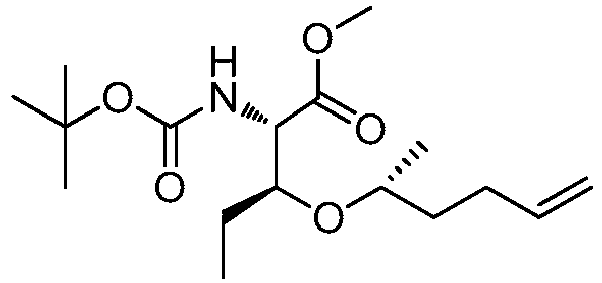
- To a round-bottom flask equipped with a stir bar was added (2S,3R)-1-tert-butyl 2-methyl 3-ethylaziridine-1,2-dicarboxylate (691, 3.02 mmol) and CH2Cl2 (12 mL). To the solution was added (R)-hex-5-en-2-ol (363 mg, 3.62 mmol), then BF3-OEt2 (1.0M in CH2Cl2, 0.30 mL). The solution was stirred at room temperature for 16 h. The solution was transfered to a separatory funnel and was dilued with CH2Cl2, then the solution was washed with aq. saturated NaHCO3; then brine. The organic phase was dried over Na2SO4; filtered; then concentrated in vacuo. The resulting residue was subjected to silica gel chromatography (hexanes:EtOAc 90:10 to 70:30) to afford (2S,3S)-methyl 2-((tert-butoxycarbonyl)amino)-3-((R)-hex-5-en-2-yloxy)pentanoate as a colorless oil (426 mg, 43%). 1H-NMR (500MHz, CDCl3) δ 5.81 (ddt, J=17.0, 10.4, 6.5 Hz, 1H), 5.19 (d, J=7.7 Hz, 1H), 5.08 - 5.00 (m, 1H), 4.96 (dd, J=10.2, 1.7 Hz, 1H), 4.50 (dd, J=8.3, 3.5 Hz, 1H), 3.75 (s, 3H), 3.65 - 3.58 (m, 1H), 3.57 - 3.50 (m, 1H), 2.19 - 2.06 (m, 2H), 1.66 - 1.56 (m, 2H), 1.55 - 1.38 (m, 11H), 1.13 (d, J=6.1 Hz, 3H), 0.97 (t, J=7.3 Hz, 3H).
-
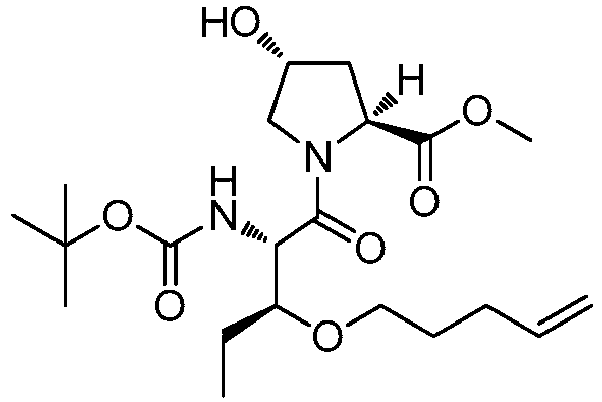
- To a round-bottom flask equipped with a stir bar was added (2S,3R)-1-tert-butyl 2-methyl 3-ethylaziridine-1,2-dicarboxylate (1.50 g, 6.54 mmol) and CH2Cl2 (30 mL). To the solution was added pent-4-en-1-ol (0.676 g, 7.85 mmol), then BF3-OEt2 (93 mg, 0.083 mL, 0.65 mmol). The solution was stirred at room temperature for 16 h. The solution was transferred to a separatory funnel and was diluted with CH2Cl2. The solution was washed with aq. saturated NaHCO3; then brine. The organic phase was dried over Na2SO4; filtered; then concentrated in vacuo. The resulting residue was subjected to silica gel chromatography (hexane:EtOAc 90:10 to 70:30) to afford (2S,4R)-methyl 1-((2S,3S)-2-((tert-butoxycarbonyl)amino)-3-(pent-4-en-1-yloxy)pentanoyl)-4-hydroxypyrrolidine-2-carboxylate as as an oil (1.06 g, 51%). 1H-NMR (500MHz, CDCl3) δ 5.87 - 5.76 (m, 1H), 5.20 (d, J=7.9 Hz, 1H), 5.07 - 5.01 (m, 1H), 4.99 - 4.95 (m, 1H), 4.54 (dd, J=8.6, 3.9 Hz, 1H), 3.75 (s, 3H), 3.58 - 3.51 (m, 1H), 3.50 - 3.44 (m, 2H), 2.17 - 2.08 (m, 2H), 1.69 - 1.61 (m, 2H), 1.61 - 1.54 (m, 2H), 1.46 - 1.43 (m, 9H), 0.99 (t, J=7.4 Hz, 3H).
-
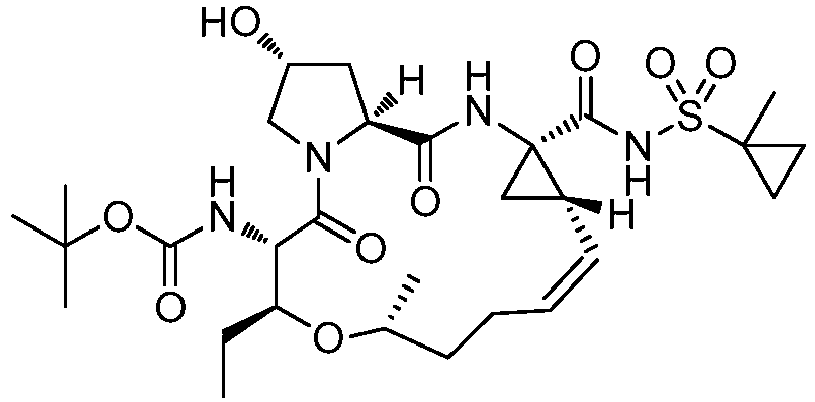
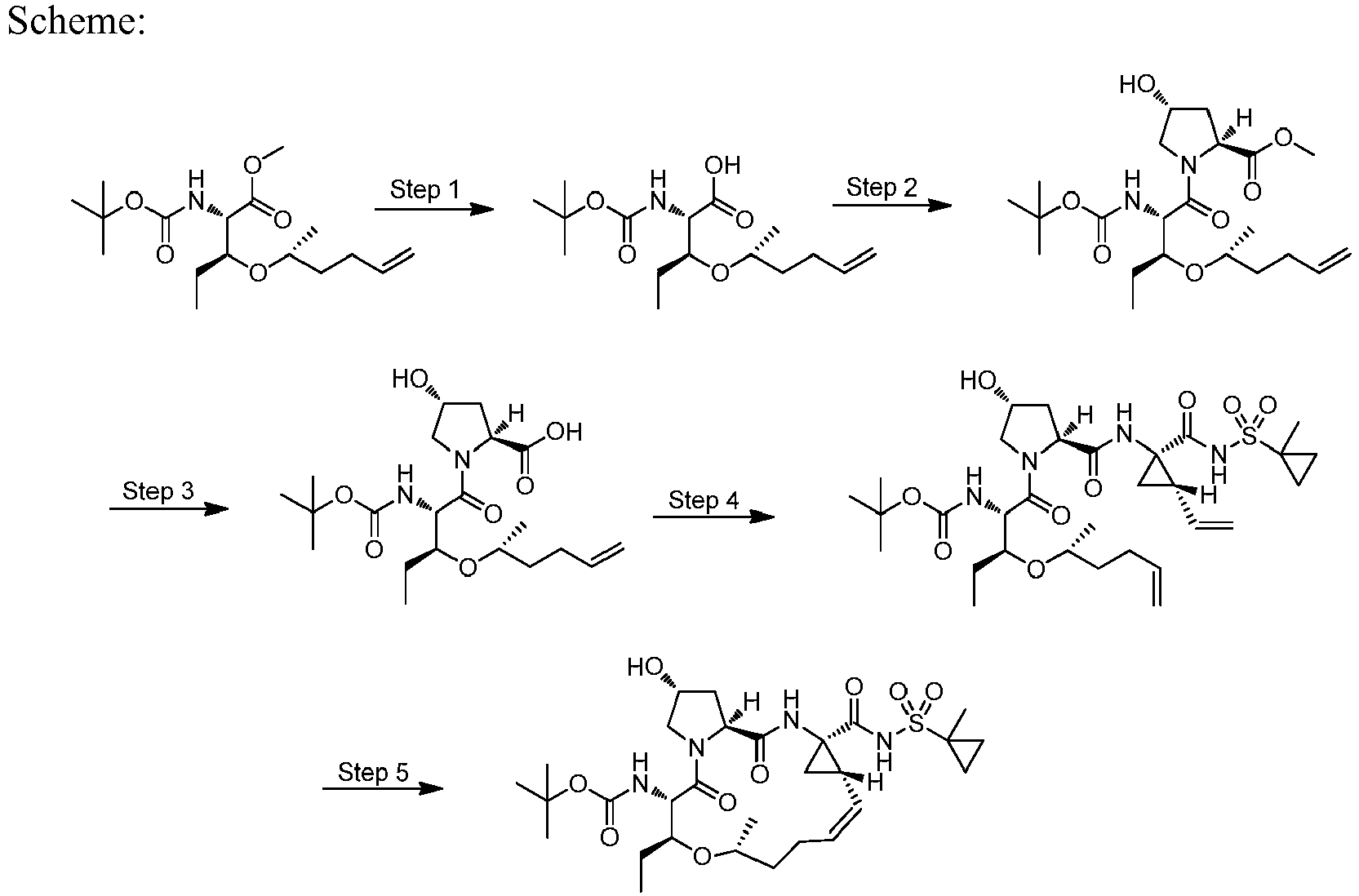
- To a round-bottom flask equipped with a stir bar was added (2S,3S)-methyl 2-((tert-butoxycarbonyl)amino)-3-((R)-hex-5-en-2-yloxy)pentanoate (458 mg, 1.39 mmol), THF (5 mL) and MeOH (5 mL). To the stirred solution was added aq. LiOH (2.0 M, 2 mL). The mixture was stirred for 16 h, then was concentrated in vacuo to afford an aqueous solution. The solution was acidified with aq. HCl (1 M) and then transferred to a separatory funnel. The mixture was twice extracted with EtOAc. The combined organics were washed with brine; dried over MgSO4; filtered; then concentrated in vacuo to afford (2S,3S)-2-((tert-butoxycarbonyl)amino)-3-((R)-hex-5-en-2-yloxy)pentanoic acid as a white foam (438 mg, 100%).
- To a round-bottom flask equipped with a stir bar was added (2S,3S)-2-((tert-butoxycarbonyl)amino)-3-(pent-4-en-1-yloxy)pentanoic acid (all material from step 1, 438 mg, 1.39 mmol), (2S,4R)-methyl 4-hydroxypyrrolidine-2-carboxylate-HCl salt (277 mg, 1.53 mmol), 1-[Bis(dimethylamino)methylene]-1H-1,2,3-triazolo[4,5-b]pyridinium 3-oxid hexafluorophosphate ("HATU", 528 mg, 1.39 mmol), and CH2Cl2 (10 mL). To the mixture was added N,N-diisopropylethylamine (0.728 mL, 4.17 mmol). The mixture was stirred at room temperature for 16 h. The reaction mixture was transferred to a separatory funnel and was thrice washed with aq. IN HCl; then brine. The organic phase was dried over MgSO4; filtered; then concentrated in vacuo to afford (2S,4R)-methyl 1-((2S,3S)-2-((tert-butoxycarbonyl)amino)-3-((R)-hex-5-en-2-yloxy)pentanoyl)-4-hydroxypyrrolidine-2-carboxylate as a yellow oil.
- To a round-bottom flask equipped with a stir bar was added (2S,4R)-methyl 1-((2S,3S)-2-((tert-butoxycarbonyl)amino)-3-((R)-hex-5-en-2-yloxy)pentanoyl)-4-hydroxypyrrolidine-2-carboxylate (all material from step 2, 1.39 mmol), THF (5 mL) and MeOH (5 mL). To the solution was added aq. lithium hydroxide (2.0 M, 4.51 mmol). The mixture was stirred at room temperature for 16 h; then was concentrated to afford an aqueous solution. This solution was acidified and then transferred to a separatory funnel. The solution was twice extracted with EtOAc. The combined organics were washed with brine; dried over MgSO4; filtered; then concentrated in vacuo to afford (2S,4R)-1-((2S,3S)-2-((tert-butoxycarbonyl)amino)-3-((R)-hex-5-en-2-yloxy)pentanoyl)-4-hydroxypyrrolidine-2-carboxylic acid as a white solid (489 mg).
- To a round-bottom flask equipped with a stir bar was added (2S,4R)-1-((2S,3S)-2-((tert-butoxycarbonyl)amino)-3-((R)-hex-5-en-2-yloxy)pentanoyl)-4-hydroxypyrrolidine-2-carboxylic acid (all material from step 3, 489 mg, 1.14 mmol), (1R,2S)-1-amino-N-((1-methylcyclopropyl)sulfonyl)-2-vinylcyclopropanecarboxamide-trifluoroacetic acid salt (450 mg, 1.26 mmol), HATU (456 mg, 1.20 mmol) and DCM (10 mL). To the stirred solution was added N,N-diisopropylethylamine (0.80 mL, 4.56 mmol). The mixture was stirred for 16 h and then was transferred to a separatory funnel. The mixture was thrice washed with aq. IN HCl; then brine. The solution was dried over MgSO4; filtered; then concentrated in vacuo to afford tert-butyl ((2S,3S)-3-((R)-hex-5-en-2-yloxy)-1-((2S,4R)-4-hydroxy-2-(((1R,2S)-1-(((1-methylcyclopropyl)sulfonyl)carbamoyl)-2-vinylcyclopropyl)carbamoyl)pyrrolidin-1-yl)-1-oxopentan-2-yl)carbamate as a light-orange solid foam (569 mg).
- To a round-bottom flask equipped with a stir bar was added tert-butyl ((2S,3S)-3-((R)-hex-5-en-2-yloxy)-1-((2S,4R)-4-hydroxy-2-(((1R,2S)-1-(((1-methylcyclopropyl)sulfonyl)carbamoyl)-2-vinylcyclopropyl)carbamoyl)pyrrolidin-1-yl)-1-oxopentan-2-yl)carbamate (all material from step 4, 569 mg, 0.869 mmol) and DCE (100 mL). The solution was sparged with nitrogen for 30 min. and then to the solution was added (1,3-Bis-(2,4,6-trimethylphenyl)-2-imidazolidinylidene)dichloro(o-isopropoxyphenylmethylene)ruthenium ("Hoveyda-Grubbs Catalyst 2nd Generation", 27 mg, 0.043 mmol). The solution was stirred at 80°C for 2 h and then cooled to 45°C and stirred for 3 days. The solution was concentrated in vacuo and the resulting residue was subjected to silica gel purification (hexanes:acetone 80:20 to 40:60). The product containing fractions were pooled; concentrated; and re-subjected to silica gel chromatography (hexanes:acetone 80:20 to 40:60) to afford tert-butyl ((2R,6S,7S,9R,13aS,14aR,16aS,Z)-7-ethyl-2-hydroxy-9-methyl-14a-(((1-methylcyclopropyl)sulfonyl)carbamoyl)-5,16-dioxo-2,3,5,6,7,9,10,11,13a,14,14a,15,16,16a-tetradecahydro-1H-cyclopropa[i]pyrrolo[1,2-e][1,5,8]oxadiazacyclopentadecin-6-yl)carbamate as a light-brown solid foam (90 mg, 10% over 5 steps). 1H-NMR (500MHz, CD3OD) δ 8.93 (s, 1H), 5.61 (td, J=10.1, 6.2 Hz, 1H), 5.03 (t, J=10.3 Hz, 1H), 4.58 (br. s., 1H), 4.47 - 4.37 (m, 2H), 3.92 (br. s., 2H), 3.86 - 3.79 (m, 1H), 3.58 - 3.49 (m, 1H), 2.75 (q, J=9.5 Hz, 1H), 2.64 - 2.52 (m, 1H), 2.23 - 2.11 (m, 2H), 1.92 - 1.80 (m, 2H), 1.75 (dd, J=8.5, 5.5 Hz, 1H), 1.66 - 1.60 (m, 1H), 1.59 - 1.52 (m, 2H), 1.49 (s, 4H), 1.43 (s, 9H), 1.41 - 1.32 (m, 2H), 1.15 (d, J=6.3 Hz, 3H), 0.95 (t, J=7.4 Hz, 3H), 0.88 - 0.84 (m, 2H).
-
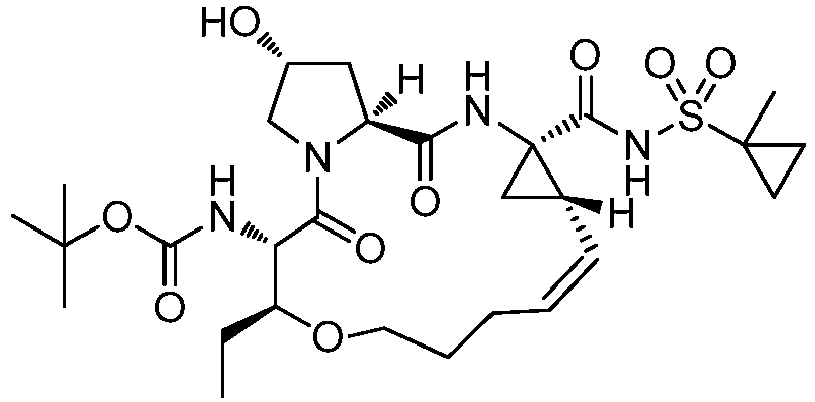

- To a round-bottom flask equipped with a stir bar was added (2S,3S)-methyl 2-((tert-butoxycarbonyl)amino)-3-(pent-4-en-1-yloxy)pentanoate (1.06 g, 3.36 mmol), THF (10 mL) and MeOH (10 mL). To the solution was added aq. LiOH (1.0 M, 5.04 mL). The mixture was stirred for 16 h at room temperature. The mixture was concentrated in vacuo, and the resulting aqueous solution was acidified with aq HCl (1.0 M) and then transferred to a separatory funnel. The solution was twice extracted with EtOAc and the combined organics were dried over MgSO4; filtered; then concentrated in vacuo to afford (2S,3S)-2-((tert-butoxycarbonyl)amino)-3-(pent-4-en-1-yloxy)pentanoic acid as a colorless solid foam (1.00 g, 99 % yield).
- To a round-bottom flask equipped with a stir bar was added (2S,3S)-2-((tert-butoxycarbonyl)amino)-3-(pent-4-en-1-yloxy)pentanoic acid (all material from step 1, 1.00 g, 3.32 mmol), (2S,4R)-methyl 4-hydroxypyrrolidine-2-carboxylate-HCl salt (0.663 g, 3.65 mmol), HATU (1.26 g, 3.32 mmol) and CH2Cl2 (30 mL). To the mixture was added N,N-diisopropylethylamine (1.75 mL, 9.95 mmol). The mixture was stirred at room temperature for 16 h. The mixture was transferred to a separatory funnel and was thrice washed with aq. HCl (1M); then brine. The organic solution was dried over MgSO4; filtered; then concentrated in vacuo to afford (2S,4R)-methyl 1-((2S,3S)-2-((tert-butoxycarbonyl)amino)-3-(pent-4-en-1-yloxy)pentanoyl)-4-hydroxypyrrolidine-2-carboxylate as a yellow oil (1.53 g).
- To a round-bottom flask equipped with a stir bar was added (2S,4R)-methyl 1-((25,3S)-2-((tert-butoxycarbonyl)amino)-3-(pent-4-en-1-yloxy)pentanoyl)-4-hydroxypyrrolidine-2-carboxylate (all material from step 2, 1.53 g, 3.57 mmol), THF (10 mL) and MeOH (10 mL). To the solution was added aq. LiOH (1.0 M, 5.36 mL). The mixture was stirred at room temperatuer for 16 h; then was concentrated in vacuo to afford an aqueous solution. The solution was acidified with aq HCl (1M) and then transferred to a separatory funnel. The solution was twice extracted with EtOAc. The combined organics were dried over MgSO4; filtered; then concentrated in vacuo to afford (2S,4R)-1-((2S,3S)-2-((tert-butoxycarbonyl)amino)-3-(pent-4-en-1-yloxy)pentanoyl)-4-hydroxypyrrolidine-2-carboxylic acid as a white solid (1.28 g, 86% over two steps).
- To a round-bottom flask equipped with a stir bar was added (2S,4R)-1-((2S,3S)-2-((tert-butoxycarbonyl)amino)-3-(pent-4-en-1-yloxy)pentanoyl)-4-hydroxypyrrolidine-2-carboxylic acid (1/2 of material from step 3, 600 mg, 1.45 mmol), (1R,2S)-1-amino-N-((1-methylcyclopropyl)sulfonyl)-2-vinylcyclopropanecarboxamide-trifluoroacetic acid salt (571 mg, 1.59 mmol), HATU (578 mg, 1.52 mmol) and CH2Cl2 (10 mL). To the mixture was added N,N-diisopropylethylamine (1.01 mL, 5.79 mmol). The mixture was stirred at room temperature for 16 h. The mixture was transferred to a separatory funnel and was thrice washed with aq. HCl (1M); then brine. The organic solution was dried over MgSO4; filtered; then concentrated in vacuo. The resulting residue was subjected to silica gel chromatography (hexanes:acetone, 94:6 to 60:40) to afford tert-butyl ((2S,3S)-1-((2S,4R)-4-hydroxy-2-(((1R,2S)-1-(((1-methylcyclopropyl)sulfonyl)carbamoyl)-2-vinylcyclopropyl)carbamoyl)pyrrolidin-1-yl)-1-oxo-3-(pent-4-en-1-yloxy)pentan-2-yl)carbamate as a colorless solid foam (480 mg, 52%). MS: MS m/z 641.5 (M++1).
- To a round-bottom flask equipped with a stir bar was added tert-butyl ((2S,3S)-1-((2S,4R)-4-hydroxy-2-(((1R,2S)-1-(((1-methylcyclopropyl)sulfonyl)carbamoyl)-2-vinylcyclopropyl)carbamoyl)pyrrolidin-1-yl)-1-oxo-3-(pent-4-en-1-yloxy)pentan-2-yl)carbamate (all material from step 4, 480 mg, 0.749 mmol) and DCE (100 mL). The solution was sparged with nitrogen for 30 minutes. To the solution was added Hoveyda-Grubbs Catalyst 2nd Generation (23 mg, 0.037 mmol). The solution was stirred at 80 °C for 2 h, then was cooled to 45 °C and was stirred for 3 days. The solution was concentrated in vacuo and the resulting residue was subjected to C18 chromatography (water with 0.1% TFA:acetonitrile with 0.1% TFA, 60:40 to 0:100) to afford tert-butyl ((2R,6S,7S,13aS,14aR,16aS,Z)-7-ethyl-2-hydroxy-14a-(((1-methylcyclopropyl)sulfonyl)carbamoyl)-5,16-dioxo-2,3,5,6,7,9,10,11,13a,14,14a,15,16,16a-tetradecahydro-1H-cyclopropa[i]pyrrolo[1,2-e][1,5,8]oxadiazacyclopentadecin-6-yl)carbamate as a brown solid foam (100 mg, 22%). MS: MS m/z 613.4 (M++1).
-
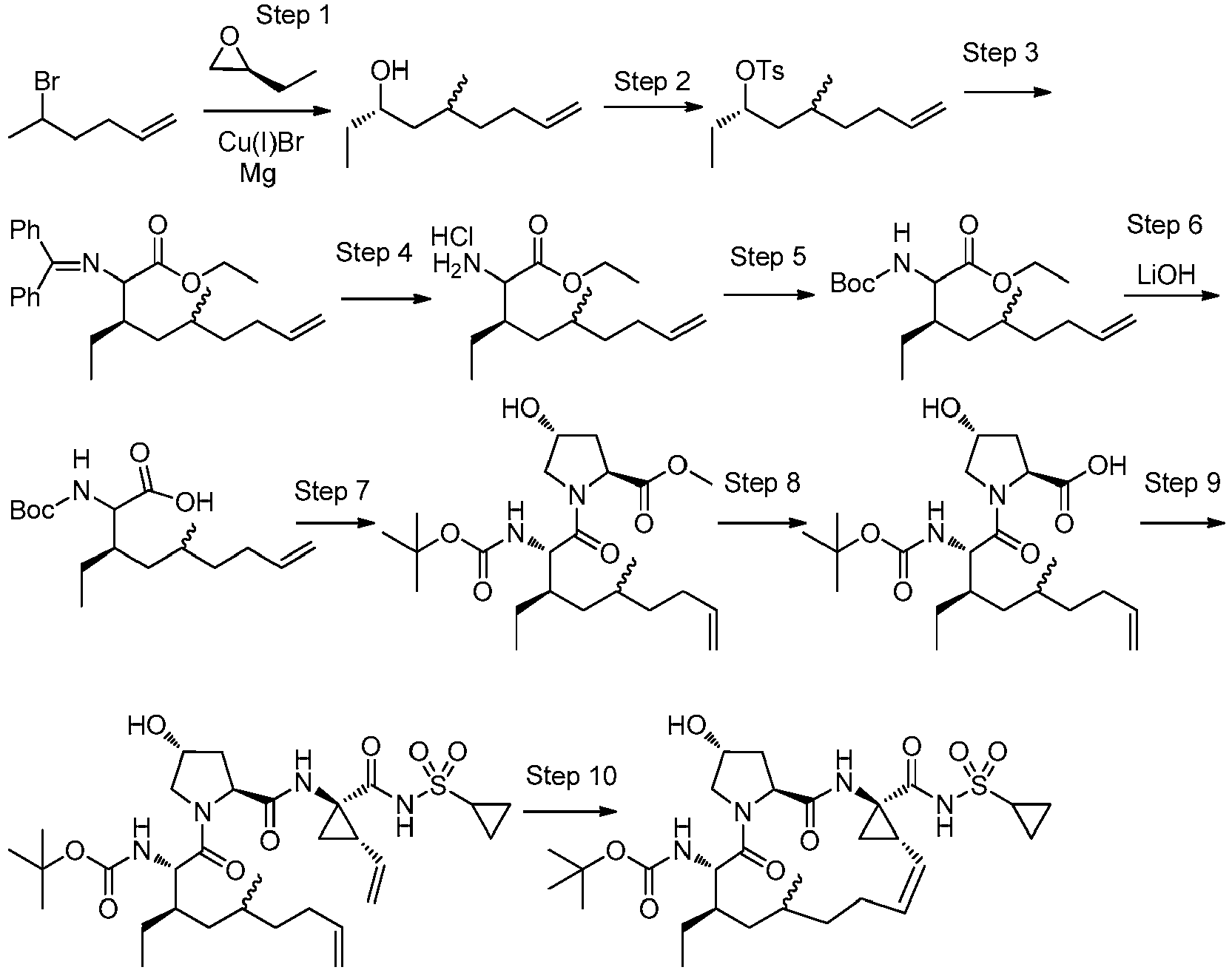
-

- Magnesium turnings (3.03 g, 125 mmole) were supended in dry THF (100 mL) and to the mixture was added iodine (100 mg) at room temperature. To this reaction mass was added a solution of 5-bromohex-1-ene (20.37 g, 125 mmole) in THF (200 mL). The reaction mass was heated with hot air gun to initiate the reaction. Upon full conversion of the bromide, the solution was transferred via cannula to a solution of (S)-2-ethyloxirane (6.05 g, 83 mmol) and copper bromide (1.19 g, 8.32 mmol) in THF (100 mL) at -78 °C. The reaction mass was allowed to come to room temperature and was stirred overnight. The reaction mass was quenched with saturated aqueous ammonium chloride solution and extracted with diethyl ether (200 mL x 3). The combined organic layers were dried over anhydrous Na2SO4; filtered; then concentrated at room temperature to get crude compound. The crude compound was purified by column chromatography (Silica gel, 10% TBME in pet ether) to get (S)-5-methylnon-8-en-3-ol (9.5 g, 73.1 %) as an oily liquid. 1H NMR (400 MHz, CDCl3): δ ppm 0.87-0.97 (m, 6 H), 1.22-1.32 (m, 4 H), 1.52-1.72 (m, 2 H), 1.90-2.29 (m, 2 H), 3.38-3.45 (m, 2 H), 4.16-4.19 (m, 1 H), 4.91-5.02 (m, 2 H), 5.75-5.82 (m, 1 H).
-
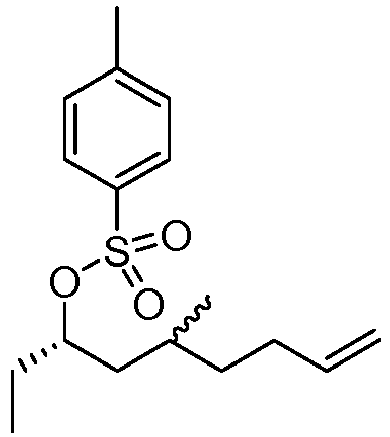
- To a solution of (S)-5-methylnon-8-en-3-ol (9.5 g, 61 mmol) in DCM (100 mL) was added pyridine (20 mL) followed by DMAP (0.74 g, 6.08 mmole) and the solution was stirred for 10 min. p-toluenesulfonyl chloride (17.39 g, 91 mmole) was added to the reaction mass at 0 °C. The reaction mass was allowed to come to room temperature and stirred overnight. Solvent was removed under reduced pressure and the residue was diluted with ethyl acetate (100 mL). The organic solution was washed with aqueous 1.5 N HCl solution; saturated bicarbonate solution; brine solution; dried over anhydrous Na2SO4; filtered; and evaporated under reduced pressure to get crude compound (15 g, 79%). The crude compound was taken to the next step without further purification. MS: MS m/z 328.4 (M++18).
-
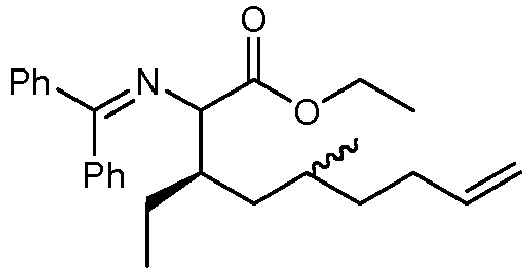
- To a solution of (S)-5-methylnon-8-en-3-yl 4-methylbenzenesulfonate (15 g, 48 mmole) and N-(diphenylmethylene)glycinate ethyl ester (15.5 g, 58.0 mmole) in toluene (150 mL) at 0 °C was added lithium bis(trimethylsilyl)amide ("LiHMDS", 72.5 mL, 72.5 mmole, 1 M solution in THF). The reaction mass was allowed to come to room temperature, and then was heated at 110 °C for 2 h. The reaction mass was cooled to room temperature, quenched with water and extracted with ethyl acetate (100 mL x 3). The combined organic layers were dried over anhydrous Na2SO4; filtered; then concentrated under reduced pressure to get crude compound (7.0 g, 35.7%). The crude compound was taken to the next step without further purification. MS: MS m/z 406.4 (M++1).
-
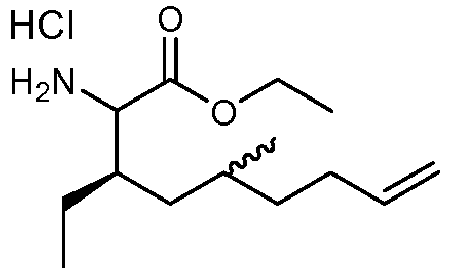
- A solution of (3R)-ethyl 2-(diphenylmethyleneamino)-3-ethyl-5-methylnon-8-enoate (7.00 g, 17.3 mmole) in diethyl ether (20 mL) was added aqueous 1.5 N HCl solutions (100 mL) and the reaction mass was stirred at room temperature overnight. The reaction mass was washed with diethyl ether (100 mL). The aqueous solution was basified using saturated sodium bicarbonate solution and extracted with ethyl acetate (100 mL x 3). The combined organic layers were dried over anhydrous Na2SO4; filtered; then concentrated under reduced pressure to get crude compound (2.6 g, 62.4%). The crude compound was taken to the next step without further purification. MS: MS m/z 242.4 (M++1).
-

- A solution of (3R)-ethyl 2-amino-3-ethyl-5-methylnon-8-enoate hydrochloride (2.99 g, 10.8 mmole) in DCM (20 mL) was added N,N-diisopropylethylamine ("DIPEA", 1.08 mL, 10.8 mmole) followed by (Boc)2O (2.39 mL, 10.8 mmole) at room temperature. The reaction mass was stirred at room temperature overnight. The reaction mass was diluted with DCM and washed with water. The organic layer was dried over anhydrous Na2SO4; filtered; thenconcentrated under reduced pressure to get crude compound. The crude compound was purified by column chromatography (Silica gel, 20% ethyl acetate in pet-ether) to get 2.3 g, (62.5%) of (3R)-ethyl 2-(tert-butoxycarbonylamino)-3,5-dimethylnon-8-enoate as an oily liquid. MS: MS m/z 342.4 (M++1).
-
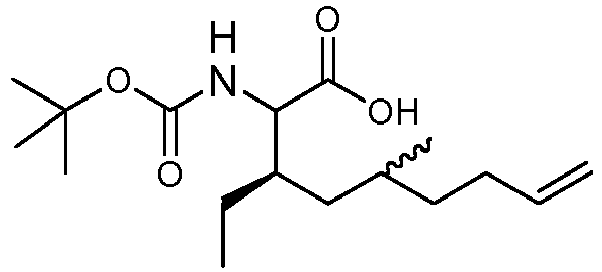
- To a solution of (3R)-ethyl 2-(tert-butoxycarbonylamino)-3-ethyl-5-methylnon-8-enoate (2.30 g, 6.74 mmole) in THF/water (50 mL, 1:1) was added methanol (10 mL) followed by LiOH (0.84 g, 20 mmol) at room temperature. The reaction mass was stirred at room temperature overnight. Solvent was evaporated under reduced pressure and the residue was diluted with water (10 mL). The aqueous solution was acidified with aqueous 1.5 N HCl solutions to pH ∼3 and extracted with ethyl acetate (100 mL x 3). The combined organic layer was dried over anhydrous Na2SO4; filtered; then concentrated under reduce pressure to get crude compound. The crude compound was purified by column chromatography (Silica gel, 2% methanol in DCM) to get 1.5 g (71%) of Intermediate 9 as an off-white solid. 1H NMR (400 MHz, DMSO-d6): δ ppm 1.27-1.09 (m, 8 H), 1.02-1.35 (m, 3 H), 1.39 (s, 11H), 1.91-1.97 (m, 1 H), 1.99-2.02 (m, 2 H), 4.03-4.12 (m, 1 H), 4.90-5.03 (m, 2 H), 5.74-5.84 (m, 1 H), 6.80-6.83 (m, 1 H), 12.47 (sb, 1 H).
-
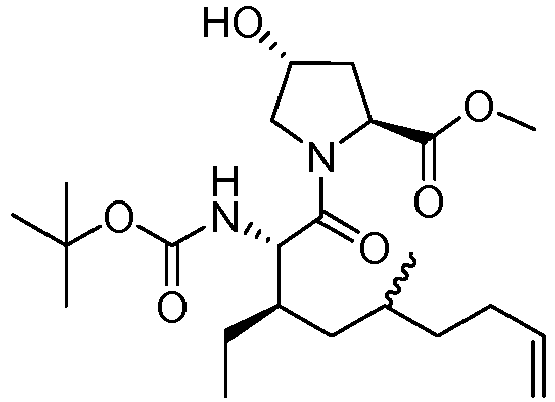
- To a solution of (3R)-2-(tert-butoxycarbonylamino)-3-ethyl-5-methylnon-8-enoic acid (2.0 g, 6.4 mmole) in dichloromethane (20 mL) was added DIPEA (1.93 mL, 19.2 mmole) and HATU (2.42 g, 6.38 mmole) followed by (2S,4R)-methyl 4-hydroxypyrrolidine-2-carboxylate (1.15 g, 6.38 mmole) at room temperature. The reaction mixture was stirred at room temperature for 2 h. The reaction mass was diluted with DCM and washed with water. The organic layer was dried over anhydrous Na2SO4; filtered; then concentrated under reduced pressure to get crude compound as mixture of diastereomers. The material was subjected to SFC purification to afford (2S,4R)-methyl 1-((2S,3R)-2-(tert-butoxycarbonylamino)-3-ethyl-5-methylnon-8-enoyl)-4-hydroxypyrrolidine-2-carboxylate (1.5 g, 53%). MS: MS m/z 441.6 (M++1).
-
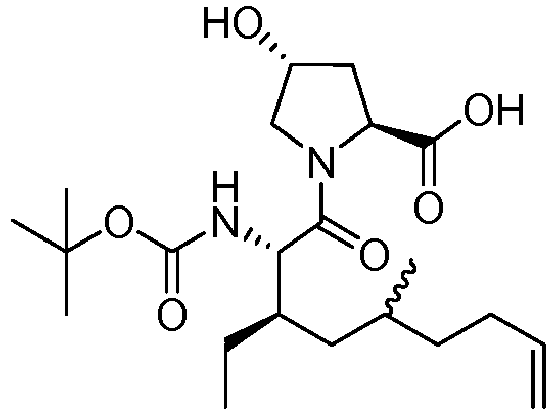
- To a solution of (2S,4R)-methyl 1-((2S,3R)-2-(tert-butoxycarbonylamino)-3-ethyl-5-methylnon-8-enoyl)-4-hydroxypyrrolidine-2-carboxylate (1.5 g, 3.40 mmole) in THF:water (16 mL, 1:1) was added LiOH (286 mg, 6.80 mmole) followed by 3 mL of methanol at room temperature. The reaction mass was stirred at room temperature overnight. The solvent was evaporated under reduced pressure and the residue was diluted with water and acidified with aqueous 1.5 N HCl solutions. The aqueous solution was extracted with ethyl acetate (20 mL x 3). The combined organic layers were dried over anhydrous Na2SO4; filtered; then concentrated under reduced pressure to afford (2S,4R)-1-((2S,3R)-2-(tert-butoxycarbonylamino)-3-ethyl-5-methylnon-8-enoyl)-4-hydroxypyrrolidine-2-carboxylic acid (1.3 g, 90%) as a white solid. 1H NMR (400 MHz, DMSO-d6): δ ppm 0.81-0.93 (m, 6 H), 1.12-1.29 (m, 5 H), 1.30-1.50 (m, 11H), 1.71-1.80 (m, 2 H), 1.91-2.51 (m, 4 H), 3.57-3.59 (m, 1H), 4.27-4.35 (m, 3 H), 4.92-4.97 (m, 2 H), 5.01-5.15 (m, 1 H), 5.74-5.79 (m, 1 H), 6.30-6.80 (m, 1 H), 12.50 (sb, 1 H). MS: MS m/z 427.6 (M++1).
-
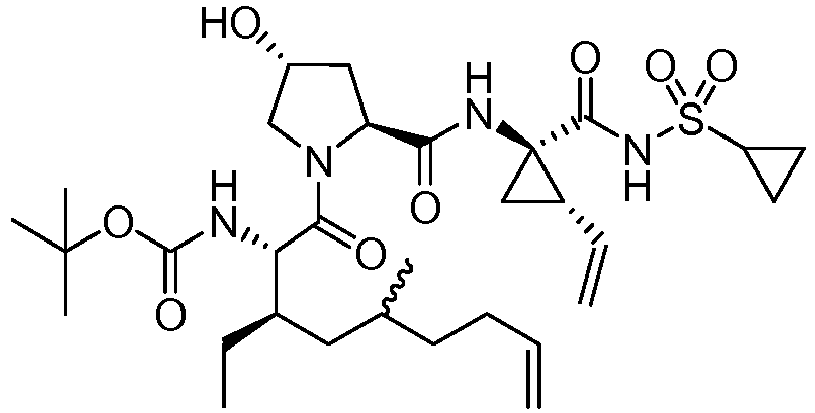
- To a solution of (2S,4R)-1-((2S,3R)-2-(tert-butoxycarbonylamino)-3-ethyl-5-methylnon-8-enoyl)-4-hydroxypyrrolidine-2-carboxylic acid (1.3 g, 3.05 mmole) in dichloromethane (50 mL) was added HATU (1.15 g, 3.05 mmole) followed by DIPEA (1.6 mL, 9.13 mmole) at room temperature. The reaction mass was stirred at the same temperature for 10 min. (1R,2S)-1-amino-N-(cyclopropylsulfonyl)-2-vinylcyclopropanecarboxamide (1.22 g, 3.05 mmole) was added to the reaction mass and the mixture was stirred at room temperature for 1 h. The reaction mass was diluted with dichloromethane and washed with water. The organic layer was dried over anhydrous Na2SO4; filtered; then concentrated under reduced pressure to get the crude compound. The crude compound was purified by silica gel chromatography (6% methanol in chloroform) to get 1.7 g (87%) of tert-butyl (2S,3R)-1-((2S,4R)-2-((1R,2S)-1-(cyclopropylsulfonylcarbamoyl)-2-vinylcyclopropylcarbamoyl)-4-hydroxypyrrolidin-1-yl)-3-ethyl-5-methyl-1-oxonon-8-en-2-ylcarbamate as a white solid. MS: MS m/z 639.55 (M++1).
-
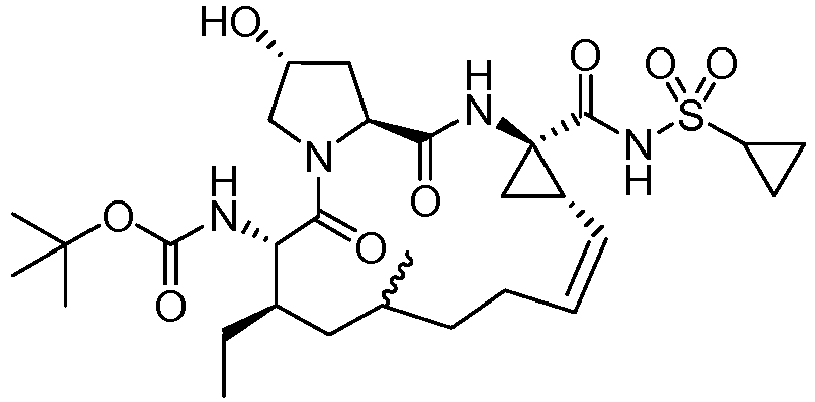
- To a degassed solution of tert-butyl (2S,3R)-1-((2S,4R)-2-((1R,2S)-1-(cyclopropylsulfonylcarbamoyl)-2-vinylcyclopropylcarbamoyl)-4-hydroxypyrrolidin-1-yl)-3-ethyl-5-methyl-1-oxonon-8-en-2-ylcarbamate (1.7 g, 2.66 mmole) in dichloroethane (100 mL) was added (1,3-Bis-(2,4,6-trimethylphenyl)-2-imidazolidinylidene)dichloro(o-isopropoxyphenylmethylene)ruthenium ("Hoveyda-Grubbs II generation catalyst", 266 mg) at room temperature under nitrogen atmosphere. The reaction mass was heated at 95 °C overnight. The solvent was evaporated under reduced pressure and the residue was purified by silica gel chromatography (5% methanol in chloroform) to afford tert-butyl (2R,6S,7R,13aS,14aR,16aS,Z)-14a-(cyclopropylsulfonylcarbamoyl)-7-ethyl-2-hydroxy-9-methyl-5,16-dioxo-1,2,3,5,6,7,8,9,10,11,13a,14,14a,15,16,16a-hexadecahydrocyclopropa[e]pyrrolo[1,2-a][1,4]diazacyclopentadecin-6-ylcarbamate (770 mg, 47%) as a pale yellow crystalline solid. MS: MS m/z 609.20 (M+-1).
-
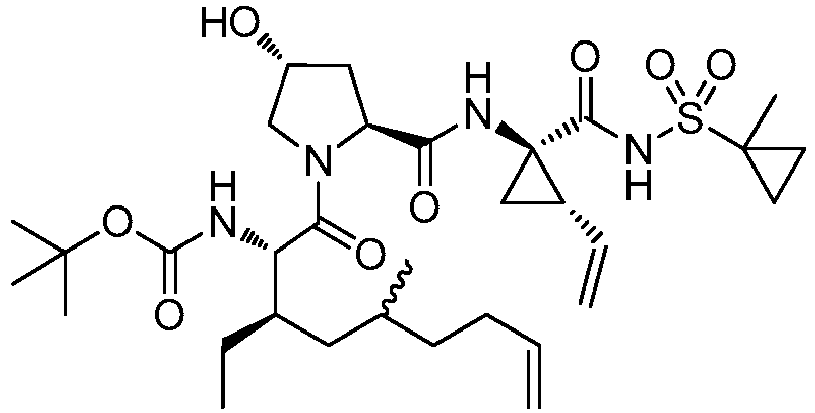
- The same procedure was used as described for the preparation of tert-butyl ((2S,3R)-1-((2S,4R)-4-hydroxy-2-(((1R,2S)-1-(((1-methylcyclopropyl)sulfonyl)carbamoyl)-2-vinylcyclopropyl)carbamoyl)pyrrolidin-1-yl)-3,5-dimethyl-1-oxonon-8-en-2-yl)carbamate but (2S,4R)-1-((2S,3R)-2-(tert-butoxycarbonylamino)-3-ethyl-5-methylnon-8-enoyl)-4-hydroxypyrrolidine-2-carboxylic acid was used as starting material instead of (2S,4R)-1-((3R)-2-((tert-butoxycarbonyl)amino)-3,5-dimethylnon-8-enoyl)-4-hydroxypyrrolidine-2-carboxylic acid. 1H NMR (400 MHz, DMSO-d6): δ ppm 10.42 (d, J=4.02 Hz, 1 H) 8.83 (d, J=8.53 Hz, 1 H) 6.24 (m, 1 H) 5.81 (m, 1 H) 5.57 (m, 1 H) 5.05 (m, 5 H) 4.32 (m, 3 H) 3.59 (m, 2 H) 1.92 (m, 8 H) 1.25 (m, 21 H) 0.84 (m, 8 H) MS: MS m/z 653.4 (M++1)
-

- The same procedure was used as described for of tert-butyl ((2R,6S,7R,9R,13aS,14aR,16aS,Z)-2-hydroxy-7,9-dimethyl-14a-(((1-methylcyclopropyl)sulfonyl)carbamoyl)-5,16-dioxo-1,2,3,5,6,7,8,9,10,11,13a,14,14a,15,16,16a-hexadecahydrocyclopropa[e]pyrrolo[1,2-a][1,4]diazacyclopentadecin-6-yl)carbamate but tert-butyl ((2S,3R)-3-ethyl-1-((2S,4R)-4-hydroxy-2-(((1R,2S)-1-(((1-methylcyclopropyl)sulfonyl)carbamoyl)-2-vinylcyclopropyl)carbamoyl)pyrrolidin-1-yl)-5-methyl-1-oxonon-8-en-2-yl)carbamate was used as a starting material instead of tert-butyl ((2S,3R)-1-((2S,4R)-4-hydroxy-2-(((1R,2S)-1-(((1- methylcyclopropyl)sulfonyl)carbamoyl)-2-vinylcyclopropyl)carbamoyl)pyrrolidin-1-yl)-3,5-dimethyl-1-oxonon-8-en-2-yl)carbamate. 1H NMR (400 MHz, DMSO-d6): δ ppm 8.32 (s, 1 H) 7.01 (d, J=9.54 Hz, 1 H) 5.38 (m, 2 H) 5.08 (m, 1 H) 4.40 (br. s., 1 H) 4.20 (t, J=7.78 Hz, 1 H) 4.00 (m, 1 H) 3.67 (m, 2 H) 2.85 (q, J=7.53 Hz, 3 H) 2.22 (d, J=8.03 Hz, 1 H) 1.84 (m, 4 H) 1.29 (m, 22 H) 0.84 (m, 6 H) 0.48 (m, 2 H). MS: MS m/z 625.4 (M++1).
-
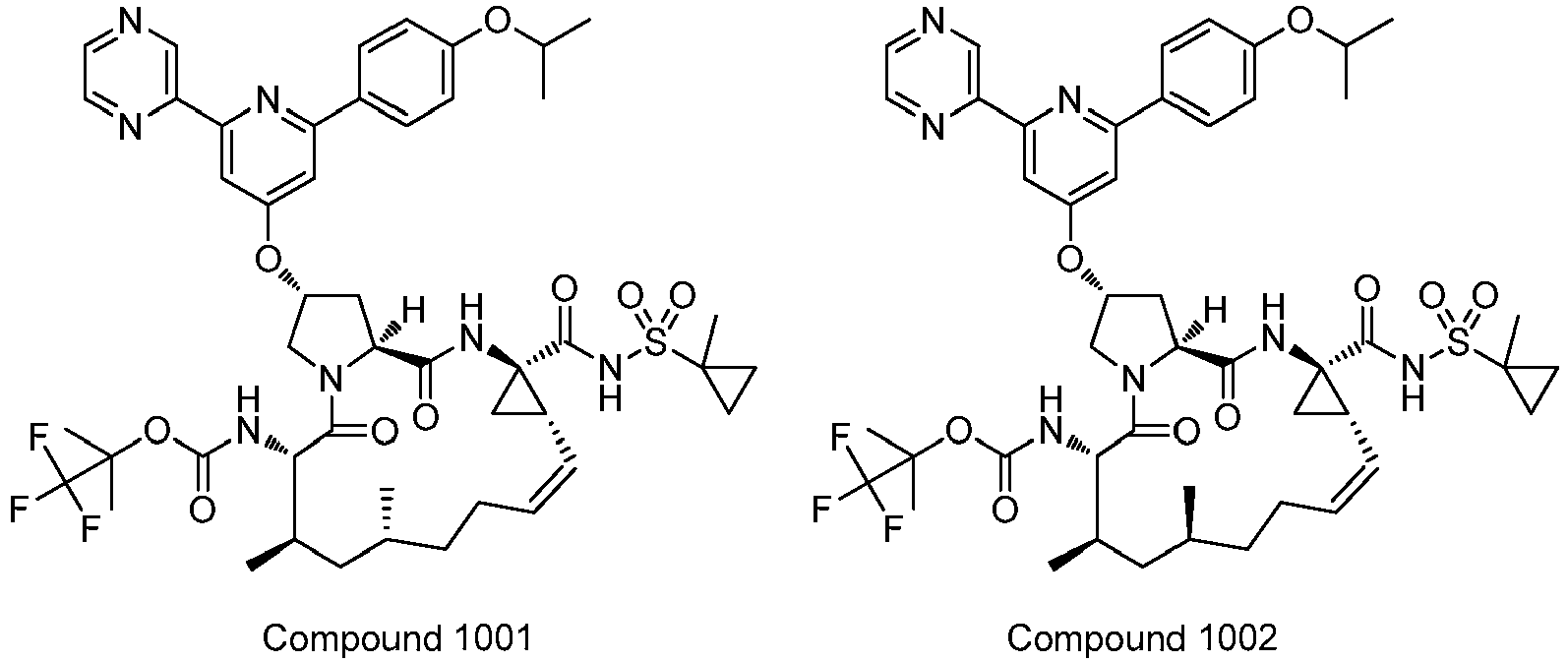
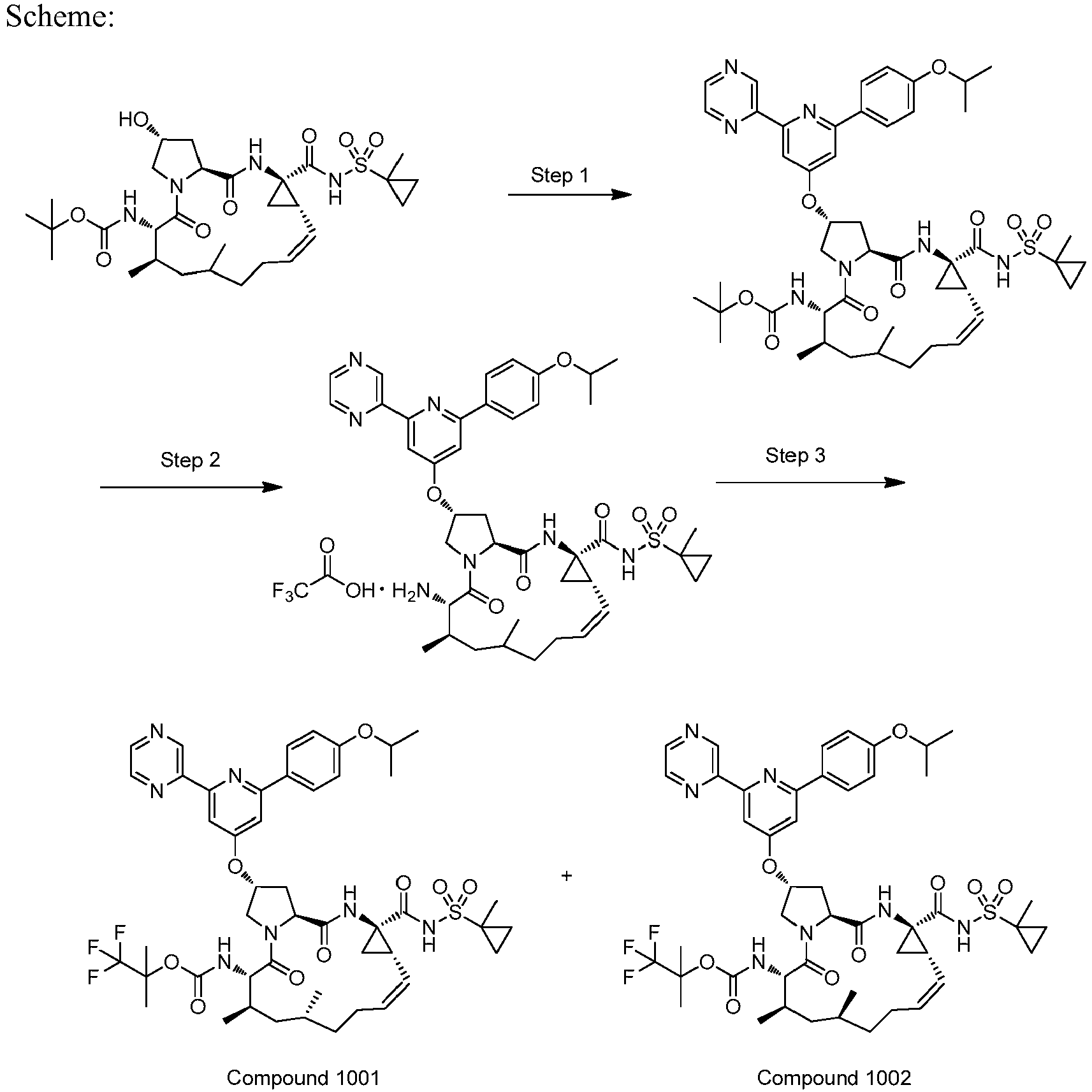
- To a dry 2 dram vial equipped with a stir bar and charged with 2-(4-chloro-6-(4-isopropoxyphenyl)pyridin-2-yl)pyrazine (37 mg, 0.11 mmol) was added tert-butyl ((2R,6S,7R,13aS,14aR,16aS,Z)-2-hydroxy-7,9-dimethyl-14a-(((1-methylcyclopropyl)sulfonyl)carbamoyl)-5,16-dioxo-1,2,3,5,6,7,8,9,10,11,13a,14,14a,15,16,16a-hexadecahydrocyclopropa[e]pyrrolo[1,2-a][1,4]diazacyclopentadecin-6-yl)carbamate (46 mg, 0.076 mmol). To the vial was added DMSO (1.25 mL). The mixture was stirred for 2 minutes to afford a red, homogeneous solution. To the solution was added potassium tert-butoxide (43 mg, 0.38 mmol) to afford a very deep amber solution. The solution was stirred at room temperature for 2 h. To the solution was added aq. 1M HCl (3 mL) upon which a solid precipitated. The mixture was transfered to a 125 mL separatory funnel and was diluted with water:brine (20 mL:20 mL). The mixture was extracted with EtOAc (2 x 30 mL). The combined organics were dried over MgSO4; filtered; then concentrated in vacuo to afford tert-butyl ((2R,6S,7R,13aS,14aR,16aS,Z)-2-((2-(4-isopropoxyphenyl)-6-(pyrazin-2-yl)pyridin-4-yl)oxy)-7,9-dimethyl-14a-(((1-methylcyclopropyl)sulfonyl)carbamoyl)-5,16-dioxo-1,2,3,5,6,7,8,9,10,11,13a,14,14a,15,16,16a-hexadecahydrocyclopropa[e]pyrrolo[1,2-a][1,4]diazacyclopentadecin-6-yl)carbamate as a solid residue. MS: MS m/z 900.6 (M++1).
- To a 25 mL round-bottom flask equipped with a stir bar and charged with tert-butyl ((2R,6S,7R,13aS,14aR,16aS,Z)-2-((2-(4-isopropoxyphenyl)-6-(pyrazin-2-yl)pyridin-4-yl)oxy)-7,9-dimethyl-14a-(((1-methylcyclopropyl)sulfonyl)carbamoyl)-5,16-dioxo-1,2,3,5,6,7,8,9,10,11,13a,14,14a,15,16,16a-hexadecahydrocyclopropa[e]pyrrolo[1,2-a][1,4]diazacyclopentadecin-6-yl)carbamate (all material from Step 1) was added CH2Cl2 (1 mL), then trifluoroacetic acid (1.0 mL, 13 mmol). The solution was stirred at room temperature for 2 h. The reaction solution was diluted with toluene (2 mL) and then concentrated in vacuo to afford (2R,6S,7R,13aS,14aR,16aS,Z)-6-amino-2-((2-(4-isopropoxyphenyl)-6-(pyrazin-2-yl)pyridin-4-yl)oxy)-7,9-dimethyl-N-((1-methylcyclopropyl)sulfonyl)-5,16-dioxo-1,2,3,5,6,7,8,9,10,11,13a,14,14a,15,16,16a-hexadecahydrocyclopropa[e]pyrrolo[1,2-a][1,4]diazacyclopentadecine-14a-carboxamide trifluoroacetic acid salt as an amber solid residue. MS: MS m/z 800.5 (M++1).
- To a vial equipped with a stir bar and charged with (2R,6S,7R,13aS,14aR,16aS,Z)-6-amino-2-((2-(4-isopropoxyphenyl)-6-(pyrazin-2-yl)pyridin-4-yl)oxy)-7,9-dimethyl-N-((1-methylcyclopropyl)sulfonyl)-5,16-dioxo-1,2,3,5,6,7,8,9,10,11,13a,14,14a,15,16,16a-hexadecahydrocyclopropa[e]pyrrolo[1,2-a][1,4]diazacyclopentadecine-14a-carboxamide trifluoroacetic acid salt (all material from Step 2) in CH2Cl2 (0.75 mL) was added pyridin-2-yl (1,1,1-trifluoro-2-methylpropan-2-yl) carbonate (28.4 mg, 0.114 mmol), then N,N-Diisopropylethylamine (0.11 mL, 0.61 mmol). The solution was stirred at room temperature for 1 h. The volatiles were removed under a stream of N2. The resulting residue was subjected to HPLC purification as follows: Column = Waters XBridge C18, 19 x 200 mm, 5-µm particles; Guard Column=Waters XBridge C18, 19 x 10 mm, 5-µm particles; Mobile Phase A = water with 20-mM ammonium acetate; Mobile Phase B = 95:5 acetonitrile:water with 20-mM ammonium acetate; Gradient = 70-100% B over 20 minutes, then a 4-minute hold at 100% B; Flow = 20 mL/min. Fractions containing Compound 1001 were combined and dried via centrifugal evaporation to afford Compound 1001 as a solid (7.0 mg, 19% over three steps); fractions containing Compound 1002 were combined and dried via centrifugal evaporation to afford Compound 1002 as a solid (1.9 mg, 5% over three steps).
- Compound 1001: 1,1,1-trifluoro-2-methylpropan-2-yl ((2R,6S,7R,9R,13aS,14aR,16aS,Z)-2-((2-(4-isopropoxyphenyl)-6-(pyrazin-2-yl)pyridin-4-yl)oxy)-7,9-dimethyl-14a-(((1-methylcyclopropyl)sulfonyl)carbamoyl)-5,16-dioxo-1,2,3,5,6,7,8,9,10,11,13a,14,14a,15,16,16a-hexadecahydrocyclopropa[e]pyrrolo[1,2-a][1,4]diazacyclopentadecin-6-yl)carbamate. 1H-NMR (500MHz, CD3OD) δ 9.71 - 9.68 (m, 1H), 8.73 - 8.70 (m, 1H), 8.64 (d, J=2.4 Hz, 1H), 8.13 - 8.08 (m, J=8.9 Hz, 2H), 7.84 (d, J=2.1 Hz, 1H), 7.41 (d, J=2.1 Hz, 1H), 7.08 - 7.02 (m, J=8.9 Hz, 2H), 5.61 - 5.54 (m, 1H), 5.49 (br. s., 1H), 5.17 (br. s., 1H), 4.76 - 4.54 (m, 4H), 4.04 (dd, J=11.4, 3.2 Hz, 1H), 3.85 (d, J=10.7 Hz, 1H), 2.72 - 2.58 (m, 2H), 2.46 (ddd, J=13.8, 10.1, 4.1 Hz, 1H), 2.42 - 2.34 (m, 1H), 2.03 - 1.94 (m, 1H), 1.88 (d, J=6.4 Hz, 1H), 1.80 - 1.71 (m, 2H), 1.63 - 1.53 (m, 2H), 1.50 (s, 3H), 1.45 (d, J=7.9 Hz, 2H), 1.43 - 1.38 (m, 2H), 1.37 (d, J=6.1 Hz, 6H), 1.34 (s, 3H), 1.32 - 1.19 (m, 2H), 1.17 (s, 3H), 0.99 (d, J=6.7 Hz, 3H), 0.95 (d, J=6.4 Hz, 3H), 0.84 - 0.77 (m, 3H); MS: MS m/z 954.5 (M++1).
- Compound 1002: 1,1,1-trifluoro-2-methylpropan-2-yl ((2R,6S,7R,9S,13aS,14aR,16aS,Z)-2-((2-(4-isopropoxyphenyl)-6-(pyrazin-2-yl)pyridin-4-yl)oxy)-7,9-dimethyl-14a-(((1-methylcyclopropyl)sulfonyl)carbamoyl)-5,16-dioxo-1,2,3,5,6,7,8,9,10,11,13a,14,14a,15,16,16a-hexadecahydrocyclopropa[e]pyrrolo[1,2-a][1,4]diazacyclopentadecin-6-yl)carbamate. MS: MS m/z 954.5 (M++1).
Regarding the general synthesis of Compound 1001: The following intermediates are interchangable with tert-butyl ((2R,6S,7R,13aS,14aR,16aS,Z)-2-hydroxy-7,9-dimethyl-14a-(((1-methylcyclopropyl)sulfonyl)carbamoyl)-5,16-dioxo-1,2,3,5,6,7,8,9,10,11,13a,14,14a,15,16,16a-hexadecahydrocyclopropa[e]pyrrolo[1,2-a][1,4]diazacyclopentadecin-6-yl)carbamate in step 1 of the synthesis pathway: tert-butyl ((2R,6S,7R,13aS,14aR,16aS,Z)-2-hydroxy-7,9-dimethyl-14a-(((1-methylcyclopropyl)sulfonyl)carbamoyl)-5,16-dioxo-1,2,3,5,6,7,8,9,10,11,13a,14,14a,15,16,16a-hexadecahydrocyclopropa[e]pyrrolo[1,2-a][1,4]diazacyclopentadecin-6-yl)carbamate; tert-butyl ((2R,6S,7R,13aS,14aR,16aS,Z)-2-hydroxy-7,9-dimethyl-14a-(((1-methylcyclopropyl)sulfonyl)carbamoyl)-5,16-dioxo-1,2,3,5,6,7,8,9,10,11,13a,14,14a,15,16,16a-hexadecahydrocyclopropa[e]pyrrolo[1,2-a][1,4]diazacyclopentadecin-6-yl)carbamate; tert-butyl ((2R,6S,7R,13aS,14aR,16aS,Z)-14a-((cyclopropylsulfonyl)carbamoyl)-7-ethyl-2-hydroxy-9-methyl-5,16-dioxo-1,2,3,5,6,7,8,9,10,11,13a,14,14a,15,16,16a-hexadecahydrocyclopropa[e]pyrrolo[1,2-a][1,4]diazacyclopentadecin-6-yl)carbamate; tert-butyl ((2R,6S,7R,13aS,14aR,16aS,Z)-14a-((cyclopropylsulfonyl)carbamoyl)-2-hydroxy-7,9-dimethyl-5,16-dioxo-1,2,3,5,6,7,8,9,10,11,13a,14,14a,15,16,16a-hexadecahydrocyclopropa[e]pyrrolo[1,2-a][1,4]diazacyclopentadecin-6-yl)carbamate. Compounds containing a tert-butyl carbamate moiety can be accessed by following the general procedure of Compound 1001 but stopping after the first step. -

- Compounds 1003 and 1004 were prepared using the intermediates described above and by following the general procedure described for the synthesis of Compound 1001.
- Compound 1003: 1,1,1-trifluoro-2-methylpropan-2-yl ((2R,6S,7R,9R,13aS,14aR,16aS,Z)-2-((2-(4-isopropoxyphenyl)-6-(thiazol-5-yl)pyridin-4-yl)oxy)-7,9-dimethyl-14a-(((1-methylcyclopropyl)sulfonyl)carbamoyl)-5,16-dioxo-1,2,3,5,6,7,8,9,10,11,13a,14,14a,15,16,16a-hexadecahydrocyclopropa[e]pyrrolo[1,2-a][1,4]diazacyclopentadecin-6-yl)carbamate. 1H-NMR (500MHz, CD3OD) δ 9.71 - 9.68 (m, 1H), 8.73 - 8.70 (m, 1H), 8.64 (d, J=2.4 Hz, 1H), 8.13 - 8.08 (m, J=8.9 Hz, 2H), 7.84 (d, J=2.1 Hz, 1H), 7.41 (d, J=2.1 Hz, 1H), 7.08 - 7.02 (m, J=8.9 Hz, 2H), 5.61 - 5.54 (m, 1H), 5.49 (br. s., 1H), 5.17 (br. s., 1H), 4.76 - 4.54 (m, 4H), 4.04 (dd, J=11.4, 3.2 Hz, 1H), 3.85 (d, J=10.7 Hz, 1H), 2.72 - 2.58 (m, 2H), 2.46 (ddd, J=13.8, 10.1, 4.1 Hz, 1H), 2.42 - 2.34 (m, 1H), 2.03 - 1.94 (m, 1H), 1.88 (d, J=6.4 Hz, 1H), 1.80 - 1.71 (m, 2H), 1.63 - 1.53 (m, 2H), 1.50 (s, 3H), 1.45 (d, J=7.9 Hz, 2H), 1.43 - 1.38 (m, 2H), 1.37 (d, J=6.1 Hz, 6H), 1.34 (s, 3H), 1.32 - 1.19 (m, 2H), 1.17 (s, 3H), 0.99 (d, J=6.7 Hz, 3H), 0.95 (d, J=6.4 Hz, 3H), 0.84 - 0.77 (m, 3H); MS: MS m/z 959.5 (M++1).
- Compound 1004: 1,1,1-trifluoro-2-methylpropan-2-yl ((2R,6S,7R,9S,13aS,14aR,16aS,Z)-2-((2-(4-isopropoxyphenyl)-6-(thiazol-5-yl)pyridin-4-yl)oxy)-7,9-dimethyl-14a-(((1-methylcyclopropyl)sulfonyl)carbamoyl)-5,16-dioxo-1,2,3,5,6,7,8,9,10,11,13a,14,14a,15,16,16a-hexadecahydrocyclopropa[e]pyrrolo[1,2-a][1,4]diazacyclopentadecin-6-yl)carbamate. MS: MS m/z 959.5 (M++1).
-
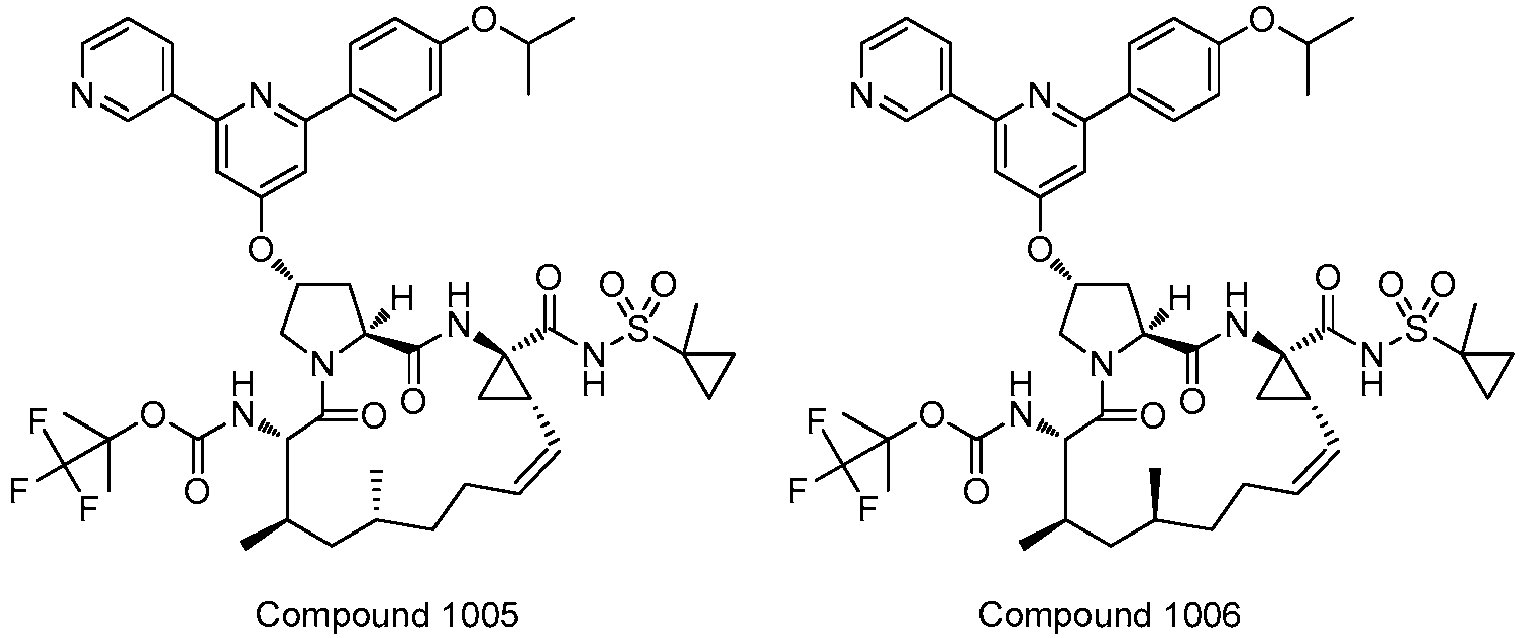
- Compounds 1005 and 1006 were prepared using the intermediates described above and by following the general procedure described for the synthesis of Compound 1001.
- Compound 1005: 1,1,1-trifluoro-2-methylpropan-2-yl ((2R,6S,7R,9R,13aS,14aR,16aS,Z)-2-((6-(4-isopropoxyphenyl)-[2,3'-bipyridin]-4-yl)oxy)-7,9-dimethyl-14a-(((1-methylcyclopropyl)sulfonyl)carbamoyl)-5,16-dioxo-1,2,3,5,6,7,8,9,10,11,13a,14,14a,15,16,16a-hexadecahydrocyclopropa[e]pyrrolo[1,2-a][1,4]diazacyclopentadecin-6-yl)carbamate. 1H-NMR (500MHz, DMSO-d6) δ 11.03 (s, 1H), 9.39 - 9.36 (m, 1H), 9.20 (br. s., 1H), 8.67 (d, J=4.0 Hz, 1H), 8.56 (d, J=7.9 Hz, 1H), 8.16 (d, J=8.9 Hz, 2H), 7.84 (d, J=8.9 Hz, 1H), 7.56 (dd, J=7.8, 4.7 Hz, 1H), 7.50 (s, 1H), 7.42 (s, 1H), 7.05 (d, J=8.5 Hz, 2H), 5.62 (br. s., 1H), 5.54 (d, J=5.5 Hz, 1H), 4.98 (t, J=9.9 Hz, 1H), 4.73 (dt, J=12.1, 6.0 Hz, 1H), 4.51 - 4.39 (m, 2H), 3.95 - 3.90 (m, 1H), 3.75 (t, J=9.6 Hz, 1H), 2.73 - 2.64 (m, 1H), 2.60 (d, J=7.3 Hz, 1H), 2.35 - 2.24 (m, 2H), 1.92 (s, 1H), 1.86 (d, J=4.6 Hz, 1H), 1.63 (br. s., 2H), 1.56 - 1.44 (m, 3H), 1.42 (s, 4H), 1.37 (br. s., 1H), 1.32 (d, J=6.1 Hz, 6H), 1.28 (s, 4H), 1.19 (d, J=7.0 Hz, 1H), 1.14 (s, 3H), 0.92 (d, J=7.0 Hz, 3H), 0.91 - 0.89 (m, 1H), 0.85 (d, J=6.1 Hz, 3H), 0.73 (t, J=12.7 Hz, 1H); MS: MS m/z 953.5 (M++1).
- Compound 1006: 1,1,1-trifluoro-2-methylpropan-2-yl ((2R,6S,7R,9S,13aS,14aR,16aS,Z)-2-((6-(4-isopropoxyphenyl)-[2,3'-bipyridin]-4-yl)oxy)-7,9-dimethyl-14a-(((1-methylcyclopropyl)sulfonyl)carbamoyl)-5,16-dioxo-1,2,3,5,6,7,8,9,10,11,13a,14,14a,15,16,16a-hexadecahydrocyclopropa[e]pyrrolo[1,2-a][1,4]diazacyclopentadecin-6-yl)carbamate. MS: MS m/z 953.5 (M++1).
-

- Compounds 1007 and 1008 were prepared using the intermediates described above and by following the general procedure described for the synthesis of Compound 1001.
- Compound 1007: 1,1,1-trifluoro-2-methylpropan-2-yl ((2R,6S,7R,9R,13aS,14aR,16aS,Z)-2-((2-(4-isopropoxyphenyl)-6-(thiazol-2-yl)pyridin-4-yl)oxy)-7,9-dimethyl-14a-(((1-methylcyclopropyl)sulfonyl)carbamoyl)-5,16-dioxo-1,2,3,5,6,7,8,9,10,11,13a,14,14a,15,16,16a-hexadecahydrocyclopropa[e]pyrrolo[1,2-a][1,4]diazacyclopentadecin-6-yl)carbamate. 1H-NMR (500MHz, DMSO-d6) δ 11.01 (br. s., 1H), 9.18 (br. s., 1H), 8.10 (d, J=8.9 Hz, 2H), 8.00 (d, J=3.4 Hz, 1H), 7.89 (d, J=3.1 Hz, 1H), 7.82 (d, J=7.3 Hz, 1H), 7.47 (s, 1H), 7.50 (s, 1H), 7.06 (d, J=8.9 Hz, 2H), 5.59 (br. s., 1H), 5.51 (br. s., 1H), 4.97 (br. s., 1H), 4.73 (dt, J=12.2, 6.1 Hz, 1H), 4.50 - 4.39 (m, 2H), 3.92 - 3.87 (m, 1H), 3.68 (t, J=9.6 Hz, 1H), 2.71 - 2.61 (m, 1H), 2.58 (br. s., 1H), 2.33 - 2.23 (m, 2H), 1.93 - 1.86 (m, 1H), 1.82 (br. s., 1H), 1.61 (br. s., 2H), 1.52 (br. s., 1H), 1.48 (br. s., 1H), 1.40 (br. s., 3H), 1.34 (br. s., 1H), 1.30 (d, J=6.1 Hz, 6H), 1.29 - 1.25 (m, 1H), 1.23 (s, 3H), 1.22 - 1.12 (m, 4H), 0.90 (d, J=6.7 Hz, 3H), 0.83 (d, J=6.1 Hz, 3H), 0.71 (t, J=12.4 Hz, 1H); MS: MS m/z 959.5 (M++1).
- Compound 1008: 1,1,1-trifluoro-2-methylpropan-2-yl ((2R,6S,7R,9S,13aS,14aR,16aS,Z)-2-((2-(4-isopropoxyphenyl)-6-(thiazol-2-yl)pyridin-4-yl)oxy)-7,9-dimethyl-14a-(((1-methylcyclopropyl)sulfonyl)carbamoyl)-5,16-dioxo-1,2,3,5,6,7,8,9,10,11,13a,14,14a,15,16,16a-hexadecahydrocyclopropa[e]pyrrolo[1,2-a][1,4]diazacyclopentadecin-6-yl)carbamate. MS: MS m/z 959.5 (M++1).
-
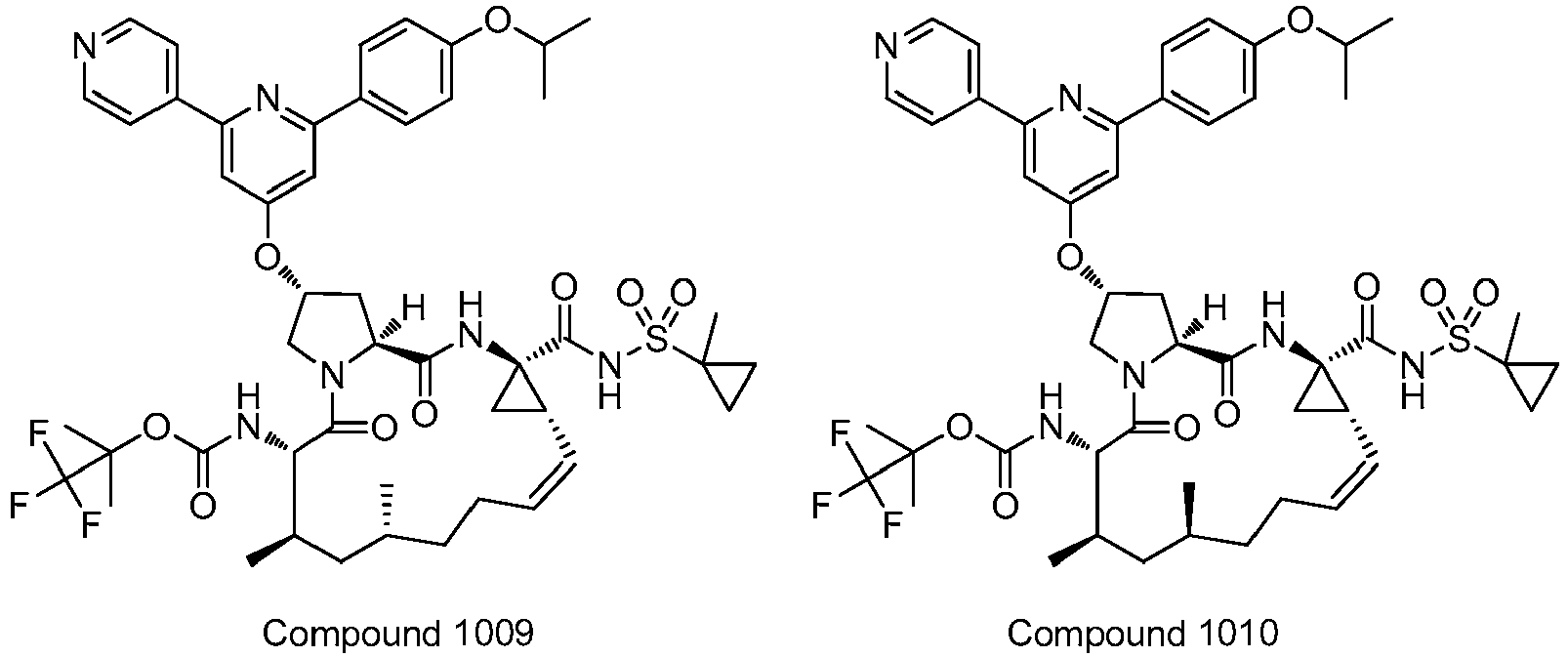
- Compounds 1009 and 1010 were prepared using the intermediates described above and by following the general procedure described for the synthesis of Compound 1001.
- Compound 1009: 1,1,1-trifluoro-2-methylpropan-2-yl ((2R,6S,7R,9R,13aS,14aR,16aS,Z)-2-((6-(4-isopropoxyphenyl)-[2,4'-bipyridin]-4-yl)oxy)-7,9-dimethyl-14a-(((1-methylcyclopropyl)sulfonyl)carbamoyl)-5,16-dioxo-1,2,3,5,6,7,8,9,10,11,13a,14,14a,15,16,16a-hexadecahydrocyclopropa[e]pyrrolo[1,2-a][1,4]diazacyclopentadecin-6-yl)carbamate. 1H-NMR (500MHz, DMSO-d6) δ 11.03 (s, 1H), 9.20 (br. s., 1H), 8.74 (d, J=5.5 Hz, 2H), 8.22 - 8.15 (m, 4H), 7.84 (d, J=8.2 Hz, 1H), 7.55 (s, 1H), 7.48 (s, 1H), 7.06 (d, J=8.9 Hz, 2H), 5.64 (br. s., 1H), 5.54 (d, J=7.3 Hz, 1H), 4.98 (t, J=9.6 Hz, 1H), 4.74 (dt, J=12.1, 6.0 Hz, 1H), 4.51 - 4.39 (m, 2H), 3.93 (d, J=10.1 Hz, 1H), 3.74 (t, J=9.8 Hz, 1H), 2.74 - 2.63 (m, 1H), 2.60 (d, J=6.7 Hz, 1H), 2.35 - 2.24 (m, 2H), 1.96 - 1.81 (m, 2H), 1.63 (br. s., 2H), 1.53 (br. s., 1H), 1.51 - 1.44 (m, 2H), 1.42 (s, 4H), 1.36 (br. s., 1H), 1.32 (d, J=5.8 Hz, 6H), 1.31 - 1.28 (m, 2H), 1.27 (s, 3H), 1.21 - 1.15 (m, 1H), 1.13 (s, 3H), 0.92 (d, J=7.0 Hz, 3H), 0.85 (d, J=6.4 Hz, 3H), 0.72 (t, J=12.2 Hz, 1H); MS: MS m/z 953.5 (M++1).
- Compound 1010: 1,1,1-trifluoro-2-methylpropan-2-yl ((2R,6S,7R,9S,13aS,14aR,16aS,Z)-2-((6-(4-isopropoxyphenyl)-[2,4'-bipyridin]-4-yl)oxy)-7,9-dimethyl-14a-(((1-methylcyclopropyl)sulfonyl)carbamoyl)-5,16-dioxo-1,2,3,5,6,7,8,9,10,11,13a,14,14a,15,16,16a-hexadecahydrocyclopropa[e]pyrrolo[1,2-a][1,4]diazacyclopentadecin-6-yl)carbamate. MS: MS m/z 953.5 (M++1).
-
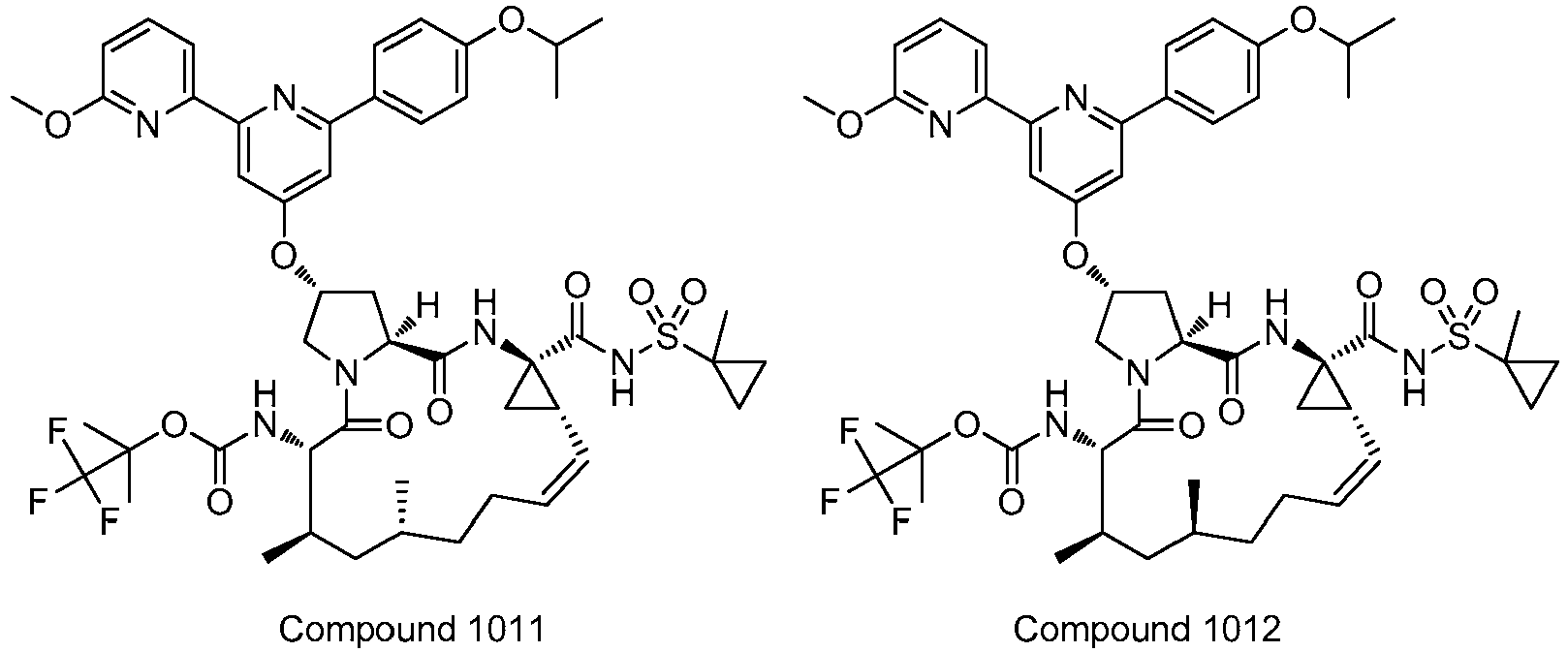
- Compounds 1011 and 1012 were prepared using the intermediates described above and by following the general procedure described for the synthesis of Compound 1001.
- Compound 1011: 1,1,1-trifluoro-2-methylpropan-2-yl ((2R,6S,7R,9R,13aS,14aR,16aS,Z)-2-((6-(4-isopropoxyphenyl)-6'-methoxy-[2,2'-bipyridin]-4-yl)oxy)-7,9-dimethyl-14a-(((1-methylcyclopropyl)sulfonyl)carbamoyl)-5,16-dioxo-1,2,3,5,6,7,8,9,10,11,13a,14,14a,15,16,16a-hexadecahydrocyclopropa[e]pyrrolo[1,2-a][1,4]diazacyclopentadecin-6-yl)carbamate. 1H-NMR (500MHz, DMSO-d6) δ 11.03 (s, 1H), 9.16 (s, 1H), 8.21 - 8.14 (m, 3H), 7.91 - 7.84 (m, 2H), 7.72 (d, J=1.8 Hz, 1H), 7.49 (s, 1H), 7.07 (d, J=8.5 Hz, 2H), 6.92 (d, J=8.2 Hz, 1H), 5.61 (br. s., 1H), 5.53 (d, J=5.5 Hz, 1H), 4.98 (t, J=9.8 Hz, 1H), 4.74 (dt, J=12.0, 6.1 Hz, 1H), 4.51 - 4.43 (m, 2H), 3.99 (s, 3H), 3.93 (d, J=9.5 Hz, 1H), 3.75 - 3.70 (m, 1H), 2.73 - 2.58 (m, 2H), 2.35 - 2.24 (m, 2H), 1.95 - 1.81 (m, 2H), 1.63 (d, J=6.1 Hz, 2H), 1.55 - 1.49 (m, 1H), 1.46 (d, J=9.5 Hz, 2H), 1.42 (s, 3H), 1.36 (br. s., 1H), 1.33 (d, J=6.1 Hz, 5H), 1.30 (br. s., 1H), 1.28 (s, 3H), 1.23 (br. s., 1H), 1.18 (s, 2H), 1.14 (br. s., 1H), 0.99 - 0.88 (m, 4H), 0.85 (d, J=6.1 Hz, 3H), 0.73 (t, J=11.7 Hz, 1H); MS: MS m/z 983.6 (M++1).
- Compound 1012: 1,1,1-trifluoro-2-methylpropan-2-yl ((2R,6S,7R,9R,13aS,14aR,16aS,Z)-2-((6-(4-isopropoxyphenyl)-6'-methoxy-[2,2'-bipyridin]-4-yl)oxy)-7,9-dimethyl-14a-(((1-methylcyclopropyl)sulfonyl)carbamoyl)-5,16-dioxo-1,2,3,5,6,7,8,9,10,11,13a,14,14a,15,16,16a-hexadecahydrocyclopropa[e]pyrrolo[1,2-a][1,4]diazacyclopentadecin-6-yl)carbamate. MS: MS m/z 983.5 (M++1).
-
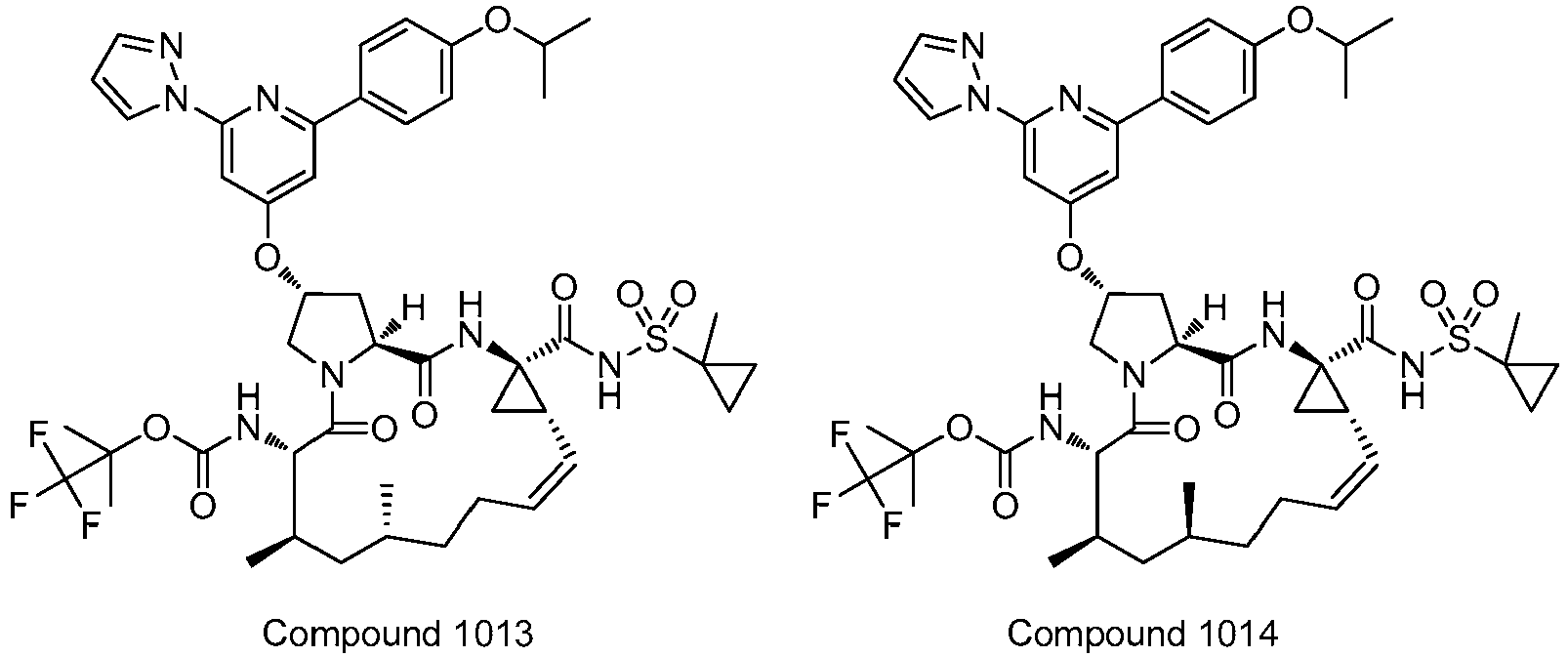
- Compounds 1013 and 1014 were prepared using the intermediates described above and by following the general procedure described for the synthesis of Compound 1001.
- Compound 1013: 1,1,1-trifluoro-2-methylpropan-2-yl ((2R,6S,7R,9R,13aS,14aR,16aS,Z)-2-((2-(4-isopropoxyphenyl)-6-(1H-pyrazol-1-yl)pyridin-4-yl)oxy)-7,9-dimethyl-14a-(((1-methylcyclopropyl)sulfonyl)carbamoyl)-5,16-dioxo-1,2,3,5,6,7,8,9,10,11,13a,14,14a,15,16,16a-hexadecahydrocyclopropa[e]pyrrolo[1,2-a][1,4]diazacyclopentadecin-6-yl)carbamate. 1H-NMR (500MHz, DMSO-d6) δ 11.07 (s, 1H), 9.18 (s, 1H), 8.84 (d, J=2.4 Hz, 1H), 8.13 (d, J=8.5 Hz, 2H), 7.99 (d, J=1.2 Hz, 1H), 7.87 - 7.81 (m, 2H), 7.12 - 7.04 (m, 3H), 6.66 - 6.64 (m, 1H), 5.88 (br. s., 1H), 5.57 - 5.51 (m, 1H), 4.97 (t, J=10.1 Hz, 1H), 4.75 (quin, J=6.0 Hz, 1H), 4.52 (dd, J=9.8, 7.3 Hz, 1H), 4.42 (d, J=11.3 Hz, 1H), 3.98 - 3.91 (m, 1H), 3.69 (dd, J=10.7, 8.5 Hz, 1H), 2.70 (q, J=9.1 Hz, 1H), 2.56 (dd, J=13.7, 6.7 Hz, 1H), 2.39 - 2.27 (m, 2H), 1.96 - 1.81 (m, 2H), 1.69 - 1.61 (m, 2H), 1.56 - 1.44 (m, 3H), 1.42 (s, 4H), 1.37 (br. s., 1H), 1.33 (d, J=6.1 Hz, 6H), 1.31 (br. s., 1H), 1.29 (s, 3H), 1.18 (s, 3H), 1.13 (d, J=12.2 Hz, 1H), 0.95 - 0.89 (m, 4H), 0.85 (d, J=6.4 Hz, 3H), 0.74 (t, J=12.2 Hz, 1H); MS: MS m/z 940.8 (M++1).
- Compound 1014: 1,1,1-trifluoro-2-methylpropan-2-yl ((2R,6S,7R,9S,13aS,14aR,16aS,Z)-2-((2-(4-isopropoxyphenyl)-6-(1H-pyrazol-1-yl)pyridin-4-yl)oxy)-7,9-dimethyl-14a-(((1-methylcyclopropyl)sulfonyl)carbamoyl)-5,16-dioxo-1,2,3,5,6,7,8,9,10,11,13a,14,14a,15,16,16a-hexadecahydrocyclopropa[e]pyrrolo[1,2-a][1,4]diazacyclopentadecin-6-yl)carbamate. MS: MS m/z 940.8 (M++1).
-

- Compounds 1015 and 1016 were prepared using the intermediates described above and by following the general procedure described for the synthesis of Compound 1001.
- Compound 1015: 1,1,1-trifluoro-2-methylpropan-2-yl ((2R,6S,7R,9R,13aS,14aR,16aS,Z)-7,9-dimethyl-2-((2-methyl-6-(thiazol-5-yl)pyridin-4-yl)oxy)-14a-(((1-methylcyclopropyl)sulfonyl)carbamoyl)-5,16-dioxo-1,2,3,5,6,7,8,9,10,11,13a,14,14a,15,16,16a-hexadecahydrocyclopropa[e]pyrrolo[1,2-a][1,4]diazacyclopentadecin-6-yl)carbamate. 1H-NMR (500MHz, DMSO-d6) δ 11.02 (br. s., 1H), 9.18 - 9.10 (m, 2H), 8.63 - 8.59 (m, 1H), 7.38 (s, 1H), 7.18 (d, J=7.9 Hz, 1H), 6.82 (s, 1H), 5.52 (br. s., 1H), 5.40 (br. s., 1H), 4.98 (br. s., 1H), 4.38 (d, J=9.8 Hz, 2H), 3.92 - 3.87 (m, 1H), 3.75 (t, J=9.9 Hz, 1H), 2.72 (br. s., 1H), 2.44 (s, 4H), 2.35 - 2.19 (m, 3H), 1.92 (s, 1H), 1.83 (br. s., 1H), 1.61 (br. s., 2H), 1.51 (br. s., 1H), 1.41 (br. s., 4H), 1.37 (br. s., 1H), 1.29 (br. s., 1H), 1.17 (s, 10H), 1.15 - 1.04 (m, 2H), 0.92 (d, J=7.0 Hz, 3H), 0.85 (d, J=6.4 Hz, 3H), 0.70 (d, J=11.3 Hz, 1H); MS: MS m/z 785.5 (M++1).
- Compound 1016: 1,1,1-trifluoro-2-methylpropan-2-yl ((2R,6S,7R,9S,13aS,14aR,16aS,Z)-7,9-dimethyl-2-((2-methyl-6-(thiazol-5-yl)pyridin-4-yl)oxy)-14a-(((1-methylcyclopropyl)sulfonyl)carbamoyl)-5,16-dioxo-1,2,3,5,6,7,8,9,10,11,13a,14,14a,15,16,16a-hexadecahydrocyclopropa[e]pyrrolo[1,2-a][1,4]diazacyclopentadecin-6-yl)carbamate. MS: MS m/z 785.5 (M++1).
-
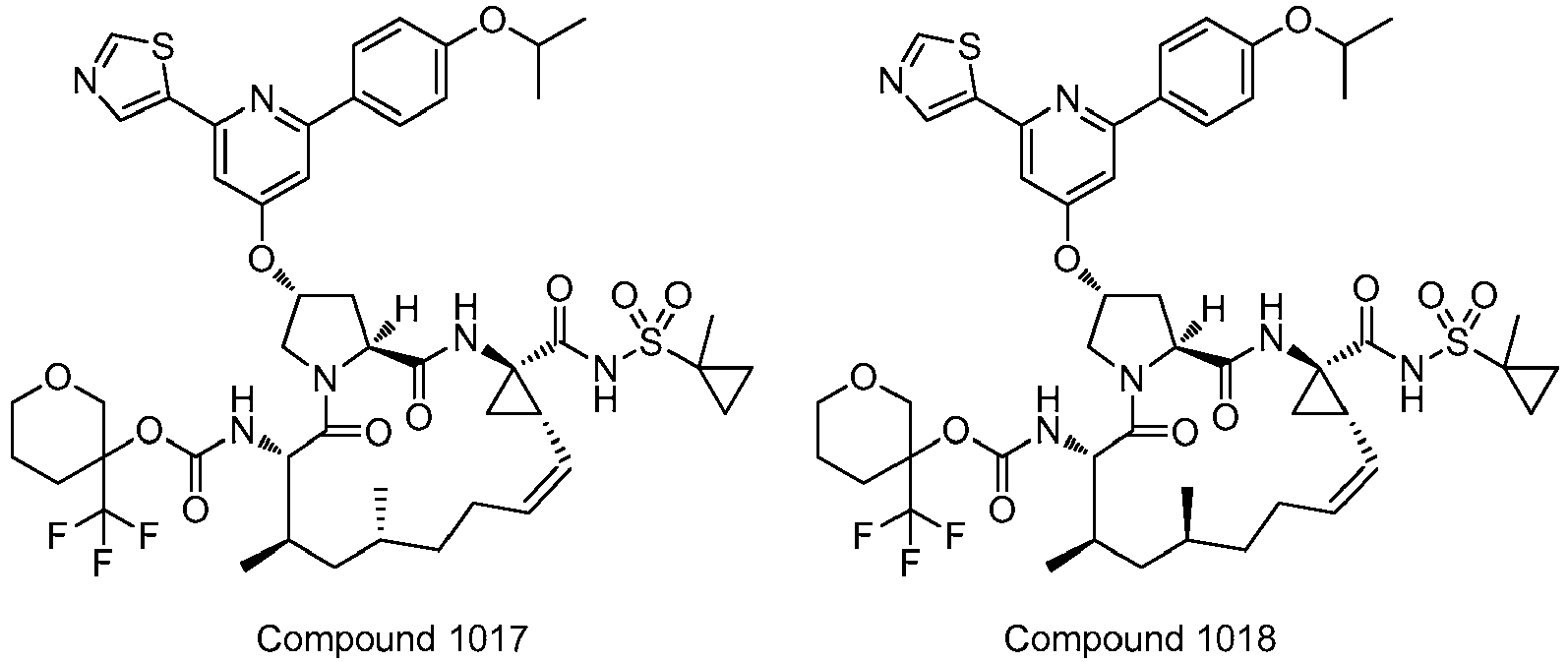
- Compounds 1017 and 1018 were prepared using the intermediates described above and by following the general procedure described for the synthesis of Compound 1001.
- Compound 1017: 3-(trifluoromethyl)tetrahydro-2H-pyran-3-yl ((2R,6S,7R,9R,13aS,14aR,16aS,Z)-2-((2-(4-isopropoxyphenyl)-6-(thiazol-5-yl)pyridin-4-yl)oxy)-7,9-dimethyl-14a-(((1-methylcyclopropyl)sulfonyl)carbamoyl)-5,16-dioxo-1,2,3,5,6,7,8,9,10,11,13a,14,14a,15,16,16a-hexadecahydrocyclopropa[e]pyrrolo[1,2-a][1,4]diazacyclopentadecin-6-yl)carbamate. 1H-NMR (500MHz, DMSO-d6) δ 11.02 (s, 1H), 9.19 - 9.14 (m, 2H), 8.65 (s, 1H), 8.14 - 8.05 (m, 2H), 7.94 (d, J=8.9 Hz, 1H), 7.46 (d, J=1.8 Hz, 1H), 7.34 (d, J=1.8 Hz, 1H), 7.05 (d, J=8.9 Hz, 2H), 5.61 - 5.50 (m, 2H), 5.00 (t, J=9.8 Hz, 1H), 4.73 (quin, J=6.1 Hz, 1H), 4.47 - 4.38 (m, 2H), 4.08 (d, J=11.9 Hz, 1H), 3.97 - 3.92 (m, 1H), 3.82 - 3.75 (m, 1H), 3.56 (d, J=10.7 Hz, 1H), 3.40 (d, J=11.6 Hz, 1H), 3.34 - 3.28 (m, 1H), 2.75 - 2.67 (m, 1H), 2.58 (dd, J=13.6, 6.6 Hz, 1H), 2.39 - 2.22 (m, 3H), 2.12 (d, J=13.7 Hz, 1H), 1.98 - 1.83 (m, 2H), 1.76 - 1.67 (m, 1H), 1.67 - 1.56 (m, 2H), 1.53 (dd, J=9.0, 5.0 Hz, 1H), 1.45 (br. s., 2H), 1.42 (s, 3H), 1.40 - 1.33 (m, 1H), 1.32 (d, J=5.8 Hz, 6H), 1.29 (d, J=4.9 Hz, 1H), 1.13 (d, J=12.2 Hz, 1H), 0.93 (d, J=6.7 Hz, 4H), 0.91 - 0.88 (m, 2H), 0.87 (d, J=6.4 Hz, 3H), 0.74 (t, J=11.9 Hz, 1H); MS: MS m/z 1002.0 (M++1).
- ((2R,6S,7R,9S,13aS,14aR,16aS,Z)-2-((2-(4-isopropoxyphenyl)-6-(thiazol-5-yl)pyridin-4-yl)oxy)-7,9-dimethyl-14a-(((1-methylcyclopropyl)sulfonyl)carbamoyl)-5,16-dioxo-1,2,3,5,6,7,8,9,10,11,13a,14,14a,15,16,16a-hexadecahydrocyclopropa[e]pyrrolo[1,2-a][1,4]diazacyclopentadecin-6-yl)carbamate. MS: MS m/z 1002.0 (M++1).
-

- Compounds 1019 and 1020 were prepared using the intermediates described above and by following the general procedure described for the synthesis of Compound 1001.
- Compound 1019: 1,1,1-trifluoro-2-methylpropan-2-yl ((2R,6S,7R,9R,13aS,14aR,16aS,Z)-2-((2-(4-isopropoxyphenyl)-6-(pyrimidin-2-yl)pyridin-4-yl)oxy)-7,9-dimethyl-14a-(((1-methylcyclopropyl)sulfonyl)carbamoyl)-5,16-dioxo-1,2,3,5,6,7,8,9,10,11,13a,14,14a,15,16,16a-hexadecahydrocyclopropa[e]pyrrolo[1,2-a][1,4]diazacyclopentadecin-6-yl)carbamate. 1H-NMR (500MHz, DMSO-d6) δ 11.03 (s, 1H), 9.17 (s, 1H), 9.04 - 9.01 (m, 2H), 8.16 (d, J=8.9 Hz, 2H), 7.87 - 7.80 (m, 2H), 7.60 (t, J=4.9 Hz, 1H), 7.54 (d, J=2.1 Hz, 1H), 7.06 (d, J=8.9 Hz, 2H), 5.60 (br. s., 1H), 5.58 - 5.49 (m, 1H), 4.99 (t, J=9.8 Hz, 1H), 4.74 (dt, J=12.0, 6.1 Hz, 1H), 4.51 - 4.38 (m, 2H), 3.95 - 3.90 (m, 1H), 3.72 (dd, J=10.4, 8.9 Hz, 1H), 2.73 - 2.57 (m, 2H), 2.35 - 2.25 (m, 2H), 1.96 - 1.81 (m, 2H), 1.62 (d, J=7.6 Hz, 2H), 1.55 - 1.49 (m, 1H), 1.49 - 1.43 (m, 2H), 1.42 (s, 3H), 1.37 (d, J=11.0 Hz, 2H), 1.32 (d, J=6.1 Hz, 7H), 1.28 (s, 3H), 1.18 (s, 3H), 1.17 - 1.08 (m, 1H), 0.94 - 0.90 (m, 4H), 0.85 (d, J=6.1 Hz, 3H), 0.73 (t, J=12.4 Hz, 1H); MS: MS m/z 953.0 (M--1).
- Compound 1020: 1,1,1-trifluoro-2-methylpropan-2-yl ((2R,6S,7R,9S,13aS,14aR,16aS,Z)-2-((2-(4-isopropoxyphenyl)-6-(pyrimidin-2-yl)pyridin-4-yl)oxy)-7,9-dimethyl-14a-(((1-methylcyclopropyl)sulfonyl)carbamoyl)-5,16-dioxo-1,2,3,5,6,7,8,9,10,11,13a,14,14a,15,16,16a-hexadecahydrocyclopropa[e]pyrrolo[1,2-a][1,4]diazacyclopentadecin-6-yl)carbamate. MS: MS m/z 955.0 (M++1).
-
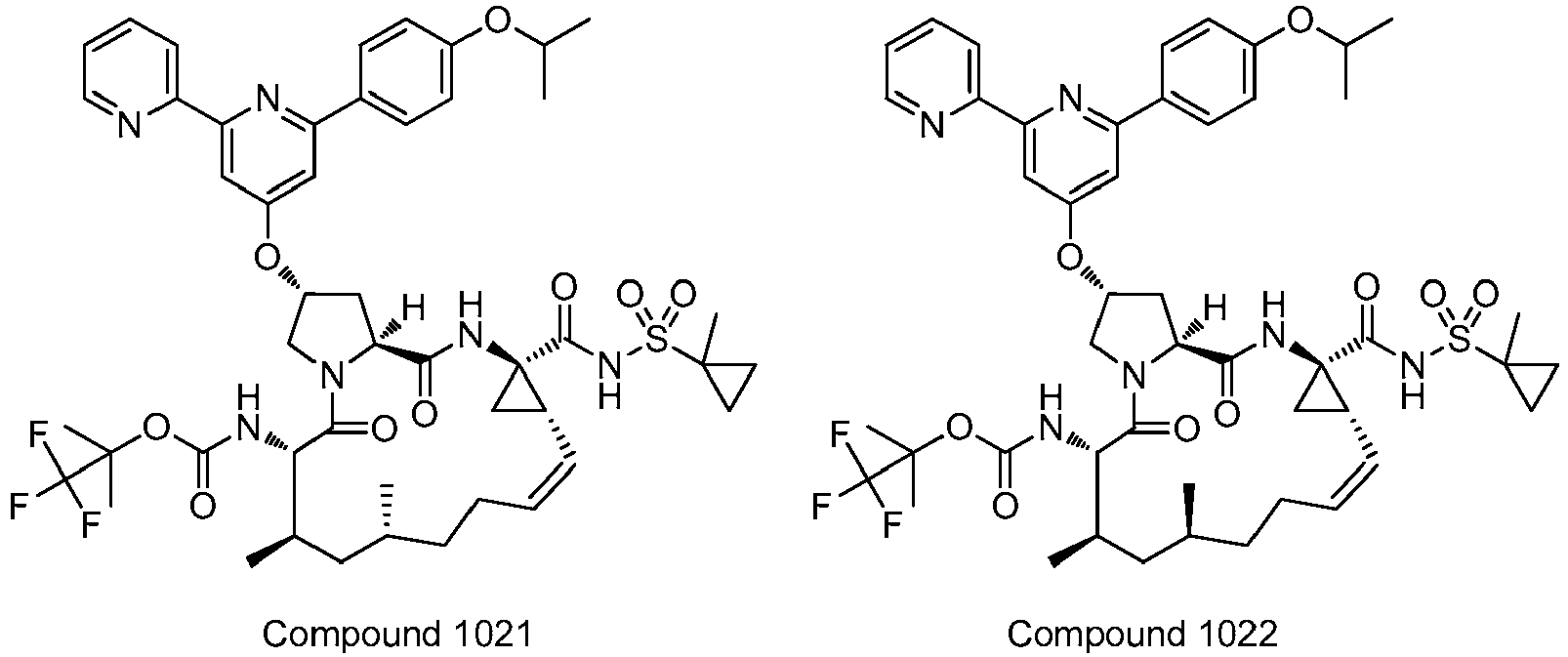
- Compounds 1021 and 1022 were prepared using the intermediates described above and by following the general procedure described for the synthesis of Compound 1001.
- Compound 1021: 1,1,1-trifluoro-2-methylpropan-2-yl ((2R,6S,7R,9R,13aS,14aR,16aS,Z)-2-((6-(4-isopropoxyphenyl)-[2,2'-bipyridin]-4-yl)oxy)-7,9-dimethyl-14a-(((1-methylcyclopropyl)sulfonyl)carbamoyl)-5,16-dioxo-1,2,3,5,6,7,8,9,10,11,13a,14,14a,15,16,16a-hexadecahydrocyclopropa[e]pyrrolo[1,2-a][1,4]diazacyclopentadecin-6-yl)carbamate. 1H-NMR (500MHz, DMSO-d6) δ 11.03 (s, 1H), 9.18 (s, 1H), 8.71 (d, J=4.3 Hz, 1H), 8.56 (d, J=7.9 Hz, 1H), 8.21 - 8.16 (m, J=8.9 Hz, 2H), 8.00 (td, J=7.8, 1.8 Hz, 1H), 7.86 - 7.81 (m, 2H), 7.50 (dd, J=6.7, 5.2 Hz, 1H), 7.45 (d, J=1.8 Hz, 1H), 7.08 - 7.04 (m, J=8.9 Hz, 2H), 5.61 - 5.50 (m, 2H), 4.99 (t, J=9.9 Hz, 1H), 4.74 (dt, J=12.0, 6.1 Hz, 1H), 4.51 - 4.40 (m, 2H), 3.93 (d, J=7.6 Hz, 1H), 3.74 - 3.69 (m, 1H), 2.73 - 2.64 (m, 1H), 2.60 (dd, J=13.3, 6.6 Hz, 1H), 2.35 - 2.25 (m, 2H), 1.96 - 1.81 (m, 2H), 1.67 - 1.60 (m, 2H), 1.53 (dd, J=9.3, 5.3 Hz, 1H), 1.51 - 1.43 (m, 2H), 1.42 (s, 3H), 1.36 (br. s., 2H), 1.32 (d, J=6.1 Hz, 6H), 1.29 (d, J=5.8 Hz, 1H), 1.26 (s, 3H), 1.15 (s, 3H), 1.12 (d, J=13.1 Hz, 1H), 0.93 - 0.88 (m, 4H), 0.84 (d, J=6.4 Hz, 3H), 0.73 (t, J=12.2 Hz, 1H); MS: MS m/z 953.7 (M++1).
- Compound 1022: 1,1,1-trifluoro-2-methylpropan-2-yl ((2R,6S,7R,9S,13aS,14aR,16aS,Z)-2-((6-(4-isopropoxyphenyl)-[2,2'-bipyridin]-4-yl)oxy)-7,9-dimethyl-14a-(((1-methylcyclopropyl)sulfonyl)carbamoyl)-5,16-dioxo-1,2,3,5,6,7,8,9,10,11,13a,14,14a,15,16,16a-hexadecahydrocyclopropa[e]pyrrolo[1,2-a][1,4]diazacyclopentadecin-6-yl)carbamate. MS: MS m/z 951.7 (M--1).
-

- Compounds 1023 and 1024 were prepared using the intermediates described above and by following the general procedure described for the synthesis of Compound 1001.
- Compound 1023: 1,1,1-trifluoro-2-methylpropan-2-yl ((2R,6S,7R,9R,13aS,14aR,16aS,Z)-2-((2,6-di(thiazol-2-yl)pyridin-4-yl)oxy)-7,9-dimethyl-14a-(((1-methylcyclopropyl)sulfonyl)carbamoyl)-5,16-dioxo-1,2,3,5,6,7,8,9,10,11,13a,14,14a,15,16,16a-hexadecahydrocyclopropa[e]pyrrolo[1,2-a][1,4]diazacyclopentadecin-6-yl)carbamate. 1H-NMR (500MHz, DMSO-d6) δ 11.03 (br. s., 1H), 9.20 (br. s., 1H), 8.06 (d, J=3.1 Hz, 2H), 7.96 (d, J=3.1 Hz, 2H), 7.84 (d, J=7.6 Hz, 1H), 7.67 (s, 2H), 5.62 (br. s., 1H), 5.52 (br. s., 1H), 4.99 (br. s., 1H), 4.49 (d, J=9.5 Hz, 2H), 3.94 - 3.89 (m, 1H), 3.66 (dd, J=10.4, 8.2 Hz, 1H), 2.65 (br. s., 1H), 2.61 (br. s., 1H), 2.35 - 2.25 (m, 2H), 1.94 - 1.78 (m, 2H), 1.63 (br. s., 2H), 1.54 (br. s., 1H), 1.49 (br. s., 2H), 1.42 (s, 3H), 1.34 (d, J=14.0 Hz, 2H), 1.28 (br. s., 1H), 1.20 (s, 3H), 1.15 (s, 3H), 1.13 - 1.07 (m, 1H), 0.92 (d, J=6.7 Hz, 4H), 0.84 (d, J=6.1 Hz, 3H), 0.74 (t, J=12.4 Hz, 1H); MS: MS m/z 908.5 (M++1).
- Compound 1024: 1,1,1-trifluoro-2-methylpropan-2-yl ((2R,6S,7R,9S,13aS,14aR,16aS,Z)-2-((2,6-di(thiazol-2-yl)pyridin-4-yl)oxy)-7,9-dimethyl-14a-(((1-methylcyclopropyl)sulfonyl)carbamoyl)-5,16-dioxo-1,2,3,5,6,7,8,9,10,11,13a,14,14a,15,16,16a-hexadecahydrocyclopropa[e]pyrrolo[1,2-a][1,4]diazacyclopentadecin-6-yl)carbamate. MS: MS m/z 908.5 (M++1).
-
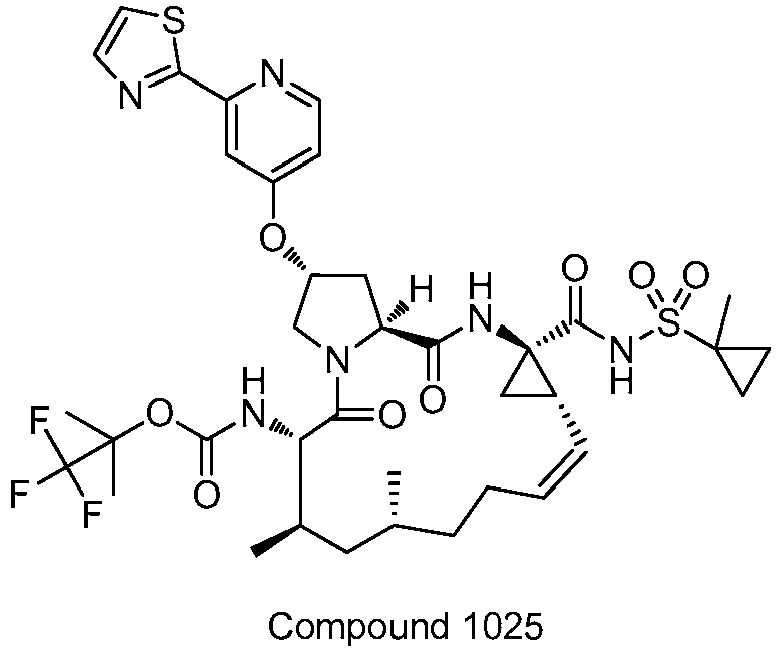
- Compounds 1025 was prepared using the intermediates described above and by following the general procedure described for the synthesis of Compound 1001.
- Compound 1025: 1,1,1-trifluoro-2-methylpropan-2-yl ((2R,6S,7R,9R,13aS,14aR,16aS,Z)-7,9-dimethyl-14a-(((1-methylcyclopropyl)sulfonyl)carbamoyl)-5,16-dioxo-2-((2-(thiazol-2-yl)pyridin-4-yl)oxy)-1,2,3,5,6,7,8,9,10,11,13a,14,14a,15,16,16a-hexadecahydrocyclopropa[e]pyrrolo[1,2-a][1,4]diazacyclopentadecin-6-yl)carbamate. 1H-NMR (500MHz, DMSO-d6) δ 11.01 (s, 1H), 9.16 (br. s., 1H), 8.47 (d, J=5.8 Hz, 1H), 8.00 (d, J=3.1 Hz, 1H), 7.89 (d, J=3.1 Hz, 1H), 7.86 (d, J=7.9 Hz, 1H), 7.61 (d, J=2.1 Hz, 1H), 7.07 (dd, J=5.8, 2.4 Hz, 1H), 5.53 (d, J=6.1 Hz, 1H), 5.47 (br. s., 1H), 4.98 (t, J=9.5 Hz, 1H), 4.48 - 4.40 (m, 2H), 3.90 (d, J=8.9 Hz, 1H), 3.69 (dd, J=10.7, 8.5 Hz, 1H), 2.72 - 2.64 (m, 1H), 2.57 (dd, J=13.6, 6.3 Hz, 1H), 2.34 - 2.22 (m, 2H), 1.95 - 1.81 (m, 2H), 1.63 (d, J=5.5 Hz, 2H), 1.53 (br. s., 1H), 1.45 (br. s., 2H), 1.41 (s, 3H), 1.36 (br. s., 1H), 1.32 (s, 3H), 1.29 (d, J=10.4 Hz, 2H), 1.23 (s, 3H), 1.12 (d, J=11.9 Hz, 1H), 0.93 - 0.88 (m, 4H), 0.86 (d, J=6.4 Hz, 3H), 0.73 (t, J=11.9 Hz, 1H); MS: MS m/z 825.5 (M++1).
-

- Compounds 1026 was prepared by following the general procedure described for the synthesis of Compound 1001 using the intermediates described above, 2,4-dichloropyridine.
- Compound 1026: 1,1,1-trifluoro-2-methylpropan-2-yl ((2R,6S,7R,9R,13aS,14aR,16aS,Z)-2-((4-chloropyridin-2-yl)oxy)-14a-((cyclopropylsulfonyl)carbamoyl)-7,9-dimethyl-5,16-dioxo-1,2,3,5,6,7,8,9,10,11,13a,14,14a,15,16,16a-hexadecahydrocyclopropa[e]pyrrolo[1,2-a][1,4]diazacyclopentadecin-6-yl)carbamate. 1H NMR (400 MHz, CD3OD) δ 8.21 (1 H, d, J=5.77 Hz), 7.09 (1 H, d, J=2.26 Hz), 7.00 (1 H, dd, J=6.02, 2.26 Hz), 5.63 (1 H, td, J=10.10, 5.65 Hz), 5.35 (1 H, br. s.), 5.01 - 5.10 (1 H, m), 4.61 (1 H, d, J=11.80 Hz), 4.52 (1 H, dd, J=10.16, 7.15 Hz), 3.94 - 4.01 (1 H, m), 3.80 - 3.86 (1 H, m), 2.91 - 2.98 (1 H, m), 2.61 - 2.70 (2 H, m), 2.39 (2 H, ddd, J=13.99, 10.10, 4.27 Hz), 2.32 - 2.47 (2 H, m), 1.90 - 2.01 (2 H, m), 1.60 (1 H, dd, J=9.54, 5.52 Hz), 1.45 - 1.52 (5 H, m), 1.40 (3 H, s), 1.29 - 1.35 (2 H, m), 0.81 - 1.09 (11 H, m); MS: MS m/z 762.2 (M++1).
-
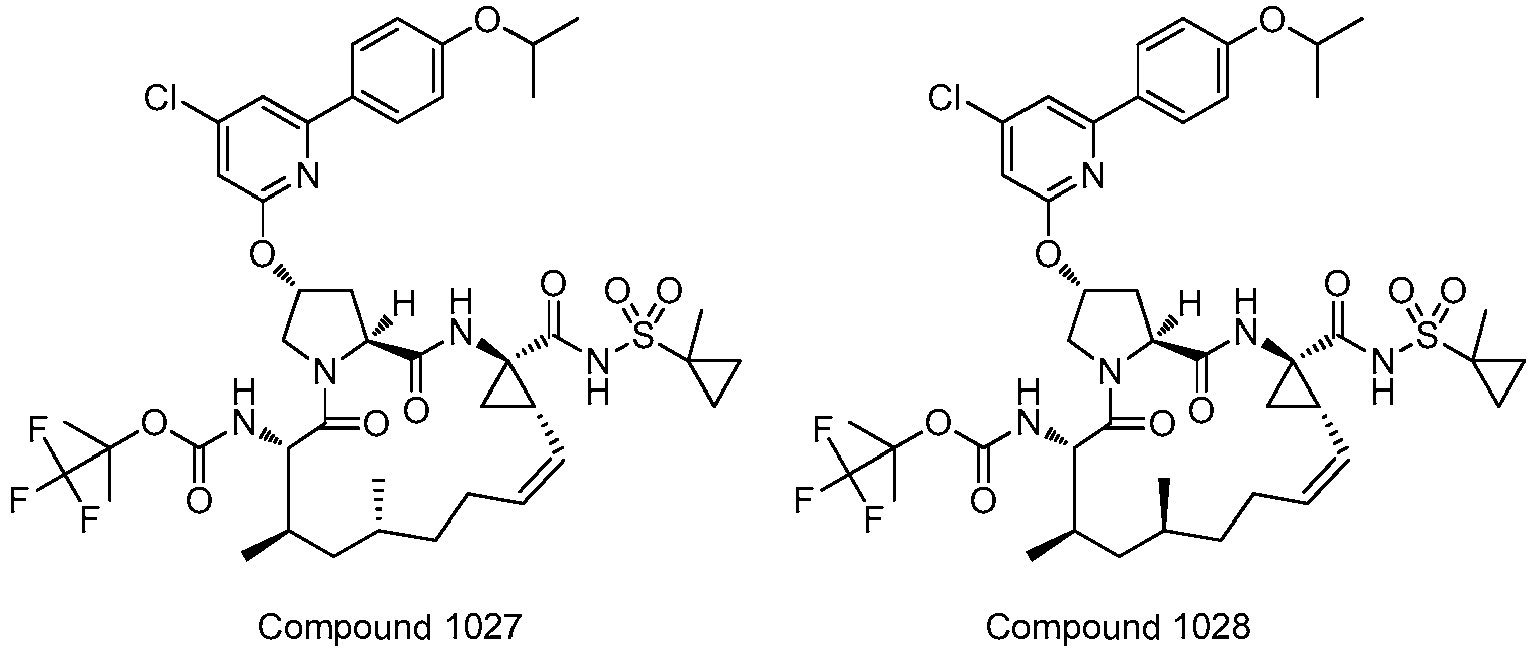
- Compounds 1027 and 1028 were prepared using the intermediates described above and by following the general procedure described for the synthesis of Compound 1001.
- Compound 1027: 1,1,1-trifluoro-2-methylpropan-2-yl ((2R,6S,7R,9R,13aS,14aR,16aS,Z)-2-((4-chloro-6-(4-isopropoxyphenyl)pyridin-2-yl)oxy)-7,9-dimethyl-14a-(((1-methylcyclopropyl)sulfonyl)carbamoyl)-5,16-dioxo-1,2,3,5,6,7,8,9,10,11,13a,14,14a,15,16,16a-hexadecahydrocyclopropa[e]pyrrolo[1,2-a][1,4]diazacyclopentadecin-6-yl)carbamate. 1H-NMR (500MHz, DMSO-d6) δ 11.01 (br. s., 1H), 9.19 (br. s., 1H), 8.00 (d, J=8.9 Hz, 2H), 7.86 (d, J=8.2 Hz, 1H), 7.40 (d, J=1.5 Hz, 1H), 7.05 - 6.99 (m, 3H), 5.51 (br. s., 2H), 5.03 - 4.95 (m, 1H), 4.72 (quin, J=6.0 Hz, 1H), 4.47 - 4.36 (m, 2H), 3.87 (d, J=9.5 Hz, 1H), 3.72 (dd, J=10.5, 8.7 Hz, 1H), 2.67 (d, J=7.9 Hz, 1H), 2.60 - 2.53 (m, 1H), 2.33 - 2.19 (m, 2H), 1.95 - 1.81 (m, 2H), 1.63 (br. s., 2H), 1.53 (d, J=6.7 Hz, 1H), 1.48 - 1.44 (m, 1H), 1.41 (s, 3H), 1.36 (s, 3H), 1.30 (d, J=6.1 Hz, 7H), 1.24 (s, 3H), 1.20 - 1.08 (m, 1H), 0.92 (d, J=7.0 Hz, 4H), 0.86 (d, J=6.4 Hz, 3H), 0.72 (t, J=12.5 Hz, 1H); MS: MS m/z 910.5 (M++1).
- Compound 1028: 1,1,1-trifluoro-2-methylpropan-2-yl ((2R,6S,7R,9S,13aS,14aR,16aS,Z)-2-((4-chloro-6-(4-isopropoxyphenyl)pyridin-2-yl)oxy)-7,9-dimethyl-14a-(((1-methylcyclopropyl)sulfonyl)carbamoyl)-5,16-dioxo-1,2,3,5,6,7,8,9,10,11,13a,14,14a,15,16,16a-hexadecahydrocyclopropa[e]pyrrolo[1,2-a][1,4]diazacyclopentadecin-6-yl)carbamate. MS: MS m/z 910.5 (M++1).
-
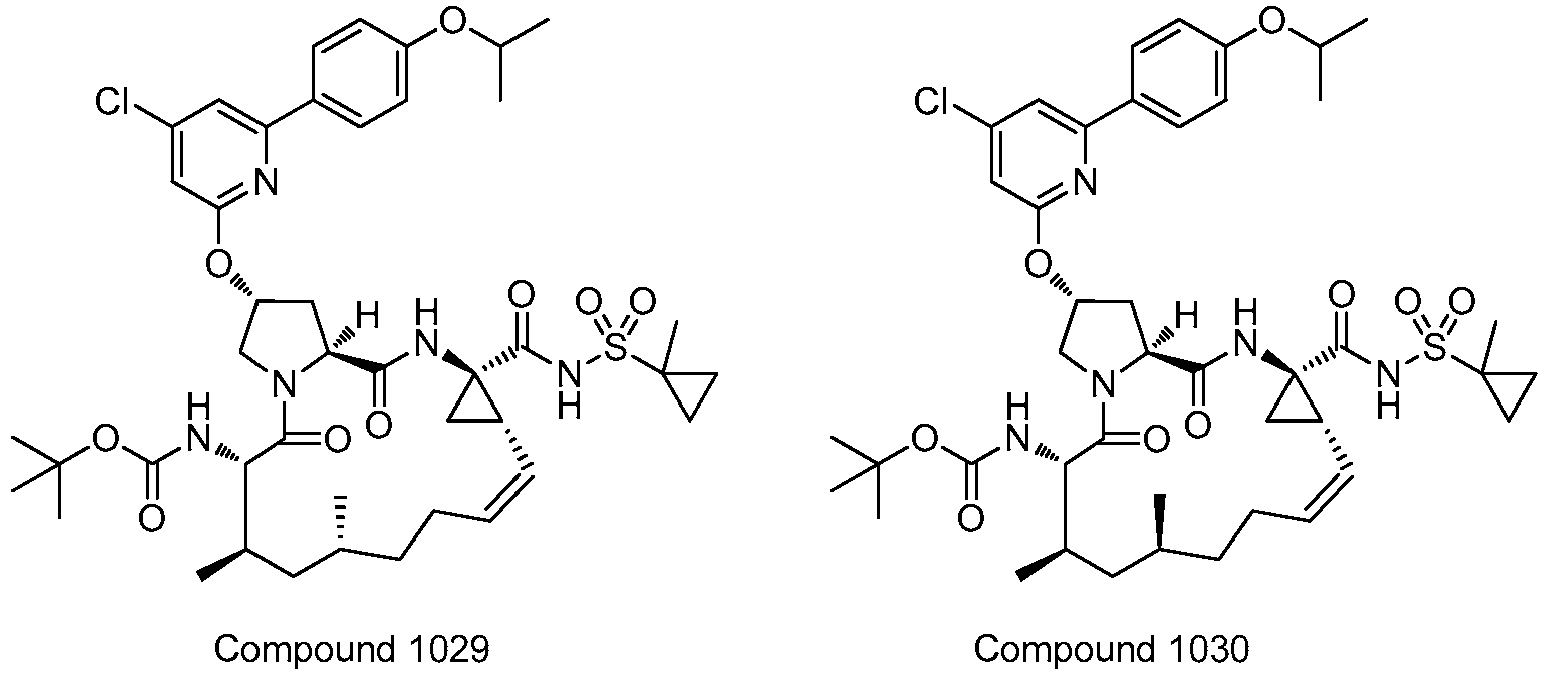
- Compounds 1029 and 1030 were prepared using the intermediates described above and by following the general procedure described for the synthesis of Compound 1001.
- Compound 1029: tert-butyl ((2R,6S,7R,9R,13aS,14aR,16aS,Z)-2-((4-chloro-6-(4-isopropoxyphenyl)pyridin-2-yl)oxy)-7,9-dimethyl-14a-(((1-methylcyclopropyl)sulfonyl)carbamoyl)-5,16-dioxo-1,2,3,5,6,7,8,9,10,11,13a,14,14a,15,16,16a-hexadecahydrocyclopropa[e]pyrrolo[1,2-a][1,4]diazacyclopentadecin-6-yl)carbamate. 1H-NMR (500MHz, CD3OD) δ 7.94 - 7.87 (m, J=8.9 Hz, 2H), 7.27 (d, J=1.8 Hz, 1H), 7.01 - 6.97 (m, J=8.9 Hz, 2H), 6.97 - 6.92 (m, 1H), 5.71 (q, J=8.6 Hz, 1H), 5.38 (br. s., 1H), 5.08 (t, J=8.7 Hz, 1H), 4.69 (dt, J=12.0, 6.1 Hz, 1H), 4.59 (t, J=8.4 Hz, 1H), 4.40 (d, J=11.6 Hz, 1H), 4.14 (d, J=6.7 Hz, 1H), 4.06 (d, J=10.1 Hz, 1H), 2.61 (dd, J=14.0, 7.3 Hz, 2H), 2.49 - 2.32 (m, 2H), 2.03 - 1.88 (m, 2H), 1.71 (dd, J=8.2, 5.5 Hz, 1H), 1.60 (d, J=8.9 Hz, 3H), 1.49 (s, 3H), 1.47 - 1.37 (m, 3H), 1.35 (d, J=6.1 Hz, 7H), 1.28 (s, 8H), 1.27 - 1.14 (m, 3H), 1.07 (d, J=6.7 Hz, 2H), 0.91 (d, J=7.0 Hz, 3H), 0.89 - 0.81 (m, 2H); MS: MS m/z 856.1 (M++1).
- Compound 1030: tert-butyl ((2R,6S,7R,9S,13aS,14aR,16aS,Z)-2-((4-chloro-6-(4-isopropoxyphenyl)pyridin-2-yl)oxy)-7,9-dimethyl-14a-(((1-methylcyclopropyl)sulfonyl)carbamoyl)-5,16-dioxo-1,2,3,5,6,7,8,9,10,11,13a,14,14a,15,16,16a-hexadecahydrocyclopropa[e]pyrrolo[1,2-a][1,4]diazacyclopentadecin-6-yl)carbamate. MS: MS m/z 856.5 (M++1).
-
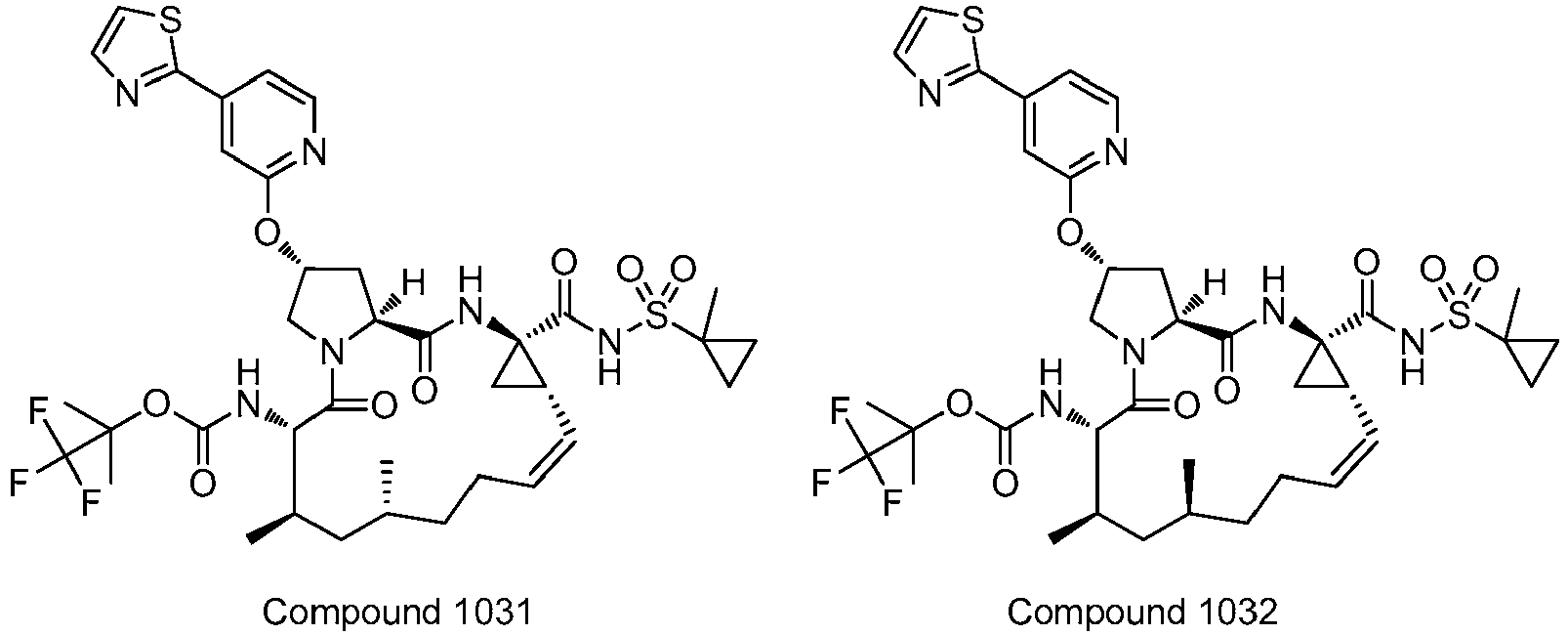
- Compounds 1031 and 1032 were prepared using the intermediates described above and by following the general procedure described for the synthesis of Compound 1001.
- Compound 1031: 1,1,1-trifluoro-2-methylpropan-2-yl ((2R,6S,7R,9R,13aS,14aR,16aS,Z)-7,9-dimethyl-14a-(((1-methylcyclopropyl)sulfonyl)carbamoyl)-5,16-dioxo-2-((4-(thiazol-2-yl)pyridin-2-yl)oxy)-1,2,3,5,6,7,8,9,10,11,13a,14,14a,15,16,16a-hexadecahydrocyclopropa[e]pyrrolo[1,2-a][1,4]diazacyclopentadecin-6-yl)carbamate. 1H-NMR (500MHz, DMSO-d6) δ 11.06 (s, 1H), 9.19 (br. s., 1H), 8.33 (d, J=5.2 Hz, 1H), 8.06 (d, J=3.4 Hz, 1H), 7.99 (d, J=3.4 Hz, 1H), 7.83 (d, J=8.2 Hz, 1H), 7.54 (dd, J=5.3, 1.4 Hz, 1H), 7.20 (s, 1H), 5.71 (br. s., 1H), 5.54 (d, J=6.4 Hz, 1H), 4.99 - 4.93 (m, 1H), 4.54 - 4.46 (m, 1H), 4.41 (d, J=11.3 Hz, 1H), 3.89 (dd, J=11.6, 3.4 Hz, 1H), 3.67 (dd, J=10.7, 8.5 Hz, 1H), 2.70 (d, J=8.2 Hz, 1H), 2.37 - 2.24 (m, 3H), 1.95 - 1.80 (m, 2H), 1.63 (d, J=5.8 Hz, 2H), 1.53 (d, J=8.5 Hz, 1H), 1.47 (d, J=10.1 Hz, 1H), 1.42 (s, 4H), 1.36 (br. s., 2H), 1.29 (s, 5H), 1.18 (s, 3H), 1.12 (d, J=12.5 Hz, 1H), 0.92 (d, J=7.0 Hz, 4H), 0.86 (d, J=6.1 Hz, 3H), 0.73 (t, J=12.2 Hz, 1H); MS: MS m/z 825.4 (M++1).
- Compound 1032: 1,1,1-trifluoro-2-methylpropan-2-yl ((2R,6S,7R,9S,13aS,14aR,16aS,Z)-7,9-dimethyl-14a-(((1-methylcyclopropyl)sulfonyl)carbamoyl)-5,16-dioxo-2-((4-(thiazol-2-yl)pyridin-2-yl)oxy)-1,2,3,5,6,7,8,9,10,11,13a,14,14a,15,16,16a-hexadecahydrocyclopropa[e]pyrrolo[1,2-a][1,4]diazacyclopentadecin-6-yl)carbamate. MS: MS m/z 825.5 (M++1).
-
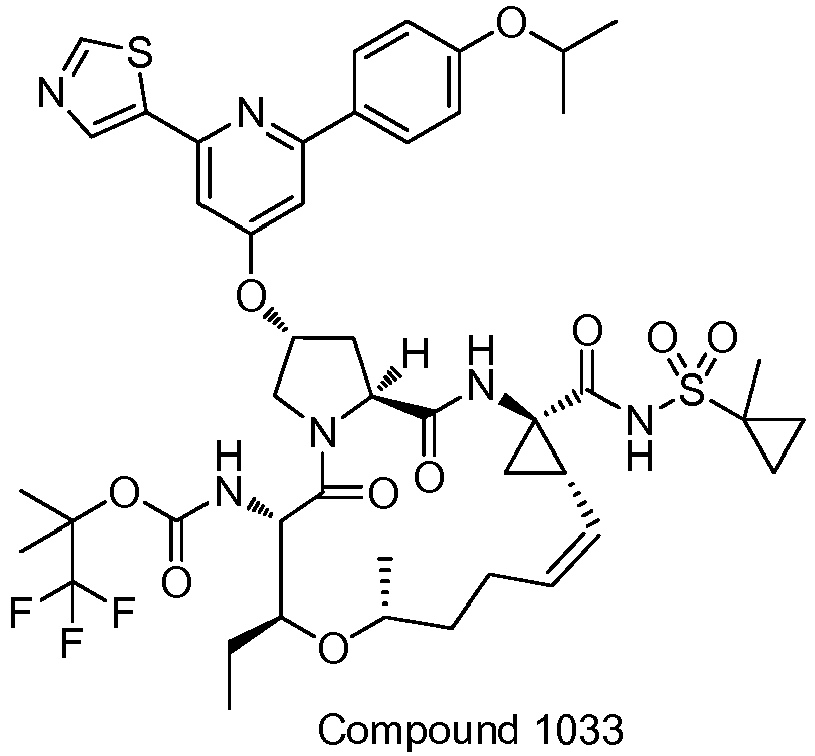
- Compound 1033 was prepared using the intermediates described above and by following the general procedure described for the synthesis of Compound 1001.
- Compound 1033: 1,1,1-trifluoro-2-methylpropan-2-yl ((2R,6S,7S,9R,13aS,14aR,16aS,Z)-7-ethyl-2-((2-(4-isopropoxyphenyl)-6-(thiazol-5-yl)pyridin-4-yl)oxy)-9-methyl-14a-(((1-methylcyclopropyl)sulfonyl)carbamoyl)-5,16-dioxo-2,3,5,6,7,9,10,11,13a,14,14a,15,16,16a-tetradecahydro-1H-cyclopropa[i]pyrrolo[1,2-e][1,5,8]oxadiazacyclopentadecin-6-yl)carbamate. 1H-NMR (500MHz, DMSO-d6) δ 11.14 (br. s., 1H), 9.18 (br. s., 1H), 9.14 - 9.11 (m, 1H), 8.65 (s, 1H), 8.05 (d, J=8.9 Hz, 2H), 7.87 (d, J=9.8 Hz, 1H), 7.46 (d, J=1.5 Hz, 1H), 7.34 (s, 1H), 7.03 (d, J=8.9 Hz, 2H), 5.59 - 5.52 (m, 2H), 5.02 (br. s., 1H), 4.70 (dt, J=12.1, 6.0 Hz, 1H), 4.43 - 4.38 (m, 1H), 4.23 (d, J=11.6 Hz, 1H), 4.12 (t, J=9.6 Hz, 1H), 3.96 (d, J=9.2 Hz, 1H), 3.85 (br. s., 1H), 2.72 - 2.64 (m, 1H), 2.55 (br. s., 1H), 2.36 (br. s., 1H), 2.28 - 2.22 (m, 1H), 1.87 (br. s., 1H), 1.67 (br. s., 1H), 1.61 (br. s., 1H), 1.52 (d, J=13.7 Hz, 2H), 1.46 (d, J=12.5 Hz, 2H), 1.41 (s, 3H), 1.34 (s, 3H), 1.30 (d, J=6.1 Hz, 7H), 1.28 - 1.24 (m, 2H), 1.10 (s, 3H), 1.05 (d, J=6.1 Hz, 3H), 0.90 (br. s., 2H), 0.83 (br. s., 1H), 0.78 (t, J=7.3 Hz, 3H); MS: MS m/z 975.8 (M++1).
-

- Compound 1034 was prepared using the intermediates described above and by following the general procedure described for the synthesis of Compound 1001.
- Compound 1034: 3-(trifluoromethyl)tetrahydro-2H-pyran-3-yl ((2R,6S,7S,9R,13aS,14aR,16aS,Z)-7-ethyl-2-((2-(4-isopropoxyphenyl)-6-(thiazol-5-yl)pyridin-4-yl)oxy)-9-methyl-14a-(((1-methylcyclopropyl)sulfonyl)carbamoyl)-5,16-dioxo-2,3,5,6,7,9,10,11,13a,14,14a,15,16,16a-tetradecahydro-1H-cyclopropa[i]pyrrolo[1,2-e][1,5,8]oxadiazacyclopentadecin-6-yl)carbamate. 1H-NMR (500MHz, DMSO-d6) δ 11.66 - 10.30 (m, 1H), 9.14 (s, 1H), 9.06 (br. s., 1H), 8.64 (s, 1H), 8.08 - 8.03 (m, 2H), 8.01 (d, J=9.5 Hz, 1H), 7.45 (s, 1H), 7.32 (s, 1H), 7.04 (d, J=8.9 Hz, 2H), 5.58 - 5.50 (m, 2H), 5.09 (br. s., 1H), 4.71 (quin, J=6.0 Hz, 1H), 4.39 - 4.34 (m, 1H), 4.29 (d, J=11.3 Hz, 1H), 4.16 (t, J=9.8 Hz, 1H), 4.06 - 3.94 (m, 2H), 3.91 - 3.85 (m, 1H), 3.59 - 3.50 (m, 3H), 2.66 (br. s., 1H), 2.37 (br. s., 1H), 2.27 (t, J=10.4 Hz, 1H), 2.14 (d, J=12.2 Hz, 1H), 1.90 (d, J=17.7 Hz, 1H), 1.78 - 1.65 (m, 2H), 1.65 - 1.51 (m, 4H), 1.46 (br. s., 2H), 1.41 (s, 3H), 1.36 (d, J=12.5 Hz, 3H), 1.31 (s, 3H), 1.27 - 1.20 (m, 1H), 1.07 (d, J=6.1 Hz, 3H), 0.87 (br. s., 2H), 0.80 (t, J=7.3 Hz, 3H); MS: MS m/z 1017.8 (M++1).
-

- Compound 1035 was prepared using the intermediates described above and by following the general procedure described for the synthesis of Compound 1001.
- Compound 1035: 3-(trifluoromethyl)tetrahydro-2H-pyran-3-yl ((2R,6S,7S,9R,13aS,14aR,16aS,Z)-7-ethyl-2-((2-(4-isopropoxyphenyl)-6-(thiazol-2-yl)pyridin-4-yl)oxy)-9-methyl-14a-(((1-methylcyclopropyl)sulfonyl)carbamoyl)-5,16-dioxo-2,3,5,6,7,9,10,11,13 a,14,14a,15,16,16a-tetradecahydro-1H-cyclopropa[i]pyrrolo[1,2-e][1,5,8]oxadiazacyclopentadecin-6-yl)carbamate. 1H-NMR (500MHz, DMSO-d6) δ 11.11 (br. s., 1H), 9.07 (br. s., 1H), 8.10 (d, J=8.9 Hz, 2H), 8.03 (d, J=9.8 Hz, 1H), 8.00 (d, J=3.1 Hz, 1H), 7.87 (d, J=3.1 Hz, 1H), 7.51 (d, J=1.8 Hz, 1H), 7.45 (d, J=1.8 Hz, 1H), 7.06 (d, J=8.9 Hz, 2H), 5.54 (br. s., 2H), 5.07 (br. s., 1H), 4.72 (quin, J=6.0 Hz, 1H), 4.37 (t, J=8.1 Hz, 1H), 4.28 (d, J=11.0 Hz, 1H), 4.14 (t, J=9.8 Hz, 1H), 3.99 (t, J=12.5 Hz, 2H), 3.91 - 3.85 (m, 1H), 3.57 - 3.45 (m, 4H), 2.74 (s, 1H), 2.55 (br. s., 1H), 2.37 (br. s., 1H), 2.27 (br. s., 1H), 2.14 (d, J=12.8 Hz, 1H), 1.92 - 1.84 (m, 1H), 1.77 - 1.65 (m, 2H), 1.59 (br. s., 2H), 1.53 (br. s., 2H), 1.41 (s, 4H), 1.36 (br. s., 2H), 1.31 (d, J=6.1 Hz, 7H), 1.28 - 1.23 (m, 1H), 1.07 (d, J=6.1 Hz, 3H), 0.88 (br. s., 2H), 0.80 (t, J=7.5 Hz, 3H); MS: MS m/z 1018.0 (M++1).
-
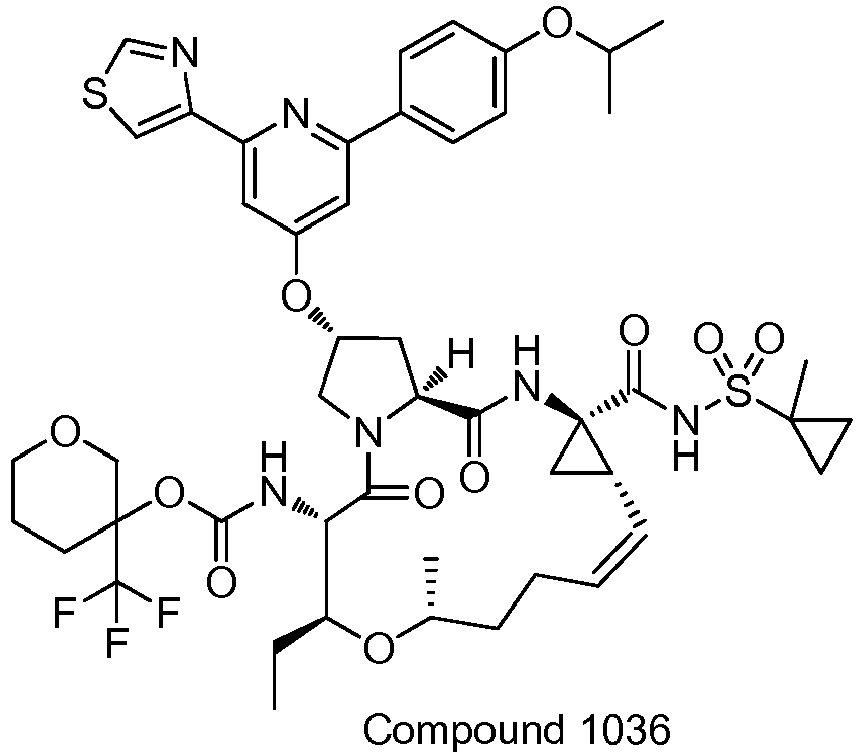
- Compound 1036 was prepared using the intermediates described above and by following the general procedure described for the synthesis of Compound 1001.
- Compound 1036: 3-(trifluoromethyl)tetrahydro-2H-pyran-3-yl ((2R,6S,7S,9R,13aS,14aR,16aS,Z)-7-ethyl-2-((2-(4-isopropoxyphenyl)-6-(thiazol-4-yl)pyridin-4-yl)oxy)-9-methyl-14a-(((1-methylcyclopropyl)sulfonyl)carbamoyl)-5,16-dioxo-2,3,5,6,7,9,10,11,13a,14,14a,15,16,16a-tetradecahydro-1H-cyclopropa[i]pyrrolo[1,2-e][1,5,8]oxadiazacyclopentadecin-6-yl)carbamate. 1H-NMR (500MHz, DMSO-d6) δ 11.11 (br. s., 1H), 9.23 (d, J=1.8 Hz, 1H), 9.05 (br. s., 1H), 8.45 (d, J=1.5 Hz, 1H), 8.15 (d, J=8.5 Hz, 2H), 8.05 (d, J=9.8 Hz, 1H), 7.53 (s, 1H), 7.36 (s, 1H), 7.03 (d, J=8.5 Hz, 2H), 5.58 - 5.49 (m, 2H), 5.06 (br. s., 1H), 4.75 - 4.70 (m, 1H), 4.39 - 4.33 (m, 1H), 4.26 (d, J=10.4 Hz, 1H), 4.16 (t, J=9.8 Hz, 1H), 4.07 (d, J=11.9 Hz, 1H), 3.98 (d, J=9.2 Hz, 1H), 3.91 (br. s., 1H), 3.58 - 3.46 (m, 3H), 2.74 (s, 1H), 2.55 (br. s., 1H), 2.39 (br. s., 1H), 2.28 (d, J=10.4 Hz, 1H), 2.17 (d, J=13.4 Hz, 1H), 1.92 (br. s., 1H), 1.80 - 1.66 (m, 3H), 1.59 (br. s., 2H), 1.52 (br. s., 2H), 1.47 (d, J=15.0 Hz, 2H), 1.41 (s, 3H), 1.38 (br. s., 1H), 1.31 (d, J=5.8 Hz, 8H), 1.08 (d, J=6.1 Hz, 3H), 0.89 (br. s., 2H), 0.81 (t, J=7.3 Hz, 3H); MS: MS m/z 1017.9 (M++1).
-
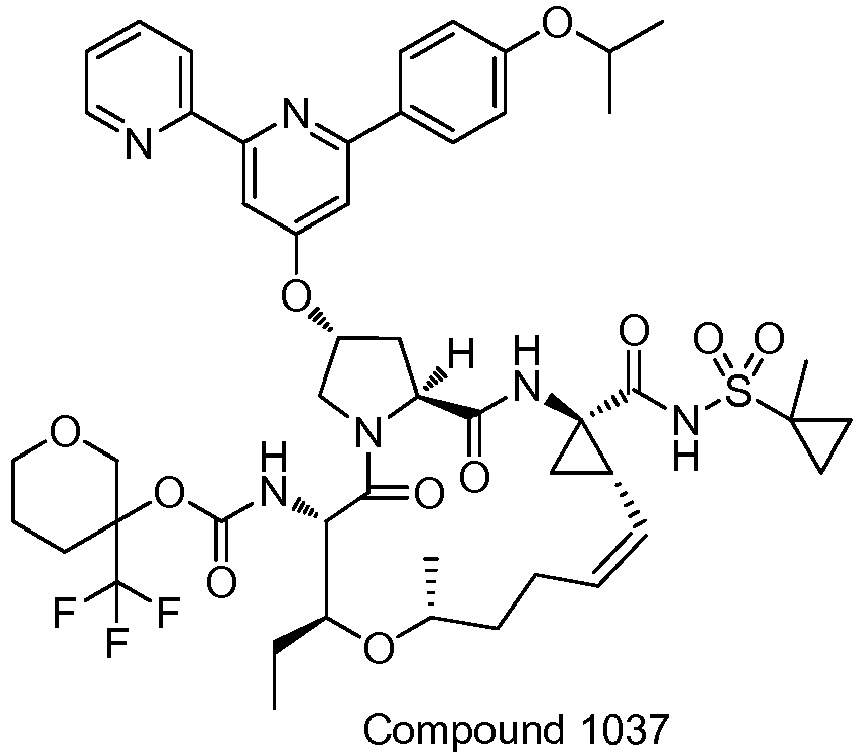
- Compound 1037 was prepared using the intermediates described above and by following the general procedure described for the synthesis of Compound 1001.
- Compound 1037: 3-(trifluoromethyl)tetrahydro-2H-pyran-3-yl ((2R,6S,7S,9R,13aS,14aR,16aS,Z)-7-ethyl-2-((6-(4-isopropoxyphenyl)-[2,2'-bipyridin]-4-yl)oxy)-9-methyl-14a-(((1-methylcyclopropyl)sulfonyl)carbamoyl)-5,16-dioxo-2,3,5,6,7,9,10,11,13a,14,14a,15,16,16a-tetradecahydro-1H-cyclopropa[i]pyrrolo[1,2-e][1,5,8]oxadiazacyclopentadecin-6-yl)carbamate. 1H-NMR (500MHz, DMSO-d6) δ 11.10 (br. s., 1H), 9.05 (br. s., 1H), 8.70 (d, J=4.3 Hz, 1H), 8.55 (d, J=7.9 Hz, 1H), 8.16 (d, J=8.9 Hz, 2H), 8.05 (d, J=9.8 Hz, 1H), 8.02 - 7.95 (m, 1H), 7.82 (d, J=1.8 Hz, 1H), 7.50 - 7.45 (m, 1H), 7.44 (d, J=1.8 Hz, 1H), 7.05 (d, J=8.9 Hz, 2H), 5.59 - 5.50 (m, 2H), 5.06 (br. s., 1H), 4.73 (dt, J=12.0, 6.1 Hz, 1H), 4.39 - 4.34 (m, 1H), 4.27 (d, J=11.6 Hz, 1H), 4.16 (t, J=9.8 Hz, 1H), 4.06 (d, J=11.6 Hz, 1H), 3.99 (d, J=7.9 Hz, 1H), 3.92 - 3.87 (m, 1H), 3.58 - 3.40 (m, 3H), 2.74 (s, 1H), 2.59 - 2.53 (m, 1H), 2.40 (br. s., 1H), 2.28 (t, J=9.8 Hz, 1H), 2.20 - 2.13 (m, 1H), 1.93 - 1.86 (m, 1H), 1.82 - 1.65 (m, 2H), 1.59 (d, J=7.6 Hz, 2H), 1.56 - 1.50 (m, 2H), 1.50 - 1.43 (m, 2H), 1.41 (s, 3H), 1.36 (s, 3H), 1.32 (d, J=6.1 Hz, 6H), 1.28 (br. s., 1H), 1.12 - 1.03 (m, 3H), 0.89 (br. s., 2H), 0.81 (t, J=7.3 Hz, 3H); MS: MS m/z 1011.9 (M++1).
-
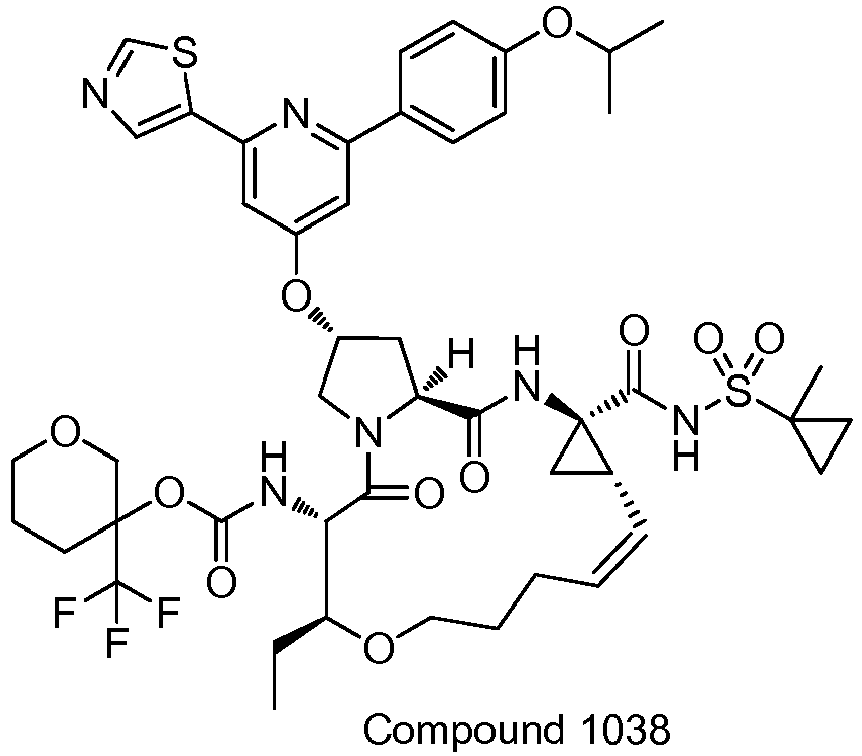
- Compound 1038 was prepared using the intermediates described above and by following the general procedure described for the synthesis of Compound 1001.
- Compound 1038: 3-(trifluoromethyl)tetrahydro-2H-pyran-3-yl ((2R,6S,7S,13aS,14aR,16aS,Z)-7-ethyl-2-((2-(4-isopropoxyphenyl)-6-(thiazol-5-yl)pyridin-4-yl)oxy)-14a-(((1-methylcyclopropyl)sulfonyl)carbamoyl)-5,16-dioxo-2,3,5,6,7,9,10,11,13a,14,14a,15,16,16a-tetradecahydro-1H-cyclopropa[i]pyrrolo[1,2-e][1,5,8]oxadiazacyclopentadecin-6-yl)carbamate. 1H-NMR (500MHz, DMSO-d6) δ 11.03 (br. s., 1H), 9.14 (s, 1H), 9.02 (br. s., 1H), 8.65 (s, 1H), 8.10 - 8.02 (m, 4H), 7.46 (s, 1H), 7.33 (s, 1H), 7.04 (d, J=8.9 Hz, 3H), 5.62 - 5.55 (m, 1H), 5.53 (br. s., 1H), 5.08 (br. s., 1H), 4.72 (dt, J=12.1, 6.0 Hz, 1H), 4.41 - 4.36 (m, 1H), 4.27 (d, J=12.2 Hz, 1H), 4.16 (t, J=9.6 Hz, 1H), 4.04 - 3.95 (m, 2H), 3.78 (d, J=10.4 Hz, 1H), 3.59 - 3.42 (m, 3H), 3.23 (br. s., 1H), 2.55 (br. s., 1H), 2.30 (br. s., 2H), 2.14 (d, J=14.6 Hz, 1H), 2.05 (d, J=8.2 Hz, 1H), 1.73 (d, J=8.9 Hz, 2H), 1.64 - 1.58 (m, 2H), 1.55 (dd, J=9.5, 4.9 Hz, 2H), 1.44 (br. s., 3H), 1.41 (s, 3H), 1.36 (d, J=8.9 Hz, 1H), 1.31 (d, J=6.1 Hz, 6H), 1.24 (br. s., 1H), 0.88 (br. s., 2H), 0.79 (t, J=7.3 Hz, 3H); MS: MS m/z 1003.9 (M++1).
-
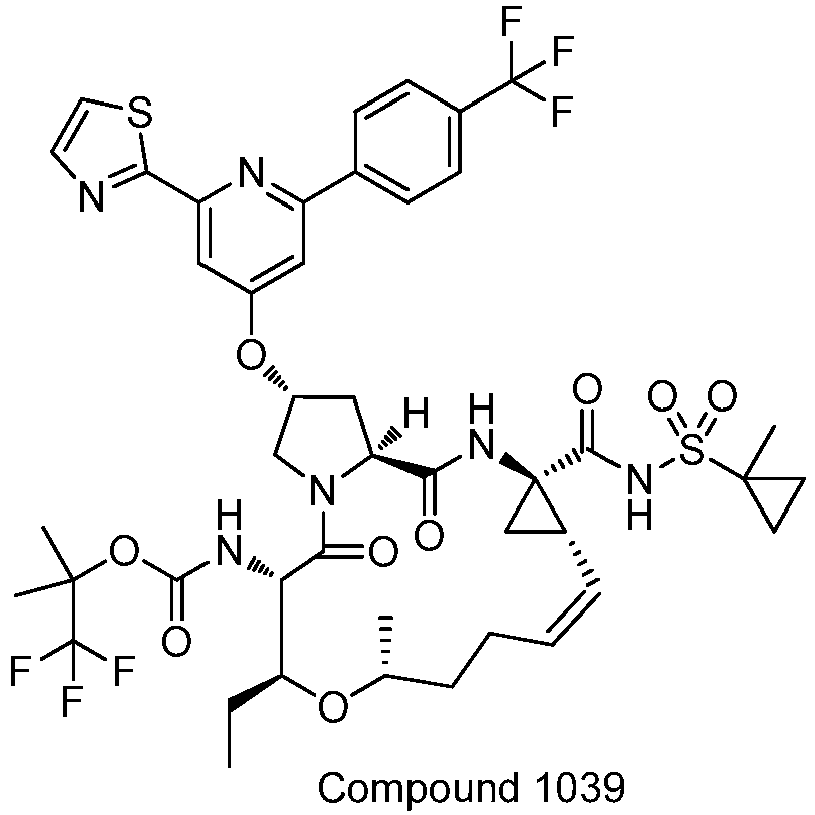
- Compound 1039 was prepared using the intermediates described above and by following the general procedure described for the synthesis of Compound 1001.
- Compound 1039: 1,1,1-trifluoro-2-methylpropan-2-yl ((2R,6S,7S,9R,13aS,14aR,16aS,Z)-7-ethyl-9-methyl-14a-(((1-methylcyclopropyl)sulfonyl)carbamoyl)-5,16-dioxo-2-((2-(thiazol-2-yl)-6-(4-(trifluoromethyl)phenyl)pyridin-4-yl)oxy)-2,3,5,6,7,9,10,11,13a,14,14a,15,16,16a-tetradecahydro-1H-cyclopropa[i]pyrrolo[1,2-e][1,5,8]oxadiazacyclopentadecin-6-yl)carbamate. 1H-NMR (500MHz, DMSO-d6) δ 11.13 (br. s., 1H), 9.15 (br. s., 1H), 8.38 (d, J=7.9 Hz, 2H), 8.03 (br. s., 1H), 7.95 - 7.88 (m, 4H), 7.70 (s, 1H), 7.64 (s, 1H), 5.62 (br. s., 1H), 5.55 (d, J=8.9 Hz, 1H), 5.03 (br. s., 1H), 4.42 (t, J=8.2 Hz, 1H), 4.27 (d, J=11.6 Hz, 1H), 4.10 (t, J=9.6 Hz, 1H), 3.98 (d, J=9.8 Hz, 1H), 3.85 (d, J=10.7 Hz, 1H), 3.47 (br. s., 1H), 2.72 (d, J=13.4 Hz, 1H), 2.62 - 2.54 (m, 1H), 2.37 (br. s., 1H), 2.31 - 2.24 (m, 1H), 1.87 (br. s., 1H), 1.67 (br. s., 1H), 1.62 (br. s., 1H), 1.54 (br. s., 2H), 1.46 (br. s., 1H), 1.42 (s, 3H), 1.32 (br. s., 5H), 1.23 (br. s., 1H), 1.09 (s, 3H), 1.06 (d, J=6.1 Hz, 3H), 0.89 (br. s., 2H), 0.78 (t, J=7.2 Hz, 3H); MS: MS m/z 985.9 (M++1).
-
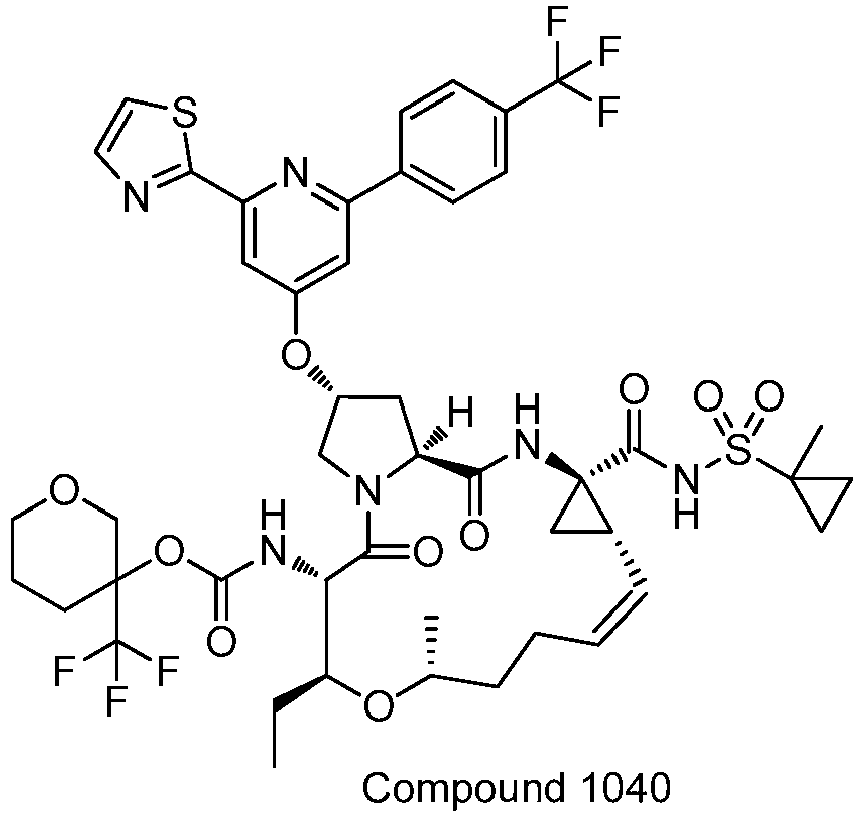
- Compound 1040 was prepared using the intermediates described above and by following the general procedure described for the synthesis of Compound 1001.
- Compound 1040: 3-(trifluoromethyl)tetrahydro-2H-pyran-3-yl ((2R,6S,7S,9R,13aS,14aR,16aS,Z)-7-ethyl-9-methyl-14a-(((1-methylcyclopropyl)sulfonyl)carbamoyl)-5,16-dioxo-2-((2-(thiazol-2-yl)-6-(4-(trifluoromethyl)phenyl)pyridin-4-yl)oxy)-2,3,5,6,7,9,10,11,13a,14,14a,15,16,16a-tetradecahydro-1H-cyclopropa[i]pyrrolo[1,2-e][1,5,8]oxadiazacyclopentadecin-6-yl)carbamate. 1H-NMR (500MHz, DMSO-d6) δ 11.11 (br. s., 1H), 9.11 (br. s., 1H), 8.37 (d, J=8.2 Hz, 2H), 8.05 - 8.00 (m, 2H), 7.94 - 7.88 (m, 3H), 7.65 (s, 2H), 5.60 - 5.51 (m, 2H), 5.05 (br. s., 1H), 4.39 (t, J=8.2 Hz, 1H), 4.33 (d, J=11.3 Hz, 1H), 4.14 (t, J=10.1 Hz, 1H), 3.98 (d, J=10.4 Hz, 2H), 3.91 - 3.85 (m, 1H), 3.51 (br. s., 2H), 3.33 - 3.27 (m, 1H), 2.74 (br. s., 1H), 2.57 (br. s., 1H), 2.41 (br. s., 1H), 2.28 (t, J=10.4 Hz, 1H), 2.12 (d, J=12.2 Hz, 1H), 1.89 (br. s., 1H), 1.70 (d, J=9.5 Hz, 2H), 1.61 (br. s., 1H), 1.54 (br. s., 3H), 1.47 - 1.44 (m, 2H), 1.41 (s, 4H), 1.39 - 1.27 (m, 3H), 1.07 (d, J=5.8 Hz, 3H), 0.89 (br. s., 2H), 0.79 (t, J=7.2 Hz, 3H); MS: MS m/z 1027.9 (M++1).
-
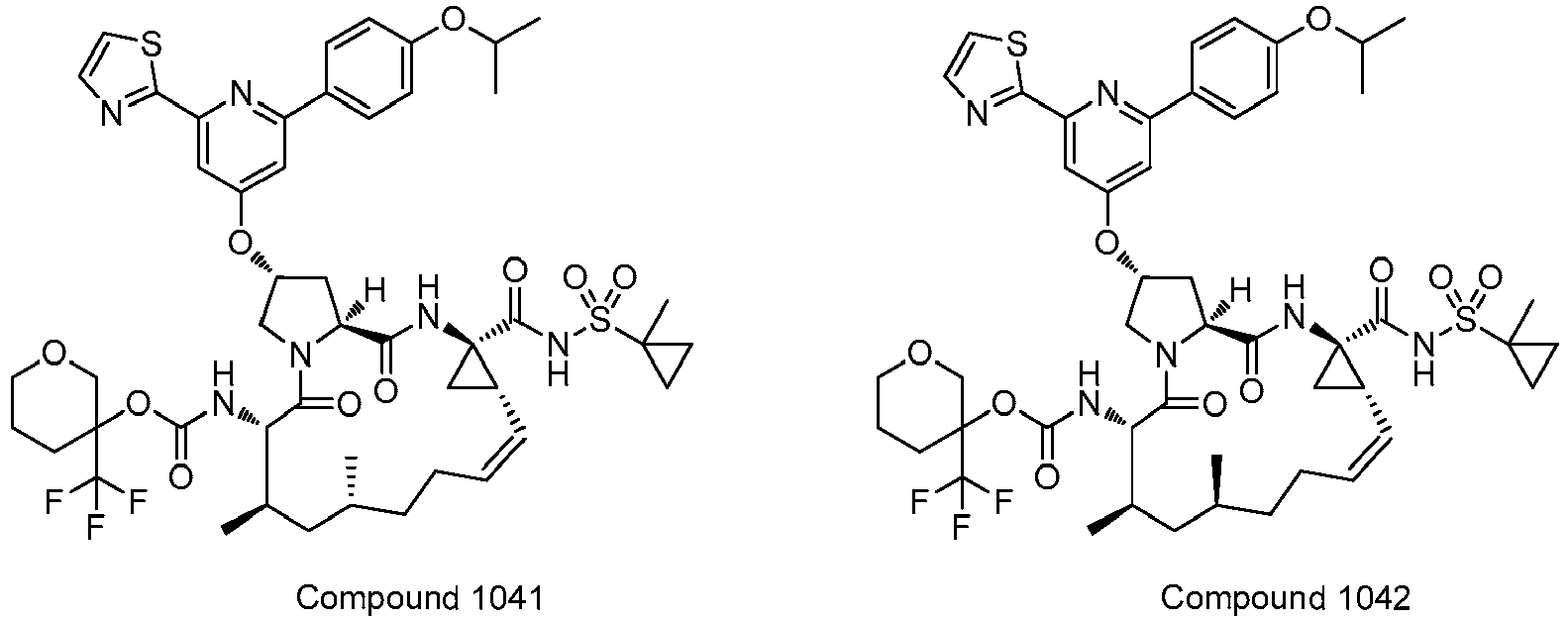
- Compound 1041 and Compound 1042 were prepared using the intermediates described above and by following the general procedure described for the synthesis of Compound 1001.
- Compound 1041: 3-(trifluoromethyl)tetrahydro-2H-pyran-3-yl ((2R,6S,7R,9R,13aS,4aR,16aS,Z)-2-((2-(4-isopropoxyphenyl)-6-(thiazol-2-yl)pyridin-4-yl)oxy)-7,9-dimethyl-14a-(((1-methylcyclopropyl)sulfonyl)carbamoyl)-5,16-dioxo-1,2,3,5,6,7,8,9,10,11,13a,14,14a,15,16,16a-hexadecahydrocyclopropa[e]pyrrolo[1,2-a][1,4]diazacyclopentadecin-6-yl)carbamate. 1H-NMR (500MHz, CD3OD) δ 8.10 - 8.06 (m, J=8.9 Hz, 2H), 7.94 (d, J=3.4 Hz, 1H), 7.72 - 7.69 (m, 1H), 7.60 (d, J=2.1 Hz, 1H), 7.36 (d, J=2.1 Hz, 1H), 7.04 - 7.00 (m, J=8.9 Hz, 2H), 5.57 (d, J=4.6 Hz, 1H), 5.44 (br. s., 1H), 5.15 (br. s., 1H), 4.75 - 4.68 (m, 1H), 4.68 - 4.60 (m, 1H), 4.56 (dd, J=10.1, 7.3 Hz, 1H), 4.15 (d, J=11.9 Hz, 1H), 4.05 (dd, J=11.7, 3.2 Hz, 1H), 3.89 (d, J=11.0 Hz, 1H), 3.55 (d, J=10.7 Hz, 1H), 3.38 - 3.33 (m, 1H), 3.31 - 3.26 (m, 1H), 2.71 - 2.62 (m, 2H), 2.49 - 2.35 (m, 2H), 2.19 (d, J=11.0 Hz, 1H), 2.02 - 1.89 (m, 2H), 1.80 - 1.71 (m, 2H), 1.71 - 1.62 (m, 2H), 1.56 (dd, J=9.0, 5.3 Hz, 2H), 1.50 (s, 3H), 1.50 - 1.38 (m, 5H), 1.37 (d, J=6.1 Hz, 6H), 1.30 - 1.19 (m, 2H), 1.00 (d, J=7.0 Hz, 3H), 0.97 (d, J=6.4 Hz, 3H), 0.86 - 0.78 (m, 3H); MS: MS m/z 1001.7 (M++1).
- Compound 1042: 3-(trifluoromethyl)tetrahydro-2H-pyran-3-yl ((2R,6S,7R,9S,13aS,14aR,16aS,Z)-2-((2-(4-isopropoxyphenyl)-6-(thiazol-2-yl)pyridin-4-yl)oxy)-7,9-dimethyl-14a-(((1-methylcyclopropyl)sulfonyl)carbamoyl)-5,16-dioxo-1,2,3,5,6,7,8,9,10,11,13a,14,14a,15,16,16a-hexadecahydrocyclopropa[e]pyrrolo[1,2-a][1,4]diazacyclopentadecin-6-yl)carbamate. MS: MS m/z 1001.7 (M++1).
-
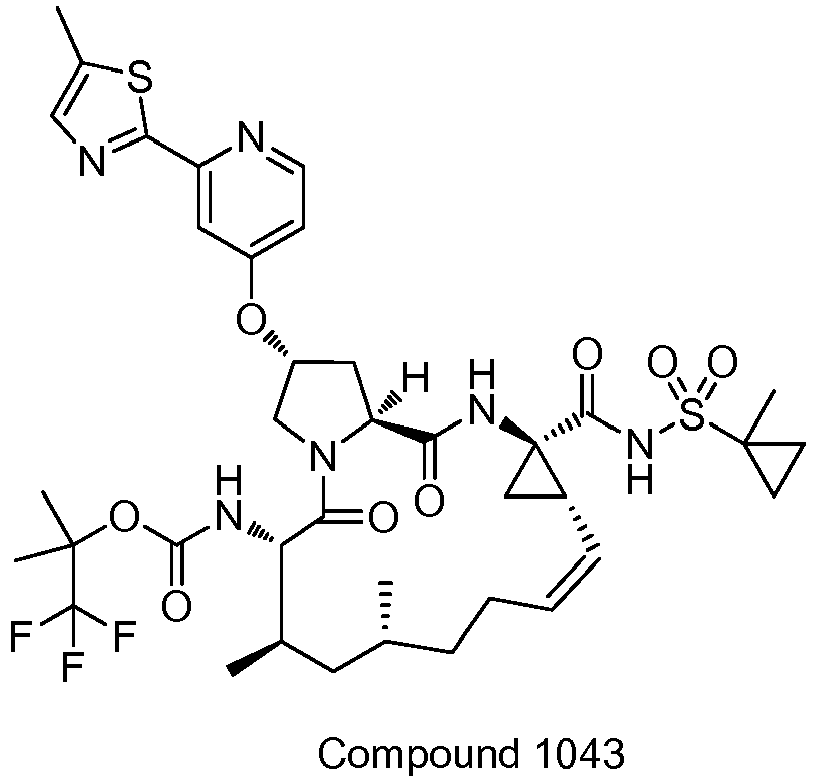
- Compound 1043 was prepared using the intermediates described above and by following the general procedure described for the synthesis of Compound 1001.
- Compound 1043: 1,1,1-trifluoro-2-methylpropan-2-yl ((2R,6S,7R,9R,13aS,14aR,16aS,Z)-7,9-dimethyl-14a-(((1-methylcyclopropyl)sulfonyl)carbamoyl)-2-((2-(5-methylthiazol-2-yl)pyridin-4-yl)oxy)-5,16-dioxo-1,2,3,5,6,7,8,9,10,11,13a,14,14a,15,16,16a-hexadecahydrocyclopropa[e]pyrrolo[1,2-a][1,4]diazacyclopentadecin-6-yl)carbamate. 1H-NMR (500MHz, DMSO-d6) δ 11.00 (br. s., 1H), 9.14 (br. s., 1H), 8.42 (d, J=5.5 Hz, 1H), 7.81 (d, J=7.6 Hz, 1H), 7.67 (d, J=1.2 Hz, 1H), 7.53 (d, J=2.4 Hz, 1H), 7.01 (dd, J=5.8, 2.4 Hz, 1H), 5.51 (br. s., 1H), 5.43 (br. s., 1H), 4.97 (br. s., 1H), 4.45 - 4.35 (m, 2H), 3.88 (d, J=9.2 Hz, 1H), 3.72 - 3.65 (m, 1H), 2.64 (br. s., 1H), 2.31 - 2.21 (m, 2H), 1.93 - 1.87 (m, 1H), 1.83 (d, J=6.7 Hz, 1H), 1.61 (br. s., 2H), 1.51 (br. s., 3H), 1.39 (br. s., 5H), 1.33 (s, 4H), 1.26 (br. s., 2H), 1.23 (s, 4H), 1.13 (br. s., 2H), 0.91 (d, J=6.7 Hz, 4H), 0.84 (d, J=6.4 Hz, 3H), 0.70 (br. s., 1H); MS: MS m/z 839.6 (M++1).
-

- Compound 1044 was prepared using the intermediates described above and by following the general procedure described for the synthesis of Compound 1001.
- Compound 1044: 3-(trifluoromethyl)tetrahydro-2H-pyran-3-yl ((2R,6S,7R,9R,13aS, 14aR, 16aS,Z)-7,9-dimethyl-14a-(((1-methylcyclopropyl)sulfonyl)carbamoyl)-2-((2-(5-methylthiazol-2-yl)pyridin-4-yl)oxy)-5,16-dioxo-1,2,3,5,6,7, 8,9,10,11,13a,14,14a,15,16,16a-hexadecahydrocyclopropa[e]pyrrolo[1,2-a][1,4]diazacyclopentadecin-6-yl)carbamate. 1H-NMR (500MHz, DMSO-d6) δ 10.99 (br. s., 1H), 9.13 (br. s., 1H), 8.40 (d, J=5.8 Hz, 1H), 7.90 (d, J=8.2 Hz, 1H), 7.67 - 7.63 (m, 1H), 7.53 (d, J=2.4 Hz, 1H), 6.98 (dd, J=5.8, 2.4 Hz, 1H), 5.51 (br. s., 1H), 5.41 (br. s., 1H), 4.97 (br. s., 1H), 4.43 - 4.35 (m, 2H), 4.03 (d, J=12.2 Hz, 1H), 3.91 (d, J=7.3 Hz, 1H), 3.76 - 3.71 (m, 1H), 3.58 (d, J=11.0 Hz, 1H), 2.68 (br. s., 1H), 2.25 (d, J=13.4 Hz, 2H), 2.23 - 2.11 (m, 2H), 1.91 (br. s., 1H), 1.87 (br. s., 2H), 1.79 - 1.71 (m, 2H), 1.63 (d, J=12.8 Hz, 4H), 1.48 (br. s., 5H), 1.40 (br. s., 4H), 1.36 - 1.32 (m, 1H), 1.27 (br. s., 1H), 1.12 (br. s., 1H), 0.91 (d, J=6.7 Hz, 4H), 0.86 (d, J=6.4 Hz, 4H), 0.75 - 0.69 (m, 1H); MS: MS m/z 881.7 (M++1).
-
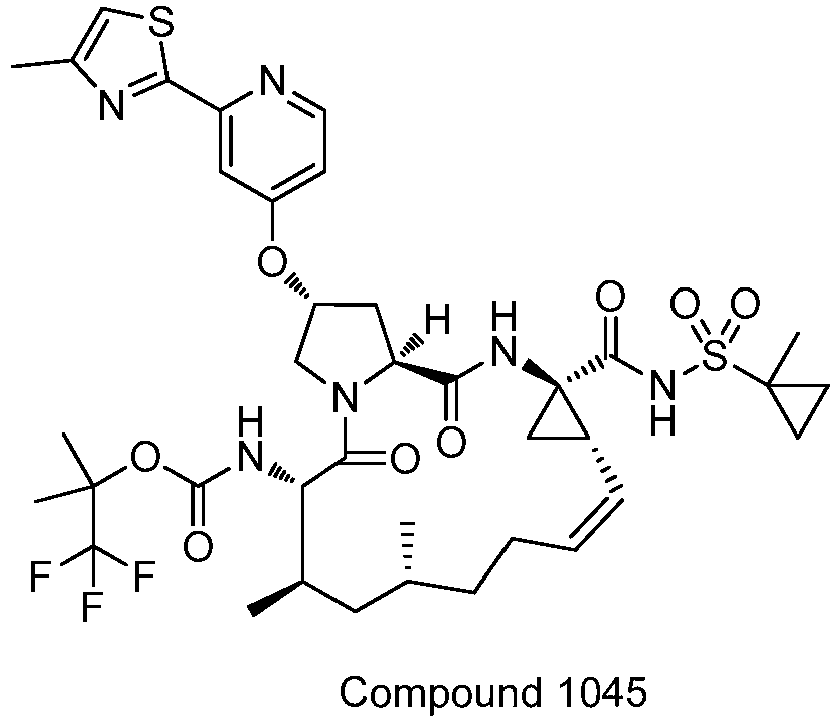
- Compound 1045 was prepared using the intermediates described above and by following the general procedure described for the synthesis of Compound 1001.
- Compound 1045: 1,1,1-trifluoro-2-methylpropan-2-yl ((2R,6S,7R,9R,13aS,14aR,16aS,Z)-7,9-dimethyl-14a-(((1-methylcyclopropyl)sulfonyl)carbamoyl)-2-((2-(4-methylthiazol-2-yl)pyridin-4-yl)oxy)-5,16-dioxo-1,2,3,5,6,7,8,9,10,11,13a,14,14a,15,16,16a-hexadecahydrocyclopropa[e]pyrrolo[1,2-a][1,4]diazacyclopentadecin-6-yl)carbamate. 1H-NMR (500MHz, DMSO-d6) δ 10.98 (br. s., 1H), 9.12 (br. s., 1H), 8.43 (d, J=5.8 Hz, 1H), 7.82 (d, J=8.2 Hz, 1H), 7.55 (d, J=2.4 Hz, 1H), 7.42 - 7.40 (m, 1H), 7.03 (dd, J=5.8, 2.4 Hz, 1H), 5.55 - 5.48 (m, 1H), 5.46 (br. s., 1H), 5.00 (br. s., 1H), 4.43 (dd, J=10.5, 7.2 Hz, 1H), 4.38 (d, J=11.6 Hz, 1H), 3.91 - 3.85 (m, 1H), 3.71 - 3.66 (m, 1H), 2.65 (br. s., 1H), 2.55 (d, J=6.7 Hz, 1H), 2.44 (s, 3H), 2.32 - 2.21 (m, 2H), 1.94 - 1.87 (m, 1H), 1.84 (d, J=6.4 Hz, 1H), 1.65 - 1.56 (m, 2H), 1.51 (d, J=9.2 Hz, 1H), 1.40 (s, 4H), 1.33 (s, 4H), 1.28 (br. s., 1H), 1.25 (s, 4H), 1.11 (d, J=12.2 Hz, 1H), 0.91 (d, J=7.0 Hz, 3H), 0.88 - 0.87 (m, 2H), 0.84 (br. s., 3H), 0.71 (t, J=11.9 Hz, 1H); MS: MS m/z 839.7 (M++1).
-
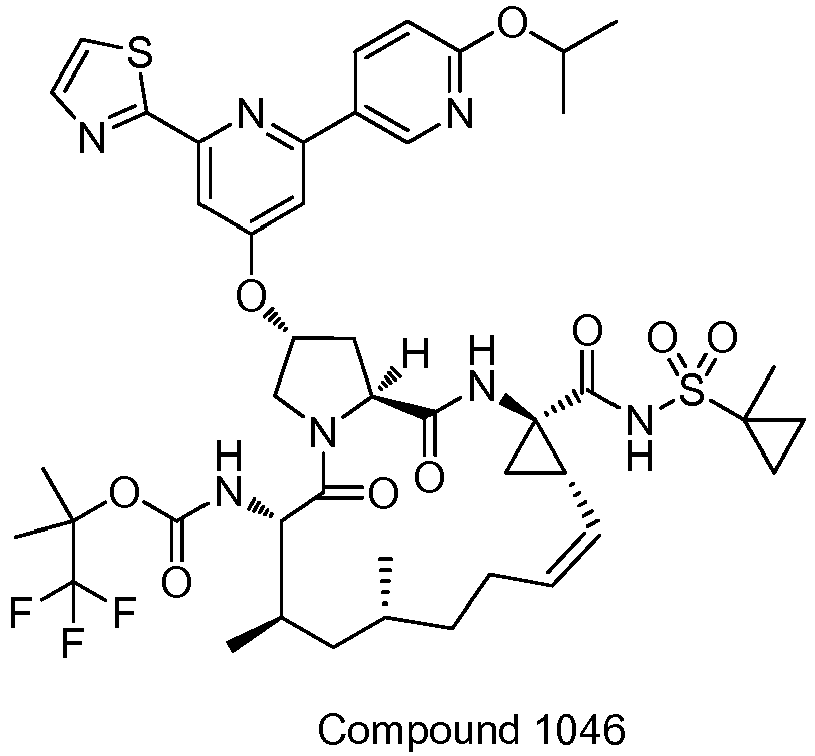
- Compound 1046 was prepared using the intermediates described above and by following the general procedure described for the synthesis of Compound 1001.
- Compound 1046: 1,1,1-trifluoro-2-methylpropan-2-yl ((2R,6S,7R,9R,13aS,14aR,16aS,Z)-2-((6'-isopropoxy-6-(thiazol-2-yl)-[2,3'-bipyridin]-4-yl)oxy)-7,9-dimethyl-14a-(((1-methylcyclopropyl)sulfonyl)carbamoyl)-5,16-dioxo-1,2,3,5,6,7,8,9,10,11,13a,14,14a,15,16,16a-hexadecahydrocyclopropa[e]pyrrolo[1,2-a][1,4]diazacyclopentadecin-6-yl)carbamate. 1H-NMR (500MHz, DMSO-d6) δ 11.01 (br. s., 1H), 9.20 (br. s., 1H), 8.94 (d, J=2.1 Hz, 1H), 8.42 (dd, J=8.7, 2.3 Hz, 1H), 8.00 (d, J=3.1 Hz, 1H), 7.88 (d, J=3.1 Hz, 1H), 7.77 (d, J=8.9 Hz, 1H), 7.56 - 7.51 (m, 2H), 6.90 (d, J=8.9 Hz, 1H), 5.57 (br. s., 1H), 5.50 (br. s., 1H), 5.33 (quin, J=6.2 Hz, 1H), 4.96 (br. s., 1H), 4.51 - 4.45 (m, 1H), 4.43 (d, J=12.8 Hz, 1H), 3.90 (d, J=9.5 Hz, 1H), 3.67 (d, J=9.8 Hz, 1H), 2.56 (d, J=12.5 Hz, 2H), 2.27 (br. s., 2H), 1.90 (d, J=11.0 Hz, 1H), 1.81 (br. s., 1H), 1.60 (br. s., 2H), 1.50 (br. s., 1H), 1.46 (br. s., 1H), 1.39 (s, 5H), 1.33 (d, J=6.1 Hz, 7H), 1.28 (br. s., 2H), 1.21 (s, 3H), 1.10 (s, 4H), 0.90 (d, J=6.7 Hz, 3H), 0.82 (d, J=6.1 Hz, 3H), 0.70 (t, J=11.9 Hz, 1H); MS: MS m/z 960.9 (M++1).
-
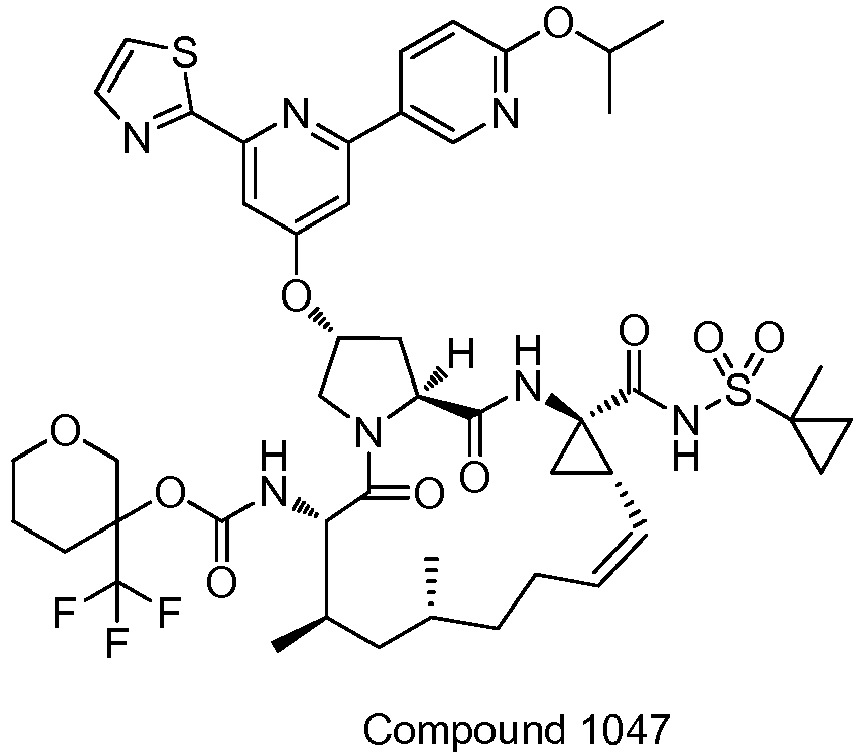
- Compound 1047 was prepared using the intermediates described above and by following the general procedure described for the synthesis of Compound 1001.
- Compound 1047: 3-(trifluoromethyl)tetrahydro-2H-pyran-3-yl ((2R,6S,7R,9R,13aS,14aR,16aS,Z)-2-((6'-isopropoxy-6-(thiazol-2-yl)-[2,3'-bipyridin]-4-yl)oxy)-7,9-dimethyl-14a-(((1-methylcyclopropyl)sulfonyl)carbamoyl)-5,16-dioxo-1,2,3,5,6,7,8,9,10,11,13a,14,14a,15,16,16a-hexadecahydrocyclopropa[e]pyrrolo[1,2-a][1,4]diazacyclopentadecin-6-yl)carbamate. 1H-NMR (500MHz, DMSO-d6) δ 10.99 (s, 1H), 9.08 (br. s., 1H), 8.92 (s, 1H), 8.42 - 8.38 (m, 1H), 8.00 (d, J=3.1 Hz, 1H), 7.87 (d, J=3.4 Hz, 1H), 7.85 (d, J=8.5 Hz, 1H), 7.53 (s, 1H), 7.49 (s, 1H), 6.90 (d, J=8.9 Hz, 1H), 5.53 (br. s., 1H), 5.48 (br. s., 1H), 5.33 (dt, J=12.3, 6.2 Hz, 1H), 5.05 (br. s., 1H), 4.43 (d, J=9.5 Hz, 2H), 3.93 (d, J=12.2 Hz, 3H), 3.72 (t, J=9.5 Hz, 1H), 3.29 (d, J=11.9 Hz, 1H), 3.24 (t, J=9.2 Hz, 1H), 2.55 (br. s., 1H), 2.27 (br. s., 2H), 2.05 (br. s., 1H), 1.93 - 1.81 (m, 2H), 1.63 (d, J=9.5 Hz, 3H), 1.57 (br. s., 1H), 1.52 (br. s., 1H), 1.46 (br. s., 2H), 1.38 (br. s., 5H), 1.33 (d, J=6.1 Hz, 8H), 1.22 (s, 2H), 1.12 (br. s., 1H), 0.90 (d, J=6.7 Hz, 3H), 0.83 (br. s., 3H), 0.71 (d, J=11.9 Hz, 1H); MS: MS m/z 1002.9 (M++1).
-

- Compound 1048 was prepared using the intermediates described above and by following the general procedure described for the synthesis of Compound 1001.
- Compound 1048: 3-(trifluoromethyl)tetrahydro-2H-pyran-3-yl ((2R,6S,7R,9R,13aS,4aR,16aS,Z)-2-((2-(4-isopropoxyphenyl)-6-(pyrimidin-2-yl)pyridin-4-yl)oxy)-7,9-dimethyl-14a-(((1-methylcyclopropyl)sulfonyl)carbamoyl)-5,16-dioxo-1,2,3,5,6,7,8,9,10,11,13a,14,14a,15,16,16a-hexadecahydrocyclopropa[e]pyrrolo[1,2-a][1,4]diazacyclopentadecin-6-yl)carbamate. 1H-NMR (500MHz, DMSO-d6) δ 9.18 - 9.04 (m, 1H), 8.98 (d, J=4.6 Hz, 2H), 8.12 (d, J=8.5 Hz, 2H), 7.84 (d, J=8.2 Hz, 1H), 7.78 (s, 1H), 7.56 (t, J=4.9 Hz, 1H), 7.47 (s, 1H), 7.03 (d, J=8.9 Hz, 2H), 5.53 (br. s., 1H), 5.50 (br. s., 1H), 5.05 (br. s., 1H), 4.70 (dt, J=12.0, 6.1 Hz, 1H), 4.44 - 4.36 (m, 2H), 4.02 (d, J=11.9 Hz, 1H), 3.92 (d, J=8.5 Hz, 1H), 3.75 (d, J=9.8 Hz, 1H), 3.35 (d, J=12.2 Hz, 1H), 3.27 (t, J=9.3 Hz, 1H), 2.55 (br. s., 1H), 2.26 (br. s., 2H), 2.10 (d, J=13.1 Hz, 1H), 1.91 (s, 1H), 1.84 (br. s., 1H), 1.69 - 1.60 (m, 2H), 1.56 (br. s., 2H), 1.47 (br. s., 1H), 1.43 - 1.40 (m, 1H), 1.38 (s, 5H), 1.35 - 1.32 (m, 1H), 1.30 (d, J=5.8 Hz, 7H), 1.27 - 1.18 (m, 2H), 1.12 (br. s., 2H), 0.90 (d, J=6.7 Hz, 3H), 0.84 (d, J=6.4 Hz, 3H), 0.82 - 0.79 (m, 1H), 0.70 (t, J=12.1 Hz, 1H); MS: MS m/z 996.9 (M++1).
-
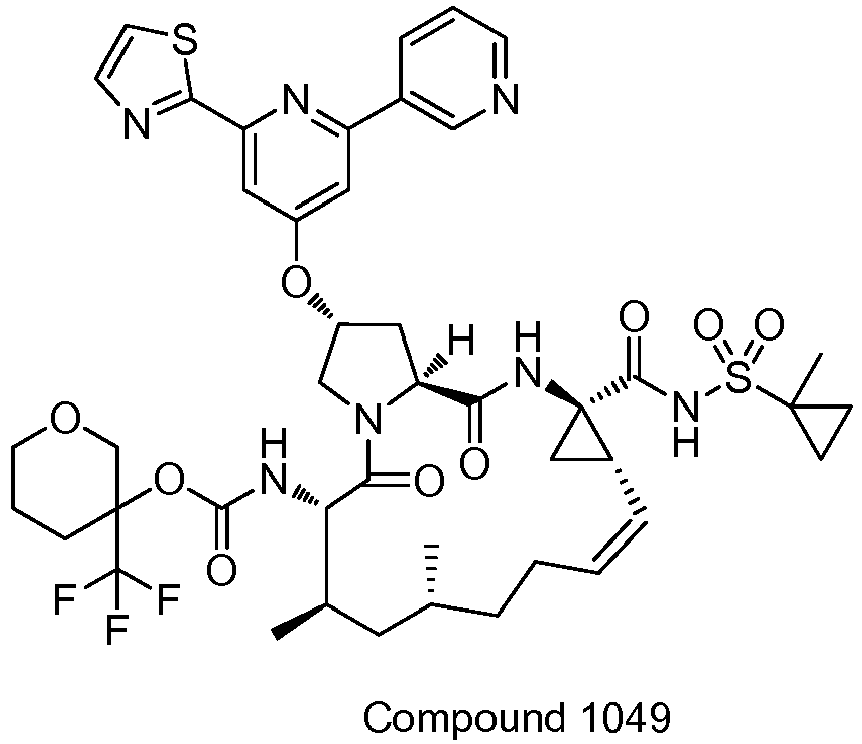
- Compound 1049 was prepared using the intermediates described above and by following the general procedure described for the synthesis of Compound 1001.
- Compound 1049: 3-(trifluoromethyl)tetrahydro-2H-pyran-3-yl ((2R,6S,7R,9R,13aS, 14aR, 16aS,Z)-7,9-dimethyl-14a-(((1-methylcyclopropyl)sulfonyl)carbamoyl)-5,16-dioxo-2-((6-(thiazol-2-yl)-[2,3'-bipyridin]-4-yl)oxy)-1,2,3,5,6,7,8,9,10,11,13a,14,14a,15,16,16a-hexadecahydrocyclopropa[e]pyrrolo[1,2-a][1,4]diazacyclopentadecin-6-yl)carbamate. 1H-NMR (500MHz, DMSO-d6) δ 9.30 (s, 1H), 9.18 - 8.86 (m, 1H), 8.67 (d, J=4.9 Hz, 1H), 8.48 (d, J=7.9 Hz, 1H), 8.01 (d, J=3.1 Hz, 1H), 7.88 (d, J=3.4 Hz, 1H), 7.83 (d, J=9.2 Hz, 1H), 7.60 (d, J=3.7 Hz, 2H), 7.59 - 7.56 (m, 1H), 5.55 (br. s., 1H), 5.48 (br. s., 1H), 5.18 - 4.89 (m, 1H), 4.44 (t, J=8.4 Hz, 2H), 3.95 - 3.88 (m, 3H), 3.72 (d, J=10.4 Hz, 1H), 3.24 (d, J=11.9 Hz, 1H), 3.22 - 3.16 (m, 1H), 2.55 (s, 1H), 2.31 - 2.24 (m, 2H), 2.04 (d, J=14.0 Hz, 1H), 1.84 (br. s., 2H), 1.61 (br. s., 2H), 1.56 (br. s., 1H), 1.50 (br. s., 2H), 1.42 - 1.39 (m, 1H), 1.38 (s, 4H), 1.35 - 1.29 (m, 2H), 1.22 (br. s., 1H), 1.14 (d, J=15.0 Hz, 1H), 0.90 (d, J=6.7 Hz, 3H), 0.83 (d, J=6.4 Hz, 3H), 0.70 (d, J=12.2 Hz, 1H); MS: MS m/z 944.9 (M++1).
-
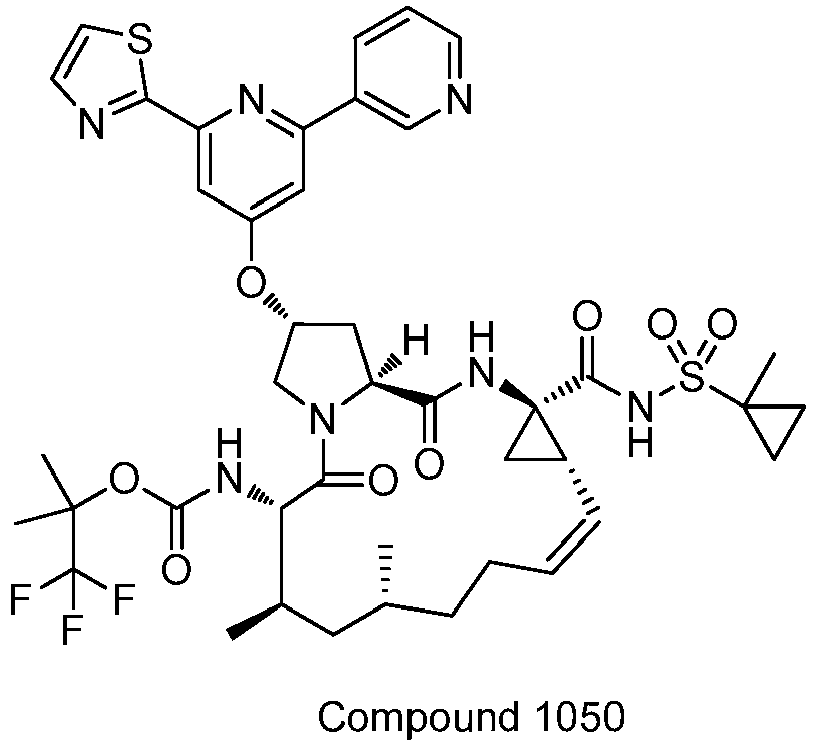
- Compound 1050 was prepared using the intermediates described above and by following the general procedure described for the synthesis of Compound 1001.
- Compound 1050: 1,1,1-trifluoro-2-methylpropan-2-yl ((2R,6S,7R,9R,13aS,14aR,16aS,Z)-7,9-dimethyl-14a-(((1-methylcyclopropyl)sulfonyl)carbamoyl)-5,16-dioxo-2-((6-(thiazol-2-yl)-[2,3'-bipyridin]-4-yl)oxy)-1,2,3,5,6,7,8,9,10,11,13a,14,14a,15,16,16a-hexadecahydrocyclopropa[e]pyrrolo[1,2-a][1,4]diazacyclopentadecin-6-yl)carbamate. 1H-NMR (500MHz, DMSO-d6) δ 11.00 (br. s., 1H), 9.36 (br. s., 1H), 9.17 (br. s., 1H), 8.70 (br. s., 1H), 8.52 (d, J=6.1 Hz, 1H), 8.03 (d, J=3.1 Hz, 1H), 7.96 - 7.91 (m, 1H), 7.82 (d, J=7.0 Hz, 1H), 7.69 (br. s., 1H), 7.62 (br. s., 1H), 7.59 (br. s., 1H), 5.62 (br. s., 1H), 5.51 (br. s., 1H), 5.00 (br. s., 1H), 4.46 (d, J=11.0 Hz, 2H), 3.91 (d, J=11.0 Hz, 1H), 3.73 - 3.66 (m, 1H), 2.61 (br. s., 2H), 2.29 (br. s., 2H), 1.91 (br. s., 1H), 1.83 (br. s., 1H), 1.61 (br. s., 2H), 1.49 (d, J=10.7 Hz, 1H), 1.46 - 1.43 (m, 1H), 1.40 (br. s., 4H), 1.34 (br. s., 1H), 1.26 (br. s., 1H), 1.22 (br. s., 3H), 1.20 - 1.15 (m, 1H), 1.12 (br. s., 3H), 0.93 - 0.89 (m, 3H), 0.89 - 0.86 (m, 1H), 0.84 (br. s., 4H), 0.71 (br. s., 1H); MS: MS m/z 902.7 (M++1).
-

- Compound 1051 was prepared using the intermediates described above and by following the general procedure described for the synthesis of Compound 1001.
- Compound 1051: 3-(trifluoromethyl)tetrahydro-2H-pyran-3-yl ((2R,6S,7R,9R,13aS,14aR,16aS,Z)-2-((6-(4-isopropoxyphenyl)-[2,2'-bipyridin]-4-yl)oxy)-7,9-dimethyl-14a-(((1-methylcyclopropyl)sulfonyl)carbamoyl)-5,16-dioxo-1,2,3,5,6,7,8,9,10,11,13a,14,14a,15,16,16a-hexadecahydrocyclopropa[e]pyrrolo[1,2-a][1,4]diazacyclopentadecin-6-yl)carbamate. 1H-NMR (500MHz, DMSO-d6) δ 11.01 (br. s., 1H), 9.10 (br. s., 1H), 8.70 (d, J=3.7 Hz, 1H), 8.55 (d, J=7.9 Hz, 1H), 8.15 (d, J=8.9 Hz, 2H), 7.99 (t, J=6.9 Hz, 1H), 7.91 (d, J=8.9 Hz, 1H), 7.81 (s, 1H), 7.48 (t, J=5.6 Hz, 1H), 7.41 (s, 1H), 7.05 (d, J=8.9 Hz, 2H), 5.56 - 5.48 (m, 2H), 5.02 (br. s., 1H), 4.75 - 4.70 (m, 1H), 4.46 - 4.38 (m, 2H), 4.06 (d, J=12.8 Hz, 1H), 3.97 - 3.90 (m, 1H), 3.77 (t, J=9.9 Hz, 1H), 3.53 (d, J=10.7 Hz, 1H), 2.67 (br. s., 1H), 2.61 - 2.53 (m, 1H), 2.34 - 2.24 (m, 2H), 2.12 (d, J=13.7 Hz, 1H), 1.96 - 1.84 (m, 2H), 1.74 - 1.63 (m, 2H), 1.59 (br. s., 2H), 1.50 (br. s., 1H), 1.46 - 1.42 (m, 2H), 1.40 (s, 4H), 1.37 (br. s., 1H), 1.32 (d, J=6.1 Hz, 7H), 1.27 (br. s., 2H), 1.14 (br. s., 1H), 0.92 (d, J=6.7 Hz, 3H), 0.86 (d, J=6.1 Hz, 3H), 0.73 (t, J=12.2 Hz, 1H); MS: MS m/z 995.9 (M++1).
-
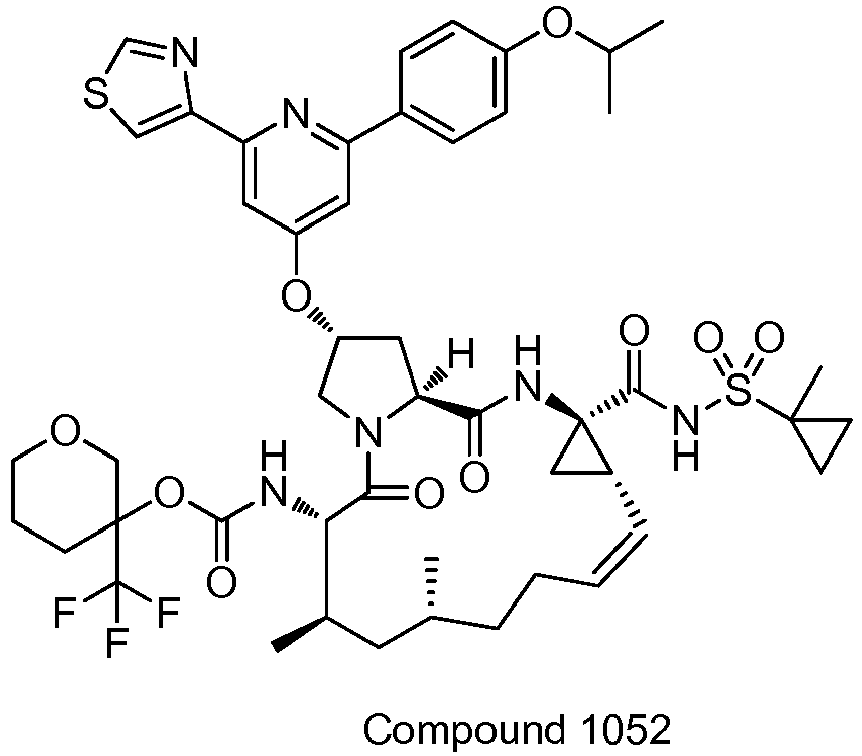
- Compound 1052 was prepared using the intermediates described above and by following the general procedure described for the synthesis of Compound 1001.
- Compound 1052: 3-(trifluoromethyl)tetrahydro-2H-pyran-3-yl ((2R,6S,7R,9R,13aS,4aR,16aS,Z)-2-((2-(4-isopropoxyphenyl)-6-(thiazol-4-yl)pyridin-4-yl)oxy)-7,9-dimethyl-14a-(((1-methylcyclopropyl)sulfonyl)carbamoyl)-5,16-dioxo-1,2,3,5,6,7,8,9,10,11,13a,14,14a,15,16,16a-hexadecahydrocyclopropa[e]pyrrolo[1,2-a][1,4]diazacyclopentadecin-6-yl)carbamate. 1H-NMR (500MHz, DMSO-d6) δ 10.99 (br. s., 1H), 9.23 (d, J=1.8 Hz, 1H), 9.11 (br. s., 1H), 8.47 - 8.43 (m, 1H), 8.18 - 8.11 (m, 2H), 7.90 (d, J=8.5 Hz, 1H), 7.52 (s, 1H), 7.34 (s, 1H), 7.05 - 7.01 (m, J=8.9 Hz, 2H), 5.52 (br. s., 2H), 5.00 (br. s., 1H), 4.72 (dt, J=12.1, 6.2 Hz, 1H), 4.45 - 4.37 (m, 2H), 4.07 (d, J=11.3 Hz, 1H), 3.96 - 3.90 (m, 1H), 3.77 (t, J=9.8 Hz, 1H), 3.54 (d, J=11.3 Hz, 1H), 2.69 (br. s., 1H), 2.55 (br. s., 1H), 2.33 - 2.23 (m, 2H), 2.14 (d, J=13.4 Hz, 1H), 1.96 - 1.84 (m, 2H), 1.75 - 1.67 (m, 1H), 1.59 (br. s., 3H), 1.51 (br. s., 1H), 1.45 - 1.42 (m, 2H), 1.40 (s, 5H), 1.36 (br. s., 1H), 1.31 (d, J=6.1 Hz, 7H), 1.24 (s, 3H), 1.14 (br. s., 1H), 0.92 (d, J=6.7 Hz, 3H), 0.86 (d, J=6.4 Hz, 3H), 0.73 (t, J=12.1 Hz, 1H); MS: MS m/z 1001.9 (M++1).
-

- Compound 1053 was prepared using the intermediates described above and by following the general procedure described for the synthesis of Compound 1001.
- Compound 1053: 1,1,1-trifluoro-2-methylpropan-2-yl ((2R,6S,7R,9R,13aS,4aR,16aS,Z)-14a-((cyclopropylsulfonyl)carbamoyl)-7-ethyl-9-methyl-5,16-dioxo-2-((2-(thiazol-2-yl)-6-(4-(trifluoromethyl)phenyl)pyridin-4-yl)oxy)-1,2,3,5,6,7,8,9,10,11,13a,14,14a,15,16,16a-hexadecahydrocyclopropa[e]pyrrolo[1,2-a][1,4]diazacyclopentadecin-6-yl)carbamate. 1H-NMR (500MHz, DMSO-d6) δ 8.95 (br. s., 1H), 8.38 (d, J=7.9 Hz, 2H), 8.03 (d, J=3.1 Hz, 1H), 7.94 - 7.89 (m, 3H), 7.84 (d, J=8.9 Hz, 1H), 7.69 (s, 1H), 7.65 (s, 1H), 5.61 (br. s., 1H), 5.50 (d, J=5.8 Hz, 1H), 5.15 (br. s., 1H), 4.44 (d, J=10.1 Hz, 2H), 3.95 - 3.84 (m, 2H), 2.88 (d, J=9.2 Hz, 1H), 2.57 (br. s., 2H), 2.34 - 2.20 (m, 2H), 1.92 (d, J=7.9 Hz, 2H), 1.58 (br. s., 1H), 1.49 (br. s., 1H), 1.43 (d, J=9.5 Hz, 3H), 1.33 (d, J=12.8 Hz, 2H), 1.26 (s, 3H), 1.18 (br. s., 2H), 1.11 (s, 3H), 1.06 (br. s., 1H), 1.01 (br. s., 1H), 0.94 (br. s., 3H), 0.91 (d, J=5.8 Hz, 3H), 0.69 (t, J=7.3 Hz, 3H); MS: MS m/z 969.7 (M++1).
-
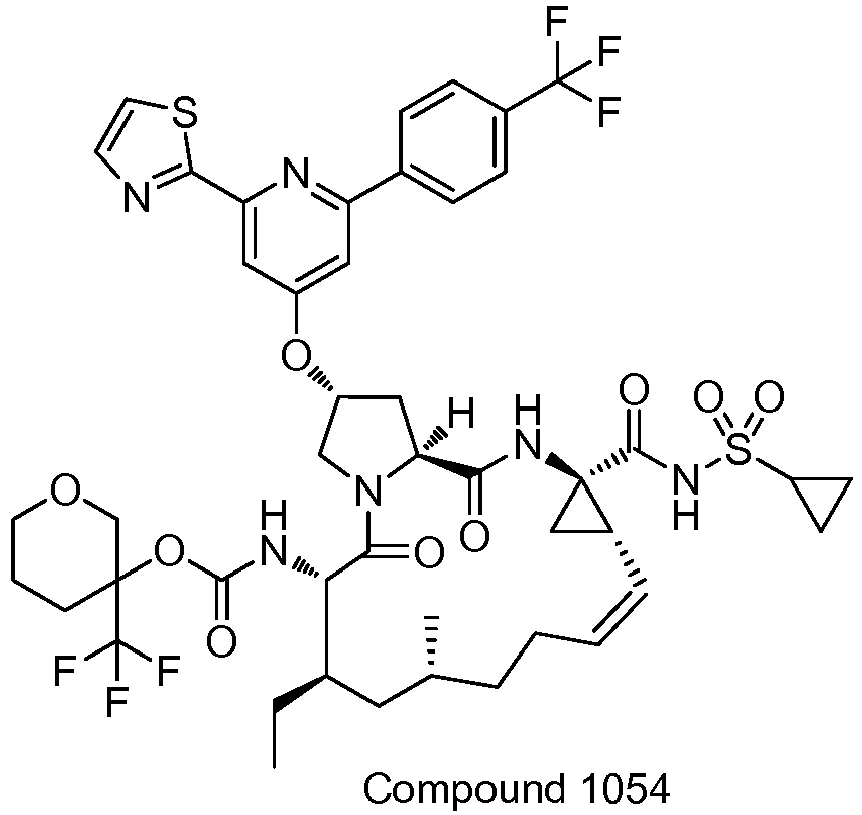
- Compound 1054 was prepared using the intermediates described above and by following the general procedure described for the synthesis of Compound 1001.
- Compound 1054: 3-(trifluoromethyl)tetrahydro-2H-pyran-3-yl ((2R,6S,7R,9R,13aS,14aR,16aS,Z)-14a-((cyclopropylsulfonyl)carbamoyl)-7-ethyl-9-methyl-5,16-dioxo-2-((2-(thiazol-2-yl)-6-(4-(trifluoromethyl)phenyl)pyridin-4-yl)oxy)-1,2,3,5,6,7,8,9,10,11,13a,14,14a,15,16,16a-hexadecahydrocyclopropa[e]pyrrolo[1,2-a][1,4]diazacyclopentadecin-6-yl)carbamate. 1H-NMR (500MHz, DMSO-d6) δ 8.90 (br. s., 1H), 8.37 (d, J=8.2 Hz, 2H), 8.03 (d, J=3.1 Hz, 1H), 7.96 - 7.89 (m, 4H), 7.65 (d, J=5.8 Hz, 2H), 5.58 (br. s., 1H), 5.49 (d, J=5.8 Hz, 1H), 5.16 (br. s., 1H), 4.48 (d, J=11.3 Hz, 1H), 4.44 - 4.38 (m, 1H), 3.98 (d, J=12.5 Hz, 1H), 3.95 - 3.89 (m, 2H), 3.52 (d, J=10.1 Hz, 1H), 3.26 (t, J=9.6 Hz, 1H), 2.87 (br. s., 1H), 2.57 (br. s., 2H), 2.33 - 2.20 (m, 2H), 2.09 (d, J=13.7 Hz, 1H), 2.00 - 1.89 (m, 2H), 1.72 - 1.64 (m, 1H), 1.57 (br. s., 2H), 1.53 - 1.38 (m, 6H), 1.33 (br. s., 2H), 1.23 (br. s., 1H), 1.18 (br. s., 1H), 1.04 (br. s., 3H), 0.95 (br. s., 2H), 0.92 (d, J=5.5 Hz, 3H), 0.71 (t, J=7.2 Hz, 3H); MS: MS m/z 1011.8 (M++1).
-
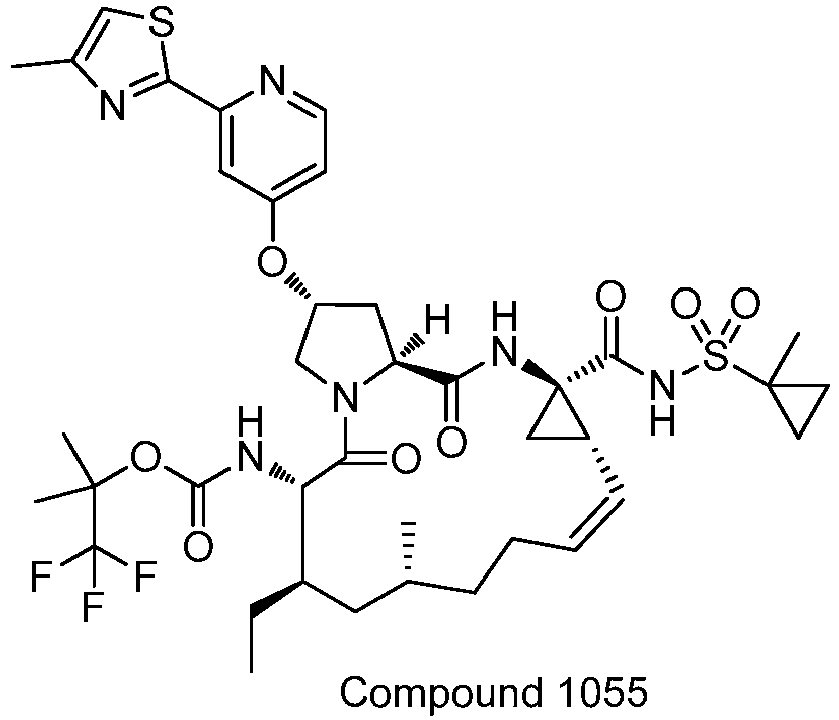
- Compound 1055 was prepared using the intermediates described above and by following the general procedure described for the synthesis of Compound 1001.
- Compound 1055: 1,1,1-trifluoro-2-methylpropan-2-yl ((2R,6S,7R,9R,13aS,14aR,16aS,Z)-7-ethyl-9-methyl-14a-(((1-methylcyclopropyl)sulfonyl)carbamoyl)-2-((2-(4-methylthiazol-2-yl)pyridin-4-yl)oxy)-5,16-dioxo-1,2,3,5,6,7,8,9,10,11,13a,14,14a,15,16,16a-hexadecahydrocyclopropa[e]pyrrolo[1,2-a][1,4]diazacyclopentadecin-6-yl)carbamate. 1H-NMR (500MHz, DMSO-d6) δ 10.99 (s, 1H), 9.09 (br. s., 1H), 8.44 (d, J=5.8 Hz, 1H), 7.86 (d, J=8.5 Hz, 1H), 7.56 - 7.53 (m, 1H), 7.41 (s, 1H), 7.06 - 7.02 (m, 1H), 5.51 (d, J=6.7 Hz, 1H), 5.46 (br. s., 1H), 5.02 (br. s., 1H), 4.44 - 4.36 (m, 2H), 3.93 - 3.84 (m, 2H), 2.62 (br. s., 1H), 2.44 (s, 3H), 2.25 (d, J=9.8 Hz, 2H), 1.93 (d, J=19.2 Hz, 2H), 1.59 (br. s., 1H), 1.48 (br. s., 4H), 1.39 (s, 5H), 1.35 (s, 3H), 1.26 (d, J=10.1 Hz, 2H), 1.23 (s, 3H), 1.15 (br. s., 1H), 1.00 - 0.93 (m, 1H), 0.90 (d, J=6.4 Hz, 3H), 0.86 (br. s., 2H), 0.71 (t, J=7.3 Hz, 3H); MS: MS m/z 853.9 (M++1).
-
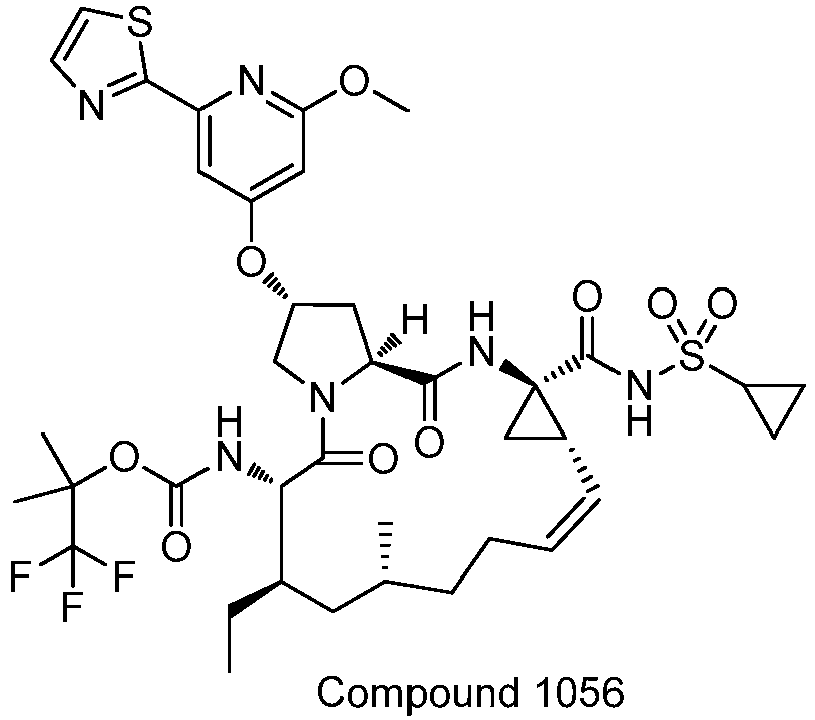
- Compound 1056 was prepared using the intermediates described above and by following the general procedure described for the synthesis of Compound 1001.
- Compound 1056: 1,1,1-trifluoro-2-methylpropan-2-yl ((2R,6S,7R,9R,13aS,4aR,16aS,Z)-14a-((cyclopropylsulfonyl)carbamoyl)-7-ethyl-2-((2-methoxy-6-(thiazol-2-yl)pyridin-4-yl)oxy)-9-methyl-5,16-dioxo-1,2,3,5,6,7,8,9,10,11,13a,14,14a,15,16,16a-hexadecahydrocyclopropa[e]pyrrolo[1,2-a][1,4]diazacyclopentadecin-6-yl)carbamate. 1H-NMR (500MHz, DMSO-d6) δ 8.84 (br. s., 1H), 7.98 - 7.91 (m, 1H), 7.82 (d, J=3.1 Hz, 1H), 7.75 (d, J=9.2 Hz, 1H), 7.29 (s, 1H), 6.36 (s, 1H), 5.63 (br. s., 1H), 5.51 - 5.44 (m, 1H), 5.16 (br. s., 1H), 4.38 (t, J=8.1 Hz, 1H), 4.27 (d, J=11.3 Hz, 1H), 4.03 - 3.98 (m, 1H), 3.91 (t, J=10.1 Hz, 1H), 3.57 (br. s., 3H), 2.82 (br. s., 1H), 2.47 (br. s., 2H), 2.35 - 2.27 (m, 1H), 2.21 (d, J=12.2 Hz, 1H), 1.90 (br. s., 3H), 1.57 - 1.51 (m, 1H), 1.47 (d, J=16.8 Hz, 4H), 1.40 (s, 3H), 1.35 (br. s., 2H), 1.33 (s, 3H), 1.21 (br. s., 1H), 1.15 (d, J=7.0 Hz, 1H), 1.01 (br. s., 1H), 0.96 (d, J=11.3 Hz, 3H), 0.90 (d, J=6.4 Hz, 3H), 0.68 (t, J=7.5 Hz, 3H); MS: MS m/z 855.8 (M++1).
-
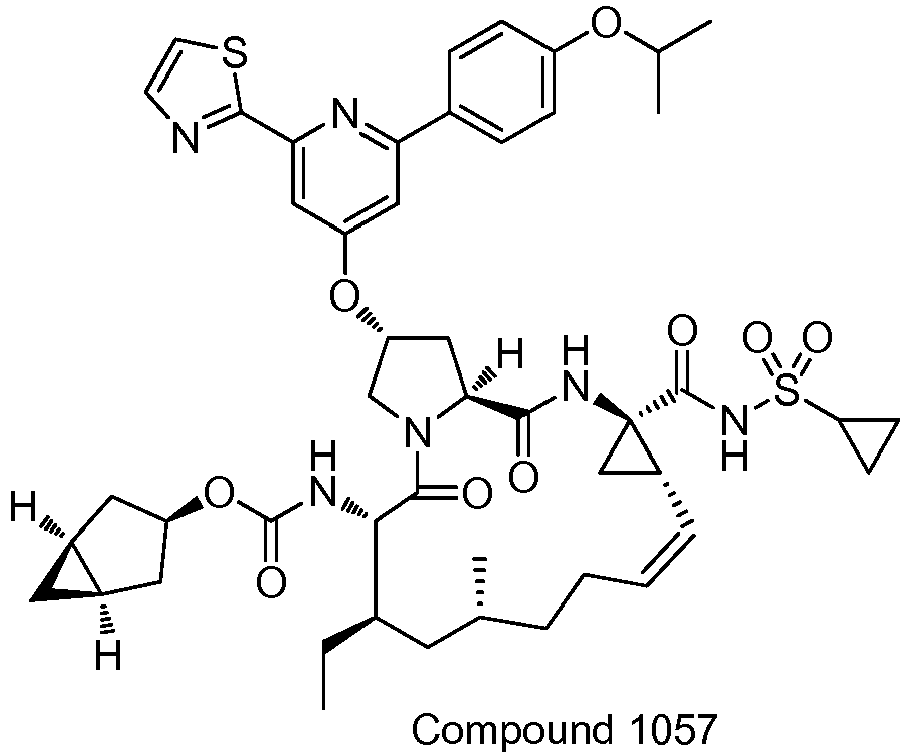
- Compound 1057 was prepared using the intermediates described above and by following the general procedure described for the synthesis of Compound 1001.
- Compound 1057: (1R,3r,5S)-bicyclo[3.1.0]hexan-3-yl ((2R,6S,7R,9R,13aS,4aR,16aS,Z)-14a-((cyclopropylsulfonyl)carbamoyl)-7-ethyl-2-((2-(4-isopropoxyphenyl)-6-(thiazol-2-yl)pyridin-4-yl)oxy)-9-methyl-5,16-dioxo-1,2,3,5,6,7,8,9,10,11,13a,14,14a,15,16,16a-hexadecahydrocyclopropa[e]pyrrolo[1,2-a][1,4]diazacyclopentadecin-6-yl)carbamate. 1H-NMR (500MHz, DMSO-d6) δ 11.16 (br. s., 1H), 9.02 (br. s., 1H), 8.12 - 8.08 (m, J=8.5 Hz, 2H), 7.98 (d, J=3.4 Hz, 1H), 7.84 (d, J=3.1 Hz, 1H), 7.50 (s, 1H), 7.44 (s, 1H), 7.32 (d, J=9.2 Hz, 1H), 7.06 - 7.02 (m, J=8.9 Hz, 2H), 5.54 - 5.48 (m, 2H), 5.05 (br. s., 1H), 4.70 (dt, J=11.9, 6.0 Hz, 1H), 4.57 (t, J=6.6 Hz, 1H), 4.42 - 4.35 (m, 2H), 3.94 - 3.88 (m, 1H), 2.88 (br. s., 1H), 2.60 (br. s., 1H), 2.58 - 2.53 (m, 1H), 2.28 - 2.19 (m, 2H), 1.89 (d, J=13.1 Hz, 2H), 1.85 - 1.78 (m, 1H), 1.65 - 1.55 (m, 2H), 1.53 (br. s., 1H), 1.46 (d, J=14.3 Hz, 1H), 1.40 (br. s., 2H), 1.37 - 1.30 (m, 3H), 1.29 (d, J=6.1 Hz, 7H), 1.25 (s, 1H), 1.09 (d, J=5.8 Hz, 4H), 0.98 - 0.91 (m, 4H), 0.89 (d, J=6.7 Hz, 3H), 0.66 (t, J=7.5 Hz, 3H), 0.27 - 0.23 (m, 2H); MS: MS m/z 929.9 (M++1).
-

- Compound 1058 was prepared using the intermediates described above and by following the general procedure described for the synthesis of Compound 1001.
- Compound 1058: 1,1,1-trifluoro-2-methylpropan-2-yl ((2R,6S,7R,9R,13aS,14aR,16aS,Z)-2-((2,6-bis(5-methylthiazol-2-yl)pyridin-4-yl)oxy)-14a-((cyclopropylsulfonyl)carbamoyl)-7-ethyl-9-methyl-5,16-dioxo-1,2,3,5,6,7,8,9,10,11,13a,14,14a,15,16,16a-hexadecahydrocyclopropa[e]pyrrolo[1,2-a][1,4]diazacyclopentadecin-6-yl)carbamate. 1H-NMR (400MHz, CD3OD) δ 7.63 (s, 3H), 5.64 - 5.55 (m, 1H), 5.44 (br. s., 1H), 5.10 (br. s., 1H), 4.74 (d, J=11.5 Hz, 1H), 4.56 (dd, J=9.9, 6.9 Hz, 1H), 4.06 - 3.98 (m, 2H), 2.96 - 2.89 (m, 1H), 2.74 - 2.63 (m, 2H), 2.57 (s, 6H), 2.45 (ddd, J=14.1, 10.5, 4.3 Hz, 1H), 2.37 (d, J=13.6 Hz, 1H), 2.02 - 1.92 (m, 2H), 1.76 (dd, J=8.3, 5.5 Hz, 1H), 1.59 (dd, J=9.7, 5.4 Hz, 1H), 1.56 - 1.48 (m, 4H), 1.48 - 1.37 (m, 2H), 1.32 (s, 3H), 1.31 - 1.21 (m, 3H), 1.17 (s, 3H), 1.16 - 1.04 (m, 3H), 1.00 (d, J=6.3 Hz, 3H), 0.78 (t, J=7.4 Hz, 3H); MS: MS m/z 936.5 (M++1).
-
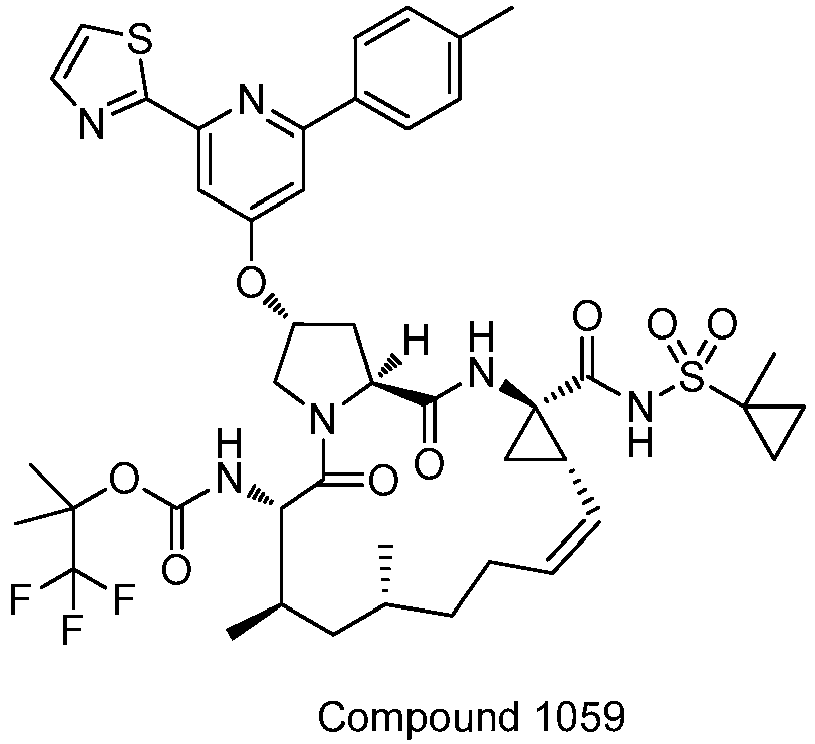
- Compound 1059 was prepared using the intermediates described above and by following the general procedure described for the synthesis of Compound 1001.
- Compound 1059: 1,1,1-trifluoro-2-methylpropan-2-yl ((2R,6S,7R,9R,13aS,14aR,16aS,Z)-7,9-dimethyl-14a-(((1-methylcyclopropyl)sulfonyl)carbamoyl)-5,16-dioxo-2-((2-(thiazol-2-yl)-6-(p-tolyl)pyridin-4-yl)oxy)-1,2,3,5,6,7,8,9,10,11,13a,14,14a,15,16,16a-hexadecahydrocyclopropa[e]pyrrolo[1,2-a][1,4]diazacyclopentadecin-6-yl)carbamate. 1H-NMR (500MHz, DMSO-d6) δ 9.04 (br. s., 1H), 8.06 (d, J=7.6 Hz, 2H), 8.00 (d, J=2.4 Hz, 1H), 7.87 (br. s., 1H), 7.77 (d, J=8.2 Hz, 1H), 7.50 (s, 1H), 7.54 (s, 1H), 7.35 (d, J=7.3 Hz, 2H), 5.58 (br. s., 1H), 5.48 (br. s., 1H), 5.07 (br. s., 1H), 4.48 - 4.39 (m, 2H), 3.90 (d, J=8.9 Hz, 1H), 3.69 (d, J=9.8 Hz, 1H), 2.55 (br. s., 2H), 2.38 (br. s., 3H), 2.26 (d, J=10.1 Hz, 2H), 1.91 (br. s., 1H), 1.81 (br. s., 1H), 1.64 (br. s., 1H), 1.58 (br. s., 1H), 1.46 (br. s., 1H), 1.39 (br. s., 5H), 1.34 - 1.30 (m, 2H), 1.23 (br. s., 4H), 1.16 (br. s., 2H), 1.11 (br. s., 3H), 0.90 (d, J=6.4 Hz, 3H), 0.82 (d, J=5.2 Hz, 3H), 0.69 (br. s., 1H); MS: MS m/z 915.6 (M++1).
-

- Compound 1060 was prepared using the intermediates described above and by following the general procedure described for the synthesis of Compound 1001.
- Compound 1060: 1,1,1-trifluoro-2-methylpropan-2-yl ((2R,6S,7R,9R,13aS,14aR,16aS,Z)-7,9-dimethyl-14a-(((1-methylcyclopropyl)sulfonyl)carbamoyl)-5,16-dioxo-2-((2-phenyl-6-(thiazol-2-yl)pyridin-4-yl)oxy)-1,2,3,5,6,7,8,9,10,11,13a,14,14a,15,16,16a-hexadecahydrocyclopropa[e]pyrrolo[1,2-a][1,4]diazacyclopentadecin-6-yl)carbamate. 1H-NMR (500MHz, DMSO-d6) δ 9.14 (br. s., 1H), 8.15 (d, J=7.3 Hz, 2H), 8.01 (br. s., 1H), 7.88 (br. s., 1H), 7.77 (d, J=8.2 Hz, 1H), 7.58 - 7.46 (m, 5H), 5.59 (br. s., 1H), 5.50 (br. s., 1H), 5.00 (br. s., 1H), 4.51 - 4.41 (m, 2H), 3.90 (d, J=11.9 Hz, 1H), 3.68 (br. s., 1H), 2.60 (br. s., 2H), 2.27 (br. s., 2H), 1.91 (br. s., 1H), 1.81 (br. s., 1H), 1.60 (br. s., 2H), 1.48 (d, J=15.0 Hz, 3H), 1.39 (br. s., 3H), 1.34 (br. s., 2H), 1.25 (br. s., 2H), 1.21 (br. s., 3H), 1.14 - 1.11 (m, 1H), 1.09 (br. s., 3H), 0.90 (d, J=6.4 Hz, 3H), 0.82 (d, J=5.5 Hz, 3H), 0.71 (d, J=12.8 Hz, 1H); MS: MS m/z 901.5 (M++1).
-
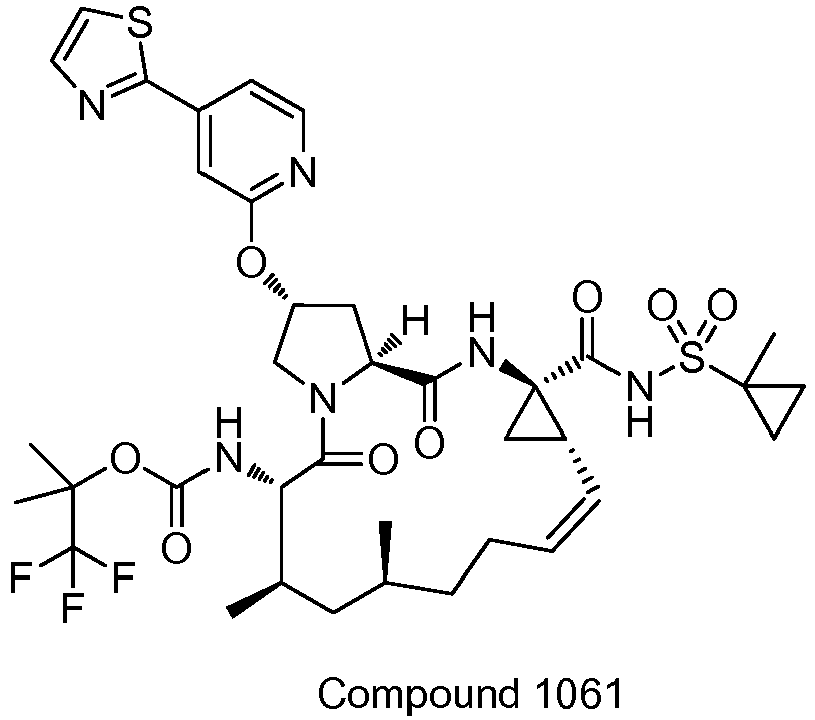
- Compound 1061 was prepared using the intermediates described above and by following the general procedure described for the synthesis of Compound 1001.
- Compound 1061: 1,1,1-trifluoro-2-methylpropan-2-yl ((2R,6S,7R,9S,13aS,14aR,16aS,Z)-7,9-dimethyl-14a-(((1-methylcyclopropyl)sulfonyl)carbamoyl)-5,16-dioxo-2-((4-(thiazol-2-yl)pyridin-2-yl)oxy)-1,2,3,5,6,7,8,9,10,11,13a,14,14a,15,16,16a-hexadecahydrocyclopropa[e]pyrrolo[1,2-a][1,4]diazacyclopentadecin-6-yl)carbamate. MS: MS m/z 825.5 (M++1).
-
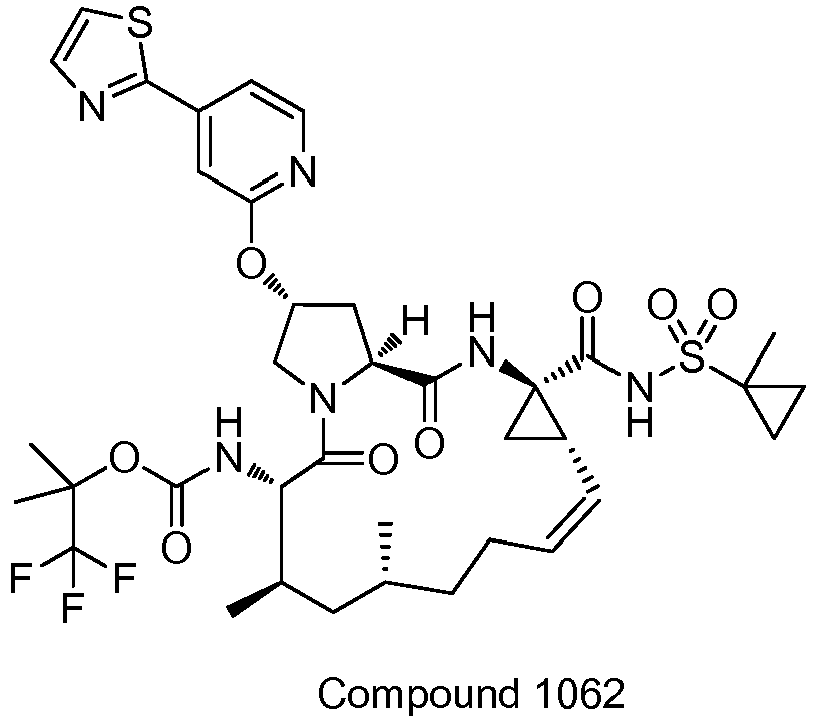
- Compound 1062 was prepared using the intermediates described above and by following the general procedure described for the synthesis of Compound 1001.
- Compound 1062: 1,1,1-trifluoro-2-methylpropan-2-yl ((2R,6S,7R,9R,13aS,14aR,16aS,Z)-7,9-dimethyl-14a-(((1-methylcyclopropyl)sulfonyl)carbamoyl)-5,16-dioxo-2-((4-(thiazol-2-yl)pyridin-2-yl)oxy)-1,2,3,5,6,7,8,9,10,11,13a,14,14a,15,16,16a-hexadecahydrocyclopropa[e]pyrrolo[1,2-a][1,4]diazacyclopentadecin-6-yl)carbamate. 1H-NMR (500MHz, DMSO-d6) δ 11.06 (s, 1H), 9.19 (br. s., 1H), 8.33 (d, J=5.2 Hz, 1H), 8.06 (d, J=3.4 Hz, 1H), 7.99 (d, J=3.4 Hz, 1H), 7.83 (d, J=8.2 Hz, 1H), 7.54 (dd, J=5.3, 1.4 Hz, 1H), 7.20 (s, 1H), 5.71 (br. s., 1H), 5.54 (d, J=6.4 Hz, 1H), 4.96 (t, J=9.9 Hz, 1H), 4.54 - 4.46 (m, 1H), 4.41 (d, J=11.3 Hz, 1H), 3.92 - 3.87 (m, 1H), 3.67 (dd, J=10.7, 8.5 Hz, 1H), 2.73 - 2.65 (m, 1H), 2.39 - 2.24 (m, 2H), 1.95 - 1.80 (m, 2H), 1.63 (d, J=5.8 Hz, 2H), 1.53 (d, J=8.5 Hz, 1H), 1.47 (d, J=10.1 Hz, 1H), 1.42 (s, 4H), 1.36 (br. s., 2H), 1.29 (s, 4H), 1.18 (s, 3H), 1.12 (d, J=12.5 Hz, 1H), 0.92 (d, J=7.0 Hz, 4H), 0.90 - 0.88 (m, 1H), 0.86 (d, J=6.1 Hz, 3H), 0.73 (t, J=12.2 Hz, 1H). MS: MS m/z 825.4 (M++1).
-

- Compound 1063 was prepared using the intermediates described above and by following the general procedure described for the synthesis of Compound 1001.
- Compound 1063: 1,1,1-trifluoro-2-methylpropan-2-yl ((2R,6S,7R,9R,13aS,14aR,16aS,Z)-14a-((cyclopropylsulfonyl)carbamoyl)-7-ethyl-9-methyl-5,16-dioxo-2-((5-(thiazol-2-yl)pyridin-2-yl)oxy)-1,2,3,5,6,7,8,9,10,11,13a,14,14a,15,16,16a-hexadecahydrocyclopropa[e]pyrrolo[1,2-a][1,4]diazacyclopentadecin-6-yl)carbamate. 1H-NMR (500MHz, DMSO-d6) δ 8.80 (br. s., 1H), 8.73 (s, 1H), 8.21 (d, J=8.5 Hz, 1H), 7.97 - 7.82 (m, 1H), 7.82 - 7.67 (m, 2H), 6.88 (d, J=8.5 Hz, 1H), 5.64 (br. s., 1H), 5.46 (br. s., 1H), 5.28 - 5.09 (m, 1H), 4.37 (d, J=12.2 Hz, 2H), 2.80 (br. s., 2H), 2.46 (br. s., 2H), 2.24 (d, J=13.1 Hz, 3H), 1.52 (d, J=18.6 Hz, 2H), 1.45 (br. s., 2H), 1.38 (br. s., 3H), 1.33 (br. s., 4H), 1.28 (br. s., 1H), 1.22 (br. s., 3H), 1.16 (br. s., 1H), 1.00 (br. s., 1H), 0.89 (br. s., 6H), 0.68 (t, J=7.0 Hz, 3H). MS: MS m/z 826.0 (M++1).
-
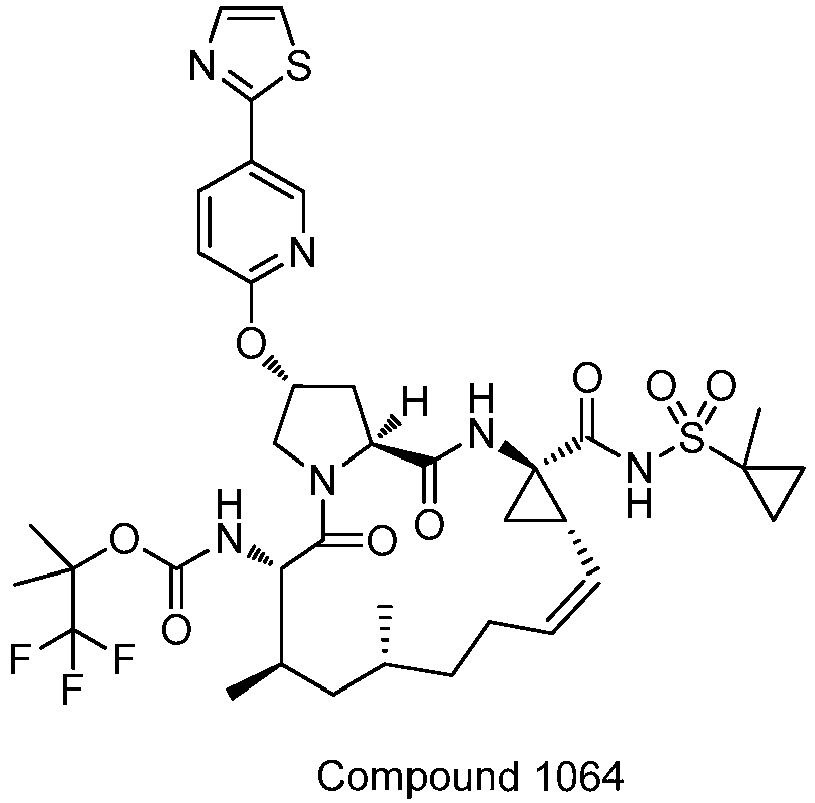
- Compound 1064 was prepared using the intermediates described above and by following the general procedure described for the synthesis of Compound 1001.
- Compound 1064: 1,1,1-trifluoro-2-methylpropan-2-yl ((2R,6S,7R,9R,13aS,14aR,16aS,Z)-7,9-dimethyl-14a-(((1-methylcyclopropyl)sulfonyl)carbamoyl)-5,16-dioxo-2-((5-(thiazol-2-yl)pyridin-2-yl)oxy)-1,2,3,5,6,7,8,9,10,11,13a,14,14a,15,16,16a-hexadecahydrocyclopropa[e]pyrrolo[1,2-a][1,4]diazacyclopentadecin-6-yl)carbamate. 1H-NMR (500MHz, DMSO-d6) δ 11.03 (br. s., 1H), 9.14 (br. s., 1H), 8.74 (s, 1H), 8.22 (d, J=8.9 Hz, 1H), 7.94 - 7.89 (m, 1H), 7.75 (d, J=3.1 Hz, 2H), 6.88 (d, J=8.5 Hz, 1H), 5.66 (br. s., 1H), 5.50 (br. s., 1H), 4.96 (br. s., 1H), 4.47 - 4.34 (m, 2H), 3.89 (d, J=12.2 Hz, 2H), 2.61 (br. s., 1H), 2.24 (br. s., 2H), 1.89 (d, J=10.7 Hz, 1H), 1.82 (br. s., 1H), 1.59 (br. s., 2H), 1.50 (br. s., 1H), 1.38 (br. s., 5H), 1.33 (s, 4H), 1.25 (s, 4H), 1.17 - 1.06 (m, 1H), 0.89 (d, J=6.7 Hz, 3H), 0.88 - 0.85 (m, 1H), 0.83 (d, J=6.1 Hz, 4H), 0.69 (t, J=13.0 Hz, 1H). MS: MS m/z 825.7 (M++1).
-
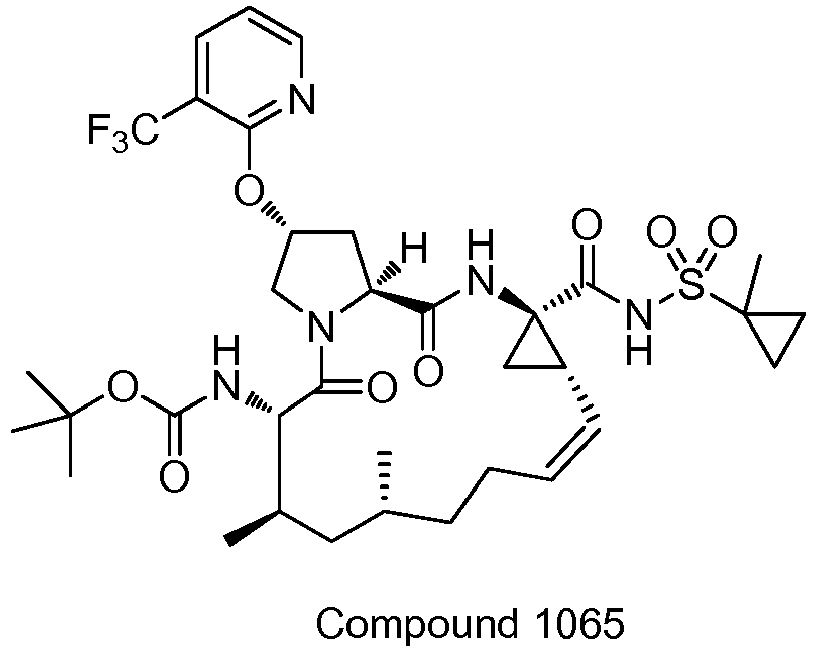
- Compound 1065 was prepared using the intermediates described above and by following the general procedure described for the synthesis of Compound 1001.
- Compound 1065: tert-butyl ((2R,6S,7R,9R,13aS,14aR,16aS,Z)-7,9-dimethyl-14a-(((1-methylcyclopropyl)sulfonyl)carbamoyl)-5,16-dioxo-2-((3-(trifluoromethyl)pyridin-2-yl)oxy)-1,2,3,5,6,7,8,9,10,11,13a,14,14a,15,16,16a-hexadecahydrocyclopropa[e]pyrrolo[1,2-a][1,4]diazacyclopentadecin-6-yl)carbamate. 1H-NMR (500MHz, DMSO-d6) δ 8.93 (br. s., 1H), 8.47 (d, J=4.6 Hz, 1H), 8.07 (d, J=7.6 Hz, 1H), 7.22 - 7.17 (m, 1H), 7.08 (d, J=8.9 Hz, 1H), 5.77 (br. s., 1H), 5.46 (d, J=5.2 Hz, 1H), 5.15 (br. s., 1H), 4.47 - 4.35 (m, 2H), 3.91 (d, J=8.9 Hz, 1H), 3.67 (t, J=9.9 Hz, 1H), 2.55 (d, J=8.9 Hz, 1H), 2.44 (dd, J=13.3, 6.9 Hz, 2H), 2.34 - 2.23 (m, 2H), 1.88 (br. s., 1H), 1.84 - 1.76 (m, 1H), 1.71 - 1.64 (m, 1H), 1.54 (d, J=5.2 Hz, 1H), 1.45 (br. s., 1H), 1.38 (s, 3H), 1.34 (br. s., 3H), 1.26 - 1.21 (m, 1H), 1.17 (s, 9H), 1.13 (br. s., 3H), 0.92 (d, J=6.7 Hz, 3H), 0.84 (d, J=6.4 Hz, 3H), 0.67 (t, J=12.5 Hz, 1H). MS: MS m/z 756.5 (M++1).
-
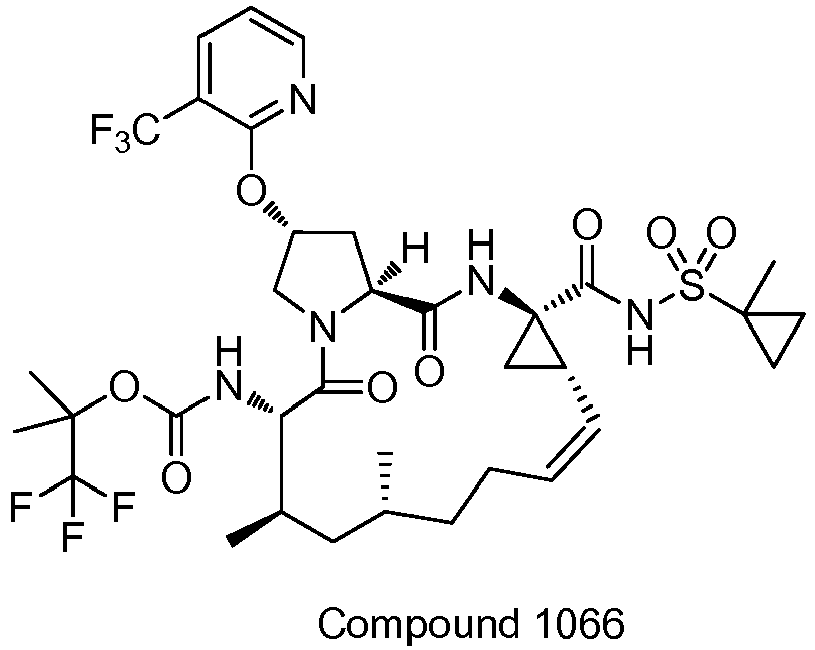
- Compound 1066 was prepared using the intermediates described above and by following the general procedure described for the synthesis of Compound 1001.
- Compound 1066: 1,1,1-trifluoro-2-methylpropan-2-yl ((2R,6S,7R,9R,13aS,14aR,16aS,Z)-7,9-dimethyl-14a-(((1-methylcyclopropyl)sulfonyl)carbamoyl)-5,16-dioxo-2-((3-(trifluoromethyl)pyridin-2-yl)oxy)-1,2,3,5,6,7,8,9,10,11,13a,14,14a,15,16,16a-hexadecahydrocyclopropa[e]pyrrolo[1,2-a][1,4]diazacyclopentadecin-6-yl)carbamate. 1H-NMR (500MHz, CD3OD) δ 8.42 - 8.39 (m, 1H), 8.03 - 7.97 (m, 1H), 7.13 (dd, J=7.3, 5.3 Hz, 1H), 5.85 (t, J=3.1 Hz, 1H), 5.59 (td, J=10.4, 5.6 Hz, 1H), 5.03 (t, J=10.2 Hz, 1H), 4.62 - 4.52 (m, 2H), 3.99 (dd, J=11.8, 3.5 Hz, 1H), 3.80 (d, J=10.8 Hz, 1H), 2.73 - 2.58 (m, 2H), 2.47 - 2.35 (m, 2H), 2.04 - 1.82 (m, 2H), 1.82 - 1.71 (m, 2H), 1.67 - 1.59 (m, 1H), 1.55 (dd, J=9.4, 5.4 Hz, 1H), 1.52 - 1.46 (m, 6H), 1.46 - 1.37 (m, 2H), 1.36 - 1.31 (m, 3H), 1.29 - 1.16 (m, 1H), 0.99 (d, J=6.8 Hz, 3H), 0.96 (d, J=6.5 Hz, 3H), 0.87 - 0.84 (m, 2H), 0.84 - 0.76 (m, 1H). MS: MS m/z 808.5 (M--1).
-

- Compound 1067 was prepared using the intermediates described above and by following the general procedure described for the synthesis of Compound 1001.
- Compound 1067: 1,1,1-trifluoro-2-methylpropan-2-yl ((2R,6S,7R,9R,13aS,14aR,16aS,Z)-2-((4-chloro-3-(trifluoromethyl)pyridin-2-yl)oxy)-7,9-dimethyl-14a-(((1-methylcyclopropyl)sulfonyl)carbamoyl)-5,16-dioxo-1,2,3,5,6,7,8,9,10,11,13a,14,14a,15,16,16a-hexadecahydrocyclopropa[e]pyrrolo[1,2-a][1,4]diazacyclopentadecin-6-yl)carbamate. 1H-NMR (500MHz, CD3OD) δ 8.00 (d, J=7.8 Hz, 1H), 7.20 (d, J=8.0 Hz, 1H), 5.80 (t, J=3.3 Hz, 1H), 5.60 (td, J=10.3, 5.8 Hz, 1H), 5.02 (t, J=9.8 Hz, 1H), 4.66 (d, J=12.0 Hz, 1H), 4.56 (dd, J=10.4, 6.9 Hz, 1H), 4.00 (dd, J=12.0, 3.3 Hz, 1H), 3.80 (d, J=10.8 Hz, 1H), 2.73 - 2.58 (m, 2H), 2.48 - 2.35 (m, 2H), 2.01 - 1.82 (m, 2H), 1.82 - 1.71 (m, 2H), 1.55 (dd, J=9.5, 5.5 Hz, 1H), 1.52 - 1.47 (m, 7H), 1.45 (d, J=2.3 Hz, 1H), 1.43 - 1.38 (m, 2H), 1.35 (s, 3H), 1.29 - 1.15 (m, 1H), 0.98 (t, J=6.3 Hz, 6H), 0.90 - 0.77 (m, 3H). MS: MS m/z 842.4 (M--1).
-
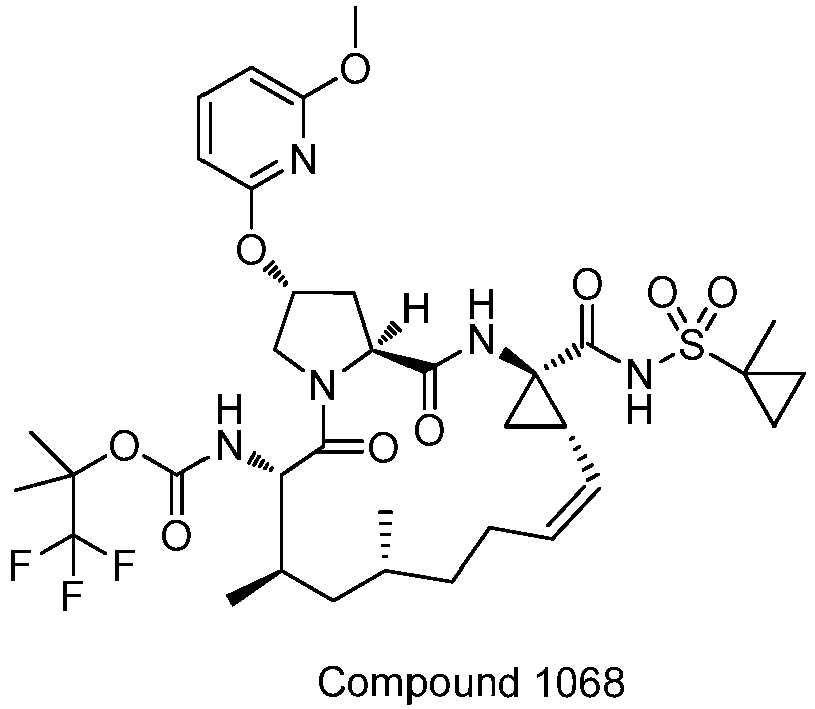
- Compound 1068 was prepared using the intermediates described above and by following the general procedure described for the synthesis of Compound 1001.
- Compound 1068: 1,1,1-trifluoro-2-methylpropan-2-yl ((2R,6S,7R,9R,13aS,14aR,16aS,Z)-2-((6-methoxypyridin-2-yl)oxy)-7,9-dimethyl-14a-(((1-methylcyclopropyl)sulfonyl)carbamoyl)-5,16-dioxo-1,2,3,5,6,7,8,9,10,11,13a,14,14a,15,16,16a-hexadecahydrocyclopropa[e]pyrrolo[1,2-a][1,4]diazacyclopentadecin-6-yl)carbamate. 1H-NMR (500MHz, CD3OD) δ 7.53 (t, J=7.9 Hz, 1H), 6.34 (d, J=7.8 Hz, 1H), 6.28 (d, J=7.8 Hz, 1H), 5.67 - 5.57 (m, 2H), 5.00 (br. s., 1H), 4.55 - 4.49 (m, 2H), 4.04 (dd, J=11.7, 3.6 Hz, 1H), 3.95 - 3.91 (m, 3H), 3.89 (s, 1H), 2.70 (d, J=7.8 Hz, 1H), 2.57 (dd, J=13.6, 7.0 Hz, 1H), 2.43 - 2.33 (m, 2H), 2.02 - 1.87 (m, 2H), 1.75 (dd, J=8.5, 5.5 Hz, 2H), 1.64 (d, J=7.8 Hz, 1H), 1.57 - 1.51 (m, 4H), 1.50 (s, 3H), 1.47 (br. s., 1H), 1.44 - 1.39 (m, 2H), 1.38 (s, 3H), 1.26 - 1.18 (m, 1H), 0.99 (d, J=6.8 Hz, 3H), 0.96 (d, J=6.3 Hz, 3H), 0.89 - 0.74 (m, 3H). MS: MS m/z 770.7 (M--1).
-
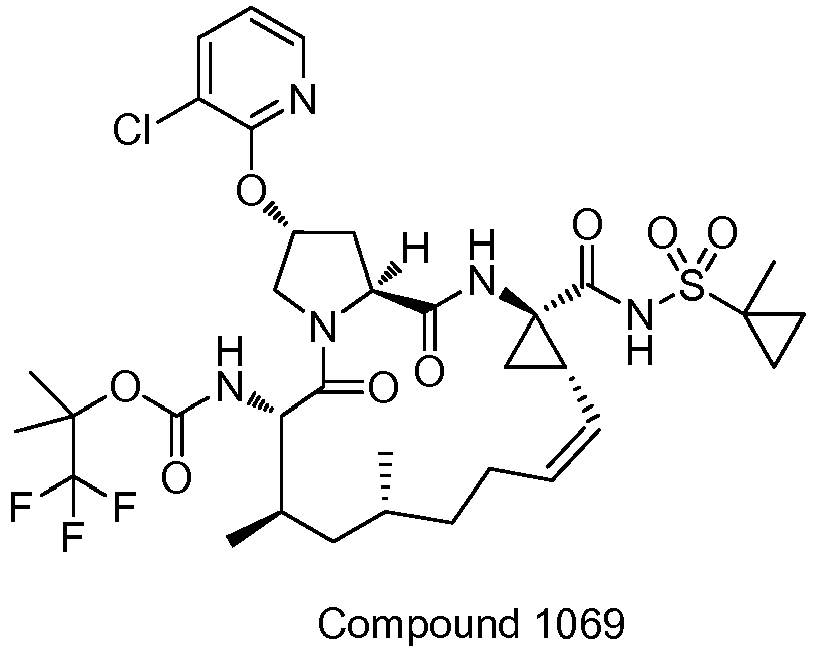
- Compound 1069 was prepared using the intermediates described above and by following the general procedure described for the synthesis of Compound 1001.
- Compound 1069: 1,1,1-trifluoro-2-methylpropan-2-yl ((2R,6S,7R,9R,13aS,14aR,16aS,Z)-2-((3-chloropyridin-2-yl)oxy)-7,9-dimethyl-14a-(((1-methylcyclopropyl)sulfonyl)carbamoyl)-5,16-dioxo-1,2,3,5,6,7,8,9,10,11,13a,14,14a,15,16,16a-hexadecahydrocyclopropa[e]pyrrolo[1,2-a][1,4]diazacyclopentadecin-6-yl)carbamate. 1H-NMR (500MHz, CD3OD) δ 1H NMR (400MHz, METHANOL-d4) Shift 8.10 (dd, J=4.9, 1.6 Hz, 1H), 7.74 (dd, J=7.7, 1.6 Hz, 1H), 6.97 (dd, J=7.7, 4.9 Hz, 1H), 5.76 (br. s., 1H), 5.64 - 5.57 (m, 1H), 5.00 (br. s., 1H), 4.63 - 4.58 (m, 2H), 3.99 (dd, J=11.8, 3.5 Hz, 1H), 3.81 (d, J=11.3 Hz, 1H), 2.71 (d, J=7.8 Hz, 1H), 2.63 (dd, J=13.8, 7.0 Hz, 1H), 2.45 - 2.35 (m, 2H), 2.00 - 1.85 (m, 2H), 1.80 - 1.72 (m, 2H), 1.64 (d, J=9.3 Hz, 1H), 1.55 (dd, J=9.4, 5.6 Hz, 1H), 1.52 - 1.47 (m, 7H), 1.47 - 1.40 (m, 2H), 1.40 - 1.36 (m, 3H), 1.27 - 1.19 (m, 1H), 0.99 (d, J=6.8 Hz, 3H), 0.97 (d, J=6.3 Hz, 3H), 0.89 - 0.77 (m, 3H). MS: MS m/z 774.6 (M--1).
- HCV NS3/4A protease complex enzyme assays and cell-based HCV replicon assays were utilized in the present disclosure, and were prepared, conducted and validated as follows:
- HCV NS3 protease complexes, derived from the BMS strain, H77 strain or J4L6S strain, were generated, as described below. These purified recombinant proteins were generated for use in a homogeneous assay (see below) to provide an indication of how effective compounds of the present disclosure would be in inhibiting HCV NS3 proteolytic activity.
- Serum from an HCV-infected patient was obtained from Dr. T. Wright, San Francisco Hospital. An engineered full-length cDNA (compliment deoxyribonucleic acid) template of the HCV genome (BMS strain) was constructed from DNA fragments obtained by reverse transcription-PCR (RT-PCR) of serum RNA (ribonucleic acid) and using primers selected on the basis of homology between other genotype 1a strains. From the determination of the entire genome sequence, a genotype 1a was assigned to the HCV isolate according to the classification of Simmonds et al. (See P Simmonds, KA Rose, S Graham, SW Chan, F McOmish, BC Dow, EA Follett, PL Yap and H Marsden, J. Clin. Microbiol., 31(6), 1493-1503 (1993)). The amino acid sequence of the nonstructural region, NS2-5B, was shown to be >97% identical to HCV genotype 1a (H77) and 87% identical to genotype 1b (J4L6S). The infectious clones, H77 (1a genotype) and J4L6S (1b genotype) were obtained from R. Purcell (NIH) and the sequences are published in Genbank (AAB67036, see Yanagi,M., Purcell,R.H., Emerson,S.U. and Bukh, J. Proc. Natl. Acad. Sci. U.S.A. 94(16), 8738-8743 (1997); AF054247, see Yanagi,M., St Claire,M., Shapiro,M., Emerson,S.U., Purcell,R.H. and Bukh, J., Virology 244 (1), 161-172. (1998)).
- The H77 and J4L6S strains were used for production of recombinant NS3/4A protease complexes. DNA encoding the recombinant HCV NS3/4A protease complex (amino acids 1027 to 1711) for these strains was manipulated as described by P. Gallinari et al. (see Gallinari P, Paolini C, Brennan D, Nardi C, Steinkuhler C, De Francesco R. Biochemistry. 38(17):5620-32, (1999)). Briefly, a three-lysine solubilizing tail was added at the 3'-end of the NS4A coding region. The cysteine in the P1 position of the NS4A-NS4B cleavage site (amino acid 1711) was changed to a glycine to avoid the proteolytic cleavage of the lysine tag. Furthermore, a cysteine to serine mutation was introduced by PCR at amino acid position 1454 to prevent the autolytic cleavage in the NS3 helicase domain. The variant DNA fragment was cloned in the pET21b bacterial expression vector (Novagen) and the NS3/4A complex was expressed in Escherichia. coli strain BL21 (DE3) (Invitrogen) following the protocol described by P. Gallinari et al. (see Gallinari P, Brennan D, Nardi C, Brunetti M, Tomei L, Steinkuhler C, De Francesco R., J Virol. 72(8):6758-69 (1998)) with modifications. Briefly, the NS3/4A protease complex expression was induced with 0.5 millimolar (mM) Isopropyl β-D-1-thiogalactopyranoside (IPTG) for 22 hours (h) at 20°C. A typical fermentation (1 Liter (L)) yielded approximately 10 grams of wet cell paste. The cells were resuspended in lysis buffer (10 mL/gram) consisting of 25 mM N-(2-Hydroxyethyl)Piperazine-N'-(2-Ethane Sulfonic acid) (HEPES) pH 7.5, 20% glycerol, 500 mM Sodium Chloride (NaCl), 0.5% Triton X-100, 1 microgram/milliliter ("µg/mL") lysozyme, 5 mM Magnesium Chloride (MgCl2), 1 µg/ml DnaseI, 5 mM β-Mercaptoethanol (βME), Protease inhibitor-Ethylenediamine Tetraacetic acid (EDTA)free (Roche). The mixture was homogenized and incubated for 20 minutes (min) at 4°C. The homogenate was sonicated and clarified by ultra-centrifugation at 235,000 g for 1 hour (h) at 4°C. Imidazole was added to the supernatant to a final concentration of 15 mM and the pH was adjusted to 8.0. The crude protein extract was loaded on a Nickel-Nitrilotriacetic acid (Ni-NTA) column pre-equilibrated with buffer B (25 mM HEPES, pH 8.0, 20% glycerol, 500 mM NaCl, 0.5% Triton X-100, 15 mM imidazole, 5 mM βME). The sample was loaded at a flow rate of 1 mL/min. The column was washed with 15 column volumes of buffer C (same as buffer B except with 0.2% Triton X-100). The protein was eluted with 5 column volumes of buffer D (same as buffer C except with 200 mM Imidazole).
- NS3/4A protease complex-containing fractions were pooled and loaded on a desalting column Superdex-S200 pre-equilibrated with buffer E (25 mM HEPES, pH 7.5, 20% glycerol, 300 mM NaCl, 0.2% Triton X-100, 10 mM βME). Sample was loaded and eluted with buffer E at a flow rate of 1 mL/min. NS3/4A protease complex-containing fractions were pooled and concentrated to approximately 0.5 mg/ml. The purity of the NS3/4A protease complexes, derived from the BMS, H77 and J4L6S strains, were judged to be greater than 90% by SDS-PAGE and mass spectrometry analyses. The enzyme was stored at -80 °C, thawed on ice and diluted prior to use in assay buffer.
- The purpose of this in vitro assay was to measure the inhibition of HCV NS3 protease complexes, derived from the BMS strain, H77 strain or J4L6S strain, as described above, by compounds of the present disclosure. This assay provides an indication of how effective compounds of the present disclosure would be in inhibiting HCV NS3 proteolytic activity.
- In order to monitor HCV NS3/4A protease activity, an NS3/4A peptide substrate was used. The substrate was RET S 1 (Resonance Energy Transfer Depsipeptide Substrate; AnaSpec, Inc. cat # 22991)(FRET peptide), described by Taliani et al. in Anal. Biochem. 240(2):60-67 (1996). The sequence of this peptide is loosely based on the NS4A/NS4B natural cleavage site for the HCV NS3 protease except there is an ester linkage rather than an amide bond at the cleavage site. The peptide also contains a fluorescence donor, EDANS, near one end of the peptide and an acceptor, DABCYL, near the other end. The fluorescence of the peptide is quenched by intermolecular resonance energy transfer (RET) between the donor and the acceptor, but as the NS3 protease cleaves the peptide the products are released from RET quenching and the fluorescence of the donor becomes apparent.
- The peptide substrate was incubated with one of the three recombinant NS3/4A protease complexes, in the absence or presence of a compound of the present disclosure. The inhibitory effects of a compound were determined by monitoring the formation of fluorescent reaction product in real time using a Cytofluor Series 4000.
- The reagents were as follow: HEPES and Glycerol (Ultrapure) were obtained from GIBCO-BRL. Dimethyl Sulfoxide (DMSO) was obtained from Sigma. β-Mercaptoethanol was obtained from Bio Rad.
- Assay buffer: 50 mM HEPES pH 7.5; 0.15 M NaCl; 0.1% Triton; 15% Glycerol; 10 mM βME. Substrate: 2 µM final concentration (from a 2 mM stock solution in DMSO stored at -20°C). HCV NS3/4A protease type 1a (1b), 2-3 nM final concentration (from a 5 µM stock solution in 25 mM HEPES pH 7.5, 20% glycerol, 300 mM NaCl, 0.2% Triton-X100, 10 mM βME). For compounds with potencies approaching the assay limit, the assay was made more sensitive by adding 50 µg/ml Bovine Serum Albumin (Sigma) to the assay buffer and reducing the end protease concentration to 300 pM.
- The assay was performed in a 96-well polystyrene black plate from Falcon. Each well contained 25 µl NS3/4A protease complex in assay buffer, 50 µl of a compound of the present disclosure in 10% DMSO/assay buffer and 25 µl substrate in assay buffer. A control (no compound) was also prepared on the same assay plate. The enzyme complex was mixed with compound or control solution for 1 min before initiating the enzymatic reaction by the addition of substrate. The assay plate was read immediately using the Cytofluor Series 4000 (Perspective Biosystems). The instrument was set to read an emission of 340 nm and excitation of 490 nm at 25°C. Reactions were generally followed for approximately 15 min.
- The percent inhibition was calculated with the following equation:

- Compounds of the present disclosure, which were tested against more than one type of NS3/4A complex, were found to have similar inhibitory properties though the compounds uniformly demonstrated greater potency against the 1b strains as compared to the 1a strains.
- An HCV GT1b(Con1) replicon cell system was established as described by Lohmann V, Korner F, Koch J, Herian U, Theilmann L, Bartenschlager R., Science 285(5424):110-3 (1999) and modified to introduce a luciferase reporter (Krieger N, Lohmann V, and Bartenschlager R, J. Virol. 75(10):4614-4624 (2001)). cDNA encoding a humanized form of the Renilla luciferase gene, and a linker sequence fused directly to the 3'-end of the luciferase gene were introduced into the replicon construct using an Asc1 restriction site located in core, directly upstream of the neomycin marker gene. The adaptive mutation at position 1179 (serine to isoleucine) was also introduced (Blight KJ, Kolykhalov, AA, Rice, CM, Science 290(5498):1972-1974). A stable cell line constitutively expressing this HCV replicon construct was generated by first linearizing plasmid DNAs with ScaI. RNA transcripts were synthesized in vitro using the T7 MegaScript transcription kit (Ambion, Austin, TX) according to manufacturer's directions. In vitro transcripts of the cDNA were transfected into the human hepatoma cell line, HUH-7. Selection for cells constitutively expressing the HCV replicon was achieved in the presence of the selectable marker, neomycin (G418). Resulting cell lines were characterized for positive and negative strand RNA production and protein production over time.
- A stable HCV GT1a(H77) replicon luciferase reporter cell line (Yanagi M, Purcell RH, Emerson SU, et al. Transcripts from a single full-length cDNA clone of hepatitis C virus are infectious when directly transfected into the liver of a chimpanzee. Proc Natl Acad Sci USA 1997; 94(16):8738-8743) was generated as described previously for the genotype 1b(Con1) replicon luciferase cell line. The replicon construct was modified by introducing mutations into the genes encoding the NS3 helicase domain (proline replaced by leucine at position 1496) and NS5A (serine to isoleucine at position 2204) to improve replication in cell culture.
- HCV replicon luciferase assays were developed to monitor the inhibitory effects of compounds described in the disclosure on HCV genotypes 1a and 1b viral replication. HUH-7 cells, constitutively expressing the HCV replicon, were grown in Dulbecco's Modified Eagle Media (DMEM) (Gibco-BRL) containing 10% Fetal calf serum (FCS) (Sigma) and 1 mg/mL G418 (Gibco-BRL). Compounds were serially diluted 3 folds in DMSO for a twenty-point titration and subsequently transferred to sterile 384-well tissue-culture treated plates (Corning cat # 3571). The plates were then seeded with 50 µL of cells at a density of 3.0 x 10³ cells/well in DMEM containing 4 % FCS (final DMSO concentration at 0.5 %). After 3 days incubation at 37°C, cells were analyzed for Renilla Luciferase activity using the EnduRen as substrate (Promega cat #E6485). The EnduRen substrate was diluted in DMEM and then added to the plates to a final concentration of 7.5 µM. The plates were incubated for 2 hrs at 37°C and then read immediately for 30 seconds with Viewlux Imager (PerkinElmer) using a luminescence program. To assess cytotoxicity of compounds, CC50 values were generated by multiplexing the EnduRen-containing plates with Cell Titer-Blue (Promega, cat # G8082). Cell-Titer Blue (3 µL) was added to each well and incubated for 8 hrs at 37°C. The fluorescence signal from each well was read, with an excitation wavelength at 525/10 nm and an emission wavelength of 598/10 nm, using the Viewlux Imager.
- The EC50 values for compounds were calculated by using a four-parameter logistic equation:

- Table 2 shows the EC50 values of representative compounds of the present disclosure. Ranges are as follows: A = 0.10 nM - 0.50 nM; B = 0.51 nM - 1.00 nM; C = 1.01 nM - 5.00 nM; D = 5.01 nM - 35.00 nM; E = 35.01 nM - 359.00 nM
Table 2 Compound Number LE_1a (EC50, nM) LE_1a (EC50, range) LE_1b (EC50, nM) LE_1b (EC50, range) 1001 C B 1002 59.00 E 11.64 D 1003 C C 1004 D C 1005 1.48 C 1.71 C 1006 D D 1007 C C 1008 D C 1009 C C 1010 D D 1011 C C 1012 D D 1013 C C 1014 E D 1015 D D 1016 E E 1017 0.95 B 0.82 B 1018 D C 1019 C C 1020 D C 1021 C B 1022 D C 1023 0.46 A 0.40 A 1024 C B 1025 C B 1026 D D 1027 C C 1028 E E 1029 C C 1030 E E 1031 C B 1032 D D 1033 C B 1034 C B 1035 B B 1036 B A 1037 C A 1038 C B 1039 C C 1040 B A 1041 B B 1042 1043 B A 1044 C B 1045 C A 1046 C C 1047 C B 1048 C C 1049 D C 1050 C A 1051 C A 1052 A B 1053 C C 1054 C B 1055 C C 1056 C C 1057 C C 1058 1059 B B 1060 B A 1061 D D 1062 C B 1063 16.69 D 3.51 C 1064 C A 1065 C 1066 B 1067 A 1068 C 1069 A - It will be evident to one skilled in the art that the present disclosure is not limited to the foregoing illustrative examples, and that it can be embodied in other specific forms without departing from the essential attributes thereof. It is therefore desired that the examples be considered in all respects as illustrative and not restrictive, reference being made to the appended claims, rather than to the foregoing examples.
Claims (21)
- A compound of formula (I)
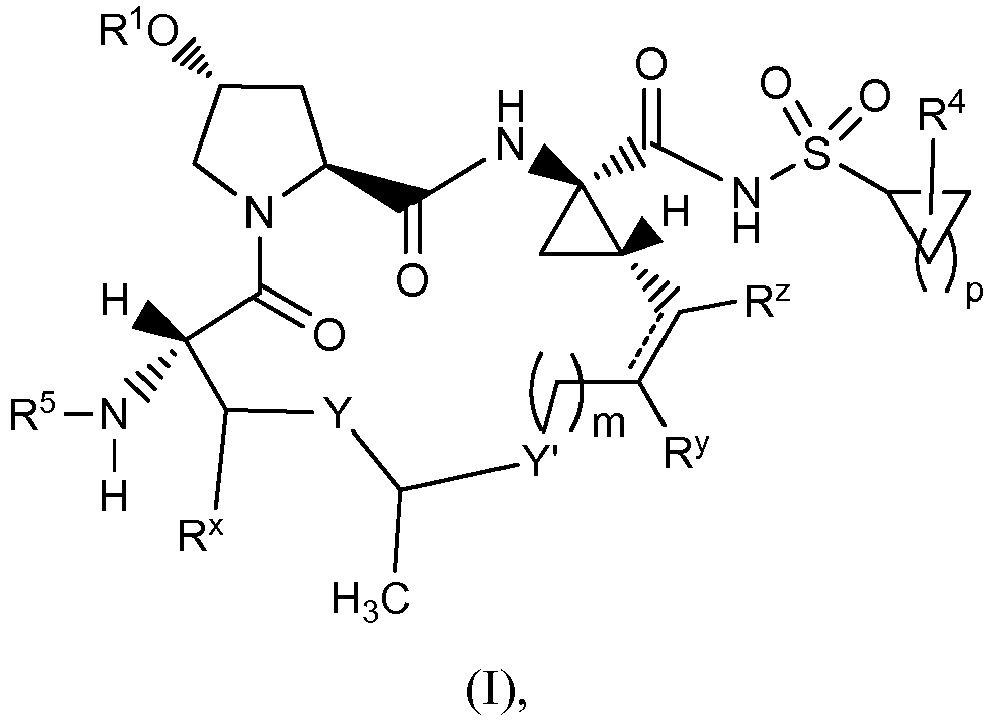 p is 1 or 2;----- is a single or double bond;R1 is
 m is 0, 1, or 2;one of X and X' is N and the other is CH;R2, and R3 are independently selected from hydrogen, alkoxy, alkyl, aryl, halo, and heteroaryl, wherein the aryl and heteroaryl are optionally substituted with one group independently selected from alkoxy and alkyl;R2 is hydrogen;Rx is selected from methyl and ethyl;Ry and Rz are independently selected from hydrogen and hydroxy; provided that when ----- is a double bond, Ry and Rz are each hydrogen;R4 is selected from hydrogen, alkyl, and halo, haloalkoxy, haloalkyl, and hydroxyalkyl;R5 is selected from hydrogen, alkoxyalkoxycarbonyl, alkoxycarbonyl, alkylaminocarbonyl, alkylcarbonyl, cycloalkylalkoxycarbonyl, cycloalkylcarbonyl, cycloalkyloxycarbonyl, deuteroalkoxycarbonyl, deuterohaloalkoxycarbonyl, dialkylaminocarbonyl, dialkylaminocarbonylcarbonyl, haloalkoxycarbonyl, haloalkylaminocarbonyl, haloalkylcarbonyl, heterocyclylcarbonyl, heterocyclyloxycarbonyl, phenylcarbonyl, and phenyloxycarbonyl, wherein the cycloalkyl part of the cycloalkylalkoxycarbonyl, the cycloalkylcarbonyl, and the cycloalkyloxycarbonyl, the heterocyclyl part of the heterocyclylcarbonyl and the heterocyclyloxycarbonyl, and the phenyl part of the phenylcarbonyl and the phenyloxycarbonyl, is optionally substituted with one, two, or three groups independently selected from alkyl, alkylamino, alkylcarbonyl, cycloalkyl, dialkylamino, halo, haloalkoxy, and haloalkyl;
andone of Y and Y' is CH2 and the other is selected from CH2 and Owherein heteroaryl refers to refers to an aromatic five- or six-membered ring where at least one atom is selected from N, O, and S, and the remaining atoms are carbon or bicyclic systems where a heteroaryl ring is fused to a four- to six-membered aromatic or non-aromatic ring containing zero, one, or two additional heteroatoms selected from N, O, and S;
and heterocyclyl refers to a cyclic, non-aromatic, saturated or partially unsaturated five-, six-, or seven-membered ring where at least one atom is selected from oxygen, nitrogen, and sulfur or bicyclic systems where a heterocyclyl ring is fused to a four-to six-membered aromatic or non-aromatic carbocyclic ring or a four- to six-membered non-aromatic ring containing zero, one, or two additional heteratoms selected from nitrogen, oxygen, and sulfur. - A compound of claim 1, or a pharmaceutically acceptable salt thereof, wherein m is 1.
- A compound of claim 2, or a pharmaceutically acceptable salt thereof, wherein ----- is a double bond.
- A compound of claim 1 wherein p is 1.
- A compound of claim 1 wherein R4 is selected from hydrogen and alkyl.
- A compound of claim 1 wherein R5 is selected from alkoxycarbonyl, haloalkoxycarbonyl, heterocyclyloxycarbonyl, and phenyloxycarbonyl, wherein the heterocyclyl part of the heterocyclyloxycarbonyl, and the phenyl part of the phenyloxycarbonyl is optionally substituted with one, two, or three groups independently selected from alkyl, halo, haloalkoxy, and haloalkyl.
- A compound according to claims 1 to 6 of formula (II)
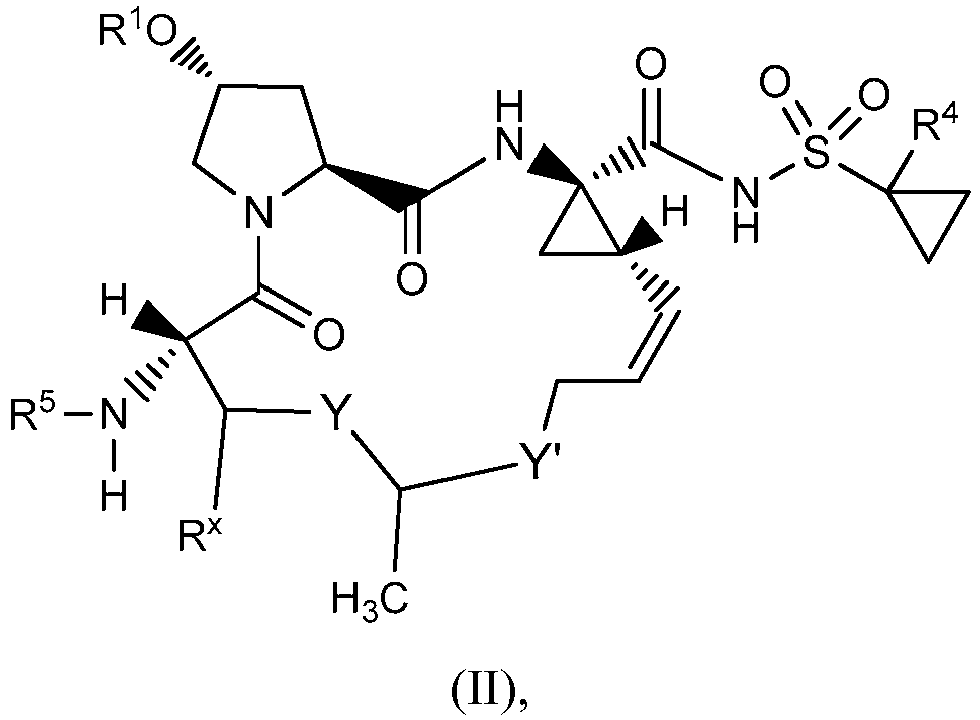 R1 is
R1 is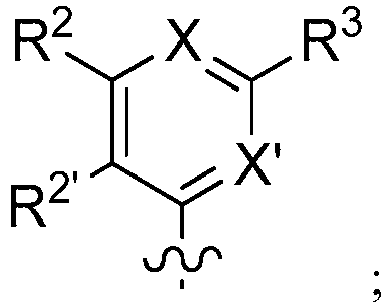 one of X and X' is N and the other is CH;R2, and R3 are independently selected from hydrogen, alkoxy, alkyl, aryl, halo, and heteroaryl, wherein the aryl and heteroaryl are optionally substituted with one group independently selected from alkoxy and alkyl;R2 is hydrogen;Rx is selected from methyl and ethyl;R4 is selected from hydrogen and alkyl;R5 is selected from alkoxycarbonyl, cycloalkoxycarbonyl, haloalkoxycarbonyl, and heterocyclyloxycarbonyl, wherein heterocyclyl part of the heterocyclyloxycarbonyl is optionally substituted with one haloalkyl group; andone of Y and Y' is CH2 and the other is selected from CH2 and O.
 - A compound according to claims 1 to 7 selected from1,1,1-trifluoro-2-methylpropan-2-yl ((2R,6S,7R,9R,13aS,14aR,16aS,Z)-2-((2-(4-isopropoxyphenyl)-6-(pyrazin-2-yl)pyridin-4-yl)oxy)-7,9-dimethyl-14a-(((1-methylcyclopropyl)sulfonyl)carbamoyl)-5,16-dioxo-1,2,3,5,6,7,8,9,10,11,13a,14,14a,15,16,16a-hexadecahydrocyclopropa[e]pyrrolo[1,2-a] [1,4]diazacyclopentadecin-6-yl)carbamate;1,1,1-trifluoro-2-methylpropan-2-yl ((2R,6S,7R,9S,13aS,14aR,16aS,Z)-2-((2-(4-isopropoxyphenyl)-6-(pyrazin-2-yl)pyridin-4-yl)oxy)-7,9-dimethyl-14a-(((1-methylcyclopropyl)sulfonyl)carbamoyl)-5,16-dioxo-1,2,3,5,6,7,8,9,10,11,13a,14,14a,15,16,16a-hexadecahydrocyclopropa[e]pyrrolo[1,2-a][1,4]diazacyclopentadecin-6-yl)carbamate;1,1,1-trifluoro-2-methylpropan-2-yl ((2R,6S,7R,9R,13aS,14aR,16aS,Z)-2-((2-(4-isopropoxyphenyl)-6-(thiazol-5-yl)pyridin-4-yl)oxy)-7,9-dimethyl-14a-(((1-methylcyclopropyl)sulfonyl)carbamoyl)-5,16-dioxo-1,2,3,5,6,7,8,9,10,11,13a,14,14a,15,16,16a-hexadecahydrocyclopropa[e]pyrrolo[1,2-a][1,4]diazacyclopentadecin-6-yl)carbamate;1,1,1-trifluoro-2-methylpropan-2-yl ((2R,6S,7R,9S,13aS,14aR,16aS,Z)-2-((2-(4-isopropoxyphenyl)-6-(thiazol-5-yl)pyridin-4-yl)oxy)-7,9-dimethyl-14a-(((1-methylcyclopropyl)sulfonyl)carbamoyl)-5,16-dioxo-1,2,3,5,6,7,8,9,10,11,13a,14,14a,15,16,16a-hexadecahydrocyclopropa[e]pyrrolo[1,2-a] [1,4]diazacyclopentadecin-6-yl)carbamate;1,1,1-trifluoro-2-methylpropan-2-yl ((2R,6S,7R,9R,13aS,14aR,16aS,Z)-2-((6-(4-isopropoxyphenyl)-[2,3'-bipyridin]-4-yl)oxy)-7,9-dimethyl-14a-(((1-methylcyclopropyl)sulfonyl)carbamoyl)-5,16-dioxo-1,2,3,5,6,7,8,9,10,11,13a,14,14a,15,16,16a-hexadecahydrocyclopropa[e]pyrrolo[1,2-a] [1,4]diazacyclopentadecin-6-yl)carbamate;1,1,1-trifluoro-2-methylpropan-2-yl ((2R,6S,7R,9S,13aS,14aR,16aS,Z)-2-((6-(4-isopropoxyphenyl)-[2,3'-bipyridin]-4-yl)oxy)-7,9-dimethyl-14a-(((1-methylcyclopropyl)sulfonyl)carbamoyl)-5,16-dioxo-1,2,3,5,6,7,8,9,10,11,13a,14,14a,15,16,16a-hexadecahydrocyclopropa[e]pyrrolo[1,2-a][1,4]diazacyclopentadecin-6-yl)carbamate;1,1,1-trifluoro-2-methylpropan-2-yl ((2R,6S,7R,9R,13aS,14aR,16aS,Z)-2-((2-(4-isopropoxyphenyl)-6-(thiazol-2-yl)pyridin-4-yl)oxy)-7,9-dimethyl-14a-(((1-methylcyclopropyl)sulfonyl)carbamoyl)-5,16-dioxo-1,2,3,5,6,7,8,9,10,11,13a,14,14a,15,16,16a-hexadecahydrocyclopropa[e]pyrrolo[1,2-a][1,4]diazacyclopentadecin-6-yl)carbamate;1,1,1-trifluoro-2-methylpropan-2-yl ((2R,6S,7R,9S,13aS,14aR,16aS,Z)-2-((2-(4-isopropoxyphenyl)-6-(thiazol-2-yl)pyridin-4-yl)oxy)-7,9-dimethyl-14a-(((1-methylcyclopropyl)sulfonyl)carbamoyl)-5,16-dioxo-1,2,3,5,6,7,8,9,10,11,13a,14,14a,15,16,16a-hexadecahydrocyclopropa[e]pyrrolo[1,2-a][1,4]diazacyclopentadecin-6-yl)carbamate;1,1,1-trifluoro-2-methylpropan-2-yl ((2R,6S,7R,9R,13aS,14aR,16aS,Z)-2-((6-(4-isopropoxyphenyl)-[2,4'-bipyridin]-4-yl)oxy)-7,9-dimethyl-14a-(((1-methylcyclopropyl)sulfonyl)carbamoyl)-5,16-dioxo-1,2,3,5,6,7,8,9,10,11,13a,14,14a,15,16,16a-hexadecahydrocyclopropa[e]pyrrolo[1,2-a][1,4]diazacyclopentadecin-6-yl)carbamate;1,1,1-trifluoro-2-methylpropan-2-yl ((2R,6S,7R,9S,13aS,14aR,16aS,Z)-2-((6-(4-isopropoxyphenyl)-[2,4'-bipyridin]-4-yl)oxy)-7,9-dimethyl-14a-(((1-methylcyclopropyl)sulfonyl)carbamoyl)-5,16-dioxo-1,2,3,5,6,7,8,9,10,11,13a,14,14a,15,16,16a-hexadecahydrocyclopropa[e]pyrrolo[1,2-a][1,4]diazacyclopentadecin-6-yl)carbamate;1,1,1-trifluoro-2-methylpropan-2-yl ((2R,6S,7R,9R,13aS,14aR,16aS,Z)-2-((6-(4-isopropoxyphenyl)-6'-methoxy-[2,2'-bipyridin]-4-yl)oxy)-7,9-dimethyl-14a-(((1-methylcyclopropyl)sulfonyl)carbamoyl)-5,16-dioxo-1,2,3,5,6,7,8,9,10,11,13a,14,14a,15,16,16a-hexadecahydrocyclopropa[e]pyrrolo[1,2-a][1,4]diazacyclopentadecin-6-yl)carbamate;1,1,1-trifluoro-2-methylpropan-2-yl ((2R,6S,7R,9R,13aS,14aR,16aS,Z)-2-((6-(4-isopropoxyphenyl)-6'-methoxy-[2,2'-bipyridin]-4-yl)oxy)-7,9-dimethyl-14a-(((1-methylcyclopropyl)sulfonyl)carbamoyl)-5,16-dioxo-1,2,3,5,6,7,8,9,10,11,13a,14,14a,15,16,16a-hexadecahydrocyclopropa[e]pyrrolo[1,2-a][1,4]diazacyclopentadecin-6-yl)carbamate;1,1,1-trifluoro-2-methylpropan-2-yl((2R,6S,7R,9R,13aS,14aR,16aS,Z)-2-((2-(4-isopropoxyphenyl)-6-(1H-pyrazol-1-yl)pyridin-4-yl)oxy)-7,9-dimethyl-14a-(((1-methylcyclopropyl)sulfonyl)carbamoyl)-5,16-dioxo-1,2,3,5,6,7,8,9,10,11,13a,14,14a,15,16,16a-hexadecahydrocyclopropa[e]pyrrolo[1,2-a][1,4]diazacyclopentadecin-6-yl)carbamate;1,1,1-trifluoro-2-methylpropan-2-yl ((2R,6S,7R,9S,13aS,14aR,16aS,Z)-2-((2-(4-isopropoxyphenyl)-6-(1H-pyrazol-1-yl)pyridin-4-yl)oxy)-7,9-dimethyl-14a-(((1-methylcyclopropyl)sulfonyl)carbamoyl)-5,16-dioxo-1,2,3,5,6,7,8,9,10,11,13a,14,14a,15,16,16a-hexadecahydrocyclopropa[e]pyrrolo[1,2-a][1,4]diazacyclopentadecin-6-yl)carbamate;1,1,1-trifluoro-2-methylpropan-2-yl ((2R,6S,7R,9R,13aS,14aR,16aS,Z)-7,9-dimethyl-2-((2-methyl-6-(thiazol-5-yl)pyridin-4-yl)oxy)-14a-(((1-methylcyclopropyl)sulfonyl)carbamoyl)-5,16-dioxo-1,2,3,5,6,7,8,9,10,11,13a,14,14a,15,16,16a-hexadecahydrocyclopropa[e]pyrrolo[1,2-a][1,4]diazacyclopentadecin-6-yl)carbamate;1,1,1-trifluoro-2-methylpropan-2-yl ((2R,6S,7R,9S,13aS,14aR,16aS,Z)-7,9-dimethyl-2-((2-methyl-6-(thiazol-5-yl)pyridin-4-yl)oxy)-14a-(((1-methylcyclopropyl)sulfonyl)carbamoyl)-5,16-dioxo-1,2,3,5,6,7,8,9,10,11,13a,14,14a,15,16,16a-hexadecahydrocyclopropa[e]pyrrolo[1,2-a][1,4]diazacyclopentadecin-6-yl)carbamate;3-(trifluoromethyl)tetrahydro-2H-pyran-3-yl ((2R,6S,7R,9R,13aS,14aR,16aS,Z)-2-((2-(4-isopropoxyphenyl)-6-(thiazol-5-yl)pyridin-4-yl)oxy)-7,9-dimethyl-14a-(((1-methylcyclopropyl)sulfonyl)carbamoyl)-5,16-dioxo-1,2,3,5,6,7,8,9,10,11,13a,14,14a,15,16,16a-hexadecahydrocyclopropa[e]pyrrolo[1,2-a][1,4]diazacyclopentadecin-6-yl)carbamate;3-(trifluoromethyl)tetrahydro-2H-pyran-3-yl ((2R,6S,7R,9S,13aS,14aR,16aS,Z)-2-((2-(4-isopropoxyphenyl)-6-(thiazol-5-yl)pyridin-4-yl)oxy)-7,9-dimethyl-14a-(((1-methylcyclopropyl)sulfonyl)carbamoyl)-5,16-dioxo-1,2,3,5,6,7,8,9,10,11,13a,14,14a,15,16,16a-hexadecahydrocyclopropa[e]pyrrolo[1,2-a][1,4]diazacyclopentadecin-6-yl)carbamate;1,1,1-trifluoro-2-methylpropan-2-yl ((2R,6S,7R,9R,13aS,14aR,16aS,Z)-2-((2-(4-isopropoxyphenyl)-6-(pyrimidin-2-yl)pyridin-4-yl)oxy)-7,9-dimethyl-14a-(((1-methylcyclopropyl)sulfonyl)carbamoyl)-5,16-dioxo-1,2,3,5,6,7,8,9,10,11,13a,14,14a,15,16,16a-hexadecahydrocyclopropa[e]pyrrolo[1,2-a][1,4]diazacyclopentadecin-6-yl)carbamate;1,1,1-trifluoro-2-methylpropan-2-yl ((2R,6S,7R,9S,13aS,14aR,16aS,Z)-2-((2-(4-isopropoxyphenyl)-6-(pyrimidin-2-yl)pyridin-4-yl)oxy)-7,9-dimethyl-14a-(((1-methylcyclopropyl)sulfonyl)carbamoyl)-5,16-dioxo-1,2,3,5,6,7,8,9,10,11,13a,14,14a,15,16,16a-hexadecahydrocyclopropa[e]pyrrolo[1,2-a][1,4]diazacyclopentadecin-6-yl)carbamate;1,1,1-trifluoro-2-methylpropan-2-yl ((2R,6S,7R,9R,13aS,14aR,16aS,Z)-2-((6-(4-isopropoxyphenyl)-[2,2'-bipyridin]-4-yl)oxy)-7,9-dimethyl-14a-(((1-methylcyclopropyl)sulfonyl)carbamoyl)-5,16-dioxo-1,2,3,5,6,7,8,9,10,11,13a,14,14a,15,16,16a-hexadecahydrocyclopropa[e]pyrrolo[1,2-a][1,4]diazacyclopentadecin-6-yl)carbamate;1,1,1-trifluoro-2-methylpropan-2-yl ((2R,6S,7R,9S,13aS,14aR,16aS,Z)-2-((6-(4-isopropoxyphenyl)-[2,2'-bipyridin]-4-yl)oxy)-7,9-dimethyl-14a-(((1-methylcyclopropyl)sulfonyl)carbamoyl)-5,16-dioxo-1,2,3,5,6,7,8,9,10,11,13a,14,14a,15,16,16a-hexadecahydrocyclopropa[e]pyrrolo[1,2-a][1,4]diazacyclopentadecin-6-yl)carbamate;1,1,1-trifluoro-2-methylpropan-2-yl ((2R,6S,7R,9R,13aS,14aR,16aS,Z)-2-((2,6-di(thiazol-2-yl)pyridin-4-yl)oxy)-7,9-dimethyl-14a-(((1-methylcyclopropyl)sulfonyl)carbamoyl)-5,16-dioxo-1,2,3,5,6,7,8,9,10,11,13a,14,14a,15,16,16a-hexadecahydrocyclopropa[e]pyrrolo[1,2-a][1,4]diazacyclopentadecin-6-yl)carbamate;1,1,1-trifluoro-2-methylpropan-2-yl ((2R,6S,7R,9S,13aS,14aR,16aS,Z)-2-((2,6-di(thiazol-2-yl)pyridin-4-yl)oxy)-7,9-dimethyl-14a-(((1-methylcyclopropyl)sulfonyl)carbamoyl)-5,16-dioxo-1,2,3,5,6,7,8,9,10,11,13a,14,14a,15,16,16a-hexadecahydrocyclopropa[e]pyrrolo[1,2-a][1,4]diazacyclopentadecin-6-yl)carbamate;1,1,1-trifluoro-2-methylpropan-2-yl ((2R,6S,7R,9R,13aS,14aR,16aS,Z)-7,9-dimethyl-14a-(((1-methylcyclopropyl)sulfonyl)carbamoyl)-5,16-dioxo-2-((2-(thiazol-2-yl)pyridin-4-yl)oxy)-1,2,3,5,6,7,8,9,10,11,13a,14,14a,15,16,16a-hexadecahydrocyclopropa[e]pyrrolo[1,2-a][1,4]diazacyclopentadecin-6-yl)carbamate;1,1,1-trifluoro-2-methylpropan-2-yl ((2R,6S,7R,9R,13aS,14aR,16aS,Z)-2-((4-chloropyridin-2-yl)oxy)-14a-((cyclopropylsulfonyl)carbamoyl)-7,9-dimethyl-5,16-dioxo-1,2,3,5,6,7,8,9,10,11,13a,14,14a,15,16,16a-hexadecahydrocyclopropa[e]pyrrolo[1,2-a][1,4]diazacyclopentadecin-6-yl)carbamate;1,1,1-trifluoro-2-methylpropan-2-yl ((2R,6S,7R,9R,13aS,14aR,16aS,Z)-2-((4-chloro-6-(4-isopropoxyphenyl)pyridin-2-yl)oxy)-7,9-dimethyl-14a-(((1-methylcyclopropyl)sulfonyl)carbamoyl)-5,16-dioxo-1,2,3,5,6,7,8,9,10,11,13a,14,14a,15,16,16a-hexadecahydrocyclopropa[e]pyrrolo[1,2-a][1,4]diazacyclopentadecin-6-yl)carbamate;1,1,1-trifluoro-2-methylpropan-2-yl ((2R,6S,7R,9S,13aS,14aR,16aS,Z)-2-((4-chloro-6-(4-isopropoxyphenyl)pyridin-2-yl)oxy)-7,9-dimethyl-14a-(((1-methylcyclopropyl)sulfonyl)carbamoyl)-5,16-dioxo-1,2,3,5,6,7,8,9,10,11,13 a,14,14a,15,16,16a-hexadecahydrocyclopropa[e]pyrrolo[1,2-a][1,4]diazacyclopentadecin-6-yl)carbamate;tert-butyl ((2R,6S,7R,9R,13aS,14aR,16aS,Z)-2-((4-chloro-6-(4-isopropoxyphenyl)pyridin-2-yl)oxy)-7,9-dimethyl-14a-(((1-methylcyclopropyl)sulfonyl)carbamoyl)-5,16-dioxo-1,2,3,5,6,7,8,9,10,11,13a,14,14a,15,16,16a-hexadecahydrocyclopropa[e]pyrrolo[1,2-a][1,4]diazacyclopentadecin-6-yl)carbamate;tert-butyl ((2R,6S,7R,9S,13aS,14aR,16aS,Z)-2-((4-chloro-6-(4-isopropoxyphenyl)pyridin-2-yl)oxy)-7,9-dimethyl-14a-(((1-methylcyclopropyl)sulfonyl)carbamoyl)-5,16-dioxo-1,2,3,5,6,7,8,9,10,11,13a,14,14a,15,16,16a-hexadecahydrocyclopropa[e]pyrrolo[1,2-a][1,4]diazacyclopentadecin-6-yl)carbamate;1,1,1-trifluoro-2-methylpropan-2-yl ((2R,6S,7R,9R,13aS,14aR,16aS,Z)-7,9-dimethyl-14a-(((1-methylcyclopropyl)sulfonyl)carbamoyl)-5,16-dioxo-2-((4-(thiazol-2-yl)pyridin-2-yl)oxy)-1,2,3,5,6,7,8,9,10,11,13a,14,14a,15,16,16a-hexadecahydrocyclopropa[e]pyrrolo[1,2-a][1,4]diazacyclopentadecin-6-yl)carbamate;1,1,1-trifluoro-2-methylpropan-2-yl ((2R,6S,7R,9S,13aS,14aR,16aS,Z)-7,9-dimethyl-14a-(((1-methylcyclopropyl)sulfonyl)carbamoyl)-5,16-dioxo-2-((4-(thiazol-2-yl)pyridin-2-yl)oxy)-1,2,3,5,6,7, 8,9,10,11,13 a,14,14a,15,16,16a-hexadecahydrocyclopropa[e]pyrrolo[1,2-a][1,4]diazacyclopentadecin-6-yl)carbamate;1,1,1-trifluoro-2-methylpropan-2-yl ((2R,6S,7S,9R,13aS,14aR,16aS,Z)-7-ethyl-2-((2-(4-isopropoxyphenyl)-6-(thiazol-5-yl)pyridin-4-yl)oxy)-9-methyl-14a-(((1-methylcyclopropyl)sulfonyl)carbamoyl)-5,16-dioxo-2,3,5,6,7,9,10,11,13a,14,14a,15,16,16a-tetradecahydro-1H-cyclopropa[i]pyrrolo[1,2-e][1,5,8]oxadiazacyclopentadecin-6-yl)carbamate;3-(trifluoromethyl)tetrahydro-2H-pyran-3-yl ((2R,6S,7S,9R,13aS,14aR,16aS,Z)-7-ethyl-2-((2-(4-isopropoxyphenyl)-6-(thiazol-5-yl)pyridin-4-yl)oxy)-9-methyl-14a-(((1-methylcyclopropyl)sulfonyl)carbamoyl)-5,16-dioxo-2,3,5,6,7,9,10,11,13a,14,14a,15,16,16a-tetradecahydro-1H-cyclopropa[i]pyrrolo[1,2-e][1,5,8]oxadiazacyclopentadecin-6-yl)carbamate;3-(trifluoromethyl)tetrahydro-2H-pyran-3-yl ((2R,6S,7S,9R,13aS,14aR,16aS,Z)-7-ethyl-2-((2-(4-isopropoxyphenyl)-6-(thiazol-2-yl)pyridin-4-yl)oxy)-9-methyl-14a-(((1-methylcyclopropyl)sulfonyl)carbamoyl)-5,16-dioxo-2,3,5,6,7,9,10,11,13a,14,14a,15,16,16a-tetradecahydro-1H-cyclopropa[i]pyrrolo[1,2-e][1,5,8]oxadiazacyclopentadecin-6-yl)carbamate;3-(trifluoromethyl)tetrahydro-2H-pyran-3-yl ((2R,6S,7S,9R,13aS,14aR,16aS,Z)-7-ethyl-2-((2-(4-isopropoxyphenyl)-6-(thiazol-4-yl)pyridin-4-yl)oxy)-9-methyl-14a-(((1-methylcyclopropyl)sulfonyl)carbamoyl)-5,16-dioxo-2,3,5,6,7,9,10,11,13a,14,14a,15,16,16a-tetradecahydro-1H-cyclopropa[i]pyrrolo[1,2-e][1,5,8]oxadiazacyclopentadecin-6-yl)carbamate;3-(trifluoromethyl)tetrahydro-2H-pyran-3-yl ((2R,6S,7S,9R,13aS,14aR,16aS,Z)-7-ethyl-2-((6-(4-isopropoxyphenyl)-[2,2'-bipyridin]-4-yl)oxy)-9-methyl-14a-(((1-methylcyclopropyl)sulfonyl)carbamoyl)-5,16-dioxo-2,3,5,6,7,9,10,11,13a,14,14a,15,16,16a-tetradecahydro-1H-cyclopropa[i]pyrrolo[1,2-e][1,5,8]oxadiazacyclopentadecin-6-yl)carbamate;1,1,1-trifluoro-2-methylpropan-2-yl ((2R,6S,7S,9R,13aS,14aR,16aS,Z)-7-ethyl-9-methyl-14a-(((1-methylcyclopropyl)sulfonyl)carbamoyl)-5,16-dioxo-2-((2-(thiazol-2-yl)-6-(4-(trifluoromethyl)phenyl)pyridin-4-yl)oxy)-2,3,5,6,7,9,10,11,13 a,14,14a,15,16,16a-tetradecahydro-1H-cyclopropa[i]pyrrolo[1,2-e][1,5,8]oxadiazacyclopentadecin-6-yl)carbamate;3-(trifluoromethyl)tetrahydro-2H-pyran-3-yl ((2R,6S,7S,9R,13aS,4aR,16aS,Z)-7-ethyl-9-methyl-14a-(((1-methylcyclopropyl)sulfonyl)carbamoyl)-5,16-dioxo-2-((2-(thiazol-2-yl)-6-(4-(trifluoromethyl)phenyl)pyridin-4-yl)oxy)-2,3,5,6,7,9,10,11,13a,14,14a,15,16,16a-tetradecahydro-1H-cyclopropa[i]pyrrolo[1,2-e][1,5,8]oxadiazacyclopentadecin-6-yl)carbamate;3-(trifluoromethyl)tetrahydro-2H-pyran-3-yl ((2R,6S,7R,9R,13aS,14aR,16aS,Z)-2-((2-(4-isopropoxyphenyl)-6-(thiazol-2-yl)pyridin-4-yl)oxy)-7,9-dimethyl-14a-(((1-methylcyclopropyl)sulfonyl)carbamoyl)-5,16-dioxo-1,2,3,5,6,7,8,9,10,11,13a,14,14a,15,16,16a-hexadecahydrocyclopropa[e]pyrrolo[1,2-a][1,4]diazacyclopentadecin-6-yl)carbamate;3-(trifluoromethyl)tetrahydro-2H-pyran-3-yl ((2R,6S,7R,9S,13aS,14aR,16aS,Z)-2-((2-(4-isopropoxyphenyl)-6-(thiazol-2-yl)pyridin-4-yl)oxy)-7,9-dimethyl-14a-(((1-methylcyclopropyl)sulfonyl)carbamoyl)-5,16-dioxo-1,2,3,5,6,7,8,9,10,11,13a,14,14a,15,16,16a-hexadecahydrocyclopropa[e]pyrrolo[1,2-a][1,4]diazacyclopentadecin-6-yl)carbamate;1,1,1-trifluoro-2-methylpropan-2-yl ((2R,6S,7R,9R,13aS,14aR,16aS,Z)-7,9-dimethyl-14a-(((1-methylcyclopropyl)sulfonyl)carbamoyl)-2-((2-(5-methylthiazol-2-yl)pyridin-4-yl)oxy)-5,16-dioxo-1,2,3,5,6,7,8,9,10,11,13a,14,14a,15,16,16a-hexadecahydrocyclopropa[e]pyrrolo[1,2-a][1,4]diazacyclopentadecin-6-yl)carbamate;3-(trifluoromethyl)tetrahydro-2H-pyran-3-yl ((2R,6S,7R,9R,3aS,14aR,16aS,Z)-7,9-dimethyl-14a-(((1-methylcyclopropyl)sulfonyl)carbamoyl)-2-((2-(5-methylthiazol-2-yl)pyridin-4-yl)oxy)-5,16-dioxo-1,2,3,5,6,7,8,9,10,11,13a,14,14a,15,16,16a-hexadecahydrocyclopropa[e]pyrrolo[1,2-a][1,4]diazacyclopentadecin-6-yl)carbamate;1,1,1-trifluoro-2-methylpropan-2-yl ((2R,6S,7R,9R,13aS,14aR,16aS,Z)-7,9-dimethyl-14a-(((1-methylcyclopropyl)sulfonyl)carbamoyl)-2-((2-(4-methylthiazol-2-yl)pyridin-4-yl)oxy)-5,16-dioxo-1,2,3,5,6,7,8,9,10,11,13a,14,14a,15,16,16a-hexadecahydrocyclopropa[e]pyrrolo[1,2-a][1,4]diazacyclopentadecin-6-yl)carbamate;1,1,1-trifluoro-2-methylpropan-2-yl((2R,6S,7R,9R,13aS,14aR,16aS,Z)-2-((6'-isopropoxy-6-(thiazol-2-yl)-[2,3'-bipyridin]-4-yl)oxy)-7,9-dimethyl-14a-((((1-methylcyclopropyl)sulfonyl)carbamoyl)-5,16-dioxo-1,2,3,5,6,7,8,9,10,11,13a,14,14a,15,16,16a-hexadecahydrocyclopropa[e]pyrrolo[1,2-a][1,4]diazacyclopentadecin-6-yl)carbamate;3-(trifluoromethyl)tetrahydro-2H-pyran-3-yl ((2R,6S,7R,9R,13aS,14aR,16aS,Z)-2-((6'-isopropoxy-6-(thiazol-2-yl)-[2,3'-bipyridin]-4-yl)oxy)-7,9-dimethyl-14a-(((1-methylcyclopropyl)sulfonyl)carbamoyl)-5,16-dioxo-1,2,3,5,6,7,8,9,10,11,13a,14,14a,15,16,16a-hexadecahydrocyclopropa[e]pyrrolo[1,2-a][1,4]diazacyclopentadecin-6-yl)carbamate;3-(trifluoromethyl)tetrahydro-2H-pyran-3-yl ((2R,6S,7R,9R,13aS,14aR,16aS,Z)-2-((2-(4-isopropoxyphenyl)-6-(pyrimidin-2-yl)pyridin-4-yl)oxy)-7,9-dimethyl-14a-(((1-methylcyclopropyl)sulfonyl)carbamoyl)-5,16-dioxo-1,2,3,5,6,7,8,9,10,11,13a,14,14a,15,16,16a-hexadecahydrocyclopropa[e]pyrrolo[1,2-a][1,4]iazacyclopentadecin-6-yl)carbamate;3-(trifluoromethyl)tetrahydro-2H-pyran-3-yl ((2R,6S,7R,9R,13aS,14aR,16aS,Z)-7,9-dimethyl-14a-(((1-methylcyclopropyl)sulfonyl)carbamoyl)-5,16-dioxo-2-((6-(thiazol-2-yl)-[2,3'-bipyridin]-4-yl)oxy)-1,2,3,5,6,7,8,9,10,11,13a,14,14a,15,16,16a-hexadecahydrocyclopropa[e]pyrrolo[1,2-a][1,4]diazacyclopentadecin-6-yl)carbamate;1,1,1-trifluoro-2-methylpropan-2-yl ((2R,6S,7R,9R,13aS,14aR,16aS,Z)-7,9-dimethyl-14a-(((1-methylcyclopropyl)sulfonyl)carbamoyl)-5,16-dioxo-2-((6-(thiazol-2-yl)-[2,3'-bipyridin]-4-yl)oxy)-1,2,3,5,6,7,8,9,10,11,13a,14,14a,15,16,16a-hexadecahydrocyclopropa[e]pyrrolo[1,2-a][1,4]diazacyclopentadecin-6-yl)carbamate;3-(trifluoromethyl)tetrahydro-2H-pyran-3-yl ((2R,6S,7R,9R,13aS,14aR,16aS,Z)-2-((6-(4-isopropoxyphenyl)-[2,2'-bipyridin]-4-yl)oxy)-7,9-dimethyl-14a-(((1-methylcyclopropyl)sulfonyl)carbamoyl)-5,16-dioxo-1,2,3,5,6,7,8,9,10,11,13a,14,14a,15,16,16a-hexadecahydrocyclopropa[e]pyrrolo[1,2-a][1,4]diazacyclopentadecin-6-yl)carbamate;3-(trifluoromethyl)tetrahydro-2H-pyran-3-yl ((2R,6S,7R,9R,13aS,14aR,16aS,Z)-2-((2-(4-isopropoxyphenyl)-6-(thiazol-4-yl)pyridin-4-yl)oxy)-7,9-dimethyl-14a-(((1-methylcyclopropyl)sulfonyl)carbamoyl)-5,16-dioxo-1,2,3,5,6,7,8,9,10,11,13a,14,14a,15,16,16a-hexadecahydrocyclopropa[e]pyrrolo[1,2-a][1,4]diazacyclopentadecin-6-yl)carbamate;1,1,1-trifluoro-2-methylpropan-2-yl ((2R,6S,7R,9R,13aS,14aR,16aS,Z)-14a-((cyclopropylsulfonyl)carbamoyl)-7-ethyl-9-methyl-5,16-dioxo-2-((2-(thiazol-2-yl)-6-(4-(trifluoromethyl)phenyl)pyridin-4-yl)oxy)-1,2,3,5,6,7,8,9,10,11,13a,14,14a,15,16,16a-hexadecahydrocyclopropa[e]pyrrolo[1,2-a][1,4]diazacyclopentadecin-6-yl)carbamate;3-(trifluoromethyl)tetrahydro-2H-pyran-3-yl ((2R,6S,7R,9R,13aS,14aR,16aS,Z)-14a-((cyclopropylsulfonyl)carbamoyl)-7-ethyl-9-methyl-5,16-dioxo-2-((2-(thiazol-2-yl)-6-(4-(trifluoromethyl)phenyl)pyridin-4-yl)oxy)-1,2,3,5,6,7,8,9,10,11,13a,14,14a,15,16,16a-hexadecahydrocyclopropa[e]pyrrolo[1,2-a][1,4]diazacyclopentadecin-6-yl)carbamate;1,1,1-trifluoro-2-methylpropan-2-yl ((2R,6S,7R,9R,13aS,14aR,16aS,Z)-7-ethyl-9-methyl-14a-(((1-methylcyclopropyl)sulfonyl)carbamoyl)-2-((2-(4-methylthiazol-2-yl)pyridin-4-yl)oxy)-5,16-dioxo-1,2,3,5,6,7,8,9,10,11,13a,14,14a,15,16,16a-hexadecahydrocyclopropa[e]pyrrolo[1,2-a][1,4]diazacyclopentadecin-6-yl)carbamate;1,1,1-trifluoro-2-methylpropan-2-yl ((2R,6S,7R,9R,13aS,14aR,16aS,Z)-14a-((cyclopropylsulfonyl)carbamoyl)-7-ethyl-2-((2-methoxy-6-(thiazol-2-yl)pyridin-4-yl)oxy)-9-methyl-5,16-dioxo-1,2,3,5,6,7,8,9,10,11,13a,14,14a,15,16,16a-hexadecahydrocyclopropa[e]pyrrolo[1,2-a][1,4]diazacyclopentadecin-6-yl)carbamate;(1R,3r,5S)-bicyclo[3.1.0]hexan-3-yl ((2R,6S,7R,9R,13aS,14aR,16aS,Z)-14a-((cyclopropylsulfonyl)carbamoyl)-7-ethyl-2-((2-(4-isopropoxyphenyl)-6-(thiazol-2-yl)pyridin-4-yl)oxy)-9-methyl-5,16-dioxo-1,2,3,5,6,7,8,9,10,11,13a,14,14a,15,16,16a-hexadecahydrocyclopropa[e]pyrrolo[1,2-a][1,4]diazacyclopentadecin-6-yl)carbamate;1,1,1-trifluoro-2-methylpropan-2-yl ((2R,6S,7R,9R,13aS,14aR,16aS,Z)-2-((2,6-bis(5-methylthiazol-2-yl)pyridin-4-yl)oxy)-14a-((cyclopropylsulfonyl)carbamoyl)-7-ethyl-9-methyl-5,16-dioxo-1,2,3,5,6,7,8,9,10,11,13a,14,14a,15,16,16a-hexadecahydrocyclopropa[e]pyrrolo[1,2-a][1,4]diazacyclopentadecin-6-yl)carbamate;1,1,1-trifluoro-2-methylpropan-2-yl ((2R,6S,7R,9R,13aS,14aR,16aS,Z)-7,9-dimethyl-14a-(((1-methylcyclopropyl)sulfonyl)carbamoyl)-5,16-dioxo-2-((2-(thiazol-2-yl)-6-(p-tolyl)pyridin-4-yl)oxy)-1,2,3,5,6,7,8,9,10,11,13a,14,14a,15,16,16a-hexadecahydrocyclopropa[e]pyrrolo[1,2-a][1,4]diazacyclopentadecin-6-yl)carbamate;1,1,1-trifluoro-2-methylpropan-2-yl ((2R,6S,7R,9R,13aS,14aR,16aS,Z)-7,9-dimethyl-14a-(((1-methylcyclopropyl)sulfonyl)carbamoyl)-5,16-dioxo-2-((2-phenyl-6-(thiazol-2-yl)pyridin-4-yl)oxy)-1,2,3,5,6,7,8,9,10,11,133a,14,14a,15,16,16a-hexadecahydrocyclopropa[e]pyrrolo[1,2-a][1,4]diazacyclopentadecin-6-yl)carbamate;1,1,1-trifluoro-2-methylpropan-2-yl ((2R,6S,7R,9R,13aS,14aR,16aS,Z)-2-((6-methoxypyridin-2-yl)oxy)-7,9-dimethyl-14a-(((1-methylcyclopropyl)sulfonyl)carbamoyl)-5,16-dioxo-1,2,3,5,6,7,8,9,10,11,13a,14,14a,15,16,16a-hexadecahydrocyclopropa[e]pyrrolo[1,2-a][1,4]diazacyclopentadecin-6-yl)carbamate; andor a pharmaceutically acceptable salt thereof.
- A composition comprising a compound according to anyone of claims 1 to 8, and a pharmaceutically acceptable carrier.
- The composition of claim 9 further comprising at least one additional compound having anti-HCV activity.
- The composition of claim 10 wherein at least one of the additional compounds is an interferon or a ribavirin.
- The composition of claim 11 wherein the interferon is selected from interferon alpha 2B, pegylated interferon alpha, pegylated interferon lambda, consensus interferon, interferon alpha 2A, and lymphoblastiod interferon tau.
- The composition of claim 10 wherein at least one of the additional compounds is selected from interleukin 2, interleukin 6, interleukin 12, Imiquimod, ribavirin, an inosine 5'-monophosphate dehydrogenase inhibitor, amantadine, and rimantadine.
- The composition of claim 10 wherein at least one of the additional compounds is effective to inhibit the function of a target selected from HCV metalloprotease, HCV serine protease, HCV polymerase, HCV helicase, HCV NS4B protein, HCV entry, HCV assembly, HCV egress, HCV NS5A protein, and IMPDH for the treatment of an HCV infection.
- A compound or a pharmaceutically salt thereof according to anyone of claims 1 to 8 for use as a medicament.
- A compound or a pharmaceutically salt thereof according to anyone of claims 1 to 8 or a composition according to claims 9 to 14 for use in the treatment of an HCV infection in a patient.
- A compound or a pharmaceutically salt thereof or composition for use according to claim 16 further comprising administering at least one additional compound having anti-HCV activity prior to, after, or simultaneously with the compound of formula (I), or a pharmaceutically acceptable salt thereof.
- A compound or a pharmaceutically salt thereof or composition for use according to claim 17 wherein at least one of the additional compounds is an interferon or a ribavirin.
- A compound or a pharmaceutically salt thereof or composition for use according to claim 18 wherein the interferon is selected from interferon alpha 2B, pegylated interferon alpha, pegylated interferon lambda, consensus interferon, interferon alpha 2A, and lymphoblastiod interferon tau.
- A compound or a pharmaceutically salt thereof or composition for use according to claim 17 wherein at least one of the additional compounds is selected from interleukin 2, interleukin 6, interleukin 12, Imiquimod, ribavirin, an inosine 5'-monophosphate dehydrogenase inhibitor, amantadine, and rimantadine.
- A compound or a pharmaceutically salt thereof or composition for use according to claim 17 wherein at least one of the additional compounds is effective to inhibit the function of a target selected from HCV metalloprotease, HCV serine protease, HCV polymerase, HCV helicase, HCV NS4B protein, HCV entry, HCV assembly, HCV egress, HCV NS5A protein, and IMPDH for the treatment of an HCV infection.
Applications Claiming Priority (2)
| Application Number | Priority Date | Filing Date | Title |
|---|---|---|---|
| US201261721565P | 2012-11-02 | 2012-11-02 | |
| PCT/US2013/067745 WO2014071007A1 (en) | 2012-11-02 | 2013-10-31 | Hepatitis c virus inhibitors |
Publications (2)
| Publication Number | Publication Date |
|---|---|
| EP2914598A1 EP2914598A1 (en) | 2015-09-09 |
| EP2914598B1 true EP2914598B1 (en) | 2017-10-18 |
Family
ID=49554525
Family Applications (1)
| Application Number | Title | Priority Date | Filing Date |
|---|---|---|---|
| EP13789457.2A Not-in-force EP2914598B1 (en) | 2012-11-02 | 2013-10-31 | Hepatitis c virus inhibitors |
Country Status (3)
| Country | Link |
|---|---|
| US (1) | US9334279B2 (en) |
| EP (1) | EP2914598B1 (en) |
| WO (1) | WO2014071007A1 (en) |
Families Citing this family (6)
| Publication number | Priority date | Publication date | Assignee | Title |
|---|---|---|---|---|
| SG11201502802PA (en) | 2012-10-19 | 2015-05-28 | Bristol Myers Squibb Co | Hepatitis c virus inhibitors |
| US9598433B2 (en) | 2012-11-02 | 2017-03-21 | Bristol-Myers Squibb Company | Hepatitis C virus inhibitors |
| US9643999B2 (en) | 2012-11-02 | 2017-05-09 | Bristol-Myers Squibb Company | Hepatitis C virus inhibitors |
| EP2914614B1 (en) | 2012-11-05 | 2017-08-16 | Bristol-Myers Squibb Company | Hepatitis c virus inhibitors |
| CN105164148A (en) | 2013-03-07 | 2015-12-16 | 百时美施贵宝公司 | Hepatitis c virus inhibitors |
| EP3331890B1 (en) * | 2015-08-07 | 2021-11-24 | The Board of Trustees of the University of Illinois | Protected organoboronic acids with tunable reactivity, and methods of use thereof |
Family Cites Families (253)
| Publication number | Priority date | Publication date | Assignee | Title |
|---|---|---|---|---|
| EP0475255A3 (en) | 1990-09-12 | 1993-04-14 | F. Hoffmann-La Roche Ag | Process for the preparation of optically pure (s)-alpha-((tert-butylsulfonyl)methyl)hydro cinnamic acid |
| UA66767C2 (en) | 1996-10-18 | 2004-06-15 | Вертекс Фармасьютикалс Інкорпорейтед | Serine proteases inhibitors, pharmaceutical composition, a method for inhibitining activity and a method for treatment or prevention of viral infection of hepatitis c |
| ZA9710071B (en) | 1996-11-21 | 1998-05-25 | Abbott Lab | Pharmaceutical composition. |
| IL134232A0 (en) | 1997-08-11 | 2001-04-30 | Boehringer Ingelheim Ca Ltd | Hepatitis c inhibitor peptides |
| AU757072B2 (en) | 1997-08-11 | 2003-01-30 | Boehringer Ingelheim (Canada) Ltd. | Hepatitis C inhibitor peptide analogues |
| AR022061A1 (en) | 1998-08-10 | 2002-09-04 | Boehringer Ingelheim Ca Ltd | INHIBITING PEPTIDES OF HEPATITIS C, A PHARMACEUTICAL COMPOSITION CONTAINING THEM, THE USE OF THE SAME TO PREPARE A PHARMACEUTICAL COMPOSITION, THE USE OF AN INTERMEDIATE PRODUCT FOR THE PREPARATION OF THESE PEPTIDES AND A PROCEDURE FOR THE PREPARATION OF ANOGRAPH . |
| US6323180B1 (en) | 1998-08-10 | 2001-11-27 | Boehringer Ingelheim (Canada) Ltd | Hepatitis C inhibitor tri-peptides |
| UA74546C2 (en) | 1999-04-06 | 2006-01-16 | Boehringer Ingelheim Ca Ltd | Macrocyclic peptides having activity relative to hepatitis c virus, a pharmaceutical composition and use of the pharmaceutical composition |
| US7244721B2 (en) | 2000-07-21 | 2007-07-17 | Schering Corporation | Peptides as NS3-serine protease inhibitors of hepatitis C virus |
| CN102206247B (en) | 2000-07-21 | 2013-03-27 | 默沙东公司 | Novel peptides as NS3/NS4a serine protease inhibitors of hepatitis C virus |
| CA2429359A1 (en) | 2000-11-20 | 2002-08-08 | Bristol-Myers Squibb Company | Hepatitis c tripeptide inhibitors |
| US6867185B2 (en) | 2001-12-20 | 2005-03-15 | Bristol-Myers Squibb Company | Inhibitors of hepatitis C virus |
| CA2369711A1 (en) | 2002-01-30 | 2003-07-30 | Boehringer Ingelheim (Canada) Ltd. | Macrocyclic peptides active against the hepatitis c virus |
| CA2369970A1 (en) | 2002-02-01 | 2003-08-01 | Boehringer Ingelheim (Canada) Ltd. | Hepatitis c inhibitor tri-peptides |
| CA2370396A1 (en) | 2002-02-01 | 2003-08-01 | Boehringer Ingelheim (Canada) Ltd. | Hepatitis c inhibitor tri-peptides |
| US6828301B2 (en) | 2002-02-07 | 2004-12-07 | Boehringer Ingelheim International Gmbh | Pharmaceutical compositions for hepatitis C viral protease inhibitors |
| MY140680A (en) | 2002-05-20 | 2010-01-15 | Bristol Myers Squibb Co | Hepatitis c virus inhibitors |
| ATE503764T1 (en) | 2002-05-20 | 2011-04-15 | Bristol Myers Squibb Co | HEPATITIS C VIRUS INHIBITORS |
| PL213029B1 (en) | 2002-05-20 | 2012-12-31 | Bristol Myers Squibb Co | Substituted cycloalkyl p1' hepatitis c virus inhibitors |
| DE60334205D1 (en) | 2002-05-20 | 2010-10-28 | Bristol Myers Squibb Co | Heterocyclische sulfonamid-hepatitis-c-virus-hemmer |
| US20060199773A1 (en) | 2002-05-20 | 2006-09-07 | Sausker Justin B | Crystalline forms of (1R,2S)-N-[(1,1-dimethylethoxy)carbonyl]-3-methyl-L-valyl-(4R)-4-[(6-methoxy-1-isoquinolinyl)oxy]-L-prolyl-1-amino-N-(cyclopropylsulfonyl)-2-ethenyl-cyclopropanecarboxamide, monopotassium salt |
| US20040033959A1 (en) | 2002-07-19 | 2004-02-19 | Boehringer Ingelheim Pharmaceuticals, Inc. | Pharmaceutical compositions for hepatitis C viral protease inhibitors |
| US20050075279A1 (en) | 2002-10-25 | 2005-04-07 | Boehringer Ingelheim International Gmbh | Macrocyclic peptides active against the hepatitis C virus |
| US7601709B2 (en) | 2003-02-07 | 2009-10-13 | Enanta Pharmaceuticals, Inc. | Macrocyclic hepatitis C serine protease inhibitors |
| AU2004211637C1 (en) | 2003-02-07 | 2010-08-19 | Enanta Pharmaceuticals, Inc. | Macrocyclic hepatitis C serine protease inhibitors |
| CA2516016C (en) | 2003-03-05 | 2012-05-29 | Boehringer Ingelheim International Gmbh | Hepatitis c inhibiting compounds |
| US6908901B2 (en) | 2003-03-05 | 2005-06-21 | Boehringer Ingelheim International, Gmbh | Hepatitis C inhibitor peptide analogs |
| CN100363055C (en) | 2003-04-02 | 2008-01-23 | 贝林格尔·英格海姆国际有限公司 | Pharmaceutical compositions for use as hepatitis C virus protease inhibitors |
| JP4733023B2 (en) | 2003-04-16 | 2011-07-27 | ブリストル−マイヤーズ スクイブ カンパニー | Macrocyclic isoquinoline peptide inhibitor of hepatitis C virus |
| PT1615613E (en) | 2003-04-18 | 2010-02-09 | Enanta Pharm Inc | Quinoxalinyl macrocyclic hepatitis c serine protease inhibitors |
| ES2297424T3 (en) | 2003-05-21 | 2008-05-01 | Boehringer Ingelheim International Gmbh | INHIBITING COMPOUNDS OF HEPATITIS C. |
| WO2004113365A2 (en) | 2003-06-05 | 2004-12-29 | Enanta Pharmaceuticals, Inc. | Hepatitis c serine protease tri-peptide inhibitors |
| US7125845B2 (en) | 2003-07-03 | 2006-10-24 | Enanta Pharmaceuticals, Inc. | Aza-peptide macrocyclic hepatitis C serine protease inhibitors |
| DE602004031645D1 (en) | 2003-09-22 | 2011-04-14 | Boehringer Ingelheim Pharma | MACROCYCLIC PEPTIDES WITH EFFECT AGAINST HEPATITIS C VIRUS |
| MXPA06004006A (en) | 2003-10-10 | 2006-06-28 | Vertex Pharma | Inhibitors of serine proteases, particularly hcv ns3-ns4a protease. |
| RS54573B1 (en) | 2003-10-14 | 2016-06-30 | F. Hoffmann-La Roche Ltd | MACROCYCLIC CARBOXYLIC ACIDS AND ACYLSULPHONAMIDES AS HCV REPLICATION INHIBITORS |
| US7132504B2 (en) | 2003-11-12 | 2006-11-07 | Bristol-Myers Squibb Company | Hepatitis C virus inhibitors |
| WO2005051980A1 (en) | 2003-11-20 | 2005-06-09 | Schering Corporation | Depeptidized inhibitors of hepatitis c virus ns3 protease |
| US7135462B2 (en) | 2003-11-20 | 2006-11-14 | Bristol-Myers Squibb Company | Hepatitis C virus inhibitors |
| US7309708B2 (en) | 2003-11-20 | 2007-12-18 | Birstol-Myers Squibb Company | Hepatitis C virus inhibitors |
| EP1730167B1 (en) | 2004-01-21 | 2011-01-12 | Boehringer Ingelheim International GmbH | Macrocyclic peptides active against the hepatitis c virus |
| CA2552319C (en) | 2004-01-30 | 2012-08-21 | Medivir Ab | Hcv ns-3 serine protease inhibitors |
| ATE459638T1 (en) | 2004-03-15 | 2010-03-15 | Boehringer Ingelheim Int | METHOD FOR PRODUCING MACROCYCLIC DIPEPTIDES SUITABLE FOR THE TREATMENT OF HEPATITIS C VIRUS INFECTIONS |
| BRPI0509467A (en) | 2004-03-30 | 2007-09-11 | Intermune Inc | macrocyclic compounds as viral replication inhibitors |
| WO2006016930A2 (en) | 2004-05-14 | 2006-02-16 | Intermune, Inc. | Methods for treating hcv infection |
| US7514557B2 (en) | 2004-05-25 | 2009-04-07 | Boehringer Ingelheim International Gmbh | Process for preparing acyclic HCV protease inhibitors |
| JP4914348B2 (en) | 2004-06-28 | 2012-04-11 | ベーリンガー インゲルハイム インターナショナル ゲゼルシャフト ミット ベシュレンクテル ハフツング | Hepatitis C inhibitor peptide analog |
| AP2461A (en) | 2004-07-16 | 2012-09-14 | Gilead Sciences Inc | Antiviral compounds |
| UY29016A1 (en) | 2004-07-20 | 2006-02-24 | Boehringer Ingelheim Int | ANALOGS OF INHIBITING DIPEPTIDES OF HEPATITIS C |
| JP4914355B2 (en) | 2004-07-20 | 2012-04-11 | ベーリンガー インゲルハイム インターナショナル ゲゼルシャフト ミット ベシュレンクテル ハフツング | Hepatitis C inhibitor peptide analog |
| MX2007002371A (en) | 2004-08-27 | 2007-04-23 | Schering Corp | Acylsulfonamide compounds as inhibitors of hepatitis c virus ns3 serine protease. |
| CA2577831A1 (en) | 2004-09-17 | 2006-03-30 | Boehringer Ingelheim International Gmbh | Process for preparing macrocyclic hcv protease inhibitors |
| WO2007001406A2 (en) | 2004-10-05 | 2007-01-04 | Chiron Corporation | Aryl-containing macrocyclic compounds |
| MX2007004783A (en) | 2004-10-21 | 2007-05-11 | Pfizer | Inhibitors of hepatitis c virus protease, and compositions and treatments using the same. |
| US7323447B2 (en) | 2005-02-08 | 2008-01-29 | Bristol-Myers Squibb Company | Hepatitis C virus inhibitors |
| DK1863833T3 (en) | 2005-03-08 | 2013-12-02 | Boehringer Ingelheim Int | PROCEDURE FOR MAKING MACROCYCLIC COMPOUNDS |
| EP1879607B1 (en) | 2005-05-02 | 2014-11-12 | Merck Sharp & Dohme Corp. | Hcv ns3 protease inhibitors |
| US7592336B2 (en) | 2005-05-10 | 2009-09-22 | Bristol-Myers Squibb Company | Hepatitis C virus inhibitors |
| US20060276406A1 (en) | 2005-06-02 | 2006-12-07 | Schering Corporation | Methods of treating hepatitis C virus |
| US20070021351A1 (en) | 2005-06-02 | 2007-01-25 | Schering Corporation | Liver/plasma concentration ratio for dosing hepatitis C virus protease inhibitor |
| WO2006130627A2 (en) | 2005-06-02 | 2006-12-07 | Schering Corporation | Methods for treating hepatitis c |
| ES2572980T3 (en) | 2005-06-02 | 2016-06-03 | Merck Sharp & Dohme Corp. | Combination of HCV protease inhibitors with a surfactant |
| WO2006130554A2 (en) | 2005-06-02 | 2006-12-07 | Schering Corporation | Methods of treating hepatitis c virus |
| WO2006130626A2 (en) | 2005-06-02 | 2006-12-07 | Schering Corporation | Method for modulating activity of hcv protease through use of a novel hcv protease inhibitor to reduce duration of treatment period |
| US20070004635A1 (en) | 2005-06-02 | 2007-01-04 | Schering Corporation | Method of treating interferon non-responders using HCV protease inhibitor |
| AU2006252519B2 (en) | 2005-06-02 | 2012-08-30 | Merck Sharp & Dohme Corp. | HCV protease inhibitors in combination with food |
| US20060287248A1 (en) | 2005-06-02 | 2006-12-21 | Schering Corporation | Asymmetric dosing methods |
| AU2006252623A1 (en) | 2005-06-02 | 2006-12-07 | Schering Corporation | Controlled-release formulation useful for treating disorders associated with hepatitis C virus |
| US20060276404A1 (en) | 2005-06-02 | 2006-12-07 | Anima Ghosal | Medicaments and methods combining a HCV protease inhibitor and an AKR competitor |
| US7601686B2 (en) | 2005-07-11 | 2009-10-13 | Bristol-Myers Squibb Company | Hepatitis C virus inhibitors |
| TWI389908B (en) | 2005-07-14 | 2013-03-21 | Gilead Sciences Inc | Antiviral compounds |
| TW200738742A (en) | 2005-07-14 | 2007-10-16 | Gilead Sciences Inc | Antiviral compounds |
| AR057456A1 (en) | 2005-07-20 | 2007-12-05 | Merck & Co Inc | HCV PROTEASA NS3 INHIBITORS |
| WO2007009227A1 (en) | 2005-07-20 | 2007-01-25 | Boehringer Ingelheim International Gmbh | Hepatitis c inhibitor peptide analogs |
| GEP20105124B (en) | 2005-07-25 | 2010-11-25 | Array Biopharma Inc | Novel macrocyclic inhibitors of hepatitis c virus replication |
| RU2437886C2 (en) | 2005-07-29 | 2011-12-27 | Тиботек Фармасьютикалз Лтд. | Macrocyclic hepatitis c virus inihbitors |
| PE20070210A1 (en) | 2005-07-29 | 2007-04-16 | Tibotec Pharm Ltd | MACROCYCLIC COMPOUNDS AS INHIBITORS OF HEPATITIS C VIRUS |
| DK1912996T3 (en) | 2005-07-29 | 2012-09-17 | Janssen R & D Ireland | Macrocyclic inhibitors of hepatitis C virus |
| PE20070211A1 (en) | 2005-07-29 | 2007-05-12 | Medivir Ab | MACROCYCLIC COMPOUNDS AS INHIBITORS OF HEPATITIS C VIRUS |
| WO2007014922A1 (en) | 2005-07-29 | 2007-02-08 | Tibotec Pharmaceuticals Ltd. | Macrocyclic inhibitors of hepatitis c virus |
| ME01318B (en) | 2005-07-29 | 2013-12-20 | Tibotec Pharm Ltd | Macrocylic inhibitors of hepatitis c virus |
| JO2768B1 (en) | 2005-07-29 | 2014-03-15 | تيبوتيك فارماسيوتيكالز ليمتد | Macrocylic Inhibitors Hepatitis C Virus |
| US7700552B2 (en) | 2005-07-29 | 2010-04-20 | Medivir Ab | Macrocyclic inhibitors of hepatitis C virus |
| DK1913015T3 (en) | 2005-07-29 | 2014-03-10 | Janssen R & D Ireland | Macrocyclic inhibitors of hepatitis C virus |
| PE20070343A1 (en) | 2005-07-29 | 2007-05-12 | Medivir Ab | MACRO CYCLIC INHIBITORS OF HEPATITIS C VIRUS |
| DK1919899T3 (en) | 2005-07-29 | 2011-08-01 | Tibotec Pharm Ltd | Macrocyclic inhibitors of hepatitis C virus |
| WO2007016441A1 (en) | 2005-08-01 | 2007-02-08 | Merck & Co., Inc. | Macrocyclic peptides as hcv ns3 protease inhibitors |
| US20090325889A1 (en) | 2005-08-01 | 2009-12-31 | David Alan Campbell | Hepatitis c serine protease inhibitors and uses therefor |
| AR055395A1 (en) | 2005-08-26 | 2007-08-22 | Vertex Pharma | INHIBITING COMPOUNDS OF THE ACTIVITY OF SERINA PROTEASA NS3-NS4A OF HEPATITIS C VIRUS |
| PL1934243T3 (en) | 2005-09-09 | 2011-10-31 | Boehringer Ingelheim Int | Ring-closing metathesis process for the preparation of macrocyclic peptides |
| CN101415705B (en) | 2005-10-11 | 2011-10-26 | 因特蒙公司 | Compounds and methods for inhibiting hepatitis c viral replication |
| US7772183B2 (en) | 2005-10-12 | 2010-08-10 | Bristol-Myers Squibb Company | Hepatitis C virus inhibitors |
| US7741281B2 (en) | 2005-11-03 | 2010-06-22 | Bristol-Myers Squibb Company | Hepatitis C virus inhibitors |
| WO2007082131A1 (en) | 2006-01-09 | 2007-07-19 | Bristol-Myers Squibb Company | Process for the preparation of hydroxy substituted heterocycles |
| WO2007106317A2 (en) | 2006-03-03 | 2007-09-20 | Schering Corporation | Pharmaceutical combinations of hcv-protease and -ires inhibitors |
| WO2007120595A2 (en) | 2006-04-11 | 2007-10-25 | Novartis Ag | Amines for the treatment of hcv |
| GB0609492D0 (en) | 2006-05-15 | 2006-06-21 | Angeletti P Ist Richerche Bio | Therapeutic agents |
| US20070281884A1 (en) | 2006-06-06 | 2007-12-06 | Ying Sun | Macrocyclic oximyl hepatitis C protease inhibitors |
| US8268776B2 (en) | 2006-06-06 | 2012-09-18 | Enanta Pharmaceuticals, Inc. | Macrocylic oximyl hepatitis C protease inhibitors |
| GB0612423D0 (en) | 2006-06-23 | 2006-08-02 | Angeletti P Ist Richerche Bio | Therapeutic agents |
| PE20080992A1 (en) * | 2006-06-26 | 2008-08-06 | Enanta Pharm Inc | QUINOXALINYL MACROCYCLIC SERINE PROTEASE INHIBITORS OF HEPATITIS C VIRUS |
| KR20090024834A (en) | 2006-07-05 | 2009-03-09 | 인터뮨, 인크. | New Inhibitors of Hepatitis C Virus Replication |
| ES2388969T3 (en) | 2006-07-07 | 2012-10-22 | Gilead Sciences, Inc. | Phosphinate Antiviral Compounds |
| US7935670B2 (en) | 2006-07-11 | 2011-05-03 | Bristol-Myers Squibb Company | Hepatitis C virus inhibitors |
| EA017448B1 (en) | 2006-07-13 | 2012-12-28 | Ачиллион Фармасьютикалз, Инк. | 4-amino-4-oxobutanoyl peptides as inhibitors of viral replication |
| CN101674844A (en) | 2006-08-04 | 2010-03-17 | 英安塔制药有限公司 | Tetrazolyl macrocyclic hepatitis C serine protease inhibitors |
| WO2008019303A2 (en) | 2006-08-04 | 2008-02-14 | Enanta Pharmaceuticals, Inc. | Pyridazinonyl macrocyclic hepatitis c serine protease inhibitors |
| US20090035267A1 (en) | 2007-07-31 | 2009-02-05 | Moore Joel D | Acyclic, pyridazinone-derived hepatitis c serine protease inhibitors |
| US7635683B2 (en) | 2006-08-04 | 2009-12-22 | Enanta Pharmaceuticals, Inc. | Quinoxalinyl tripeptide hepatitis C virus inhibitors |
| US20080038225A1 (en) | 2006-08-11 | 2008-02-14 | Ying Sun | Triazolyl acyclic hepatitis c serine protease inhibitors |
| WO2008021960A2 (en) | 2006-08-11 | 2008-02-21 | Enanta Pharmaceuticals, Inc. | Triazolyl macrocyclic hepatitis c serine protease inhibitors |
| WO2008022006A2 (en) | 2006-08-11 | 2008-02-21 | Enanta Pharmaceuticals, Inc. | Arylalkoxyl hepatitis c virus protease inhibitors |
| US7605126B2 (en) | 2006-08-11 | 2009-10-20 | Enanta Pharmaceuticals, Inc. | Acylaminoheteroaryl hepatitis C virus protease inhibitors |
| US20090035268A1 (en) | 2007-08-01 | 2009-02-05 | Ying Sun | Tetrazolyl acyclic hepatitis c serine protease inhibitors |
| US7582605B2 (en) | 2006-08-11 | 2009-09-01 | Enanta Pharmaceuticals, Inc. | Phosphorus-containing hepatitis C serine protease inhibitors |
| CA2667266C (en) | 2006-10-24 | 2015-11-24 | Merck & Co., Inc. | Hcv ns3 protease inhibitors |
| JP2010507656A (en) | 2006-10-24 | 2010-03-11 | メルク エンド カムパニー インコーポレーテッド | HCV NS3 protease inhibitor |
| WO2008051475A2 (en) | 2006-10-24 | 2008-05-02 | Merck & Co., Inc. | Hcv ns3 protease inhibitors |
| EP2083844B1 (en) | 2006-10-27 | 2013-11-27 | Merck Sharp & Dohme Corp. | Hcv ns3 protease inhibitors |
| CA2667031C (en) | 2006-10-27 | 2013-01-22 | Merck & Co., Inc. | Hcv ns3 protease inhibitors |
| US8343477B2 (en) | 2006-11-01 | 2013-01-01 | Bristol-Myers Squibb Company | Inhibitors of hepatitis C virus |
| US20080107623A1 (en) | 2006-11-01 | 2008-05-08 | Bristol-Myers Squibb Company | Inhibitors of Hepatitis C Virus |
| US20080107625A1 (en) | 2006-11-01 | 2008-05-08 | Bristol-Myers Squibb Company | Inhibitors of Hepatitis C Virus |
| TW200827364A (en) | 2006-11-02 | 2008-07-01 | Taigen Biotechnology Co Ltd | HCV protease inhibitors |
| US7772180B2 (en) | 2006-11-09 | 2010-08-10 | Bristol-Myers Squibb Company | Hepatitis C virus inhibitors |
| US7888464B2 (en) | 2006-11-16 | 2011-02-15 | Bristol-Myers Squibb Company | Hepatitis C virus inhibitors |
| WO2008070358A2 (en) | 2006-11-16 | 2008-06-12 | Phenomix Corporation | N-cyclopropyl-hydroxyproline-based tripeptidic hepatitis c serine protease inhibitors containing an isoindole, pyrrolopyridine, pyrrolopyrimidine or pyrrolopyrazine heterocycle in the side chain |
| US7763584B2 (en) | 2006-11-16 | 2010-07-27 | Bristol-Myers Squibb Company | Hepatitis C virus inhibitors |
| US8003604B2 (en) | 2006-11-16 | 2011-08-23 | Bristol-Myers Squibb Company | Hepatitis C virus inhibitors |
| EA200970493A1 (en) | 2006-11-17 | 2009-10-30 | Тиботек Фармасьютикалз Лтд. | MACROCYCLIC INHIBITORS OF HEPATITIS C VIRUS |
| EA200900969A1 (en) | 2007-01-08 | 2010-02-26 | Феномикс Корпорейшн | MACROCYCLIC INHIBITORS OF HEPATITIS C PROTEASE |
| US20080207528A1 (en) | 2007-02-01 | 2008-08-28 | Syaulan Yang | Hcv protease inhibitors |
| SI2118098T1 (en) | 2007-02-01 | 2015-01-30 | Janssen R&D Ireland | Polymorphic forms of a macrocyclic inhibitor of hcv |
| US8212043B2 (en) | 2007-02-01 | 2012-07-03 | Janssen R&D Ireland | Processes and intermediates for preparing a macrocyclic protease inhibitor of HCV |
| WO2008096001A1 (en) | 2007-02-08 | 2008-08-14 | Tibotec Pharmaceuticals Ltd. | Hcv inhibiting macrocyclic phenylcarbamates |
| MX2009008540A (en) | 2007-02-08 | 2009-08-18 | Tibotec Pharm Ltd | Pyrimidine substituted macrocyclic hcv inhibitors. |
| WO2008096002A1 (en) | 2007-02-08 | 2008-08-14 | Tibotec Pharmaceuticals Ltd. | Hcv inhibiting macrocyclic phosphonates and amidophosphates |
| CA2676297A1 (en) | 2007-02-16 | 2008-08-21 | Boehringer Ingelheim International Gmbh | Inhibitors of hepatitis c ns3 protease |
| MX2009008872A (en) | 2007-02-20 | 2009-10-30 | Novartis Ag | Macrocyclic compounds as hcv ns3 protease inhibitors. |
| US8435984B2 (en) | 2007-02-26 | 2013-05-07 | Achillion Pharmaceuticals, Inc. | Tertiary amine substituted peptides useful as inhibitors of HCV replication |
| ES2355437T3 (en) | 2007-04-24 | 2011-03-25 | F. Hoffmann-La Roche Ag | PROCEDURE FOR AN INTERMEDIARY OF HCV PROTEASE INHIBITORS. |
| US20080292587A1 (en) | 2007-04-26 | 2008-11-27 | Ying Sun | Oximyl dipeptide hepatitis c protease inhibitors |
| US20080274080A1 (en) | 2007-04-26 | 2008-11-06 | Yat Sun Or | Aza-peptide macrocyclic hepatitis c serine protease inhibitors |
| US20080279821A1 (en) | 2007-04-26 | 2008-11-13 | Deqiang Niu | Arylpiperidinyl and arylpyrrolidinyl macrocyclic hepatitis c serine protease inhibitors |
| US20080287449A1 (en) | 2007-04-26 | 2008-11-20 | Deqiang Niu | Aza-tripeptide hepatitis c serine protease inhibitors |
| AP2009005053A0 (en) | 2007-05-03 | 2009-12-31 | Intermune Inc | Novel macrocyclic inhibitors of hepatitis c virus replication |
| KR20100027134A (en) | 2007-05-10 | 2010-03-10 | 인터뮨, 인크. | Novel peptide inhibitors of hepatitis c virus replication |
| EA200971074A1 (en) | 2007-06-29 | 2010-08-30 | Джилид Сайэнс, Инк. | ANTI-VIRUS CONNECTIONS |
| US20090047252A1 (en) | 2007-06-29 | 2009-02-19 | Gilead Sciences, Inc. | Antiviral compounds |
| AP2874A (en) | 2007-06-29 | 2014-03-31 | Gilead Sciences Inc | Antiviral compounds |
| JP5433573B2 (en) | 2007-07-19 | 2014-03-05 | イステイチユート・デイ・リチエルケ・デイ・ビオロジア・モレコラーレ・ピ・アンジエレツテイ・エツセ・エルレ・エルレ | Macrocyclic compounds as antiviral agents |
| WO2009014730A1 (en) | 2007-07-26 | 2009-01-29 | Idenix Pharmaceuticals, Inc. | Macrocyclic serine protease inhibitors |
| KR101218882B1 (en) | 2007-10-10 | 2013-01-07 | 노파르티스 아게 | Spiropyrrolidines and their use against hcv and hiv infection |
| WO2009053828A2 (en) | 2007-10-22 | 2009-04-30 | Enanta Pharmaceuticals, Inc. | P3 hydroxyamino macrocyclic hepatitis c serine protease inhibitors |
| WO2009055335A2 (en) | 2007-10-25 | 2009-04-30 | Taigen Biotechnology Co., Ltd. | Hcv protease inhibitors |
| CL2008003384A1 (en) | 2007-11-14 | 2009-12-11 | Enanta Pharm Inc | Macrocyclic quinoxaline derived compounds, serine protease inhibitors; pharmaceutical composition comprising them; and its use in the treatment of hepatitis c. |
| MX2010005261A (en) | 2007-11-14 | 2010-10-15 | Enanta Pharm Inc | Macrocyclic tetrazolyl hepatitis c serine protease inhibitors. |
| US8030307B2 (en) | 2007-11-29 | 2011-10-04 | Enanta Pharmaceuticals, Inc. | Bicyclic, C5-substituted proline derivatives as inhibitors of the hepatitis C virus NS3 protease |
| US8263549B2 (en) | 2007-11-29 | 2012-09-11 | Enanta Pharmaceuticals, Inc. | C5-substituted, proline-derived, macrocyclic hepatitis C serine protease inhibitors |
| CN101932242A (en) | 2007-12-05 | 2010-12-29 | 益安药业 | Quinoxalinyl derivatives |
| JP5529036B2 (en) | 2007-12-05 | 2014-06-25 | エナンタ ファーマシューティカルズ インコーポレイテッド | Fluorinated tripeptide HCV serine protease inhibitor |
| WO2009073713A1 (en) | 2007-12-05 | 2009-06-11 | Enanta Pharmaceuticals, Inc. | Oximyl macrocyclic derivatives |
| WO2009076166A2 (en) | 2007-12-05 | 2009-06-18 | Enanta Pharmaceuticals, Inc. | Oximyl hcv serine protease inhibitors |
| US8193346B2 (en) | 2007-12-06 | 2012-06-05 | Enanta Pharmaceuticals, Inc. | Process for making macrocyclic oximyl hepatitis C protease inhibitors |
| US8222203B2 (en) | 2007-12-14 | 2012-07-17 | Enanta Pharmaceuticals, Inc. | Macrocyclic oximyl hepatitis C serine protease inhibitors |
| US8273709B2 (en) | 2007-12-14 | 2012-09-25 | Enanta Pharmaceuticals, Inc. | Triazole-containing macrocyclic HCV serine protease inhibitors |
| RU2523790C2 (en) | 2007-12-21 | 2014-07-27 | Авила Терапьютикс, Инк. | Inhibitors of protease of hepatitis c virus and their application |
| US8309685B2 (en) | 2007-12-21 | 2012-11-13 | Celgene Avilomics Research, Inc. | HCV protease inhibitors and uses thereof |
| RU2515318C2 (en) | 2007-12-21 | 2014-05-10 | Авила Терапьютикс, Инк. | Inhibitors of protease of hepatitis c virus and their application |
| US8293705B2 (en) | 2007-12-21 | 2012-10-23 | Avila Therapeutics, Inc. | HCV protease inhibitors and uses thereof |
| BRPI0820733A2 (en) | 2007-12-21 | 2015-06-16 | Hoffmann La Roche | Process for macrocycle preparation |
| US8202996B2 (en) | 2007-12-21 | 2012-06-19 | Bristol-Myers Squibb Company | Crystalline forms of N-(tert-butoxycarbonyl)-3-methyl-L-valyl-(4R)-4-((7-chloro-4-methoxy-1-isoquinolinyl)oxy)-N- ((1R,2S)-1-((cyclopropylsulfonyl)carbamoyl)-2-vinylcyclopropyl)-L-prolinamide |
| CA2712940A1 (en) | 2008-01-24 | 2009-07-30 | Enanta Pharmaceuticals, Inc. | Heteroaryl-containing tripeptide hcv serine protease inhibitors |
| MX2010008109A (en) | 2008-01-24 | 2010-09-22 | Enanta Pharm Inc | Difluorinated tripeptides as hcv serine protease inhibitors. |
| US8591878B2 (en) | 2008-02-25 | 2013-11-26 | Merck Sharp & Dohme Corp. | Therapeutic compounds |
| MX2010010276A (en) | 2008-03-20 | 2011-03-25 | Enanta Pharm Inc | Fluorinated macrocyclic compounds as hepatitis c virus inhibitors. |
| WO2009142842A2 (en) | 2008-04-15 | 2009-11-26 | Intermune, Inc. | Novel macrocyclic inhibitors of hepatitis c virus replication |
| US8163921B2 (en) | 2008-04-16 | 2012-04-24 | Bristol-Myers Squibb Company | Hepatitis C virus inhibitors |
| CA2720850A1 (en) | 2008-04-28 | 2009-11-05 | Merck Sharp & Dohme Corp. | Hcv ns3 protease inhibitors |
| US8211891B2 (en) | 2008-04-30 | 2012-07-03 | Enanta Pharmaceuticals, Inc. | Difluoromethyl-containing macrocyclic compounds as hepatitis C virus inhibitors |
| US20090285774A1 (en) | 2008-05-15 | 2009-11-19 | Bristol-Myers Squibb Company | Hepatitis C Virus Inhibitors |
| US20090285773A1 (en) * | 2008-05-15 | 2009-11-19 | Bristol-Myers Squibb Company | Hepatitis C Virus Inhibitors |
| CN101580535B (en) | 2008-05-16 | 2012-10-03 | 太景生物科技股份有限公司 | Hepatitis C virus protease inhibitors |
| US7964560B2 (en) | 2008-05-29 | 2011-06-21 | Bristol-Myers Squibb Company | Hepatitis C virus inhibitors |
| JP5529120B2 (en) | 2008-05-29 | 2014-06-25 | ブリストル−マイヤーズ スクイブ カンパニー | Hepatitis C virus inhibitor |
| EP2540350B1 (en) | 2008-07-22 | 2014-05-21 | Merck Sharp & Dohme Corp. | Combinations of a macrocyclic quinoxaline compound which is an hcv ns3 protease inhibitor with other hcv agents |
| BRPI0916609A2 (en) | 2008-08-07 | 2015-08-04 | Hoffmann La Roche | Process for the preparation of a macrocycle |
| UY32099A (en) | 2008-09-11 | 2010-04-30 | Enanta Pharm Inc | HEPATITIS C SERINA PROTEASAS MACROCYCLIC INHIBITORS |
| WO2010033466A1 (en) | 2008-09-16 | 2010-03-25 | Phenomix Corporation | Macrocyclic inhibitors of hepatitis c protease |
| WO2010031832A2 (en) | 2008-09-18 | 2010-03-25 | Ortho-Mcneil-Janssen Pharmaceuticals, Inc | Synergistic combinations of a macrocyclic inhibitor of hcv and a thiophene-2-carboxylic acid derivative |
| TW201023858A (en) | 2008-09-18 | 2010-07-01 | Ortho Mcneil Janssen Pharm | Synergistic combinations of a macrocyclic inhibitor of HCV and a nucleoside |
| WO2010034105A1 (en) | 2008-09-23 | 2010-04-01 | Boehringer Ingelheim International Gmbh | Hepatitis c inhibitor compounds |
| US8563505B2 (en) | 2008-09-29 | 2013-10-22 | Bristol-Myers Squibb Company | Hepatitis C virus inhibitors |
| US20100080770A1 (en) | 2008-09-29 | 2010-04-01 | Bristol-Myers Squibb Company | Hepatitis C Virus Inhibitors |
| US8044087B2 (en) | 2008-09-29 | 2011-10-25 | Bristol-Myers Squibb Company | Hepatitis C virus inhibitors |
| US8445430B2 (en) | 2008-11-20 | 2013-05-21 | Achillion Pharmaceuticals, Inc. | Cyclic carboxamide compounds and analogues thereof as of hepatitis C virus |
| US20100272674A1 (en) | 2008-12-04 | 2010-10-28 | Bristol-Myers Squibb Company | Hepatitis C Virus Inhibitors |
| BRPI0922912A8 (en) | 2008-12-10 | 2018-01-02 | Achillion Pharmaceuticals Inc | 4-amino-4-oxobutanoyl peptides as viral replication inhibitors |
| EP2364310B1 (en) | 2008-12-10 | 2015-07-29 | Achillion Pharmaceuticals, Inc. | 4-amino-4-oxobutanoyl peptide cyclic analogues, inhibitors of viral replication |
| US8283310B2 (en) | 2008-12-15 | 2012-10-09 | Bristol-Myers Squibb Company | Hepatitis C virus inhibitors |
| BRPI0923184A2 (en) | 2008-12-19 | 2019-09-24 | Gilead Sciences Inc | hcv ns3 protease inhibitors |
| CA2746834A1 (en) | 2008-12-22 | 2010-07-01 | Gilead Sciences, Inc. | Antiviral compounds |
| JP2012516351A (en) | 2009-01-30 | 2012-07-19 | アナコール ファーマシューティカルズ,インコーポレーテッド | Compound |
| US8512690B2 (en) | 2009-04-10 | 2013-08-20 | Novartis Ag | Derivatised proline containing peptide compounds as protease inhibitors |
| US20110182850A1 (en) | 2009-04-10 | 2011-07-28 | Trixi Brandl | Organic compounds and their uses |
| CN102458444A (en) | 2009-05-13 | 2012-05-16 | 英安塔制药有限公司 | Macrocyclic compounds as hepatitis c virus inhibitors |
| CN101921308A (en) | 2009-06-16 | 2010-12-22 | 上海唐润医药科技有限公司 | Compound with anti-HCV activity and application thereof |
| US8232246B2 (en) | 2009-06-30 | 2012-07-31 | Abbott Laboratories | Anti-viral compounds |
| ME01718B (en) | 2009-07-07 | 2014-09-20 | Boehringer Ingelheim Int | Pharmaceutical composition for a hepatitis C viral protease inhibitor |
| EP2459582B1 (en) | 2009-07-30 | 2015-05-27 | Merck Sharp & Dohme Corp. | Hepatitis c virus ns3 protease inhibitors |
| CA2770338A1 (en) | 2009-08-27 | 2011-03-03 | Merck Sharp & Dohme Corp. | Processes for preparing protease inhibitors of hepatitis c virus |
| JP5702388B2 (en) | 2009-09-15 | 2015-04-15 | タイゲン バイオテクノロジー カンパニー,リミテッド | HCV protease inhibitor |
| KR20130026410A (en) | 2009-09-28 | 2013-03-13 | Intermune Inc | Cyclic peptide inhibitors of hepatitis c virus replication |
| CA2774387A1 (en) | 2009-09-28 | 2011-03-31 | F. Hoffmann-La Roche Ltd | Novel macrocyclic inhibitors of hepatitis c virus replication |
| TW201116540A (en) | 2009-10-01 | 2011-05-16 | Intermune Inc | Therapeutic antiviral peptides |
| US8415374B2 (en) | 2009-10-12 | 2013-04-09 | Bristol-Myers Squibb Company | Combinations of hepatitis C virus inhibitors |
| WO2011049908A2 (en) | 2009-10-19 | 2011-04-28 | Enanta Pharmaceuticals, Inc. | Bismacrokyclic compounds as hepatitis c virus inhibitors |
| EP2504344A4 (en) | 2009-11-24 | 2013-06-05 | Boehringer Ingelheim Int | Hepatitis c inhibitor compounds |
| WO2011063501A1 (en) | 2009-11-24 | 2011-06-03 | Boehringer Ingelheim International Gmbh | Hepatitis c inhibitor compounds |
| BR112012014729A2 (en) | 2009-12-18 | 2016-03-29 | Boehringer Ingelheim Int | hcv combination therapy |
| CN102140100B (en) | 2010-01-27 | 2014-06-11 | 爱博新药研发(上海)有限公司 | Polycyclic compound for inhibiting hepatitis C virus efficiently, preparation method thereof and application thereof |
| MX2012010478A (en) | 2010-03-10 | 2013-02-01 | Abbott Lab | Solid compositions. |
| WO2011150190A2 (en) | 2010-05-26 | 2011-12-01 | Anacor Pharmaceuticals, Inc. | Hcv inhibitor compounds and methods of use thereof |
| TW201211046A (en) | 2010-06-07 | 2012-03-16 | Enanta Pharm Inc | Macrocyclic hepatitis C serine protease inhibitors |
| US20120196794A1 (en) | 2010-08-06 | 2012-08-02 | Bristol-Myers Squibb Company | Combinations of Hepatitis C Virus Inhibitors |
| WO2012019299A1 (en) * | 2010-08-11 | 2012-02-16 | Boehringer Ingelheim International Gmbh | Hepatitis c inhibitor compounds |
| WO2012037259A1 (en) | 2010-09-15 | 2012-03-22 | Intermune, Inc. | Novel inhibitors of hepatitis c virus replication |
| EP2618831B1 (en) | 2010-09-21 | 2016-01-06 | Enanta Pharmaceuticals, Inc. | Macrocyclic proline derived hcv serine protease inhibitors |
| WO2012040040A1 (en) | 2010-09-21 | 2012-03-29 | Merck Sharp & Dohme Corp. | Hcv ns3 protease inhibitors |
| US20120095211A1 (en) | 2010-09-22 | 2012-04-19 | Intermune, Inc. | Substituted proline inhibitors of hepatitis c virus replication |
| WO2012047764A1 (en) | 2010-10-04 | 2012-04-12 | Intermune, Inc. | Therapeutic antiviral peptides |
| US20120101032A1 (en) | 2010-10-22 | 2012-04-26 | Intermune, Inc. | Novel macrocyclic inhibitors of hepatitis c virus replication |
| BR112013010372A2 (en) | 2010-12-14 | 2016-07-05 | Merck Sharp & Dohme | compound, and method for preparing a compound |
| CA2821340A1 (en) | 2010-12-30 | 2012-07-05 | Enanta Pharmaceuticals, Inc. | Phenanthridine macrocyclic hepatitis c serine protease inhibitors |
| WO2012092409A2 (en) | 2010-12-30 | 2012-07-05 | Enanta Phararmaceuticals, Inc | Macrocyclic hepatitis c serine protease inhibitors |
| US8957203B2 (en) * | 2011-05-05 | 2015-02-17 | Bristol-Myers Squibb Company | Hepatitis C virus inhibitors |
| EP2726475B1 (en) | 2011-05-27 | 2017-10-25 | Bristol-Myers Squibb Company | Tripeptides incorporating deuterium as inhibitors of hepatitis c virus |
| US8691757B2 (en) | 2011-06-15 | 2014-04-08 | Bristol-Myers Squibb Company | Hepatitis C virus inhibitors |
| US9242917B2 (en) | 2011-08-19 | 2016-01-26 | Merck Sharp & Dohme Limited | Crystal forms of a HCV protease inhibitor |
| MX2014003180A (en) | 2011-09-16 | 2014-04-25 | Abbvie Inc | Methods for treating hcv. |
| AU2012332832A1 (en) | 2011-10-31 | 2014-04-17 | Msd Italia S.R.L. | Compositions useful for the treatment of viral diseases |
| EP2780026B1 (en) | 2011-11-15 | 2019-10-23 | Merck Sharp & Dohme Corp. | Hcv ns3 protease inhibitors |
| US9040479B2 (en) | 2012-01-12 | 2015-05-26 | Cocrystal Pharma, Inc. | HCV NS3 protease inhibitors |
| CN102617705B (en) | 2012-02-16 | 2014-12-31 | 上海纬诺医药科技有限公司 | Macrocyclic compound for suppressing replication of hepatitis c viruses |
| US20130302414A1 (en) | 2012-05-07 | 2013-11-14 | Bristol-Myers Squibb Company | Solubilized capsule formulation of 1,1-dimethylethyl [(1s)-1-carbamoyl)pyrrolidin-1-yl]carbonyl}-2,2-dimethylpropyl]carbamate |
| UA119315C2 (en) | 2012-07-03 | 2019-06-10 | Гіліад Фармассет Елелсі | HEPATITIS VIRUS INHIBITORS C |
| TWI610916B (en) | 2012-08-03 | 2018-01-11 | 廣東東陽光藥業有限公司 | Bridged ring compounds as hepatitis c virus (hcv) inhibitors and pharmaceuticals applications thereof |
| TW201408669A (en) | 2012-08-08 | 2014-03-01 | Merck Sharp & Dohme | HCV NS3 protease inhibitors |
| SG11201502802PA (en) | 2012-10-19 | 2015-05-28 | Bristol Myers Squibb Co | Hepatitis c virus inhibitors |
| US9643999B2 (en) | 2012-11-02 | 2017-05-09 | Bristol-Myers Squibb Company | Hepatitis C virus inhibitors |
| US9598433B2 (en) | 2012-11-02 | 2017-03-21 | Bristol-Myers Squibb Company | Hepatitis C virus inhibitors |
| EP2914614B1 (en) | 2012-11-05 | 2017-08-16 | Bristol-Myers Squibb Company | Hepatitis c virus inhibitors |
| CN105164148A (en) | 2013-03-07 | 2015-12-16 | 百时美施贵宝公司 | Hepatitis c virus inhibitors |
-
2013
- 2013-10-31 EP EP13789457.2A patent/EP2914598B1/en not_active Not-in-force
- 2013-10-31 US US14/436,760 patent/US9334279B2/en active Active
- 2013-10-31 WO PCT/US2013/067745 patent/WO2014071007A1/en not_active Ceased
Non-Patent Citations (1)
| Title |
|---|
| None * |
Also Published As
| Publication number | Publication date |
|---|---|
| US20150329547A1 (en) | 2015-11-19 |
| WO2014071007A1 (en) | 2014-05-08 |
| US9334279B2 (en) | 2016-05-10 |
| EP2914598A1 (en) | 2015-09-09 |
Similar Documents
| Publication | Publication Date | Title |
|---|---|---|
| EP2283018B1 (en) | Hepatitis c virus inhibitors | |
| EP2331553B1 (en) | Hepatitis c virus inhibitors | |
| US8563505B2 (en) | Hepatitis C virus inhibitors | |
| EP2086963B1 (en) | Hepatitis c virus inhibitors | |
| EP2331552B1 (en) | Hepatitis c virus inhibitors | |
| EP2364321B1 (en) | HCV inhibitors | |
| EP2300491B1 (en) | Hepatitis c virus inhibitors | |
| US9527885B2 (en) | Hepatitis C virus inhibitors | |
| US20090285774A1 (en) | Hepatitis C Virus Inhibitors | |
| US20100150866A1 (en) | Hepatitis C Virus Inhibitors | |
| EP2721053B1 (en) | Hepatitis c virus inhibitors | |
| EP2726475B1 (en) | Tripeptides incorporating deuterium as inhibitors of hepatitis c virus | |
| EP2914598B1 (en) | Hepatitis c virus inhibitors | |
| US9643999B2 (en) | Hepatitis C virus inhibitors | |
| EP2914614B1 (en) | Hepatitis c virus inhibitors | |
| EP2914613B1 (en) | Hepatitis c virus inhibitors | |
| EP2964664B1 (en) | Hepatitis c virus inhibitors |
Legal Events
| Date | Code | Title | Description |
|---|---|---|---|
| PUAI | Public reference made under article 153(3) epc to a published international application that has entered the european phase |
Free format text: ORIGINAL CODE: 0009012 |
|
| 17P | Request for examination filed |
Effective date: 20150421 |
|
| AK | Designated contracting states |
Kind code of ref document: A1 Designated state(s): AL AT BE BG CH CY CZ DE DK EE ES FI FR GB GR HR HU IE IS IT LI LT LU LV MC MK MT NL NO PL PT RO RS SE SI SK SM TR |
|
| AX | Request for extension of the european patent |
Extension state: BA ME |
|
| DAX | Request for extension of the european patent (deleted) | ||
| 17Q | First examination report despatched |
Effective date: 20160330 |
|
| GRAP | Despatch of communication of intention to grant a patent |
Free format text: ORIGINAL CODE: EPIDOSNIGR1 |
|
| INTG | Intention to grant announced |
Effective date: 20170601 |
|
| GRAS | Grant fee paid |
Free format text: ORIGINAL CODE: EPIDOSNIGR3 |
|
| GRAA | (expected) grant |
Free format text: ORIGINAL CODE: 0009210 |
|
| AK | Designated contracting states |
Kind code of ref document: B1 Designated state(s): AL AT BE BG CH CY CZ DE DK EE ES FI FR GB GR HR HU IE IS IT LI LT LU LV MC MK MT NL NO PL PT RO RS SE SI SK SM TR |
|
| REG | Reference to a national code |
Ref country code: GB Ref legal event code: FG4D |
|
| REG | Reference to a national code |
Ref country code: FR Ref legal event code: PLFP Year of fee payment: 5 |
|
| REG | Reference to a national code |
Ref country code: CH Ref legal event code: EP |
|
| REG | Reference to a national code |
Ref country code: AT Ref legal event code: REF Ref document number: 937841 Country of ref document: AT Kind code of ref document: T Effective date: 20171115 Ref country code: IE Ref legal event code: FG4D |
|
| REG | Reference to a national code |
Ref country code: DE Ref legal event code: R096 Ref document number: 602013028172 Country of ref document: DE |
|
| REG | Reference to a national code |
Ref country code: NL Ref legal event code: MP Effective date: 20171018 |
|
| REG | Reference to a national code |
Ref country code: LT Ref legal event code: MG4D |
|
| REG | Reference to a national code |
Ref country code: AT Ref legal event code: MK05 Ref document number: 937841 Country of ref document: AT Kind code of ref document: T Effective date: 20171018 |
|
| PG25 | Lapsed in a contracting state [announced via postgrant information from national office to epo] |
Ref country code: NL Free format text: LAPSE BECAUSE OF FAILURE TO SUBMIT A TRANSLATION OF THE DESCRIPTION OR TO PAY THE FEE WITHIN THE PRESCRIBED TIME-LIMIT Effective date: 20171018 |
|
| PG25 | Lapsed in a contracting state [announced via postgrant information from national office to epo] |
Ref country code: NO Free format text: LAPSE BECAUSE OF FAILURE TO SUBMIT A TRANSLATION OF THE DESCRIPTION OR TO PAY THE FEE WITHIN THE PRESCRIBED TIME-LIMIT Effective date: 20180118 Ref country code: ES Free format text: LAPSE BECAUSE OF FAILURE TO SUBMIT A TRANSLATION OF THE DESCRIPTION OR TO PAY THE FEE WITHIN THE PRESCRIBED TIME-LIMIT Effective date: 20171018 Ref country code: SE Free format text: LAPSE BECAUSE OF FAILURE TO SUBMIT A TRANSLATION OF THE DESCRIPTION OR TO PAY THE FEE WITHIN THE PRESCRIBED TIME-LIMIT Effective date: 20171018 Ref country code: FI Free format text: LAPSE BECAUSE OF FAILURE TO SUBMIT A TRANSLATION OF THE DESCRIPTION OR TO PAY THE FEE WITHIN THE PRESCRIBED TIME-LIMIT Effective date: 20171018 Ref country code: LT Free format text: LAPSE BECAUSE OF FAILURE TO SUBMIT A TRANSLATION OF THE DESCRIPTION OR TO PAY THE FEE WITHIN THE PRESCRIBED TIME-LIMIT Effective date: 20171018 |
|
| PG25 | Lapsed in a contracting state [announced via postgrant information from national office to epo] |
Ref country code: RS Free format text: LAPSE BECAUSE OF FAILURE TO SUBMIT A TRANSLATION OF THE DESCRIPTION OR TO PAY THE FEE WITHIN THE PRESCRIBED TIME-LIMIT Effective date: 20171018 Ref country code: LV Free format text: LAPSE BECAUSE OF FAILURE TO SUBMIT A TRANSLATION OF THE DESCRIPTION OR TO PAY THE FEE WITHIN THE PRESCRIBED TIME-LIMIT Effective date: 20171018 Ref country code: GR Free format text: LAPSE BECAUSE OF FAILURE TO SUBMIT A TRANSLATION OF THE DESCRIPTION OR TO PAY THE FEE WITHIN THE PRESCRIBED TIME-LIMIT Effective date: 20180119 Ref country code: AT Free format text: LAPSE BECAUSE OF FAILURE TO SUBMIT A TRANSLATION OF THE DESCRIPTION OR TO PAY THE FEE WITHIN THE PRESCRIBED TIME-LIMIT Effective date: 20171018 Ref country code: IS Free format text: LAPSE BECAUSE OF FAILURE TO SUBMIT A TRANSLATION OF THE DESCRIPTION OR TO PAY THE FEE WITHIN THE PRESCRIBED TIME-LIMIT Effective date: 20180218 Ref country code: BG Free format text: LAPSE BECAUSE OF FAILURE TO SUBMIT A TRANSLATION OF THE DESCRIPTION OR TO PAY THE FEE WITHIN THE PRESCRIBED TIME-LIMIT Effective date: 20180118 Ref country code: HR Free format text: LAPSE BECAUSE OF FAILURE TO SUBMIT A TRANSLATION OF THE DESCRIPTION OR TO PAY THE FEE WITHIN THE PRESCRIBED TIME-LIMIT Effective date: 20171018 |
|
| REG | Reference to a national code |
Ref country code: CH Ref legal event code: PL |
|
| REG | Reference to a national code |
Ref country code: DE Ref legal event code: R097 Ref document number: 602013028172 Country of ref document: DE |
|
| REG | Reference to a national code |
Ref country code: IE Ref legal event code: MM4A |
|
| PG25 | Lapsed in a contracting state [announced via postgrant information from national office to epo] |
Ref country code: DK Free format text: LAPSE BECAUSE OF FAILURE TO SUBMIT A TRANSLATION OF THE DESCRIPTION OR TO PAY THE FEE WITHIN THE PRESCRIBED TIME-LIMIT Effective date: 20171018 Ref country code: CH Free format text: LAPSE BECAUSE OF NON-PAYMENT OF DUE FEES Effective date: 20171031 Ref country code: MC Free format text: LAPSE BECAUSE OF FAILURE TO SUBMIT A TRANSLATION OF THE DESCRIPTION OR TO PAY THE FEE WITHIN THE PRESCRIBED TIME-LIMIT Effective date: 20171018 Ref country code: LI Free format text: LAPSE BECAUSE OF NON-PAYMENT OF DUE FEES Effective date: 20171031 Ref country code: LU Free format text: LAPSE BECAUSE OF NON-PAYMENT OF DUE FEES Effective date: 20171031 Ref country code: SK Free format text: LAPSE BECAUSE OF FAILURE TO SUBMIT A TRANSLATION OF THE DESCRIPTION OR TO PAY THE FEE WITHIN THE PRESCRIBED TIME-LIMIT Effective date: 20171018 Ref country code: CZ Free format text: LAPSE BECAUSE OF FAILURE TO SUBMIT A TRANSLATION OF THE DESCRIPTION OR TO PAY THE FEE WITHIN THE PRESCRIBED TIME-LIMIT Effective date: 20171018 Ref country code: EE Free format text: LAPSE BECAUSE OF FAILURE TO SUBMIT A TRANSLATION OF THE DESCRIPTION OR TO PAY THE FEE WITHIN THE PRESCRIBED TIME-LIMIT Effective date: 20171018 |
|
| REG | Reference to a national code |
Ref country code: BE Ref legal event code: MM Effective date: 20171031 |
|
| PLBE | No opposition filed within time limit |
Free format text: ORIGINAL CODE: 0009261 |
|
| STAA | Information on the status of an ep patent application or granted ep patent |
Free format text: STATUS: NO OPPOSITION FILED WITHIN TIME LIMIT |
|
| PG25 | Lapsed in a contracting state [announced via postgrant information from national office to epo] |
Ref country code: PL Free format text: LAPSE BECAUSE OF FAILURE TO SUBMIT A TRANSLATION OF THE DESCRIPTION OR TO PAY THE FEE WITHIN THE PRESCRIBED TIME-LIMIT Effective date: 20171018 Ref country code: BE Free format text: LAPSE BECAUSE OF NON-PAYMENT OF DUE FEES Effective date: 20171031 Ref country code: RO Free format text: LAPSE BECAUSE OF FAILURE TO SUBMIT A TRANSLATION OF THE DESCRIPTION OR TO PAY THE FEE WITHIN THE PRESCRIBED TIME-LIMIT Effective date: 20171018 Ref country code: SM Free format text: LAPSE BECAUSE OF FAILURE TO SUBMIT A TRANSLATION OF THE DESCRIPTION OR TO PAY THE FEE WITHIN THE PRESCRIBED TIME-LIMIT Effective date: 20171018 Ref country code: IT Free format text: LAPSE BECAUSE OF FAILURE TO SUBMIT A TRANSLATION OF THE DESCRIPTION OR TO PAY THE FEE WITHIN THE PRESCRIBED TIME-LIMIT Effective date: 20171018 |
|
| REG | Reference to a national code |
Ref country code: FR Ref legal event code: PLFP Year of fee payment: 6 |
|
| 26N | No opposition filed |
Effective date: 20180719 |
|
| PG25 | Lapsed in a contracting state [announced via postgrant information from national office to epo] |
Ref country code: MT Free format text: LAPSE BECAUSE OF NON-PAYMENT OF DUE FEES Effective date: 20171031 |
|
| PG25 | Lapsed in a contracting state [announced via postgrant information from national office to epo] |
Ref country code: IE Free format text: LAPSE BECAUSE OF NON-PAYMENT OF DUE FEES Effective date: 20171031 |
|
| PG25 | Lapsed in a contracting state [announced via postgrant information from national office to epo] |
Ref country code: SI Free format text: LAPSE BECAUSE OF FAILURE TO SUBMIT A TRANSLATION OF THE DESCRIPTION OR TO PAY THE FEE WITHIN THE PRESCRIBED TIME-LIMIT Effective date: 20171018 |
|
| PGFP | Annual fee paid to national office [announced via postgrant information from national office to epo] |
Ref country code: DE Payment date: 20181016 Year of fee payment: 6 |
|
| PGFP | Annual fee paid to national office [announced via postgrant information from national office to epo] |
Ref country code: GB Payment date: 20181031 Year of fee payment: 6 |
|
| PG25 | Lapsed in a contracting state [announced via postgrant information from national office to epo] |
Ref country code: HU Free format text: LAPSE BECAUSE OF FAILURE TO SUBMIT A TRANSLATION OF THE DESCRIPTION OR TO PAY THE FEE WITHIN THE PRESCRIBED TIME-LIMIT; INVALID AB INITIO Effective date: 20131031 |
|
| PG25 | Lapsed in a contracting state [announced via postgrant information from national office to epo] |
Ref country code: CY Free format text: LAPSE BECAUSE OF FAILURE TO SUBMIT A TRANSLATION OF THE DESCRIPTION OR TO PAY THE FEE WITHIN THE PRESCRIBED TIME-LIMIT Effective date: 20171018 |
|
| PGFP | Annual fee paid to national office [announced via postgrant information from national office to epo] |
Ref country code: FR Payment date: 20190913 Year of fee payment: 7 |
|
| PG25 | Lapsed in a contracting state [announced via postgrant information from national office to epo] |
Ref country code: MK Free format text: LAPSE BECAUSE OF FAILURE TO SUBMIT A TRANSLATION OF THE DESCRIPTION OR TO PAY THE FEE WITHIN THE PRESCRIBED TIME-LIMIT Effective date: 20171018 |
|
| PG25 | Lapsed in a contracting state [announced via postgrant information from national office to epo] |
Ref country code: TR Free format text: LAPSE BECAUSE OF FAILURE TO SUBMIT A TRANSLATION OF THE DESCRIPTION OR TO PAY THE FEE WITHIN THE PRESCRIBED TIME-LIMIT Effective date: 20171018 |
|
| REG | Reference to a national code |
Ref country code: DE Ref legal event code: R119 Ref document number: 602013028172 Country of ref document: DE |
|
| PG25 | Lapsed in a contracting state [announced via postgrant information from national office to epo] |
Ref country code: PT Free format text: LAPSE BECAUSE OF FAILURE TO SUBMIT A TRANSLATION OF THE DESCRIPTION OR TO PAY THE FEE WITHIN THE PRESCRIBED TIME-LIMIT Effective date: 20171018 |
|
| PG25 | Lapsed in a contracting state [announced via postgrant information from national office to epo] |
Ref country code: DE Free format text: LAPSE BECAUSE OF NON-PAYMENT OF DUE FEES Effective date: 20200501 Ref country code: AL Free format text: LAPSE BECAUSE OF FAILURE TO SUBMIT A TRANSLATION OF THE DESCRIPTION OR TO PAY THE FEE WITHIN THE PRESCRIBED TIME-LIMIT Effective date: 20171018 |
|
| GBPC | Gb: european patent ceased through non-payment of renewal fee |
Effective date: 20191031 |
|
| PG25 | Lapsed in a contracting state [announced via postgrant information from national office to epo] |
Ref country code: GB Free format text: LAPSE BECAUSE OF NON-PAYMENT OF DUE FEES Effective date: 20191031 |
|
| PG25 | Lapsed in a contracting state [announced via postgrant information from national office to epo] |
Ref country code: FR Free format text: LAPSE BECAUSE OF NON-PAYMENT OF DUE FEES Effective date: 20201031 |