WO2023213626A1 - Use of (5s)-3-[3-(3-chloro-2-fluorophenoxy)-6-methylpyridazin-4-yl]-5-(2-chloro-4-methylbenzyl)-5,6-dihydro-4h-1,2,4-oxadiazine for controlling unwanted microorganisms - Google Patents
Use of (5s)-3-[3-(3-chloro-2-fluorophenoxy)-6-methylpyridazin-4-yl]-5-(2-chloro-4-methylbenzyl)-5,6-dihydro-4h-1,2,4-oxadiazine for controlling unwanted microorganisms Download PDFInfo
- Publication number
- WO2023213626A1 WO2023213626A1 PCT/EP2023/060917 EP2023060917W WO2023213626A1 WO 2023213626 A1 WO2023213626 A1 WO 2023213626A1 EP 2023060917 W EP2023060917 W EP 2023060917W WO 2023213626 A1 WO2023213626 A1 WO 2023213626A1
- Authority
- WO
- WIPO (PCT)
- Prior art keywords
- species
- methyl
- virus
- diseases
- plants
- Prior art date
- Legal status (The legal status is an assumption and is not a legal conclusion. Google has not performed a legal analysis and makes no representation as to the accuracy of the status listed.)
- Ceased
Links
Classifications
-
- A—HUMAN NECESSITIES
- A01—AGRICULTURE; FORESTRY; ANIMAL HUSBANDRY; HUNTING; TRAPPING; FISHING
- A01N—PRESERVATION OF BODIES OF HUMANS OR ANIMALS OR PLANTS OR PARTS THEREOF; BIOCIDES, e.g. AS DISINFECTANTS, AS PESTICIDES OR AS HERBICIDES; PEST REPELLANTS OR ATTRACTANTS; PLANT GROWTH REGULATORS
- A01N43/00—Biocides, pest repellants or attractants, or plant growth regulators containing heterocyclic compounds
- A01N43/72—Biocides, pest repellants or attractants, or plant growth regulators containing heterocyclic compounds having rings with nitrogen atoms and oxygen or sulfur atoms as ring hetero atoms
- A01N43/88—Biocides, pest repellants or attractants, or plant growth regulators containing heterocyclic compounds having rings with nitrogen atoms and oxygen or sulfur atoms as ring hetero atoms six-membered rings with three ring hetero atoms
-
- A—HUMAN NECESSITIES
- A01—AGRICULTURE; FORESTRY; ANIMAL HUSBANDRY; HUNTING; TRAPPING; FISHING
- A01P—BIOCIDAL, PEST REPELLANT, PEST ATTRACTANT OR PLANT GROWTH REGULATORY ACTIVITY OF CHEMICAL COMPOUNDS OR PREPARATIONS
- A01P1/00—Disinfectants; Antimicrobial compounds or mixtures thereof
-
- A—HUMAN NECESSITIES
- A01—AGRICULTURE; FORESTRY; ANIMAL HUSBANDRY; HUNTING; TRAPPING; FISHING
- A01P—BIOCIDAL, PEST REPELLANT, PEST ATTRACTANT OR PLANT GROWTH REGULATORY ACTIVITY OF CHEMICAL COMPOUNDS OR PREPARATIONS
- A01P3/00—Fungicides
-
- C—CHEMISTRY; METALLURGY
- C07—ORGANIC CHEMISTRY
- C07D—HETEROCYCLIC COMPOUNDS
- C07D413/00—Heterocyclic compounds containing two or more hetero rings, at least one ring having nitrogen and oxygen atoms as the only ring hetero atoms
- C07D413/02—Heterocyclic compounds containing two or more hetero rings, at least one ring having nitrogen and oxygen atoms as the only ring hetero atoms containing two hetero rings
- C07D413/04—Heterocyclic compounds containing two or more hetero rings, at least one ring having nitrogen and oxygen atoms as the only ring hetero atoms containing two hetero rings directly linked by a ring-member-to-ring-member bond
Definitions
- the present invention relates to the use of (5S)-3-[3-(3-chloro-2-fluorophenoxy)-6-methylpyridazin-4-yl]- 5-(2-chloro-4-methylbenzyl)-5,6-dihydro-4H-l,2,4-oxadiazine according to formula (I) for controlling unwanted microorganisms causing a variety of different plant diseases,
- subject of this invention is a method of controlling unwanted microorganisms, in particular phytopathogenic fungi and phytopathogenic viruses, causing a variety of different plant diseases, comprising application of (5S)-3-[3-(3-chloro-2-fluorophenoxy)-6-methylpyridazin-4-yl]-5-(2-chloro-4- methylbenzyl)-5,6-dihydro-4H-l,2,4-oxadiazine of formula (I) to the plant or a part thereof.
- controlling unwanted microorganisms means a reduction in infestation by the respective microorganisms, compared with the untreated plant measured as fungicidal efficacy, preferably a reduction by 25-50 %, compared with the untreated plant (100 %), more preferably a reduction by 40-79 %, compared with the untreated plant (100 %). Even more preferably, the infection by the microorganism is suppressed by 80-100 %.
- Controlling comprises curative control, i.e. treatment of already infected plants in order to reduce or eliminate infection, and protective/preventive control, i.e. treatment of plants which have not yet been infected in order to prevent infection.
- plants or parts thereof are treated with a compound of formula (I).
- Plant parts as understood herein are all above ground parts and organs of plants such as shoot, leaf and blossom, whereby for example leaves, stems, blossoms, fruiting bodies, fruits and seed are listed.
- the compound and the composition of the invention have potent microbicidal activity and/or plant defense modulating potential. They can be used for controlling unwanted microorganisms, such as unwanted fungi, on plants. They can be particularly useful in crop protection (they control microorganisms that cause plants diseases) or for protecting materials (e.g. industrial materials, timber, storage goods) as described in more details herein below. More specifically, the compound and the composition of the invention can be used to protect seeds, germinating seeds, emerged seedlings, plants, plant parts, fruits, harvest goods and/or the soil in which the plants grow from unwanted microorganisms.
- Control or controlling as used herein encompasses protective, curative and eradicative treatment of unwanted microorganisms.
- Unwanted microorganisms may be pathogenic virus, or pathogenic fungi, more specifically phytopathogenic virus, or phytopathogenic fungi. As detailed herein below, these phytopathogenic microorganims are the causal agents of a broad spectrum of plants diseases.
- the compound and the composition of the invention can be used as fungicides.
- fungicide refers to a compound or composition that can be used in crop protection for the control of unwanted fungi, such as Plasmodiophoromycetes, Chytridiomycetes, Zygomycetes, Ascomycetes, Basidiomycetes and Deuteromycetes.
- the compound and the composition of the invention may also be used as antiviral agent in crop protection.
- the compound and the composition of the invention may have effects on diseases from plant viruses, such as the tobacco mosaic virus (TMV), tobacco rattle virus, tobacco stunt virus (TStuV), tobacco leaf curl virus (VLCV), tobacco nervilia mosaic virus (TVBMV), tobacco necrotic dwarf virus (TNDV), tobacco streak virus (TSV), potato virus X (PVX), potato viruses Y, S, M, and A, potato acuba mosaic virus (PAMV), potato mop-top virus (PMTV), potato leaf-roll virus (PLRV), alfalfa mosaic virus (AMV), cucumber mosaic virus (CMV), cucumber green mottlemosaic virus (CGMMV), cucumber yellows virus (CuYV), watermelon mosaic virus (WMV), tomato spotted wilt virus (TSWV), tomato ringspot virus (TomRSV), sugarcane mosaic virus (SCMV), rice drawf virus, rice stripe virus, rice black- streaked drawf virus, strawberry mo
- the present invention also relates to a method for controlling unwanted microorganisms, such as unwanted fungi, on plants comprising the step of applying the compound of the invention or at least one composition of the invention to the microorganisms and/or their habitat (to the plants, plant parts, seeds, fruits or to the soil in which the plants grow).
- an effective and plant-compatible amount thereof is applied to the plants, plant parts, fruits, seeds or to the soil or substrates in which the plants grow.
- Suitable substrates that may be used for cultivating plants include inorganic based substrates, such as mineral wool, in particular stone wool, perlite, sand or gravel; organic substrates, such as peat, pine bark or sawdust; and petroleum based substrates such as polymeric foams or plastic beads.
- Effective and plant-compatible amount means an amount that is sufficient to control or destroy the fungi present or liable to appear on the cropland and that does not entail any appreciable symptom of phytotoxicity for said crops.
- Such an amount can vary within a wide range depending on the fungus to be controlled, the type of crop, the crop growth stage, the climatic conditions and the respective compound or composition of the invention used. This amount can be determined by systematic field trials that are within the capabilities of a person skilled in the art.
- the compound and the composition of the invention may be applied to any plants or plant parts.
- Plants mean all plants and plant populations, such as desired and undesired wild plants or crop plants (including naturally occurring crop plants).
- Crop plants may be plants which can be obtained by conventional breeding and optimization methods or by biotechnological and genetic engineering methods or combinations of these methods, including the genetically modified plants (GMO or transgenic plants) and the plant cultivars which are protectable and non-protectable by plant breeders’ rights.
- Plant cultivars are understood to mean plants which have new properties ("traits”) and have been obtained by conventional breeding, by mutagenesis or by recombinant DNA techniques. They can be cultivars, varieties, bio- or genotypes.
- Plant parts are understood to mean all parts and organs of plants above and below the ground, such as shoots, leaves, needles, stalks, stems, flowers, fruit bodies, fruits, seeds, roots, tubers and rhizomes.
- the plant parts also include harvested material and vegetative and generative propagation material, for example cuttings, tubers, rhizomes, slips and seeds.
- Plants which may be treated in accordance with the methods of the invention include the following: cotton, flax, grapevine, fruit, vegetables, such as Rosaceae sp. (for example pome fruits such as apples and pears, but also stone fruits such as apricots, cherries, almonds and peaches, and soft fruits such as strawberries), Ribesioidae sp. , Juglandaceae sp. , Betulaceae sp. , Anacardiaceae sp. , Fagaceae sp. , Moraceae sp. , Oleaceae sp. , Actinidaceae sp. , Lauraceae sp. , Musaceae sp.
- Rosaceae sp. for example pome fruits such as apples and pears, but also stone fruits such as apricots, cherries, almonds and peaches, and soft fruits such as strawberries
- Rosaceae sp. for example pome fruits
- Rubiaceae sp. for example coffee
- Theaceae sp. Sterculiceae sp.
- Rutaceae sp. for example lemons, oranges and grapefruit
- Solanaceae sp. for example potatoes and tomatoes
- Liliaceae sp. for example lettuce
- Umbelliferae sp. for example lettuce
- Alliaceae sp. for example leek, onion
- peas for example peas
- major crop plants such as Gramineae sp. (for example maize, turf, cereals such as wheat, rye, rice, barley, oats, millet and triticale), Asteraceae sp. (for example sunflower), Brassicaceae sp. (for example white cabbage, red cabbage, broccoli, cauliflower, Brussels sprouts, pak choi, kohlrabi, radishes, oilseed rape, mustard, horseradish and cress), Fabacae sp. (for example bean, peanuts), Papilionaceae sp. (for example soya bean), Chenopodiaceae sp. (for example sugar beet, fodder beet, swiss chard, beetroot); useful plants and ornamental plants for gardens and wooded areas; and genetically modified varieties of each of these plants.
- Gramineae sp. for example maize, turf, cereals such as wheat,
- plants which may be treated in accordance with the methods of the invention include the following: grapevine, fruit, vegetables, such as Rosaceae sp. (for example pome fruits such as apples and pears, but also stone fruits such as apricots, cherries, almonds and peaches, and soft fruits such as strawberries), Oleaceae sp. , Actinidaceae sp, Musaceae sp. (for example banana and plantations), Rubiaceae sp. (for example coffee), Theaceae sp. , Sterculiceae sp. , Rutaceae sp. (for example lemons, oranges and grapefruit); Solanaceae sp.
- Rosaceae sp. for example pome fruits such as apples and pears, but also stone fruits such as apricots, cherries, almonds and peaches, and soft fruits such as strawberries
- Oleaceae sp. for example pome fruits such as apples and pears, but also stone
- Fabacae sp. for example bean, peanuts
- Papilionaceae sp. for example soya bean
- Chenopodiaceae sp. for example sugar beet, fodder beet, swiss chard, beetroot
- Plants and plant cultivars which may be treated by the above disclosed methods include plants and plant cultivars which are resistant against one or more biotic stresses, i.e. said plants show a better defense against animal and microbial pests, such as against nematodes, insects, mites, phytopathogenic fungi, bacteria, viruses and/or viroids.
- Plants and plant cultivars which may be treated by the above disclosed methods include those plants which are resistant to one or more abiotic stresses.
- Abiotic stress conditions may include, for example, drought, cold temperature exposure, heat exposure, osmotic stress, flooding, increased soil salinity, increased mineral exposure, ozone exposure, high light exposure, limited availability of nitrogen nutrients, limited availability of phosphorus nutrients, shade avoidance.
- Plants and plant cultivars which may be treated by the above disclosed methods include those plants characterized by enhanced yield characteristics. Increased yield in said plants may be the result of, for example, improved plant physiology, growth and development, such as water use efficiency, water retention efficiency, improved nitrogen use, enhanced carbon assimilation, improved photosynthesis, increased germination efficiency and accelerated maturation.
- Yield may furthermore be affected by improved plant architecture (under stress and non-stress conditions), including but not limited to, early flowering, flowering control for hybrid seed production, seedling vigor, plant size, internode number and distance, root growth, seed size, fruit size, pod size, pod or ear number, seed number per pod or ear, seed mass, enhanced seed filling, reduced seed dispersal, reduced pod dehiscence and lodging resistance.
- Further yield traits include seed composition, such as carbohydrate content and composition for example cotton or starch, protein content, oil content and composition, nutritional value, reduction in anti-nutritional compounds, improved processability and better storage stability.
- Plants and plant cultivars which may be treated by the above disclosed methods include plants and plant cultivars which are hybrid plants that already express the characteristic of heterosis or hybrid vigor which results in generally higher yield, vigor, health and resistance towards biotic and abiotic stresses.
- the compound according to the invention can be advantageously used to treat transgenic plants, plant cultivars or plant parts that received genetic material which imparts advantageous and/or useful properties (traits) to these plants, plant cultivars or plant parts. Therefore, it is contemplated that the present invention may be combined with one or more recombinant traits or transgenic event(s) or a combination thereof.
- a transgenic event is created by the insertion of a specific recombinant DNA molecule into a specific position (locus) within the chromosome of the plant genome.
- the insertion creates a novel DNA sequence referred to as an “event” and is characterized by the inserted recombinant DNA molecule and some amount of genomic DNA immediately adjacent to/flanking both ends of the inserted DNA.
- trait(s) or transgenic event(s) include, but are not limited to, pest resistance, water use efficiency, yield performance, drought tolerance, seed quality, improved nutritional quality, hybrid seed production, and herbicide tolerance, in which the trait is measured with respect to a plant lacking such trait or transgenic event.
- Such advantageous and/or useful properties are better plant growth, vigor, stress tolerance, standability, lodging resistance, nutrient uptake, plant nutrition, and/or yield, in particular improved growth, increased tolerance to high or low temperatures, increased tolerance to drought or to levels of water or soil salinity, enhanced flowering performance, easier harvesting, accelerated ripening, higher yields, higher quality and/or a higher nutritional value of the harvested products, better storage life and/or processability of the harvested products, and increased resistance against animal and microbial pests, such as against insects, arachnids, nematodes, mites, slugs and snails.
- Bt Cry or VIP proteins which include the CrylA, CrylAb, CrylAc, CryllA, CrylllA, CryIIIB2, Cry9c Cry2Ab, Cry3Bb and CrylF proteins or toxic fragments thereof and also hybrids or combinations thereof, especially the CrylF protein or hybrids derived from a CrylF protein (e.g. hybrid CrylA-CrylF proteins or toxic fragments thereof), the CrylA-type proteins or toxic fragments thereof, preferably the CrylAc protein or hybrids derived from the CrylAc protein (e.g.
- hybrid CrylAb-CrylAc proteins or the CrylAb or Bt2 protein or toxic fragments thereof, the Cry2Ae, Cry2Af or Cry2Ag proteins or toxic fragments thereof, the CrylA.105 protein or a toxic fragment thereof, the VIP3Aal9 protein, the VIP3Aa20 protein, the VIP3A proteins produced in the COT202 or COT203 cotton events, the VIP3Aa protein ora toxic fragment thereof as described in Estruch et al. (1996), Proc Natl Acad Sci US A.
- Another and particularly emphasized example of such properties is conferred tolerance to one or more herbicides, for example imidazolinones, sulphonylureas, glyphosate or phosphinothricin.
- herbicides for example imidazolinones, sulphonylureas, glyphosate or phosphinothricin.
- DNA sequences encoding proteins which confer properties of tolerance to certain herbicides on the transformed plant cells and plants mention will be particularly be made to the bar or PAT gene or the Streptomyces coelicolor gene described in WO2009/152359 which confers tolerance to glufosinate herbicides, a gene encoding a suitable EPSPS (5-Enolpyruvylshikimat-3-phosphat-synthase) which confers tolerance to herbicides having EPSPS as a target, especially herbicides such as glyphosate and its salts, a gene encoding glyphosate-n
- herbicide tolerance traits include at least one ALS (acetolactate synthase) inhibitor (e.g. W02007/024782), a mutated Arabidopsis ALS/AHAS gene (e.g. U.S. Patent 6,855,533), genes encoding 2,4-D- monooxygenases conferring tolerance to 2,4-D (2,4- dichlorophenoxyacetic acid) and genes encoding Dicamba monooxygenases conferring tolerance to dicamba (3,6-dichloro-2- methoxybenzoic acid).
- ALS acetolactate synthase
- W02007/024782 e.g. W02007/024782
- a mutated Arabidopsis ALS/AHAS gene e.g. U.S. Patent 6,855,533
- Yet another example of such properties is resistance to one or more phytopathogenic fungi, for example Asian Soybean Rust.
- DNA sequences encoding proteins which confer properties of resistance to such diseases mention will particularly be made of the genetic material from glycine tomentella, for example from any one of publically available accession lines PI441001 , PI483224, PI583970, PI446958, PI499939, PI505220, PI499933, PI441008, PI505256 or PI446961 as described in W02019/103918.
- SAR systemic acquired resistance
- phytoalexins phytoalexins
- elicitors resistance genes and correspondingly expressed proteins and toxins.
- Particularly useful transgenic events in transgenic plants or plant cultivars which can be treated with preference in accordance with the invention include Event 531/ PV-GHBK04 (cotton, insect control, described in W02002/040677), Event 1143-14A (cotton, insect control, not deposited, described in WO2006/128569); Event 1143-5 IB (cotton, insect control, not deposited, described in W02006/128570); Event 1445 (cotton, herbicide tolerance, not deposited, described in US-A 2002- 120964 or W02002/034946); Event 17053 (rice, herbicide tolerance, deposited as PTA-9843, described in WO2010/117737); Event 17314 (rice, herbicide tolerance, deposited as PTA-9844, described in WO2010/117735); Event 281-24-236 (cotton, insect control - herbicide tolerance, deposited as PTA-6233, described in W02005/103266 or US-A 2005-216969); Event 3006-210-23 (cotton, insect control - herb
- Event BLR1 (oilseed rape, restoration of male sterility, deposited as NCIMB 41193, described in W02005/074671), Event CE43-67B (cotton, insect control, deposited as DSM ACC2724, described in US-A 2009-217423 or WO2006/128573); Event CE44-69D (cotton, insect control, not deposited, described in US-A 2010- 0024077); Event CE44-69D (cotton, insect control, not deposited, described in WO2006/128571); Event CE46-02A (cotton, insect control, not deposited, described in WO2006/128572); Event COT102 (cotton, insect control, not deposited, described in US-A 2006-130175 or W02004/039986); Event COT202 (cotton, insect control, not deposited, described in US-A 2007-067868 or W02005/054479); Event COT203 (cotton, insect control, not deposited, described, described in US-A 2007-067868 or
- event pDAB8264.42.32.1 sibean, stacked herbicide tolerance, ATCC Accession N° PTA-11993, WO2013/010094 Al
- event MZDT09Y corn, ATCC Accession N° PTA- 13025, WO2013/012775A1.
- transgenic event(s) is provided by the United States Department of Agriculture’s (USDA) Animal and Plant Health Inspection Service (APHIS) and can be found on their website on the world wide web at aphis.usda.gov. For this application, the status of such list as it is/was on the filing date of this application, is relevant.
- USDA United States Department of Agriculture
- APIHIS Animal and Plant Health Inspection Service
- transgenic plants which may be mentioned are the important crop plants, such as cereals (wheat, rice, triticale, barley, rye, oats), maize, soya beans, potatoes, sugar beet, sugar cane, tomatoes, peas and other types of vegetable, cotton, tobacco, oilseed rape and also fruit plants (with the fruits apples, pears, citrus fruits and grapes), with particular emphasis being given to maize, soya beans, wheat, rice, potatoes, cotton, sugar cane, tobacco and oilseed rape.
- Traits which are particularly emphasized are the increased resistance of the plants to insects, arachnids, nematodes and slugs and snails, as well as the increased resistance of the plants to one or more herbicides.
- Commercially available examples of such plants, plant parts or plant seeds that may be treated with preference in accordance with the invention include commercial products, such as plant seeds, sold or distributed under the GENUITY®, DROUGHTGARD®, SMARTSTAX®, RIB COMPLETE®, ROUNDUP READY®, VT DOUBLE PRO®, VT TRIPLE PRO®, BOLLGARD II®, ROUNDUP READY 2 YIELD®, YIELDGARD®, ROUNDUP READY® 2 XTEN D TM, INTACTA RR2 PRO®, VISTIVE GOLD®, and/or XTENDFLEXTM trade names.
- the compound of the formula (I) can preferably be used as fungicide.
- Non-limiting examples of pathogens of fungal diseases which may be treated in accordance with the invention include: diseases caused by powdery mildew pathogens, for example Blumeria species, for example Blumeria graminis', Leveillula species, for example Leveillula Taurica; Podosphaera species, for example Podosphaera leucotricha or Podosphaera xanthii; Sphaerotheca species, for example Sphaerotheca fuliginea; Erysiphe species, for example Erysiphe necator, Erysiphe betae; diseases caused by rust disease pathogens, for example Gymnosporangium species, for example Gymnosporangium sabinae; Hemileia species, for example Hemileia vastatrix', Phakopsora species, for example Phakopsora pachyrhizi or Phakopsora meibomiac, Puccinia species, for example Puc
- Mycosphaerella species for example Mycosphaerella graminicola, Mycosphaerella arachidicola or Mycosphaerella fijiensis', Phaeosphaeria species, for example Phaeosphaeria nodorum;
- Phyllachora species for example Phyllachora maydis, Pyrenophora species, for example Pyrenophora teres or Pyrenophora tritici repentis', Ramularia species, for example Ramularia collo-cygni or Ramularia areola', Rhynchosporium species, for example Rhynchosporium secalis; Septaria species, for example Septaria apii or Septaria lycopersici; Setosphaeria species, for example Setosphaeria turcica', Sclerotinia species, for example Sclerotinia sclerotiorum; Stagonospora species, for example Stagonospora nodorum; Stemphyl
- the present invention relates to the use of compound of formula (I) for controlling diseases caused by powdery mildew pathogens, for example Blumeria species, for example Blumeria graminis', Leveillula species, for example Leveillula Taurica; Podosphaera species, for example Podosphaera leucotricha or Podosphaera xanthii; Sphaerotheca species, for example Sphaerotheca fuliginea; Erysiphe species, for example Erysiphe necator, Erysiphe betae; leaf blotch diseases and leaf wilt diseases caused, for example, by Altemaria species, for example Alternaria solani or Alternaria mali or Alternaria altemata; Cercospora species, for example Cercospora beticola; Cladiosporium species, for example Cladiosporium cucumerinum; Cochliobolus species, for example Cochliobolus s
- Mycosphaerella species for example Mycosphaerella graminicola, Mycosphaerella arachidicola or Mycosphaerella fijiensis; Phaeosphaeria species, for example Phaeosphaeria nodorum; Phyllachora species, for example Phyllachora maydis, Pyrenophora species, for example Pyrenophora teres or Pyrenophora tritici repentis; Ramularia species, for example Ramularia collo-cygni or Ramularia areola', Rhynchosporium species, for example Rhynchosporium secalis', Septoria species, for example Septoria apii or Septoria lycopersici; Setosphaeria species, for example Setosphaeria turcica', Sclerotinia species, for example Sclerotinia sclerotiorum; Stagonospora species, for example Stagonospora nodorum; Stemphy
- the present invention relates to the use of compound of formula (I) for controlling diseases caused by powdery mildew pathogens, Sphaerotheca species, for example Sphaerothecafuliginea; leaf blotch diseases and leaf wilt diseases caused, for example, by Altemaria species, for example Alternaria solani orAlternaria mali orAlternariaretemata, Cercospora species, for example Cercospora beticola, Colletotrichum species, for example Colletotrichum lindemuthanium or Colletotrichum capsica or Colletotrichum acutatum; Diaporthe species, for example Diaporthe citri; Phaeosphaeria species, for example Phaeosphaeria nodorum; Pyrenophora species, for example Pyrenophora teres or Pyrenophora tritici repentis; Septoria species, for example Septoria apii or Septoria lycopersici; root and stem diseases caused by powdery
- the compound of formula (I) and composition comprising thereof may reduce the mycotoxin content in the harvested material and the foods and feeds prepared therefrom.
- Mycotoxins include particularly, but not exclusively, the following: deoxynivalenol (DON), nivalenol, 15-Ac-DON, 3-Ac- DON, T2- and HT2-toxin, fumonisins, zearalenon, moniliformin, fusarin, diaceotoxyscirpenol (DAS), beauvericin, enniatin, fusaroproliferin, fusarenol, ochratoxins, patulin, ergot alkaloids and aflatoxins which can be produced, for example, by the following fungi: Fusarium spec., such as F.
- verticillioides etc. and also by Aspergillus spec., such as A. flavus, A. parasiticus, A. nomius, A. ochraceus, A. clavatus, A. terreus, A. versicolor, Penicillium spec., such as P. verrucosum, P. viridicatum, P. citrinum, P. expansum, P. claviforme, P. roqueforti, Claviceps spec., such as C. purpurea, C. fusiformis, C. paspali, C. africana, Stachybotrys spec, and others. Material Protection
- the compound of formula (I) and composition comprising thereof may also be used in the protection of materials, especially for the protection of industrial materials against attack and destruction by phytopathogenic fungi.
- the compound of formula (I) and composition comprising thereof may be used as antifouling compositions, alone or in combinations with other active ingredients.
- Industrial materials in the present context are understood to mean inanimate materials which have been prepared for use in industry.
- industrial materials which are to be protected from microbial alteration or destruction may be adhesives, glues, paper, wallpaper and board/cardboard, textiles, carpets, leather, wood, fibers and tissues, paints and plastic articles, cooling lubricants and other materials which can be infected with or destroyed by microorganisms.
- Parts of production plants and buildings, for example cooling-water circuits, cooling and heating systems and ventilation and air-conditioning units, which may be impaired by the proliferation of microorganisms may also be mentioned within the scope of the materials to be protected.
- Industrial materials within the scope of the present invention preferably include adhesives, sizes, paper and card, leather, wood, paints, cooling lubricants and heat transfer fluids, more preferably wood.
- the compound of formula (I) and composition comprising thereof may prevent adverse effects, such as rotting, decay, discoloration, decoloration or formation of mould.
- the compound of formula (I) and composition comprising thereof may also be used against fungal diseases liable to grow on or inside timber.
- Timber means all types of species of wood, and all types of working of this wood intended for construction, for example solid wood, high-density wood, laminated wood, and plywood.
- the compound of formula (I) and composition comprising thereof may be used to protect objects which come into contact with saltwater or brackish water, especially hulls, screens, nets, buildings, moorings and signalling systems, from fouling.
- Storage goods are understood to mean natural substances of vegetable or animal origin or processed products thereof which are of natural origin, and for which long-term protection is desired.
- Storage goods of vegetable origin for example plants or plant parts, such as stems, leaves, tubers, seeds, fruits, grains, may be protected freshly harvested or after processing by (pre)drying, moistening, comminuting, grinding, pressing or roasting.
- Storage goods also include timber, both unprocessed, such as construction timber, electricity poles and barriers, or in the form of finished products, such as furniture.
- Storage goods of animal origin are, for example, hides, leather, furs and hairs.
- the compound of formula (I) and composition comprising thereof may prevent adverse effects, such as rotting, decay, discoloration, decoloration or formation of mould.
- Microorganisms capable of degrading or altering industrial materials include, for example, bacteria, fungi, yeasts, algae and slime organisms.
- the compound of formula (I) and composition comprising thereof preferably act against fungi, especially moulds, wood-discoloring and wood-destroying fungi (Ascomycetes, Basidiomycetes, Deuteromycetes and Zygomycetes'), and against slime organisms and algae.
- microorganisms of the following genera Altemaria, such as Altemaria tenuis', Aspergillus, such as Aspergillus niger; Chaetomium, such as Chaetomium globosum; Coniophora, such as Coniophora puetana; Lentinus, such as Lentinus tigrinus; Penicillium, such as Penicillium glaucum; Polyporus, such as Polyporus versicolor; Aureobasidium, such as Aureobasidium pullulans; Sclerophoma, such as Sclerophoma pityophila Trichoderma, such as Trichoderma viride; Ophiostoma spp., Ceratocystis spp., Humicola spp., Petriella spp., Trichurus spp., Coriolus spp., Gloeophyllum spp., Pleurotus spp., Poria
- the plant protection agent may additionally comprise one or more further active ingredients like fungicides, bactericides, acaricides, nematicides, insecticides, biological control agents or herbicides. Mixtures with fertilizers, growth regulators, safeners, nitrification inhibitors, semiochemicals and/or other agriculturally beneficial agents are also possible. This may allow to broaden the activity spectrum or to prevent development of resistance.
- the active compounds identified here by their common names are known and are described, for example, in the pesticide handbook (“The Pesticide Manual” 17th Ed., British Crop Protection Council 2015) or can be found on the Internet (e.g. http://www.alanwood.net/pesticides).
- fungicides which could be mixed with the compound and the composition of the invention are:
- Inhibitors of the ergosterol biosynthesis for example (1.001) cyproconazole, (1.002) difenoconazole, (1.003) epoxiconazole, (1.004) fenbuconazole, (1.005) fenhexamid, (1.006) fenpropidin, (1.007) fenpropimorph, (1.008) fenpyrazamine, (1.009) Huoxytioconazole, (1.010) fluquinconazole, (1.011) flutriafol, (1.012) hexaconazole, (1.013) imazalil, (1.014) imazalil sulfate, (1.015) ipconazole, (1.016) ipfentrifluconazole, (1.017) mefentrifluconazole, (1.018) metconazole, (1.019) myclobutanil, (1.020) paclobutrazol, (1.021) penconazole, (1.022) prochloraz,
- Inhibitors of the respiratory chain at complex I or II for example (2.001) benzo vindiflupyr, (2.002) bixafen,
- Inhibitors of the respiratory chain at complex III for example (3.001) ametoctradin, (3.002) amisulbrom, (3.003) azoxystrobin, (3.004) coumethoxystrobin, (3.005) coumoxystrobin, (3.006) cyazofamid, (3.007) dimoxystrobin, (3.008) enoxastrobin, (3.009) famoxadone, (3.010) fenamidone, (3.011) fenpicoxamid, (3.012) florylpicoxamid, (3.013) flufenoxystrobin, (3.014) fluoxastrobin, (3.015) kresoxim-methyl, (3.016) mandestrobin, (3.017) metarylpicoxamid, (3.018) metominostrobin, (3.019) metyltetraprole, (3.020) orysastrobin, (3.021) picoxystrobin, (3.022) pyraclostrobin, (3.021) pic
- Inhibitors of the mitosis and cell division for example (4.001) carbendazim, (4.002) diethofencarb, (4.003) ethaboxam, (4.004) fluopicolide, (4.005) fluopimomide, (4.006) metrafenone, (4.007) pencycuron, (4.008) pyridachlometyl, (4.009) pyriofenone (chlazafenone), (4.010) thiabendazole, (4.011) thiophanate-methyl, (4.012) zoxamide, (4.013) 3-chloro-5-(4-chlorophenyl)-4-(2,6-difluorophenyl)-6-methylpyridazine, (4.014)
- Inhibitors of the amino acid and/or protein biosynthesis for example (7.001) cyprodinil, (7.002) kasugamycin, (7.003) kasugamycin hydrochloride hydrate, (7.004) oxytetracycline, (7.005) pyrimethanil
- Inhibitors of the ATP production for example (8.001) silthiofam.
- Inhibitors of the cell wall synthesis for example (9.001) benthiavalicarb, (9.002) dimethomorph, (9.003) flumorph, (9.004) iprovalicarb, (9.005) mandipropamid, (9.006) pyrimorph, (9.007) valifenalate, (9.008) (2E)-3-(4-tert-butylphenyl)-3-(2-chloropyridin-4-yl)-l-(morpholin-4-yl)prop-2-en-l-one, (9.009) (2Z)-3-(4- tert-butylphenyl)-3-(2-chloropyridin-4-yl)- 1 -(morpholin-4-yl)prop-2-en- 1 -one.
- Inhibitors of the lipid synthesis or transport, or membrane synthesis for example (10.001) fluoxapiprolin, (10.002) natamycin, (10.003) oxathiapiprolin, (10.004) propamocarb, (10.005) propamocarb hydrochloride, (10.006) propamocarb-fosetylate, (10.007) tolclofos-methyl, (10.008) l-(4- ⁇ 4-[(5R)-5-(2,6-difluorophenyl)- 4,5-dihydro-l,2-oxazol-3-yl]-l,3-thiazol-2-yl ⁇ piperidin-l-yl)-2-[5-methyl-3-(trifluoromethyl)-lH-pyrazol- l-yl]ethanone, (10.009) l-(4- ⁇ 4-[(5S)-5-(2,6-difluorophenyl)-4,5-dihydro-l,2-o
- Inhibitors of the melanin biosynthesis for example (11.001) tolprocarb, (11.002) tricyclazole.
- Inhibitors of the nucleic acid synthesis for example (12.001) benalaxyl, (12.002) benalaxyl-M (kiralaxyl), (12.003) metalaxyl, (12.004) metalaxyl-M (mefenoxam).
- Inhibitors of the signal transduction for example (13.001) fludioxonil, (13.002) iprodione, (13.003) procymidone, (13.004) proquinazid, (13.005) quinoxyfen, (13.006) vinclozolin.
- the compound and the composition of the invention may also be combined with one or more biological control agents.
- biological control is defined as control of harmful organisms such as a phytopathogenic fungi and/or insects and/or acarids and/or nematodes by the use or employment of a biological control agent.
- biological control agent is defined as an organism other than the harmful organisms and / or proteins or secondary metabolites produced by such an organism for the purpose of biological control. Mutants of the second organism shall be included within the definition of the biological control agent.
- mutant refers to a variant of the parental strain as well as methods for obtaining a mutant or variant in which the pesticidal activity is greater than that expressed by the parental strain.
- the ’’parent strain is defined herein as the original strain before mutagenesis.
- the parental strain may be treated with a chemical such as N-methyl-N'-nitro-N-nitrosoguanidine, ethylmethanesulfone, or by irradiation using gamma, x-ray, or UV-irradiation, or by other means well known to those skilled in the art.
- a chemical such as N-methyl-N'-nitro-N-nitrosoguanidine, ethylmethanesulfone, or by irradiation using gamma, x-ray, or UV-irradiation, or by other means well known to those skilled in the art.
- Known mechanisms of biological control agents comprise enteric bacteria that control root rot by out-competing fungi for space on the surface of the root.
- Bacterial toxins, such as antibiotics have been used to control pathogens.
- the toxin can be isolated and applied directly to the plant or the bacterial species may be administered so it produces the toxin in situ.
- a ’’variant is a strain having all the identifying characteristics of the NRRL or ATCC Accession Numbers as indicated in this text and can be identified as having a genome that hybridizes under conditions of high stringency to the genome of the NRRL or ATCC Accession Numbers.
- Hybridization refers to a reaction in which one or more polynucleotides react to form a complex that is stabilized via hydrogen bonding between the bases of the nucleotide residues.
- the hydrogen bonding may occur by Watson-Crick base pairing, Hoogstein binding, or in any other sequence-specific manner.
- the complex may comprise two strands forming a duplex structure, three or more strands forming a multistranded complex, a single self-hybridizing strand, or any combination of these.
- Hybridization reactions can be performed under conditions of different “stringency”. In general, a low stringency hybridization reaction is carried out at about 40 °C in 10 X SSC or a solution of equivalent ionic strength/temperature. A moderate stringency hybridization is typically performed at about 50 °C in 6 X SSC, and a high stringency hybridization reaction is generally performed at about 60 °C in 1 X SSC.
- a variant of the indicated NRRL or ATCC Accession Number may also be defined as a strain having a genomic sequence that is greater than 85%, more preferably greater than 90% or more preferably greater than 95% sequence identity to the genome of the indicated NRRL or ATCC Accession Number.
- a polynucleotide or polynucleotide region (or a polypeptide or polypeptide region) has a certain percentage (for example, 80%, 85%, 90%, or 95%) of “sequence identity” to another sequence means that, when aligned, that percentage of bases (or amino acids) are the same in comparing the two sequences. This alignment and the percent homology or sequence identity can be determined using software programs known in the art, for example, those described in Current Protocols in Molecular Biology (F. M. Ausubel et al., eds., 1987).
- NRRL is the abbreviation for the Agricultural Research Service Culture Collection, an international depositary authority for the purposes of deposing microorganism strains under the Budapest treaty on the international recognition of the deposit of microorganisms for the purposes of patent procedure, having the address National Center for Agricultural Utilization Research, Agricultural Research service, U.S. Department of Agriculture, 1815 North university Street, Peroira, Illinois 61604 USA.
- ATCC is the abbreviation for the American Type Culture Collection, an international depositary authority for the purposes of deposing microorganism strains under the Budapest treaty on the international recognition of the deposit of microorganisms for the purposes of patent procedure, having the address ATCC Patent Depository, 10801 University Boulevard., Manassas, VA 10110 USA.
- biological control agents which may be combined with the compound and the composition of the invention are:
- Antibacterial agents selected from the group of:
- (Al) bacteria such as (Al.01) Bacillus subtilis, in particular strain QST713/AQ713 (available as SERENADE OPTI or SERENADE ASO from Bayer CropScience LP, US, having NRRL Accession No. B21661, U.S. Patent No. 6,060,051); (Al.02) Bacillus sp., in particular strain D747 (available as DOUBLE NICKEL® from Kumiai Chemical Industry Co., Ltd.), having Accession No. FERM BP-8234, U.S. Patent No. 7,094,592; (A1.03) Bacillus pumilus, in particular strain BU F-33, having NRRL Accession No.
- Bacillus subtilis strain BU1814 (available as VELONDIS® PLUS, VELONDIS® FLEX and VELONDIS® EXTRA from BASF SE); (A1.07) Bacillus mojavensis strain R3B (Accession No. NCAIM (P) B001389) (WO 2013/034938) from Certis USA LLC, a subsidiary of Mitsui & Co.; (Al.08) Bacillus subtilis CX-9060 from Certis USA LLC, a subsidiary of Mitsui & Co.; (A1.09) Paenibacillus polymyxa, in particular strain AC-1 (e.g.
- (A2) fungi such as (A2.01) Aureobasidium pullulans, in particular blastospores of strain DSM14940, blastospores of strain DSM 14941 ormixtures of blastospores of strains DSM 14940 and DSM 14941 (e.g., BOTECTOR® and BLOSSOM PROTECT®from bio-ferm, CH); (A2.02) Pseudozyma aphidis (as disclosed in WO2011/151819 by Yissum Research Development Company of the Hebrew University of Jerusalem); (A2.03) Saccharomyces cerevisiae, in particular strains CNCM No. 1-3936, CNCM No. I- 3937, CNCM No. 1-3938 or CNCM No. 1-3939 (WO 2010/086790) from Lesaffre et Compagnie, FR;
- (Bl) bacteria for example (B1.01) Bacillus subtilis, in particular strain QST713/AQ713 (available as SERENADE OPTI or SERENADE ASO from Bayer CropScience LP, US, having NRRL Accession No. B21661 and described in U.S. Patent No. 6,060,051); (Bl.02) Bacillus pumilus, in particular strain QST2808 (available as SONATA® from Bayer CropScience LP, US, having Accession No. NRRL B- 30087 and described in U.S. Patent No.
- Bacillus pumilus in particular strain GB34 (available as Yield Shield® from Bayer AG, DE); (B1.04) Bacillus pumilus, in particular strain BU F-33, having NRRL Accession No. 50185 (available as part of the CARTISSA product from BASF, EPA Reg. No. 71840-19); (B1.05) Bacillus amyloliquefaciens, in particular strain D747 (available as Double NickelTM from from Kumiai Chemical Industry Co., Ltd., having accession number FERM BP-8234, US Patent No.
- Bacillus subtilis Y1336 (available as BIOBAC® WP from Bion-Tech, Taiwan, registered as a biological fungicide in Taiwan under Registration Nos. 4764, 5454, 5096 and 5277); (B1.07) Bacillus subtilis strain MBI 600 (available as SUBTILEX from BASF SE), having Accession Number NRRL B-50595, U.S. Patent No. 5,061,495; (B1.08) Bacillus subtilis strain GB03 (available as Kodiak® from Bayer AG, DE); (B1.09) Bacillus subtilis var. amyloliquefaciens strain FZB24 having Accession No.
- DSM 10271 (available from Novozymes as TAEGRO® or TAEGRO® ECO (EPA Registration No. 70127-5)); (B1.10) Bacillus mycoides, isolate J , having Accession No. B-30890 (available as BMJ TGAI® or WG and LifeGardTM from Certis USA LLC, a subsidiary of Mitsui & Co.); (BL 11) Bacillus licheniformis, in particular strain SB3086 , having Accession No. ATCC 55406, WO 2003/000051 (available as ECOGUARD® Biofungicide and GREEN RELEAFTM from Novozymes); (BL 12) a Paenibacillus sp. strain having Accession No.
- Bacillus amyloliquefaciens strain FZB42 Bacillus amyloliquefaciens strain FZB42, Accession No. DSM 23117 (available as RHIZOVITAL® from ABiTEP, DE); (B1.17) Bacillus licheniformis FMCH001 and Bacillus subtilis FMCH002 (QUARTZO® (WG) and PRESENCE® (WP) from FMC Corporation); (BL 18) Bacillus mojavensis strain R3B (Accession No.
- NCAIM (P) B001389) (WO 2013/034938) from Certis USA LLC, a subsidiary of Mitsui & Co.;
- NRRL B-50897, WO 2017/019448 e.g., HOWLERTM and ZIO® from AgBiome Innovations, US
- B1.22 Pseudomonas chlororaphis in particular strain MA342 (e.g. CEDOMON®, CERALL®, and CEDRESS® by Bioagri and Koppert);
- B1.23 Streptomyces lydicus strain WYEC108 also known as Streptomyces lydicus strain WYCD108US) (ACTINO-IRON® and ACTINOVATE® from Novozymes);
- Agrobacterium radiobacter strain K84 e.g.
- GALLTROL-A® from AgBioChem, CA); (B1.25) Agrobacterium radiobacter strain K1026 (e.g. NOGALLTM from BASF SE); (B1.26) Bacillus subtilis KTSB strain (FOLIACTIVE® from Donaghys); (B1.27) Bacillus subtilis IAB/BS03 (AVIVTM from STK Bio-Ag Technologies); (B1.28) Bacillus subtilis strain Y1336 (available as BIOBAC® WP from Bion-Tech, Taiwan, registered as a biological fungicide in Taiwan under Registration Nos. 4764, 5454, 5096 and 5277); (B1.29) Bacillus amyloliquefaciens isolate B246 (e.g.
- (B2) fungi for example: (B2.01) Coniothyrium minitans, in particular strain CON/M/91-8 (Accession No. DSM-9660; e.g. Contans ® from Bayer CropScience Biologies GmbH); (B2.02) Metschnikowia fructicola, in particular strain NRRL Y-30752; (B2.03) Microsphaeropsis ochracea-, (B2.04) Trichoderma atroviride, in particular strain SCI (having Accession No. CBS 122089, WO 2009/116106 and U.S. Patent No. 8,431,120 (from Bi-PA)), strain 77B (T77 from Andermatt Biocontrol) or strain LU132 (e.g.
- Trichoderma har ianum strain T-22 e.g. Trianum-P from Andermatt Biocontrol or Koppert
- strain Cepa Simb-T5 from Simbiose Agro
- Gliocladium roseum also known as Clonostachys rosea f rosea
- strain 321U from Adjuvants Plus
- strain ACM941 as disclosed in Xue (Efficacy of Clonostachys rosea strain ACM941 and fungicide seed treatments for controlling the root tot complex of field pea, Can Jour Plant Sci 83(3): 519-524), or strain IK726 (Jensen DF, et al.
- Trichoderma atroviride Trichoderma atroviride, strain ATCC 20476 (IMI 206040); (B2.17) Trichoderma atroviride, strain Til (IMI352941/ CECT20498); (B2.18) Trichoderma harmatunr, (B2.19) Trichoderma harzianum (B2.20) Trichoderma harzianum rifai T39 (e.g. Trichodex® from Makhteshim, US); (B2.21) Trichoderma asperellum, in particular, strain kd (e.g. T-Gro from Andermatt Biocontrol); (B2.22) Trichoderma harzianum, strain ITEM 908 (e.g.
- Trianum-P Trianum-P from Koppert
- B2.23 Trichoderma harzianum, strain TH35 (e.g. Root-Pro by Mycontrol);
- Trichoderma virens also known as Gliocladium virens), in particular strain GL-21 (e.g. SoilGard by Certis, US);
- B2.25 Trichoderma viride, strain TVl(e.g. Trianum-P by Koppert);
- Ampelomyces quisqualis in particular strain AQ 10 (e.g.
- NM 99/06216 e.g., BOTRY- ZEN® by Botry-Zen Ltd, New Zealand and BOTRYSTOP® from BioWorks, Inc.
- B2.43 Verticillium albo-atrum (formerly V. dahliae), strain WCS850 having Accession No. WCS850, deposited at the Central Bureau for Fungi Cultures (e.g., DUTCH TRIG® by Tree Care Innovations); (B2.44) Verticillium chlamydosporium; (B2.45) mixtures of Trichoderma asperellum strain ICC 012 (also known as Trichoderma harzianum ICC012), having Accession No.
- CABI CC IMI 392716 and Trichoderma gamsii (formerly T. viride) strain ICC 080 having Accession No. IMI 392151 (e.g., BIO-TAMTM from Isagro USA, Inc. and BIODERMA® by Agrobiosol de Mexico, S.A. de C.V.); (B2.46) Trichoderma asperelloides JM41R (Accession No. NRRL B-50759) (TRICHO PLUS® from BASF SE); (B2.47) Aspergillus flavus strain NRRL 21882 (products known as AFLA-GU ARD® from Syngenta/ChemChina); (B2.48) Chaetomium cupreum (Accession No.
- IMI 392151 e.g., BIO-TAMTM from Isagro USA, Inc. and BIODERMA® by Agrobiosol de Mexico, S.A. de C.V.
- B2.46 Trichoderma asperelloides JM41R (Accession No. NR
- CABI 353812 (e.g. BIOKUPRUMTM by AgriLife); (B2.49) Saccharomyces cerevisiae, in particular strain LASO2 (from Agro-Levures et Derives), strain LAS117 cell walls (CEREVISANE® from Lesaffre; ROMEO® from BASF SE), strains CNCM No. I- 3936, CNCM No. 1-3937, CNCM No. 1-3938, CNCM No. 1-3939 (WO 2010/086790) from Lesaffre et Compagnie, FR; (B2.50) Trichoderma virens strain G-41, formerly known as Gliocladium virens (Accession No.
- ATCC 20906 (e.g., ROOTSHIELD® PLUS WP and TURFSHIELD® PLUS WP from BioWorks, US); (B2.51) Trichoderma hamatum, having Accession No. ATCC 28012; (B2.52) Ampelomyces quisqualis strain AQ10, having Accession No.
- CNCM 1-807 e.g., AQ 10® by IntrachemBio Italia
- Penicillium steckii DM 27859; WO 2015/067800) from BASF SE;
- B2.55 Chaetomium globosum available as RIVADIOM® by Rivale
- B2.56 Cryptococcus flavescens strain 3C (NRRL Y-50378);
- B2.57 Dactylaria Candida', (B2.58) Dilophosphora alopecuri (available as TWIST FUNGUS®);
- B2.60 Pseudozyma flocculosa, strain PF-A22 UL (available as SPORODEX® L by Plant Products Co., CA);
- strain ICC 080 IMI CC 392151 CABI
- BIODERMA® AGROBIOSOL DE MEXICO, S.A. DE C.V.
- B2.62 Trichoderma fertile (e.g. product TrichoPlus from BASF);
- B2.63 Muscodor roseus, in particular strain A3-5 (Accession No. NRRL 30548); (B2.64) Simplicillium lanosoniveum;
- (Cl) bacteria selected from the group consisting of (C1.01) Bacillus pumilus, in particular strain QST2808 (having Accession No. NRRL No. B-30087); (C1.02) Bacillus subtilis, in particular strain QST713/AQ713 (having NRRL Accession No. B-21661 and described in U.S. Patent No. 6,060,051; available as SERENADE® OPTI or SERENADE® ASO from Bayer CropScience LP, US); (C1.03) Bacillus subtilis, in particular strain AQ30002 (having Accession Nos. NRRL B-50421 and described in U.S. Patent Application No.
- Bacillus subtilis in particular strain AQ30004 (and NRRL B-50455 and described in U.S. Patent Application No. 13/330,576); (C.1.05) Sinorhizobium meliloti strain NRG-185-1 (NITRAGIN® GOLD from Bayer CropScience); (C.1.06) Bacillus subtilis strain BU1814, (available as TEQUALIS® from BASF SE); (C1.07) Bacillus subtilis rm303 (RHIZOMAX® from Biofilm Crop Protection); (C1.08) Bacillus amyloliquefaciens pm414 (LOLI- PEPTA® from Biofilm Crop Protection); (C1.09) Bacillus mycoides BT155 (NRRL No.
- Bacillus mycoides EE118 Bacillus mycoides EE118 (NRRL No. B -50918), (CL 11) Bacillus mycoides EE141 (NRRL No. B-50916), (C1.12) Bacillus mycoides BT46-3 (NRRL No. B-50922), (C1.13) Bacillus cereus family member EE128 (NRRL No. B-50917), (C1.14) Bacillus thuringiensis BT013A (NRRL No. B-50924) also known as Bacillus thuringiensis 4Q7, (C1.15) Bacillus cereus family member EE349 (NRRL No.
- YIELD SHIELD® from Bayer Crop Science, DE
- C1.20 Bacillus amyloliquefaciens, in particular strain IN937a
- C1.21 Bacillus amyloliquefaciens, in particular strain FZB42 (e.g. RHIZOVITAL® from ABiTEP, DE)
- C1.22 Bacillus amyloliquefaciens BS27 (Accession No.
- NRRL B-5015 a mixture of Bacillus licheniformis FMCH001 and Bacillus subtilis FMCH002 (available as QUARTZO® (WG), PRESENCE® (WP) from FMC Corporation); (C1.24) Bacillus cereus, in particular strain BP01 (ATCC 55675; e.g. MEPICHLOR® from Arysta Lifescience, US); (C1.25) Bacillus subtilis, in particular strain MBI 600 (e.g. SUBTILEX® from BASF SE); (C1.26) Bradyrhizobium japonicum (e.g.
- C1.32 Pseudomonas proradix (e.g. PRORADIX® from Sourcon Padena); (C1.33) Azospirillum brasilense (e.g., VIGOR® from KALO, Inc.); (C1.34) Azospirillum lipoferum (e.g., VERTEX-IFTM from TerraMax, Inc.); (C1.35) a mixture of Azotobacter vinelandii and Clostridium pasteurianum (available as INVIGORATE® from Agrinos); (C1.36) Pseudomonas aeruginosa, in particular strain PN1; (C1.37) Rhizobium leguminosarum, in particular bv.
- Pseudomonas proradix e.g. PRORADIX® from Sourcon Padena
- Azospirillum brasilense e.g., VIGOR® from KALO, Inc.
- strain Z25 (Accession No. CECT 4585); (C1.38) Azorhizobium caulinodans, in particular strain ZB-SK-5; (C1.39) Azotobacter chroococcum, in particular strain H23; (C1.40) Azotobacter vinelandii, in particular strain ATCC 12837; (C1.41) Bacillus siamensis, in particular strain KCTC 13613T; (C1.42) Bacillus tequilensis, in particular strain NII-0943; (C1.43) Serratia marcescens, in particular strain SRM (Accession No. MTCC 8708); (C1.44) Thiobacillus sp. (e.g. CROP AID® from Cropaid Ltd UK); and
- (C2) fungi selected from the group consisting of (C2.01) Purpureocillium lilacinum (previously known as Paecilomyces lilacinus) strain 251 (AGAL 89/030550; e.g. Bio Act from Bayer CropScience Biologies GmbH); (C2.02) Penicillium bilaii, strain ATCC 22348 (e.g. JumpStart® from Acceleron BioAg), (C2.03) Talaromyces flavus, strain V117b; (C2.04) Trichoderma atroviride strain CNCM 1-1237 (e.g. Esquive® WP from Agrauxine, FR), (C2.05) Trichoderma viride, e.g.
- C2.01 Purpureocillium lilacinum (previously known as Paecilomyces lilacinus) strain 251 (AGAL 89/030550; e.g. Bio Act from Bayer CropScience Biologie
- strain B35 (Pietr et al., 1993, Zesz. Nauk. A R w Szczecinie 161: 125-137); (C2.06) Trichoderma atroviride strain LC52 (also known as Trichoderma atroviride strain LU132; e.g. Sentinel from Agrimm Technologies Limited); (C2.07) Trichoderma atroviride strain SCI described in International Application No. PCT/IT2008/000196); (C2.08) Trichoderma asperellum strain kd (e.g.
- T-Gro from Andermatt Biocontrol
- C2.09 Trichoderma asperellum strain Eco-T (Plant Health Products, ZA);
- C2.10) Trichoderma harzianum strain T-22 (e.g. Trianum-P from Andermatt Biocontrol or Koppert);
- C2.ll Myrothecium verrucaria strain AARC-0255 (e.g. DiTeraTM from Valent Biosciences);
- C2.12 Penicillium bilaii strain ATCC ATCC20851;
- C2.13) Pythium oligandrum strain Ml (ATCC 38472; e.g. Polyversum from Bioprepraty, CZ);
- C2.14) Trichoderma virens strain GL-21 (e.g.
- (DI) bacteria selected from the group consisting of (DI.01) Bacillus thuringiensis subsp. aizawai, in particular strain ABTS-1857 (SD-1372; e.g. XENTARI® from Valent BioSciences); (D1.02) Bacillus mycoides, isolate J. (e.g. BmJ from Certis USA LLC, a subsidiary of Mitsui & Co.); (DI.03) Bacillus sphaericus, in particular Serotype H5a5b strain 2362 (strain ABTS-1743) (e.g. VECTOLEX® from Valent BioSciences, US); (D1.04) Bacillus thuringiensis subsp.
- DI Bacillus thuringiensis subsp.
- israelensis strain BMP 144 Bacillus thuringiensis israelensis strain BMP 144 (e.g.
- Burkholderia spp. in particular Burkholderia rinojensis strain A396 (also known as Burkholderia rinojensis strain MBI 305) (Accession No. NRRL B- 50319; WO 2011/106491 and WO 2013/032693; e.g. MBI-206 TGAI and ZELTO® from Marrone Bio Innovations); (DI.10) Chromobacterium subtsugae, in particular strain PRAA4-1T (MBI-203; e.g.
- israeltaki strain EVB-113-19 (e.g., BIOPROTEC® from AEF Global); (DI.14) Bacillus thuringiensis subsp. tenebrionis strain NB 176 (SD-5428; e.g. NOVODOR® FC from BioFa DE); (DI.15) Bacillus thuringiensis var. japonensis strain Buibui; (DI.16) Bacillus thuringiensis subsp. kurstaki strain ABTS 351; (DI.17) Bacillus thuringiensis subsp. kurstaki strain PB 54; (DI.18) Bacillus thuringiensis subsp.
- israeltaki strain SA 11 Bacillus thuringiensis subsp. kurstaki strain SA 12; (DI.20) Bacillus thuringiensis subsp. kurstaki strain EG 2348; (D1.21) Bacillus thuringiensis var. Colmeri (e.g. TIANBAOBTC by Changzhou Jianghai Chemical Factory); (DI.22) Bacillus thuringiensis subsp. aizawai strain GC-91; (D1.23) Serratia entomophila (e.g. INVADE® by Wrightson Seeds); (D1.24) Serratia marcescens, in particular strain SRM (Accession No.
- viruses selected from the group consisting of Adoxophyes orana (summer fruit tortrix) granulosis virus (GV), Cydia pomonella (codling moth) granulosis virus (GV), Helicoverpa armigera (cotton bollworm) nuclear polyhedrosis virus (NPV), Spodoptera exigua (beet army worm) mNPV, Spodoptera frugiperda (fall armyworm) mNPV, and Spodoptera littoralis (African cotton leafworm) NPV ;
- (F) bacteria and fungi which can be added as 'inoculant' to plants or plant parts or plant organs and which, by virtue of their particular properties, promote plant growth and plant health.
- Examples are: Agrobacterium spp., Azorhizobium caulinodans, Azospirillum spp., Azotobacter spp., Bradyrhizobium spp., Burkholderia spp., in particular Burkholderia cepacia (formerly known as Pseudomonas cepacia'), Gigaspora spp., or Gigaspora monosporum, Glomus spp., Laccaria spp., Lactobacillus buchneri, Paraglomus spp., Pisolithus tinctorus, Pseudomonas spp., Rhizobium spp., in particular Rhizobium trifolii, Rhizopogon spp., Scleroderma spp
- G plant extracts and products formed by microorganisms including proteins and secondary metabolites which can be used as biological control agents, such as Allium sativum, Artemisia absinthium, azadirachtin, Biokeeper WP, Cassia nigricans, Celastrus angulatus, Chenopodium anthelminticum, chitin, Armour-Zen, Dryopteris filix-mas, Equisetum arvense, Fortune Aza, Fungastop, Heads Up (Chenopodium quinoa saponin extract), Pyrethrum/Pyrethrins, Quassia amara, Quercus, Quillaja, Regalia, "Requiem TM Insecticide", rotenone, ryaniahty anodine, Symphytum officinale, Tanacetum vulgare, thymol, Triact 70, TriCon, Tropaeulum majus, Urtica dioica, Veratrin, Viscum album,
- insects may be combined with one or more active ingredients selected from insecticides, acaricides and nematicides.
- active ingredients selected from insecticides, acaricides and nematicides.
- Insecticides as well as the term “insecticidal” refers to the ability of a substance to increase mortality or inhibit growth rate of insects.
- insects comprises all organisms in the class “Insecta”.
- nematode and “nematicidal” refers to the ability of a substance to increase mortality or inhibit the growth rate of nematodes.
- nematode comprises eggs, larvae, juvenile and mature forms of said organism.
- Acaricide and “acaricidal” refers to the ability of a substance to increase mortality or inhibit growth rate of ectoparasites belonging to the class Arachnida, sub-class Acari.
- insecticides examples include insecticides, acaricides and nematicides, respectively, which could be mixed with the compound and the composition of the invention are:
- Acetylcholinesterase (AChE) inhibitors preferably carbamates selected from alanycarb, aldicarb, bendiocarb, benfuracarb, butocarboxim, butoxycarboxim, carbaryl, carbofuran, carbosulfan, ethiofencarb, fenobucarb, formetanate, furathiocarb, isoprocarb, methiocarb, methomyl, metolcarb, oxamyl, pirimicarb, propoxur, thiodicarb, thiofanox, triazamate, trimethacarb, XMC and xylylcarb, or organophosphates selected from acephate, azamethiphos, azinphos-ethyl, azinphos-methyl, cadusafos, chlorethoxyfos, chlorfenvinphos, chlormephos, chlorpyrifos-methyl, cous
- GABA-gated chloride channel blockers preferably cyclodiene-organochlorines selected from chlordane and endosulfan, or phenylpyrazoles (fiproles) selected from ethiprole and fipronil.
- Sodium channel modulators preferably pyrethroids selected from acrinathrin, allethrin, d-cis-trans allethrin, d-trans allethrin, bifenthrin, bioallethrin, bioallethrin s-cyclopentenyl isomer, bioresmethrin, cycloprothrin, cyfluthrin, beta-cyfluthrin, cyhalothrin, lambda-cyhalothrin, gamma-cyhalothrin, cypermethrin, alpha-cypermethrin, beta-cypermethrin, theta-cypermethrin, zeta-cypermethrin, cyphenothrin [(IR)-trans-isomer], deltamethrin, empenthrin [(EZ)-(lR)-isomer], esfenval
- Nicotinic acetylcholine receptor (nAChR) competitive modulators preferably neonicotinoids selected from acetamiprid, clothianidin, dinotefuran, imidacloprid, nitenpyram, thiacloprid and thiamethoxam, or nicotine, or sulfoximines selected from sulfoxaflor, or butenolids selected from flupyradifurone, or mesoionics selected from triflumezopyrim.
- Nicotinic acetylcholine receptor (nAChR) allosteric modulators Site I, preferably spinosyns selected from spinetoram and spinosad.
- Glutamate-gated chloride channel (GluCl) allosteric modulators preferably avermectins/milbemycins selected from abamectin, emamectin benzoate, lepimectin and milbemectin.
- Juvenile hormone mimics preferably juvenile hormone analogues selected from hydroprene, kinoprene and methoprene, or fenoxycarb or pyriproxyfen.
- Miscellaneous non-specific (multi-site) inhibitors preferably alkyl halides selected from methyl bromide and other alkyl halides, or chloropicrine or sulphuryl fluoride or borax or tartar emetic or methyl isocyanate generators selected from diazomet and metam.
- Chordotonal organ TRPV channel modulators preferably pyridine azomethanes selected from pymetrozine and pyrifluquinazone, or pyropenes selected from afidopyropen.
- Microbial disruptors of the insect gut membranes selected from Bacillus thuringiensis subspecies israelensis, Bacillus sphaericus, Bacillus thuringiensis subspecies aizawai, Bacillus thuringiensis subspecies kurstaki, Bacillus thuringiensis subspecies tenebrionis, and B. t. plant proteins selected from Cry 1 Ab, Cry 1 Ac, CrylFa, Cry 1 A.105, Cry2Ab, Vip3A, mCry3A, Cry3Ab, Cry3Bb and Cry34Abl/35Abl.
- Inhibitors of mitochondrial ATP synthase preferably ATP disruptors selected from diafenthiuron, or organotin compounds selected from azocyclotin, cyhexatin and fenbutatin oxide, or propargite or tetradifon.
- Nicotinic acetylcholine receptor channel blockers selected from bensultap, cartap hydrochloride, thiocylam and thiosultap-sodium.
- Inhibitors of chitin biosynthesis type 1 selected from buprofezin.
- Moulting disruptor in particular for Diptera, i.e. dipterans selected from cyromazine.
- Ecdysone receptor agonists preferably diacylhydrazines selected from chromafenozide, halofenozide, methoxyfenozide and tebufenozide.
- Octopamine receptor agonists selected from amitraz.
- Mitochondrial complex III electron transport inhibitors selected from hydramethylnone, acequinocyl, fluacrypyrim and bifenazate.
- Mitochondrial complex I electon transport inhibitors, preferably METI acaricides and insecticides selected from fenazaquin, fenpyroximate, pyrimidifen, pyridaben, tebufenpyrad and tolfenpyrad, or rotenone (Derris).
- Voltage-dependent sodium channel blockers preferably oxadiazines selected from indoxacarb, or semicarbazones selected from metaflumizone.
- Inhibitors of acetyl CoA carboxylase preferably tetronic and tetamic acid derivatives selected from spirodiclofen, spiromesifen, spiropidion and spirotetramat.
- Mitochondrial complex IV electron transport inhibitors preferably phosphides selected from aluminium phosphide, calcium phosphide, phosphine and zinc phosphide, or cyanides selected from calcium cyanide, potassium cyanide and sodium cyanide.
- Mitochondrial complex II electron transport inhibitors preferably Z?eto-ketonitrile derivatives selected from cyenopyrafen and cyflumetofen, or carboxanilides selected from pyflubumide.
- Ryanodine receptor modulators preferably diamides selected from chlorantaniliprole, cyantaniliprole, cyclaniliprole, flubendiamide and tetraniliprole.
- GABA-gated chlorid channel allosteric modulators preferably meto-diamides selected from broflanilide, or isoxazoles selected from fluxametamide.
- Baculoviruses preferably Granuloviruses (GVs) selected from Cydia pomonella GV and Thaumatotibia leucotreta (GV), or Nucleopolyhedro viruses (NPVs) selected from Anticarsia gemmatalis MNPV, Flucypyriprole and Helicoverpa armigera NPV.
- GVs Granuloviruses
- NPVs Nucleopolyhedro viruses
- Nicotinic acetylcholine receptor allosteric modulators selected from GS-omega/kappa HXTX-Hvla peptide.
- (33) further active compounds selected from Acynonapyr, Afoxolaner, Azadirachtin, Benclothiaz,
- Benzoximate Benzpyrimoxan, Bromopropylate, Chinomethionat, Chloroprallethrin, Cryolite, Cyclobutrifluram, Cycloxaprid, Cyetpyrafen, Cyhalodiamide, Cyproflanilide (CAS 2375110-88-4), Dicloromezotiaz, Dicofol, Dimpropyridaz, epsilon-Metofluthrin, epsilon-Momfluthrin, Flometoquin, Fluazaindolizine, Flucypyriprole (CAS 1771741-86-6), Fluensulfone, Flufenerim, Flufenoxystrobin, Flufiprole, Fluhexafon, Fluopyram, Flupyrimin, Fluralaner, Fufenozide, Flupentiofenox, Guadipyr, Heptafluthrin, Imidaclothiz, Iprod
- nematicides which could be mixed with the compound and the composition of the invention are:
- Acetylcholinesterase (AChE) inhibitors preferably (N-1A) carbamates selected from aldicarb, benfuracarb, carbofuran, carbosulfan and thiodicarb, or (N-1B) organophosphates selected from cadusafos, ethoprofos, fenamiphos, fosthiazate, imicyafos, phorate and terbufos.
- Glutamate-gated chloride channel (GluCl) allosteric modulators preferably avermectins selected from abamectin and emamectin benzoate.
- Mitochondrial complex II electron transport inhibitors especially inhibitors of succinatecoenzyme Q reductase, preferably pyridinylmethyl-benzamides selected from fluopyram.
- Lipid synthesis/growth regulation modulators especially inhibitors of acetyl CoA carboxylase, preferably tetronic and tetramic acid derivatives selected from spirotetramat.
- Group N-UN Compounds of unknown or uncertain mode of action with various chemistries, selected from fluensulfone, fluazaindolizine, furfural, iprodione and tioxazafen.
- Group N-UNX Compounds of unknown or uncertain mode of action: Presumed multi-site inhibitors, preferably volatile sulphur generators selected from carbon disulphide and dimethyl disulphide (DMDS), or carbon disulphide liberators selected from sodium tetrathiocarbonate, or alkyl halides selected from methyl bromide and methyl iodide (iodomethane), or halogenated hydrocarbons selected from 1,2- dibromo-3-chloropropane (DBCP) and 1,3-dichloropropene, or chloropicrin, or methyl isothiocyanate generators selected from allyl isothiocyanate, diazomet, metam potassium and metam sodium.
- DMDS carbon disulphide and dimethyl disulphide
- iodomethane alkyl halides selected from methyl bromide and methyl iodide (iodomethane)
- DBCP 1,2- dibromo-3-chloropropane
- Bacterial agents (non-Bt) of unknown or uncertain mode of action, preferably bacterium or bacterium-derived, selected from Burkholderia spp., e.g. rinojensis A396, Bacillus spp., e.g. firmus, licheniformis , amyloliquefaciens or subtilis, Pasteuria spp., e.g. penetrans or nishizawae, Pseudomonas spp., e.g. chlororaphis or fluorescens, and Streptomyces spp., e.g. lydicus, dicklowii or albogriseolus .
- Burkholderia spp. e.g. rinojensis A396, Bacillus spp., e.g. firmus, licheniformis , amyloliquefaciens or subtilis, Pasteuria
- fungus or fungus-derived selected from Actinomyces spp., e.g. streptococcus, Arthrobotrys spp., e.g. oligospora, Aspergillus spp., e.g. niger, Muscodor spp., e.g. albus, Myrothecium spp., e.g. verrucaria, Paecilomyces spp., e.g. Xilacinus (Purpureocillium lilacinum), carneus or fumosoroseus, Pochonia spp., e.g.
- Botanical or animal derived agents including synthetic extracts and unrefined oils, with unknown or uncertain mode of action, preferably botanical or animal derived agents selected from azadirachtin, camellia seed cake, essential oils, garlic extract, pongamia oil, terpenes, e.g. carvacrol, and Quillaja saponaria extract.
- herbicides which could be mixed with the compound and the composition of the invention are: acetochlor, acifluorfen, acifluorfen-methyl, acifluorfen-sodium, aclonifen, alachlor, allidochlor, alloxydim, alloxydim-sodium, ametryn, amicarbazone, amidochlor, amidosulfuron, 4-amino-3-chloro-6- (4-chloro-2-fluoro-3-methylphenyl)-5-fluoropyridine-2-carboxylic acid, aminocyclopyrachlor, amino- cyclopyrachlor-potassium, aminocyclopyrachlor-methyl, aminopyralid, aminopyralid-dimethyl- ammonium, aminopyralid-tripromine, amitrole, ammoniumsulfamate, anilofos, asulam, asulam- potassium, asulam sodium, atrazine, azafenidin, azimsulfuron
- dicamba-biproamine dicamba-N,N-Bis(3-aminopropyl)methylamine, dicamba-butotyl, dicamba-choline, dicamba-diglycolamine, dicamba-dimethylammonium, dicamba- diethanolamine ammonium, dicamba-diethylammonium, dicamba-isopropylammonium, dicamba- methyl, dicamba-monoethanolamine, dicamba-olamine, dicamba-potassium, dicamba-sodium, dicamba- triethanolamine, dichlobenil, 2-(2,4-dichlorobenzyl)-4,4-dimethyl-l,2-oxazolidin-3-one, 2-(2,5-dichloro- benzyl)-4,4-dimethyl- 1 ,2-oxazolidin-3-one, dichlorprop, dichlorprop-butotyl, dichlorprop-dimethyl- ammonium
- plant growth regulators which could be mixed with the compound and the composition of the invention are:
- Abscisic acid and related analogues [e.g. (2Z,4E)-5-[6-Ethynyl-l-hydroxy-2,6-dimethyl-4-oxocyclohex-
- COs sometimes referred to as N-acetylchitooligosaccharides, are also composed of GlcNAc residues but have side chain decorations that make them different from chitin molecules [(CsHnNOs u, CAS No. 1398-61-4] and chitosan molecules [(CsHnNO ⁇ n, CAS No.
- chitinous compounds chlormequat chloride, cloprop, cyclanilide, 3-(Cycloprop-l-enyl)propionic acid, l-[2-(4-cyano-3,5-dicyclopropylphenyl)acet- amido] cyclohexanecarboxylic acid, l-[2-(4-cyano-3-cyclopropylphenyl)acetamido]cyclohexane- carboxylic acid, daminozide, dazomet, dazomet-sodium, n-decanol, dikegulac, dikegulac-sodium, endothal, endothal-dipotassium, -disodium, and mono(N,N-dimethylalkylammonium), ethephon, flumetralin, flurenol, flurenol-butyl, flurenol-methyl, flurprimidol, forchlorfen
- LCO lipo- chitooligosaccharides
- Nod symbiotic nodulation
- Myc factors consist of an oligosaccharide backbone of [3-1,4-linked /V-acctyl-D-glucosaminc (“GlcNAc”) residues with an N-linked fatty acyl chain condensed at the non-reducing end.
- LCOs differ in the number of GlcNAc residues in the backbone, in the length and degree of saturation of the fatty acyl chain and in the substitutions of reducing and non-reducing sugar residues), linoleic acid or derivatives thereof, linolenic acid or derivatives thereof, maleic hydrazide, mepiquat chloride, mepiquat pentaborate, 1 -methylcyclopropene, 3-methylcyclopropene, 1 -ethylcyclopropene, 1- n-propylcyclopropene, 1 -cyclopropenylmethanol, methoxyvinylglycin (MVG), 3 ’-methyl abscisic acid, 1 -(4-methylphenyl)-N-(2-oxo- 1 -propyl- 1 ,2,3,4-tetrahydroquinolin-6-yl)methanesulfonamide and related substituted tetrahydroquino
- Sl a Compounds of the dichlorophenylpyrazoline-3-carboxylic acid type (Sl a ), preferably compounds such as l-(2,4-dichlorophenyl)-5-(ethoxycarbonyl)-5-methyl-2-pyrazoline-3-carboxylic acid, ethyl 1- (2,4-dichlorophenyl)-5-(ethoxycarbonyl)-5-methyl-2-pyrazoline-3-carboxylate (S 1-1) ("mefenpyr- diethyl”), and related compounds as described in WO-A-91/07874;
- Sl b Derivatives of dichlorophenylpyrazolecarboxylic acid (Sl b ), preferably compounds such as ethyl l-(2,4-dichlorophenyl)-5-methylpyrazole-3-carboxylate (Sl-2), ethyl l-(2,4-dichlorophenyl)-5- isopropylpyrazole-3-carboxylate (S 1 -3), ethyl 1 -(2,4-dichlorophenyl)-5-(l , 1 -dimethylethyl)pyrazole-3- carboxylate (Sl-4) and related compounds as described in EP-A-333131 131 and EP-A-269806;
- S 1 c Derivatives of 1 ,5-diphenylpyrazole-3-carboxylic acid (S 1 c ), preferably compounds such as ethyl l-(2,4-dichlorophenyl)-5-phenylpyrazole-3-carboxylate (SI -5), methyl l-(2-chlorophenyl)-5- phenylpyrazole-3-carboxylate (SI -6) and related compounds as described, for example, in EP-A-268554;
- Sl d Compounds of the triazolecarboxylic acid type (Sl d ), preferably compounds such as fenchlorazole (ethyl ester), i.e. ethyl l-(2,4-dichlorophenyl)-5-trichloromethyl-lH-l,2,4-triazole-3- carboxylate (Sl-7), and related compounds, as described in EP-A-174562 and EP-A-346620; Sl e ) Compounds of the 5-benzyl- or 5-phenyl-2-isoxazoline-3-carboxylic acid or of the 5,5-diphenyl- 2-isoxazoline-3-carboxylic acid type (Sl e ), preferably compounds such as ethyl 5-(2,4-dichlorobenzyl)- 2-isoxazoline-3-carboxylate (SI -8) or ethyl 5-phenyl-2-isoxazoline-3-carboxylate (S
- S2 a Compounds of the 8-quinolinoxy acetic acid type (S2 a ), preferably 1 -methylhexyl (5-chloro-8- quinolinoxy)acetate ("cloquintocet-mexyl") (S2-1), 1,3-dimethylbut-l-yl (5-chloro-8- quinolinoxy)acetate (S2-2), 4-allyloxybutyl (5-chloro-8-quinolinoxy)acetate (S2-3), l-allyloxyprop-2-yl (5-chloro-8-quinolinoxy)acetate (S2-4), ethyl (5-chloro-8-quinolinoxy)acetate (S2-5), methyl 5-chloro-8- quinolinoxyacetate (S2-6), allyl (5 -chloro- 8-quinolinoxy) acetate (S2-7), 2-(2-propylideneiminoxy)-l- ethyl (5 -chloro- 8-quinolinoxy)
- S2 b Compounds of the (5-chloro-8-quinolinoxy)malonic acid type (S2 b ), preferably compounds such as diethyl (5-chloro-8-quinolinoxy)malonate, diallyl (5-chloro-8-quinolinoxy)malonate, methyl ethyl (5- chloro-8-quinolinoxy)malonate and related compounds, as described in EP-A-0 582 198.
- S3 Active compounds of the dichloroacetamide type (S3), which are frequently used as pre- emergence safeners (soil-acting safeners), for example
- R-29148 (3-dichloroacetyl-2,2,5-trimethyl-l,3-oxazolidine) from Stauffer (S3-2),
- R-28725" (3-dichloroacetyl-2,2-dimethyl-l,3-oxazolidine) from Stauffer (S3-3),
- PPG-1292 N-allyl-N-[(l,3-dioxolan-2-yl)methyl]dichloroacetamide
- AD-67 or "MON 4660” (3-dichloroacetyl-l-oxa-3-azaspiro[4.5]decane) from Nitrokemia or Monsanto
- TI-35 (1-dichloroacetylazepane) from TRI-Chemical RT (S3-8), "Diclonon” (Dicyclonon) or "BAS145138” or “LAB145138” (S3-9)
- Active compounds from the class of the hydroxyaromatics and the aromatic-aliphatic carboxylic acid derivatives (S5) for example ethyl 3,4,5-triacetoxybenzoate, 3,5-dimethoxy-4-hydroxybenzoic acid, 3,5-dihydroxybenzoic acid, 4-hydroxysalicylic acid, 4-fluorosalicyclic acid, 2-hydroxycinnamic acid, 2,4-dichlorocinnamic acid, as described in WO-A-2004/084631, WO-A-2005/015994, WO-A- 2005/016001.
- Active compounds from the class of the 1 ,2-dihydroquinoxalin-2-ones for example 1- methyl-3-(2-thienyl)- 1 ,2-dihydroquinoxalin-2-one, 1 -methyl-3-(2-thienyl)- 1 ,2-dihydroquinoxaline-2- thione, l-(2-aminoethyl)-3-(2-thienyl)-l,2-dihydroquinoxalin-2-one hydrochloride, l-(2- methylsulfonylaminoethyl)-3-(2-thienyl)-l,2-dihydroquinoxalin-2-one, as described in WO-A- 2005/112630.
- active compounds from the class of the 3-(5-tetrazolylcarbonyl)-2-quinolones (S9), for example l,2-dihydro-4-hydroxy-l-ethyl-3-(5-tetrazolylcarbonyl)-2-quinolone (CAS Reg. No. 219479-18-2), 1,2- dihydro-4-hydroxy-l-methyl-3-(5-tetrazolylcarbonyl)-2-quinolone (CAS Reg. No. 95855-00-8), as described in WO-A- 199/000020;
- oxabetrinil ((Z)-l,3-dioxolan-2-ylmethoxyimino(phenyl)acetonitrile) (SI 1-1), which is known as a seed-dressing safener for millet/sorghum against metolachlor damage,
- naphthalic anhydride (1,8 -naphthalenedicarboxylic anhydride) (S13-1), which is known as a seeddressing safener for corn against thiocarbamate herbicide damage,
- flurazole (benzyl 2-chloro-4-trifluoromethyl-l,3-thiazole-5-carboxylate) (S13-3), which is known as a seed-dressing safener for millet/sorghum against alachlor and metolachlor damage, "CL 304415” (CAS Reg. No. 31541-57-8)
- MG 191 (CAS Reg. No. 96420-72-3) (2-dichloromethyl-2-methyl-l,3-dioxolane) (S13-5) from Nitrokemia, which is known as a safener for corn,
- active compounds which, in addition to herbicidal action against weeds, also have safener action on crop plants such as rice, for example
- Active compounds which are used primarily as herbicides but also have safener action on crop plants for example (2,4-dichlorophenoxy)acetic acid (2,4-D), (4-chlorophenoxy)acetic acid, (R,S)-2-(4- chloro-o-tolyloxy)propionic acid (mecoprop), 4-(2,4-dichlorophenoxy)butyric acid (2,4-DB), (4-chloro- o-tolyloxy)acetic acid (MCPA), 4-(4-chloro-o-tolyloxy) butyric acid, 4-(4-chlorophenoxy)butyric acid, 3,6-dichloro-2-methoxybenzoic acid (dicamba), l-(ethoxycarbonyl)ethyl 3,6-dichloro-2-methoxy- benzoate (lactidichlor-ethyl).
- 2,4-dichlorophenoxy)acetic acid (2,4-D), (4-chlorophenoxy
- nitrification inhibitors wich can be mixed with the compound and the composition of the invention are selected from the group consisting of 2-(3,4-dimethyl-lH-pyrazol-l-yl)succinic acid, 2-(4,5- dimethyl-lH-pyrazol-l-yl)succinic acid, 3,4-dimethyl pyrazolium glycolate, 3,4-dimethyl pyrazolium citrate, 3,4-dimethyl pyrazolium lactate, 3,4-dimethyl pyrazolium mandelate, 1,2,4-triazole, 4-Chloro-3- methylpyrazole, N-((3(5)-methyl-lH-pyrazole-l-yl)methyl)acetamide, N-((3(5)-methyl-l H-pyrazole-1- yl)methyl)formamide, N-((3(5),4-dimethylpyrazole-l-yl)methyl)formamide, N-((4-chloro-3(5)-methyl-methyl-
- the compound and the composition of the invention may be combined with one or more agriculturally beneficial agents.
- agriculturally beneficial agents include biostimulants, plant growth regulators, plant signal molecules, growth enhancers, microbial stimulating molecules, biomolecules, soil amendments, nutrients, plant nutrient enhancers, etc., such as lipo-chitooligosaccharides (LCO), chitooligosaccharides (CO), chitinous compounds, flavonoids, jasmonic acid or derivatives thereof (e.g., jasmonates), cytokinins, auxins, gibberellins, absiscic acid, ethylene, brassinosteroids, salicylates, macro- and micro-nutrients, linoleic acid or derivatives thereof, linolenic acid or derivatives thereof, karrikins, and beneficial microorganisms (e.g., Rhizobium spp., Bradyrhizobium spp., Sinorhizobium spp., Azorhizobium spp., Glomus spp., Gigaspora
- the compound and the composition of the invention may be combined with one or more biostimulants.
- Biostimulants may enhance metabolic or physiological processes such as respiration, photosynthesis, nucleic acid uptake, ion uptake, nutrient delivery, or a combination thereof.
- biostimulants may include seaweed extracts (e.g., ascophyllum nodosum; BAYFOLAN ALGAE, Aglukon gmbH, Germany), bacterial extracts (e.g., extracts of one or more diazotrophs, phosphate-solubilizing microorgafjaponisms and/or biopesticides), fungal extracts, humic acids (e.g., potassium humate), fulvic acids, myo-inositol, and/or glycine, protein hydrolysates and amino-acids both from animal BAYFOLAN AMBITION & BAYFOLAN cobre, SICIT, Italy) and plant origin, inorganic compounds (e.g silica) and any combinations thereof.
- seaweed extracts e.g., ascophyllum nodosum; BAYFOLAN ALGAE, Aglukon gmbH, Germany
- bacterial extracts e.g., extracts of one or more diazotrophs,
- the biostimulants may comprise one or more Azospirillum extracts (e.g., an extract of media comprising A. brasilense INTA Az-39), one or more Bradyrhizobium extracts (e.g., an extract of media comprising B. elkanii SEMIA 501, B. elkanii SEMIA 587, B. elkanii SEMIA 5019, B. japonicum NRRL B-50586 (also deposited as NRRL B-59565), B. japonicum NRRL B-50587 (also deposited as NRRL B-59566), B. japonicum NRRL B-50588 (also deposited as NRRL B-59567), B.
- Azospirillum extracts e.g., an extract of media comprising A. brasilense INTA Az-39
- one or more Bradyrhizobium extracts e.g., an extract of media comprising B. elkanii SEMIA 501
- japonicum NRRL B-50589 also deposited as NRRL B-59568
- B. japonicum NRRL B-50590 also deposited as NRRL B-59569
- B. japonicum NRRL B-50591 also deposited as NRRL B-59570
- B. japonicum NRRL B-50592 also deposited as NRRL B-59571
- B. japonicum NRRL B-50593 also deposited as NRRL B-59572
- B. japonicum NRRL B-50594 also deposited as NRRL B-50493
- B. japonicum NRRL B-50608 also deposited as NRRL B-50608, B. japonicum NRRL B-50609, B.
- japonicum NRRL B-50610 B. japonicum NRRL B-50611, B. japonicum NRRL B-50612, B. japonicum NRRL B- 50726, B. japonicum NRRL B-50727, B. japonicum NRRL B-50728, B. japonicum NRRL B-50729, B. japonicum NRRL B-50730, B. japonicum SEMIA 566, B. japonicum SEMIA 5079, B. japonicum SEMIA 5080, B. japonicum USDA 6, B. japonicum USDA 110, B. japonicum USDA 122, B. japonicum USDA 123, B. japonicum USDA 127, B.
- japonicum USDA 129 and/or B. japonicum USDA 532C one or more Rhizobium extracts (e.g., an extract of media comprising R. leguminosarum SO12A-2), one or more Sinorhizobium extracts (e.g., an extract of media comprising S. fredii CCBAU114 and/or S. fredii USDA 205), one or more Penicillium extracts (e.g., an extract of media comprising P. bilaiae ATCC 18309, P. bilaiae ATCC 20851, P. bilaiae ATCC 22348, P. bilaiae NRRL 50162, P.
- Rhizobium extracts e.g., an extract of media comprising R. leguminosarum SO12A-2
- Sinorhizobium extracts e.g., an extract of media comprising S. fredii CCBAU114 and/or S.
- bilaiae NRRL 50169 P. bilaiae NRRL 50776, P. bilaiae NRRL 50777, P. bilaiae NRRL 50778, P. bilaiae NRRL 50777, P. bilaiae NRRL 50778, P. bilaiae NRRL 50779, P. bilaiae NRRL 50780, P. bilaiae NRRL 50781, P. bilaiae NRRL 50782, P. bilaiae NRRL 50783, P. bilaiae NRRL 50784, P. bilaiae NRRL 50785, P.
- radicum FRR 4717 P. radicum FRR 4719, P. radicum N93/47267 and/or P. raistrickii ATCC 10490
- Pseudomonas extracts e.g., an extract of media comprising P. jessenii PS06
- acaricidal, insecticidal and/or nematicidal extracts e.g., an extract of media comprising Bacillus firmus 1-1582, Bacillus mycoides AQ726, NRRL B-21664; Beauveria bassiana ATCC-74040, Beauveria bassiana ATCC-74250, Burkholderia sp. A396 sp. nov.
- rinojensis NRRL B-50319, Chromobacterium subtsugae NRRL B-30655, Chromobacterium vaccinii NRRL B-5O88O, Flavobacterium H492, NRRL B-50584, Metarhizium anisopliae F52 (also known as Metarhizium anisopliae strain 52, Metarhizium anisopliae strain 7, Metarhizium anisopliae strain 43 and Metarhizium anisopliae BIO-1020, TAE-001; deposited as DSM 3884, DSM 3885, ATCC 90448, SD 170 and ARSEF 7711) and/or Paecilomyces fumosoroseus FE991), and/or one or more fungicidal extracts (e.g., an extract of media comprising Ampelomyces quisqualis AQ 10® (Intrachem Bio GmbH & Co.
- fungicidal extracts e.g., an extract of
- catenulata also referred to as Gliocladium catenulatum J1446 (PRESTOP®, Verdera, Finland), Coniothyrium minitans CONTANS® (Prophyta, Germany), Cryphonectria parasitica (CNICM, France), Cryptococcus albidus YIELD PLUS® (Anchor Bio-Technologies, South Africa), Fusarium oxysporum BIOFOX® (from S.I.A.P.A., Italy) and FUSACLEAN® (Natural Plant Protection, France), Metschnikowia fructicola SHEMER® (Agrogreen, Israel), Microdochium dimerum ANTIBOT® (Agrauxine, France), Muscodor albus NRRL 30547, Muscodor roseus NRRL 30548, Phlebiopsis gigantea ROTSOP® (Verdera, Finland), Pseudozyma flocculosa SPORODEX® (Plant Products Co.
- Trichoderma viride TV 1 Agribiotec srl, Italy
- Trichoderma viride ICC080 Trichoderma viride ICC080
- Ulocladium oudemansii HRU3 BOTRY-ZEN®, Botry-Zen Ltd, NZ
- the compound and the composition of the invention may be combined with one or more lipo-chitooligosaccharides (LCOs), chitooligosaccharides (COs), and/or chitinous compounds.
- LCOs sometimes referred to as symbiotic nodulation (Nod) signals (or Nod factors) or as Myc factors, consist of an oligosaccharide backbone of P-l,4-linked /V-acctyl-D-glucosaminc (“GlcNAc”) residues with an N-linked fatty acyl chain condensed at the non-reducing end.
- LCOs differ in the number of GlcNAc residues in the backbone, in the length and degree of saturation of the fatty acyl chain and in the substitutions of reducing and non-reducing sugar residues. See, e.g., Denarie et al., Ann. Rev. Biochem. 65:503 (1996); Diaz et al., Mol. Plant-Microbe Interactions 13:268 (2000); Hungria et al., Soil Biol. Biochem. 29:819 (1997); Hamel et al., Planta TiT.I’&I (2010); and Prome et al., Pure & Appl. Chem. 70(l):55 (1998).
- LCOs may be included or utilized in various forms of purity and can be used alone or in the form of a culture of LCO-producing bacteria or fungi.
- OPTIMIZE® commercially available from Bayer Company
- Methods to provide substantially pure LCOs include removing the microbial cells from a mixture of LCOs and the microbe, or continuing to isolate and purify the LCO molecules through LCO solvent phase separation followed by HPLC chromatography as described, for example, in U.S. Patent No. 5,549,718. Purification can be enhanced by repeated HPLC and the purified LCO molecules can be freeze-dried for long-term storage.
- compositions and methods of the present disclosure may comprise analogues, derivatives, hydrates, isomers, salts and/or solvates of LCOs.
- LCOs may be incorporated into the composition according to the inventionin any suitable amount(s)/concentration(s).
- the composition according to the invention comprise about 1 x 10 20 M to about 1 x 10 1 M LCO(s).
- the amount/concentration of LCO may be an amount effective to impart a positive trait or benefit to a plant, such as to enhance the growth and/or yield of the plant to which the composition is applied.
- the LCO amount/concentration is not effective to enhance the yield of the plant without beneficial contributions from one or more other constituents of the composition, such as CO and/or one or more pesticides.
- COs differ from LCOs in that they lack the pendant fatty acid chain that is characteristic of LCOs.
- COs sometimes referred to as N-acetylchitooligosaccharides, are also composed of GlcNAc residues but have side chain decorations that make them different from chitin molecules [(CSHBNOS) ⁇ CAS No. 1398-61-4] and chitosan molecules [(CsHnNO ⁇ n, CAS No. 9012-76-4]. See, e.g., D’Haeze et al., Glycobiol.
- COs may be obtained from any suitable source.
- the CO may be derived from an LCO.
- the composition according to the invention comprise one or more COs derived from an LCO obtained (i.e., isolated and/or purified) from a strain of Azorhizobium, Bradyrhizobium (e.g., B. japonicum), Mesorhizobium, Rhizobium (e.g., R. leguminosarum), Sinorhizobium (e.g., S. meliloti), or mycorhizzal fungi (e.g., Glomus intraradicus).
- the CO may be synthetic.
- Methods for the preparation of recombinant COs are known in the art. See, e.g., Cottaz et al., Meth. Eng. 7(4) :311 (2005); Samain et al., Carbohydrate Res. 302:35 (1997.); and Samain et al., J. Biotechnol. 72:33 (1999), the contents and disclosures of which are incorporated herein by reference.
- COs may be included or utilized in various forms of purity and can be used alone or in the form of a culture of CO-producing bacteria or fungi. It is to be understood that the compound and the composition of the invention may be combined with hydrates, isomers, salts and/or solvates of COs. COs may be used in any suitable amount(s)/concentration(s).
- the composition according to the invention may comprise about 1 x IO 20 M to about 1 x 10 1 M COs.
- the amount/concentration of CO may be an amount effective to impart or confer a positive trait or benefit to a plant, such as to enhance the soil microbial environment, nutrient uptake, or increase the growth and/or yield of the plant to which the composition is applied.
- a CO amount/concentration may not be effective to enhance the growth of the plant without beneficial contributions from one or more other ingredients of the composition, such as LCO and/or one or more inoculants, biomolecules, nutrients, or pesticides.
- the compound and the composition of the invention may be combined with one or more suitable chitinous compounds, such as, for example, chitin, chitosan, and isomers, salts and solvates thereof.
- Chitins and chitosans which are major components of the cell walls of fungi and the exoskeletons of insects and crustaceans, are composed of GlcNAc residues. Chitins and chitosans may be obtained commercially or prepared from insects, crustacean shells, or fungal cell walls. Methods for the preparation of chitin and chitosan are known in the art. See, e.g., U.S. Patent Nos.
- Deacetylated chitins and chitosans may be obtained that range from less than 35% to greater than 90% deacetylation and cover a broad spectrum of molecular weights, e.g., low molecular weight chitosan oligomers of less than 15kD and chitin oligomers of 0.5 to 2kD; “practical grade” chitosan with a molecular weight of about 15kD; and high molecular weight chitosan of up to 70kD.
- Chitin and chitosan compositions formulated for seed treatment are commercially available. Commercial products include, for example, ELEXA® (Plant Defense Boosters, Inc.) and BEYONDTM (Agrihouse, Inc.).
- the compound and the composition of the invention may be combined with one or more suitable flavonoids, including, but not limited to, anthocyanidins, anthoxanthins, chaicones, coumarins, flavanones, flavanonols, flavans and isoflavonoids, as well as analogues, derivatives, hydrates, isomers, polymers, salts and solvates thereof.
- Flavonoids are phenolic compounds having the general structure of two aromatic rings connected by a three-carbon bridge. Classes of flavonoids are known in the art. See, e.g., Jain etal., J. Plant Biochem. & Biotechnol. 11:1 (2002); and Shaw etal., Environ. Microbiol.
- Flavonoid compounds are commercially available. Flavonoid compounds may be isolated from plants or seeds, e.g., as described in U.S. Patents 5,702,752; 5,990,291; and 6,146,668. Flavonoid compounds may also be produced by genetically engineered organisms, such as yeast. See, e.g., Ralston et al., Plant Physiol. 137:1375 (2005).
- the compound and the composition of the invention may be combined with one or more flavanones, such as one or more of butin, eriodictyol, hesperetin, hesperidin, homoeriodictyol, isosakuranetin, naringenin, naringin, pinocembrin, poncirin, sakuranetin, sakuranin, and/or sterubin, one or more flavanonols, such as dihydrokaempferol and/or taxifolin, one or more flavans, such as one or more flavan-3-ols (e.g., catechin (C), catechin 3-gallate (Cg), epicatechins (EC), epigallocatechin (EGC) epicatechin 3-gallate (ECg), epigallcatechin 3-gallate (EGCg), epiafzelechin, fisetinidol, gallocatechin (GC), gallcatechin 3-gallate
- Flavonoids and their derivatives may be included in the present composition in any suitable form, including, but not limited to, polymorphic and crystalline forms. Flavonoids may be included in the composition according to the invention in any suitable amount(s) or concentration(s).
- the amount/concentration of a flavonoid(s) may be an amount effective to impart a benefit to a plant, which may be indirectly through activity on soil microorganisms or other means, such as to enhance plant nutrition and/or yield. According to some embodiments, a flavonoid amount/concentration may not be effective to enhance the nutrition or yield of the plant without the beneficial contributions from one or more other ingredients of the composition, such as LCO, CO, and/or one or more pesticides.
- the compound and the composition of the invention may be combined with one or more suitable nonflavonoid nod-gene inducer(s), including, but not limited to, jasmonic acid ([lR-[la,2P(Z)]]-3-oxo-2- (pentenyl)cyclopentaneacetic acid; JA), linoleic acid ((Z,Z)-9,12-Octadecadienoic acid) and/or linolenic acid ((Z,Z,Z)-9,12,15-octadecatrienoic acid), and analogues, derivatives, hydrates, isomers, polymers, salts and solvates thereof.
- suitable nonflavonoid nod-gene inducer(s) including, but not limited to, jasmonic acid ([lR-[la,2P(Z)]]-3-oxo-2- (pentenyl)cyclopentaneacetic acid; JA), linoleic acid (
- Jasmonic acid and its methyl ester, methyl jasmonate (MeJA), collectively known as jasmonates, are octadecanoid-based compounds that occur naturally in some plants (e.g., wheat), fungi (e.g., Botryodiplodia theobromae, Gibbrellafujikuroi), yeast (e.g., Saccharomyces cerevisiae) and bacteria (e.g., Escherichia coll). Linoleic acid and linolenic acid may be produced in the course of the biosynthesis of jasmonic acid.
- fungi e.g., Botryodiplodia theobromae, Gibbrellafujikuroi
- yeast e.g., Saccharomyces cerevisiae
- bacteria e.g., Escherichia coll.
- Linoleic acid and linolenic acid may be produced in the course of the biosynthesis of jas
- Jasmonates, linoleic acid and linolenic acid (and their derivatives) are reported to be inducers of nod gene expression or LCO production by rhizobacteria. See, e.g., Mabood et al., PLANT PHYSIOL. BlOCHEM. 44(11):759 (2006); Mabood et al., AGR. J. 98(2):289 (2006); Mabood et al., FIELD CROPS RES.95(2-3):412 (2006); and Mabood & Smith, Linoleic and linolenic acid induce the expression of nod genes in Bradyrhizobium japonicum USDA 3, PLANT BIOL. (2001).
- esters are compounds in which the carboxyl group of linoleic acid, linolenic acid, or jasmonic acid has been replaced with a —COR group, where R is an —OR 1 group, in which R 1 is: an alkyl group, such as a Ci-Cs unbranched or branched alkyl group, e.g., a methyl, ethyl or propyl group; an alkenyl group, such as a CT-Cx unbranched or branched alkenyl group; an alkynyl group, such as a Cz-Cs unbranched or branched alkynyl group; an aryl group having, for example, 6 to 10 carbon atoms; or a heteroaryl
- Representative amides are compounds in which the carboxyl group of linoleic acid, linolenic acid, or jasmonic acid has been replaced with a —COR group, where R is an NR 2 R 3 group, in which R 2 and R 3 are each independently: a hydrogen; an alkyl group, such as a Ci-Cs unbranched or branched alkyl group, e.g., a methyl, ethyl or propyl group; an alkenyl group, such as a C2-C8 unbranched or branched alkenyl group; an alkynyl group, such as a C2-C8 unbranched or branched alkynyl group; an aryl group having, for example, 6 to 10 carbon atoms; or a heteroaryl group having, for example, 4 to 9 carbon atoms, wherein the heteroatoms in the heteroaryl group can be, for example, N, O, P, or S.
- R is an NR 2 R
- Esters may be prepared by known methods, such as acid-catalyzed nucleophilic addition, wherein the carboxylic acid is reacted with an alcohol in the presence of a catalytic amount of a mineral acid.
- Amides may also be prepared by known methods, such as by reacting the carboxylic acid with the appropriate amine in the presence of a coupling agent, such as dicyclohexyl carbodiimide (DCC), under neutral conditions.
- Suitable salts of linoleic acid, linolenic acid and jasmonic acid include, for example, base addition salts.
- the bases that may be used as reagents to prepare metabolically acceptable base salts of these compounds include those derived from cations such as alkali metal cations (e.g., potassium and sodium) and alkaline earth metal cations (e.g., calcium and magnesium). These salts may be readily prepared by mixing a solution of linoleic acid, linolenic acid, or jasmonic acid with a solution of the base. The salts may be precipitated from solution and collected by filtration, or may be recovered by other means such as by evaporation of the solvent.
- alkali metal cations e.g., potassium and sodium
- alkaline earth metal cations e.g., calcium and magnesium
- Non-flavonoid nod-gene inducers may be used in combination with the compound and the composition according to the invention in any suitable amount(s)/concentration(s).
- the amount/concentration of non-flavonoid nod-gene inducers may be an amount effective to impart or confer a positive trait or benefit to a plant, such as to enhance the growth and/or yield of the plant to which the composition is applied.
- the amount/concentration of non-flavonoid nodgene inducers may not be effective to enhance the growth and/or yield of the plant without beneficial contributions from one or more other ingredients of the composition, such as a LCO, CO and/or one or more pesticides.
- the compound and the composition of the invention may be combined with karrakins, including but not limited to 2H-furo[2,3-c]pyran-2-ones, as well as analogues, derivatives, hydrates, isomers, polymers, salts and solvates thereof.
- biologically acceptable salts of karrakins include acid addition salts formed with biologically acceptable acids, examples of which include hydrochloride, hydrobromide, sulphate or bisulphate, phosphate or hydrogen phosphate, acetate, benzoate, succinate, fumarate, maleate, lactate, citrate, tartrate, gluconate; methanesulphonate, benzenesulphonate and p-toluenesulphonic acid.
- Additional biologically acceptable metal salts may include alkali metal salts, with bases, examples of which include the sodium and potassium salts.
- Karrakins may be incorporated into the composition according to the invention in any suitable amount(s) or concentration(s).
- the amount/concentration of a karrakin may be an amount or concentration effective to impart or confer a positive trait or benefit to a plant, such as to enhance the growth and/or yield of the plant to which the composition is applied.
- a karrakin amount/concentration may not be effective to enhance the growth and/or yield of the plant without beneficial contributions from one or more other ingredients of the composition, such as a LCO, CO and/or one or more pesticides.
- anthocyanidins and/or anthoxanthins such as one or more of cyanidin, delphinidin, malvidin, pelargonidin, peonidin, petunidin, flavones (e.g., apigenin, baicalein, chrysin, 7,8-dihydroxyflavone, diosmin, flavoxate, 6- hydroxyflavone, luteolin, scutellarein, tangeritin and/or wogonin) and/or flavonols (e.g., amurensin, astragalin, azaleatin, azalein, fisetin, furanoflavonols galangin, gossypetin, 3-hydroxyflavone, hyperoside, icariin, isoquercetin, kaempferide, kaempferitrin, kaempferol, isor
- flavones e.g., apigen
- the compound and the composition of the invention may be combined with gluconolactone and/or an analogue, derivative, hydrate, isomer, polymer, salt and/or solvate thereof.
- Gluconolactone may be incorporated into the composition according to the inventionin any suitable amount(s)/concentration(s).
- the amount/concentration of a gluconolactone amount/concentration may be an amount effective to impart or confer a positive trait or benefit to a plant, such as to enhance the growth and/or yield of the plant to which the composition is applied.
- the gluconolactone amount/concentration may not be effective to enhance the growth and/or yield of the plant without beneficial contributions from one or more other ingredients of the composition, such as a LCO, CO and/or one or more pesticides.
- the compound and the composition of the invention may be combined with one or more suitable nutrient(s) and/or fertilizer(s), such as organic acids (e.g., acetic acid, citric acid, lactic acid, malic acid, taurine, etc.), macrominerals (e.g., phosphorous, calcium, magnesium, potassium, sodium, iron, etc.), trace minerals (e.g., boron, cobalt, chloride, chromium, copper, fluoride, iodine, iron, manganese, molybdenum, selenium, zinc, etc.), vitamins, (e.g., vitamin A, vitamin B complex (i.e., vitamin Bi, vitamin B2, vitamin B3, vitamin B5, vitamin Be, vitamin B7, vitamin Bs, vitamin B vitamin B12, choline) vitamin C, vitamin D, vitamin E, vitamin K.), and/or carotenoids (a-carotene, -carotene, cryptoxanthin, lutein, lycopene, zeax
- the compound and the composition of the invention may be combined with macro- and micronutrients of plants or microbes, including phosphorous, boron, chlorine, copper, iron, manganese, molybdenum and/or zinc. According to some embodiments, the compound and the composition of the invention may be combined with one or more beneficial micronutrients.
- Non-limiting examples of micronutrients for use in compositions described herein may include vitamins, (e.g., vitamin A, vitamin B complex (i.e., vitamin Bl, vitamin B2, vitamin B3, vitamin B5, vitamin B6, vitamin B7, vitamin B8, vitamin B9, vitamin B 12, choline) vitamin C, vitamin D, vitamin E, vitamin K, carotenoids (a-carotene, P-carotene, cryptoxanthin, lutein, lycopene, zeaxanthin, etc.), macrominerals (e.g., phosphorous, calcium, magnesium, potassium, sodium, iron, etc.), trace minerals (e.g., boron, cobalt, chloride, chromium, copper, fluoride, iodine, iron, manganese, molybdenum, selenium, zinc, etc.), organic acids (e.g., acetic acid, citric acid, lactic acid, malic acid, taurine, etc.), and combinations thereof (BAYFOLAN secure,
- compositions may comprise phosphorous, boron, chlorine, copper, iron, manganese, molybdenum, and/or zinc, and combinations thereof.
- phosphorous may be derived from a rock phosphate source, such as monoammonium phosphate, diammonium phosphate, monocalcium phosphate, super phosphate, triple super phosphate, and/or ammonium polyphosphate, an organic phosphorous source, or a phosphorous source capable of solubilization by one or more microorganisms (e.g., Penicillium bilaiae).
- the present invention further relates to compositions, in particular compositions for controlling unwanted microorganisms.
- the composition may be applied to the microorganisms and/or in their habitat.
- composition comprises at least one compound of the invention and at least one agriculturally suitable auxiliary, e.g. carrier(s) and/or surfactant(s).
- agriculturally suitable auxiliary e.g. carrier(s) and/or surfactant(s).
- a carrier is a solid or liquid, natural or synthetic, organic or inorganic substance that is generally inert.
- the carrier generally improves the application of the compounds, for instance, to plants, plants parts or seeds.
- suitable solid carriers include, but are not limited to, ammonium salts, in particular ammonium sulfates, ammonium phosphates and ammonium nitrates, natural rock flours, such as kaolins, clays, talc, chalk, quartz, attapulgite, montmorillonite and diatomaceous earth, silica gel and synthetic rock flours, such as finely divided silica, alumina and silicates.
- typically useful solid carriers for preparing granules include, but are not limited to crushed and fractionated natural rocks such as calcite, marble, pumice, sepiolite and dolomite, synthetic granules of inorganic and organic flours and granules of organic material such as paper, sawdust, coconut shells, maize cobs and tobacco stalks.
- suitable liquid carriers include, but are not limited to, water, organic solvents and combinations thereof.
- suitable solvents include polar and nonpolar organic chemical liquids, for example from the classes of aromatic and nonaromatic hydrocarbons (such as cyclohexane, paraffins, alkylbenzenes, xylene, toluene, tetrahydronaphthalene, alkylnaphthalenes, chlorinated aromatics or chlorinated aliphatic hydrocarbons such as chlorobenzenes, chloroethylenes or methylene chloride), alcohols and polyols (which may optionally also be substituted, etherified and/or esterified, such as ethanol, propanol, butanol, benzylalcohol, cyclohexanol or glycol), ketones (such as acetone, methyl ethyl ketone, methyl isobutyl ketone or cyclohexanone), esters (including fats and oils) and (poly)ethers, unsubstituted and substituted amines, amide
- the carrier may also be a liquefied gaseous extender, i.e. liquid which is gaseous at standard temperature and under standard pressure, for example aerosol propellants such as halohydrocarbons, butane, propane, nitrogen and carbon dioxide.
- a liquefied gaseous extender i.e. liquid which is gaseous at standard temperature and under standard pressure
- aerosol propellants such as halohydrocarbons, butane, propane, nitrogen and carbon dioxide.
- Preferred solid carriers are selected from clays, talc and silica.
- Preferred liquid carriers are selected from water, fatty acid amides and esters thereof, aromatic and nonaromatic hydrocarbons, lactams and carbonic acid esters.
- the amount of carrier typically ranges from 1 to 99.99%, preferably from 5 to 99.9%, more preferably from 10 to 99.5%, and most preferably from 20 to 99% by weight of the composition.
- Liquid carriers are typically present in a range of from 20 to 90%, for example 30 to 80% by weight of the composition.
- Solid carriers are typically present in a range of from 0 to 50%, preferably 5 to 45%, for example 10 to 30% by weight of the composition.
- composition comprises two or more carriers, the outlined ranges refer to the total amount of carriers.
- the surfactant can be an ionic (cationic or anionic), amphoteric or non-ionic surfactant, such as ionic or nonionic emulsifier(s), foam former(s), dispersant(s), wetting agent(s), penetration enhancer(s) and any mixtures thereof.
- surfactants include, but are not limited to, salts of polyacrylic acid, salts of lignosulfonic acid (such as sodium lignosulfonate), salts of phenolsulfonic acid or naphthalenesulfonic acid, poly condensates of ethylene oxide and/or propylene oxide with fatty alcohols, fatty acids or fatty amines (for example, polyoxyethylene fatty acid esters such as castor oil ethoxylate, polyoxyethylene fatty alcohol ethers, for example alkylaryl polyglycol ethers), substituted phenols (preferably alkylphenols or arylphenols) and ethoxylates thereof (such as tristyrylphenol ethoxylate), salts of sulfosuccinic esters, taurine derivatives (preferably alkyl taurates), phosphoric esters of poly ethoxylated alcohols or phenols, fatty esters of polyols (such a fatty acid esters of
- salts in this paragraph refers preferably to the respective alkali, alkaline earth and ammonium salts.
- Preferred surfactants are selected from polyoxyethylene fatty alcohol ethers, polyoxyethylene fatty acid esters, alkylbenzene sulfonates, such as calcium dodecylbenzenesulfonate, castor oil ethoxylate, sodium lignosulfonate and arylphenol ethoxylates, such as tristyrylphenol ethoxylate.
- the amount of surfactants typically ranges from 5 to 40%, for example 10 to 20%, by weight of the composition.
- auxiliaries include water repellents, siccatives, binders (adhesive, tackifier, fixing agent, such as carboxymethylcellulose, natural and synthetic polymers in the form of powders, granules or latices, such as gum arabic, polyvinyl alcohol and polyvinyl acetate, natural phospholipids such as cephalins and lecithins and synthetic phospholipids, polyvinylpyrrolidone and tylose), thickeners and secondary thickeners (such as cellulose ethers, acrylic acid derivatives, xanthan gum, modified clays, e.g. the products available under the name Bentone, and finely divided silica), stabilizers (e.g.
- cold stabilizers preservatives (e.g. dichlorophene and benzyl alcohol hemiformal), antioxidants, light stabilizers, in particular UV stabilizers, or other agents which improve chemical and/or physical stability), dyes or pigments (such as inorganic pigments, e.g. iron oxide, titanium oxide and Prussian Blue; organic dyes, e.g. alizarin, azo and metal phthalocyanine dyes), antifoams (e.g.
- silicone antifoams and magnesium stearate silicone antifoams and magnesium stearate
- antifreezes stickers, gibberellins and processing auxiliaries, mineral and vegetable oils, perfumes, waxes, nutrients (including trace nutrients, such as salts of iron, manganese, boron, copper, cobalt, molybdenum and zinc), protective colloids, thixotropic substances, penetrants, sequestering agents and complex formers.
- auxiliaries depends on the intended mode of application of the compound of the invention and/or on the physical properties of the compound(s). Furthermore, the auxiliaries may be chosen to impart particular properties (technical, physical and/or biological properties) to the compositions or use forms prepared therefrom. The choice of auxiliaries may allow customizing the compositions to specific needs.
- composition of the invention may be provided to the end user as ready-for-use formulation, i.e. the compositions may be directly applied to the plants or seeds by a suitable device, such as a spraying or dusting device.
- a suitable device such as a spraying or dusting device.
- the compositions may be provided to the end user in the form of concentrates which have to be diluted, preferably with water, prior to use.
- composition of the invention can be prepared in conventional manners, for example by mixing the compound of the invention with one or more suitable auxiliaries, such as disclosed herein above.
- the composition comprises a fungicidally effective amount of the compound(s) of the invention.
- effective amount denotes an amount, which is sufficient for controlling harmful fungi on cultivated plants or in the protection of materials and which does not result in a substantial damage to the treated plants. Such an amount can vary in a broad range and is dependent on various factors, such as the fungal species to be controlled, the treated cultivated plant or material, the climatic conditions and the specific compound of the invention used.
- the composition according to the invention contains from 0.01 to 99% by weight, preferably from 0.05 to 98% by weight, more preferred from 0.1 to 95% by weight, even more preferably from 0.5 to 90% by weight, most preferably from 1 to 80% by weight of the compound of the invention. It is possible that a composition comprises two or more compounds of the invention. In such case the outlined ranges refer to the total amount of compounds of the present invention.
- composition of the invention may be in any customary composition type, such as solutions (e.g aqueous solutions), emulsions, water- and oil-based suspensions, powders (e.g. wettable powders, soluble powders), dusts, pastes, granules (e.g. soluble granules, granules for broadcasting), suspoemulsion concentrates, natural or synthetic products impregnated with the compound of the invention, fertilizers and also microencapsulations in polymeric substances.
- the compound of the invention may be present in a suspended, emulsified or dissolved form. Examples of particular suitable composition types are solutions, watersoluble concentrates (e.g.
- SL LS
- dispersible concentrates DC
- suspensions and suspension concentrates e.g. SC, OD, OF, FS
- emulsifiable concentrates e.g. EC
- emulsions e.g. EW, EO, ES, ME, SE
- capsules e.g. CS, ZC
- pastes pastilles
- wettable powders or dusts e.g. WP, SP, WS, DP, DS
- pressings e.g. BR, TB, DT
- granules e.g. WG, SG, GR, FG, GG, MG
- insecticidal articles e.g.
- compositions types are defined by the Food and Agriculture Organization of the United Nations (FAO). An overview is given in the "Catalogue of pesticide formulation types and international coding system", Technical Monograph No. 2, 6th Ed. May 2008, Croplife International.
- the composition of the invention is in form of one of the following types: EC, SC, FS, SE, OD and WG, more preferred EC, SC, OD and WG.
- composition types and their preparation are given below. If two or more compounds of the invention are present, the outlined amount of compound of the invention refers to the total amount of compounds of the present invention. This applies mutatis mutandis for any further component of the composition, if two or more representatives of such component, e.g. wetting agent, binder, are present.
- SL, LS Water-soluble concentrates
- ком ⁇ онент e.g. a mixture of calcium dodecylbenzenesulfonate and castor oil ethoxylate
- surfactant e.g. a mixture of calcium dodecylbenzenesulfonate and castor oil ethoxylate
- waterinsoluble organic solvent e.g. aromatic hydrocarbon
- This mixture is added to such amount of water by means of an emulsifying machine to result in a total amount of 100 % by weight.
- the resulting composition is a homogeneous emulsion. Before application the emulsion may be further diluted with water.
- a suitable grinding equipment e.g. an agitated ball mill
- 20-60 % by weight of at least one compound of the invention are comminuted with addition of 2-10 % by weight surfactant (e.g. sodium lignosulfonate and polyoxyethylene fatty alcohol ether), 0.1-2 % by weight thickener (e.g. xanthan gum) and water to give a fine active substance suspension.
- surfactant e.g. sodium lignosulfonate and polyoxyethylene fatty alcohol ether
- thickener e.g. xanthan gum
- water e.g. xanthan gum
- the water is added in such amount to result in a total amount of 100 % by weight. Dilution with water gives a stable suspension of the active substance.
- binder e.g. polyvinylalcohol
- a suitable grinding equipment e.g. an agitated ball mill
- 20-60 % by weight of at least one compound of the invention are comminuted with addition of 2-10 % by weight surfactant (e.g. sodium lignosulfonate and polyoxyethylene fatty alcohol ether), 0.1-2 % by weight thickener (e.g. modified clay, in particular Bentone, or silica) and an organic carrier to give a fine active substance oil suspension.
- the organic carrier is added in such amount to result in a total amount of 100 % by weight. Dilution with water gives a stable dispersion of the active substance.
- 50-80 % by weight of at least one compound of the invention are ground finely with addition of surfactant (e.g. sodium lignosulfonate and polyoxyethylene fatty alcohol ether) and converted to water-dispersible or water-soluble granules by means of technical appliances (e. g. extrusion, spray tower, fluidized bed).
- surfactant e.g. sodium lignosulfonate and polyoxyethylene fatty alcohol ether
- the surfactant is used in such amount to result in a total amount of 100 % by weight. Dilution with water gives a stable dispersion or solution of the active substance.
- WP, SP, WS Water-dispersible powders and water-soluble powders
- % by weight of at least one compound of the invention are ground in a rotor-stator mill with addition of 1-8 % by weight surfactant (e.g. sodium lignosulfonate, polyoxyethylene fatty alcohol ether) and such amount of solid carrier, e.g. silica gel, to result in a total amount of 100 % by weight. Dilution with water gives a stable dispersion or solution of the active substance.
- surfactant e.g. sodium lignosulfonate, polyoxyethylene fatty alcohol ether
- solid carrier e.g. silica gel
- agitated ball mill 5-25 % by weight of at least one compound of the invention are comminuted with addition of 3-10 % by weight surfactant (e.g. sodium lignosulfonate), 1-5 % by weight binder (e.g. carboxymethylcellulose) and such amount of water to result in a total amount of 100 % by weight.
- surfactant e.g. sodium lignosulfonate
- binder e.g. carboxymethylcellulose
- 5-20 % by weight of at least one compound of the invention are added to 5-30 % by weight organic solvent blend (e.g. fatty acid dimethylamide and cyclohexanone), 10-25 % by weight surfactant blend (e.g. polyoxyethylene fatty alcohol ether and arylphenol ethoxylate), and such amount of water to result in a total amount of 100 % by weight.
- organic solvent blend e.g. fatty acid dimethylamide and cyclohexanone
- surfactant blend e.g. polyoxyethylene fatty alcohol ether and arylphenol ethoxylate
- An oil phase comprising 5-50 % by weight of at least one compound of the invention, 0-40 % by weight waterinsoluble organic solvent (e.g. aromatic hydrocarbon), 2-15 % by weight acrylic monomers (e.g. methylmethacrylate, methacrylic acid and a di- or triacrylate) are dispersed into an aqueous solution of a protective colloid (e.g. polyvinyl alcohol). Radical polymerization initiated by a radical initiator results in the formation of poly(meth)acrylate microcapsules.
- an oil phase comprising 5-50 % by weight of at least one compound of the invention, 0-40 % by weight water-insoluble organic solvent (e.g. aromatic hydrocarbon), and an isocyanate monomer (e.g.
- diphenylmethene-4,4'-diisocyanatae are dispersed into an aqueous solution of a protective colloid (e.g. polyvinyl alcohol).
- a protective colloid e.g. polyvinyl alcohol
- the addition of a polyamine results in the formation of polyurea microcapsules.
- the monomers amount to 1-10 % by weight of the total CS composition.
- Dustable powders (DP, DS) 1-10 % by weight of at least one compound of the invention are ground finely and mixed intimately with such amount of solid carrier, e.g. finely divided kaolin, to result in a total amount of 100 % by weight.
- Granules GR, FG
- At least one compound of the invention are ground finely and associated with such amount of solid carrier (e.g. silicate) to result in a total amount of 100 % by weight.
- Granulation is achieved by extrusion, spray-drying or the fluidized bed.
- compositions types i) to xiii) may optionally comprise further auxiliaries, such as 0.1-1 % by weight preservatives, 0.1-1 % by weight antifoams, 0.1-1 % by weight dyes and/or pigments, and 5-10% by weight antifreezes.
- Emulsifier Ipl of Tween® 80 per mg of active ingredient
- the active ingredients were made soluble and homogenized in a mixture of Dimethyl sulfoxide/Acetone/ /Tween® 80 and then diluted in water to the desired concentration.
- the young plants of radish or cabbage were treated by spraying the active ingredient prepared as described above. Control plants were treated only with an aqueous solution of Acetone/Dimethyl sulfoxide/ Tween® 80.
- the plants were contaminated by spraying the leaves with an aqueous suspension of Alternaria brassicae spores.
- the contaminated radish or cabbage plants were incubated for 3 to 4 days at 20°C and at 100% relative humidity.
- the test was evaluated 3 to 4 days after the inoculation. 0% means an efficacy which corresponds to that of the control plants while an efficacy of 100% means that no disease was observed.
- compound (I) showed efficacy of at least 70% at a concentration of 500 ppm of active ingredient.
- Emulsifier Ipl of Tween® 80 per mg of active ingredient
- the active ingredients were made soluble and homogenized in a mixture of Dimethyl sulfoxide/Acetone/ /Tween® 80 and then diluted in water to the desired concentration.
- the young plants of gherkin or cabbage were treated by spraying the active ingredient prepared as described above. Control plants were treated only with an aqueous solution of Acetone/Dimethyl sulfoxide/ Tween®
- the plants were contaminated by spraying the leaves with an aqueous suspension of Botrytis cinerea spores.
- the contaminated gherkin plants were incubated for 4 to 5 days at 17°C and at 90% relative humidity.
- the contaminated cabbage plants were incubated for 4 to 5 days at 20°C and at 100% relative humidity.
- the test was evaluated 4 to 5 days after the inoculation. 0% means an efficacy which corresponds to that of the control plants while an efficacy of 100% means that no disease was observed.
- compound (I) showed efficacy of at least 70% at a concentration of 500 ppm of active ingredient.
- Emulsifier Ipl of Tween® 80 per mg of active ingredient
- the active ingredients were made soluble and homogenized in a mixture of Dimethyl sulfoxide/Acetone/ /Tween® 80 and then diluted in water to the desired concentration.
- the young plants of barley were treated by spraying the active ingredient prepared as described above. Control plants were treated only with an aqueous solution of Acetone/Dimethyl sulfoxide/ Tween® 80.
- the plants were contaminated by spraying the leaves with an aqueous suspension of Pyrenophora teres spores.
- the contaminated barley plants were incubated for 48 hours at 20°C and at 100% relative humidity and then for 8 days at 20°C and at 70-80% relative humidity.
- the test was evaluated 10 days after the inoculation. 0% means an efficacy which corresponds to that of the control plants while an efficacy of 100% means that no disease was observed.
- compound (I) showed efficacy of at least 70% at a concentration of 500 ppm of active ingredient.
- Emulsifier Ipl of Tween® 80 per mg of active ingredient
- the active ingredients were made soluble and homogenized in a mixture of Dimethyl sulfoxide/Acetone/ /Tween® 80 and then diluted in water to the desired concentration.
- the young plants of wheat were treated by spraying the active ingredient prepared as described above. Control plants were treated only with an aqueous solution of Acetone/Dimethyl sulfoxide/ Tween® 80. After 24 hours, the plants were contaminated by spraying the leaves with an aqueous suspension of Septaria tritici spores. The contaminated wheat plants were incubated for 72 hours at 17°C and at 100% relative humidity and then for 14 to 16 days at 20°C and at 90% relative humidity.
- the test was evaluated 17 to 19 days after the inoculation. 0% means an efficacy which corresponds to that of the control plants while an efficacy of 100% means that no disease was observed.
- compound (I) showed efficacy of at least 70% at a concentration of 500 ppm of active ingredient.
- Emulsifier Ipl of Tween® 80 per mg of active ingredient
- the active ingredients were made soluble and homogenized in a mixture of Dimethyl sulfoxide/Acetone/ /Tween® 80 and then diluted in water to the desired concentration.
- the young plants of gherkin were treated by spraying the active ingredient prepared as described above.
- Control plants were treated only with an aqueous solution of Acetone/Dimethyl sulfoxide/ Tween® 80.
- the plants were contaminated by spraying the leaves with an aqueous suspension of Sphaerotheca fuliginea spores.
- the contaminated gherkin plants were incubated for 8 days at 20°C and at 70-80% relative humidity.
- the test was evaluated 8 days after the inoculation. 0% means an efficacy which corresponds to that of the control plants while an efficacy of 100% means that no disease was observed.
- compound (I) showed efficacy of at least 70% at a concentration of 500 ppm of active ingredient.
- Emulsifier 1 pl of Tween® 80 per mg of active ingredient
- the active ingredients were made soluble and homogenized in a mixture of Dimethyl sulfoxide/Acetone/ /Tween® 80 and then diluted in water to the desired concentration.
- the young plants of bean were treated by spraying the active ingredient prepared as described above.
- Control plants were treated only with an aqueous solution of Acetone/Dimethyl sulfoxide/ Tween® 80.
- the plants were contaminated by spraying the leaves with an aqueous suspension of Colletotrichum lindemuthianum spores.
- the contaminated bean plants were incubated for 24 hours at 20°C and at 100% relative humidity and then for 6 days at 20°C and at 90% relative humidity.
- the test was evaluated 7 days after the inoculation. 0% means an efficacy which corresponds to that of the control plants while an efficacy of 100% means that no disease was observed.
- compound (I) showed efficacy of at least 70% at a concentration of 500 ppm of active ingredient.
- Culture medium 14.6g anhydrous D-glucose (VWR), 7.1g Mycological Peptone (Oxoid), 1.4g granulated Yeast Extract (Merck), QSP 1 liter spores suspension
- Fungicides were solubilized in DMSO and the solution used to prepare the required range of concentrations.
- the final concentration of DMSO used in the assay was ⁇ 1%.
- a spore suspension of A. altemata was prepared and diluted to the desired spore density.
- Fungicides were evaluated for their ability to inhibit spore germination and mycelium growth in liquid culture assay.
- the compounds were added in the desired concentration to the culture medium with spores. After 5 days incubation, fungi-toxicity of compounds was determined by spectrometric measurement of mycelium growth. Inhibition of fungal growth was determined by comparing the absorbance values in wells containing the fungicides with the absorbance in control wells without fungicides.
- compound (I) showed efficacy of at least 70% at a concentration of 20 ppm of active ingredient.
- Culture medium 14.6g anhydrous D-glucose (VWR), 7.1g Mycological Peptone (Oxoid), 1.4g granulated Yeast Extract (Merck), QSP 1 liter
- Inoculum spore suspension Fungicides were solubilized in DMSO and the solution used to prepare the required range of concentrations.
- the final concentration of DMSO used in the assay was ⁇ 1%.
- a spore suspension of F. culmorum was prepared and diluted to the desired spore density.
- Fungicides were evaluated for their ability to inhibit spore germination and mycelium growth in liquid culture assay.
- the compounds were added in the desired concentration to the culture medium with spores. After 4 days incubation, fungi-toxicity of compounds was determined by spectrometric measurement of mycelium growth. Inhibition of fungal growth was determined by comparing the absorbance values in wells containing the fungicides with the absorbance in control wells without fungicides.
- compound (I) showed efficacy of at least 70% at a concentration of 20 ppm of active ingredient.
- Culture medium 14.6g anhydrous D-glucose (VWR), 7.1g Mycological Peptone (Oxoid), 1.4g granulated Yeast Extract (Merck), QSP 1 liter spore suspension
- Fungicides were solubilized in DMSO and the solution used to prepare the required range of concentrations.
- the final concentration of DMSO used in the assay was ⁇ 1%.
- a spore suspension of P. oryzae was prepared and diluted to the desired spore density.
- Fungicides were evaluated for their ability to inhibit spore germination and mycelium growth in liquid culture assay.
- the compounds were added in the desired concentration to the culture medium with spores. After 5 days incubation, fungi-toxicity of compounds was determined by spectrometric measurement of mycelium growth. Inhibition of fungal growth was determined by comparing the absorbance values in wells containing the fungicides with the absorbance in control wells without fungicides.
- compound (I) showed efficacy of at least 70% at a concentration of 20 ppm of active ingredient.
- Culture medium 14.6g anhydrous D-glucose (VWR), 7.1g Mycological Peptone (Oxoid), 1.4g granulated Yeast Extract (Merck), QSP 1 liter
- Inoculum spore suspension Fungicides were solubilized in DMSO and the solution used to prepare the required range of concentrations.
- the final concentration of DMSO used in the assay was ⁇ 1%.
- Inoculum was prepared from a pre-culture of U. avenae grown in liquid medium and diluted to the desired optical density (OD).
- Fungicides were evaluated for their ability to inhibit mycelium growth in liquid culture assay.
- the compounds were added in the desired concentrations to culture medium containing the spore suspension. After 4 days of incubation, the fungicidal efficacy of compounds was determined by spectrometric measurement of mycelium growth. Inhibition of fungal growth was determined by comparing the absorbance values in wells containing the fungicides with the absorbance in control wells without fungicides.
- compound (I) showed efficacy of at least 70% at a concentration of 20 ppm of active ingredient.
- Culture medium 14.6g anhydrous D-glucose (VWR), 7.1g Mycological Peptone (Oxoid), 1.4g granulated Yeast Extract (Merck), QSP 1 liter
- Inoculum spores suspension
- Fungicides were solubilized in DMSO and the solution used to prepare the required range of concentrations.
- the final concentration of DMSO used in the assay was ⁇ 1%.
- a spore suspension of C. lindemuthianum was prepared and diluted to the desired spore density.
- Fungicides were evaluated for their ability to inhibit spores germination and mycelium growth in liquid culture assay.
- the compounds were added in the desired concentration to the culture medium with spores. After 6 days incubation, fungi-toxicity of compounds was determined by spectrometric measurement of mycelium growth. Inhibition of fungal growth was determined by comparing the absorbance values in wells containing the fungicides with the absorbance in control wells without fungicides.
- compound (I) showed efficacy of at least 70% at a concentration of 20 ppm of active ingredient.
- Culture medium 14.6g anhydrous D-glucose (VWR), 7.1g Mycological Peptone (Oxoid), 1.4g granulated Yeast Extract (Merck), QSP 1 liter Inoculum: spore suspension
- Fungicides were solubilized in DMSO and the solution used to prepare the required range of concentrations.
- the final concentration of DMSO used in the assay was ⁇ 1%.
- a spore suspension of P. teres was prepared and diluted to the desired spore density.
- Fungicides were evaluated for their ability to inhibit spore germination and mycelium growth in liquid culture assay.
- the compounds were added in the desired concentration to the culture medium with spores. After 6 days incubation, fungi-toxicity of compounds was determined by spectrometric measurement of mycelium growth. Inhibition of fungal growth was determined by comparing the absorbance values in wells containing the fungicides with the absorbance in control wells without fungicides.
- compound (I) showed efficacy of at least 70% at a concentration of 20 ppm of active ingredient.
- Culture medium 14.6g anhydrous D-glucose (VWR), 7.1g Mycological Peptone (Oxoid), 1.4g granulated Yeast Extract (Merck), QSP 1 liter
- Inoculum spore suspension
- Fungicides were solubilized in DMSO and the solution used to prepare the required range of concentrations.
- the final concentration of DMSO used in the assay was ⁇ 1%.
- a spore suspension of F. virguliforme was prepared and diluted to the desired spore density.
- Fungicides were evaluated for their ability to inhibit spore germination and mycelium growth in liquid culture assay.
- the compounds were added in the desired concentration to the culture medium with spores. After 6 days incubation, fungi-toxicity of compounds was determined by spectrometric measurement of mycelium growth. Inhibition of fungal growth was determined by comparing the absorbance values in wells containing the fungicides with the absorbance in control wells without fungicides.
- compound (I) showed efficacy of at least 70% at a concentration of 20 ppm of active ingredient.
- Culture medium 1g KH2PO4 (VWR), 1g K2HPO4 (VWR), 0.5g Urea (VWR), 3g KN0 3 (Prolabo), 10g saccharose (VWR), 0.5g MgSO4, 7H2O (Sigma), 0.07g CaCF. 2H 2 O (Prolabo), 0.2mg MnSO 4 , H 2 O (Sigma), 0.6mg CuSO 4 , 5H 2 O (Sigma), 7.9mg ZnSO 4 , 7H 2 O (Sigma), 0.
- Inoculum spore suspension
- Fungicides were solubilized in DMSO and the solution used to prepare the required range of concentrations.
- the final concentration of DMSO used in the assay was ⁇ 1%.
- a spore suspension of B. cinerea was prepared and diluted to the desired spore density.
- Fungicides were evaluated for their ability to inhibit spore germination and mycelium growth in liquid culture assay.
- the compounds were added in the desired concentration to the culture medium with spores. After 6 days incubation, fungi-toxicity of compounds was determined by spectrometric measurement of mycelium growth. Inhibition of fungal growth was determined by comparing the absorbance values in wells containing the fungicides with the absorbance in control wells without fungicides.
- compound (I) showed efficacy of at least 70% at a concentration of 20 ppm of active ingredient.
- Culture medium 1g KH 2 PO 4 (VWR), 1g K 2 HPO 4 (VWR), 0.5g Urea (VWR), 3g KNO 3
- Inoculum spore suspension
- Fungicides were solubilized in DMSO and the solution used to prepare the required range of concentrations.
- the final concentration of DMSO used in the assay was ⁇ 1%.
- a spore suspension of S. tritici was prepared and diluted to the desired spore density.
- Fungicides were evaluated for their ability to inhibit spore germination and mycelium growth in liquid culture assay.
- the compounds were added in the desired concentration to the culture medium with spores. After 7 days incubation, fungi-toxicity of compounds was determined by spectrometric measurement of mycelium growth. Inhibition of fungal growth was determined by comparing the absorbance values in wells containing the fungicides with the absorbance in control wells without fungicides.
- compound (I) showed efficacy of at least 70% at a concentration of 20 ppm of active ingredient.
- Emulsifier 1 part by weight of polyoxyethylene sorbitan monooleate
- the plants were placed in the greenhouse under a translucent incubation cabinet at a temperature of approximately 25 °C and a relative atmospheric humidity of approximately 100%.
- compound (I) showed efficacy of at least 70% at a concentration of 500 ppm of active ingredient.
Landscapes
- Life Sciences & Earth Sciences (AREA)
- Chemical & Material Sciences (AREA)
- Zoology (AREA)
- Engineering & Computer Science (AREA)
- Environmental Sciences (AREA)
- Pest Control & Pesticides (AREA)
- Plant Pathology (AREA)
- Wood Science & Technology (AREA)
- Organic Chemistry (AREA)
- General Chemical & Material Sciences (AREA)
- Chemical Kinetics & Catalysis (AREA)
- Agronomy & Crop Science (AREA)
- Health & Medical Sciences (AREA)
- Dentistry (AREA)
- General Health & Medical Sciences (AREA)
- Microbiology (AREA)
- Mycology (AREA)
- Agricultural Chemicals And Associated Chemicals (AREA)
Abstract
Description

Claims
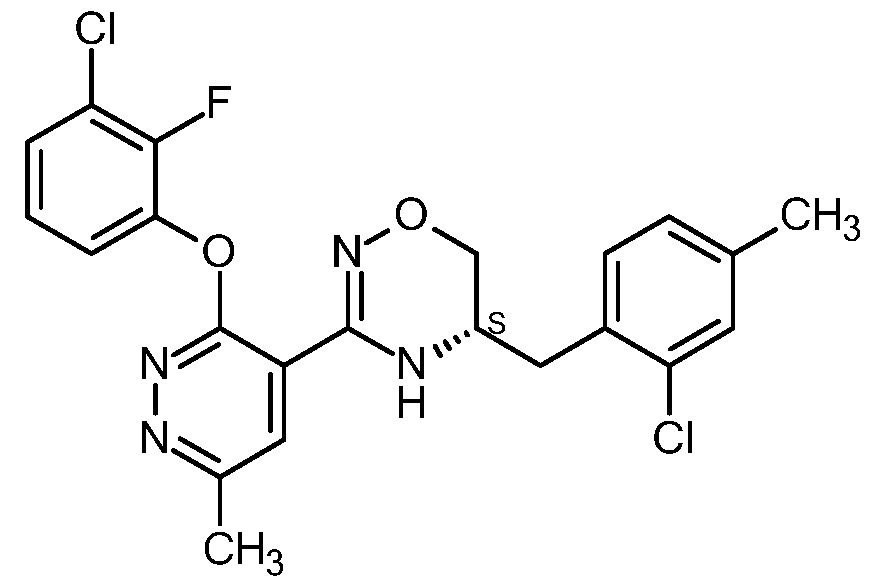
Priority Applications (8)
| Application Number | Priority Date | Filing Date | Title |
|---|---|---|---|
| CA3256572A CA3256572A1 (en) | 2022-05-03 | 2023-04-26 | Use of (5s)-3-[3-(3-chloro-2-fluorophenoxy)-6-methylpyridazin-4-yl]-5-(2-chloro-4-methylbenzyl)-5,6-dihydro-4h-1,2,4-oxadiazine for controlling unwanted microorganisms |
| IL316251A IL316251A (en) | 2022-05-03 | 2023-04-26 | Use of (5s)-3-[3-(3-chloro-2-fluorophenoxy)-6-methylpyridazin-4-yl]-5-(2-chloro-4-methylbenzyl)-5,6-dihydro-4h-1,2,4-oxadiazine for controlling unwanted microorganisms |
| CN202380037226.6A CN119110684A (en) | 2022-05-03 | 2023-04-26 | Use of (5S)-3-[3-(3-chloro-2-fluorophenoxy)-6-methylpyridazin-4-yl]-5-(2-chloro-4-methylbenzyl)-5,6-dihydro-4H-1,2,4-oxadiazine for controlling unwanted microorganisms |
| US18/862,344 US20250280829A1 (en) | 2022-05-03 | 2023-04-26 | Use of (5s)-3-[3-(3-chloro-2-fluorophenoxy)-6-methylpyridazin-4-yl]-5-(2-chloro-4-methylbenzyl)-5,6-dihydro-4h-1,2,4-oxadiazine for controlling unwanted microorganisms |
| KR1020247039701A KR20250004024A (en) | 2022-05-03 | 2023-04-26 | Use of (5S)-3-[3-(3-chloro-2-fluorophenoxy)-6-methylpyridazin-4-yl]-5-(2-chloro-4-methylbenzyl)-5,6-dihydro-4H-1,2,4-oxadiazine for controlling unwanted microorganisms |
| AU2023264210A AU2023264210A1 (en) | 2022-05-03 | 2023-04-26 | Use of (5s)-3-[3-(3-chloro-2-fluorophenoxy)-6-methylpyridazin-4-yl]-5-(2-chloro-4-methylbenzyl)-5,6-dihydro-4h-1,2,4-oxadiazine for controlling unwanted microorganisms |
| JP2024565017A JP2025516324A (en) | 2022-05-03 | 2023-04-26 | Use of (5S)-3-[3-(3-chloro-2-fluorophenoxy)-6-methylpyridazin-4-yl]-5-(2-chloro-4-methylbenzyl)-5,6-dihydro-4H-1,2,4-oxadiazine for controlling undesirable microorganisms |
| EP23722526.3A EP4518654A1 (en) | 2022-05-03 | 2023-04-26 | Use of (5s)-3-[3-(3-chloro-2-fluorophenoxy)-6-methylpyridazin-4-yl]-5-(2-chloro-4-methylbenzyl)-5,6-dihydro-4h-1,2,4-oxadiazine for controlling unwanted microorganisms |
Applications Claiming Priority (2)
| Application Number | Priority Date | Filing Date | Title |
|---|---|---|---|
| EP22171420 | 2022-05-03 | ||
| EP22171420.7 | 2022-05-03 |
Publications (1)
| Publication Number | Publication Date |
|---|---|
| WO2023213626A1 true WO2023213626A1 (en) | 2023-11-09 |
Family
ID=81580191
Family Applications (1)
| Application Number | Title | Priority Date | Filing Date |
|---|---|---|---|
| PCT/EP2023/060917 Ceased WO2023213626A1 (en) | 2022-05-03 | 2023-04-26 | Use of (5s)-3-[3-(3-chloro-2-fluorophenoxy)-6-methylpyridazin-4-yl]-5-(2-chloro-4-methylbenzyl)-5,6-dihydro-4h-1,2,4-oxadiazine for controlling unwanted microorganisms |
Country Status (9)
| Country | Link |
|---|---|
| US (1) | US20250280829A1 (en) |
| EP (1) | EP4518654A1 (en) |
| JP (1) | JP2025516324A (en) |
| KR (1) | KR20250004024A (en) |
| CN (1) | CN119110684A (en) |
| AU (1) | AU2023264210A1 (en) |
| CA (1) | CA3256572A1 (en) |
| IL (1) | IL316251A (en) |
| WO (1) | WO2023213626A1 (en) |
Cited By (9)
| Publication number | Priority date | Publication date | Assignee | Title |
|---|---|---|---|---|
| CN117925421A (en) * | 2024-03-22 | 2024-04-26 | 西北农林科技大学深圳研究院 | Aphanothece turbina and application thereof in prevention and control of wheat soil-borne diseases |
| WO2025032038A1 (en) * | 2023-08-09 | 2025-02-13 | Bayer Aktiengesellschaft | Pyridazin-4-yloxadiazines as novel fungicides |
| WO2025031668A1 (en) | 2023-08-09 | 2025-02-13 | Bayer Aktiengesellschaft | Azaheterobiaryl-substituted 4,5-dihydro-1h-2,4,5-oxadiazines as novel fungicides |
| WO2025078128A1 (en) | 2023-10-11 | 2025-04-17 | Bayer Aktiengesellschaft | Pyridazin-3-one-4-yloxadiazines as novel fungicides |
| WO2025168620A1 (en) | 2024-02-07 | 2025-08-14 | Bayer Aktiengesellschaft | Heteroaryl-substituted 4,5-dihydro-1h-2,4,5-oxadiazines as novel fungicides |
| WO2025172099A1 (en) | 2024-02-15 | 2025-08-21 | Basf Se | Fungicidal compositions comprising 6-methyl-pyridazin derivatives |
| WO2025172100A1 (en) | 2024-02-15 | 2025-08-21 | Basf Se | Fungicidal compositions comprising 8-fluoroquinoline-3-carboxamide compounds |
| WO2025195882A1 (en) | 2024-03-21 | 2025-09-25 | Basf Se | Fungicidal compositions comprising strobilurine derivatives |
| WO2025195881A1 (en) | 2024-03-21 | 2025-09-25 | Basf Se | Fungicidal compositions comprising strobilurine derivatives |
Citations (197)
| Publication number | Priority date | Publication date | Assignee | Title |
|---|---|---|---|---|
| US2009A (en) | 1841-03-18 | Improvement in machines for boring war-rockets | ||
| US2010A (en) | 1841-03-18 | Machine foe | ||
| US24077A (en) | 1859-05-17 | Window-sash supporter | ||
| US137395A (en) | 1873-04-01 | Improvement in nuts | ||
| DE2906507A1 (en) | 1979-02-20 | 1980-08-28 | Bayer Ag | Plant growth regulating compsn. - contg. alpha amino cyclo:alkanoic acid derivs., e.g. for dwarfing cereals |
| EP0030287A1 (en) | 1979-11-29 | 1981-06-17 | Bayer Ag | 1-Aminocyclopropanecarboxylic acid derivatives, methods for their production, their use as plant-growth regulators and compositions containing such derivatives |
| EP0086750A2 (en) | 1982-02-17 | 1983-08-24 | Ciba-Geigy Ag | Use of quinoline derivatives in the protection of crop plants |
| EP0094349A2 (en) | 1982-05-07 | 1983-11-16 | Ciba-Geigy Ag | Use of quinoline derivatives for the protection of cultivated plants |
| DE3335514A1 (en) | 1983-09-30 | 1985-04-18 | Bayer Ag, 5090 Leverkusen | 1-METHYLAMINO-CYCLOPROPAN-1-CARBONIC ACID DERIVATIVES |
| JPS6087254A (en) | 1983-10-19 | 1985-05-16 | Japan Carlit Co Ltd:The | Novel urea compound and herbicide containing the same |
| US4536207A (en) | 1983-07-26 | 1985-08-20 | Igi Biotechnology, Inc. | Nematocidally active chitin-protein complex |
| EP0174562A2 (en) | 1984-09-11 | 1986-03-19 | Hoechst Aktiengesellschaft | Plant protecting agents based on 1,2,4 - triazole derivatives as well as 1,2,4-triazole derivatives |
| EP0191736A2 (en) | 1985-02-14 | 1986-08-20 | Ciba-Geigy Ag | Use of quinoline derivatives for the protection of crop plants |
| EP0268554A2 (en) | 1986-10-22 | 1988-05-25 | Ciba-Geigy Ag | 1,5-Diphenyl pyrazole-3-carbonic-acid derivatives for the protection of cultured plants |
| EP0269806A1 (en) | 1986-10-04 | 1988-06-08 | Hoechst Aktiengesellschaft | Phenylpyrazole carbonic acid derivatives, their preparation and use as plant growth regulators and antidotes |
| EP0346620A1 (en) | 1988-05-20 | 1989-12-20 | Hoechst Aktiengesellschaft | Plant protection agents containing 1,2,4-triazole derivatives, and the 1,2,4-triazole derivatives |
| EP0365484A1 (en) | 1988-10-20 | 1990-04-25 | Ciba-Geigy Ag | Sulfamoyl phenyl ureas |
| WO1991007874A1 (en) | 1989-11-30 | 1991-06-13 | Hoechst Aktiengesellschaft | Pyrazolines for the protection of crops against herbicides |
| WO1991008202A1 (en) | 1989-11-25 | 1991-06-13 | Hoechst Aktiengesellschaft | Isoxazolines, method of preparation thereof, and their use as plant-protection agents |
| US5061495A (en) | 1988-03-07 | 1991-10-29 | Agricultural Genetics Company Limited | Antibiotic derived from b. subtilis |
| US5123951A (en) | 1986-03-31 | 1992-06-23 | Rhone-Poulenc Nederland B.V. | Synergistic plant growth regulator compositions |
| EP0492366A2 (en) | 1990-12-21 | 1992-07-01 | Hoechst Schering AgrEvo GmbH | New 5-chloroquinolin-8-oxyalkanecarbonic acid derivatives, process for their preparation and their use as antidotes for herbicides |
| EP0582198A2 (en) | 1992-08-01 | 1994-02-09 | Hoechst Schering AgrEvo GmbH | Substituted (hetero-)aryle compounds, process for their preparation, those containing compositions and their use as safeners |
| WO1995007897A1 (en) | 1993-09-16 | 1995-03-23 | Hoechst Schering Agrevo Gmbh | Substituted isoxazolines, process for producing them, agents containing them and their use as safeners |
| EP0701275A2 (en) | 1994-08-26 | 1996-03-13 | MEMC Electronic Materials, Inc. | Pre-thermal treatment cleaning process |
| US5549718A (en) | 1990-04-06 | 1996-08-27 | Centre National De La Recherche Scientifique (C.N.R.S.) | Substance with lipo-oligosaccharide structure capable of acting as plant-specific symbiotic signals, processes for producing them and their applications |
| WO1997017432A1 (en) | 1995-11-06 | 1997-05-15 | Wisconsin Alumni Research Foundation | Insecticidal protein toxins from photorhabdus |
| WO1997045016A1 (en) | 1996-05-29 | 1997-12-04 | Hoechst Schering Agrevo Gmbh | Novel n-acyl sulphonamides, novel mixtures of herbicides and antidotes and their use |
| US5702752A (en) | 1996-03-13 | 1997-12-30 | Archer Daniels Midland Company | Production of isoflavone enriched fractions from soy protein extracts |
| WO1998008932A1 (en) | 1996-08-29 | 1998-03-05 | Dow Agrosciences Llc | Insecticidal protein toxins from $i(photorhabdus) |
| WO1998013361A1 (en) | 1996-09-26 | 1998-04-02 | Novartis Ag | Herbicidal composition |
| WO1998027049A1 (en) | 1996-12-19 | 1998-06-25 | Hoechst Schering Agrevo Gmbh | Novel 2-fluoroacrylic acid derivatives, novel mixtures of herbicides and antidotes and the use thereof |
| WO1998038856A1 (en) | 1997-03-04 | 1998-09-11 | Zeneca Limited | Compositions for safening rice against acetochlor |
| WO1998044140A1 (en) | 1997-04-03 | 1998-10-08 | Dekalb Genetics Corporation | Glyphosate resistant maize lines |
| WO1998050427A1 (en) | 1997-05-05 | 1998-11-12 | Dow Agrosciences Llc | INSECTICIDAL PROTEIN TOXINS FROM $i(XENORHABDUS) |
| WO1999000020A1 (en) | 1997-06-27 | 1999-01-07 | Hoechst Schering Agrevo Gmbh | 3-(5-tetrazolyl carbonyl)-2-quinolones and products for protecting useful plants containing the same |
| WO1999016744A1 (en) | 1997-09-29 | 1999-04-08 | Aventis Cropscience Gmbh | Acylsulfamoyl benzoic acid amides, plant protection agents containing said acylsulfamoyl benzoic acid amides, and method for producing the same |
| JPH11253151A (en) | 1997-11-13 | 1999-09-21 | Kumiai Chem Ind Co Ltd | Rice seedling raising disease control agent |
| US5965545A (en) | 1996-10-15 | 1999-10-12 | State Of Israel, Ministry Of Agriculture, Agricultural Research Organization, The Volcani Center | Compositions and method for controlling fungal disease in plants |
| US5990291A (en) | 1996-06-11 | 1999-11-23 | Protein Technologies International, Inc. | Recovery of isoflavones from soy molasses |
| US6060051A (en) | 1997-05-09 | 2000-05-09 | Agraquest, Inc. | Strain of bacillus for controlling plant diseases and corn rootworm |
| WO2000026356A1 (en) | 1998-11-03 | 2000-05-11 | Aventis Cropscience N. V. | Glufosinate tolerant rice |
| WO2000026345A1 (en) | 1998-11-03 | 2000-05-11 | Aventis Cropscience N.V. | Glufosinate tolerant rice |
| US6146668A (en) | 1997-04-28 | 2000-11-14 | Novogen, Inc. | Preparation of isoflavones from legumes |
| WO2001031042A2 (en) | 1999-10-29 | 2001-05-03 | Aventis Cropscience N.V. | Male-sterile brassica plants and methods for producing same |
| US6245551B1 (en) | 1999-03-30 | 2001-06-12 | Agraquest, Inc. | Strain of Bacillus pumilus for controlling plant diseases caused by fungi |
| WO2001041558A1 (en) | 1999-12-08 | 2001-06-14 | Aventis Cropscience N.V. | Hybrid winter oilseed rape and methods for producing same |
| WO2001047952A2 (en) | 1999-12-28 | 2001-07-05 | Bayer Cropscience N.V. | Insecticidal proteins from bacillus thuringiensis |
| WO2001051654A2 (en) | 2000-01-11 | 2001-07-19 | Bayer Cropscience N.V. | Methods and kits for identifying elite event gat-zm1 in biological samples |
| WO2002027004A2 (en) | 2000-09-29 | 2002-04-04 | Monsanto Technology Llc | Glyphosate tolerant wheat plant 33391 and compositions and methods for detection thereof |
| WO2002034946A2 (en) | 2000-10-25 | 2002-05-02 | Monsanto Technology Llc | Cotton event pv-ghgt07(1445) and compositions and methods for detection thereof |
| WO2002034048A1 (en) | 2000-10-23 | 2002-05-02 | Syngenta Participations Ag | Agrochemical compositions with quinoline safeners |
| WO2002036831A2 (en) | 2000-10-30 | 2002-05-10 | Monsanto Technology Llc | Canola event pv-bngt04(rt73) and compositions and methods for detection thereof |
| WO2002040677A2 (en) | 2000-11-20 | 2002-05-23 | Monsanto Technology Llc | Cotton event pv-ghbk04 (531) and compositions and methods for detection thereof |
| WO2002044407A2 (en) | 2000-11-30 | 2002-06-06 | Ses Europe N.V. | Glyphosate resistant transgenic sugar beet characterised by a specific transgene insertion (t227-1), methods and primers for the detection of said insertion |
| US20020102582A1 (en) | 2000-09-13 | 2002-08-01 | Levine Elaine B. | Corn event MON810 and compositions and methods for detection thereof |
| WO2002100163A2 (en) | 2001-06-11 | 2002-12-19 | Monsanto Technology Llc | Cotton event moni5985 and compositions and methods for detection |
| WO2003000051A2 (en) | 2001-06-22 | 2003-01-03 | Drahos David J | Novel biofungicide |
| WO2003013224A2 (en) | 2001-08-06 | 2003-02-20 | Bayer Bioscience N.V. | Herbicide tolerant cotton plants and methods for producing and identifying same |
| WO2003052073A2 (en) | 2001-12-17 | 2003-06-26 | Syngenta Participations Ag | Novel corn event |
| US20030126634A1 (en) | 1990-08-09 | 2003-07-03 | Dekalb Genetics Corporation | Methods and compositions for the increase of yield in plants |
| WO2004011601A2 (en) | 2002-07-29 | 2004-02-05 | Monsanto Technology, Llc | Corn event pv-zmir13 (mon863) plants and compositions and methods for detection thereof |
| WO2004039986A1 (en) | 2002-10-29 | 2004-05-13 | Syngenta Participations Ag | Cot102 insecticidal cotton |
| WO2004053062A2 (en) | 2002-12-05 | 2004-06-24 | Monsanto Technology Llc | Bentgrass event asr-368 and compositions and methods for detection thereof |
| WO2004072235A2 (en) | 2003-02-12 | 2004-08-26 | Monsanto Technology Llc | Cotton event mon 88913 and compositions and methods for detection thereof |
| US20040172669A1 (en) | 2003-02-28 | 2004-09-02 | Josef Kraus | Glyphosate tolerant sugar beet |
| WO2004074492A1 (en) | 2003-02-20 | 2004-09-02 | Kws Saat Ag | Glyphosate tolerant sugar beet |
| WO2004084631A1 (en) | 2003-03-26 | 2004-10-07 | Bayer Cropscience Gmbh | Use of aromatic hydroxy compounds as safeners |
| WO2004099447A2 (en) | 2003-05-02 | 2004-11-18 | Dow Agrosciences Llc | Corn event tc1507 and methods for detection thereof |
| US6855533B2 (en) | 1995-04-20 | 2005-02-15 | Basf Corporation | Structure-based designed herbicide resistant products |
| WO2005015994A1 (en) | 2003-08-05 | 2005-02-24 | Bayer Cropscience Gmbh | Use of aromatic compounds as safeners |
| WO2005016001A1 (en) | 2003-08-05 | 2005-02-24 | Bayer Cropscience Gmbh | Safener based on aromatic-aliphatic carboxylic acid derivatives |
| WO2005054479A1 (en) | 2003-12-01 | 2005-06-16 | Syngenta Participations Ag | Insect resistant cotton plants and methods of detecting the same |
| WO2005054480A2 (en) | 2003-12-01 | 2005-06-16 | Syngenta Participations Ag | Insect resistant cotton plants and methods of detecting the same |
| WO2005059103A2 (en) | 2003-12-15 | 2005-06-30 | Monsanto Technology Llc | Corn plant mon88017 and compositions and methods for detection thereof |
| WO2005061720A2 (en) | 2003-12-11 | 2005-07-07 | Monsanto Technology Llc | High lysine maize compositions and methods for detection thereof |
| WO2005074671A1 (en) | 2004-01-30 | 2005-08-18 | Syngenta Participations Ag | Improved fertility restoration for ogura cytoplasmic male sterile brassica and method |
| US20050216969A1 (en) | 2004-03-26 | 2005-09-29 | Dow Agrosciences Llc | Cry1F and Cry1AC transgenic cotton lines and event-specific identification thereof |
| WO2005103301A2 (en) | 2004-03-25 | 2005-11-03 | Syngenta Participations Ag | Corn event mir604 |
| WO2005112630A1 (en) | 2004-05-12 | 2005-12-01 | Bayer Cropscience Gmbh | Quinoxalin-2-one derivatives crop protection agents comprising the same and method for production and use therof |
| WO2006003494A2 (en) | 2004-06-28 | 2006-01-12 | Syngenta Participations Ag | Piperidine derivatives and their use as insecticides, acaricides, molluscicides or nematicides |
| US20060070139A1 (en) | 2004-09-29 | 2006-03-30 | Pioneer Hi-Bred International, Inc. | Corn event DAS-59122-7 and methods for detection thereof |
| WO2006043635A1 (en) | 2004-10-20 | 2006-04-27 | Kumiai Chemical Industry Co., Ltd. | 3-triazolylphenyl sulfide derivative and insecticide/acaricide/nematicide containing the same as active ingredient |
| US7094592B2 (en) | 2001-11-26 | 2006-08-22 | Kumiai Chemical Industry Co., Ltd. | Bacillus sp. D747 strain, plant disease controlling agents and insect pest controlling agents using the same and control method using the agents |
| WO2006098952A2 (en) | 2005-03-16 | 2006-09-21 | Syngenta Participations Ag | Corn event 3272 and methods of detection thereof |
| WO2006108675A2 (en) | 2005-04-11 | 2006-10-19 | Bayer Bioscience N.V. | Elite event a5547-127 and methods and kits for identifying such event in biological samples |
| WO2006108674A2 (en) | 2005-04-08 | 2006-10-19 | Bayer Bioscience N.V. | Elite event a2704-12 and methods and kits for identifying such event in biological samples |
| WO2006128572A1 (en) | 2005-06-02 | 2006-12-07 | Syngenta Participations Ag | Ce46-02a insecticidal cotton |
| WO2006130436A2 (en) | 2005-05-27 | 2006-12-07 | Monsanto Technology Llc | Soybean event mon89788 and methods for detection thereof |
| WO2006128568A2 (en) | 2005-06-02 | 2006-12-07 | Syngenta Participations Ag | T342-142, insecticidal transgenic cotton expressing cry1ab |
| WO2006128569A2 (en) | 2005-06-02 | 2006-12-07 | Syngenta Participations Ag | 1143-14a, insecticidal transgenic cotton expressing cry1ab |
| WO2006128573A2 (en) | 2005-06-02 | 2006-12-07 | Syngenta Participations Ag | Ce43- 67b, insecticidal transgenic cotton expressing cry1ab |
| WO2006128571A2 (en) | 2005-06-02 | 2006-12-07 | Syngenta Participations Ag | Ce44-69d , insecticidal transgenic cotton expressing cry1ab |
| WO2006128570A1 (en) | 2005-06-02 | 2006-12-07 | Syngenta Participations Ag | 1143-51b insecticidal cotton |
| WO2007017186A1 (en) | 2005-08-08 | 2007-02-15 | Bayer Bioscience N.V. | Herbicide tolerant cotton plants and methods for identifying same |
| WO2007023719A1 (en) | 2005-08-22 | 2007-03-01 | Kumiai Chemical Industry Co., Ltd. | Agent for reducing chemical injury and herbicide composition with reduced chemical injury |
| WO2007023764A1 (en) | 2005-08-26 | 2007-03-01 | Kumiai Chemical Industry Co., Ltd. | Agent for reduction of harmful effect of herbicide and herbicide composition having reduced harmful effect |
| WO2007024782A2 (en) | 2005-08-24 | 2007-03-01 | Pioneer Hi-Bred International, Inc. | Compositions providing tolerance to multiple herbicides and methods of use thereof |
| WO2007040280A1 (en) | 2005-10-06 | 2007-04-12 | Nippon Soda Co., Ltd. | Cyclic amine compound and pest control agent |
| WO2007091277A2 (en) | 2006-02-10 | 2007-08-16 | Maharashtra Hybrid Seeds Company Limited (Mahyco) | TRANSGENIC BRINJAL (SOLANUM MELONGENA) EXPRESSING THE CRYlAC GENE |
| WO2007140256A1 (en) | 2006-05-26 | 2007-12-06 | Monsanto Technology, Llc | Corn plant and seed corresponding to transgenic event mon89034 and methods for detection and use thereof |
| WO2007142840A2 (en) | 2006-06-03 | 2007-12-13 | Syngenta Participations Ag | Corn event mir162 |
| US20070292854A1 (en) | 2000-06-22 | 2007-12-20 | Behr Carl F | Corn event PV-ZMGT32(nk603) and compositions and methods for detection thereof |
| WO2008002872A2 (en) | 2006-06-28 | 2008-01-03 | Pioneer Hi-Bred International, Inc. | Soybean event 3560.4.3.5 and compositions and methods for the identification and/or detection thereof |
| US20080064032A1 (en) | 2006-09-13 | 2008-03-13 | Syngenta Participations Ag | Polynucleotides and uses thereof |
| WO2008054747A2 (en) | 2006-10-31 | 2008-05-08 | E. I. Du Pont De Nemours And Company | Soybean event dp-305423-1 and compositions and methods for the identification and/or detection thereof |
| WO2008112019A2 (en) | 2006-10-30 | 2008-09-18 | Pioneer Hi-Bred International, Inc. | Maize event dp-098140-6 and compositions and methods for the identification and/or detection thereof |
| WO2008114282A2 (en) | 2007-03-19 | 2008-09-25 | Maharashtra Hybrid Seeds Company Limited | Transgenic rice (oryza sativa) comprising pe-7 event and method of detection thereof |
| WO2008122406A1 (en) | 2007-04-05 | 2008-10-16 | Bayer Bioscience N.V. | Insect resistant cotton plants and methods for identifying same |
| WO2008131860A2 (en) | 2007-04-30 | 2008-11-06 | Bayer Cropscience Ag | Pyridonecarboxamides crop protection agents containing the same method for production and use thereof |
| WO2008131861A1 (en) | 2007-04-30 | 2008-11-06 | Bayer Cropscience Ag | Use of pyridine-2-oxy-3-carbonamides as safeners |
| US20080289060A1 (en) | 2006-08-24 | 2008-11-20 | Bayer Bioscience N.V. | Herbicide tolerant rice plants and methods for identifying same |
| WO2008151780A1 (en) | 2007-06-11 | 2008-12-18 | Bayer Bioscience N.V. | Insect resistant cotton plants comprising elite event ee-gh6 and methods for identifying same |
| CN101337937A (en) | 2008-08-12 | 2009-01-07 | 国家农药创制工程技术研究中心 | N-benz-3-substituted amino pyrazoles compounds with insecticidal activity |
| CN101337940A (en) | 2008-08-12 | 2009-01-07 | 国家农药创制工程技术研究中心 | Nitrogen heterocyclic ring dichloro allyl ether compound with insecticidal activity |
| US20090130071A1 (en) | 2007-11-15 | 2009-05-21 | Ai-Guo Gao | Soybean Plant And Seed Corresponding To Transgenic Event MON87701 And Methods For Detection Thereof |
| WO2009100188A2 (en) | 2008-02-08 | 2009-08-13 | Dow Agrosciences Llc | Methods for detection of corn event das-59132 |
| US20090210970A1 (en) | 2008-02-14 | 2009-08-20 | Pioneer Hi-Bred International, Inc. | Plant Genomic DNA Flanking SPT Event and Methods for Identifying SPT Event |
| WO2009102873A1 (en) | 2008-02-15 | 2009-08-20 | Monsanto Technology Llc | Soybean plant and seed corresponding to transgenic event mon87769 and methods for detection thereof |
| US7579183B1 (en) | 2006-12-01 | 2009-08-25 | The United States Of America As Represented By The Secretary Of Agriculture | Saprophytic yeast, Pichia anomala |
| WO2009111263A1 (en) | 2008-02-29 | 2009-09-11 | Monsanto Technology Llc | Corn plant event mon87460 and compositions and methods for detection thereof |
| WO2009116106A1 (en) | 2008-03-21 | 2009-09-24 | Trentino Sviluppo S.P.A. | Trichoderma atroviride sc1 for biocontrol of fungal diseases in plants |
| WO2009152359A2 (en) | 2008-06-11 | 2009-12-17 | Dow Agrosciences Llc | Constructs for expressing herbicide tolerance genes, related plants, and related trait combinations |
| JP2010018586A (en) | 2008-07-14 | 2010-01-28 | Meiji Seika Kaisha Ltd | Substance pf1364, its manufacturing method, producing strain and agricultural/horticultural insecticide having the substance as active ingredient |
| WO2010024976A1 (en) | 2008-08-29 | 2010-03-04 | Monsanto Technology Llc | Soybean plant and seed corresponding to transgenic event mon87754 and methods for detection thereof |
| US20100080887A1 (en) | 2008-09-29 | 2010-04-01 | Monsanto Technology Llc | Soybean Transgenic Event MON87705 and Methods for Detection Thereof |
| WO2010051926A2 (en) | 2008-11-05 | 2010-05-14 | Bayer Cropscience Aktiengesellschaft | New halogen-substituted bonds |
| WO2010052161A2 (en) | 2008-11-06 | 2010-05-14 | Syngenta Participations Ag | Herbicidal compositions |
| CN101715774A (en) | 2008-10-09 | 2010-06-02 | 浙江化工科技集团有限公司 | Preparation and use of compound having insecticidal activity |
| WO2010066780A1 (en) | 2008-12-12 | 2010-06-17 | Syngenta Participations Ag | Spiroheterocyclic n-oxypiperidines as pesticides |
| WO2010077816A1 (en) | 2008-12-16 | 2010-07-08 | Syngenta Participations Ag | Corn event 5307 |
| WO2010076212A1 (en) | 2008-12-19 | 2010-07-08 | Syngenta Participations Ag | Transgenic sugar beet event gm rz13 |
| WO2010080829A1 (en) | 2009-01-07 | 2010-07-15 | Basf Agrochemical Products B.V. | Soybean event 127 and methods related thereto |
| WO2010086790A1 (en) | 2009-01-27 | 2010-08-05 | Lesaffre Et Compagnie | Saccharomyces cerevisiae strains with phytosanitary capabilities |
| CN101838227A (en) | 2010-04-30 | 2010-09-22 | 孙德群 | Safener of benzamide herbicide |
| WO2010117735A1 (en) | 2009-03-30 | 2010-10-14 | Monsanto Technology Llc | Transgenic rice event17314 and methods of use thereof |
| WO2010117737A1 (en) | 2009-03-30 | 2010-10-14 | Monsanto Technology Llc | Rice transgenic event17053 and methods of use thereof |
| EP2248421A1 (en) | 2009-05-07 | 2010-11-10 | GMI - Gregor-Mendel-Institut für Molekulare Pflanzenbiologie GmbH | Accumulation of biomass in plants |
| US20100291039A1 (en) | 2007-12-14 | 2010-11-18 | Kohl Jurgen Anton | Novel micro-organisms controlling plant pathogens |
| WO2011022469A2 (en) | 2009-08-19 | 2011-02-24 | Dow Agrosciences Llc | Aad-1 event das-40278-9, related transgenic corn lines, and event-specific identification thereof |
| WO2011034704A1 (en) | 2009-09-17 | 2011-03-24 | Monsanto Technology Llc | Soybean transgenic event mon 87708 and methods of use thereof |
| WO2011062904A1 (en) | 2009-11-23 | 2011-05-26 | Monsanto Technology Llc | Transgenic maize event mon 87427 and the relative development scale |
| WO2011063413A2 (en) | 2009-11-23 | 2011-05-26 | Bayer Bioscience N.V. | Herbicide tolerant soybean plants and methods for identifying same |
| WO2011066384A1 (en) | 2009-11-24 | 2011-06-03 | Dow Agrosciences Llc | Aad-12 event 416, related transgenic soybean lines, and event-specific identification thereof |
| WO2011066360A1 (en) | 2009-11-24 | 2011-06-03 | Dow Agrosciences Llc | Detection of aad-12 soybean event 416 |
| WO2011075593A1 (en) | 2009-12-17 | 2011-06-23 | Pioneer Hi-Bred International, Inc. | Maize event dp-040416-8 and methods for detection thereof |
| WO2011075595A1 (en) | 2009-12-17 | 2011-06-23 | Pioneer Hi-Bred International, Inc. | Maize event dp-043a47-3 and methods for detection thereof |
| WO2011084632A1 (en) | 2009-12-17 | 2011-07-14 | Pioneer Hi-Bred International, Inc. | Maize event dp-032316-8 and methods for detection thereof |
| WO2011084621A1 (en) | 2009-12-17 | 2011-07-14 | Pioneer Hi-Bred International, Inc. | Maize event dp-004114-3 and methods for detection thereof |
| WO2011085575A1 (en) | 2010-01-15 | 2011-07-21 | 江苏省农药研究所股份有限公司 | Ortho-heterocyclyl formanilide compounds, their synthesis methods and use |
| WO2011106491A2 (en) | 2010-02-25 | 2011-09-01 | Marrone Bio Innovations, Inc. | Isolated bacterial strain of the genus burkholderia and pesticidal metabolites therefrom |
| WO2011151146A1 (en) | 2010-05-31 | 2011-12-08 | Syngenta Participations Ag | Method of crop enhancement |
| WO2011153186A1 (en) | 2010-06-04 | 2011-12-08 | Monsanto Technology Llc | Transgenic brassica event mon 88302 and methods of use thereof |
| WO2011151819A2 (en) | 2010-06-01 | 2011-12-08 | Yissum Research Development Company Of The Hebrew University Of Jerusalem Ltd. | Pseudozyma aphidis as a biocontrol agent against various plant pathogens |
| WO2012033794A2 (en) | 2010-09-08 | 2012-03-15 | Dow Agrosciences Llc | Aad-12 event 1606 and related transgenic soybean lines |
| WO2012034403A1 (en) | 2010-09-14 | 2012-03-22 | 中化蓝天集团有限公司 | Fluoromethoxypyrazole anthranilamide compounds, synthesization methods and uses thereof |
| CN102391261A (en) | 2011-10-14 | 2012-03-28 | 上海交通大学 | N-substituted dioxazine compound as well as preparation method and application thereof |
| WO2012051199A2 (en) | 2010-10-12 | 2012-04-19 | Monsanto Technology Llc | Soybean plant and seed corresponding to transgenic event mon87712 and methods for detection thereof |
| US20120131692A1 (en) | 2010-11-24 | 2012-05-24 | Pioneer Hi-Bred International, Inc. | Brassica gat event dp-073496-4 and compositions and methods for the identification and/or detection thereof |
| WO2012071039A1 (en) | 2010-11-24 | 2012-05-31 | Pioner Hi-Bred International, Inc. | Brassica gat event dp-061061-7 and compositions and methods for the identification and/or detection thereof |
| WO2012075429A1 (en) | 2010-12-03 | 2012-06-07 | Dow Agrosciences Llc | Stacked herbicide tolerance event 8291.45.36.2, related transgenic soybean lines, and detection thereof |
| WO2012075426A1 (en) | 2010-12-03 | 2012-06-07 | Dow Agrosciences Llc | Stacked herbicide tolerance event 8264.44.06.1, related transgenic soybean lines, and detection thereof |
| WO2012082548A2 (en) | 2010-12-15 | 2012-06-21 | Syngenta Participations Ag | Soybean event syht0h2 and compositions and methods for detection thereof |
| WO2012134808A1 (en) | 2011-03-30 | 2012-10-04 | Monsanto Technology Llc | Cotton transgenic event mon 88701 and methods of use thereof |
| WO2013003558A1 (en) | 2011-06-30 | 2013-01-03 | Monsanto Technology Llc | Alfalfa plant and seed corresponding to transgenic event kk 179-2 and methods for detection thereof |
| WO2013010094A1 (en) | 2011-07-13 | 2013-01-17 | Dow Agrosciences Llc | Stacked herbicide tolerance event 8264.42.32.1, related transgenic soybean lines, and detection thereof |
| WO2013012775A1 (en) | 2011-07-15 | 2013-01-24 | Syngenta Participations Ag | Corn event mzdt09y |
| WO2013032693A2 (en) | 2011-08-27 | 2013-03-07 | Marrone Bio Innovations, Inc. | Isolated bacterial strain of the genus burkholderia and pesticidal metabolites therefrom-formulations and uses |
| WO2013034938A2 (en) | 2011-09-08 | 2013-03-14 | Szegedi Tudományegyetem | A copper resistant, fengycin-producing bacillus mojavensis strain for controlling vegetable pathogens, its use and compositions containing it |
| WO2013050317A1 (en) | 2011-10-03 | 2013-04-11 | Syngenta Limited | Polymorphs of an isoxazoline derivative |
| CN103109816A (en) | 2013-01-25 | 2013-05-22 | 青岛科技大学 | Thiobenzamide compounds and application thereof |
| CN103232431A (en) | 2013-01-25 | 2013-08-07 | 青岛科技大学 | Dihalogenated pyrazole amide compound and its use |
| CN103265527A (en) | 2013-06-07 | 2013-08-28 | 江苏省农用激素工程技术研究中心有限公司 | Anthranilamide compound as well as preparation method and application thereof |
| WO2013144213A1 (en) | 2012-03-30 | 2013-10-03 | Basf Se | N-substituted pyridinylidene compounds and derivatives for combating animal pests |
| EP2647626A1 (en) | 2012-04-03 | 2013-10-09 | Syngenta Participations AG. | 1-Aza-spiro[4.5]dec-3-ene and 1,8-diaza-spiro[4.5]dec-3-ene derivatives as pesticides |
| WO2013162715A2 (en) | 2012-04-27 | 2013-10-31 | Dow Agrosciences Llc | Pesticidal compositions and processes related thereto |
| CN103524422A (en) | 2013-10-11 | 2014-01-22 | 中国农业科学院植物保护研究所 | Benzimidazole derivative, and preparation method and purpose thereof |
| WO2014028521A1 (en) | 2012-08-14 | 2014-02-20 | Marrone Bio Innovations, Inc. | Bacillus sp. strain with antifungal, antibacterial and growth promotion activity |
| WO2014053450A1 (en) | 2012-10-02 | 2014-04-10 | Bayer Cropscience Ag | Heterocyclic compounds as pesticides |
| US20140213448A1 (en) | 2012-04-27 | 2014-07-31 | Dow Agrosciences Llc | Pesticidal compositions and processes related thereto |
| US20140275503A1 (en) | 2013-03-13 | 2014-09-18 | Dow Agrosciences Llc | Process for the preparation of certain triaryl rhamnose carbamates |
| WO2014187846A1 (en) | 2013-05-23 | 2014-11-27 | Syngenta Participations Ag | Tank-mix formulations |
| WO2015067800A1 (en) | 2013-11-11 | 2015-05-14 | Basf Se | Antifungal penicillium strains, fungicidal extrolites thereof, and their use |
| WO2016020371A1 (en) | 2014-08-04 | 2016-02-11 | Basf Se | Antifungal paenibacillus strains, fusaricidin-type compounds, and their use |
| WO2016154297A1 (en) | 2015-03-26 | 2016-09-29 | Bayer Cropscience Lp | A novel paenibacillus strain, antifungal compounds, and methods for their use |
| WO2017019448A1 (en) | 2015-07-24 | 2017-02-02 | AgBiome, Inc. | Modified biological control agents and their uses |
| WO2017066094A1 (en) | 2015-10-12 | 2017-04-20 | Pioneer Hi-Bred International, Inc. | Biologicals and their use in plants |
| CN106977494A (en) | 2016-01-16 | 2017-07-25 | 海利尔药业集团股份有限公司 | Substituted pyrazolecarboxylic amides compound and its application |
| WO2017205258A1 (en) | 2016-05-26 | 2017-11-30 | Novozymes Bioag A/S | Bacillus and lipochitooligosaccharide for improving plant growth |
| EP3331311A1 (en) | 2015-07-29 | 2018-06-06 | Sony Corporation | Wireless communication system, and base station side and user equipment side device and method |
| WO2018177970A1 (en) | 2017-03-31 | 2018-10-04 | Basf Se | Process for preparing chiral 2,3-dihydrothiazolo[3,2-a]pyrimidin-4-ium compounds |
| WO2019059412A1 (en) | 2017-09-20 | 2019-03-28 | Mitsui Chemicals Agro, Inc. | Prolonged ectoparasite-controlling agent for animal |
| WO2019103918A1 (en) | 2017-11-21 | 2019-05-31 | Syngenta Participations Ag | Novel resistance genes associated with disease resistance in soybeans |
| WO2019236274A1 (en) | 2018-06-08 | 2019-12-12 | Dow Agrosciences Llc | Molecule having pesticidal utility, and compositions, and processes, related thereto |
| CN110835330A (en) | 2018-08-15 | 2020-02-25 | 海利尔药业集团股份有限公司 | Preparation method of substituted pyrazole amide compound with insecticidal activity |
| WO2020127780A1 (en) | 2018-12-20 | 2020-06-25 | Bayer Aktiengesellschaft | Heterocyclyl pyridazine as fungicidal compounds |
| WO2021255070A1 (en) * | 2020-06-18 | 2021-12-23 | Bayer Aktiengesellschaft | Active compound combinations |
-
2023
- 2023-04-26 KR KR1020247039701A patent/KR20250004024A/en active Pending
- 2023-04-26 EP EP23722526.3A patent/EP4518654A1/en active Pending
- 2023-04-26 US US18/862,344 patent/US20250280829A1/en active Pending
- 2023-04-26 WO PCT/EP2023/060917 patent/WO2023213626A1/en not_active Ceased
- 2023-04-26 CN CN202380037226.6A patent/CN119110684A/en active Pending
- 2023-04-26 JP JP2024565017A patent/JP2025516324A/en active Pending
- 2023-04-26 CA CA3256572A patent/CA3256572A1/en active Pending
- 2023-04-26 AU AU2023264210A patent/AU2023264210A1/en active Pending
- 2023-04-26 IL IL316251A patent/IL316251A/en unknown
Patent Citations (238)
| Publication number | Priority date | Publication date | Assignee | Title |
|---|---|---|---|---|
| US2009A (en) | 1841-03-18 | Improvement in machines for boring war-rockets | ||
| US2010A (en) | 1841-03-18 | Machine foe | ||
| US24077A (en) | 1859-05-17 | Window-sash supporter | ||
| US137395A (en) | 1873-04-01 | Improvement in nuts | ||
| DE2906507A1 (en) | 1979-02-20 | 1980-08-28 | Bayer Ag | Plant growth regulating compsn. - contg. alpha amino cyclo:alkanoic acid derivs., e.g. for dwarfing cereals |
| EP0030287A1 (en) | 1979-11-29 | 1981-06-17 | Bayer Ag | 1-Aminocyclopropanecarboxylic acid derivatives, methods for their production, their use as plant-growth regulators and compositions containing such derivatives |
| EP0086750A2 (en) | 1982-02-17 | 1983-08-24 | Ciba-Geigy Ag | Use of quinoline derivatives in the protection of crop plants |
| EP0094349A2 (en) | 1982-05-07 | 1983-11-16 | Ciba-Geigy Ag | Use of quinoline derivatives for the protection of cultivated plants |
| US4536207A (en) | 1983-07-26 | 1985-08-20 | Igi Biotechnology, Inc. | Nematocidally active chitin-protein complex |
| DE3335514A1 (en) | 1983-09-30 | 1985-04-18 | Bayer Ag, 5090 Leverkusen | 1-METHYLAMINO-CYCLOPROPAN-1-CARBONIC ACID DERIVATIVES |
| JPS6087254A (en) | 1983-10-19 | 1985-05-16 | Japan Carlit Co Ltd:The | Novel urea compound and herbicide containing the same |
| EP0174562A2 (en) | 1984-09-11 | 1986-03-19 | Hoechst Aktiengesellschaft | Plant protecting agents based on 1,2,4 - triazole derivatives as well as 1,2,4-triazole derivatives |
| EP0191736A2 (en) | 1985-02-14 | 1986-08-20 | Ciba-Geigy Ag | Use of quinoline derivatives for the protection of crop plants |
| US5123951A (en) | 1986-03-31 | 1992-06-23 | Rhone-Poulenc Nederland B.V. | Synergistic plant growth regulator compositions |
| EP0269806A1 (en) | 1986-10-04 | 1988-06-08 | Hoechst Aktiengesellschaft | Phenylpyrazole carbonic acid derivatives, their preparation and use as plant growth regulators and antidotes |
| EP0268554A2 (en) | 1986-10-22 | 1988-05-25 | Ciba-Geigy Ag | 1,5-Diphenyl pyrazole-3-carbonic-acid derivatives for the protection of cultured plants |
| US5061495A (en) | 1988-03-07 | 1991-10-29 | Agricultural Genetics Company Limited | Antibiotic derived from b. subtilis |
| EP0346620A1 (en) | 1988-05-20 | 1989-12-20 | Hoechst Aktiengesellschaft | Plant protection agents containing 1,2,4-triazole derivatives, and the 1,2,4-triazole derivatives |
| EP0365484A1 (en) | 1988-10-20 | 1990-04-25 | Ciba-Geigy Ag | Sulfamoyl phenyl ureas |
| WO1991008202A1 (en) | 1989-11-25 | 1991-06-13 | Hoechst Aktiengesellschaft | Isoxazolines, method of preparation thereof, and their use as plant-protection agents |
| WO1991007874A1 (en) | 1989-11-30 | 1991-06-13 | Hoechst Aktiengesellschaft | Pyrazolines for the protection of crops against herbicides |
| US5549718A (en) | 1990-04-06 | 1996-08-27 | Centre National De La Recherche Scientifique (C.N.R.S.) | Substance with lipo-oligosaccharide structure capable of acting as plant-specific symbiotic signals, processes for producing them and their applications |
| US20030126634A1 (en) | 1990-08-09 | 2003-07-03 | Dekalb Genetics Corporation | Methods and compositions for the increase of yield in plants |
| EP0492366A2 (en) | 1990-12-21 | 1992-07-01 | Hoechst Schering AgrEvo GmbH | New 5-chloroquinolin-8-oxyalkanecarbonic acid derivatives, process for their preparation and their use as antidotes for herbicides |
| EP0582198A2 (en) | 1992-08-01 | 1994-02-09 | Hoechst Schering AgrEvo GmbH | Substituted (hetero-)aryle compounds, process for their preparation, those containing compositions and their use as safeners |
| WO1995007897A1 (en) | 1993-09-16 | 1995-03-23 | Hoechst Schering Agrevo Gmbh | Substituted isoxazolines, process for producing them, agents containing them and their use as safeners |
| EP0701275A2 (en) | 1994-08-26 | 1996-03-13 | MEMC Electronic Materials, Inc. | Pre-thermal treatment cleaning process |
| US6855533B2 (en) | 1995-04-20 | 2005-02-15 | Basf Corporation | Structure-based designed herbicide resistant products |
| WO1997017432A1 (en) | 1995-11-06 | 1997-05-15 | Wisconsin Alumni Research Foundation | Insecticidal protein toxins from photorhabdus |
| US5702752A (en) | 1996-03-13 | 1997-12-30 | Archer Daniels Midland Company | Production of isoflavone enriched fractions from soy protein extracts |
| WO1997045016A1 (en) | 1996-05-29 | 1997-12-04 | Hoechst Schering Agrevo Gmbh | Novel n-acyl sulphonamides, novel mixtures of herbicides and antidotes and their use |
| US5990291A (en) | 1996-06-11 | 1999-11-23 | Protein Technologies International, Inc. | Recovery of isoflavones from soy molasses |
| WO1998008932A1 (en) | 1996-08-29 | 1998-03-05 | Dow Agrosciences Llc | Insecticidal protein toxins from $i(photorhabdus) |
| WO1998013361A1 (en) | 1996-09-26 | 1998-04-02 | Novartis Ag | Herbicidal composition |
| US5965545A (en) | 1996-10-15 | 1999-10-12 | State Of Israel, Ministry Of Agriculture, Agricultural Research Organization, The Volcani Center | Compositions and method for controlling fungal disease in plants |
| WO1998027049A1 (en) | 1996-12-19 | 1998-06-25 | Hoechst Schering Agrevo Gmbh | Novel 2-fluoroacrylic acid derivatives, novel mixtures of herbicides and antidotes and the use thereof |
| WO1998038856A1 (en) | 1997-03-04 | 1998-09-11 | Zeneca Limited | Compositions for safening rice against acetochlor |
| WO1998044140A1 (en) | 1997-04-03 | 1998-10-08 | Dekalb Genetics Corporation | Glyphosate resistant maize lines |
| US20050086719A1 (en) | 1997-04-03 | 2005-04-21 | Michael Spencer | Glyphosate resistant maize lines |
| US20050188434A1 (en) | 1997-04-03 | 2005-08-25 | Michael Spencer | Method for plant breeding |
| US20060059581A1 (en) | 1997-04-03 | 2006-03-16 | Dekalb Genetics Corporation | Method of breeding glyphosate resistant plants |
| US6146668A (en) | 1997-04-28 | 2000-11-14 | Novogen, Inc. | Preparation of isoflavones from legumes |
| WO1998050427A1 (en) | 1997-05-05 | 1998-11-12 | Dow Agrosciences Llc | INSECTICIDAL PROTEIN TOXINS FROM $i(XENORHABDUS) |
| US6060051A (en) | 1997-05-09 | 2000-05-09 | Agraquest, Inc. | Strain of bacillus for controlling plant diseases and corn rootworm |
| WO1999000020A1 (en) | 1997-06-27 | 1999-01-07 | Hoechst Schering Agrevo Gmbh | 3-(5-tetrazolyl carbonyl)-2-quinolones and products for protecting useful plants containing the same |
| WO1999016744A1 (en) | 1997-09-29 | 1999-04-08 | Aventis Cropscience Gmbh | Acylsulfamoyl benzoic acid amides, plant protection agents containing said acylsulfamoyl benzoic acid amides, and method for producing the same |
| JPH11253151A (en) | 1997-11-13 | 1999-09-21 | Kumiai Chem Ind Co Ltd | Rice seedling raising disease control agent |
| US6468747B1 (en) | 1998-11-03 | 2002-10-22 | Plant Genetic System, N.V. | Glufosinate tolerant rice |
| WO2000026356A1 (en) | 1998-11-03 | 2000-05-11 | Aventis Cropscience N. V. | Glufosinate tolerant rice |
| WO2000026345A1 (en) | 1998-11-03 | 2000-05-11 | Aventis Cropscience N.V. | Glufosinate tolerant rice |
| US6245551B1 (en) | 1999-03-30 | 2001-06-12 | Agraquest, Inc. | Strain of Bacillus pumilus for controlling plant diseases caused by fungi |
| WO2001031042A2 (en) | 1999-10-29 | 2001-05-03 | Aventis Cropscience N.V. | Male-sterile brassica plants and methods for producing same |
| US20030188347A1 (en) | 1999-12-08 | 2003-10-02 | Both Greta De | Hybrid winter oilseed rape and methods for producing same |
| WO2001041558A1 (en) | 1999-12-08 | 2001-06-14 | Aventis Cropscience N.V. | Hybrid winter oilseed rape and methods for producing same |
| WO2001047952A2 (en) | 1999-12-28 | 2001-07-05 | Bayer Cropscience N.V. | Insecticidal proteins from bacillus thuringiensis |
| US20010029014A1 (en) | 2000-01-11 | 2001-10-11 | Beuckeleer Marc De | Methods and kits for identifying elite event GAT-ZM1 in biological samples |
| WO2001051654A2 (en) | 2000-01-11 | 2001-07-19 | Bayer Cropscience N.V. | Methods and kits for identifying elite event gat-zm1 in biological samples |
| US20070292854A1 (en) | 2000-06-22 | 2007-12-20 | Behr Carl F | Corn event PV-ZMGT32(nk603) and compositions and methods for detection thereof |
| US20020102582A1 (en) | 2000-09-13 | 2002-08-01 | Levine Elaine B. | Corn event MON810 and compositions and methods for detection thereof |
| WO2002027004A2 (en) | 2000-09-29 | 2002-04-04 | Monsanto Technology Llc | Glyphosate tolerant wheat plant 33391 and compositions and methods for detection thereof |
| WO2002034048A1 (en) | 2000-10-23 | 2002-05-02 | Syngenta Participations Ag | Agrochemical compositions with quinoline safeners |
| US20020120964A1 (en) | 2000-10-25 | 2002-08-29 | Rangwala Tasneem S. | Cotton event PV-GHGT07(1445) and compositions and methods for detection thereof |
| WO2002034946A2 (en) | 2000-10-25 | 2002-05-02 | Monsanto Technology Llc | Cotton event pv-ghgt07(1445) and compositions and methods for detection thereof |
| US20080070260A1 (en) | 2000-10-30 | 2008-03-20 | Rachel Krieb | Canola event PV-BNGT04(RT73) and compositions and methods for detection thereof |
| WO2002036831A2 (en) | 2000-10-30 | 2002-05-10 | Monsanto Technology Llc | Canola event pv-bngt04(rt73) and compositions and methods for detection thereof |
| WO2002040677A2 (en) | 2000-11-20 | 2002-05-23 | Monsanto Technology Llc | Cotton event pv-ghbk04 (531) and compositions and methods for detection thereof |
| US20090265817A1 (en) | 2000-11-30 | 2009-10-22 | Ses Europe N.V./S.A. | T227-1 flanking sequence |
| WO2002044407A2 (en) | 2000-11-30 | 2002-06-06 | Ses Europe N.V. | Glyphosate resistant transgenic sugar beet characterised by a specific transgene insertion (t227-1), methods and primers for the detection of said insertion |
| WO2002100163A2 (en) | 2001-06-11 | 2002-12-19 | Monsanto Technology Llc | Cotton event moni5985 and compositions and methods for detection |
| US20040250317A1 (en) | 2001-06-11 | 2004-12-09 | Huber Scott A | Cotton event moni5985 and compositions and methods for detection thereof |
| WO2003000051A2 (en) | 2001-06-22 | 2003-01-03 | Drahos David J | Novel biofungicide |
| US20030097687A1 (en) | 2001-08-06 | 2003-05-22 | Linda Trolinder | Herbicide tolerant cotton plants and methods for producing and identifying same |
| WO2003013224A2 (en) | 2001-08-06 | 2003-02-20 | Bayer Bioscience N.V. | Herbicide tolerant cotton plants and methods for producing and identifying same |
| US7094592B2 (en) | 2001-11-26 | 2006-08-22 | Kumiai Chemical Industry Co., Ltd. | Bacillus sp. D747 strain, plant disease controlling agents and insect pest controlling agents using the same and control method using the agents |
| WO2003052073A2 (en) | 2001-12-17 | 2003-06-26 | Syngenta Participations Ag | Novel corn event |
| US20060095986A1 (en) | 2002-07-29 | 2006-05-04 | Cavato Tracey A | Corn event pv-zmir13 (mon863) plants and compositions and methods for detection thereof |
| WO2004011601A2 (en) | 2002-07-29 | 2004-02-05 | Monsanto Technology, Llc | Corn event pv-zmir13 (mon863) plants and compositions and methods for detection thereof |
| WO2004039986A1 (en) | 2002-10-29 | 2004-05-13 | Syngenta Participations Ag | Cot102 insecticidal cotton |
| US20060130175A1 (en) | 2002-10-29 | 2006-06-15 | Ellis Daniel M | Cot102 insecticidal cotton |
| US20060162007A1 (en) | 2002-12-05 | 2006-07-20 | Monsanto Technology Llc | Bentgrass event asr-368 and compositions and methods for detection thereof |
| WO2004053062A2 (en) | 2002-12-05 | 2004-06-24 | Monsanto Technology Llc | Bentgrass event asr-368 and compositions and methods for detection thereof |
| WO2004072235A2 (en) | 2003-02-12 | 2004-08-26 | Monsanto Technology Llc | Cotton event mon 88913 and compositions and methods for detection thereof |
| US20060059590A1 (en) | 2003-02-12 | 2006-03-16 | Monsanto Technology Llc | Cotton event mon 88913 and compositions and methods for detection thereof |
| WO2004074492A1 (en) | 2003-02-20 | 2004-09-02 | Kws Saat Ag | Glyphosate tolerant sugar beet |
| US20040172669A1 (en) | 2003-02-28 | 2004-09-02 | Josef Kraus | Glyphosate tolerant sugar beet |
| WO2004084631A1 (en) | 2003-03-26 | 2004-10-07 | Bayer Cropscience Gmbh | Use of aromatic hydroxy compounds as safeners |
| US20050039226A1 (en) | 2003-05-02 | 2005-02-17 | Dow Agrosciences Llc | Corn event TC1507 and methods for detection thereof |
| WO2004099447A2 (en) | 2003-05-02 | 2004-11-18 | Dow Agrosciences Llc | Corn event tc1507 and methods for detection thereof |
| WO2005016001A1 (en) | 2003-08-05 | 2005-02-24 | Bayer Cropscience Gmbh | Safener based on aromatic-aliphatic carboxylic acid derivatives |
| WO2005015994A1 (en) | 2003-08-05 | 2005-02-24 | Bayer Cropscience Gmbh | Use of aromatic compounds as safeners |
| US20070067868A1 (en) | 2003-12-01 | 2007-03-22 | Negrotto David V | Insect resistant cotton plants and methods of detecting the same |
| WO2005054480A2 (en) | 2003-12-01 | 2005-06-16 | Syngenta Participations Ag | Insect resistant cotton plants and methods of detecting the same |
| WO2005054479A1 (en) | 2003-12-01 | 2005-06-16 | Syngenta Participations Ag | Insect resistant cotton plants and methods of detecting the same |
| WO2005061720A2 (en) | 2003-12-11 | 2005-07-07 | Monsanto Technology Llc | High lysine maize compositions and methods for detection thereof |
| US20070028322A1 (en) | 2003-12-11 | 2007-02-01 | Dizigan Mark A | High lysine maize compositions and methods for detection thereof |
| US20080028482A1 (en) | 2003-12-15 | 2008-01-31 | Beazley Kim A | Corn Plant Mon88017 and Compositions and Methods for Detection Thereof |
| WO2005059103A2 (en) | 2003-12-15 | 2005-06-30 | Monsanto Technology Llc | Corn plant mon88017 and compositions and methods for detection thereof |
| WO2005074671A1 (en) | 2004-01-30 | 2005-08-18 | Syngenta Participations Ag | Improved fertility restoration for ogura cytoplasmic male sterile brassica and method |
| US20080167456A1 (en) | 2004-03-25 | 2008-07-10 | Syngenta Participations Ag | Corn Event MIR604 |
| WO2005103301A2 (en) | 2004-03-25 | 2005-11-03 | Syngenta Participations Ag | Corn event mir604 |
| US20070143876A1 (en) | 2004-03-26 | 2007-06-21 | Dow Agrosciences Llc | Cry1F and Cry1Ac transgenic cotton lines and event-specific identification thereof |
| US20050216969A1 (en) | 2004-03-26 | 2005-09-29 | Dow Agrosciences Llc | Cry1F and Cry1AC transgenic cotton lines and event-specific identification thereof |
| WO2005103266A1 (en) | 2004-03-26 | 2005-11-03 | Dow Agrosciences Llc | Cry1f and cry1ac transgenic cotton lines and event-specific identification thereof |
| WO2005112630A1 (en) | 2004-05-12 | 2005-12-01 | Bayer Cropscience Gmbh | Quinoxalin-2-one derivatives crop protection agents comprising the same and method for production and use therof |
| WO2006003494A2 (en) | 2004-06-28 | 2006-01-12 | Syngenta Participations Ag | Piperidine derivatives and their use as insecticides, acaricides, molluscicides or nematicides |
| US20060070139A1 (en) | 2004-09-29 | 2006-03-30 | Pioneer Hi-Bred International, Inc. | Corn event DAS-59122-7 and methods for detection thereof |
| WO2006043635A1 (en) | 2004-10-20 | 2006-04-27 | Kumiai Chemical Industry Co., Ltd. | 3-triazolylphenyl sulfide derivative and insecticide/acaricide/nematicide containing the same as active ingredient |
| WO2006098952A2 (en) | 2005-03-16 | 2006-09-21 | Syngenta Participations Ag | Corn event 3272 and methods of detection thereof |
| US20060230473A1 (en) | 2005-03-16 | 2006-10-12 | Syngenta Participations Ag | Corn event 3272 and methods for detection thereof |
| WO2006108674A2 (en) | 2005-04-08 | 2006-10-19 | Bayer Bioscience N.V. | Elite event a2704-12 and methods and kits for identifying such event in biological samples |
| US20080320616A1 (en) | 2005-04-08 | 2008-12-25 | Bayer Bioscience N.V. | Elite Event A2407-12 and Methods and Kits for Identifying Such Event in Biological Samples |
| US20080196127A1 (en) | 2005-04-11 | 2008-08-14 | Bayer Bioscience N.V. | Elite Event A5547-127 and Methods and Kits For Identifying Such Event in Biological Samples |
| WO2006108675A2 (en) | 2005-04-11 | 2006-10-19 | Bayer Bioscience N.V. | Elite event a5547-127 and methods and kits for identifying such event in biological samples |
| US20060282915A1 (en) | 2005-05-27 | 2006-12-14 | Monsanto Technology Llc | Soybean event MON89788 and methods for detection thereof |
| WO2006130436A2 (en) | 2005-05-27 | 2006-12-07 | Monsanto Technology Llc | Soybean event mon89788 and methods for detection thereof |
| WO2006128568A2 (en) | 2005-06-02 | 2006-12-07 | Syngenta Participations Ag | T342-142, insecticidal transgenic cotton expressing cry1ab |
| US20090217423A1 (en) | 2005-06-02 | 2009-08-27 | Cayley Patricia J | Ce43-67b insecticidal cotton |
| WO2006128570A1 (en) | 2005-06-02 | 2006-12-07 | Syngenta Participations Ag | 1143-51b insecticidal cotton |
| WO2006128571A2 (en) | 2005-06-02 | 2006-12-07 | Syngenta Participations Ag | Ce44-69d , insecticidal transgenic cotton expressing cry1ab |
| WO2006128573A2 (en) | 2005-06-02 | 2006-12-07 | Syngenta Participations Ag | Ce43- 67b, insecticidal transgenic cotton expressing cry1ab |
| WO2006128569A2 (en) | 2005-06-02 | 2006-12-07 | Syngenta Participations Ag | 1143-14a, insecticidal transgenic cotton expressing cry1ab |
| WO2006128572A1 (en) | 2005-06-02 | 2006-12-07 | Syngenta Participations Ag | Ce46-02a insecticidal cotton |
| US20100050282A1 (en) | 2005-08-08 | 2010-02-25 | Bayer Bioscience N.V. | Herbicide Tolerant Cotton Plants and Methods for Identifying the Same |
| WO2007017186A1 (en) | 2005-08-08 | 2007-02-15 | Bayer Bioscience N.V. | Herbicide tolerant cotton plants and methods for identifying same |
| WO2007023719A1 (en) | 2005-08-22 | 2007-03-01 | Kumiai Chemical Industry Co., Ltd. | Agent for reducing chemical injury and herbicide composition with reduced chemical injury |
| WO2007024782A2 (en) | 2005-08-24 | 2007-03-01 | Pioneer Hi-Bred International, Inc. | Compositions providing tolerance to multiple herbicides and methods of use thereof |
| WO2007023764A1 (en) | 2005-08-26 | 2007-03-01 | Kumiai Chemical Industry Co., Ltd. | Agent for reduction of harmful effect of herbicide and herbicide composition having reduced harmful effect |
| WO2007040280A1 (en) | 2005-10-06 | 2007-04-12 | Nippon Soda Co., Ltd. | Cyclic amine compound and pest control agent |
| WO2007040282A1 (en) | 2005-10-06 | 2007-04-12 | Nippon Soda Co., Ltd. | Bridged cyclic amine compound and pest control agent |
| WO2007091277A2 (en) | 2006-02-10 | 2007-08-16 | Maharashtra Hybrid Seeds Company Limited (Mahyco) | TRANSGENIC BRINJAL (SOLANUM MELONGENA) EXPRESSING THE CRYlAC GENE |
| US20080260932A1 (en) | 2006-05-26 | 2008-10-23 | Anderson Heather M | Corn Plant and Seed Corresponding to Transgenic Event MON89034 and Methods For Detection and Use Thereof |
| WO2007140256A1 (en) | 2006-05-26 | 2007-12-06 | Monsanto Technology, Llc | Corn plant and seed corresponding to transgenic event mon89034 and methods for detection and use thereof |
| WO2007142840A2 (en) | 2006-06-03 | 2007-12-13 | Syngenta Participations Ag | Corn event mir162 |
| US20090300784A1 (en) | 2006-06-03 | 2009-12-03 | Syngenta Participations Ag | Corn event mir162 |
| US20100184079A1 (en) | 2006-06-28 | 2010-07-22 | Pioneer Hi-Bred International, Inc. | Soybean event 3560.4.3.5 and compositions and methods for the identification and detection thereof |
| WO2008002872A2 (en) | 2006-06-28 | 2008-01-03 | Pioneer Hi-Bred International, Inc. | Soybean event 3560.4.3.5 and compositions and methods for the identification and/or detection thereof |
| US20080289060A1 (en) | 2006-08-24 | 2008-11-20 | Bayer Bioscience N.V. | Herbicide tolerant rice plants and methods for identifying same |
| US20080064032A1 (en) | 2006-09-13 | 2008-03-13 | Syngenta Participations Ag | Polynucleotides and uses thereof |
| WO2008112019A2 (en) | 2006-10-30 | 2008-09-18 | Pioneer Hi-Bred International, Inc. | Maize event dp-098140-6 and compositions and methods for the identification and/or detection thereof |
| US20080312082A1 (en) | 2006-10-31 | 2008-12-18 | Kinney Anthony J | Soybean event dp-305423-1 and compositions and methods for the identification and/or detection thereof |
| WO2008054747A2 (en) | 2006-10-31 | 2008-05-08 | E. I. Du Pont De Nemours And Company | Soybean event dp-305423-1 and compositions and methods for the identification and/or detection thereof |
| US7579183B1 (en) | 2006-12-01 | 2009-08-25 | The United States Of America As Represented By The Secretary Of Agriculture | Saprophytic yeast, Pichia anomala |
| WO2008114282A2 (en) | 2007-03-19 | 2008-09-25 | Maharashtra Hybrid Seeds Company Limited | Transgenic rice (oryza sativa) comprising pe-7 event and method of detection thereof |
| WO2008122406A1 (en) | 2007-04-05 | 2008-10-16 | Bayer Bioscience N.V. | Insect resistant cotton plants and methods for identifying same |
| US20100077501A1 (en) | 2007-04-05 | 2010-03-25 | Bayer Bioscience N.V. | Insect resistant cotton plants and methods for identifying same |
| WO2008131861A1 (en) | 2007-04-30 | 2008-11-06 | Bayer Cropscience Ag | Use of pyridine-2-oxy-3-carbonamides as safeners |
| WO2008131860A2 (en) | 2007-04-30 | 2008-11-06 | Bayer Cropscience Ag | Pyridonecarboxamides crop protection agents containing the same method for production and use thereof |
| WO2008151780A1 (en) | 2007-06-11 | 2008-12-18 | Bayer Bioscience N.V. | Insect resistant cotton plants comprising elite event ee-gh6 and methods for identifying same |
| WO2009064652A1 (en) | 2007-11-15 | 2009-05-22 | Monsanto Technology Llc | Soybean plant and seed corresponding to transgenic event mon87701 and methods for detection thereof |
| US20090130071A1 (en) | 2007-11-15 | 2009-05-21 | Ai-Guo Gao | Soybean Plant And Seed Corresponding To Transgenic Event MON87701 And Methods For Detection Thereof |
| US20100291039A1 (en) | 2007-12-14 | 2010-11-18 | Kohl Jurgen Anton | Novel micro-organisms controlling plant pathogens |
| WO2009100188A2 (en) | 2008-02-08 | 2009-08-13 | Dow Agrosciences Llc | Methods for detection of corn event das-59132 |
| WO2009103049A2 (en) | 2008-02-14 | 2009-08-20 | Pioneer Hi-Bred International, Inc. | Plant genomic dna flanking spt event and methods for identifying spt event |
| US20090210970A1 (en) | 2008-02-14 | 2009-08-20 | Pioneer Hi-Bred International, Inc. | Plant Genomic DNA Flanking SPT Event and Methods for Identifying SPT Event |
| US20110067141A1 (en) | 2008-02-15 | 2011-03-17 | Byron Froman | Soybean plant and seed corresponding to transgenic event mon87769 and methods for detection thereof |
| WO2009102873A1 (en) | 2008-02-15 | 2009-08-20 | Monsanto Technology Llc | Soybean plant and seed corresponding to transgenic event mon87769 and methods for detection thereof |
| WO2009111263A1 (en) | 2008-02-29 | 2009-09-11 | Monsanto Technology Llc | Corn plant event mon87460 and compositions and methods for detection thereof |
| US20110138504A1 (en) | 2008-02-29 | 2011-06-09 | Monsanto Technology Llc | Corn plant event mon87460 and compositions and methods for detection thereof |
| WO2009116106A1 (en) | 2008-03-21 | 2009-09-24 | Trentino Sviluppo S.P.A. | Trichoderma atroviride sc1 for biocontrol of fungal diseases in plants |
| US8431120B2 (en) | 2008-03-21 | 2013-04-30 | Trentino Sviluppo S.P.A. | Trichoderma atroviride SC1 for biocontrol of fungal diseases in plants |
| WO2009152359A2 (en) | 2008-06-11 | 2009-12-17 | Dow Agrosciences Llc | Constructs for expressing herbicide tolerance genes, related plants, and related trait combinations |
| JP2010018586A (en) | 2008-07-14 | 2010-01-28 | Meiji Seika Kaisha Ltd | Substance pf1364, its manufacturing method, producing strain and agricultural/horticultural insecticide having the substance as active ingredient |
| CN101337937A (en) | 2008-08-12 | 2009-01-07 | 国家农药创制工程技术研究中心 | N-benz-3-substituted amino pyrazoles compounds with insecticidal activity |
| CN101337940A (en) | 2008-08-12 | 2009-01-07 | 国家农药创制工程技术研究中心 | Nitrogen heterocyclic ring dichloro allyl ether compound with insecticidal activity |
| WO2010024976A1 (en) | 2008-08-29 | 2010-03-04 | Monsanto Technology Llc | Soybean plant and seed corresponding to transgenic event mon87754 and methods for detection thereof |
| US20100080887A1 (en) | 2008-09-29 | 2010-04-01 | Monsanto Technology Llc | Soybean Transgenic Event MON87705 and Methods for Detection Thereof |
| WO2010037016A1 (en) | 2008-09-29 | 2010-04-01 | Monsanto Technology Llc | Soybean transgenic event mon87705 and methods for detection thereof |
| CN101715774A (en) | 2008-10-09 | 2010-06-02 | 浙江化工科技集团有限公司 | Preparation and use of compound having insecticidal activity |
| WO2010051926A2 (en) | 2008-11-05 | 2010-05-14 | Bayer Cropscience Aktiengesellschaft | New halogen-substituted bonds |
| WO2010052161A2 (en) | 2008-11-06 | 2010-05-14 | Syngenta Participations Ag | Herbicidal compositions |
| WO2010066780A1 (en) | 2008-12-12 | 2010-06-17 | Syngenta Participations Ag | Spiroheterocyclic n-oxypiperidines as pesticides |
| WO2010077816A1 (en) | 2008-12-16 | 2010-07-08 | Syngenta Participations Ag | Corn event 5307 |
| WO2010076212A1 (en) | 2008-12-19 | 2010-07-08 | Syngenta Participations Ag | Transgenic sugar beet event gm rz13 |
| WO2010080829A1 (en) | 2009-01-07 | 2010-07-15 | Basf Agrochemical Products B.V. | Soybean event 127 and methods related thereto |
| WO2010086790A1 (en) | 2009-01-27 | 2010-08-05 | Lesaffre Et Compagnie | Saccharomyces cerevisiae strains with phytosanitary capabilities |
| WO2010117735A1 (en) | 2009-03-30 | 2010-10-14 | Monsanto Technology Llc | Transgenic rice event17314 and methods of use thereof |
| WO2010117737A1 (en) | 2009-03-30 | 2010-10-14 | Monsanto Technology Llc | Rice transgenic event17053 and methods of use thereof |
| EP2248421A1 (en) | 2009-05-07 | 2010-11-10 | GMI - Gregor-Mendel-Institut für Molekulare Pflanzenbiologie GmbH | Accumulation of biomass in plants |
| WO2011022469A2 (en) | 2009-08-19 | 2011-02-24 | Dow Agrosciences Llc | Aad-1 event das-40278-9, related transgenic corn lines, and event-specific identification thereof |
| WO2011034704A1 (en) | 2009-09-17 | 2011-03-24 | Monsanto Technology Llc | Soybean transgenic event mon 87708 and methods of use thereof |
| WO2011062904A1 (en) | 2009-11-23 | 2011-05-26 | Monsanto Technology Llc | Transgenic maize event mon 87427 and the relative development scale |
| WO2011063413A2 (en) | 2009-11-23 | 2011-05-26 | Bayer Bioscience N.V. | Herbicide tolerant soybean plants and methods for identifying same |
| WO2011066384A1 (en) | 2009-11-24 | 2011-06-03 | Dow Agrosciences Llc | Aad-12 event 416, related transgenic soybean lines, and event-specific identification thereof |
| WO2011066360A1 (en) | 2009-11-24 | 2011-06-03 | Dow Agrosciences Llc | Detection of aad-12 soybean event 416 |
| WO2011075593A1 (en) | 2009-12-17 | 2011-06-23 | Pioneer Hi-Bred International, Inc. | Maize event dp-040416-8 and methods for detection thereof |
| WO2011075595A1 (en) | 2009-12-17 | 2011-06-23 | Pioneer Hi-Bred International, Inc. | Maize event dp-043a47-3 and methods for detection thereof |
| WO2011084632A1 (en) | 2009-12-17 | 2011-07-14 | Pioneer Hi-Bred International, Inc. | Maize event dp-032316-8 and methods for detection thereof |
| WO2011084621A1 (en) | 2009-12-17 | 2011-07-14 | Pioneer Hi-Bred International, Inc. | Maize event dp-004114-3 and methods for detection thereof |
| WO2011085575A1 (en) | 2010-01-15 | 2011-07-21 | 江苏省农药研究所股份有限公司 | Ortho-heterocyclyl formanilide compounds, their synthesis methods and use |
| WO2011106491A2 (en) | 2010-02-25 | 2011-09-01 | Marrone Bio Innovations, Inc. | Isolated bacterial strain of the genus burkholderia and pesticidal metabolites therefrom |
| CN101838227A (en) | 2010-04-30 | 2010-09-22 | 孙德群 | Safener of benzamide herbicide |
| WO2011151146A1 (en) | 2010-05-31 | 2011-12-08 | Syngenta Participations Ag | Method of crop enhancement |
| WO2011151819A2 (en) | 2010-06-01 | 2011-12-08 | Yissum Research Development Company Of The Hebrew University Of Jerusalem Ltd. | Pseudozyma aphidis as a biocontrol agent against various plant pathogens |
| WO2011153186A1 (en) | 2010-06-04 | 2011-12-08 | Monsanto Technology Llc | Transgenic brassica event mon 88302 and methods of use thereof |
| WO2012033794A2 (en) | 2010-09-08 | 2012-03-15 | Dow Agrosciences Llc | Aad-12 event 1606 and related transgenic soybean lines |
| WO2012034403A1 (en) | 2010-09-14 | 2012-03-22 | 中化蓝天集团有限公司 | Fluoromethoxypyrazole anthranilamide compounds, synthesization methods and uses thereof |
| WO2012051199A2 (en) | 2010-10-12 | 2012-04-19 | Monsanto Technology Llc | Soybean plant and seed corresponding to transgenic event mon87712 and methods for detection thereof |
| US20120131692A1 (en) | 2010-11-24 | 2012-05-24 | Pioneer Hi-Bred International, Inc. | Brassica gat event dp-073496-4 and compositions and methods for the identification and/or detection thereof |
| WO2012071039A1 (en) | 2010-11-24 | 2012-05-31 | Pioner Hi-Bred International, Inc. | Brassica gat event dp-061061-7 and compositions and methods for the identification and/or detection thereof |
| WO2012075429A1 (en) | 2010-12-03 | 2012-06-07 | Dow Agrosciences Llc | Stacked herbicide tolerance event 8291.45.36.2, related transgenic soybean lines, and detection thereof |
| WO2012075426A1 (en) | 2010-12-03 | 2012-06-07 | Dow Agrosciences Llc | Stacked herbicide tolerance event 8264.44.06.1, related transgenic soybean lines, and detection thereof |
| WO2012082548A2 (en) | 2010-12-15 | 2012-06-21 | Syngenta Participations Ag | Soybean event syht0h2 and compositions and methods for detection thereof |
| WO2012134808A1 (en) | 2011-03-30 | 2012-10-04 | Monsanto Technology Llc | Cotton transgenic event mon 88701 and methods of use thereof |
| WO2013003558A1 (en) | 2011-06-30 | 2013-01-03 | Monsanto Technology Llc | Alfalfa plant and seed corresponding to transgenic event kk 179-2 and methods for detection thereof |
| WO2013010094A1 (en) | 2011-07-13 | 2013-01-17 | Dow Agrosciences Llc | Stacked herbicide tolerance event 8264.42.32.1, related transgenic soybean lines, and detection thereof |
| WO2013012775A1 (en) | 2011-07-15 | 2013-01-24 | Syngenta Participations Ag | Corn event mzdt09y |
| WO2013032693A2 (en) | 2011-08-27 | 2013-03-07 | Marrone Bio Innovations, Inc. | Isolated bacterial strain of the genus burkholderia and pesticidal metabolites therefrom-formulations and uses |
| WO2013034938A2 (en) | 2011-09-08 | 2013-03-14 | Szegedi Tudományegyetem | A copper resistant, fengycin-producing bacillus mojavensis strain for controlling vegetable pathogens, its use and compositions containing it |
| WO2013050317A1 (en) | 2011-10-03 | 2013-04-11 | Syngenta Limited | Polymorphs of an isoxazoline derivative |
| CN102391261A (en) | 2011-10-14 | 2012-03-28 | 上海交通大学 | N-substituted dioxazine compound as well as preparation method and application thereof |
| WO2013144213A1 (en) | 2012-03-30 | 2013-10-03 | Basf Se | N-substituted pyridinylidene compounds and derivatives for combating animal pests |
| EP2647626A1 (en) | 2012-04-03 | 2013-10-09 | Syngenta Participations AG. | 1-Aza-spiro[4.5]dec-3-ene and 1,8-diaza-spiro[4.5]dec-3-ene derivatives as pesticides |
| WO2013162715A2 (en) | 2012-04-27 | 2013-10-31 | Dow Agrosciences Llc | Pesticidal compositions and processes related thereto |
| US20140213448A1 (en) | 2012-04-27 | 2014-07-31 | Dow Agrosciences Llc | Pesticidal compositions and processes related thereto |
| WO2013162716A2 (en) | 2012-04-27 | 2013-10-31 | Dow Agrosciences Llc | Pesticidal compositions and processes related thereto |
| WO2014028521A1 (en) | 2012-08-14 | 2014-02-20 | Marrone Bio Innovations, Inc. | Bacillus sp. strain with antifungal, antibacterial and growth promotion activity |
| WO2014053450A1 (en) | 2012-10-02 | 2014-04-10 | Bayer Cropscience Ag | Heterocyclic compounds as pesticides |
| CN103232431A (en) | 2013-01-25 | 2013-08-07 | 青岛科技大学 | Dihalogenated pyrazole amide compound and its use |
| CN103109816A (en) | 2013-01-25 | 2013-05-22 | 青岛科技大学 | Thiobenzamide compounds and application thereof |
| US20140275503A1 (en) | 2013-03-13 | 2014-09-18 | Dow Agrosciences Llc | Process for the preparation of certain triaryl rhamnose carbamates |
| WO2014187846A1 (en) | 2013-05-23 | 2014-11-27 | Syngenta Participations Ag | Tank-mix formulations |
| CN103265527A (en) | 2013-06-07 | 2013-08-28 | 江苏省农用激素工程技术研究中心有限公司 | Anthranilamide compound as well as preparation method and application thereof |
| CN103524422A (en) | 2013-10-11 | 2014-01-22 | 中国农业科学院植物保护研究所 | Benzimidazole derivative, and preparation method and purpose thereof |
| WO2015067800A1 (en) | 2013-11-11 | 2015-05-14 | Basf Se | Antifungal penicillium strains, fungicidal extrolites thereof, and their use |
| WO2016020371A1 (en) | 2014-08-04 | 2016-02-11 | Basf Se | Antifungal paenibacillus strains, fusaricidin-type compounds, and their use |
| WO2016154297A1 (en) | 2015-03-26 | 2016-09-29 | Bayer Cropscience Lp | A novel paenibacillus strain, antifungal compounds, and methods for their use |
| WO2017019448A1 (en) | 2015-07-24 | 2017-02-02 | AgBiome, Inc. | Modified biological control agents and their uses |
| EP3331311A1 (en) | 2015-07-29 | 2018-06-06 | Sony Corporation | Wireless communication system, and base station side and user equipment side device and method |
| WO2017066094A1 (en) | 2015-10-12 | 2017-04-20 | Pioneer Hi-Bred International, Inc. | Biologicals and their use in plants |
| CN106977494A (en) | 2016-01-16 | 2017-07-25 | 海利尔药业集团股份有限公司 | Substituted pyrazolecarboxylic amides compound and its application |
| WO2017205258A1 (en) | 2016-05-26 | 2017-11-30 | Novozymes Bioag A/S | Bacillus and lipochitooligosaccharide for improving plant growth |
| WO2018177970A1 (en) | 2017-03-31 | 2018-10-04 | Basf Se | Process for preparing chiral 2,3-dihydrothiazolo[3,2-a]pyrimidin-4-ium compounds |
| WO2019059412A1 (en) | 2017-09-20 | 2019-03-28 | Mitsui Chemicals Agro, Inc. | Prolonged ectoparasite-controlling agent for animal |
| WO2019103918A1 (en) | 2017-11-21 | 2019-05-31 | Syngenta Participations Ag | Novel resistance genes associated with disease resistance in soybeans |
| WO2019236274A1 (en) | 2018-06-08 | 2019-12-12 | Dow Agrosciences Llc | Molecule having pesticidal utility, and compositions, and processes, related thereto |
| CN110835330A (en) | 2018-08-15 | 2020-02-25 | 海利尔药业集团股份有限公司 | Preparation method of substituted pyrazole amide compound with insecticidal activity |
| WO2020127780A1 (en) | 2018-12-20 | 2020-06-25 | Bayer Aktiengesellschaft | Heterocyclyl pyridazine as fungicidal compounds |
| WO2021255070A1 (en) * | 2020-06-18 | 2021-12-23 | Bayer Aktiengesellschaft | Active compound combinations |
Non-Patent Citations (32)
| Title |
|---|
| "Current Protocols in Molecular Biology", 1987 |
| "The Pesticide Manual", 2015, BRITISH CROP PROTECTION COUNCIL |
| CAS , no. 1207977-87-4 |
| CAS, no. 2129147-03-9 |
| COTTAZ ET AL., METH. ENG., vol. 7, no. 4, 2005, pages 311 |
| CROP PROTECTION, vol. 25, 2006, pages 468 - 475 |
| DEMONT-CAULET ET AL., PLANT PHYSIOL, vol. 120, no. 1, 1999, pages 83 |
| DENARIE ET AL., ANN. REV. BIOCHEM., vol. 65, 1996, pages 503 |
| D'HAEZE ET AL., GLYCOBIOL, vol. 12, no. 6, 2002, pages 79R |
| DIAZ ET AL., MOL. PLANT-MICROBE INTERACTIONS, vol. 13, 2000, pages 268 |
| ESTRUCH ET AL., PROC NATL ACAD SCI US A., vol. 93, no. 11, 1996, pages 5389 - 94 |
| HANEL ET AL., PLANTA, vol. 232, 2010, pages 787 |
| HUNGRIA ET AL., SOIL BIOL. BIOCHEM., vol. 29, 1997, pages 819 |
| JAIN ET AL., J. PLANT BIOCHEM. & BIOTECHNOL., vol. 11, 2002, pages 1 |
| JENSEN DF ET AL.: "Development of a biocontrol agent for plant disease control with special emphasis on the near commercial fungal antagonist Clonostachys rosea strain 'IK726", AUSTRALAS PLANT PATHOL, vol. 36, 2007, pages 95 - 101 |
| MABOOD ET AL., AGR. J., vol. 98, no. 2, 2006, pages 289 |
| MABOOD ET AL., FIELD CROPS RES, vol. 95, no. 2-3, 2006, pages 412 |
| MABOOD ET AL., PLANT PHYSIOL. BIOCHEM., vol. 44, no. 11, 2006, pages 759 |
| MABOODSMITH: "Linoleic and linolenic acid induce the expression of nod genes in Bradyrhizobiumjaponicum", USDA 3, PLANT BIOL, 2001 |
| MULLER ET AL., PLANT PHYSIOL., vol. 124, 2000, pages 733 |
| PIETR ET AL., ZESZ. NAUK. A R W SZCZECINIE, vol. 161, 1993, pages 125 - 137 |
| POCHANAVANICH ET AL., LETT. APPL. MICROBIOL., vol. 35, 2002, pages 17 |
| PROME ET AL., PURE & APPL. CHEM., vol. 70, no. 1, 1998, pages 55 |
| RALSTON ET AL., PLANT PHYSIOL, vol. 137, 2005, pages 1375 |
| ROBINA ET AL., TETRAHEDRON, vol. 58, 2002, pages 521 - 530 |
| ROUGE ET AL.: "The Molecular Immunology of Complex Carbohydrates-3", 2011, SPRINGER SCIENCE, article "Docking of Chitin Oligomers and Nod Factors on Lectin Domains of the LysM-RLK Receptors in the Medicago-Rhizobium Symbiosis" |
| SAMAIN ET AL., CARBOHYDRATE RES, vol. 302, 1997, pages 35 |
| SAMAIN ET AL., J. BIOTECHNOL., vol. 72, 1999, pages 33 |
| SHAW ET AL., ENVIRON. MICROBIOL., vol. 11, 2006, pages 1867 |
| VAN DER HOLST ET AL., CURR. OPIN. STRUC. BIOL., vol. 11, 2001, pages 608 |
| WAN ET AL., PLANT CELL, vol. 21, 2009, pages 1053 |
| XUE: "Efficacy of Clonostachys rosea strain ACM941 and fungicide seed treatments for controlling the root tot complex of field pea", CAN JOUR PLANT SCI, vol. 83, no. 3, pages 519 - 524 |
Cited By (9)
| Publication number | Priority date | Publication date | Assignee | Title |
|---|---|---|---|---|
| WO2025032038A1 (en) * | 2023-08-09 | 2025-02-13 | Bayer Aktiengesellschaft | Pyridazin-4-yloxadiazines as novel fungicides |
| WO2025031668A1 (en) | 2023-08-09 | 2025-02-13 | Bayer Aktiengesellschaft | Azaheterobiaryl-substituted 4,5-dihydro-1h-2,4,5-oxadiazines as novel fungicides |
| WO2025078128A1 (en) | 2023-10-11 | 2025-04-17 | Bayer Aktiengesellschaft | Pyridazin-3-one-4-yloxadiazines as novel fungicides |
| WO2025168620A1 (en) | 2024-02-07 | 2025-08-14 | Bayer Aktiengesellschaft | Heteroaryl-substituted 4,5-dihydro-1h-2,4,5-oxadiazines as novel fungicides |
| WO2025172099A1 (en) | 2024-02-15 | 2025-08-21 | Basf Se | Fungicidal compositions comprising 6-methyl-pyridazin derivatives |
| WO2025172100A1 (en) | 2024-02-15 | 2025-08-21 | Basf Se | Fungicidal compositions comprising 8-fluoroquinoline-3-carboxamide compounds |
| WO2025195882A1 (en) | 2024-03-21 | 2025-09-25 | Basf Se | Fungicidal compositions comprising strobilurine derivatives |
| WO2025195881A1 (en) | 2024-03-21 | 2025-09-25 | Basf Se | Fungicidal compositions comprising strobilurine derivatives |
| CN117925421A (en) * | 2024-03-22 | 2024-04-26 | 西北农林科技大学深圳研究院 | Aphanothece turbina and application thereof in prevention and control of wheat soil-borne diseases |
Also Published As
| Publication number | Publication date |
|---|---|
| KR20250004024A (en) | 2025-01-07 |
| CA3256572A1 (en) | 2023-11-09 |
| CN119110684A (en) | 2024-12-10 |
| US20250280829A1 (en) | 2025-09-11 |
| EP4518654A1 (en) | 2025-03-12 |
| AU2023264210A1 (en) | 2024-10-31 |
| JP2025516324A (en) | 2025-05-27 |
| IL316251A (en) | 2024-12-01 |
Similar Documents
| Publication | Publication Date | Title |
|---|---|---|
| WO2023213626A1 (en) | Use of (5s)-3-[3-(3-chloro-2-fluorophenoxy)-6-methylpyridazin-4-yl]-5-(2-chloro-4-methylbenzyl)-5,6-dihydro-4h-1,2,4-oxadiazine for controlling unwanted microorganisms | |
| TW202200016A (en) | Active compound combination | |
| EP4384016B1 (en) | Active compound combinations and fungicide compositions comprising those | |
| US20250304566A1 (en) | Crystalline forms of (5s)-3-[3-(3-chloro-2-fluorophenoxy)-6-methylpyridazin-4-yl]-5-(2-chloro-4-methylbenzyl)-5,6-dihydro-4h-1,2,4-oxadiazine | |
| WO2022207496A1 (en) | 3-(hetero)aryl-5-chlorodifluoromethyl-1,2,4-oxadiazole as fungicide | |
| WO2022207494A1 (en) | 3-(hetero)aryl-5-chlorodifluoromethyl-1,2,4-oxadiazole as fungicide | |
| WO2022129190A1 (en) | (hetero)aryl substituted 1,2,4-oxadiazoles as fungicides | |
| EP4295688A1 (en) | Active compound combination | |
| WO2024104643A1 (en) | Use of isotianil for controlling plasmodiophora brassica | |
| US12439919B2 (en) | Active compound combinations | |
| WO2024068517A1 (en) | 3-(hetero)aryl-5-chlorodifluoromethyl-1,2,4-oxadiazole as fungicide | |
| WO2021069707A1 (en) | Active compound combinations | |
| US20220295793A1 (en) | Active compound combination | |
| WO2021069702A1 (en) | Active compound combinations | |
| WO2021069704A1 (en) | Active compound combinations | |
| WO2021069706A1 (en) | Active compound combinations | |
| WO2024068518A1 (en) | 3-heteroaryl-5-chlorodifluoromethyl-1,2,4-oxadiazole as fungicide | |
| WO2024068519A1 (en) | 3-(hetero)aryl-5-chlorodifluoromethyl-1,2,4-oxadiazole as fungicide | |
| WO2024068520A1 (en) | 3-(hetero)aryl-5-chlorodifluoromethyl-1,2,4-oxadiazole as fungicide | |
| WO2022129188A1 (en) | 1,2,4-oxadiazol-3-yl pyrimidines as fungicides | |
| WO2022129196A1 (en) | Heterobicycle substituted 1,2,4-oxadiazoles as fungicides |
Legal Events
| Date | Code | Title | Description |
|---|---|---|---|
| 121 | Ep: the epo has been informed by wipo that ep was designated in this application |
Ref document number: 23722526 Country of ref document: EP Kind code of ref document: A1 |
|
| WWE | Wipo information: entry into national phase |
Ref document number: 316251 Country of ref document: IL |
|
| WWE | Wipo information: entry into national phase |
Ref document number: 815455 Country of ref document: NZ Ref document number: AU2023264210 Country of ref document: AU |
|
| WWE | Wipo information: entry into national phase |
Ref document number: 202417081539 Country of ref document: IN |
|
| WWE | Wipo information: entry into national phase |
Ref document number: 202380037226.6 Country of ref document: CN |
|
| ENP | Entry into the national phase |
Ref document number: 2023264210 Country of ref document: AU Date of ref document: 20230426 Kind code of ref document: A |
|
| WWE | Wipo information: entry into national phase |
Ref document number: 2024565017 Country of ref document: JP Ref document number: 18862344 Country of ref document: US |
|
| REG | Reference to national code |
Ref country code: BR Ref legal event code: B01A Ref document number: 112024022449 Country of ref document: BR |
|
| ENP | Entry into the national phase |
Ref document number: 20247039701 Country of ref document: KR Kind code of ref document: A |
|
| WWE | Wipo information: entry into national phase |
Ref document number: 2023722526 Country of ref document: EP |
|
| NENP | Non-entry into the national phase |
Ref country code: DE |
|
| ENP | Entry into the national phase |
Ref document number: 2023722526 Country of ref document: EP Effective date: 20241203 |
|
| ENP | Entry into the national phase |
Ref document number: 112024022449 Country of ref document: BR Kind code of ref document: A2 Effective date: 20241028 |
|
| WWP | Wipo information: published in national office |
Ref document number: 18862344 Country of ref document: US |