WO2021260017A1 - Aqueous capsule suspension concentrates comprising biodegradable ester groups - Google Patents
Aqueous capsule suspension concentrates comprising biodegradable ester groups Download PDFInfo
- Publication number
- WO2021260017A1 WO2021260017A1 PCT/EP2021/067172 EP2021067172W WO2021260017A1 WO 2021260017 A1 WO2021260017 A1 WO 2021260017A1 EP 2021067172 W EP2021067172 W EP 2021067172W WO 2021260017 A1 WO2021260017 A1 WO 2021260017A1
- Authority
- WO
- WIPO (PCT)
- Prior art keywords
- groups
- nco
- methyl
- weight
- proportion
- Prior art date
- Legal status (The legal status is an assumption and is not a legal conclusion. Google has not performed a legal analysis and makes no representation as to the accuracy of the status listed.)
- Ceased
Links
Classifications
-
- C—CHEMISTRY; METALLURGY
- C08—ORGANIC MACROMOLECULAR COMPOUNDS; THEIR PREPARATION OR CHEMICAL WORKING-UP; COMPOSITIONS BASED THEREON
- C08G—MACROMOLECULAR COMPOUNDS OBTAINED OTHERWISE THAN BY REACTIONS ONLY INVOLVING UNSATURATED CARBON-TO-CARBON BONDS
- C08G18/00—Polymeric products of isocyanates or isothiocyanates
- C08G18/06—Polymeric products of isocyanates or isothiocyanates with compounds having active hydrogen
- C08G18/70—Polymeric products of isocyanates or isothiocyanates with compounds having active hydrogen characterised by the isocyanates or isothiocyanates used
- C08G18/72—Polyisocyanates or polyisothiocyanates
- C08G18/74—Polyisocyanates or polyisothiocyanates cyclic
- C08G18/76—Polyisocyanates or polyisothiocyanates cyclic aromatic
- C08G18/7657—Polyisocyanates or polyisothiocyanates cyclic aromatic containing two or more aromatic rings
- C08G18/7664—Polyisocyanates or polyisothiocyanates cyclic aromatic containing two or more aromatic rings containing alkylene polyphenyl groups
-
- A—HUMAN NECESSITIES
- A01—AGRICULTURE; FORESTRY; ANIMAL HUSBANDRY; HUNTING; TRAPPING; FISHING
- A01N—PRESERVATION OF BODIES OF HUMANS OR ANIMALS OR PLANTS OR PARTS THEREOF; BIOCIDES, e.g. AS DISINFECTANTS, AS PESTICIDES OR AS HERBICIDES; PEST REPELLANTS OR ATTRACTANTS; PLANT GROWTH REGULATORS
- A01N25/00—Biocides, pest repellants or attractants, or plant growth regulators, characterised by their forms, or by their non-active ingredients or by their methods of application, e.g. seed treatment or sequential application; Substances for reducing the noxious effect of the active ingredients to organisms other than pests
- A01N25/26—Biocides, pest repellants or attractants, or plant growth regulators, characterised by their forms, or by their non-active ingredients or by their methods of application, e.g. seed treatment or sequential application; Substances for reducing the noxious effect of the active ingredients to organisms other than pests in coated particulate form
- A01N25/28—Microcapsules or nanocapsules
-
- B—PERFORMING OPERATIONS; TRANSPORTING
- B01—PHYSICAL OR CHEMICAL PROCESSES OR APPARATUS IN GENERAL
- B01J—CHEMICAL OR PHYSICAL PROCESSES, e.g. CATALYSIS OR COLLOID CHEMISTRY; THEIR RELEVANT APPARATUS
- B01J13/00—Colloid chemistry, e.g. the production of colloidal materials or their solutions, not otherwise provided for; Making microcapsules or microballoons
- B01J13/02—Making microcapsules or microballoons
- B01J13/06—Making microcapsules or microballoons by phase separation
- B01J13/14—Polymerisation; cross-linking
-
- C—CHEMISTRY; METALLURGY
- C08—ORGANIC MACROMOLECULAR COMPOUNDS; THEIR PREPARATION OR CHEMICAL WORKING-UP; COMPOSITIONS BASED THEREON
- C08G—MACROMOLECULAR COMPOUNDS OBTAINED OTHERWISE THAN BY REACTIONS ONLY INVOLVING UNSATURATED CARBON-TO-CARBON BONDS
- C08G18/00—Polymeric products of isocyanates or isothiocyanates
- C08G18/06—Polymeric products of isocyanates or isothiocyanates with compounds having active hydrogen
- C08G18/08—Processes
- C08G18/10—Prepolymer processes involving reaction of isocyanates or isothiocyanates with compounds having active hydrogen in a first reaction step
-
- C—CHEMISTRY; METALLURGY
- C08—ORGANIC MACROMOLECULAR COMPOUNDS; THEIR PREPARATION OR CHEMICAL WORKING-UP; COMPOSITIONS BASED THEREON
- C08G—MACROMOLECULAR COMPOUNDS OBTAINED OTHERWISE THAN BY REACTIONS ONLY INVOLVING UNSATURATED CARBON-TO-CARBON BONDS
- C08G18/00—Polymeric products of isocyanates or isothiocyanates
- C08G18/06—Polymeric products of isocyanates or isothiocyanates with compounds having active hydrogen
- C08G18/28—Polymeric products of isocyanates or isothiocyanates with compounds having active hydrogen characterised by the compounds used containing active hydrogen
- C08G18/30—Low-molecular-weight compounds
- C08G18/32—Polyhydroxy compounds; Polyamines; Hydroxyamines
- C08G18/3225—Polyamines
- C08G18/3228—Polyamines acyclic
-
- C—CHEMISTRY; METALLURGY
- C08—ORGANIC MACROMOLECULAR COMPOUNDS; THEIR PREPARATION OR CHEMICAL WORKING-UP; COMPOSITIONS BASED THEREON
- C08G—MACROMOLECULAR COMPOUNDS OBTAINED OTHERWISE THAN BY REACTIONS ONLY INVOLVING UNSATURATED CARBON-TO-CARBON BONDS
- C08G18/00—Polymeric products of isocyanates or isothiocyanates
- C08G18/06—Polymeric products of isocyanates or isothiocyanates with compounds having active hydrogen
- C08G18/28—Polymeric products of isocyanates or isothiocyanates with compounds having active hydrogen characterised by the compounds used containing active hydrogen
- C08G18/40—High-molecular-weight compounds
- C08G18/42—Polycondensates having carboxylic or carbonic ester groups in the main chain
- C08G18/4266—Polycondensates having carboxylic or carbonic ester groups in the main chain prepared from hydroxycarboxylic acids and/or lactones
- C08G18/4269—Lactones
- C08G18/4277—Caprolactone and/or substituted caprolactone
Definitions
- Aqueous capsule suspension concentrates comprising biodegradable ester groups
- the present invention relates to aqueous capsule suspension concentrates based on polyurea shell material containing the reaction product of a NCO terminated polyester-polyol polyisocyanate prepolymer with a polyamine with less than 3 amino groups reactive towards NCO groups and an encapsulated hydrophobic core containing an ingredient, e.g. an active ingredient, in particular an agrochemical ingredient, the production thereof and the use thereof as a formulation, in particular agrochemical formulation, that provide better biodegradability.
- an ingredient e.g. an active ingredient, in particular an agrochemical ingredient
- Microcapsules are spherical objects which consist of a core and a wall material surrounding the core, wherein the core in principal can be a solid, liquid or gaseous component which is surrounded by the solid wall material.
- the wall is formed by a polymer material.
- Microcapsules usually have a volume average diameter from 1 to 1000 pm.
- the shell can consist either of natural, semisynthetic or synthetic materials.
- Natural shell materials are, for example, gum arabic, agar agar, agarose, maltodextrins, alginic acid or its salts, e.g. sodium alginate or calcium alginate, fats and fatty acids, cetyl alcohol, collagen, chitosan, lecithins, gelatin, albumin, shellac, polysaccharides, such as starch or dextran, polypeptides, protein hydrolyzates, sucrose and waxes.
- Semisynthetic shell materials are inter alia chemically modified celluloses, in particular cellulose esters and cellulose ethers, e.g. cellulose acetate, ethyl cellulose, hydroxypropylcellulose, hydroxypropylmethylcellulose and carboxymethyl- cellulose, and also starch derivatives, in particular starch ethers and starch esters.
- Synthetic shell materials are, for example, polymers, such as polyacrylates, polyamides, polyvinyl alcohols, polyvinylpyrrolidones or polyureas.
- microcapsules are formed in each case with different properties, such as diameter, size distribution, thickness of the wall and physical and/or chemical properties.
- Polyurea core-shell microcapsules obtained by reaction of at least one diisocyanate and at least one polyamine are well known in the art, for example from WO 2011/161229 or WO 2011/160733. According to WO 2011/161229 or WO 2011/160733 the polyurea microcapsules are prepared in presence of polyvinylpyrrolidone (PVP) as a protective colloid.
- PVP polyvinylpyrrolidone
- biodegradable microcapsules were carried out mainly for drug transport and in-vivo release applications. Attention toward biodegradable capsules was increased since environmental aspects of polymers started to be discussed in the public and efforts were made to reduce environmental pollution.
- W02017/089116 and W02017/089115 using polyester-modified polyisocyanates that are cured with amines.
- the application gives no further data on biodegradability, however, polyesters are known to undergo hydrolysis after some time in the environment.
- W02017/089116 discloses the encapsulation of a hydrophobic core with a polyester-urethane having a least 2 functional NCO groups reacted with an amine having a molecular weight of a least 300 g/mol and at least 3 functional amino groups.
- a disadvantage of this application is that these high functionalities result in very dense capsules that have a too slow release behavior of the active ingredient. Therefore, lower cross linking densities are needed.
- W02017/089117 discloses the encapsulation of a hydrophilic core with a polyester-urethane having a least 2 functional NCO groups reacted with isocyanate reactive group of at least two functional groups.
- most active ingredients that target a controlled release behavior are in a hydrophobic core encapsulation. In most cases they are either hydrophobic or dissolved in a hydrophobic oil.
- NCO described in the above cited references is not suitable for most active ingredients.
- the NCO content in all references was below 10% (after evaporation of the solvents) which may result in a not complete encapsulation of the active ingredients and portions or parts of the active ingredients remain unencapsulated. This results in formulations with a high tendency to crystallization that are not long term stable.
- a further disadvantage is that the evaporation of a solvent increases the costs of making the NCO prepolymers. Furthermore, the viscosity of the solvent free polymers is very high and leads to processing issues making the capsule materials. Hence increased amounts of unencapsulated active ingredients can be found and/or the shell is not fully reacted with NCO reactive group thus resulting in an instable formulation.
- the shell should be biodegradable or at least partially biodegradable.
- the microcapsule suspension concentrates and the active ingredient loaded microcapsules provide an improved volatility of active ingredient.
- the present invention relates to microcapsules comprising a hydrophobic capsule core and a polymeric shell, wherein the biodegradable or at least partially biodegradable shell comprises in polymerized form a) at least one NCO terminated polyester-polyol polyisocyanate prepolymer containing at least 2 isocyanate groups and a NCO content > 17 wt.-% and a viscosity at 30°C according to DIN EN ISO 2884-1 ⁇ 2500 mPas, and b) at least one compound selected from a polyamine with less than 3 amino groups reactive towards NCO groups and/or from other NCO reactive groups selected of alkyl, cycloalkyl, aryl groups with terminal OH or SH groups and/or water.
- the viscosity of a) is from 400 to 2500 mPas, more preferred 800 to 2000 mPas, and most preferred from 800mPas to 1500 mPas,
- reaction product of a) and b) is degradable according to OECD 30 IB under aerobic conditions to more than 15% after 14 days and more than 25% after 28 days.
- the present invention further relates to microcapsule dispersions, comprising microcapsules according to the present invention, wherein the capsule core contains essentially a least one component, preferably an active ingredient, which can be dissolved or dispersed in an organic solvent.
- the microcapsule formulation is a suspension concentrate (CS) in water.
- the present invention further relates to microcapsule dispersions, comprising microcapsules comprising a hydrophobic capsule core and a polymeric shell, wherein the biodegradable or at least partially biodegradable shell comprises in polymerized form a) at least one NCO terminated polyester-polyol polyisocyanate prepolymer containing at least 2 isocyanate groups and a NCO content > 17 wt.-% and a viscosity at 30°C according to DIN EN ISO 2884-1 of ⁇ 2500 mPas, and b) at least one compound selected from a polyamine with less than 3 amino groups reactive towards NCO groups and/or from other NCO reactive groups selected of alkyl, cycloalkyl, aryl groups with terminal OH or SH groups and/or water, and the microcapsule further comprises c) at least one agrochemical active ingredient, d) optionally one or more water immiscible organic solvents; f) at least one protective colloid, and g) at least
- the viscosity of a) is from 400 to 2500 mPas, more preferred 800 to 2000 mPas, and most preferred from 800mPas to 1500 mPas,
- agrochemical compound c) is a herbicide
- a safener is comprised, wherein the safener can be enclosed in the capsule along with the other active ingredient, separately encapsulated, or not encapsulated at all.
- the median particle size refers to the d50 value.
- the particles (microcapsules according to the present invention) of the CS have a median particle size d50 which is generally between 1 and 50 pm, preferably 1 to 20 pm, most preferably between 3 and 15 pm (micrometer).
- the present invention further relates to microcapsules obtained by the processes according to the invention.
- the present invention further relates to the use of microcapsules or microcapsules according to the invention or obtained by the processes according to the invention in a plant protection composition.
- the present invention further relates to the use of the microcapsules according to the invention or obtained by the processes according to the invention in agrochemical formulations.
- the present invention further relates to the use of the microcapsules according to the invention or obtained by the processes according to the invention in the fields of crop protection, seed coatings, and non-agricultural pest, plant disease and/or weed control.
- biodegradation or “biodegradability” are synonyms and mean in the sense of the invention that the polymers decompose in an appropriate and demonstrable period of time when exposed to the effects of the environment.
- the degradation mechanism can be hydrolytic and/or oxidative, and is based mainly on exposure to microorganisms, such as bacteria, yeasts, fungi, and algae.
- An example of a method for determining biodegradability mixes the polymer with compost and stores it for a particular time. According to ASTM D5338, ASTM D6400, EN 13432, and DIN V 54900, CO2 free air, by way of example, is passed through ripened compost during the composting process, and this compost is subjected to a defined temperature program.
- Biodegradability is defined here by way of the ratio of the net amount of CO2 liberated from the specimen (after deducting the amount of CO2 liberated by the compost without the specimen) to the maximum possible amount of CO2 liberated by the specimen (calculated from the carbon content of the specimen). Even after a few days of composting, biodegradable polymers generally show marked signs of degradation, for example fungal growth, cracking, and perforation. Alternative methods are described in OECD 301-307. The tests can be under aerobic or anaerobic conditions.
- the polymer could be incubated with a certain amount of a suitable enzyme at a certain temperature for a defined period, and then the concentration of the organic degradation products dissolved in the incubation medium is determined.
- a suitable enzyme at a certain temperature for a defined period
- concentration of the organic degradation products dissolved in the incubation medium is determined.
- the polymer can be incubated for a number of hours at from 30 to 37 °C with a predetermined amount of a lipase, for example from Rhizopus arrhizus, Rhizopus delemar, Achromobacter sp., or Candida cylindracea, and the DOC value (dissolved organic carbon) can then be measured on the reaction mixture freed from insoluble constituents.
- a lipase for example from Rhizopus arrhizus, Rhizopus delemar, Achromobacter sp., or Candida cylindracea
- the present invention likewise provides a process for producing the capsule suspension concentrates according to the invention, characterized in that an active ingredient c), optionally dissolved in an organic, water-immiscible solvent d), is mixed with the isocyanate or isocyanate mixture a) and optionally with an organic solvent, j[Ai]J[A3 ⁇ 4the solution thus prepared is then emulsified in water comprising a protective colloid f), optionally in a mixture with further additives g).
- the Isocyanate a) is reacted with b) in the process either with b) being added into the water before emulsifying or being added after the emulsification step. Further additives g) are optionally added.
- CS For production of the CS according to the invention, it is possible to use any apparatus customary for purposes of this kind that generates strong shear forces. Examples include rotor-stator mixers and jet dispersers.
- the ratio of NCO groups from component a) to NCO-reactive groups from component b) may be varied within a particular range.
- 0.8 to 1.5 equivalents of amine or alcohol component are used per 1 mol of isocyanate.
- the amounts of isocyanate and amine or alcohol are chosen such that equimolar amounts of isocyanate groups and of amino or hydroxyl groups are present.
- reaction temperatures can be varied within a particular range.
- the process according to the invention is generally conducted at temperatures between -10 and 80°C, preferably between 0°C and 50°C, more preferably between 2°C and 40°C, most preferably between 2°C and 30°C in the emulsification step.
- the final curing of the polymer shell forming the microcapsules is generally at temperatures between -10°C and +80°C, preferably between 0°C and 80°C, generally at temperatures between 0°C and 80°C, preferably between 10°C and 75°C.
- a theoretical wall thickness can be calculated, wherein the density of the polymer is set as 1 (lg/cm 3 ).
- the calculated wall thickness of the capsules of the capsule suspension concentrates according to the invention is between 0.001 and 4 pm, preferably between 0.01 and 2 pm and most preferably between 0.01 and 1 pm (micrometer).
- the sum total of the number-average functionality X of isocyanate groups and isocyanate-reactive groups is 2 ⁇ X ⁇ 6, preferably 2 ⁇ X ⁇ 4.5, more preferably 2.0 ⁇ X ⁇ 3.5 and most preferably 2.2 ⁇ X ⁇ 2.8.
- the capsule suspension concentrates according to the invention feature several advantages.
- the capsules are capable of releasing the active components in the amount required in each case over a prolonged period. It is also favourable that the plant compatibility of the active ingredients present is improved, and volatility and hence damage to neighbouring crops are reduced. Moreover, the acute toxicity of the active components is reduced, and so the deployment of the microcapsule formulations is unproblematic to the operators even without any great safety precautions. Further, the capsules respectively their shells are biodegradable or at least partially biodegradable.
- Useful compounds b) that can be used include aliphatic, aromatic, cyclic and alicyclic primary and secondary diamines, and also polyamines, b) preferably is an amine made according to Examples include ethylenediamine (1,2), diethylenetriamine, monoisopropylamine, 4-aminopyridine (4-AP), n-propylamine, ethylene- or propylenimine-based polyaziridine, bis(hexamethylene)triamine, ethylenediamine (EDA), trimethylenedipiperidine (TMDP), guanidine carbonate (GUCA), phenylenediamine, toluenediamine, 2,4- diamino-6-methyl-l,3,5-triazine, 1,2-diaminocyclohexane, 4,4'-diaminodiphenylmethane, 1,5- diaminonaphthalenisophoronediamine, diaminopropane, diaminobutane, piperazine, aminoethylenepipe
- Useful compounds having isocyanate-reactive group b) likewise include primary and secondary, aliphatic and aromatic dialcohols and polyalcohols. Examples include: ethanediol, propanediol (1,2), propanediol (1,3), butanediol (1,4), pentanediol (1,5), hexanediol (1,6), glycerol and diethylene glycol.
- Compounds having isocyanate-reactive group b) also include amino alcohols. Examples include triethanolamine, monoethanolamine, triisopropanolamine, diisopropylamine, N-methylethanolamine, N- methyldiethanolamine .
- water is used as isocyanate-reactive component b). It is reacted in situ with the isocyanate (poly/di) to give an amine (poly/di).
- the isocyanate prepolymer a) is based on a mono-, di- and/or polyisocyanate mixture, or a reaction product of isocyanate mixtures.
- Suitable compound a) are, for example, butylene 1,4-diisocyanate, hexamethylene 1,6-diisocyanate (HDI), isophorone diisocyanate (IPDI), 2,2,4- and/or 2,4,4-trimethylhexamethylene diisocyanate, the isomeric bis(4,4'-isocyanatocyclohexyl)methanes (H12-MDI) and mixtures thereof with any isomer content, cyclohexylene 1,4-diisocyanate, 4-isocyanatomethyloctane 1,8-diisocyanate (nonane triisocyanate), phenylene 1,4-diisocyanate, tolylene 2,4- and/or 2,6-diisocyanate (TD
- Compounds comprising modifications such as allophanate, uretdione, urethane, isocyanurate, biuret, iminooxadiazinedione or oxadiazinetrione structure and based on said diisocyanates are also suitable units for component a), as also are polycyclic compounds, for example polymeric MDI (pMDI, for instance PAPI- 27 from Dow or Desmodur ® 44V20L products from Covestro AG or Ongronat ® 2100 from Borsodchem) and combinations of the above.
- polymeric MDI pMDI, for instance PAPI- 27 from Dow or Desmodur ® 44V20L products from Covestro AG or Ongronat ® 2100 from Borsodchem
- NCO isocyanate
- MDI is polymeric MDI such as PAPI-27 used in a blend with TDI.
- the isocyanates are reacted with polyester- polyols based on preferred aliphatic polyester-polyols based on succinic acid, adipicacid and/or caprolactone. Preferred are polycaprolactone polyols.
- the polyester-polyols are further build using alcohols such as ethylenglycol, diethylenglycol, trimethylpropanol, hexandiol.
- the isocyanate-reactive groups have an OH number between 10 mg KOH/g and 150 mg KOH/g.
- the molecular weight is 300 to 750 g/mol, more preferably 300 to 500 g/mol.
- the functionality is from 2 to 3. Preferred is 2. If not otherwise indicated the molecular weight was determined by GPC at 20°C with DCM as eluent and polystyrol standard.
- the preferred NCO content of the NCO prepolymer is between 17% and 40% by weight, more preferably between 18% and 35% by weight, more preferably between 19% and 30% by weight and most preferably between 20% and 30% by weight.
- the isocyanate groups may also be present in partially or completely blocked form prior to their reaction with the isocyanate-reactive groups, in such a way that they cannot react immediately with the isocyanate-reactive group. This ensures that the reaction does not take place until a particular temperature (blocking temperature) has been reached.
- Typical blocking agents can be found in the prior art and are selected such that they are eliminated again from the isocyanate group at temperatures between 60 and 220°C, according to the substance, and only then react with the isocyanate-reactive group.
- blocked NCO values is sometimes used. When the expression “NCO values” is used in the invention, this always refers to the unblocked NCO value.
- the usual extent of blocking is up to ⁇ 0.5%.
- blocking agents examples include caprolactam, methyl ethyl ketoxime, pyrazoles, for example 3,5- dimethyl-l,2-pyrazole or 1,-pyrazole, triazoles, for example 1,2,4-triazole, diisopropylamine, diethyl malonate, diethylamine, phenol and derivatives thereof, and imidazole.
- Component a) may also be used in the form of a mixture of the above compounds or else of a prepolymer.
- MDI and (p)MDI as base for the NCO terminated polyester-polyol polyisocyanate prepolymer.
- the invention further relates to an NCO terminated polyester-polyol polyisocyanate prepolymer, obtained by the reaction of monomeric and/or polymeric diphenylmethane 2,2'- and/or 2,4'- and/or 4,4'-diisocyanate (pMDI and/or MDI), whereas polymeric MDI is preferred and a polyester-polyol, containing at least 2 isocyanate groups and less than 3 isocyanate groups, having a NCO content > 17 wt.-%, preferably 23 to 27 wt.-% and a viscosity at 30°C according to DIN EN ISO 2884-1 of ⁇ 2500 mPas, preferably 400 to 2500 mPas, more preferred 800 to 2000 mPas, and most preferred from 800mPas to 1500 mPas, whereas preferably the polyester-polyol is a polycaprolactone ester-polyol and the polyester-polyol has a median mole
- the active ingredient c) can be dissolved in useful organic solvents d) include all customary organic solvents that on the one hand have low miscibility with water (phase separation), but on the other hand dissolve the active agrochemical ingredients used with good solubility.
- Preferred examples include aliphatic and aromatic, optionally halogenated hydrocarbons such as toluene, xylene, Solvesso ® 100, 100ND, 150, 150 ND or 200, 200 ND (mineral oil), tetrachloromethane, chloroform, methylene chloride and dichloroethane, and also esters such as ethyl acetate, and alkanecarboxamides such as N,N-dimethyloctanamide and N,N- dimethyldecanamide.
- vegetable oils and modified oils for example by methylation, ethylation and also hydrogenation and hydration
- rapeseed oil for example, on rapeseed oil, maize kernel oil, coconut oil or the like.
- mineral oil particularly preference is given to using mineral oil, very particular preference to using solvents based on a from dialkylnaphthalene (for example diisopropylnaphthalene), and mixture of 1- methyl- and 2-methylnaphthalene and naphthalene (for example Solvesso ® 200 ND products, CAS No.: 64742-94-5).
- alkyl ethoxylates alkyl propoxy ethoxylates, sorbitan- and glycerol fatty acid esters and organo-trisoloxanes.
- Particularly preferred are hydroxyl-terminated alkyl ethoxylates and alkyl propoxy ethoxylates. Exemplary mentioned are Break-Thru ® Vibrant, Synergen W 06, Genapol EP 2584, and Genapol X 060.
- Useful protective colloids f) include all substances typically used for this purpose.
- Preferred examples include natural and synthetic water-soluble polymers such as gelatin, starch and cellulose derivatives, especially cellulose esters and cellulose ethers, such as methyl cellulose, and also polyvinyl alcohols, partly hydrolysed polyvinyl acetates, lignosulfonates (such as Borresperse ® NA, REAX ® 88 Kraftsperse ® 25 S), modified naphthalenesulfonates (for instance Morwet D-425), polyvinylpyrrolidones and polyacrylamides.
- Particular preference is given to using polyvinyl alcohols, partly hydrolysed polyvinyl acetates and lignosulfonates. Most preferably polyvinyl alcohols and/or lignosulfonates.
- Useful thickeners g) include organic thickeners and inorganic thickeners.
- Useful organic thickeners include organic natural or biotechnologically modified or organic synthetic thickeners.
- Typical synthetic thickeners are Rheostrux ® (Croda) or the Thixin® or Thixatrol ® series (Elements) . These are typically based on acrylates.
- Typical organic thickeners are based on xanthan or cellulose (for instance hydroxyethyl or carboxymethyl cellulose) or a combination thereof. Further typical representatives are based on cellulose or lignin. Preference is given to using natural modified thickeners based on xanthan.
- Typical representatives are, for example, Rhodopol ® (Solvay) and Kelzan ® (Kelco Corp.), and also Satiaxane ® (Cargill). Preference is likewise given to silicas and attapulgites.
- Useful preservatives g) include all substances typically present for this purpose in crop protection compositions, e.g. Dichlorophen, Benzylalkohol-hemiformal, 5-chloro-2-methyl-4-isothiazolin-3-one [CAS-No. 26172-55-4], 2-methyl -4-isothiazolin-3 -one [CAS-No. 2682-20-4] or 1.2-benzisothiazol-3(2H)- one [CAS-No. 2634-33-5].
- Examples include Acticide ® SPX (Thor) and Proxel ® GXL (Lonza).
- Useful defoamers g) include all substances typically usable for this purpose in crop protection compositions. Preference is given to silane derivatives, such as polydimethylsiloxanes, and magnesium stearate. Typical products are Silcolapse ® 484 (Solvay, Silioxane Emulsion) and SAG 1571 (Momentive) used.
- Substances that function as cold stabilizers g) may be all of those typically usable for this purpose in crop protection compositions. Examples include urea, glycerol and propylene glycol.
- the aqueous phase of the capsule suspension concentrates according to the invention may, as well as water, also comprise further additives g) such as emulsifiers, protective colloids, preservatives, defoamers, cold stabilizers, thickeners, pH stabilizers and neutralizing agents.
- further additives g) such as emulsifiers, protective colloids, preservatives, defoamers, cold stabilizers, thickeners, pH stabilizers and neutralizing agents.
- Useful neutralizing agents g) include customary acids and bases. Examples include phosphoric acid, citric acid, sodium hydroxide solution and aqueous ammonia solution.
- the proportion of a) is generally between 0.1% and 8% by weight, preferably between 0.2% and 4.5% by weight, more preferably between 0.3% and 2.5% by weight
- the proportion of active agrochemical ingredient c) is generally between 1% and 50% by weight, preferably between 5% and 40% by weight, more preferably between 10% and 20% by weight
- the proportion of organic solvent d) is generally between 0% and 90% by weight, preferably between 10% and 60% by weight, more preferably between 20% and 40% by weight and most preferably between 25% and 40% by weight
- the proportion of protective colloids f) is generally between 0.1% and 5% by weight, preferably between 0.2% and 3% by weight, more preferably between 0.3% and 1.5% by weight
- the proportion of additives g) is generally between 0.1% and 15% by weight, preferably between 0.3% and 10% by weight and more preferably between 0.4% and 3% by weight.
- the proportion of a) and b) is between 0.1% and 8% by weight
- the proportion of active agrochemical ingredient c) is between 1% and 50% by weight
- the proportion of organic solvent d) is between 0% and 60% by weight
- the proportion of protective colloids f) is between 0.1% and 5% by weight
- the proportion of additives g) is between 0.1% and 15% by weight.
- the proportion of a) and b) is between 0.1% and 8% by weight
- the proportion of active agrochemical ingredient c) is between 1% and 50% by weight
- the proportion of organic solvent d) is between 0% and 40% by weight
- the proportion of protective colloids f) is between 0.1% and 5% by weight
- the proportion of additives g) is between 0.1% and 15% by weight.
- the proportion of a) and b) is between 0.1% and 8% by weight
- the proportion of active agrochemical ingredient c) is between 1% and 50% by weight
- the proportion of organic solvent d) is between 0% and 40% by weight
- the proportion of protective colloids f) is between 0.1% and 5% by weight
- the proportion of additives g) is between 0.1% and 15% by weight.
- the proportion of a) and b) is between 0.1% and 8% by weight
- the proportion of active agrochemical ingredient c) is between 1% and 50% by weight
- the proportion of organic solvent d) is between 0% and 90% by weight
- the proportion of protective colloids f) is between 0.1% and 5% by weight
- the proportion of additives g) is between 0.1% and 15% by weight.
- the proportion of a) and b) is between 0.2% and 4.5% by weight
- the proportion of active agrochemical ingredient c) is between 5% and 40% by weight
- the proportion of organic solvent d) is between 0% and 60% by weight
- the proportion of protective colloids f) is between 0.2% and 3% by weight
- the proportion of additives g) is between 0.2% and 10% by weight.
- the proportion of a) and b) is between 0.2% and 4.5% by weight
- the proportion of active agrochemical ingredient c) is between 10% and 20% by weight
- the proportion of organic solvent d) is between 0% and 40% by weight
- the proportion of protective colloids f) is between 0.3% and 1.5% by weight
- the proportion of additives g) is between 0.2% and 3% by weight.
- the proportion of a) and b) is between 0.3% and 2.5% by weight
- the proportion of active agrochemical ingredient c) is between 10% and 20% by weight
- the proportion of organic solvent d) is between 0% and 40% by weight
- the proportion of protective colloids f) is between 0.3% and 1.5% by weight
- the proportion of additives g) is between 0.2% and 3% by weight.
- the proportion of a) and b) is between 0.3% and 2.5% by weight
- the proportion of active agrochemical ingredient c) is between 10% and 20% by weight
- the proportion of organic solvent d) is between 0% and 40% by weight
- the proportion of protective colloids f) is between 0.3% and 1.5% by weight
- the proportion of additives g) is between 0.2% and 3% by weight.
- the ratio of active agrochemical ingredient c) to the isocyanate mixture a) is between 7:1 and 40:1, preferably between 8: 1 and 20: 1, more preferably between 9: 1 and 18: 1.
- the ratio of isocyanate-reactive groups b) to the isocyanate mixture c) is between 0 and 1.2, preferably between 0 and 1.1, more preferably between 0.8 and 1.1, more preferably 0.9 and 1.1 and most preferably 0.95 and 1.05.
- the organic solvent d) in the aforementioned embodiments is preferably a mineral oil, further preferably a solvent based on dialkylnaphthalene (for example diisopropylnaphthalene), or else a mixture of 1 -methyl- and 2-methylnaphthalene and naphthalene (for example Solvesso ® 200 ND products, CAS No.: 64742-94-5), where a as solvent a mixture of 1 -methyl- and 2-methylnaphthalene and naphthalene is very particularly preferred.
- the active ingredient c) is liquid at room temperature, preferably no solvent as e.g. in the case of Clomazone or Acetochlor is used.
- the active ingredient can act as a solvent d) for a further active
- the active compounds identified here by their common names are known and are described, for example, in the pesticide handbook (“The Pesticide Manual” 16th Ed., British Crop Protection Council 2012) or can be found on the Internet (e.g. http://www.alanwood.net/pesticides).
- the classification is based on the current FRAC, HRAC, IRAC Mode of Action Classification Scheme at the time of filing of this patent application.
- Preferred active herbicidal ingredients c) are aclonifen, aminopyralid, benzofenap, bifenox, bromoxynil, bromoxynil butyrate, potassium heptanoate and octanoate, butachlor, bixlozone, clomazone, clopyralid, 2,4- D also comprising the following frequently used forms: 2,4-D-butotyl, 2,4-D-butyl, 2,4-D- dimethylammonium, 2,4-D-diolamine (2,4-D-diethanolammonium), 2,4-D-ethyl, 2,4-D-2-ethylhexyl, 2,4- D-isobutyl, 2,4-D-isooctyl, 2,4-D-isopropyl, 2,4-D-isopropylammonium, 2,4-D-sodium, 2,4-D- triisopropanolammonium, 2,
- Preferred safeners which shall be included in compounds c are the following safeners named component s): si) Compounds from the group of heterocyclic carboxylic acid derivatives: sl a ) Compounds of the dichlorophenylpyrazoline-3-carboxylic acid type (Sl a ), preferably compounds such as l-(2,4-dichlorophenyl)-5-(ethoxycarbonyl)-5-methyl-2-pyrazoline-3-carboxylic acid, ethyl l-(2,4- dichlorophenyl)-5-(ethoxycarbonyl)-5-methyl-2-pyrazoline-3-carboxylate (S 1-1) ("mefenpyr- diethyl"), and related compounds as described in WO-A-91/07874; sl b ) Derivatives of dichlorophenylpyrazolecarboxylic acid (Sl b ), preferably compounds such as ethyl 1-
- s2) Compounds from the group of the 8-quinobnoxy derivatives (S2): s2 a ) Compounds of the 8-quinolinoxyacetic acid type (S2 a ), preferably 1-methylhexyl (5-chloro-8- quinobnoxy)acetate ("cloquintocet-mexyl") (S2-1), 1,3-dimethylbut-l-yl (5-chloro-8- quinobnoxy)acetate (S2-2), 4-allyloxybutyl (5-chloro-8-quinolinoxy)acetate (S2-3), 1- allyloxyprop-2-yl (5-chloro-8-quinobnoxy)acetate (S2-4), ethyl (5-chloro-8-quinobnoxy)acetate (S2-5), methyl 5-chloro-8-quinolinoxyacetate (S2-6), allyl (5-chloro-8-quinolinoxy)acetate (S2-7), 2-(2-propylideneiminoxy)-
- R-29148 (3-dichloroacetyl-2,2,5-trimethyl-l,3-oxazolidine) from Stauffer (S3-2),
- R-28725" (3-dichloroacetyl-2,2-dimethyl-l,3-oxazolidine) from Stauffer (S3 -3),
- PPG- 1292 N-allyl-N-[(l,3-dioxolan-2-yl)methyl]dichloroacetamide
- AD-67 or "MON 4660” (3-dichloroacetyl-l-oxa-3-azaspiro[4.5]decane) from Nitrokemia or Monsanto (S3-7),
- TI-35 (1-dichloroacetylazepane) from TRI-Chemical RT (S3-8),
- R A 1 is (Ci-Cgalkyl, (CYC g lcycloalkyl. cycloalkyl, where the 2 latter radicals are substituted by V A substituents from the group of halogen, (C 1 -C 4 )alkoxy, (Ci-Cg)haloalkoxy and (C 1 -C 4 )alkylthio and, in the case of cyclic radicals, also by (C 1 -C 4 )alkyl and (C 1 -C 4 )haloalkyl;
- R A 2 is halogen, (C 1 -C 4 )alkyl, (C 1 -C 4 )alkoxy, CF3; nuis 1 or 2;
- R B 1 , R B 2 are independently hydrogen, (Ci-Cg)alkyl, (C3-Cg)cycloalkyl, (C3-Cg)alkenyl, (C3- Cg)alkynyl,
- R B 3 is halogen, (C 1 -C 4 )alkyl, (C 1 -C 4 )haloalkyl or (C 1 -C 4 )alkoxy and me is 1 or 2, for example those in which
- RB 1 cyclopropyl
- RB 2 hydrogen
- (RB 3 ) 2-OMe
- RB 1 cyclopropyl
- RB 2 hydrogen
- (RB 3 ) 5-Cl-2-OMe (S4-2)
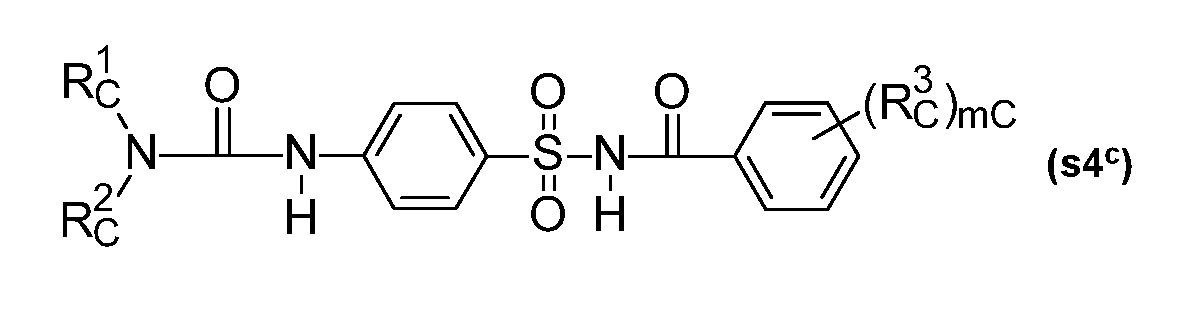
- Rc 1 , Rc 2 are independently hydrogen, (C 1 -C 8 )alkyl, (C 3 -C 8 )cycloalkyl, (C 3 -C 6 )alkenyl, (C 3 -
- Rc 3 is halogen, (C 1 -C 4 )alkyl, (C 1 -C 4 alkoxy, CF 3 and me is 1 or 2; for example
- RD 4 is halogen, (C 1 -C 4 -alkyl, (C 1 -C 4 )-alkoxy, CF 3 ; m D is 1 or 2;
- RD 5 is hydrogen, (C 1 -C 6 )-alkyl. (C 3 -C 6 )-cycloalkyl, (C 2 -C 6 )-alkenyl, (C 2 -C 6 )-alkynyl or (C 5 -C 6 )- cycloalkenyl.
- Active ingredients from the class of the hydroxyaromatics and the aromatic-aliphatic carboxylic acid derivatives (S5) for example ethyl 3,4,5-triacetoxybenzoate, 3,5-dimethoxy-4-hydroxybenzoic acid, 3,5-dihydroxybenzoic acid, 4-hydroxysalicylic acid, 4-fluorosalicyclic acid, 2- hydroxycinnamic acid, 2,4-dichlorocinnamic acid, as described in WO-A-2004/084631, WO-A- 2005/015994, WO-A-2005/016001.
- Active ingredients from the class of the l,2-dihydroquinoxalin-2-ones for example 1-methyl- 3-(2-thienyl)-l,2-dihydroquinoxalin-2-one, l-methyl-3-(2-thienyl)-l,2-dihydroquinoxaline-2- thione, l-(2-aminoethyl)-3 -(2 -thienyl)- l,2-dihydroquinoxalin-2-one hydrochloride, l-(2- methylsulfonylaminoethyl)-3 -(2 -thienyl)- l,2-dihydroquinoxalin-2 -one, as described in WO-A- 2005/112630.
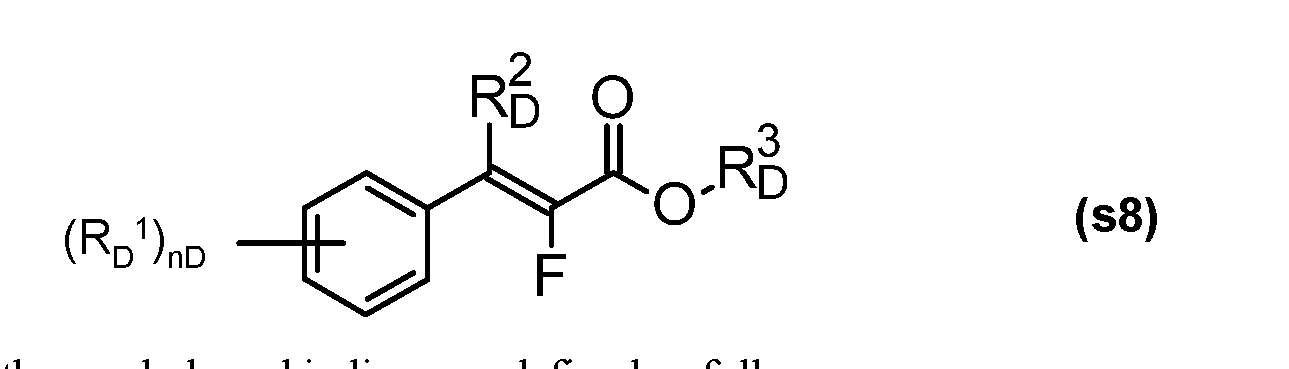
- RD 1 is halogen, (C 1 -C 4 )-alkyl, (C 1 -C 4 -haloalkyl, (C 1 -C 4 )-alkoxy, (C 1 -C 4 )-haloalkoxy,
- R D 2 is hydrogen or (C 1 -C 4 )-alkyl
- R D 3 is hydrogen, (C 1 -C 8 )-alkyl, (C 2 -C 4 )-alkenyl, (C 2 -C 4 )-alkynyl or aryl, where each of the aforementioned carbon-containing radicals is unsubstituted or substituted by one or more, preferably up to three identical or different radicals from the group consisting of halogen and alkoxy; or salts thereof, n D is an integer from 0 to 2.
- s9 Active ingredients from the class of the 3-(5-tetrazolylcarbonyl)-2-quinolones (S9), for example l,2-dihydro-4-hydroxy-l-ethyl-3-(5-tetrazolylcarbonyl)-2-quinolone (CAS Reg. No.: 219479-18- 2), l,2-dihydro-4-hydroxy-l-methyl-3-(5-tetrazolylcarbonyl)-2-quinolone (CAS Reg. No. 95855- 00-8), as described in WO-A- 1999/000020.
- slO Compounds of the formula (S10 a ) or (S10 b ) as described in WO-A-2007/023719 and WO-A-2007/023764, in which
- R E 1 is halogen, (C 1 -C 4 )-alkyl, methoxy, nitro, cyano, CF 3 , OCF 3
- Y E , Z E are independently O or S, n E is an integer from 0 to 4,
- R E 2 is (C 1 -C 16 )-alkyl, (C 2 -C 6 )-alkenyl, (C 3 -C 6 )-cycloalkyl, aryl; benzyl, halobenzyl,
- R E 3 is hydrogen or (C 1 -C 6 )-alkyl.
- SI 1 Active ingredients of the oxyimino compound type (SI 1), which are known as seed-dressing agents, for example "oxabetrinil” ((Z)-l,3-dioxolan-2-ylmethoxyimino(phenyl)acetonitrile) (SI 1-1), which is known as a seed-dressing safener for millet/sorghum against metolachlor damage,
- luxofenim (l-(4-chlorophenyl)-2,2,2-trifluoro-l-ethanone 0-(l,3-dioxolan-2-ylmethyl)oxime) (S 11 -2), which is known as a seed-dressing safener for millet/ sorghum against metolachlor damage, and
- naphthalic anhydride (1,8-naphthalenedicarboxylic anhydride) (SI 3-1), which is known as a seed dressing safener for com against thiocarbamate herbicide damage
- fenclorim (4,6-dichloro-2-phenylpyrimidine) (S 13-2), which is known as a safener for pretilachlor in sown rice
- flurazole (benzyl 2-chloro-4-trifluoromethyl-l,3-thiazole-5-carboxylate) (S13-3), which is known as a seed-dressing safener for millet/sorghum against alachlor and metolachlor damage,
- MG 191 (CAS Reg. No. 96420-72-3) (2-dichloromethyl -2 -methyl- 1,3-dioxolane) (S13-5) from Nitrokemia, which is known as a safener for com,
- mephenate (4-chlorophenyl methylcarbamate) (S13-9). Active ingredients which, in addition to herbicidal action against weeds, also have safener action on crop plants such as rice, for example
- RH 1 is a (CVCg)-haloalkyl radical and RH 2 is hydrogen or halogen and
- RH 3 , RH 4 are each independently hydrogen, (C 1 -C 16 )-alkyl, (C 2 -C 16 )-alkenyl or (C 2 -C 16 )-alkynyl, where each of the 3 latter radicals is unsubstituted or substituted by one or more radicals from the group of halogen, hydroxyl, cyano, (C 1 -C 4 )-alkoxy, (C 1 -C 4 )-haloalkoxy, (C 1 -C 4 )- alkylthio, (C 1 -C 4 )-alkylamino, di[(C 1 -C 4 )-alkyl] amino, [(C 1 -C 4 )-alkoxy]carbonyl, [(C 1 -C 4 )- haloalkoxy] carbonyl, (C 3 -C 6 )-cycloalkyl which is unsubstituted or substituted, phenyl which is unsub
- RH 3 is (C 1 -C 4 -alkoxy, (C 2 -C 4 )-alkenyloxy, (C 2 -C 6 )-alkynyloxy or (C 2 -C 4 )-haloalkoxy and RH 4 is hydrogen or (C 1 -C 4 )-alkyl or
- RH 3 and RH 4 together with the directly bonded nitrogen atom are a four- to eight-membered heterocyclic ring which, as well as the nitrogen atom, may also contain further ring heteroatoms, preferably up to two further ring heteroatoms from the group of N, O and S, and which is unsubstituted or substituted by one or more radicals from the group of halogen, cyano, nitro, (C 1 - C 4 )alkyl, (C 1 -C 4 )haloalkyl, (C 1 -C 4 )alkoxy, (C 1 -C 4 )haloalkoxy and (C 1 -C 4 )alkylthio.
- Active ingredients which are used primarily as herbicides but also have safener action on crop plants, for example (2,4-dichlorophenoxy)acetic acid (2,4-D),
- Preferred safeners s) are selected from the group of isoxadifen-ethyl, cyprosulfamide, cloquintocet-mexyl and mefenpyr-diethyl. Particular preference is given to mefenpyr-diethyl and cloquintocet-mexyl. Very particular preference is given to mefenpyr-diethyl.
- active herbicidal ingredients c) selected from the group of: flufenacet, prosulfocarb, pendimethalin, diflufenican, aclonifen, metribuzin, pyroxasulfone, propoxycarbazone, thiencarbazone-methyl, fenoxaprop, bromoxynil, halauxifen-methyl, 2,4-D, MCPA.
- active herbicidal ingredients c) selected from the group of: flufenacet, prosulfocarb, pendimethalin, diflufenican, aclonifen, metribuzin, pyroxasulfone, propoxycarbazone, thiencarbazone-methyl, fenoxaprop, bromoxynil, halauxifen-methyl, 2,4-D, MCPA.
- active herbicidal ingredients c) selected from the group of: flufenacet, prosulfocarb, pendimethalin, diflu
- mixtures of one or more active herbicidal ingredients c) selected from the group of: flufenacet and pethoxamid; flufenacet and aclonifen; flufenacet and metribuzin; flufenacet and halauxifen- methyl; prosulfocarb and diflufenican; prosulfocarb and aclonifen; prosulfocarb and metribuzin; prosulfocarb and flufenacet; prosulfocarb and halauxifen-methyl; pendimethalin and diflufenican; pendimethalin and aclonifen; pendimethalin and metribuzin; pendimethalin and halauxifen-methyl; metribuzin and diflufenican; halauxifen-methyl and diflufenican; flufenacet and diflufenican; metribuzin and aclonifen, halauxifen-methyl and a
- the mixtures are most preferably selected from: flufenacet and diflufenican; flufenacet and pyroxasulfone; aclonifen and diflufenican; metribuzin and diflufenican; flufenacet and aclonifen; flufenacet and metribuzin; flufenacet and pyroxasulfone and dilflufenican; aclonifen and diflufenican and flufenacet; metribuzin and diflufenican and flufenacet.
- the active herbicidal ingredients c) mentioned and mixtures thereof may likewise be used with a safener s) selected from the group of isoxadifen-ethyl, cyprosulfamide, cloquintocet-mexyl and mefenpyr-diethyl.
- the mixtures comprising c) and s) are selected from: 2-[(2,4-dichlorophenyl)methyl]-4,4‘- dim ethyl-3 -isoxazolidinone (CAS Number 81777-95-9 or IPUAC 2-(2,4-dichlorobenzyl)-4, 4-dimethyl- 1,2- oxazolidin-3-one, Cinmethylin, flufenacet and diflufenican and mefenpyr-diethyl; flufenacet and diflufenican and cloquintocet-mexyl, aclonifen and diflufenican and mefenpyr-diethyl; pyroxasulfone and mefenpyr-diethyl.
- fungicides as compound c) are:
- Inhibitors of the ergosterol biosynthesis for example (1.001) cyproconazole, (1.002) difenoconazole, (1.003) epoxiconazole, (1.004) fenhexamid, (1.005) fenpropidin, (1.006) fenpropimorph, (1.007) fenpyrazamine, (1.008) fluquinconazole, (1.009) flutriafol, (1.010) imazalil, (1.011) imazalil sulfate, (1.012) ipconazole, (1.013) metconazole, (1.014) myclobutanil, (1.015) paclobutrazol, (1.016) prochloraz, (1.017) propiconazole, (1.018) prothioconazole, (1.019) pyrisoxazole, (1.020) spiroxamine, (1.021) tebuconazole, (1.022) tetraconazole, (1.023) t
- Inhibitors of the respiratory chain at complex I or II for example (2.001) benzovindiflupyr, (2.002) bixafen, (2.003) boscalid, (2.004) carboxin, (2.005) fluopyram, (2.006) flutolanil, (2.007) fluxapyroxad, (2.008) furametpyr, (2.009) Isofetamid, (2.010) isopyrazam (anti-epimeric enantiomer 1R,4S,9S), (2.011) isopyrazam (anti-epimeric enantiomer 1S,4R,9R), (2.012) isopyrazam (anti-epimeric racemate 1RS,4SR,9SR), (2.013) isopyrazam (mixture of syn-epimeric racemate 1RS,4SR,9RS and anti-epimeric racemate 1RS,4SR,9SR), (2.014) isopyrazam (syn-epimeric enantiomer 1R,4S
- Inhibitors of the respiratory chain at complex III for example (3.001) ametoctradin, (3.002) amisulbrom, (3.003) azoxystrobin, (3.004) coumethoxystrobin, (3.005) coumoxystrobin, (3.006) cyazofamid, (3.007) dimoxystrobin, (3.008) enoxastrobin, (3.009) famoxadone, (3.010) fenamidone, (3.011) flufenoxystrobin, (3.012) fluoxastrobin, (3.013) kresoxim-methyl, (3.014) metominostrobin, (3.015) orysastrobin, (3.016) picoxystrobin, (3.017) pyraclostrobin, (3.018) pyrametostrobin, (3.019) pyraoxystrobin, (3.020) trifloxystrobin, (3.021) (2E)-2- ⁇ 2-[( ⁇ [(lE)-l-(3- ⁇ [((l
- Inhibitors of the mitosis and cell division for example (4.001) carbendazim, (4.002) diethofencarb,
- Inhibitors of the amino acid and/or protein biosynthesis for example (7.001) cyprodinil, (7.002) kasugamycin, (7.003) kasugamycin hydrochloride hydrate, (7.004) oxytetracycline, (7.005) pyrimethanil, (7.006) 3-(5-fluoro-3,3,4,4-tetramethyl-3,4-dihydroisoquinolin-l-yl)quinolone.
- Inhibitors of the ATP production for example (8.001) silthiofam.
- Inhibitors of the cell wall synthesis for example (9.001) benthiavalicarb, (9.002) dimethomorph, (9.003) flumorph, (9.004) iprovalicarb, (9.005) mandipropamid, (9.006) pyrimorph, (9.007) vabfenalate, (9.008) (2E)-3-(4-tert-butylphenyl)-3-(2-chloropyridin-4-yl)-l-(morphobn-4-yl)prop-2-en-l-one, (9.009) (2Z)-3- (4-tert-butylphenyl)-3 -(2-chloropyridin-4-yl)- 1 -(morphobn-4-yl)prop-2-en- 1 -one .
- Inhibitors of the lipid and membrane synthesis for example (10.001) propamocarb, (10.002) propamocarb hydrochloride, (10.003) tolclofos-methyl.
- Inhibitors of the melanin biosynthesis for example (11.001) tricyclazole, (11.002) tolprocarb.
- Inhibitors of the nucleic acid synthesis for example (12.001) benalaxyl, (12.002) benalaxyl-M (kiralaxyl), (12.003) metalaxyl, (12.004) metalaxyl-M (mefenoxam).
- Inhibitors of the signal transduction for example (13.001) fludioxonil, (13.002) iprodione, (13.003) procymidone, (13.004) proquinazid, (13.005) quinoxyfen, (13.006) vinclozolin.
- Acetylcholinesterase (AChE) inhibitors preferably carbamates selected from alanycarb, aldicarb, bendiocarb, benfuracarb, butocarboxim, butoxycarboxim, carbaryl, carbofuran, carbosulfan, ethiofencarb, fenobucarb, formetanate, furathiocarb, isoprocarb, methiocarb, methomyl, metolcarb, oxamyl, pirimicarb, propoxur, thiodicarb, thiofanox, triazamate, trimethacarb, XMC and xylylcarb, or organophosphates selected from acephate, azamethiphos, azinphos-ethyl, azinphos-methyl, cadusafos, chlorethoxyfos, chlorfenvinphos, chlormephos, chlorpyrifos-methyl, cous
- GABA-gated chloride channel blockers preferably cyclodiene-organochlorines selected from chlordane and endosulfan, or phenylpyrazoles (fiproles) selected from ethiprole and fipronil.
- Sodium channel modulators preferably pyrethroids selected from acrinathrin, allethrin, d-cis-trans allethrin, d-trans allethrin, bifenthrin, bioallethrin, bioallethrin s-cyclopentenyl isomer, bioresmethrin, cycloprothrin, cyfluthrin, beta-cyfluthrin, cyhalothrin, lambda-cyhalothrin, gamma-cyhalothrin, cypermethrin, alpha- cypermethrin, beta-cypermethrin, theta-cypermethrin, zeta-cypermethrin, cyphenothrin [(lR)-trans-isomer], deltamethrin, empenthrin [(EZ)-(lR)-isomer], esf
- Nicotinic acetylcholine receptor (nAChR) competitive modulators preferably neonicotinoids selected from acetamiprid, clothianidin, dinotefuran, imidacloprid, nitenpyram, thiacloprid and thiamethoxam, or nicotine, or sulfoximines selected from sulfoxaflor, or butenolids selected from flupyradifurone, or mesoionics selected from triflumezopyrim .
- Nicotinic acetylcholine receptor (nAChR) allosteric modulators preferably spinosyns selected from spinetoram and spinosad.
- Glutamate-gated chloride channel (GluCl) allosteric modulators preferably avermectins/milbemycins selected from abamectin, emamectin benzoate, lepimectin and milbemectin.
- Juvenile hormone mimics preferably juvenile hormone analogues selected from hydroprene, kinoprene and methoprene, or fenoxycarb or pyriproxyfen.
- Miscellaneous non-specific (multi-site) inhibitors preferably alkyl halides selected from methyl bromide and other alkyl halides, or chloropicrine or sulphuryl fluoride or borax or tartar emetic or methyl isocyanate generators selected from diazomet and metam.
- Mite growth inhibitors selected from clofentezine, hexythiazox, diflovidazin and etoxazole.
- Microbial disruptors of the insect gut membrane selected from Bacillus thuringiensis subspecies israelensis, Bacillus sphaericus, Bacillus thuringiensis subspecies aizawai, Bacillus thuringiensis subspecies kurstaki, Bacillus thuringiensis subspecies tenehrionis, and B.t. plant proteins selected from CrylAb, CrylAc, CrylFa, CrylA.105, Cry2Ab, Vip3A, mCry3A, Cry3Ab, Cry3Bb and Cry34Abl/35Abl.
- Inhibitors of mitochondrial ATP synthase preferably ATP disruptors selected from diafenthiuron, or organotin compounds selected from azocyclotin, cyhexatin and fenbutatin oxide, or propargite or tetradifon.
- Inhibitors of chitin biosynthesis type 0, selected from bistrifluron, chlorfluazuron, diflubenzuron, flucycloxuron, flufenoxuron, hexaflumuron, lufenuron, novaluron, noviflumuron, teflubenzuron and triflumuron.
- Inhibitors of chitin biosynthesis type 1 selected from buprofezin.
- Moulting disruptor in particular for Diptera, i.e. dipterans selected from cyromazine.
- Ecdysone receptor agonists selected from chromafenozide, halofenozide, methoxyfenozide and tebufenozide.
- Octopamine receptor agonists selected from amitraz.
- Mitochondrial complex III electron transport inhibitors selected from hydramethylnone, acequinocyl and fluacrypyrim.
- Mitochondrial complex I electron transport inhibitors preferably METI acaricides selected from fenazaquin, fenpyroximate, pyrimidifen, pyridaben, tebufenpyrad and tolfenpyrad, or rotenone (Derris).
- Inhibitors of acetyl CoA carboxylase preferably tetronic and tetramic acid derivatives selected from spirodiclofen, spiromesifen and spirotetramat.
- Mitochondrial complex IV electron transport inhibitors preferably phosphines selected from aluminium phosphide, calcium phosphide, phosphine and zinc phosphide, or cyanides selected from calcium cyanide, potassium cyanide and sodium cyanide.
- Mitochondrial complex II electron transport inhibitors preferably Z>eta-ketonitrile derivatives selected from cyenopyrafen and cyflumetofen, and carboxanilides selected from pyflubumide.
- Chordotonal organ Modulators selected from flonicamid.
- Further active compounds selected from Acynonapyr, Afidopyropen, Afoxolaner, Azadirachtin, Benclothiaz, Benzoximate, Benzpyrimoxan, Bifenazate, Broflanilide, Bromopropylate, Chinomethionat, Chloroprallethrin, Cryolite, Cyclaniliprole, Cycloxaprid, Cyhalodiamide, Dicloromezotiaz, Dicofol, Dimpropyridaz, epsilon- Metofluthrin, epsilon-Momfluthrin, Flometoquin, Fluazaindolizine, Fluensulfone, Flufenerim, Flufenoxystrobin, Flufiprole, Fluhexafon, Fluopyram, Flupyrimin, Fluralaner,
- Useful organic solvents d) include all customary organic solvents that have low miscibility with water.
- Preferred examples include aliphatic and aromatic, optionally halogenated hydrocarbons such as toluene, xylene, Solvesso ® 100, 100ND, 150, 150 ND or 200, 200 ND (mineral oil), tetrachloromethane, chloroform, methylene chloride and dichloroethane, and also esters such as ethyl acetate, and alkanecarboxamides such as N,N-dimethyloctanamide and N,N-dimethyldecanamide.
- vegetable oils and modified oil for example by methylation, ethylation and also hydrogenation and hydration
- vegetable oils and modified oil for example, on rapeseed oil, maize kernel oil, coconut oil or the like.
- mineral oil particularly preference is given to using mineral oil, very particular preference to using solvents based on a from dialkylnaphthalene (for example diisopropylnaphthalene), and mixture of 1 -methyl- and 2-methylnaphthalene and naphthalene (for example Solvesso ® 200 ND products, CAS No.: 64742-94-5).
- Suitable carrier materials g) are selected from the group of the Silica, ton, silicates.
- the capsule suspension concentrates according to the invention are of excellent suitability for application of the active agrochemical ingredients present to plants and/or the habitat thereof. They ensure the release of the active components in the respective desired amount over a relatively long period of time.
- the capsule suspension concentrates according to the invention can be used in practice either as such or after dilution with water. Application is effected by customary methods, i.e., for example by pouring or spraying.
- the application rate of capsule suspension concentrates according to the invention may be varied within a relatively wide range. It is guided by the active agrochemical ingredients in question and by the content thereof in the microcapsule formulations.
- a preferred use of the capsule suspension concentrates according to the invention is as a herbicide in cereals and oilseed rape, most preferably in winter barley and in this context in a pre-emergence method and in a post-emergence method. Preference is therefore given to use in an autumn application shortly after the sowing of the cereal and shortly before or shortly after germination of the weeds and in particular weed grasses.
- the capsule suspension concentrates according to the invention can be produced by known processes, for example as mixed formulations of the individual components, optionally with further active ingredients, additives and/or customary formulation auxiliaries, and these are then applied in a customary manner diluted with water, or as tankmixes by joint dilution of the separately formulated or partly separately formulated individual components with water. Likewise possible is the application at different times (split application) of the separately formulated or partly separately formulated individual components. It is also possible to apply the individual components or the capsule suspension concentrates according to the invention in a plurality of portions (sequential application), for example by pre-emergence applications followed by postemergence applications or by early post-emergence applications followed by medium or late post-emergence applications. Preference is given to the joint or immediately successive application of the active ingredients in the respective combination.
- the present invention further provides a method of controlling unwanted plants in plant crops, which is characterized in that the capsule suspension concentrates according to the invention are deployed on the plants (for example harmful plants such as mono- or dicotyledonous weeds or unwanted crop plants) or the area on which the plants grow.
- the capsule suspension concentrates according to the invention are deployed on the plants (for example harmful plants such as mono- or dicotyledonous weeds or unwanted crop plants) or the area on which the plants grow.
- Unwanted plants are understood to mean all plants which grow at sites where they are unwanted. These can be, for example, harmful plants (e.g. mono- or dicotyledonous weeds or unwanted crop plants).
- Monocotyledonous weeds come, for example, from the genera: Aegilops, Agropyron, Agrostis, Alopecurus, Apera, Avena, Brachiaria, Bromus, Cenchrus, Commelina, Cynodon, Cyperus, Dactyloctenium, Digitaria, Echinochloa, Eleocharis, Eleusine, Eragrostis, Eriochloa, Festuca, Fimbristylis, Heteranthera, Imperata, Ischaemum, Leptochloa, Lolium, Monochoria, Panicum, Paspalum, Phalaris, Phleum, Poa, Rottboellia, Sagittaria, Scirpus, Setaria, and Sorghum.
- Dicotyledonous weeds come, for example, from the genera Ahutilon, Amaranthus, Ambrosia, Anoda, Anthemis, Aphanes, Artemisia, Atriplex, Beilis, Bidens, Capsella, Carduus, Cassia, Centaurea, Chenopodium, Cirsium, Convolvulus, Datura, Desmodium, Emex, Erysimum, Euphorbia, Galeopsis, Galinsoga, Galium, Hibiscus, Ipomoea, Kochia, Lamium, Lepidium, Lindernia, Matricaria, Mentha, Mercurialis, Mullugo, Myosotis, Papaver, Pharbitis, Plantago, Polygonum, Portulaca, Ranunculus, Raphanus, Rorippa, Rotala, Rumex, Salsola, Senecio, Sesbania, Sida, Sinapis, Solanum, Sonchus, Sphenoclea,
- the capsule suspension concentrates according to the invention are used to control the weed of the Alopecurus myosuroides species HUDS (or black grass).
- the invention also provides for the use of the capsule suspension concentrates according to the invention for control of unwanted plant growth, preferably in crops of useful plants.
- capsule suspension concentrates according to the invention are applied to the soil surface before germination, either the emergence of the weed seedlings is prevented completely or the weeds grow until they have reached the cotyledon stage, but then they stop growing and ultimately die completely after three to four weeks have passed.
- compositions When the capsule suspension concentrates according to the invention compositions are applied postemergence to the green parts of the plants, growth likewise stops rapidly a very short time after the treatment, and the weed plants remain at the growth stage at the time of application, or they die completely after a certain time, such that competition by the weeds, which is harmful to the crop plants, is thus eliminated very early and in a sustained manner.
- the capsule suspension concentrates according to the invention are notable for a rapid onset and long duration of herbicidal action. Said properties and advantages are beneficial in practical weed control in order to keep agricultural crops clear of unwanted competing plants and hence to ensure and/or increase the yields in terms of quality and quantity. These novel compositions markedly exceed the technical state of the art with a view to the properties described.
- the capsule suspension concentrates according to the invention have excellent herbicidal activity against monocotyledonous and dicotyledonous weeds, there is only insignificant damage, if any, to crop plants of economically important crops, for example dicotyledonous crops such as soya, cotton, oilseed rape, sugar beet, or gramineous crops such as wheat, barley, rye, oats, millet/sorghum, rice or com.
- the capsule suspension concentrates according to the invention are highly suitable for selective control of unwanted plant growth in agriculturally useful plants or in ornamental plants.
- the capsule suspension concentrates according to the invention have excellent growth-regulatory properties in crop plants.
- the capsule suspension concentrates according to the invention can also be used to control harmful plants in crops of genetically modified plants which are known or are yet to be developed.
- the transgenic plants are characterized by particular advantageous properties, for example by resistances to certain pesticides, in particular certain herbicides, resistances to plant diseases or pathogens of plant diseases, such as certain insects or microorganisms such as fungi, bacteria or viruses.
- Other specific characteristics relate, for example, to the harvested material with regard to quantity, quality, storability, composition and specific constituents. For instance, there are known transgenic plants with an elevated starch content or altered starch quality, or those with a different fatty acid composition in the harvested material.
- the capsule suspension concentrates according to the invention in economically important transgenic crops of useful and ornamental plants, for example of gramineous crops such as wheat, barley, rye, oats, millet/sorghum, rice, oilseed rape and maize.
- the compositions according to the invention can be used as herbicides in crops of useful plants which are resistant, or have been made resistant by genetic engineering, to the phytotoxic effects of the herbicides.
- Particular preference is given to use on wheat, barley, rye and oilseed rape, preferably winter oilseed rape.
- capsule suspension concentrates according to the invention are employed in transgenic crops, not only do the effects toward harmful plants observed in other crops occur, but frequently also effects which are specific to application in the particular transgenic crop, for example an altered or specifically widened spectrum of weeds which can be controlled, altered application rates which can be used for the application, preferably good combinability with the herbicides to which the transgenic crop is resistant, and influencing of growth and yield of the transgenic crop plants.
- the present invention also further provides a method of controlling unwanted plant growth, preferably in crop plants such as cereals (e.g. wheat, barley, rye, oats, rice, com, millet/sorghum), more preferably in monocotyledonous crops such as cereals, for example wheat, barley, rye, oats, crossbreeds thereof, such as triticale, rice, com and millet/sorghum, wherein one or more capsule suspension concentrates according to the invention are applied to the harmful plants, plant parts, plant seeds or the area in which the plants grow, for example the area under cultivation in the.
- the capsule suspension concentrates according to the invention are applied pre-emergence and post-emergence. More preferably pre-emergence.
- the invention therefore also provides for the use of the capsule suspension concentrates according to the invention for control of harmful plants in transgenic crop plants.
- a further preferred use of the capsule suspension concentrates according to the invention is as insecticide.
- a preferred direct treatment of the plants is leaf application, i.e. the capsule suspensions according to the present invention are applied to the foliage, wherein the treatment frequency and the application rate should be matched to the infestation pressure of the respective pest.
- the capsule suspensions according to the present invention also reach the plants via the root system.
- the plants are then treated by the action of the capsule suspensions according to the present invention on the plant's habitat.
- This can be, for example, by drenching or mixing into the soil or the nutrient solution, i.e. the location of the plant (e.g. soil or hydroponic systems) is soaked with a liquid form of the capsule suspensions according to the present invention, or by soil application, i.e. the capsule suspensions according to the present invention are introduced in solid form (e.g. in the form of granules) into the location of the plants, or by drip application ("drip", often also referred to as "chemigation”), i.e.
- the capsule suspensions according to the present invention are introduced by means of surface or underground drip pipes over certain periods of time together with varying amounts of water at defined locations near the plants.
- this can also be done by metering the compound of the formula (I) into a solid application form (for example as granules) into a flooded rice field.
- the capsule suspension concentrates according to the invention are outstandingly suitable for the application of the agrochemical active substances contained to plants and / or their habitat. They ensure the release of the active components in the desired amount over a longer period of time.
- the capsule suspension concentrates according to the invention can be used in practice either as such or after prior dilution with water. The application takes place according to usual methods, e.g. by pouring, spraying or spraying.
- the application rate of capsule suspension concentrates according to the invention can be varied within a relatively wide range. It depends on the respective agrochemical active ingredients and their content in the microcapsule formulations.
- the capsule suspension concentrates according to the invention can be prepared by known methods e.g. are produced as mixed formulations of the individual components, if appropriate with further active ingredients, additives and / or customary formulation auxiliaries, which are then diluted with water in the customary manner, or as so-called tank mixes by diluting the separately formulated or partially separately formulated individual components with water. Time-shifted application (split application) of the separately formulated or partially separately formulated individual components is also possible. It is also possible to use the individual components or the capsule suspension concentrates according to the invention in several portions (sequence application). The invention therefore also provides for the use of the capsule suspension concentrates according to the invention for control of pathogenic fungi and insecticidal pests in crop plants.
- the invention further preferably provides for the use of the capsule suspension concentrates according to the invention for treatment of plants where the seed has been treated with safener.
- the invention is illustrated by the examples below.
- Rhodopol ® G xanthan derivative Solvay
- Kuraray Poval ® 26-88 polyvinyl alcohol from Kuraray, about 88% hydrolysed polyvinyl acetate
- the viscosity is 1895 mPas, 30°C, DIN EN ISO 2884-1.
- the viscosity is 2088 mPas, 50°C, DIN EN ISO 2884-1. At room temperature the product is solid to waxy.
- Prepolymer I- LT19143 900 g of Ongronat ® 2100 were put into a reactor and heated to 50°C. 100 g of Capa ® 400 was added and stirring at 80°C was continued until a NCO content of 25 % was reached.
- the viscosity is 1225 mPas, 30°C, DIN EN ISO 2884-1.
- Ongronat ® 2100 880 g of Ongronat ® 2100 were put into a reactor and heated to 50°C. 120 g of Capa ® 500 was added and stirring at 80°C was continued until a NCO content of 25 % was reached.
- the viscosity is 1215 mPas, 30°C, DIN EN ISO 2884-1.
- Ongronat ® 2100 880 g of Ongronat ® 2100 were put into a reactor and heated to 50°C. 120 g Capa ® 750 was added and stirring at 80°C was continued until a NCO content of 25 % was reached. The viscosity is 875 mPas, 30°C, DIN EN ISO 2884-1.
- the active ingredients e.g. Bixlozone, Deltamethrin
- the hydrophic solvent e.g. Solvesso ® 200 ND.
- the isocyanate e.g. Desmodur ® 44V20L, Ongronat 2100
- This mixture was added to a solution of protective colloid and dispersant (e.g. Reax 88B), a defoamer (e.g. SAG 1572) and a biocide (e.g. Kathon ® CG/ICP) in the needed amount of water.
- the mixture was emulsified with a disperser at a giving speed and time (e.g. 15 000 rpm for 10 minutes).
- the required amount of isocyanate reactive group (e.g. hexamethlyendiamine dissolved in water) was added.
- the resulting reaction mixture is heated up to 70°C within one hour and kept at 70°C with gentle stirring for a further 4 hours.
- 0.2 g of a 30% aqueous ammonia solution is added.
- the mixture is thickened with 0.2 g of Rhodopol ® G and 0.4 g citric acid were added. In this way, a microcapsule formulation having with a particle size of appr. 12 pm (d90) is obtained.
- the free, unencapsulated amount of active ingredient as well as the total amount was determined.
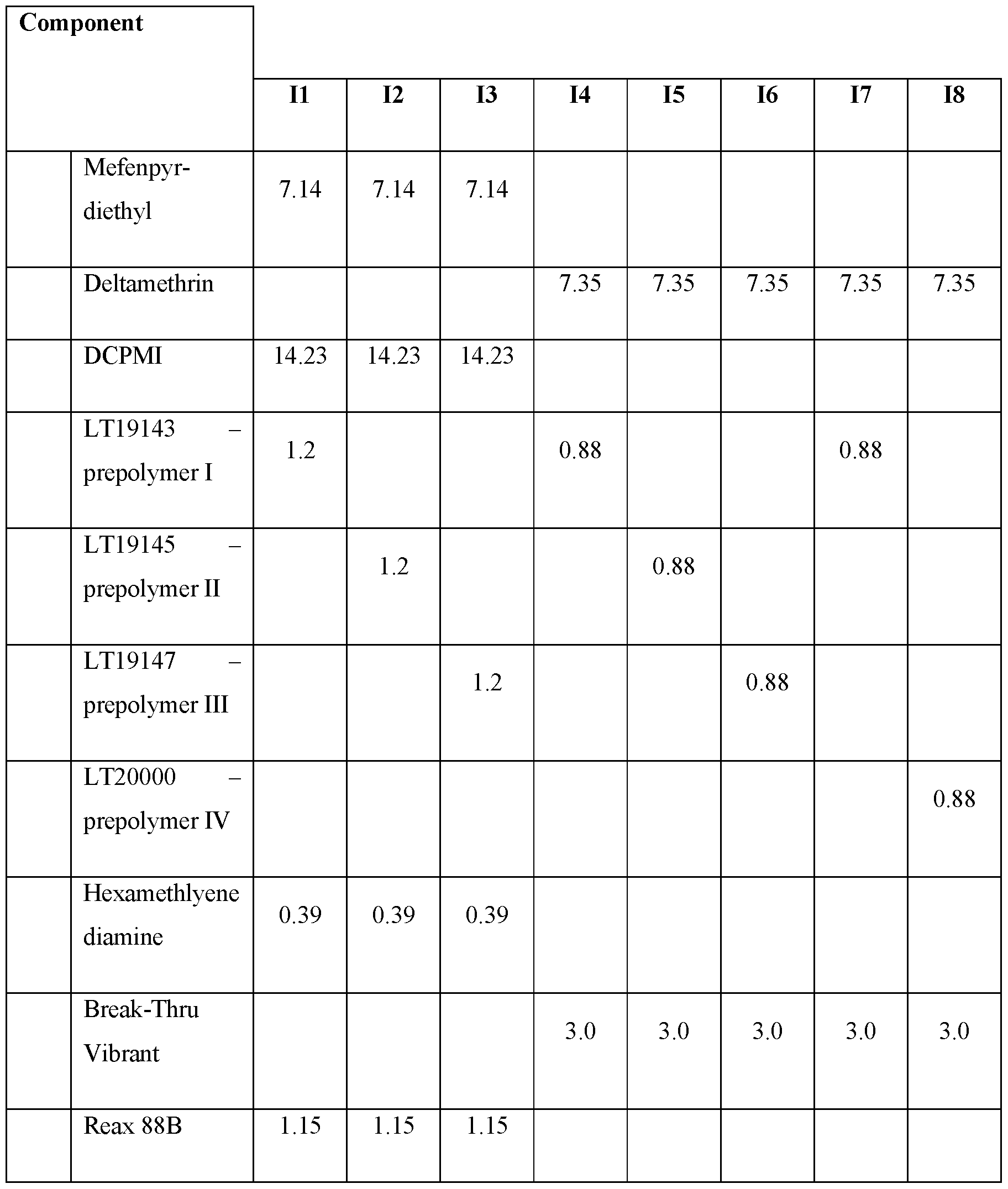
- Table I Composition of capsule suspension concentrates; comparative examples
- Table II Composition of capsule suspension concentrates; inventive capsule suspensions
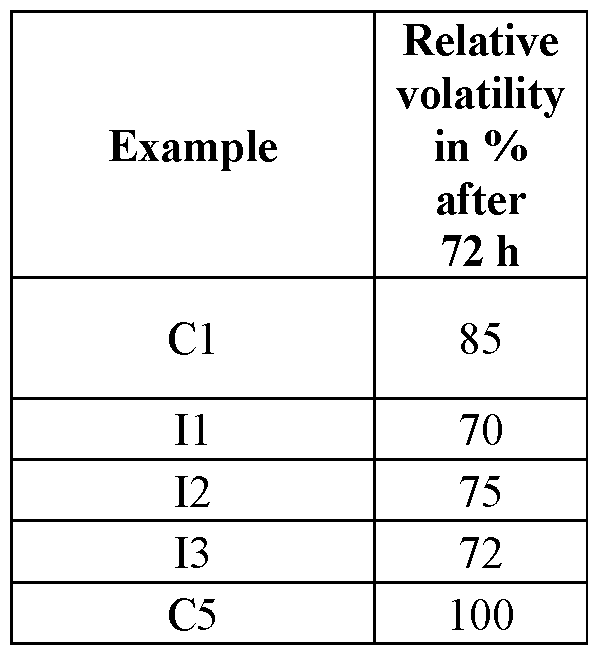
- a spray liquor (0.5 g of active ingredient/1) is placed onto three Teflon membranes in each case in a glass box open at the top in a laboratory fume hood under a constant air flow of 1.6 m/s at 22°C and 60% relative air humidity.
- the residue on the Teflon membranes is determined by HPLC after drying after 0, 24 and 72 h.
- the volatility is based on the 0 h value. Table 3 Determination of volatility; the amount of active ingredient is the content of DCPMI in % by weight.
- Soil moisture was adjusted to 50 % of the specific field capacity and increased to 80 %, after emergence of the first neonate Diabrotica balteata larvae.
- Growing conditions were at a constant temperature of 25°C, 60-70 % relative humidity and 14 h of illumination with sodium pressure lamps.
- the experimental setup comprised three replicates per treatment. Evaluation was conducted 21 days after infestation by counting the number of damaged plants and by measuring the shoot fresh weights per container. The application rate of Deltamethrin was 60 g/ha.
- the pH decreases stronger as in the comparative ones.
- the formation of free acid is a proof of formation of free acid from the ester thus showing increased hydrolysis of the polymer shell material and thus degradation.
- the Isocyanate Prepolymer A was dissolved in Solvesso 200 ND.
- the amine B was added to the aqueous phase. It was stirred for 2 h at room temperature.
- the solid formed polymer shell (composition as in 11-3) Pl-3 was fdtered off and dried for 3 days at 120°C until the sample was weight constant.
- test was performed under OECD 301B conditions (C02 Evolution Test) for 28 days under aerobic conditions.
- the test item concentration applied was 20 mg TOC/L with an inoculum concentration of 29.6 mg suspended solids per litre and a total liquid volume of 2 L in 3 L test vessels.
- the polymers show a faster degradation after 14 and 28 days in comparison to the reference.
- the degradation is ongoing from day 14 to 28 days thus is indicating a complete degradation over a longer period of time.
Landscapes
- Chemical & Material Sciences (AREA)
- Organic Chemistry (AREA)
- Health & Medical Sciences (AREA)
- Life Sciences & Earth Sciences (AREA)
- Chemical Kinetics & Catalysis (AREA)
- Medicinal Chemistry (AREA)
- Polymers & Plastics (AREA)
- General Health & Medical Sciences (AREA)
- Pest Control & Pesticides (AREA)
- Engineering & Computer Science (AREA)
- Environmental Sciences (AREA)
- Toxicology (AREA)
- Agronomy & Crop Science (AREA)
- Dentistry (AREA)
- Wood Science & Technology (AREA)
- Zoology (AREA)
- Plant Pathology (AREA)
- Dispersion Chemistry (AREA)
- Agricultural Chemicals And Associated Chemicals (AREA)
- Manufacturing Of Micro-Capsules (AREA)
- Polyurethanes Or Polyureas (AREA)
- Fertilizers (AREA)
- Biological Depolymerization Polymers (AREA)
- Medicinal Preparation (AREA)
- General Preparation And Processing Of Foods (AREA)
Abstract
Description








Claims
Priority Applications (11)
| Application Number | Priority Date | Filing Date | Title |
|---|---|---|---|
| JP2022579802A JP2023531993A (en) | 2020-06-26 | 2021-06-23 | Aqueous Capsule Suspension Formulation Containing Biodegradable Ester Groups |
| MX2023000185A MX2023000185A (en) | 2020-06-26 | 2021-06-23 | AQUEOUS CONCENTRATES IN SUSPENSION IN CAPSULES WITH BIODEGRADABLE ESTER GROUPS. |
| AU2021298129A AU2021298129A1 (en) | 2020-06-26 | 2021-06-23 | Aqueous capsule suspension concentrates comprising biodegradable ester groups |
| CN202180052666.XA CN115989255A (en) | 2020-06-26 | 2021-06-23 | Aqueous capsule suspension concentrate containing biodegradable ester groups |
| EP21733837.5A EP4172234A1 (en) | 2020-06-26 | 2021-06-23 | Aqueous capsule suspension concentrates comprising biodegradable ester groups |
| KR1020237001991A KR20230029810A (en) | 2020-06-26 | 2021-06-23 | Aqueous capsule suspension concentrate containing biodegradable ester groups |
| BR112022026484A BR112022026484A2 (en) | 2020-06-26 | 2021-06-23 | AQUEOUS CAPSULE SUSPENSION CONCENTRATES COMPRISING BIODEGRADABLE ESTER GROUPS |
| PH1/2022/553608A PH12022553608A1 (en) | 2020-06-26 | 2021-06-23 | Aqueous capsule suspension concentrates comprising biodegradable ester |
| US18/003,063 US20230247986A1 (en) | 2020-06-26 | 2021-06-23 | Aqueous capsule suspension concentrates comprising biodegradable ester groups |
| CA3188273A CA3188273A1 (en) | 2020-06-26 | 2021-06-23 | Aqueous capsule suspension concentrates comprising biodegradable ester groups |
| CONC2022/0018541A CO2022018541A2 (en) | 2020-06-26 | 2022-12-21 | Aqueous suspension concentrates in capsules with biodegradable ester groups |
Applications Claiming Priority (2)
| Application Number | Priority Date | Filing Date | Title |
|---|---|---|---|
| EP20182559.3 | 2020-06-26 | ||
| EP20182559 | 2020-06-26 |
Publications (1)
| Publication Number | Publication Date |
|---|---|
| WO2021260017A1 true WO2021260017A1 (en) | 2021-12-30 |
Family
ID=71266290
Family Applications (1)
| Application Number | Title | Priority Date | Filing Date |
|---|---|---|---|
| PCT/EP2021/067172 Ceased WO2021260017A1 (en) | 2020-06-26 | 2021-06-23 | Aqueous capsule suspension concentrates comprising biodegradable ester groups |
Country Status (14)
| Country | Link |
|---|---|
| US (1) | US20230247986A1 (en) |
| EP (1) | EP4172234A1 (en) |
| JP (1) | JP2023531993A (en) |
| KR (1) | KR20230029810A (en) |
| CN (1) | CN115989255A (en) |
| AR (1) | AR122762A1 (en) |
| AU (1) | AU2021298129A1 (en) |
| BR (1) | BR112022026484A2 (en) |
| CA (1) | CA3188273A1 (en) |
| CL (1) | CL2022003728A1 (en) |
| CO (1) | CO2022018541A2 (en) |
| MX (1) | MX2023000185A (en) |
| PH (1) | PH12022553608A1 (en) |
| WO (1) | WO2021260017A1 (en) |
Cited By (3)
| Publication number | Priority date | Publication date | Assignee | Title |
|---|---|---|---|---|
| EP4212239A1 (en) * | 2022-01-14 | 2023-07-19 | International Flavors & Fragrances Inc. | Biodegradable prepolymer microcapsules |
| WO2024073018A1 (en) * | 2022-09-30 | 2024-04-04 | Fmc Corporation | Biodegradable microparticles for reducing the volatility of bixolozone |
| WO2025096734A1 (en) * | 2023-10-31 | 2025-05-08 | Fmc Corporation | Microcapsules |
Citations (69)
| Publication number | Priority date | Publication date | Assignee | Title |
|---|---|---|---|---|
| EP0086750A2 (en) | 1982-02-17 | 1983-08-24 | Ciba-Geigy Ag | Use of quinoline derivatives in the protection of crop plants |
| EP0094349A2 (en) | 1982-05-07 | 1983-11-16 | Ciba-Geigy Ag | Use of quinoline derivatives for the protection of cultivated plants |
| JPS6087254A (en) | 1983-10-19 | 1985-05-16 | Japan Carlit Co Ltd:The | Novel urea compound and herbicide containing the same |
| EP0174562A2 (en) | 1984-09-11 | 1986-03-19 | Hoechst Aktiengesellschaft | Plant protecting agents based on 1,2,4 - triazole derivatives as well as 1,2,4-triazole derivatives |
| EP0191736A2 (en) | 1985-02-14 | 1986-08-20 | Ciba-Geigy Ag | Use of quinoline derivatives for the protection of crop plants |
| EP0268554A2 (en) | 1986-10-22 | 1988-05-25 | Ciba-Geigy Ag | 1,5-Diphenyl pyrazole-3-carbonic-acid derivatives for the protection of cultured plants |
| EP0269806A1 (en) | 1986-10-04 | 1988-06-08 | Hoechst Aktiengesellschaft | Phenylpyrazole carbonic acid derivatives, their preparation and use as plant growth regulators and antidotes |
| EP0333131A1 (en) | 1988-03-17 | 1989-09-20 | Hoechst Aktiengesellschaft | Plant protective agent based on pyrazolecarboxylic acid derivatives |
| EP0346620A1 (en) | 1988-05-20 | 1989-12-20 | Hoechst Aktiengesellschaft | Plant protection agents containing 1,2,4-triazole derivatives, and the 1,2,4-triazole derivatives |
| EP0365484A1 (en) | 1988-10-20 | 1990-04-25 | Ciba-Geigy Ag | Sulfamoyl phenyl ureas |
| WO1991007874A1 (en) | 1989-11-30 | 1991-06-13 | Hoechst Aktiengesellschaft | Pyrazolines for the protection of crops against herbicides |
| WO1991008202A1 (en) | 1989-11-25 | 1991-06-13 | Hoechst Aktiengesellschaft | Isoxazolines, method of preparation thereof, and their use as plant-protection agents |
| EP0492366A2 (en) | 1990-12-21 | 1992-07-01 | Hoechst Schering AgrEvo GmbH | New 5-chloroquinolin-8-oxyalkanecarbonic acid derivatives, process for their preparation and their use as antidotes for herbicides |
| EP0582198A2 (en) | 1992-08-01 | 1994-02-09 | Hoechst Schering AgrEvo GmbH | Substituted (hetero-)aryle compounds, process for their preparation, those containing compositions and their use as safeners |
| WO1995007897A1 (en) | 1993-09-16 | 1995-03-23 | Hoechst Schering Agrevo Gmbh | Substituted isoxazolines, process for producing them, agents containing them and their use as safeners |
| WO1997045016A1 (en) | 1996-05-29 | 1997-12-04 | Hoechst Schering Agrevo Gmbh | Novel n-acyl sulphonamides, novel mixtures of herbicides and antidotes and their use |
| WO1998013361A1 (en) | 1996-09-26 | 1998-04-02 | Novartis Ag | Herbicidal composition |
| WO1998027049A1 (en) | 1996-12-19 | 1998-06-25 | Hoechst Schering Agrevo Gmbh | Novel 2-fluoroacrylic acid derivatives, novel mixtures of herbicides and antidotes and the use thereof |
| WO1998038856A1 (en) | 1997-03-04 | 1998-09-11 | Zeneca Limited | Compositions for safening rice against acetochlor |
| WO1999000020A1 (en) | 1997-06-27 | 1999-01-07 | Hoechst Schering Agrevo Gmbh | 3-(5-tetrazolyl carbonyl)-2-quinolones and products for protecting useful plants containing the same |
| WO1999016744A1 (en) | 1997-09-29 | 1999-04-08 | Aventis Cropscience Gmbh | Acylsulfamoyl benzoic acid amides, plant protection agents containing said acylsulfamoyl benzoic acid amides, and method for producing the same |
| WO2002034048A1 (en) | 2000-10-23 | 2002-05-02 | Syngenta Participations Ag | Agrochemical compositions with quinoline safeners |
| WO2003106457A1 (en) | 2002-06-14 | 2003-12-24 | Syngenta Limited | Spiroindolinepiperidine derivatives |
| WO2004084631A1 (en) | 2003-03-26 | 2004-10-07 | Bayer Cropscience Gmbh | Use of aromatic hydroxy compounds as safeners |
| WO2004099160A1 (en) | 2003-05-12 | 2004-11-18 | Sumitomo Chemical Company, Limited | Pyrimidine compounds and pests controlling composition containing the same |
| WO2005015994A1 (en) | 2003-08-05 | 2005-02-24 | Bayer Cropscience Gmbh | Use of aromatic compounds as safeners |
| WO2005016001A1 (en) | 2003-08-05 | 2005-02-24 | Bayer Cropscience Gmbh | Safener based on aromatic-aliphatic carboxylic acid derivatives |
| WO2005112630A1 (en) | 2004-05-12 | 2005-12-01 | Bayer Cropscience Gmbh | Quinoxalin-2-one derivatives crop protection agents comprising the same and method for production and use therof |
| WO2006003494A2 (en) | 2004-06-28 | 2006-01-12 | Syngenta Participations Ag | Piperidine derivatives and their use as insecticides, acaricides, molluscicides or nematicides |
| WO2006043635A1 (en) | 2004-10-20 | 2006-04-27 | Kumiai Chemical Industry Co., Ltd. | 3-triazolylphenyl sulfide derivative and insecticide/acaricide/nematicide containing the same as active ingredient |
| WO2007023719A1 (en) | 2005-08-22 | 2007-03-01 | Kumiai Chemical Industry Co., Ltd. | Agent for reducing chemical injury and herbicide composition with reduced chemical injury |
| WO2007023764A1 (en) | 2005-08-26 | 2007-03-01 | Kumiai Chemical Industry Co., Ltd. | Agent for reduction of harmful effect of herbicide and herbicide composition having reduced harmful effect |
| WO2007040282A1 (en) | 2005-10-06 | 2007-04-12 | Nippon Soda Co., Ltd. | Bridged cyclic amine compound and pest control agent |
| WO2008131860A2 (en) | 2007-04-30 | 2008-11-06 | Bayer Cropscience Ag | Pyridonecarboxamides crop protection agents containing the same method for production and use thereof |
| WO2008131861A1 (en) | 2007-04-30 | 2008-11-06 | Bayer Cropscience Ag | Use of pyridine-2-oxy-3-carbonamides as safeners |
| CN101337937A (en) | 2008-08-12 | 2009-01-07 | 国家农药创制工程技术研究中心 | N-benz-3-substituted amino pyrazoles compounds with insecticidal activity |
| CN101337940A (en) | 2008-08-12 | 2009-01-07 | 国家农药创制工程技术研究中心 | Nitrogen heterocyclic ring dichloro allyl ether compound with insecticidal activity |
| JP2010018586A (en) | 2008-07-14 | 2010-01-28 | Meiji Seika Kaisha Ltd | Substance pf1364, its manufacturing method, producing strain and agricultural/horticultural insecticide having the substance as active ingredient |
| WO2010051926A2 (en) | 2008-11-05 | 2010-05-14 | Bayer Cropscience Aktiengesellschaft | New halogen-substituted bonds |
| WO2010052161A2 (en) | 2008-11-06 | 2010-05-14 | Syngenta Participations Ag | Herbicidal compositions |
| CN101715774A (en) | 2008-10-09 | 2010-06-02 | 浙江化工科技集团有限公司 | Preparation and use of compound having insecticidal activity |
| WO2010066780A1 (en) | 2008-12-12 | 2010-06-17 | Syngenta Participations Ag | Spiroheterocyclic n-oxypiperidines as pesticides |
| CN101838227A (en) | 2010-04-30 | 2010-09-22 | 孙德群 | Safener of benzamide herbicide |
| WO2011067272A1 (en) | 2009-12-01 | 2011-06-09 | Syngenta Participations Ag | Insecticidal compounds based on isoxazoline derivatives |
| WO2011085575A1 (en) | 2010-01-15 | 2011-07-21 | 江苏省农药研究所股份有限公司 | Ortho-heterocyclyl formanilide compounds, their synthesis methods and use |
| WO2011151146A1 (en) | 2010-05-31 | 2011-12-08 | Syngenta Participations Ag | Method of crop enhancement |
| WO2011160733A1 (en) | 2010-06-25 | 2011-12-29 | Cognis Ip Management Gmbh | Process for producing microcapsules |
| WO2011161229A1 (en) | 2010-06-25 | 2011-12-29 | Givaudan Sa | Process for producing microcapsules |
| WO2012034403A1 (en) | 2010-09-14 | 2012-03-22 | 中化蓝天集团有限公司 | Fluoromethoxypyrazole anthranilamide compounds, synthesization methods and uses thereof |
| CN102391261A (en) | 2011-10-14 | 2012-03-28 | 上海交通大学 | N-substituted dioxazine compound as well as preparation method and application thereof |
| WO2013050317A1 (en) | 2011-10-03 | 2013-04-11 | Syngenta Limited | Polymorphs of an isoxazoline derivative |
| WO2013050302A1 (en) | 2011-10-03 | 2013-04-11 | Syngenta Participations Ag | Isoxazoline derivatives as insecticidal compounds |
| CN103109816A (en) | 2013-01-25 | 2013-05-22 | 青岛科技大学 | Thiobenzamide compounds and application thereof |
| CN103232431A (en) | 2013-01-25 | 2013-08-07 | 青岛科技大学 | Dihalogenated pyrazole amide compound and its use |
| WO2013115391A1 (en) | 2012-02-01 | 2013-08-08 | 日本農薬株式会社 | Arylalkyloxy pyrimidine derivative, pesticide for agricultural and horticultural use containing arylalkyloxy pyrimidine derivative as active ingredient, and use of same |
| CN103265527A (en) | 2013-06-07 | 2013-08-28 | 江苏省农用激素工程技术研究中心有限公司 | Anthranilamide compound as well as preparation method and application thereof |
| WO2013144213A1 (en) | 2012-03-30 | 2013-10-03 | Basf Se | N-substituted pyridinylidene compounds and derivatives for combating animal pests |
| EP2647626A1 (en) | 2012-04-03 | 2013-10-09 | Syngenta Participations AG. | 1-Aza-spiro[4.5]dec-3-ene and 1,8-diaza-spiro[4.5]dec-3-ene derivatives as pesticides |
| WO2013162715A2 (en) | 2012-04-27 | 2013-10-31 | Dow Agrosciences Llc | Pesticidal compositions and processes related thereto |
| CN103524422A (en) | 2013-10-11 | 2014-01-22 | 中国农业科学院植物保护研究所 | Benzimidazole derivative, and preparation method and purpose thereof |
| US20140213448A1 (en) | 2012-04-27 | 2014-07-31 | Dow Agrosciences Llc | Pesticidal compositions and processes related thereto |
| US20140275503A1 (en) | 2013-03-13 | 2014-09-18 | Dow Agrosciences Llc | Process for the preparation of certain triaryl rhamnose carbamates |
| WO2014187846A1 (en) | 2013-05-23 | 2014-11-27 | Syngenta Participations Ag | Tank-mix formulations |
| WO2015058021A1 (en) | 2013-10-17 | 2015-04-23 | Dow Agrosciences Llc | Processes for the preparation of pesticidal compounds |
| WO2015058028A1 (en) | 2013-10-17 | 2015-04-23 | Dow Agrosciences Llc | Processes for the preparation of pesticidal compounds |
| WO2015184490A1 (en) * | 2014-06-03 | 2015-12-10 | Commonwealth Scientific And Industrial Research Organisation | Sprayable polymer membrane for agriculture |
| WO2017089117A1 (en) | 2015-11-27 | 2017-06-01 | Weidmüller Interface GmbH & Co. KG | Contact element and multiple contact tulip |
| WO2017089115A1 (en) | 2015-11-23 | 2017-06-01 | Basf Se | Microcapsule comprising a polyester-urethane shell and a hydrophilic core material |
| WO2018032387A1 (en) * | 2016-08-17 | 2018-02-22 | Jiangsu Rotam Chemistry Co., Ltd. | Herbicide composition comprising clomazone and use thereof |
Family Cites Families (6)
| Publication number | Priority date | Publication date | Assignee | Title |
|---|---|---|---|---|
| DE10117784A1 (en) * | 2001-04-10 | 2002-10-17 | Bayer Ag | Microcapsule, for containing core of active substance especially plant protection agent, has shell of polyurethane or polyurea and is free of liquid |
| JP2003144904A (en) * | 2001-11-07 | 2003-05-20 | Dai Ichi Kogyo Seiyaku Co Ltd | Manufacturing method of microcapsule and microcapsule |
| BRPI0512102A (en) * | 2004-06-14 | 2008-02-06 | Monsanto Technology Llc | microcapsules having activated release of core material within them |
| BRPI0515661A (en) * | 2004-10-15 | 2008-07-29 | Dow Global Technologies Inc | isocyanate terminated prepolymer composition, polyurethane composition and two-component system suitable for use in the manufacture of polyurethane elastomers |
| EP1814655A1 (en) * | 2004-11-05 | 2007-08-08 | Basf Aktiengesellschaft | Low-viscosity microcapsule dispersions |
| MX2018013327A (en) * | 2016-05-03 | 2019-02-28 | Int Flavors & Fragrances Inc | Reloadable microcapsules. |
-
2021
- 2021-06-23 AU AU2021298129A patent/AU2021298129A1/en active Pending
- 2021-06-23 US US18/003,063 patent/US20230247986A1/en not_active Abandoned
- 2021-06-23 EP EP21733837.5A patent/EP4172234A1/en active Pending
- 2021-06-23 KR KR1020237001991A patent/KR20230029810A/en active Pending
- 2021-06-23 MX MX2023000185A patent/MX2023000185A/en unknown
- 2021-06-23 CN CN202180052666.XA patent/CN115989255A/en active Pending
- 2021-06-23 CA CA3188273A patent/CA3188273A1/en active Pending
- 2021-06-23 WO PCT/EP2021/067172 patent/WO2021260017A1/en not_active Ceased
- 2021-06-23 BR BR112022026484A patent/BR112022026484A2/en unknown
- 2021-06-23 JP JP2022579802A patent/JP2023531993A/en active Pending
- 2021-06-23 PH PH1/2022/553608A patent/PH12022553608A1/en unknown
- 2021-06-25 AR ARP210101775A patent/AR122762A1/en active IP Right Grant
-
2022
- 2022-12-21 CO CONC2022/0018541A patent/CO2022018541A2/en unknown
- 2022-12-22 CL CL2022003728A patent/CL2022003728A1/en unknown
Patent Citations (72)
| Publication number | Priority date | Publication date | Assignee | Title |
|---|---|---|---|---|
| EP0086750A2 (en) | 1982-02-17 | 1983-08-24 | Ciba-Geigy Ag | Use of quinoline derivatives in the protection of crop plants |
| EP0094349A2 (en) | 1982-05-07 | 1983-11-16 | Ciba-Geigy Ag | Use of quinoline derivatives for the protection of cultivated plants |
| JPS6087254A (en) | 1983-10-19 | 1985-05-16 | Japan Carlit Co Ltd:The | Novel urea compound and herbicide containing the same |
| EP0174562A2 (en) | 1984-09-11 | 1986-03-19 | Hoechst Aktiengesellschaft | Plant protecting agents based on 1,2,4 - triazole derivatives as well as 1,2,4-triazole derivatives |
| EP0191736A2 (en) | 1985-02-14 | 1986-08-20 | Ciba-Geigy Ag | Use of quinoline derivatives for the protection of crop plants |
| EP0269806A1 (en) | 1986-10-04 | 1988-06-08 | Hoechst Aktiengesellschaft | Phenylpyrazole carbonic acid derivatives, their preparation and use as plant growth regulators and antidotes |
| EP0268554A2 (en) | 1986-10-22 | 1988-05-25 | Ciba-Geigy Ag | 1,5-Diphenyl pyrazole-3-carbonic-acid derivatives for the protection of cultured plants |
| EP0333131A1 (en) | 1988-03-17 | 1989-09-20 | Hoechst Aktiengesellschaft | Plant protective agent based on pyrazolecarboxylic acid derivatives |
| EP0346620A1 (en) | 1988-05-20 | 1989-12-20 | Hoechst Aktiengesellschaft | Plant protection agents containing 1,2,4-triazole derivatives, and the 1,2,4-triazole derivatives |
| EP0365484A1 (en) | 1988-10-20 | 1990-04-25 | Ciba-Geigy Ag | Sulfamoyl phenyl ureas |
| WO1991008202A1 (en) | 1989-11-25 | 1991-06-13 | Hoechst Aktiengesellschaft | Isoxazolines, method of preparation thereof, and their use as plant-protection agents |
| WO1991007874A1 (en) | 1989-11-30 | 1991-06-13 | Hoechst Aktiengesellschaft | Pyrazolines for the protection of crops against herbicides |
| EP0492366A2 (en) | 1990-12-21 | 1992-07-01 | Hoechst Schering AgrEvo GmbH | New 5-chloroquinolin-8-oxyalkanecarbonic acid derivatives, process for their preparation and their use as antidotes for herbicides |
| EP0582198A2 (en) | 1992-08-01 | 1994-02-09 | Hoechst Schering AgrEvo GmbH | Substituted (hetero-)aryle compounds, process for their preparation, those containing compositions and their use as safeners |
| WO1995007897A1 (en) | 1993-09-16 | 1995-03-23 | Hoechst Schering Agrevo Gmbh | Substituted isoxazolines, process for producing them, agents containing them and their use as safeners |
| WO1997045016A1 (en) | 1996-05-29 | 1997-12-04 | Hoechst Schering Agrevo Gmbh | Novel n-acyl sulphonamides, novel mixtures of herbicides and antidotes and their use |
| WO1998013361A1 (en) | 1996-09-26 | 1998-04-02 | Novartis Ag | Herbicidal composition |
| WO1998027049A1 (en) | 1996-12-19 | 1998-06-25 | Hoechst Schering Agrevo Gmbh | Novel 2-fluoroacrylic acid derivatives, novel mixtures of herbicides and antidotes and the use thereof |
| WO1998038856A1 (en) | 1997-03-04 | 1998-09-11 | Zeneca Limited | Compositions for safening rice against acetochlor |
| WO1999000020A1 (en) | 1997-06-27 | 1999-01-07 | Hoechst Schering Agrevo Gmbh | 3-(5-tetrazolyl carbonyl)-2-quinolones and products for protecting useful plants containing the same |
| WO1999016744A1 (en) | 1997-09-29 | 1999-04-08 | Aventis Cropscience Gmbh | Acylsulfamoyl benzoic acid amides, plant protection agents containing said acylsulfamoyl benzoic acid amides, and method for producing the same |
| WO2002034048A1 (en) | 2000-10-23 | 2002-05-02 | Syngenta Participations Ag | Agrochemical compositions with quinoline safeners |
| WO2003106457A1 (en) | 2002-06-14 | 2003-12-24 | Syngenta Limited | Spiroindolinepiperidine derivatives |
| WO2004084631A1 (en) | 2003-03-26 | 2004-10-07 | Bayer Cropscience Gmbh | Use of aromatic hydroxy compounds as safeners |
| WO2004099160A1 (en) | 2003-05-12 | 2004-11-18 | Sumitomo Chemical Company, Limited | Pyrimidine compounds and pests controlling composition containing the same |
| WO2005015994A1 (en) | 2003-08-05 | 2005-02-24 | Bayer Cropscience Gmbh | Use of aromatic compounds as safeners |
| WO2005016001A1 (en) | 2003-08-05 | 2005-02-24 | Bayer Cropscience Gmbh | Safener based on aromatic-aliphatic carboxylic acid derivatives |
| WO2005112630A1 (en) | 2004-05-12 | 2005-12-01 | Bayer Cropscience Gmbh | Quinoxalin-2-one derivatives crop protection agents comprising the same and method for production and use therof |
| WO2006003494A2 (en) | 2004-06-28 | 2006-01-12 | Syngenta Participations Ag | Piperidine derivatives and their use as insecticides, acaricides, molluscicides or nematicides |
| WO2006043635A1 (en) | 2004-10-20 | 2006-04-27 | Kumiai Chemical Industry Co., Ltd. | 3-triazolylphenyl sulfide derivative and insecticide/acaricide/nematicide containing the same as active ingredient |
| WO2007023719A1 (en) | 2005-08-22 | 2007-03-01 | Kumiai Chemical Industry Co., Ltd. | Agent for reducing chemical injury and herbicide composition with reduced chemical injury |
| WO2007023764A1 (en) | 2005-08-26 | 2007-03-01 | Kumiai Chemical Industry Co., Ltd. | Agent for reduction of harmful effect of herbicide and herbicide composition having reduced harmful effect |
| WO2007040282A1 (en) | 2005-10-06 | 2007-04-12 | Nippon Soda Co., Ltd. | Bridged cyclic amine compound and pest control agent |
| WO2007040280A1 (en) | 2005-10-06 | 2007-04-12 | Nippon Soda Co., Ltd. | Cyclic amine compound and pest control agent |
| WO2008131860A2 (en) | 2007-04-30 | 2008-11-06 | Bayer Cropscience Ag | Pyridonecarboxamides crop protection agents containing the same method for production and use thereof |
| WO2008131861A1 (en) | 2007-04-30 | 2008-11-06 | Bayer Cropscience Ag | Use of pyridine-2-oxy-3-carbonamides as safeners |
| JP2010018586A (en) | 2008-07-14 | 2010-01-28 | Meiji Seika Kaisha Ltd | Substance pf1364, its manufacturing method, producing strain and agricultural/horticultural insecticide having the substance as active ingredient |
| CN101337937A (en) | 2008-08-12 | 2009-01-07 | 国家农药创制工程技术研究中心 | N-benz-3-substituted amino pyrazoles compounds with insecticidal activity |
| CN101337940A (en) | 2008-08-12 | 2009-01-07 | 国家农药创制工程技术研究中心 | Nitrogen heterocyclic ring dichloro allyl ether compound with insecticidal activity |
| CN101715774A (en) | 2008-10-09 | 2010-06-02 | 浙江化工科技集团有限公司 | Preparation and use of compound having insecticidal activity |
| WO2010051926A2 (en) | 2008-11-05 | 2010-05-14 | Bayer Cropscience Aktiengesellschaft | New halogen-substituted bonds |
| WO2010052161A2 (en) | 2008-11-06 | 2010-05-14 | Syngenta Participations Ag | Herbicidal compositions |
| WO2010066780A1 (en) | 2008-12-12 | 2010-06-17 | Syngenta Participations Ag | Spiroheterocyclic n-oxypiperidines as pesticides |
| WO2011067272A1 (en) | 2009-12-01 | 2011-06-09 | Syngenta Participations Ag | Insecticidal compounds based on isoxazoline derivatives |
| WO2011085575A1 (en) | 2010-01-15 | 2011-07-21 | 江苏省农药研究所股份有限公司 | Ortho-heterocyclyl formanilide compounds, their synthesis methods and use |
| CN101838227A (en) | 2010-04-30 | 2010-09-22 | 孙德群 | Safener of benzamide herbicide |
| WO2011151146A1 (en) | 2010-05-31 | 2011-12-08 | Syngenta Participations Ag | Method of crop enhancement |
| WO2011160733A1 (en) | 2010-06-25 | 2011-12-29 | Cognis Ip Management Gmbh | Process for producing microcapsules |
| WO2011161229A1 (en) | 2010-06-25 | 2011-12-29 | Givaudan Sa | Process for producing microcapsules |
| WO2012034403A1 (en) | 2010-09-14 | 2012-03-22 | 中化蓝天集团有限公司 | Fluoromethoxypyrazole anthranilamide compounds, synthesization methods and uses thereof |
| WO2013050317A1 (en) | 2011-10-03 | 2013-04-11 | Syngenta Limited | Polymorphs of an isoxazoline derivative |
| WO2013050302A1 (en) | 2011-10-03 | 2013-04-11 | Syngenta Participations Ag | Isoxazoline derivatives as insecticidal compounds |
| CN102391261A (en) | 2011-10-14 | 2012-03-28 | 上海交通大学 | N-substituted dioxazine compound as well as preparation method and application thereof |
| WO2013115391A1 (en) | 2012-02-01 | 2013-08-08 | 日本農薬株式会社 | Arylalkyloxy pyrimidine derivative, pesticide for agricultural and horticultural use containing arylalkyloxy pyrimidine derivative as active ingredient, and use of same |
| WO2013144213A1 (en) | 2012-03-30 | 2013-10-03 | Basf Se | N-substituted pyridinylidene compounds and derivatives for combating animal pests |
| EP2647626A1 (en) | 2012-04-03 | 2013-10-09 | Syngenta Participations AG. | 1-Aza-spiro[4.5]dec-3-ene and 1,8-diaza-spiro[4.5]dec-3-ene derivatives as pesticides |
| US20140213448A1 (en) | 2012-04-27 | 2014-07-31 | Dow Agrosciences Llc | Pesticidal compositions and processes related thereto |
| WO2013162715A2 (en) | 2012-04-27 | 2013-10-31 | Dow Agrosciences Llc | Pesticidal compositions and processes related thereto |
| WO2013162716A2 (en) | 2012-04-27 | 2013-10-31 | Dow Agrosciences Llc | Pesticidal compositions and processes related thereto |
| CN103109816A (en) | 2013-01-25 | 2013-05-22 | 青岛科技大学 | Thiobenzamide compounds and application thereof |
| CN103232431A (en) | 2013-01-25 | 2013-08-07 | 青岛科技大学 | Dihalogenated pyrazole amide compound and its use |
| US20140275503A1 (en) | 2013-03-13 | 2014-09-18 | Dow Agrosciences Llc | Process for the preparation of certain triaryl rhamnose carbamates |
| WO2014187846A1 (en) | 2013-05-23 | 2014-11-27 | Syngenta Participations Ag | Tank-mix formulations |
| CN103265527A (en) | 2013-06-07 | 2013-08-28 | 江苏省农用激素工程技术研究中心有限公司 | Anthranilamide compound as well as preparation method and application thereof |
| CN103524422A (en) | 2013-10-11 | 2014-01-22 | 中国农业科学院植物保护研究所 | Benzimidazole derivative, and preparation method and purpose thereof |
| WO2015058021A1 (en) | 2013-10-17 | 2015-04-23 | Dow Agrosciences Llc | Processes for the preparation of pesticidal compounds |
| WO2015058028A1 (en) | 2013-10-17 | 2015-04-23 | Dow Agrosciences Llc | Processes for the preparation of pesticidal compounds |
| WO2015184490A1 (en) * | 2014-06-03 | 2015-12-10 | Commonwealth Scientific And Industrial Research Organisation | Sprayable polymer membrane for agriculture |
| WO2017089115A1 (en) | 2015-11-23 | 2017-06-01 | Basf Se | Microcapsule comprising a polyester-urethane shell and a hydrophilic core material |
| WO2017089116A1 (en) | 2015-11-23 | 2017-06-01 | Basf Se | Microcapsule comprising a polyester-urethane shell and a hydrophobic core material |
| WO2017089117A1 (en) | 2015-11-27 | 2017-06-01 | Weidmüller Interface GmbH & Co. KG | Contact element and multiple contact tulip |
| WO2018032387A1 (en) * | 2016-08-17 | 2018-02-22 | Jiangsu Rotam Chemistry Co., Ltd. | Herbicide composition comprising clomazone and use thereof |
Non-Patent Citations (5)
| Title |
|---|
| "The Pesticide Manual", 2012, BRITISH CROP PROTECTION COUNCIL |
| CAS , no. 63 73 60-23 -7 |
| CAS, no. 1225292-17-0 |
| CAS, no. 64742-94-5 |
| Y. TOKIWA ET AL.: "Biodegradation of Synthetic Polymers Containing Ester Bonds", 1990, AMERICAN CHEMICAL SOCIETY SYMPOSIUM |
Cited By (4)
| Publication number | Priority date | Publication date | Assignee | Title |
|---|---|---|---|---|
| EP4212239A1 (en) * | 2022-01-14 | 2023-07-19 | International Flavors & Fragrances Inc. | Biodegradable prepolymer microcapsules |
| WO2023137121A1 (en) * | 2022-01-14 | 2023-07-20 | International Flavors & Fragrances Inc. | Biodegradable prepolymer microcapsules |
| WO2024073018A1 (en) * | 2022-09-30 | 2024-04-04 | Fmc Corporation | Biodegradable microparticles for reducing the volatility of bixolozone |
| WO2025096734A1 (en) * | 2023-10-31 | 2025-05-08 | Fmc Corporation | Microcapsules |
Also Published As
| Publication number | Publication date |
|---|---|
| PH12022553608A1 (en) | 2024-03-04 |
| CL2022003728A1 (en) | 2023-04-28 |
| AR122762A1 (en) | 2022-10-05 |
| US20230247986A1 (en) | 2023-08-10 |
| KR20230029810A (en) | 2023-03-03 |
| CN115989255A (en) | 2023-04-18 |
| MX2023000185A (en) | 2023-02-22 |
| EP4172234A1 (en) | 2023-05-03 |
| CO2022018541A2 (en) | 2022-12-30 |
| AU2021298129A1 (en) | 2023-02-02 |
| JP2023531993A (en) | 2023-07-26 |
| CA3188273A1 (en) | 2021-12-30 |
| BR112022026484A2 (en) | 2023-01-31 |
Similar Documents
| Publication | Publication Date | Title |
|---|---|---|
| CN112702913A (en) | Controlled release formulations for agrochemicals | |
| CN105120665B (en) | Prothioconazoles are used to induce the purposes of host defense | |
| WO2021260017A1 (en) | Aqueous capsule suspension concentrates comprising biodegradable ester groups | |
| CN109561689B (en) | Aqueous capsule suspension concentrate based on 2-[(2,4-dichlorophenyl)methyl]-4,4'-dimethyl-3-isoxazolidinone | |
| AU2017224355B2 (en) | Solvent-free formulations of low-melting active substances | |
| BR112020022243A2 (en) | suspension concentrates in aqueous capsules that contain an herbicide protection agent and an active substance pesticide | |
| WO2022152728A1 (en) | Herbicidal compositions | |
| AU2018352050B2 (en) | Aqueous (2-(2,4-dichlorophenyl)methyl)-4,4-dimethyl-3-isoxazolidinone-based suspension concentrates | |
| JP2019515928A (en) | Sustained-release granular pesticide composition and method for producing the same | |
| US20210307322A1 (en) | Controlled release formulations with lignin for agrochemicals | |
| CN120981161A (en) | herbicide mixture | |
| WO2024013015A1 (en) | Herbicidal compositions | |
| EP4353082A1 (en) | Herbicidal compositions | |
| WO2024013016A1 (en) | Herbicidal compositions | |
| WO2025132148A1 (en) | Adjuvant compositions for agrochemical applications | |
| AU2020344949A1 (en) | Highly effective formulations on the basis of 2-((2,4-dichlorphenyl)-methyl)-4,4'-dimethyl-3-isoxazolidinones and preemergence herbicides | |
| EA045522B1 (en) | AQUEOUS CAPSULE SUSPENSION CONCENTRATES BASED ON 2-[(2,4-DICHLOROPHENYL)-METHYL]-4,4'-DIMETHYL-3-ISOXAZOLIDINONE | |
| EA049275B1 (en) | SOLVENT-FREE PREPARATION FORMS OF ACTIVE SUBSTANCES WITH LOW MELTING POINT |
Legal Events
| Date | Code | Title | Description |
|---|---|---|---|
| 121 | Ep: the epo has been informed by wipo that ep was designated in this application |
Ref document number: 21733837 Country of ref document: EP Kind code of ref document: A1 |
|
| WWE | Wipo information: entry into national phase |
Ref document number: NC2022/0018541 Country of ref document: CO |
|
| ENP | Entry into the national phase |
Ref document number: 2022579802 Country of ref document: JP Kind code of ref document: A |
|
| ENP | Entry into the national phase |
Ref document number: 3188273 Country of ref document: CA |
|
| WWE | Wipo information: entry into national phase |
Ref document number: 202217074861 Country of ref document: IN |
|
| WWP | Wipo information: published in national office |
Ref document number: NC2022/0018541 Country of ref document: CO |
|
| REG | Reference to national code |
Ref country code: BR Ref legal event code: B01A Ref document number: 112022026484 Country of ref document: BR |
|
| ENP | Entry into the national phase |
Ref document number: 2021733837 Country of ref document: EP Effective date: 20230126 |
|
| NENP | Non-entry into the national phase |
Ref country code: DE |
|
| ENP | Entry into the national phase |
Ref document number: 112022026484 Country of ref document: BR Kind code of ref document: A2 Effective date: 20221223 |
|
| ENP | Entry into the national phase |
Ref document number: 2021298129 Country of ref document: AU Date of ref document: 20210623 Kind code of ref document: A |