WO2020094542A1 - 5,6-diphenyl-5,6-dihydro-dibenz[c,e][1,2]azaphosphorin- und 6-phenyl-6h-dibenzo[c,e][1,2]thiazin-5,5-dioxid-derivate und ähnliche verbindungen als organische elektrolumineszenzmaterialien für oleds - Google Patents
5,6-diphenyl-5,6-dihydro-dibenz[c,e][1,2]azaphosphorin- und 6-phenyl-6h-dibenzo[c,e][1,2]thiazin-5,5-dioxid-derivate und ähnliche verbindungen als organische elektrolumineszenzmaterialien für oleds Download PDFInfo
- Publication number
- WO2020094542A1 WO2020094542A1 PCT/EP2019/080039 EP2019080039W WO2020094542A1 WO 2020094542 A1 WO2020094542 A1 WO 2020094542A1 EP 2019080039 W EP2019080039 W EP 2019080039W WO 2020094542 A1 WO2020094542 A1 WO 2020094542A1
- Authority
- WO
- WIPO (PCT)
- Prior art keywords
- formula
- radicals
- group
- atoms
- occurrence
- Prior art date
- Legal status (The legal status is an assumption and is not a legal conclusion. Google has not performed a legal analysis and makes no representation as to the accuracy of the status listed.)
- Ceased
Links
- 0 *c1ccccc1* Chemical compound *c1ccccc1* 0.000 description 5
- PQNFLJBBNBOBRQ-UHFFFAOYSA-N C1Cc2ccccc2C1 Chemical compound C1Cc2ccccc2C1 PQNFLJBBNBOBRQ-UHFFFAOYSA-N 0.000 description 1
- HYFLWBNQFMXCPA-UHFFFAOYSA-N CCc1ccccc1C Chemical compound CCc1ccccc1C HYFLWBNQFMXCPA-UHFFFAOYSA-N 0.000 description 1
- SSAHSVGLXUFNNK-UHFFFAOYSA-N c(cc1)ccc1P1Nc(cccc2)c2-c2ccccc12 Chemical compound c(cc1)ccc1P1Nc(cccc2)c2-c2ccccc12 SSAHSVGLXUFNNK-UHFFFAOYSA-N 0.000 description 1
Classifications
-
- C—CHEMISTRY; METALLURGY
- C07—ORGANIC CHEMISTRY
- C07D—HETEROCYCLIC COMPOUNDS
- C07D279/00—Heterocyclic compounds containing six-membered rings having one nitrogen atom and one sulfur atom as the only ring hetero atoms
- C07D279/02—1,2-Thiazines; Hydrogenated 1,2-thiazines
-
- C—CHEMISTRY; METALLURGY
- C07—ORGANIC CHEMISTRY
- C07F—ACYCLIC, CARBOCYCLIC OR HETEROCYCLIC COMPOUNDS CONTAINING ELEMENTS OTHER THAN CARBON, HYDROGEN, HALOGEN, OXYGEN, NITROGEN, SULFUR, SELENIUM OR TELLURIUM
- C07F9/00—Compounds containing elements of Groups 5 or 15 of the Periodic Table
- C07F9/02—Phosphorus compounds
- C07F9/547—Heterocyclic compounds, e.g. containing phosphorus as a ring hetero atom
- C07F9/6564—Heterocyclic compounds, e.g. containing phosphorus as a ring hetero atom having phosphorus atoms, with or without nitrogen, oxygen, sulfur, selenium or tellurium atoms, as ring hetero atoms
- C07F9/6581—Heterocyclic compounds, e.g. containing phosphorus as a ring hetero atom having phosphorus atoms, with or without nitrogen, oxygen, sulfur, selenium or tellurium atoms, as ring hetero atoms having phosphorus and nitrogen atoms with or without oxygen or sulfur atoms, as ring hetero atoms
- C07F9/6584—Heterocyclic compounds, e.g. containing phosphorus as a ring hetero atom having phosphorus atoms, with or without nitrogen, oxygen, sulfur, selenium or tellurium atoms, as ring hetero atoms having phosphorus and nitrogen atoms with or without oxygen or sulfur atoms, as ring hetero atoms having one phosphorus atom as ring hetero atom
- C07F9/65842—Cyclic amide derivatives of acids of phosphorus, in which one nitrogen atom belongs to the ring
- C07F9/65846—Cyclic amide derivatives of acids of phosphorus, in which one nitrogen atom belongs to the ring the phosphorus atom being part of a six-membered ring which may be condensed with another ring system
-
- C—CHEMISTRY; METALLURGY
- C07—ORGANIC CHEMISTRY
- C07D—HETEROCYCLIC COMPOUNDS
- C07D209/00—Heterocyclic compounds containing five-membered rings, condensed with other rings, with one nitrogen atom as the only ring hetero atom
- C07D209/02—Heterocyclic compounds containing five-membered rings, condensed with other rings, with one nitrogen atom as the only ring hetero atom condensed with one carbocyclic ring
- C07D209/04—Indoles; Hydrogenated indoles
- C07D209/10—Indoles; Hydrogenated indoles with substituted hydrocarbon radicals attached to carbon atoms of the hetero ring
-
- C—CHEMISTRY; METALLURGY
- C07—ORGANIC CHEMISTRY
- C07D—HETEROCYCLIC COMPOUNDS
- C07D239/00—Heterocyclic compounds containing 1,3-diazine or hydrogenated 1,3-diazine rings
- C07D239/02—Heterocyclic compounds containing 1,3-diazine or hydrogenated 1,3-diazine rings not condensed with other rings
- C07D239/24—Heterocyclic compounds containing 1,3-diazine or hydrogenated 1,3-diazine rings not condensed with other rings having three or more double bonds between ring members or between ring members and non-ring members
- C07D239/28—Heterocyclic compounds containing 1,3-diazine or hydrogenated 1,3-diazine rings not condensed with other rings having three or more double bonds between ring members or between ring members and non-ring members with hetero atoms or with carbon atoms having three bonds to hetero atoms with at the most one bond to halogen, directly attached to ring carbon atoms
-
- C—CHEMISTRY; METALLURGY
- C07—ORGANIC CHEMISTRY
- C07D—HETEROCYCLIC COMPOUNDS
- C07D239/00—Heterocyclic compounds containing 1,3-diazine or hydrogenated 1,3-diazine rings
- C07D239/02—Heterocyclic compounds containing 1,3-diazine or hydrogenated 1,3-diazine rings not condensed with other rings
- C07D239/24—Heterocyclic compounds containing 1,3-diazine or hydrogenated 1,3-diazine rings not condensed with other rings having three or more double bonds between ring members or between ring members and non-ring members
- C07D239/28—Heterocyclic compounds containing 1,3-diazine or hydrogenated 1,3-diazine rings not condensed with other rings having three or more double bonds between ring members or between ring members and non-ring members with hetero atoms or with carbon atoms having three bonds to hetero atoms with at the most one bond to halogen, directly attached to ring carbon atoms
- C07D239/32—One oxygen, sulfur or nitrogen atom
- C07D239/42—One nitrogen atom
-
- C—CHEMISTRY; METALLURGY
- C07—ORGANIC CHEMISTRY
- C07D—HETEROCYCLIC COMPOUNDS
- C07D251/00—Heterocyclic compounds containing 1,3,5-triazine rings
- C07D251/02—Heterocyclic compounds containing 1,3,5-triazine rings not condensed with other rings
- C07D251/12—Heterocyclic compounds containing 1,3,5-triazine rings not condensed with other rings having three double bonds between ring members or between ring members and non-ring members
- C07D251/14—Heterocyclic compounds containing 1,3,5-triazine rings not condensed with other rings having three double bonds between ring members or between ring members and non-ring members with hydrogen or carbon atoms directly attached to at least one ring carbon atom
- C07D251/22—Heterocyclic compounds containing 1,3,5-triazine rings not condensed with other rings having three double bonds between ring members or between ring members and non-ring members with hydrogen or carbon atoms directly attached to at least one ring carbon atom to two ring carbon atoms
-
- C—CHEMISTRY; METALLURGY
- C07—ORGANIC CHEMISTRY
- C07D—HETEROCYCLIC COMPOUNDS
- C07D285/00—Heterocyclic compounds containing rings having nitrogen and sulfur atoms as the only ring hetero atoms, not provided for by groups C07D275/00 - C07D283/00
- C07D285/36—Seven-membered rings
-
- C—CHEMISTRY; METALLURGY
- C07—ORGANIC CHEMISTRY
- C07D—HETEROCYCLIC COMPOUNDS
- C07D291/00—Heterocyclic compounds containing rings having nitrogen, oxygen and sulfur atoms as the only ring hetero atoms
- C07D291/08—Heterocyclic compounds containing rings having nitrogen, oxygen and sulfur atoms as the only ring hetero atoms condensed with carbocyclic rings or ring systems
-
- C—CHEMISTRY; METALLURGY
- C07—ORGANIC CHEMISTRY
- C07D—HETEROCYCLIC COMPOUNDS
- C07D333/00—Heterocyclic compounds containing five-membered rings having one sulfur atom as the only ring hetero atom
- C07D333/50—Heterocyclic compounds containing five-membered rings having one sulfur atom as the only ring hetero atom condensed with carbocyclic rings or ring systems
- C07D333/76—Dibenzothiophenes
-
- C—CHEMISTRY; METALLURGY
- C07—ORGANIC CHEMISTRY
- C07D—HETEROCYCLIC COMPOUNDS
- C07D403/00—Heterocyclic compounds containing two or more hetero rings, having nitrogen atoms as the only ring hetero atoms, not provided for by group C07D401/00
- C07D403/02—Heterocyclic compounds containing two or more hetero rings, having nitrogen atoms as the only ring hetero atoms, not provided for by group C07D401/00 containing two hetero rings
- C07D403/10—Heterocyclic compounds containing two or more hetero rings, having nitrogen atoms as the only ring hetero atoms, not provided for by group C07D401/00 containing two hetero rings linked by a carbon chain containing aromatic rings
-
- C—CHEMISTRY; METALLURGY
- C07—ORGANIC CHEMISTRY
- C07D—HETEROCYCLIC COMPOUNDS
- C07D403/00—Heterocyclic compounds containing two or more hetero rings, having nitrogen atoms as the only ring hetero atoms, not provided for by group C07D401/00
- C07D403/02—Heterocyclic compounds containing two or more hetero rings, having nitrogen atoms as the only ring hetero atoms, not provided for by group C07D401/00 containing two hetero rings
- C07D403/12—Heterocyclic compounds containing two or more hetero rings, having nitrogen atoms as the only ring hetero atoms, not provided for by group C07D401/00 containing two hetero rings linked by a chain containing hetero atoms as chain links
-
- C—CHEMISTRY; METALLURGY
- C07—ORGANIC CHEMISTRY
- C07D—HETEROCYCLIC COMPOUNDS
- C07D409/00—Heterocyclic compounds containing two or more hetero rings, at least one ring having sulfur atoms as the only ring hetero atoms
- C07D409/14—Heterocyclic compounds containing two or more hetero rings, at least one ring having sulfur atoms as the only ring hetero atoms containing three or more hetero rings
-
- C—CHEMISTRY; METALLURGY
- C07—ORGANIC CHEMISTRY
- C07D—HETEROCYCLIC COMPOUNDS
- C07D417/00—Heterocyclic compounds containing two or more hetero rings, at least one ring having nitrogen and sulfur atoms as the only ring hetero atoms, not provided for by group C07D415/00
- C07D417/02—Heterocyclic compounds containing two or more hetero rings, at least one ring having nitrogen and sulfur atoms as the only ring hetero atoms, not provided for by group C07D415/00 containing two hetero rings
- C07D417/04—Heterocyclic compounds containing two or more hetero rings, at least one ring having nitrogen and sulfur atoms as the only ring hetero atoms, not provided for by group C07D415/00 containing two hetero rings directly linked by a ring-member-to-ring-member bond
-
- C—CHEMISTRY; METALLURGY
- C07—ORGANIC CHEMISTRY
- C07D—HETEROCYCLIC COMPOUNDS
- C07D513/00—Heterocyclic compounds containing in the condensed system at least one hetero ring having nitrogen and sulfur atoms as the only ring hetero atoms, not provided for in groups C07D463/00, C07D477/00 or C07D499/00 - C07D507/00
- C07D513/02—Heterocyclic compounds containing in the condensed system at least one hetero ring having nitrogen and sulfur atoms as the only ring hetero atoms, not provided for in groups C07D463/00, C07D477/00 or C07D499/00 - C07D507/00 in which the condensed system contains two hetero rings
- C07D513/04—Ortho-condensed systems
-
- C—CHEMISTRY; METALLURGY
- C07—ORGANIC CHEMISTRY
- C07F—ACYCLIC, CARBOCYCLIC OR HETEROCYCLIC COMPOUNDS CONTAINING ELEMENTS OTHER THAN CARBON, HYDROGEN, HALOGEN, OXYGEN, NITROGEN, SULFUR, SELENIUM OR TELLURIUM
- C07F9/00—Compounds containing elements of Groups 5 or 15 of the Periodic Table
- C07F9/02—Phosphorus compounds
- C07F9/547—Heterocyclic compounds, e.g. containing phosphorus as a ring hetero atom
- C07F9/6564—Heterocyclic compounds, e.g. containing phosphorus as a ring hetero atom having phosphorus atoms, with or without nitrogen, oxygen, sulfur, selenium or tellurium atoms, as ring hetero atoms
- C07F9/6581—Heterocyclic compounds, e.g. containing phosphorus as a ring hetero atom having phosphorus atoms, with or without nitrogen, oxygen, sulfur, selenium or tellurium atoms, as ring hetero atoms having phosphorus and nitrogen atoms with or without oxygen or sulfur atoms, as ring hetero atoms
- C07F9/6584—Heterocyclic compounds, e.g. containing phosphorus as a ring hetero atom having phosphorus atoms, with or without nitrogen, oxygen, sulfur, selenium or tellurium atoms, as ring hetero atoms having phosphorus and nitrogen atoms with or without oxygen or sulfur atoms, as ring hetero atoms having one phosphorus atom as ring hetero atom
-
- C—CHEMISTRY; METALLURGY
- C07—ORGANIC CHEMISTRY
- C07F—ACYCLIC, CARBOCYCLIC OR HETEROCYCLIC COMPOUNDS CONTAINING ELEMENTS OTHER THAN CARBON, HYDROGEN, HALOGEN, OXYGEN, NITROGEN, SULFUR, SELENIUM OR TELLURIUM
- C07F9/00—Compounds containing elements of Groups 5 or 15 of the Periodic Table
- C07F9/02—Phosphorus compounds
- C07F9/547—Heterocyclic compounds, e.g. containing phosphorus as a ring hetero atom
- C07F9/6564—Heterocyclic compounds, e.g. containing phosphorus as a ring hetero atom having phosphorus atoms, with or without nitrogen, oxygen, sulfur, selenium or tellurium atoms, as ring hetero atoms
- C07F9/6581—Heterocyclic compounds, e.g. containing phosphorus as a ring hetero atom having phosphorus atoms, with or without nitrogen, oxygen, sulfur, selenium or tellurium atoms, as ring hetero atoms having phosphorus and nitrogen atoms with or without oxygen or sulfur atoms, as ring hetero atoms
- C07F9/6584—Heterocyclic compounds, e.g. containing phosphorus as a ring hetero atom having phosphorus atoms, with or without nitrogen, oxygen, sulfur, selenium or tellurium atoms, as ring hetero atoms having phosphorus and nitrogen atoms with or without oxygen or sulfur atoms, as ring hetero atoms having one phosphorus atom as ring hetero atom
- C07F9/65842—Cyclic amide derivatives of acids of phosphorus, in which one nitrogen atom belongs to the ring
-
- C—CHEMISTRY; METALLURGY
- C09—DYES; PAINTS; POLISHES; NATURAL RESINS; ADHESIVES; COMPOSITIONS NOT OTHERWISE PROVIDED FOR; APPLICATIONS OF MATERIALS NOT OTHERWISE PROVIDED FOR
- C09K—MATERIALS FOR MISCELLANEOUS APPLICATIONS, NOT PROVIDED FOR ELSEWHERE
- C09K11/00—Luminescent, e.g. electroluminescent, chemiluminescent materials
- C09K11/06—Luminescent, e.g. electroluminescent, chemiluminescent materials containing organic luminescent materials
-
- H—ELECTRICITY
- H10—SEMICONDUCTOR DEVICES; ELECTRIC SOLID-STATE DEVICES NOT OTHERWISE PROVIDED FOR
- H10K—ORGANIC ELECTRIC SOLID-STATE DEVICES
- H10K50/00—Organic light-emitting devices
- H10K50/10—OLEDs or polymer light-emitting diodes [PLED]
- H10K50/11—OLEDs or polymer light-emitting diodes [PLED] characterised by the electroluminescent [EL] layers
-
- H—ELECTRICITY
- H10—SEMICONDUCTOR DEVICES; ELECTRIC SOLID-STATE DEVICES NOT OTHERWISE PROVIDED FOR
- H10K—ORGANIC ELECTRIC SOLID-STATE DEVICES
- H10K85/00—Organic materials used in the body or electrodes of devices covered by this subclass
- H10K85/30—Coordination compounds
- H10K85/321—Metal complexes comprising a group IIIA element, e.g. Tris (8-hydroxyquinoline) gallium [Gaq3]
- H10K85/322—Metal complexes comprising a group IIIA element, e.g. Tris (8-hydroxyquinoline) gallium [Gaq3] comprising boron
-
- H—ELECTRICITY
- H10—SEMICONDUCTOR DEVICES; ELECTRIC SOLID-STATE DEVICES NOT OTHERWISE PROVIDED FOR
- H10K—ORGANIC ELECTRIC SOLID-STATE DEVICES
- H10K85/00—Organic materials used in the body or electrodes of devices covered by this subclass
- H10K85/30—Coordination compounds
- H10K85/341—Transition metal complexes, e.g. Ru(II)polypyridine complexes
- H10K85/342—Transition metal complexes, e.g. Ru(II)polypyridine complexes comprising iridium
-
- H—ELECTRICITY
- H10—SEMICONDUCTOR DEVICES; ELECTRIC SOLID-STATE DEVICES NOT OTHERWISE PROVIDED FOR
- H10K—ORGANIC ELECTRIC SOLID-STATE DEVICES
- H10K85/00—Organic materials used in the body or electrodes of devices covered by this subclass
- H10K85/60—Organic compounds having low molecular weight
- H10K85/615—Polycyclic condensed aromatic hydrocarbons, e.g. anthracene
-
- H—ELECTRICITY
- H10—SEMICONDUCTOR DEVICES; ELECTRIC SOLID-STATE DEVICES NOT OTHERWISE PROVIDED FOR
- H10K—ORGANIC ELECTRIC SOLID-STATE DEVICES
- H10K85/00—Organic materials used in the body or electrodes of devices covered by this subclass
- H10K85/60—Organic compounds having low molecular weight
- H10K85/615—Polycyclic condensed aromatic hydrocarbons, e.g. anthracene
- H10K85/622—Polycyclic condensed aromatic hydrocarbons, e.g. anthracene containing four rings, e.g. pyrene
-
- H—ELECTRICITY
- H10—SEMICONDUCTOR DEVICES; ELECTRIC SOLID-STATE DEVICES NOT OTHERWISE PROVIDED FOR
- H10K—ORGANIC ELECTRIC SOLID-STATE DEVICES
- H10K85/00—Organic materials used in the body or electrodes of devices covered by this subclass
- H10K85/60—Organic compounds having low molecular weight
- H10K85/615—Polycyclic condensed aromatic hydrocarbons, e.g. anthracene
- H10K85/626—Polycyclic condensed aromatic hydrocarbons, e.g. anthracene containing more than one polycyclic condensed aromatic rings, e.g. bis-anthracene
-
- H—ELECTRICITY
- H10—SEMICONDUCTOR DEVICES; ELECTRIC SOLID-STATE DEVICES NOT OTHERWISE PROVIDED FOR
- H10K—ORGANIC ELECTRIC SOLID-STATE DEVICES
- H10K85/00—Organic materials used in the body or electrodes of devices covered by this subclass
- H10K85/60—Organic compounds having low molecular weight
- H10K85/631—Amine compounds having at least two aryl rest on at least one amine-nitrogen atom, e.g. triphenylamine
- H10K85/633—Amine compounds having at least two aryl rest on at least one amine-nitrogen atom, e.g. triphenylamine comprising polycyclic condensed aromatic hydrocarbons as substituents on the nitrogen atom
-
- H—ELECTRICITY
- H10—SEMICONDUCTOR DEVICES; ELECTRIC SOLID-STATE DEVICES NOT OTHERWISE PROVIDED FOR
- H10K—ORGANIC ELECTRIC SOLID-STATE DEVICES
- H10K85/00—Organic materials used in the body or electrodes of devices covered by this subclass
- H10K85/60—Organic compounds having low molecular weight
- H10K85/649—Aromatic compounds comprising a hetero atom
-
- H—ELECTRICITY
- H10—SEMICONDUCTOR DEVICES; ELECTRIC SOLID-STATE DEVICES NOT OTHERWISE PROVIDED FOR
- H10K—ORGANIC ELECTRIC SOLID-STATE DEVICES
- H10K85/00—Organic materials used in the body or electrodes of devices covered by this subclass
- H10K85/60—Organic compounds having low molecular weight
- H10K85/649—Aromatic compounds comprising a hetero atom
- H10K85/654—Aromatic compounds comprising a hetero atom comprising only nitrogen as heteroatom
-
- H—ELECTRICITY
- H10—SEMICONDUCTOR DEVICES; ELECTRIC SOLID-STATE DEVICES NOT OTHERWISE PROVIDED FOR
- H10K—ORGANIC ELECTRIC SOLID-STATE DEVICES
- H10K85/00—Organic materials used in the body or electrodes of devices covered by this subclass
- H10K85/60—Organic compounds having low molecular weight
- H10K85/649—Aromatic compounds comprising a hetero atom
- H10K85/656—Aromatic compounds comprising a hetero atom comprising two or more different heteroatoms per ring
-
- H—ELECTRICITY
- H10—SEMICONDUCTOR DEVICES; ELECTRIC SOLID-STATE DEVICES NOT OTHERWISE PROVIDED FOR
- H10K—ORGANIC ELECTRIC SOLID-STATE DEVICES
- H10K85/00—Organic materials used in the body or electrodes of devices covered by this subclass
- H10K85/60—Organic compounds having low molecular weight
- H10K85/649—Aromatic compounds comprising a hetero atom
- H10K85/657—Polycyclic condensed heteroaromatic hydrocarbons
-
- H—ELECTRICITY
- H10—SEMICONDUCTOR DEVICES; ELECTRIC SOLID-STATE DEVICES NOT OTHERWISE PROVIDED FOR
- H10K—ORGANIC ELECTRIC SOLID-STATE DEVICES
- H10K85/00—Organic materials used in the body or electrodes of devices covered by this subclass
- H10K85/60—Organic compounds having low molecular weight
- H10K85/649—Aromatic compounds comprising a hetero atom
- H10K85/657—Polycyclic condensed heteroaromatic hydrocarbons
- H10K85/6572—Polycyclic condensed heteroaromatic hydrocarbons comprising only nitrogen in the heteroaromatic polycondensed ring system, e.g. phenanthroline or carbazole
-
- H—ELECTRICITY
- H10—SEMICONDUCTOR DEVICES; ELECTRIC SOLID-STATE DEVICES NOT OTHERWISE PROVIDED FOR
- H10K—ORGANIC ELECTRIC SOLID-STATE DEVICES
- H10K85/00—Organic materials used in the body or electrodes of devices covered by this subclass
- H10K85/60—Organic compounds having low molecular weight
- H10K85/649—Aromatic compounds comprising a hetero atom
- H10K85/657—Polycyclic condensed heteroaromatic hydrocarbons
- H10K85/6574—Polycyclic condensed heteroaromatic hydrocarbons comprising only oxygen in the heteroaromatic polycondensed ring system, e.g. cumarine dyes
-
- H—ELECTRICITY
- H10—SEMICONDUCTOR DEVICES; ELECTRIC SOLID-STATE DEVICES NOT OTHERWISE PROVIDED FOR
- H10K—ORGANIC ELECTRIC SOLID-STATE DEVICES
- H10K85/00—Organic materials used in the body or electrodes of devices covered by this subclass
- H10K85/60—Organic compounds having low molecular weight
- H10K85/649—Aromatic compounds comprising a hetero atom
- H10K85/657—Polycyclic condensed heteroaromatic hydrocarbons
- H10K85/6576—Polycyclic condensed heteroaromatic hydrocarbons comprising only sulfur in the heteroaromatic polycondensed ring system, e.g. benzothiophene
-
- H—ELECTRICITY
- H10—SEMICONDUCTOR DEVICES; ELECTRIC SOLID-STATE DEVICES NOT OTHERWISE PROVIDED FOR
- H10K—ORGANIC ELECTRIC SOLID-STATE DEVICES
- H10K85/00—Organic materials used in the body or electrodes of devices covered by this subclass
- H10K85/60—Organic compounds having low molecular weight
- H10K85/658—Organoboranes
-
- C—CHEMISTRY; METALLURGY
- C09—DYES; PAINTS; POLISHES; NATURAL RESINS; ADHESIVES; COMPOSITIONS NOT OTHERWISE PROVIDED FOR; APPLICATIONS OF MATERIALS NOT OTHERWISE PROVIDED FOR
- C09K—MATERIALS FOR MISCELLANEOUS APPLICATIONS, NOT PROVIDED FOR ELSEWHERE
- C09K2211/00—Chemical nature of organic luminescent or tenebrescent compounds
- C09K2211/10—Non-macromolecular compounds
- C09K2211/1018—Heterocyclic compounds
-
- H—ELECTRICITY
- H10—SEMICONDUCTOR DEVICES; ELECTRIC SOLID-STATE DEVICES NOT OTHERWISE PROVIDED FOR
- H10K—ORGANIC ELECTRIC SOLID-STATE DEVICES
- H10K50/00—Organic light-emitting devices
- H10K50/10—OLEDs or polymer light-emitting diodes [PLED]
- H10K50/14—Carrier transporting layers
- H10K50/15—Hole transporting layers
-
- H—ELECTRICITY
- H10—SEMICONDUCTOR DEVICES; ELECTRIC SOLID-STATE DEVICES NOT OTHERWISE PROVIDED FOR
- H10K—ORGANIC ELECTRIC SOLID-STATE DEVICES
- H10K50/00—Organic light-emitting devices
- H10K50/10—OLEDs or polymer light-emitting diodes [PLED]
- H10K50/14—Carrier transporting layers
- H10K50/16—Electron transporting layers
-
- H—ELECTRICITY
- H10—SEMICONDUCTOR DEVICES; ELECTRIC SOLID-STATE DEVICES NOT OTHERWISE PROVIDED FOR
- H10K—ORGANIC ELECTRIC SOLID-STATE DEVICES
- H10K50/00—Organic light-emitting devices
- H10K50/10—OLEDs or polymer light-emitting diodes [PLED]
- H10K50/18—Carrier blocking layers
Definitions
- the present invention relates to materials for use in electronic devices, in particular in organic electroluminescent devices, and to electronic devices, in particular organic electroluminescent devices containing them
- OLEDs organic electroluminescent devices
- phosphorescent organometallic complexes are frequently used as emitting materials.
- OLEDs organic electroluminescent devices
- the properties of phosphorescent OLEDs are not only determined by the triplet emitters used.
- the other materials used, such as matrix materials, are particularly important here.
- the object of the present invention is to provide compounds which are suitable for use in an OLED, in particular as a matrix material for phosphorescent emitters, but also as electron transport materials or hole blocking materials and, depending on the substitution pattern, also as hole transport or Hole injection or electron blocking materials.
- Another object of the present invention is to provide further organic semiconductors for organic electroluminescent devices, so as to enable the person skilled in the art to choose materials for the production of OLEDs more easily.
- WO 2011/137951 discloses cyclic phosphine oxide and sulfone derivatives in which the phosphorus or sulfur atom is bound to a nitrogen atom which is part of a cyclic system, such as, for example, carbazole.
- WO 2012/121398 discloses phosphine oxide derivatives in which the phosphorus atom is bonded to a nitrogen atom, the two further substituents on the phosphorus atom each forming a ring with the two further substituents on the nitrogen atom. Compounds according to the present invention are not disclosed.
- the present invention relates to a compound of the formula (1)
- E is the same or different at each occurrence, O or S if that
- X is the same or different for each occurrence for CR or N, with a maximum of two groups X per cycle for N, or two adjacent X for a group of the following formula (2), (3) or (4),
- Y is the same or different on each occurrence of CR or N, with a maximum of two groups Y per cycle being N;
- Ar 1 , Ar 2 is the same or different in each occurrence an aromatic or heteroaromatic ring system with 5 to 40 aromatic ring atoms, which can be substituted with one or more radicals R, where Ar 1 and Ar 2 are not linked to one another, with the proviso that the substituents R which bind to Ar are not fluorine;
- A is the same or different on each occurrence of NAr 2 , O, S or CR 2 ;
- Ring atoms which can be substituted by one or more radicals R 1 ;
- NR 2 , O, S or CONR 2 can be replaced, or an aromatic or heteroaromatic ring system with 5 to 40 aromatic ring atoms, each of which can be substituted by one or more radicals R 2 ; two or more radicals R 1 can form an aliphatic ring system with one another;
- R 2 is the same or different H, D, F, CN or an aliphatic, aromatic or heteroaromatic organic radical, in particular a hydrocarbon radical, having 1 to 20 C atoms, in which one or more Fl atoms are also replaced by F. could be; the following compounds are excluded from the invention:
- An aryl group in the sense of this invention contains 6 to 40 C atoms;
- a heteroaryl group in the sense of this invention contains 2 to 40 carbon atoms and at least one heteroatom, with the proviso that the sum of carbon atoms and heteroatoms results in at least 5.
- the heteroatoms are preferably selected from N, O and / or S.
- an aryl group or heteroaryl group is either a simple aromatic cycle, that is to say benzene, or a simple heteroaromatic cycle.
- Aromatics linked to one another by a single bond such as, for example, biphenyl, on the other hand are not referred to as an aryl or heteroaryl group, but rather as an aromatic ring system.
- An aromatic ring system in the sense of this invention contains 6 to 40 carbon atoms in the ring system.
- a heteroaromatic ring system in the sense of this invention contains 2 to 40 carbon atoms and at least one heteroatom in the ring system, with the proviso that the sum of carbon atoms and heteroatoms results in at least 5.
- the heteroatoms are preferably selected from N, O and / or S.
- An aromatic or heteroaromatic ring system in the sense of this invention is to be understood as a system which does not necessarily only contain aryl or heteroaryl groups, but also in that several aryl or heteroaryl groups by a non-aromatic unit, such as. B. a C, N or O atom may be connected.
- Systems are also to be understood here, in which two or more aryl or heteroaryl groups are directly linked to one another, such as, for example, B. biphenyl, terphenyl, bipyridine or phenylpyridine.
- aryl or heteroaryl groups are directly linked to one another, such as, for example, B. biphenyl, terphenyl, bipyridine or phenylpyridine.
- systems such as fluorene, 9,9'-spirobifluorene, 9,9-diarylfluorene, triarylamine, diaryl ether, stilbene, etc. should also be understood as aromatic ring systems in the sense of this invention, and also systems in which two or more aryl groups, for example - Are connected by a short alkyl group.
- Preferred aromatic or heteroaromatic ring systems are simple aryl or heteroaryl groups and groups in which two or more aryl or heteroaryl groups are directly linked to one another, for example biphenyl or bipyridine, and also fluorene or spirobifluorene.
- an aliphatic hydrocarbon radical or an alkyl group or an alkenyl or alkynyl group which can contain 1 to 40 C atoms, and in which individual H atoms or CH 2 groups are also formed by the abovementioned groups may be substituted, preferably the radicals methyl, ethyl, n-propyl, i-propyl, n-butyl, i-butyl, s-butyl, t-butyl, 2-methylbutyl, n-pentyl, s-pentyl, neo-pentyl, cyclopentyl, n-hexyl, neo-hexyl, cyclohexyl, n-heptyl, cyclo-heptyl, n-octyl, cyclooctyl, 2-ethylhexyl, trifluoromethyl, pentafluoroethyl, n-propy
- AI koxy group OR 1 with 1 to 40 C atoms, methoxy, trifluoromethoxy, ethoxy, n-propoxy, i-propoxy, n-butoxy, i-butoxy, s-butoxy, t-butoxy, n-pentoxy, s Pentoxy, 2-methylbutoxy, n-hexoxy, cyclohexyloxy, n-heptoxy, cycloheptyloxy, n-octyloxy, cyclooctyloxy, 2-ethylhexyloxy, pentafluoroethoxy and 2,2,2-trifluoroethoxy.
- a thioalkyl group SR 1 with 1 to 40 carbon atoms includes in particular methylthio, ethylthio, n-propylthio, i-propylthio, n-butylthio, i-butylthio, s-butylthio, t-butylthio, n-pentylthio, s-pentylthio, n-hexylthio, cyclohexylthio, n-heptylthio, cycloheptylthio, n-octylthio, cyclooctylthio, 2-ethylhexylthio, trifluoromethylthio, pentafluoroethylthio,
- Pentenylthio cyclopentenylthio, hexenylthio, cyclohexenylthio, heptenylthio, cycloheptenylthio, octenylthio, cyclooctenylthio, ethinylthio,
- Thioalkyl groups according to the present invention may be straight-chain, branched or cyclic, it being possible for one or more non-adjacent CH 2 groups to be replaced by the above-mentioned groups; Furthermore, one or more H atoms can be replaced by D, F, CI, Br, I,
- CN or NO 2 preferably F, CI or CN, particularly preferably F or CN.
- Groups are in particular under an aromatic or heteroaromatic ring system with 5 - 60 aromatic ring atoms, which can each be substituted with the above-mentioned radicals R 2 or a hydrocarbon radical and which can be linked via any positions on the aromatic or fleteroaromatic understood, which are derived from benzene, naphthalene, anthracene, benzanthracene, phenanthrene, pyrene, chrysene, perylene, fluoranthene, naphthacene, pentacene, benzopyrene, biphenyl, biphenylene, terphenyl, triphenylene, fluorene, spirobifluorene, dihydrophenanthrene, Dihydropyrene, tetrahydro pyrene, cis or trans-indofluorene, cis or trans-indocarbazole, cis or trans-indolocarbazole, trux
- Azacarbazole benzocarboline, phenanthroline, 1, 2,3-triazole, 1, 2,4-triazole, benzotriazole, 1, 2,3-oxadiazole, 1, 2,4-oxadiazole, 1, 2,5-oxadiazole, 1, 3,4-oxadiazole, 1, 2,3-thiadiazole, 1, 2,4-thiadiazole, 1, 2,5-thiadiazole, 1, 3,4-thiadiazole, 1, 3,5-triazine, 1, 2, 4-triazine, 1, 2,3-triazine, tetrazole, 1, 2,4,5-tetrazine, 1, 2,3,4-tetrazine, 1, 2,3,5-tetrazine, purine, pteridine, indolizine and Benzothiadiazole or groups derived from a combination of these systems.
- the compound of the formula (1) does not contain a group of the formula (2), (3) or (4), so that it is a compound of the following formula (1 -1),
- a maximum of one symbol Y is N, and the other symbols Y are identical or different and are CR. All symbols Y in the formulas (2), (3) and (4) are particularly preferably CR, so that it is preferably a group of the formulas (2a), (3a) or (4a),
- A is the same or different for NAr 2 on each occurrence.
- the compound of the formula (1) contains in total no, one or two groups of the formula
- the compound of the formula (1) particularly preferably contains no or a group of the formula (2), (3) or (4).
- (3) or (4) are the same or different at each occurrence for CR or N.
- the compound of the formula (1) does not contain a group of the formula (2), (3) or (4), and the Symbols X are the same or different for CR or N.
- in formula (1) there is at most one symbol X per cycle for N and particularly preferably a total of at most one symbol X for N.
- the symbols X which do not represent a group of the formula ( 2), (3) or (4) are the same or different for each occurrence for CR.
- the symbols Y are identical or different in each occurrence for CR, so that it is preferably a group of the formula (2a), (3a) or (4a), and the symbols X, which do not represent a group of the formula (2a), (3a) or (4a) stand for the same or different for each occurrence for CR.
- Preferred embodiments of the formula (1) are thus the structures of the following formulas (1 a) and (5a) to (16a),
- Formula (15a) Formula (16a) where the symbols used have the meanings given above.
- A preferably stands for NAr 2 .
- E preferably represents O.
- L stands for a single bond
- E is preferably O
- the radical R 1 which binds to Z 1 , is preferably an aromatic or heteroaromatic ring system having 6 to 30 aromatic ring atoms, preferably having 6 to 13 aromatic ring atoms, through one or more radicals R 2 can be substituted.
- radicals R there are a maximum of three radicals R, particularly preferably a maximum of two radicals R and very particularly preferably a maximum of one radical R in the compound of Formula (1) or the preferred structures listed above for a group other than hydrogen.
- Z stands for PAr 2 the same or different on each occurrence.
- E stands for O.
- Z stands for PAr 2
- E stands for O
- L stands for a single bond.
- A preferably stands for NAr 2 .
- the radicals R are preferably bonded in the positions analogous to the structures of the formulas (1b) and (5b) to (16b).
- Preferred substituents Ar 1 , Ar 2 , R, Ar 3 , R 1 and R 2 are described below.
- the abovementioned preferences for X, Y, Z, E and L and the abovementioned preferences for Ar 1 , Ar 2 , R, Ar 3 , R 1 and R 2 occur simultaneously and apply to the Structures of formula (1) as well as for all preferred embodiments listed above.
- Ar 1 and Ar 2 are the same or different each time an aromatic or heteroaromatic ring system with 6 to 30 aromatic ring atoms, which can be substituted by one or more radicals R, where Ar 1 is the radicals R do not stand for fluorine.
- Ar 1 and Ar 2 are particularly preferably the same or different each time an aromatic or heteroaromatic ring system with 6 to 24 aromatic ring atoms, in particular with 6 to 12 aromatic ring atoms, which can be substituted by one or more, preferably non-aromatic, radicals R. , where Ar 1 is not R for fluorine.
- Ar represents a fleteroaryl group, in particular triazine, pyrimidine, quinazoline or carbazole, aromatic or heteroaromatic ones can also be used
- Substituents R on this fleteroaryl group may be preferred. It may also be preferred if Ar 1 or Ar 2 is substituted with a group N (Ar 3 ) 2 , so that the substituent Ar 1 or Ar 2 as a whole represents a triarylamine or triheteroarylamine group.
- Suitable aromatic or heteroaromatic ring systems Ar 1 or Ar 2 are selected the same or different for each occurrence from phenyl, biphenyl, in particular ortho-, meta- or para-biphenyl, terphenyl, in particular ortho-, meta, para or branched terphenyl , Quaterphenyl, in particular ortho-, meta-, para- or branched quaterphenyl, fluorene, which can be linked via the 1 -, 2-, 3- or 4-position, spirobifluorene, which can be linked via the 1 -, 2 -, 3- or 4-position can be linked, naphthalene, which can be linked via the 1 - or 2-position, indole, benzofuran, benzothiophene, carbazole, which can be linked via the 1 -, 2-, 3- or 4-position linked, dibenzofuran, which can be linked via the 1 -, 2-, 3- or 4-position, dibenzothiophene, which can be linked via
- R preferably non-aromatic radicals R.
- Ar represents a heteroaryl group, in particular triazine, pyrimidine, quinazoline or carbazole, aromatic or heteroaromatic radicals R on this heteroaryl group can also be preferred.
- Ar 1 and Ar 2 are preferably selected the same or different for each occurrence from the groups of the following formulas Ar-1 to Ar-76,
- Ar ' is the same or different at each occurrence, a bivalent aromatic or heteroaromatic ring system with 6 to 18 aromatic ring atoms, preferably with 6 to 13 aromatic ring atoms, which can be substituted in each case with one or more radicals R;
- R is the same or different for each occurrence selected from the group consisting of H, D, F, N (Ar 3 ) 2 , CN, OR 1 , a straight-chain alkyl group having 1 to 10 carbon atoms or an alkenyl group with 2 to 10 C atoms or a branched or cyclic alkyl group with 3 to 10 C atoms, where the alkyl or alkenyl group can in each case be substituted by one or more radicals R 1 , but is preferably unsubstituted, and wherein one or more non-adjacent CFI 2 groups can be replaced by O, or an aromatic or heteroaromatic ring system with 6 to 30 aromatic ring atoms, each of which can be substituted by one or more radicals R 1 ; two radicals R can also form an aliphatic ring system with one another.
- R is particularly preferably selected the same or different from each occurrence Group consisting of H, N (Ar 3 ) 2 , a straight-chain alkyl group with 1 to 6 C atoms, in particular with 1, 2, 3 or 4 C atoms, or a branched or cyclic alkyl group with 3 to 6 C atoms, where the alkyl group can in each case be substituted with one or more radicals R 1 , but is preferably unsubstituted, or an aromatic or heteroaromatic ring system with 6 to 24 aromatic ring atoms, each with one or more radicals R 1 , preferably non-aromatic radicals R 1 , may be substituted.
- R is very particularly preferably selected identically or differently from the group consisting of H or an aromatic or heteroaromatic ring system with 6 to 24 aromatic ring atoms, particularly preferably with 6 to 13 aromatic ring atoms, each of which is represented by one or more radicals R 1 , preferably non-aromatic radicals R 1 , may be substituted. It may furthermore be preferred if R represents a triaryl or heteroarylamine group which can be substituted by one or more radicals R 1 . This group is an embodiment of an aromatic or heteroaromatic ring system, in which case several aryl or heteroaryl groups are linked to one another by a nitrogen atom. If R represents a triaryl or heteroarylamine group, this group preferably has 18 to 30 aromatic ring atoms and can be substituted by one or more radicals R 1 , preferably non-aromatic radicals R 1 .
- Ar 3 is an aromatic or heteroaromatic ring system with 6 to 24 aromatic ring atoms, particularly preferably with 6 to 13 aromatic ring atoms, which can be substituted by one or more, preferably non-aromatic, radicals R 1 .
- R 1 is identical or different on each occurrence selected from the group consisting of H, D, F, CN, OR 2 , a straight-chain alkyl group with 1 to 10 C atoms or an alkenyl group with 2 to 10 C atoms or a branched or cyclic alkyl group having 3 to 10 C atoms, where the alkyl or alkenyl group can in each case be substituted by one or more radicals R 2 and one or more not neighboring CH 2 groups can be replaced by O, or an aromatic or heteroaromatic ring system with 6 to 30 aromatic ring atoms, each of which can be substituted by one or more radicals R 2 ; two or more radicals R 1 can form an aliphatic ring system with one another.
- R 1 is identical or different in each occurrence selected from the group consisting of H, one
- alkyl group with 1 to 6 carbon atoms, in particular with 1, 2, 3 or 4 carbon atoms, or a branched or cyclic alkyl group with 3 to 6 carbon atoms, it being possible for the alkyl group to be substituted by one or more radicals R 2 , but is preferably unsubstituted, or an aromatic or heteroaromatic ring system with 6 to 24 aromatic ring atoms, preferably with 6 to 13 aromatic ring atoms, which can each be substituted by one or more radicals R 2 , but is preferably unsubstituted.
- R 2 is the same or different on each occurrence H, F, an alkyl group with 1 to 4 carbon atoms or an aryl group with 6 to 10 carbon atoms, which is substituted with an alkyl group with 1 to 4 carbon atoms. Atoms can be substituted, but is preferably unsubstituted.
- Suitable aromatic or heteroaromatic ring systems R or Ar 3 are selected from phenyl, biphenyl, in particular ortho-, meta- or para-biphenyl, terphenyl, in particular ortho-, meta-, para or branched terphenyl, quaterphenyl, in particular ortho -, meta, para or branched quaterphenyl, fluorene, which can be linked via the 1 -, 2-, 3- or 4-position, spirobifluorene, which can be linked via the 1 -, 2-, 3- or 4-position can be naphthalene, which can be linked via the 1 - or 2-position, indole, benzofuran, benzothiophene, carbazole, which can be linked via the 1 -, 2-, 3- or 4-position, di-benzofuran , which can be linked via the 1 -, 2-, 3- or 4-position, dibenzothiophene, which can be linked via the 1 -, 2-, 3- or 4-position, in
- R or Ar 3 represents a heteroaryl group, in particular triazine, pyrimidine, quinazoline or carbazole, aromatic or heteroaromatic radicals R 1 on this heteroaryl group can also be preferred.
- R if they represent an aromatic or heteroaromatic ring system, or Ar 3 are preferably selected from the groups of the following formulas R-1 to R-76,
- Ar ' is the same or different in each occurrence, a bivalent aromatic or heteroaromatic ring system with 6 to 18 aromatic ring atoms, which can be substituted in each case with one or more radicals R 1 ;
- a in formula (2) or formula (2a) or in the formulas Ar-1 to Ar-76 or in the formulas R-1 to R-76 stands for NR or NR 1
- the substituent R or R 1 which is bonded to the nitrogen atom, preferably for an aromatic or heteroaromatic ring system with 5 to 24 aromatic ring atoms, which can also be substituted by one or more radicals R 1 or R 2 .
- this substituent R or R 1 is the same or different on each occurrence for an aromatic or heteroaromatic ring system with 6 to 24 aromatic ring atoms, preferably with 6 to 12 aromatic ring atoms, which does not contain any condensed aryl groups or fleteroaryl groups in which two or more aromatic or heteroaromatic 6-ring groups are directly fused to one another, and which in each case can also be substituted by one or more radicals R 1 or R 2 .
- Particularly preferred are phenyl, biphenyl, terphenyl and quaterphenyl with linkage patterns, as listed above for Ar-1 to Ar-1 1 or R-1 to R-1 1, where these
- Structures can be substituted by one or more radicals R 1 or R 2 , but are preferably unsubstituted.
- a in formula (2) or formula (2a) or in the formulas Ar-1 to Ar-76 or in the formulas R-1 to R-76 stands for CR 2 or C (R 1 ) 2
- the substituents R or R 1 which are bonded to this carbon atom are preferably identical or different in each occurrence to a linear alkyl group having 1 to 10 C atoms or to a branched or cyclic alkyl group having 3 to 10 C atoms or an aromatic or heteroaromatic ring system with 5 to 24 aromatic
- Ring atoms which can also be substituted by one or more radicals R 1 or R 2 .
- R or R 1 very particularly preferably represents a methyl group or a phenyl group.
- the radicals R and R 1 can also form a ring system with one another, resulting in a
- Ar 1 , Ar 2 , R and Ar ' are groups of the formula -Ar ⁇ -NiAr ⁇ Ar 6 ), where Ar 4 , Ar 5 and Ar 6 are the same or different with each occurrence for an aromatic or heteroaromatic ring system 5 to 24 aromatic ring atoms are available, which can each be substituted with one or more radicals R 1 .
- Such a group arises for Ar 1 and Ar 2 in that the group Ar 1 and Ar 2 is substituted with a group N (Ar 3 ) 2 .
- the total number of aromatic ring atoms of Ar 4 , Ar 5 and Ar 6 is at most 60 and preferably at most 40.
- Ar 4 and Ar 5 can be connected to one another and / or Ar 5 and Ar 6 to one another also by a group selected from C (R 1 ) 2, NR 1 , O or S.
- Ar 4 and Ar 5 are preferably linked to one another or Ar 5 and Ar 6 are linked to one another in each case ortho to the position of the linkage to the nitrogen atom.
- none of the groups Ar 4 , Ar 5 or Ar 6 are connected to one another.
- Ar 4 is preferably an aromatic or heteroaromatic ring system with 6 to 24 aromatic ring atoms, in particular with 6 to 12 aromatic ring atoms, which can in each case be substituted with one or more radicals R 1 .
- Ar 4 is particularly preferably selected from the group consisting of ortho-, meta- or para-phenylene or ortho-, meta- or para-biphenyl, which can each be substituted by one or more radicals R 1 , but are preferably unsubstituted.
- Ar 4 is very particularly preferably an unsubstituted phenylene group.
- Ar 5 and Ar 6 are preferably the same or different in each occurrence, an aromatic or heteroaromatic ring system with 6 to 24 aromatic ring atoms, each of which can be substituted with one or more radicals R 1 .
- Particularly preferred groups Ar 5 or Ar 6 are the same or different with each occurrence selected from the group consisting of benzene, ortho-, meta- or para-biphenyl, ortho-, meta-, para- or branched terphenyl, ortho-, meta -, para- or branched quaterphenyl, 1-, 2-, 3- or 4-fluorenyl, 1-, 2-, 3- or 4- spirobifluorenyl, 1- or 2-naphthyl, indole, benzofuran, benzothiophene, 1 -, 2-, 3- or 4-carbazole, 1 -, 2-, 3- or 4-dibenzofuran, 1 -, 2-, 3- or 4-dibenzothiophene, indenocarbazole, ind
- Ar 5 and Ar 6 are particularly preferably the same or different in each occurrence for an aromatic ring system with 6 to 24 aromatic ring atoms, which can be substituted by one or more radicals R 1 , in particular selected from the groups consisting of benzene, Biphenyl, in particular ortho-, meta- or para-biphenyl, terphenyl, in particular ortho-, meta, para or branched terphenyl, quaterphenyl, in particular ortho-, meta-, para or branched quaterphenyl, fluorene, in particular 1 -, 2-, 3- or 4-fluorene, or spirobifluorene, in particular 1 -, 2-, 3- or 4-spirobifluorene.
- R 1 radicals
- the alkyl groups in compounds which are processed by vacuum evaporation preferably have no more than five C atoms, particularly preferably no more than 4 C atoms, very particularly preferably no more than 1 C atom.
- Compounds which are processed from solution are also suitable for compounds which are substituted by alkyl groups, in particular branched alkyl groups, having up to 10 carbon atoms or which are substituted by oligoarylene groups, for example ortho, meta, para or branched terphenyl or quaterphenyl groups are substituted.
- the compounds of the formula (1) or the preferred embodiments are used as matrix material for a phosphorescent emitter or in a layer which is directly adjacent to a phosphorescent layer, it is preferred if the compound does not contain any condensed aryl or heteroaryl groups in which more than two six-membered rings are directly fused to one another.
- An exception to this are phenanthrene and triphenylene, which may be preferred due to their high triplet energy despite the presence of condensed aromatic six-membered rings.
- the preferred embodiments mentioned above can be combined with one another as desired within the restrictions defined in claim 1. In a particularly preferred embodiment of the invention, the above-mentioned preferences occur simultaneously.
- Formulations of the compounds according to the invention are necessary for processing the compounds according to the invention from the liquid phase, for example by spin coating or by printing processes. These formulations can be, for example, solutions, dispersions or emulsions. It may be preferred to use mixtures of two or more solvents for this.
- Suitable and preferred solvents are, for example, toluene, anisole, o-, m- or p-xylene, methyl benzoate, mesitylene, tetralin, veratrol, THF, methyl TFIF, THP, chlorobenzene, dioxane, phenoxytoluene, in particular 3-phenoxytoluene , (-) - fenchone, 1, 2,3,5-tetramethylbenzene, 1, 2,4,5-tetramethylbenzene, 1 - Methylnaphthalene, 2-methylbenzothiazole, 2-phenoxyethanol, 2-pyrrolidinone, 3-methylanisole, 4-methylanisole, 3,4-dimethylanisole, 3,5-dimethylanisole, acetophenone, a-terpineol, benzothiazole, butylbenzoate, cumene, cyclohexanol, cyclohexanone, Cyclohexylbenzen
- the present invention therefore furthermore relates to a formulation comprising a compound according to the invention and at least one further compound.
- the further compound can be, for example, a solvent, in particular one of the solvents mentioned above or a mixture of these solvents.
- the further connection can also be at least one further organic or inorganic compound which is also used in the electronic device, for example an emitting compound and / or a further matrix material. Suitable emissive compounds and further matrix materials are listed below in connection with the organic electroluminescent device. This further connection can also be polymeric.
- the compounds according to the invention are suitable for use in an electronic device, in particular in an organic electroluminescent device.
- Another object of the present invention is therefore the use of a compound according to the invention in an electronic device, in particular in an organic electroluminescent device.
- Yet another object of the present invention is an electronic device containing at least one connection according to the invention.
- An electronic device in the sense of the present invention is a device which contains at least one layer which contains at least one organic compound.
- the component can also contain inorganic materials or layers that are made entirely of inorganic materials.
- the electronic device is preferably selected from the group consisting of organic electroluminescent devices (OLEDs), organic integrated circuits (O-ICs), organic field effect
- O-FETs organic thin-film transistors
- O-LETs organic light-emitting transistors
- O-SCs organic solar cells
- DSSCs dye-sensitized organic solar cells
- O-FQDs organic African field quench devices
- LOCs light-emitting electrochemical cells
- O-lasers organic laser diodes
- Organic plasmon emitting devices but preferably organic electroluminescent devices (OLEDs), particularly preferably phosphorescent OLEDs.
- the organic electroluminescent device contains cathode, anode and at least one emitting layer. In addition to these layers, it can also contain further layers, for example one or more hole injection layers, hole transport layers, hole blocking layers, electron transport layers, electron injection layers, exciton blocking layers, electron blocking layers and / or charge generation layers (charge generation layers). Interlayers, which have, for example, an exciton-blocking function, can also be introduced between two emitting layers.
- the organic electroluminescent device can contain an emitting layer, or it can contain multiple emissive layers. If a plurality of emission layers are present, these preferably have a total of a plurality of emission maxima between 380 nm and 750 nm, so that overall white emission results, ie different emitting compounds are used in the emitting layers which can fluoresce or phosphoresce. Systems with three emitting layers are particularly preferred, the three layers showing blue, green and orange or red emission.
- the organic electroluminescent device according to the invention can also be a tandem OLED, in particular for white-emitting OLEDs.
- An organic electroluminescent device which contains a compound of the formula (1) or the preferred embodiments described above in an emitting layer as matrix material for phosphorescent emitters or for emitters which show TADF (thermally activated delayed fluorescence), in particular for phosphorescent emitters .
- the organic electroluminescent device can contain one emitting layer or it can contain several emitting layers, at least one emitting layer comprising at least one according to the invention
- the compound according to the invention can also be used in an electron transport layer and / or in a hole blocking layer and / or in a hole transport layer and / or in an exciton blocking layer.
- the compound according to the invention is used as a matrix material for a phosphorescent compound in an emitting layer, it is preferably used in combination with one or more phosphorescent materials (triplet emitter).
- Phosphorescence in the sense of this invention means luminescence from an excited state with higher spin multiplicity, that is to say a spin state> 1, in particular from an excited triplet state.
- all luminescent complexes with transition metals or lanthanides, in particular all iridium and platinum and copper complexes are regarded as phosphorescent compounds.
- emitting compound contains between 99 and 1% by volume, preferably between 98 and 10% by volume, particularly preferably between 97 and 60% by volume, in particular between 95 and 80% by volume, of the compound according to the invention on the total mixture of emitter and matrix material. Accordingly, the mixture contains between 1 and 99% by volume, preferably between 2 and 90% by volume, particularly preferably between 3 and 40% by volume, in particular between 5 and 20% by volume, of the emitter, based on the total mixture Emitter and matrix material.
- Another preferred embodiment of the present invention is the use of the compound according to the invention as a matrix material for a phosphorescent emitter in combination with a further matrix material.
- Suitable matrix materials which can be used in combination with the compounds according to the invention are aromatic ketones, aromatic phosphine oxides or aromatic sulfoxides or sulfones, e.g. B. according to WO 2004/013080, WO 2004/093207, WO 2006/005627 or WO 2010/006680, triarylamines, carbazole derivatives, e.g. B.
- CBP N, N-biscarbazolylbiphenyl
- CBP N, N-biscarbazolylbiphenyl
- indolocarbazole derivatives e.g. B. according to WO 2007/063754 or WO 2008/056746
- indenocarbazole derivatives e.g. B. according to WO
- bipolar matrix materials e.g. B. according to WO 2007/137725, silanes, z. B. according to WO 2005/111172, aza-borols or boronic esters, for. B. according to WO 2006/117052, triazine derivatives, for. B. according to WO 2007/063754, WO 2008/056746, WO 2010/015306, WO 2011/057706, WO 2011/060859 or WO 2011/060877, zinc complexes, e.g. B. according to EP 652273 or WO 2009/062578, diazasilol or tetraazasilol derivatives, for. B.
- WO 2010/054729 diazaphosphole derivatives, for. B. according to WO 2010/054730, bridged carbazole derivatives, for. B. according to WO 2011/042107, WO 2011/060867, WO 2011/088877 and WO 2012/143080, triphenylene derivatives, e.g. B. according to WO 2012/048781, or dibenzofuran derivatives, e.g. B. according to WO 2015/169412, WO
- a further phosphorescent emitter which emits at shorter wavelengths than the actual emitter, can be present as a co-host in the mixture, or a compound that does not participate in charge transport, or does not participate to a significant extent, as described, for example, in WO 2010/108579.
- Particularly suitable in combination with the compound according to the invention as co-matrix material are compounds which have a large band gap and which do not themselves participate, or at least not to a significant extent, in the charge transport of the emitting layer.
- Such materials are preferably pure hydrocarbons. Examples of such materials can be found, for example, in WO 2006/130598, WO 2009/021126, WO 2009/124627 and WO 2010/006680.
- co-matrix materials are selected from the group of biscarbazoles, bridged carbazoles, triarylamines, dibenzofuran-carbazole derivatives or dibenzofuran-amine derivatives, carbazolamines and triazine derivatives.
- Preferred biscarbazoles are the structures of the following formulas (19) and (20),
- Preferred embodiments of the compounds of the formulas (19) and (20) are the compounds of the following formulas (19a) and (20a),
- Preferred bridged carbazoles are the structures of the following formula (21),
- Formula (21) wherein A and R have the meanings given above and A is preferably selected identically or differently on each occurrence from the group consisting of NAr 2 and CR 2 .
- a preferred embodiment of the formula (21) are the compounds of the formula (21 a), particularly preferred are the compounds of the formula (21 b), and very particularly preferred are the compounds of the formula (21 c),
- Ar 2 is preferably the same or different on each occurrence for an aromatic ring system with 6 to 18 aromatic ring atoms, for example phenyl, ortho-, meta- or para-biphenyl or terphenyl.
- the radical R on the indene carbon atom is preferably the same as or different for each occurrence for an alkyl group with 1 to 5 carbon atoms, especially for methyl, or an aromatic ring system with 6 to 18 aromatic ring atoms, especially phenyl.
- Preferred triarylamines are the structures of the following formula (22)
- Preferred dibenzofuran derivatives are the compounds of the following formula (23),
- L 1 stands for a single bond or an aromatic or heteroaromatic ring system with 5 to 30 aromatic ring atoms, which is also represented by one or more radicals R sub - Can be substituted, and R and Ar 2 have the meanings given above.
- the two groups Ar 2 which bind to the same nitrogen atom, or a group Ar 2 and a group L 1 , which bind to the same nitrogen atom, can also be linked to one another, for example to give a carbazole.
- Preferred embodiments of the compounds of the formula (23) are the compounds of the following formulas (23a) and (23b),
- R and Ar 2 have the meanings mentioned above, two adjacent radicals R, in particular on the carbazole, here also forming an aromatic or heteroaromatic ring system with one another can.
- Particularly preferred embodiments are the compounds of the following formulas (23c) and (23d),
- Examples of suitable dibenzofuran derivatives are the compounds shown below.
- Preferred carbazolamines are the structures of the following formulas (24), (25) and (26), where L 1 stands for an aromatic or heteroaromatic ring system with 5 to 30 aromatic ring atoms, which can be substituted with one or more radicals R, and R and Ar 2 have the meanings given above, two adjacent radicals R also forming an aromatic ring system here can.
- Examples of suitable carbazolamine derivatives are the compounds shown below.
- Preferred triazine or pyrimidine derivatives which can be used as a mixture together with the compounds according to the invention are the compounds of the following formulas (27) and (28),
- triazine derivatives which can be used as matrix materials together with the compounds according to the invention are the compounds listed below:
- Suitable phosphorescent compounds are, in particular, compounds which, when suitably excited, emit light, preferably in the visible range, and also at least one atom of atomic number greater than 20, preferably greater than 38 and less than 84, particularly preferably greater than 56 and less than 80 contain, especially a metal with this atomic number.
- Compounds which contain copper, molybdenum, tungsten, rhenium, ruthenium, osmium, rhodium, iridium, palladium, platinum, silver, gold or europium are preferably used as phosphorescent emitters, in particular compounds which contain iridium or platinum.
- the compounds according to the invention are also suitable as matrix materials for phosphorescent emitters in organic electroluminescent devices, such as are used, for. B. are described in WO 98/24271, US 2011/0248247 and US 2012/0223633. In these multicolor display components, an additional blue emission layer is vapor-deposited over the entire surface of all pixels, even those with a color different from blue.
- the organic electroluminescent device according to the invention does not contain a separate hole injection layer and / or hole transport layer and / or hole blocking layer and / or electron transport layer, ie. H. the emitting layer directly adjoins the hole injection layer or the anode, and / or the emitting layer directly adjoins the
- Electron transport layer or the electron injection layer or the cathode as described for example in WO 2005/053051.
- a metal complex which is the same or similar to the metal complex in the emitting layer, directly adjacent to the emitting layer as hole transport or hole injection material, such as. B. described in WO 2009/030981.
- organic electroluminescent device characterized in that one or more layers are coated using a sublimation process. The materials in vacuum sublimation systems become smaller at an initial pressure
- 10 5 mbar preferably less than 10 6 mbar evaporated.
- the initial pressure is even lower, for example less than 10 7 mbar.
- An organic electroluminescent device is also preferred, characterized in that one or more layers are coated with the OVPD (Organic Vapor Phase Deposition) process or with the aid of a carrier gas sublimation.
- the materials are applied at a pressure between 10 5 mbar and 1 bar.
- OVPD Organic Vapor Phase Deposition
- OVJP Organic Vapor Jet Printing
- an organic electroluminescent device characterized in that one or more layers of solution, such as. B. by spin coating, or with any printing method, such as. B. screen printing, flexographic printing, offset printing, LITI (Light Induced Thermal Imaging, thermal transfer printing), ink-jet printing (ink jet printing) or nozzle printing can be produced. Soluble compounds are required for this, which are obtained, for example, by suitable substitution.
- Hybrid processes are also possible in which, for example, one or more layers are applied from solution and one or more further layers are vapor-deposited.
- the compounds according to the invention used as matrix material for phosphorescent emitters, lead to long lifetimes.
- the connections according to the invention lead to low operating voltages. This applies in particular if the compounds are used as matrix material for a phosphorescent emitter.
- the reaction mixture is heated under reflux for 16 h. After cooling, the organic phase is separated off, filtered through silica gel, washed three times with 200 ml of water and then concentrated to dryness. The residue is recrystallized from heptane / dichloromethane. The yield is 33 g (55 mmol); 79% of theory Th ..
- Pretreatment for examples E1-E9 glass plates which are coated with structured ITO (indium tin oxide) with a thickness of 50 nm, are treated with an oxygen plasma followed by an argon plasma before coating. These glass plates, which have been treated with plasma, form the substrates to which the OLEDs are applied.
- structured ITO indium tin oxide
- the OLEDs basically have the following layer structure: substrate / hole injection layer (HIL) / hole transport layer (HTL) / electron blocking layer (EBL) / emission layer (EML) / optional hole blocking layer (HBL) / electron transport layer (ETL) / optional electron injection layer ( EIL) and finally a cathode.
- the cathode is formed by a 100 nm thick aluminum layer.
- Table 1 The materials required to manufacture the OLEDs are shown in Table 2.
- the emission layer always consists of at least one matrix material (host material, host material) and an emitting dopant (dopant, emitter), which is admixed to the matrix material or the matrix materials by cover vaporization in a certain volume fraction.
- An indication like IC1: IC2: TEG1 (55%: 35%: 10%) means that the material IC1 in a volume fraction of 55%, IC2 in a volume fraction of 35% and TEG1 in a volume fraction of 10% in the layer is present.
- the electron transport layer can also consist of a mixture of two materials.
- the OLEDs are characterized by default.
- the electroluminescence spectra are determined at a luminance of 1000 cd / m 2 and the CIE 1931 x and y color coordinates are calculated therefrom.
Landscapes
- Chemical & Material Sciences (AREA)
- Organic Chemistry (AREA)
- Engineering & Computer Science (AREA)
- Materials Engineering (AREA)
- Physics & Mathematics (AREA)
- Spectroscopy & Molecular Physics (AREA)
- Biochemistry (AREA)
- Life Sciences & Earth Sciences (AREA)
- Health & Medical Sciences (AREA)
- General Health & Medical Sciences (AREA)
- Molecular Biology (AREA)
- Inorganic Chemistry (AREA)
- Crystallography & Structural Chemistry (AREA)
- Optics & Photonics (AREA)
- Electroluminescent Light Sources (AREA)
- Plural Heterocyclic Compounds (AREA)
Abstract
Die vorliegende Erfindung betrifft 5,6-Diphenyl-5,6-dihydro- dibenz[c,e][1,2 ]azaphosphorin- und 6-Phenyl-6H-dibenzo[c,e] [1,2]thiazin-5,5-dioxid-Derivate und ähnliche Verbindungen der Formel (1) als organische Elektrolumineszenzmaterialien für die Verwendung in organischen Elektrolumineszenzvorrichtungen, wie z.B. in organischen lichtemittierenden Dioden (OLEDs) wobei für die verwendeten Symbole gilt: Z ist bei jedem Auftreten gleich oder verschieden PAr2 oder S(=0); E ist bei jedem Auftreten gleich oder verschieden O oder S, wenn das Symbol Z, an das dieses E bindet, für PAr2 steht, und O, wenn das Symbol Z, an das dieses E bindet, für S(=O) steht; L ist ausgewählt aus der Gruppe bestehend aus einer Einfachbindung NAr2, O, S, S(=O)2, P(=O)Ar2, -X=X- oder -C(=O)-NAr2; Die restlichen Symbole sind in den Ansprüchen definiert. Die vorliegende Erfindung offenbart Synthesebeispiele von erfindungsgemäßen Verbindungen, Herstellungen von OLEDs, die diese Beispielverbindungen enthalten, sowie Ergebnisse dieser Elektrolumineszenzvorrichtungen.
Description
5,6-DIPHENYL-5,6-DIHYDR0-DIBENZ[C,E][1 ,2]AZAPHOSPHORIN- UND
6-PHENYL-6H-DIBENZ0[C,E][1 ,2]THIAZIN-5,5-DI0XID-DERIVATE UND ÄHNLICHE VERBINDUNGEN ALS ORGANISCHE ELEKTROLUMINESZENZMATERIALIEN FÜR OLEDS
Die vorliegende Erfindung betrifft Materialien für die Verwendung in elektronischen Vorrichtungen, insbesondere in organischen Elektrolumi- neszenzvorrichtungen, sowie elektronische Vorrichtungen, insbesondere organische Elektrolumineszenzvorrichtungen enthaltend diese
Materialien.
In organischen Elektrolumineszenzvorrichtungen (OLEDs) werden als emittierende Materialien häufig phosphoreszierende metallorganische Komplexe eingesetzt. Generell gibt es bei OLEDs, insbesondere auch bei OLEDs, die Triplettemission (Phosphoreszenz) zeigen, immer noch Ver- besserungsbedarf, beispielsweise im Hinblick auf Effizienz, Betriebs- spannung und Lebensdauer. Die Eigenschaften phosphoreszierender OLEDs werden nicht nur von den eingesetzten Triplettemittern bestimmt. Hier sind insbesondere auch die anderen verwendeten Materialien, wie Matrixmaterialien, von besonderer Bedeutung.
Aufgabe der vorliegenden Erfindung ist die Bereitstellung von Verbin- dungen, welche sich für den Einsatz in einer OLED eignen, insbesondere als Matrixmaterial für phosphoreszierende Emitter, aber auch als Elektro- nentransportmaterialien bzw. Lochblockiermaterialien und je nach Substi- tutionsmuster auch als Lochtransport- bzw. Lochinjektions- bzw. Elektro- nenblockiermaterialien. Eine weitere Aufgabe der vorliegenden Erfindung ist es, weitere organische Halbleiter für organische Elektrolumineszenz- vorrichtungen bereitzustellen, um so dem Fachmann eine größere Wahl- möglichkeit an Materialien für die Herstellung von OLEDs zu ermöglichen.
Überraschend wurde gefunden, dass bestimmte, unten näher beschrie- bene Verbindungen diese Aufgabe lösen und sich gut für die Verwendung in OLEDs eignen. Dabei weisen die OLEDs insbesondere eine lange Lebensdauer, eine hohe Effizienz und eine geringe Betriebsspannung auf. Diese Verbindungen sowie elektronische Vorrichtungen, insbe- sondere organische Elektrolumineszenzvorrichtungen, welche derartige Verbindungen enthalten, sind daher der Gegenstand der vorliegenden Erfindung.
Aus WO 2011/137951 sind cyclische Phosphinoxid- und Sulfonderivate bekannt, in welchen das Phosphor- bzw. Schwefelatom an ein Stickstoff- atom gebunden ist, welches Teil eines cyclischen Systems, wie beispiels- weise Carbazol ist. Aus WO 2012/121398 sind Phosphinoxidderivate bekannt, in welchen das Phosphoratom an ein Stickstoffatom gebunden ist, wobei die beiden weiteren Substituenten am Phosphoratom mit den beiden weiteren Substituenten am Stickstoffatom jeweils einen Ring bilden. Verbindungen gemäß der vorliegenden Erfindung sind nicht offen- bart.
Gegenstand der vorliegenden Erfindung ist eine Verbindung gemäß Formel (1 ),

Formel (1 ) wobei für die verwendeten Symbole gilt:
Z ist bei jedem Auftreten gleich oder verschieden PAr2 oder S(=0);
E ist bei jedem Auftreten gleich oder verschieden O oder S, wenn das
Symbol Z, an das dieses E bindet, für PAr2 steht, und O, wenn das Symbol Z, an das dieses E bindet, für S(=0) steht;
L ist ausgewählt aus der Gruppe bestehend aus einer Einfachbindung, NAr2, O, S, S(=0)2, P(=0)Ar2, -X=X- oder -C(=0)-NAr2-;
X steht bei jedem Auftreten gleich oder verschieden für CR oder N, wobei maximal zwei Gruppen X pro Cyclus für N stehen, oder zwei benachbarte X stehen für eine Gruppe der folgenden Formel (2), (3) oder (4),

Formel (3) Formel (4) Formel (5) wobei die gestrichelten Bindungen die Verknüpfung dieser Gruppe in der Formel (1 ) kennzeichnen;
Y ist gleich oder verschieden bei jedem Auftreten CR oder N, wobei maximal zwei Gruppen Y pro Cyclus für N stehen;
Ar1, Ar2 ist bei jedem Auftreten gleich oder verschieden ein aroma- tisches oder heteroaromatisches Ringsystem mit 5 bis 40 aroma- tischen Ringatomen, welches mit einem oder mehreren Resten R substituiert sein kann, wobei Ar1 und Ar2 nicht miteinander verknüpft sind, mit der Maßgabe, dass die Substituenten R, die an Ar binden, nicht für Fluor stehen;
A ist bei jedem Auftreten gleich oder verschieden NAr2, O, S oder CR2;
V ist bei jedem Auftreten gleich oder verschieden -NAr2-Z(=E)-;
R ist bei jedem Auftreten gleich oder verschieden H, D, F, CI, Br, I, N(Ar3)2, OAr3, SAr3, CN, N02, NAr3R1, N(R1)2, OR1, SR1, COOR1, C(=0)N(R1)2, Si(R1)3, B(OR1)2, C(=0)R1, P(=0)(R1)2, S(=0)R1, S(=0)2R1, 0S02R1, eine geradkettige Alkylgruppe mit 1 bis 20 C- Atomen oder eine Alkenyl- oder Alkinylgruppe mit 2 bis 20 C-Atomen oder eine verzweigte oder cyclische Alkylgruppe mit 3 bis 20 C- Atomen, wobei die Alkyl-, Alkenyl- oder Alkinylgruppe jeweils mit einem oder mehreren Resten R1 substituiert sein kann, wobei eine oder mehrere nicht benachbarte CH2-Gruppen durch Si(R1)2, C=0, NR1, O, S oder CONR1 ersetzt sein können, oder ein aromatisches oder heteroaromatisches Ringsystem mit 5 bis 40 aromatischen Ringatomen, das jeweils durch einen oder mehrere Reste R1 substi- tuiert sein kann; dabei können zwei Reste R auch miteinander ein aliphatisches oder heteroaliphatisches Ringsystem bilden;
Ar3 ist bei jedem Auftreten gleich oder verschieden ein aromatisches oder heteroaromatisches Ringsystem mit 5 bis 30 aromatischen
Ringatomen, das durch einen oder mehrere Reste R1 substituiert sein kann;
R1 ist bei jedem Auftreten gleich oder verschieden H, D, F, CI, Br, I, N(R2)2, CN, N02J OR2, SR2, Si(R2)3, B(OR2)2, C(=0)R2, P(=0)(R2)2, S(=0)R2, 0S02R2, eine geradkettige Alkylgruppe mit 1 bis 20 C-Atomen oder eine Alkenyl- oder Alkinylgruppe mit 2 bis 20 C-
Atomen oder eine verzweigte oder cyclische Alkylgruppe mit 3 bis 20
C-Atomen, wobei die Alkyl-, Alkenyl- oder Alkinylgruppe jeweils mit einem oder mehreren Resten R2 substituiert sein kann, wobei eine oder mehrere nicht benachbarte CH2-Gruppen durch Si(R2)2, C=0,
NR2, O, S oder CONR2 ersetzt sein können, oder ein aromatisches oder heteroaromatisches Ringsystem mit 5 bis 40 aromatischen Ringatomen, das jeweils durch einen oder mehrere Reste R2 substi- tuiert sein kann; dabei können zwei oder mehrere Reste R1 mitein- ander ein aliphatisches Ringsystem bilden;
R2 ist bei jedem Auftreten gleich oder verschieden H, D, F, CN oder ein aliphatischer, aromatischer oder heteroaromatischer organischer Rest, insbesondere ein Kohlenwasserstoffrest, mit 1 bis 20 C- Atomen, in dem auch ein oder mehrere Fl-Atome durch F ersetzt sein können; dabei sind die folgenden Verbindungen von der Erfindung ausge- schlossen:


Eine Arylgruppe im Sinne dieser Erfindung enthält 6 bis 40 C-Atome; eine Heteroarylgruppe im Sinne dieser Erfindung enthält 2 bis 40 C-Atome und mindestens ein Heteroatom, mit der Maßgabe, dass die Summe aus C-Atomen und Heteroatomen mindestens 5 ergibt. Die Heteroatome sind bevorzugt ausgewählt aus N, O und/oder S. Dabei wird unter einer Aryl- gruppe bzw. Heteroarylgruppe entweder ein einfacher aromatischer Cyclus, also Benzol, bzw. ein einfacher heteroaromatischer Cyclus, bei-
spielsweise Pyridin, Pyrimidin, Thiophen, etc., oder eine kondensierte (anellierte) Aryl- oder Heteroarylgruppe, beispielsweise Naphthalin, Anthracen, Phenanthren, Chinolin, Isochinolin, etc., verstanden. Mitein ander durch Einfachbindung verknüpfte Aromaten, wie zum Beispiel Biphenyl, werden dagegen nicht als Aryl- oder Heteroarylgruppe, sondern als aromatisches Ringsystem bezeichnet.
Ein aromatisches Ringsystem im Sinne dieser Erfindung enthält 6 bis 40 C-Atome im Ringsystem. Ein heteroaromatisches Ringsystem im Sinne dieser Erfindung enthält 2 bis 40 C-Atome und mindestens ein Hetero- atom im Ringsystem, mit der Maßgabe, dass die Summe aus C-Atomen und Heteroatomen mindestens 5 ergibt. Die Heteroatome sind bevorzugt ausgewählt aus N, O und/oder S. Unter einem aromatischen oder hetero- aromatischen Ringsystem im Sinne dieser Erfindung soll ein System ver- standen werden, das nicht notwendigerweise nur Aryl- oder Heteroaryl- gruppen enthält, sondern in dem auch mehrere Aryl- oder Heteroaryl- gruppen durch eine nicht-aromatische Einheit, wie z. B. ein C-, N- oder O- Atom, verbunden sein können. Ebenso sollen hierunter Systeme verstan- den werden, in denen zwei oder mehr Aryl- bzw. Heteroarylgruppen direkt miteinander verknüpft sind, wie z. B. Biphenyl, Terphenyl, Bipyridin oder Phenylpyridin. So sollen beispielsweise auch Systeme wie Fluoren, 9,9‘- Spirobifluoren, 9,9-Diarylfluoren, Triarylamin, Diarylether, Stilben, etc. als aromatische Ringsysteme im Sinne dieser Erfindung verstanden werden, und ebenso Systeme, in denen zwei oder mehrere Arylgruppen beispiels- weise durch eine kurze Alkylgruppe verbunden sind. Bevorzugte aroma- tische bzw. heteroaromatische Ringsysteme sind einfache Aryl- bzw. Heteroarylgruppen sowie Gruppen, in denen zwei oder mehr Aryl- bzw. Heteroarylgruppen direkt miteinander verknüpft sind, beispielsweise Biphenyl oder Bipyridin, sowie Fluoren oder Spirobifluoren.
Im Rahmen der vorliegenden Erfindung werden unter einem aliphatischen Kohlenwasserstoffrest bzw. einer Alkylgruppe bzw. einer Alkenyl- oder Alkinylgruppe, die 1 bis 40 C-Atome enthalten kann, und in der auch einzelne H-Atome oder CH2-Gruppen durch die oben genannten Gruppen substituiert sein können, bevorzugt die Reste Methyl, Ethyl, n-Propyl, i- Propyl, n-Butyl, i-Butyl, s-Butyl, t-Butyl, 2-Methylbutyl, n-Pentyl, s-Pentyl,
neo-Pentyl, Cyclopentyl, n-Hexyl, neo-Hexyl, Cyclohexyl, n-Heptyl, Cyclo- heptyl, n-Octyl, Cyclooctyl, 2-Ethylhexyl, Trifluormethyl, Pentafluorethyl,
2.2.2-T rifluorethyl, Ethenyl, Propenyl, Butenyl, Pentenyl, Cyclopentenyl, Hexenyl, Cyclohexenyl, Heptenyl, Cycloheptenyl, Octenyl, Cyclooctenyl, Ethinyl, Propinyl, Butinyl, Pentinyl, Hexinyl, Heptinyl oder Octinyl ver- standen. Unter einer AI koxygruppe OR1 mit 1 bis 40 C-Atomen werden bevorzugt Methoxy, Trifluormethoxy, Ethoxy, n-Propoxy, i-Propoxy, n-Butoxy, i-Butoxy, s-Butoxy, t-Butoxy, n-Pentoxy, s-Pentoxy, 2-Methyl- butoxy, n-Hexoxy, Cyclohexyloxy, n-Heptoxy, Cycloheptyloxy, n-Octyloxy, Cyclooctyloxy, 2-Ethylhexyloxy, Pentafluorethoxy und 2,2,2-Trifluorethoxy verstanden. Unter einer Thioalkylgruppe SR1 mit 1 bis 40 C-Atomen werden insbesondere Methylthio, Ethylthio, n-Propylthio, i-Propylthio, n- Butylthio, i-Butylthio, s-Butylthio, t-Butylthio, n-Pentylthio, s-Pentylthio, n- Hexylthio, Cyclohexylthio, n-Heptylthio, Cycloheptylthio, n-Octylthio, Cyclooctylthio, 2-Ethylhexylthio, Trifluormethylthio, Pentafluorethylthio,
2.2.2-T rifluorethylthio, Ethenylthio, Propenylthio, Butenylthio,
Pentenylthio, Cyclopentenylthio, Hexenylthio, Cyclohexenylthio, Heptenyl- thio, Cycloheptenylthio, Octenylthio, Cyclooctenylthio, Ethinylthio,
Propinylthio, Butinylthio, Pentinylthio, Hexinylthio, Heptinylthio oder Octinylthio verstanden. Allgemein können Alkyl-, Alkoxy- oder
Thioalkylgruppen gemäß der vorliegenden Erfindung geradkettig, verzweigt oder cyclisch sein, wobei eine oder mehrere nicht-benachbarte CH2-Gruppen durch die oben genannten Gruppen ersetzt sein können; weiterhin können auch ein oder mehrere H-Atome durch D, F, CI, Br, I,
CN oder N02, bevorzugt F, CI oder CN, besonders bevorzugt F oder CN ersetzt sein.
Unter einem aromatischen oder heteroaromatischen Ringsystem mit 5 - 60 aromatischen Ringatomen, welches noch jeweils mit den oben genann- ten Resten R2 oder einem Kohlenwasserstoffrest substituiert sein kann und welches über beliebige Positionen am Aromaten bzw. Fletero- aromaten verknüpft sein kann, werden insbesondere Gruppen verstan- den, die abgeleitet sind von Benzol, Naphthalin, Anthracen, Benz- anthracen, Phenanthren, Pyren, Chrysen, Perylen, Fluoranthen, Naphtha- cen, Pentacen, Benzpyren, Biphenyl, Biphenylen, Terphenyl, Triphenylen, Fluoren, Spirobifluoren, Dihydrophenanthren, Dihydropyren, Tetrahydro-
pyren, cis- oder trans-lndenofluoren, cis- oder trans-lndenocarbazol, cis- oder trans-lndolocarbazol, Truxen, Isotruxen, Spirotruxen, Spiroisotruxen, Furan, Benzofuran, Isobenzofuran, Dibenzofuran, Thiophen, Benzothio- phen, Isobenzothiophen, Dibenzothiophen, Pyrrol, Indol, Isoindol, Carba- zol, Pyridin, Chinolin, Isochinolin, Acridin, Phenanthridin, Benzo-5,6- chinolin, Benzo-6,7-chinolin, Benzo-7,8-chinolin, Phenothiazin,
Phenoxazin, Pyrazol, Indazol, Imidazol, Benzimidazol, Naphthimidazol, Phenanthrimidazol, Pyridimidazol, Pyrazinimidazol, Chinoxalinimidazol, Oxazol, Benzoxazol, Naphthoxazol, Anthroxazol, Phenanthroxazol, Isoxazol, 1 ,2-Thiazol, 1 ,3-Thiazol, Benzothiazol, Pyridazin, Hexaazatri- phenylen, Benzopyridazin, Pyrimidin, Benzpyrimidin, Chinoxalin, 1 ,5- Diazaanthracen, 2,7-Diazapyren, 2,3-Diazapyren, 1 ,6-Diazapyren, 1 ,8- Diazapyren, 4,5-Diazapyren, 4,5,9, 10-Tetraazaperylen, Pyrazin,
Phenazin, Phenoxazin, Phenothiazin, Fluorubin, Naphthyridin,
Azacarbazol, Benzocarbolin, Phenanthrolin, 1 ,2,3-Triazol, 1 ,2,4-Triazol, Benzotriazol, 1 ,2,3-Oxadiazol, 1 ,2,4-Oxadiazol, 1 ,2,5-Oxadiazol, 1 ,3,4- Oxadiazol, 1 ,2,3-Thiadiazol, 1 ,2,4-Thiadiazol, 1 ,2,5-Thiadiazol, 1 ,3,4- Thiadiazol, 1 ,3,5-Triazin, 1 ,2,4-Triazin, 1 ,2,3-Triazin, Tetrazol, 1 , 2,4,5- Tetrazin, 1 ,2,3,4-Tetrazin, 1 ,2,3,5-Tetrazin, Purin, Pteridin, Indolizin und Benzothiadiazol oder Gruppen, die abgeleitet sind von Kombination dieser Systeme.
Unter der Formulierung, dass zwei oder mehr Reste miteinander einen aliphatischen Ring bilden können, soll im Rahmen der vorliegenden Beschreibung unter anderem verstanden werden, dass die beiden Reste miteinander durch eine chemische Bindung unter formaler Abspaltung von zwei Wasserstoffatomen verknüpft sind. Dies wird durch das folgende Schema verdeutlicht:
Rin bildun

Weiterhin soll unter der oben genannten Formulierung aber auch ver- standen werden, dass für den Fall, dass einer der beiden Reste Wasser-
stoff darstellt, der zweite Rest unter Bildung eines Rings an die Position, an die das Wasserstoffatom gebunden war, bindet. Dies soll durch das folgende Schema verdeutlicht werden:

In einer Ausführungsform der Erfindung enthält die Verbindung der Formel (1 ) keine Gruppe der Formel (2), (3) oder (4), so dass es sich um eine Verbindung der folgenden Formel (1 -1 ) handelt,

Formel (1-1 ) wobei X bei jedem Auftreten gleich oder verschieden für CR oder N steht, wobei maximal zwei Gruppen X pro Cyclus für N stehen, und die weiteren Symbole die oben genannten Bedeutungen aufweisen.
Wenn die Verbindung eine Gruppe der Formel (2), (3) oder (4) enthält, ergeben sich je nach Position der Bindung unterschiedliche Isomere. Diese sind für Verbindungen der Formel (1 ) und die Gruppe der Formel (2) nachfolgend exemplarisch durch die Formeln (5) bis (16) dargestellt,

Formel (5) Formel (6)

Formel (11 )

Formel (15) Formel (16) wobei X die oben genannten Bedeutungen aufweist und bevorzugt bei jedem Auftreten gleich oder verschieden für CR oder N steht, wobei maxi-
mal zwei Gruppen X pro Cyclus für N stehen, und die weiteren Symbole die oben genannten Bedeutungen aufweisen.
Entsprechende Strukturen ergeben sich analog für die ankondensierten Gruppen der Formeln (3) bzw. (4).
In einer bevorzugten Ausführungsform der Erfindung steht in der Gruppe der Formel (2), (3) oder (4) maximal ein Symbol Y für N, und die anderen Symole Y stehen gleich oder verschieden für CR. Besonders bevorzugt stehen alle Symbole Y in den Formeln (2), (3) und (4) für CR, so dass es sich bevorzugt um eine Gruppe der Formel (2a), (3a) bzw. (4a) handelt,

Formel (2a) Formel (3a) Formel (4a) wobei die verwendeten Symbole die oben genannten Bedeutungen auf weisen.
In einer bevorzugten Ausführungsform der Formel (2) bzw. (2a) bzw. der Formeln (5) bis (16) und den nachfolgenden Formeln steht A bei jedem Auftreten gleich oder verschieden für NAr2.
In einer bevorzugten Ausführungsform der Erfindung enthält die Verbin- dung der Formel (1 ) insgesamt keine, eine oder zwei Gruppen der Formel
(2), (3) oder (4), wobei bevorzugt maximal eine Gruppe der Formel (2), (3) oder (4) pro Cyclus gebunden ist. Besonders bevorzugt enthält die Ver- bindung der Formel (1 ) keine oder eine Gruppe der Formel (2), (3) oder (4). Die restlichen Symbole X, die nicht für eine Gruppe der Formel (2),
(3) oder (4) stehen, stehen gleich oder verschieden bei jedem Auftreten für CR oder N. Ganz besonders bevorzugt enthält die Verbindung der Formel (1 ) keine Gruppe der Formel (2), (3) oder (4), und die Symbole X stehen gleich oder verschieden für CR oder N.
In einer weiteren bevorzugten Ausführungsform der Erfindung steht in Formel (1 ) maximal ein Symbol X pro Cyclus für N und besonders bevor- zugt insgesamt maximal ein Symbol X für N. Ganz besonders bevorzugt stehen die Symbole X, die nicht für eine Gruppe der Formel (2), (3) oder (4) stehen, gleich oder verschieden bei jedem Auftreten für CR. In einer besonders bevorzugten Ausführungsform der Erfindung stehen die Sym- bole Y gleich oder verschieden bei jedem Auftreten für CR, so dass es sich bevorzugt um eine Gruppe der Formel (2a), (3a) oder (4a) handelt, und die Symbole X, die nicht für eine Gruppe der Formel (2a), (3a) oder (4a) stehen, stehen gleich oder verschieden bei jedem Auftreten für CR.
Bevorzugte Ausführungsformen der Formel (1 ) sind somit die Strukturen der folgenden Formeln (1 a) und (5a) bis (16a),

Formel (7a) Formel (8a)

Formel (11 a) Formel (12a)

Formel (15a) Formel (16a) wobei die verwendeten Symbole die oben genannten Bedeutungen auf- weisen. Dabei steht A bevorzugt für NAr2.
In Formel (1 ) sowie den oben aufgeführten bevorzugten Ausführungs- formen der Erfindung steht E bevorzugt für O.
In einer Ausführungsform der Erfindung steht L für eine Einfachbindung, ein Rest R, der benachbart zu L gebunden ist, steht für P(=0)R1 oder S(=0)2R1 und der andere Rest R, der benachbart zu L gebunden ist, steht für N(Ar3)R1, wobei diese beiden Reste R miteinander einen Ring bilden. Dadurch ergeben sich die Strukturen der folgenden Formeln (17) und (18) bzw. die bevorzugten Ausführungsformen (17a) und (18a),

Formel (17a) Formel (18a) wobei die verwendeten Symbole die oben genannten Bedeutungen auf- weisen und Z1 für PR1 oder S(=0) steht. Dabei steht E bevorzugt für O, und der Rest R1, der an Z1 bindet, steht bevorzugt für ein aromatisches oder heteroaromatisches Ringsystem mit 6 bis 30 aromatischen Ring- atomen, bevorzugt mit 6 bis 13 aromatischen Ringatomen, das durch einen oder mehrere Reste R2 substituiert sein kann.
In einer bevorzugten Ausführungsform der Erfindung stehen insgesamt maximal drei Reste R, besonders bevorzugt maximal zwei Reste R und ganz besonders bevorzugt maximal ein Rest R in der Verbindung der
Formel (1 ) bzw. den oben aufgeführten bevorzugten Strukturen für eine Gruppe ungleich Wasserstoff.
Besonders bevorzugt sind die Strukturen der folgenden Formeln (1 b) bzw.
(5b) bis (16b),

Formel (5b) Formel (6b)

Formel (7b) Formel (8b)

Formel (1 1 b) Formel (12b)

Formel (15b) Formel (16b) wobei die verwendeten Symbole die oben genannten Bedeutungen auf- weisen.
In einer bevorzugten Ausführungsform der Erfindung steht Z gleich oder verschieden bei jedem Auftreten für PAr2.
In einer weiteren bevorzugten Ausführungsform der Erfindung steht E für O.
In einer weiteren bevorzugten Ausführungsform der Erfindung steht L für eine Einfachbindung, NAr2, O, S, S(=0)2 oder -CR=CR-, besonders bevorzugt für eine Einfachbindung, NAr2 oder O, und ganz besonders bevorzugt für eine Einfachbindung.
In einer besonders bevorzugten Ausführungsform der Erfindung steht Z für PAr2, und E steht für O, und L steht für eine Einfachbindung. Beson- ders bevorzugt sind somit die Verbindungen der folgenden Formeln (1 c) und (5c) bis (16c),

Formel (7 c) Formel (8c)

Formel (11 c) Formel (12c)

Formel (15c) Formel (16c) wobei die verwendeten Symbole die oben genannten Bedeutungen auf- weisen. Dabei steht A bevorzugt für NAr2. Bevorzugt sind die Reste R in den Positionen analog zu den Strukturen der Formeln (1 b) und (5b) bis (16b) gebunden.
Im Folgenden werden bevorzugte Substituenten Ar1, Ar2, R, Ar3, R1 und R2 beschrieben. In einer besonders bevorzugten Ausführungsform der Erfindung treten die vorstehend genannten Bevorzugungen für X, Y, Z, E und L und die nachfolgend genannten Bevorzugungen für Ar1, Ar2, R, Ar3, R1 und R2 gleichzeitig auf und gelten für die Strukturen der Formel (1 ) sowie für alle oben aufgeführten bevorzugten Ausführungsformen.
In einer bevorzugten Ausführungsform der Erfindung sind Ar1 und Ar2 bei jedem Auftreten gleich oder verschieden ein aromatisches oder hetero- aromatisches Ringsystem mit 6 bis 30 aromatischen Ringatomen, das durch einen oder mehrere Reste R substituiert sein kann, wobei für Ar1 die Reste R nicht für Fluor stehen. Besonders bevorzugt sind Ar1 und Ar2 bei jedem Auftreten gleich oder verschieden ein aromatisches oder heteroaromatisches Ringsystem mit 6 bis 24 aromatischen Ringatomen, insbesondere mit 6 bis 12 aromatischen Ringatomen, das durch einen oder mehrere, bevorzugt nicht-aromatische, Reste R substituiert sein kann, wobei für Ar1 die Reste R nicht für Fluor stehen. Wenn Ar für eine Fleteroarylgruppe, insbesondere für Triazin, Pyrimidin, Chinazolin oder Carbazol steht, können auch aromatische oder heteroaromatische
Substituenten R an dieser Fleteroarylgruppe bevorzugt sein. Weiterhin kann es bevorzugt sein, wenn Ar1 bzw. Ar2 mit einer Gruppe N(Ar3)2 substituiert ist, so dass der Substituent Ar1 bzw. Ar2 insgesamt eine Triarylamin- bzw. Triheteroarylamin-Gruppe darstellt.
Geeignete aromatische bzw. heteroaromatische Ringsystem Ar1 bzw. Ar2 sind bei jedem Auftreten gleich oder verschieden ausgewählt aus Phenyl, Biphenyl, insbesondere ortho-, meta- oder para-Biphenyl, Terphenyl, insbesondere ortho-, meta-, para- oder verzweigtem Terphenyl, Quater- phenyl, insbesondere ortho-, meta-, para- oder verzweigtem Quater- phenyl, Fluoren, welches über die 1 -, 2-, 3- oder 4-Position verknüpft sein kann, Spirobifluoren, welches über die 1 -, 2-, 3- oder 4-Position verknüpft sein kann, Naphthalin, welches über die 1 - oder 2-Position verknüpft sein kann, Indol, Benzofuran, Benzothiophen, Carbazol, welches über die 1 -, 2-, 3- oder 4-Position verknüpft sein kann, Dibenzofuran, welches über die 1 -, 2-, 3- oder 4-Position verknüpft sein kann, Dibenzothiophen,
welches über die 1 -, 2-, 3- oder 4-Position verknüpft sein kann,
Indenocarbazol, Indolocarbazol, Pyridin, Pyrimidin, Pyrazin, Pyridazin, Triazin, Chinolin, Chinazolin, Benzimidazol, Phenanthren, Triphenylen oder einer Kombination aus zwei oder drei dieser Gruppen, welche jeweils mit einem oder mehreren Resten R, bevorzugt nicht-aromatischen Resten R, substituiert sein können. Wenn Ar für eine Heteroarylgruppe, insbesondere für Triazin, Pyrimidin, Chinazolin oder Carbazol steht, können auch aromatische oder heteroaromatische Reste R an dieser Heteroarylgruppe bevorzugt sein.
Dabei sind Ar1 und Ar2 bevorzugt bei jedem Auftreten gleich oder ver- schieden gewählt aus den Gruppen der folgenden Formeln Ar-1 bis Ar-76,


Ar-25


Ar‘ ist bei jedem Auftreten gleich oder verschieden ein bivalentes aroma- tisches oder heteroaromatisches Ringsystem mit 6 bis 18 aroma- tischen Ringatomen, bevorzugt mit 6 bis 13 aromatischen Ring- atomen, welches jeweils mit einem oder mehreren Resten R substitu- iert sein kann;
A ist bei jedem Auftreten gleich oder verschieden CR2, NR, O oder S; n ist 0 oder 1 , wobei n = 0 bedeutet, dass an dieser Position keine
Gruppe A gebunden ist und an die entsprechenden Kohlenstoffatome statt dessen Reste R gebunden sind; m ist 0 oder 1 , wobei m = 0 bedeutet, dass die Gruppe Ar‘ nicht vorhan- den ist und dass die entsprechende aromatische bzw. heteroaroma- tische Gruppe direkt an das Stickstoffatom bzw. das Phosphoratom gebunden ist.
In einer bevorzugten Ausführungsform der Erfindung ist R bei jedem Auf- treten gleich oder verschieden ausgewählt aus der Gruppe bestehend aus H, D, F, N(Ar3)2, CN, OR1, einer geradkettigen Alkylgruppe mit 1 bis 10 C- Atomen oder einer Alkenylgruppe mit 2 bis 10 C-Atomen oder einer ver- zweigten oder cyclischen Alkylgruppe mit 3 bis 10 C-Atomen, wobei die Alkyl- bzw. Alkenylgruppe jeweils mit einem oder mehreren Resten R1 substituiert sein kann, bevorzugt jedoch unsubstituiert ist, und wobei eine oder mehrere nicht benachbarte CFI2-Gruppen durch O ersetzt sein können, oder einem aromatischen oder heteroaromatischen Ringsystem mit 6 bis 30 aromatischen Ringatomen, das jeweils durch einen oder mehrere Reste R1 substituiert sein kann; dabei können zwei Reste R auch miteinander ein aliphatisches Ringsystem bilden. Besonders bevorzugt ist R bei jedem Auftreten gleich oder verschieden ausgewählt aus der
Gruppe bestehend aus H, N(Ar3)2, einer geradkettigen Alkylgruppe mit 1 bis 6 C-Atomen, insbesondere mit 1 , 2, 3 oder 4 C-Atomen, oder einer verzweigten oder cyclischen Alkylgruppe mit 3 bis 6 C-Atomen, wobei die Alkylgruppe jeweils mit einem oder mehreren Resten R1 substituiert sein kann, bevorzugt aber unsubstituiert ist, oder einem aromatischen oder heteroaromatischen Ringsystem mit 6 bis 24 aromatischen Ringatomen, das jeweils durch einen oder mehrere Reste R1, bevorzugt nicht-aroma- tische Reste R1, substituiert sein kann. Ganz besonders bevorzugt ist R bei jedem Auftreten gleich oder verschieden ausgewählt aus der Gruppe bestehend aus H oder einem aromatischen oder heteroaromatischen Ringsystem mit 6 bis 24 aromatischen Ringatomen, besonders bevorzugt mit 6 bis 13 aromatischen Ringatomen, das jeweils durch einen oder mehrere Reste R1, bevorzugt nicht-aromatische Reste R1, substituiert sein kann. Weiterhin kann es bevorzugt sein, wenn R für eine Triaryl- bzw. -heteroarylamingruppe steht, welche durch einen oder mehrere Reste R1 substituiert sein kann. Diese Gruppe ist eine Ausführungsform eines aromatischen oder heteroaromatischen Ringsystems, wobei dann mehrere Aryl- bzw. Heteroarylgruppen durch ein Stickstoffatom mitein- ander verknüpft sind. Wenn R für eine Triaryl- bzw. -heteroarylamin- gruppe steht, weist diese Gruppe bevorzugt 18 bis 30 aromatische Ring- atome auf und kann durch einen oder mehrere Reste R1, bevorzugt nicht- aromatische Reste R1, substituiert sein.
In einer weiteren bevorzugten Ausführungsform der Erfindung ist Ar3 ein aromatisches oder heteroaromatisches Ringsystem mit 6 bis 24 aroma- tischen Ringatomen, besonders bevorzugt mit 6 bis 13 aromatischen Ringatomen, das durch einen oder mehrere, bevorzugt nicht-aromatische Reste R1 substituiert sein kann.
In einer weiteren bevorzugten Ausführungsform der Erfindung ist R1 gleich oder verschieden bei jedem Auftreten ausgewählt aus der Gruppe bestehend aus H, D, F, CN, OR2, einer geradkettigen Alkylgruppe mit 1 bis 10 C-Atomen oder einer Alkenylgruppe mit 2 bis 10 C-Atomen oder einer verzweigten oder cyclischen Alkylgruppe mit 3 bis 10 C-Atomen, wobei die Alkyl- bzw. Alkenylgruppe jeweils mit einem oder mehreren Resten R2 substituiert sein kann und wobei eine oder mehrere nicht
benachbarte CH2-Gruppen durch O ersetzt sein können, oder einem aromatischen oder heteroaromatischen Ringsystem mit 6 bis 30 aroma- tischen Ringatomen, das jeweils durch einen oder mehrere Reste R2 sub- stituiert sein kann; dabei können zwei oder mehrere Reste R1 miteinander ein aliphatisches Ringsystem bilden. In einer besonders bevorzugten Ausführungsform der Erfindung ist R1 gleich oder verschieden bei jedem Auftreten ausgewählt aus der Gruppe bestehend aus H, einer
geradkettigen Alkylgruppe mit 1 bis 6 C-Atomen, insbesondere mit 1 , 2, 3 oder 4 C-Atomen, oder einer verzweigten oder cyclischen Alkylgruppe mit 3 bis 6 C-Atomen, wobei die Alkylgruppe mit einem oder mehreren Resten R2 substituiert sein kann, bevorzugt aber unsubstituiert ist, oder einem aromatischen oder heteroaromatischen Ringsystem mit 6 bis 24 aroma- tischen Ringatomen, bevorzugt mit 6 bis 13 aromatischen Ringatomen, das jeweils durch einen oder mehrere Reste R2 substituiert sein kann, bevorzugt aber unsubstituiert ist.
In einer weiteren bevorzugten Ausführungsform der Erfindung ist R2 gleich oder verschieden bei jedem Auftreten H, F, eine Alkylgruppe mit 1 bis 4 C-Atomen oder eine Arylgruppe mit 6 bis 10 C-Atomen, welche mit einer Alkylgruppe mit 1 bis 4 C-Atomen substituiert sein kann, bevorzugt aber unsubstituiert ist.
Geeignete aromatische bzw. heteroaromatische Ringsysteme R bzw. Ar3 sind ausgewählt aus Phenyl, Biphenyl, insbesondere ortho-, meta- oder para-Biphenyl, Terphenyl, insbesondere ortho-, meta-, para- oder ver- zweigtem Terphenyl, Quaterphenyl, insbesondere ortho-, meta-, para- oder verzweigtem Quaterphenyl, Fluoren, welches über die 1 -, 2-, 3- oder 4-Position verknüpft sein kann, Spirobifluoren, welches über die 1 -, 2-, 3- oder 4-Position verknüpft sein kann, Naphthalin, welches über die 1 - oder 2-Position verknüpft sein kann, Indol, Benzofuran, Benzothiophen, Carba- zol, welches über die 1 -, 2-, 3- oder 4-Position verknüpft sein kann, Di- benzofuran, welches über die 1 -, 2-, 3- oder 4-Position verknüpft sein kann, Dibenzothiophen, welches über die 1 -, 2-, 3- oder 4-Position ver- knüpft sein kann, Indenocarbazol, Indolocarbazol, Pyridin, Pyrimidin, Pyrazin, Pyridazin, Triazin, Chinolin, Chinazolin, Benzimidazol,
Phenanthren, Triphenylen oder einer Kombination aus zwei oder drei
dieser Gruppen, welche jeweils mit einem oder mehreren Resten R1 sub- stituiert sein können. Wenn R bzw. Ar3 für eine Heteroarylgruppe, insbe- sondere für Triazin, Pyrimidin, Chinazolin oder Carbazol steht, können auch aromatische oder heteroaromatische Reste R1 an dieser Heteroaryl- gruppe bevorzugt sein.
Dabei sind die Gruppen R, wenn sie für ein aromatisches bzw. heteroaro- matisches Ringsystem stehen, bzw. Ar3 bevorzugt gewählt aus den Gruppen der folgenden Formeln R-1 bis R-76,


35


35

35

Ar‘ ist bei jedem Auftreten gleich oder verschieden ein bivalentes aroma- tisches oder heteroaromatisches Ringsystem mit 6 bis 18 aroma- tischen Ringatomen, welches jeweils mit einem oder mehreren Resten R1 substituiert sein kann;
A ist bei jedem Auftreten gleich oder verschieden C(R1)2, NR1, O oder S; n ist 0 oder 1 , wobei n = 0 bedeutet, dass an dieser Position keine
Gruppe A gebunden ist und an den entsprechenden Kohlenstoff- atomen statt dessen Reste R1 gebunden sind; m ist 0 oder 1 , wobei m = 0 bedeutet, dass die Gruppe Ar3 nicht vorhan- den ist und dass die entsprechende aromatische bzw. heteroaroma- tische Gruppe direkt an ein Kohlenstoffatom des Grundgerüsts in Formel (1 ) bzw. in den bevorzugten Ausführungsformen bzw. an Ar1 bzw. Ar2 bzw. an das Stickstoffatom in der Gruppe N(Ar3)2 gebunden ist; mit der Maßgabe, dass m = 1 ist für die Strukturen (R-12), (R-17), (R-21 ), (R-25), (R-26), (R-30), (R-34), (R-38) und (R-39), wenn es sich bei diesen Gruppen um Ausführungsformen von Ar3 handelt.
Wenn die oben genannten Gruppen Ar-1 bis Ar-76 für Ar1 bzw. Ar2 bzw. R-1 bis R-76 für R bzw. Ar3 mehrere Gruppen A aufweisen, so kommen hierfür alle Kombinationen aus der Definition von A in Frage. Bevorzugte Ausführungsformen sind dann solche, in denen eine Gruppe A für NR bzw. NR1 und die andere Gruppe A für C(R)2 bzw. C(R1)2 steht oder in denen beide Gruppen A für NR bzw. NR1 stehen oder in denen beide
Gruppen A für O stehen. In einer besonders bevorzugten Ausführungs- form der Erfindung steht in Gruppen Ar1, Ar2, R bzw. Ar3, die mehrere Gruppen A aufweisen, mindestens eine Gruppe A für C(R)2 bzw. C(R1)2 oder für NR bzw. NR1.
Wenn A in Formel (2) bzw. Formel (2a) bzw. in den Formeln Ar-1 bis Ar- 76 bzw. in den Formeln R-1 bis R-76 für NR bzw. NR1 steht, steht der Substituent R bzw. R1, der an das Stickstoffatom gebunden ist, bevorzugt für ein aromatisches oder heteroaromatisches Ringsystem mit 5 bis 24 aromatischen Ringatomen, welches auch durch einen oder mehrere Reste R1 bzw. R2 substituiert sein kann. In einer besonders bevorzugten Ausführungsform steht dieser Substituent R bzw. R1 gleich oder ver- schieden bei jedem Auftreten für ein aromatisches oder heteroaroma- tisches Ringsystem mit 6 bis 24 aromatischen Ringatomen, bevorzugt mit 6 bis 12 aromatischen Ringatomen, welches keine kondensierten Aryl- gruppen oder Fleteroarylgruppen, in denen zwei oder mehr aromatische bzw. heteroaromatische 6-Ring-Gruppen direkt aneinander ankondensiert sind, aufweist, und welches jeweils auch durch einen oder mehrere Reste R1 bzw. R2 substituiert sein kann. Besonders bevorzugt sind Phenyl, Biphenyl, Terphenyl und Quaterphenyl mit Verknüpfungsmustern, wie vorne für Ar-1 bis Ar-1 1 bzw. R-1 bis R-1 1 aufgeführt, wobei diese
Strukturen durch einen oder mehrere Reste R1 bzw. R2 substituiert sein können, bevorzugt aber unsubstituiert sind.
Wenn A in Formel (2) bzw. Formel (2a) bzw. in den Formeln Ar-1 bis Ar- 76 bzw. in den Formeln R-1 bis R-76 für CR2 bzw. C(R1)2 steht, stehen die Substituenten R bzw. R1, die an dieses Kohlenstoffatom gebunden sind, bevorzugt gleich oder verschieden bei jedem Auftreten für eine lineare Alkylgruppe mit 1 bis 10 C-Atomen oder für eine verzweigte oder cyclische Alkylgruppe mit 3 bis 10 C-Atomen oder für ein aromatisches oder heteroaromatisches Ringsystem mit 5 bis 24 aromatischen
Ringatomen, welches auch durch einen oder mehrere Reste R1 bzw. R2 substituiert sein kann. Ganz besonders bevorzugt steht R bzw. R1 für eine Methylgruppe oder für eine Phenylgruppe. Dabei können die Reste R bzw. R1 auch miteinander ein Ringsystem bilden, was zu einem
Spirosystem führt.
Weitere geeignete Gruppen Ar1, Ar2, R bzw. Ar‘ sind Gruppen der Formel -Ar^-NiAr^Ar6), wobei Ar4, Ar5 und Ar6 gleich oder verschieden bei jedem Auftreten für ein aromatisches oder heteroaromatisches Ringsystem mit 5 bis 24 aromatischen Ringatomen stehen, welches jeweils mit einem oder mehreren Resten R1 substituiert sein kann. Für Ar1 bzw. Ar2 ergibt sich eine solche Gruppe, indem die Gruppe Ar1 bzw. Ar2 mit einer Gruppe N(Ar3)2 substituiert ist. Dabei beträgt die Gesamtzahl der aromatischen Ringatome von Ar4, Ar5 und Ar6 maximal 60 und bevorzugt maximal 40.
Dabei können Ar4 und Ar5 miteinander und/oder Ar5 und Ar6 miteinander auch durch eine Gruppe, ausgewählt aus C(R1)2, NR1, O oder S, verbun- den sein. Bevorzugt erfolgt die Verknüpfung von Ar4 und Ar5 miteinander bzw. von Ar5 und Ar6 miteinander jeweils ortho zur Position der Ver- knüpfung mit dem Stickstoffatom. In einer weiteren Ausführungsform der Erfindung sind keine der Gruppen Ar4, Ar5 bzw. Ar6 miteinander verbun- den.
Bevorzugt ist Ar4 ein aromatisches oder heteroaromatisches Ringsystem mit 6 bis 24 aromatischen Ringatomen, insbesondere mit 6 bis 12 aroma- tischen Ringatomen, das jeweils mit einem oder mehreren Resten R1 sub- stituiert sein kann. Besonders bevorzugt ist Ar4 ausgewählt aus der Gruppe bestehend aus ortho-, meta- oder para-Phenylen oder ortho-, meta- oder para-Biphenyl, welche jeweils durch einen oder mehrere Reste R1 substituiert sein können, bevorzugt aber unsubstituiert sind. Ganz besonders bevorzugt ist Ar4 eine unsubstituierte Phenylengruppe.
Bevorzugt sind Ar5 und Ar6 gleich oder verschieden bei jedem Auftreten ein aromatisches oder heteroaromatisches Ringsystem mit 6 bis 24 aromatischen Ringatomen, das jeweils mit einem oder mehreren Resten R1 substituiert sein kann. Besonders bevorzugte Gruppen Ar5 bzw. Ar6 sind gleich oder verschieden bei jedem Auftreten ausgewählt aus der Gruppe bestehend aus Benzol, ortho-, meta- oder para-Biphenyl, ortho-, meta-, para- oder verzweigtem Terphenyl, ortho-, meta-, para- oder ver- zweigtem Quaterphenyl, 1 -, 2-, 3- oder 4-Fluorenyl, 1 -, 2-, 3- oder 4- Spirobifluorenyl, 1 - oder 2-Naphthyl, Indol, Benzofuran, Benzothiophen,
1 -, 2-, 3- oder 4-Carbazol, 1 -, 2-, 3- oder 4-Dibenzofuran, 1 -, 2-, 3- oder 4- Dibenzothiophen, Indenocarbazol, Indolocarbazol, 2-, 3- oder 4-Pyridin,
2-, 4- oder 5-Pyrimidin, Pyrazin, Pyridazin, Triazin, Phenanthren, Tri- phenylen oder Kombinationen aus zwei, drei oder vier dieser Gruppen, welche jeweils mit einem oder mehreren Resten R1 substituiert sein können. Besonders bevorzugt stehen Ar5 und Ar6 gleich oder verschieden bei jedem Auftreten für ein aromatisches Ringsystem mit 6 bis 24 aroma- tischen Ringatomen, welches durch einen oder mehrere Reste R1 substi- tuiert sein kann, insbesondere ausgewählt aus den Gruppen bestehend aus Benzol, Biphenyl, insbesondere ortho-, meta- oder para-Biphenyl, Terphenyl, insbesondere ortho-, meta-, para- oder verzweigtem Ter- phenyl, Quaterphenyl, insbesondere ortho-, meta-, para- oder verzweig- tem Quaterphenyl, Fluoren, insbesondere 1 -, 2-, 3- oder 4-Fluoren, oder Spirobifluoren, insbesondere 1 -, 2-, 3- oder 4-Spirobifluoren.
Dabei haben die Alkylgruppen in Verbindungen, die durch Vakuumver- dampfung verarbeitet werden, bevorzugt nicht mehr als fünf C-Atome, besonders bevorzugt nicht mehr als 4 C-Atome, ganz besonders bevor- zugt nicht mehr als 1 C-Atom. Für Verbindungen, die aus Lösung ver- arbeitet werden, eignen sich auch Verbindungen, die mit Alkylgruppen, insbesondere verzweigten Alkylgruppen, mit bis zu 10 C-Atomen substitu- iert sind oder die mit Oligoarylengruppen, beispielsweise ortho-, meta-, para- oder verzweigten Terphenyl- oder Quaterphenylgruppen, sub- stituiert sind.
Wenn die Verbindungen der Formel (1 ) bzw. die bevorzugten Aus- führungsformen als Matrixmaterial für einen phosphoreszierenden Emitter oder in einer Schicht, die direkt an eine phosphoreszierende Schicht an- grenzt, verwendet werden, ist es bevorzugt, wenn die Verbindung keine kondensierten Aryl- bzw. Heteroarylgruppen enthält, in denen mehr als zwei Sechsringe direkt aneinander ankondensiert sind. Eine Ausnahme hiervon bilden Phenanthren und Triphenylen, die aufgrund ihrer hohen Triplettenergie trotz der Anwesenheit kondensierter aromatischer Sechs- ringe bevorzugt sein können.
Die oben genannten bevorzugten Ausführungsformen können beliebig innerhalb der in Anspruch 1 definierten Einschränkungen miteinander kombiniert werden. In einer besonders bevorzugten Ausführungsform der Erfindung treten die oben genannten Bevorzugungen gleichzeitig auf.
Beispiele für geeignete Verbindungen gemäß den oben aufgeführten Aus- führungsformen sind die nachfolgend aufgeführten Verbindungen.

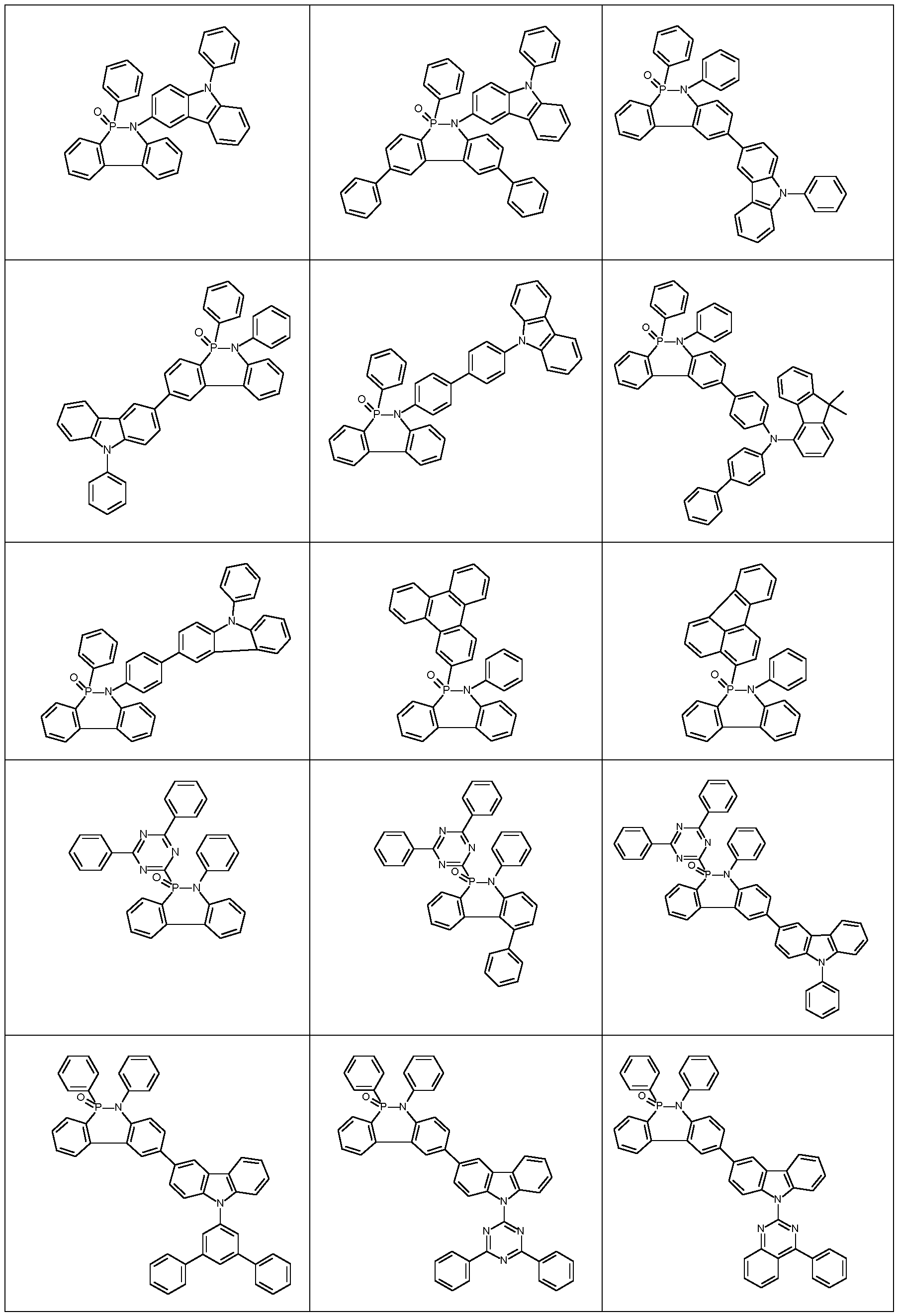
35

35
35


35


35

Die Synthese der erfindungsgemäßen Verbindungen kann nach den im Folgenden dargestellten Schemata erfolgen. Dabei sind in den Schemata 1 bis 4 die Synthesen der Verbindungen mit Z = PAr2 und in Schema 5 die Synthese der Verbindungen mit Z = S(=0) dargestellt. In den zitierten Literaturstellen werden analoge Reaktionen beschrieben, beispielsweise für Verbindungen mit einer Alkyl- statt einer Aryl- oder Heteroarylgruppe am Stickstoff.
Schema 1 :

Org. Lett. 2015, 17, 2046^9
Schema 2:

Analog zu CN 106986894
Schema 4:

the Related Elements, Society, 5034-41 ; 1960
186(4), 989-996; 2011

J. Org. Chem. 2016, 81 , 4965-73 tBuOK
DMSO

Ullmann


Tetrahedron 1983, 39(12), 2073
Für die Verarbeitung der erfindungsgemäßen Verbindungen aus flüssiger Phase, beispielsweise durch Spin-Coating oder durch Druckverfahren, sind Formulierungen der erfindungsgemäßen Verbindungen erforderlich. Diese Formulierungen können beispielsweise Lösungen, Dispersionen oder Emulsionen sein. Es kann bevorzugt sein, hierfür Mischungen aus zwei oder mehr Lösemitteln zu verwenden. Geeignete und bevorzugte Lösemittel sind beispielsweise Toluol, Anisol, o-, m- oder p-Xylol, Methyl- benzoat, Mesitylen, Tetralin, Veratrol, THF, Methyl-TFIF, THP, Chlor- benzol, Dioxan, Phenoxytoluol, insbesondere 3-Phenoxytoluol, (-)- Fenchon, 1 ,2,3,5-Tetramethylbenzol, 1 ,2,4,5-Tetramethylbenzol, 1 -
Methylnaphthalin, 2-Methylbenzothiazol, 2-Phenoxyethanol, 2- Pyrrolidinon, 3-Methylanisol, 4-Methylanisol, 3,4-Dimethylanisol, 3,5- Dimethylanisol, Acetophenon, a-Terpineol, Benzothiazol, Butylbenzoat, Cumol, Cyclohexanol, Cyclohexanon, Cyclohexylbenzol, Decalin,
Dodecylbenzol, Ethylbenzoat, Indan, NMP, p-Cymol, Phenetol, 1 ,4-Di- isopropylbenzol, Dibenzylether, Diethylenglycolbutylmethylether, Tri- ethylenglycolbutylmethylether, Diethylenglycoldibutylether, Triethylen- glycoldimethylether, Diethylenglycolmonobutylether, Tripropyleneglycol- dimethylether, Tetraethylenglycoldimethylether, 2-lsopropylnaphthalin, Pentylbenzol, Hexylbenzol, Heptylbenzol, Octylbenzol, 1 , 1 -Bis(3,4-di- methylphenyl)ethan, 2-Methylbiphenyl, 3-Methylbiphenyl, 1 -Methyl- naphthalin, 1 -Ethylnaphthalin, Ethyloctanoat, Sebacinsäure-diethylester, Octyloctanoat, Heptylbenzol, Menthyl-isovalerat, Cyclohexylhexanoat oder Mischungen dieser Lösemittel.
Ein weiterer Gegenstand der vorliegenden Erfindung ist daher eine For- mulierung, enthaltend eine erfindungsgemäße Verbindung und mindes- tens eine weitere Verbindung. Die weitere Verbindung kann beispiels weise ein Lösemittel sein, insbesondere eines der oben genannten Löse- mittel oder eine Mischung dieser Lösemittel. Die weitere Verbindung kann aber auch mindestens eine weitere organische oder anorganische Verbin- dung sein, die ebenfalls in der elektronischen Vorrichtung eingesetzt wird, beispielsweise eine emittierende Verbindung und/oder ein weiteres Matrixmaterial. Geeignete emittierende Verbindungen und weitere Matrix- materialien sind hinten im Zusammenhang mit der organischen Elektro- lumineszenzvorrichtung aufgeführt. Diese weitere Verbindung kann auch polymer sein.
Die erfindungsgemäßen Verbindungen eignen sich für die Verwendung in einer elektronischen Vorrichtung, insbesondere in einer organischen Elektrolumineszenzvorrichtung.
Ein weiterer Gegenstand der vorliegenden Erfindung ist daher die Ver- wendung einer erfindungsgemäßen Verbindung in einer elektronischen Vorrichtung, insbesondere in einer organischen Elektrolumineszenzvor- richtung.
Ein nochmals weiterer Gegenstand der vorliegenden Erfindung ist eine elektronische Vorrichtung enthaltend mindestens eine erfindungsgemäße Verbindung.
Eine elektronische Vorrichtung im Sinne der vorliegenden Erfindung ist eine Vorrichtung, welche mindestens eine Schicht enthält, die mindestens eine organische Verbindung enthält. Das Bauteil kann dabei auch anorga- nische Materialien enthalten oder auch Schichten, welche vollständig aus anorganischen Materialien aufgebaut sind.
Die elektronische Vorrichtung ist bevorzugt ausgewählt aus der Gruppe bestehend aus organischen Elektrolumineszenzvorrichtungen (OLEDs), organischen integrierten Schaltungen (O-ICs), organischen Feld-Effekt-
Transistoren (O-FETs), organischen Dünnfilmtransistoren (O-TFTs), organischen lichtemittierenden Transistoren (O-LETs), organischen Solar- zellen (O-SCs), farbstoffsensibilisierten organischen Solarzellen (DSSCs), organischen optischen Detektoren, organischen Photorezeptoren, orga- nischen Feld-Quench-Devices (O-FQDs), lichtemittierenden elektro- chemischen Zellen (LECs), organischen Laserdioden (O-Laser) und
„organic plasmon emitting devices“, bevorzugt aber organischen Elektro- lumineszenzvorrichtungen (OLEDs), besonders bevorzugt phosphores- zierenden OLEDs.
Die organische Elektrolumineszenzvorrichtung enthält Kathode, Anode und mindestens eine emittierende Schicht. Außer diesen Schichten kann sie noch weitere Schichten enthalten, beispielsweise jeweils eine oder mehrere Lochinjektionsschichten, Lochtransportschichten, Lochblockier- schichten, Elektronentransportschichten, Elektroneninjektionsschichten, Exzitonenblockierschichten, Elektronenblockierschichten und/oder Ladungserzeugungsschichten (Charge-Generation Layers). Ebenso können zwischen zwei emittierende Schichten Interlayer eingebracht sein, welche beispielsweise eine exzitonenblockierende Funktion aufweisen.
Es sei aber darauf hingewiesen, dass nicht notwendigerweise jede dieser Schichten vorhanden sein muss. Dabei kann die organische Elektrolumi- neszenzvorrichtung eine emittierende Schicht enthalten, oder sie kann
mehrere emittierende Schichten enthalten. Wenn mehrere Emissions- Schichten vorhanden sind, weisen diese bevorzugt insgesamt mehrere Emissionsmaxima zwischen 380 nm und 750 nm auf, so dass insgesamt weiße Emission resultiert, d. h. in den emittierenden Schichten werden verschiedene emittierende Verbindungen verwendet, die fluoreszieren oder phosphoreszieren können. Insbesondere bevorzugt sind Systeme mit drei emittierenden Schichten, wobei die drei Schichten blaue, grüne und orange oder rote Emission zeigen. Es kann sich bei der erfindungs- gemäßen organischen Elektrolumineszenzvorrichtung auch um eine Tandem-OLED handeln, insbesondere für weiß emittierende OLEDs.
Die erfindungsgemäße Verbindung gemäß den oben aufgeführten Aus- führungsformen kann dabei in unterschiedlichen Schichten eingesetzt werden, je nach genauer Struktur. Bevorzugt ist eine organische Elektro- lumineszenzvorrichtung, enthaltend eine Verbindung gemäß Formel (1 ) bzw. die oben ausgeführten bevorzugten Ausführungsformen in einer emittierenden Schicht als Matrixmaterial für phosphoreszierende Emitter oder für Emitter, die TADF (thermally activated delayed fluorescence) zeigen, insbesondere für phosphoreszierende Emitter. Dabei kann die organische Elektrolumineszenzvorrichtung eine emittierende Schicht ent- halten, oder sie kann mehrere emittierende Schichten enthalten, wobei mindestens eine emittierende Schicht mindestens eine erfindungsgemäße
Verbindung als Matrixmaterial enthält. Weiterhin kann die erfindungs- gemäße Verbindung auch in einer Elektronentransportschicht und/oder in einer Lochblockierschicht und/oder in einer Lochtransportschicht und/oder in einer Exzitonenblockierschicht eingesetzt werden.
Wenn die erfindungsgemäße Verbindung als Matrixmaterial für eine phos- phoreszierende Verbindung in einer emittierenden Schicht eingesetzt wird, wird sie bevorzugt in Kombination mit einem oder mehreren phos- phoreszierenden Materialien (Triplettemitter) eingesetzt. Unter Phospho- reszenz im Sinne dieser Erfindung wird die Lumineszenz aus einem ange- regten Zustand mit höherer Spinmultiplizität verstanden, also einem Spin- zustand > 1 , insbesondere aus einem angeregten Triplettzustand. Im Sinne dieser Anmeldung sollen alle lumineszierenden Komplexe mit Übergangsmetallen oder Lanthaniden, insbesondere alle Iridium-, Platin-
und Kupferkomplexe als phosphoreszierende Verbindungen angesehen werden.
Die Mischung aus der erfindungsgemäßen Verbindung und der
emittierenden Verbindung enthält zwischen 99 und 1 Vol.-%, vorzugs- weise zwischen 98 und 10 Vol.-%, besonders bevorzugt zwischen 97 und 60 Vol.-%, insbesondere zwischen 95 und 80 Vol.-% der erfindungs- gemäßen Verbindung bezogen auf die Gesamtmischung aus Emitter und Matrixmaterial. Entsprechend enthält die Mischung zwischen 1 und 99 Vol.-%, vorzugsweise zwischen 2 und 90 Vol.-%, besonders bevorzugt zwischen 3 und 40 Vol.-%, insbesondere zwischen 5 und 20 Vol.-% des Emitters bezogen auf die Gesamtmischung aus Emitter und Matrix- material.
Eine weitere bevorzugte Ausführungsform der vorliegenden Erfindung ist der Einsatz der erfindungsgemäßen Verbindung als Matrixmaterial für einen phosphoreszierenden Emitter in Kombination mit einem weiteren Matrixmaterial. Geeignete Matrixmaterialien, welche in Kombination mit den erfindungsgemäßen Verbindungen eingesetzt werden können, sind aromatische Ketone, aromatische Phosphinoxide oder aromatische Sulfoxide oder Sulfone, z. B. gemäß WO 2004/013080, WO 2004/093207, WO 2006/005627 oder WO 2010/006680, Triarylamine, Carbazolderivate, z. B. CBP (N,N-Biscarbazolylbiphenyl) oder die in WO 2005/039246, US 2005/0069729, JP 2004/288381 , EP 1205527, WO 2008/086851 oder WO 2013/041176, Indolocarbazolderivate, z. B. gemäß WO 2007/063754 oder WO 2008/056746, Indenocarbazolderivate, z. B. gemäß WO
2010/136109, WO 2011/000455, WO 2013/041176 oder WO
2013/056776, Azacarbazolderivate, z. B. gemäß EP 1617710, EP
1617711 , EP 1731584, JP 2005/347160, bipolare Matrixmaterialien, z. B. gemäß WO 2007/137725, Silane, z. B. gemäß WO 2005/111172, Aza- borole oder Boronester, z. B. gemäß WO 2006/117052, Triazinderivate, z. B. gemäß WO 2007/063754, WO 2008/056746, WO 2010/015306, WO 2011/057706, WO 2011/060859 oder WO 2011/060877, Zinkkomplexe, z. B. gemäß EP 652273 oder WO 2009/062578, Diazasilol- bzw. Tetra- azasilol-Derivate, z. B. gemäß WO 2010/054729, Diazaphosphol- Derivate, z. B. gemäß WO 2010/054730, verbrückte Carbazol-Derivate, z.
B. gemäß WO 2011/042107, WO 2011/060867, WO 2011/088877 und WO 2012/143080, Triphenylenderivate, z. B. gemäß WO 2012/048781 , oder Dibenzofuranderivate, z. B. gemäß WO 2015/169412, WO
2016/015810, WO 2016/023608, WO 2017/148564 oder WO
2017/148565. Ebenso kann ein weiterer phosphoreszierender Emitter, welcher kürzerwellig als der eigentliche Emitter emittiert, als Co-Host in der Mischung vorhanden sein oder eine Verbindung, die nicht oder nicht in wesentlichem Umfang am Ladungstransport teilnimmt, wie beispiels- weise in WO 2010/108579 beschrieben.
Insbesondere eignen sich in Kombination mit der erfindungsgemäßen Verbindung als Co-Matrix-Material Verbindungen, welche eine große Bandlücke aufweisen und selber nicht oder zumindest nicht in wesent- lichem Maße am Ladungstransport der emittierenden Schicht teilnehmen. Es handelt sich bei solchen Materialien bevorzugt um reine Kohlen- wasserstoffe. Beispiele für solche Materialien finden sich beispielsweise in WO 2006/130598, WO 2009/021126, WO 2009/124627 und WO 2010/006680.
In einer bevorzugten Ausführungsform der Erfindung werden die
Materialien in Kombination mit einem weiteren Matrixmaterial eingesetzt. Bevorzugte Co-Matrixmaterialien sind gewählt aus der Gruppe der Biscar- bazole, der verbrückten Carbazole, der Triarylamine, der Dibenzofuran- Carbazol-Derivate bzw. Dibenzofuran-Amin-Derivate, der Carbazolamine und der Triazinderivate.
Bevorzugte Biscarbazole sind die Strukturen der folgenden Formeln (19) und (20),

Formel (19)
 wobei Ar2 und A die oben genannten Bedeutungen aufweisen und R die oben genannten Bedeutungen aufweist, jedoch Reste R hier auch mitein- ander ein aromatisches oder heteroaromatisches Ringsystem bilden können. In einer bevorzugten Ausführungsform der Erfindung steht A für CR2.
Bevorzugte Ausführungsformen der Verbindungen der Formeln (19) bzw. (20) sind die Verbindungen der folgenden Formeln (19a) bzw. (20a),

Formel (20a) wobei die verwendeten Symbole die oben genannten Bedeutungen aufweisen.
Beispiele für geeignete Verbindungen gemäß Formel (19) oder (20) sind die nachfolgend abgebildeten Verbindungen.


Bevorzugte verbrückte Carbazole sind die Strukturen der folgenden Formel (21 ),

Formel (21 ) wobei A und R die oben genannten Bedeutungen aufweisen und A bevor- zugt gleich oder verschieden bei jedem Auftreten ausgewählt ist aus der Gruppe bestehend aus NAr2 und CR2.
Eine bevorzugte Ausführungsform der Formel (21 ) sind die Verbindungen der Formel (21 a), besonders bevorzugt sind die Verbindungen der Formel (21 b), und ganz besonders bevorzugt sind die Verbindungen der Formel (21 c),

Formel (21 c) wobei Ar2 und R die oben genannten Bedeutungen aufweisen. Dabei steht Ar2 bevorzugt gleich oder verschieden bei jedem Auftreten für ein aromatisches Ringsystem mit 6 bis 18 aromatischen Ringatomen, bei- spielsweise für Phenyl, ortho-, meta- oder para-Biphenyl oder Terphenyl Der Rest R am Inden-Kohlenstoffatom steht bevorzugt gleich oder ver- schieden bei jedem Auftreten für eine Alkylgruppe mit 1 bis 5 C-Atomen, insbesondere für Methyl, oder ein aromatisches Ringsystem mit 6 bis 18 aromatischen Ringatomen, insbesondere Phenyl.
Bevorzugte Triarylamine sind die Strukturen der folgenden Formel (22),

Formel (22) wobei Ar2 die oben genannten Bedeutungen aufweist.
Bevorzugte Dibenzofuran-Derivate sind die Verbindungen der folgenden Formel (23),

Formel (23) wobei der Sauerstoff auch durch Schwefel ersetzt sein kann, so dass ein Dibenzothiophen entsteht, L1 für eine Einfachbindung oder ein aroma- tisches oder heteroaromatisches Ringsystem mit 5 bis 30 aromatischen Ringatomen steht, welches auch durch eine oder mehrere Reste R sub- stituiert sein kann, und R und Ar2 die oben genannten Bedeutungen auf- weisen. Dabei können die beiden Gruppen Ar2, die an dasselbe Stickstoff- atom binden, oder eine Gruppe Ar2 und eine Gruppe L1, die an dasselbe Stickstoffatom binden, auch miteinander verbunden sein, beispielsweise zu einem Carbazol.
Bevorzugte Ausführungsformen der Verbindungen der Formel (23) sind die Verbindungen der folgenden Formeln (23a) und (23b),


Formel (23c)
Formel (23d) wobei der Sauerstoff auch durch Schwefel ersetzt sein kann, so dass ein Dibenzothiophen entsteht, und Ar2 die oben genannten Bedeutungen auf- weist, wobei zwei benachbarte Reste R, insbesondere am Carbazol, hier auch miteinander ein aromatisches oder heteroaromatisches Ringsystem bilden können.
Beispiele für geeignete Dibenzofuran-Derivate sind die nachfolgend ab- gebildeten Verbindungen.


Bevorzugte Carbazolamine sind die Strukturen der folgenden Formeln (24), (25) und (26),
 wobei L1 für ein aromatisches oder heteroaromatisches Ringsystem mit 5 bis 30 aromatischen Ringatomen steht, welches mit einem oder mehreren Resten R substituiert sein kann, und R und Ar2 die oben genannten Bedeutungen aufweisen, wobei zwei benachbarte Reste R hier auch ein aromatisches Ringsystem bilden können.
Beispiele für geeignete Carbazolamin-Derivate sind die nachfolgend abgebildeten Verbindungen.


Bevorzugte Triazin- bzw. Pyrimidinderivate, welche als Mischung zusammen mit den erfindungsgemäßen Verbindungen eingesetzt werden können, sind die Verbindungen der folgenden Formeln (27) und (28),

Formel (27) Formel (28) wobei Ar2 die oben genannten Bedeutungen aufweist. Dabei gelten die oben aufgeführten bevorzugten Ausführungsformen für Ar2 auch für die Verbindungen der Formeln (27) und (28). Besonders bevorzugt sind die Triazinderivate der Formel (27).
Beispiele für Triazinderivate, welche als Matrixmaterialien zusammen mit den erfindungsgemäßen Verbindungen eingesetzt werden können, sind die nachfolgend aufgeführten Verbindungen:


 -81
-81


Als phosphoreszierende Verbindungen (= Triplettemitter) eignen sich insbesondere Verbindungen, die bei geeigneter Anregung Licht, vorzugs- weise im sichtbaren Bereich, emittieren und außerdem mindestens ein Atom der Ordnungszahl größer 20, bevorzugt größer 38 und kleiner 84, besonders bevorzugt größer 56 und kleiner 80 enthalten, insbesondere ein Metall mit dieser Ordnungszahl. Bevorzugt werden als Phosphores- zenzemitter Verbindungen, die Kupfer, Molybdän, Wolfram, Rhenium, Ruthenium, Osmium, Rhodium, Iridium, Palladium, Platin, Silber, Gold oder Europium enthalten, verwendet, insbesondere Verbindungen, die Iridium oder Platin enthalten.
Beispiele der oben beschriebenen Emitter können den Anmeldungen WO 00/70655, WO 2001/41512, WO 2002/02714, WO 2002/15645, EP 1191613, EP 1191612, EP 1191614, WO 05/033244, WO 05/019373,
US 2005/0258742, WO 2009/146770, WO 2010/015307, WO
2010/031485, WO 2010/054731 , WO 2010/054728, WO 2010/086089, WO 2010/099852, WO 2010/102709, WO 2011/032626, WO
2011/066898, WO 2011/157339, WO 2012/007086, WO 2014/008982, WO 2014/023377, WO 2014/094961 , WO 2014/094960, WO
2015/036074, WO 2015/104045, WO 2015/117718, WO 2016/015815, WO 2016/124304, WO 2017/032439, WO 2018/011186 und WO
2018/041769, WO 2019/020538, WO 2018/178001 , WO 2019/115423 sowie der noch nicht offen gelegten Patentanmeldung EP 18156388.3 entnommen werden. Generell eignen sich alle phosphoreszierenden
Komplexe, wie sie gemäß dem Stand der Technik für phosphoreszierende OLEDs verwendet werden und wie sie dem Fachmann auf dem Gebiet der organischen Elektrolumineszenz bekannt sind, und der Fachmann kann ohne erfinderisches Zutun weitere phosphoreszierende Komplexe verwenden.
Beispiele für phosphoreszierende Dotanden sind nachfolgend aufgeführt·


Die erfindungsgemäßen Verbindungen sind auch geeignet als Matrix- materialien für phosphoreszierende Emitter in organischen Elektrolumi- neszenzvorrichtungen, wie sie z. B. in WO 98/24271 , US 2011/0248247 und US 2012/0223633 beschrieben sind. In diesen mehrfarbigen Display- Bauteilen wird eine zusätzliche blaue Emissionsschicht vollflächig auf alle Pixel, auch diejenigen mit einer von Blau verschiedenen Farbe, aufge- dampft.
In einer weiteren Ausführungsform der Erfindung enthält die erfindungs- gemäße organische Elektrolumineszenzvorrichtung keine separate Loch- injektionsschicht und/oder Lochtransportschicht und/oder Lochblockier- schicht und/oder Elektronentransportschicht, d. h. die emittierende Schicht grenzt direkt an die Lochinjektionschicht oder die Anode an, und/oder die emittierende Schicht grenzt direkt an die
Elektronentransportschicht oder die Elektroneninjektionsschicht oder die Kathode an, wie zum Beispiel in WO 2005/053051 beschrieben.
Weiterhin ist es möglich, einen Metallkomplex, der gleich oder ähnlich dem Metallkomplex in der emittierenden Schicht ist, direkt angrenzend an die emittierende Schicht als Lochtransport- bzw. Lochinjektionsmaterial zu verwenden, wie z. B. in WO 2009/030981 beschrieben.
In den weiteren Schichten der erfindungsgemäßen organischen Elektro- lumineszenzvorrichtung können alle Materialien verwendet werden, wie sie üblicherweise gemäß dem Stand der Technik eingesetzt werden. Der Fachmann kann daher ohne erfinderisches Zutun alle für organische Elektrolumineszenzvorrichtungen bekannten Materialien in Kombination mit den erfindungsgemäßen Verbindungen gemäß Formel (1 ) oder (2) bzw. den oben ausgeführten bevorzugten Ausführungsformen einsetzen.
Weiterhin bevorzugt ist eine organische Elektrolumineszenzvorrichtung, dadurch gekennzeichnet, dass eine oder mehrere Schichten mit einem Sublimationsverfahren beschichtet werden. Dabei werden die Materialien in Vakuum-Sublimationsanlagen bei einem Anfangsdruck kleiner
105 mbar, bevorzugt kleiner 106 mbar aufgedampft. Es ist aber auch möglich, dass der Anfangsdruck noch geringer ist, beispielsweise kleiner 107 mbar.
Bevorzugt ist ebenfalls eine organische Elektrolumineszenzvorrichtung, dadurch gekennzeichnet, dass eine oder mehrere Schichten mit dem OVPD (Organic Vapour Phase Deposition) Verfahren oder mit Hilfe einer Trägergassublimation beschichtet werden. Dabei werden die Materialien bei einem Druck zwischen 105 mbar und 1 bar aufgebracht. Ein Spezial- fall dieses Verfahrens ist das OVJP (Organic Vapour Jet Printing) Ver- fahren, bei dem die Materialien direkt durch eine Düse aufgebracht und so strukturiert werden.
Weiterhin bevorzugt ist eine organische Elektrolumineszenzvorrichtung, dadurch gekennzeichnet, dass eine oder mehrere Schichten aus Lösung, wie z. B. durch Spincoating, oder mit einem beliebigen Druckverfahren, wie z. B. Siebdruck, Flexodruck, Offsetdruck, LITI (Light Induced Thermal Imaging, Thermotransferdruck), Ink-Jet Druck (Tintenstrahldruck) oder Nozzle Printing, hergestellt werden. Hierfür sind lösliche Verbindungen nötig, welche beispielsweise durch geeignete Substitution erhalten werden.
Weiterhin sind Hybridverfahren möglich, bei denen beispielsweise eine oder mehrere Schichten aus Lösung aufgebracht werden und eine oder mehrere weitere Schichten aufgedampft werden.
Diese Verfahren sind dem Fachmann generell bekannt und können von ihm ohne erfinderisches Zutun auf organische Elektrolumineszenzvor- richtungen enthaltend die erfindungsgemäßen Verbindungen angewandt werden.
Die erfindungsgemäßen Verbindungen und die erfindungsgemäßen orga- nischen Elektrolumineszenzvorrichtungen zeichnen sich durch einen oder mehrere der folgenden überraschenden Vorteile gegenüber dem Stand der Technik aus:
1. Die erfindungsgemäßen Verbindungen, eingesetzt als Matrixmaterial für phosphoreszierende Emitter, führen zu langen Lebensdauern.
2. Die erfindungsgemäßen Verbindungen führen zu hohen Effizienzen.
Dies gilt insbesondere, wenn die Verbindungen als Matrixmaterial für einen phosphoreszierenden Emitter eingesetzt werden.
3. Die erfindungsgemäßen Verbindungen führen zu geringen Betriebs- spannungen. Dies gilt insbesondere, wenn die Verbindungen als Matrixmaterial für einen phosphoreszierenden Emitter eingesetzt werden.
Die Erfindung wird durch die nachfolgenden Beispiele näher erläutert, ohne sie dadurch einschränken zu wollen. Der Fachmann kann aus den Schilderungen die Erfindung im gesamten offenbarten Bereich ausführen und ohne erfinderisches Zutun weitere erfindungsgemäße Verbindungen hersteilen und diese in elektronischen Vorrichtungen verwenden bzw. das erfindungsgemäße Verfahren anwenden.
Beispiele:
Synthesebeispiele
Die nachfolgenden Synthesen werden, sofern nicht anders angegeben, unter einer Schutzgasatmosphäre in getrockneten Lösungsmitteln durch- geführt. Die Lösungsmittel und Reagenzien können von ALDRICH bzw.
ABCR bezogen werden. Die bei den nicht kommerziell erhältlichen Edukten angegeben Nummern sind die entsprechenden CAS-Nummern. a) 6-Chlor-5H-benzo[c][2,1]benzazaphosphinin

8 g (50 mmol) 2-Aminobiphenyl werden in 70 ml Phosphortrichlorid 8 h unter Rückfluss gekocht, anschließend wird das restliche PCU im Vakuum abdestilliert und der Rückstand (Ar-NH-PCh) mit 0.5 g AICI3 für 6 h auf 180-220 °C erhitzt. Die Mischung wird in Toluol gelöst und über Glaswolle filtriert und somit von Salzen abgetrennt. Die Aufreinigung erfolgt durch Sublimation bei 180-190 °C (0.05 mm) als weiße Nadeln, welche sehr hydrolyseempfindlich sind. Ausbeute: 4.2 g (24 mmol); 42% d. Th.;
Reinheit: 97 % n. NMR
Analog können die folgenden Verbindungen hergestellt werden:


Unter Schutzgas werden 4.2 g (24 mmol) 6-Chlor-5H-benzo[c][2,1]benz- azaphosphinin in 120 ml trockenem Toluol gelöst. Diese Lösung wird innerhalb von 15 min. zu einer Phenyllithium-Lösung, synthetisiert aus 16.2 g (103 mmol) Brombenzol und 1.5 g Lithium in 100 ml Ether, zuge- geben und 1 h unter Rückfluss gekocht. Nach dem Abkühlen wird die Mischung auf Eiswasser gegeben und die organische Phase abgetrennt. Die organische Phase wird im Vakuum eingeengt, und das Produkt aus Toluol umkristallisiert. Ausbeute: 3 g (11 mmol); 61 % d. Th.; Reinheit:
98 % n. NMR.
Analog können folgende Verbindungen hergestellt werden:


6.8 g (25 mmol, 1.00 eq.) 6-Phenyl-5H-benzo[c][2,1]benzazaphosphinin,
21.3 ml (128 mmol, 5.2 eq.) lodbenzol und 7.20 g Kaliumcarbonat (52.1 mmol, 2.10 eq.) werden in 220 ml trockenem DMF vorgelegt und mit Argon inertisiert. Anschließend werden 0.62 g (2.7 mmol, 0.11 eq.) 1 ,3- Di(2-pyridyl)-1 ,3-propandion und 0.52 g (2.7 mmol, 0.11 eq) Kupfer(l)-iodid zugegeben und das Gemisch für drei Tage bei 140 °C erhitzt. Nach beendeter Reaktion wird der Ansatz vorsichtig am Rotationsverdampfer eingeengt, der ausgefallene Feststoff abgesaugt und mit Wasser und Ethanol gewaschen. Das Rohprodukt wird zweimal mittels Fleißextraktion (Toluol/Fleptan 1 :1 ) aufgereinigt und der erhaltene Feststoff aus Toluol umkristallisiert. Ausbeute: 4.5 g (12.8 mmol); 52 % d. Th..
Analog können folgende Verbindungen hergestellt werden:


Die Verbindungen 19c, 20c, und 22c-24c werden durch Sublimation auf eine Reinheit von 99.9 % aufgereinigt. d) 5 ,6-Diphenylbenzo[c][2,1]benzazaphosphinin-6-oxid

4.5 g (12.8 mmol) werden bei Raumtemperatur in 40 ml Ethanol gelöst und innerhalb von 30 min. tropfenweise mit 80 ml H2O2 (30%) versetzt. Nach 1 h Rühren bei 70 °C kühlt man ab, versetzt die Lösung mit 100 ml Dichlormethan, trennt die Phasen, engt die organische Phase ein und
kristallisiert aus Heptan/ Dichlormethan 2:1 aus. Ausbeute: 3.9 g (10.5 mmol); 93 % d. Th..


Eine Lösung von 56 g (154 mmol) 5,6-Diphenylbenzo[c][2,1]benzaza- phosphinin-6-oxid in Chloroform (1000 mL) wird bei 0 °C unter Lichtaus- schluss portionsweise mit /V-Bromsuccinimid (24.7 g, 139 mmol) versetzt und 2 h bei dieser Temperatur gerührt. Die Reaktion wird durch Zugabe von Natriumsulfit-Lösung beendet und weitere 30 min. bei Raumtempera- tur gerührt. Nach Phasentrennung wird die organische Phase mit Wasser gewaschen und die wässrige Phase mit Dichlormethan extrahiert. Die ver- einigten organischen Phasen werden über Natriumsulfat getrocknet und im Vakuum eingeengt. Der Rückstand wird in Toluol gelöst und über Kieselgel filtriert. Anschließend wird das Rohprodukt aus Toluol/Heptan umkristallisiert. Ausbeute: 44 g (99 mmol); 65 % d. Th. eines farblosen Feststoffes.


31 (70 mmol) 2-Brom-5,6-diphenyl-benzo[c][1 ,2]benzazaphosphinin-6- oxid, 20.8 g (75 mmol) Phenylcarbazol-3-boronsäure und 14.7 g (139 mmol) Natriumcarbonat werden in 200 ml_ Toulol, 52 ml_ Ethanol und 100 ml_ Wasser suspendiert. Zu dieser Suspension werden 80 mg (0.69 mmol) Tetrakistriphenylphosphin-palladium(O) gegeben, und die
Reaktionsmischung wird 16 h unter Rückfluss erhitzt. Nach Erkalten wird die organische Phase abgetrennt, über Kieselgel filtriert, dreimal mit 200 ml_ Wasser gewaschen und anschließend zur Trockene eingeengt. Der Rückstand wird aus Heptan / Dichlormethan umkristallisiert. Die Ausbeute beträgt 33 g (55 mmol); 79 % d. Th..
Analog können die folgenden Verbindungen erhalten werden:


35


Herstellung der OLEDs
In den folgenden Beispielen E1 bis E9 (siehe Tabelle 1 ) wird der Einsatz der erfindungsgemäßen Materialien in OLEDs vorgestellt.
Vorbehandlung für die Beispiele E1-E9: Glasplättchen, die mit struk- turiertem ITO (Indium Zinn Oxid) der Dicke 50 nm beschichtet sind,
werden vor der Beschichtung mit einem Sauerstoffplasma, gefolgt von einem Argonplasma, behandelt. Diese mit Plasma behandelten Glas- plättchen bilden die Substrate, auf welche die OLEDs aufgebracht werden.
Die OLEDs haben prinzipiell den folgenden Schichtaufbau: Substrat / Lochinjektionsschicht (HIL) / Lochtransportschicht (HTL) / Elektronen- blockierschicht (EBL) / Emissionsschicht (EML) / optionale Lochblockier- schicht (HBL) / Elektronentransportschicht (ETL) / optionale Elektronen- injektionsschicht (EIL) und abschließend eine Kathode. Die Kathode wird durch eine 100 nm dicke Aluminiumschicht gebildet. Der genaue Aufbau der OLEDs ist Tabelle 1 zu entnehmen. Die zur Herstellung der OLEDs benötigten Materialien sind in Tabelle 2 gezeigt.
Alle Materialien werden in einer Vakuumkammer thermisch aufgedampft. Dabei besteht die Emissionsschicht immer aus mindestens einem Matrix- material (Hostmaterial, Wirtsmaterial) und einem emittierenden Dotierstoff (Dotand, Emitter), der dem Matrixmaterial bzw. den Matrixmaterialien durch Coverdampfung in einem bestimmten Volumenanteil beigemischt wird. Eine Angabe wie IC1 :IC2:TEG1 (55%:35%:10%) bedeutet hierbei, dass das Material IC1 in einem Volumenanteil von 55%, IC2 in einem Volumenanteil von 35% und TEG1 in einem Volumenanteil von 10% in der Schicht vorliegt. Analog kann auch die Elektronentransportschicht aus einer Mischung von zwei Materialien bestehen.
Die OLEDs werden standardmäßig charakterisiert. Die Elektrolumines- zenzspektren werden bei einer Leuchtdichte von 1000 cd/m2 bestimmt und daraus die CIE 1931 x und y Farbkoordinaten berechnet.
Verwendung von erfindungsgemäßen Mischungen in OLEDs
Die erfindungsgemäßen Materialien können als Matrixmaterial in der Emissionsschicht von phosphoreszierenden grünen OLEDs eingesetzt werden. Die Ergebnisse sind in Tabelle 3 zusammengefasst.
Tabelle 1 : Aufbau der OLEDs

Tabelle 2: Strukturformeln der Materialien für die OLEDs


Tabelle 3: Ergebnisse der Elektrolumineszenzvorrichtungen


Claims
1. Verbindung gemäß Formel (1 ),

Formel (1 ) wobei für die verwendeten Symbole gilt:
Z ist bei jedem Auftreten gleich oder verschieden PAr2 oder S(=0);
E ist bei jedem Auftreten gleich oder verschieden O oder S, wenn das Symbol Z, an das dieses E bindet, für PAr2 steht, und O, wenn das Symbol Z, an das dieses E bindet, für S(=0) steht;
L ist ausgewählt aus der Gruppe bestehend aus einer Einfachbin- dung, NAr2, O, S, S(=0)2, P(=0)Ar2, -X=X- oder -C(=0)-NAr2-;
X steht bei jedem Auftreten gleich oder verschieden für CR oder N, wobei maximal zwei Gruppen X pro Cyclus für N stehen, oder zwei benachbarte X stehen für eine Gruppe der folgenden Formel (2), (3) oder (4),

Formel (3) Formel (4) Formel (5) wobei die gestrichelten Bindungen die Verknüpfung dieser Gruppe in der Formel (1 ) kennzeichnen;
Y ist gleich oder verschieden bei jedem Auftreten CR oder N, wobei maximal zwei Gruppen Y pro Cyclus für N stehen;
Ar1, Ar2 ist bei jedem Auftreten gleich oder verschieden ein aromatisches oder heteroaromatisches Ringsystem mit 5 bis 40 aromatischen Ringatomen, welches mit einem oder mehreren Resten R substituiert sein kann, wobei Ar1 und Ar2 nicht mitein- ander verknüpft sind, mit der Maßgabe, dass die Substituenten R, die an Ar1 binden, nicht für Fluor stehen;
A ist bei jedem Auftreten gleich oder verschieden NAr2, O, S oder CR2;
V ist bei jedem Auftreten gleich oder verschieden -NAr2-Z(=E)-;
R ist bei jedem Auftreten gleich oder verschieden H, D, F, CI, Br, I, N(Ar3)2, OAr3, SAr3, CN, N02, NAr3R1, N(R1)2, OR1, SR1, COOR1, C(=0)N(R1)2, Si(R1)3, B(OR1)2J C(=0)R1, P(=0)(R1)2, S(=0)R1, S(=0)2R1, 0S02R1, eine geradkettige Alkylgruppe mit 1 bis 20 C-Atomen oder eine Alkenyl- oder Alkinylgruppe mit 2 bis 20 C- Atomen oder eine verzweigte oder cyclische Alkylgruppe mit 3 bis 20 C-Atomen, wobei die Alkyl-, Alkenyl- oder Alkinylgruppe jeweils mit einem oder mehreren Resten R1 substituiert sein kann, wobei eine oder mehrere nicht benachbarte CFI2-Gruppen durch Si(R1)2, C=0, NR1, O, S oder CONR1 ersetzt sein können, oder ein aromatisches oder heteroaromatisches Ringsystem mit 5 bis 40 aromatischen Ringatomen, das jeweils durch einen oder mehrere Reste R1 substituiert sein kann; dabei können zwei Reste R auch miteinander ein aliphatisches oder heteroaliphatisches Ringsystem bilden;
Ar3 ist bei jedem Auftreten gleich oder verschieden ein aromatisches oder heteroaromatisches Ringsystem mit 5 bis 30 aromatischen Ringatomen, das durch einen oder mehrere Reste R1 substituiert sein kann;
R1 ist bei jedem Auftreten gleich oder verschieden H, D, F, CI, Br, I
N(R2)2, CN, N02J OR2, SR2, Si(R2)3, B(OR2)2, C(=0)R2, P(=0)(R2)2
S(=0)R2, 0S02R2, eine geradkettige Alkylgruppe mit 1 bis 20 C-Atomen oder eine Alkenyl- oder Alkinylgruppe mit 2 bis 20 C- Atomen oder eine verzweigte oder cyclische Alkylgruppe mit 3 bis 20 C-Atomen, wobei die Alkyl-, Alkenyl- oder Alkinylgruppe jeweils mit einem oder mehreren Resten R2 substituiert sein kann, wobei eine oder mehrere nicht benachbarte CH2-Gruppen durch Si(R2)2, C=0, NR2, O, S oder CONR2 ersetzt sein können, oder ein aromatisches oder heteroaromatisches Ringsystem mit 5 bis 40 aromatischen Ringatomen, das jeweils durch einen oder mehrere Reste R2 substituiert sein kann; dabei können zwei oder mehrere Reste R1 miteinander ein aliphatisches Ringsystem bilden;
R2 ist bei jedem Auftreten gleich oder verschieden H, D, F, CN oder ein aliphatischer, aromatischer oder heteroaromatischer orga- nischer Rest, insbesondere ein Kohlenwasserstoffrest, mit 1 bis 20 C-Atomen, in dem auch ein oder mehrere Fl-Atome durch F ersetzt sein können; dabei sind die folgenden Verbindungen von der Erfindung ausge- schlossen:


2. Verbindung nach Anspruch 1 , ausgewählt aus den Verbindungen der Formeln (1-1) und (5) bis (16),

Formel (1-1)


Formel (15) Formel (16) wobei X bei jedem Auftreten gleich oder verschieden für CR oder N steht, wobei maximal zwei Gruppen X pro Cyclus für N stehen, und die weiteren verwendeten Symbole die in Anspruch 1 genannten Bedeutungen aufweisen.
3. Verbindung nach Anspruch 1 oder 2, dadurch gekennzeichnet, dass die Gruppe der Formel (2), (3) bzw. (4) ausgewählt ist aus den Gruppen der Formel (2a), (3a) bzw. (4a),

4. Verbindung nach einem oder mehreren der Ansprüche 1 bis 3, dadurch gekennzeichnet, dass die Symbole X, die nicht für eine Gruppe der Formel (2), (3) oder (4) stehen, gleich oder verschieden bei jedem Auftreten für CR stehen und dass die Symbole Y gleich oder verschieden bei jedem Auftreten für CR stehen.
5. Verbindung nach einem oder mehreren der Ansprüche 1 bis 4, ausge- wählt aus den Strukturen der Formeln (1 a) und (5a) bis (16a),

Formel (7a) Formel (8a)

Formel (9a) Formel (10a)

Formel (15a) Forral (16a) wobei die Symbole die in Anspruch 1 genannten Bedeutungen auf- weisen.
6. Verbindung nach einem oder mehreren der Ansprüche 1 bis 5, ausge- wählt aus den Strukturen der Formeln (17) und (18),

Formel (17) Formel (18)
wobei die verwendeten Symbole die in Anspruch 1 genannten
Bedeutungen aufweisen und Z1 für PR1 oder S(=0) steht.
7. Verbindung nach einem oder mehreren der Ansprüche 1 bis 6, ausge- wählt aus den Strukturen der Formeln (1 b) bzw. (5b) bis (16b),

Formel (5b) Formel (6b)

Formel (7b) Formel (8b)

Formel (11 b) Formel (12b)

Formel (15b) Formel (16b) wobei die verwendeten Symbole die in Anspruch 1 genannten Bedeutungen aufweisen.
8. Verbindung nach einem oder mehreren der Ansprüche 1 bis 7,
dadurch gekennzeichnet, dass Z für PAr2 steht und E für O steht und L für eine Einfachbindung steht.
9. Verbindung nach einem oder mehreren der Ansprüche 1 bis 8, dadurch gekennzeichnet, dass Ar1 und Ar2 bei jedem Auftreten gleich oder verschieden ein aromatisches oder heteroaromatisches Ring- system mit 6 bis 24 aromatischen Ringatomen darstellen, das durch einen oder mehrere Reste R substituiert sein kann, wobei für Ar1 die Reste R nicht für Fluor stehen.
10. Verbindung nach einem oder mehreren der Ansprüche 1 bis 9,
dadurch gekennzeichnet, dass R bei jedem Auftreten gleich oder verschieden ausgewählt ist aus der Gruppe bestehend aus H, D, F, N(Ar3)2, CN, OR1, einer geradkettigen Alkylgruppe mit 1 bis 10 C- Atomen oder einer Alkenylgruppe mit 2 bis 10 C-Atomen oder einer verzweigten oder cyclischen Alkylgruppe mit 3 bis 10 C-Atomen, wobei die Alkyl- bzw. Alkenylgruppe jeweils mit einem oder mehreren Resten R1 substituiert sein kann, wobei eine oder mehrere nicht benachbarte CFL-Gruppen durch O ersetzt sein können, oder einem aromatischen oder heteroaromatischen Ringsystem mit 6 bis 30 aromatischen Ringatomen, das jeweils durch einen oder mehrere Reste R1 substituiert sein kann; dabei können zwei Reste R auch mit- einander ein aliphatisches Ringsystem bilden.
11. Formulierung, enthaltend mindestens eine Verbindung nach einem oder mehreren der Ansprüche 1 bis 10 und mindestens eine weitere Verbindung und/oder ein Lösemittel.
12. Verwendung einer Verbindung nach einem oder mehreren der
Ansprüche 1 bis 10 in einer elektronischen Vorrichtung.
13. Elektronische Vorrichtung enthaltend mindestens eine Verbindung nach einem oder mehreren der Ansprüche 1 bis 10.
14. Elektronische Vorrichtung nach Anspruch 13, wobei es es um eine organische Elektrolumineszenzvorrichtung handelt, dadurch gekenn- zeichnet, dass die Verbindung nach einem oder mehreren der Ansprüche 1 bis 10 in einer emittierenden Schicht, insbesondere als
Matrixmaterial, und/oder in einer Elektronentransportschicht und/oder in einer Lochblockierschicht und/oder in einer Lochtransportschicht und/oder in einer Exzitonenblockierschicht enthalten.
Priority Applications (4)
| Application Number | Priority Date | Filing Date | Title |
|---|---|---|---|
| EP19800961.5A EP3877373B1 (de) | 2018-11-06 | 2019-11-04 | 5,6-diphenyl-5,6-dihydro-dibenz[c,e][1,2]azaphosphorin- und 6-phenyl-6h-dibenzo[c,e][1,2]thiazin-5,5-dioxid-derivate und ähnliche verbindungen als organische elektrolumineszenzmaterialien für oleds |
| CN201980068066.5A CN112867709A (zh) | 2018-11-06 | 2019-11-04 | 作为用于oled的有机电致发光材料的5,6-二苯基-5,6-二氢-二苯并[c,e][1,2]氮杂磷杂苯和6-苯基-6h-二苯并[c,e][1,2]噻嗪-5,5-二氧化物衍生物及类似化合物 |
| KR1020217016961A KR20210089205A (ko) | 2018-11-06 | 2019-11-04 | Oled 용 유기 전계 발광 재료로서 5,6-디페닐-5,6-디히드로디벤즈[c,e][1,2]아자포스포린 및 6-페닐-6h-디벤조[c,e][1,2]티아진-5,5-디옥사이드 유도체 및 유사한 화합물 |
| US17/291,991 US20220020934A1 (en) | 2018-11-06 | 2019-11-04 | 5,6-diphenyl-5,6-dihydro-dibenz[c,e][1,2]azaphosphorin and 6-phenyl-6h-dibenzo[c,e][1,2]thiazin-5,5-dioxide derivatives and similar compounds as organic electroluminescent materials for oleds |
Applications Claiming Priority (2)
| Application Number | Priority Date | Filing Date | Title |
|---|---|---|---|
| EP18204542 | 2018-11-06 | ||
| EP18204542.7 | 2018-11-06 |
Publications (1)
| Publication Number | Publication Date |
|---|---|
| WO2020094542A1 true WO2020094542A1 (de) | 2020-05-14 |
Family
ID=64267484
Family Applications (1)
| Application Number | Title | Priority Date | Filing Date |
|---|---|---|---|
| PCT/EP2019/080039 Ceased WO2020094542A1 (de) | 2018-11-06 | 2019-11-04 | 5,6-diphenyl-5,6-dihydro-dibenz[c,e][1,2]azaphosphorin- und 6-phenyl-6h-dibenzo[c,e][1,2]thiazin-5,5-dioxid-derivate und ähnliche verbindungen als organische elektrolumineszenzmaterialien für oleds |
Country Status (5)
| Country | Link |
|---|---|
| US (1) | US20220020934A1 (de) |
| EP (1) | EP3877373B1 (de) |
| KR (1) | KR20210089205A (de) |
| CN (1) | CN112867709A (de) |
| WO (1) | WO2020094542A1 (de) |
Families Citing this family (1)
| Publication number | Priority date | Publication date | Assignee | Title |
|---|---|---|---|---|
| CN113980055B (zh) * | 2021-11-26 | 2023-09-29 | 南阳师范学院 | 具联芳骨架的环状膦酰胺类衍生物、合成方法及应用 |
Citations (86)
| Publication number | Priority date | Publication date | Assignee | Title |
|---|---|---|---|---|
| EP0652273A1 (de) | 1993-11-09 | 1995-05-10 | Shinko Electric Industries Co. Ltd. | Organisches Material für elektrolumineszente Vorrichtung und elektrolumineszente Vorrichtung |
| WO1998024271A1 (en) | 1996-11-25 | 1998-06-04 | Seiko Epson Corporation | Method of producing organic el elements, organic el elements and organic el display device |
| WO2000070655A2 (en) | 1999-05-13 | 2000-11-23 | The Trustees Of Princeton University | Very high efficiency organic light emitting devices based on electrophosphorescence |
| WO2001041512A1 (en) | 1999-12-01 | 2001-06-07 | The Trustees Of Princeton University | Complexes of form l2mx as phosphorescent dopants for organic leds |
| WO2002002714A2 (en) | 2000-06-30 | 2002-01-10 | E.I. Du Pont De Nemours And Company | Electroluminescent iridium compounds with fluorinated phenylpyridines, phenylpyrimidines, and phenylquinolines and devices made with such compounds |
| WO2002015645A1 (en) | 2000-08-11 | 2002-02-21 | The Trustees Of Princeton University | Organometallic compounds and emission-shifting organic electrophosphorescence |
| EP1191614A2 (de) | 2000-09-26 | 2002-03-27 | Canon Kabushiki Kaisha | Lumineszente Vorrichtung und dafür verwendete Metallkoordinationsverbindung |
| EP1191613A2 (de) | 2000-09-26 | 2002-03-27 | Canon Kabushiki Kaisha | Lumineszente Vorrichtung, Bildanzeigevorrichtung und Metallkoordinationsverbindung |
| EP1191612A2 (de) | 2000-09-26 | 2002-03-27 | Canon Kabushiki Kaisha | Lumineszente Vorrichtung, Bildanzeigevorrichtung und Metallkoordinationsverbindung |
| EP1205527A1 (de) | 2000-03-27 | 2002-05-15 | Idemitsu Kosan Co., Ltd. | Organische elektrolumineszierende vorrichtung |
| WO2004013080A1 (en) | 2002-08-01 | 2004-02-12 | Covion Organic Semiconductors Gmbh | Spirobifluorene derivatives, their preparation and uses thereof |
| JP2004288381A (ja) | 2003-03-19 | 2004-10-14 | Konica Minolta Holdings Inc | 有機エレクトロルミネッセンス素子 |
| WO2004093207A2 (de) | 2003-04-15 | 2004-10-28 | Covion Organic Semiconductors Gmbh | Mischungen von organischen zur emission befähigten halbleitern und matrixmaterialien, deren verwendung und elektronikbauteile enthaltend diese mischungen |
| WO2005019373A2 (de) | 2003-08-19 | 2005-03-03 | Basf Aktiengesellschaft | Übergangsmetallkomplexe mit carbenliganden als emitter für organische licht-emittierende dioden (oleds) |
| US20050069729A1 (en) | 2003-09-30 | 2005-03-31 | Konica Minolta Holdings, Inc. | Organic electroluminescent element, illuminator, display and compound |
| WO2005033244A1 (de) | 2003-09-29 | 2005-04-14 | Covion Organic Semiconductors Gmbh | Metallkomplexe |
| WO2005053051A1 (de) | 2003-11-25 | 2005-06-09 | Merck Patent Gmbh | Organisches elektrolumineszenzelement |
| WO2005111172A2 (de) | 2004-05-11 | 2005-11-24 | Merck Patent Gmbh | Neue materialmischungen für die elektrolumineszenz |
| US20050258742A1 (en) | 2004-05-18 | 2005-11-24 | Yui-Yi Tsai | Carbene containing metal complexes as OLEDs |
| JP2005347160A (ja) | 2004-06-04 | 2005-12-15 | Konica Minolta Holdings Inc | 有機エレクトロルミネッセンス素子、照明装置及び表示装置 |
| EP1617710A1 (de) | 2003-04-23 | 2006-01-18 | Konica Minolta Holdings, Inc. | Material für ein organisches elektrolumineszenzgerät, organisches elektrolumineszenzgerät, beleuchtungsvorrichtung und anzeige |
| WO2006005627A1 (en) | 2004-07-15 | 2006-01-19 | Merck Patent Gmbh | Oligomeric derivatives of spirobifluorene, their preparation and use |
| WO2006117052A1 (de) | 2005-05-03 | 2006-11-09 | Merck Patent Gmbh | Organische elektrolumineszenzvorrichtung und in deren herstellung verwendete boronsäure- und borinsäure-derivate |
| WO2006130598A2 (en) | 2005-05-31 | 2006-12-07 | Universal Display Corporation | Triphenylene hosts in phosphorescent light emitting diodes |
| EP1731584A1 (de) | 2004-03-31 | 2006-12-13 | Konica Minolta Holdings, Inc. | Organischer elektrolumineszenzvorrichtungsstoff, organische elektrolumineszenzvorrichtung, display und beleuchtungsvorrichtung |
| WO2007063754A1 (ja) | 2005-12-01 | 2007-06-07 | Nippon Steel Chemical Co., Ltd. | 有機電界発光素子用化合物及び有機電界発光素子 |
| WO2007137725A1 (de) | 2006-05-31 | 2007-12-06 | Merck Patent Gmbh | Neue materialien für organische elektrolumineszenzvorrichtungen |
| WO2008056746A1 (en) | 2006-11-09 | 2008-05-15 | Nippon Steel Chemical Co., Ltd. | Compound for organic electroluminescent device and organic electroluminescent device |
| WO2008086851A1 (de) | 2007-01-18 | 2008-07-24 | Merck Patent Gmbh | Carbazol-derivate für organische elektrolumineszenzvorrichtungen |
| WO2009021126A2 (en) | 2007-08-08 | 2009-02-12 | Universal Display Corporation | Benzo-fused thiophene or benzo-fused furan compounds comprising a triphenylene group |
| WO2009030981A2 (en) | 2006-12-28 | 2009-03-12 | Universal Display Corporation | Long lifetime phosphorescent organic light emitting device (oled) structures |
| WO2009062578A1 (de) | 2007-11-12 | 2009-05-22 | Merck Patent Gmbh | Organische elektrolumineszenzvorrichtungen enthaltend azomethin-metall-komplexe |
| WO2009124627A1 (de) | 2008-04-07 | 2009-10-15 | Merck Patent Gmbh | Pluorenderivate für organische elektrolumineszenzvorrichtungen |
| WO2009146770A2 (de) | 2008-06-05 | 2009-12-10 | Merck Patent Gmbh | Elektronische vorrichtung enthaltend metallkomplexe |
| WO2010006680A1 (de) | 2008-07-18 | 2010-01-21 | Merck Patent Gmbh | Materialien für organische elektrolumineszenzvorrichtungen |
| WO2010015307A1 (de) | 2008-08-04 | 2010-02-11 | Merck Patent Gmbh | Elektronische vorrichtung enthaltend metallkomplexe mit isonitrilliganden |
| WO2010015306A1 (de) | 2008-08-08 | 2010-02-11 | Merck Patent Gmbh, | Organische elektrolumineszenzvorrichtung |
| WO2010031485A1 (de) | 2008-09-22 | 2010-03-25 | Merck Patent Gmbh | Materialien für organische elektrolumineszenzvorrichtungen |
| WO2010054728A1 (de) | 2008-11-13 | 2010-05-20 | Merck Patent Gmbh | Materialien für organische elektrolumineszenzvorrichtungen |
| WO2010054731A1 (de) | 2008-11-13 | 2010-05-20 | Merck Patent Gmbh | Materialien für organische elektrolumineszenzvorrichtungen |
| WO2010054729A2 (de) | 2008-11-11 | 2010-05-20 | Merck Patent Gmbh | Materialien für organische elektrolumineszenzvorrichtungen |
| WO2010054730A1 (de) | 2008-11-11 | 2010-05-20 | Merck Patent Gmbh | Organische elektrolumineszenzvorrichtungen |
| WO2010086089A1 (de) | 2009-02-02 | 2010-08-05 | Merck Patent Gmbh | Metallkomplexe |
| WO2010099852A1 (de) | 2009-03-02 | 2010-09-10 | Merck Patent Gmbh | Metallkomplexe mit azaborol-liganden und elektronische vorrichtung damit |
| WO2010102709A1 (de) | 2009-03-13 | 2010-09-16 | Merck Patent Gmbh | Materialien für organische elektrolumineszenzvorrichtungen |
| WO2010108579A1 (de) | 2009-03-23 | 2010-09-30 | Merck Patent Gmbh | Organische elektrolumineszenzvorrichtung |
| WO2010136109A1 (de) | 2009-05-29 | 2010-12-02 | Merck Patent Gmbh | Materialien für organische elektrolumineszenzvorrichtungen |
| WO2011000455A1 (de) | 2009-06-30 | 2011-01-06 | Merck Patent Gmbh | Materialien für organische elektrolumineszenzvorrichtungen |
| WO2011032626A1 (de) | 2009-09-16 | 2011-03-24 | Merck Patent Gmbh | Metallkomplexe |
| WO2011042107A2 (de) | 2009-10-08 | 2011-04-14 | Merck Patent Gmbh | Materialien für organische elektrolumineszenzvorrichtungen |
| WO2011057706A2 (de) | 2009-11-14 | 2011-05-19 | Merck Patent Gmbh | Materialien für elektronische vorrichtungen |
| WO2011060867A1 (de) | 2009-11-18 | 2011-05-26 | Merck Patent Gmbh | Stickstoffhaltige kondensierte heterozyklen für oleds |
| WO2011060877A2 (de) | 2009-11-17 | 2011-05-26 | Merck Patent Gmbh | Materialien für organische elektrolumineszenzvorrichtungen |
| WO2011060859A1 (de) | 2009-11-17 | 2011-05-26 | Merck Patent Gmbh | Materialien für organische elektrolumineszenzvorrichtungen |
| WO2011066898A1 (de) | 2009-12-05 | 2011-06-09 | Merck Patent Gmbh | Elektronische vorrichtung enthaltend metallkomplexe |
| WO2011088877A1 (de) | 2010-01-25 | 2011-07-28 | Merck Patent Gmbh | Verbindungen für elektronische vorrichtungen |
| US20110248247A1 (en) | 2010-04-09 | 2011-10-13 | Sony Corporation | Organic el display unit, method of manufacturing the same, and solution used in method |
| WO2011137951A1 (de) | 2010-05-04 | 2011-11-10 | Merck Patent Gmbh | Organische elektrolumineszenzvorrichtungen |
| WO2011157339A1 (de) | 2010-06-15 | 2011-12-22 | Merck Patent Gmbh | Metallkomplexe |
| WO2012007086A1 (de) | 2010-07-16 | 2012-01-19 | Merck Patent Gmbh | Metallkomplexe |
| WO2012048781A1 (de) | 2010-10-15 | 2012-04-19 | Merck Patent Gmbh | Materialien auf basis von triphenylen für organische elektrolumineszenzvorrichtungen |
| US20120223633A1 (en) | 2011-03-04 | 2012-09-06 | Sony Corporation | Organic el display device and method of manufacturing the same |
| WO2012121398A1 (ja) | 2011-03-10 | 2012-09-13 | 国立大学法人京都大学 | 多環芳香族化合物 |
| WO2012143080A2 (de) | 2011-04-18 | 2012-10-26 | Merck Patent Gmbh | Materialien für organische elektrolumineszenzvorrichtungen |
| WO2013012681A1 (en) * | 2011-07-15 | 2013-01-24 | Abbott Laboratories | Tricyclic inhibitors of kinases useful for the treatment of proliferative diseases |
| WO2013041176A1 (de) | 2011-09-21 | 2013-03-28 | Merck Patent Gmbh | Carbazolderivate für organische elektrolumineszenzvorrichtungen |
| WO2013056776A1 (de) | 2011-10-20 | 2013-04-25 | Merck Patent Gmbh | Materialien für organische elektrolumineszenzvorrichtungen |
| WO2014008982A1 (de) | 2012-07-13 | 2014-01-16 | Merck Patent Gmbh | Metallkomplexe |
| WO2014023377A2 (de) | 2012-08-07 | 2014-02-13 | Merck Patent Gmbh | Metallkomplexe |
| WO2014094961A1 (de) | 2012-12-21 | 2014-06-26 | Merck Patent Gmbh | Metallkomplexe |
| WO2014094960A1 (de) | 2012-12-21 | 2014-06-26 | Merck Patent Gmbh | Metallkomplexe |
| WO2015036074A1 (de) | 2013-09-11 | 2015-03-19 | Merck Patent Gmbh | Metallkomplexe |
| WO2015104045A1 (de) | 2014-01-13 | 2015-07-16 | Merck Patent Gmbh | Metallkomplexe |
| WO2015117718A1 (de) | 2014-02-05 | 2015-08-13 | Merck Patent Gmbh | Metallkomplexe |
| WO2015169412A1 (de) | 2014-05-05 | 2015-11-12 | Merck Patent Gmbh | Materialien für organische elektrolumineszenzvorrichtungen |
| WO2016015815A1 (de) | 2014-07-28 | 2016-02-04 | Merck Patent Gmbh | Metallkomplexe |
| WO2016015810A1 (de) | 2014-07-29 | 2016-02-04 | Merck Patent Gmbh | Materialien f?r organische elektrolumineszenzvorrichtungen |
| WO2016023608A1 (de) | 2014-08-13 | 2016-02-18 | Merck Patent Gmbh | Materialien für organische elektrolumineszenzvorrichtungen |
| WO2016124304A1 (de) | 2015-02-03 | 2016-08-11 | Merck Patent Gmbh | Metallkomplexe |
| WO2017032439A1 (de) | 2015-08-25 | 2017-03-02 | Merck Patent Gmbh | Metallkomplexe |
| WO2017148565A1 (de) | 2016-03-03 | 2017-09-08 | Merck Patent Gmbh | Materialien für organische elektrolumineszenzvorrichtungen |
| WO2018011186A1 (de) | 2016-07-14 | 2018-01-18 | Merck Patent Gmbh | Metallkomplexe |
| WO2018041769A1 (de) | 2016-08-30 | 2018-03-08 | Merck Patent Gmbh | Bl- und trinukleare metallkomplexe aufgebaut aus zwei miteinander verknüpften tripodalen hexadentaten liganden zur verwendung in elektrolumineszenzvorrichtungen |
| WO2018178001A1 (de) | 2017-03-29 | 2018-10-04 | Merck Patent Gmbh | Metallkomplexe |
| WO2019020538A1 (de) | 2017-07-25 | 2019-01-31 | Merck Patent Gmbh | Metallkomplexe |
| WO2019115423A1 (de) | 2017-12-13 | 2019-06-20 | Merck Patent Gmbh | Metallkomplexe |
-
2019
- 2019-11-04 KR KR1020217016961A patent/KR20210089205A/ko not_active Withdrawn
- 2019-11-04 EP EP19800961.5A patent/EP3877373B1/de active Active
- 2019-11-04 US US17/291,991 patent/US20220020934A1/en not_active Abandoned
- 2019-11-04 WO PCT/EP2019/080039 patent/WO2020094542A1/de not_active Ceased
- 2019-11-04 CN CN201980068066.5A patent/CN112867709A/zh active Pending
Patent Citations (89)
| Publication number | Priority date | Publication date | Assignee | Title |
|---|---|---|---|---|
| EP0652273A1 (de) | 1993-11-09 | 1995-05-10 | Shinko Electric Industries Co. Ltd. | Organisches Material für elektrolumineszente Vorrichtung und elektrolumineszente Vorrichtung |
| WO1998024271A1 (en) | 1996-11-25 | 1998-06-04 | Seiko Epson Corporation | Method of producing organic el elements, organic el elements and organic el display device |
| WO2000070655A2 (en) | 1999-05-13 | 2000-11-23 | The Trustees Of Princeton University | Very high efficiency organic light emitting devices based on electrophosphorescence |
| WO2001041512A1 (en) | 1999-12-01 | 2001-06-07 | The Trustees Of Princeton University | Complexes of form l2mx as phosphorescent dopants for organic leds |
| EP1205527A1 (de) | 2000-03-27 | 2002-05-15 | Idemitsu Kosan Co., Ltd. | Organische elektrolumineszierende vorrichtung |
| WO2002002714A2 (en) | 2000-06-30 | 2002-01-10 | E.I. Du Pont De Nemours And Company | Electroluminescent iridium compounds with fluorinated phenylpyridines, phenylpyrimidines, and phenylquinolines and devices made with such compounds |
| WO2002015645A1 (en) | 2000-08-11 | 2002-02-21 | The Trustees Of Princeton University | Organometallic compounds and emission-shifting organic electrophosphorescence |
| EP1191614A2 (de) | 2000-09-26 | 2002-03-27 | Canon Kabushiki Kaisha | Lumineszente Vorrichtung und dafür verwendete Metallkoordinationsverbindung |
| EP1191613A2 (de) | 2000-09-26 | 2002-03-27 | Canon Kabushiki Kaisha | Lumineszente Vorrichtung, Bildanzeigevorrichtung und Metallkoordinationsverbindung |
| EP1191612A2 (de) | 2000-09-26 | 2002-03-27 | Canon Kabushiki Kaisha | Lumineszente Vorrichtung, Bildanzeigevorrichtung und Metallkoordinationsverbindung |
| WO2004013080A1 (en) | 2002-08-01 | 2004-02-12 | Covion Organic Semiconductors Gmbh | Spirobifluorene derivatives, their preparation and uses thereof |
| JP2004288381A (ja) | 2003-03-19 | 2004-10-14 | Konica Minolta Holdings Inc | 有機エレクトロルミネッセンス素子 |
| WO2004093207A2 (de) | 2003-04-15 | 2004-10-28 | Covion Organic Semiconductors Gmbh | Mischungen von organischen zur emission befähigten halbleitern und matrixmaterialien, deren verwendung und elektronikbauteile enthaltend diese mischungen |
| EP1617710A1 (de) | 2003-04-23 | 2006-01-18 | Konica Minolta Holdings, Inc. | Material für ein organisches elektrolumineszenzgerät, organisches elektrolumineszenzgerät, beleuchtungsvorrichtung und anzeige |
| EP1617711A1 (de) | 2003-04-23 | 2006-01-18 | Konica Minolta Holdings, Inc. | Organisches elektrolumineszenzbauelement und anzeige |
| WO2005019373A2 (de) | 2003-08-19 | 2005-03-03 | Basf Aktiengesellschaft | Übergangsmetallkomplexe mit carbenliganden als emitter für organische licht-emittierende dioden (oleds) |
| WO2005033244A1 (de) | 2003-09-29 | 2005-04-14 | Covion Organic Semiconductors Gmbh | Metallkomplexe |
| US20050069729A1 (en) | 2003-09-30 | 2005-03-31 | Konica Minolta Holdings, Inc. | Organic electroluminescent element, illuminator, display and compound |
| WO2005039246A1 (ja) | 2003-09-30 | 2005-04-28 | Konica Minolta Holdings, Inc. | 有機エレクトロルミネッセンス素子、照明装置、表示装置 |
| WO2005053051A1 (de) | 2003-11-25 | 2005-06-09 | Merck Patent Gmbh | Organisches elektrolumineszenzelement |
| EP1731584A1 (de) | 2004-03-31 | 2006-12-13 | Konica Minolta Holdings, Inc. | Organischer elektrolumineszenzvorrichtungsstoff, organische elektrolumineszenzvorrichtung, display und beleuchtungsvorrichtung |
| WO2005111172A2 (de) | 2004-05-11 | 2005-11-24 | Merck Patent Gmbh | Neue materialmischungen für die elektrolumineszenz |
| US20050258742A1 (en) | 2004-05-18 | 2005-11-24 | Yui-Yi Tsai | Carbene containing metal complexes as OLEDs |
| JP2005347160A (ja) | 2004-06-04 | 2005-12-15 | Konica Minolta Holdings Inc | 有機エレクトロルミネッセンス素子、照明装置及び表示装置 |
| WO2006005627A1 (en) | 2004-07-15 | 2006-01-19 | Merck Patent Gmbh | Oligomeric derivatives of spirobifluorene, their preparation and use |
| WO2006117052A1 (de) | 2005-05-03 | 2006-11-09 | Merck Patent Gmbh | Organische elektrolumineszenzvorrichtung und in deren herstellung verwendete boronsäure- und borinsäure-derivate |
| WO2006130598A2 (en) | 2005-05-31 | 2006-12-07 | Universal Display Corporation | Triphenylene hosts in phosphorescent light emitting diodes |
| WO2007063754A1 (ja) | 2005-12-01 | 2007-06-07 | Nippon Steel Chemical Co., Ltd. | 有機電界発光素子用化合物及び有機電界発光素子 |
| WO2007137725A1 (de) | 2006-05-31 | 2007-12-06 | Merck Patent Gmbh | Neue materialien für organische elektrolumineszenzvorrichtungen |
| WO2008056746A1 (en) | 2006-11-09 | 2008-05-15 | Nippon Steel Chemical Co., Ltd. | Compound for organic electroluminescent device and organic electroluminescent device |
| WO2009030981A2 (en) | 2006-12-28 | 2009-03-12 | Universal Display Corporation | Long lifetime phosphorescent organic light emitting device (oled) structures |
| WO2008086851A1 (de) | 2007-01-18 | 2008-07-24 | Merck Patent Gmbh | Carbazol-derivate für organische elektrolumineszenzvorrichtungen |
| WO2009021126A2 (en) | 2007-08-08 | 2009-02-12 | Universal Display Corporation | Benzo-fused thiophene or benzo-fused furan compounds comprising a triphenylene group |
| WO2009062578A1 (de) | 2007-11-12 | 2009-05-22 | Merck Patent Gmbh | Organische elektrolumineszenzvorrichtungen enthaltend azomethin-metall-komplexe |
| WO2009124627A1 (de) | 2008-04-07 | 2009-10-15 | Merck Patent Gmbh | Pluorenderivate für organische elektrolumineszenzvorrichtungen |
| WO2009146770A2 (de) | 2008-06-05 | 2009-12-10 | Merck Patent Gmbh | Elektronische vorrichtung enthaltend metallkomplexe |
| WO2010006680A1 (de) | 2008-07-18 | 2010-01-21 | Merck Patent Gmbh | Materialien für organische elektrolumineszenzvorrichtungen |
| WO2010015307A1 (de) | 2008-08-04 | 2010-02-11 | Merck Patent Gmbh | Elektronische vorrichtung enthaltend metallkomplexe mit isonitrilliganden |
| WO2010015306A1 (de) | 2008-08-08 | 2010-02-11 | Merck Patent Gmbh, | Organische elektrolumineszenzvorrichtung |
| WO2010031485A1 (de) | 2008-09-22 | 2010-03-25 | Merck Patent Gmbh | Materialien für organische elektrolumineszenzvorrichtungen |
| WO2010054729A2 (de) | 2008-11-11 | 2010-05-20 | Merck Patent Gmbh | Materialien für organische elektrolumineszenzvorrichtungen |
| WO2010054730A1 (de) | 2008-11-11 | 2010-05-20 | Merck Patent Gmbh | Organische elektrolumineszenzvorrichtungen |
| WO2010054728A1 (de) | 2008-11-13 | 2010-05-20 | Merck Patent Gmbh | Materialien für organische elektrolumineszenzvorrichtungen |
| WO2010054731A1 (de) | 2008-11-13 | 2010-05-20 | Merck Patent Gmbh | Materialien für organische elektrolumineszenzvorrichtungen |
| WO2010086089A1 (de) | 2009-02-02 | 2010-08-05 | Merck Patent Gmbh | Metallkomplexe |
| WO2010099852A1 (de) | 2009-03-02 | 2010-09-10 | Merck Patent Gmbh | Metallkomplexe mit azaborol-liganden und elektronische vorrichtung damit |
| WO2010102709A1 (de) | 2009-03-13 | 2010-09-16 | Merck Patent Gmbh | Materialien für organische elektrolumineszenzvorrichtungen |
| WO2010108579A1 (de) | 2009-03-23 | 2010-09-30 | Merck Patent Gmbh | Organische elektrolumineszenzvorrichtung |
| WO2010136109A1 (de) | 2009-05-29 | 2010-12-02 | Merck Patent Gmbh | Materialien für organische elektrolumineszenzvorrichtungen |
| WO2011000455A1 (de) | 2009-06-30 | 2011-01-06 | Merck Patent Gmbh | Materialien für organische elektrolumineszenzvorrichtungen |
| WO2011032626A1 (de) | 2009-09-16 | 2011-03-24 | Merck Patent Gmbh | Metallkomplexe |
| WO2011042107A2 (de) | 2009-10-08 | 2011-04-14 | Merck Patent Gmbh | Materialien für organische elektrolumineszenzvorrichtungen |
| WO2011057706A2 (de) | 2009-11-14 | 2011-05-19 | Merck Patent Gmbh | Materialien für elektronische vorrichtungen |
| WO2011060859A1 (de) | 2009-11-17 | 2011-05-26 | Merck Patent Gmbh | Materialien für organische elektrolumineszenzvorrichtungen |
| WO2011060877A2 (de) | 2009-11-17 | 2011-05-26 | Merck Patent Gmbh | Materialien für organische elektrolumineszenzvorrichtungen |
| WO2011060867A1 (de) | 2009-11-18 | 2011-05-26 | Merck Patent Gmbh | Stickstoffhaltige kondensierte heterozyklen für oleds |
| WO2011066898A1 (de) | 2009-12-05 | 2011-06-09 | Merck Patent Gmbh | Elektronische vorrichtung enthaltend metallkomplexe |
| WO2011088877A1 (de) | 2010-01-25 | 2011-07-28 | Merck Patent Gmbh | Verbindungen für elektronische vorrichtungen |
| US20110248247A1 (en) | 2010-04-09 | 2011-10-13 | Sony Corporation | Organic el display unit, method of manufacturing the same, and solution used in method |
| WO2011137951A1 (de) | 2010-05-04 | 2011-11-10 | Merck Patent Gmbh | Organische elektrolumineszenzvorrichtungen |
| WO2011157339A1 (de) | 2010-06-15 | 2011-12-22 | Merck Patent Gmbh | Metallkomplexe |
| WO2012007086A1 (de) | 2010-07-16 | 2012-01-19 | Merck Patent Gmbh | Metallkomplexe |
| WO2012048781A1 (de) | 2010-10-15 | 2012-04-19 | Merck Patent Gmbh | Materialien auf basis von triphenylen für organische elektrolumineszenzvorrichtungen |
| US20120223633A1 (en) | 2011-03-04 | 2012-09-06 | Sony Corporation | Organic el display device and method of manufacturing the same |
| WO2012121398A1 (ja) | 2011-03-10 | 2012-09-13 | 国立大学法人京都大学 | 多環芳香族化合物 |
| WO2012143080A2 (de) | 2011-04-18 | 2012-10-26 | Merck Patent Gmbh | Materialien für organische elektrolumineszenzvorrichtungen |
| WO2013012681A1 (en) * | 2011-07-15 | 2013-01-24 | Abbott Laboratories | Tricyclic inhibitors of kinases useful for the treatment of proliferative diseases |
| WO2013041176A1 (de) | 2011-09-21 | 2013-03-28 | Merck Patent Gmbh | Carbazolderivate für organische elektrolumineszenzvorrichtungen |
| WO2013056776A1 (de) | 2011-10-20 | 2013-04-25 | Merck Patent Gmbh | Materialien für organische elektrolumineszenzvorrichtungen |
| WO2014008982A1 (de) | 2012-07-13 | 2014-01-16 | Merck Patent Gmbh | Metallkomplexe |
| WO2014023377A2 (de) | 2012-08-07 | 2014-02-13 | Merck Patent Gmbh | Metallkomplexe |
| WO2014094961A1 (de) | 2012-12-21 | 2014-06-26 | Merck Patent Gmbh | Metallkomplexe |
| WO2014094960A1 (de) | 2012-12-21 | 2014-06-26 | Merck Patent Gmbh | Metallkomplexe |
| WO2015036074A1 (de) | 2013-09-11 | 2015-03-19 | Merck Patent Gmbh | Metallkomplexe |
| WO2015104045A1 (de) | 2014-01-13 | 2015-07-16 | Merck Patent Gmbh | Metallkomplexe |
| WO2015117718A1 (de) | 2014-02-05 | 2015-08-13 | Merck Patent Gmbh | Metallkomplexe |
| WO2015169412A1 (de) | 2014-05-05 | 2015-11-12 | Merck Patent Gmbh | Materialien für organische elektrolumineszenzvorrichtungen |
| WO2016015815A1 (de) | 2014-07-28 | 2016-02-04 | Merck Patent Gmbh | Metallkomplexe |
| WO2016015810A1 (de) | 2014-07-29 | 2016-02-04 | Merck Patent Gmbh | Materialien f?r organische elektrolumineszenzvorrichtungen |
| WO2016023608A1 (de) | 2014-08-13 | 2016-02-18 | Merck Patent Gmbh | Materialien für organische elektrolumineszenzvorrichtungen |
| WO2016124304A1 (de) | 2015-02-03 | 2016-08-11 | Merck Patent Gmbh | Metallkomplexe |
| WO2017032439A1 (de) | 2015-08-25 | 2017-03-02 | Merck Patent Gmbh | Metallkomplexe |
| WO2017148565A1 (de) | 2016-03-03 | 2017-09-08 | Merck Patent Gmbh | Materialien für organische elektrolumineszenzvorrichtungen |
| WO2017148564A1 (de) | 2016-03-03 | 2017-09-08 | Merck Patent Gmbh | Materialien für organische elektrolumineszenzvorrichtungen |
| WO2018011186A1 (de) | 2016-07-14 | 2018-01-18 | Merck Patent Gmbh | Metallkomplexe |
| WO2018041769A1 (de) | 2016-08-30 | 2018-03-08 | Merck Patent Gmbh | Bl- und trinukleare metallkomplexe aufgebaut aus zwei miteinander verknüpften tripodalen hexadentaten liganden zur verwendung in elektrolumineszenzvorrichtungen |
| WO2018178001A1 (de) | 2017-03-29 | 2018-10-04 | Merck Patent Gmbh | Metallkomplexe |
| WO2019020538A1 (de) | 2017-07-25 | 2019-01-31 | Merck Patent Gmbh | Metallkomplexe |
| WO2019115423A1 (de) | 2017-12-13 | 2019-06-20 | Merck Patent Gmbh | Metallkomplexe |
Non-Patent Citations (6)
| Title |
|---|
| DEWAR P S ET AL: "PERSULPHATE OXIDATION. PART IX. OXIDATION OF BIPHENYL-2- SULPHONAMIDES AND OMICRON-PHENOXYBENZENESULPHONAMIDES", JOURNAL OF THE CHEMICAL SOCIETY, PERKIN TRANSACTIONS 1, ROYAL SOCIETY OF CHEMISTRY, GB, no. 19, January 1972 (1972-01-01), pages 2862 - 2865, XP000602158, ISSN: 0300-922X, DOI: 10.1039/P19720002862 * |
| DIETER HELLWINKEL ET AL: "Heterocyclic syntheses via carbanionically induced rearrangement reactions", TETRAHEDRON, vol. 39, no. 12, January 1983 (1983-01-01), AMSTERDAM, NL, pages 2073 - 2084, XP055379507, ISSN: 0040-4020, DOI: 10.1016/S0040-4020(01)91925-8 * |
| JING GUAN ET AL: "Pd II -Catalyzed Mild C?H ortho Arylation and Intramolecular Amination Oriented by a Phosphinamide Group", CHEMISTRY - A EUROPEAN JOURNAL, vol. 20, no. 12, 17 March 2014 (2014-03-17), DE, pages 3301 - 3305, XP055650738, ISSN: 0947-6539, DOI: 10.1002/chem.201303056 * |
| LIU ET AL: "Synthesis of carbazoles and dibenzofurans via cross-coupling of o-iodoanilines and o-iodophenols with silylaryl triflates and subsequent Pd-catalyzed cyclization", TETRAHEDRON, ELSEVIER SCIENCE PUBLISHERS, AMSTERDAM, NL, vol. 63, no. 2, 5 December 2006 (2006-12-05), pages 347 - 355, XP005802258, ISSN: 0040-4020, DOI: 10.1016/J.TET.2006.10.071 * |
| RAJENDER NALLAGONDA ET AL: "Cobalt-Catalyzed Diastereoselective [4+2] Annulation of Phosphinamides with Heterobicyclic Alkenes at Room Temperature", ADVANCED SYNTHESIS & CATALYSIS, vol. 360, no. 2, 19 October 2017 (2017-10-19) - 17 January 2018 (2018-01-17), DE, pages 255 - 260, XP055650727, ISSN: 1615-4150, DOI: 10.1002/adsc.201701162 * |
| YUAN-HUI CHEN ET AL: "Efficient synthesis of cyclic P-stereogenic phosphinamides from acyclic chiral precursors via radical oxidative intramolecular aryl C-H phosphinamidation", CHEMICAL COMMUNICATIONS, vol. 53, no. 43, January 2017 (2017-01-01), UK, pages 5826 - 5829, XP055650731, ISSN: 1359-7345, DOI: 10.1039/C7CC02263H * |
Also Published As
| Publication number | Publication date |
|---|---|
| US20220020934A1 (en) | 2022-01-20 |
| EP3877373A1 (de) | 2021-09-15 |
| KR20210089205A (ko) | 2021-07-15 |
| CN112867709A (zh) | 2021-05-28 |
| EP3877373B1 (de) | 2023-01-11 |
Similar Documents
| Publication | Publication Date | Title |
|---|---|---|
| EP3744155B1 (de) | Materialien für organische elektrolumineszenzvorrichtungen | |
| EP3573985B1 (de) | Materialien für organische elektrolumineszenzvorrichtungen | |
| WO2021037401A1 (de) | Materialien für organische elektrolumineszenzvorrichtungen | |
| EP3160954A1 (de) | Materialien für organische elektrolumineszenzvorrichtungen | |
| EP3700909B1 (de) | Materialien für organische elektrolumineszenzvorrichtungen | |
| EP4126870A1 (de) | Materialien für organische elektrolumineszenzvorrichtungen | |
| EP3880682B1 (de) | Materialien für organische elektrolumineszenzvorrichtungen | |
| EP3583104B1 (de) | Materialien für organische elektrolumineszenzvorrichtungen | |
| EP3820966B1 (de) | Materialien für organische elektrolumineszenzvorrichtungen | |
| WO2020127165A1 (de) | Materialien für organische elektrolumineszenzvorrichtungen | |
| EP4330240A1 (de) | Materialien für organische elektrolumineszenzvorrichtungen | |
| EP3877373B1 (de) | 5,6-diphenyl-5,6-dihydro-dibenz[c,e][1,2]azaphosphorin- und 6-phenyl-6h-dibenzo[c,e][1,2]thiazin-5,5-dioxid-derivate und ähnliche verbindungen als organische elektrolumineszenzmaterialien für oleds | |
| EP3941920B1 (de) | Materialien für organische elektrolumineszenzvorrichtungen | |
| EP4192832A1 (de) | Materialien für organische elektrolumineszenzvorrichtungen | |
| WO2021122535A1 (de) | Materialien für organische elektrolumineszenzvorrichtungen | |
| WO2020182779A1 (de) | Materialien für organische elektrolumineszenzvorrichtungen | |
| EP3947372A1 (de) | Materialien für organische elektrolumineszenzvorrichtungen | |
| WO2018104194A1 (de) | Materialien für organische elektrolumineszenzvorrichtungen | |
| EP3548485A1 (de) | Materialien für organische elektrolumineszenzvorrichtungen | |
| EP4259628A2 (de) | Materialien für organische elektrolumineszenzvorrichtungen | |
| EP4046208A1 (de) | Elektronische vorrichtungen | |
| EP4025566A1 (de) | Materialien für organische elektrolumineszenzvorrichtungen |
Legal Events
| Date | Code | Title | Description |
|---|---|---|---|
| 121 | Ep: the epo has been informed by wipo that ep was designated in this application |
Ref document number: 19800961 Country of ref document: EP Kind code of ref document: A1 |
|
| NENP | Non-entry into the national phase |
Ref country code: DE |
|
| ENP | Entry into the national phase |
Ref document number: 20217016961 Country of ref document: KR Kind code of ref document: A |
|
| ENP | Entry into the national phase |
Ref document number: 2019800961 Country of ref document: EP Effective date: 20210607 |