WO2015105316A1 - Fused-ring compound and organic light-emitting device comprising same - Google Patents
Fused-ring compound and organic light-emitting device comprising same Download PDFInfo
- Publication number
- WO2015105316A1 WO2015105316A1 PCT/KR2015/000112 KR2015000112W WO2015105316A1 WO 2015105316 A1 WO2015105316 A1 WO 2015105316A1 KR 2015000112 W KR2015000112 W KR 2015000112W WO 2015105316 A1 WO2015105316 A1 WO 2015105316A1
- Authority
- WO
- WIPO (PCT)
- Prior art keywords
- group
- substituted
- unsubstituted
- compound
- formula
- Prior art date
- Legal status (The legal status is an assumption and is not a legal conclusion. Google has not performed a legal analysis and makes no representation as to the accuracy of the status listed.)
- Ceased
Links
- 0 *c1nccc2c1cccc2 Chemical compound *c1nccc2c1cccc2 0.000 description 11
- PAAWUYGGIHHOJI-UHFFFAOYSA-N C(C1)C=CC=C1[n](c1c2cccc1)c1c2nc(-c2cccc3c2cccc3)nc1-c1ccccc1 Chemical compound C(C1)C=CC=C1[n](c1c2cccc1)c1c2nc(-c2cccc3c2cccc3)nc1-c1ccccc1 PAAWUYGGIHHOJI-UHFFFAOYSA-N 0.000 description 1
- RJGRSECYCHMSHQ-UHFFFAOYSA-N CC1C(c2cc(-c3nc(-c4ccccc4)nc4c3-c(cccc3)c3[Si]4(C)C)ccc2)=CC=CC1 Chemical compound CC1C(c2cc(-c3nc(-c4ccccc4)nc4c3-c(cccc3)c3[Si]4(C)C)ccc2)=CC=CC1 RJGRSECYCHMSHQ-UHFFFAOYSA-N 0.000 description 1
- YQJXARRMZMWGQQ-UHFFFAOYSA-N C[Si+](C)(c1c-2cccc1)c1c-2c(-c2ccccc2)nc(-c2cccc(-c3ccccc3)c2)n1 Chemical compound C[Si+](C)(c1c-2cccc1)c1c-2c(-c2ccccc2)nc(-c2cccc(-c3ccccc3)c2)n1 YQJXARRMZMWGQQ-UHFFFAOYSA-N 0.000 description 1
- OQRQPKRSTFCCJX-UHFFFAOYSA-N C[Si](C)(c1c-2cccc1)c1c-2c(-c(cc2)ccc2-c2ccccc2)nc(-c2ccccc2)n1 Chemical compound C[Si](C)(c1c-2cccc1)c1c-2c(-c(cc2)ccc2-c2ccccc2)nc(-c2ccccc2)n1 OQRQPKRSTFCCJX-UHFFFAOYSA-N 0.000 description 1
- QBAOSWMHBLIIDR-UHFFFAOYSA-N C[Si](C)(c1c-2cccc1)c1c-2c(-c2ccccc2)nc(-c(cc2)ccc2-c2ccccc2)n1 Chemical compound C[Si](C)(c1c-2cccc1)c1c-2c(-c2ccccc2)nc(-c(cc2)ccc2-c2ccccc2)n1 QBAOSWMHBLIIDR-UHFFFAOYSA-N 0.000 description 1
- SDFLTYHTFPTIGX-UHFFFAOYSA-N C[n]1c2ccccc2c2c1cccc2 Chemical compound C[n]1c2ccccc2c2c1cccc2 SDFLTYHTFPTIGX-UHFFFAOYSA-N 0.000 description 1
- CBWZJTCUMFADBM-UHFFFAOYSA-N Cc(cc1C(c2c3)(c4ccccc4)c4ccccc4)ccc1-c2ccc3N Chemical compound Cc(cc1C(c2c3)(c4ccccc4)c4ccccc4)ccc1-c2ccc3N CBWZJTCUMFADBM-UHFFFAOYSA-N 0.000 description 1
- DTBDAFLSBDGPEA-UHFFFAOYSA-N Cc1cnc(cccc2)c2c1 Chemical compound Cc1cnc(cccc2)c2c1 DTBDAFLSBDGPEA-UHFFFAOYSA-N 0.000 description 1
- VKDZXNICFNZNFY-UHFFFAOYSA-N Cc1nc(-c2ccccc2)c(c2ccccc2[s]2)c2n1 Chemical compound Cc1nc(-c2ccccc2)c(c2ccccc2[s]2)c2n1 VKDZXNICFNZNFY-UHFFFAOYSA-N 0.000 description 1
- FVVXWRGARUACNW-UHFFFAOYSA-N Cc1ncc(cccc2)c2c1 Chemical compound Cc1ncc(cccc2)c2c1 FVVXWRGARUACNW-UHFFFAOYSA-N 0.000 description 1
- LUUGUZVTJFKCAD-UHFFFAOYSA-N Clc1nc(-c2ccccc2)c(c2ccccc2[o]2)c2n1 Chemical compound Clc1nc(-c2ccccc2)c(c2ccccc2[o]2)c2n1 LUUGUZVTJFKCAD-UHFFFAOYSA-N 0.000 description 1
- VOSMVTLQPRNYEW-UHFFFAOYSA-N Nc(c1c2cccc1)c(cccc1)c1c2[Ar] Chemical compound Nc(c1c2cccc1)c(cccc1)c1c2[Ar] VOSMVTLQPRNYEW-UHFFFAOYSA-N 0.000 description 1
- FQYRLEXKXQRZDH-UHFFFAOYSA-N Nc1ccnc2c1cccc2 Chemical compound Nc1ccnc2c1cccc2 FQYRLEXKXQRZDH-UHFFFAOYSA-N 0.000 description 1
- XXEXYQPOLZPTRC-UHFFFAOYSA-N c(cc1)ccc1-c(nc1-c2cccc3ccccc23)nc(c2c3cccc2)c1[n]3-c1ccccc1 Chemical compound c(cc1)ccc1-c(nc1-c2cccc3ccccc23)nc(c2c3cccc2)c1[n]3-c1ccccc1 XXEXYQPOLZPTRC-UHFFFAOYSA-N 0.000 description 1
- WRZUGRYJZNDIKG-UHFFFAOYSA-N c(cc1)ccc1-c1cc(-c2ccccc2)cc(-c(nc2-c3ccccc3)nc(c3ccccc33)c2[n]3-c2ccccc2)c1 Chemical compound c(cc1)ccc1-c1cc(-c2ccccc2)cc(-c(nc2-c3ccccc3)nc(c3ccccc33)c2[n]3-c2ccccc2)c1 WRZUGRYJZNDIKG-UHFFFAOYSA-N 0.000 description 1
- MUTJLUCIJINVBK-UHFFFAOYSA-N c(cc1)ccc1-c1cc(-c2ccccc2)cc(-c2nc(-c3ccccc3)nc(c3c4cccc3)c2[n]4-c2ccccc2)c1 Chemical compound c(cc1)ccc1-c1cc(-c2ccccc2)cc(-c2nc(-c3ccccc3)nc(c3c4cccc3)c2[n]4-c2ccccc2)c1 MUTJLUCIJINVBK-UHFFFAOYSA-N 0.000 description 1
Classifications
-
- H—ELECTRICITY
- H10—SEMICONDUCTOR DEVICES; ELECTRIC SOLID-STATE DEVICES NOT OTHERWISE PROVIDED FOR
- H10K—ORGANIC ELECTRIC SOLID-STATE DEVICES
- H10K85/00—Organic materials used in the body or electrodes of devices covered by this subclass
- H10K85/60—Organic compounds having low molecular weight
- H10K85/649—Aromatic compounds comprising a hetero atom
- H10K85/657—Polycyclic condensed heteroaromatic hydrocarbons
-
- C—CHEMISTRY; METALLURGY
- C07—ORGANIC CHEMISTRY
- C07D—HETEROCYCLIC COMPOUNDS
- C07D209/00—Heterocyclic compounds containing five-membered rings, condensed with other rings, with one nitrogen atom as the only ring hetero atom
- C07D209/56—Ring systems containing three or more rings
- C07D209/80—[b, c]- or [b, d]-condensed
- C07D209/82—Carbazoles; Hydrogenated carbazoles
- C07D209/86—Carbazoles; Hydrogenated carbazoles with only hydrogen atoms, hydrocarbon or substituted hydrocarbon radicals, directly attached to carbon atoms of the ring system
-
- C—CHEMISTRY; METALLURGY
- C07—ORGANIC CHEMISTRY
- C07D—HETEROCYCLIC COMPOUNDS
- C07D401/00—Heterocyclic compounds containing two or more hetero rings, having nitrogen atoms as the only ring hetero atoms, at least one ring being a six-membered ring with only one nitrogen atom
- C07D401/14—Heterocyclic compounds containing two or more hetero rings, having nitrogen atoms as the only ring hetero atoms, at least one ring being a six-membered ring with only one nitrogen atom containing three or more hetero rings
-
- C—CHEMISTRY; METALLURGY
- C07—ORGANIC CHEMISTRY
- C07D—HETEROCYCLIC COMPOUNDS
- C07D405/00—Heterocyclic compounds containing both one or more hetero rings having oxygen atoms as the only ring hetero atoms, and one or more rings having nitrogen as the only ring hetero atom
- C07D405/14—Heterocyclic compounds containing both one or more hetero rings having oxygen atoms as the only ring hetero atoms, and one or more rings having nitrogen as the only ring hetero atom containing three or more hetero rings
-
- C—CHEMISTRY; METALLURGY
- C07—ORGANIC CHEMISTRY
- C07D—HETEROCYCLIC COMPOUNDS
- C07D409/00—Heterocyclic compounds containing two or more hetero rings, at least one ring having sulfur atoms as the only ring hetero atoms
- C07D409/14—Heterocyclic compounds containing two or more hetero rings, at least one ring having sulfur atoms as the only ring hetero atoms containing three or more hetero rings
-
- C—CHEMISTRY; METALLURGY
- C07—ORGANIC CHEMISTRY
- C07D—HETEROCYCLIC COMPOUNDS
- C07D487/00—Heterocyclic compounds containing nitrogen atoms as the only ring hetero atoms in the condensed system, not provided for by groups C07D451/00 - C07D477/00
- C07D487/02—Heterocyclic compounds containing nitrogen atoms as the only ring hetero atoms in the condensed system, not provided for by groups C07D451/00 - C07D477/00 in which the condensed system contains two hetero rings
- C07D487/04—Ortho-condensed systems
-
- C—CHEMISTRY; METALLURGY
- C07—ORGANIC CHEMISTRY
- C07D—HETEROCYCLIC COMPOUNDS
- C07D491/00—Heterocyclic compounds containing in the condensed ring system both one or more rings having oxygen atoms as the only ring hetero atoms and one or more rings having nitrogen atoms as the only ring hetero atoms, not provided for by groups C07D451/00 - C07D459/00, C07D463/00, C07D477/00 or C07D489/00
- C07D491/02—Heterocyclic compounds containing in the condensed ring system both one or more rings having oxygen atoms as the only ring hetero atoms and one or more rings having nitrogen atoms as the only ring hetero atoms, not provided for by groups C07D451/00 - C07D459/00, C07D463/00, C07D477/00 or C07D489/00 in which the condensed system contains two hetero rings
- C07D491/04—Ortho-condensed systems
- C07D491/044—Ortho-condensed systems with only one oxygen atom as ring hetero atom in the oxygen-containing ring
- C07D491/048—Ortho-condensed systems with only one oxygen atom as ring hetero atom in the oxygen-containing ring the oxygen-containing ring being five-membered
-
- C—CHEMISTRY; METALLURGY
- C07—ORGANIC CHEMISTRY
- C07D—HETEROCYCLIC COMPOUNDS
- C07D495/00—Heterocyclic compounds containing in the condensed system at least one hetero ring having sulfur atoms as the only ring hetero atoms
- C07D495/02—Heterocyclic compounds containing in the condensed system at least one hetero ring having sulfur atoms as the only ring hetero atoms in which the condensed system contains two hetero rings
- C07D495/04—Ortho-condensed systems
-
- C—CHEMISTRY; METALLURGY
- C07—ORGANIC CHEMISTRY
- C07F—ACYCLIC, CARBOCYCLIC OR HETEROCYCLIC COMPOUNDS CONTAINING ELEMENTS OTHER THAN CARBON, HYDROGEN, HALOGEN, OXYGEN, NITROGEN, SULFUR, SELENIUM OR TELLURIUM
- C07F7/00—Compounds containing elements of Groups 4 or 14 of the Periodic Table
- C07F7/02—Silicon compounds
- C07F7/08—Compounds having one or more C—Si linkages
- C07F7/0803—Compounds with Si-C or Si-Si linkages
- C07F7/081—Compounds with Si-C or Si-Si linkages comprising at least one atom selected from the elements N, O, halogen, S, Se or Te
- C07F7/0812—Compounds with Si-C or Si-Si linkages comprising at least one atom selected from the elements N, O, halogen, S, Se or Te comprising a heterocyclic ring
- C07F7/0816—Compounds with Si-C or Si-Si linkages comprising at least one atom selected from the elements N, O, halogen, S, Se or Te comprising a heterocyclic ring said ring comprising Si as a ring atom
-
- C—CHEMISTRY; METALLURGY
- C09—DYES; PAINTS; POLISHES; NATURAL RESINS; ADHESIVES; COMPOSITIONS NOT OTHERWISE PROVIDED FOR; APPLICATIONS OF MATERIALS NOT OTHERWISE PROVIDED FOR
- C09K—MATERIALS FOR MISCELLANEOUS APPLICATIONS, NOT PROVIDED FOR ELSEWHERE
- C09K11/00—Luminescent, e.g. electroluminescent, chemiluminescent materials
- C09K11/02—Use of particular materials as binders, particle coatings or suspension media therefor
- C09K11/025—Use of particular materials as binders, particle coatings or suspension media therefor non-luminescent particle coatings or suspension media
-
- C—CHEMISTRY; METALLURGY
- C09—DYES; PAINTS; POLISHES; NATURAL RESINS; ADHESIVES; COMPOSITIONS NOT OTHERWISE PROVIDED FOR; APPLICATIONS OF MATERIALS NOT OTHERWISE PROVIDED FOR
- C09K—MATERIALS FOR MISCELLANEOUS APPLICATIONS, NOT PROVIDED FOR ELSEWHERE
- C09K11/00—Luminescent, e.g. electroluminescent, chemiluminescent materials
- C09K11/06—Luminescent, e.g. electroluminescent, chemiluminescent materials containing organic luminescent materials
-
- H—ELECTRICITY
- H10—SEMICONDUCTOR DEVICES; ELECTRIC SOLID-STATE DEVICES NOT OTHERWISE PROVIDED FOR
- H10K—ORGANIC ELECTRIC SOLID-STATE DEVICES
- H10K50/00—Organic light-emitting devices
-
- H—ELECTRICITY
- H10—SEMICONDUCTOR DEVICES; ELECTRIC SOLID-STATE DEVICES NOT OTHERWISE PROVIDED FOR
- H10K—ORGANIC ELECTRIC SOLID-STATE DEVICES
- H10K85/00—Organic materials used in the body or electrodes of devices covered by this subclass
- H10K85/40—Organosilicon compounds, e.g. TIPS pentacene
-
- H—ELECTRICITY
- H10—SEMICONDUCTOR DEVICES; ELECTRIC SOLID-STATE DEVICES NOT OTHERWISE PROVIDED FOR
- H10K—ORGANIC ELECTRIC SOLID-STATE DEVICES
- H10K85/00—Organic materials used in the body or electrodes of devices covered by this subclass
- H10K85/60—Organic compounds having low molecular weight
- H10K85/615—Polycyclic condensed aromatic hydrocarbons, e.g. anthracene
-
- H—ELECTRICITY
- H10—SEMICONDUCTOR DEVICES; ELECTRIC SOLID-STATE DEVICES NOT OTHERWISE PROVIDED FOR
- H10K—ORGANIC ELECTRIC SOLID-STATE DEVICES
- H10K85/00—Organic materials used in the body or electrodes of devices covered by this subclass
- H10K85/60—Organic compounds having low molecular weight
- H10K85/615—Polycyclic condensed aromatic hydrocarbons, e.g. anthracene
- H10K85/622—Polycyclic condensed aromatic hydrocarbons, e.g. anthracene containing four rings, e.g. pyrene
-
- H—ELECTRICITY
- H10—SEMICONDUCTOR DEVICES; ELECTRIC SOLID-STATE DEVICES NOT OTHERWISE PROVIDED FOR
- H10K—ORGANIC ELECTRIC SOLID-STATE DEVICES
- H10K85/00—Organic materials used in the body or electrodes of devices covered by this subclass
- H10K85/60—Organic compounds having low molecular weight
- H10K85/649—Aromatic compounds comprising a hetero atom
- H10K85/654—Aromatic compounds comprising a hetero atom comprising only nitrogen as heteroatom
-
- H—ELECTRICITY
- H10—SEMICONDUCTOR DEVICES; ELECTRIC SOLID-STATE DEVICES NOT OTHERWISE PROVIDED FOR
- H10K—ORGANIC ELECTRIC SOLID-STATE DEVICES
- H10K85/00—Organic materials used in the body or electrodes of devices covered by this subclass
- H10K85/60—Organic compounds having low molecular weight
- H10K85/649—Aromatic compounds comprising a hetero atom
- H10K85/657—Polycyclic condensed heteroaromatic hydrocarbons
- H10K85/6572—Polycyclic condensed heteroaromatic hydrocarbons comprising only nitrogen in the heteroaromatic polycondensed ring system, e.g. phenanthroline or carbazole
-
- C—CHEMISTRY; METALLURGY
- C09—DYES; PAINTS; POLISHES; NATURAL RESINS; ADHESIVES; COMPOSITIONS NOT OTHERWISE PROVIDED FOR; APPLICATIONS OF MATERIALS NOT OTHERWISE PROVIDED FOR
- C09K—MATERIALS FOR MISCELLANEOUS APPLICATIONS, NOT PROVIDED FOR ELSEWHERE
- C09K2211/00—Chemical nature of organic luminescent or tenebrescent compounds
- C09K2211/10—Non-macromolecular compounds
- C09K2211/1003—Carbocyclic compounds
- C09K2211/1007—Non-condensed systems
-
- C—CHEMISTRY; METALLURGY
- C09—DYES; PAINTS; POLISHES; NATURAL RESINS; ADHESIVES; COMPOSITIONS NOT OTHERWISE PROVIDED FOR; APPLICATIONS OF MATERIALS NOT OTHERWISE PROVIDED FOR
- C09K—MATERIALS FOR MISCELLANEOUS APPLICATIONS, NOT PROVIDED FOR ELSEWHERE
- C09K2211/00—Chemical nature of organic luminescent or tenebrescent compounds
- C09K2211/10—Non-macromolecular compounds
- C09K2211/1018—Heterocyclic compounds
- C09K2211/1025—Heterocyclic compounds characterised by ligands
- C09K2211/1029—Heterocyclic compounds characterised by ligands containing one nitrogen atom as the heteroatom
-
- C—CHEMISTRY; METALLURGY
- C09—DYES; PAINTS; POLISHES; NATURAL RESINS; ADHESIVES; COMPOSITIONS NOT OTHERWISE PROVIDED FOR; APPLICATIONS OF MATERIALS NOT OTHERWISE PROVIDED FOR
- C09K—MATERIALS FOR MISCELLANEOUS APPLICATIONS, NOT PROVIDED FOR ELSEWHERE
- C09K2211/00—Chemical nature of organic luminescent or tenebrescent compounds
- C09K2211/18—Metal complexes
- C09K2211/185—Metal complexes of the platinum group, i.e. Os, Ir, Pt, Ru, Rh or Pd
-
- H—ELECTRICITY
- H05—ELECTRIC TECHNIQUES NOT OTHERWISE PROVIDED FOR
- H05B—ELECTRIC HEATING; ELECTRIC LIGHT SOURCES NOT OTHERWISE PROVIDED FOR; CIRCUIT ARRANGEMENTS FOR ELECTRIC LIGHT SOURCES, IN GENERAL
- H05B33/00—Electroluminescent light sources
- H05B33/12—Light sources with substantially two-dimensional radiating surfaces
- H05B33/22—Light sources with substantially two-dimensional radiating surfaces characterised by the chemical or physical composition or the arrangement of auxiliary dielectric or reflective layers
-
- H—ELECTRICITY
- H10—SEMICONDUCTOR DEVICES; ELECTRIC SOLID-STATE DEVICES NOT OTHERWISE PROVIDED FOR
- H10K—ORGANIC ELECTRIC SOLID-STATE DEVICES
- H10K2101/00—Properties of the organic materials covered by group H10K85/00
- H10K2101/10—Triplet emission
-
- H—ELECTRICITY
- H10—SEMICONDUCTOR DEVICES; ELECTRIC SOLID-STATE DEVICES NOT OTHERWISE PROVIDED FOR
- H10K—ORGANIC ELECTRIC SOLID-STATE DEVICES
- H10K2101/00—Properties of the organic materials covered by group H10K85/00
- H10K2101/90—Multiple hosts in the emissive layer
-
- H—ELECTRICITY
- H10—SEMICONDUCTOR DEVICES; ELECTRIC SOLID-STATE DEVICES NOT OTHERWISE PROVIDED FOR
- H10K—ORGANIC ELECTRIC SOLID-STATE DEVICES
- H10K2102/00—Constructional details relating to the organic devices covered by this subclass
- H10K2102/10—Transparent electrodes, e.g. using graphene
- H10K2102/101—Transparent electrodes, e.g. using graphene comprising transparent conductive oxides [TCO]
- H10K2102/103—Transparent electrodes, e.g. using graphene comprising transparent conductive oxides [TCO] comprising indium oxides, e.g. ITO
-
- H—ELECTRICITY
- H10—SEMICONDUCTOR DEVICES; ELECTRIC SOLID-STATE DEVICES NOT OTHERWISE PROVIDED FOR
- H10K—ORGANIC ELECTRIC SOLID-STATE DEVICES
- H10K50/00—Organic light-emitting devices
- H10K50/10—OLEDs or polymer light-emitting diodes [PLED]
- H10K50/11—OLEDs or polymer light-emitting diodes [PLED] characterised by the electroluminescent [EL] layers
-
- H—ELECTRICITY
- H10—SEMICONDUCTOR DEVICES; ELECTRIC SOLID-STATE DEVICES NOT OTHERWISE PROVIDED FOR
- H10K—ORGANIC ELECTRIC SOLID-STATE DEVICES
- H10K50/00—Organic light-emitting devices
- H10K50/10—OLEDs or polymer light-emitting diodes [PLED]
- H10K50/11—OLEDs or polymer light-emitting diodes [PLED] characterised by the electroluminescent [EL] layers
- H10K50/12—OLEDs or polymer light-emitting diodes [PLED] characterised by the electroluminescent [EL] layers comprising dopants
-
- H—ELECTRICITY
- H10—SEMICONDUCTOR DEVICES; ELECTRIC SOLID-STATE DEVICES NOT OTHERWISE PROVIDED FOR
- H10K—ORGANIC ELECTRIC SOLID-STATE DEVICES
- H10K50/00—Organic light-emitting devices
- H10K50/10—OLEDs or polymer light-emitting diodes [PLED]
- H10K50/14—Carrier transporting layers
- H10K50/15—Hole transporting layers
-
- H—ELECTRICITY
- H10—SEMICONDUCTOR DEVICES; ELECTRIC SOLID-STATE DEVICES NOT OTHERWISE PROVIDED FOR
- H10K—ORGANIC ELECTRIC SOLID-STATE DEVICES
- H10K50/00—Organic light-emitting devices
- H10K50/10—OLEDs or polymer light-emitting diodes [PLED]
- H10K50/14—Carrier transporting layers
- H10K50/16—Electron transporting layers
-
- H—ELECTRICITY
- H10—SEMICONDUCTOR DEVICES; ELECTRIC SOLID-STATE DEVICES NOT OTHERWISE PROVIDED FOR
- H10K—ORGANIC ELECTRIC SOLID-STATE DEVICES
- H10K50/00—Organic light-emitting devices
- H10K50/10—OLEDs or polymer light-emitting diodes [PLED]
- H10K50/14—Carrier transporting layers
- H10K50/16—Electron transporting layers
- H10K50/166—Electron transporting layers comprising a multilayered structure
-
- H—ELECTRICITY
- H10—SEMICONDUCTOR DEVICES; ELECTRIC SOLID-STATE DEVICES NOT OTHERWISE PROVIDED FOR
- H10K—ORGANIC ELECTRIC SOLID-STATE DEVICES
- H10K85/00—Organic materials used in the body or electrodes of devices covered by this subclass
- H10K85/30—Coordination compounds
- H10K85/321—Metal complexes comprising a group IIIA element, e.g. Tris (8-hydroxyquinoline) gallium [Gaq3]
-
- H—ELECTRICITY
- H10—SEMICONDUCTOR DEVICES; ELECTRIC SOLID-STATE DEVICES NOT OTHERWISE PROVIDED FOR
- H10K—ORGANIC ELECTRIC SOLID-STATE DEVICES
- H10K85/00—Organic materials used in the body or electrodes of devices covered by this subclass
- H10K85/30—Coordination compounds
- H10K85/321—Metal complexes comprising a group IIIA element, e.g. Tris (8-hydroxyquinoline) gallium [Gaq3]
- H10K85/324—Metal complexes comprising a group IIIA element, e.g. Tris (8-hydroxyquinoline) gallium [Gaq3] comprising aluminium, e.g. Alq3
-
- H—ELECTRICITY
- H10—SEMICONDUCTOR DEVICES; ELECTRIC SOLID-STATE DEVICES NOT OTHERWISE PROVIDED FOR
- H10K—ORGANIC ELECTRIC SOLID-STATE DEVICES
- H10K85/00—Organic materials used in the body or electrodes of devices covered by this subclass
- H10K85/30—Coordination compounds
- H10K85/341—Transition metal complexes, e.g. Ru(II)polypyridine complexes
- H10K85/342—Transition metal complexes, e.g. Ru(II)polypyridine complexes comprising iridium
-
- H—ELECTRICITY
- H10—SEMICONDUCTOR DEVICES; ELECTRIC SOLID-STATE DEVICES NOT OTHERWISE PROVIDED FOR
- H10K—ORGANIC ELECTRIC SOLID-STATE DEVICES
- H10K85/00—Organic materials used in the body or electrodes of devices covered by this subclass
- H10K85/30—Coordination compounds
- H10K85/341—Transition metal complexes, e.g. Ru(II)polypyridine complexes
- H10K85/346—Transition metal complexes, e.g. Ru(II)polypyridine complexes comprising platinum
-
- H—ELECTRICITY
- H10—SEMICONDUCTOR DEVICES; ELECTRIC SOLID-STATE DEVICES NOT OTHERWISE PROVIDED FOR
- H10K—ORGANIC ELECTRIC SOLID-STATE DEVICES
- H10K85/00—Organic materials used in the body or electrodes of devices covered by this subclass
- H10K85/30—Coordination compounds
- H10K85/341—Transition metal complexes, e.g. Ru(II)polypyridine complexes
- H10K85/348—Transition metal complexes, e.g. Ru(II)polypyridine complexes comprising osmium
-
- H—ELECTRICITY
- H10—SEMICONDUCTOR DEVICES; ELECTRIC SOLID-STATE DEVICES NOT OTHERWISE PROVIDED FOR
- H10K—ORGANIC ELECTRIC SOLID-STATE DEVICES
- H10K85/00—Organic materials used in the body or electrodes of devices covered by this subclass
- H10K85/60—Organic compounds having low molecular weight
- H10K85/649—Aromatic compounds comprising a hetero atom
- H10K85/657—Polycyclic condensed heteroaromatic hydrocarbons
- H10K85/6574—Polycyclic condensed heteroaromatic hydrocarbons comprising only oxygen in the heteroaromatic polycondensed ring system, e.g. cumarine dyes
-
- H—ELECTRICITY
- H10—SEMICONDUCTOR DEVICES; ELECTRIC SOLID-STATE DEVICES NOT OTHERWISE PROVIDED FOR
- H10K—ORGANIC ELECTRIC SOLID-STATE DEVICES
- H10K85/00—Organic materials used in the body or electrodes of devices covered by this subclass
- H10K85/60—Organic compounds having low molecular weight
- H10K85/649—Aromatic compounds comprising a hetero atom
- H10K85/657—Polycyclic condensed heteroaromatic hydrocarbons
- H10K85/6576—Polycyclic condensed heteroaromatic hydrocarbons comprising only sulfur in the heteroaromatic polycondensed ring system, e.g. benzothiophene
Definitions
- the organic light emitting device is a self-luminous device, which has a wide viewing angle, excellent contrast, quick response time, excellent luminance, driving voltage and response speed, and multicoloring.
- the organic light emitting device may include an anode, a cathode, and an organic layer interposed between the anode and the cathode and including a light emitting layer.
- a hole transport region may be provided between the anode and the light emitting layer
- an electron transport region may be provided between the light emitting layer and the cathode.
- Holes injected from the anode move to the light emitting layer via the hole transport region
- electrons injected from the cathode move to the light emitting layer via the electron transport region.
- Carriers such as holes and electrons recombine in the emission layer to generate excitons. As this axtone changes from excited to ground state, light is generated.
- a novel condensed cyclic compound and an organic light emitting device employing the same are provided.
- Certain different compounds are employed as, for example, a host to provide an organic light emitting device having low driving voltage, high efficiency, high brightness and long life.
- the above compound is used, for example, as an electron transport auxiliary layer to provide an organic light emitting device having low driving voltage, high efficiency, high brightness and long life.
- a condensed cyclic compound represented by Formula 1 is provided:
- ⁇ ! is N-KL ⁇ ROw], S, 0, or Si (R4) (R 5 );
- Li to L 3 are each independently a substituted or unsubstituted C 6 -C 60 arylene group; al to a3 are each independently selected from an integer of 0 to 5;
- R 5 are independently of each other hydrogen, deuterium, -F (fluoro group), -C 1 (chloro group), -Br (bromo group), -1 (iodo group), hydroxyl group, substituted or unsubstituted CrC 60 alkyl group, substituted or unsubstituted d-alkoxy group, substituted or unsubstituted C 3 -C 10 cycloalkyl group, substituted or unsubstituted C 6 -C 60 aryl group, substituted or unsubstituted C 6 -C 60 aryloxy group, substituted or unsubstituted C 6 -C 60 arylthio group, substituted or unsubstituted monovalent non-aromatic condensed polycyclic group, at least one of R2 and R 3 is substituted or unsubstituted A C 6 -C 60 aryl group, or a substituted or unsubstituted monovalent non-aromatic condensed poly
- Rn to R 14 are each independently hydrogen, deuterium, -F, -CI, -Br, -1, hydroxyl group, substituted or unsubstituted d-oalkyl group, substituted or unsubstituted CrC 60 alkoxy group,
- bl to b3 are each independently selected from an integer of 1 to 3;
- R 3 is hydrogen, substituted or
- Triphenylenyl group substituted or unsubstituted pyrenyl group, substituted or unsubstituted phenanthrenyl group, substituted or unsubstituted fluorenyl group, or substituted or unsubstituted chrysenyl group;
- At least one of the substituents of the 60 aryloxy group, substituted c 6 -c 60 arylthio group, substituted monovalent non-aromatic condensed polycyclic group is a deuterium, -F, -CI, -Br, -I, hydroxyl group , d-oalkyl group, or d-oalkoxy group;
- C 3 -C 10 cycloalkyl C 6 -C 60 aryl group, C 6 -C 60 aryloxy, C 6 -C 60 arylthio group, or a monovalent non-aromatic condensed polycyclic group;
- C 3 -C 10 cycloalkyl C 6 -C 60 aryl group, C 6 -C 60 aryloxy, C 6 -C 60 arylthio group, and a monovalent non-substituted with at least one of the aromatic condensed polycyclic group, C 3 -C 10 cycloalkyl, C 6 -C 60 aryl group, C 6 -C 60 aryloxy, C 6 -C 60 arylthio group, or a monovalent non-aromatic condensed polycyclic group;
- At least one non-aromatic condensed polycyclic group At least one non-aromatic condensed polycyclic group.
- the first electrode A crab 2 electrode opposite to the crab 1 electrode; And an organic layer interposed between the first electrode and the second electrode, wherein the organic layer includes the condensed cyclic compound.
- the condensed cyclic compound may be included in an emission layer or an electron transport auxiliary layer of the organic layer, the emission layer may further include a dopant, and the condensed cyclic compound included in the emission layer may serve as a host.
- the organic layer comprises at least one of i) a condensed cyclic compound represented by Chemical Formula 1 and ii) a first compound represented by Chemical Formula 41 and a low 12 compound represented by Chemical Formula 61 Is provided.
- Ring A 61 in Formula 61 is represented by Formula 61 A;
- Ring A 62 in Formula 61 is represented by Formula 61B;
- X 7 l is C (R 7I ) or N
- X 72 is C (R 72 ) or N
- X 73 is C (R 73 ) or N
- X 74 is C (R 74 ) or N
- X 75 is C (R 75 ) or N
- X 76 is C (R 76 ) or N
- X 77 is C (R 77 ) or N
- 8 is C (R 78 ) or N;
- Ar 41 , L 41 , L 42 , L 61 and L 62 are each independently a substituted or unsubstituted
- C 2 -C I 0 heterocycloalkenylene group substituted or unsubstituted C 6 -C 60 arylene group, substituted or An unsubstituted C 2 -C 60 heteroarylene group, a substituted or unsubstituted divalent non-aromatic condensed polycyclic group, or a substituted or unsubstituted divalent non-aromatic heterocondensed polycyclic group;
- nl and n2 are each independently selected from an integer of 0 to 3;
- a41, a42, a61 and a62 are each independently selected from an integer of 0 to 5;
- 1 51 to R 54 , R 61 to R 64 and R 7I to R 79 are each independently hydrogen, deuterium, -F (fluoro group), -C1 (chloro group), -Br (bromo group ), -1 (iodo group), hydroxy group cyano group, amino group, amidino group, substituted or unsubstituted -oalkyl group, substituted or unsubstituted C 2 -C 60 alkenyl group, substituted or unsubstituted C 2 -C 60 alkynyl group, substituted or unsubstituted Example 60 alkoxy group, substituted or unsubstituted C 3 -C 10 cycloalkyl group, substituted or unsubstituted
- b41, b42, b51 to b54, b61, b62 and b79 are each independently selected from integers of 1 to 3.
- the condensed cyclic compound is included in the electron transport auxiliary layer of the organic layer, there is provided an organic light emitting device further comprising a hole transport auxiliary layer containing a compound represented by the formula (2).
- L 201 is a substituted or unsubstituted C6 to C30 arylene group, or a substituted or unsubstituted C2 to C30 heteroarylene group
- ⁇ is an integer of 1 to 5
- R 201 to R 212 are each independently hydrogen, deuterium, a substituted or unsubstituted C1 to C20 alkyl group, a substituted or unsubstituted C6 to C50 aryl group, a substituted or unsubstituted C2 to C50 heteroaryl group, or These are combinations, and R 201 to R 212 are each independently present or fuse to form a ring.
- the condensed cyclic compound has excellent electrical properties and thermal stability, the organic light emitting device employing the condensed cyclic compound may have a low driving voltage, high efficiency, high brightness and long life.
- 1 to 3 are cross-sectional views schematically illustrating an organic light emitting diode according to one embodiment.
- the condensed cyclic compound is represented by the following Chemical Formula 1:
- L, to L 3 are each independently a substituted or unsubstituted C 6 -C 60 arylene group; al to a3 are each independently selected from an integer of 0 to 5;
- Ri to 3 ⁇ 4 are independently of each other hydrogen, deuterium, -F (fluoro group), -C1 (chloro group), -Br (bromo group), iodo group), hydroxyl group, substituted or unsubstituted CrC 60 alkyl group , A substituted or unsubstituted d-oalkoxy group, a substituted or unsubstituted C r C 10 cycloalkyl group, a substituted or unsubstituted c 6 -c 60 aryl group, a substituted or unsubstituted c 6 -c 60 aryloxy group , Substituted or unsubstituted
- Ru to R 14 independently of each other, hydrogen, hydrogen, -F, -CI, -Br, -I, hydroxyl group, substituted or unsubstituted CrC 60 alkyl group, substituted or unsubstituted d-oalkoxy group,
- bl to b3 are each independently selected from an integer of 1 to 3;
- R 3 is hydrogen, substituted or unsubstituted phenyl group, substituted or unsubstituted biphenyl group, substituted or unsubstituted terphenyl group, substituted or unsubstituted quarterphenyl group, substituted or unsubstituted Substituted naphthyl group, substituted or unsubstituted anthracenyl group, substituted or unsubstituted fluoranthenyl group substituted or unsubstituted Triphenylenyl group, substituted or unsubstituted pyrenyl group, substituted or unsubstituted phenanthrenyl group, substituted or unsubstituted fluorenyl group, or substituted or unsubstituted chrysenyl group.
- 3 ⁇ 4 may be S, 0 or Si (R4) (R4) (R4)
- the: may be S or 0, but is not limited thereto.
- Chemical Formula 1 may be represented by one of the following Chemical Formulas 1-1 and 1-2:
- the L, to L 3 are independently of each other.
- Anthracenylene group (anthracenylene), fluoranthrenylene group (fluoranthrenylene),
- Triphenylenylene group Triphenylenylene group, pyrenylene group,
- Biphenylene group biphenylene group, terphenylene group, quaterphenylene group, naphthylene group, naphthylene group, fluorenylene group, spiro-fluorenylene group, phenanthrenylene group ), Anthracenylene group (anthracenylene),
- Fluoranthrenylene group triphenylenylene group
- the above formulas 1 to L 3 may be represented by one of the formulas -1 to 2-15 independently of each other:
- Z, to Z 4 independently of each other, hydrogen, deuterium, -F, -CI, -Br, -I, hydroxyl group, ⁇ -0 alkyl group, d-oalkoxy group, phenyl group, biphenyl group, terphenyl group, quarter Phenyl group, naphthyl group, anthracenyl group, fluoranthenyl group, triphenylenyl group, pyrenyl group, phenanthrenyl group,
- dl is selected from integers of 1 to 4
- d2 is selected from integers of 1 to 3
- d3 is selected from integers of 1 to 6
- d4 is selected from integers of 1 to 8
- d6 is selected from 1 to 5
- * and * may independently be binding sites with neighboring atoms.
- L, L to L 3 of the above formulas may be each independently represented by one of Formulas 3-1 to 3-37, but are not limited thereto.
- al represents the number of! ⁇ , And may be 0, 1, 2, 3, 4 or 5, for example, 0, 1 or 2, and as another example, 0 or 1. If al is 0,
- al, a2 and a3 may be 0, 1 or 2, independently of each other.
- R, to 3 ⁇ 4 are each independently hydrogen, deuterium,.
- a C 6 -C 60 aryloxy group, a substituted or unsubstituted c 6 -c 60 arylthio group, or a substituted or unsubstituted! May be a non-aromatic condensed polycyclic group.
- at least one of R 2 and R 3 of Formula 1 is a substituted or unsubstituted C 6 ⁇ C 60 aryl group, or a substituted or unsubstituted monovalent non-aromatic condensed polycyclic group.
- Phenyl group (phenyl), biphenyl group (biphenyl), terphenyl group (terphenyl),
- Benzofluorenyl group dibenzofluorenyl group, penalenyl group (phenalenyl),
- Phenanthrenyl group phenanthrenyl
- anthracenyl group anthracenyl
- fluoranthenyl group triantenyl
- triphenylenyl group pyrenyl group (pyrenyl)
- chrysenyl group chrysenyl
- Naphthacenyl picenyl, perylenyl
- Pentaphenyl group (pentaphenyl), nucleasenyl group (hexacenyl), pentaxenyl group (pentacenyl),
- Rubicenyl group (rubicenyl), coronenyl group (coronenyl), ovalenyl group (ovalenyl);
- phenyl group biphenyl group, terphenyl group, quarterphenyl group, pentalenyl group, indenyl group, naphthyl group, azulenyl group, heptalenyl group, indansenyl group, acenaph Tyl group, fluorenyl group, spiro-fluorenyl group, benzofluorenyl group, dibenzofluorenyl group, penalenyl group, phenanthrenyl group, anthracenyl group, fluoranthhenyl group, triphenylenyl group, pyrenyl group, Phenyl group, biphenyl group, substituted with at least one of chrysenyl group, naphthacenyl group, pisenyl group, perylenyl group, pentaphenyl group, nucleusenyl group, pentans
- Spiro-fluorenyl group benzofluorenyl group, dibenzofluorenyl group, penalenyl group, phenanthrenyl group, anthracenyl group, fluoranthenyl group, triphenylenyl group, pyrenyl group, chrysenyl group, naphthacenyl A group, a pisenyl group, a perrylenyl group, a pentaphenyl group, a nucleasenyl group, a pentasenyl group, a rubisenyl group, a coronyl group, or an ovalenyl group;
- Phenyl group biphenyl group, terphenyl group, quarterphenyl group, pentalenyl group, indenyl group, naphthyl group, azelenyl group, heptalenyl group, indaseyl group, acenaphthyl group, fluorenyl group,
- Spiro-fluorenyl group benzofluorenyl group, dibenzofluorenyl group, penalenyl group, phenanthrenyl group, anthracenyl group, fluoranthenyl group, triphenylenyl group, pyrenyl group, chrysenyl group, naphthacenyl A group, a pisenyl group, a perrylenyl group, a pentaphenyl group, a nucleasenyl group, a pentasenyl group, a rubisenyl group, a coronyl group, or an ovalenyl group; or
- R 5 in the formulas independently of one another, hydrogen, deuterium, —F, —CI, —Br, —I, a hydroxyl group, a —C 20 alkyl group, or a CrC 20 alkoxy group;
- Phenyl group biphenyl group, terphenyl group, quarterphenyl group, naphthyl group, penalenyl group, phenanthrenyl group, anthracenyl group, fluoranthhenyl group, triphenylenyl group, pyrenyl group, chrysenyl group, fluorenyl group, or phenyl Rylenyl group;
- Phenyl group biphenyl group, terphenyl group, quarterphenyl group, naphthyl group, penalenyl group, phenanthrenyl group, anthracenyl group, fluoranthhenyl group, triphenylenyl group, pyrenyl group, chrysenyl group, fluorenyl group, or phenyl Rylenyl group; or
- R 5 independently of each other, hydrogen, deuterium, —F, —CI, —Br, —I, a hydroxy group, a dC 2 o alkyl group or a CC 20 alkoxy group; ⁇ -0 alkyl group substituted with at least one of deuterium, -F, -CI, -Br, -I, and hydroxyl group, or C! -CM alkoxy group; or
- At least one of R 2 and R 3 and iO Ri may be represented by one of the formulas 4-1 to 4-5, and 4-34 to 4-37.
- the condensed cyclic compound of the present invention is ⁇ is S or 0, wherein R, to R 5 are independently of each other, hydrogen, deuterium, -F, -CI, -Br, -I, hydroxy Real, alkyl or dC 20 alkoxy groups;
- At least one of R 2 and may be, independently of each other, represented by one of the following Formulas 4-1 to 4-5, and 4-34 to 4-37:
- Y 3 1 is 0, S, C (Z 33 ) (Z 34 ), N (Z 35 ) or Si (Z 36 ) (Z 37 ) (wherein Y 3 1 in formula 4-23 is not ⁇ ) ;
- ⁇ ⁇ 31 to 37 are, independently of each other, hydrogen, heavy hydrogen, -F, -CI, -Br, -I, a hydroxyl group, a cyano group, an amino group, an amidino group, dC 2.
- Benzocarbazolyl dibenzocarbazolyl, dibenzofuranyl, dibenzothiophenyl, pyridinyl, pyrimidinyl, triazinyl, quinolinyl, isoquinolinyl, quinazolinyl,
- a quinoxalinyl group a biphenyl group, a terphenyl group, or a quarterphenyl group
- Z 38 to Z 41 independently of each other, hydrogen, deuterium, -F, -CI, -Br, -I, hydroxyl group, ⁇ -3 ⁇ 4 0 alkyl group, C, -C 20 alkoxy group, phenyl group, naphthyl group, anthra Senyl group, pyrenyl group, phenanthrenyl group, fluorenyl group, chrysenyl group, biphenyl group, terphenyl group, or
- el is selected from integers of 1 to 5
- e2 is selected from integers of 1 to 7
- e3 is selected from integers of 1 to 3
- e 4 is selected from integers of 1 to 4
- * is a neighboring atom Combined site with.
- Z 31 is hydrogen, deuterium, -F, -CI, -Br, -I, hydroxyl group, d-oalkyl group,
- Ci-alkoxy group phenyl group, naphthyl group, anthracenyl group, pyrenyl group, phenanthrenyl group, polorenyl group, chrysenyl group, biphenyl group, terphenyl group, or quarterphenyl group.
- the R the R,
- Phenyl group biphenyl group, terphenyl group, quarterphenyl group, naphthyl group, penalenyl group, Phenanthrenyl group, anthracenyl group, fluoranthenyl group, fluorenyl group, triphenylenyl group, pyrenyl group, chrysenyl group or perrylenyl group; or
- At least one of R2 and R3 of Formula 1 is a phenyl group, biphenyl group, terphenyl group, quarterphenyl group, naphthyl group, phenanthrenyl group, anthracenyl group, fluoranthenyl group, fluorenyl group, Or triphenylenyl group; Or "
- phenyl group biphenyl group, terphenyl group, quarterphenyl group, naphthyl group, penalenyl group, phenanthrenyl group, anthracenyl group, fluoranthenyl group, fluorenyl group, And a phenyl group, biphenyl group, terphenyl group, quarterphenyl group, naphthyl group, phenanthrenyl group, anthracenyl group, fluoranthenyl group, fluorenyl group, or triphenylenyl group substituted with at least one of triphenylenyl group;
- the present invention is not limited thereto.
- Ru to RM are each independently hydrogen, deuterium, -F, -CI, -Br, -I, hydroxyl group, substituted or unsubstituted d-oalkyl group, substituted or unsubstituted
- Ru to R 14 are independently of each other,
- Rn to R 14 in Formula 1 are each independently hydrogen, deuterium, -F, -CI, -Br, -I, hydroxyl group, -C 20 alkyl group or d-oalkoxy group; or
- Phenyl group biphenyl group, terphenyl group, quarterphenyl group, naphthyl group, fluorenyl group, spiro-fluorenyl group, phenanthrenyl group, and anne ; Trasenyl group, fluoranthenyl group,
- Triphenylenyl group Triphenylenyl group, pyrenyl group, or chrysenyl group.
- R u to R 14 in Formula 1 may independently represent hydrogen, deuterium, —F, —CI, —Br, —I, a hydroxyl group, a d-oalkyl group, or a dC 20 alkoxy group
- the present invention is not limited thereto.
- R? To R 14 may all be hydrogen.
- the to R 5 are independently from each other
- the Ru to RM are independently of each other,
- 3 ⁇ 4 is S or 0, wherein R, to R 5 are independently of each other,
- R 2 and R 3 is, independently of each other, the following Chemical Formulas 5-1 to 5-9,5-18 to 5-21, and 5-45 to 5-66,
- Rn to R 14 are independently of each other
- Condensed cyclic which is one of Formulas 5-1 to 5-9,5-18 to 5-21, and 5-45 to 5-66
- R 3 is hydrogen, a substituted or unsubstituted phenyl group, a substituted or unsubstituted biphenyl group, a substituted or unsubstituted terphenyl group, a substituted or unsubstituted quarter Phenyl group, substituted or unsubstituted naphthyl group, substituted or unsubstituted anthracenyl group, substituted or unsubstituted fluoranthenyl group, substituted or unsubstituted triphenylenyl group, substituted or unsubstituted pyrenyl group, substituted or Unsubstituted phenanthrenyl group substituted or unsubstituted fluorenyl group, or substituted or unsubstituted chrysenyl group.
- Bl in the above formulas represents the number of 3 ⁇ 4, it may be selected from integers of 1 to 3.
- bl may be 1 or 2.
- bl may be one. 2 or more if M is 2 or more! , May be the same or different from each other.
- the description of b2 and b3 may be understood with reference to the description of bl and the structure of formula (1).
- At least one of the substituents of the substituted C 6 -C 60 arylene group in the present specification at least one of the substituents of the substituted C 6 -C 60 arylene group in the present specification,
- C 3 -C 10 cycloalkyl C 6 -C 60 aryl group, C 6 -C 60 aryloxy, C 6 -C 60 arylthio group, or a monovalent non-aromatic condensed polycyclic group; or
- Non-condensed polycyclic aromatic group substituted by at least one of, CC 10 cycloalkyl group, c 6 -c 60 aryl group, C 6 -C 60 aryloxy, C 6 -C 60 arylthio group, or a monovalent non-aromatic condensed It is a polycyclic group.
- D-oalkyl group substituted with at least one of dibenzofluorenyl group, phenanthrenyl group, anthracenyl group, fluoranthenyl group, triphenylenyl group, pyrenyl group, and chrysenyl group, or
- Phenyl group biphenyl group, terphenyl group, quarterphenyl group, naphthyl group, fluorenyl group, spiro-fluorenyl group, benzofluorenyl group, dibenzofluorenyl group, phenanthrenyl group, anthracenyl group, fluoranthenyl group, tri Phenylenyl group, pyrenyl group, or chrysenyl group; or
- the condensed cyclic compound may be one of the compounds listed below, but is not limited thereto.
- At least one of R 2 and of Formula 1 is substituted or unsubstituted
- the condensed cyclic compound represented by Formula 1 may be a material for an organic light emitting device, for example, It may have a HOMO, LUMO Tl energy level and S1 energy level suitable as a host material in the light emitting layer (eg, a host material in the light emitting layer including the host and the dopant).
- a host material in the light emitting layer eg, a host material in the light emitting layer including the host and the dopant.
- the condensed cyclic compound represented by Formula 1 since the condensed cyclic compound represented by Formula 1 has excellent thermal stability and electrical stability, the organic light emitting device employing the condensed cyclic compound may have high efficiency and long life.
- the compound represented by the formula (1) has a core (see formula ( ⁇ ) below) condensed pyrimidine ring and banzen ring on both sides of the A1 ring. Therefore, as an organic layer material (for example, a light emitting layer material) between a pair of electrodes of an organic light emitting element.
- an organic layer material for example, a light emitting layer material
- It may have a suitable HOMO energy level, LUMO energy level, T1 energy level and S1 energy level for use, and may have excellent thermal stability and electrical stability.
- the compound represented by Chemical Formula 1 when used as a host in the light emitting layer of the organic light emitting device, high efficiency and long life light emission are possible through the principle of the energy transfer mechanism between the host and the dopant.
- the following compound B has an extremely strong electron transport ability, and thus it is difficult to achieve a balance between hole transport and electron transport. Therefore, the efficiency characteristics of the organic light-emitting device employing Compound B may be poor.
- Compound C may have poor thermal stability and electrical stability because the pyrazine ring has a condensed ring core instead of the pyrimidine ring. have.
- the absolute value of LUMO of Compound B was calculated from Compound 30, 29, 27, b-41, b-71, b-116, a-30, a-40, a-41 , a-42, a-46, a-56, a-70, a-71, a-74, a-75, a-82, a-84, a-108, a-110, a-112, a -114, a-116, e-70, e-71, e-74, e-82, e-84, e-88, e-114, f-70, f-71, f-74, f-75 , f-82, f-84, f-88, and f-U4 is higher than the LUMO absolute value, it can be seen that the electron transport properties are too strong, the LUMO absolute value of Compounds C and D is the compound 30, 29, 27
- the compounds B, C and D are compounds 30, 29, 27, b-41, b-71, b-116, a-30, a-40, a-41, a-42, a-46, a-56, a-70, a-71, a-74, a-75, a-82, a-84, a-108, a-110, a-112, a-114, a-116, e- 70, e-71, e-74, e-82, e-84, e-88, e-114, f-70, f-71, f-74, f-75, f-82, f-84, Compared with f-88 and f-114, it can be seen that it may be difficult to achieve a balance between hole transport and electron transport.
- the condensed cyclic compound represented by Formula 1 may be suitable for use as an organic layer of an organic light emitting device, for example, a host or electron transport auxiliary layer of the light emitting layer in the organic layer.
- the organic light emitting device may have a low driving voltage, high efficiency, high brightness, and long life by including an organic layer including a condensed cyclic compound represented by Formula 1 as described above.
- the condensed cyclic compound represented by Formula 1 may be used between a pair of electrodes of the organic light emitting device.
- the condensed cyclic compound may include a light emitting layer, a hole transport region (for example, at least one of a hole injection layer, a hole transport layer, and an electron blocking layer) between the light emitting layer, the crab first electrode, and the light emitting layer, and the light emitting layer and the second electrode.
- At least one of an electron transport region eg, including at least one of a hole blocking layer, an electron transport layer, and an electron injection layer
- the condensed cyclic compound represented by Formula 1 may be included in the emission layer.
- the emission layer may further include a dopant, and the condensed cyclic compound included in the emission layer may serve as a host.
- the light emitting layer may be a green light emitting layer emitting green light
- the dopant may be a phosphorescent dopant.
- (organic layer) contains one or more types of condensed cyclic compounds
- organic layer may include one condensed cyclic compound belonging to the category of Formula 1 or two or more different condensed cyclic compounds belonging to the category of Formula 1.
- the organic layer may include only Compound 1 as the condensed cyclic compound.
- the compound 1 may be present in the light emitting layer of the organic light emitting device.
- the organic layer may include Compound 1 and Compound 2 as the condensed cyclic compound.
- the compound 1 and compound 2 may be present in the same layer (for example, both compound 1 and compound 2 may be present in the light emitting layer), or may be present in different layers.
- the condensed cyclic compound may be a
- the first electrode is an anode
- the crab second electrode is a cathode
- the organic layer is interposed between the first electrode and the light emitting layer, and at least one of a hole injection layer, a hole transport layer, and an electron blocking layer.
- a hole transport region including; And iii) an electron transport region interposed between the light emitting layer and the second electrode and including at least one of a hole blocking layer, an electron transport layer, and an electron injection layer.
- organic layer refers to a single and / or a plurality of layers interposed between the first electrode and the second electrode of the organic light emitting device.
- the "organic layer” may include not only an organic compound but also an organometallic complex including a metal.
- the first electrode A second electrode facing the first electrode; And an organic layer interposed between the first electrode and the second electrode, wherein the organic layer may be an organic light emitting device including the condensed cyclic compound described above.
- FIG. 1 to 3 schematically illustrate a cross-sectional view of an organic light emitting device 10 according to an embodiment of the present invention.
- the organic light emitting element 10 has a structure in which the first electrode 11, the organic layer 15, and the second electrode 19 are sequentially stacked.
- the substrate may be additionally disposed below the first electrode 11 or the second electrode 19.
- a substrate used in a conventional organic light emitting device can be used, and a glass substrate or a transparent plastic substrate excellent in mechanical strength, thermal stability, transparency, surface smoothness, ease of handling, and waterproofness can be used.
- the first electrode 11 may be formed by, for example, providing a material for the first electrode on the substrate using a deposition method or a sputtering method.
- the first electrode 11 may be an anode.
- the material for the first electrode may be selected from materials having a high work function to facilitate hole injection.
- the first electrode 11 may be a reflective electrode, a transflective electrode, or a transmissive electrode.
- tin oxide ( ⁇ ) As the material for the first electrode, tin oxide ( ⁇ ),
- Zinc oxide Zinc oxide (IZO), tin oxide (Sn0 2 ), zinc oxide (ZnO), and the like.
- metals such as magnesium (Mg), aluminum (A1), aluminum-lithium (Al-Li), chalc (Ca), magnesium-indium (Mg-In), and magnesium-silver (Mg-Ag) may be used. have.
- the single electrode 11 may have a single layer or a multilayer structure including two or more layers.
- the organic layer 15 is disposed on the first electrode 11.
- the organic layer 15 may include a hole transport region; An emission layer; And an electron transport region.
- the hole transport region may be disposed between the first electrode 11 and the light emitting layer.
- the hole transport region may include at least one of a hole injection layer, a hole transport layer, an electron blocking layer, and a buffer layer.
- a hole injection layer a hole injection layer
- a hole transport layer a hole transport layer
- an electron blocking layer a buffer layer.
- the organic layer 15 includes a hole transport layer 31, a light emitting layer 32, and a hole transport auxiliary layer 33 positioned between the hole transport layer 31 and the light emitting layer 32.
- the hole transport region may include at least two hole transport layers, in which case the hole transport layer positioned in contact with the light emitting layer is defined as a hole transport auxiliary layer.
- the hole transport region may include only a hole injection layer or only a hole transport layer.
- the hole transport region may be a hole injection layer 37 / hole transport layer 31 or a hole injection layer 37 / hole transport layer 31 / electrons, which are sequentially stacked from the first electrode 11.
- a hole injection layer 37 and an electron injection layer 36 may be further included, for example, as shown in FIG. 3 to provide a single electrode 11 / hole injection layer 37 /.
- the hole transport layer 31, the hole transport auxiliary layer 33, the light emitting layer 32, the electron transport auxiliary layer 35, the electron transport layer 34, the electron injection layer 37 and the second electrode 19 are sequentially stacked It may have a structure.
- the hole injection layer 37 not only improves the interfacial properties between ⁇ used as the anode and the organic material used as the hole transport layer 31, but is also applied on top of the uneven ITO to smooth the surface of the ⁇ . It makes a function.
- the hole injection layer 37 is formed of the work function level of ⁇ and the HOMO level of the hole transport layer 31 in order to control the difference between the work function level of ⁇ and the HOMO level of the hole transport layer 31 which can be used as an anode.
- the material having a median value a material having a particularly suitable conductivity is selected.
- ⁇ 4, ⁇ 4'-diphenyl- ⁇ 4, ⁇ 4'-bis (9-phenyl-99-carbazol-3-yl) biphenyl-4,4'-diamine (N4, N4'-diphenyl-N 4 , N 4 '-bis (9-phenyl-9H-carbazol-3-yl) biphenyl-4,4'-diamine) may be used, but is not limited thereto.
- it can be used with the conventional materials constituting the hole injection layer 37, for example, copper phthlalocyanine (CuPc),
- NPD N, N'-dinaphthyl-N, N'-phenyl- (l, -biphenyl) -4,4, -diamine, NPD),
- aromatic amines such as l, 3,5-tris [N- (4-diphenylaminophenyl) phenylamino] benzene (p-DPA-TDAB),
- conductive Poly (3,4-ethylenedioxythiophene) -poly (stymesulfonateXPEDOT) which is a polythiophene derivative as a polymer can be used.
- the hole injection layer 37 may be coated on top of ⁇ used as an anode, for example, at a thickness of 10 to 300 A.
- the electron injection layer 36 is a layer that is stacked on top of the electron transport layer to facilitate electron injection from the cathode and ultimately improves power efficiency, and may be used without particular limitation as long as it is commonly used in the art. For example, materials such as LiF, Liq, NaCl, CsF, Li 2 O, BaO, and the like may be used.
- the hole injection layer HIL may use various methods such as vacuum deposition, spin coating, cast, LB, and the like on the first electrode 11. Can be formed.
- the deposition conditions vary depending on the compound used as the hole injection layer material, the structure and thermal properties of the target hole injection layer, and the like. in the range of about 500 ° C, vacuum degree of about 10 ⁇ 8 to about 10- 3 torr, a deposition rate of about 0.01 to about 100 a / sec may be selected it is not limited to this.
- the coating conditions are:
- the coating rate of about 2000rpm to about 5000rpm, the heat treatment temperature for removing the solvent after coating is about 80 ° C to 200 ° It may be selected in the temperature range of C, but is not limited thereto.
- the hole transport layer and the electron blocking layer forming conditions refer to the hole injection layer forming conditions.
- the hole transport region is, for example, m-MTDATA, TDATA, 2- ⁇ , ⁇ , ⁇ - ⁇ , TPD, Spiro-TPD, Spiro-NPB, a-NPB, TAPC, HMTPD, '
- TCTA (4, 4 ', 4 "-tris (N-carbazolyl) triphenylamine (4,4', 4 " -tris (N-carbazolyl) triphenylamine)
- Pani / DBSA Polyaniline / Dodecylbenzenesulfonic acid: polyaniline / Dodecylbenzenesulfonic acid
- PEDOT / PSS Poly (3,4-ethylenedioxythiophene) / Poly (4-styrenesulfonat ⁇ styrenedioxiophene) / poly (4-styrenesulfonate)
- Pani / CSA Polyaniline / Camphor
- sulfonicacid polyaniline / camphor sulfonic acid), PANI / PSS
- Ar 101 and Ar 102 may be each independently
- Phenylene group pentalenylene group, indenylene group, naphthylene group, azulenylene group,
- Heptalenylene group acenaphthylene group, fluorenylene group, phenenylene group, phenanthrenylene group, anthracenylene group, fluoranthhenylene group, triphenylenylene group, pyrenylene group,
- Chrysenylenylene group naphthacenylene group, pisenylene group, peryleneyl group or pentaxenylene group; or
- It may be a pyrenylene group, a chrysenilenylene group, a naphthacenylene group, a pizenylene group, a perrylenylene group, or a pentacenylene group;
- xa and xb may be each independently an integer of 0 to 5, or 0, 1 or 2.
- xa may be 1 and xb may be 0, but is not limited thereto.
- R 101 to R 108 , R ni to R 1 19, and R 121 to R 124 may be each independently,
- alkyl e.g., methyl group, ethyl group, propyl group, butyl group, pentyl group, nuclear group, etc.
- CrC l 0 alkoxy group e.g., period merok, eteuk time
- R 109 is a phenyl group, a naphthyl group, an anthracenyl group or
- the compound represented by Formula 2 is represented by the formula 201 A, but is not limited to:
- R 101 the detailed description of R 101 , R 1U , R 112, and 1 109 may be referred to above.
- the compound represented by Chemical Formula 2 and the compound represented by Chemical Formula 202 may include the following compounds HT1 to 20 ⁇ 20, but are not limited thereto.
- the hole transport region may have a thickness of about 100A to about 10000A, for example, about 100A to about 1000A. If the hole transport region includes both a hole injection layer and a hole transport layer, the hole injection layer has a thickness of about 100 A to about 10000 A, for example, about 100 A to about 1000 A, and the hole transport layer has a thickness of about 50 A. To about 2000A, for example about 100A to about 1500A. When the thicknesses of the hole transport region, the hole injection layer, and the hole transport layer satisfy the above ranges, satisfactory hole transport characteristics can be obtained without a substantial increase in driving voltage.
- the hole transport region may further include a charge-generating material to improve conductivity. The charge-generating material may be uniformly or heterogeneously dispersed in the hole transport region.
- the charge-generating material may be, for example, ⁇ -dopant.
- the ⁇ -dopet may be one of a quinone derivative, a metal oxide, and a cyano group-containing compound, but is not limited thereto.
- ⁇ -Doppel non-limiting examples of the ⁇ -Doppel,
- TCNQ Tetracyanoquinonedimethane
- Quinone derivatives such as 2,3,5,6-tetrafluoro-tetracyano-1,4-benzoquinonedimethane (F4-TCNQ) and the like; Metal oxides such as tungsten oxide and molybdenum oxide; And the following And cyano group-containing compounds such as compound HT-D1 and the like, but are not limited thereto.
- the hole transport region may further include a buffer layer.
- the buffer layer may serve to increase efficiency by compensating an optical resonance distance according to a wavelength of light emitted from the emission layer.
- An emission layer may be formed on the hole transport region by using a vacuum deposition method, a spin coating method, a cast method, an LB method, or the like.
- the deposition conditions and coating conditions vary depending on the compound to be used, and in general, may be selected from a range of conditions substantially the same as the formation of the hole injection layer.
- the light emitting layer may include a host and a dopant.
- the host may include one or more of the condensed cyclic compounds represented by Formula 1.
- the host may include a first host and a second host, and the first host and the second host are different from each other.
- It may include a compound (first host) alone, or may further include a second host which is at least one of the crab 1 host and the crab 1 compound represented by the following Chemical Formula 41 and the crab 2 compound represented by the following Chemical Formula 61.
- the second host may include at least one of a compound represented by Chemical Formula 41 and a second compound represented by Chemical Formula 61.
- Ring A 61 is represented by Formula 61A
- Ring A 62 in Formula 61 is represented by Formula 61B.
- Ring A 61 is an adjacent 5-membered ring and ring in Formula 61 A 62 is fused while sharing carbon with each other.
- Ring A 62 is fused while sharing carbon with adjacent ring A 62 and the six-membered ring in Formula 61, respectively.
- Ring A 61 in Formula 61 is represented by Formula 61A;
- Ring A 62 in Formula 61 is represented by Formula 61B;
- X is C (R 7 ) or N
- X 72 is C (R 72 ) or N
- X 73 is C (R 73 ) or N
- X 74 is C (R 74 ) or N
- X 75 is C (R 75 ) or N
- X 76 is C (R 76 ) or N
- X 77 is C (R 77 ) or N
- 78 is C (R 78 ) or N;
- Ar 4 ,, L 41 , L 42 , L 6) and L 62 are each independently a substituted or unsubstituted C 3 -C 10 cycloalkylene group, substituted or unsubstituted c 2 -c 10 heterocycloalkylene group, substituted or unsubstituted c 3 -c 10 cycloalkenylene group, substituted or unsubstituted
- nl and n2 are each independently selected from an integer of 0 to 3;
- R41 to 4 to 1 ⁇ , 1 ⁇ 4 to R 6, and R71 to R79 are each independently (fluoroalkyl group), hydrogen, heavy hydrogen, -F, -C1 (chloro group), -Br (bromo), Iowa pottery ), Hydroxyl group, cyano group, amino group, amidino group, substituted or unsubstituted d-oalkyl group, substituted or unsubstituted C 2 -C 60 alkenyl group, substituted or unsubstituted c 2 -c 60 alkynyl group , Substituted or unsubstituted Cr oalkoxy group, substituted or unsubstituted C 3 -C 10 cycloalkyl group, substituted or unsubstituted
- C 2 -C 10 heterocycloalkyl group substituted or unsubstituted C 3 -C 10 cycloalkenyl group, substituted or unsubstituted C 2 -C 10 heterocycloalkenyl group, substituted or unsubstituted C 6 -C 60 aryl group , Substituted or unsubstituted C 6 -C 60 aryloxy group, substituted or unsubstituted c 6 -c 60 arylthio group, substituted or unsubstituted C 2 -C 60 heteroaryl group, substituted or unsubstituted monovalent Non-aromatic condensed polycyclic group, substituted or unsubstituted monovalent non-aromatic heterocondensed polycyclic group, -N (Q0 (Q 2 ), -Si (Q 3 ) (Q 4 ) (Q 5 ) or -B (Q 6 ) (Q 7 );
- a41, a42, a61 and a62 are each independently selected from integers of 0 to 3
- b41, b42, b51 to b54, b61, b62 and b79 are independently of each other, selected from integers of 1 to 3.
- R (51 to R64 and R 7 1 to R? 9 are independently of each other, hydrogen, deuterium, -F, -CI, -Br, -I, hydroxy Real, cyano, amino, amidino, substituted or unsubstituted CrC 20 alkyl group, substituted or unsubstituted d-oalkoxy group, substituted or unsubstituted C 3 -C 10 cycloalkyl group, substituted or unsubstituted C 3 -C 10 cycloalkenyl group, a substituted or unsubstituted C 6 -C 20 aryl group, or a substituted or unsubstituted monovalent non-aromatic condensed polycyclic group.
- Ru to R 4 4 , R 51 to R 54 , R 6 i to R 64, and R 71 to R 79 may be each independently,
- L 61 and L 62 are each independently, a substituted or unsubstituted
- R 79 independently of one another, hydrogen, deuterium, -F, -CI, -Br, -1, hydroxyl group, cyano group, amino group, amidino group, substituted or unsubstituted CrC 20 alkyl group, substituted or unsubstituted d-oalkoxy group, substituted or unsubstituted C 3 -C 10 cycloalkyl group, substituted or unsubstituted C 3 -C 10 cycloalkenyl group, substituted or unsubstituted C 6 -C 20 aryl group, or substituted or unsubstituted Ring monovalent non-aromatic
- It may be a hetero condensed polycyclic group.
- R 51 , R 53 and R 54 in Formula 41 and R 7 i to R 79 in Formula 61 may be each independently selected from hydrogen, deuterium, -F, -CI, -Br, -1, It may be a hydroxyl group, cyano group, nitro group, amino group, amidino group, -oalkyl group, C 2 -C 20 alkenyl group, C 2 -C 20 alkynyl group or C r C 20 alkoxy group.
- R 5 I , R 53 and R 54 and Formula 61 R71 to R 79 may all be hydrogen.
- R 4 1 R 4 2 and R 52 in Formula 41 and R 61 and R 62 in Formula 61 may be each independently represented by one of Formulas 4-1 to 4-33 described in connection with the definition of Formula 1. .
- R61 and 3 ⁇ 42 may be each independently represented by one of the above Formulas 4-1 to 4-5 and 4-26 to 4-33 described in connection with the definition of Formula 1.
- ⁇ ⁇ , ⁇ ⁇ and R 52 in Formula 41 and R 61 and R 62 in Formula 61 are each independently of each other, as described above in connection with the definition of Formula 1 above. 27, and 5-40 to 5-44, but is not limited thereto.
- the light emitting layer includes a first host, a second host and a dopant, wherein the first host and the second host are different from each other,
- the first host includes a condensed cyclic compound represented by Chemical Formula 1, and the geo 12 host includes at least one of a first compound represented by Chemical Formula 41 and a second compound represented by Chemical Formula 61, An organic light emitting device is provided.
- the crab 1 compound may be represented by one of Formulas 41-1 to 41-12, and the second compound may be represented by one of Formulas 61-1 to 61-6.
- the condensed cyclic compound represented by Addition Formula 1 contains one of the compounds listed in Compound Group I;
- the compound represented by Formula 41 may include one of the following Compounds A1 to A111, and the second compound represented by Formula 61 may include one of the following Compounds B1 to B20, It is not limited to this.
- the weight ratio of the crab 1 host and the crab 2 host may be selected in the range of 1:99 to 99: 1, for example, 10:90 to 90:10.
- the electron ' aqueous property by the first host and the hole transport property by the system 2 host may be balanced, thereby improving luminous efficiency and lifespan of the organic light emitting device.
- the dopant content in the light emitting layer may be generally selected from about 01 to about 15 parts by weight based on about 100 parts by weight of the host, but is not limited thereto.
- the light emitting layer may be patterned into a red light emitting layer, a green light emitting layer, and a blue light emitting layer.
- the light emitting layer may have a structure in which a red light emitting layer, a green light emitting layer, and / or a blue light emitting layer are stacked to emit white light.
- the host among the red light emitting layer, the green light emitting layer, and the blue light emitting layer may include a condensed cyclic compound represented by Chemical Formula 1.
- the host of the green light emitting layer may include a condensed cyclic compound represented by the formula (1).
- the electron transport auxiliary layer on the blue light emitting layer may include a condensed cyclic compound represented by Chemical Formula 1.
- the dopant in the light emitting layer may include a fluorescent dopant emitting light according to a fluorescence emission mechanism or a phosphorescent dopant emitting light according to a phosphorescence emission mechanism.
- the emission layer may include a host and a phosphorescent dopant including a condensed cyclic compound represented by Formula 1.
- the phosphorescent dopant is transition Organometallic complexes including metals (eg, iridium (Ir), platinum (Pt), osmium (Os), rhodium (Rh), etc.).
- the phosphorescent dopant may include an organometallic compound represented by Formula 81:
- M is iridium (Ir), platinum (Pt), osmium (Os), titanium (Ti), zirconium (Zr), hafnium (Hf), flow path product (En), terbium (Tb) or erium (Tm);
- Y, to Y 4 are, independently of each other, carbon (C) or nitrogen ( ⁇ );
- ⁇ And ⁇ 2 are linked via a single bond or a double bond, and ⁇ 3 and ⁇ 4 are linked through a single bond or a double bond;
- CY, and CY 2 are independently of each other, benzene, naphthalene, fluorene,
- R 81 and R 82 are each independently hydrogen, deuterium, -F, -CI, -Br, -I, hydroxyl group, cyano group, nitro group, amino group, amidino group, hydrazine group, hydrazone group, carboxyl mountain Or salts thereof, sulfonic acid or salts thereof, phosphoric acid or salts thereof, substituted or unsubstituted
- a81 and a82 are each independently selected from an integer of 1 to 5;
- n81 is selected from an integer of 0 to 4.
- n82 is 1, 2 or 3;
- L 81 is selected from monovalent organic ligands, divalent organic ligands, and trivalent organic ligands.
- the phosphorescent dopant may include, but is not limited to, at least one of the following compounds PD1 to PD78 (the following compound PD1 is Ir (ppy) 3 ):
- the phosphorescent dopant may comprise the following PtOEP or compound PhGD:
- the fluorescent dopant may include at least one of DPVBi, DPAVBi, TBPe, DCM, DCJTB, Coumarin 6, and 45T.
- the content of the dopant is
- it may be selected from about 0.01 to about 20 parts by weight based on about 100 parts by weight of the host, but is not limited thereto.
- the light emitting layer may have a thickness of about 100 A to about 1000 A, for example, about 200 A to about 600 A. When the thickness of the light emitting layer satisfies the aforementioned range, the light emitting layer may exhibit excellent light emission characteristics without a substantial increase in driving voltage.
- an electron transport region is disposed on the emission layer.
- the electron transport region may include at least one of a hole blocking layer, an electron transport layer, and an electron injection layer.
- the electron transport region may have a structure of an electron transport layer, a hole blocking layer / an electron transport layer / an electron injection layer, or an electron transport layer / electron injection layer, but is not limited thereto.
- the organic light emitting device according to the embodiment of the present invention may include at least two electron transport layers in the electron transport region, in which case the electron transport layer positioned in contact with the light emitting layer is defined as an electron transport auxiliary layer.
- the electron transport layer may have a single layer or a multilayer structure including two or more different materials.
- the electron transport region may include a condensed cyclic compound represented by Formula 1 ⁇
- the electron transport region may include an electron transport layer, and the electron transport layer may include a condensed cyclic compound represented by Formula 1 have. More specifically, the condensed cyclic compound represented by Chemical Formula 1 may be included in the electron transport auxiliary layer.
- the organic light emitting device may further include a hole transport auxiliary layer including a compound represented by Formula 2 together with an electron transport layer including the condensed cyclic compound.
- L 201 is a substituted or unsubstituted C6 to C30 arylene group, or a substituted or unsubstituted C2 to C30 heteroarylene group,
- nl () l is one of integers from 1 to 5
- R 201 to R 212 are each independently hydrogen, hydrogen, substituted or unsubstituted C 1 to C20 alkyl group, substituted or unsubstituted C 6 to C 50 aryl group, substituted or unsubstituted C 2 to C 50 heteroaryl group or these Is a combination of
- R 201 to R 212 are each independently present or fuse to form a ring.
- "Substituted" of the formula (2) is at least one hydrogen is hydrogen, halogen, hydroxy group, amino group, substituted or unsubstituted C1 to C30 amine group, nitro group, substituted or unsubstituted C1 to C40 silyl group, C1 To C30 alkyl group, C3 to C30 It is substituted with a cycloalkyl group, a C2 to C30 heterocycloalkyl group, a C6 to C30 aryl group, a C2 to C30 heteroaryl group, a C1 to C20 alkoxy group, a fluoro group, a C1 to C10 trifluoroalkyl group, or a cyano group.
- the hole transport auxiliary layer according to the embodiment of the present invention may be represented by one of the following formulas P-1 to P-5.
- the formation conditions of the hole blocking layer, the electron transport layer, and the electron injection layer of the electron transport region may be referred to the formation conditions of the hole injection layer.
- the hole blocking layer may include, for example, at least one of BCP and Bphen, but is not limited thereto.
- the hole blocking layer may have a thickness of about 20 A to about 1000 A, for example, about 30 A to about 300 A. When the thickness of the hole blocking layer satisfies the above range, excellent hole blocking characteristics may be obtained without a substantial increase in driving voltage.
- the electron transport layer may further include at least one of BCP, Bphen and Alq 3 , Balq, TAZ, and NTAZ.
- the electron transport layer may include at least one of the following compounds ET1 and ET2, but is not limited thereto.
- the electron transport layer may include, but is not limited to, a condensed cyclic compound represented by Formula 1 above.
- the electron transport layer may have a thickness of about 100A to about 1000A, for example, about 150A to about 500A. When the thickness of the electron transporting layer satisfies the aforementioned range, a satisfactory electron transporting characteristic can be obtained without a substantial increase in driving voltage.
- the electron transport layer may further include a metal-containing material, in addition to the materials described above.
- the metal-containing material may comprise a Li complex.
- the Li complex may include, for example, the following compound ET-D1 (lithium quinolate, LiQ) or ET-D2.
- the electron transport region may also include an electron injection layer (EIL) that facilitates the injection of electrons from the crab two electrodes 19.
- EIL electron injection layer
- the electron injection layer may include at least one selected from LiF, NaCl, CsF, Li 2 O, and BaO.
- the electron injection layer may have a thickness of about 1 A to about 100 A, about 3 A to about 90 A. When the thickness of the electron injection layer satisfies the above range, a satisfactory electron injection characteristic may be obtained without a substantial increase in driving voltage.
- the second electrode 19 is provided on the organic layer 15.
- the crab second electrode 19 may be a cathode.
- a metal, an alloy, an electrically conductive compound having a relatively low work function, or a combination thereof may be used. Specific examples include lithium (Li), magnesium (Mg), aluminum (A1), aluminum-lithium (Al-Li), kale (Ca), magnesium-indium (Mg-In), magnesium-silver (Mg-Ag), and the like. May be used as the material for forming the second electrode 19.
- various modifications are possible such that the transmissive giant electrode 19 can be formed by using ⁇ and ⁇ to obtain the front light emitting element.
- the organic light emitting device has been described above with reference to FIG. 1, but is not limited thereto.
- a C! -Oalkyl group means a linear or branched aliphatic hydrocarbon monovalent group having 1 to 60 carbon atoms, and specific examples thereof include methyl group, ethyl group, propyl group, isobutyl group, sec-butyl group, ter-butyl group, pentyl group, iso-amyl group, nuclear chamber group, and the like.
- the d-oalkylene group refers to a divalent group having the same structure as the d-oalkyl group.
- the d-oalkoxy group means a monovalent group having a chemical formula of - ⁇ 101 (where A ⁇ is the dC 6 oalkyl group), and specific examples thereof include a hydroxy group, an hydroxy group, an isopropyloxy group, and the like. This includes.
- the C 2 -C 60 alkenyl group has a structure including at least one carbon double bond in the middle or terminal of the C 2 -C 60 alkyl group, and specific examples thereof include an ethenyl group, propenyl group, butenyl group, and the like. do.
- the C 2 -C 60 alkenylene group is
- a divalent group having the same structure as a VC 60 alkenyl group is a divalent group having the same structure as a VC 60 alkenyl group.
- the C 2 -C 60 alkynyl group has a structure including one or more carbon triple bonds in the middle or the terminal of the C 2 -C 60 alkyl group, specific examples thereof Ethynyl, propynyl, and the like.
- C 2 -C 60 alkynylene group is a divalent group having the same structure as the C 2 -C 60 alkynyl group
- a C 3 -C 10 cycloalkyl group means a monovalent saturated hydrocarbon monocyclic group having 3 to 10 carbon atoms, and specific examples thereof include a cyclopropyl group, a cyclobutyl group, a cyclopentyl group, a cyclonuxyl group and a cyclohep And a tilt group.
- C 3 -C 10 cycloalkylene group means a divalent group having the same structure as the C 3 -C 10 cycloalkyl group.
- the C 2 -C 10 heterocycloalkyl group refers to a monovalent monocyclic group having 2 to 10 carbon atoms including at least one hetero atom selected from N, O, P, and S as a ring-forming atom, Specific examples include tetrahydrofuranyl groups, tetrahydrothiophenyl groups, and the like. Of the present specification
- C 2 -C 10 heterocycloalkylene group means a divalent group having the same structure as the C 2 -C 10 heterocycloalkyl group.
- a C 3 -C 10 cycloalkenyl group is a monovalent monocyclic group having 3 to 10 carbon atoms, and refers to a group having at least one double bondol in the ring or having no aromacity, Specific examples include a cyclopentenyl group, a cyclonuxenyl group, a cycloheptenyl group and the like.
- a C 3 -C 10 cycloalkenylene group is
- a divalent group having the same structure as a C 3 -C 10 cycloalkenyl group is a divalent group having the same structure as a C 3 -C 10 cycloalkenyl group.
- a C 2 -C 10 heterocycloalkenyl group is a C 2 to C 10 monovalent monocyclic group containing at least one hetero atom selected from ⁇ , ⁇ , ⁇ , and S as a ring-forming atom, With one double bond
- C 2 -C 10 heterocycloalkenyl group examples include a 2,3-hydrofuranyl group and a 2,3-hydrothiophenyl group.
- the C 2 -C 10 heterocycloalkenylene group is
- a divalent group having the same structure as a C 2 -C 10 heterocycloalkenyl group is meant.
- a C 6 -C 60 aryl group refers to a monovalent group having a carbocyclic aromatic system having 6 to 60 carbon atoms
- a C 6 -C 60 arylene group refers to a carbo having 6 to 60 carbon atoms
- divalent group having a cyclic aromatic system is meant.
- the C 6 -C 60 aryl group examples include a phenyl group, a biphenyl group, a terphenyl group, a quarterphenyl group, a naphthyl group, an anthracenyl group, a fluoranthenyl group, a triphenylenyl group, a pyrenyl group, a phenanthrenyl group, Fluorenyl, pyrenyl, chrysenyl, and the like.
- the C 6 -C 60 aryl group and the C 6 -C 60 arylene group include two or more rings, two or more rings may be fused to each other.
- the C 2 -C 60 heteroaryl group includes at least one hetero atom selected from ⁇ , ⁇ , ⁇ , and S as a ring-forming atom and has 2 to 60 carbon atoms.
- a monovalent group having a carbocyclic aromatic system wherein the C 2 -C 60 heteroarylene group represents at least one heteroatom selected from N, O, ⁇ and S atoms as ring-forming atoms
- Divalent group containing a carbocyclic aromatic system having 2 to 60 carbon atoms Divalent group containing a carbocyclic aromatic system having 2 to 60 carbon atoms.
- the C 2 -C 60 heteroaryl group include a pyridinyl group, a pyrimidinyl group, a pyrazinyl group, a pyridazinyl group, a triazinyl group, a quinolinyl group, an isoquinolinyl group, and the like.
- C 2 -C 60 heteroaryl group and the C 2 -C 60 heteroarylene group include two or more rings, two or more rings may be fused to each other.
- the C 6 -C 60 aryloxy group is —OA 102 (wherein, A 102 is the
- the C 6 -C 60 arylthio group refers to -SA 103 (wherein, A 103 is being the C 6 -C 60 aryl device).
- a monovalent non-aromatic condensed polycyclic group includes two or more rings condensed with each other and includes only carbon as a ring forming atom (for example, carbon number may be 8 to 60). And the whole molecule
- non-aromatic condensed polycyclic group includes fluorenyl groups and the like.
- a condensed polycyclic group means a divalent group having the same structure as the monovalent non-aromatic condensed polycyclic group.
- a monovalent non-aromatic condensed heteropolycyclic group includes two or more rings condensed with each other and carbon as a ring forming atom (for example, carbon number may be 2 to 60). In addition, it means a monovalent group containing a hetero atom selected from ⁇ , ⁇ , ⁇ and S, and the whole molecule has a non-aromacity.
- the monovalent non-aromatic heterocondensed polycyclic group includes a carbazolyl group and the like.
- a divalent non-aromatic heterocondensed polycyclic group is a monovalent non-aromatic
- biphenyl group means “phenyl group substituted with phenyl group”.
- a compound and an organic light emitting device according to one embodiment of the present invention will be described in more detail with reference to Synthesis Examples and Examples, but the present invention is not limited to the following Synthesis Examples and Examples.
- “B” was used instead of " ⁇ ””and the amount of ⁇ , and the amount of 'A' were the same on a molar equivalent basis.
- the starting materials and reactants used [Mode for Carrying out the invention] In the following, Examples and Synthesis Examples were obtained from Unless otherwise noted, Sigma-Aldrich or TCI ⁇ .
- Ar and Ar 2 are independently a substituted or unsubstituted C6 to C30 aryl group.
- a substituted or unsubstituted phenyl group a substituted or unsubstituted biphenyl group, substituted or unsubstituted.
- Ci 0 H 6 N 2 0 2 S C, 55.04; H, 2.77; N, 12.84; 0, 14.66; S, 14.69; found: C, 55.01; H, 2.79; N, 12.81; 0, 14.69; S, 14.70.
- A-a-46 (6.1 g, 70% yield) was synthesized.
- Compound a-56 was prepared by the same method as the synthesis method of compound a-30 of Synthesis Example ad-1, except that an intermediate boronic ester (4) was used instead of the intermediate boronic ester (3). (8.3 g, 74% yield) were synthesized. Elemental analysis of the resulting compound a-56 is as follows.
- 3-ureidofuran-2-carboxylate (50.0 g, 0.21 mol) was suspended in 1000 ml of methanol and 2 M NaOH (300 ml) was added dropwise. The reaction mixture was stirred at reflux for 3 hours. The reaction mixture was allowed to cool to room temperature and Cone. Acidified to pH 3 with HC1. After the mixture is concentrated, methanol is slowly added dropwise to the residue to precipitate a solid.
- Ci 0 H 6 N 2 0 3 C, 59.41; H, 2.99; N, 13.86; 0, 23.74; found: C, 59.41; H, 2.96; N, 13.81; 0, 23.75
- Tetrakis (triphenylphosphine) palladium 9. 5 g (8.2 mmol) of 1, 4-dioxane, 540 mL, water
- Methane was added to 600 mL of the mixture obtained, and the crystallized solid content was filtered, and then dissolved in luluene, filtered through silica gel / celite, an appropriate amount of organic solvent was removed, and the mixture was recrystallized with methane to give an intermediate D-3 ( 23.9 g, 61% yield).
- the glass substrate formed as an ITO electrode was cut into a size of 50 mm X 50 mm X 0.5 mm, sonicated for 15 minutes in acetone isopropyl alcohol and pure water, followed by UV ozone cleaning for 30 minutes.
- M-MTDATA was vacuum deposited on the ITO electrode at a deposition rate of 1 A / sec to form a hole injection layer having a thickness of 600 A, and vacuum deposition of the ⁇ - ⁇ on the hole injection layer at a deposition rate of l A / sec. To form a hole transport layer having a thickness of 300 A. Subsequently, Ir (ppy) 3 (dope) compound b-41 (host) was co-deposited on the hole transport layer at a deposition rate of 0.1 A / sec and 1 A / sec to form a light emitting layer having a thickness of 400 A, respectively. On the light emitting layer
- BAlq was vacuum deposited at a deposition rate of 1 A / sec to form a hole blocking layer having a thickness of 50 A, followed by vacuum deposition of Alq 3 on the hole blocking layer to form an electron transport layer having a thickness of 300 A.
- LiF lO A electron injection layer
- A1 2000 A cathode
- An organic light-emitting device was manufactured in the same manner as in Example ad- ⁇ , except that Compound 29 was used instead of Compound b-41 as a host to form the EML.
Landscapes
- Chemical & Material Sciences (AREA)
- Organic Chemistry (AREA)
- Engineering & Computer Science (AREA)
- Materials Engineering (AREA)
- Physics & Mathematics (AREA)
- Spectroscopy & Molecular Physics (AREA)
- Optics & Photonics (AREA)
- Electroluminescent Light Sources (AREA)
- Organic Low-Molecular-Weight Compounds And Preparation Thereof (AREA)
Abstract
Description
【명세서】 【Specification】
【발명의 명칭】 [Name of invention]
축합환 화합물, 및 이를 포함한 유기 발광 소자 Condensed cyclic compound, and organic light emitting device including the same
【기술분야】 Technical Field
축합환 화합물 및 이를 포함한 유기 발광 소자가 제시된다. Condensed cyclic compounds and organic light emitting devices including the same are provided.
【배경기술】 Background Art
유기 발광 소자 (organic light emitting device)는 자발광형 소자로서 시야각이 넓고 콘트라스트가 우수할 뿐만 아니라, 웅답시간이 빠르며, 휘도, 구동전압 및 응답속도 특성이 우수하고 다색화가 가능하다는 장점을 가지고 있다. The organic light emitting device is a self-luminous device, which has a wide viewing angle, excellent contrast, quick response time, excellent luminance, driving voltage and response speed, and multicoloring.
일예에 따르면, 유기 발광 소자는, 애노드, 캐소드 및 상기 애노드와 캐소드 사이에 개재되고 발광층을 포함한 유기층을 포함할 수 있다. 상기 애노드와 발광층 사이에는 정공 수송 영역이 구비될 수 있고, 상기 발광층과 캐소드 사이에는 전자 수송 영역이 구비될 수 있다. 상기 애노드로부터 주입된 정공은 정공 수송 영역올 경유하여 발광층으로 이동하고, 캐소드로부터 주입된 전자는 전자 수송 영역을 경유하여 발광층으로 이동한다. 상기 정공 및 전자와 같은 캐리어들은 발광층 영역에서 재결합하여 액시톤 (exciton)을 생성한다. 이 액시톤이 여기 상태에서 기저상태로 변하면서 광이 생성된다. According to an example, the organic light emitting device may include an anode, a cathode, and an organic layer interposed between the anode and the cathode and including a light emitting layer. A hole transport region may be provided between the anode and the light emitting layer, and an electron transport region may be provided between the light emitting layer and the cathode. Holes injected from the anode move to the light emitting layer via the hole transport region, and electrons injected from the cathode move to the light emitting layer via the electron transport region. Carriers such as holes and electrons recombine in the emission layer to generate excitons. As this axtone changes from excited to ground state, light is generated.
【발명의 상세한 설명】 [Detailed Description of the Invention]
【기술적 과제】 [Technical problem]
신규 축합환 화합물 및 이를 채용한 유기 발광 소자를 제공하는 것이다. A novel condensed cyclic compound and an organic light emitting device employing the same are provided.
소정의 서로 상이한 화합물을, 예를 들면, 호스트로서, 채용하여, 저구동 전압, 고효율, 고휘도 및 장수명올 갖는 유기 발광 소자를 제공하는 것이다. Certain different compounds are employed as, for example, a host to provide an organic light emitting device having low driving voltage, high efficiency, high brightness and long life.
상기 화합물을, 예를 들면, 전자수송보조층으로서 사용하여 저구동 전압, 고효율, 고휘도 및 장수명을 갖는 유기 발광 소자를 제공하는 것이다. The above compound is used, for example, as an electron transport auxiliary layer to provide an organic light emitting device having low driving voltage, high efficiency, high brightness and long life.
【기술적 해결방법】 Technical Solution
일 측면에 따르면, 하기 화학식 1로 표시되는 축합환 화합물이 제공된다: According to one aspect, a condensed cyclic compound represented by Formula 1 is provided:
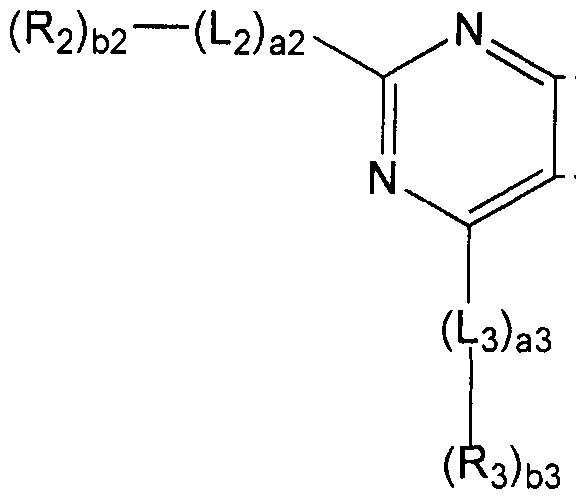
<

화학식 1 중 고리 은 상기 화학식 1A로 표시되고; In Formula 1, the ring is represented by Formula 1A;
ᄌ!은 N-KL^ ROw], S, 0, 또는 Si(R4)(R5); ᄌ! is N-KL ^ ROw], S, 0, or Si (R4) (R 5 );
Li 내지 L3는 서로 독립적으로, 치환 또는 비치환된 C6-C60아릴렌기이고; al 내지 a3는 서로 독립적으로, 0 내지 5의 정수 중에서 선택되고; Li to L 3 are each independently a substituted or unsubstituted C 6 -C 60 arylene group; al to a3 are each independently selected from an integer of 0 to 5;
내지 R5는 서로 독립적으로, 수소, 중수소, -F (플루오로기), -C1 (클로로기), -Br (브로모기) , -1(아이오도기), 히드록실기, 치환 또는 비치환된 CrC60알킬기, 치환 또는 비치환된 d- o알콕시기, 치환 또는 비치환된 C3-C10시클로알킬기, 치환 또는 비치환된 C6-C60아릴기, 치환 또는 비치환된 C6-C60아릴옥시기, 치환 또는 비치환된 C6-C60아릴티오기, 치환 또는 비치환된 1가 비-방향족 축합다환 그룹이되, 상기 R2 및 R3 중 적어도 하나는, 치환 또는 비치환된 C6-C60아릴기, 또는 치환 또는 비치환된 1가 비 -방향족 축합다환 그룹이고; To R 5 are independently of each other hydrogen, deuterium, -F (fluoro group), -C 1 (chloro group), -Br (bromo group), -1 (iodo group), hydroxyl group, substituted or unsubstituted CrC 60 alkyl group, substituted or unsubstituted d-alkoxy group, substituted or unsubstituted C 3 -C 10 cycloalkyl group, substituted or unsubstituted C 6 -C 60 aryl group, substituted or unsubstituted C 6 -C 60 aryloxy group, substituted or unsubstituted C 6 -C 60 arylthio group, substituted or unsubstituted monovalent non-aromatic condensed polycyclic group, at least one of R2 and R 3 is substituted or unsubstituted A C 6 -C 60 aryl group, or a substituted or unsubstituted monovalent non-aromatic condensed polycyclic group;
Rn 내지 R14는 서로 독립적으로, 수소, 중수소, -F, -CI, -Br, -1, 히드록실기, 치환 또는 비치환된 d- o알킬기, 치환 또는 비치환된 CrC60알콕시기, Rn to R 14 are each independently hydrogen, deuterium, -F, -CI, -Br, -1, hydroxyl group, substituted or unsubstituted d-oalkyl group, substituted or unsubstituted CrC 60 alkoxy group,
C3-C10시클로알킬기 , C6-C60아릴기 , C6-C60아릴옥시기 , C6-C60아릴티오기 , 1가 비 -방향족 축합다환 그룹이고; C 3 -C 10 cycloalkyl group, C 6 -C 60 aryl group, C 6 -C 60 aryloxy group, C 6 -C 60 arylthio group, monovalent non-aromatic condensed polycyclic group;
bl 내지 b3는 서로 독립적으로, 1 내지 3의 정수 중에서 선택되고; bl to b3 are each independently selected from an integer of 1 to 3;
Λ기 R2가 치환 또는 비치환된 페닐기인 경우, R3는 수소, 치환 또 When the Λ group R 2 is a substituted or unsubstituted phenyl group, R 3 is hydrogen, substituted or
비치환된 페닐기, 치환 또는 비치환된 바이페닐기, 치환 또는 비치환된 터페닐기, 치환 또는 비치환된 쿼터페닐기, 치환 또는 비치환된 나프틸기, 치환 또는 비치환된 안트라세닐기, 치환 또는 비치환된 플루오란테닐기 치환 또는 비치환된 Unsubstituted phenyl group, substituted or unsubstituted biphenyl group, substituted or unsubstituted terphenyl group, substituted or unsubstituted quarterphenyl group, substituted or unsubstituted naphthyl group, substituted or unsubstituted Anthracenyl group, substituted or unsubstituted fluoranthenyl group substituted or unsubstituted
트리페닐레닐기, 치환 또는 비치환된 파이레닐기, 치환 또는 비치환된 페난트레닐기, 치환 또는 비치환된 플루오레닐기, 또는 치환 또는 비치환된 크라이세닐기이고; 상기 치환된 C6-C60아릴렌기, 치환된 CrC60알킬기, 치환된 d- o알콕시기, 치환된 crc10시클로알킬기, 치환된 c6-c60아릴기, 치환된 C6-C60아릴옥시기, 치환된 c6-c60아릴티오기, 치환된 1가 비-방향족 축합다환 그룹의 치환기 중 적어도 하나는, 중수소, -F, -CI, -Br, -I, 히드록실기, d- o알킬기, 또는 d- o알콕시기; Triphenylenyl group, substituted or unsubstituted pyrenyl group, substituted or unsubstituted phenanthrenyl group, substituted or unsubstituted fluorenyl group, or substituted or unsubstituted chrysenyl group; The substituted C 6 -C 60 arylene group, substituted CrC 60 alkyl group, substituted d-oalkoxy group, substituted c r c 10 cycloalkyl group, substituted c 6 -c 60 aryl group, substituted C 6 -C At least one of the substituents of the 60 aryloxy group, substituted c 6 -c 60 arylthio group, substituted monovalent non-aromatic condensed polycyclic group is a deuterium, -F, -CI, -Br, -I, hydroxyl group , d-oalkyl group, or d-oalkoxy group;
중수소, -F, -CI, -Br, -I, 히드록실기, CrC10시클로알킬기, C6-C60아릴기, Heavy hydrogen, -F, -CI, -Br, -I, hydroxyl group, C r C 10 cycloalkyl group, C 6 -C 60 aryl group,
C6-C60아릴옥시기, C6-C60아릴티오기, 및 1가 비-방향족 축합다환 그룹 중 적어도 하나로 치환된, d- o알킬기, 또는 C C60알콕시기; A d-oalkyl group substituted with at least one of a C 6 -C 60 aryloxy group, a C 6 -C 60 arylthio group, and a monovalent non-aromatic condensed polycyclic group, or a CC 60 alkoxy group;
C3-C10시클로알킬기 , C6-C60아릴기 , C6-C60아릴옥시기 , C6-C60아릴티오기, 또는 1가 비-방향족 축합다환 그룹; C 3 -C 10 cycloalkyl, C 6 -C 60 aryl group, C 6 -C 60 aryloxy, C 6 -C 60 arylthio group, or a monovalent non-aromatic condensed polycyclic group;
중수소, -F, -CI, -Br, -I, 히드록실기, d-C60알킬기, d- o알콕시기, Deuterium, -F, -CI, -Br, -I, hydroxyl group, dC 60 alkyl group, d-oalkoxy group,
C3-C10시클로알킬기, C6-C60아릴기, C6-C60아릴옥시기, C6-C60아릴티오기, 및 1가 비-방향족 축합다환 그룹 중 적어도 하나로 치환된, C3-C10시클로알킬기, C6-C60아릴기, C6-C60아릴옥시기, C6-C60아릴티오기, 또는 1가 비-방향족 축합다환 그룹이고; C 3 -C 10 cycloalkyl, C 6 -C 60 aryl group, C 6 -C 60 aryloxy, C 6 -C 60 arylthio group, and a monovalent non-substituted with at least one of the aromatic condensed polycyclic group, C 3 -C 10 cycloalkyl, C 6 -C 60 aryl group, C 6 -C 60 aryloxy, C 6 -C 60 arylthio group, or a monovalent non-aromatic condensed polycyclic group;
R2 및 ¾의 치환기는, Substituents of R 2 and ¾ are
중수소, -F, -CI, -Br, -I, 히드록실기, d-C60알킬기, d- o알콕시기, Deuterium, -F, -CI, -Br, -I, hydroxyl group, dC 60 alkyl group, d-oalkoxy group,
C3-C10시클로알킬기, C6-C60아릴기, C6-C60아릴옥시기, C6-C60아릴티오기, 및 1가 C 3 -C 10 cycloalkyl, C 6 -C 60 aryl group, C 6 -C 60 aryloxy, C 6 -C 60 arylthio group, and a 1
비-방향족 축합다환 그룹 중 적어도 하나이다. At least one non-aromatic condensed polycyclic group.
다른 측면에 따르면, 제 1전극; 상기 게 1전극에 대향되는 게 2전극; 및 상기 제 1전극과 상기 게 2전극 사이에 개재되는 유기층을 포함하고, 상기 유기층은 상기 축합환 화합물을 포함하는 유기 발광 소자가 제공된다. - 상기 축합환 화합물은 상기 유기층 중 발광층 또는 전자수송보조층에 포함될 수 있고, 상기 발광층은 도펀트를 더 포함할 수 있으며, 상기 발광층에 포함된 상기 축합환 화합물은 호스트의 역할을 할 수 있다. According to another aspect, the first electrode; A crab 2 electrode opposite to the crab 1 electrode; And an organic layer interposed between the first electrode and the second electrode, wherein the organic layer includes the condensed cyclic compound. The condensed cyclic compound may be included in an emission layer or an electron transport auxiliary layer of the organic layer, the emission layer may further include a dopant, and the condensed cyclic compound included in the emission layer may serve as a host.
또 다른 측면에 따르면, 상기 유기층이 i) 화학식 1로 표시되는 축합환 화합물 및 ii) 하기 화학식 41로 표시되는 제 1화합물 및 하기 화학식 61로 표시되는 저 12화합물 중 적어도 하나를 포함한, 유기 발광 소자가 제공된다. According to another aspect, the organic layer comprises at least one of i) a condensed cyclic compound represented by Chemical Formula 1 and ii) a first compound represented by Chemical Formula 41 and a low 12 compound represented by Chemical Formula 61 Is provided.
<화학식 41>

<화 61> <Tue 61>

<화학식 61A> <화학식 61B>

상기 화학식 41 중 X41 ^ N-[(L42)a42-(R42)b42], S, 0, S(=0), S(=0)2, C(=0), C(R43)(R44), Si(R43)(R44), P(R43), P(=0)(R43) 또는 C=N(R43)이고; In the formula 41 X 41 ^ N - [( L 42) a42 - (R 42) b42], S, 0, S (= 0), S (= 0) 2, C (= 0), C (R 43 ) (R 44 ), Si (R 43 ) (R 44 ), P (R43), P (= 0) (R4 3 ) or C = N (R4 3 );
상기 화학식 61 중 고리 A61은 상기 화학식 61 A로 표시되고; Ring A 61 in Formula 61 is represented by Formula 61 A;
상기 화학식 61 중 고리 A62는 상기 화학식 61B로 표시되고;Ring A 62 in Formula 61 is represented by Formula 61B;
61은 N-[(L62)a62-(R62)b62], S, 0, S(=0), S(=0)2, C(=0), C(R63)(R64), Si(R«XR64), P( 63), P(=0)(R63) 또는 C=N(R63)이고; 6 1 is N-[(L 62 ) a62- (R 62 ) b62 ], S, 0, S (= 0), S (= 0) 2 , C (= 0), C (R 63 ) (R 64 ), Si (R «XR 64 ), P ( 63 ), P (= 0) (R 63 ) or C = N (R 63 );
X7 l은 C(R7I) 또는 N이고, X72는 C(R72) 또는 N이고, X73은 C(R73) 또는 N이고, X74는 C(R74) 또는 N이고, X75는 C(R75) 또는 N이고, X76은 C(R76) 또는 N이고, X77은 C(R77) 또는 N이고 , 8은 C(R78) 또는 N이고; X 7 l is C (R 7I ) or N, X 72 is C (R 72 ) or N, X 73 is C (R 73 ) or N, X 74 is C (R 74 ) or N, X 75 is C (R 75 ) or N, X 76 is C (R 76 ) or N, X 77 is C (R 77 ) or N, 8 is C (R 78 ) or N;
Ar41, L41, L42, L61 및 L62는 서로 독립적으로, 치환 또는 비치환된 Ar 41 , L 41 , L 42 , L 61 and L 62 are each independently a substituted or unsubstituted
C3-C10시클로알킬렌기, 치환 또는 비치환된 C2-C10헤테로시클로알킬렌기, 치환 또는 비치환된 C3-C10시클로알케닐렌기, 치환 또는 비치환된 C 3 -C 10 cycloalkylene group, substituted or unsubstituted C 2 -C 10 heterocycloalkylene group, substituted or unsubstituted C 3 -C 10 cycloalkenylene group, substituted or unsubstituted
C2-CI 0해테로시클로알케닐렌기, 치환 또는 비치환된 C6-C60아릴렌기, 치환 또는 비치환된 C2-C60헤테로아릴렌기, 치환 또는 비치환된 2가 비-방향족 축합다환 그룹 또는 치환 또는 비치환된 2가 비 -방향족 헤테로축합다환 그룹이고; C 2 -C I 0 heterocycloalkenylene group, substituted or unsubstituted C 6 -C 60 arylene group, substituted or An unsubstituted C 2 -C 60 heteroarylene group, a substituted or unsubstituted divalent non-aromatic condensed polycyclic group, or a substituted or unsubstituted divalent non-aromatic heterocondensed polycyclic group;
nl 및 n2는 서로 독립적으로, 0 내지 3의 정수 중에서 선택되고; nl and n2 are each independently selected from an integer of 0 to 3;
a41 , a42, a61 및 a62는 서로 독립적으로, 0 내지 5의 정수 중에서 선택되고; 내지 ¾4, 1 51 내지 R54, R61 내지 R64 및 R7I 내지 R79는 서로 독립적으로, 수소, 중수소, -F (플루오로기), -C1 (클로로기), -Br (브로모기), -1(아이오도기), 히드톡실기 시아노기, 아미노기, 아미디노기, 치환 또는 비치환된 - o알킬기, 치환 또는 비치환된 C2-C60알케닐기, 치환 또는 비치환된 C2-C60알키닐기, 치환 또는 비치환된 예60알콕시기, 치환또는 비치환된 C3-C10시클로알킬기, 치환 또는 비치환된 a41, a42, a61 and a62 are each independently selected from an integer of 0 to 5; To ¾ 4 , 1 51 to R 54 , R 61 to R 64 and R 7I to R 79 are each independently hydrogen, deuterium, -F (fluoro group), -C1 (chloro group), -Br (bromo group ), -1 (iodo group), hydroxy group cyano group, amino group, amidino group, substituted or unsubstituted -oalkyl group, substituted or unsubstituted C 2 -C 60 alkenyl group, substituted or unsubstituted C 2 -C 60 alkynyl group, substituted or unsubstituted Example 60 alkoxy group, substituted or unsubstituted C 3 -C 10 cycloalkyl group, substituted or unsubstituted
C2-C10헤테로시클로알킬기, 치환 또는 비치환된 C3-C10시클로알케닐기, 치환 또는 비치환된 C2-C10헤테로시클로알케닐기, 치환 또는 비치환된 C6-C60아릴기, 치환 또는 비치환된 C0-C60아릴옥시기, 치환 또는 비치환된 C6-C60아릴티오기, 치환 또는 비치환된 C2-C60헤테로아릴기, 치환 또는 비치환된 1가 비-방향족 축합다환 그룹, 치환 또는 비치환된 1가 비-방향족 헤테로축합다환 그룹, -NiQ!XQ^, -Si(Q3)(Q4)(Q5) 또는 -B(Q6)(Q7)이고; C 2 -C 10 heterocycloalkyl group, substituted or unsubstituted C 3 -C 10 cycloalkenyl group, substituted or unsubstituted C 2 -C 10 heterocycloalkenyl group, substituted or unsubstituted C 6 -C 60 aryl group , Substituted or unsubstituted C 0 -C 60 aryloxy group, substituted or unsubstituted C 6 -C 60 arylthio group, substituted or unsubstituted C 2 -C 60 heteroaryl group, substituted or unsubstituted monovalent Non-aromatic condensed polycyclic group, substituted or unsubstituted monovalent non-aromatic condensed polycyclic group, -NiQ ! XQ ^, -Si (Q 3 ) (Q 4 ) (Q 5 ) or -B (Q 6 ) (Q 7 );
b41 , b42, b51 내지 b54, b61, b62 및 b79는 서로 독립적으로, 1 내지 3의 정수 중에서 선택된다. b41, b42, b51 to b54, b61, b62 and b79 are each independently selected from integers of 1 to 3.
또 다른 측면에 따르면, 상기 축합환 화합물이 유기층 중 전자수송보조층에 포함되고, 하기 화학식 2로 표시되는 화합물을 포함하는 정공수송보조층을 더 포함하는 유기 발광 소자가 제공된다. According to another aspect, the condensed cyclic compound is included in the electron transport auxiliary layer of the organic layer, there is provided an organic light emitting device further comprising a hole transport auxiliary layer containing a compound represented by the formula (2).
< 2> <2>

상기 화학식 2에서, L201은 치환 또는 비치환된 C6 내지 C30 아릴렌기, 또는 치환 또는 비치환된 C2 내지 C30 헤테로아릴렌기이고 , ηΐθΐ은 1 내지 5의 정수 중 하나이고, R201 내지 R212은 각각 독립적으로, 수소, 중수소, 치환 또는 비치환된 C1 내지 C20 알킬기, 치환 또는 비치환된 C6 내지 C50 아릴기, 치환 또는 비치환된 C2 내지 C50 헤테로아릴기 또는 이들의 조합이고, R201 내지 R212은 각각 독립적으로 존재하거나, 융합하여 고리를 형성한다. In Formula 2, L 201 is a substituted or unsubstituted C6 to C30 arylene group, or a substituted or unsubstituted C2 to C30 heteroarylene group, ηΐθΐ is an integer of 1 to 5 One, R 201 to R 212 are each independently hydrogen, deuterium, a substituted or unsubstituted C1 to C20 alkyl group, a substituted or unsubstituted C6 to C50 aryl group, a substituted or unsubstituted C2 to C50 heteroaryl group, or These are combinations, and R 201 to R 212 are each independently present or fuse to form a ring.
【유리한 효과】 Advantageous Effects
상기 축합환 화합물은 우수한 전기적 특성 및 열적 안정성을 갖는 바, 상기 축합환 화합물을 채용한 유기 발광 소자는 저구동 전압, 고효율, 고휘도 및 장수명 특성을 가질 수 있다. The condensed cyclic compound has excellent electrical properties and thermal stability, the organic light emitting device employing the condensed cyclic compound may have a low driving voltage, high efficiency, high brightness and long life.
【도면의 간단한 설명】 [Brief Description of Drawings]
도 1 내지 도 3은 일 구현예를 따르는 유기 발광 소자를 개략적으로 나타낸 단면도이다. 1 to 3 are cross-sectional views schematically illustrating an organic light emitting diode according to one embodiment.
<부호의 설명 > <Description of the sign>
1 : 유기 발광 소자 1: organic light emitting device
1 1 : 제 1전극 1 1: first electrode
15: 유기층 15: organic layer
19: 제 2전극 19: second electrode
31 : 정공수송층 31: hole transport layer
32: 발광층 32: light emitting layer
33 : 정공수송보조층 33: hole transport auxiliary layer
34: 전자수송층 34: electron transport layer
35: 전자수송보조층 35: electron transport auxiliary layer
36: 전자주입층 36: electron injection layer
37: 정공주입층 37: hole injection layer
【발명의 실시를 위한 최선의 형태】 [Best form for implementation of the invention]
상기 축합환 화합물은 하기 화학식 1로 표시된다: The condensed cyclic compound is represented by the following Chemical Formula 1:
<화학식 1>

상기 화학식 1 중 고리 은 상기 화학식 1A로 표시된다. In Formula 1, the ring is represented by Formula 1A.
<화학식 1A> <Formula 1A>
入 入
상기 화학식 1A 중 X g— N-[(L,)ai-(Ri)bi], S, 0, 또는 Si(R4)(R5); 이고,X g—N — [(L,) ai- (Ri) bi], S, 0, or Si (R 4) (R 5 ) in Formula 1A; ego,
L, 내지 L3는 서로 독립적으로, 치환 또는 비치환된 C6-C60아릴렌기이고; al 내지 a3는 서로 독립적으로, 0 내지 5의 정수 중에서 선택되고; L, to L 3 are each independently a substituted or unsubstituted C 6 -C 60 arylene group; al to a3 are each independently selected from an integer of 0 to 5;
Ri 내지 ¾는 서로 독립적으로, 수소, 중수소, -F (플루오로기), -C1 (클로로기), -Br (브로모기) , 아이오도기), 히드록실기, 치환 또는 비치환된 CrC60알킬기, 치환 또는 비치환된 d- o알콕시기, 치환 또는 비치환된 CrC10시클로알킬기, 치환 또는 비치환된 c6-c60아릴기, 치환 또는 비치환된 c6-c60아릴옥시기, 치환 또는 비치환된Ri to ¾ are independently of each other hydrogen, deuterium, -F (fluoro group), -C1 (chloro group), -Br (bromo group), iodo group), hydroxyl group, substituted or unsubstituted CrC 60 alkyl group , A substituted or unsubstituted d-oalkoxy group, a substituted or unsubstituted C r C 10 cycloalkyl group, a substituted or unsubstituted c 6 -c 60 aryl group, a substituted or unsubstituted c 6 -c 60 aryloxy group , Substituted or unsubstituted
C6-C60아릴티오기, 치환 또는 비치환된 1가 비-방향족 축합다환 그룹이되, 상기 R2 및 R3 중 적어도 하나는, 치환 또는 비치환된 C6-C60아릴기, 또는 치환 또는 비치환된 1가 비-방향족 축합다환 그룹이고; A C 6 -C 60 arylthio group, a substituted or unsubstituted monovalent non-aromatic condensed polycyclic group, wherein at least one of R 2 and R 3 is a substituted or unsubstituted C 6 -C 60 aryl group, or A substituted or unsubstituted monovalent non-aromatic condensed polycyclic group;
Ru 내지 R14는 서로 독립적으로, 수소, 증수소, -F, -CI, -Br, -I, 히드록실기, 치환 또는 비치환된 CrC60알킬기, 치환 또는 비치환된 d- o알콕시기, Ru to R 14 independently of each other, hydrogen, hydrogen, -F, -CI, -Br, -I, hydroxyl group, substituted or unsubstituted CrC 60 alkyl group, substituted or unsubstituted d-oalkoxy group,
C d^l클로알킬기, C6-C60아릴기, C6-C60아릴옥시기, C6-C60아릴티오기, 1가 비-방향족 축합다환 그룹이고; C d ^ l chloroalkyl group, C 6 -C 60 aryl group, C 6 -C 60 aryloxy group, C 6 -C 60 arylthio group, monovalent non-aromatic condensed polycyclic group;
bl 내지 b3는 서로 독립적으로, 1 내지 3의 정수 중에서 선택되고; bl to b3 are each independently selected from an integer of 1 to 3;
상기 가 치환 또는 비치환된 페닐기인 경우, R3는 수소, 치환또는 비치환된 페닐기, 치환 또는 비치환된 바이페닐기, 치환 또는 비치환된 터페닐기, 치환 또는 비치환된 쿼터페닐기, 치환 또는 비치환된 나프틸기, 치환 또는 비치환된 안트라세닐기, 치환 또는 비치환된 플루오란테닐기 치환 또는 비치환된
트리페닐레닐기, 치환 또는 비치환된 파이레닐기, 치환 또는 비치환된 페난트레닐기, 치환 또는 비치환된 플루오레닐기 , 또는 치환 또는 비치환된 크라이세닐기이다. 여기서, 상기

다른 구현예에 따르면, 상기 : 은 S 또는 0일 수 있으나, 이에 한정되는 것은 아니다. According to another embodiment, the: may be S or 0, but is not limited thereto.
상기 고리 은 인접한 2개의 6원환 고리와, 탄소 원자를 공유하면서, 서로 융합되어 있다. 따라서, 상기 화학식 1은 하기 화학식 1-1 및 1-2 중 하나로 표시될 수 있다: The rings are fused with two adjacent six-membered rings, sharing a carbon atom. Therefore, Chemical Formula 1 may be represented by one of the following Chemical Formulas 1-1 and 1-2:
< -1> <-1>

< 1_2> <1_2>

상기 화학식 1-1 내지 1-2 중

상기 화학식들 중, 내지 L3는 서로 독립적으로, 치환 또는 비치환된 Of the above formula, to L 3 are independently of each other, substituted or unsubstituted
C6-C60아릴렌기이다. C 6 -C 60 arylene group.
예를 들어, 상기 L, 내지 L3는 서로 독립적으로, For example, the L, to L 3 are independently of each other,
페닐렌기 (phenylene), 바이페닐렌기 (biphenylene), 터페닐렌기 (terphenylene), 쿼터페닐렌기 (quaterphenylene), 나프틸렌기 (naphthylene), 플루오레닐렌기 (fluorenylene), 스파이로-플루오레닐렌기, 페난트레닐렌기 (phenanthrenylene), Phenylene, biphenylene, terphenylene, Quaterphenylene, naphthylene, fluorenylene, spiro-fluorenylene, phenanthrenylene,
안트라세닐렌기 (anthracenylene), 플루오란트레닐렌기 (fluoranthrenylene), Anthracenylene group (anthracenylene), fluoranthrenylene group (fluoranthrenylene),
트리페닐레닐렌기 (triphenylenylene), 파이레닐렌기 (pyrenylene), Triphenylenylene group, pyrenylene group,
크라이세닐렌기 (chrysenylene), 또는 나프타세닐렌기 (naphthacenylene); 또는 Chrysenylene, or naphthacenylene; or
중수소, -F, -CI, -Br, -I, 히드록실기, d-C20알킬기, d- o알콕시기, C6-C20아릴기, 및 1가 비-방향족 축합다환 그룹 중 적어도 하나로 치환된, Deuterium, -F, -CI, -Br, -I, hydroxyl group, dC 20 alkyl group, d-oalkoxy group, C 6 -C 20 aryl group, and monovalent non-aromatic condensed polycyclic group ,
바이페닐렌기 (biphenylene), 터페닐렌기 (terphenylene), 쿼터페닐렌기 (quaterphenylene), 나프틸렌기 (naphthylene), 플루오레닐렌기 (fluorenylene), 스파이로-플루오레닐렌기, 페난트레닐렌기 (phenanthrenylene), 안트라세닐렌기 (anthracenylene), Biphenylene group, biphenylene group, terphenylene group, quaterphenylene group, naphthylene group, naphthylene group, fluorenylene group, spiro-fluorenylene group, phenanthrenylene group ), Anthracenylene group (anthracenylene),
플루오란트레닐렌기 (fluoranthrenylene), 트리페닐레닐렌기 (triphenylenylene), Fluoranthrenylene group, triphenylenylene group,
파이레닐렌기 (pyrenylene), 크라이세닐렌기 (chrysenylene), 또는 Pyrenylene, chrysenylene, or
나프타세닐렌기 (naphthacenylene);이고, Naphthacenylene group;
일 구현예에 따르면, 상기 화학식들 증 상기 1 내지 L3는 서로 독립적으로, 화학식 -1 내지 2-15 중 하나로 표시될 수 있다: According to one embodiment, the above formulas 1 to L 3 may be represented by one of the formulas -1 to 2-15 independently of each other:

화학식 2-6 호ᅡ학식 2-7 화학식 2-8 화학식 2-9 Chemical Formula 2-6 Chemical Formula 2-7 Chemical Formula 2-8 Chemical Formula 2-9

화학식 2-13 Formula 2-13
상기 화학식 2-1 내지 2-15 중, In Formulas 2-1 to 2-15,
Z, 내지 Z4는 서로 독립적으로, 수소, 중수소, -F, -CI, -Br, -I, 히드록실기, ^- 0알킬기, d- o알콕시기, 페닐기, 바이페닐기, 터페닐기, 쿼터페닐기, 나프틸기, 안트라세닐기, 플루오란테닐기, 트리페닐레닐기, 파이레닐기, 페난트레닐기, Z, to Z 4 independently of each other, hydrogen, deuterium, -F, -CI, -Br, -I, hydroxyl group, ^ -0 alkyl group, d-oalkoxy group, phenyl group, biphenyl group, terphenyl group, quarter Phenyl group, naphthyl group, anthracenyl group, fluoranthenyl group, triphenylenyl group, pyrenyl group, phenanthrenyl group,
플루소레닐기, 또는 크라이세닐기이고; A flusorenyl group or chrysenyl group;
dl은 1 내지 4의 정수 중에서 선택되고, d2는 1 내지 3의 정수 중에서 선택되고, d3는 1 내지 6의 정수 중에서 선택되고, d4는 1 내지 8의 정수 중에서 선택되고 , d6는 1 내지 5의 정수 중에서 선택되고, * 및 *,는 서로 독립적으로, 이웃한 원자와의 결합 사이트일 수 있다. dl is selected from integers of 1 to 4, d2 is selected from integers of 1 to 3, d3 is selected from integers of 1 to 6, d4 is selected from integers of 1 to 8, d6 is selected from 1 to 5 Are selected from integers, and * and *, may independently be binding sites with neighboring atoms.
다른 구현예에 따르면, 상기 화학식들 중 상기 L, 내지 L3는 서로 독립적으로, 화학식 3-1 내지 3-37 중 하나로 표시될 수 있으나, 이에 한정되는 것은 아니다: According to another embodiment, L, L to L 3 of the above formulas may be each independently represented by one of Formulas 3-1 to 3-37, but are not limited thereto.
11 11


화학식 3-36 화학식 3-37 Formula 3-36 Formula 3-37
상기 화학식 1 중 al은 !^의 개수를 나타낸 것으로서 0, 1, 2, 3, 4 또는 5, 예를 들면, 0, 1 또는 2, 또 다른 예로서는 0 또는 1일 수 있다. al이 0일 경우, In Formula 1, al represents the number of! ^, And may be 0, 1, 2, 3, 4 or 5, for example, 0, 1 or 2, and as another example, 0 or 1. If al is 0,
*-(L,)al-*'은 단일 결합이 된다. al이 2 이상일 경우, 2 이상의 !^은 서로 동일하거나 상이할 수 있다. a2 및 a3에 대한 설명은 al에 대한 설명 및 화학식 1의 구조를 참조하여 이해될 수 있다ᅳ *-(L,) al- * 'is a single bond. When al is 2 or more, two or more! ^ may be the same or different from each other. The description of a2 and a3 can be understood by reference to the description of al and the structure of formula (1).
일 구현예에 따르면, al, a2 및 a3는 서로 독립적으로, 0, 1 또는 2일 수 있다. 상기 화학식들 중, R, 내지 ¾는 서로 독립적으로, 수소, 중수소, . According to one embodiment, al, a2 and a3 may be 0, 1 or 2, independently of each other. Of the above formula, R, to ¾ are each independently hydrogen, deuterium,.
-F (플루오로기), -C1 (클로로기), -Br (브로모기) , -1(아이오도기), 힉드록실기, 치환 또는 비치환된 d- o알킬기, 치환 또는 비치환된 d- o알콕시기, 치환 또는 비치환된 C3-C10시클로알킬기, 치환 또는 비치환된 C6-C60아릴기, 치환 또는 비치환된 -F (fluoro group), -C1 (chloro group), -Br (bromo group), -1 (iodo group), pentoxy group, substituted or unsubstituted d-oalkyl group, substituted or unsubstituted d- o Alkoxy group, substituted or unsubstituted C 3 -C 10 cycloalkyl group, substituted or unsubstituted C 6 -C 60 aryl group, substituted or unsubstituted
C6-C60아릴옥시기, 치환 또는 비치환된 c6-c60아릴티오기, 또는 치환 또는 비치환된 !가 비-방향족 축합다환 그룹일 수 있다. 여기서, 상기 화학식 1의 R2 및 R3 중 적어도 하나는, 치환 또는 비치환된 C6ᅳ C60아릴기, 또는 치환 또는 비치환된 1가 비-방향족 축합다환 그룹이다. Or a C 6 -C 60 aryloxy group, a substituted or unsubstituted c 6 -c 60 arylthio group, or a substituted or unsubstituted! May be a non-aromatic condensed polycyclic group. Here, at least one of R 2 and R 3 of Formula 1 is a substituted or unsubstituted C 6 ᅳ C 60 aryl group, or a substituted or unsubstituted monovalent non-aromatic condensed polycyclic group.
예를 들어, 상기 화학식들 중 내지 R5은 서로 독립적으로, For example, in Formulas 5 to 5 R independently of each other,
수소, 중수소, -F, -CI, -Br, -I, 히드록실기, - o알킬기 또는 C ^o알콕시기; 중수소, -F, -CI, -Br, -I, 및 히드록실기 중 적어도 하나로 치환된, C ^o알킬기 또는 CrC20알콕시기; Hydrogen, deuterium, -F, -CI, -Br, -I, hydroxyl group, -oalkyl group or C ^ oalkoxy group; A C ^ oalkyl group or a C r C 20 alkoxy group substituted with at least one of deuterium, -F, -CI, -Br, -I, and a hydroxyl group;
페닐기 (phenyl), 바이페닐기 (biphenyl), 터페닐기 (terphenyl), Phenyl group (phenyl), biphenyl group (biphenyl), terphenyl group (terphenyl),
쿼터페닐기 (quaterphenyl), 펜탈레닐기 (pentalenyl), 인데닐기 (indenyl), 나프틸기 (naphthyl), 아줄레닐기 (azulenyl), 헵탈레닐기 (heptalenyl), 인다세닐기 (indacenyl), Quaterphenyl group, pentalenyl group, indenyl group, indenyl group, naphthyl group, azulenyl group, azulenyl group, heptalenyl group, heptalenyl group, indaseyl group, and indasenyl group (indacenyl group)
아세나프틸기 (acenaphthyl), 풀루오레닐기 (fluorenyl), 스파이로-플루오레닐기, Acenaphthyl, fluorenyl, spiro-fluorenyl,
벤조플루오레닐기, 디벤조플루오레닐기, 페날레닐기 (phenalenyl), Benzofluorenyl group, dibenzofluorenyl group, penalenyl group (phenalenyl),
페난트레닐기 (phenanthrenyl), 안트라세닐기 (anthracenyl), 플루오란테닐기 (fluoranthenyl), 트리페닐레닐기 (triphenylenyl), 파이레닐기 (pyrenyl), 크라이세닐기 (chrysenyl), 나프타세닐기 (naphthacenyl), 피세닐기 (picenyl), 페릴레닐기 (perylenyl), Phenanthrenyl group (phenanthrenyl), anthracenyl group (anthracenyl), fluoranthenyl group (triantenyl), triphenylenyl group, pyrenyl group (pyrenyl), chrysenyl group (chrysenyl), Naphthacenyl, picenyl, perylenyl,
펜타페닐기 (pentaphenyl), 핵사세닐기 (hexacenyl), 펜타세닐기 (pentacenyl), Pentaphenyl group (pentaphenyl), nucleasenyl group (hexacenyl), pentaxenyl group (pentacenyl),
루비세닐기 (rubicenyl), 코로네닐기 (coronenyl), 오발레닐기 (ovalenyl); Rubicenyl group (rubicenyl), coronenyl group (coronenyl), ovalenyl group (ovalenyl);
중수소, -F, -CI, -Br, -I, 히드록실기, d-C2。알킬기, d- o알콕시기, Deuterium, -F, -CI, -Br, -I, hydroxyl group, dC 2 .alkyl group, d-oalkoxy group,
-Si(Q33)(Q34)(Q35), 페닐기, 바이페닐기, 터페닐기, 쿼터페닐기, 펜탈레닐기, 인데닐기, 나프틸기, 아줄레닐기, 헵탈레닐기, 인다세닐기, 아세나프틸기, 플루오레닐기, 스파이로-플루오레닐기, 벤조플루오레닐기, 디벤조플루오레닐기, 페날레닐기, 페난트레닐기, 안트라세닐기, 플루오란테닐기, 트리페닐레닐기, 파이레닐기, 크라이세닐기, 나프타세닐기, 피세닐기, 페릴레닐기, 펜타페닐기, 핵사세닐기, 펜타세닐기, 루비세닐기, 코로네닐기, 및 오발레닐기 중 적어도 하나로 치환된, 페닐기, 바이페닐기, 터페닐기, 쿼터페닐기, 펜탈레닐기, 인데닐기, 나프틸기, 아줄레닐기, 헵탈레닐기, 인다세닐기, 아세나프틸기, 플루오레닐기, -Si (Q 33 ) (Q 34 ) (Q 35 ), phenyl group, biphenyl group, terphenyl group, quarterphenyl group, pentalenyl group, indenyl group, naphthyl group, azulenyl group, heptalenyl group, indansenyl group, acenaph Tyl group, fluorenyl group, spiro-fluorenyl group, benzofluorenyl group, dibenzofluorenyl group, penalenyl group, phenanthrenyl group, anthracenyl group, fluoranthhenyl group, triphenylenyl group, pyrenyl group, Phenyl group, biphenyl group, substituted with at least one of chrysenyl group, naphthacenyl group, pisenyl group, perylenyl group, pentaphenyl group, nucleusenyl group, pentansenyl group, rubisenyl group, coronyl group, and ovalenyl group Terphenyl group, quarterphenyl group, pentalenyl group, indenyl group, naphthyl group, azulenyl group, heptalenyl group, indasenyl group, acenaphthyl group, fluorenyl group,
스파이로-플루오레닐기, 벤조플루오레닐기, 디벤조플루오레닐기, 페날레닐기, 페난트레닐기, 안트라세닐기, 플루오란테닐기, 트리페닐레닐기, 파이레닐기, 크라이세닐기, 나프타세닐기, 피세닐기, 페릴레닐기, 펜타페닐기, 핵사세닐기, 펜타세닐기, 루비세닐기, 코로네닐기, 또는 오발레닐기이되; Spiro-fluorenyl group, benzofluorenyl group, dibenzofluorenyl group, penalenyl group, phenanthrenyl group, anthracenyl group, fluoranthenyl group, triphenylenyl group, pyrenyl group, chrysenyl group, naphthacenyl A group, a pisenyl group, a perrylenyl group, a pentaphenyl group, a nucleasenyl group, a pentasenyl group, a rubisenyl group, a coronyl group, or an ovalenyl group;
상기 i) R2 및 중 적어도 하나 및 Π) !^은, 서로 독립적으로, I) at least one of R 2 and and Π)! ^, Independently of each other,
페닐기, 바이페닐기, 터페닐기, 쿼터페닐기, 펜탈레닐기, 인데닐기, 나프틸기, 아즐레닐기, 헵탈레닐기, 인다세닐기, 아세나프틸기, 플루오레닐기, Phenyl group, biphenyl group, terphenyl group, quarterphenyl group, pentalenyl group, indenyl group, naphthyl group, azelenyl group, heptalenyl group, indaseyl group, acenaphthyl group, fluorenyl group,
스파이로-플루오레닐기, 벤조플루오레닐기, 디벤조플루오레닐기, 페날레닐기, 페난트레닐기, 안트라세닐기, 플루오란테닐기, 트리페닐레닐기, 파이레닐기, 크라이세닐기, 나프타세닐기, 피세닐기, 페릴레닐기, 펜타페닐기, 핵사세닐기, 펜타세닐기, 루비세닐기, 코로네닐기, 또는 오발레닐기; 또는 Spiro-fluorenyl group, benzofluorenyl group, dibenzofluorenyl group, penalenyl group, phenanthrenyl group, anthracenyl group, fluoranthenyl group, triphenylenyl group, pyrenyl group, chrysenyl group, naphthacenyl A group, a pisenyl group, a perrylenyl group, a pentaphenyl group, a nucleasenyl group, a pentasenyl group, a rubisenyl group, a coronyl group, or an ovalenyl group; or
중수소, -F, -CI, -Br, -I, 히드록실기, -Cso알킬기, - 0알콕시기, 페닐기, 바이페닐기, 터페닐기, 쿼터페닐기, 펜탈레닐기, 인데닐기, 나프틸기, 아줄레닐기, 헵탈레닐기, 인다세닐기, 아세나프틸기, 플루오레닐기, 스파이로-플루오레닐기, 벤조플루오레닐기, 디벤조플루오레닐기, 페날레닐기, 페난트레닐기, 안트라세닐기, 플루오란테 기, 트리페닐레닐기, 파이레닐기, 크라이세닐기, 나프타세닐기, 피세닐기 페릴레닐기, 펜타페닐기, 핵사세닐기, 펜타세닐기, 루비세닐기, 코로네닐기, 및 오발레닐기 중 적어도 하나로 치환된, 페닐기, 바이페닐기, 터페닐기, 쿼터페닐기, 펜탈레닐기, 인데닐기, 나프틸기, 아즐레닐기, 헵탈레닐기, 인다세닐기, 아세나프틸기 플루오레닐기, 스파이로-플루오레닐기, 벤조플루오레닐기, 디벤조플루오레닐기, 페날레닐기, 페난트레닐기, 안트라세닐기, 플루오란테닐기, 트리페닐레닐기, 파이레닐기, 크라이세닐기, 나프타세닐기, 피세닐기, 페릴레닐기, 펜타페닐기, 핵사세닐기, 펜타세닐기, 루비세닐기, 코로네닐기, 또는 오발레닐기;일 수 있다. 일 구현예에 따르면, 상기 화학식들 중 내지 R5은 서로 독립적으로, 수소, 중수소, -F, -CI, -Br, -I, 히드록실기, -C20알킬기 또는 CrC20알콕시기; 증수소, -F, -CI, -Br, -I, 및 히드록실기 중 적어도 하나로 치환된, ^- o알킬기 또는 d- o알콕시기; Deuterium, -F, -CI, -Br, -I, hydroxyl group, -Csoalkyl group, -0 alkoxy group, phenyl group, biphenyl group, terphenyl group, quarterphenyl group, pentalenyl group, indenyl group, naphthyl group, azule Nilyl group, heptalenyl group, indasenyl group, acenaphthyl group, fluorenyl group, spiro-fluorenyl group, benzofluorenyl group, dibenzofluorenyl group, penalenyl group, phenanthrenyl group, anthracenyl group, fluorane Te group, triphenylenyl group, pyrenyl group, chrysenyl group, naphthacenyl group, pisenyl group perylenyl group, pentaphenyl group, nucleasenyl group, pentacenyl group, rubisenyl group, coronenyl group, and ovalenyl group A phenyl group, a biphenyl group, a terphenyl group, a quarterphenyl group, substituted with at least one of Pentalenyl, indenyl, naphthyl, azelenyl, heptalenyl, indasenyl, acenaphthyl, fluorenyl, spiro-fluorenyl, benzofluorenyl, dibenzofluorenyl, and penalenyl , Phenanthrenyl group, anthracenyl group, fluoranthhenyl group, triphenylenyl group, pyrenyl group, chrysenyl group, naphthacenyl group, pisenyl group, peryllenyl group, pentaphenyl group, nucleasenyl group, pentacenyl group, It may be a rubisenyl group, a coronyl group, or an ovalenyl group. According to an embodiment, to R 5 in the formulas independently of one another, hydrogen, deuterium, —F, —CI, —Br, —I, a hydroxyl group, a —C 20 alkyl group, or a CrC 20 alkoxy group; A ^ -oalkyl group or a d-oalkoxy group substituted with at least one of distillation, -F, -CI, -Br, -I, and a hydroxyl group;
페닐기, 바이페닐기, 터페닐기, 쿼터페닐기, 나프틸기, 페날레닐기, 페난트레닐기, 안트라세닐기, 플루오란테닐기, 트리페닐레닐기, 파이레닐기, 크라이세닐기, 플루오레닐기, 또는 페릴레닐기; Phenyl group, biphenyl group, terphenyl group, quarterphenyl group, naphthyl group, penalenyl group, phenanthrenyl group, anthracenyl group, fluoranthhenyl group, triphenylenyl group, pyrenyl group, chrysenyl group, fluorenyl group, or phenyl Rylenyl group;
중수소, -F, -CI, -Br, -I, 히드록실기, - 0알킬기, - 0알콕시기, 페닐기, 바이페닐기, 터페닐기, 쿼터페닐기, 나프틸기, 페날레닐기, 페난트레닐기, Deuterium, -F, -CI, -Br, -I, hydroxyl group, -0 alkyl group, -0 alkoxy group, phenyl group, biphenyl group, terphenyl group, quarterphenyl group, naphthyl group, phenenyl group, phenanthrenyl group,
안트라세닐기, 플루오란테닐기, 트리페닐레닐기, 파이레닐기, 크라이세닐기, 플루오레닐기, 및 페릴레닐기 중 적어도 하나로 치환된, 페닐기, 바이페닐기, 터페닐기, 쿼터페닐기, 나프틸기, 페날레닐기, 페난트레닐기, 안트라세닐기, 플루오란테닐기, 트리페닐레닐기, 파이레닐기, 크라이세닐기, 플루오레닐기, 또는 페릴레닐기이되, Phenyl, biphenyl, terphenyl, quarterphenyl, naphthyl, substituted with at least one of anthracenyl, fluoranthenyl, triphenylenyl, pyrenyl, chrysenyl, fluorenyl, and perrylenyl Penalenyl group, phenanthrenyl group, anthracenyl group, fluoranthenyl group, triphenylenyl group, pyrenyl group, chrysenyl group, fluorenyl group, or perenyl group,
상기 i) R2 및 R3 중 적어도 하나 및 ii) ^은, 서로 독립적으로, I) at least one of R 2 and R 3 and ii) ^, independently of each other,
페닐기, 바이페닐기, 터페닐기, 쿼터페닐기, 나프틸기, 페날레닐기, 페난트레닐기, 안트라세닐기, 플루오란테닐기, 트리페닐레닐기, 파이레닐기, 크라이세닐기, 플루오레닐기, 또는 페릴레닐기; 또는 Phenyl group, biphenyl group, terphenyl group, quarterphenyl group, naphthyl group, penalenyl group, phenanthrenyl group, anthracenyl group, fluoranthhenyl group, triphenylenyl group, pyrenyl group, chrysenyl group, fluorenyl group, or phenyl Rylenyl group; or
중수소, -F, -CI, -Br,ᅳ I, 히드록실기, d- o알킬기, d-C2o알콕시기, 페닐기, 바이페닐기, 터페닐기, 쿼터페닐기, 나프틸기, 페날레닐기, 페난트레닐기, Deuterium, -F, -CI, -Br, ᅳ I, hydroxyl group, d-oalkyl group, dC 2 oalkoxy group, phenyl group, biphenyl group, terphenyl group, quarterphenyl group, naphthyl group, phenenyl group, phenanthrenyl group ,
안트라세닐기, 플루오란테닐기, 트리페닐레닐기, 파이레닐기, 크라이세닐기, 플루오레닐기, 또는 페릴레닐기 중 적어도 하나로 치환된, 페닐기, 바이페닐기, 터페닐기, 쿼터페닐기, 나프틸기, 페날레닐기, 페난트레닐기, 안트라세닐기, 플루오란테닐기, 트리페닐레닐기, 파이레닐기, 크라이세닐기, 플루오레닐기, 또는 , 페릴레닐기일 수 있다. 또 다른 구현예에 따르면, 상기 화학식들 중 내지 R5는 서로 독립적으로, 수소, 중수소, -F, -CI, -Br, -I, 히드톡실기, d-C2o알킬기 또는 C C20알콕시기; 중수소, -F, -CI, -Br, -I, 및 히드록실기 중 적어도 하나로 치환된, ^- 0알킬기 또는 C ! -CM알콕시기; 또는 Phenyl, biphenyl, terphenyl, quarterphenyl, naphthyl, substituted with at least one of anthracenyl, fluoranthenyl, triphenylenyl, pyrenyl, chrysenyl, fluorenyl, or perrylenyl Fe nalre group, a phenanthrenyl group, an anthracenyl group, a fluoran te group, a triphenylmethyl group les, pie LES group, Cry hexenyl group, a fluorenyl group, or may be perylenyl carbonyl group. According to another embodiment, in the formulas to R 5 independently of each other, hydrogen, deuterium, —F, —CI, —Br, —I, a hydroxy group, a dC 2 o alkyl group or a CC 20 alkoxy group; ^ -0 alkyl group substituted with at least one of deuterium, -F, -CI, -Br, -I, and hydroxyl group, or C! -CM alkoxy group; or
하기 화학식 4-1 내지 4-5, 및 4-34 내지 4-37 중 하나이고, One of Formulas 4-1 to 4-5, and 4-34 to 4-37,
상기 i) R2 및 R3 중 적어도 하나 및 iO Ri은, 서로 독립적으로, 하기 화학식 4-1 내지 4-5, 및 4-34 내지 4-37 중 하나로 표시될 수 있다. I) At least one of R 2 and R 3 and iO Ri, independently of each other, may be represented by one of the formulas 4-1 to 4-5, and 4-34 to 4-37.
또 다른 구현예에 따르면, 본 발명의 축합환 화합물은 ^은 S 또는 0이고, 상기 R, 내지 R5가 서로 독립적으로, 수소, 중수소, -F, -CI, -Br, -I, 히드록실기, 알킬기 또는 d-C20알콕시기; According to another embodiment, the condensed cyclic compound of the present invention is ^ is S or 0, wherein R, to R 5 are independently of each other, hydrogen, deuterium, -F, -CI, -Br, -I, hydroxy Real, alkyl or dC 20 alkoxy groups;
중수소, -F, -CI, -Br, -1, 및 히드록실기 중 적어도 하나로 치환된, -C20알킬기 또는 d- o알콕시기; 또는 A deuterium, —F, —CI, —Br, —1, and —C 20 alkyl group or d-oalkoxy group substituted with at least one of hydroxyl groups; or
하기 화학식 4-1 내지 4-5, 및 4-34 내지 4-37 중 하나이고; One of Formulas 4-1 to 4-5 and 4-34 to 4-37;
상기 R2 및 중 적어도 하나는, 서로 독립적으로, 하기 화학식 4-1 내지 4-5, 및 4-34 지 4-37 중 하나로 표시되는 것 일 수 있다: At least one of R 2 and may be, independently of each other, represented by one of the following Formulas 4-1 to 4-5, and 4-34 to 4-37:

화학식 4-5 S학식 4-6 화학식 4-7 화학식 4-8 화학식 4-9 Formula 4-5 S Formula 4-6 Formula 4-7 Formula 4-8 Formula 4-9

화학식 4-10 화학식 4-11 화학식 4-12 화학식 4-13 Chemical Formula 4-10 Chemical Formula 4-11 Chemical Formula 4-12 Chemical Formula 4-13


화학식 4-19 화학식 4-20 화학식 4-21 화학식 4-22


화학식 4-32 화학식 4-33

화학식 4-34 화학식 4-35 화학식 4-36 Formula 4-34 Formula 4-35 Formula 4-36

화학식 4-37 Formula 4-37
화학식 4-1 내지 4-37 중, In Formulas 4-1 to 4-37,
Y3 1은 0, S, C(Z33)(Z34), N(Z35) 또는 Si(Z36)(Z37)이고 (단, 화학식 4-23 중 Y3 1은 ΝΗ가 아님); Y 3 1 is 0, S, C (Z 33 ) (Z 34 ), N (Z 35 ) or Si (Z 36 ) (Z 37 ) (wherein Y 3 1 in formula 4-23 is not ΝΗ) ;
Ζ31 내지 Ζ37은 서로 독립적으로, 수소, 중수소, -F, -CI, -Br, -I, 히드록실기, 시아노기, 아미노기, 아미디노기, d-C2。알킬기, d-C^알콕시기, 페닐기, 나프틸기, 안트라세닐기, 파이레닐기, 페난트레닐기, 플루오레닐기, 크라이세닐기, Ζ Ζ 31 to 37 are, independently of each other, hydrogen, heavy hydrogen, -F, -CI, -Br, -I, a hydroxyl group, a cyano group, an amino group, an amidino group, dC 2. Alkyl, dC ^ alkoxy group, a phenyl group , Naphthyl, anthracenyl, pyrenyl, phenanthrenyl, fluorenyl, chrysenyl,
벤조카바졸일기, 디벤조카바졸일기, 디벤조퓨라닐기, 디벤조티오페닐기, 피리디닐기, 피리미디닐기, 트리아지닐기, 퀴놀리닐기, 이소퀴놀리닐기, 퀴나졸리닐기, Benzocarbazolyl, dibenzocarbazolyl, dibenzofuranyl, dibenzothiophenyl, pyridinyl, pyrimidinyl, triazinyl, quinolinyl, isoquinolinyl, quinazolinyl,
퀴녹살리닐기, 바이페닐기, 터페닐기, 또는 쿼터페닐기이고; A quinoxalinyl group, a biphenyl group, a terphenyl group, or a quarterphenyl group;
Z38 내지 Z41은 서로 독립적으로, 수소, 중수소, -F, -CI, -Br, -I, 히드록실기, ^-¾0알킬기, C,-C20알콕시기, 페닐기, 나프틸기, 안트라세닐기, 파이레닐기, 페난트레닐기, 플루오레닐기, 크라이세닐기, 바이페닐기, 터페닐기, 또는 Z 38 to Z 41 independently of each other, hydrogen, deuterium, -F, -CI, -Br, -I, hydroxyl group, ^ -¾ 0 alkyl group, C, -C 20 alkoxy group, phenyl group, naphthyl group, anthra Senyl group, pyrenyl group, phenanthrenyl group, fluorenyl group, chrysenyl group, biphenyl group, terphenyl group, or
쿼터페닐기이고; A quarterphenyl group;
el은 1 내지 5의 정수 중에서 선택되고, e2는 1 내지 7의 정수 중에서 선택되고, e3는 1 내지 3의 정수 중에서 선택되고, e4는 1 내지 4의 정수 중에서 선택되고, *는 이웃한 원자와의 결합 사이트이다. el is selected from integers of 1 to 5, e2 is selected from integers of 1 to 7, e3 is selected from integers of 1 to 3, e 4 is selected from integers of 1 to 4, and * is a neighboring atom Combined site with.
일예에서, Z31은 수소, 중수소, -F, -CI, -Br, -I, 히드록실기, d- o알킬기, In one embodiment, Z 31 is hydrogen, deuterium, -F, -CI, -Br, -I, hydroxyl group, d-oalkyl group,
Ci- o알콕시기, 페닐기, 나프틸기, 안트라세닐기, 파이레닐기, 페난트레닐기, 폴루오레닐기, 크라이세닐기, 바이페닐기, 터페닐기, 또는 쿼터페닐기일 수 있다. 또 다른 구현예에 따르면, 상기 R,은, Ci-alkoxy group, phenyl group, naphthyl group, anthracenyl group, pyrenyl group, phenanthrenyl group, polorenyl group, chrysenyl group, biphenyl group, terphenyl group, or quarterphenyl group. According to another embodiment, the R,
페닐기, 바이페닐기, 터페닐기, 쿼터페닐기, 나프틸기, 페날레닐기, 페난트레닐기, 안트라세닐기, 플루오란테닐기, 플루오레닐기, 트리페닐레닐기, 파이레닐기 , 크라이세닐기 또는 페릴레닐기 ; 또는 Phenyl group, biphenyl group, terphenyl group, quarterphenyl group, naphthyl group, penalenyl group, Phenanthrenyl group, anthracenyl group, fluoranthenyl group, fluorenyl group, triphenylenyl group, pyrenyl group, chrysenyl group or perrylenyl group; or
증수소, -F, -CI, -Br, -I, 히드록실기, -C20알킬기, -C20알콕시기, 페닐기, 바이페닐기, 터페닐기, 쿼터페닐기, 나프틸기, 페날레닐기, 페난트레닐기, Increasing hydrogen, -F, -CI, -Br, -I, a hydroxyl group, -C20 alkyl, -C 20 alkoxy group, a phenyl group, a biphenyl group, a terphenyl group, quarter phenyl group, a naphthyl group, a page nalre group, a phenanthrenyl group ,
안트라세닐기, 플루오란테닐기, 플루오레닐기, 트리페닐레닐기, 파이레닐기, 크라이세닐기 및 페릴레닐기 증에서 선택된 적어도 하나로 치환된, 페닐기, 바이페닐기, 터페닐기, 쿼터페닐기, 나프틸기, 페날레닐기, 페난트레닐기, An phenyl group, biphenyl group, terphenyl group, quarterphenyl group, naphthyl group substituted with at least one selected from anthracenyl group, fluoranthenyl group, fluorenyl group, triphenylenyl group, pyrenyl group, chrysenyl group and peryllenyl group , Penalenyl, phenanthrenyl,
안트라세닐기, 플루오란테닐기, 플루오레닐기, 트리페닐레닐기, 파이레닐기, 크라이세닐기 또는 페릴레닐기;일 수 있다. Anthracenyl, fluoranthenyl, fluorenyl, triphenylenyl, pyrenyl, chrysenyl, or perrylenyl;
또 다른 구현예에 따르면, 상기 화학식 1의 R2 및 R3 중 적어도 하나는, 페닐기, 바이페닐기, 터페닐기, 쿼터페닐기, 나프틸기, 페난트레닐기, 안트라세닐기, 플루오란테닐기, 플루오레닐기, 또는 트리페닐레닐기; 또는' According to another embodiment, at least one of R2 and R3 of Formula 1 is a phenyl group, biphenyl group, terphenyl group, quarterphenyl group, naphthyl group, phenanthrenyl group, anthracenyl group, fluoranthenyl group, fluorenyl group, Or triphenylenyl group; Or "
중수소, -F, -CI, -Br, -1, 히드록실기, d-C2o알킬기, - 0알콕시기, Deuterium, -F, -CI, -Br, -1, hydroxyl group, dC 2 oalkyl group,-0 alkoxy group,
-Si(Q33)(Q34)(Q35), 페닐기, 바이페닐기, 터페닐기, 쿼터페닐기, 나프틸기, 페날레닐기, 페난트레닐기, 안트라세닐기, 플루오란테닐기, 플루오레닐기, 및 트리페닐레닐기 중 적어도 하나로 치환된, 페닐기, 바이페닐기, 터페닐기, 쿼터페닐기, 나프틸기, 페난트레닐기, 안트라세닐기, 플루오란테닐기, 플루오레닐기, 또는 트리페닐레닐기;일 수 있으나, 이에 한정되는 것은 아니다. -Si (Q 33 ) (Q 34 ) (Q 35 ), phenyl group, biphenyl group, terphenyl group, quarterphenyl group, naphthyl group, penalenyl group, phenanthrenyl group, anthracenyl group, fluoranthenyl group, fluorenyl group, And a phenyl group, biphenyl group, terphenyl group, quarterphenyl group, naphthyl group, phenanthrenyl group, anthracenyl group, fluoranthenyl group, fluorenyl group, or triphenylenyl group substituted with at least one of triphenylenyl group; However, the present invention is not limited thereto.
상기 화학식 1 중 Ru 내지 RM는 서로 독립적으로, 수소, 중수소, -F, -CI, -Br, -I, 히드록실기, 치환 또는 비치환된 d- o알킬기, 치환 또는 비치환된 In Formula 1 Ru to RM are each independently hydrogen, deuterium, -F, -CI, -Br, -I, hydroxyl group, substituted or unsubstituted d-oalkyl group, substituted or unsubstituted
Ci- o알콕시기, C3-C10시클로알킬기, C6-C60아릴기, C6-C60아릴옥시기, C6-C60아릴티오기, 또는 1가 비-방향족 축합다환 그룹일 수 있다. Ci- o alkoxy group, C 3 -C 10 cycloalkyl, C 6 -C 60 aryl group, C 6 -C 60 aryloxy, C 6 -C 60 arylthio group, or a monovalent non-aromatic group, a condensed polycyclic one Can be.
예를 들어, 상기 화학식 1 중 Ru 내지 R14는 서로 독립적으로, For example, in Formula 1 Ru to R 14 are independently of each other,
수소, 중수소, -F, -CI, -Br, -I, 히드록실기, - 0알킬기 또는 ^- 0알콕시기; 중수소, -F, -CI, -Br, -I, 및 히드록실기 중 적어도 하나로 치환된, C!-C^알킬기 또는 d- o알콕시기; 또는 Hydrogen, deuterium, -F, -CI, -Br, -I, hydroxyl group, -0 alkyl group or ^ -0 alkoxy group; A C! -C ^ alkyl group or a d-oalkoxy group substituted with at least one of deuterium, -F, -CI, -Br, -I, and a hydroxyl group; or
페닐기, 바이페닐기, 터페닐기, 쿼터페닐기, 나프틸기, 플루오레닐기, 스파이로-플루오레닐기, 벤조플루오레닐기, 디벤조플루오레닐기, 페난트레닐기, 안트라세닐기, 플루오란테닐기, 트리페닐레닐기, 파이레닐기, 또는 크라이세닐기일 수 있다. ' 일 구현예에 따르면, 상기 화학식 1 중 Rn 내지 R14는 서로 독립적으로, 수소, 중수소, -F, -CI, -Br, -I, 히드록실기, -C20알킬기 또는 d- o알콕시기; 또는 Phenyl group, biphenyl group, terphenyl group, quarterphenyl group, naphthyl group, fluorenyl group, spiro-fluorenyl group, benzofluorenyl group, dibenzofluorenyl group, phenanthrenyl group, anthracenyl group, fluoranthenyl group, tri It may be a phenylenyl group, pyrenyl group, or chrysenyl group. ' According to one embodiment, Rn to R 14 in Formula 1 are each independently hydrogen, deuterium, -F, -CI, -Br, -I, hydroxyl group, -C 20 alkyl group or d-oalkoxy group; or
페닐기, 바이페닐기, 터페닐기, 쿼터페닐기, 나프틸기, 플루오레닐기, 스파이로-플루오레닐기 , 페난트레닐기 , 안;트라세닐기, 플루오란테닐기, Phenyl group, biphenyl group, terphenyl group, quarterphenyl group, naphthyl group, fluorenyl group, spiro-fluorenyl group, phenanthrenyl group, and anne ; Trasenyl group, fluoranthenyl group,
트리페닐레닐기, 파이레닐기, 또는 크라이세닐기일 수 있다. Triphenylenyl group, pyrenyl group, or chrysenyl group.
또 다른 구현예에 따르면, 상기 화학식 1 중 Ru 내지 R14는 서로 독립적으로 수소, 중수소, -F, -CI, -Br, -I, 히드록실기, d- o알킬기 또는 d-C20알콕시기일 수 있으나, 이에 한정되는 것은 아니다. According to another embodiment, R u to R 14 in Formula 1 may independently represent hydrogen, deuterium, —F, —CI, —Br, —I, a hydroxyl group, a d-oalkyl group, or a dC 20 alkoxy group However, the present invention is not limited thereto.
또 다른 구현예에 따르면, 상기 화학식 1 중 R„ 내지 R14는 모두 수소일 수 있다. According to another embodiment, in Formula 1, R? To R 14 may all be hydrogen.
또 다른 구현예에 따르면, 상기 내지 R5는 서로 독립적으로, According to yet another embodiment, the to R 5 are independently from each other,
수소, 중수소, -F, -CI, -Br, -1, 히드톡실기, - o알킬기 또는 d- o알콕시기; 중수소, -F, -CI, -Br, -I, 및 히드록실기 중 적어도 하나로 치환된, C ^o알킬기 또는 d- o알콕시기; 또는 Hydrogen, deuterium, -F, -CI, -Br, -1, hydroxy group, -oalkyl group or d-oalkoxy group; A C ^ oalkyl group or a d-oalkoxy group substituted with at least one of deuterium, -F, -CI, -Br, -I, and a hydroxyl group; or
하기 화학식 5-1 내지 5-9,5-18 내지 5-21, 및 5-45 내지 5-66 중 하나이고, i)R2 및 R3 중 적어도 하나 및 ii)R,은, 서로 독립적으로, 하기 화학식 5-1 내지 5-9,5-18 내지 5-21, 및 5-45 내지 5-66 증 하나로 표시되고, One of Formulas 5-1 to 5-9,5-18 to 5-21, and 5-45 to 5-66, i) at least one of R 2 and R 3 and ii) R, , Represented by the following Chemical Formulas 5-1 to 5-9,5-18 to 5-21, and 5-45 to 5-66,
상기 Ru 내지 RM는 서로 독립적으로, The Ru to RM are independently of each other,
수소, 중수소, -F, -CI, -Br, -I, 히드록실기, C!- o알킬기 또는 -¾0알콕시기; 또는 Hydrogen, deuterium, -F, -CI, -Br, -I, hydroxyl group, C ! - o alkyl group or an alkoxy group -¾ 0; or
하기 화학식 5-1 내지 5-9,5-18 내지 5-21, 및 5-45 내지 5-66 중 하나일 수 있으나, 이에 한정되는 것은 아니다. Formula 5-1 to 5-9,5-18 to 5-21, and 5-45 to 5-66, but is not limited thereto.
또 다른 구현예에 따르면 ,¾은 S 또는 0이고, 상기 R, 내지 R5는 서로 독립적으로, According to yet another embodiment, ¾ is S or 0, wherein R, to R 5 are independently of each other,
수소, 중수소, -F, -CI, -Br, -I, 히드록실기, d-C^알킬기 또는 d-C2o알콕시기; 중수소, -F, -CI, -Br, -I, 및 히드록실기 중 적어도 하나로 치환된, - o알킬기 또는 d- o알콕시기; 또는 Hydrogen, heavy hydrogen, -F, -CI, -Br, -I, hydroxyl group, alkyl group or dC dC ^ o 2 alkoxy group; An -oalkyl group or a d-oalkoxy group substituted with at least one of deuterium, -F, -CI, -Br, -I, and a hydroxyl group; or
하기 화학식 5-1 내지 5-9,5-18 내지 5-21, 및 5-45 내지 5-66 중 하나; 이고 상기 R2 및 R3 중 적어도 하나는, 서로 독립적으로, 하기 화학식 5-1 내지 5-9,5-18 내지 5-21, 및 5-45 내지 5-66 중 하나로 표시되고, One of Formulas 5-1 to 5-9,5-18 to 5-21, and 5-45 to 5-66; And at least one of R 2 and R 3 is, independently of each other, the following Chemical Formulas 5-1 to 5-9,5-18 to 5-21, and 5-45 to 5-66,
상기 Rn 내지 R14는 서로 독립적으로, Rn to R 14 are independently of each other,
수소, 중수소, -F,-Cl,-Br,-I, 히드록실기, d-C2o알킬기 또는 ^- 0알콕시기; 또는 Hydrogen, deuterium, -F, -Cl, -Br, -I, hydroxyl group, dC 2 oalkyl group or ^ -0 alkoxy group; or
하기 화학식 5-1 내지 5-9,5-18 내지 5-21, 및 5-45 내지 5-66 중 하나인, 축합환 Condensed cyclic which is one of Formulas 5-1 to 5-9,5-18 to 5-21, and 5-45 to 5-66

화학식 5-10 호ᅡ학식 5-11 화학식 5-12 화학식 5-13

화학식 5-14 화학식 5-15 화학식 5-16 화학식 5-17
화학식 5-18 화학식 5-19 화학식 5-20 화학식 5-21


화학식 5-39 화학식 5-40 Formula 5-39 Formula 5-40

화학식 5-56 화학식 5-57 Chemical Formula 5-56 Chemical Formula 5-57
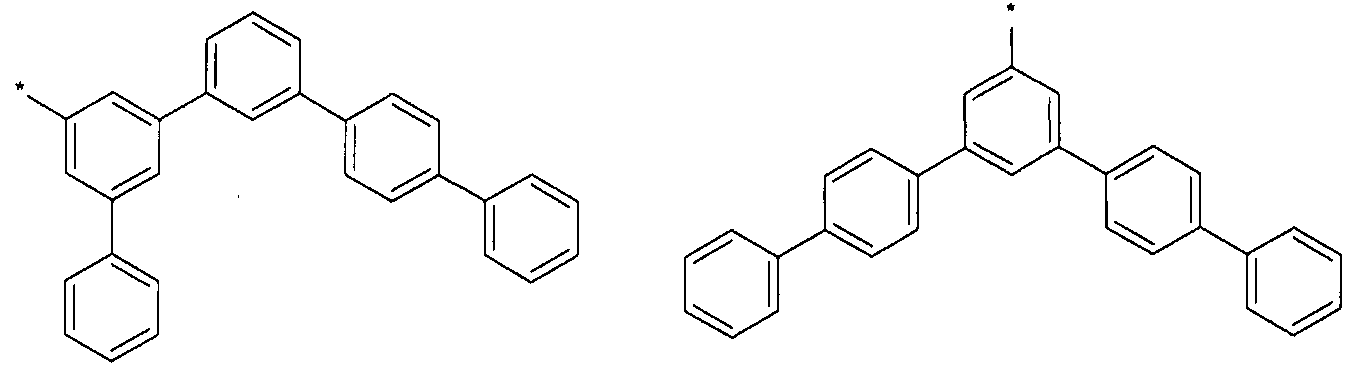

화학식 5-61 화학식 5—62 화학식 5-63 Formula 5-61 Formula 5—62 Formula 5-63
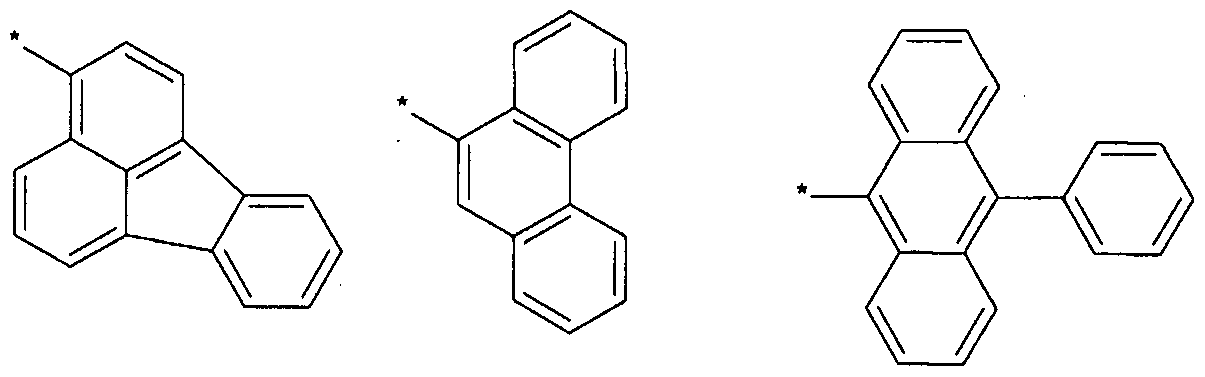
화학식 5-64 화학식 5-65 화왁식 5 Formula 5-64 Formula 5-65 Wax Formula 5
상기 화학식 1 중 R2가 치환 또는 비치환된 페닐기인 경우, R3는 수소, 치환 또는 비치환된 페닐기, 치환 또는 비치환된 바이페닐기, 치환 또는 비치환된 터페닐기, 치환 또는 비치환된 쿼터페닐기, 치환 또는 비치환된 나프틸기, 치환 또 비치환된 안트라세닐기, 치환 또는 비치환된 플루오란테닐기, 치환 또는 비치환된 트리페닐레닐기, 치환 또는 비치환된 파이레닐기, 치환 또는 비치환된 페난트레닐기 치환 또는 비치환된 플루오레닐기 , 또는 치환 또는 비치환된 크라이세닐기이다. 상기 화학식들 중 bl은 ¾의 개수를 나타낸 것으로서, 1 내지 3의 정수 중에서 선택될 수 있다. 예를 들면, bl은 1 또는 2일 수 있다. 또 다른 예로서, bl은 1일 수 있다. M이 2 이상일 경우 2 이상의 ! ,은 서로 동일하거나 상이할 수 있다. b2 및 b3에 대한 설명은 bl에 대한 설명 및 화학식 1의 구조를 참조하여 이해될 수 있다. When R 2 in Formula 1 is a substituted or unsubstituted phenyl group, R 3 is hydrogen, a substituted or unsubstituted phenyl group, a substituted or unsubstituted biphenyl group, a substituted or unsubstituted terphenyl group, a substituted or unsubstituted quarter Phenyl group, substituted or unsubstituted naphthyl group, substituted or unsubstituted anthracenyl group, substituted or unsubstituted fluoranthenyl group, substituted or unsubstituted triphenylenyl group, substituted or unsubstituted pyrenyl group, substituted or Unsubstituted phenanthrenyl group substituted or unsubstituted fluorenyl group, or substituted or unsubstituted chrysenyl group. Bl in the above formulas represents the number of ¾, it may be selected from integers of 1 to 3. For example, bl may be 1 or 2. As another example, bl may be one. 2 or more if M is 2 or more! , May be the same or different from each other. The description of b2 and b3 may be understood with reference to the description of bl and the structure of formula (1).
일 구현예에 따르면, 본 명세서 중 상기 치환된 C6-C60아릴렌기의 치환기 중 적어도 하나는, According to one embodiment, at least one of the substituents of the substituted C 6 -C 60 arylene group in the present specification,
중수소, -F, -CI, -Br, -I, 히드록실기, d- o알킬기, 또는 d- o알콕시기; Deuterium, -F, -CI, -Br, -I, hydroxyl group, d-oalkyl group, or d-oalkoxy group;
중수소, -F, -CI, -Br, -I, 및 히드록실기 중 적어도 하나로 치환된, d-C6o알킬기, 또는 d- io알콕시기; A dC 6 oalkyl group substituted with at least one of deuterium, —F, —CI, —Br, —I, and a hydroxyl group, Or d-ioalkoxy group;
C3-C10시클로알킬기 , C6-C60아릴기 , C6-C60아릴옥시기 , C6-C60아릴티오기, 또는 1가 비-방향족 축합다환 그룹; 또는 C 3 -C 10 cycloalkyl, C 6 -C 60 aryl group, C 6 -C 60 aryloxy, C 6 -C 60 arylthio group, or a monovalent non-aromatic condensed polycyclic group; or
중수소, -F, -CI, -Br, -I, 히드록실기, d- io알킬기, d- o알콕시기, Deuterium, -F, -CI, -Br, -I, hydroxyl group, d-ioalkyl group, d-oalkoxy group,
C3-C10시클로알킬기, -C60아릴기, C6-C60아릴옥시기, C6-C60아릴티오기, 및 1가 C 3 -C 10 cycloalkyl group, -C 60 aryl group, C 6 -C 60 aryloxy group, C 6 -C 60 arylthio group, and monovalent
비-방향족 축합다환 그룹 중 적어도 하나로 치환된, C C10시클로알킬기, c6-c60아릴기, C6-C60아릴옥시기, C6-C60아릴티오기, 또는 1가 비-방향족 축합다환 그룹이다. Non-condensed polycyclic aromatic group substituted by at least one of, CC 10 cycloalkyl group, c 6 -c 60 aryl group, C 6 -C 60 aryloxy, C 6 -C 60 arylthio group, or a monovalent non-aromatic condensed It is a polycyclic group.
예를 들어, 본 명세서 중 상기 치환된 c6-c60아릴렌기의 치환기 중 적어도 하나는, For example, at least one of the substituents of the substituted c 6 -c 60 arylene group in the present specification,
중수소, -F, -CI, -Br, -1, 히드록실기, 페닐기, 바이페닐기, 터페닐기, 쿼터페닐기, 나프틸기, 플루오레닐기, 스파이로-플루오레닐기, 벤조플루오레닐기, Deuterium, -F, -CI, -Br, -1, hydroxyl group, phenyl group, biphenyl group, terphenyl group, quarterphenyl group, naphthyl group, fluorenyl group, spiro-fluorenyl group, benzofluorenyl group,
디벤조플루오레닐기, 페난트레닐기, 안트라세닐기, 플루오란테닐기, 트리페닐레닐기, 파이레닐기, 및 크라이세닐기 중 적어도 하나로 치환된, d- o알킬기, 또는 D-oalkyl group substituted with at least one of dibenzofluorenyl group, phenanthrenyl group, anthracenyl group, fluoranthenyl group, triphenylenyl group, pyrenyl group, and chrysenyl group, or
d- o알콕시기; d-oalkoxy group;
페닐기, 바이페닐기, 터페닐기, 쿼터페닐기, 나프틸기, 플루오레닐기, 스파이로-플루오레닐기, 벤조플루오레닐기, 디벤조플루오레닐기, 페난트레닐기, 안트라세닐기, 플루오란테닐기, 트리페닐레닐기, 파이레닐기, 또는 크라이세닐기; 또는 Phenyl group, biphenyl group, terphenyl group, quarterphenyl group, naphthyl group, fluorenyl group, spiro-fluorenyl group, benzofluorenyl group, dibenzofluorenyl group, phenanthrenyl group, anthracenyl group, fluoranthenyl group, tri Phenylenyl group, pyrenyl group, or chrysenyl group; or
중수소, -F, -Cl, -Br, -I, 히드록실기, d- o알킬기, d-C60알^시기, 페닐기, 바이페닐기, 터페닐기, 쿼터페닐기, 나프틸기, 플루오레닐기, 스파이로-플루오레닐기, 벤조플루오레닐기, 디벤조플투오레닐기, 페난트레닐기, 안트라세닐기, Deuterium, -F, -Cl, -Br, -I, hydroxyl group, d-oalkyl group, dC 60 alkyl group, phenyl group, biphenyl group, terphenyl group, quarterphenyl group, naphthyl group, fluorenyl group, spiro- Fluorenyl group, benzofluorenyl group, dibenzopletuenyl group, phenanthrenyl group, anthracenyl group,
플루오란테닐기, 트리페닐레닐기, 파이레닐기, 및 크라이세닐기 중 적어도 하나로 치환된, 페닐기, 바이페닐기, 터페닐기, 쿼터페닐기, 나프틸기, 플루오레닐기, 스파이로-플루오레닐기, 벤조플루오레닐기, 디벤조플루오레닐기, 페난트레닐기, 안트라세닐기, 플루오란테닐기, 트리페닐레닐기, 파이레닐기, 또는 크라이세닐기이다. 상기 축합환 화합물은, 하기에 나열된 화합물 중 하나일 수 있으나, 이에 한정되는 것은 아니다: Phenyl group, biphenyl group, terphenyl group, quarterphenyl group, naphthyl group, fluorenyl group, spiro-fluorenyl group, benzo substituted with at least one of fluoranthenyl group, triphenylenyl group, pyrenyl group, and chrysenyl group Fluorenyl, dibenzofluorenyl, phenanthrenyl, anthracenyl, fluoranthenyl, triphenylenyl, pyrenyl, or chrysenyl. The condensed cyclic compound may be one of the compounds listed below, but is not limited thereto.
[그룹 I ] [Group I]
화학식 1-1의 xl=S인 그룹 Z93 993 S92 A group having x l = S in Formula 1-1 Z93 993 S92
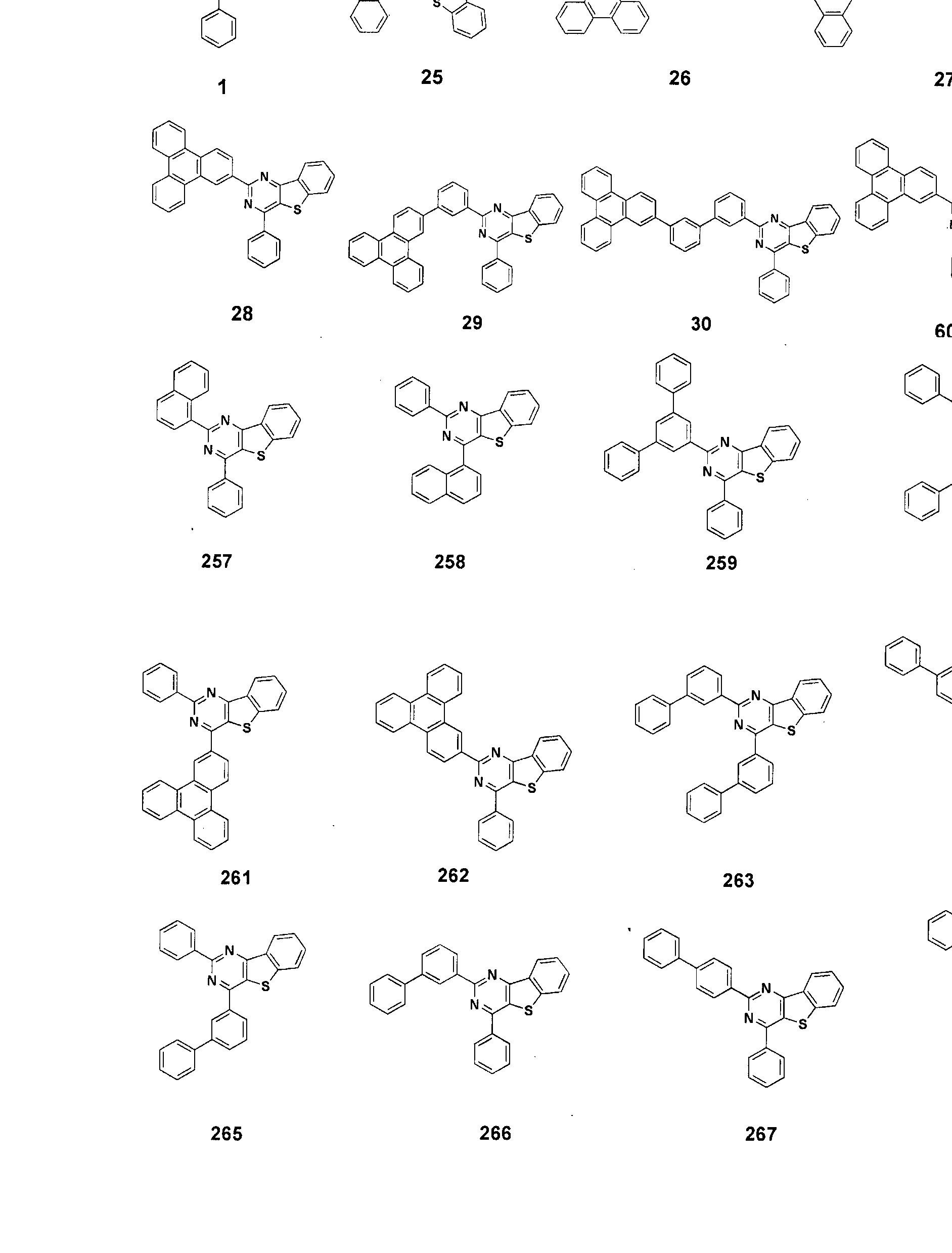
91 91
ZllOOO/STOZaM/X3d 9lCS0l/ST0Z OAV ZllOOO / STOZaM / X3d 9lCS0l / ST0Z OAV
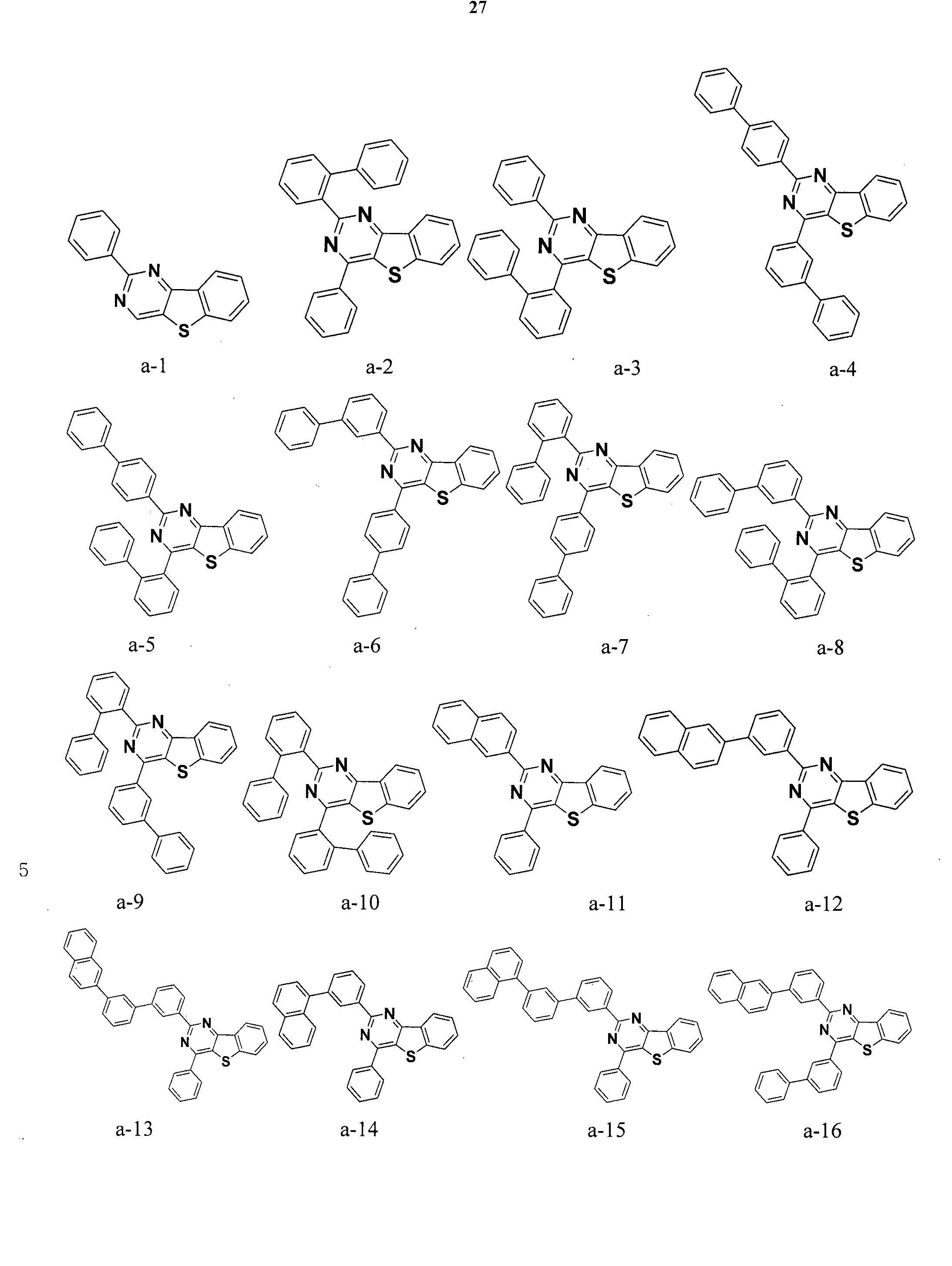
LI LI
ZllOOO/STOZaM/X3d 9lCS0l/ST0Z OAV -B ZllOOO / STOZaM / X3d 9lCS0l / ST0Z OAV -B

HZ HZ
ZllOOO/STOZaM/X3d 9lCS0l/ST0Z OAV


ZllOOO/STOZaM/X3d 9lCS0l/ST0Z OAV ZllOOO / STOZaM / X3d 9lCS0l / ST0Z OAV

ZllOOO/STOZaM/X3d 9lCS0l/ST0Z OAV 88-B ZllOOO / STOZaM / X3d 9lCS0l / ST0Z OAV 88-B

It It
ZllOOO/STOZaM/X3d 9lCS0l/ST0Z OAV ZllOOO / STOZaM / X3d 9lCS0l / ST0Z OAV

ZllOOO/STOZaM/X3d 9lCS0l/ST0Z OAV
를 ΤΓ [¾o=Tx toT-ι t -te¼


Zll000/ST0ZaM/X3d 9lCS0l/ST0Z OAV Zll000 / ST0ZaM / X3d 9lCS0l / ST0Z OAV

ZllOOO/STOZaM/X3d 9lCS0l/ST0Z OAV ZllOOO / STOZaM / X3d 9lCS0l / ST0Z OAV

9t 9t
ZllOOO/STOZaM/X3d 9lCS0l/ST0Z OAV
9e-q se-q ee-q

l -q οε-q 63-q

6i-q 8i-q /.i-q 6i-q 8i-q /.i-q
ZllOOO/STOZaM/X3d 9lCS0l/ST0Z OAV ZllOOO / STOZaM / X3d 9lCS0l / ST0Z OAV

b338 b b37--- b338 b b37 ---


It It
ZllOOO/STOZaM/X3d 9lCS0l/ST0Z OAV ZllOOO / STOZaM / X3d 9lCS0l / ST0Z OAV

b-107 b-108 b-109 b-107 b-108 b-109

b-119 b-119
화학식 니의 x,= si 4 Rs)인 그룹 X, = si 4 R s ) of formula
(R4 및 는본명세서에 기 한바와같음)

65 89 65 89

ZllOOO/STOZaM/X3d 9lCS0l/ST0Z OAV ZllOOO / STOZaM / X3d 9lCS0l / ST0Z OAV


9 9
ZllOOO/STOZaM/X3d 9lCS0l/ST0Z OAV ZllOOO / STOZaM / X3d 9lCS0l / ST0Z OAV

ZllOOO/STOZaM/X3d 9lCS0l/ST0Z OAV ZllOOO / STOZaM / X3d 9lCS0l / ST0Z OAV

81? 81?
ZllOOO/STOZaM/X3d 9lCS0l/ST0Z OAV ZllOOO / STOZaM / X3d 9lCS0l / ST0Z OAV


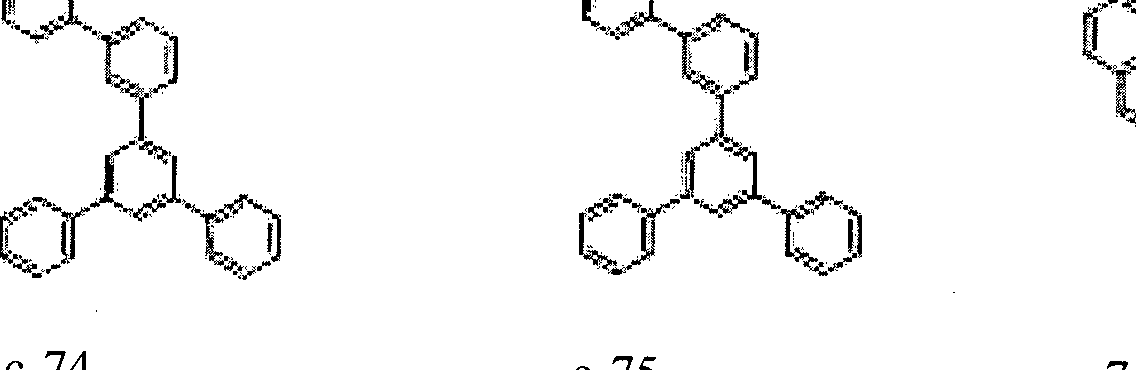

61? 61?
ZllOOO/STOZaM/X3d 9lCS0l/ST0Z OAV ZllOOO / STOZaM / X3d 9lCS0l / ST0Z OAV


107 c-108 c-109 52 107 c-108 c-109 52

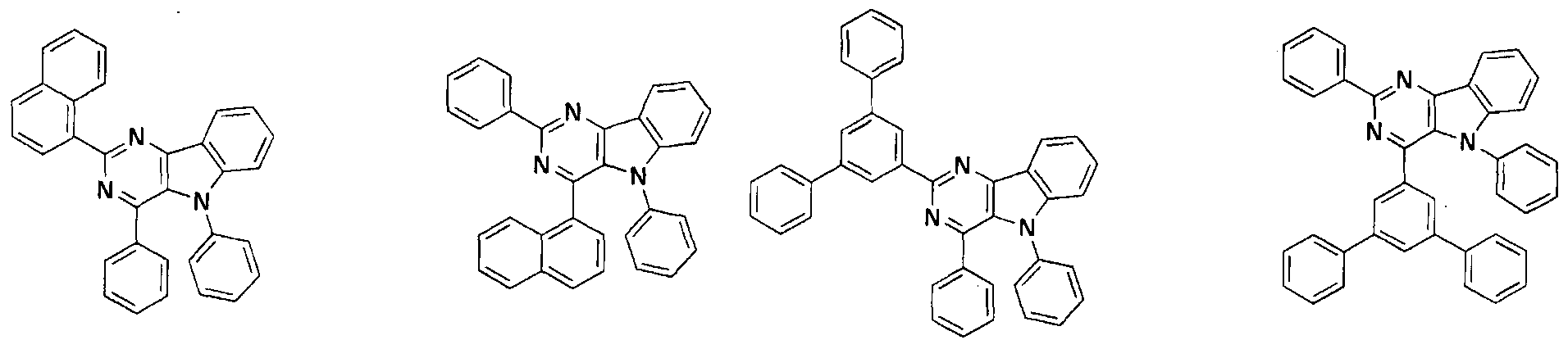


d- d-6 d-7 d-8 d- d-6 d-7 d-8

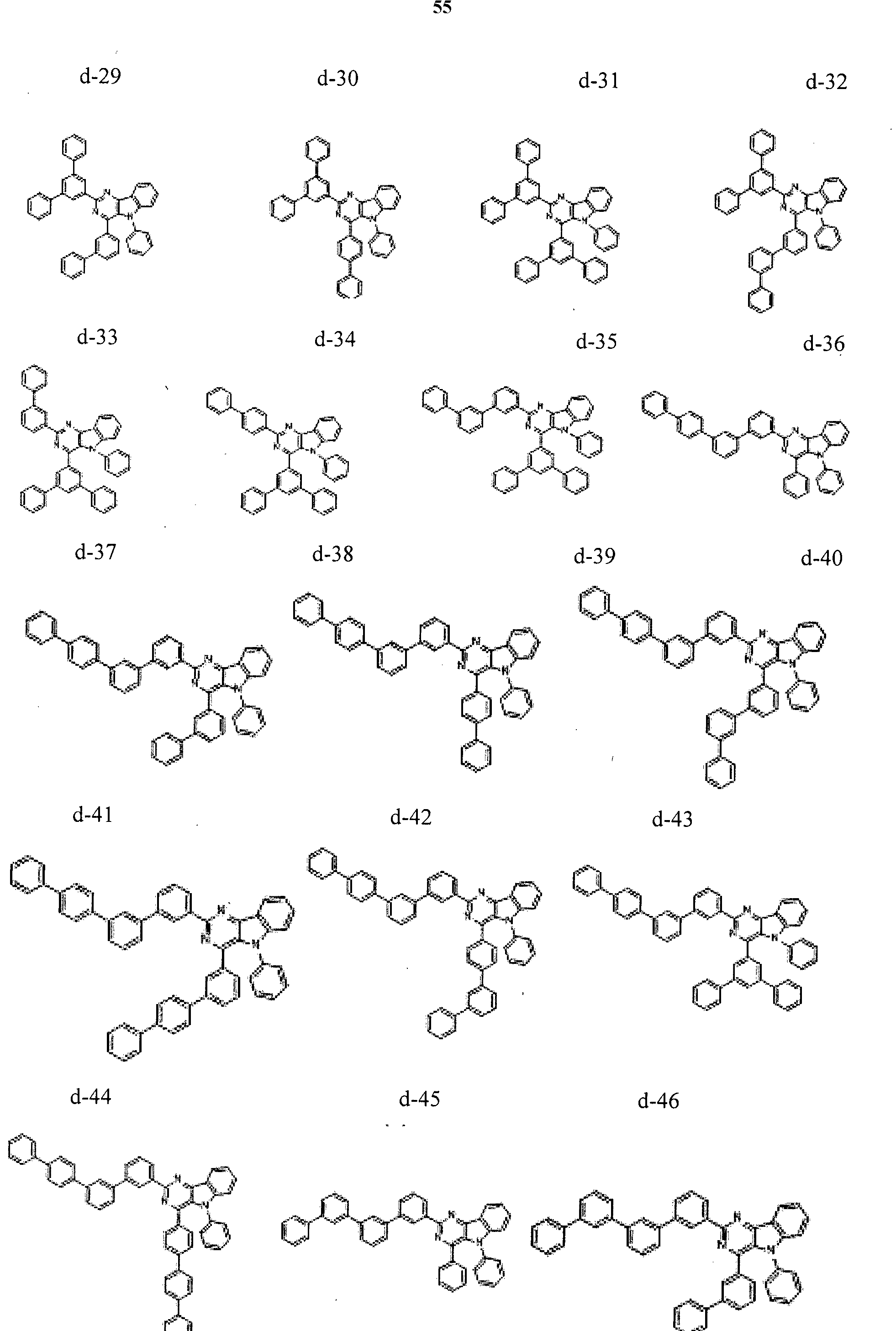
ZllOOO/STOZaM/X3d 9lCS0l/ST0Z OAV ZllOOO / STOZaM / X3d 9lCS0l / ST0Z OAV
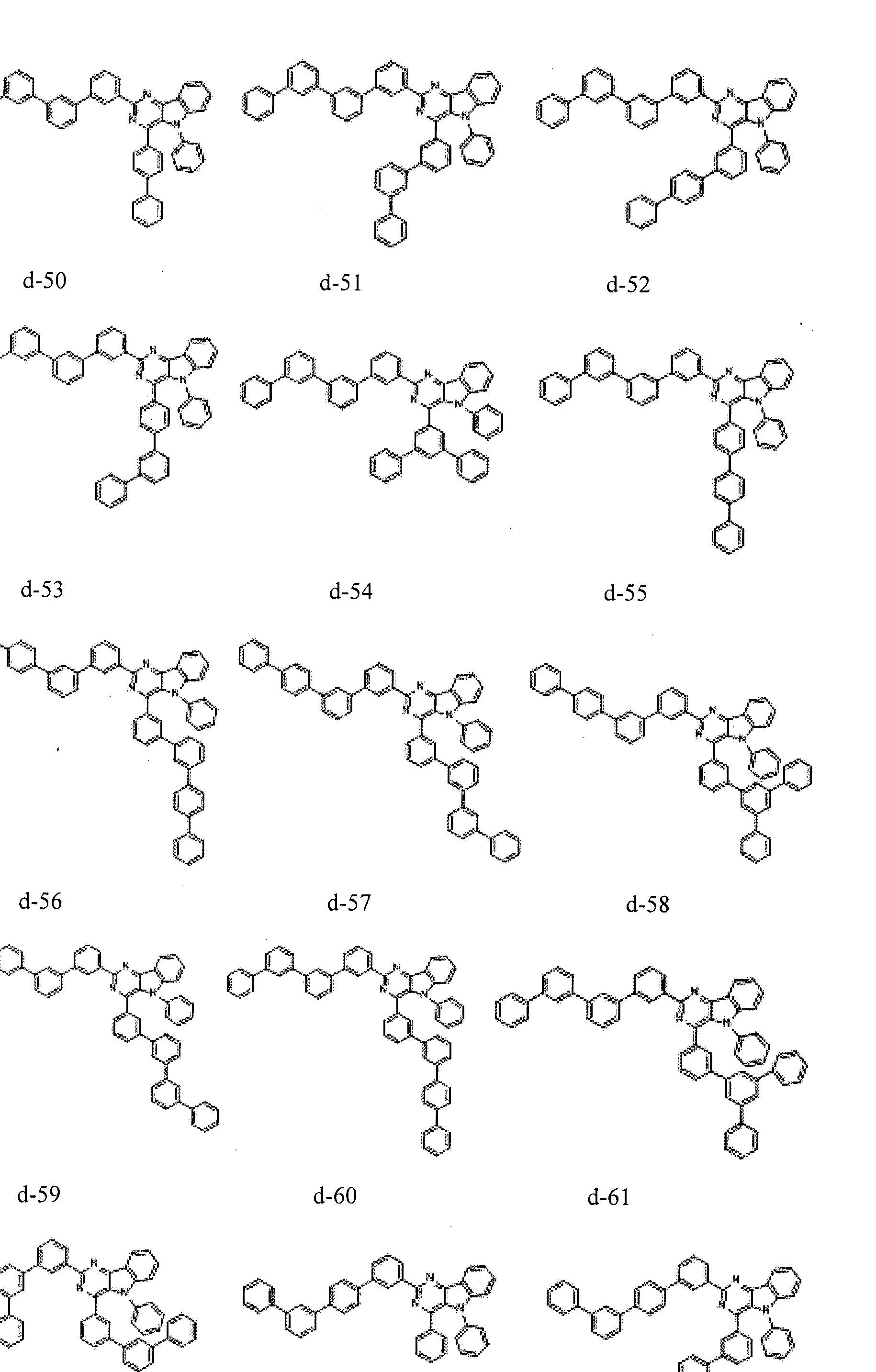
9S 9S
ZllOOO/STOZaM/X3d 9lCS0l/ST0Z OAV

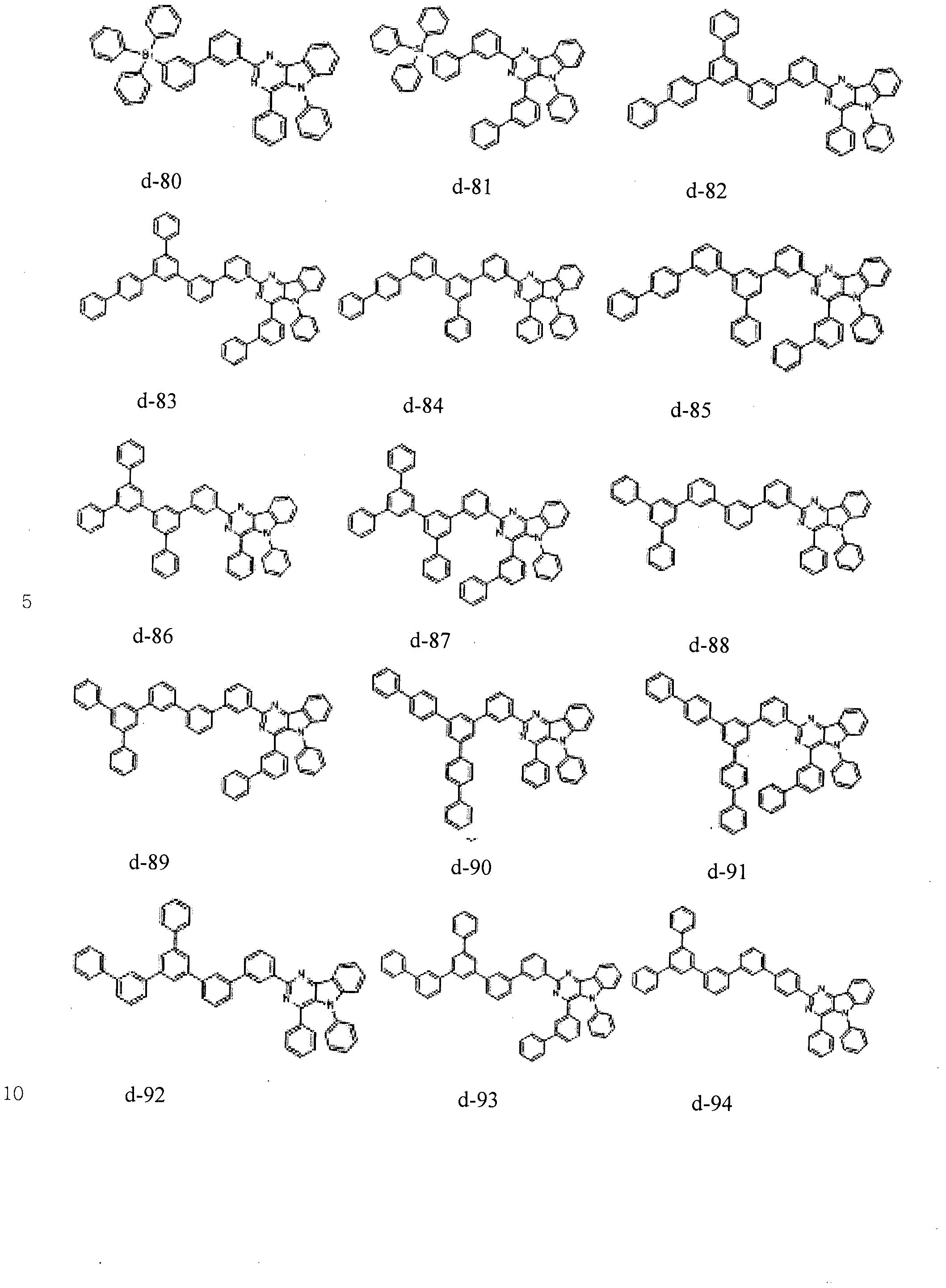


19 19
ZllOOO/STOZaM/X3d 9lCS0l/ST0Z OAV


S9 S9
ZllOOO/STOZaM/X3d 9lCS0l/ST0Z OAV ZllOOO / STOZaM / X3d 9lCS0l / ST0Z OAV


e-86 e-87 e-88 e-86 e-87 e-88

L9 L9
ZllOOO/STOZaM/X3d 9lCS0l/ST0Z OAV ZllOOO / STOZaM / X3d 9lCS0l / ST0Z OAV


ZllOOO/STOZaM/X3d 9lCS0l/ST0Z OAV ZllOOO / STOZaM / X3d 9lCS0l / ST0Z OAV


f- f-

f-21 f-22 f-23 f-24

f-2 f-26

f-29 f-30 f-29 f-30

f-41 f-42 f-41 f-42

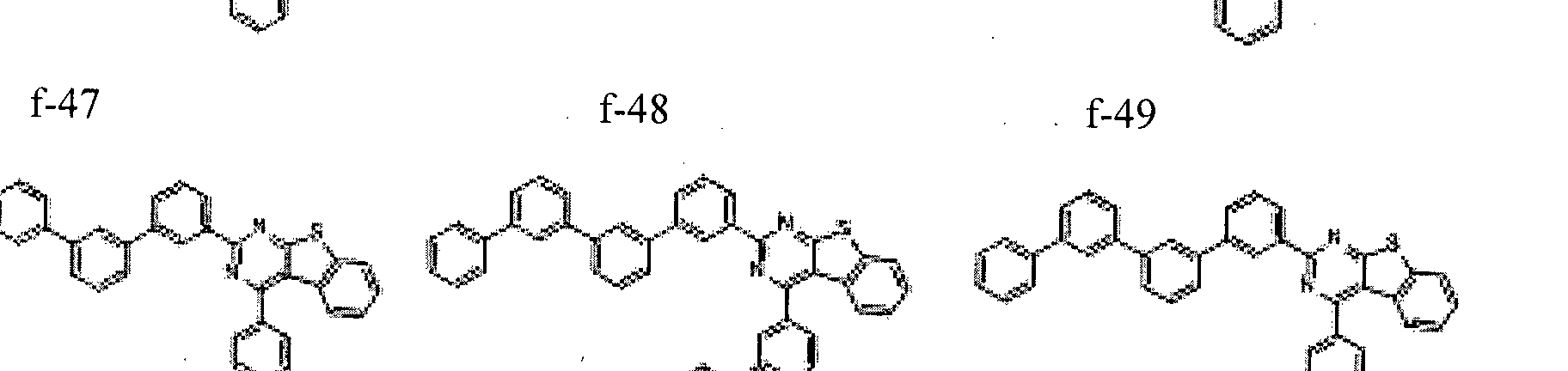
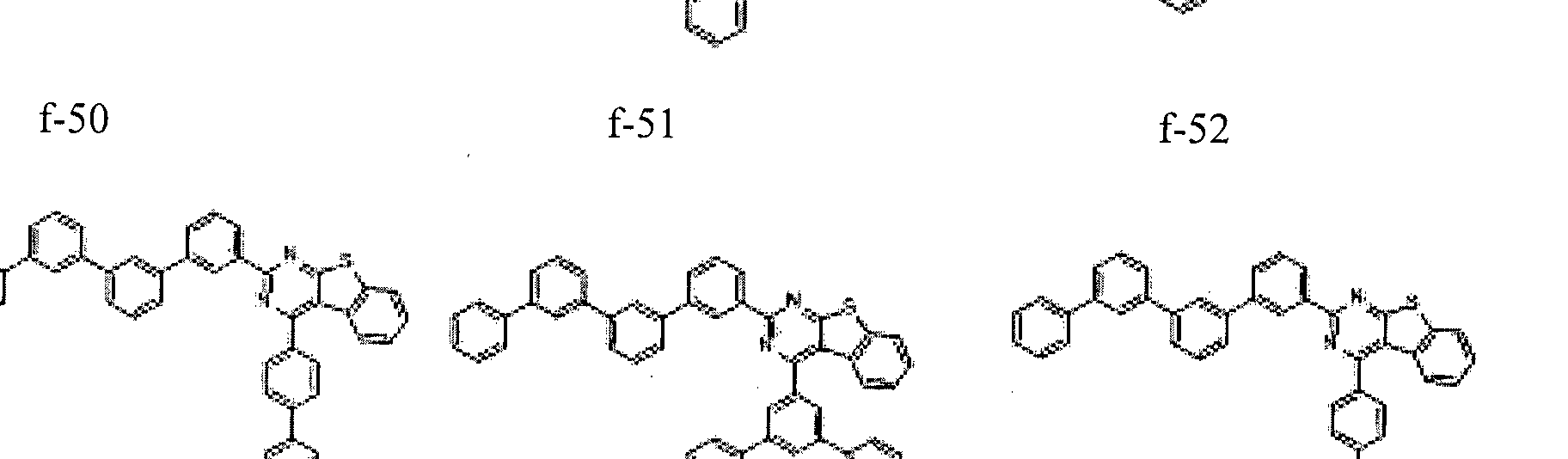
9W 9 W

ZL ZL
ZllOOO/STOZaM/X3d 9lCS0l/ST0Z OAV o ZllOOO / STOZaM / X3d 9lCS0l / ST0Z OAV o


f-75

f-78

f-83 f-84 f-83 f-84


화학식 1-2의 X SKR Rs)인 그룹X SKR Rs) of Formula 1-2
R4 및 R의 정의는 본 명세서에 기재한 바와 같음) The definitions of R 4 and R are as described herein)

369 370 371 372 369 370 371 372

374 375 376 3-S 374 375 376 3-S

61-§ s 61-§ s

91-3 s 91-3 s

31 g S oi-s 6-S 31 g S oi-s 6-S

S l -S S l -S

S 3-S S 3-S

ZllOOO/STOZaM/X3d 9lCS0l/ST0Z OAV ZllOOO / STOZaM / X3d 9lCS0l / ST0Z OAV
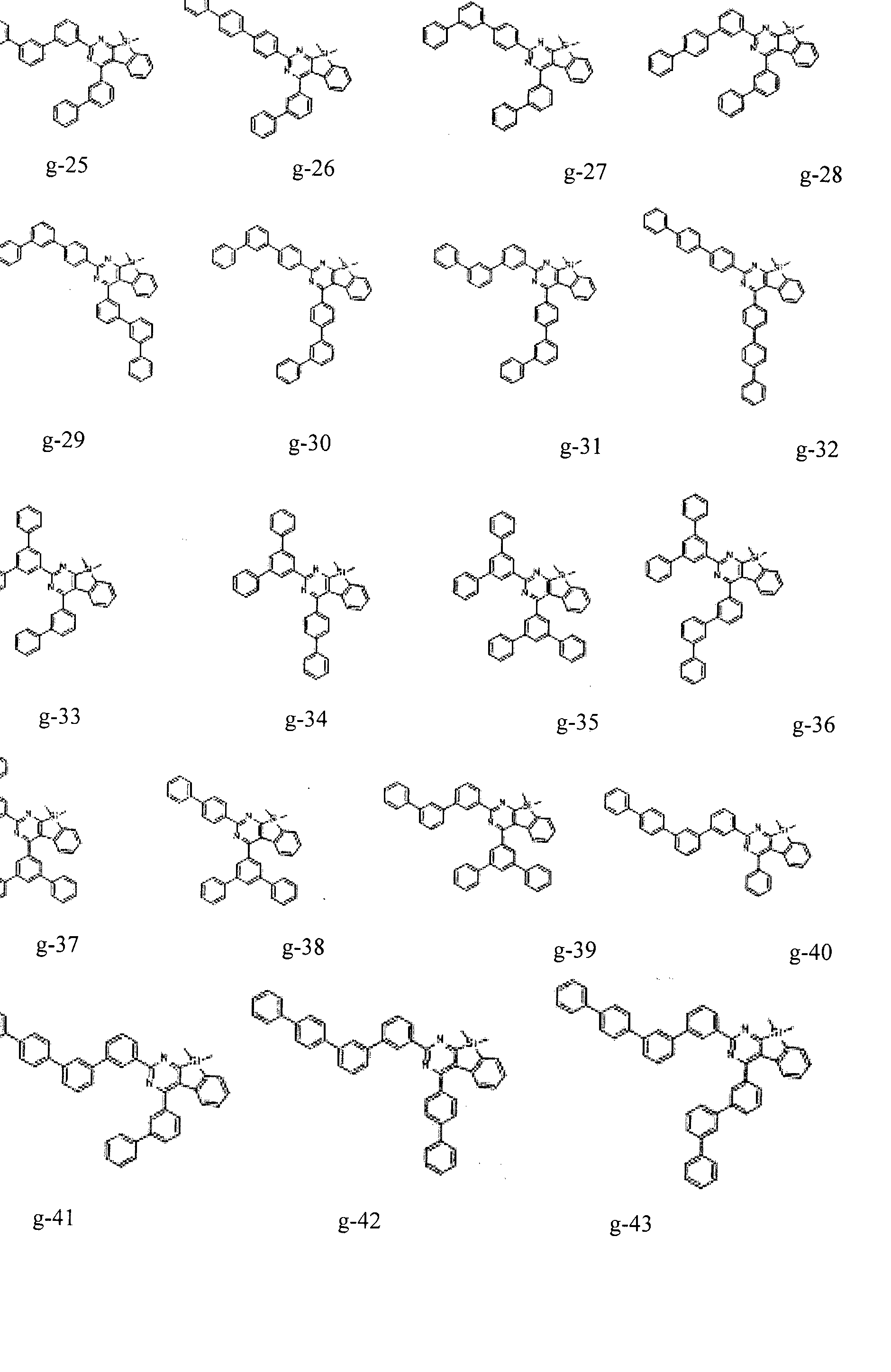


g-53 g-54 g-55 S 69-S 9-3 01 g-53 g-54 g-55 S 69-S 9-3 01

18 18
Zll000/ST0ZaM/X3d 9lCS0l/ST0Z OAV 01 Zll000 / ST0ZaM / X3d 9lCS0l / ST0Z OAV 01

9lCS0l/ST0Z OAV


98 98
ZllOOO/STOZaM/X3d 9lCS0l/ST0Z OAV //:/ O SS00SS2XI29sssssAV ZllOOO / STOZaM / X3d 9lCS0l / ST0Z OAV //: / O SS 00S S2XI2 9 s s s s sAV

o o
5. 5 .
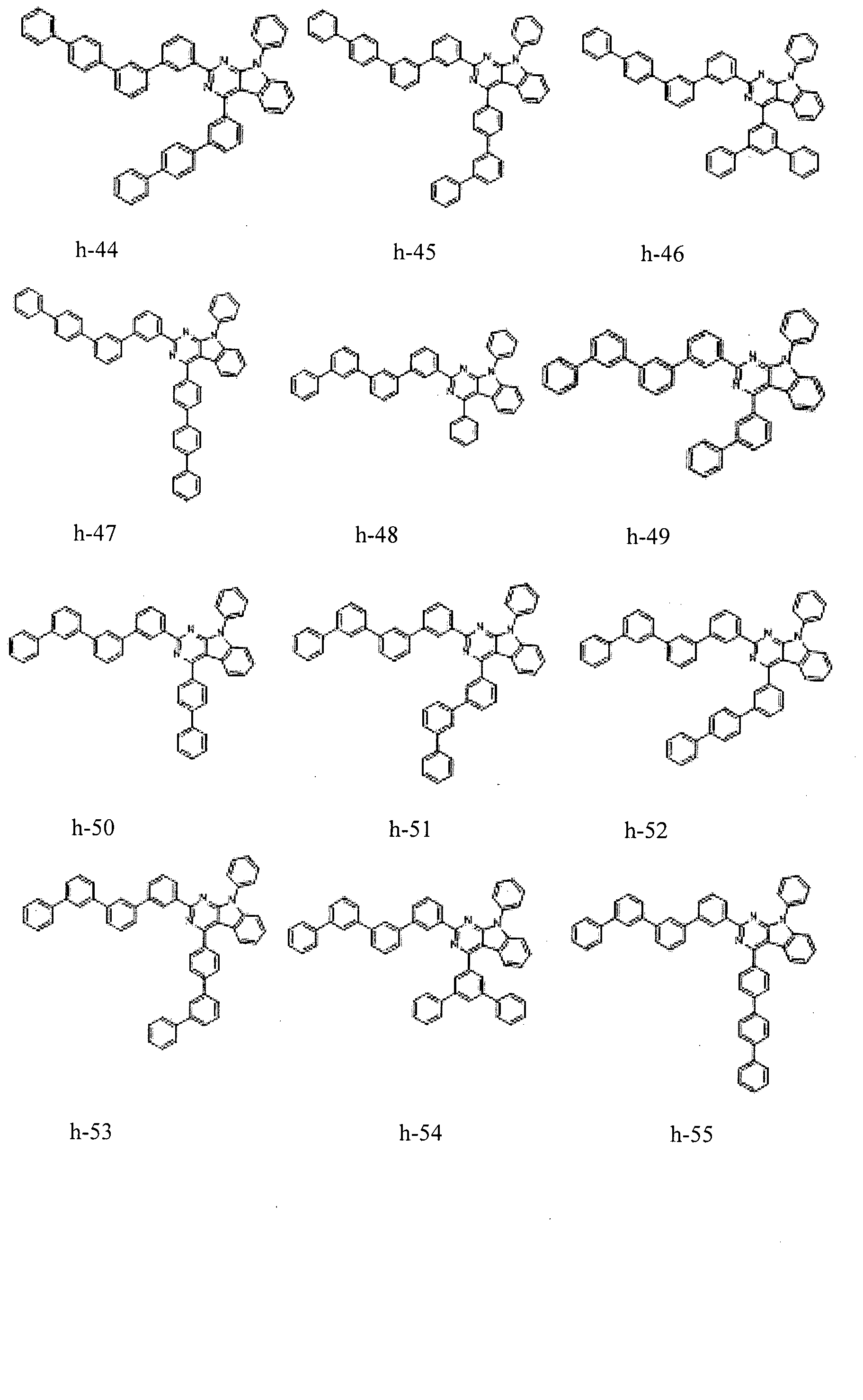
h-50 h-51 h-52 h-50 h-51 h-52
o o


9lCS0l/ST0Z OAV

h- h-87 h-88


h-107 h-108 h-109

h-113 h-114 h-115 h-113 h-114 h-115

C6-C60아릴기, 및 치환또는 비치환된 1가 비-방향족 축합다환그룹 중에서 반드시 선택된다ᅳ 따라서, 상기 화학식 1로 표시되는 축합환 화합물은, 유기 발광 소자용 재료, 예를 들면, 발광층 중 호스트 재료 (예를 들면, 호스트 및 도편트를 포함한 발광층 중 호스트 재료)로서 적합한 HOMO, LUMO Tl 에너지 레벨 및 S1 에너지 레벨을 가질 수 있다. 또한, 상기 화학식 1로 표시되는 축합환 화합물은 우수한 열안정성 및 전기적 안정성을 가지므로, 상기 축합환 화합물을 채용한 유기 발광 소자는 고효율 및 장수명 특성을 가질 수 있다. A C 6 -C 60 aryl group and a substituted or unsubstituted monovalent non-aromatic condensed polycyclic group are necessarily selected. Therefore, the condensed cyclic compound represented by Formula 1 may be a material for an organic light emitting device, for example, It may have a HOMO, LUMO Tl energy level and S1 energy level suitable as a host material in the light emitting layer (eg, a host material in the light emitting layer including the host and the dopant). In addition, since the condensed cyclic compound represented by Formula 1 has excellent thermal stability and electrical stability, the organic light emitting device employing the condensed cyclic compound may have high efficiency and long life.
<화학식 1 '> <Formula 1 '>
리 Lee
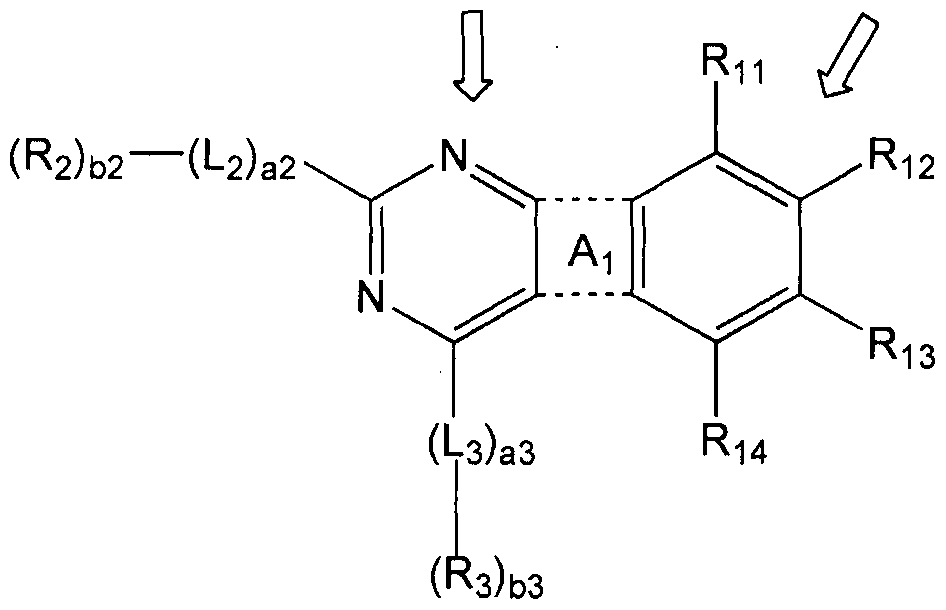
한편, 상기 화학식 1로 표시되는 화합물은 A1 고리의 양측에 피리미딘 고리 및 밴젠 고리가 축합되어 있는 코어 (하기 화학식 Γ 참조)를 갖는다. 따라서, 유기 발광 소자의 한 쌍의 전극 사이의 유기층 재료 (예를 들면, 발광층 재료)로 On the other hand, the compound represented by the formula (1) has a core (see formula (Γ) below) condensed pyrimidine ring and banzen ring on both sides of the A1 ring. Therefore, as an organic layer material (for example, a light emitting layer material) between a pair of electrodes of an organic light emitting element.
사용하기에 적합한 HOMO 에너지 레벨, LUMO 에너지 레벨, T1 에너지 레벨 및 S1 에너지 레벨을 가질 수 있으며, 우수한 열안정성 및 전기적 안정성을 갖출 수 있다. 예를 들어, 상기 화학식 1로 표시되는 화합물올 유기 발광 소자의 발광층 중 호스트로 사용할 경우, 호스트-도편트 간의 에너지 전달 메커니즘 원리를 통하여, 고효율 및 장수명 발광이 가능하다. 특정 원리에 의하여 한정되려는 것은 아니나, 하기 화합물 B는 전자 수송 능력이 지나치게 강하여, 정공 수송과 전자 수송의 균형을 달성하기에 곤란하다. 따라서, 상기 화합물 B를 채용한 유기 발광소자의 효율 특성이 블량해 질 수 있다 또한, 하기 화합물 C는 피리미딘 고리 대신 피라진 고리가 축합환 코어를 갖추고 있으므로, 열안정성 및 전기적 안정성이 불량해 질 수 있다. It may have a suitable HOMO energy level, LUMO energy level, T1 energy level and S1 energy level for use, and may have excellent thermal stability and electrical stability. For example, when the compound represented by Chemical Formula 1 is used as a host in the light emitting layer of the organic light emitting device, high efficiency and long life light emission are possible through the principle of the energy transfer mechanism between the host and the dopant. Although not intending to be limited by any particular principle, the following compound B has an extremely strong electron transport ability, and thus it is difficult to achieve a balance between hole transport and electron transport. Therefore, the efficiency characteristics of the organic light-emitting device employing Compound B may be poor. In addition, Compound C may have poor thermal stability and electrical stability because the pyrazine ring has a condensed ring core instead of the pyrimidine ring. have.
< B> <B>

상술한 바는 상기 화합물 30, 29, 27, b-41, b-71, b-116, a-30, a-40, a-41, a-42, a-46, a-56, a-70, a-71, a-74, a-75, a-82, a-84, a-108, a-110, a-112, a-114, a-116, e-70, e-71, e-74, e-82 e-84, e-88, e-114, f-70, f-71, f-74, f-75, f-82, f-84, f-88, 및 f-114와 상기 화합물 B, C 및 D의 HOMO, LUMO 및 삼중항 (Tl) 에너지 레벨을 가우시안 시뮬레이션 방법 As mentioned above, the compounds 30, 29, 27, b-41, b-71, b-116, a-30, a-40, a-41, a-42, a-46, a-56, a- 70, a-71, a-74, a-75, a-82, a-84, a-108, a-110, a-112, a-114, a-116, e-70, e-71, e-74, e-82 e-84, e-88, e-114, f-70, f-71, f-74, f-75, f-82, f-84, f-88, and f- Gaussian simulation method of HOMO, LUMO and triplet (Tl) energy levels of 114 and the compounds B, C and D
(슈퍼컴퓨터 GAIA (IBM power 6)를 사용하여 Gaussian 09 방법으로 각 재료의 에너지 준위를 계산함)을 이용하여 평가한 결과인 하기 표 1로부터 확인할 수 있다. It can be seen from Table 1 below, which is a result of evaluating using (calculate the energy level of each material by Gaussian 09 method using supercomputer GAIA (IBM power 6)).
【표 1】 Table 1
화합물 HOMO LUMO SI 에너지 Compound HOMO LUMO SI Energy
Tl 에너지 레벨 (eV) Tl energy level (eV)
No. (eV) (eV) 레벨 (eV) No. (eV) (eV) Level (eV)
30 -5.649 -1.804 2.756 3.50330 -5.649 -1.804 2.756 3.503
29 -5.615 -1.819 2.745 3.40429 -5.615 -1.819 2.745 3.404
27 -5.714 -1.819 2.762 3.536 b-41 -5.712 -1.920 2.838 3.455

f-88 -5.867 -1.838 2.715 3.656 f-1 14 -5.746 -1.836 2.714 3.625 f-88 -5.867 -1.838 2.715 3.656 f-1 14 -5.746 -1.836 2.714 3.625
B -5.302 -2.145 2.705 - B -5.302 -2.145 2.705-
C -5.392 -1.660 2.866 -C -5.392 -1.660 2.866-
D -5.501 -1.563 2.684 - 상기 표 1로부터, 화합물 B의 LUMO 절대값은 상기 화합물 30, 29, 27, b-41, b-71, b-116, a-30, a-40, a-41, a-42, a-46, a-56, a-70, a-71 , a-74, a-75, a-82, a-84, a-108, a-110, a-112, a-114, a-116, e-70, e-71 , e-74, e-82, e-84, e-88, e-114, f-70, f-71 , f-74, f-75, f-82, f-84, f-88, 및 f- U4의 LUMO 절대값보다 높아 전자 수송 특성이 지나치게 강함을 알 수 있고, 화합물 C 및 D의 LUMO 절대값은 상기 화합물 30, 29, 27, b-41 , b-71 , b-116, a-30: a-40, a-41 , a-42, a-46, a-56, a-70, a-71, a-74, a-75, a-82, a-84, a-108, a-110, a-112, a-114, a-116, e-70, e-71 , e-74, e-82, e-84, e-88, e-114, f-70, f-71 , f-74, f-75, f-82, f-84, f-88, 및 f-114의 LUMO 절대값보다 낮아 전자 수송 특성이 지나치게 약함을 알 수 있다. 따라서, 상기 화합물 B, C 및 D는 상기 화합물 30, 29, 27, b-41 , b-71 , b-116, a-30, a-40, a-41 , a-42, a-46, a-56, a-70, a-71, a-74, a-75, a-82, a-84, a-108, a-110, a-112, a-114, a-116, e-70, e-71, e-74, e-82, e-84, e-88, e-114, f-70, f-71, f-74, f-75, f-82, f-84, f-88, 및 f-114에 비하여, 정공 수송과 전자 수송의 균형 달성이 곤란할 수 있음을 알 수 있다. D -5.501 -1.563 2.684-From Table 1 above, the absolute value of LUMO of Compound B was calculated from Compound 30, 29, 27, b-41, b-71, b-116, a-30, a-40, a-41 , a-42, a-46, a-56, a-70, a-71, a-74, a-75, a-82, a-84, a-108, a-110, a-112, a -114, a-116, e-70, e-71, e-74, e-82, e-84, e-88, e-114, f-70, f-71, f-74, f-75 , f-82, f-84, f-88, and f-U4 is higher than the LUMO absolute value, it can be seen that the electron transport properties are too strong, the LUMO absolute value of Compounds C and D is the compound 30, 29, 27 , b-41, b-71, b-116, a-30 : a-40, a-41, a-42, a-46, a-56, a-70, a-71, a-74, a -75, a-82, a-84, a-108, a-110, a-112, a-114, a-116, e-70, e-71, e-74, e-82, e-84 electron transport properties lower than the LUMO absolute values of e-88, e-114, f-70, f-71, f-74, f-75, f-82, f-84, f-88, and f-114 This is too weak. Thus, the compounds B, C and D are compounds 30, 29, 27, b-41, b-71, b-116, a-30, a-40, a-41, a-42, a-46, a-56, a-70, a-71, a-74, a-75, a-82, a-84, a-108, a-110, a-112, a-114, a-116, e- 70, e-71, e-74, e-82, e-84, e-88, e-114, f-70, f-71, f-74, f-75, f-82, f-84, Compared with f-88 and f-114, it can be seen that it may be difficult to achieve a balance between hole transport and electron transport.
상기 화학식 1로 표시되는 축합환 화합물의 합성 방법은, 후술되는 합성예를 참조하여, 당업자가 용이하게 인식할 수 있다. The synthesis method of the condensed cyclic compound represented by the formula (1) can be easily recognized by those skilled in the art with reference to the synthesis examples described later.
따라서, 상기 화학식 1로 표시되는 축합환 화합물은 유기 발광 소자의 유기층, 예를 들면, 상기 유기층 중 발광층의 호스트 또는 전자수송보조층으로서 사용하기 적합할 수 있다. Therefore, the condensed cyclic compound represented by Formula 1 may be suitable for use as an organic layer of an organic light emitting device, for example, a host or electron transport auxiliary layer of the light emitting layer in the organic layer.
상기 유기 발광 소자는 상술한 바와 같은 화학식 1로 표시되는 축합환 화합물을 포함한 유기층을 구비함으로써, 저구동 전압, 고효율, 고휘도 및 장수명을 가질 수 있다. The organic light emitting device may have a low driving voltage, high efficiency, high brightness, and long life by including an organic layer including a condensed cyclic compound represented by Formula 1 as described above.
상기 화학식 1로 표시되는 축합환 화합물은 유기 발광 소자의 한 쌍의 전극 사이에 사용될 수 있다. 예를 들어, 상기 축합환 화합물은 발광층, 게 1전극과 발광층 사이의 정공 수송 영역 (예를 들면, 정공 주입층, 정공 수송층 및 전자 저지층 중 적어도 하나를 포함함) 및 발광층과 게 2전극 사이의 전자 수송 영역 (예를 들면, 정공 저지층, 전자 수송층 및 전자 주입층 중 적어도 하나를 포함함) 중 적어도 하나에 포함될 수 있다. 예를 들어, 상기 화학식 1로 표시되는 축합환 화합물은 상기 발광층에 포함되어 있을 수 있다. 이 때, 상기 발광층은 도펀트를 더 포함하고, 상기 발광층에 포함된 축합환 화합물은 호스트의 역할을 할 수 있다. 상기 발광층은 녹색광올 방출하는 녹색 발광층일 수 있고, 상기 도편트는 인광 도펀트일 수 있다. The condensed cyclic compound represented by Formula 1 may be used between a pair of electrodes of the organic light emitting device. For example, the condensed cyclic compound may include a light emitting layer, a hole transport region (for example, at least one of a hole injection layer, a hole transport layer, and an electron blocking layer) between the light emitting layer, the crab first electrode, and the light emitting layer, and the light emitting layer and the second electrode. At least one of an electron transport region (eg, including at least one of a hole blocking layer, an electron transport layer, and an electron injection layer) It can be included in one. For example, the condensed cyclic compound represented by Formula 1 may be included in the emission layer. In this case, the emission layer may further include a dopant, and the condensed cyclic compound included in the emission layer may serve as a host. The light emitting layer may be a green light emitting layer emitting green light, and the dopant may be a phosphorescent dopant.
본 명세서 중 "(유기층이) 축합환 화합물을 1종 이상 포함한다"란, In this specification, "(organic layer) contains one or more types of condensed cyclic compounds",
"(유기층이) 상기 화학식 1의 범주에 속하는 1종의 축합환 화합물 또는 상기 화학식 1의 범주에 속하는 서로 다른 2종 이상의 축합환 화합물을 포함할 수 있다"로 해석될 수 있다. It may be interpreted as “(organic layer) may include one condensed cyclic compound belonging to the category of Formula 1 or two or more different condensed cyclic compounds belonging to the category of Formula 1.
예를 들어, 상기 유기층은 상기 축합환 화합물로서, 상기 화합물 1만을 포함할 수 있다. 이 때, 상기 화합물 1은 상기 유기 발광 소자의 발광층에 존재할 수 있다. 또는, 상기 유기층은 상기 축합환 화합물로서, 상기 화합물 1과 화합물 2를 포함할 수 있다. 이 때, 상기 화합물 1과 화합물 2는 동일한 층에 존재 (예를 들면, 상기 화합물 1과 화합물 2는 모두 발광층에 존재할 수 있음)하거나, 서로 다른 층에 존재할 수 있다. 예컨대, 상기 축합환 화합물은 유기층 중 발광층의 For example, the organic layer may include only Compound 1 as the condensed cyclic compound. In this case, the compound 1 may be present in the light emitting layer of the organic light emitting device. Alternatively, the organic layer may include Compound 1 and Compound 2 as the condensed cyclic compound. In this case, the compound 1 and compound 2 may be present in the same layer (for example, both compound 1 and compound 2 may be present in the light emitting layer), or may be present in different layers. For example, the condensed cyclic compound may be a
호스트로서 포함되거나, 전자수송보조층에 포함될 수 있다. It may be included as a host or included in the electron transport auxiliary layer.
예를 들어, 상기 제 1전극은 애노드이고, 상기 게 2전극은 캐소드이고, 상기 유기층은, 0 상기 제 1전극과 상기 발광층 사이에 개재되고, 정공 주입층, 정공 수송층 및 전자 저지층 중 적어도 하나를 포함한 정공 수송 영역; 및 ϋ) 상기 발광층과 상기 제 2전극 사이에 개재되고, 정공 저지층, 전자 수송층 및 전자 주입층 증 적어도 하나를 포함한 전자 수송 영역;을 포함할 수 있다ᅳ For example, the first electrode is an anode, the crab second electrode is a cathode, and the organic layer is interposed between the first electrode and the light emitting layer, and at least one of a hole injection layer, a hole transport layer, and an electron blocking layer. A hole transport region including; And iii) an electron transport region interposed between the light emitting layer and the second electrode and including at least one of a hole blocking layer, an electron transport layer, and an electron injection layer.
본 명세서 중 "유기층"은 유기 발광 소자 중 제 1전극과 제 2전극 사이에 개재된 단일 및 /또는 복수의 층을 가리키는 용어이다. 상기 "유기층"은 유기 화합물뿐만 아니라, 금속을 포함한 유기금속 착체 등도 포함할 수 있다. As used herein, the term "organic layer" refers to a single and / or a plurality of layers interposed between the first electrode and the second electrode of the organic light emitting device. The "organic layer" may include not only an organic compound but also an organometallic complex including a metal.
다른 측면에 따르면, 제 1전극; 상기 제 1전극에 대향되는 게 2전극; 및 상기 제 1전극과 게 2전극 사이에 개재되는 유기층;을 포함하고, 상기 유기층은 상술한 축합환 화합물을 포함하는 유기 발광 소자일 수 있다. According to another aspect, the first electrode; A second electrode facing the first electrode; And an organic layer interposed between the first electrode and the second electrode, wherein the organic layer may be an organic light emitting device including the condensed cyclic compound described above.
도 1 내지 도 3은 본 발명의 일 구현예를 따르는 유기 발광 소자 (10)의 단면도를 개략적으로 도시한 것이다. 이하, 도 1을 참조하여 본 발명의 일 구현예를 따르는 유기 발광 소자의 구조 및 제조 방법을 설명하면 다음과 같다. 유기 발광 소자 (10)는 제 1전극 (1 1), 유기층 (15) 및 제 2전극 (19)이 차례로 적층된 구조를 갖는다. 1 to 3 schematically illustrate a cross-sectional view of an organic light emitting device 10 according to an embodiment of the present invention. Hereinafter, a structure and a manufacturing method of an organic light emitting diode according to an embodiment of the present invention will be described with reference to FIG. 1. The organic light emitting element 10 has a structure in which the first electrode 11, the organic layer 15, and the second electrode 19 are sequentially stacked.
상기 게 1전극 (1 1 ) 하부 또는 제 2전극 (19) 상부에는 기판이 추가로 배치될 수 있다. 상기 기판으로는, 통상적인 유기 발광 소자에서 사용되는 기판을 사용할 수 있는데, 기계적 강도, 열안정성, 투명성, 표면 평활성, 취급용이성 및 방수성이 우수한 유리 기판 또는 투명 플라스틱 기판을 사용할 수 있다. The substrate may be additionally disposed below the first electrode 11 or the second electrode 19. As the substrate, a substrate used in a conventional organic light emitting device can be used, and a glass substrate or a transparent plastic substrate excellent in mechanical strength, thermal stability, transparency, surface smoothness, ease of handling, and waterproofness can be used.
상기 제 1전극 (1 1 )은 예를 들면, 기판 상부에, 제 1전극용 물질을 증착법 또는 스퍼터링법 등을 이용하여 제공함으로써 형성될 수 있다. 상기 게 1전극 (1 1)은 애노드일 수 있다. 상기 제 1전극용 물질은 정공 주입이 용이하도록 높은 일함수를 갖는 물질 중에서 선택될 수 있다. 상기 제 1전극 (1 1 )은 반사형 전극, 반투과형 전극 또는 투과형 전극일 수 있다. 게 1전극용 물질로는 산화인듬주석 (ΠΌ), The first electrode 11 may be formed by, for example, providing a material for the first electrode on the substrate using a deposition method or a sputtering method. The first electrode 11 may be an anode. The material for the first electrode may be selected from materials having a high work function to facilitate hole injection. The first electrode 11 may be a reflective electrode, a transflective electrode, or a transmissive electrode. As the material for the first electrode, tin oxide (ΠΌ),
산화인듬아연 (IZO), 산화주석 (Sn02), 산화아연 (ZnO) 등을 이용할 수 있다. 또는, 마그네슘 (Mg), 알루미늄 (A1), 알루미늄 -리튬 (Al-Li), 칼슴 (Ca), 마그네슘 -인듐 (Mg-In), 마그네슴-은 (Mg-Ag)등과 같은 금속을 이용할 수 있다. Zinc oxide (IZO), tin oxide (Sn0 2 ), zinc oxide (ZnO), and the like. Alternatively, metals such as magnesium (Mg), aluminum (A1), aluminum-lithium (Al-Li), chalc (Ca), magnesium-indium (Mg-In), and magnesium-silver (Mg-Ag) may be used. have.
상기 게 1전극 (1 1)은 단일층 또는 2 이상의 층을 포함한 다층 구조를 가질 수 있다. The single electrode 11 may have a single layer or a multilayer structure including two or more layers.
상기 제 1전극 (1 1) 상부로는 유기층 (15)이 배치되어 있다. The organic layer 15 is disposed on the first electrode 11.
상기 유기층 (15)은 정공 수송 영역 (hole transport region); 발광층 (emission layer); 및 전자 수송 영역 (electron transport region);을 포함할 수 있다. The organic layer 15 may include a hole transport region; An emission layer; And an electron transport region.
상기 정공 수송 영역은 제 1전극 (1 1)과 발광층 사이에 배치될 수 있다. The hole transport region may be disposed between the first electrode 11 and the light emitting layer.
상기 정공 수송 영역은 정공 주입층, 정공 수송층, 전자 저지층 및 버퍼층 중 적어도 하나를 포함할 수 있다. 예컨대, 도 2를 참조하여 본 발명의 일 구현예에 따른 유기 발광 소자를 설명하면 다음과 같다. The hole transport region may include at least one of a hole injection layer, a hole transport layer, an electron blocking layer, and a buffer layer. For example, referring to FIG. 2, an organic light emitting diode according to an exemplary embodiment of the present invention will be described.
유기층 (15)은 정공수송층 (31), 발광층 (32), 그리고 정공수송층 (31)과 발광층 (32) 사이에 위치하는 정공수송보조층 (33)을 포함한다. The organic layer 15 includes a hole transport layer 31, a light emitting layer 32, and a hole transport auxiliary layer 33 positioned between the hole transport layer 31 and the light emitting layer 32.
상기 정공 수송 영역에는 적어도 2층의 정공 수송층이 포함될 수 있고, 이 경우 발광층에 접하여 위치하는 정공 수송층을 정공수송보조층이라고 정의한다. 상기 정공 수송 영역은 정공 주입층만을 포함하거나, 정공 수송층만을 포함할 수 있다. 또는, 상기 정공 수송 영역은, 제 1전극 (1 1 )로부터 차례로 적층된, 정공 주입층 (37)/정공 수송층 (3 1) 또는 정공 주입층 (37)/정공 수송층 (31)/전자 저지층의 구조를 가질 수 있다ᅳ 예컨대, 정공 주입층 (37) 및 전자 주입층 (36)을 추가로 포함하여 도 3에 나타낸 바와 같이 게 1전극 (1 1)/정공 주입층 (37)/정공 수송층 (31)/정공수송보조층 (33)/발광층 (32)/전자수송보조층 (35)/전자수송층 (34)/전자주입 층 (37)/제 2전극 (19)이 차례로 적층된 구조를 가질 수 있다. The hole transport region may include at least two hole transport layers, in which case the hole transport layer positioned in contact with the light emitting layer is defined as a hole transport auxiliary layer. The hole transport region may include only a hole injection layer or only a hole transport layer. Alternatively, the hole transport region may be a hole injection layer 37 / hole transport layer 31 or a hole injection layer 37 / hole transport layer 31 / electrons, which are sequentially stacked from the first electrode 11. For example, a hole injection layer 37 and an electron injection layer 36 may be further included, for example, as shown in FIG. 3 to provide a single electrode 11 / hole injection layer 37 /. The hole transport layer 31, the hole transport auxiliary layer 33, the light emitting layer 32, the electron transport auxiliary layer 35, the electron transport layer 34, the electron injection layer 37 and the second electrode 19 are sequentially stacked It may have a structure.
정공주입층 (37)은 애노드로 사용되는 ΠΌ와, 정공수송층 (31)으로 사용되는 유기물질 사이의 계면 특성을 개선할 뿐만 아니라 그 표면이 평탄하지 않은 ITO의 상부에 도포되어 ΠΌ의 표면을 부드럽게 만들어주는 기능을 한다. 예를 들어 정공주입층 (37)은 애노드로 사용될 수 있는 ΠΌ의 일함수 수준과 정공수송층 (31)의 HOMO 수준의 차이를 조절하기 위하여 ΠΌ의 일함수 수준과 정공수송층 (31)의 HOMO 수준의 중간값을 가지는 물질로서, 특히 적절한 전도성을 갖는 물질을 선택한다. 본 발명과 관련하여 정공주입층 (37)을 구성하는 물질로서 The hole injection layer 37 not only improves the interfacial properties between ΠΌ used as the anode and the organic material used as the hole transport layer 31, but is also applied on top of the uneven ITO to smooth the surface of the ΠΌ. It makes a function. For example, the hole injection layer 37 is formed of the work function level of ΠΌ and the HOMO level of the hole transport layer 31 in order to control the difference between the work function level of ΠΌ and the HOMO level of the hole transport layer 31 which can be used as an anode. As the material having a median value, a material having a particularly suitable conductivity is selected. As a material constituting the hole injection layer 37 in connection with the present invention
Ν4,Ν4'-디페닐 -Ν4,Ν4'-비스 (9-페닐 -9Η-카바졸 -3-일)바이페닐 -4,4'-디아민 (N4,N4'-diphenyl- N4,N4'-bis(9-phenyl-9H-carbazol-3-yl)biphenyl-4,4'-diamine)이 사용될 수 있으나, 이에 제한되는 것은 아니다. 그 외에도 정공주입층 (37)을 구성하는 종래의 물질과 함께 사용될 수 있는데, 예를 들어, copper phthlalocyanine(CuPc), Ν4, Ν4'-diphenyl-Ν4, Ν4'-bis (9-phenyl-99-carbazol-3-yl) biphenyl-4,4'-diamine (N4, N4'-diphenyl-N 4 , N 4 '-bis (9-phenyl-9H-carbazol-3-yl) biphenyl-4,4'-diamine) may be used, but is not limited thereto. In addition, it can be used with the conventional materials constituting the hole injection layer 37, for example, copper phthlalocyanine (CuPc),
N,N'-dinaphthyl-N,N'-phenyl-(l , -biphenyl)-4,4,-diamine, NPD), N, N'-dinaphthyl-N, N'-phenyl- (l, -biphenyl) -4,4, -diamine, NPD),
4,4',4"-tris[methylphenyl(phenyl)amino] triphenyl amine(m-MTDATA), 4,4 ', 4 "-tris [methylphenyl (phenyl) amino] triphenyl amine (m-MTDATA),
4,4',4"-tris[l -naphthyl(phenyl)amino] triphenyl amine( 1 -T ATA), 4,4 ', 4 "-tris [l -naphthyl (phenyl) amino] triphenyl amine (1 -T ATA),
4,4',4"-tris[2-naphthyl(phenyl)amino]triphenyl amine(2-TNATA), 4,4 ', 4 "-tris [2-naphthyl (phenyl) amino] triphenyl amine (2-TNATA),
l ,3,5-tris[N-(4-diphenylaminophenyl)phenylamino] benzene(p-DPA-TDAB) 등과 같은 방향족 아민류는 물론이고, as well as aromatic amines such as l, 3,5-tris [N- (4-diphenylaminophenyl) phenylamino] benzene (p-DPA-TDAB),
4,4'-bis[N-[4-{N,N-bis(3-methylphenyl)amino}phenyl]-N-phenylamino]biphenyl(DNTPD), hexaazatriphenylene-hexacarbonitirile (HAT-CN) 등의 화합물, 전도성 고분자로서의 폴리티오펜 유도체인 poly(3,4-ethylenedioxythiophene)-poly(stymesulfonateXPEDOT)를 사용할 수 있다. 정공주입층 (37)는 예를 들어 10 내지 300 A의 두께로 애노드로 사용되는 ΠΌ의 상부에 코팅될 수 있다. 4,4'-bis [N- [4- {N, N-bis (3-methylphenyl) amino} phenyl] -N-phenylamino] biphenyl (DNTPD), hexaazatriphenylene-hexacarbonitirile (HAT-CN), etc., conductive Poly (3,4-ethylenedioxythiophene) -poly (stymesulfonateXPEDOT) which is a polythiophene derivative as a polymer can be used. The hole injection layer 37 may be coated on top of πΌ used as an anode, for example, at a thickness of 10 to 300 A.
전자주입층 (36)은 전자수송층의 상부에 적층되어 캐소드로부터의 전자 주입을 용이하게 해주어 궁극적으로 전력효율을 개선시키는 기능을 수행하는 층으로, 당 기술분야에서 통상적으로 사용되는 것이면 특별한 제한없이 사용할 수 있으며, 예컨대, LiF, Liq, NaCl, CsF, Li20, BaO 등의 물질을 이용할 수 있다. 정공 수송 영역이 정공 주입층 (37)을 포함할 경우, 정공 주입층 (HIL)은 상기 제 1전극 (1 1) 상부에 진공증착법, 스핀코팅법, 캐스트법, LB법 등과 같은 다양한 방법올 이용하여 형성될 수 있다. The electron injection layer 36 is a layer that is stacked on top of the electron transport layer to facilitate electron injection from the cathode and ultimately improves power efficiency, and may be used without particular limitation as long as it is commonly used in the art. For example, materials such as LiF, Liq, NaCl, CsF, Li 2 O, BaO, and the like may be used. When the hole transport region includes the hole injection layer 37, the hole injection layer HIL may use various methods such as vacuum deposition, spin coating, cast, LB, and the like on the first electrode 11. Can be formed.
진공 증착법에 의하여 정공 주입층을 형성하는 경우, 그 증착 조건은 정공 주입층 재료로 사용하는 화합물, 목적으로 하는 정공 주입층의 구조 및 열적 특성 등에 따라 다르지만, 예를 들면, 증착은도 약 100 내지 약 500 °C , 진공도 약 10·8 내지 약 10-3torr, 증착 속도 약 0.01 내지 약 100 A/sec의 범위에서 선택될 수 있으며 이에 한정되는 것은 아니다. In the case of forming the hole injection layer by vacuum deposition, the deposition conditions vary depending on the compound used as the hole injection layer material, the structure and thermal properties of the target hole injection layer, and the like. in the range of about 500 ° C, vacuum degree of about 10 · 8 to about 10- 3 torr, a deposition rate of about 0.01 to about 100 a / sec may be selected it is not limited to this.
스핀 코팅법에 의하여 정공 주입층을 형성하는 경우, 코팅 조건은 When the hole injection layer is formed by spin coating, the coating conditions are
정공주입층 재료로 사용하는 화합물, 목적하는 하는 정공 주입층의 구조 및 열적 특성에 따라 상이하지만, 약 2000rpm 내지 약 5000rpm의 코팅 속도, 코팅 후 용매 제거를 위한 열처리 온도는 약 80 °C 내지 200 °C의 온도 범위에서 선택될 수 있으며 이에 한정되는 것은 아니다. Depending on the compound used as the hole injection layer material, the structure and the thermal properties of the desired hole injection layer, the coating rate of about 2000rpm to about 5000rpm, the heat treatment temperature for removing the solvent after coating is about 80 ° C to 200 ° It may be selected in the temperature range of C, but is not limited thereto.
상기 정공 수송충 및 전자 저지층 형성 조건은 정공 주입층 형성 조건을 참조한다. The hole transport layer and the electron blocking layer forming conditions refer to the hole injection layer forming conditions.
상기 정공 수송 영역은, 예를 들면, m-MTDATA, TDATA, 2-ΤΝΑΤΑ, ΝΡΒ, β-ΝΡΒ, TPD, Spiro-TPD, Spiro-NPB, a-NPB, TAPC, HMTPD, ' The hole transport region is, for example, m-MTDATA, TDATA, 2-ΤΝΑΤΑ, ΝΡΒ, β-ΝΡΒ, TPD, Spiro-TPD, Spiro-NPB, a-NPB, TAPC, HMTPD, '
TCTA(4,4',4"-트리스 (N-카바졸일)트리페닐아민 (4,4',4"-tris(N-carbazolyl)triphenylamine)), Pani/DBSA (Polyaniline/Dodecylbenzenesulfonic acid:폴리아닐린 /도데실벤젠술폰산), PEDOT/PSS(Poly(3,4-ethylenedioxythiophene)/Poly(4-styrenesulfonat^ 틸렌디옥 시티오펜 )/폴리 (4-스티렌술포네이트)) , Pani/CSA (Polyaniline/Camphor TCTA (4, 4 ', 4 "-tris (N-carbazolyl) triphenylamine (4,4', 4 " -tris (N-carbazolyl) triphenylamine)), Pani / DBSA (Polyaniline / Dodecylbenzenesulfonic acid: polyaniline / Dodecylbenzenesulfonic acid), PEDOT / PSS (Poly (3,4-ethylenedioxythiophene) / Poly (4-styrenesulfonat ^ styrenedioxiophene) / poly (4-styrenesulfonate)), Pani / CSA (Polyaniline / Camphor
sulfonicacid:폴리아닐린 /캠퍼술폰산), PANI/PSS sulfonicacid: polyaniline / camphor sulfonic acid), PANI / PSS
(Polyaniline)/Poly(4-styrenesulfonate):폴리아닐린) /폴리 (4-스티렌술포네이트)) , 하기 화학식 201로 표시되는 화합물 및 하기 화학식 202로 표시되는 화합물 중 적어도 하나를 포함할 수 있다: (Polyaniline) / Poly (4-styrenesulfonate): polyaniline) / poly (4-styrenesulfonate)), a compound represented by the following Formula 201, and a compound represented by the following Formula 202:

TOT TOT
Zll000/ST0ZaM/X3d 9lCS0l/ST0Z OAV <화학식 201> Zll000 / ST0ZaM / X3d 9lCS0l / ST0Z OAV <Formula 201>

상기 화학식 201 중, Ar101 및 Ar102는 서로 독립적으로, In Formula 201, Ar 101 and Ar 102 may be each independently
페닐렌기, 펜타레닐렌기, 인데닐렌기, 나프틸렌기, 아줄레닐렌기, Phenylene group, pentalenylene group, indenylene group, naphthylene group, azulenylene group,
헵탈레닐렌기, 아세나프틸렌기, 플루오레닐렌기, 페나레닐렌기, 페난트레닐렌기, 안트라세닐렌기, 플루오란테닐렌기, 트리페닐레닐렌기, 파이레닐렌기, Heptalenylene group, acenaphthylene group, fluorenylene group, phenenylene group, phenanthrenylene group, anthracenylene group, fluoranthhenylene group, triphenylenylene group, pyrenylene group,
크라이세닐레닐렌기, 나프타세닐렌기, 피세닐렌기, 페릴레닐렌기 또는 펜타세닐렌기; 또는 Chrysenylenylene group, naphthacenylene group, pisenylene group, peryleneyl group or pentaxenylene group; or
중수소, -F, -CI, -Br, -I, 히드록실기, 시아노기, 니트로기 , 아미노기 , 아미디노기, 히드라진기, 히드라존기, 카르복실산기 또는 이의 염, 술폰산기 또는 이의 염, 인산기 또는 이의 염, 알킬기, C C60알케닐기, C2-C60알키닐기, d- o알콕시기,Deuterium, -F, -CI, -Br, -I, hydroxyl group, cyano group, nitro group, amino group, amidino group, hydrazine group, hydrazone group, carboxylic acid group or salt thereof, sulfonic acid group or salt thereof, phosphoric acid group Or salts thereof, alkyl groups, CC 60 alkenyl groups, C 2 -C 60 alkynyl groups, d-oalkoxy groups,
C3-C , 0시클로알킬기 , C3-C 10시클로알케닐기, C2-C , 0헤테로시클로알킬기 , C 3 -C, 0 cycloalkyl group, C 3 -C 10 cycloalkenyl group, C 2 -C, 0 heterocycloalkyl group,
C2-C10헤테로시클로알케닐기, C6-C60아릴기, C6-C60아릴옥시기, C6-C60아릴티오기, C2-C60해테로아릴기 , 1가 비-방향족 축합다환 그룹 및 1가 비-방향족 헤테로축합다환 그룹 중 적어도 하나로 치환된, 페닐렌기, 펜타레닐렌기, 인데닐렌기, 나프틸렌기, 아줄레닐렌기, 헵탈레닐렌기, 아세나프틸렌기, 플루오레닐렌기, 페나레닐렌기, 페난트레닐렌기, 안트라세닐렌기, 플루오란테닐렌기, 트리페닐레닐렌기, C 2 -C 10 hetero cycloalkenyl group, C 6 -C 60 aryl group, C 6 -C 60 aryloxy, C 6 -C 60 aryl come tea, C 2 -C 60 year for interrogating an aryl group, a monovalent non- Aromatic condensed polycyclic groups and monovalent non-aromatic heterocondensed polycyclic groups A phenylene group, pentarenylene group, indenylene group, naphthylene group, azulenylene group, heptalylene group, acenaphthylene group, fluorenylene group, phenenylene group, phenanthrenylene group, Anthracenylene group, fluoranthhenylene group, triphenylenylene group,
파이레닐렌기, 크라이세닐레닐렌기, 나프타세닐렌기, 피세닐렌기, 페릴레닐렌기 또는 펜타세닐렌기;일 수 있다. It may be a pyrenylene group, a chrysenilenylene group, a naphthacenylene group, a pizenylene group, a perrylenylene group, or a pentacenylene group;
상기 화학식 201 증, 상기 xa 및 xb는 서로 독립적으로 0 내지 5의 정수, 또는 0, 1 또는 2일 수 있다. 예를 들어, 상기 xa는 1이고, xb는 0일 수 있으나, 이에 한정되는 것은 아니다. In Formula 201, xa and xb may be each independently an integer of 0 to 5, or 0, 1 or 2. For example, xa may be 1 and xb may be 0, but is not limited thereto.
상기 화학식 201 및 202 중, 상기 R101 내지 R108, Rn i 내지 R1 19 및 R121 내지 R124는 서로 독립적으로, In Formulas 201 and 202, R 101 to R 108 , R ni to R 1 19, and R 121 to R 124 may be each independently,
수소, 중수소, -F, -CI, -Br, -I, 히드록실기, 시아노기 , 니트로기 , 아미노기 , 아미디노기, 히드라진기, 히드라존기, 카르복실산기 또는 이의 염, 술폰산기 또는 이의 염, 인산기 또는 이의 염, -Cu)알킬기 (예를 들면, 메틸기, 에틸기, 프로필기, 부틸기, 펜틸기, 핵실기 등) 또는 CrCl 0알콕시기 (예를 들면, 메록시기, 에특시기, 프로폭시기, 부록시기, 펜톡시기 등); Hydrogen, deuterium, -F, -CI, -Br, -I, hydroxyl group, cyano group, nitro group, amino group, amidino group, hydrazine group, hydrazone group, carboxylic acid group or salt thereof, sulfonic acid group or salt thereof , phosphoric acid group or a salt thereof, -Cu) alkyl (e.g., methyl group, ethyl group, propyl group, butyl group, pentyl group, nuclear group, etc.) or CrC l 0 alkoxy group (e.g., period merok, eteuk time, Pro Explosives, appendages, pentoxy groups, etc.);
중수소, -F, -CI, -Br, -I, 히드톡실기, 시아노기 , 니트로기 , 아미노기 , 아미디노기 , 히드라진기, 히드라존기, 카르복실산기 또는 이의 염, 술폰산기 또는 이의 염 및 인산기 또는 이의 염 중 하나 이상으로 치환된, C do알킬기 또는 Cr o알콕시기; 페닐기, 나프틸기, 안트라세닐기, 플루오레닐기 또는 파이레닐기; 또는 중수소, -F, -CI, -Br, -I, 히드록실기, 시아노기, 니트로기 , 아미노기 , 아미디노기 , 히드라진기, 히드라존기, 카르복실산기 또는 이의 염, 술폰산기 또는 이의 염, 인산기 또는 이의 염, d-do알킬기 및 d- o알콕시기 중 하나 이상으로 치환된, 페닐기, 나프틸기, 안트라세닐기, 플루오레닐기 또는 파이레닐기;일 수 있으나, 이에 한정되는 것은 아니다. Deuterium, -F, -CI, -Br, -I, hydroxy group, cyano group, nitro group, amino group, amidino group, hydrazine group, hydrazone group, carboxylic acid group or salt thereof, sulfonic acid group or salt thereof and phosphoric acid group Or a C do alkyl group or Cr o alkoxy group substituted with one or more of its salts; Phenyl group, naphthyl group, anthracenyl group, fluorenyl group or pyrenyl group; Or deuterium, -F, -CI, -Br, -I, hydroxyl group, cyano group, nitro group, amino group, amidino group, hydrazine group, hydrazone group, carboxylic acid group or salt thereof, sulfonic acid group or salt thereof, Or a phenyl group, naphthyl group, anthracenyl group, fluorenyl group or pyrenyl group substituted with at least one of a phosphoric acid group or a salt thereof, d-doalkyl group and d-oalkoxy group.
상기 화학식 201 중, R109는, 페닐기, 나프틸기, 안트라세닐기 또는 In Formula 201, R 109 is a phenyl group, a naphthyl group, an anthracenyl group or
피리디닐기; 또는 중수소, -F, -CI, -Br, -I, 히드록실기, 시아노기, 니트로기, 아미노기, 아미디노기, 히드라진기, 히드라존기, 카르복실산기 또는 이의 염 , 술폰산기 또는 이의 염, 인산기 또는 이의 염, C ^)알킬기 및 C!- o알콕시기 중 하나 이상으로 치환된, 페닐기, 나프틸기, 안트라세닐기 또는 피리디닐기;일 수 있다. Pyridinyl group; Or deuterium, -F, -CI, -Br, -I, hydroxyl group, cyano group, nitro group, amino group, amidino group, hydrazine group, hydrazone group, carboxylic acid group or salt thereof, sulfonic acid group or salt thereof, Or a phenyl group, a naphthyl group, anthracenyl group or a pyridinyl group substituted with at least one of a phosphoric acid group or a salt thereof, a C ^) alkyl group and a C! -Oalkoxy group.
일 구현예에 따르면, 상기 화학식 2이로 표시되는 화합물은 하기 화학식 201 A로 표시될 수 있으나, 이에 한정되는 것은 아니다: According to one embodiment, the compound represented by Formula 2 is represented by the formula 201 A, but is not limited to:
< 201A> <201 A>

상기 화학식 201A 중, R101,R1U,R112 및 1109에 대한 상세한 설명은 상술한 바를 참조한다. In Formula 201A, the detailed description of R 101 , R 1U , R 112, and 1 109 may be referred to above.
예를 들어, 상기 화학식 2이로 표시되는 화합물 및 상기 화학식 202로 표시되는 화합물은 하기 화합물 HT1 내지 ΉΤ20을 포함할 수 있으나, 이에 한정되는 For example, the compound represented by Chemical Formula 2 and the compound represented by Chemical Formula 202 may include the following compounds HT1 to 20Τ20, but are not limited thereto.


SOT SOT
ZllOOO/STOZaM/X3d 9lCS0l/ST0Z OAV ZllOOO / STOZaM / X3d 9lCS0l / ST0Z OAV


HT19 HT20 HT19 HT20
상기 정공 수송 영역의 두께는 약 100A 내지 약 10000A, 예를 들면, 약 100A 내지 약 1000A일 수 있다. 상기 정공 수송 영역이 정공 주입층 및 정공 수송층을 모두 포함한다면, 상기 정공 주입층의 두께는 약 100 A 내지 약 10000 A, 예를 들면, 약 100A 내지 약 1000A이고, 상기 정공 수송층의 두께는 약 50A 내지 약 2000A, 예를 들면 약 100A 내지 약 1500A일 수 있다. 상기 정공 수송 영역, 정공 주입층 및 정공 수송층의 두께가 전술한 바와 같은 범위를 만족할 경우, 실질적인 구동 전압 상승없이 만족스러운 정도의 정공 수송 특성을 얻을 수 있다. 상기 정공 수송 영역은 상술한 바와 같은 물질 외에, 도전성 향상을 위하여 전하 -생성 물질을 더 포함할 수 있다. 상기 전하 -생성 물질은 상기 정공 수송 영역 내에 균일하게 또는 불균일하게 분산되어 있을 수 있다. The hole transport region may have a thickness of about 100A to about 10000A, for example, about 100A to about 1000A. If the hole transport region includes both a hole injection layer and a hole transport layer, the hole injection layer has a thickness of about 100 A to about 10000 A, for example, about 100 A to about 1000 A, and the hole transport layer has a thickness of about 50 A. To about 2000A, for example about 100A to about 1500A. When the thicknesses of the hole transport region, the hole injection layer, and the hole transport layer satisfy the above ranges, satisfactory hole transport characteristics can be obtained without a substantial increase in driving voltage. In addition to the materials described above, the hole transport region may further include a charge-generating material to improve conductivity. The charge-generating material may be uniformly or heterogeneously dispersed in the hole transport region.
상기 전하 -생성 물질은 예를 들면 , ρ-도펀트일 수 있다. 상기 Ρ-도편트는 퀴논 유도체, 금속 산화물 및 시아노기 -함유 화합물 중 하나일 수 있으나, 이에 한정되는 것은 아니다. 예를 들어, 상기 Ρ-도편트의 비제한적인 예로는, The charge-generating material may be, for example, ρ-dopant. The Ρ-dopet may be one of a quinone derivative, a metal oxide, and a cyano group-containing compound, but is not limited thereto. For example, non-limiting examples of the Ρ-Doppel,
테트라사이아노퀴논다이메테인 (TCNQ) 및 . Tetracyanoquinonedimethane (TCNQ) and.
2,3,5,6-테트라플루오로 -테트라사이아노 -1 ,4-벤조퀴논다이메테인 (F4-TCNQ) 등과 같은 퀴논 유도체; 텅스텐 산화물 및 몰리브덴 산화물 등과 같은 금속 산화물; 및 하기 화합물 HT-D1 등과 같은 시아노기 -함유 화합물 등을 들 수 있으나, 이에 한정되는 것은 아니다. Quinone derivatives such as 2,3,5,6-tetrafluoro-tetracyano-1,4-benzoquinonedimethane (F4-TCNQ) and the like; Metal oxides such as tungsten oxide and molybdenum oxide; And the following And cyano group-containing compounds such as compound HT-D1 and the like, but are not limited thereto.
<화합물 HT-D1> <F4-TCNQ> <Compound HT-D1> <F4-TCNQ>

상기 정공 수송 영역은, 버퍼층을 더 포함할 수 있다. The hole transport region may further include a buffer layer.
상기 버퍼층은 발광층에서 방출되는 광의 파장에 따른 광학적 공진 거리를 보상하여 효율을 증가시키는 역할을 수 있다. The buffer layer may serve to increase efficiency by compensating an optical resonance distance according to a wavelength of light emitted from the emission layer.
상기 정공 수송 영역 상부에 진공 증착법, 스핀 코팅법, 캐스트법, LB법 등과 같은 방법을 이용하여 발광층 (EML)을 형성할 수 있다. 진공 증착법 및 스핀 코팅법에 의해 발광층을 형성하는 경우, 그 증착 조건 및 코팅 조건은 사용하는 화합물에 따라 다르지만, 일반적으로 정공 주입층의 형성과 거의 동일한 조건범위 중에서 선택될 수 있다. An emission layer (EML) may be formed on the hole transport region by using a vacuum deposition method, a spin coating method, a cast method, an LB method, or the like. When the light emitting layer is formed by a vacuum deposition method and a spin coating method, the deposition conditions and coating conditions vary depending on the compound to be used, and in general, may be selected from a range of conditions substantially the same as the formation of the hole injection layer.
상기 발광층은 호스트 및 도편트를 포함할 수 있다. 상기 호스트는 상기 화학식 1로 표시되는 축합환 화합물 중 1종 이상을 포함할 수 있다. 예컨대, 상기 호스트는 제 1호스트 및 제 2호스트를 포함할 수 있고, 상기 제 1호스트와 상기 게 2호스트는 서로 상이하다. The light emitting layer may include a host and a dopant. The host may include one or more of the condensed cyclic compounds represented by Formula 1. For example, the host may include a first host and a second host, and the first host and the second host are different from each other.
본 발명의 일 구현예에 따른 유기 발광 소자는, 전술한 축합환 The organic light emitting device according to the embodiment of the present invention, the condensed ring described above
화합물 (제 1호스트)을 단독으로 포함하거나, 상기 게 1호스트와 하기 화학식 41로 표시되는 게 1화합물 및 하기 화학식 61로 표시되는 게 2화합물 중 적어도 하나인 제 2 호스트를 더 포함할 수 있다. It may include a compound (first host) alone, or may further include a second host which is at least one of the crab 1 host and the crab 1 compound represented by the following Chemical Formula 41 and the crab 2 compound represented by the following Chemical Formula 61.
상기 제 2호스트는 하기 화학식 41로 표시되는 게 1화합물 및 하기 화학식 61로 표시되는 제 2화합물 중 적어도 하나를 포함할 수 있다. 하기 화학식 61 중 고리 A61은 하기 화학식 61A로 표시되고, 하기 화학식 61 중 고리 A62는 하기 화학식 61B로 표시된다. 고리 A61는 하기 화학식 61 중 인접한 5원환 고리 및 고리 A62 각각과 탄소를 공유하면서 융합되어 있다. 고리 A62는 하기 화학식 61 중 인접한 고리 A62와 6원환 고리 각각과 탄소를 공유하면서 융합되어 있다. The second host may include at least one of a compound represented by Chemical Formula 41 and a second compound represented by Chemical Formula 61. In Formula 61, Ring A 61 is represented by Formula 61A, and Ring A 62 in Formula 61 is represented by Formula 61B. Ring A 61 is an adjacent 5-membered ring and ring in Formula 61 A 62 is fused while sharing carbon with each other. Ring A 62 is fused while sharing carbon with adjacent ring A 62 and the six-membered ring in Formula 61, respectively.
<화학식 41> <Formula 41>
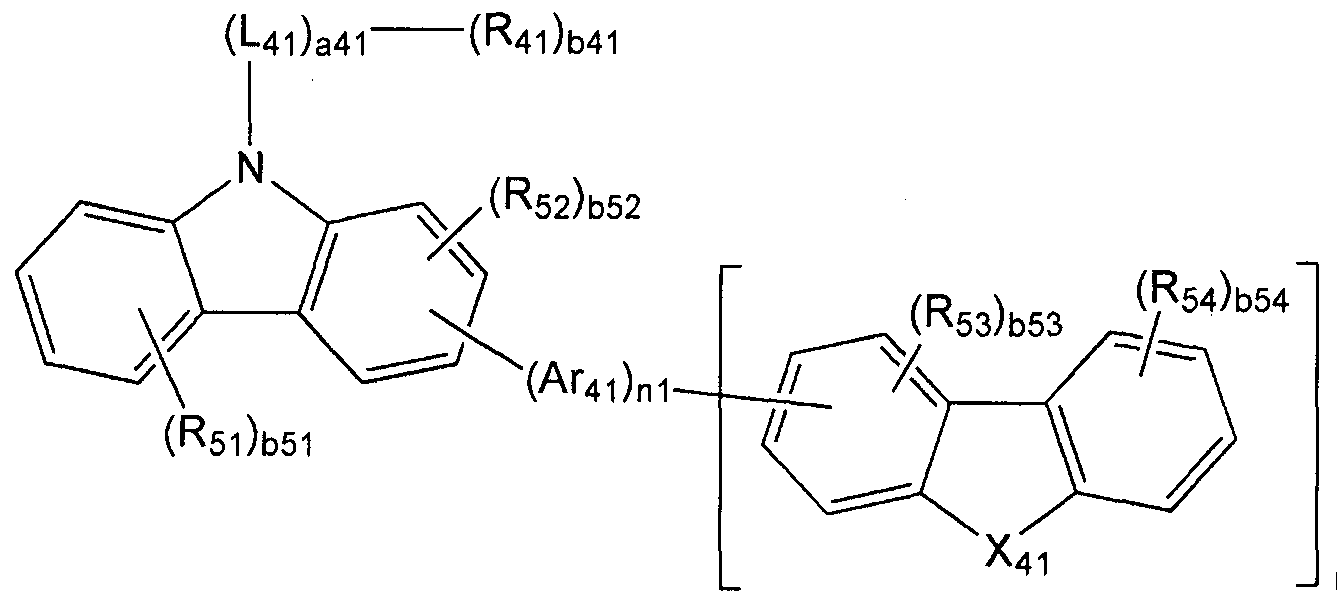
<화학식 61> <Formula 61>

<화학식 61A> <화학식 61B>

상기 화학식 41 중 ,은 N-[(L42)a42-(R42)b42], S, O, S(=0), S(=0)2, C(=0), C(R43)(R44), Si(R43)(R44), P(Ra), P(=0)(R43) 또는 C=N(R43)이고; In Formula 41, N-[(L 42 ) a42- (R4 2 ) b42], S, O, S (= 0), S (= 0) 2 , C (= 0), C (R 43 ) (R 44 ), Si (R 4 3 ) (R 4 4 ), P (Ra), P (= 0) (R 4 3 ) or C = N (R 4 3 );
상기 화학식 61 중 고리 A61은 상기 화학식 61A로 표시되고; Ring A 61 in Formula 61 is represented by Formula 61A;
상기 화학식 61 중 고리 A62는 상기 화학식 61B로 표시되고;Ring A 62 in Formula 61 is represented by Formula 61B;
,은 N-[(L62)a62-(R62)b62], S, 0, S(=0), S(=0)2, C(=0), C(R63)(R64), 8ί(¾3)(¾4), P( 63), P(=0)(R63) 또는 C=N(R63)이고; , Is N-[(L 62 ) a62- (R 62 ) b62 ], S, 0, S (= 0), S (= 0) 2 , C (= 0), C (R 63 ) (R 64 ) , 8ί (¾ 3 ) (¾ 4 ), P ( 63 ), P (= 0) (R 63 ) or C = N (R 63 );
X 은 C(R7ᅵ) 또는 N이고, X72는 C(R72) 또는 N이고, X73은 C(R73) 또는 N이고,X is C (R 7 ) or N, X 72 is C (R 72 ) or N, X 73 is C (R 73 ) or N,
X74는 C(R74) 또는 N이고, X75는 C(R75) 또는 N이고, X76은 C(R76) 또는 N이고, X77은 C(R77) 또는 N이고 , 78은 C(R78) 또는 N이고; X 74 is C (R 74 ) or N, X 75 is C (R 75 ) or N, X 76 is C (R 76 ) or N, X 77 is C (R 77 ) or N, 78 is C (R 78 ) or N;
Ar4,, L41, L42, L6 ) 및 L62는 서로 독립적으로, 치환 또는 비치환된 C3-C10시클로알킬렌기, 치환 또는 비치환된 c2-c10헤테로시클로알킬렌기, 치환 또는 비치환된 c3-c10시클로알케닐렌기, 치환 또는 비치환된 Ar 4 ,, L 41 , L 42 , L 6) and L 62 are each independently a substituted or unsubstituted C 3 -C 10 cycloalkylene group, substituted or unsubstituted c 2 -c 10 heterocycloalkylene group, substituted or unsubstituted c 3 -c 10 cycloalkenylene group, substituted or unsubstituted
C2-C10헤테로시클로알케닐렌기, 치환 또는 비치환된 C6-C60아릴렌기, 치환 또는 비치환된 C2-C60헤테로아릴렌기, 치환 또는 비치환된 2가 비-방향족 축합다환 그룹 또는 치환 또는 비치환된 2가 비 -방향족 해테로축합다환 그룹이고; C 2 -C 10 heterocycloalkenylene group, substituted or unsubstituted C 6 -C 60 arylene group, substituted or unsubstituted C 2 -C 60 heteroarylene group, substituted or unsubstituted divalent non-aromatic condensed polycyclic ring Group or a substituted or unsubstituted divalent non-aromatic heterocondensed polycyclic group;
nl 및 n2는 서로 독립적으로, 0 내지 3의 정수 중에서 선택되고; nl and n2 are each independently selected from an integer of 0 to 3;
R41 내지 내지 1^4, 1^ 내지 R64 및 R71 내지 R79는 서로 독립적으로, 수소, 중수소, -F (플루오로기), -C1 (클로로기), -Br (브로모기) , 아이오도기), 히드록실기, 시아노기 , 아미노기 , 아미디노기 , 치환 또는 비치환된 d- o알킬기, 치환 또는 비치환된 C2-C60알케닐기, 치환 또는 비치환된 c2-c60알키닐기, 치환 또는 비치환된 Cr o알콕시기, 치환 또는 비치환된 C3-C10시클로알킬기, 치환 또는 비치환된 R41 to 4 to 1 ^, 1 ^ 4 to R 6, and R71 to R79 are each independently (fluoroalkyl group), hydrogen, heavy hydrogen, -F, -C1 (chloro group), -Br (bromo), Iowa pottery ), Hydroxyl group, cyano group, amino group, amidino group, substituted or unsubstituted d-oalkyl group, substituted or unsubstituted C 2 -C 60 alkenyl group, substituted or unsubstituted c 2 -c 60 alkynyl group , Substituted or unsubstituted Cr oalkoxy group, substituted or unsubstituted C 3 -C 10 cycloalkyl group, substituted or unsubstituted
C2-C10헤테로시클로알킬기, 치환 또는 비치환된 C3-C10시클로알케닐기, 치환 또는 비치환된 C2-C10헤테로시클로알케닐기, 치환 또는 비치환된 C6-C60아릴기, 치환 또는 비치환된 C6-C60아릴옥시기, 치환 또는 비치환된 c6-c60아릴티오기, 치환 또는 비치환된 C2-C60헤테로아릴기, 치환 또는 비치환된 1가 비 -방향족 축합다환 그룹, 치환 또는 비치환된 1가 비-방향족 헤테로축합다환 그룹, -N(Q0(Q2), -Si(Q3)(Q4)(Q5) 또는 -B(Q6)(Q7)이고; C 2 -C 10 heterocycloalkyl group, substituted or unsubstituted C 3 -C 10 cycloalkenyl group, substituted or unsubstituted C 2 -C 10 heterocycloalkenyl group, substituted or unsubstituted C 6 -C 60 aryl group , Substituted or unsubstituted C 6 -C 60 aryloxy group, substituted or unsubstituted c 6 -c 60 arylthio group, substituted or unsubstituted C 2 -C 60 heteroaryl group, substituted or unsubstituted monovalent Non-aromatic condensed polycyclic group, substituted or unsubstituted monovalent non-aromatic heterocondensed polycyclic group, -N (Q0 (Q 2 ), -Si (Q 3 ) (Q 4 ) (Q 5 ) or -B (Q 6 ) (Q 7 );
a41, a42, a61 및 a62는 서로 독립적으로, 0 내지 3의 정수 중에서 선택되고 b41 , b42, b51 내지 b54, b61, b62 및 b79는 서로 독립적으로, 1 내지 3의 정수 중에서 선택된다. a41, a42, a61 and a62 are each independently selected from integers of 0 to 3, and b41, b42, b51 to b54, b61, b62 and b79 are independently of each other, selected from integers of 1 to 3.
일예에서, 상기 내지 R44, R5 1 내지 R54, R(51 내지 R64 및 R71 내지 R?9는 서로 독립적으로, 수소, 중수소, -F, -CI, -Br, -I, 히드록실기, 시아노기, 아미노기, 아미디노기 , 치환 또는 비치환된 CrC20알킬기, 치환 또는 비치환된 d- o알콕시기, 치환 또는 비치환된 C3-C10시클로알킬기, 치환 또는 비치환된 C3-C10시클로알케닐기, 치환 또는 비치환된 C6-C20아릴기, 또는 치환 또는 비치환된 1가 비 -방향족 축합다환 그룹일 수 있다. In one embodiment, to R44, R5 1 to R 5 4, R (51 to R64 and R 7 1 to R? 9 are independently of each other, hydrogen, deuterium, -F, -CI, -Br, -I, hydroxy Real, cyano, amino, amidino, substituted or unsubstituted CrC 20 alkyl group, substituted or unsubstituted d-oalkoxy group, substituted or unsubstituted C 3 -C 10 cycloalkyl group, substituted or unsubstituted C 3 -C 10 cycloalkenyl group, a substituted or unsubstituted C 6 -C 20 aryl group, or a substituted or unsubstituted monovalent non-aromatic condensed polycyclic group.
다른 구현예에 따르면, 상기 화학식 41 및 61 중 Ru 내지 R44, R51 내지 R54, R6 i 내지 R64 및 R71 내지 R79는 서로 독립적으로, According to another embodiment, in Formulas 41 and 61, Ru to R 4 4 , R 51 to R 54 , R 6 i to R 64, and R 71 to R 79 may be each independently,
수소, 중수소, -F, - CI, -Br, -I, 히드록실기, 시아노기 , 아미노기 , 아미디노기 , d-C o알킬기 또는 C ^o알콕시기; 페닐기, 펜탈레닐기, 나프틸기, 플루오레닐기, 스파이로-플루오레닐기, 벤조플루오레닐기, 디벤조플루오레닐기, 페날레닐기, 페난트레닐기, 안트라세닐기, 플루오란테닐기, 트리페닐레닐기, 파이레닐기, 크라이세닐기, 피세닐기, 페릴레닐기, 펜타페닐기, 카바졸일기, 벤조퓨라닐기, 벤조티오페닐기, 디벤조퓨라닐기, Hydrogen, deuterium, -F, -CI, -Br, -I, hydroxyl group, cyano group, amino group, amidino group, dC oalkyl group or C ^ oalkoxy group; Phenyl, pentalenyl, naphthyl, fluorenyl, spiro-fluorenyl, benzofluorenyl, dibenzofluorenyl, penalenyl, phenanthrenyl, anthracenyl, fluoranthenyl and triphenyl Renyl group, pyrenyl group, chrysenyl group, pisenyl group, peryleneyl group, pentaphenyl group, carbazolyl group, benzofuranyl group, benzothiophenyl group, dibenzofuranyl group,
디벤조티오페닐기, 벤조카바졸일기 또는 디벤조카바졸일기; 또는 Dibenzothiophenyl group, benzocarbazolyl group or dibenzocarbazolyl group; or
중수소, -F, -CI, -Br, -I, 히드록실기, 시아노기 , 아미노기 , 아미디노기 , Deuterium, -F, -CI, -Br, -I, hydroxyl group, cyano group, amino group, amidino group,
C ^o알킬 7l , d-C2。알콕시기, 페닐기, 펜탈레닐기, 나프틸기, 플루오레닐기, 스파이로-플루오레닐기, 벤조플루오레닐기, 디벤조플루오레닐기, 페날레닐기, 페난트레닐기, 안트라세닐기, 플루오란테닐기, 트리페닐레닐기, 파이레닐기, 크라이세닐기, 피세닐기, 페릴레닐기, 펜타페닐기, 카바졸일기, 벤조퓨라닐기, 벤조티오페닐기, 디벤조퓨라닐기, 디벤조티오페닐기, 벤조카바졸일기 및 C ^ oalkyl 7 l, dC 2。 Alkoxy group, phenyl group, pentalenyl group, naphthyl group, fluorenyl group, spiro-fluorenyl group, benzofluorenyl group, dibenzofluorenyl group, penalenyl group, phenanthre Neyl group, anthracenyl group, fluoranthenyl group, triphenylenyl group, pyrenyl group, chrysenyl group, pisenyl group, peryllenyl group, pentaphenyl group, carbazolyl group, benzofuranyl group, benzothiophenyl group, dibenzofura Neyl group, dibenzothiophenyl group, benzocarbazolyl group, and
디벤조카바졸일기 중 적어도 하나로 치환된, 페닐기, 펜탈레닐기, 나프틸기, 플루오레닐기, 스파이로-플루오레닐기, 벤조플루오레닐기, 디벤조플루오레닐기, 페날레닐기, 페난트레닐기, 안트라세닐기, 플루오란테닐기, 트리페닐레닐기, 파이레닐기, 크라이세닐기, 피세닐기, 페릴레닐기, 펜타페닐기, 카바졸일기, 벤조퓨라닐기, 벤조티오페닐기, 디벤조퓨라닐기, 디벤조티오페닐기, 벤조카바졸일기 또는 디벤조카바졸일기; 일 수 있으나, 이에 한정되는 것은 아니다. A phenyl group, pentalenyl group, naphthyl group, fluorenyl group, spiro-fluorenyl group, benzofluorenyl group, dibenzofluorenyl group, penalenyl group, phenanthrenyl group, substituted with at least one of dibenzocarbazolyl group, Anthracenyl group, fluoranthenyl group, triphenylenyl group, pyrenyl group, chrysenyl group, pisenyl group, perylenyl group, pentaphenyl group, carbazolyl group, benzofuranyl group, benzothiophenyl group, dibenzofuranyl group, Dibenzothiophenyl group, benzocarbazolyl group or dibenzocarbazolyl group; It may be, but is not limited thereto.
예컨대, 상기 L61 및 L62는 서로 독립적으로, 치환 또는 비치환된 For example, L 61 and L 62 are each independently, a substituted or unsubstituted
C6-C60아릴렌기, 치환 또는 비치환된 C2-C60헤테로아릴렌기, 또는 치환 또는 비치환된 2가 비-방향족 축합다환 그룹이고, 상기 R51 내지 R^ Re! 내지 RM 및 R?i 내지A C 6 -C 60 arylene group, a substituted or unsubstituted C 2 -C 60 heteroarylene group, or a substituted or unsubstituted bivalent non-aromatic condensed polycyclic group, and R 51 to R ^ Re! To RM and R to
R79는 서로 독립적으로, 수소, 중수소, -F, - CI, -Br, -1, 히드록실기, 시아노기, 아미노기, 아미디노기, 치환 또는 비치환된 CrC20알킬기, 치환 또는 비치환된 d- o알콕시기, 치환 또는 비치환된 C3-C10시클로알킬기, 치환 또는 비치환된 C3-C10시클로알케닐기, 치환 또는 비치환된 C6-C20아릴기, 또는 치환 또는 비치환된 1가 비-방향족 R 79 independently of one another, hydrogen, deuterium, -F, -CI, -Br, -1, hydroxyl group, cyano group, amino group, amidino group, substituted or unsubstituted CrC 20 alkyl group, substituted or unsubstituted d-oalkoxy group, substituted or unsubstituted C 3 -C 10 cycloalkyl group, substituted or unsubstituted C 3 -C 10 cycloalkenyl group, substituted or unsubstituted C 6 -C 20 aryl group, or substituted or unsubstituted Ring monovalent non-aromatic
헤테로축합다환 그룹일 수 있다. It may be a hetero condensed polycyclic group.
또 다른 구현예에 따르면, 상기 화학식 41 중 R51, R53 및 R54와 화학식 61 중 R7i 내지 R79는 서로 독립적으로, 수소, 중수소, -F, -CI, -Br, -1, 히드록실기, 시아노기 , 니트로기, 아미노기, 아미디노기, - o알킬기, C2-C20알케닐기, C2-C20알키닐기 또는 CrC20알콕시기일 수 있다. According to another embodiment, R 51 , R 53 and R 54 in Formula 41 and R 7 i to R 79 in Formula 61 may be each independently selected from hydrogen, deuterium, -F, -CI, -Br, -1, It may be a hydroxyl group, cyano group, nitro group, amino group, amidino group, -oalkyl group, C 2 -C 20 alkenyl group, C 2 -C 20 alkynyl group or C r C 20 alkoxy group.
또 다른 구현예에 따르면, 상기 화학식 41 중 R5 I, R53 및 R54와 화학식 61 중 R71 내지 R79는 모두 수소일 수 있다. According to another embodiment, in Formula 41, R 5 I , R 53 and R 54 and Formula 61 R71 to R 79 may all be hydrogen.
상기 화학식 41 중 R4 l R42 및 R52와 상기 화학식 61 중 R61 및 R62는 서로 독립적으로, 상기 화학식 1의 정의와 관련하여 기재된 상기 화학식 4-1 내지 4-33 중 하나로 표시될 수 있다. R 4 1 R 4 2 and R 52 in Formula 41 and R 61 and R 62 in Formula 61 may be each independently represented by one of Formulas 4-1 to 4-33 described in connection with the definition of Formula 1. .
일 구현예에 따르면, 상기 화학식 41 중 R4 R42 및 R52와 상기 화학식 61 중According to one embodiment, R4 R42 and R 52 of Formula 41 and of Formula 61
R61 및 ¾2는 서로 독립적으로, 상기 화학식 1의 정의와 관련하여 기재된 상기 화학식 4-1 내지 4-5 및 4-26 내지 4-33 중 하나로 표시될 수 있다. R61 and ¾2 may be each independently represented by one of the above Formulas 4-1 to 4-5 and 4-26 to 4-33 described in connection with the definition of Formula 1.
또 다른 구현예에 따르면, 상기 화학식 41 중 Ι^, Ι ^ 및 R52와 상기 화학식 61 중 R61 및 R62는 서로 독립적으로, 상기 화학식 1의 정의와 관련하여 기재된 상기 5- 1 내지 5-27, 및 5-40 내지 5-44 중 하나로 표시될 수 있으나, 이에 한정되는 것은 아니다ᅳ According to another embodiment, Ι ^, Ι ^ and R 52 in Formula 41 and R 61 and R 62 in Formula 61 are each independently of each other, as described above in connection with the definition of Formula 1 above. 27, and 5-40 to 5-44, but is not limited thereto.
또 다른 일 구현예에 따르면, 본 발명은 상기 발광층이 제 1호스트, 제 2호스트 및 도편트를 포함하고, 상기 게 1호스트와 상기 제 2호스트는 서로 상이하고, According to another embodiment of the present invention, the light emitting layer includes a first host, a second host and a dopant, wherein the first host and the second host are different from each other,
상기 제 1호스트가 상기 화학식 1로 표시되는 축합환 화합물을 포함하고, 상기 거 12호스트가 상기 하기 화학식 41로 표시되는 제 1화합물 및 하기 화학식 61로 표시되는 제 2화합물 중 적어도 하나를 포함하는, 유기 발광 소자를 제공한다. The first host includes a condensed cyclic compound represented by Chemical Formula 1, and the geo 12 host includes at least one of a first compound represented by Chemical Formula 41 and a second compound represented by Chemical Formula 61, An organic light emitting device is provided.
또 다른 구현예에 따르면, 상기 게 1화합물은 하기 화학식 41-1 내지 41-12 중 하나로 표시되고, 상기 제 2화합물은 하기 화학식 61-1 내지 61-6 중 하나로 표시될 수 있다. According to another embodiment, the crab 1 compound may be represented by one of Formulas 41-1 to 41-12, and the second compound may be represented by one of Formulas 61-1 to 61-6.


상기 화학식 41-1 내지 41-12 및 61-1 내지 61-6 중 X41, X61, L41, a41, L61, a61, R41, R51 내지 R54,b41,b51 내지 b54, R61,b61,R71 내지 R79 및 b79에 대한 설명은 본 명세서에 기재된 바를 참조한다. X 41 , X 61 , L 41 , a41, L 61 , a61, R41, R51 to R 54 , b41, b51 to b54, R 61 in Formulas 41-1 to 41-12 and 61-1 to 61-6, A description of b61, R 71 to R 79 and b79 is referred to herein as described.
상가화학식 1로 표시되는 축합환 화합물이 상기 화합물 그룹 I에 나열된 화합물 중 하나를 포함하고; The condensed cyclic compound represented by Addition Formula 1 contains one of the compounds listed in Compound Group I;
일 구현예에 따르면, 상기 화학식 41로 표시되는 게 1화합물이 하기 화합물 A1 내지 A111 중 하나를 포함하고, 상기 화학식 61로 표시되는 제 2화합물이 하기 화합물 B1 내지 B20 중 하나를 포함할 수 있으나, 이에 한정되는 것은 아니다. According to one embodiment, the compound represented by Formula 41 may include one of the following Compounds A1 to A111, and the second compound represented by Formula 61 may include one of the following Compounds B1 to B20, It is not limited to this.

ZllOOO/STOZaM/X3d 9lCS0l/ST0Z OAV


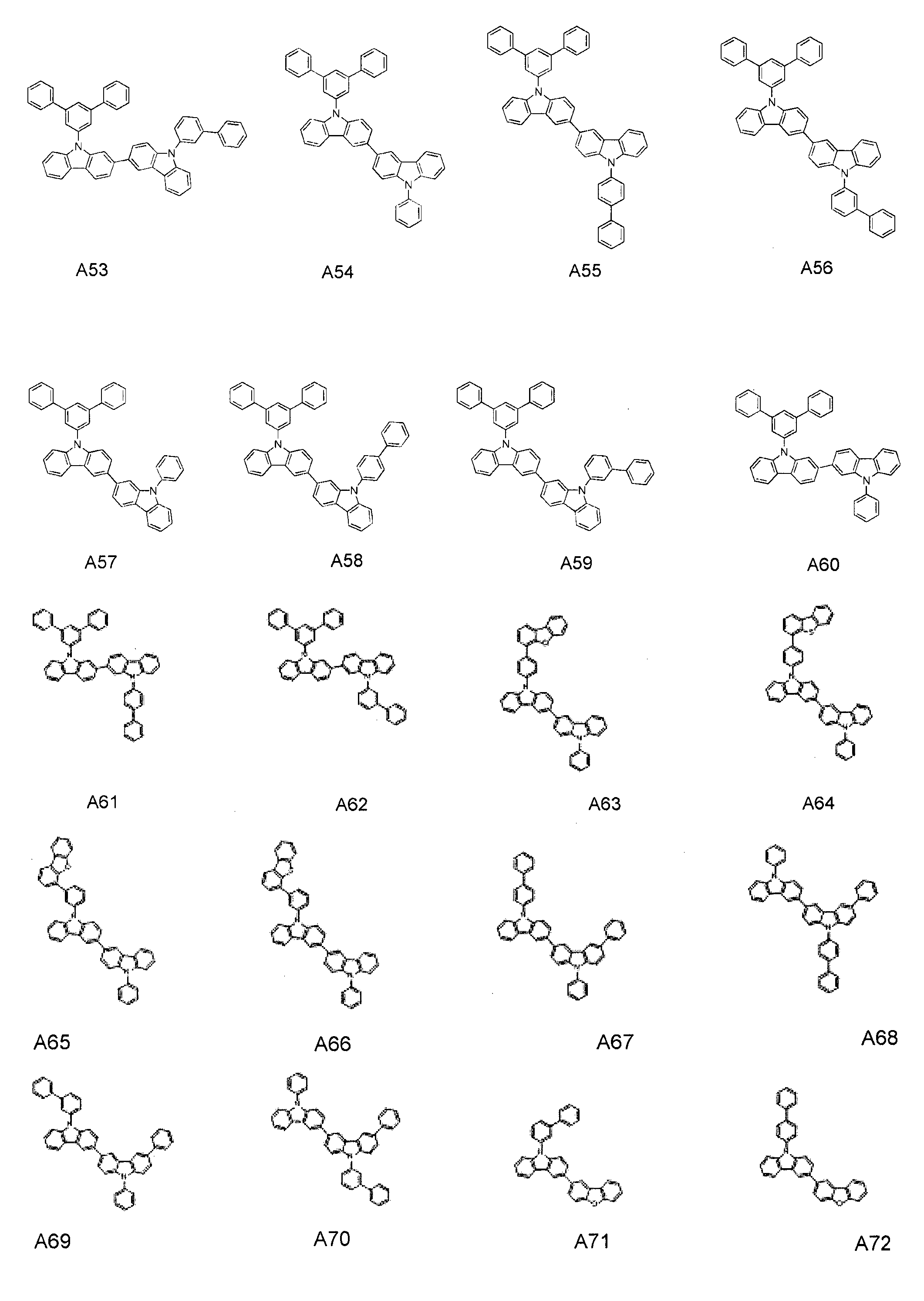


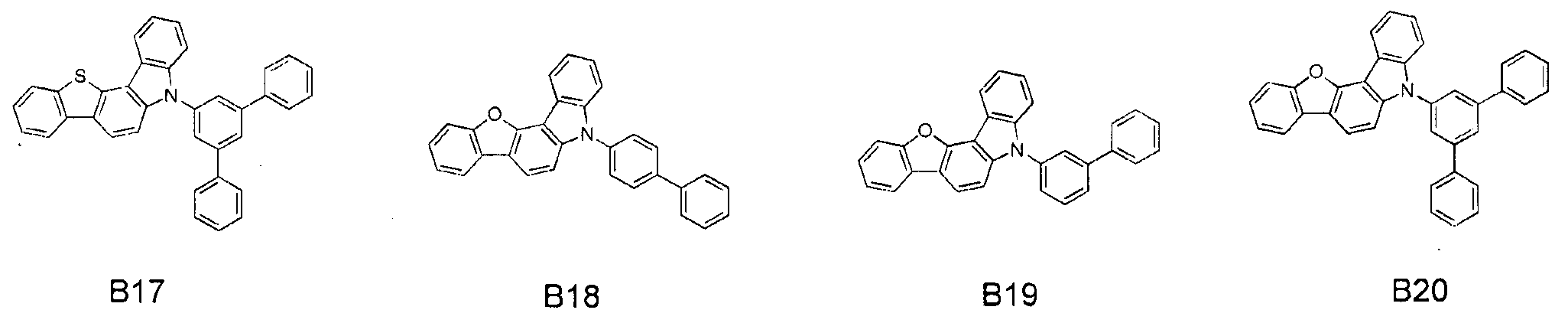
상기 게 1호스트와 상기 게 2호스트의 중량비는 1 : 99 내지 99 : 1 , 예를 들면, 10 : 90 내지 90 : 10의 범위 내에서 선택될 수 있다. 상기 중량비 범위를 만족할 경우, 상기 제 1호스트에 의한 전자'수성 특성 및 상기 계 2호스트에 의한 정공 수송 특성이 균형을 이를 수 있어, 유기 발광 소자의 발광 효율 및 수명이 향상될 수 있다. The weight ratio of the crab 1 host and the crab 2 host may be selected in the range of 1:99 to 99: 1, for example, 10:90 to 90:10. When the weight ratio range is satisfied, the electron ' aqueous property by the first host and the hole transport property by the system 2 host may be balanced, thereby improving luminous efficiency and lifespan of the organic light emitting device.
상기 발광층 중 상기 도편트의 함량은 통상적으로 호스트 약 100 중량부를 기준으로 하여 약 으 01 내지 약 15 중량부의 범위에서 선택될 수 있으며, 이에 한정되는 것은 아니다. The dopant content in the light emitting layer may be generally selected from about 01 to about 15 parts by weight based on about 100 parts by weight of the host, but is not limited thereto.
상기 화학식 1로 표시되는 축합환 화합물, 상기 화학식 41로 표시되는 거 U화합물 및 상기 화학식 61로 표시되는 제 2화합물의 합성 방법은, 후술되는 합성예를 참조하여, 당업자가 용이하게 인식할 수 있다. The synthesis method of the condensed cyclic compound represented by Formula 1, the U compound represented by Formula 41, and the second compound represented by Formula 61 may be easily recognized by those skilled in the art with reference to the synthesis examples described below. .
상기 유기 발광 소자가 풀 컬러 유기 발광 소자일 경우, 발광층은 적색 발광층, 녹색 발광층 및 청색 발광층으로 패터닝될 수 있다. 또는, 상기 발광층은 적색 발광층, 녹색 발광층 및 /또는 청색 발광층이 적층된 구조를 가짐으로써, 백색광을 방출할 수 있는 등 다양한 변형예가 가능하다. 상기 적색 발광층, 녹색 발광층 및 청색 발광층 중 호스트는 상기 화학식 1로 표시되는 축합환 화합물을 포함할 수 있다. 일 구현예에 따르면, 상기 녹색 발광층 중 호스트는 상기 화학식 1로 표시되는 축합환 화합물을 포함할 수 있다. When the organic light emitting device is a full color organic light emitting device, the light emitting layer may be patterned into a red light emitting layer, a green light emitting layer, and a blue light emitting layer. Alternatively, the light emitting layer may have a structure in which a red light emitting layer, a green light emitting layer, and / or a blue light emitting layer are stacked to emit white light. The host among the red light emitting layer, the green light emitting layer, and the blue light emitting layer may include a condensed cyclic compound represented by Chemical Formula 1. According to one embodiment, the host of the green light emitting layer may include a condensed cyclic compound represented by the formula (1).
또한, 상기 청색 발광층 위의 전자수송보조층은 상기 화학식 1로 표시되는 축합환 화합물을 포함할 수 있다. In addition, the electron transport auxiliary layer on the blue light emitting layer may include a condensed cyclic compound represented by Chemical Formula 1.
상기 발광층 중 도편트는 형광 방출 메커니즘에 따라 광을 방출하는 형광 도편트로서 또는 인광 방출 메커니즘에 따라 광을 방출하는 인광 도편트를 포함할 수 있다. The dopant in the light emitting layer may include a fluorescent dopant emitting light according to a fluorescence emission mechanism or a phosphorescent dopant emitting light according to a phosphorescence emission mechanism.
일 구현예에 따르면, 상기 발광층은 화학식 1로 표시되는 축합환 화합물을 포함한 호스트 및 인광 도편트를 포함할 수 있다. 상기 인광 도편트는 전이 금속 (예를 들면, 이리듐 (Ir), 백금 (Pt), 오스뮴 (Os), 로듐 (Rh) 등)을 포함한 유기금속 착체를 포함할 수 있다. According to an embodiment, the emission layer may include a host and a phosphorescent dopant including a condensed cyclic compound represented by Formula 1. The phosphorescent dopant is transition Organometallic complexes including metals (eg, iridium (Ir), platinum (Pt), osmium (Os), rhodium (Rh), etc.).
상기 인광 도펀트는 하기 화학식 81로 표시되는 유기금속 화합물을 포함할 수 있다: The phosphorescent dopant may include an organometallic compound represented by Formula 81:
< 〉 <〉

상기 화학식 81 증, Formula 81 above,
M은 이리듐 (Ir), 백금 (Pt), 오스뮴 (Os), 티탄 (Ti), 지르코늄 (Zr), 하프늄 (Hf), 유로품 (En), 테르븀 (Tb) 또는 를륨 (Tm)이고; M is iridium (Ir), platinum (Pt), osmium (Os), titanium (Ti), zirconium (Zr), hafnium (Hf), flow path product (En), terbium (Tb) or erium (Tm);
Y, 내지 Y4는 서로 독립적으로, 탄소 (C) 또는 질소 (Ν)이고; Y, to Y 4 are, independently of each other, carbon (C) or nitrogen (Ν);
^과 Υ2는 단일 결합 또는 이중 결합을 통하여 연결되어 있고 , Υ3와 Υ4는 단일 결합 또는 이중 결합을 통하여 연결되어 있고; ^ And Υ 2 are linked via a single bond or a double bond, and Υ 3 and Υ 4 are linked through a single bond or a double bond;
CY, 및 CY2는 서로 독립적으로, 벤젠, 나프탈렌, 플루오렌, CY, and CY 2 are independently of each other, benzene, naphthalene, fluorene,
스파이로 -플루오렌, 인덴, 피롤, 티오펜, 퓨란 (furan), 이미다졸, 피라졸, 티아졸,. 이소티아졸, 옥사졸, 이속사졸 (isooxazole), 피리딘, 피라진, 피리미딘, 피리다진, 퀴놀린, 이소퀴놀린, 벤조퀴놀린, 퀴녹살린, 퀴나졸린, 카바졸, 벤즈이미다졸, 벤조퓨란 (benzofuran), 벤조티오펜, 이소벤조티오펜, 벤즈옥사졸, 이소벤조옥사졸, 트리아졸, 테트라졸, 옥사디아졸, 트리아진, 디벤조퓨란 (dibenzofuran) 또는 디벤조티오펜이고,。^과 CY2는 선택 으로 (optionally), 단일 결합 또는 유기 연결기 (organic linking group)를 통하여 서로 결합되고; Spiro-fluorene, indene, pyrrole, thiophene, furan, imidazole, pyrazole, thiazole ,. Isothiazole, oxazole, isoxazole, pyridine, pyrazine, pyrimidine, pyridazine, quinoline, isoquinoline, benzoquinoline, quinoxaline, quinazoline, carbazole, benzimidazole, benzofuran, benzofuran, benzothiophene, isopropyl benzothiophene, benzoxazole, isopropyl benzoxazole, triazole, tetrazole, oxadiazole, triazine, dibenzofuran (dibenzofuran) or dibenzothiophene, and ^ and CY 2 is Optionally, are bonded to each other via a single bond or an organic linking group;
R81 및 R82는 서로 독립적으로, 수소, 중수소, -F, -CI, -Br, -I, 히드록실기, 시아노기, 니트로기, 아미노기, 아미디노기, 히드라진기, 히드라존기, 카르복실산 또는 이의 염, 술폰산 또는 이의 염, 인산 또는 이의 염, 치환 또는 비치환된 R 81 and R 82 are each independently hydrogen, deuterium, -F, -CI, -Br, -I, hydroxyl group, cyano group, nitro group, amino group, amidino group, hydrazine group, hydrazone group, carboxyl mountain Or salts thereof, sulfonic acid or salts thereof, phosphoric acid or salts thereof, substituted or unsubstituted
C o알킬기, 치환 또는 비치환된 C2-C60알케닐기, 치환 또는 비치환된 C oalkyl group, substituted or unsubstituted C 2 -C 60 alkenyl group, substituted or unsubstituted
C2-C60알키닐기 , 치환 또는 비치환된 d- o알콕시기, 치환 또는 비치환된C 2 -C 60 alkynyl group, substituted or unsubstituted d-oalkoxy group, substituted or unsubstituted
- 0시클로알킬기, 치환 또는 비치환된 C2-C10해테로시클로알킬기, 치환 또는 비치환된 C3-C10시클로알케닐기, 치환 또는 비치환된 C2-C10헤테로시클로알케닐기, 치환 또는 비치환된 C6-C60아릴기, 치환 또는 비치환된 C6-C60아릴옥시기, 치환 또는 비치환된 C6-C60아릴티오기, 치환 또는 비치환된 C2-C60헤테로아릴기, 치환 또는 비치환된 1가 비-방향족 축합다환 그룹, 치환 또는 비치환된 1가 비-방향족 해테로축합다환 그룹, -N(Qᅵ )(¾), -Si(Q3)(Q4)(Q5) 또는 -B(Q6)(Q7)이고; 0 cycloalkyl group, substituted or unsubstituted C 2 -C 10 heterocycloalkyl group, substituted or unsubstituted C 3 -C 10 cycloalkenyl group, substituted or unsubstituted C 2 -C 10 heterocycloalkenyl group, substituted or unsubstituted C 6 -C 60 aryl group, a substituted or unsubstituted C 6 -C 60 aryloxy group, a substituted or unsubstituted C 6 -C 60 arylthio group, a substituted or unsubstituted C 2 -C 60 Heteroaryl group, substituted or unsubstituted monovalent non-aromatic condensed polycyclic group, substituted or unsubstituted monovalent non-aromatic condensed polycyclic group, -N (Q) (¾), -Si (Q 3 ) (Q 4 ) (Q 5 ) or -B (Q 6 ) (Q 7 );
a81 및 a82는 서로 독립적으로, 1 내지 5의 정수 중에서 선택되고; a81 and a82 are each independently selected from an integer of 1 to 5;
n81은 0 내지 4의 정수 중에서 선택되고; n81 is selected from an integer of 0 to 4;
n82는 1 , 2 또는 3이고; n82 is 1, 2 or 3;
L81은 1가 유기 리간드 , 2가 유기 리간드 및 3가 유기 리간드 중에서 선택된다. L 81 is selected from monovalent organic ligands, divalent organic ligands, and trivalent organic ligands.
상기 R81 및 R82에 대한 설명은 본 명세서 중 Ru에 대한 설명을 참조한다. 상기 인광 도펀트는 하기 화합물 PD1 내지 PD78 중 적어도 하나를 포함할 있으나, 이에 한정되는 것은 아니다 (하기 화합물 PD1은 Ir(ppy)3임): For the description of R 81 and R 82 refer to the description of R u in the present specification. The phosphorescent dopant may include, but is not limited to, at least one of the following compounds PD1 to PD78 (the following compound PD1 is Ir (ppy) 3 ):
PD4 PD5PD4 PD5
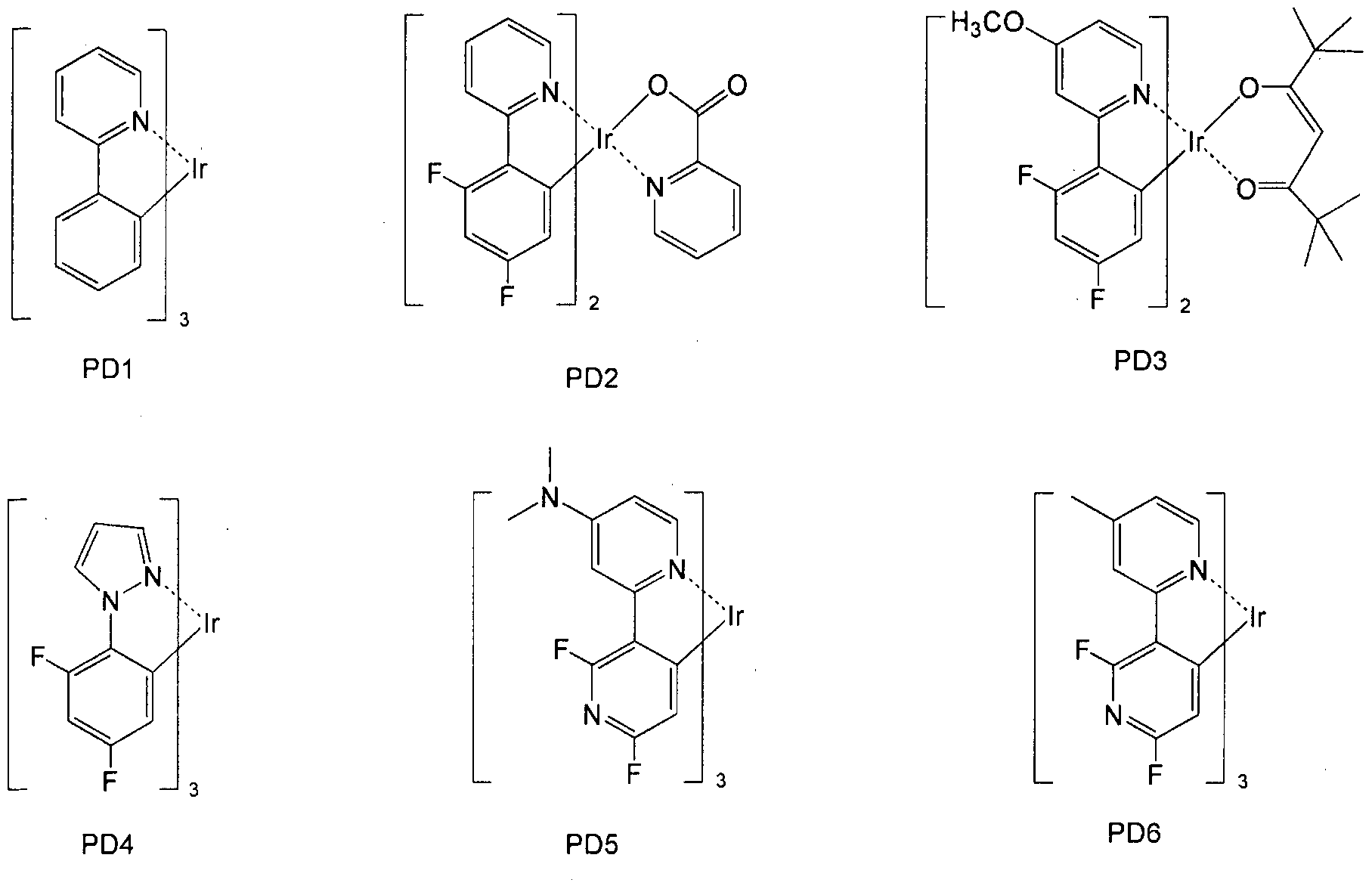

9ΖΪ 9ΖΪ
ZllOOO/STOZaM/X3d 9lCS0l/ST0Z OAV


Zll000/ST0ZaM/X3d 9lCS0l/ST0Z OAV Zll000 / ST0ZaM / X3d 9lCS0l / ST0Z OAV

6ZI 6ZI
ZllOOO/STOZaM/X3d 9lCS0l/ST0Z OAV ZllOOO / STOZaM / X3d 9lCS0l / ST0Z OAV
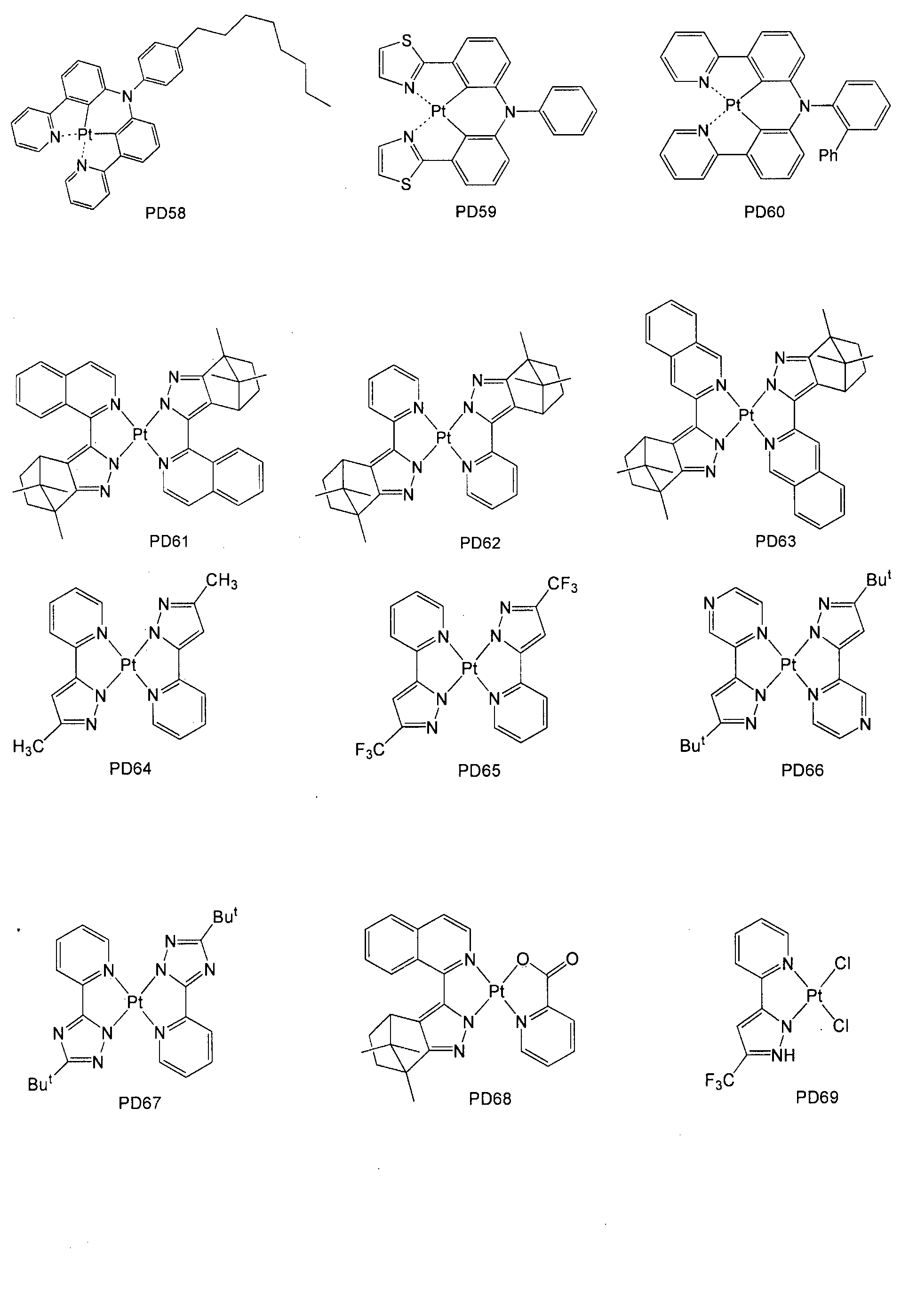
OAV OAV
PD75PD75

또는, 상기 인광 도펀트는 하기 PtOEP 또는 화합물 PhGD를 포함할 수 있다: Alternatively, the phosphorescent dopant may comprise the following PtOEP or compound PhGD:
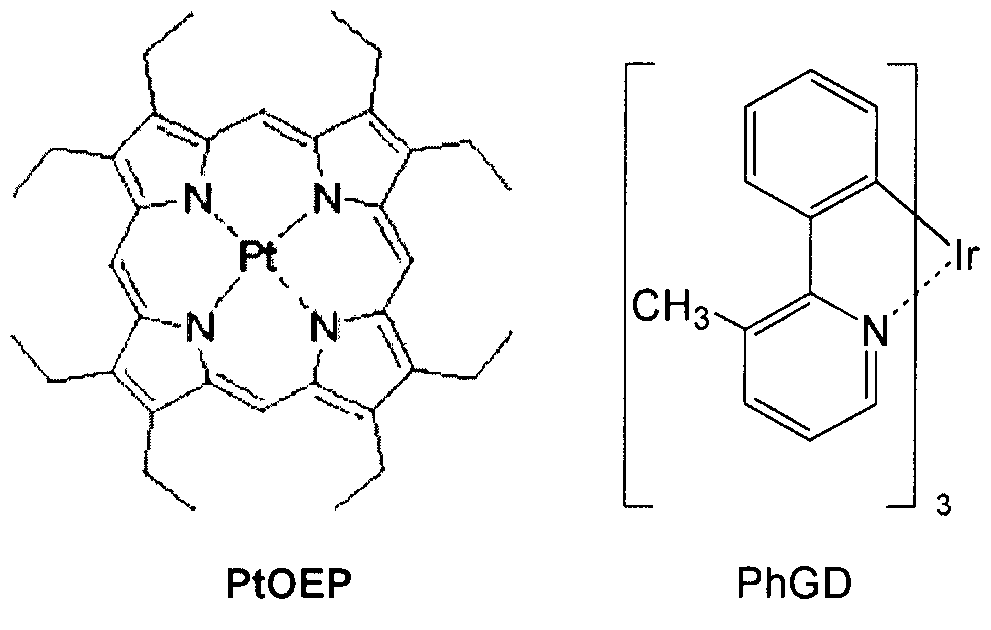
상기 형광 도펀트는 하기 DPVBi, DPAVBi, TBPe, DCM, DCJTB, Coumarin 6 및 45T 중 적어도 하나를 포함할 수 있다. The fluorescent dopant may include at least one of DPVBi, DPAVBi, TBPe, DCM, DCJTB, Coumarin 6, and 45T.

상기 발광층이 호스트 및 도편트를 포함할 경우, 도펀트의 함량은 When the light emitting layer includes a host and a dopant, the content of the dopant is
통상적으로 호스트 약 100 중량부를 기준으로 하여 약 0.01 내지 약 20 중량부의 범위에서 선택될 수 있으며, 이에 한정되는 것은 아니다. Typically, it may be selected from about 0.01 to about 20 parts by weight based on about 100 parts by weight of the host, but is not limited thereto.
상기 발광층의 두께는 약 100 A 내지 약 1000 A, 예를 들면 약 200 A 내지 약 600 A일 수 있다. 상기 발광층의 두께가 전술한 바와 같은 범위를 만족할 경우, 실질적인 구동 전압 상승없이 우수한 발광 특성을 나타낼 수 있다. The light emitting layer may have a thickness of about 100 A to about 1000 A, for example, about 200 A to about 600 A. When the thickness of the light emitting layer satisfies the aforementioned range, the light emitting layer may exhibit excellent light emission characteristics without a substantial increase in driving voltage.
다음으로 발광층 상부에 전자 수송 영역이 배치된다. Next, an electron transport region is disposed on the emission layer.
전자 수송 영역은 정공 저지층, 전자 수송층 및 전자 주입층 중 적어도 하나를 포함할 수 있다. The electron transport region may include at least one of a hole blocking layer, an electron transport layer, and an electron injection layer.
예를 들어, 전자 수송 영역은, 전자 수송층, 정공 저지층 /전자 수송층 /전자 주입충 또는 전자 수송층 /전자 주입층의 구조를 가질 수 있으나, 이에 한정되는 것은 아니다. 예컨대, 본 발명의 일 구현예에 따른 유기 발광 소자는, 전자 수송 영역에 적어도 2층의 전자 수송층을 포함할 수 있고, 이 경우 발광층에 접하여 위치하는 전자 수송층을 전자수송보조층이라고 정의한다. 상기 전자 수송층은 단일층 또는 2 이상의 서로 다른 물질을 포함한 다층 구조를 가질 수 있다. For example, the electron transport region may have a structure of an electron transport layer, a hole blocking layer / an electron transport layer / an electron injection layer, or an electron transport layer / electron injection layer, but is not limited thereto. For example, the organic light emitting device according to the embodiment of the present invention may include at least two electron transport layers in the electron transport region, in which case the electron transport layer positioned in contact with the light emitting layer is defined as an electron transport auxiliary layer. The electron transport layer may have a single layer or a multilayer structure including two or more different materials.
상기 전자 수송 영역은 상기 화학식 1로 표시되는 축합환 화합물을 포함할 수 있다ᅳ 예를 들어, 전자 수송 영역은 전자 수송층을 포함하고, 상기 전자 수송층에 상기 화학식 1로 표시되는 축합환 화합물이 포함될 수 있다. 더욱 구체적으로, 전자수송보조층에 상기 화학식 1로 표시되는 축합환 화합물이 포함될 수 있다. The electron transport region may include a condensed cyclic compound represented by Formula 1 ᅳ For example, the electron transport region may include an electron transport layer, and the electron transport layer may include a condensed cyclic compound represented by Formula 1 have. More specifically, the condensed cyclic compound represented by Chemical Formula 1 may be included in the electron transport auxiliary layer.
상기 유기 발광 소자는, 상기 축합환 화합물을 포함하는 전자수송층과 함께 하기 화학식 2로 표시되는 화합물을 포함하는 정공수송보조층을 더 포함할 수 있다. The organic light emitting device may further include a hole transport auxiliary layer including a compound represented by Formula 2 together with an electron transport layer including the condensed cyclic compound.
< 2> <2>

상기 화학식 2에서, In Chemical Formula 2,
L201은 치환 또는 비치환된 C6 내지 C30 아릴렌기, 또는 치환 또는 비치환된 C2 내지 C30 헤테로아릴렌기이고, L 201 is a substituted or unsubstituted C6 to C30 arylene group, or a substituted or unsubstituted C2 to C30 heteroarylene group,
nl()l은 1 내지 5의 정수 중 하나이고, nl () l is one of integers from 1 to 5,
R201 내지 R212은 각각 독립적으로, 수소, 증수소, 치환 또는 비치환된 C 1 내지 C20 알킬기, 치환 또는 비치환된 C6 내지 C50 아릴기, 치환 또는 비치환된 C2 내지 C50 헤테로아릴기 또는 이들의 조합이고, R 201 to R 212 are each independently hydrogen, hydrogen, substituted or unsubstituted C 1 to C20 alkyl group, substituted or unsubstituted C 6 to C 50 aryl group, substituted or unsubstituted C 2 to C 50 heteroaryl group or these Is a combination of
R201 내지 R212은 각각 독립적으로 존재하거나, 융합하여 고리를 형성한다. 상기 화학식 2의 "치환''은 적어도 하나의 수소가 증수소, 할로겐기, 히드록시기, 아미노기, 치환 또는 비치환된 C1 내지 C30 아민기, 니트로기, 치환 또는 비치환된 C1 내지 C40 실릴기, C1 내지 C30 알킬기, C3 내지 C30 시클로알킬기, C2 내지 C30 헤테로시클로알킬기, C6 내지 C30 아릴기, C2 내지 C30 헤테로아릴기, C1 내지 C20 알콕시기, 플루오로기, C1 내지 C10 트리플루오로알킬기 또는 시아노기로 치환된 것을 의미한다. R 201 to R 212 are each independently present or fuse to form a ring. "Substituted" of the formula (2) is at least one hydrogen is hydrogen, halogen, hydroxy group, amino group, substituted or unsubstituted C1 to C30 amine group, nitro group, substituted or unsubstituted C1 to C40 silyl group, C1 To C30 alkyl group, C3 to C30 It is substituted with a cycloalkyl group, a C2 to C30 heterocycloalkyl group, a C6 to C30 aryl group, a C2 to C30 heteroaryl group, a C1 to C20 alkoxy group, a fluoro group, a C1 to C10 trifluoroalkyl group, or a cyano group.
본 발명의 일 구현예에 따른 정공수송보조층은 하기 화학식 P-1 내지 P-5 중 하나로 표시될 수 있다. The hole transport auxiliary layer according to the embodiment of the present invention may be represented by one of the following formulas P-1 to P-5.

상기 전자 수송 영역의 정공 저지층, 전자 수송층 및 전자 주입층의 형성 조건은 정공 주입층의 형성 조건을 참조한다. The formation conditions of the hole blocking layer, the electron transport layer, and the electron injection layer of the electron transport region may be referred to the formation conditions of the hole injection layer.
상기 전자 수송 영역이 정공 저지층올 포함할 경우, 상기 정공 저지층은 예를 들면, 하기 BCP 및 Bphen 중 적어도 하나를 포함할 수 있으나, 이에 한정되는 것은 아니다. When the electron transport region includes the hole blocking layer, the hole blocking layer may include, for example, at least one of BCP and Bphen, but is not limited thereto.

상기 정공 저지층의 두께는 약 20 A 내지 약 1000 A, 예를 들면 약 30 A 내지 약 300A일 수 있다. 상기 정공저지층의 두께가 전술한 바와 같은 범위를 만족할 경우, 실질적인 구동 전압 상승없이 우수한 정공 저지 특성을 얻을 수 있다. 상기 전자 수송층은 상기 BCP, Bphen 및 하기 Alq3, Balq, TAZ 및 NTAZ 중 적어도 하나를 더 포함할 수 있다. The hole blocking layer may have a thickness of about 20 A to about 1000 A, for example, about 30 A to about 300 A. When the thickness of the hole blocking layer satisfies the above range, excellent hole blocking characteristics may be obtained without a substantial increase in driving voltage. The electron transport layer may further include at least one of BCP, Bphen and Alq 3 , Balq, TAZ, and NTAZ.

또는, 상기 전자 수송층은 하기 화합물 ET1 및 ET2 중 적어도 하놔를 포함할 으나, 이에 한정되는 것은 아니다. Alternatively, the electron transport layer may include at least one of the following compounds ET1 and ET2, but is not limited thereto.

또는, 상기 전자 수송층은, 상기 화학식 1로 표시되는 축합환 화합물올 포함할 수 있으나, 이에 한정되는 것은 아니다. Alternatively, the electron transport layer may include, but is not limited to, a condensed cyclic compound represented by Formula 1 above.
상기 전자 수송층의 두께는 약 100A 내지 약 1000A, 예를 들면 약 150A 내지 약 500A일 수 있다. 상기 전자 수송층의 두께가 전술한 바와 같은 범위를 만족할 경우, 실질적인 구동 전압 상승없이 만족스러운 정도의 전자 수송 특성을 얻을 수 있다. The electron transport layer may have a thickness of about 100A to about 1000A, for example, about 150A to about 500A. When the thickness of the electron transporting layer satisfies the aforementioned range, a satisfactory electron transporting characteristic can be obtained without a substantial increase in driving voltage.
상기 전자 수송층은 상술한 바와 같은 물질 외에, 금속 -함유 물질을 더 포함할 수 있다. The electron transport layer may further include a metal-containing material, in addition to the materials described above.
상기 금속 -함유 물질은 Li 착체를 포함할 수 있다. 상기 Li 착체는, 예를 들면, 하기 화합물 ET-D1 (리튬 퀴놀레이트, LiQ) 또는 ET-D2을 포함할 수 있다. The metal-containing material may comprise a Li complex. The Li complex may include, for example, the following compound ET-D1 (lithium quinolate, LiQ) or ET-D2.

상기 전자 주입층은, LiF, NaCl, CsF, Li20 및 BaO 중에서 선택된 적어도 하나를 포함할 수 있다. The electron injection layer may include at least one selected from LiF, NaCl, CsF, Li 2 O, and BaO.
상기 전자 주입층의 두께는 약 1 A 내지 약 100A, 약 3 A 내지 약 90A일 수 있다. 상기 전자 주입층의 두께가 전술한 바와 같은 범위를 만족할 경우, 실질적인 구동 전압 상승없이 만족스러운 정도의 전자 주입 특성을 얻을 수 있다. 상기 유기층 (15) 상부로는 제 2전극 (19)이 구비되어 있다. 상기 게 2전극 (19)은 캐소드일 수 있다. 상기 제 2전극 (19)용 물질로는 상대적으로 낮은 일함수를 가지는 금속, 합금, 전기전도성 화합물 및 이들의 조합을 사용할 수 있다. 구체적인 예로서는 리튬 (Li), 마그네슴 (Mg), 알루미늄 (A1), 알루미늄 -리튬 (Al-Li), 칼슴 (Ca), 마그네슘 -인듐 (Mg-In), 마그네슘-은 (Mg-Ag) 등을 제 2전극 (19) 형성용 물질로 사용할 수 있다. 또는, 전면 발광 소자를 얻기 위하여 ΙΤΟ, ΙΖΟ를 이용하여 투과형 거 전극 (19)을 형성할 수 있는 등, 다양한 변형이 가능하다. The electron injection layer may have a thickness of about 1 A to about 100 A, about 3 A to about 90 A. When the thickness of the electron injection layer satisfies the above range, a satisfactory electron injection characteristic may be obtained without a substantial increase in driving voltage. The second electrode 19 is provided on the organic layer 15. The crab second electrode 19 may be a cathode. As the material for the second electrode 19, a metal, an alloy, an electrically conductive compound having a relatively low work function, or a combination thereof may be used. Specific examples include lithium (Li), magnesium (Mg), aluminum (A1), aluminum-lithium (Al-Li), kale (Ca), magnesium-indium (Mg-In), magnesium-silver (Mg-Ag), and the like. May be used as the material for forming the second electrode 19. Alternatively, various modifications are possible such that the transmissive giant electrode 19 can be formed by using ΤΤΟ and ΙΖΟ to obtain the front light emitting element.
이상, 상기 유기 발광 소자를 도 1을 참조하여 설명하였으나, 이에 한정되는 것은 아니다. The organic light emitting device has been described above with reference to FIG. 1, but is not limited thereto.
본 명세서 중 C!- o알킬기는 탄소수 1 내지 60의 선형 또는 분지형 지방족 탄화수소 1가 (monovalent) 그룹을 의미하며, 구체적인 예에는, 메틸기, 에틸기, 프로필기, 이소부틸기, sec-부틸기, ter-부틸기, 펜틸기, iso-아밀기, 핵실기 등이 포함된다. 본 명세서 중 d- o알킬렌기는 상기 d- o알킬기와 동일한구조를 갖는 2가 (divalent) 그룹을 의미한다. In the present specification, a C! -Oalkyl group means a linear or branched aliphatic hydrocarbon monovalent group having 1 to 60 carbon atoms, and specific examples thereof include methyl group, ethyl group, propyl group, isobutyl group, sec-butyl group, ter-butyl group, pentyl group, iso-amyl group, nuclear chamber group, and the like. In the present specification, the d-oalkylene group refers to a divalent group having the same structure as the d-oalkyl group.
본 명세서 중 d- o알콕시기는 -ΟΑ101 (여기서 , ΑΚΜ은 상기 d-C6o알킬기임)의 화학식을 갖는 1가 그룹을 의미하며, 이의 구체적인 예에는, 메록시기, 에록시기, 이소프로필옥시기 등이 포함된다. In the present specification, the d-oalkoxy group means a monovalent group having a chemical formula of -ΟΑ 101 (where AΑΜ is the dC 6 oalkyl group), and specific examples thereof include a hydroxy group, an hydroxy group, an isopropyloxy group, and the like. This includes.
본 명세서 중 C2-C60알케닐기는 상기 C2-C60알킬기의 중간 또는 말단에 하나 이상의 탄소 이중 결합을 포함한 구조를 가지며, 이의 구체적인 예에는, 에테닐기, 프로페닐기, 부테닐기 등이 포함된다. 본 명세서 중 C2-C60알케닐렌기는 상기In the present specification, the C 2 -C 60 alkenyl group has a structure including at least one carbon double bond in the middle or terminal of the C 2 -C 60 alkyl group, and specific examples thereof include an ethenyl group, propenyl group, butenyl group, and the like. do. In the present specification, the C 2 -C 60 alkenylene group is
VC60알케닐기와 동일한 구조를 갖는 2가 그룹을 의미한다. A divalent group having the same structure as a VC 60 alkenyl group.
본 명세서 중 C2-C60알키닐기는 상기 C2-C60알킬기의 중간 또는 말단에 하나 이상의 탄소 삼중 결합을 포함한 구조를 가지며, 이의 구체적인 예에는, 에티닐기 (ethynyl), 프로피닐기 (propynyl), 등이 포함된다. 본 명세서 중 In the present specification, the C 2 -C 60 alkynyl group has a structure including one or more carbon triple bonds in the middle or the terminal of the C 2 -C 60 alkyl group, specific examples thereof Ethynyl, propynyl, and the like. Of the present specification
C2-C60알키닐렌기는 상기 C2-C60알키닐기와 동일한 구조를 갖는 2가 그룹을 C 2 -C 60 alkynylene group is a divalent group having the same structure as the C 2 -C 60 alkynyl group
의미한다. it means.
본 명세서 중 C3-Cl0시클로알킬기는 탄소수 3 내지 10의 1가 포화 탄화수소 모노시클릭 그룹을 의미하며, 이의 구체예는 시클로프로필기, 시클로부틸기, 시클로펜틸기, 시클로핵실기, 시클로헵틸기 등을 포함한다. 본 명세서 중 In the present specification, a C 3 -C 10 cycloalkyl group means a monovalent saturated hydrocarbon monocyclic group having 3 to 10 carbon atoms, and specific examples thereof include a cyclopropyl group, a cyclobutyl group, a cyclopentyl group, a cyclonuxyl group and a cyclohep And a tilt group. Of the present specification
C3-C10시클로알킬렌기는 상기 C3-C10시클로알킬기와 동일한 구조를 갖는 2가 그룹을 의미한다. C 3 -C 10 cycloalkylene group means a divalent group having the same structure as the C 3 -C 10 cycloalkyl group.
본 명세서 중 C2-Cl0해테로시클로알킬기는 N,ᄋ, P 및 S 중에서 선택된 적어도 하나의 헤테로 원자를 고리 -형성 원자로서 포함한 탄소수 2 내지 10의 1가 모노시클릭 그룹을 의미하며, 이의 구체예는 테트라히드로퓨라닐기 (tetrahydrofuranyl), 테트라히드로티오페닐기 등을 포함한다. 본 명세서 중 As used herein, the C 2 -C 10 heterocycloalkyl group refers to a monovalent monocyclic group having 2 to 10 carbon atoms including at least one hetero atom selected from N, O, P, and S as a ring-forming atom, Specific examples include tetrahydrofuranyl groups, tetrahydrothiophenyl groups, and the like. Of the present specification
C2-C10헤테로시클로알킬렌기는 상기 C2-C10헤테로시클로알킬기와 동일한 구조를 갖는 2가 그룹을 의미한다. C 2 -C 10 heterocycloalkylene group means a divalent group having the same structure as the C 2 -C 10 heterocycloalkyl group.
본 명세서 중 C3-C10시클로알케닐기는 탄소수 3 내지 10의 1가 모노시클릭 그룹으로서, 고리 내에.적어도 하나의 이중 결합올 가지나, 방향족성 (aromacity)을 갖지 않는 그룹을 의미하며, 이의 구체예는 시클로펜테닐기, 시클로핵세닐기, 시클로헵테닐기 등을 포함한다ᅳ 본 명세서 중 C3-C10시클로알케닐렌기는 상기 As used herein, a C 3 -C 10 cycloalkenyl group is a monovalent monocyclic group having 3 to 10 carbon atoms, and refers to a group having at least one double bondol in the ring or having no aromacity, Specific examples include a cyclopentenyl group, a cyclonuxenyl group, a cycloheptenyl group and the like. In the present specification, a C 3 -C 10 cycloalkenylene group is
C3-Cl 0시클로알케닐기와 동일한 구조를 갖는 2가 그룹을 의미한다. A divalent group having the same structure as a C 3 -C 10 cycloalkenyl group.
본 명세서 중 C2-C10헤테로시클로알케닐기는 Ν, Ο, Ρ 및 S 중에서 선택된 적어도 하나의 헤테로 원자를 고리 -형성 원자로서 포함한 탄소수 2 내지 10의 1가 모노시클릭 그룹으로서, 고리 내에 적어도 하나의 이중 결합을 갖는다ᅳ 상기 As used herein, a C 2 -C 10 heterocycloalkenyl group is a C 2 to C 10 monovalent monocyclic group containing at least one hetero atom selected from Ν, Ο, Ρ, and S as a ring-forming atom, With one double bond
C2-C10헤테로시클로알케닐기의 구체예는, 2,3-히드로퓨라닐기, 2,3-히드로티오페닐기 둥을 포함한다. 본 명세서 중 C2-C10헤테로시클로알케닐렌기는 상기 Specific examples of the C 2 -C 10 heterocycloalkenyl group include a 2,3-hydrofuranyl group and a 2,3-hydrothiophenyl group. In the present specification, the C 2 -C 10 heterocycloalkenylene group is
C2-C10헤테로시클로알케닐기와 동일한 구조를 갖는 2가 그룹을 의미한다. A divalent group having the same structure as a C 2 -C 10 heterocycloalkenyl group is meant.
본 명세서 중 C6-C60아릴기는 탄소 원자수 6 내지 60개의 카보사이클릭 방향족 시스템을 갖는 1가 (monovalent) 그룹을 의미하며, C6-C60아릴렌기는 탄소 원자수 6 내지 60개의 카보사이클릭 방향족 시스템을 갖는 2가 (divalent) 그룹을 의미한다. 상기 C6-C60아릴기의 구체예는, 페닐기, 바이페닐기, 터페닐기, 쿼터페닐기, 나프틸기, 안트라세닐기, 플루오란테닐기, 트리페닐레닐기, 파이레닐기, 페난트레닐기, 플루오레닐기, 파이레닐기, 크라이세닐기 등을 포함한다. 상기 C6-C60아릴기 및 C6-C60아릴렌기가 2 이상의 고리를 포함할 경우, 2 이상의 고리들은 서로 융합될 수 있다. As used herein, a C 6 -C 60 aryl group refers to a monovalent group having a carbocyclic aromatic system having 6 to 60 carbon atoms, and a C 6 -C 60 arylene group refers to a carbo having 6 to 60 carbon atoms By divalent group having a cyclic aromatic system is meant. Specific examples of the C 6 -C 60 aryl group include a phenyl group, a biphenyl group, a terphenyl group, a quarterphenyl group, a naphthyl group, an anthracenyl group, a fluoranthenyl group, a triphenylenyl group, a pyrenyl group, a phenanthrenyl group, Fluorenyl, pyrenyl, chrysenyl, and the like. When the C 6 -C 60 aryl group and the C 6 -C 60 arylene group include two or more rings, two or more rings may be fused to each other.
본 명세서 중 C2-C60헤테로아릴기는 Ν, Ο, Ρ 및 S 중에서 선택된 적어도 하나의 헤테로 원자를 고리 -형성 원자로서 포함하고 탄소수 2 내지 60개의 In the present specification, the C 2 -C 60 heteroaryl group includes at least one hetero atom selected from Ν, Ο, Ρ, and S as a ring-forming atom and has 2 to 60 carbon atoms.
카보사이클릭 방향족 시스템을 갖는 1가 그룹을 의미하고, C2-C60헤테로아릴렌기는 N, Ο, Ρ 및 S 증에서 선택된 적어도 하나의 해테로 원자를 고리 -형성 원자로서 A monovalent group having a carbocyclic aromatic system, wherein the C 2 -C 60 heteroarylene group represents at least one heteroatom selected from N, O, Ρ and S atoms as ring-forming atoms
포함하고 탄소수 2 내지 60개의 카보사이클릭 방향족 시스템을 갖는 2가 그룹을 의미한다. 상기 C2-C60헤테로아릴기의 구체예는, 피리디닐기, 피리미디닐기, 피라지닐기, 피리다지닐기, 트리아지닐기, 퀴놀리닐기, 이소퀴놀리닐기 등을 Divalent group containing a carbocyclic aromatic system having 2 to 60 carbon atoms. Specific examples of the C 2 -C 60 heteroaryl group include a pyridinyl group, a pyrimidinyl group, a pyrazinyl group, a pyridazinyl group, a triazinyl group, a quinolinyl group, an isoquinolinyl group, and the like.
포함한다. 상기 C2-C60해테로아릴기 및 C2-C60헤테로아릴렌기가 2 이상의 고리를 포함할 경우, 2 이상의 고리들은 서로 융합될 수 있다. Include. When the C 2 -C 60 heteroaryl group and the C 2 -C 60 heteroarylene group include two or more rings, two or more rings may be fused to each other.
본 명세서 중 C6-C60아릴옥시기는 -OA102(여기서 , A102는 상기 In the present specification, the C 6 -C 60 aryloxy group is —OA 102 (wherein, A 102 is the
C6-C60아릴기임)를 가리키고, 상기 C6-C60아릴티오기 (arylthio)는 -SA103(여기서, A103은 상기 C6-C60아릴기기임)를 가리킨다. C 6 -C 60 aryl group, point a), the C 6 -C 60 arylthio group (arylthio) refers to -SA 103 (wherein, A 103 is being the C 6 -C 60 aryl device).
본 명세서 중 1가 비-방향족 축합다환 그룹 (non-aromatic condensed polycyclic group)은 2 이상의 고리가 서로 축합되어 있고, 고리 형성 원자로서 탄소만을 포함 (예를 들어, 탄소수는 8 내지 60일 수 있음)하고, 분자 전체가 As used herein, a monovalent non-aromatic condensed polycyclic group includes two or more rings condensed with each other and includes only carbon as a ring forming atom (for example, carbon number may be 8 to 60). And the whole molecule
비-방향족성 (non-aromacity)를 갖는 1가 그룹을 의미한다. 상기 비 -방향족 축합다환 그룹의 구체예는 플루오레닐기 등을 포함한다. 본 명세서 중 2가 비-방향족 It means a monovalent group having non - aromacity . Specific examples of the non-aromatic condensed polycyclic group include fluorenyl groups and the like. Bivalent non-aromatic in this specification
축합다환 그룹은 상기 1가 비-방향족 축합다환 그룹과 동일한 구조를 갖는 2가 그룹을 의미한다. A condensed polycyclic group means a divalent group having the same structure as the monovalent non-aromatic condensed polycyclic group.
본 명세서 중 1가 비-방향족 해테로축합다환 그룹 (non-aromatic condensed heteropolycyclic group)은 2 이상의 고리가 서로 축합되어 있고, 고리 형성 원자로서 탄소 (예를 들어, 탄소수는 2 내지 60일 수 있음) 외에 Ν, Ο, Ρ 및 S 중에서 선택된 헤테로 원자를 포함하고, 분자 전체가 비-방향족성 (non-aromacity)를 갖는 1가 그룹을 의미한다. 상기 1가 비-방향족 헤테로축합다환 그룹은, 카바졸일기 등을 포함한다. 본 명세서 중 2가 비-방향족 헤테로축합다환 그룹은 상기 1가 비-방향족 As used herein, a monovalent non-aromatic condensed heteropolycyclic group includes two or more rings condensed with each other and carbon as a ring forming atom (for example, carbon number may be 2 to 60). In addition, it means a monovalent group containing a hetero atom selected from Ν, Ο, Ρ and S, and the whole molecule has a non-aromacity. The monovalent non-aromatic heterocondensed polycyclic group includes a carbazolyl group and the like. As used herein, a divalent non-aromatic heterocondensed polycyclic group is a monovalent non-aromatic
헤테로축합다환 그룹과 동일한 구조를 갖는 2가 그룹을 의미한다. It means a divalent group having the same structure as the heterofused polycyclic group.
본 명세서 중 "바이페닐기 "는 "페닐기로 치환된 페닐기 "를 의미한다. 이하, 합성예 및 실시예를 들어, 본 발명의 일 구현예를 따르는 화합물 및 유기 발광 소자에 대하여 보다 구체적으로 설명하나, 본 발명이 하기의 합성예 및 실시예로 한정되는 것은 아니다. 하기 합성예 중 "'Α' 대신 'B'를 사용하였다"란 표현 중 Έ,의 사용량과 'A'의 사용량은 몰당량 기준으로 동일하다. ■ 【발명의 실시를 위한 형태】 이하, 실시예 및 합성예에서 사용된 출발물질 및 반응물질은 특별한 언급이 없는 한, Sigma-Aldrich 社 또는 TCI 社에서 구입하였다. In the present specification, "biphenyl group" means "phenyl group substituted with phenyl group". Hereinafter, a compound and an organic light emitting device according to one embodiment of the present invention will be described in more detail with reference to Synthesis Examples and Examples, but the present invention is not limited to the following Synthesis Examples and Examples. In the following Synthesis Examples, "B" was used instead of "Α""and the amount of Έ , and the amount of 'A' were the same on a molar equivalent basis. ■ The starting materials and reactants used [Mode for Carrying out the invention] In the following, Examples and Synthesis Examples were obtained from Unless otherwise noted, Sigma-Aldrich or TCI社社.
[실시예] EXAMPLE
(보로닉에스터의 합성) (Synthesis of boronic ester)
KR 10-2014-0135524A공개공보의 35면에 기재된 합성법과 동일한 방법으로 하기 합성예의 보로닉에스터를 합성하였으며, 이의 일반적인 반웅식은 [일반식 A] 및 [일반 B]와 같다. The boronic ester of the following synthesis example was synthesize | combined by the method similar to the synthesis method described on page 35 of KR 10-2014-0135524A publication, and its general reaction formula is the same as [formula A] and [general B].

(상기 일반식 A에서 "L" 은 치환 또는 비치환된 C6 내지 C60의 아릴렌기를 의미한다) ("L" in the general formula A means a substituted or unsubstituted C6 to C60 arylene group)
^^

(상기 일반식 B에서 , Ar, 및 Ar2는 독립적으로 치환 또는 비치환된 C6 내^ C30 아릴기이다. 예를 들면, 치환 또는 비치환된 페닐기, 치환 또는 비치환된 바이페닐기, 치환 또는 비치환된 터페닐기, 치환 또는 비치환된 쿼터페닐기, 치환 또는 비치환된 나프틸기, 치환 또는 비치환된 안트라세닐기, 치환 또는 비치환된 플루오란테닐기, 치환 또는 비치환된 크라이세닐기 등이다.) (In Formula B, Ar and Ar 2 are independently a substituted or unsubstituted C6 to C30 aryl group. For example, a substituted or unsubstituted phenyl group, a substituted or unsubstituted biphenyl group, substituted or unsubstituted. A substituted terphenyl group, a substituted or unsubstituted quarterphenyl group, a substituted or unsubstituted naphthyl group, a substituted or unsubstituted anthracenyl group, a substituted or unsubstituted fluoranthenyl group, a substituted or unsubstituted chrysenyl group, and the like. .)
이하, 위 보로닉에스터의 합성법을 보다 용이하게 이해할 수 있도록 본 발명의 합성에 사용되는 반웅물질인 보로닉에스터의 합성방법을 예를 들어 기재하였다. Hereinafter, a method of synthesizing the boronic ester, which is a semi-arid substance used in the synthesis of the present invention, is described, for example, in order to more easily understand the synthesis method of the above boronic ester.

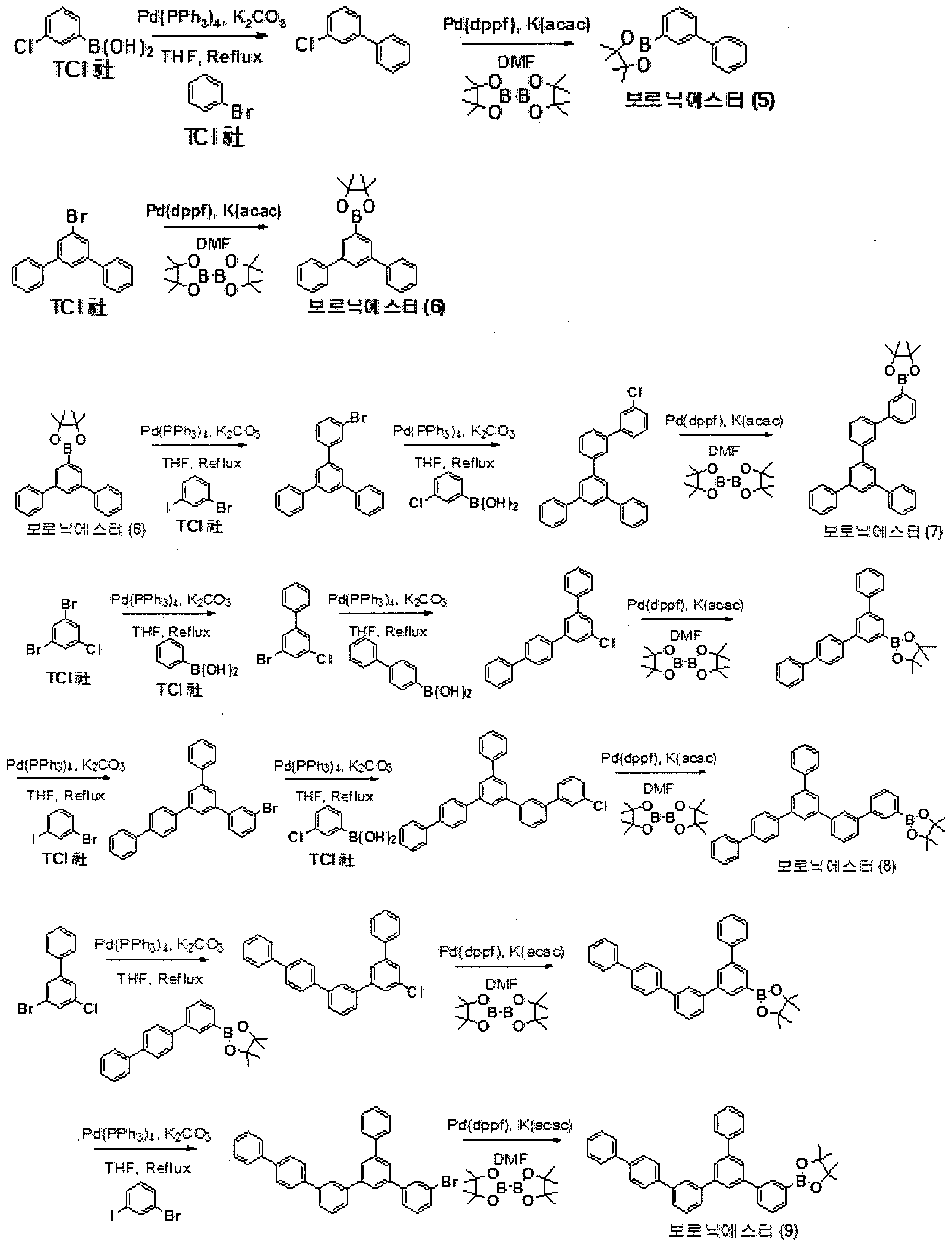


중간체 A(D (벤조 -1H-티에노 「3,2-(11피리미딘 -2,4-디온)의 합성 Synthesis of Intermediate A (D (benzo-1H-thieno``3,2- (11pyrimidine-2,4-dione)
2000 mL 둥근 플라스크에 벤조 -메틸 3-아미노 -2-티오펜카르복실레이트 (47.5g: 0.23mol) 및 우레아 (79.4g, 1.15mol)의 흔합물을 200°C에서 2 시간 동안 교반하였다. 고온의 반응 흔합물을 상온으로 식힌 후, 수산화나트륨 용액에 붓고, 불순물올 여과하여 제거한 다음, 반웅물을 산성화하여 (HC1, 2N), 수득한 침전물을 건조시켜 중간체 A(l)을 수득하였다 (35g, 75%). In a 2000 mL round flask a mixture of benzo-methyl 3-amino-2-thiophencarboxylate (47.5 g : 0.23 mol) and urea (79.4 g, 1.15 mol) was stirred at 200 ° C for 2 hours. The reaction mixture of high temperature was cooled to room temperature, poured into a sodium hydroxide solution, filtered off impurities, and then the reaction product was acidified (HC1, 2N), and the precipitate obtained was dried to give intermediate A (l). 35 g, 75%).
calcd. Ci0H6N2O2S: C, 55.04; H, 2.77; N, 12.84; 0, 14.66; S, 14.69; found: C, 55.01 ; H, 2.79; N, 12.81 ; O, 14.69; S, 14.70 . calcd. Ci 0 H 6 N 2 0 2 S: C, 55.04; H, 2.77; N, 12.84; 0, 14.66; S, 14.69; found: C, 55.01; H, 2.79; N, 12.81; 0, 14.69; S, 14.70.
중간체 A (벤조 -2,4-디클로로-티에노 n,2-dl피리미딘)의 합성 Synthesis of Intermediate A (benzo-2,4-dichloro-thieno n, 2-dlpyrimidine)
1000 mL 등근 플라스크에 중간체 A(l)(벤조 -1H-티에노 [3,2-d]피리미딘 -2,4-디온) Intermediate A (l) (benzo-1H-thieno [3,2-d] pyrimidine-2,4-dione) in a 1000 mL backbone flask
(35 g, 0.16mol) 및 옥시염화인 (600mL)의 흔합물을 환류하에 6시간 동안 교반하였다. 반웅 흔합물을 상온으로 넁각시키고, 세게 교반하면서 얼음 /물에 부어, 침전물을 생성하였다. 이로부터 수득한 반응물을 여과하여, 중간체 (35 g, 0.16 mol) and a mixture of phosphorus oxychloride (600 mL) were stirred under reflux for 6 hours. The reaction mixture was cooled to room temperature and poured into ice / water with vigorous stirring to form a precipitate. The reaction product obtained therefrom was filtered, and the intermediate
A (벤조 -2,4-디클로로-티에노 [3,2-d]피리미딘) (35g, 85 %, 백색 고체)를 수득하였다. 생성된 중간체 A의 원소 분석 결과 및 NMR 분석 결과는 하기와 같다. calcd. Ci0H4Cl2N2S: C, 47.08; H, 1.58; C1, 27.79; N, 10.98; S, 12.57; found: C, 47.03; 1.61 ; CI, 27.81 ; N, 10.98; S, 12.60 A (benzo-2,4-dichloro-thieno [3,2-d] pyrimidine) (35 g, 85%, white solid) was obtained. Elemental analysis results and NMR analysis results of the produced intermediate A are as follows. calcd. Ci 0 H 4 Cl 2 N 2 S: C, 47.08; H, 1.58; C1, 27.79; N, 10.98; S, 12.57; found: C, 47.03; 1.61; CI, 27.81; N, 10.98; S, 12.60
300 MHz (CDC13, ppm): 7.63 (t, 1H), 7.76 (t, 4H), 7.95 (d, 1H), 8.53 (d, 1H) 300 MHz (CDC1 3 , ppm): 7.63 (t, 1H), 7.76 (t, 4H), 7.95 (d, 1H), 8.53 (d, 1H)
중간체 A-29의 합성 Synthesis of Intermediate A-29
1000 mL 플라스크에 중간체 A 20.0 g (78.4 mmol), 페닐보론산 (구입처: Beijing pure chem社) 1 1.0 g (90.15 mmol), 탄산칼륨 27.09 g (195.99 mmol) Pd(PPh3)4(Tetrakis- (triphenylphosphine) palladium(O)) 4.53 g (3.9 mmol)을 1,4-다이옥산 300 mL, 물 150 mL 에 넣어준 후, 질소 기류 하에서 12시간 동안 60 °C로 가열하였다. 이로부터 수득한 흔합물을 메탄올 1000 mL에 가하여 결정화된 고형분을 여과한 후, 모노클로로벤젠에 녹여 실리카겔 /셀라이트로 여과하고, 유기 용매를 적당량 제거한 후, 메탄을로 재결정하여 중간체 A-29 (13.9 g, 60%의 수율)를 수득하였다. In a 1000 mL flask, 20.0 g (78.4 mmol) of intermediate A, 1 1.0 g (90.15 mmol) of phenylboronic acid (from Beijing pure chem), 27.09 g (195.99 mmol) of potassium carbonate Pd (PPh 3 ) 4 (Tetrakis- ( 4.53 g (3.9 mmol) of triphenylphosphine) palladium (O)) was added to 300 mL of 1,4-dioxane and 150 mL of water, and then heated to 60 ° C. for 12 hours under a stream of nitrogen. The obtained mixture was added to 1000 mL of methanol, and the crystallized solid was filtered. Then, the mixture was dissolved in monochlorobenzene and filtered through silica gel / celite, and an appropriate amount of the organic solvent was removed, followed by recrystallization with methane, to obtain Intermediate A-29 ( 13.9 g, 60% yield).
calcd. Ci6H9ClN2S: C, 64.75; H, 3.06; CI, 1 1.95; N, 9.44; S, 10.80; found: C, 63.17; H, 3.08; CI, 12.13; N, 9.37; S, 10.82 calcd. Ci 6 H 9 ClN 2 S: C, 64.75; H, 3.06; CI, 1 1.95; N, 9.44; S, 10.80; found: C, 63.17; H, 3.08; CI, 12.13; N, 9.37; S, 10.82
화합물 29의 합성 Synthesis of Compound 29
500 mL 등근 플라스크에 중간체 A-29 13.9 g (46.8 mmol), 보로닉에스터 13.9 g (46.8 mmol) of Intermediate A-29 in a 500 mL isometric flask, boronic ester
(1) (트리페닐렌-페닐-보로닉에스터, 합성방법: KR 10-2014-0135524A 공개공보의 36면) 23.2 g (53.86 mmol), 탄산칼륨 16.2 g (1 17.1 mmol), Pd(PPh3)4 (Tetrakis- (triphenylphosphine) palladium(O)) 2.7 g (2.3 mmol)을 1 ,4-다이옥산 150 mL, 물 75 mL 에 넣어준 후, 질소 기류 하에서 6시간 동안 가열하여 환류하였다. 이로부터 수득한 흔합물을 메탄올 500 mL에 가하여 결정화된 고형분을 여과한 후, 모노클로로벤젠에 녹여 실리카겔 /셀라이트로 여과하고, 유기 용매를 적당량 제거한 후, 메탄올로 재결정하여 화합물 29 (16.7 g, 64%의 수율)을 수득하였다. 생성된 화합물 29의 원소 분석 결과 및 NMR 분석 결과는 하기와 같다. (1) (Triphenylene-phenyl-boronic ester, Synthesis Method: 23.2 g (53.86 mmol) of potassium 10-2014-0135524A publication, 16.2 g (1 17.1 mmol) of potassium carbonate, Pd (PPh 3 2.7 g (2.3 mmol) of 4 (Tetrakis- (triphenylphosphine) palladium (O)) was added to 150 mL of 1,4-dioxane and 75 mL of water, and the mixture was heated to reflux for 6 hours under a nitrogen stream. The mixture obtained therefrom was added to 500 mL of methanol, and the crystallized solid was filtered, dissolved in monochlorobenzene, filtered through silica gel / celite, and an appropriate amount of an organic solvent was removed, followed by recrystallization with methanol to obtain Compound 29 (16.7 g, 64% yield). Elemental analysis and NMR analysis of the resulting compound 29 are as follows.
calcd. C40H24N2S: C, 85.08; H, 4.28; N, 4.96; S, 5.68; found: C, 84.95; H, 4.18; N, 5.17;calcd. C 40 H 24 N 2 S: C, 85.08; H, 4. 28; N, 4.96; S, 5.68; found: C, 84.95; H, 4.18; N, 5.17;
S, 5.72 S, 5.72
300 MHz (CDC13, ppm): 7.61-7.73 (m, 10H), 8.07 (t, 2H), 8.16 (d, 1H), 8.28 (d, 1H), 8.65 (t, 1H), 8.74 (s, 3H), 8.85-8.92 (m, 2H), 9.04 (s, 2H) 합성예 2 : 화합물 30의 합성 ¾300 MHz (CDC1 3 , ppm): 7.61-7.73 (m, 10H), 8.07 (t, 2H), 8.16 (d, 1H), 8.28 (d, 1H), 8.65 (t, 1H), 8.74 (s, 3H), 8.85-8.92 (m, 2H), 9.04 (s, 2H) Synthesis Example 2 Synthesis of Compound 30 ¾

250 mL 등근 플라스크에 중간체 A-29 10.0 g (33.7 mmol), 10.0 g (33.7 mmol) of Intermediate A-29 in a 250 mL equilateral flask,
보로닉에스터 (2)(트리페닐렌 -바이페닐-보로닉에스터 , 합성방법: KR 10-2014-0135524A 공개공보의 37면) 19.6 g (38.8 mmol), 탄산칼륨 1 1.6 g (84.2 mmol), Pd(PPh3)4 (Tetrakis- (triphenylphosphine) palladium(O)) 1.9 g (1.68 mmol)을 1,4-다이옥산 100 mL, 물 50 mL에 넣어준 후, 질소 기류 하에서 6시간 동안 가열하여 환류하였다. 이로부터 수득한 흔합물을 메탄올 300 mL에 가하여 결정화된 고형분을 여과한 후, 모노클로로벤젠에 녹여 실리카겔 /셀라이트로 여과하고, 유기 용매를 적당량 제거한 후, 메탄을로 재결정하여 화합물 30 (14.0 g, 65%의 수율)을 수득하였다. 생성된 화합물 30의 원소 분석 결과 및 NMR 분석 결과는 하기와 같다. Boronic ester (2) (triphenylene-biphenyl- boronic ester, synthesis method: 37 pages of KR 10-2014-0135524A publication) 19.6 g (38.8 mmol), potassium carbonate 1 1.6 g (84.2 mmol), 1.9 g (1.68 mmol) of Pd (PPh 3 ) 4 (Tetrakis- (triphenylphosphine) palladium (O)) were added to 100 mL of 1,4-dioxane and 50 mL of water, and then heated to reflux for 6 hours under a nitrogen stream. . The resulting mixture was added to 300 mL of methanol, and the crystallized solid was filtered. Then, the mixture was dissolved in monochlorobenzene and filtered through silica gel / celite, and an appropriate amount of an organic solvent was removed, followed by recrystallization with methane, to obtain Compound 30 (14.0 g). , 65% yield). Elemental analysis and NMR analysis of the produced compound 30 are as follows.
calcd. C46H28N2S: C, 86.22; H, 4.40; N, 4.37; S, 5.00; found: C, 85.95; H, 4.58; N, 4.17;calcd. C 46 H 28 N 2 S: C, 86.22; H, 4.40; N, 4.37; S, 5.00; found: C, 85.95; H, 4.58; N, 4.17;
S, 5.02 S, 5.02
300 MHz (CDC13, ppm): 7.63-7.91 (m, 12H), 8.05 (d, IH), 8.10 (d, IH), 8.18 (d, IH), 8.27 (d, IH), 8.33 (s, IH), 8.39 (dd, 2H), 8.77 (t, 2H), 8.81-8.92 (m, 3H), 8.95 (d, IH), 9.08-9.12 (m, 2H), 9.20 (s, IH) 300 MHz (CDC1 3 , ppm): 7.63-7.91 (m, 12H), 8.05 (d, IH), 8.10 (d, IH), 8.18 (d, IH), 8.27 (d, IH), 8.33 (s, IH), 8.39 (dd, 2H), 8.77 (t, 2H), 8.81-8.92 (m, 3H), 8.95 (d, IH), 9.08-9.12 (m, 2H), 9.20 (s, IH)

중간체 A-27의 합성 페닐보론산 대신 보로닉에스터 (2)(트리페닐렌-바이페닐-보로닉에스터)를 사용한 점을 제외하고는, 상기 합성예 1의 중간체 A-29의 합성 방법과 동일한 방법을 이용하여, 중간체 A-27 (25.34 g, 68%의 수율) 을 합성하였다. Synthesis of Intermediate A-27 Intermediate was obtained in the same manner as in the synthesis of Intermediate A-29 of Synthesis Example 1, except that boronic ester (2) (triphenylene-biphenyl-boronic ester) was used instead of phenylboronic acid. A-27 (25.34 g, 68% yield) was synthesized.
calcd. C40H23C1N2S: C, 80. 19; H, 3.87; C1, 5.92; N, 4.68; S, 5.35; found: C, 78.57; H; 3.39; CI, 5.68; N, 4.32; S, 5.15 calcd. C 40 H 23 C 1 N 2 S: C, 80. 19; H, 3.87; C1, 5.92; N, 4.68; S, 5.35; found: C, 78.57; H ; 3.39; CI, 5.68; N, 4. 32; S, 5.15
화합물 27의 합성 Synthesis of Compound 27
중간체 A-29 및 트리페닐렌-페닐-보로닉에스터 대신 증간체 A-27 및 페닐보론산을 각각 사용하였다는 점을 제외하고는, 상기 합성예 1의 화합물 29의 합성 방법과 동일한 방법을 이용하여, 화합물 27 (15.37 g, 56%의 수율) 을 The same method as the synthesis method of Compound 29 of Synthesis Example 1 was used except that Intermediate A-27 and Phenylboronic acid were used instead of Intermediate A-29 and Triphenylene-phenyl-boronic ester, respectively. Compound 27 (15.37 g, 56% yield) was obtained.
합성하였다. Synthesized.
calcd. C46H28N2S: C, 86.22; H, 4.40; N, 4.37; S, 5.00; found: C, 85.18; H, 4.28; N, 4.14; S, 4.83 calcd. C 46 H 28 N 2 S: C, 86.22; H, 4.40; N, 4.37; S, 5.00; found: C, 85.18; H, 4. 28; N, 4.14; S, 4.83
300 MHz (CDC13, ppm): 7.41 -7.57 (m, 10H), 7.70-7.88 (m, 7H), 7.98-8.18 (m, 6H), 8.28 (d, 2H), 8.93 (d, 2H), 9.15 (s, 1H) ad-1: 화합 300 MHz (CDC1 3 , ppm): 7.41 -7.57 (m, 10H), 7.70-7.88 (m, 7H), 7.98-8.18 (m, 6H), 8.28 (d, 2H), 8.93 (d, 2H), 9.15 (s, 1H) ad-1 : Unity

화합물 a-30의 합성 Synthesis of Compound a-30
100 mL등근 플라스크에 중간체 A 3.0 g (11.8 mmol), 보로닉에스터 (3) 8.8 g 3.0 g (11.8 mmol) of Intermediate A, 8.8 g of Boronic Ester (3), in a 100 mL back flask.
(24.7 mmol), 탄산칼륨 4.1 g (29.4 mmol), 테트라키스 (트리페닐포스핀) 팔라듐 (0) 0.6 g (0.6 mmol)을 1 ,4-다이옥산 40 mL, 물 20 mL 에 넣어준 후, 질소 기류 하에서 6시간 동안 가열하여 환류하였다. 이로부터 수득한 흔합물을 메탄올 150 mL에 가하여 결정화된 고형분을 여과한 후, 모노클로로벤젠에 녹여 실리카겔 /셀라이트로 여과하고, 유기 용매를 적당량 제거한 후, 메탄을로 재결정하여 화합물 a-30 (5.7 g, 75%의 수율)을 수득하였다. 생성된 화합물 a-30의 원소 분석 결과는 하기와 같다. calcd. C46H30N2S: C, 85.95; H, 4.70; N, 4.36; S, 4.99; found: C, 85.91 ; H, 4.69; N, 4.31 ; S, 4.94 (24.7 mmol), potassium carbonate 4.1 g (29.4 mmol), tetrakis (triphenylphosphine) palladium (0) 0.6 g (0.6 mmol) were added to 40 mL of 1,4-dioxane and 20 mL of water, followed by nitrogen. It was heated to reflux for 6 hours under air flow. The mixture obtained therefrom was added to 150 mL of methanol, and the crystallized solid was filtered, dissolved in monochlorobenzene, filtered through silica gel / celite, and an appropriate amount of an organic solvent was removed, followed by recrystallization with methane to give a compound (a-30). 5.7 g, 75% yield). Elemental analysis of the resulting compound a- 30 is as follows. calcd. C46H30N2S: C, 85.95; H, 4. 70; N, 4.36; S, 4.99; found: C, 85.91; H, 4.69; N, 4.31; S, 4.94

화합물 a-40의 합성 Synthesis of Compound a-40
중간체 A-29 및 보로닉에스터 (4)를 각각 사용하였다는 점을 제외하고는, 상기 합성예 1의 화합물 29의 합성 방법과 동일한 방법을 이용하여, 화합물 a-40 (11.4 g, 74%의 수율)를 합성하였다. 생성된 화합물 a-40의 원소 분석 결과 는 하기와 같다ᅳ calcd. C40H26N2S: C, 84.77; H, 4.62; N, 4.94; S, 5.66; found: C, 84.71; H, 4.59; N, 4.92; S, 5.60 -3 : 화합물 a-41의 합성 Using the same method as the synthesis of Compound 29 of Synthesis Example 1, except that Intermediate A-29 and Boronic ester (4) were used, Compound a-40 (11.4 g, 74%) Yield). Elemental analysis of the resulting compound a-40 was as follows. Calcd. C40H26N2S: C, 84.77; H, 4. 62; N, 4.94; S, 5.66; found: C, 84.71; H, 4.59; N, 4.92; S, 5.60 -3: Synthesis of Compound a-41

중간체 A-a-41 화합물 a-41 Intermediate A-a-41 Compound a-41
중간체 A-a-41의 합성 Synthesis of Intermediate A-a-41
500 mL플라스크에 중간체 A 10.0 g (39.2 mmol), 보로닉에스터 (5) 12.1 g (43.1 1), 탄산칼륨 13.5 g (98.0 mmol) 테트라키스 (트리페닐포스핀) 팔라듐 (0) 2.3 g (43.1 mmol)을 1 ,4-다이옥산 140 mL, 물 70 mL 에 넣어준 후, 질소 기류 하에서 12시간 동안 60 °C로 가열하였다. 이로부터 수득한 흔합물을 메탄올 500 mL에 가하여 결정화된 고형분을 여과한 후, 모노클로로벤젠에 녹여 실리카겔 /셀라이트로 In a 500 mL flask, 10.0 g (39.2 mmol) of intermediate A, 12.1 g (43.1 1) of boronic ester (5), 13.5 g (98.0 mmol) of potassium carbonate tetrakis (triphenylphosphine) palladium (0) 2.3 g (43.1) mmol) was added to 140 mL of 1,4-dioxane and 70 mL of water, and then heated to 60 ° C. for 12 hours under a stream of nitrogen. The resulting mixture was added to 500 mL of methanol, and the crystallized solid was filtered. Then, the resultant mixture was dissolved in monochlorobenzene and dissolved in silica gel / celite.
여과하고, 유기 용매를 적당량 제거한 후, 메탄올로 재결정하여 중간체 A-a-41 (10.1 & 69%의 수율)를 수득하였다. After filtration and removal of the appropriate amount of organic solvent, recrystallization with methanol gave intermediate Aa-41 (10.1 & 69% yield).
calcd. C22H13C1N2S: C, 70.87; H, 3.51 ; C1, 9.51 ; N, 7.51 ; S, 8.60; found: C, 70.80; H, 3.50; C1, 9.47; N, 7.49; S, 8.60 calcd. C22H13C1N2S: C, 70.87; H, 3.5 1; C1, 9.51; N, 7.51; S, 8.60; found : C, 70.80; H, 3.50; C1, 9.47; N, 7.49; S, 8.60
화합물 a-41의 합성 Synthesis of Compound a-41
500 mL둥근 플라스크에 중간체 A-a-41 5.0 g (13.4 mmol), 보로닉 에스터 (4) 6.4 g (14.8 mmol), 탄산칼륨 4.6 g (33.5 mmol), 테트라키스 (트리페닐포스핀) 팔라듐 (0) 0.8 g (0.7 mmol)을 1,4-다이옥산 50 mL, 물 25 mL 에 넣어준 후, 질소 기류 하에서 8시간 동안 가열하여 환류하였다. 이로부터 수득한 흔합물을 메탄올 150 mL에 가하여 결정화된 고형분을 여과한 후, 모노클로로벤젠에 녹여 실리카겔 /셀라이트로 In a 500 mL round flask, 5.0 g (13.4 mmol) of intermediate Aa-41, 6.4 g (14.8 mmol) of boronic ester ( 4 ), 4.6 g (33.5 mmol) of potassium carbonate, tetrakis (triphenylphosphine) palladium (0) 0.8 g (0.7 mmol) was added to 50 mL of 1,4-dioxane and 25 mL of water, and then heated to reflux for 8 hours under a stream of nitrogen. The mixture obtained therefrom was added to 150 mL of methanol, and the crystallized solid was filtered. Then, the mixture was dissolved in monochlorobenzene to give silica gel / celite.
여과하고, 유기 용매를 적당량 제거한 후, 메탄올로 재결정하여 화합물 a-41 (6.2 g, 72%의 수율)을 수득하였다. 생성된 화합물 a-41의 원소 분석 결과는 하기와 같다. calcd. C46H30N2S: C, 85.95; H, 4.70; N, 4.36; S, 4.99; found: C, 85.90; H, 4.68; N, 4.31; S, 4.93 합성예 ad-4: 화합물 a-42의 합성 After filtration, the appropriate amount of organic solvent was removed and then recrystallized with methanol to give compound a-41 (6.2 g, 72% yield). Elemental analysis of the resulting compound a-41 is as follows. calcd. C46H30N2S: C, 85.95; H, 4. 70; N, 4.36; S, 4.99; found: C, 85.90; H, 4.68; N, 4.31; S, 4.93. Synthesis Example ad-4 Synthesis of Compound a-42

중간체 A-a-42 화합물 a-42 Intermediate A-a-42 Compound a-42
중간체 A-a-42의 합성 Synthesis of Intermediate A-a-42
페닐보론산 대신 중간체 바이페닐보론산 (구입처: Beijing pure chem社)을 사용한다는 점을 제외하고는, 상기 합성예 1의 중간체 A-29의 합성 방법과 동일한 방법을 이용하여, 중간체 A-a-42 (7.3 g, 68%의 수율) 을 합성하였다. The same method as the synthesis method of Intermediate A-29 of Synthesis Example 1, except that intermediate biphenylboronic acid (purchased from Beijing pure chem) was used instead of phenylboronic acid. Using the method, intermediate Aa-42 (7.3 g, 68% yield) was synthesized.
calcd. C22H13C1N2S: C, 70.87; H, 3.51 ; C1, 9.51 ; N, 7.51 ; S, 8.60; found: C, 70.81 ; H; 3.46; C1,. 9.50; N, 7.49; S, 8.60 calcd. C22H13C1N2S: C, 70.87; H, 3.5 1; C1, 9.51; N, 7.51; S, 8.60; found: C, 70.81; H ; 3.46; C1 ,. 9.50; N, 7.49; S, 8.60
화합물 a-42의 합성 Synthesis of Compound a-42
중간체 A-29 및 보로닉에스터 (1) 대신 중간체 A-a-42 및 보로닉에스터 (4)를 각각 사용하였다는 점을 제외하고는, 상기 합성예 1의 화합물 29의 합성 방법과 동일한 방법을 이용하여, 화합물 a-42 (15.37 g, 56%의 수율) 을 합성하였다. 생성된 화합물 a-42의 원소 분석 결과는 하기와 같다. Using the same method as the synthesis method of Compound 29 of Synthesis Example 1, except that Intermediate Aa-42 and Boronic Ester (4) were used instead of Intermediate A-29 and Boronic ester (1), respectively. , Compound a-42 (15.37 g, 56% yield) was synthesized. Elemental analysis of the resulting compound a-42 is as follows.
calcd. C46H30N2S: C, 85.95; H, 4.70; N, 4.36; S, 4.99; found: C, 85.93; H, 4.62; N, 4.33 ; S, 4.98 -5: 화합물 a-46의 합성 calcd. C46H30N2S: C, 85.95; H, 4. 70; N, 4.36; S, 4.99; found: C, 85.93; H, 4. 62; N, 4.33; S, 4.98-5: Synthesis of Compound a-46

중간체 A-a-46 화합물 a-46 Intermediate A-a-46 Compound a-46
중간체 A-a-46의 합성 Synthesis of Intermediate A-a-46
페닐보론산 대신 중간체 보로닉에스터 (6)를 사용한다는 점을 제외하고는, 상기 합성예 1의 중간체 A-29의 합성 방법과 동일한 방법을 이용하여, 중간체 Intermediate was obtained by the same method as the synthesis method of Intermediate A-29 of Synthesis Example 1, except that Intermediate Boronic Ester (6) was used instead of Phenylboronic acid.
A-a-46 (6.1 g, 70%의 수율) 을 합성하였다. A-a-46 (6.1 g, 70% yield) was synthesized.
calcd. C28H17C1N2S: C, 74.91 ; H, 3.82; C1, 7.90; N, 6.24; S, 7.14; found: C, 74.91 ; H 3.76; C1, 7.87; N, 6.21 ; S, 7.11 calcd. C28H17C1N2S: C, 74.91; H, 3. 82; C1, 7.90; N, 6.24; S, 7.14; found: C, 74.91; H 3.76; C1, 7.87; N, 6.21; S, 7.11
화합물 a_46의 합성' Compound 46 Synthesis of a _ '
중간체 A-29 및 중간체 보로닉에스터 (1) 대신 중간체 A-a-46 및 중간체 보로닉 에스터 (4)를 각각 사용하였다는 점을 제외하고는, 상기 합성예 1의 화합물 29의 합성 방법과 동일한 방법을 이용하여, 화합물 a-46 (4.4 g, 64%의 수율)을 합성하였다ᅳ 생성된 화합물 a-46의 원소 분석 결과는 하기와 같다ᅳ The same method as the synthesis method of Compound 29 of Synthesis Example 1 was used except that Intermediate Aa-46 and Intermediate Boronic Ester (4) were used instead of Intermediate A-29 and Intermediate Boronic Ester (1), respectively. Compound a-46 (4.4 g, 64% yield) was synthesized using the result of elemental analysis of the resulting compound a-46.
calcd. C52H34N2S: C, 86.88; H, 4.77; N, 3.90; S, 4.46; found: C, 86.80; H, 4.73; N, .87; S, 4.43 합성예 ad-6: 화합물 a-56의 합성 calcd. C52H34N2S: C, 86.88; H, 4.77; N, 3.90; S, 4.46; found : C, 86.80; H, 4.73; N, .87; S, 4.43. Synthesis Example ad-6 Synthesis of Compound a-56

화합물 a-56의 합성 Synthesis of Compound a-56
중간체 보로닉에스터 (3) 대신 중간체 보로닉에스터 (4)를 사용하였다는 점을 제외하고는, 상기 합성예 ad-1의 화합물 a-30의 합성 방법과 동일한 방법을 이용하여, 화합물 a-56 (8.3 g, 74%의 수율)을 합성하였다. 생성된 화합물 a-56의 원소 분석 결과는 하기와 같다. Compound a-56 was prepared by the same method as the synthesis method of compound a-30 of Synthesis Example ad-1, except that an intermediate boronic ester (4) was used instead of the intermediate boronic ester (3). (8.3 g, 74% yield) were synthesized. Elemental analysis of the resulting compound a-56 is as follows.
calcd. C58H38N2S : C, 87.63; H, 4.82; N, 3.52; S, 4.03; found : C, 87.61 ; H, 4.80; N, 3.52; S, 4.02 합성예 ad-7: 화합물 a-70의 합성 calcd. C 58 H 38 N 2 S: C, 87.63; H, 4. 82; N, 3.52; S, 4.03; found: C, 87.61; H, 4.80; N, 3.52; S, 4.02 Synthesis Example ad-7 Synthesis of Compound a-70

화합물 a-70의 합성 보로닉에스터 (4) 대신 보로닉에스터 (7)를 사용하였다는 점올 제외하고는, 상기 합성예 ad-2의 화합물 a-40의 합성 방법과 동일한 방법을 이용하여, 화합물 a-70 (7.7 g, 70%의 수율) 을 합성하였다. 생성된 화합물 a-70의 원소 분석 결과는 하기와 같다. calcd. C46H30N2S: C, 85.95; H, 4.70; N, 4.36; S, 4.99; found: C, 85.90; H, 4.70; N, 4.32; S, 4.90 합성예 ad-8 : 화합물 a-기의 합성 Synthesis of Compound a-70 Compound a-70 (7.7 g) was used in the same manner as in the synthesis of compound a-40 of Synthesis Example ad-2, except that boronic ester (7) was used instead of boronic ester (4). , 70% yield). Elemental analysis of the resulting compound a-70 is as follows. calcd. C46H30N2S: C, 85.95; H, 4. 70; N, 4.36; S, 4.99; found: C, 85.90; H, 4. 70; N, 4. 32; S, 4.90. Synthesis Example ad-8 Synthesis of Compound a-Group

화합물 a-71 Compound a-71
화합물 a-기의 합성 Synthesis of Compound a-Group
보로닉에스터 (4) 대신 보로닉에스터 (7)를 사용하였다는 점을 제외하고는, 상기 합성예 ad-3의 화합물 a-41의 합성 방법과 동일한 방법을 이용하여, 화합물 a-71 (10.2 g, 78%의 수율) 을 합성하였다. 생성된 화합물 a-기의 원소 분석 결과는 하기와 같다. calcd. C52H34N2S: C, 86.88; H, 4.77; N, 3.90; S, 4.46; found: C, 86.82; H, 4.75; N, 3.87; S, 4.42 합성예 ad-9: 화합물 a-74의 합성 Compound a-71 (10.2) was prepared in the same manner as in the synthesis of compound a-41 of Synthesis Example ad-3, except that boronic ester (7) was used instead of boronic ester (4). g, yield of 78%). Elemental analysis of the resulting compound a-group is as follows. calcd. C52H34N2S: C, 86.88; H, 4.77; N, 3.90; S, 4.46; found : C, 86.82; H, 4.75; N, 3.87; S, 4.42. Synthesis Example ad-9 Synthesis of Compound a-74

중간체 A-a-74의 합성 Synthesis of Intermediate A-a-74
500 mL 플라스크에 증간체 A 10.0 g (39.2 mmol), 보로닉에스터 (7) 21.9 g (43.1 mmol), 탄산칼륨 13.5 g (98.0 mmol) 테트라키스 (트리페닐포스핀) 팔라듐 (0) 2.3 g (2.0 mmol)을 1 ,4-다이옥산 140 mL, 물 70 mL 에 넣어준 후, 질소 기류 하에서 16시간 동안 60 °C로 가열하였다. 이로부터 수득한 흔합물을 메탄올 300 mL에 가하여 결정화된 고형분을 여과한 후, 모노클로로밴젠에 녹여 실리카겔 /셀라이트로 In a 500 mL flask, 10.0 g (39.2 mmol) of Intermediate A, 21.9 g (43.1 mmol) of boronic ester (7), 13.5 g (98.0 mmol) of potassium carbonate tetrakis (triphenylphosphine) palladium (0) 2.3 g ( 2.0 mmol) was added to 140 mL of 1,4-dioxane and 70 mL of water, and then heated to 60 ° C. for 16 hours under a stream of nitrogen. The mixture obtained therefrom was added to 300 mL of methanol, and the crystallized solid was filtered. Then, the mixture was dissolved in monochlorovanzene and purified by silica gel / celite.
여과하고, 유기 용매를 적당량 제거한 후, 메탄올로 재결정하여 중간체 A-a-74 (16.5 g, 70%의 수율)를 수득하였다. After filtration, an appropriate amount of organic solvent was removed and then recrystallized with methanol to give intermediate A-a-74 (16.5 g, 70% yield).
calcd. C40H25C1N2S: C, 79.92; H, 4.19; C1, 5.90; N, 4.66; S, 5.33; found: C, 79.90; H, calcd. C40H25C1N2S: C, 79.92; H, 4. 19; C1, 5.90; N, 4.66; S, 5.33; found : C, 79.90; H,
4.19; C1, 5.89; N, 4.65; S, 5.31 4.19; C1, 5.89; N, 4.65; S, 5.31
화합물 a-74의 합성 Synthesis of Compound a-74
500 mL등근 플라스크에 중간체 A-a-74 10.0 g (16.6 mmol), 페닐보론산 2.2 g (18.3 mmol), 탄산칼륨 5.8 g (41.6 mmol), 테트라키스 (트리페닐포스핀) 팔라듐 (0) 1.0 g (0.8 mmol)을 1,4-다이옥산 50 mL, 물 25 mL 에 넣어준 후, 질소 기류 하에서 8시간 동안 가열하여 환류하였다. 이로부터 수득한 혼합물을 메탄올 150 mL에 가하여 결정화된 고형분을 여과한 후, 모노클로로벤젠에 녹여 실리카겔 /셀라이트로 10.0 g (16.6 mmol) of Intermediate Aa-74, 2.2 g (18.3 mmol) of phenylboronic acid, 5.8 g (41.6 mmol) of potassium carbonate, 1.0 g of tetrakis (triphenylphosphine) palladium (0) 0.8 mmol) was added to 50 mL of 1,4-dioxane and 25 mL of water, and the mixture was heated to reflux for 8 hours under a stream of nitrogen. The resulting mixture was added to 150 mL of methanol, and the crystallized solid was filtered and then dissolved in monochlorobenzene to give silica gel / celite.
여과하고, 유기 용매를 적당량 제거한 후, 메탄올로 재결정하여 화합물 a-74 (6.8 g, 64%의 수율)을 수득하였다. 생성된 화합물 a-74의 원소 분석 결과는 하기와 같다. calcd. C46H30N2S: C, 85.95; H, 4.70; N, 4.36; S, 4.99; found: C, 85.91 ; H, 4.69; N,After filtration, the appropriate amount of organic solvent was removed and then recrystallized with methanol to give compound a-74 (6.8 g, 64% yield). Elemental analysis of the resulting compound a-74 is as follows. calcd. C46H30N2S: C, 85.95; H, 4. 70; N, 4.36; S, 4.99; found: C, 85.91; H, 4.69; N,
4.33; S, 4.94 합성예 ad-10: 화합물 a-75의 합성 4.33; S, 4.94 Synthesis Example ad-10 Synthesis of Compound a-75
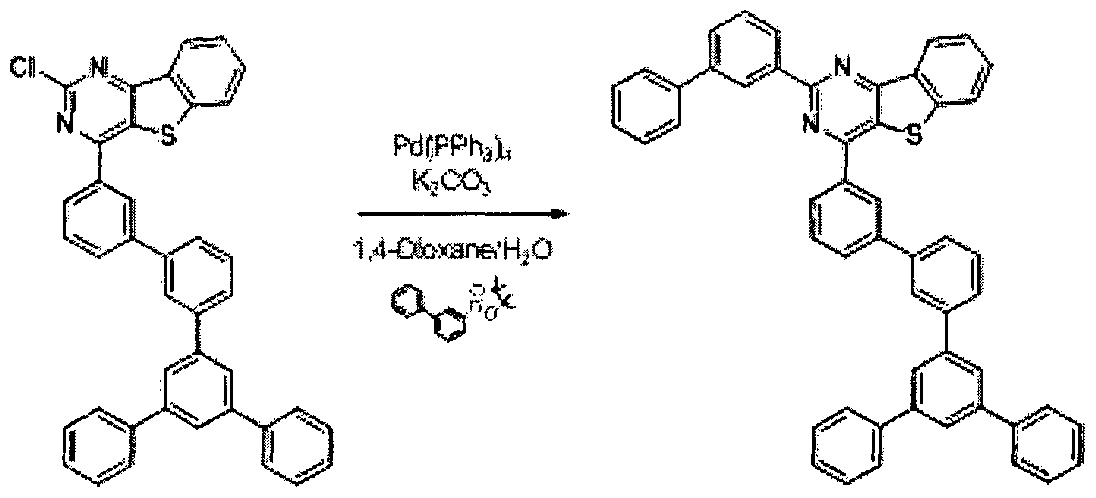
중간체 A-a-74 화합물 a-75 Intermediate A-a-74 Compound a-75
화합물 a-75의 합성 Synthesis of Compound a-75
페닐보론산 대신 중간체 보로닉에스터 (5)를 사용하였다는 점을 제외하고는 상기 합성예 ad-9의 화합물 a-74의 합성 방법과 동일한 방법을 이용하여, 화합물 a-75 (6.2 g, 73%의 수율) 올 합성하였다. 생성된 화합물 a-75의 원소 분석 결과는 하기와 같다. Compound a-75 (6.2 g, 73) was prepared in the same manner as the synthesis of Compound a-74 of Synthesis Example ad-9 except for using the intermediate boronic ester (5) instead of phenylboronic acid. Yield of%) was synthesized. Elemental analysis of the resulting compound a-75 is as follows.
calcd. C52H34N2S: C, 86.88; H, 4.77; N, 3.90; S, 4.46; found: C, 86.88; H, 4.73; N; 3.85; S, 4.45 합성예 ad-11: 화합물 a-82의 합성 calcd. C52H34N2S: C, 86.88; H, 4.77; N, 3.90; S, 4.46; found : C, 86.88; H, 4.73; N ; 3.85; S, 4.45. Synthesis Example ad-11 Synthesis of Compound a-82

화합물 a-82 Compound a-82
중간체 보로닉에스터 (7) 대신 보로닉에스터 (8)를 사용하였다는 점을 Note that the boronic ester (8) was used instead of the intermediate boronic ester (7).
제외하고는, 상기 합성예 ad-7의 화합물 a-70의 합성 방법과 동일한 방법을 이용하여, 화합물 a-82 (6.7 g, 67%의 수율) 을 합성하였다. 생성된 화합물 a-82의 원소 분석 결과는 하기와 같다. Except for the synthesis of the compound a-70 of Synthesis Example ad-7, except that the compound a-82 (6.7 g, 67% yield) was synthesized. Elemental analysis of the resulting compound a-82 is as follows.
calcd. C52H34N2S: C, 86.88; H, 4.77; N, 3.90; S, 4.46; found: C, 86.85; H, 4.76; N, S, 4.46 합성예 ad-12: 화합물 a-84의 합성 calcd. C52H34N2S: C, 86.88; H, 4.77; N, 3.90; S, 4.46; found : C, 86.85; H, 4.76; N, S, 4.46. Synthesis Example ad-12 Synthesis of Compound a-84

화합물 a-84 Compound a-84
중간체 보로닉에스터 (7) 대신 중간체 보로닉에스터 (9)를 사용하였다는 점을 제외하고는, 상기 합성예 ad-7의 화합물 a-70의 합성 방법과 동일한 방법을 이용하여 화합물 a-84 (9.3 g, 76%의 수율) 을 합성하였다. 생성된 화합물 a-84의 원소 분석 결과는 하기와 같다. Except for using the intermediate boronic ester (9) instead of the intermediate boronic ester (7), using the same method as the synthesis method for the compound a-70 of Synthesis Example ad-7 9.3 g, 76% yield). Elemental analysis of the resulting compound a-84 is as follows.
calcd. C52H34N2S: C, 86.88; H, 4.77; N, 3.90; S, 4.46; found: C, 86.84; H, 4.77; N, 3.89; S, 4.45 합성예 ad-13: 화합물 a-114의 합성 calcd. C52H34N2S: C, 86.88; H, 4.77; N, 3.90; S, 4.46; found : C, 86.84; H, 4.77; N, 3.89; S, 4.45. Synthesis Example ad-13: Synthesis of Compound a-114

간' «I Α-29· 보로닉에스터 (10) Liver '«I A-29 · Voronic Ester (10)
화합물 a-114 Compound a-114
중간체 보로닉에스터 (7) 대신 중간체 보로닉에스터 (10)을 사용하였다는 점을 제외하고는, 상기 합성예 ad-7의 화합물 a-70의 합성 방법과 동일한 방법을 이용하여, 화합물 a-114 (10.9 g, 75%의 수율) 을 합성하였다. 생성된 화합물 a-114의 원소 분석 결과는 하기와 같다. Compound a-114 was obtained by the same method as the synthesis method of compound a-70 of Synthesis Example ad-7, except that an intermediate boronic ester (10) was used instead of the intermediate boronic ester (7). (10.9 g, 75% yield) were synthesized. Elemental analysis of the resulting compound a-114 is as follows.
calcd. C46H30N2S: C, 85.95; H, 4.70; N, 4.36; S, 4.99; found: C, 85.94; H, 4.68; N, 4.30; S, 4.87 합성예 ad-14: 화합물 a-108의 합성 calcd. C46H30N2S: C, 85.95; H, 4. 70; N, 4.36; S, 4.99; found: C, 85.94; H, 4.68; N, 4.30; S, 4.87. Synthesis Example ad-14 Synthesis of Compound a-108

화합물 a-108 Compound a-108
중간체 보로닉에스터 (7) 대신 중간체 보로닉에스터 (11)를 사용하였다는 점을 제외하고는, 상기 합성예 ad-7의 화합물 a-70의 합성 방법과 동일한 방법을 이용하여, 화합물 a-108 (8.4 g, 70%의 수율) 을 합성하였다. 생성된 화합물 a-108의 원소 분석 결과는 하기와 같다. Compound a-108 was prepared by the same method as the synthesis method of compound a-70 of Synthesis Example ad-7, except that an intermediate boronic ester (11) was used instead of the intermediate boronic ester (7). (8.4 g, 70% yield) was synthesized. Elemental analysis of the resulting compound a-108 is as follows.
calcd. C44H26N2S: C, 85.96; H, 4.26; N, 4.56; S, 5.22; found: C, 85.94; H, 4.21 ; N, 4.50; S, 5.22 합성예 ad-15: 화합물 a-110의 합성 calcd. C44H26N2S: C, 85.96; H, 4. 26; N, 4.56; S, 5.22; found: C, 85.94; H, 4. 21; N, 4.50; S, 5.22. Synthesis Example ad-15 Synthesis of Compound a-110

화합물 a-110 중간체 보로닉에스터 (7) 대신 중간체 보로닉에스터 (12)을 사용하였다는 점올 제외하고는, 상기 합성예 ad-7의 화합물 a-70의 합성 방법과 동일한 방법을 이용하여, 화합물 a-1 10 (6.7 g, 65%의 수율) 을 합성하였다. 생성된 화합물 a-110의 원소 분석 결과는 하기와 같다. Using the same method as the synthesis method for compound a-70 of Synthesis Example ad-7, except that an intermediate boronic ester (12) was used instead of the compound a-110 intermediate boronic ester (7) a-1 10 (6.7 g, 65% yield) was synthesized. Elemental analysis of the resulting compound a-110 is as follows.
calcd. C42H26N2S: C, 85.39; H, 4.44; N, 4.74; S, 5.43; found: C, 85.30; H, 4.44; N, 4.73; S, 5.42 합성예 ad-16: 화합물 a-112의 합성

화합물 a-112 중간체 보로닉에스터 (7) 대신 중간체 보로닉에스터 (13)을 사용하였다는 점을 제외하고는, 상기 합성예 ad-7의 화합물 a-70의 합성 방법과 동일한 방법을 이용하여 화합물 a-112 (7.9 g, 67%의 수율) 을 합성하였다. 생성된 화합물 a-112의 원소 분석 결과는 하기와 같다. Compound a-112 was used in the same manner as in the synthesis of Compound a-70 of Synthesis Example ad-7, except that Intermediate Boronic Ester (13) was used instead of Intermediate Boronic Ester (7). a-112 (7.9 g, 67% yield) was synthesized. Elemental analysis of the resulting compound a-112 is as follows.
calcd. C48H30N2S: C, 86.46; H, 4.53; N, 4.20; S, 4.81 ; found: C, 86.45; H, 4.52; N, 4.18; S, 4.80 합성예 ad-17: 화합물 a-116의 합 calcd. C48H30N2S: C, 86.46; H, 4.53; N, 4.20; S, 4.81; found : C, 86.45; H, 4.52; N, 4.18; S, 4.80. Synthesis Example ad-17: Sum of Compound a-116

100 mL등근 플라스크에 중간체 A-a-116 5.0 g (10.8 mmol), 중간체 AA-a-116 (10.8 mmol), 탄산칼륨 3.7 g (53.8 mmol), 테트라키스 (트리페닐포스핀) 팔라듐 (0) 0.6 g (0.5 mmol)을 1 ,4-다이옥산 40 mL, 물 20 mL에 넣어준 후, 질소기류 하에서 12시간 동안 가열하여 환류하였다. 이로부터 수득한 흔합물을 메탄올 120 mL에 가하여 결정화된 고형분을 여과한 후, 모노클로로벤젠에 녹여 실리카겔 / 셀라이트로 여과하고, 유기 용매를 적당량 제거한 후, 메탄을로 재결정하여 화합물 a-116 (6.1 g, 64%의 수율)를 수득하였다. 5.0 g (10.8 mmol) of intermediate Aa-116, intermediate AA-a-116 (10.8 mmol), potassium carbonate 3.7 g (53.8 mmol), tetrakis (triphenylphosphine) palladium (0) (0.5 mmol) was added to 40 mL of 1,4-dioxane and 20 mL of water, and the mixture was heated to reflux for 12 hours under a nitrogen stream. The resulting mixture was added to 120 mL of methanol, and the crystallized solid was filtered, dissolved in monochlorobenzene, filtered through silica gel / celite, and an appropriate amount of an organic solvent was removed, followed by recrystallization with methane to give a compound a-116 ( 6.1 g, 64% yield).
calcd. C47H30N2S: C, 86.21 ; H, 4.62; N, 4.28; S, 4.90; found: C, 86.21 ; H, 4.60; N, 4.25; S, 4.89 calcd. C47H30N2S: C, 86.21; H, 4. 62; N, 4.28; S, 4.90; found: C, 86.21; H, 4. 60; N, 4.25; S, 4.89
(참고 반웅식: 중간체 A-a-116의 합성 스킴) (Reference reaction form: Synthesis Scheme of Intermediate Aa-116)


중간 ¾ AA-a-t 16 ad-18 : 화합물 b-41의 합성 Intermediate ¾ AA-a-t 16 ad-18: Synthesis of Compound b-41

화합물 b-41 Compound b-41
중간체 Bm (벤조 -메틸 3-우레이도푸란 -2-카르복실레이트)의 합성 Synthesis of Intermediate Bm (benzo-methyl 3-ureidofuran-2-carboxylate)
1000 mL 등근 플라스크에 -78 °C에서 디클로로메탄 (1000ml) 중 벤조 -메틸Benzo-methyl in dichloromethane (1000ml) at -78 ° C in a 1000 mL isometric flask
3-아미노푸란 -2-카르복실레이트 (49.0 g, 0.25mol)의 용액에 클로로술포닐 Chlorosulfonyl in a solution of 3-aminofuran-2-carboxylate (49.0 g, 0.25 mol)
이소시아네이트 (33.4 ml, 0.38mol)를 적가하였다. 반웅물을 실온으로 천천히 Isocyanate (33.4 ml, 0.38 mol) was added dropwise. Slowly return the reaction to room temperature
가온시키고, 2시간 동안 교반하였다. 반웅물을 농축시킨 후, 잔류물에 Cone. HC1 (100 ml)을 첨가하고, 흔합물을 100°C로 1시간 동안 교반하였다. 반웅 흔합물을 실온으로 넁각시키고, 포화 NaHC03 수용액으로 중화시켰다. 생생된 고체를 여과하여, 중간체 B(l)(벤조 -메틸 3-우레이도푸란 -2-카르복실레이트) (52.1 g, 87%)를 베이지색 고체로서 수득하였다. Warm up and stir for 2 hours. After the reaction was concentrated, the residue was left with Cone. HC1 (100 ml) was added and the mixture was stirred at 100 ° C. for 1 h. The reaction mixture was cooled to room temperature and neutralized with saturated aqueous NaHC03 solution. The viable solid was filtered to give intermediate B (l) (benzo-methyl 3-ureidofuran-2-carboxylate) (52.1 g, 87%) as a beige solid.
calcd. Ci ,HioN204: C, 56.41 ; H, 4.30; N, 11.96; 0, 27.33; found: C, 56.45; H, 4.28; N, 11.94; 0, 27.32 중간체 B(2) (벤조 -푸로 Γ3,2-(11피리미딘 -2,4-디올)의 합성 calcd. Ci, Hi0 2 0 4 : C, 56.41; H, 4. 30; N, 11.96; 0, 27.33; found : C, 56.45; H, 4. 28; N, 11.94; 0, 27.32 Synthesis of Intermediate B (2) (benzo-furo Γ3,2- (11pyrimidine-2,4-diol)
2000 mL 등근 플라스크에 중간체 B(l)(벤조 -메틸 Intermediate B (l) (benzo-methyl
3-우레이도푸란 -2-카르복실레이트) (50.0g, 0.21mol)를 메탄올 1000ml에 현탁시키고, 2 M NaOH(300ml)를 적가하였다. 반응 흔합물을 환류하에 3시간 동안 교반하였다. 반웅 흔합물을 실온으로 넁각시키고, Cone. HC1을 이용하여 pH 3까지 산성화시켰다. 흔합물을 농축시킨 후, 메탄올을 잔류물에 서서히 적가하여 고체를 침전시킨다. 3-ureidofuran-2-carboxylate) (50.0 g, 0.21 mol) was suspended in 1000 ml of methanol and 2 M NaOH (300 ml) was added dropwise. The reaction mixture was stirred at reflux for 3 hours. The reaction mixture was allowed to cool to room temperature and Cone. Acidified to pH 3 with HC1. After the mixture is concentrated, methanol is slowly added dropwise to the residue to precipitate a solid.
생성된 고체를 여과 후, 건조하여 중간체 B(2)(벤조 -푸로 [3,2-d]피리미딘 -2,4-디을) (38.0g, 88 %)을 수득하였다. The resulting solid was filtered and then dried to afford intermediate B (2) (benzo-furo [3,2-d] pyrimidine-2,4-di) (38.0 g, 88%).
calcd. Ci0H6N2O3: C, 59.41 ; H, 2.99; N, 13.86; 0, 23.74; found: C, 59.41 ; H, 2.96; N, 13.81 ; 0, 23.75 calcd. Ci 0 H 6 N 2 0 3 : C, 59.41; H, 2.99; N, 13.86; 0, 23.74; found: C, 59.41; H, 2.96; N, 13.81; 0, 23.75
중간체 B (벤조 -2,4-디클로로푸로 ,2-dl피리미딘) Intermediate B (benzo-2,4-dichlorofuro, 2-dlpyrimidine)
1000 mL 등근 플라스크에 중간체 B(2)(벤조 -푸로 [3,2-d]피리미딘 -2,4-디올) (37.2 g, 0.18mol)을 옥시염화인 (500 ml)에 용해시켰다. 흔합물을 -30 °C로 넁각시키고, Ν,Ν-디이소프로필에틸아민 (52 ml, 0.36mol)을 천천히 첨가하였다. 반웅물을 Intermediate B (2) (benzo-furo [3,2-d] pyrimidine-2,4-diol) (37.2 g, 0.18 mol) was dissolved in phosphorus oxychloride (500 ml) in a 1000 mL equilateral flask. The mixture was cooled to -30 ° C and Ν, Ν-diisopropylethylamine (52 ml, 0.36 mol) was added slowly. Reaction
환류하에 36 시간동안 교반한 다음, 실온으로 넁각시켰다. 그 후 반웅물을 It was stirred for 36 hours at reflux and then cooled to room temperature. After that,
얼음 /물에 붓고 에틸 아세테이트로 추출하였다. 유기층을 포화 NaHC03 수용액으로 세척한 후, Na2S04를 이용하여 드라이시킨다. 이로부터 수득한 유기층을 농축시켜, 중간체 B (벤조 -2,4-디클로로푸로 [3,2-d]피리미딘) (20.4g, 46%)을 수득하였다. Poured into ice / water and extracted with ethyl acetate. The organic layer is washed with saturated NaHCO 3 aqueous solution and then dried using Na 2 SO 4 . The organic layer obtained from this was concentrated to give intermediate B (benzo-2,4-dichlorofuro [3,2-d] pyrimidine) (20.4 g, 46%).
생성된 중간체 B의 원소 분석 결과 및 NMR 분석 결과는 하기와 같다. Elemental analysis results and NMR analysis results of the produced intermediate B are as follows.
calcd. Ci0H4Cl2N2O: C, 50.24; H, 1.69; C1, 29.66; N, 1 1.72; 0, 6.69; found: C, 50.18; H: calcd. Ci 0 H 4 Cl 2 N 2 O: C, 50.24; H, 1.69; C1, 29.66; N, 1 1.72; 0, 6.69; found: C, 50.18; H :
1.79; CI, 29.69; N, 1 1.69; O, 6.70; 1.79; CI, 29.69; N, 1 1.69; 0, 6.70;
300 MHz (CDC13, ppm): 7.55 (t, 1H), 7.71-7.82 (m, 2H), 8.25 (d, 1H) 300 MHz (CDC1 3 , ppm): 7.55 (t, 1H), 7.71-7.82 (m, 2H), 8.25 (d, 1H)
중간체 B-37의 합성 Synthesis of Intermediate B-37
2000 mL 플라스크에 중간체 B 4().0 g (16그 3 mmol), 페닐보로닉에시드 22.4 g (184.1 mmol), 탄산칼륨 57.8 g (418.3 mmol), Pd(PPh3)4 (Tetrakis (triphenylphosphine) palladium(O)) 9.7 g (8.4 mmol)을 1,4-다이옥산 500 mL, 물 250 mL 에 넣어준 후, 질소 기류 하에서 8시간 동안 40 °C로 가열하였다. 이로부터 수득한 흔합물올 메탄을 1500 mL에 가하여 결정화된 고형분을 여과한 후, 모노클로로벤젠에 녹여 In a 2000 mL flask, Intermediate B 4 (). 0 g (16 g 3 mmol), phenylboronic acid 22.4 g (184.1 mmol), potassium carbonate 57.8 g (418.3 mmol), Pd (PPh 3 ) 4 (Tetrakis (triphenylphosphine ) palladium (O)) 9.7 g (8.4 mmol) was added to 500 mL of 1,4-dioxane and 250 mL of water, and then heated to 40 ° C for 8 hours under a stream of nitrogen. Methanol obtained from this was added to 1500 mL, and the crystallized solid was filtered and then dissolved in monochlorobenzene.
실리카겔 /샐라이트로 여과하고, 유기 용매를 적당량 제거한 후, 메탄을로 재결정하여 중간체 B-37 (31.0 g, 66%의 수율)을 수득하였다. calcd. Ci6H9ClN20: C, 68.46; H, 3.23; CI, 12.63; N, 9.98; O, 5.70; found: C, 68.95; H, 3.08; CI, 12.17; N, 10.01; O, 5.62 Filtration with silica gel / salite, an appropriate amount of organic solvent removed, and then recrystallized with methane to afford intermediate B-37 (31.0 g, 66% yield). calcd. Ci 6 H 9 ClN 2 0: C, 68.46; H, 3. 23; CI, 12.63; N, 9.98; 0, 5.70; found: C, 68.95; H, 3.08; CI, 12.17; N, 10.01; O, 5.62
화합물 b-41의 합성 Synthesis of Compound b-41
500 mL 등근 플라스크에 중간체 B-37 10.2 g (36.5 mmol), 보로닉에스터 (4) 8.5 g (19.6 mmol), 탄산칼륨 6.2 g (44.5 mmol), 테트라키스 (트리페닐포스핀) 팔라듐 (0) 1.0 g (0.9 mmol)올 1,4-다이옥산 60 mL, 물 30 mL 에 넣어준 후, 질소 기류 하에서 12시간 동안 가열하여 환류하였다. 이로부터 수득한 흔합물을 메탄올 200 mL에 가하여 결정화된 고형분을 여과한 후, 모노클로로벤젠에 녹여 실리카겔 /샐라이트로 여과하고, 유기 용매를 적당량 제거한 후, 메탄올로 재결정하여 화합물 b-41 (7.0 g, 71%의 수율)을 수득하였다. 생성된 화합물 b-41의 원소 분석 결과는 하기와 같다. calcd. C40H26N2O: C, 87.25; H, 4.76; N, 5.09; 0, 2.91 ; found: C, 87.22; H, 4.71 ; N, 5.08; 0, 2.90 -19: 화합물 b-기의 합성 10.2 g (36.5 mmol) of intermediate B-37, 8.5 g (19.6 mmol) of boronic ester (4), 6.2 g (44.5 mmol) of potassium carbonate, tetrakis (triphenylphosphine) palladium (0) 1.0 g (0.9 mmol) ol was added to 60 mL of 1,4-dioxane and 30 mL of water, and the mixture was heated to reflux for 12 hours under a stream of nitrogen. The mixture obtained therefrom was added to 200 mL of methanol, and the crystallized solid was filtered. Then, the mixture was dissolved in monochlorobenzene and filtered through silica gel / salite, and an appropriate amount of an organic solvent was removed. g, 71% yield). Elemental analysis of the resulting compound b-41 is as follows. calcd. C40H26N2O: C, 87.25; H, 4.76; N, 5.09; 0, 2.91; found: C, 87.22; H, 4.71; N, 5.08; 0, 2.90 -19: Synthesis of compound b-group

화합물 b-71 Compound b-71
500 mL 등근 플라스크에 중간체 B-37 5.0 g (17.8 mmol), 보로닉에스터 (7) 10.0 g (19.6 mmol), 탄산칼륨 6.2 g (44.5 mmol), 테트라키스 (트리페닐포스핀) 팔라듐 (0) 1.0 g (0.9 mmol)을 1,4-다이옥산 60 mL, 물 30 mL 에 넣어준 후, 질소 기류 하에서 12시간 동안 가열하여 환류하였다. 이로부터 수득한 흔합물을 메탄올 200 mL에 가하여 결정화된 고형분을 여과한 후, 모노클로로밴젠에 녹여 실리카겔 /셀라이트로 여과하고, 유기 용매를 적당량 제거한 후, 메탄올로 재결정하여 화합물 b-71 (7.5 g, 67%의 수율)을 수득하였다. 생성된 화합물 b-기의 원소 분석 결과는 하기와 같다. calcd. C46H30N2O: C, 88.15; H, 4.82; N, 4.47; 0, 2.55; found: C, 88.1 1; H, 4.81; N, 4.43; 0, 2.52 합성예 ad-20: 화합물 b-116의 합성 5.0 g (17.8 mmol) of intermediate B-37, 10.0 g (19.6 mmol) of boronic ester (7), 6.2 g (44.5 mmol) of potassium carbonate, tetrakis (triphenylphosphine) palladium (0) 1.0 g (0.9 mmol) was added to 60 mL of 1,4-dioxane and 30 mL of water, and the mixture was heated to reflux for 12 hours under a stream of nitrogen. The mixture obtained therefrom was added to 200 mL of methanol, and the crystallized solid was filtered. Then, the mixture was dissolved in monochlorovanzene and filtered through silica gel / celite, and an appropriate amount of an organic solvent was removed, followed by recrystallization with methanol to give a compound b-71 (7.5 g, yield 67%). Elemental analysis of the resulting compound b-group is as follows. calcd. C46H30N2O: C, 88.15; H, 4. 82; N, 4.47; 0, 2.55; found : C, 88.1 1; H, 4.81; N, 4.43; 0, 2.52 Synthesis Example ad-20 Synthesis of Compound b-116

중간체 B-b-1 16 화합물 b-1 16 중간체 B-b-116의 합성 Intermediate B-b-1 16 Compound b-1 16 Synthesis of Intermediate B-b-116
1000 mL .플라스크에 중간체 B 30.0 g (125.5 mmol), 나프탈렌 -1 -일보로닉 에시드 23.7 g (138.0 mmol), 탄산칼륨 43.4 g (313.7 mmol) 테트라키스 (트리페닐포스핀) 팔라듐 (0) 7.3 g (6.3 mmol)을 1,4-다이옥산 400 mL, 물 200 mL 에 넣어준 후, 질소 기류 하에서 16시간 동안 55 °C로 가열하였다. 이로부터 수득한 흔합물을 메탄을 1200 mL에 가하여 결정화된 고형분을 여과한 후, 모노클로로벤젠에 녹여 1000 mL. 30.0 g (125.5 mmol) of intermediate B in a flask, 23.7 g (138.0 mmol) of naphthalene-1 -ylboronic acid, 43.4 g (313.7 mmol) of tetracarbonate (triphenylphosphine) palladium (0) 7.3 g (6.3 mmol) was added to 400 mL of 1,4-dioxane and 200 mL of water, and then heated to 55 ° C. for 16 hours under a stream of nitrogen. The mixture obtained therefrom was added 1200 mL of methane, and the crystallized solid was filtered and then dissolved in monochlorobenzene.
실리카겔 /셀라이트로 여과하고, 유기 용매를 적당량 제거한 후, 메탄올로 재결정하여 중간체 B-b-1 16 (29.1 g, 70%의 수율)를 수득하였다. Filtration with silica gel / celite and removal of appropriate amount of organic solvent were followed by recrystallization with methanol to give intermediate B-b-1 16 (29.1 g, yield 70%).
calcd. C20H1 1C1N20: C, 72.62; H, 3.35; C1, 10.72; N, 8.47; 0, 4.84; found: C, 72.60; H, 3.35; C1, 10.71 ; N, 8.40; 0, 4.83 calcd. C20H1 1C1N20: C, 72.62; H, 3. 35; C1, 10.72; N, 8.47; 0, 4.84; found : C, 72.60; H, 3. 35; C1, 10.71; N, 8.40; 0, 4.83
화합물 b-1 16의 합성 Synthesis of Compound b-1 16
250 mL 등근 플라스크에 중간체 B-b-1 16 5.0 g (15.1 mmol), 보로닉에스터 (7) 8.5 g (16.6 mmol), 탄산칼륨 5.2 g (37.8 mmol), 테트라키스 (트리페닐포스핀) 팔라듐 (0) 0.9 g (0.8 mmol)을 1,4-다이옥산 50 mL, 물 25 mL 에 넣어준 후, 질소 기류 하에서 5.0 g (15.1 mmol) of intermediate Bb-1 16, 8.5 g (16.6 mmol) of boronic ester (7), 5.2 g (37.8 mmol) of potassium carbonate, tetrakis (triphenylphosphine) palladium (0 ) 0.9 g (0.8 mmol) was added to 50 mL of 1,4-dioxane and 25 mL of water.
12시간 동안 가열하여 환류하였다. 이로부터 수득한 흔합물을 메탄을 150 mL에 가하여 결정화된 고형분을 여과한 후, 모노클로로벤젠에 녹여 실리카겔 /셀라이트로 여과하고, 유기 용매를 적당량 제거한 후, 메탄올로 재결정하여 화합물 b-1 16 (7.1 g, 69%의 수율)을 수득하였다. 생성된 화합물 화합물 b-1 16의 원소 분석 결과는 하기와 같다. Heated to reflux for 12 hours. The mixture obtained therefrom was added 150 mL of methane, and the crystallized solid was filtered, dissolved in monochlorobenzene, filtered through silica gel / celite, an appropriate amount of an organic solvent was removed, and then recrystallized with methanol to give a compound b-1 16. (7.1 g, 69 % yield) was obtained. The result of elemental analysis of the produced compound Compound b-1 16 is as follows.
calcd. C50H32N2O: C, 88.73; H, 4.77; N, 4.14; 0, 2.36; found: C, 88.70; H, 4.76; N, 4.07; 0, 2.19 합성예 ad-21: 중간체 C의 합성

중간체 C-2의 합성 Synthesis of Intermediate C-2
2000 mL 플라스크에 중간체 C- 1 45.0 g (171.7 mmol), 45.0 g (171.7 mmol) of Intermediate C-1 in a 2000 mL flask,
2,4,6-트리클로로피리미딘 30.0 g (163.5 mmol), 탄산칼륨 56.5 g (408.9 mmol), 30.0 g (163.5 mmol) of 2,4,6-trichloropyrimidine, 56.5 g (408.9 mmol) of potassium carbonate,
테트라키스 (트리페닐포스핀)팔라듐 9.5 g (8.2 mmol)을 1,4-다이옥산 540 mL, 물 Tetrakis (triphenylphosphine) palladium 9. 5 g (8.2 mmol) of 1, 4-dioxane, 540 mL, water
270mL를 넣어준 후, 질소 기류 하에서 12시간 동안 가열하여 환류하였다. 이로부터 수득한 흔합물을 메탄올 1000 mL에 가하여 결정화된 고형분을 여과한 후, 를루엔에 녹여 실리카겔 /셀라이트로 여과하고, 유기 용매를 적당량 제거한 후, 메탄을로 재결정하여 중간체 C-2 (37.0 g, 76%의 수율)을 수득하였다. After adding 270 mL, the mixture was heated to reflux for 12 hours under a stream of nitrogen. The obtained mixture was added to 1000 mL of methanol, and the crystallized solid was filtered. Then, the mixture was dissolved in toluene, filtered through silica gel / celite, and an appropriate amount of an organic solvent was removed. g, 76% yield).
Calcd. C12H12C12N2Si: C, 50.89; H, 4.27; CI, 25.03 ; N, 9.89; Si, 9.92; found: C, 50.32; H, 4.22; CI, 24.98; N, 9.73; Si, 9.84; Calcd. C 12 H 12 C 12 N 2 Si: C, 50.89; H, 4. 27; CI, 25.03; N, 9.89; Si, 9.92; found: C, 50.32; H, 4. 22; CI, 24.98; N, 9.73; Si, 9.84;
중간체 C의 합성 Synthesis of Intermediate C
1000 mL 플라스크에 중간체 C-2 37.0 g (130.6 mmol), 37.0 g (130.6 mmol) of intermediate C-2 in a 1000 mL flask,
클로로트리스 (트리페닐포스핀)로듐 (I) 2.4 g (2.6 mmol) 를 넣고 1 ,4-다이옥산 600 mi 를 적가하고, 흔합물을 질소 기류 하에서 8시간 동안 가열하여 환류하였다. 반웅 종료 후, 유기층을 제거한 후, 컬럼크로마토그래피를 이용하여 중간체 C (20.2 g, 55%의 수율)을 수득하였다. A-chloro-tris (triphenylphosphine) rhodium (I) 2. 4 g (2 .6 mmol) into a first, compound 4-dioxane was added dropwise to 600 mi, and shake the mixture was refluxed by heating for 8 hours in a nitrogen stream. After completion of reaction, the organic layer was removed, and then column C was used to obtain Intermediate C (20.2 g, 55% yield).
calcd. C12H10C12N2Si: C, 51.25; H, 3.58; CI, 25.21 ; N, 9.96; Si, 9.99; found: C, 51.15; H, 3.53 ; CI, 25.16; N, 9.90; Si, 9.93 합성예 ad-22: 화합물 c-40 의 합성 calcd. C 12 H 10 C 12 N 2 Si: C, 51.25; H, 3.58; CI, 25.21; N, 9.96; Si, 9.99; found: C, 51.15; H, 3.53; CI, 25.16; N, 9.90; Si, 9.93. Synthesis Example ad-22: Synthesis of Compound c-40

500 mL 플라스크에 중간체 C 20.0 g (71.1 mmol), 페닐보론산 9.5 g (78.2 mmol), 탄산칼륨 24.6 g (177.8 mmol) 테트라키스 (트리페닐포스핀) 팔라듐 (0) 4.1 g (3.6 mmol)을 1 ,4-다이옥산 200 mL, 물 100 mL 에 넣어준 후, 질소 기류 하에서 16시간 동안 55 °C로 가열하였다. 이로부터 수득한 흔합물을 메탄을 600 mL에 가하여 결정화된 고형분을 여과한 후, 모노클로로벤젠에 녹여 실리카겔 /셀라이트로 In a 500 mL flask, 20.0 g (71.1 mmol) of intermediate C, 9.5 g (78.2 mmol) of phenylboronic acid, 24.6 g (177.8 mmol) of potassium carbonate, tetrakis (triphenylphosphine) palladium (0) 4.1 g (3.6) mmol) was added to 200 mL of 1,4-dioxane and 100 mL of water, and then heated to 55 ° C. for 16 hours under a stream of nitrogen. The mixture obtained therefrom was added 600 mL of methane, and the crystallized solid was filtered. Then, the mixture was dissolved in monochlorobenzene to give silica gel / celite.
여과하고, 유기 용매를 적당량 제거한 후, 메탄올로 재결정하여 중간체 C-54 (17.2 g, 75%의 수율)를 수득하였다. After filtration, an appropriate amount of organic solvent was removed and then recrystallized with methanol to yield Intermediate C-54 (17.2 g, 75% yield).
calcd. C18H15ClN2Si: C, 66.96; H, 4.68; C1, 10.98; N, 8.68; Si, 8.70; found: C, 66.92; H, 4.63; CI, 10.96; N, 8.67; Si, 8.65 calcd. C18H15ClN2Si: C, 66.96; H, 4.68; C1, 10.98; N, 8.68; Si, 8.70; found: C, 66.92; H, 4.63; CI, 10.96; N, 8.67; Si, 8.65
화합물 c-40의 합성 Synthesis of Compound c-40
100 mL 둥근 플라스크에 중간체 C-54 5.0 g (15.5 mmol), 보로닉에스터 (4)그 4 g (17.0 mmol), 탄산칼륨 5.4 g (38.7 mmol), 테트라키스 (트리페닐포스핀) 팔라듐 (0) 0.9 g (0.8 mmol)을 1 ,4-다이옥산 40 mL, 물 20 mL 에 넣어준 후, 질소 기류 하에서 8시간 동안 가열하여 환류하였다. 이로부터 수득한 흔합물을 메탄올 120 mL에 가하여 결정화된 고형분을 여과한 후, 모노클로로벤젠에 녹여 실리카겔 /셀라이트로 In a 100 mL round flask, 5.0 g (15.5 mmol) of intermediate C-54, 4 g (17.0 mmol) of boronic ester (4), 5.4 g (38.7 mmol) of potassium carbonate, tetrakis (triphenylphosphine) palladium (0 ) 0.9 g (0.8 mmol) was added to 40 mL of 1,4-dioxane and 20 mL of water, followed by heating under reflux for 8 hours to reflux. The resulting mixture was added to 120 mL of methanol, and the crystallized solid was filtered. Then, the mixture was dissolved in monochlorobenzene and dissolved in silica gel / celite.
여과하고, 유기 용매를 적당량 제거한 후, 메탄올로 재결정하여 화합물 c-40 (6.5 g, 71%의 수율)을 수득하였다. 생성된 화합물 c-40의 원소 분석 결과는 하기와 같다. calcd. C42H32N2Si: C, 85.10; H, 5.44; N, 4.73; Si, 4.74; found: C, 85.07; H, 5.42; N, 4.70; Si, 4.74 -23: 화합 -70 의 합성 After filtration, an appropriate amount of organic solvent was removed and then recrystallized with methanol to give compound c-40 (6.5 g, 71% yield). Elemental analysis of the resulting compound c-40 is as follows. calcd. C42H32N2Si: C, 85.10; H, 5. 44; N, 4.73; Si, 4.74; found: C, 85.07; H, 5. 42; N, 4.70; Si, 4.74 -23 : Synthesis of Compound-70
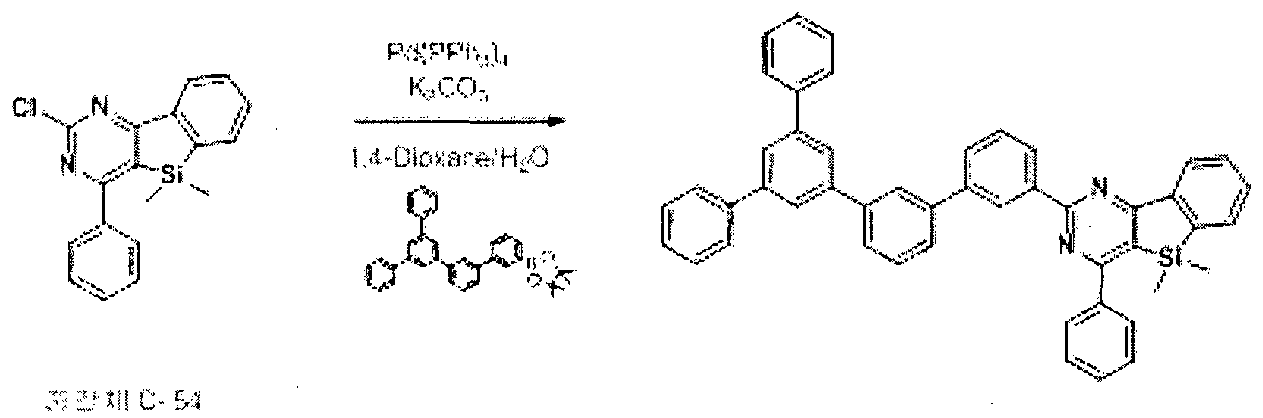
보로닉에스터 (4) 대신 보로닉에스터 (7)을 사용하였다는 점을 제외하고는, 상기 합성예 ad-22의 화합물 c-40의 합성 방법과 동일한 방법을 이용하여, 화합물 c-70 (7.1 g, 69%의 수율)을 합성하였다. 생성된 화합물 c-70의 원소 분석 결과는 하기와 같다. calcd. C48H36N2Si: C, 86.19; H, 5.42; N, 4.19; Si, 4.20; found: C, 86.18; H, 5.40; N, 4.16; Si, 4.16 합성예 ad-24: 화합물 d-119의 합성 본 발명의 화합물의 보다 구체적인 예로서 제시된 화합물 d-1 19를 하기 4 로를 통해 합성하였다. Compound c-70 (7.1) was prepared in the same manner as in the synthesis of compound c-40 of Synthesis Example ad-22, except that boronic ester (7) was used instead of boronic ester (4). g, 69% yield). Elemental analysis of the resulting compound c-70 is as follows. calcd. C48H36N2Si: C, 86.19; H, 5. 42; N, 4.19; Si, 4.20; found : C, 86.18; H, 5.40; N, 4.16; Si, 4.16. Synthesis Example ad-24 Synthesis of Compound d-119 Compound d-1 19, presented as a more specific example of the compound of the present invention, was synthesized through the following furnace.

중간체 D-2의 합성 Synthesis of Intermediate D-2
2000mL 플라스크에 중간체 D-l(구입처: TCI 社) 50.0 g (222.2 mmol): 50.0 g (222.2 mmol) of intermediate Dl (purchased by TCI) in a 2000 mL flask :
4,4,5,5-테트라메틸 -2-(2-니트로페닐) -1,3,2-다이옥사보란 5(). l g (233.3 mmol), 탄산칼륨 76.8 g (555.4 mmol), 테트라키스 (트리페닐포스핀)팔라듐 12.8 g (1 L I mmol)을 4,4,5,5-tetramethyl-2- (2-nitrophenyl) -1,3,2-dioxaborane 5 (). 1 g (233.3 mmol), 76.8 g of potassium carbonate (555.4 mmol), 12.8 g (1 L I mmol) of tetrakis (triphenylphosphine) palladium
1 ,4-다이옥산 700 mL, 물 350 mL 를 넣어준 후, 질소 기류 하에서 12시간 동안 가열하여 환류하였다. 이로부터 수득한 흔합물을 메탄올 2000 mL에 가하여 결정화된 고형분을 여과한 후, 를루엔에 녹여 실리카겔 /셀라이트로 여과하고, 유기 용매를 적당량 제거한 후, 메탄올로 재결정하여 중간체 D-2 (54.5 g, 75%의 수율)을 수득하였다. 700 mL of 1,4-dioxane and 350 mL of water were added thereto, and the mixture was heated to reflux for 12 hours under a nitrogen stream. The resulting mixture was added to 2000 mL of methanol, and the crystallized solid was filtered. Then, the mixture was dissolved in toluene, filtered through silica gel / celite, and an appropriate amount of an organic solvent was removed. , 75% yield).
Calcd. C 16H10C1N3O2: C, 61.65; H, 3.23; CI, 1 1.37; N, 13.48; 0, 10.27; found: C, 61.23; H, 3.15; C1, 1 1.37; N, 13.21 ; 0, 10.20; Calcd. C 16H 10 C 1 N 3 O 2: C, 61.65; H, 3. 23; CI, 1 1.37; N, 13.48; 0, 10.27; found: C, 61.23; H, 3. 15; C1, 1 1.37; N, 13.21; 0, 10.20;
중간체 D-3의 합성 Synthesis of Intermediate D-3
500mL 플라스크에 중간체 D-2 20.0 g mmol), 보로닉에스터 (4) 29.1 g (67·4 mmol), 탄산칼륨 22.2 g (160.4 mmol), 테트라키스 (트리페닐포스핀)팔라듐 3.7 g (3.2 mmol)을 1 ,4-다이옥산 200 mL, 물 100 mL 를 넣어준 후, 질소 기류 하에서 12시간 동안 가열하여 환류하였다. 이로부터 수득한 흔합물을 메탄을 600 mL에 가하여 결정화된 고형분을 여과한 후,룰루엔에 녹여 실리카겔 /셀라이트로 여과하고, 유기 용매를 적당량 제거한 후, 메탄을로 재결정하여 중간체 D-3 (23.9 g, 61%의 수율)을 수득하였다. 20.0 Intermediate D-2 in 500mL flask g mmol), Borough Nick ester (4) 29.1 g (67 · 4 mmol), potassium carbonate 2 2 .2 g (160.4 mmol) , tetrakis (triphenylphosphine) palladium, 3.7 g (3.2 mmol) was added 200 mL of 1,4-dioxane and 100 mL of water, and the mixture was heated to reflux for 12 hours under a stream of nitrogen. Methane was added to 600 mL of the mixture obtained, and the crystallized solid content was filtered, and then dissolved in luluene, filtered through silica gel / celite, an appropriate amount of organic solvent was removed, and the mixture was recrystallized with methane to give an intermediate D-3 ( 23.9 g, 61% yield).
Calcd. C40H27N3O2: C, 82.60; H, 4.68; N, 7.22; 0, 5.50; found: C, 82.60; H, 4.63; N: 7.21 ; 0, 5.49; 중간체 D-4의 합성 Calcd. C40H27N3O2: C, 82.60; H, 4.68; N, 7.22; 0, 5.50; found: C, 82.60; H, 4.63; N : 7.21; 0, 5.49; Synthesis of Intermediate D-4
250ml 플라스크에 중간체 D-3 (20.0 g, 34.4 mmol) 및 PPh3 (27.1 g, 103.2 mmol)을 넣고 1,2-다이클로로벤젠 (DCB) 80 ml를 넣은 후, 질소치환을 하고 12시간 동안 150°C에서 교반하였다. DCB를 증류하여 제거하고 실온으로 냉각시킨 다음, 소량의 틀루엔에 녹인 후 컬럼 크로마토그래피로 정제 (Hexane) 하여 중간체 D-4 (10.3 g, 54 %의 수율)을 얻었다. To a 250 ml flask was placed Intermediate D-3 (20.0 g, 34.4 mmol) and PPh 3 (27.1 g, 103.2 mmol) and 80 ml of 1,2-dichlorobenzene (DCB). Stir at ° C. DCB was distilled off, cooled to room temperature, dissolved in a small amount of toluene and purified by column chromatography to give Intermediate D-4 (10.3 g, 54% yield).
Calcd. C40H27N3: C, 87.40; H, 4.95; N, 7.64; found: C, 87.40; H, 4.93; N, 7.59; 화합물 d-119의 합성 Calcd. C40H27N3: C, 87.40; H, 4.95; N, 7.64; found: C, 87.40; H, 4.93; N, 7.59; Synthesis of Compound d-119
500 mL 등근 플라스크에 중간체 D-4 10.0 g (27.3 mmol), 브로모벤젠 4.5 g (28.6 mmol), 소듐 t-부록사이드 5.2 g (54.5 mmol), Pd(dba)2 1.6 g (2.7 mmol), 트리 10.0 g (27.3 mmol) of Intermediate D-4, 4.5 g (28.6 mmol) of bromobenzene, 5.2 g (54.5 mmol) of sodium t-boxide, 1.6 g (2.7 mmol) of Pd (dba) 2 , tree
t-부틸포스핀 2.2 mL (50% in를루엔)를 자일렌 180 mL 에 넣고 질소 기류 하에서 15시간 동안 가열하여 환류하였다. 이로부터 수득한 흔합물을 메탄올 360 mL에 가하여 결정화된 고형분을 여과한 후, 모노클로로벤젠에 녹여 실리카겔 / 셀라이트로 여과하고, 유기 용매를 적당량 제거한 후, 메탄을로 재결정하여 화합물 d-40 (11.8 g, 69%의 수율)를 수득하였다ᅳ 생성된 화합물 d-119의 원소 분석 결과 하기와 같다. calcd. C46H31N3: C, 88.29; H, 4.99; N, 6.72; found: C, 88.20; H, 4.95; N, 6.71 -25: 화합물 e-70의 합성 2.2 mL (50% inluene) of t-butylphosphine was added to 180 mL of xylene and heated to reflux for 15 hours under a stream of nitrogen. The mixture obtained therefrom was added to 360 mL of methanol, and the crystallized solid was filtered, dissolved in monochlorobenzene, filtered through silica gel / celite, and an appropriate amount of an organic solvent was removed, followed by recrystallization with methane to give a compound d-40 ( 11.8 g, 69% yield) was obtained. Elemental analysis of the resulting compound d-119 was as follows. calcd. C46H31N3: C, 88.29; H, 4.99; N, 6.72; found: C, 88.20; H, 4.95; N, 6.71-25: Synthesis of Compound e-70

화합물 e-70 중간체 E-2의 합성 Synthesis of Compound e-70 Intermediate E-2
2000 mL 등근 플라스크에 -78 °C에서 디클로로메탄 (lOOOmL) 중 중간체 E-1 (35.0 g, 183.1mmol)의 용액에 클로로술포닐 이소시아네이트 (23.7 ml, 274.6 mmol)를 적가하였다. 반웅물올 실온으로 천천히 가온시키고, 2시간 동안 교반하였다. To a 2000 mL isometric flask was added dropwise chlorosulfonyl isocyanate (23.7 ml, 274.6 mmol) to a solution of intermediate E-1 (35.0 g, 183.1 mmol) in dichloromethane (10OmL) at -78 ° C. The reaction mixture was slowly warmed to room temperature and stirred for 2 hours.
반응물을 농축시킨 후, 잔류물에 6N (300 ml)을 첨가하고, 흔합물을 100°C로 1시간 동안 교반하였다. 반웅 흔합물을 실온으로 넁각시키고, 포화 NaHC03 수용액으로 중화시켰다. 생생된 고체를 여과하여, 중간체 E-2 (43.2 g, 88%)를 베이지색 고체로서 수득하였다. After the reaction was concentrated, 6N (300 ml) was added to the residue and the mixture was stirred at 100 ° C for 1 hour. The reaction mixture was cooled to room temperature and neutralized with saturated aqueous NaHC03 solution. The viable solid was filtered to give Intermediate E-2 (43.2 g, 88%) as a beige solid. Obtained.
calcd. C10H9NO3: C, 62.82; H, 4.74; N, 7.33; O, 25.11; found: C, 62.82; H, 4.74; N: 7.33; O, 25.11 calcd. C10H9NO3: C, 62.82; H, 4. 74; N, 7.33; 0, 25.11; found: C, 62.82; H, 4. 74; N : 7.33; O, 25.11
(참고 반웅식: 중간체 E-l 합성 스킴) (Reference reaction form: Intermediate E-l Synthesis Scheme)

증간체 E-1 Intermediate E-1
중간체 E-3의 합성 Synthesis of Intermediate E-3
1000 mL 둥근 플라스크에 중간체 E-2(40.0g,0.19mol)를 메탄을 1000ml에 현탁시키고, 2MNaOH(300ml)를 적가하였다. 반웅 흔합물을 환류하에 3시간 동안 교반하였다. 반웅 흔합물을 실온으로 넁각시키고, Cone. HC1을 이용하여 pH3까지 산성화시켰다. 흔합물을 농축시킨 후, 메탄을을 잔류물에 서서히 적가하여 고체를 침전시킨다. 생성된 고체를 여과 후, 건조하여 중간체 E-3 (39.0g, 85%)을 수득하였다. calcd. CI 1H10N2O4: C, 56.41; H, 4.30; N, 11.96; 0, 27.33; found: C, 56.40; H, 4.20; N, 11.92; 0, 27.31 Intermediate E-2 (40.0 g, 0.19 mol) was suspended in 1000 ml of methane in a 1000 mL round flask and 2MNaOH (300 ml) was added dropwise. The reaction mixture was stirred at reflux for 3 hours. The reaction mixture was allowed to cool to room temperature and Cone. Acidified to pH3 with HC1. After the mixture is concentrated, methane is slowly added dropwise to the residue to precipitate a solid. The resulting solid was filtered and then dried to afford intermediate E-3 (39.0 g, 85%). calcd. CI 1H10N2O4: C, 56.41; H, 4. 30; N, 11.96; 0, 27.33; found : C, 56.40; H, 4. 20; N, 11.92; 0, 27.31
중간체 E-4 의합성 Synthesis of Intermediate E-4
500 mL 등근 플라스크에 중간체 E-3 (39.0 g, 191. Ommol) 및 옥시 .염화인 200mL 의 흔합물을 환류하에 8시간 동안 교반하였다. 반웅 흔합물을 상온으로 냉각시키고, 세게 교반하면서 얼음 /물에 부어, 침전물을 생성하였다. 이로부터 수득한 반웅물을 여과하여, 중간체 E-4을 수득하였다. (40.7g, 89%, 백색 고체) A mixture of intermediate E-3 (39.0 g, 191. Ommol) and 200 mL of phosphorus oxychloride was stirred under reflux for 8 hours in a 500 mL equilateral flask. The reaction mixture was cooled to room temperature and poured into ice / water with vigorous stirring to form a precipitate. The semi- ungmul obtained from this was filtered to obtain intermediate E- 4 . (40.7g, 89%, white solid)
calcd. C10H4C12N2O: C, 50.24; H, 1.69; C1, 29.66; N, 11.72; 0, 6.69; found: C, 50.21; H, 1.65; C1, 29.63; N, 11.64; 0, 6.62 calcd. C10H4C12N2O: C, 50.24; H, 1.69; C1, 29.66; N, 11.72; 0, 6.69; found: C, 50.21; H, 1.65; C1, 29.63; N, 11.64; 0, 6.62
중간체 E-5의 합성. Synthesis of Intermediate E-5.
500 mL 플라스크에 중간체 E-410.0 g (41.8 mmol), 페닐보론산 5.4 g (43.9 mmol) 탄산칼륨 14.5g(104.6mmol) 테트라키스 (트리페닐포스핀) 팔라듐 (0)2.4g(2.l mmol)을 1,4-다이옥산 140 mL, 물 70 mL 에 넣어준 후, 질소 기류 하에서 10시간 동안 60°C로 가열하였다. 이로부터 수득한 흔합물을 메탄올 450 mL에 가하여 결정화된 고형분을 여과한 후, 모노클로로벤젠에 녹여 실리카겔 /셀라이트로 Intermediate 500 mL flask was charged with E-410.0 g (41.8 mmol) , phenyl boronic acid 5.4 g (43.9 mmol) potassium carbonate and 14. 5 g (10 4 .6mmol) tetrakis (triphenylphosphine) palladium (O) 2. 4 g (2 .l mmol) then gave 1,4-dioxane and placed in 140 mL, 70 mL water, and heated to 60 ° C for 10 hours in a nitrogen stream. The resulting mixture was added to 450 mL of methanol, and the crystallized solid was filtered. Then, the mixture was dissolved in monochlorobenzene and dissolved in silica gel / celite.
여과하고, 유기 용매를 적당량 제거한 후, 메탄올로 재결정하여 중간체 E-5(8.0g, 65%의 수율)를 수득하였다. After filtration, an appropriate amount of organic solvent was removed, and the mixture was recrystallized from methanol to obtain Intermediate E-5 (8.0 g, Yield of 65%).
calcd. C16H9C1N20: C, 68.46; H, 3.23; C1, 12.63; N, 9.98; 0, 5.70; found: C, 68.40; H 3.22; CI, 12.61 ; N, 9.94; 0, 5.70 calcd. C16H9C1N20: C, 68.46; H, 3. 23; C1, 12.63; N, 9.98; 0, 5.70; found : C, 68.40; H 3.22; CI, 12.61; N, 9.94; 0, 5.70
화합물 e-70의 합성 Synthesis of Compound e-70
250 mL 등근 플라스크에 중간체 E-5 5.0 g (17.8 mmol), 보로닉에스터 (7) 9.5 5.0 g (17.8 mmol) of Intermediate E-5 in a 250 mL isometric flask, 9.5 boro ester (7)
(18.7 mmol), 탄산칼륨 6.2 g (44.5 mmol), 테트라키스 (트리페닐포스핀) 팔라듐 (0) 1.0 g (0.9 mmol)을 1 ,4-다이옥산 60 mL, 물 30 mL 에 넣어준 후, 질소 기류 하에서 12시간 동안 가열하여 환류하였다. 이로부터 수득한 흔합물을 메탄올 200 mL에 가하여 결정화된 고형분을 여과한 후, 모노클로로벤젠에 녹여 실리카겔 /셀라이트로 (18.7 mmol), 6.2 g (44.5 mmol) of potassium carbonate, 1.0 g (0.9 mmol) of tetrakis (triphenylphosphine) palladium (0) was added to 60 mL of 1,4-dioxane and 30 mL of water, followed by nitrogen. It was heated to reflux for 12 hours under air flow. The obtained mixture was added to 200 mL of methanol, and the crystallized solid was filtered, and then dissolved in monochlorobenzene to give silica gel / celite.
여과하고, 유기 용매를 적당량 제거한 후, 메탄올로 재결정하여 화합물 e-70 (8.1 g, 67%의 수율)을 수득하였다. 생성된 화합물 e-70의 원소 분석 결과는 하기와 같다. calcd. C46H30N2O: C, 88.15; H, 4.82; N, 4.47; 0, 2.55; found: C, 88.14; H, 4.80; N, 4.39; 0, 2.53 합성예 ad-26: 화합물 f-70의 합성 After filtration, the appropriate amount of organic solvent was removed and then recrystallized with methanol to give compound e-70 (8.1 g, 67% yield). Elemental analysis of the resulting compound e-70 is as follows. calcd. C46H30N2O: C, 88.15; H, 4. 82; N, 4.47; 0, 2.55; found: C, 88.14; H, 4.80; N, 4.39; 0, 2.53 Synthesis Example ad-26 Synthesis of Compound f-70

250 mL 등근 플라스크에 중간체 F-l (35.0g, 0.17mol) 및 우레아 (50.7g, 0.84mol)의 흔합물을 200 °C에서 2 시간 동안 교반하였다. 고온의 반응 흔합물올 상온으로 식힌 후, 수산화나트륨 용액에 붓고, 블순물을 여과하여 제거한 다음, 반응물을 산성화하여 (HC1, 2N), 수득한 침전물을 건조시켜 중간체 F-2를 수득하였다 (18,9g, 51 %). The mixture of intermediate Fl (35.0 g, 0.17 mol) and urea (50.7 g, 0.84 mol) was stirred at 200 ° C for 2 hours in a 250 mL equilateral flask. After cooling to a high temperature, the reaction mixture was poured into a sodium hydroxide solution, the pure water was filtered off, and the reaction was acidified (HC1, 2N), and the precipitate obtained was dried to give intermediate F-2 (18, 9 g, 51%).
calcd. C10H6N2O2S: C, 55.04; H, 2.77; N, 12.84; 0, 14.66; S, 14.69; found: C, 55.01 ; H, 2.77; N, 12.83; 0, 14.65; S, 14.63 calcd. C10H6N2O2S: C, 55.04; H, 2.77; N, 12.84; 0, 14.66; S, 14.69; found: C, 55.01; H, 2.77; N, 12.83; 0, 14.65; S, 14.63
(참고 반응식: 중간체 F-1 합성반웅식)

중간 l F-1 Medium l F-1
중간체 F-3의 합성 Synthesis of Intermediate F-3
250 mL 등근 플라스크에 중간체 F-2 (18.9 g, 99.2mmol) 및 옥시염화인 Intermediate F-2 (18.9 g, 99.2 mmol) and phosphorus oxychloride in 250 mL equilateral flasks
(l OOmL)의 흔합물을 환류하에 6시간 동안 교반하였다. 반웅 흔합물을 상온으로 냉각시키고, 세게 교반하면서 얼음 /물에 부어, 침전물올 생성하였다. 이로부터 수득한 반웅물을 여과하여, 중간체 F-3을 수득하였다. ( .5g, 85 % , 백색 고체) (lOOmL) of the mixture was stirred under reflux for 6 hours. The reaction mixture was cooled to room temperature and poured into ice / water with vigorous stirring to produce a precipitate. The semi-ungmul obtained therefrom was filtered to give intermediate F-3. (.5g, 85%, white solid)
calcd. C10H4C12N2S: C, 47.08; H, 1.58; C1, 27.79; N, 10.98; S, 12.57; found: C, 47.04; H, 1.53; C1, 27.74; N, 10.96; S, 12.44 calcd. C10H4C12N2S: C, 47.08; H, 1.58; C1, 27.79; N, 10.98; S, 12.57; found: C, 47.04; H, 1.53; C1, 27.74; N, 10.96; S, 12.44
중간체 F-4의 합성 Synthesis of Intermediate F-4
500 mL 플라스크에 중간체 F-3 10.0 g (39.2 mmol), 페닐보론산 5.3 g (43.1 mmol): 탄산칼륨 13.5 g (98.0 mmol) 테트라키스 (트리페닐포스핀) 팔라듐 (0) 2.3 g (2.0 mmol)을 1 ,4-다이옥산 140 mL, 물 70 mL 에 넣어준 후, 질소 기류 하에서 10시간 동안 60 °C로 가열하였다. 이로부터 수득한 흔합물을 메탄올 450 mL에 가하여 결정화된 고형분올 여과한 후, 모노클로로벤젠에 녹여 실리카겔 /셀라이트로 여과하고, 유기 용매를 적당량 제거한 후, 메탄을로 재결정하여 중간체 F-4 (8.0 g, 69%의 수율)를 10.0 g (39.2 mmol) of Intermediate F-3, 5.3 g (43.1 mmol) of phenylboronic acid : 13.5 g (98.0 mmol) of tetracarbonate (triphenylphosphine) palladium (0) 2.3 g (2.0 mmol) in a 500 mL flask ) Was added to 140 mL of 1,4-dioxane and 70 mL of water, and then heated to 60 ° C. for 10 hours under a stream of nitrogen. The resulting mixture was added to 450 mL of methanol, and the crystallized solid was filtered. Then, the mixture was dissolved in monochlorobenzene and filtered through silica gel / celite, and an appropriate amount of an organic solvent was removed, followed by recrystallization with methane to give an intermediate F-4 ( 8.0 g, 69% yield)
수득하였다. Obtained.
calcd. C16H9C1N2S: C, 64.75; H, 3.06; C1, 1 1.95; N, 9.44; S, 10.80; found: C, 64.72; H, 3.06; CI, 1 1.94; N, 9.42; S, 10.77 calcd. C16H9C1N2S: C, 64.75; H, 3.06; C1, 1 1.95; N, 9.44; S, 10.80; found: C, 64.72; H, 3.06; CI, 1 1.94; N, 9.42; S, 10.77
화합물 f-70의 합성 Synthesis of Compound f-70
250 mL 등근 플라스크에 중간체 F-4 5.0 g (16.9 mmol), 보로닉에스터 (7) 9.4g 5.0 g (16.9 mmol) of intermediate F-4, 9.4 g of boronic ester (7), in 250 mL equipotent flask
(18.5 mmol), 탄산칼륨 5.8 g (42.1 mmol), 테트라키스 (트리페닐포스핀) 팔라듐 (0) 1.0 g (0.8 mmol)을 1 ,4-다이옥산 60 mL, 물 30 mL 에 넣어준 후, 질소 기류 하에서 12시간 동안 가열하여 환류하였다. 이로부터 수득한 흔합물을 메탄을 200 mL에 가하여 결정화된 고형분을 여과한 후, 모노클로로밴젠에 녹여 실리카겔 /셀라이트로 여과하고, 유기 용매를 적당량 제거한 후, 메탄을로 재결정하여 화합물 f-70 (7.9 g, 73%의 수율)을 수득하였다. 생성된 화합물 ^70의 원소 분석 결과는 하기와 같다. calcd. C46H30N2O: C, 88.15; H, 4.82; N, 4.47; 0, 2.55; found: C, 88.12; H, 4.76; N: 4.44; 0, 2.52 합성예 ad-27: 화합물 e-기의 합성 (18.5 mmol), potassium carbonate 5.8 g (42.1 mmol), tetrakis (triphenylphosphine) palladium (0) 1.0 g (0.8 mmol) were added to 60 mL of 1,4-dioxane and 30 mL of water, followed by nitrogen. It was heated to reflux for 12 hours under air flow. The mixture obtained therefrom was added 200 mL of methane, and the crystallized solid was filtered. Then, the mixture was dissolved in monochlorovanzene and purified by silica gel / celite. After filtration and removal of the appropriate amount of organic solvent, methane was recrystallized with to give compound f-70 (7.9 g, 73% yield). Elemental analysis of the resulting compound ^ 70 is as follows. calcd. C46H30N2O: C, 88.15; H, 4. 82; N, 4.47; 0, 2.55; found: C, 88.12; H, 4.76; N : 4.44; 0, 2.52 Synthesis Example ad-27: Synthesis of Compound e-Group

페닐보론산 대신 보로 에스터 (5)를 사용한다는 점을 제외하고는, 상기 합성예 ad-25의 중간체 E-5의 합성 방법과 동일한 방법을 이용하여, 중간체 e-71 (8.1 g, 70%의 수율) 을 합성하였다. Using the same method as the synthesis of Intermediate E-5 of Synthesis Example ad-25, except for using boro ester (5) instead of phenylboronic acid, intermediate e-71 (8.1 g, 70% of Yield) was synthesized.
calcd. C22H13C1N20: C, 74.06; H, 3.67; C1, 9.94; N, 7.85; 0, 4.48; found: C, 74.01 ; H: 3.65; C1, 9.89; N, 7.84; 0, 4.42 calcd. C22H13C1N20: C, 74.06; H, 3.67; C1, 9.94; N, 7.85; 0, 4.48; found: C, 74.01; H : 3.65; C1, 9.89; N, 7.84; 0, 4.42
화합물 e- 의 합성 Synthesis of Compound e-
중간체 E-5 대신 중간체 e-기을 사용한다는 점을 제외하고는, 상기 합성예 ad-25의 화합물 e-70의 합성 방법과 동일한 방법을 이용하여, 화합물 e-71 (그 5 g, 72%의 수율) 을 합성하였다. Except for using the intermediate e-group instead of the intermediate E-5, using the same method as the synthesis method for the compound e-70 of Synthesis Example ad-25, the compound e-71 (5 g, 72% of the Yield) was synthesized.
calcd. C52H34N20: C, 88.86; H, 4.88; N, 3.99; 0, 2.28; found: C, 88.81 ; H, 4.87; N, 3.96; 0, 2.23 합성예 ad-28: 화합물 e-74의 합성 calcd. C52H34N20: C, 88.86; H, 4.88; N, 3.99; 0, 2.28; found: C, 88.81; H, 4.87; N, 3.96; 0, 2.23 Synthesis Example ad-28 Synthesis of Compound e-74

g^ifl e- 74 si ¾g e-74 , g ^ ifl e- 74 si ¾g e-74,
중간체 e_74의 합성 Synthesis of Intermediate e _74
페닐보론산 대신 보로닉에스터 (7)를 사용한다는 점을 제외하고는, 상기 합성예 ad-25의 중간체 E-5의 합성 방법과 동일한 방법을 이용하여, 중간체 e-74 (10.5 g, "78%의 수율) 을 합성하였다. Using the same method as the synthesis of Intermediate E-5 of Synthesis Example ad-25, except for using boroboronic ester (7) instead of phenylboronic acid, intermediate e-74 (10.5 g, " 78 % Yield) was synthesized.
calcd. C40H25C1N2O: C, 82.11 ; H, 4.31; C1, 6.06; N, 4.79; 0, 2.73; found: C, 82.10; H 4.28; C1, 6.05; N, 4.75; 0, 2.70 calcd. C40H25C1N2O: C, 82.11; H, 4.31; C1, 6.06; N, 4.79; 0, 2.73; found: C, 82.10; H 4.28; C1, 6.05; N, 4.75; 0, 2.70
화합물 e-74의 합성 Synthesis of Compound e-74
중간체 E-5 대신 중간체 e-74을 사용한다는 점을 제외하고는, 상기 합성예 ad-25의 화합물 e-70의 합성 방법과 동일한 방법을 이용하여, 화합물 e-74 (5.3 g, 65%의 수율) 을 합성하였다. Compound e-74 (5.3 g, 65%) was prepared in the same manner as in the synthesis of Compound e-70 of Synthesis Example ad-25, except that Intermediate e-74 was used instead of Intermediate E-5. Yield) was synthesized.
calcd. C46H30N2O: C, 88.15; H, 4.82; N, 4.47; 0, 2.55; found: C, 88.15; H, 4.82; N, 4.47; 0, 2.55 calcd. C46H30N2O: C, 88.15; H, 4. 82; N, 4.47; 0, 2.55; found: C, 88.15; H, 4. 82; N, 4.47; 0, 2.55

β-74 fi ¾l e- 75 화합물 e-75의 합성 β-74 fi ¾l e- 75 Synthesis of Compound e-75
페닐보론산 대신 보로닉에스터 (5)를 사용한다는 점을 제외하고는, 상기 합성예 ad-28의 화합물 e-74의 합성 방법과 동일한 방법을 이용하여, 화합물 e-75 (7.0 g, 69%의 수율) 을 합성하였다. Using the same method as the synthesis method for compound e-74 of Synthesis Example ad-28, except that boronic ester (5) was used instead of phenylboronic acid, compound e-75 (7.0 g, 69% Yield) was synthesized.
calcd. C52H34N20: C, 88.86; H, 4.88; N, 3.99; 0, 2.28; found: C, 88.85; H, 4.84; N, 3.97; 0, 2.28 합성예 ad-30: 화합물 e-82의 합성 calcd. C52H34N20: C, 88.86; H, 4.88; N, 3.99; 0, 2.28; found: C, 88.85; H, 4. 84; N, 3.97; 0, 2.28 Synthesis Example ad-30 Synthesis of Compound e-82

보로닉에스터 (7) 대신 보로닉에스터 (8)를 사용한다는 점을 제외하고는, 상기 합성예 ad-25의 화합물 e-70의 합성 방법과 동일한 방법을 이용하여, 화합물 e-82 (8.4 g, 70%의 수율) 을 합성하였다. Compound e-82 (8.4 g) was prepared in the same manner as in the synthesis of compound e-70 of Synthesis Example ad-25, except that the boronic ester (8) was used instead of the boronic ester (7). , 70% yield).
calcd. C52H34N20: C, 88.86; H, 4.88; N, 3.99; 0, 2.28; found: C, 88.80; H, 4.81 ; N, 3.91 ; 0, 2.27 합성예 ad-31: 화합물 e-84의 합성 calcd. C52H34N20: C, 88.86; H, 4.88; N, 3.99; 0, 2.28; found: C, 88.80; H, 4.81; N, 3.91; 0, 2.27 Synthesis Example ad-31 Synthesis of Compound e-84

화합물 e-84의 합성 Synthesis of Compound e-84
보로닉에스터 (7) 대신 보로닉에스터 (9)를 사용한다는 점을 제외하고는, 상기 합성예 ad-25의 화합물 e-70의 합성 방법과 동일한 방법을 이용하여, 화합물 e-84 (11.2 g, 71%의 수율) 을 합성하였다. Compound e-84 (11.2 g) was obtained in the same manner as in the synthesis of compound e-70 of Synthesis Example ad-25, except that boronic ester (9) was used instead of boronic ester (7). , 71% yield).
calcd. C52H34N20: C, 88.86; H, 4.88; N, 3.99; 0, 2.28; found: C, 88.86; H, 4.85; N: 3.93; 0, 2.21 합성예 ad-32: 화합물 e-88의 합성 calcd. C52H34N20: C, 88.86; H, 4.88; N, 3.99; 0, 2.28; found: C, 88.86; H, 4. 85; N : 3.93; 0, 2.21 Synthesis Example ad-32 Synthesis of Compound e-88

보로닉에스터 (7) 대신 보로닉에스터 (14)를 사용한다는 점을 제외하고는, 상기 합성예 ad-25의 화합물 e-70의 합성 방법과 동일한 방법을 이용하여, 화합물 e-88 (6.2 g, 67%의 수율) 을 합성하였다. Compound e-88 (6.2 g) was obtained by the same method as the synthesis method of compound e-70 of Synthesis Example ad-25, except that the boronic ester (14) was used instead of the boronic ester (7). , Yield of 67%) was synthesized.
calcd. C52H34N20: C, 88.86; H, 4.88; N, 3.99; 0, 2.28; found: C, 88.83; H, 4.88; N, calcd. C52H34N20: C, 88.86; H, 4.88; N, 3.99; 0, 2.28; found: C, 88.83; H, 4.88; N,
3.98; 0, 2.26 합성예 ad-33: 화합물 e-114의 합성 3.98; 0, 2.26 Synthesis Example ad-33 Synthesis of Compound e-114

보로닉에스터 (7) 대신 보로닉에스터 (10)를 사용한다는 점을 제외하고는, 상기 합성예 ad-25의 화합물 e-70의 합성 방.법과 동일한 방법을 이용하여, 화합물 e-1 14 (9.8 g, 69%의 수율) 을 합성하였다. Except for using the boronic ester (10) instead of the boronic ester (7), using the same method as the synthesis method of the compound e-70 of Synthesis Example ad-25, the compound e-1 14 ( 9.8 g, 69% yield).
calcd. C46H30N2O: C, 88.15; H, 4.82; N, 4.47; 0, 2.55; found: C, 88.13; H, 4.81 ; N, 4.40; 0, 2.51 합성예 ad-35: 화합물 f-기의 합성 calcd. C46H30N2O: C, 88.15; H, 4. 82; N, 4.47; 0, 2.55; found: C, 88.13; H, 4.81; N, 4.40; 0, 2.51 Synthesis Example ad-35 Synthesis of Compound f-Group

중간체 f-기의 합성 Synthesis of Intermediate f-groups
페닐보론산 대신 보로닉에스터 (5)를 사용한다는 점을 제외하고는, 상기 합성예 ad-26의 중간체 F-4의 합성 방법과 동일한 방법을 이용하여, 중간체 f-71 (1 1.3 g, 74%의 수율) 을 합성하였다. Intermediate f-71 (1 1.3 g, 7) was used in the same manner as in the synthesis of Intermediate F-4 of Synthesis Example ad-26, except that boronic ester (5) was used instead of phenylboronic acid. 4 % yield).
calcd. C22H13C1N2S: C, 70.87; H, 3.51 ; C1, 9.51; N, 7.51 ; S, 8.60; found: C, 70.83; H, 3.50; C1, 9.89; N, 7.47; S, 8.59 화합물 f-기의 합성 calcd. C22H13C1N2S: C, 70.87; H, 3.5 1; C1, 9.51; N, 7.51; S, 8.60; found: C, 70.83; H, 3.50; C1, 9.89; N, 7.47; S, 8.59 Synthesis of Compound f-Group
중간체 F-4 대신 중간체 f-기을 사용한다는 점을 제외하고는, 상기 합성예 ad-26의 화합물 f-70의 합성 방법과 동일한 방법을 이용하여, 화합물 f-71 (9.4 g, 72%의 수율) 을 합성하였다. Compound f-71 (9.4 g, 72% yield) using the same method as the synthesis of compound f-70 of Synthesis Example ad-26, except that Intermediate f-group was used instead of Intermediate F-4. ) Was synthesized.
calcd. C52H34N2S: C, 86.88; H, 4.77; N, 3.90; S, 4.46; found: C, 86.84; H, 4.74; calcd. C52H34N2S: C, 86.88; H, 4.77; N, 3.90; S, 4.46; found : C, 86.84; H, 4. 74;
3.88; S, 4.43 합성예 ad-36: 화합물 f-74의 합성 3.88; S, 4.43. Synthesis Example ad-36: Synthesis of Compound f-74

g i.¾l f- 74 ≤ g f- 74 중간체 f-74의 합성 g i.¾l f-74 ≤ g f-74 synthesis of intermediate f-74
페닐보론산 대신 보로닉에스터 (7)를 사용한다는 점을 제외하고는, 상기 합성예 ad-26의 중간체 F-4의 합성 방법과 동일한 방법을 이용하여, 중간체 f-74 (8.9 g, 74%의 수율) 을 합성하였다. Intermediate f-74 (8.9 g, 74% ), using the same method as the synthesis of Intermediate F-4 of Synthesis Example ad-26, except that boronic ester (7) was used instead of phenylboronic acid. Yield) was synthesized.
calcd. C40H25C1N2S: C, 79.92; H, 4.19; C1, 5.90; N, 4.66; S, 5.33; found: C, 79.89; K 4.18; C1, 5.87; N, 4.65; S, 5.30 calcd. C40H25C1N2S: C, 79.92; H, 4. 19; C1, 5.90; N, 4.66; S, 5.33; found : C, 79.89; K 4.18; C1, 5.87; N, 4.65; S, 5.30
화합물 f-74의 합성 Synthesis of Compound f-74
중간체 F-4 대신 중간체 f-74을 사용한다는 점을 제외하고는, 상기 합성예 ad-26의 화합물 f-70의 합성 방법과 동일한 방법을 이용하여, 화합물 f-74 (7.6g, 68%의 수율) 을 합성하였다. Compound f-74 (7.6 g, 68%) was prepared in the same manner as in the synthesis of compound f-70 of Synthesis Example ad-26, except that Intermediate f-74 was used instead of Intermediate F-4. Yield) was synthesized.
calcd. C46H30N2S: C, 85.95; H, 4.70; N, 4.36; S, 4.99; found: C, 85.92; H, 4.68; N, calcd. C46H30N2S: C, 85.95; H, 4. 70; N, 4.36; S, 4.99; found: C, 85.92; H, 4.68; N,
4.35; S, 4.95 합성예 ad-37: 화합물 f-75의 합성 4.35; S, 4.95. Synthesis Example ad-37: Synthesis of Compound f-75
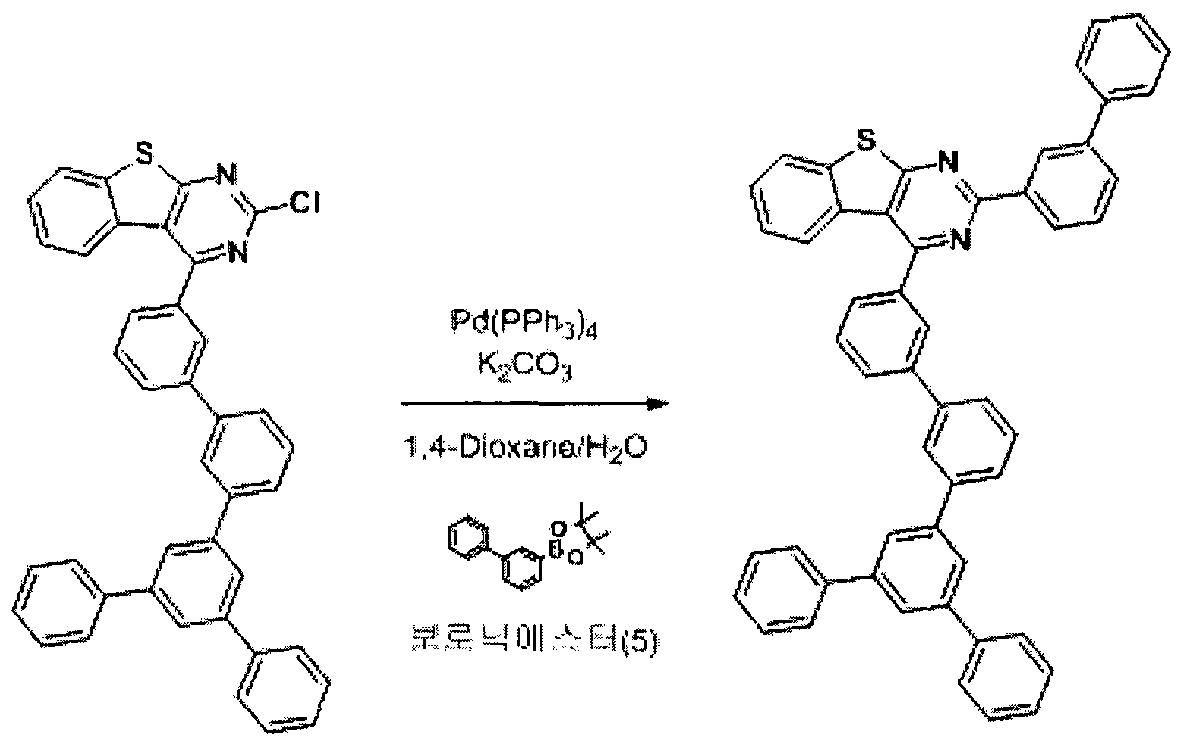
w ^'M f- 74 51 f- 75 w ^ '' M f- 74 51 f- 75
페닐보론산 대신 보로닉에스터 (5)를 사용한다는 점을 제외하고는, 상기 합성예 ad-36의 화합물 f-74의 합성 방법과 동일한 방법을 이용하여, 화합물 f-75 (6.3 g, 66%의 수율) 을 합성하였다. Compound f-75 (6.3 g, 66%) using the same method as the synthesis method for compound f-74 of Synthesis Example ad-36, except that boroboric acid (5) was used instead of phenylboronic acid. Yield) was synthesized.
calcd. C52H34N2S: C, 86.88; H, 4.77; N, 3.90; S, 4.46; found: C, 86.87; H, 4.75; N, 3.89; S, 4.40 -38: 화합물 f-82의 합성 calcd. C52H34N2S: C, 86.88; H, 4.77; N, 3.90; S, 4.46; found : C, 86.87; H, 4.75; N, 3.89; S, 4.40 -38: synthesis of compound f-82

ϊ≤£ ¾에스曰 <8> 화합물 f-82의 합성 Synthesis of Compound f-82
보로닉에스터 (7) 대신 보로닉에스터 (8)를 사용한다는 점을 제외하고는, 상기 합성예 ad-26의 화합물 f-70의 합성 방법과 동일한 방법을 이용하여, 화합물 f-82 (6.3 g, 72%의 수율) 을 합성하였다. Compound f-82 (6.3 g) was obtained by the same method as the synthesis method for compound f-70 of Synthesis Example ad-26, except that the boronic ester (8) was used instead of the boronic ester (7). , 72% yield).
calcd. C52H34N2S: C, 86.88; H, 4.77; N, 3.90; S, 4.46; found: C, 86.86; H, 4.75; N, 3.88; S, 4.45 합성예 ad-39: 화합물 f-84의 합성 calcd. C52H34N2S: C, 86.88; H, 4.77; N, 3.90; S, 4.46; found : C, 86.86; H, 4.75; N, 3.88; S, 4.45 Synthesis Example ad-39 Synthesis of Compound f-84

( s f- 84 화합물 f-84의 합성 (s f-84 Synthesis of Compound f-84
보로닉에스터 (7) 대신 보로닉에스터 (9)를 사용한다는 점을 제외하고는, 상기 합성예 ad-26의 화합물 f-70의 합성 방법과 동일한 방법을 이용하여, 화합물 f-84 (9.3 g, 69%의 수율) 올 합성하였다. Compound f-84 (9.3 g) was prepared in the same manner as in the synthesis of compound f-70 of Synthesis Example ad-26, except that the boronic ester (9) was used instead of the boronic ester (7). , 69% yield).
calcd. C52H34N2S: C, 86.88; H, 4.77; N, 3.90; S, 4.46; found: C, 86.86; H, 4.76; N, 3.85; S, 4.42 합성예 ad-40: 화합물 f-88의 합성 calcd. C52H34N2S: C, 86.88; H, 4.77; N, 3.90; S, 4.46; found : C, 86.86; H, 4.76; N, 3.85; S, 4.42. Synthesis Example ad-40 Synthesis of Compound f-88

화합물 f-88의 합성 , 보로닉에스터 (7) 대신 보로닉에스터 (14)를 사용한다는 점을 제외하고는, 상기 합성예 ad-26의 화합물 f-70의 합성 방법과 동일한 방법을 이용하여, 화합물 f-88 (그 6 g, 73%의 수율) 을 합성하였다. calcd. C52H34N2S: C, 86.88; H, 4.77; N, 3.90; S, 4.46; found: C, 86.86; H, 4.73; N: .89; S, 4.44 합성예 ad-41: 화합물 f-114의 합성 Synthesis of Compound f-88 Using the same method as the synthesis method for Compound f-70 of Synthesis Example ad-26, except that Voonic ester (14) was used instead of Voronic ester (7), Compound f-88 (yield 6 g, 73% yield) was synthesized. calcd. C52H34N2S: C, 86.88; H, 4.77; N, 3.90; S, 4.46; found : C, 86.86; H, 4.73; N : .89; S, 4.44. Synthesis Example ad-41 Synthesis of Compound f-114

화합물 f-1 14의 합성 Synthesis of Compound f-1 14
보로닉에스터 (7) 대신 보로닉에스터 (10)를 사용한다는 점을 제외하고는, 상기 합성예 ad-26의 화합물 f-70의 합성 방법과 동일한 방법을 이용하여, 화합물 f-114 (7.6 g, 67%의 수율) 을 합성하였다. Compound f-114 (7.6 g) was obtained by the same method as the synthesis method for compound f-70 of Synthesis Example ad-26, except that the boronic ester (10) was used instead of the boronic ester (7). , Yield of 67%) was synthesized.
calcd. C46H30N2S: C, 85.95; H, 4.70; N, 4.36; S, 4.99; found: C, 85.90; H, 4.69; N, 4.33; S, 4.96 calcd. C46H30N2S: C, 85.95; H, 4. 70; N, 4.36; S, 4.99; found: C, 85.90; H, 4.69; N, 4.33; S, 4.96
(제 2 호스트 화합물의 합성) Synthesis of Second Host Compound
합성예 4: 화합물 A1의 합성 Synthesis Example 4 Synthesis of Compound A1

화합 a A1 Unity a A1
질소 분위기 하 교반기가 부착된 500 mL 둥근바닥 플라스크에 3-브로모 -N-페닐카바졸 16.62 g(51 .59 mmol), N-페닐카바졸 -3-일보론산 17.77 g(61.91 mmol) 및 테트라하이드로퓨란:틀루엔 (1 : 1) 200 mL 와 2M-탄산칼륨 수용액 100 mL를 흔합한 후, 테트라키스트리페닐포스핀팔라듐 (0) 2.98 g(2.58 mmol)을 넣고 In a 500 mL round bottom flask with agitator under nitrogen atmosphere 16.62 g (51.59 mmol) of 3-bromo-N-phenylcarbazole, 17.77 g (61.91 mmol) of N-phenylcarbazole-3-ylboronic acid and 200 mL of tetrahydrofuran: toluene (1: 1) with After mixing 100 mL of 2M aqueous potassium carbonate solution, 2.98 g (2.58 mmol) of tetrakistriphenylphosphinepalladium (0) was added thereto.
질소기류하에서 12 시간 동안 가열 환류하였다. 반응 종결 후 반웅물을 메탄올에 부어 고형물을 여과한 다음, 수득한 고형물을 물과 메탄올로 층분히 세정하고 건조하였다. 이로부터 수득한 결과물을 1 L의 클로로벤젠에 가열하여 녹인 다음 용액을 실리카겔 필터하고 용매를 완전히 제거한 후, 500mL의 틀루엔에 가열하여 녹인 다음 재결정 하여 화합물 A1 16.05 g (수율 64%)을 수득하였다. It was heated to reflux for 12 hours under a nitrogen stream. After completion of the reaction, the reaction product was poured into methanol, and the solid was filtered. Then, the obtained solid was washed with water and methanol and dried. The resultant was heated and dissolved in 1 L of chlorobenzene, and the solution was filtered through a silica gel filter, the solvent was completely removed, and then heated and dissolved in 500 mL of toluene, followed by recrystallization, thereby obtaining 16.05 g (64% yield) of Compound A1. .
calcd. C36H24N2: C, 89.23 ; H, 4.99; N, 5.78; found: C; 89.45; H, 4.89; N, 5.65 합성예 5: 화합물 A2의 합성 calcd. C 36 H 24 N 2 : C, 89.23; H, 4.99; N, 5.78; found: C; 89.45; H, 4.89; N, 5.65 Synthesis Example 5 Synthesis of Compound A2

화합물 A2 질소 분위기 하 교반기가 부착된 500 mL 둥근바닥 플라스크에 Compound A2 in a 500 mL round bottom flask with a stirrer under nitrogen atmosphere
3-브로모 -N-바이페닐카바졸 20.00 g(50.21 mmol), N-페닐카바졸 -3-보로닉에스터 18.54 g(50.21 mmol) 및 테트라하이드로퓨란:를루엔 (1 : 1) 175 mL 와 2M-탄산칼륨 수용액 75 mL를 흔합한 후, 테트라키스트리페닐포스핀팔라듐 (0) 2.90 g(2.51 mmol)을 넣고 질소기류하에서 12 시간 동안 가열 환류하였다. 반웅 종결 후 반웅물을 메탄을에 부어 고형물을 여과한 다음 수득한 고형물을 물과 메탄올로 층분히 세정하고 건조하였다. 이로부터 수득한 결과물을 700 mL의 클로로벤젠에 가열하여 녹인 다음 용액을 실리카겔 필터하고 용매를 완전히 제거한 후, 400mL의 클로로벤젠에 가열하여 녹인 다음 재결정 하여 화합물 A2 19.15 g (수율 68%)을 수득하였다. 20.00 g (50.21 mmol) of 3-bromo-N-biphenylcarbazole, 18.54 g (50.21 mmol) of N-phenylcarbazole-3-boronic ester and 175 mL of tetrahydrofuran: luene (1: 1) with After mixing 75 mL of 2M aqueous potassium carbonate solution, 2.90 g (2.51 mmol) of tetrakistriphenylphosphinepalladium (0) was added thereto, and the mixture was heated to reflux for 12 hours under a nitrogen stream. After completion of the reaction, the reaction product was poured into methane, and the solid was filtered. The obtained solid was washed with water and methanol and dried. The resultant was heated and dissolved in 700 mL of chlorobenzene, and then the solution was filtered through a silica gel filter, the solvent was completely removed, dissolved in 400 mL of chlorobenzene, and recrystallized to obtain 19.15 g (68% yield) of Compound A2. .
calcd. C42¾8N2: C, 89.97; H, 5.03; N, 5.00; found: C, 89.53 ; H, 4.92; N, 4.89 6: 화합물 A5의 합성 calcd. C 42 ¾ 8 N 2 : C, 89.97; H, 5.03; N, 5.00; found: C, 89.53; H, 4.92; N, 4.89 6: Synthesis of Compound A5

500 mL 둥근 플라스크에 N-페닐 -3,3-바이카바졸 12.81 g (31.36 mmol), 2-클로로 -다이 -4,6-페닐피리딘 8.33 g (31.36 mmol), 소듐 t-부톡사이드 6.03 g (62.72 mmol), 트리스 (다이벤질리덴아세톤)다이팔라디움 1.80 g (3.14 mmol) 및 트리 t-부틸포스핀 2.6 mL (50% in 를루엔)를 자일렌 200 mL 에 넣고 질소 기류 하에서 15시간 동안 가열하여 환류하였다. 이로부터 수득한 흔합물을 메탄올 600 mL에 가하여 결정화된 고형분을 여과한 후, 다이클로로벤젠에 녹여 실리카겔 / 셀라이트로 여과하고, 유기 용매를 적당량 제거한 후, 메탄올로 재결정하여 화합물 A5 (13.5 g, 68%의 수율)를 수득하였다. In a 500 mL round flask, 12.81 g (31.36 mmol) of N-phenyl-3,3-bicarbazole, 8.33 g (31.36 mmol) of 2-chloro-di-4,6-phenylpyridine, 6.03 g of sodium t-butoxide ( 62.72 mmol), tris (dibenzylideneacetone) dipalladium 1.80 g (3.14 mmol) and 2.6 mL (50% in toluene) of trit-butylphosphine were added to 200 mL of xylene and heated under nitrogen stream for 15 hours. To reflux. The mixture obtained therefrom was added to 600 mL of methanol, and the crystallized solid was filtered, dissolved in dichlorobenzene, filtered through silica gel / celite, an appropriate amount of an organic solvent was removed, and then recrystallized with methanol, to give Compound A5 (13.5 g, Yield 68%).
calcd. C47H31N3: C, 88.51 ; H, 4.90; N, 6.59; found: C, 88.39; H, 4.64; N, 6.43 7: 화합물 A15의 합성 calcd. C47H31N3: C, 88.51; H, 4. 90; N, 6.59; found: C, 88.39; H, 4. 64; N, 6.43 7: Synthesis of Compound A15

화합물 A15 질소 분위기 하 교반기가 부착된 500 mL 등근바닥 플라스크에 Compound A15 in a 500 mL back bottom flask with a stirrer under nitrogen atmosphere
3-브로모 -N-페닐카바졸 10.00 g(31.04 mmol), 2-트리페닐렌보로닉 에스터 10.99 g(31.04 mmol) 및 테트라하이드로퓨란:를루엔 (1 : 1) 150 mL 와 2M-탄산칼륨 수용액 75mL를 흔합한 후, 테트라키스트리페닐포스핀팔라듐 (0) 1.79 g(1.55mmol)을 넣고 10.00 g (31.04 mmol) of 3-bromo-N-phenylcarbazole, 10.99 g (31.04 mmol) of 2-triphenyleneboronic ester and 150 mL of tetrahydrofuran: luene (1: 1) with 2M potassium carbonate 75 mL of aqueous solution was mixed, and then 1.79 g (1.55 mmol) of tetrakistriphenylphosphinepalladium (0) was added thereto.
질소기류하에서 12 시간 동안 가열 환류하였다. 반웅 종결 후 반응물을 메탄올에 부어 고형물을 여과한 후, 이로부터 수득한 고형물을 물과 메탄올로 층분히 세정하고 건조하였다. 이로부터 수득한 결과물을 400mL의 클로로벤젠에 가열하여 녹인 다음 용액을 실리카겔 필터하고 용매를 완전히 제거한 후, 300mL의 를루엔에 가열하여 녹인 다음 재결정 하여 화합물 A15 8.74 g (수율 60%)을 수득하였다. It was heated to reflux for 12 hours under a nitrogen stream. After completion of reaction, the reaction was added to methanol. After pouring and filtering the solid, the solid obtained therefrom was washed thoroughly with water and methanol and dried. The resultant was heated and dissolved in 400 mL of chlorobenzene, and the solution was filtered through a silica gel filter, the solvent was completely removed, and then dissolved in 300 mL of toluene, and then recrystallized to obtain 8.74 g (60% yield) of Compound A15.
calcd. C36H23N: C, 92.08; H, 4.94; N, 2.98; found: C, 92.43; H, 4.63; N, 2.84 8: 화합물 A17의 합성 calcd. C 36 H 23 N: C, 92.08; H, 4.94; N, 2.98; found: C, 92.43; H, 4.63; N, 2.84 8: Synthesis of Compound A17
화합 S A17 Unity S A17
질소 분위기 하 교반기가 부착된 500 mL 등근바닥 플라스크에 In a 500 mL back bottom flask with a stirrer under nitrogen atmosphere
3-브로모 -N-메타바이페닐카바졸 15.00 g(37.66 mmol), 3-보노닉에스터 -N-바이페닐 카바졸 16.77 g(37.66 mmol) 및 테트라하이드로퓨란:를루엔 (1 : 1) 200 mL 와 15.00 g (37.66 mmol) of 3-bromo-N-metabiphenylcarbazole, 16.77 g (37.66 mmol) of 3-bononic ester-N-biphenyl carbazole and tetrahydrofuran: luluene (1: 1) 200 mL with
2M-탄산칼륨 수용액 l OOmL를 흔합한 후, 테트라키스트리페닐포스핀팔라듐 (0) 2.18 g(1.88mmol)을 넣고 질소기류하에서 12 시간 동안 가열 환류하였다. 반웅 종결 후 반응물을 메탄올에 부어 고형물을 여과한 다음, 이로부터 수득한 고형물을 물과 메탄올로 충분히 세정하고 건조하였다. 이로부터 수득한 결과물을 500mL의 클로로벤젠에 고형물을 녹인 다음 용액을 실리카겔 필터하고 용매를 완전히 제거하고, 400mL의 를루엔에 가열하여 녹인 다음 재결정 하여 화합물 A17 16.07 g (수율 67%)을 수득하였다. After OOmL of 2M-potassium carbonate aqueous solution was mixed, 2.18 g (1.88 mmol) of tetrakistriphenylphosphinepalladium (0) was added thereto, followed by heating to reflux for 12 hours under a nitrogen stream. After completion of reaction, the reaction was poured into methanol, and the solid was filtered. The solid obtained therefrom was sufficiently washed with water and methanol and dried. The resulting product was dissolved in 500 mL of chlorobenzene, and then the solution was filtered with silica gel, the solvent was completely removed, dissolved in 400 mL of toluene, dissolved and recrystallized to obtain 16.07 g of a compound A17 (yield 67%).
calcd. C48H32N2: C, 90.54; H, 5.07; N, 4.40; found: C, 90.71 ; H, 5.01 ; N, 4.27 합성예 ad-42: 화합물 A63의 합성 calcd. C 48 H 32 N 2 : C, 90.54; H, 5.07; N, 4.40; found: C, 90.71; H, 5.0 1; N, 4.27 Synthesis Example ad-42: Synthesis of Compound A63

화합물 A63 Compound a63
250 mL 둥근 플라스크에서 N-페닐 -3,3-바이카바졸 6.3 g (15.4 mmol), 6.3 g (15.4 mmol) of N-phenyl-3,3-bicarbazole in a 250 mL round flask,
4-(4-브로모페닐)다이벤조 [b,d]퓨란 5.0 g (15.4 mmol), 소듐 t-부록사이드 3.0 g (30.7 mmol), 트리스 (다이벤질리덴아세톤)다이팔라디움 0.9 g (1.5 mmol) 및 트리 5.0 g (15.4 mmol) of 4- (4-bromophenyl) dibenzo [b, d] furan, 3.0 g (30.7 mmol) of sodium t-blockoxide, 0.9 g (1.5 g) of tris (dibenzylideneacetone) dipalladium mmol) and tree
t-부틸포스핀 1.2 mL (50% in 를루엔)를 자일렌 100 mL과 흔합하고 질소 기류 하에서 15시간 동안 가열하여 환류하였다. 이로부터 수득한 흔합물을 메탄올 300 mL에 가하여 결정화된 고형분을 여과한 후, 다이클로로벤젠에 녹여 실리카겔 / 셀라이트로 여과하고, 유기 용매를 적당량 제거한 후, 메탄올로 재결정하여 중간체 A63 (7.3 g, 73%의 수율)를 수득하였다. 1.2 mL (50% in toluene) of t-butylphosphine was combined with 100 mL of xylene and heated to reflux for 15 hours under a stream of nitrogen. The resulting mixture was added to 300 mL of methanol, and the crystallized solid was filtered, dissolved in dichlorobenzene, filtered through silica gel / celite, an appropriate amount of an organic solvent was removed, and then recrystallized with methanol to give an intermediate A63 (7.3 g, 73% yield).
calcd. C48H30N2O : C, 88.59; H, 4.65; N, 4.30; 0, 2.46; found: C, 88.56; H, 4.62; N, 4.20; 0, 2.43 ad-43: 화합물 A64의 합성 calcd. C48H30N2O: C, 88.59; H, 4.65; N, 4.30; 0, 2.46; found : C, 88.56; H, 4. 62; N, 4.20; 0, 2.43 ad-43: synthesis of compound A64
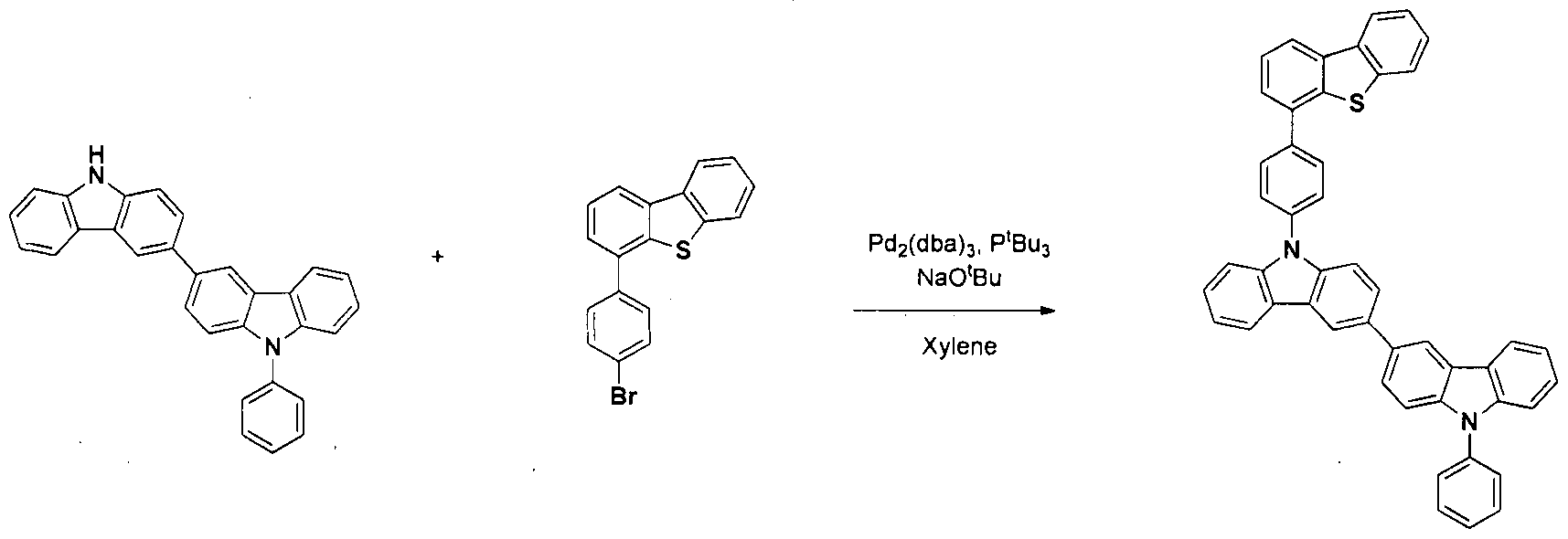
화합울 A64 Harmony Wool A64
250 mL 등근 플라스크에서 N-페닐 -3,3-바이카바졸 6.1 g (15.0 mmol), 6.1 g (15.0 mmol) of N-phenyl-3,3-bicarbazole in a 250 mL equilateral flask,
4-(4-브로모페닐)다이벤조 [b,d]싸이오펜 5.1 g (15.0 mmol), 소듐 t-부록사이드 2.9 g (30.0 mmol), 트리스 (다이벤질리덴아세톤)다이팔라디움 0.9 g (1.5 mmol) 및 트리 5.1 g (15.0 mmol) of 4- (4-bromophenyl) dibenzo [b, d] thiophene, 2.9 g (30.0 mmol) of sodium t-boxide, 0.9 g of tris (dibenzylideneacetone) dipalladium 1.5 mmol) and tree
t-부틸포스핀 1.2 mL (50% in 를루엔)를 자일렌 lOO mL과 흔합하고 질소 기류 하에서 15시간 동안 가열하여 환류하였다. 이로부터 수득한 흔합물을 메탄올 300 mL에 가하여 결정화된 고형분을 여과한 후, 다이클로로벤젠에 녹여 실리카겔 / 셀라이트로 여과하고, 유기 용매를 적당량 제거한 후, 메탄을로 재결정하여 중간체 A64 (6.7 g, 67%의 수율)를 수득하였다. 1.2 mL (50% in toluene) of t-butylphosphine was mixed with 10 mL of xylene and under a stream of nitrogen Heated to reflux for 15 hours. The resulting mixture was added to 300 mL of methanol, and the crystallized solid was filtered, dissolved in dichlorobenzene, filtered through silica gel / celite, and an appropriate amount of an organic solvent was removed. , 67% yield).
calcd. C48H30N2S: C, 86.46; H, 4.53; N, 4.20; S, 4.81 ; found: C, 86.41 ; H, 4.51 ; N, calcd. C48H30N2S: C, 86.46; H, 4.53; N, 4.20; S, 4.81; found: C, 86.41; H, 4.5 1; N,
4.18; S, 4.80 9: 화합물 B2의 합성 4.18; S, 4.80 9: Synthesis of Compound B2

화합 S B2 Unity S B2
중간체 B2의 합성 Synthesis of Intermediate B2
1000 mL 등근 플라스크에서 인돌로카바졸 39.99 g (156.01 mmol), 브로모벤젠 26.94 g (171.61 mmol), 소듐 t-부톡사이드 22.49 g (234.01 mmol), 39.99 g (156.01 mmol) of indolocarbazole, 26.94 g (171.61 mmol) of bromobenzene, 22.49 g (234.01 mmol) of sodium t-butoxide, in a 1000 mL back flask
트리스 (다이벤질리덴아세톤)다이팔라디움 4.28 g (4.68 mmol) 및 트리 t-부틸포스핀 2.9 mL (50% in 를루엔)를 자일렌 500 mL과 흔합하고 질소 기류 하에서 15시간 동안 가열하여 환류하였다. 이로부터 수득한 흔합물을 메탄을 1000 mL에 가하여 결정화된 고형분을 여과한 후, 다이클로로벤젠에 녹여 실리카겔 / 셀라이트로 여과하고, 유기 용매를 적당량 제거한 후, 메탄을로 재결정하여 중간체 B2 (23.01 g, 44%의 수율)를 수득하였다. 4.28 g (4.68 mmol) of tris (dibenzylideneacetone) dipalladium and 2.9 mL (50% in toluene) of trit-butylphosphine were combined with 500 mL of xylene and heated to reflux for 15 hours under a stream of nitrogen. . The mixture obtained therefrom was added to 1000 mL of methane, and the crystallized solid was filtered. Then, the mixture was dissolved in dichlorobenzene and filtered through silica gel / celite, and an appropriate amount of an organic solvent was removed. g, 44% yield).
calcd. C24H16N2: C, 86.72; H, 4.85; N, 8.43; found: C, 86.72; H, 4.85; N, 8.43 calcd. C 24 H 16 N 2 : C, 86.72; H, 4. 85; N, 8.43; found : C, 86.72; H, 4. 85; N, 8.43
화합물 B2의 합성 Synthesis of Compound B2
다음 반웅은 500 mL 등근 플라스크에 중간체 B2 22.93 g (69.03 mmol), The reaction was then carried out in a 500 mL isometric flask with 22.93 g (69.03 mmol) of intermediate B2,
브로모벤젠 1 1.38 g (72.49 mmol), 포타슘 하이드록사이드 4.26 g (75.94 mmol), 1.38 g (72.49 mmol) of bromobenzene 1, 4.26 g (75.94 mmol) of potassium hydroxide,
카파아이오다이드 13.14 g (69.03 mmol), 1 ,10-페난쓰로린 6.22 g (34.52 mmol)를 디엠에프 230 mL 에 넣고 질소 기류 하에서 15시간 동안 가열하여 환류하였다ᅳ 이로부터 수득한 흔합물을 메탄올 1000 mL에 가하여 결정화된 고형분을 여과한 후, 다이클로로벤젠에 녹여 실리카겔 / 셀라이트로 여과하고, 유기 용매를 적당량 제거한 후, 메탄을로 재결정하여 화합물 B2 (12.04 g, 43%의 수율)를 수득하였다. calcd. C30H20N2: C, 88.21; H, 4.93; N, 6.86; found: C, 88.21 ; H, 4.93; N, 6.86 평가예 1 : 합성된 화합물의 HOMOJLUMO 및 삼중항 (T1) 에너지 레벨 평가 하기 표 2의 방법에 따라 합성된 화합물의 HOMO, LUMO 및 T1 에너지 레벨을 평가하여 그 결과를 상기 표 1 및 하기 표 3에 나타내었다. 13.14 g (69.03 mmol) of kappaiodide, 6.22 g (34.52 mmol) of 1,10-phenanthrosine were added to 230 mL of DM, and the mixture was heated to reflux for 15 hours under a stream of nitrogen. After adding to 1000 mL, the crystallized solid was filtered, dissolved in dichlorobenzene, filtered through silica gel / celite, and an appropriate amount of organic solvent was removed, and then recrystallized with methane, to obtain Compound B2 (12.04 g, 43% yield). It was. calcd. C 30 H 20 N 2 : C, 88.21; H, 4.93; N, 6.86; found: C, 88.21; H, 4.93; N, 6.86 Evaluation Example 1: Evaluation of HOMOJLUMO and triplet (T1) energy level of the synthesized compound The HOMO, LUMO and T1 energy levels of the compound synthesized according to the method of Table 2 was evaluated and the results are shown in Table 1 and below. Table 3 shows.
【표 2】 Table 2

【표 3】 Table 3

합성된 화합물 각각에 대하여 TGA(Thermo Gravimetric Analysis) 및 Thermo Gravimetric Analysis (TGA) and
DSC(Differential Scanning Calorimetry)를 이용하여 열분석 (N2 분위기, 온도구간: 상온〜 800 °C (10 °C /min)-TGA, 상온에서 400 °C까지 -DSC, Pan Type: Pt Pan in 일회용 Al Pan(TGA) , 일회용 AI pan(DSC))을 수행한 결과를 하기 표 4에 요약하였다. 하기 표 4에 따르면, 합성된 화합물은 우수한 열적 안정성을 가짐을 확인할 수 있다. Thermal analysis using DSC (Differential Scanning Calorimetry) (N 2 atmosphere, temperature range: room temperature to 800 ° C (10 ° C / min) -TGA, room temperature to 400 ° C -DSC, Pan Type : Pt Pan in disposable Al Pan (TGA), disposable AI pan (DSC)) results are summarized in Table 4 below. According to Table 4, it can be seen that the synthesized compound has excellent thermal stability.
【표 4】 Table 4

실시예 ad- 1 Example ad-1
ITO 전극아 형성된 유리 기판을 50mm X 50mm X 0.5mm크기로 잘라서 아세톤 이소프로필 알콜과 순수물 속에서 각 15분 동안 초음파 세정한 후, 30분 동안 UV 오존 세정하였다. The glass substrate formed as an ITO electrode was cut into a size of 50 mm X 50 mm X 0.5 mm, sonicated for 15 minutes in acetone isopropyl alcohol and pure water, followed by UV ozone cleaning for 30 minutes.
상기 ITO 전극 상에 m-MTDATA를 증착 속도 1 A/sec로 진공 증착하여 600 A 두께의 정공 주입층을 형성하고, 상기 정공 주입층 상에 상기 α-ΝΡΒ를 증착 속도 l A/sec로 진공 증착하여 300 A 두께의 정공 수송층을 형성하였다. 이어서, 상기 정공 수송층 상에 Ir(ppy)3(도편트) 화합물 b-41 (호스트)를 각각 증착 속도 0.1 A/sec와 1 A/sec로 공증착하여 400 A의 두께의 발광층을 형성하였다. 상기 발광층 상에 M-MTDATA was vacuum deposited on the ITO electrode at a deposition rate of 1 A / sec to form a hole injection layer having a thickness of 600 A, and vacuum deposition of the α-ΝΡΒ on the hole injection layer at a deposition rate of l A / sec. To form a hole transport layer having a thickness of 300 A. Subsequently, Ir (ppy) 3 (dope) compound b-41 (host) was co-deposited on the hole transport layer at a deposition rate of 0.1 A / sec and 1 A / sec to form a light emitting layer having a thickness of 400 A, respectively. On the light emitting layer
BAlq을 증착 속도 1 A/sec로 진공 증착하여 50 A의 두께의 정공 저지층을 형성한 후, 상기 정공 저지층 상에 Alq3를 진공 증착하여 300 A 두께의 전자 수송층을 BAlq was vacuum deposited at a deposition rate of 1 A / sec to form a hole blocking layer having a thickness of 50 A, followed by vacuum deposition of Alq 3 on the hole blocking layer to form an electron transport layer having a thickness of 300 A.
형성하였다. 상기 전자 수송층 상에 LiF l O A (전자 주입층)과 A1 2000 A (캐소드)을 순차적으로 진공증착하여, 유기 발광 소자를 제작하였다. Formed. LiF lO A (electron injection layer) and A1 2000 A (cathode) were sequentially vacuum-deposited on the electron transport layer, thereby manufacturing an organic light emitting device.
실시예 ad-2 Example ad-2
발광층 형성시 호스트로서 화합물 b-41 대신 화합물 b-기를 사용하였다는 점을 제외하고는, 상기 실시예 ad- Ι과 동일한 방법을 이용하여, 유기 발광 소자를 제작하였다. Compound b-group was used instead of compound b-41 as a host in forming the emission layer. Except for the point, an organic light emitting device was manufactured in the same manner as in Example ad-I.
실시예 1 Example 1
발광층 형성시 호스트로서 화합물 b-41 대신 화합물 29을 사용하였다는 점을 제외하고는, 상기 실시예 ad-Ι과 동일한 방법을 이용하여, 유기 발광 소자를 제작하였다. An organic light-emitting device was manufactured in the same manner as in Example ad-Ι, except that Compound 29 was used instead of Compound b-41 as a host to form the EML.
실시예 2 Example 2
발광층 형성시 호스트로서 화합물 b-41 대신 화합물 30을 사용하였다는 점을 제외하고는, 상기 실시예 ad-1과 동일한 방법을 이용하여, 유기 발광 소자를 제작하였다. An organic light-emitting device was manufactured in the same manner as in Example ad-1, except that Compound 30, instead of Compound b-41, was used as a host to form the EML.
실시예 ad-3 Example ad-3
발광층 형성시 호스트로서 화합물 b-41 대신 화합물 27을 사용하였다는 점을 제외하고는, 상기 실시예 ad-1과 동일한 방법을 이용하여, 유기 발광 소자를 제작하였다. An organic light-emitting device was manufactured in the same manner as in Example ad-1, except that Compound 27, instead of Compound b-41, was used as a host to form the EML.
실시예 ad-4 Example ad-4
발광층 형성시 호스트로서 화합물 b-41 대신 화합물 a-30를 사용하였다는 점을 제외하고는, 상기 실시예 ad-1과 동일한 방법을 이용하여, 유기 발광 소자를 제작하였다. An organic light-emitting device was manufactured in the same manner as in Example ad-1, except that Compound a-30, instead of Compound b-41, was used as a host to form the EML.
실시예 ad-5 Example ad-5
발광층 형성시 호스트로서 화합물 b-41 대신 화합물 a-40를 사용하였다는 점을 제외하고는, 상기 실시예 ad- 1과 동일한 방법을 이용하여, 유기 발광 소자를 제작하였다. An organic light-emitting device was manufactured in the same manner as in Example ad-1, except that Compound a-40 was used instead of Compound b-41 as a host to form the EML.
실시예 ad-6 Example ad-6
발광층 형성시 호스트로서 화합물 b-41 대신 화합물 a-41를 사용하였다는 점을 제외하고는, 상기 실시예 ad-1과 동일한 방법을 이용하여, 유기 발광 소자를 제작하였다. An organic light-emitting device was manufactured in the same manner as in Example ad-1, except that Compound a-41, instead of Compound b-41, was used as a host to form the EML.
실시예 ad-7 Example ad-7
발광층 형성시 호스트로서 화합물 b-41 대신 화합물 a-42을 사용하였다는 점을 제외하고는, 상기 실시예 ad-1과 동일한 방법을 이용하여, 유기 발광 소자를 제작하였다. 실시예 ad-8 An organic light-emitting device was manufactured in the same manner as in Example ad-1, except that Compound a-42, instead of Compound b-41, was used as a host to form the EML. Example ad-8
발광층 형성시 호스트로서 화합물 b-41 대신 화합물 a-46을 사용하였다는 점을 제외하고는, 상기 실시예 ad- Ι과 동일한 방법을 이용하여, 유기 발광 소자를 제작하였다. An organic light-emitting device was manufactured in the same manner as in Example ad-Ι, except that Compound a-46 was used instead of Compound b-41 as a host to form the EML.
실시예 ad-9 Example ad-9
발광층 형성시 호스트로서 화합물 b-41 대신 화합물 a-56을 사용하였다는 점을 제외하고는, 상기 실시예 ad-Ι과 동일한 방법을 이용하여, 유기 발광 소자를 제작하였다. An organic light-emitting device was manufactured in the same manner as in Example ad-Ι, except that Compound a-56 was used instead of Compound b-41 as a host to form the EML.
실시예 ad- 10 Example ad-10
발광층 형성시 호스트로서 화합물 b-41 대신 화합물 a-70를 사용하였다는 점을 제외하고는, 상기 실시예 ad-Ι과 동일한 방법을 이용하여, 유기 발광 소자를 제작하였다. An organic light-emitting device was manufactured in the same manner as in Example ad-Ι, except that Compound a-70, instead of Compound b-41, was used as a host to form the EML.
실시예 ad- 1 1 Example ad-1 1
발광층 형성시 호스트로서 화합물 b-41 대신 화합물 a-기를 사용하였다는 점을 제외하고는, 상기 실시예 ad- Ι과 동일한 방법을 이용하여, 유기 발광 소자를 제작하였다. An organic light-emitting device was manufactured in the same manner as in Example ad-Ι, except that Compound a-group was used instead of Compound b-41 as a host to form the EML.
실시예 ad- 12 Example ad-12
발광층 형성시 호스트로서 화합물 b-41 대신 화합물 a-74올 사용하였다는 점을 제외하고는, 상기 실시예 ad- Ι과 동일한 방법을 이용하여, 유기 발광 소자를 제작하였다. . An organic light-emitting device was manufactured in the same manner as in Example ad-Ι, except that Compound a-74 was used instead of Compound b-41 as a host to form the EML. .
실시예 ad- 13 Example ad-13
발광층 형성시 호스트로서 화합물 b-41 대신 화합물 a-75를 사용하였다는 점을 제외하고는, 상기 실시예 ad- Ι과 동일한 방법을 이용하여, 유기 발광 소자를 제작하였다. An organic light-emitting device was manufactured in the same manner as in Example ad-Ι, except that Compound a-75 was used instead of Compound b-41 as a host to form the EML.
실시예 ad- 14 Example ad-14
발광층 형성시 호스트로서 화합물 b-41 대신 화합물 a-82을 사용하였다는 점을 제외하고는, 상기 실시예 ad- 1과 동일한 방법을 이용하여, 유기 발광 소자를 제작하였다. An organic light-emitting device was manufactured in the same manner as in Example ad-1, except that Compound a-82, instead of Compound b-41, was used as a host to form the EML.
실시예 ad-15 Example ad-15
발광층 형성시 호스트로서 화합물 b-41 대신 화합물 a-84를 사용하였다는 점을 제외하고는, 상기 실시예 ad- Ι과 동일한 방법을 이용하여, 유기 발광 소자를 제작하였다. Compound a-84 was used instead of compound b-41 as a host in forming the emission layer. Except for the point, an organic light emitting device was manufactured in the same manner as in Example ad-I.
실시예 ad-16 Example ad-16
발광층 형성시 호스트로서 화합물 b-41 대신 화합물 a- 1 14을 사용하였다는 점을 제외하고는, 상기 실시예 ad- Ι과 동일한 방법을 이용하여, 유기 발광 소자를 제작하였다. An organic light-emitting device was manufactured in the same manner as in Example ad-I, except that Compound a-1 14 was used instead of Compound b-41 as a host to form the EML.
실시예 ad- 17 Example ad-17
발광층 형성시 호스트로서 화합물 b-41 대신 화합물 a- 1 10를 사용하였다는 점을 제외하고는, 상기 실시예 ad-Ι과 동일한 방법을 이용하여, 유기 발광 소자를 제작하였다ᅳ An organic light-emitting device was manufactured in the same manner as in Example ad-Ι, except that Compound a-1 10 was used instead of Compound b-41 as a host to form the EML.
실시예 ad-18 Example ad-18
발광층 형성시 호스트로서 화합물 b-41 대신 화합물 a-1 12을 사용하였다는 점을 제외하고는, 상기 실시예 ad-1과 동일한 방법을 이용하여, 유기 발광 소자를 제작하였다. An organic light-emitting device was manufactured in the same manner as in Example ad-1, except that Compound a-1 12 was used instead of Compound b-41 as a host to form the EML.
실시예 ad-19 Example ad-19
발광층 형성시 호스트로서 화합물 b-41 대신 화합물 c-40를 사용하였다는 점을 제외하고는, 상기 실시예 ad-1과 동일한 방법을 이용하여, 유기 발광 소자를 제작하였다. An organic light-emitting device was manufactured in the same manner as in Example ad-1, except that Compound c-40, instead of Compound b-41, was used as a host to form the EML.
실시예 ad-20 Example ad-20
발광층 형성시 호스트로서 화합물 b-41 대신 화합물 c-50를 사용하였다는 점을 제외하고는, 상기 실시예 ad-1과 동일한 방법을 이용하여, 유기 발광 소자를 제작하였다. An organic light-emitting device was manufactured in the same manner as in Example ad-1, except that Compound c-50, instead of Compound b-41, was used as a host to form the EML.
실시예 ad-21 Example ad-21
발광층 형성시 호스트로서 화합물 b-41 대신 화합물 d-1 19를 사용하였다는 점을 제외하고는, 상기 실시예 ad- 1과 동일한 방법을 이용하여, 유기 발광 소자를 제작하였다. An organic light-emitting device was manufactured in the same manner as in Example ad-1, except that Compound d-1 19, instead of Compound b-41, was used as a host to form the EML.
실시예 ad-22 Example ad-22
발광층 형성시 호스트로서 화합물 b-41 대신 화합물 e-70를 사용하였다는 점을 제외하고는, 상기 실시예 ad-1과 동일한 방법을 이용하여, 유기 발광 소자를 제작하였다. 실시예 ad-23 An organic light-emitting device was manufactured in the same manner as in Example ad-1, except that Compound e-70, instead of Compound b-41, was used as a host to form the EML. Example ad-23
발광층 형성시 호스트로서 화합물 b-41 대신 화합물 f-70을 사용하였다는 점을 제외하고는, 상기 실시예 ad- Ι과 동일한 방법을 이용하여, 유기 발광 소자를 제작하였다. An organic light-emitting device was manufactured in the same manner as in Example ad-Ι, except that Compound f-70, instead of Compound b-41, was used as a host to form the EML.
실시예 ad-24 Example ad-24
발광층 형성시 호스트로서 화합물 b-41 대신 화합물 e-기을 사용하였다는 점을 제외하고는, 상기 실시예 ad-1과 동일한 방법을 이용하여, 유기 발광 소자를 제작하였다. 실시예 ad-25 An organic light-emitting device was manufactured in the same manner as in Example ad-1, except that Compound e-group was used instead of Compound b-41 as a host to form the EML. Example ad-25
발광층 형성시 호스트로서 화합물 b-41 대신 화합물 e-74을 사용하였다는 점을 제외하고는, 상기 실시예 ad- 1과 동일한 방법을 이용하여, 유기 발광 소자를 제작하였다. 실시예 ad-26 An organic light-emitting device was manufactured in the same manner as in Example ad-1, except that Compound e-74, instead of Compound b-41, was used as a host to form the EML. Example ad-26
발광층 형성시 호스트로서 화합물 b-41 대신 화합물 e-75을 사용하였다는 점을 제외하고는, 상기 실시예 ad- 1과 동일한 방법을 이용하여, 유기 발광 소자를 제작하였다. 실시예 ad-27 An organic light-emitting device was manufactured in the same manner as in Example ad-1, except that Compound e-75, instead of Compound b-41, was used as a host to form the EML. Example ad-27
발광층 형성시 호스트로서 화합물 b-41 대신 화합물 e-82을 사용하였다는 점을 제외하고는, 상기 실시예 ad-1과 동일한 방법을 이용하여, 유기 발광 소자를 제작하였다ᅳ 실시예 ad-28 An organic light emitting device was manufactured in the same manner as in Example ad-1, except that Compound e-82 was used instead of Compound b-41 as a host to form the EML. Example ad-28
발광층 형성시 호스트로서 화합물 b-41 대신 화합물 e-84을 사용하였다는 점을 제외하고는, 상기 실시예 ad-1과 동일한 방법을 이용하여, 유기 발광 소자를 제작하였다. 실시예 ad-29 발광층 형성시 호스트로서 화합물 b-41 대신 화합물 e-88을 사용하였다는 점을 제외하고는, 상기 실시예 ad-Ι과 동일한 방법을 이용하여, 유기 발광 소자를 제작하였다. 실시예 ad-30 An organic light-emitting device was manufactured in the same manner as in Example ad-1, except that Compound e-84, instead of Compound b-41, was used as a host to form the EML. Example ad-29 An organic light-emitting device was manufactured in the same manner as in Example ad-Ι, except that Compound e-88, instead of Compound b-41, was used as a host to form the EML. Example ad-30
발광층 형성시 호스트로서 화합물 b-41 대신 화합물 e- 1 14을 사용하였다는 점을 제외하고는, 상기 실시예 ad-Ι과 동일한 방법을 이용하여, 유기 발광 소자를 제작하였다. 실시예 ad-3 1 An organic light-emitting device was manufactured in the same manner as in Example ad-Ι, except that Compound e-1 14 was used instead of Compound b-41 as a host to form the EML. Example ad-3 1
발광층 형성시 호스트로서 화합물 b-41 대신 화합물 f-기을 사용하였다는 점을 제외하고는, 상기 실시예 ad- Ι과 동일한 방법을 이용하여, 유기 발광 소자를 제작하였다. 실시예 ad-32 An organic light-emitting device was manufactured in the same manner as in Example ad-Ι, except that Compound f-group was used instead of Compound b-41 as a host to form the EML. Example ad-32
발광층 형성시 호스트로서 화합물 b-41 대신 화합물 f-74을 사용하였다는 점을 제외하고는, 상기 실시예 ad-Ι과 동일한 방법을 이용하여, 유기 발광 소자를 제작하였다. 실시예 ad-33 An organic light-emitting device was manufactured in the same manner as in Example ad-Ι, except that Compound f-74, instead of Compound b-41, was used as a host to form the EML. Example ad-33
발광층 형성시 호스트로서 화합물 b-41 대신 화합물 f-75을 사용하였다는 점을 제외하고는, 상기 실시예 ad-Ι과 동일한 방법을 이용하여, 유기 발광 소자를 제작하였다. 실시예 ad-34 An organic light-emitting device was manufactured in the same manner as in Example ad-Ι, except that Compound f-75, instead of Compound b-41, was used as a host to form the EML. Example ad-34
발광층 형성시 호스트로서 화합물 b-41 대신 화합물 f-82을 사용하였다는 점을 제외하고는, 상기 실시예 ad- 1과 동일한 방법을 이용하여, 유기 발광 소자를 제작하였다. 실시예 ad-35 발광층 형성시 호스트로서 화합물 b-41 대신 화합물 f-84을 사용하였다는 점을 제외하고는, 상기 실시예 ad-Ι과 동일한 방법을 이용하여, 유기 발광 소자를 제작하였다. 실시예 ad-36 An organic light-emitting device was manufactured in the same manner as in Example ad-1, except that Compound f-82, instead of Compound b-41, was used as a host to form the EML. Example ad-35 An organic light-emitting device was manufactured in the same manner as in Example ad-Ι, except that Compound f-84, instead of Compound b-41, was used as a host to form the EML. Example ad-36
발광층 형성시 호스트로서 화합물 b-41 대신 화합물 f-88을 사용하였다는 점을 제외하고는, 상기 실시예 ad-1과 동일한 방법을 이용하여, 유기 발광 소자를 제작하였다. 실시예 ad-37 An organic light-emitting device was manufactured in the same manner as in Example ad-1, except that Compound f-88, instead of Compound b-41, was used as a host to form the EML. Example ad-37
발광층 형성시 호스트로서 화합물 b-41 대신 화합물 f-1 14올 사용하였다는 점을 제외하고는, 상기 실시예 ad-1과 동일한 방법을 이용하여, 유기 발광 소자를 제작하였다. 유기 발광소자의 제작 (발광층소자 -Mixed Host) An organic light-emitting device was manufactured in the same manner as in Example ad-1, except that Compound f-1 14ol, instead of Compound b-41, was used as a host to form the EML. Fabrication of organic light emitting device (light emitting layer device -mixed host)
실시예 ad-38 ' Example ad-38 ''
정공 수송층 상에 Ir(ppy)3(도편트), 화합물 a-70(제 1호스트) 및 화합물 Ir (ppy) 3 (dope), compound a-70 (first host) and compound on the hole transport layer
A1 (제 2호스트)를 10 : 45 : 45의 중량비로 공증착하여 400A의 두께의 발광층을 형성함으로써 발광층을 형성하였다는 점을 제외하고는, 상기 실시예 ad-1과 동일한 방법을 이용하여 유기 발광 소자를 제작하였다. The organic light-emitting layer was formed in the same manner as in Example ad-1, except that A1 (second host) was co-deposited at a weight ratio of 10:45:45 to form a light emitting layer having a thickness of 400 A. A light emitting device was produced.
실시예 ad-39 Example ad-39
발광층 형성시 화합물 A1 대신 화합물 A2를 사용하였다는 점을 제외하고는, 상기 실시예 ad-38과 동일한 방법을 이용하여 유기 발광 소자를 제작하였다. An organic light-emitting device was manufactured in the same manner as in Example ad-38, except that Compound A2 was used instead of Compound A1 in forming the EML.
실시예 ad-40 Example ad-40
발광층 형성시 화합물 A1 대신 화합물 A5를 사용하였다는 점을 제외하고는, 상기 실시예 ad-38과 동일한 방법을 이용하여 유기 발광 소자를 제작하였다. An organic light-emitting device was manufactured in the same manner as in Example ad-38, except that Compound A5 was used instead of Compound A1 to form the EML.
실시예 ad-41 Example ad-41
발광층 형성시 화합물 A1 대신 화합물 A15를 사용하였다는 점을 제외하고는, 상기 실시예 ad-38과 동일한 방법을 이용하여 유기 발광 소자를 제작하였다. An organic light-emitting device was manufactured in the same manner as in Example ad-38, except that Compound A15, instead of Compound A1, was used to form the EML.
실시예 ad-42 발광층 형성시 화합물 A1 대신 화합물 A17을 사용하였다는 점을 제외하고는, 상기 실시예 ad-38과 동일한 방법을 이용하여 유기 발광 소자를 제작하였다. Example ad-42 An organic light-emitting device was manufactured in the same manner as in Example ad-38, except that Compound A17 was used instead of Compound A1 to form the EML.
실시예 ad-43 Example ad-43
발광층 형성시 화합물 A1 대신 화합물 A63을 사용하였다는 점을 제외하고는, 상기 실시예 ad-38과 동일한 방법을 이용하여 유기 발광 소자를 제작하였다. An organic light-emitting device was manufactured in the same manner as in Example ad-38, except that Compound A63 was used instead of Compound A1 in forming the EML.
실시예 ad-44 Example ad-44
발광층 형성시 화합물 A 1 대신 화합물 A64를 사용하였다는 점을 제외하고는, 상기 실시예 ad-38과 동일한 방법을 이용하여 유기 발광 소자를 제작하였다. An organic light-emitting device was manufactured in the same manner as in Example ad-38, except that Compound A64 was used instead of Compound A 1 to form the EML.
실시예 ad-45 Example ad-45
발광층 형성시 화합물 A1 대신 화합물 B2를 사용하였다는 점을 제외하고는, 상기 실시예 ad-38과 동일한 방법을 이용하여 유기 발광 소자를 제작하였다. An organic light-emitting device was manufactured in the same manner as in Example ad-38, except that Compound B2 was used instead of Compound A1 to form the EML.
실시예 ad-46 Example ad-46
정공 수송층 상에 Ir(ppy)3(도편트), 화합물 a-40(제 1호스트) 및 화합물 Ir (ppy) 3 (dope), compound a-40 (first host) and compound on the hole transport layer
A17(제 2호스트)를 10 : 45 : 45의 중량비로 공증착하여 400 A의 두께의 발광층을 형성함으로써 발광층을 형성하였다는 점을 제외하고는, 상기 실시예 ad-38과 동일한 방법을 이용하여 유기 발광 소자를 제작하였다. Except that A17 (second host) was co-deposited at a weight ratio of 10:45:45 to form a light emitting layer having a thickness of 400 A, a light emitting layer was formed using the same method as in Example ad-38. An organic light emitting device was produced.
실시예 ad-47 Example ad-47
발광층 형성시 화합물 a-40 대신 화합물 a-기를 사용하였다는 점올 A compound that used a compound a-group instead of compound a-40 to form an emission layer
제외하고는, 상기 실시예 ad-46와 동일한 방법을 이용하여 유기 발광 소자를 Except for the organic light-emitting device by using the same method as in Example ad-46 except
제작하였다. Produced.
실시예 ad-48 Example ad-48
발광층 형성시 화합물 a-40 대신 화합물 a-74를 사용하였다는 점을 Compound a-74 was used instead of compound a-40 to form the light emitting layer.
제외하고는, 상기 실시예 ad-46와 동일한 방법을 이용하여 유기 발광 소자를 Except for the organic light-emitting device by using the same method as in Example ad-46 except
제작하였다. Produced.
실시예 ad-49 Example ad-49
발광층 형성시 화합물 a-40 대신 화합물 a-75를 사용하였다는 점을 Compound A-75 was used instead of Compound a-40 to form the light emitting layer.
제외하고는, 상기 실시예 ad-46와 동일한 방법을 이용하여 유기 발광 소자를 Except for the organic light-emitting device by using the same method as in Example ad-46 except
제작하였다. Produced.
실시예 ad-50 Example ad-50
발광층 형성시 화합물 a-40 대신 화합물 a-82를 사용하였다는 점을 제외하고는, 상기 실시예 ad-46와 동일한 방법을 이용하여 유기 발광 소자를 제작하였다. Compound a-82 was used instead of compound a-40 to form the light emitting layer. Except for the above, an organic light emitting device was manufactured in the same manner as in Example ad-46.
실시예 ad-51 Example ad-51
발광층 형성시 화합물 a-40 대신 화합물 a-84를 사용하였다는 점을 제외하고는, 상기 실시예 ad-46와 동일한 방법을 이용하여 유기 발광 소자를 제작하였다. An organic light-emitting device was manufactured in the same manner as in Example ad-46, except that Compound a-84 was used instead of Compound a-40 to form the EML.
실시예 ad-52 Example ad-52
정공 수송층 상에 lr(ppy)3(도편트), 화합물 a-75(제 1호스트) 및 화합물 Lr (ppy) 3 (dope), compound a-75 (first host) and compound on the hole transport layer
A63(제 2호스트)를 10 : 45 : 45의 중량비로 공증착하여 400A의 두께의 발광층을 형성함으로써 발광층을 형성하였다는 점을 제외하고는, 상기 실시예 ad-38과 동일한 방법을 이용하여 유기 발광 소자를 제작하였다. The organic light-emitting layer was formed in the same manner as in Example ad-38, except that A63 (second host) was co-deposited at a weight ratio of 10:45:45 to form a light emitting layer having a thickness of 400 A. A light emitting device was produced.
실시예 ad-53 Example ad-53
발광층 형성시 화합물 A63 대신 화합물 A64을 사용하였다는 점을 Compound A64 was used instead of Compound A63 to form the emission layer.
제외하고는, 상기 실시예 ad-52와 동일한 방법을 이용하여 유기 발광 소자를 제작하였다. Except for the above, an organic light-emitting device was manufactured in the same manner as in Example ad-52.
실시예 ad-54 Example ad-54
발광층 형성시 화합물 a-40 대신 화합물 e-75를 사용하였다는 점을 제외하고는, 상기 실시예 ad-46와 동일한 방법을 이용하여 유기 발광 소자를 제작하였다. An organic light-emitting device was manufactured in the same manner as in Example ad-46, except that Compound e-75, instead of Compound a-40, was used to form the EML.
실시예 ad-55 Example ad-55
발광층 형성시 화합물 a-40 대신 화합물 e-114를 사용하였다는 점을 제외하고는, 상기 실시예 ad-46와 동일한 방법을 이용하여 유기 발광 소자를 제작하였다. An organic light-emitting device was manufactured in the same manner as in Example ad-46, except that Compound e-114 was used instead of Compound a-40 to form the EML.
실시예 ad-56 Example ad-56
발광층 형성시 화합물 a-40 대신 화합물 f-75를 사용하였다는 점을 Compound f-75 was used instead of compound a-40 to form the emission layer.
제외하고는, 상기 실시예 ad-46와 동일한 방법을 이용하여 유기 발광 소자를 제작하였다. Except for the above, an organic light emitting device was manufactured in the same manner as in Example ad-46.
실시예 ad-57 Example ad-57
발광층 형성시 화합물 a-40 대신 화합물 f-114를 사용하였다는 점올 제외하고는, 상기 실시예 ad-46와 동일한 방법을 이용하여 유기 발광 소자를 제작하였다. An organic light-emitting device was manufactured in the same manner as in Example ad-46, except that Compound f-114 was used instead of Compound a-40 to form the EML. Produced.
실시예 ad-58 Example ad-58
발광층 형성시 화합물 A17 대신 화합물 A64을 사용하였다는 점을 제외하고는, 상기 실시예 ad-54와 동일한 방법을 이용하여 유기 발광 소자를 제작하였다. An organic light-emitting device was manufactured in the same manner as in Example ad-54, except that Compound A64 was used instead of Compound A17 in forming the EML.
실시예 ad-59 Example ad-59
발광층 형성시 화합물 A17 대신 화합물 A64을 사용하였다는 점을 제외하고는, 상기 실시예 ad-55와 동일한 방법을 이용하여 유기 발광 소자를 제작하였다ᅳ An organic light-emitting device was manufactured in the same manner as in Example ad-55, except that Compound A64 was used instead of Compound A17 to form the EML.
실시예 ad-60 Example ad-60
발광층 형성시 화합물 A17 대신 화합물 A64을 사용하였다는 점을 제외하고는, 상기 실시예 ad-56과 동일한 방법을 이용하여 유기 발광 소자를 제작하였다. An organic light-emitting device was manufactured in the same manner as in Example ad-56, except that Compound A64 was used instead of Compound A17 in forming the EML.
실시예 ad-61 Example ad-61
발광층 형성시 화합물 A17 대신 화합물 A64을 사용하였다는 점을 제외하고는, 상기 실시예 ad-57과 동일한 방법을 이용하여 유기 발광 소자를 제작하였다. An organic light-emitting device was manufactured in the same manner as in Example ad-57, except that Compound A64 was used instead of Compound A17 in forming the EML.
비교예 1 Comparative Example 1
발광층 형성시 호스트로서 화합물 b-41 대신 화합물 A를 사용하였다는 점을 제외하고는, 상기 실시예 ad-Ι과 동일한 방법을 이용하여, 유기 발광 소자를 제작하였다. An organic light-emitting device was manufactured in the same manner as in Example ad-Ι, except that Compound A was used instead of Compound b-41 as a host to form the EML.
< A> <A>

비교예 2 Comparative Example 2
발광층 형성시 호스트로서 화합물 b-41 대신 화합물 B를 사용하였다는 점을 제외하고는, 상기 실시예 ad-Ι과 동일한 방법을 이용하여, 유기 발광 소자를 제작하였다. An organic light-emitting device was manufactured in the same manner as in Example ad-Ι, except that Compound B was used instead of Compound b-41 as a host to form the EML. Produced.
< B> <B>

비교예 3 Comparative Example 3
발광층 형성시 호스트로서 화합물 b-41 대신 화합물 C를 사용하였다는 점을 제외하고는, 상기 실시예 ad-Ι과 동일한 방법을 이용하여, 유기 발광 소자를 제작하였다. An organic light-emitting device was manufactured in the same manner as in Example ad-Ι, except that Compound C was used instead of Compound b-41 as a host to form the EML.
< C> <C>

비교예 4 ' 발광충 형성시 호스트로서 화합물 b-41 대신 화합물 D를 사용하였다는 점을 제외하고는, 상기 실시예 ad-Ι과 동일한 방법을 이용하여, 유기 발광 소자를 제작하였다. Comparative Example 4 An organic light-emitting device was manufactured in the same manner as in Example ad-Ι, except that Compound D was used instead of Compound b-41 as a host to form the LUM.
< D> <D>

실시예 ad-62 i발광층소자 (2) -single host) Example ad-62 i Light Emitting Layer Device ( 2 ) -single host
합성예 ad-20에서 얻은 b-1 16를 호스트로 사용하고, (piq)2Ir(acac)을 도판트로 사용하여 유기 발광소자를 제작하였다. B-1 16 obtained in Synthesis Example ad-20 was used as a host, and (piq) 2 Ir (acac) was used as a dopant. To produce an organic light emitting device.
양극으로는 ΠΌ를 1000 A의 두께로 사용하였고, 음극으로는 알루미늄 (A1)을 1000 A의 두께로 사용하였다. 구체적으로, 유기발광소자의 제조방법을 설명하면, 양극은 15Ω/ η2의 면저항값을 가진 ΠΌ 유리기판을 50mm x 50mm x 0.7mm의 크기로 잘라서 아세톤과 이소프로필알코을과 순수물 속에서 각 15 분 동안 초음파 세정한 후, 30분 동안 UV 오존 세정하여 사용하였다. As a positive electrode, ΠΌ was used at a thickness of 1000 A, and as a negative electrode, aluminum (A1) was used at a thickness of 1000 A. Specifically, the manufacturing method of the organic light emitting device, the anode is cut into a glass substrate with a sheet resistance value of 15Ω / η 2 to a size of 50mm x 50mm x 0.7mm in acetone, isopropyl alcohol and pure water each 15 After ultrasonic cleaning for minutes, UV ozone cleaning was used for 30 minutes.
상기 기판 상부의 진공도 650 X 10-7Pa, 증착속도 0.1 내지 0.3 nm/s의 조건으로 Ν4,Ν4'-디 (나프탈렌 -1-일) -Ν 4, Ν 4 ' -di (naphthalene-1-yl)-under the conditions of a vacuum degree of 650 X 10 -7 Pa, deposition rate 0.1 to 0.3 nm / s on the substrate
Ν4,Ν4'-디페닐비페닐 -4,4'-디아민 (N4,N4'-di(naphthalene-l-yl)-N4,N4'-diphenylbiphenyl-4,4 '-diamine:NPB) (80nm)를 증착하여 800 A의 정공수송층을 형성하였다. 이어서, 동일한 진공 증착조건에서 합성예 ad-20의 b-116을 이용하여 막 두께 300人의 발광층을 형성하였고, 이때, 인광 도편트인 (piq)2Ir(aCac)을 동시에 증착하였다. Ν4, Ν4 '- diphenyl-biphenyl-4,4'-diamine (N4, N4'-di (naphthalene -l-yl) -N4, N4'-diphenylbiphenyl-4, 4' -diamine: NPB) (80nm) Was deposited to form a hole transport layer of 800 A. Subsequently, a light emitting layer having a thickness of 300 was formed using b-116 of Synthesis Example ad-20 under the same vacuum deposition conditions. At this time, a phosphorescent dopant (piq) 2 Ir ( aC ac) was simultaneously deposited.
이 때, 인광 도편트의 증착속도를 조절하여, 발광층의 전체량을 100 중량 %로 하였을 때, 인광 도편트의 배합량이 3 중량 %가 되도록 증착하였다. At this time, by adjusting the deposition rate of the phosphorescent dopant, when the total amount of the light emitting layer was 100% by weight, it was deposited so that the compounding amount of the phosphorescent dopant was 3% by weight.
상기 발광층 상부에 동일한 진공 증착조건을 이용하여 By using the same vacuum deposition conditions on the light emitting layer
비스 (2-메틸 -8-퀴놀리놀레이트) -4- (페닐페놀레이토)알루미늄 Bis (2-methyl-8-quinolinolate) -4- (phenylphenolrato) aluminum
(bis(2-methyl-8-quinolinolate)-4-(phenylphenolato)aluminium: BAlq)¾- 증착하여 막 두께 50 A의 정공저지층을 형성하였다. 이어서, 동일한 진공 증착조건에서 Alq3를 증착하여, 막 두께 200 A의 전공수송층을 형성하였다. 상기 전자수송층 상부에 음극으로서 LiF와 A1을 순차적으로 증착하여 유기 광전자 소자를 제작하였다. (bis (2-methyl-8-quinolinolate) -4- (phenylphenolato) aluminum: BAlq) ¾- was deposited to form a hole blocking layer having a thickness of 50 A. Subsequently, Alq3 was deposited under the same vacuum deposition conditions to form a major transport layer having a thickness of 200 A. An organic optoelectronic device was fabricated by sequentially depositing LiF and A1 as a cathode on the electron transport layer.
상기 유기 광전자 소자의 구조는 1丁0/ 1¾ (80 1^1)/ 5 1^ 01 16 (97중량%) + The structure of the organic optoelectronic device is 1 1 0 / 1¾ (80 1 ^ 1) / 5 1 ^ 01 16 (97% by weight) +
(piq)2Ir(acac) (3 중량0 /。), 30nm)/ Balq (5nm)/ Alq3 (20nm)/ LiF (lnm) / Al (lOOnm) 의 구조로 제작하였다. 실시예 ad-63 (piq) 2 Ir (acac) (3 weights 0 /.), 30 nm) / Balq (5 nm) / Alq3 (20 nm) / LiF (lnm) / Al (100 nm). Example ad-63
합성예 ad-20의 화합물 b-1 16 대신 합성예 ad-14의 화합물 a-108을 사용한 것을 제외하고는 실시예 ad-62와 동일한 방법으로 유기발광소자를 제조하였다. 비교예 ad-1 An organic light emitting diode was manufactured according to the same method as Example ad-62 except for using the compound a-108 of Synthesis Example ad-14 instead of the compound b-1 16 of Synthesis Example ad-20. Comparative Example ad-1
실시예 ad-62의 화합물 b-1 16 대신 하기 구조의 CBP를 사용한 것을 제외하고는 실시예 ad-62와 동일한 방법으로 유기발광소자를 제조하였다. 상기 유기발광소자 제작에 사용된 NPB, BAlq, CBP 및 (piq)2Ir(acac) 구조는 하기와 같다. CBP having the following structure instead of compound b-1 16 of Example ad-62 Except for the organic light emitting device was manufactured in the same manner as in Example ad-62. NPB, BAlq, CBP, and (piq) 2 Ir (acac) structures used for fabricating the organic light emitting diode are as follows.

평가예 3: 유기 발광소자의 특성 평가 ( I ) Evaluation Example 3 Evaluation of Characteristics of Organic Light-Emitting Device (I)
실시예 1 , 2, ad-1 내지 ad-17, 및 ad-21 내지 ad-63 및 비교예 1 내지 4 및 ad-1의 유기 발광 소자의 구동 전압, 효율 및 휘도를 전류 전압계 (Kethley SMU 236)에서 전원을 공급하여, 휘도게 PR650 Spectroscan Source Measurement The driving voltage, efficiency, and luminance of the organic light emitting diodes of Examples 1, 2, ad-1 to ad-17, and ad-21 to ad-63, and Comparative Examples 1 to 4 and ad-1 were measured using a current voltmeter (Kethley SMU 236). Power Supply from Luminaire PR650 Spectroscan Source Measurement
Unit.(PhotoResearch사 제품임)을 이용하여 평가하였다. It was evaluated using Unit. (Product of PhotoResearch).
구체적인 측정방법은 하기와 같고, 그 결과는 표 5 내지 7과 같다. The specific measuring method is as follows, and the result is as Tables 5-7 .
(1) 전압변화에 따른 전류밀도의 변화 측정 (1) Measurement of change in current density according to voltage change
제조된 유기발광소자에 대해, 전압을 0V 부터 10V까지 상승시키면서 전류-전압계 (Keithley 2400)를 이용하여 단위소자에 흐르는 전류값을 측정하고, 측정된 전류값을 면적으로 나누어 결과를 얻었다. For the organic light emitting device manufactured, the current value flowing through the unit device was measured by using a current-voltmeter (Keithley 2400) while increasing the voltage from 0V to 10V, and the measured current value was divided by the area to obtain a result.
(2) 전압변화에 따른 휘도변화 측정 (2) Measurement of luminance change according to voltage change
제조된 유기발광소자에 대해, 전압을 0V 부터 10V까지 상승시키면서 휘도계 (Minolta Cs-I OOOA)를 이용하여 그 때의 휘도를 측정하여 결과를 얻었다. For the organic light emitting device manufactured, the luminance was measured using a luminance meter (Minolta Cs-I OOOA) while increasing the voltage from 0V to 10V to obtain a result.
(3) 발광효율 측정 (3) Measurement of luminous efficiency
상기 (1) 및 (2)로부터 측정된 휘도와 전류밀도 및 전압을 이용하여 동일 전류밀도 (10 mA/cm2)의 전류 효율 (cd/A) 을 계산하였다. (4) 수명 측정 The current efficiency (cd / A) of the same current density (10 mA / cm 2 ) was calculated using the luminance, current density and voltage measured from (1) and (2). (4) life measurement
휘도 (cd/m2)를 5000 cd/m2로 유지하고 전류 효율 (cd/A)이 90%로 감소하는 시간을 측정하여 결과를 얻었다. The results were obtained by measuring the time at which the luminance (cd / m 2 ) was maintained at 5000 cd / m 2 and the current efficiency (cd / A) decreased to 90%.
【표 5】 Table 5


상기 표 5로부터, 실시예 l,2,ad-l 내지 ad- 17, 및 ad-21 내지 ad-37의 유기 발광 소자는 비교예 1 내지 4의 유기 발광 소자에 비하여, 저구동 전압 및 고효율을 가짐을 확인할 수 있다. . From Table 5, the organic light emitting diodes of Examples 1, 2, ad-l to ad-17, and ad-21 to ad-37 have a lower driving voltage and higher efficiency than the organic light emitting diodes of Comparative Examples 1 to 4. Can be confirmed. .
[표 6]


상기 표 6으로부터, 실시예 ad-38 내지 ad-61의 유기 발광 소자는 비교예 1 내지 4의 유기 발광 소자에 비하여, 저구동 전압, 고효율 및 장수명을 가짐을 확인할 수 있다. From Table 6, it can be seen that the organic light emitting device of Examples ad-38 to ad-61 has a low driving voltage, high efficiency and long life, compared to the organic light emitting device of Comparative Examples 1 to 4.
[표 7]


표 7로 , ad-62 ad-63 교 ad-1 구동 발광효율 및 /또는 전력 효율 측면에서 개선된 특성을 보이는 것을 알 수 있다. 유기 발광소자의 제작 (ETB소자) Table 7 shows that the ad-62 ad-63 bridge ad-1 driving exhibits improved characteristics in terms of luminous efficiency and / or power efficiency. Fabrication of organic light emitting device (ETB device)
실시예 ad-64 Example ad-64
ΠΌ (Indium tin oxide)가 1500 A의 두께로 박막 코팅된 유리 기판을 증류수 초음파로 세척하였다. 증류수 세척이 끝나면 이소프로필 알코올, 아세톤, 메탄을 등의 용제로 초음파 세척을 하고 건조시킨 후 플라즈마 세정기로 이송 시킨 다음 산소 플라즈마를 이용하여 상기 기판을 10분간 세정 한 후 진공 층착기로 기판을 이송하였다. 이렇게 준비된 ΠΌ 투명 전극을 양극으로 사용하여 ΠΌ 기판 상부에 HT13을 진공 증착하여 1400A두께의 정공 주입 및 수송층을 형성하였다. 이어서 상기 정공수송층 상부에 청색형광 발광 호스트 및 도편트로 SFC 社에서 판매하고 있는 BH1 13과 BD370을 5wt0/。로 도핑하여 200 A 의 두께로 증착하여 발광층을 형성하였다. 그 후 상기 발광층 상부에 합성예 ad-18인 화합물 b-41을 진공증착하여 50 A 두께의 전자수송보조층을 형성하였다. 상기 전자수송보조층 상부에 트리스 (8-히드록시퀴놀린) 알루미늄 (Alq3)을 진공증착하여 310 A 두께의 Glass substrates coated with ΠΌ (Indium tin oxide) to a thickness of 1500 A were washed with distilled water ultrasonically. After washing the distilled water, ultrasonic washing with isopropyl alcohol, acetone, methane and the like, dried and transferred to a plasma cleaner, and then washed the substrate using an oxygen plasma for 10 minutes and then transferred to a vacuum depositing device. HT13 was vacuum-deposited on the Π substrate using the prepared πΌ transparent electrode as an anode to form a hole injection and transport layer having a thickness of 1400A. Subsequently, BH1 13 and BD370 sold by SFC Co., Ltd. were doped at 5 wt 0 /. With a blue fluorescence light emitting host and a dopant on the hole transport layer to deposit a thickness of 200 A to form a light emitting layer. Thereafter, compound b-41, which is Synthesis Example ad-18, was vacuum deposited on the emission layer to form an electron transport auxiliary layer having a thickness of 50 A. Tris (8-hydroxyquinoline) aluminum (Alq3) was vacuum deposited on the electron transport auxiliary layer to a thickness of 310 A.
전자수송층을 형성하고 상기 전자수송층 상부에 Liq l 5 A과 A1 1200A을 순차적으로 진공 증착하여 음극을 형성함으로써 유기발광소자를 제작하였다. An organic light emitting device was manufactured by forming an electron transport layer and sequentially depositing Liq l 5 A and A1 1200A on the electron transport layer to form a cathode.
상기 유기발광소자는 5층의 유기 박막층을 가지는 구조로 되어 있으며, 구체적으로 The organic light emitting device has a structure having five organic thin film layers, specifically
ITO/HTl 3(l400A)//EML[Bm i3:BD370 = 95:5wt%](200A)/화합물 b-41 (50 A) /Alq3(310 A)/Liq(15 A)/A1(1200A)의 구조로 제작하였다. ITO / HTl 3 (l 4 00A) // EML [Bm i3: BD370 = 95: 5wt%] (200A) / Compound b-41 (50 A) / Alq3 (310 A) / Liq (15 A) / A1 ( 1200A).
실시예 ad-65 Example ad-65
실시예 ad-42의 화합물 b-41 대신 합성예 ad-19의 화합물 b-기를 사용한 것을 제외하고는 실시예 ad-64와 동일한 방법으로 유기발광소자를 제조하였다. An organic light emitting diode was manufactured according to the same method as Example ad-64 except for using the compound b-group of Synthesis Example ad-19 instead of the compound b-41 of Example ad-42.
실시예 ad-66 Example ad-66
실시예 ad-42의 화합물 b-41 대신 합성예 ad-2의 화합물 a-40를 사용한 것을 제외하고는 실시예 ad-64와 동일한 방법으로 유기발광소자를 제조하였다. Using compound a-40 of Synthesis Example ad-2 instead of compound b-41 of Example ad-42 Except for the organic light emitting device was manufactured in the same manner as in Example ad-64.
실시예 ad-67 Example ad-67
실시예 ad-42의 화합물 b-41 대신 합성예 ad-7의 화합물 a-70를 사용한 것을 제외하고는 실시예 ad-64와 동일한 방법으로 유기발광소자를 제조하였다. An organic light emitting diode was manufactured according to the same method as Example ad-64 except for using the compound a-70 of Synthesis Example ad-7 instead of the compound b-41 of Example ad-42.
실시예 ad-68 Example ad-68
실시예 ad-42의 화합물 b-41 대신 합성예 ad-8의 화합물 a-기를 사용한 것을 제외하고는 실시예 ad-64와 동일한 방법으로 유기발광소자를 제조하였다. An organic light emitting diode was manufactured according to the same method as Example ad-64 except for using the compound a- group of Synthesis Example ad-8 instead of the compound b-41 of Example ad-42.
실시예 ad-69 Example ad-69
실시예 ad-42의 화합물 b-41 대신 합성예 ad-9의 화합물 a-74를 사용한 것을 제외하고는 실시예 ad-64와 동일한 방법으로 유기발광소자를 제조하였다. An organic light emitting diode was manufactured according to the same method as Example ad-64 except for using the compound a-74 of Synthesis Example ad-9 instead of the compound b-41 of Example ad-42.
실시예 ad-70 Example ad-70
실시예 ad-42의 화합물 b-41 대신 합성예 ad-10의 화합물 a-75를 사용한 것을 제외하고는 실시예 ad-64와 동일한 방법으로 유기발광소자를 제조하였다. An organic light emitting diode was manufactured according to the same method as Example ad-64 except for using the compound a-75 of Synthesis Example ad-10 instead of the compound b-41 of Example ad-42.
실시예 ad-71 Example ad-71
실시예 ad-42의 화합물 b-41 대신 합성예 ad-1 1의 화합물 a-82를 사용한 것을 제외하고는 실시예 ad-64와 동일한 방법으로 유기발광소자를 제조하였다. An organic light emitting diode was manufactured according to the same method as Example ad-64 except for using the compound a-82 of Synthesis Example ad-1 1 instead of the compound b-41 of Example ad-42.
실시예 ad-72 Example ad-72
실시예 ad-42의 화합물 b-41 대신 합성예 ad-12의 화합물 a-84를 사용한 것을 제외하고는 실시예 ad-64와 동일한 방법으로 유기발광소자를 제조하였다. An organic light emitting diode was manufactured according to the same method as Example ad-64 except for using the compound a-84 of Synthesis Example ad-12 instead of the compound b-41 of Example ad-42.
실시예 ad-73 Example ad-73
실시예 ad-42의 화합물 b-41 대신 합성예 ad-28의 화합물 e-74를 사용한 것을 제외하고는 실시예 ad-64와 동일한 방법으로 유기발광소자를 제조하였다. An organic light emitting diode was manufactured according to the same method as Example ad-64 except for using the compound e-74 of Synthesis Example ad-28 instead of the compound b-41 of Example ad-42.
실시예 ad-74 Example ad-74
실시예 ad-42의 화합물 b-41 대신 합성예 ad-29의 화합물 e-75를 사용한 것을 제외하고는 실시예 ad-64와 동일한 방법으로 유기발광소자를 제조하였다. An organic light emitting diode was manufactured according to the same method as Example ad-64 except for using the compound e-75 of Synthesis Example ad-29 instead of the compound b-41 of Example ad-42.
실시예 ad-75 Example ad-75
실시예 ad-42의 화합물 b-41 대신 합성예 ad-33의 화합물 e-114를 사용한 것을 제외하고는 실시예 ad-64와 동일한 방법으로 유기발광소자를 제조하였다. An organic light emitting diode was manufactured according to the same method as Example ad-64 except for using the compound e-114 of Synthesis Example ad-33 instead of the compound b-41 of Example ad-42.
실시예 ad-76 Example ad-76
실시예 ad-42의 화합물 b-41 대신 합성예 ad-36의 화합물 f-74를 사용한 것을 제외하고는 실시예 ad-64와 동일한 방법으로 유기발광소자를 제조하였다. 실시예 ad-77 Using compound f-74 of Synthesis Example ad-36 instead of compound b-41 of Example ad-42 Except for the organic light emitting device was manufactured in the same manner as in Example ad-64. Example ad-77
실시예 ad-42의 화합물 b-41 대신 합성예 ad-37의 화합물 f-75를 사용한 것을 제외하고는 실시예 ad-64와 동일한 방법으로 유기발광소자를 제조하였다. An organic light emitting diode was manufactured according to the same method as Example ad-64 except for using the compound f-75 of Synthesis Example ad-37 instead of the compound b-41 of Example ad-42.
실시예 ad-78 Example ad-78
실시예 ad-42의 화합물 b-41 대신 합성예 ad-41의 화합물 f-1 14를 사용한 것을 제외하고는 실시예 ad-64와 동일한 방법으로 유기발광소자를 제조하였다. An organic light emitting diode was manufactured according to the same method as Example ad-64 except that Compound f-1 14 of Synthesis Example ad-41 was used instead of Compound b-41 of Example ad-42.
비교예 ad-2 Comparative Example ad-2
전자수송보조층을 사용하지 않은 것을 제외하고는 실시예 ad-64와 동일한 방법으로 유기발광 소자를 제조하였다. An organic light emitting diode was manufactured according to the same method as Example ad-64 except for not using an electron transport auxiliary layer.
실시예 ad-79 Example ad-79
1400A두께의 정공 주입 및 수송층을 형성하는 대신에 , 1350A두께의 정공 주입 및 수송층을 형성하고, 상기 정공수송충 상부에 화합물 P-5 를 진공 증착으로 50 A 두께의 정공수송보조층을 형성한 후, 상기 실시예 ad-64의 발광층 형성 방법과 동일한 방법으로 발광층을 형성하였다. 그 후, 상기 발광층 상부에 합성예 ad-5인 화합물 a-46올 진공 증착하여 50 A 두께의 전자수송보조층을 형성한 것을 제외하고는 상기 실시예 ad-64와 동일한 방법으로 유기발광소자를 제조하였다. Instead of forming a hole injection and transport layer having a thickness of 1400A, a hole injection and transport layer having a thickness of 1350A is formed, and a hole transport auxiliary layer having a thickness of 50 A is formed by vacuum deposition of compound P-5 on the hole transport top. A light emitting layer was formed in the same manner as the light emitting layer forming method of Example ad-64. Thereafter, the organic light emitting device was manufactured in the same manner as in Example ad-64, except that the electron transport auxiliary layer having a thickness of 50 A was formed by vacuum deposition of Compound a-46ol, which is Synthesis Example ad-5, on the emission layer. Prepared.
상기 유기발광소자는 6층의 유기 박막층을 가지는 구조로 되어 있으며, 구체적으로 The organic light emitting device has a structure having six organic thin film layers, specifically
ITO/HTl3(1350A)/P-5(50A)/EML[BHl l3:BD370=95:5wt%](2()0A)/화합물 a-46 (50ITO / HTl 3 (1350A) / P-5 (50A) / EML [BHl 3 : BD370 = 95: 5wt%] (2 () 0A) / Compound a-46 (50
A) /Al 3(310 A)/Liq(15 A)/A1(1200 A)의 구조로 제작하였다. A) / Al 3 (310 A) / Liq (15 A) / A1 (1200 A) was produced in the structure.

실시예 ad-80 Example ad-80
상기 실시예 ad-79의 화합물 a-46 대신 합성예 ad-19의 b-기을 사용한 것을 제외하고는, 실시예 ad-79와 동일한 방법으로 유기발광소자를 제조하였다. An organic light emitting diode was manufactured according to the same method as Example ad-79 except for using the b- group of Synthesis Example ad-19 instead of the compound a-46 of Example ad-79.
비교예 ad-3 전자수송보조층을 사용하지 않은 것을 제외하고는 실시예 ad-79와 동일한 방법으로 유기발광 소자를 제조하였다. 평가예 4: 유기 발광소자의 특성 평가 ( Π ) Comparative Example ad-3 An organic light emitting diode was manufactured according to the same method as Example ad-79 except for not using an electron transport auxiliary layer. Evaluation Example 4: Evaluation of Characteristics of Organic Light-Emitting Element (Π)
실시예 ad-64 내지 ad-80, 비교예 ad-2, 및 비교예 ad-3에서 제조된 Prepared in Examples ad-64 to ad-80, Comparative Example ad-2, and Comparative Example ad-3
유기발광소자에 대하여 전압에 따른 전류밀도 변화, 휘도변화, 발광효율, 및 수명을 측정하여 그 결과를 하기 표 8 및 표 9에 나타내었다. The current density change, luminance change, luminous efficiency, and lifetime of the organic light emitting diode were measured, and the results are shown in Tables 8 and 9 below.
구체적인 측정 방법 중 (1) 전압변화에 따른 전류밀도의 변화 측정, (2) 전압변화에 따른 휘도변화 측정, 및 (3) 발광효율 측정 방법은 상기 평가예 3과 동일하다. Among the specific measurement methods, (1) measurement of change in current density according to voltage change, (2) measurement of luminance change according to voltage change, and (3) measurement method of luminous efficiency are the same as in Evaluation Example 3.
구체적인 수명 측정 방법은 하기와 같다. Specific life measurement method is as follows.
수명 측정 Life measurement
제조된 유기발광소자에 대해 폴라로닉스 수명측정 시스템을 사용하여 ad-64 내지 ad-80, 비교예 ad-2, 및 비교예 ad-3의 소자를 초기휘도 (cd/m2)를 750 cd/m2 로 발광시키고 시간경과에 따른 휘도의 감소를 측정하여 초기 휘도 대비 97%로 휘도가 감소된 시점을 T97 수명으로 측정하였다. Using the Polaronics Lifetime Measurement System, the devices of ad-64 to ad-80, Comparative Example ad-2, and Comparative Example ad-3 were prepared with an initial luminance (cd / m2) of 750 cd / m2. It was measured by T97 life time when the luminance was reduced and the luminance was decreased with time, and the luminance was decreased to 97% of the initial luminance.
[표 8] TABLE 8
전자수송보조 T97수명 (h) Electronic Transport Aid T97 Life (h)
소자 색좌표 (X, y) Device color coordinates (X, y)
@750nit @ 750nit
실시예 ad-64 화합물 b-41 (0.133, 0.148) 163 Example ad-64 Compound b-41 (0.133, 0.148) 163
실시예 ad-65 화합물 b-71 (0.132, 0.149) 170 Example ad-65 Compound b-71 (0.132, 0.149) 170
실시예 ad-66 화합물 a-40 (0.132, 0.148) 175 Example ad-66 Compound a-40 (0.132, 0.148) 175
실시예 ad-67 화합물 a-70 (0.133, 0.147) 190 Example ad-67 Compound a-70 (0.133, 0.147) 190
실시예 ad-68 화합물 a-71 (0. 133, 0.148) 195 Example ad-68 Compound a-71 (0.133, 0.148) 195
실시예 ad— 69 화합물 a-74 (0.132, 0.149) 180 Example ad— 69 Compound a-74 (0.132, 0.149) 180
실시예 ad-70 화합물 a-75 (0.132, 0.148) 197 Example ad-70 Compound a-75 (0.132, 0.148) 197
실시예 ad-71 화합물 a-82 (0.133, 0.149) 190 Example ad-71 Compound a-82 (0.133, 0.149) 190
실시예 ad-72 화합물 a-84 (0.133, 0.149) 183 Example ad-72 Compound a-84 (0.133, 0.149) 183
실시예 ad-73 화합물 e-74 (0.133, 0.148) 184 Example ad-73 Compound e-74 (0.133, 0.148) 184
실시예 ad-74 화합물 e-75 (0.133, 0.149) 189

표 8에 κ -르면, 실시예 ad-64 내지 ad-78의 유기발광소자 In Table 8, the organic light emitting diode of Examples ad-64 to ad-78
유기발광소자와 비교하여 수명이 증가하는 것을 확인할 수 있다. 이로부터 전자수송보조층에 의해 유기발광소자의 수명 특성이 개선될 수 있음을 확인할 수 있다. It can be seen that the life is increased compared to the organic light emitting device. From this it can be seen that the life characteristics of the organic light emitting device can be improved by the electron transport auxiliary layer.
[표 9] TABLE 9

유기발광소자와 비교하여 구동전압, 발광효율, 및 수명 특성이 우수한 것을 확인할 수 있다. Compared with the organic light emitting device, it can be seen that the driving voltage, luminous efficiency, and lifespan characteristics are excellent.
Claims


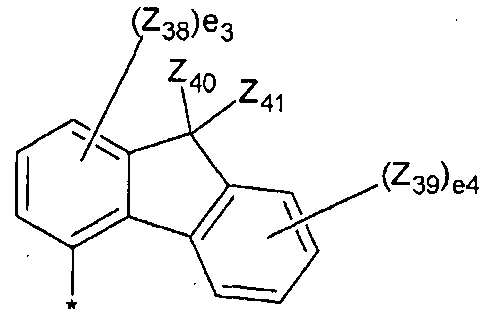


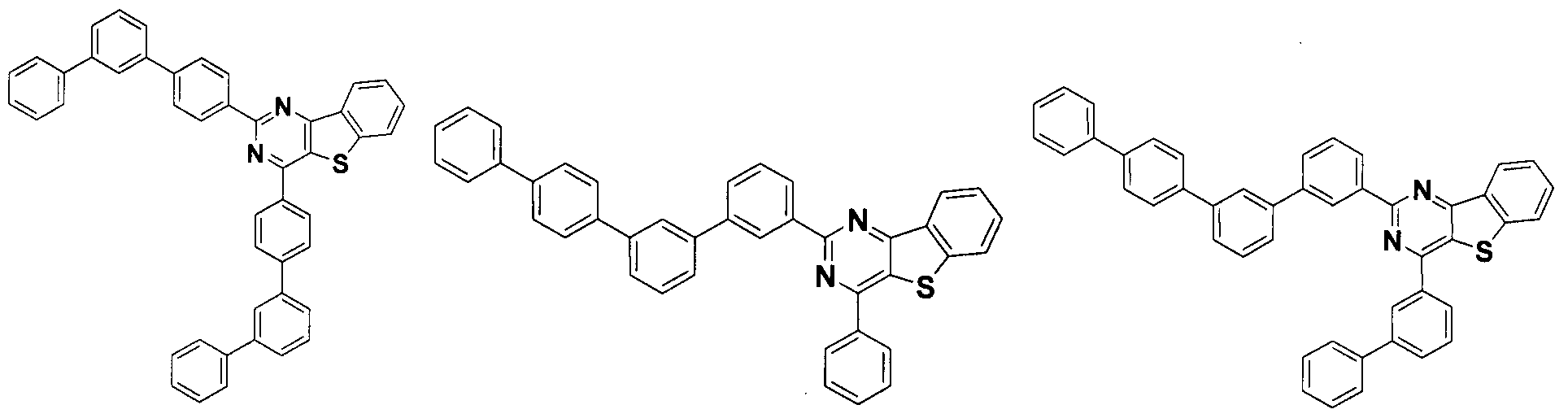





Priority Applications (2)
| Application Number | Priority Date | Filing Date | Title |
|---|---|---|---|
| CN201580003891.9A CN105899517B (en) | 2014-01-10 | 2015-01-06 | Condensed ring compound and organic light-emitting device containing the same |
| US15/107,349 US20170012216A1 (en) | 2014-01-10 | 2015-01-06 | Condensed cyclic compound and organic light-emitting device including the same |
Applications Claiming Priority (4)
| Application Number | Priority Date | Filing Date | Title |
|---|---|---|---|
| KR20140003605 | 2014-01-10 | ||
| KR20140003604 | 2014-01-10 | ||
| KR10-2014-0003605 | 2014-01-10 | ||
| KR10-2014-0003604 | 2014-01-10 |
Publications (2)
| Publication Number | Publication Date |
|---|---|
| WO2015105316A1 true WO2015105316A1 (en) | 2015-07-16 |
| WO2015105316A8 WO2015105316A8 (en) | 2015-10-01 |
Family
ID=53524101
Family Applications (3)
| Application Number | Title | Priority Date | Filing Date |
|---|---|---|---|
| PCT/KR2015/000112 Ceased WO2015105316A1 (en) | 2014-01-10 | 2015-01-06 | Fused-ring compound and organic light-emitting device comprising same |
| PCT/KR2015/000110 Ceased WO2015105315A1 (en) | 2014-01-10 | 2015-01-06 | Fused-ring compound and organic light-emitting device comprising same |
| PCT/KR2015/000107 Ceased WO2015105313A1 (en) | 2014-01-10 | 2015-01-06 | Fused-ring compound and organic light-emitting device comprising same |
Family Applications After (2)
| Application Number | Title | Priority Date | Filing Date |
|---|---|---|---|
| PCT/KR2015/000110 Ceased WO2015105315A1 (en) | 2014-01-10 | 2015-01-06 | Fused-ring compound and organic light-emitting device comprising same |
| PCT/KR2015/000107 Ceased WO2015105313A1 (en) | 2014-01-10 | 2015-01-06 | Fused-ring compound and organic light-emitting device comprising same |
Country Status (5)
| Country | Link |
|---|---|
| US (3) | US20160351826A1 (en) |
| KR (3) | KR101986260B1 (en) |
| CN (3) | CN105899518B (en) |
| TW (3) | TWI660957B (en) |
| WO (3) | WO2015105316A1 (en) |
Cited By (27)
| Publication number | Priority date | Publication date | Assignee | Title |
|---|---|---|---|---|
| EP3182478A1 (en) | 2015-12-18 | 2017-06-21 | Novaled GmbH | Electron injection layer for an organic light-emitting diode (oled) |
| EP3208861A1 (en) | 2016-02-19 | 2017-08-23 | Novaled GmbH | Electron transport layer comprising a matrix compound mixture for an organic light-emitting diode (oled) |
| CN107129471A (en) * | 2016-02-26 | 2017-09-05 | 三星Sdi株式会社 | Organic compound, organic photoelectric device and display device |
| EP3232490A1 (en) | 2016-04-12 | 2017-10-18 | Novaled GmbH | Organic light emitting diode comprising an organic semiconductor layer |
| EP3252841A1 (en) | 2016-05-30 | 2017-12-06 | Novaled GmbH | Organic light emitting diode comprising an organic semiconductor layer |
| EP3252837A1 (en) | 2016-05-30 | 2017-12-06 | Novaled GmbH | Organic light emitting diode comprising an organic semiconductor layer |
| EP3291319A1 (en) | 2016-08-30 | 2018-03-07 | Novaled GmbH | Method for preparing an organic semiconductor layer |
| JP2018534768A (en) * | 2015-09-28 | 2018-11-22 | ノヴァレッド ゲーエムベーハー | Organic EL device |
| JP2019521081A (en) * | 2016-04-29 | 2019-07-25 | メルク パテント ゲーエムベーハー | Materials for organic electroluminescent devices |
| WO2022063744A1 (en) | 2020-09-24 | 2022-03-31 | Merck Patent Gmbh | Organic electroluminescent device |
| WO2022090108A1 (en) | 2020-10-27 | 2022-05-05 | Merck Patent Gmbh | Organic electroluminescent device |
| WO2024121133A1 (en) | 2022-12-08 | 2024-06-13 | Merck Patent Gmbh | Organic electronic device and special materials for organic electronic devices |
| WO2024132993A1 (en) | 2022-12-19 | 2024-06-27 | Merck Patent Gmbh | Materials for electronic devices |
| WO2024194264A1 (en) | 2023-03-20 | 2024-09-26 | Merck Patent Gmbh | Materials for organic electroluminescent devices |
| WO2025045816A1 (en) | 2023-08-29 | 2025-03-06 | Merck Patent Gmbh | Materials for organic electroluminescent devices |
| WO2025045851A1 (en) | 2023-08-30 | 2025-03-06 | Merck Patent Gmbh | Materials for organic light-emitting devices |
| WO2025045843A1 (en) | 2023-08-30 | 2025-03-06 | Merck Patent Gmbh | Materials for organic light-emitting devices |
| WO2025045842A1 (en) | 2023-08-30 | 2025-03-06 | Merck Patent Gmbh | Materials for organic light-emitting devices |
| WO2025073675A1 (en) | 2023-10-04 | 2025-04-10 | Merck Patent Gmbh | Materials for organic electroluminescent devices |
| WO2025104058A1 (en) | 2023-11-16 | 2025-05-22 | Merck Patent Gmbh | Materials for organic electronic devices |
| WO2025119821A1 (en) | 2023-12-05 | 2025-06-12 | Merck Patent Gmbh | Material composition for organic electroluminescent devices |
| WO2025168515A1 (en) | 2024-02-06 | 2025-08-14 | Merck Patent Gmbh | Materials for organic electronic devices |
| WO2025195961A1 (en) | 2024-03-19 | 2025-09-25 | Merck Patent Gmbh | Organic light-emitting devices |
| WO2025228800A1 (en) | 2024-04-30 | 2025-11-06 | Merck Patent Gmbh | Materials for organic electronic devices |
| WO2026017612A1 (en) | 2024-07-15 | 2026-01-22 | Merck Patent Gmbh | Organic light-emitting device |
| WO2026017607A1 (en) | 2024-07-15 | 2026-01-22 | Merck Patent Gmbh | Organic light-emitting device |
| WO2026017608A1 (en) | 2024-07-15 | 2026-01-22 | Merck Patent Gmbh | Materials for organic light-emitting devices |
Families Citing this family (48)
| Publication number | Priority date | Publication date | Assignee | Title |
|---|---|---|---|---|
| US9755159B2 (en) * | 2014-01-23 | 2017-09-05 | Universal Display Corporation | Organic materials for OLEDs |
| KR102280686B1 (en) | 2014-02-11 | 2021-07-22 | 삼성전자주식회사 | Carbazole-based compound and organic light emitting device including the same |
| EP2907815B1 (en) | 2014-02-12 | 2023-12-06 | Samsung Electronics Co., Ltd. | Condensed cyclic compound and organic light-emitting device including the same |
| US9502656B2 (en) * | 2014-02-24 | 2016-11-22 | Universal Display Corporation | Organic electroluminescent materials and devices |
| KR102287012B1 (en) * | 2014-05-28 | 2021-08-09 | 덕산네오룩스 주식회사 | Compound for organic electronic element, organic electronic element using the same, and an electronic device thereof |
| KR20160007380A (en) * | 2014-07-11 | 2016-01-20 | 가부시키가이샤 한도오따이 에네루기 켄큐쇼 | Light-emitting element, compound, display module, lighting module, light-emitting device, display device, lighting device, and electronic device |
| US20180026203A1 (en) * | 2015-02-13 | 2018-01-25 | Idemitsu Kosan Co., Ltd. | Compound, material for organic electroluminescent element, ink composition, organic electroluminescent element, and electronic device |
| CN107615509B (en) * | 2015-05-29 | 2019-11-08 | 株式会社半导体能源研究所 | Light-emitting element, light-emitting device, display device, electronic equipment, and lighting device |
| WO2016204406A1 (en) * | 2015-06-19 | 2016-12-22 | 삼성에스디아이 주식회사 | Composition for organic photoelectronic element, organic photoelectronic element, and display apparatus |
| KR102059021B1 (en) | 2015-06-19 | 2019-12-24 | 삼성에스디아이 주식회사 | Composition for organic optoelectronic device, organic optoelectric device and display device |
| KR101919438B1 (en) | 2015-06-26 | 2018-11-16 | 삼성에스디아이 주식회사 | Composition for organic optoelectric device, organic optoelectric device and display device |
| KR20170027620A (en) * | 2015-09-02 | 2017-03-10 | 삼성에스디아이 주식회사 | Compound for organic optoelectronic device, composition for optoelectronic device, organic optoelectronic device and display device |
| KR20240094035A (en) * | 2015-10-23 | 2024-06-24 | 가부시키가이샤 한도오따이 에네루기 켄큐쇼 | Heterocyclic compound, light-emitting element, light-emitting device, electronic device, and lighting device |
| KR102350510B1 (en) * | 2015-11-12 | 2022-01-12 | 삼성디스플레이 주식회사 | Organic light emitting diode and organic light emitting diode display including the same |
| KR102508486B1 (en) * | 2015-12-10 | 2023-03-08 | 솔루스첨단소재 주식회사 | Organic compounds and organic electro luminescence device comprising the same |
| EP3184522B1 (en) | 2015-12-22 | 2023-01-11 | Samsung Electronics Co., Ltd. | Condensed cyclic compound, composition including the condensed cyclic compound, organic light-emitting device including the condensed cyclic compound, and method of manufacturing the organic light-emitting device |
| WO2017109637A1 (en) | 2015-12-25 | 2017-06-29 | Semiconductor Energy Laboratory Co., Ltd. | Compound, light-emitting element, display device, electronic device, and lighting device |
| KR102049419B1 (en) | 2016-07-19 | 2019-11-27 | 삼성에스디아이 주식회사 | Composition for organic optoelectronic device and organic optoelectronic device and display device |
| KR101868516B1 (en) * | 2016-07-20 | 2018-06-18 | 주식회사 엘지화학 | Novel hetero-cyclic compound and organic light emitting device comprising the same |
| KR101891263B1 (en) * | 2016-07-20 | 2018-08-23 | 주식회사 엘지화학 | Novel hetero-cyclic compound and organic light emitting device comprising the same |
| KR102001478B1 (en) | 2016-08-11 | 2019-07-24 | 삼성에스디아이 주식회사 | Composition for organic optoelectric device and organic optoelectric device and display device |
| KR102639854B1 (en) | 2016-10-31 | 2024-02-22 | 엘지디스플레이 주식회사 | Organic compounds and litht emitting diode and organic light emittig diode display device using the compounds |
| JP2018127402A (en) * | 2017-02-06 | 2018-08-16 | 国立大学法人山形大学 | Novel benzofuropyrimidine compound, and organic el element prepared therewith |
| JP2019006763A (en) | 2017-06-22 | 2019-01-17 | 株式会社半導体エネルギー研究所 | Organic compound, light-emitting element, light-emitting device, electronic apparatus, and lighting device |
| WO2019017731A1 (en) * | 2017-07-20 | 2019-01-24 | 주식회사 엘지화학 | Novel heterocyclic compound and organic light-emitting device using same |
| JP6849248B2 (en) | 2017-07-20 | 2021-03-24 | エルジー・ケム・リミテッド | Compounds and organic light emitting devices containing them |
| KR102132350B1 (en) * | 2017-07-20 | 2020-07-09 | 주식회사 엘지화학 | Novel hetero-cyclic compound and organic light emitting device comprising the same |
| KR102235262B1 (en) * | 2017-09-20 | 2021-04-02 | 삼성에스디아이 주식회사 | Organic compound and composition and organic optoelectronic device and display device |
| WO2019058200A1 (en) * | 2017-09-20 | 2019-03-28 | 株式会社半導体エネルギー研究所 | Organic compound, light-emitting element, light-emitting device, electronic device, and illumination device |
| KR102226070B1 (en) | 2017-09-26 | 2021-03-10 | 삼성에스디아이 주식회사 | Organic compound and composition and organic optoelectronic device and display device |
| CN119894227A (en) | 2017-11-02 | 2025-04-25 | 株式会社半导体能源研究所 | Light emitting element, display device, electronic device, and lighting device |
| CN111051282B (en) * | 2017-11-16 | 2023-05-09 | 株式会社Lg化学 | Compound and organic light emitting device comprising the same |
| CN110869372B (en) * | 2017-11-17 | 2022-05-27 | 株式会社Lg化学 | Compound and organic light-emitting element using same |
| KR20200100699A (en) * | 2017-12-20 | 2020-08-26 | 메르크 파텐트 게엠베하 | Heteroaromatic compounds |
| CN108148065B (en) * | 2017-12-21 | 2019-09-13 | 河南省科学院化学研究所有限公司 | A kind of synthetic method of 11,12-dihydro-11-phenylindolo[2,3-a]carbazole |
| US11498924B2 (en) | 2018-03-28 | 2022-11-15 | Lg Chem, Ltd. | Compound and organic light emitting diode comprising same |
| US12091416B2 (en) * | 2018-05-31 | 2024-09-17 | Semiconductor Energy Laboratory Co., Ltd. | Organic compound |
| CN112204034A (en) * | 2019-01-04 | 2021-01-08 | 株式会社Lg化学 | Novel compound and organic light emitting device comprising the same |
| TWI704211B (en) * | 2019-02-20 | 2020-09-11 | 晶宜科技股份有限公司 | Organic electroluminescent devices and material thereof |
| KR102808267B1 (en) * | 2019-09-16 | 2025-05-20 | 솔루스첨단소재 주식회사 | Organic electroluminescent device |
| CN112174969B (en) * | 2020-10-30 | 2023-01-17 | 北京八亿时空液晶科技股份有限公司 | Organic compound, organic electroluminescent material and organic electroluminescent element |
| WO2022207678A1 (en) | 2021-03-30 | 2022-10-06 | Merck Patent Gmbh | Organic electroluminescent device |
| EP4416155A1 (en) | 2021-10-14 | 2024-08-21 | Merck Patent GmbH | Materials for organic electroluminescent devices |
| US20260013317A1 (en) | 2021-11-02 | 2026-01-08 | Merck Patent Gmbh | Benzofuro[3,2-d]pyrimidino-2,4-dicarbonitril derivatives and similar compounds for organic electroluminescence devices |
| CN116120338B (en) * | 2021-11-11 | 2025-07-18 | 烟台显华科技集团股份有限公司 | Fused heterocycle substituted anthracene compound and application thereof |
| CN117659039A (en) * | 2022-08-31 | 2024-03-08 | 北京夏禾科技有限公司 | Organic electroluminescent devices |
| IL319969A (en) | 2022-11-09 | 2025-05-01 | Boehringer Ingelheim Int | Cyclic pyridine derivatives as cgas inhibitors |
| KR20250082719A (en) * | 2023-11-30 | 2025-06-09 | 솔루스첨단소재 주식회사 | Organic compound and organic electroluminescent device using the same |
Citations (3)
| Publication number | Priority date | Publication date | Assignee | Title |
|---|---|---|---|---|
| WO2013018661A1 (en) * | 2011-08-01 | 2013-02-07 | シャープ株式会社 | Organic electroluminescence element and manufacturing method therefor |
| KR20130142967A (en) * | 2012-06-20 | 2013-12-30 | 에스에프씨 주식회사 | Heterocyclic compounds and organic light-emitting diode including the same |
| KR20140000611A (en) * | 2012-06-22 | 2014-01-03 | (주)피엔에이치테크 | Novel compound for organic electroluminescent device and organic electroluminescent device comprising the same |
Family Cites Families (13)
| Publication number | Priority date | Publication date | Assignee | Title |
|---|---|---|---|---|
| US9067947B2 (en) * | 2009-01-16 | 2015-06-30 | Universal Display Corporation | Organic electroluminescent materials and devices |
| DE102009005289B4 (en) * | 2009-01-20 | 2023-06-22 | Merck Patent Gmbh | Materials for organic electroluminescent devices, methods for their production and electronic devices containing them |
| WO2010150593A1 (en) | 2009-06-24 | 2010-12-29 | コニカミノルタホールディングス株式会社 | Organic electroluminescent element, display device, illuminating device and condensed polycyclic heterocyclic compound |
| JP5604848B2 (en) * | 2009-10-19 | 2014-10-15 | コニカミノルタ株式会社 | ORGANIC ELECTROLUMINESCENT ELEMENT MATERIAL, ORGANIC ELECTROLUMINESCENT ELEMENT, LIGHTING DEVICE AND DISPLAY DEVICE |
| US8227801B2 (en) * | 2010-04-26 | 2012-07-24 | Universal Display Corporation | Bicarbzole containing compounds for OLEDs |
| JP2012028634A (en) * | 2010-07-26 | 2012-02-09 | Idemitsu Kosan Co Ltd | Organic electroluminescent element |
| US8415031B2 (en) * | 2011-01-24 | 2013-04-09 | Universal Display Corporation | Electron transporting compounds |
| KR101474713B1 (en) * | 2012-05-30 | 2014-12-23 | 주식회사 알파켐 | New material for transporting electron and organic electroluminescent device using the same |
| WO2013180376A1 (en) * | 2012-05-30 | 2013-12-05 | Alpha Chem Co., Ltd. | New electron transport material and organic electroluminescent device using the same |
| CN105103327B (en) * | 2013-03-26 | 2018-09-07 | 株式会社半导体能源研究所 | Light-emitting element, compound, organic compound, display module, lighting module, light-emitting device, display device, lighting device, and electronic equipment |
| EP2821459B1 (en) * | 2013-07-01 | 2017-10-04 | Cheil Industries Inc. | Composition and organic optoelectric device and display device |
| JP6507534B2 (en) | 2013-09-11 | 2019-05-08 | 東ソー株式会社 | Benzothienopyrimidine compound, method for producing the same, and organic electroluminescent device containing the same |
| KR20150080966A (en) * | 2014-01-02 | 2015-07-13 | 최돈수 | Light-emitting material for organic electroluminescent device, organic electroluminescent device using same, and material for organic electroluminescent device |
-
2015
- 2015-01-06 CN CN201580003977.1A patent/CN105899518B/en active Active
- 2015-01-06 CN CN201580003885.3A patent/CN105934436B/en active Active
- 2015-01-06 KR KR1020150001102A patent/KR101986260B1/en active Active
- 2015-01-06 KR KR1020150001101A patent/KR101920643B1/en active Active
- 2015-01-06 US US15/108,066 patent/US20160351826A1/en not_active Abandoned
- 2015-01-06 CN CN201580003891.9A patent/CN105899517B/en active Active
- 2015-01-06 KR KR1020150001100A patent/KR101930365B1/en active Active
- 2015-01-06 US US15/102,642 patent/US20160308142A1/en not_active Abandoned
- 2015-01-06 WO PCT/KR2015/000112 patent/WO2015105316A1/en not_active Ceased
- 2015-01-06 WO PCT/KR2015/000110 patent/WO2015105315A1/en not_active Ceased
- 2015-01-06 US US15/107,349 patent/US20170012216A1/en not_active Abandoned
- 2015-01-06 WO PCT/KR2015/000107 patent/WO2015105313A1/en not_active Ceased
- 2015-01-08 TW TW104100513A patent/TWI660957B/en active
- 2015-01-08 TW TW104100514A patent/TWI537275B/en active
- 2015-01-08 TW TW104100515A patent/TWI535721B/en active
Patent Citations (3)
| Publication number | Priority date | Publication date | Assignee | Title |
|---|---|---|---|---|
| WO2013018661A1 (en) * | 2011-08-01 | 2013-02-07 | シャープ株式会社 | Organic electroluminescence element and manufacturing method therefor |
| KR20130142967A (en) * | 2012-06-20 | 2013-12-30 | 에스에프씨 주식회사 | Heterocyclic compounds and organic light-emitting diode including the same |
| KR20140000611A (en) * | 2012-06-22 | 2014-01-03 | (주)피엔에이치테크 | Novel compound for organic electroluminescent device and organic electroluminescent device comprising the same |
Non-Patent Citations (2)
| Title |
|---|
| KIM, S-K. ET AL.: "Synthesis and Hole-Transporting Properties of Phenyl-Carbazyl Derivatives.", MOL. CRYST. LIQ. CRYST., vol. 491, 2008, pages 133 - 144 * |
| YANG, X. ET AL.: "Modified 4,4',4'' -Tri (N-carbazolyl )triphenylamine as a Versatile Bipolar Host for Highly Efficient Blue, Orange, and White Organic Light-Emitting Diodes.", J. PHYS. CHEM. C., vol. 116, 2012, pages 15041 - 15047 * |
Cited By (33)
| Publication number | Priority date | Publication date | Assignee | Title |
|---|---|---|---|---|
| JP2018534768A (en) * | 2015-09-28 | 2018-11-22 | ノヴァレッド ゲーエムベーハー | Organic EL device |
| EP3182478A1 (en) | 2015-12-18 | 2017-06-21 | Novaled GmbH | Electron injection layer for an organic light-emitting diode (oled) |
| EP3208861A1 (en) | 2016-02-19 | 2017-08-23 | Novaled GmbH | Electron transport layer comprising a matrix compound mixture for an organic light-emitting diode (oled) |
| CN107129471A (en) * | 2016-02-26 | 2017-09-05 | 三星Sdi株式会社 | Organic compound, organic photoelectric device and display device |
| CN107129471B (en) * | 2016-02-26 | 2021-05-07 | 三星Sdi株式会社 | Organic compounds, organic optoelectronic devices and display devices |
| US10516113B2 (en) | 2016-02-26 | 2019-12-24 | Samsung Sdi Co., Ltd. | Organic compound, organic optoelectric device and display device |
| EP3232490A1 (en) | 2016-04-12 | 2017-10-18 | Novaled GmbH | Organic light emitting diode comprising an organic semiconductor layer |
| WO2017178392A1 (en) | 2016-04-12 | 2017-10-19 | Novaled Gmbh | Organic light emitting diode comprising an organic semiconductor layer |
| US11643414B2 (en) | 2016-04-29 | 2023-05-09 | Merck Patent Gmbh | Materials for organic electroluminescent devices |
| JP2019521081A (en) * | 2016-04-29 | 2019-07-25 | メルク パテント ゲーエムベーハー | Materials for organic electroluminescent devices |
| JP7046831B2 (en) | 2016-04-29 | 2022-04-04 | メルク パテント ゲーエムベーハー | Materials for OLED devices |
| EP3252837A1 (en) | 2016-05-30 | 2017-12-06 | Novaled GmbH | Organic light emitting diode comprising an organic semiconductor layer |
| EP3252841A1 (en) | 2016-05-30 | 2017-12-06 | Novaled GmbH | Organic light emitting diode comprising an organic semiconductor layer |
| WO2018041864A1 (en) | 2016-08-30 | 2018-03-08 | Novaled Gmbh | Method for preparing an organic semiconductor layer and an organic electronic device |
| EP3291319A1 (en) | 2016-08-30 | 2018-03-07 | Novaled GmbH | Method for preparing an organic semiconductor layer |
| WO2022063744A1 (en) | 2020-09-24 | 2022-03-31 | Merck Patent Gmbh | Organic electroluminescent device |
| WO2022090108A1 (en) | 2020-10-27 | 2022-05-05 | Merck Patent Gmbh | Organic electroluminescent device |
| WO2024121133A1 (en) | 2022-12-08 | 2024-06-13 | Merck Patent Gmbh | Organic electronic device and special materials for organic electronic devices |
| WO2024132993A1 (en) | 2022-12-19 | 2024-06-27 | Merck Patent Gmbh | Materials for electronic devices |
| WO2024194264A1 (en) | 2023-03-20 | 2024-09-26 | Merck Patent Gmbh | Materials for organic electroluminescent devices |
| WO2025045816A1 (en) | 2023-08-29 | 2025-03-06 | Merck Patent Gmbh | Materials for organic electroluminescent devices |
| WO2025045843A1 (en) | 2023-08-30 | 2025-03-06 | Merck Patent Gmbh | Materials for organic light-emitting devices |
| WO2025045851A1 (en) | 2023-08-30 | 2025-03-06 | Merck Patent Gmbh | Materials for organic light-emitting devices |
| WO2025045842A1 (en) | 2023-08-30 | 2025-03-06 | Merck Patent Gmbh | Materials for organic light-emitting devices |
| WO2025073675A1 (en) | 2023-10-04 | 2025-04-10 | Merck Patent Gmbh | Materials for organic electroluminescent devices |
| WO2025104058A1 (en) | 2023-11-16 | 2025-05-22 | Merck Patent Gmbh | Materials for organic electronic devices |
| WO2025119821A1 (en) | 2023-12-05 | 2025-06-12 | Merck Patent Gmbh | Material composition for organic electroluminescent devices |
| WO2025168515A1 (en) | 2024-02-06 | 2025-08-14 | Merck Patent Gmbh | Materials for organic electronic devices |
| WO2025195961A1 (en) | 2024-03-19 | 2025-09-25 | Merck Patent Gmbh | Organic light-emitting devices |
| WO2025228800A1 (en) | 2024-04-30 | 2025-11-06 | Merck Patent Gmbh | Materials for organic electronic devices |
| WO2026017612A1 (en) | 2024-07-15 | 2026-01-22 | Merck Patent Gmbh | Organic light-emitting device |
| WO2026017607A1 (en) | 2024-07-15 | 2026-01-22 | Merck Patent Gmbh | Organic light-emitting device |
| WO2026017608A1 (en) | 2024-07-15 | 2026-01-22 | Merck Patent Gmbh | Materials for organic light-emitting devices |
Also Published As
| Publication number | Publication date |
|---|---|
| US20160351826A1 (en) | 2016-12-01 |
| WO2015105313A8 (en) | 2015-10-01 |
| TW201533048A (en) | 2015-09-01 |
| CN105934436B (en) | 2019-03-12 |
| KR101920643B1 (en) | 2018-11-21 |
| TW201533047A (en) | 2015-09-01 |
| WO2015105315A1 (en) | 2015-07-16 |
| US20160308142A1 (en) | 2016-10-20 |
| CN105899517A (en) | 2016-08-24 |
| US20170012216A1 (en) | 2017-01-12 |
| CN105934436A (en) | 2016-09-07 |
| KR20150084657A (en) | 2015-07-22 |
| KR101930365B1 (en) | 2018-12-18 |
| TWI660957B (en) | 2019-06-01 |
| CN105899517B (en) | 2019-05-21 |
| WO2015105316A8 (en) | 2015-10-01 |
| WO2015105313A1 (en) | 2015-07-16 |
| TW201533049A (en) | 2015-09-01 |
| CN105899518A (en) | 2016-08-24 |
| TWI535721B (en) | 2016-06-01 |
| CN105899518B (en) | 2019-04-16 |
| WO2015105315A8 (en) | 2015-10-01 |
| KR101986260B1 (en) | 2019-06-05 |
| TWI537275B (en) | 2016-06-11 |
| KR20150083786A (en) | 2015-07-20 |
| KR20150083787A (en) | 2015-07-20 |
Similar Documents
| Publication | Publication Date | Title |
|---|---|---|
| WO2015105316A1 (en) | Fused-ring compound and organic light-emitting device comprising same | |
| TWI730983B (en) | Organoluminescent device | |
| TWI673267B (en) | Novel compound, organic light-emitting device including the same and flat panel display apparatus including the same | |
| CN101184822B (en) | Electroluminescent device | |
| JP6579725B2 (en) | Compound for organic optoelectronic device, organic optoelectronic device, and display device | |
| TWI703203B (en) | Organic optoelectric device and display device | |
| KR102516053B1 (en) | Compound and Organic light emitting device comprising same | |
| JP2016051901A (en) | Organic light emitting device | |
| CN112079874A (en) | Organometallic compounds, organic light-emitting devices including the same, and diagnostic compositions including the organometallic compounds | |
| KR102631261B1 (en) | Compound and Organic light emitting device comprising same | |
| CN107001292A (en) | Organic photovoltaic component compound and organic photovoltaic component and display element | |
| KR102703710B1 (en) | Condensed cyclic compound and organic light emitting device including the same | |
| CN110452200A (en) | Heterocyclic compound and organic light emitting apparatus comprising the heterocyclic compound | |
| TWI696602B (en) | Novel compound and organic light-emitting device including the same | |
| KR20210054733A (en) | Heterocyclic compound, organic light emitting device comprising same, composition for organic layer of organic light emitting device and manufacturing method of organic light emitting device | |
| KR20160010706A (en) | Condensed-cyclic compound and organic light-emitting device including the same | |
| TWI603975B (en) | Vinylsilane compound, organic light-emitting device including the same and flat panel display device including the organic light-emitting device | |
| TW201416347A (en) | Compound and organic light-emitting device comprising the same | |
| KR20150091942A (en) | Organometallic compound and organic light emitting diode including the same | |
| CN102827078B (en) | Condensed-cyclic compound and organic light-emitting diode comprising the same | |
| TW201416409A (en) | Compound and organic light emitting device including the same | |
| KR102441556B1 (en) | Compound and Organic light emitting device comprising same | |
| CN106008420A (en) | Compound and organic light-emitting device including the same | |
| TW201638070A (en) | Organic light-emitting device | |
| CN112010907A (en) | Organometallic compound and organic light emitting device including the same |
Legal Events
| Date | Code | Title | Description |
|---|---|---|---|
| 121 | Ep: the epo has been informed by wipo that ep was designated in this application |
Ref document number: 15735400 Country of ref document: EP Kind code of ref document: A1 |
|
| WWE | Wipo information: entry into national phase |
Ref document number: 15107349 Country of ref document: US |
|
| NENP | Non-entry into the national phase |
Ref country code: DE |
|
| 122 | Ep: pct application non-entry in european phase |
Ref document number: 15735400 Country of ref document: EP Kind code of ref document: A1 |